THE PREFACE TO THE READER.
READER,
Before I speak any thing of the Author, or of his
Works, I think it convenient to speak somthing of
my self, and of my intention in setting out this Translation,
with my Annotations.
The Reputation that this Book hath amongst all
the Europeans, since its first coming out, which was
in the year 1555. and the curiosity that from time to time the
learned have had to see the Mysteries contained in it, unfolded:
is a sufficient warrant for my undertaking.
Many better Pens (I confess) could have performed this work
with better success, but not with greater facility than I, having from
my youth been conversant with those that pretended or endeavered
to know somthing in it. Otherwise, it would have been impossible
for a man of my profession to wade through it. This Book
was the first after my Primmer, wherein I did learn to read, it being
then the Custom in France, about the year 1618. to initiate Children
by that Book; First, because of the crabbidness of the words;
Secondly, that they might be acquainted with the old and absolete
French, such as is now used in the English Law; and Thirdly, for
the delightfulness and variety of the matter, so that this Book in
those days was printed every year like an Almanack, or a Primer
for Children. From that time, without any other Study than reading
of History, and observing the events of the world, and conversing
with those that made it their Study, (some of which were like
to run mad about it) I have attained to so much Knowledge, as
to bring it into a Volume.
The Book is written in the Nature of Prophecies, digested into
old French Verses, most of which are very hard to be understood,
and others impossible at all, whether the Author did affect obscurity,
or else wanted the faculty to express himself, which is the cause
that it could not be rendred into English Verses, it being troublesome
enough to be understood in Prose, as the Reader will find.
That’s the reason that I have translated it almost word for word, to
make it as plain as I could; as also because the Reader (if curious
of it) may benefit himself in the knowledge of the French
Tongue, by comparing the English and French together. The rest
that can be said upon this subject, you shall find either in the Authors
Life, or in the Appology made for him.
And because I have told you before, that many have been like
to run mad by over-studying these, and other Prophecies, give me
leave to give you this advice, that in vain, or at least without any
great profit, thou shalt bestow thy time, care, and study upon it:
for which I will give thee the chief reasons, that have disswaded
me from it.
The first is, that the thing it self, which you may think to understand,
is not certain in it self; because the Author disguiseth it
in several manners, sometimes speaking a double sense, as that of
the ancient Oracle.
Aio te Æacida Romanos vincere posse.
Which is to be understood two ways, and cannot be determinated,
till the event of it be past.
It is true, that the Author doth mark so many particular Circumstances,
that when the thing is come to pass, every one may clearly
see that he pretended to Prophecie that particular thing. And besides
he doth sometimes deliver the thing in so obscure terms, that
without a peculiar Genius, it is almost impossible to understand it.
The second is, that though the Prophecie be true in it self, yet
no body knoweth, neither the time, nor how: For example, he
plainly foretelleth, that the Parliament of England should put their
King to death; nevertheless no body could tell, nor when, nor how,
till the thing was come to pass, nor what King it should be, till we
had seen it.
The third is, that he marketh the times with Astrological terms,
viz. when such and such Planets, shall be in such and such Signs;
but as those Planets are often here, and go out of it, and come
there again, no certain judgement can be made of it.
The fourth is, that many times he giveth some peculiar Circumstances
to those he speaketh of, which may be found in others.
Thus the Royal first born might have been applied to Lewis the
XIII. to Lewis the XIV. to the first born of Philip the II. and
Philip the III. King of Spain, and to Kings of England, Father and
Son. Nevertheless we find that this word Royal first born, was intended
for Henry IV. Grandfather on his Mothers side, as we shall shew
hereafter. This being so, it cannot be expounded, but after the event.
The fifth is, that the knowledge of future things, belongeth to
God alone, and no body can pretend by any study, to have a certain
acquisition of it in all its Circumstances.
The sixth is, that the orders of Gods providence, which cause
the several events in all States, will not permit that men should
have a publick notion of his designs, sometimes he revealeth them
to his Servants, or to some particular man as he pleaseth, but he
will not have them to be known among the common sort of men.
The seventh, is the experience we have had of many, who pretending
to understand the Author, have made a quantity of false
Prophecies, expounding the Stanza’s according to their fancy, as if
God had given them the same understanding that he gave the Author,
and what ought to confirm us more in this point, is, that
they have expounded some Prophecies, as if they were to come to
pass, which were past already, by which we see the darkness of
humane wit, who without authority pretendeth to bite into the
forbidden fruit of knowledge.
The eighth is, that this knowledge is no way profitable for the
Vulgar; because those things being decreed by God, they shall
come to pass without forceing our liberty, nor hindering the contingency
of sublunary things, where we must observe that the Prophecies
which were revealed to men, are many times conditional, as
we see in that of Jonas against Ninive, but those that they have
left in writing for the times that should come after them, are absolutely
true, and shall infallibly come to pass, as they have foretold
them. This no ways hindereth, but God may reveal some secrets of
his to private men, for their benefit, and that of their friends, without
imparting it to the Vulgar, who may be, should laugh at them.
The ninth is, that God hath peculiarly reserved to himself the
knowledge of times. Daniel, by a special favour, knew the end
of the Babylonian Captivity, and the time of the Messiah’s birth,
and yet the interpreters can scarce yet expound clearly the meaning
of the seventy weeks of Daniel, and we see, that since 1600 years
ago, holy men, from age to age, have foretold the proximity of
Dooms-day, and the coming of Antichrist.
The tenth is, that the foretelling of future things in this Author,
is for the most part included in business of State, and one might be
guilty of a criminal temerity, if he would discover things that concern
us not, and the concealing of which, is commended by all
prudent persons, seeing that we owe respect, love, and submission
to those that bear rule over us.
For these reasons (dear Reader) I would not have thee intangle
thy self in the pretentions of knowing future things. If you
have light concerning them, keep thine own secret, and make use
of it for thy self: Preserve peace, and let the Almighty govern the
World: for he can turn all things to his Glory, and may when
he pleaseth, raise up some Wits that will make known unto us, what
we desire, without any further trouble to our selves. Before I
make an end, I cannot but acquaint thee for gratitude sake, of my
Obligation to several persons, which have lent me Books, to help
me towards the finishing of this work, as namely that worthy Gentleman,
and the Honour of his profession Mr. Francis Bernard,
Apothecary to St. Bartholemews Hospital, and Mr. Philip Auberton
Gentleman, belonging to the Right Honourable the Earl of Bridgwater.
Farewell.
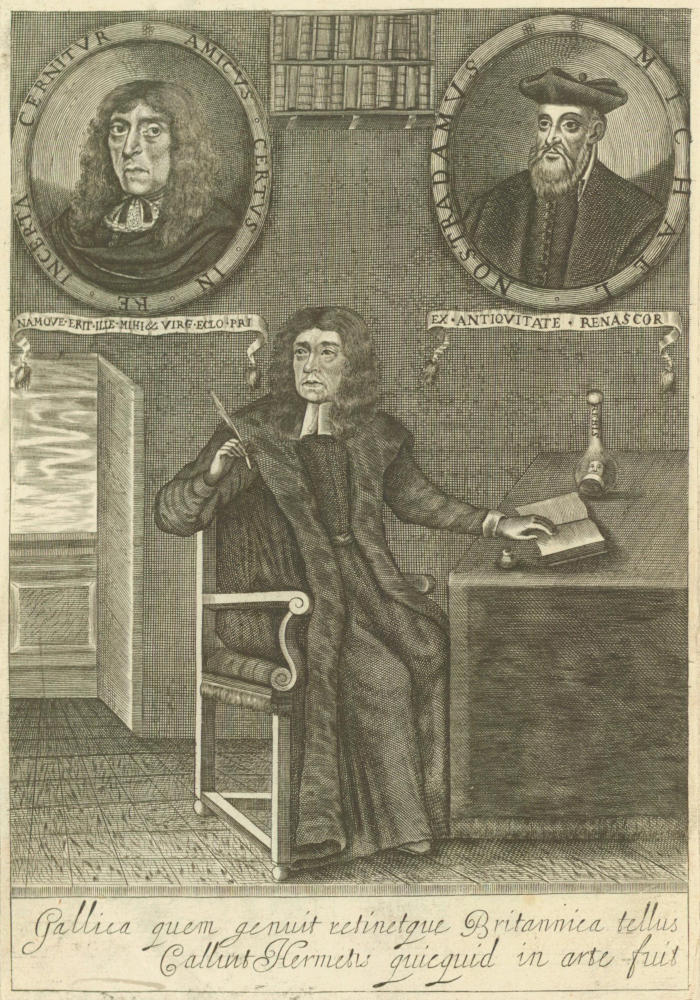
THE LIFE OF Michael Nostradamus, Physitian in Ordinary to HENRY the II. and CHARLES the IX. Kings of France .

Michael Nostradamus, the most renowned and famous Astrologer,
that hath been these many Ages, was born in St. Remy, a Town
of Provence, in the year 1503. upon a Thursday, the 14th of December,
about noon. His father was James Nostradamus, a Notary
of the said Town, his Mother was Renata of St. Remy,
whose Grandfathers by the Fathers and Mothers side, were men
very skilfull, in Mathematick and Physick, one having been
Physitian to Renatus, King of Jerusalem, and Sicily, and Earl of Provence, and the
other Physition to John, Duke of Calabria, Son to the said Renatus, whence cometh
that our Author saith in his Commentaries, that he hath received from hand to
hand the Knowledge of Mathematicks, from his ancient Progenitors. After the
death of his great Grandfather by the Mothers side, who first gave him a slight
tincture, and made him in love with the Mathematicks, he was sent to School to
Avignon. After that he went to Mount Pelier, to study Philosophy and Physick,
till a great Plague coming, he was compelled to go to Narbonne, Thoulouse, and
Bourdeaux, where he first began to practise, being then about 22 years of age.
Having lived four years in those parts, he went back again to Monpelier, to get
his degrees, which he did with a great deal of applause. Going to Thoulouse, he
past through Agen, where Julius Cæsar Scaliger stayed him, with whom he was
very familiar and intimately acquainted, though they fell out afterward; there he
took to wife a very honourable Gentlewoman, by whom he had two Children, a
Son and a Daughter, all which being dead, and seeing himself alone, he resolved
to retire himself into Provence his Native Countrey. After he had gone to Marseille,
he went to Aix, where the Parliament of Provence sitteth, and was there
kept three years at the City Charges; because of the violent Plague that raged
then in the year 1546. as you may read in the Lord of Launay’s Book, called the
Theater of the World, who describeth that Plague according to the informations
our Author gave him. Thence he went to Salon de Craux, a City distant from Aix
one dayes Journey, and in the middle way between Avignon and Marseille; there he
Married his second Wife Anna Ponce Genelle, by whom he had three Sons and one
Daughter, the eldest was Michael Nostradamus, who hath written some pieces of
Astrology, Printed at Paris in the year 1563.
The second was Cæsar Nostradamus, who hath deserved to be numbred among
the French Historians, by reason of the great Volume he hath written of Provence.
The third was a Capuchine Frier. Cæsar did insert in his History the propagation
of that Order in Provence. The fourth was a Daughter.
Nostradamus having found by experience that the perfect knowledge of Physick
dependeth from that of Astrology, he addicted himself to it, and as this Science
wanteth no allurement, and that besides his Genius he had a peculiar disposition
and inclination to it; he made such a progress in it, that he hath deserved the Title
of the most illustrious one in France, insomuch that making some Almanacks for
recreation sake, he did so admirably hit the conjuncture of events, that he was sought
for far and near.
This success was the cause of an extraordinary diminution of his fame; for the
Printers and Booksellers seeing his fame, did print and vent abundance of false
Almanacks under his name for lucre sake, whence it came that his reputation suffered
by it, and was the cause that the Lord Pavillon wrote against him, and that the
Poet Jodele made this bitter Distichon.
Nostra damus cum falsa damus, nam fallere nostrum est,
Et cum falsa damus, nil nisi Nostra damus.
To which may be answered.
Nostra damus cum verba damus quæ Nostradamus dat,
Nam quæcunque dedit nil nisi vera dedit.
Or thus
Vera damus cum verba damus quæ Nostradamus dat,
Sed cum Nostra damus, nil nisi falsa damus.
Nevertheless the Beams of Truth did shine through the Clouds of Calumny; for
he was singularly esteemed of by the Grandees, Queen Katharine of Medicis, who
had a natural inclination to know future things.
And Henry the II. King of France, who sent for him to come to the Court
in the year 1556. and having had private conference with him about things of
great concernment, sent him honourably back again with many gifts. He went
from Salon to the Court upon the 14 of July in the year 1555. and came to Paris upon
the 15 of August. As soon as he was come to Town, the Lord Constable of Montmorency
went to see him at his Inn, and presented him to the King, who received
him with much satisfaction, and commanded that his lodging should be at the Palace
of the Cardinal of Bourbon Archbishop of Sens.
There he was taken with the Gout for ten or twelve days, after which his Majesty
sent him one hundred Crowns in Gold in a Velvet Purse, and the Queen as much.
Their Majesties desired him to go to Blois to see the Princes their Children, and to
tell them his opinion of them. It is certain that he did not tell them what he thought,
considering the Tragical end of those three Princes, viz. Francis the II. Charles the
IX. and Henry the III.
Having been so much honoured at Court, he went back again to Salon, where he
made an end of his last Centuries, two years after he dedicated them to the King
Henry the II. in the year 1557. and in his Luminary Epistle discovereth unto him the
future events that shall happen from the Birth of Lewis the XIV. now Reigning, till
the coming of Antichrist.
While he was at Salon he received there the Duke of Savoy, and the Lady Margaret
of France, Sister to Henry the II. who was to Marry the said Duke according to
the treaty of the general Peace made at Cambresis, both entertained him very familiarly,
and honoured him often with their presence. The Duke came in October and
the Lady in December.
When Charles the IX. went a progress through his Kingdom, he came into Provence,
and did fail not to go to Salon to visit our Author, who in the name of the
Town went to salute him, and make a Speech, this was in the year 1564. the 17
of November.
The extraordinary satisfaction that the King and the Queen Mother received from
him was such, that being both at Lion, they sent for him again, and the King gave
him 200 Crowns in Gold, and the Queen almost as much, with the quality of Physician
in Ordinary to the King, with the Salaries and profits thereunto appertaining.
Being come back to Salon he lived about 16 Months longer, and died upon the 2 of
July 1566. in his Climacterical year of 63. having all his senses about him: His
Disease was a Gout at first, which turned into a Dropsie; the time of his death it
seemeth was known to him; for a friend of his witnesseth, that at the end of June in
the said year he had writen with his own hand upon the Ephemerides of John Stavius
these Latine words, Hic prope mors est; that is, near here is my death, and the day
before his death that friend of his having waited on him till very late took his leave,
saying, I shall see you again to morrow morning, you shall not see me alive when the
Sun riseth, which proved true. He died a Roman Catholick, having received all
his Sacraments, and was solemnly buried in the Church of the Franciscan Friers at
Salon, on the left hand of the Church door, where his Widow erected him a Marble
Table fastened in the Wall with this Epitaph, with his Figure to the Life, and his
Arms above it.
The Inscription of his EPITAPH is in imitation of
that of Titus Livius, and is thus.
D. M.
Ossa clarissimi Michaelis Nostradami, unius omnium pene mortalium
digni, cujus Divino calamo totius Orbis ex astrorum influxu futuri
eventus conscriberentur. Vixit annos LXII. menses VI. dies X.
Obiit. Salonæ CIↃ IↃLXVI. Anna Pontia Gemella, conjugi
optimo. V. E.
Which may be rendred thus:
Here lies the Bones of the most famous Nostradamus, one who among
Men hath deserved by the opinion of all, to set down in
writting with a Quill almost Divine, the future Events of all the
Universe, caused by the Cœlestial influences; he lived 62. years
6. Months and 10. days, he died at Salon, in the year 1566.
O Posterity do not grudge at his rest.
Anna Pontia Gemella wisheth to her most loving Husband the
true Happiness.
He had a Brother named John Nostradamus, famous for several Works that he
hath written, the Catalogue of which is in the Book of Mr. du Maine de la Croix,
Intitled, the Library.
As for our Author, he hath left several Works, among which is a Book of
Receits, for the preservation of health, Printed at Poitiers, in the year 1556.
Another concerning the means of beautifying the Face and the Body, that was
Printed at Antwerp by Plantin in the year 1557. which he Dedicated to his Brother
John Nostradamus, an Attorney at the Parliament of Aix.
Besides this, he Translated from Latine into French the Paraphases of Galen, upon
the Exhortation of Menedotus, which was Printed at Lyon by Antony du Rhosne, in
the year 1557.
But before we conclude, it will not be amiss to give some recreation to the Reader,
by relating a merry passage that happened to Nostradamus being in Lorrain, for being
in the Castle of Faim, belonging to the Lord of Florinville, and having in cure the
Mother of the said Lord; it chanced one day that they both walking in the Yard,
there was two little Piggs, one white, and the other black, whereupon the Lord enquired
of Nostradamus in jest, what should become of these two Piggs? he answered
presently, we shall eat the black, and the Wolf shall eat the white.
The Lord Florinville intending to make him a Lyar, did secretly command the
Cook to dress the white for Supper; the Cook then killed the white, drest it, and
spitted it ready to be rosted when it should be time; In the mean time having some
business out of the Kitchin, a young tame Wolf came in, and eat up the Buttocks of
the white Pig, that was ready to be rosted; the Cook coming in the mean time, and
fearing least his Master should be angry, took the black one, killed it, and drest it,
and offered it at Supper. Then the Lord thinking he had got the Victory, not
knowing what was befallen, said to Nostradamus, well Sir, we are eating now the white
Pigg, and the Wolf shall not touch it. I do not believe it (said Nostradamus) it is the
black one that is upon the Table. Presently the Cook was sent for, who confessed
the accident, the relation of which was as pleasing to them as any meat.
In the same Castle of Faim, he told many that in a little Hill that was near the
Castle, there was a Treasure hidden, which should never be found, if it were sought
with design, but that it should be discovered when the Hill should be digged for
some other intent. There is a great probability in this prediction, for there was an
ancient Temple built upon it, and when they dig there, many times several Antiquities
are found. All France telleth several Histories foretold by the Author, but I
am unwilling to write any thing without good warrant. His Stanza’s are sufficient
to prove the extraordinary Talent he had in foretelling future things.
APOLOGY FOR Michael Nostradamus. — CHAP. I. — CHAP. II. How the first Objection hath caused the Author to be reputed a false Prophet. — CHAP. III. The second Objection hath ranked the Author among Dreamers and false Visionaries. — CHAP. IV. The third Objection accuseth the Author of medling with the black Art, of being a Negromancer, and a Disciple of the Devil. — CHAP. V. The fourth Objection maketh him the Head of those Seductors and Impostors, which are dangerous in a Common-wealth. — CHAP. VI. Proofs setting forth evidently that Nostradamus was enlightned by the Holy Ghost. — CHAP. VII. Answer to the first Objection against Nostradamus , which pretendeth to rank him among the false Prophets. — CHAP. VIII. Answer to the second Objection, which would have him pass for a Doctor. — CHAP. IX. Answer to the third Objection, which accuseth him of the Black Art, and of Negromancy. — CHAP. X. Answer to the fourth Objection, of Calumny, which brandeth our Author with the title of Chief of the Seductors and Impostors. — CHAP. XI. Some difficulties against what we have said, drawn out of Nostradamus his own Epistles. — CHAP. XII. Elogies given to Nostradamus by several Authentical Authors. — CHAP. XIII. What these Stanza’s Prophecie of. — CHAP. XIV. Since what time these Prophecies began.
It is not unusual for Calumny to follow the best Wits, and those whom God
hath endowed with so extraordinary Talent, upon weak and slight grounds.
It is not also unusual for Men to side easier with calumny against innocent
persons, then with those truths that justifie them; therefore no body ought
to wonder, if Michael Nostradamus hath been so much cried down and defamed
by several Authors, being in the number of those extraordinary persons,
whom God had priviledged with that grace so much desired by curious Men, viz.
the knowledge of future events.
Besides that, there was four things in him, which might have been the grounds of
this diffamation.
The first was the vulgar life which he led in the Roman Catholik Religion, which
seemed to bear no proportion with such an extraordinary favour of God.
The second was his application to judicial Astrology, which is condemned by many
learned Men, and detested by those that pretend to ignorant devotion.
The third was a suspition brought by his enemies, and many devout persons in
his time, that he was a Negromancer, and had familiarity with the Angel of darkness.
The fourth was the obscurity of his Stanza’s, which was made worse by the
enormous faults of those that first Copied them, and by the carelesness of the Printers.
In consequence of the first Objection, calumny hath endeavoured to place him
among the false Prophets, because scarce any body can persuade himself, that
there being among the Faithful so many Illustrious persons in Holiness and Learning,
the Holy Ghost would have made choice of a common person, and to reveal him so
many rare secrets, concerning the future Estate of his Church, and of those Kingdoms
that acknowledge her for their Mother, seeing that the Holy Scriptures shew
us, that the knowledge of future things (chiefly if it be extraordinary in its extent)
is a special Priviledge wherewith God honoureth his most faithful Servants.
And to say truth, when the Holy Fathers and the Interpreters of the Scripture
speak of the Prerogatives of the Apostle St. John, they make the chiefest to be that
by which being full of Prophetical Spirit, he foretold the future Estate of the Church;
and in the Old Testament, so many Prophets were so many Miracles and Prodigies
of Holiness, and the only name of Prophet in the Scripture is the most glorious Title
that is given to those that were Gods most faithful Servants.
If we find in the Scripture that Balaam hath Prophesied notwithstanding his perfidiousness,
and that the High Priest Caiaphas, notwithstanding his wicked design
of murdering Christ, hath also Prophesied; it was only for a few things, and in such
cases where God would singularly shew forth his Glory, by those that would have
smothered it.
How can we then believe the same of Nostradamus, who had not so much as an
extraordinary atom of Christian piety, by which he might have been so much priviledg’d
of God, as to know by his Divine Light the future Estate of the Church,
her Persecutions and her Victories from the year 1555. to the end of the World.
Can it be possible that a Physician, an Astrologer, and one of the common sort
of people should have been chosen of God among so many thousands his betters, to
impart unto him those Graces, which have been the reward of the purity and holiness
of his Apostles, and of the faithfulness of St. John the Evangelist.
This seemeth altogether improbable to Christian piety.
Some are more moderate in the censuring of this Author, and being unwilling to
call him maliciously a false Prophet, would have him to be a foolish Dreamer,
who believed his own imaginations, and took pleasure in his own fancies, whence
came that Latine Distick of the Poet Jodelle,
Nostra damus cum falsa damus, nam fallere nostrum est,
Et cum falsa damus, nil nisi Nostra damus.
This Distick was so pleasing to the Wits of the times, that without further inquiry,
since that time Nostradamus went for a Dreamer and a doting fool.
This opinion increased more and more by his making of many Almanacks, wherein
every body may see how much he was taken with judicial Astrology; and we see
often in his Stanza’s the decision of the times, by the conjunction of the Planets with
the Signs, and by the Eclipses, whence sometimes he doth infer some events that
were to happen.
But what did undo him most, was the covetousness of the Printers and Booksellers
of his time, who seeing his Almanacks so well received, did set forth a thousand
others under his name, that were full of lies and fopperies.
From that time the Author went for one of those poor Astrologers, who get their
living by foretelling absurdities; and pretend to read in the Heavens, that which is
only in their foolish imagination.
If the precedents have been moderate in their censure; others have been more severe
in delivering their opinion, accusing him to have kept acquaintance with
the Devil, as the Negromancers and other Prestigiators of the ancient times did.
The reason that made them think so is, that seeing so many things come to pass,
just as the Author had foretold; they could not attribute it to the knowledge of judicial
Astrology, nor to Divine Revelation, and consequently concluded, that it
must of necessity come from Satan.
They could not attribute it to judicial Astrology, either because they had no opinion
of it, or that the greatest defensors of that Astrology do agree among themselves,
that it cannot reach so far as to foretell a thousand peculiar circumstances,
which depend purely from the freedom of Men, such as proper names are, and the like,
which nevertheless our Author did foretell.
They could neither attribute it to Divine Revelation, for the reasons alledged in
the first objection; moreover, because he was accused of a thousand falsities and fopperies,
Printed in those Almanacks that went falsly under his name, whence they
concluded that it could not come by Divine Revelation, seeing that the Holy Ghost
is the Spirit of Truth.
It followeth then (say they) that it must come from the Devil, by the help of the
Black Art; the Lord Florimond de Raimond a very considerable Author, was of that
opinion in his Book of the Birth of Heresies, Chap. 3.
As Fame doth increase by continuation of time, so doth calumny increase by
the multiplicity of opinions, she was not contented to deflour slightly the Authors
reputation, by making him pass for some sottish Dreamer, and to rank him
amongst the false Prophets, by accusing him to meddle with the black Art, but
must needs also sacrifice him to the infernal Furies, by making him the Prince of
Seductors and Impostors, that ought to be banished out of every Common-wealth.
The fondamental reason of this was the obscurity of his Stanza’s, where there was
neither rime nor reason; the obscurity did proceed of abundance of gross faults, which
the Copisters and Printers have inserted in them, from the omission of several words,
from the changing and altering of others, and from the addition of some others,
which did destroy the sense.
From this great obscurity, calumny draweth this argument, to ruine utterly the
Author, charging him to be all at once a false Prophet, a dotish Dreamer, a Magician,
and an infamous Seductor of people.
If God had inspired him what he hath written, he would have done it for the good
of his Church and true Believers, seeing he never granteth this Prophetical Grace to
any, but to that end as it appeareth in the Holy Scriptures.
This being so, what profit can any body draw from him, if the sense of his Stanza’s
be so obscure, as not to be understood? and although it should be granted, that some
accidents that have happened in Christendom, may sometimes be found in his Prophecies,
what fruit hath the Church reaped of it, seeing that those accidents that
were foretold, were never known, till they had come to pass, and that there was no
avoiding of them?
It cannot therefore be believed, that God should have been the Author of his
Predictions, but rather the Subtle Spirit of Satan, with whom he was acquainted by
such like black Arts.
According to those four Objections, the Lord Sponde in the third Volume of his
Annals, made him this Epitaph in the year 1566. Mortuus est hoc anno nugax ille
toto orbe famosus Michael Nostradamus, qui se præscium & præsagum eventuum futurorum
per astrorum influxum venditavit, sub cujus deinceps nomine quivis homines ingeniosi
suas hujusmodi cogitationes protendere consueveruent, in quem valde apposite lusit qui
dixit. Nostra damus cum falsa damus, &c. In English. In the year 1566. died that
Trifler so famous through all the World, Michael Nostradamus who boasted while he
lived, to know and foretell future things, by the knowledge he had of the influences
of the Planets, under whose name afterwards many ingenious Men have vented their
Imaginations, insomuch, that he that made that Distick, Nostra damus cum falsa
damus, &c. seemeth to have very well said.
In consequence of these objections forged by calumny, Nostradamus name hath
been so cried down, that I have thought me self oblidged to make his Apology,
to give the greater credit to his Prophecy, the exposition of which I do here
undertake, and to proove, that effectually he was enlightned by the Holy Ghost:
first, by writting the History of his Life, as I have done in the beginning of this Book;
Secondly, by answering to all the said Objections; Thirdly, by alledging the Elogies
given him by several Grave and Authentical Authors.
First, I maintain that he was enlightned by the Holy Ghost, by an unanswerable
reason, drawn out the Theology, but before we discourse of it, let us suppose that
Nostradamus hath foretold many things, which absolutely depends from the free will
of men, and cannot be known, neither by judicial Astrology, nor by Satan himself,
such are for exemple the proper names of Persons, which nevertheless he doth in his
Prophecies.
He nameth the Lord of Monluc, the Sprightful Gascon, the Captain Charry, his
Camerade, the Lord de la Mole, Admiral of Henry the II. Galleys, Entragues, who
was beheaded by order of Lewis the XIII. the Headsman of the Duke of Montmorency,
named Clerepegne; the Bassa Sinan, destroyer of Hungary; the Murderer of Henry
the III. named Clement; the Attorney David, the Captain Ampus; the Mayor of
the City of Puy in Gelay, named Rousseau, under Henry the IV. Lewis Prince of Condé,
under Francis II. Sixtus V. calling him the Son of Hamont; Gabrielle d’Estrée; the
Lord Mutonis sent to Paris by those of Aix, under Charles the IX. the Lord Chancellor
of France, named Antony de Sourdis; the Queen Leuise: Antony of Portugal:
the Governour of Cazal under Henry II.
Secondly, The number of things is of the same nature: Nostradamus doth often
calculate it; he reckoneth fourteen Confederates for the service of Henry IV. in the
City of Puy: ten great Ships prosecuting extreamly the Admiral in the Battle of
Lepanto: five Ships taken from the Spaniard by those of Diepe, under Henry II. nine
hundred thousands Mores that went out of Spain under Henry IV. three hundred and
fifty thousands killed under Charles IX. and Henry III. three saved at the taking of a
Town in Hungary by the Turks: nine separated from the company of Seditious, that
were to be put to death, three Princes of Turky Massacred, and the fourth being the
youngest saved; thirty Conspirators upon London Bridge, against the Majesty of
King Charles I. and such like.
Thirdly, We find in these Prophecies, the Prodigies that have no other causes in
nature, then the meer will of God; such as Comets are, the casting of monstrous
Fishes by the Sea upon the Land, the Armies in the Air, the speaking of Dogs, the
birth of Monsters, and such like.
Fourthly, We find in those Prophecies those actions that are purely indifferent;
for example, that the King of England did appear upon a Scaffold without his Doublet;
that in the place where he was beheaded, another man had been killed three
days before; that Libertat went a Hunting with a Greyhond, and a Blood-hond;
that the two little Royals were conducted to St. Germain, rather then to any other
place, and such like.
Fifthly, We find the Birth of several particular persons that were born after his
death.
Sixthly, The Governments of Places given by the free will of Kings to such and
such.
All these things cannot be known by judicial Astrology, seeing that in Heaven
there is neither Names, nor Numbers, nor extraordinary Prodigies: seeing also that
judicial Astrology presupposeth the Birth of persons, that one may foretel their future
actions; the same things are also unknown to Satan, for the Angelical species
know nothing of individual things, but under the notion of possible, and not of
future.
Whence I conclude with this irrefragable Argument, that the Author hath
known many several things that are not written in the Heavenly Book, nor represented
to him by Angelical Species, therefore he hath known them from God himself.
The Author himself in his Epistle to his Son Cæsar Nostradamus confesseth, that he
hath foretold many things by Divine Virtue and Inspiration.
And a little after he saith, that the knowledge of those things, which meerly depends
from free will, cannot be had either by humane auguries, nor by any other humane
knowledge, nor by any secret virtue that belongeth to sublunary things, but
only by a Light, belonging to the Order of Eternity.
This is not a small Argument, to confirm what we have said, and to prove that
the Author hath evidently been conscious, that his knowledge came from Heaven,
and that Gods goodness did him that grace; for having rejected and abhorred other
means, that Impostors make use of for foretelling something.
He writteth all these things of himself: First, in his Liminary Epistle to his Son
Cæsar, he conjureth him, that when he should go about to study the foretelling of
future things by Astrology, to avoid all kind of Magick, prohibited by the Holy
Scripture, and the Canons of the Church; and to encourage him the more to it, he
relateth what happened to him, viz. that having been Divinely enlightned, and fully
persuaded that God only can give the knowledge of future things, which absolutely
depends of the free will of men, he did burn abundance of Writings, wherein was
taught the Art of Prophecying, and as they were a burning, there came out a great
flame, which was like (he thought) to burn his House all to ashes, by which accident
he understood the falsity of such Writings, and that the Devil was vexed to see his
plots discovered; besides that, he confesseth that being the greatest Sinner of the
World, nevertheless he got that favour from Heaven by a Divine Inspiration; and
because no body should doubt of it, he learnedly expoundeth wherein consisteth that
inspired Revelation, he saith that it is, A participation of the Eternal Divinity, by
which we come to judge of what the Holy Ghost imparteth to us; by that participation
of Eternity, the Author doth not understand a communication of the continuance
of the Divine being, but a participation of the Divine knowledge, measured
by its Eternity, as the Schools terms it.
Effectively, the Author compareth this participation to a glistering flame, which
createth a new day in our understanding, which flame proceeding from Gods infinite
knowledge, who seeth and comprehendeth what is Eternity, doth impart unto us
what is inclosed in the volubility of the Heavens.
After this testimony, which wholly destroyeth the Sinister opinions that men had
of his Prophecies, he sheweth how Judicial Astrology may agree with the knowledge
of that which proceedeth from a Prophetical Spirit.
It is true, saith he, that sometimes God imparteth this Light not only to the unlearned,
and to his Holy Prophets, but also to those that are versed in Judicial Astrology,
making that instrumental for the confirmation of his inspired truths: As we
see that natural Sciences, help the light of the Faith, and make a certain disposition in
the mind fitter then ordinary, to receive those Divine impressions.
Thus (saith he) in the beginning of the Epistle, God did supernaturaly inspire me,
not by any Bacchick fury, nor by Lymphatical motions, as he did the Sybilles; but
by Astronomical assertions; that is to say, that God gave him that grace, not by
any Extasy, but by studying those rules, which Astrology teacheth.
The same things he saith again a little after in this manner: the Astrologer being
in his Study, and consulting the Astronomical Rules upon the motions of the Heavens,
the Conjunction and several Aspects of the Planets, he guesseth at some future
events, of which being not certain, this Divine Light riseth in his mind, and imparteth
clearly to him what he knew before, only Ænigmatically and obscurely, and
in the shade of that natural light.
Sometimes also (saith he) this Light cometh the first into the Astrologers mind,
and he afterwards comparing the thing revealed unto him with the Astronomical
rules, he seeth that they do wholly agree together; and this is the method that he
hath made use of, to know whether the inspired truths were agreeing with the Astronomical
Calculations; a method that he hath made use of some times, but not always,
for he hath foretold many things, which he could not read in the Heavens.
By these testimonies of the Author himself, every one may see how he made use
of Judicial Astrology, and wherefore he studied it so much; how far his knowledge
did extend; the glory he giveth to God alone, for his Prophetical knowledge; what
horrour he hath always had against unlawful means to attain unto it; how much he
did value that Grace, considering his unworthiness; and the manner how the Lord
was pleased to gratifie him.
Let us see now what calumny pretendeth for the obscuring this Prophet of our
days; the knowledge of future things (saith she) is a priviledge belonging to
the Saints, and to those whom God hath endowed with an eminent vertue. I acknowledge,
it is so commonly, and in the ordinary way of Grace, but if God be
pleased to impart that priviledge to those that have not attained to that Degree of
Holiness, and that it really appeareth by the reasons of Theologie, that they have
been gratified with it, we are bound to admire his Royal bounty, which giveth when,
and to whom he pleaseth: for example, no body deserveth to be a Marshal of
France, but he that hath been in several Battles, and at the taking of many Towns;
but if the King be pleased to honour with that Dignity a Gentleman that never
Warred but against the Deer, the Kings goodness is to be praised, which extendeth
even to those that have not deserved it; it is the same reason here, it is visibly apparent
that Nostradamus hath been enlightned by the Holy Ghost, and yet he hath not
imitated the lifes of those great Saints of the Church: what can be inferred from
thence, but that it was Gods pleasure to extend his bounty upon his poor Creatures,
which is easie to be granted in this point, because the gift of Prophecy is not a sanctifying
Grace, but a supernatural gift, of which a sinner is capable of, as we see in
Balaam, Caiaphas, and the Sybilles, and much more in a Christian, who observeth
Gods Commandments, and endeavoureth to keep himself in his Grace.
But (saith calumny) Christian piety seemeth to be repugnant to this Divine disposition,
seeing that in Nostradamus time, there were thousands in the Church of
God that were capable of this favour, and to prefer to them a Physitian, an Astrologer,
and an Almanack-maker, is a thing that the Wits cannot apprehend so well, as
to frame a good opinion for this Author.
Hold there Reader, do not enter into the Sanctuary of Gods secret Judgements,
you should loose you self, and never find the way out: how many such questions
might I ask you? why did God in former times chuse the Family and person of
David, and preferred it to so many others of the Children of Israel? why did Christ
raise Judas to the dignity of an Apostle, preferring him before Nathaniel, and so many
others that lived Holily.
Bring therefore no more such questions, but say with the Scripture, As it pleased
the Lord, so it was done: I will nevertheless give you some satisfaction in that point.
There was two things in the Author which might have procured that blessing from
God.
The first is, that having in his possession those writtings which promised the knowledge
of future things, to which he was much inclined, he slighted and burnt them,
being persuaded that God alone was the Author of this Grace; I do esteem that
action very Heroical in its circumstance, because being inticed by a vehement curiosity
to know future things, and having in his hand the means that opened the way to
it, he did Sacrifice them to God, for which perhaps God was willing to gratifie him
with this favour.
The second thing that was in Nostradamus is, that he had naturally a Genius for
the knowing of future things, as himself confesseth in two Epistles to King Henry
the II. and to Cæsar his own Son, and besides that Genius, the knowledge of Astrology,
did smooth him the way to discover many future events. Having those two
things, he had a greater disposition then others to receive those Supernatural Lights;
and as God is pleased to work sweetly in his Creatures, and to give some forerunning
dispositions to those Graces he intendeth to bestow, it seemeth that to that purpose
he did chuse our Author to reveal him so many wonderful secrets.
We see every day that God in the distributing of his Graces carrieth himself towards
us, according to our humours and natural inclinations, he employeth those
that have a generous and Martial heart for the defence of his Church, and the destruction
of Tyrants; he leadeth those of a melancholick humour into Colledges and
Cloisters, and cherisheth tenderly, those that are of meek and mild disposition; even
so, seeing Nostradamus inclined to this kind of knowledge, he gave him in a great
measure the grace of it.
We shall not have much to say to these more moderate persons, seeing that we
have already given the reason of it, viz. the covetousness of the Booksellers
and Printers, who made use of the Authors name, for the better sale of their
false Almanacks, therefore if Jodelle the Poet grounded upon this opinion, made that
Satyrical Distick.
Nostra damus cum falsa damus, nam fallere nostrum est,
Et cum falsa damus, nil nisi Nostra damus.
We answer him,
Nostra damus cum verba damus quæ Nostradamus dat,
Nam quæcunque dedit nil nisi vera dedit.
Or thus
Vera damus cum verba damus quæ Nostradamus dat,
Sed cum Nostra damus, nil nisi falsa damus.
The more doth Calumny lift up her self against this great man, the weaker are
her arguments, like the smoke which is so much the easier dissipated, as it
ascendeth higher.
Her reason is impertinent in this distributive argument, he hath known those
things (saith she) which he could not know by the Planets, and he had them not from
God, therefore he had them from Satan.
And we answer this argument in the same way, he hath known those things which
he could not know by the Planets, nor by Satan, therefore he had them from God;
this Argument is concluding, but that of calumny halteth, for it ought to have proved
that he had not his knowledge from God, and that all those things he hath
known may be known to Satan, which two things we have manifestly proved to be
false, therefore if the Lord Florimond de Raimond was alive, I believe he would correct
what he hath written against him.
The Weapons of this Medusa are sharper in this point then in others, therefore
our Buckler accordingly must be of the best mettle and temper.
We cannot deny but Nostradamus hath affected obscurity, himself acknowledgeth
it in his two Epistles, in that to Cæsar his son, he saith, he hath done
it, not only because of the times wherein he lived, but also by reason of those that
were to follow, in the times wherein he lived the Case was as it is now, Veritas odium
parit, and this hatred in powerful men is prejudicial to those that speak the Truth,
he was also cautious in that, by reason of the times following; for if he had plainly
declared what he meant, the Wits would have laughed at it, and would not have
believed those strange revolutions that came to pass, and which our Author had
foretold. In his Epistle to Henry the II he telleth him, that he doth purposely
make use of obscure terms to express his mind, for the reasons before alledged.
Now Calumny saith, that this affectation of obscurity is a sign that God was not
the Author of his Knowledge, seeing that by this obscurity they have proved unprofitable
to the Church.
I answer first, that the consequence is false; for the Holy Prophets have spoken
so obscurely, that a great part of what they had Prophecied was not known till
after it had come to pass.
I answer secondly, that although Prophecies were not understood till after the
fulfilling thereof, it doth not follow that they were unprofitable; because by their
fulfilling in due time, we gather, that he who revealed them was the true God,
Lord of times and Eternity, and therefore being the God of Israel, and of the
Christians, he ought to be worshiped. By this principle Cyrus and Alexander knew
the true God, Cyrus by having seen the Prophecies of Isaiah, and Alexander those
of Daniel.
Therefore as the Prophecies of the Saints have not been fruitless, though not
understood till they were fulfilled, even so we must not infer that Nostradamus’s Prophecies
have been useless, though they have remained in obscurity so long a while.
Besides, there is no doubt but Nostradamus having Prophecied so many several
things that are come to pass, but that hereafter when the Heathen shall see it they
shall glorifie God, and shall acknowledge a true Religion, as did Cyrus, who many
Authors believe to have obtained Salvation.
I answer in the third place, that God permitteth ordinarily that Prophecies lie long
in the dark, and then raiseth the Spirit of some men to expound them, as he did
that of Daniel to interpret the 70 Weeks of the Babylonian Captivity, Prophecied
by Jeremiah, to incourage the faithful three ways.
First, in shewing them, that if the first Prophecies have been punctually fulfilled,
the rest will likewise come to pass, seeing the same God hath dictated them.
Secondly, in unfolding to them the future wonders, of which they shall be partakers.
Thirdly, in giving warning how they may attain to them, and shew those accidents
that might be an hindrance. Thus God did permit, that for the space of
100. years Nostradamus Prophecies should lie in darkness, and be contemned, but
after that time God will raise some body to interpret them, whence the faithful seeing
so many things foretold come to pass so exactly, will incourage one another by
seing so many wonderful prodigies, of whom they shall be Eye Witnesses.
As for my part I have undertaken this Work, only to authorise the wonders that
shall be seen in our days, and to invite the Christian Princes to the same design.
The conclusion of this discourse is, that our Medusa Calumny, must needs retreat
in her dens, and that we ought to forgive those Authors that have spoken so ill of
our Author, seing they wanted the Intelligence of his Prophecies, and that the
Church did suspend the authorising of them.
We have (thanks be to God) sheltered this famous man from the back-biting
of Calumny, but that we may clear wholly the Heaven of this
reputation, we add this Chapter more for the clearing of some words that are in
his Epistles, which seem to contradict some of those things we have said; the Author
in his Epistles to his Son Cæsar, after he had said that God had disposed him to
receive thy impression of supernatural lights, not by a Bacchant furor, nor by a Lymphatical
motion, but by Astronomical assertions, he saith in the same Epistle towards
the end; That sometimes in the Week being surprised by a Lymphatick humor, and
making his Nocturnal Studies sweet by his calculations, he made Books of Prophecies,
each one containing a hundred Astronomical Stanza’s, which he endeavoured to set out
something obscurely, from which words it might be gathered, that he made his
Prophecies by a Lymphatical Spirit, and by the only judicial Astrology.
And in the Epistle to King Henry the II. he seemeth to confess, that his Prophecie
is nothing but a natural Genius, which he had by Inheritance from his Ancestors.
To these difficulties I answer, supposing first that anciently those were called
Lymphaticks, who were mad for Love; because the first that was observed among
the Ancients to be mad with that passion, threw himself into the water, which in
Latine is called Lympha, whence all those that were afterwards transported with the
excess of any passion, either of Love, Melancholy, Choler or Envy, have been
called Lymphaticks.
So that in this place a Lymphatical motion is nothing properly but a deep Melancholy,
which separating us from all Earthly things, doth transport the mind to extraordinary
thoughts either good or bad.
This being suposed, I say that the Author confesseth, that his retreat, solitariness,
nocturnal Watchings, and Melancholy, have disposed him much to the
receiving of that Heavenly flame, which is the cause of Vaticination and Prophecie.
And because he did often spend the whole nights in this study, this Nocturnal
retreat caused in him a retirement from all worldly things, at which time he felt a
Divine elevating Virtue, that raised his understanding to those Divine Knowledges.
And because this elevating Vertue was caused in him by Divine operation, he
doth attribute always his Prophecies to God alone; and by reason that this elevation
hath some resemblance with that of the Lymphaticks, he saith, that sometimes
he did Lymphatise not properly speaking, but by resemblance.
So that it is true, our Author did not receive his Prophecies by Lymphatical motion,
or Bacchant furie, but from God himself, who did work in him while he observed
his Astronomical assertions; and it is also true, that he felt this Divine operation
by a kind of a Lymphatical motion.
Concerning what he saith to Henry the II. it is certain he maketh use of that Language
as much by a motive of Truth to conceal that Grace which he had received
from God, as of Humility.
By a Motive of Truth, because effectually; because all the Nostradamus’s had
some tincture of Prophecie, and his Son the Capucin acknowledgeth it himself.
By a Motive of Humility; because acknowledging himself to be a miserable sinner,
and seeing that this gift of Prophecie was not ordinarily granted but unto Saints.
He chuseth rather to attribute his Prophecies to his Genius, than otherways to procure
a Fame and Authority to his predictions.
In confirmation of what we have said, That he was often in that transport, many
years before his death he made the Stanza of the Century, in which is contained all
the great Works of the Philosophers, and foretelleth, that a great Divine shall attain
to the perfection of that great Work, which Divine is called, the Divine
Verbe, turning into French the Word θεολογος, which signifieth Divine Word or
Verb. Nevertheless he never wrought himself at that Work, but got his living
Honourably by his practise of Physick, by which we may see, that he did write
some things which himself understood not, unless they were such general ones, as
might be read in the Heavens.
If several Authors either by envy or ignorance have defamed our Author, others
of no shall repute have taken his defence in hand.
D’Aurat one of the most excellent Poets of France, living at the same time as
Nostradamus, made a few explications of his Prophecies, which as the report goes,
did please the Readers. I am sorry I could not get them, it would have been some
ease to me; for it is easier to add than to invent. The first Volume of the Lord
la Croix du Main, maketh honourable mention of him, the same saith, that his
Motto was Felix Oviam prior Ætas, Happy the first Age that was contented with
their Flock, shewing by that, what esteem he had of frugality and sincerity of manners,
and what aversion he had against the Vices of his Age, the unruliness of manners,
and cousenage of men. Ronsard the Prince of the French Poets singeth his
praises: The Lord Boucher in that great Volume, intitled the Mistical Crown, in
favour of the future Croisade, doth vindicate our Author from Calumny, and expoundeth
some of his Prophecies pretty happily.
I will not relate here what his Son Cæsar Nostradamus writeth modestly of him in
his History of Provence, under Lewis the XII. Henry the II. and Charles the IX. his
Evidence may be suspected, because of the Consanguinity.
One of the greatest Wits of this last Age, who desireth to be nameless, giveth
him this Character.
First, That God Almighty hath chosen Michael Nostradamus among the common
sort of Christians, to impart unto him the knowledge of many prodigious and
extraordinary future things.
Secondly, He maintaineth, that after the Apostles and Canonical Prophets, he
is the first of all in three things, in his certainty and infallibility, in the generality and
in the quantity. As to the first, he doth not doubt but the Abbot Joachim ought
to give him place; for though he hath foretold some things that have come to pass,
he hath written a hundred others which are meer fopperies.
Thirdly, He maintaineth that the Emperour Leo in his prophetical Tables is far
below him; for he doth only aim at those things which regard the Eastern Empire,
as Theophrastus Paracelsus hath done for the Western.
Concerning the quantity of things, he maintaineth, that none of the others can
dispute it with him; for Nostradamus hath made above a thousand stanza’s (if we
had them all) each of which containeth two or three prophetical Truths, some of
which regard the East, others the West, others some private Kingdoms and States
others private and particular things, and all with Truth and certainty.
The Author in his Epistle to King Henry the II. saith, that he treateth of
things which were to happen in many Cities and Towns of Europe, and of a
part of Asia and Africa.
And to say Truth, I have found nothing in them concerning the East or West,
Jappan or China.
He treateth chiefly of France as of his Native Kingdom, and of his own Countrey
Provence, and that which is next to it, viz. Piemont.
He speaketh amply of the Popes, and of Italy, Turky and England: As for the
Empire Spain, and Suedeland, he doth moderately speak of them. Concerning
Æthiopia and Africa there is some nine or ten Stanza’s.
In all those places he foretelleth many things, not only general for every State,
but also particular and individual for several persons. He also foretelleth many supernatural
prodigies in the Heavens, the Air, the Sea, and the Land.
He hath inserted among his Prophecies four Horoscopes, the first of the Grandfather
of the Lord l’Ainier in the Province of Anjou; the second of one called Urnel
Vausile; the third of one Cosme du Jardin; and the fourth of one, whom he nameth
not, but describeth him by his stature.
It is certain that they began in January 1555. because he dedicated the first
seven Centuries to his Son Cæsar the first day of March in the said year, and
consequently they were made before that time, and we cannot allow less than
two Months to an Author for the making of 700. Stanza’s: Nevertheless for a
greater manifestation of his prophetical Spirit, I have not found any of his Prophecies
that did come to pass before the first of March 1555.
As for the Eight, Ninth and Ten Century, there is reason to believe, that the
effect of them doth not begin before the 27 June 1558. which is the date of his Liminary
Epistle to Henry the II. Nevertheless he saith in the same Epistle, that in a
writing by it self he will set down the exposition of his Prophecies, beginning the
14 of March 1557. and in the Epistle to Nostradamus his Son, he saith in general that
he hath composed Books of Prophecies, each one containing one hundred Stanza’s,
without specifying whether he spoke of the seven that he dedicated to him, or of all
the others.
As for my part, I believe he had made them all in the year 1555. but that he had
not yet examined the three last Centuries, according to the Calculation of his Astronomical
assertions, as he seemeth to indicate often in his Epistle to Henry II. and to
say the truth, I have found some Stanza’s, which were fulfilled before the year 1558.
though very few.
As for the extent of his Prophecies, it is certain, that it is to the end of the World,
as I shall make it appear in the explication of the 48, the 49, and 56. Stanza’s of the
first Century, and the 72, 73, and 94. of the tenth, and all according to the Holy
Scripture.
All these things being premised, we shall proceed to the explication of the Prophecies,
setting first the Authors Luminary Epistle to his Son.
THE PREFACE TO Mr. Michael Nostradamus HIS PROPHECIES, Ad Cæsarem Nostradamum Filium vita & Felicitas.
Thy late coming, Cæsar Nostradamus, my son, hath
caused me to bestow a great deal of time in continual
and nocturnal watchings, that I might leave a
Memorial of me after my death, to the common
benefit of Mankind, concerning the things which the
Divine Essence hath revealed to me by Astronomical
Revolutions; and since it hath pleased the immortal God, that
thou are come late into this World, and canst not say that thy
years that are but few, but thy Months are incapable to receive
into thy weak understanding, what I am forced to define of futurity,
since it is not possible to leave thee in Writing, what might
be obliterated by the injury of times, for the Hereditary word of
occult prædictions shall be lockt up in my brest, considering also
that the events are definitely uncertain, and that all is governed by
the power of God, who inspired us not by a Bacchant fury or
Lymphatick motion, but by Astronomical affections. Soli numine
Divino afflati præsagiunt & Spiritu Prophetico particularia: Although
I have often foretold long before what hath afterwards
come to pass, and in particular Regions, acknowledging all to
have been done by Divine Vertue and Inspiration, being willing
to hold my peace by reason of the injury, not onely of the present
time, but also of the future, and to put them in Writing, because
the Kingdoms, Sects, and Regions shall be so Diametrically opposed,
that if I should relate what shall happen hereafter, those of
the present Reign, Sect, Religion and Faith, would find it so disagreeing
with their fances, that they would condemn that which
future Ages shall find and know to be true; considering also the
saying of our Saviour, Nolite Sanctum dare canibus ne conculcent
pedibus & conversi discumpant vos, which hath been the cause that
I have withdrawn my tongue from the Vulgar, and my Pen from
Paper. But afterwards I was willing for the common good to enlarge
my self in dark and abstruse Sentences, declaring the future
Events, chiefly the most urgent, and those which I foresaw (what
ever humane mutation happened) would not offend the hearers, all
under dark figures more then Prophetical, for although, Abscondisti
hæc a sapientibus & prudensibus, i. e. potentibus & Regibus enucleasti
ea exiguis & tennibus, and the Prophets by means onely of
the immortal God and good Angels, have received the Spirit of
Vaticination, by which they foresee things, and foretel future events;
for nothing is perfect without him, whose power and goodness is so
great to his Creatures, that though they are but men, nevertheless
by the likeness of our good Genius to the Angels, this heat and
Prophetical power draws near us, as it happens by the Beams of
the Sun, which cast their influence both on Elementary and not
Elementary bodies; as for us who are men, we cannot attain any
thing by our natural knowledge, of the secrets of God our Creator.
Quia non est nostrum nosse tempora nec momenta, &c.
Besides, although there is, or may come some persons, to whom
God Almighty will reveal by impressions made on his understanding
some secrets of the future, according to the Judicial Astrology, as
it hath happened in former times, that a certain power and voluntary
faculty possessed them as a flame of fire, so that by his inspiration,
they were able to judge of Divine and Humane things: for
the Divine works that are absolutely necessary, God will end. But
my son, I speak to thee too obscurely; but as for the secrets that
are received by the subtle Spirit of fire, by which the understanding
being moved, doth contemplate the highest Celestial Bodies,
as being active and vigilant to the very pronunciation without fear,
or any shameful loquacity: all which proceeded from the Divine
Power of the Eternal God, from whom all goodness floweth. Now
my son, although I have inserted the name of Prophet here, I will
not attribute to my self so sublime a Title, for qui Propheta dicitur
hodie olim vocabatur videns, and Prophets are those properly
(my Son) that see things remote from the natural knowledge of
Men; but put the case, the Prophets by the means of the perfect
light of Prophecy, may see as well Divine things as Humane,
(which cannot be seeing the effects of future predictions) do extend
a great way, for the secrets of God are incomprehensible, and the
efficient power moveth afar off the natural knowledge, taking their
beginning at the free will, cause those things to appear, which
otherwise could not be known, neither by humane auguries, or
any hidden knowledge or secret virtue under Heaven, but only by
the means of some indivisible Eternal being, or Comitial and
Herculean agitation, the causes come to be known by the Cœlestial
motion. I say not therefore my Son, that you may not understand
me well, because the knowledge of this matter cannot
yet be imprinted in thy weak brain, but that future causes afar off
are subject to the knowledge of humane Creatures, if (notwithstanding
the Creature) things present and future were neither obscure
nor hidden from the intellectual seal; but the perfect knowledge
of the cause of things, cannot be acquired without the Divine
Inspiration, seeing that all Prophetical Inspiration received,
hath its original principle from God the Creator, next, from good
Luck, and afterwards from Nature, therefore cases indifferently
produced or not produced, the Prophecy partly happens where
it hath been foretold, for the understanding being intellectually
created, cannot see occult things, unless it be by the voice coming
from the Lymbo, by the means of the thin flame, to which the
knowledge of future causes is inclined; and also my Son I intreat
thee not to bestow thy understanding on such fopperies,
which drie up the Body and damn the Soul, bringing vexation to
the Senses; chiefly abhor the vanity of the execrable Magick, forbidden
by the Sacred Scriptures, and by the Canons of the Church;
in the first of which is excepted Judicial Astrology, by which, and
by the means of Divine Inspiration, with continual supputations,
we have put in writting our Prophecies. And although this occult
Philosophy was not forbidden, I could never be persuaded to
meddle with it, although many Volums concerning that Art, which
hath been concealed a great while, were presented to me; but
fearing what might happen, after I had read them, I presented
them to Vulcan, who while he was a devouring them, the flame
mixing with the Air, made an unwonted light more bright then the
usual flame, and as if it had been a Lightning, shining all the house
over, as if it had been all in a flame; therefore that henceforth you
might not be abused in the search of the perfect Transformation, as
much selene as solar, and to seek in the waters uncorruptible mettal;
I have burnt them all to ashes, but as to the judgement which
cometh to be perfected by the help of the Cœlestial Judgement, I
will manifest to you, that you may have knowledge of future
things, rejecting the fantastical imaginations that should happen
by the limiting the particularity of Places; by Divine inspiration,
supernatural, according to the Cœlestial figures, the places, and a
part of the time, by an occult, property, and by a Divine virtue,
power and faculty, in the presence of which the three times are
comprehended by Eternity, revolution being tyed to the cause
that is past, present, and future, Quia omnia sunt Nuda & aperta,
&c. therefore my Son, thou mayst notwithstanding thy tender
brain comprehend things that shall happen hereafter, and may be
foretold by cœlestial natural lights, and by the Spirit of Prophecy;
not that I will attribute to my self the name of a Prophet, but as a
mortal man, being no farther from Heaven by my sence, then I am
from Earth by my Feet, possum errare, falli, decipi; I am the greatest
Sinner of the World, subject to all humane afflictions, but being
supprised sometimes in the week by a Prophetical humour, and by
a long Calculation, pleasing my self in my Study, I have made
Books of Prophecies, each one containing a hundred Astronomical
Stanza’s, which I have joyned obscurely, and are perpetual Vaticinations
from this year to the year 3797. at which some perhaps
will frown, seeing so large an extention of time, and that I treat of
every thing under the Moon, if thou livest the natural Age of a
Man, thou shalt see in thy Climat, and under the Heaven of thy
Nativity the future things that have been foretold, although God
only is he who knoweth the Eternity of his Light, proceeding from
himself; and I say freely to those to whom his incomprehensible
greatness hath by a long melancholick inspiration revealed, that by
the means of this occult cause Divinely manifested, chiefly by two
principal causes, which are comprehended in the understanding of
him that is Inspired and Prophecyeth, one is that he cleareth the
supernatural Light in the person that foretelleth by the Doctrine
of the Planets, and Prophecyeth by inspired Revelation, which is a
kind of participation of the Divine Eternity, by the means of
which the Prophet judgeth of what the Divine Spirit hath given
him by the means of God the Creatour, and by a natural instigation,
viz. that what is predicted is true, and hath taken its original
from above, and such light and small flame is of all efficacy and
sublimity, no less then the natural light makes the Philosophers so
secure, that by the means of the principles of the first cause, they
have attained the greatest depth of the profoundest science; but that
I may not wander too far (my Son) from the capacity of thy sense,
as also, because I find that Learning would be at a great loss, and
that before the universal Conflagration shall happen so many great
Inundations, that there shall scarce be any Land, that shall not be
covered with water, and this shall last so long, that except Ænographies
and Topographies all shall perish, also before and after these
Inundations in many Countreys there shall be such scarcety of rain,
and such a deal of fire, and burning stones shall fall from Heaven,
that nothing unconsumed shall be left, and this shall happen a little
while before the great conflagration; for although the Planet Mars
makes an end of his course, and is come to the end of his last Period,
nevertheless he shall begin it again, but some shall be gathered
in Aquarius for many years, others in Cancer also for many
years, and now we are governed by the Moon, under the power of
Almighty God; which Moon before she hath finished her Circuit,
the Sun shall come, and then Saturn, for according to the Cœlestial
Signs, the Reign of Saturn shall come again, so that all being Calculated,
the World draws near to an Anaragonick revolution, and
at this present that I write this before 177. years, three Months,
eleven Days, through Pestilence, Famine, War, and for the most
part Inundations, the World between this and that prefixed time,
before and after for several times shall be so diminished, and the
people shall be so few, that they shall not find enough to Till the
Ground, so that they shall remain fallow as long as they have been
Tilled; although we be in the seventh Millenary, which ends all
and brings us near the eighth, where the Firmament of the eighth
Sphere is, which in a Latitudinary dimention is the place where the
great God shall make an end of the revolution, where the Cœlestial
Bodies shall begin to move again. By that Superiour motion
that maketh the Earth firm and stable, non inclinabitur in seculum
seculi, unless his will be accomplished, and not otherwise; although
by ambiguous opinions exceeding all natural reasons by
Mahometical Dreams, also sometimes God the Creator by the Ministers
of his Messengers of fire and flame shows to our external
senses, and chiefly to our eyes, the causes of future Predictions,
signifying the future Event, that he will manifest to him that Prophecyeth
for the Prophecy that is made by the Internal Light,
comes to judge of the thing, partly with and by the means of External
Light, for although the party which seemeth to have by the
eye of understanding, what it hath not by the Lœsion of its imaginative
sense, there is no reason why what he foretelleth should
come by Divine Inspiration, or by the means of an Angelical Spirit,
inspired into the Prophetick person, annointing him with vaticination,
moving the fore part of his fancy, by divers nocturnal
apparitions, so that by Astronomical administration, he Prophecyeth
with a Divine certitude, joyned to the Holy prediction of
the future, having no other regard then to the freedom of his
mind. Come now my Son, and understand what I find by my revolutions,
which are agreeing with the Divine Inspiration, viz.
that the Swords draws near to us now, and the Plague and the War
more horrid then hath been seen in the Life of three Men before,
as also by Famine, which shall return often, for the Stars agree
with the revolution, as also he said visitabo in virgâ ferreà iniquitates
eorum & in verberibus percutiam eos, for the Mercies of God
shall not be spread a while, my Son, before most of my Prophecies
shall come to pass; then oftentimes shall happen sinister storms,
(Conteram ergo (said the Lord) & confringam & non miserebor)
and a thousand other accidents that shall happen by Waters and
continual Rains, as I have more fully at large declared in my other
Prophecies, written in solutâ oratione, limiting the places, times
and prefixed terms, that men coming after, may see and know
that those accidents are certainly come to pass, as we have marked
in other places, speaking more clearly, although the explication be
involved in obscurity, sed quando submovenda erit ignorantia, the
case shall be made more clear; making an end here, my Son, accept
of this Gift of thy Father Michael Nostradamus, hoping to
expound to thee every Prophecy of these Stanza’s, praying to the
Immortal God, that he would grant thee a long Life in Felicity.
From Salon this 1. of March 1555.
THE TRUE PROPHECIES OR PROGNOSTICATIONS OF Michael Nostradamus, Physician to HENRY II. FRANCIS II. And CHARLES IX. Kings of FRANCE , and one of the most excellent Astronomers that ever were. — CENTURY I . — I. — French. — English. — ANNOTATION. — II. — French. — English. — ANNOT. — III. — French. — English. — ANNOT. — IV. — French. — English. — ANNOT. — V. — French. — English. — ANNOT. — VI. — French. — English. — ANNOT. — VII. — French. — English. — ANNOT. — VIII. — French. — English. — ANNOT. — IX. — French. — English. — ANNOT. — X. — French. — English. — ANNOT. — XI. — French. — English. — ANNOT. — XII. — French. — English. — ANNOT. — XIII. — French. — English. — ANNOT. — XIV. — French. — English. — ANNOT. — XV. — French. — English. — ANNOT. — XVI. — French. — English. — ANNOT. — XVII. — French. — English. — ANNOT. — XVIII. — French. — English. — ANNOT. — XIX. — French. — English. — ANNOT. — XX. — French. — English. — ANNOT. — XXI. — French. — English. — ANNOT. — XXII. — French. — English. — ANNOT. — XXIII. — French. — English. — ANNOT. — XXIV. — French. — English. — ANNOT. — XXV. — French. — English. — ANNOT. — XXVI. — French. — English. — ANNOT. — XXVII. — French. — English. — ANNOT. — XXVIII. — French. — English. — ANNOT. — XXIX. — French. — English. — ANNOT. — XXX. — French. — English. — ANNOT. — XXXI. — French. — English. — ANNOT. — XXXII. — French. — English. — ANNOT. — XXXIII. — French. — English. — ANNOT. — XXXIV. — French. — English. — ANNOT. — XXXV. — French. — English. — ANNOT. — XXXVI. — French. — English. — ANNOT. — XXXVII. — French. — English. — ANNOT. — XXXVIII. — French. — English. — ANNOT. — XXXIX. — French. — English. — ANNOT. — XL. — French. — English. — ANNOT. — XLI. — French. — English. — ANNOT. — XLII. — French. — English. — ANNOT. — XLIII. — French. — English. — ANNOT. — XLIV. — French. — English. — ANNOT. — XLV. — French. — English. — ANNOT. — XLVI. — French. — English. — ANNOT. — XLVII. — French. — English. — ANNOT. — XLVIII. — French. — English. — ANNOT. — XLIX. — French. — English. — ANNOT. — L. — French. — English. — ANNOT. — LI. — French. — English. — ANNOT. — LII. — French. — English. — ANNOT. — LIII. — French. — English. — ANNOT. — LIV. — French. — English. — ANNOT. — LV. — French. — English. — ANNOT. — LVI. — French. — English. — ANNOT. — LVII. — French. — English. — ANNOT. — LVIII. — French. — English. — ANNOT. — LIX. — French. — English. — ANNOT. — LX. — French. — English. — ANNOT. — LXI. — French. — English. — ANNOT. — LXII. — French. — English. — ANNOT. — LXIII. — French. — English. — ANNOT. — LXIV. — French. — English. — ANNOT. — LXV. — French. — English. — ANNOT. — LXVI. — French. — English. — ANNOT. — LXVII. — French. — English. — ANNOT. — LXVIII. — French. — English. — ANNOT. — LXIX. — French. — English. — ANNOT. — LXX. — French. — English. — ANNOT. — LXXI. — French. — English. — ANNOT. — LXXII. — French. — English. — ANNOT. — LXXIII. — French. — English. — ANNOT. — LXXIV. — French. — English. — ANNOT. — LXXV. — French. — English. — ANNOT. — LXXVI. — French. — English. — ANNOT. — LXXVII. — French. — English. — ANNOT. — LXXVIII. — French. — English. — ANNOT. — LXXIX. — French. — English. — ANNOT. — LXXX. — French. — English. — ANNOT. — LXXXI. — French. — English. — ANNOT. — LXXXII. — French. — English. — ANNOT. — LXXXIII. — French. — English. — ANNOT. — LXXXIV. — French. — English. — ANNOT. — LXXXV. — French. — English. — ANNOT. — LXXXVI. — French. — English. — ANNOT. — LXXXVII. — French. — English. — ANNOT. — LXXXVIII. — French. — English. — ANNOT. — LXXXIX. — French. — English. — ANNOT. — XC. — French. — English. — ANNOT. — XCI. — French. — English. — ANNOT. — XCII. — French. — English. — ANNOT. — XCIII. — French. — English. — ANNOT. — XCIV. — French. — English. — ANNOT. — XCV. — French. — English. — ANNOT. — XCVI. — French. — English. — ANNOT. — XCVII. — French. — English. — ANNOT. — XCVIII. — French. — English. — ANNOT. — XCIX. — French. — English. — ANNOT. — C. — French. — English. — ANNOT.
Estant assis, de nuit secrette estude,
Seul, reposé sur la selle d’airain,
Flambe exigüe, sortant de solitude,
Fait proferer qui n’est a croire vain.
Sitting by Night in my secret Study
Alone, resting upon the Brazen Stool,
A slight flame breaking forth out of that solitude,
Makes me utter what is not in vain to believe.
In this Stanza, Nostradamus expresseth those Humane dispositions which he made
use of to be favoured of God, for the knowledge of future things, to the benefit
of the Publick.
The first Disposition, was the tranquility of Mind, when he saith, Sitting by night;
Because a troubled Mind cannot see clearly the Things it is busie about, no more than
tossed Waters can distinctly represent the Objects that are opposed to them. Thus we
read in the Scripture, that the Prophet Elishah, being transported with Zeal against
Joram King of Israel; and nevertheless willing to consult God concerning the event
of the Warr against the Moabites, called for a Minstrel, that the Harmony of the Instrument
might quiet his Mind, as it did happen. And it came to pass when the Minstrel
played, that the Hand of the Lord came upon him, 2 Kings chap. 3. ver. 15.
The Author in his Dedicatory Epistle to his Son Cæsar, calleth this Tranquility of
Mind, A long Melancholick Inspiration; because the Melancholick Humour and Mind
sequestreth a Man from the concerns of worldly things, and maketh him present to
himself, so that his Understanding is not darkned by a multitude of Species that troubles
its Operation.
The Second Disposition, was, the Silence of the Night; For Man who is compounded
of Body and Soul, doth notably intricate himself in External things by the
commerce of the Senses with the Objects; which obligeth him to withdraw himself
from visible things, when he intends to apply himself to some serious Study. And as
the silence of the Night causeth in the Universe a cessation of noises and clashings in
Business, Visits and Colloquies, the Mind is then more at rest. Besides that, Night
covering with her Darkness our Hemisphere, our Senses are less distracted, and our
Internal Faculties are more united to serve the Operations of the Understanding.
Therefore the Author in his two Liminary Epistles, makes often mention of his
continual Nocturnal Watchings, of his Sweet-smelling nocturnal Studies, and of his
Nocturnal and Prophetical Calculations.
The Third Disposition, was Solitariness; that is, having no other Conversation
then that of his Books, being retired in his Study, Alone. For it seemeth that God
commonly maketh use of Solitariness when he doth impart himself to Men, and revealeth
them his Oracles: And the Sybils were chosen to be Prophets, as much for
their Solitariness, as for their Chastity.
The Author saith, that with those three Dispositions he raised himself to the
knowledge of future things; which is signified by those words, Resting upon the Brazen
Stool. Servius in his Commentaries upon Virgil, speaking of this Brazen Stool, saith
two things of it. The First, that this Stool was a Table set upon a Trevet, called by
the Greeks τρίπους, and by the Latines Tripus. The Second is, that the Sybils, or the
Priests of the Delphick Temple of Apollo, got upon that Table, when they went about to
pronounce their Oracles. Pliny, in his 33. Book, Chap. 3. saith, that they called
those Tables Cortinas, and that some were made of Brass for the use aforesaid.
From the use of that Brazen Trevet is come the Proverb, Ex tripode loqui. When
one speaketh like an Oracle. Thus the Author willing to express, that being in his
Study in the solitariness of the Night, he raised himself to the Knowledge of Future
things, to write them, and transmit them to Posterity; he saith, He was sitting or resting
upon the Brazen Stool.
Thus raising himself, and taking his Pen in hand to write what he should learn, he
saith in the Third Verse, that A slight Flame, or small Light did insinuate it self
in his understanding, by whose splendor and brightness he saw future things.
The Author in his Epistle to Cæsar his Son, expoundeth always this Prophetical
Light, by the comparison of a shining Flame, and calleth it rather a Flame than a pure
Light, because this Light doth not only discover the Mysteries, but more-over it
lightens in us a certain Heat and Prophetical Power, as himself terms it; as if we should
say a Sacred Enthusiasm, even (saith he) as the Sun coming near us with his Light,
not only darteth upon all Elementary things the brightness of his Beams, but withal
infuseth in them a certain quickning heat, which causeth the Vegetables to grow, and
upholdeth the Being of all other natural things; Even so (saith he) this good Genius,
as the Ancients term it; or as we Christians say, that Divine Spirit of Prophecy
coming near our understandings, not only importeth a Light to them, but more-over
a certain heat and Prophetical Power, which strenghteneth them in the knowledge
of the aforesaid things, and causeth them to breath out, as by a Sacred Enthusiasm
some Prophetical Verses.
Which happeneth to them (saith the Author) coming out of Solitude, that is to
say, when their Spirit stoopeth down, and by degrees cometh down from that sublime
Region and high elevation, taking the Pen to write down the future time. Therefore
he with his dispositions participating of that slight flame, coming out of his solitude,
began to write and to utter, What is not in vain to believe.
The things that the Author hath written, shall not be unprofitable as we have
proved already, and the time will come, when by the means of Divine Providence
the Church shall receive the fruit thereof, at which we ought not to wonder, seeing
that God saith of himself in Isaiah Chap. 48. Ver. 17. I am the Lord thy God, which
teacheth thee to profit.
The Author foretelleth many wonders, of which we ought to be certain by the
verification of those that are already past, seeing that it is the same Spirit that shewed
them all.
The same Prophecies are also profitable, in that every where the Author condemneth
Seditious and Rebellious persons, and Prophecieth the Churches Victory
over her Enemies.
They are also profitable for particular Men that understand the meaning of them,
for by it they may provide for their own business, according to the storm, undertaking
nothing but upon sure grounds, following always the best party, and disposing
themselves to patience, when the calamities are general, and involve together
the guilty and guiltless. Therefore our Author saith well, A slight flame breaking
forth out of that solitude, makes me utter what is not in vain to believe.
La Verge en main, mise au milieu des Branches,
De l’Onde je moüille & le Limbe & le Pied,
En peur j’escris fremissant par les manches;
Splendeur Divine: le Divine prez s’assied.
With Rod in hand, set in the middle of the Branches,
With water I wet the Limb and the Foot,
In fear I writ, quaking in my sleeves,
Divine splendor! the Divine sitteth by.
Amongst the customs, the Ancients observed, before they pronounced their
Oracles; one was to take a Tuffie Branch of Laurel, and with it dipt in water, to
sprinkle the edges and Columns of the Table, that was upon the Brazen Trevet, by
which ceremonies they procured credit to their Oracles.
The Author willing to let us know, that his Verses were not only a simple writing,
but also Prophetical and full of Oracles, doth represent them to us by this Metaphore
of the Ancients, when they did amuse the people with their ambiguous, and
many times fallacious Oracles.
Being then sitting and quiet in his solitariness; coming out of that great devotion
of mind, animated by the virtue of his good Genius, he putteth first the Rod into his
hand, that is the Pen, and putteth it in the middle of the Branches, putting it between
his Fingers. Secondly he dippeth this Rod into Water, dipping his Pen in his Ink;
with this Pen dipt in Ink, he wetteth the Limb and the Foot, writing upon his paper
from one end to the other, and from the top to the bottom.
Which we must understand by this word Lymbe, which is a Latin word, signifying
the long and narrow pieces of stuffe, which women wore at the bottom of their
Petticoats, therefore the Latins called them Lymbos, from the Latin Verbe Lambo,
which in matter of cloths signifieth, to leek or sweep; and because those pieces of
cloath were in the bottom of their Garments, the word hath been afterwards employed
to signifie the brims of some things, so that the Lymbs of a sheet of paper,
are the two margines, and the top and the bottom, as if it were the four ends of a
Quadrangular Figure.
The third Verse sheweth the internal disposition of the Author, after he hath
described his external one; that disposition was a Sacred quaking, which putting his
heart into a palpitation, caused his hands and arms to shake, as if he had been taken
with some fit of an Ague. This quaking is the disposition which the good Genius
causeth in Prophets, that they may be humbled, and not be puffed up with pride,
when they come near the Majesty of God, as we read in Daniel, St. John, and the
4th. of Esdras. Therefore the Author saith:
In fear I write, quaking in my sleeves. And because the Divine Spirit after he hath
cast down those, to whom he will impart himself, doth afterwards quiet them; the
Author therefore addeth, that a Divine splendor did sit by him.
Quand la littiere du tourbillon versée,
Et seront faces de leurs Manteaux couvers,
La Republique par gens nouveaux vexée,
Lors blancs & rouges jugeront a l’envers.
When the litter shall be overthrown by a gust of wind,
And faces shall be covered with Cloaks,
The Common-wealth shall be troubled with a new kind of men,
Then white and red shall judge amiss.
The two first Verses signifie that a great tempestuous wind was to happen, in
which a litter should be overturned, and every one should muffle his face in his Cloak,
for the fierceness of the wind.
And that presently after the Common-wealth should be troubled with new Sects
and Opinions, which may be understood of the beginning of Reformation by Luther
and Calvin, which was about that time.
The last Verse by the white and red signifieth here (as it doth thorough all the
Book) the French and the Spaniards, because the French wear white Scarfes, and the
Spaniards red ones: and consequently the troubles and jars that happened presently
between those two Nations.
Par l’Univers sera fait un Monarque,
Qu’en paix & vie ne sera longuement,
Lors se perdra la Piscature Barque,
Sera regie en plus grand detriment.
In the World shall be one Monarch,
Who shall be not long alive, nor in peace,
Then shall be lost the Fishing Boat,
And be governed with worse detriment.
That Monarch was Henry the II. King of France, who did not Reign long, but
was unfortunately slain, running at Tilt against the Earl of Montgomery (as we shall
see hereafter) and almost during all his Reign had Wars with Charles the V. Emperour,
and his Son Philip the II. King of Spain; the said Emperour in that time did
sack Rome, took the Pope Clement the VII. prisoner, which is signified here; as also
in several other places by the loss of the Fishing Boat; the Roman Church being often
compared to a Ship or Boat.
Chassez seront sans faire long combat.
Par le Païs seront plus fort grevez,
Bourg & Cité auront plus grand debat,
Carcas, Narbonne auront cœurs esprouvez.
They shall be driven away without great fighting,
Those of the Countrey shall be more grieved,
Town and City shall have a greater debate,
Carcas, Narbonne shall have their hearts tryed.
Herein is nothing mystical, the meaning is that some of the Protestant party intending
to take or vex the Cities of Carcassone and Narbonne in Languedoc, shall be easily
repulsed, and shall afterward fall upon the Countrey round about, which shall
suffer for.
L’œil de Ravenne sera destitué,
Quand a ses pieds les aisles sailliront;
Les deux de Bresse auront constitué,
Turin, Verceil, que Gaulois fouleront.
The eye of Ravenna shall be forsaken,
When the wings shall rise at his feet,
The two of Brescia shall have constituted,
Turin, Verceil, which the French shall tread upon.
This is a confirmation of the fourth Stanza, concerning the loss of the Pope,
Clement the VII. who is called here the eye of Ravenna, because he is Lord of that
famous City, which was once an Exarchat of the Empire.
The wings that shall rise at, or against his feet, shall be those of the Eagle, which
are the Arms of the Emperour.
The two of Brescia were the Governour and Proveditor of Venice in that place,
who would at that time have endeavoured to seize upon Turin and Verceil, the two
chiefest Towns of Piemont, but were prevented by the French.
Tard arrivé, l’execution faite,
Le Vent contrare, Lettres au chemin prinses,
Les Conjurez quatorze d’une Secte,
Par le Rousseau seront les entreprinses.
One coming too late, the execution shall be done,
The Wind being contrary, and Letters intercepted by the way,
The Conspirators fourteen of a Sect,
By the Red-hair’d Man the undertaking shall be made.
The sense of the whole is this, there shall be fourteen Conspirators of one mind,
and their Ring-leader, a Red-haired man, who shall be put to death, because their
Reprieve could not come timely enough, being hindered by cross winds, and Letters
intercepted. I could find no particular things in History concerning this.
Combien de fois prinse Cité Solaire,
Seras, changeant les Loix barbares & vaines,
Ton mal s’approche, plus seras tributaire,
Le grand Adrie recouvrira tes veines.
How often taken O solar City,
Shalt thou be? changing the barbarian and vain Laws,
Thy evil growth nigh, thou shalt be more tributary,
The great Adria shall recover thy veins.
It is hard to judge what he meaneth by the Solar City that shall be so often
taken.
As by Adria, it is certain he meaneth Venice, that was so called anciently, because
of its scituation in the Adriatick Sea.
De l’Orient viendra le cœur punique,
Fascher Adrie, & les hoirs Romulides,
Accompagné de la classe Libique,
Trembler Melites, & proches Isles vuides.
From the East shall come the African heart,
To vex Adria, and the Heirs of Romulus,
Accompanied with the Libian fleet
Melites shall tremble, and the Neighbouring Islands be empty.
This was a clear and true Prognostication of that famous Invasion made upon
Maltha, by the grand Signor Solyman the magnificent, in the year of our Lord 1565.
and just ten years after the writing of this Prophecy, wherein that Island, and some
of the Neighbouring ones were wholly depopulated by the Turks, to the terror of
Venice, called here Adria, and of all the Islands of the Adriatick Sea. For the better
understanding of this, the Reader must observe, that Punicus in Latin signifieth Africa,
so that the African heart signifieth the help the Turk had from Tunis, Tripoly,
and Algier, Cities seated in Africa, and under the Turkish Dominion; by which
not only Maltha (which in Latin is Melita) but Venice and Rome were put into a
great fright; the conclusion of this Siege was, that after six weeks time, and the loss
of 26000. Men, the Turks were constrained shamefully to retire. Vide the Turkish
History.
Sergens transmis dans la Cage de Fer,
Ou les Enfans septains du Roy sont pris,
Les vieux & Peres sortiront bas d’Enfer,
Ains mourir voir de son fruit mort & cris.
Sergeants sent into an Iron Cage,
Where the seven Children of the King are,
The old Men and Fathers shall come out of Hell,
And before they die shall see the death and cries of their fruit.
This Prophecy signifieth, that some Sergeants or Executioners shall be sent into
a Prison, to put to death seven Children, servants of a King that were Imprisoned
there, and that some old Men their Fathers, shall see their death, and hear their cries.
Le mouvement de Sens, Cœur, Pieds, & Mains,
Seront d’accord, Naples, Leon, Sicile,
Glaives, Feux, Eaux, puis au Noble Romains,
Plongez, Tuez, Morts, par cerveau debile.
The motion of the Sense, Heart, Feet and Hands,
Shall agree, Naples, Leon, Sicily,
Swords, Fires, Waters, then to the noble Romans,
Dipt, Killed, Dead, by a weak-brain.
The two first Verses signifie the concord that shall be among the Spanish dominions,
expressed here by Sense, Heart, Feet, and Hands. After which, the Romans
or those of Rome, shall be evilly intreated, being drowned, killed, and put to death by a
weak brain. I guess this to have come to pass, when the Emperour Charles the V. his
Army sacked Rome, under the command of the Duke of Bourbon, who was killed at
the Assault; and of the Prince of Orange, who permitted licentiousness to his Souldiers,
and suffered them to commit more violence, than ever the Goths or Vandales
did, and therefore is called here weak brain. This Prince of Orange was of the House
of Chalon, after which came that of Nassau.
Dans peu ira fauce brute fragile,
De bas en haut eslevé promptement,
Puis en estant desloyal & labile,
Qui de Verone aura gouvernment.
Within a little while a false frail brute shall go,
From low to high, being quickly raised,
By reason that he shall have the Government of Verona,
Shall be unfaithful and slippery.
This foretelleth of a wicked person, who in a short time shall be from a low degree
exalted to a high one, by reason that those that have the Government of Verona,
shall be unfaithful and slippery. That person seemeth to be some Pope, who from
a low degree shall be exalted to that dignity, by the unfaithfulness and slipperiness of
the Venetians, who are now Lords of the City Verona in Italy.
Les exiles, par ire, haine intestine,
Feront au Roy grand conjuration,
Secret mettront ennemis par la mine,
Et les vieux siens, contre eux sedition.
The banished, by choler, and intestine hatred
Shall make against the King a great conspiracy,
They shall put secret enemies in the mine,
And the old his own against them sedition.
Although this Prophecie seemeth to be indefinitely spoken, because in every
Countrey or Kingdom where there is banished people, they most commonly plot
against their King and Countrey; nevertheless I find two remarkable Histories to
make this good, one in France, and the other in England. That of France is thus.
The Cardinal of Lorrain, and the Duke of Guise his Brother, being in great favour
with Henry II. the Queen Mother promoted them in the beginning of the
Reign of Francis II. his successor, so that the Cardinal was made Lord high Treasurer,
and the Duke General of the Armies, to the prejudice of the Constable of
Montmorency. Those two favourites, fearing the persecution that is raised by envy,
did remove all the great ones from the Court, whether they were commanded to do
so, or whether they had any other pretences.
The Princes of Condé, and of la Roche sur yon, were sent into Flanders to Philip
II. Condé, to confirm the alliance between the two Crowns, and la Roche sur yon
to carry the Order of France.
Diana of Poitiers Dutchess of Valentenois, was banished from Court, and compelled
to surrender to the Queen all the Jewels she had extorted from the King, besides
the Castle of Chenonceaux, which the Queen took for her self.
The Marshal St. Andrew was likewise banished from the Court. The King of
Navarre was in Bearn.
The Constable took also his leave, and surrendred to the King the Seal of his
Office. On the other side, the Protestants began to stir notably, having on their
part many Princes, as that of Condé, of Porcien, Gaspard, of Coligny, Admiral of
France, d’Andelot, and the Cardinal of Chastillon his brothers, Magdalene of Mailly,
their Sister, Lady of Roye, the King of Navarre. All these discontented persons,
and the Protestants made a great conspiracy under pretence of Religion, and of
freeing the King from the tyranny of the Guisians.
They did by Choler, the Protestants because they had been so ill used, in the time
of Francis I. and Henry II. and lately by the Guisians. And the discontented, for to
pull down their power, it was also by an intestine hatred, because the Constable could
not brook to be dispossessed of his Office of great Master, which was given to the
Duke of Guise; and the others to see themselves from the management of Affairs,
and the Protestants by the spirit of a contrary Religion.
Their conspiracy tended to expel the Guisians, and to seise upon the Queen, the
King, and his Brothers.
To compass their end, they secretly sent some trusty persons of their own, who nevertheless
feigned to be their Enemies; insomuch that the King of Navarre sent them
word, that he would be always of their party, though apparently he took the
Courts part.
But the Old his own, saith the fourth Verse, that is to say, the Kings old friends shall
raise Sedition against them, which happened in the year 1650. when the Guisians
having discovered the conspiracy that was made at Nantes, the 1. of February 1560.
whose chief Ring-leader was the Lord La Renaudie; they presently got the King
out of Blois, and carryed him to Amboise, caused the Town to be fortified, and set
strong Guards upon all the passages.
The day appointed for the execution of the conspiracy at Blois, was the 10th of
March: But the King being got to Amboise, the Conspirators went thither in such
great numbers, and under such specious pretences, that had they not been betrayed,
no body would have suspected them. All the Suburbs and the Countrey Towns
thereabouts were full of them. The Prince of Condé, the Admiral, d’Andelot, and
his Brother the Cardinal, were all there.
Then the Guisians began to fall to work, and to set upon the Conspirators on all
sides.
Abundance were taken, some in the City, some in the Suburbs, others in the
Countrey round about.
Most of these were slain before they could come to Town, or be carried to Prison.
And their process was so short that they were hanged in their Boots and
Spurs.
The Scouts did every where kill those they met withall. To conclude, it proved
a very Bloody Tragedy.
La Renaudie the Chief of the Conspirators, was met with by the Lord Pardaillan
a Gascon. At the first approach La Renaudie killed him; but himself was killed
by Pardeillan’s Servant, and his dead body brought and hanged at Amboise.
The second History is concerning England, which palpably makes this Prophecie
good, if we make reflection upon what hath happened in this last Century of years,
concerning banished people that have conspired against their King and Countrey,
as we may see through all the Life of Queen Elizabeth, and by that famous Plot
of the Gun-powder-Treason in King James’s time, which must be understood here
by the Mine.
De gens esclave, chansons, chants, & requestes,
Captifs par Princes, & Seigneurs aux prisons,
A l’advenir par Idiots sans testes,
Seront receus par divins oraisons.
From slavish people, Songs, Tunes and requests,
Being kept Prisoners by Princes and Lords,
For the future by headless Idiots,
Shall be admitted by divine prayers.
This is a prognostication of the beginning and increase of the Protestants in
France, who began to sing their Psalms in French, and from time to time presented
their request for tolleration. The Author being a zealous Papist calleth them
Idiots, and that notwithstanding the persecution that should be against them, being
put in Prison by Princes and Lords, they should at last be admitted by reason of their
often praying to God.
Mars nous menace par la force bellique,
Septante fois fera le sang respandre,
Auge & ruine de l’Ecclesiastique,
Et par ceux qui d’eux rien ne voudront entendre.
Mars threatneth us of a Warlike force,
Seventy times he shall cause blood to be shed,
The flourishing and ruine of the Clergy,
And by those that will hear nothing from them.
The Author having premonished us in his Preface, that God having imparted to
him the knowledge of many future things, he was curious to know if his Divine
Majesty had written the same thing in the Cœlestial Book, as concerning the States,
Empires, Monarchies, Provinces and Cities, and he found that it was even so as it
had been revealed to him, so that the Book of Heaven, written with Gods own
hand, in so many shining Characters, might serve to studious men for a light and a
Torch to discover very near the common estate of the world.
He then having learned from God in his solitariness, the prosperities and afflictions
of the Clergy, from the beginning of the year 1555. to the end of the world; he found
that there was an agreement between his prophetical Knowledge, and the motion of
the Heavenly Bodies; because having made the Systeme of the years after 1550.
he found that Mars was in a dangerous Aspect to the Ecclesiastical estate, and found
that this Planet by its position did presage a long, bloody and horrid Catastrophe in
the world, by which the Ecclesiastical estate should suffer much.
To make good this prediction, the Author doth assure us in his Preface, that he
had considered the disposition of this Planet, not only in the year 1555. but also in
the years following, and joyning together all that he had found in his Ephemerides,
he found that this Planet did on all sides presage most bloody actions. Although,
saith he, the Planet of Mars maketh an end of its course, and is come to its last
Period: nevertheless it will begin it again, but some gathered in Aquarius for many
years, and others by long and continual years.
As if he would say that his prediction ought not to be rejected; because Mars
ended his course, and cometh to its late period; for it would take again its Exaltation
and Dominion with a worse conjunction, having his Astronomical dignities,
with the Conjunction of other Planets in the Sign of Aquarius during many years,
and in the Sign of Cancer for many years more.
Which maketh the Author conclude, that within the space of 177. years, three
months and eleven dayes, the world shall be afflicted with Wars, Plagues, Famines
and Innundations, that scarce any body shall be left to Till the Ground. By which
prediction we learn that those evils began in the year 1555. the first of March, which
is the date of the Authors Book, and shall last till the second of June 1732. abating
the ten days of the Gregorian Calender.
During which time, he saith, that Mars threatneth us with bloody Wars that
shall be reiterated 70 times.
This word seventy doth not signifie a determinate number, but a great number
indeterminated according to the Phrase of the Scripture, which by the number of
seven signifieth many times, and by that of seventy incomparably many times more.
Thus the Scripture saith, that the just man falleth seven times in one day, that is
many times, and our Saviour saith to St. Peter, that we ought to forgive our Enemies,
not only seven times, but seventy times seven; that is innumerable times.
We have found the truth of this Prophecie to this very day. 1. In France, by
the Wars between Henry II. and Charles V. and Philip II. 2. By the Wars of
Charles IX. against the Protestants, wherein so much blood was spilt on both sides.
3. By Henry III. against the same Protestants, and factions of his time, and then
against the Parisians and others of their league. 4. Between Henry IV. and those
of the league in his revolted Kingdom. 5. By the Wars of Lewis XIII. against the
Protestants, against the Duke of Savoy, in the Valteline, in Piemont, in Lorrain,
in Alsatia, in Catalonia, in Franche-Conty, in Flanders, and for the defence of
Portugal, which have been continued by his successor Lewis XIV. now Reigning.
Italy did also find the truth of this prophecie, by the Wars between Paul IV.
and the Spaniard, between Pius V. and the Turks, between Clement VIII. and the
Duke of Ferrara, between the Emperour and the Duke of Mantua, between
Urban VIII. and the Duke of Parma, between the Venetians and the Florentines,
by the revolt of the Kingdom of Naples, under the conduct of the Duke of
Guise.
England hath had its share of it under Queen Elizabeth, by the revolt of Yorkshire,
and some other Provinces, by the Spanish fleet of 88.
By the death of Queen Mary, by the revolt of the Kingdom against Charles I.
And by the horrid perfidiousness of Cromwel.
Germany hath made it good by the War against the Turks, the Protestants and the
Swedes.
Poland hath done the same against the Russians, Tartars, Turks, Cassaks and
Swedes.
And Venice against the Turk, for the Islands of Cyprus and Candia, the Battle of
Lepanto, and the Wars of Dalmatia.
This Mars besides presageth two contrary things, one is the Auge or Exaltation,
the other the ruine of the Clergy: where it is to be observed, the Auge in tearms of
Astrology signifieth mounting or ascending, and cometh from the Latin verbe augere,
which signifieth to augment or increase. This augmentation and ruine of the
Clergy is made good by the several changes that have been in the Ecclesiastical
estate, in France, England, Low-Countreys, Denmark, Swede, Poland, Hungary,
Valachia, Transylvania, Moldavia, Dalmatia, Geneva, Switzerland, &c.
The fourth Verse saith. By those that will hear nothing from them: that is,
by the Protestants that will hear nothing from the Roman Catholicks.
Faux a l’Estang, joint vers la Sagittaire,
En son haut Auge de l’Exaltation,
Peste, Famine, mort de main Militaire,
Le Siecle approcher de renovation.
The Sith to the Fish-pond, joyned to Sagittarius,
In the highest Auge of the Exaltation,
Plague, Famine, Death by a Military hand,
The age groweth near to its renovation.
The sense of all this is, that when a Meadow that was a Fish-pond before, shall
be Mowed, the Sign of Sagittarius being in its Auge or ascendant, then shall Plague,
Famine, and War Reign, and that age (which a Century of years shall be near its end
and renovation viz. of another Century.)
Par quarante ans l’Iris n’apparoistra,
Par quarante ans tous les jours sera veu,
La Terre aride en siccité croistra,
Et grand deluge quand sera apparceu.
During fourty years the Rainbow shall not appear,
During fourty years it shall be seen every day.
The parched Earth shall wax dryer and dryer,
And great Flouds shall be when it shall appear.
The Interpretation of this is easie, and signifieth nothing else but that during 40.
years the Rainbow shall not be seen, and during that time there shall be an exceeding
great drought upon the Earth, and that for 40. years after the Rainbow shall be
seen every day, which shall cause great flouds and innundations.
Par la discorde, negligence Gauloise,
Sera passage a Mahomet ouvert,
De sang trempé la Terre & Mer Senoise,
Le Port Phocen de Voiles & Nefs couvert.
Through the discord and negligence of the French,
A passage shall be opened to Mahomet,
The Land and Sea of Sienna shall be bloody,
The Phocen Haven shall be covered with Sails and Ships.
In the year 1559. Sultan Solyman called Leonclavius, according to the alliance
made between him and Francis I. King of France, was desired by Henry II. his
Son to send him some succours: Whereupon he sent some of his Gallies to scour
the Tyrrhenean Sea (otherwise the Sea of Tuscany) to give a diversion to the
Spanish forces in Italy, while the King by the means of the Marshal of Brissac, should
continue his Conquests in the Piemont and Milanese.
All what this Turkish Fleet did, was to plunder and over-run the Island of Elbe,
and to attempt Piombino without effect; and because these places were seated upon
the Sea of Sienna, called in Latin Mare Tirrhenum, the Author saith that both the
Land and Sea of Sienna shall be died with Blood, and at that time the Haven of Marseilles,
which was called by the Ancients, Port-Phocen was full of Sales and Ships,
as well to go into the Island of Corse, as for other designs. This History makes good
that Stanza which saith, that through the discord and negligence of the French, a passage
shall be opened to Mahomet, wherein it is to be observed that the Marshal of
Brissac doing wonders for the King in Piemont, his virtue got him abundance of
enviers and enemies in the Kings Councel, which was the cause of a great discord
among them, by the diversity of opinions, and this diversity was the cause of a prodigious
negligence in sending to him relief, as Turpin witnesseth in his History
of Naples, and Paradin in the continuation of his History.
By this discord and negligence, a passage was opened to Mahomet, his Fleet going
freely upon the Mediterranean Sea near the Coasts of France. And the reason of it
was, because this discord and negligence did compel Henry the II. to ask succours of
Solyman, that the Spaniard might be compelled to divide his Forces in sending some
to the Sea-Towns, and so should not be so strong in Piemont; and thus must be understood
the French discord and negligence, in the first and second Verse. As for the
many Sails and Ships that were then in the Haven of Marseilles, to go into the
Island of Corsica, the following Stanza’s are full of predictions concerning it.
Lors que Serpens viendront circuir l’Air,
Le sang Troien versé par les Espagnes,
Par eux: grand nombre en sera fait tare,
Chef fuit, caché aux Marets dans les saignes.
When Serpents shall come to encompass the Are,
The Trojan blood shall be vexed by Spain,
By them, a great number shall perish,
Chief runneth away, and is hid in the rushes of the Marishes.
By the Serpents, the Author being a Roman Catholick, meaneth the Protestants,
who then began to appear numerous in the Reigns of Francis the I. and Henry the II.
in whose time the Admiral Coligny was the chief among them, for his great feats in
War.
These Serpents or Protestants begun to encompass the Are, that is to say, the
Church and the Altar, which in Latin is called Ara.
And that happened when the Trojan-blood was vexed by Spain. By the Trojan-blood,
the Author meaneth the French blood, according to the vulgar opinion, that the
French are descended from the Trojans. The French were then vexed by the Spaniards,
at the Battle of St. Laurence, and at the taking of St. Quentin, and other places in the
Year 1557.
The third Verse saith by them, that is, by the Protestants a great number shall perish,
that is to say, a great number of French. Among whom the Admiral of Chatillon
having done what was possible to be done at the defence of St. Quentin, and seeing
the Town taken, run away with three more, and hid himself among the Rushes that
are in the Boggs about the Town, where he was found, and carried Prisoner to the
Duke of Savoy, who received him very honorably, according to his valour and
deserts.
Observe that the word Saignes here signifieth in old Provencal a Marish.
Tours, Orleans, Blois, Angers, Renes & Nantes,
Cités vexées par soudain changement,
Par Langues estranges seront tendues Tentes,
Fleuves, Darts, Rennes, Terre & Mer tremblement.
Tours, Orleans, Blois, Angers, Renes, and Nantes,
Cities vexed by a sudden change,
By strange Languages Tents shall be set up,
Rivers, Darts, Rennes, Land, and Sea shall quake.
All the Cities mentioned in the first Verse are seated by the River of Loire, and are
threatned here of a sudden change, and that some strangers shall set up their Tents
against them, and chiefly at Rennes, there shall be an Earth-quake felt both by Sea
and Land.
Profonde argile blanche nourrit rocher,
Qui d’un abysme istra l’acticineuse,
En vain troublez ne l’oseront toucher,
Ignorant estre au fond terre argileuse.
A deep white clay feedeth a Rock,
Which clay shall break out of the deep like milk,
In vain people shall be troubled not daring to touch it,
Being ignorant that in the bottom there is a milky clay.
It is a Rock in the middle of the Sea, whose Roots are fed by a white clay, which
is at the foot of this Rock, in the bottom of the Sea, and therefore called deep.
This clay being softned, and dissolved by the Sea-water, shall appear upon the
superficies of it like milk about the Rock. Those that shall see this wonder, being
ignorant that in the bottom there is a milky clay, shall in vain be troubled at it, and shall
not dare to touch it.
Ce qui vivra & n’aura aucun sens,
Viendra le Fer a mort son artifice,
Autun, Chalons, Langres & les deux Sens,
La Guerre & la Glasse fera grand malefice.
That which shall live, and shall have no sence,
The Lion shall destroy the art of it,
Autun, Chalons, Langres, and both Sens,
The War and the Ice shall do great harm.
This is a great Riddle, which was never found out till now; and had I not been
born in the Countrey where the History did happen, it might have been unknown
to this day, and buried in oblivion.
The History of a
λιθοπαίδιον or
petrified child.
In the year of the Lord 1613. which was that of my Birth. There was in the
Town of Sens a Taylors Wife named Columba Chatry, who presently after her marriage
conceived, and for the space of 28. years persuaded her self to be with Child,
had all the signs of it in the beginning of her impregnation, and having
gone her compleat time, she begun to feel the pains of a woman
in Labour, with great gripings in the Guts. The Urine was suppressed
for a while, but at last it broke out with a strong current. This quantity
of water not coming so much out of the Bladder as was supposed, as from the womb,
by the breaking of the Membrane, called Amnion, seeing that with those serous excrements,
she avoided some conjealed blood. After that her breast begun to fall,
and the Child had little or no motion, her pains being less than they were, which
caused no small admiration to the Midwifes, who expected a safe deliverance. For
the space of three years after, this woman kept her Bed, and was brought to Deaths
door, complaining of gripings and a hard swelling, which she desired all the Physitians
and Chyrurgeons to feel, having lost all appetite, but that little which she recovered
by the use of sharp things, as Verjuice, Lemmons, &c. she was wont to say
to her Neighbours, that she bare a Child that should be the cause of her death. After
she was dead, her Husband got two experienced Chyrurgeons to open her body, who
having opened the belly, and taken away the Peritonæum, saw the Womb of several
colours, as the flesh that is about the head and neck of a Turky-cock, but as it were
of a Horny substance. They begun to make an incision in it with a Rasour, but finding
it resisted the edge, they begun to use their Incision knives with all their strength;
at last one of them by chance hit the Scull, and after that some Ribs, and then the
Shoulder bone, by which, knowing that there was bones contained in that lump, with
greater strength they made a deeper incision, and having parted the edges of the
womb, saw in the bottom of the womb a Child, wrapped in the membrane, called
Allantoides; at which the Chyrugeons wondering, sent for the Physitians to have
their opinion in a thing that is almost beyond belief; in the mean time people flocking
thither from all parts, and troubling the Chyrurgeons in their operation; they
thought good to take away with their Instruments all that Lump, as a Tree from its
Roots, and to carry it home, that they might with more time and leasure examine
the whole Anatomy of it. In that hasty pulling out of the Child, they had no time
to observe what Chorion it had, what umbilical Vessels, and what connexion there
was of the Allantoides with the Womb, and with the Child, chiefly about the right
hip, the Buttocks, and the Back-bone being all grown solid together.
The scituation of the Child was almost Spherical, the face leaning upon the breast,
and the Nostrils upon the Knees; the bones of the Head were but thin, but very
hard, and shining like Horn; the skin of the Head was hairy in many places; the
head did hang so much upon the left arm, that the Ear, and part of the skull had given
way to the Shoulder-bone; the Elbow was bent towards the Shoulder stretching only
his hand, which was so close shut, and the fingers sticking so fast to the Palm of
it, that although they did appear distinct one from another, nevertheless it was all
but one and the same stone; the right arm did stretch its hand towards the Navel,
which unadvisedly was broken by the wrist, and left in the Mothers Belly; the left
Thigh, Knee and Leg were on the top of the right ones, with which they were so
entangled, that the left heel, and the sole of the foot were planted upon the right foot,
who seemed to have given place to them, and were almost inseparably joyned; for all
such hardness of the matter, the body was not less than that of other Children of the
same age, but kept a perfect fulness and proportion all the internal parts, as the Brains,
the Heart, the Liver, had their natural shape, and were not altogether so hard as the external
parts, so that to this very day this little body defieth all kind of corruption.
This Child was kept in my time by one Mr. Michel a Chirurgion of Sens, who
kindly shewed it to all the strangers that came far and near to see it. The Fame
of it was so great, that Doctor Mayerne coming from Switzerland to England, took
his way through Sens to see it, and would have perswaded King Charles I. to buy it,
as himself told me; since that I hear it was fallen into the hands of the Venetians.
In this History there is two observable wonders. One, that the Child dying in the
Womb, did not corrupt, and so cause the death of its Mother. The other, by what
vertue or power of the body this child was petrified, seeing that the Womb is a hot
and moist place, and therefore more subject to putrifaction. Those that will satisfie
themselves with the reasons of it, and the truth of the History, may read Johannes
Alibosius Physician of Sens, who was an eye witness of it, and Sennertus in his book
of Sympt. quam feminis in utero accidant.
Now this accident being so rare, and without parallel, our Author thought fit
to foretel it, and to cover it in abscure tearms, that he might not appear ridiculous
in so admirable an event. When therefore he saith, That which shall live and shall
have no Sense, he meaneth this λιθοπαίδιον or child petrified, which had a Life while
it was in the Mothers belly, being tied to it by the several Vessels and connexions,
known to Anatomists, and yet was senseless in that it was petrified. When in the
second verse he saith, The Iron shall destroy the art of it, he meaneth that it should be
spoiled by the rasour, in the two last verses he saith, that the Towns of Autun,
Chalons, Langres, and Sens the Town in which this did happen should that same year
suffer much damage by Hail and Ice, which did come to pass, as many persons may
justify in that Countrey, that are alive to this day.
Au mois troisiesme se levant le Soleil,
Sanglier, Leopard, aux champs Mars pour combatre,
Leopard lassé au Ciel esttend son œil,
Un Aigle autour du Soleil voit sesbatre.
In the third month at the rising of the Sun,
The Boar and Leopard in Marth camp to fight;
The Leopard weary, lift his eyes to Haven,
And seeth an Eagle playing about the Sun.
This signifieth a particular accident, viz. that in the third Month, which is
that of March, at the rising of the Sun, the Boar and the Leopard, that is, two persons
of quality hidden under these names, shall go into the fields to fight a Duel. The
Leopard one of them being weary, shall lift up his eyes to Heaven, calling upon God,
and thereupon shall see an Eagle playing about the Sun, that is, shall get the Victory,
of which the Eagle is the Emblem.
A Cité nevue pensif pour condamner,
Loisel de proie au ciel se vient offrir,
Apres Victoire a Captifs pardonner
Cremone & Mantoue grands maux auront souffert.
In the new City for to condemn a Prisoner,
The Bird of pray shall offer himself to Heaven,
After the Victory, the Prisoners shall be forgiven,
After Cremona and Mantua have suffered many troubles.
This name of new City is appropriated to several ones in every Countrey. The
French have many Villeneufuas, the Germans many Newstads, the Italians and Spaniards
many Villanovas, so that it is hard to guess which of them the Author meaneth.
The missing of this dore makes the rest of the Prophecie so obscure, that I
had rather leave it to the liberty of the Reader, than to pretend a true explication
of it. I shall only say, that Cremona and Mantua are two famous Towns in Italy,
which are here threatned.
Perdu, trouvé, caché de si long siecle
Sera Pasteur demy-Dieu honoré,
Ains que la Lune acheve son grand Siecle,
Par autre vents sera deshonoré.
Lost, found again, hidden so great a while,
A Pastor as Deme-God shall be honoured;
But before the Moon endeth her great Age,
By other winds he shall be dishonoured.
The Prophecie is concerning the body of a famous Churchman, which was lost,
and shall be found again, and worshiped as a Demy-God, but before the Moon hath
run her great age, which is of 13 Months, it shall be vilified and dishonoured.
Le grand du Foudre tombe d’heure diurne,
Mal & predit par Porteur populaire,
Suivant presage tombe d’heure nocturne,
Conflit Rheims, Londres, Etrusque Pestifere.
The great Man falleth by the Lightning in the day time,
An evil foretold by a common Porter;
According to this foretelling another falleth in the night,
A fight at Rhemes, and the Plague at London and Tuscany.
This is concerning some great man, who being premonished by a common Carrier
not to travel upon a certain day, did slight the advice, and was strucken by Lightning
in the day time, and another in the night; at the same time there was a fight at
Rhemes, and the Plague at London and in Tuscany, which in Latin is called Etruria.
Des soubs le Chesne Guyen du Ciel frappé,
Non loin de la est caché le Thresor,
Qui par long Siecles avoit esté grappé,
Trouvé mourra, l’œil crevé de ressor.
Under the Oak Guyen strucken from Heaven,
Not far from it is the Treasure hidden,
Which hath been many Ages a gathering;
Being found he shall die, the eye put out by a spring.
The sense of it is, that some body (who is named here Guyen) being under an Oak
shall be strucken with the lightning, and that near that place there is a great Treasure,
that hath been many years a gathering, and that he who shall find it shall die, being
shot in the eye with a Fire-lock.
La Tour de Bouk craindra fuste Barbare,
Un temps, long temps apres Barque Hesperique,
Bestial, gens meubles tous deux feront grand tare,
Taurus & Libra, quelle mortelle pique?
The Tower of Bouk shall be in fear of a Barbarian Fleet,
For a while, and long after afraid of Spanish shipping,
Flocks, peoples, goods both shall receive great damage,
Taurus and Libra, O what a deadly feud.
The Tower of Bouk is a strong place seated by the Rhosne, where it entereth into
the Mediterranean Sea; it is said here that it shall be in fear of a Barbarian Fleet, and
after that of a Spanish one, and that both the Spaniard and the French shall have great
losses in Cattle, People and Goods, and this shall happen when the Sun shall be in
the Signs of Taurus and Libra.
Quand le Poisson, Terrestre & Aquatique,
Par forte vague an gravier sera mis,
Sa forme estrange suave & horrifique,
Par Mer aux murs bien tost les Enemies.
When the Fish that is both Terrestrial and Aquatick,
By a strong Wave shall be cast upon the Sand,
With his strange fearful sweet horrid form,
Soon after the enemies will come near to the Walls by Sea.
This signifieth no more but that after, a Fish, Terrestrial and Aquatick, that is
which, liveth in Land and Water, called by the Greeks αμφίβιον, shall be cast upon
the Sand by a storm, then a little while after, that Town which lieth near to that
place where the Fish was cast, shall be Besieged by her Enemies, who shall come by
Sea.
La Nef estrange par le tourment Marin,
Abordera pres le Port incognu,
Nonobstant signs du rameau palmerin,
Apres mort, pille, bon advis tard venu.
The Outlandish Ship by a Sea storm,
Shall come near the unknown Haven,
Notwitstanding the signs given to it with Bows,
It shall die, be plundered, a good advice come too late.
It is a Forrein Ship which by a storm shall be driven to an unknown Harbour, and
notwithstanding the signs that shall be made to it with Branches, by those that are
upon the Land to beware of the entrance of the Harbour, it shall be cast away, and
plundered; thus a good advice shall come too late.
Tant d’ans les guerres, en Gaule dureront,
Outre la course du Castulon Monarque,
Victoire incerte trois grands couroneront,
Aigle, Coq, Lune, Lion Soleil en marque.
So many years the Wars shall last in France,
Beyond the course of the Castulon Monarque,
An uncertain Victory three great ones shall Crown,
The Eagle, the Cock, the Moon, the Lion having the Sun in its mark.
That is, the Wars shall last so long in France after the death of one King of Spain,
till three great ones shall challenge an uncertain Victory, these three great ones are
the Emperour designed by the Aigle, the King of France by the Cock, and the
Turk by the Moon, and this shall happen when the Sun is in the sign of the Lion.
I suppose that came to pass in the time of Charles the V. Henry the II. and Soliman.
For the Turk had no great odds upon the Emperour, nor he upon the King of
France.
La grand Empire sera tost translaté,
En lieu petit qui bien tost viendra croistre,
Lieu bien infime d’exigue Comté,
Ou au milieu viendra poser son Scepter.
The great Empire shall soon be translated,
Into a little place which shall soon grow afterwards.
An inferiour place of a small County,
In the middle of which he shall come to lay down his Scepter.
This is concerning the same Charles the V. Emperour, who about three years before
his death, being weary of the World, resigned his Dominions of Spain and of the
Low-Countries, to his Son Philip the II. and his Empire to his Brother Ferdinand,
and retired himself into a Monastery of Castile, called l’Escurial, which after his
death, was much enlarged and beautified by his Son Philip: and that is the meaning
of our Author when he saith:
Into a little place which shall soon grow afterwards,
An inferiour place of a small County,
For this Escurial being seated in a Desert place of a County of Spain, called Castilia,
which the Spanish vanity calleth a Kingdom, (whose Use, Fruit, or Revenues,
the said Charles only reserved for his maintenance) is now by the Spaniards accounted
to be the eighth wonder of the World.
Pres d’un grand Pont de plaine spacieuse,
Le grand Lion par force, Cesarées,
Fera abatre hors Cité rigoureuse,
Par effroy portes luy seront reserrées.
A great Bridge near a spacious Plain,
The great Lion by Cæsarean Forces,
Shall cause to be pulled down, without the rigorous City,
For fear of which, the Gates shall be shut to him.
The meaning of this is, that a great Captain, Commander of the Imperial Forces,
shall cause a Bridge that was built near a spacious Plain to be thrown down. The
City near the Bridge being terrified at it, shall shut up their Gates against him.
L’Oiseau de proye volant a la Fenestre,
Avant conflict, fait au Francois parure,
L’un bon prendra, l’autre ambigue sinistre,
La partie foible tiendra pour bonne augure.
The Bird of Prey flying to the Window,
Before Battle, shall appear to the French;
One shall take a good omen of it, the other a bad one,
The weaker part shall hold it for a good sign.
It is a Hawk which in presence of two Armies ready to give Battle, shall fly to a
window and perch upon it, in the presence of them all, one of the Armies shall take
it for a good sign; and the other, for an ambiguous and sinister one. In Conclusion,
the weaker party shall get the Victory.
Le Lion jeune le vieux surmontera,
En champ bellique par singulier Duelle,
Dans Cage dor Lœil il lui crevera,
Deux playes une puis mourir mort cruelle.
The young Lion shall overcome the old one,
In Martial field by a single Duel,
In a Golden Cage he shall put out his Eye,
Two wounds from one, then he shall die a cruel death.
This is one of the Prophecies that hath put our Author in credit, as well for the
clearness as for the true event of it.
Cæsar Nostradamus our Authors son, in his History of Provence, writeth that by
this Stanza his father intended to foretell the manner of Henry the second’s death.
The French Histories relate that this great Prince desiring to honour the Nuptial
of his Daughter Elizabeth, married to Philip II. King of Spain, did appoint a Tournament
to be kept in St. Anthony’s street in Paris, where himself would be one of the
Defendants against all comers, and for that purpose chose for his companions and
associates Don Alfonso d’Este Duke of Ferrara, and Francis of Lorrain, Duke of
Guise.
The Tornament being almost ended, in which the King had shewed much Valour
being mounted upon a Horse of the Duke of Savoy, Philibert’s, Emanuel his Brother in
Law, this Duke intreated the King to leave off, because he had got the Victory; and
the weather was hot, and the night drawing on: But this Martial King would need
break one Launce more, and commanded the Captain Gabriel de Lorges to be called,
a young and valiant Lord and Captain of the Scottish Guard. Being come, the King
commanded him to run against him, which he refused a great while; but the King
waxing angry, he obeyed, and set Spurs to his Horse, he did hit the King in the
lower part of his Beaver, the Launce was broken into shivers, and the mean stump
lifting up the Beaver, a splinter got in, and wounded the King a little above the
right Eye, where finding the Bone too hard, it went very deep under the said Eye,
and broke some Veins belonging to the Membrane, called Pia Mater.
The blow was so violent that the King bended his head towards the lists, and fell,
into a Swound, being presently disarmed, they perceived the splinter of the Launce
in his Eye, and his face all bloody. He lived ten days after, and died with great
Convulsions, because the Sinews were offended, whereupon he suffered grievous
Torment.
His death was also foretold by Luke Gaurick a great Astrologer, who being constrained
by the Queen Catharine of Medicis, to tell her by what kind of death her
Husband should end his days, told her it should be in a Duel, which made him to be
hissed at, Kings being exempted of those accidents.
According to this Narrative the Author calleth the King an old Lion, and the
Captain Lorges, since Earl of Montgomery, the young Lion; because both fought
like Lions. The young Lion overcame the old one in Martial field, and in a fight of
one against one, and consequently a Duel.
He overcame him by putting his Eye out in a Golden Cage, that is, in his Gilded
Helmet.
Of which Wound there came another, because the blood of some broken Veins,
creeping into the Brains by the vehement agitation of the head, caused an Impostume
there, which could not be remedied: therefore the Author saith two Wounds from
one, that is, one wound made two: and the King died of a cruel death, as we have
said before.
Tard le Monarque se viendra repentir,
De navoir mis a Mort son Adversaire,
Mais viendra bien a plus haut consentir,
Que tout son sang par Mort sera deffaire.
The Monarque shall too late repent,
That he hath not put to death his Adversary;
But he shall give his consent to a greater thing than that,
Which is to put to death all his Adversaries Kindred.
The words of this are plain, though it be questionable whether the thing is come
to pass already, or not.
Un peu devant que le Soleil sabsconse,
Conflict donné, grand peuple dubieux,
Profligez, Port-Marin ne fait responce,
Pont & Sepulchre en deux estranges lieux.
A little before the Sun setteth,
A Battle shall be given, a great people shall be doubtful,
Of being foiled, the Sea-Port maketh no answer,
A Bridge and Sepulchre shall be in two strange places.
The two first verses I believe are concerning the Battle of Saint Denis, which
was fought in the Evening hard by Paris, and where the Constable of Montmorency
was kill’d, which made that great people of Paris to be doubtful.
The other two Verses I leave to the interpretation of the Reader.
Le Sol & l’Aigle Victeur paroistront,
Response vain au vaincu lon asseure,
Par Cor ne cris, harnois narresteront,
Vindicte paix, par Mort lacheve a l’heure.
The Sun and the Eagle shall appear to the Victorious,
A vain Answer shall be made good to the vanquished,
By no means Arms shall not be stopped,
Vengeance maketh Peace, by death he then accomplisheth it.
This Stanza being full of Figures and Equivoques, I will not interpose my Judgement
in it, lest I undertake too much, and perform too little.
De nuit dans le lit le supresme estranglé,
Pour avoir trop suborné blond esleu,
Par trois l’Empire subroge Exancle,
A mort mettra, Carte ne Pacquet leu.
By night in the bed the chief one shall be strangled.
For having too much suborned fair Elect,
By three the Empire subrogate Exancle,
He shall put him to death, reading neither Card nor Packet.
The Author hath purposely obscured this Prophecie in the third Verse, to take
away the Knowledge of it from the Reader; because the parties concerned were
then alive, viz. Philip II. King of Spain, who caused his only son Don Carlo to
be strangled in his bed, for suspicion of being too familiar with his wife Elizabeth of
France, and Daughter to Henry II. The last Verse saith, that he was so implacable,
that he would read neither Card nor Packet, that is, no requests.
La tourbe fausse dissimilant folie,
Fera Bizance un changement de loix,
Istra d’Ægypt qui veus que l’on deslie,
Edict, changant Monnoys & alloys.
The false Troup dissembling their folly,
Shall make in Bizance an alteration of Laws.
One shall come out of Ægypt who will have untied
The Edict, changing the Coin and allay.
There is two things in this Prognostication, the first that in Bizance, which is
Constantinople, a Troop of tumultuous persons gathered together, and dissembling
their folly, shall cause an alteration in the Laws.
The other, that some Bassa come out of Ægypt, shall perswade them at Constantinople
to alter their Coin, and the allay of it.
Siege a Cité & de nuit assaille,
Peu eschapez non loing de Mer conflict,
Femme de joye, retour fils, de faillie,
Poison & Lettres caché dedans le plie.
A Siege laid to a City, and assaulted by night,
Few escaped, a fight not far from the Sea,
A woman swoundeth for joy to see her son returned;
A poison hidden in the fold of Letters.
After the taking of Vulpian, the French came to Montcalvo, and in the night
surprized it by Scalado, and Paradin saith, that not a drop of Blood was shed on
either side.
The Town being taken, the Citadel did hold out a good while, and at last did
surrender, Don Arbre, who was in the place of the Marques of Pescaire, and of the
Duke of d’Alva, knowing that the besieged had not made a sufficient resistance,
caused the Captain, and eleven more of the chief ones to be hanged; because the
place was of consequence, and those within had not made a sufficient resistance.
The Author saith in the first Verse, Siege was laid to a City, that is, it was
resolved to besiege Montcalvo, as the Martial of Brissac had advised. In the execution
it was assaulted by night, in the taking few escaped; for they were all taken,
and yielded to the Victorious. There were none killed or wounded, all were taken,
except few who ran away, and carried the news to the Spaniards.
At the same time a fight not far from the Sea, that is, at the same time there was
another Battle by the Sea, between the Spaniards and the Pope, as we shall shew hereafter.
The third and fourth Verses are concerning a particular accident, which happened
presently after the taking of Montcalvo, which is, that a woman seeing her Son come
back safe, fell in a swound, or died for joy, because knowing the danger wherein he
was, she had lost all hopes of ever seeing him. This fellow had brought Poison in
a Letter to give to one that had not rewarded him according to his desire. His
wickedness being discovered, his Master put him in Prison, whence he escaped, and
came back again to Montcalvo; the Author speaketh of the same in another place,
which we shall set down in its order.
Les dix Calendes d’Avril de fait Gothique,
Resuscité encor par gens malins,
Le feu estaint, assemblée Diabolique,
Cherchant les Os de Damant & Psellin.
The tenth of the Calends of April, Gothik account,
Raised up again by malitious persons,
The fire put out, a Diabolical assembly,
Shall seek for the Bones of Damant and Psellin.
The tenth of the Calends of April is the 23. of March, Gothik account signifieth
the old account of the Calendar, before the reformation of it by Pope Gregory the
XIII. which old account is called here Gothik, because it is kept still by the Northern
Nations, which do not acknowledge the Pope, as Sweden, Denmark, Holland, England,
&c. at that time saith our Author, a Magician shall be raised up by malitious
persons; which fire or tumult being put out, that Diabolical assembly will go about
to seek the bones of two famous Magicians, viz. Damant and Psellin that were dead
before.
Avant qu’aviene le changement d’Empire,
Il adviendra un cas bien merveilleux,
Le Champ mué, le Pilier de Porphyre,
Mis, translaté sur le Rocher Noileux.
Before the change of the Empire cometh,
There shall happen a strange accident,
A field shall be changed, and a Pillar of Prophyry,
Shall be transported upon the Chalky Rock.
This will not seem incredible to those that have read the English Chronicles, who
relates that in a County of England (I think it is Herefordshire) there was an Earthquake,
which transposed a large piece of ground in another place, with the Trees that
were in it, and if I remember well, half a Chappel, those that have the Books may
examine the truth of the History, and satisfie themselves better.
En bref seront de retour Sacrifices,
Contrevenans seront mis a Martyre,
Plus ne seront Moins, Abbez ne Novices,
Le Miel sera beaucoup plus cher que Cire.
Within a little while Sacrifices shall come again,
Opposers shall be put to Martyrdom;
There shall be no more Monks, Abbots, nor Novices,
Honey shall be much dearer then Wax.
This is a true Prophecy of the miserable condition of the Church and Clergy in
our Fore-fathers times, and chiefly of Henry the II. in France, and Henry the VIII.
in England, when in the beginning of the Reformation there was such a confusion
of opinions, and such unsettledness in Ecclesiastical Government, that sometimes
the Popish party prevailed, and put to death the Opposers; at another time the
Protestants, who drove away the Monks, Abbots and Novices, as is expressed here,
and proved true in Henry the VIII. time. As for what he saith, that Honey shall be
much dearer than Wax. It is to be understood of the downfal of the Romish Religion,
who maketh use of Wax Candles and Tapers in their superstitious ceremonies,
as if he would say, that the Romish Religion being down, Wax shall be cheap,
and Honey dear.
Secteur de Sectes, grand paine au Delateur,
Beste en Theatre, dresse le jeu Scenique,
Du fait antique ennobly l’Inventeur,
Par Sectes, Monde confus & Schismatique.
Follower of Sects, great troubles to the Messenger,
A Beast upon the Theatre prepareth the Scenical play,
The Inventor of that wicked fact shall be famous,
By Sects the World shall be confounded and Schismatik.
The Author being a Papist, is probable that in this Prophecy he aimed at Luther,
after whose coming the world hath been full of Sects and Schisms.
Tout aupres d’Auch, de Lectoure & Mirande,
Grand feu du Ciel en trois nuits tombera,
Chose adviendra bien stupende & mirande,
Bien peu apres la Terre tremblera.
Near Auch, Lectoure and Mirande,
A great fire from Heaven shall fall three nights together,
A thing shall happen stupendious and wonderful,
A little while after, the Earth shall quake.
Auch, Lectoure and Miranda are three Towns in Guyenna, a Province of France,
the chief City whereof is Bourdeaux. The rest is easie.
Du Lac Leman les Sermons fascheront,
Des jours seront reduits par des Sepmaines,
Puis mois, puis an, puis tous defalliront,
Les Magistrats damneront leurs Loix vaines.
The Sermons of the Leman Lake shall be troublesome,
Some days shall be reduced into weeks,
Then into months, then into year, then they shall fail,
The Magistrates shall condemn their vain Laws.
The Leman Lake, in Latin Lacus Lemanus, is the Lake of Geneva, therefore it
is palpable, that by this Prophecy, the Author aimeth at Calvin, and his Successors,
who began the Reformation in that Town. I leave the rest to the Readers Judgement,
it is enough I have opened the door.
Vingt ans du Regne de la Lune passez,
Sept mil ans autre tiendra sa Monarchie,
Quand le Soleil prendra ses jours laissez,
Lors accomplit & fine ma Prophecie.
Twenty years of the Reign of the Moon being past,
Seven thousands years another shall hold his Monarchy,
When the Sun shall reassume his days past,
Then is fulfilled, and endeth my Prophecy.
All this signifieth no more, but that the Authors Prophecies extend to the end
of the world.
Beaucoup, beaucoup avant relics menées,
Ceux d’Orient par la vertu Lunaire,
L’An mil sept cens feront grands emmenées,
Subjugant presque le coin Aquilonaire.
A great while before these doings,
Those of the East by the virtue of the Moon,
In the year 1700. shall carry away great droves,
And shall subdue almost the whole Northern corner.
I desire Posterity to take special notice of this Stanza, that in case it should come
to pass, our Author may be admired for the specification of the time, which is so
punctually set down, here that it admitteth no ambiguity. The plain meaning is, that
the Turks, which he calleth those of the East. By the virtue of the Moon, which
is their Ensign and Badge, shall in the year 1700. carry away abundance of people,
and shall subdue almost the whole Northern Countrey, which to them is Russia,
Poland, Hungary, Sweden, Denemark, &c.
De l’Aquatique triplicity naistra,
Un qui fera le Jeudy pour sa feste,
Son Bruit, Loz, Regne & puissance croistra,
Par Terre & Mer, aux Orients tempeste.
From the Aquatick triplicity shall be born,
One that shall make Thursday his Holiday,
His Fame, Praise, Reign, and Power shall grow,
By Land and Sea, and a Tempest to the East.
The meaning is, that at that time, as such conjunction of Planets shall be, which
he calleth here Aquatick triplicity, there shall be born upon a Thursday a famous man,
such as he describeth here, who shall be a foe and a terrour to the Turks, signified
here by the Orients.
Chef d’Aries, Jupiter & Saturne,
Dieu Eternel quelles mutations!
Puis apres long siecle son malin temps retourne,
Gaule & Italy quelles emotions?
Heads of Aries, Jupiter and Saturn,
O Eternal God, what changes shall there be!
After a long age his wicked time cometh again,
France and Italy, what commotions?
This signifieth, that when Jupiter and Saturn shall be in conjunction in the head
of Aries, that then shall be great commotions in France and Italy.
Le deux malins de Scorpion conjoint,
Le grand Seigneur meurtry dedans sa salle,
Peste a l’Eglise par le nouveau Roy joint,
L’Europe basse, & Septentrionale.
The two malignants of Scorpion being joyned,
The grand Seignor murdered in his Hall,
Plague to the Church by a King newly joyned to it,
Europe low, and Septentrional.
This third position of the Celestial bodies foretelleth the death of the great Turk,
who should be murdered in his own Chamber, as happened to Sultan Osman, who
was strangled in his Chamber, by the command of Daout Bassa great Vizeir, about the
year 1622. vide the Turkish History.
The rest of the Prophecy is concerning a King, who being newly joyned to the
Church, (I suppose of Rome) shall bring much mischief to it, and in his time Europe
shall be brought very low, and in a manner confined to a corner of the North, which
hath relation to the foregoing 49. Stanza, which see in its place.
Las, qu’on verra grand peuple tourmenté,
Et la Loy Sainte en totale ruine,
Par autres Loix toute la Chrestienté,
Quand d’Or, d’Argent trouve nouvelle Mine.
Alas, how a great people shall be tormented,
And the Holy Law in an utter ruine;
By other Laws, all Christendom troubled,
When new Mines of Gold and Silver shall be found.
This is a true Prophecy of the mischiefs that have happened in the World by the
finding of the Mines in America; first to the Indians themselves, called here a great
People, by the cruelty of the Spaniards, and then to all Christendom besides, by the
evils that this Idol Mammon hath brought into it.
Deux revolts faits du malin facigere,
De Regne & Siecles fait permutation,
Le mobil signe a son endroit s’Ingere,
Aux deux egaux & d’Inclination.
Two revolts shall be made by the wicked Link-carrier,
Which shall make a change of the Reign and the Age,
The moveable Sign doth offer it self for it,
To the two equals in inclination.
This obscure Stanza must be interpreted thus.
Two revolts shall be made by the wicked Link-carrier; that is, Paris which is the
Link-carrier of France, and whose example the rest of the Towns follow, shall revolt
twice, the first revolt was against Henry III. in the time of the Barricadoes, the
second against Henry IV. his successor.
Which shall make a change of the Reign and the Age: This happened when the house
of Valois was extinguished, and the house of Bourbon came in, and that is the change
of the Reign. The change of the Age, was, because this did happen about the end of the
year 1599. and the beginning 1600. which was a change of Age.
The moveable sign offers it self for it: That is, the position of the Heavens was
such as to forward these accidents.
To the two equals in ambition: That is, to Henry III. and Henry IV. who both
intended, and went about to reduce Paris to obedience.
Soubs lopposite climat Babilonique,
Grande sera de sang effusion,
Que Terre, & Mer, Air, Ciel sera inique,
Sectes, Faim, Regnes, Pestes, Confusion.
In the Climat opposite to the Babylonian,
There shall be a great effusion of Blood.
Insomuch that the Land, and Sea, Air and Heaven shall seem unjust
Sects, Famine, Reigns, Plague, Confusion.
There is nothing difficult here, but what Climat is that is opposite to the Babylonian,
of which every body may satisfie himself by perusing the Globe.
Vous verrez tost on tard faire grand change,
Horreurs extremes & vindications,
Que si la Lune conduite par son Ange,
Le Ciel sapproche des inclinations.
You shall see soon or late great alterations
Extreme horrours and revenges,
The Moon leaden by her Angel,
The Heaven draweth near its inclinations.
I conceive there is some things omitted, and corrupted by the Press in this Stanza,
which rendreth it so difficult, therefore I had rather leave it to the decision of
the impartial Reader, than venture my opinion upon it.
Par grand discord la trombe tremblera,
Accord rompu, dressant la teste au Ciel,
Bouche sanglante dans le sang nagera,
Au Sol la face ointe le loit & Miel.
By great discord, the Trumpet shall sound,
Agreement broken, lifting the head to Heaven,
A bloody mouth shall swim in blood,
The face turned to the Sun anointed with Milk and Honey.
The words and sence are plain, and I cannot believe that there is any great mystery
hidden under these words.
Trenché le ventre, naistra avec deux testes,
& quattre bras, quel qu’ans entiers vivra,
Jour qu’Aquilare celebrera ses festes,
Fossan, Thurin, chef Ferrare fuiera.
Slit in the belly, shall be born with two heads,
And four Arms, it shall live some years,
The day that Aquilare shall celebrate his Festivals,
Fossan, Thurin, chief Ferrare shall run away.
In the first Verse the Author speaketh of a Monster that had two heads, and four
Arms, and the Belly slit, that is to say, it was a female.
His Son Cæsar in his History of Provence, saith, that in the Town of Senan in
Provence, a Child was born with two heads, and that it was foretold by some that
were skilful in Astronomy, by which words I guess he spake of his Father, sith the
Astrologers cannot foretel the birth of a particular Monster, and therefore Nostradamus
only was able to do it in those days.
He saith in the same place, that it was born in February 1554. and was brought
to Salon to be shewed to his Father, and thence was carried to Claudius Earl of Savoy
Governour of Provence, who commonly had his residence at Salon.
He maketh no mention if he had four Arms, nor what Sex it was of, it may be
that being in swadling cloths, nobody took notice of the Arms or Sex.
The Author Prophecieth that it should live some years, it may be two or three,
and that is was preserved to see, whether in time it should have the use of its Senses,
of the Tongue, and understanding of its two Heads, to see whether there were two
Souls, or onely one, and to say the Truth. I think that in such an accident both
Heads ought to be Baptized, that in case there should be two Souls, both should
partake of the blood of Christ, for their Eternal Salvation.
I do not find in the same History how long it lived, it being a thing not much
material to History. In the third Verse he marketh, The day that Aquilare shall
celebrate his Festivals; and in the fourth he saith that Fossan, Thurin, chief Ferrare
shall run away.
To understand this, one must suppose here that the Town of Cazal is called here
the chief of Ferrare; because it is the chief City of Montserrat, and as Paradin saith,
is called Cazal St. Bas, a handsom and strong place, honoured with many Nobles
and antient Families, as of the Earls of St. George and of Biandratte.
Secondly, We must suppose that in the year 1554. the Lord Figuerol, Lieutenant
to the Governour of Milan did command in that place. Of this Figuerol I find
in the Author of the four Volumes of the States and Empires, (when he speaketh
of Spain) that the House of Figueroas was the root of that of Aquilar, which hath
several branches, out of which came the Duke of Feria, and the Marquess of Pliego,
so that Figuerol and Aquilar is the same thing.
If it be objected that Figueroas and Figuerol are not the same, Paradin teacheth
us, that this Figuerol was bred up amongst the Genoeses, and the corrupted Italian
of Genoa may have named the Captain Figuerol in stead of Figueroas.
Thirdly, We must suppose here that Cazal was taken in the night that is between
Shrove-Tuesday and Ash-Wednesday, and that from Shrove-Sunday to that day there
were great rejoycings, because of a famous Marriage that was made between two
persons of quality, where the Lord Figuerol was one of the chief persons invited.
Fourthly, That these rejoycings were the occasion of the taking of Cazal; because
the Lord Salvaison Governour of Verrüe hearing of this Feast, resolved to be
among them, though with a different intention. He had before hand made himself
sure of one Fontarole, who under pretence to sell fruit, went up and down the
Town to spie what was a doing.
Fifthly, The resolution of surprizing Cazal was agreed upon, and the time appointed
to be the night between Shrove-Tuesday and Ash-Wednesday, when the Governour,
Inhabitants and Souldiers should be buried in sleep, weary of debaucheries
committed the day before.
Sixthly, This resolution was so happily put into execution, that Figuerol hearing
the noise of the French being in Town, came out of his house, having only his
night Gown upon him, and a Halbert in his hand, to quiet those whom he only
thought to be some drunken persons; but hearing the cry of France, France, he presently
retired into the Castle, with all those that were come to the Nuptials.
Seventhly, The Marshal of Brissac coming about seven of the Clock in the Morning,
caused the Tower of Cazal to be assaulted, which was taken with a considerable
loss of the French, and after that the Castle which held out 12 days.
All this being supposed, mark what the Author saith in the third Verse.
The day that Aquilare shall celebrate his Festivals, that is, the day that Figuerol
of the house of Aquilare shall celebrate his Festivals, not only one Festival, but his
Festivals, that is of three days.
Fossen, Thurin, saith the fourth Verse, Chief Ferrare shall run away.
Fossen, Thurin, doth not signifie two Towns, but one onely; for although Fossen
and Thurin be two Towns, of which Fossen in the time of the Wars in Italy under
Henry II. belonged to the Spaniard, and Thurin to the French. These two Towns
signifie but one, which is that of Fossen, to which to distinguish it from Marseilles, he
giveth the Epithete of Thurin, so much as to say, that he speaketh of Fossen a Town
of Piemont, the chief Town of which is Thurin, and not of Fossen, which the Author
taketh often for Marseilles.
Which the Author maketh plain, when he saith in the singular number, that
Fossen, Thurin, chief Ferrare shall run away, to shew that it is onely one Town of
which he speaketh, otherwise if he had intended to speake of two, he would have
put it in the plural number, which is more manifest by the History, wherein we
learn that Fossen belonged to the Spaniards, and Thurin to the French, and consequently,
being of contrary parties, they could neither follow, nor fly from a Town
which belonged to one of them.
If any one should object, that the sense of the fourth Verse is, that the Chief
Ferrare shall fly or follow these two Towns, the preceding reason is repugnant to
that sense; because a Town that is of one party, cannot be friend to two Towns,
one of which is of its party, and the other of the contrary.
The reading of this work shall convince every body, that the Author setteth
down sometimes two Towns for one, to distinguish them from others, as he nameth
Paul Mansol, to distinguish that Town of St. Paul, which is three Leagues from the
Rhosne, over against Pont St. Esprit, from that St. Paul which is in Provence.
Now that Fossen in Piemont shall run from Cazal the chief City of Montserrat, because
that being taken by the French, Fossen could not expect but perpetual damages
from it.
But why? will you say, doth the Author speak rather of Fossen, than of other
places that held for the Spaniards? I answer, because Fossen was the strongest place
that the Spaniards had in Piemont and which could not be taken by the French, though
her neighbour Saviliane was, as we shall shew hereafter.
In the Vulgar impression of this Stanza, there is two faults, one is, that in the
first Verse it puts Aquileya, which is a Town that is not in Italy, truth it is, that
there is Aquilee a little above Venice, but this hath no correspondency with Fossen,
Thurin, nor the Chief of Ferrara.
In the fourth Verse the impression setteth down shall follow, which maketh nonsense,
and therefore I put shall run away, which is a word in French near the other,
and maketh a compleat sense, to which agreeth the birth of that Monster in February,
and the taking of Cazal in the Month of March. In that year, John Statius setteth
Shrove-Tuesday upon the 16 of February, and consequently we must say, that the
Town was not taken that year 1554. for the Citadel was taken 12 days after, which
should have been the 19 of February, and notwithstanding the History marks that it
was taken upon the 14 of March.
Therefore we must conclude, that it was taken the year following 1555. and to
say truth, in that year Ash-wednesday was the 27. of February; in that day the Town
was taken, and two days after the Tower of Cazal; after which the Citadel was besieged
the second of March, and the first Saturday of Lent, and was taken twelve
days after, which was the 14. of March, which convinceth me that Cazal was taken
in the year 1555. upon the 27. of February, and therefore that this Stanza is wholly
Prophetical.
Les exilez deportez dans les Isles,
Au changement d’un plus cruel Monarque,
Seront meurtris & mis dans les Scintilles,
Qui de parler ne seront este parques.
They banished that were carried into the Islands,
At the change of a more cruel Monarque,
Shall be murdered, and put in the sparks of fire,
Because they had not been sparing of their tongues.
This is very plain, and signifieth no more, but that some persons that were banished
into Islands, and could not hold their tongues; upon the coming of a Monarque,
more cruel than his Predecessor, shall be murdered, and burnt.
Un Empereur naistra pres d’Italie,
Qui a l’Empire sera vendu bien cher,
Diront avec quels gens il se ralie,
Qu’on trouvera moins Prince que Boucher.
An Emperour shall be born near Italy,
Who shall cost dear to the Empire,
They shall say, what people he keepeth company!
He shall be found less a Prince, than a Butcher.
This Prophecy is for the future; for since Nostradamus’s time till now, such an
Emperour was not heard of, that was born near Italy, that cost the Empire so dear,
and proved more a Butcher, than a Prince.
La Republique miserable infelice,
Sera vastée du nouveau Magistrat,
Leur grand amas de l’exil malefice,
Fera Suede ravir leur grand contract.
The miserable and unhappy Common-wealth,
Shall be wafted by the new Magistrate;
Their great gathering from exiled persons,
Shall cause Swedeland to break her Contract.
The two first Verses foretell what hath happened to England under the Government
of a Common-wealth, and how their new Magistrate Cromwel made a havock
of them. The third and fourth Verses, mention what great sums they exacted from
those of the Kings party, and how for that cause Swedeland foresook their friendship.
La grande perte las que feront les Lettres,
Avant le Circle de Latona parfait,
Feu, grand Deluge, plus par ignares Sceptres,
Que de long siecle ne se verra refait.
Alas what a great loss shall learning suffer,
Before the Circle of the Moon be accomplished,
Fire, great flood, and more by ignorant Scepters,
Then can be made good again in a long age.
Here the Author bemoaneth the loss of one eminent person in Learning, be like
of Julius Scaliger, who lived in his time, and was once his intimate friend, the two
last Verses that great miseries, as Fire and Flood shall happen by the ignorance of
Princes.
Les Fleaux passez, diminué le Monde,
Long temps la Paix, Terres inhabitées,
Seur marchera par le Ciel, Terre, Mer & Onde,
Puis de nouveau les Guerres suscitées.
The Scourges being past, the World shall be diminished,
Peace for a great while, Lands inhabited,
Every one safe shall go by Heaven, Land and Sea,
And then the Wars shall begin a fresh.
This foretelleth a great tranquillity every where, and after that, Wars again:
De nuit Soleil penseront avoir veu,
Quand le Pourceau demy homme on verra,
Bruit, Chant, Bataille au Ciel battre apperceu,
Et bestes brutes a parler on orra.
They shall think to have seen the Sun in the night,
When the Hog half a man shall be seen,
Noise, Singing, Battles in Heaven shall be seen to fight,
And brute beasts shall be heard to speak.
This Stanza is full of prodigies that are to happen, and for that in the last Verse,
it is no great wonder, for many brute beasts have spoken, speak now a days, and shall
speak hereafter.
Enfant sans mains, jamais veu si grand Foudre,
L’Enfant Royal au jeu d’esteuf blessé,
Au puy brisez, fulgures allant moudre,
Trois sur les champs par le milieu troussez.
A child without hands, so great Lightning never seen,
The Royal Child wounded at Tennis,
Bruised at the Well, Lightnings, going to grind,
Three shall be strucken by the middle.
The meaning of all this is, that when a child shall be born without hands, there
shall be fearful Lightning; a Royal child shall be hurt at Tennes, and by that Lightning
some shall be bruised by a Well, and in a Mill, and three in the Field shall be
killed.
Celuy qui lors portera les nouvelles,
Apres un peu il viendra respirer,
Viviers, Tournon, Montferrand & Pradelles,
Gresle & tempeste les fera souspirer.
He that then shall carry the news,
A little while after shall draw his breath,
Viviers, Tournon, Montferrant, and Pradelles,
Hail and storm shall make them sigh.
This Stanza hath a connexion with the foregoing, for the two first Verses signifie,
that he who shall carry the news of that fearful Lightning, and of the mischief done
by it, shall have much ado to recover his breath.
In the last two Verses, the Towns are named which shall suffer most by that storm,
and chiefly by the Hail and the Wind.
La grand famine que je vois approcher,
Souvent tourner puis estre universelle,
Si grande & longue qu’on viendra arracher,
Du Bois racine, & l’Enfant de mamelle.
What a great famine do I see drawing near,
To turn one way, then another, and then become universal,
So great and long, that they shall come to pluck
The root from the Wood, and the child from the breast.
The words and sense of this are plain, and foretell a great famine, which being
first in one Countrey and then in another, shall at last become general, and last so
long, that people shall pluck the Roots from the Trees, and the children from the
breast to feed upon.
O quel horrible & malheureux tourment,
Trois innocens qu’on viendra a livrer,
Poison suspect, mal garde tradiment.
Mis en horreur par Bourreaux enyvrez.
O to what a horrid and unhappy torment
Shall be put three Innocents!
Poison shall be suspected, evil Keepers shall betray them,
They shall be put to horrour by drunken Executioners.
This is very plain concerning three innocent persons, who shall be delivered up by
their unfaithful keepers, and shall be put to great torments by drunken Executioners,
which torments shall be suspected to come by poison.
La grand Montagne ronde de sept Stades,
Apres Paix, Guerre, Faim, Inondation,
Roulera loing, abisuant grand contrades,
Mesmes antiques, & grand Fondation.
The great Mount in compass seven Stades,
After Peace, War, Famine, and Innundation,
Shall tumble a great way, sinking great Countries,
Yea ancient Buildings, and great Foundation.
A Stade cometh from the Greek word σταδιον, ἀπὸ τῆς στασεος, because Hercules did
overrun so much ground at one breath; but what space of ground the Author meaneth
by seven Stades, is unknown to me. The rest of the Prophecy may very well be
appropriated to the last fearful eruption of Mount Ætna, which sunk so many
Towns and Buildings, and the relation of which is so handsomly and truly made
by the most honourable the Earl of Winchelsey, who was an eye witness to it, in his
return from his Embassy at Constantinople.
Pluye, Faim, Guerre en Perse non cessée,
La foy trop grande trahira le Monarque;
Par la finie en Gaule commencée,
Secret augure pour a un estre parque.
The Rain, Famine, War, in Persia being not ceased,
Too great credulity shall betray the Monarque;
Being ended there it shall begin in France,
A secret Omen to one that he shall die.
The meaning of the two first Verses, is, that while the Rain, Famine, and War shall
be in Persia, a Monarque shall be betrayed by his credulity. The third Verse signifieth
that this Rain, Famine and War being ended in Persia, it shall begin in France. And
the fourth Verse, that this shall be an Omen to a great Person of his approaching
death.
La Tour Marine troisfois prise & reprise,
Par Espagnols, Barbares, Ligurins,
Marseille & Aix, Arles par ceux de Pise,
Vast, feu, fer, pille, Avignon des Thurins.
The Sea-tower three times taken and retaken,
By Spaniards, Barbarians, and Ligurians,
Marseilles and Aix, Arles by those of Pisa,
Wast, fire, Iron, plunder, Avignon of Thurins.
It is hard to guess what this Sea Tower is, which was taken and retaken three times;
first by the Spaniards, next by the Barbarians, and then by the Ligurians, that is, either
the Genoeses, or those of Ligorne, unless he meaneth the Pignon de Velez in Africa, first
taken by Charles the V. upon the Barbarians, then retaken again by them, taken
again by the Spaniards, by the help of the Genoeses. In the third Verse Marseille,
Aix, and Arles, are threatned by those of Pisa, that is the Florentines, of being ruinated
by Fire and Sword, and to be plundered, as also Avignon by those of Piemont.
Du tout Marseille des habitans changee,
Course & poursuite jusques pres de Lion,
Narbon, Tholoze par Bourdeaux outragée,
Tuez, Captifs presque d’un Milion.
Marseille shall wholly change her Inhabitants
These shall run and be pursued as far as Lion,
Narbon, Tholoze shall wrong Bourdeaux,
There shall be killed and taken prisoner almost a Milion.
Marseilles is a Sea-Town in Provence, Narbon, and Tholoze are Cities of Languedoc,
and Bourdeaux is the chief Town in Gascony, the rest is easie to be understood.
France a cinq parts par neglect assaillie,
Tunis, Argier, esmeus par Persiens,
Leon, Seville, Barcelonne faillie,
N’aura la chasse par les Venetiens.
France by a neglect shall be assaulted on five sides,
Tunis, Argier shall be moved by the Persians,
Leon, Sevil, Barcelone shall be missed,
And not be pursued by the Venetians.
This Stanza is concerning as many Countreys, as there are Verses: the first is
France, which by neglect and carelesness of her in Inhabitants, shall be assaulted on
five several sides. The second is concerning Tunis and Argier, Cities of Barbary,
which shall be stirred and moved (I suppose) to rebel. The third regardeth Leon,
Sevil, Barselona, Cities in Spain, and the fourth the Venetians.
Apres sejourné vogueront en Empire,
Le grand secours viendra vers Antioche,
Le noir poil crespe tendra fort a l’Empire,
Barbe d’Airain se rostira en broche.
After a stay, they shall Sail towards an Empire,
The great succours shall come towards Antioch,
The Black Hair Curled, shall aim much to the Empire,
The Brazen Beard shall be roasted on a Spit.
There is no difficulty in this, but in the last Verse, which I had rather leave to the
judgment of the judicious Reader, than to offer any thing that might make me ridiculous.
Le Tyran Sienne occupera Savone,
Le fort gaigné tiendra classe Marine,
Les deux Armées par la marque d’Ancone,
Par effrayeur le chef sen examine.
The Tyrant Sienna shall occupy Savona;
The Fort being won, shall hold a Fleet,
The two Armies shall go in the mark of Ancona,
By fear the chief shall be examined.
For the explication of this Stanza, you must understand that Sienna is a City in
Italy, now under the Dominion of the Duke of Tuscany, who shall occupy Savona,
a City now under the Dominion of the Common-wealth of Genoa; the rest is plain
enough.
D’un nom farouche tel proferé sera.
Que les trois Sœurs auront Fato le nom,
Puis grand peuple par langue & fait dira,
Plus que nul autre aura bruit & renom.
By a wild name one shall be called
So that the three Sisters shall have the name of Fato,
Afterwards a great people by Tongue and Deeds, shall say,
He shall have fame and renown more than any other.
By the three Sisters, he meaneth the three Destinies, viz. Clotho, Lachesis and
Atropos, which the Poets have fained to Spin every mans destiny, which he calleth
here Fato, from the Latin word Fatum. The rest may be interpreted as well by the
Reader, as by my self.
Entre deux Mers dressera promontoire,
Qui puis mourra par le mors du Cheval,
Le fier Neptune pliera Voile noire,
Par Calpre, & Classe aupres de Rocheval.
Between two Seas shall a Promontory be raised,
By him, who shall die by the biting of a Horse,
The proud Neptune shall fold the black Sail.
Through Calpre, and a fleet shall be near Rocheval.
I could not find what he meaneth by Calpre, nor by Rocheval, which I suppose to
be the proper names of places, when he saith, that proud Neptune shall fold the black
Sail; he maketh an allusion to the History of Theseus, Son of Ægeus King of
Athens, who being sent with other Children into Candia, to become a prey to the
Minotaure, his Father sent the Ship with black Sails, as in a case of Mourning,
charging Theseus, that if he came back again safe he should put on white Sails, but
coming in sight of Athens, Theseus for joy forgot to put on the white Sails, so that
his Father Ægeus thinking he had miscarried, cast himself from a Rock into the Sea,
so that he saying that Neptune shall fold the black Sail, he meaneth, that there shall
be joyful news.
D’un chef vieillard naistre sens habeté,
Degenerant par scavoir & par Armes,
Le chef de France par sa Sœur redouté,
Champs divisez concedez aux Gensdarmes.
An old head shall beget an Idiot,
Who shall degenerate in Learning and in Arms,
The head of France shall be feared by his sister,
The fields shall be divided and granted to the Troopers.
The sense of this is so plain, that any body may make his interpretation of it.
Bazas, L’Estoure, Condom, Auch, Agine,
Esmeus par Loix, querelle & Monopole,
Car Bourd, Tholose, Bay, mettra en ruine,
Renouveler voulant leur Tauropole.
Bazas, L’Estoure, Condom, Auch, Agen,
Being moved by Laws, quarrels and Monopoly,
For they shall put to ruine Bordeaux, Tholose, Bayonne,
Going about to renew their Tauropole.
This Key of the sense of this Stanza lieth in the last word Tauropole, which is
compounded of the Latin word Taurus a Bull, and of the Greek word πολέω, that is,
to sell; so that the meaning of it is, that those Cities mentioned shall rise in Rebellion
against the Monopolites, and those that shall lay a Tax upon Cattle.
De la sixiesme claire splendeur Celeste,
Viendra Tonnerre si fort en la Bourgongne,
Puis naistra monstre de treshideuse beste,
Mars, Avril, May, Juin, grand charpin & rogne.
From the sixth bright Cœlestial splendour,
Shall come very great Lightning in Burgundy,
After that shall be born a Monster of a most hideous beast,
In March, April, May, June shall be great quarelling and muttering.
The first Verse is of a most dark and abstruse sense, in which I confess my ignorance,
unless he meant from the sixth of the seven Planets, the rest is plain enough.
D’humain troupeau neuf seront mis a part,
De Jugement & Conseil separez,
Leur sort sera divisé en depart,
Kappa, Theta, Lambda, mors, bannis egarez.
Nine shall be set aside from the human flock,
Being divided in Judgement and Counsel
Their fortune shall be to be divided,
Kappa, Theta, Lambda, dead, banished, scattered.
There is nothing difficult here, but what he meaneth by Kappa, Theta, Lambda,
which are three Letters of the Greek Alphabet.
Quand les Colomnes de Bois grande tremblée,
D’Auster conduite, couverte de rubriche,
Tant videra dehors grande assemblée,
Tremble Vienne, & le Païs d’Austriche.
When the wooden Columns shall be much shaken,
By Auster, and covered with rubbish,
Then shall go out a great assembly,
And Vienne, and the Land of Austria shall tremble.
Auster, in Latin is the Southwind. Vienna is the chief City of Austria, belonging
to the Emperour of Germany.
L’Agent estrange divisera butins,
Saturne & Mars son regard furieux,
Horrible, estrange, aux Thoscans & Latins,
Grees qui seront a frapper curiux.
The stranger Agent shall divide booties,
Saturn in Mars shall have his aspect furious,
Horrid, and strange to the Tuscans and Latines,
The Grecians shall be curious to strike.
By the Tuscans are meant the people under the Dominion of the Duke of Florence;
and by the Latines, those under the Pope.
Lune obscurie aux profondes tenebres,
Son frere passe de couleur ferrugine,
Le grand caché long temps soubs les tenebres,
Tiedera Fer dans la Pluie sanguine.
The Moon shall be darkned in the deepest darkness,
Her brother shall pass being of a ferrugineous colour,
The great one long hidden under darkness,
Shall make his Iron lukewarm in the bloody Rain.
This signifieth, that when the Moon shall be totally Eclipsed in the night, and
that all the next day her Brother the Sun shall be seen of a ferrugineous, (that is an
Iron like colour) then shall a great one that was hidden arise, and do great feats of
Arms with the death of many men.
Par la responce de Dame Roy troublé,
Ambassadeurs mespriseront leur vie,
Le grand ses Freres contrefera doublé,
Par deux mourront, hain, ire, & envie.
A King shall be troubled by the answer of a Lady,
Embassadors shall despise their lives,
The great one being double in mind shall counterfeit his Brothers,
They shall die by two, anger, hatred, and envy.
There is nothing difficult here, but the last Verse, which yet will be plain enough,
if you make these three words anger, hatred, and envy not co-herent with the foremost,
but subsisting by themselves; as if one should say, there shall be anger, hatred,
and envy.
La grande Roine quand se verra vaincue,
Fera exces de Masculin courage,
Sur le Cheval, Fleuve passera nue,
Suite par Fer, a Foy fera outrage.
When the great Queen shall see her self vanquished,
She shall do a deed of a Masculine courage,
Upon a Horse, she shall pass over the River naked,
Followed by Iron, she shall do wrong to her Faith.
It is some great Queen, who seeing her self vanquished, shall swim naked on Horseback
over a River, being followed by those that would have either killed or taken
her, and after that shall forfeit her faith, but whether it be to her Husband, Friends,
or Relations, is not expressed.
Ennosigee feu du Centre de Terre
Fera trembler autour de Cité Neuve,
Deux grands Rochers long temps feront la guerre,
Puis Arethuse rougira nouveau fleuve.
Ennosigee, fire of the Center of the Earth,
Shall make quake about the New City,
Two great Rocks shall a great while War one against the other,
After that, Arethusa shall colour red a new River.
Ennosigee is a Greek word εννοσίγαιος, in Latin Terræ quassator, from ἔνίω moveo,
and γαῖα Terra, and is an Epithete of Neptune. The meaning then of this Stanza is,
that the Sea shall make the Earth quake, and fire come out of the Earth about Naples,
which in Greek is called Neapolis, that is, a New City.
Arethusa is a Fountain in Sicily, which a little way from its Spring, groweth into
a River. The rest is left to the interpretation of the Reader.
Le Divin mal surprendra un grand Prince,
Un peu devant aura femme espousée,
Son appuy & credit a un coup viendra mince,
Conseil mourra pour la teste rasée.
The Divine sickness shall surprise a great Prince,
A little while after he hath married a woman,
His support and credit shall at once become slender,
Council shall die for the shaven head.
By the Divine sickness, he meaneth the falling sickness, called by the Greeks
Epilepsia, and by the Latines Morbus Sacer. By the shaven head, he meaneth some
Ecclesiastical person of the Romish Religion; the construction of the whole is easie.
Tous ceux d’Illerde seront dans la Moselle,
Mettant a mort tous ceux de Loire & Seine,
Le course Marin viendra pres d’Hautevelle,
Quand Espagnols ouvrira toute veine.
All those of Illerde shall be in the Mosel,
Putting to death all those of Loire and Seine,
The Sea course shall come near Hautevelle,
When the Spaniard shall open all veins.
By Illerde he meaneth the City of l’Isle in Flanders, the Mosel is a River that runneth
through Lorrain, the Loire and Seine are two other Rivers of France, the first
of which passeth at Orleans, and the second at Paris; the two last Verses are too hard
for me to interpret.
Bourdeaux, Poitiers, au son de la Campane,
A grande classe ira jusqu’a Langon,
Contre Gaulois sera leur Tramontane,
Quand Monstre hideux naistra pres de Orgon.
Bourdeaux, Poitiers, at the sound of the Bell,
With a great Navy shall go as far as Langon,
Against the French shall their Tramontane be,
When an hideous Monster shall be born near Orgon.
Tramontana, in Italian, is the North-wind. Orgon, is the name of a Town in Gascony,
the rest of the construction is not difficult.
Les dieux feront aux humains apparence,
Ce quils seront auteurs de grand conflict,
Avant ciel veu serain, Espée & Lance,
Que vers main gauche sera plus grande affliction.
The Gods shall make it appear to Man-kind,
That they are the Authors of a great War;
For the Heaven that was Serene, shall shew Sword and Lance,
Signifying, that on the left hand the affliction shall be greater.
He foretelleth here some Prodigies that shall be in the Air, as Swords and Lances
after fair weather, which shall be forerunners of great Wars, and chiefly in those
Countries that shall be situated on the left hand of these Prodigies.
Soubs un la paix, par tout sera clemence,
Mais non long temps, pille & rebellion,
Par refus Ville, Terre & Mer entamée,
Morts & Captifs le liers d’un Million.
Under one shall be peace, and every where clemency,
But not a long while, then shall be plundering and Rebellion,
By a denyal shall Town, Land and Sea be assaulted,
There shall be Dead and taken Prisoners the third part of a Million.
The words and sense are plain.
Terre Italique des Mons tremblera,
Lion & Coq non trop confederez,
en lieu & peur l’un l’autre saidera,
Seul Catulon & Celtes moderez.
The Italian Land of the Mountains shall tremble,
The Lion and the Cock shall not agree very well together,
Shall for fear help one another,
The only Catulon and Celtes shall be moderate.
By the Lion he understandeth the English, because of their Arms, and by the
Cock the French, called in Latin Gallus, which signifieth a Cock; Catulon is the
Spaniards, as if he should say Castilian; the Celtes are the Dutch of the Low-Countries.
Au Port Selyn le Tyrant mis a Mort,
La liberté non pourtant recouvrée,
Le nouveau Mars par vindict & remort,
Dame par force de frayeur honorée.
In the Port Selyn the Tyrant shall be put to death
And yet the liberty shall not be recovered,
The new Mars by vengeance and remorse,
Lady by excess of fear honoured.
By the Port Selyn, is meant Constantinople, because of several Emperours of the
Turks that have been of that name, therefore the intention of this Prophecy, is, that
one of the Turkish Emperours shall be put to death at Constantinople, which for all
that, shall not recover her liberty. The new Mars, be like he is so called, that shall
put him to death by vengeance without remorse. The Lady by excess of fear honoured,
may be applied to the present great Sultaness, Mother to this present Emperour of
the Turks, who hath hitherto made her self very considerable by a great party, which
she hath raised against her Son, to prevent him from putting his Brothers to death, as
is usually practised in that Court.
Devant Moustier trouvé enfant besson,
D’Heroik sang de Moine & vetustique,
Son bruit per Secte, Langue, & puissance Son,
Qu’on dira fort eslevé le Vopisque.
Before the Minster shall one twin be found,
From Heroik blood, of a Monk and Ancient,
His fame by Sect, Tongue, and Power shall be sounded,
So that they shall say the Vopisk is much raised.
The meaning of the whole is, that a Twin shall be found before a Church, begot
by a Monk, of Illustrious and Ancient Family, and shall become very famous,
So that they shall say the Vopisk is much raised. Vopiscus in Latin, is, that one of the
Twins, which cometh to perfect Birth.
Celuy qu’aura la charge de destruire,
Temples & Sectes changez par fantaisie,
Plus aux Rochers, qu’aux vivans viendra nuire,
Par langue ornée d’oreille rassasie.
He that shall have charge to destroy,
Churches and Sects, changed by fancy;
Shall do more harm to the Rocks, than to the living,
By a smooth tongue filling up the Ears.
As the words of this Stanza are plain, so is the sense most obscure, and so to be left
to the Readers private Judgement.
Ce que fer, flamme, na sceu parachever,
La douce langue au conseil viendra faire,
Par respos, songe le Roy fera resuer,
Plus l’Ennemy en feu sang militaire.
What neither Iron nor Fire could compass,
Shall be done by a smooth tongue in the Councel,
In sleep a dream shall make the King to think,
The more the Enemy in fire and Military blood.
The sense of this is plain, though the words be somthing untowardly expressed.
Le Chef qu’aura conduit peuple infiny,
Loin de son Ciel: de mœurs & langue estrange,
Cinq mille en Crete & Thessalie finy,
Le Chef fuiant sauvé en la Marine Grange.
The Captain that shall lead an infinite deal of people
Far from their Countrey, to one of strange manners and Language,
Five thousand in Candia and Thessalia finished,
The Head running away, shall be safe in a Barn by the Sea.
It is some great Commander that shall lead a multitude of people into a strange
Countrey, far from their own; suppose Candia and Thessalia, where the said Commander
shall be compelled to run away, and to save himself in a Barn by the Sea side.
Le grand Monarque qui fera compagnie,
Avec deux Rois unis par amitié,
O quel souspir fera la grand mesgnie,
Enfans, Narbonne alentour, quel pitié!
The great Monarch shall keep company,
With two Kings united in friendship;
O what fights shall be made by their followers!
Children, O what pity shall be about Narbon.
This Stanza requireth no interpretation more, than what every one will be pleased
to give himself.
Long temps au Ciel sera veu gris Oiseau,
Aupres de Dole & de Tuscane Terre,
Tenant au Bec un verdoiant rameau,
Mourra tost Grand, & finira la Guerre.
A great while shall be seen in the Air a gray Bird,
Near Dola and the Tuscan Land,
Holding in his Bill a green bough;
Then shall a great one die, and the War have and end.
Dola is a Town in Burgundy. The Tuscan Land, is that which belongeth to the
Duke of Florence.
THE PROPHECIES OF Michael Nostradamus. — CENTURY II . — I. — French. — English. — ANNOT. — II. — French. — English. — ANNOT. — III. — French. — English. — ANNOT. — IV. — French. — English. — ANNOT. — V. — French. — English. — ANNOT. — VI. — French. — English. — ANNOT. — VII. — French. — English. — ANNOT. — VIII. — French. — English. — ANNOT. — IX. — French. — English. — ANNOT. — X. — French. — English. — ANNOT. — XI. — French. — English. — ANNOT. — XII. — French. — English. — ANNOT. — XIII. — French. — English. — ANNOT. — XIV. — French. — English. — ANNOT. — XV. — French. — English. — ANNOT. — XVI. — French. — English. — ANNOT. — XVII. — French. — English. — ANNOT. — XVIII. — French. — English. — ANNOT. — XIX. — French. — English. — ANNOT. — XX. — French. — English. — ANNOT. — XXI. — French. — English. — ANNOT. — XXII. — French. — English. — ANNOT. — XXIII. — French. — English. — ANNOT. — XXIV. — French. — English. — ANNOT. — XXV. — French. — English. — ANNOT. — XXVI. — French. — English. — ANNOT. — XXVII. — French. — English. — ANNOT. — XXVIII. — French. — English. — ANNOT. — XXIX. — French. — English. — ANNOT. — XXX. — French. — English. — ANNOT. — XXXI. — French. — English. — ANNOT. — XXXII. — French. — English. — ANNOT. — XXXIII. — French. — English. — ANNOT. — XXXIV. — French. — English. — ANNOT. — XXXV. — French. — English. — ANNOT. — XXXVI. — French. — English. — ANNOT. — XXXVII. — French. — English. — ANNOT. — XXXVIII. — French. — English. — ANNOT. — XXXIX. — French. — English. — ANNOT. — XL. — French. — English. — ANNOT. — XLI. — French. — English. — ANNOT. — XLII. — French. — English. — ANNOT. — XLIII. — French. — English. — ANNOT. — XLIV. — French. — English. — ANNOT. — XLV. — French. — English. — ANNOT. — XLVI. — French. — English. — ANNOT. — XLVII. — French. — English. — ANNOT. — XLVIII. — French. — English. — ANNOT. — XLIX. — French. — English. — ANNOT. — L. — French. — English. — ANNOT. — LI. — French. — English. — ANNOT. — LII. — French. — English. — ANNOT. — LIII. — French. — English. — ANNOT. — LIV. — French. — English. — ANNOT. — LV. — French. — English. — ANNOT. — LVI. — French. — English. — ANNOT. — LVII. — French. — English. — ANNOT. — LVIII. — French. — English. — ANNOT. — LIX. — French. — English. — ANNOT. — LX. — French. — English. — ANNOT. — LXI. — French. — English. — ANNOT. — LXII. — French. — English. — ANNOT. — LXIII. — French. — English. — ANNOT. — LXIV. — French. — English. — ANNOT. — LXV. — French. — English. — ANNOT. — LXVI. — French. — English. — ANNOT. — LXVII. — French. — English. — ANNOT. — LXVIII. — French. — English. — ANNOT. — LXIX. — French. — English. — ANNOT. — LXX. — French. — English. — ANNOT. — LXXI. — French. — English. — ANNOT. — LXXII. — French. — English. — ANNOT. — LXXIII. — French. — English. — ANNOT. — LXXIV. — French. — English. — ANNOT. — LXXV. — French. — English. — ANNOT. — LXXVI. — French. — English. — ANNOT. — LXXVII. — French. — English. — ANNOT. — LXXVIII. — French. — English. — ANNOT. — LXXIX. — French. — English. — ANNOT. — LXXX. — French. — English. — ANNOT. — LXXXI. — French. — English. — ANNOT. — LXXVII. — French. — English. — ANNOT. — LXXXIII. — French. — English. — ANNOT. — LXXXIV. — French. — English. — ANNOT. — LXXXV. — French. — English. — ANNOT. — LXXXVI. — French. — English. — ANNOT. — LXXXVII. — French. — English. — ANNOT. — LXXXVIII. — French. — English. — ANNOT. — LXXXIX. — French. — English. — ANNOT. — XC. — French. — English. — ANNOT. — XCI. — French. — English. — ANNOT. — XCII. — French. — English. — ANNOT. — XCIII. — French. — English. — ANNOT. — XCIV. — French. — English. — ANNOT. — XCV. — French. — English. — ANNOT. — XCVI. — French. — English. — ANNOT. — XCVII. — French. — English. — ANNOT. — XCVIII. — French. — English. — ANNOT. — XCIX. — French. — English. — ANNOT. — C. — French. — English. — ANNOT.
Vers Aquitaine par insults Britanniques,
De par eux mesmes grandes incursions,
Pluyes, Gelees, feront terroirs iniques,
Port Selyn fortes fera invasions.
Towards Gascony by English assaults,
By the same shall be made great incursions,
Rains, Frosts, shall marre the ground.
Port Selyn shall make strong Invasions.
Three Prophecies are contained in this Stanza, the first that the English shall
make an incursion in Gascony; the second, that there shall be a great dearth
by Rains and Frosts; the third, that the Turks shall make great Incursion.
La teste glue sera la teste blanche,
Autant de mal que France a fait leur bien,
Mort a l’Anthene, grand pendu fus la branche,
Quand prins des siens, le Roy dira combien.
The Glue-head shall do the white head
As much harm, as France hath done it good,
Dead at the Sails yard, a great one hang’d on a Tree,
When a King taken by his own, shall say, how much?
I did never find that word of Glue-head before in any Author, and I believe if
Cotgrave were alive again, it would puzzle him to give the interpretation thereof.
The third and fourth signifie, that one shall be hanged on the Sails-yard, and another
on a Tree, when a King shall be taken by his own Men, and shall say how much?
that is, how much money shall I give you to set me free.
Par la chaleur Solaire sur la Mer,
De Negrepont, les Poissons demy cuits,
Les Habitans les viendront entamer,
Quand Rhode & Genes leur faudra le Biscuit.
By the heat of the Sun upon the Sea
Of Negrepont, the Fishes shall be half broiled,
The Inhabitants shall come to cut them up,
When Rhodes and Genoa shall want Biscake.
Negrepont is an Island of the Archipelago near Morea, anciently called Eubœa. Rhodes
is another Island, and, Genoa a City in Italy, by the Seaside. The rest is plain.
Depuis Monac jusqu’aupres de Sicile,
Toute la plage demoura desolée,
Il ny aura Fauxbourgs, Cité, ne Ville,
Que par Barbares pillée soit & volée.
From Monaco as far as Sicily,
All the Sea coast shall be left desolate,
There shall not be Suburbs, Cities, nor Towns,
Which shall not be pillaged and plundred by Barbarians.
Monaco is a Town seated by the Sea-side in Italy, between Provence and Genoa.
This Prophecy hath been once already fulfilled, when the famous Pyrate Barbarossa,
being sent by the grand Seignor, to help the French King against the Emperour
Charles the V. in his return home, plundered all that Coast, and carried away an innumerable
multitude of people into slavery.
Quand dans Poisson, Fer & Lettre enfermée,
Hors sortira qui puis fera la Guerre,
Aura par Mer sa classe bien ramée;
Aparoissant pres de Latine Terre.
When in a Fish, Iron and a Letter shall be shut up,
He shall go out that afterwards shall make War,
He shall have his Fleet by Sea well provided,
Appearing by the Roman Land.
The words and the sense are plain.
Aupres des Portes & dedans deux Citez,
Seront deux Fleaux & onc n’aperceu un tel,
Faim, dedans Peste, de Fer hors gens boutez,
Crier secours au grand Dieu immortel.
Near the Gates and within two Cities
Shall be two Scourges, I never saw the like,
Famine, within Plague, people thrust out by the Sword,
Shall cry for help to the great God immortal.
This needeth no Interpretation.
Entre plusieurs aux Isles deportez,
L’un estre nay a deux dens en la gorge,
Mourront de Faim, les Arbres esbroutez,
Pour eux neuf Roy, nouvel Edict leur forge.
Among many that shall be transported into the Islands,
One shall be born with two Teeth in his mouth,
They shall die of hunger, the Trees shall be eaten,
They shall have a new King, who shall make new Laws for them.
This is so plain, that it needeth no explication.
Temples Sacrez, prime facon Romaine,
Rejetteront les goffes Fondemens,
Prenant leurs Loix premieres & humaines,
Chassants non tout, de Saints le cultement.
Churches Consecrated, and the ancient Roman way,
Shall reject the tottering Foundations,
Sticking to their first humane Laws,
Expelling, but not altogether the worshipping of Saints.
This Prophecy, is concerning the beginning of the Reformed Religion, when the
Roman Church rejected it, yet nevertheless, for shame they left off many of their
fopperies, for ever since they never appeared so great Worshippers of Saints as
before.
Neuf ans le Regne le maigre en paix tiendra,
Puis il cherra en soif si sanguinaire,
Pour luy grand peuple sans Foy & Loy mourra,
Tué par un beaucoup plus debonaire.
Nine years shall the lean one keep the Kingdom in Peace,
Then he will fall into such a bloody thirst,
That a great people shall die without Faith or Law,
He shall be killed by one milder than himself.
It is a lean man that shall keep in Peace the Kingdom, for the space of nine years,
and then shall become cruel; so that he shall put to death many people without Law,
or regard of his promise.
Avant long temps le tout sera rangé,
Nous esperons un siecle bien senestre,
L’Estat des masques & des seuls bien changé,
Peu trouveront qui a son rang vueille estre.
Before it be long, all shall be set in order,
We look for a sinister Age,
The state of the Visards and of the alone shall be changed,
They shall find few that will keep their ranks.
All the difficulty of this consisteth in what he meaneth by the Visard and alone,
for my part, I believe he aimeth at the Popish Clergy and Monks; the first by reason
of their Hypocrisy, the other by reason of their solitariness. The rest is plain.
Le prochain, fils de l’Aisnier parviendra,
Tant eslevé jusqu’au au Regne des fors,
Son aspre gloire un chascun la craindra,
Mais les enfans du Regne jettez hors.
The eldest Son of l’Aisnier shall prosper,
Being raised to the degree of the great ones,
Every one shall fear his high glory,
But his children shall be cast out.
This is an Horoscope, for the Interpretation of which we are beholding to, Mr.
Mannessier of Amiens, who saith that the Father of the Lords l’Aisniers writ to
Nostradamus his friend, to know his childrens fortune, who sent him those four Verses
for an answer, by which it is evident that the eldest should be an eminent Man, as it
fell out, being one of the chiefest men in the Province of Anjou, and one of the chiefest
instruments to make Peace between Louis the XIII. and his Mother Mary of Medicis,
after the Battle of Pont de Cé.
The fourth Verse saith, that some of his other Children should be expelled the
Kingdom, as it happened by reason of a false report raised against one of them, which
compelled him to retire into Portugal till the truth was known, as it was afterwards
to his great repute and honour.
Yeux clos ouverts d’antique fantaisie,
L’habit des seuls sera mis a neant,
Le grand Monarque chastiera leur frenesie,
Ravir des Temples le Thresor par devant.
Eyes shut, shall be open by an antick fancy,
The cloths of the alone shall be brought to nothing.
The great Monarck shall punish their frenzy,
For having ravished the Treasure of the Temple before.
I can fasten this upon no body, but upon some Monks, which are called here The
alone, because of their solitary life, who shall be punished by a King, for having robbed
the Church.
Le corps sans ame plus n’estre en sacrifice,
Jour de la mort mis en Nativité.
L’Esprit Divin sera l’ame fœlice,
Voiant le Verbe en son Eternité.
The body without the soul shall be no more admitted in Sacrifice,
The day of the death shall be put for the Birth-day,
The Divine Spirit shall make the Soul happy,
By seeing the Word in its Eternity.
The first Verse seemed to Prophecy the Reformation of Religion, and the change
of opinion concerning the Lords Supper, which should be no more a Sacrifice (as the
Roman Church calleth the Mass) of a body without a soul, but only a commemoration
of the Lords death, as the second Verse confirmeth, saying, The day of the death
shall be put for the Birth-day, seeing, that by the commemoration of that death, we are
renewed into a newness of life, and as it were born again. The last two Verse are
easie.
A Tours, Gien, Gergeau, seront yeux penetrans,
Descouvriront le long de la grande Sereine,
Elle & sa Suite au Port seront entrans,
Combat poussez Puissance Souveraine.
At Tours, Gien, Gergeau, shall be piercing eyes,
Who shall discover along the great Syren,
She and her Attendans shall enter into the Port,
By a fight shall be thrust out the Soveraign Power.
Tours, Gien, and Gergeau are Cities upon the River of Loire, which is called here
the great Syren, because of the length of its course, the meaning then is, that those
Cities shall be watchful, and stand upon their guard, and shall fight against a King,
which if it hath already come to pass in the Civil Wars, or shall happen hereafter, I
cannot affirm.
Un peu devant Monarque trucidé,
Castor, Pollux, en nef astre crinite,
L’Airain public, par Terre & Mer vuidé,
Pisa, Ast, Ferrare, Turin Terre interdite.
A little before a Monarch be killed
Castor, and Pollux shall appear, and a Comet in the Ship;
The publick brass, by Land and Sea shall be emptyed,
Pisa, Ast, Ferrare, Turin, Countreys forbidden.
The meaning of this is, that a little before a Monarck be killed, Castor and Pollux
two Meteores so called, as also a Comet in that constellation of the Heavens, called
the ship of Argos, and the Publick Brass, that is, the Canons by Land and Sea shall be
emptied, and these Towns of Italy, viz. Pisa, Ast, Ferrare, Turin, shall be excommunicated
by the Pope.
Naples, Palerme, Sicile, Syracuse,
Nouveaux Tyrants, fulgures, feu Cœlestes,
Force de Londres, Gand, Bruxelles, & Suse,
Grand Hecatombe, Triomphe, faire Festes.
Naples, Palermo, Sicily, Syracusa,
New Tyrants, Lightnings, Celestial fires,
Army from London, Ghent, Bruxelles, and Suse,
A great Hecatomb, Triumphs, and Feasts.
There is nothing difficult but the word Hecatomb, which is a Greek word, signifying
a Sacrifice of an hundred Oxen.
Le Camp du Temple de la Vierge Vestale,
Non esloigné d’Ethene & Monts Pyrenées,
Le grand conduit est chassé dans la Male,
North gettez Fleuves, & Vignes mastinées.
The Camp of the Temple of the Vestal Virgin,
Not far from Ethene and the Pyrenean Mountains,
The great Conduit is driven in the Clock-bag,
Rivers overflown in the North, and the Vines spoiled.
There is so many faults in the impression of this, and so hard to be rectified, that I
had rather leave it to the liberty of the judicious Reader, then make my self ridiculous
in not giving him satisfaction.
Nouvelle Pluie, subite, impetueuse,
Empeschera subit deux excercites,
Pierre, Ciel, Feux, faire la Mer pierreuse,
La mort de sept, Terre & Marin subites.
A new Rain, sudden, impetuous,
Shall suddenly hinder two Armies,
Stone, Heaven, Fire, shall make the Sea stony,
The death of seven shall be sudden upon Land and Sea.
The first two Verses signifie, that a sudden and impetuous Rain shall hinder two
Armies from fighting.
The two last Verses foretell several Prodigies, the which happening, seven persons
shall suddenly die upon the Sea and Land.
Nouveaux venus, lieu basty sans defence,
Occuper place pour lors inhabitable,
Prez, Maisons, Champs, Villes prendre a plaisance,
Faim, Peste, Guerre, arpent long labourable.
New comers shall build a place without fence,
And shall occupy a place that was not then habitable,
They shall at their pleasure take Fields, Houses and Towns.
There shall be Famine, Plague, War, and a long arable field.
This is so plain, that it needeth no Interpretation.
Freres & Sœurs en divers lieux captifs,
Se trouveront passer pres du Monarque,
Les contempler ses deux yeux ententifs,
Des plaisant vont, Menton, Front, Nez les marques.
Brothers and Sisters shall be made slaves in divers places,
And shall pass before the Monarck,
Who shall look upon them with attentive eyes,
They shall go in heaviness, witness their Chin, Forehead and Nose.
This is obvious to the meanest capacity.
L’Ambassadeur envoié par Biremes,
A my chemin incogneus repoulsez,
De Sel renfort viendront quatre triremes,
Cordes & Chaines en Negrepont troussez.
The Embassadour that was sent in Biremes,
In the midleway shall be repulsed by unknown Men,
From the Salt to his succours shall come four triremes,
Ropes and Chains shall be carried to Negrepont.
Bireme is a Galley that hath two ranges of Oares, Trireme is one that hath three
ranges. The meaning then of this is, that an Embassadour shall be sent in a Galley
with two ranges of Oares, and that he shall be met in his way by unknown men, that
is, Pyrates; there shall come to his succours from the Salt, that is, from the French
four Triremes, that is four Galleys, every one having three ranges of Oares, but they
shall all be carried to Negrepont, an Island belonging to the Turk.
Le Camp Ascop d’Europe partira,
Sadioignant proche de l’Isle submergée,
D’Arton classe Phalange partira,
Nombril du Monde plus grand voix subrogée.
The Camp Ascop shall go from Europe,
And shall come near the drowned Island;
From Arton shall go an Army by Sea and Land,
By the Navel of the World a greater vice shall be substituted.
The Author hath darkned this Stanza with so many barbarous words, as Camp
Ascop, drowned Island, D’Arton, Navel of the World, that it is very like either he did
not understand himself, or would not be understood by others.
Palaces Oiseaux, par Oiseau dechassé,
Bien tost apres le Prince parvenu,
Combien qu’hors Fleuve ennemy repoulsé,
Dehors saisy, trait d’Oiseau soustenu.
Palais Birds, driven away by a Bird,
Soon after that, the Prince is come to his own,
Although the enemy be driven beyond the River,
He shall be seased upon without, by the trick of the Bird.
The meaning of this is, that many Courtiers (called here Palace Birds) shall be
justled out of favour by another principal Bird, that is a great Courtier, as soon as the
Prince shall come to his own.
The two last Verses seem to foretell that the said principal Courtier shall seize
upon the Prince, notwithstanding that some succour shall come to his help, which
shall be beaten back beyond the River.
Bestes farouches de faim Fleuves traner,
Plus part du Champ encontre Ister sera,
En Cage de Fer le grand fera traisner.
Quand rien enfant de Germain n’observera.
Wild Beasts for hunger shall swim over Rivers,
Most part of the field shall be near Ister,
Into an Iron Cage he shall cause the great one to be drawn,
When the Child of German shall observe nothing.
Ister is a River, German is a proper name of some considerable person, whose Son
shall not observe or take notice when that eminent person mentioned here, shall be
drawn into an Iron Cage.
La Garde estrange trahira Forteresse,
Espoir & umbre de plus haut mariage,
Garde deceüe Fort prins dedans la presse,
Loire, Saone, Rhosne, Gar, a Mort outrage.
The Garrison of strangers shall betray the Fort,
Under the hope and shadow of a higher Match,
The Garrison shall be deceived, and the Fort taken in the crowd,
Loire, Saone, Rhosne, Gar, shall do harm to Death.
There is no difficulty but in the last Verse, where you must observe that Loire,
Saone, Rhosne, and Gardon, which for the Verses sake is contracted into Gar; are
Rivers of France, which are threatned here of overflowing, and causing the death of
many people.
Pour la faveur que la Cité fera,
Au grand qui tost perdra Camp de Bataille,
Le sang d’ans Pau le Thesin versera,
De sang feux, mors, noyez de coup de taille.
Because of the favour the City shall shew,
To the great one, who soon after shall loose the Battle,
The Thesin shall pour blood into the Pau,
Of blood, fire, dead, drowned, by Edgeling.
This is plain, if you observe that the Thesin is a River of Italy, and the Pau another,
into the which the Thesin runneth.
Le Divin Verbe sera du ciel frappé,
Qui ne pourra proceder plus avant,
Du resserrant le secret estoupé,
Quon marchera par dessus & devant.
The Divine Word shall be struck by Heaven,
So that he shall proceed no further,
The secret of the close Keeper, shall be so closed up,
That people shall tread upon, and before it.
By the Divine Word, you must not understand the second person of the Trinity,
or else all this Stanza would be absurd; but you must understand a Divine or Theologian,
called in Greek θεόλογος, which signifieth a Divine Word. The meaning
therefore of it, is, that a Theologian shall be struck by Heaven; that is, shall die, so that
he shall proceed no further in his work, which I suppose by the two last Verses, was
the Philosophers stone; for in the two last Verses he saith, that the secret of the
close Keeper, that is, of him that wrought secretly, shall (by his death) be so
closed up, that people shall tread on, and before it.
Le penultiesme de Surnom de Prophete,
Prendra Diane pour son jour & repos,
Loing vaguera par Frenetique teste,
Et delivrant un grand peuple d’Impos.
The last, but one of the Sirname of the Prophet,
Shall take Diana for his day and his rest,
He shall wander far by reason of his Frenetick head,
Delivering a great people from impositions.
This is concerning a false Prophet, which is called here the last but one of that
Surname, who shall make Diana (that is Monday which is dedicated to Diana) his
Sunday or Sabbath day, and so wandring to and fro in a Frenetick manner, shall perswade
many people to pay no Taxes.
L’Oriental sortira de son Siege,
Passer les Monts Apennins, voir la Gaule,
Transpassera le Ciel, les Eaux & Neige,
Et un chacun frappera de sa Gaule.
The Oriental shall come out of his Seat,
Shall pass over the Apennine Mountains, and see France,
Shall go over the Air, the Waters and Snow,
And shall strike every one with his Rod.
It is an Eastern Prince, who leaving his Countrey, shall come over the Apennine
Mountains, which divide Italy, and come as far as France, destroying all before
him.
Un qui les Dieux d’Annibal infernaux,
Fera renaistre, effrayeur des Humains,
Onc plus d’horreur ne plus dire journaux,
Qu’avint viendra par Babel aux Romains.
One that shall cause the infernal Gods of Hannibal
To live again, the terror of Mankind,
There was never more horror, not to say ill dayes,
Did happen, or shall, to the Romans by Babel.
This Prophecy was concerning Charles V. Emperour, who sacked Rome, took
the Pope Prisoner, and filled it with more horror and slaughter than Hannibal did,
though a Heathen.
En Campanie le Cassilin fera tant,
Quon ne verra que d’Aux les Champs couvers,
Devant apres la pluye de long temps,
Hormis les arbres rien lon verra de verts.
In Campania the Cassilin shall so behave himself,
That nothing shall be seen but Fields covered with Garlick,
Before, and after it, shall not Rain for a good while,
Except the Trees, no Green shall be seen.
This hath a dependance upon the foregoing Stanza; for Campania is the Province
wherein Rome is seated, and Cassilin, called Campania di Roma, is the same as Castillan,
because Charles V. was not only Emperour, but also King of Spain, the
chief Province of which is Castilia: therefore the Author describeth here the misery
and devastation of Campania di Roma by the Castilian, who left nothing in the
ground, but Garlick, which is their most delicate food, and nothing Green but the
Trees.
Lait Sang, Grenovilles, escouldre en Dalmatie,
Conflit donné, peste pres de Balene,
Cry sera grand par toute Esclavonie,
Lors naistra Monstre pres & dedans Ravenne.
Milk, Blood, Frogs shall reign in Dalmatia,
A Battle fought, the Plague near Balene,
A great cry shall be through all Sclavonia,
Then shall be born a Monster, near and within Ravenna.
Dalmatia and Sclavonia, are Countreys joyning to the Adriatick Sea, belonging
to the Venetians. Ravenna is a City in Italy, the rest needeth no interpretation.
Dans le torrent qui descend de Verone,
Par lors qu’au Pau guidera son entrée,
Un grand Naufrage, & non moins en Garonne,
Quand ceux de Genes Marcheront leur contrée.
In the torrent which cometh down from Verona,
About the place where it falleth into the Pau,
A great Shipwrack, and no less in Garonna,
When those of Genoa shall go into their Countrey.
Verona is a City in Italy, belonging to the Venetians, through the middle of which
runneth a River called Adde, which falleth into the River Pau, about which place
there shall be a great Shipwrak; as also another in the River of Garonna, which passeth
at Bordeaux, the time that the Author marketh, is when those of Genoa shall
go into their Countrey, that is to say, when some Ships of Genoa shall come to
Bordeaux.
L’Ire insensée du Combat furieux,
Fera a Table par Freres le Fer luire,
Les departir, blessé, curieux,
Le fier duel viendra en France nuire.
The mad anger of the furious fight,
Shall cause by Brothers the Iron to glister at the Table,
To part them one wounded, curious,
The fierce Duel shall do harm after in France.
It is the short History of two Brothers, who fought at the Table, whereby one
that was curious to part them was wounded, they afterwards fought a Duel, in whose
imitation many since have been fought, to the great harm of the French Gentry.
Dans deux Logis de nuit le feu prendra,
Plusieurs dedans estoufez & rostis,
Pres de deux Fleuves pour seur il adviendra,
Sol, l’Arc, & Caper, tous seront amortis.
The fire shall take by night in two Houses,
Many shall be stifled and burnt in it;
Near two Rivers it shall for certain happen,
Sun, Arc, Caper, they shall all be mortified.
By Sun, Arc, Caper, he meaneth the Sun being in the Signs of Sagitarius and Capricornus.
This Prophecy was fulfilled about 90. years ago in the City of Lion, seated upon
two Rivers, viz. the Rhosne and the Saone, for about that time several Merchants
coming to the Fair, some went to lodge at the Silver Head, in the street de la Grenete,
where being in an upper room, as they were talking of their businesses, and passing
the time merrily, the fire took in the Kitchen where was abundance of Oil,
which did burn so suddenly and so violently, that the lower part of the House was
presently consumed. Those Merchants that were in the upper room towards the
street, begun to look for their Clock-bags, that were lockt up in a Trunk; but while
they were busie about opening the Trunk, the Stair-case fell, and the fire got into
their Room, then begun they to cry for help through the Windows. They would
willingly have thrown themselves down the Windows, but they were barred with
Iron, so that they could not save themselves, the House being a fire on all sides;
Moreover, the neighbours taking more care of their own Houses, then of those Strangers,
did run every one to his own concerns, so that they all miserably perished.
Parradin in his 3. Book of the History of Lyon, Chap. 22.
Du grand Prophete les Lettres seront prinses,
Entre les Mains du Tyran deviendront,
Frauder son Roy seront ses entreprinses,
Mais ses rapines bien tost le troubleront.
The Letters of the great Prophet shall be intercepted,
They shall fall into the hands of the Tyrant,
His undertakings shall be to deceive his King,
But his extortions shall trouble him soon.
It is some eminent Churchman, whose Letters shall be intercepted, by which he
intended to betray his King, therefore his actions shall be called in question, and being
found guilty of extortion, he shall suffer for it.
De ce grand nombre que l’on envoiera,
Pour secourir dans le fort assiegez,
Peste & Famine tous les devorera,
Horsmis septante qui seront profligez.
Of that great number which shall be sent,
To succour the besieged in the Fort,
Plague and Famine shall devour them all,
Except seventy that shall be beaten.
This is so plain, that it needeth no explication.
Des Condamnez sera fait un grand nombre,
Quand les Monarques seront conciliez,
Mais l’un deux viendra si mal encombre,
Que guere ensemble ne seront raliez.
There shall be a great number of condemned men,
When the Monarchs shall be reconciled,
But one of them shall come to such misfortune,
That their reconciliation shall not last long.
The words and sense of this are easie to be understood.
Un an devant le conflict Italique,
Germains, Gaulois, Espagnols pour le Fort,
Cherra l’Escole maison de republique,
Ou horsmis peu, seront suffoquez morts.
One year before the Italian fight,
Germans, French, Spaniards for the Fort,
The School-house of the Common-wealth shall fall,
Where, except few, they shall be suffocated, and dead.
It seemeth there should be a Battle between the Italians, Germans, French, Spaniards
for a Fort, which I suspect to have been that of Serizoles, wherein all those
Nations were engaged, and that one year before that Battle, the publick house of
a Common-wealth should fall, and kill abundance of people; But of this I could find nothing
in History.
Un peu apres non point long intervalle,
Par Mer & Terre sera fait grand tumulte,
Beaucoup plus grande sera pugne Navalle,
Feu, Animaux, qui plus feront d’Insulte.
A little while after, without any great distance of time,
By Sea and Land shall a great tumult be made,
The Sea fight shall be much greater,
Fire and Beasts which shall make greater insult.
This hath a Relation to a foregoing Stanza, and likewise is not hard to be understood.
La grand Estoile par sept jours bruslera,
Nuce fera deux Soleils apparoir,
Le gros mastin toute nuit hurlera,
Quand grand Pontife changera de terroir.
The great Star shall burn for the space of seven days,
A Cloud shall make two Suns appear,
The big Mastif shall houl all night,
When the great Pope shall change his Countrey.
The meaning of this is, that those three Prodigies, contained in the first three
Verses, shall appear when a Pope changeth his Countrey.
A Coq, Chiens, & Chats de sang seront repeus,
Et de la playe du Tyran trouvé Mort,
Au lict d’un autre, Jambes & Bras rompus,
Qui n’avoit peu mourir de cruel Mort.
A Cock, Dogs, and Cats shall be fed with Blood,
And with the wound of the Tyrant found dead,
In the bed of another, with Legs and Arms broken,
Who could not die before by a cruel Death.
These words signifie, that a great man or Tyrant shall be found dead in another
mans Bed, having his Legs and Arms broken, the body of which shall be devoured
by these three kinds of Creatures, a Cock, a Dog, and a Cat. The last Verse signifieth
that this Tyrant had escaped a cruel Death.
Durant l’estoile cheuelue apparente,
Les trois grand Princes seront faits ennemis,
Frappez du Ciel, Paix, Terre tremulente,
Arne, Tibre, undans Serpent sur le bord mis.
During the hairy apparent Star,
The three great Princes shall be made Enemies,
Struck from Heaven, Peace, quaking Earth,
Arne, Tyber, full of Surges, Serpent cast upon the Shore.
In the year 1556. upon the first day of March appeared a blazing Star which
lasted three Months, and in that year the three great Princes were made Enemies,
viz. Paul IV. Pope, Henry II. King of France, and Philip II. King of Spain, about
the breaking of the Truce by Henry II.
The Affairs not succeeding according to the Pope’s, and the King of France’s desire,
they made Peace with the Spaniard the 14th of October 1557. and because it
was an effect of Gods Providence, which moved the Pope’s, and the Kings hearts;
the Author saith, they were struck from Heaven.
After this Peace the Author mentions an Earth-quake, which is very likely considering
the overflowing of the Tyber, which followed immediately.
The night after, that Peace was proclaimed at Rome, on a Tuesday the Tyber did
so overflow his Banks, that the inundation was thought the greatest that ever was,
yea greater than that which happened in the year 1530. under Clement VII.
There were ten or twelve Mills carried away, all the Vine-yards along the Tyber,
from Pontemole to St. Peters Church, were buried under the Sands, that the water
carried.
Abundance of Houses fell to the ground. In Rome many Gardens and houses of
pleasure were destroyed, the loss of the Wines, Hay, Wood, and Corn could not
be valued.
In Florence the River of Arno did more mischief than the Tyber at Rome, the
History of the Genealogy of the house of Medicis, made by Peter de Boissat, mentioneth,
that in some places of the City of Florence, the water overflowed to the heigth
of eight Fathoms, and covered all the valley of Arne.
The damage was yet greater at Empoly, a Town in Tuscany, where, of three thousand
people, there escaped but eighteen.
But to return to Tyber, its waters being retired into their Channel, left so much
mud, where it had overflowed, that no body could walk upon it, and upon that mud
near the Tyber, was a Serpent seen of a prodigious bigness, which was killed by the
Countrey people.
This is the Authors meaning in the last Verse, Arne, Tyber, full of Surges, Serpent
cast upon the Shore.
In the third Verse he saith, those three Princes were struck or moved from Heaven
to make Peace, that is, from God; every one considering that this War was
only for their mutual distruction.
The Vulgar impression putteth in the fourth Verse, Pau, Tyber, in stead of Arne,
Tyber, which is a visible fault; for the History mentioneth only the inundation of
those two Rivers in Italy, it may be that the likeness of those words, Pau and Arne,
is the cause of the mistake; as also because the name of Pau, which is the biggest River
in Italy, is more famous in History than that of Arne, which is the River that
passeth through Florence.
L’Aigles poussée entour de Pavillons,
Par autre oiseaux d’Entour sera chassé,
Quand bruit de Timbres, Tubes, & Sonaillons,
Rendront le sens de la Dame insensée.
The Eagle flying among the Tents,
By other Birds shall be driven away,
When noise of Cymbals, Trumpets, and Bells,
Shall render the sense to the Lady that was without it.
It is an Eagle driven from the Tents by other Birds, when a mad Lady shall recover
her senses by the noise of Cymbals, Trumpets, and Bells.
Trop le Ciel pleure l’Androgyn procrée,
Pres de Ciel sang humain respandu,
Par mort trop tard grand peuple recrée,
Tard & tost vient le secours attendu.
The Heaven bemoaneth too much the Androgyn born,
Near Heaven humane blood shall be spilt,
By death too late a great people shall be refreshed,
Late and soon cometh the succours expected.
Androgyn, is one that is Male and Female, from the Greek word ἀνηρ, which
signifieth a Male, and γυνή, which signifieth a Female; the meaning then of the first
Verse is, that some great persons, suppose a King and Queen, which he calleth Heaven,
by reason of their exaltation above the common sort of people, shall bemoan too
long one of their Children, that was, or shall be born Male and Female.
The second Verse is easie to be understood, if you take Heaven in the same sense
that we have said. The last two Verses are plain.
Apres grand troche humain, plus grand sapreste,
Le grand Moteur les siecles renouvelle,
Pluye, Sang, Lait, Famine, Fer & Peste,
Au Ciel veu feu courant longue estincelle.
After a great humane change, another greater is nigh at hand,
The great Motor reneweth the Ages,
Rain, Blood, Milk, Famine, Sword, Plague,
In the Heaven shall be seen a running fire with long sparks.
Troche in Greek is a Pulley, the meaning therefore of the Author, that after a
great mutation, God shall renew the Ages, and according to his promise shall create
a new Heaven, and a new Earth.
By those prodigies related in the two last Verses, it seemeth the Author intendeth
to speak of the last day, and of the fore-runners of it.
L’Ennemy grand viel, deult, meurt de poison,
Les Souverains par infinis subjugues,
Pierres pleuvoir cache soubs la Toison,
Par mort Articles en vain sont alleguez.
The great and old Enemy grieveth, dieth by Poison,
An infinite number of Soveraign’s conquered,
It shall rain stones, they shall hide under Rocks,
In vain shall death alledge Articles.
This hath a relation to the foregoing Stanza, and is as it were the second part of
it. For as the foremost speaketh of the last day, so doth this of Dooms-day.
First, he saith that the great and old Enemy grieveth and dieth by Poison, that’s the
Devil who shall be cast into a Lake of Fire and Brimstone. The second Verse signifieth,
that all the Kings of the Earth shall be subdued by him that is Lord of Lords and King
of Kings. The third Verse expresseth, the anguish of the reprobate, when they shall
cry to the Rocks, hide us, and to the Mountains, fall upon us. And the fourth
Verse saith, that Death shall alledge in vain, the Articles she made with the Devil,
and his Angels.
La grand Copie qui passera les Monts,
Saturne, Aries, tournant au Poisson Mars,
Venins cachez sous testes de Moutons,
Leur chef pendu a fil de Polemars.
The great Army that shall pass over the Mountains,
Saturn, Aries, Mars, turning to the Fishes,
Poisons hidden in Sheeps heads,
Their Captain hang’d with a thred of Polemars.
Paradin relateth in his History, that after the Duke of Alba had relieved Vulpian
with Victuals, which was done from the 22. of July to the first of August, a Captain
of the Emperors Army named la Trinité, went out of Valfrenieres the same first day
of August, to plunder the Countrey of Piemont.
He had 400 Horses, and 500 Foot: The news being brought to the Marshal of
Brissac, he sent out a great number of Horses, who did utterly destroy their Foot,
so that but thirty escaped, to carry the news to Valfrenieres.
The Spanish Horse, seeing the French in such a fury, ran away, and got some to
Ast, some to Alexandria.
After that, the Spaniards seeking to revenge themselves, took a Castle three
miles from Cazal, called Frezene, or Fracinet du Pau, where they hanged up the
Captain, put to the sword all the Italians, and sent all the French to the Galleys.
This proceeding being not according to the Laws of Arms, we may believe, that
the victorious discovered a malitious craft of the vanquished, who had left some
Sheeps-heads poisoned, to revenge themselves of the victorious, which obliged the
Spaniards to serve so the Captain, the Italians and the French; and because the
French were not so ill used, as the Italians, we may judge that the Italians were the
chief contrivers of this business.
Therefore the Author foreseeing this, saith, that the great Army of the French,
which shall go over the Mountains, shall come to this mischief, because of the
poison that was hidden in the Sheeps heads.
The Vulgar impression erreth much in putting Salmons, for Muttons; for every
body knoweth that the Salmons do not come into the Mountains of Montserrat, and
that in the Month of August it is not a meat fit for Souldiers, therefore in stead of
Salmons, we have put Muttons, or Sheep.
The Captain was hanged with a thread of Polemars, that is, with a Match, of which,
I am perswaded, that one certain Polemars was the Inventor.
The Author saith in the second Verse, that the time when this accident happened,
was, when Saturn was in Aries, the Vulgar impression putteth Are in stead of Aries,
but that’s false, therefore set down Aries. Saturn was in that Sign in the year 1555.
from the 20th of February, to the 14th of July, where from the 12th degree and four
Minutes, he began to retrograde in the same Sign of Aries, till the 18th of November,
so that Saturn was almost all that year in Aries.
He saith also that Mars was going back to Pisces; because in that same year, Mars
that was gone out of the Sign of Pisces from the 19 of March 1554. was retrograding
to come back again into it upon the 20th of January 1556.
Thus the Author meaneth, that this accident should happen in the year that Saturn
should be in Aries, and Mars should be near the Sign of Pisces.
And to say truth, in the Month of August, Mars was in the Sign of Scorpio; upon
the 23 of September, he entred into that of Sagitarius; the third of November, into
that of Capricornus; the 12th of December into that of Aquarius; and the year following,
viz. 1556. into that of Pisces; so that Mars was returning into Pisces, which
is the end of its particular motion.
By this Astrological and Historical discourse we correct the Vulgar impression,
which putteth turning from Pisces, Mars, in stead of which, we put, turning to Pisces,
Mars, which we do by changing only from, into to, and sheweth us how careful we
ought to be in the explication of these Stanza’s, when the time is prefixed to us by
Astronomical calculations.
The Authors Phrase doth confirm us in this correction, when he useth this word
turning, which signifieth the motion that tendeth towards its end, and not the motion
that cometh from its end.
Les conseillers du premier Monopole,
Les Conquerans seduits par la Melite,
Rhodes, Bisance pour leur exposant pole,
Terre faudra les pour-suivans de fuite.
The advisers of the first Monopoly,
The Conquerors seduced by the Melite,
Rhodes, Bizance, for exposing their Pole,
The ground shall fail the followers of runaways.
All the difficulty of this lieth in the signification of the word Pole, which in Greek
signifieth a City. The word Monopoly is Vulgar, and signifieth when one or few
would engross all the Trade of a Town. The rest is so obscure, that I had rather
leave it to the liberty of the Reader, than break my Brains about it, considering chiefly
that I am going to bed, the precedent Stanza having exhausted all my Spirits, and
so farewell till to morrow.
Quand ceux d’Hainault, de Gand, & de Bruxelles,
Verront a Langres le Siege devant mis,
Derrier leur flancs seront guerres cruelles,
La playe antique sera pis qu’Ennemis.
When these of Hainault, of Gand, and of Bruxelles,
Shall see the Siege laid before Langres,
Behind their sides shall be cruel Wars,
The old wound shall be worse then Enemies.
Hainault is a Province of the Low-Countries, and Gand the chief Town in Flanders,
and Bruxelles the chief Town of the Dukedome of Brabant.
Langres is a City in France, in the Province of Champagne, which is called the
Maiden Town; because it was never besieged. The rest is easie.
Le sang du juste a Londres fera faute,
Bruslez par feu de vingt & trois les Six,
La Dame antique cherra de place haute,
De mesme secte plusieurs seront occis.
The blood of the just shall be wanting in London,
Burnt by fire of three and twenty, the Six,
The antient Dame shall fall from her high place,
Of the same Sect many shall be killed.
Leaving unto the impartial Reader his liberty to judge of this Prophecy, we for
our part understand by it the impious and execrable murder, committed upon the
person of our last most gracious Sovereign King Charles I. of blessed memory, to
whose expiation it seemeth our Author attributeth the conflagration of London. By
that proportion of three and twenty, the Six, is to be understood the number of Houses
and Buildings that were burnt, which is about the proportion of three in four,
and cometh near to the computation, as also by that three twenties and Six, may be
understood the year 66. By the antient Dame that shall fall from the high place, is understood
the Cathedral Church of St. Paul, which in the time of Paganism was dedicated
to Diana, meant here by the title of an antient Dame, the fall from her
high place, hath relation both to the sumptuousness and height of her building, as also
to her situation, which is in the most eminent place of the City.
By this Verse, Of the same Sect many shall be killed, is signified the great number
of other Churches even the number of 87 (which he intimateth here by the name
of the same Sect), that should be involved in the same woful conflagration.
Dans plusieurs nuits la Terre tremblera,
Sur le printemps deux efforts feront suitte,
Corinthe, Ephese aux deux Mers nagera,
Guerre sesmeut par deux vaillants de Luitte.
During many nights the Earth shall quake,
About the Spring two great Earth-quakes shall follow one another,
Corinth, Ephesus shall swim in the two Seas,
War shall be moved by two great Wrestlers.
Corinth is a City of Grecia and Ephesus one of Asia; the rest is plain.
Le grande Peste de cité maritime,
Ne cessera que Mort ne soit vengée,
Du juste sang par prix damné sans crime,
De la grande Dame par feinte noutragée.
The great Plague of the Maritime City,
Shall not cease till the death be revenged
Of the just blood by price condemned without crime,
Of the great Dame not fainedly abused.
This is a confirmation of the LI. Stanza and foretelleth the great Plague we have
had here in the year 1665. which he saith shall not cease till the death of the Just
blood, meaning King Charles the I. be avenged who was as is here expressed, condemned
without crime, and sold for a Price.
By the great Dame unfainedly abused, he meaneth the sumptuous Cathedral of
St. Paul, which was polluted and made a Stable by those prophane wretches.
Par gent estrange & Nation lointaine,
Leur grand Cité, apres eau fort troublée,
Fille sans trop different de domaine,
Prins chef, serreure, navoir esté riblée.
By a strange people and remote Nation,
The great City near the water shall be much troubled,
The Girl without great difference for a portion,
Shall take the Captain, the Lock having not been pickt.
In the explication of this mystical Stanza, I believe every body may be as wise
as I.
Dans le conflit le grand qui peu valoit,
A son dernier fera cas merveilleux,
Pendant qu’Adrie verra ce qu’il failloit,
Dans le Banquet poignarde l’orgueilleux.
In the fight the great one who was but little worth,
At his last endeavour shall do a wonderful thing.
While Adria shall see what was wanting,
In the Banquet he shall stabb the proud one.
This is concerning some eminent person, who having shewed no great valour in a
Battle, shall nevertheless in a Banquet be so bold as to stab a person of quality, that
was proud.
This accident must happen somewhere about Venice, because he saith that Adria,
which is taken for Venice shall look on.
Que Peste & Glaive n’a sceu definer,
Mort dans les pluies, sommet du Ciel frappé,
L’Abbé mourra quand verra ruiner,
Ceux du Naufrage, l’Escueil voulant graper.
He whom neither Plague, nor Sword could destroy,
Shall die in the Rain being stricken with Thunder,
The Abbot shall die when he shall see ruined,
Those in the Shipwrack, striving to catch hold of the Rock.
There is two accidents contained in this Stanza, the first is in the two first Verses,
where he saith that some considerable person, who had escaped the Sword, and the
Plague shall be strucken by the Thunder, and die in a great showr of Rain.
The second is, in the two last Verses, where he saith, an Abbot shall perish by
Shipwrack, thinking to save himself by holding the Rock.
Avant conflit le grand tombera,
Le grand a mort trop subite & plainte,
Nay miparfait, la plus part nagera,
Aupres du Fleuve, de sang la Terre teinte.
Before the Battle the great one shall fall,
The great one to death too sudden and bewailed;
One shall be born half perfect, the most part shall swim,
Near the River the Earth shall be dyed with blood.
The words are plain enough, but of the sense every one may think what he
pleaseth.
Sans pied ne main, dent aigue, & forte.
Par Globe au fort de Port & laisne nay,
Pres du portail, desloial le transporte,
Seline luit, petit grand emmené.
Without foot or hand, sharp and strong tooth,
By a Globe, in the middle of the Port, and the first born,
Near the Gate shall be transported by a Traitor,
Seline shineth, the little great one carried away.
The sense of the whole is this, that an Infant begot by some person of quality
shall be exposed in the night time, the Moon Shining, which he calleth Seline, from
the Greek word σεληνη, which signifieth the Moon.
Classe Gauloise par appuy de grand Garde,
Du grand Neptune & ses tridens Soldats,
Ronger Provence pour soustenir grand bande,
Plus Mars, Narbon, par Javelots & Dards.
The French Fleet by the help of the great Guard,
Of great Neptune and his Tridentary Soldiers
Shall gnaw Provence by keeping great company,
Besides, Mars shall plague Narbon by Javelins and Darts.
Here be two things designed in this Stanza one is concerning Provence, which
shall be eaten up by Soldiers, and the other concerning the City of Narbon, which
shall be Besieged, or the Citizens fall out among themselves.
La foy Punique en Orient rompue,
Grand Jud. & Rhosne, Loire & Tag changeront,
Quand du Mulet la faim sera repeue,
Classe espargie, Sang & Corps nageront.
The punick faith broken in the East,
Great Jud. and Rhosne, Loire and Tag. shall be changed,
When the Mules hunger shall be satisfied,
The Fleet scattered, Blood and Bodies shall swim.
The Punick Faith in Latine Punica fides, a false Faith, was so called from the Carthaginians,
called in Latine Pæni, which was an unfaithful Nation.
I do not know what he meaneth by great Jud. as for Rhosne, Loire and Tag, they
are three Rivers, the two first in France, the last is the River of Lisbone called in Latine
Tagus. The rest is easie.
Agen, Tonneins, Gironde & la Rochelle,
O sang Troien mort au Port de la fleche,
Derrier le Fleuve au Fort mise leschelle,
Pointes, feu, grand meurtre sur la bresche.
Agen, Tonneins, Gironde and Rochelle,
O Trojan blood death is at the harbour of the Arrow,
Beyond the River the Ladder shall be raised against the Fort,
Points, fire, great murder upon the breach.
Agen and Tonneins are two Towns in Gascony, Gironde is a River that passeth in
that Countrey, the sense therefore of the whole is, that there shall be great Wars,
and fightings in those Towns, as also upon that River, which happened in the time
of the civil Wars in France, as every body may read in the Annals, and also in the
Commentaries of the Lord of Monluck.
Mabus puis tost alors mourra, viendra,
Des gens & bestes un horrible desfaite,
Puis tout a coup la vengeance on verra,
Sang, Main, Soif, Faim, quand courra la Comete.
Mabus shall come, and soon after shall die,
Of people and beasts shall be an horrible destruction,
Then on a sudden the vengeance shall be seen,
Blood, Hand, Thirst, Famine, when the Comet shall run.
Here is nothing hard but who should be this Mabus, at last I found by transposition
of Letters that he meaneth Ambus, which was the name of the Heades man that
beheaded the Duke of Montmorency at Thoulouse, how miraculous therefore appeareth
our Author, who did not only foretell general things, but also particular accidents,
even the names of the persons that were to be born a hundred years after.
Gaulois, Ausone bien peu subiuguera,
Pau, Marne & Seine fera Perme l’Vrie,
Qui le grand Mur contre eux dressera,
Du moindre au Mur le grand perdra la vie.
The French shall a little subdue Ausonne,
Pau, Marne, and Seine shall make Perme l’Urie,
Which shall raise a great Wall against them,
From the less to the Wall the great one shall loose his life.
Ausonne is always taken by the Author for the City of Bordeaux, because Ausonius
a famous Latine Poet was born there, the rest is so obscure, and the text so corrupted,
that I had rather leave it to the liberty of the Reader, then to become ridiculous,
by not acknowledging my ignorance.
Seicher de faim, de soif, gent Genevoise,
Espoir prochain viendra au defaillir,
Sur point tremblant sera Loy Gebenoise,
Classe au grand Port ne se peut accueillir.
Those of Geneva shall be dried up with hunger and thirst,
A near hope shall come when they shall be fainting,
The Gebenna Law shall be upon a quaking point,
The Navy shall not be capable to come into the Port.
Here you must observe that Gebenna in Latine signifieth Geneva, and therefore this
whole Stanza is concerning the City of Geneva.
Le park enclin grande calamité,
Par l’Hesperie & Insubre sera,
Le Feu en Nef, Peste, & Captivité,
Mercure en l’Ar, Saturn fenera.
The Park enclineth to great calamity,
Which shall be through Hesperia and Insubria,
The Fire in the Ship, Plague, and Captivity,
Mercury in Aries, Saturn shall wither.
Though the words be plain, nevertheless the sense is very obscure, and chiefly as
I suppose by the faults of the impression, all what I can tell you here, is, that Hesperia
in Latine, is Spain, and Insubria, is Savoy.
Par grand dangers le Captif eschapé,
Peu de temps grand a fortune changée,
Dans le Palais le peuple est attrapé,
Par bonne augure la Cité assiegée.
The Prisoner escaped through great danger,
A little while after shall become great, his fortune being changed,
In the Palace the people shall be caught,
And by a good Sign the City shall be besieged.
All this is plain, both in the words and the Sense.
Le blond au nez forche viendra commettre,
Par le Duel & chassera dehors,
Les exiles dedans fera remettre,
Aux lieux marins commettans les plus forts.
The fair one shall fight with the forked Nose,
In Duel, and expel him out,
He shall re-establish the banished,
Putting the stronger of them in Maritine places.
Both the Sense and the words are plain.
De l’Aquilon les efforts seront grands,
Sur l’Occean sera la Porte ouverte,
Le Regne en l’Isle sera re-integrand,
Tremblera Londres par voiles descouvertes.
The endevours of the North shall be great,
Upon the Ocean the gate shall be open,
The Kingdom in the Island shall be re-established,
London shall quake, for fear of Sails discovered.
This is a very remarkable one, which hath been fulfilled since the happy restauration
of his sacred Majesty King Charles II. now Reigning: For the endevours of
the North, (viz. the Dutch) have been very great. The ocean; like a gate, hath
been open to all kind of Armies, to play their pranks upon. His Majesty, and
Kingdom, have been happily restored.
Le Roy Gaulois par la Celtique dextre,
Voiant discorde de la grand Monarchie,
Sur les trois parts fera fleurir son Sceptre,
Contre la Cappe de la grand Hierarchie.
The French King, by the Low-Countreys right hand,
Seeing the discord of the great Monarchy,
Upon three parts of it, will make his Scepter to flourish,
Against the Cap of the great Hierarchy.
This signifieth, that the French King, through the discord that is in the Spanish
Monarchy, shall cause his Scepter to flourish upon three parts of the Netherlands; notwithstanding
the assistance of the King of Spain, who is called here the Cap of the
great Hierarchy; that is, the great defender of the Popedom and Popery.
Le Dard du Ciel fera son estendue,
Morts en parlant, grande execution,
La pierre en larbre la fiere gent rendue,
Brait Humain, Monstre purge expiation.
The Dart of Heaven shall make his circuit,
Some die speaking, a great execution,
The stone in the tree, the fierce people humbled,
Humane noise, a Monster purged by expiation.
All this Stanza signifieth nothing but a fearful Thunder and Lightning, called
here, the Dart of Heaven, that shall do a great deal of mischief; for as he saith, some
shall die speaking, there shall be a great execution, the Thunderbolt shall stick in the
Tree, the people that was fierce, shall be humbled, and a Monster purged by expiation,
that some notorious wicked person shall be consumed by that Cœlestial fire.
Les exiles en Sicile viendront,
Pour delivrer de faim la gent estrange,
Au point du jour les Celtes luy faudront,
La vie demeure a raison Roy se range.
The banished persons shall come into Sicily,
To free the forrain Nation from hunger,
In the dawning of the day the Celtes shall fail them,
Their Life shall be preserved, the King shall submit to reason.
It is hard to judge what he meaneth by that Forreign Nation, which shall be relieved
in Sicily, by the banished, nor what King is that which shall submit to reason;
let it be left to every body’s private judgement.
Armée Celtique en Italie vexée,
De toutes partes conflit & grande perte,
Romains fuis O Gaule repoulsée,
Pres du Thesin, Rubicon pugne incerte.
The French Army shall be vexed in Italy,
On all sides fighting, and great loss,
The Romans run away, and thou France repulsed,
Near the Thesin, by Rubicon the fight shall be doubtful.
A French Army shall be distressed, if not destroyed in Italy. The Romans, that
is, those under the Pope, that shall take their part, shall be put to flight, and this
battle shall be fought by the River Thesin. Another shall be fought by the River
Rubicon, whose event shall be doubtful, that is to say, it shall hardly be known who
got the victory.
Au Lac Fucin de Benacle Rivage,
Pres du Leman au port de Lorguion,
Nay de trois Bras prædit Bellique Image,
Par trois courones au grand Endymion.
At the Fucin Lake of the Benacle Shore,
Near the Leman, at the Port of Lorguion,
Born with three Arms, a Warlike Image,
By three Crowns to the great Endimion.
There is a Lake in Italy called Lacus Fucinius; the Lake of Geneva is called Lacus
Lemanus; the meaning then of this obscure Stanza, is, (if I understand any
thing) that a Monster shall be born with three Arms, near one of those Lakes, which
shall be a sign of great Wars: what he meaneth by the three Crowns to the great Endymion,
is unknown to me.
De Sens, d’Autun viendront jusques au Rhosne,
Pour passer outre vers les Monts Pyrenée,
La gent sortir de la Marque d’Ancone,
Par Terre & Mer Suivra a grand trainées.
They shall come from Sens and Autun, as far as the Rhosne,
To go further to the Pyrenean Mountains,
The Nation come from the Mark of Ancona,
By Land and Sea shall follow speedily after.
Sens and Autun are two Cities in France, the Pyrenean Mountains, are those which
divide France from Spain.
La voix ouie de l’Insolit oiseau,
Sur le Canon du respiral estage,
Si haut viendra du froment le boisseau,
Que l’homme d’homme sera Antropophage.
The noise of the unwonted Bird having been heard,
Upon the Canon of the highest story,
The Bushel of Wheat shall rise so high,
That man of man shall be Antropophage.
This is a prediction of a mighty Famine, wherein men shall eat up one another,
when an unwonted Bird shall be seen and heard to cry, being perched upon one of the
biggest pieces of Ordinance.
Antropophage is a Greek word, signifying a Man-eater, from ἄνθροπος, homo, and
φαγος, comedens, of which sort of men there be too many already.
Foudre en Bourgongne avec cas portenteux,
Que par engin oncques ne pourroit faire,
De leur Senat Sacriste fait boiteux,
Fera Scavoir aux ennemis l’affaire.
Lightning in Burgundy, with marvellous accidents,
Which could never have been done by art,
Of their Senate Sacriste being lamed,
Shall make known the business to the enemies.
The Senate or Parliament of Burgundy, sits at Dijon, among them there is always
a Church-man, that is one of the Judges, to see that nothing be done to the prejudice
of the Church. I suspect that it is he, that is called here Sacriste, and who shall
reveal the business to the Enemies. The two first Verses need no explication.
Par Arcs, Fœux, Poix, & par feux repoussez,
Cris hurlemens sur la minuit ouys,
Dedans sont mis par les rempars cassez,
Par Canicules les Traditeurs fuis.
Being repulsed with Bows, Fires, and Pitch,
Cries and howlings shall be heard about midnight,
They shall get in through the broken Walls,
The betrayers shall run away through the Conduits.
It is a Town Besieged, where after a repulse given to the Besiegers, they shall get
in by the Treason of some within, who shall run away through the Conduits or
Channels of the Town.
Le grand Neptune du profond de la Mer,
De sang punique & sang Gaulois meslé,
Les Isles a sang pour le tardif ramer,
Plus luy nuira que loccult mal celé.
The great Neptune in the middle of the Sea,
Having joyned African and French blood,
The Islands shall be put to the Sword, and the slow rowing
Shall do them more prejudice, than the concealed evil.
To understand this, you must know that Henry the II. King of France, having renewed
his Alliance with the Grand Seignior Sultan Solyman, he asked him succours
for to take Nice, which he pretended to belong to the Earldom of Provence. To that
purpose the Marshal of Brissac went from Court with the Kings Army in the year
1557. to set upon Nice, Savona, and Genoa, and so to hinder the Spaniard from coming
by Sea in Piemont, and the Milanese. The Turk sent him a good Fleet, consisting
of 105. Galleys, and 14. Galliots.
The French Fleet consisted of 26 Galleys, of which the great Prior was Admiral,
who went with them from the Castle of Yf, the 9. of June 1558.
Being at Sea, and not knowing where the Turkish Fleet was, he went to and fro
to seek it out, at last he found it pillaging and plundering the Island of Minorica.
The Turks had already taken the chief Town, where 800. Turks were killed, which
so incensed the rest, that they set the Town on fire; then going up and down the
Countrey, they took 5000. Prisoners, and if the Lords of Carces and Vence had not
stayed them, they would have ruinated the whole Island.
Then forsaking the Island, they joyned with the French, but the perfidious Bassa
being bribed by the Genoeses, and those of Nice, went slowly to work, and at last retreated
without doing any thing for the French. This is the relation of Cæsar Nostradamus,
in his History of Provence under Henry the II. and according to this the Author
saith, that the great Neptune in the middle of the Sea, shall joyn French and African
blood. Neptune signifieth the Mediterranean Sea.
The Islands shall be put to the Sword, by the taking of Minorica, after which the
Turks being bribed, went slowly to work, and in conclusion did nothing of consequence.
The third and fourth Verse adds, that this Bassa’s slow rowing, shall do them more prejudice
then the concealed evil; that is, shall do more damage to the French by his hidden
design of the Bassa of not serving the French; because this slowness of the Bassa
spoiled the French activity, lessened their provisions, and at last discouraged them;
whereas if the Turks had not come, the French Galleys alone were able to take
Nice.
La Barbe crespe & noire par engin,
Subjuguera la gent cruelle & fiere,
Le grand Cheyren ostera du longin,
Tous les Captifs par Seline Baniere.
The frizled and black Beard by fighting,
Shall overcome the fierce and cruel Nation,
The great Cheyren shall free from Bands,
All the Captives made by Selyne Standard.
This Prophecy was fulfilled in the year 1571. upon the seventh day of October,
when that famous Battle of Lepanto was fought between the Christians and the Turks,
the General of the Christians being Don Juan of Austria, whom he calleth here the
frizled and black Beard.
In this Battle the Christians lost 7566. men, and the Turks about 32000. besides
220. Ships of all sorts, and all the Christian slaves released that were in them. By
the Selyne Banner is understood that of the great Turk, whose name at that time was
Selyne. By the great Cheyren is understood Henry the II. King of France, who redeemed
many slaves, for Cheyren by transposition of Letters is Henry.
Apres conflit du læse l’Eloquence,
Par peu de temps se trame Saint repos,
Point l’on admet les grand a delivrance.
Des ennemis sont remis a propos.
After the Battle, the eloquency of the wounded man,
Within a little while shall procure a holy rest,
The great ones shall not be delivered,
But shall be left to their Enemies will.
After the Battle of St. Laurence, the Prisoners taken by the Spaniard were the
Constable of France, the Dukes of Montpensier, of Longueville, the Marshal S. André,
Ludovic Prince of Mantua, the Rhingrave Colonel of the Germans, the Earl of la
Rochefoucaud, and several other persons of quality.
They were Prisoners from the 10th of August 1557. to the third of April 1559.
that is, one year and eight Months; during which time the Pope’s Nuncios, Christierne
Dutchess Dowager of Lorraine, the Constable, and Marshal St. André endeavoured
to make the peace.
Among them the Constable was chief, and Philip the II. King of Spain gave him
leave to go to and fro upon his Paroll; and of him it is our Author speaketh in the
first Verse; After the Battle the eloquency of the wounded man, that is after the Battle
of Saint Laurence, where the Constable of Monmorency was wounded in the hip. His
eloquency procured the peace, which was concluded in a short time, for had it not
been for the death of Queen Mary of England, that happened upon the 15 of November
1558. it should have been concluded three Months after the conference that
was begun in the Abbey of Cercamp near Cambray.
The third Verse saith, that the great ones shall not be delivered, because during the
Treaty of Peace, Philip the II. would not hearken to take any Ransom, but they were
kept Prisoners till the Peace. It is the meaning of the fourth Verse, when it saith,
but shall be left to the Enemies will, viz. the Spaniards who gave them liberty after the
Peace.
Par feu du Ciel la Cité presqu’aduste,
L’Urne menace encor Deucalion,
Vexée Sardaigne par la punique fuste,
Apres le Libra lairra son Phaeton.
By fire from Heaven the City shall be almost burnt,
The Waters threatens another Deucalion,
Sardaigne shall be vexed by an African Fleet,
After that Libra shall have left her Phaeton.
All is plain but the last Verse, the sense of which is, that the things before spoken,
shall happen when the Sun is newly come out of the sign of Libra.
Par faim la proye fera Loup prisonier,
L’Assaillant lors en extresme detresse,
Lesnay ayant au devant le dernier,
Le grand neschape au milieu de la presse.
By hunger, the prey shall make the Wolf prisoner,
Assaulting him then in a great distress,
The eldest having got before the last,
The great one doth not escape in the middle of the crowd.
The two first Verses signifie, that an hungry Wolf seeking for a Prey, shall be
caught in some trap, where being almost famished, the Prey shall assault him. The last
two Verses being obscure and not material to any thing I have neglected them.
Le gros Traffic d’un grand Lion changé,
La pluspart tourne en pristine ruine,
Proye aux Soldats par playe vendangé,
Par Jura Mont, & Sueve bruine.
The great Trade of a great Lion alter’d,
The most part turneth into its former ruine,
Shall become a Prey to Soldiers and reaped by wound,
In Mont-Jura, and Suaube great Foggs.
This Prophecy is concerning the City of Lion in France, which is a Town of an
exceeding great Trade, and is threatned to suffer an alteration, and a decay by War.
The last Verse is concerning a great Mist or Fogg, which shall be upon Mont-Jura
and in Suabeland.
Entre Campagne, Sienne, Pise & Ostié,
Six mois neuf jours ne pleuvra une goute,
L’Estrange Langue en Terre Dalmatie,
Courira sus vastant la Terre toute.
Between Campania, Sienna, Pisa and Ostia,
For six Months and nine days there shall be no rain,
The strange Language in Dalmatia’s Land,
Shall overrun, spoiling all the Countrey.
All those places mentioned, in the first Verse are seated in Italy; the Author
saith that in that Countrey it shall not rain for the space of six Months and nine days,
which if it be past, or to come, I know not.
The two last Verses signifie, that a strange Nation shall come into Dalmatia, and
overrun and spoil all that Countrey.
Le vieux plein barbe soubs le statut severe,
A Lion fait dessus l’Aigle Celtique,
Le petit grand trop outre persevere,
Bruit d’Arme au Ciel, Mer rouge Ligustique.
The old plain beard under the severe Statute,
Made at Lion upon the Celtique Aigle,
The little great persevereth too far,
Noise of Arms in the Skie, the Ligustrian Sea made red.
I could scrape no sense out of the first three Verses; the last signifieth, that a
noise of Arms shall be heard in the Skies, and that the Ligustrian Sea, which is that
of Genoa, shall be made red with blood, when the former prodigy hath appeared.
Naufrage a classe pres d’Onde Adriatique,
La Terre tremble emeue sur l’Air en Terre mis
Ægypt tremble augment Mahometique,
L’Heraut soy rendre a crier est commis.
A Fleet shall suffer Shipwrack near the Adriatick Sea,
The Earth quaketh, a motion of the Air cometh upon the Land,
Ægypt trembleth for fear of the Mahometan increase.
The Herald surrendring shall be appointed to cry.
In the two first Verses is foretold a great storm by the Adriatick Sea, in which a
Fleet shall be dispersed, and many suffer Shipwrack.
The two last Verses relate the great fear Ægypt was in, when the great Turk
Sultan Selyn went to conquer it.
The last Verse is concerning a Herald, which was surrendered to the contrary party,
and by them was appointed to perform that office in their behalf.
Apres viendra des extremes Contrées,
Prince Germain dessus Throsne d’Oré,
La servitude & les Eaux rencontrées,
La Dame serve son temps plus n’adoré.
After that shall come out of the remote Countreys,
A German Prince upon a gilded Throne,
The slavery and waters shall meet,
The Lady shall serve, her time no more worshipped.
This Prophecy is concerning Gustavus Adolphus King of Swedeland, who is called
German Prince, because his Ancestors came out of Germany, he came out of a remote
Countrey, that is Swedeland, he came upon a gilded Throne, that is a Ship gilded,
he shall make slavery and waters meet, because as soon as he was Landed he began
to conquer, and to subdue that Lady (viz. Germania) that was no more worshipped
since as she was before.
Le Circuit du grand fait ruineux,
Le nom septiesme du cinquiesme sera,
D’un tiers plus grand l’estrange belliqueux,
De Ram, Lutece, Aix ne garentira.
The circumference of the ruinous building,
The seventh name shall be that of the fifth,
From a third, one greater, a Warlike man,
Aries shall not preserve Paris nor Aix.
The Circumference of that ruinous building, was the French league against Henry
III. and Henry IV. which numbers being joyned together, make seven, mentioned
in the second Verse.
By the strange Warlike man, in the third Verse, is understood Henry IV. because
he was not born in France, but in Navarre, and therefore called a stranger, who subdued
both Paris and Aix, seated under the constellation of Aries. If you had not
rather, by the name of the Ram, or Aries, understand the Duke of Mayenne, who
was head of the league.
Un jour seront amis les deux grands Maistres,
Leur grand pouvoir se verra augmenté,
La Terre neufue sera en ses hauts estres,
Au sanguinaire le nombre raconté.
One day the two great Masters shall be friends,
Their great power shall be increased,
The new Land shall be in a flourishing condition,
The number shall be told to the bloody person.
We must suppose here three Kings of Europe, two of which shall become friends,
and by their agreement, the new Land, that is, either the Plantations, or the Trade
either in the East or West Indies, shall flourish, their prosperities shall be related and
told to the third King, who shall be a bloody and cruel man.
Par vie & mort changé Regne d’Hungrie,
La loy sera plus aspre que service,
Leur grand Cité d’Urlemens plaine & crie,
Castor & Pollux ennemis dans la Lice.
By Life and Death the Kingdom of Hungary shall be changed,
The Law shall be more severe than the service,
Their great City shall be full of howling and crying,
Castor and Pollux shall be enemies in the List.
There shall happen a great change in the Kingdom of Hungary, caused by the
birth of one, and the death of another.
The meaning of the second Verse is, that it will be more tolerable to go to War,
than to Law.
The last verse signifieth, that this dissention shall happen between two Brothers;
because Castor and Pollux were such.
Soleil levant ungrand feu lon verra,
Bruit & clarté vers Aquilon tendans,
Dedans le rond mort & cris lon orra,
Par Glaive, Feu, Faim, mort les attendans.
At the rising of the Sun a great fire shall be seen,
Noise and light tending towards the North,
Within the round death and cries shall be heard,
Death by Sword, Fire, Hunger watching for them.
These are Prodigies that shall be seen, a little before that a great Calamity shall
happen.
Feu couleur d’or, du Ciel en terre veu,
Frappé du haut nay, fait cas merveilleux,
Grand meurtre humain, prinse du grand Neveu,
Morts de spectacles, eschapé lorgueilleux.
A fire from Heaven of a Golden colour shall be seen,
Stricken by the high born, a wonderful case,
Great murder of Mankind, the taking of the great Neveu,
Some dead looking, the proud one shall escape.
This is a continuation of the former, relating more Prodigies that are to
happen.
Aupres du Tybre bien pres la Lybitine,
Un peu devant grand Inondation,
Le chef du nef prins, mis a la sentine,
Chasteau, Palais en conflagration.
Near the Tyber, going towards Lybia,
A little before a great Innundation,
The Master of the Ship being taken shall be put into the Sink,
And a Castle and Palace shall be burnt.
This is plain.
Grand Pau, grand mal par Gaulois recevra,
Vaine terreur au Maritin Lion,
Peuple infiny par la Mer passera,
Sans eschaper un quart d’un Million.
Great Pau shall receive great harm by the French,
A vain terrour shall seize upon the Maritine Lion,
Infinite people shall go beyond Sea,
Of which shall not escape a quarter of a Million.
The first Verse signifieth that the Countrey about the Pau, (which is the greatest
River in Italy) shall receive great damage by the French.
The second, that the Maritine Lion, viz. the Hollanders shall fear in vain. The
third and fourth are plain.
Les lieux peuplez seront inhabitables,
Pour Champs avoir grande division,
Regnes livrez a prudents incapables,
Lors les grands Freres mort & dissension.
The populous places shall be deserted,
A great division to obtain Fields,
Kingdoms given to prudents incapable,
When the great Brothers shall die by dissention.
This needeth no interpretation.
Flambeau ardant au Ciel soir sera veu,
Pres de la fin & principe du Rhosne,
Famine, Glaive, tard le secours pourveu,
La Perse tourne envahir Macedoine.
A burning shall be seen by night in Heaven,
Near the end and beginning of the Rhosne,
Famine, Sword, too late succours shall be provided,
Persia shall come against Macedonia.
This is easie.
Romain Pontife garde de taprocher,
De la Cité que deux fleuves arrouse,
Ton sang viendras aupres de la cracher,
Toy & les tiens quand fleurira la Rose.
Roman Pontife take heed to come near,
To the City watered with two Rivers,
Thou shall spit there thy blood,
Thou and thine, when the Rose shall blossom.
Although there may be many Cities watered with two Rivers, yet I know none
more famous than Lions in France, where two famous Rivers, the Rhosne and the Saone
meet together, and I believe this is the place that our Author forewarneth the Pope
to come to, for fear of his death, and that of his attendants.
Celuy du sang respersé le visage,
De la Victime proche du Sacrifice,
Venant en Leo, augure par presage,
Mis estre a mort alors pour la fiance.
He that shall have his face bloody,
With the blood of the Victim near to be sacrificed,
The Sun coming into Leo shall be an Augury by presage,
That then he shall be put to death for his confidence.
I suppose this to be spoken of a Jewish Priest, who going about to practice the
Ceremonial Law, in a Countrey where it is forbidden, shall be put to death for his
bold confidence.
Terroir Romain qu’interpretoit Augure,
Par gent Gauloise par trop sera vexée,
Mais Nation Celtique craindra l’heure,
Boreas, classe trop loing l’avoit poussée.
The Roman Countrey in which the Augur did interpret,
Shall be too much vexed by the French Nation,
But the Celtique Nation shall fear the hour,
The Northwind had driven the Navy in too far.
Since the Reign of Henry the II. King of France, the Historians do not mention
that the Countrey about Rome hath been troubled by the French Armies. It was
only in the time of Paul the IV. who was assisted by the French Troops, under
the conduct of the Lord Strozy, and Captain Monluc, therefore this Stanza belongeth
to the time of that Kings Reign.
And indeed what he foretelleth here, came to pass in the year 1556. for the
Countrey about Rome was vexed by the French Nation, who went about then to
take the places, which the Duke of Alba had taken from the Pope, and thereby
caused those disorders, which commonly are incident to War.
The second Verse saith, the Countrey shall be too much vexed, and not a little, because
Monluc, whom the Author calleth the quick Gascon, did continually torment
the Enemies, which could not be done without a great prejudice to the Countrey;
Moreover, his Troops being for the most part Gascons, and consequently active
men; the Soldiers did more harm than ordinary.
In the first Verse he saith, that this Countrey about Rome was marked by an Augury,
to be the place upon which the sad effect of the Augury should fall, which
proved true; for the first of March 1556, appeared a Blazing Star, which did presage
to that Countrey of Rome, its disaster.
Roman Countrey in which the Augur did interpret, that is to say, which the Augur
did signifie, and presage should be vexed by the French Nation.
Afterwards the Author saith, that the same French Nation, or Celtique, shall
fear the hour when Boreas should drive to far the Fleet, that is to say, shall fear much,
when the Baron de la Garde was so troubled with the storm (as we have said) and in
truth it was Boreas, or the Northwind, that drove him into St. Florents road.
Dedans les Isles si horrible tumulte,
Rien on n’orra qu’une bellique brigue,
Tant grand sera des predareurs l’Insult,
Qu’on se viendra ranger a la grand ligue.
In the Islands shall be so horrid tumults,
That nothing shall be heard but a Warlike surprise,
So great shall be the insult of the Robbers,
That every one shall shelter himself under the great League.
This is plain, if by the great League, you understand the soundest and most
powerful party.
THE PROPHECIES OF Michael Nostradamus. — CENTURY III . — I. — French. — English. — ANNOT. — II. — French. — English. — ANNOT. — III. — French. — English. — ANNOT. — IV. — French. — English. — ANNOT. — V. — French. — English. — ANNOT. — VI. — French. — English. — ANNOT. — VII. — French. — English. — ANNOT. — VIII. — French. — English. — ANNOT. — IX. — French. — English. — ANNOT. — X. — French. — English. — ANNOT. — XI. — French. — English. — ANNOT. — XII. — French. — English. — ANNOT. — XIII. — French. — English. — ANNOT. — XIV. — French. — English. — ANNOT. — XV. — French. — English. — ANNOT. — XVI. — French. — English. — ANNOT. — XVII. — French. — English. — ANNOT. — XVIII. — French. — English. — ANNOT. — XIX. — French. — English. — ANNOT. — XX. — French. — English. — ANNOT. — XXI. — French. — English. — ANNOT. — XXII. — French. — English. — ANNOT. — XXIII. — French. — English. — ANNOT. — XXIV. — French. — English. — ANNOT. — XXV. — French. — English. — ANNOT. — XXVI. — French. — English. — ANNOT. — XXVII. — French. — English. — ANNOT. — XXVIII. — French. — English. — ANNOT. — XXIX. — French. — English. — ANNOT. — XXX. — French. — English. — ANNOT. — XXXI. — French. — English. — ANNOT. — XXXII. — French. — English. — ANNOT. — XXXIII. — French. — English. — ANNOT. — XXXIV. — French. — English. — ANNOT. — XXXV. — French. — English. — ANNOT. — XXXVI. — French. — English. — ANNOT. — XXXVII. — French. — English. — ANNOT. — XXXVIII. — French. — English. — ANNOT. — XXXIX. — French. — English. — ANNOT. — XL. — French. — English. — ANNOT. — XLI. — French. — English. — ANNOT. — XLII. — French. — English. — ANNOT. — XLIII. — French. — English. — ANNOT. — XLIV. — French. — English. — ANNOT. — XLV. — French. — English. — ANNOT. — XLVI. — French. — English. — ANNOT. — XLVII. — French. — English. — ANNOT. — XLVIII. — French. — English. — ANNOT. — XLIX. — French. — English. — ANNOT. — L. — French. — English. — ANNOT. — LI. — French. — English. — ANNOT. — LII. — French. — English. — ANNOT. — LIII. — French. — English. — ANNOT. — LIV. — French. — English. — ANNOT. — LV. — French. — English. — ANNOT. — LVI. — French. — English. — ANNOT. — LVII. — French. — English. — ANNOT. — LVIII. — French. — English. — ANNOT. — LIX. — French. — English. — ANNOT. — LX. — French. — English. — ANNOT. — LXI. — French. — English. — ANNOT. — LXII. — French. — English. — ANNOT. — LXIII. — French. — English. — ANNOT. — LXIV. — French. — English. — ANNOT. — LXV. — French. — English. — ANNOT. — LXVI. — French. — English. — ANNOT. — LXVII. — French. — English. — ANNOT. — LXVIII. — French. — English. — ANNOT. — LXIX. — French. — English. — ANNOT. — LXX. — French. — English. — ANNOT. — LXXI. — French. — English. — ANNOT. — LXXII. — French. — English. — ANNOT. — LXXIII. — French. — English. — ANNOT. — LXXIV. — French. — English. — ANNOT. — LXXV. — French. — English. — ANNOT. — LXXVI. — French. — English. — ANNOT. — LXXVII. — French. — English. — ANNOT. — LXXVIII. — French. — English. — ANNOT. — LXXIX. — French. — English. — ANNOT. — LXXX. — French. — English. — ANNOT. — LXXXI. — French. — English. — ANNOT. — LXXXII. — French. — English. — ANNOT. — LXXXIII. — French. — English. — ANNOT. — LXXXIV. — French. — English. — ANNOT. — LXXXV. — French. — English. — ANNOT. — LXXXVI. — French. — English. — ANNOT. — LXXXVII. — French. — English. — ANNOT. — LXXXVIII. — French. — English. — ANNOT. — LXXXIX. — French. — English. — ANNOT. — XC. — French. — English. — ANNOT. — XCI. — French. — English. — ANNOT. — XCII. — French. — English. — ANNOT. — XCIII. — French. — English. — ANNOT. — XCIV. — French. — English. — ANNOT. — XCV. — French. — English. — ANNOT. — XCVI. — French. — English. — ANNOT. — XCVII. — French. — English. — ANNOT. — XCVIII. — French. — English. — ANNOT. — XCIX. — French. — English. — ANNOT. — C. — French. — English. — ANNOT.
Apres Combat & Bataille Navale,
Le grand Neptune a son plus haut beffroy,
Rouge adversaire de peur de viendra pasle,
Mettant le grand Occean en effroy.
After the fight and Sea Battle,
The great Neptune in his highest Steeple,
The red adversary shall wax pale for fear,
Putting the great Occean in a fright.
I find no mystical sence in this, unless by the red adversary he should understand
the Pope, because clothed in Scarlet. Therefore I leave the explication to the judgement
of every particular Reader.
Le Divin Verbe donra a la substance,
Compris Ciel, Terre, or occult au lait mystique,
Corps, Ame, Esprit, ayant toute puissance,
Tant sous ses pieds comme au Siege Celique.
The Divine Word shall give to the substance,
Heaven and Earth, and Gold hid in the mystical milk,
Body, Soul, Spirit, having all power,
As well under his feet, as in the Heavenly Seat.
I desire the judicious Reader, and chiefly if he be given to the Hermetick Philosophy,
to take a special notice of this Stanza, for in it is contained the secret of the
Elixir or Philosophers Stone, more clearly and plainly then in the Tabula Smaragdina
of Hermes, which to make appearent, we shall expound it Verse by Verse.
The Divine Word shall give to the substance; by the Divine word you must not understand
the second person of the Trinity, but a Doctor in Divinity or a Theologian,
called in Greek θεόλογος or Divine word, who shall be an Adeptus, a Disciple of
Hermes, and one that shall attain to the secret of the Philosophers stone.
That man shall give to the substance, that is, to Gold; Heaven and Earth, and
gold hid in the mystical Milk. Heaven and Earth, that is all the Celestial and Terrestrial
qualities, lurking in the Gold, which is hid in the mystical milk, that is in
the Azoth, or Mercury of the Philosophers.
Body, Soul, Spirit, having all Power, that is, the three principles, of which the Philosophers
say their stone is compounded, viz. Body, Soul, and Spirit.
Having all Power, that is, having the power to transmute all Mettals into its kind;
as also having all the powers from above and below, as Hermes saith, Pater ejus est
Sol, Mater vero Luna, & Terra nutrix ejus.
Which is confirmed by the last Verse, As well under his feet, as in the Heavenly
Seat.
Mars & Mercure, & Largent joint ensemble,
Vers le Midy extreme siccité,
Au fond d’Asie on dira Terre tremble,
Corinthe, Ephese lors en perplexite.
Mars and Mercury, and Silver joyned together,
Towards the South a great drought,
In the bottome of Asia shall be an Earth-quake,
Corinth and Ephesus shall then be in perplexity.
After the Author hath in the foregoing Stanza expressed the mistery of the Philosophers
stone, he seemeth to give here a receit, though Sophistical, for the relief
of the Inquisitors, and as it were a Viaticum, for them to subsist till they can
attain to the perfection, as Basilius, Valentinus hath done since to his disciples.
He saith then, that with Mars, that is, Iron, Mercury and Silver joyned together,
some thing may be done, if you beware of a drought in the South; that is,
in the middle of the operation; and this is concerning the two first Verses. Those
that shall desire to be better and further informed, may come to me, and they shall
have all the satisfaction I can afford them.
The two last Verses have no relation to the first two, and foretel onely a great
Earthquake in Asia, by which, those two Towns, Corinth and Ephesus, shall be in
great perplexity.
Quand seront proches le defaut des Lunaires,
De l’un a lautre ne distant grandement,
Froid, siccité, dangers vers les frontieres,
Mesme ou l’Oracle a pris commencement.
When the want of the Luminaries shall be near,
Not being far distant one from another,
Cold, drought, danger towards the Frontiers,
Even where the Oracle had his beginning.
The word near, sheweth that the two Eclipses, one of the Sun and the other of the
Moon, shall be near one another.
The Ephemerides of John Stadius, teach us, that in the year 1556 in the Month
of November, these two Eclipses did meet. That of the Sun upon the first of
November, at 17 hours (as the Astrologers reckon) and 53 Minutes. That of the
Moon at 12 hours and 43 Scruples; and thus the two last Verses are plain.
Concerning the other two: Belleforest teacheth us two things; the first, that the
same year was extraordinary dry, in so much that from April to October it did not
rain, but only upon the Eve of St. John the Baptist, and that the Vintage was made
in August, the Wine proving excellent. The second is, that in the Month of December
began a horrid Frost, which lasted a great while. Thus there was Cold and
drought.
Concerning the dangers towards the Frontiers, Belleforest saith, that towards
Pickardy the Spaniard began to break the truce, making inrodes about Abbeville,
St. Spirit of Rue, la Chapele, Rozoy, Thierasse, and Aubenton.
When complaints were made of it, they alledged their necessity and want of
Victuals; which did oblige the Lord Admiral to permit the Souldiers retaliation;
and in this manner, there was danger towards the Frontiers.
As for the Town where the Oracle (that is, our Author) had his beginning or
birth, whether it be that of St. Remy or Salon de Craux. The dangers that were
there, proceeded from the Civil Wars between the Protestants and the Roman Catholicks.
Pres le defaut des deux grands luminaires,
Qui surviendra entre l’Avril & Mars,
O quel cherté! mais deux grands debonnaires,
Par Terre & Mer secourront toutes parts.
Near the Ecclipses of the two great Luminaries,
Which shall happen between April and March,
O what a dearth! but two great ones bountiful,
By Land and Sea shall succour them on all sides.
There shall happen two great Ecclipses between March and April, one of the Sun,
and the other of the Moon; then shall be a great dearth, but the afflicted shall be
relieved by the two powerful Princes of a good Nature.
Dans Temple clos le foudre y entrera.
Des Citadins dedans leur fort grevez,
Chevaux, Bœufs, Hommes, l’Onde mur touchera,
Par faim, soif, soubs les plus foibles armez.
Into a close Church the lightning shall fall,
The Citizens shall be distressed in their Fort,
Horses, Oxen, Men, the Water shall touch the Wall,
By hunger, thirst, down shall come the worst provided.
This is plain.
Les fugitifs, feu du Ciel sur les Piques,
Conflit prochain des Corbeaux sesbatans,
De Terre on crie, aide, secours Celiques,
Quand pres des murs seront les combatans.
The runaways, fire of Heaven upon the Pikes,
A fight near hand, the Ravens sporting,
They cry from the Land, succours O Heavenly powers
When near the walls shall be the fighting men.
The first Verse signifieth, that there shall be some Fugitives, upon whose Pikes
the Lightning shall fall.
The second, that when a multitude of Ravens shall be sporting, a great fight shall
be near hand.
The third, that there shall be a great exclamation and prayers, when the Souldiers
shall come near the wall to give an assault.
Les Cimbres joints avecques leurs voisins,
Depopuler viendront presque l’Espagne,
Gens ramassez, Guienne & Limosins,
Seront en ligue & leur feront Compagne.
The Cimbres joyned with their neighbours,
Shall come to depopulate almost all Spain,
People gathered from Guienna and Limosin,
Shall be in league with them, and keep them Company.
The Cimbres and Teutons were a Northern people, viz: the Swedes and Danes,
who came once out of their Countrey to sack Rome, and were overcome by Marius,
near the Town of Orenge, in a place where his Triumphal Arch is seen to this day.
The rest is easie.
Bourdeaux, Rouan & la Rochelle joints,
Tiendront autour la grand Mer Occeane,
Anglois Bretons, & les Flamans conjoints,
Les chasseront jusque aupres de Rouane.
Bourdeaux, Rouan, and Rochel joyned together,
Will range about upon the great Ocean,
English Brittans, and Flemings joyned together,
Shall drive them away as far as Rouane.
By mentioning Bourdeaux, Rouan, and Rochel, the Author understandeth the
whole Naval forces of France, which (he saith) shall be defeated, by the English,
Brittains, and Hollanders, and pursued as far as Rouane, which is a Town at the head
of the River Loire, from whence it runneth down for the space of 500 Miles to Nantes,
and a while after dischargeth it self into the Ocean.
De sang & faim plus grand calamité,
Sept fois sapreste a la Marine plage,
Monech de faim, lieu pris, captivité,
Le grand mené, Croc, enserré en cage.
Of blood and famine, what a great calamity!
Seven times is ready to come upon the Sea Coast,
Monech by hunger, the place taken, captivity,
The great one carried away, Croc, shut up in a Cage.
Monech or Monaco is a Town and Principality belonging to the Family of the
Grimaldi of Genua, and is seated by the Sea side, between Provence and Genoa; that
place is threatned here with many afflictions, as is plain in this Stanza.
Les Armées battre au Ciel longue saison,
L’Arbre au milieu de la Cité tombé,
Vermine, Rogne, Glaive en face tison,
Lors le Monarque d’Adrie succombé.
Armies shall fight in the Air a great while,
The tree shall fall in the middle of the City,
Vermin, Scabs, Sword, fire-brand in the face,
When the Monarck of Adria shall fall.
The three first Verses contain several prodigies, that shall happen before the
death of the Duke of Venice, or rather (because he is no Monarck) before the fall
of that Monarchy or Common-wealth.
Par la tumeur du Heb. Po. Tag. Tibre de Rome,
Et par lestang Leman & Aretin,
Les deux grands chefs, & Citez de Garonne,
Prins, Morts, Noiez. Partir humain butin.
By the swelling of Heb. Po. Tag. Tiber of Rome,
And by the Lake Leman and Aretin,
The two great Heads, and Cities of Garonne,
Taken, Dead, Drowned. The human booty shall be divided.
Heb. is the River Hebrus in Thracia, Po, is the great River of Italy, Tag. is Tagus,
the River of Lisbonne; the rest is plain.
Par Foudre en Arche Or & Argent fondu,
De deux Captifs l’un l’autre mangera,
De la Cité le plus grand estendu,
Quand submergée la Classe nagera.
By Lightning shall gold and silver be melted in the Arch,
Of two Prisoners one shall eat up the other,
The greatest of the City shall be laid down,
When the Navy that was drowned shall swim.
The words and the sense are plain.
Par le Rameau du vaillant personage,
De France infirme, par le Pere infelice,
Honeurs, Richesses, travail en son viel Age,
Pour avoir creu le conseil d’homme nice.
By the Bow of the valliant men,
Of weak France, by the unfortunate Father,
Honours, Riches, labour in his old age,
For having believed the councel of a nice man.
Every body may understand this as well as I do.
Cœur, vigueur, gloire, le Regne changera,
De tous points contre, ayant son adversaire,
Lors France enfance par mort subjuguera,
Un grand Regent sera lors plus contraire.
Heart, vigour, and glory shall change the Kingdom,
In all points, having an adversary against it,
Then shall France overcome Childhood by death,
A great Regent shall then be more adversary to it.
The two first Verses seem to have foretold of the late Tyrant Cromwel.
The two last Verses may be applied to France, when the Infant of Spain Don Balthazar
died, &c.
Un Prince Anglois Mars a son cœur du Ciel,
Voudra poursuivre sa fortune prospere,
Des deux duelles l’un percera le fiel,
Hay de luy, bien aymé de sa Mere.
An English Prince Mars hath his heart from Heaven,
Will follow his prosperous fortune,
Of two Duels one shall pierce the gall,
Being hated of him, and beloved of his Mother.
By this Stanza is promised to England a Martial Prince, who shall have his heart
from Heaven, and with all endeavours follow his prosperous fortune, which is a remarkable
and commendable part in a man.
By the last two Verses, it seemeth that this Prince shall have a Son, who shall fight
two duels, for one of which his Father shall be angry and hate him, but his Mother
shall love him for it.
Mont Aventine brusler nuit sera veu,
Le Ciel obscur tout a un coup en Flandres,
Quand le Monarque chassera son Neveu,
Lors gens d’Eglise commettront les esclandres.
Mount Aventine shall be seen to burn in the night,
The Heaven shall be darkned upon a sudden in Flanders,
When the Monarch shall expel his Neveu,
Then Churchmen shall commit scandals.
Mount-Aventine is one of the seven Mountains in Rome. The rest is plain.
Apres la pluye de lait assez longuette,
En plusieurs lieux de Rheims le Ciel touché,
O quel conflit de sang pres deux lapreste,
Pere & Fils Rois, noseront approché.
After a pretty long rain of Milk,
In many places of Rhemes the lightning shall fall,
O what a bloody fight is making ready near them,
Father and Son, both Kings, shall not dare to come near.
Rhemes is a City in France. The rest is easie.
En Lucques sang & lait viendra pleuvoir,
Un peu devant changement de Preteur,
Grand Peste & Guerre, Faim & soif sera voir,
Loin ou mourra leur Prince Recteur.
In Luca it shall rain Blood and Milk,
A little before the change of the Magistrate,
A great Plague, War, Hunger and Thirst shall be seen,
A great way off, where their Prince Ruler shall die.
Luca at present is a strong Town, and a little Common-wealth by it self in
Italy, governed by their own Magistrate: That Town is threatned here to see those
prodigies mentioned, a little before the change of their Government, besides a
great Plague and dearth; as also the death of their chief Magistrate, who shall die
far off that Countrey.
As for the raining Milk and Blood, they are Prodigies that have appeared often before,
and therefore not incredible, as those that are Versed in History may justifie:
and although the reasons may be drawn from natural causes, yet would they be too
tedious if I should insert them here.
Par les Contrées du grand flevue Betique,
Loin d’Ibere, au Royaume de Grenade,
Croix repoussées par gens Mahometiques,
Un de Cordube trahira a la fin Contrade.
Through the Countreys of the great River Betis,
Far from Iberia, in the Kingdom of Granada,
Crosses beaten back by Mahometan people,
One of Corduba shall at last betray the Countrey.
The great River, called in Latine Betis, and in Spanish Guadalquivir, is the River
of Sevilia, the most famous Town in Spain for Trade. This River runneth through
most of the Spanish Dominions, and dischargeth it self into the Ocean about the
mouth of the Straights, over against Barbary, upon which Coast of Spain lyeth the
Kingdom of Granada, the chief City of which is Corduba, in Spanish Cordua. This
Kingdom was of time almost immemorial, occupied and inhabited by the Moores,
till they were expelled and driven back into Barbary, by Ferdinand and Isabella, King
and Queen of Castilia. The rest is easie.
Au Crustamin pres Mer Adriatique.
Apparoistra un horrible poisson,
De face humaine & de corps aquatique,
Qui se prendra dehors de l’Hamecon.
In the Crustamin near the Adriatick Sea,
An horrid Fish shall appear,
Having a mans face, and a fishes body,
Which shall be taken without a hook.
I suppose this Crustamin to be some place so called, near the Adriatick Sea.
As for Fishes with an humane face, we have several examples of them. Ambrosius
Paræus relateth divers, and in his works hath inserted the Pictures of them.
1. When Mena was Governour of Ægypt, and walked by the Nilus side, he
saw a Sea-man rising out of the River, having an humane shape as far as the Navel,
and with a grave look and fair hairs, intermixed with white ones, bony Breast, and distinct
Arms, the rest of the body was like a Fish. Three days after in the Morning appeared
another Sea-monster like a woman: those two Monsters appeared so long,
that every body had time to consider them.
2. Rondeletius saith, that in our age was taken a Fish in the Sea of Norway, which
every body presently called a Monk, because of the resemblance.
3. In the year 1531. was seen a Sea-monster, covered with Scales, which for
the resemblance was called a Bishop, Rondeletius and Gesuerus have the Picture of it.
4. In the year 1523. was seen in Rome a Fish about the bigness of a Child of five
years old, that had humane shape to the Navel, except the ears: So that all those
things related of Tritons, Nereides and Sirens seem not altogether fabulous, and we
may conclude with Pliny: Vera est vulgi opinio, quicquià nascatur in parte naturæ ulla,
& in Mariesse, præterque multa quæ nusquam alibi, lib. 9. cap. 2.
Six jours lassaut devant Cité donné,
Livrée sera forte & aspre Bataille,
Trois la rendront, & a eux pardonné,
Le reste a feu & sang trauche taille.
Six days shall the assault be given to the City,
A great and fierce Battle shall be fought,
Three shall surrender it and be pardoned,
The rest shall be put to fire and sword, cut and slasht.
Some famous City must be here understood, which the Author hath not named.
The same shall be assaulted for six days continually, and in conclusion shall be surrendred
or betrayed by three men, who shall be pardoned, and all the rest put to Fire and
Sword. Most men that have knowledge in History, interpret this of the City of Magdebourg
in Germany, that was destroyed with Fire and Sword by the Earl of Tilly, General
for the Emperour against Gustavus Adolphus, King of Swedeland. For the like
devastation and cruelty was never heard of in Europe.
Si France passe outre Mer Liquistique,
Tu te verras en Isles & Mers enclos,
Mahomet contraire plus Mer l’Adriatique,
Chevaux & Asnes tu rongeras les os.
If France goeth beyond the Ligustick Sea,
Thou shall see thy self inclosed with Islands and Seas,
Mahomet, against thee besides the Adriatick Sea,
Of Horses and Asses thou shalt gnaw the bones.
This is concerning the miseries which the French were to suffer in the Island of
Corsica, till the peace was concluded in the year 1559. The Author directeth his
speech to the French Fleet that went to Corsica in the year 1555.
He saith in the first Verse, If France goeth beyond the Ligustik Sea; that is, if thou
goest to Corsica, which is beyond the Ligustik Sea towards Africa. Thou shalt see thy
self enclosed with Islands and Seas; that is, thou shalt be constrained to keep within those
two Towns which thou hast there, without going out either by Land or Sea; not by
Sea for want of Ships, nor by Land the Garrisons being weak, because the King had
then so much business that he could not suffice all.
Moreover the Author addeth that Mahomet shall be contrary; not that he was an
Enemy to France, but because he was then Master of the Adriatick Sea; so that the
Venetians, which were then friends to the French, could not succour them.
And thus the news of the peace being brought, the French did eat their Horses and
Asses, and there was never a peace so well come as to the French that were in Corsica.
De l’Entreprise grande confusion,
Perte de gens Thresor innumerable,
Tu ny doibs faire encore tension,
France a mon dire fais que sois recordable.
From the undertaking great confusion,
Loss of people and innumerable Treasury,
Thou oughtest not yet to tend that way,
France endeavour to remember my saying.
This is annexed and hath relation to the precedent, therefore needeth no other
interpretation.
Qui au Royaume Navarrois parviendra,
Quand la Sicile & Naples seront joints,
Bigorre & Landes par Foix lors on tiendra,
D’Un qui d’Espagne sera par trop conjoint.
He that shall obtain the Kingdom of Navarre,
When Sicily and Naples shall be joyned,
Bigorre and Landes then by Foix shall beheld
Of one who shall too much be joyned to Spain.
Bigorre is a Town in Gascony, the Landes is a desert Countrey about Bourdeaux wherein
nothing groweth but Pine-Trees, Foix is a Country of Gascony, called the County,
of Foix. The rest is easie.
Des Rois & Princes dresseront simulachres,
Augures, creux eslevez aruspices:
Corne victime dorée, & d’Azur & de Nacre,
Intrepretez seront les extispisces.
Some Kings and Princes shall set up Idols,
Divinations and hollow raised Divinators,
Victim with gilded Horns, and set with Azur and Mother of Pearl
The looking into the Entrals shall be interpreted.
I can find nothing in this but a description of the Heathens sacrifices in ancient
times, where they brought the Victim, that is, the beast that was to be sacrificed,
trimmed in a gallant manner, having the Horns gilded, and set with Azure and Mother
of Pearl, and after the Entrals were taken out, by the inspection of them they practised
their Soothsaying. This inspection of Entrals was called by the Latines Extispicium,
from the word Exta which signifieth Entrals, and specto which signifieth to look.
Prince Libique puissant en Occident,
Francois d’Arabe viendra tant enflammer,
Scavant aux Lettres sera condescendent
La Langue Arabe en Francois translater.
A Libian Prince being powerful in the West,
The French shall love so much the Arabian Language,
That he being a Learned man shall condescend,
To have the Arabian tongue translated into French.
This Prophecy is de Futuro, and is concerning a Libian Prince (now Libia is a Kingdom
of Africa) who shall be a powerful man in the West, and being a lover of learning
shall condescend to have the Arabian Language translated into French, because
the French at that time shall be much in love with it.
De Terre foible & pauvre parentale,
Par boute & paix parviendra a l’Empire,
Long temps regner une jeune femelle,
Qu’oncques en Regne nen survint un si pire.
One weak in Lands and of poor Kindred,
By thrusting, and peace shall attain to the Empire,
Long time shall Reign a young woman,
Such as in a Reign was never a worse.
The words are so plain, that every body may interpret them.
Les deux Neveux en divers lieux nourris,
Navale pugne, Terre peres tombez,
Viendront si haut eslevez aguerris,
Venger l’Injure ennemis succombez.
The two Nephews brought up in divers places,
A Sea fight, fathers fallen to the Earth,
They shall came highly educated, and expert in Arms,
To avenge the injury, their enemies shall fall down under them.
This is concerning two Nephews, who shall be educated in divers places, and grow
expert in Arms, their Fathers shall be killed, but those Nephews shall come, and
having fought at Sea, shall revenge the injury done to them, overcoming their
enemies.
Celuy qu’en luitte & fer au fait Bellique,
Aura porte plus grand que luy le prix,
De nuit au lit six luy feront la pique,
Nud sans harnois subit sera surprins.
He who in Wrestling and Martial affairs,
Had carried the prize before his better,
By night Six shall abuse him in his bed,
Being naked, and without harness, he shall suddenly be surprised.
Many attribute this to the Earl of Montgomery in France, who having run a tilt
against Henry II. unfortunately killed him, for which, and for being of the Protestant
party, he was afterwards beheaded, though quarter had been given him.
Aux Champs de Mede, d’Arabe, & d’Armenie,
Deux grands Copies trois fois sassembleront,
Pres du Rivage d’Araxes la mesgnie,
Du grand Soliman en Terre tomberont.
In the fields of Media, Arabia, and Armenia,
Two great Armies shall meet thrice,
Near the Shore of Araxes, the people
Of great Solyman shall fall down.
This signifieth no more, but the loss of three famous Battles on the Turks side,
against the Persians.
The first that I find after the coming out of these Prophesies, is the Battle of
Sancazan, seven miles from Tauris, and hard by the River Araxes, where 20000
Turks were slain, without any considerable loss of the Persians; this was in the time
of Amurath the III. Emperour of the Turks, and son to Selyman the second. The other
two Battles I could not make good, because I want the supplement of the Turkish
History, as also because they have not yet happened.
Le grand sepulchre du peuple Aquitanique,
S’aprochera aupres de la Toscane,
Quand Mars sera pres du coin Germanique,
Et au terroir de la gent Mantuane.
The great grave of the Aquitanick people,
Shall come near Tuscany,
When Mars shall be in the German corner,
And in the Territory of the Mantuan people.
The Lord of Thou saith in his History, that the Cardinal Caraffa got by the King
of France’s permission, out of Corsica, several Troops of Gascons, and brought some
with them, to the number of about 2000 which were quartered about Rome. Many
of them were among the Troops of the Duke of Guise, being allured thither by
the reputation of their Countreyman Captain Monluc.
The Author foretelleth, that they shall find their Graves near Tuscany, because
the Territory of Rome joyneth to that Province.
Then in the 3 and 4 Verse he specifieth the time by two marks; one is, when Mars
shall be near the German corner; the other, when he shall be in the Territory of the Mantuan
people, and the War was then in that Territory; for the Duke of Ferrara to
shew he would not stand still, sent his son Alphonso d’Este to make incursions there,
and to take some places.
Moreover the War was then near the German corner, which is Lorrain, when
Henry II. besieged Thionville in the year 1558. Paradin sheweth, that Mars was in
the German corner two years before, sith about the end of the year 1555; the
Duke of Nevers by an extraordinary endeavour in the middle of the Winter, did relieve
Mariembourg: and the following years the French Garrisons kept the fields to avoid
surprises. And in the year 1557. when the Duke of Guise fought in Italy,
the Duke of Savoy brought his Army against Mariembourg; so it proved true that
Mars, viz. the War was in the German corner; for that Town is in the borders of
Germany, and was in that corner till the taking of Thionville.
En la Cité ou le loup entrera,
Bien pres de la les ennemis seront,
Copie estrange grand pais gastera,
Aux Monts des Alpes les amis passeront.
In the City wherein the Wolf shall go,
Near that place the enemies shall be,
An Army of strangers shall spoil a great Countrey,
The friends shall go over the Mountains of the Alpes.
The two last Verses make me think that this Prophesie was fulfilled in the time
of Henry II. King of France, because the French being then friends to the Pope,
went over the Alpes to serve him.
This Stanza might also be applyed to Lewis 13, who caused his Army to go beyond
the Alpes, but that word Friends is more convenient to the time of Henry II. because
the French went then over the Alpes in quality of friends to serve the Pope.
According to this conjecture, the wolf which signifieth the Spaniard, came anno
1556. into many Towns, which the Duke of Alba took, as we have said in another
place, and because among those Towns Neptune was one of the most considerable,
being seated by the Sea side near Rome: I believe that by this word City he meaneth
that Town which belonged to the Colonese.
And to say truth, the French were then very near it, to endeavour the relief of
it.
Afterwards came the Duke of Guise’s Army, which is named by the Author, an
Army of strangers, because the French and Germans are strangers to Italy. This
Army shall spoil a great Countrey; for in that year it went through all Italy, and where
an Army passeth, nothing but ruine can be expected.
Quand le defaut du Soleil lors sera,
Sur le plein jour le Monstre sera veu,
Tout autrement on l’Interpretera,
Cherté na garde, nul ny aura pourveu.
When the Ecclipse of the Sun shall be
At noon day, the Monster shall be seen,
It shall be interperted otherways,
Then for a dearth, because no body hath provided against it.
The sense of this is, that when the Sun shall be Eclipsed at noon, a Monster shall
be born, which shall presage a dearth, though no body will believe it, because they
were unprovided against it.
Du plus profond de l’Occident d’Europe,
De pauvre gens un jeune enfant naistra,
Qui par sa langue seduira grande troupe,
Son bruit au Regne d’Orient plus croistra.
Out of the deepest part of the West of Europe,
From poor people a young child shall be born,
Who with his tongue shall seduce many people,
His fame shall increase in the Eastern Kingdom.
This needeth no explication.
Ensevely non mort Apoplectique,
Sera trouvé avoir les mains mangees,
Quand la Cité damnera l’Heretique,
Qu’avoit leur Loix ce leur sembloit changees.
One buried, not dead, but Apoplectical,
Shall be found to have eaten up his hands,
When the City shall blame the heretical man,
Who as they thought had changed their Laws.
Many persons (according to Histories being only in a fit of Apoplexy) have been
buried for dead, and being afterwards taken out of the ground, have been found to have
eaten up their hands, as I my self have seen one digged out of Saint Bartholomews
Church-yard, about the time that the City of London began to be weary of Cromwels
devices and Tyranny, yet I would not here definitively assert, he was the man here
pointed at by the Title and Epithete of Heretical man, unless it were in the point of
government.
Avant l’assault l’Oraison pronouncée,
Milan prins l’Aigle, par embusche deceus,
Muraille antique par Canons enfonsée,
Par feu & sang a mercy peu receus.
Before the assault the Prayer shall be said,
An Eagle shall take a Kite, they shall be deceived by an Embuscado.
The ancient wall shall be beaten down with Canons,
By fire and blood, few shall have quarter.
The sense of this is easie.
La gent Gauloise & Nation estrange,
Outre les Monts, morts pris & profligez,
Au mois contraire & proche de vendange,
Par les Seigneurs en accord redigez.
The French Nation, and another Nation,
Being over the Mountains, shall die, and be taken,
In a month contrary to them, and near the vintage,
By the Lords agreed together.
Two kind of Nations were led into Italy by the Duke of Guise to succour the
Pope, viz. French and Germans, meaning by the Germans all those that use the German
Tongue, as Switzers, &c.
The Author saith, these two Nations were led beyond the Mountains, because
they went beyond the Apennine Alpes, to come down into the Champion Countrey
of Italy, where some of them died by the Sword, others by famine and sickness;
others lost their liberty, being made prisoners of War, others were exposed to the
inconveniences that attend a ruined Army. He addeth, that these accidents shall
befall them in a Month near the Vintage, that Month is September: He calleth it
Contrary, because the Grapes being ripe, the starved Souldiers did eat abundance of
them, and so fell into a bloody flux. The Pope’s Tenants made use of this Stratagem
to ruine that Army.
The Spaniard had his revenge the year following, for the Duke of Guise having
missed his design, and being stept before Civitella, and incensed that the Pope did
not keep his word with him, he resolved to go back again into France, and so the
Pope did by the means of the Common-wealth of Venice, and of the Duke of Florence,
it was concluded and signed with the 23 of September.
This is the Authors meaning in the 4 Verse, that all the misfortune which befell
the French, was by reason of that peace; for the Pope disbanded his Troops, consisting
most of French and Switzers, the greatest part of whom fell into the hands of
their enemies, and of the Countrey people, others died of sickness. It is true,
that the Duke of Guise brought his own Army back without much loss, but the
Author speaketh here of the Gascons and Switzers, that were in the Pope’s service,
under the command of Marshal Strozzy, Monluc, Cardinal Caraffa, and others.
The time of this peace agreeth with the Prophesie, for it was concluded on the
23 of September, which is a Month near the Vintage.
Les sept en trois Mois en concorde,
Pour subjuger les Alpes Apeninnes,
Mais la tempeste & Ligure coüarde,
Les profligent en subites ruines.
The seven shall agree together within three Months,
To conquer the Apennine Alpes,
But the tempest, and coward Genoese,
Shall sink them into sudden ruines.
There shall be seven persons, who shall be three Months in making an agreement
to go beyond the Apennines, but they shall be hindred by a tempest, and by
the cowardliness of the Genoeses.
Le grand Theatre se viendra redresser,
Les dez jettez & les rets ia tendus,
Trop le premier en glaz viendra lasser,
Par arc prostrais de long temps ia fendus.
The great Theatre shall be raised up again,
The Dice being cast, and the nest spread,
The first shall too much in Glass.
Beaten down by Bows, who long before were split.
This must be put among Insolubilia de Alliaco.
Bossu sera esleu par le Conseil,
Plus hideux Monstre en Terre napperceu,
Le coup volant luy crevera un œil,
Le traistre au Roy pour fidele receu.
Crook-back shall be chosen by the Councel,
A more hideous Monster I never saw upon Earth.
The flying blow shall put out one of his eyes,
The Traitor to the King, shall be admited as faithful.
This needs no explication.
L’Enfant naistra a deux dents en la gorge,
Purres en Tuscie par pluie tomberont,
peu d’ans apres ne sera Bled ny Orge,
pour saouler ceux qui de faim failleront.
A Child shall be born with two Teeth in his mouth.
It shall rain stones in Tuscany,
A few years after there shall be neither Wheat nor Barley
To feed those that shall faint for hunger.
Those two Prodigies mentioned in the two first Verses, do presage a great Famine
that shall ensue a few years after.
Gens d’alentour du Tar, Lot, & Garonne,
Gardez les Monts Apennins de passer,
Vostre tombeou pres de Rome & d’Ancone,
Le noir poil crespe fera Trophée dresser.
People that live about the Tar, Lot, and Garonne,
Take heed to go over the Apennine Mountains,
Your Grave is near Rome and Ancona,
The black frisled hair shall dress a Trophy of you.
The Tar, the Lot, and the Garone, are three Rivers of Gascony, the Inhabitants
of which are forewarned not to go over the Apennine Mountains, or else they shall
meet with their Graves near Rome and Ancona. This hath relation to the 38 Stanza,
and to the interpretation thereof, therefore vide.
Quand l’Animal a l’Homme domestique,
Apres grands peines & sauts viendra parler,
Le foudre a vierge sera si malefique,
De Terre prinse & suspendue en l’Air.
When the Beast familiar to Mankind,
After great labour, and leaping shall come to speak,
The Lightning shall be so hurtful to a Virgin,
That she shall be taken from the Earth, and suspended in the Air.
It is a Dog that shall come howling and leaping to his Mistresses friends; because
she was killed and suspended in the Air by the Lightning.
Les cinq estranges entrez dedans le Temple,
Leur sang viendra la Terre prophaner,
Aux Thoulousain sera bien dur exemple,
D’un qui viendra ses loix exterminer.
The five strangers having come into the Church,
The blood shall prophane the ground,
It shall be a hard example to those of Thoulouse,
Concerning one that came to break their Laws.
I suppose these five strangers to be five Commissioners, for the altering something
in the Government of Thoulouse, who shall be all killed in a Church, and the ground
prophaned by their blood, according to the Romish opinion.
Le Ciel (de Plancus la Cité) nous presage,
Par clercs insignes & par estoiles fixes,
Que de son change subit saproche lage,
Ne pour son bien, ne pour ses malefices.
The Heaven foretelleth concerning the City of Plancus,
By famous Clerks, and fixed Stars,
That the time of her sudden change is near hand,
Neither because of her goodness, or wickedness.
The City of Plancus is Lion, because he was the Founder of it. That City is
threatned here of a sudden change, caused neither by her goodness or wickedness,
but by a certain position and aspect of the fixed Stars, which makes it fatal.
Le vieux Monarque dechassé de son Regne,
Aux Orients son secours ira querre,
Pour peur des Croix ploiera son Enseigne,
En Mitylene ira par Mer & par Terre.
The old Monarch being expelled out of his Kingdom,
Shall go into the East to get succours,
For fear of the Crosses he shall fold up his Colours,
He shall go into Mitylene by Sea and Land.
Mitylene is an Island of the Archipelago, belonging to the Turk.
Sept cens Captifs attachez rudement,
Pour la moitie meurtrir, donné le sort,
Le proche espoir viendra si promptement,
Mais non si tost qu’une quinziesme mort.
Seven hundred prisoners shall be tied together,
To murder half of them, the lot being cast,
The next hope shall come quickly,
And not so quickly, but fifteen shall be dead before.
By the next hope, he meaneth the reprieve. The rest is clear.
Regne Gaulois tu seras bien changé,
En lieu estrange est translaté l’Empire,
En autre mœurs & Lois seras rangé,
Rouan & Chartres te feront bien du pire.
French Kingdom thou shalt be much changed,
The Empire is translated in another place,
Thou shalt be put into other manners and Laws,
Rouan and Chartres shall do the worse they can to thee.
Rouan is the chief City of the Province of Normandie, and Chartres the chief City
of that of Beausse.
La Republique de la grande Cité,
A grand rigueur ne voudra consentir,
Roy sortir hors par Trompette Cité,
L’Eschelle au Mur la Cité repentir.
The Common-wealth of the great City,
With great harshness shall not consent,
That the King should go out being summoned by a Trumpet,
The Ladder shall be put to the Wall, and the City repent.
It is hard to know what he meaneth by the great City wherein there is a Common-wealth,
whether it be Venice, Genoa, Geneva, Luca, or some of the Cities of
Switzerland; but it seemeth that a King shall take shelter in it, who shall be summoned
by a Trumpet to come out, but the City will not suffer it, for which the said
City shall be scaled, and repent.
Paris conjure un grand meurtre commettre,
Blois le fera sortir en plein effet,
Ceux d’Orleans voudront leur Chef remettre,
Angers, Troyes, Langres, leur seront un mes fait.
Paris conspireth to commit a great murder,
Blois will cause it to come to pass,
Those of Orleans will set up their head again,
Angers, Troyes, Langres will do them a mischief.
The Prophecy contained in the two first Verses came to pass in the time of Henry
the III. King of France, when the Parisians did rebel against him, and made Barricadoes
in the streets, thinking to have taken him, who was compelled to run away for
his life, and fly to Chartres. This rebellion was raised and fomented by Henry of
Lorraine Duke of Guise, whom the King afterwards caused to be murdered, with
his brother the Cardinal of Lorraine, at the Convention of the three Estates kept at
Blois.
Orleans, Angers, Troyes, Langres, are remarkable Cities in France.
En la Campagne sera si longue pluye,
Et en l’Apoville si grande siccité,
Coq verra l’Aigle l’aisle mal accomplie,
Par Lion mise sera en extremité.
In Campania shall be so long a rain,
And in Apulia so great a drought,
The Cock shall see the Eagle with his wing disordered,
And by the Lion brought to extremity.
Campania, and Apulia are two Provinces of the Kingdom of Naples.
The last two Verses of the Prophecy came to pass about the years 1630 and 1631.
when Gustavus Adolphus King of Swedeland, called here the Lion, brought the Empire
(signified by the Eagle) to extremity; the King of France signified by the
Cock, looking upon, and underhand assisting him.
Quand le plus grand emportera le prix,
De Nuremberg, d’Ausbourg, & ceux de Basle,
Par Agripine Chef de Frankfort repris,
Traverseront par Flandres jusqu’en Gale.
When the great one shall carry the prize,
Of Nuremberg, Ausbourg, and Basil,
By Agrippina the Chief of Frankfort shall be taken,
They shall go through Flanders as far as France.
Nuremberg, Ausbourg, and Basil are Cities of Germany.
By Agrippine is understood the City of Cologne, called in Latine Colonia Agrippina,
from the Founderess of it Agrippina, Mother of the Emperour Nero, or from
M. Agrippa favourite of Augustus Cæsar.
L’un des plus grands fuira aux Espagnes,
Qu’en longue playe apres viendra seigner,
Passant Copies par les hautes Montagnes,
Devastant tout, & puis apres regner.
One of the greatest shall run away into Spain,
That shall cause a wound to bleed long,
Leading Armies over the high Mountains,
Destroying all, and afterwards shall Raign.
This is so plain, that it needeth no interpretation.
En l’an qu’un œil en France Regnera,
La Cour sera en un bien fascheux trouble,
Le grand de Blois son amy tuera,
Le Regne mis en mal & doubte double.
In the year that one eye shall Reign in France,
The Court shall be in a very hard trouble,
The great one of Blois shall kill his friend,
The Kingdom shall be in an ill case, and double doubt.
The meaning of the first Verse is, when a King having but one eye shall Reign in
France.
Blois is a City in France upon the River Loire.
Montauban, Nismes, Avignon & Besier,
Peste, Tonnerre & Gresle a fin de Mars,
De Paris Pont, de Lion Mur, Monpelier,
Depuis six cens & sept vingt, trois parts.
Montauban, Nismes, Avignon and Besier,
Plague, Lightning and Hail at the end of March,
The Bridge of Paris, the Wall of Lion, and Monpelier, shall fall,
From six hundred and seven score, three parts.
Montauban is a Town in Gascony, Nismes and Besiers are Towns in Languedoc;
Avignon is a Town in France belonging to the Pope, which shall suffer these damages
by Lightning at the end of March.
Sept fois changer verrez gens Britanique,
Teints en sang en deux cens nonante an,
France non point par appuy Germanique,
Aries double son Pope Bistarnan.
Seven times you shall see the English to change,
Died in blood, in two hundred ninety year,
Not France, by the German support,
Aries doubleth his Bastarnan Pole.
The two first Verses concern England; the third France; the fourth marketh
the time by the motion of the Sign of Aries, which shall be favourable to France.
We shall leave the two first Verses to be interpreted by the English Nation,
which is most concerned in it, and come to the last two, which concern France.
The third Verse saith that France shall not change as England, by reason of the
help it shall have from Germany, which hath been made good already for these hundred
years, notwithstanding the Wars between Henry II. and the Spaniard; the
Conspiracy of the Protestant party against Francis the II. at Amboise; the civil Wars
under Charles the IX. the League under Henry III. and Henry IV. the Forrain Wars
under Lewis XIII. and Lewis XIV. now Reigning.
The Authors meaning by these words, but France not, is, you shall not see France
change seven times in two hundred ninety years, as the Brittish nation, and then he
giveth the reason of it, by German help, that is to say, that France shall have help from
Germany.
The fourth Verse saith, that during those two hundred ninety years, Aries doubleth
his Bastarnan Pole, to understand this, we must suppose first that the Sign of Aries
ruleth over France, Palestine, Bastarnia, &c.
Secondly, we must learn from Ptolomy and other Geographers, that Bastarnia
containeth the people that are towards Sarmatia or Poland, which were called by the
Ancients, the people of Admone, Sidane, Roxolane, and by others Peucins, from the
Island Peuce, which is in Istria.
Thirdly, we must suppose, that the Sign of Aries hath two Poles, the first is that
of the Æquinoctial Line, and the second, that of the Eccliptick, because the Sign of
Aries beginneth just in the Line of the Equator, and afterwards stretcheth towards
the North. Now it is so that the place where its extension endeth in the Eccliptical
Line of the Sun, is called by the Author the Bastarnan Pole.
It is a Pole sith in the constellations of Heaven, we call Poles, the two ends or extremities
of them, and in the constellations of the Zodiack, we call the first Pole
that which is next to the Equator, and the second Pole that which stretcheth towards
the North, or towards the South in the Eccliptical Line.
In this sense, the first Pole of the Sign of Aries, is that which hath its first degree
in the Equator; the second is, that which stretcheth towards the North in the Eccliptick,
and this last Pole is called Bastarnan, because it is Vertical to Bastarnia, as
the Astrologers set down their Climates, Kingdoms, Provinces and Towns under
the twelve Signs.
Fourthly, We must suppose that this word to double, may signifie three things.
1. In Sea-mens tearms; it signifieth to go beyond some place, as to double the Cape of
bona Speranza, which is called in Italian, Tramontare; that is, to go beyond.
2. It signifieth to do twice the same thing, as Jacob did double his service for Rachel,
&c. 3. In matter of traveling; it signifieth to go twice as far as is requisite.
To double, in this place cannot be understood in the first sense; because the constellations
never stretcht out of their compasses, though the Stars of which they
are compounded, have their peculiar motions.
To understand this, we must know that the Stars of the Firmament have their
peculiar motions from West to East, upon the Pole of the Eccliptick, and that
they go that way a matter of one Degree, in the space of about 100 years, and consequently
the Stars do retrograde every year in the Eccliptick from West to East 52
Seconds. Ptolomeus holdeth this opinion, but other renowned Astrologers give
them more: For my part I am of Tychobrahe’s opinion, who allowed them one Degree
of retrogradation in 70 years and 7 Months, and consequently 51 Seconds every
year.
According to this Doctrine the Star that is in the Horn of Aries, was observed by
Tymocharis in 2d Degree; 150 years after, Hipparchus observed it in the first; 265
years after, Ptolomeus saw it in the 6 Degree; 740 years after, Albathognius observed
it in the 18 Degree; 304 years after, Alphonsus King of Spain, found it in the 6
Degree; 265 years after, Copernicus did observe it to be in the 27 Degree and two
Minutes; 61 years after, Tychobrahe saw it in the 27 Degree, and above 37 Minutes;
so that in the space of 61 years it had gone 35 Minutes.
By this Doctrine we see that the whole constellations do not go beyond their
Poles, though the Stars that Compound them change their Poles every year of 51
Seconds.
To double, then here cannot be taken in the first sense, nor in the third sense, for
the first reason, it must then be in the second sense; and thus Aries doubleth his Bastarnan
Pole; that is, Aries maketh twice his Pole, which answereth to Bastarnia.
If you ask how it cometh to pass that Aries doubleth this Pole, and in what place
of Heaven we set this Bastarnan Pole. I answer to the first, that Aries doubleth his
Pole, when one of those 13 Stars cometh to that point, which is a Northern or
Western Pole to that sign in the Eccliptick. As to the second: I answer, that the
place ought to be its last Degree, viz. the end of the 30 Degree.
Why? (will you say) did the Author mark that difference of the Sign of Aries,
rather than that of Taurus, or of another?
I answer, that it was in favour of France; because Aries doth govern in France,
and if it hath been favourable to it, when it came first to the Bastarnan Pole, it will be
so too when it doubleth the same Pole, seeing that it will have the same position
and Aspect. Now we see, that in the space of these 100 years, France was not
overcome, much less shall it be hereafter, seeing that the Stars do promise its exaltation
for a long continuance.
If I were a great Astrologer, I should observe exactly by this, that within the space
of 290 years, Aries shall double his Cape Bastarnan, and consequently Aries should
come to that Pole just in the year 1845. which is according to that we have said.
Aupres du Rhin des Montagnes Noriques,
Naistra un grand de gens trop tard venu,
Qui defendra Sarmates & Pannoniques,
Qu’on ne scaura quil sera devenu.
Near the Rhine, out of the Norick Mountains,
Shall be born a great one, though too late come,
Who shall defend the Polonians and Hungarians,
So that it shall not be known what is become of him.
This is plain.
Barbare Empire par le tiers usurpé,
La plus grand part de son sang mettre amort,
Par mort senicle par luy quart frappé,
Pour peur que sang par le sang ne soit mort.
A Barbarian Empire shall be usurped by a third person,
Who shall put to death the greatest part of his Kindred,
By death of old age, the fourth shall be stricken by him,
For fear that blood should not die by blood.
The two first Verses are plain, I acknowledge my Ignorance in the last two.
Par toute Asia grande proscription,
Mesme en Mysie, Lydie, & Pamphilie,
Sang versera par dissolution,
D’un jeune noir remply de felonie.
Through all Asia shall be a great proscription,
Yea in Mysia, Lydia, and Pamphilia,
Blood shall be spilled by the debauchness
Of a young black man, full of felony.
Mysia, Lydia, and Pamphilia, are Countreys of Asia.
La grande bande & secte Crucigere,
Se dressera en Mesopotamie,
Du proche Fleuve compagnie legere,
Qui telle Loy tiendra pour ennemie.
The great troop and sect wearing a Cross,
Shall rise up in Mesopotamia,
Near the next River shall be a light company,
Which shall hold that law for enemy.
It is an Army of Christians (be like Armenians) that shall rise in Mesopotamia
against whom shall an Army of Turkish Horseman come, who did live by the next
River.
Proche del Duero par Mer Cyrene close,
Viendra percer les grands Monts Pyrenees,
La main plus courte & sa percée gloses
A Carcasonne conduira ses menées.
Near the Duero closed by the Cyrenian Sea,
Shall come to pierce the great Pyrenean Mountains,
The shorter hand and his pierced glose,
Shall in Carcassone lead his plot.
The Cyrenian Sea, is that Sea which is by the Province of Cyrene. The Pyrenean
Mountains part Spain from France. Carcassonne is a Town in France near unto
Spain. The rest passeth my understanding.
Romain pouvoir sera du tout a bas,
Son grand Voisin imiter les vestiges,
Occultes haines civiles, & debats,
Retarderont aux boufons leur folies.
The Roman power shall be quite put down,
His great Neighbour shall follow his steps,
Secret and civil hatreds and quarrels,
Shall stop the Buffons folly.
The first Verse signifieth, that the Pope’s Authority shall be put down.
The second, that his great neighbour, that is the Empire shall follow his steps,
that is, be put down too. The two last Verses are plain.
Le Chef de Perse remplira grand Olchade,
Classe trireme contre gent Mahometique,
De Parthe & Mede & piller les Cyclades,
Repos long temps au grand Port Jonique.
The Head of Persia shall fill a great Olchade,
A Fleet of Galleys against the Mahometan Nation,
From Parthia and Media they shall come to plunder the Cyclades,
A long rest shall be on the Jonique Port.
I could not find what he meaneth by Olchade. The second Verse is plain.
Parthia and Media are two Kingdoms depending from that of Persia. The Islands
of Cyclades are in the Ægean Sea, and are so called because they are like a Garment
about the City of Delos, for κυκλας in Greek signifieth a round garment of a woman.
The Jonique Sea is that Sea in Grecia, which is about Athens and Corinth, &c.
Quand le Sepulchre du grand Romain trouvé,
Le jour apres sera esleu Pontife,
Du Senat gueres il ne sera prouvé,
Empoisonné, son sang au Sacre Scyphe.
When the Sepulcher of the great Roman shall be found,
The next day after a Pope shall be elected,
Who shall not be much approved by the Senate,
Poisoned, his blood in the Sacred Scyphe.
This seemeth to foretel the finding out of the Sepulcher of some famous Roman,
and that the next day after a Pope shall be Elected, who being not well approved of
by the Conclave, shall be poisoned in the Chalice, which is the Communion Cup
that the Roman Catholicks use at Mass, signified here by the Latine word Scyphus.
Le grand Baillif d’Orleans mis a mort.
Sera par un de sang vindicatif,
De mort merite ne mourra, ne par sort,
Des pieds & mains mal, le faisoit captif.
The great Bailif of Orleans shall be put to death,
By one of a revengeful blood,
He shall not die of a deserved death, nor by chance,
But the disease of being tied hand and foot, hath made him prisoner.
The Bailif of Orleans is a great Officer, for he is there Lord Chief Justice, and of
all the precincts. It seemeth that this man shall be put to death, by one of a revengeful
blood, not that he had deserved it, or come to it by chance, but because he
shall be tied hand and foot, and die in prison.
Une nouvelle Secte de Philosophes,
Mesprisant mort, or, honneurs & richesses,
Des Monts Germains seront fort limitrophes,
A les ensuivre auront appuy & presses.
A new Sect of Philosophers shall rise,
Despising Death, Gold, Honours and Riches,
They shall be near the Mountains of Germany,
They shall have abundance of others to support and follow them.
This is properly said of the Anabaptists in Germany, in the time of John de
Leyden, and now of the Quakers in England, and elsewhere.
Peuple sans Chef d’Espagne & d’Italie,
Morts, profligez dedans le Cheronese,
Leur dict trahy par legere folie,
Le sang nager per tout a la traverse.
A people of Spain and Italy without a Head,
Shall die, being overcome in the Cheronese,
Their saying shall be betrayed by a light folly,
The blood shall swim all over at random.
Cheronese is a Land or ground unmanured; the rest is plain.
Grand exercite conduit par jouvenceau,
Se viendra rendre aux mains des ennemis,
Mais le vieillard nay au demy pourceau,
Fera Chalon & Mascon estre amis.
A great Army led by a young man,
Shall yield it self in the hands of the enemies,
But the old man born at the sign of the halfe-Hog,
Shall cause Chalon and Mascon to be friends.
The two first Verses are plain; as for the third Verse, I could not find who that
Old man should be, that shall be born at the sign of the half-Hog.
Chalon and Mascon are two Cities in France, the first in Champagne, the last in Burgundy.
La grand Bretagne comprise d’Angleterre,
Viendra par eaux si haut a inondre,
La Ligue nevue d’Ausone fera gerre,
Que contre eux ils se viendront bander.
Great Britany comprehended in England,
Shall suffer so great an Inundation by Waters,
The new League of Ausone shall make Wars,
So that they shall stand against them.
This Prophecie is divided in two parts. The first two Verses foretel a great Innundation,
that was to happen in England.
The last two speak of a league and insurrection, that shall be at Bordeaux, which
is here called Ausone, from a famous Latine Poet, named Ausonius, who was born
in that City.
As to the first part, after much seeking and enquiry: I found the truth of it in a
Latine book, called Rerum in Gallia, Belgia, Hispania, Anglia, &c. gestarum anno
1607. Tomi septimi Liber secundus conscriptus a Nicolao Gotardo Artus Dantiscano,
where the History is related thus.
About the end of January 1607 the Sea broke out so violently in England, that after
the breaking of Fences and Dikes, it caused very great damages to the Inhabitants.
The greatest mischief was done in Somersetshire, where the water did overflow, ten
Leagues in length, and two in breadth, twelve foot high in the most eminent places.
This sudden Innundation brought a fearful alarm to the Countrey people; some of
them going to their Plough, were fained to run back to their houses, where they
found their enemies at their doors, viz. Death and Water, who without distinction
swept them away. In a little time, the Towns appeared like Islands, encompassed
on all sides, and presently after were swallowed up, so that the tops of the Trees
were scarce seen. This new Flood covered so the Towns of Hansfield, in the same
County, those of Grantham, Kenhus, Kingston, and Briandon, with several Farms
built in the Champion Countrey, that none of the Buildings could be seen. If you
add to this the devastation of the places, the quantity of Corn, Fruit, and Grass that
was lost, the misery shall be so great, as not to be expressed. During this fearful
quarrel between the Water and the Land, an exceeding great number of people died
of all Ages, and Sexes, it would avail them nothing to get into the upper Stories and
Roofs of houses, nor upon the highest Trees; for the imperious Waters did so swell
and rage, that the Foundations of the houses, and roots of the Trees were loosened,
so that both fell to the Ground, or rather into the Water. The people seeing no
way to escape, resolved to die patiently. No body could without great grief see
the Oxen and Sheep drowning; for there was such a numerous quantity of them,
that afar off one would have thought them to be Rocks in the Sea, but seeing them
swiming, and hearing them bleating and bellowing, one would have thought them to
be a storm and hissing of winds. A rich Farmer, and father of seven Children, being
involved in the Flood, and much astonished at this accident, nevertheless thinking
the danger less then it was, went about to save some of his best Goods; but seeing
the Waters to increase, he forsook all, and went to save one of his Children, whom
he loved best; but the Waters followed him so close, that all he could do, was to get
upon the Roof of his house. Among the Children there was a little one sleeping
in a Cradle, which being made of close boards, did swim upon the Waters about
three Miles, and was taken up alive, and sound. The Hay-cocks did swim like Ships
upon the Waves, the Pigeons and Pigs were upon the Sheaves that the Water
carried away. The Coneys being driven out of their holes, had leapt upon the backs
of the swiming Sheep. A certain Shepheard being about to gather his Sheep into
their Fold, was followed by the Flood, ran for his life, and climbed upon a high
Tree, where seeing his Sheep bleating in the water, he began to tear his hair, to
smite his breast, to lift up his hands and his eyes to Heaven, and when his Sheep had
all perished, and himself endured an extream cold and hunger, he was at last taken
up in a Boat that was sent to save the distressed.
But here we must talk of Bristol, which is one of the chiefest Cities in England,
by reason of the Haven, which bringeth thither abundance of Merchants, from several
Nations. The same day of that Inundation, the Sea breaking into a great
Channel, did presently overflow the Countrey with such quickness and violence,
that it covered the Valleys, and the smaller Hills, in so much that nothing but an
utter ruine was expected; many whole houses were turned upside down, and carried
away with the Flood. The Barns full of Corn, Hay, and Straw, were overthrown,
and the Cattle carried away, besides abundance of people of all sorts. The Merchants
of London and Bristol, and the rest of the Inhabitants, besides the loss of Provisions,
suffered an inestimable one in their Commodities, which they had provided
for the Fair, that was then near hand, the most part of them being carryed away by
the Flood, and the rest so spoiled, that the owners could not tell what to do with
them. A Gentleman dwelling between Barnstable and Bristol, and two Leagues off
from the Sea, being gone abroad in the Morning to oversee his grounds, did look towards
the Sea, ran back again to his house, to bring this sad news to his Wife and
Servants, while they were endeavouring to pack up the most precious of their Goods,
the Water came about the house so fast, that they altered their resolution, and bethought
themselves only to save their lives; the servants busied themselves about
tying the Goods together, thinking the Water could not have carryed them away.
As for the Gentleman, he went with his Wife and Children to the top of the house,
and got upon the rafters of the Roof. Although nothing appeared to them but
the Image of death; nevertheless some hope and desire of escaping, made the Gentleman
come down to save a little Trunk, wherein his papers of greatest concernment
were. Being come down from the Rafter, he laid hold of the Trunk, and
fastened it to a Manger; while he was busie about it, the Waves of the Sea did so
beat against that house, that it fell down to the Ground. The Wife, Children, and
Servants were swallowed up in the ruine. The Gentleman laid hold on a Rafter,
and was carryed away with it above half a League further, to a Mountain, where he
set his foot upon dry Ground, being half dead with fear and grief, and bewailing the
loss of his Wife, Children, and Servants, he spyed the little Trunk and the Manger,
which he drew to Land, and that was all he saved, besides his Life.
Another Gentleman living thereabouts, and newly married, was resolved that day
to go to the next Town, and make merry with some friends, whereupon he bid his
man make his Horse ready, and himself went to put on his Boots; after he had put
on one, and whilst he held the other in his hand, the Waters came so fiercely into
that house, that they compelled the half Booted Gentleman to run away for his life,
in an upper Chamber, but he was followed so close by that merciless Element, that
he was fained to get upon the top of the Roof, to save his life, and to ride upon the
upper Rafter, but the house and Roof melting by the violence of the Waves, this
new Knight was carryed by the violence of them towards the Town where he intended
to make merry, and there was saved with much adoe.
It happened at the same time near Markand, in the Dutchy of Norfolk, that two
Thieves, going about to steal some Cattle, while they were driving of them, perceived
in the Morning the Justice of God following them; it was the Water,
which having overtopped the Dikes, threatned the takers of being taken, and compelled
them to save themselves with all speed. From their wickedness did arise a
great good; for to the next Town they went, and bid the Sexton to Ring the Bell,
and to cry Water, Water: The Inhabitants being for the most part asleep, did
not know what to do in such an Alarm: Some climbed into the Church’s Steeple;
others thinking there were Thieves went about to fence and defend their houses;
others hearing of a Flood, laughed at it, and said, that those who brought this
News, deserved to be punished; but presently they altered their Languages, and
their laughing was turned into a fearful mourning, every one flying to save himself,
his Wife, and Children, and whatsoever they could pack up of their most precious
Goods. Some thinking to have more wit than others, went about to divert the
Current of the Water from their houses; but seeing there was no remedy, they
went with their Wives and Children to the tops of their houses, in a lamentable
fright.
But when the Water came to seize upon the houses, wherein there were some
Playing, some Drinking, others already Drunken, a great part of them were drowned,
others ran to a Hill near the Town, where they spent the rest of that night, and
the day following with great lamentations.
The next day they saw their houses half under Water, and many people, who
from the windows and Steeples cryed for help; others endeavoured to save themselves
upon Boards and Rafters; the Horses tyed to the Manger were all suffocated. The
Cattle in the fields, were by this time driven to the Mount called Truhill, and for all
that, were not out of danger; for the Mountain was encompassed with Water to such
a heighth and depth, that without Boats there was no access to it; chiefly because
of the Thickets and Bushes. Thus so much Cattle was about to perish, had not
some Shepherds brought Boats loaded with provisions for Men and Beasts, till the
Waters retired again, and the Dikes were made good.
Ceux dans les Isles de long temps assiegez,
Prendront vigueur force contre ennemis,
Ceux par dehors morts de faim profligez,
En plus grand faim que jamais seront mis.
Those in the Islands that have been long besieged,
Shall take vigour and force against their enemies,
Those without shall die for hunger; being overcome,
They shall be put in greater famine then they were before.
This Prophecy came to pass when the Spaniards Besieged Leyden in Holland, for
the Dutch broke the Dikes, whereby the water came upon them so fast, that they
were more besieged and starved then those of the Town, and their Army wholly destroyed.
Read Cardinal Bentivoglios his History of the Low-Countreys, as also Strada.
Le bon Vieillard tout vis Ensevely,
Prez du grand Fleuve par faux soupcon,
Le nouveaux vieux de richesse ennobly,
Prins en chemin tout l’or de la Rancon.
The good old man shall be buried alive,
Near the great River by a false suspicion,
The new old one made noble by his riches,
The gold of his ransom shall be taken in the way.
This Prophecy is divided into two parts: the two first Verses are concerning an
old man that shall be buried alive near a great River, upon a false suspition.
The latter two are concerning a young man, who shall assume unto himself the
name of a noble Family, and so make himself noble by his riches, but being afterward
taken prisoner, the money that was sent for his Ransom, shall be taken in the
way.
Quand dans le Regne parviendra le boiteux,
Competiteur aura proche Bastard,
Luy & le Regne viendront si fort rogneux,
Qu’ains quil guerisse son fait sera bien tard.
When the lame man shall attain to the Kingdom,
He shall have a Bastard for his near competitor,
He, and his Kingdom shall be so scabby,
That before he be cured it will be late.
The words and the sense are plain.
Naples, Florence, Fayence & Imole,
Seront en termes de telle fascherie,
Que pour complaire au malheureux de Nole,
Plaint d’avoir fait a son Chef moquerie.
Naples, Florence, Fayenza, and Imola,
Shall be put into so much distress,
For being complaisant to the unhappy one of Nola,
Who was complained of for having mocked his Superiour.
Naples, Florence, Fayenza, Imola and Nola are all Cities in Italy; the rest is plain.
Pau, Verone, Vicence, Saragousse,
De Glaive atteints, Terroirs de sang humides,
Peste si grande viendra a la grand gousse,
Proche secours & bien long les remedes.
Pau, Verona, Vicenza, Saragossa,
Shall be hit by the Sword, the Countrey shall be moist with blood,
So great a plague and so vehement shall come,
That though the succours be near, the remedy shall be far off.
By Pau here are understood the Towns that are seated upon that River.
Verona, Vicenza, are two Cities in Italy, belonging to the Venetians. Saragossa is a
City in Sicily.
En Germanie naistront diverses Sectes,
Saprochant sort de l’heureux Paganisme,
Le cœur captif & petites receptes,
Feront retour a payer le vray disme.
In Germany shall divers Sects arise,
Coming very near the happy Paganism,
The heart captivated and small receivings,
Shall open the gate to pay the true Tithes.
The first and second Verses have been verified sufficiently.
By the two last Verses, he meaneth that the heart of everyone shall be in fear, so
that they shall come to an agreement, which the true Tithes shall be paid, and every
one come to his own again.
Le tiers climat soubs Aries comprins,
L’An mil sept cens vingt sept en Octobre,
Le Roy de Perse par ceux d’Ægypte prins,
Conflict, mort, perte, a la Croix grand opprobre.
The third Climat comprehended under Aries,
In the year 1700. the twenty seven of October,
The King of Persia shall be taken by those of Ægypt,
Battle, death, loss, a great shame to the Christians.
Here be three notable things to be observed: one is the plain and punctual specification
of the time, in which the Prophecy shall come to pass, viz. the 7. of October
in the year 1700. The second is, that the King of Persia shall be taken by those
of Ægypt. The third is, the shame and confusion that the Christians shall suffer for
the same.
Le Chef d’Escosse avec six d’Allemagne,
Par gents de mer Orientaux captif,
Traverseront le Calpre & Espagne,
Present en Perse au nouveau Roy craintif.
The Chief of Scotland with six of Germany,
Shall be taken prisoners by Seamen of the East,
They shall go through the Calpre and Spain,
And shall be made a present in Persia to the new fearful King.
By the Calpre is understood the Capzor promontory, which is at the mouth of the
Streights, by and beyond which these Prisoners will be carried into Persia for a present
to the King, who then shall be some fearful person.
Le grand criard sans honte audacieux,
Sera esleu Governeur le d’Armée,
La hardiesse de son contentieux,
Le pont rompu, Cité de peur pasmée.
The great bawler proud without shame,
Shall be elected Governour of the Army,
The stoutness of his Competitor,
The Bridge being broken, the City shall faint for fear.
Paradin saith, that in the year 1558. the Lord of Bonnivet being dead, the King
of France did chuse Francis of Vendosme, Vidame of Amiens, to succeed the said Bonnivet,
in the Office of Colonel of the French Foot. This Vidame is noted by all Historians,
for a rash proud man, that had a good opinion of himself, and found fault
with all the commands of the Marshal of Brissac, then General of the Army.
The King in consideration of his Birth, and that he was a good Souldier, gave
him the place of the Lord Bonnivet, according to what the Author saith, The
great Bawler, &c. shall be elected Governour in the Army. If you ask in what Army
he was elected Governour, the third Verse answereth, in the Army of his Competitor,
that is, the Marshal of Brissac, who did chide him severely for disobeying his
commands, and was like once to have killed him.
The fourth Verse proved true at the taking of Queiras, where the Bridge, through
which the succours came to relieve the Town, being broken, the Town grew so
fearful, that it surrendred it self to the Marshal of Brissac.
Erins, Antibe, villes auteur de Nice,
Seront vastées fort par Mer & par Terre,
Les Sauterelles Terre & Mer vent propice,
Prins, morts, troussez, pillez, sans loy de guerre.
Erins, Antibe, and the Towns about Nices,
Shall be destroyed by Sea and Land,
The Grashopers shall have the Land, the Sea, and Wind favourable,
They shall be taken, killed, thrust up, plundered, without Law of War.
Erins and Antibe are Towns of Provence, bordering upon Nice, which is a Town
of Piemont, all that Coast is threatned here to be ruined by the Grashopers, that is,
the Turks, which fell out about the year 1558. for the King of France having called
the Turks to his succours against Charles V. Emperour, they came and took Nice in
the behalf of the French, where they committed unheard cruelties, as also upon all
that Coast.
L’Ordre fatal sempiternal par chaisne,
Viendra tourner par ordre consequent,
Du Port Phocen sera rompue la chaine,
La Cité prinse, l’ennemy quant & quant.
The fatal and eternal order by chain,
Shall come to turn by consequent order,
Of Port Phocen the chain shall be broken,
The City taken, and the enemy presently after
This Prophecy regardeth onely the City of Marseilles, which is the most famous
Port Town that the French have upon the Mediterranean Sea, and which was anciently
a Greek Colony, peopled by the Phocen Seas. This City is threatned here
to have the chain of her Port broken, and to be taken by her enemies, and the said
enemies to be a little while after taken in it.
Du Regne Anglois le digne dechassé,
Le Conseiller par ire mis a feu,
Ses adherans iront si bas tracer,
Que le bastard sera demy receu.
From the English Kingdom the worthy driven away,
The Councellor through anger shall be burnt,
His partners shall creep so low,
That the bastard shall be half received.
This is one of those Prophecies that concern the English Nation, and which by
its event, hath made this Book and the Author thereof famous, for nothing can be
more plain to the meanest capacity, then the sense and words of these four Verses.
By the first, is meant the Kings most excellent Majesty Charles II. now Reigning,
who being the true Heir to the Kingdom, and most worthy to rule, was driven
out of the Kingdom by a rebellious rout of his Subjects.
The second Verse expresseth, the punishment inflicted upon the Councellors and
Abettors of so hainous a crime, who were most of them hanged, drawn and quartered,
their entrals burnt.
The third Verse, signifieth the low estate of the Abettors of that pernicious
Councel.
The fourth Verse, is understood that bastard Faction, which was like to supplant
Cromwel, upon the division of the Army.
Les longs cheveux de la Gaule Celtique,
Accompagnez d’Estranges Nations,
Mettront captif l’Agent Aquitanique,
Pour succomber a leurs intentions.
The long hairs of the Celtian France,
Joyned with forrain Nations,
Shall put in prison the Aquitanick Agent,
To make him yield to their intentions.
The Celtan France is that part of France included between the River Loire, and
that of Scheld in Flanders. they are called here the long hairs; because in antient
time they used to wear long hairs.
La grand Cite sera bien desolée,
Des habitans un seul n’y demoura,
Mur, Sexe, Temple, & Vierge violée,
Par Fer, Feu, Peste, Canon, peuple mourra.
The great City shall be made very desolate.
Not one of the Inhabitants shall be left in it,
Wall, Sex, Church, and Virgin ravished,
By Sword, Fire, Plague, Canon, people shall die.
This is concerning the Town of St. Quentin, which was taken by the Spaniards
in the year 1557. upon the 27 of August, and 17 days after the Battle of St. Laurence,
it was taken by assault, and all the Inhabitants put to the Sword.
La Cité prinse par tromperie fraude,
Par le moyen d’Un bean jeune attrapé,
Assaut donné, Raubine pres de Laude,
Luy & touts morts pour avoir bien trompé.
The City shall be taken by cheat and deceit,
By the means of a fair young one caught in it,
Assault shall be given, Raubine near Laude,
He, and all shall die, for having deceived.
It is a City that shall be taken by the cheat and deceit of a young fair man, who
himself shall be taken in his craft.
The difficulty lyeth in the third Verse, viz. what he meaneth by Raubine and
Laude. I could find nothing by transposition of Letters: therefore I suppose the
Author had a mind to reserve the exposition to himself, and to one that should be
clearer sighted than I.
Un chef d’Ausonne aux Espagnes ira,
Par Mer, sera arrest dedans Marseilles,
Avant sa mort un long temps languira,
Apres sa mort on verra grand merveille.
A chief man of Ausone shall go into Spain
By Sea, he shall stay at Marseilles,
He shall languish a great while before his death,
After his death great wonders shall be seen.
Here is nothing obscure but the word Ausone, by which is meant the City of
Bordeaux, so named by the Author every where, for having brought forth that
famous Latine Poet, and Counsul of Rome, Ausonius.
Classe Gauloise naproche de Corsegne,
Moins de Sardaigne tu ten repentiras,
Tretous mourrez frustrez de laide Greigne,
Sang nagera, captif ne me croiras.
French Fleet do not come near unto Corsica,
Much less to Sardinia, thou shalt repent of it,
All of you shall die frustrate of the help Greigne,
Blood shall swim, being Captive thou shalt not believe me.
The Baron of la Garde coming from Rome, where he had carryed the Cardinals
of Tournon and Lorrain, received order to go into Corsica, to relieve with ammunition
the two Towns, that the French kept still in possession in that Island, Glasse and St.
Boniface, which after the general peace made at Cambray, anno 1559. were restored
to the Common-wealth of Genoa. When he was coming near the Island, there arose
such a storm, that they were constrained to go as near land as they could, viz. in St.
Florents, till the storm was over.
At the same time, by reason of the said storm, eleven Ships loaded with six thousand
Spaniards, going for Italy, took shelter in the same place, a good way off from
the said Baron.
At the first, the Spanish Ships did not spie the French Galleys, but the Baron de
la Garde discovered the Spaniards, and bid his Galleys to set upon them. Two of
the Spanish Ships were taken, in which were 1200. or 1500. Spaniards, part of which
were drowned, and the rest made slaves.
The Baron chased the rest, but the storm so scattered them, that the nine escaped.
Before this encounter the Genoese Captain, Andrew d’Oria, took all the Island
from the French, Anno 1553. and kept it ever since, by sending continual supplies.
On the other side, the King of France sent supplies by the Lord of Termes, to those
that were retired in the Island of Glasse.
One time among the rest, about the latter end of the year 1555. there was sent a
notable supplie from the French, to which the Author speaketh now in these
tearms.
French fleet do not come near unto Corsica, nor Sardinia, which is another Island
near Corsica. The third Verse giveth the Reason of it; ye shall die, being frustrated
of the help Greigne. Greigne is the Provencal Language, which was the Maternal
one of our Author, signifieth a Galley: The sense therefore is this, you shall be
frustrate of the help of the Galleys, that are under the command of the Baron de la
Garde, who carryed unto you men, money, and ammunition; because he shall be
then in pursute of the Spanish fleet, that were scattered by a storm.
In the mean time Blood shall swim in the fight of the Baron de la Garde, and thou, poor
Prisoner in that Island, Thou shalt not believe me; those slaves were they, which went
in the year 1555. And the Author saying, Thou shalt not believe me, sheweth, that
being very famous in Provence, for his Prophecies, the General of the Army had asked
him concerning the success of his Journey, and that he did warn him not to undertake
it; but having an express command from the King, his Master, he would need
go. Therefore he saith, Poor prisoner thou shalt not believe me. We find in this
work many examples of those, who went to consult with the Author concerning
the success of their undertakings, as did the Earl of Sommerive, before the besieging
of Bagnole, to whom he answered, that he should leave the Trees loaded
with a new kind of fruit, that is to say, of the Rebels, whom he caused to be hanged
on Trees.
De Barcelone par Mer si grande Armée,
Toute Marseille de frayeur tremblera,
Isles saisies, de Mer aide fermeé,
Ton traditeur en Terre nagera.
There shall come from Barcelona by Sea so great a fleet,
That Marseilles shall quake for fear,
The Islands shall be seized, the help by Sea shut up,
Thy Traitor shall swim to Land.
Barcelona is a Town in Spain, upon the Mediterranean Sea; Marseilles is another in
France, upon the same Sea. The rest is easie.
En ce temps la sera frustrée Cypre,
De son secours, de ceux de Mer Ægée,
Vieux trucidez mais par Mesles & Lipre,
Seduit leur Roy, Roine plus outragée.
At that time Cyprus shall be frustrated
Of its succours, of those of the Ægean Sea,
Old ones shall be killed, but by Mesles and Lipre,
Their King shall be seducted, and the Queen more wronged.
The two first Verses are plain, the two last have need of an Oedipus.
Le grand Satyre & Tygre d’Hircanie,
Don presenté a ceux de l’Occean,
Un chef de Classe istra de Carmanie,
Qui prendra Terre au Thyrren Phocean.
The great Satyr and Tyger of Hircania,
Shall be a gift presented to those of the Ocean,
An Admiral of a fleet shall come out of Carmania,
Who shall Land in the Thyrren Phocean.
By the great Satyr and Tyger of Hircania, is meant, the King of Persia, who is also
King of Hircania, abounding with Tygers.
That King of Persia shall be made a gift to those of the Ocean; that is, shall be
either drowned in it, or do some wonderful things upon it.
Carmania is a Province in Asia, belonging to the Turk.
The Thyrren Phocean is the City of Marseilles in France, so called by the Author
in this Book; because it was a Colony of the Phocenses in Greece; it is also
called Thyrren, because it is seated upon the Tyrrhenean Sea, as Virgil saith,
————Thyrrenum navigat Æquor.
L’Arbre qu’estoit par long temps mort seiché,
Dans une nuit viendra a reverdir,
Son Roy malade, Prince pied attaché,
Craint d’ennemis fera Voiles bondir.
The Tree that had been long dead and withered,
In one night shall grow green again,
His King shall be sick, his Prince shall have his foot tied,
Being feared by his enemies, he shall make his Sails to rebound.
The two first Verses are Metaphorical, and are to be understood of a considerable
person, who having been for a long time despised and under a cloud, shall on a sudden
rise again and be in repute. The two last Verses are intelligible enough.
Le monde proche du dernier periode,
Saturn encor sera tard de retour,
Translat Empire devers Nations brode,
L’œil arraché a Narbon par Autour.
The world being near its last period,
Saturn shall come yet late to his return,
The Empire shall be translated into brode Nations,
Narbon shall have her eye pickt out by a Hawk.
The meaning of the first and second Verses is, that the world shall be at an end,
before Saturn hath performed his whole course, which (if I do not mistake) is thought
by the Astronomers to be of 36000. years.
The third Verse signifieth, that before the end of the world, the Empire shall be
translated or possessed by a black Nation, for brode in old French signifieth black,
whence it cometh that to this day they call a handsom black woman, une belle Brode,
that is a fair black woman.
Narbon is a famous City in Languedoc, and the seat of an Archbishop.
Dans Avignon tout le Chef de l’Empire,
Fera arrest, pour Paris desole,
Tricast tiendra l’Annibalique ire,
Lion par change sera mal consolé.
In Avignon all the Chief of the Empire,
Shall stay, by reason of Paris being desolate,
Tricast shall stop the Annibalik anger,
Lion by change shall be ill comforted.
The first and second Verse signifie, that the Pope once more shall keep his seat in
Avignon, which is a Town in France belonging to the Pope, and where formerly
they kept their See, for the space of above an hundred years. As for the word Tricast,
there must be a foul errour in the impression or else; I must confess I understand it
not. By the Annibilik anger, is meant those of Barbary, where Annibal was born.
Lion is a famous Town in France, where is kept the greatest trading for Bills of
Exchange.
De cinq cens ans plus compte l’on tiendra,
Celuy qu’estoit l’ornement de son temps,
Puis a un coup grande clarté donra,
Que pour ce Siecle les rendra tres-contens.
For five hundred years no account shall be made,
Of him who was the ornament of his time:
Then on a sudden he shall give so great a light,
That for that age he shall make them to be most contented.
The words and the sense are plain.
Lu Loy Morique on verra defaillir,
Apres un autre beaucoup plus seductive,
Boristhenes premier viendra faillir,
Par dons & langue une plus attractive.
We shall see the Morish Law to decline,
After which, another more seducing shall arise,
Boristhenes shall be the first that shall fall,
By gifts and tongue that Law shall be most seducing.
This foretelleth the declining of the Mahometan Religion, after which another
Religion shall be set up worse then the Mahometan. The first decay of it shall begin
in Scythia, a Kingdom belonging to the King of Persia, through which runneth the
River Boristhenes.
Chef de Fossan aura gorge coupée,
Par le Ducteur du Limier & L’curier,
Le fait patré par ceux du Mont Tarpée,
Saturne en Leo 13. de February.
The Chief of Fossan shall have his throat cut,
By the Leader of the Hunt and Greyhond,
The fact committed by those of the Tarpeian Mountain,
Saturn being in Leo the 13. of February.
Fossan is a City in Piemont, belonging to the Duke of Savoy, the Chief man or
Governour of which is threatned here to have his throat cut by some Souldiers,
either of Rome, or belonging to Rome, signified here by the Tarpeian Mountain, upon
which the Capitol was built, and this fact to be committed by one that shall be a
famous Huntsman; upon the 13 of February, Saturn being then in the Sign of Leo.
Nouvelle Loy, Terre neuve occuper,
Vers la Syrie, Judée & Palestine,
Le grand Empire, Barbare corruer,
Avant que Phebe son Siecle determine.
A new Law shall occupy a new Countrey,
Towards Syria, Judea and Palestina,
The great Barbarian Empire shall fall down,
Before Phœbe maketh an end of her course.
The words and sense are plain.
Deux Royal Freres si fort guerroieront,
Qu’entreux sera la guerre si mortelle,
Qu’un chacun places fortes occuperont,
De Regne & vie sera leur grand querelle.
Two Royal Brothers shall War so much one against the other,
That the War between them shall be mortal,
Each of them shall seize upon strong places,
Their quarrel shall be concerning Kingdom and Life.
This needeth no interpretation.
Aux Champs Herbus d’Alein & du Varneigre,
Du Mont Lebron proche de la Durance,
Camps des deux parts conflict sera si aigre,
Mesopotamie defaillira en France.
In the Meadow Fields of Alein and Varneigre,
Of the Mountain Lebron near the Durance,
Armies on both sides, the fight shall be so sharp,
That Mesopotamia shall be wanting in France.
Alain and Varnaigre are two small Towns in France, seated by the Mountain Lebron,
near the River called Durance, where the Author saith there shall be such a sharp
fight, that Mesopotamia shall be wanting in France, to understand this you must
know, that Mesopotamia is a Countrey between two Rivers from the Greek words
μεσος, which signifieth middle, and ποταμὸς which signifieth a River, the meaning then
of the Author is, that the Battle so sharp, the ground shall be wanting to bury the
dead.
Entre Gaulois le dernier honoré,
D’homme ennemy sera victorieux,
Force & terreur en moment exploré,
D’Un coup de trait quand mourra l’envieux.
He that is the least honoured among the French,
Shall be Conqueror of the man that was his Enemy,
Strength and terrour shall in a moment be tried,
When the envious shall be killed with an Arrow.
This is plain.
THE PROPHECIES OF Michael Nostradamus. — CENTURY IV . — I. — French. — English. — ANNOT. — II. — French. — English. — ANNOT. — III. — French. — English. — ANNOT. — IV. — French. — English. — ANNOT. — V. — French. — English. — ANNOT. — VI. — French. — English. — ANNOT. — VII. — French. — English. — ANNOT. — VIII. — French. — English. — ANNOT. — IX. — French. — English. — ANNOT. — X. — French. — English. — ANNOT. — XI. — French. — English. — ANNOT. — XII. — French. — English. — ANNOT. — XIII. — French. — English. — ANNOT. — XIV. — French. — English. — ANNOT. — XV. — French. — English. — ANNOT. — XVI. — French. — English. — ANNOT. — XVII. — French. — English. — ANNOT. — XVIII. — French. — English. — ANNOT. — XIX. — French. — English. — ANNOT. — XX. — French. — English. — ANNOT. — XXI. — French. — English. — ANNOT. — XXII. — French. — English. — ANNOT. — XXIII. — French. — English. — ANNOT. — XXIV. — French. — English. — ANNOT. — XXV. — French. — English. — ANNOT. — XXVI. — French. — English. — ANNOT. — XXVII. — French. — English. — ANNOT. — XXVIII. — French. — English. — ANNOT. — XXIX. — French. — English. — ANNOT. — XXX. — French. — English. — ANNOT. — XXXI. — French. — English. — ANNOT. — XXXII. — French. — English. — ANNOT. — XXXIII. — French. — English. — ANNOT. — XXXIV. — French. — English. — ANNOT. — XXXV. — French. — English. — ANNOT. — XXXVI. — French. — English. — ANNOT. — XXXVII. — French. — English. — ANNOT. — XXXVIII. — French. — English. — ANNOT. — XXXIX. — French. — English. — ANNOT. — XL. — French. — English. — ANNOT. — XLI. — French. — English. — ANNOT. — XLII. — French. — English. — ANNOT. — XLIII. — French. — English. — ANNOT. — XLIV. — French. — English. — ANNOT. — XLV. — French. — English. — ANNOT. — XLVI. — French. — English. — ANNOT. — XLVII. — French. — English. — ANNOT. — XLVIII. — French. — English. — ANNOT. — XLIX. — French. — English. — ANNOT. — L. — French. — English. — ANNOT. — LI. — French. — English. — ANNOT. — LII. — French. — English. — ANNOT. — LIII. — French. — English. — ANNOT. — LIV. — French. — English. — ANNOT. — LV. — French. — English. — ANNOT. — LVI. — French. — English. — ANNOT. — LVII. — French. — English. — ANNOT. — LVIII. — French. — English. — ANNOT. — LIX. — French. — English. — ANNOT. — LX. — French. — English. — ANNOT. — LXI. — French. — English. — ANNOT. — LXII. — French. — English. — ANNOT. — LXIII. — French. — English. — ANNOT. — LXIV. — French. — English. — ANNOT. — LXV. — French. — English. — ANNOT. — LXVI. — French. — English. — ANNOT. — LXVII. — French. — English. — ANNOT. — LXVIII. — French. — English. — ANNOT. — LXIX. — French. — English. — ANNOT. — LXX. — French. — English. — ANNOT. — LXXI. — French. — English. — ANNOT. — LXXII. — French. — English. — ANNOT. — LXXIII. — French. — English. — ANNOT. — LXXIV. — French. — English. — ANNOT. — LXXV. — French. — English. — ANNOT. — LXXVI. — French. — English. — ANNOT. — LXXVII. — French. — English. — ANNOT. — LXXVIII. — French. — English. — ANNOT. — LXXIX. — French. — English. — ANNOT. — LXXX. — French. — English. — ANNOT. — LXXXI. — French. — English. — ANNOT. — LXXXII. — French. — English. — ANNOT. — LXXXIII. — French. — English. — ANNOT. — LXXXIV. — French. — English. — ANNOT. — LXXXV. — French. — English. — ANNOT. — LXXXVI. — French. — English. — ANNOT. — LXXXVII. — French. — English. — ANNOT. — LXXXVIII. — French. — English. — ANNOT. — LXXXIX. — French. — English. — ANNOT. — XC. — French. — English. — ANNOT. — XCI. — French. — English. — ANNOT. — XCII. — French. — English. — ANNOT. — XCIII. — French. — English. — ANNOT. — XCIV. — French. — English. — ANNOT. — XCV. — French. — English. — ANNOT. — XCVI. — French. — English. — ANNOT. — XCVII. — French. — English. — ANNOT. — XCVIII. — French. — English. — ANNOT. — XCIX. — French. — English. — ANNOT. — C. — French. — English. — ANNOT.
Sera du reste de sang non espandu,
Venice quiert secours estre donné,
Apres avoir bien lon temps attendu,
Cité livrée au premier Cor sonné.
There shall be a remnant of blood unspilt,
Venice shall seek for succours,
After having long waited for it,
The City shall be surrendred at the first sound of the Trumpet.
This to my judgement is concerning the Siege of Candia, in which the Venetians
for the space of about twenty years desired and expected succours from the Christian
Princes, which came so slowly, that the City was fained to surrender upon honorable
terms, which is the meaning of the first Verse, There shall be a remnant of blood unspilt.
Par mort la France prendra voiage a faire,
Classe par Mer, marcher Monts Pyrenées,
Espagne en trouble marcher gent militaire,
Des plus grands Dames en France emmenées.
By reason of a death, France shall undertake a Journey,
They shall have a Fleet at Sea, and march towards the Pyrenes,
Spain shall be in trouble by an Army,
Some of the greatest Ladies in France carried away
The whole sense of this is, that by reason of some bodies death, France shall make
war against Spain by Sea and Land, and put Spain in great trouble.
The fourth Verse saith, that some of the greatest Ladies in France shall be carried
away, but the question is, whether by the Spaniards, or (which is more probable) by
their own Husbands going to war against Spain.
D’Arras & Bourges de Brodes grands enseignes,
Un plus grand nombre de Gascons battre a pied,
Ceux long du Rhosne saigneront les Espagnes,
Proche du Mont ou Sagunte sassied.
From Arras and Bourges many colours of black men shall come,
A greater number of Gascons shall go on foot,
Those along the Rhosne shall let Spain blood,
Near the Mountain where Saguntus is seated.
Arras and Bourges are Cities of France. As for brodes, we have said before that it
signifie brown men, such as are the Gascoins, inhabiting the Province of Aquitania
near Spain.
Saguntus is a City in Spain, that was destroyed by the Romans.
L’Important Prince fasché, plaint & querelle,
De rapts & pillé par Coqs & par Libiques,
Grand & par Terre, par Mer infinis Voiles,
Seule Italie sera chassant Celtiques.
The considerable Prince vexed, complaineth and quarelleth,
Concerning rapes and plunderings done by the Cocks and Libiques
Great trouble by Land, by Sea infinite Sails,
Italy alone shall drive away the French.
This considerable Prince was Philip the II. King of Spain, who was vexed to see
the Cocks, that is the French, and Libiques that is the Turks joyned together, under
Barbarossa to commit so many Rapes and violences upon his Subjects.
Croix Paix, soubs un accomply Divin Verbe,
L’Espagne & Gaules seront unis ensemble,
Grand clade proche & combat tresacerbe,
Cœur si hardy ne sera qui ne tremble.
The Cross shall have peace, under an accomplished Divine Word,
Spain and France shall be united together,
A great Battle near hand, and a most sharp fight,
No heart so stout but shall tremble.
We have said before that by Divine Word, we must not understand the second
person of the Trinity, but a Divine or Theologian, called in Greek θεόλογος, which
also signifieth Divine Word. Therefore the meaning of the first Verse is, that under
the Goverment of some eminent Divine, (be like a good Pope) the Cross shall
have peace, that is, the Christian Religion shall be in Peace, and persecution shall
cease. The last three Verses are plain.
D’Habits nouveaux apres faite la treuve,
Malice, trame, & machination,
Premier mourra qui en fera la preuve,
Couleur Venise, insidiation.
After the new Cloaths shall be found out,
There shall be malice, plotting and machination,
He shall die the first that shall make trial of it,
Under colour of Venice, shall be a conspiracy.
Everybody may be as wise as I in the interpretation of this.
Le fils mineur du grand & hay Prince,
De Lepre aura a vingt ans grande tache,
De dueil mourra triste & mince,
Et il mourra la ou tombe chair lache.
The younger Son of the great and hated Prince,
Being twenty years, old shall have a great touch of Leprosie,
His mother shall die for grief, very sad and lean,
And he shall die of the disease loose flesh.
This is easie to be understood, if we remember that Charles IX. King of France,
younger son to Henry II. died of a foul disease, and his Mother Catharine of Medicis
died of grief.
La grand Cité dassaut prompt repentin
Surpris de nuit, gardes interrompus,
Les Excubies & veilles Saint Quentin,
Trucidez gardes, & les Portails rompus.
The great City shall be taken by a sudden assault,
Being surprised by night, the Watch being beaten,
The Court of Guard and Watch of Saint Quentin
Shall be killed, and the Gates broken.
This great City was the City of St. Quentin in Picardy, taken by assault by Philip
the II. Anno 1557.
Le Chef du Camp au milieu de la presse,
D’un coup de flesche sera blessé aux cuisses,
Lors que Geneve en larmes & destresse,
Sera trahie par Lozanne & Souisses.
The Chief of the Camp in the middle of the crowd,
Shall be wounded with an Arrow through both his thighs,
When Geneva being in tears and distress,
Shall be betrayed by Lozane and the Switzers.
The words and sense are plain.
Le jeune Prince accusé faucement,
Mettra le camp en trouble & en querelles,
Meurtry le chef par le souslevement,
Sceptre appaiser, puis guerir escroüelles.
The young Prince being falsely accused,
Shall put the Camp in trouble, and in quarrele,
The chief shall be murdered by the tumult,
The Scepter shall be appeased, and after cure the Kings-evil.
This Prophecie must needs be concerning England or France; for there is but
those two Kings that challenge the cure of the Kings-evil.
Celuy quaura couvert de la grand Cappe,
Sera induit a quelque cas patrer,
Les douze rouges viendront soüiller la nappe,
Soubs meurtre, meurtre se viendra perpetrer.
He that shall be covered with a great Cloak,
Shall be induced to commit some great fact,
The twelve red ones shall Soil the Table-cloth,
Under murder, murder shall be committed.
Every one may interpret this as well as I, provided that by the twelve red ones,
he understandeth twelve Cardinals.
Le Camp plus grand de route mis ensuite,
Gueres plus outre ne sera pourchassé,
Ost recampé & legion reduite,
Puis hors, des Gaules du tout sera chassé.
The greatest Camp being in disorder, shall be routed,
And shall be pursued not much after,
The Army shall incamp again, and the Troops set in order,
Then afterwards, they shall be wholly driven out of France.
This Prophecie is concerning an out-landish Army that shall invade France, and
though numerous, yet shall be put to flight, and shall not be much pursued: therefore
it shall incamp again, and collect and gather again its Troops, and afterwards
shall be wholly driven out of France.
I am much mistaken if this Prophecie came not to pass, when the Duke of Parma
at the head of a Spanish numerous Army came into France in favour of the League;
for Henry IV. met him at the siege of Roven, beat him off, and suffered him to retire
quietly, and as the common saying is, made him a Golden Bridge, to retreat into the
Low-Countries again.
De plus grand perte nouvelles rapportées,
Le rapport fait le camp festonnera,
Bandes unies encontre revoltées,
Double Phalange, grand abandonnera.
News being brought of a great loss,
The report divulged, the Camp shall be astonished,
Troops being united and revolted,
The double Phalange shall forsake the great one.
This hath a connexion with the precedent; for while the Prince of Parma was
busied in France, news was brought to his Camp, that the Hollanders had taken
Antwerp, which discouraged his whole Host, and made him retire with all speed.
The Word Phalange signifieth a Battailion or part of an Army, which being expressed
here by the word double Phalange, signifieth, that both Horse and Foot deserted
the Duke of Parma upon the hearing of this news.
La mort subite du premier personage,
Aura changé & mis un autre au Regne,
Tost, tard venu a si haut & basage,
Que Terre & mer faudra que lon le craigne.
The sudden death of the chief man,
Shall cause a change, and put another in the Raign,
Soon, late come to so high a degree, in a low age,
So that by Land and Sea he must be feared.
The two first Verses are plain.
The two last signifie, that a youth shall come to the Kingdom, soon, that is, by
reason of the sudden death of the chief man, and late; because being but young, he
shall Reign so long, that he shall be famous, and feared by Sea and Land.
D’ou pensera faire venir famine,
De la viendra le rassasiement,
L’œil de la Mer par avare canine,
Pour de l’un lautre donra Huile, Froment.
Whence one thought to make famine to come,
Thence shall come the fulness,
The eye of the Sea through a doggish covetousness,
Shall give to both Oyl and Wheat.
This Prophecie was fulfilled at the famous Siege of Ostend, which lasted three
years and three Months; for the Hollanders that brought relief to the Town, did
for covetousness sell the ammunition to the Spaniards that besieged it, for which
complaint being made by the States to the Prince of Orenge, Maurice of Nassaw,
as also that they did the like to Newport, which he had besieged; he replyed smartly,
do you not know that your Countrey men would Sail into Hell, were it not for
fear to have their Sails burnt.
La Cité franche de liberté fait serue,
Des profligés & resueurs fait azyle,
Le Roy changé a eux non si proterue,
De cent seront devenus plus de Mille.
The free City from a free one shall become slave,
And of the banished and dreamers shall be a retreat,
The King changed in mind, shall not be so froward to them.
Of one hundred they shall become more than a thousand.
Here you must observe that the Author being a Papist, speaketh this concerning
the City of Geneva, which he saith from a free City became a slave, when it
shook off the Duke of Savoy’s domination, and became a retreat to the Protestants,
whom he called the banished and dreamers.
In the third Verse, by the King changed in his mind that shall not be so froward to them,
he meaneth, Henry IV. who having changed the Protestant Religion, to be a Roman
Catholick, did undertake their protection against the Duke of Savoy their
Prince.
Hence followeth the explication of the fourth Verse, when he saith, that of one
hundred they shall become more than a thousand; for in few years the Protestants became
so numerous, that they drove the Roman Catholicks wholly out of the Town,
and so have remained to this day Masters of it.
Changer a Beaune, Nuis, Chalons, & Dijon,
Le Duc voulant amender la barrée,
Marchant pres Fleuve, Poisson, bec de plongeon,
Verra la queüe: Porte sera serrée.
There shall be a change at Beaune, Nuis, Chalons, Dijon,
The Duke going about to raise Taxes,
The Merchant near the River shall see the tail
Of a Fish, having the Bill of a Cormorant: the door shall be shut.
Beaune, Chalons, and Dijon, are Cities in France, Nuis is a Town in Germany near
the Rhyne, three or four Leagues below Colen.
For the rest, every one may make his own interpretation, for it is hard to guess
who this Duke should be, or that Fish either, that shall have a Cormorants Bill after
whom the door shall be shut.
Les plus Lettrez dessus les faits Cœlestes,
Seront par Princes ignorans reprouvez,
Punis d’Edict, chassez comme scelestes,
Et mis a mort la ou seront trouvez.
The most Learned in the Celestial sciences,
Shall be found fault with, by ignorant Princes.
Punished by proclamation, chased away as wicked,
And put to death where they shall be found.
This is plain, and signifieth no more then a persecution against the Professors of
Heavenly sciences, such as are Astrologers, Astronomers, &c.
Devant Rouan d’Insubres mis le Siege,
Par Terre & Mer enfermez les passages,
D’Hainaut, de Flandres de Gand & ceux de Liege,
Par leurs levées raviront les Rivages.
Before Rouan a Siege shall be laid by the Insubrians.
By Sea and Land the passages shall be shut up,
Those of Hainaut, Flanders, Ghent, and Liege,
With their Troops shall plunder the Sea-shore.
This is still concerning the Duke of Parma’s Army, when he came into France
against Henry the IV. in favour of the League, for his Army wherewith he Besieged
Rouen, was compounded of all those Nations; the greatest part of which were Italians,
called here Insubrians, from the Latin word Insubria, which signifieth the
Countreys of Savoy and Piemont.
Paix uberté long temps on ne loüera,
Part tout son Regne desert la fleur de Lis,
Corps mort d’Eau, Terre on apportera,
Sperants vain heur d’estre la ensevelis.
Peace and plenty shall not be long praised,
All the time of his Reign the Flower de Luce shall be deserted,
Bodies shall die by water, Earth shall be brought,
Hoping vainly to be there Buried.
This only foretelleth a great Famine and Inundation in France, signified here by
the Flower de Luce.
Le changement sera fort difficile,
Cité Province au change gain fera,
Cœur haut, prudent mis, chassé l’Inhabile,
Mer, Terre, Peuple, son estat changera.
The change shall be very hard,
The City and Countrey shall gain by the change,
A high prudent heart shall be put in, the unworthy expelled,
Sea, Land, People shall change its condition.
This needeth no Interpretation.
La grand Copie qui sera dechassée,
Dans un moment fera besoing au Roy,
La Foy promise de loing sera faucée,
Nud se verra en piteux defarroy.
The great Army that shall be rejected,
In a moment shall be wanted by the King.
The faith promised a far off shall be broken,
So that he shall be left naked in a pitiful case.
This is plain.
La Legion dans la Marine classe,
Calcine Magnes, Souphre & Poix bruslera,
Le long repos de l’asseurée place,
Port Selin chercher, feu les consumera.
The Legion in the Maritine Fleet,
Calcineth Magnes, shall burn Brimstone and Pitch,
The long rest of the secure place,
They shall seek Port Selyn, but fire shall consume them.
Here we must observe four things, the first is, that Calais is called by the Author,
The long rest of the secure place. Because then viz. in the year 1555. it was yet in the
power of the King of England, and had been quietly before, for the space of 287.
years, that is, from the year 1347. till the year 1555. and was so still, till the year
1557. when the Duke of Guise took it, whence we gather that it was a secure place
that had enjoyed so long a rest.
The second is, that those of Diepe did watch for the Spaniards, in the passage between
Dover and Calais, therefore the Author saith, They shall seek Port Selyn, Selyn
Port or Harbour is always taken by the Author for an Harbour in the Ocean.
The third is, that the great fight between the French and the Spaniards was by
fire, so that most part of the Ships on each side were burnt, and the Spanish and French
Souldiers did cast themselves into the Sea, to save their lives in their enemies Ships,
where they were slain.
The fourth is, that those of Diepe being extraordinary skilful in Sea-fights had
made great quantity of artificial fires, to cast into the Spanish Ships, but the Ships
grapling one with another, they were burnt on both sides.
Upon those four circumstances the two first Verses say, that the Legion in the Fleet
Calcineth magnes, that is Loadstone burnt, and shall burn Pitch and Brimstone, to make
Artificial fires.
The third and fourth Verse say, that this Sea Legion shall seek an Harbour in the
Ocean, which shall be a secure place, by a long rest, that is Calais. She will seek that
Selyn Harbour to shelter her self, because Calais did then belong to the English,
but by reason of the narrowness of the Sea, the French watched for the Spaniards
there, and to shew that they sought onely for Calais to meet the Spaniards, they
carried the Spanish Ships which they took into Diepe, and not into Calais.
The French Impression hath a fault here, putting Port Hercle instead of Port Selyn,
which is a manifest error, for the taking of Port Hercle by the Florentines the 14. of
June 1555. was by a Land Army, besides, that Port Selyn is always taken by the Author
for a Port in the Ocean.
Ouy soubs Terre Sainte Dame voix feinte,
Humaine flamme pour Divine voir luire,
Fera des sœurs de leur sang Terre tainte,
Et les Saints Temples par les impurs destruire.
Under ground shall be heard the fained voice of a Holy Dame,
An humane flame to see a Divine one,
Shall cause the ground to be died with the sisters blood,
And the Holy Temples to be destroyed by the wicked.
Every one may understand this as well as I.
Corps sublimes sans fin a l’œil visibles,
Obnubiler viendront par ces raisons,
Corps, front compris, sens & chef invisibles,
Diminuant les Sacrées Oraisons.
The Celestial bodies that are always visible to the eye,
Shall be darkened for these reasons,
The body with the forehead sense and head invincible.
Diminishing the Sacred Prayers.
This is of the same nature as the foregoing.
Lou grand Cyssame se levera d’abelhos,
Que non lauran don te siegen venguddos,
Denuech lenbousq, lun gach dessous las treilhos,
Ciutad trahido per cinq lengos non nudos.
The great swarm of Bees shall rise,
And it shall not be known whence they come,
Towards the Ambush so the Jay shall be under a Vine,
A City shall be betray’d by five tongues not naked.
The Author having made this Stanza in the Provencal Language, that was his Mother
Tongue, which hath very little relation to the rest of the French tongue, hath put
me to some trouble to understand it; at last I found the meaning to be this, that when a
great swarm of Bees shall light on some place, and it shall not be known whence
they came, then shall be seen a Jay under a Vine, and a City shall be betrayed by
five several Nations.
Salon, Mansol, Tarascon, de Sex, Larc,
Ou est debout encor la Pyramide,
Viendront livrer le Prince Denemark,
Rachat honny au Temple d’Artemide.
Salon, Mansol, Tarascon, Desex, the arche,
Where to this day standeth the Pyramis,
Shall come to deliver the Prince of Denmark,
A shameful ransom shall be paid in the Temple of Artemis.
Salon, Mansol, Tarascon, Desex, are Towns in Provence and Languedo.
By the Arch, here is meant the Triumphal Arch of Caius Marius, which he
erected after the defeat of the Cimbres and Teutons, and remaineth to this day in that
Province, within two or three Leagues off the Town of Orenge.
Artemis is an Epethete of Diana, so called ’πο τοῦ ἀερὰ τεμνειν, a secando
aerem.
Lors que Venus du Sol sera couvert,
Soubs la splendeur sera la forme occulte,
Mercure au feu les aura descouvert,
Par bruit Bellique sera mis a l’Insulte.
When Venus shall be covered by the Sun,
Under the splendor of it shall be an occult form,
Mercury in the fire shall discover them,
And by a Warlike rumor shall be provoked.
If this Book cometh ever into the hands of Hermes’s Disciples, I shall desire
they would consider diligently this Stanza, and the three following; for they are
all concerning the Elixir of the Philosophers, or the making of the Philosophers
stone. To begin with this:
When Venus shall be covered by the Sun.
This is the Astral point, so much sought after by the Philosophers, for the beginning
of their work, without the knowledge of which they cannot begin their
work, or come to any good.
Under the splendor of it shall be an occult form, that is, under that conjunction
lyeth a great mystery.
Mercury in the fire shall discover them, viz. Mercury of the Philosophers, made
by Cœlestial fire.
And by a Warlike rumor shall be provoked; that is, the Planet of Mercury shall be
provoked to mix his variable and changable disposition with theirs, by his Aspects,
Oppositions, Conjunctions, &c. It is not possible to speak more plainly.
Le Sol caché, eclipsé par Mercure,
Ne sera mis que pour le Ciel second,
De Vulcan Hermes sera faite Pasture,
Sol sera veu pur, rutilant & blond.
The Sun shall be hid and eclipsed by Mercury,
And shall not be set but for the second Heaven,
Hermes shall be made a prey to Vulcan,
And after that the Sun shall be seen pure, shining and yellow.
Here I must lead the Reader with Ariadnes Thread, that he may extrecate himself
out of this Labyrinth.
The Sun shall be hid and Eclipsed by Mercury; that is, Gold shall be Eclipsed and dissolved
by the Philosophers Mercury, which is the Key and foundation of all the work.
And shall not be set but for the second Heaven; that is, shall not be used till you
come to the second part of the work, which is that of the Furnace.
Hermes shall be made a prey to Vulcan; that is, the matter and composition of the
Elixir, shall be put upon the fire in a Furnace.
And after that the Sun shall be seen pure, shining, yellow; that is, in conclusion after
projection made, thou shalt see pure, shining, and Yellow Gold.
Plus d’unze fois Luna Sol ne voudra,
Tous augmentes & baissez de degre,
Et si bas mis que peu d’Or on coudra,
Qu’apres faim, peste, descouvert le secret.
The Moon will not have the Sun above eleven times,
Then both shall be encreased and lessened in degree,
And put so low, that a little Gold shall be sowed up,
So that after hunger and plague, the secret shall be discovered.
The Moon will not have the Sun above eleven times; that is, the Moon of the Philosophers
will not imbibe their Sun above Eleven times.
Then both shall be encreased and lessened in degree; that is, both shall be encreased in
quality, and lessened in quantity.
And put so low that a little Gold shall be sowed up; that is, the powder of projection,
or Philosophers stone shall be so small in Bulk, that one may sow it about him, and
hide it in his Cloths.
After famine and plague the secret shall be discovered; that is, somebody shall die,
with famine or plague, about which the secret shall be found and discovered.
La Lune au plain de nuit sur le haut Mont,
Le nouveau Sophe d’Un seul cerveau la veu,
Par ses Disciples estre immortel semond,
Yeux au Midy, enfin, mains corps au feu.
The Moon at full by night upon the high Mount,
The new Sophe with one onely Brain hath seen it,
Invited by his Disciples to become immortal,
His eyes to the South, conclusion, his hands and body to the fire.
Sophe in Greek signifieth a wise man or Philosopher, who shall find the Philosophers
stone, when the Moon shall come to the full in the night upon a high Mount.
His Disciples shall perswade him to make himself immortal, they being perswaded
that the Elixir cureth all diseases.
The last Verse saith, His eyes to the South, his hands and body to the fire; that is,
this Chymist or Adeptus, shall retire into some Southern Countrey to work.
I cannot omit here that a conceited Chymist in Paris, whose name was Haumont,
in English, Highmount, could not be disswaded but our Author spake of him in this
Stanza, and that he could not die till he had got the Philosophers stone, but to other
matters.
Es lieux & temps chair au poisson donra lieu,
La loy commune sera faite au contraire,
Vieux tiendra fort puis osté du milieu,
Le Panta, Choina, Philon mis fort arriere.
In places and times, flesh shall give place to fish,
The common Law shall be made against it,
The old man shall stand fast, then being taken away
The Panta, Choina, Philon, shall be set aside.
Panta, Choina, Philon, are three Greek words, παντὰ χοινα φιλῶν, which signifie in
Latine, omnia inter amicos communia, and in English, all things are common among
friends. The rest is easie.
Jupiter joint plus Venus qu’a la Lune,
Apparoissant de plenitude blanche,
Venus cachée soubs la blancheur Neptune,
De Mars frappée par la gravée branche.
Jupiter being more joyned to Venus then to the Moon,
Appearing in a full whiteness,
Venus being hid under the whiteness of Neptune,
Stricken by Mars through the ingraved branch.
These terms being Astronomical and Astrological, it is hard to guess at the Authors
mind.
Le grand mené captif d’estrange Terre;
Dor enchainé au Roy Cheyren offert,
Qui dans Ausonne, Milan perdra la Guerre,
Et tout son Ost mis a Feu & a Fer.
The great one brought Prisoner from a far Countrey,
And chained with Gold, shall be presented to the King Chyren,
Being then at Ausone. Milan shall loose the War.
And all its Host shall be put to fire and sword.
The meaning of this is, that when a great one from a far Countrey, shall be
brought Prisoner chained with gold, and presented to a King called Henry (for
Cheyren by transposition of letters is Henry) who then shall beat Bordeaux; Milan
shall loose a great Army.
Le feu esteint, les vierges trahiront,
La plus grand part de la bande nouvelle,
Pouldre a feu les seuls Rois garderont,
Hetrusque & Corse, de nuit, gorge alumelle.
The fire being put out, the Virgins shall betray,
The greatest part of the new troup,
Gunpowder, Lance, shall keep only the Kings,
In Hetruria and Corsica by night throats shall be cut.
Hetruria is the Country Tuscany now under the Duke of Florence, and Corsica
is an Island in the Mediterranean Sea belonging to the Genoese. The rest is plain.
Les jeux nouveaux en Gaule redressez,
Apres Victoire de l’Insubre Campagne,
Monts d’Hesperie, les grands liez troussez,
De peur trembler la Romagne & l’Espagne.
The new plays shall be set up again in France,
After the Victory obtained in Piemont,
Mountains of Spain, the great ones tied, carried away,
Romania and Spain shall quake for fear.
This is a Prognostication of the rejoycing that should be in France, after the winning
of that famous battle Serizoles in Piemont, against the Armies of the Emperour
and the King of Spain.
Gaulois par saults Monts viendra penetrer,
Occupera le grand Mont de l’Insubre,
Au plus profond son Ost sera entrer,
Genes, Monech pousseront classe rubre.
The French by leaping shall go over the Mountains,
And shall seize upon the great Mount of the Savoyard,
He shall cause his Army to go to the furthermost,
Genoa, and Monaco shall set out their red Fleet.
This Prophecy is concerning Henry the IV. King of France, who went over the
Alpes and conquered the Duke of Savoy’s Countrey, because he would not restore
the Markdom of Salvees. Genoa and Monaco are Cities near Savoy.
Pendant que Duc, Roy, Roine occupera,
Chef Bizantin captif en Samothrace,
Avant lassault l’un l’autre mangera,
Rebours ferré suivra du sang la trace.
While the Duke shall busie the King and the Queen,
A great man of Constantinople shall be prisoner in Samothracia,
Before the assault one shall eat up the other,
Rebours shod shall trace one by the blood.
The three first Verses are plain, as for the fourth, either it is falsly Printed, or I
must confess I understand it not.
Les Rhodiens demanderont secours,
Par le neglect de ses hoirs delaissée,
L’Empire Arabe ravalera son cours,
Par Hesperie la cause redressée.
The Rhodiens shall ask for succours,
Being forsaken by the neglect of her Heirs,
The Arrabian Empire shall slack his course,
By the means of Spain the case shall be mended.
By the Rhodians are understood the Knights of Maltha, because they dwelt first
at Rhodes.
By the second Verse it is said, it was the neglect of her Heirs, that is of the Heirs of
Rhodes the Knights of Maltha, who being careless of themselves, were besieged by
Solyman, which constrained them to ask succours of all the Christian Princes, which
came very slowly, at last Dom Garcia Viceroy of Sicily relieved them, and drove away
the Turks that had suffered great loss, therefore the Author saith in the third Verse,
The Arabian Empire shall slack his course.
Les Forteresses des Assiegez serrez,
Par poudre a feu profondez en abysme,
Les proditeurs seront tous vifs serrez,
Onc aux Sacristes navint si piteux schisme.
The strong places of the Besieged shall be straightned,
By Gunpowder they shall be plonged into a pit,
The Traytors shall be shut up alive,
Never did happen so pitiful schisme to the Sacristes.
By the Sacristes, he understandeth the Clergy of the Roman Religion.
Gynique Sexe captive par Hostage,
Viendra de nuit custodes decevoir,
Le Chef du Camp deceu par son language,
Lairra la gente, sera piteux a voir.
Gynical sexe being captive by Hostage,
Shall come by night to deceive her keepers,
The Chief of the Camp being deceived by her Language,
Shall leave her folks, a thing pitiful to behold.
Gynical Sex is a woman from the Greek word γυνὴ, which signifieth a woman.
The meaning then of this Stanza is, that a woman being given in Hostage, and
made prisoner, shall deceive her keepers, and among the rest, the chief Captain who
shall forsake his Troops and run away with her.
Geneve & Langres par ceux de Chartre & Dole,
Et par Grenoble captif au Montlimar,
Seysset, Lausane, par fraudulente dole,
Les trahiront pour Or soixante mark.
Geneve and Langres by those of Chartres and Dole,
And by one of Grenoble captive at Montlimar,
Seisset, Lozanne by a fraudulent deceit,
Shall betray them for thirty pounds weight of Gold.
All those Towns are in France, the sense is plain.
Seont ouis au Ciel les Armes battre,
Celuy an mesme les Divins ennemis,
Voudront Loix Saintes injustement debatre,
Par Foudre & guerre bien croians a mort mis.
There shall be heard in the Air noise of Weapons,
And in that same year the Divines shall be enemies,
They shall unjustly put down the Holy Laws,
And by the Thunder and the War true believers shall die.
There is no obscurity in this.
Deux gros de Mende, de Rhodez, & Millaud,
Cahors, Limoges, Castre, malo sepmano,
De nuech l’intrado, de Bourdeaux an cailhau,
Par Perigort au toc de la Campano.
Two great ones of Mende, of Rhodez and Milliaud,
Cahors, Limoges, Castres an evil week,
By night the entry shall be from Bourdeaux one cailhau,
Through Perigort at the ringing of the Bell.
This Stanza is half French and half Provencal language.
All the Cities named here, Mende, Rhodez, Milliaud, Cahors, Limoges, Castres,
Bourdeaux, Perigort, are Cities of France, bordering upon Provence, which is the
Countrey wherein our Author was born.
The meaning of it is, that all those Cities shall rise against the Collectors of the
Kings Taxes, and shall set upon them by the sound of the Bell, which is already come
to pass, and may come to pass yet.
Par conflict, Roy Regne abandonera,
Le plus grand Chef faillira au besoing,
Morts, profligez peu en rechapera,
Tous destrenchez un en sera tesmoin.
By a Battle the King shall forsake his Kingdom,
The greatest Commander, shall fail in time of need,
They shall be killed and routed, few shall escape,
They shall be cut off, one only shall be left for a witness.
This is a Prognostication of a great Battle, by the loss of which a King shall forsake
his Kingdom, his chief Commander having deserted him in time of need. The
slaughter shall be so great, that none shall be left but one for a witness.
Bien defendu le fait par excellence,
Garde toy Tours de ta proche ruine,
Londres & Nantes par Rheims fera defence,
Ne passes outre au temps de la bruine.
The fact shall be defended excellently well
Tours beware of thy approaching ruine,
London and Nantes by Rhemes shall stand upon their defence,
Do not go further in foggy weather.
Tours is the chief City of a Province in France, called Touraine, which is commended
here for having resisted excellently well; but is forewarned to look to her
self after that, and to beware of her approaching ruine.
Le noir farouche quand aura essayé,
Sa main sanguine par feu, fer, arcs tendus,
Trestout le peuple sera tant effrayé,
Voir les plus grands par col & pieds pendus.
The wild black one, after he shall have tryed,
His bloody hand by fire, Sword, bended Bows,
All the people shall be so frighted,
To see the greatest hanged by the neck and feet.
It is a description of a Tyrant, who after he shall have tryed his bloody hand by
Fire, Sword, and bent Bows, shall cause his chief men to be hanged by the neck
and feet. Since the Author did write there had been such a Tyrant in the world,
namely, John Basilides, great Duke of Russia, in the year 1572. Read Paul Osburne
in his Life.
Planure Ausone fertile spacieuse,
Produira taons, & tant de sauterelles,
Clarte solairé deviendra nubilense,
Ronger le rout, grand peste venir delles.
The Plain about Bourdeaux fruitful and spacious,
Shall produce so many Hornets and so many Grashopers,
That the light of the Sun shall be darkened,
They shall crap all, a great plague shall come from them.
I cannot find in History that this hath yet happened, since the writing of these
Prophecies, therefore I reckon it de futuro.
Devant le peuple sang sera respandu,
Qui du haut Ciel ne viendra esloigner,
Mais d’un long temps ne sera entendu,
L’Esprit d’un seul le viendra tesmoigner.
Before the people blood shall be spilt,
Who Shall not come far from the high Heaven,
But it shall not be heard of for a great while,
The Spirit of one shall come to witness it.
This Prophecie is concerning some just person, that shall be murdered openly:
His blood shall cry to Heaven, but shall not be heard for a good while, till at last it
shall be discovered by some body.
Libra verra regner les Hesperies,
De Ciel & Terre tenir la Monarchie,
D’Asie forces nul ne verra peries,
Que sept ne tiennent par rang la Hierarchie.
Libra shall see Spain to Reign,
And have the Monarchy of Heaven and Earth,
No body shall see the forces of Asia to perish,
Till seven have kept the Hierarchy successively.
Libra is one of the twelve signs of the Zodiack, which is favourable to Spain, so
that the meaning of this is, that Libra shall see Spain to Reign.
And besides that, to have the Monarchy of Heaven and Earth; that is, to have the
command of the Pope, and of the best part of Europe. So that no Asian or Turkish
forces shall receive damage by the Christians, till seven Popes of the Spanish faction
have Reigned successively, and one after another.
Un Duc cupide son ennemy poursuivre,
Dans entrera empeschant la Phalange,
Hastez a pied si pres viendront poursuivre,
Que la journée conflite aupres du Gange.
A Duke being earnest in the pursute of his enemy
Shall come in, hindering the Phalange,
Hastened on foot shall follow them so close,
That the day of the Battle shall be near Ganges.
A Phalange, in Latine Phalanx, is a Squadron of Souldiers, which word was
anciently proper only to the Macedonians. Ganges is a River in India.
En Cité obsesse aux murs hommes & femmes,
Ennemis hors, le chef prest a soy rendre,
Vent sera fort encontre les gens darmes,
Chassez seront par chaux, poussiere & cendre.
In a besieged City, men and women being upon the walls,
The enemies without, the Governour ready to surrender,
The Wind shall be strong against the Souldiers,
They shall be driven away by lime, dust, and ashes.
This is a peculiar and remarkable accident, wherein the besiegers of a City shall
be driven away from their enterprise, by Lime, Dust, and Ashes, scattered and dispersed
against them by a mighty wind.
Les fugitifs & bannis revoqués,
Peres & Fils garnissant les hauts puits,
Le cruel pere & les tiens suffoquez,
Son Fils plus pire submergé dans le puits.
The runnaways and banished men being recalled,
Fathers and Sons garnishing the high wells,
The cruel father and his retinue shall be suffocated,
His Son being worse, shall be drowned in the Well.
The words are plain, out of which every one may make his own sense.
Du nom qui on ne fut au Roy Gaulois,
Jamais ne fut un Foudre si craintif,
Tremblant l’Italie, l’Espagne, & les Anglois,
De femmes estrangeres grandement attentif.
Of the name that a French King never was,
There was never a Lightning so much feared,
Italy shall tremble, Spain and the English,
He shall be much taken with women strangers.
This foretelleth that when a French King shall have a name that never any of his
Predecessors had, he shall be so much feared as that Italy, Spain, and England shall
tremble, and that besides he shall be much given to women.
Quand la Corneille sur Tour de Brique jointe,
Durant sept heures ne fera que crier,
Mort presagée, de sang Statue teinte,
Tyran meurdry, aux Dieux peuple prier.
When the Crow upon a Tower made of Brick,
For seven hours shall do nothing but cry,
Death shall be foretold, and the Statue died with blood,
Tyrant shall be murdered, and the people pray to the Gods.
This extraordinary Prodigy of a Crow crying for seven hours together upon a
Brick Tower, foretelleth that some notorious Tyrant shall be put to death, and his
statue sprinkled with blood, and withall, that the people either for joy or fear shall be
much given to prayer.
Apres Victoire de rabieuse Langue,
L’Esprit tempté, en tranquil & repos,
Victeur sauguin par conflict, fait Harangue,
Roustir la Langue, & la Chair & les Os.
After the Victory got over a raging tongue,
The mind that was tempted, shall be in tranquility and rest,
The bloody Conqueror by Battle shall make a Speech,
And roast the tongue, the flesh, and the bones.
It is a Conquerour who having been much railed at by his enemies, shall in conclusion
after he hath overcome them, take a severe vengeance of them.
Ignare envie au grand Roy supportée,
Tiendra propos deffendre les escrits,
Sa femme non femme par un autre tentée,
Plus double deux ira au fort de cris.
Ignorant envy being supported by the great King,
Shall talk of prohibiting the writtings,
His wife no wife, being tempted by another,
Shall more then they two prevail by crying.
Some ignorant envious person being in favour with the King, shall go about to
suppress learning, but the Kings wife no wife, that is his Concubine, shall persuade
him to the contrary, and shall prevail.
Soleil ardent dans la gosier couler,
De sang humain arrouser Terre Etrusque,
Chef seille d’eau, mener son fils filer,
Captive Dame conduite Terre Turque.
Burning Sun shall be poured into the throat,
This human blood shall wet the Hetrurian ground,
The chief pale of water, shall lead his son to Spin,
A captive Lady shall be carried into the Turkish Countrey.
By burning Sun must be understood melted gold, which shall be poured into ones
throat, in the Hetrurian ground, that is in Tuscany.
By the chief Pale of water is to be understood, some Water-bearer, who shall
make his son an Eunuch to make benefit on’t. The fourth Verse is plain.
Deux assiegez en ardante ferveur,
De soif estaints pour deux plaines Tasses;
Le fort limé & un vieillard resueur,
Au Genois, de Nizza monstrera trace.
Two besieged, being in a burning heat,
Shall die for thirst, want of two Bowls full,
The Fort being filed, an old doting man,
Shall show to the Genoese the way to Nizza.
The two first Verses are plain. The two last Verses signifie that an old doting
man shall shew to the Genoeses the way how to take Nizza, a Town hard by them,
by filing some Iron Grates, by which they shall get into the Town.
Les sept enfans en Hostage laissez,
Le tiers viendra son enfant trucider,
Deux par son fils seront d’estoc percez,
Genes, Florence les viendra seconder.
The seven Children being left in Hostage,
The third shall come to kill his child,
Two by their sons shall be run through,
Genoa and Florence shall second them.
The words being so plain, every body may give as good an interpretation as I.
Le vieux mocqué & privé de sa place,
Par l’Estranger qui le subornera,
Mais de son filz mangé devant sa face,
Le Frere a Chartres. Orl. Rouen trahira.
The old man shall be baffled and deprived of his place,
By the stranger that shall suborn him,
But of his son shall be eaten before his face,
The Brother at Chartres. Orl. shall betray Rouen.
This Stanza is divided into two parts. The first part runneth from the first Verse
to the middle of the fourth. The meaning is, that an old man shall be baffled and
deprived of his place by a stranger that shall suborn him, but that strangers sons brother
shall be eaten up before his face in the Town of Chartres; what he meaneth by
eaten up, is hard to guess, whether it be by poverty, sutes at Law, Envy, Lice, &c.
The Hemisthikion of the last Verse, Orl. shall betray Rouen, signifieth, that
Orleans shall betray Rouen.
Un Coronel machine ambition,
Se saisira de la plus grande Armée,
Contre son Prince feinte invention,
Et descouvert sera soubs sa ramée.
A Colonel deviseth a plot by his ambition,
He shall seize upon the best part of the Army,
Against his Prince he shall have a fained invention,
And shall be discovered under the Harbour of the Vine.
I never saw the last Tyrant Cromwel better painted to the life, then in the three
first Verses.
As for the fourth, it is certain that his intention among his Camerades was first
discovered by him unto them at the Star Tavern in Coleman-street, which is the place
that the Author calleth the Harbour of the Vine.
L’Armée Celtique contre les Montagnars,
Qui seront sus & pris a la pipée,
Paisants irez pulseront tost faugnars,
Precipitez tous au fil de l’Espée.
The Celtique Army shall go against the Highlanders,
Who shall stand upon their guard, and be taken with Bird-lime twigs,
The Peasant being angry, shall roll down the stones,
They shall be all put to the edge of the sword.
This is a description of the attempt made by the French upon Savoy, which Countrey
lieth in the Mountains of the Alpes, therefore called here Highlanders; where
the Peasants being incensed for the loss of their goods and the ruine of their Countrey,
rolled stones from the top of the Mountains against the French Army, which
could not hinder them from being destroyed; this came to pass under Henry the IV.
King of France, in the year 1662.
Le defaillant en habit de Bourgeois,
Viendra le Roy tenter de son offence,
Quinze Soldats la pluspart Villageois,
Vie derniere & chef de sa chevance.
The guilty, in a Citizens habit,
Shall come to tempt the King concerning his offence,
Fifteen Soldiers the most part Countrey men,
The last shall be his life, and the best part of his Estate.
This signifieth that a great man having committed an offence against the King, shall
come to him in a mean habit, to sue for his Pardon, and shall be carried away by fifteen
Souldiers, the most part Countrey fellows; and in conclusion he shall have his life
saved, and the best part of his Estate.
Au deserteur de la grand Forteresse,
Apres qu’aura son lieu abandonné,
Son adversaire fera si grand provesse,
L’Empereur tost mort sera condamné.
After that the desertor of the great Fort,
Shall have forsaken his place,
His adversary shall do so great feats,
That the Emperor, shall soon be condemned to death.
This is plain.
Soubs couleur feinte de sept testes rasées,
Seront formez divers explorateurs,
Puits & Fontains de poison arrousées,
Au Fort de Genes humains devorateurs.
Under the fained colour of seven shaven heads,
Shall divers spies be framed,
Wells and Fountains shall be sprinkled with poison,
In the Fort of Genoa shall be humane devourers.
The three first Verses belong to the same sense; viz. that seven men shall be
spies, under pretence to be Priests or Monks, (which is the meaning of the shaven
heads) and shall poison the Wells and Springs.
The last Verse signifieth that in the Fort of Genoa, their shall be devourers of men,
that is, Usurers and Extortioners, which is no new thing in that Nation.
L’An que Saturne & Mars esgaux combust,
L’Air fort seiché, longue trajection,
Par feux secrets d’ardeur grands lieux adust,
Peu pluye, Vent chauds, Guerres, Incursions.
In the year that Saturn and Mars shall be fiery,
The Air shall be very dry, in many Countreys,
By secret fires, many places shall be burnt with heat,
There shall be scarcity of Rain, hot Winds, Wars, in-roads.
This is the Prognostication of a mighty dry season, and other accidents that
shall happen when Saturn and Mars shall be in a fiery disposition, which whether
it be by Opposition, Conjunction, Aspect, &c. Let the Astrologers judge.
En l’an bien proche non esloigné de Venus,
Les deux plus grands de l’Asie & d’Affrique,
Du Rhine & Ister qu’on dira sont venus,
Cris, pleurs a Malthe, & coste Ligustique.
In a year that is to come shortly, and not far from Venus,
The two greatest ones of Asia and Affrica,
Shall be said to come from the Rhine and Ister,
Crying, and tears shall be at Maltha and in the Ligurian shore.
The Rhine is a River in Germany, Ister is another in the Countrey of Istria, belonging
to the Venetians.
By the first Verse, I conclude that this Prophecy came to pass a little while after
the Author wrote this Book, when the grand Segnor Solyman besieged Maltha, and
put in fear all the Ligurian Coast, which is that of Genoa.
La Cité grande les exilez tiendront,
Les Citadins morts, meurtris & chassez,
Ceux d’Aquilee a Parme promettront,
Monstrer l’entrée par les lieux non tracez.
The banished shall keep the great City,
The Citizens being dead, murdered and expelled,
Those of Aquileia shall promise to Parma,
To shew the entrance by unknown paths.
Aquileia and Parma are two Cities in Italy. The rest is easie.
Bien contigu des grands Monts Pyrenées,
Un contre l’Aigle grand copie, adresser,
Ouvertes veines, forces exterminées,
Que jusqu’au Pau le chief viendra chasser.
Near the great Pyrenean Mountains,
One shall raise a great Army against the Eagle,
Veins shall be opened, forces driven out,
So that the chief shall be driven as far as the Pau.
By the Eagle here is understood the Empire; because his Ensign is an Eagle.
En lieu d’Espouse les Filles trucidées,
Meurtre a grand faute, ne sera superstite,
Dedans le puis vestues inondées,
L’Espouse esteinte par haut d’Aconite.
Instead of the Bride, the Maid shall be killed,
The murder shall be a great fault, none shall be surviving,
In the Well they shall be drowned with their Cloaths,
The Bride shall be extinguished by an high Aconite.
This is a Prophecie of a Tragical Nuptial, where all the Maids shall be drowned
with their Cloaths in a Well, insomuch that none shall survive, and the Bride shall
be poisoned, and die by Aconite, which is one of the most poisonous herbs that is,
witness Juvinal: Lurida terribiles miscent asonita novercæ.
Les Artomiques par Agen & Lectoure,
A saint Felix feront leur Parliament,
Ceux de Bazas viendront a la malhoure,
Saisir Condon & Marsan promptement.
The Artomiques through Agen and Lectoure,
Shall keep their Parliament at Saint Fœlix,
These of Bazas shall come in an unhappy hour,
To seize upon Condon and Marsan speedily.
By the Artomiques he meaneth the Protestants; because they take the Communion
with leavened Bread, which in Greek is called Artos.
Agen, Lectoure, saint Fœlix, Bazas, Condon and Marzan, are Cities of Gascony. The
rest is plain.
Le neveu grand par force prouvera,
Le peche fait de Cœur pusillanime,
Ferrare & Ast le Duc esprouvera,
Par lors qu’au soir sera le Pantomime.
The great nephew by force shall provoke,
The sin committed by the pusillanimous heart,
Ferrara and Ast shall make tryal of the Duke,
When the Pantomime shall be in the evening.
To understand the whole sense of this, we must first know what is meant by the
particular terms.
The great Nephew is the Brother or Sisters son of some great person, who by
force shall discover the Treason or Cowardise, committed by some pusillanimous or
fearful man.
Ferrara and Ast are two towns in Italy, shall make tryal of a Duke, by being
either taken or assaulted.
When the Pantomime shall be in the evening; that is, when the Comedy shall be
acted; for Pantomime in Greek signifieth a Comedian.
Du lac Leman & ceux des Brannonices,
Tous assemblez contre ceux d’Aquitaine,
Germans beaucoup encores plus Sovisses,
Seronts des faits avec ceux du Maine.
From lake Leman, and from the Brannonues,
They shall be gathered against those of Aquitania,
Great many Germans, and many more Switzers,
Shall be routed together with those of Maine.
Lake Leman, is the Lake of Geneva. The Brannonices are those of Sens, so called;
because they took Rome under the Conduct of their Captain Brennus, and afterwards
built Brenona, a Town belonging since to the Venetians, who calls it
Verona.
Aquitania is that Province of France, called now Gascony. Maine is a Province in
France. The rest needeth no explication.
Prest a combattre fera defection,
Chef adversaire obtiendra la victoire,
Larriere garde fera defension,
Les defaillans morts au blanc terretoire.
One being ready to fight, shall faint,
The chief of the adverse party shall obtain the victory,
The rearegard, shall withstand it out,
Those that fall away shall die in the white Terretory.
There is nothing difficult here, but what he meaneth by the white Terretory,
whether it be positive, or Allegorical, I leave the judgement of it to the Reader.
Les Nictobriges par ceux de Perigort,
Seront vexez tenants jusques au Rhosne,
L’Associé de Gascons & Bigorre,
Trahir le Temple le prestre estant au Prosne.
The Nictobriges by those of Perigort,
Shall be vexed as far as the Rhosne,
The associate of the Gascons and Bigorre,
Shall betray the Church while the Priest is in his Pulpit.
Nictobriges in Greek signifieth a people living in a dark and moist Countrey.
Perigort and Bigorre are two Towns in France. The rest is plain.
Selyn Monarque, l’Italie pacifique,
Regnes unis, Roy Chrestien du monde,
Mourant voudra coucher en Terre Blesique,
Apres Pyrates avoir chassé de L’onde.
Selyn being Monarch, Italy shall be in peace,
Kingdoms shall be united, a Christian King of the world,
Dying, shall desire to be buried in the Countrey of Blois,
After he shall have driven the Pyrates from the Sea.
Selyn is the name of a Turkish Emperour, the meaning therefore of this, is, that
under the Reign of one Selyn a Turkish Emperour, Italy shall be in peace, and all the
Christian Princes united.
La grand Armée de la pugne civile,
Pour de nuit Parme a l’Estranger trouvée,
Septante neuf meurtris dedans la Ville,
Les estrangers passez tous a l’Espée.
The great Army belonging to the Civil War,
Having found by night Parma possessed by Strangers,
Shall kill seventy nine in the Town,
And put all the Strangers to the Sword.
Parma is a City in Italy. The rest is plain.
Sang Royal fuis, Monheurt, Mars. Aiguillon,
Remplis seront de Bourdelois les Landes.
Navarre, Bigorre, pointes & Aiguillons,
Profonds de faim, vorer de Liege, Glandes.
Royal blood run away from Monheurt, Marsan, Aiguillon,
The Landes shall be full of Bourdeloir,
Navarre, Bigorre, shall have points and Pricks.
Being deep in hunger, they shall devour the Cork and Akorns.
Monheurt, Marsan, Aiguillon, are Towns in Gascony.
Landes is a desert Countrey, wherein nothing groweth but Pine-trees, Bourdelois
are those of Bourdeaux.
Navarre is a Kingdom, and Begorre a Province joyning to those Landes, or Pine-trees
Countrey.
Pres du grand Fleuve, grand fosse, terre egeste,
En quinze parts l’eau sera divisée,
La Cité prinse, feu, sang, cris, conflict mettre,
Et la plus part concerne au collisée.
Near the great River, a great pit, Earth digged out,
In fifteen parts the Water shall be divided,
The City taken, fire, blood, cries, fighting,
And the greatest part concerneth the Collisés.
This Prophecy was fulfilled, when Rome was taken and sacked by Charles Duke of
Bourbon, and Philibert of Chalon Prince of Orenge, Generals of the Emperour Charles
the V. with such cruelties, as never was committed by the bloody Goths and Vandales,
and to shew that the Author intended Rome, is apparant by two instances. The
first is by the great River, which is the Tyber, which though not very great in its
Channel and depth, yet is very great, yea, the greatest in Europe by its fame. The
other is the word Colisée, which is that famous Arch of Traian in Rome, remaining
yet to this day.
Pont on fera promptement de nacelles,
Passer l’Armée du grand Prince Belgique,
Dans profondres, & non loing de Bruxelles,
Outrepassez detrenchez sept a picque.
A Bridge of Boats shall suddenly be made,
To pass over the Army of the great Belgick Prince,
In deep places, and not far from Bruxelles,
Being gone over, there shall be seven cut with a Pike.
This is concerning the Siege of Antwerp by the Prince of Parma, Governour of
the Low-Countreys for the King of Spain, who having besieged, caused a Bridge of
Boats to be made upon the River Scheld, to hinder the succours of the Hollanders,
who by that means were constrained to surrender it.
Amas sapproche venant d’Esclavonie,
L’Olestant vieux Cité ruinera,
Fort desolée verra sa Romanie,
Puis la grand flamme estaindre ne scaura.
A great troop gathered, shall come from Sclavonia,
The old Olestant shall ruine a City,
He shall see his Romania very desolate,
And after that, shall not be able to quench that great flame.
That great troop from Sclavonia shall be the Venetians, because they possess most
part of that Countrey. The old Olestant is their Duke, because he is not chosen unless
he be very old, by Romania is understood what the Venetians possess in that
Countrey.
Combat nocturne le vaillant Capitaine,
Vaincu fuira, peu de gens profligé,
Son peuple esmeu, sedition non vain,
Son propre fils le tiendra assiegé.
In a fight by night, the valliant Captain,
Being vanquished shall run away, overcome by few,
His people being moved, shall make no small mutiny,
His own son shall besiege him.
This needeth no interpretation.
Un grand d’Auxerre mourra bien miserable,
Chassé de ceux qui soubs luy ont esté.
Serré de chaines, apres d’un rude cable,
En l’an que Mars, Venus & Sol mis en Esté.
A great man of Auxerre shall die very miserably,
Being expelled by those that have been under him,
Bound with Chains, and after that with a strong Cable,
In the year that Mars, Venus, and Sol shall be in a conjunction in the Summer.
Auxerre is a City of France, distant from Paris 40. leagues to the Southward.
Le Charbon blanc du noir sera chassé,
Prisonier fait, mené au Tombereau,
More Chameau sus pieds entrelassez,
Lors le puisné fillera l’Aubereau.
The white Coal shall be expelled by the black one,
He shall be made Prisoner, carried in a Dung-cart,
His feet twisted upon a black Camel,
Then the youngest, shall suffer the Hobby to have more thread.
The first Verse is altogether Allegorical and Metaphorical, therefore I leave it to
the judgement of every Reader. I shall only deliver my opinion upon the whole:
I take it to be some white Prince, that shall be overcome by a black one, put in a
Dungcart, after that, tied upon a black Camel, and then the younger son of that black
Prince shall give the prisonner a little more liberty.
L’An que Saturne en eau sera conjoint,
Avecques Sol le Roy fort & puissant,
A Rheims & Aix sera receu & oingt,
Apres Conquestes meurtrira innocens.
In the year that Saturn in Aquarius shall be in conjunction
With Sol, the King being strong and powerful,
Shall be received and Anointed at Rheines and Aix,
After Conquest he shall murder innocent persons.
This Prophecy is remarkable for the things that it foretelleth, viz. that in the
year that Saturn shall be in conjunction with Sol in the Sign of Aquarius, a King of
France shall be annointed both at Rhemes and Aix, for Rhemes is a City in France,
where the Kings use to be Annointed and Crowned, and Aix is another in Germany,
where the Emperours use to be so. But the last Verse is ominous, where he saith,
that after his Conquests he shall murder innocent persons.
Un fils de Roy tant de Langues apprins,
A son Aisné au Regne different,
Son Pere beau au plus grand fils comprins,
Fera perir principal adherent.
A son of a King having learned divers Languages,
Shall fall out with his elder Brother for the Kingdom,
His father in Law being more concerned with his elder son,
Shall cause the principal adherent to perish.
One King shall have two Sons, the eldest shall succeed him in the Kingdom, the
youngest having been well brought up and educated, shall raise troubles, against
the King his Brother; but he shall be destroyed by the means of his own Father in
Law.
La grand Antoine du nom de fait sordide,
De Phtyriase a son dernier rongé,
Un qui de plomb voudra este cupide,
Passant le port d’Esleu sera plongé.
The great Antony by name, but in effect sordid,
Of Phtyriasis shall at last be eaten up,
One that shall be covetous of Lead,
Going upon Port d’Esleu shall fall into the Water.
Phtyriasis in Greek is the disease called by the Latines Morbus pedicularis, when
one is devoured by Lice, as were Herodes, Sylla, Pherecydes, and Philip II. King of
Spain, &c.
As for Port d’Esleu, the question is, whether it be the proper name of a place, or
the name of a man, that shall throw another in the water.
Trente de Londres secret conjureront,
Contre Leur Roy, sur le pont l’Entreprise,
Les Satellites la mort desgouteront,
Un Roy esleu blond & natif de Frize.
Thirty of London shall secretly conspire,
Against their King, upon the Bridge the Plot shall be made,
These Satellites shall taste of death,
A King shall be elected, fair, and born in Friezeland.
Here may be alleadged that passage of Scripture, There is nothing so secret but shall be
revealed; for here is plainly told the number of those wicked persons, who conspired
against their lawful Sovereign King Charles I. of blessed memory, as also the
place where the Plot was first laid; for it is well known that they used to assemble
at the Bear at the Bridge foot.
Les deux copies au murs ne pourront joindre,
Dans cet instant trembler Milan, Thesin,
Faim soif, doutance si fort les viendront prendre,
Chair, pain, ne vivres nauront un seul boucin.
The two Armies shall not be able to joyn by the Walls,
At that instant Milan and Thesin shall tremble,
Hunger, thirst, and fear shall so seize upon them,
They shall not have a bit of meat, bread, nor victuals.
Milan is a City in Italy, and Thesin is the River that passeth by it.
Au Duc Gaulois contraint battre au Duelle,
La nef de Mole, Monech naprochera,
Tort accuse, prison perpetuelle,
Son Fils regner avant mort taschera.
A French Duke compelled to fight a Duel,
The Ship of Mole shall not come near Monaco,
Wrongfully accused shall have a perpetual Prison,
His son shall endeavour to Reign before his death.
To understand this Stanza, we must suppose four Histories, Paradin relateth the
first, which is, that the French and Spanish Armies having their Winter quarters in
the Dukedome of Milan, Anno 1555.
The Marquess of Pescaire, sent word to the Duke of Nemours, by a French Gentleman,
that he and three more desired to break a Lance with him upon the borders of
Ast.
The Duke accepted the challenge, without giving notice to the Marquess of
Brissac, then General of the French Army, who was very angry at it, nevertheless
he advised the Duke to go, but not with a Guilt and light Armour, but with a
wrong one, such as became a Cavaliero, which he did not do, nor the other three
that went with him: whence it came, that the Lord Classe a French man, running
against Malespine, was wounded to death in the shoulder; nevertheless one of the
seconds to the Duke of Nemours, the Lord Moncha killed upon the place Carassa,
Nephew to pope Marcel II. and the Lord Manoa, one of the Duke of Nemours
party, falling from his Horse a little wounded, broke his neck.
As for the Duke of Nemours, he ran twice against the said Marquess, without hitting
one another, but at the third time they both brake their Lances, without
doing any harm. Thus, the French Duke was compelled to fight a Duel.
We have the second History from Turpin, and many others, which is, that the
Marquess of Masseran, having put himself into the King of France’s service, in hopes
to have the Government of Bielais; and proving a Traitor, the Marshal of Brissac,
who had discovered his perfidiousness, resolved to take him in his house of Gaillany,
which he had fortified to secure his retreat after his Treason.
The Lord de Termes was commanded to do it, which he did so dexterously, that
he took him into his house after dinner, and then compelled him presently to surrender
the Castle of Jamaglia, the Marquess obeying, sent thither presently his
son Claudius, to put it into the hands of the Lords de la Mante, and of Villars.
These two viewing the Castle, to observe the places that might be fortified, and
going from room to room, heard a lamentable voice, crying. Have mercy upon
me. They caused presently the Prison doors to be opened, and found a poor Gentleman
of Vercelle, whom the Marquess had detained there 18 years, for endeavouring
to serve an execution against him, in the Duke of Savoy’s behalf.
And it is remarkable that his Imprisonment was all this while concealed, so that
no body ever heard of it, in so much that his friends suspecting he had been killed by
one of his enemies, they prosecuted him so hard, that after much tortering, he confessed
what he had not done, and was consequently put to death in the presence of
the said Marquess of Masseran, who knew the Countrey. Thus we see one wrongfully
accused that was executed, and this Gentlemans Imprisonment, which was to be
perpetual.
After this, they carryed the poor Gentleman almost all naked, and being nothing
but skin and bones, to the Lord of Termes, who caused him to be clothed, and gave
him Money to go back to his friends.
The third History is, that the Duke of Nemours Son was one of the chief ring-leaders
of the League against Henry IV. and did what he could before he dyed to get
the Kingdom of France, endeavouring first to make himself Sovereign Prince of
Lion, Forrest, and Beaucolois.
The fourth History is, that at the latter end of the year 1555. the Lord la Mole
carrying to Rome the Cardinals of Tournon and Lorrain, went directly to the Island
of Corsica, whence he drew some Forces, which he joyned to his, and to those of
Monluc, and would not Land at Monaco for some reasons, but went directly to Civita
Vecchia. By this we understand that Verse of the Stanza. The Ship of the Mole shall
not come near Monaco.
Teste trenchée du vaillant Capitaine,
Sera jettée devant son adversaire,
Son corps pendu de la Classe a l’Antenne,
Confus fuira par rames avent contraire.
The head cut off the valliant Captain
Shall be thrown down before his adversary,
His body hanged at the Sails Yard,
Confused, they shall fly with Oars against the Wind.
These words are plain enough, though no body can tell whether the thing is past
already, or shall come to pass hereafter.
Un Serpent veu proche du lict Royal,
Sera par Dame nuict chien n’abageronts
Lors nastre en France un Prince tant Royal,
Du Ciel venu tous les Princes verront.
A Serpent shall be seen near the Royal bed,
By a Lady in the night, the Dogs shall not bark,
Then shall be born in France a Prince so Royal,
Come from Heaven all the Princes shall see it.
This seemeth to be an allusion to the Birth of Alexander the great; for it is said,
that when his mother Olympia proved with Child of him, there was seen in her
Bed, and about her Bed a great Serpent, which was the presage of his future greatness:
therefore our Author also will have, that when such a Prodigie shall appear in
France, that then shall be born such a Prince as he mentioneth here: the circumstances
are, that this Serpent shall be seen by a Lady in the night time, and that the Dogs
of the house shall not bark at him.
Deux grand, freres seront chassez d’Espagne,
Laisné vaincu soubs les Monts Pyrænæes,
Rougis Mer, Rhosne, sang Leman, d’Alemagne,
Narbon, Blyterre, d’Agath contaminées.
Two great Brothers shall be driven from Spain,
The elder of them shall be overcome under the Pyrenean Mountains
Bloody Sea, Rhosne, Blood Leman of Germany,
Narbon, Bliterre of Agath polluted.
The two first Verses are easily understood by those that know the Pyrenean
Mountains, to be those that part Spain from France. The two last Verses
signifie there shall be bloody Wars in those places; the Rhosne is a swift River
of France, that passeth through the City of Lyons; Leman is the Lake of Geneva,
and Narbon is a City of Languedock.
Le Regne a deux laissé bien peu tiendront,
Trois ans sept mois passez feront la guerre,
Les deux vestales contre rebelleront,
Victor puisnay en Armorique Terre.
The Kingdom being left to two, they shall keep it but a little while,
Three years and seven months being past, they shall make War,
The two Vestals shall rebel against them,
The youngest shall be Conquerour in the Armorick Countrey.
This signifies, that a Kingdom shall be left to two, who shall keep it but a little
while, about the space before mentioned.
By the two Vestals that shall rebel, are to be understood two Nuns, who having
Interest in the state by their nearness of blood, shall challenge a title in the Kingdom.
The last Verse signifies, that the youngest that contended for the Kingdom, shall
overcome the eldest, in the Province of Gascony.
La sœur aisnée de l’Isle Britannique,
Quinze ans devant le frere aura naissance,
Par son promis moyenant verifique,
Succedera au Regne de Balance.
The eldest Sister of the Brittain Island,
Shall be born fifteen years before her Brother,
By what is promised her, and help of the truth,
She shall succeed in the Kingdom of Libra.
This signifies, that the Princess born so long after her Brother, shall be married to
a King of France, which is understood here by the Kingdom of Libra; therefore the
last King Lewis the XIII. was called the Just, because born under the Sign of Libra.
L’An que Mercure, Mars, Venus retrograde,
Du grand Monarque la ligne ne faillit,
Esleu du peuple Lusitant pres de Pactole,
Qu’en Paix & Regne viendra fort enveillir.
When Mercury, Mars and Venus shall retrograde,
The Line of the great Monarch shall be wanting,
He shall be elected by the Lusitanians near Pactole,
And shall Reign in Peace a good while.
This signifies the late change of state in Portugal, when they threw off the Spanish
yoke, and chose a King amongst themselves, John the IV. Duke of Branganza, Father
to the present Queen of England; for by the Lusitanians are meant the Portugals,
so called from their Countreys name Lusitania; Pactoles is the River that runs
by Lisbonne, otherwise called Tagus, in Greek χροσοροος from the Sands.
Les Albanois passeront dedans Rome,
Moyennant Langres demipiler affubles,
Marquis & Duc ne pardonnes a l’homme,
Feu, sang, morbilles point d’eau, faillir les blés.
The Albanians shall pass through Rome,
By the means of Langres covered with half Helmets,
Marquess and Duke shall spare no man,
Fire, blood, small Pox, Water shall fail us, also Corn.
The meaning is, that when the people of Albania lying between the Venetian
Territories, and Grecia, shall come to Rome, by the means of a Bishop of Langres, who
is a Duke and Peer of France; being covered with half Helmets, a kind of a Cap that
they wear in War; then shall be fire, blood, small Pox, and want of Corn.
L’Aisné vaillant de la fille du Roy,
Repoussera si profond les Celtiques,
Qu’il mettra Foudres, combien en tel arroy,
Peu & loing puis profond es Hesperiques.
The valliant eldest son of the daughter of the King,
Shall beat back so far those of Flanders,
That he will cast Lightnings, O how many in such orders
Little and far, after shall go deep in Spain.
This is scarce to be understood of any body, but the present King of France Lewis
the XIV. who was the elder son, and born of Queen Ann, Daughter to the King of
Spain, who by his valour and fortune made last year such progress in the Conquest
of Flanders, that it hath caused admiration in every body; insomuch that is he do
the like this year, it may be probably suspected, he will afterwards go deep into Spain
according to the contents of this Prophecy.
Du feu Celeste au Royal edifice,
Quand la lumiere de Mars defaillira,
Sept mois grand Guerre, mort gent de malefice,
Rouen, Eureux au Roy ne faillira.
Fire shall fall from the skies on the Kings Palace,
When Mars’s light shall be Ecclipsed,
A great War shall be for seven months, people shall die by witchcraft.
Rouen, and Eureux shall not be wanting to the King.
The meaning is, that when Mars is Ecclipsed, the Lightning shall fall on some of
the King of Frances Palaces, then shall be a great War, for the space of seven
Months, and many shall die by witchcraft; and Rouen the chief City of Normandy,
and Eureux another of the same province, shall stick fast to the Kings Interest.
THE PROPHECIES OF Michael Nostradamus. — CENTURY V . — I. — French. — English. — ANNOT. — II. — French. — English. — ANNOT. — III. — French. — English. — ANNOT. — IV. — French. — English. — ANNOT. — V. — French. — English. — ANNOT. — VI. — French. — English. — ANNOT. — VII. — French. — English. — ANNOT. — VIII. — French. — English. — ANNOT. — IX. — French. — English. — ANNOT. — X. — French. — English. — ANNOT. — XI. — French. — English. — ANNOT. — XII. — French. — English. — ANNOT. — XIII. — French. — English. — ANNOT. — XIV. — French. — English. — ANNOT. — XV. — French. — English. — ANNOT. — XVI. — French. — English. — ANNOT. — XVII. — French. — English. — ANNOT. — XVIII. — French. — English. — ANNOT. — XIX. — French. — English. — ANNOT. — XX. — French. — English. — ANNOT. — XXI. — French. — English. — ANNOT. — XXII. — French. — English. — ANNOT. — XXIII. — French. — English. — ANNOT. — XXIV. — French. — English. — ANNOT. — XXV. — French. — English. — ANNOT. — XXVI. — French. — English. — ANNOT. — XXVII. — French. — English. — ANNOT. — XXVIII. — French. — English. — ANNOT. — XXIX. — French. — English. — ANNOT. — XXX. — French. — English. — ANNOT. — XXXI. — French. — English. — ANNOT. — XXXII. — French. — English. — ANNOT. — XXXIII. — French. — English. — ANNOT. — XXXIV. — French. — English. — ANNOT. — XXXV. — French. — English. — ANNOT. — XXXVI. — French. — English. — ANNOT. — XXXVII. — French. — English. — ANNOT. — XXXVIII. — French. — English. — ANNOT. — XXXIX. — French. — English. — ANNOT. — XL. — French. — English. — ANNOT. — XLI. — French. — English. — ANNOT. — XLII. — French. — English. — ANNOT. — XLIII. — French. — English. — ANNOT. — XLIV. — French. — English. — ANNOT. — XLV. — French. — English. — ANNOT. — XLVI. — French. — English. — ANNOT. — XLVII. — French. — English. — ANNOT. — XLVIII. — French. — English. — ANNOT. — XLIX. — French. — English. — ANNOT. — L. — French. — English. — ANNOT. — LI. — French. — English. — ANNOT. — LII. — French. — English. — ANNOT. — LIII. — French. — English. — ANNOT. — LIV. — French. — English. — ANNOT. — LV. — French. — English. — ANNOT. — LVI. — French. — English. — ANNOT. — LVII. — French. — English. — ANNOT. — LVIII. — French. — English. — ANNOT. — LIX. — French. — English. — ANNOT. — LX. — French. — English. — ANNOT. — LXI. — French. — English. — ANNOT. — LXII. — French. — English. — ANNOT. — LXIII. — French. — English. — ANNOT. — LXIV. — French. — English. — ANNOT. — LXV. — French. — English. — ANNOT. — LXVI. — French. — English. — ANNOT. — LXVII. — French. — English. — ANNOT. — LXVIII. — French. — English. — ANNOT. — LXIX. — French. — English. — ANNOT. — LXX. — French. — English. — ANNOT. — LXXI. — French. — English. — ANNOT. — LXXII. — French. — English. — ANNOT. — LXXIII. — French. — English. — ANNOT. — LXXIV. — French. — English. — ANNOT. — LXXV. — French. — English. — ANNOT. — LXXVI. — French. — English. — ANNOT. — LXXVII. — French. — English. — ANNOT. — LXXVIII. — French. — English. — ANNOT. — LXXIX. — French. — English. — ANNOT. — LXXX. — French. — English. — ANNOT. — LXXXI. — French. — English. — ANNOT. — LXXXII. — French. — English. — ANNOT. — LXXXIII. — French. — English. — ANNOT. — LXXXIV. — French. — English. — ANNOT. — LXXXV. — French. — English. — ANNOT. — LXXXVI. — French. — English. — ANNOT. — LXXXVII. — French. — English. — ANNOT. — LXXXVIII. — French. — English. — ANNOT. — LXXXIX. — French. — English. — ANNOT. — XC. — French. — English. — ANNOT. — XCI. — French. — English. — ANNOT. — XCII. — French. — English. — ANNOT. — XCIII. — French. — English. — ANNOT. — XCIV. — French. — English. — ANNOT. — XCV. — French. — English. — ANNOT. — XCVI. — French. — English. — ANNOT. — XCVII. — French. — English. — ANNOT. — XCVIII. — French. — English. — ANNOT. — XCIX. — French. — English. — ANNOT. — C. — French. — English. — ANNOT.
Avant venue de ruine Celtique,
Dedans le Temple d’eux parlementeront,
Poignard cœur d’un monté au coursier & picque,
Sans faire bruit le grand enterreront.
Before the coming of the ruine of Flanders,
Two shall discourse together in the Church,
Dagger in the heart by one, on Horse-back and Spurring,
Without noise they shall bury the great one.
This is a further specification of the whole ruine of Flanders, before which it shall
happen, saith our Author, that two shall talk together in the Church, and one shall
stabb the other with a Dagger, and then take Horse, and fly, the dead one being
buried without Pompe or Ceremony.
Sept conjurez au Banquet feront luire,
Centre les trois le Fer hors de Navire.
L’un les deux classes au grand fera conduire,
Quand par le mail dernier au front luy tire.
Seven Conspirators at a Banquet shall make their Iron glister
Against three, out of a Ship:
One shall carry the two Fleets to the great one,
When in the Palle-malle the last shall shoot him in the forehead.
The two first Verses foretell a Conspiracy of seven against three, one of which
seven shall carry both Fleets to some eminent person, at which time he shall be shot
in the forehead by the last of the seven.
Le Successeur de la Duché viendra,
Beaucoup plus outre que la Mer de Toscane,
Gauloise branche la Florence tiendra,
Dans son Giron d’accord nautique Rane.
The Successor to the Dukedom shall come,
Far beyond the Tuscane Sea,
A French branch shall hold Florence
In its Lap, to which the Sea-frog shall agree.
By the two first Verses is meant a lawful Successor to the Duke of Tuscany who
shall come to recover the said Dukedom, which shall then be in the possession
of the French.
It is hard to guess what he means by the Sea-frog, unless it be some considerable
Prince at Sea, which shall then be in League with the French.
Le gros Mastin de Cité dechassé,
Sera fasché de l’estrange Alliance,
Apres aux Champs avoir le Cerf chassé,
Le Loup & l’Ours se donront defiance.
The great Mastif being driven from the City,
Shall be angry at the strange Alliance,
After he shall have hunted the Hart in the Fields,
The Wolf, and the Bear shall defie one another.
By the strange Alliance is meant that which Cromwel had with France, to the
prejudice of his Majesty of England, who is here meant by the Mastif, a Creature,
for which England hath been famous.
By the Wolf and the Bear are meant the French King and the Switzers, or those
of Savoy.
Sous ombre faincte d’oster de servitude,
Peuple & Cité l’usurpera luy-mesme,
Pire sera par fraus de jeune pute,
Livré au Champ lisant le faux proësme.
Under the fained shadow of freeing people from slavery,
He shall usurpe the people and City for himself;
He shall do worse by the deceit of a young Whore,
For he shall be betrayed in the field reading a false proem.
The two first are plain, and may be referred to the foregoing Stanza concerning
Oliver.
The last Verses are plain, and I leave them to the judicious Reader.
Au Roy l’Augur sur le chef le main mettre,
Viendra prier pour la Paix Italique,
A la main gauche viendra changer le Sceptre,
De Roy viendra Empereur pacifique.
The Augur shall come to put his hand upon the Kings head,
And pray for the Peace of Italy,
In the left hand he shall change the Scepter,
Of a King he shall become a peaceful Emperour.
Although the Augur in Latine signifieth one that telleth events of matters by the
flying voices, or sitting of Birds, yet it is taken also (as here) for a Prelat or Clergyman,
who shall put his hand upon a Kings head, and pray for the peace of Italy,
and shall put a Scepter in his hand, and install him Emperour, what King this should
be, is easie to be conjectured by the Author, being a French-man, and setting down
a King without any Epithite, and this Prophecy is a confirmation of one before of
the same nature.
Du Triumuir seront trouvez les os,
Cherchant profond Thresor ænigmatique,
Ceux d’alentour ne seront en repos,
Ce concaver Marbre & plomb Metallique.
The bones of the Triumuir shall be found out,
When they shall seek for a deep and ænigmatical Treasure,
Those there about shall not be in rest,
This concavity shall be Marble and Metallick Lead.
I suppose none so ignorant in the Roman History, but knows, that there was a
combination between Octavius Cæsar, Marcus Antonius, and Lepidus, to make themselves
Masters of the Roman Empire, and to divide it amongst themselves, this plot
being made by three, was made by the Triumuiri, the meaning then is, that when they
shall go to seek for a Treasure, they shall find the bones of one of those three persons,
and in that cavity that they shall have digged, they shall find Marble and
Lead.
Sera laissé le feu vif, mort caché,
Dedans les Globes horrible espouventable,
De nuict a classe Cité en poudre lasché,
La Cité a feu, l’ennemy favourable.
The fire shall be left burning, the dead man shall be hid,
Within the Globes terrible and fearful,
By night the Fleet shall shoot against the City,
The City shall be on fire, the enemy shall be favourable unto it.
The two Verses signifie, that fire shall be hid within Globes, I suppose them to be
Granado’s, or a Mine.
The two last Verses signifie, that the Fleet in the Harbour, or near it, shall set the
City on fire, and that they shall come out of the Fleet to help to quench the fire,
and so shall the enemy be favourable.
Jusques au fond la grand Arche Maluë,
Par chef Captif l’amy anticipé,
Naistra de Dame front, face cheveluë,
Lors par astuce Duc a mort attrapé
To the bottom of the great Arch Malüe,
By a Captain that is a Prisoner, the friend shall be anticipated,
One shall be born of a Lady with a hoary face and forehead,
Then by craft shall a Duke be put to death.
The meaning of the first is unknown to me: I leave it to the Reader.
The sense of the last is as obvious to the meanest capacity, as the two precedent
are obscure.
Un chef Celtique dans le conflict blessé,
Aupres de Cave, voiant, siens mort abattre,
De sang & playes & d’ennemis pressé,
Est se couru par incogneus de quattre.
A General of Flanders wounded in Battle,
Near a Cellar, seeing death to overthrow his people,
Being much oppressed with blood, wounds and enemies,
Is succoured by four unknown.
This needeth no further interpretation, than that it seemeth to be near its event.
Mer par solaires seure passera
Ceux de Venus tiendront toute l’Afrique,
Leur Regne plus Saturne n’occupera,
Et changera la part Asiatique.
By solaries she shall pass secure,
Those of Venus shall hold all Africa,
Saturn shall hold their Kingdom no longer,
And shall change the Asiatick part.
This is so obscure in words and sense, that I can judge no more than that it signifies
a great change in Africa and Asia, which I suppose is already come to pass by
Taffaletta.
Au pres du lac Leman sera conduite,
Par garse estrange Cite voulant trahir,
Avant son meurtre a Ausbourg la grand suite,
Et ceux du Rhin la viendront envahir.
Near the Leman Lake shall be a Plot,
By a strange Whore to betray a City,
Before she be kill’d her great retinue will come to Ausbourg,
And those of the Rhine shall come to invade her.
We have said often before, that the Leman Lake is that of Geneva. The rest is
so manifest, that it needs no interpretation.
Par grand fureur le Roy Romain Belgique,
Veexer voudra par phalange Barbare,
Furent grinssant chassera gent Lybique,
Depuis Pannons jusque Hercules la bare.
Through great anger the Roman Belgick King,
Shall come to vex with Barbarian Troops,
Gnashing with fury, he shall draw away the Lybian people,
From the Pannons as far as Hercules.
By the Roman Belgick King, is understood Philip the second King of Spain; because
he was made King in Flanders, by his father Charles V.
The second Verse signifieth the diverse Nations that his Army was composed
of.
In the third, by the Lybian people are understood the Jews, which he drove away
from Spain into Africa.
The Pannons are the people of Hungary, called Pannones, and the meaning that he
drove them out as far as Hercules Pillar, at the mouth of the Straits, signifies the
great expulsion he made of them, which were about the number of 200000.
Saturne & Mars en Leo Espagne captifue,
Par chef Lybique au conflict attrapé,
Proche de Malte, Herede Prinse vive,
Et Romain Sceptre sera par Coq frappé.
Saturn and Mars being in Leo, Spain shall be captive,
By a Lybian General taken in the Battle,
Near Malta, an Heirse shall be taken alive,
And the Roman Scepter shall be strucken by the Cock.
By the Cock is meant the King of France. The rest is plain.
En navigant Captif prins grand pontife,
Grand apres faillir les clercs tumultuez,
Second esleu absent son bien debife,
Son favory Bastard a mort tué.
In Sailing a Pope shall be taken Captive;
After which, shall be a great uproar amongst the Clergy,
A second absent elected, consumeth his goods,
His favourite Bastard shall be killed.
These Verses signifie no more, but that a Pope going by water, shall be taken
Prisoner, for which, all the Clergy shall be in disorder, and elect a new one, who
shall consume his Goods, and shall have a favourite Bastard, that shall be killed.
A son haut prix plus la larme Sabæe,
D’humaine chair par mort en cendre mettre,
L’Isle Pharos par Croisars perturbée,
Alors qua Rhodes paroistra dur espectre.
The Sabæan Tear shall be no more at its high price,
To turn humane flesh by death into ashes,
The Island Pharos shall be troubled by Croisars,
When at Rhodes shall a hard Phantasm appear.
The Sabæan Tear, is Frankincense, so called; because it is the Gum of a Tree
that groweth in that Countrey, whence the Poet saith,
India mittit ebur, molles sua thura Sabæi.
The meaning therefore of the two first Verses, is, that Frankincense shall be no
more so dear as it hath been; because it shall be no more used, in enbalming and
burning of dead bodies.
The third verse saith, the Island Pharos (which is that little Island that lyeth before
the Harbour of Alexandria) shall be troubled by Croisars, that is, Christians,
when there shall appear a Phantasme, or a Vision shall be seen at Rhodes.
De nuit passant le Roy pres d’une Andronne,
Celuy de Cipres & principal de guerre,
Le Roy failly la main fuit long du Rhosne,
Les conjurez liront la a mort mettre.
The King going along by night near an Andronne,
He of Cyprus and chief of the War,
The King having missed the hand, runneth away along by the Rhosne,
The Conspirators shall put him to death there.
I could not find what he meaneth by Andronne, therefore I believe it is a barbarous
and forged word, which the Author hath foisted in, to make the first Verses
rhime with the word Rhosne in the third Verse, which is a famous River in
France.
De duel mourra l’infelix profligé,
Celebrera son victrix l’Hecatombe,
Pristine loy franc edict redigé,
Le mur & Prince septiesme ira au tombe.
The unhappy being overcome, shall die for grief,
His Victrix shall celebrate the Hecatomb,
The former law and free Edict shall be brought again,
The wall and seventh Prince shall go to the Grave.
Victrix is a Latine word, and the Feminine Gender of victor, and signifieth a
woman that is victorious; Hecatomb is a Sacrifice, wherein an hundred Oxen are
killed.
Le grand Royal d’Or, d’Airain augmenté,
Rompu la pache par jeune, ouverte guerre,
Peuple affligé par un chef lamenté,
De sang barbare sera couverte Terre;
The great Golden Royal, being increased with Copper,
The agreement being broken by a young man, there shall be open War,
People afflicted by the loss of a General lamented,
The ground shall be covered with barbarous blood.
By the great golden Royal, is understood (if I mistake not) a King rich in Gold
and Silver, who being joyned with one rich in Copper, shall make open War against
one that shall have broken his agreement.
Quære: Whether this came not to pass when Gustaphus Adolphus King of Sweden
and rich in Brass, being helped by the French Gold and Silver; was not the General
so much lamented, after he had almost ruined the Emperour, whom he did challenge
to have broken his word, and had covered the ground with German and Swedish
blood.
De la les Alpes grand Armée passera,
Un peu devant naistra monstre vapin,
Prodigieux, & subit tournera,
Le grand Toscan a son lieu plus propin.
Beyond the Alpes shall a great Army go, and
A little before shall be born a Vapin Monster,
Prodigious and suddenly the great Toscan
Shall return to his nearest place.
What the Author meaneth by vapin, is unknown to me, as for the word propin,
it is a diminutive of the Latine word propinquus, by the figure of Rhetorick, called
Tmesis.
Par le trespas du Monarque Latin,
Ceux quil aura par Regne secourus,
Le feu livra divisé le butin,
La mort publique aux hardis accourus.
By the death of the Latine Monarque,
Those that he shall have succoured in his Reign.
The fire shall shine, the booty shall be divided,
The stout comers in shall be put to publick death.
Every body may judge of this as well as I, therefore to trouble my self it should
be to no purpose.
Avant qu’a Rome grand aye rendu l’Ame,
Effrayeur grande a l’Armée estrangere,
Par escadrons l’embusche pres de Parme.
Puis les deux rouges ensemble feront chere.
Before that a great man yeildeth up his Soul at Rome,
The Army of strangers shall be put into a great fright,
By Squadrons the ambush shall be near Parma.
After that, the two red ones shall make good cheer together.
Here is nothing difficult, but what he meaneth by the two red ones, for my part
I suppose them to be two Cardinals.
Les deux contens seront unis ensemble,
Quand la pluspart a Mars seront conjoints,
Le grand d’Affrique en effrayeur & tremble,
Duumuirat par la chassé desjoint.
The two contented shall be united together,
When the most part shall be joyned to Mars,
The great one of Africa shall be in fear and terrour,
Duumuirat shall by the pursuit be disjointed.
This signifieth, that two powerful Princes shall joyn together, to make War in
Africa, which shall be much terrified at it, but this Duumuirat, that is, this agreement
of two Princes shall be broken off, and disjoyned.
Le Regne & Roy soubs Venus eslevé,
Saturne aura sur Jupiter Empire,
La Loy & Regne par Jupiter levé,
Par Saturnins endurera le pire.
The Kingdom and King being raised under Venus,
Saturn shall have power over Jupiter,
The Law and Reign raised by Jupiter,
Shall be put to the worse by the Saturnins.
I shall leave this to be expounded by those that have more skill in Astronomy then
I have.
Le Prince Arabe, Mars, Sol, Venus, Lion,
Regne d’Eglise par Mer succombera,
Devers la Perse bien pres d’un Million,
Bizance, Ægypte, Ver. Serp. invadera.
The Arabian Prince, Mars, Sol, Venus, Leo,
The Kingdom of the Church shall be overcome by Sea
Towards Persia very near a Million,
Byzance, Ægypt, Ver. Serp. shall invade.
This is of the same nature as the foregoing, therefore I leave it to the same expositors.
La gent esclave par un heur Martial,
Viendra en haut degré tant eslevée,
Changeront Prince, naistra un Provincial,
Passer la Mer, copie aux Monts levée.
The Slavish Nation shall by a Martial luck
Be raised to so high a degree,
That they shall change their Prince, and elect one among themselves,
They shall cross the Sea with an Army raised in the Mountains.
This is so plain, that it needeth no interpretation.
Par feu & armes non loin de la Mar negro,
Viendra de Perse occuper Trebisonde,
Trembler Pharos, Metelin, Sol alegro,
De sang Arabe d’Adrie couvert l’Onde.
By Fire and Sword not far from the black Sea,
They shall come from Persia to seize upon Trebisonde,
Pharos and Methelin shall quake, Sun be merry,
The Sea of Adria shall be covered with Arabian blood.
This Prophecy foretelleth clearly and plainly, that the Persians shall come to invade
the Turkish dominions, a part of which is the Empire of Trebisond, and that
Pharos and Methelin two Islands in the Mediterranean Sea, shall quake for fear.
As also that the Adriatick Sea, which is that Sea that belongeth to the Venetians
shall be covered with Turkish blood, at which the Author is so jocund, as with an exclamation
he inviteth the Sun to be merry, and rejoyce at it.
Le bras pendu & la jambe liée,
Visage pasle, au sein poignard caché,
Trois qui seront jurez de la meslée,
Au grand de Genes sera le Fer lasché.
The arm hanging, and the leg bound,
With a pale face, a Dagger in the bosom,
Three that shall be sworn to the fray,
To the great one of Genoa the Iron shall be darted.
This manifestly foretelleth a conspiracy of three men against the Duke of Genoa,
one of which three men, under the shew of a sore Arm, and an impotent Leg, shall
carry a Dagger in his bosom, with which he shall stabb the said Duke.
La liberté ne sera recouvrée,
L’Occupera noir, fier, vilain inique;
Quand la matiere du Pont sera ouvrée,
D’Hister, Venise faschée la Republique.
The liberty shall not be recovered,
It shall be occupied, by a black, fierce, and wicked villain;
When the work of the Hister-Bridge shall be ended,
The Venetian Common-wealth shall be vexed.
This Stanza is divided into two parts, the first of which is comprehended in the
two first Verses, viz. that the liberty of some politick body (he nameth not which)
shall not be recovered, but shall be seized upon, by a black, fierce, and wicked villain.
The second part is contained in the two last Verses, wherein he saith, that the
Common-wealth of Venice shall be in trouble, when the Bridge made over the River
Hister shall be finished.
Tout a l’entour de la grande Cité,
Seront Soldats logez par Champs & Villes,
Donner l’assaut Paris, Rome incité,
Sur le Pont sera faite grand pille.
Round about the great City,
Soldiers shall lye in the Fields and Towns,
Paris shall give the Assault, Rome shall be attached;
Then upon the Bridge shall be great plundering.
This is concerning the taking and sacking of Rome, by the Duke of Bourbon, General
of Charles V. Forces, therefore he saith that Paris shall give the Assault, because
the said Duke of Bourbon was a Frenchman.
Par Terre Attique chef de la sapience,
Qui de present est la Rose du Monde,
Pont ruiné & sa grand preeminence,
Sera subdite & naufrage des Ondes.
In the Countrey of Attica which is the head of wisdom,
And now is the Rose of the World,
A Bridge shall be ruinated with its great preeminence,
It shall be subdued, and made a wrack by the Waves.
He foretelleth the destruction of a famous Bridge in the Countrey of Attica, of
which Athens is the chief City, and because it was always famous for learning, he
calleth it here the head of Wisdom; and that Wisdom, the Rose of the
World.
Ou tout bon est, tout bien Soleil & Lune,
Est abondant, sa ruine s’approche,
Le Ciel s’advance a changer ta fortune,
En mesme estat que la septiesme Roche.
Where all well is, all good O Sun and Moon,
Is existent, his ruine draweth near,
The Heaven is making hast to change thy fortune,
Into the same case as the seventh Rock is.
By this dark Stanza, the Author seemeth to foretell the woful condition of a
Countrey that was happy before, but shall fall to ruine, I suspect he intended France,
because being a Frenchman he did not name it, for I think there was never such a
change in the world as was in that Kingdom, in the time of the Civil Wars between
the Roman Catholicks, and the Protestants.
Des principaux de Cité rebellée,
Qui tiendront fort pour liberté r’avoir,
Detrencher masles, infœlice meslée!
Cris, hurlemens a Nantes pitieux voir.
Of the chief men in a rebelled City,
Who shall stand out to recover their liberty,
The Males shall be cut in pieces, O unhappy quarrel!
Cries and houlings, it shall be pity to see at Nantes.
The Author applyeth this Prophecie to the City of Nantes in Britany, but want
of Books that treat of the History of that Countrey; I could neither satisfie my self,
nor the Reader, if this hath come to pass already or not.
Du plus profond de l’occident Anglois,
Ou est le chef de l’Isle Britanique,
Entrera classe en Garonne par Blois,
Par Vin & Sel faux cachez aux barriques.
From the deepest Westerly part of England,
Where the chief of the Britain Island is,
A Fleet shall come into the Garonne by Blaye,
By Wine and Salt fire shall be hidden in Barrels.
There is a notable and sensible error in the French Copy, and without reforming
it, the sense is not only obscure, but also impossible; for instead of Blois, which the
Author hath put here, I suppose to make the rime good, it must be written Blaye,
which is a Sea Town of the mouth of the River Garonne, and Blois is a mid-Land
Town, upon the River Loire, about a hundred Leagues distant from the other.
The rest signifieth no more, but that there shall be some Warlike Stratagem
made use of by the French (understood here by the names of Wine and Salt) in
puting fire into Barrels.
Par Cité franche de la grand Mer Seline,
Qui porte encor l’estomach la pierre,
Angloise classe viendra soubs la bruine,
Prendre un rameau de grand ouverte guerre.
By a free City of the Selyne Sea,
Which carrieth yet the stone in the Stomach,
An English Fleet shall come under a fog,
To take a branch of great open War.
What should the Author mean by the free City of the great Seline Sea that carryeth
yet the stone in the Stomach, is hard to guess; for my part I believe it to be
Venice. First, because by the Seline Sea, he always understands the Mediterranean;
because the great Turks name in our Authors time was Selyn, who was Master of
the greatest part of it. Secondly, there is no other free City so considerable as this.
Thirdly, by the stone in the Stomach, may be understood, the Pillars that are in
the Piazza of St. Mark, and as it were in the Centre of Venice, as the Stomach is in
the Body. The sense therefore is this, as I take it, that a considerable Fleet shall
come to Venice, or rather to Molamocco, which is the Harbour, and there take a branch
of great open War, that is, to be either against the Venetians, or against the Turk in
their behalf.
De Sœur le frere par simulte feintise,
Viendra mesler rosee en Mineral,
Sur la placente donne a vieille tardive,
Meurt le goustant, sera simple rural.
The Brother of the Sister, with a fained dissimulation,
Shall mix Dew with Mineral,
In a Cake given to a slow old woman,
She dieth tasting of, the deed shall be simple, and Countrey like.
This foretelleth a notable poisoning that shall be done by a Brother upon his
Sister, which, because she died not fast enough, according to his mind: and therefore
called her slow, he would set her forward with a poisoned Cake, the Poison was
Mineral, and therefore Arsenick or Sublimate, mixed with Manna, called here Dew;
because Manna is nothing but a Dew, condensed upon the Bark of a certain Tree;
the Conclusion is, that the woman shall die eating of it, though the meat seemed to
be simple and rural.
Trois sens seront d’un vouloir & accord,
Qui pour venir au bout de leur attainte,
Vingt mois apres tous eux & leurs records,
Leur Roy trahy simulant haine, feinte.
Three hundred shall be of one mind and agreement,
That they may compass their ends,
twenty months after by all them and their partners,
Their King shall be betrayed, by dissembling a fained hatred.
The difficulty of meeting in any Countrey three hundred men of one mind, hath
perswaded me that our Author writ this for England; but by reason there hath been
since a general pardon, I will keep my mind to my self.
Ce grand Monarque qu’au mort succedera,
Donnera vie illicite & lubrique,
Par nonchalance a tous concedera,
Qua la parfin faudra la loy Salique.
The great Monarch that shall succeed to the great one,
Shall lead a Life unlawfull, and lecherous,
By carelesness he shall give to all,
So that in Conclusion the Salique Law shall fail.
This hath a Relation to the precedent Stanza, therefore, &c.
Du vray rameau de fleur de Lis issu,
Mis & loge heritier d’Hetrurie,
Son sang antique de longue main tissu,
Fera Florence florir en l’Armoirie.
Issued out of the true branch of the City,
He shall be set for Heir of Hetruria,
His ancient blood waved by a long while,
Shall cause Florence to flourish in the Scutcheon.
This is only in commendation of the Family of the Medicis, and of their Alliance
with the Crown of France; for Catharine of Medicis, wife to Henry II. was
Queen of France when our Author lived.
Le sang Roial sera si tresmeslé,
Contraints seront Gaulois de l’Hesperie,
On attendra que terme soit coulé,
Et que memoire de la voix soit perie.
The Royal blood shall be so much mixed,
The French shall be constrained by the Spaniards,
They shall stay till the term be past,
And the remembrance of the voice be over.
This only signifieth a strict Union between the French and the Spaniards, by several
Alliances.
Nay soubs les ombres & journée nocturne,
Séra en Regne & bonté Souveraine,
Fera renaistre son sang de l’antique Urne,
Renouvelant siecle d’Or pour l’airain.
Being born in the shadows and nocturnal time,
He shall be a Soveraign in Kingdom and bounty,
He shall cause his blood to come again from the ancient Urn,
Renewing a golden Age instead of a brazen one.
This foretelleth the greatness and goodness of a Prince that shall be born in the
beginning of the night.
Mars eslevé en son plus haut befroy,
Fera retraire les Allobrox de France,
La gent Lombarde fera si grand effroy,
A ceux de l’Aigle comprins soubs la Balance.
Mars being elevated in its higher Steeple,
Shall cause the Allobrox to retreat from France,
The people of Lombardy shall be in so great fear,
Of those of the Eagle comprehended under Libra.
The Allobrox are the people of Savoy. Those of the Eagle comprehended under
Libra, are the subjects of the Empire that use the French tongue.
Le grand ruine des Sacrez ne sesloigne,
Provence, Naples, Sicile, Seez & Ponce,
En Germanie au Rhin & la Coloigne,
Vexez a mort par tous ceux de Mogunce.
The great ruine of the sacred things is not far off,
Provence, Naples, Sicily, Sez and Ponce,
In Germany towards the Rhyne and Colen,
They shall be vexed to death by those of Moguntia.
He foretelleth the troubles that were to be shortly in those Countreys for Religion.
Par Mer le rouge sera prins the Pyrates,
La paix sera par son moyen troublée,
L’une & l’auare commettra par faincte acte,
Au grand Pontife fera l’Armée d’oublée.
By Sea the red one shall be taken by Pyrates,
The peace by that means shall be troubled,
He shall commit anger and coveteousness by a feigned action,
The High Priest shall have a double Army.
By the red one is understood some Cardinal that shall be taken by Pyrates, for
which the peace shall be in danger to be broken, the same Cardinal shall by a feigned
action be guilty of choler and covetousness, and for his recovery and the defending
the Rites of the Church, the Pope shall have a double Army granted to him.
Le grand Empire fera tost desolé,
Et translate pres d’Arduenne silve,
Les deux batards par l’aisné decollé,
Et Regnera Ænodarbnez de milve.
The great Empire shall soon be made desolate,
And shall be translated near the Forrest of Arden,
The two Bastards shall have their heads cut off by the eldest son,
And he that shall reign, shall be Ænodarbnez nosed.
By the great Empire is meant that of Germany, which he says shall be translated
near the Forrest of Ardens, which is near the borders of France. Two Bastards shall be
beheaded by command of the elder Brother of the House, and he that shall Reign
shall have a reddish beard, and a Hawks nose.
Par Chapeaux rouges querelles & nouveaux schismes,
Quand on aura esleu le Sabinois,
On produira contre luy grands sophismes,
Et sera Rome lessée par Albanois.
By red Hats, quarrels and new schismes,
When the Sabin shall be Elected,
Great sophismes shall be produced against him,
And Rome shall be endamaged by the Albanois.
By red Hats are understood Cardinals of Rome, who shall raise great quarrels and
schismes, when a Pope of the Countrey of the Sabins (which is near Rome) shall be
Elected, against whom many things shall be objected, and that Rome shall be endamaged
by the Albanians, which are a Warlike people, and for the most part subject
to the Common-wealth of Venice.
Le grand Arabe marchera bien avant,
Trahy sora par le Bisantinois:
L’Antique Rhodes luy viendra au devant,
Et plus grand mal par Austre Pannonois.
The great Arabian shall proceed a great way,
He shall be betrayed by the Bisantines,
The ancient Rhodes shall come to meet him,
And a greater evil by a South wind from Hungary.
By Bisantine is understood the great Turk, Master of Constantinople, formerly called
Bysantium.
Apres la grande affliction du Sceptre,
Deux ennemis par eux seront defaicts:
Classes d’Affrique aux Pannons viendra naistre,
Par Mer & Terre seront horribles Faicts.
After the great afflictions of the Scepter,
Two enemies shall be overcome by themselves,
A Fleet of Affrica shall be born to the Hungarians.
By Sea and Land shall be horrid facts.
The words of this Stanza are plain, though the sense be something obscure.
Nul de l’Espagne, mais de l’antique France,
Sera esleu pour le tremblant nacelle,
A l’ennemy sera faicte fiance,
Qui dans son Regne sera peste cruelle.
None out of Spain, but of the ancient France,
Shall be Elected to govern the tottering Ship.
The enemy shall be trusted,
Who to his Kingdom shall be a cruel plague.
The two first Verses foretell a schisme in the Church of Rome, understood by a
tottering Ship, and that a French-man shall be Elected Pope to remedy it.
The two last Verses are easie to be understood.
L’An que les Freres du Lys seront an Aage,
L’Un d’euz tiendra la grand Romanie:
Trembler les Monts ouvert Latin passage,
Bache marcher contre Fort d’Armenie.
In the year that the Brethren of the Lillies shall be at Age,
One of them shall hold the great Romanie:
The Mountains shall tremble, the Latine passage shall be opened,
A Bassha shall march against the Fort of Armenia.
By the Brethren of the Lillies are meant the Heirs of the Crown of France; the
rest is plain.
La gent de Dace, d’Angleterre, & Polone,
Et de Boësme feront nouvelle ligue,
Pour passer outre d’Hercules la Colonne,
Barcins, Thyrrans dresser cruelle brigue.
The people of Dacia, England, and Poland,
And of Bohemia shall make a new League,
To go beyond Hercules Pillars,
Barcins and Thyrrens shall make a cruel plot.
By Barcins he means those of Carthage, which is now Tunis, and by the Thyrrens,
those that live near that Sea.
Un Roy sera qui donra l’opposite,
Les exilez eslevez sur le Regne,
De sang nager la gent caste hyppolite,
Et florira long-temps sous telle enseigne.
A King shall be, who shall be opponent
To the banished persons raised upon the Kingdom,
The chast Hippolite Nation shall swim in blood,
And shall flourish a great while under such an Ensign.
Here is Demorritus’s Well where the truth may be, but I cannot find it.
La Loy du Sol, & Venus contendans,
Appropriant l’Esprit de Prephetie:
Ne l’un ne l’autre ne seront entendus,
Par Sol tiendra la Loy du grand Messie.
The Law of the Sun and Venus contending,
Appropriating the spirit of Prophecy,
Neither one nor the other shall be heard,
By Sol the Law of the great Messias shall subsist.
This is of the same obscurity with the foregoing one.
Du pont Euxine, & la grand Tartarie,
Un Roy sera qui viendra voir la Gaule,
Transpercera Alane & l’Armenie,
Et dans Bisance Lairra sanglante Gaule.
From the Euxin Sea, and great Tartaria,
A King shall come to see France,
He shall go through Alanea and Armenia,
And shall leave a bloody rod in Constantinople.
This is so plain, that it needeth no interpretation.
De la felice Arabie contrade,
Maistra puissant de la loy Mahometique,
Vexer l’Espagne, conquestre la Grenade,
Et plus par Mera la gent Ligustique.
Out of the Countrey of Arabia the happy,
Shall be born a powerful man of the Mahometan Law,
Who shall vex Spain and conquer Grenada,
And by Sea shall come to the Ligurian Nation.
The Ligurian Nation are those of Genoa.
Par le traspas du tres-vieillard Pontife,
Sera esleu Romain de bon aage,
Qui sera dit que le siege debiffe,
Et long tiendra & de picquant courage.
By the death of the very old high-Priest,
Shall be a Roman elected of good age,
Of whom it shall be said, that he dishonoureth the Seat,
And shall live long, and be of a fierce courage.
The sense and the words are plain.
Istra du Mont Gaulsier & Aventine,
Qui par le trou advertira l’Armée,
Entre deux Rocs sera prins le butin,
De Sext. Mansol faillir la renommée.
One shall go out of the Mountains Gaulsier and Aventine,
Who through a hole shall give notice to the Army,
Between two Rocks the booty shall be taken,
Of Sext. Mansol shall loose his renown.
The Mountains of Gaulsier and Aventine are two of the seven Mountains of Rome,
out of which, it seems, one shall go out to give notice to the Army without, and the
Booty of the Pope, called Sextus, shall be taken.
But what he meaneth by Mansol, I am ignorant.
De l’Aqueduct d’Uticense, Gardoing,
Par le Forest & Mont inaccessible,
Emmy du pont sera taché ou poing,
La chef Nemans qui tant sera terrible.
From the Conduit of Uticense and Gardoing,
Through the Forrest and unaccessible Mountain,
In the middle of the Bridge shall be tyed by the Wrist,
The chief Nemans, that shall be so terrible.
By the Conduit of Gardoing, he means that of the River Gardon, that passeth by
Nismes, where there is a famous Conduit.
But what he meaneth by the chief Nemans, I cannot find.
Au chef Anglois a Nismes trop sejour,
Devers l’Espagne au secours Ænobarbe,
Plusieurs mouront par Mars ouvert ce jour,
Quand en Artois faillir estoile en Barbe.
The chief English shall stay too long at Nismes,
A red haird man shall go to the succours of Spain,
Many shall die by open War that day,
When in Artois the Star shall fail in the Beard.
All the difficulty lyeth in the last Verse: for my part I believe he meaneth by it
a bearded Comet, such as the Latines call Cometa barbatus.
Par teste rase viendra bien mal eslire,
Plus que sa charge ne porte passera,
Si grand fureur & rage fera dire,
Qua feu & sang tout Sexe tranchera.
By a shaven head shall be made an ill choice,
That shall go beyond his commission,
He shall proceed with so great fury and rage,
That he shall put both Sexes to fire and Sword.
By a shaven head must be understood a Priest of the Romish Religion; because
they all have their heads shaven.
L’Enfant du grand nestant a sa naissance,
Subjugera les hauts Monts Apennins,
Fera trembler tous ceux de la balance,
Depuis Monts Feurs jusques a Mont Senis.
The Child of the great man that was not at his birth,
Shall subdue the high Apennine Mountains,
Shall make all those under Libra to quake,
From Mount Feurs, as far as Mount Senis.
The Apennine Mountains, are those that divide Italy in two parts.
Those under the Sign of Libra are the people of France. Feurs is a City in
France, in the Province of Forrest. Mount Senis is a high Mountain in
Savoy.
Sur les Rochers sang on verra pleuvoir,
Sol Orient, Saturne Occidental,
Pres d’Orgon Guerre, a Rome grand mal voir,
Nefs parfondrées, & prins le Tridental.
It shall rain blood upon the Rocks,
The Sun being in the East, and Saturn in the West,
War shall be near Orgon, and great evil at Rome,
Ships shall be cast away, and the Trident be taken.
I could not find what he meaneth by Orgon. As by the Trident being taken, I suppose
he meaneth a Ship called Neptune, because Neptune is always painted with a
Trident.
De vaine emprise l’honneur indue plainte,
Galliots errants par Latins froid, faim vagues,
Non loin du Tybre de sang la Terre teinte,
Et sur humains seront diverses plagues.
Honour bringeth a complaint against a vain undertaking,
Galleys shall wander through the Latin Seas, cold, hunger, Waves,
Not far from Tyber the Earth shall be died with blood,
And upon Mankind shall be several plagues.
Tyber is the River of Rome, the rest are several prodigies that shall come to pass.
Les assembles par repos du grand nombre,
Par Terre & Mer conseil contremandé,
Pres de l’Autonne, Genes, Nue, de lombre,
Par Champs & Villes le Chef contrebandé.
The gathered by the rest of the great numbers,
By Land and Sea shall recall their Councel,
Near Autonne, Genes, and Nue of the shadow,
In Fields and Towns the Chief shall be one against another.
This passeth my understanding.
Subit venu l’effrayeur sera grande,
Des principaux de l’affaire cachés:
Et Dame Embraise plus ne sera en veuë,
Et peu a peu seront le grands fachés.
One coming upon a suddain shall cause a great fear,
To the Chief men that were hidden and concerned in the business,
And the Lady Ambraise shall be seen no more,
And by little and little the great one shall be angry.
What he meaneth by the lady Ambraise, I cannot find, the rest is easie.
Sous les antiques edifices Vestaux,
Non esloignez d’Aqueduct ruiné,
De Sol & Lune sont les luissans metaux,
Ardente Lampe Trajan d’or buriné.
Under the ancient edifices of the Vestals,
Not far from an Aqueduct ruinated,
Are the bright mettals of Sun and Moon,
A burning Lamp of Trajan of ingraven gold.
Monsieur Catel in his second Book of Languedoc Chap. V. saith, that there was a
famous Aqueduct, which the Romans builded from the River Gar to the Town of
Nismes, which at present is ruinated.
Secondly, Near the Town there was a famous Temple dedicated to Diana, where
there is a Spring of water so great, that it seemeth rather a Lake then a Fountain.
Thirdly, I find that the Emperour Adrian caused a Temple to be built in the honour
of Plotina Trajan’s wife.
Fourthly, He relateth that Jean Poldo found in the Town of Aix a Marble with
this inscription: Plotina Trajanis uxor, summa honestate & integritate fulgens, sterilitatis
defectu sine prole fecit conjugem, qui ejus opera Adrianum adoptatum in Imperio Successorem
habuit, a quo in beneficii memoriam Nemausi æde sacra maximo Sumptu, sublimique
structura, ac Hymnorum cantu decorata, post mortem donata est: That is to say,
Plotina, Trajans wife, famous for her honesty and integrity, was barren and left no
Children to her Husband, which she perceiving, intreated the Emperour to adopt
Adrian for his Son, and to make him his Successor in the Empire, which being come
to pass, the new Emperour in acknowledgement of such a benefit, did build her a
Temple of a magnificent Structure, and caused it to be Consecrated with Musick
after her death.
Fifthly, The said Author saith, that this Marble was taken out of that Temple,
when the River of Gardon did so overflow, as we have said.
By all this we see, that there was a Temple of Vestals at Nismes, Diana the Maid
being their chief Patroness, which is made now a Nunnery, called la Fontaine. There is
also to be seen the Temple of Plotina, Trajans wife, built by Adrian his Successor.
And as it was the manner of the Ancients to put some of those inextinguishable
Lamps in their Graves; it is very likely, there was one of them in this Temple, and
because it should be known whose Grave it was, he caused Trajans name to be Engraven
in the foot of the said Lamp.
Let us explain now the Stanza: Under the Ancient Vestal buildings of the Temple
of Diana, not far from the ruined Aqueduct, which carrieth the water from the River
Gar to Nismes, shall be found shining mettals of Sol and Luna, that is, Meddals of gold
and silver, with a burning Lamp of gold, wherein the name of Trajan was Engraven.
Histories make mention of several burning Lamps in this manner, that have been
found still burning in the ground, and not consumed, though they had been there
above 500 years; certainly the Oil of it must have been incombustible, and could
be extracted out of nothing but gold, quia nil dat quod non habet.
Quand Chef Perouse n’osera sa Tunique,
Sens au convert tout nud s’expolier:
Seront prins sept faict Aristocratique,
Le Pere & Fils morts par poine te au collier.
When the Chief of Perouse shall not dare without a Tunick,
To expose himself naked in the dark,
Seven shall be taken for setting up Aristocracy,
The Father and the Son shall die by pricks in the Collar.
Perouse is a City in Italy; the rest is plain.
Dans le Danube & le Rhine viendra boire,
Le grand Chameau, ne sen repentira:
Trembler le Rhosne & plus fort ceux de Loire,
Et pres des Alpes Coq le ruinera.
In Danubius and the Rhine shall come to drink,
The great Camel, and shall not repent;
The Rhosne shall tremble, and more those of Loire,
And near the Alpes the Cock shall ruine him.
This foretelleth a great incursion of the Turks into Germany, insomuch that they
shall water their Camels in the Rivers of Danubius, and of the Rhyne, to the great
terrour of France, wherein those Rivers of Rhosne and Loire are.
But the last Verse, saith the Cock; that is, the French, shall overcome and ruine the
Turks, near the Mountains of the Alpes.
Plus ne sera le grand en saux sommeil,
L’Inquietude viendra prendre repos,
Dresser Phalange d’Or, Azur, & vermeil,
Subjuguer Affrique & ronger jusqu’aux os.
The great one shall be no more in a false sleep,
The restlessness shall take rest,
He shall raise an Army of Gold and Azure,
He shall conquer Affrica and gnaw it to the bones.
This is concerning some great Prince, who shall raise a powerful Army, and conquer
Affrica with it.
Les Regions subietes a la Balance,
Feront trembler les Monts par grande Guerre,
Captifs tout sexe, avec toute Bizance,
Qu’on criera a l’Aube Terre a Terre.
The Regions under the sign of Libra,
Shall make the Mountains quake with great War,
Slaves of all sexes, with all Bizance,
So that in the dawning of the day, they shall cry to Land to Land.
This foretelleth the destruction of Constantinople, anciently called Byzantium, by
those that live under the Sign of Libra, that is, the Europeans, and chiefly the
French.
Par la fureur d’un qui attendra l’eau,
Par la grand rage tout l’exercite esmeu,
Charge des Nobles a dixsept Bateaux,
Au long du Rhosne tard Messager venud.
By the fury of one staying for the Water,
By his great rage the whole Army shall be troubled,
There shall be seventeen Boats full of Noblemen
Along the Rhosne, the Messenger shall come too late.
The words and sense are plain.
Pour le plaisir d’Edict voluptueux,
On meslera la poison dans la Loy,
Venus sera en cours si vertueux,
Qu’obfusquera du Soleil tout alloy.
By the pleasure of a voluptuous proclamation,
The poison shall be mixed in the Law,
Venus shall be in so great request,
That it shall darken all the allay of the Sun.
By a Proclamation, favouring or promoting Licentiousness, poison shall be mixed
in the Law, and leachery so much countenanced, as it shall obscurate the allay of the
Sun, that is, piety so much commended in the Gospel, to all those that will fight
under Christs Banner.
Persecutée sera de dien l’Eglise,
Et les Saints Temples seront expoliez,
L’Enfant la mere mettra nud en chemise,
Seront Arabes au Polous ralliez.
The Church of God shall be persecuted,
And the holy Temples shall be spoiled,
The Child shall turn out his Mother in her Smock,
Arrabians shall agree with the Polonians.
The Author could not be mistaken in this Prophecie; for the Church of God
shall always be persecuted, the Apostle confirmeth it, when he saith, that all those
that will live piously in Christ, must suffer persecution: As for the spoiling of Churches,
and other barbarous actions, it hath been seen so often in France, in the time of the
Civil Wars for Religion, that it needeth no confirmation.
The last Verse concerning a peace between the Turks and the Polonians, was fulfilled
in the year 1623. when Sigismundus King of Poland, by his Embassador the
Duke Šbarasky, and by the mediation of the English Embassador, concluded a Peace
with the great Turk Mustapha, the Articles of which you may read at large in the
Turkish History.
De sang Trojen naistra cœur Germanique,
Qui deviendra en si haute puissance,
Hors chassera gent estrange Arabique,
Tournant l’Eglise en pristine préeminence.
Of Trojan blood shall be born a German heart,
Who shall attain to so high a power,
That he shall drive away the strange Arrabian Nation,
Restoring the Church to her former splendor.
It seemeth to signifie, that by Alliance made between a German Emperour, and
a Daughter of France, which derive their Pedigree from the Trojans, a Prince
shall be born of so stout and valiant a heart, as shall drive away all the Turkish power
out of Germany, and shall restore the Church to her former splendor.
Montera haut sur le bien plus a dextre,
Demourra assis sur la pierre carrée,
Vers le midy posé a la senestre,
Baston tortu en main, bouche ferrée.
He shall go up upon the good more on the right hand,
He shall stay sitting upon the square stone,
Towards the South; being set, on the left hand,
A crooked stick in his hand, and his mouth shut.
I do acknowledge my Ignorance in this.
En lieu libere tendra son Pavillon,
Et ne voudra en Citez prendre place,
Aix, Carpentras, Lisle, Volce, Mont Cavaillon,
Par tous ces lieux abolira sa trace.
He shall pitch his Tent in the open air,
Refusing to lodge in the City,
Aix, Carpentras, Lisle, Volce, Mont Cavaillon,
In all those places, he shall abolish his trace.
Aix, Carpentras, Lisle Volce, Mont Cavaillon, are Cities of Provence.
Tous les degres d’honneur Ecclesiastique,
Seront changez en Dial Quirinal,
En Martial, quirinal, Flaminique,
Puis un Roy de France le rendra Vulcanal.
All the degrees of Ecclesiastical honour,
Shall be changed into a Dial Quirinal,
Into Martial, Quirinal, Flaminick;
After that, a King of France shall make it Vulcanal.
All what I can say upon this, is, that Dialis in Latine is a Priest of Jupiter, and
Quirinal is a Priest of Romulus, Martial Flamen is a Priest of Mars, Vulcanal is a
Priest of Vulcan, let the ingenious Reader make of all these the best construction
he can.
Les deux unis ne tiendront longuement,
Et dans treize ans au Barbare Satrape,
Aux deux costez feront tel perdement,
Qu’un benira la Barque & sa cappe.
The two united shall not hold long,
Within thirteen years to the Barbarian Satrape,
They shall cause such loss on both sides,
That one shall bless the Boat and its covering.
The word Satrape is a Persian word, signifying one of the Grandees at Court. By
the last Verse is meant, one that shall save his life and make his escape, by the means
of a covered Boat or Barge.
La sacree Pompe viendra baisser les aisles,
Par la venue de grand Legislateur,
Humble haussera, vexera les rebelles,
Naistra sur Terre aucun Æmulateur.
The sacred Pomp shall bow down her wings,
At the coming of the great Lawgiver,
He shall raise the humble and vex the rebellious,
No Emulator of his shall be born.
This seemeth to have a relation to the birth of Christ, or Christmas-day.
L’Ogmion grande Bizance approchera,
Chassée sera la Barbarique ligue,
Des deux Loix l’une unique lachera,
Barbare & France en perpetuelle brigue.
The Ogmion shall come near great Bizance,
And shall expel the Barbarian League,
Of the two Laws, the wicked one shall yeild,
The Barbarian, and the French shall be in perpetual jar.
By the word Ogmion, every where in his Book, the Author meaneth the King of
France, who according to his words shall come near Constantinople, and shall break
the Barbarian League, and of the two Laws, that is, the Christian and the Mahometan,
the Mahometan shall yield to the other.
L’Oyseau Royal sur la Cité solaire,
Sept mois devant fera nocturne augure:
Mur d’Orient cherra Tonnerre esclaire,
Sept jours aux Portes les ennemies a l’heure.
The Royal Bird upon the solar City,
Seven Months together shall make a nocturn augury,
The Eastern Wall shall fall, the Lightning shall shine,
Then the enemies shall be at the Gate for seven days.
By the Royal Bird is meant an Eagle, which for seven days together shall be observed
upon some Eastern City, and shall be taken for a presage, that the Eastern
Wall of that City shall fall by Lightning, at which time the enemies shall be at the
Gate for seven days together.
Au conclud pache hors de la Forteresse,
Ne sortira celuy en desespoir mis:
Quand ceux d’Arbois, de Langres, contre Bresse,
Auront mis Dolle bouscade d’ennemis.
Upon the agreement made, out of the Fort,
Shall not come he that was in despair,
When those of Arbois, of Langres, against Bresse,
Shall have put in Dolle an Ambuscado of foes.
The sense is, that according to the Articles or agreement made between the Besieger
of a Fort, and the Governour of it, the said Governour by despair will not
come out, and this shall happen, when those of Arbois and Langres, shall be against
those of Bressia, and shall have put an Ambuscado in the City of Dolle.
Ceux qui auront entreprins subvertir,
Nompareil Regne, puissant & invincible,
Feront par fraude, nuicts trois advertir,
Quand le plus grand a Table lira Bible.
Those that shall have undertaken to subvert
The Kingdom that hath no equal in power and victories,
Shall cause by fraud, notice to be given for three nights together,
When the greatest shall be reading a Bible at the Table.
What place is meant by the unparalell’d Kingdom, the Author hath hid as well
from me as the Reader.
Naistre du Gouphre & Cité immesurée,
Nay de parens obscurs & tenebreux:
Qui la puissance du grand Roy reverée,
Voudra destruire par Rouen & Eureux.
One shall be born out of the Gulf and the unmeasurable City,
Born of Parents obscure and dark,
Who by the means of Rouen and Eureux,
Will go about to destroy the power of the great King.
Without doubt by this Gulf and unmeasured City the Author means Paris, by
reason of its greatness, and the multitude of its Inhabitants.
Par les Sueves & lieux circonvoisins,
Seront en guerre pour cause des nuées:
Gammares, locustes & cousins,
Du Leman fautes seront bien desnuées.
Through Swedeland and the Neighbouring places,
By reason of the Clouds shall fall to War,
The Lobstars, Grass-hoppers and Gnats,
The faults of Leman shall appear very naked.
By Leman is meant the City of Geneva, the rest needeth no further interpretation.
Par les deux testes, & trois bras separez,
La grand Cité sera par eaux vexée;
Des Grands d’entre eux par esgarez,
Par teste Perse Byzance fort pressée.
Divided in two heads and parted into three arms,
The great City shall be troubled with Waters,
Some great ones among them scattered by banishment,
By a Persian head Byzance shall be sore oppressed.
This Prophecy containeth three things, the first is an Inundation by which Paris
is threatened, for without doubt he meaneth here that City, at the head of which the
River Seine is divided in two heads, and makes an Island where the Cathedral Church
and the Palace are situated, and then parted into three branches, one of which runneth
by the Church of the Augustines, the other by the Quay of la Megisserie, and
the third passeth under the great Hospital; this City then is threatned here of an
Inundation, to which it is very subject, by reason of the lowness of her situation,
and the confluence of several Rivers that meet at the head of it. The second part of
the Prophecy hinteth that at that time, some great ones of that City shall be banished;
and the third, that Constantinople, which was anciently called Byzantium; or
rather the great Turk by a figure of Rhetorick, called Synecdoche, shall be much oppressed
by the Persians.
L’An que Saturne hors de servage,
Au franc terroir sera d’eau inondé,
De sang Troien sera son mariage,
Et sera seur d’Espagnols circondé.
In the year that Saturn out of slavery,
In the free Countrey shall be drowned by water,
With Troian blood his marriage shall be,
And for certain he shall be hedged about with Spaniards.
By Troian blood is understood the French Nation, the meaning therefore is, that
in the year that a great Inundation shall be in France, then shall a notable marriage be
made, by which the French shall be hedged about, or fenced by Spaniards.
Sur le Sablon par un hideux Deluge,
Des autres Mers trouvé Monstre Marin,
Proche de lieu sera fait un refuge,
Tenant Savone esclave de Turin.
Upon the sand through an hideous Deluge
Of other Seas, shall be found a Sea Monster,
Near to that place shall be made a Sanctuary,
Which shall make Savone a slave to Turin.
When by the overflowing of the Neighbouring Seas, a Sea Monster shall be cast
upon the Sand, near to that Place shall be built a Fort, that shall make Savona a slave
to Turin.
Savona is a Town by the Sea side, belonging to the Genoese, Turin is the chief
City of Piemont, belonging to the Duke of Savoy.
Dedans Hongrie par Boheme, Navarre,
Et par Banieres feintes seditious,
Par fleurs de Lis paix portant la barre,
Contre Orleans fera esmotions.
In Hungaria, through Bohemia and Navarre,
And by banners fained seditions,
Through flower de Luce the Countrey that wears the Bar,
Against Orleans shall make commotions.
This Stanza is divided into two parts; the two first Verses foretell the troubles
that were to happen in Hungaria, Bohemia, and Navarre for Religion sake. The two
last ones were fulfilled, when the Prince of Condé, who in his Arms wears the flower
de Luce with the Bar, did seize upon Orleans for the Protestant party.
Dans les Cyclades, en Corinthe, & Larisse,
Dedans Sparte tout le Peloponese,
Si grand famine peste far faux conisse,
Neuf mois tiendra & tout le Cherronesse.
In the Cyclades, in Corinthe, and Larisse,
In Sparta, and all Peloponesus,
There shall be so great a famine and plague by false arts,
That shall last nine months in Chersonesus.
Cyclades are the Islands in the Ægean Sea; Corinth, Larissa, Sparta, Peloponesus,
and Chersonesus, are Countreys of Grecia.
Au grand marché qu’on dit des mensongers,
De tout Torrent & Champ Athenien,
Seront surpris par les Chevaux legers,
Des Albanois, Mars, Leo, Sat. au Versien.
In the great Market called of the Liars,
Which is all Torrent and Athenian Field,
They shall be surprised by the light Horse,
Of the Albanese, Mars in Leo, Saturn in Aquarius.
When Mars shall be in the sign of Leo, and Saturn in that of Aquarius, then the
Countrey of Athens shall be over-run by light Horsemen of Albania.
Apres le siege tenu dixsept ans
Cinq changeront en tel revolu terme,
Puis sera l’un esleu de mesme temps,
Qui des Romains ne sera trop conforme.
After the seat possessed seventeen years,
Five shall change in such a space of time;
After that, one shall be elected at the same time,
Who shall not be very conformable to the Romans.
The meaning is, that when a Pope shall have sat in the Chair, for the space of 17
years, within the same space of 17 years, five others shall be elected; and after them
another, that shall not be well approved of by the Roman Clergy, and Nobility. If
my memory doth not fail me, this is come to pass already; but wanting the Popes
Chronology, I could not make it good.
Soubs le terroir du rond Globe Lunaire,
Lors que sera dominateur Mercure,
L’Isle d’Escosse fera un Lumenaire,
Que les Anglois mettra a desconfiture.
Under the Territory of the round Lunary Globe,
When Mercury shall be Lord of the ascendant;
The Island of Scotland shall make a Luminary,
That shall put the English to an overthrow.
This Prophecie must of necessity be past; for since the union of both Kingdom
under one King, such a thing hath not happened, nor is it likely it should be hereafter.
Translatera en la grand Germanie,
Brabant & Flanders, Gand, Bruges & Bologne,
La trefue fainte le grand Duc d’Armenie,
Assailera Vienne & la Coloigne.
He shall translate into the great Germany,
Brabant, Flanders, Gand, Bruges, and Bullen,
The truce fained, the great Duke of Armenia,
Shall assault Vienna and Colen.
It is concerning an Emperour that shall add all those Countreys to the Empire of
Germany.
Nautique rame invitera les umbres,
Du grand Empire lors viendra conciter,
La mer Ægee des lignes des Encombres,
Empeschant londe Tirrhene de fletter.
The Sea Oare shall invite the shades,
Of the great Empire, then shall it come to stir,
The Ægean Sea, with lines of Encumbers,
Hindering the Tirrhene Sea to roll.
This is either Mistical or Metaphorical, or I understand it not.
Sur le milieu du grand monde la Rose,
Pour nouveaux faits sang public espandu,
A dire uray on aura bouche close,
Lors au besoing viendra tard lattendu.
The Rose shall be in the middle of the great world,
Blood shall be publickly spilt for new deeds;
To say the truth, every one shall stop his mouth,
Then at the time of need shall come long looked for.
The words are plain, out of which every one may make what construction he
pleaseth.
Le na difforme par horreur suffoqué,
Dans la Cité du grand Roy habitable,
L’edit severy des captifs revoqué,
Gresle & Tonnerre, Condon inestimable.
The deformed born shall through horror be suffocated,
In the habitable City of the great King,
The severe Proclamation against banished shall be recalled,
Hail and Thunder shall do inestimable harm at Condon.
Condon is a Town in France; the rest is plain.
A quarante huit degré Climacterique,
A fin de Cancer si grande secheresse,
Poisson en Mer, Fleuve, Lac cuit hectique,
Bearn, Bigorre, par feu Ciel en detresse.
At the Climacterical degree of eight and fourty,
At the end of Cancer, shall be such a drougth,
That Fish in the Sea, River, and Lake shall be boiled to a consumption,
Bearn and Bigorre by Heavenly fire shall be in distress.
Bearn and Bigorre are two Provinces of France; the rest is plain.
Milan, Ferrare, Turin & Aquilee,
Capne, Brundis vexez par gent Celtique,
Par le Lion & Phalange Aquilee,
Quand Rome aura le chef vieux Britannique.
Milan, Ferrara, Turin, and Aquileia,
Capne, Brundis, shall be vexed by the French,
By the Lion and troop of Aquileia,
When Rome shall have an old Brittanick Head.
The Cities here mentioned are all in Italy.
Le boutefeu par son feu attrapé,
Du feu du Ciel a Tartas & Comminge,
Foix, Aux, Mazere, haut vieillard escapé,
Par ceux de Hess, de Saxe & de Turinge.
The incendiary shall be overtaken by his own fire,
Heavenly fire shall fall at Tartas and Cominge,
Foix, Auch, Mazerre, a tall old man shall escape,
By the means of those of Hessia, Saxony, and Turinge.
Tartas, Cominge, Foix, Auch, Mazere are Towns in France. Hessia, Saxony, and
Turinge are Provinces of Germany.
THE PROPHECIES OF Michael Nostradamus. — CENTURY VI . — I. — French. — English. — ANNOT. — II. — French. — English. — ANNOT. — III. — French. — English. — ANNOT. — IV. — French. — English. — ANNOT. — V. — French. — English. — ANNOT. — VI. — French. — English. — ANNOT. — VII. — French. — English. — ANNOT. — VIII. — French. — English. — ANNOT. — IX. — French. — English. — ANNOT. — X. — French. — English. — ANNOT. — XI. — French. — English. — ANNOT. — XII. — French. — English. — ANNOT. — XIII. — French. — English. — ANNOT. — XIV. — French. — English. — ANNOT. — XV. — French. — English. — ANNOT. — XVI. — French. — English. — ANNOT. — XVII. — French. — English. — ANNOT. — XVIII. — French. — English. — ANNOT. — XIX. — French. — English. — ANNOT. — XXI. — French. — English. — ANNOT. — XXI. — French. — English. — ANNOT. — XXII. — French. — English. — ANNOT. — XXIII. — French. — English. — ANNOT. — XXIV. — French. — English. — ANNOT. — XXV. — French. — English. — ANNOT. — XXVI. — French. — English. — ANNOT. — XXVII. — French. — English. — ANNOT. — XXVIII. — French. — English. — ANNOT. — XXIX. — French. — English. — ANNOT. — XXX. — French. — English. — ANNOT. — XXXI. — French. — English. — ANNOT. — XXXII. — French. — English. — ANNOT. — XXXIII. — French. — English. — ANNOT. — XXXIV. — French. — English. — ANNOT. — XXXV. — French. — English. — ANNOT. — XXXVI. — French. — English. — ANNOT. — XXXVII. — French. — English. — ANNOT. — XXXVIII. — French. — English. — ANNOT. — XXXIX. — French. — English. — ANNOT. — XL. — French. — English. — ANNOT. — XLI. — French. — English. — ANNOT. — XLII. — French. — English. — ANNOT. — XLIII. — French. — English. — ANNOT. — XLIV. — French. — English. — ANNOT. — XLV. — French. — English. — ANNOT. — XLVI. — French. — English. — ANNOT. — XLVII. — French. — English. — ANNOT. — XLVIII. — French. — English. — ANNOT. — XLIX. — French. — English. — ANNOT. — L. — French. — English. — ANNOT. — LI. — French. — English. — ANNOT. — LII. — French. — English. — ANNOT. — LIII. — French. — English. — ANNOT. — LIV. — French. — English. — ANNOT. — LV. — French. — English. — ANNOT. — LVI. — French. — English. — ANNOT. — LVII. — French. — English. — ANNOT. — LVIII. — French. — English. — ANNOT. — LIX. — French. — English. — ANNOT. — LX. — French. — English. — ANNOT. — LXI. — French. — English. — ANNOT. — LXII. — French. — English. — ANNOT. — LXIII. — French. — English. — ANNOT. — LXIV. — French. — English. — ANNOT. — LXV. — French. — English. — ANNOT. — LXVI. — French. — English. — ANNOT. — LXVII. — French. — English. — ANNOT. — LXVIII. — French. — English. — ANNOT. — LXIX. — French. — English. — ANNOT. — LXX. — French. — English. — ANNOT. — LXXI. — French. — English. — ANNOT. — LXXII. — French. — English. — ANNOT. — LXXIII. — French. — English. — ANNOT. — LXXIV. — French. — English. — ANNOT. — LXXV. — French. — English. — ANNOT. — LXXVI. — French. — English. — ANNOT. — LXXVII. — French. — English. — ANNOT. — LXXVIII. — French. — English. — ANNOT. — LXXIX. — French. — English. — ANNOT. — LXXX. — French. — English. — ANNOT. — LXXXI. — French. — English. — ANNOT. — LXXXII. — French. — English. — ANNOT. — LXXXIII. — French. — English. — ANNOT. — LXXXIV. — French. — English. — ANNOT. — LXXXV. — French. — English. — ANNOT. — LXXXVI. — French. — English. — ANNOT. — LXXXVII. — French. — English. — ANNOT. — LXXXVIII. — French. — English. — ANNOT. — LXXXIX. — French. — English. — ANNOT. — XC. — French. — English. — ANNOT. — XCI. — French. — English. — ANNOT. — XCII. — French. — English. — ANNOT. — XCIII. — French. — English. — ANNOT. — XCIV. — French. — English. — ANNOT. — XCV. — French. — English. — ANNOT. — XCVI. — French. — English. — ANNOT. — XCVII. — French. — English. — ANNOT. — XCVIII. — French. — English. — ANNOT. — XCIX. — French. — English. — ANNOT. — C. — French. — English. — ANNOT. — Legis cautio contra ineptos Criticos.
Autour des Monts Pyrenees grand amas,
De gent estrange secourir Roy nouveau,
Pres de Garonne du grand Temple du Mas,
Un Romain Chef le craindra dedans l’Eau.
About the Pyrenean Mountains there shall be a great gathering
Of strange Nations to succour a new King;
Near Garonne and the great Temple of Mas,
A Roman Captain shall fear him in the Water.
The Pyrenean Mountains are those that part Spain from France; Garonne is the
River that runneth at Bourdeaux, it seemeth then, that upon that River a Roman
Captain shall stand in much fear of the new King before mentioned.
En la cinq cens octante plus & moins,
On attendra le siecle bien estrange,
En l’an sept cens & trois (cieux en tesmoins),
Regnes plusieurs un a cinq feront change.
In the year five hundred fourscore more or less,
There shall be a strange Age,
In the year seven hundred and three (witness Heaven),
Many Kingdoms, one to five shall be changed.
What strange age it was in the year 1580. every one may satisfie himself by History.
As for the year 1703. our Author saith there will be great wonders, chiefly
there shall many changes be in Kingdoms, insomuch, that one shall be divided into
five.
Fleuve qu’esproune le nouveau nay Celtique,
Sera en grande de l’Empire discorde:
Le jeune Prince par gent Ecclesiastique,
Le Sceptre osté Corone de concorde.
The River that makes tryal of the new born Celtick,
Shall be at great variance with the Empire,
The young Prince shall be an Ecclesiastical person,
And have his Scepter taken off, and the Crown of concord.
This River is the River of Rhyne, because the ancient French when they had a
King newly born, they used to put him upon a Target, to make him swim upon that
River, to try whether by his swimming he was lawfully begotten or no; the meaning
therefore is, that this new born Celtique or French King shall be at variance with the
Empire, and that in his young years the Clergy shall take his Scepter and Crown
from him.
Fleuve Celtique changera de Rivage,
Plus ne tiendra la Cité d’Agripine,
Tout transmué horsmis le viel Language,
Saturn, Leo, Mars, Cancer en rapine.
The River of the Low-Countreys shall change her Shoare,
It shall touch no more the City of Agrippina,
All shall be transformed, except the old Language,
Saturn, Leo, Mars, Cancer in Rapine.
This is a strange prediction, if it should prove true, that the Rhine should change
its course, and should touch no more the City of Colen, which is here called
Agrippina; because its name in Latine is Colonia Agrippina, being a Colony of the
Romans, built by M. Agrippa, son in Law to Augustus; others say by Agrippina,
Mother to the Emperour Nero.
The last Verse signifieth no more than an unfortunate position and Aspect of
the two Planets, Saturn and Mars, and of the two Signs, Leo and
Cancer.
Si grand famine par une pestifere,
Par pluye longue le long du Pole Artique.
Samarobryn cent lieux de l’Hemisphere,
Vivront sans loy exempt de politique.
So great a famine with a plague,
Through a long Rain shall come along the Artick Pole,
Samarobryn a hundred Leagues from the Hemisphere,
Shall live without Law, exempt from pollicy.
The two last Verses foretel a great Plague and Famine that shall come from the
North, by the means of the long Rain.
Samarobryn he calls a people, that shall be a hundred Leagues from our Hemisphere,
and shall live without Law and Policy.
Apparoistra vers le septentrion,
Non loing de Cancer l’estoille cheveluë,
Suze, Sienne, Boëce, Eretrion,
Mourra de Rome grand, la nuict disperuë.
Towards the North shall appear,
Not far from Cancer a blazing Star,
Suza, Sienna, Boëce, Eretrion,
There shall die at Rome a great man, the night being past.
Here he foretelleth the apparition of a Commet that shall be vertical to the Cities
here named, and not far from the Sign of Cancer, at which time a great person
shall die at Rome, about the dawning of the day.
Norvege & Dace, & l’Isle Britannique,
Par les unes freres seront vexées,
Le chef Romain issu du sang Gallique,
Et les copies aux forests repousées.
Norvegia, and Dacia, and the Brittish Island,
Shall be vexed by the Brothers united.
The Roman Captain issued from French blood,
His Forces shall be beaten back to the Forrest.
The difficulty lyes in the word Brothers, which I suppose to be the United Provinces.
The rest is plain.
Ceux qui estoient en regne pour scavoir,
Au Royal change deviendront a pauvris,
Uns exilez sans appuy, Or navoir,
Lettréz & lettres ne seront a grand pris.
Those that were in esteem for their learning,
Upon the change of a King shall become poor,
Some banished, without help, having no Gold,
Learned and learning shall not be much valued.
This Prophecie is clear enough, and here the Author hath said nothing, but what
doth commonly happen.
Aux Temples Saints seront faits grands scandales,
Comptez seront peur honneurs & louanges,
D’un que l’on grave d’Argent, d’Or les Medals,
La fin sera en tourmens bien estranges.
To the holy Temples shall be done great scandals,
That shall be accounted for honours and praises,
By one, whose medals are graven in Gold and Silver,
The end of it shall be in very strange torments.
Here the Reader must understand that the Author was a Roman Catholick, and
therefore calleth Holy Temples, the Churches of the Romish Religion, which in the
beginning of the Civil Wars in France, were much abased by those of the Protestant
Religion, then called Huguenots, whose chief was Henry King of Navarre, who was
the only man amongst the Protestant party, that could have Money and Medals
coined to his stamp, as being King of Navarre. But the last Verse of this Prophecie
proved too true, when upon St. Bartholomews day, the 24 of August, in the year
1572. the general Massacre of the Protestants was made through France.
Un peu du temps les Temples des Couleurs,
De blanc & noir des deux entremislée,
Rouges & jaunes leur embleront les leurs,
Sang, terre, peste, faim, feu, eau affollée.
Within a little while the Temples of the Colours,
White and Black shall be intermixt,
Red and Yellow shall take away their Colours,
Blood, earth, plague, famine, fire, water shall destroy them.
By the Temples of the Colours White and Black, I suppose he means that of
Peace, and of War; by the Red and Yellow, may be meant the Empire
of the Sweads, who shall be at variance together; and by their long War shall
bring the Plagues here mentioned, as it came to pass in the Wars of Germany, between
the Emperour and Gustavus Adolphus, King of the Sweads.
Les sept rameaux a trois seront reduits,
Les plus aisnez seront surprins par morts,
Fratricider les deux seront seduits,
Les Conjures en dormant seront morts.
The seven branches shall be reduced to three,
The eldest shall be surprised by death,
Two shall be said to kill their Brothers,
The Conspirators shall be killed, being asleep.
It is apparent, that he speaks of seven Brethren, that shall be reduced to three,
whereof the eldest son shall be surprised by death, and two of the rest shall be said
to have murdered their Brother, the Conspirators shall afterwards be killed in their
sleep.
Dresser Copie pour monter a l’Empire,
Du Vatican le sang Royal tiendra,
Flamens, Anglois, Espagne aspire,
Contre l’Italie & France contendra.
To raise an Army, for to ascend unto the Empire,
Of the Vatican, the Royal blood shall endeavour,
Flemings, English, Spain shall aspire,
And shall contend against Italy and France.
This prediction signifies no more, but that there shall be a great commotion
among the Nations, of Europe, concerning the election of a Pope, which is called
here the Empire of the Vatican; because the Vatican is the Popes Palace in
Rome.
Un dubieux ne viendra loing du regne,
La plus grand part le voudra soustenir,
Un Capitole ne voudra point quil regne,
Sa grande Chaire ne pourra maintenir.
A doubtful man shall not come far from the Reign,
The greatest part will uphold him,
A Capitol will not consent that he should Reign,
His great Chair he shall not be able to maintain.
What should that doubtful man be, whom our Author doth mention here, is not
easie to be understood; but it seemeth that it shall be some body pretending to
the Popedom, who shall have a great party for himself, and yet for all that shall be
excluded, and not able to keep his Seat; so that this Prophecie is but the second part
of the foregoing; for they have both a relation together. The Capitol anciently
was the Citadel of Rome, and now is the place where the Courts of Judicature meet,
called Campidoglio.
Loing de sa Terre Roy perdra la Bataille,
Prompt, eschapé poursuivy, suivant pris,
Ignare pris soubs la dorée maille,
Soubs feint habit, & l’Ennemy surpris.
Far from his Countrey the King shall loose a Battle,
Nimble, escaped, followed, following, taken,
Ignorantly taken under the gilded Coat of Mail,
Under a feigned habit the enemy taken.
This Prophecy was fulfilled in the year 1578. when Don Sebastian King of Portugal,
went into Affrica, to help and succour Muley Hamet, against Muley Maluc, that
had expelled him out of the Kingdom of Fez and Morocco, and there fought that famous
Battle of Alcasserquibir, wherein his whole Army was routed, and himself slain
by the Moores, and his body afterwards sold to the King of Spain for a 100000.
Crowns.
Dessous la Tombe sera trouvé le Prince,
Qu’aura le pris par dessus Nuremberg:
L’Espagnol Roy en Capricorne mince,
Feinct & trahy par le grand Vutitemberg.
Under the Tomb shall be found the Prince,
That shall have a price above Nuremberg,
That Spanish King in Capricorn shall be thine,
Deceived and betrayed by the great Vutitemberg.
We hear of no Prince that had that advantage upon Nuremberg, but only Gustavus
Adolphus King of Sweden, who took it. The last two Verses signifie no more,
then that the King of Spain shall be wasted at the time when the Sun is in Capricorn.
Ce que ravy sera du jeune Milve,
Par les Normans de France & Picardy,
Les noirs du Temple du lieu de Negrisilve,
Feront aux Berge & feu de Lombardie.
That which shall be taken from the young Kite,
By the Normans of France and Picardie,
The black ones of the Temple of the place called black Forrest.
Shall make a Rendezvouz, and a fire in Lombardie.
The meaning is, that what the Normans and those of Picardie shall save from the
hand of a young conquering Prince, the same shall be imployed in building a Temple
in the black Forrest, which is that part of the Forrest of Arden, that lies near Bohemia,
and another part of it to build a House in Lombardie.
Apres les livres bruslez les Asiniers,
Contraints seront changer d’habits divers:
Les Saturnins bruslez par les meusniers,
Hors la pluspart qui ne sera convers.
After the Books shall be burnt, the Asses,
Shall be compelled several times to change their Cloaths,
The Saturnins shall be burnt by the Millers,
Except the greater part, that shall not be discovered.
This seems to foretell a persecution of ignorant men against the learned, after
which shall happen a confusion amongst the ignorant persons, who shall be forced to
disguise themselves.
The last two Verses seem to be of the same sense, for by the Saturnins I understand
studious people, and by the Millers rude and unlearned persons.
Par les Physiques le grand Roy delaissé,
Par sort non art de l’Ebrieu est en vie,
Luy & son Genre au Regne hault pousé,
Grace donnée a gent qui Christ envie.
The great King being forsaken by Physicians,
Shall be kept alive by the Magick and not by the art of a Jew,
He, and his kindred shall be set at the top of the Kingdom,
Grace shall be given to a Nation that envieth Christ.
This in plain words signifieth no more, but that a King shall be desparately sick
and forsaken by his Physicians, and shall recover by the help of a Jew, for which fact
those of that Nation shall be reestablished in his Countrey.
La vraye flamme engloutira la Dame,
Que voudra mettre les Innocens a feu,
Pres de l’aussaut l’exercite s’enflamme,
Quand dans Seville monstre en Bœuf sera veu.
The true flame shall swallow up the Lady,
That went about to burn the guiltless,
Before the Assault the Army shall be incouraged,
When in Seville, a Monster like an Ox shall be seen.
Seville is the chiefest City of Andalusia a Province in Spain; the rest is plain.
L’Union feinte sera peu de durée,
Les uns changes reformez la plus part:
Dans les Vaisseaux sera gent endurée,
Lors aura Rome un nouveau Leopart.
The feigned union shall not last long,
Some shall be changed, others for the most part reformed,
In the Ships people shall be pen’d up,
Then shall Rome have a new Leopard.
When the things contained in the three first Verses shall come to pass, then Rome
shall have a new Pope, expressed here by the word Leopard from the variousness,
that is, in his Pontifical Garments.
Quand ceux du Pole Artique unis ensemble,
En Orient grand effrayeur & crainte,
Esleu nouveau soustenu le grand tremble,
Rodes, Bisance de sang Barbare taincte.
When those of the Artick Pole shall be united together,
There shall be in the East a great fear and trembling,
One shall be newly Elected, that shall bear the brunt,
Rodes, Bisance, shall be dy’d with Barbarian blood.
This foretelleth an union between the Europeans, or Nations of the North against
the Eastern people, or Turks, and that the Christians shall make choice of such a
General, that shall make the East quake, and get such Victories, whereby Rhodes
and Constantinople shall be dyed with Turkish blood.
Dedans la Terre du grand Temple Celique,
Neveu a Londres par paix feinte meurtry,
La Barque alors deviendra Schismatique,
Liberté feinte sera au corne & cry.
Within the ground of the great Cœlestial Temple,
A Nephew at London by a fained peace shall be murdered,
The Boat at that time shall become Schismatical,
A fained liberty shall be with Hue and Cry.
I think that by the great Cœlestial Temple, he meaneth that of St. Paul, in which,
or in the ground about it, shall be murdered a Nephew by his Uncle, which shall
cause great divisions and dissensions in the City, compared here to a Boat, and that
a dissembled or fained liberty shall be proclaimed.
Despit de Roy, numismes descriez,
Peuples seront esmeus contre leur Roy,
Paix fait nouveau, Saintes Loix empirées,
Rapis onc fut en si piteux arroy.
The despight of a King, and Coin being brought lower
People shall rise against their King,
Peace newly made, Holy Laws being made worse,
Rapis was never in such a great disorder.
The first thing here to be observed, is the word Rapis, which is the Anagramme of
Paris, which he saith was never in such a trouble before, as it shall be when the
people shall rebel against the King for hatred, and because he shall have put low the
price and intrinsical value of Coin and Money; he foretelleth also that there shall be
a new Peace made, and that the Holy Laws shall be much impaired.
Mars & le Sceptre se trouvera conjoint,
Dessoubs Cancer calamiteuse guerre,
Un peu apres sera nouveau Roy oingt.
Qui par long temps pacifiera la Terre.
Mars and the Scepter, being conjoyned together,
Under Cancer shall be a calamitous War,
A little while after a new King shall be anointed,
Who for a long time shall pacifie the Earth.
The meaning of this is, that when the Planet of Mars shall be in conjunction with
the constellation he calleth here the Scepter, that then shall be a very calamitous War.
The two last Verses are plain enough of themselves.
Par Mars contraire sera la Monarchie,
Du grand Pescheur en trouble ruineux,
Jeune, noir, rouge prendra la Hierarchie,
Les proditeurs iront jour bruineux.
By Mars contrary shall the Monarchy
Of the great Fisherman, be brought into ruinous trouble,
A young, black, red shall possess himself of the Hierarchy,
The Traitors shall undertake it on a misty day.
This Prophecie is concerning a certain Pope, signified here by the word of great
Fisherman; because in his Seal is graven a Fisherman, and therefore in all his Bulls
and Expeditions, it is always written, Datum Romæ sub sigillo piscatoris: this Pope then
it seemeth, shall be brought to ruine, and another it seemeth shall succeed him, having
here three Epithetes, viz. Young, Black, and Red, which signifieth, that against the
common election of Popes, he shall be elected young, and shall be Black in
his complexion, and Red in Cloaths, viz. a Cardinal. Hierarchy is a Greek word,
signifying Dominion over the Church. The last Verse needeth no explication, being
plain enough of it self.
Quattre ans le siege quelque peu bien tiendra,
Un surviendra libidineux de vie,
Ravenna, & Pise, Verone soustiendront,
Pour eslever la Croix de Pape envie.
Four years he shall keep the Papal seat pretty well,
Then shall succeed one of a libidinous life,
Ravenna, Pisa, shall take Verona’s part,
To raise up the Popes Cross to Life.
This Prediction seemeth to have not only a relation to the foregoing, but also a
connexion; for the Author still handleth the matter of the Popedome, and saith,
that after that Pope shall have Reigned four years, there shall succeed one that shall
be notorious for debauchedness and lechery, and that those Towns he mentioneth
here (which are all in Italy) shall take the Popes part.
Dedans les Isles de cinq fleuves a un,
Par le croissant du grand Chyren Selin,
Par les bruynes de l’air fureur de l’un,
Six eschapez, chachez fardeaux de lin.
In the Islands from five Rivers to one,
By the increase of great Chyren Selin,
By the Frost of the Air one shall under furious,
Six shall escape, hidden within bundles of Flax.
Chyren by transposition is taken for Henry, and Selin for a King called so; because
it is the name of a Turkish Emperour: So that by this Stanza I suppose he means
Henry II. his Master, King of France. The rest is plain.
Le grand Celtique entrera dedans Rome,
Menant amas d’exilez & bannis,
Le grand Pasteur mettra a mort tout homme,
Qui pour le Coq estoient aux Alpes unis.
The great Celtique shall enter into Rome,
Leading with him a great number of banished men,
The great Shepheard shall put to death every man,
That was united for the Cock near the Alpes.
Because this word Celtique is often repeated in this Book, it would not be amiss
to satisfie the Reader of the meaning of it; it is properly the Nation of the Flemings,
and some others of the Low-Countreys as far as the Mase and the Rhyne, which
anciently were called Galli Celtæ. By the great Shepheard, is meant the Pope, and
by the Cock is meant the French Nation. The rest is easie.
La Veufve Sainte entendant les nouvelles,
De ses rameaux mis en perplex & trouble,
Qui sera duit appaiser les querelles,
Par son pourchas des Razes sera comble.
The holy Widow hearing the News
Of her Branches put in perplexity or trouble,
That shall be skilfull in appeasing of quarrels,
By his purchase shall make a heap of shaven heads.
By the holy Widow, is meant the City of Rome, which is called in Italian, Roma la
santa, because of the blood of so many Martyrs that hath been shed there, for the
maintenance of the Christian Religion, he calleth it a Widow; because at that time
there will be no Pope elected, and there shall be a kind of interregnum, as it always
happens when a Pope is dead, until the new one be elected. What he calleth here
Branches, are the Clergy men, and the shaven heads the Priests.
Par l’apparence de feinte Saincteté,
Sera trahy aux ennemis le siege,
Nuit qu’on croioid dormir en seureté,
Pres de Brabant marcheront ceux de Liege.
By the appearance of a feigned holiness,
The siege shall be betrayed to the enemies,
In a night that every one thought to be secure,
Near Brabant shall march those of Liege.
Brabant is one of the seventeen Provinces, and Liege is a great City upon the
River of Maze. The rest is not difficult.
Roy trouvera ce quil desiroit tant,
Quand le Prelat sera repris a tort,
Response au Duc le rendra mal content,
Qui dans Milan mettra plusieurs a mort.
A King shall find what he so much longed for,
When a Prelate shall be censured wrongfully,
An answer to the Duke will make him discontented,
Who in Milan shall put many to death.
This Prophecie is too indefinite, to admit of a particular sense; for there be so
many Prelates, so many Kings, so many Dukes, that it is not easie to fix upon any
particular one, and therefore we must leave this Stanza in Democritus’s Well.
Par trahison de verges a mort battu,
Puis surmonté sera par son desordre,
Conseil frivole au grand captif sentu,
Nez par fureur quand Berich viendra mordre.
By Treason one shall be beaten with rods to death,
Then the Traitor shall be overcome by his disorder,
The great Prisoner shall try a frivilous Counsel,
When Berich shall bite anothers nose through anger.
The words are so plain, that every one may make his own interpretation of
them.
Sa main derniere par Alus sanguinaire,
Ne le pourra par la Mer garentir,
Entre deux fleuves craindra main militaire,
Le noir l’Ireux le fera repentir.
His last hand bloody through Alus,
Shall not save him by Sea,
Between two Rivers he shall fear the military hand,
The black and Cholerick one shall make him repent.
This seemeth to be concerning a bloody man, that had killed one Alus, and
sought to save himself by Sea; but was taken between two Rivers, and put to death
by the command of one that was a black and Cholerick man.
De feu volant la machination,
Viendra troubler le Chef des Assiegez,
Dedans sera telle sedition,
Qu’en desespoir seront les profligez.
The device of flying fire
Shall trouble so much the Captain of the Besieged,
And within shall be such mutiny,
That the Besieged shall be in despair.
It is a Fort or Town besieged by an Enemy, who shall torment the besieged so
much with Bombs and Granadoes, and other flying fire, that they shall despair to
escape.
Pres de Rion & proche Blanchelaine,
Aries, Taurus, Cancer, Leo, La Vierge,
Mars, Jupiter, le Sol ardra grand plaine,
Bois & Citez, Lettres cachez au Cierge.
Near Rion going to Blanchelaine,
Aries, Taurus, Cancer, Leo, Virgo,
Mars, Jupiter, Sol shall burn a great Plain,
Woods and Cities, Letters hidden in a wax Candle.
The meaning of it is, that when by the virtues and meetings of the said Constellations,
a great plain shall be burnt by Rion (which is a City in Auvergne) that
then Letters shall be found hidden in a wax Candle.
Ne bien ne mal par bataille terrestre,
Ne parviendra au confins de perouse,
Rebeller pise, Florence voir mal estre,
Roy nuit blessé sur mulet a noire house.
Neither good nor evil by a Land-fight,
Shall reach to the Borders of Perusa,
Pisa shall rebel, Florence shall be in an ill case,
A King being upon his Mule shall be wounded in the night time.
Perusa, Pisa, and Florence are Cities in Italy; the rest is plain.
L’œuvre ancienne se parachevera,
Du toit cherra sur le grand mal ruine,
Innocent fait, mort on accusera,
Nocent caché taillis a bruine.
The ancient work shall be finished,
From the tiling shall fall upon the great one an evil ruine,
The innocent declared to be so, shall be accused after his death,
The guilty shall be hidden in a wood in a misty weather.
By the first Verse is understood an ancient building, which shall be finished and
brought to perfection, I suppose it to be the Louvere, which hath been a building in
the Reign of seven Kings. But before it be throughly finished, some ruine shall fall
upon a great man and kill him; one declared innocent of the fact shall be accused of
it after his death, and he that shall be guilty of it shall escape by hiding himself in a
Wood in misty weather.
Aux profligez de Paix les ennemis,
Apres avoir l’Italie superée,
Noir sanguinaire, rouge sera commis,
Feu, sang verser, eau de sang colorée.
To the vanquished the enemies of peace,
After they shall have overcome Italy,
A bloody black one shall be committed,
Fire and blood shall be powerd, and water coloured with blood.
A bloody black man shall be put into the hands of the vanquished, by those that
were enemies to peace, after they have conquered Italy, whence shall proceed fire
and blood, and water coloured with blood.
L’Enfant du Regne par Paternelle prinse,
Expolier sera pour delivrer,
Aupres du Lac Trasym en la Tour prinse,
La troupe hostage pour trop fort s’enyvrer.
The Child of the Kingdom, through his Fathers imprisonement,
Shall be deprived of his Kingdom for the delivering of his father,
Near the Lake Trasymene shall be taken in a Tower,
The troop that was in Hostage, being drunk.
The Lake Trasymene in Italy, is that near which Annibal got that famous Battle
upon the Romans. The rest is as plain as the words can bear.
Grand de Mogonce pour grande soif esteindre,
Sera privé de sa grand dignité,
Ceux de Cologne si fort le viendront plaindre,
Que le grand Groppe au Rhin sera jetté.
The great one of Ments for to quench a great thirst,
Shall be deprived of his high dignity,
Those of Colen shall bemoan him so much.
That the great Groppe shall be thrown into the Rhine.
This foretelleth the fall of an Archbishop of Ments, in Latine Moguntia, who is
the first Ecclesiastical Elector, and shall be deprived of his dignity by a covetous
and powerful Prince to satisfie his covetousness, at which those of Colen his neighbours
shall be so incensed, that they shall throw that covetous person into the Rhine.
Les second Chef du Regne Dannemark,
Par ceux de Frize & l’Isle Britannique,
Fera despendre plus de cent mille mark,
Vain exploiter voiage en Italique.
The second head of the Kingdom of Dannemark,
By those of Friezeland, and the Brittish Island,
Shall cause to be spent above 100000. Mark,
Vainly endeavouring a journey into Italy.
This signifieth onely a conjunction of the Dutch, Danish, and English Forces, to
attempt something in Italy, which shall prove fruitless, and cost a great deal of
Money.
A l’Ogmion sera laissé le Regne,
Du grand Selin, qui plus fera de fait,
Par l’Italie estendra son enseigne,
Regira par prudent contrefait.
Unto l’Ogmion shall be left the Kingdom,
Of great Selyn, who shall do more then the rest,
Through Italy he shall spread his Ensigns,
He shall govern by a prudent dissimulation.
We have said before, that when ever the Author speaks of Ognion, he meaneth
the King of France, the meaning therefore of this whole Stanza is, that Henry the
II. Son to Francis the I. whom he calls here great Selin, shall do more in Italy then
his Predecessors had done, which proved true, and he governed his Kingdom with a
prudent dissimulation.
Long temps sera sans estre habitée,
Ou Siene & Marne autour vient arrouser,
De la Thamise & Martiaux tentée,
Deceus les gardes en evidant repousser.
A great while shall be unhabited,
Where Seine, and Marne comes to water about,
Being attempted by the Thames and Martial people,
The Guards deceived in thinking to resist.
By the two first Verses, he meaneth without doubt the City of Paris, for it is
watered by those two Rivers the Seine and Marne, that joyn together at the head of
it, but how this City should become unhabited is the great question, and chiefly by
the means here alledged, viz. of the English signified by the Thames, and other Martial
people, the Guards deceived in thinking to repulse the enemy.
De nuict par Nantes l’Iris apparoistra,
Des Arcs Marins susciteront la pluye:
Arabique Goulfre grand classe parfondra,
Un Monstre en Saxe naistre d’Ours & Truye.
By night in Nantes the Rain-bow shall appear,
Sea Rain-bows shall cause Rain;
The Arabian Gulf shall drownd a great Fleet,
A Monster shall be in Saxony from a Bear and a Sow.
Nantes is a City in France, Iris is the Rainbow, Saxony is a Province in Germany;
the rest is plain.
Le Governeur du Regne bien scavent,
Ne consentir voulant au faict Royal:
Medite classe par le contraire vent,
Le remettra a son plus desloyal.
The Governour of the Kingdom being learned,
Shall not consent to the Kings will:
He shall intend to set out a Fleet by a contrary Wind,
Which he shall put into the hands of the most disloyal.
This signifies that the Governour or Vice-Roy of a Kingdom shall refuse to consent
to his Kings Deeds; the rest needeth no interpretation.
Unjuste sera en exil Anvoyé,
Par pestilance aux confins de non seggle,
Response au rouge le fera desvoye,
Roy retirant a la Rane & a l’Aigle.
A just person shall be banished,
By plague to the Borders of Non seggle,
The answer to the red one shall make him deviate,
Retiring himself to the Frog and the Eagle.
I cannot find what he meaneth by Non-seggle; by the Eagle he meaneth the Emperour,
and by the Frog the King of France, for before he took the Flower de Luce,
the French bore three Frogs.
Entre deux Monts les deux grands Assemblez,
De laisseront leur simulte secrete,
Bruxelle & Dolle par Langres accablez,
Pour a Maline executer leur peste.
Between two Mountains the two great ones shall meet,
They shall forsake their secret enmity,
Brusselle and Dolle shall be crushed by Langres,
To put their plague in Execution at Maline.
Brussel is a Town of Brabant, and so is Maline; Dolle is one of Burgundy; and
Langres another of France.
La saincteté trop faincte & seductive,
Accompagne d’une langue diserte,
La Cité vieille, & Parme trop nastive,
Florence & Sienne rendront plus desertes.
The fained and seducing holiness,
Accompanied with a fluent tongue,
Shall cause the old City, and too hasty Parma,
Florence and Sienna to be more desert.
I know not what he means by the old City, unless it be Rome, by reason of its
antiquity.
De la partie de Mammer grand Pontife,
Subjuguera les confins du Danube,
Chasser les croix, par fer raffe ne riffe,
Captifs, Or, bagues, plus de cent mille Rubles.
From the party of Mammer high Priest,
They shall subdue the borders of Danubius,
They shall expel crosses, by Sword topse-turvy,
Slaves, Gold, Jewels, more than 100000. Rubles.
Some parties of the Popes side, shall subdue those bordering upon Danubius, and
drive away the Priests, turn all things topse-turvy, make slaves, and take a booty
above the value of 100000. Rubles. A Ruble is a piece of Gold of the great Mogul,
worth two or three pound sterling.
Dedans le puis seront trouvez les os,
Se l’inceste commis par la Marastre,
L’estat changé, en fera bruit des os,
Et aura Mars ascendant pour son astre.
In the Well shall be found the bones,
Incest shall be committed by the Stepmother,
The case being altered, there shall be great stir about the bones,
And she shall have Mars for her ascending Planet.
It is the strange wickedness of a woman, that shall incestuously be got with Child
by her Son in Law, and when she is delivered, shall kill her Child, and throw him
into a Well; a while after the water beginning to corrupt, a search shall be made of
the cause, and then the Childs Bones shall be found, which shall cause a great stir,
and for to know this wicked woman, he saith, that the Planet of Mars shall be the
ascendant in her Horoscope.
Peuple assemble voir nouveau spectacle,
Princes & Roys par plusieurs assistans,
Piliers faillir, murs, mais comme miracle,
Le Roy fauve & trente des instans.
People assembled to see a new show,
Princes and Kings, with many assistants,
Pillars shall fail, walls also, but as a miracle,
The King saved, and thirty of the standers by.
The words of this prediction are plain and easie, and signifie no more than what
often happeneth, and may happen yet, viz. that where a concourse of people shall
be to see a new show, the Pillars and walls of the Building shall fall, and people
perish by the ruine, (as if it were by a Miracle) the King and thirty of the spectators
shall be preserved.
En lieu du grand qui sera condamné,
De prison hors, son amy en sa place,
L’espoir Troyen en six mois joinct, mort né,
Le Sol a l’Vurne seront prins fleuves en glace.
Instead of the great one that shall be condemned
And put out of Prison, his friend being in his place,
The Trojan hope in six months joyn, still born,
The Sun in Aquarius, then Rivers shall be frozen.
By the Trojan hope, is meant a King of France, who after he hath been marryed
six Months, shall have a Child still born.
Le grand Prelat Celtique a Roy suspect,
De nuict par cours sortira hors du Regne,
Par Duc fertile a son grand Roy Bretagne,
Bisance a Cypres, & Tunis insuspect.
The great Celtique Prelate suspected by his King,
Shall in hast by night go out of the Kingdom
By the means of a Duke the fruitful Britanie,
Bisance by Cyprus, and Tunis shall be unsuspected.
The great Celtique Prelate, was the Cardinal of Lorrain, Brother to the Duke of
Guizse, who being suspected by the King, went away by night to Rome.
By fruitfull Brittain, is understood the province of that name in France, which by
the means of the Duke of Mercure, her Governour shall be unsuspected by the
King.
Au point du jours au second chant du Coq,
Ceux de Tunes, de Fez, & de Bugie,
Par les Arabes captif le Roy Maroq,
L’an mil six cens & sept, de Liturgie.
At the break of day, at the second crowing of the Cock,
Those of Tunis, and Fez, and Bugia,
By means of the Arabians, shall take Prisoner the King of Morocco,
In the year 1607. by Liturgie.
By Liturgie, I suppose he meaneth under pretext of Religion. The rest is easie
to be understood.
Au Chelme Duc, en arrachant l’esponce,
Voile Arabesque voir, subit descouverte:
Tripolis, Chio, & ceux de Trapesonce,
Duc prins, Marnegro, & la Cité deserte.
The Chelme Duke, in pulling a spunge,
Shall see Arabian Sails suddenly discovered:
Tripolis, Chios, and those of Trapesan,
The Duke shall be taken, Marnegro and the City shall be desert.
Chelme is a German word, that signifies a Rogue. By Marnegro, is meant the
Black Sea, or Nigropont. By pulling a Spunge, I suppose the great quantity of
Spunges that stick to the Rocks in that Sea.
Tripolis, Chios, and Trapezon, are places in the Turkish Dominions.
La crainte Armée de l’ennemy Narbon,
Effroyera si fort les Hesperiques,
Parpignan vuide par l’aveugle d’Arbon,
Lors Barcelon par Mer donra les piques.
The feared Army of the enemy Narbon,
Shall so much terrifie the Spaniards,
That Parpignan shall be left empty by the blind d’Arbon,
Then Barcelon by Sea shall give the Chase.
A great Army gathered about Narbon, shall so much terrifie the Spaniards, that
Parpignan a Town of theirs shall be desolate, and left empty by the Governour, here
called the blind d’Arbon, then Barcelon, which is a Sea-Town in Catalonio, belonging
to the Spaniards shall come to its succours, and chase the enemy by Sea.
Celuy qu’estoit bien avant dans le Regne,
Ayant Chef rouge proche a la Hierarchie,
Aspre & cruel, & se fera tant craindre,
Succedera a sacrée Monarchie.
He that was a great way in the Kingdom,
Having a red head and near the Hierarchy,
Harsh and cruel, shall make himself so dreadful,
That he shall succeed to the Sacred Monarchy.
This is a person of great quality, and near of blood to a King, who being a Cardinal,
cruel and dreadful, shall be Elected Pope, I suppose Clement the VII.
Entre les deux Monarques esloignez,
Lors que le Sol par Selin clair perdue:
Simulté grande entre deux indignez,
Qu’aux Isles & Sienne la liberté renduë.
Between the two Monarchs that live far one from the other,
When the Sun shall be Ecclipsed by Selene,
Great enmity shall be between them two,
So that liberty shall be restored to the Isles and Sienne.
Here is nothing difficult but the word Selene, which is the Moon from the Greek
σεληνη.
The meaning is, that at such a time when the Sun is Ecclipsed by the Moon, Sienna
and the Islands about it shall be at liberty.
Dame en fureur par rage d’adultere,
Viendra a son Prince conjurer non dire,
Mais bref cogneu sera le vitupere,
Que seront mis dixsept a Martyre.
A Lady in fury by rage of an Adultery,
Shall come to her Prince and conjure him to say nothing,
But shortly shall the shameful thing be known,
So that seventeen shall be put to death.
The sense of this Stanza and the words are plain.
Le Prince hors de son Terroir Celtique,
Sera trahy, deceu par interprete,
Rouen, Rochelle, par ceux de l’Armorique,
Au Port de Blavet deceux par Moin & Prestre.
That Prince being out of his Celtick Countrey,
Shall be betrayed and deceived by an Interpreter,
Rouen, Rochel, by those of Gascony,
At the Port of Blavet shall be deceived by Monk and Priest.
We have said many times before, what is meant by the word Celtique. The Port
of Blavet is that of the River of Bordeaux.
Le grand Tapis plié ne monstrera,
Fors qu’a demy la pluspart de l’Histoire,
Chassé du Regne aspre loin paroistra,
Au fait Bellique chacun le viendra croire.
The great Carpet folded shall not shew,
But by half the greatest part of the History,
The driven out of the Kingdom shall appear sharp afar off,
In Warlike matters every one shall believe him.
This needeth no interpretation.
Trop tard tous deux les fleurs seront perdües,
Contre lay loy Serpent ne voudra faire,
Des ligueurs forces par gallops confondues,
Savone, Albingue, par Monech grand martyre.
Both the flowers shall be lost too late,
Against the Law the Serpent will do nothing,
The forces of the Leaguers by gallops shall be confounded,
Savone, Albingue, by Monech shall suffer great pain.
The two first verses are too mistical for me; the third signifieth, that by gallops;
that is, by Troops of Horses, the Leaguers, viz. those that held the party of the
League, shall be routed by the Kings Cavalry. The fourth, that Savone and
Albingue, two Towns of the Genoeses, shall be put to much trouble by those of Monech
and Monaco, another Town near them, belonging to the Prince of Monaco, a Genoese
of the house of Grimald.
La Dame seule au Regne demurée,
L’unique esteint premier au lict d’honneur,
Sept ans sera de douleur epleurée,
Puis longue vie au regne par bonheur.
The Lady shall be left to reign alone,
The only one being extinguished, first in the Bed of Honour,
Seven years she shall weep for grief,
After that she shall live long in the Reign by good luck.
The second and fourth Verses perswade me, that this Stanza came to pass in the time
of Catharine of Medicis, wife to Henry II. because she lived long, and the King
died in the bed of Honour, and thus he saith, that she was left to Reign alone; because
her four Sons were all little ones, so that she alone was Regent in France.
The second Verse saith, The holy one being extinguished, first, in the Bed of Honour.
By this word the only one, the Author meaneth not the only Son, but the only one
living, such as Henry II. was to her, who was extinguished in the Bed of Honour, and
died of the wound he received at Tilting.
The third Verse saith, that after his death, her mourning lasted seven years,
that is, from the first of August 1559. to the first of August 1566. because that all
those 16 Months that Francis II. she had nothing but continual sorrow, by the conspiracy
of Amboise, the secret practises of the King of Navarre, and Prince of Condé
his Brother, by the insurrection of the Protestants, when Charles IX. visited his
Kingdom, Anno 1556. after which she put off her mourning.
The fourth Verse signifieth, that she should be long lived; for she lived above
60 years, He saith also, that she was Regent by great luck, that is, great luck for her
self, but not for the Kingdom, for it was most unhappy in her time.
On ne tiendra pache aucun arresté,
Tous recevants iront par tromperie,
De trefue & paix, Terre & Mer protesté,
Par Barcelone classe prins d’industrie.
No agreement shall be kept,
All those that shall admit of it deal falsly,
There shall be protestations made by Land and Sea,
Barcelone shall take a Fleet by craft.
This is a description of the sad and calamitous estate of France, in the time of the
Civil wars, when no agreement could be kept on the Roman Catholicks side, witness
the several Peaces that were made and broken, the Massacre of Vassa, and that infamous
perfidy committed by them on St. Bartholomews day, being the 24 of August,
Anno 1572.
Gris & bureau demy ouverte guerre,
De nuit seront assaillis & pillez,
Le bureau prins passera par la serre,
Son Temple ouvert, deux au plastre grillez.
Between the Gray and sad Gray shall be half open War,
By night they shall be assaulted and plundered,
The sad Gray being taken, shall be put in Custody,
His Temple shall be open, two shall be put in the Grate.
This Stanza affordeth us a commical History, which is, that about the year 1601.
when there sprang up in France a Kind of Friers, who bosted themselves to be
the true observers of the Rule of St. Francis, and that the Cordeliers and Capushines
did not keep it so exactly, but they had need of a great reformation; the King Henry IV.
granted them a Convent at Beaufort, and upon his example many other places desired
them, they went to possess themselves of the house of la Blamet, near Angiers; but
the Cordeliers being loath to be dispossessed by these new comers, called Recollets, did
besiege them by main force, broke open the Gates, scaled the Walls, the besieged
did not defend themselves by words or exorcismes, but with good Stones and Flints,
so that if the people had not come, the fray would not have ended without murder,
some of them were put in Prison, others kept in Custody: this is the meaning of
the Author, when he saith, There will be half an open War between the Gray and the sad
Gray; for the Cordeliers have a Gray habit, and the Recollets a sad Gray.
Au fondement de nouvelle secte,
Seront les os du grand Romain trouvez,
Sepulchre en Marbre, apparoistra converte,
Terre trembler en Auril mal enfeüvez.
At the foundation of a new sect,
The Bones of the great Roman shall be found,
The Sepulchre shall appear covered with Marble,
The Earth shall quake in April, they shall be ill buried.
The meaning is, that when they shall go about to make a foundation of a house,
for a new Sect of Friers; they shall find the bones of a famous Roman in a Marble
Sepulchre, and that in April the Earth shall quake, whereby many shall be swallowed
up.
Au grand Empire par viendra tout un autres,
Bonté distant plees de felicité,
Rege par un issu non loing du peautre,
Corruer Regnes grande infelicité.
To the great Empire quite another shall come,
Being farther from goodness and happiness,
Governed by one of base parentage,
The Kingdom shall fall, a great unhappiness.
This needeth no Interpretation.
Lors que Soldats fureur seditieuse,
Contre leur Chef seront denuit fer livre,
Ennemy d’Albe doibt par main furieuse,
Lors vexer Rome & principaux seduire.
When the seditious fury of the Souldiers,
Against their Chief shall make the Iron shine by night,
The enemy d’Albe shall by a furious hand,
Then vex Rome, and seduce the principal one.
The Lord de Thou doth judiciously observe, that the Pope being unacquainted
with things belonging to War, as to Money, Victuals, and Ammunition, was easily
persuaded by Cardinal Caraffa to make war against Spain, for without being provided
of all these things, he put his Armies into the Field, nec satis perpendens quám a pecuniâ,
milite ac cæteris rebus ad bellum necessariis imparatus intempestive arma sumeret.
In the 15. Book of his History: the Duke of Vrbin had commission to raise 6000.
Foot and 300. Horses in the Dukedom of Spoleto, and in Mark of Ancona. John
Caraffe the Popes Nephew was made General of the Army, and being but Earl of
Mortor, was Created Duke of Palliano, by the confiscation of the goods of Mark
Antony Colonna. Camillo Ursini was made General of the Forces in Rome, and in the
Territory thereof; Blasius of Monluc, the Mars of his time, and by birth a Gascon, was
sent by the King to help (with his advice and courage) the Romans, who are always fitter
for the Breviary, then for the Sword.
Besides these Forces raised within the Church Dominions, Charles Caraffa gathered
all the Bandittes of Naples and Florence, and raised some Regiments of Switzers
that came to succour the Pope.
With these Troops the Pope seized upon the most important places and persons
belonging to the Spanish party, as the Coloneses and the Vitelly.
These asked succours of the Emperour Charles the V. who presently commanded
Ferdinand of Toledo Duke of Alba to succour them. He was then tasked in the Piemont
and Milanes, to resist the French that were then under the conduct of the Marshal
of Brissac.
To conclude his design the better, he wrote many Letters to the Pope and the
Colledge of Cardinals, full of respect and submission, desiring them to moderate
their passion against the Spanish party, but the Pope being angry by several reports,
answered him, complaining of many things, which made the Duke resolve to the
war, and to be there in person.
He took his occasion as a prudent Captain, when the news was brought to him
that the Popes Forces were in mutiny against their General for want of pay, and
made a great tumult in the night, hearing that he was approaching with a great train
of Artillery. Bzovius saith, that the Earl of Montor regarded more his profit then
the Popes Interest, and kept back a great part of the money that was to pay the
Souldiers, whence proceeded this tumult, which helped much the Duke of Alva’s
business.
This is the explanation of the two first Verses of this Stanza, concerning the mutiny
of the Souldiers that were in the Popes service, during which mutiny the enemy
d’Alba did not fail to vex Rome; this word the enemy d’Alba doth not signifie the enemy
of the Duke of Alba, as if one should say in Latine Hostis Albanus. He did then
vex Rome; for in a short time he took Ponte Corvino, Frusino Anagnia, Marino, Lavaci,
Prœneste, Tivoli, Ostia, Neptuno, Alba Vico-Varro, Monte Fortino, and almost all the
places of the Roman Territory.
This did streighten Rome so much, that the General Camillo Ursini made several
Trenches within the Walls of Rome, instead of preserving the outworks, as Montluc
would have persuaded him to do; the alarums were so great at Rome, that Montluc
was fain to encourage the Romans, and to make a Warlike Speech to them, which is
inserted in his Works.
Moreover, the same Duke began to seduce the Principals of Rome by his friends
that he had in it, but particularly by the cheat that he put upon the Pope; for his design
being to prevent the French Forces, and to surprize the Pope, he resolved to go
streight to Rome, and to bring his design the better to pass, he sent Pyrrhus Coffrede to
the Pope, to see if there was any way of agreement, to the end that upon this proposition
the Pope should mistrust nothing. In the mean time the Duke of Alba was
coming near Rome, at which the Pope was so angry, that he put this Embassadour in
Prison, where he was kept till the conclusion of the Peace; in this sort were the
principal men of Rome seduced, having no thought of the Spaniards approaches, this
is the relation of the Lord de Thou, Lib. 16.
La grand pitie sera sans long tarder,
Ceux qui donnoient seront contraints de prendre
Nuds affamez, de froid, soif, soy bander,
Passer les Monts en faisant grand esclandre.
What a great pitty will it be e’re-long,
Those that did give shall be constrained to receive,
Naked, famished with cold, thirst, to mutiny,
To go over the Mountains making great disorders.
The words of the first Verse, before it be long, is the Key of the Stanza, because
we infer from thence it was shortly to happen, as in truth it did at the latter end of the
year 1556. when the Duke of Guise came into Piemont to joyn with the Marshal of
Brissac. Then the troops of the Marshal seeing those of the Duke better paid then
they were, forsook the Marshal, the History saith there was above 1500. of them,
and that the Marshal paid the Souldiers of his own money to stay them.
The great pitty was, when he had no more to give, he was compelled by the
Kings order it self, and against his own inclination to raise some moneys upon the
Countreys. Secondly, to take some Towns and give the plunder to the Souldiers.
Thirdly, to permit the Souldiers to pillage the Countrey.
The Author was willing to foretell this, because there was never a man more
strict in keeping the Martial discipline, then this General was.
The Marshal of Brissac being thus abused, some of his troops forsook him to follow
the Duke of Guise, being for the most part naked and starved with cold, hunger
and thirst, which makes the Author to specifie hunger, cold and thirst; want having
compelled them to disband, they went over the Mountains, not of Piemont, but the
Apennines of Montserrat, and whatsoever thing they found was a Fish for their Net.
Un Chef du Monde le grand Cheiren sera,
Plus outre, apres aime, craint, redouté,
Son bruit & los les Cieux surpassera,
Et du seul titre Victeur sort contente.
A Chief of the World the great Cheiren shall be,
Moreover, beloved afterwards, feared, dreaded,
His fame and praise shall go beyond the Heavens,
And shall be contented with the only title of Victor.
We have said already before, that the Author by the word Cheyren meaneth Henry
the II. his Master, by transposition of Letters, who as he saith was contented with
the bare title of Victorieux, when he had undertaken the protection of the German
Princes against the Emperour Charles the V.
Quand on viendra le grand Roy parenter,
Avant quil ait du tout l’Ame rendue,
On le verra bien tost apparenter,
D’Aigles, Lions, Croix, Courone de Rüe.
When they shall come to celebrate the obsequies of the great King,
A day before he be quite dead,
He shall be seen presently to be allyed
With Eagles, Lions, Crosses, Crowns of Rüe.
In the general Peace made Anno 1559. two Marriages were concluded, one of Elizabeth
of France, daughter to Henry II. King of France, with Philip II. King of Spain,
which was Celebrated at Paris with an extraordinary magnificence, in the presence
of the Duke of Alba, the Prince of Orenge, and the Earl of Egmont, who came to fetch
the Princess.
In the Celebrating of these Nuptials happened the unfortunate death of Henry II.
This brought such a sadness to the Court, that the second match which was between
Margaret of France, Daughter to Francis I. and the Duke of Savoy was Celebrated
without solemnity.
We must add to this, that the Duke weareth in his Coat of Arms some Eagles,
some Lions, some Crosses, and a Crown of Rue; by this, we understand this Stanza,
which saith, that the King being mortally wounded, every one was preparing himself
to render him the last duties, which the Author calleth to Parante, from the Latine
word Parentare, which signifieth to Celebrate the Funeral duties of a man. Thus the
second Verse saith, before the day that he yieldeth up his Soul, in hast was the Marriage
Celebrated, between the Lady Margaret of France, and the Duke of Savoy, who
beareth for his Arms some Eagles, some Lions, some Crosses, and a Crown of Rue.
Par fureur feinte devotion Divine,
Sera la femme du grand fort violée,
Judges voulants damner telle Doctrine,
Victime au peuple ignorant immolée.
By a faigned fury of Divine inspiration,
The wife of the great one shall be ravished,
Judges willing to condemn such a Doctrine,
A Victimo shall be sacrificed to the ignorant people.
Of this fact and others as bad, have been seen strange examples, formerly done by
those called Enthousiastes, who have committed horrible villanies, under pretence of
divine inspiration, some commiting Incests, others rapes, others murders, as may be
seen at large in the History of John de Leiden, and other desperate Anabaptists, too
tedious to be inserted here; I shall only relate here a little remarkable History, in confirmation
of this, to discover the Wiles of the spirits of error, transformed into an
Angel of Light.
The 7 day of February 1526. two Brothers, Thomas and Leonard Schyker, living
near the Town of St. Gal in Switzerland, did assemble together with some other
Anabaptists, in their fathers house, where they passed the most part of the night in
discourses, making of faces, and relating of Visions, which every one said he had
seen. The next day, upon break of day; Thomas did lay hold on his Brother Leonard,
and dragged him in the middle of the company, bid him kneel in the presence of
his Father and Mother, and of all the rest there present, and as all the rest of the
Company bid him take heed to do any thing amiss; he answered, that there was no
need to fear, and that in this business, nothing could be done against the Will of the
Father; thereupon he drew his Sword, and cut off the head of his Brother, who was on
his knees, all besotted before this murderer. All the rest being astonished, and besides
their wits for this furious blow, and lamenting the dead, Thomas ran towards
the Town with a fearful Countinance, as a Phanatick besides himself, without Shooes;
and having no Cloaths but his Shirt and Breeches. At that time the Burg-master
of St. Gal was Joachim Vadian, a wise and learned person, before whom the said Thomas
stood, crying aloud with a fearful Countenance, that the day of Judgment was near;
saying besides, that strange things had come to pass, (without telling what)
that the will of his Father was done for his part. The Burg-master after he had
reprehended him very much for his madness, and insolent carriage, commanded a
Cloak to be put upon him, and to lead him home softly back again. But in the
mean time, news was brought of his detestable murder, whereupon he was apprehended,
examined, convicted, and executed. The like hath been done many times
for Rapes and Incests: What is particular here, is, that our Author saith, that the
Judges being willing to punish such Villanies, yet that unhappy accident shall fall,
that an innocent person shall be put to death (belike) instead of the guilty, to please
the people.
En Cité grande en moyne & artisan,
Pres de la porte logez & aux murailles,
Contre modene secret, Cave disant,
Trahis pour faire sous couleur d’espousailles.
In a great City a Monk and an Artificer,
Dwelling near the Gate, and the Walls,
Near an old woman, ’tis a secret saying Cave,
A Treason shall be plotted under pretence of a Marriage.
Paradin maketh mention, that in the year 1552. a Monk deceived the Marshal of
Brissac, making him believe that he would put him in possession of the Town of
Quizres, if he would give him so much for reward. The Marshal used all the
Caution possible, not to be deceived by that Imposter, who took Money on both
sides, viz. the French and the Spaniards; nevertheless the Monk plaid the Knave
with him, and the undertakings proved prejudicial to the French, though not considerably
by reason of the precaution of the said Marshal.
The same Author writes, that in the year 1555. the 17 of August, the Spaniard
had designed to retake Cazal, the same way that the French had surprised it. First,
they had got a Widow in the Town, who received the undertakers in her house,
which was near the Gate, and the Wall. Secondly there was a Marriage to be made
between two persons of quality, where great Cheer and rejoycings were to be. Thirdly
they got a woman that carryed Herbs to sell in the Town, and under the Herbs
the Letters were hidden. The Author says likewise, that there was a Monk and a
Tradesman, that lodged at this Widows house, those two actors in this business,
viz. the Monk said Tradesman, ane secretly to the woman that sold Herbs, Cave,
which signifies take heed, they said these words secretly near Matrone, that is, they
whisperd in her ear Cave. Their design was to betray the Town, under pretence of
a Marriage, but it did not succeed; because the Letters in the womans Basket were
intercepted, the Vulgar impression hath a fault in the third Verse, where there
is Modene instead of Matrone, and another in the fourth Verse, when instead of
Treason, they have put for betrayed. The History obligeth us to correct it, as we
have done.
Le dechassé au regne tournera,
Ses ennemis trouvez des conjurez,
Plus que jamais son temps triomphera,
Trois & septante a mort trop asseurez.
The expelled shall come again to the Kingdom,
Her enemies shall be found to be the Conspirators,
More than ever his time shall triumph,
Three and seventy appointed for death.
This is a clear and express prediction of the happy restauration of his sacred Majesty,
and our dread Sovereign Charles II. now Reigning, who after a long exile is
come again to enjoy his own Kingdom, and to flourish more than ever he did before,
by these seventy appointed to death, are meant the Judges and murderers of his
Father, who with some few others of the same gang made about that number, and
some of which have payed their shot by the hand of publick Justice, others have prevented
their shame by dying before hand, others have been their own Executioners,
and those that remain, lead a life worse then death it self; so true it is that vengeance
dances the round.
Le grand Pilot sera par Roy mandé,
Laisser la classe pour plus haut lieu atteindre,
Sept ans apres sera contrebandé,
Barbare Armée viendra Venise craindre.
The great Pilot shall be sent for by the King,
To leave the Fleet, and be preferred to a higher place,
Seven years after he shall be countermanded,
A Barbarian Army shall put Venice to a fright.
This needeth no further explanation.
La Cité antique d’Antenorée forge,
Plus ne pouvant le Tyran supporter,
Le manche feint au Temple couper gorge,
Les siens le peuple a mort viendra bouter.
The ancient City founded by Antenor,
Being not able to bear the Tyrant any longer,
With a fained haft, in the Church cut a throat,
The people will come to put his servants to death.
The City founded by Antenor (who was Companion and came into Italy with
Æneas) is Padua, a University of the Venetians, of which it is said here, that being no
longer able to bear a Tyrant, the said Tyrant shall be murdered in the Church with a
knife hidden in a haft, and all his Men and Servants killed by the people of the
Town.
Par la victoire du deceu fraudulente,
Deux classes une, la revolte Germaine,
La Chef meurtry & son fils dans la Tente,
Florence, Imole pourchassez dans Romaine.
By the deceitful victory of the deceived,
One of the two Fleets shall revolt to the Germans,
The Chief and his Son murdered in their Tent,
Florence, Imole persecuted in Romania.
The three first Verses are plain. Florence and Imole are two Cities of Italy, seated
in the Province of Romania.
Crier victoire du grand Selin croissant,
Par les Romains sera l’Aigle clamé,
Ticin, Milan, & Gennesny consent
Puis par eux mesmes Basil grand reclamé.
They shall cry up the victory of the great Selins half Moon,
By the Romans the Eagle shall be claimed,
Ticin, Milan and Genoa, consent not,
Then by themselves the great Basil shall be claimed.
The first Verse foretelleth some conquests of the Turks, whose Arms is the half
Moon. The second Verse signifies, the Romans shall move the Emperour to succour
them, which is the Eagle. Ticin, Milan and Genoa shall refuse to give help,
and afterwards they shall call the great Basil (which in Greek signifies the great King,
from βασίλευς) to their help.
Pres de Tesin les habitants de Logre,
Garonne & Saone, Seine, Tar, & Gironde:
Outre les Monts dresseront promonitoire,
Conflict donné, Pau franchi, submerge onde.
Near the Tesin the Inhabitants of Logre,
Garonne and Saone, Seine, Tar and Gironde,
Shall erect a promontory beyond the Mountains,
A Battle shall be fought, the Po shall be passed over, some shall be drowned in it.
Tesin is the River that passeth by Milan. Garonne, Saone, Seine, Tar, and Gironde
are Rivers of France. Po is the greatest River of Italy.
De Fez le Regne parviendra a ceux d’Europe,
Feu leur Cité, & Lame tranchera,
Le grand d’Asie Terre & Mer a grand troupe,
Que bleux, pars, Croix a mort dechassera.
The Kingdom of Fez shall come to those of Europe,
Fire and Sword shall destroy their City,
The great one of Asia by Land and Sea with a great troop,
So that blews, greens, Crosses to death he shall drive.
This is strange Prophecy if it prove true, viz. that the Kingdom of Fez (which
is in Africa) shall be taken by those of Europe, and the Town put to Fire and Sword,
after which the great one of Asia (meaning the great Turk) shall come by Land and
by Sea with an innumerable Army, and shall drive and destroy all before him.
Pleurs, cris & plaincts, heurlemens, effrayeur,
Cœur inhumain, cruel, noir & transy:
Leman, les Isles de Gennes les majeurs,
Sang espancher, tochsain, a nul mercy.
Tears, cryes and complaints, howlings, fear,
An inhumane heart, cruel, black, astonished,
Leman, the Islands the great ones of Genoa,
Shall spill blood, the Bell shall ring out, no mercy shall be given.
This foretels bloody Wars only, and needs no interpretation.
Par les Deserts de lieu libre & farouche,
Viendra errer Neveu du grand Pontife,
Assomme a sept avec lourde souche,
Par ceux qu’apres occuperont le Scyphe.
Through the Deserts of a free and ragged place,
The Nephew of the Pope shall come to wander,
Knockt in the head by seven with a heavy Club,
By those who after shall obtain the Scyphe.
This signifies that the Nephew of a Pope shall be driven away, and shall wander
in a desert place, where he shall be knockt in the head by seven men, one of which
shall afterwards enjoy the Papacy; for Scyphe is a Latine word, signifying a Cup
or Chalue, such as the Romish Priests say Mass with, and take the Sacrament.
Celuy qu’aura tant d’honneurs & caresses,
A son entrée en la Gaule Belgique,
Un temps apres sera tant de rudesses,
Et sera contre a la fleur tant bellique.
He that shall have had so many honours and welcoms,
At his going into Flanders,
A while after shall commit so many rudenesses,
And shall be against the warlike flower.
This is positively concerning the Duke of Alencon, Brother to Henry III. King of
France, who having been sent for by the States of the Low-Countreys, and received
with much honour to be their General and Governour against the Spaniard, did most
unworthily break his trust, and being come to Antwerp, he was so ravished with the
beauty and riches of the Town, that he seized upon it for himself, but was beaten out
by the Citizens, and most of his men killed.
The fourth Verse saith. He shall be against the warlike flower; that is, his action
shall be against Military Honour, and common practice of Honourable Souldiers.
Celuy qu’en Sparte Claude ne veut regner,
Il fera tant par voye seductive,
Que du court, long, le sera arraigner,
Que contre Roy fera sa perspective.
He that Claudius will not have to reign in Sparta,
The same shall do so much by a deceitful way,
That he shall cause him to be arraigned short and long,
As if he had made his prospect upon the King.
I believe the words of Claudius and Sparta here are Metaphorical, and the Author
was unwilling they should be known.
The sense is, one shall be hindred from Reigning by another, whom he shall accuse
of Treason against the King.
La grand Cité de Tharse par Gaulois,
Sera d’estriute captifs tous a Turban,
Secours par Mer du grand Portugalois,
Premier d’esté le jour du sacre Vrban.
The great City of Tharsis shall be taken by the French,
All those that were at Turban shall be made slaves,
Succours by Sea from the great Portugals,
The first day of the Summer, and of the installation of Urban.
Here are two difficulties in this Stanza; the first is, what the Author means by
the great City Tharsis; the second is in the last Verse, what he meaneth by the Installation
of Vrban, I believe he meaneth no more then the election of a Pope, whose
name shall be Urban.
Le grand Prelat un jour apres son songe,
Interprete au rebours de son sens,
De la Gascogne luy surviendra un Monge,
Qui fera eslire le grand Prelat de Sens.
The great Prelate the next day after his dream,
Interpreted contrary to his sense,
From Gascony shall come to him a Monge,
That shall cause the great Prelate of Sens to be elected.
Monge is a Barbarous word, that hath no relation to any Language in the world,
(that I know) unless it signifies a Monk. Sens is a fine City, about threescore
Miles beyond Paris, towards the South, and the Seat of an Arch-Bishop, who it
seemeth shall be elected into some eminent place, the next day after he that was in it
shall dream a dream, that shall be interpreted contrary to the sense and meaning of
it.
L’election faicte dans Francfort,
N’aura nul lieu, Milan s’opposera,
Le sien plus proche semblera si grand fort,
Qu’oute le Rhin Marais les chassera.
The election made at Francford,
Shall be void, Milan shall oppose it,
He of the Milan party shall be so strong,
As to drive the other beyond the Marshes of the Rhine.
The Election of Francford is concerning an Emperour; for there they are elected,
Crowned. The rest is plain.
Un Regne grand demourra desolé,
Aupres de l’Hebro se seront assemblées,
Monts Pyrenees le rendront consolé,
Lors que dans May seront Terres tremblées.
A great Kingdom shall be left desolate,
Near the River Hebrus an assembly shall be made,
The Pyrenean Mountains shall comfort him,
When in May shall be an Earth-quake.
This needeth no interpretation, but what any one may give that knoweth where
the River Hebrus is.
Entre deux cymbes pieds & mains attachez,
De miel face oingt & de laict substante,
Guespes & mouches feront amour fachez,
Poccilateurs faucer, Scyphe tente.
Between two Boats one shall be tyed hand and foot,
His face annointed with Honey, and he nourished with Milk,
Wasps and Bees shall make much of him in anger,
For being treacherous Cup-bearers, and poisoning the Cup.
This is a description of the punishment which the Persians use to afflict upon poisoners;
for they were put between two Troughs, which are here called Boats, from
their likeness to them, with their face only uncovered, which was daubed with
Honey, that the Wasps and Bees might be drawn to it and torment them, they
were fed with Milk, which if they refused to do, and had rather dye than be so tormented,
then did the Tormenter prick their Eyes with Needles to force them to
their diet, and so were they left, till the Vermin eat them up. We have an example
of this in the Life of Artaxerxes King of Persia.
L’honnessement puant abominable,
Apres la faict sera felicité,
Grand excusé, pour n’estre favorable,
Qu’a paix Neptune ne sera incité.
The stinking and abominable defiling
After the secret shall succeed well,
The great one shall be excused for not being favourable,
That Neptune might be perswaded to peace.
By the two first Verses it seemeth that some abominable action, after its effect
shall succeed well; the two last signifie, that a great person shall be excused for not
permitting the Fleet to be at peace.
Le conducteur de la guerre Navale,
Rouge effrené, severe horrible grippe,
Captif eschapé de l’aisné dans la baste,
Quand il naistra du grand un Fils Agrippe.
The leader of the naval forces,
Red, rash, severe, horrible extortioner,
Being slave, shall escape, hidden amongst the Harnesses,
When a Son named Agrippa, shall be born to the great one.
This needeth no Interpretation, the words being so plain.
Princesse de beauté tant venuste,
Au chef menée, le second faict trahy,
La Cité au Glaive poudre face aduste,
Par trop grand meurtre le chef du Roy hay.
A Princess of an exquisite beauty,
Shall be brought to the General, the second time the fact shall be betrayed,
The City shall be given to the Sword and fire,
By two great a murder the chief Person about the King shall be hated.
The only difficulty lyes in what City he doth mean.
Prelat avare, d’ambition trompé,
Rien ne fera que trop cuider viendra,
Ses Messagers, & luy bien attrapé,
Tout au rebours voir qui les bois fendra.
A covetous Prelate, deceived by ambition,
Shall do nothing but covet too much,
His messengers and he shall be trapt,
When they shall see one cleave the Wood the contrary way.
This needeth no Annotation.
Un Roy iré sera aux sedifragues,
Quand interdicts seront harnois de guerre,
La poison taincte au succre par les fragues,
Par eaux meurtris, morts, disant, serre, serre.
A King shall be angry against the Covenant-breakers,
When the Warlike Armour shall be forbidden,
The Poison with Sugar shall be put in the Strawberries,
They shall be murdered and die, saying, close, close.
The words are plain.
Par detracteur calomnié puis nay,
Quand istront faicts enormes & martiaux,
La moindre part dubieuse a l’aisné,
Et tost au Regne seront faicts partiaux.
The youngest Son shall be calumniated by a slanderer,
When enormous and Martial deeds shall be done,
The least part shall be left doubtfull to the
Eldest, and soon after they shall be both equal in the Kingdom.
This lacketh no interpretation.
Grand Cité a Soldats abandonnée,
Onc ny eut mortel tumult si proche,
O quelle hideuse calamités approche,
Fors une offence n’y sera pardonnée.
A great City shall be given up to the Souldiers,
There was never a mortal tumult so near,
Oh! what a hideous calamity draws near,
Except one offence nothing shall be spared.
This is concerning the taking of the Town of St. Quentin in 1557. because the
Author saith, no tumult was like this, so near the year 1555. when our Author
writ.
He calleth it great City; because it is one of the most considerable in France,
therefore it was besieged by the King of Spain with 37000. men, and 12000. Horses
and 8000. English. The plunder was given to the Souldiers; for it was taken by
assault.
There was never a mortal tumult so near; for the Souldiers taking revenge upon the
Inhabitants, and Garrison, put all to the Sword; the Admiral having much ado to
save himself.
In consequence of this our Prophet cryeth, O what a fearfull calamity; because
the taking of this Town joyned with the loss of St. Laurence did almost ruine France.
He addeth, except one offence nothing shall be forgiven; that is, the Town should be
afflicted in all respects, except that it should not be burnt. The taking of this Town
was upon the 27 of August, 17 days after the Battle of St. Laurence.
The loss was so great to France, that the King was fained to call the Duke of
Guise back from Italy, and Charles V. hearing this news, asked presently if his Son
Philip was not in Paris, as much as to say, it was a thing he ought to have done.
But God permitted that the King of Spain went another way, and in the mean
time, the King of France strengthned himself, and the Duke of Guise took from the
English, Calais, Guines, and the County of d’Oye. The Spanish History saith, that
Philip had forbidden to touch any old people, Children and Ecclesiastical persons;
but above all St. Quentins reliques.
Cinq & quarante degrez ciel bruslera,
Feu approcher de la grand Cité neuve,
Instant grand flamme esparse sautera,
Quand on voudra des Normans faire preuve.
The Heaven shall burn at five and forty degrees,
The fire shall come near the great new City,
In an instant a great flame dispersed shall burst out,
When they shall make a trial of the Normans.
This signifies some extraordinary lightning under five and forty degrees, which is
about the Southern part of France.
It is not easie to guess what he meaneth by the great new City, unless it be one in
the Authors Countrey, called Villa Nova.
The last Verse seemeth to intimate, that this shall happen when an Army of
Normandie shall be raised.
Ruyne aux Volsques de peur si fort terribles,
Leur grand Cité taincte, faict pestilent:
Piller Sol, Lune, & violer leur Temples,
Et les deux Fleuves rougir de sang coulant.
A ruine shall happen to the Volsques that are so terrible,
Their great City shall be dyed, a pestilent deed:
They shall plunder Sun and Moon, and violate their Temples,
And the two Rivers shall be red with running blood.
The Volsi were a warlike people of Italy joyning to Rome, which makes me believe
that by the great City he meaneth Rome, which was plundered and sackt by the
Duke of Burgondy and the Prince of Orange, Generals of the Emperour Charles V.
L’Ennemy docte se tournera confus,
Grand Camp malade, & de faict par embusches
Monts Pyrenees luy seront faicts refus.
Roche du Fleuve descouvrant antique ruches.
The learned enemy shall go back confounded,
A great Camp shall be sick, and in effect through ambush,
The Pyrenean Mountains shall refuse him.
Near the River discovering the ancient Hives.
The words are plain, though the sense be too obscure, and I shall not endeavour
to give an interpretation, when every one may make one himself.
Fill de Laure, asyle du mal sain,
Ou jusqu’au Ciel se void l’Amphitheatre:
Prodige veu, ton mal est fort prochain,
Seras captive, & des fois plus de quatre.
Daughter of Laura, Sanctuary of the sick,
Where to the Heavens is seen the Amphitheatre,
A prodigy being seen, the danger is near,
Thou shalt be taken captive above four times.
This is an ingenious Stanza, concerning the City of Nismes in Languedoc, famous
for its Amphitheatre built by the Romans, and remaining to this day, which Town he
calleth Daughter of Laura, because the Lady Laura, Mistress to the famous Poet
Petrarche was born thereabout; he also calleth it Sanctuary of the sick, for the salubrity
of the air.
The meaning of the two last Verses is, that when a prodigy shall be seen, viz. Civil
War in France, it shall be taken above four times, as it hath happened by one
party or other.
Qui legent hos versus, maturè censunto:
Prophanum vulgus & inscium ne attrectato:
Omnesque Astrologi, Blenni, Barbari procul sunto,
Qui aliter faxit, is rite sacer esto.
THE PROPHECIES OF Michael Nostradamus. — CENTURY VII . — I. — French. — English. — ANNOT. — II. — French. — English. — ANNOT. — III. — French. — English. — ANNOT. — IV. — French. — English. — ANNOT. — V. — French. — English. — ANNOT. — VI. — French. — English. — ANNOT. — VII. — French. — English. — ANNOT. — VIII. — French. — English. — ANNOT. — IX. — French. — English. — ANNOT. — X. — French. — English. — ANNOT. — XI. — French. — English. — ANNOT. — XII. — French. — English. — ANNOT. — XIII. — French. — English. — ANNOT. — XIV. — French. — English. — ANNOT. — XV. — French. — English. — ANNOT. — XVI. — French. — English. — ANNOT. — XVII. — French. — English. — ANNOT. — XVIII. — French. — English. — ANNOT. — XIX. — French. — English. — ANNOT. — XX. — French. — English. — ANNOT. — XXI. — French. — English. — ANNOT. — XXII. — French. — English. — ANNOT. — XXIII. — French. — English. — ANNOT. — XXIV. — French. — English. — ANNOT. — XXV. — French. — English. — ANNOT. — XXVI. — French. — English. — ANNOT. — XXVII. — French. — English. — ANNOT. — XXVIII. — French. — English. — ANNOT. — XXIX. — French. — English. — ANNOT. — XXX. — French. — English. — ANNOT. — XXXI. — French. — English. — ANNOT. — XXXII. — French. — English. — ANNOT. — XXXIII. — French. — English. — ANNOT. — XXXIV. — French. — English. — ANNOT. — XXXV. — French. — English. — ANNOT. — XXXVI. — French. — English. — ANNOT. — XXXVII. — French. — English. — ANNOT. — XXXVIII. — French. — English. — ANNOT. — XXXIX. — French. — English. — ANNOT. — XL. — French. — English. — ANNOT. — XLI. — French. — English. — ANNOT. — XLII. — French. — English. — ANNOT. — XLIII. — French. — English. — ANNOT. — XLIV. — French. — English. — ANNOT. — Other Stanzas, taken out of twelve, under the seventh Century, out of which eight have been rejected, because they were found in the foregoing Centuries. — LXXIII. — French. — English. — LXXX. — French. — English. — LXXXII. — French. — English. — LXXXIII. — French. — English. — ANNOT.
L’Arc du Thresor par Achilles deceu,
Aux procrées sceu le Quadrangulaire,
Au fait Roial le comment sera sceu,
Corps veu pendu au Sceu du populaire.
The bow of the Treasure by Achilles deceived,
Shall shew to posterity the Quadrangulary,
In the Royal deed the Comment shall be known,
The body shall be seen hanged in the knowledge of the people.
By the bow of the Treasure, is understood the Marshal d’Ancre, Favorite to the
Queen Regent of France Mary of Medicis, who was first complained of, for his maleversations
by Achilles de Harlay President of Paris, whence followed his death being
Pistolled in the Quadrangle of the Louvre, by the command of Lewis XIII. and his
body afterwards dragged through the streets, and hanged publickly by the people
upon the new Bridge.
Par Mars ouvert Arles ne donra guerre,
De nuit seront les Soldats estonnez,
Noir, blanc, a l’Inde dissimulez en terre.
Soubs la feinte ombre traistre verrez sonnez.
Arles shall not proceed by open War,
By night the Souldiers shall be astonished,
Black, white, and blew, dissembled upon the ground.
Under the fained shadow you shall see them proclaimed Traitors.
Arles is a considerable City in France; the rest is plain.
Apres de France la victoire Navale,
Les Barchinons, Salinons, les Phocens,
Lierre d’or, l’Enclume serré dans balle,
Ceux de Toulon au fraud seront consents.
After the Naval victory of the French,
Upon those of Tunis, Sally, and the Phocens,
A golden Juy the Anvil shut up in a pack,
Those of Toulon to the fraud shall consent.
This foretelleth a Naval victory to the French against the Turks, by the means
of a Granado, called Anvil, that shall be shut up in a Barrel by a plot, to which those
of Toulon shall be privy.
Le Duc de Langres assiegé dedans Dole,
Accompagné d’Authun & Lionnois,
Geneve, Auspourg, ceux de la Mirandole,
Passer les Monts contre les Anconois.
The Duke of Langres shall be besieged in Dole,
Being in company with those of Autun and Lion,
Geneva, Auspourg, those of Mirandola,
Shall go over the Mountains against those of Ancona.
Langres is a City in France, whose Bishop is a Duke and a Peer of the Kingdom;
Dole is a City in Burgundy, so is Autun and Lion, Geneva is a City by Savoy, Auspourg,
another in Germany, Mirandola is a Countrey in Italy, so is Ancona.
Vin sur la Table en sera respandu,
Le tiers naura celle quil pretendoit,
Deux fois du noir de Parme descendu,
Perouse & Pise fera ce quil cuidoit.
Wine shall be spilt upon the Table,
By reason that a third man shall not have her whom he intended,
Twice the black one descended from Parma,
Shall do to Perusa and Pisa what he intended.
Perusa, Pisa, and Parma, are three Cities in Italy.
Naples, Palerme, & toute la Sicile,
Par main Barbare sera inhabitée,
Corsique, Salerne & de Sardaigne l’Isle,
Faim, peste, guerre, fin de maux intemptée.
Naples, Palermo, and all Sicily,
By barbarous hands shall be depopulated,
Corsica, Salerno, and the Island of Sardinia,
In them shall be famine, plague, war, and endless evils.
Naples is a City in Italy, Palermo is a City in the Island of Sicily. Corsica, an Island
in the Mediterranean Sea, belonging to the Genoese; Salerno is a Town in Italy; Sardinia
an Island in the Mediterranean. The Reader may easily make an interpretation
of the rest.
Sur le combat des grands chevaux legers,
On criera le grand croissant confond,
De nuit tuer Moutons, Brebis, Bergers,
Abysmes rouges dans le fossé profond.
At the fight of the great light Horsmen,
They shall cry out, confound the great half Moon,
By night they shall kill Sheep, Ewes, and Shepherds,
Red pits shall be in the deep ditch.
By the great half Moon, is understood the Turk.
Flora fuis, fuis le plus proche Romain,
Au Fesulan sera conflict donné,
Sang espandu les plus grands pris en main,
Temple ne Sexe ne sera pardonné.
Flora fly, fly from the next Roman,
In the Fesulan shall be the fight,
Blood shall be spilt, the greatest shall be taken,
Temple nor Sex shall be spared.
Fesulan is a Countrey in Italy. Flora is the Goddess of Flowers, the rest is easie.
Dame en l’absence de son grand Capitaine,
Sera priée d’amour du Viceroy,
Feinte promesse & malheureuse estreine,
Entre les mains du grand Prince Barroy.
A Lady in the absence of her great Captain,
Shall be intreated of love by the Viceroy,
A fained promise, and unhappy new years gift,
In the hand of the great Prince of Bar.
Bar is a principality joyning to Lorrain, which Henry IV. King of France gave for
a Portion to his Sister Catharine, when she married the Duke of Lorrains Son. The
rest is plain.
Par le grand Prince limitrophe du Mans,
Preux & vaillant chef de grand exercite,
Par Mer & Terre de Galois & Normans,
Cap passer Barcelonne pillé l’Isle.
The great Prince dwelling near the Mans,
Stout and valiant, General of a great Army,
Of Welchmen and Normans by Sea and Land,
Shall pass the Cape Barcelone, and plunder the Island.
Mans is a City in France, chief of the Province called le Main. The rest is
plain.
L’Enfant Roial contemnera la Mere,
Oeil, pieds blessez, rude inobeissant,
Nouvelle a Dame estrange & bien amere,
Seront tuez des siens plus de cinq cens.
The Royal Child shall despise his Mother,
Eye, feet wounded, rude disobedient,
News to a Lady very strange and bitter,
There shall be killed of hers above five hundred.
This was fulfilled about the year 1615. when Lewis XIII. King of France, being
then about 15 years of age, by the perswasion of some Grandees about him, made
War against his own Mother Mary of Medicis, then Regent of the Kingdom, whereupon
was fought between them the Battle du pont de say, where above five hundred
on the Queens side were slain, whereupon it was a good Jest of the Prince of Guimena,
who being required by the Queen Anna of Austria, to lay his hand upon her
side; and to feel her Child (now Lewis XIV.) stirring, after he had felt; now I
know, said he, he is a true Son of Bourbon; for he beginneth to kick his Mother.
Le grand puisnay fera fin de la guerre,
En deux lieux assemble les excusez,
Cahors, Moissac, iront loing de la serre,
Rufec, Lectoure, les Agenois rasez.
The great younger Brother shall make an end of the War,
In two places he shall gather the excused,
Cahors, Moissac, shall go out of his clutches,
Ruffec, Lectoure, and those of Agen shall be cut off.
Cahors, Moissac, Ruffec, Lectoure, Agen, are all Cities of the Province of Guyenne
in France.
De la Cité Marine & tributaire,
La teste rase prendra la Satrapie,
Chasser sordide qui puis sera contraire,
Par quatorze and tiendra la Tyrannie.
Of the City Maritine and tributary,
The shaven head shall take the Government,
He shall turn out a base man who shall be against him,
During fourteen years he will keep the tyranny.
This is positive concerning the Cardinal of Richelieu, who made himself Governor
of Havre de Grace, called here the Maritine City, and there kept his Treasure, and
tyrannised for the space of about fourteen years.
Faux exposer viendra Topographie,
Seront les Urnes des Monuments ouvertes,
Pulluler Sectes, sainte Philosophie,
Pour blanches noires, & pour antiques vertes.
They shall expound Topography falsly,
The Urnes of the Monuments shall be open,
Sects shall multiply, and holy Philosophy
Shall give black for white, and green for old.
This is a perfect description of our late miserable estate in England, when there was
such multiplicity of Sects, and such a Prophanation of sacred things.
Devant Cité de l’Insubre Countrée,
Sept ans sera le Siege devant mis,
Le tres-grand Roy fera son entrée,
Cité puis libre hors de ses ennemis.
Before a City of Piemont,
Seven years the Siege shall be laid,
The most great King shall make his entry into it,
Then the City shall be free being out of the enemies hand.
This needeth no interpretation.
Entrée profonde par la grande Roine faite,
Rendra le lieu puissant inaccessible,
L’Armée de trois Lions sera défaite,
Faisant dedans cas hideux & terrible.
The deep entry made by the Queen,
Shall make the place powerful and inaccessible,
The Army of the three Lions shall be routed,
Doing within an hideous and terrible thing.
A Queen shall cause such a deep Trench to be made before a Town, that it shall be
impregnable, and the Army of Lions, that is either Generals, or of a Prince that
shall bear three Lions in his Arms, shall be routed.
Le Prince rare en pitié & clemence,
Apres avoir la paix aux siens baillé,
Viendra changer par mort grand cognoissance,
Apres grand repos le regne travaillé.
The Prince rare in pity and Clemency,
After he shall have given peace to his Subjects,
Shall by death change his great knowledge,
After great rest the Kingdom shall be troubled.
This positively concerneth Henry the IV. King of France; who after he had by
many Battles and dangers given peace to his Kingdom, was by a Murderer snatched
away, and the Kingdom put into new troubles, by the war that the Princes had among
themselves.
Les Assiegez couloureront leurs paches,
Sept jours apres feront cruelle issüe,
Dans repoulsez, feu, sang, sept mis a l’hache,
Dame captive qu’avoit la paix issüe.
The Besieged shall dawb their Articles,
Seven days after they shall make a cruel event,
They shall be beaten back, fire, blood, seven put to death,
The Lady shall be Prisoner who endeavoured to make peace.
This needeth no interpretation.
Le Fort Nicene ne sera combatu,
Vaincu sera par rutilant metal,
Son fait sera un long temps debatu,
Aux Citadins estrange espouvental.
The Fort Nicene shall not be fought against,
By shining metal it shall be overcome,
The doing of it shall be long and debating,
It shall be a strange fearful thing to the Citizens.
Nice is a Town in Piemont, situated by the Sea side, now whether this Prophecy
came to pass in the time of the Wars between France and Savoy, or shall come to
pass hereafter, it is more then I can tell. As for winning of it by glistering Metal,
it is no new thing or practice, witness Philippus of Macedon, who said no City was
impregnable, wherein might enter an Ass loaded with gold.
Ambassadeurs de la Toscane langue,
Avril & May Alpes & Mer passer,
Celuy de Veau exposera l’harangue,
Vie Gauloise en voulant effacer.
The Embassadors of the Tuscan tongue,
In April and May, shall go over the Alpes and the Sea,
One like a Calf shall make a speech:
Attempting to defame the French customes.
The sense and the words are plain.
Par pestilente inimitie Volsicque,
Dissimulée chassera le Tyran,
Au Pont de Sorgues se fera la trafique,
De mettre a mort luy & son adherent.
By a pestilent Italian enmity,
The dissembler shall expel the Tyrant,
The bargain shall be made at Sorgues Bridge,
To put him and his adherent to death.
There is no difficulty in this.
Les Citoiens de Mesopotamie,
Irez encontre amis de Tarragone,
Jeux, Ris, Banquets toute gent endormie,
Vicaire au Prone, pris Cité, ceux d’Ausone.
The Citizens of Mesopotamia,
Being angry with the friends of Tarragone,
Playes, laughter, feasts, every body being asleep,
The Vicar being in the Pulpit, City taken by those of Ausone.
By the Citizens of Mesopotamia, is understood a people that live between two
Rivers, from the Greek words μέσος and ποταμὸς, the rest is easie. We have said
before, that by Ausone the Author understands the City of Bourdeaux, which he called
Ausone, from the Poet and Consul of Rome Ausonius who was born there.
Le Roial Sceptre sera contraint de prendre,
Ce que ses Predecesseurs voient engagé,
Puis a Laigneau on fera mal entendre,
Lors qu’on viendra le Palais saccager.
The Royal Scepter shall be constrained to take
What his Predecessors had morgaged;
After that, they shall mis-inform the Lamb,
When they shall come to plunder the Palace.
This is obvious to every body’s capacity.
L’Ensevely sortira du tombeau,
Fera de chaisnes lier le fort du pont,
Empoisoné avec œufs de Barbeau,
Grand de Lorrain par le Marquis du pont.
The buried shall come out of his Grave,
He shall cause the fort of the Bridge to be tied with Chains,
Poisoned with Barbels hard Row,
Shall a great one of Lorrain be by the Marques du pont.
This Prophecie is divided in two parts. The first two Verses talk of a man that
shall be taken out of his Grave alive. The two last speak, that a great man of
Lorrain shall be poisoned by the Marques de pont, in the Row of a Barbel, which according
to Physitians, is a dangerous meat of it self, and chiefly if it be Stewed, the
Poisoner himself seemeth to be no other than a Duke of Lorrain, or one of his Sons,
for he stileth himself N. Duke of Lorrain, Prince of Bar, and Marques du
Pont.
Par guerre longue tout l’exercite espuiser,
Que pour Soldats ne trouveront pecune,
Lieu d’Or, d’Argent cair on viendra cuser,
Gaulois Ærain, signe croissant de Lune.
By a long War, all the Army drained dry,
So that to raise Souldiers they shall find no Money,
Instead of Gold and Silver, they shall stamp Leather,
The French Copper, the mark of the stamp the new Moon.
This maketh me remember the miserable condition of many Kingdoms, before
the west-Indies were discovered; for in Spain Lead was stamped for Money, and so
in France in the time of King Dagobert, and it seemeth by this Stanza, that the like
is to come again, by reason of a long and tedious War.
Fustes Galées autour de sept Navires,
Sera livrée une mortelle guerre,
Chef de Madrid recevra coups de vires,
Deux eschapées & cinq menez a Terre.
Fly-boats and Galleys round about seven Ships,
A mortal War there shall be,
The chief of Madrid shall receive blows of Oars,
Two shall escape, and five carried to Land.
Paradin saith in his History, that in the year 1555. towards the end of August,
those of Diepe had permission from the King to fight a Fleet of the Spaniards, which
was coming into Flanders, and brought Men, Money, and several Merchandises.
They went to Sea, and after much searching, they discovered the Fleet, wherein
were 22 great Ships.
The Diepois had but 19 men of War, and five or six Pinnaces, with which they
set upon them between Calais and Dover. The fight was very bloody, almost all
the Ships grapled one with another, and being so close together, represented a Land
fight.
The French at last did their utmost endeavour against the Admiral, which was
succoured by six other Ships, of which two were taken with the Admiral, and carryed
to Diepe; this is the Authors meaning, when he saith, Fly-boats and Galleys about
seven Ships. He nameth the Admiral Chief of Madrid; that is, chief Spaniard,
which received blows of Oars, whose Ship was taken, and four more of his Company,
which were brought to Diepe. In this agree the Historians on both sides.
Au coin de Vast la grand Cavalerie,
Proche a Ferrare empeschée au Bagage,
Pompe a Turin front telle volerie,
Que dans le fort raviront leur hostage.
In the corner of Vast the great Troop of Horse,
Near Ferrara, shall be busied about the baggage,
Pompe at Turin, they shall make such a robbery,
That in the Fort they shall ravish their hostage.
I could not find what he meaneth by this place Vast, which being the Key of all
the rest, I could proceed no further, but am constrained to go to bed, and leave this
for to night, among Insolubilia de Alliaco.
Le Capitaine conduira grande proye,
Sur la Montagne des ennemis plus proche,
Environné par feu fera telle voye,
Tous eschapez, or trente mis en broche.
The Captain shall lead a great Prey
Upon the Mountain, that shall be nearest to the Enemies,
Being encompassed with fire, he shall make such a way,
That all shall escape, but thirty that shall be spitted.
The two first Verses are plain.
The meaning of the last two is, that the said Captain being encompassed with
Fire, shall make himself such a way, that all his men shall escape, but thirty that shall
be spitted by the enemies.
Le grand Duc d’Albe se viendra rebeller,
A ses grands peres fera le tradiment,
Le grand de Guise le viendra debeller,
Captif mené & dresse monument.
The great Duke of Alba shall rebel,
To his Grandfathers he shall make the Plot,
The great Guise shall vanquish him,
Led Prisoner, and a Monument erected.
Ferdinand of Toledo, Duke of Alba in Spain, a faithfull servant of Charles V. and
Philip II. his Son, after he had made several proofs of his Valour, and prudence in
the affairs of Piemont and Milanese, was commanded to go to Naples and Rome, to
succour the Colonesse, and others of the Spanish party; to obey this command, the
Author saith, He went about to rebel, not against his Prince, but his Grandfathers, viz.
the Pope and the Cardinals, upon which the Senate of Venice wrote to him, desiring
that he would not trouble the Pope, seeing that all his Predecessors had fought
for him, as the Lord of Thou saith in his sixteenth Book; but he answered, that it
was the Pope himself that was the cause of it, and that he was bound to oppose him.
During that rebellion to his great fathers, as the Author calleth it, the great de
Guise, came with his Troops, and compelled him to a diversion, and to let alone
Marshal Strozzy, the Cardinal Caraffa, Captain Montluc, Camillo Ursini, Captain
Charry, and others; so that all the Countrey about Rome was freed, and thus the
Author saith, the great de Guise shall come to quell him.
The fourth Verse addeth two things, that a Prisoner was carryed away, and that
a Monument was erected. History makes no mention of the Prisoner, unless it
were that Captain Montluc, having taken by assault the Town of Pianea or Corsmian,
by a sink which he broke; the Captain Gougues a Gascon being a Prisoner of War
in the Town, with many others, and hearing the cries of France, France, perswaded
his Comrades to fall upon their Keepers, and to kill them with their own weapons
and this Prisoner that was taken at Montisel, was brought back again into France,
as well for his known Valour, as for his Warlike deliverance, and since that made
himself famous in Florida.
As for the Monument erected, makes me think he meaneth the Constable of France,
who was taken Prisoner at the Battle of St. Quentin, and by the Monument, he
meaneth the Escurial, which Philip the II. caused to be built in memory of that
Victory, which obliged Henry the II. to call back again in all hast the Duke of
Guise with all his Forces, or else France had been in danger to be lost.
Le sac sapproche, feu, grand sang espandu,
Pau grand Fleuve, aux Bouviers l’entreprise,
De Genes, Nice apres long temps attendu,
Fossan, Thurin, a Savillan la prise.
The plundering draws near, fire, abundance of blood spilt,
Pau a great River, an enterprise by Herdsmen,
Of Genes, Nice after they shall have staid long,
Fossan, Thurin, the prize shall be at Savillan.
The plundering draweth near, here the Author speaketh of things that should
happen in his days. He writ this the first of March 1555. and History mentioneth
that from the first of March 1555. till the beginning of 1559. the plundering of Piemont
in Italy was very great, since the taking of Cazal by the French, for there was
nothing but continual fightings, taking and retaking Towns, Skirmishes and Battles,
and most of them by the River Pau, the greatest of Italy. The rest of the second
Verse, and the beginning of the third saith, that the undertaking of Genoa shall be by
the Herdsmen, by whom he meaneth the Turks, who being called by the French to
help them in the taking of Nice, made an action fit for Herdsmen and villanous Traitors,
doing nothing, because they had been bribed by the Genoeses.
This was done after the French had stay’d long for this infidel, who endeavoured
to delude the French, and take all for himself; and this is the meaning of, After Nice
had stayed long. In the mean time the Spaniards increased their Victories, as the
fourth Verse witnesseth to the taking of Fossan, Thurin, and Savillan.
Fossan is a Town of Piemont, which that it might be distinguished from Marseilles,
which the Author often calleth Fossen or Phocen, he putteth in the Epithete of Thurin,
to signifie he meaneth Fossan in Piemont.
He saith that Fossan of Piemont shall have the taking towards Savillan, that is, this
Fossan which belongeth to the Spaniards, will take some Towns near Sivillan.
De Languedoc, & Guienna plus de dix
Mille, voudront les Alpes repasser.
Grans Allobroges marcher contre Brundis,
Aquin & Bresse les viendront recasser.
From Languedoc, and Guienna more then 10000.
Would be glad to come back over the Alpes.
Great Allobroges shall march against Brundis,
Aquin and Bresse shall beat them back.
Languedoc and Guienne are two Provinces in France, from whence many Souldiers
shall be raised to go into Italy, but being distressed, shall wish to come back again
over the Alpes. By the great Allobroges, I understand those of Savoy and Piemont,
who shall go against Brundis, in Latine Brundusium, but shall be beaten back by
Aquin and Bresses, Cities belonging to the Venetians.
Du Mont Royal naistra d’une Casane,
Qui Duc, & Compte viendra tyranniser,
Dresser Copie de la marche Millane,
Favence, Florence d’or & gens espuiser.
Out of the Royal Mount shall be born in a Cottage,
One that shall tyranise over Duke and Earl,
He shall raise an Army in the Land of Millan,
He shall exhaust Favence and Florence of their gold.
This needeth no Interpretation.
Par fraude Regne, forces expolier,
La classe obsesse, passages a l’espie,
Deux faincts amis se viendront r’allier,
Esueiller haine de long temps assoupie.
By fraud a Kingdom and an Army shall be spoilt,
The Fleet shall be put to a strait, passages shall be made to the spies,
Two feigned friends shall agree together,
They shall raise up a hatred that had been long dormant.
The words are plain.
En grand regret sera la gent Gauloise,
Cœur vain, leger croira temerité,
Pain, sel, ne vin eau venin ne cervoise,
Plus grand captif, faim, froid, necessité.
In great regret shall the French Nation be.
Their vain and light heart shall believe rashly.
They shall have neither Bread, Salt, Wine, nor Beer,
Moreover they shall be Prisoners, and shall suffer hunger, cold, and need.
The words are plain, and the onely question is whither this distress threatned here
to France is past or to come.
La grand poche viendra plaindre pleurer,
D’avoir esleu, trompez seront en l’Aage,
Guiere avec eux ne voudra demeurer,
Deceu sera par ceux de son langage.
The great Pocket shall bewaile and bemoan,
For having Elected one, they shall be deceived in his Age,
He shall not stay long with them,
He shall be deceived by those of his own language.
The great Pocket which is the Key of this Stanza being obscure, forceth me to
leave the rest unperfect.
Dieu, le Ciel tout le Divin Verbe a l’Onde,
Porté par rouges sept razes a Bizance,
Contre les oingts trois cens de Trebisonde,
Deux Loix mettront, & horreur, puis credence.
God, Heaven, all the Divine Word in water,
Carryed by red ones, seven shaved heads at Bisantium,
Against the anointed three hundred of Trebisond,
They shall put two Laws, and horror, and afterwards believe.
This seemeth to foretel that the Sacrament according to the Roman Church, shall
be carried by Cardinals and seven Priests to Constantinople, against which three hundred
of Trebison shall dispute, who shall compare the two Laws with horror, and afterwards
believe.
Dix envoyez, chef de nef mettre a mort,
D’un adverty, en classe guerre ouverte,
Confusion chef, l’un se picque & mord,
Leryn, Stecades nefs, cap dedans la nerte.
Ten shall be sent to put the Captain of the Ship to death,
He shall have notice by one, the Fleet shall be in open War,
A confusion shall be amongst the Chief, one pricks and bites,
Leryn, Stecades nefs, caps dedans la nerte.
The three first Verses are plain; as for the fourth I believe it to be the Language
of the Antipodes, for I think no man can understand it.
L’Aisné Roial sur coursier voltigeant,
Picquer viendra si rudement courir,
Gueule lipée, pied dans l’Estrein pleignant,
Traine, tiré, horriblement mourir.
The eldest Royal prancing upon a Horse,
Shall spur, and run very fiercely
Open mouth, the foot in the Stirrup, complaining,
Drawn, pulled, die horribly.
This foretelleth of the eldest Son of a King, who prancing upon his Horse, shall
Spur and run so fiercely, that his foot being intangled in the Stirrup he shall be dragged
and pulled, and die a fearful death.
In the year 1555. upon the 25 of May, this came to pass in the person of Henry
of Albret, the second of that name, King of Navarre.
This Prince Henry II. the eldest Royal riding upon a horse did spur him so hard, that
he ran away with him, so that he perceiving the danger he was in, pulled the Bridle so
hard that the horse’s mouth was broken; the pain did not stop the horse, but contrariwise,
he grew the more untoward, that Henry fell down, and in falling one of his
feet hung in the stirrup, so that he was drawn, and died a horrid death. This I
found in the History of Naples.
Le conducteur de l’Armée Francoise,
Cuidant perdre le principal Phalange,
Par sus pavé de l’Avaigne & Ardoise,
Soy parfondra par Gennes gent estrange.
The leader of the French Army,
Thinking to rout the chiefest Phalange,
Upon the Pavement of Avaigne, and Slate,
Shall sink in the ground by Gennes, a strange Nation.
It seemeth that a French General, thinking to rout and overcome the chiefest
strength of his enemy, and going upon a brittle Pavement, made of Slate, shall sink
in the ground not far from Genoa, which he calleth a strange Nation to the French.
Dedans tonneaux hors oingts d’huile & graisse,
Seront vingt un devant le port fermez,
Au second guet feront par mort prouesses,
Gaigner les portes & du quet assommez.
With Pipes annointed without with Oyl and Grease,
Before the harbour, one and twenty shall be shut,
At the second Watch, by death, they shall do great feats of Arms,
To win the Gates, and be killed by the Watch.
The words and sense of this Stanza are plain.
Les os des pieds, & des mains enferrez,
Par bruit maison long temps inhabitée,
Seront par songes concavant deterrez,
Maison salubre & sans bruit habitée.
The bones of the feet and of the hands in shackles,
By a noise a house shall be a long time deserted,
By a dream the buried shall be taken out of the ground,
The house shall be healthful, and inhabited without noise.
I have found the truth of this Stanza upon the place, in my going to Lion, it was
my fortune to lye at a Town four Leagues on this side of it, called Lapacodier, where
this Story was told me to have happened few days before.
It chanced that a Company of Foot was to lie in the Town, and distressed for
quarter, they enquired why such a house was empty, and were told it was not inhabited
by reason of a noise heard there every night. The Captain of the Troop resolved,
since he feared not the living, not to fear the dead, and thereupon lay in the
house that night, where Beds were provided for him, and about half a Dozen of his
stoutest Souldiers; so they laid down their weapons on the Table, and began to be
merry at Cards and Dice, expecting the event. The door being fast locked, about
twelve and one they heard as though some body knockt at the door, one of the Souldiers
by the Captains command, with a Pistol in his hand, and a Candle, opened the
door, then appeared to them a Phantasm, in the shape of an old man, loaded with
Chains, that made a great noise, this Phantasm beckened to the Captain at the Table
to come to him, the Captain also rising, beckened to the Phantasm to come to him,
this lasted for a while, till the Captain resolved to go to him, and so taking a Candle
in one hand, and a Pistol in the other, bid his Souldiers follow him hand in hand
with their Arms, then taking the Phantasm by the hand, which was exceeding cold,
he led them into the Cellar, and through many turnings, till at last the Phantasm
vanished, and the Candles went out, then were they constrained to remain there till
day light, when perceiving where they were, and having taken notice of the Place
where the Phantasm left them, they went out, and related the story to the Townsmen;
so afterwards they digged in that place, where they found a kind of a Trunk,
and the bones of a man in it shackled, they buryed the body in a Church-yard, and no
noise was heard afterwards in that house, this came to pass about 1624.
Quand Innocent tiendra le lieu de Pierre,
Le Nizaram Sicilian se verra,
En grands honneurs, mais apres il cherra,
Dans le bourbier d’une Civile guerre.
When Innocent shall hold the place of Peter,
The Sicilian Nizaram shall see himself
In great honours, but after that he shall fall
Into the dirt of a Civil war.
Nothing can be more plain and true than this Prophecie, and those that deny it,
may also deny the light of the Sun, but to make it more evident, we will examine it
Verse by Verse.
When Innocent shall hold the place of Peter; that is, when one named Innocent shall
be Pope, as he was that preceded the last.
The Sicilian Nizaram shall see himself in great honours; that is, the Sicilian Nizarim,
for Nizaram, is the Annagramme of Mazarin, letter for letter, who was born in Sicily,
shall see himself in great honours, as he did; for he was then in his greatest splendor.
But after that he shall fall into the dirt of a Civil war; As every one knows he did,
having put in Prison the Prince of Condé, the Prince of Conty, and the Duke of Congueiulle,
can any thing be more plain, and yet when I read this forty years ago, I
took it to be ridiculous.
Lutece en Mars, Senateurs en credit,
Par une nuict Gaule sera troublée,
Du grand Cræsus l’Horoscope predit,
Par Saturnus, sa puissance exillée.
Lutetia in Mars, Senators shall be in credit.
In a night France shall be troubled,
The Horoscope of the great Cræsus foretelleth,
That by Saturn his power shall be put down.
Lutetia in Latine is the City of Paris, after the death of Henry IV. the Parliament
of Paris began to prick up their ears, and to go about to call the great ones to
account, amongst whom was the Marquess d’Ancre, favourite of the Queen Regent,
that had gathered great riches, and therefore is called here Cræsus, our Author saith,
that his power shall be put down by Saturnus, which must here be understood mistically,
which proved true, for by the Kings command, then Lewis XIII. he was shot
with three Pistols in the Louvre.
Deux de poison saisis nouveaux Venus
Dans la cuisine du grand Prince verser,
Par le souillard tous deux au fait cogneus,
Prins qui cuidoit de mort l’aisné vexer.
Two newly come being provided with poison,
To pour in the Kitchin of the great Prince,
By the Cooks Boy the fact shall be known,
And he taken, that thought by death to vex the elder.
This came to pass in the time of Henry IV. who was poisoned at Melan, by two
unknown men, who were discovered by the Cooks Boy in the doing of it, and were
both taken, the History is at large in Peter Matthew his Historiographer, which I
could not insert here for the satisfaction of the Reader; because I could not get the
Book, the Reader may satisfie himself upon the place.
Renfort de Sieges manubis & maniples,
Changez le sacre & passe sur le pronsne,
Prins & captifs n’arreste les prez triples,
Plus par fonds mis elevé, mis au Trosne.
Recruit of Sieges, spoils and prizes,
Corpus Christi day shall be changed, and the pronsne slighted,
They shall be taken and made Prisoners, do not stay in the threefold Field,
Moreover, one put in the bottom shall be raised to the Throne.
L’Occident libre les Isles Britanniques,
Le recogneu passer le bas, puis haut,
Ne content triste Rebel corss. Escotiques,
Puis rebeller par plui & par nuict chaut.
The West shall be free, and the Brittish Islands,
The discovered shall pass low, then high,
Scottish Pirates shall be, who shall rebel,
In a rainy and hot night.
La stratageme simulte sera rare,
La Mort en voye rebelle par contrée,
Par le retour du voyage Barbare,
Exalteront la potestante entrée.
The stratagem and grudge shall be scarce,
Death shall be in a rebellious way through the Countrey,
By the return from a Barbarian travel,
They shall exalt the Protestant entrance.
Vent chaut, conseil, pleurs, timidité,
De nuict au lict assailly sans les Armes:
D’oppression grand calamité,
L’Epithalame converty pleurs & larmes.
Hot wind, councel, tears, fearfulness,
He shall be assaulted in his bed by night without Arms,
From that oppression shall be raised a great calamity,
The Epithalamium shall be converted into tears.
The reason why I have put no Annotations to these, as I have done to the rest, is,
because according to my judgement, and that of the most Learned, they are spurious.
THE PROPHECIES OF Michael Nostradamus. — CENTURY VIII . IX. & X.
That had not been Printed before, and are in the same
Edition of 1568.
TO THE
Most Invincible, most High, and most Christian King of
France HENRY the Second; Michael Nostradamus
his most obedient Servant and Subject, wisheth Victory
and Happiness.

By reason of that singular observation, I had O most
Christian and Victorious King, since my Face, who
had been cloudy a great while, did present it self
before your immeasurable Majesty. I have been
ever since perpetually dazled, continually honouring
and worshipping that day, in which I presented my self before it,
as before a singular humane Majesty; now seeking after some occasion,
whereby I might make appear the goodness and sincerity of
my heart, and extend my acquaintance towards your most Excellent
Majesty; and seeing that it was impossible for me to declare
it by effects, as well because of the darkness and obscurity of
my mind, as for the enlightning it did receive from the face of
the greatest Monarch in the World; I was a great while before I
could resolve to whom I should Dedicate these three last Centuries
of my Prophecies, which make the compleat thousand, and after
I had a long time considered, I have with a great temerity made
my address to your Majesty, being no ways dainted by it, as the
grave Author Plutarch related in the Life of Lycurgus, that seeing
the offerings and gifts that were Sacrificed in the Temples of their
Heathen Gods, durst not come thither no more, least the people
should wonder at the costs and charges. Notwithstanding, seeing
your Royal Splendour joyned with an incomparable Humanity, I
have made my address to it, not as to the Kings of Persia, of
whom to come near, it was forbidden, but to a most Prudent and
Wise Prince I have Dedicated my Nocturnal and Prophetical Supputations,
written rather by a natural instinct, and Poetical furour,
then by any rules of Poetry; and most part of it written and agreeing
with the Years, Months and Weeks, of the Regions, Countreys
and most part of the Towns and Cities in Europe; touching also
some thing of Africa, and of a part of Asia, by the change of Regions
that come near to those Climats, and compounded of natural
faction. But some body may answer (who hath need to blow his
Nose) the Rime to be as easie to be understood, as the intelligence
of the sence is hard and difficult, and therefore O most humane
King, most of the Prophetical Stanza’s are so difficult, that there
is no way to be found for the Interpretation of them; nevertheless
being in hope of setting down the Towns, Cities, and Regions,
wherein most of those shall happen, especially in the year 1585.
and in the year 1606. beginning from this present time, which is
the 14. of March 1557. and going further to the fulfilling of those
things, which shall be in the beginning of the seventh Millenary,
according as my Astronomical Calculation, and other Learning
could reach, at which time the adversaries of Christ and of his
Church shall begin to multiply; all hath been composed and calculated
in days and hours of Election, and well disposed, and all as accurately
as was possible for me to do. And the whole Minerva
libera & non invita, Calculating almost as much of the time that is
come, as of that which is past, comprehending it in the present time,
and what by the course of the said time shall be known to happen
in all Regions punctually as it is here written, adding nothing superfluous
to it, although it be said; Quod de futuris contingentibus,
non est determinata omnino veritas. It is very true Sir, that by
my natural instinct given me by my Progenitors, I did think I could
foretel any thing; but having made an agreement between this
said instinct of mine, and a long Calculation of Art, and by a great
tranquility and repose of mind, emptied my Soul of all care and
carefulness, I have foretold most part of these ex tripode æneo,
though there be many who attribute to me some things that are no
more mine, then what is nothing at all. The only Eternal God,
who is the searcher of men’s hearts, being pious, just, and merciful,
is the true Judge of it, whom I beseech to defend me from the
calumny of the wicked men, who would as willing calumniously
inquire for what reason all your ancient Progenitors Kings of France
have healed the disease called the Kings-evil, and some other Nations
have cured the biting of venomous Beasts; others have had a
certain instinct to foretell things that are to come, and of several
others, too tedious to be here inserted; notwithstanding those in
whom the malignancy of the wicked spirit shall not be suppressed by
length of time; after my decease my work shall be in more esteem,
then when I was alive; nevertheless if I should fail in the supputation
of times, or could not please some, may it please your most Imperial
Majesty to forgive me, protesting before God and his Saints,
that I do not intend to insert any thing by writing in this present Epistle,
that may be contrary to the true Catholick Faith, in conferring
the Astronomical Calculation, according to my learning; for the
space of times of our Fathers that have been before us, are such,
submitting my self to the correction of the most Learned, that the
first man Adam was before Noah, about one thousand two hundred
forty two years, not computing the time according to the supputation
of the Gentiles, as Varro did, but onely according to the Sacred
Scriptures, and the weakness of my wit in my Astronomical
Calculations. After Noah and the universal Flood about a thousand
and fourscore years came Abraham, who was a supreme Astrologer,
according to most mens opinion, and did first invent the
Chaldæan Letters; after that came Moses, viz. some five hundred
and fifteen or sixteen years after, and between the time of David
and Moses have passed about 570. years. After which between the
time of David and that of our Saviour and Redeemer Jesus Christ,
born of the Virgin Mary, have passed (according to some Chronographers)
a thousand three hundred and fifty years. Some body
may object, that this supputation is not true; because it differeth
from that of Eusebius. And from the time of humane redemption,
to that of the execrable seduction of the Saracens, have passed six
hundred and four and twenty years, or thereabouts. From that
time hitherto, it is easie to collect what times are past, if my supputation
be not good among all Nations; because all hath been
calculated by the course of the Cœlestial bodies, joyned with
motion, infused in me at certain loose hours, by the motion of my
ancient Progenitors; but the injury of the time (most excellent
King) requireth, that such secret events should not be manifested,
but by an enigmatical Sentence, having the only sense, and one
only intelligence, without having mixed with it any ambiguous
or amphibological calculation, but rather under a Cloudy obscurity,
through a natural infusion, coming near to the Sentence of one
of the Thousand and two Prophets, that have been since the Creation
of the World, according to the supputation and punical Chronick
of Joel. Effundam spiritum meum super omnem, & carnem
& prophetabunt filli vestri & filiæ vestræ: But such a Prophecy did
proceed from the mouth of the Holy Ghost, who was the Supreme
and eternal Power, which being come with that of the Cœlestial
bodies, hath caused some of them to foretel great and wonderful
things; as for my part I challenge no such thing in this place, God
forbid, I confess truly, that all cometh from God, for which I give
him thanks, honour, and praise, without having mixed any thing
of that divination, which proceedeth a Fato, but only of that which
proceedeth a Deo & Natura, and most of it joyned with the motion
and course of the Cœlestial Bodies; insomuch that seeing as in a
burning Glass, and through a Cloudy Vision, the great and sad
events, the prodigious and calamitous accidents, that shall befall
the Worshippers, first of God, and secondly, those that are Earthly
propped up, with a thousand other calamitous accidents, which
shall be known in course of time; for God will take notice of the
long barrenness of the great Dame, who afterwards shall conceive
two principal Children: But being in danger, she that shall be added
to her by the temerity of age, running a danger in the 18,
and not able to go beyond the 36, shall leave behind her three
females, and he shall have two that never had any of the same father,
the differences between the three Brothers shall be such, and then
shall they be united and agreed, insomuch that the three and four
parts of Europe shall quake: by the lesser in years shall the
Christian Monarchy be upheld and augmented, Sects shall rise, and
presently be put down again, the Arabians shall be put back, Kingdoms
shall be united, and new Laws made. Concerning the other
Children; the first shall possess the furious Crowned Lions, holding
their Paws upon the Escutcheons. The second, well attended,
will go so deep among the Lions, that the second way shall be open,
all trembling and furious going down, to get upon the Pyrenæan
Mountains. The ancient Monarchy shall not be transferred, the third
innundation of humane blood shall happen, and for a good while
Mars shall not be in Lent. And the Daughter shall be given for
the preservation of the Church, the Dominator of it falling into
the Pagan Forces of the new unbelievers, she shall have two Children,
one from faithfulness, and the other from unfaithfulness,
for the confirmation of the Catholick Church; and the other, who
to his confusion and late repentance, shall go about to ruine her.
There shall be three Regions by the extreme differences of the
leagues, viz. the Roman, the German, and the Spanish, who by a
Military hand shall make divers Sects, forsaking the 50 and 52 degrees
of altitude, and all those of remote Regions shall do homage
to the Regions of Europe, and of the North of 40 Degrees Altitude,
who by a vain fright shall quake, after that those of the West,
South, and East shall quake because of their power, insomuch that
what shall be done, cannot be undone by Warlike power. They
shall be equal in Nature, but much different in Faith. After this,
the barren Dame of a greater power then the second, shall be admitted
by two people, by the first obstinate that had power over the
others; by the second, and by the third, that shall extend his
Circuit of the East of Europe, as far as the Hungarians, vanquished
and overcome, and by a Maritine Sail, shall make his excursions
into the Trinarrian and Adriatick Sea, by his Mirmidons, and Germany
shall fall, and the Barbarian Sect shall be wholly driven from
among the Latines. Then the great Empire of Antichrist shall
begin in the Attila, and Xerxes to come down with an innumerable
multitude of people, insomuch that the coming of the Holy
Ghost, proceeding from the 48 Degree, shall transmigrate, driving
away the abomination of the Antichrist, who made War against
the Royal, who shall be the great Vicar of I. C. and against
his Church, and his Kingdom, per tempus, & in occasione temporis,
and before this shall precede a Solar Eclipse, the most dark and obscure
that was since the Creation of the World, till the death and
passion of I. C. and from him till then, and it shall be in the Month
of October, when such a great Translation shall be made, that every
body will think that the weight of the Earth, shall have lost its natural
motion, and be swallowed up in perpetual darkness. In the
Spring before and after this, shall happen extraordinary changes,
mutations of Kingdoms, and great Earth-quakes, with pullulation
of the new Babylons miserable daughter, increased by the abomination
of the first Holocaust, and shall last only 73 years and 7
Months, then from that Stock she that had been long time barren,
proceeding from the fifth Degree, who shall renew all the Christian
Church, and then shall be a great Peace, Union and Concord,
between one of the Children of the wandring and seperated foreheads
by divers Kingdoms, and such Peace shall be made, that the
Instigator and Promoter of Military function, by diversity of Religions,
shall be tied to the bottom of the deep, and the Kingdom
of the Rabious, who shall counterfeit the wise, shall be united.
And the Countreys, Towns, Cities and Provinces, that had deserted
their first ways to free themselves, captivating themselves
more deeply, shall be secretly angry at their liberty and Religion
lost, and shall begin to strike from the left, to turn to the right,
restoring the holiness beaten down long before with their former
writing; so that after the great Dog, shall come forth the biggest
Mastif, who shall destroy all that was done formerly, then
Churches shall be built up again as before, the Clergy shall be
restored to its former state, and shall begin to Whore, and Luxuriate,
and to commit a Thousand Crimes. And being near unto
another desolation, when she shall be in her higher and more sublime
dignity, there shall rise powers and Military hands, who
shall take away from her the two Swords, and leave her only the
Ensigns, from which by the means of the crookedness that draweth
them, the people causing it to go straight, and not willing to
submit unto them by the end opposite to the sharp hand that
toucheth the Ground, they shall provoke till that a branch shall
proceed from the barren, which shall deliver the people of the
World from that meek and voluntary slavery, putting themselves
under the protection of Mars, depriving Jupiter of all his honours
and dignities, for the free City established and seated in another
little Mesopotamia. And the chief Governour shall be thrust
out of the middle, and set in the high place of the Air, being
ignorant of the conspiracy of the Conspirators, with the second
Thrasibulus, who long before did manage this thing, then shall
the impurities and abominations be objected with great shame,
and made manifest to the darknes of the darkened light,
and shall cease towards the end of the change of his Kingdom,
the chief men of the Church shall be put back from the love of
God, and many of them shall apostatise from the true faith, and
from the true Sects, the middlemost of which by her worshippers,
be a little put into ruine; the first, wholly in all Europe, and most
part of Africa undone by the third, by the means of the poor in
Spirit, who by madness elevated, shall through libidinous luxury,
commit adultery. The people will rise and maintain it, and shall
drive away those that did adhere to the Legislators, and shall seem
by the Kingdoms spoiled by the Eastern men, that God the Creator
hath loosed Satan from his Infernal Prison, to cause to be born
the great Dog and Doham, who shall make so great and abominable
a fraction in the Churches, that the Red nor the White,
without Eyes and without Hands, shall not judge of it, and their
power shall be taken away from them. Then shall be a greater
persecution against the Church than ever was, and in the mean
time shall be so great a Plague, that two parts of three in the world
shall fail, insomuch that no body shall be able to know the true
owners of fields and houses, and there shall happen a total desolation
unto the Clergy, and the Martial men shall usurpe what shall
come back from the City of the Sun, and from Molita, and the
Stæchades Islands, and the great Chain of that Port shall be open,
which taketh its denomination from a Sea Oxe, and a new incursion
shall be made through the Sea Coasts, willing to deliver the
Castulan Leap from the first Mahometan taking, and the assaulting
shall not altogether be in vain, and that place where the habitation
of Abraham was, shall be assaulted by those, who shall
have a respect for the Jovials. And that City of Achem, shall be
encompassed and assaulted on all sides, by a great power of Armed
men; their Sea Forces shall be weakened by the Western men,
and to that Kingdom shall happen great desolation, and the great
Cities shall be depopulated, and those that shall come in, shall be
comprehended within the vengeance of the wrath of God, and the
Sepulchre held in so great veneration, shall remain a great while
open to the universal Aspect of the Heavens, Sun and Moon, and
the sacred place shall be converted into a Stable for small and great
Cattle, and put to prophane uses. O what a calamitous affliction
shall be then for women with Child, and chiefly by the principal
Easterly head, being for the most part moved by the Northern
and Westerly men, vanquished and put to death, beaten, and all
the rest put to flight, and the Children he had by many women,
put in Prison, then shall be fulfilled the Prophecy of the Kingly
Prophet. Ut audiret gemitus compeditorum, ut solveret filios interemptorum,
what great oppression shall be made then upon the
Princes and Governours of Kingdoms, and especially of those that
shall live Eastward and near the Sea, and their Languages inter-mixed
very sociably. The Language of the Arabians and Latines
by the African communication, and all the Eastern Kings shall be
driven away, beaten and brought to nothing, not altogether by
the means of the strength of the Kings of the North, and by the
drawing near of our age, by the means of three secretly united,
seeking for death by ambushes one against another. And the renewing
of the Triumvirate shall last seven years, while the fame
of such a sect shall be spread all the world over, and the Sacrifice
of the Holy and immaculate Host shall be upheld: And then shall
the Lords be two in number victorious in the North against the
Eastern ones, and there shall be such a great noise and Warlike
tumult, that all the East shall quake for fear of those two Brothers,
not Northern Brothers. And because, Sir, by this discourse, I
put all things confusedly in these predictions, as well concerning
the event of them, as for the account of the time which followeth,
which is not at all, or very little conformable to that I have done
before, as well by Astronomical way, as other of the sacred Scriptures
which cannot erre, I could have set down to every quatrain
the time in which they shall happen, but it would not please every
body, much less the interpretation of them, till, Sir, your Majesty
hath granted me full power so to do, that my Calumniators may
have nothing to say against me. Nevertheless reckoning the years
since the Creation of the World to the Birth of Noah have passed
1506. years, and from the Birth of Noah to the perfect building of
the Ark near the universal Flood have passed 600. years, whither
solary, or lunary, or mixed, for my part according to the Scriptures,
I hold that they were solary. And at the end of those
600. years Noah entered into the Ark, to save himself from the
Flood, which Flood was universal upon the Earth, and lasted a
year and two months; and from the end of the Flood, to the birth
of Abraham did pass the number of 295. years; and from the birth
of Abraham to that of Isaac did pass 100. years, and from Isaac to
Jacob 60. years; and from the time that he went into Ægypt till
he came out of it, did pass 130. years; and from the time that Jacob
went into Ægypt till his posterity came out of it did pass 430.
years; and from the coming out of Ægypt to the building of Salomon’s
Temple in the fourth year of his Reign did pass 480. years;
and from the building of the Temple till Jesus Christ, according to
the supputation of the Chronographers, did pass 490. years; and
so by this supputation, which I have gathered out of the Holy
Scriptures, the whole cometh to about 4173. years, eight Months
more or less. But since the time of I. C. hitherto, I leave it because
of the diversity of Opinions. And having calculated these
present Prophecies according to the order of the Chain, which containeth
the revolution, and all by Astronomical Doctrine, and according
to my natural instinct, and after some time, and in it comprehending
since the time that Saturn shall turn to come in on the
7 of the Month of April, till the 25 of August; Jupiter from the
14 of June to the 7 of October; Mars from the 27 of April till
22 of June; Venus from the 9 of April to the 22 of May; Mercury
from the 3 of February till the 24 of the same; afterwards from
the 1 of June till the 24 of the same; and from the 25 of September
till the 16 of October, Saturn in Capricorn, Jupiter in Aquarius, Mars
in Scorpio, Venus in Pisces, Mercury within a Month in Capricorn,
Aquarius in Pisces, Luna in Aquarius, the Dragons head in Libra,
the Tail opposite to her sign according to a Conjunction of Jupiter
and Mercury, with a quadrin Aspect of Mars to Mercury, and the
head of the Dragon shall be with a Conjunction of Sol and Jupiter:
the year shall be peacefull without Eclipse, and in the beginning
of that year shall be a greater persecution against the Christian
Church than ever was in Affrica, and it shall last till the year 1792.
at which time every body will think it a renovation of Age.
After that the Roman people shall begin to stand upright again,
and to put away some obscure darknesses, receiving some of its former
light, but not without great divisions, and continual changes.
Venice after that with great strength and power shall lift up her
Wings so high, that she will not be much inferiour to the strength
of the old Rome, and in that time great Bizantine Sails, joyned
with the Ligustiques, by the Northern help and power shall give
some hinderance, whereby those of Crete shall not keep their faith,
the Arches built by the antient Martial men, will keep company
together with Neptun’s Waves. In the Adriatick shall be a great
discord, what was united shall be parted asunder, and what was
before, and is a great City, will go near to becom a house, including
the Pempotan, and the Mesopotamia of Europe to 45, and others
to 41, 42, and 37. And in that time, and Countrey, the Infernal power
shall rise against the Church of I. C. with the power of the Enemies
to his Law, which shall be the second Antechrist, who shall persecute
the said Church and its Vicar by the means of the power of
Temporal Kings, who through their Ignorance shall be seduced
by Tongues more sharp than any Sword in the hands of a mad man.
The said Reign of Antichrist shall not last but till the ending of
him, born by Age, and of the other in the City of Plancus, accompanied
by the Elect of Modone, Fulcy by Ferrara, maintained by
Adriatick, Liguriens, and the proximity of the great Trinacria, and
after that shall pass over the Mount Jovis. The Gallique Ogmyon
followed with such a number, that even from afar off the Empire of
the great Law, shall be presented to him, and then, and after shall
be profusedly spilled the blood of the Innocent by the Nocent,
raised on high; then by great Floods the memory of those things
contained by such Instruments, shall receive an innumerable loss,
as also shall learning towards the North by the Divine Will,
Satan bound once more, and an universal Peace shall be among
men, and the Church of I. C. shall be free from all tribulation,
although the Azosrains would fain mix among it the Honey of their
pestilent seduction, and this shall happen about the seventh Millinary;
so that the Sanctuary of I. C. shall be no more trodden down
by the unbelievers that shall come from the North, the world being
near to some conflagration, although by my supputations in
my Prophecies, the course of the time goeth much further. In the
Epistle that within the late years I have dedicated to my Son Cæsar
Nostradamus, I have openly enough declared some things, without
prognosticating. But here (Sir) are comprehended many great
and wonderful events, which those that come after us shall see. And
during the said Astrological supputation, conferred with the sacred
Scripture, the persecution of the Clergy shall have its beginning
from the power of Northern Kings, joyned with the Eastern ones;
that persecution shall last Eleven years and a little less, at which
time the chief Northern King shall fail, which years being ended,
shall come in his united Southern one, who shall yet more violently
persecute the Clergy by the Apostatical seduction of one that shall
have the absolute power over the Militant Church of God: And
the Holy people of God and keeper of his Law, and all order of
Religion shall be grievously persecuted and afflicted, insomuch that
the blood of the true Ecclesiastical men shall float all over, and
unto one of those horrid Kings this praise shall be given by his followers
to have spilt more humane blood of the Innocent Clergymen,
than any body can do Wine, and the said King shall commit
incredible crimes against the Church; humane blood shall run
through publick streets and Churches, as water coming from an impetuous
Rain, and the next Rivers shall be red with blood, and by
another Sea fight the Sea shall be red, insomuch that one King shall
say to another, Bellis rubuit navalibus æquor. After that in the
same year, & those that follow, shall happen the most horrid Plague,
caused by the precedent famine, and so great tribulations as ever
did happen since the first foundation of the Christian Church
through all the Latine Regions; some marks of it remaining in some
Countreys of Spain. At that time the Northern King hearing the
complaint of the people of his principal title, shall raise up so great
an Army, and shall go through the straights of his last Ancestors
and Progenitors, that he will set up all again in their first state, and
the great Vicar of the Cope, shall be restored in his former estate,
but desolate and altogether forsaken, and then shall the Sancta sanctorum
be destroyed by Paganism, and the old and New Testament
be thrust out and burnt, after that shall Antechrist be the infernal
Prince, and once more for the last all the Kingdoms of Christendom
and also of the unbelievers shall quake for the space of 25
years, and there shall be more grievous Wars and Battles, and
Towns, Cities, Castles and other buildings shall be burnt, desolate,
and destroyed with a great effusion of Vestal blood, Married
Women and Widows ravished, sucking Children dashed against the
Walls of the Towns, and so many evils shall be committed by the
means of the Infernal prince Satan, that almost the universal world
shall be undone and desolate, and before these events many unusual
Birds shall cry through the Air, Huy, Huy, and a little while
after shall vanish away: And after that time shall have lasted a good
while, there shall be renewed a Kingdom of Saturn and Golden
Age. God the Creator shall say, hearing the affliction of his people,
Satan shall be put, and tied in the bottom of the deep, and there
shall begin an universal peace between God and men, and the
Ecclesiastical power shall be in its greater force, and Satan shall be
left bound for the space of a thousand years, and then shall be
loosed again. All these Figures are justly fitted by the sacred
Scripture, to the visible Cœlestial things, viz. Saturn, Jupiter, and
Mars, and others joyned with them, as more at large may be seen
in some of my Stanza’s. I would have calculated it more deeply,
and compared one with the other, but seeing (most excellent
King) that some stand ready to censure me, I shall withdraw my
Pen to its Nocturnal repose. Multa etiam O Rex potentissime præclara,
& sane in brevi ventura, sed omnia in hac tua Epistola innectere
non possumus, nec volumus, sed ad intelligenda quedam facta, horrida
fata pauca libanda sunt, quamvis tanta sit in omnes tua amplitudo &
humanitas homines, deosque pietas, ut solus amplissimo & Christianissimo
regis nomine, & ad quem summa totius Religionis authoritas
deferatur, dignus esse videare. But only I shall beseech you O most
Merciful King, through your singular and prudent goodness, to
understand rather the desire of my Heart, and the earnest desire I
have to obey your most excellent Majesty, since my Eyes were so
near your Royal Splendor, than the greatness of my work can deserve
or require.
From Selin this 27 June, 1558.
Faciebat Michael Nostradamus,
Salonæ Petreæ, Provinciæ.
THE PROPHECIES OF Michael Nostradamus. — CENTURY VIII . — I. — French. — English. — ANNOT. — II. — French. — English. — ANNOT. — III. — French. — English. — ANNOT. — IV. — French. — English. — ANNOT. — V. — French. — English. — ANNOT. — VI. — French. — English. — ANNOT. — VII. — French. — English. — ANNOT. — VIII. — French. — English. — ANNOT. — IX. — French. — English. — ANNOT. — X. — French. — English. — ANNOT. — XI. — French. — English. — ANNOT. — XII. — French. — English. — ANNOT. — XIII. — French. — English. — ANNOT. — XIV. — French. — English. — ANNOT. — XV. — French. — English. — ANNOT. — XVI. — French. — English. — ANNOT. — XVII. — French. — English. — ANNOT. — XVIII. — French. — English. — ANNOT. — XVIX. — French. — English. — ANNOT. — XX. — French. — English. — ANNOT. — XXI. — French. — English. — ANNOT. — XXII. — French. — English. — ANNOT. — XXIII. — French. — English. — ANNOT. — XXIV. — French. — English. — ANNOT. — XXV. — French. — English. — ANNOT. — XXVI. — French. — English. — ANNOT. — XXVII. — French. — English. — ANNOT. — XXVIII. — French. — English. — ANNOT. — XXIX. — French. — English. — ANNOT. — XXX. — French. — English. — ANNOT. — XXXI. — French. — English. — ANNOT. — XXXII. — French. — English. — ANNOT. — XXXIII. — French. — English. — ANNOT. — XXXIV. — French. — English. — ANNOT. — XXXV. — French. — English. — ANNOT. — XXXVI. — French. — English. — ANNOT. — XXXVII. — French. — English. — ANNOT. — XXXVIII. — French. — English. — ANNOT. — XXXIX. — French. — English. — ANNOT. — XL. — French. — English. — ANNOT. — XLI. — French. — English. — ANNOT. — XLII. — French. — English. — ANNOT. — XLIII. — French. — English. — ANNOT. — XLIV. — French. — English. — ANNOT. — XLV. — French. — English. — ANNOT. — XLVI. — French. — English. — ANNOT. — XLVII. — French. — English. — ANNOT. — XLVIII. — French. — English. — ANNOT. — XLIX. — French. — English. — ANNOT. — L. — French. — English. — ANNOT. — LI. — French. — English. — ANNOT. — LII. — French. — English. — ANNOT. — LIII. — French. — English. — ANNOT. — LIV. — French. — English. — ANNOT. — LV. — French. — English. — ANNOT. — LVI. — French. — English. — ANNOT. — LVII. — French. — English. — ANNOT. — LVIII. — French. — English. — ANNOT. — LIX. — French. — English. — ANNOT. — LX. — French. — English. — ANNOT. — LXI. — French. — English. — ANNOT. — LXII. — French. — English. — ANNOT. — LXIII. — French. — English. — ANNOT. — LXIV. — French. — English. — ANNOT. — LXV. — French. — English. — ANNOT. — LXVI. — French. — English. — ANNOT. — LXVII. — French. — English. — ANNOT. — LXVIII. — French. — English. — ANNOT. — LXIX. — French. — English. — ANNOT. — LXX. — French. — English. — ANNOT. — LXXI. — French. — English. — ANNOT. — LXXII. — French. — English. — ANNOT. — LXXIII. — French. — English. — ANNOT. — LXXIV. — French. — English. — ANNOT. — LXXV. — French. — English. — ANNOT. — LXXVI. — French. — English. — ANNOT. — LXXVII. — French. — English. — ANNOT. — LXXVIII. — French. — English. — ANNOT. — LXXIX. — French. — English. — ANNOT. — LXXX. — French. — English. — ANNOT. — LXXXI. — French. — English. — ANNOT. — LXXXII. — French. — English. — ANNOT. — LXXXIII. — French. — English. — ANNOT. — LXXXIV. — French. — English. — ANNOT. — LXXXV. — French. — English. — ANNOT. — LXXXVI. — French. — English. — ANNOT. — LXXXVII. — French. — English. — ANNOT. — LXXXVIII. — French. — English. — ANNOT. — LXXXIX. — French. — English. — ANNOT. — XC. — French. — English. — ANNOT. — XCI. — French. — English. — ANNOT. — XCII. — French. — English. — ANNOT. — XCIII. — French. — English. — ANNOT. — XCIV. — French. — English. — ANNOT. — XCV. — French. — English. — ANNOT. — XCVI. — French. — English. — ANNOT. — XCVII. — French. — English. — ANNOT. — XCVIII. — French. — English. — ANNOT. — XCIX. — French. — English. — ANNOT. — C. — French. — English. — ANNOT. — Other Stanza’s heretofore Printed, under the VIII. CENTURY . — I. — French. — English. — ANNOT. — II. — French. — English. — ANNOT. — III. — French. — English. — ANNOT. — IV. — French. — English. — ANNOT. — V. — French. — English. — ANNOT. — VI. — French. — English. — ANNOT.
Pau, Nay, Loron, plus feu qu’a sang sera,
Laude nager, fuir grands aux Surrez,
Les Agassas entrée refusera,
Pampon, Durance, les tiendront enserrez.
Pau, Nay, Loron, more in fire then blood shall be,
Lauda to swim, great ones run to the Surrez,
The Agassas shall refuse the entry,
Pampon, Durance shall keep them enclosed.
The Prophecies of this, and of the remaining Centuries being for the most part so
obscure, as no man is able to make any sense of them, the judicious Reader must not
expect from me, what no man else can do; let him suffice if I give him as much light
as I can, and leave the rest to his own judgement and industry.
Pau is the chief Town of the Province of Bearn, in the Kingdom of Navarre, where
Henry the IV. King of France and Navarre was born. Nay and Loron are barbarous
words, so are Surrez, Agassas and Pampon. Durance is a River of France.
Condon & Aux, & autour de Mirande,
Je voy du Ciel feu qui les environne,
Sol, Mars, conjoint au Lion, puis Marmande,
Foudre, grand guerre, mur tomber dans Garonne.
Condon and Aux, and about Mirande,
I see a fire from Heaven that encompasseth them,
Sol, Mars, in conjunction with the Lion, and then Marmande,
Lightning, great War, Wall falls into the Garonne.
Condon, Aux, Mirande, and Marmande are Towns in the Province of Guyenne and
Languedoc, Garonne is the River of Bourdeaux.
Au fort Chasteau de Vigilanne & Resviers,
Sera serré les puisnay de Nancy,
Dedans Turin seront ards les premiers,
Lors que de dueil Lyon sera transy.
In the strong Castle of Vigilanne and Resviers,
Shall be kept close the youngest son of Nancy,
Within Turin the first shall be burnt up,
When Lyon shall be overwhelmed with sorrow.
Vigilanne and Resviere being falsly writen here, it must be set down Veillane and
Riuiere, which are two strong Castles, the first being seated in Piemont, and the
last in Burgundy.
Nancy is the chief Town of Lorrain, and Turin of Piemont, Lyon is a famous City
in France, so that the sense of this Prophecy seemeth to be, that the youngest Son
of Nancy, (that is of Lorrain) shall be kept close Prisoner in those two Castles of
Veillane and Riuiera, and that the chief men of Turin shall be burnt, when the City
of Lyon shall be oppressed with sorrow.
Dedans Monech le Coq sera receu,
Le Cardinal de France apparoistra,
Par Logarion Romain sera deceu,
Foiblesse a l’Aigle, & force au Coq croistra.
Within Monech the Cock shall be admitted,
The Cardinal of France shall appear,
By Logarion, Roman shall be deceived,
Weakness to the Eagle, and strength to the Cock shall grow.
Monech is false written here, it must be Monaco, which is a Principality and Town
in Italy by Genoa, belonging to the House of the Grimaldi, wherein the French were
admitted by the policy of Cardinal Richelieu, during the Wars between France and
Spain.
Logarion is a Barbarous name, by which he meaneth some body unknown to us.
By the Eagle is meant the Emperour, who was very low at that time, and by the
Cock, the King of France, who was very powerful, where it is to be observed, that
by the Eagle the Emperour is always understood, because it is his Arms, and by the
Cock is meant the King of France, because a Frenchman is called in Latine Galius,
which also signifieth a Cock.
Apparoistra Temple luisant orné,
La Lampe & Cierge a Borne & Bretueil,
Pour la Lucerne le Canton destourné,
Quand on verra le grand Coq au Cercueil.
A shining adorned Temple shall appear,
The Lamp and wax Candle at Borne and Bretueil,
For Lucerne the Canton turned of,
When the great Cock shall be seen in his Coffin.
Borne and Bretueil are two particular places, the first is one of the four Baronies of
the River Mase, viz. Petersem, Steen, Horne, Borne, the other is a little Town in
Britany.
Lucerne is one of the Cantons of Switzerland. We have said before what is
meant by the great Cock, viz. the King of France. Let the Reader make up the
rest, according to his fancy.
Charté fulgure a Lyon apparente,
Luysant, print Malte, subit sera estainte,
Sardon, Mauris traitera decevante,
Geneve a Londres, a Coq trahison feinte.
A thundering light at Lyons appearing,
Bright, took Maltha, instantly shall be put out,
Sardon shall treat Mauris deceitfully,
To Geneva, London, and the Cock a fained treason.
Maltha is an Island in the Mediterranean Sea, famous for the Knights that inhabit
it, and take their name from thence. Sardon and Mauris are barbarous words.
Verceil, Milan donra intelligence,
Dedans Tycin sera faite la paye,
Courir par Seine eau, sang, feu par Florence,
Unique choir d’hault en bas faisant maye.
Verceil, Milan shall give intelligence,
In the Tycin shall the Peace be made,
Run through Seine water, blood, fire through Florence,
The only one shall fall from top to bottom making maye.
Verceil and Milan are two Cities in Italy, the Tycin, or rather Thesin is a River of
the same Countrey; Seine is the River that runneth at Paris. Florence is a famous
City in Italy, and maye a barbarous word, foisted up to patch up his Rime.
Pres de Linterne dans des tonnes fermez,
Chivas fera pour l’Aigle la menée,
L’Esleu cassé, luy ses ges enfermez,
Dedans Turin rapt espouse emmenée.
Near Linterne, enclosed within Tuns,
Chivas shall drive the plot for the Eagle,
The Elect cashiered, he and his men shut up,
Within Turin, a rape, and Bride carried away.
Linterne is a small Town in Italy; by Tuns are meant woodden Vessels, such as
they put Rhenish wines and others in.
Chivas is a Town in Piemont, and Turin the chief Town of the said Countrey.
Pendant que l’Aigle & le Coq a Savone,
Seront unis, Mer, Levant & Hongrie,
L’Armée a Naples, Palerme, Marque d’Ancone,
Rome, Venise, par barbe horrible crie.
Whilst the Eagle and the Cock at Savona,
Shall be united, Sea, Levant, and Hungary,
Army at Naples, Palermo, Mark of Ancona,
Rome, Venice, cry because of a horrid beard.
By the Eagle is meant the Emperour, and by the Cock the King of France; the
rest is easie.
Puanteur grande sortira de Lausane,
Qu’on ne scaura l’origine du fait,
L’on mettra hors toute la gent loingtaine,
Feu veu au Ciel peuple estranger deffait.
A great stink shall come forth out of Lausane,
So that no body shall know the ofspring of it,
They shall put out all the Forreiners,
Fire seen in Heaven, a strange people defeated.
Lausane is a City situated in Savoy, by the Lake of Geneva, but now as I take it in
the possession of the Switzers.
Peuple infiny paroistre a Vicence,
Sans force feu brusler la Basilique,
Pres de Lunage des fait grand de Valence,
Lors que Venise par morte prendre pique.
Infinite deal of people shall appear at Vicence,
Without force, fire shall burn in the Basilick,
Near Lunage the great one of Valence shall be defeated,
When Venice by death shall take the pique.
Vicenza is a Town in Italy, under the dominion of the Venetians. Basilick is the
name of the biggest sort of Canons or pieces of Ordinance. As for Valence there is
three Cities of that name, one in Spain, the second in France, and the third in Italy;
instead of Lunage, it must be Lignago which is a Town in Italy.
Apparoistra aupres du Bufalore,
L’haut & procere entré dedans Milan,
L’Abbé de Foix avec ceux de Saint Maure,
Feront la fourbe habillez en vilain.
Near the Bufalore shall appear,
The high and tall, come into Milan,
The Abbot of Foix with those of Saint Maure,
Shall make the trumpery being cloathed like rogues.
Bufalore is a barbarous word; Foix is a Countrey in France, and St. Maure a little
Town in the said Countrey.
Le croisé Frere par amour effrenée,
Fera par Praytus Bellerophon mourir,
Classe a mil ans, la femme forcenée,
Beu le breueage, tous deux apres perir.
The crossed Brother through unbridled love,
Shall cause Bellerophon to be killed by Praytus,
Fleet to thousand years, the woman out of her wit,
The drink being drunk, both after that, perish.
Bellerophon and Praytus are two supposed and fictitious names.
Le grand credit, d’or, d’argent l’abundance,
Aveuglera par Libide l’honneur,
Cogneu sera d’adultere l’offence,
Qui parviendra a son grand deshonneur.
The great credit, the abundance of Gold and Silver
Shall blind honour by lust,
The offence of the Adulterer shall be known,
Which shall come to his great dishonour.
This is easie to be understood; for it is frequently seen, that Honour is made blind
by lust, and chiefly if that lust be propped up with credit; and abundance of Gold
and Silver.
Vers Aquilon grands efforts par hommasse,
Presque l’Europe, l’Univers vexer,
Les deux Eclipses mettra en telle chassé,
Et aux Pannons vie & mort renforcer.
Towards the North great endeavours by a manly woman,
To trouble Europe, and almost all the world,
She shall put to flight the two Eclipses,
And shall re-inforce life and death to the Pannons.
By the Pannons is meant the Hungarians. The rest is easie.
Au lieu que Hieson fit sa nef fabriquer,
Si grand Deluge sera & si subite,
Qu’on n’aura lieu ne Terre sattaquer,
L’onde monter Fesulan Olympique.
In the place where Jason caused his Ship to be built,
So great a Flood shall be, and so sudden,
That there shall be neither place nor Land to save themselves,
The Waves shall climb upon the Olympick Fesulan.
Jason was Son to King Æson, who built a Ship called Argos, in which he went to
Colchos, to Conquer the Golden Fleece.
Fesulan here is to be understood of some high and eminent place, which therefore
he calleth Olympick, from Olympus a high Mountain in Grecia. The place
where Jason builded his Ship.
Les bien aisez subit seront desmis,
Le monde mis par les trois freres en trouble,
Cité Marine saisiront ennemis,
Faim, feu, sang, peste, & de tous maux le double.
Those that were at ease shall be put down,
The world shall be put in trouble by three Brothers,
The Maritine City shall be seized by its enemies,
Hunger, fire, blood, plague, and the double of all evils.
It is not easie to tell what them three Brothers have been, or shall be, nor that
Maritine or Sea City, therefore we leave it to the liberty of every ones judgement,
the words being plain enough.
De Flore issue de sa mort sera cause,
Un temps devant par jeusne & vieille bueyre,
Car les trois lis luy feront telle pause,
Par son fruit sauve comme chair crüe mueyre.
Issued from Flora shall be the cause of her own death,
One time before, through fasting and old drink,
For the three Lillies shall make her such a pause,
Saved by her fruit, as raw flesh dead.
This is one of those, wherein the Author would not be understood, and may be
did not understand himself.
A soustenir la grand cappe troublée,
Pour l’esclaireir les rouges marcheront,
De mort famille sera presqu’accablée,
Les rouges rouges, le rouge assommeront.
To maintain up the great troubled Cloak,
The red ones shall march for to clear it,
A family shall be almost crushed to death,
The red, the red, shall knock down the red one.
This seemeth to carry no other sense than a conspiracy of the Cardinals, called here
by the name of the Red, the Red against the Pope, who is called the Red one.
Le faux message par election feinte,
Courir par Urbem rompue pache arreste,
Voix acheptées de sang chappelle teinte,
Et a un autre qui l’Empire conteste.
The contract broken, stoppeth the message,
From going about the Town, by a fained election,
Voices shall be bought, and a Chappel died with blood,
By another, who challengeth the Empire.
This was so falsely printed, and so preposterously set in order, that I had much
ado to pick out this little sense of it, which amounteth to no more, than that by
reason of an agreement broken, the Messenger, that went to publish a faigned
election (it seemeth of the Empire) shall be hindred, and that one of the Competitors
to the said Empire, shall be killed in or near a Chappel, that shall be soiled
by his Blood.
Au port de Agde trois fustes entreront,
Portant infection avec soy, pestilence,
Passant le pont mil milles embleront,
Et le pont rompre a tierce resistance.
Three Galleys shall come into the harbour of Agde,
Carrying with them infection and Pestilence,
Going beyond the Bridge, they shall carry away thousands,
At the third resistance the Bridge shall be broken.
Agde is a Sea Town in France upon the Mediterranean Sea, which is threatned
here of three Galleys, that shall come into the Harbour of it, and shall bring with
them infection and Plague; and besides carry away thousands of Captives, by which it
seemeth, that these should be Turkish Galleys, till at last upon the third resistance of
the Townsmen the Bridge shall be broken.
Gorsan, Narbonne, par le Sel advertir,
Tucham, la Grace Perpignan trahie,
La ville rouge ny voudra consentir,
Par haute Voldrap, Gris vie faillie.
Gorsan, Narbonne, by the Salt shall give notice,
To Tucham, the Grace Perpignan betrayed,
The red Town will not give consent to it,
By high Woldrap, Gray, life ended.
This is another, wherein my best skill faileth me; for take away Narbonne,
which is a City of France, in the Province of Languedoc, and Perpignan, which is
another in the County of Roussilon near Spain. The rest are either barbarous words
or nonsensical to me.
Lettres trouvées de la Reyne les Coffres,
Point de subscrit, sans aucun nom d’Autheur,
Par la police seront cachez les offres,
Qu’on ne scaura qui sera lamateur.
Letters found in the Queens Coffers,
No superscription, no name of the Author,
By policy shall be concealed the offers,
So that no body shall know who shall be the lover.
This needeth no great explication, being pretty plain, and foretelleth only that
a Queens Trunks shall be opened, wherein many love Letters shall be found without
subscription, with many great offers, which by policy being suppressed, or no
notice taken of. The lover was never known.
Le Lieutenant a l’entrée l’huis,
Assommera le grand de Perpignan,
En se cuidant sauver a Montpertuis,
Sera deceu Bastard de Lusignan.
The Lieutenant shall at the doors entry.
Knock down the great one of Perpignan:
And the Bastard of Lusignan shall be deceived,
Thinking to save himself at Montpertuis.
The words and the sense are clear, though the meaning is hard to be understood.
Cœur de l’Amant ouvert d’amour furtive,
Dans le ruisseau sera ravir la Dame,
Le demy mal contrefaira lascive,
Le Pere a deux privera corps de l’Ame.
The Lovers heart being by a stoln love,
Shall cause the Dame to be ravished in the Brook,
The lascivious shall counterfeit half a discontent,
The Father shall deprive the bodies of both of their souls.
This signifieth nothing but a Lover, who meeting in or by a Brook, his Mistress
shall enjoy her, for which she shall fain a little discontent, as if she had been ravished
against her will, but her jealous Father not contented therewith, shall kill them both,
which is an ordinary Italian trick.
De Carones trouvez en Barcelonne,
Mys descouvers, lieu terrouers & ruine,
Le grand qui tient ne voudra Pampelone,
Par l’Abbaye de Montferrat bruine.
The Carones fond in Barcelona,
Put discovered, place soil and ruine,
The great that hold will not Pampelona,
By the Abbaye of Montferrat, mist.
Barcelona is a Town of a Province in Spain, called Catalonia. Pampelona is the
chief Town of the Kingdom of Navarre. Montferrat is an Abbaye in the Mountains
of Catalonia; the rest is insignificant.
La voye Auxelle l’un sur l’autre fornix,
Du muy de fer hors mis brave & genest,
L’Escrit d’Empereur la Phœnix,
Veu en celuy ce qu’a nul autre nest.
The way Auxelle, one Arch upon another,
Being brave and gallant put out of the Iron vessel,
The writing of the Emperour the Phœnix,
In it shall be seen, what no where else is.
I can find nothing in this worth interpretation.
Les Simulachres d’or & d’argent enflez,
Qu’apres le rapt, Lac au feu furent jettez,
Au descouvert estaints tous & troublez,
Au Marbre escripts, prescripts interjettez.
The Images sweld with Gold and Silver,
Which after the rape were thrown into the Lake and fire,
Being discovered after the putting out of the fire,
Shall be written in Marble, prescripts being intermixed.
It seemeth that this gold and silver Idols having been stoln, were afterwards thrown
into a Lake and a fire, which fire being put out, those Idols were found, and the memorial
engraven in Marble.
Au quart pilier ou l’on sacre a Saturne,
Par tremblant Terre & Deluge fendu,
Soubs l’edifice Saturnin trouvée Urne,
D’or Capion, ravy puis tost rendu.
At the fourth Pillar where they sacrifice to Saturn,
Cloven by an Earth-quake and a Flood,
An Urne shall be found under that Saturnian building,
Full of Capion gold stoln, and then restored.
This foretelleth, that at the fourth Pillar of a Temple that was dedicated to Saturn,
which Pillar shall be split by an Earth-quake and a Flood, there shall be found
an Urne, (which is an Earthen Vessel, wherein the ancient Romans used to keep the
ashes of their dead friends) full of gold, that shall be carried away, and then restored.
Dedans Tholose non loin de Beluzer,
Faisant un puis loing Palais d’espectacle,
Thresor trouvé un chacun ira vexer,
Et en deux locs tout aupres des Vesacle.
Within Tholose not far from Beluzer,
Digging a Well, for the Pallace of spectacle,
A treasure found that shall vex every one,
In two parcels, in, and near the Basacle.
Tholose is the chief City of Languedoc, Beluzer is a private place within its precinct,
Spectacle is insignificant, and is onely foisted in, to Rime with Basacle, which is a
place in Tholose, where there is aboundance of Water-mills, that make a hideous
and fearful noise.
Premier grand fruit le Prince de Pesquiere,
Mais puis viendra bien & cruel malin,
Dedans Venise perdra sa gloire fiere,
Et mis a mal par plus joyve Celin.
The first great fruit the Prince of Pesquiere,
But he shall become very cruel and malicious,
He shall loose his fierce pride in Venice,
And shall be put to evil by the younger Celin.
Pescaire is a Town in the Kingdom of Naples, belonging to the noble Spanish Family
of Avalos, of which it seemeth one shall prove cruel and malicious; but he shall
be killed in Venice by one young Celin, by which formerly, and in other places the
Author understandeth the Turk.
Garde toy Roy Gaulois de ton Nepveu,
Qui fera tant que ton unique filz,
Sera meurtry a Venus faisant vœu,
Accompagné de nuit que trois & six.
Take heed O French King of thy Nephew,
Who shall cause that thine only Son
Shall be murdered making a vow to Venus,
Accompanied with three and six.
This is a plain warning to a French King to beware of his Nephew, who accompanied
with nine others, shall cause his Son to be murdered when he went about some
venereal employment.
Le grand naistra de Verone & Vicence,
Qui portera un surnom bien indigne,
Qui a Venise voudra faire vengeance,
Luy mesme prins homme du guet & signe.
The great one of Verona and Vicenza shall be born,
Who shall bear a very unworthy surname,
Who shall endeavour at Venice to avenge himself,
But he shall be taken by a Watch-man.
Verona and Vicenza are two famous Cities in Italy, under the dominion of the Venetians;
the rest is easie.
Apres victoire du Lion au Lion,
Sur la Montagne de Jura Secatombe,
Delues, & Brodes septiesme milion,
Lyon Ulme a Mausol mort & tombe.
After the Victory of the Lion against the Lion,
Upon the Mountain Jura Secatomb,
Delues, and Brodes the seventh Million,
Lyons, Ulme fall dead at Mausol.
The Mount Jura is in Switzerland; Lyon is a great City in France; and Ulme another
in Germany; the rest is either barbarous or insignificant.
Dedans l’entree de Garonne & Blaye,
Et la Forest non loing de Damazan,
De Marsaves gelées, puis gresle & Bize,
Dordonois gelé par erreur de Mezan.
Within the entrance of Garonne and Blaye,
And the Forrest not far from Damazan,
Of Marsaves frosts, then Hail and North wind,
Dordonois frozen by the error of Mezan.
Garonne is the River that runneth at Bourdeaux, and Blaye is the Port Town that
lieth at the mouth of it; I should think that instead of Dordonois, it should be
Printed Dordone, which is another River thereabouts, and is here threatned to be
frozen.
Sera commis contre Oinde a Duché
De Saulne, & Saint Aubin, & Belœuvre,
Paver de Marbre, de tours loing pluche,
Non Bleteran resister & chef d’œuvre.
A Dukedom shall be committed against Oinde,
Of Saulne, and Saint Aubin, and Belœuvre,
To pave with Marble, and of Towers well pickt,
Not Bleteran to resist, and master-piece.
I confess my Ignorance, and should be glad that a better Oedipus than I would
undertake this.
La forteresse aupres de la Thamise,
Cherra par lors, le Roy dedans serré,
Aupres du pont sera veu en chemise,
Un devant mort, puis dans le fort barré.
The strong Fort near the Thames
Shall fall then, the King that was kept within,
Shall be seen near the Bridge in his Shirt,
One dead before, then in the Fort kept close.
The Dream be to them that hate thee, and the Interpretation thereof to thine Enemies,
Dan. 4, v. 10.
Le Roy de Blois dans Avignon regner,
Un autrefois le peuple emonopole,
Dedans le Rhosne par murs fera baigner,
Jusques a cinq, le dernier pres de Nole.
The King of Blois in Avignon shall Reign
Another time the people do murmur,
He shall cause in the Rhosne to be bathed through the Walls,
As many as five, the last shall be near Nole.
This foretelleth that a King of France shall take Avignon, which is a City in France
belonging to the Pope. And that some of the people beginning to murmur and
mutiny, he shall cause five of them to be thrown over the Walls into the Rhosne,
which is a swift River that passeth by. Nole must be some place thereabouts.
Qu’aura esté par Prince Bizantin,
Sera tollu par Prince de Tholose,
La foy de Foix, par le chef Tholentin,
Luy faillira ne refusant l’espouse.
What shall have been by a Bizantin Prince,
Shall be taken away by the Prince of Tholose,
The faith of Foix by the chief Tholentin,
Shall fail him, not refusing the Spouse.
I can understand nothing else by Prince Bizantin, but some Prince of the house
of Gonzague, who derive their pedigree from that of the Palæologues, formerly Emperours
of Constantinople, called in ancient time Bizantium. As for the Prince of Tholose,
there having been none this two or three hundred years since that Country was
devolved to the Crown of France; but the King himself, I suppose he must be understood
here; so that the sense of this Prophecie, (if any be) is, that the King of
France shall take something from the Duke of Mantua, who is the head of the Gonzagues,
as he hath done formerly several times.
By the faith of Foix, is understood the late Duke of Rohan, who descended from
the house of Foix, and who did war against the said Duke of Mantua at that time,
when the King of France, Lewis XIII. would not suffer his Brother the Duke of Orleans
to Marry the Princess Mary, Daughter of the Duke of Nevers, of the house of Gonzague,
and lately Queen of Poland.
Le sang du juste par Taur & la Dorade,
Pour se vanger contre les Saturnins,
Au nouveau Lac plongeront la Mainade,
Puis marcheront contre les Albanins.
The blood of the just by Taur and Dorade,
To avenge themselves against the Saturnins,
In the new Lake shall sink the Mainade,
Then shall go forth against the Albanins.
Here the Author hath kept his mind to himself, as for my part, being ignorant of
his barbarous words, I had rather leave the sense of this to the judgment of the
Reader, than by an incongruous and far fetched interpretation make my self ridiculous.
Esleu sera Renard ne sonnant mot,
Faisant le Saint public, vivant pain d’orge,
Tyranniser apres tant a un cop,
Mettant le pied des plus grands sur la gorge.
A Fox shall be elected that said nothing,
Making a publick Saint, living with Barley bread,
Shall tyrannise after upon a sudden,
And put his foot upon the Throat of the greatest.
This Prophecy seemeth to regard particularly the Pope, who having played the
Hypocrite before his Election, eating nothing but Barley bread, that he might be
reputed a Spaint, shall after his Election shall tyrannise upon a sudden, and trample
upon the Throat of the greatest Monarchs, as they have done formerly, and would
do yet if they could.
Par avarice, par force & violence,
Viendra vexer les siens chefs d’Orleans,
Prez Saint Memire assaut & resistance,
Mort dans sa Tente, diront quil dort leans.
By avarice, by force and violence,
Shall come to vex his own chief of Orleans,
Near Saint Memire assault and resistance,
Dead in his Tent, they’l say he sleepeth there.
The construction of this must be thus made. The Chiefs of Orleans, (which is a
famous Town in France) shall come to vex their own (I suppose) Citizens. And
near that place called Saint Memire, shall be a fight, where one of those chief ones
shall be killed, or die in his Tent, and shall be denyed under pretence of being asleep.
Par le decide de deux choses Bastars,
Nepveu du sang occupera le Regne,
Dedans Lectoure seront les coups de dards,
Nepveu par peur pleira l’Enseigne.
By the decision of two things, Bastards,
Nephew of the Blood shall occupy the Kingdom,
Within Lectoure shall be strokes of Darts,
Nephew through fear shall fold up his Ensign.
I think that instead of decision it should be division, and then the sense is easily
made up, thus; that through the division of two Bastards, the Nephew of the
Blood shall occupy the Kingdom, which Nephew afterwards in a fight at Lectoure,
(which is a strong Town in Gascony) shall be put to the worst, and compelled to
fold up his Ensigns.
Le procrée naturel d’Ogmion,
De sept a neuf du chemin destourner,
A Roy de longue & amy au my hom,
Doit a Navarre fort de Pau prosterner.
The natural begotten of Ogmyon,
From seven to nine shall put out of the way,
To King of long, and friend to the half man,
Ought to Navarre prostrate the fort of Pau.
A man needeth a good pair of Spectacles to see through all this, what I understand
in it is that this Bastard of Ogmyon, by whom he meaneth the King of France,
ought to submit the Fort of Pau to Navarre, and good reason too; for Navarre is
the Kingdom, and Pau only the chief Town of one Province of it, called Bearn.
La main escharpe & la jambe bandée,
Louis puisné de Palais partira,
Au mot du guet la mort sera tardée,
Puis dans le Temple a Pasques seignera.
The hand on a Scarf, and the leg swadled,
The younger Lewis shall go from Palais,
At the Watch word his death shall be protracted,
Then afterwards at Easter he shall bleed in the Temple.
The Prince of Condé, whose name was Lewis, and the youngest of the Children
of Charles of Bourbon, the first Duke of Vendosme, father to Anthony of Bourbon, King
of Navarre, went away from the Court in the time of Francis the second King of
France, and came into Bearn to the King his Brother. He was summoned many
times by Francis II. to come to Court; but finding his name to be amongst those
that intended to surprise Lion, he durst not venture.
Nevertheless he was perswaded by his Uncle the Cardinal of Bourbon, and came
to the Court at Orleans. It is easie to believe that he fained himself to be hurt by
a fall from his Horse, or that really he was so; having his Arm in a Scarf, and his
Leg swadled up, in which posture he came to testifie his obedience to the Kings
commands.
In this posture of a wounded man, whether really and fictitiously he came from
Palais, which by mistake is printed Calais; the Printer being ignorant, that in Bearn,
where the Prince had sheltered himself, there is a Castle called Palais, which was the
place that the Prince used to live in.
Being come to Court he was presently arrested, arraigned and condemned to
death. Nevertheless the Kings sickness proving mortal, the execution was suspended,
and his life saved. After that the Prince sought all occasions to revenge himself,
and began about Easter in April following. It was not by an open Rebellion
against the King, but under pretence to maintain the Protestant Religion: therefore
the Author saith, that this life saved shall bleed in the Temple; because the Princes
pretext was the Temple and the Church; that is Religion. Hence the fourth
Verse is clearly understood. Resteth the third Verse, which saith, that his life was
differred till the Watch word; because the Queen seeing the King her Son upon his
death bed, caused secretly the execution of the Sentence to be differred, that she
might make use of the King of Navarre, and of the Prince his Brothers favour,
against the house of Guise, for the obtaining of the Regency.
Moreover I observe, that in the year 1562. the Prince of Condé began openly to
rebel, surprising the City of Orleans the 29 of March, which was Easter day that year,
which sheweth the truth of the fourth Verse.
Pol Mensolée mourra trois lieues du Rhosne,
Fuis les deux prochains Tarare destrois,
Car Mars sera le plus horrible Throsne,
De Coq & d’Aigle, de France frere trois.
Paul Mensolée Shall die three Leagues from the Rhosne,
Avoid the two straights near the Tarare;
For Mars shall keep such a horrible throsne,
Of Cock and Eagle, of France three Brothers.
By this Pol Mensolée, he meaneth some proper name. Tarare is a great Mountain
near the City of Lions, that hath two principal ways to go through, which
here he calleth Straights; for indeed they are very dangerous for Thieves and Murderers.
The rest is but a threating of War between the Emperour and France,
when there shall be three Brothers in France.
Lac Trasmenien portera tesmoignage,
Des conjurez ferrez dedans Perouse,
Un Despolle contrefera le sage,
Tuant Tedesque de Sterne & Minuse.
Trasmenian Lake shall bear witness
Of the Conspirators shut up in Perugia,
A Despolle shall counterfeit the wise,
Killing Tedesque of Sterne and Minuse.
I think that the Impression is false here; for instead of Despolle, which is a barbarous
word, and signifieth nothing, I would have it in French Despoville, in English
robbed of all; so that Trasmenian Lake is that Lake in Italy not far from the Town
of Perugia, where Hannibal gave that notable overthrow to the Romans, and killed
above 20000. of them, with their consul Flaminius.
That man whom he calleth here robbed of all, shall kill some Germans; for Tudesco
in Italian, is a German, the two last words are barbarous.
Saturne en Cancer, Jupiter avec Mars,
Dedans Fevrier Caldondon, Salvaterre,
Sault, Castalan, assailly des trois parts,
Pres de Verbiesque, conflict mortelle guerre.
Saturn in Cancer, Jupiter with Mars,
In February Caldondon, Salvaterre,
Sault, Castalon, assaulted on three sides,
Near Verbiesque, fight and mortal War.
The multiplicity of barbarous and insignificant words, makes this incapable of
any construction, if any body will exercise his wit thereupon, I shall willingly lend
him my ear.
Satur au Bœuf, Jove en l’Eau, Mars en fleche,
Six de Fevrier mortalité donra,
Ceux de Tardaigne a Bruges si grand breche
Qu’a Ponterose chef Barbarin mourra.
Satur in Ox, Jupiter in water, Mars in arrow,
The sixth of February shall give mortality,
Those of Tardaigne shall make in Bruges so great a breach,
That the chief Barbarin shall die at Pontrose.
Satur in Ox; that is, Saturn in Taurus, Jupiter in Water; that is, Jupiter in Aquarius;
Mars in arrow, is Mars in Sagitarius; when these things shall happen. The
sixth day of February shall bring a great mortality. Tardaigne is a fictitious name, unless
he intended Sardaigne. Bruges is a Town in Flander, Ponterose is some place,
where he saith, that the chief Barbarin shall die, the chief Barbare was the Pope Urban
the eighth; but because I do not know the particularities of his death, and the place
of it, I cannot make the rest good.
La Pestilence lentour de Capadille,
Un autre faim pres de Sagunt sapreste,
La Chevalier Bastard de bon senille,
Au grand de Thunes fera trancher la teste.
The Plague shall be round about Capadille,
Another famine cometh near to that of Sagunce,
The Knight Bastard of the good old man,
Shall cause the great one of Tunis to be beheaded.
The difficulty here, is what is meant by that word Cappadille, for my part I think
he meaneth Italy, for some times the Italians use by way of admiration to say Capoli,
or Capadillo. Sagunce is a Town in Spain, which for the love of the Carthaginians
withstood the Romans a great while, till they were brought to an extremity of famine,
and then set fire in their Town.
Le Bizantin faisant oblation,
Apres avoir Cordube a soy reprinse,
Son chemin long, repos, pamplation,
Mer passant proye par la Cologne a prinse.
The Bizantin, making an offering,
After he hath taken Cordua to himself again,
His way long, rest, contemplation,
Crossing the Sea hath taken a prey by Cologne.
This is an express delineation of Charles the V. Empire, who at the latter end of
his days retired into a Monastery, reserving unto himself for his subsistance the revenue
of the Kingdom of Castille, expressed here by Cordua, which is a City of
Spain.
Le Roy de Blois dans Avignon Regner,
D’Amboise & Seme viendra le long de Lindre.
Ongle a Poitiers Saintes aisles ruiner,
Devant Bony.
The King of Blois shall Reign in Avignon,
He shall come from Amboise and Seme, along the Linder,
A Nail at Poitiers shall ruine the Holy Wings,
Before Bony.
The first Verse and the interpretation is easie.
Amboise is a Town in France upon the River of Loire.
The two last Verses being inperfect, admits of no interpretation, onely to let the
Reader know that Poitiers is a very great City in France, and Capital of the Province
of Poitou.
Dedans Boulogne voudra laver ses fautes,
Il ne poura au Temple du Soleil,
Il volera faisant choses si hautes,
En Hierarchie n’en fut onc un pareil.
He shall desire to wash his faultes in Bulloin,
In the Church of the Sun, but he shall not be able,
He shall fly doing so high things,
That the like was never in Hierarchy.
There is two Towns called Bolloin, one is in Italy, the other in France, the last is
that which is meant here; for Cardinal Richelieu who is the man that did so high
things, and the like of which was never in Hierarchy (that is in the Clergy) a little
afore his death had vowed if he recovered his health to go in Pilgrimage to Bulloin,
where there is a famous Temple for Miracles, (as they say) dedicated to our Lady,
which is called here the Sun, by an allusion to that passage of the Revelation: And
there appeared a Woman cloathed with the Sun; but the said Cardinal was prevented by
death.
Soubs la couleur du traité mariage,
Fait magnanime par grand Chiren Selin,
Quintin, Arras, recouvrez au voiage,
D’Espagnols fait second banc Macelin.
Under pretence of a Treaty of Marriage,
A Magnanimous act shall be done by the great Cheiren Selin,
Quintin, Arras recovered in the journey,
Of Spaniards shall be made a second Macelin Bench.
This is a Prognostication concerning a King of France, meant here by the great
Cheiren Selin, who under pretence of a Treaty of Marriage, shall recover in his journey
these two Towns Saint Quintin and Arras, for the Shambles are called in Latine
Macellum. Quod ibi mactentur pectora quæ mercatoribus venundantur.
Entre deux Fleuves se verra enserré,
Tonneaux & caques unis a passer outre,
Huit Pont rompus chef a tant enferré,
Enfans parfaits sont jugulez en coultre.
Between two Rivers he shall find himself shut up,
Tuns and Barrels put together to pass over,
Eight Bridges broken, the chief at last in Prison,
Compleat children shall have their throat cut.
It is an accident that hath often happened to a Commander of an Army, to find
himself either by his own oversight, or by the policy of his enemies, shut up between
two Rivers, having upon neither of them a Bridge at his command; as it did happen
once to the Prince of Condé, the Grandfather of this, in the time of the Civil war
for Religion, who was forced by it to dissolve his Army, and bid every one shift for
himself, so that they almost all escaped by several small parties, some going one way
some another, at such time it is an ordinary shift to make use of empty Vessels and
Caskes to make a Bridge, as our Author doth mention here.
La bande foible la Terre occupera,
Ceux du haut lieu feront horribles cris,
Le gros troupeau d’estre coin troublera,
Tombe pres D. nebro descouvert les escrits.
The weak party shall occupy the ground,
Those of the high places shall make fearful cries,
It shall trouble the great flock in the right corner,
He falleth near D. nebro discovereth the writings.
I dare not comment upon this, for fear it should be said of me, what was said of the
Glose of Accurtius; obscura per obscurius.
De Soldat simple parviendra en Empire,
De Robe courte parviendra a la longue,
Vaillant aux Armes, en Eglise ou plus pire,
Vexer les Prestres comme l’eau fait l’esponge.
From a simple Souldier he shall come to have the supreme command,
From a short Gown he shall come to the long one,
Vaillant in Arms, no worse man in the Church,
He shall vex the Priests, as water doth a Spunge.
I never knew nor heard of any body to whom this Stanza might be better
applied, then to the late Usurper Cromwel, for from a simple Souldier, he became
to be Lord Protector, and from a Student in the University he became a graduate
in Oxford, he was valliant in Arms, and the worse Churchman that could be
found; as for vexing the Priests, I mean the Prelatical Clergy, I believe none went
beyond him.
Regne en querelle aux freres divisé,
Prendre les Armes & les nom Britannique,
Tiltre Anglican sera tard advisé,
Surprins de nuit, mener a l’air Gallique.
A Kingdom in dispute, and divided between the Brothers,
To take the Arms and the Britannick name,
And the English title, he shall advise himself late,
Surprised in the night and carried into the French air.
This prognosticateth a great division in England between Brothers, about the
Title and Kingdom of England, insomuch, that in conclusion one shall be surprised
by night, and carried away into France.
Par deux fois haut, par deux fois mis a bas,
L’Orient aussi l’Occident foiblira,
Son adversaire apres plusieurs combats,
Par Mer chassé au besoin faillira.
Twice set up high, and twice brought down,
The East also the West shall weaken,
His adversary after many fights,
Expelled by Sea, shall fail in need.
This foretelleth of some considerable person, who shall be twice set up, and brought
down again. The second Verse is pronounced after the manner of the old Oracles, as
Aio te Æacida Romanos vincere posse,
For no body can tell here whither the East shall weaken the West, or otherways.
The last two Verses are easie.
Premier en Gaule, premier en Romanie,
Par Mer & Terre aux Anglois & Paris,
Merveilleux faits par cette grand mesgnie,
Violant, Terax perdra le Norlaris.
The first in France, the first in Romania,
By Sea and Land to the English and Paris,
Wonderful deeds by that great company,
By ravishing, Terax shall spoil the Norlaris.
The first in France is the King, the first in Romania is the Pope, who it seemeth
shall joyn together by Sea and Land, and come against Paris, who shall call the English
to its help, insomuch, that strange deeds shall be done by that great company.
As for Terax, it seemeth to be the proper name of some man, who by ravishing a
woman called here the Norlaris, shall spoil her and cause sad consequences. Norlaris
by transposition of Letters is Lorrain.
Jamais par le decouvrement du jour,
Ne parviendra au signe Sceptrifere,
Que tous Sieges ne soient en sejour,
Portant au Coq don du Tag a misere.
Never by the discovering of the day,
He shall attain to the Sceptriferous sign,
Till all his seats be settled,
Carrying to the Cock a gift from the Tag to misery.
This signifieth that one pretending to a Kingdom, shall never attain to it by often
removing his place, until all his seats be settled, that is, untill his wandring be ceased.
And a gift brought by him to the King of France from Portugal, signified here by
the Tag, which is the River of Lisbon the Capital City of it, from which gift shall
proceed misery.
Lors qu’on verra expiler le Saint Temple,
Plus grand du Rhosne, & sacres prophaner:
Par eux naistra pestilence si grande,
Roy fait injuste ne sera condamner.
When one shall see spoiled the Holy Temple,
The greatest of the Rhosne, and sacred things prophaned,
from them shall come so great a pestilence,
That the King being unjust shall not condemn them.
The greatest Temple of the Rhosne, is that of the City of Lion, which is seated
upon that River of Rhosne, which when it shall be robbed and spoiled, then shall come
a horrid Pestilence, which our Author attributeth to the injustice of the King then
Reigning, who shall neglect to punish those Sacriledges.
Quand l’adultere blessé sans coup aura,
Meurdry la femme & le fils par depit,
Femme assomée l’Enfant estranglera,
Huit captifs prins sestoufer sans respit.
When the Adulterer wounded without a blow,
Shall have murdered the wife and son by spight,
The woman knocked down, shall strangle the child,
Eight taken prisoners, and stifled without tarrying.
This is the description of a sad Tragedy, which to understand, you must joyn all
the Verses together, and make it one sense. The Adulterer wounded without a
blow, is one that shall get a disease, (suppose the Pox) his wife finding fault with it,
he shall murder her, and her Son; she not being quite dead shall strangle another Child
(which it seemeth she had by this Adulterer) and for this fact eight shall be taken prisoners
and immediately hanged, by which you must suppose the fact to be done in
France, for there they Judge and Hang immediately, whereby in England they must
stay till Sessions-time.
Dedans les Isles les enfans transportez,
Les deux de sept seront en desespoir,
Ceux de terrouer en seront supportez,
Nompelle prins, des ligues fuy l’espoir.
In the Islands the Children shall be transported,
The two of seven shall be in despair,
Those of the Countrey shall be supported by,
Nompelle taken, avoid the hope of the League.
This seemeth to have a great relation to our late unhappy troubles in England, when
the Princess Elizabeth and the Duke of Glocester were transported into the Isle of
Wight, which are the two of the seven, (for the Queen hath had seven children)
and the Kings Majesty and his Highness the Duke of York, were driven into the
Low-Countreis, being in a manner in dispair of ever coming again, and those Countreys
were much the better for the harbouring of them; in the last Verse by Nompelle
I understand Anagrammatically Monpelier, which being taken, there is no more
hope in the League, as it did happen in the time of Henry the IV. King of France, who
never saw the League or Covenant quite routed, till that Town was taken; for it is
familiar enough to those kind of Prophets to make an ὕστερον πρώτερον, and joyn things
past, to those that are to come, to darken the Readers understanding, and as the
Scripture saith, Ut videntes non videant.
Le vieux frustré du principal espoir,
Il parviendra au chef de son Empire,
Vingt mois tiendra le Regne a grand pouvoir,
Tyran, cruel en delaissant un pire.
The old man frustrated of his chief hope,
He shall attain to the head of his Empire,
Twenty months he shall keep the Kingdom with great power,
Tyrant, cruel, and having a worse one.
The words of this Prophecy are plain enough, and because I cannot learn in History
that such things have come to pass yet, therefore I reckon it among those de
futuro.
Quand l’Escriture D. M. trouvée,
Et Cave antique a Lampe descouverte,
Loy, Roy, & Prince Vlpian esprouvée,
Pavillon, Royne & Duc soubs la couverte.
When the writing D. M. shall be found,
And an ancient Cave discovered with a Lamp,
Law, King, and Prince Ulpian tried,
Tent, Queen and Duke under the rugge.
In the year 1555. Ferdinand Alvaro of Toledo Duke of Alba, being sent by Charles
the V. into Italy to resist the French, arrived in June at Milan, and having gathered
together, all his Forces, Besieged the Town St. Jago, but Henry II. King of France
sending some succours by the Duke of Aumale, he raised up his siege, and put his
Army into Garrisons. The Duke of Alba leaving the Field in this manner, the
Duke of Aumale besieged Vulpian, wherein were 1000. souldiers in Garrison, under
the command of Cæsar of Naples, besides the Inhabitants. Never was a place so furiously
assaulted, and so manfully defended, so that the French were many times
beaten back; but at last after 24. days siege the Duke of Aumale did gloriously take it.
The Author foretelling the time of this victory, said it was when the writing
D. M. in big letters was found, that is to say, about the 11. of September after the
Equinox, because in the Ephemerides, the Meridional descension of the Planets,
and chiefly of Sol, Venus, and Mercury is marked with these two Letters D. M. which
descension cometh to pass after the Equinox of Autumn towards the end of September.
At the same time was discovered an ancient Cave, wherein was found one of those
Lamps, that cannot be put out, and burns continually without any addition of Oil, by
an invention that is lost. Such another was found in the time of Alexander the VI.
and Adrian the VI.
The Town of Vulpian was at that time tried by a King and a Prince, viz. Henry the
II. and the Duke of Aumale Prince of Lorrain, and Brother to the Cardinal of Lorrain,
and to the Duke of Guise.
The Author addeth, that besides these three things, viz. the finding of the letters
D. M. The Cave discovered the siege of Vulpian; there happened a fourth one, viz.
that a Queen and a Duke should consult together in a Summer-house, about the important
affairs of the Kingdom. To understand this, we must suppose that Pope Paul
the IV. willing to secure his own person and the Ecclesiastical State against the Spanish
faction, and that of the Colonese, did seize upon many places belonging to the
said Colonese, and knowing besides that the Spaniards being of the Coloneses party,
would not fail to come upon him, he disposed the King of France to come to his succours,
so that the Queen having a particular confidence in the Duke of Guise, did
consult with him about this business in some Summer-house, which the French call a
Pavillon.
Par. Car. nersaf, a ruine grand discorde,
Ne l’un ne l’autre n’aura election,
Nersaf du peuple aura amour & concorde,
Ferrare, Collonne grande protection.
Par. Car. Nersaf, to ruine great discord,
Neither one nor the other shall be Elected,
Nersaf, shall have of the people love and concord,
Ferrare, Colonna, great protection.
It is very hard to say what the Author meaneth by these disjunctives Par. Car.
Nersaf, all what can be gathered by what follows, is, that there shall be a great variance
and strife about an Election, (I suppose of a Pope as it useth to be) and that
Nersaf shall have the good will of the people, and yet none of them shall be Elected.
As for the fourth Verse, it is to be noted first that Ferrara is a strong Town in Italy
belonging to the Pope, and Colonna is the name of the chief Family in Rome, now
whether Ferrara shall be a protection to Colonna, or Colonna to Ferrara, we leave it to
the Reader to judge, because the Verse hath a double sense.
Vieux Cardinal par le jeune deceu,
Hors de sa charge se verra desarmé,
Arles ne monstres double fort apperceu,
Et l’Aqueduct & le Prince embaumé.
An old Cardinal shall be cheated by a young one,
And shall see himself out of his imployment,
Arles do not show, a double fort perceived,
And the Aqueduct, and the embalmed Prince.
The two first Verses are very plain, the two last not so; therefore observe that
Arles is a City in France, in the Countrey of Dauphine or Provence, famous for antiquity,
which is forwarned here not to shew its Fords, nor its Aqueducts, (which are
buildings to convey water), nor its embalmed Prince, which it seemeth lyeth thereabout
buried. The Author hath deprived here the Author of the reasons for why.
Aupres du jeune se vieux Ange baiser,
Et le viendra surmonter a la fin,
Dix ans esgaux aux plus vieux rabaisser,
De trois deux l’un huitiesme Seraphin.
Near the young one the old Angel shall bowe,
And shall at last overcome him,
Ten years equal, to make the old one stoop,
Of three, two, one, the eighth a Seraphin.
This is the description of a grand Cheat, when an old man called here Angel, shall
stoop before a young one, whom he shall overcome at last, after they have been ten
years equal. The last Verse is Mistical, for there is four numbers, three, two, one,
which make six; and eight, which he calleth Seraphin, whether by allusion to that
Quire of Angels, which some call the eight, or whether to the Order of St. Francis,
who calleth it self Seraphical, is not easie to determine.
Il entrera vilain, meschant, infame,
Tyrannisant la Mesopotamie,
Tous amis fait d’Adulterine Dame,
Tetre horrible noir de Physiognomie.
He shall come in villaen, wicked, infamous,
To tyranise Mesopotamia,
He maketh all friends by an adulteress Lady,
Foul, horrid, black in his Physiognomie.
Mesopotamia is a Greek word, signifying a Countrey between two Rivers; and
though there be many Countreys so seated, yet to this day, it properly belongeth to
that Countrey, that lyeth between the two famous Rivers Tigris and Euphrates near
Babylon; the rest is easie.
Croistra le nombre si grand des Astronomes,
Chassez bannis & livres censureq,
L’An mil six cens & sept par sacrez glomes,
Que nul au sacres ne seront asseurez.
The number of Astronomers shall grow so great,
Driven away, bannished, Books censured,
The year one thousand six hundred and seven by sacred glomes,
That none shall be secure in the sacred places.
The sense of this is clear, viz. that about the year 1607. the number of Astronomers
shall grow very great, of which some shall be expelled and banished, and their
Books censured and suppressed: the rest is insignificant to me.
Champ Perusin O l’Enorme deffaite,
Et le conflict tout aupres de Ravenne,
Passage sacra lors qu’on fera la feste,
Vaincueur vaincu, Cheval mange L’avenne.
Perugian Field, O the excessive rout,
And the fight about Ravenna,
Sacred passage when the Feast shall be celebrated,
The victorious vanquished, the Horse to eat up his Oats.
Perugia is a City in Italy, and so is Ravenna, by which it seemeth there shall be a
notable Battle fought, as was once before in the time at Lewis the XII. King of France
between Gaston de Foix his Nephew, and Don Raimond de Cardonne Vice-roy of Naples,
for there the French got the Battle; in conclusion of which, the said Gaston de
Foix pursuing a Troop of Spaniards that were retiring, was unfortunately kill’d, and
so the victorious were vanquished.
Soldat Barbare le grand Roy frapera,
Injustement non esloigné de mort,
L’Avare Mere du fait cause sera,
Conjurateur & Regne en grand remort.
A Barbarous Souldier shall strike the King,
Unjustly, not far from death,
The covetous Mother shall be the cause of it,
The Conspirator and Kingdom in great remorse.
These words are so plain that they need no interpretation.
En Terre neuve bien avant Roy entré,
Pendant subjects luy viendront faire accueil,
Sa parfidie aura tel rencontré,
Qu’aux Citadins lieu de feste & recueil.
A King being entered far into a new Countrey,
Whilst his Subjects shall come to welcom him,
His perfidiousness shall find such an encounter,
That to the Citizens it shall be instead of feast and welcom.
The sense of this seemeth to be, that a certain King being far got into a new conquered
Countrey, where he shall deal perfidiously with his Subjects, that then he
shall meet with such an accident, as to his Citizens shall be instead of feast & welcom.
Le Pere & fils seront meurtris ensemble,
Le Prefecteur dedans son Pavillon,
La Mere a Tours du fils ventre aura enfle,
Cache verdure de fueilles papillon.
The Father and Son shall be murdered together,
The Governour shall be so in his Tent,
At Tours the Mother shall be got with child by her son,
Hide the greenness with leaves Butter-flye.
There is nothing hard here but the last Verse, whereby it is signified, that after
such an incest of the Mother with the Son in the City of Tours (which is a Town in
France) the fruit of it shall be secretly buryed, and green Turfs laid upon the place,
and Leaves upon them, to take away the knowledge of it.
Plus Macelin que Roy en Angleterre,
Lieu obscur ne par force aura l’Empire,
Lasche, sans foy, sans loy, seignera Terre,
Son temps s’aproche si presque je souspire.
More Macelin then King in England,
Born in obscure place, by force shall reign,
Of loose disposition, without faith, without Law, the ground shall bleed,
His time is drawing so near that I sigh for it.
Macelin, is a Butcher or cruel man, from the Latine word Macellum, which signifieth
the Shambles, it is without contradiction that by this Prophecy is plain concerning
the late tyrant Cromwel, and his unlawful Government.
L’Antechrist bien tost trois annichilez,
Vingt & sept ans durera sa guerre,
Les Heretiques morts; captifs exilez,
Sang corps humain eau rougie, gresler Terre.
By Antichrist three shall shortly be brought to nothing,
His War shall last seven and twenty years,
The Hereticks dead, Prisoners banished,
Blood, humane body, water made red, Earth hailed.
What he meaneth here by Antichrist is not easie to determine, for he cannot
mean the Pope, himself being a Papist, nor the great Antichrist, whose Reign, according
to the Scripture, shall last but three years and a half, it is more likely then
that this Stanza hath coherence with the precedent, and that by it he meaneth Henry
the VIII. who for the space of about 27 years before he dyed, did handle something
roughly the Clergy and Clergy-men.
Un Bragamas avec la langue torte,
Viendra des dieux rompre le Sanctuaire,
Aux Heretiques il ouvrira la porte,
En suscitant l’Eglise Militaire.
A Bragamas with his crooked Tongue,
Shall come and break the Gods Sanctuary,
He shall open the Gates unto Hereticks,
By raising the Militant Church.
Bragamas is the same thing that we call now Bragadocio. By the Gods Sanctuary,
he meaneth the Temples of the Romish Religion, who are reputed Sanctuaries, and
are full of Images, which they worship as Gods, praying and offering Incense to
them.
Qui par fer pere perdra, nay de Nonnaire,
De Gorgon sur la fin sera sang perferant,
En Terre estrange fera si tout de taire,
Qu’il bruslera luy mesme & son entant.
He that by Iron shall destroy his Father, born in Nonnaire,
Shall in the end carry the blood of Gorgon,
Shall in a strange Countrey make all so silent,
That he shall burn himself and his intent.
Nonnaire and Gorgon are two barbarous words, as for the sense of that and the
rest, he that shall be able to read the words, shall be as wise as my self.
Des innocens le sang de Vefue & Vierge,
Tant de maux faits par moiens ce grand Roge,
Saints simulachres trempez en ardant cierge,
De frayeur crainte ne verra nul que boge.
The blood of the innocent Widow and Virgin,
So many evils committed by the means of that great Rogue,
Holy Images, dipt in burning wax Candles,
For fear no body shall be seen to stir.
What he meaneth by the great Rogue is not obvious, but the main drift of this
Stanza seemeth to be, to foretel the abuses that should be offered to the Popish Images
by the Protestant party, as it was done in the time of the Civil Wars of France,
and a little while after our Author had written his Prophecies.
By the great Rogue, he meaneth some chief Commander of the Protestant party,
that were in those days, as the Prince of Condé, the Admiral of Castilon, or his Brother
Dandelot.
Le neuf Empire en desolation,
Sera changé du Pole Aquilonaire,
De la Sicile viendra l’emotion,
Troubler l’Emprise a Philip tributaire.
The new Empire in desolation,
Shall be changed from the Northern Pole,
The commotion shall come from Sicily,
To trouble the undertaking, tributary to Philip.
This threatneth the Empire that now is in Germany, of a great desolation, and to
be removed from its place, and threatneth also the Island of Sicily of a fearful
commotion, which shall trouble the undertakings of Philip, that is, King of Spain,
because they usually are called by that name.
Ronge long, sec, faisant du bon valet,
A la par fin n’aura que son congie,
Poignant poison & Lettres au colet,
Sera saisy, eschapé, en dangié.
Long gnawer, dry, cringing and fawning,
In conclusion shall have nothing but leave to be gone,
Piercing poison and Letters in his Collar,
Shall be seised, escape, and in danger.
The words of this are easie to be understood, but not who should be that man to
whom he giveth these four famous Epithetes of Long-gnawer, dry, cringing and
fawning.
Le plus grand voile hors du port de Zara,
Pres de Bizance fera son entreprise,
D’Ennemy perte & l’amy ne séra,
Le tiers a deux fera grand pille & prise.
The greatest Sail out of the Port of Zara,
Near Bizance shall make his undertaking,
There shall be no loss of foes or friends,
The third shall make a great pillage upon the two.
By Zara I suppose that the Venetians are meant, who have a very strong Town of
that name, situated in Dalmatia. Bizance is Constantinople, as we have said before;
now whether this Prophecy was fulfilled when the Venetians took the Island of Tenedos,
some 20 years ago, which is not far from Constantinople, or whether it is to
come, I dare not assert.
Paterne aura de la Sicile crie,
Tous les aprests du Gouphre de Trieste,
Qui s’entendra jusques a la Trinacrie,
De tant de voiles, fuy, fuy, l’horrible peste.
Paterne shall have out of Sicily a cry,
All the preparations of the Gulph of Trieste,
That shall be heard as far as Trinacry,
Of so many Sails, fly, fly, the horrid plague.
It hath been impossible for me to make any sense of this, and therefore I believe
that it is falsely printed, and that instead of Paterne, it should be Palerme, which is
the chief Town in Sicily. Trinacry is Sicily it self, so called, quod tria habeat, άκρα
seu promontoria.
Entre Bayonne & a Sainct Jean de Lux,
Sera posé de Mars la promottoire,
Aux Hanix d’Aquilon, Nanar hostera Lux,
Puis suffoque au lit sans adjoutoire.
Between Bayonne and Saint John de Lux,
Shall be put down the promoting of Mars,
From the Hunix of the North, Nanar shall take away Lux,
Then shall be suffocated in his bed without help.
Bayonne is a Town in France, upon the frontiers of Spain, and Saint John de Lux
is the utmost frontiere of France, that way, (that being supposed) he saith, that
about Saint John de Lux, the promoting of the war shall be set down; that is, that
peace shall be made, as it was about seven or eight years ago between France and Spain,
and the Marriage concluded between the King and the Infanta. The two last Verses
are nonsensical, and only set down to make up the rhime.
Par Arnani, Tholose, & Villefranque,
Bande infinie par le Mont Adrian,
Passe Riviere, hutin par pont la planque,
Bayonne entrer tous Bichoro criant.
By Arnani, Tholose, and Villefranche,
An infinite deal of people by the Aprian,
Cross Rivers, noise upon the Bridge and plank,
Come all into Bayonne crying Bichoro.
Arnani, Tholose, and Villefranche are Towns of a Province in France called Languedoc.
Mont Adrian is a Mountain thereabout, and Hutin is an old French word,
signifying noise and strife, the sense then of this Prophecy is, that by those Towns
and Mountains, shall pass an infinite multitude of people, with a great noise and strife,
and shall come and enter into Bayonne, every one crying in that Countrey Language
Bichoro, which is as much as to say, Victory.
Mort conspirée viendra en plein effet,
Charge donnée & voyage de mort,
Esleu, crée, receus, par siens desfait,
Sang d’innocence devant soy par remort.
A conspired death shall come to an effect,
Charge given, and a journey of death,
Elected, created, received, by his own defeated,
Blood of Innocency before him by remorse.
There is no mistical sense in this, and the words are plain, although of a crabbid
construction.
Dans la Sardaigne un noble Roy viendra,
Qui ne tiendra que trois ans le Royaume,
Plusieurs couleurs avec soy conjoindra,
Luy mesme apres soin sommeil Matrirscome.
A noble King shall come into Sardinia,
Who shall hold the Kingdom only three years,
He shall joyn many Colours to his own,
Himself afterwards, care, sleep matrirscome.
Sardinia is an Island in the Mediterranean Sea, now in the possession of the Spaniard,
since he took the Kingdom of Naples, the three first Verses are something
intelligible, the last is altogether impossible and barbarous.
Pour ne tomber entre mains de son oncle,
Qui ses enfans par regner trucidez,
Orant au peuple mettant pied sur Peloncle,
Mort & traisné entre Chevaux bardez.
That he might not fall into the hands of his Uncle,
That had murdered his Children for to rule,
Taking away from the people, and putting his foot upon Peloncle,
Dead and drawn among armed Horses.
This signifieth that an Uncle shall murder his Nephews Children, that he may
Reign, and that the said Nephew shall withdraw, and save himself from the said
Uncle. The rest is altogether obscure, if not absurd.
Quand des croisez un trouvé de sens trouble,
En lieu du sacre verra un Bœuf cornu,
Par vierge porc son lieu lors sera double,
Par Roy plus ordre ne sera soustenu.
When of the crossed, one of a troubled mind,
In a sacred place shall see a horny Oxe,
By Virgin Pork then shall his place be double,
By King no henceforth, order shall be maintained.
By the crossed is understood some order of Knight-hood, who for the most part
wear that Badge, one of which being mad, and seeing in a Church a Horny Oxe
come, by a Virgin Hog shall be kept from harm, or rescued by a Hog or Sow
that was a Virgin, and it seems crossed the said Oxe, that he should not gore the
Knight, that then such order of Knighthood shall be no more maintained nor upheld
by the King of that Countrey, wherein such thing shall happen.
Parmy les Champs des Rhodanes entrées,
Ou les croisez seront presques unis,
Les deux Brassiers en Pisces rencontrées,
Et un grand nombre par Deluge punis.
Through the Fields of the Rhodanes comings in,
Where the crossed shall be almost united,
The two Brassiers met in Pisces,
And a great number punished by a Flood.
Rhodanus in Latine is the River of Rhosne, which cometh from Switzerland, and
passing through the Lake of Geneva, runneth to Lyon, it seemeth then that in those
Fields that are about that River there, will be a fearful inundation, when the Brassiers
(or rather Croziers, which is a constellation so called) shall meet in Pisces, which
is one of the twelve Signs of the Zodiack.
Loin hors du Regne mis en hazard voiage,
Grand Ost duyra, pour soy l’occupera,
Le Roy tiendra les siens captif, ostage,
A son retour tout Pais pillera.
Far from the Kingdom a hazardous journey undertaken,
He shall lead a great Army, which he shall make his own,
The King shall keep his prisoners, and pledges,
At his return he shall plunder all the Countrey.
These obscure words signifie no more but that a King shall send a great Army far
from his Kingdom, the Commander of which Army shall make the Army his own,
which the King hearing, shall seize upon the Commanders Relations, and keep them
Prisoners and Hostages, for which the said General being angry, shall at his return
spoil the Countrey.
Sept mois sans plus obtiendra prelature,
Par son decez grand schisme fera naistre,
Sept mois tiendra un autre la Preture,
Pres de Venise paix union renaistre.
Seven months and no more, he shall obtain the Prelacy,
By his decease he shall cause a great Schisme,
Another shall be seven months chief Justice,
Near Venice peace and union shall grow again.
By this Prophecy three things are foretold, the first is of a Pope that shall sit but
seven months, at whose death there will be a great Schisme; the second is of a great
Governour or Chief Justice, such as were called by the ancient Romans Prætores, shall
be in authority also but seven months; and the third, that hard by Venice all these
differences shall be composed, and peace made again.
Devant la Lac ou plus cher fut getté,
De sept mois & son Ost desconfit,
Seront Hispans par Albanois gastez,
Par delay perte en donnant le conflict.
Before the Lake wherein most dear was thrown,
Of seven months, and his Army overthrown,
Spaniards shall be spoiled by Albaneses,
By delaying; loss in giving the Battle.
It is very difficult, if not impossible to tell what our Author meaneth by the Lake,
wherein the most dear was thrown, and lost his Army. The Albaneses are a Nation
between the Venetians and Greece, now for the most part subject to the said Venetians.
Le Seducteur sera mis dans la Fosse,
Et estaché jusques a quelque temps,
Le Clerc uny, le Chef avec sa Crosse,
Pycante droite attraira les contems.
The Deceiver shall be put into the Dungeon,
And bound fast for a while,
The Clerk united, the head with his Crosierstaf,
Pricking upright, shall draw in the contented.
The two first Verses are plain, the two last Verses not so, which seemeth to foretell
of a great union among the Clergy, which shall draw to them those that were
peaceably affected.
La Synagogue sterile sans nul fruit,
Sera receue entre les Infideles,
De Babylon la fille du poursuit,
Misere & triste luy trenchera les Aisles.
The Synagogue barren, without fruit,
Shall be received among the Infidels,
In Babylon, the daughter of the persecuted,
Miserable and sad shall cut her wings.
A Synagogue is a place where the Jews assemble for Divine Worship, as the
Christians do in Churches or Temples, the said Jews Synagogue is threatned here to
be unfruitful and barren, and chiefly in Babylon, by the means of a woman, daughter
of one persecuted; belike of some of their own tribe, whom the rest did persecute.
Au fins du Var changer le Pompotans,
Pres du Rivage, les trois beaux enfans naistre,
Ruine au peuple par Aage competans,
Regne au Pais changer plus voir croistre.
At the ends of the Var to change the Pompotans,
Near the Shore shall three fair Children be born,
Ruine to the people by competent Age,
To change that Countreys Kingdom, and see it grow no more.
The first Verse being made of insignificant words, as Var and Pompotans cannot be
understood; the other three doth foretel of three handsom Children, that shall be
born near the Shore, which when they have attained a competent Age, shall change
the Kingdom of that Countrey, and suppress it.
Des gens d’Eglise sang sera espanché,
Comme de l’eau en si grande abundance,
Et de long temps ne sera retranché,
Veüe au Clerc ruine & doleance.
The blood of Churchmen shall be spilt,
As water in such abundance,
And for a good while shall not be stayed,
Ruine and grievance shall be seen to the Clerk.
This is easie to be understood, which foretelleth a very great persecution
to the Clergy-men, viz. Papists, of which Religion our Author was, if this be
not already past in the Civil Wars of France, that were made for Religion, in the beginning
of Reformation, where abundance of Clergy-men did perish on both sides.
Par la puissance des trois Rois temporels,
En autre lieu sera mis la Saint Siege,
Ou la substance de l’Esprit corporel,
Sera remis & receu pour vray Siege.
By the power of three Temporal Kings,
The Holy See shall be put in another place,
Where the substance of the Corporeal Spirit,
Shall be restored and admitted for a true seat.
This Stanza is very remarkable, for the thing it foretelleth, viz. a translation
of the See of Rome, that is, the Popedom into another place by three Temporal
Kings, and not onely that, but it seemeth by the sense of the last two Verses, that
these will keep the Ecclesiastical authority to themselves.
Pour l’abundance de l’Armée respandue,
Du haut en bas, par le bas au plus haut,
Trop grande foy par jeu vie perdue,
De soif mourir par abondant defaut.
Through the abundance of the Army scattered,
High and low, low and high,
Too great a belief a life lost in jesting,
To die by thirst, through abundance of want.
The sense of this is, that by reason of a great Army that shall be much scattered,
and occupy a great deal of room, water will be so scarce, that some shall die for
thirst, it is that he calleth here, To die by thirst, through abundance of want.
Seront confus plusieurs de leur attente,
Aux habitans ne sera pardonné,
Qui bien pensoint perseverer l’attente,
Mais grand loisir ne leur sera donné.
Many shall be confounded in their expectation,
The Citizens shall not be forgiven,
Who thought to persevere in their resolution,
But there shall not be given them a great leisure for it.
This is plain, and needeth no interpretation.
Plusieurs viendront & parleront de Paix,
Entre Monarques & Seigneurs bien puissans,
Mais ne sera accordé de si pres,
Que ne se rendent plus qu’autres obeissans.
Many shall come and shall talk of Peace,
Between Monarchs and Lords very powerful,
But it shall not be agreed to it so soon,
If they do not shew themselves more obedient then others.
We are just now at the Eve of this Prophecy, when so many Princes and Potentates
do busie themselves about a Mediation between the two Crowns of France and
Spain, &c.
Las quelle fureur, helas quelle pitie,
Il y aura entre beaucoup de gens,
On ne vit onc une tell amitié,
Qu’auront les Loups a courir diligens.
Ha! what fury, alas what pitty,
There shall be betwixt many people,
There was never seen such a friendship,
As the Wolfs shall have in being diligent to run.
It is indeed a great fury and pity to see how wicked people, and chiefly Usurers
and false dealers, (understood here by the name of Wolfs) are diligent in doing
mischief, and to make good the old Proverb, Homo homini Lupus, there being no
other Creature but the Wolf that devours those of his own kind.
Beaucoup de gens viendront parlementer,
Aux grand Seigneurs qui leur feront la guerre,
On ne voudra en rien les escouter,
Helas! si Dieu n’envoie Paix en Terre.
Many folks shall come to speak,
To great Lords that shall make War against them,
They shall not be admitted to a hearing,
Alas! if God doth not send Peace upon Earth.
This carrieth its sense with it, and is plain.
Plusieurs secours viendront de tous costez,
De gens lointains qui voudront resister,
Ils seront tout a coup bien hastez,
Mais ne pourront pour cette heure assister.
Many helps shall come on all sides,
Of people far off, that would fain to resist,
They shall be upon a sudden all very hasty,
But for the present they shall not be able to assist.
This seemeth to point at this present conjuncture of affairs, where there is so many
buisying themselves about the relief of Flanders, of which I see no great likelihood.
Las quel plaisir ont Princes estrangers,
Garde toy bien qu’en ton Pais ne Vienne,
Il y auroit de terribles dangers,
Et en maintes Contrées, mesme en la Vienne.
Ha! what pleasure take Forrain Princes?
Take heed least any should come into thy Countrey,
There should be terrible dangers,
In several Countreys, and chiefly in Vienna.
There is two Towns called Vienna’s, one is in Germany, in the Province of Austria,
and is the Emperours Seat, the other in France, a metter of twenty miles beyond Lion,
the rest is easie.
THE PROPHECIES OF Michael Nostradamus. — CENTURY IX . — I. — French. — English. — ANNOT. — II. — French. — English. — ANNOT. — III. — French. — English. — ANNOT. — IV. — French. — English. — ANNOT. — V. — French. — English. — ANNOT. — VI. — French. — English. — ANNOT. — VII. — French. — English. — ANNOT. — VIII. — French. — English. — ANNOT. — IX. — French. — English. — ANNOT. — X. — French. — English. — ANNOT. — XI. — French. — English. — ANNOT. — XII. — French. — English. — ANNOT. — XIII. — French. — English. — ANNOT. — XIV. — French. — English. — ANNOT. — XV. — French. — English. — ANNOT. — XVI. — French. — English. — ANNOT. — XVII. — French. — English. — ANNOT. — XVIII. — French. — English. — ANNOT. — XIX. — French. — English. — ANNOT. — XX. — French. — English. — ANNOT. — XXI. — French. — English. — ANNOT. — XXII. — French. — English. — ANNOT. — XXIII. — French. — English. — ANNOT. — XXIV. — French. — English. — ANNOT. — XXV. — French. — English. — ANNOT. — XXVI. — French. — English. — ANNOT. — XXVII. — French. — English. — ANNOT. — XXVIII. — French. — English. — ANNOT. — XXIX. — French. — English. — ANNOT. — XXX. — French. — English. — ANNOT. — XXXI. — French. — English. — ANNOT. — XXXII. — French. — English. — ANNOT. — XXXIII. — French. — English. — ANNOT. — XXXIV. — French. — English. — ANNOT. — XXXV. — French. — English. — ANNOT. — XXXVI. — French. — English. — ANNOT. — XXXVII. — French. — English. — ANNOT. — XXXVIII. — French. — English. — ANNOT. — XXXIX. — French. — English. — ANNOT. — XL. — French. — English. — ANNOT. — XLI. — French. — English. — ANNOT. — XLII. — French. — English. — ANNOT. — XLIII. — French. — English. — ANNOT. — XLIV. — French. — English. — ANNOT. — XLV. — French. — English. — ANNOT. — XLVI. — French. — English. — ANNOT. — XLVII. — French. — English. — ANNOT. — XLVIII. — French. — English. — ANNOT. — XLIX. — French. — English. — ANNOT. — L. — French. — English. — ANNOT. — LI. — French. — English. — ANNOT. — LII. — French. — English. — ANNOT. — LIII. — French. — English. — ANNOT. — LIV. — French. — English. — ANNOT. — LV. — French. — English. — ANNOT. — LVI. — French. — English. — ANNOT. — LVII. — French. — English. — ANNOT. — LVIII. — French. — English. — ANNOT. — LIX. — French. — English. — ANNOT. — LX. — French. — English. — ANNOT. — LXI. — French. — English. — ANNOT. — LXII. — French. — English. — ANNOT. — LXIII. — French. — English. — ANNOT. — LXIV. — French. — English. — ANNOT. — LXV. — French. — English. — ANNOT. — XLVI. — French. — English. — ANNOT. — LXVII. — French. — English. — ANNOT. — LXVIII. — French. — English. — ANNOT. — LXIX. — French. — English. — ANNOT. — LXX. — French. — English. — ANNOT. — LXXI. — French. — English. — ANNOT. — LXXII. — French. — English. — ANNOT. — LXXIII. — French. — English. — ANNOT. — LXXIV. — French. — English. — ANNOT. — LXXV. — French. — English. — ANNOT. — LXXVI. — French. — English. — ANNOT. — LXXVII. — French. — English. — ANNOT. — LXXVIII. — French. — English. — ANNOT. — LXXIX. — French. — English. — ANNOT. — LXXX. — French. — English. — ANNOT. — LXXXI. — French. — English. — ANNOT. — LXXXII. — French. — English. — ANNOT. — LXXXIII. — French. — English. — ANNOT. — LXXXIV. — French. — English. — ANNOT. — LXXXV. — French. — English. — ANNOT. — LXXXVI. — French. — English. — ANNOT. — LXXXVII. — French. — English. — ANNOT. — LXXXVIII. — French. — English. — ANNOT. — LXXXIX. — French. — English. — ANNOT. — XC. — French. — English. — ANNOT. — XCI. — French. — English. — ANNOT. — XCII. — French. — English. — ANNOT. — XCIII. — French. — English. — ANNOT. — XCIV. — French. — English. — ANNOT. — XCV. — French. — English. — ANNOT. — XCVI. — French. — English. — ANNOT. — XCVII. — French. — English. — ANNOT. — XCVIII. — French. — English. — ANNOT. — XCIX. — French. — English. — ANNOT. — C. — French. — English. — ANNOT.
Dans la maison du Traducteur de Boure,
Seront les lettres trouvées sur la Table,
Borgne, roux blanc, chenu, tiendra de cours,
Qui changera au nouveau Connestable.
In the house of the Translator of Boure,
The Letters shall be found upon the Table,
Blind of one eye, red, white, hoary, shall keep its course,
Which shall change at the coming of the new Constable.
It is not easie to understand what he meaneth by the Translator of Boure, unless it
be some mean and pittiful fellow, that lived by Translating things from one language
into another, because the French use to call a man that is inconsiderable, un homme
du boure, that is a man of Flocks; and so much the more I am of this opinion, because
of the scurvy Epithetes, he attributeth to the same person, by which he might easily
be known as blind of one eye, red, white, hoary, &c.
Du haut du Mont Aventin voix ouye,
Vuidez, vuidez de tous les deux costez,
Du sang des rouges sera l’Ire assouvie,
D’Arimin, Prato, Columna debotez.
From the top of Mount Aventin, a voice was heard,
Get you gone, get you gone on all sides,
The Choler shall be fed with the blood of the red ones,
From Arimini and Prato, the Colonnas shall be driven away.
Mount Aventine is one of the seven Mountains of Rome, from the top of which our
Author saith that a voice was heard crying and repeating, get you gone, and the reason
is, because choler and anger shall feed upon the blood of the Cardinals, understood
here by the name of red ones.
Arimini and Prato are two cities in Italy.
The Colonna is the chiefest and ancientest family of Rome.
Le magna vaqua a Ravenne grand trouble,
Conduits par quinze enserrez a Fornase,
A Rome naistra deux Monstres a teste double,
Sang, feu, deluge, les plus grands a l’espase.
The Magna vaqua great trouble at Ravenna,
Conducted by fifteen, shut up at Fornase,
At Rome shall be born two Monsters with a double head,
Blood, fire, Flood, the greater ones astonished.
This word of Magna vaqua is either falsly printed, or altogether barbarous and
insignificant, and so is that of Fornase, which maketh the two first Verses incapable
of translation; the other are easie.
L’An ensuivant descouverts par Deluge,
Deux chefs esleus, le premier ne tiendra,
De fuyr ombre a l’un deux le refuge,
Saccagée case qui premier maintiendra.
The year following being discovered by a Flood,
Two Chiefs elected, the first shall not hold,
To fly from shade, to one shall be a refuge,
That house shall be plundered which shall maintain the first.
Our Author meaneth, that the year after the former Prophecy is come to pass, this
shall also be fulfilled, whereby two Chief Commanders shall be chosen, the first of
which shall not stand, but shall be compelled to run away, and to seek his security
in the open Fields, and that house that did uphold the first shall be plundered.
Tiers doigt du pied au premier semblera,
A un nouveau Monarque de bas haut,
Qui Pise & Luiques tyran occupera,
Du precedent corriger le defaut.
The third toe of the foot shall be like the first,
To a new high Monarch come from low estate,
Who being a Tyrant shall cease upon Pise and Luica,
To correct the faults of him that preceded him.
The meaning of this is, that some body pretending to mend the Government of
those two places that are in Italy, shall tyrannically make himself Master of them.
Par la Guyenne infinité d’Anglois,
Occuperont par nom d’Angle Aquitaine,
Du Languedoc. I. palme Bourdelois,
Quils nommeront apres Barboxitaine.
There shall be in Guyenna an infinite number of English,
Who shall occupy it by the name of Angle Aquitaine,
Of Languedoc, I by the Land of Bourdeaux,
Which afterwards they shall call Barboxitaine.
Here is foretold a famous invasion, that shall be made by the English upon that part
of France called Guyenne, and in Latine Aquitania, of which Bourdeaux is the chief
City, insomuch, that the English afterwards shall call that Countrey Angl’ Aquitaine.
Qui ouvrira le Monument trouvé,
Et ne viendra le serrer promptement,
Mal luy viendra & ne poura prouvé,
Si mieux doibt estre Roy Breton ou Normand.
He that shall open the Sepulchre found,
And shall not close it up again presently,
Evil will befall him, and he shall not be able to prove
Whether is best a Britain or Norman King.
The sense of this is perspicuous.
Puisnay Roy fait son pere mettre a mort,
Apres conflict de mort tres in honeste,
Escrit trouvé soupcon, donra, remort,
Quand loup chassé pose sur la couchete.
A younger King causeth his father to be put
To a dishonest death, after a Battle,
Writing shall be found, that shall give suspicion and remorse,
When a hunted Wolf shall rest upon a truckle bed.
The words and sense are plain.
Quand Lampe ardente de feu inextinguible,
Sera trouvée au Temple des Vestales,
Enfant trouvée, feu, eau passant par crible,
Nismes eau perir, Tholouse cheoir les Halles.
When a Lamp burning with unquenchable fire,
Shall be found in the Temple of the Vestals,
A Child shall be found, Water running through a Sieve,
Nismes to perish by Water, the Market-hall shall fall at Tholouse.
The ancient Vestals, were a Kind of Religious Virgins in the ancient Romans
time, who if they did forfeit their honour, were buried alive in a Cave, with a little
Bread and Water, and a Lamp burning, our Author would have, that when a Lamp
shall be found lighted with an unquenchable fire, in that place where then their
Temple was, that then Nismes (which is a City of Languedoc), shall perish by Water,
and the Market-hall of Tholouse shall fall, whether such a Lamp may be contrived as
to burn with an unquenchable fire, is too long and tedious a discourse to be disputed
here.
Moine, Moinesse d’Enfant mort exposé,
Mourir par Ourse & ravy par verrier,
Par Foix & Panniers le Camp sera posé,
Contre Tholose, Carcas, dresser forrier.
Monk and Nun having exposed a dead Child,
To be killed by a she Bear, and snatcht away by a Glazier,
The Camp shall be set by Foix and Panniers,
And against Tholouse, Carcas shall raise a Harbinger.
Foix and Panniers are two Towns in Languedoc, and so are Tholouse and Carcassonne,
called here Carcas, for the abbreviation of the Verse, the sense then of this prophecy
is, that when the two first Verses shall come to pass, that then an Army shall lie about
those Towns, and Carcassonne shall be against Thoulouse.
Le juste a tort a mort l’on viendra mettre,
Publiquement, & du milieu estaint,
Si grande Peste en ce lieu viendra naistre,
Que les Jugeans fouyr seront contraints.
The just shall be put to death wrongfully,
Publickly, and being taken out of the midst,
So great a Plague shall break into that place,
That the Judges shall be compelled to run away.
Many understand this of the late King, and last Plague.
Le tant d’argent de Diane & Mercure,
Les simulachres au Lac seront trouvez,
Le Figulier cherchant argille neuve,
Luy & les siens, d’or seront abreuvez.
The so much Silver of Diana and Mercury,
The Statues shall be found in the Lake,
The Potter seeking for new clay,
He and his shall be filled with Gold.
This Prophecy is concerning a Potter, who seeking and digging for new Clay,
shall find in a drained Lake the Statues of Diana and Mercury all of silver, besides other
great riches; seeing this Prophecy is not come to pass yet (that I know) it will
not be amiss, for the divertisement of the Reader, to relate here a notable and authentical
History of a Potter that hath much ressemblance with this, and will be a
convincing Argument, that Mines grow in the Earth as Turfs do, and as Virgil
sayeth of the golden branch:
Uno avulso non deficit alter.
It is written by Doctor de Rochas, Physitian to the present Chancellor or France,
who was upon the place, and an eye witness of the circumstances of it, having also
an interest in it, in the behalf of his Father, who was overseer of the Mines in that
Province, therefore I shall relate it in his own words, as they are in his Book of Mineral
Waters.
A notable
History.
In Provence near Thoulon, is a Mountain called Carquairené, at the foot of which
and near the brim of the Sea, there dwelled a Potter with all his tools about
him; It chanced that on a day as he went to fetch Wood in that Mountain,
to bake his wares, he heard a voice of a little Kid, which some Shepherd
had left behind them unawares, and was fallen in a little hole that answered to
natural, great and deep Caves; this man seeing no Shepherds about him, thought
presently it was a strayed Kid, therefore he followed the cry with his ear so directly,
that he came by the orifice of that hole, where he heard and saw the Kid, which
he resolved to carry away with his Wood, therefore he took the Cords that were
at his Mules Saddle, and that he used to bind his Load with, and with the help of
them, and of some big pieces of Wood he got down, where, he did observe round
about him many other Caves, contiguous and separated from this, which his curiosity
caused him to view, and found in the chief of these Caves a great quantity of
stones heaped upon one another, & of a substance and colour of Brass, and among the
rest there was one that came forth out of the Rock, about the bigness, shape, and
length of a mans arm, when it is stretched out; he did apparently judge that the
weight and brittleness of that matter had caused those stones to fall down, and that
the same that he saw come out of the Rock in this manner, was already loose and like
to fall; this man finding himself among such an abundance of rich Lingots, which
fortune did offer him, did not know the value of them, but did like the Cock of Æsop
which left the precious Pearl to take the Corn of Wheat; thus this Jason took
very little of this Golden Fleece, and only a small piece, which he broke from a bigger
with one of his Tools, and imployed all his industry to carry away his Kid, which
at last with much ado he got out, and carried upon his Mule, believing certainly that
this provision would be more profitable to him and his Family, then the yellow stone
which he had in his pocket, weighing about five pounds, and which he intended to
give to a Tinker of Thoulon, his Gossip and good friend, in hope that for the same
he might be presented with a bottle of Wine, to keep company to his Kid; and
accordingly the next morning by break of day he went to Thoulon and stayed in the
Shop of his friend, who did look with admiration upon so resplendent Brass; a
Gold-smith who lodged over the way, and observed the splendor of that Divine
mettal, drew near, and presently would have bargained for it, with a great deal of
transportation and alteration. The Potter asked him only twenty pence, which the
Gold-Smith would have given him presently, but the Tinker making sign to him to
retract his words, he put his lingot in his pocket again, with protestation that he
would not part with it, unless he had something that were worth the pains of going
where he had it; in conclusion, after many contestations and disputes, the Potter who
did suspect that it might be gold, would not sell nor deliver it under the sum of thirty
Crowns, which the Gold-Smith paid him presently, and which he carried away
with more joy, then if he had been possessor of greater riches; the Gold-smith on
the other side, who thought that his profit would be above a hundred pounds sterlings,
did refine this stone, that was about five pound weight, out of which he drew
four pound weight, of very good and pure gold, the rest was a kind of dross, that
made it thus brittle; one ought not to think that the Mine is all of the same perfection,
but it purifieth it self, according as nature thrusteth it out of the Rock, as we
see that Rubies and Emeralds are purer, then the Rock from whence they come. This
Gold-Smith having found such fortune, and being resolved to make the best use of
it, went to the Lord Scaravaque, then Governour of the Town, and imparted unto
him this new discovery, that he might have his assistance and favour in it, and that
under his power and authority he might follow and wait upon this precious business
without being disturbed by any body, to which the Governour did so much the easier
consent, that this Tradesman did oblidge himself to give him the best part of the profit
that should arise from thence, and that should exceed any Travels into the Indies
or Peru.
In the mean time the Potter was not asleep, the Gold-smiths money had stirred
his appetite, and the charm of this witchcraft that worketh generally upon all spirits,
did put him upon new hopes. He went into the Mountain with his wife, and with the
help of a rope Ladder, which he had provided, and some Iron tools, wherewith he
had loaded his Mule, he went down into the Caves, and with much endeavour did
at last break that piece, that came out of the Rock like a mans arm, because all the
other that were tumbled upon the ground, were so big and heavy that he could not
remove them, when he had broken it down, though it were about fourscore and two
pounds weight, nevertheless with the help of his wife and of his Ropes and Ladder
he got out again, and stopt the hole with a large stone, and some Earth, upon which
he planted some small Bushes so ingeniously, that this hole could never be found out
again.
The Lord Scaravaque who was most impatient, to conquer like another Jason this
Golden Fleece, and who was set on by the persuasions of the Gold-smith, sent for
the Potter, under pretence to employ him in the making and furnishing of some Tiles
and other small commodities that depended on his art. The Potter obeyed presently,
drawn by the hopes to sell his wares well, and mistrusting nothing at all what
they would ask him. As soon as he came, the Governour asked him and perswaded
him with the best and most flattering words he could, to tell where he had the yellow
stone that he sold to the Gold-smith. The Potter who more and more began to
know the value of this rare Treasure, invented presently a lie, to free himself of the
importunity of them that would have deceived him; therefore with an ingenuity, as
simple as artificial he answered, he had found it upon the brim of the Sea, where
may be some Ship had been cast away, or the Waves had cast it upon the shore.
The Governour answered that this could not be, and therefore threatned him of
violence, and to send for all that he had in his House, which put the fellow into a
great perplexity, because of the other stone that should be found there, therefore he
chose rather to give it them out of his good will, then to put himself in danger of
loosing all, and perchance of being abused to boot, without any more ado, he ingenuously
confessed he had another piece of the same stuff as the former in his House,
which he had likewise found in the same place, which he was ready to put into their
hands, provided he might have his share of it, and be suffered to get his livelihood
peaceably. The Lord Scaravaque did promise him all what he desired, and gave
him some men to keep him company, with command to bring him back again, and
to take special care he should not make an escape. At last this poor man came back
again with that piece, which did more inflame the passion that the Governour had to
know the place whence came that rich treasure; but neither for prayers, promises,
or threats he would never reveal it, which did oblige the Governour to shut him
up close in a Chamber, where nevertheless they gave him Victuals and made ready a
Bed, but he refused both, and by an extraordinary sadness, gave shew that some notorious
mischance was waiting on him, which proved true, for he was found dead in the
Morning; which did put the Lord Scaravaque in a grief unexpressible, to see himself
deprived by this accident, of the fruit that his hopes had made him conceive. He
had recourse to the Potters wife for this discovery, but she could never attain to it,
whatsoever exact searches she could make: yea, and after she was married again with
a young man, who had spent in that search most of his time. The Lord Scaravaque
and other persons of quality have employed all their skills and endeavours, but all
their industry and charges have been without effect, as well as of many others, who
attempted the same; about that time my Father who was overseer of the Mines in
Provence, having received the news of a business of such consequence, that did concern
his place, went presently unto that Mountain, to see if he could discover those
wonders, I was then in his company, as also that woman, viz. the Potters wife, who
carried us in several places for many days, without any success at all, although she
gave notice that she could here the Waves of the Sea, when she was in the Cave with
her first Husband, so that all our endeavours proved fruitless and unprofitable, because
my Father fell sick, which made us forsake our quest, which is of such a consequence
as not to be neglected.
During the time of our painful visiting that Mountain, I did consider the particularities
of that rich Mountain, and observed that the top of it was almost all Azur,
which tokens are the beams of that golden Sun and are the hairs of that fair goodness,
under whose feet all things submit; in a word, are the true and infallible signs that
underneath are Mines of Gold and Silver. And as I have directed all my thoughts
many times to find out the means to compass so excellent a work, whose profit would
surpass all what the Indies furnish unto strangers, and that with so much less charges
and danger, that there is no heed of Ships or Fleet to cross over the Sea, from one
Pole to the other, nor fight against any enemies: at last I have attained to a certain
knowledge, which putteth me in hope, and makes me promise and engage my word,
that at least I shall find a thred of that golden Mine, which may chance to lead us to
the Centre of all these Treasures, but the Royal Authority being necessary to prop
up this design, it belongeth to his Majesty to take what course he thinketh best for
this, and to me to obey, execute his will. This digression which is an assured experiment,
(that is a certain truth), is not come into this discourse, but only to prove that
Mines grow by augmentation, in converting into their own nature the more subtle
parts of the Neighbouring Earth. Thus far Doctor de Rochas.
Les Exilez autour de la Sologne,
Conduits de nuict pour marcher en l’Auxois,
Deux de Modene truculent de Bologne,
Mis discouverts par feu de Burancois.
The banished about Sologne,
Being conducted by night to go into Auxois,
Two of Modena, the cruel of Bolonia,
Shall be discovered by the fire of Burancois.
Sologne is a Province in France, between the Perche and the Main. Auxois is a
Countrey in the South of France, so called of its chief Town called Auch, the seat of
an Archbishop. Modena is a Town in Italy, and Bolonia another not far from it. Burancois
is a part of the Province of Dauphiné. The meaning then of this Prophecy is,
this being known, the Reader may easily find out the rest of the sense.
Mis en planure chauderon d’Infecteurs,
Vin miel en huile & bastis sur Fourneaux,
Seront plongez sans mal dit malfacteurs,
Sept. fum. extaint au Canon des Borneaux.
A Dyers Kettle being put an a Plein,
With Wine, Honey and Oil, and built upon Furnace,
Shall be dipt, without evil, called Malefactors,
Seven. fum. put out at the Canon of Borneaux.
This hath a relation to the punishment, which in some parts of France and Flanders
is inflicted upon false Coiners, which are commonly boiled in Oil, in a great Kettle,
such as our Author here saith belong to Dyers. The Author then will have that the
time shall come, when seven of that gang shall be so punished together in a Plain,
where a great Kettle shall be set for that purpose upon a Furnace.
Pres de Parpan les rouges detenus,
Ceux du milieu parfondrez menez loing,
Trois mis en pieces, & cinq mal soustenus,
Pour le Seigneur & Prelat de Bourgoing.
Near unto Parpan the red ones detained,
Those of the middle sunk and carried far off,
Three cut in pieces, and five ill backed,
For the Lord and Prelate of Burgoing.
Parpan is either a barbarous or fained name, by the red ones, he hath hitherto understood
some Cardinals, the Reader may expound the rest according to his fancy.
De Castel Franco sortira l’assemblée,
L’Ambassadeur non plaisant fera Schisme,
Ceux de Riviere seront en la meslée,
Et au grand Goulphre desnieront l’entrée.
Out of Castel Franco shall come the Assembly,
The Embassador not pleased, shall make a Schisme,
Those of Riviere shall be in the medley,
And shall deny the entry of the great Gulf.
Castel Franco is a Town in Piemont; Riviere is a strong Castle in Burgundy, but
what he meaneth by the great Gulfe, is more then I can tell.
Le tiers premier, pis que ne fit Neron,
Vuidez vaillant que sang humain respandre,
Redifier fera le Forneron,
Siecle d’or mort, nouveau Roy grand esclandre.
The third first, worse than ever did Nero,
Go out valliant, he shall spill much humane blood,
He shall cause the Forneron to be builded again,
Golden Age dead, new King great troubles.
This Prophecy pointeth directly at our Authors Master Charles the IX. King of
France, whom he calleth he the third first, because he was the third son to Henry II.
and came to be King, using more cruelties then ever Nero did, for he was the cause of
the Massacre of the Protestants in France in the year 1572. where above a hundred
thousand people were murdered. Forneron is a barbarous word, put here to make a
Verse, and to rhime with Neron. At that time he saith the Golden Age was dead, and
upon the coming of a new King, who was Henry III. great tumults did happen, and
great Wars, as is to be seen in the French History.
Le Lys Dauffois portera dans Nancy,
Jusques en Flanders Electeur de l’Empire,
Neusve obturée au grand Montmorency,
Hors lieux pronez delivre a clere peyne.
Dauffois shall carry the Lillie into Nancy,
As far as Flanders the Elector of the Empire,
New hinderance to great Montmorency,
Out of proved places, delivered to a clear pain.
Although the words and sense of this Prophecy be most obscure, nevertheless we
shall endeavour as much as we can to render them something intelligible to the
Reader.
By the first Verse is to be understood that Dauffois, or rather Dauphinois, which is the
Title of the Kings of France eldest Son shall carry the Lillie, which is the Arms of
France into Nancy, the chief Town in Lorrain, which came to pass in the time of the
last King Lewis the XIII.
By the second Verse is understood the Elector of Triers, who was taken by the
Spaniards in his own Town, and carried prisoner to Bruxelles.
By the third and fourth is expressed the ill luck of the Duke of Montmorency, who
having taken part with the Duke of Lorrain, and the Duke of Orleans the Kings Brother,
was routed in a Battle, taken prisoner, and afterwards beheaded at Thoulouse.
Dans le milieu de la Forest Mayenne,
Sol au Lion la Foudre tombera,
Le grand Bastard issu du grand du Maine,
Ce jour Fougeres pointe en sang entrera.
In the middle of the Forrest of Mayenne,
Sol being in Leo the Lightning shall fall,
The great Bastard begot by the great du Main,
That day Fougeres shall enter its point into blood.
Fougeres is either the name of a Town in little Britanny, or that of a Noble House,
the words are very plain, therefore I leave the sense to every ones capacity.
De nuit viendra par la Forest de Rennes,
Deux parts Voltorte Herne, la pierre blanche,
Le Moine noir en gris dedans Varennes,
Esleu Cap. cause tempeste, feu, sang tranche.
By night shall come through the Forrest of Rennis,
Two parts Voltorte Herne, the white stone,
The black Monk in gray within Varennes,
Elected Cap. causeth tempest, fire, blood cutteth.
Rennes is the chief Town of little Britanny; the second Verse being made of barbarous
words, is impossible to be understood. The third and fourth Verse signifieth,
that when a black Monk in that Town of Varennes shall put on a gray sute, he shall
be elected Captain, and cause a great tempest or broils by fire and blood.
Au Temple hault de Blois sacre Salonne,
Nuict Pont de Loire, Prelat, Roy pernicant,
Cuiseur victoire aux marests de la Lone,
D’ou Prelature de blancs abormeant?
At the high Temple of Blois sacred Salonne,
In the night the Bridge of Loire, Prelat, King mischievous,
A smarting Victory in the Marsh of Lone,
Whence Prelature of white ones shall be abortive.
There is a mistake in the first Verse, for instead of Salonne, it must be written Soulaire,
which is a Priory and Church at the top of Blois, all the rest signifieth that in
one night these shall happen, viz. that the Bridge, the Prelat, and a pernicious King
with a smart victory shall perish, whence the Prelature, that is the place of Command
upon the white ones, viz. Canons and Prebends in their Surplices, shall be void
and empty.
Roy & sa Cour au lieu de la langue halbe,
Dedans le Temple vis a vis du Palais,
Dans le Jardin Duc de Montor & d’Albe,
Albe & Mantor, poignard, langue, en Palais.
King and his Court in the place of langue halbe,
Within the Church over against the Pallace,
In the Garden Duke of Montor and Albe,
Albe and Mantor, dagger, tongue and Pallate.
This Stanza is very obscure, for, first no body can tell what he meaneth by langue
halbe, which is the foundation of all the rest of the sense; Secondly, what this Duke
of Montor and Mantor should be, which has been unknown in the Histories hitherto;
and thirdly, what construction and sense can be made of these disjunctives: Albe,
Mantor, Dagger, Tongue, Palate. Therefore i’le leave it free to every bodies opinion
to make his construction.
Puisnay jouant au fresch dessous la tonne,
Le haut du toit du milieu sur la teste,
Le Pere Roy au Temple Saint Solonne,
Sacrifiant sacrera sum de feste.
The youngest Son playing under the tun,
The top of the House shall fall upon his head,
The King his Father in the Temple of Saint Soulaine,
Sacrificing shall make festival smoak.
By this is meant, that the youngest Son of a King, shall be knocked in the head,
while he is a playing under a tun; his Father being at the same time in the Temple
of Saint Soulaine at Mass.
Sur le Palais au Rocher des Fenestres,
Seront ravis les deux petits Roiaux,
Passer Aurelle, Lutece, Denis cloistres,
Nonnain, Mollods avaler verts noiaux.
Upon the Pallace at the Rock of the Windows;
Shall be carried the two little Royal ones,
To pass Aurele, Lutece, Denis Cloisters,
Nonnain, Mollods to swallow green stones of fruit.
These two or three last Stanzas have been concerning the City of Blois, to which
it seemeth that this hath also relation, for he saith that two little Royal Children
shall be carried at the top of the Castle, and shall be conveyed beyond Aurelle (which
is Orleans in Latine Aurelianum) Lutece, which is Paris; S. Denis Cloisters, which is
beyond Paris, and a Nunnery besides, where it is like they shall be left to eat green
stones of fruit, which is not easie to be understood, no more then the word Mollods.
Passant les Ponts, venir prez de Roziers,
Tard arrivé plustost quil cuidera,
Viendront les noves Espagnols a Beziers,
Qui icelle chasse emprinse cassera.
Going over the Bridge to come near the Rose-trees,
Come late, and sooner then he thought,
The new Spaniards shall come to Beziers,
Who shall cashiere this new undertaken hunting.
Beziers is a City in Languedoc; the rest may be construed by the meanest capacity.
Nise sortie sur nom des Lettres aspres,
La grande Cappe fera present non sien,
Proche de Vultry aux murs des vertes capres,
Apres Plombin le vent a bon escient.
A silly going out, caused by sharp Letters
The great Cap shall give what is not his,
Near Vultry by the Walls of green Capers,
About Piombino the wind shall be in good earnest.
This signifieth that there shall be a silly surrendring of a Town, caused by sharp
and threatning Letters that shall be sent into it. By the great Cap he useth to understand
the Pope, who he saith shall give what is not it, as he hath done many times;
Vultry, in Latine Velitrum, and Piombino are two Cities in Italy, which are threatned
here with mighty winds.
De bois la garde vent clos ront Pont sera,
Haut le receu frappera le Dauphin,
Le vieux Teccon bois unis passera,
Passant plus outre du Duc le droit confin.
The Fence being of Wood, close Wind, Bridge shall be broken,
He that’s received high, shall strike at the Dolphin,
The old Teccon shall pass over smooth Wood,
Going over the right confines of the Duke.
The first Verse signifieth that a woodden Bridge shall be broken by a close wind,
as did happen to the Millers Bridge, and the Birds Bridge in Paris.
The second Verse seemeth to foretel the conspiracy of the Mareshal of Biron, against
Henry IV. his Dolphin and Estate.
The third and fourth, the Wars and Conquest which the said King (whom he called
old Teccon), made upon the Duke of Savoy, who had corrupted the said Marshal
of Biron.
Voile Symacle, Port Massiliolique,
Dans Venise Port marcher aux Pannons,
Partir du Goulfre & sinus Illirique,
Vast a Sicile, Ligurs coups de Canon.
Symaclian Sail, Massilian Port,
In Venice to march towards the Hungarians,
To go away from the Gulf and Illirick Sea,
Toward Sicily, the Genoeses with Cannon shots.
What he meaneth by Symaclian Sail, is not easie to determine; Massilian Port is
that of Marseilles in France, called in Latine Massilia, the sense of this Prophecy then
if any be, is, that a great Fleet shall go from thence to Venice, to carry succours to the
Hungarians, who it seemeth shall be much distressed at that time by the Turks, and
that Sicily and Genoa shall add to this Fleet a considerable succour of Men, and Warlike
Munition.
Lors que celuy qu’a nul ne donne lieu,
Abandonner voudra lieu prins non pris,
Feu, Nef, par faignes, bitument a Charlieu,
Seront Quintin, Bales repris.
When he that giveth place to no body,
Shall forsake the place taken, and not taken,
Fire, Ship, by bleeding bituminous at Charlieu,
Then Quintin and Bales shall be taken again.
He that giveth place to no body is the Pope; as for the last Verse, I had rather read
St. Quintin and Gales, which are two considerable Towns in France, then otherwise.
That place taken, not taken was the City of Noyon in Picardy, which was taken
by the Spanish Cavalry, cloathed after the French Mode, which stratagem deceived the
Citizens and Soldiers that defended it: so he saith taken, because it fell into the
hands of the Spaniards, and not taken, because it was by a stratagem or deceit.
Au Port de Puola & de St. Nicolas,
Perir Normande au Gouffre Phanatique,
Cap de Bizance rues crier Helas!
Secours de Gaddes & du grand Philippique.
At the Harbour of Puola and of St. Nicolas,
A Norman Ship shall perish in the Phanatick Gulf,
At the Cape of Byzantium the streets shall cry Alas!
Succours from Cadis and from the great Philippe.
Puola is for Paulo here, and by it is understood the port of Malta, which being
Besieged by the Turks, Philip the II. King of Spain, sent an Army to relieve it, which
made those of Byzantium (which is Constantinople) cry alas, &c.
Le tremblement de Terre a Mortara,
Cassich, St. George a demy perfondrez,
Paix assoupie la guerre esuaillera,
Dans Temple a Pasques abysmes enfondrez.
There shall be an Earthquake at Mortara,
Cassich, St. George shall be half swallowed up,
The War shall awake the sleeping pace,
Upon Easterday shall be a great hole sunk in the Church.
Mortara is a Town in Italy, by Cassich and St. George he meaneth two other places.
De fin Porphire profond Collon trouvée
Dessoubs la laze escrits Capitolin,
Os, poil retors, Romain force prouvée,
Classe agiter au Port de Methelin.
A deep Column of fine Porphyry shall be found,
Under whose Basis shall be Roman writings,
Bones, haires twisted, Roman force tried,
A Fleet a gathering about the Port of Methelin.
Porphiry is a kind of hard red Marble speckled with white spots, which is very
scarce, and chiefly in great pieces; our Author then saieth that a great Colomn of
that stuff shall be found, and about the Basis of it some words in Roman Characters,
and that about that time a great Fleet shall be a gathering at the Port of Methelin,
which is an Island in the Archipelago, belonging now to the Turks, as for the third
Verse, I cannot tell what to make of it.
Hercules Roy de Rome & Dannemark,
De Gaule trois Gayon surnommé,
Trembler l’Itale & l’un de Saint Marc,
Premier sur tous Monarque renommée.
Hercules King of Rome, and Denmark,
Of France three Guyon surnamed,
Shall cause Italy to quake and one of St. Marck,
He shall be above all a famous Monarch.
All these intricated words and sense foretell that, when a King of Danmarck named
Hercules shall be made King of the Romans, that then Italy and Venice it self shall
stand in great fear of him; and that he shall be as great a Prince or Monarch as ever
was in Europe; and that very likely, for by his dignity of King of the Romans he
consequently shall attain to the Empire.
Le part solus Mary sera Mitré;
Retour conflict passera sur la tuille,
Par cinq cens un trahir sera tultré,
Narbon & Saulce par coutaux avons d’huile.
The separated Husband shall wear a Miter,
Returning, Battle he shall go over the Tyle,
By five hundred one dignified shall be betrayed,
Narbon and Salces shall have Oil by the Quintal.
The first Verse signifieth, that some certain man who was married, shall be parted
from his wife, and shall attain to some great Ecclesiastical Dignity.
The second Verse is, that in coming back from some place or entreprise, he shall
be met and fought with, and compelled to escape over the Tyles of a House.
The third Verse is, that a man of great account shall be betrayed by five hundred of
his men.
And the last, that when these things shall come te pass, Narbon and Salces, which
are two Cities of Languedoc, shall reap and make a great deal of Oil.
Et Ferdinand blonde sera descorte,
Quitter la fleur suivre le Macedon,
Au grand besoing defaillira sa routte,
Et marchera contre le Myrmidon.
And Ferdinand, having a Troop of faire men,
Shall leave the flower to follow the Macedonian,
At his great need his way shall fail him,
And he shall go against the Myrmidon.
This Prophecy ought to be understood of an Emperour of Germany, whose name
shall be Ferdinand, who being accompanied with many Germans, that for the most
part are faire haired people shall come and War against Græcia, which is expressed
here by the names of Macedon and Myrmidon, the first of which is a Countrey, and
the last a Nation, both in Græcia.
Un grand Roy prins entre les mains d’un jeune,
Non loin de Palques confusion, coup cultre:
Perpet. cattif temps que foudre en la Hune,
Trois Freres lors se blesseront & meurtre.
A great King taken in the hands of a young one,
Not far from Easter, confusion, stroke of a knife,
Shall commit, pittiful time, the fire at the top of the Mast,
Three Brothers then shall wound one another, and murder done.
This Prophecy was fulfilled in the year 1560. when Antony of Bourbon King of
Navarre, and his Brother Lewis of Bourbon Prince of Condé, coming to King Francis
II. at Orleans, upon the 29. of October, the Prince of Condé was put in prison, and the
King of Navarre arrested. The Lord Andrew Fauyn in his History of Navarre, saith,
that the opinion of the Councel was, that the Prince of Condé should be beheaded, for
having been the chief of the conspiracy at Amboise, and the King of Navarre should
be stabbed in the Kings Chamber by the King himself, assisted by others for that
purpose. The Lady of Montpensier gave notice of it to the King of Navarre, who being
sent for by the King, charged expresly Cattin his waiting man and an old servant of
his Father take a care and preserve his bloody shirt after his death till his son came
to Age, to revenge it upon the murderers. God be thanked this came not to pass,
for the King having called him, and going about to provoke him with foul words,
he answered so meekly and humbly, that the Kings anger was appeased, where upon
the Duke of Guise going out of the room said, O what a cowardly Prince is this. These
things are expressed in the first and second Verse, when he saith that a great King
should be put in Prison by a young one, because Antony of Bourbon, though he was
not a great King in Lands, yet he was a great one in courage and prudence. And it
was not far from Easter, sith it was but five months before, viz. from the beginning
of November, to the sixth of April 1591 which was Easterday; the Author putteth
in this circumstance, because the next Easter after, the King of Navarre was made
General of France under the Queen Regent.
He addeth the blow of a Knife, as we have shewed; he also saith a lasting bad time,
which proved very true; moreover, he saith, what lightning in the Hunt or Topmast,
because King Francis died presently after. In the fourth Verse he saith, that three
Brothers shall be hurt and killed, those three Brothers were Antony of Bourbon King of
Navarre, killed at the Siege at Rouen, the Cardinal of Bourbon, and Lewis of Bourbon
Prince of Condé, killed at the Battle of Jarnac.
Pont & Molins en December versez,
En si haut lieu montera la Garonne:
Murs, Edifice, Thoulouse renversez,
Qu’on ne scaura son lieu coutant matrone.
Bridges and Mills in December overturned,
In so high a place the Garonne shall come,
Walls, Building, Thoulose overturned,
So that none shall know its place, so much Matrone.
Here is foretold a prodigious inundation of the River Garonne, in the month of
December, by which the Walls, Building, and the City of Thoulouse is threatned to
be overturned. The last word of all is barbarous, and added to make up the rhime.
L’Entrée de Blaye par Rochelle & l’Anglios,
Passera outre le grand Æmathien:
Non loing d’Agen attendra le Gaulois,
Secours Narbonne deceu par entretien.
The coming in at Blaye by Rochel and the English,
Shall go beyond the great Æmathien,
Not far from Agen shall expect the French,
Help from Narbonne deceived by entertainment.
For the better understanding of this, the hard words must first be made plain;
Blaye is a City upon the River Garonne, and the Port-Town to Bourdeaux; Rochel is
a City upon the same Coast; Agen is a City in Gascony not far from Bourdeaux, and
Narbonne is a City in Languedoc, by the Mediterranean Sea; Æmathian was formerly
the Countrey of Macedonia, wherein Julius Cæsar and C. Pompeius fought their
last Battle in the Pharsalian Fields, and therefore saith the Latine Poet Lucanus:
Bella per Æmathios plusquam civilia campos.
These things being considered the sense is, that there shall be an Invasion made by
the English, to whom those of Rochel shall joyn, upon the Town of Blaye, which shall
proceed as far as Agen, and that thereabout will be a bloody Encounter between the
English and French, beyond that which was fought in the Æmathian Fields, and that
the succours that should come from Narbonne to the French, shall be deluded and hindered
by the speech and discourse of some.
En Arbissella, Vezema & Crevari,
De nuit conduits pour Savonne atraper,
Le vif Gascon, Giury, & la Charry,
Derrier Mur vieux & neuf Palais grapper.
In Arbissella, Vezema and Crevari,
Being conducted by night to take Savona,
The quick Gascon, Giury and the Charry,
Behind old Walls and new Pallace to graple.
Arbissella is a Town situated by the Sea-side above Savona, going towards Genoa.
Vezema and Crevari are in the Inland Countrey, and a little further remoted from the
Sea then Arbissella. The quick Gascon was Blasius of Monluc, one of the Valliantest
men of his time, who came from a single Souldier to be Marshal of France. Guiry and
la Charry were two of his Companions. This Stanza doth Prophetically foretell
two things, one is, the design that the Marshal of Brissac, then Governour of Piemont
had upon Savona: the other, the taking of Pianca by Blasius of Monluc, as to the
first, the Lord of Villars writeth in his Memorials, that the Lord Damzay sent advice
to the King, that the taking of Savona was more probable then any other design,
which signifieth that the Marshal of Brissac had of a long time eyed that Town, and
therefore he sent by night some Troops into those three little Towns, to see if they
could surprise Savona, but the design did not succeed. The Histories only mention
that the Marshal of Brissac went from Court in the year 1557. with a design to take
Savona; but this stanza speaketh of the same design 1556.
At the same time in the year 1556. the 29. of June Blasius of Monluc, as he relateth
in his Commentaries, did surprise the Town and Fort of Piance, called in Latine Corsinianum,
he had with him the Captain la Charry, the Captain Bartholomew of Pezero,
and the son of Captain Luzzan. At first the French were beaten back, but the valliant
Monluc did encourage them again by his example, going the first in, and saying
only, follow your Captain.
Which having said, he thrust himself under the Gate, where three or four men
might stand sheltered by the planks of the Fort, and having his Sword in the left
hand, and his dagger in the right, he began to break and cut the Brick and made a
hole, which opening by degrees, he thrust his arm through, and pulled the gap so
strongly, that he caused all the Wall to fall down upon himself, without being hurt
by it. This is the meaning of the Author in the fourth Verse; when he saith, the quick
Gascon was behind the Wall; In prosecution of this, the Switzers did beat down the
rest of the Wall, and all came into the Town crying, France, France. Monluc ran
presently to the Fort, and with the help of his men took it, that is the meaning of
the Author, when he saith, old and new Pallace to graple. The old Pallace was adjoining
to the Market-place of the Town, in which the French were prisoners with the Captain
Gourgues, to the number of fifty or sixty tied two and two, and so kept by twenty
Souldiers, whom they did kill as we have said. The new Pallace was the Fort.
The Author used that ancient word grapper, which in the Provencal languague signifieth,
to pull down with ones hands, and in the contrary sense, to shut and plaister so
well some thing, that there will be a necessity of the help of the hands to open what
was shut up.
Pres de Quentin dans la Forest Bourlis,
Dans l’Abbaye seront Flamands tranchez,
Les deux puisnez de coups my estourdis,
Suitte appressée & gardes tous hachez.
Near Quentin in the Forrest Bourlis,
In the Abby the Flemmings shall be slashed,
The two younger sons half a stonished with blows,
The followers oppressed, and the Guards all cut in pieces.
This is a peculiar accident that happened before the taking of the Town of Saint
Quentin by the Spaniard in the year 1557. and fell out thus. News being come to
the King of France, that the powerful Army of the Spaniard was gone to Besiege St.
Quentin, he made all imaginable diligence to succour it; the Spaniards to hinder the
relief had seized upon an ancient Abby of the Vermandois, which is in the next Forrest,
that was anciently called the Forrest Bourlis, and is at present called the Forrest
of the Abbay Vermandois, called in Latine Augusta Veromanduorum, builded by an ancient
Hungarian Captain called Vermandig. In process of time it was all ruinated, and
only one Abby left, wherein was the Episcopal See, which afterwards was transferred
into the City of Noyon. After the ruine of this Town, that of St. Quentin
next to it became the chief City of Vermandois; It was named St. Quentin, because
the Emperor Dioclesian having sent St. Quentin a Roman Senator to be Governour of
it, he did convert the Inhabitants to the Christian Faith, and after he himself did
suffer there Martyrdom.
In that Abby a great many Flemmings had intranched themselves, but the French
going to relieve the Town, did force their Trenches and Fortifications, and in the
heat of the fight the two younger Sons of the Captain being armed Cap a pée, though
they were not killed, yet were astonished with blows they did receive upon their
heads, their followers and Guards being all cut in pieces.
Le grand Chyren soy saisir d’Avignon,
De Rome Lettres en miel plein d’amertume,
Lettre, Ambassade partir de Chanignon,
Carpentras pris par Duke noir, rouge plume.
The great Cheyren shall seize upon Avignon,
Letters from Rome shall come full of bitterness,
Letters and Embassies shall go from Chanignon,
Carpentras taken by a black Duke with a red Feather.
This did happen lately, viz. some five or six years ago, when the Duke of Crequy
Embassadour at Rome was affronted by the Corses, which are the Popes Guard: for
which the King of France demanded reparation, and seized upon Avignon, till the Pope
granted him that all the said Corses should be banished, and a Pyramis erected in Rome
to the perpetual infamy of that Nation.
De Barcelonne, de Gennes & Venise,
De la Sicile pres Monaco unis,
Contre Barbare classe prendront la vise,
Barbar poulsé bien loing jusqu’a Thunis.
From Barcelona, from Genoa and Venice,
From Sicily near Manaco united,
Against the Barbarian the fleet shall take her aim,
The Barbarian shall be driven back as far as Thunis.
The sense of these words is very plain and signifieth onely, that there will be an
union and League between these Towns, viz. Barcelona, Genoa, Vinice, and the Kingdom
of Sicily against the Turks, whom they shall encounter near Monaco, and put
them to flight, and follow them as far as Tunis.
Proche a descendre l’Armée Crucigere,
Sera guettée par les Ismaelites,
De tous costez battus par nef Raviere,
Prompt assailies de dix Galeres d’eslite.
The Crucigere Army being about to Land,
Shall be watched by the Ismaelites,
Being beaten on all sides by the Ship Raviere,
Presently assaulted by ten chosen Galleys.
By the Crucigere Army is understood the Christian Army, because the word
Crucigere signifieth one that beareth a Cross, from the two Latine words Crux and
gero; the Ismaelites are the Turks, who boast themselves to be descended from Ismael,
the son of Abraham and Agar, the meaning of this is, that the Christians going about
to attempt some landing place, the Turks shall watch them, and set upon them
by Land and Sea, in which Sea fight he mentioneth only ten choice Galleys, and a
notable Ship called Raviere, (if it be not false printed) I am much of an opinion that
this came to pass when Philip the II. King of Spain made an attempt upon Algiers, by
his Admiral André d’Oria, who had to do with the Moores upon the Land, ready to receive
him, and some part of their fleet that watched him, but cross and contrary
winds caused him to return re infecta.
Migrez, migrez de Geneve tretous,
Saturne d’Or en Fer se changera,
Le contre Raypoz exterminera tous,
Avant l’advent le Ciel signes sera.
Go forth, go forth out of Geneva all,
Saturn of gold, shall be changed into Iron,
They against Raypos shall extermine them all,
Before it happeneth, the Heavens will shew signs.
Called here against
Raypos.
This is a Prophecy concerning Geneva, out of which he warneth every one to come;
his reason is, that the golden Age of that Town shall be changed into an Iron one; and
that there shall be one against Raypos, that shall extermine them all, before which there
shall appear some signs in Heaven. Now the Author being a rank Papist, it is to be supposed
that he warneth out of Geneva all those of his Faith, because of
the coming of Calvin, whom he foresaw was to come into that Town,
and to change the Government thereof, and to extermine them all, which
is to be understood, in point of Religion, as for what prodigies did precede that
change; I had no time to consult Authors upon it, the judicious Reader may chance
to find them in those that have written of this matter.
Ne sera soul jamais de demander,
Grand Mendosus obtiendra son Empire,
Loing de la Cour fera contremander,
Piemont, Picard, Paris, Tyrhen le pire.
He shall never be weary of asking,
Great Mendosus shall obtain his dominion,
Far from the Court he shall cause him to be countermanded,
Piemont, Picardy, Paris, Tyrhen the worse.
By Mendosus, is Anagrammatically to be understood Vendosme; but who is that
shall never be weary of asking, or whose Dominion Vendosme shall have, or what is
meant by the last two Verses, passeth my understanding.
Vuidez fuyez de Thoulouse les rouges,
Du Sacrifice faire expiation,
Le Chef du mal dessoubs l’ombre des courges,
Mort estrangler carne omination.
Get you gone, run away from Thoulouse ye red ones,
There shall expiation be made of the Sacrifice,
The chief cause of the evil under the shade of gourdes,
Shall be strangled, a presage of the destruction of much flesh.
This Prophecy doth onely and properly belong to the City of Thoulouse; and by
it are warned all the red ones, that is, all those that usually wear Red or Scarlet
Gowns, as those of the Parliament and the Capitols to come out of it, because saith
he, There shall an expiation be made of the Sacrifice, meaning that there shall be a great
slaughter among the Citizens, as it did happen at several times, the first Anno 1563.
another time when the first President Durauti, and several other of the red Gowns
were put to death, &c. The two last Verses signifie, that the chief contriver of this
uproar shall be strangled, and many others besides him.
Les soubsignez d’indigne deliverance,
Et de la multe auront contre advis,
Change Monarque mis en perrille pence,
Serrez en cage se verront vis a vis.
The underwritten to an unworthy deliverance,
Shall have from the multitude a contrary advice,
They shall change their Monarch and put him in peril,
They shall see themselves shut up in a Cage over against.
This is plainly to be understood of those Traytors, the delivered and signed the
death of King Charles the I. of blessed Memory, against the sense and advise of at least
three parts of four of the Nation, and who afterward saw themselves for the most part
shut in Prison for this fact and brought to a shameful end.
La grand Cité d’Occean Maritime,
Environnée de Marests en Crystal,
Dans le Solstice hyemal & la prime,
Sera tentée de vent espouvental.
The great Maritime City of the Ocean,
Encompassed with Chrystaline Fens,
In the Winter Solstice and in the spring,
Shall be tempted with fearful wind.
By the great Maritime City of the Ocean, Encompassed with Crystaline Fens, is to be
understood the City of London, for as for that of Venice, it is situated upon the Mediterranean
or rather Adriatick Sea: London then is threatned here of a fearful wind,
which whether the Author meaneth for the time that is past now, and that shall come
hereafter I know not, sure I am, that I have within this fifteen years seen two such
winds in London, as I never saw the like any where else; the first was that day that
Olivier the Usurpator died, the other was about six or seven years ago, caused by the
lightning that fell in Hereford-shire, and did mix with a Western wind and came as
far as London, carrying the tops of houses, and doing then for above 10000. pounds
dammage.
Gand & Bruxelles marcheront contre Anvers,
Senat de Londres mettront a mort leur Roy,
Le Sel & Vin luy seront a l’envers,
Pour eux avoir le Regne or desarroy.
Gand and Bruxelles shall go against Antwerp,
The Senat of London shall put their King to death,
The Salt and Wine shall not be able to do him good,
That they may have the Kingdom into ruine.
This Prophecy taken with all its circumstances, and the subject it treateth of, is
the most remarkable of all those that ever Nostradamus was Author of, for here we see
a concatenation of circumstances linked together, to make it true to any bodies eyes,
for first the number of this Stanza being 49, signifieth the year wherein the King
died, for although by the English account, who begin their year at the 25. of March,
it may be said it was in 48, because it did happen upon the 30th. of January, yet according
to the general account of the most part of the World, the year begin upon
the first day of January, so that the King dying on the 30th. of January, it may be
said it was in the year 1649.
The first Verse signifieth, that at that time there was no good intelligence between
the Cities of Flanders and Brabant, as I remember very well that there was not, but
upon what score, I have forgotten.
The second Verse is plain to any body that can either read or hear it.
The third Verse by the Salt and Wine, understandeth France, who was then in War
with the Spaniard, and in some divisions among themselves, so that they could not
take the Kings part as to relieve and free him by force, but sent Embassadours to mediate
a composure of the difference.
The fourth Verse intimateth that by reason of the said Wars that were in France,
the said murdering Parliament had liberty to do what they listed for the bringing the
Kingdom into ruine.
Mensodus tost viendra a son haut Regne,
Mettant arriere un peu le Norlaris,
Le rouge blesme, le masle a l’interregne,
Le jeune crainte & frayeur Barbaris.
Mensodus shall soon come to his high Government,
Putting a little aside the Norlaris,
The red, pale, the Male at the interreigne,
The young fear, and dread barbarisme.
Mensodus is the Anagramme of Vendosme, by which is meant Antony of Bourbon
Duke of Vendosme, brother to the then Prince of Condé, and father to Henry IV.
Norlaris is the Anagram of Lorrain; now any body that understandeth any thing in
History, knoweth what dissention and feud there was between the House of Bourbon,
and that of Lorrain in the time of Francis the II. for the House of Bourbon, though
next to the Royal blood, was the least in favour, and those of the House of Lorrain did
Govern all, and had so far prevailed as to have got the Prince of Condé into their
hands, and had him condemned to have his head cut of, which would have been executed,
had not the King that very day fallen sick of the disease he died of. Now this
being understood our Author will have that Mensodus, which is Vendosme shall lay aside
the Norlaris, that is Lorrein. By the red pale is meant the Cardinal of Lorrain, brother
to the Duke of Guise, who grew pale at this. By the male at the interreigne is so
obscure, that we leave it to the judgement of the Reader.
Contre les rouges Sectes se banderont,
Feu, eau, fer, corde, par paix se minera,
Au point mourir ceux qui machineront,
Fors un que monde sur tout ruinera.
Against the red, Sects shall gather themselves,
Fire, water, iron, rope, by peace it shall de destroyed,
Those that shall conspire shall not be put to death,
Except one, who above all shall undo the World.
The name of red Sects, may very well be applied to the Protestants of France, against
whom in those days it seemed that fire, Water, Iron and Rope had conspired,
for they were put to death by each one of those fatal instruments for their Religion
sake. This is a lively expression of the unhappy Massacre of the Protestants in France
upon St. Bartholomews day 1572.
The two last Verses signifie, that all the Contrivers of that Councel, were of
opinion at first to proceed some other way, but only the Duke of Guise, who was the
principal actor in it, and whom our Author saith, did undo the world; for he was
the cause of mischief, not only then but ofterwards.
La paix sapproche d’un cosié & la guerre,
Oncques ne fut la poursuite fi grande,
Plaindre homme & femmene sang Innocent par Terre,
Et ce sera de France a toute bande.
Peace is coming on one side and War on the other,
There was never so great a pursuing,
Man, Woman shall bemoan, Innocent blood shall be spilt,
It shall be in France on all sides.
This Prophecy was fulfilled in the Reign of Charles the IX. in the year 1558.
when the peace was treated of, and concluded the year after 1559. the War on the
other side begun to appear by the raising of the Protestants, who begun publickly
their opinion in the time of Francis the II. and Charles the IX.
There was never seen such a prosecution of War and of Peace together; for
there was never an estate more embroiled in Wars than that of Charles the IX. was,
nor where Peace was more sought after; for there was nothing but Wars and treaties
of Peace, Men and Women did complain on all sides, for the wrong and dammages
they received from both parties, the Protestants believing to do God a good
service in destroying Images, and killing Priests and Monks. And the Papists
on the other side thinking to make a sweet Sacrifice unto God, in practising the same
cruelties upon the Protestants, and so in all corners of France every one did set himself
to do evil.
Le Neron jeune dans les trois Cheminées,
Sera de Pages vifs pour ardoir ietter,
Heureux qui loin sera de tels menées,
Trois de son sang le feront mort guetter.
The young Nero in the three Chimneys.
Shall cause Pages to be thrown to be burnt alive,
Happy shall he be who shall be far from this doing,
Three of his own blood shall cause him to be put to death.
A young Tyrant called here Nero, shall cause some Pages to be burnt alive in
three Chimneys, and afterwards himself shall be put to death by three of his own
blood, this fact savoureth so much of bestial cruelty, that I cannot belive any Christian
Prince can ever be guilty of it.
Arrivera au port de Corsibonne,
Pres de Ravenne, qui pillera la Dame,
En Mer profonde legat de Ulisbone,
Soubs Roc cachez raviront septante ames.
There shall come into the Port of Corsibonne,
Near Ravenna, those that shall plunder the Lady,
In the deep Sea shall be the Embassador of Lisbonne,
The hidden under the Rock, shall carry away seventy Souls.
The Port of Corsibonne, must of necessity be that of Ancona; first because there is
no Port of the former name near the City of Ravenna. Secondly, because Ancona
is near Ravenna.
By the Lady is meant the Chappel or Church of our Lady of Loretto, which is
threatned here to be plundred by some Turks or Pyrates, inticed thereunto by the
manifold riches that are said to be therein.
The third Verse speaketh of a Portugues Embassador, who it seemeth shall be
drowned or buried in the main Sea.
The fourth Verse giveth warning of some Robbers and Pyrates, very like to be
Turks, who being in Ambuscado, and shrouded among the Rocks by the Sea side, shall
carry away seventy Souls.
L’Horrible guerre qu’en Occident s’appreste,
L’An ensuivant viendra la Pestilence,
Si fort terrible, que jeune, viel, ne beste,
Sang, feu, Mercu. Mars, Jupiter en France.
An horrid War is a preparing in the West,
The next year shall come the Plague,
So strangly terrible, that neither young nor old, nor beast shall escape
Blood, fire, Mercu. Mars, Jupiter in France.
That word a preparing in the first Verse, signifieth that he speaketh of a time,
wherein War was a making ready, when he was a writing.
The West, of which our Author speaketh, is not formerly the West which is Spain,
but is the West respectively to his Countrey of Provence, which is Picardy, Lorrain,
and the Countrey of Mets, in all these Places that are Westerly from Provence, there
was great Wars in the year 1557 in Picardy in the year 1558. at Calais and Thionville,
and at last from the middle of that year to the end of it, were seen two great Armies
of both Kings, which threatned a horrid slaughter, had not God Almighty provided
against it by the treaty of Peace of the 3d. of April 1559 the year following,
which was 1559. there did happen what he foretelleth, viz., the Plague so strangely
terrible to Young, Old, and Beasts &c.
And in those quarters there was nothing but Fire and Blood; that is, Massacres
and ruines of all sorts, then did Rule in France, the three Planets of Jupiter, Mars
and Mercury, Jupiter and Mercury, for the peace that was then concluded, and Mars
for the War that was then on foot.
The History of Provence mentioneth, that that Pestilence was called by the Physitians,
Febris erratica, by which within the space of five or six Months, died almost
an infinite number of people.
Camp prés de Noudam pasiera Goussanville,
Et a Maiotes laissera son enseigne,
Convertira en instant plus de mille,
Cherchant le deux remettre en chaine & legne.
A Camp shall by Noudam go beyond Goussanville,
And shall leave its Ensign at Maiotes,
And shall in an instant convert above a thousand,
Seeking to put the two parties in good understanding together.
These three words of Noudam, Goussanville, and Maiotes are three little inconsiderable
Countrey Towns, situated near one another; the meaning then of it is, that
an Army near Noudam, shall go through Goussanville, and shall in an instant convert,
that is, draw to his party above a thousand of the contrary party, the business being
about the procuring of a good understanding and amity between two great ones.
Au lieu de Drux un Roy reposera,
Et cherchera Loy changeant d’Anatheme,
Pendant le Ciel si tresfort Tonnera,
Portée neufve Roy tuera soy mesme.
In the place of Drux a King shall rest himself,
And shall seek Law changing Anatheme,
In the mean while the Heaven shall Thunder so strongly,
That a new gate shall kill the King him self.
Drux is a City in Normandy, near which Henry the IV. got a memorable victory.
It is said that in that place a King shall rest himself, and shall endeavour to change
Religion, but at that time it shall Thunder and Lighten so much, that by the fall of a
new gate, the King himself shall be killed.
Au costé gauche a lendroit de Vitry,
Seront guettez les trois rouges de France,
Tous assommez rouge, noir non meurdry,
Par les Bretons remis en asseurance.
On the left hand over against Vitry,
The three red ones of France shall be watched for,
All the red shall be knockt dead, the black not murdered,
By the Britains set up again in security.
What is meant here by the three red ones of France is hard to decide, whether
they be Cardinals or Judges; because both wear commonly Scarlet Gowns, or some
Noblemen cloathed in Scarlet, but it seemeth by this that there shall be a lying in
wait for four men, three of which shall be cloathed in Red, and one in Black, those
in Red shall be knockt down dead, but he in Black shall not, and this is to be done
on the left hand, over against Vitry, which is a City in Champagne.
A la Ferté prendra la Vidame,
Nicol tenu rouge quavoit produit la vie,
La grand Loyse naistra qui fera clame,
Donnant Bourgongne a Bretons par envie.
In the Ferté the Vidame shall take
Nicol, reputed red, whom life hath produced,
The great Lewis shall be born, who shall lay claim,
Giving Burgundy to the Britains, through envy.
This Stanza wanting both quantity in the Cadence of the Verse, and Connexion
in the sense, sheweth that it is either falsly printed, or else the Author had no
mind it should be understood; we shall only say, the Ferté is a Town in Champagne.
Vidame is a Lords Title in France, of which there are but four of that sort, and are
called in Civil Law Vicedominus, who by his first Institution, was temporal Judge of
the Bishop; the first of those Vidames or Vicedomini in France, is that of Amiens,
the second of Chartres, the third of Rhemes, and the fourth of Gerberon.
Conflict Barbare en la Cornere noire,
Sang espandu trembler la Dalmatie,
Grand Ismael mettra son promontoire,
Ranes trembler, secours Lusitanie.
A Barbarian fight in the black Corner,
Blood shall be spilt, Dalmatia shall tremble for fear,
Great Ismael shall set up his promontory,
Frogs shall tremble, Portugal shall bring succour.
This Prophecie foretelleth divers accidents in several places, without determination
of any precise time; as for example, I understand by that Barbarian conflict, near
the black Corner, to be some famous Battle among the Infidels themselves, some where
about the Black Sea; then he saith, that abundance of Blood shall be spilt, and Dalmatia
shall tremble, which is a Province belonging to the Venetians, and bordering upon
Græcia; by great Ismael he understandeth the great Sophy of Persia, whose name
hath been often so. By the Frogs it is not easie to know whether he meaneth
France or Spain, for both abound in that kind of Insects.
La pille faite a la Coste Marine,
Incita nova & parens amenez,
Plusieurs de Malthe par le fait de Messine,
Estroit serrez seront mal guerdonnez.
The plunder made upon the Sea Coast,
Incita nova and friends brought up,
Many of Maltha, for the fact of Messina,
Being close kept, shall be ill rewarded.
It seemeth that this Plunder made upon the Sea Coast, shall be about Messina, by
the Maltheses, who afterwards shall rue for it, being taken Prisoners, and severely
punished.
As for the expression Incita nova, it is a barbarous derivation of the Latine, to signifie
the stirring of new troubles.
Au grand de Cheramonagora,
Seront croisez par rangs tous attachez,
Le Pertinax Oppi, & Mandragora,
Raugon d’Octobre le tiers seront laschez.
To the great one of Cheramonagora,
Shall be crossed by Ranges, all tyed up,
the Pertinax Oppi, and Mandragora,
Raugon the third of October shall be set loose.
The word Cheramonagora, is either altogether barbarous and insignificant, or must
be derived from these three Greek words, χεὶρ, manus, μόνος, folus, and ἄγω, duco,
and so it may signifie one than leadeth along by the hand, in which sense may be understood
the King of France, who alone leadeth his people by the hand, without any
help of Councel.
The second Verse signifieth the Oppositions he shall meet with among his
Neighbours, combined together to hinder him.
By Oppi, he meaneth here Opium, the Juice of Poppies, which he calleth here
Pertinax; because of its pertinacious quality in procuring sleep, as also Mandragora.
By Raugon, he meaneth some other soporiferous Herb; so that it seemeth
that those three things shall be given upon the third of October to some body, it
seemeth to that Cheramonagora, by whom some understand the King of France, others
Oliver the last usurpator.
Plaintes, & pleurs, cris, & grands hurlemens,
Pres de Narbonne, a Bayonne & en Foix,
O quels horribles, calamitez, changemens,
Avant que Mars revolu quelquefois.
Complaints and tears, cries, and great howlings,
Near Narbonne, Bayonne and in Foix,
O what horrid calamities and changes,
Before Mars hath made sometimes his revolution.
Narbonne, Bayonne, and Foix are Towns of Languedoc, a Province in France; the
rest is easie.
L’Æmathian passer Monts Pyrenées,
En Mars Narbon ne fera resistance,
Par Mer & Terre sera si grand menée,
Cap. n’ayant Terre seure pour demeurance.
The Æmathian shall pass by the Pyrenean Mountains,
In March Narbon shall make no resistance,
By Sea and Land he shall make so much ado,
Cap. shall not have safe ground to live in.
The Æmathian properly should be the Macedonian, but by it is understood here
the Spaniard, whose Countrey is on one side fenced by the Pyrenean Mountains; the
rest is plain.
Dedans le coing de Luna viendra rendre,
Ou sera prins & mis en Terre estrange,
Les fruits immeurs seront a grand esclandre,
Grand vitupere, a l’un grande loüange.
He shall come into the corner of Luna,
Where he shall be taken and put in a strange Land,
The green fruits shall be in great disorder,
A great shame, to one shall be great praise.
This Stanza hath relation and connexion to the precedent, and by it ought to be
understood, that the said Æmathian or Spaniard shall come as far as the corner of
Luna, wherein he shall be taken and sent into a strange Countrey, at which time the
green Fruits and Grass shall be much damaged, for which one of the parties shall receive
great shame, and the other great praise. But what he meaneth by the Corner
of Luna, I must leave the judgement of it to the Reader, for I do ingeniously confess
that I neither know City nor Countrey of that name.
Paix, union, sera & changement,
Estats, Offices, bas hault, & hault bien bas,
Dresser voiages, le fruit premier, torment,
Guerre cesser, civils proces, debats.
Peace, union, shall be, and mutation,
States, and Offices, low high, and high low,
A journey shall be prepared for, the first fruit, pains,
War shall cease, as also, civil suits, and strifes.
This is easie to be understood, many interpret it of the downfall of Rome, at which
time all quarrels both of Religion and States would be laid aside, if the world were
all of one mind.
Du haut des Monts a lentour de Dizere,
Port a la Roche Valent, cent assemblez,
De Chasteau-Neuf, Pierrelate, en Douzere,
Contre le Crest, Romans soy assemblez.
From the top of the Mountains about Dizere
Gate at the Rock Valence, a hundred gathered together,
From Chasteau-Neuf, Pierrelate, in Douzere
Against the Crest, Romans, shall be gathered.
This is a peculiar Prophecy for the Provinces of Dauphiné and Languedoc, in which
all the Towns and Rivers here mentioned are situated.
Du Mont Aymar sera noble obscurcie,
Le mal viendra au joint de Saone & Rhosne,
Dans bois cachez Soldats jour de Lucie,
Qui ne fut onc un si horrible Throsne.
From Mount Aymar shall proceed a Noble obscurity,
The evil shall come to the joyning of the Saone and Rhosne,
Soldiers shall be hid in the Wood on St. Lucy’s day,
So that there was never such an horrid Throne.
There is a notable fault in the impression of the first Verse of this Stanza, for
instead of Mount Aymar, it must be Montlimar, which is a Town in Provence or
Languedoc, situated by the River Rhosne, the sense therefore of this, is, that from Montlimar
shall proceed some notable and obscure design, and that shall reach as far as
Lyons, which is the City where the Saone and Rhosne meet, and that for that purpose,
there shall be hidden a great many Souldiers in a Wood on St. Lucy’s day, which
is the 13th. of December.
Sur le Mont de Bailly & la Bresse,
Seront cachez de Grenoble les fiers,
Outre Lyon, Vien. cula si grand gresle,
Langoult en Terre n’en cessara un tiers.
Upon the Mount of Bailly, and the Countrey of Bresse,
Shall be hidden the fierce ones of Grenoble,
Beyond Lyons, Vienna, upon them shall fall such a hail,
That languishing upon the ground, the third part shall not be left.
The Mount Bailly, and the Countrey of Bressia, are by Savoy, in which place (our
Author saith) the fierce ones; that is, the stout men of Grenoble, the chief Town of
Dauphiné, shall be hidden, and that such a Hail shall fall upon them, as not one third
part shall be left.
Harnois trenchans dans les flambeaux cachez,
Dedans Lyon le jour du Sacrement,
Ceux de Vienne seront tretous hachez,
Par les Cantons Latins, Mascon eront.
Sharp Weapons shall be hidden in burning Torches,
In Lyons the day of the Sacrament,
Those of Vienna shall be all cut to pieces,
By the Latin Cantons, after the example of Mascon.
This foretelleth a notable Treason that shall be acted at Lyons, upon the Sacraments
day, otherwise called Corpus Christi day, upon which the Roman Catholicks
are wont to make a Procession with the Sacrament about the Town, with abundance
of burning Torches, of fearful bigness, insomuch that some (as at Angeirs) require
20 or 24 men to carry them, in those Torches (our Author saith) shall Weapons
be hidden, by means of which the fact shall be committed. The rest is easie.
Au lieux Sacrés, animaux veus a Trixe,
Avec celuy qui nosera le jour,
A Carcassonne pour disgrace propice,
Sera posé pour plus ample sejonr.
In the Sacred places, Animals shall be seen at Trixe,
With him that shall not dare in the day,
In Carcassonne for a favourable disgrace,
He shall be set to make a longer stay.
Whether the Author did understand himself here I know not, I am sure I do not;
Carcassonne is a City of Languedoc, and Trixe is a barbarous word.
Encor seront les Saints Temples pollus,
Et expilez par Senat Tholosain,
Saturne deux trois Siecles revolus,
Dans Auril, May, gens de nouveau Levain.
Once more shall the Holy Temples be polluted,
And depredated by the Senate of Thoulouze,
Saturn two three Ages finished,
In April, May, people of a new Leaven.
This is, when the Planet Saturn hath finished twice three Ages; that is, 600
years from the time that this Prophecy was written, then the Senates of Thoulouze,
being men of a new Leaven (meaning being Protestants) shall cause the Romish
Churches to be polluted and depredated in the Months of April and May.
Dans Foix entrez Roy Cerulée Turban,
Et regnera moins evolu Saturne,
Roy Turban Blanc, Bizance cœur ban,
Sol, Mars, Mercure, pres la Hurne.
In Foix shall come a King with a Blew Turbant,
And shall Reign before Saturn is revolved,
Then a King with a White Turbant shall make Bizance to quake,
Sol, Mars, Mercury, being near the top of the Mast.
Foix is a Countrey of France, near Gascony, where the Author saith, a King with
a Blew Turbant shall come, and shall govern less then an Age, that is 100 years,
after which another King with a White Turbant shall come, and shall Conquer Bizance
(which in Latine is Constantinople) the Blew or Green Turbant is attributed
to the great Turk, and the White one to the King of France, by whom the Turks
have a Prophecie, their Monarchy shall be subverted.
Dans la Cité de Fertsod homicide,
Fait & fait multe Bœuf arant ne macter,
Retour encore aux honneurs d’Artemide,
Et a Vulcan corps morts sepulturer.
In the City of Fertsod one murdered,
Causeth a Fine to be laid for killing a plowing Oxe,
There shall be a return of the honours due to Artemide,
And Vulcan shall bury dead bodies.
What is that City of Fertsod, is hard to guess, there being none of this name in
Europe that I know. The rest of the words are plain, though the sense be abstruce
enough, therefore we shall leave them to the liberty of the Reader.
De l’Ambraxie & du pais de Thrace,
Peuple par Mer, Mal, & secours Gaulois,
Perpetuelle en Provence la Trace,
Avec vestiges de leur Coustumes & Loix.
From Ambraxia, and from the Countrey of Thracia,
People by Sea, Evil, and French succours,
The Trace of it shall be perpetual in Provence,
The footsteps of their Customs and Laws remaining.
What Countrey this Ambraxia should be, is yet unknown, for my part I take it
to be a forged word, as for Thracia it is a Countrey between Hungary and Greece.
Observe here that Evil is not an Epithete, to either People or Sea, but a word
of admiration by it self, as malum in Latine, which is called vox admirantis.
Avec le noir Rapax & sanguinaire,
Yssu du peaultre de l’inhumain Neron,
Emmy deux Fleuves main gauche Militaire,
Sera meurtry par Joyn Chaulveron.
With the Black and bloody Rapax,
Descended from the paultry of the inhumane Nero,
Between two Rivers, on the left Military hand,
He shall be murdered by Joyne Caulveron.
This Prophecie portendeth the death of a black, bloody, and ravenous man (which
in Latine is Rapax) who shall be murdered between two Rivers, by one whose proper
name shall be Joyne Chaulveron.
Le Regne prins le Roy conviera,
La Dame prinse a mort jurez a sort,
La vie a Royne Fils on desniera,
Et la pellix au fort de la consort.
The Kingdom being taken, the King shall invite,
The Lady taken to death,
The Life shall be denyed unto the Queens Son,
And the Pellix shall be at the height of the Consort.
You must observe, that there is a word false printed, which is Pellix, instead of
which should be Pellex, which in Latine signifieth a Whore or Concubine.
The sense therefore of this is, that a certain King having taken another Kingdom,
shall put the Queen of it to death, as also her own Son, after which, he shall make
his Concubine Queen.
La Dame Grecque de Beauté laydique,
Heureuse faite de proces innumerable,
Hors translatée au Regne Hispanique,
Captive prinse mourir mort miserable.
The Græcian Lady of exquisite Beauty,
Made happy from innumerable quarrels,
Being translated into the Spanish Kingdom,
Shall be made a Prisoner, and die a miserable death.
This Stanza is concerning the Lady Elizabeth of France, Daughter to Henry the II.
and Sister to Charles the IX. who being promised first to Don Carlo Infante of Spain,
was afterwards Married to his Father Philip the II. at which the young man being
vexed and discontented, began to raise combustions in the State, for which, and his
too much familiarity with his Mother in Law, he was strangled by his Fathers command,
and she poisoned.
Le Chef de Classe par fraude, stratageme,
Fera timides sortir de leurs Galeres,
Sortis meurdris chef renieux de Cresme,
Puis par l’Embusche luy rendront les salaires.
The Commander of a Fleet by fraud and stratagem,
Shall cause the fearful ones to come forth of their Galleys,
Come out murdered, chief renouncer of Baptism,
After that by an Ambuscado they’l give him again his salary.
The two first Verses are plain, the third signifieth, that these fearful ones being
come out of their Galleys, part of them shall be murdered, and among them the
Captain, a renouncer of his Baptism, or Renegado, and the rest afterwards by an Ambuscado,
shall requite in the same Coin those that had used them so.
Le Duc voudra les siens exterminer,
Envoyera les plus forts, lieux estranges,
Par tyrannie Bize & Luc ruiner,
Puis les Barbares sans Vin feront Vendanges.
The Duke shall endeavour to exterminate his own,
And shall send away the strongest of them into remote places,
He shall also ruinate Bize and Luc,
The Barbarians shall make Vintage without Wine.
There is a great fault in the impression of the French Copy in this Stanza, which
maketh the sense altogether inexplicable, it must then in stead of Bize and Luc, be
written Pise and Lucques, which are two Towns in Italy, near the Duke of Florence’s
Dominions; one of these Towns, viz. Pisa he hath taken already, and from a Common-Wealth
made it subject to himself; the other though several times attempted
by him, hath preserved its liberty to this day. The last Verse signifieth, that after
this is come to pass, the Barbarians, that is, the Florentins shall make Vintage without
Wine; that is, shall plunder and spoil at their pleasure.
LeRoy rusé entendra ses Embusches,
De trois quartiers Ennemis assaillir,
Un nombre estrange Larmes de coqueluches,
Viendra Lamprin du traducteur faillir.
The crafty King shall hear of his Ambuscadoes,
And shall assail his Enemies on three sides,
A strange number of Friers, mens Tears,
Shall cause Lamprin to desert the Traitor.
The only difficulty here is to know who that Lamprin should be, who shall be diverted
from following a Traitor (which he meaneth here by the French word Traducteur)
and shall be diverted from it by the Tears of Fryers, which are meant here
by the ancient French word Coqueluches, which signifieth a Fryers Cool or Capuchon.
Par le Deluge & pestilence forte,
La Cité grande de long temps Assiegée,
La Sentinelle & Garde de main morte,
Subite prinse mais de nul outragée.
The great City having been long Besieged,
By an Innundation and violent Plague,
The Sentinal and Watch being surprised,
Shall be taken on a sudden, but hurt by no body.
This is very plain, if by the great City you understand Paris, who is subject to frequent
Innundations and Plagues.
Sol Vingt de Taurus, si fort terre tremblera,
Le grand Theatre remply ruinera,
L’Air, Ciel, & Terre, obscurcir & troubler,
Lors l’Infidele Dieu, & Saints voguera.
The Sun being in the 20th of Taurus, the Earth shall so quake,
That it shall fill and ruinate the great Theater
The Air, the Heaven, & the Earth shall be so darkened, and troubled,
That the unbelievers shall call upon God, and his Saints.
This famous Earth-quake having not yet happened in Europe, it is like to happen
within few years, for our Authors Prophecies (by his own confession) do not extend
further than the year 1700.
Roy exposé parfaira l’Hecatombe,
Apres avoir trouve son Origine,
Torrent ouvrir de Marbre & Plomb la Tombe,
D’un grand Romain d’Enseigne Medusin.
The King exposed shall fulfill the Hecatombe,
After he hath found out his Offspring,
A Torrent shall open the Sepulcher, made of Marble and Lead,
Of a great Roman, with a Medusean Ensign.
This Prophecie is divided into two parts, The first two Verses are concerning
a King, who shall perform the Funeral Rites and Ceremonies to his Parents, when
he is come to the knowledge of them, having been exposed for lost before.
The two last Verses are concerning an ancient Sepulcher of a Roman, that shall
be digged up and found out by a Torrent, and the Arms of the said Roman shall be
something like the head of Medusa, whose Hairs were Serpents, and was so fearful to
behold, that by seeing of it, the beholders were turned into stones.
Passer Guenne, Languedoc, & le Rhosne,
D’Agen tenants, de Marmande & la Reole,
D’Ouvrir par foy parroy, Phocen tiendra son Throne,
Conflict aupres Saint Pol de Manseole.
They shall pass over Gascony, Languedoc, and the Rhosne,
From Agen keeping Marmande, and the Reole,
To open the Wall by Faith, Phocen shall keep his Throne,
A Battle shall be by St. Paul of Manseole.
The whole of this Prophecie signifieth no more, but that an Army shall pass
through all these places, and that at last there will be a Battle fought by that place,
called St. Paul de Manseole.
Du Bourg la Reyne parviendront droit a Chartres,
Et feront pres du Pont Antony pose,
Sept pour la paix cauteleux comme Martres,
Feront entrée d’Armée a Paris clause.
From Bourg la Reyne they shall come straight to Chartres,
And shall make a stand near Pont Antony,
Seven for Peace as crafty as Martres,
They shall enter in Paris besieged with an Army.
Bourg la Reyne is a little town within six Miles of Paris, Chartres is the chief City
of the Province Beausse, Pont Antony is a little Town between them both, so that the
sense of the whole is this, that seven men, crafty like Martres (which are those
Russia Foxes that afford the richest Furres, called Martres Zibellines) shall go from
Bourg la Reyne to Chartres, making a little stay at Pont Antony, and then shall come
with an Army into Paris, which shall be besieged at that time, I believe this Prophecy
is come to pass already in the time of the Civil Wars of France; but for want
of the History I could not quote the time.
Par la Forest du Touphon essartée
Par Hermitage sera posé le Temple,
Le Duc d’Estampes par sa ruse inventée,
Du Montlehery Prelat donra exemple.
By the Forrest Touphon cut off,
By the Hermitage shall the Temple be set,
The Duke of Estampes by his invented trick,
Shall give example to the Prelat of Montlehery.
Here is a fault in the Impression, for instead of Touphon, it must be written Torfou,
which is a Forrest some 30 Miles from Paris towards Beausse, near which is seated the
Town of Montlehery, in the said Forrest is seated an Hermitage, and not far from
thence the City of Estampes, which carryeth the Title of Dutchy; so that the sense
of it is this, that this Forrest being cut off (as it is now for the most part) in the place
where that Hermitage was, shall be built a Church or Convent, as it is now Cælestins
friars, called Marcoussy, and that the said Hermitage shall be taken from the jurisdiction
of the Town of Montlehery, under which it was before.
Calais, Arras, secours a Theroanne,
Paix & semblant simulera l’escoute,
Soulde d’Allobrox descendra par Roane,
Destornay peuple qui defera la routte.
Calais, Arras, shall give succours to Theroanne,
Peace or the like, shall dissemble the hearing,
Souldiers of Allobrox shall descend by Roane,
People perswaded, shall spoil the March.
This Prophecy did happen in the time of Henry the II. King of France, about the
year 1559.
The last Verse saith, that those two Towns Calais and Arras gave succours to
Theroanne, that is to the Countrey where Therouenne was seated, which was destroyed
by Charles the V. Emperour. This Countrey was called Ponthieu, of which Therouenne
was the chief Town.
The second Verse doth determine the time whereabout this came to pass, when
he saith, peace or the like shall dissemble the hearing; because in the year 1556. in the
beginning of February there was a Truce for five years between the two Crowns of
France and Spain, concerning the Low Countreys, and this Truce signified not much,
nor was well cemented, so that the Author saith, Peace or the like shall dissemble the
hearing; that is, shall fain not to hear that the Cardinal Caraffa did endeavour in
France to have the Truce broken.
The third Verse is obscure, because of a fault in the Impression, wherein they
have put Ronane instead of Noanne, that is Hannone by transposition of letters, but
that being corrected, the Verse is clear, supposing that Philibertus Emanuel Duke of
Savoy was General of the Army, against France in the Low-Countreis, and wandering
about to do some notable exploit, he came down through the Province of Hainault,
called in Latine Hannonia, and came to Mariembourg, as if he would have Besieged
it, but after some light skirmishes he laid Siege to Rocroy, and this is the meaning of
the third Verse, when he saith, Souldiers of Allobrox shall descend by Noanne, that is,
Souldiers in the Army of the Duke of Savoy, which in Latine is Allobrox, came down
to Mariembourg, and turned back again to Rocroy.
The fourth Verse mentioneth what did happen at the Siege of Rocroy; that place
being not yet very well fortified; the King was unwilling to put any of his best Souldiers
therein, but the Duke of Nevers undertook the defence of it, which he did
really and gloriously perform, in so much, that the Duke of Savoy was compelled to
raise up the Siege, and going back towards St. Quentin, he took Vervins by storm,
and gave the booty of it to his Souldiers, who took heart upon it, having been much
discouraged before by the resistance of the Duke of Nevers. This is the sense of the
fourth Verse, People persuaded shall spoil the march; that is, the people of Rocroy persuaded
to hold out by the courage and presence of the Duke of Nevers, spoiled the
march that the Duke of Savoy had propounded to himself, insomuch, that raising
the Siege he went to Vervins, and from thence to St. Quentin.
Sept ans Philip fortune prospere,
Rabaissera des Barbares l’effort,
Puis son midy perplex rebours affaire,
Jeune Ogmion abysmera son fort.
Philip shall have seven years of prosperous fortune,
Shall beat down the attempt of the Barbarians,
Then in his Noon he shall be perplexed and have untoward business,
Young Ogmion shall pull down his strength.
This Stanza was made concerning Philip the II. King of Spain, who for the first
seven years that he came to his Crown, had prosperous fortune, did brave exploits
against the Barbarians, and chiefly in the person of his Brother Don Juan of Austria,
who got the memorable Battle of Lapantho against the Turks, but in the middle of
his Noon, that is of his Age, fell into great perplexities and cross businesses, being
constrained to put his onely son Don Carla to death, and to poison his wife and after
that never prospered, when young Ogmion (that is Henry IV. King of France) came
to the Crown.
Un Capitaine de la grand Germanie,
Se viendra rendre par simulé secours,
Au Roy des Roys, aide de Pannonie,
Que sa revoke fera de sang grand cours.
A Captain of the great Germany,
Shall come to yield himself with a fained help,
Unto the King of Kings, help of Hungary,
So that his revolt shall cause a great bloodshed.
Pannonia in Latine is Hungary, there is nothing hard in this, unless it be what he
meaneth by the King of Kings, whether it be the great Turk or the Emperour.
L’Horrible peste Perynthe & Nicopole,
Le Chersonese tiendra & Marceloine,
La Thessalie naistera l’Amphipole,
Mal incogneu & le refus d’Antoine.
The horrid pestilence shall seize upon Perynthe and Nicopolis,
The Chersonese and Marceloine,
It shall waste Thessalia and Amphipolis,
An unknown evil and the refusal of Antony.
There is several faults in the impression here, for instead of Perynthe, it must be
Corinth. For Marceloine, it must be Macedoine: the substance of the whole is, that
there shall be a great plague in all these Countries of Asia. The refusal of Antony is
foisted here to make up the rime with Macedony.
Le Roy voudra dans Cité neufve entrer,
Par ennemis expugner l’on viendra,
Captif libere, faulx dire & perpetrer,
Roy dehors estre, loin d’ennemis tiendra.
The King shall desire to enter into the new City,
With foes they shall come to overcome it,
The Prisoner being free, shall speak and act falsly,
The King being gotten out, shall keep far from enemies.
The sense of all these words so ill jointed, is no more but that a certain King shall
desire to enter into a new City, and there they shall come and Besiege him, where
he shall both act and speak deceitfully to get his liberty, which having obtained,
shall keep far from his foes.
Les ennemis du Fort bien esloignez,
Par Chariots conduits le Bastion,
Par sur les Murs de Bourges esgrongnez,
Quand Hercules battra l’Hæmathion.
The enemies being a good way from the Fort,
Shall upon Wagons be conducted to the Bulwark,
From the top of Bourges Walls they shall be cut less,
When Hercules shall beat the Hæmathion.
Bourges is the chief City of a Province in France called Berry.
There is nothing difficult in this, but onely what he meaneth by Hercules beating
the Æmathion, unless by Hercules he meaneth the French, and by Æmathion the
Spaniard.
Foibles Galeres seront unis ensemble,
Ennemis faux, le plus fort en rempart,
Foible assailies Wratislavie tremble;
Lubeck & Mysne tiendront Barbare part.
Weak Galleys shall be united together,
False enemies, the strongest shall be fortified,
Weak assaults, and yet Breslaw quaketh for fear,
Lubeck and Misne shall take the part of the Barbarians.
Breslaw, Lubeck and Misne, are three Cities of Germany; the rest is plain.
Le nouveau fait conduira l’exercite,
Proche apamé jusque aupres du Rivage,
Tendant secours de Melanoise eslite,
Duc yeux privé, a Milan fer de Cage.
The new man shall lead up the Army,
Near Apamé, till near the Bank,
Carrying succours of choice Forces from Milan,
The Duke deprived of his eyes, and an Iron Cage at Milan.
Apamé is a barbarous word, at least I cannot tell what language it is, the rest is
plain enough, and signifieth that a Duke shall be deprived of his eyes, and shall be put
in an Iron Cage at Milan.
Dans Cité entrer exercite desniée,
Duc entrera par persuasion,
Aux foibles portes clam Armée amenée,
Mettront feu, mort, de sang effusion.
The Army being denied the entrance of the City,
The Duke shall enter by persuasion,
To the weak Gates, clam the Army being brought,
Shall put all to fire and sword.
Clam here is in Latine præposition, signifying secretly; the rest is easie.
De Mer Copies en trois parts divisées,
A la seconde les Vivres failliront,
Desesperez cherchant Champs Elisées,
Premiers en breche entrez victoire auront.
A Fleet being divided into three parts,
The victuals will fail the second part,
Being in despaire they’l seek the Elysian Fields,
And entring the breach first, shall obtain victory.
A Fleet being divided into three parts, the second division shall fall into want of
victuals, for which being desperate, they shall attempt the Town of the enemy, and
shall enter it by the breach, and get the victory.
Les affligez par faute d’un seul taint,
Contremenant a partie opposite,
Aux Lygonois mandera que contraint,
Seront de rendre le grand chef de Molite.
The afflicted want of one only died,
Carrying against the opposite part,
Shall send word to those of Lyon, they shall be compelled,
To surrender the great chief of Molite.
This is the most nonsensical thing that is in all the Book, for neither the words nor
the connexion is intelligible, therefore it being so much out of the common road of
our Author, I am apt to believe that it was at first very falsly printed, and that those
that came after, were loth to alter it for the respect of antiquity.
Vent Aquilon fera partir le Siege,
Par murs jetter cendres, chaulx, & poussiere,
Par pluye apres qui leur sera bien piege,
Dernier secours encontre leur Frontiere.
The North wind shall cause the Siege to be raised,
They shall throw ashes, lime, and dust,
By a rain after that shall be a trap to them,
It shall be the last succours against their Frontiere.
Here is described a notable stratagem of a Besieged Town, who against rainy
weather cast so much ashes, lime and dust, that the rain coming thereupon, it made
such a mire, as the Besiegers were not able to assault it.
Navale pugne nuict sera superée,
Le feu, aux Naves a l’Occident ruine,
Rubriche neuve, la grand néf colorée,
Ire a vaincu, & victoire en bruine.
In a Sea-fight, night shall be overcome,
By fire, to the Ships of the West ruine shall happen,
A new stratagem, the great Ship coloured,
Anger to the vanquished, and victory in a Mist.
He foretelleth of a Sea-fight in the night, wherein by the light of the burning
Ships night shall be overcome, the Ships that came from the West shall be worsted,
and by a stratagem of a great Ship painted in colours, anger shall remain to the vanquished,
and the victory shall be got in a Mist.
THE PROPHECIES OF Michael Nostradamus. — CENTURY X . — I. — French. — English. — ANNOT. — II. — French. — English. — ANNOT. — III. — French. — English. — ANNOT. — IV. — French. — English. — ANNOT. — V. — French. — English. — ANNOT. — VI. — French. — English. — ANNOT. — VII. — French. — English. — ANNOT. — VIII. — French. — English. — ANNOT. — IX. — French. — English. — ANNOT. — X. — French. — English. — ANNOT. — XI. — French. — English. — ANNOT. — XII. — French. — English. — ANNOT. — XIII. — French. — English. — ANNOT. — XIV. — French. — English. — ANNOT. — XV. — French. — English. — ANNOT. — XVI. — French. — English. — ANNOT. — XVII. — French. — English. — ANNOT. — XVIII. — French. — English. — ANNOT. — XIX. — French. — English. — ANNOT. — XX. — French. — English. — ANNOT. — XXI. — French. — English. — ANNOT. — XXII. — French. — English. — ANNOT. — XXIII. — French. — English. — ANNOT. — XXIV. — French. — English. — ANNOT. — XXV. — French. — English. — ANNOT. — XXVI. — French. — English. — ANNOT. — XXVII. — French. — English. — ANNOT. — XXVIII. — French. — English. — ANNOT. — XXIX. — French. — English. — ANNOT. — XXX. — French. — English. — ANNOT. — XXXI. — French. — English. — ANNOT. — XXXII. — French. — English. — ANNOT. — XXXIII. — French. — English. — ANNOT. — XXXIV. — French. — English. — ANNOT. — XXXV. — French. — English. — ANNOT. — XXXVI. — French. — English. — ANNOT. — XXXVII. — French. — English. — ANNOT. — XXXVIII. — French. — English. — ANNOT. — XXXIX. — French. — English. — ANNOT. — XL. — French. — English. — ANNOT. — XLI. — French. — English. — ANNOT. — XLII. — French. — English. — ANNOT. — XLIII. — French. — English. — ANNOT. — XLIV. — French. — English. — ANNOT. — XLV. — French. — English. — ANNOT. — XLVI. — French. — English. — ANNOT. — XLVII. — French. — English. — ANNOT. — XLVIII. — French. — English. — ANNOT. — XLIX. — French. — English. — ANNOT. — L. — French. — English. — ANNOT. — LI. — French. — ANNOT. — LII. — French. — English. — ANNOT. — LIII. — French. — English. — ANNOT. — LIV. — French. — English. — ANNOT. — LV. — French. — English. — ANNOT. — LVI. — French. — English. — ANNOT. — LVII. — French. — English. — ANNOT. — LVIII. — French. — English. — ANNOT. — LIX. — French. — English. — ANNOT. — LX. — French. — English. — ANNOT. — LXI. — French. — English. — ANNOT. — LXII. — French. — English. — ANNOT. — LXIII. — French. — English. — ANNOT. — LXIV. — French. — English. — ANNOT. — LXV. — French. — English. — ANNOT. — LXVI. — French. — English. — ANNOT. — LXVII. — French. — English. — ANNOT. — LXVIII. — French. — English. — ANNOT. — LXIX. — French. — English. — ANNOT. — LXX. — French. — English. — ANNOT. — LXXI. — French. — English. — ANNOT. — LXXII. — French. — English. — ANNOT. — LXXIII. — French. — English. — ANNOT. — LXXIV. — French. — English. — ANNOT. — LXXV. — French. — English. — ANNOT. — LXXVI. — French. — English. — ANNOT. — LXXVII. — French. — English. — ANNOT. — LXXVIII. — French. — English. — ANNOT. — LXXIX. — French. — English. — ANNOT. — LXXX. — French. — English. — ANNOT. — LXXXI. — French. — English. — ANNOT. — LXXXII. — French. — English. — ANNOT. — LXXXIII. — French. — English. — ANNOT. — LXXXIV. — French. — English. — ANNOT. — LXXXV. — French. — English. — ANNOT. — LXXXVI. — French. — English. — ANNOT. — LXXXVII. — French. — English. — ANNOT. — LXXXVIII. — French. — English. — ANNOT. — LXXXIX. — French. — English. — ANNOT. — XC. — French. — English. — ANNOT. — XCI. — French. — English. — ANNOT. — XCII. — French. — English. — ANNOT. — XCIII. — French. — English. — ANNOT. — XCIV. — French. — English. — ANNOT. — XCV. — French. — English. — ANNOT. — XCVI. — French. — English. — ANNOT. — XCVII. — French. — English. — ANNOT. — XCVIII. — French. — English. — ANNOT. — XCIX. — French. — English. — ANNOT. — C. — French. — English. — ANNOT.
A l’Ennemy, l’ennemy foy promise,
Ne se tiendra, les captifs retenus,
Prins preme mort & le reste en chemise,
Donnant le reste pour estre secourus.
To the enemy, the enemy faith promised,
Shall not be kept, the prisoners shall be detained,
The first taken, put to death, and the rest stripped,
Giving the remnant that they may be succoured.
These words are plain, though the sense be a little intricated, and the contents
being of small concernments, deserve no further explanation.
Voile Gallere Voile nef Cachera,
La grand Classe viendra sortir la moindre,
Dix Naves proches le tourneront poulser,
Grand vaincüe, unies a soy joindre.
The Galley and the Ship shall hide their Sails,
The great Fleet shall make the little one to come out,
Ten Ships near hand, shall turn and push at it,
The great being vanquished, they shall unite together.
These are some particularities of a Sea fight between a great Fleet and a small one,
wherein he saith, that some had hid their Sails, belike they were unwilling to come
out of the Harbour and to fight; but he saith, that the great Fleet will compel the
little one to come out; but ten great Ships will come to help the little Fleet, and
after the great one hath been overcome, will joyn themselves to the little Fleet.
En apres cinq troupeau ne mettra hors,
Un fuitif pour Penelon laschera,
Faux murmurer secours venir par lors,
Le Chef le Siege lors abandonnera.
After that, five shall not put out his flock,
He’l let loose a runnaway for Penelon,
There shall be a false rumour, succours shall come then,
The Commander shall forsake the Siege.
This Stanza is either nonsensical or falsely printed, and what he meaneth by Penelon,
is utterly unknown.
Sur la minuit conducteur de l’Armée,
Se sauvera subit esvanovy,
Sept ans apres la fame non blasmée,
A son retour ne dira oncq ouy.
About midnight the leader of the Army,
Shall save himself, vanishing suddenly,
Seven years after his fame shall not be blamed
And at his return he shall never say yea.
This is plain of a General of an Army, who shall forsake his Army, and save himself,
and yet seven years after when he cometh back, his reputation shall be as clear,
as if he never had committed such an errour.
Albi & Castres feront nouvelle ligue,
Neuf Arriens, Lisbonne, & Portuguez,
Carcas. Thoulouze, consumeront leur brigue
Quand chef neuf monstre de Lauraguez.
Albi and Castres shall make a new league,
Nine Arriens, Lisbonne, and Portuguez,
Carcas. Thoulouse, shall make an end of their confederacy;
When the new chief shall come from Lauragais.
Albi, Castres, Carcassonne, and Thoulouse, are Cities of Languedock, which our Author
saith, will enter into a confederacy among themselves, and joyn with Lisbon
and the Portuguez, and this shall happen when the general of the Army, shall be one
born in Lauragais, which is another of the same Province.
Gardon a Nismes eaux si haut desborderont,
Qu’on cuidera Deucalion renaistre,
Dans le Colosse la pluspart fuiront,
Vesta Sepulchre feu esteint apparoistre.
Gardon at Nismes, waters shall overflow so high,
That they’l think that Deucalion is born again,
Most of them will run into the Colossus,
And a Sepulchre, and fire extinguished, shall appear.
Near Nismes there is the River called Gardon, which cometh from St. Romans,
and dischargeth it self into the Rhosne at Beaucaire, there is to be seen in that City
abundance of Antiquitez, which the Goths had built 1150. years before; there is also
many Roman Antiquities, as an Amphitheater, so well builded that neither the Goths
nor the Saracens, nor Attila, nor Charles Martel, with all their power, could not utterly
demolish it. The Author nameth it Colossus, because its building appeared like
a Colossus for solidity.
There is also an ancient Temple which is called the Fountain, builded as a Quadrangle,
and supported by two rows of great Pillars, which at present is a Church
of Nuns.
This being supposed, the River of Gardon did overflow so much, that its Waters
joyning with that of a Flood that happened there the ninth of September 1557. every
one thought that Deucalion had been born again. The Author saith this; because
in the fables of the ancients. Deucalion is thought to be the Author of the Flood
which Ovid mentioneth. During this Flood which was like to overflow the Town,
as well as the Countrey, many did retire themselves into that Amphitheater.
And in that ancient Temple of the Fountain, the Waters overthrowing a great
many old buildings did discover abundance of Antiquities, and amongst the rest one
of those Lamps that burneth always, in the Sepulchre of a Vestal, which went out
as soon as it felt the fresh Air.
In confirmation of this, the History of Provence saith, that the storm began about
five of the Clock in the Morning, and lasted till Eight of the Clock at night, and
that these waters did uncover abundance of Antiquities that were hidden 1100. years
before, as Pillars, Portico’s, Medals, Jasper-stones, and serpentine-stones, pieces of
broken Vessels, Epitaphs, lodging Rooms, and Caves, and all other things that
use to be found in the ruines of a Palace.
There was also heard in the Air Dogs barking, Pillars of fire, Armed men fighting,
and were seen two Suns in the Clouds of the Colour of Blood, all which were the
sad presages of the Civil Wars of France presently after, and chiefly that of Provence.
The ninth Century in the ninth Stanza, speaketh almost the same, and sheweth
that Nismes shall perish by Water.
Le grand conflict qu’on appreste a Nancy,
L’Æmathien dira tout je soubmets,
L’Isle Britane par Vin Sel en solcy,
Hem. mi. deux Phi. long temps ne tiendra Mets.
A great War is preparing at Nancy,
The Æmathien shall say I submit to all,
The British Island shall be put in care by Salt and Wine,
Hem. mi. two Phi. shall not keep Mets long.
Nancy is the chief City of Lorrain, and by the Æmathien is understood the French,
the British Isle is England, which is said here, shall come into great distress by Salt and
Wine, because the Countrey aboundeth in those two Commodities. The last
Verse I do not understand, save that Mets is a great City in Lorrain.
Index & Poulse parfondera le front
De Senegalia le Comte a son Fils propre,
La Myrnamée par plusieurs de plain front,
Trois dans sept jours blessez mort.
Index and Poulse shall break the forehead,
Of the Son of the Earl of Senegalia,
The Myrnamée by many at a full bout,
Three within seven days shall be wounded to death.
Senegalia is a Town in Italy, all what can be gathered out of the obscurity of this
Stanza, is, that the son of the Earl of that Town shall have his forehead broken, and
within seven days after, three more shall be wounded to death.
De Castilon figuieres jour de brune,
De femme infame naistra Souverain Prince,
Surnum de chausses per hume luy posthume,
Onc Roy ne fut si pire en sa Province.
Out of Castilon figuieres upon a misty day,
From an infamous woman shall be born a Soveraign Prince,
His surname shall be from Breeches, himself a posthume,
Never a King was worse in his Province.
Castilon figuieres is a petty Town in Provence, in which he saith that a Soveraign
Prince shall be born of an infamous Woman, and shall be a posthume, which in Latine
signifieth one that is born after his Fathers death; he saith also that his name
shall be derived from Breeches and that never a King was worse in his Countrey,
whether by worse, he meaneth in manners or fortune, I know not.
Tasche de murdre, enormes Adulteres,
Grand ennemy de tout le genre humain,
Que sera pire qu’ayeulx, Oncles ne Pere,
En fer, feu, eau, sanguin & inhumain.
Endeavour of Murder, enormous Adulteries,
A great enemy of all mankind,
That shall be worse then Grand-father, Uncle, or Father,
In Iron, fire, water, bloody and inhumane.
This Stanza as well as the next hath relation to the precedent, making mention
what a wicked person shall that Posthume be of which he spoke before.
Dessoubs Jonchere du dangereux passage,
Fera passer le posthume sa bande,
Les Monts Pyrens passer hors son bagage,
De Parpignan courira Duc a Tende.
Below Joncheres dangerous passage,
The posthume shall cause his Army to go over,
And his Baggage to go over the Pyrenean Mountains,
A Duke shalt run from Perpignan to Tende.
This is still concerning the same posthume or Bastard, who shall cause his Army
to pass at Jonchere, and his Bagage to go over the Pyrenean Mountains, which parts
Spain from France, and that upon the fear of him a Duke shall run from Perpignan,
which is the chief City of Roussillon to Tende, which is a little Town in Provence.
Esleu en Pape, d’Esleu sera mocqué,
Subit soudain, esmeu prompt & timide,
Par trop bon doux a mourir provoqué,
Crainte estainte la nuit de sa mort guide.
Elected for a Pope, from Elected shall be baffled,
Upon a sudden, moved quick and fearful,
By too much sweetness provooked to die,
His fear being out in the night shall be Leader to his death.
This Prophecy was fulfilled in the person of the Cardinal Santa Severina, who in
the Conclave of Cardinals after the death of Pope Innocent IX. was Elected Pope, and
presently after was baffled by the same Cardinals, and Clement the VIII. chosen in
his place, for which the other a little while after died for grief.
Soubs la pasture d’animaux ruminans,
Par eux conduits au ventre Herbi-polique,
Soldats cachez, les armes bruit menants,
Non loin tentez de Cité Antipolique.
Under the pasture of Beasts chewing the cud,
Conducted by them to the Herbi-polique belly,
Souldiers hidden, the Weapons making a noise,
Shall be attempted not far from Antipolick City.
The sense of this is, that some Souldiers disguised like Herds-men, shall lead
Oxen into a place where were hidden before Weapons in the Grass, but the Weapons
making a noise by their clashing they shall be discovered, not far from a place
that he calleth here Antipolique, purposely to rime with Herbipolique in French, which
word Herbipolique signifieth a Town of Pasture.
Urnel, Vaucile, sans conseil de soy mesmes,
Hardy, timide par crainte prins vaincu,
Accompagné de plusieurs putains, blesme,
A Barcelonne aux Chartreux convaincu.
Urnel, Vaucile, without advice of his own,
Stout and fearful, by fear taken and overcome,
Pale, and in company of many Whores,
Shall be convicted at Barcelone by the Charterhouse.
This Stanza is an Horoscope, which the Author made upon that Gentleman named
Urnel Vaucille, and signifieth that the said man should find himself in such perplexity
that he could not be able to take advice what to do, and that fear should make him
hide himself, to be apprehended, in a place where he should be taken.
When he was taken, he was presently convicted of those crimes that he was accused
of: therefore the Officers of Justice did conduct him to the Charter-house of
Barcelone, which is four miles from the said Town, in a place called Campo alegre, for
the beauty and situation of it, to that place many Whores did accompany him to receive
the punishment they had deserved, therefore the Author saith that he went
thither pale, as foreseeing the terrour of the punishment he was to undergo.
Pere Duc vieux d’ans & de soif chargé,
Au jour extreme fils desniant l’esguiere,
Dedans le puis vif, mort viendra plongé,
Senat au fils la mort longue & legere.
A Father Duke, aged and very thirsty,
In his extremity, his son denying him the Ewer,
Alive into a Well, where he shall be drowned,
For which the Senate shall give the son a long and easie death.
It is a Duke very aged who shall die of a Dropsie, or of some other burning disease,
which will make him very thirsty, the Physitians shall forbid any water to be given
him, therefore this Duke shall press his son very much to give him the Ewer, that he
may drink his fill, but his son refusing, the Father shall fall into such a rage, that
being alone he will go and throw himself into a Well, where he shall be drowned.
This unhappy death will be the cause of much murmuring, and the Senate or Parliament
of that place will make enquiry after it, by which enquiry the son will be
found guilty, therefore for his punishment, he shall be condemned to a long and easie
death, as to live all his days in some Monastery.
Heureux au Regne de France heureux de vie,
Ignorant sang, mort, fureur, rapine,
Par non flatteurs seras mis en envie,
Roy desrobé, trop de foy en cuisine.
Happy in the Kingdom of France, happy in his Life,
Ignorant of blood, death, fury, of taking by force,
By no flatterers shall be envied,
King robbed, too much faith in Kitchin.
This is a Prognostication of a King of France, who though happy in his Reign
and Life, and being given to no great vices, as blood, fury, or taking by force,
yet shall be much envied and robbed by his Subjects, and chiefly by those he trusteth
about his Kitchin.
La Reyne Ergaste voiant sa fille blesme,
Par un regret dans l’estomach enclos,
Cris lamentables seront lors d’Angolesme,
Et au germain mariage forclos.
Queen Ergaste seeing her Daughter pale,
By a regret contained in her Breast,
Then shall great cries come out of Angolesme,
And the Marriage shall be denyed to the Cousin German.
It is unknown what Queen he meaneth by the name of Ergaste; the rest is easie.
Angolesme is a City of Gascony or Languedoc.
Le rang Lorrain fera place a Vendosme,
Le haut mis bas, & le bas mis en haut,
Le fils d’Hamon sera esleu dans Rome,
Et les deux grands seront mis en defaut.
The House of Lorrain shall give place to Vendosme
The high pulled down, the low raised up,
The son of Hamon shall be Elected into Rome,
And the two great ones shall not appear.
The two first Verses of this Prophecy were fulfilled in the time of Henry the third
King of France, in whose time the Duke of Guise, and House of Lorrain were grown
so powerful in France, that they drove the King from Paris, and assumed themselves
a rank and authority over the Princes of the Blood, so that the King was forced to
cause them to be slain, after which Henry IV. who was King of Navarre and Duke
of Vendosme took his place again as first Prince of the Blood.
The two last Verses are too obscure to be interpreted, and I believe were onely
forced by our Author to make up his Rime, as he hath done in several other places.
Jour que sera pour Roine saluée,
Le jour apres le salut, la Priere,
Le compte fait raison & valbuée,
Par avant humble oncques ne fut si fiere.
The day that she shall be saluted Queen,
The next day after the Evening Prayer,
All accompts being summoned and cast up,
She that was humble before, never was one so proud.
It is a woman (be like of a small Fortune) who coming to be a Queen by her humility,
the next day after Evening Prayer she shall appear so proud, as the like was
never seen.
Tous les amis qu’auront tenu party,
Pour rude en lettres mis mort & saccage,
Biens publiez par fixe, grand neanty,
Onc Romain peuple ne fut tant outrage.
All the friends that shall have taken the part
Of the Unlearned, put to death and robbed,
Goods sold publickly by proclamation, a great man seized of them,
Never Roman people was so much abused.
The sense of this is, that a great man that took part with all those that were unlearned
shall be put to death, and their goods praised and sold publickly, upon which goods
another great man shall seize, and this is to be done in Rome.
There is fault in the Impression of the third French Verse, for instead of fixe it must
be fisc and instead of Neanty it must be Nancy.
Par le despit du Roy soustenant moindre,
Sera meurdry luy presentant les bagues,
Le Pere & Fils voulant Noblesse poindre,
Fait comme a Perse jadis firent les Magues.
To spite the King, who took the part of the weaker,
He shall be murdered, presenting to him Jewels,
The Father and the Son going to vex the Nobility,
It shall be done to them as the Magi did in Persia.
This is a King who with his son taking the peoples part against the Nobility shall
be killed, in presenting to him Jewels, and he and his son shall be dealt with all as
the Magi, that is the Grandees of Persia used to do with their Kings, whom they
were wont to murder, or depose.
Pour ne vouloir consentir au divorce,
Qui puis apres sera cogneu indigne,
Le Roy des Isles sera chassé par force,
Mis a son lien qui de Roy n’aura signe.
For not consenting to the divorce,
Which afterwards shall be acknowledged unworthy,
The King of the Island shall be expelled by force,
And another subrogated, who shall have no mark of a King.
This is plain concerning England and the late calamities thereof, when our gracious
King for not consenting to the wicked factions of the Parliament then, and
that have been acknowledged so since, was expelled by force, and an Usurpator that
had not the least sign of a King sat in his place.
Au peuple ingrat faites les remonstrances,
Par lors l’Armée se saisira d’Antibe,
Dans larc Monech feront les doleances,
Et a Freius l’un l’autre prendra ribe.
The remonstrances being made to the ungrateful people,
At that time the Army shall seize upon Antibe,
In the River of Monaco they shall make their complaints,
And at Freius both of them shall take their share.
This signifieth that at the same time that the remonstrances shall be made to an
ungrateful people; the Army shall seize upon the Town of Antibe, which is a Sea
Town between France and Italy, and that there shall be great complaints at Monaco,
which is another Sea Town near it, and at the place called Freius, both parties shall
either agree, or divide their shares.
Le captif Prince aux Itales vaincu,
Passera Gennes par Mer jusque a Marseille,
Par grand effort des forens survaincu,
Sauf coup de feu, barril liqueur d’Abeille.
The captive Prince vanquished in Italy,
Shall pass by Sea through Genoa to Marseilles,
By great endeavours of forrain forces overcome,
But that a Barrel of Honey shall save him from the fire.
A Prince vanquished in Italy, and taken Prisoner shall come through Genoa to
Marseilles, where he shall be once more overcome by strangers, but that a Barrel of
Honey shall save him from being burnt. This is the sense of the words as near as I
can judge, the judicious Reader may make what construction he pleaseth upon them.
Par Nebro ouvrir de Brisanne passage,
Bien esloignez el tago fara muestra,
Dans Pelligouxe sera commis l’outrage,
De la grand Dame assise sur l’Orchestra.
By Nebro to open the passage of Brisanne,
A great way off, el tago fara muestra,
In Pelligouxe the wrong shall be done
Of the great Lady sitting in the Orchestra.
Here once more I lost my Spectacles, and could not see through, therefore I had
rather be silent then coin lies, I shall only tell you, that orchestra in Latine is the seat
wherein noble Personages sit at the beholding of Stage-plays.
Le successeur vengera son Beau frere,
Occuper Regne soubs ombre de vengeance,
Occis obstacle son sang mort vitupere,
Long temps Bretagne tiendra avec la France.
The Successour shall avenge his Brother in Law,
Shall hold by force the Kingdom, upon pretence of revenge,
That hinderance shall be killed, his dead blood ashamed,
A long time shall Brittany hold with France.
This is plain enough of it self, without any interpretation.
Charle cinquiesme & un grand Hercules,
Viendront le Temple ouvrir de main bellique,
Une Colonne, Jules & Ascan reculez,
L’E’pagne, clef, Aigle neurent onc si grand pique.
Charles the Fifth, and one great Hercules,
Shall open the Temple with a Warlike hand,
One Colonne, Julius and Ascan put back,
Spain, the Key, Eagle were never at such variance.
Charles the V. was the Emperour, and that great Hercules was Henry the II. King
of France, whom he calleth Hercules, because he was King of France, and the Author
nameth often in his Stanzas the Kings of France Hercules or Ogmions, because that
great Captain of the Antiquity left his name glorious in the Gaules, whence the ancient
Historians have given him the name of Hercules Gallicus. Henry the II. also
was not only an Hercules by being King of France, but also a great Hercules, because
of his Warlike humour, and for his great feats in Arms.
To open the Temple, signifieth to make War, because the Romans in ancient time
were wont to shut the Temple of Janus in time of Peace, and kept it open during the
War. Cæsar Augustus did shut that Temple once in his time, which was never done
before but twice, the first under Numa Pompilius, the second after the overcoming
of Charthage.
Second & tiers qui font prime Musique,
Sera par Roy en honneur sublimée,
Par grasse & maigre presque a deny etique;
Rapport de Venus faux rendra deprimée.
Second and third that make prime Musick,
Shall by the King be exalted to honour,
By a fat one, and a lean one, one in consumption,
A false report of Venus shall pull her down.
Notwithstanding the obscurity of this sense, and the bad connexion of the words,
we may perceive that by this Stanza is meant, that a King having two Mistresses shall
exalt them in great honour, till by a report made by a fat woman and a lean one, that
is in a consumption, that the said Ladies prove unfaithful to the King, he will depress
them as low as they were before.
De Pol Mansol dans Caverne caprine,
Caché & pris extrait hors par la barbe,
Captif mené comme beste mastine,
Par Begourdans amenée pres de Tarbe.
From Pol Mansol in a Goats Den,
Hidden and taken, drawn out by the beard
Prisoner, led as a Mastiff,
By Begourdans shall be brought near to Tarbe.
Here and in some other places of this work is to be observed, that the Author doth
sometimes put two Towns instead of one, that he may distinguish it from others of
the same name, as here he calleth Pol Mansol to distinguish the Town of St. Paul,
which is three Leagues from the Rhosne, over against the Town of Pont St. Esprit, from
that which is in the lower parts of Provence.
The sense therefore of this Stanza is, that this Begourdans (a proper name of a man)
shall pull out another by the beard, that was hidden in a Goats Den, and shall lead
him captive as far as Tarbe, which is another Town of Provence.
Nepveu & sang du St. nouveau venu,
Par le surnom soustient arcs & couvert,
Seront chassez mis a mort chassez nu,
En rouge & noir convertiront leur vert.
Nephew and blood of the Saint newly come,
By the surname upholdeth Vaults and Covering,
They shall be driven, put to death, and driven out naked.
They shall change their red and black into green.
Here I confess to be at a loss, as may be a wiser man then I.
Le Sainct Empire viendra en Germanie,
Ismaelites trouveront lieux ouverts,
Asnes viendront aussy de la Caramanie,
Les soustenans de Terre tous couverts.
The Holy Empire shall come into Germany,
The Ismaelites shall find open places,
Asses shall also come out of Caramania,
Taking their part, and covering the Earth.
By the Ismaelites he meaneth the Turks, who brag to be descended from Ismael.
Caramania is a Province of Turky, so that the sense of this Stanza is, that there shall
be a great Invasion of the Turks into Germany, and that those of Caramania with
their Asses shall come to their help, and shall be in such numbers, as that the Earth
shall be covered with them.
Le grand Empire chascun en devoit estre,
Un sur les autres le viendra obtenir,
Mais peu de temps sera son Regne & estre,
Deux ans aux Naves se pourra soustenir.
The great Empire, every one would be of it,
One above the rest shall obtain it,
But his time and his Reign shall last little,
He may maintain himself two years in his Shipping.
This is plain enough without interpretation.
La faction cruelle a Robe longue,
Viendra cacher soubs les pointus Poignards,
Saisir Florence, le Duc & le Diphlongue,
Sa discouverte par Immeurs & Flagnards.
The cruel faction of long Robe,
Shall come and hide under the sharp Daggers,
Seize upon Florence, the Duke and the Diphlongue,
The discovery of it shall be by Countrey fellows.
This is the Prognostication of a conspiracy against the Duke and City of Florence,
by those of the long Gown, which shall be discovered by Countrey fellows,
that live in places without Walls.
Gaulois qu’Empire par Guerre occupera,
Par son Beau-frere mineur sera trahi,
Par Cheval rude voltigeant trainera,
Du fait le frere long temps sera hay.
A Frenchman who shall occupy an Empire by War,
Shall be betrayed by his Brother in Law a Pupil,
He shall be drawn by a rude prancing Horse,
For which fact his brother shall be long hated.
This foretelleth of a Frenchman, who shall by War obtain an Empire or Kingdom,
and shall be betrayed by his Brother in Law a Pupil, whom afterwards he shall
treacherously cause to mount a fierce prancing Horse, who shall throw him down
and drag him, for which the said King shall be hated long after.
Puisné Roial flagrant d’ardant libide,
Pour se jouir de cousine Germaine,
Habit de femme au Temple d’Artemide,
Allant murdry par incogneu du Marne.
The Kingly youngest son heated with burning lust,
For to enjoy his Cosen German,
Shall in womans apparrel go to the Temple of Artemis;
Going, shall be murdered by unknown du Marne.
This is concerning the younger son of a King, who being extreamly in love with
his Cosen German, shall disguise himself in a womans apparel, and shall go so disguised
to the Temple of Artemide (that is of some Church Dedicated to the Virgin Mary)
to meet her, but in going, shall be murdered by an unknown man named du Marne.
Apres le Roy du Sud guerres parlant,
L’Isle Harmotique le tiendra a mespris,
Quelques ans bons rongeant un & pillant,
Par tyrannie a l’Isle changeant pris.
After that the King of the South shall have talked of Wars,
The Harmotick Island shall despise him,
Some good years gnawing one and plundering,
And by tyranny shall change the price of the Island.
The two first Verses are concerning Philip the II. King of Spain, who is called here
the King of the South, whom after his vain and frustrated Invasion of 88. the Harmotique
Island (that is England) shall deride, and he after that shall have some good
years, that is of Peace, still pillaging and plundering his Subjects, and shall change
the price of England, that is, make it of a higher value, and more flourishing then
ever it was before, as it did prove in Queen Elizabeth’s time.
Grande assemblée pres du Lac du Borget,
Se rallieront pres de Montmelian,
Passants plus outre pensifs feront projet,
Chambray, Morienne, combat Saint Julian.
A great assembly of people near the Lake of Borget,
Will go and gather themselves about Montmelian,
Going beyond, they shall make an enterprize,
Upon Chambery, Moriene, and shall fight at St. Julian.
This Lake of Borget is in Savoy, as also Montmelian, Chambery, Moriene, and St.
Julian; the meaning of it then is, that a great Army shall be gathered about that
Lake, which shall go through Chambery, Moriene, and Montmelian, and shall fight at
St. Julian.
Amour alegre non loin pose le Siege,
Au Saint Barbar seront les Garnisons,
Ursins, Hadrie pour Gaulois feront plaige.
Pour peur rendus de l’Armée, aux Grisons.
Cheerful love doth lay Siege not far,
The Garrisons shall be at Saint Barbar,
Ursini, Hadria shall be sureties for the French,
And many for fear shall go from the Army to the Grisons.
The first two Verses are inexplicable; the two last signifie that there shall be an
Army of Frens, with whom Hadria (that is Venice) and the Ursini the noblest Family
in Italy shall take part, insomuch, that many of the contrary party shall run for fear
to the Grisons, which is a Nation dwelling in the Valteline and other Countreis there
about, between the Venetians and the Switzers.
Premier fils veusve malheureux mariage,
Sans nuls enfans deux Isles en discord,
Avant dixhuit incompetant Aage,
De l’autre pres plus bas sera l’accord.
Of the first son a widow, an unhappy match,
Without any Children, two Islands at variance,
Before eighteen an incompetant Age,
Of the other lower shall be the agreement.
Although the words be intricate, nevertheless the sense is plain, concerning Francis
the II. King of France, who being married young, and before he was 18. years of
Age, to Mary Stuart Queen of Scotland, died presently after, and left her a widow,
and also England and Scotland (which he calleth here two Islands) at variance among
themselves; of the last Verse the sense is very obscure, and hath relation to what
did happen afterwards to the said Mary Queen of Scots and Dowager of France.
Le jeune nay au Regne Britannique,
Qu’aura le Pere mourant recommandé,
Iceluy mort Londre donra topique,
Et a son fils le Regne demandé.
The young man born to the Kingdom of Britanny,
Whom his Father dying shall have recommended,
After his death London shall give him a topick,
And shall ask the Kingdom from his son.
This Prophecy is plain, concerning his Majesty King Charles II. now Reigning,
who having been recommended by his dying Father to his Subjects, presently after
his death they turned tail, and took the Kingdom from him for a good while.
En la frontiere de Caussade & Charlus,
Non gueres loing du fond de la valée,
De Ville Franche Musique a son de Luths,
Environnez Combouls & grand myrtée.
Upon the Frontiere of Caussade and Charlus,
Not far from the bottom of the Valley,
Of Ville Franche there shall be Musick of Lutes,
Great dancing and great company of people met together.
Caussade, Charlus, and Villefranche are little Towns in Provence, not far one from
another; the rest is easie.
Le Regne humain d’Angelique geniture,
Fera son Regne, paix, union tenir,
Captive guerre demy de sa closture,
Long temps la paix leur fera maintenir.
The humane Reign of an Angelical brood,
Shall cause his Reign to be in peace and union,
Shall make War, captive shutting it half up,
He shall cause them to keep peace a great while.
This is only a foretelling of some Gallant Prince, who shall maintain his Subjects
in great peace and tranquility.
Le trop bon temps, trop de bonté Roiale,
Faits & desfaits prompt, subit, negligence,
Leger croira faux, despouse loiale,
Luy mis a mort par sa benevolence.
The time too good, too much of Royal bounty,
Made and unmade, nimble, quick, negligence,
Fickle shall believe false o’ his loyal Spouse,
He shall be put to death for his good will.
This is concerning another King, who through his too much goodness, simplicity
and negligence, shall make and unmake those about him, and being fickle, shall believe
false reports, made concerning his own wife; and at last by his to much goodness, shall
be put to death.
Par lors qu’un Roy sera contre les siens;
Natif de Blois subjuguera Ligueres,
Mammel, Cordube, & les Dalmatiens,
Des sept puis l’ombre a Roy estrennes & Lemures.
At that time that a King shall be against his own,
One born at Blois shall subdue the Ligures,
Mammel, Cordua and the Dalmatians,
After that the shadow of the seven shall be to the King a new-years gift and Hoggoblins.
Blois is a City in France; Ligures are the Genoeses, in Latine called Ligures; as for
Mammel I cannot tell what to make of it; Cordua is a City of Spain, and the Dalmatians
is a Nation near the Adriatick Sea, and under the Venetians; I leave the interpretation
of the last Verse to the ingenious Reader.
Lombre du Regne de Navarre non vray,
Fera la vie de sort illegitime,
La vers promis incertain de Cambray,
Roy d’Orleans donra mur legitime
The shadow of the Reign of Navarre not true,
Shall make the life of illegitimate chance,
The uncertain allowance from Cambray,
King of Orleans shall give a lawfull Wall.
The Reign or Kingdom of Navarre is called not true, because the King of Spain
doth possess it, and not the King of France, who is the lawful King thereof, as also in
regard of the Kings of France, and before of Jane of Albret, and Antony of
Bourbon.
This Kingdom being not true in regard of the said ones, the title and quality is called
here shadow. The Author saith that the quality of the King of Navarre shall make
the life of illigitimate chance, because after the death of Francis the II Catherine of
Medicis being not opposed in the Regence by Antony of Bourbon King of Navarre,
she was willing to gratifie him in what she could.
And because his Brother Lewis Prince of Condé had been condemned to death, and
not executed, it was a fair occasion for her to shew the King of Navarre how much
she did defer to him. Therefore twelve days after the death of King Francis, he was
freed out of Prison, and was admitted to justifie himself under the King of Navarre’s
Bail.
Thus the shadow of the Kingdom of Navarre not true, did cause the life of a Prince to
be saved, but that life was illegitimate, and that Kingdom not true by chance, that is,
by accident, because of the death of King Francis.
Leaving off the third Verse to be explained after the fourth; King (saith the Author)
shall give Orleans for legitimate, because Charles the IX. who during the life of
Francis the II. did bear the title of Duke of Orleans, did succeed his Brother; thus the
Verse saith that Orleans shall give a King for legitimate.
Now for the third Verse, you must suppose that by the Treaty at Madrid 1526.
and after this by that of Cambray, the King Francis the I. did part with the Sovereignty
of Flanders, and of all the Low Countreis in favour of Charles the V. Emperour,
it is of that uncertain allowance of Cambray, of which the Author talketh here, and
saith, that in that time viz. of the death of Francis the II. that allowance shall be uncertain,
because Francis the I. having no power of himself to renounce the rights and
dependance of the Crown of France, the Parliament that was assembled then, would
have made void that allowance without breaking the Peace, declaring that the Kings
of France ought to preserve the right they had upon the Low-Countreis, and to require
them again upon any occasion, and upon that France did not refuse the Election
which the Low-Countreis made of the Duke of Alencon for their Sovereign Prince
and Duke of Brabant.
Vif sort mort de l’or vilain indigne,
Sera de Saxe non nouveau Electeur,
De Brunswick mandra d’amour signe,
Faux le rendant au peuple seducteur.
The living receives his death from Gold, infamous slut!
Shall be of Saxony not the new Elector,
From Brunswick shall come a sign of love,
Falsly persuading the people that he is a seductor.
This Prophecy is concerning an old Elector of Saxony, who being in health before,
shall die suddenly, being poisoned in a golden Cup by a woman, whom he calleth
here infamous slut.
And that from Brunswick (a Countrey adjacent to Saxony) shall come a Messenger,
upon pretence of Love, who shall persuade the people that the said Elector was a
Seducer.
De Bourze Ville a la Dame Guyrlande,
L’on mettra sus par la trahison faite,
Le grand Prelat de Leon par Formande,
Faux Pellerins & Rauisseurs deffaite.
From Bourze City belonging to the Lady Garlant,
They shall impose by a set treason,
The great Prelate of Leon by Formande,
False Pilgrims and Ravishers destroyed.
I believe that there is a fault here in the impression, and that instead of Bourze it
must be Bourges, which is a famous City in France, and Capitol of the Province of
Berry, for I do not know any Town in Europe called Bourze. What he meaneth by
the Lady Garlant is unknown. I believe also that instead of Leon it should be Lyon,
which is another famous City, and the first Archbishoprick of the said Kingdom.
Formande is a barbarous word, and I believe put in only to make up the Rime, as he
hath done in several other places, as much then as can be gathered out of the sense is
this, that from that City Bourges, which usually is a Dowry for a Queen of
France, which is called here Garlant, shall a treason be hatched against the Archbishop
of Lion, which I suppose came to pass in the time of Henry the III. when Peter
of Pinac Archbishop of the said Lion, being accused by the Deputies of Bourges for
siding with the League, escaped narrowly to be killed, when the Duke of Guise and
the Cardinal his brother were. Queen Catherine of Medicis the Kings Mother having
then the said Province and Town of Bourges for her jointure.
The last Verse hath no relation to the three foremost, and hath its interpretation
by it self, which is plain enough.
Du plus profond de l’Espagne ancienne,
Sortants du bout & des fins de l’Europe,
Trouble passant aupres du Pont de Laigne,
Sera deffaits par bande sa grand troppe.
From the utmost part of old Spain,
Going out of the extremities of Europe,
He that troubled the travellers by the Bridge of Laigne,
Shall have his great Troop defeated by another.
Every Traveller knoweth that Castille (which is taken here for Spain) is divided
into two parts viz. Castilia la Vecchia, and Castilia la Nuova, our Author then saith
that out of Castilia la Vecchia, which is situated at the further end of Europe on that
side, shall come a band of men, who shall destroy the Thieves that robbed and vexed
the Travellers by the Bridge of Laigne, which it seemeth was an infamous place for
robbing.
Jardin du Monde aupres de Cité neufve,
Dans le chemin des Montagnes cavées,
Sera saisi & plongé dans la Cuve,
Beuvant par force eaux Soulphre envenimées.
Garden of the World, near the new City,
In the way of the digged Mountains,
Shall be seized on, and thrown into the Tub,
Being forced to drink Sulphurous poisoned waters.
This word Garden of the World, doth signifie a particular person, seeing that this
Garden of the World was seized on and poisoned in a Tub of Sulphurous water, in
which he was thrown.
The History may be this, that Nostradamus passing for a Prophet and a great Astrologer
in his time, abundance of people came to him to know their Fortunes, and
chiefly the Fathers to know that of their Children, as did Mr. Lafnier, and Mr. Cotton,
Father of that renowned Jesuit of the same name, very like then that Mr. du
Jardin having a son did ask Nostradamus what should become of him, and because
his son was named Cosmus, which in Greek signifieth the World, he answered him
with these four Verses.
Garden of the World, for Cosmus of the Garden, In his travels shall be taken hard by
the New City, in a way that hath been digged between the Mountains, and there
shall be thrown in to a Tub of poisoned Sulphurous water to cause him to die, being
forced to drink that water which those rogues had prepared for him.
Those that have learned the truth of this History, may observe it here. This
ought to have come to pass in the last Age, seeing that the party mentioned was then
born when this Stanza was written, and this unhappy man being dead of a violent
death, there is great likelyhood, that he was not above forty years old.
There is another difficulty, to know which is that new City, there being many of
that name in Europe, nevertheless the more probable is, that there being many Knights
of Maltha born in Provence (the native Countrey of our Author) it may be believed
that by the new City he meaneth the new City of Maltha called la Valete, hard by
which there is paths and ways digged in the Mountains, which Mountains are as if it
were a Fence and a Barricado against the Sea, or else this Cosmus might have been
taken by Pyrats of Algiers, and there in the new City of the Goulette be put to death
in the manner aforesaid.
La Meuse au jour Terre de Luxembourg,
Descouvrira Saturne & trois en Lurne,
Montaigne & plaine, Ville, Cité & Bourg,
Lorrain Deluge, trahison par grand hurne.
The Maes by day in the Land of Luxembourg,
Shall discover Saturn, and three in the Lurne,
Mountain and plain, Town, City, and Countrey Town,
A Lorrain flood, treason by a great hurne.
The Maes is a River that runneth through a part of Lorrain and Luxembourg; as
for the words Lurne and hurne I do not understand them, neither do I think they are
to be found in all the French Language, both obsolete and modern; all what I can
gather out of this, is, that a great overflowing of the River Maes, shall be both in
Luxembourg and Lorrain, insomuch that three Leaden Mines (which is meant here
by Saturn) shall be discovered, and after that, a great Treason shall happen in the
said Lorrain.
Des lieux plus bas du Pais de Lorraine,
Seront des basses Allemagnes unis,
Par ceux du Siege Picards, Normans, du Maine,
Et aux Cantons se seront reunis.
Transcriber’s Note: An English version was omitted from this printing,
but the annotation below is an accurate enough (if not very poetic) translation.
The sense of this is, that the lower Lorrain and Germany being united together,
shall have War with the other three Nations, of Picards, Normans, and Manceaux,
which having Besieged a Town, shall constrain the Lorrainers and Low-germans, to
unite themselves with the Cantons of Switzerland.
Au lieu ou Laye & Scelde se marient,
Seront les Nopces de long temps mamée,
Au lieu d’Anvers ou la grappe charient,
Jeune vieillesse conforte intammée.
In the place where Laye and Scelde are united,
Shall the Nuptials be, that were long a doing.
In the place of Antwerp where they draw the grape,
The young unspotted will comfort the old Age.
There is fault in the Impression, for instead of Laye it must be Lis, which is a River
that runneth through Flanders, and dischargeth it self into the Scelde, which is
the River that passeth at Antwerp, the sense therefore of this Prophecy is, that in the
place where the River of Lis joyneth with the Scelde, there shall the Nuptials be
consummated that were long a doing, and the place of Antwerp, where they unload
the Wines, there shall a young unspotted Lady Marry, and comfort an old man.
Les trois Pellices de loing s’entrebattront,
La plus grand moindre demeurera a l’ecoute,
Le grand Selin n’en sera plus patron,
Le nommera feu, pelte, blanche, route.
The three Concubines shall fight one with another a far off,
The greatest less shall remain watching,
The great Selin shall be no more their Patron,
And shall call it fire, pelte, white, route.
This Prophecy is concerning the Turkish Empire, where three of the great Turks
Concubines, which in Latine are called Pellices, shall make War one against another,
the great Turk himself favouring neither party.
Née en ce Monde par Concubine furtive,
A deux hault mise par les tristes nouvelles,
Entre Ennemis sera prinse Captive,
Et amenée a Malines & Bruxelles.
Born in this world from a stolen Concubine,
Set up at two heights by the sad news,
Shall be taken Prisoner among the Enemies,
And brought to Malines and Bruxelles.
This is concerning some Lady of quality, born of a Concubine, who shall be set
up by reason of some sad news that shall be brought, and afterwards shall be taken
Prisoner, and carryed to Malines and Bruxelles, two Cities of the Low-Countreys.
Les malheureuses Nopces celebreront,
En grande joye mais la fin malheureuse,
Mary & Mere Nore desdaigneront,
Le Phibe mort, & Nore plus piteuse.
The unhappy Nuptials shall be celebrated,
With great joy, but the end shall be unhappy,
Husband and Mother shall scorn Nore,
The Phybe dead, and Nore more pitifull.
If by Phybe we understand the Admiral of Chastillon, and by Nore, Queen Margaret
of Valois, the rest will be easie. For in the year 1572. a Match was made between
Henry the IV. then King of Navarre, chief of the Protestant party, and Margaret
of Valois, Sister to Charles the IX. to this Wedding were the chief of the Protestant
party invited, who were there Massacred, and among the rest Gaspard of
Coligny, Lord of Chastillon, and Admiral of France, whom he calleth here Phybe.
And when he saith, that Husband and Mother shall scorn Nore, he sheweth the slight
Opinion and regard that the Queen Mother had for her Daughter, and Henry the
IV. for his Wife, whom he after repudiated.
Prelat Roial soy baissant trop tiré,
Grand Flux de Sang sortira par sa bouche,
Le Regne Anglicque par Regne respiré,
Long temps mort vif en Tunis comme souche.
Royal Prelate bowing himself too much,
A great flood of Blood shall come out of his mouth,
The English Reign by Reign respited,
A great while dead, alive in Tunis like a Log.
A Prelate, is a man of eminent dignity in the Church, the Royal prelate must be
a Churchman of the Royal Blood, who bowing himself too much, shall fall into an
Hæmorhagie or Flux of Blood at his Mouth. The third Verse signifieth, that the
Kingdom of England shall be relieved from some distress by another Kingdom or
Prince that had been a Slave a great while at Tunis, and lyen there, dead alive like a
Log of Wood.
Le sublevé ne cognoistra son Sceptre,
Les enfans jeunes des plus grands honnira,
Oncques ne fut un plus ord cruel estre,
Pour leur Espouses a mort noir bannera.
The exalted shall not know his Scepter
He shall put to shame the young Children of the greatest,
Never was one more dirty and cruel,
He shall banish to Black death their Spouses.
This is concerning a great Tyrant, who being exalted to the dignity of a King,
shall not know how to govern; but shall slight and put to shame the Children of
the greatest Nobility, and shall banish their Wives out of the Land; this hath a
relation to the late Tyrant Cromwell.
Au temps du dueil que le Selin Monarque,
Guerroiera le jeune Æmathien,
Gaule bransler, pericliter la barque,
Tenter Phocens au ponant entretien.
In the time of mourning, when the Monarch Selin,
Shall make War against the young Æmathien,
France shall quake, the Ship shall be in danger,
Phocens shall be attempted, the business shall be in the West.
You must observe here, that by Æmathien the Author meaneth the King of
France, as he doth in many other places; and by Selin, he meaneth the great Turk,
because such was the name of him that lived in his time, this being presupposed the
meaning of this is, that the great Turk shall fight against the King of France, and shall
attempt Phocens, which is Marseilles, as being a Colony of the old Phocenses in
Græcia, which shall cause all France to quake, and the Ship to be in danger, which
is Paris, who beareth a Ship for its Arms.
Dedans Lion vingt & cinq d’une haleine,
Cinq Citoyens Germains, Bressans, Latines,
Par dessous Noble conduiront longue traine,
Et descouvers par abboy de Mastins.
In Lyons five and twenty of a breadth
Five Citizens Germans, Bressans, Latines,
Under Noblemen shall conduct a long Train,
And shall be discovered by the barking of Mastiffs.
The Marshal of St. André, Governour of Lyon being absent, the Protestants
undertook the taking of it, at the solicitation of some principal Lords at Court,
among whom were named the Prince of Condé, and the Vidame of Chartres, Francis
of Vendosme, Knight of the Order. The Abbot of Savigny, who did supply the
place of the Governour, and was named Antony of Albon, since that Archbishop of
Arles, having discovered this Conspiracy, went to surprise the undertakers, but as
he was going upon the night of the 5 of September, he met with some of the confederates
upon the Bridge of Saone, which made him retreat with some loss.
The next day having gathered more Forces, he took three of them that were strangers
and young, the rest escaping, those three were hanged the next Saturday, which
was the 7 of that Month.
The Marshal being come to Town, there was Execution made upon some of the
Inhabitants, to the number of 4 that were hanged.
After that there were informations made concerning the Authors and Abettors of
the said conspiracy, and many other Citizens and strangers were put to Prison, and
besides them the Vidame of Chartres, who was carryed to Paris, and put into the
Bastille, and after that in the Tournelles, where he died before his process was ended,
the 23 December 1560.
It is what our Author saith in this stanza; in the first Verse he saith, that there
were five and twenty of a breadth, of whose five and twenty there was five Citizens of
the Town, and the rest were Germans, Bressans and Italians, of these Citizens 4 were
hanged, and three of the strangers.
Those 25 undertakers, of which the Author saith, that under Noblemen they shall
conduct a long Train; that is, that under the support and favour of many Noblemen,
they would undertake a thing that should not end so soon as it proved afterwards; for
although this enterprise did fail, yet was the beginning of horrid combustions that
followed afterwards.
This enterprise it seemeth was discovered by barking of Mastiffs.
The Apology for the City of Lyon treateth at large of this, and nameth all those
conspirators, who for the most part were of Germany and Geneva.
Je pleure Nice, Monaco, Pise, Genes,
Savone, Sienne, Capoue, Modene, Malthe,
Le dessus sang & glaive par estrenes,
Feu, trembler Terre, eau, malheureuse nolte.
I bewail Nice, Monaco, Pisa, Genoa,
Savona, Sienna, Capoua, Modena, Maltha,
Upon them blood and sword for a new years-gift,
Fire, Earth-quake, water, unhappy nolte.
All these Cities are situated by the Mediterranean Sea, and most of them upon
that part of it, which is called the River of Genoa, and are threatned here by all the
plagues above mentioned; as for the word nolte it is a barbarous one, forced here to
make up the Rime in French.
Betta, Vienne, Comorre, Sacarbance,
Voudront livrer aux Barbares Pannone,
Par picque et feu, enorme violence,
Les conjurez d’escouverts par Matrone.
Betta, Vienna, Comorre, Sacarbance,
Shall endeavour to deliver Pannone to the Barbarians,
By Pike, and fire, extraordinary violence!
The conspirators discovered by a Matron.
It seemeth that there will be a conspiracy of some men out of all the above mentioned
Cities, to surrender Hungary (which in Latine is called Pannonia) to the great
Turk, but that conspiracy shall be discovered by a Matron, that is, a grave ancient
Woman.
Pres de Sorbin pour assaillir Hongrie,
L’Heraut de Bude le viendra advertir,
Chef Bizantin, Sallon de Sclavonie,
A Loy d’Arabes les viendra convertir.
Near Sorbin, to invade Hungary,
The Herald of Buda shall come to give them notice of it,
Chief Bizantin, Sallon of Sclavonia,
Shall come to turn them to the Arabian Religion.
This seemeth to have a relation to the precedent, and that near that place he calleth
Sorbin, preparations shall be made to Invade Hungary, but they shall have
notice of it by some body of Buda.
He that is called here Chief Bizantin, is the great Turk or his grand Vizir, who
hath his abode in Constantinople, anciently called Bizantium.
Cydron, Ragusa, la Cité au Sainct Hieron,
Reverdira le medicant secours,
Mort fils de Roy part mort de deux Heron,
L’Arabe, Hongrie, feront un mesme cours.
Cydron, Raguse, the City of Saint Hieron,
Shall make green again the Physical help,
The Kings Son dead, by the death of two Herons,
Arabia and Hungary shall go the same way.
The meaning of this is, that when those three Cities named in the first Verse
shall have need of succours, and that a Kings Son shall die in flying two Herons, then
shall Arabia and Hungary be under the same Master.
Pleure Milan, pleure Lucques, Florence,
Que ton grand Duc sur le Char montera,
Changer le Siege pres de Venise s’advance,
Lors que Colonne a Rome changera.
Weep Milan, weep Lucques, and Florence,
When the great Duke shall go upon the Chariot,
To change the Siege near Venice he goeth about,
When Colonne shall change at Rome.
This Prophecy seemeth to portend the change of the See of Rome in some place
near to Venice, and this is to happen when the great Duke of Tuscany shall ascend upon
a Triumphant Chariot, and that the House of Colonne (which is the more powerfull
in Rome) shall take his part.
O vaste Rome ta ruine s’aproche,
Non de tes Murs, de ton sang, & substance,
L’aspre par lettres fera si horrible coche,
Fer pointu mis a tous jusques au manche.
O great Rome thy ruine draweth near,
Not of thy Walls, of thy blood and substance,
The sharp by Letters shall make so horrid a notch,
Sharp Iron thrust in all to the haft.
This is a confirmation of the foregoing Prophecy, by which it is said that the destruction
of Rome shall not be in her Walls, blood or substance, but onely by Letters or
Doctrine that shall put quite down the Roman Religion.
Le Chef de Londres par Regne l’Americh,
L’Isle d’Escosse tempiera par gelée,
Roy, Reb. auront un si faux Antechrist,
Que les mettra tretous dans la meslée.
The Chief of London by Reign of America,
The Island of Scotland shall catch thee by a frost,
King and Reb. shall have so false an Antichrist,
As will put them altogether by the ears.
I conceive this Prophecy can be appropriated to no body better then Oli. Cromwel,
who is called here the Chief of London by Reign of America, that is, by Reign of
confusion, whose projects and treasons were all brought to nought, by the victorious
Mars of the ever renowned General Monck, who came with his Army from Scotland
to London in the Winter time, he is called also a false Antichrist, because he was an
enemy to King and Reb. that is Respublica or Common-wealth.
Le tremblement si fort au mois de May,
Saturne, Caper, Jupiter, Mercure au Bœuf,
Venus aussy, Cancer, Mars en Nonnay,
Tombera gresle lors gresse qu’un œuf.
The Earth-quake shall be so great in the month of May,
Saturn, Caper, Jupiter, Mercury in the Bull,
Venus also, Cancer, Mars in Nonnay,
Then shall fall Hail bigger then an Egge.
The meaning is, that when all these Cœlestial bodies shall be so disposed, that
there will be a fearful Earth-quake and Hail.
L’Armée de Mer devant Cité tiendra,
Puis partira sans faire longue allée,
Citoyens grande proye en Terre prendra,
Retourner classe reprendre grand emblée.
The Fleet shall stand before the City,
Then shall go away for a little while,
And then shall take a great troop of Citizens on Land,
Fleet shall come back and recover a great deal.
It seemeth here he speaketh of two Fleets, one of which shall stand a little while
before a Town, and carry a great many Citizens away, but that the other Fleet shall
come in the mean time, and redeem them.
Le fait luysant de neuf vieux eslevé,
Seront si grands par Midy Aquilon,
De sa sœur propre grandes alles levé,
Fuyant meurdry au buisson d’Ambellon.
The bright actions of new old exalted,
Shall be so great through the South and North,
By his own Sister great forces shall be raised,
Running away he shall be murdered near the bush of Ambellon.
The question here is, whether this neuf vieux in French or new old in English be the
proper name of a man, or be a Metaphor, to express a young man of an ancient Family,
when the Reader hath satisfied himself upon that, the rest is easie enough.
L’œil par objet fera telle excroissance,
Tant & ardente que tombera la Neige,
Champ arrousé viendra en decroissance,
Que le Primat succombera a Rhege.
The eye by the object shall make such an excressency,
Because so much, and so burning shall fall the Snow,
The Field watered shall come to decay
Insomuch that the Primat shall fall down at Rhege.
All this is nothing but an extraordinary great Snow that shall fall about Rhegio a
City of Italy, whereby the Fields shall be drowned and fall to decay; insomuch, that
the chief men, called here Primate shall fall to poverty.
La Terre & l’Air geleront si grand eau,
Lors qu’on viendra pour Jeudy venerer,
Ce qui sera jamais ne fut si beau,
Des quattre parts le viendront honorer.
The Earth and the Air shall freeze with so much water,
When they shall come to worship Thursday,
That which shall be never, was so fair,
From the four parts they shall come to honour him.
This signifieth an exceeding great frost, which shall happen on a Holy Thursday,
where the ground and sky shall be so clear, that men may come from the four parts
(viz. of the Earth) without trouble for to worship.
L’an mil neuf cent nonante neuf, sept mois,
Du Ciel viendra un grand Roy d’effrayeur,
Resusciter le grand Roy d’Angoumois,
Avant apres, Mars Regner par bonheur.
In the year a thousand nine hundred ninety nine, and seven months,
From Heaven a great terrible King,
To raise again the great King of Angoulesme,
Before and after, Mars shall Reign luckily.
He that is called here King of Angoulesme was Francis the I. as gallant a Prince as
ever France had, who before he was King went by the title of Duke of Angoulesme;
the rest is easie.
Le temps present avecque le passé,
Sera jugé par grand Jovialiste,
Le Monde tard de luy sera lassé,
Et desloial par le Clergé juriste.
The time present, together with the past,
Shall be judged by a great Jovialiste,
The World shall at last be weary of him,
And he shall be thought unfaithful by the Canon-Law Clergy.
This Prophecy concerneth meerly Francis Rabelais, who was the greatest Jovialist,
that is, Merry-man that ever was, and did so lash and censure the abuses of every
profession, and chiefly of the Clergy, that to this very day he goeth among them for
an Atheist, and a Prophaner of Sacred and Civil things.
An revolu du grand nombre septiesme,
Apparoistra au temps jeux d’Hecatombe,
Non esloignez du grand age milliesme,
Que les entrez sortiront de leur Tombe.
The year of the great number seven being past,
Shall be seen at that time the sports of Hecatombe,
Not far from the great age thousand,
That the Buried shall come out of their Graves.
Hecatombe signifieth a Sacrifice, wherein a hundred beasts were killed.
The sense therefore is this, that when the year a thousand seven hundred is past,
that such sport of Hecatombe shall be seen again, not far from the sixth Millenary,
when the day shall rise, for it is a common opinion among the Learned, that as God
Created the World in six days, and rested the seventh, so when the World hath
lasted six thousand years, for a thousand years before God are as one day, there shall
be an Eternal Sabbath and a Resurrection, both of the just and unjust.
Tant attendu ne reviendra jamais,
Dedans l’Europe, en Asia apparoistra,
Un de la ligne yssu du grand Hermes,
Et sur tous Rois de Orient croistra.
So long expected shall never come
Into Europe, in Asia shall appear,
One come forth of the line of the great Hermes,
And shall grow above all the Kings in the East.
All is plain, but only this, whether he taketh Hermes as a King of Ægypt, or as
the Father of the Hermetick Philosophers.
Le grand Senat decernera la Pompe,
A un qu’apres sera vaincu chassé,
Des adhærans seront a son de trompe,
Biens publiez, ennemy dechassé.
The great Senate will decree a Pomp,
To one who after shall be vanquished and expelled,
The goods of his partners shall be
Publickly sold, and the enemy shall be driven away.
What Senate and particular man he meaneth, is the only difficulty in this.
Trente adhærans de l’Ordre des Quirettes,
Bannis, leurs biens donnez ses adversaires,
Tous leurs bienfaits seront pour demerites,
Classe espargie, delivrez aux corsaires.
Thirty associated of the Order of Quirettes,
Banished, their goods shall be given to their adversaries,
All their good deeds shall be imputed to them as crimes,
The Fleet scattered, they shall fall into the hands of Pyrates.
I could not find any man or Author that knew what is meant here by Quirettes,
which is only the difficulty of this Stanza.
Subite joye en subite tristesse,
Sera a Rome aux graces embrassées,
Dueil, cris, pleurs, larm, sang, excellent liesse,
Contraires bandes surprises & troulsées.
Sudden joy shall turn into a sudden sadness,
At Rome to the embraced graces,
Mourning, cries, weeping, tears, blood, excellent joy,
Contrary Troops surprized and carryed away.
There is nothing difficult here, but what he meaneth by Embraced graces, for my
part I believe them some new married Couples, who in the middle of their jollity
shall fall into these disasters.
Les vieux chemins seront tous embellis,
L’on passera a Memphis somentrées,
Le grand Mercure d’Hercule fleur de lys,
Faisant trembler Terre, Mer, & Contrées.
The old ways shall be made all fair,
There shall be a passage to Memphis Somentrées,
The great Mercury of Hercules Flower de luce,
Making the Earth, the Sea, and the Countreys to quake.
This word Somentrees, being altogether barbarous, is the reason that neither sense
nor construction can be made of all these words.
Au Regne grand, du grand Regne Regnant,
Par force d’armes les grands Portes d’airain,
Fera ouvrir le Roy & Duc joignant,
Port demoly, nef a fonds jour serain.
In the great Reign, of the great Reign Reigning,
By force of Arms the great Brass Gates,
He shall cause to be open, the King being joyned with the Duke,
Haven demolish’d, Ship sunk on a fair day.
The words and the sense are plain, though the parties be unknown.
Mis Tresor Temple, Citadins Hesperiques,
Dans iceluy retire en secret lieu,
Le Temple ouvrir, les liens fameliques,
Repris, ravis proye horrible au milieu.
A Treasure put in a Temple by Hesperian Citizens,
In the same hid in a secret place,
The hungry bonds shall cause the Temple to be open,
And take again and ravish, a fearful prey in the middle.
This is concerning a Treasure hid by Spaniards (called here Hesperian Citizens) in
a Church, which the people of a Town being poor, and almost starved, caused to be
open, and did ransack it, but in the middle of it they found a strange prey, but what
it was God knows.
Cris, pleurs, larmes viendront avec couteaux,
Semblant faux donront dernier assaut,
L’entour parques planter profons plateaux,
Vifs repoussez & meurdris de plain saut.
Cries, weeping, tears, shall come with daggers,
With a false seeming they shall give the last assault,
Set round about they shall plant deep,
Beaten back alive, and murdered upon a sudden.
This seemeth to have a relation to the Scalado of Geneva, of which you shall have
a full account in the 69 Stanza, of the twelfth Century.
De batailler ne sera donné signe,
Du Parc seront contraints de sortir hors,
De Gasp l’entour sera cogneu l’enseigne,
Qui fera mettre de tous les siens a mort.
There shall no sign of battle be given,
They shall be compelled to come out of the Park,
Round about Gasp shall be known the Ensign,
That shall cause all his own to be put to death.
This Prophecie was fulfilled in the year 1556. by the Marshal of Brissac in Piemont,
when he took the Town of Vignal by assault, where 1200. Neapolitans were put to
the Sword, who were called the braves of Naples; because they were all very gallantly
habited, and the Governour being wounded, cast himself desperately into a
Well, whence the Marshal caused him to be taken up, and to be cured of his wounds.
In this conflict there was no sign of Battle given; because it was done by the rashness
of a Souldier, Bastard of a Bastard of the house of Boissy, who without expecting
the command of the General, went alone upon the breche, and after he had
[Transcriber’s Note: the text is illegible here with 1-2 words missing]
against the Enemies, drew his Sword, and did fight a great while hand to hand without
being wounded.
Some of his Companions seeing his valour, did follow him, and others came to
their help, and these carryed along with them all those that were appointed to give
the assault; insomuch that by a kind of Warlike emulation, all did carry themselves
so valliantly, that after a long and stout resistance, they routed the Enemies, and put
all the Garrisons to the Sword.
It is what the Author saith in the first and second Verse, seeing that those that
were appointed to give Battle, every one in his Regiment or Squadron, were
compelled by emulation to come out of their Park; that is, from the Precinct of
place wherein they were. The third Verse addeth, that round about the Ensign of
Gasp. shall be known; that is, in the assault the Captain of that place, named Gaspar
Pagan, was remarked to fight valliantly every where the French did assault, which the
Marshal of Brissac seeing, as also the forwardness of his men commanded the general
assault to be given. The Captain seeing the Town taken, though he had above twenty
wounds, for marks of his Valour, yet by that despair threw himself into a Well,
near which the Marshal passing, heard his voice, and caused him to be drawn out, and
cured of his wounds.
This Captain being resolved to perish in this assault, did cause all his own to be put
to death, as the fourth Verse saith. The History of this Town was famous, for which
the Marshal of Brissac did present Gifts to the most Valiant, and among the rest to
this Bastard, after he had put him in jeopardy of his life, for having violated the
Military Orders in a matter of such concernment. That Town of Vignal is situated
upon a Mountain of the Countrey of Montserrat, of a difficult access, where no
pieces of Ordinance can be brought up, but by the help of Mens Arms; after the
taking of it, the Marshal did cause it to be raised even to the ground, because it could
not be useful to the French, that had many other places to keep, and might have been
very beneficial to the Spaniard.
Le Naturel a si haut, haut non bas,
Le tard retour sera marris contens.
Le Recloing ne sera sans debats,
En emploiant & perdant tout son temps.
The Natural to so high, high not low,
The late return shall make the sad contented,
The Recloing shall not be without strife,
In employing and loosing all his time.
The Recloing, being a forged word, without signification, and being the Key of
all this Stanza, no body can tell what to make of it.
Le vieil Tribun au point de la Trehemide,
Sera presse Captif ne delivrer,
Le vueil non vueil, le mal parlant timide.
Par legitime a ses amis livrer.
The old Tribun, at the point of the Trehemide,
Shall be much intreated not to deliver the Captain,
They will not will, the ill speaking fearful,
By legitimate shall deliver to his friends.
The old Treban is an old Captain or Governour of a Town, who shall be much
entreated not to deliver at the end of the Trehemede (that is, three Months) one that
he kept prisoner, but will they or not, he shall lawfully deliver him to his friends.
Comme un Gryphon viendra le Roy d’Europe,
Accompagne de ceux d’Aquilon,
De rouges & blancs conduira grande Troupe,
Et Iront contre le Roy de Babylon.
As a Griffin shall come the King of Europe,
Accompanied with those of the North,
Of red and white shall conduct a great Troop,
And they shall go against the King of Babylon.
This is concerning the King of Swedeland, Gustavus Adolphus, who is called here
the King of Europe; because he lived in a part of it, and because he was one, if not
the most gallant Prince of his time, who with a great Army of his Subjects, named
here those of Aquilon, invaded Germany, and made War against the Emperour,
whom he calleth here the King of Babylon, either because he is a great favourer of
the Roman Church, or because the Empire, by reason of so many sovereign Princes
in it is like a Babel and confusion.
The great Troop of Red and White, were his own Souldiers, whom he distinguished
by their several habits. Clothing them with several Colours, to breed an emulation
among them, there being the Red Regiment, the White, the Blew, the Yellow, the
Green, &c.
Grand Roy viendra prendre port pres de Nice,
Le grand Empire de la mort si en fera
Aux Antipodes posera son genisse,
Par Mer la Pille tout esvanouira.
A great King shall land by Nice,
The great Empire of death shall interpose with it.
He shall put his Mare in the Antipodes,
By Sea all the Pillage shall vanish.
A great King shall land hard by Nice, which is a Sea Town in Savoy, but he shall
have a great loss of his men by death, and the Sea shall swallow all his plunder.
Pieds & Cheval a la seconde veille,
Feront entrée vastiant tout par Mer,
Dedans le Port entrera de Marseille,
Pleurs, cris & sang, onc nul temps si amer.
Foot and Horse upon the second Watch,
Shall come in destroying all by Sea,
They shall come into the Harbour of Marseilles,
Tears, cryes and blood, never was so bitter a time.
This is so clear that it needeth no interpretation.
De Bricque en Marbre seront les Murs reduits,
Sept & cinquante années pacifiques,
Joye aux humains renevé l’aqueduct,
Santé, grands fruits, joye & temps mellifique.
The Walls shall be turned from Brick into Marble,
There shall be peace for seven and fifty years,
Joy to mankind, the Aqueduct shall be built again,
Health, abundance of fruit, joy and mellifluous time.
After so many calamities Prognosticated by the Author, he promiseth here seven
and fifty year of a golden Age, but when? he maketh no mention.
Cent fois mourra le Tyran inhumain,
Mis a son lieu scavant & debonnaire,
Tout le Senat sera dessoubs sa main;
Fasche sera par malin temeraire.
The inhumane tyrant shall die a hundred times,
In his place shall be put a Learned and mild man,
All the Senate shall be at his command,
He shall be made angry by a rash malicious person.
This Prognostication is easie to be understood, only it is indeterminate, and specifieth
neither time nor persons.
Clergé Romain l’an mil six cens & neuf,
Au chef de l’an fera Election,
D’un gris & noir de la Campagne yssu,
Qui oncques ne fut si malin.
The Roman Clergy in the year a thousand six hundred and nine,
In the beginning of the year shall make choice
Of a gray and black, come out of the Countrey,
Such a one as never a worse was.
Wanting the Chronology of the Popes, I have not set down who that Pope was,
then whom our Author saith there never was a worse, but the time being so punctually
prefixed, it will be an easie matter for the Reader to find out satisfaction in this
point.
Devant le Pere l’Enfant sera tué,
Le Pere apres entre cordes de jonc,
Genevois peuple sera esvertué,
Gisant le Chef au milieu comme un tronc.
The Child shall be killed before the Fathers eyes,
The Father after shall enter into ropes of rushes,
The people of Geneva shall notably stir themselves,
The Chief lying in the middle like a log.
This Prophecy is twofold, the two first Verses foretel of a man that shall have his
Son killed before his eyes, and himself afterward shall be strangled by a rope made of
Rushes.
The two last Verses are concerning the people of Geneva, who (as he saith) shall
lustily bestir themselves, while their Captain, Chief, or Commander shall carelesly
lie like a log.
La Barque neuve recevra les Voiages,
La & aupres transfereront l’Empire,
Beaucaire, Arles, retiendront les Hostages,
Pres deux Colomnes trouvées de Porphyre.
The new Ship shall make journeys
Into the place, and thereby where they shall translate the Empire,
Beaucaire, Arles, shall keep the Hostages,
Near them shall be found two Columns of Porphyry.
This Prophecy is concerning three things, the first is of a considerable new Ship,
that shall sail several times into a place where the Empire shall be translated.
The second is concerning two Towns of Languedoc, Beaucaire, and Arles, who shall
not surrender the Hostages that they had.
The third is concerning two Columns of Porphiry that shall be found there about.
De Nismes, d’Arles, & Vienne contemner,
Nobeyront a ledict Hesperique,
Au Labouriez pour le grand condamner,
Six eschapez en habit Seraphique.
From Nismes, d’Arles and Vienna contempt,
They shall not obey the Spanish Proclamation,
To the Labouriez for to condemn the great one,
Six escaped in a Seraphical habit.
It seemeth that those three aforenamed Towns will refuse to obey a Spanish Proclamation,
that would compel them to condemn a great man; as for Labouriez it is
a barbarous and non-sensical word.
The last Verse signifieth, that six shall escape, cloathed in Franciscan habits, called
here Seraphical, because the Franciscans believe that a Seraphin did appear to St.
Francis their Patron, from whence their Order is called by many the Seraphical
Order.
Dans les Espagnes viendra Roy trespuissant,
Par Mer & Terre subjugant au Midy,
Ce mal sera rabaissant le croissant,
Baisser les aisles a ceux de Vendredy.
A most potent King shall come into Spain,
Who by Sea and Land shall make great Conquests towards the South,
This evil shall beat down the horns of the new Moon,
And slack the Wings of those of Friday.
A great and potent King shall come out of Spain, who by Sea and Land shall make great
Conquest towards the South, that is Barbary, which shall be a great prejudice to the
Turkish Empire, who hath for his Arms a new Moon; And slack the wings of those of
Friday, that is, of the Turks, because they keep the Friday for their Sabbath. This
Prophecy was fulfilled by Philip the II. King of Spain, who drove away all the Moores
out of the South part of it, and took a great many places in the Coasts of Barbary.
Religion du nom des Mers viendra,
Contre la Secte fils Adaluncatif,
Secte obstinée deplorée craindra,
Des deux blessez par Aleph & Aleph.
Religion of the name of the Seas shall come,
Against the Sect son Adaluncatif,
Obstinate Sect deplorate shall be afraid,
Of the two wounded by Aleph and Aleph.
I confess my ignorance in the intelligence of this Stanza.
Triremes pleines tout aage captifs,
Temps bon a mal, le doux pour amertume,
Proye a Barbare trop tost seront hastifs,
Cupide de voir plaindre au vent la plume.
Triremes full of Captives of all Age.
Time good for evil, the sweet for bitter,
Pray to the Barbarian, they shall be too hasty,
Desirous to see the feather complain in the wind.
Triremes are Galleys with three benches of Oares, the rest is much of the nature
of the former.
La splendeur clairëa Pucelle joieuse,
Ne luira plus, long temps sera sans Sel,
Avec Marchans, Ruffiens, Loups, odieuse,
Tous pesle mesle monstre universel.
The clear splendour of the merry Maid,
Shall shine no more, she shall be a great while without Salt,
With Merchants, Ruffans, Wolves, odious,
All promiscuously, she shall be an universal Monster.
This is concerning a famous beauty, who in her latter age shall prostitute her self
to all comers.
A la fin le Loup, le Lion, Bœuf & l’Asne,
Timide dama seront avec Mastins,
Plus ne cherra a eux la douce Manne,
Plus vigilance & custode aux Mastins.
At last the Wolf, the Lion, Oxe and Asse,
Fearful Doe, shall be with the Mastiffs,
The sweet Manna shall no more fall to them,
There shall be no more watching and keeping of Mastiffs.
This is a Prognostication of a general peace all Europe over.
The sweet Manna shall no more fall to them, signifieth that the Europeans shall be
fed no more with Manna, as the Jews were in the Desert, but shall pass to the Land
of Promise, that is of peace and quietness.
Le grand Empire sera par l’Angleterre,
Le Pempotan des ans plus de trois cens,
Grandes Copies passer par Mer & Terre,
Les Lusitains n’en seront pas contens.
The great Empire shall be in England,
The Pempotan for more then three hundred years,
Great Armies shall pass through Sea and Land,
The Portugueses shall not be contented therewith.
This is a favourable one for England, for by it the Empire, or the greatest Dominion
of Europe is promised to it, for the space of above three hundred years, at which
the Portugueses or Spaniards shall much repine.
THE PROPHECIES OF Michael Nostradamus. — CENTURY XII . — V. — French. — English. — ANNOT. — XXIV. — French. — English. — ANNOT. — XXXVI. — French. — English. — ANNOT. — IV. — French. — English. — ANNOT. — V. — French. — English. — ANNOT. — VI. — French. — English. — ANNOT. — VII. — French. — English. — ANNOT. — VIII. — French. — English. — ANNOT. — LXV. — French. — English. — ANNOT. — LXIX. — French. — English. — ANNOT. — LXXI. — French. — English. — ANNOT.
Feu, flamme, faim, furt, farouche fumée,
Fera faillir, froissant fort, soy faucher,
Fils de Deité! toute Provence humée,
Chasse de Regne, enragé sans crocher.
Fire, flame, hunger, theft, wild smoak,
Shall cause to fail, brusing hard, to move Faith,
Son of God! all Provence swallowed up?
Driven from the Kingdom, raging mad without spitting.
The curiosity of the Author in striving to begin all his words, in the two first Verses
hath made the tense of this Stanza so obscure, that I believe no body ever did or
shall truely understand it, all what can be gathered out of it, is great threatning of
several calamities, that were to happen upon Provence his native Countrey, as it did
a little while after his death, by the Civil Wars for Religion.
Le grand secours venu de la Guyenne,
S’arrestera tout aupres de Poitiers,
Lion rendu par Montluel en Vienne,
Et saccagez par tous gens de Mestiers.
The great succours that came from Gascony,
Shall stop hard by Poitiers,
Lion surrendred by Montluel and Vienna,
And ransacked by all kinds of Tradesmen.
The words and sense of this are plain.
Assault farouche en Cypre se prepare,
La larme a l’œil de ta ruine proche,
Bizance Classe Morisque si grand tare,
Deux differens le grand vast par la Roche.
A cruel assault is preparing in Cyprus,
Tears in my eye, thou art near thy ruine,
The Fleet of Constantinople and the Morick so great damage.
Two differents the great wast shall be by the Rock.
A cruel assault is preparing, signifies the shortness of the time in which it was to
happen, for our Author Prophecied 1555. and Cyprus was taken by the Turks in the
Month of August 1571. Selymus the II. fifth Emperour of the Turks, where the
perfidiousness of the Bassa Mustapha that Besieged it is remarkable, for having the
Town delivered him upon Articles; First, that the Inhabitants of the City yet alive
should enjoy their lives, liberty, and goods, with free exercise of Christian Religion,
that the Governour Bragadinus with the rest of the Captains and Souldiers might in
safty depart with Bag and Baggage, and at their departure take with them five pieces
of Ordinance, and three Horses, which soever it should please them to make
choise of, and that the Turks should safely conduct them into Crete, finding them
both Victual and Shipping; yet all these matters agreed upon, and commenced into
Writting, as also by solemn Oaths on both side confirmed; the perfidious Bassa
nevertheless caused Bragadinus to have his Ears cut off, then caused him to be set in a
Chair, and his skin to be flain off from him quick, his head to be cut from his dead
body, and upon the point of a Spear to be set upon a high place, his skin also stuffed
with Chaff, he caused to be hanged up at the Yards Arm, and so to be carried about.
Deux corps un chef, champs divisez en deux,
Et puis respondre a quattre non ouys,
Petits pour grands a pertius mal pour eux,
Tour d’Aigues foudre, pire pour Eussovis.
Two bodies, one head, fields divided into two,
And then answer to four unheard ones,
Small for great ones, open evil for them,
The Tower of Aigues beaten by Lightning, worse for Eussovis.
Out of this crabbid Stanza we shall pick what we can, and leave the rest to the
judgment of the judicious Reader. First,
The two bodies, one head may be understood either a Monster that was so, as it did
happen once in Italy, as Pareus witnesseth; or of the union of the two Kingdoms of
France and Navarre, under Henry the IV. or of England and Scotland under King
James.
The Tower of Aiguemortes was strucken with the Lightning, a while after our
Author had put out his Prophecies.
Tristes Conseils, desloiaux, cauteleux,
Aduis meschant, la loy sera trahie,
Le peuple esmeu, farouche, querelleux,
Tant Bourg que Ville toute le paix haie.
Sad Councels, unfaithful, malicious,
Ill advice the Law shall be betrayed,
The people shall be moved, wild & quarrelsome,
Both in Countrey and City the peace shall be hated.
This is plain.
Roy contre Roy, & le Duc contre Prince,
Haine entre iceux dissension, horrible,
Rage & fureur sera toute Province,
France grand guerre & changement terrible.
King against King, and Duke against a Prince,
Hatred between them, horrid dissension,
Rage and fury shall be in every Province,
Great War in France, and horrid changes.
This is a true picture of the miseries of the Civil Wars in France, when Charles the
IX. King of France, was against Henry King of Navarre, and the Duke of Guise against
the Prince of Condé.
L’accord & pache sera du tout rompue,
Les amitiez pollues par discorde,
L’haine euvieille, toute foy corrompue,
Et l’esperance, Marseilles sans concorde.
The agreement and contract shall be broken in pieces,
The friendships polluted by discord,
The hatred shall be old, all faith corrupted,
And hope also, Marseilles without concord.
This is a second part of the foregoing.
Guerre & debats, a Blois guerre & tumulte,
Divers aguets, adveux inopinables,
Entrer dedans Chasteau Trompette, insulte,
Chasteau du Ha qui en seront coulpables.
War and strifes, at Blois war and tumult,
Several lying in wait, acknowledgment unexpected,
They shall get into the Chasteau Trompette by assault,
And into the Chasteau du Ha, who shall be guilty of it.
This Prophecy is concerning the Civil Wars of France between the King and the
League.
He saith, at Blois war and tumult; because the Duke of Guise, and the Cardinal
his Brother were both killed there, at the convention of Estates by the Kings command,
which he calleth here acknowledgment unexpected, because the Kingdom did
own the fact.
The last two Verses are concerning the two Castles or Fortresses of Bourdeaux,
who in those days were sometimes by one party, and sometimes by another.
A tenir fort par fureur contraindra,
Tout cœur trembler, Langon advent terrible,
Le coup de pied mille pieds te rendra,
Girond. Garon. ne furent plus horribles.
He shall by fury compel them to hold out,
Every heart shall tremble, Langon shall have a terrible event,
The kick shall return to thee a thousand kicks,
Girond. Garon. are no more horrid.
The two last Verses seem to have a relation to the foregoing Stanza, and to import,
that the Governour of Bourdeaux shall compel them to hold out, and because
Langon, a Town 20 or 30 Miles distant from Bourdeaux, was of the contrary party,
and did annoy sometimes those of Bourdeaux, it is threatned here to have a thousand
kicks for one.
Gironde and Garonne are the two Rivers of Bourdeaux.
Eiovas proche, esloigner Lac Leman,
Fort grand apprests, retour confusion,
Loin des Nepueux, du feu grand Supelman,
Tous de leur suyte.
Eiovas near, yet seemeth to be far from the Lake Leman,
Very great preparatives, return confusion,
Far from the Neveux of the late great Supelman,
All of their train.
This is a notable one, directly foretelling the Enterprise or Scalado made by the
Duke of Savoy, upon Geneva: for the better Intelligence of which, we shall first
give the sense word for word, and then set down the whole History as a piece of
Cabinet, that the Reader after so much tedious and crabbid reading, may have
some field to spatiate and recruit it self.
Eiovas near, Eiovas by Anagram is Savoy, or the Duke of it, who at that time
was near Geneva; yet seemeth far from the Lake Leman, which is the Lake that passeth
through Geneva, called in Latine Lacus Lemannus. Very great preparatives;
because at that time he made great preparations to Scale the Walls of Geneva. Return;
because he was forced to retire. Confusion; because he was confounded in his undertaking.
Far from the Neveux of the great Supelman; that is, an action much
unworthy the Kindred of Henry the IV. called here great Supelman, to whom he
was Allied. All of their Train; that is, all that were with him in that undertaking,
did partake of his return and confusion. Now the History is thus.
About the latter end of the year 1600. the Duke of Savoy having done before all
his endeavours to take the City of Geneva by force, did resolve at last to have it by
craft, and stratagem. He did frame a design full of Courage, Understanding, and
Conduct, as well as of misfortune; it was long a hatching without being discovered,
and although it was known that he caused Ladders to be made, and that he
bought every where men of courage and resolution, and had a great number of them
already at Chambery, well payed and maintained, waiting for the ripeness of the design,
though Ignorant of it. No body could believe that it was against those of
Geneva; because at that time he did treat with them of the manner of living friendly,
and of the liberty of Trade, having sent to them for this purpose a few days before
the President Rochette, to treat and advise of a manner of living friendly together,
for the ease of the people. They did so much hearten and relish his propositions
and promises, that although Cities of such condition, do not lightly believe them
that have been their Enemies, nevertheless they trusted to that, and grew careless
of their own preservation, thinking that there was nothing more powerfull for their
security than the treaties of peace between France, Spain, and Savoy, in which they
thought themselves included, under the name of the confederate with the Cantons
of Switzerland; insomuch that the Dukes subjects went thither so familiarly, that
the day before this Execution some Gentlemen that knew something of the design,
being come into the Town to buy some Horses, said they would come again the next
day to conclude the Bargain, and others had kept she same Language for other
Wares, so fully perswaded were they of a success, though Heaven, who laugheth
at the thoughts of the proud, had resolved to humble and abase them.
The Governour of Lion had presently notice that the Duke of Savoy was coming
on the side of the Mountain, and carryed with him scaling Ladders, of which he
sent notice to the King, and provided what was necessary for the defence of Lion,
although the same Advice said it was not for France; yet all this could not hinder
the Execution which was in the mean time a doing. D’Albigny Lieutenant General
of the Duke in those Countreys he had on this side of the Mountains, had made the
Troops to pass, and for that purpose had assigned them of their Quarters in the
Towns of Geneva, in several places, that they might not be so soon discovered.
The Randezvous was at a place called Chambery, the time of the Execution was reserved
to the prudence of the Leader. The time was not according to the precept
of the Parthians, who ever fought by night, nor of the Lacedemonians, who undertook
nothing but in the time of the full Moon; for it was one of the darkest and
longest nights of all the year, the Troops began their March about six of the Clock.
Brignoles Governour of Bonnes, a small Town in Fossigny, distant three Leagues
from Geneva, was the man that had contributed most of his own for the performance
of this design, whom he thought so certain, that he said he would die to the
world, if he did not live in Geneva. D’Albigny had set up Watches upon all the
passes, to stop all Travellers, for fear notice should be given of their coming; and
of that of the Duke of Savoy, to whom the Execution had been represented so sure
and certain, in that he should be there himself to reap the Honour and profit of it,
and to end the Triumph that his Grandfather had begun. He came over the
Mountains with five Gentlemen only in his Company, and the same day came to
Tremblures, a Village distant from Geneva about three Miles; and for all that they
could not hinder, but an unknown Trooper did ride as far as the New-gate, and
asked to speak to him that commanded there, bidding him look to themselves,
because the duke of Savoy, wished them no good, and so retreated galloping. This
News was brought to Blondel, the fourth Syndic of the Town, and who had the
charge of the Guard that year; he answerd, he would provide for that. Another
came afterwards, and told him that the Dukes Forces were about the Town,
but knew not upon what design, and that himself was at Bonne; he answered, that
they were not Birds, and could not fly. Mistrust is not always be commended;
but too much confidence in such business, is exceedingly dangerous.
Those that were to do the Execution, and to get up first upon the Ladders,
went along by the River of Albe, that the noise of the Waters might hinder the
Sentinals to hear them. Two things did happen, that were an ill Omen for them,
they saw in the Skies unusual fires, a Hare did many times cross their way, and gave
them a false Alarm, and as many things being considered in the night time, do trouble
the imagination, and that fear maketh one think that Bushes are Squadrons, and
Thistles Pikes, as it did happen once at the Siege of Paris by the Burgundians. They
did discover about Eleven of the Clock some Posts, to whom the Cloth-workers of
Geneva use to nail their Stuffs to dry them. Those that went formost would have
Charged them, thinking they had been an Ambuscado; from thence they went
all along the Rhosne to the Meadow of Plain Palais. Brignolet, and those that were
ordained for the Scalado followed d’Albigny, who led them down into the Town-Ditch,
on the side of the Corraterie, without being discovered by the Sentinals,
although the Ducks that were in the Ditch, did (for to awake those of Geneva)
what the Geese did at Rome against the French. They went over the Ditch upon
Hurdles for fear to sink in the Mire, and did set up three Ladders of a wonderful invention;
because they could be easily carryed upon Mules, and they could be folded
into so many pieces, that they could reach the highest wall that is; and besides that,
so strong and firm, that no Ladder of one piece could be more; they had besides
that provided Hatchets, Hammers, Pincers, and other such Tools, to cut Iron
Chains, break Locks, draw Nails and Bars, they had besides several Petardoes and
Petardo-Masters. Fortune, who hath a great power in such undertakings, did fail
them in their need, after she had brought them to the middle of the City, and made
them masters of the streets for above two hours.
By one of those Ladders went up about two hundred men, Brignolet was the first,
followed by d’Attignac and Sonas, and did carry himself more valliantly and prudently;
having got over the Wall, he surprized the Sentinal, and drew from him the
Watch-word, and his Life, then threw him over into the Ditch, and stood in his
place to stay for the Round, that he might do as much to him, as he did when it
came near him to give him the Watch-word. D’Albigny, and one Father Alexander
a Scotchman, and a Jesuite, were at the Ladders foot, incouraging those that
went up. The Boy that carryed the Lanthorn saved himself, and gave notice to the
Court de Garde of what had befallen his Master, at which the Court de Garde was not
much moved. This was a doing between One and Two of the Clock, expecting
that of four, at the which they had proposed to make their greater attempt, and in
the mean while to give time to the succour to draw near, and to the day to break,
because all Warlike Executions done by night, carry always some confusion with
them. No body had gone to bed in the Town with a thought to be awakened so
soon, they rested upon the assurance of the Peace. The undertakers had a whole
hours time to get up, and as much before they met with any opposition. If d’Albigny
had been Within to husband that time better than did Sonas, Brignolet, and d’Attignac,
they might have cried, the Town is won. About half an hour past two of the
Clock, a Sentinal that was in the Mints Tower, having heard some noise in the
Ditch, shot off his Gun to give the Alarm, which compelled Brignolet to discover
himself, charging all that was in the Court de Garde of the New-gate, that he might
Plant the Petard, and make way for the main Body that was in Plain Palais. They
got very well the Court de Garde, but against the Rule of War, which commandeth
to kill all, they let one escape that had so much wit as to get up, and to let down
the Port-Cullis, to frustrate the effect of the Petard. The Town was at that time
full of Cries and horrid Houlings, of which the Savoiards should have made
their profit, and increased their courage, as it did weaken that of the Townsmen,
that knew not where to run, some crying one way, some another. The undertakers
lost themselves in the appearance of so happy a success, those that were without
should have given the Alarm at some other Gate, to divide the Forces of the
Town, those that were within made no use of their Hatchets, Hammers and Pincers,
they forgot to set some Houses on fire; the spirit of astonishment seized upon
them, having in their thoughts the Sack and Plunder of the Town, more than
the perfection of their Conquest; they made only use of a certain croaking like
Frogs, as the Turks use the Bret, Bret, to animate and rally themselves. Brignolet
being compelled to discover himself, marched towards the New Gate, distant from
that place about 200. Paces, and there was wounded, and died a little after; the
Fight began in the dark, and the Court de Garde was dispersed, one Souldier hearing
them call for the Petard, got upon the Gate, and cut the Rope that held the
Port-Culis, and shut up the Petard between the Port-Culis, and the Gate which
they went about to break open, with their Hatchets and Hammers, at the first
resistance the Petards Master was killed. The Order is such at Geneva, that in
all extraordinary accidents, every Citizen knoweth the place of his Randezvous, and
there goeth with his Arms, and the Town House is never destitute of Souldiers.
In the mean time the Magistrate cryeth, He that loveth me let him follow me.
Some Countrey Fellows of the Neighbouring Towns, who kept their watch by
turns, being led by some Captains and Citizens, did present themselves at the
New Gate, where they were stoutly received, and beaten back, and yet the first
shot of theirs killed the Petard-Master, who was much troubled with his Tools.
This first Charge would not have driven them back, if the body of the Citizens had
not come, and Charged them so furiously, that they lost all their Courage; Necessity
which strengthens even those that want Courage, did so animate the Citizens
to their defence, that the undertakers were fained to give back. The more nimble
went again to their Ladders, which proved useless; because the Canon that was
Planted in the Fort of Loye, near the Ditch, had broken them; so that they left
four and fifty dead upon the place, and upon the Curtain of the Corraterie, and
thirteen that were taken alive. If the Town had had Souldiers in readiness to make
a Sally in that Andabatism, the night being sometimes favourable to such expeditions,
those that were at Plain Palais, would not have retreated in so good an
Order.
There were thirteen taken alive, among whom were the Baron of Attignac, the
Lord Sonas, the Lord Chaffardon, upon promise of their Lives, and to be Prisoners
of War, or else they had preserved an Honourable death to all the promises, to be
spared in laying down their Arms; among them was d’Attignac, who fought valiantly,
and gave his order of St. Maurice to his man, bidding him save himself,
being resolved to die with his Sword in his hand.
The Lords of Geneva would not use them as Prisoners of War; but as Thieves
and Robbers come into the City over the Walls. They said that the Duke was
too generous a Prince for so wicked and perfidious an action: there was several
Opinions concerning their Sentence of Death, the more moderate would have them
be put to Ransom, others would have them be kept Prisoners, that they might
serve for exchange, if some of the Town were taken in the continuation of the
War; but the more violent did stir the people, in representing unto them the loss
of their Religion, the ravishing of their Wives and Maids, the Massacre, the Sack
and Plunder of the Town, and their perpetual slavery, and the complaints of the
Widows and Children of those that had been killed, were so much considered, that
the more moderate Opinions did not appear injust, but in how much they tended
to Death. They were Condemned to be Hanged, which is thought the most Ignominious
Death: they desired to have their Heads cut off as Gentlemen, which
was granted, but it was after they were Hanged. Fifty nine were found killed and
wounded, who had all their Heads cut off. In the Ditch there were some Arms
found, thirty dead, and four wounded, all their Heads were cut off, and set with
the rest upon the Gallows. Of the Citizens of the Town there were seventeen found
dead, most of them killed by their Companions in the dark. Their Names were
John Canal, one of the Lords of the Councel, Lewis Baudiere, John Vandel, Lewis
Galatin, Peter Cabriol, Mark Cambiagua, Nicolas Baugueret, James Mercier, Abraham
de Baptista, Daniel Humbert, Martin de Bolo, Michael Monard, Philip Potter, Francis
Bouzesel, John Buignet, James Petit, Gerrard Muzy, and about twenty wounded.
The Sunday after Dinner, about two of the Clock, 67 Heads, as well of those that
were killed, as of those that were Hanged, were fastened upon the Gallows, and
the Bodies thrown into the Rhosne. The next Tuesday there was a solemn Fasting
day kept, and they began to publish every where the wonders of this Deliverance.
Here followeth the Copy of their Letter, to the
Governour of Lion.
My Lord,
You have known before this by many of your Letters, how his Highness of Savoy,
notwithstanding he knew, and had confessed that we were included in the Peace
made in the year 1600. between his Royal Majesty of France, and him; hath nevertheless
divers times oppressed us, by detaining our Rents, prohibiting of Trade, other violences
and extortions, refusing to hearken to the just and pressing remonstrances, which
his Majesty hath made him several times in our behalf; but hath also contrived many designs
to surprise us in time of Peace. Now it is so, that for the encompassing his pernicious
design, the Lord d’Albigny, Saturday last, the Eleventh of this Month, did bring before
our Town, on the side of Plain Palais, about two Thousand men, Horse and Foot,
all choice men, and hath caused to pass about 200. of them over our Ditch, by the Corraterie,
and having set up Ladders one within another, hath caused them to come into our
Town, about three of the Clock in the Morning, upon Sunday the Twelfth of this Month,
encouraging them himself, being in the Ditch; so that being come down into the Town,
some went towards our New Gate to force it open, and give entrance to their Companions,
who were in the plain of Plain Palais, others went towards the Mint Gate, that they might
by this means come into the middle of the Town. But it hath pleased God to look upon us
with his favourable Eye, and to give such a Heart to the Citizens, that they beat them back,
and killed the best part of them taken upon the place, the rest hath been taken, and since
that Hanged by our Order, the rest threw themselves down from the wall; so that we hear,
many of them are either dead or grievously wounded. It is a wonderfull deliverance of our
God, for which we are particularly bound to Praise him. But as it is probable, that the
said Lord d’Albigny will continue his ill designs, by so much the more that we hear his
Highness is not far from us, we do intreat and request by all our affection, that you would
be pleased to consider what prejudice the taking of this place would be to his Majesty, and
to continue us your favour, and assist us with your wise and prudent advise, &c.
Many did judge of the success of this enterprise by the beginning, and were more forward
to write, than to perform well. The King had notice that the Duke was Master of the
Town, and the manner of doing was represented with so much felicity and facility, that
there was less reason to doubt of it, than believe it. The Truth was not known, but by the
advise of the Governour of Lion, which came before any discourse that the Town did publish
after its deliverance:
The Duke went Post back again over the Mountains, and left his Troops within three
miles of Geneva in three places, at Tournon, Fossigny, and Ternier, he caused his
Embassadours to say to the Lord of Berne, that he had not made that enterprise to trouble
the Peace of the Cantons; but to prevent l’Esdiguieres to seize upon it for the King of
of France, who should have been so powerfull a Neighbour, as would have given them great
occasion of fears and jealousies.
The success of this undertaking made it appear, that God will not have those Treaties to
the assurance of which his name hath been called for a Witness, to be violated, whatsoever
appearance or pretext of Religion there be.
Thus Gentle Reader thou seest by all these Circumstances the Truth of our Authors
Prognostication.
Fleuves, Rivieres, de mal seront obstacles,
La vielle flame d’ire non appaisée,
Courir en France, cecy come d’Oracles,
Maisons, Manoirs, Palais, secte rasée.
Brooks and Rivers shall be a stopping to evil,
The old flame of anger being not yet ceased,
Shall run through France, take this as an Oracle,
Houses, Mannors, Palaces, Sect shall be raced.
This hath a perfect relation to the miseries that followed the general Massacre of
the Protestants in France in the year 1572. when the Rivers were a stop to the cruelty
of the Persecutors, and when so many Houses, Mannors and Palaces belonging to
those of the reformed Religion were demolished, and to signifie the certainty thereof,
he saith in the third Verse, take this as an Oracle.
OTHER PROPHECIES OF Michael Nostradamus. For the Years of this Age 1600. — I. — French. — English. — ANNOT. — II. — French. — English. — ANNOT. — III. — French. — English. — ANNOT. — IV. — French. — English. — ANNOT. — V. — French. — English. — ANNOT. — VI. — French. — English. — ANNOT. — VII. — French. — English. — ANNOT. — VIII. — French. — English. — ANNOT. — IX. — French. — English. — ANNOT. — X. — French. — English. — ANNOT. — XI. — French. — English. — ANNOT. — XII. — French. — English. — ANNOT. — XIII. — French. — English. — ANNOT. — XIV. — French. — English. — ANNOT. — XV. — French. — English. — ANNOT. — XVI. — French. — English. — ANNOT. — XVII. — French. — English. — ANNOT. — XVIII. — French. — English. — ANNOT. — XIX. — French. — English. — ANNOT. — XX. — French. — English. — ANNOT. — XXI. — French. — English. — ANNOT. — XXII. — French. — English. — ANNOT. — XXIII. — French. — English. — ANNOT. — XXIV. — French. — English. — ANNOT. — XXV. — French. — English. — ANNOT. — XXVI. — French. — English. — ANNOT. — XXVII. — French. — English. — ANNOT. — XXVIII. — French. — English. — ANNOT. — XXIX. — French. — English. — ANNOT. — XXX. — French. — English. — ANNOT. — XXXI. — French. — English. — ANNOT. — XXXII. — French. — English. — ANNOT. — XXXIII. — French. — English. — ANNOT. — XXXIV. — French. — English. — ANNOT. — XXXV. — French. — English. — ANNOT. — XXXVI. — French. — English. — ANNOT. — XXXVII. — French. — English. — ANNOT. — XXXVIII. — French. — English. — ANNOT. — XXXIX. — French. — English. — ANNOT. — XL. — French. — English. — ANNOT. — XLI. — French. — English. — ANNOT. — XLII. — French. — English. — ANNOT. — XLIII. — French. — English. — ANNOT. — XLIV. — French. — English. — ANNOT. — XLV. — French. — English. — ANNOT. — XLVI. — French. — English. — ANNOT. — XLVII. — French. — English. — ANNOT. — XLVIII. — French. — English. — ANNOT. — XLIX. — French. — English. — ANNOT. — L. — French. — English. — ANNOT. — LI. — French. — English. — LII. — French. — English. — ANNOT. — LIII. — French. — English. — ANNOT. — LIV. — French. — English. — ANNOT. — LV. — French. — English. — ANNOT. — LVI. — French. — English. — ANNOT. — LVII. — French. — English. — ANNOT. — LVIII. — French. — English. — ANNOT.
Siecle nouveau, alliance nouvelle,
Un Marquisat mis dedans la Nacelle,
A qui plus fort des deux l’emportera,
D’un Duc, d’un Roy, Gallere de Florence,
Port de Marseille, Pucelle dans la France,
De Catherine Fort Chef on rasera.
New Age, new Alliance,
A Markdom put into a Boat,
Who shall be the strongest of the two to carry it,
Of a Duke or of a King, Galley of Florence,
In the Port of Marseilles, a Maid in France,
Of the Fort Catherine the Head shall be demolished.
By New Age is meant the Age 1600. to the end of the Century, each age containing
a hundred years.
The new Alliance was the match between Henry the IV. and Catherine of Medicis,
made and celebrated that year.
A Markdom put into a Boat, was the Markdom of Saluces in Italy, which the Duke
of Savoy had surrepticiously taken from the Crown of France, in the time of the
Civil Wars, and would not restore it, for which there was great Wars between the
King of France and the Duke of Savoy, till at last they agreed that the Duke of Savoy
should give in exchange of it the Countrey of Brescia; and this is the sense of the
second, third, and half the fourth Verse.
Galley of Florence in the Port of Marseilles, a Maid in France, signifieth the arrival
of Mary of Medicis in the Galleys of France, and her Landing in the Port of
Marseilles.
Of the Fort Catherine the head shall be demolished; the Duke of Savoy to plague
and bridle those of Geneva, upon whom he hath had always pretentions, had built a
strong Fort two leagues from Geneva, called the Fort St Catherine, which did so
annoy the Town, that they made their addresses to Henry the IV. who was then in
War with the Duke of Savoy, representing to him that they were not able to relieve
his Army with Victuals, because of the said Fort, whereupon Henry the IV. took
it, and demolished it to the ground.
Que d’or, d’argent sera de pendre,
Quand Comte voudra Ville prendre,
Tant de mille & mille Soldats,
Tuez, noiez, sans y rien faire,
Dans plus forte mettra pied terre,
Pigmée aidé des Censuarts.
How much Gold and Silver shall be spent,
When Earl shall go about to take a Town,
So many thousands and thousands of Soldiers,
Killed, drowned, without doing any thing,
In a stronger he shall put his foot on ground,
A Pygmie helped by the Censuarts.
This Stanza and the next are concerning the Town of Ostend, which was Besieged
by the Arch-duke, and defended by the States of Holland, under the conduct of Earl
Maurice of Nassaw.
In a stronger he shall put his foot on ground, signifieth that Earl Maurice during the
said Siege, took the Sluys another Town of the Spaniards, thought stronger then
Ostend. A Pygmie helped by the Censuarts, signifieth that Prince Maurice whom he
calleth here a Pygmie in comparison of the Arch-duke, was helped by the French and
English, whom he calleth here Censuarts, to rime with the word Soldats in the foregoing
Verse.
La Ville sans dessus dessoubs,
Renversée de mille coups,
De Canons, & forts dessous Terre,
Cinq ans tiendra, le tout remis,
Et lasché a ses ennemis,
L’eau leur fera apres la guerre.
The Town shall be upside down,
Overthrown by a thousands shot,
Of Canons, and Forts under ground,
Shall hold five years, all shall be returned,
And surrendred to the enemies,
Water after that shall make War against them.
This Stanza is as well as the former concerning the Town of Ostend, which after
three years Siege instead of five (which is falsly printed here) was surrendred to the
Arch-Duke, and presently after like to be drowned by the Sea.
Du rond d’un Lis naistra un si grand Prince,
Bien tost & tard venu dans sa Province,
Saturne en Libra en exaltation,
Maison de Venus en descroissante force,
Dame en apres masculin soubs l’Escorce,
Pour maintenir l’heureux sang de Bourbon.
From the round of a Lilly shall be born a great Prince,
Soon and late come into his Province,
Saturn in Libra being in exaltation,
The House of Venus in a decreasing strength,
A Woman afterwards and a Male under the Bark,
To maintain the happy blood of Bourbon.
This Prophecy was concerning Lewis the XIII. King of France, son of Henry the
IV. who was born under the Sign of Libra, and therefore called the Just; the rest
is easie.
Celuy qui la Principauté,
Tiendra par grande cruauté,
A la fin verra grand Phalange,
Par coup de feu tres dangereux,
Par accord pourroit faire mieux,
Autrement boira suc d’Orenge.
He that the Principality,
Shall keep by great cruelty,
At last shall see a great Army,
By a fire blow most dangerous,
He should do better by agreement.
Otherways he shall drink juyce of Orenge.
This is concerning a Governour of the Principality of Orenge, under the authority
of a Prince, which Governour having been long in possession of that Government,
and the Prince being busie in the Wars of the Netherlands, the said Governour plaid
Rex in his absence, so that the Prince was forced to have him made away privately.
Quand de Robin la traistreuse entreprise,
Mettra Seigneurs & en peine un grand Prince,
Sceu par la Fin, chef on luy tranchera,
La Plume au vent, amye dans Espagne,
Poste attrapé estant en la Campagne,
Et l’Escrivain dans l’eau se jettera.
When the treacherous plot of Robin,
Shall put many Lords and a great Prince in trouble,
Being known by la Fin, his head shall be cut off,
The Feather in the Wind, friend to Spain,
Post overtaken in the Countrey,
And the Scrivener shall cast himself into the Water.
Two notable Histories are contained in this Stanza, the first is of the Marshal of
Biron; the second is of Nicolas, High Secretary to the Lord Villeroy, who himself
was chief Secretary of State to Henry the IV. and because they are curious ones, and
not to be met every where, we shall set them down:
The first four Verses are concerning the Duke of Biron, who by transposition of
letters is called here Robin; this man by his Military Valour and experience, had
from a private Gentleman ascended to the highest degrees of honour and preferment,
that his condition was capable of, for though he were not forty years old, he
had attained unto the greatest dignities of the Kingdom; being fourteen years old,
he was made Colonel of the Switzers in Flanders; a little while after he was made
Marshal of Camp, and after Marshal General: he was admitted Admiral of France
in the Parliament of Tours, and then Mareshal of France in that of Paris; at the Siege
of Amiens he was sole Lieutenant of his Majesty, though there were many Princes
of the Blood in the Army, and to compleat his greatness, he was made Peer of
France, and the Barony of Biron erected into a Dukedom, not contented with all
that, he said, he would not go to the retaking of the rest of the Towns in Picardy, unless
his Statue were erected in Brass before the Louvre; and in conclusion, that he
had rather die upon a Scaffold, undertaking some great matters, then to live idle in
his own House, and always among these Bravadoes, he did mix some bold and dangerous
words, which he would have every body to approve of.
When he saw that after the Siege of Amiens the War was at an end, that Britany
was reduced, and that all the Swords were sheathed for a good while, he thought that
having no more occasion to exercise his valour, he should grow out of credit, and
that he should have no more that power, by which he plaised the King and do without
fear all what he did without Justice. The fire of that great courage finding no work
without, began to work within, that burning desire of being always the first, did fill
his head with flames and smoak of a great design, he complained of the King, and of
the unequal reward of his deserts and services, did publish his discontents, adding
threatnings to his complaints, and spoke of the King with little respect, that his most
intimate friends did judge his words insolent and dangerous.
It is true it was the vice of his nature, but there were also some of Fortune, for
finding himself filled with all the prosperities, that a moderate man might wish for in
his condition, he found that men loose themselves by too much happiness. He began
then to lend his Ears unto flatterers, and when they told him that he was the greatest
Captain in France, he answered that he would die upon a scaffold, or he would go
beyond the condition of a single Gentleman, that the goodness of his sword should
give him what Fortune had denied; and the Astrologers to whom he gave great
credit, had foretold him in ambiguous terms, that nothing could hinder him from
being a Sovereign, but the blow of a sword given by a Burgundian, and though all
his life time he had shewed but little Devotion and Zeal to Religion, yet from that
time that he prepared his soul to the motion of his ambition, he fained himself very
devout and zealous, and began to wear Beads, that the Baron of Lux had given
him in a Tennis-Court, and to declare himself an irreconcilsable enemy to the Protestants,
seeking every where some discontented Spirits, whom he did encourage
with the hopes of a profitable change.
La Nocle Lord of la Fin was then for the troubles of Provence, and for the quarrel
he had with l’Esdigvieres, retired into his House, threatened of ill usage by the King,
enemy to some great ones, loaded with debts and Sutes in Law. The discontented
meet always, either by design or by chance. The Duke of Biron who knew that
he had been deeply engaged in the business of the late Duke of Alecon, that he had
Negotiated with the Ministers of the King of Spain, and of the Duke of Savoy, during
the Siege of Amiens, that he was full of discontents, thought that such a one was
seeking for a Master. They spoke together and mixed their grievances, propounding
to seek out of the Kingdom what they could not find within, and to contract an
intelligence with the Duke of Savoy; thus after so many examples of unavoidable
dangers, the Duke of Biron did venture upon a Journey full of Rocks and Shelves,
under the conduct of one who was yet wet with the Shipwrack he had lately made.
The Duke went into Flanders, for the execution of the Treaty of Vervins, where
one Picoté of Orleans spoke to him, and inspired into him strange desires of raising his
Fortune, with those that knew and admired his defects. The Duke of Biron did
hearken to him, and told him he would be glad to hear him some other time upon
that subject. From that time forwards the Spaniards thought themselves sure of
him, and grew confident, either to have him, or to destroy him: a French Gentleman,
who because of the Civil Wars was retired into Flanders, and had some imployment
in the Arch-Dukes Court, gave the first intelligence of it to the King, who
took it kindly, but sent him word, that the Duke of Biron had too much courage and
honesty to harbour such a wickedness; being come back again from Flanders the
King wished him to Marry, but he shewed that his inclinations tended to some other
party, then that which was offered unto him, and though he made shew to court the
Daughter of my Lady Lucé, he nevertheless intended to have the natural Sister of
the Duke of Savoy, of which the Knight Breton had spoken to him. La Fin had in
charge from the Duke of Biron, to do all what he could for his satisfaction. Picoté
had made a Journey into Spain, only to know and receive the propositions. Farges
a Monk of the Order of Fisteaux, went into Savoy, and from thence to Milan to receive
Orders how to pluck of this Plant out of France. Things went very slowly;
for the Spaniards do not easily believe the words of the French, unless they be with
great effects of rebellion and change; but the Duke of Savoy being at Paris,
did wholly put out the Flower de Luces he had in his Heart, and did dispose him to
disturb the King so much at home, that he should have but little time to dispute him
the Markdom of Suluces, upon that hope the Duke of Savoy neglected the Execution
of the treaty of Peace made at Paris, the War was proclaimed, and the Duke of
Biron took the chief places in Bresse. Being at Pierre Chastet in the beginning of
September, La Fin came to him, and by his order made two Journeys to St. Claude,
where Roncas was. The King had notice of it, but thought it better to dissemble it
than to surprise a man he loved in his infidelity, he thought enough to bid him come
into Savoy, and to rid himself of La Fin. He did believe that what the King said to
him out of his affection, proceeded from fear, and kept company still with La Fin,
and never went to see the King, but with great many attendants, refusing to take
his lodging near his, that he might have more liberty; he perswaded the King
being at Annessy, that he did desire to discover some passages, and therefore desired
to have some guides of the Countrey, but it was to send safely Renazé, La Fin’s
Secretary to the Duke of Savoy, to give him intelligence in what state the Kings
Army was, and to bid d’Albigny retreat, who otherwise had been defeated. This
was about the time that the Duke of Biron did intreat the King to bestow the Government
of the Citadel of Bourg on him, whom he should name. It is the Nature
of the great ones that serve Princes to believe they deserve all, and to become
more dangerous than Enemies if they are refused what they ask for. The King did
declare, that he would bestow the place upon de Boisses. This denial did so trouble
the mind of the Duke of Biron, and put him upon such a strange and diabolical resolutions,
that he resolved one Morning, being yet in his Bed at Chamont, to kill the
King, as it is expressed in the depositions of La Fin and Renazé, but this took no
effect, himself afterwards did abhor the thought of it. La Fin also went from the
Army to conclude the Bargain with the Duke of Savoy, and the Earl of Fuentes,
he treated first with the Duke of the Spanish Embassador at Yurée, afterwards at
Thurin with Roncas, where also came Picoté, bringing the answers of the Councel
of Spain, upon the propositions of the Duke of Biron, with order to confer with La
Fin, and to perswade him to make a Journey into Spain. He said plainly, that the
King of Spain was resolved to have the Duke of Biron at any rate. The Duke of
Savoy and the Earl of Fuentes appointed a day to be at Some with La Fin and Picoté;
there the minds of every one were clearly expressed and understood.
La Fin, who was acquainted with all his secret Councels, told the King, that the
Marriage of the third Daughter of the Duke of Savoy, was the fodder and cement
of all the treaty, with a promise of five hundred thousand Crowns, and all the rights
of Soveraignty in Burgundy.
While La Fin treated in Italy the capitulation of the Duke of Biron, the treaty
of Peace was concluded at Lyons.
The Duke of Biron had been always against this Peace; when he saw that it was
concluded, and that the King had heard something of his dealings with La Fin, he
fained to be very penitent of it, and asked the King forgiveness in the Cloister of the
Franciscan Friers at Lyons, and intreated him most humbly to forgive the evil intentions
that the denial of the Citadel of Bourg had put into his mind. The King did
forgive him, and told him, that he was glad he had trusted to his clemency, and in
the affection he bore to him, of which he would always give him such tokens, that he
should never have occasion to doubt of it. Leaving the King, he met with the Duke
of Espernon, and told him, that he would impart unto him as unto his best friend,
the best fortune that ever he had in his life, which was, that he had discharged his
Conscience to the King, and that he had forgiven him all what was past. The
Duke of Espernon told him, that he was glad of it, but that it was necessary he should
have his pardon in writing; for such faults could not be so easily blotted out.
What, said he, upon what can I rely better than upon the Kings word; if the Duke
of Biron wanteth an abolition, what shall others do? So they parted, one thinking
that his Lyons Courage ought not to be used so meanly; the other wiser, remembring
that a Lyon is never so well tamed, but one time or another he will prove still
a Lyon, and at last biteth the hand of him that hath wronged him so fiercely, that he
is for ever avenged of him. The Duke of Espernon had reason to advise him to take
an abolition in writing, and the Duke of Biron was not too blame to trust to the
Kings Word, who certainly would have forgiven that fault, if he had done nothing
since to renew the Memory of it. But here is once more to be observed a passage
that containeth all the signs of an implacable Spirit. The Duke of Biron being sent
for by the King to receive his commands, and the effects of his clemency, went from
Bourg, and came to lie at Vimy. From thence he wrote a Letter to La Fin that
was at Milan, and then went to Lyons, where he was received by the King as the prodigal
Son, he stayed some time at Lyons, and went to Vimy again, from whence he
wrote another Letter to La Fin by Farges. As soon as he came to Bourg, he sent to
Bosco, cousin of Roncas to advance the business. This negotiation did continue at
Some between the Duke of Savoy, the Earl of Fuentes, and La Fin. The Earl of
Fuentes carryed La Fin to Milan, and being desirous to be better informed, upon
some points, and finding La Fin not so firm in his answers, he thought it not good
to trust him wholly with the secret, and resolved to rid himself of him, therefore he
sent him back, and intreated him to see the Duke of Savoy in his way. He had the
good fortune to go by the way of the Grisons, and so through Basle, Porentru, and
Besancon, for Renazé his Secretary, that went through Savoy, was there Arrested and
made Prisoner. The work nevertheless went on; Alphonsus, Casal, and Roncas,
did continue it with the Baron of Lux, and in the mean time the Duke of Biron
plaid his part, having sent an express into Spain, though he were then with the King,
who loth to loose him, kept him near, carryed him to see the Frontier Towns, and
sent him Embassador into England, where he saw the head of the Earl of Essex, a late
example of justice upon those who will be feared by their Masters, and abuse their
favour. At his return he made a Journey into Gascony, where he was visited and honoured
by the Nobility of the Countrey, as a Prince; and being come to Dijon, he
went into Switzerland, to make an end of the renewing of the Alliance between the
King and the Switzers, where he continued still his practises with the Earl of Fuentes,
to whom he sent his secretary, under pretence to send his Pages into the Garrisons
of Palma, for the Venetians. Being come back from Switzerland, he came not
to the King to give an account of his negotiation, excusing himself upon the convocation
of the Estates in the Province. The King, that had some notice of these
broils by Combelles, was infinitely desirous to speak with La Fin to know the truth
of it. La Fin, who was highly incensed, that the Baron of Lux would have all the
fruit of this negotiation, and that Renazée is kept Prisoner in Savoy, sent Cerezat to
the Duke of Biron to let him know that he could be no longer his Servant, if his Secretary
was not set at liberty, and that he could no longer defer to go to the King,
desiring also to know what he should say upon the things that were past. He slighted
the first of these propositions, and spoke of Renazée as of one that was not to be
reckoned among the living; concerning the other, he told Cerezat that he was of
opinion he might go to the Court with a small train, and that he should prepare himself
at the first to receive ill language and contempt from the King, which he should
sweeten by intreating him to believe, that the Journey he had made into Italy had no
other design than to visit our Lady of Loretta: And that passing through Milan
and Thurin he had been chared to propound the Marriage between him and the
third Daughter of Savoy, to which he would not hearken, because the King would
take care to provide for him. He did intreat and adjure Cerezat to tell La Fin,
that he should rid himself of all those that travailed with him, and chiefly of a Curate,
and that he should secure his Papers, if he had not rather to burn them. In a
word, to consider, his life, his fortune, his honour, were in his Hands.
La Fin came to Court at the end of Lent, and saw the King at the Wine-press of
Fountainbleau, and after that at the mid way. He spake first to the King, after to
Villeroy, and after to the Chancellor in his house at Fontainbleau, and with Rhosny in
the Forrest, and with Sillery in the Wine-press; all with horror saw the writings,
and heard his designs. The King could hardly believe such a wickedness; for who
could have believed that he, who had driven the Spaniard from the Frontiers of
Picardy, would let him in again by that of Burgundy? that he who had a hundred
times beaten and defeated them, could contract a friendship with them, and conspire
with them against the service of his Prince, and the love of his Countrey? that he
who hated them to death, would have trusted his life in their Hands? He had shewed
himself so much their Enemy, that seeing his Father would not charge the
Prince of Parma in an advantagious place, said aloud, that if he were King for 24
hours, he would cause the head of the Marshall of Biron to be cut off. He
pronounced against his Father the Sentence that was to be executed once upon
him.
La Fin shewed the King so many true and undeniable tokens of this conspiracy,
that he was fained to believe more that he desired. He told him all what did pass in
his Journeys to the Duke of Savoy, and the Earl of Fuentes concerning the Duke of
Biron, saying, that for his part he would have been glad that the War had continued,
that he might have benifitted himself therein; but finding that his sacred person
was not excepted, and that there were cruel designs made against it, either to kill him,
or to carry him prisoner into Spain, he was resolved to give him notice of it, choosing
rather to disoblige the Servant than the Master. The King full of clemency and
goodness, was extreamly sorry to see such an unnatural conspiracy: Nevertheless he
said, that if the Conspirators did their duty, and gave him means to prevent the designs
of his Enemies, he would forgive them. If they remember what they owe
me, I will not forget what I owe them; they shall find me as full of clemency, as
they are void of affection: I would not have the Duke of Biron to be the first example
of my Justice, and to be the cause that my Reign, which hitherto hath been like
an Air, calm and pure, should upon a sudden be disturbed with Clouds and Lightning,
and so made a resolution, that if the Duke of Biron should tell him the truth,
he would forgive him, his Councel was of the same advice, provided he would shew
himself thenceforth as forward for his service against his Enemies, as he had been
earnest to do mischief.
Out of many Papers that la Fin put into the Kings hands, there were seven and
twenty pickt out, which onely spoke of him; the King being unwilling to discover
the rest of the Conspirators, and intending that the punishment of one should serve
for example to all the rest.
The Chancellor kept those Papers with such care, that he caused them to be
sowed in his Doublet, that no body might have a sight of them till it was time. The
Baron of Lux was yet at Fountainbleau, when la Fin came thither.
The King told him that he was very well pleased, that la Fin had spoken to him so
honourably and wisely of the Duke of Biron, and that he was confident now, that
the intentions of the Duke of Biron were righteous and sincere. The Baron of Lux
did not perceive the Kings anger, so much the more dangerous that it was hidden; he
went back again to Dijon very well pleased, that the things were always in the same
state. La Fin did write to the Duke of Biron that he had satisfied the King concerning
his actions, and had told him onely what might serve for his justification. The
King did manage this business so prudently, that the success of it was fortunate, he
was well informed of all the Dukes designs, and desired to hear them out of his own
mouth, that he might have occasion to forgive him, for that purpose he sent to
him the Lord d’Escures, bidding him to come, because he had a mind to trust him
with the Army that he was raising upon the Frontiers, he excused himself, and said
that the enemy being so near, it would be a shame to him to turn his back, and that
the States of the Province were convented at Dijon, and therefore could not forsake
neither the Frontiers nor the States. The Vidame of Chartres made a Journey to
him, and assured him that his Uncle la Fin had said nothing to his prejudice.
The persuasions of the President Janin were more powerful for flattering the
Duke in his humour, he also made him sensible of the Kings power and anger in case
of refusal; his friends gave him contrary advices, and desired him not to stir, and to
make his peace afar off; the Bastille is a repairing said they, and the common talk
is, that it is for such one as less thinketh upon it: the King hath been heard say, that
they cut heads in England, and that some shall compel him upon that example to
change his wonted Clemency into a just severity: in conclusion, they advise him to
mistrust all things, and to beware of those that persuaded him to come; others did
assure him of the contrary, and that his coming should dissipate all mistrusts, suspicions
and jealousies.
The Duke of Biron holdeth here the Wolf by the ears, for let him come or not,
there is danger; by not coming he accuseth himself, and the King swore he would
fetch him himself; and in coming, his conscience was a witness against him, that the
same fault can hardly be forgiven twice. He seeth la Fin retired into his House and
living in peace, and hath so good an opinion of his own Valour, that he thinketh
no body so bold as to seize upon him. The discourses of reason, the discerning of the
truth, serve no more to a wicked and passionate man, then the Wings serve to a
Bird, when they are clogged with Bird-lime. But now we talk of Birds, there were several
ill Omens of his journey, one Bird of Prey called a Duck was found in his Closet,
no body knowing which way it was come in; he commanded it to be carefully kept
and lookt to, but as soon as the Duke was upon his journey the Bird died. Presently
after the Horse that the Arch-Duke had given him, called the Pastrave, became
mad, and killed himself, so did another that was given him by the Duke of Florence,
another that the Duke of Lorrain had given him, fell into a consumption. He came
to Fountainbleau when he was no more expected, and the King was resolved to get
on Horseback and to fetch him. As his Majesty went about six of the Clock into
the great Garden, he was heard to say unto the Lord of Souvray, he will not come, he
had no sooner ended the words, but the Duke appeared among seven or eight, he
drew near, and being yet a pretty way off, he made three great Congies, the King
did embrace him, and the first words he spoke to the King, were about the delaying
of his coming. The King heard but few words of it, and took him by the hand to
walk, and to shew him his buildings; as he passed from one Garden into another, the
Duke of Espernon took occasion to salute him, and to whisper him in the ear, that
in his coming he had believed his courage more, then the Councel of his friends.
In all the discourse he had with the King, there was observed a great coldness in
the Kings face, and a great deal of fire in the Dukes words. The King told him of
the evil way which he had taken, the end of which could be nothing but ruine, despair
and confusion. The Duke answered that he was not come to ask forgiveness,
not to justifie himself, with many other frivolous and impudent words, which the
Kings presence and his own duty ought to have restrained. The time of dinner being
come, he asked the Duke of Espernon to dine with him, because his Train was
not yet come; this was the first fault of his carriage, for he ought to dine at the
Table of the great Master, and to harbour in no other House then that of the King,
seeing his own was not open.
After dinner they came to see the King, who having walked one turn or two about
the dinning-room, entered into his Closet, bidding two or three to go in with him,
and saying nothing to the Duke of Biron, who was at the corner of the Bed near the
Chair, taking notice that he was not looked upon as formerly.
The Marquess of Rhosny went into the Closet, passing by the Duke of Biron without
taking notice of him, and after he had stayed there about half an hour, he came
and saluted the Duke of Biron, and told him the King asked for him; there he was
exhorted not to conceal what time would ere long discover, and of what he was so
well informed, that the desire he had to know it from himself, was meerly because
no body else should take notice of it. The Duke of Biron who thought that la Fin
had revealed nothing, stood still upon the protestations of his own innocency, beseeching
the King to do him justice, of those who went about to oppress him with
unsufferable calumnies, or to permit him to do himself reason. The King carried
him to the Tennis-court, where the Duke took upon him to order the match, and
said that the Duke of Espernon and himself would hold it against the King and the
Earl of Soisson, the Duke of Espernon answered presently: you play well, but you do
not make your matches well; which was observed by the King and the standers by.
Supper time being come, he did sup at the Table of the great Master, to repare the
fault he had done in the morning. Every one did perceive that he was not contented,
for he eat little or nothing, and no body spoke to him, every one holding him
already for a cast-away. The King in the mean while was walking in his Chamber,
meditating some great resolution, and he was heard to say these words, he must either
bow or break.
That evening past away so quietly, that many thought it would be a Thunder with
much noise and little hurt. The King commanded the Earl of Soissons to go to the
Duke of Biron, and to do his best to break the hardness of his heart, and to draw the
truth out of him; he went and intreated him to satisfie the King in what he desired
to know from him, and to be afraid of the Kings displeasure and indignation. The
Duke of Biron for answer told him, that the King could not complain but of the good
services he had done to him, and that he himself had great occasion to complain of
the King who mistrusted him after so many trials and experiments of his faithfulness,
and that he should never have more of him then he had at his first coming; the Earl
of Soissons, seeing his obstinacy, left him.
The next day early the King walking in the little Garden, sent for the Duke of
Biron, and spoke to him a great while, thinking to overcome his obstinacy, and to
give him means to escape the danger he was running into; he was seen a great while
with his Hat off, his eyes lifted up to Heaven, smiting his breast, and making great
protestations to uphold his innocency; there appeared then in the Kings face a great
deal of anger, and in that of the Duke of Biron a great deal of fire and violence, all his
words were nothing but threatnings, lightnings, ruines, and Hell against those that
had spoken ill of him; from thence he went to dinner, and met with a man who
brought him a Letter, to advise him to look to himself, he shewed it to the Captain
of his Guards, and made slight of it, and said, he would be beholding to his valor for
his life, and not to a flight; all the afternoon the King stayed in the Gallery, and
spoke four hours to the Lord of la Curée, the Queen being present and speaking
never a word; the King was in a great perplexity of mind, before he could resolve
himself. The Lords of Vileroy, Sillery and Geure were seen often to go to and fro,
which made some suspect, that it was to begin by the execution in so great a crime;
but the King was against that, such proceedings had been blamed in his Predecessor,
he would have every body to know that he had authority and power enough to exterminate
his enemies, according to the Laws.
The resolution was taken to have him arrested, and also the Earl of Auvergne, the
King would not have them to be taken in the Castle, but in their own Lodgings;
the Duke of Biron, who was in some suspicion of it, and had prepared himself to what
he could, neither prevent nor hinder, did imagine that there was no fear of any thing
in the Kings Chamber, and that all the danger should be at the going out, and therefore
by time had provided himself with a short Sword, with which he promised to
make himself room through all dangers. They represented to the King, that if he
were Arrested any where but in the Castle, it could not be done without bloodshed,
and that it was no matter where the Lyon was taken, so that profit might arise of his
prize.
It was perceived that in the same Gallery the King sent for Vitry and Pralin, two
Captains of his Guards, and gave them the order he would have to be observed for
the execution of his commands, and then called for his Supper. The Duke of Biron
was at supper in the Lord Montignys Lodging, where he spoke more highly and
bravely then ever of his Deserts, and of the friends he had made lately in Switzerland;
then began to fall upon the praises of the late King of Spain, extolling his Piety, Justice
and liberality; Montigny stopt him, saying, that the greatest commendation
that could be given to his memory, was, that he had put his own Son to death, for
endeavouring to trouble his Estate; this word stopt those of the Duke of Biron, who
answered only with his eyes, and thought upon it with some amazement. After supper
the Earl of Auvergne and the Duke of Biron came to the King, who was walking
in the Garden, the King making an end of his walk did invite the Duke of Biron to
play at Cards, they went into the Queens Cnamber, the Earl of Auvergne passing
by the Duke of Biron told him softly, we are undone; the Game begun at the primara,
the Queen was one of the Gamsters, the Duke of Biron another, and two more.
The King went into his Closet, divided between two contrary passions; the love he
had formerly for the Duke of Biron, the knowledge he had of his valour, and the remembrance
of his services, excluded all thoughts of his Justice; on the other side,
the fear of troubles in his Estate, the horrid effects of so unnatural a conspiracy did
accuse his Clemency of cruelty, if he went about to prefer the particular good to the
publick, he prayed to God to assist him with his Holy Spirit, to appease the troubles
of his soul, and to strengthen him with a Holy resolution, that he might do what was
for the good of his people, upon whom he Reigned by his only Grace; his prayer
being ended, all the difficulties that troubled his soul vanished away, there remained
only a firm resolution, to put the Duke into the hands of Justice, if he could not
draw the truth out of him; the Game went on still, the King took sometimes the
Queens Cards, expecting the appointed time. The Earl of Auvergne was gone to
his Lodging, the King sent for him, and walked in the Chamber, while the Duke
thought upon nothing but his play. De Varennes Lieutenant of his Troop faining to
take up his Cloak, whispered him softly that he was undone; this word did trouble
him so much, that he neglected his play, and oversaw himself, the Queen gave him
notice of it; the King did bid them to give over playing, and commanded every one
to retire, he went into his Closet, and took the Dake of Biron with him, whose good
and bad fortune depended from an answer pleasing his Majesty, who bid him once
for all to tell what he had done with the Duke of Savoy and the Earl of Fuentes,
assuring him, that his clemency should be greater than his fault. The Duke of
Biron answered the King more proudly than ever, that it was to press an honest man
too much, that he never had any other design, but what he had told him already.
Would to God it were so, said the King. You will not tell me: Farewell, good
night.
As he went out of the Closet, and had passed the Chamber door, he met Vitry,
who with his right hand seized upon the Hilt of his Sword, and with his left upon
his right Arm, saying, The King hath commanded me to give him an account of your Person,
give up your Sword. You jeer, said the Duke. No my Lord, he hath so commanded
me. The Duke of Biron answered, I pray thee let me speak to the King.
No my Lord, the King is gone to Bed. He saw the Duke of Monbazon, and desired
him to intreat the King, that he might surrender it into his own Hands. The
King sent word to Vitry to obey his commands. The Duke was fained to suffer his
Sword to be taken from him; saying, My Sword that hath done so many good services!
Yes my Lord, give me your Sword, said Vitry. To me, said the Duke,
that have served the King so well, that my Sword should be taken from me, my
Sword that hath made an end of the War, and given Peace to France, that my
Sword, which could not be taken by my Enemies, should be taken away by my
Friends. All these complaints availed nothing; he ungirted his Sword with his
left hand, and gave it to Vitry, looking about if he could seize upon any other, but
care was taken for that.
When he saw all the Guards in order in the Gallery, he thought he should have
been Massacred upon the place, and cryed to them, fellow Souldiers give me a little
time to pray to God, and let me have some Firebrand or Candlestick in my hand,
that I may have the Honour to die defending my self. He was answered, that
no Body would offend him, that his best defence was to obey the King, who commanded
to lead him to Bed, you see said he, how the good Catholicks are used.
He was carryed into the Arms Closet, where he neither slept nor lay down, but
past the night in blasphemies against God, and reviling words against the King.
Pralin was staying for the Earl of Auvergne at the Castle Gate, and when he offered
to go out to his lodging; stay my Lord, you are the Kings Prisoner. The Earl
astonished, answered I, I? and Pralin answered, yes my Lord, you, I Arrest you
by the King, and make you his Prisoner, give up your Sword, take it said the Earl
it never killed any thing but Boars, if you had given me notice of this, I should
have been in Bed and asleep two hours ago.
The next day about dinner time the Duke of Biron sent word to the King, that if
he did not take care of the Province of Burgundy, it would be lost, because the Baron
of Lux would let in the Spaniards as soon as he should have notice of his detention.
The King was very much offended at this message, and said, see the impudence
and boldness of the Duke of Biron, who sendeth me word that Burgundy
is lost, if I do not look to it. His obstinacy hath undone him, if he would have
confessed the truth of a thing that I have under his hand, he should not be where he
is. I wish I had paid 200000. Crowns, and he had given me the means to forgive
him. I never loved any man so much, I would have trusted him with my Son and
my Kingdom. ’Tis true, he hath served me well, but he cannot deny but that I
have saved his life three times; I rescued him once from the hands of the Enemy at
Fontain Francoise, so wounded and astonished with blows, that as I plaid the part of
a Souldier to save him, I was also fained to make that of a Captain to make the retreat;
for he told me he was not in a case to do it.
The Saturday next the prisoners were carryed to Paris by water, and put into
the Bastille in several Chambers. The Duke of Biron was put into that,
called of the Saints famous, for the Prison of the Constable of Saint Paul,
executed in the time of Lewis the XI. and the Earl in the Chamber above
him.
The care, the order and vigilancy, with which he was guarded, did put him
in some amazement; for his Guards waited on him without Arms, and served him
with a Knife without a point, which made him say, that it was the way to the Grave
(the place of Execution.) But when he knew that the Hangman of Paris was a Burgundian,
he remembred that La Brosse an Astrologer had foretold him sometimes,
seeing his Horoscope, which he fained to be that of one of his friends, that he should
be beheaded, and Cæsar a Magician, that a blow of a Burgundian given behind;
should hinder him to attain the Kingdom.
The Arch-Bishop of Bourges went to see him, and endeavoured to settle his Conscience,
and to disswade him from some Atheistical opinions that he had: Villeroy
and Sillery went also to see him, and by the Kings Command, and at his request.
Few days after, the King being at St. Mourder, Fossez, the Lords la Force, the
Earl of Roussy, Brother in Law to the Duke of Biron, Saint Blancard his Brother,
Chasteau-neuf, Themines, Salignac, St. Angel, Longuac, Friends and Kinsmen of
the Duke of Biron, went and cast themselves at the Kings feet, to implore his
Mercy, and that he would be pleased to moderate the severity of his Justice, requesting
that the same clemency which he had shewed to many others that had as
grievously offended him, would at least save his life, and confine him into such a
place, where he might do no harm, that their whole Kindred might not be branded
with Infamy, and have a regard to his Fathers service and his, which though they
were not equal to his offence, yet at least to consider, that he was only guilty for
his intention.
The King bid them rise, and told them, that their requests were not displeasing
to him. That he would not be like his Predecessors, who would not suffer any body
to intercede for those that were guilty of high Treason. The King Francis II. would
never give a hearing to the Wife of the Prince of Condé my Uncle. Concerning
the clemency you would have me shew to the Duke of Biron; it should
not be clemency but cruelty, if it were only my particular Interest, I would forgive
him, as I do now with all my heart; but my Kingdom and my Children, to
whom I owe much, are concerned in it; or they might reproach me hence forwards,
that I have tollerated an evil which I might have prevented; my Life, that of my
Children, and the preservation of my Kingdom, are concerned in it. I will leave
it to the course of Justice, you shall see what Judgement shall be given: I will contribute
what I can to his Innocency, I give you leave to do the same till he be found
guilty of high Treason; for then the Father cannot intercede for the Son, nor the
Son for the Father; the Wife for the Husband, nor the Brother for the Brother.
Do not become odious to me for the love you bear him: As for the note of Infamy,
there is none but himself. Have the Constable of St. Paul, from whom I derive my
Pedigree, and the Duke of Nemours, of who I am Heir (both beheaded) left any
note of Infamy upon their Posterity, should not the Prince of Condé my Uncle have
been beheaded the next day, if King Francis the II. had not dyed? Therefore ye
that are Kinsmen to the Duke of Biron, cannot be noted with Infamy, if you continue
in your faithfulness, as (I assure my self) you will. And I am so far from
depriving you of your Offices, that if any new one should fall, I would bestow
them upon you: I am more sorry for his fault than you can be; but to conspire against
me that am his King and Benefactor, is a crime that I cannot forgive, without
losing my self, my Wife, my Son, and my Estate, I know you to be so good
French men, that you would not have the last, and shall take Patience for the first.
Thus the King dismissed him, and sent his Commission to the Court of Parliament,
to decide the business. The Process was framed in the Bastille, by the Lords of
Achilles de Harlay, first President in the Court of Parliament of Paris, Nicolas Potier
second President, Stephen Fleury, and Philibert of Thurin, Councellors in the same
Court. They asked him if he did not write in Cyphers, he denyed it, then were
shewed unto him several Letters, written and sealed with his own hand, which did
witness his Intelligences with the Spaniard and the Duke of Savoy, and contained
advices that he gave of the wants that were in the Kings Army; How little Money
he had to maintain the War, and to satisfie the Suitzers of the discontent of the
French Nobility, and how several French Troops might easily be defeated, and that
to divert the Kings forces it was necessary to invade Provence, and did much press
upon the 50000. Crowns, and the 4000 men promised or else said, all is lost.
Some of these things he confessed, and did so intangle and contradict himself, that
the Commissioners had pity on his indiscretion.
He was asked what opinion he had of La Fin, he said he took him for an honest
Gentleman, his Friend and Kinsman, his Evidences being read to him, and himself
brought face to face, he did with the most horrid Imprecations and Blasphemies in
the World deny them, and charged La Fin with the most horrid Crimes that can
be Imagined, calling still God for a Witness of his Innocency; La Fin stood firm
in the confirming of his Evidence, and did more particularly declare the whole conspiracy.
The Duke answered, that if Renazé were there he would tell the contrary,
Renazé, who had a little while before escaped his Prison in Piemont, was brought
before him, and confirmed all what La Fin had said.
Next to that was brought one of the Kings waiting men, who witnessed, that
having lyen in his Chamber by the Kings command, the first night of his Imprisonment
he had adjured him, by several offers and promises of rewards, to give notice
to his Secretaries to be out of the way for some days, and to tell the Earl of Roussy
his Brother in Law, that he should send presently to Dijon, to give the same advice
to those that were left there, and above all that if they were examined; they
should all constantly deny that ever he did write in Cyphers.
Thus the business having been thorowly examined, it remained only to proceed
unto Judgment; but the Prisoner being a Peer of France, (the King having erected
the Barony of Biron into a Dukedom) by the Laws the Prisoner could not be judged,
but by his Peers, which being summoned, and not appearing, the Court
of Parliament being authorised by the Kings Commission, proceeded to Judgement.
The 23 of July 1602. the Chancellor, with the Maisses and Pontcarré, Privy
Councellors, went to the Parliament, where all the Chambers were assembled together.
There he made known the Kings intention, in a business, wherein the
good of the Kingdom was so much concerned, and represented on one part the quality
of a Person, commendable for his services; but on the other, the foulness of
the Crime, for the Judgement of which the King did rely upon the integrity and prudence
of the Court. The Kings Attorney, and Soliciter, having represented to
the Court, that the Peers summoned, gave no appearance, and that the Prisoners
petition (who asked for Councel), was not to be received. The Court proceeded
to examine the Evidences, whereupon they sat three times, after which the Prisoner
was brought from the Bastille, by Montigny Governour of Paris, and Vitry,
Captain of the Kings Guards, in a close Barge, covered with Tapistry, and followed
by two other Barges full of Souldiers, and Switzers. He entred into the
Palace, through the Garden of the first President, and rested himself in one of the
Chambers, where he was offered a Breakfast.
The time being come, he was to be heard, the Recorder went and called him
into the Guild-hall, where when he saw one Hundred and twelve Judges before his
face, he was some thing daunted, and was made to sit within the Bar upon a joint
stool; where he sat in such a posture, as stretching forth his right foot, and having
his Cloak under his arm, and his left hand upon his side, he kept the right one free,
either to stretch it forth to Heaven, or to smite his brest, when occasion served. The
Chancellor did so frame his discourse, that he never named him by his name, nor that
of his qualities.
Of many evidences there was five chiefly urged against him.
The first to have been conversant with one Picotée, born in Orleans, and refugied
in Flanders, to keep intelligence with the Arch-duke, and to have give him 150.
Crowns for two journeys to that end.
The second to have treated with the Duke of Savoy, three days after his arrival to
Paris without the Kings leave, and to have offered him all assistance and service against
any person whatsoever, upon the hope or promiss of marrying his third daughter.
The third to have kept intelligence with the said Duke in taking of the City of
Bourg and other places, giving him advice how he might defeat the Kings Army, and
destroy his person, with many other circumstances to that purpose.
The fourth to have sent by Renazée a note to the Governour of the Fort of Saint
Catherine, promising to bring the King before the said Fort, so near that he might
be either killed or taken, telling what cloths he himself would wear, and what Horse
he would ride, that he might be distinguished.
To have sent several times la Fin to treat with the Duke of Savoy, and the Earl of
Fuentes against the Kings service.
These are the first confessions and acknowledgements that the Prisoner made before
the Commissioners in the Bastille, but now he thinketh, he may as lightly deny
them, as he had unadvisedly before confessed them.
Upon the first Article he answered, that Picoté being once his Prisoner, had offered
his service for the reduction of the Town of Seurre in Burgundy, and that the King
had approved of it, that it is true he had given him the said sum, but it was as a reward
for his pains and charges in this negotiation, which sum he hath charged upon
the Kings account, with some other small ones, laid out by him for the King; that
since the reduction of the said Town he had not seen Picoté but in Flanders, when he
went thither Embassadour for the confirmation of the Peace, where the said Picotée
came to him with many others, intreating him he would be pleased to mediate with
the King, for the liberty of returning into their Countrey, and enjoying their Estates,
and that he did wish them to go to the Lords Belieure and Sillery, who would prescribe
them what orders they were to follow in this business, and never had any other
conversation with Picoté.
Upon the second, That he could not have treated with the Duke of Savoy three
days after his arrival at Paris, seeing that himself did not come there but a fortnigh-after,
and that la Fin came but after him, that all his discourses with him were in publick
and before witnesses, and therefore could not be suspected; that Roncas had
sometimes mentioned to him the Marriage of the third daughter of the Duke, and
that he did impart it to the King; that his Majesty having sent him word by la Force
his Brother in Law, that he did not approve of it, he never thought of it since;
that the intelligence he is accused to have kept with the Duke of Savoy, is confuted
enough by what he did, for when the King had commanded him to wait and keep
company to the Duke in his return from France, and to shew him the strongest places
upon the Frontiers of Burgundy, he did humbly excuse himself to the King of it,
saying, that he foresaw well enough that the Duke would not keep the Treaty of
Peace, and that it would be a great grief to him to make War against a Prince, with
whom he should have kept company, and made good cheer; and that he did advise
the Baron of Lux to let him see only the weaker places, that he might not know the
strength of the Countrey.
Upon the third, That if he had kept correspondence with the Duke of Savoy, he
would not have undertaken the taking of Bourg, almost against the Kings will, without
any other help then of those that were ordinarily with him; that of fourty Convoys
that were brought to relieve the Town, he had routed thirty seven, and the
other three entered in his absence; that the King knoweth very well he was offered
200000. Crowns to let the succours enter into the Citadel of Bourg; that although
his Majesty had commanded him in the time of a Truce made with the Duke of Savoy,
to let those of the Citadel of Bourg have every day 400. Loafs of Bread, 50.
bottles of Wine, half an Oxe, and six Sheep, he did only let them have fifty bottles
of Wine and one Sheep, by which means the Town was surrendred within the time
promised; that if he had had any evil design against the King and Kingdom, he
would not so freely and willingly put the Town into the hands of him that is now
Governour of it; that the Governours of Places that were in the Duke’s service, and
are now in that of the King, can witness whether he shewed them any favour; that
for his giving advice to the Duke to defeat the Regiment of Chambauld, he will
prove that Chambauld did not come into the Army, but one Month after the
time mentioned in his Calumny; besides that, this advice was without appearance of
reason, for from Chambauld’s quarters to his, there was at least six days journey, and as
much to go to the Duke, and as much to come back, besides the time required for
the marching of the Forces; therefore all that was a meer invention of la Fin.
Upon the fourth, That he intreated his Majesty to call to memory, that he was
the onely man who dissuaded him to go and view the Fort, representing unto him
that there was in it extraordinary good Gunners, and that he could not view it without
great danger, and upon that he offered the King to bring him the next day the
Plat-form of it, and to take it with 500. Musquettiers, and that himself would be in
the Head of them.
Upon the fifth, That it was true all the evil he had done was in two Months time
that la Fin had been with him, during which, he did hearken and write more then
he ought: but that with the same he had written, he had so long served the King,
that it was enough to prove the sincerity of his intentions; that the refusal of the
Citadel of Bourg, which he thought the King had promised him, had put him into
such a discontent, that he found himself in a capacity to hearken to any thing, and to
do any thing, that if he had been a Protestant, it may be the place should have been
refused him no more then it was to de Boaisse, who was such an one, as he told the
King himself at Lyon; that la Fin had also once told him, that the King speaking of
him, and of his Father, said, that God had done well for to take him out of this world
when he was killed, for he was a very chargeable and unprofitable servant; and for
the Son, it was not all Gold that shined; that these words had so much incensed
him, that he could have found in his heart to be all covered with blood. Upon that
the Chancellor asked him of what blood he meaned? he answered, of my own: desiring
not to live any longer, after he had heard such reproches, as blemished the services
of his Father and his own; that nevertheless his anger and discontent went never
so far, as to attempt upon the King; that his fault was only in words, and it may
be little in Writting; that his Majesty seeing with how much ingenuity he did acknowledge
his fault, had forgiven him all what was past, in the presence of the Lords
Villeroy and Sillery, and that if since that time he was found to have done any thing
amiss, he would blame his Judges of Injustice, if they did not condemn him to
death, that if he had done nothing amiss since, he thought the Kings pardon to be
sufficient for what was, and if there was need to ask for it again, his knees were as
supple and plyable as ever.
But a Letter, which he had written to la Fin since the pardon of Lyon, and the
Birth of the Dolphin, did spoil all, for it was a manifest evidence of the continuation
of his ill designs, and the Chancellor having produced it, he answered, he would
never deny his hand, but that Imbert and Renazée Domestick Servants to la Fin could
counterfeit it; that though he might have some ill thoughts, he had always well
done; that although the King would not forgive him this fault, it was not in the
power of men to condemn him justly for single words, which were contradicted by
the effects; that his consolation was in his misfortune, his Judges were not ignorant
of the services he had done to the Kingdom, which he had Sealed with five and
thirty wounds; that his body whose life and death was in the disposition of their Justice,
had not a vain but had bleeded for their service, and to restore them into their
places, from whence the League had driven them; that the hand which had written
the Letters produced against him, was the same that had done contrary to what it did
write; that he had written and spoke more then he ought, but that it could not be
proved he had ever ill done; that there was no Law that punished with death the
lightness of a single word or motion of the thoughts; that anger and discontent had
made him capable of saying and doing any thing, but that his reason had not given
leave to say or to do, ought but what deserveth to be commended; which words
were as carefully considered, as he repeated them often with several Oaths and Imprecations.
Upon that the Chancellor having asked him why then he did not open himself
more to the King, who desired him with great affection to do it at Fountain-bleau,
seeing he knew in his conscience to have done nothing against his duty since his pardon.
There he cut himself in his answer, and said he thought la Fin had revealed
nothing of what was between them, and that he had lately assured him so with Oaths
and fearful imprecations, that he would never have thought la Fin had been such a
damnable man, as to reveal that which with so many deep Oaths and Imprecations
they had promised to keep secret between themselves; that having propounded the
question to a Monk of the Order of Minimes at Lyon, whether he might with a safe
conscience reveal what was between them, and what he had promised with Oath to
la Fin to keep secret, because he suspected that la Fin would deceive him, and tell
all to the King, and so ruine him. The Minime had answered, that seeing they had
no more intention to put in execution the things they had projected, he was not to
reveal them, and if la Fin did it, he should go to Hell, and himself to Heaven; that
he did so firmly believe this, that although the Archbishop of Bourges had visited him
in Prison, and alledged many reasons to the contrary, yet his soul was so settled in that
belief, that he thought it was only the part of an Atheist to swear with intention to
deceive.
Upon this he begin to accuse la Fin of the most execrable crimes that a man is
capable of, saying that he made use of Renazée for Sodomy that he was a Witch, and
had ordinary communication with the Devils, that he had so be witched him with
enchanted Waters and Wax Images, that spoke, that he was constrained to submit
himself to all his will; that he never spoke to him but whispering, and in unknown
words, and after he had kissed him in the left eye, and he could not deny but he had
shewed him a Wax Image, speaking and saying, Rex impie morieris, thou shalt die
ungodly King, and called him continually his Master, Lord, Prince and King; that
he was a false Coiner, and had persuaded him many times to attempt upon the King,
but that he would never hearken to it, that the quality of the Accusators was to be
considered, who not only were partners, but instigators of the Fact; that certainly
the Duke of Savoy was his mortal enemy, for having since his pardon left of all his intelligences
with him, and seeing that after a long detention he had released Renazée,
to come and to be a witness against him; that the King had forgiven him at Lyon and
that upon his acknowledging many times to the King, that the refusal of the Citadel
of Bourg had very much incensed him, his Majesty did comfort him with these words.
Marshal never remember Bourg, and I will never remember what is past, that in 22
Months after he had not offended, that if he had continued his ill designs, he might
have done it easily in England and Switzerland. That above 100. Gentlemen shall
be Witnesses of his first Embassy, and for the second, he desireth no other Witnesses
than the Kings Embassadors themselves, that if they would be pleased to
consider how he was come, and in what case he had left the Province of Burgundy,
it was impossible to have an ill opinion of his designs; for there was not one
Souldier in all the Countrey, and at his going away he gave no other charge to the
Commanders and Captains, than to serve the King faithfully, that every one disswaded
him to come to Court, and in the way he received many Letters to that
purpose, that he was come upon the Kings word, trusting upon his own Conscience
and Innocency. If the King be not pleased to consider my services (said he to the
Court) and those assurances he hath given me of his Mercy, I acknowledge my
self guilty of Death, and do not expect my life from his Justice, but from yours,
(my Lords) who will remember better than he what dangers I have undergone for
his service. I confess I had a mind to do ill, but I never proceeded to effects:
It would be a hard matter if I should be the first in whom thoughts should be punished;
Great offences require great clemency. I do implore that of the King, and
nevertheless I am the onely one in France, that is made an example of his severity,
and that can have no hope in his clemency, which he never denyed to those that
had done worse: However I trust more in you my Lords, than I do in the King,
who having heretofore looked upon me with his Eyes of love, looketh upon me now
with those of his anger, and thinketh it a Vertue to be cruel unto me, and a Vice to
excercise upon me the act of clemency.
Thus pleaded the Prisoner, with so much eloquency and boldness, that if his
Judges had not seen evidently the truth of the fact, under his own Hand and
Seal, the respect of his first condition might have perswaded them to believe his Innocency,
and to take compassion of his ruined fortune.
The Court did hear him as long as he would speak, with so much patience, that
never a man had the like audience. The Prisoner spoke so much, that his last reasons
were found contrary to his first, his allegations did not shew his Innocency; for
the Embassadors themselves which he took for Witnesses of his carryage in Switzerland,
did report many words of his, which shewed his anger and passion. Besides
the King had not given his word, that he might come in Safety, and those Letters
which he alleadged for his justification, did prove the continuation of his treacherous
designs, seeing that he had sent la Fin and Hebert, to Turin and Milan, since the
pardon, He could not then expect but Justice, in a case where neither passion nor
favour could alter Judgment: Nevertheless he shewed himself much satisfied with his
answers, and therefore being come back again to the Bastille, he passed the rest
of that day, and the two next, to relate unto his Guards the questions of the Court
and his answers therereunto, counterfeiting the gesture and the words which he Imagined
the Chancellor had spoken after his going away, though that grave and venerable
old man neither said nor did any thing, but what was becoming to his Age and
quality, having shewed himself as full of compassion, as the prisoner was of his vanity;
for when he was nearer to death he thought less upon it, and thinking himself the
only man capable of commanding an Army, he found some fault in those that were
thought capable of it, saying, that one was unhappy in his undertakings, the other
was not respected by the Souldiers, such a one was a brave man, but he wanted experience,
and another that hath both was a Protestant. To conclude, he did so please
himself with his own praise and deserts, that he thought no body could come near
him, and that he was so useful to the Kingdom, that it would be a great Crime to
think to undo him.
He had spoken so long the 27 of the Month, that there was no time left to gather
the Voices: The Chancellor therefore went into the Palace the 29 following to gather
the Voices of the Judges. Fleury the reporter of the Proces, did conform his opinion
to the conclusions of the Kings Attorney, all the rest agreed to it, either by
Words or by Signs, and all the proofs necessary for the verification of a Crime
meeting in this case, as his Answers, Confessions, Writings, Letters, Instructions,
and Evidence of Witnesses not reproached; It was found, that the unnatural Conspiracy
against the State, the detestable attempt upon the Kings Person, makes him
guilty of high Treason in the first and second degree.
He confesseth he had evil intentions, it is enough, the Laws do punish the Councels,
the resolutions, and the effects; for if the Traitor be not prevented, time may
give him the opportunity to accomplish his Design and Will, and the Will of a Subject
in point of State, doth depend immediately upon that of the Prince. He sayeth
moreover, that without the Kings Mercy he is undone, and that if he would have
put in Execution the ill designs that were propounded to him against his Majesty,
he should have been gone long ago: Did he ever give notice of them to the King
or to any body else. If the Prisoner had brought to pass his intent, we might
have said, farewell State, farewell Justice, it is too late to believe the Conspiracy against
Princes, when they are murdered by the Conspirators.
He hath well Served the King, it is true; but his Offices and Dignities did call
him to that Duty, he hath had notable rewards for it, and from the time that he
hath shewed himself so unfaithfull, he hath diminished the lustre of his deserts. His
deserts had made him capable of the first dignities of the Kingdom, but the merit
of them is vanished away, by the greatness of his Crime.
And what is the State beholding to him, if after he hath contributed so much for
its restauration, he goeth about to turn up side down the Foundation of it, and to betray
it to the Enemies. It is nothing to begin well unless you end well, the
actions are judged by the end: Those that have deserved best of the States, are the
most severely punished when they fall into Sedition and Rebellion. There is
many sheets of Paper in the Hands of the Court, containing in them one hundred
advices given to the Enemy, the least of which is capable to make him
guilty.
The Prisoners quality is not considerable in this case; Justice is blind to all distinctions,
and rather considereth the offence according to the quality of the offender;
Crimes of high Treason are not considered by things past, but by things present and
that are to come; we must not put in an account what he hath done, but what he
had a mind to do. The quality of a Duke and Peer of France, of Knight of the
Kings Order, of Marshal, doth not exempt him from the Law, and from being judged
as an Enemy to the State, and to the Majesty of the Prince, seeing he would have
troubled the State, and attempted upon the Kings person. Who in France besides
is more obliged to the King? the greater then is the Obligation, the greater the ingratitude.
God forbid that the respect of the quality should stop the course of
Justice: a Limb must be cut off to save all the body.
But his offence hath been forgiven: The pardon cannot extend but to the things
that are confessed; but he acknowledgeth himself that he hath not told all, therefore
he hath confessed as little as he could, his own confessions Witness, he only
asked forgiveness, that he might continue his Crimes with more security: Besides,
he would not acknowledge his fault to the King, for all the King promised to forgive
him, and lately he told the Court, he did not believe that la Fin had revealed
what was secret between them; and thought he would have kept his word, which
he had confirmed with so many Oaths, and that if he had doubted of it, he would
have cast himself at his Majesties Feet as readily as he, and asked him forgiveness.
It followeth then that there was some thing left behind that was not confessed: Thus
he accuseth himself, thinking to excuse his fault; besides, he mistaketh himself
thinking to persuade the Court, that since the pardon he hath done nothing amiss, for
the Pardon was in January 1600. and here be Letters of September last, by which he
recalleth la Fin, telleth him, he will think no more upon the Vanities that were past
since, God was pleased to have given the King a Dolphin. It is apparent then that
he hath employed la Fin at least since the Pardon, till the birth of the Dolphin, and
la Fin maintaineth that there was a note quite to the contrary, and that they did
continue their intelligences and practises unknown to the King. That the Duke
did recal him, fearing he should discover the Conspiracy, when a man continues in
his faults and abuseth his Pardon, the last fault payeth for all.
Besides, the Court hath not seen that Pardon, he oughted to have produced it in
writing under the Kings Hand and Seal, and to forgive him once more, would put
him into such a condition, as to contrive always Treasons against the State; the remedy
of a present evil is not to be neglected upon the hope of an uncertain good;
he is in a case to be no more useful; nothing can be expected from his courage but revenge;
he that can bring no profit by his virtue and faithfulness, must do it by being
made an exemple.
Such were for the most part the reasons of the Court, according to which, and to
the conclusions of the Attorney General, the Chancellor did pronounce Sentence of
death against the Prisoner; some were of opinion that la Fin should be arrested, as
one that could not justifie himself, for having concealed such a damnable Conspiracy,
till he saw that the Spanish affairs went to wrack. The Chancellor did moderate
these opinions, representing that the Conspiracy was not yet wholly discovered, and
that such things would hinder the rest of those that knew some thing of it to reveal
it; that a man that saveth the Kings Person and his Estate, ought rather to be rewarded
then punished. And in confirmation of this, the King sent Letters to la Fin,
by which he assured him, that such a service done to him and his Kingdom, should
never prove his ruine.
The Court stayed onely for the Kings intention upon the execution of the Sentence,
which Sillery had carried to St. Germain. The Scaffold was ready to be set
up in the place of Greve, but the execution might have proved dangerous, in the
middle of so much people of different humors and tempers; and already there was a
rumour, as if some body should throw him a Sword, with which he should make himself
a passage, or else have died with a blow less shameful then that of the Hangman;
upon his friends intreaty the execution was ordered to be done in the Bastille.
The next day about noon, the people knowing that the Sentence was past, went
some to the Greve, thinking that the execution should be done there, others to St.
Antony street, to see the Prisoner pass by; he saw from his Chamber that multitude,
and guessed that he was to be the Spectacle of those Spectators; here the anguish
of the Grave began to beset him, and drawing a consequence from the shadow
of death, that the body was not far of; he sent Baranton a Scotish Gentleman to intreat
the Marquess of Rhosny to come to see him, or if he could not come, to sue for
his Pardon to the King. He sent him answer, he could do neither, and that he was
extreamly sorry for his misfortune, that if he had believed him at his coming to
Court, he should have confessed what the King did desire to know of him, for by
concealing of it, he did hinder the King to give him his life, and all his friends to sue
for it.
The next day last of July 1602. the Chancellor, the first President, Sillery, three
Masters of Requests, some Officers of the Chancery, Rapin Lieutenant of the short
Gown, his Lieutenant, Daniel Voisin Register of the Court of Parliament, six Sergeants,
and seven or eight more went to the Bastille, about ten of the Clock in the
morning, as soon as they were come in the Chancellor commanded that the Prisoners
Dinner should be carryed, without giving him notice of his coming, and in
the mean time he and the first President made a List of those whom they would
have to be present in that action: Some Presidents, three Masters of Requests,
three Auditors, six Serjeants of the Parliament, the Lieutenant Civil, the Kings
Attorney at the Chastelet, Rapin and his Lieutenant, the Knight of the Watch, the
Prevost of the Merchants, four Aldermen, four Councellors of the City, and some
few others, to the number of fifty.
About noon the Prisoner looking through the Grates of his Chamber Windows,
perceived the Wife of Rumigny, Captain of the Castle, weeping with her hands
up and guessed that those Tears were drawn by the compassion of his Fortune.
He was confirmed in his opinion, when he saw the Chancellor followed by the Serjeants,
Rapin and his Lieutenant, and some others go through the Bastilles Yard
into the Chappel, then he began to cry aloud, O my God I am a dead man, ah,
what injustice it is to put an Innocent Person to death, thereupon he intreated Rumigny
to tell his Brothers, Sisters and Kindred, that they should not be ashamed of
his death, because he was Innocent of that he was accused.
The Chancellor commanded he should be brought down into the Chappel, where
as soon as he saw the Chancellor, are you come, said he, to pronounce me my death:
The Chancellor saluted him, then put on his Hat, the Prisoner stood bare headed,
and began to speak first. Ah my Lord Chancellor, is there no pardon? is there
no Mercy? such and such (whom he did name one after another) have committed
such offences and yet have been pardoned. What? you that look like an honest
man, have you suffered that I should be so miserably condemned? ah! my Lord,
if you had not told the Court that the King would have me to die, they would not
have condemned me so. My Lord, my Lord, you could have hindred that evil,
and you have not done it, you shall answer for that injustice before all the rest of the
Judges that have condemned me, and saying so, he stroke the Chancellor upon the
Arm. Ah! what a great service the King doth this day to the King of Spain, to
rid him of such an Enemy as I was, might I not have been kept within four Walls,
till some occasion had offered where I might have been useful? Ah my Lord, have
you forgot my fathers love to you so much, as not to give notice to the King of what
I say, and what dammage he suffereth in loosing me: I am yet as willing as ever to
do Service to the Kingdom, you could let him know so much, he hath so good an
opinion of you, I am sure he would believe you: A Messenger could quickly go
thither and back again; what shall a thousand Gentlemen my Kinsmen say? doth
he think that after my death they can do him any service? and what if I had been
guilty, would I have come upon those false assurances that President Janin that great
Cheat gave me, when he told me, that businesses were so ill mannaged in France,
that it was fit I should see the King and tell him of it, who at my perswasion would
settle them in better order: I have neglected all the advices of my friends to
hearken unto his perswasions. I have trusted to that cursed Traitor la Fin, who
writ to me that I could come in all safety, and that he had told the King nothing but
of the Marriage that was propounded to me with a daughter of Savoy, that the King
would receive me with all kindness. What then? the goings to and fro of many,
the reasons of those who advised me to come, and the Kings Letters, were they
all baits to catch me: I am well served to have trusted to much upon his Word, I
could have sought and got other securities, if I had not trusted to my Innocency;
I am come upon the confidence of my integrity since his pardon. Ah! doth he not
know that he hath forgiven me; I have lied some evil designs, I have hearkened, I
have written, I have spoken, I confessed them all at Lyon, he did assure me never
to remember it, and did exhort me that from hence forwards I should commit nothing
that might compel me to have recourse to his clemency: Nevertheless I am
now accused of things that are blotted out by his pardon; I have not offended him
since, unless it be in that I desired War rather than Peace, because my humour is
not peaceable, had not the King at that time reason to approve of it? if this Crime
deserveth death I fly to his clemency, I implore his Mercy. The Queen of England
told me, that if the Earl of Essex would have humbled himself, and asked forgiveness,
he should have obtained it: I do, being Innocent, what he would not do being
guilty. Ah! Shall all Mercy be put out for me; those that have done worse have
found Grace and Mercy: I perceive what it is, I am not the more guilty but the
most unhappy, and the King, who hath been so sparing of his Subjects lives,
hath a mind to be prodigal of mine.
To conclude, he forgot nothing of what might be said by a soul pierced with grief
spite, anger, and violent threatning, in exclamations and revilings against the King
and his Parliament, in reproaches against the Chancellor, that he had more contributed
to his condemnation than to his absolution, in words that are not fit to be spoken
nor related.
His words ran so fast that the Chancellor could not stop them: Nevertheless he
took occasion to tell him, his passion suggested him many things without appearance
of reason, and against his own judgment, that no body had known his defects better
than he, and that he could have wished his faults had been as unknown as dissembled,
that the knowledge of them had been so visible and apparent, that his Judges had
more ado to moderate his punishment than to inflict it. That Sentence was given
upon the proofs of several attemps he had made against the Kings Person and his
Estate, and for having kept intelligence and correspondency with the Enemies of the
Kingdom, of which he had been found guilty, that if he had concealed the truth in
the answers to his accusations, he should now reveal it being so near to his end, and
that for these causes the King did ask his Order of Knighthood, and his staff of Marshal
of France, with which he had formerly honoured him: He pulled the Order out
of his Pocket and put it into the Chancellors hands, Protesting and Swearing upon
the Salvation of his Soul, that he never had broken the Oath he made in receiving it,
that (it is true) he had desired War more than Peace; because he could not preserve
in Peace, the reputation he had got in War, as for the Staff, he never carryed
it: Nevertheless by the Oath that the Knights of the Holy Ghost take, they are
bound to take no Pension, Wages nor Money from forrain Princes, and to engage
themselves in no bodies service but the Kings, and faithfully to reveal what they
shall know to be for or against the Kings service.
After that the Chancellor exhorted him to lift up his thoughts from Earth to
Heaven, to call upon God, and to hear patiently his Sentence.
My Lord (said he) I beseech you do not use me as other men; I know what my
Sentence beareth, my accusations are false, I wonder the Court would Condemn me
upon the Evidence of the most wicked and detestable man that is alive; he never
came near me without Witchcraft, nor never went from me till he had bewitched me,
he did bite my left ear off, and made me drink inchanted waters, and when he said, that
the King had a mind to rid himself of me, he called me his King, his Benefactor, his
Prince, his Lord, he hath communication with the Devils, and hath shewed me a
Wax Image, speaking these words in Latine, Rex impie morieris, ungodly King
thou shalt die. If he hath had so much power by his Magick, as to make an inanimate
body to speak, it is no wonder that he should make my Will conformable to
his.
Here the Chancellor stopt him, and told him, that the Court had well considered
his answers, and his Letters, that he ought not to find fault with his Sentence, that
it had done him the same justice as a Father should do to his son, if he had offended
in the like manner. He had scarce spoken these words when the other answered,
what Judgment? I have been heard but once, and had no time to tell the fiftieth
part of my justification; if I had been heard at large, I could have made it clearly
appear that la Fin is such a one as I say; what Judgment upon the Evidence of a
Bougerer? of a Rogue that hath forsaken his Wife, of a treacherous and perfidious
man, that had Sworn so many times upon the Holy Sacrament, never to reveal
what was between us, of a Knave that hath so often counterfeited my Hand and Seal:
It is true, I have written some of those Letters that were shewed me, but I never
intended to put them in Execution: and the rest are falsified: Is there not many
that can counterfeit so well the Hand and Seal of others, that themselves can scarce
distinguish them. It is well known that the Lady Marchioness of Vernevil hath
lately acknowledged that to be her own hand, which she had never written. My
Heart and my Actions have sufficiently countervailed the faults of my Hand, and of
my Tongue. Besides, the King hath forgiven me, I do implore his Memory for a
Witness. You say I have been found guilty to have attempted upon the Kings Person;
that is false, that never came into my mind, and I knew nothing of it till that
la Fin did propose it to me before St. Katherines Fort, six or seven days after the
Siege, if I had been thus minded, I could have easily brought it to pass; I was
the only man that hindred the King to go before the Fort: If my services had
been taken into consideration, I should not have been thus condemned: I believe
that if you had not been present, the Parliament would not have judged me so
rigorously; I wonder that you, whom I thought to be prudent and wise, have
used me so cruelly; it would have been more honourable for your quality and old
age to implore for me the Kings Mercy, than his Justice. There is Dungeons here
where I might have been kept bound hand and foot; I should have at last that comfort
to pray for those who should have got me that favour from the King. If I had
been but a single Souldier, I should have been sent to the Galleys; but because I
am a Marshal of France, I am thought to be as dangerous a man to the State, as I
have been useful heretofore. My life is sought after, I see there is no Mercy for
me; the King hath often forgiven those, who not only intended to do evil, but
had done it; this Vertue is now forgotten, he giveth occasion now to the World
to believe, that he never used clemency or forgiveness, but when he was afraid. I
was of opinion, that if I had killed one of his Children he would have forgiven me.
Is it not pity that my Father should have run so many dangers, and at last died in the
field to keep the Crown upon his Head, and that now he should take my head off my
Shoulders, is it possible he should forget the services I have done him? doth he not
remember the conspiracy of Mantes, and the dangers he should have been in if
I had taken the Conspirators part? Hath he forgotten the Siege of Amiens, where
I have been so often among the fire and Bullets, neglecting my own life to preserve
his, I have not a Vein but hath been open to preserve his own Blood, I have received
five and thirty wounds to save his life; he sheweth now that he never loved
me but when he had need of me, he taketh away my head, but let him beware that
the Justice of God doth not fall upon his. My Blood shall cry for revenge for the
wrong that is done me to day, I call the King of Spain and the Duke of Savoy to
Witness, if I know any thing what is laid to my charge. La Fin himself did shew me
sometimes a Catholick List of about fourscore Gentlemen, who received Pension
from the King of Spain, I had never so much curiosity as to read it; let him be put
to the rack he shall tell many particularities of it; the King within a little while
shall perceive what he getteth by my death; I shall at last die a good Catholick, and
constant in my Religion, I believe that’s the cause of my death.
The Chancellor seeing that all his discourses were full of passion, vanity and repetitions,
and void of reason, and were like an impetuous Torrent that cannot be stopt,
and that all his words were nothing but reproaches against the King and the Court
of Parliament, blasphemies against God, and execrations against his Accusers; said
that his business called him away, and that in his absence he would leave him two
Divines to comfort him, and to dispose his soul to leave quietly this World, for the
enjoying of a better.
As the Chancellor was going out, the Prisoner begged of him that he might have
the liberty to make his Will, because he did owe much, and much was owing to him,
and he desired to satisfie every body. The Chancellor answered, that the Recorder
Voisin should stay with him to write his Will under the Kings good pleasure. And as
the Chancellor spoke to Voisin, the Prisoner turning to Roissy, Master of Requests,
asked him if he were, one of those that had condemned him: my Father hath
loved you so much, that though you were one, yet should I forgive you. Roissy answered,
my Lord, I pray God Almighty to comfort you.
They went out, and he with a quiet mind and free from passion, did dictate his
Will in what form he would, with the same Garbe, as if he had been making a Speech
at the head of an Army; he remembred his friends and servants, and did not forget
the Baron of Lux, whom he loved above all the rest. He lest eight hundred Livers
a year to a Bastard of his, whom he begot of a woman that he left with Child of
another, to which child he left a Mannor near Dijon that had cost him six thousand
Crowns, he disposed all the rest of his Debts, and answered modestly, and without
confusion to all the Notes and Bills that were brought him about his affairs. Took
three Rings off his fingers, and intreated Baranton to give them to his Sisters, two to
the Countess of Roussy, and the other to that of Saint Blancard, desiring they would
wear them for his sake; he distributed in Alms about 200. Crowns that he had in
his Pocket, fifty to the Capuchines, fifty to the Fueillants, fifty to the Minimes, and
the rest to several poor people.
The Will being made, the Recorder put him in mind how my Lord Chancellor
had told him he was condemned to death, and that according to the ordinary forms
of the Law, he must have his Sentence read to him; that this action required humility,
therefore willed him to kneel before the Altar, leaving off hence forth all
thoughts of this World, to think upon the Father of Mercies; he kneeled with the
right knee upon the first step of the Altar, and heard it read as followeth:
Seen by the Court, the Chambers being assembled together, the Process extraordinarily made
by the Presidents and Councellors, appointed by the King under his Letters Patents, dated the
18 and 19 of June, at the request of the Kings Sollicitor General, against the Lord Charles
of Gontault of Biron, Knight of both Orders, Duke of Biron, Peer and Marshal of France,
Governour of Burgundy, Prisoner in the Castle of Bastille, accused of high Treason, Informations,
Interrogations, Confessions and denials, Confrontations, and Witnesses, Letters, Advices,
and Instructions given to the Enemies, and acknowledged by him, and all what the
Solliciter General hath produced. Sentence of the 22 of this Month, by which it was ordered,
that in the absence of the Peers of France summoned, it should be further proceeded to Judgment
Conclusions of the Kings Sollicitor, the accuser being heard and interrogated, all things
being duly considered, hath been concluded, that the said Court hath declared, and declareth
the said Duke of Biron, attainted and convicted of high Treason, for the conspiracies by him
made against the Kings Person and Estates, Proditions and Treaties with his Enemies,
when he was Marshal of the Army of the said King, for reparation of which Crime, the said
Court hath deprived and depriveth him of all his Estates, Honours and Dignities, and
hath condemned and condemneth him to be beheaded upon a Scaffold, which for that purpose
shall be erected in the place of Greve, hath declared, and declareth, all and every one
of his Goods, moveable or unmoveable, in whatsoever places scituated and seated, to be acquired
and confiscated to the King, the Mannor of Biron, deprived for ever of the Title and
Dukedom and Peerage, and altogether all his other Goods, immediately holden from the
King, reunited to the Crown again. Done in Parliament the last day of July 1602.
Signed in the Original by de Belieure, Chancellor of France, Councillor in the Court, Reporter
of the Process.
He was not moved at these words, attainted and convicted of high Treason, but at
these, against the Person of the King, he fell into a rage, and Swearing as he had
done many times before, and shall do hereafter with great Oaths and Imprecations,
there is no such thing, said he to the Recorder, it is false, blot out that; he was
also very angry, hearing that he was to be executed in the place of Greve, thinking
that for several respects he was to be distinguished from the common sort of people,
and Swore again, that he would not go thither, and that he had rather to be torn in
pieces by wild Horses, and that it was not in the power of all those that stood by to
carry him thither, then he was a little appeased, when Voisin told him, that the
King had done him that favour to change the place of Execution, and that it was to
be done in the Bastille. The confiscation of his Goods, and the revenues of the
Dukedom of Biron to the Crown, was the last point of the Sentence that vexed
him. What? said he, doth the King intend to grow rich out of my poverty?
The Lordship of Biron cannot be confiscated, I only possessed it by substitution of
my Brethren, what shall my Brethren do, the King ought to have been satisfied
with the loss of my life.
The Sentence being pronounced, Voisin did exhort him again to renounce all the
vanities of the world, to take no other care but of the Salvation of his Soul, which
was to be first by reconciling himself to God Almighty, and that there was two Divines
for that purpose, and that according to the usual forms of Executions, he would
be pleased to suffer himself to be bound. That word of Execution did seem so horrid
to him, that he fell into a new rage, Swearing, that he would never permit so
infamous a person to touch him, otherwise than with the Sword, and that he had
rather be hewen in pieces. To keep him from falling into a further despair, Voisin
left him, with his Divines, viz. Garnier Almonec, and Confessor to the King, and
after that Bishop of Montpelier, and Magnan, Curate of St. Nicolas in the fields at
Paris, who began to talk boldly to him of his death, and to disvest himself of all his
thoughts, as he had done of his Goods, and to take no other care than that of his
Soul, whereupon he fell into a passion again, Let me alone (said he) it is I that
must think upon my Soul, you have nothing to do with it, I had no need of you, you
shall not be troubled to hear my confession; what I speak aloud is my confession, I
have been these eight days a confessing my self, and the last night, me thought I
saw the Heavens opened, and that God lent me his Hand; my Keepers heard me
laugh for joy in my sleep. The Divines did not loose Courage for all that, but
more and more intreated him to consider, that he was no more what he had been
before, that within one or two hours he should be no more, that he must change to
be for evermore, that his Soul was ready to appear before the fearfull Throne of the
living God, to be rewarded with a more happy life than that he had hitherto passed;
or be condemned to an Eternal pain and that in comparison of that which he was to
suffer now, it was no more than the slight pricking of a Pin, and having in some
measure appeased him, they left him to examine his Conscience, while Voisin went
to give notice of his refusing to be bound; the Chancellor doubted whether he
should be compelled to it; the first President said, that it was dangerous to let him
loose; Sillery having learned of Voisin that the Prisoner was at that time very quiet,
said, that if they went about to bind him, he would break all the bonds of Patience,
and should never be brought to Execution but in a rage and dispair; according to
that opinion he was left free in his body, that he might be the more free in his
thoughts.
Which were more to the World, and to the setling of his affairs, than to the
saving of his Soul, which he had neglected all his life time, and shewed himself
utterly ignorant of the principles of his Religion, for which he said a little before,
he was put to death, and those that were present related, that his Prayers made
him appear more a Souldier than a Christian; he prayed in commanding, and commanded
in praying.
His Confession being ended, he walked in the Chappel with one hand upon his
side, and with the other holding the strings of his Shirt, did unbutton and button
again his Doublet. Voisin being come back told him, that the Chancellor and the
first President were very glad to hear of his Patience, and of his constant resolution
to die. He talked much of the Money he had at Dijon, of the worth of his Jewels,
and of what was owing to him, and what himself did owe, he desired that some Sums
of Money should be paid to certain Gentlemen, that had no Obligation for it: But
still he broke forth into exclamations concerning his Innocency, and execrations
against la Fin, asking if it should not be lawfull for his Brothers to prosecute him,
and to cause him to be burnt.
Upon this, those that kept him during his Imprisonment, came to take their leave
of him, every one having his left hand upon the handle of his Sword, and Tears
in his Eyes, he moved them to compassion by the sight of his present condition, and
exhorted them to serve the King faithfully, against whom he had said he had done
nothing amiss, and complained that he could find no Mercy at his Hands, intreated
them to pray to God for him, and to oblige them to that, distributed among them
all his Cloaths and linnen, and Watches; he desired also the Knight of the Watch
to tell the King, that his Servants knew nothing of his Affairs, that the Earl of
Auvergne was not to be questioned upon that account: He intreated much one exempt
of the Guards to go to the said Earl, and tell him he had laid nothing to his
charge, and that he went to die without any grief, but of the loss of his friendship,
and that the shortness of his life would not give him leave to shew in effect how much
he was his servant. The Earl sent him word, that he did accept of his farewell, as
of an intimate friend; and that he remained behind to lament all the days of his life
the loss he suffered in him, intreated him to leave him his Bastard Son, to have him
brought up with his own Children. After this the Prisoner saw a Gentleman belonging
to the Duke of Mayene, and entreated him to tell his Master, that if ever
in his life he had given him some occasion not to love him, that he prayed to believe
that he would die his servant, as also of the Duke of Aiguillon, and Earl of Sommerive
his Children; he likewise intreated Arnaut, Secretary to the Marquess of
Rhosny, to remember his last commendations to his Master, and desire him to remember
not so much him that went to die, as his Brethren whom he left behind,
that he had him in opinion of a good and usefull servant to the King, and repented
much he had not believed his Councel.
About three of the Clock the Chancellor and the first President went up again
into the Chappel, and finding him in a good disposition, did fortifie his resolution
by their discourses, and desiring to know more particularities from his own mouth,
sent all the standers by away, except the Divines and the Recorder: They did exhort
him to consider, that the days of man are limited, that the end of his days depended
from the Providence of the Almighty, who would take him out of this
world before some great and long misery should make him weary of it. He answered,
no, no my Lords, do not trouble you about comforting me and strengthning
me against the fear of death, I have not been afraid of it these 20 years; you have
given me 40 days to study it, but I could not believe that having not been in the
power of my Enemies to take away my life, I should be so miserable as to loose it
by the consent of my friends; having said this they left him, and took their leaves
of him with Tears in their Eyes, he would not suffer them to depart till they had received
a new Protestation of his, that he never had attempted any thing against the
King, Swearing, that if he would have done it, the King should not have been alive
three years ago.
As they were going out of the Bastille with Sillery, he sent the Knight of the
Watch to intreat the Chancellor, that his Body might be buried at Biron, in the
Sepulchre of his Ancestors, and that he would desire the King to give to his younger
Brother some Office in the house of the Dolphin, and shewing by his Countenance,
Carryage, and Words, to care as little for death as one that is a great way from it gave
cause to suspect, that he was not out of hope to obtain his pardon from the King, or
to escape by some extraordinary means.
The Divines did exhort him to keep nothing back of what might serve for the
discharging of his Conscience, and to consider, that they could give him absolution
for no more than what he did confess. Although, said he, the King causeth me
to die unjustly, nevertheless I have served him with so much affection and obedience,
and I have near my death so much good will and affection for him, that if I
knew any thing against his Person or State, I would tell it freely, and upon that
whispered some things to his Confessors, which Voisin did presently write.
Being about five of the Clock, Baranton was sent to tell him it was time to go;
let us go said he, seeing I must die, and desired he would charge his Brothers from
him, to remain faithful to the King, and not to go to Court, till time had blotted, or
at least lessened the shame of his death. He kneeled before the Altar, and having
ended his Prayer, he desired the Company to pray for him.
Coming out of the Chappel, he met the Executioner, who offered to follow him,
and he thinking it was to bind him; keep off, (said he) and do not touch me till it
be time; I shall go willingly to die without troubling any body; but it shall never
be said that I am dead like a Slave, or a Thief, and swore by God that if he came near
him he would strangle him. The Divines exhorted him going down the stairs to
resist those impaciencies and temptations of the Devil, who striveth most to deviate
the Soul from her Salvation, when as he hath most need of the Divine assistance to
withstand his assaults, remonstrating also unto him, that all his violences and passions
could not hinder the Soul to depart from a place where she was but a Tenant at
Will. He hearkened to them, and saying three times ah, ah, ah, raising his voice
at every one, he said, is there no Mercy in the world, I see to day, that all the world
hath forsaken me.
He came into the Yard, and seeing the Lieutenant of the City, in whose house
the King had put la Fin, to secure him from all attempts, My Lord Lieutenant
(said he) I am very much your friend, take heed to have any thing to do with that
Witch and Magician that lyeth at your house, if you meddle with him he will undo
you.
The Scaffold was set up in the corner of the Yard, over against the Garden gate,
six foot high, and seven long, without any Ornament or distinction. He kneeled
upon the first step, lifted up his Eyes to Heaven and made a short Prayer, like a
Souldier, and went up as couragiously as if he had gone to an assault, clad in a
Gray Taffety Suit, with a black Hat on his Head, but as soon as he saw the Executioner,
he looked furiously upon him, and bid him stand aside till he were ready
to receive the last stroke: He threw his Hat, his Handkarchief, and Doublet to
the first that would take it, nevertheless one of the Executioners men was nimbler
than all the rest, and looking upon the Souldiers that kept the Gate armed, with
Musquets and Fire-locks. Ah! said he, must I die? is there no pardon? if at
least some of those good fellows would shut me (opening his Breast) he should oblige
my very much, what pity is it to die so miserably, and of so shameful a blow,
then directing his speech to the Spectators, he said, I have put my Soul into such a
state as she ought to be to appear before the face of Almighty God, but I pity that
of the King, who causeth me to die unjustly: I have erred I confess, but I never
attempted anything against the Kings Person, he should have been dead ten years
ago if I would have believed the evil Councel that was given me concerning that
the trouble and distress of his Soul was so great, that a little while before he said
three years, and now he says ten; the Divines having setled him a little once more,
he received their absolution.
The Executioner then presented unto him a Frontlet, but it proved to him a new
wound, an increase of grief, and swore if he toucht him any other way than with the
Sword he would strangle him, & thereupon he asked again for his own Handkarchief to
make use of it, his hollow and gastly Eyes shewed he was not in his right mind. Voisin
intreated him to be patient, and to raise his thoughts to the place where his Soul was
to go, and to be attentive to the reading of his Sentence. He was unwilling to hear
the repetition of his Crimes, and to have occasion to exclaim again against the Iniquitie,
of those that had condemned him, against the Kings cruelty, as he called it,
that would not grant him his pardon, and that this was to make him feel death before
death. Voisin answered, that it could not be done otherwise. He answered
that every body knew for what reason he was there and then as if it were by confession,
he said, well, read, and thereupon held his Peace till Voisin came to these
words, for having attempted against the Kings Person; for then he fell into a passion
again, as he had done before, and said, that it was false, that this never came into his
mind, that as God was his Judge, he would be for ever deprived of his Grace if it
were true, that since two and twenty Months he had done nothing against the Kings
service, that it is true he had written some Letters, but that the King had forgiven
him, protesting and calling the Spectators to Witness, that it was the truth what he
spoke, as he would answer it before God, and spoke so many words, and so fast that
neither he nor the Sheriff could be understood.
The Sentence being read, the Divines did admonish him to leave all Earthly
thoughts, to implore the assistance of Heaven, and to resign his Soul to the Eternal
providence of the Almighty, and his Body to what the Law had ordained of it, he
made some Prayer to God, and bound his Eyes with his own Handkarchief, and asked
the Executioner in what place he was to put himself, the Executioner pointing with
his finger, said, there my Lord; he pulled off his Handkarchief in a rage, and where
is that there, said he? thou seest I am blind fold, and thou shewest me as if I could
see; he bound himself again, and bid the Executioner to dispatch quickly: The Executioner
told him he ought to kneel, for fear he should do something amiss. No,
no, said he, I shall not stir, if thou canst not do it at one blow do it at thirty, he was
intreated again to kneel, which he did, and spoke these Imperious words, dispatch,
dispatch, then rose up again, and untied his Handkarchief, and by casting his Eyes
upon the Executioner, made the people believe, that either he had a mind to seize upon
the Sword, or that he was terribly afrighted by the approaches of Death, and began
again his former complaints, is there no pardon? must I die so miserably? after so
many services. The Executioner intreated him to suffer his hairs behind to be cut
off; he began to swear again fearfully, that if he toucht him otherwise than with the
Sword, he would strangle him. The Divines told him that he was too carefull of
his Body, he would hear no more of that, but fell into a rage, and swore, that he
would not be toucht by so Infamous a Person as long as he was alive, that if they
did provoke him too much, he would strangle half the Company, and oblige the
other half to kill him, those that were upon the Scaffold went down and left him
with the Executioner, who repented himself heartily that he had taken the care of
him unbound.
The Divines went up again upon the Scaffold, and desired him for the love of
God to resolve to step over that pass, which was necessary for every man to do, and
with some few other words, whispered into his ears, did calm him a little, and made
him resolve to undergo the Execution, after he had made many complaints, and
shewed great fears of dying. A strange thing that as stout and valiant a man as ever
was born, who had so many times cast himself amongst the greatest dangers, without
any fear or apprehension, as if there was no death for him, should shew himself now
so fearful at the coming of it; we may judge by this, that the apprehension of death
is incomparably greater when it cometh upon a cold blood, and those that know
what his Chirurgion was wont to say, shall less wonder at it; for he said, that the
Duke of Biron used to wonder at himself, that being not afraid of the thrust of a
Sword, nevertheless he was very timerous at the pricking of a Launcet, when he had
occasion to be let blood: Whereupon we must confess, that the greatest courage, and
most undaunted stoutness of a man, is nothing in comparison of human Natures
weakness.
The Divines judging him to be out of fear, gave him his last absolution, he
kneeled again, and cried aloud three times, My God, my God, my God, have Mercy upon
me, then turning to the Executioner, he took the headband that he had in his
hand, and intreated Baranton to do him that last curtesie as to lift up his hairs behind,
which Baranton did, and the Duke himself did tie the Handkarchief about his Eyes.
The Divines seeing him in that good disposition, did assure him, that he was ready to
go to Heaven, and to see God, and to enjoy his Glory. Yes, said he, Heaven is
open to receive my Soul, and so stooped his neck for the Executioner to do his office.
The Executioner considering, that he had untied himself three times before, and
might do so again for the fourth, thought fitting to entertain him with fair words,
to desire his forgiveness, and to put him in mind of saying his last Prayer, in the
mean time he beckened to his man, who was at the foot of the Scaffold, to reach
him the Sword, which no sooner was in his hand, but the Duke of Birons Head was
off his Shoulders, it fell from the Scaffold to the ground, and was thrown again by
the Executioners man upon the Scaffold, the Body was stript to its Shirt, and wraped
in a Sheet, and the same day buried, about nine of the Clock at night, in
St. Pauls Church, without any shew or Ceremony. Thus ended the Tragical History
of the Duke of Biron.
Now follows the two last Verses of this Prophecie.
A Post overtaken in the Countrey,
And the Scrivener shall cast himself into the Water.
Which as we have said before, were concerning Nicolas L’oste, Secretary to the
Lord Villeroy, chief Secretary of State. The History therefore is thus.
The French Embassador at Madrid, complained once to Henry the IV. he was
so ill informed, and so late of Affairs, that the King of Spain’s Ministers knew them
before him: The King was a great while troubled before he could discover the
spring of that infidelity, at last it came out in this manner. Villeroy that great Oracle
of France, and the most confident Secretary to the King, had among his servants
one Nicolas l’Oste, born at Orleans, in whom he did confide so much the more, because
his Father had been the most part of his life in his service.
The Lord Rochepot going Embassador into Spain, Oste desired to be admitted
into his Family, to serve him as his secretary, that he might the better fit himself for
publick employment. Villeroy’s commendation got him easily that employment,
by which in a few Months he became so capable of the Spanish Tongue and manners,
that no body could have distinguished him from a natural Spaniard. The Embassador
having sworn in the name of the most Christian King the treaty of Peace
made at Veruins, the King of Spain presented him with a rich Chain of Jewels, and
with six other of Gold, valued at 150. Crowns apiece, to bestow upon as many of
his own servants as he should think fit.
The pride and presumption of this young man was such as to perswade him he deserved
one of them, and chiefly because one of his fellows was thought worthy of it,
but his Master did not think so, and thus he was neglected.
Thus envy and jealousie were the Windows by which the Devil crept into his
soul; the vanity, lying, pride, and debauchery gave him a full admittance, he
had spent all his Money to buy the love of a Courtisane, and wanted means to follow
that course which he had no mind to leave off. His Masters neglecting of him, had
extraordinarily vexed him, but he comforted himself that he knew his secrets, and
that in revealing them to the King of Spains Ministers he shot two Birds with one
shot; for he should avenge himself of that contempt he had received, and should
have a way to continue his amorous expences. With that intention he made himself
known to Don Franchese one of the Secretaries of State, and told him what
means he had to serve the King of Spain, and to shew him proofs of that service and
affection he had vowed to him long before, by imparting to him all the Letters that
the Embassador did both send and receive from the King his Master.
Don Franchese heard this proposition as from a young man, whose Brains were
not well settled, or perhaps did abhor such infidelity, therefore told him coldly, that
the Catholick King was in so good amity with the most Christian one, that he
desired to know no more of his business, than what his Embassador should tell
him.
L’Oste did not despond for all this, but went to Don Ydiaques another Secretary of
State, who knowing how important it is for a Prince to know the secrets of his
Neighbours, and that the slighting of such an offer would be prejudicial to the King
his Masters Service, did hearken unto this Traitor, approved of his design, and exhorted
him to persevere in the good affection he shewed to the King of Spains service,
promised to acquaint the King with it, and to procure him such a reward, as
he should have reason to be satisfied with.
The Councel agreed that L’Oste should be incouraged, and Don Ydiaques, presented
him to the Duke of Lerma, to whom he shewed the Alphabet of Cyphers, with
which his Master writ his Letters into France, and for a further proof unciphered the
last Letter that the King of France had sent. The Duke exhorted him to continue
his good Will, gave him 1200. Crowns for an earnest of the Bargain, with a promise
of as much for a yearly pension, besides a considerable gratification he was to
expect from the King.
Since that time the French Embassador received no Letters but they were presently
imparted to the Spanish Councel: But the Lord la Rochepot being called back
into France, L’Oste lost the conveniency of prosecuting his Treasons, and consequently
the hopes of his promised reward, therefore sought means to come again into his
first Masters, that is, Villeroy’s service, but he was a while kept back from it by reason
of a difference between his Mother and Villeroy, about some rest of Accounts; but
L’Oste had rather take that loss upon him than to be deprived of that occasion. The
Embassador himself gave him a large Testimony Of his ability and faithfulness, and
was Instrumental for his re-admission into that service.
Thus being re-established, he became more diligent and sedulous than ever before,
and not only writ more Letters than any of his fellows, but also offered them his service
to help them, that he might have a more perfect knowledge of all transactions,
and so impart them to the Spaniard, and so visited and conferred with Taxis the Spanish
Embassador at Paris, and after that with his successor, Don Baltazar de Cuniga,
with so much cunning and secrecy, that the Councel of Spain received his Letters,
before des Barreaux the French Embassador at Madrid, could receive those of the
King.
Des Barreaux sent word to the King, that when he propounded any thing, according
to his Majesties command, to the Councel of Spain, he found them always preadvised,
and could not find out by what means; certainly said the King, there must be
some in my Councel that keep a strict intelligence with the Spaniard, and I can not
tell whom to suspect. Providence doth often draw good effects out of the worse
causes, and permitteth that the wicked should disclose one anothers wickedness, as a
Nail driveth out another. Loste had revealed himself familiarly to one Raffis, formerly
Secretary to the Lord Lansac, a fugitive into Spain, for many Treasons, and
exempted from pardon; but the Spaniard had begun to cut him short of his former
Pensions, since the Treason of the Baron of Fontanelles, Governour of Dornavenest in
Brittanny, in which the said Raffis had been a principal Actor, though in vain, so that
since, the Councel of Spain looked upon him as an unprofitable servant, and withdrew
their Pension.
Raffis finding himself near a great want and misery, thought this occasion might
be a means to prevent it, and to procure his return into his native Countrey, by doing
so great a service to his Prince; therefore he went to one of the French Embassadors
most faithful servants, and told him his grief, for having had a share in so many
Treasons and Rebellions in France, which he acknowledged God had into his particular
protection, that he was resolved to blot out the memory of them by a notable
service done to the King and Kingdom, but that could not be, unless he had first obtained
pardon for all his former misdemeanors.
This being told to the Embassadour, he heard Raffis, who told him in general that
the King was betrayed, and his most secret Councel bewrayed, but that he could
not name the Traitor, no not to his Majesty himself, before he had his pardon: that
being done, he would wholly withdraw himself from those whom he knew certainly
to be enemies to the Kingdom. The Embassadour sent an express to the King to
give him notice of it. The King sent him full power to treat with Raffis, with promiss
to ratifie whatsoever he should promiss to Raffis; Raffis could not make good
his accusation, but by two Letters written by Loste, to a great friend of his, named
Blas, which Letters he knew to be in a Box of Blas, who lodged with him; therefore
upon some pretext or another, they found means to send Blas as far as l’Escurial.
In his absence Raffis and Descardes Secretary to the Embassadour, broke open the
Box, and took out the Letters, by which Loste did much magnifie the liberalities of
Spain, as being above his desert and expectation; with this proofs and the Embassadors
Letters, Raffis fained to go to a Monastery near Madrid, and there make his
devotions upon Palm-Sunday, as he was wont to do, but he went directly to Bayone,
where he met with Discardes upon a set day. Blas came back after Palm-Sunday,
and finding his Box open, and his companion run away, he suspected the matter, and
gave notice of it to the Spanish Ministers, who presently dispatched two Courriers
to the Spanish Embassador at Paris, to give him notice that a man was gone from
Madrid; who would discover Loste and his practises, therefore he should give him
notice of it, and bid him look to himself, and that in case he should be taken, to
keep secresie.
Descardes and Raffis came to Paris the Wensday after Easter, and carried themselves
with all faithfulness in this occasion, but not with all the prudence that could have
been desired. Villeroy was going the same day to lie at his own House, between Paris
and Fountain-bleau, where the Court was then; they met with him at Juvisy, and
waited on him as far as Villeroy, but told him nothing of the occasion of their coming
by the way, till they presented him with the Embassadors Letters, which was a notable
fault, for he would certainly have neglected all other business to secure his man,
who was then doing his devotions at the Charter-house of Paris.
The next day Villeroy was the first that told the King of the coming of Raffis, and
of the perfidiousness of his own servant. As he was going back to his Lodging,
notice was given him that two Spanish Courtiers were arrived at the Post-house; he
commanded one of the Commissioners of the Post-house, that he should cause them
to withdraw into a Room, and that no body should speak with them; he charged also
Descardes, that he should spy the coming of Loste, that he should keep him close
company, and send him presently notice of his arrival. The Commissioner and Descardes
did commit here another great fault, for Loste being come to the Post-house
about noon, this silly Commissioner told him that there were arrived two Spanish
Courtiers who asked for him, that they had Letters for him, and more then that,
suffered him to go into their Chamber and see them, he saluted them, and one of
them whispered him in the ear that he was undone if he did not save himself presently,
and that Raffis had discovered him; fear and astonishment with his guilty conscience,
persuaded him easily to look to himself.
Nevertheless, he settled his countenance the best he could, he went out with an
intention to take his Horse again, which he had sent before, and so save himself;
Descardes and Raffis perceived him, Descardes came and saluted him, and thinking
perhaps that he was strong enough to give an account of him, neglected to send word
to Villeroy, who was then in his Closet with the Bishop of Chartres; Descardes presence
was a great thorn in Loste’s foot, to be rid of him, he said he was going to his
Master, who stayed for him; Descardes offered to accompany him: he answered, he
had not dined, and that believing it was past Dinner time at home, he would go into
some Cabaret to look for a Dinner, the other answered I have not dinned neither,
we shall dine together. Loste found another excuse, and said my Boots hurt me, I
pray give me leave that I may go and pull them off; Descardes answered, he must
needs drink with him. Thus arguing together, they came to Villeroy’s Lodging,
where Descardes thinking to have him sure, left him in the Room, not knowing that
the Spanish Courtiers had talked with him, and came near the Closet to give notice
of it to Villeroy; but as soon as he saw himself rid of Descardes, he went down into the
Stable, and finding his Horse yet Sadled he Mounted, and with all speed rid to Paris;
Villeroy in the mean time having notice that his man was come, he commanded they
should bring them in; but he was not to be found, nor his Horse neither, no body
knowing which way he was gone. Villeroy told the King that his man was escaped,
they sent after him on all sides, and Villeroy particularly sent all his Servants after into
all the ways. Loste coming to Paris about nine of the Clock at night, went to take
counsel of the Spanish Embassadour, and before day, went out habited like a Spaniard,
with the Embassadors Steward, and took his way towards Meaux, with an intent
to get into Luxembourg by Poste.
That every one might endeavour the apprehending of that Traitor, it was spread
abroad that one of Villeroy’s Secretaries had attempted upon the Kings Person, and
notice was given of his Stature, Age, Cloaths and Horse. The Sheriffs of every
Countrey were in quest, and all Post-Masters were forbidden to let out any Horses,
but that of Meaux had notice of it too late; Loste was got on Horseback already, but
assoon as he began to gallop, his Horse fell to the ground, and was an ill Omen to the
Rider; he got up again, and shewed so much fearfulness in his Countenance, that the
Postillion himself thought he had committed some notorious villany, which he did
run for. Being come home, he gave notice of it to his Master, who suspecting him to
be the man enquired off, he gave notice of it to the Sheriff, who presently made after
him at the second Ferry of la Ferte soubs Jouare, where he was Crossing the River;
the Sheriff cried after the Ferry man to come back, but the fear of his life, which the
two run aways put him into, prevailed upon him, above the Sheriffs commands, being
got over, and judging that their Post-Horses should be quickly overtaken by
those of the Sheriff, they forsook them and the Postillion; and trusted to their heels
in the darkness of the night among the Bushes and Brambles that are upon the River
Marne. The Sheriff scattered his men all about, caused fires to be made, and raised
up all the Countrey people thereabout; the Spaniard ran over the Champion
Countrey, and Loste went from Bush to Bush, and whether accidentally or wilfully
he fell into the River Marne, where he was drowned; the next day his Hat was found
between two posts, and his body two days after not far from that place.
Thus you may plainly see the full event of those two famous Prophecies, contained
in this sixth Stanza.
La Sangsue au Loup se joindra,
Lors qu’en Mer le bled defaudra,
Mais le grand Prince sans envie,
Par Ambassade luy donra,
De son bled pour luy donner vie,
Pour un besoing s’en pourvoira.
The Leech will joyn it self to the Wolf,
When in the Sea Corn shall be wanting,
But the great Prince without envy,
By Embassy shall give him,
Of his Corn to give him life,
Of which in his need he shall make provision.
By the Leech is understood the Spaniard. By the Wolf is meant the French, by
reason of the multitude of those Creatures in that Kingdom; the meaning therefore
of this Prophecy is, that there should be a great famine in Spain, wherein the Spaniard
should be constrained to make his application to the French for relief of Corn, which
should be granted him. This happened in the year 1665 for you must understand
that most of these last Prophecies were to be fulfilled in the Reign of Henry IV.
Un peu devant l’ouvert commerce,
Ambassadeur viendra de Perse,
Nouvelle au Franc Pais porter,
Mais non receu vaine esperance,
A son grand Dieu sera l’offense,
Feignant de le vouloir quitter.
A little before that Trade shall be open,
An Embassador shall come from Persia,
To bring news into France,
But he shall not be received, O vain hope!
To his great God shall the offence be,
Faining that he would leave him.
In the year 1608. the year before the Truce was concluded between the Spaniard
and the Hollanders, by which all free Commerce was opened through Europe. The
King of Persia being then in War with the great Turk, sent an Embassador to all the
Christian Princes, and chiefly into France, to move them to make a diversion in
so fit a time, but he could prevail nothing, and went back again re infecta, which he
thought to be a great injury done to his Prophet Mahomet.
Deux Estendars du costé de l’Auvergne,
Senestre pris, pour un temps prison regne,
Et un Dame enfant voudra mener,
An Censuart, mais discouvert l’affaire,
Danger de mort, murmure sur la Terre,
Germain, Bastille, Frere & Sœur prisonier.
Two Standards in the County of Auvergne,
The left one taken, for a while Prison shall reign,
And a Lady shall endeavour to carry a child
To the Censuart, but the plot being discovered,
Danger of Death, murmur upon Earth,
Own Brother, Bastille, Brother and Sister prisoners.
This Stanza being most obscure and difficult, cannot be understood so well by
parcels, as by laying down the whole Synopsis of it, which I do the more willingly,
because I think it will be delightful to the Reader, and that the whole being known,
the meaning of every particular will easily be understood.
Charles the IX. King of France, the last of the House of Valois left only one natural
Son, called the Earl of Auvergne, who had a Sister by the Mothers side, that
was called Henrietta de Balzac Duchess of Verneuil, once Mistriss to Henry the IV.
by whom she had upon promiss of marriage one Son, at this time Duke of Verneuil,
and Governour of Languedoc; but this promiss being made void by Act of Parliament,
Henry IV. married Mary of Medicis, by which he had issue Lewis the XIII.
and other children: now upon the discontent of the Marshal of Biron, the Dutchess
of Verneuil, the Earl of Auvergne her Brother, and their party joyned with him for
the promoting of the Duke of Verneuil’s interest to the Crown, whereupon the King
sent for the Earl of Auvergne, who was then in his County a hundred Leagues from
Paris; but the Earl trusting more the good will of the Citizens of Clermont in Auvergne
who loved him, then to the Kings Clemency, neglected to come, whereupon
the King sent again the Lord d’Escures, with a pardon for what was past; he promised
to come when he should see his pardon Signed and Sealed in good form; the
King was offended at his proceeding, and took it very ill that a Subject of his would
capitulate with him, who intended to deal plainly and sincerely; the King nevertheless
past that over for many considerations, one of them was that the Earl was of
the blood of France, and brother by the Mother to one that had been his Mistress,
besides that he was a Prince endowed with many good qualities, most of which did
Sympathise with those of the King, thus the King sent him his Pardon as well for
what was past, as for the present, but with this proviso that he should come; for
all this, he did not stir out of Clermont; the King seeing that, did resolve to have
him at any rate: there was several propositions made for to take him: at Hunting,
at running of the Ring, at some Banquet, in the Fields, in the City; all these ways
might be suspected by the Earl, but a new one was found out, of which he himself
was the Author; the Troop of the Duke of Vendosme was preparing for to Muster,
the Earl intreated d’Eurre Lieutenant of the said company, that it might be in the
Fields by Clermont towards Nonnain, because he intended to take revenge in the behalf
of a Lady, upon the Inhabitants of that place. The King sent directions and
orders to d’Eurre, how he should govern himself in that action, and gave him for
Associates, la Boulaye, Lieutenant of the Marquess of Verneuil’s Troop, and Nerestan
Colonel of a Foot Regiment. By the Kings advice they imparted the business to
the Viscount of Pont du Chasteau, to the Baron of Canillac and some others, that had
authority in that Province, and were devoted to the Kings service, and all keeping
religiously the Laws of silence. The 12 of November the Troop met at the Rendezvous;
the Earl came thither by times with two only of his followers, thinking that
the Troop should not be ready so soon, and so he should have pretext either to go
back to Clermont, or to go on further to visit his Mistress. The prudence and diligence
of those that managed the business did prevent him, and begot a suspition in
him, for he was seen to truss up his Cloak and to try whither his sword did not stick
to the Scabbard. D’Eurre went to him, and having complemented him rode on his
left hand, while the Troop was setting in order; Nerestan came to salute him on the
other side, and rode on his right hand, being followed by three stout Souldiers, habited
like Lackeys, and appointed for this action. The Viscount of du Pont du
Chasteau and his brother rode out of the Troop and encompassed him on all sides.
One of the Souldiers laid hold on the Horses Bridle; d’Eurre at the same time laid
hold on his Swords Hilt, saying, my Lord, we are commanded by the King to give
him an account of your person, and we intreat you to submit unto his Majesties
good pleasure, that we may have no occasion to use you otherways then we desire.
Maison-ville and Liverne who were his two followers drew their Swords, thinking to
make him way to escape, but some shot spent upon them, made them presently retire
and run away. He was put upon a Trumpeters Nag as far as Briare, and thence
conducted to Montargis in a Coach, and afterwards by water to Paris and put in the
Bastille.
By this History, and the explication of the word Censuart, which is an ancient word
derived from the Latine word Censor; and taken here for the Kingly office, the whole
Prophecy is easily understood, and obvious to the meanest capacity.
Embassadeur pour une Dame,
A son Vaissau mettra la rame,
Pour prier le grand Medecin,
Que de l’Oster de telle peine,
Mais a ce s’opposera Roine,
Grand peine avant qu’en voir la fin.
An Embassador for a Lady,
Shall set Oares to his Ship,
To intreat the great Physition,
To take her out of such pain,
But a Queen shall oppose it,
A great deal of trouble before the end of it.
This Prophecy is concerning Mary Stuart Queen of Scots put in Prison by Queen
Elizabeth, who is called here the opponant Queen, to the Embassy that the said
Queen of Scots sent for relief to the King of France, called here the great Physitian.
Durant le Siecle on verra deux ruisseaux,
Tout un terrouer inonder de leurs eaux,
Et submerger par Ruisseaux & Fontaines,
Coups, & Monfrein, Beccoyran & Alais,
Par le Gardon bien souvent travaillez,
Six cens & quattre, Ales & trente Moines.
In this Age two Rivolets shall be seen,
To overflow a whole Countrey with their waters,
And to drown by Rivolets and Fountains,
Coups, and Monfrein, Beccoiran and Alais,
By the Gardon often troubled,
Six hundred and four Alais, and thirty Monks.
An Age is the space of one hundred years, the meaning therefore of this is, that
within the Age following, his Prophecies namely as he saith after, in the year 1664.
there shall be great Inundation in Languedoc, caused by the overflowing of two small
Rivers, besides that of Gardon, which Inundation shall drown these following places,
Coups, Monfrein, Becoyran and Alais, besides, and Abbey wherein there was 30.
Monks, but of this I could find nothing in the History, therefore those that live about
those places must make it good.
Six cens & cinq tres grand nouvelle,
De deux Seigneurs la grand querelle,
Proche de Gevaudan sera,
En une Eglise apres l’offrande,
Meuttre commis, prestre de mande,
Tremblant de peur se sauvera.
In six hundred and five shall be great news;
The quarrel of two great Lords,
Shall be near Gevaudan,
In a Church after the Offering,
A murder committed, the Priest shall ask,
And quaking for fear, shall save himself.
This (like the former) is a particuler accident, of which the publick History taketh
no notice; it seemeth that in the year 1665. in Gevaudan, a Province of France
near Languedoc, there was a great quarrel between two Lords who meeting at
Church, did about the time of the Offering set one upon another, and one of them
was killed, whereupon the Priest being terrified, ran away.
L’aventurier, six cens, & six ou neuf,
Sera surpris par fiel mis dans un Oeuf,
Et peu apres sera hors de puissance,
Par le puissant Empereur General,
Qu’ou Monde nest an pereil ny esgal,
Dont un chascun luy rend obeissance.
The adventurer, six hundred, six or nine,
Shall be surprised by Gall put into an Egge,
And a little while after shall be out of power,
By the potent Emperour General,
To whom in the world there is not his like or equal,
Wherefore every one yieldeth obedience to him.
This Prophecie was concerning the Duke of Savoy and Henry the IV. for about
that time mentioned by the Author, after the death of Marshal de Biron, who sided
with the Duke of Savoy (which death is called here Gall put into an Egg;) the Duke
of Savoy refused to perform the treaty concerning the restitution of the Marquisate
of Saluces, wherefore Henry the IV. went and subdued most of his Countrey, and
compelled him to give the Province of Bresse instead of the said Marquisate.
Au grand Siege encor grand forfaits,
Recommenceant plus que jamais,
Six cens & cinq sur la verdure,
La prise & reprise sera,
Soldats es Champs jusqu’ en froidure,
Puis apres recommencera.
At the great Siege yet great misdemeanors,
Beginning again more than ever,
Six hundred and five about the Spring,
The taking and retaking shall be,
Souldiers in the fields till Winter,
And after that shall begin again.
This Stanza is about the same subject as the precedent. By the great Siege here is
meant the Siege of Montpelian, the strongest place in Savoy, which Henry the IV.
took, and by it compelled the Duke of Savoy to an agreement. The rest is
easie.
Nouveau esleu Patron du grand Vaisseau,
Verra long temps briller le grand flambeau,
Qui sert de Lampe a ce grand territoire,
Et auquel temps Armées soubs son nom,
Jointes a celles de l’heureux de Bourbon,
Levant, Ponant, & Couchant sa memoire.
The new elected Master of the great Ship,
Shall a great while see the great light shine,
Which serveth for a Lamp to this great Territory,
And at which time Armies under his name,
Joyned with those of happy of Bourbon,
East, West, and North his memory shall be.
The three first Verses are concerning Clement the VIII. who was elected Pope
about that time, and was Instrumental to make a Peace between the King of France
and the Duke of Savoy, and was Pope a good while.
By the great Ship is meant the Church, of which he is called Master. The rest
is easie.
En Octobre Six cens & cinq,
Pour voieur du Monstre Marin,
Prendra du Souverain le cresme,
Ou en six cens & six en Juin,
Grand joye aux Grands & au Commun,
Grand faits apres ce grand Baptesme.
In October six hundred and five,
The Purveyor of the Sea Monster,
Shall take the unction of the Sovereign,
Or in six hundred and six in June,
Great joy shall be to the Great ones, and to the Commons,
Great feats shall be after this great Baptism.
In the year 1606. the 14 of September, instead of which the printer hath put October,
the Dolphin of France, Lewis the XIII. son to Henry the IV. was Christened
with his two Sisters at Fountainbleau, and because the Ceremonies were extraordinary,
and our Author calleth this a great Baptism, it will not be amiss for the satisfaction
of the curious Reader, to give here succinctly a description of it.
In the great quadrangle of the Castles Yard, was erected a great Theatre, all
spread and hanged with most rich Carpets and Hangings, in the middle of which
Theatre was a square of thirty foot on each side, with rails about it, all covered with
Carpets, in the front of it was erected an Altar, adorned with the Ornaments belonging
to the Order of the Holy Ghost, behind the Table was a Footstool of three
steps, spread with Carpets, and in the middle of the Footstool was a kind of a Stand,
covered with a Silver Cloth, upon which were the Fount, covered with a most exquisite
Towel, and a Canopy over it, on both sides of the Altars were two Scaffolds
for two Quires of Musick, and a little lower on the right hand a Bench covered
with Carpets for the Prelates to sit, among which were three Archbishops, nine
Bishops and three Abbots, on the left hand were the Lords of the Councel, and before
the Altar was the Cardinal of Gondy, encompassed with Almoners and Chaplains,
and a great multitude of spectators seated upon Benches, in form of a Theatre,
round about the Theatre were the guard of Switzers, having every one a Torch in his
hand.
The Dolphin and his Sisters were in their Chambers upon Beds of State, with
their Robes lined with Hermines, and were brought to the quadrangle, the waiting
Gentlemen going before with Torches in their hands, with the Bed Chamber men,
and Gentlemen of the Chamber, five Drums, Waits, and Trumpeters, Heralds, and
the Knights of the Holy Ghost, with the three Honours; in the first, for the youngest
Daughter, the Ewer, the Bason, the Pillow, the Wax Taper, the Chrisme, the
Saltseller, were carryed by the Baron, Son to Marshal de la Chastre, by the Lords
Montigny, la Rochepot, Chemerand, Liencourt, Fervacques, and the Lady was carryed
by the Marshal of Bois Dauphin, followed by Charles Duke of Lorrain Godfather, and
of Don Juan de Medicis, Brother to the great Duke of Tuscany, representing Christian,
Daughter to the Duke of Lorrain, and Wife of the great Duke. After that followed
the Dutches of Guise, the Countesses of Guiche, of Saulx, the Marchioness Monlaur,
and other Ladies.
The Marshals of Laverdin, and of la Chastre, the Dukes of Silly, of Monbazon, of
Espernon, of Esguillon did the same office for the elder Lady. The Lord of Ragny
carryed her for Diana Dutchess of Angoulesme, who did represent the Infanta, Clara,
Eugenia, Eusabella, Archidutchess of Austria, followed by the Dutchess of Rohan,
Montmorency, Mayenne.
The third Honour for the Dolphin was carried by the Earl of Vaudemont, the
Knight of Vendosme his elder Brother, the Duke of Mensier, the Earl of Soissons,
and the Prince of County, all three Princes of the Blood, and the Dolphin was carryed
by the Lord Souvray his Governour, in the room of the Prince of Condé, first Prince
of the Blood, who because of his sickness could do him no other service then to hold
him by the hand. The Duke of Guise carryed his Train, and the Cardinal of Joyouse
followed him, representing the Pope Paul the V. then followed Eleonor Wife
to Vincent Duke of Mantua, and the Princess of the Blood, all richly attired.
The Dolphin being brought upon the Table of the quadrangle, the Cardinal of
Gondy appointed for this Ceremony, came near him; and having heard him answer
pertinently to the questions asked by the Almoner according to the usual forms, and
to say the Lords Prayer and the Creed in Latine, he was exercised, appointed, and
by the Cardinal of Joyouse Legat, named Lewis.
The Ladies were afterwards brought upon the Table, and the eldest, named
Elizabeth by the Dutchess of Angoulesme, representing the Archidutchess her Godmother,
without any Godfather.
The youngest was named by Don Juan of Medicis (representing the great Dutchess)
Christierne.
At Supper the King was waited upon by the Princess of his Blood; the Prince of
Condé served for Pantler, the Prince of Compty for Cupbearer, the Duke of Monpensier
for Squire Carver, the Earl of Soissons for high Steward, the Duke of Guise and
the Earl of Vondemont waited upon the Queen, and the Duke of Sully waited upon
the Legat. The Godfathers sat, and after them the Princesses, Ladies and Lords of
high quality, at the great Ball the Duke of Lorrain did precede by the Kings order,
for the only consideration that he was Godfather.
The next day there was a runing at the Ring, and at night the Duke of Sully caused
an artificial Castle to be assaulted with an innumerable quantity of Squibs, Chambers,
Canon shots, and other Fire Works, but never any thing was seen more incredible
or wonderful, then the beauty, ornament and lustre of the Princesses and Ladies of
the Court; The Eyes could not stedfastly behold the splendor of the Gold, nor
the brightness of the Silver, nor the glittering of Jewels; the Princes and Lords did
out vie one another who should be most richly attired, among the rest the Duke of
Espernon had a Sword valued at 30000. Crowns, and upon the Queens Gown were
32000. Pearls, and 3000. Diamonds.
Au mesme temps un grand endurera,
Joyeux, malsain, l’an complet ne verra,
Et quelques uns qui Seront de la feste,
Feste pour un feulement, a ce jour,
Mais peuapres sans faire long sejour,
Deux se donront l’un l’autre de la teste.
At the same time a great one shall suffer,
Joyful, sickly, shall not see the year compleat,
And some others who shall be of the feast,
A feast for one only at that day,
But a little while after without long delay,
Two shall knock one another in the head.
This Stanza hath relation to the precedent, for about the time of, or a little before
that famous Christning died Pope Leo the IX. formerly called Cardinal of Florence,
who did not live a whole year in the papacy; and is called here Joyful, Sickly,
because though infirm, he did much rejoyce in the obtaining of it; those others that
were of the Feast, were some Cardinals of his party, who died also within the same
year.
The two last Verses signifie the differences that happened, between Paul V. his
Successor, and the Common-wealth of Venice presently after his death.
Considerant la triste Philomele,
Qu’en pleurs & cris sa plainte renouvelle,
Racourcissant par tel moyen ses jours,
Six cens & cinq elle en verra l’yssue,
De son tourment, ia la toile tissue,
Por son moien senestre aura secours.
Considering the sad Philomela,
Who in tears and cries reneweth her complaint,
Shortning by such means her days,
Six hundred and five shall see the end,
Of her torment, then the Cloath Woven,
By her sinister means shall have help.
This sad Philomela was Henrietta of Balzac Daughter to Francis of Balzac, Marquess
of Entragues, and Mistress to Henry the IV. who being found guilty of a Conspiracy
against the State, was confined to the Abbey of the Nuns of Beaumont lez
Tours, where she was seven Months, after which the King taking pitty of her, passed
a Declaration, wherein in respect of his former Love, and of the Children that he
had by her, he forgave her all what was past, did abolish and suppress for ever the
Memory of the Crime that she was accused off, and did dispense her from appearing
before the Parliament, who in her absence did Register her Letters of Pardon the
6. of September 1605. Thus Reader you may see how punctual was our Author in his
Prognostications.
Six cens & cinq, six cens & six & sept.
Nous monstrera jusques l’an dixsept,
Du boutefeu l’Ire, haine & envie,
Soubs l’Olivier d’assez long temps caché,
Le Crocodil sur la Terre a caché,
Ce qui estoit mort sera pour lors en vie.
Six hundred and five, six hundred and six and seven,
Will shew us unto the year seventeen,
The anger of the bontefeu, his hatred and envy,
Under the Olive-Tree a great while hidden,
The Crocodile upon the ground hath hidden,
What was dead, shall then be alive.
This Stanza is so difficult, signifieth nothing but the confusions that have happened
in France from the year 1605. to the year 1617. which would be too tedious and
prolix here to relate, the Reader may see them in the French History.
Celuy qui a par plusieurs fois,
Tenu la Cage & puis les bois,
Rentre a son premier estre,
Vie sauve pen apres sortir,
Ne se scachant encor cognoistre,
Cherchera subject pour mourir.
He that hath many times,
Been in the Cage and in the Woods,
Cometh again to his first being,
And shall go out a little after with his life safe,
And not able yet to know himself,
Shall seek a subject to be put to death.
This is yet concerning the Earl of Auvergne half Brother to the Dutchess of Verneuil,
who for his misdemeanours having been put several times in the Bastille, and
set free again, nevertheless was attempting still some new thing, which might have
endangered his life.
L’Autheur des maux commencera Regner,
En l’an fix cens & sept sans espargner,
Tous les subjects qui sont a la Sangsüe,
Et puis apres s’en viendra peu a peu,
Au franc Païs rallumer son feu,
S’en retournant d’ou elle est issue.
The Author of evils shall begin to Reign,
In the year six hundred and seven, without sparing,
All the subjects that belong to the Leech,
And afterwards shall come by little and little,
To the free Countrey to kindle again his fire,
Going back again from whence it came.
The Author being a zealous Roman Catholick, calls here the Hollanders the Authors
of evils, who in the year 1607 and 1608. made a grievous War, and had several
successes against the Spaniard, with the help of the French and English, till the year
1609. when by the mediation of the French and English Embassadors, the Truce was
concluded at Antwerp, between the Arch-duke and the States of the United Provinces,
the Articles of it to the number of 38. were solemnly proclaimed and published
the ninth of April, and ratified by the King of Spain in the Month of July
next ensuing.
Cil qui dira descouvrisant l’affaire,
Comme du mort, la mort pourra bien faire,
Coups de Poniards par un qu’auront induits,
Sa fin sera pis qu’il n’aura fait faire,
La fin conduit les homines sur la Terre,
Gueté par tout, tant le jour que la nuit.
He that shall say discovering the business,
How of the dead, can make a death well,
Strokes of a Dagger by one that hath been induced to it,
His end shall be worse then he hath caused to be done,
The end leadeth all men upon the Earth,
Espied every where, as well by day as by night.
This Stanza is wholly abstruse and Enigmatical, therefore I will not pretend to
expound it, but leave the interpretation to those that have more time and leasure
then I.
Quand la grand Nef, la prove & Gouvernail,
Du franc Pais, & son Esprit vital,
Descueils & slots par la Mer Secovée,
Six cens & sept & dix cœur assiegé,
Et des reflux de son corps afflegé,
Sa vie estant sur ce mal renovée.
When the great Ship, the Prow, and Rudder,
Of the French Countrey, and her vital Spirit,
Being tossed by Baks and Waves,
Six hundred and seven, and ten, a heart beset,
And by the ebbing of his body afflicted,
Her life being upon this, evil knotted again.
This Stanza signifieth the great troubles that were in France from the year 1610
in which Henry the IV. died, to the year 1617. in which the Marshal d’Ancre was
killed.
This man was named Concino Concini a Florentine born, who in a little time was
grown very great, and from a base extraction had ascended to the dignity of Marshal
of France, by the favour of the Queen Regent Mary of Medicis, and grew so rich,
that he offered to the King to maintain at his own charge 6000. foot, and 800.
Horses for four Months together; he had made himself Master of many strong Places
in Picardy and Normandy, went about to buy the Government of several Provinces,
did dispose of the Kings Exchequer at his pleasure, and spent vast sums of money at
his Masters charge. His insolencies were the cause of his ruine, when he thought
least of it; for he threatned every one with words and deeds, so far as to say, that he
would cause them to eat up their fingers, that should oppose his Will, and so caused
many Officers and Souldiers of the contrary party to be put to death. The King
Lewis the XIII. was particularly informed of the unsufferable pride and misdemeanors
of this Marshal, and that his design was to keep up the War in France, to continue
his Authority and Power; therefore the King commanded Vitry, the Captain
of his Guards, to apprehend him. This was a difficult thing, because that the Marshal
(besides his Menial servants) had always twelve Guards wearing his Livery, that
were desperate fellows; there was also another difficulty, because no body could
tell, when or at what time he would come to the Louvre; nevertheless at last he
came to it, upon the 24. of April 1617. attended with a great Train and his Guards;
the great Gate was opened to him, and presently shut again, Vitry drew near to him,
and holding his staff to him, said, I arrest you in the Kings name, upon these words the
Marshal stept back, as if it were to make resistance, saying, Me? whereupon those
that were with Vitry shot three Pistols at him, one did hit him in the Heart, the other
in the Head, and the third in the Belly, so that he fell down dead immediately
upon his left side, a certain Lord that was on his right hand speaking with him,
fell down also without any hurt, but his followers seeing him dead run away.
This death was the cause of great alteration, in the publick Government. The
body of the said Marshal was buried at St. Germain de l’Auxerrois, but the people
digged it out, and dragged it to the new Bridge, where they hanged it by the feet
upon a Gibbet, having cut off his Nose, his Ears and his privy parts, then they took
him down, and dragged him through the Town, and afterwards burnt it. Thus did
perish he that was worth about two Millions of Pounds Sterling, and pretended to
make his house perpetual and Sovereign. The new Officers that had governed the
State from the 24 of November to the 24 of April 1617. were arrested in their
houses, and the old ones put in again, and the Princes called back again to the
Court.
Le Mercurial non de trop longue vie,
Six cens & huit & vingt, grand maladie,
Et encor pis danger de feu & d’eau,
Son grand amy lors luy sera contraire,
De tels hazards se pourroit bien distraire,
Mais bref, le ser luy sera son Tombeau.
The Mercurial not too long lived,
Six hundred and eight and twenty, a great sickness,
And what is worse a danger of fire and water,
His great friend then shall be against him,
He might well avoid those dangers,
But a little after, the Iron shall make his Sepulcher.
This is concerning Lewis the XIII. King of France, who fell dangerously sick of
the Plague at Lions, about the year 1628. after that went with his Army into Savoy,
where he escaped many dangers of fire and water. As for the Verse it must not be
understood, as if he had been killed, but that the cares he took about his Armies
should shorten his days. The fourth Verse is to be understood of the Lord Bellingham,
then favorite to the King, who forsook him in his sickness, for which he was
afterwards disgraced, and could never come into favour again.
Six cens & six, six cens & neuf,
Un Chancelier gros comme un Bœuf
Vieux comme le Phœnix du Monde,
En ce Terroir plus ne luira,
De la Nef doubly passera,
Au Champs Elysiens faire ronde.
Six hundred and six, six hundred and nine,
A Chancellor big as an Oxe,
Old as the Phœnix of the World,
Shall shine no more in this Countrey,
Shall pass from the Ship of forgetfulness,
Into the Elysian Fields to go the round.
Six and nine joyned together makes 15. the meaning of this therefore is, that about
the year 1615. should die the Chancellor of France, who was then Nicolas
Brulart Lord of Sillery a very corpulent man.
Deux freres sont de l’ordre Ecclesiastique,
Dont l’un prendra pour la France la pique,
Encor un coup si l’an six cens & six,
N’est afflige d’une grand maladie,
Les Armes en main jusques six cens & dix,
Gueres plus loing ne s’estendant sa vie.
Two Brothers are of the Ecclesiastical Order,
One of which shall take up the Pike for France,
Once more, is in the year six hundred and six,
He be not afflicted with a great sickness,
The Weapons in his hands till six hundred and ten,
His Life shall reach not much further.
In the year 1606. there was two Brothers of the House of Joyeuse, one called
Francis Cardinal of Joyeuse, and the other a Capuchin Frier, the rest of the Brothers
being dead without issue; Father Angel got a dispensation from the Pope to go out
of his Covent, and to Marry, that the Family might not be extinguished, and so turned
Courtier and Souldier again, till he had got a Daughter, who was afterwards
married to the Duke of Guise; after that, remembring his Vows, he turned Capuchin
again, and a little while after died, coming from Rome to Paris.
Celeste seu du costé d’Occident,
Et du Midy courir jusqu’au Levant,
Vers demy morts sans point trouver racine,
Troisiesme Age a Mars le Belliqueux,
Des Escarboucles on verra briller feux,
Age Escarboucle, & a la fin famine.
A Cœlestial fire on the West side,
And from the South shall run to the East,
Warm, half dead, and incapable to find Roots,
The third Age to Mars the Warriour,
Out of Carbuncles fires shall be seen to shine,
The Age shall be a Carbuncle, but in the end famine.
This signifies nothing but the troubles that were all France over, from the year
1620. to the year 1628. when Rochel was taken, and the great famine that was in the
year 1626.
L’An mil six cens & neuf ou quatorziesme
Le vieux Charon sera Pasques en Caresme,
Six cens & six par escrit le mettra,
Le Medecin de tout cecy s’estonne,
A mesme temps assigné en personne,
Mais pour certain l’un deux comparoistra.
In the year a thousand six hundred and nine or fourteen,
The old Charon shall Celebrate Easter in Lent,
Six hundred and six shall put it in writing,
The Physician wondereth at all this.
At the same time being Cited in person,
But for certain, one of them shall appear.
This signifieth that about the time mentioned by the Author, some great one
should be very sick in Lent, and should eat flesh, which is called here to Celebrate
Easter in Lent; and that his Physician wondering at it should fall sick himself, and
that without fail, one of them two should die.
Le Griffon Se peut apprester,
Pour a l’ennemy resister,
Er renforcer bien son Armée,
Autrement l’Elephant viendra,
Qui d’un abord le surprendra,
Six cens & huit, Mer enflammée.
The Griffin may prepare himself,
To resist the Enemy,
And to strengthen his Army,
Otherways the Elephant shall come,
Who on a sudden shall surprise him.
Six hundred and eight, the Sea shall be inflamed.
By the Griffin was meant the Hollanders, who were warned here to beware of the
Elephant, that is, the Spaniard, and to strengthen their Army for fear of being surprised.
The last Verse signifieth, that in the year 1608. there should be a notable Sea-fight,
which was then frequent enough between the said Hollanders and Spaniard.
Dans peu de temps Medicin du grand mal,
Et la Sangsue d’ordre & rang inegal,
Mettront le feu a la branche d’Olive,
Poste courir d’un & d’autre costé,
Et par tel feu leur Empire accosté,
Se rallumant du franc finy salive.
Within a little while the Physician of the great disease,
And the Leech, of order and rank unequal,
Shall set fire to the branch of Olive,
Posts shall run to and fro,
And with such fire their Empire acquainted,
Shall kindle again with the French finished spittle.
By the Physitian of the great disease, is meant the King of France; and the Leech
the King of Spain, so that it is foretold here, how they shall set fire to the branch
of Olive, that is, shall break the Peace and fall to War, which in the year 1636.
when upon the imprisoning of the Archbishop of Triers by the King of Spain, because
he had put himself under the French Protection, the King of France sent an
Armv of 40000. men in the Low-Countreys, to come with the Prince of Orange at
Mastricht, which quarrel hath continued till the Marriage of the King of France
with the Infanta of Spain, Daughter to Philip the IV. The last Verse is forced in,
only to make up the rime.
Celuy qui a les hazards surmouté,
Qui fer, feu, eau, na jamais redouté,
Et du Pais bien proche du Basacle,
D’un coup de fer tout le Monde eftonné,
Par Crocodil estrangement donné,
Peuple ravy de voir un tel spectacle.
He that hath overcome the dangers,
That hath never feared Iron, Fire nor Water,
And of the Countrey near the Basacle,
By a stroke of Iron (all the World being astonished),
By a Crocodile strangely given,
People will wonder to see such a spectacle.
This Prophecy may admit of two Interpretations; the first, that Henry the IV.
who was born in the Province of Bearn, not far from Thoulouze, the chief City of
Languedoc, wherein there is a place upon the River called Basacle, where the Mills
are, who was stobbed with a knife by Francis Ravillac in the year 1610.
The other is of the last Duke of Montmorency, who being Governour of Languedoc,
took up Arms against the King, in the behalf of the Duke of Orleans, for which
he was beheaded at Thoulouse at the solicitation of Cardinal Richelieu, which happened
about the year 1632.
Vin a foison tres-bon pour les Gendarmes,
Pleurs & soupirs plaintes, cris, & alarmes,
Le Ciel fer ses Tonnerres pleuvoir,
Feu, eau, & sang le tout meslé ensemble,
Le Ciel de Sol en fremit & en tremble,
Vivant na veu ce quil pourra bien voir.
Plenty of Wine, very good for Troopers,
Tears, and sighs, complaints, cries, and alarums,
Heaven shall cause its Thunders to rain,
Fire, water and blood, all mixed together,
The Suns Heaven, quaketh and shaketh for it,
No living man hath seen what he may see then.
This great plenty of Wine happened in the year 1634. at which time there was
in France such plenty of Grapes, that half of them perished for want of Vessels to
put them in, and I remember very well, that then whosoever would bring a Poinchon
Vessel, which is the third part of a Tun, might have it filled with Grapes for half a
Crown, and that being my self at that time at a Town of Burgundy, called Beaune,
where the best Wine of France groweth, four of us had one Pottle of Wine English
measure for one half penny. The rest signifieth no more but the miseries that happened
in Germany, by the Wars that the King of Sweden brought in about the same
time.
Bien peu apres sera tres-grand misere,
De pou de Bled qui sera sur la Terre,
De Dauphiné, Provence & Vivarois,
Au Vivarois est un pauvre presage,
Pere du fils sera Antrophophage,
Et mangeront Racine & gland du Bois.
A little after shall be a great misery,
Of the scarcity of Corn that shall be upon the ground
Of Dauphine, Provence, and Vivarois,
In Vivarois is a poor presage,
Father of son shall be Antropophage,
And shall eat Roots and Acorns of the Wood.
This came to pass when the Duke of Rohan headed the Protestant party, and
made those Provinces the seat of the Civil Wars in France, about the year 1640. or
1642.
Princes & Seigneurs tous se feront la guerre,
Cousin Germain, le Frere avec le Frere,
Finy l’Arby de l’heureux de Bourbon,
De Hierusalem les Princes aimables,
Du fait commis enorme & execrable,
Se ressentiront sur la bourse sans fond.
Princes and Lords shall war one against another
Cousin German, the Brother against the Brother,
The Arby finished of the happy Bourbon,
The Princes of Hierusalem so lovely,
Of the enormous and execrable fact committed
Shall ressent upon the bottomless Purse.
This foretelleth of the Wars that were to be between the Princes and Lords a
little after the death of Henry the IV. when the Marshal d’Ancre took upon him the
administration of affairs by the favour of the Queen Regent Mary of Medicis.
Dame par mort grandement atristée,
Mere & tutrice au lang qui la quittée,
Dame & Seigneurs faits enfants Orphelins,
Par les Aspics & par les Crocodiles,
Seront surpris forts bourgs, Chasteaux & Villes,
Dieu tout puissant les garde des malins.
A Lady by death greatly afflicted,
Mother and Tutor to the Blood that hath left her,
Ladies and Lords made Orphans,
By Asps and by Crocodiles,
Shall strong holds, Castles and Towns be surprised,
God Almighty keep them from the wicked.
That great Lady afflicted by death, and Mother and Tutor to the Blood that
left her was Mary of Medicis, Wife to Henry the IV. who after the death of her Husband
was much troubled in her regency by her own Son Lewis the XIII. and several
great Lords of his party whence did follow the Battle of Pont de Cé.
La grand rumeur qui sera par la France,
Les impuissans voudront avoir puissance,
Langue emmiellée & vrais Cameleons,
De boutefeus, allumeurs de chandelles,
Pyes & Geais, rapporteurs de nouvelles,
Dont la morsure semblera Scorpions.
The great rumor that shall be through France,
The impuissants would fain have power,
Honey Tongues, and true Camelions,
Bourefeux, and lighters of Candles,
Magpies and Jays, carriers of news,
Whose biting shall be like that of Scorpions.
This hath a relation to the precedent, and expresseth further the misery of those
times.
Foible & puissant seront en grand discord,
Plusieurs mourront avant faire l’accord,
Foible ou puissant vainqueur se fera dire,
Le plus puissant au jeune cedera,
Et le plus vieux des deux decedera,
Lors que l’un d’eux envahira l’Empire.
The Weak and powerfull shall be at great variance,
Many shall die before they agree,
The weak shall cause the powerful to call him Victor,
The most potent shall yield to the younger,
And the older of the two shall die,
When one of the two shall invade the Empire.
This Prophecie is not come to pass yet (for all I know) therefore I leave the interpretation
to every ones liberty.
Par Eau, & par fer & par grand maladie,
Le Pourvoieur a l’hazard de sa vie,
Scaura combien vaut le Quintal de Bois,
Six cens & quinze ou le dixneufiesme,
On gravera d’un grand Prince cinquiesme,
L’Immortel nom sur le pied de la Croix.
By Water, by Fire, and by great sickness,
The Purveyor to the hazard of his life,
Shall know how much is worth the Quintal of Wood,
Six hundred and fifteen, or the nineteen,
There shall be graven of a great Prince the fifth,
The immortal name upon the foot of the Cross.
By the Purveyor is meant the King of France, as we have said before.
The great Prince the V. was Paul the V. who was foretold he should die about
the year 1615. 1619.
Le Pourvoieur de Monstre sans pareil,
Se sera voir ainsy que le Soleil,
Montant le long la ligne Meridienne,
En poursuivant l’Elephant & le Loup,
Nul Empereur ne fit jamais tel coup,
Et rien plus pis a ce Prince n’avienne.
The Purveyor of the Monster without equal,
Shall shew himself like the Sun,
Ascending in the Meridional line,
In persecuting the Elephant and the Wolf,
No Emperour did ever such an act,
I wish nothing worse may happen to that Prince.
This is a Prophecie of the glorious success that Lewis the XIII. was to have
against the Spaniard in Italy, and the Protestant party at home.
Ce qu’en vivant le Pere n’avoit sceu,
Il acquerra ou par guerre ou par feu,
Et Combatra la sangsue irritée,
Ou jouira de son bien paternel,
Et savory du grand Dieu Eternel,
Aura bien tost sa Province heritée.
That which while he lived the father did not know,
He shall get it either by Water or by Fire,
And shall fight with the angry Leech,
Or shall enjoy his Paternal goods,
And be favorised by the great Eternal God,
Shall quickly become Heir of his Province.
This concerneth the present King of France Lewis the XIV. who hath lately got
by Fire and Sword those Provinces in the Low Countreys, to which he laid claim by his
Wives Title, which his father never knew nor attempted.
Vaisseaux Galeres avec leur Estendar,
Sentrebattront pres du Mont Gilbatar,
Et lors sera forfait a Pampelonne,
Qui pour son bien souffrira mille maux,
Par plusieurs fois soustiendra les assaux,
Mais a la fin unie a la Coronne.
Ships and Galleys with their Standard,
Shall fight near the Mountain Gilbatar,
And then shall be endeavoured against Pampelonne,
Which for her good shall suffer a thousand evils,
And many times shall resist the assaults;
But at last shall be united to the Crown.
This Prophecieth the reduction of the City of Pampelona, the chief City
of the Kingdom of Navarre, under the obedience of the King of France and Navarre.
La grand Cité ou est le premier homme,
Bien amplement la ville ie vous nomme,
Tout en alarme, & le Soldat es Champs,
Par Fer & Eau grandement affligée,
Et a la fin des Francois soulagée,
Mais ce sera des six cens & dix ans.
The great City where the first man is,
Fully I name the Town to you,
Shall be alarmed and the Souldier in the field,
Shall be by Fire and Water greatly afflicted,
And at last shall be helped by the French,
But it shall be from six hundred and ten years.
That great City where the first man is, is Amsterdam, because the first Letter and
the last Sylable of it maketh Adam: But of her affliction by Fire and Water, and of
her being relieved by the French in the year 1610. I can find nothing in the History;
those that are better furnished with Books than I am, may chance to satisfie themselves
and others, better than I can do.
Le petit coin Provinces mutinées,
Par forts Chasteaux se verront dominées,
Encor un coup par la gent Militaire,
Dans bref seront fortement assiegez,
Mais il seront d’un tres grand soulagez,
Qui aura fait entrée dans Beaucaire.
The little corner, Provinces revolted,
By strong Castles, shall see themselves commanded,
Once more by the Military Troops,
Within a little while shall be strongly Besieged,
But shall be helped by a great one,
That hath made his entry in Beaucaire.
This little Corner and Provinces revolted are Holland, and the rest of the United
Provinces, who are threatned here with many troubles, as they did suffer till the
Peace of Munster.
That great man that helped them, was the King of France.
La belle Rose en la France admirée,
D’un tres-grand Prince a la fin desirée,
Six cens & dix lors naistront ses amours,
Cinq ans apres sera d’un grand blessée,
Du tract d’Amour elle sera enlassée,
Si a quinze ans du Ciel recoit secours.
The faire Rose admired in France,
Shall at last be desired by a great Prince,
Six hundred and ten, then shall her love begin,
Five years after she shall be wounded,
With the love of a great one she shall be intangled,
If at five years she receiveth help from Heaven.
This Prophecy was concerning the Match between Lewis the XIII. and Ann of
Austria Infanta of Spain, who were both Married very young.
De coup de fer tout le Monde estonné,
Par Crocodil estrangement donné,
A un bien grand, parent de la Sangsue,
Et peu apres sera un autre coup,
De guet a pens commis contre le Loup,
Et de tels faits on en verra l’yssue.
All the World being astonished at a blow of Iron,
Strangely given by a Crocodile,
To a great one, kin to the Leech,
And a little while after another blow,
On purpose given against the Wolf,
And of such deeds the end shall be seen.
I think this needeth no further explication, then that I have given upon the 31.
Stanza.
Les Pourvoieux mettra tout en desroute,
Sangsue & Loup, en mon dire escoute,
Quand Mars sera au Signe du Mouton,
Joint a Saturne, Saturne a la Lune,
Alors sera ta plus grande infortune,
Le Soleil lors en exaltation.
The Purveyor shall put all in disorder,
Leech and Wolf, do ye hearken to me,
When Mars shall be in the Sign of Aries,
Joyned with Saturn, and Saturn with the Moon,
Then shall be thy greatest misfortune,
The Sun being then in its exaltation.
This is plain, if you remember that by the Purveyor is meant the King of France,
by the Leech the King of Spain, and by the Wolf the Duke of Savoy.
Le grand d’Hongrie ira dans la Nacelle,
Le nouveau né sera guerre nouvelle,
A son voisin, qu’il tiendra assiegé,
Et le noireau avec son Altesse,
Ne souffrira que par trop on le presse,
Durant trois ans ses gens tiendra rangé.
The great one of Hungary shall go in the Boat,
The new born shall make a new War,
To his Neighbour, whom he shall Besiege,
And the black one with his Highness,
Shall not suffer to be overpressed,
During three years he shall keep his Men in order.
This is concerning the King of Bohemia, and his War with the Emperour, who
is called here the great one of Hungary, because he is King of it; the black one with his
Highness, is the Pals-grave, who after three years broils was defeated at the Battle of
Prage.
Du vieux Charon on verra le Phœnix,
Estre premier & dernier des fils,
Reluire en France, & d’un chascun aimable,
Regner long temps, avec tous les honneurs,
Qu’auront jamais eu ses Predecesseurs,
Dont il rendra sa gloire memorable.
The Phœnix of the old Charon shall be seen,
To be the first and last of the Sons,
To shine in France, beloved of every one,
To Reign a great while with all the honours,
That ever his Predecessors had,
By which he shall make his glory memorable.
No doubt but this is meant of some King of France, which is to come.
Venus & Sol, Jupiter & Mercure,
Augmenteront le genre de nature,
Grande Alliance en France se fera,
Et du Midy la Sangsue de mesme,
Le feu esteint par ce remede extreme;
En Terre ferme Olivier plantera.
Venus and Sol, Jupiter and Mercury,
Shall augment humane kind,
A great Alliance shall be made in France,
And on the South the Leech shall do the same,
The fire extinguished by this extreme remedy,
Shall plant the Olive-Tree in a firm ground.
By the consent of all Astronomers, those four benigne Planets augment generation.
That great Alliance mentioned here, by which the fire was extinguished, and the
Olive-Tree planted in a firm ground, is the Marriage of the present King of France,
Lewis, the XIV. with the Infanta of Spain, by which all differences were composed,
and the Peace firmly settled.
Un peu devant ou apres l’Angleterre,
Par mort de Loup mise aussy bas que terre,
Verra le feu resister contre l’eau,
Le rallumant avecque telle force,
Du sang humain, dessus l’humaine escorce,
Faute de pain, bondance de cousteau.
A little while before or after, England,
By the death of the Wolf being put as low as the ground,
Shall see the fire resist against the water,
Kindling it again with such force,
Of humane blood, upon the humane bark,
That want of bread and abundance of knives shall be.
The meaning is, that a little while after or before the said match mentioned in the
foregoing: England was or should be brought as low as the ground, and that there
should be abundance of humane blood spilled, and a great decay of Trade, with Wars,
which is that he calleth, Want of Bread and abundance of knives.
La Ville qu’avoit en ses ans,
Combatu l’Injure du temps,
Qui de son Vainqueur tient la vie,
Celuy qui premier la surprit,
Que peu apres Francois reprit,
Par Combats encore affoible.
The City that had in her years,
Resisted the injury of the times,
And oweth her life to him that overcame her,
Being the first that surprised it,
Which a little while after Francis took again,
Being yet weakened with fightings.
La grand Cité qui n’a Pain a demy,
Encor un coup la saint Barthelemy,
Engravera au profond de son Ame,
Nismes, Rochelle, Geneve & Montpelier,
Castres, Lion, Mars entrant au Belier,
S’entrebattront le tout pour une Dame.
The great City that hath not bread half enough,
Shall once more engrave
In the bottom of her soul St. Bartholomew’s day,
Nismes, Rochel, Geneva and Montpelier,
Castres, Lion, Mars coming into Aries,
Shall fight one against another, and all for a Lady.
That great City mentioned here, is Paris, which is threatned of another St. Bartholomew’s
day, which was fatal to the Protestants in France, for upon that day in
the year 1572. there was a general Massacre made of them through all France, insomuch,
that in Paris alone there was above ten thousand slain.
As for those Towns here named that are to fight about a Lady, I cannot guess
what Lady it should be, unless he meaneth the Roman Church.
Plusieurs mourront avant que Phœnix meure,
Jusques six cens septante est sa demeure,
Passé quinze ans, vingt & un, trente neuf,
Le premier est Subjet a maladie,
Et le second au fer, danger de vie,
Au feu a l’eau est subjet a trenteneuf.
Many shall die before that Phœnix dieth,
Till six hundred and seventy he shall remain,
Above fifteen years, one and twenty, thirty nine,
The first shall be subject to sickness,
And the second to Iron, a danger of life,
Thirty nine shall be subject to fire and water.
By the Phœnix is meant a Pope, because there is but one of that kind at once, the
meaning of the rest is unknown to me.
Six cens & quinze vingt, grand Dame mourra,
Et peu apres un fort long temps pleuvra,
Plusieurs Pais Flandres & l’Angleterre,
Seront par seu & par fer affligez,
De leurs Voisins longuement assiegez,
Contraints seront de leur faire la Guerre.
Six hundred and fifteen, and twenty, a great Lady shall die,
And a little after it shall rain for a great while,
Many Countreys as Flanders and England,
Shall by fire and Iron be afflicted,
And a good while Besieged by their Neighbours,
So that they shall be constrained to make War against them.
What that great Lady was, that should die in the year 653. is not easie to guess,
there being many in every Countrey that died that year. The rest is easie, and we
have seen the truth of it in our days, and may see it hereafter.
Un peu devant ou apres tres grand’ Dame,
Son ame au Ciel, & son corps soubs la lame,
De plusieurs gens regretée sera,
Tous ses parens seront en grand tristesse,
Pleurs & souspirs d’une Dame en jeunesse,
Et a deux grands le dueil delaissera.
A little while before, or after, a very great Lady,
Her soul in Heaven, and her body in the Grave,
Shall be lamented by many,
All her kindred shall be in great mourning,
Tears and sighs of a Lady in her youth,
And shall leave the mourning to two great ones.
This may be understood of the death of Anna of Austria, Queen of France, who
left in mourning two great ones, viz. her two Sons Lewis the XIV. King of France,
and Philip of Bourbon Duke of Orleans.
Or of the death of the Queen Dowager of England, Henrietta Maria, who also
was much lamented, and left in mourning two great ones, viz. Charles the II. King
of England, and James Duke of York his Brother.
Tost l’Elephant de toutes parts verra,
Quand Pourvoyeur au Griffon se joindra,
Sa ruine proche, & Mars qui tousiour gronde,
Fera grands faits aupres de Terre Sainte,
Grands Estendars sur la Terre & sur l’Onde,
Si la Nef a esté, de deux frere enceinte.
Shortly the Elephant on all sides shall see,
When the Purveyor shall joyn with the Griffin,
His ruine at hand, and Mars which always grumbleth,
Shall do great feats near the Holy Land,
Great Standarts upon the Earth and the Sea,
If the Ship hath been with Child of two Brothers.
The Elephant is the Emperor, the Purveyor the King of France, the Griffin the
Hollanders; the meaning then is that the Emperor shall go to ruine, when the French
and the Hollanders shall joyn together.
And that there shall be great Wars and Fightings in the Holy Lands, both by Sea
and Land, when two Brothers of great quality shall go in one Ship.
Peu apres l’Alliance faite,
Avant solemnises la Feste,
L’Empereur le tout troublera,
Et la nouvelle Mariée,
Au Franc Païs par sort liée,
Dans peu de temps apres mourra.
A little after the Alliance made,
Before the Feast be Solemnized,
The Emperor shall trouble all,
And the new Bride,
Being by fate tied to the French Countrey,
A little while after shall die.
This is concerning a match that shall be made between the French King, and some
Lady of another Countrey, which Match shall be disturbed by the Emperour, and
the Bride shall die a little while after her Marriage.
Sangsue en peu de temps mourra,
Sa mort bon signe nous donra,
Pour l’accroissement de la France,
Alliances se trouveront,
Deux grands Roiaumes se joindront,
Francois aura sur eux puissance.
The Leech within a little while shall die,
His death shall be a good sign to us,
For the augmentation of France,
Alliances shall be found,
Two great Kingdoms shall joyn together,
The French shall have power over them.
The Leech was Philip the IV. the last King of Spain, who died a little while after
he had Married his Daughter to Lewis the XIV. now King of France, by which Marriage
the Peace was made between the two Kingdoms, in the Island of the Conference,
upon the Borders of France and Spain. By his death and that Match is foretold the
encrease and happy condition of the Kingdom of France.