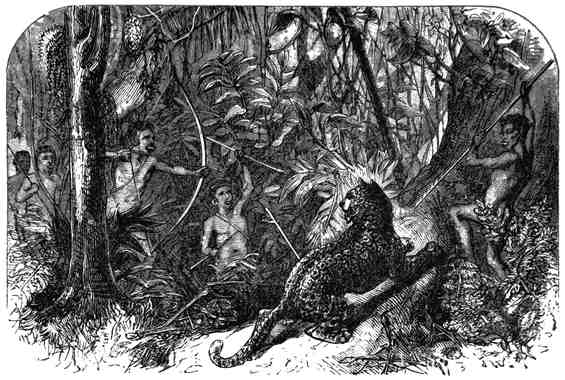
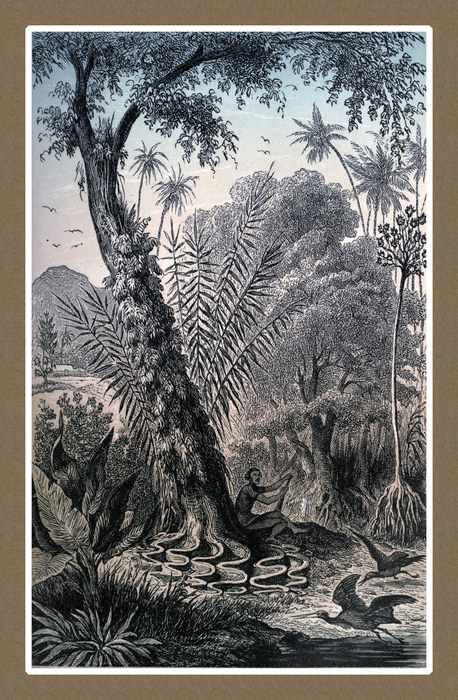
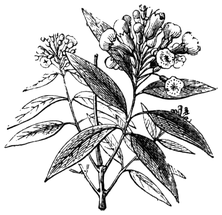
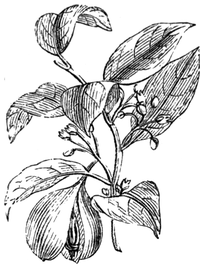
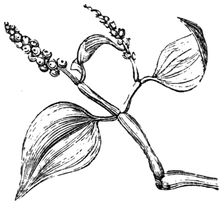
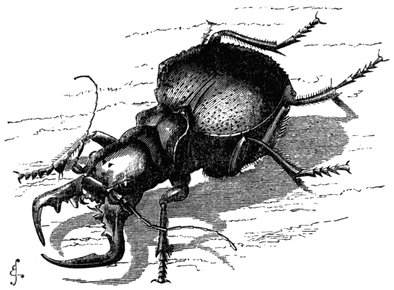
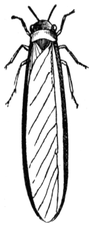
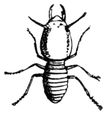
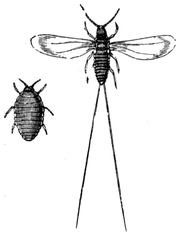
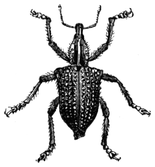
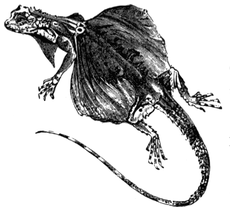
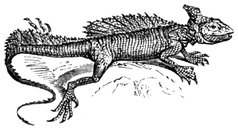
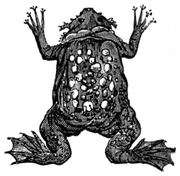
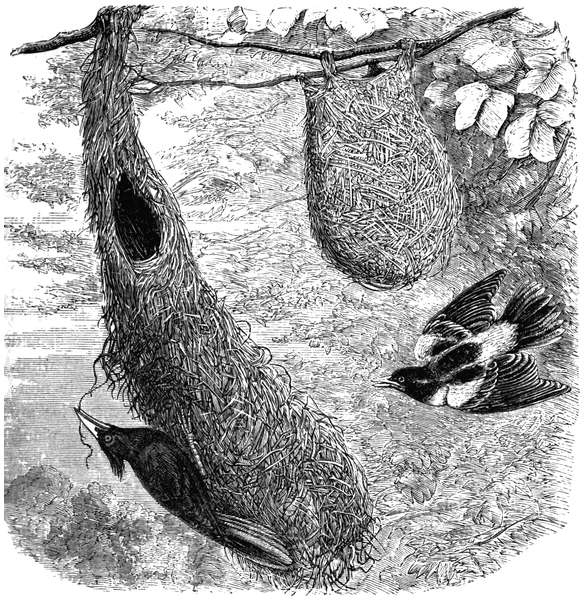
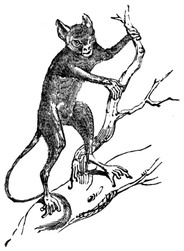
Cover created by Transcriber, using an illustration
from the original book, and placed in the Public Domain.
LONDON: PRINTED BY
SPOTTISWOODE AND CO., NEW-STREET SQUARE
AND PARLIAMENT STREET
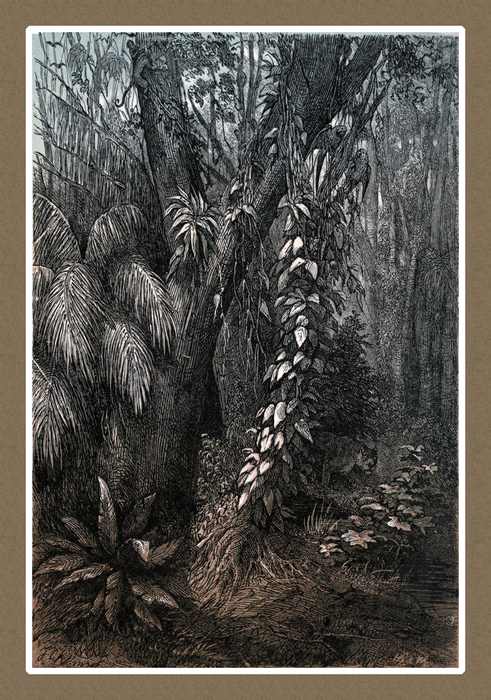
PRIMITIVE FOREST.
THE TROPICAL WORLD:
ASPECTS OF MAN AND NATURE IN
THE EQUATORIAL REGIONS OF THE GLOBE.
BY DR. G. HARTWIG, AUTHOR OF ‘THE SEA AND ITS LIVING WONDERS,’ ‘THE SUBTERRANEAN WORLD,’
‘THE HARMONIES OF NATURE,’ AND ‘THE POLAR WORLD.’
WITH EIGHT CHROMOXYLOGRAPHIC PLATES AND NUMEROUS WOODCUTS.
NEW EDITION.
LONDON: LONGMANS, GREEN, AND CO. 1873.
All rights reserved.
PREFACE.
The numerous alterations I have made in this new
edition of the ‘Tropical World,’ both by the attentive
revision of its former contents, and the addition of new
chapters descriptive of the chief characteristics of the
various tropical races of man; as well as the care I have
taken to condense as much information as possible within
narrow limits, will, I hope, justify my assertion that I
have done my best to please indulgent readers, and to
merit the favourable verdict of severer critics.
Dr. HARTWIG.
Salon Villas, Ludwigsburg (Würtemburg): March 10, 1873.
Causes by which it is produced—Abundance and Distribution of Rain within the Tropics—The Trade Winds—The Belt of Calms—Tropical Rains—The Monsoons—Tornados—Cyclones—Typhoons—Storms in the Pacific—Devastations caused by Hurricanes on Pitcairn Island and Rarotonga
Their Aspect in the Dry Season—Vegetable Sources—Sand Spouts—Effects of the Mirage—A Savannah on Fire—Opening of the Rainy Season—Miraculous Changes—Exuberance of Animal and Vegetable Life—Conflict between Horses and Electrical Eels—Beauty of the Llanos at the Termination of the Rainy Season—The Mauritia Palm
THE PUNA, OR THE HIGH TABLE-LANDS OF PERU AND BOLIVIA.
Striking Contrast with the Llanos—Northern Character of their Climate—The Chuñu—The Surumpe—The Veta: its Influence upon Man, Horses, Mules, and Cats—The Vegetation of the Puna—The Maca—The Llama: its invaluable Services—The Huanacu—The Alpaca—The Vicuñas: Mode of Hunting Them—The Chacu—The Bolas—The Chinchilla—The Condor—Wild Bulls and Wild Dogs—Lovely Mountain Valleys
Its desolate Character—The Mule is here the ‘Ship of the Desert.’—A Shipwreck and its Consequences—Sand-Spouts—Medanos—Summer and Winter—The Garuas—The Lomas—Change produced in their Appearance during the Season of Mists—Azara’s Fox—Wild Animals—Birds—Reptiles—The Chincha or Guano Islands
The Course of the Amazons and its Tributaries—The Strait of Obydos—Tide Waves on the Amazons—The Black-water rivers—The Rio Negro—The Bay of the Thousand Isles—The Pororocca—Rise of the River—The Gapo—Magnificent Scenery—Different Character of the Forests beyond and within the verge of Inundation—General Character of the Banks—A Sail on the Amazons—A Night’s Encampment—The ‘Mother of the Waters’—The Piranga—Dangers of Navigating on the Amazons—Terrific Storms—Rapids and Whirlpools—The Stream of the Future—Travels of Orellana—Madame Godin
Their peculiar Charms and Terrors—Disappointments and Difficulties of the Botanist—The Bush-ropes—Variety of Trees and Plants—Trees with Buttresses—Numberless parasites—Character of the Primitive Forest according to its Site—Its Aspect during the Rainy Season—A Hurricane in the Forest—Beauty of the Forest after the Rainy Season—Our Home Scenes equally beautiful—Bird Life on the rivers of Guiana—Morning Concert—Repose of Nature at Noon—Nocturnal Voices of the Forest
The wild Forest Tribes—Their Physical Conformation and Moral Characteristics—Their Powers of Endurance not inferior to those of other Races—Their stoical indifference—Their Means of Subsistence—Fishing—Hunting—The Wourali Poison—Ornaments—Painting—Tattooing—Religion—The Moon, a Land of Abundance—The Botuto—The Piaches—The Savage Hordes of Brazil and Guiana—The Ottomacas—Dirt-eaters—Their Vindictive Ferocity and War Stratagems—The extinct Tribe of the Atures—A Parrot the last Speaker of their Language—Their Burial-cavern—The Uaupes Indians—Their large Huts—Horrid Custom of Disinterment—The Macus—The Purupurus—The ‘Palheta’—The Mandrucus—Singular resemblance of some of the Customs of the American Indians to those of Remote Nations—The Caribs—The Botocudos—Monstrous distension of the Ears and Under-lip—Their Bow and Arrow—Their Migrations—Bush-rope Bridge—Botocudo Funeral—‘Tanchon,’ the Evil Spirit
Geological Formation of Mexico—The Tierra Caliente—The Tierra Templada—The Tierra Fria.
The Sylvan Wonders of Sikkim—Changes of the Forest on ascending—The Torrid Zone of Vegetation—The Temperate Zone—The Coniferous Belt—Limits of Arboreal Vegetation—Animal Life
Reasons why Droughts are prevalent in South Africa—Vegetation admirably suited to the Character of the Country—Number of Tuberous Roots—The Caffre Water-Melon—The Mesembryanthemums—The Animal Life of the Kalahari—The Bushmen, a Nomadic Race of Hunters—Their Skill in Hunting—Their Food—Acuteness of their Sight and Hearing—Their Intelligence and Perseverance—Their Weapons and Marauding Expeditions—Their Voracity—Their Love of Liberty—The Bakalahari—Their Love for Agriculture—Their Ingenuity in procuring Water—Trade in Skins—Their timidity
Its uncertain Limits—Caravan Routes—Ephemeral Streams—Oases—Inundations—Luxuriant Vegetation of the Oases contrasted with the surrounding Desert—Harsh contrasts of Light and Shade—Sublimity of the Desert—Feelings of the Traveller while crossing the Desert—Its charms and terrors—Sand-Spouts—The Simoom—The ‘Sea of the Devil’—The Gazelle—Its chase—The Porcupine—Fluctuation of Animal Life according to the Seasons—The Tibbos and the Tuaregs—Their contempt of the sedentary Berbers
The Deserts of Arabia—Sedentary Arabs and Bedouins—Physical Characteristics of the Bedouins—Remarkable acuteness of their Senses—Their Manners—Their intense Patriotism and Contempt of the dwellers in Cities—The Song of Maysunah—Their Wars—Their Character softened by the Influence of Woman—Their chivalrous Sentiments—The Arab horse—The Camel—Freedom of the Arabs from a Foreign and a Domestic Yoke—The Bedouin Robber—His Hospitality—Mode of Encamping—Death Feuds—Blood-money—Amusements—Throwing the Jereed—Dances—Poetry—Story-telling—Language—The Bedouin and the North American Indian
GIANT TREES AND CHARACTERISTIC FORMS OF TROPICAL VEGETATION.
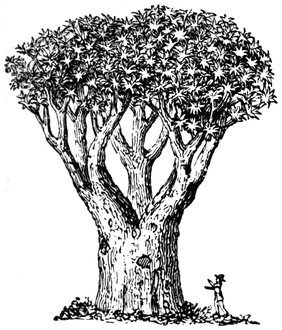
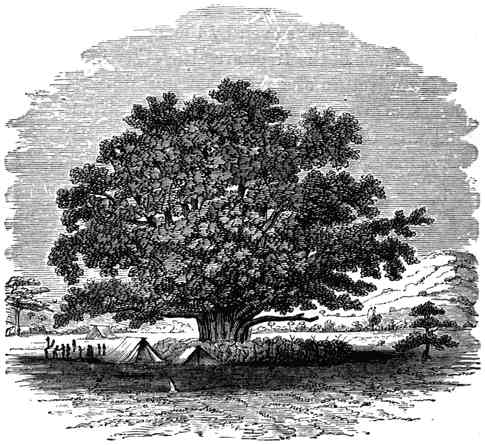
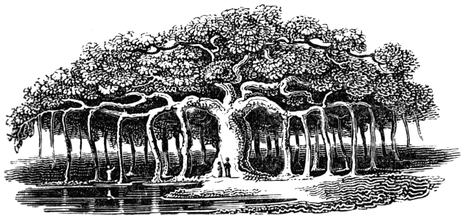
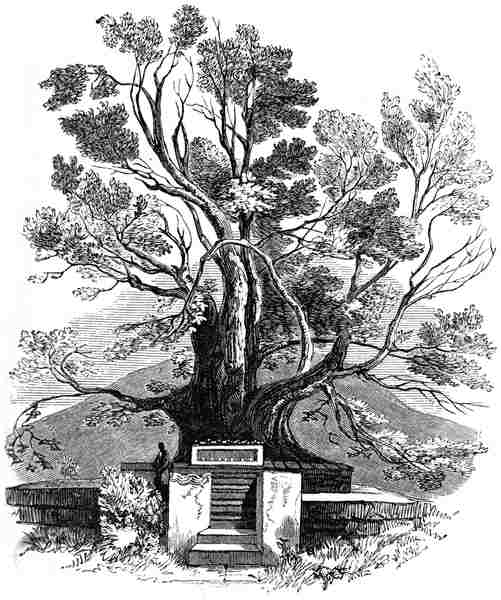
General Remarks—The Baobab—Used as a Vegetable Cistern—Arborescent Euphorbias—The Dracæna of Orotava—The Sycamore—The Banyan—The sacred Bo-Tree of Anarajapoora—The Teak Tree—The Saul—The Sandal Tree—The Satinwood Tree—The Ceiba—The Mahogany Tree—The Mora—Bamboos—The Guadua—Beauty and multifarious Uses of these colossal Grasses—Firing the Jungle—The Aloes—The Agave americana—The Bromelias—The Cactuses—The Mimosas—Bush-ropes—Climbing Trees—Emblems of Ingratitude—Marriage of the Fig Tree and the Palm—Epiphytes—Water Plants—Singularly-shaped Trees—The Barrigudo—The Bottle Tree—Trees with Buttresses and fantastical Roots—The Mangroves—Their Importance in Furthering the Growth of Land-Animal Life among the Mangroves—‘Jumping Johnny’—Insalubrity of the Mangrove Swamps—The Lum—Trees with formidable Spines
The Cocoa-nut Tree—Its hundred Uses—Cocoa-nut Oil—Coir—Porcupine Wood—Enemies of the Cocoa Palm—The Sago Palm—The Saguer—The Gumatty—The Areca Palm—The Palmyra Palm—The Talipot—The Cocoa de Mer—Ratans—A Ratan bridge in Ceylon—The Date Tree—The Oil Palms of Africa—The Oil Trade at Bonny—Its vast and growing Importance—American Palms—The Carnauba—The Ceroxylon andicola—The Cabbage Palm—The Gulielma speciosa—The Piaçava—Difficulties of the Botanist in ascertaining the various species of Palms—Their wide geographical range—Different Physiognomy of the Palms according to their height—The Position and Form of their Fronds—Their Fruits—Their Trunk—The Yriartea ventricosa—Arborescent Ferns
Rice—Various Aspect of the Rice-fields at different Seasons—The Rice-Bird—Maize—First imported from America by Columbus—Its enormous Productiveness—Its wide zone of Cultivation—Millet, Dhourra—The Bread-Fruit Tree—The Bananas—Their ancient Cultivation—Avaca or Manilla Hemp—Humboldt’s Remarks on the Banana—The Traveller’s Tree of Madagascar—The Cassava Root—Tapioca—Yams—Batatas—Arrowroot—Taro—Tropical Fruit Trees—The Chirimoya—The Litchi—The Mangosteen—The Mango
Progress of the Sugar Cane throughout the Tropical Zone—The Tahitian Sugar Cane—The enemies of the Sugar Cane—The Sugar-Harvest—The Coffee Tree—Its cultivation and enemies—The Cacao Tree and the Vanilla—The Coca Plant—Wonderful strengthening Effects of Coca, and fatal consequences of its Abuse
Cotton—Its Cultivation in the United States—Caoutchouc and Gutta Percha—Manner in which these resins are collected—Indigo—The British Logwood cutters in Honduras—Brazil Wood—Arnatto
The Cinnamon Gardens of Ceylon—Immense profits of the Dutch—Decline of the Trade—Neglected state of the Gardens—Nutmegs and Cloves—Cruel monopoly of the Dutch—A Spice Fire in Amsterdam—The Clove Tree—Beauty of an Avenue of Clove Trees—The Nutmeg Tree—Mace—The Pepper Vine—The Pimento Tree
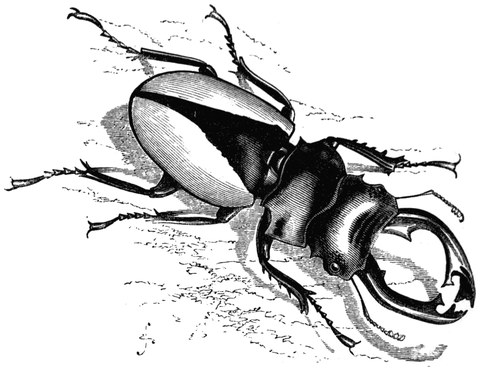
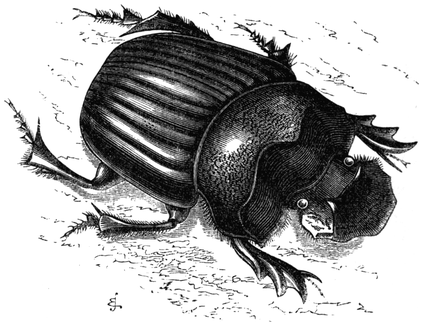
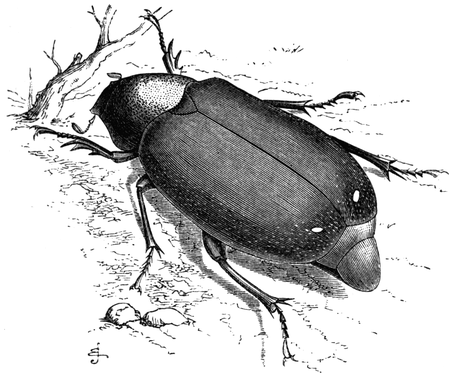
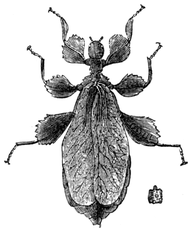
Gradual increase of Insect life on advancing towards the Line—The Hercules Beetle—The Goliath—The Inca Beetle—The Walking-leaf and Walking-stick Insects—The Soothsayer—Luminous Beetles—Tropical Spiders—Their gaudy colours—Trap-door Spiders—Enemies of the Spiders—Mortal Combat between a Spider and a Cockroach—Tropical Scorpions—Dreadful Effects of their sting
Physical Conformation of the Malays—Betel Chewing—Their Moral Character—Limited Intelligence of the Malays—Their Maritime Tastes—Piracy—Gambling—Cock-fighting—Running A-Muck!—Fishing—Malayan Superstitions—The Battas—Their Cannibalism—Eating a Man alive—The Begus—Aërial Huts—Funeral Ceremonies—The Dyaks—Head-Hunting—The Sumpitan—Large Houses
The Papuans—Their Physical and Moral Characteristics—Their Artistic Tastes—Their Dwellings—Their Primitive Political Institutions—Their Weapons and Mode of Fighting—The Polynesians—Their Manners and Customs when first visited by Europeans—Tattooing—The Tapa Cloth—Their Canoes—Swimming Feats—Aristocratic Forms of Government—The Tabu—Religion—Superstitious Observances—Human Sacrifices—Infanticide—Low Condition of the Coral Islanders
First Impressions of a Tropical Forest—Exaggerated Fears—Comparative rareness of Venomous Snakes—Their Habits and External Characters—Anecdote of the Prince of Neu Wied—The Bite of the Trigonocephalus—Antidotes—Fangs of the Venomous Snakes described—The Bush-Master—The Echidna Ocellata—The Rattlesnakes—Extirpated by Hogs—The Cobra de Capello—Indian Snake-Charmers—Maritime Excursions of the Cobra—The Egyptian Haje—The Cerastes—Boas and Pythons—The Jiboya—The Anaconda—Enemies of the Serpents—The Secretary—The Adjutant—The Mungoos—A Serpent swallowed by another—The Locomotion of Serpents—Anatomy of their Jaws—Serpents feeding in the Zoological Gardens—Domestication of the Rat-Snake—Water-Snakes
Their Multitude within the Tropics—The Geckoes—Anatomy of their Feet—The Anolis—Their Love of Fight—The Chameleon—Its wonderful Changes of Colour—Its Habits—Peculiarities of its Organisation—The Iguana—The Teju—The Water-Lizards—Lizard Worship on the Coast of Africa—The Flying Dragon—The Basilisk—Frogs and Toads—The Pipa—The Bahia Toad—The Giant Toad—The Musical Toad—Brazilian and Surinam Tree-Frogs
The Galapagos—The Elephantine Tortoise—The Marsh-Tortoises—Mantega—River-Tortoises—Marine-Turtles—On the Brazilian Coast—Their Numerous Enemies—The Island of Ascension—Turtle-Catching at the Bahama and Keeling Islands—Turtle caught by means of the Sucking-Fish—The Green Turtle—The Hawksbill Turtle—Turtle Scaling in the Feejee Islands—Barbarous mode of selling Turtle-flesh in Ceylon—The Coriaceous Turtle—Its awful Shrieks
Their Habits—The Gavial and the Tiger—Mode of Seizing their Prey—Their Voice—Their Preference of Human Flesh—Alligator against Alligator—Wonderful Tenacity of Life—Tenderness of the Female Cayman for her Young—The Crocodile of the Nile—Its Longevity—Enemies of the Crocodile—Torpidity of Crocodiles during the Dry Season—Their Awakening from their Lethargy with the First Rains—‘Tickling a Crocodile’
The Condor—His Marvellous Flight—His Cowardice—Various Modes of Capturing Condors—Ancient Fables circulated about them—Comparison of the Condor with the Albatross—The Carrion Vultures—The King of the Vultures—Domestication of the Urubu—Its Extraordinary Memory—The Harpy Eagle—Examples of his Ferocity—The Oricou—The Bacha—His Cruelty to the Klipdachs—The Fishing Eagle of Africa—The Musical Sparrow-hawk—The Secretary Eagle
Size of the Ostrich—Its astonishing Swiftness—Ostrich Hunting—Stratagem of the Ostrich for protecting its Young—Points of Resemblance with the Camel—Its Voracity—Ostrich Feathers—Domestication of the Ostrich in Algeria—Poetical Legend of the Arabs—The American Rheas—The Cassowary—The Australian Emu
Their Peculiar Manner of Climbing—Points of Resemblance with Monkeys—Their Social habits—Their Connubial Felicity—Inseparables—Talent for Mimicry—Wonderful Powers of Speech and Memory—Their Wide Range within the Temperate Zones—Colour of Parrots Artificially Changed by the South American Indians—The Cockatoos—Cockatoo killing in Australia—The Macaw—The Parakeets
The Camel—Its Paramount Importance in the great Tropical Sandwastes—Its Organisation admirably adapted to its mode of Life—Beauty of the Giraffe—Its Wide Range of Vision—Pleasures of Giraffe Hunting—The Antelopes—The Springbok—The Reedbok—The Duiker—The Atro—The Gemsbok—The Klippspringer—The Koodoo—The Gnu—The Indian Antelope—The Nylghau—The Caffrarian Buffalo—The Indian Buffalo and the Tiger—Dr. Livingstone’s Escape from a solitary Buffalo—Swimming Feats of the Bhain—The Zebra—The Quagga—The Douw
Behemoth—Its Diminishing Number and Contracting Empire—Its Ugliness—A Rogue Hippopotamus or Solitaire—Dangerous Meeting—Intelligence and Memory of the Hippopotamus—Methods employed for Killing the Hippopotamus—Hippopotamus-Hunting on the Teoge—The Hippopotamus in Regent’s Park—A Young Hippo born in Paris
Brutality of the Rhinoceros—The Borelo—The Keitloa—The Monoho—The Kobaaba—Difference of Food and Disposition between the Black and the White Rhinoceros—Incarnation of Ugliness—Acute Smell and Hearing—Defective Vision—The Buphaga Africana—Paroxysms of Rage—Parental Affection—Nocturnal Habits—Rhinoceros Hunting—Adventures of the Chase—Narrow Escapes of Messrs. Oswell and Andersson—The Indian Rhinoceros—The Sumatran Rhinoceros—The Javanese Rhinoceros—Its involuntary Suicide
Love of Solitude, and Pusillanimity—Miraculous Escape of an English Officer—Sagacity of the Elephant in ascending Hills—Organisation of the Stomach—The Elephant’s Trunk—Use of the Tusks still Probmatical—The Rogue-Elephant—Sagacity of the Elephant—The African Elephant—Tamed in Ancient Times—South African Elephant-Hunting—Hair-Breadth Escapes—Abyssinian Elephant-Hunters—Cutting up of an Elephant—The Asiatic Elephant—Vast Numbers destroyed in Ceylon—Major Rogers—Elephant-Catchers—Their amazing Dexterity—The Corral—Decoy Elephants—Their astonishing Sagacity—Great Mortality among the Captured Elephants—Their Services
The Lion—Conflicts with Travellers on Mount Atlas—The Lion and the Hottentat—A Lion taken in—Narrow Escapes of Andersson and Dr. Livingstone—Lion-Hunting by the Arabs of the Atlas—By the Bushmen—The Asiatic Lion—The Lion and the Dog—The Tiger—The Javanese Jungle—The Peacock—Wide Northern Range of the Tiger—Tiger-Hunting in India—Miraculous Escape of an English Sportsman—Animals announcing the Tiger’s Presence—Turtle-Hunting of the Tiger on the Coasts of Java—The Panther and the Leopard—The Leopard attracted by the Smell of Small-pox—The Cheetah—The Jaguar—The Puma—The smaller American Felidæ—The Hyæna—Fables told of these abject Animals—The Striped Hyæna—The Spotted Hyæna—The Brown Hyæna
Physical Conformation of the Australians—Their Low State of Civilisation—Their Superstitions—Their Wars—Singing and Dancing—The Corrobory—Division of the Nation into Great Families—Rules Regulating the property of Land and the Distribution of Food—Skill in Hunting the Kangaroo and the Opossum—Feasting on a Whale—Moral Qualities and Intelligence of the Australians
Miserable Aspect of the Sloth—His Beautiful Organisation for his Peculiar Mode of Life—His Rapid Movements in the Trees—His Means of Defence—His Tenacity of Life—Fable about the Sloth refuted—The Ai—The Unau—The Mylodon Robustus
The Great Ant-Bear—His Way of Licking up Termites—His Formidable Weapons—A Perfect Forest Vagabond—His Peculiar Manner of Walking—The Smaller Ant-Eaters—The Manides—The African Aard Vark—The Armadillos—The Glyptodon—The Porcupine Ant-Eater of Australia—The Myrmecobius Fasciatus
The Forest Life of the Simiæ—Excellent Climbers, Bad Pedestrians—Similitude and Difference between the Human Race and the Ape—The Chimpanzee—Chim in Paris—The Gorilla—The Uran—The Gibbons—The Proboscis Monkey—The Huniman—The Wanderoo—The Cercopitheca—A Plundering Party—Parental Affection of a Cercopitheca—The Maimon—‘Happy Jerry’—The Pig-Faced Baboon—The Derryat—Wide Difference between the Monkeys of both Hemispheres—Distinctive Characters of the American Monkeys—The Stentor Monkey—The Spider Monkeys—The Laïmirit—Friendships Between Various Kinds of Monkeys—Nocturnal Monkeys—Squirrel Monkeys—Their Lively Intelligence—The Loris and Makis
Causes of the Inferiority of Negro Civilisation—Natural Capabilities of the Negro—Geographical Formation of Africa—Its Political Condition—Physical Conformation of the Negro—Fetishism—The Rain-Doctor—The Medicine-Man—Religious Observances—Gift-Offerings—Human Sacrifices—Ornaments—The Peléle—The Bonnians—Their Barbarous Condition—The Town of Okolloma—Negroes of the Lake Regions—The Iwanza—Slavery—A Miserable Group
CHAPTER I. THE DIVERSITY OF CLIMATES WITHIN THE TROPICS.
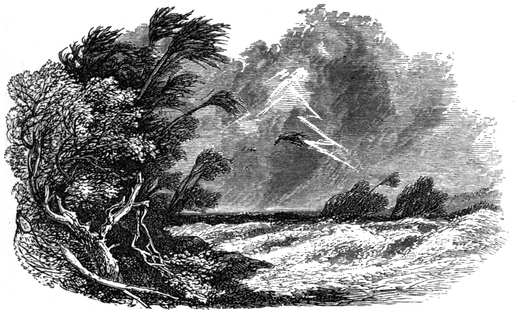
TROPICAL TORNADO.
Causes by which it is produced—Abundance and Distribution of Rain within
the Tropics—The Trade Winds—The Belt of Calms—Tropical Rains—The
Monsoons—Tornados—Cyclones—Typhoons—Storms in the Pacific—Devastations
caused by Hurricanes on Pitcairn Island and Rarotonga.
On surveying the various regions of the torrid zone, we find
that Nature has made many wonderful provisions to mitigate
the heat of the vertical sun, to endow the equatorial lands
with an amazing variety of climate, and to extend the benefit
of the warmth generated within the tropics to countries situated
far beyond their bounds.
Thus, while the greater part of the northern temperate zone
is occupied by land, the floods of ocean roll over by far the
greater portion of the equatorial regions—for both torrid
America and Africa appear as mere islands in a vast expanse
of sea.
The conversion of water, by evaporation, into a gaseous form
is accompanied by the abstraction of heat from surrounding
bodies, or, in popular language, by the production of cold; and
thus over the surface of the ocean the rays of the sun have a
tendency to check their own warming influence, and to impart
a coolness to the atmosphere, the refreshing effects of which
are felt wherever the sea wind blows. There can, therefore, be
no doubt that, if the greater part of the tropical ocean were
converted into land, the heat of the torrid zone would be far
more intolerable than it is.
The restless breezes and currents, the perpetual migrations of
the air and waters, perform a no less important part in cooling
the equatorial and warming the temperate regions of the globe.
Rarefied by the intense heat of a vertical sun, the equatorial
air-stream ascends in perpendicular columns high above the
surface of the earth, and thence flows off towards the poles;
while, to fill up the void, cold air-currents come rushing from
the arctic and antarctic regions.
If caloric were the sole agent on which the direction of these
antagonistic air-currents depended, they would naturally flow
to the north and south; but the rotation of the earth gradually
diverts them to the east and west, and thus the cold air-currents,
or polar streams, ultimately change into the trade
winds which regularly blow over the greater part of the tropical
ocean from east to west, and materially contribute, by their
refreshing coolness, to the health and comfort of the navigator
whom they waft over the equatorial seas.
While the polar air-currents, though gradually warming as
they advance, thus mitigate the heat of the torrid zone, the
opposite equatorial breezes, which reach our coasts as moist
south-westerly or westerly winds, soften the cold of our winters,
and clothe our fields with a lively verdure during the greater
part of the year. How truly magnificent is this grand system
of the winds, which, by the constant interchange of heat and
cold which it produces, thus imparts to one zone the beneficial
influence of another, and renders both far more fit to be inhabited
by civilized man. The Greek navigators rendered
homage to Æolus, but they were far from having any idea of
the admirable laws which govern the unstable, ever-fluctuating
domains of the ‘God of the Winds.’
The same unequal influence of solar warmth under the line
and at the poles, which sets the air in constant motion, also
compels the waters of the ocean to perpetual migrations, and
produces those wonderful marine currents which like the analogous
atmospheric streams, furrow in opposite directions the
bosom of the sea. Thanks to this salutary interchange, the
Gulf Stream, issuing from the Mexican Sea, and thence flowing
to the north and east, conveys a portion of its original warmth
as far as the west coast of Spitzbergen and Nowaja Semlja;
while in the southern hemisphere we see the Peruvian stream
impart the refrigerating influence of the antarctic waters to the
eastern coast of South America.
The geographical distribution of the land within the tropics
likewise tends to counterbalance or to mitigate the excessive
heat of a vertical sun; for a glance over the map shows us at
once that it is mostly either insular or extending its narrow
length between two oceans, thus multiplying the surface over
which the sea is able to exert its influence. The Indian
Archipelago, the peninsula of Malacca, the Antilles, and Central
America, are all undoubtedly indebted to the waters which
bathe their coasts for a more temperate climate than that which
they would have had if grouped together in one vast continent.
The temperature of a country proportionally decreases with
its elevation; and thus the high situation of many tropical
lands moderates the effects of equatorial heat, and endows them
with a climate similar to that of the temperate, or even of the
cold regions of the globe. The Andes and the Himalaya, the
most stupendous mountain-chains of the world, raise their snow-clad
summits either within the tropics or immediately beyond
their verge, and must be considered as colossal refrigerators,
ordained by Providence to counteract the effects of the vertical
sunbeams over a vast extent of land. In Western Tropical
America, in Asia, and in Africa, we find immense countries
rising like terraces thousands of feet above the level of the
ocean, and reminding the European traveller of his distant
northern home by their productions and their cooler temperature.
Thus, by means of a few simple physical and geological
causes acting and reacting upon each other on a magnificent
scale, Nature has bestowed a wonderful variety of climate upon
the tropical regions, producing a no less wonderful diversity of
plants and animals.
But warmth alone is not sufficient to call forth a luxuriant
vegetation: it can only exert its powers when combined with
a sufficient degree of moisture; and it chiefly depends upon
the presence or absence of water whether a tropical country
appears as a naked waste or decked with the most gorgeous
vegetation.
As the evaporation of the tropical ocean is far more considerable
than that of the sea in higher latitudes, the atmospherical
precipitations (dew, rain) caused by the cooling of the
air are far more abundant in the torrid zone than in the temperate
regions of the earth. While the annual fall of rain
within the tropics amounts, on an average, to about eight
feet, it attains in Europe a height of only thirty inches;
and under the clear equatorial sky the dew is often so abundant
as to equal in its effects a moderate shower of rain.
But this enormous mass of moisture is most unequally distributed;
for while the greater part of the Sahara and the
Peruvian sand-coast are constantly arid, and South Africa
and North Australia suffer from long-continued droughts, we
find other tropical countries refreshed by almost daily showers.
The direction of the prevailing winds, the condensing powers of
high mountains and of forests, the relative position of a country,
the nature of its soil, are the chief causes which produce an
abundance or want of rain, and consequently determine the
fertility or barrenness of the land. Of these causes, the first-mentioned
is by far the most general in its effects—so that a
knowledge of the tropical winds is above all things necessary
to give us an insight into the distribution of moisture over the
equatorial world.
I have already mentioned the trade winds, or cool reactionary
currents called forth by the ascending equatorial air-stream;
but it will now be necessary to submit them to a closer examination,
and follow them in their circular course throughout the
tropical regions. In the Northern Atlantic, their influence,
varying with the season, extends to 22° N. lat. in winter, and
39° N. lat. in summer; while in the southern hemisphere they
reach no farther than 18° S. lat. in winter, and 28° or 30° S. lat.
in summer.
In the Pacific, their limits vary between 21° and 31° N. lat.,
and between 23° and 33° S. lat.; so that, on the whole, they have
here a more southern position, owing, no doubt, to the vast
extent of open sea; while in the Atlantic the influence of the
neighbouring continents forces them to the north, and even
causes the trade winds of the southern hemisphere to ascend
beyond the equatorial line. Their character is that of a continual
soft breeze—strongest in the morning, remitting at noon,
and again increasing in the evening. In the neighbourhood of
the coasts, except over very small islands, they become weaker,
and generally cease to be felt at a distance of about fifteen or
twenty miles from the sea, though, of course, at greater heights
they continue their course uninterruptedly over the land.
For obvious reasons the trade winds have been much more
accurately investigated upon the ocean than on land, particularly
in the Northern Atlantic, which is better known in its physical
features than any other sea, as being a highway for numberless
vessels to which the study of the winds is a matter of the greatest
importance; yet, in spite of so many disturbing influences, their
course, even over the continents, has been ascertained by travellers.
North-easterly winds almost constantly sweep over the
Sahara; and in South Africa, Dr. Livingstone informs us that
north-easterly and south-easterly winds blow over the whole
continent between 12° and 6° S. lat., even as far as Angola,
where they unite with the sea winds.
In Brazil, the presence of the trade winds has been determined
with still greater accuracy. Thus easterly breezes almost perpetually
sweep over the boundless plains up to the slopes of the
Andes, and even in Paraguay (25° S. lat.) a mild east wind
constantly arises in summer after the setting of the sun.
As the trade winds originate in the coldest, and thence pass
onwards to the warmer regions, they are, of course, constantly
absorbing moisture as they advance over the seas. Saturated
with vapours, they reach the islands and continents, where,
meeting with various refrigerating influences (mountain-chains,
forests, terrestrial radiation), their condensing vapours give rise
to an abundance both of rain and dew. It is owing to their
influence that in general, within the tropics, the eastern coasts,
or the eastern slopes of the mountains, are better watered than
the interior of the continents or lands with a western exposure.
An example on the grandest scale is afforded to us by South
America, where the Andes of Peru and Bolivia so effectually
drain the prevailing east winds of their moisture, that while
numberless rivulets, the feeders of the gigantic Marañon, clothe
their eastern gorges with a perpetual verdure, their western
slopes are almost constantly arid. Such is the influence of this
colossal barrier in interrupting the course of the air-current,
that the trade wind only begins to be felt again on the Pacific
at a distance of one hundred or even one hundred and fifty
miles from the shore.
In South Africa, also, we find the eastern mountainous coast-lands
covered with giant timber—in striking contrast with the
parched savannas or dreary wastes of the interior; and in the
South Sea the difference of verdure between the east and west
coasts of the Sandwich Islands, the Feejees, and many other
groups, never fails to arrest the attention of the mariner.
The trade winds of the northern and southern hemispheres
do not, however, blow in one continuous stream over the whole
breadth of the tropical ocean, but are separated from each other
by a zone or belt of calms, occasioned by their mutually paralysing
each other’s influence on meeting from the north and the
south-east, and by the attraction of the sun, which, when in
the zenith, changes the easterly air-currents into an ascending
stream. From this dependence on the position of the sun, it
may easily be inferred that the zone of calms fluctuates, like
the trade winds themselves, to the north or south, according to
the seasons; and that it is far from invariably occupying the
same degrees of latitude, or the same width, at all times of the
year. In the Atlantic, from the causes previously mentioned,
it constantly remains to the north of the line, where its breadth
averages five or six degrees; in the Pacific it more generally
extends during the antarctic summer, on both sides of the
equator.
Besides the intensity of its heat, the zone of calms is characterised
by heavy showers, which regularly fall in the afternoon,
and are caused by the cooling of the saturated air-columns in
the higher regions of the air.
Daily, towards noon, dense clouds form in the sky, and dissolve
in torrents of rain under fearful electrical explosions, now sooner,
now later, of shorter or longer continuance, with increasing or
abating violence, as the sun is more or less in his zenith.
Towards evening the vapours disperse, and the sun sets in a
clear, unclouded horizon. Thus towns or countries situated
within the calms, such as Para, Quito, Bogota, Guayaquil, the
Kingsmill Islands, may be said to have a perennial rainy
season, as showers fall at every season of the year. To the
north and south of the belt of calms, we find in both hemispheres
a broad zone, characterised by two distinct rainy seasons,
separated by two equally distinct periods of dry weather.
The rainy seasons take place while the sun is crossing the zenith,
and more or less paralysing the power of the trade winds.
Cayenne, Honduras, Jamaica, Pernambuco, Bahia, afford us
examples of these well-defined alterations. In Jamaica, for
instance (18° N. lat.), the first rainy season begins in April, the
second in October; the first dry season in June, and the second
in December.
Towards the verge of the tropics follow the zones which are
characterised by a single rainy season, but of a longer continuance,
generally lasting six months, throughout the summer,
or from one equinoctium to another. In these parts, the rainy
season is also the warmest period of the year, since here the
different height of the sun in winter and summer is already so
considerable, that at the time of culmination the clouds and
rain are not able to reduce the temperature below that of the
clear and dry winter months; while in the zones which are
situated nearer to the equator, the rainy season, in spite of the
sun’s culmination, is always the coolest.
To sum up the foregoing remarks in a few words: the two
rainy seasons, which characterise the middle zone between each
tropic and the line, have a tendency to pass into one annual
rainy season on advancing towards the tropics, and to merge
into a permanent rainy season on approaching the equator. As
the sun goes to the north or south, he opens the sluices of
heaven, and closes them as he passes to another hemisphere.
Such may be said to be the normal state which would everywhere
obtain within the equatorial regions if one unbounded
ocean covered their surface, and none of the disturbing influences
previously mentioned interfered; but as we find the trade winds
so frequently deflected from their course, we must also naturally
expect the general or theoretical order of the dry and rainy
seasons to be liable to great modifications.
Thus, in the Indian Ocean and in the Chinese Sea, terrestrial
influences prevail during the summer which completely divert
the trade wind, there called the North-east Monsoon, from its
regular path. From the wide lands of south-eastern Asia,
glowing, during the summer months, with a torrid heat, the
rarefied air, as it rises into the higher regions, completely overpowers
the usual course of the trade wind, and changes it into
the south-western monsoon, which blows from May to September.
Hence, during the summer months, the saturated sea wind,
striking against the western ghauts, brings rain to the coast of
Malabar, while the opposite coast of Coromandel remains dry;
but the inverse takes place when, from the sun’s declining to
the south, the north-east trade wind resumes its sway.
Similar deflections from the ordinary course of the trade
winds occur also on the coast of Guinea (5° N. Lat.), in the
Mexican Gulf, and in that part of the Pacific which borders on
Central America, through the influence of the heated plains of
Africa, Utah, Texas, and New Mexico, and have a similar influence
on the distribution of moisture. Thus the sea monsoon,
which prevails during the summer months on the coast of
northern Guinea, carries a rainy season over the land as far as
the eighteenth or nineteenth degree of northern latitude, and
fertilises a vast extent of country which, from its position on the
western side of an immense continent, would otherwise have
been as naked and barren as the Sahara.
As the tropical rains, though generally confined only to part
of the year, and then only to a few hours of the day, fall in so
much greater abundance than under our constantly drooping
skies, it may naturally be supposed that the single showers
must be proportionally violent. Descending in streams so close
and so dense that the level ground, unable to absorb it sufficiently
fast, is covered with a sheet of water, the rain rushes
down the hill-sides in a volume that wears channels in the surface.
For hours together the noise of the torrent, as it beats
upon the trees and bursts upon the roofs, occasions an uproar
that drowns the ordinary voice and renders sleep impossible.
In Bombay nearly nine inches of rain have been known to fall
in one day, and twelve inches in Calcutta, or nearly half the
mean annual quantity of rain on the east coast of England.
During one single storm which Castelnau witnessed at Pebas,
on the Amazon, there fell not less than thirty inches of rain—nearly
as much as the annual supply of our west coast. The
hollow trunk of an enormous tree in an exposed situation gave
the French traveller the means of accurate measurement.
As in the equatorial regions the atmospherical precipitations
are far more considerable than in the temperate zones, so also
their storms rage with a violence unknown in our climes. In
the Indian and Chinese Seas these convulsions of nature generally
take place at the change of the monsoons; in the West
Indies, at the beginning and at the end of the rainy seasons.
The tornado which devastated the Island of Guadeloupe on the
25th July, 1846, blew down buildings constructed of solid stone,
and tore the guns of a battery from their carriages; another,
which raged some years back in the Mauritius, demolished a
church and drove thirty-two vessels on the strand. On the
Beagle’s arrival in Port Louis, after her long and arduous
surveying voyage, a fleet of crippled vessels, the victims of a
recent hurricane, might have been seen making their way into
the harbour—some dismasted, others kept afloat with difficulty,
firing guns of distress or giving other signs of their helpless
condition. ‘On the now tranquil surface of the harbour lay a
group of shattered vessels, presenting the appearance of floating
wrecks. In almost all, the bulwarks, boats, and everything on
deck, had been swept away; some, that were towed in, had
lost all their masts; others, more or less of their spars; one had
her poop and all its cabins swept away; many had four or five
feet of water in the hold, and the clank of the pumps was still
kept up by the weary crew.’1
Such are the terrible effects of the tornados and cyclones of
the Atlantic and the Indian Oceans; but the storms of the miscalled
Pacific are no less furious and destructive. A hurricane,
which on the 15th of April, 1845, burst over Pitcairn Island,
washed all the fertile mould from the rocks, and, uprooting
300 cocoa-nut trees, cast them into the sea. Every fishing-boat
on the island was destroyed, and thousands of fruit-bearing
bananas were swept away.
The celebrated missionary, John Williams,2 describes a
similar catastrophe which befell the beautiful island of Rarotonga
on the 23rd of December, 1831. The chapels, school-houses,
mission-houses, and nearly all the dwellings of the
natives, no less than a thousand in number, were levelled to the
ground. Every particle of food on the island was destroyed.
Of the thousands of banana or plantain trees which had covered
and adorned the land, scarcely one was left standing, either on
the plains, in the valleys, or upon the mountains. Stately
trees, that had withstood the storms of ages, were laid prostrate
on the ground, and thrown upon each other in the wildest confusion;
while even of those that were still standing, many were
left without a branch, and all perfectly leafless. So great and
so general was the destruction, that no spot escaped; for the
gale, veering gradually round the island, did most effectually
its devastating work.
Though the tropical storms are thus frequently a scourge,
they are often productive of no less signal benefits. Many a
murderous epidemic has suddenly ceased after one of these
natural convulsions, and myriads of insects, the destroyers of
the planter’s hopes, are swept away by the fierce tornado. Besides,
if the equatorial hurricanes are far more furious than our
storms, a more luxurious vegetation effaces their vestiges in a
shorter time. Thus Nature teaches us that a preponderance of
good is frequently concealed behind the paroxysms of her apparently
unbridled rage.
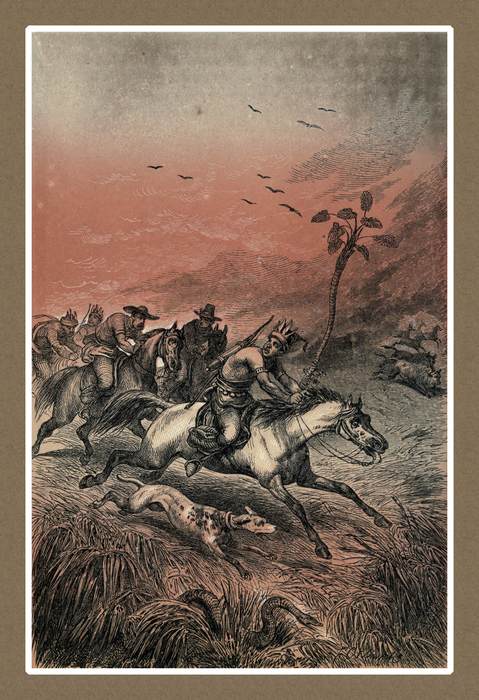
SAVANNAH ON FIRE.
CHAPTER II. THE LLANOS.
Their Aspect in the Dry Season—Vegetable Sources—Land Spouts—Effects
of the Mirage—A Savannah on Fire—Opening of the Rainy Season—Miraculous
Changes—Exuberance of Animal and Vegetable Life—Conflict between
Horses and Electrical Eels—Beauty of the Llanos at the Termination
of the Rainy Season—The Mauritia Palm.
In South America, the features of Nature are traced on a
gigantic scale. Mountains, forests, rivers, plains, there
appear in far more colossal dimensions than in our part of the
world. Many a branch of the Marañon surpasses the Danube
in size. In the boundless primitive forests of Guiana more
than one Great Britain could find room. The Alps would seem
but of moderate elevation if placed aside of the towering Andes;
and the plains of Northern Germany and Holland are utterly
insignificant when compared with the Llanos of Venezuela and
New Grenada, which, stretching from the coast-chain of Caraccas
to the forests of Guiana, and from the snow-crowned mountains
of Merida to the Delta of the Orinoco, cover a surface of more
than 250,000 square miles.
Nothing can be more remarkable than the contrast which
these immeasurable plains present at various seasons of the
year—now parched by a long-continued drought, and now
covered with the most luxuriant vegetation. When, day after
day, the sun, rising and setting in a cloudless sky, pours his
vertical rays upon the thirsty Llanos, the calcined grass-plains
present the monotonous aspect of an interminable waste. Like
the ocean, their limits melt in the hazy distance with those of
the horizon; but here the resemblance ceases, for no refreshing
breeze wafts coolness over the desert, and comforts the drooping
spirits of the wanderer.
In the wintry solitudes of Siberia the skin of the reindeer
affords protection to man against the extreme cold; but in these
sultry plains there is no refuge from the burning sun above
and the heat reflected from the glowing soil below, save where,
at vast intervals, small clumps of the Mauritia palm afford a
scanty shade. The water-pools which nourished this beneficent
tree have long since disappeared; and the marks of the previous
rainy season, still visible on the tall reeds that spring from the
marshy ground, serve only to mock the thirst of the exhausted
traveller. The long-legged jabiru and the scarlet ibis have
forsaken the dried-up swamp which no longer affords them any
subsistence, and only here and there a solitary Caracara falcon
lingers on the spot, as if meditating on the vicissitudes of the
seasons.
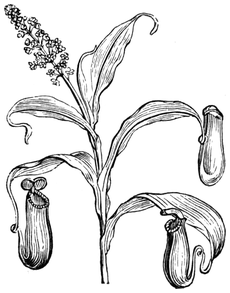
NEPENTHES.
Yet even now the parched savannah has some refreshment
to bestow, as Nature—which in the East Indian forests fills
the pitchers of the Nepenthes with a
grateful liquid,—here also displays
her bounty; for the globular melon-cactus,
which flourishes on the driest
soil, and not seldom measures a foot
in diameter, conceals a juicy pulp
under its tough and brickly skin.
Guided by an admirable instinct,
the wary mule strikes off with his
fore-feet the long, sharp thorns of
this remarkable plant, the emblem
of good-nature under a rough exterior,
and then cautiously approaches
his lips to sip the refreshing
juice. Yet, drinking from these living sources is not
unattended with danger, and mules are often met with that
have been lamed by the formidable prickles of the cactus. The
wild horse and ox of the savannah, not gifted with the same
sagacity, roam about a prey to hunger and burning thirst—the
latter hoarsely bellowing, the former snuffing up the air with
outstreched neck to discover by its moisture the neighbourhood
of some pool that may have resisted the general drought.
Besides their interminable extent, the Llanos have several
other points of resemblance to the sea. As here the water-spout,
raised by contending air-currents, rises to the clouds and sweeps
over the floods, thus also the glowing dust of the savannah, set
in motion by conflicting winds, ascends in mighty columns and
glides over the desert plain. Then woe to the traveller who
cannot escape by a timely flight; for, seizing him with irresistible
violence the sand spout carries him along in its embrace,
and hurls him senseless to the ground.
As if ‘on a painted ocean,’ the becalmed ship rests on the
glassy sea. No breath of air ruffles the surface of the waters.
The pennant hangs lazily from the mast; the water-casks
are empty; the torments of thirst, aggravated by the heat of a
vertical sun, become intolerable. But, suddenly, as if by magic,
a beautiful island rises from the floods; waving palm-trees seem
to welcome the mariner: he fancies he hears the purling of the
brook and the splashing of the waterfall. Yet still the vessel
moves not from the spot, and soon the fading phantom that
mocked his misery leaves him the victim of increased despair.
Similar delusions of the mirage, produced by the refraction
of the light as it passes through atmospherical strata of unequal
warmth, and consequently of unequal density, likewise take
place over the surface of the Llanos, which then assume the
semblance of a sea, heaving and rocking in wave-like motion.
In the Lybian desert, in the dread solitudes of the polar ocean,
in every zone, we meet with the same phenomenon, produced by
the same cause.
As in the arctic regions the intense cold during winter retards
the pulsations, or even suspends the operations of life, so
in the Llanos the long continuance of drought causes a similar
stagnation in animated nature. The thinly-scattered trees and
shrubs do not indeed cast their foliage, but the greyish-yellow
of their leaves announces that vegetation is suspended. Buried
in the clay of the dried-up pools, the alligator and the water-boa
lie plunged in a deep summer-sleep, like the bear of the
north in his long winter slumber; and many animals which, at
other times, are found roaming over the Llanos,—such as
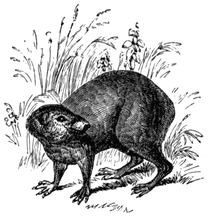
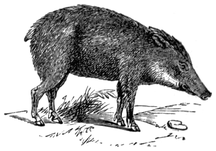
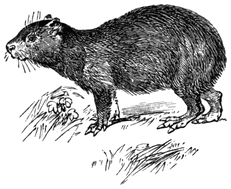
the graceful aguti, the hoggish peccary, and the timid deer of
the savannah,—have left the parched plains and migrated to
the forest or the river. The large maneless puma and the
spotted jaguar, following their prey to less arid regions, are now
no longer seen in their former hunting-grounds, and the Indian
has also disappeared with the stag whom he pursued with his
poisoned arrows. In the Siberian Tundras the reindeer and the
migratory birds are scared away by winter; here life is banished
or suspended by an intolerable aridity.
AGUTI.
PECCARY.
Sometimes the ravages of fire complete the image of death
on the parched savannah.
‘We had not yet penetrated far into the plain,’ says Schomburgk,
‘when we saw to the south-east high columns of smoke
ascending to the skies, the sure signs of a savannah fire, and at
the same time the Indians anxiously pressed us to speed on, as
the burning torrent would most likely roll in our direction.
Although at first we were inclined to consider their fears as
exaggerated, yet the next half-hour served to convince us of the
extreme peril of our situation. In whatever direction we
gazed, we nowhere saw a darker patch in the grass-plain
announcing the refuge of a water-pool; we could already
distinguish the flames of the advancing column, already hear
the bursting and crackling of the reeds, when fortunately the
sharp eye of the Indians discovered some small eminences before
us, only sparingly covered with a low vegetation, and to these
we now careered as if Death himself were behind us. Half a
minute later, and I should never have lived to relate our
adventures. With beating hearts we saw the sea of fire rolling
its devouring billows towards us; the suffocating smoke, striking
in our faces, forced us to turn our backs upon the advancing
conflagration, and to await the dreadful decision with the
resignation of helpless despair.
‘And now we were in the midst of the blaze. Two arms of
fire encircled the base of the little hillock on which we stood,
and united before us in a waving mass, which, rolling onwards,
receded farther and farther from our gaze. The flames had
devoured the short grass of the hillock, but had not found sufficient
nourishment for our destruction. Whole swarms of
voracious vultures followed in circling flight the fiery column,
like so many hungry jackals, and pounced upon the snakes and
lizards which the blaze had stifled and half-calcined in its murderous
embrace. When, with the rapidity of lightning, they
darted upon their prey and disappeared in the clouds of smoke,
it almost seemed as if they were voluntarily devoting themselves
to a fiery death. Soon the deafening noise of the conflagration
ceased, and the dense black clouds in the distance
were the only signs that the fire was still proceeding on its
devastating path over the wide wastes of the savannah.’
At length, after a long drought, when all Nature seems about
to expire under the want of moisture, various signs announce
the approach of the rainy season. The sky, instead of its brilliant
blue, assumes a leaden tint, from the vapours which are
beginning to condense. The black spot of the ‘Southern
Cross,’ that most beautiful of constellations, in which, as the
Indians poetically fancy, the Spirit of the savannah resides,
becomes more indistinct as the transparency of the atmosphere
diminishes. The mild phosphoric gleam of the Magellanic
clouds expires. The fixed stars, which shone with a quiet
planetary light, now twinkle even in the zenith. Like distant
mountain-chains, banks of clouds begin to rise over the horizon,
and accumulating in masses of increasing density, ascend higher
and higher, until at length the lightning flashes from their dark
bosom, and with the loud crash of thunder, the first rains burst in
torrents over the thirsty land. Scarce have the showers had
time to moisten the earth, when the dormant powers of vegetation
begin to awaken with almost miraculous rapidity. The
dull, tawny surface of the parched savannah changes as if by
magic into a carpet of the liveliest green, enamelled with
thousands of flowers of every colour. Stimulated by the light
of early day, the mimosas expand their delicate foliage, and
the fronds of the beautiful mauritias sprout forth with all the
luxuriance of youthful energy.
And now, also, the animal life of the savannah awakens to
the full enjoyment of existence. The horse and the ox rejoice
in the grasses, under whose covert the jaguar frequently lurks,
to pounce upon them with his fatal spring. On the border of
the swamps, the moist clay, slowly heaving, bursts asunder, and
from the tomb in which he lay embedded rises a gigantic
water-snake or a huge crocodile. The new-formed pools and
lakes swarm with life, and a host of water-fowl—ibises, cranes,
flamingos, mycterias—make their appearance, to regale on the
prodigal banquet. A new creation of insects and other unbidden
guests now seek the wretched hovels of the Indians,
which are sparingly scattered over the higher parts of the
savannah. Countless multitudes of ants, sandflies, and mosquitos;
rattlesnakes, expelled by the cold and moisture from
the lower grounds; repulsive geckos, which with incredible
rapidity run along the overhanging rafters; nauseous toads,
which, concealing themselves by day in the dark corners of the
huts, crawl forth in the evening in quest of prey; lizards,
scorpions, centipedes; in a word, worms and vermin of all
names and forms,—emerge from the inundated plains, for the
tropical rains have gradually converted the savannah, which
erewhile exhibited a waste as dreary as that of the Sahara, into
a boundless lake. The swollen rivers of the steppe—the Apure,
the Arachuna, the Pajara, the Arauca—pour forth their mighty
streams over the plains, and boats are now able to sail for miles
across the land from one river-bed into another.
On the same spot where, erewhile, the thirsty horse anxiously
snuffed the air to discover by its moisture the presence of some
pool, the animal is now obliged to lead an amphibious life.
The mares retreat with their foals to the higher banks, which
rise like islands above the waters, and as from day to day the
land contracts within narrower limits, the want of forage obliges
them to swim about in quest of the grasses that raise their heads
above the fermenting waters. Many foals are drowned; many
are surprised by the crocodiles, that fell them by a stroke of
their jagged tail, and then crush them between their jaws. Horses
and oxen are not seldom met with, which, having fortunately
escaped these huge saurians, bear on their limbs the marks of
their sharp teeth.
‘This sight,’ says Humboldt, ‘involuntarily reminds the
observer of the great pliability with which nature has endowed
several plants and animals. Along with the fruits of Ceres, the
horse and the ox have followed man over the whole earth, from
the Granges to the La Plata, and from the coast of Africa to the
mountain-plain of Antisana, which is more elevated than the
lofty peak of Teneriffe. Here the northern birch-tree, there
the date-palm, protects the tired ox from the heat of the mid-day
sun. The same species of animal which contends in eastern
Europe with bears and wolves, is attacked in another zone by
the tiger and the crocodile.’
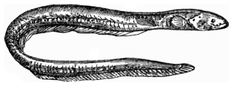
ELECTRICAL EEL.
(GYMNOTUS ELECTRICUS.)
But it is not the jaguar and the alligator alone which lie in
wait for the South American horse, for even among the fishes
he has a dangerous enemy. The
rivers and marshes of the Llanos
are often filled with electrical eels,
which send forth at will from the
under part of the tail a stunning
shock. These eels are from five to six feet long. They are able,
when in full vigour, to kill the largest animals, when they suddenly
unload their electrical organs in a favourable direction.
Humboldt having accidentally set his foot on a gymnote which
had just been taken out of the water felt the whole day severe
pains in the knees and almost in every joint. Lizards, turtles, and
frogs seek the morasses where they are safe from their discharges,
and all other fishes, aware of their power, fly at the sight of the
formidable gymnotes. They stun even the angler on the high
river-bank, the moist line serving as a conductor for the electric
fluid. The capture of these eels affords a highly entertaining
and animated scene. Mules and horses are driven into the pond
which the Indians surround, until the unwonted noise and
splashing of the waters rouse the fishes to an attack. Gliding
along, they creep under the belly of the horses, many of whom
die from the shock of their strokes; while others, with mane
erect, and dilated nostrils, endeavour to flee from the electric
storm which they have roused. But the Indians, armed with
long poles, drive them back again into the pool.
Gradually the unequal contest subsides. Like spent thunderclouds,
the exhausted fishes disperse, for they require a long
rest and plentiful food to repair the loss of their galvanic powers.
Their shocks grow weaker and weaker. Terrified by the noise
of the horses, they timidly approach the banks, when, wounded
with harpoons, they are dragged on shore with dry and nonconducting
pieces of wood; and thus the strange combat ends.
The Llanos are never more beautiful than at the end of the
rainy season, before the sun has absorbed the moisture of the
soil. Then every plant is robed with the freshest green; an
agreeable breeze, cooled by the evaporating waters, undulates
over the sea of grasses, and at night a host of stars shines
mildly upon the fragrant savannah, or the silvery moonbeam
trembles on its surface. Where on the margin of the primitive
forest, girt with colossal cactuses and agaves, groups of the
mauritia rise majestically over the plain, the stateliest park
ever planted by man must yield in beauty to the charming
picture of these natural gardens, bordered here by impenetrable
thickets, and there by the blue mountain-chain, behind which
the fancy paints scenes of still more enchanting loveliness.
The mauritia, the chief ornament of the park-like savannah,
and no less useful than the date-tree of the African oasis, provides
the Indian with almost every necessary, and fully deserves
the name of ‘tree of life,’ bestowed upon it by the poetical
fancy of the Jesuit Gumilla. Rising to the height of a hundred
feet, its slender trunk is surmounted by a magnificent
tuft of large, fan-shaped fronds, of a brilliant green, under
whose canopy the scaly fruits, resembling pine cones, hang in
large clusters. Like the banana, they afford a food differing
in taste according to the stages of ripeness in which they are
plucked; and before the blossoms of the male palm have
expanded, its trunk contains a nutritious pith like sago, which,
dried in thin slices, forms one of the chief articles of the
Indian’s bill of fare. Like his brethren of the Eastern world,
he also knows how to prepare an intoxicating ‘toddy’ from
the juice of the flower-spathes; the leaves serve to cover his
hut; out of the fibres of their petioles he manufactures twine
and cordage; and the sheaths at their base afford him material
for his sandals.
At the mouth of the Orinoco the very existence of the yet
unsubdued Guaranas depends on the mauritia, which gives
them both food and liberty. Formerly, when this tribe was
more numerous than at the present day, they raised their huts
on floorings stretched from trunk to trunk, and formed of the
leaf-stalks of their tutelary palm. Thus, like the monkeys and
parrots of their native wilds, they lived in the trees during the
inundations of the Delta in the rainy season. These platforms
were partly covered with moist clay, on which fire was made
for household purposes; and the flames afforded a strange
sight to travellers sailing on the river at night. Even now the
light-footed Guaranas owe their independence to the marshy
nature of their territory, and to their arboreal life.
The fruits of the mauritia, besides affording food to the
Indian, are eagerly devoured by monkeys and parrots. On approaching
a group of palms at the time when the fruits are
ripening, the profound silence which within the tropics chiefly
characterises the noon, is interrupted by a scream of warning,
and soon after a numerous troop of birds wheels screeching about
the grove.
When the Spaniards first settled in the beautiful mountain
valleys of Caraccas and on the Orinoco, they found the Llanos,
in spite of their abundant verdure, almost entirely uninhabited
by man, for the Indians were unacquainted with pastoral life;
and if the mauritia had not here and there tempted a few
savages to settle on the open savannahs, they would have been
left entirely to the animal life which from time immemorial
had thriven on their herbage. But the Spaniards introduced
new quadrupeds into the new world,—the ox, the horse, the ass,
our faithful companions over the whole surface of the globe,—and
the progeny of these domestic animals, returning to their
wild state, has multiplied amazingly in the vast pastures of the
Llanos. Man has followed them into their new domain; and
small hamlets, often situated whole days’ journeys one from
another, and consisting only of a few wretched huts, though
generally dignified with the name of towns, proclaim that he
has at least made a beginning to establish his empire over
these boundless plains.
CHAPTER III. THE PUNA, OR THE HIGH TABLE-LANDS OF PERU AND BOLIVIA.
HIGH TABLE-LANDS OF PERU.
Striking Contrast with the Llanos—Northern Character of their Climate—The
Chuñu—The Surumpe—The Veta: its Influence upon Man, Horses,
Mules, and Cats—The Vegetation of the Puna—The Maca—The Llama:
its invaluable Services—The Huanacu—The Alpaca—The Vicuñas: Mode
of Hunting Them—The Chacu—The Bolas—The Chinchilla—The Condor—Wild
Bulls and Wild Dogs—Lovely Mountain Valleys.
Between the two mighty parallel mountain chains of the
Cordillera and the Andes,3 the giant bulwarks of Western
South America, we find, extending throughout the whole length
of Peru and Bolivia, at a height of from ten to fourteen thousand
feet above the level of the sea, vast plateaus, or table-lands,
which are named, in the language of the country, the Puna, or
‘the Uninhabited.’ They present a striking contrast to the
Llanos of Venezuela; for though situated, like these sultry
plains, within the torrid zone, their great elevation paralyses
the effects of a vertical sun, and transfers the rigours of the
north to the very centre of the tropical world.
Their climate is hardly less bleak and winterly than that
of the high snow-ridges which bound them on either side. Cold
winds sweep almost constantly over their surface, and during
four months of the year they are daily visited by fearful storms.
The suddenly darkened sky discharges, under terrific thunder
and lightning, enormous masses of snow, until the sun breaks
forth again. But soon the clouds obscure its brilliancy; and
thus winter and summer, here reign alternately,—not, as in
our temperate climes, during several months, but within the
short space of a single day. In a few hours the change of
temperature often amounts to forty or forty-five degrees, and
the sudden fall of the thermometer is rendered still more
disagreeable to the traveller by biting winds, which so violently
irritate the skin of the hands and face, that it springs open
and bleeds from every fissure. An intolerable burning and
swelling accompany these wounds, so as to prevent the use of
the hands for several days. On the lips it is also very disagreeable,
as the pain increases by eating and speaking; and
an incautious laugh produces deep rents, which bleed for a
long time and heal with difficulty.
This evil, which is called Chuñu by the Peruvian Indians, is
also very painful on the eyelids; but it becomes absolutely insupportable
by the addition of the Surumpe, a very acute and
violent inflammation of the eyes, caused by the sun’s reflection
from the snow. In consequence of the rarefied air and the
biting winds, the visual organs are constantly in a state of irritation,
which renders them far more sensitive to any strong light
than would be the case in a more congenial atmosphere. The
rapid change from a clouded sky to the brilliancy of a sunny
snow-field, causes a painful stinging and burning, which increases
from minute to minute to such a degree, that even the
stoical Indian, when afflicted with this evil, will sit down on
the road-side and utter cries of anguish and despair. Chronical
ophthalmia, suppuration of the eyelids, and total blindness, are
the frequent consequences of an intense surumpe, against which
the traveller over the high lands carefully guards himself by
green spectacles or a dark veil.
A third plague of the wanderer in the Puna is the Veta,
which is occasioned by the great rarefaction of the air. Its
first symptoms, which generally appear at an elevation of 12,000
feet, consist in giddiness, buzzing in the ear, headache, and
nausea. Their intensity increases with the elevation, and is
aggravated by a lassitude, which augments to such a degree
as to render walking impossible, by a great difficulty of respiration,
and violent palpitation of the heart. Absolute rest
mitigates these symptoms; but on continuing the journey they
reappear with increased violence, and are then frequently
accompanied by fainting and vomiting. The capillary vessels
of the eye, nose, and lips burst, and emit drops of blood. The
same phenomenon appears also in the mucous membrane of
the respiratory and digestive organs; so that blood-spitting
and bloody diarrhœa frequently accompany the Veta, and are
sometimes so violent as to cause death.
The influence of diminished atmospheric pressure likewise
shows itself in the horses that are unaccustomed to mountain
travelling. They begin to pace more slowly, frequently stand
still, tremble all over, and fall upon the ground. If not allowed
to rest, they invariably die. By way of a restorative their nostrils
are slit open, which seems to be of use by allowing a
greater influx of air.
As the dry sand of the rainless coast prevents the putrefaction
of animal substances which are buried in it, the power of the
dry Puna-winds in a like manner arrests the progress of decomposition.
Under their influence, a dead mule changes in a few
days into a mummy, so that even the entrails do not exhibit the
least sign of putrefaction.
It may easily be imagined that, under these circumstances,
vegetation can only appear in stunted proportions, and indeed
the Puna presents the monotonous aspect of a northern steppe,
its whole surface being covered with dun and meagre herbage,
which at all times gives it an autumnal or even wintry aspect.
A few arid compositæ and yellow echinocacti are quite unable
to relieve the dreary landscape; and even the large-flowered
calceolarias, the blue gentians, the sweet-smelling verbenas,
and many other Alpine plants, the usual ornaments of the
higher mountain regions, are here almost suffocated by the
dense grasses. But rarely the eye meets with a solitary queñua
tree (Polylepis racemosa) of crippled growth, or with large
spaces covered with red-brown ratania shrubs, which are
carefully collected for fuel, or for roofing the wretched huts of
the scanty population of these desolate highlands.
The cold climate of the Puna naturally confines agriculture
to very narrow limits. The only cultivated plant which grows
to maturity is the Maca (a species of tropæolum), the tuberous
roots of which are used like the potato, and form in many parts
the chief food of the inhabitants. This plant grows best at an
elevation of twelve or thirteen thousand feet, and is not planted
in the lower regions, where its roots are said to be completely
unpalatable. Barley is also cultivated in the Puna, but never
ripens, and is cut green for forage.
The animal kingdom is more amply represented; for there is
no want of food on the grass-covered plains, and wherever this
exists, there is room for the development of animals appropriate
to the climate.
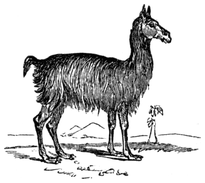
THE LLAMA.
Thus the Llama and its near relations, the Alpaca, the Huanacu,
and the Vicuña, the largest four-footed animals which
Peru possessed before the Spaniards introduced
the horse and the ox, are all
natives of the Puna. Long before the
invasion of Pizarro, the llama was used
by the ancient Peruvians as a beast of
burthen, and was not less serviceable to
them than the camel to the Arabs of
the desert. The wool served for the
fabrication of a coarse cloth; the milk
and flesh, as food; the skin, as a warm covering or mantle; and
without the assistance of the llama, it would have been impossible
for the Indians to transport goods or provisions over the
high table-lands of the Andes, or for the Incas to have founded
and maintained their vast empire. The llama is also historically
remarkable as being the only animal domesticated by the
aboriginal Americans. The reindeer of the north4 and the
bison of the prairies enjoyed then, as they do now, their savage
independence: the llama alone was obliged to submit to the
yoke of man. But the llama reminds us of the dromedary not
only by a similar destiny and similar services, but also by a
strong resemblance in form and structure, so as to be classed by
naturalists in the same family. The unsightly hump is wanting,
but the llama possesses the same callosities on the breast and
on the knees, the same divided hoof and a similar formation
of the toes and stomach. Thus Nature has formed in the llama
a species of mountain camel, admirably adapted to the exigencies
of a totally different soil and climate; and surely it is
not one of the least wonders of creation to see animals so
similar in many respects emerge, without any connecting links,
at the opposite extremities of the globe.
The ordinary load of the llama is about one hundred pounds,
and its rate of travelling with this burthen over rugged mountain
passes is from twelve to fifteen miles a-day. When overloaded
it lies down, and will not rise until relieved of part of its
burthen. ‘The Indians,’ says Tschudi, ‘often travel with large
herds of llamas to the coast to fetch salt. Their journeys are
very small, rarely more than three or four leagues; for the
llamas never feed after sunset, and are thus obliged to graze
while journeying, or to rest for several hours. While reposing
they utter a peculiar low tone, which at a distance resembles
the sound of an Æolian harp. A loaded herd of llamas traversing
the high table-lands affords an interesting spectacle.
Slowly and stately they proceed, casting inquisitive glances on
every side. On seeing any strange object which excites their
fears, they immediately scatter in every direction, and their
poor drivers have great difficulty to gather the herd.’ The
Indians, who are very fond of these animals, decorate their
ears with ribbons, hang little bells about their necks, and
always caress them before placing the burthen on their back.
When one of them drops from fatigue, they kneel at its side and
strive to encourage it for further exertion by a profusion of
flattering epithets and gentle warnings. Yet, in spite of good
treatment, a number of llamas perish on the way to the coast or
to the forests, as they cannot stand the hot climate.
The Huanacu is of a greater size than the llama, and resembles
it so much that it was supposed to be the wild variety
until Tschudi, in his ‘Fauna Peruana,’ pointed out the specific
differences between both. Its fleece is shorter and less fine; its
colour brown, the under parts being whitish—but varieties of
colour are never observed, as in the llama; the face is blackish
grey, lighter and almost white about the lips. The huanacus
generally live in small troops of from five to seven. They are
very shy, but when caught young are easily tamed, though they
always remain spiteful, and can hardly ever be trained to carry
burthens.
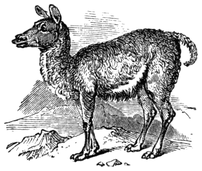
The Alpaca is smaller than the llama, and resembles the
sheep; but its neck is longer, and it has a more elegantly
formed head. The wool which, on account
of its admirable qualities, is
extensively used in England, is very
long, soft, fine, and of a silky lustre—sometimes
quite white or black, but
often also variegated.
THE ALPACA.
Shy, like the chamois or the steinbock,
the Vicuña inhabits the most
sequestered mountain-valleys of the Andes. It is of a more
elegant shape than the alpaca, with a longer and more graceful
neck, and a more curly wool of extreme fineness. During
the rainy season, the vicuñas retire to the crests of the Cordillera,
where vegetation is reduced to the scantiest limits;
but they never venture on the bare summits, as their hoof,
accustomed to tread only on the turf, is very tender and sensitive.
When pursued, they never fly to the ice-fields, but only
along the grass-grown slopes. In the dry season, when vegetation
withers on the heights, they descend to seek their food along
the sources and swampy grounds. From six to fifteen she-vicuñas
live under the protection and guidance of a single male,
who always remains a few paces apart from his harem, and
keeps watch with the most attentive care. At the least approach
of danger he immediately gives the alarm by a shrill
cry, and rapidly steps forward. The herd, immediately assembling,
turns inquisitively towards the side whence danger is
apprehended, and then, suddenly wheeling, flies, at first slowly,
and constantly looking back, but soon with unrivalled swiftness.
The male covers the retreat, frequently standing still and
watching the enemy. The females reward the faithful care of
their leader with an equally rare attachment; for when he is
wounded or killed, they will keep running round him with
shrill notes of sorrow, and rather be shot than flee. The cry of
the vicuña is a peculiar whistle, which, though greatly resembling
the shrill neighing of the llama, may easily be distinguished
by a practised ear, when it suddenly pierces the thin
air of the Puna, even from a distance where the sharpest eye is
no longer able to distinguish the form of the animal.
The hunting of the vicuñas, which is very singular and
interesting, takes place in April or May. Each family in the
Puna villages is obliged to furnish the contingent of one of its
members at least; and the widows accompany the hunters, to
serve as cooks. The whole troop, frequently consisting of
seventy or eighty persons, and carrying bundles of poles and
large quantities of cordage, sets out for the more elevated
plateaus, where the vicuñas are grazing. In an appropriate
spot the poles are fixed into the earth, at intervals of twelve
or fifteen paces, and united by the cordage, about two feet
from the ground. In this manner a circular space, called
Chacu, of about half a league in circumference, is enclosed,
leaving on one side an entrance several hundred paces wide.
The women attach to the cordage coloured rags, which wave
to and fro in the wind. As soon as the Chacu is ready, the
men disperse, and forming a ring many miles in circumference,
drive all the intervening vicuña herds through the entrance
into the circle, which is closed as soon as a sufficient number
has been collected. The shy animals do not venture to spring
over the cord and its fluttering rags, and are thus easily killed
by the bolas of the Indians. These bolas consist of three balls
of lead or stone, two of which are heavy, and one lighter, each
ball being attached to a long leather thong. The thongs are
knotted together at their free extremity. When used, the
lighter ball is taken in the hand, and the two others swung
in a wide circle over the head. At a certain distance from the
mark, about fifteen or twenty paces, the hand-ball is let loose,
and then all three fly in hissing circles towards the object
which they are intended to strike, and encompass it in their
formidable embrace. The hindlegs of the vicuñas are generally
aimed at. It is no easy matter to throw the bolas adroitly,
particularly when on horseback; for the novice often wounds
either himself or his horse mortally, by not giving the balls
the proper swing, or letting them escape too soon from his
hand. The flesh of the vicuñas is divided in equal portions
among the hunters. When dried in the air, and then pounded
and mixed with Spanish pepper, its taste is not unpleasing.
The Church, however, manages to get the best part of the
animal, for the priest generally appropriates the skin. As soon
as all the entrapped vicuñas are killed, the chacu is taken to
pieces, and set up again ten or twelve miles further off. The
whole chase lasts a week, and the number of the animals
slaughtered frequently amounts to several hundreds.
In the times of the Incas, the Puna chases were conducted
on a much grander scale. Annually from 25,000 to 30,000
Indians assembled, who were obliged to drive all the wild
animals from a circuit of more than a hundred miles into an
enormous chacu. As the circle narrowed, the ranks of the
Indians were doubled and trebled, so that no animal could
escape. The pernicious quadrupeds, such as bears, cuguars,
and foxes, were all killed, but only a limited number of stags,
deer, vicuñas, and huanacus; for the provident Incas did not
lose sight of the wants of futurity, and were more economical
of the lives of animals than their brutal successors, the Christian
Spaniards, were of the lives of men.
In spite of the persecutions to which they are subject, not
only from hunters but from the ravenous condor, who frequently
robs them of their young, the vicuñas do not seem to diminish,
and are often seen roaming about in large numbers—the inaccessible
wilds to which they are able to retreat amply securing
them against extermination.
CHINCHILLA.
Besides these four remarkable Camelides, we find among the
animals peculiar to the Puna the stag-like Tarush (Cervus
antisiensis); the timid deer, who also descends from the high
mountain-plains into the coast-valleys and the forest region;
the Viscachas and the Chinchillas. The Peruvian Viscachas
(Lagidium peruanum and pallipes), live at an elevation
of from 10,000 to 12,000 feet, between 33° and 18° S.
lat., and resemble the rabbit in form and colour, but have
shorter ears and a long rough tail. Their far is soft, but
not nearly so fine as that of the near-related
Chinchilla (Chinchilla lanigera).
This little creature, which is somewhat
larger than our squirrel, has large and
brilliant eyes, an erect tail, strong
bristles on the upper lip, and almost
naked, rounded ears. It lives in burrows,
feeding chiefly upon roots, and is found in such numbers
in the Chilian Andes that its holes considerably increase the
difficulty of travelling. The fur is too well known to require
any further description. Where ruminants and rodents abound
it may easily be imagined that beasts of prey will not be wanting.
The cunning fox (Canis Azaræ) waylays both the chinchillas
and the water-birds; and, impelled by hunger, the
Puma, or American lion, ascends even to the borders of eternal
snow in quest of the vicuña and the deer. But the monarch of
the Puna is unquestionably the mighty condor, who, soaring
over the highest peaks of the Andes, sees on one side the
Pacific rolling its heavy breakers against the coast, and on the
other the Marañon vanishing in the hazy distance of the primitive
forest.
The frequent showers and snow-falls of the Puna naturally
give rise to numerous swamps and lagunes, which afford nourishment
to an abundance of birds,—such as the beautiful snow-white
Huachua goose (Chloéphaga melanoptera), with dark-green
wings of a metallic lustre; the licli, a species of plover;
the ibis; the long-legged flamingo; the Quiulla gull (Larus
serranus), and the gigantic coot (Fulica gigantea), which, unable
to fly, dives in the cold waters, and builds its nest on the
solitary stones which rise above the surface.
To the aboriginal animals of the Puna man has added the
horse, the ox, the dog, and the sheep. In the more sheltered
valleys there are estates possessing from 60,000 to 80,000
sheep, and from 400 to 500 oxen. During the wet season the
herds are driven into the Altos or highest regions, often to a
height of 15,000 feet; but when the frosty nights of the dry
period of the year parch the grass, they are obliged to descend
to the swampy valleys, where they have much to suffer from
hunger. In many parts of the Puna, wild bulls render travelling
very dangerous, as they sometimes rush upon man without
any previous notice, though they generally announce their approach
by a hoarse bellowing. But even then it is almost
impossible to escape them in the open plain, and more than
once Tschudi was only able, by a well-aimed shot, to save himself
from the attack of one of these formidable animals.
Though not so dangerous, the half-wild Puna dogs (Canis
Ingæ, Tschudi) are extremely troublesome to the traveller,—false,
spiteful animals, which ferociously attack enemies far
stronger than themselves; and, like the bull-dog, will rather
suffer themselves to be cut to pieces than retreat. They have a
particular antipathy to the white race, and it is rather a bold
undertaking for the European traveller to approach the hut of
an Indian that is guarded by these animals.
The frosts of winter and an eternal spring are nowhere found
in closer proximity than in the Peruvian highlands, for deep
valleys cleave the windy Puna; and when the traveller, benumbed
by the cold blasts of the mountain-plains, descends
into these sheltered gorges he almost suddenly finds himself
transported from a northern climate to a terrestrial paradise.
Situated at a height where the enervating power of the tropical
sun is not felt, and where at the same time the air is not
too rarefied, these pleasant mountain vales, protected by their
rocky walls against the gusts of the Puna, enjoy all the advantages
of a genial sky. Here the astonished European sees
himself surrounded by the rich corn-fields, the green lucerne
meadows, and the well-known fruit trees of his distant home,
so that he might almost fancy that some friendly enchanter had
transported him to his native country, if the cactuses and
the agaves on the mountain-slopes by day, and the constellations
of another hemisphere by night, did not remind him of
the vast distance which separates him from the land of his birth.
There are regions in this remarkable country where the traveller
may in the morning leave the snow-decked Puna hut, and
before sunset pluck pine-apples and bananas on the cultivated
margin of the primeval forest; where in the morning the stunted
grasses and arid lichens of the naked plain remind him of the
arctic regions, and where he may repose at night under the fronds
of gigantic palms.
CHAPTER IV. THE PERUVIAN SAND-COAST.
GUANO ISLAND.
Its desolate Character—The Mule is here the ‘Ship of the Desert.’—A Shipwreck
and its Consequences—Sand-Spouts—Medanos—Summer and Winter—The
Garuas—The Lomas—Change produced in their Appearance during the
Season of Mists—Azara’s Fox—Wild Animals—Birds—Reptiles—The
Chincha or Guano Islands.
Between the Cordilleras to the east and the Pacific to the
west extends, from 3° to 21° S. lat., 540 leagues long
and from 3 to 20 leagues broad, a desert coast, the picture
of death and desolation. Traversed by spurs of the mighty
mountain-chain, which either gradually sink into the plain, or
form steep promontories washed by the ocean, it rises and falls
in alternate heights and valleys, where the eye seldom sees anything
but fine drift-sand or sterile heaps of stone.
Only where, at considerable intervals, some rivulet, fed by a
glacier or a small mountain lake, issues from the ravines of the
Andes to lose itself after a short course in the Pacific, green belts,
like the oases of the African desert, break the general monotony,
and appear more charming from the contrast with the nakedness
of the surrounding waste. The planter carefully husbands the
last drop of water from those scanty streams; for, as the tribes
of the Sahara can only, by dint of constant industry, preserve
their date-palm islands against the waves of the surrounding
sand-sea, thus also the inhabitant of the Peruvian coast can
only by perpetual irrigation protect his plantations from the
encroachments of the neighbouring desert! But the fruits which
he reaps and garners are very different from those which are produced
by the African oasis; for, while none of the plants of the
Peruvian sand-coast has ever found its way to the Sahara, the
sycamores and tamarinds of the latter are equally unknown on
the eastern shores of the Pacific. Cotton and sugar, maize and
batatas, manioc and bananas, here take the place of the date-palm
of the Arab, and thrive only so far as the limits of irrigation
extend.
In the surrounding wastes, where for miles and miles the
traveller meets no traces of vegetation, and finds not one drop
of water, the mule performs the part of the African camel; for,
satisfied with a scantier food than the horse, it more easily
supports the fatigues of a prolonged journey through the sand,
and in Peru is fully entitled to be called the ship of the desert.
The horse cannot support hunger and thirst longer than forty-eight
hours without becoming so weak as hardly to be able to
carry its rider; and if the latter is imprudent enough to urge it
on to a more rapid pace, it falls a victim to his obstinacy, as it
will obey the spur until it sinks never to rise again. Not so the
mule, which, on feeling itself unable to advance, stands still, and
will not move an inch until it has rested for a time; after which
it willingly continues its journey. Yet, in spite of these excellent
qualities, many mules succumb to the fatigues and privations
of the desert; and as in the Sahara the caravan-routes are
marked by camel-skeletons, so here long rows of mule-skulls and
bones point out the road along the Peruvian sand-coast. Woe
to him whom a shipwreck casts on these desolate shores; for he
is almost inevitably doomed to destruction!
In general, a healthy man can withstand hunger and thirst
during four or five days, but only in a temperate climate and
when the body is at rest; while in the burning deserts of Peru,
the want of water during forty-eight hours, combined with the
fatigue of wading through the deep sands, can only end in death.
Thirst can, undoubtedly, be supported ten times longer in the
moist sea-air than in the thoroughly desiccated atmosphere of a
tropical waste.
The dangers of these solitudes are increased by the great
mobility of the soil. When a strong wind blows, huge sand-columns,
rising like water-spouts to a height of eighty or a
hundred feet, advance whirling through the desert, and suddenly
encompass the traveller, who can only save himself by a rapid
flight. Such is the instability of the soil, that in a few hours
a plain will be covered with hillocks or Medanos, and recover
after a few days its former level. The most experienced muleteers
are thus constantly deceived in their knowledge of the road,
and are the first to give way to despair, while seeking to extricate
themselves from a labyrinth of newly-formed medanos. These
constant transformations and shiftings in the desert, which
Tschudi graphically calls ‘a life in death,’ take place more
particularly in the hot season, when the least pressure of the
atmosphere suffices to disturb the dried-up sands, whose weight
increases during the winter by the absorption of moisture. The
single grains then unite to larger masses, and more easily
withstand the pressure of the wind.
The summer, or dry season, begins in November. The rays
of the vertical sun strike upon the light-coloured sands, and are
reflected with suffocating power. No plant except the cactuses
and tillandsias, which manage to thrive where nothing else exists,
takes root in the glowing soil; no animal finds food on the lifeless
plain; no bird, no insect, hovers or buzzes in the stifling
atmosphere. Only in the highest regions the condor, the monarch
of the air, is seen sailing along in lonely majesty.
In May, which in these southern latitudes corresponds to our
October, the scene changes. A thin, misty veil extends over
the sea and the coast, and, increasing in density during the
following months, only begins to diminish in October. At the
beginning and the end of this damp season the mist generally
ascends between nine and ten in the morning, and falls again at
about three in the afternoon; but in August and September,
when it is most dense, it rests for weeks immovably over the
earth, never dissolving in rain, but merely descending in a fine,
penetrating drizzle, called ‘garua’ by the inhabitants. In many
parts rain has not been known to fall for centuries, except only
after very severe earthquakes, and even then the phenomenon is
not of constant occurrence. The mist seldom ascends to a vertical
height of more than 1,200 feet, when it is replaced by violent
showers of rain; and, remarkably enough, the limits between
both can be determined with almost mathematical precision, as
there are plantations, one half of whose surface is invariably
moistened by garuas and the other by rain.
When the mists appear, the Lomas, or chains of hills which
bound the sand-coast towards the east, begin to assume a new
character; and, as if by magic, a garden is seen where but a few
days before a desert extended its dreary nakedness. Soon also,
animal life begins to animate the scene, as the Lomeros drive
their cattle and horses to these newly-formed pasture-grounds,
where for several months they find an abundance of juicy food,
but no water. This, however, they do not require, as they
always leave the Lomas in the best condition.
In some of the northern coast-districts, situated near the
equatorial line, where the garuas seldom appear, the fertility of
the land depends wholly upon the streams which issue from
the mountains. The dew, which along the coasts of central and
south Peru hardly moistens the soil to the depth of half an inch,
is there so completely wanting, that a piece of paper exposed
to the air during the night shows no sign of moisture in the
morning; and so thoroughly does the dryness of the soil prevent
putrefaction, that after 300 years the mummified corpses
are still found unaltered, which the ancient Peruvians buried in
a sitting posture.
Thus the aridity of the Sahara repeats itself in these American
deserts, and is in some measure owing to the same cause, though
their geographical position to the west of the Andes, whose
eastern slopes absorb all the moisture of the prevailing trade-winds,
chiefly accounts for their nakedness. Rain is wanting,
as there is no vegetation of any great extent to condense the
passing vapours; and, on the other hand, the want of moisture
prevents plants from rooting on the unstable soil.
A glance at the animal world of the Peruvian coast shows us
the same poverty of species as in the great African desert. A
fox (Canis Azaræ) seems here to play the part of the hyæna
and the jackal; and is found both in the cotton-plantations
along the streams, and in the Lomas, where he is destructive to
the young lambs. The large American felidæ, the puma, and
the jaguar, seldom appear on the coast, where they attain a
more considerable size than in the mountains. The cowardly
puma is afraid of man; while the bloodthirsty jaguar penetrates
into the plantations, where he lies in wait for the oxen and
horses, and avoids with remarkable sagacity, the manifold traps
and pitfalls that are laid for him by the hacienderos.
In the cultivated districts Opossums are found among the low
bushes, in deserted dwellings, or in
storerooms; armadillos (Dasypus
tatuay) are sometimes shot in the
fields, and wild hogs of an enormous
size infest the thickets near some of
the plantations.
OPOSSUM.
Instead of the antelope and the
gazelle of the African deserts, the Venado, a species of deer,
makes its appearance on the Peruvian coast. It chiefly lives in
the low bushes, which are scattered here and there, and after
sunset visits the cultivated fields where it causes considerable
damage.
Besides the numerous sea- and strand-birds, the carrion vultures
and the condor, often found in large numbers feasting
upon the marine animals that have been cast ashore, are the
most conspicious among the feathered tribes of the coast. A
small falcon (Falco sparverius) is likewise often seen, and a
small burrowing owl (Athene cunicularia) haunts almost every
ruinous building. The pearl-owl (Strix perlata), performing the
useful services of our own barn-owl, is protected and encouraged
in many plantations, as it thins the ranks of the mice. Swallows
are scarce; nor do they build their nests on the houses, but on
solitary walls, far from the habitations of man.
Among the singing birds, the beautiful crowned fly-catcher
(Myoarchus coronatus) is one of the most remarkable. Its
head, breast and belly are of a burning red; its wings and back
blackish brown. It always sits upon the highest top of the
bushes, flies vertically upwards, whirls about a short time singing
in the air, and then again descends in a straight line upon
its former resting-place. Some tanagras and parrots, and two
starling-like birds, the red-breasted picho and the lustrous black
chivillo, that are frequently kept in cages on account of their
agreeable song, are found in the coast-valleys; and various
pigeons, among others the neat little turtuli and the more
stately cuculi, frequent the neighbourhood of the plantations.
Among the lizard tribes large and brilliantly green iguanas
are found on the southern coast; but much more frequently
dull and sombre agamas lurk among the rocks and stones.
Snakes, both venomous and harmless, are in general tolerably
rare, and occur both in the fruitful lands and the sand-plains.
The animated sea-shore forms a striking contrast to the death-like
solitude of the interior. Troops of carrion vultures gather
about the large marine animals cast ashore by the surf;
numerous strand-birds are greedily on the look-out for the shell-fish
left by the retreating tide, or for the crabs and sea-spiders
that everywhere draw their furrows about the beach; and sea-otters
and seals sun themselves on the cliffs along the whole
coast, except in the neighbourhood of the seaports where they
have been extirpated or driven away by incessant persecutions.
To the north of Chancay, steep sand-hills rise to the height
of 300 or 400 feet, abruptly verging to the sea. The road leading
along the side of these hills, would be extremely dangerous
but for the unstable nature of the soil. For though at each
false step the mule slides with his rider towards the sea, it is
very easy for him to regain his footing on the yielding sand.
A large stone on one of these hills bears a striking resemblance
to a sleeping sea-lion, and almost perpendicularly beneath it lies
a little cove, inhabited by a number of seals. At night the
bark of these animals, mixing with the hollow roar of the
breakers, fills the traveller with a kind of involuntary terror.
Myriads of sea-birds breed on the small islands along the
coast or swarm about the bays, where the fish supply them with
abundant food. The number of these birds, a matter formerly
of only local interest, is now a subject of general importance, as
to them are owing the deep guano beds which have converted
the sterile Chincha Islands5 into mines of wealth.
The want of rain, which renders the greatest part of the
Peruvian coast so utterly barren, is of the utmost advantage for
the production of the guano; for if the Chincha Islands, like
the Orkneys or the Hebrides, had been exposed to frequent
storms, or washed by unceasing showers, they would have been
mere naked rocks, instead of affording the richest deposits of
manure the world can boast of.
CHAPTER V. THE AMAZONS, THE GIANT RIVER OF THE TORRID ZONE.
The Course of the Amazons and its Tributaries—The Strait of Obydos—Tide
Waves on the Amazons—The Black-water rivers—The Rio Negro—The Bay of
the Thousand Isles—The Pororocca—Rise of the River—The Gapo—Magnificent
Scenery—Different Character of the Forests beyond and within the verge of
Inundation—General Character of the Banks—A Sail on the Amazons—A
Night’s Encampment—The ‘Mother of the Waters’—The Piranga—Dangers
of Navigating on the Amazons—Terrific Storms—Rapids and Whirlpools—The
Stream of the Future—Travels of Orellana—Madame Godin.
The Amazons, the giant stream of the tropical world, is of no
less magnificent proportions than the Andes, where it
takes its source. From the small Peruvian mountain-lake of
Lauricocha, 12,500 feet above the sea, the Tunguragua, which
is generally considered as the chief branch, rushes down the
valleys. At Tomependa, in the province of Juan de Bracamoros,
rafts first begin to burden its free waters; but, as if impatient
of the yoke, it still throws many an obstacle in the navigator’s
way; for twenty-seven rapids and cataracts follow each other as
far as the Pongo de Manseriche, where, at the height of 1,164
feet above the level of the sea, it for ever bids adieu to the
romance of mountain scenery.
Its width, which at Tomependa exceeds that of the Thames
at Westminster Bridge, narrows to 150 feet in the defile of the
Pongo, which in some places is obscured by overhanging rocks
and trees, and where huge masses of drift-wood, torn from the
slopes by the mountain torrents, are crushed and disappear in
the vertex.
From the Pongo to the ocean, a distance of more than 2,000
miles, no rocky barrier impedes the further course of the
monarch of streams; and according to Herndon (Exploration
of the Valley of the Amazons, 1851–1853), its depth constantly
remains above eighteen feet, so that it is navigable for large
ships all the way from Para to the foot of the Andes! No
other river runs in so deep a channel at so great a distance
from its mouth, and the tropical rains, spreading over a territory
nearly equal in extent to one-half of Europe, are alone
able to feed a stream of such colossal dimensions!
The first considerable tributary of the Amazons is the Huallaga,
which rises near the famous silver-mines of Cerro de
Pasco, 8,600 feet above the level of the sea, and is 2,500 paces
broad at the point where the rivers meet. Lower down at
Nauta, the Ucayale, descending from the distant mountains of
Cuzco, adds his waters to the growing stream, after a course
nearly 400 miles longer than that of the Tunguragua itself.
Where these mighty rivers meet, Lieutenant Lister Maw found
a depth of thirty-five fathoms.
From the Brazilian frontier, where it still flows at an elevation
of 630 feet above the sea, to the influx of the Rio Negro,
the Amazons is called the Solimoens, as if one name were not
sufficient for its grandeur. During its progress between these
two points it receives on the left, the Iça and the Yapura, on
the right, the Xavari, the Jutay, the Jurua, the Teffe, the
Coary, and the Purus, streams which, in Europe, would only
be equalled by the Danube, but are here merely the obscure
branches of a giant trunk.
The Rio Negro is the most considerable northern vassal of the
Amazons. It rises in the Sierra Tunuhy, an isolated mountain-group
in the Llanos, and conveys part of the waters of the
Orinoco to the Amazons, as if the latter were not already sufficiently
great. After a course of 1,500 miles it flows into the
vast stream, 3,600 paces broad and 19 fathoms deep. Brigs of
war have already ascended the Amazons as far as the Rio Negro,
and frigates would find no obstacle in their way.
The Madeira, the next great tributary of the regal stream,
has thus been named from the vast quantities of drift-wood
floating on its waters.
Farther on, after having with a side-arm embraced the island
of Tupinambaranas, which almost equals Yorkshire in extent,
the Amazons now reaches the strait of Obydos, where it narrows
to 2,126 paces, and rolls along between low banks in a bed
whose depth as yet no plummet hath sounded. The mass of
waters which, during the rainy season, rushes in one second
through the strait, is estimated by Von Martius at 500,000 cubic
feet,—enough to fill all the streams of Europe with an exuberant
current.
The tides extend as far as Obydos, though still 400 miles
from the sea; and according to La Condamine, they are even
perceptible as far as the confluence of the Madeira. But so
slow is their progress upwards, that seven floods, with their
intervening ebbs, roll simultaneously along upon the giant
stream; and thus, four days after the tide-wave was first raised
in the wide deserts of the South Sea, its last undulations expire
in the solitudes of Brazil.6
The next considerable vassal of the Amazons is the shallow
Tapajos.
Fancy six streams, like the Thames, strung successively
together, and you have the length of this river; take the Rhine
twice from its source in the glacier of Mount Adula to the sands
of Katwyck, and you have the measure of the Xingu. Before the
confluence of this last of its great tributaries,—for the Tocantines,
though considered by some geographers as a vassal, is in
reality an independent stream,—the breadth of the Amazons
appeared to Von Martius equal to that of the Lake of Constance;
but soon even this enormous bed becomes too narrow for the vast
volume of its waters, for below Gurupa it widens to an enormous
gulf, which might justly be called the ‘Bay of the Thousand
Isles.’ Nobody has ever counted their numbers; no map gives
us an idea of this labyrinth. If we reckon the island of Marajo,
which equals Sicily in size, to the delta of the Amazons, its
extreme width on reaching the ocean is not inferior to that of
the Baltic in its greatest breadth.
Dangerous sand-banks guard the giant’s threshold; and no
less perilous to the navigator is the famous Pororocca, or the
rapid rising of the spring-tide at the shallow mouths of the chief
stream and of some of its embranchments,—a phenomenon
which, though taking place at the mouth of many other rivers,
such as the Hooghly, the Indus, the Dordogne, and the Seine,7
nowhere assumes such dimensions as here, where the colossal
wave frequently rises suddenly along the whole width of the
stream to a height of twelve or fifteen feet, and then collapses
with a roar so dreadful that it is heard at the distance of more
than six miles. Then the advancing flood-wave glides almost
imperceptibly over the deeper parts of the river-bed, but again
rises angrily as soon as a more shallow bottom arrests its
triumphant career.
Our knowledge of the courses of most of the tributaries of the
Amazons is very imperfect, and science knows next to nothing of
the natural history of their banks. Even a correct map of the
main stream is still wanting, for though its general course and
the most important bends are tolerably well laid down, the
numerous islands and parallel channels, the great lakes and
offsets, the deep bays and the varying widths of the stream are
quite unknown.
The numerous tributary streams of the Amazons differ remarkably
in the colour of their waters and may be divided into
three groups—the white or pale yellowish-water rivers, the
blue-water rivers and the black-water rivers.
The difference of colour between the white-water and blue-water
rivers is evidently owing to the nature of the country
they flow through; a rocky and sandy district will always have
clear-water rivers; an alluvial or clayey one will have troubled
streams.
The Rio Negro is the largest and most celebrated of the black-water
rivers. All its upper tributaries, the smaller ones especially,
are very dark, and, when they run over white sand, give it
the appearance of gold, from the rich colour of the water, which,
when deep, appears inky black. In the rainy season, when the
dark clouds above cause the water to appear of a yet more
funereal blackness and the rising waves break in white foam over
the vast expanse, the scene, as may well be imagined, is gloomy
in the extreme.
The peculiar colour of the black-water rivers appears to be
produced by the solution of decaying leaves, roots and other
vegetable matter. In the virgin forests in which most of these
streams have their source the little brooks and rivulets are half
choked up with dead leaves and rotten branches giving various
brown tinges to the water. When these rivulets meet together
and accumulate into a river, they of course have a deep brown
hue very similar to that of our bog or peat water, if there are
no other circumstances to modify it. But if the stream flows
through a district of soft alluvial clay, the colour will of course
be modified and the brown completely overpowered.
A peculiarity of the black waters is the absence of mosquitos
along their banks, which thus afford agreeable places of refuge
to the persecuted traveller. No inducement will make an
Indian boatman paddle so hard as the probability of reaching
one of these privileged spots before midnight and being enabled
to enjoy the comforts of sleep till morning.
The basin of the Amazons extending over an area of 2,330,000
English square miles surpasses in dimensions that of any other
river in the world. All western Europe could be placed in it
without touching its boundaries and it would even contain our
whole Indian empire. It is entirely situated in the Tropics, on
both sides of the Equator, and receives over its whole extent the
most abundant rains. The body of fresh water which it empties
into the ocean is therefore far greater than that of any other
river; not only absolutely but probably also relatively to its
area, for as it is almost entirely covered by dense virgin forests,
the heavy rains which penetrate them do not suffer so much
evaporation as when they fall on the scorched Llanos of the
Orinoco or the treeless Pampas of La Plata.
Some idea may be formed of the vastness of the territory
drained by the Amazons from the fact that at the sources of its
northern and southern tributaries, the rainy season takes place
at opposite times of the year. So wonderful is the length of the
stream that, while at the foot of the Andes it begins to rise early
in January, the Solimoens swells only in February: and below
the Rio Negro the Amazons does not attain its full height before
the end of March.
The swelling of the river is colossal as itself. In the Solimoens
and farther westwards the water rises above forty feet; and Von
Martius even saw trees whose trunks bore marks of the previous
inundation fifty feet above the height of the stream during the
dry season.
Then for miles and miles the swelling giant inundates his
low banks, and, majestic at all times, becomes terrible in his
grandeur when rolling his angry torrents through the wilderness.
The largest forest-trees tremble under the pressure of
the waters, and trunks, uprooted and carried away by the
stream, bear witness to its power. Fishes and alligators now
swim where a short while ago the jaguar lay in wait for the
tapir, and only a few birds, perching on the highest tree-tops,
remain to witness the tumult which disturbs the silence of the
woods.
When at length the river retires within its usual limits, new
islands have been formed in its bed, while others have been
swept away; and in many places the banks, undermined by the
floods, threaten to crush the passing boat by their fall,—a misfortune
which not seldom happens, particularly when high trees
come falling headlong down with the banks into the river.
The lands flooded to a great depth at every time of high
water are called in the language of the country ‘Gapo,’ and are
one of the most singular features of the Amazons. They extend
hundreds of miles along the river’s course, and vary in width on
each side from one to ten or twenty miles. Through the Gapo
a person may go by canoe in the wet season, without once
entering into the main river. He will pass through small streams,
lakes, and swamps, and everywhere around him will stretch out
an illimitable waste of waters, but all covered with a lofty
virgin forest. For days he will travel through this forest scraping
against the trunks of trees, and stooping to pass beneath the
leaves of prickly palms now level with the water though raised
on stems forty feet high. In this trackless maze the Indian
finds his way with unerring certainty, and by slight indications
of broken twigs or scraped bark goes on day by day as if
travelling on a beaten road.
The magical beauty of tropical vegetation reveals itself in all
its glory to the traveller who steers his boat through the solitudes
of these aquatic mazes. Here the forest forms a canopy
over his head; there it opens, allowing the sunshine to disclose
the secrets of the wilderness; while on either side the eye
penetrates through beautiful vistas into the depths of the
woods. Sometimes, on a higher spot of ground, a clump of
trees forms an island worthy of Eden. A chaos of bushropes
and creepers flings its garlands of gay flowers over the forest,
and fills the air with the sweetest odours. Numerous birds,
rivalling in beauty of colour the passifloras and bignonias of
these hanging gardens, animate the banks of the lagune, while
gaudy macaws perch on the loftiest trees; and as if to remind
one that death is not banished from this scene of paradise, a
dark-robed vulture screeches through the woods, or an alligator
rests, like a black log of wood or a sombre rock,
on the dormant waters.
BLUE MACAW.
The inundations of the Amazons essentially
modify the character of the bordering forest;
for it is only beyond their verge that the
enormous fig and laurel trees, the Lecythas
and the Bertholletias, appear in all their
grandeur. As here the underwood is less dense
and more dwarfish, it is easy to measure the
colossal trunks, and to admire their proportions,
often towering to a height of 120 feet,
and measuring fifteen feet in diameter above
the projecting roots. Enormous mushrooms spring from the decayed
leaves, and numberless parasites rest upon the trunks
and branches. The littoral forest, on the contrary, is of more
humble growth. The trunks, branchless in their lower part,
clothed with a thinner and a smoother bark, and covered with a
coat of mud according to the height of the previous inundation,
stand close together, and form above a mass of interlacing
branches. These are the sites of the cacao-tree and of the
prickly sarsaparilla, which is gathered in large quantities for
the druggists of Europe. Leafless bushropes wind in grotesque
festoons among the trees, between whose trunks a dense underwood
shoots up, to perish by the next overflowing of the stream.
Instead of the larger parasites, mosses and jungermannias
weave their carpets over the drooping branches. But few
animals besides the numerous water-birds inhabit this damp
forest zone, in which, as it is almost superfluous to add, no
plantation has been formed by man.
The many islands of the delta of the Amazons are everywhere
encircled by mangroves; but sailing stream upwards, the monotonous
green of these monarchs of the shore is gradually replaced
by flowers and foliage, which, in every variety of form
and colour, for hundreds and hundreds of miles characterise the
banks of the river.
During the dry season prickly astricarias, large musaceæ,
enormous bamboo-like grasses, white plumed ingas, and scarlet
poivreas, are most frequently seen among the numberless plants
growing along the margin of the stream. Above the shrubbery
of the littoral forest numberless palms tower, like stately
columns, to the height of a hundred feet; while others of a
lower stature are remarkable for the size of their trunks, on
which the foot-stalks of the fallen leaves serve as supports for
ferns and other parasites.
It stands to reason that in a length of more than 3,000 miles
the species of plants must frequently change; yet the low banks
of the Amazons, and of its vassals, as soon as they have emerged
from the mountains where they rise, have everywhere a similar
character. On sailing down the river for hundreds of miles,
the eye may at length grow weary of the uniformity of a landscape,
which remains constantly the same; but the interest increases
as the mind becomes more and more impressed by the
grandeur of its dimensions. A broad stream, now dividing
into numerous arms, and now swelling into a lake; a dark
forest-border, which on so flat a ground seems at a distance like
an artificial but colossal hedge: these are the only elements of
which the landscape is composed. No busy towns rise upon the
banks, and it is only at vast intervals that one finds a few
wretched huts, which are soon again lost in the forest; but a
sky so brilliant spreads over the whole scene, and the rays of the
sun beam upon a nature of such luxuriance, that the traveller,
far from feeling the voyage monotonous, proceeds on his journey
with increasing interest, and every morn salutes with new joy
the majestic wilderness.
The boat floats along, borne by the current of the river,
which, in the dry season, generally flows at the rate of four
English miles in an hour. Even during the night the journey
is usually continued, when no special danger claims a greater
caution, and a landing only takes place when the desire becomes
general to enjoy a perfectly quiet night’s rest, or when a broad
sand bank happens to be invitingly near. Generally an island
is selected, as affording both greater security from beasts of
prey and a clearer ground. The Indians are not obliged to
fetch fire-wood from a distance, for trees, drifted by the floods,
are constantly found at the upper end of the river-islands,
where they remain until the next inundation once more raises
them; and thus many of them are ultimately drifted by the
ocean currents to distant lands. The Indians sometimes set
fire to the whole pile, and then the flames, taking an unexpected
direction, may force the company to flee as fast as
possible to the raft, and to settle in a safer place, while they
continue to blaze over the forest, or to cast a lurid light over
the waters.
Fires are frequently lighted for a more useful purpose on the
banks of the stream, as they never fail to attract a number of
large fishes, which the dexterous Indians know how to strike
with their harpoons. While some are thus engaged, others are
lurking for the tortoises that pay their nightly visits to the
bank, anxious to bury their numerous eggs in the sand. Thus
almost every landing on one of these river-islands furnishes
fresh provisions for the continuance of the journey; for the
captured tortoises are bound to the raft, where, in the enjoyment
of water and shade, they continue to live for a long time.
As soon as the supper is finished, the Indians, after throwing
an additional log upon the watch-fire, all stretch themselves
on the ground, under their dark-coloured toldos, or mosquito
covers, which on the white sand have the appearance of as
many coffins. Their tranquil breathing soon tells that they
are enjoying the deep repose peculiar to their race; but sleep
forsakes the European amid scenes so novel and so grand. The
soul is struck with impressions which compel it to reflection.
The ripple breaks lightly on the bank; no noise, save the
crackling of the fire, breaks the stillness of the night. Only
from time to time the splashing of a fish is heard in the distant
centre of the stream. The same stillness reigns in the skies;
for not the slightest cloud dims the brightness of the stars.
But suddenly the waters begin to rustle at a distance, as if
wave were rolling after wave, and as the strange sound draws
nigh, an unusual agitation becomes apparent in the water.
The awakening Indians whisper anxiously, for they imagine an
enormous reptile to be the cause of the phenomenon. They
also believe the lagunes of the great stream to be the seat of
a prodigious serpent, equal in size and power to the fabulous
sea-snake; for the yacu-mama, or ‘mother of the waters,’ as
this imaginary monster is called, attracts by a single inspiration
every living creature—man, quadruped, or bird—that
passes within a hundred feet of its jaws. As the maelstrom
sucks down the helpless boat that comes within its vortex,
thus the mighty air-current forces its prey into the wide mouth
of the monster lurking in the thicket. For this reason an
Indian will never venture to enter an unknown lagune without
blowing his horn, as the yacu-mama is said to answer, and thus
to give him time for a speedy flight. The ‘mother of the
waters’ is said to be at least fifty paces long, and to measure
ten or twelve yards in circumference. Thus fancy is as busy
in creating imaginary terrors in the lagunes of the Marañon
as on the rocky shores of Scandinavia.
Infinitely more dangerous than this fabulous serpent, more
dreadful even than the cayman or the anaconda, are the pirangas,
a small species of salmon, which in many places attack the
unfortunate swimmer with their sharp teeth, and taint the
waters with his blood. Castelnau saw how a stag, which threw
itself in the river to avoid the hunter’s pursuit, was soon killed
by the pirangas. The Roman knight that cast his slaves to
the murænas,8 would, no doubt, have been rejoiced to people
his ponds with fish like these; and Tiberius would have been
delighted to have possessed them at Capræa!
A night encampment in the Amazons is, however, not always
so pleasant as the foregoing description might lead one to
suppose; for many islands are so infested with mosquitos that
they are quite intolerable, and the growl of a jaguar or the
sight of a crocodile (for this animal is by no means afraid of
fire) not unfrequently disturbs the company. Complete security
from these persecutions and visits is only to be found in the
centre of the stream; for here a cayman is seldom seen, and
the wings of the insects are too weak to carry them to such a
distance from the shore.
The most striking features of the Amazons, besides its vast
expanse of smooth water, generally from three to six miles
wide, are the great beds of aquatic grass which line its shores,
large masses of which are often detached and form floating
islands; the quantity of fruits and leaves and great trunks of
trees which it carries down, and its level banks clad with high
unbroken masses of verdure. In places the white stems and
leaves of the Cecropias give a peculiar aspect, and in others
the straight dark trunks of lofty forest trees form a living wall
along the water’s edge. There is much animation, too, on this
great stream. Numerous flocks of parrots and the great red
and yellow macaws fly across every morning and evening,
uttering their hoarse cries. Many kinds of herons and rails
frequent the marshes on its banks, and a great handsome
duck (Chenalobex jubata) is often seen swimming about the
bays and inlets. But perhaps the most characteristic birds of
the Amazons are the gulls and terns which are in great abundance.
All night long their cries are heard over the sand
banks where they deposit their eggs, and during the day they
may constantly be seen, sitting in a row on a floating log, sometimes
a dozen or twenty side by side, and going for miles
down the stream as grave and motionless as if they were on
some very important business. These birds deposit their eggs
in little hollows in the sand, and the Indians say that during
the heat of the day they carry water in their beaks to moisten
them, and prevent them being roasted by the scorching sun.
Besides these there are divers and darters in abundance, porpoises
are constantly blowing in every direction, and alligators
are often seen slowly swimming across the river. An amazing
number of fishes peoples the waters of the Amazons and its
tributaries. They supply the Indians with the greater part of
their animal food, and are at all times more plentiful and
easier to be obtained than birds or game from the forest. Mr.
Wallace found 205 species in the Rio Negro alone, and as
most of those which inhabit the upper part of the river are
not found near its mouth, where there are many other kinds
equally unknown in the clearer, darker, and probably colder
waters of its higher branches, he estimates that at least 500
species exist in the Rio Negro and its tributary streams.
In fact, in every small river and in different parts of the same
river distinct kinds are found, so that it is impossible to estimate
the number in the whole valley of the Amazons with
any approach to accuracy.
To describe the countless tribes of insects that swarm in the
dense forests of that vast basin would be equally vain. In no
country in the world is there more variety and beauty, nowhere
are there species of larger size and of more brilliant colours.
The great mass of the beetles are indeed inferior to those of
tropical Africa, India, and Australia, but it is in the lovely
butterflies that the Amazonian forests are unrivalled, whether
we consider the endless variety of the species, their large size,
or their gorgeous colour. South America is the richest part
of the world in this group of insects, and the Amazons seems
the richest part of South America.
In more than one respect the Amazons reminds one of the
ocean, from whose bosom its waters originally arose. Like the
sea, it forms a barrier between various species of animals; for
the monkeys on its northern bank are different from those of
the forests on its southern side, and many an insect—nay,
even many a bird—finds an impassable barrier in the enormous
width of the river. Like the sea, it has a peculiar species of
dolphin, and hundreds of miles up the stream, sea-mews and
petrels, deceived by its grandeur, screech or shoot in arrowy
flight over its fish-teeming waters. As over the ocean, or in
the desert, the illusions of the mirage are also produced over
the surface of the Marañon. The distant banks, not always
clearly defined even in the morning, disappear wholly at noon,
and the rays of the sun are then so refracted that the long rows
of palms appear in an inverted position.
The dreadful storms which burst suddenly over the Amazons,
likewise recall to memory the tornados of the ocean. The
howlings of the monkeys, the shrill tones of the mews, and the
visible terror of all animals, first announce the approaching
conflict of the elements. The crowns of the palms rustle and
bend, while as yet no breeze is perceptible on the surface of
the stream; but, like a warning voice, a hollow murmur in
the air precedes the black clouds ascending from the horizon,
like grim warriors ready for battle. And now the old forest
groans under the shock of the hurricane; a night-like darkness
veils the face of nature; and, while torrents of rain descend
amid uninterrupted sheets of lightning and terrific peals of
thunder, the river rises and falls in waves of a dangerous
height. Then it requires a skilful hand to preserve the boat
from sinking; but the Indian pilots steer with so masterly a
hand, and understand so well the first symptoms of the storm,
that it seldom takes them by surprise, or renders them victims
of its fury.
Among the dangers of the Amazons, the rapids must not be
forgotten that frequently arise where large tracts of the bank,
undermined by the floods, have been cast into the river. The
boat is almost unavoidably lost when carried by the current
among the branches of the trees, which, though submerged, still
remain attached to the ground, and sweep furiously through
the eddy, overturning or smashing all that comes within their
reach.
Perhaps no country in the world contains such an amount
of vegetable matter on its surface as the valley of the Amazons.
Its entire extent, with the exception of some very small portions,
is covered with one dense and lofty primeval forest, the
most extensive and unbroken which exists upon the earth. It
is the great feature of the country, that which at once
stamps it as a unique and peculiar region. It is not here, as
on the coasts of southern Brazil, or on the shores of the Pacific,
where a few days’ journey suffices to carry us beyond the forest
district, and into the parched plains and rocky sierras of the
interior. Here one may travel for weeks and months inland
in any direction, and find scarcely an acre of ground unoccupied
by trees.
It is far up in the interior where the great mass of this
mighty forest is found; not on the lower part of the river,
near the coast as is generally supposed. Bounded on one side
by the Andes, on the other by the Atlantic, it extends from
east to west for a distance of 2,600 miles; and from 7 N.
latitude on the banks of the Orinoco, to 18 S. latitude on the
northern slope of the great mountain chain of Bolivia, a distance
of more than 1,700 miles. From a point about sixty miles
south-east of Tabatinga, on the Upper Amazons, a circle may
be drawn of 1,100 miles in diameter, the whole area of which
will be virgin forest. Such are the magnificent proportions
of these wonderful woods, which speak to the imagination as
forcibly as the ocean or the Great Sahara.
The forests of no other part of the world, not even the immense
fir-woods of Siberia or of North America, are so extensive
and unbroken as this. Those of Central Europe are trifling
in comparison, nor in India are they very continuous or extensive.
Africa contains some large forests situated on the
east and west coasts, and in the interior south of the Equator,
but the whole of them would bear but a small proportion to
that of the Amazons. In a general survey of the tropical
world, we may, therefore, look upon South America as pre-eminently
the land of forests, contrasting strongly with Asia
or Africa, where deserts are the most characteristic features.
If the Nile—so remarkable for its historical recollections,
which carry us far back into the by-gone ages—and the
Thames, unparalleled by the greatness of a commerce which
far eclipses that of ancient Carthage or Tyre—may justly be
called the rivers of the past and the present, the Amazons
has equal claims to be called the stream of the future; for a
more splendid field nowhere lies open to the enterprise of man.
All the gifts of Nature are scattered in profusion over the
vast territory drained by the river. The mountains, where it
rises, teem with mineral treasures, and the very ideal of fertility
is realised in those well-watered plains, where the equatorial
sun developes life in boundless luxuriance. The most
useful and costly productions of the tropical world,—sugar,
cotton, coffee, indigo, tobacco, maize, rice; quinquina in the
higher regions of the Marañon, where wheat and the vine find
a congenial climate; cacao and vanille, sarsaparilla and caoutchouc,
various palms of the most manifold uses; trees and
shrubs, some rivalling our oaks in the solidity of their timber,
others fit by the beauty of their grain to adorn palaces; dyes,
resins, gums, spices, drugs,—all, in one word, that is capable
of satisfying the wants of the frugal or the fancies of the rich,
might there be raised in profusion over a space surpassing
England at least forty times in extent. The whole actual
population of the globe could easily live in content and plenty
in the almost uninhabited valleys of the Marañon and its
tributary streams.
With these magnificent prospects the present forms a melancholy
contrast. Here and there some small town or wretched
village rises on the banks of the mighty stream; and a few
Indians roam over the forests, through which it rolls along, or
enjoy the produce of its prolific waters. The vast province of
Para, the garden of Brazil, the paradise of unborn millions, has
scarcely four inhabitants on a geographical square mile; while
even the northern province of Archangel, the land of the
stunted fir and the mossy tundra, has a population four times
as large. But since the last few years, steamboats regularly
ascend the giant stream and some of its tributaries almost to
the foot of the Andes; railroads are being made where navigation
is impeded by rapids, and ere long civilization and
industry will have dawned over the vast woodlands of the
Amazon.
Eight years after Columbus had revealed the existence of a
new world, Vincent Yañez Pinson, the companion of his first
voyage, sailed with four ships from the port of Palos (13th
January, 1500), steered boldly towards the south, crossed the
line, and discovered the mouth of the Amazons. Forty years
later Gonsalo Pizarro, governor of Quito, left his capital with
340 Spaniards and 4,000 Indian carriers to conquer the unknown
countries to the east of the Andes. The march over the Puna
and the high mountain ridges proved fatal to the greater part
of their wretched attendants; and even the Spaniards—accustomed
to brave every climate and hardship wherever gold held
forth its glittering promise—had much to suffer from the
excess of cold and fatigue. But when they descended into the
low country their distress increased. During two months it
rained incessantly, without any interval of fair weather long
enough to enable them to dry their clothes. They could not
advance a step, unless they cut a road through woods, or made
it through marshes. The land, either altogether without inhabitants,
or occupied by the rudest and least industrious tribes
in the New World, yielded little food. Such incessant toil and
continual scarcity were enough to shake the most stedfast hearts;
but the heroism and perseverance of the Spaniards of the sixteenth
century surmounted obstacles which to all others would
have seemed insuperable. Allured by false accounts of rich
countries before them, they struggled on, until they reached the
banks of the Napo, one of the rivers whose waters add to the
greatness of the Marañon. There, with infinite labour, they
built a bark, which they expected would prove of great use in
conveying them over rivers, in procuring provisions, and in exploring
the country. This was manned with fifty soldiers, under
the command of Francis Orellana, the officer next in rank to
Pizarro.
The stream carried them down so quickly that they were soon
far ahead of their countrymen, who followed slowly and with
difficulty by land. At first Orellana may have had no intention
to betray the trust bestowed upon him by his commander; but
on reaching the Marañon, the aspect of the stream rolling
majestically to the east proved a temptation too strong for his
ambition; and, forgetting his duty to his fellow-soldiers, he resolved
to follow the course of the river, which seemed to
beckon him onwards to riches and renown. But one among
his followers, Sanchez de Vargas, whose name well deserves a
record, had the courage to remonstrate against this breach of
faith, for which he was landed as a criminal, without food or
help of any kind. After a dangerous and romantic navigation
of seven months, whose real adventures he afterwards embellished
with fabulous tales of El Dorados and warlike Amazons,
Orellana at length reached the mouth of the stream. Drifted
by the current, he thence safely steered for the Spanish settlement
in the island of Cubagua, and soon after embarked for
Spain. The magnificence of his discovery threw a veil over
his guilt; and having been appointed governor of the territory
whose grandeur he had been the first to reveal, he once more
crossed the ocean. But he was not destined to reach the scene
where his ambition dreamt of exploits worthy to eclipse the
fame of Cortes or Pizarro; a mortal disease befell him on the
passage, and in the sea he found a nameless grave.
But what had meanwhile become of the leader whom he had
so basely abandoned in the wilderness? The consternation of
Pizarro on not finding the bark at the confluence of the Napo
and the Marañon, where he had ordered Orellana to wait for
him, may well be imagined. But, imputing his absence to
some unknown accident, he advanced above fifty leagues along
the banks of the river, expecting every moment to see the bark
appear with abundant provisions and joyful tidings. At length
he met with the faithful Vargas, and now no doubt remained
about the treachery of his lieutenant and his own desperate
situation. The spirit of his stoutest-hearted veterans sank
within them; all demanded to be led back instantly, and Pizarro,
though he assumed an appearance of tranquillity, did not
oppose their inclination. But they were now 1,200 miles from
Quito, and a march of many months had to be made without
the hopes which had soothed their previous sufferings. Hunger
compelled them to sacrifice all their dogs and horses, to devour
the most loathsome reptiles, to gnaw the leather of their saddles
and sword-belts. All the Indians and 210 Spaniards perished
in this wild expedition, which lasted nearly two years. When
at length the survivors arrived at Quito, they were naked like
savages, and so worn out with famine and fatigue that they
looked more like spectres than men.
Two hundred years after the adventures of Pizarro and
Orellana, the French naturalist, La Condamine, performed his
celebrated voyage from Bracamoros to Para. He was accompanied
by the learned M. Godin des Odonnais, who, leaving his
wife on the eastern slope of the Andes, returned alone to Europe
in the year 1479. After a separation of several years Madame
Godin undertook to descend the Amazons to Para, where her
husband was waiting for her. She embarked with her two
brothers, a doctor, three female servants, and some Indians, in
a large open boat. At the very first opportunity the doctor
abandoned the party, and was soon followed by the Indians.
The unskilled travellers vainly attempted to steer their boat;
it foundered on a sand bank, and Madame Godin with difficulty
saved her life. They then made a raft, which met with the
same misfortune. Undaunted by these repeated disasters, but
completely inexperienced, they now resolved to proceed on foot
through the forest; but hunger and fatigue soon drove them
to despair, and they all perished, except Madame Godin, who,
though physically the weakest, was morally the strongest of the
party. Tattered, emaciated, exhausted, she at length met some
Indians who treated her with the greatest kindness. The long
struggle for her life, amid dangers and hardships without number,
had bleached her hair, and stamped her with the marks of
extreme old age. The good-natured savages guided her to the
next European settlement, whence she continued her journey
to Para without any further adventures. But the dreadful
scenes she had witnessed, and the loss of the dear relations and
faithful companions who one after the other had dropped from
her side, had too severely shocked her nerves; and, though she
escaped death in the wilderness, it was only to fall a prey to
hopeless insanity.
CHAPTER VI. THE PRIMEVAL FORESTS OF TROPICAL AMERICA.
Their peculiar Charms and Terrors—Disappointments and Difficulties of the Botanist—The
Bush-ropes—Variety of Trees and Plants—Trees with Buttresses—Numberless
parasites—Character of the Primitive Forest according to its Site—Its
Aspect during the Rainy Season—A Hurricane in the Forest—Beauty
of the Forest after the Rainy Season—Our Home Scenes equally beautiful—Bird
Life on the rivers of Guiana—Morning Concert—Repose of Nature at Noon—Nocturnal
Voices of the Forest.
The peculiar charms of a tropical primeval forest are
enhanced by the mystery of its impenetrable thickets; for
however grand its lofty vaults, or lovely its ever-changing forms
of leaf or blossom, fancy paints scenes still more beautiful beyond,
where the eye cannot penetrate, and where, as yet, no wanderer
has ever strayed. But imagination also peoples the forest with
peculiar terrors; for man feels himself here surrounded by an
alien, or even hostile, nature: the solitude and silence of the
woods weigh heavily on his mind; in every rustling of the
falling leaves a venomous snake seems ready to dart forth; and
who knows what ravenous animal may not be lurking in the dense
underwood that skirts the tangled path?
In Europe there is no room for such feelings; for in our part
of the world there are no woods that may not be visited, even
in their deepest recesses: no thorny bush-ropes stretch their
intricate cordage before the wanderer; no masses of matted
shrubs block up his way. But it is very different in the boundless
forests of tropical America. Here the jaguar sometimes
loses himself in such impenetrable thickets that, unable to hunt
upon the ground, he lives for a long time on the trees, a terror
to the monkeys; here the padres of the mission-stations, which
are not many miles apart in a direct line, often require more
than a day’s navigation to visit each other, following the windings
of small rivulets in their courses, as the forest renders
communication by land impossible.
Even the more open parts of the forest are full of mysteries.
In our woods the summits of the highest trees are accessible;
there is no blossom that we are not able to pluck—no plant
that we are not able to examine, from its root to its topmost
branches; but in the Brazilian forest, where the matted bush-ropes
wind round the trunks like immense serpents waiting for
their prey or stretch like the rigging of a ship from one tree
to another, and blossom at a giddy height, it is frequently as
impossible to reach their flowers as it is to distinguish to which
of the many interlacing stems they may belong.
If any one should be inclined to tax this description with
exaggeration, let him try to pluck the flowers of the lianas, or
to ascend by climbing their flexible cordage. The tiger-cat
and the monkey, perhaps also the agile Indian, may be able to
accomplish the feat; but it would be utterly hopeless for the
European to undertake it. Nor is it possible to drag down
these inaccessible creepers; for, owing to their strength and
toughness, it would be easier to pull down the tree to which
they attach themselves than to force them from their hold.
Here two or three together twisting spirally round each other
form a complete living cable as if to bind securely the monarchs
of the forest; there they form tangled festoons, and covered
themselves with smaller creepers and parasitic plants, hide the
parent stem from sight.
No botanist ever entered a primitive forest without envying
the bird to whom no blossom is inaccessible, who, high above
the loftiest trees, looks down upon the sea of verdure, and enjoys
prospects whose beauty can hardly be imagined by man.
A majestic uniformity is the character of our woods, which
often consist but of one species of tree, while in the tropical
forests an immense variety of families strive for existence, and
even in a small space one neighbour scarcely ever resembles the
other. Even at a distance this difference becomes apparent in
the irregular outlines of the forest, as here a dome-shaped
crown, there a pointed pyramid, rises above the broad flat masses
of green, in ever-varying succession. On approaching, the differences
of colour are added to the irregularities of form; for
while our forests are deprived of the ornament of flowers, many
tropical trees have large blossoms, mixing in thick bunches with
the leaves, and often entirely overpowering the verdure of the
foliage by their gaudy tints. Thus splendid white, yellow, or
red-coloured crowns are mingled with those of darker or more
humble hue. At length when, on entering the forest, the single
leaves become distinguishable, even the last traces of harmony
disappear. Here they are delicately feathered, there lobed—here
narrow, there broad—here pointed, there obtuse—here
lustrous and fleshy, as if in the full luxuriance of youth, there
dark and arid, as if decayed with age. In many the inferior
surface is covered with hair; and as the wind plays with the
foliage, it appears now silvery, now dark green—now of a
lively, now of a sombre hue. Thus the foliage exhibits an
endless variety of form and colour; and where plants of the
same species unite in a small group, they are mostly shoots from
the roots of an old stem. This is chiefly the case with the
palms; but the species of the larger trees are generally so
isolated in the wood, that one rarely sees two alike on the same
spot. Each is surrounded by strangers that begrudge it the
necessary space and air; and where so many thousand forms
of equal pretensions vie for the possession of the soil, none is
able to expand its crown or extend its branches at full liberty.
Hence there is a universal tendency upwards; for it is only by
overtopping its neighbours that each tree can attain the
region of freedom and of light; and hence also the crowns
borne aloft on those high columnar trunks are comparatively
small. Shooting up straight and tall in this general struggle,
they present no fantastic branches, no projecting limbs, like
the sturdy oaks of our forests, and each, supported by the surrounding
crowd, loses depth and tenacity of root. They may
partly be compared to a body of military: the storm may
rage, the lightning blast, the earthquake shake, and though
many fall, the body at large scarcely feels the loss. Separate
them and they will be found far inferior in power to the wild
warrior, who, accustomed to stand alone, trusts to his own
strength and dexterity to bear him through the worst storms
of fate.
Among the trees the various kinds that have buttresses
projecting around their base are the most striking and peculiar.
Some of these buttresses are much longer than they are high,
springing from a distance of eight or ten feet from the base,
and reaching only four or five feet high on the trunk; while
others rise to the height of twenty or thirty feet, and can even
be distinguished as ribs on the stem to forty or fifty. They
are complete wooden walls from six inches to a foot thick,
sometimes branching into two or three, and extending straight
out to such a distance as to afford room for a comfortable hut
in the angle between them. Other trees again appear as if
they were formed by a number of slender stems growing together.
They are deeply furrowed for their whole height, like
the pillars in a cathedral, and in places these furrows reach
quite through them, like windows in a narrow tower, yet they
run up as high as their loftiest neighbours, with a straight
stem of uniform diameter. Another most curious form is
presented by those which have many of their roots high above
the ground, appearing to stand on many legs, and often forming
archways large enough for a man to walk beneath.
The stems of all these trees, and the climbers that wind or
wave around them, support a multitude of dependants. Tillandsias
and other Bromeliaceæ, resembling wild pine-apples,
large climbing Arums, with their dark green, arrowhead-shaped
leaves, peppers in great variety, and large-leaved ferns,
shoot out at intervals all up the stem to the very topmost
branches. Between these, creeping ferns and delicate little
species like our Hymenophyllum abound, and in moist dark
places the leaves of these are again covered with minute creeping
mosses and Jungermannias, so that we have parasites on
parasites, and on these parasites again. On looking upwards
the infinite variety of foliage, strongly defined against the
clear sky, is a striking characteristic of the tropical forest,
and the bright sunshine lighting up all above, while a sombre
gloom reigns below, adds to the grandeur and solemnity of
the scene.
As these vast woods occupy sites of a very different character,—here
extending along low river-banks, there climbing the
slopes of gigantic mountains,—here under the equator, there
on the verge of the tropics, where many of the trees, annually
casting their foliage, remind one of the winter of the temperate
zone—it is of course quite impossible to embrace all their
varieties of form and aspect in one general description.
On descending from the heights of the Andes to the plains of
the Marañon, the eye is attracted, in the more elevated forests
(the region of the quinquina trees), by a variety of fantastically
flowering orchids—and of arborescent ferns, with their lacelike
giant leaves—by large dendritic urticeas—by wonderful bignonias,
banisterias, passifloras, and many other inextricably tangled
bush-ropes and creepers. Farther downwards, though the lianas
still appear in large numbers, the eye delights in palms of every
variety of form, in terebinthinaceas, in leguminosas, whose sap
is rich with many a costly balsam; in laurels, bearing an
abundance of aromatic fruit; or it admires the broad-leaved
heliconias, the large blossoms of the solaneas, and thousands of
other flowers, remarkable for the beauty of their colour, the
strangeness of their form, or their exquisite aroma.
In the deep lowlands the forest assumes a severe and dismal
character: dense crowns of foliage form lofty vaults almost
impenetrable to the light of day; no underwood thrives on the
swampy ground; no parasite puts forth its delicate blossoms
under the shade of the mighty trees and only mushrooms sprout
abundantly from the humid soil.
Nothing can equal the gloom of these forests during the
rainy season. Thick fogs obscure the damp and sultry air, and
clouds of mosquitos whirl about in the mist. The trees are
dripping with moisture; the flowers expand their petals only
during the few dry hours of the day, and every animal seeks
shelter in the thicket. No bird, no butterfly comes forth; the
snorting of the capybaras, and the monotonous croaking of frogs
and toads, are the only sounds that break the dull silence.
Night darkens with increasing sadness over these dismal solitudes;
no star is visible; the moon disappears behind thick
clouds; and the roar of the jaguar, or the howling of the
stentor-monkey, issue like notes of distress from the depth of
the melancholy woods.
A hurricane bursting over the primeval forest is one of the
most terrific scenes of nature. A hollow uproar in the higher
regions of the air, as if the wild huntsman of the German
legends were sweeping along with his whole pack of phantom
hounds, precedes the explosion of the storm, while the lower
atmosphere still lies in deep repose. The roaring and rushing
descends lower and lower; the higher branches of the trees strike
wildly against each other; the forked lightning flashes through
the night-like darkness; the thunder, repeated by a hundred
echoes, rolls through the thicket; and trees, uprooted by the
fury of the storm, fall with a loud crash, bearing down every stem
of minor growth in their sweeping ruin. The howlings and
wailings of terrified animals accompany the wild sounds of the
tempest.
After the wet season the woods appear in their full beauty.
Before the first showers, the long-continued drought had
withered their leaves, and dried up many of the more delicate
parasites, and during its continuance the torrents of rain despoiled
them of all ornament; but when the clouds disperse
and the animals come forth from their retreats to stretch their
stiffened limbs in the warm sunshine, then also the vegetable
world awakens to new life; and where, a few days before, the
eye met only with green in every variety of shade, it now revels
in the luxuriance of beautiful flowers, which embalm the air
with exquisite fragrance.
At this time of the year the banks of the rivers of Guiana
winding through the primitive woods are of magical beauty.
Through the underwood which often overhangs wide spaces of
the stream, the large white blossoms of the inga shine forth,
along with the scarlet brushes of the magnificent combretia.
Elegant palms, armed with a panoply of thorns, and bearing a
profusion of red fruit, rise above this lovely foreground; and
farther on, noble forest trees are seen festooned with creepers
and parasites covered with flowers.
These fairy bowers are enlivened by birds of splendid plumage,
particularly in the early morning, when the luscious green of
the high palm-fronds or the burning yellow of the lofty leopoldinias,
touched by the first rays of the sun, suddenly shines
forth. Then hundreds of gaudy parrots fly across the river;
numberless colibris dart like winged gems through the air;
whole herds of cotingas flutter among the blossoms; ducks of
brilliant plumage cackle on the branches of submerged trees;
on the highest tree-tops the toucan yelps his loud pia-po-ko!
while, peeping from his nest, the oriole endeavours to imitate
the sound; and the scarlet ibis flies in troops to the coast, while
the white egrette flutters along before the boat, rests, and then
again rises for a new career.
Yet pick out even the loveliest of these privileged spots where
the most gorgeous flowers of the tropics expand their glowing
petals, and for every scene of this kind we may find another at
home of equal beauty and with an equal amount of brilliant
colour.
‘Look at a field of buttercups and daisies,’ says Mr. Wallace,
a very competent judge, ‘a hill-side covered with gorse and
broom, a mountain rich with purple heather, or a forest glade
azure with a carpet of wild hyacinths, and they will bear a
comparison with any scene the tropics can produce. I have
never seen anything more glorious than an old crab-tree in full
blossom, and the horse-chestnut, lilac, and laburnum will vie
with the choicest tropical trees and shrubs. In the tropical
waters are no more beautiful plants than our white and yellow
water lilies, our irises and flowering rush, for I cannot consider
the flower of the Victoria Regia more beautiful than that
of the Nymphæa alba, though it may be larger, nor is it so
abundant an ornament of the tropical waters as the latter is
of ours.’
Let us, therefore, unseduced by the highly coloured statements
of travellers, learn to be contented with the beauties
which Nature has lavished on our woods and fields, nor deem
that England—
‘Where lawns extend that scorn Arcadian pride, And brighter streams than famed Hydaspes glide’—
has received but a step-motherly share in the distribution of
her gifts.
Like the ocean, the forest has its voices, now swelling into
uproar, now subsiding into silence; but while the wind and the
breaker are the only musicians of the sea, the woods resound
with animal voices.
In general, the morning hours are the loudest; for the creatures
that delight in daylight, though not more numerous than the
nocturnal species, have generally a louder voice. Their full
concert, however, does not begin immediately after sunrise;
for they are mostly so chilled by the colder night, that they
need to be warmed for some time before awakening to the
complete use of their faculties. First, single tones ring from
the higher tree-crowns, and gradually thousands of voices join
in various modulation—now approaching, now melting into
distance. Pre-eminent in loudness is the roar of the howling
monkeys, though without being able fully to stifle the discordant
cries and chattering of the noisy parrots. But the sun
rapidly ascends towards the zenith, and one musician after the
other grows mute and seeks the cool forest shade, until finally
the whole morning concert ceases. Where the rays of
light break through the foliage and play upon the underwood,
or on the damp ground, gaudy butterflies flutter about,
beetles of metallic brilliancy warm themselves, and richly-robed
or dark-vested snakes creep forth; for these indolent creatures
are also fond of basking in the sun.
IVORY-BILLED WOODPECKER.
As the heat grows more intense, the stillness of the forest is
only interrupted at intervals by single animal voices. Sometimes
it is the note of the ivory-billed woodpecker, resounding
like the distant axe of the forester,
or the wail of the sloth breaking
forth from the dense thicket. Sometimes
human voices seem to issue
from the depth of the forest, and the
astonished huntsman fancies himself
close to his comrades of the chase, or
in the more dangerous neighbourhood
of a wild tribe of Indians. With deep attention he listens to
the sounds, until he discovers them to be the melancholy cry
of the wood-pigeon.
The deepest silence reigns at noon, when the sun becomes
too powerful even for the children of the torrid zone; and
many creatures, particularly the birds, sink into a profound
sleep. Then all the warm-blooded animals seek the shade,
and only the cold reptiles—alligators, lizards, salamanders—stretch
themselves upon the glowing rocks in the bed of
the forest streams, or on sunny slopes, and, with raised head
and distended jaws, seem to inhale with delight the sultry
air.
As the evening approaches, the noise of the morning begins
to re-awaken. With loud cries the parrots return from their
distant feeding-grounds to the trees on which they are
accustomed to rest at night; and, as the monkeys saluted
the rising sun, so, chattering or howling, they now watch him
sinking in the west.
With twilight a new world of animals—which, as long as
the day lasted, remained concealed in the recesses of the forest—awakens
from its mid-day torpor, and prepares to enjoy its
nightly revels. Then bats of hideous size wing their noiseless
flight through the wood, chasing the giant hawk-moths and
beetles, which have also waited for the evening hour, while the
felidæ quit their lairs, ready to spring on the red stag near some
solitary pool, or on the unwieldy tapir, who, having slept during
the heat of the day, seeks, as soon as evening approaches, the
low-banked river, where he loves to wallow in the mud. Then
also the shy opossum quits his nest in hollow trees, or under
some arch-like vaulted root, to search for insects or fruits, and
the cautious agouti sallies from the bush.
In our forests scarcely a single tone is heard after sunset; but
in the tropical zone many loud voices celebrate the night, where
for hours after the sun has disappeared, the cicadæ, toads, frogs,
owls, and goatsuckers chirrup, cry, croak, howl, and wail. The
quietest hours are from midnight until about three in the morning.
Complete silence, however, occurs only during very short
intervals; for there is always some cause or other that prompts
some animal to break the stillness. Sometimes the din grows
so loud that one might fancy a legion of evil spirits were
celebrating their orgies in the darkness of the forest. The
howling of the aluates, the whine of the little sapajous, the snarl
of the duruculi, the roaring of the jaguar, the grunt of the
pecari, the cry of the sloth, and the shrill voices of birds, join
in dreadful discord. Humboldt supposes the first cause of these
tumults to be a conflict among animals, which, arising by chance,
gradually swells to larger dimensions. The jaguar pursues a
herd of pecaris or tapirs, which break wildly through the bushes.
Terrified by the noise, the monkeys howl, awakening parrots
and toucans from their slumber; and thus the din spreads
through the wood. A long time passes before the forest returns
to its stillness. Towards the approach of day the owls, the
goatsuckers, the toads, the frogs, howl, groan, and croak for the
last time; and as soon as the first beams of morning purple the
sky, the shrill notes of the cicadæ mix with their expiring cries.
CHAPTER VII. THE WILD INDIANS OF TROPICAL AMERICA.
BOTOCUDO INDIANS ATTACKING A JAGUAR.
The wild Forest Tribes—Their Physical Conformation and Moral Characteristics—Their
Powers of Endurance not inferior to those of other Races—Their stoical
indifference—Their Means of Subsistence—Fishing—Hunting—The Wourali
Poison—Ornaments—Painting—Tattooing—Religion—The Moon, a Land of
Abundance—The Botuto—The Piaches—The Savage Hordes of Brazil and
Guiana—The Ottomacas—Dirt-eaters—Their Vindictive Ferocity and War
Stratagems—The extinct Tribe of the Atures—A Parrot the last Speaker of
their Language—Their Burial-cavern—The Uaupes Indians—Their large Huts—Horrid
Custom of Disinterment—The Macus—The Purupurus—The ‘Palheta’—The
Mandrucus—Singular resemblance of some of the Customs of the American
Indians to those of Remote Nations—The Caribs—The Botocudos—Monstrous
distension of the Ears and Under-lip—Their Bow and Arrow—Their Migrations—Bush-rope
Bridge—Botocudo Funeral—‘Tanchon,’ the Evil Spirit.
Though nominally under the dominion of the European
race, yet a considerable part of tropical America still
remains in the undisturbed possession of its native tribes.
While the stranger has established his chief settlements along
the coast or in those parts of the interior which before his
arrival were already the seats of a certain degree of culture,
where before him the Incas had founded cities and a large
agricultural population occupied the fertile table-lands of
Anahuac, the wild hunter, unsubjected to the rules and trammels
of civilised life, still roams over the boundless woods or
interminable savannahs through which the Amazons, the Orinoco,
and a hundred other great streams wend their way from the
Andes to the Ocean. Here the primitive American can still
be studied; here he exhibits the same traits of character and
follows the same mode of life as his fathers before him, in the
times of Cortez or Pizarro.
Many of the forest tribes, indeed, have been converted to
Christianity, and live in missions or small settlements situated
far apart on the banks of the great rivers; others are willing
to barter the drugs, india-rubber, or rare birds and insects,
they gather in the woods for articles of European manufacture;
but many desiring no more than what their native
wilds supply, never or but seldom cross the path of civilised
man.
Though divided into a large number of hostile tribes, and
scattered over an immense extent of country, from the Atlantic to
the Pacific, and far beyond the bounds which separate one tropic
from the other, yet the American Indians so nearly resemble
each other, both in their features and the qualities of their
minds, as evidently to be descended from one source. Their
complexion is of a reddish-brown, more or less resembling the
colour of copper. There is, however, a great diversity of shade
among the several tribes, which appears to be less dependent
on the influence of climate than on an original disposition,
varying in the different branches of the American race. The
elevation above the sea, or the vicinity of the equator, seems
to have no great influence, for both Ulloa and Humboldt were
astonished to find the Indians as bronze-coloured or as brown
in the cold regions of the Cordilleras as in the hot plains of
Venezuela. On the sultry banks of the Orinoco there are
even tribes characterised by a remarkable fairness of complexion,
living in the vicinity of others more than commonly
brown. D’Orbigny makes this lightness of colour coincide
with the woody and shady character of the quarters inhabited;
the Maripas, for instance, who inhabit the most exposed countries,
being also the darkest in hue.
The hair of the American Indians is always black, long, coarse,
and uncurled. With rare exceptions they carefully eradicate
their scanty beard. Their forehead is generally low, their black
and deep-seated eyes have their upper angles turned upwards,
and their cheek-bones are broad and high. While they thus in
some of their features resemble the Mongol type, they widely
differ from it by the form of their nose, which is as prominent
as in the Caucasian race. The mouth is large, the lips broad,
but not thick as those of the Negro; the chin short and round,
the jaws remarkably strong and broad. The expression of the
eye is in some tribes mild and serene, in others it shows a
forbidding mixture of melancholy and ferocity. There is
generally a remarkable rigidity in the features of the American,
very different from that lively play in a European countenance,
which often reflects as a mirror every emotion of the mind.
Some tribes are of small stature, others athletic; the limbs
are generally well-turned; the feet small; the body of just
proportions.
The beardless countenance and smooth skin seem to indicate
a defect of vigour which does not exist in reality. In those
parts of the continent where hardly any labour is requisite to
procure subsistence, and the powers of the body and mind are
not called forth, indolence indeed produces its usual effects,
weakness and languor; but wherever the aboriginal American
is accustomed to toil, he is found capable of performing such
tasks as equal any effort of the natives either of Africa or of
Europe. In many of the silver mines of Mexico, where the
ore is conveyed to the surface by human labour, the native
Indians will climb steep ladders with 240 to 380 pounds, and
perform this hard work for six hours consecutively. Their
muscular strength seemed truly astonishing to Humboldt, who,
though having no weight but his own to carry, felt himself
utterly exhausted after ascending from a deep mine.9 In propelling
a boat against a rapid stream, or in supporting the
fatigues of a long march, the Indian evinces similar powers of
endurance and exertion, which prove him to be not inferior in
this respect to the other races of man.
The uniformity which prevails in the features of the American
aboriginals, exists also in the qualities of their minds, which
generally exhibit an apparent indifference to pain or pleasure
that would have done honour to a Stoic. Insensible to the
charms of beauty and the power of love, they treat their women
with coldness and indifference, being at no pains to win their
favour by the assiduity of courtship, and still less solicitous to
preserve it by indulgence and gentleness. Grave, even unto
sadness, they have nothing of that giddy vivacity peculiar to
many Europeans. Frequently placed in situations of danger
and distress, depending on themselves alone, and wrapped up
in their own thoughts and schemes, their minds are tinted
with an habitual melancholy. Their attention to others is
small, the range of their own ideas narrow. Hence that
taciturnity which is so disgusting to men accustomed to
exchange their thoughts in social conversation. When not
engaged in some active pursuit, the wild Americans often sit
whole days in one posture without opening their lips.
When they go forth to war or to the chase, they usually
march in a line at some distance from one another, and without
exchanging a word. The same profound silence is observed
when they row together in a canoe. It is only when they are
animated by intoxicating liquors, or roused by the excitement
of the dance, that they relax from their usual insensibility and
give some signs of sympathy with their kind.
All their thoughts intent upon self-preservation, they live
only in the present, and seem alike indifferent to the past and
the future. Gratitude, friendship, ambition, are sentiments
of which they have no idea; and war or the pursuit of wild
animals the only occupations which are able to rouse them
from their stolid apathy.
Many tribes depend entirely upon fishing or the chase for
their subsistence; others rear a few plants, which in a rich
soil and a warm climate are soon trained to maturity. With
a moderate exertion of industry and foresight the maize, the
manioc, and the plantain would enable them to live in abundance,
but such is their improvident laziness that the provisions
they obtain by cultivating the ground are but limited and
scanty, and thus when the woods and rivers withhold their
usual gifts, they are often reduced to extreme distress.
The streams and lagunes of South America abound with an
infinite variety of the most delicate fish, and Nature seems
to have indulged the indolence of the Indian by the liberality
with which she ministers in this way to his wants. They
swarm in such shoals that in some places they are caught
without art or industry. In others the natives have discovered
a method of infecting the water with the juice of certain
plants, by which the fish are so intoxicated that they float on
the surface, and are taken with the hand.
In one of the shallow lagunes of the Amazons, the French
traveller Castelnau witnessed fish-catching by this means on a
grand scale. On the previous evening a quantity of branches
of the Barbasco (Jacquinia armillaris), after having been
beaten with clubs, and divided among the canoes that were to
take part in the sport, had been steeped in water, and then
flung with the infusion into the lagune. At least five hundred
Indians stood on the banks among the high rushes or on
the trunks of trees, armed with arrows, harpoons, and clubs.
At first only small fishes appeared upon the surface, and as if
stunned, and then, suddenly awakening, sought to leap upon
the bank. Then the larger species were seen to float on the
water, or to make similar efforts to escape from the poisoned
element. During the whole day the canoes of the Indians were
passing on the lagune, and the same bustle reigned along the
banks. The whistling of the arrows was incessantly heard, together
with the beating of the clubs upon the water, while on
land no less activity was displayed in cutting up, smoking, and
salting the fish. Castelnau counted thirty-five different species,
and estimated the number caught at 50,000 or 60,000, many
measuring a foot or more in length. Although the lagune was
thus poisoned, the Indians drank the water with impunity, and
the river tortoises and alligators seemed to be equally untouched
by the Barbasco juice which proved so fatal to the fishes.
The prolific quality of the rivers in South America induces
many of the natives to resort to their banks, and to depend
almost entirely for nourishment on what their waters so abundantly
supply. But this mode of life requires so little enterprise
or ingenuity that the petty nations adjacent to the
Marañon and Orinoco are far inferior, in point of activity,
intelligence, and courage, to the tribes which principally
depend upon hunting for their subsistence. To form a just
estimate of the intellectual capacities of the American, he
must be seen when following the exciting pursuits of the chase.
While engaged in this favourite exercise, he shakes off his
habitual indolence, the latent powers and vigour of his mind
are roused, and he becomes active, persevering, and indefatigable.
His sagacity in finding his prey is only equalled by his
address in killing it. His reason and his senses being constantly
directed to this one object, the former displays such
fertility of invention and the latter acquire such a degree of
acuteness, as appear almost incredible. He discerns the footsteps
of a wild beast, or detects it among the dark foliage,
where its vestiges or presence would escape every other eye; he
follows it with certainty through the pathless forest, and is
able to subsist where the best European hunter would perish
from want. If he attacks his game openly, his fatal arrow
seldom errs from the mark; if he endeavours to circumvent
it by art, it is almost impossible to avoid his toils.
Among several tribes the young men are not permitted to
marry until they have given such proofs of their skill in hunting
as put it beyond doubt that they are capable of providing
for a family. Their ingenuity, always on the stretch and
sharpened by emulation, as well as necessity, has struck out
many inventions which greatly facilitate success in the chase.
Slow, and with noiseless step, so as scarcely to disturb the
fallen leaves beneath his feet, the wily Macusi Indian approaches.
His weapons are strong, and peculiar, and of so
slight an appearance as to form a strange contrast to their
terrific power. A colossal species of Bamboo (Arundinacea
Schomburgkii), whose perfectly cylindrical culm often rises to
the height of fifteen feet from the root before it forms its first
knot, furnishes him with his blow-pipe; and the slender arrows
which he sends forth with unerring certainty of aim, are made
of the leaf-stalks of a species of palm tree (Maximiliana regia),
hard and brittle, and sharp-pointed as a needle. You would
hardly suppose these fragile missiles capable of inflicting the
slightest wound at any distance, and yet they strike more
surely and effectively than the rifleman’s bullet, for their
point is dipped in the deadly juice of the Strychnos Urari,
whose venomous powers are not inferior to those of the bush-master’s
fang.
In vain, suspended by his prehensile tail, the Miriki, the
largest of the Brazilian monkeys, retires to the highest
forest trees; in vain the sloth clings like a heap of moss to
the bough; touched by the fatal poison they both let go their
aërial hold, and their lifeless bodies, whizzing through the
air as they drop down, fall with a loud crash to the ground.
In a diluted form the wourali poison merely benumbs or
stuns the faculties without killing, and is thus made use of
by the Indians when they wish to catch an old monkey alive,
and tame him for sale. On his falling down senseless, they
immediately suck the wound, and wrapping him up in a
strait jacket of palm leaves, dose him for a few days with
sugar-cane juice or a strong solution of saltpetre. This method
generally answers the purpose, but should his stubborn temper
not yet be subdued, they hang him up in smoke. Then, after
a short time, his useless rage gives way, and his wild eye,
assuming a plaintive expression, humbly sues for deliverance.
His bonds are now loosened, and even the most unmanageable
monkey seems to forget that he ever roamed at liberty in the
boundless woods.
It is chiefly on the Camuku mountains in Guiana that the
formidable Urari plant is found, whose sombre-coloured,
brown-haired leaves and rind seem by their sinister appearance
to betray its deadly qualities.
The savage tribes of the South American woods know how
to poison their arrows with the juices of various other plants,
but none equals this in virulence and certainty of execution,
and yearly the Indians of the Orinoco, the Rio Negro, and even
of the Amazons, wander to the Camuku mountains to purchase
by barter the renowned Urari or Wourali poison of the Macusis.
Nature has vouchsafed to these sons of the wilderness an inestimable
gift in these venomous juices, which she has instilled
in various plants of the forest, for by no other means would
they be able to kill the birds and monkeys on whose flesh they
chiefly subsist. How, or at what time, they made the discovery
of their powers is unknown; at all events the combination
of so many means for the attainment of the end in view—the
preparation of the poison, the blow-pipe, and the arrows—denotes
a high degree of ingenuity.
The tropical Indians are generally as free from the incumbrance
of dress as it is possible to conceive, paint seeming to
be looked upon as a sufficient clothing. Red, furnished by the
pulp of the fruits of the Arnatto, or by the leaves of the
Bignonia Chica, is the favourite colour, with which some tribes
only besmear their faces, while others, who command a greater
abundance of the material, not only paint their whole bodies,
but even their canoes, their stools, and other articles of furniture.
Red, yellow, and black are sometimes disposed in stripes,
or in regular patterns, which it requires much time and
patience to draw. The labour bestowed upon these paintings
is the more to be wondered at, as a strong rain suffices to
efface them. Some nations only paint when they are about to
celebrate a festival, others are thus decorated the whole year
round, and would be as ashamed to be seen unpainted as a
European to appear unclothed.
The use of ornaments and trinkets of various kinds is
almost confined to the men. A circlet of parrot and other
gaudily-coloured feathers is worn round the head, but generally
only on festive occasions. Tattooing is not so general
or so elaborate as among the nations of the Malayan race, or
the wild aboriginals of Australia.
The religion of the American Indians, if such it may be
called, is of the lowest description. Some tribes, indeed, acknowledge
a good principle, called Cachimana, who rules the
seasons and causes the fruits of the earth to ripen; but, thankless
for the benefits they enjoy, they pay far greater reverence to
the evil principle, Tolokiamo, who, though not so powerful,
is more cunning and active. The forest-Indians can hardly
understand church and image worship. ‘Your God,’ they say
to the Catholic missionaries, ‘shuts himself up in a house as if
he were old and infirm; ours is in the forest, in the fields, in
the mountains whence comes the rain.’
The moon is universally considered as the abode of the
blessed, as the land of abundance. The Esquimo, for whom a
plank thrown by the current on his treeless shore is a treasure,
sees in the moon extensive plains covered with forests, while
the Indian of the Orinoco perceives in its shining orb grassy
savannahs, exempt from all insect plagues. ‘How pleasant it
must be to live in the moon,’ said a Salina-Indian to Father
Gumilla; ‘she is so beautiful and bright that surely no mosquitos
can be there.’ Thus man is always disposed to transfer
to some distant spot the seat of a felicity denied to him on
earth.
On the banks of the Orinoco and the Amazons no idols are
worshipped, but the Botuto, the holy trumpet, is the great
object of veneration. The Piaches, priests or medicine-men
who have taken it under their care, and who, to be initiated in
its mysteries are obliged to submit to fasts, scourging, and
other painful or self-denying religious practices, carry it under
the palm trees where, as they pretend, its sound ensures a rich
harvest for the following year. Sometimes the great spirit
Cachimana blows the trumpet himself, at others he makes
known his will through the guardians of the sacred instrument.
No woman is allowed to see it on pain of death, but hurries
away when the sound of it is heard approaching through the
woods, and remains invisible till after the ceremony is over, when
the instrument is taken away to its hiding-place, and the
women come out of their concealment. Some of these Botutos
are particularly renowned and venerated by more than one
tribe. Sometimes offerings of fruits and palm-wine are
deposited near them, and prove, no doubt, very acceptable to
the Piaches.
The wild Indians who people the vast forests and llanos of
Brazil and Guaiana generally live in small hordes, separated
from each other by mutual distrust, and often by open war.
Their enmity is aggravated by the circumstance that even the
neighbouring tribes speak totally different languages. Though
when they first settled along the river-banks of tropical America
they probably spoke one tongue; yet, lost in interminable
woods, where sometimes a single mountain or a few miles of
forest are an almost impervious barrier between hordes which,
to communicate with each other, would require a few days’ navigation
through a labyrinth of streams, mere dialects in process
of time became separate languages, which from their dissimilarity
perpetuate discord and hatred. The Indians avoid each other
because they do not understand each other, and a mutual distrust
and fear is the cause of their mutual animosity. Some
of the Orinoco tribes, as for instance the Ottomacas and the
Yaruras, are nomadic savages, the outcasts of humanity; others,
like the Maquiritani and the Macos, are of milder manners, and
live in fixed settlements, on the products of the soil.
The Ottomacas, of whom it is said by other Indians, ‘that
there is nothing so disgusting that they will not eat,’ live the
greater part of the year on fishes and turtles; but when the
Orinoco and its tributaries swell during the periodical rains
and render fishing next to impossible, they become ‘dirt-eaters’
and assuage their hunger with an unctuous clay. Such is their
predilection for this strange aliment, in which chemistry
detects no trace of organic matter, that even in times of
abundance they mix some of it with their more nutritious food.
The most remarkable fact is that during the two months of the
year when they daily devour about three-quarters of a pound of
clay, and are restricted to a meagre supply of vegetable or
animal provisions, such as lizards, ants, and gum, the Ottomacas
still remain healthy and strong, and never complain of
indigestion. These barbarians are ugly, wild, vindictive; and
besides being passionately fond of palm-wine and maize-spirit,
use the powdered pods of a leguminous plant, the Acacia Niopo,
as a means of intoxication. The hollow bone of a bird serves
as a kind of pipe, through which they sniff up the powder,
which is so irritating that a small quantity produces a strong
fit of sneezing in those who are not accustomed to it. The
effect of the Niopo is to deprive them for a couple of hours of
their senses, and to render them furious in battle. Such is their
malignant ingenuity that they poison their sharpened
thumb-nails with the Wourali, so as to be able to inflict a
death-wound with the slightest scratch, and such their tiger-like
ferocity that they suck with fiendish delight the blood of
their slain enemies. The country these wretches inhabit is
described as romantically beautiful, a mournful contrast to a
state of society where man is eternally armed against man.
Such is the miserable state of insecurity of the weaker tribes
that, when they approach a river’s bank, they carefully destroy
with their hands the vestiges of their timid footsteps.
During the rainy season the swollen Orinoco, like the
Amazons and other great streams, frequently undermines the
trees on his banks, and carries them along on his turbid waters.
These natural floats, covered with a profusion of parasites and
climbing plants, form so many swimming islands, pleasing to
the eye, but extremely dangerous to navigation; for woe to the
pirogue which at night is caught in their intricate network of
roots and branches! When the Indians wish to surprise a
hostile horde they bind several canoes together and, concealing
them under a covering of herbs and foliage, thus imitate the
natural floats of the Orinoco.
Lurking, like murderous reptiles, under a canopy of verdure,
the current carries them towards the unsuspecting objects of
their stratagem, and they send forth the poisoned dart ere the
enemy is aware of their approach. How happy might all these
nations be if they would but apply to the arts of peace and improvement,
the intelligence they waste upon the purposes of
war!
Where the hordes are so small and the causes of destruction
so great, it cannot be wondered at that whole tribes die away
like single families, and come to be numbered among the beings
of the past. Thus the Atures, who gave their name to the far-famed
cataracts of the Upper Orinoco, are now no more, and,
strange to say, the last words of their language were heard from
the lips not of the last survivor of their race, but from those of
a parrot. The Atures are also interesting from their careful
mode of sepulture, in a burial cavern thus described by
Humboldt: ‘The most remote part of the valley is covered by
a thick forest. In this shady and solitary spot, on the declivity
of a steep mountain, the cavern of Atariupe opens itself. It is
less a cavern than a jutting rock in which the waters have
scooped a vast hollow; when, in the ancient revolutions of our
planet, they attained that height. We soon reckoned in the
tomb of a whole extinct tribe nearly six hundred skeletons, well
preserved, and so regularly placed that it would have been
difficult to make an error in their number. Every skeleton
reposes in a sort of basket made of the petioles of the palm
tree. These baskets, which the natives call mapurès, have the
form of a square bag; their sizes are proportioned to the age of
the dead; there are some for infants cut off the moment of
their birth: we saw them from ten inches to three feet long,
the skeletons in them being bent together. The bones, not
one of which is wanting, have been prepared in three different
manners, either whitened in the air and the sun, or dyed red
with arnatto, or, like real mummies, varnished with odoriferous
resins, and enveloped in leaves of the heliconia or plantain tree.
The Indians related to us that the fresh corpse is placed in damp
ground, in order that the flesh remaining on the bone may be
scraped off with sharp stones. Several hordes in Guiana still
observe this custom. Earthern vases, half-baked, are found
near the mapurès or baskets; they appear to contain the bones
of the same family. The largest of the vases, or funeral urns,
are three feet high and five feet and a half long. Their colour
is greenish-grey, and their oval form is sufficiently pleasing to
the eye, The handles are made in the shape of crocodiles or
serpents; the edge is ornamented with meanders, labyrinths, and
straight lines variously combined.’ When the reverence paid to
the dead thus called forth the first germs of art, there surely
must have been affectionate feelings of regret and sorrow, which
raised the Atures above the level of mere callous savages, and
add a melancholy interest to their extinction.
The Indians of the Amazons valley appear to be much superior,
both physically and intellectually, to those of South Brazil and
of most other parts of South America. Their superb figures
generally equal the finest statues in beauty of outline; their
broad chests exhibit a splendid series of convex undulations
without a hollow in any part of it. The sons of a delicious
climate, their bodies, invigorated by exercise, and enjoying from
infancy an unconstrained liberty of action, show the perfection
to which the human form may attain when circumstances favour
its development. Such is the number of their tribes that Mr.
Wallace enumerates no less than thirty along the bank of the
River Uaupes, one of the tributaries of the Rio Negro, having
almost all of them some peculiarities of language and custom,
but all going under the general name of Uaupes, and distinguishing
themselves as a body from the inhabitants of other rivers.
All these tribes construct their dwellings after one plan,
which is peculiar to them. Their houses, formed in the shape
of a parallelogram with a semicircle at one end, are the abode
of numerous families, sometimes of a whole tribe. The roof is
supported on the columnar trunks of palm trees. In the centre
a clear opening is left, twenty feet wide, and on the sides are
little partitions of palm-leaf thatch, dividing off rooms for the
several families. These houses are built with much labour and
skill; the main supports, beams, rafters, and other parts, are
straight, well-proportioned to the strength required, and bound
together with split creepers, in a manner that a sailor would
admire. The thatch is of the leaf of some one of the numerous
palms so well adapted to the purpose, and is laid on with great
compactness and regularity. The walls, which are very low,
are formed also of palm-thatch, but so thick and so well bound
together that neither arrow nor bullet will penetrate it. At
the gable end is a large doorway, from the top of which hangs
a palm mat, supported by a pole during the day, and let down
at night. A smaller door at the semicircular end is the private
entrance of the chief, to whom this part of the house exclusively
belongs. The furniture consists principally of hammocks,
made of string twisted from the fibres of the leaves of the
Mauritia flexuosa, of pots and cooking utensils made of baked
clay, and of great quantities of small saucer-shaped baskets.
Tattooing is very little practised by the Uaupes; they all,
however, have a row of circular punctures along the arm, and
one tribe, the Tucanos, are distinguished from the rest by three
vertical blue lines on the chin. They also pierce the lower
lip, through which they hang three little threads of white
beads. All the tribes bore their ears, and wear in them little
pieces of grass ornamented with feathers. The Cobeus alone
expand the hole to so large a size that a bottle cork could be
inserted. The dead are almost always buried in the houses,
but several tribes have the horrid custom of disinterring the
corpse about a month after the funeral, and putting it in a
great oven over the fire till all the volatile parts are driven off
with an intolerable stench. The black carbonaceous mass
which remains is then pounded into a fine powder and mixed in
several large vats of caxiri, or maize-beer. This is drunk by
the assembled company till all is finished, for they imagine that
thus the virtues of the deceased will be transmitted to the
drinkers.
The belief, which is also common among the Negroes, that
death in the prime of life does not proceed from a natural
cause, but is owing to the evil practices of some enemy, leads
to the same fatal consequences. Some poison given at a festival
in a bowl of caxiri is generally used to avenge the dead;
this is of course again retaliated—on perhaps the wrong party—and
thus a long succession of murders may result from what at
first was a mere groundless suspicion.
The Macus, one of the lowest and most uncivilised tribes of
Indians in the Amazons district, lead a vagrant life similar to
that of the African Bushmen, but with this advantage—that
they have greater facility in procuring food, and live in a
country abounding in water. They have no fixed place of
abode, but sleep at night on a bundle of palm leaves, or stick
up a few leaves to make a shed if it rains, or sometimes with
bush-ropes construct a rude hammock, which, however, serves
only once. They eat all kinds of birds, and fish, roasted or
boiled in palm spathes, and all sorts of wild fruits. They have
little or no iron, and use the tusks of the wild pig to scrape
and form their bows and arrows, which they anoint with poison.
As the Bushmen do with their neighbours, they often attack
the houses of other Indians, situated in solitary places, and are
consequently equally detested by the surrounding tribes.
On the banks of the Purus we find the Purupurus, who are
almost all afflicted with a cutaneous disease, consisting in the
body being spotted and blotched with white, brown, or nearly
black patches of irregular size and shape, and having a very
disagreeable appearance. When young their skins are clear,
but as they grow up they invariably become more or less
spotted. Their houses are of the rudest construction, like
those of our gipsies, and so small as to be set up on the sandy
beaches and carried away in their canoes whenever they wish
to move. These canoes are likewise extremely primitive,
having a flat bottom and upright sides—a mere square box,
and quite unlike those of all other Indians. But what distinguishes
them yet more from their neighbours is that they use
neither the blow-pipe nor bow and arrow, but have an
instrument called a ‘palheta,’ which is a piece of wood with a
projection at the end, to secure the base of the arrow, the
middle of which is held with the handle of the palheta in the
hand, and thus thrown as from a sling; they have a surprising
dexterity in the use of this weapon, and with it readily kill
game, birds, and fish. They sleep in their houses, on the sandy
beaches, making no hammocks nor clothing of any kind; they
make no fire in their houses, which are too small, but are kept
warm in the night by the number of persons in them. In the
wet season, when the banks of the river are all flooded, they
construct rafts of trunks of trees bound together with creepers,
and on them erect their huts, and live there till the waters fall
again, when they guide their raft to the first sandy beach that
appears.
In the country between the Tapajoz and the Madeira, among
the labyrinths of lakes and channels of the great island of the
Tupinambranos, reside the Mandrucus, the most warlike
Indians of the Amazons. These are probably the only perfectly
tattooed nation in South America. The markings are extended
all over the body; they are produced by pricking with the
spines of a palm, and rubbing in the soot from burning
pitch, to produce an indelible bluish tinge.
They build their houses with mud walls in regular villages,
and, though very agricultural, make war every year with an
adjoining tribe, the Parentintins, taking the women and children
for slaves, and preserving the dried heads of the men in
a large building or barrack, where all the men sleep at night,
armed with their bows and arrows ready in case of alarm.
One of the singular facts connected with these Indians of
the Amazons valley is the resemblance which exists between
some of their customs and those of nations most remote from
them.
The blow-pipe re-appears in the sumpitan of Borneo; the
great houses of the Uaupes closely resemble those of the
Dyaks of the same country, while many small baskets and
bamboo boxes from Borneo and New Guinea are so similar in
their form and construction to those of the Amazons that
they would be supposed to belong to adjoining tribes. Then
again the Mandrucus, like the Dyaks, take the heads of their
enemies, smoke-dry them with equal care, preserving the skin
and hair entire, and hang them up around their houses. In
Australia the throwing-stick is used, and on a remote branch
of the Amazons we see a tribe of Indians differing from all
around them in substituting for the bow a weapon only found
in such a remote portion of the earth, among a people differing
from them in almost every physical character. How can such
similarities be accounted for? Do they result from some
remote and unknown connection between these nations, or are
they mere accidental coincidences produced by the same wants
acting upon people subject to the same conditions of climate,
and in an equally low state of civilisation?
The Caribs, whom the cruelty of the Spaniards extirpated in
the Lesser Antilles, still exist in a variety of tribes from the
mouth of the Amazons to Lake Maracaybo. They are distinguished
by an almost athletic stature, by a stately demeanour,
and an intense national pride, for, remembering the times when
they overran a considerable part of South America, they still
consider themselves as a superior race. When a Carib enters
the hut of another Indian he does not wait till food is offered
him, but, looking round with a haughty mien, seizes what pleases
him best, as if it were his own by right. Arrogant and tyrannical
towards strangers, he is equally so towards his wives, and
it would be difficult to find a Carib woman who does not show
in numerous scars and wounds the marks of her husband’s brutality.
In point of intelligence, the Caribs are surpassed by no other
Indians. They are excellent orators, and the earnest dignified
manner in which they deliver their speeches shows them to be
capable of a high degree of civilisation.
Among the tribes of Southern Brazil the Botocudos, who inhabit
the primeval forests on the banks of the rivers Pardo,
Doce, and Belmonte, are the most remarkable. The custom of
piercing the ears and underlip for the purpose of inserting some
ornament is found among many other nations, both of the Old
and the New World, but nowhere is it carried to such an excess
as among the Botocudos. At an early age pieces of round light
wood, first small and gradually larger, are inserted into the
apertures, until at length the ears almost reach down to the
shoulders, and the lip, distended into a narrow rim, is made to
project to a distance of seven or eight inches. At a later age,
when the muscular fibres begin to lose their elasticity, it hangs
down, and as, in consequence of the pressure of the wood, the
front teeth soon fall out, it is hardly possible to conceive anything
more hideous than a face thus artificially deformed.
To add, probably, to their beauty, these savages shave their hair
so as to leave but a small crown or tuft on the top of the head.
The wourali is not in use among them, but their enormous
bows and long sharp arrows render them formidable to their
neighbours. A Botocudo, with his sharp eye and muscular arm,
accustomed from infancy to the use of these murderous
weapons, is indeed a greater object of terror in the gloomy impervious
forest than the jaguar or the snake. When a horde,
after having exhausted the neighbourhood of its game, is
obliged to migrate to some other quarter, its removal is easily
effected. A few dried palm-leaves alone remain to indicate
the spot where the savages had fixed their dwellings, and soon
even these slight vestiges disappear. In the primitive forest
man, indeed, passes away like a shadow,
‘Sicut navis, quasi nubes, velut umbra,’
and leaves no more traces of his existence than the wild animals
which he chased.
In these migratory journeys the heaviest burdens fall to the
share of the women, who, besides a large heap of household
articles, tied up in a bag of network, are often still obliged to
carry a child on their back. Thus encumbered, they manage
to cross small rivers on bridges of a very primitive construction.
A cable made of bush-ropes is loosely suspended over the surface
of the stream, and on this they walk, holding themselves by
another cable similarly hung at a greater height.
The Botocudos are cannibals, like many other American
tribes. After a battle they feast upon the dead bodies of their
enemies, but more, it seems, from a spirit of vindictive rage
than from a depraved taste for human flesh.
When a Botocudo dies he is quickly buried in or near his
hut, and then the place is forsaken. On the first day the tribe
shows its grief by a wild howling, but on the second it pursues
its usual occupations. No food, or weapon, or ornament is
interred with the corpse, but for some time a fire is kindled on
each side of the grave, to scare away the evil spirit ‘Tanchon,’
who would otherwise rob it of its contents. From fear of this
imaginary being the fierce Botocudo, who trembles at nothing
that lives, is afraid to sleep alone in the forest, and anxiously
seeks before night the society of his comrades.
CHAPTER VIII. THE MEXICAN PLATEAUS, AND THE SLOPES OF SIKKIM.
Geological Formation of Mexico—The Tierra Caliente—The Tierra Templada—The
Tierra Fria.
The Sylvan Wonders of Sikkim—Changes of the Forest on ascending—The
Torrid Zone of Vegetation—The Temperate Zone The Coniferous Belt—Limits
of Arboreal Vegetation—Animal Life.
The prodigious height attained in the torrid zone, not only
by single mountains, but by vast tracts of land, and the
diminution of temperature which is the necessary consequence
of their elevation above the level of the sea, enable the inhabitants
of many tropical countries, without leaving their
native land, to view the vegetable forms of every zone, and to
pluck nearly every fruit that is found between the equator and
the arctic circle. In Asia, Africa, and America, in the islands
of the Indian Archipelago, and in the Hawaiian group, where
the Mauna Loa towers to the height of Mont Blanc, and girdles
his foot with palms, while snow rests for a great part of the
year upon his summit, we find numerous examples of a rapid
transition from the torrid to the temperate or frigid zone, often
within the range of a single day’s journey.
It would far exceed my limits were I to attempt to follow all
these gradations of climate throughout the wide extent of the
tropics; but a short description of the Mexican plateaus, and
of the slopes of Sikkim, which I have selected as remarkable
instances of the wonderful change of vegetation resulting from
the progressive elevation of the land, will, I hope, prove not
uninteresting to the reader.
After traversing South America and the Isthmus of Darien,
the giant chain of the Andes spreads out, as it enters Mexico,
into a vast sheet of table-land, which maintains an elevation of
from 6,000 to 9,000 feet for the distance of 200 leagues, until
it gradually declines in the higher latitudes of the north, or descends
in successive stages to the sea-board of the Atlantic.
To this remarkable geological formation the land, though
warmed during a part of the year by the rays of a vertical sun,
owes that astonishing variety of climate and productions which
would make it the envy of the earth, if peopled by a race that
knew better how to utilize the gifts of Nature.
All along the Mexican Gulf stretches a broad zone of lowlands,
called the tierra caliente, or hot region, which has the
usual high temperature of the tropics. Parched and sandy
plains, dotted with mimosas and prickly opuntias, are intermingled
with savannahs, and woodlands of exuberant fertility.
The branches of the stately forest trees are festooned with
clustering vines of the dark purple grape, convolvuli, and other
flowering parasites of the most brilliant dyes. The undergrowth
of prickly aloe, matted with
wild rose and honeysuckle,
makes in many places an
almost impervious thicket.
In this wilderness of sweet-smelling
buds and blossoms
flutter birds of the parrot
tribe, and clouds of butterflies,
whose colour, nowhere
so gorgeous as here, rival
those of the vegetable world; while birds of exquisite song,—the
scarlet cardinal, and the mocking-bird that comprehends
in his own notes the whole music of a forest,—fill the air
with melody.
CARDINAL.
MOCKING-BIRD.
But, like the genius of evil, the malaria engendered by the
decomposition of rank vegetable substances in the hot and
humid soil, poisons these enchanting retreats, and from the
spring to the autumnal equinox renders them dangerous or
fatal to man.
Hastening to escape from its influence, the traveller, after
passing some twenty leagues across the dreaded region of the
yellow-fever, finds himself rising into a purer atmosphere. His
limbs recover their elasticity. He breathes more freely, for his
senses are not now oppressed by the sultry heats and intoxicating
perfumes of the lowlands. The aspect of nature, too, has
changed, and his eye no longer rests on the gay variety of
colours with which the landscape was painted there. The
vanilla, the indigo, the chocolate-tree disappear as he advances,
but the sugar-cane and the glossy-leaved banana still remain;
and when he has ascended about four thousand feet, he sees, in
the unchanging green and the rich foliage of the liquidambar-tree,
that he has reached the height where clouds and mists settle
in their passage from the Mexican Gulf, and keep up a perpetual
moisture.
He is now beyond the influence of the deadly vomito on
the confines of the tierra templada, or temperate region,
where evergreen oaks begin to remind him of the forests of
central Europe. The features of the scenery become grand, and
even terrible. His road sweeps along the base of mighty
mountains, once gleaming with volcanic fires, and still glistening
in their mantles of snow, which serve as beacons to the
mariner for many a league at sea. All along he beholds traces
of their ancient combustion as his road passes over vast tracts
of lava, bristling in the fantastic forms into which the fiery
torrent has been thrown by obstacles in its career. Perhaps at
the same moment, as he casts his eyes down one of those unfathomable
ravines or barrancas, which often, to a depth of
more than 1,200 feet, rend the mountain-side, he sees its
sheltered and sultry recesses glowing with the rich vegetation
of the tropics: as if these wonderful regions were anxious to
exhibit, at one glance, the boundless variety of their flora.
Cactuses, euphorbias, and dracænæ, with a multitude of minor
plants, cling to the rocky walls; while in the depth of the gorge
stand huge laurels, fig-trees, and bombaceæ, whose blossoms
exhale almost overpowering odours, and whose trunks are
covered with magnificent creepers, expanding their gay petals
in the torpid air. Still pressing upwards, he mounts into
regions favourable to other kinds of cultivation. He has traced
the yellow maize growing from the lowest level; but he now
first sees fields of wheat and the other European cereals, brought
into the country by the Spanish conquerors, and with these,
plantations of the American agave, which, among other uses,
provides the Mexican with his favourite beverage. The oaks
acquire a sturdier growth; and at an elevation of about eight
thousand feet, the dark forests of pine announce that he has
entered the tierra fria, or cold region,—the third and last of
the great natural terraces into which the country is divided.
* * * * *
Loaded with vapours, the prevailing southerly sea-winds,
after crossing the dead level occupied by the delta of the
Ganges and Burrampooter, strike against the mountain-spurs
of Sikkim, the dampest region of that stupendous chain, and
expending their moisture on their flanks, clothe them with a
thick mantle of verdure to an enormous height. The giant
peaks of Donkiah, Kinchinghow, and Kinchinginga, the third
great mountain of the world (28,178 feet), form the culminating
points of this magnificently wooded region, and look down
upon the dense forests which, varying as they rise, extend
between the plains of Bengal and their own perpetual snows.
Dark green woods, of an exclusively tropical character, cover
the valleys and declivities to a height of from 4,000 to 5,000
feet. Mighty palms rise above the mass of the forest, while
innumerable shrubs cover the ground. The prevalent timber
is gigantic, and scaled by climbing leguminosæ, bauhinias, and
robinias, which sometimes sheathe the trunks, or span the forest
with huge cables, joining tree to tree. Large bamboos rather
crest the hills than court the deeper shade, of which there is
abundance, for the torrents cut a straight and steep course
down the hill-flanks. The gulleys which they traverse are
choked by vegetation, and bridged by fallen trees, whose trunks
are clothed with epiphytical orchids, pendulous lycopodia,
ferns, pothos, peppers, vines, bignonias, and similar types of the
hottest and dampest climates. The beauty of the drapery of
the pothos leaves is pre-eminent, whether for the graceful folds
of the foliage or for the liveliness of its colour. Of the more
conspicuous smaller trees the wild banana is the most abundant,
its broad crown contrasting with the smaller-leaved plants
amongst which it nestles; next comes a screw-pine, with a
straight stem and a tuft of leaves, each eight or ten feet long,
waving on all sides.
At an elevation of about four thousand feet many plants of
the temperate zone, increasing in numbers as the traveller
ascends, begin to mingle with the tropical vegetation, and to
impart new charms to the forest; oaks and walnuts are here
seen thriving near palms and arborescent ferns; mighty rhododendrons
expand over thickets of tropical herbage; parasitical
orchids adorn the trunks of the oaks, while thalictrons and
geraniums blossom underneath.
At a height of about 7,000 feet the forest, assuming a decidedly
temperate physiognomy, is chiefly composed of oaks,
magnolias, chestnuts, laurels, and walnuts. In many parts arborescent
rhododendrons prevail, and ferns are generally very
abundant.
About 10,000 feet above the level of the sea begins a
zone or belt of coniferæ, chiefly characterised by the silver fir
(Abies Webbiana) and the Abies Brunoniana, a beautiful
species, forming a stately pyramid, with branches spreading
like the cedar, but not so stiff, and drooping gracefully on all
sides. Only at intervals other trees, such as willows, magnolias,
ashes, birches, poplars, apple and cherry trees, appear among
the thick pine-woods. The shrubbery and herbaceous plants
of this zone are representatives of the whole temperate flora of
Europe and America, intermixed with many Chinese, Japanese,
and Malayan plants in the richest variety. Several epiphytic
orchids grow to an elevation of 10,000 feet, and large spaces
are frequently occupied by rhododendrons, which either ascend
from the temperate zone into the coniferous belt, or first appear
in the latter. But very few trees, such as the willows, birches,
maples, and ashes, rise above the coniferous forest, which
reaches an upper limit of about 13,000 feet. Most arboreal
plants now appear only in a dwarfed condition; but the
willows still rise in powerful growth over the many Alpine
shrubs—juniperus, rosa, lonicera, potentilla, rhododendron—which
cover the ground; and single specimens, though low
and stunted, are even found at a height of 16,000 feet.
The whole zone between the extreme limits of arboreal vegetation
and the upper boundary of shrubs, generally occupies an
elevation of from 13,500 to 16,000 feet, and may justly be
called the region of the Alpine rhododendrons: these plants
are here by far the most numerous, and frequently belt the
mountains with a girdle of richly coloured blossoms, even to
the verge of the perennial snows.
A large number of herbs, cruciferæ, compositæ, ranunculaceæ,
grasses, sedges, grow and bloom beyond the limits of the shrubs,
frequently forming luxuriant pastures, on which numerous herds
of yacks or grunting-oxen, graze during the summer. Many
plants are even exclusively confined to these enormous heights;
such as the Rhododendron nivale, the most Alpine of woody
plants, which Dr. Hooker found at 17,000 feet elevation, the Delphinium
glaciale, and the Arenaria rupifraga, a curious species
forming great hemispherical balls, and altogether resembling in
habit the curious balsam-bog of the Falkland Islands, which
thrives in similar scenes. While on the summits of the Swiss
Alps, lichens but sparely cover the rocks, wherever they are
denuded of snow, the wanderer in Sikkim enjoys the sight of
many a gay-coloured flower in regions 3,000 or 4,000 feet
higher than the summit of Mont Blanc.
MUSK-DEER.
While thus in Sikkim a wonderful variety of vegetation rises
in successive zones from the foot
of the mountains to heights unparalleled
in any other part of the
world, animal life abounds only in
its lower classes; for the higher
orders appear only in few species,
and in very scanty numbers. On
ascending from the foot of the
Himalaya, one is astonished at the
silence of the woods, broken at intervals
only by the voice of a bird, or
the chirping of a cicada. The solitude increases on penetrating
into the interior of Sikkim, and is but rarely enlivened by a
few monkeys in the valleys, some musk deer on the spare grass
of the mountains, in heights of from 8,000 to 13,000 feet, or a
few larks, sparrows, finches, pigeons, swallows, falcons, and other
birds, some of which ascend to a surprising height.
The insects, however, and other invertebrata, make up, by
their numbers, for the scarcity of warm-blooded animals, and are
often insupportable plagues to the wanderer. Beautiful butterflies
sometimes ascend to heights of 10,000 feet, along with the
less agreeable mosquitoes and ticks, and in all the streams up to
an elevation of 7,000 feet, hill leeches infest the waters in such
multitudes that bathing is almost impossible.
CHAPTER IX. THE KALAHARI AND THE BUSHMEN.
AFRICAN BUSHMEN.
Reasons why Droughts are prevalent in South Africa—Vegetation admirably
suited to the Character of the Country—Number of Tuberous Roots—The
Caffre Water-Melon—The Mesembryanthemums—The Animal Life of the
Kalahari—The Bushmen, a Nomadic Race of Hunters—Their Skill in Hunting—Their
Food—Acuteness of their Sight and Hearing—Their Intelligence and
Perseverance—Their Weapons and Marauding Expeditions—Their Voracity—Their
Love of Liberty—The Bakalahari—Their Love for Agriculture—Their
Ingenuity in procuring Water—Trade in Skins—Their timidity.
A geographical position, not unlike that which condemns
the plains along the western foot of the Peruvian
and Bolivian Andes to perpetual aridity, renders also the greater
part of tropical and sub-tropical Southern Africa subject to
severe droughts, and in general to great scarcity of rain. For
the emanations of the Indian Ocean, which the easterly winds
carry towards that continent, and which, if equally distributed
over the whole surface, would render it capable of bearing the
richest productions of the torrid zone, are mostly deposited on
the eastern slopes of the mountain-chains, which, under various
denominations, traverse eastern South Africa from north to
south; and when the moving mass of air, having crossed their
highest elevations, reaches the great heated inland plains, the
ascending warmth of that hot dry surface gives it greater power
of retaining its remaining moisture, and few showers can be
given to the central and western lands. Thus, while the sea-board
gorges of the eastern zone are clad with gigantic forests,
and an annual supply of rain there keeps a large number of
streams perpetually flowing, Damara Land, the Namaqua
country, and the Kalahari, are almost constantly deprived of
moving water.
* * * * *
From these general remarks it might be imagined that regions
so scantily supplied with one of the prime necessaries of life
could be nothing but a dead and naked waste; yet, strange to
say, even the great Kalahari, extending from the Orange river
in the south, lat. 29°, to Lake Ngami in the north, lat. 21°, and
from about 24° E. long. to near the west coast, has been called
a desert simply because it contains no flowing streams and very
little water in wells; as, far from being destitute of vegetable
or animal life, it is covered with grass and a great variety of
creeping plants, interspersed with large patches of bushes and
even trees. In general, the soil is a light-coloured, soft sand;
but the beds of the ancient rivers contain much alluvial soil,
and, as that is baked hard by the burning sun, rain-water stands
in pools in some of them for several months in the year.
The abundance of vegetation on so unpromising a soil may
partly be explained by the geological formation of the country;
for as the basin-shape prevails over large tracks, and as the
strata on the slopes where most of the rain falls dip in towards
the centre, they probably guide water beneath the plains, which
are but ill-supplied with moisture from the clouds.
Another cause, which serves to counteract the want or scarcity
of rain, is the admirable foresight of Nature in providing these
arid lands with plants suited to their peculiar climate. Thus
creepers abound which, having their roots buried far beneath
the soil, feel but little the effects of the scorching sun. The
number of these which have tuberous roots is very great—a
structure evidently intended to supply nutriment and moisture
when, during the long droughts, they can be obtained nowhere
else.
One of these blessings to the inhabitants of the desert is
the Leroshua, a small plant with linear leaves, and a stalk not
thicker than a crow’s quill; but on digging down a foot or
eighteen inches beneath, the root enlarges to a tuber, often as
big as the head of a young child, which, on the rind being
removed, is found to be a mass of cellular tissue, filled with fluid
much like that in a young turnip. Owing to the depth beneath
the surface at which it is found, it is generally deliciously cool
and refreshing. Another kind, named mokuri, is seen in other
parts of the country, where long-continued heat parches the
soil. This plant is an herbaceous creeper, and deposits under
ground a number of tubers, some as large as a man’s head, often
in a circle, a yard or more horizontally from the stem. The
natives strike the ground on the circumference of the circle
with stones, till, by hearing a difference of sound, they know
the water-bearing tuber to be beneath. They then dig down a
foot or so and find it.
But the most wonderful plant of the desert is the Kengwe,
the water-melon of the Caffres. In years when more than the
usual quantity of rain falls, vast tracts of the country are
literally covered with these juicy gourds, and then animals of
every sort and name, including man, rejoice in the rich supply.
The creeping plants of the desert serve, moreover, a double
purpose; for, besides their use as food, they fix, by means of
their extensive ramifications, the constantly shifting sands—thus
rendering similar services to those of the sand-reed (Ammophila
arundinacea) on the dunes along the sandy coasts of
the North Sea.
The Mesembryanthemums are another family of plants admirably
adapted to the Kalahari, as their seed-vessels remain
firmly shut while the soil is hot and dry, and thus preserve the
vegetative power intact during the highest heat of the torrid
sun; but when rain falls, the seed-vessel opens and sheds its
contents, just when there is the greatest likelihood of their
vegetating. This is the more wonderful, as in other plants heat
and drought cause the seed-vessels to burst and shed their
charge.
One of this family possesses a tuberous root, which may be
eaten raw; and all are furnished with thick, fleshy leaves, with
pores capable of imbibing and retaining moisture from a very
dry atmosphere and soil; so that if a leaf is broken during the
greatest drought it shows abundant circulating sap.
The peculiar and comparatively abundant vegetation of the
arid plains of South Africa explains how these wastes are peopled
by herds of herbivorous animals, which in their turn are preyed
upon by the lion, the panther, or
the python. Hundreds of elands
(Boselaphus oreas) gemsbucks, koodoos,
(Strepsiceros capensis), or
duikers (Cephalopus mergens), may
often be seen thirty or forty miles
from the nearest water. These,
having sharp-pointed hoofs well
adapted for digging, are able to
subsist without water for many
months at a time, by living on
moist bulbs and tubers; while the
presence of the rhinoceros, of the
buffalo and gnu (Catoblepas Gnu), of the giraffe, the zebra,
and pallah (Antilope melampus), is always a certain indication
of water being within a distance of seven or eight miles.
KOODOO.
The tribes of the Kalahari consist of Bushmen, probably the
aborigines of the southern part of the continent, and of Bakalahari,
the remnants of an ancient Bechuana emigration.
The diminutive Bushman occupies nearly the lowest degree
in the scale of humanity. Equalled in size by the Chimpanzee,
far surpassed by the Gorilla, and with as little prominence of
the nasal bone as in those highest of the Simiæ, he nevertheless
walks erect, and by the equal and uninterrupted series of his
comparatively small teeth, by his well-developed great toe and
the large opposable thumb, by his plantigrade foot and prehensile
hand, vindicates his claim to the genus man. Inhabiting
the arid deserts of South Africa, from the confines of the Cape
Colony to the banks of the Zambesi, or possibly even as far
north as the valley of the Nile, he is the only real nomad in
South Africa, as the scanty means of subsistence the land affords
compel him to a life of constant wandering. He never cultivates
the soil excepting perhaps for the sake of a little dacha or wild
hemp for smoking, nor rears any domestic animal save wretched
dogs. As a hunter he rivals the American Indian in his intimate
acquaintance with the habits of the game, and the skill
he evinces in their capture. He follows them in their migrations
from place to place, and proves as complete a check upon
their inordinate increase as the other carnivora. When game
is scarce, he manages to live on bulbs, snakes, lizards, termites,
ants’ eggs, locusts, and any other garbage he can get. Inured to
every privation, he equals the camel in his endurance of hunger
and thirst, and will remain for days without tasting a drop of
water, except such as is contained in the pulp of succulent
plants. His refuge at night is some natural cave or self-made
burrow, or the shelter of a bush, where, covered with the skin of
a sheep or antelope, he rests like a wild animal in his lair.
It may naturally be supposed that a life like this must act
unfavourably on his physical development; but, though apparently
weak, his meagre body is capable of great exertion. His
sight and hearing are remarkably acute, as he is constantly
practising them in the pursuits of the chase; but it would
almost seem as if he were devoid of taste, smell, and feeling, for
he expresses no disgust at the most loathsome food, and is quite
insensible to all changes of temperature.
When each individual only seeks the momentary gratification
of his first animal wants, without any thought of the future,
the ties of society must necessarily be very slack. Thus, the
whole nation is subdivided into small hordes or families, and
even these are frequently forced to separate as the same place
does not afford sufficient nourishment for all. There is no
distinction of hereditary rank; bodily strength is the only
quality conferring superiority, and enables its fortunate possessor
to tyrannize over his weaker companions.
Though occupying about the same rank in the human family
as the Fuegians, and leading a mere brute existence, the Bushmen
give many proofs of intelligence. They are with difficulty
roused to exertion, but when they have once conquered
their habitual laziness, an uncommon perseverance characterises
all their undertakings. Nothing will induce them to quit the
spoor of an animal they have once pursued; they will dig for
days in places where they expect to find some water.
Both in the fabrication and the use of their weapons, they
show great ingenuity and skill. Like the South American
Indians, they understand the art of poisoning their arrows,
which scarcely ever miss the mark within a distance of eighty
paces; they also have recourse to pitfalls, poisoned water, and
other stratagems. In the art of surprising their game, they can
hardly be surpassed. It is not an easy task, in the midst of a
naked plain, to avoid the eye of the shy antelope or of the far-sighted
ostrich, so as to be able to approach them within
a distance of fifty or sixty paces. This, however, they perform,
by slowly creeping along almost on their bellies, by strewing
dust over their bodies, so as not to be betrayed by any difference
of colour, and by remaining motionless as soon as the animal
shows any marks of attention. This tedious pursuit often lasts
several hours, without ever tiring their patience; and the prey
thus tracked, however swift and wary, but seldom escapes them.
In the marauding expeditions which they frequently undertake
for the purpose of stealing the cattle of their neighbours,
the Caffres, Bechuanas, or Boors—for, having no property themselves,
they have little regard for the property of others—they
show no less expertness and cunning, never venturing an
attack before having first carefully spied out every circumstance,
and taken every precaution to ensure success. At the time of
the last quarter of the moon, their thefts are most to be feared,
for they then execute their robberies in the dark before midnight,
and afterwards profit by the moonlight for a more rapid
flight.
Their physiognomy has the characteristic traits of the Hottentot
race, but their eye is infinitely more sharp and wild, their
countenance more expressive and intelligent, and all their
gestures more lively—a difference caused, no doubt, by the
greater mental and bodily actions to which a life full of
hardships and privations constrains them.
As may be imagined from the few ideas it has to express,
their language is very poor, and, on account of its peculiar and
characteristic click and its harsh gutturals, more resembles the
screeching of an animal than a human idiom.
When a horde has been successful in some hunting or marauding
expedition, it keeps the fact as secret as possible, for as soon
as the intelligence spreads, everyone hastens to the spot to come
in for his share of the feast.
For fear of being obliged to divide with others, the prey is
devoured as fast as possible, with inconceivable gluttony, and
what cannot be used is instantly destroyed, merely from the
dog-in-the-manger motive, to keep others from its enjoyment.
When, for instance, the Bushmen have found a nest of ostrich
eggs, and circumstances will not allow of their remaining on
the spot, they take away as many as they can carry, and
break the rest; or, when they meet with a great herd of springbocks,
they will wound as many as possible with their poisoned
arrows, though six or eight would suffice them with food for
many days. It is a state of society like that to which, probably,
the communists would reduce civilized Europe, if their
insane doctrines could ever be realized. Despite the many
privations they have to endure, the Bushmen prefer the
utter freedom of the desert to the constraint of an agricultural
and pastoral life. They live in the Kalahari by choice,
the Bakalahari from compulsion, and both possess an intense
love of liberty.
The Bakalahari are traditionally reported to be the oldest of
the Bechuana tribes driven into the desert by a fresh migration
of their own nation. Though living ever since on the same
plains with the Bushmen, under the same influences of climate,
enduring the same thirst, and limited to the same scanty food
for centuries, they still retain in undying vigour the Bechuana
love for agriculture and domestic animals, hoeing their gardens
annually, though often all that they can hope for is a supply of
melons and pumpkins, and carefully rearing small herds of
goats, although to provide them with water is a task of no
small difficulty, since the dread of hostile visits from the
adjacent Bechuana tribes makes them choose their abode far
from the nearest spring or pool, and leads them not unfrequently
to hide their supplies by filling the pits with sand and
making a fire over the spot. When they wish to draw water for
use, the women come with twenty or thirty of their water
vessels in a bag or net on their backs. These water vessels
consist of ostrich egg-shells, with a hole in the end of each,
such as would admit one’s finger. The women tie a bunch of
grass to one end of a reed about two feet long, which they insert
in a hole dug as deep as the arm will reach, and then ram down
the wet sand firmly round it. Applying the mouth to the free
end of the reed, they form a vacuum in the grass beneath, in
which the water collects, and in a short time rises into the
mouth. An egg-shell is placed on the ground alongside the
reeds, some inches below the mouth of the sucker. A straw
guides the water into the hole of the vessel as she draws mouthful
after mouthful from below; and thus the whole stock of
water passes through her mouth as a pump, and when taken
home is carefully buried to prevent its loss by evaporation. A
short stay among the thirsty Bakalaharis might teach us better
to appreciate the blessings of an abundant supply of water.
These poor people generally attach themselves to influential
men in the different Bechuana tribes near to their desert home,
in order to obtain supplies of spears, knives, tobacco, and dogs,
in exchange for the skins of animals which they kill. These are
small carnivora of the feline race, including two species of
jackal, the dark and the golden, the former of which has the
warmest fur the country yields, while the latter is very handsome
when made into the skin-mantle called kaross. Next in
value follow the small ocelot, the lynx, the wild and the spotted
cat. Great numbers of duiker and steinbuck skins are also
obtained, besides those of lions, panthers, and hyænas.
The Bakalahari are a timid race, and in bodily development
frequently resemble the aborigines of Australia. They have
thin legs and arms, and large protruding abdomens, caused by the
coarse indigestible food they eat. Their children’s eyes have no
lustre, and such is their want of the animation so natural at that
age that Dr. Livingstone never saw them at play.
A Bechuana may meet a troop of Bakalahari, and domineer
over the whole with impunity; but when he meets a Bushman
he is fain to adopt a more humble tone, well knowing that if the
request for tobacco is refused, the free son of the desert may
endeavour to obtain it by a poisoned arrow.
CHAPTER X. THE SAHARA.
TOWER IN AGADES.
Its uncertain Limits—Caravan Routes—Ephemeral Streams—Oases—Inundations—Luxuriant
Vegetation of the Oases contrasted with the surrounding Desert—Harsh
contrasts of Light and Shade—Sublimity of the Desert—Feelings of the
Traveller while crossing the Desert—Its charms and terrors—Sand-Spouts—The
Simoom—The ‘Sea of the Devil’—The Gazelle—Its chase—The Porcupine—Fluctuation
of Animal Life according to the Seasons—The Tibbos and the
Tuaregs—Their contempt of the sedentary Berbers.
From the Nile to the Senegal, and from the vicinity of
Agades or of Timbuctoo to the southern slopes of the
Atlas, extends the desert which above all others has been
named the Great.
Surpassing the neighbouring Mediterranean at least three
times in extent, and partly situated within the tropical zone,
partly bordering on its confines, its limits are in many places
as undetermined as the depths of its hidden solitudes. No
European has ever travelled along its southern boundary, nor
is its interior known, except only along a few roads, traced for
many a century by the wandering caravans.
In general the desert may be said to extend in breadth from
the thirty-ninth to the seventeenth degree of northern latitude;
but while in many parts it passes these bounds, in others fruitful
districts penetrate far into its bosom, like large peninsulas
or promontories jutting into the sea.
Until within the last few years, it was supposed to be a low
plain, partly situated even below the level of the ocean; but
the journeys of Barth, Overweg, and Vogel have proved it, on
the contrary, to be a high table-land, rising 1,000 or 2,000 feet
above the sea. Nor is it the uniform sand-plain which former
descriptions led one to imagine; for it is frequently traversed
by chains of hills, as desolate and wild as the expanse from
which they emerge. But the plains also have a different
character in various parts: sometimes over a vast extent of
country the ground is strewed with blocks of stone or small
boulders, no less fatiguing to the traveller than the loose drift
sand, which, particularly in its western part (most likely in
consequence of the prevailing east winds), covers the dreary
waste of the Sahara. Often also the plain is rent by deep
chasms, or hollowed into vast basins. In the former, particularly
on the northern limits of the desert, the rain descending
from the gulleys of the Atlas, sometimes forms streams,
which are soon swallowed up by the thirsty sands, or dried by
the burning sunbeams. In spite of this short duration, the
sudden appearance of these streams is not unfrequently the
cause of serious distress to the oases which border the northern
limits of the desert.
For this reason, as soon as the Atlas veils itself with clouds,
horsemen from the oases of the Beni-Mzab are sent at full
speed into the mountains. They form a chain as they proceed,
and announce, by the firing of their rifles, the approach of the
waters. The inhabitants of the oases instantly hurry to their
gardens to convey their agricultural implements to a place of
safety. A rushing sound is heard; in a short time the ground
is inundated; and the little village seems suddenly as if by
magic transported to the banks of a lake, from which the
green tufts of the palm-trees emerge like islands. But this
singular spectacle soon passes away like the fantastic visions of
the mirage.
The deeper basins of the Sahara are frequently of great
extent, and sometimes contain large deposits of salt. Wherever
perennial springs rise from the earth, or wherever it has been
possible to collect water in artificial wells, green oases, often
many a day’s journey apart from each other, break the
monotony of the desert. They might be compared with the
charming islands that stud the vast solitudes of the South Sea;
but they do not appear, like them, as elevations over surrounding
plains of sea, but as depressions, where animals and plants
find a sufficient supply of water, and a protection, not less
necessary, against the terrific blasts of the desert.
A wonderful luxuriance of vegetation characterises these
oases of the wilderness. Under and between the date-palms,
grow apricot and peach trees, pomegranates and oranges, the
henna, so indispensable to Oriental beauty; and even the
apple-tree, the pride of European orchards. The vine twines
from one date-palm to another, and every spot susceptible of
culture produces corn, particularly dourrah or barley, and also
clover and tobacco. With a prudent economy the villages are
built on the borders of the oases on the unfruitful soil, so that
not a foot of ground susceptible of culture may be lost.
The vast tracts of sterile sand, where not even the smallest
plant takes root, and which might be called the ‘desert of the
desert,’ present the greatest conceivable contrast to its green
oases. With the vegetable world the animal kingdom likewise
disappears, and for days the traveller pursues his journey without
meeting with a single quadruped, bird, or insect. All is solitude
and death in this awful wilderness, where, in the Bedouins’
poetical language, ‘nothing exists but Allah!’ Nowhere are the
transitions of light and shade more abrupt than in the desert,
for nowhere is the atmosphere more thoroughly free from all
vapours. The sun pours a dazzling light on the ground, so
that every object stands forth with wonderful clearness, while
all that remains in the shade is sharply defined, and appears
like a dark spot in the surrounding glare.
These harsh contrasts between light and shade deprive the
landscape of all grace and harmony; but this want is amply
compensated by its singular grandeur. The boundless horizon
and the silence which reigns over the whole scene, appeal with
powerful effect to the imagination, and thus constantly amuse
the mind amid scenery that presents so few objects to occupy
it. But in such a country every slight modification of form or
colour rivets observation: the senses are sharpened, and perceptive
faculties prone to grow dull over a perpetual shifting
of scenery, act vigorously when excited by the capability of
embracing each detail. To the solitary wayfarer there is an
interest in the wilderness unknown to the Alpine glacier and
even to the rolling prairie, the effect of continued excitement
on the mind, stimulating its powers to their pitch. Above, a
sky, terrible in its stainless beauty, and the splendour of a
pitiless blinding glare; around you, drifted sand-heaps upon
which each puff of wind leaves its own trace in solid waves;
naked rocks, the very skeletons of mountains, and hard unbroken
plains, over which he who rides is spurred by the idea
that the bursting of a water-bag or the pricking of a camel’s
hoof would be certain death of torture—a haggard land infested
by wild beasts and wilder men—a region whose very fountains
seem to murmur the warning words ‘Drink and away.’ What
can apparently be more devoid of every charm, and yet in none
of her aspects is Nature more fascinating and sublime. Man’s
heart bounds in his breast at the thought of measuring his
puny force with the desert’s might, and of emerging triumphant
from the trial—and this sense of danger never absent invests
the scene of travel with an interest not its own.
Thus, in spite of all he may have endured, the traveller that
has once crossed the desert will ever after remember it with
regret, and long for the renewal of its deep emotions. For the
life of the Sahara resembles that of the ocean. During a
continuance of bad weather or a calm the mariner may vow to
forsake the sea for ever, but he has scarcely landed when his
affection revives and he longs for the sea again.
In summer when the sun pours his vertical rays over the
arid waste the desert is one vast furnace; but in the temperate
season, its pleasures well repay the wanderer for many a peril or
hardship. In this pure dry atmosphere his health improves,
and with his health the tone and vigour of his mind. Though
his mouth glows and his skin is parched—yet he feels no languor,
the effect of humid heat; his lungs are lightened, his
sight brightens, his memory recovers its strength, his spirits
become exuberant, his fancy and imagination are powerfully
aroused—and the wildness and sublimity of the scenes around
him stir up all the energies of his soul—whether for exertion,
danger, or strife. His senses are quickened; they require no
stimulant but air and exercise—in the desert spirituous
liquors only excite disgust. There is a keen enjoyment in a
mere animal existence. The vigorous appetite disposes of the
most indigestible food; the sand is softer than a bed of down,
and the purity of the air suddenly puts to flight a dire cohort
of diseases. Hence it is that both sexes and every age, the
most material as well as the most imaginative of minds, all
feel their hearts dilate and their pulses beat strong, as they
look down from their dromedaries upon the glorious desert.
Nothing can equal the beauty of the night in these arid
wilds, doubly grateful after the heat and glare of the day. We,
the sons of a colder clime, accustomed to see the starry
firmament faintly glimmering through a misty haze, can have
no idea of the magnificence of its luminous worlds brightly sparkling
through an atmosphere of incomparable clearness. Grazing
at these isles of light the soul rises on the wings of adoration
to Him who made them. The desert is the image of the
Infinite; no place is more apt to awaken religious feelings, and
no time is fitter for devotion than its still and solitary night.
He, who, in the desert does not hear the voice of God, knows
not the Almighty, and ranks far below the wandering Arab, who,
after the toil of the sultry day, reverentially bows down his
forehead in prayer over the sand of the desert. Falling on his
knees he exclaims: ‘Allah hu akbar! God is greater:’ greater
than all created things, which only bear witness to His greatness.
But it is not alone the sublime grandeur of the desert which
raises the spirit of man to his Maker; its terrors also make
him vividly feel the Almighty presence, for when the sense of
his helplessness becomes overpoweringly acute, he then instinctively
looks for protection above.
As the conflicting air-currents of the ocean occasion water-spouts,
the terror of the mariner; so also sandspouts or trombs
arise in rotatory eddies from the midst of the desert, and
assume the form of mighty columns, sometimes slowly moving
along, at others advancing with menacing swiftness.
As they rapidly scud with the wings of the whirlwind over
the plain—huge, yellow shafts with lofty heads horizontally
bent backwards in the form of clouds, it requires but little
stretch of fancy to enter into the Bedouin’s superstition, and,
like the imaginative sons of the desert, suppose them to be the
genii of the waste which cannot be caught, a notion arising from
the fitful movements of the wind-eddy that raises them. As they
advance, the pious Moslem stretches out his finger, exclaiming,
‘Avaunt, O thou ill-omened one!’
Every moment the dread columns change their station, their
appearance, their form. Onward they move, with terrible
rapidity; the sun tints them with the brilliancy of fire; the
storm, whirling in and around them, cuts them into several
branches, reunites them, now weakens and now again strengthens
them; and when, the whirlwind having spent its force, they
suddenly collapse, and relieve the traveller from the fear of
immediate danger, he yet must not exult too soon, for generally
these sandspouts are followed by the dreaded simoom.
The temperature of the air becomes intolerably oppressive;
it is sultry and enervating as before a thunder-storm. The
hitherto crystal transparency of the sky is veiled with a hazy
dimness, it is the sand of the desert whirling at a distance in
the atmosphere, but as yet no wind is felt. The camels, however,
are conscious of its approach. They become restless and
anxious, and appear overcome by fatigue.
And now a light hot wind arises from the south, or south-west,
blowing in intermittent gusts like the laborious breathing
of a feverish patient.
Gradually the convulsions of the storm grow more violent
and frequent; and although the sun is unable to pierce the
thick dust-clouds, and the shadow of the traveller is scarcely
visible on the ground, yet so suffocating is the heat that it
seems to him as if the fiercest rays of the sun were scorching
his brain.
The fiery purple of the atmosphere gradually changes to a
leaden blackness; the wind becomes constant; the camels, snorting
and groaning, stretch out their necks flat upon the ground,
and turn their backs to the raging sand-storm. The Arabs
pile up the water-bags, so as to screen them from the wind and
diminish the surface exposed to the dry air, and wrapping
themselves up as closely as possible in their cloaks, seek protection
behind chests or bales of merchandise.
At night darkness is complete, no light or fire burns in the
tents, which are hardly able to resist the gusts of the simoom.
A deep silence reigns throughout the whole caravan, yet no one
sleeps; the bark of the jackal or the howl of the hyæna alone
sounds dismally from time to time through the loud roaring of
the storm.
A prolonged simoom causes more fatigue to man and beast
than all the other hardships of a desert journey, and brings new
and as yet unknown sufferings to the traveller. Under the desiccating
influence of the dry air, his lips spring open and begin to
bleed, his parched tongue vainly longs for a refreshing draught;
and, together with a raging thirst, an insupportable itching
and burning invade the whole body; for the skin bursts in a
hundred places, and the fine irritating dust penetrates into
every wound.
Sometimes a raving madness, the symptoms of a fatal inflammation,
is the result of these complicated tortures; in other
cases the blood circulating with feverish haste through the
veins, produces congestion of the brain; and, senseless and
motionless, the wretch sinks down upon the ground, never to
rise again. And the lot of him who still retains the full
consciousness of his misery is not more enviable, for death by
thirst awaits him, with slower but more dreadful pangs. His
camel drops, his water-bag is nearly empty. He tries to walk;
in a short time the glowing sand produces gangrenous sores in
his feet, and every step is accompanied by the most excruciating
pain. His companions are all too busy with themselves to pay
the least attention to the unfortunate sufferer; they have but
one thought—self; one aim—that of reaching the next well.
Abandoned to his fate, the deserted traveller stands alone,
waterless, helpless in the dreadful waste. He tears his beard,
he curses his destiny; for him there is no hope.
And now, when earth and heaven begin to reel around him,
the ‘Sea of the Devil’ spreads out its delusive phantoms before
his weakened vision. He sees all his heart can wish for; palm
groves waving over a broad expanse of lake; winding rivers
covered with barges, their streamers gaily floating in the breeze;
fairy gardens surrounded by rippling waters. The glorious
prospect stimulates him to one last exertion; could he but
reach that blessed shore the joys of paradise were his, but his
paralysed limbs mock the vain effort which exhausts the last
remnant of his strength.
The crows, wheeling with dismal cries over the dying wretch,
often hack out his eyes before death relieves him of all pain.
These corsairs of the air accompany the caravan as sharks accompany
a vessel; for they reckon, like the tyrants of the seas,
upon the tribute of the journey.
In a short time the dry atmosphere changes the corpse into
a natural mummy, which, ‘grinning horribly a ghastly smile,’
seems to defy the desert. Perchance some future caravan passing
along throws some pious dust upon the shrivelled body, but the
wind soon uncovers it again, for the shifting desert will not
even grant a burial to its victims. On every great caravan
route such mummies protruding from the sand meet the eye of
the traveller, telling him, in their mute but expressive language,
‘Such, stranger, may be thy fate to-morrow.’
The arid desert produces only a few plants and animals, but
stamps them all with its own peculiar mark. From the tawny
Bedouin to the worm scarcely distinguishable in the sand, it
gives all its creatures the same dress, the same colour, which
might justly be called the colour of the desert. It is the pale
greyish-yellow tint which belongs as well to the gazelle as to
the small lark of the sandy wastes. Among the birds there
are no doubt many modifications of this general rule, and the
deviations increase as the desert gradually merges into the
more fertile steppes, but even here its characteristic mark is
not to be mistaken.
A wandering desultory life is the lot of the children of the
desert. The nourishment afforded them by their sterile home
is too scanty for sedentary habits, and cannot be obtained
without exertion. But Nature has endowed them with an
activity and powers of endurance which distinguish them from
many other animals, and enable them to exist where less hardy
or less spirited beings would perish. Even such of them as
originally did not belong to the desert, but since several generations
have learnt to make it their home, such as the noble
horse of the Bedouin, acquire the spirit it engenders. The same
love of independence, the same attachment to their native
haunts, animates all the inhabitants of the desert. Separated
from their home they droop and pine away. The richest food
affords the captive gazelle no compensation for the meagre
herbage of the sandy waste; the widest space seems narrow
when compared with its boundless extent.
Nothing can be more elegant than the figure of this beautiful
antelope in the full unfettered freedom of its native wilds. Its
slender but vigorous limbs are in the highest degree elastic; all
its actions are animated and graceful. When the approach of a
caravan surprises it in its solitude, it pricks up its ears, stretches
forth its neck, and fixes an attentive gaze upon the strangers.
Distrusting their intentions, it vaults with a few bounds
over large stones or bushes, and then again stops, playfully
waving its horns to and fro. When once it has been
chased it becomes extremely wary, and on account of its
amazing fleetness can only be taken by dint of the utmost perseverance
and cunning. It is often seen in large groups, bounding
across the desert with such extraordinary swiftness that it
seems bird-like to skim over the surface. From time immemorial
its elegant form and brilliant eye have played a conspicuous
part in Oriental poetry. The Arab loves to compare
the eye of his mistress with that of the gazelle—
‘Her eyes’ dark charm ’twere vain to tell, But look on that of the gazelle, It will assist thy fancy well’—
and ‘Thou art as graceful and as beautifully-shaped as a
gazelle,’ is the highest compliment that can be paid to an Oriental
beauty.
The chase of the gazelle is a favourite amusement of the
inhabitants of the Saharian oases. On seeing a herd at a
distance, they approach as cautiously as possible; and when
about a mile distant, they unleash their greyhounds, who dart
off with the rapidity of arrows, and are excited by loud cries to
their utmost speed. Yet they only reach the flying herd after
a long race; and now the scene acquires the interest of a drama.
The best greyhound selects the finest gazelle for his prey,
which uses all its cunning to avoid its pursuer, springing to the
right, to the left, now forwards, then backwards, sometimes
even right over the greyhound’s head; but all these zigzag
evolutions fail to save it from its indefatigable enemy. When
seized it utters a piteous cry, the signal of the greyhound’s
triumph, who kills it with one bite in the neck.
When we consider the scanty vegetation of the Sahara, we
cannot wonder that animal life is but sparingly scattered over
its surface. The lion, so frequently misnamed ‘the king of the
desert,’ only shows himself on its borders; and on asking the
nomads of the interior whether it is ever seen in their parts,
they gravely answer that in Europe lions may perhaps feed on
shrubs or drink the air, but that in Africa they cannot exist
without flesh and water, and therefore avoid the sandy desert.
In fact, they never leave the wooded mountains of the Atlas, or
the fruitful plains of the Soudan, to wander far away into the
Sahara, where snakes and scorpions are the only dangerous
animals to be met with. The snakes, which belong to the genus
Cerastes, which is distinguished by two small horns upon the
head, have a deadly bite, and are remarkable for their almost
total abstinence from water.
Among the animals which inhabit those parts of the desert
which are covered with prickly shrubs, we find hares and rabbits,
hyænas and jackals, the hedgehog and the porcupine. Well-beaten
paths, and here and there a scattered quill, lead to the
hole which this proverbially fretful animal burrows in the sand.
The hunters widen the entrance with their poniards or swords,
until a hoarse, prolonged growl, and the peculiar noise which
the enraged porcupine makes on raising his quills, warn them
to be on their guard. Suddenly the creature rushes from its
burrow to cast itself into the thicket; but the well-aimed blow
of a poniard stretches it upon the sand. A fire being kindled,
the animal is buried under the embers; and the quills then easily
separate from the roasted and excellently-flavoured meat.
Several lizards inhabit the desert; among others, a large
grey monitor, and a small white skink, with very short legs,
called Zelgague by the Arabs. Its movements are so rapid
that it seems to swim on the sand like a fish in the water,
and when one fancies one has caught it, it suddenly dives
under the surface. Its traces, however, betray its retreat, and
it is easily extracted from its hole,—a trouble which, in spite of
the meagre booty, is not considered too great when provisions
are scarce.
According to the seasons animal life fluctuates in the Sahara
from north to south. In winter and spring, when heavy rains,
falling on its northern borders, provide wide districts, thoroughly
parched by the summer heat, with the water and
pasturage needed for the herds, the nomadic tribes wander
farther into the desert with their camels, horses, sheep, and
goats, and retreat again to the coast-lands as the sun gains
power. At this time of the year the wild animals—the lion,
the gazelle, and the antelope—also wander farther to the south,
which at that time provides them, each according to its taste,
with the nourishment which the dry summer is unable to bestow;
while the ostrich, who during the summer ranged farther
to the north, then retreats to the south; for hot and sandy
plains are the paradise in which this singular bird delights to
roam.
In the southern part of the Sahara the tropical rains, whose
limits extend to 19° N. lat., and in some parts still farther to
the north, produce similar periodical fluctuations in the
animal life of the desert. Under their influence the sandy
plains are soon enlivened here and there with grasses, and the
parched shrubs clothe themselves with verdure. In the dry
season, on the contrary, the green carpet disappears, and the
country then changes into a dry waste. Frequently, however,
the tropical rains fail to appear on their northern boundaries,
and disappoint the hopes of the thirsty desert.
Two nomadic nations, the Tuaregs and the Tibbos wander
with their camels and sheep over the immense expanse of the
Sahara in quest of scanty forage and thorny shrubbery. The
abstinence and hardships they frequently endure, the freedom
of a roving life, and their predatory habits, give them an
evident superiority over the sedentary Berbers, who inhabit the
oases, and repay the haughty demeanour of the nomads with
hatred and contempt. Yet, in spite of these feelings of ill-will,
the bonds of traffic and of a common interest connect the
vagrant and the agricultural tribes. Condemned to perpetual
migrations, the nomad is forced to confide all the property he is
unable to carry about with him to the inhabitants of the oases;
he may even possess a small piece of land, the cultivation of
which he entrusts to the latter, who, on his part, as soon as he
has saved something, buys a sheep or a goat which he gives in
charge to the nomad.
An unmitigated hatred, on the contrary, exists between the
various erratic tribes, as here no mediating self-interest softens
the antipathies which are almost universally found to exist
between neighbouring barbarians, and their robber expeditions
not merely attack the richly-laden caravan, but also the oasis
which may be connected by the bonds of intercourse with their
hereditary enemies.
CHAPTER XI. THE BEDOUINS OF ARABIA.
BEDOUIN WARRIORS.
The Deserts of Arabia—Sedentary Arabs and Bedouins—Physical Characteristics
of the Bedouins—Remarkable acuteness of their Senses—Their Manners—Their
intense Patriotism and Contempt of the dwellers in Cities—The Song of Maysunah—Their
Wars—Their Character softened by the Influence of Woman—Their
chivalrous Sentiments—The Arab horse—The Camel—Freedom of the
Arabs from a Foreign and a Domestic Yoke—The Bedouin Robber—His Hospitality—Mode
of Encamping—Death Feuds—Blood-money—Amusements—Throwing
the Jereed—Dances—Poetry—Story-telling—Language—The Bedouin
and the North American Indian.
Though Arabia possesses some districts of remarkable
fertility which enjoy a succession of almost perpetual
verdure, yet the greater part of that vast peninsula consists of
burning deserts lying under a sky almost perpetually without
clouds, and stretching into immense and boundless plains
where the eye meets nothing but the uniform horizon of a wild
and dreary waste. These naked deserts are encircled or sometimes
intersected by barren mountains, which run in almost
continuous ridges and in different directions from the borders
of Palestine to the shores of the Indian Ocean. Their summits
tower up into rugged and insulated peaks, but their flinty
bosoms supply no humidity to nourish the soil; they concentrate
no clouds to screen the parched earth from the withering
influence of a tropical sky. Instead of the cooling breezes
periodically enjoyed in other sultry climates, hot winds frequently
diffuse their noxious breath, alike fatal to animal and
vegetable life. The steppes of Russia and the wilds of Tartary
are decked by the hand of Nature with luxuriant herbage, but
in the Arabian deserts vegetation is nearly extinct. The sandy
plains give birth to a straggling and hardy brushwood, while
the tamarisk and the acacia strike their roots into the clefts
of the rocks, and draw a precarious nourishment from the
nightly dews.
Were it not for the wadys, or verdant spots lying here and
there among the hills, and the various wells or watering stations
supplied by periodical rains, the greater portion of Arabia must
have remained unpeopled, and for ever impervious to man.
In a country like this, where whole years occasionally pass away
without a refreshing shower, the possession of a spring is not
unfrequently the most valuable property of a tribe. There are
large tracts, however, where the luxury of water, as it may well
be called, is unknown, and where the desert extends for many
a day’s journey without affording the traveller the welcome
sight of a single well.
This extraordinary land is inhabited by a no less extraordinary
people, divided into two great classes, widely different in their
pursuits: the inhabitants of cities and towns, who live by
tillage and commerce, and the natives of the desert, who follow
a pastoral and predatory life, and consider the former as a
separate and inferior race. Through all antiquity this characteristic
distinction has remained inviolate, and as it is founded
in the nature of the soil is even now as strongly marked as it
was in the times of Abraham or Isaac.
In personal appearance, the wandering Arabs or Bedouins
are of the middle size, lean and athletic. The legs though
fleshless are well made, the arms thin, with muscles like whipcords.
Deformity is checked among this nomadic race by the
circumstance that no weakly infant can live through the hardships
of a Bedouin life. The complexion varies from the
deepest Spanish to a chocolate hue, and its varieties are
attributed by the people to blood. The black hair is either
closely shaved, or hanging down in ragged elf-locks to the breast.
Most popular writers describe the Arab eye as large, ardent, and
black, but, according to Captain Burton, who, on his adventurous
pilgrimage to Meccah, had full opportunity for observing many
tribes, it is generally dark brown or green-brown, small, round,
restless, deep-set, and fiery, denoting keen inspection, with an
ardent temperament and an impassioned character. The
habit of pursing up the skin below the orbits, and half-closing
the lids to prevent dazzle, plants the outer angles with
premature crow’s-feet. Another peculiarity is the sudden way
in which the eye opens, especially under excitement. This,
combined with its fixity of glance, forms an expression now of
lively fierceness, then of exceeding sternness. The look of a
chief is dignified and grave even to pensiveness, yet there is
not much difference in the expression of the eye between men
of the same tribe, who have similar pursuits which engender
similar passions. ‘Expression,’ as Captain Burton well remarks,
‘is the grand diversifier of appearance among civilised people;
in the desert it knows few varieties.’ The bushy black eyebrows
are crooked and bent in sign of thoughtfulness. The forehead is
high, broad, and retreating. The temples are deep, the cheek-bones
salient, which combined with the lantern-jaw often gives
a death’s-head appearance to the face. The nose is pronounced,
generally aquiline, the ears small and well-cut, the mouth
irregular, the teeth, as usual among Orientals, white, even,
short, and broad. According to Chateaubriand, no sign would
betray the savage in the Arab’s countenance, if he constantly
kept his mouth closed; it is when he shows his teeth, of a
dazzling whiteness like those of the jackal, that his wild
nature shows itself. In this he differs from the American
Indian, whose ferocity appears in the eye, while the mouth has
a mild expression. Some tribes trim their moustaches according
to the practice derived from the Prophet; others shave
them, or allow them to hang, Persian-like, over the lips. The
beard is represented by two tangled tufts upon the chin, and
where the whiskers should be, the place is either bare or thinly
covered with straggling hair. The temperament of the Bedouins
is either nervous or bilious, rarely sanguine, never
phlegmatic. They are not seldom subject to attacks of melancholy,
which make them dislike the sound of the human voice
and long for solitude.
From living constantly in the open air, the nomadic Arabs
acquire a remarkable acuteness in all their senses. Their
powers of vision and of hearing improve by continual exercise,
and as their piercing eye sweeps over the desert it distinguishes
objects at an incredible distance. Their sense of smelling,
too, is extremely nice. The true Bedouin, when in the
tainted atmosphere of towns, is always known by bits of cotton
in his nostrils, or his kerchief tightly drawn over his nose, a
heavy frown marking extreme disgust. Declining the shelter
of a house when business calls him to visit crowded cities, he
passes the night in a garden or public square, rather than
breathe the confined air of an apartment. One of his most
singular faculties is the power of distinguishing the footsteps
of men and beasts on the sand, in the same manner as the
American Indians discover impressions made upon the grass.
From inspecting the footsteps, an Arab can tell whether the
individual belonged to his own or some neighbouring tribe,
and is thus able to judge whether he be a stranger or a friend.
He likewise knows from the faintness or depth of the impression
whether the person carried a load or not, whether he passed the
same day or several days before. From examining the intervals
between the steps, he judges whether or not he was fatigued,
as the pace becomes then more irregular and the intervals
unequal, hence he calculates the chances of overtaking him.
Every Arab can distinguish the footmarks of his own camels
from those of his neighbours; he knows whether the animal
was pasturing or loaded, or mounted by one or more persons;
and can often discover from marks in the sand certain defects
or peculiarities of formation that serve him as a clue to ascertain
the owner. This sagacity, which enables the Arab to
read in the sands of the desert as in a printed volume, becomes
extremely useful in the pursuit of fugitives, or in searching
after stolen cattle. Instances occur of camels being traced by
their masters to the residence of the thief at the distance of
five or six days’ journey; and, incredible as it may seen, a Bedouin
shepherd can track his own camel in a sandy valley, when
thousands of other footsteps cross the road in all directions.
Thus the proverbially unstable and fugitive sands reveal many
a secret to the practised glance of the Arab; and every footstep
becomes a witness recording the offender’s guilt.
Of their wonderful acuteness in hearing, some well-attested
anecdotes are told of those who act as pilots in the Red Sea.
They know very nearly the time when ships from India may be
expected, and going down to the water’s edge every night
and morning, they lay their ear close to the surface for three
or four minutes, and if the ship is not more than 120 miles
distant, they can hear the report of the signal gun, or feel the
ground shake, upon which they immediately set off in their
pilot boat.
The manners of the Bedouins are free and simple; vulgarity
and affectation, awkwardness and embarrassment, are weeds of
civilised growth, unknown to the people of the desert. Yet
their manners are sometimes dashed with a strange ceremoniousness.
When two friends meet, they either embrace or both extend
the right hands, clapping palm to palm; their foreheads are
either pressed together, or their heads are moved from side to
side, whilst for minutes together mutual inquiries are made
and answered. It is a breach of decorum, even when eating,
to turn the back upon a person; and when a Bedouin does it,
he intends an insult. When a friend approaches an encampment,
those who catch sight of him shout out his
name, and gallop up, saluting with their lances or firing
matchlocks in the air.
The patriotism of the nomadic Arab is intense. As the
Scottish Highlander wherever he roams turns with fond regret
to his heath-clad hills, or the exiled Swiss pines for his snow-peaked
Alps, thus his sterile sands are dearer to the wandering
son of the desert than the fairest regions of the earth. It is
in the lonely wilderness that all his attachments centre, for
there alone he can enjoy the independence which in all ages
has been his cherished possession. The very wildness of this
inhospitable scenery constitutes in his eyes its principal
charm, and were these features destroyed, the spell would be
broken that associates them in his mind with the romantic
freedom of his condition. Disdaining the peaceful and mechanical
arts, he looks down with contempt upon all those who
are fixed in local habitations, or engaged in the pursuits of industry,
and proud of being a ‘dweller in tents,’ which he can
pitch and transplant at pleasure, stigmatises them as ‘dwellers
in houses made of clay.’ His tent he regards as the nursery of
every noble quality, and the desert as the only residence worthy
of a man who aspires to be the unfettered master of his actions.
Vain of his birth and freedom, he divides the world into two
great bodies; first, the Arabs, and secondly, ‘Ajemi,’ all that
are not Arabs; and boasts of the four precious gifts that Allah
has bestowed on his nation: ‘turbans instead of diadems, tents
in place of walls and bulwarks, swords instead of intrenchments,
and poems instead of written laws.’
The deep attachment of the Arab to his native wilds is well
expressed in the celebrated song of Maysunah, the beautiful
wife of the Caliph Muawijah. The pomp and splendour of an
Imperial court could neither reconcile her to the luxuries of the
harem nor make her forget the homely charms of her fatherland.
Her solitary hours were consumed in melancholy musings, and
her greatest delight was in singing the simple pleasures she had
enjoyed in the desert. The following translation gives of
course but a faint idea of the beauties of the original song,
the recital of which fills the Bedouin with delight:
‘Oh take these purple robes away, Give back my cloak of camel’s hair, And bear me from this towering pile To where the Black Tents flap i’ the air. The camel’s colt with faltering tread, The dog that bays at all but me, Delight me more than ambling mules, Than every art of minstrelsy.’
Tradition reports that Muawijah overhearing the song, and
perhaps tired of the singer, sent her back to her beloved wilds;
but we are not told whether in the desert she did not after all
sometimes regret the magnificence of Damascus.
Among the best traits of the Bedouins’ character, we must
cite their gentleness and generosity. Usually they are a mixture
of worldly cunning and great simplicity; fond of a jest, yet
solemn and dignified; easily managed by a laugh and a soft
word, and pliable after passion, though madly revengeful after
injury. Though reckless when their passions are thoroughly
roused, their valour is tempered by cautiousness. Their wars
are a succession of skirmishes, in which 500 men will retreat
after losing a dozen of their number. In this partisan fighting
the first charge secures a victory, and the vanquished fly till
covered by the shades of night. Then passion or shame
prompts them to reprisals, which will probably end in the
flight of the former victor. Gain and revenge draw the Arab’s
sword; yet, unlike the Irishman who fights for the mere fun of
fighting, he must have the all-powerful stimulants of honour
and fanaticism to become desperate. The habit of danger in
raids and blood feuds, the continual uncertainty of existence,
the desert, the chase, his hard life, and the practice of martial
exercises, habituate him to look death in the face like a man,
and powerful motives will make him a hero.
The ferocity of Bedouin life is softened by his intercourse
with the ‘dwellers in houses made of clay,’ who frequently
visit and entrust their children to the people of the Black
Tents, that they may be hardened by the discipline of the
desert. This laudable custom is generally followed by the
Sherifs or the descendants of the Prophet residing in Meccah, and
even the late Pacha of Egypt gave one of his sons in charge of
the Anijah tribe near Akhba, that he might receive a Bedouin
education and grow up into a man.
The mild influence of the fair sex likewise tends to soften
the nomadic Arab’s character, and to inspire him with chivalrous
feelings. In pastoral life tribes often meet for a time,
live together whilst pasturage lasts, and then separate perhaps
for a generation. Under such circumstances youths will become
attached to maidens whom possibly by the laws of the clan they
may not marry, and then the lovers have recourse to flight.
The fugitives must brave every danger; for revenge, at all times
the Bedouin’s idol, now becomes the lode-star of his existence.
But the Arab lover will dare all consequences, and stake his
life on the possession of her he loves.
Women, indeed, are regarded as inferior beings by their
lords and masters, and to them exclusively all the labour and
menial offices in the tent are assigned; but in troublous
times and in the hour of need, they raise themselves to the
level of the stronger sex by physical as well as moral courage.
In the early days of Islam, if history be credible, Arabia had
many heroines, and within the last century Ghalujah, the wife
of a Wahabi chief, opposed Mohammed Ali himself in many a
bloody field. After a lost battle a retreating tribe has not
unfrequently been again led on to victory by the taunts of its
women, and Arab poets praise not only female beauty, but also
female faith, purity, and affection.
From ancient periods of the Arab’s history, we find him
practising knight-errantry, the wildest but most exalted form
of chivalry. The fourth Caliph is fabled to have travelled far,
redressing the injured, punishing the injurer, preaching to the
infidel, and especially protecting women—the chief end and
aim of knighthood. The Caliph El Mutasen heard, in the
assembly of his courtiers, that a woman of the Sayyid family had
been taken prisoner by a ‘Greek barbarian’ of Ammoria. The
man on one occasion struck her, when she cried, ‘Help me, O
Mutasen!’ and the fellow said derisively, ‘Wait till he cometh
upon his pied steed.’ The chivalrous prince arose, sealed up
the wine cup which he held in his hand, took oath to do his
knightly duty, and on the morrow started for Ammoria with
70,000 men, each mounted on a piebald charger. Having taken
the place he entered it, exclaiming, ‘Here am I at thy call!’
He struck off the caitiff’s head, released the lady with his own
hands, ordered the cup-bearer to bring the sealed bowl, and drank
from it, exclaiming, ‘Now, indeed, wine is good!’ A Knight
of the Round Table could have done no better.
It is the existence of this noble spirit which makes the
society of Bedouins so delightful to the traveller, who, after
enjoying it, laments at finding himself in the ‘loathsome company’
of Persians, or among Arab townpeople, whose ‘filthy
and cowardly minds’ he contrasts with the ‘high and chivalrous
spirit of the true Sons of the Desert.’
While over the vast continent of America no effort has ever
been made by the aboriginal tribes to establish a dominion over
the useful animals, with the single exception of the Llama in
the Peruvian highlands, we find the Arab shepherd from time
immemorial in the absolute possession of the horse and the
camel—of a faithful friend, and a laborious slave. Although
the high steppes of Central Asia are probably the genuine and
original country of the horse, yet in Arabia that generous
animal attains the highest degree of spirit and swiftness.
Such is the estimation in which it is held, that the honours
and the memory of the purest race are preserved with superstitious
care, the males are sold at a high price, but the females
are seldom alienated, and the birth of a noble foal is esteemed
among the tribes as a subject of joy and mutual congratulation.
A colt at the moment of birth is never allowed to drop upon
the ground; they receive it in their arms, washing and stretching
its tender limbs, and caressing it as they would a baby.
The tender familiarity with which the horses are treated, trains
them in the habits of gentleness and attachment. When not
employed in war or travelling they loiter about the tents, often
going over heaps of children lying on the ground, and carefully
picking their steps lest they should hurt them. They are accustomed
only to walk and to gallop; their sensations are not
blunted by the incessant abuse of the spur and the whip; their
powers are reserved for the movement of flight and pursuit,
but no sooner do they feel the touch of the hand and the
stirrup, than they dart away with the swiftness of the wind,
and if their friend be dismounted in the rapid career they
instantly stop till he has recovered his seat.
The noble steed of the desert pines and languishes in the
crowded town. Its head droops mournfully, it seems the very
image of despondency and sloth. And as the animal, so its
master. He also appears, not as the bold energetic nomad, but
as a listless apathetic wanderer; and, were it not for the glowing
eye which restlessly rolls and flashes under its thick brow,
you might be inclined to prefer the servile fellah to the sullen
child of the desert. But now the Bedouin mounts his horse,
and, as if touched by an electric spark, they both of them
raise their heads and stretch their sinewy limbs. Slowly they
leave the dusty streets, and reach the confines of the desert.
Now at length both are at home; now rider and horse melt into
one like the fabled Centaurs of old; now, first, the real Bedouin
and the real Arabian horse stand before you. Like an arrow ‘shot
by an archer strong’ the steed flies towards his master’s tent, his
light hoof scarcely leaves a print on the sand; the white burnous
of the rider flies about in the wind; with a firm hand he guides
the noble animal, and in a few minutes both are lost to sight in
the desert.
Though the Arabs justly boast of their horses, it is a common
error to suppose them very abundant in that country. In the
sacred writings and down to the time of Mohammed, they are
seldom mentioned, camels being mostly used both in their
predatory and warlike excursions. The breed is limited to the
fertile pasture grounds, and it is there that they thrive, while
the Bedouins who occupy arid districts rarely have any.
In the sands of Arabia the camel is a sacred and precious
gift. That strong and patient beast of burthen not only
supplies the wandering Arab with the greater part of his
simple wants: it serves also to secure his immemorial independence
by placing the desert between the enemy and
himself. Thus the Bedouin has ever been indomitable, and
while in other parts of the world we find that the fatal possession
of an animal—the sable, the sea-otter—has entailed the
curse of slavery upon whole nations, the dromedary in Arabia
appears as the instrument of lasting freedom. With temporary
or local exceptions, the body of the nation has escaped the yoke
of the most powerful monarchies; the arms of Sesostris and
Cyrus, of Pompey and Trajan, could never achieve the conquest
of Arabia, and while the false glory of the scourges of mankind
that have so often thrown the East into bondage has passed
away like a fleeting shadow, one century after another bears
testimony to the noble independence of the Arab. The
manly spirit of this energetic race renders them worthy of the
freedom they enjoy under the protection of their arid wastes.
Many ages before Mohammed, who, stimulating their valour
by fanaticism, made them one of the great conquering nations
of the earth, their intrepidity had been severely felt
by their neighbours. ‘The patient and active virtues of
a soldier,’ says Gibbon, ‘are insensibly nursed in the habits
and discipline of pastoral life. The care of the sheep and
camels is abandoned to the women of the tribe, but the
martial youth, under the banner of the emir, is ever on horseback
and in the field, to practise the exercise of the bow, the
javelin, and the scymetar. The long memory of their independence
is the firmest pledge of its perpetuity, and succeeding
generations are animated to prove their descent and to maintain
their inheritance. When they advance to battle, the hope of
victory is in the front; in the rear, the assurance of a retreat.
Their horses and camels, who in eight or ten days can perform
a march of 500 miles, disappear before the conqueror; the
secret waters of the desert elude his search, and his victorious
troops are consumed with thirst, hunger, and fatigue, in the
pursuit of an invisible foe, who scorns his efforts, and safely
reposes in the heart of the burning solitude.
‘The slaves of a despotic rule may vainly boast of their
national independence; but the Arab is as free from a domestic
as from a foreign yoke. In every tribe superstition or
gratitude or traditional respect has exalted a particular family
above the heads of their equals. The dignities of sheik and
emir invariably descend in this chosen race; but the order of
succession is loose and precarious, and the most worthy or aged
of the noble kinsmen are preferred to the simple though important
office of composing disputes by their advice and guiding
valour by their example. If an emir abuses his power he is
quickly punished by the desertion of his subjects. Their
independent spirit disdains a base submission to the will of a
master, their steps are unconfined, the desert is open and the
tribes and families are held together by a mutual and voluntary
compact. Accustomed to a life of danger and distress, the
breast of the wandering Arab is fortified with the austere
virtues of courage, patience, and sobriety; the love of liberty
prompts him to exercise the habits of self-command, and the
fear of dishonour guards him from the meaner apprehension of
pain, of danger, and of death. The self-respect which independence
inspires shows itself in the dignity of his outward
demeanour: his speech is slow, weighty, and concise; he is
seldom provoked to laughter; his only gesture is that of stroking
his beard, the venerable symbol of manhood.’
Unfortunately the Bedouin too often tarnishes his liberty by
crime, and, accustomed to confound the ideas of stranger and
enemy, endeavours to justify by casuistry the base pursuits of
a robber. He pretends that in the division of the earth the
rich and fertile climates were assigned to the other branches of
the human family, and that the posterity of the outlaw Ismael
is entitled to recover by fraud or force the portion of inheritance
of which he has been unjustly deprived. Equally
addicted to theft and merchandise, he ransoms or pillages the
caravans that traverse his native desert, and armed against mankind,
makes the inoffensive traveller the victim of his rapacious
spirit. And yet by one of those strange contradictions, belonging
to the mysterious nature of man, this same Arab, the terror of
the desert, embraces without enquiry or hesitation, the stranger
who dares to confide in his honour and enter his tent. His
treatment is kind and respectful, he shares the wealth or the
poverty of his host, and, after a needful repose, he is dismissed
on his way with thanks, with blessings, and perhaps with
gifts.
Now here, now there, the Bedouin’s home is as wide as the
desert, and as movable as its drifting sands. The mode of encamping
differs according to circumstances. When the tents
are but few, they are pitched in a circle; if the number is
considerable they extend in a straight line, in rows three or
four deep. The sheik’s is always on the side where danger is
apprehended, or where travellers are expected;—it being his
particular business to oppose the former and to honour the
latter. Every chief sticks his lance into the ground in front of
his tent, to which he ties his horse or camel; the pack-saddles
forming the couch on which he and his guests recline. When
wandering in search of water or pasture, they move in parties,
slowly over the sandy plain. The armed horsemen ride foremost,
the flocks with their young follow, and behind come the
beasts of burden, loaded with the women and children, tents,
baggage and provisions.
Among pastoral tribes the possession of a well, of a few date-palms,
or of a piece of pasture ground, easily leads to quarrels,
and, as rude nations generally prefer settling their disputes by
the right of the stronger, to sanguinary feuds and wars. Besides
the causes of hostility arising from disputed property, the
natural jealousy and fiery temperament of the Arab have always
proved a source of the most implacable enmity among themselves.
They betray the quickest sensibility to any affront or
injury, and instances might be multiplied where a contemptuous
word, an indecent action, or even the most trifling violation of
etiquette can only be expiated by the blood of the offender.
If one sheik say to another, ‘Thy bonnet is dirty,’ or ‘The
wrong side of thy turban is out,’ it is considered a mortal
offence. To spit on the beard of another, even accidentally, is an
insult scarcely to be forgiven, and such is their patient inveteracy
that they expect whole months and years the opportunity
of revenge. A fine or compensation for murder is familiar to
the barbarians of every age, but in Arabia the kinsmen of the
dead are at liberty to accept the atonement, or to exercise with
their own hands the law of retaliation. If the offer is deemed
unsatisfactory, the homicide and all his kin comprised within
the law of vengeance, make their escape to some friendly tribe.
A sacred custom allows the fugitives three days and four hours
during which their enemies abstain from the pursuit; the exiles
are permitted to return as soon as a reconciliation can be
effected. The fine for a murdered man varies among the
different tribes. Among the Beni-Harb in Hedjaz the price of
blood is rated at 800 dollars, or rather that sum imperfectly
expressed by live stock. All the blood relations of the slayer
assist to make up the required amount, rating each animal at
three or four times its proper value. On such occasions violent
scenes arise from the conflict of the Arab’s two darling passions,
avarice and revenge. He longs to cut the foe’s throat, but on
the other hand he is equally desirous to increase his own
possessions. He has always a project of buying a new
dromedary, or of investing capital in some promising colt.
The consequence is that he is insatiable. Still he receives blood
money with a feeling of shame, as a man who has made
some sacrifice of duty or fine feeling for the sake of filthy lucre.
Hence this mode of arrangement is not common among the
more wealthy tribes, and most of the great sheiks would deem
themselves dishonoured by compromising in any degree for the
slaughter of their relations. The matter being finally settled,
a she camel is brought to the tent of the adversary and there
killed that blood may be expiated by blood. The parties now
reconciled feed upon the flesh of the animal, and at parting the
homicide flourishes a white handkerchief on his lance as a public
notification that he is free from blood.
The simple unvaried life of the Bedouin must often
cause time to hang heavy on his hands. To relieve this
weariness and want of novelty he has recourse to various
amusements which serve to fill up his vacant hours. A rover
or a warrior, his favourite sports are those that imitate war.
Throwing the jereed is a kind of rude tournament, which he
frequently practises. This is a blunt spear, made of heavy wood,
and about a yard long. The object of the game, in which the
players evince the most astonishing dexterity, is for one party
to pursue, and the other to fly, and try to elude being struck
by the weapon. Sometimes they amuse themselves with sham
fights; and nothing can be more picturesque, than to see a group
of these wild men huddled together in the greatest apparent
confusion, with drawn swords and couched lances.
The more domestic pastimes are chess, draughts, dancing,
singing, the reciting of poetry and story-telling, for which they
have a singular passion. Captain Burton, who witnessed one of
their war dances, describes it as wild in the extreme, resembling
rather the hopping of bears than the inspirations of Terpsichore.
The dancers raised both arms high above their heads, brandishing
a dagger or some other small weapon. They followed each
other by hops on one or both feet; sometimes indulging in the
most demented leaps, whilst the by-standers accompanied them
with clapping of hands and various motions of the body. There
is a species of song, common all over the desert, in which the
youths of both sexes join in the chorus. It is called the mesamer,
and is the only opportunity which the lover has of serenading his
mistress; the verses are often composed extempore, and relate,
of course, to the beauty and qualities of the beloved object, who
is sometimes apostrophized in epithets that sound rather oddly
to European ears: ‘O Ghalia! if my father were a jackass, I
would sell him to purchase Ghalia.’
During their long marches through the desert, the Bedouins
likewise have recourse to singing, both to enliven their camels,
for it is well known that that animal never moves with so much
ease as when he hears his master sing, and to while away the
tediousness of the road. Monotonous and droning as it is, their
song has yet an artless plaintiveness which admirably suits the
singer and the scenery. If you listen to the words you will
surely hear allusions to bright verdure, cool shades, bubbling
rills, or something which the son of the desert hath not, and yet
which his soul desires. A common entertainment among the
Bedouins, is the reciting of tales after the manner of the
‘Arabian Nights,’ those enchanting fictions which rival even
‘Robinson Crusoe’ in the affections of childhood. Assembled
after a tedious march round the blazing fire which cooks their
simple meal of dhourra or sour camel’s milk and flour, and
quaffing the soothing fumes of tobacco, they learn to forget
their own hardships and fatigue in the captivating narrative of
ideal adventures, and become for a time the happiest of men.
Next to the practice of hospitality and expertness in the use
of arms, the Arabs value no accomplishments more highly than
eloquence and poetry, and in these the roving hordes of the
desert, living amidst the solitary grandeur of nature, excel
their more civilized brethren. Metrical orations are particularly
esteemed, for it is an old Arab saying that fine sentiments
delivered in prose are like gems scattered at random; but when
confined in verse they resemble strings of pearls.
In former times the poet ranked with the warrior among the
noblest possessions a tribe could boast of, and assemblies of
different kinds were held where rival bards and orators disputed
the palm of victory. In loud and impassioned strains the contending
poets addressed the multitude by turns, extolling the
superior glory of their own tribe, recounting the names of their
eminent warriors, and challenging their opponents to produce
their equals. As from the fierce spirit of the Bedouins, and the
well-known influence of songs over the martial virtues of a
barbarous people, these intellectual tournaments frequently
ended in good earnest battles, they were expressly abolished
by the Koran; but the old spirit of poetry is still as alive as
ever among the Bedouins, who, though no longer equalling
them, are passionately fond of their ancient bards. Thus when
Burckhardt read portions of the famous romance of Antar to a
Bedouin auditory they were in ecstasies of delight, but at the
same time so enraged at his bad pronunciation, that they tore
the book out of his hands.
To the advantages of a genius for poetry, and a lively fancy,
the Bedouins add the possession of a rich and harmonious
language capable of expressing every shade of meaning and every
variety in the aspects of nature. Its copiousness10 may be inferred
from the fact that it can boast of no less than eighty
expressions for honey, two hundred for a serpent, five hundred
for a lion, and, characteristic of a warlike race, above a thousand
for a sword. Fastidious critics have admitted the remarkable
delicacy of the Arabic tongue, and its energetic sublimity,
equally adapted to the simple pathos of love and elegy, the
piquancy of satire or the loftiest efforts of popular oratory.
In casting a retrospective view over the manners and habits
of the Bedouins we are struck with the strange contradictions
they exhibit both in their social and moral character. The
spirit of patriotism among them is strong and universal, yet
they have no home but the pathless waste and wretched tent.
They are a nation of brothers, yet live continually at war, jealous
of their honour and yet stooping to the meanness of
theft; fierce and sanguinary in their temper, and yet alive to
the virtues of pity and gratitude; covetous and by no means
of good faith in pecuniary transactions, yet true to their
pledged word and charitable to the needy.
Their religious character is marked by the same irreconcilable
extremes. Their fanaticism is coupled with a lax observance
of the precepts and ceremonies of Islam. In a pleasant
indifference about the precepts of the Koran, they remark
that the religion of Mohammed never could have been intended
for them. ‘In the desert,’ say they, ‘we have no
water; how, then, can we make the prescribed ablutions?
We have no money, and how can we bestow alms? Why
should we fast in the Rhamadan since the whole year with us is
one continual abstinence; and if the world is the house of
Allah why should we go to Meccah to adore him?’
The almost absolute independence of the Arabs and of that
noble race, the North American Indians of a former generation,
has produced many similarities between them. ‘Both,’ says
Captain Burton, ‘have the same wild chivalry, the same fiery
sense of honour, and the same boundless hospitality; love
elopements from tribe to tribe, the blood feud and the vendetta.
Both are grave and cautious in demeanour, and formal in
manner—princes in rags or paint. The Arabs plunder pilgrims,
the Indians backwood settlers; both glory in forays, raids, and
cattle-lifting, and both rob according to certain rules. Both
are alternately brave to desperation and shy of danger. Both
are remarkable for nervous and powerful oratory, and for the
use of figurative language. Both, addicted to war and to the
chase, despise all sedentary occupations. But the Bedouin
claims the superiority over the red Indian by his treatment of
women, his greater development of intellect, and the grand
page of history which he has filled.’
CHAPTER XII. GIANT TREES AND CHARACTERISTIC FORMS OF TROPICAL VEGETATION.
BAOBAB TREES AT MANAAR.
General Remarks—The Baobab—Used as a Vegetable Cistern—Arborescent
Euphorbias—The Dracæna of Orotava—The Sycamore—The Banyan—The
sacred Bo-Tree of Anarajapoora—The Teak Tree—The Saul—The Sandal
Tree—The Satinwood Tree—The Ceiba—The Mahogany Tree—The Mora—Bamboos—The
Guadua—Beauty and multifarious Uses of these colossal
Grasses—Firing the Jungle—The Aloes—The Agave americana—The
Bromelias—The Cactuses—The Mimosas—Bush-ropes—Climbing Trees—Emblems
of Ingratitude—Marriage of the Fig Tree and the Palm—Epiphytes—Water
Plants—Singularly-shaped Trees—The Barrigudo—The Bottle Tree—Trees
with Buttresses and fantastical Roots—The Mangroves—Their Importance
in Furthering the Growth of Land-Animal Life among the Mangroves—‘Jumping
Johnny’—Insalubrity of the Mangrove Swamps—The Lum Trees with
formidable Spines.
Wherever in the tropical regions periodical rains saturate
the earth, vegetable life expands in a wonderful
variety of forms. In the higher latitudes of the frozen
north, a rapidly evanescent summer produces but few and rare
flowers in sheltered situations, soon again to disappear under
the winter’s snow; in the temperate zones, the number,
beauty, and variety of plants increases with the warmth of a
genial sky; but it is only where the vertical rays of an equatorial
sun awaken and foster life on humid grounds that ever-youthful
Flora appears in the full exuberance of her creative
power. It is only there we find the majestic palms, the elegant
mimosas, the large-leafed bananas, and so many other beautiful
forms of vegetation alien to our cold and variable clime. While
our trees are but sparingly clad with scanty lichens and mosses,
they are there covered with stately bromelias and wondrous
orchids. Sweet-smelling vanillas and passifloras wind round
the giants of the forest, and large flowers break forth from their
rough bark, or even from their very roots.
The number of known plants is estimated at about 200,000,
and the greater part of this vast multitude of species belongs to
the torrid zone. But if we consider how very imperfectly these
sunny regions have as yet been explored—that in South America
enormous forest lands and river basins have never yet been
visited by a naturalist—that the vegetation of the greater part
of Central Africa is still completely hidden in mystery—that no
botanist has ever yet penetrated into the interior of Madagascar,
Borneo, New Guinea, South-Western China, and Ultra-Gangetic
India—and that, moreover, many of the countries visited
by travellers have been but very superficially examined—we
may well doubt whether even one fourth part of the tropical
plants is actually known to science.
After these general remarks on the variety and exuberance
of tropical vegetation, I shall now briefly notice those plants
which, by their enormous size, their singularity of form, or
their frequency in the landscape, chiefly characterise the various
regions of the torrid zone.
The African Baobab, or monkey-bread tree (Adansonia
digitata), may justly be called the elephant of the vegetable
world. Near the village Gumer, in Fassokl, Russegger saw a
baobab thirty feet in diameter and ninety-five in circumference;
the horizontally outstretched branches were so large that the
negroes could comfortably sleep upon them. The Venetian
traveller Cadamosto (1454) found, near the mouths of the
Senegal, baobabs measuring more than a hundred feet in circumference.
As these vegetable giants are generally hollow,
like our ancient willows, they are frequently made use of as
dwellings or stables; and Dr. Livingstone mentions one in
which twenty or thirty men could lie down and sleep, as in a
hut. In the village of Grand Galarques, in Senegambia, the
negroes have decorated the entrance into the cavity of a
monstrous baobab with rude sculptures cut into the living
wood, and make use of the interior as a kind of assembly room,
where they meet to deliberate on the interests of their small
community, ‘reminding one,’ says Humboldt, ‘of the celebrated
plantain in Lycia, in whose hollow trunk the Roman
consul, Lucinius Mutianus, once dined with a party of twenty-one.’
As the baobab begins to decay in the part where the
trunk divides into the larger branches, and the process of destruction
thence continues downwards, the hollow space fills,
during the rainy season, with water, which keeps a long time,
from its being protected against the rays of the sun. The
baobab thus forms a vegetable cistern, whose water the neighbouring
villagers sell to travellers. In Kordofan the Arabs
climb upon the tree, fill the water in leathern buckets, and let
it down from above; but the people in Congo more ingeniously
bore a hole in the trunk, which they stop, after having tapped
as much as they require.11
The height of the baobab does not correspond to its amazing
bulk, as it seldom exceeds sixty feet. As it is of very rapid
growth, it acquires a diameter of three or four feet and its full
altitude in about thirty years, and then continues to grow in
circumference. The larger beam-like branches, almost as thick
at their extremity as at their origin, are abruptly rounded, and
then send forth smaller branches, with large, light green, palmated
leaves. The bark is smooth and greyish. The oval
fruits, which are of the size of large cucumbers, and brownish-yellow
when ripe, hang from long twisted spongy stalks, and
contain a white farinaceous substance, of an agreeable acidulated
taste, enveloping the dark brown seeds. They are a
favourite food of the monkeys, whence the tree has derived one
of its names.
From the depth of the incrustations formed on the marks
which the Portuguese navigators of the fifteenth century
used to cut in the large baobabs which they found growing
on the African coast, and by comparing the relative dimensions
of several trunks of a known age, Adanson concluded
that a baobab of thirty feet in diameter must have lived at
least 5,000 years; but a more careful investigation of the
rapid growth of the spongy wood has reduced the age of the
giant tree to more moderate limits, and proved that, even in
comparative youth, it attains the hoary aspect of extreme
senility.
The baobab, which belongs to the same family as the mallow
or the hollyhock, and is, like them, emollient and mucilaginous
in all its parts, ranges over a wide extent of Africa, particularly
in the parts where the summer rains fall in abundance, as
in Senegambia, in Soudan, and in Nubia. Dr. Livingstone
admired its colossal proportions on the banks of the Zouga and
the Zambesi. It forms a conspicuous feature in the landscape
at Manaar in Ceylon, where it has most likely been introduced
by early mariners, perhaps even by the Phœnicians, as the prodigious
dimensions of the trees are altogether inconsistent with
the popular conjecture of a Portuguese origin.
DRAGON-TREE OF OROTAVA.
Another tree very characteristic of Africa, and frequently
seen along with the baobab, is the large arborescent Euphorbia
(E. arborescens), surmounted at the top with stiff leaves,
branching out like the arms of a huge candelabra. It adds
greatly to the strange wildness of the landscape, and seems
quite in character with the aspect of the unwieldy rhinoceros
and the long-necked giraffe.
Dracænas, or dragon-trees, are found growing on the west
coast of Africa and in the Cape Colony, in Bourbon and in
China; but it is only in the
Canary Islands, in Madeira,
and Porto Santo, that they attain
such gigantic dimensions
as to entitle them to rank
among the vegetable wonders
of the world.
Unfortunately, the venerable
dragon-tree of Orotava, in
Teneriffe, which was already
reverenced for its age by the
extirpated nation of the Guanches,
and which the adventurous
Bethencourts, the conquerors
of the Canaries, found
hardly less colossal and cavernous in 1402 than Humboldt,
who visited it in 1799, was destroyed by a storm in 1871.
Above the roots the illustrious traveller measured a circumference
of forty-five feet; and according to Sir George Staunton,
the trunk had still a diameter of four yards, at an elevation of
ten feet above the ground. The whole height of the tree
was not much above sixty-five feet. The trunk divided in
numerous upright branches, terminating in tufts of evergreen
leaves, resembling those of the pine-apple.
Next to the baobab and the dracæna, the Sycamore (Ficus
Sycomorus) holds a conspicuous rank among the giant trees of
Africa. It attains a height of only forty or fifty feet, but in
the course of many centuries its trunk swells to a colossal
size, and its vast crown covers a large space of ground with an
impenetrable shade. Its leaves are about four inches long and
as many broad, and its figs have an excellent flavour. In Egypt
it is almost the only grove-forming tree; and most of the
mummy coffins are made of its incorruptible wood.
SYCAMORE.
No baobab rears its monstrous trunk on the banks of the
Ganges; no dragon-tree of patriarchal age here reminds the
wanderer of centuries long past; but the beautiful and stately
Banyan (Ficus indica) gives him but little reason to regret
their absence. Each tree is in itself a grove, and some of them
are of an astonishing size, as they are continually increasing, and,
contrary to most other animal and vegetable productions, seem
to be exempted from decay; for every branch from the main
body throws out its own roots, at first in small tender fibres,
several yards from the ground, which continually grow thicker,
until, by a gradual descent, they reach its surface, where, striking
in, they increase to a large trunk and become a parent-tree,
throwing out new branches from the top. These in time suspend
their roots, and, receiving nourishment from the earth,
swell into trunks and send forth other branches, thus continuing
in a state of progression so long as the first parent of
them all supplies her sustenance.
BANYAN.
The bended twigs take root, and daughters grow About the mother-tree; a pillar’d shade High overarch’d, and echoing walks between. There oft the Indian herdsman, shunning heat, Shelters in cool, and tends his pasturing herds At loopholes cut through thickest shade.
These beautiful lines of Milton are by no means overdrawn;
as a banyan tree, with many trunks, forms the most beautiful
walks and cool recesses that can be imagined. The leaves are
large, soft, and of a lively green; the fruit is a small fig (when
ripe of a bright scarlet), affording sustenance to monkeys,
squirrels, peacocks, and birds of various kinds, which dwell
among the branches.
The Hindoos are peculiarly fond of this tree; they consider
its long duration, its outstretching arms and overshadowing
beneficence, as emblems of the Deity; they plant it near their
dewals or temples; and in those villages where there is no
structure for public worship they place an image under a banyan,
and there perform a morning and evening sacrifice.
Many of these beautiful trees have acquired an historic celebrity;
and the famous Cubbeer-burr, on the banks of the
Nerbuddah, thus called by the Hindoos in memory of a favourite
saint, is supposed to be the same as that described by
Nearchus, the Admiral of Alexander the Great, as being able
to shelter an army under its far-spreading shade. ‘High floods
have at various times swept away a considerable part of this
extraordinary tree, but what still remains is near 2,000 feet in
circumference, measured round the principal stems; the overhanging
branches not yet struck down cover a much larger
space; and under it grow a number of custard-apple and other
fruit trees. The large trunks of this single colossus amount to
a greater number than the days of the year, and the smaller
ones exceed 3,000, each constantly sending forth branches and
hanging roots to form other trunks and become the parents of
a future progeny.
‘About a century ago a neighbouring rajah, who was extremely
fond of field diversions, used to encamp under it in a
magnificent style, having a saloon, drawing-room, dining-room,
bed-chamber, bath, kitchen, and every other accommodation,
all in separate tents; yet the noble tree not only covered the
whole, together with his carriages, horses, camels, guards, and
attendants, but also afforded with its spreading branches shady
spots for the tents of his friends, with their servants and cattle.
And in the march of an army it has been known to shelter
7,000 men.’12 Such is the banyan—more wonderful than all
the temples and palaces which the pride of the Moguls has
ever reared!
The nearly related Pippul of India, or Bo-tree (Ficus religiosa),
which differs from the banyan (F. indica) by sending
down no roots from its branches, is reverenced by the Buddhists
as the sacred plant, under whose shade Gautma, the founder of
their religion, reclined when he underwent his divine transfiguration.
Its heart-shaped leaves, which, like those of the
aspen, appear in the profoundest calm to be ever in motion, are
supposed to tremble in recollection of that mysterious scene.
The sacred Pippul at Anarajapoora, the fallen capital of the
ancient kings of Ceylon, is probably the oldest historical tree
in the world; as it was planted 288 years before Christ, and
hence is now 2,150 years old. The enormous age of the baobabs
of Senegal, and of the wondrous Wellingtonias of California,
can only be conjectured; but the antiquity of the Bo-tree is
matter of record, as its preservation has been an object of
solicitude to successive dynasties; and the story of its fortunes
has been preserved in a series of continuous chronicles amongst
the most authentic that have been handed down by mankind.
THE SACRED BO-TREE OF ANARAJAPOORA.
‘Compared with it, the Oak of Ellerslie is but a sapling, and
the Conqueror’s Oak in Windsor Forest barely numbers half
its years. The yew trees of Fountains Abbey are believed to
have flourished there 1,200 years ago; the olives in the Garden
of Gethsemane were full-grown when the Saracens were expelled
from Jerusalem, and the cypress of Somma in Lombardy is said
to have been a tree in the time of Julius Cæsar. Yet the Bo-tree
is older than the oldest of these by a century, and would
almost seem to verify the prophecy pronounced when it was
planted, that it would ‘flourish and be green for ever.’13
Although far inferior to these wonders of the vegetable world
in amplitude of growth, yet the Teak tree, or Indian oak (Tectona
grandis), far surpasses them in value, as the ship-worm
in the water, and the termite on land, equally refrain from
attacking its close-grained strongly scented wood; and no
timber equals it for ship-building purposes.
It grows wild over a great part of British India; in the mountainous
districts along the Malabar coast, in Guzerat, the valley
of the Nerbuddah, in Tenasserim and Pegu. Unlike the oak and
fir forests of Europe, where large spaces of ground are covered
by a single species, the teak forests of India are composed of a
great variety of trees, among which the teak itself does not even
predominate. After a long neglect, which, in some parts, had
almost caused its total extirpation, Government has at length
taken steps for its more effectual protection, and appointed
experienced foresters to watch over this invaluable tree. Since
1843, millions of young plants have been raised from seeds,
but unfortunately the teak is of as slow growth as our oak, and
many years will still be necessary to repair the ruinous improvidence
of the past.
On turning our attention to America we find that Nature,
delighting in infinite varieties of development, and disdaining a
servile copy of what she had elsewhere formed, covers the earth
with new and no less remarkable forms of vegetation. Thus,
while in Africa the baobab attracts the traveller’s attention by
its colossal size and peculiarity of growth, the gigantic Ceiba
(Bombax Ceiba), belonging to the same family of plants, raises
his astonishment in the forests of Yucatan. Like the baobab,
this noble tree rises only to a moderate height of sixty feet, but
its trunk swells to such dimensions that fifteen men are hardly
able to span it, while a thousand may easily screen themselves
under its canopy from the scorching sun. The leaves fall off
in January; and then at the end of every branch bunches of
large, glossy, purple-red flowers make their appearance, affording,
as one may well imagine, a magnificent sight.
In British Honduras the Mahogany-tree (Swietenia Mahagoni)
is found scattered in the forests, attracting the woodman’s
attention from a distance by its light-coloured foliage,
and its magnificent growth. Such are its dimensions, and such
is the value of peculiarly fine specimens, that in October 1823
a tree was felled which weighed more than seven tons, and at
Liverpool was sold for 525l. The expense of sawing amounted
to 750l. more: so that the wood of this single tree, before passing
into the hands of the cabinet-maker, was worth as much as
a moderately sized farm.
‘Heedless and bankrupt in all curiosity must he be,’ says
Waterton,14 ‘who can journey through the forests of Guiana
without stopping to take a view of the towering Mora (Mora
excelsa). Its topmast branch, when naked with age, or dried
by accident, is the favourite resort of the toucan. Many a time
has this singular bird felt the shot faintly strike him from the
gun of the fowler beneath, and owed his life to the distance
betwixt them. The wild fig tree, as large as a common English
apple-tree, often rears itself from one of the thick branches at
the top of the mora; and when its fruit is ripe, to it the birds
resort for nourishment. It was to an indigested seed passing
through the body of this bird, which had perched on the mora,
that the fig tree first owed its elevated station there. The sap
of the mora raised it into full bearing; but now, in its turn, it
is doomed to contribute a portion of its own sap and juices
towards the growth of different species of vines, the seeds of
which also the birds deposited on its branches. These soon
vegetate and bear fruit in great quantities; so, what with their
usurpation of the resources of the fig-tree, and the fig-tree of
the mora, the mora, unable to support a charge which Nature
never intended it should, languishes and dies under its burden;
and then the fig-tree and its usurping progeny of vines, receiving
no more succour from their late foster-parent, droop and
perish in their turn.’
Our stateliest oaks would look like pygmies near this chieftain
of the forests,’ who raises his dark green cupola over all
the neighbouring trees, and deceives the traveller, who fancies
that a verdant hill is rising before him. Its wood is much
firmer than that of the fir, and is, or will be, of great importance
to the ship-builder. On the Upper Barima alone, a river of
Guiana hardly even known by name in Europe, Schomburgk
found the giant tree growing in such profusion that it could
easily afford sufficient timber for the proudest fleet that ever
rode the ocean.
The graceful tapering form of the Gramineæ, or grasses,
belongs to every zone; but it is only in the warmer regions of
the globe that we find the colossal Bambusaceæ, rivalling in
grandeur the loftiest trees of the primeval forest.
In New Grenada and Quito the Guadua, one of these giant
grasses, ranks next to the sugar-cane and maize as the plant
most indispensable to man. It forms dense jungles, not only in
the lower regions of the country, but in the valleys of the
Andes, 5,000 feet above the level of the sea. The culms attain
a thickness of six inches, the single joints are twenty inches
long, and the leaves are of indescribable beauty. A whole hut
can be built and thatched with the guadua, while the single
joints are extensively used as water-vessels and drinking-cups.
India, South China, and the Eastern Archipelago are the
seats of the real bamboos, which grow in a variety of genera
and species, as well on the banks of lakes and rivers in low
marshy grounds, as in the more elevated mountainous regions.
They chiefly form the impenetrable jungles, the seat of the
tiger and the python. Sometimes a hundred culms spring
from a single root, not seldom as thick as a man, and towering
to a height of eighty or a hundred feet. Fancy the grace of
our meadow grasses, united with the lordly growth of the
Italian poplar, and you will have a faint idea of the beauty of
a clump of bamboos.
The variety of purposes to which these colossal reeds can be
applied almost rivals the multifarious uses of the cocoa-nut
palm itself. Splitting the culm in its whole length into very
thin pieces, the industrious Chinese then twist them together
into strong ropes, for tracking their vessels on their numerous
rivers and canals. The sails of their junks, as well as their
cables and rigging, are made of bamboo; and in the southern
province of Sechuen, not only nearly every house is built solely
of this strong cane, but almost every article of furniture which
it contains—mats, screens, chairs, tables, bedsteads, bedding—is
of the same material. From the young shoots they also
fabricate their fine writing-paper, which is so superior to the
produce of our own manufactories. Although the bamboo grows
spontaneously and most profusely in nearly all the southern
portion of their vast empire, they do not entirely rely on the
beneficence of Nature, but cultivate it with the greatest care.
They have treatises devoted solely to this subject, laying down
rules derived from experience, and showing the proper soils,
the best kinds of water, and the seasons for planting and
transplanting the bamboos, whose use is scarcely less extensive
throughout the whole East Indian world.
At one season of the year the bamboos are easily destroyed
by fire; and as the great stem-joints burst from the expansion
of the air confined within, the report almost rivals the roar of
cannon. In Sikkim firing the jungle is a frequent practice,
and Dr. Hooker, who often witnessed the spectacle, describes
the effect by night as exceedingly grand. ‘Heavy clouds canopy
the mountains above, and, stretching across the valleys, shut
out the sky; the air is a dead calm, as usual in the deep gorges;
and the fires, invisible by day, are seen raging all around,
appearing to an inexperienced eye in all but dangerous
proximity. The voices of birds and insects being hushed, nothing
is audible but the harsh roar of the rivers, and occasionally
rising far above it, that of the forest fires. At night we
were literally surrounded by them; some smouldering like the
shale-heaps at a colliery, others fitfully bursting forth, whilst
others again stalked along with a steadily increasing and enlarging
flame, shooting out great tongues of fire, which spared
nothing as they advanced with irresistible might. At Darjiling
the blaze is visible, and the deadened reports of the bamboos
bursting is heard throughout the night; but in the valley, and
within a mile of the scene of destruction, the effect is the
most grand, being heightened by the glare reflected from the
masses of mist which hover above.’15
The aloes form the strongest contrast to the airy lightness of
the grasses, by the stately repose and strength of their thick,
fleshy, and inflexible leaves. They generally stand solitary in
the parched plains, and impart a peculiarly austere or melancholy
character to the landscape. The real aloes are chiefly
African, but the American yuccas and agaves have a similar
physiognomical character. The Agave americana, the usual
ornament of our hot-houses, bears on a short and massive stem
a tuft of fleshy leaves, sometimes no less than ten feet long,
fifteen inches wide, and eight inches thick! After many years
a flower-stalk twenty feet high shoots forth in a few weeks from
the heart of the plant, expanding like a rich candelabrum, and
clustered with several thousands of greenish-yellow aromatic
flowers. But a rapid decline succeeds this brilliant efflorescence,
for it is soon followed by the death of the exhausted plant.
In Mexico, where the agave is indigenous, and whence it has
found its way to Spain and Italy, it is reckoned one of the most
valuable productions of Nature. At the time when the flower-stalk
is beginning to sprout, the heart of the plant is cut out,
and the juice, which otherwise would have nourished the
blossom, collects in the hollow. About three pounds exude
daily, during a period of two or three months. After standing
for a short time, the sweet juice undergoes a vinous fermentation,
and the stranger, when once accustomed to its disagreeable
odour, prefers the pulque to all other wines, and joins in the
enthusiastic praises of the Mexican.
The American bromelias likewise resemble the aloes of
torrid Africa by the form and arrangement of their leaves. To
this useful family belongs the pine-apple (Bromelia Ananas),
which grows best and largest in Brazil, where it is so common
that the pigs fatten on the fruit. Formerly confined in our
country to the tables of the wealthier classes as long as it was
only supplied by our hot-houses, it can now be enjoyed at a
very moderate expense, since thousands are imported by every
West Indian steamer.
The leaves of several species of bromelia furnish excellent
twine for ropes. The inhabitants of the banks of the river San
Francisco, in Brazil, weave their fishing-nets with the fibres of
the Caroa (B. variegata), and the filaments of the Crauata de
rede (B. sagenaria) furnish a cordage of amazing strength and
durability.
The foliage of the screw-pines, so widely extended over the
East Indian and South Sea Isles, where they form a prominent
feature in the landscape, closely resembles that of the bromelias,
while the stem (round which the serrated leaves ascend in
spiral convolutions, till they terminate in a pendulous crown);
the aërial roots, and the fruit, remind one of the palms, the
mangroves, and the coniferæ.
The Pandanus odoratissimus, or sweet-smelling screw-pine,
whose fruits, when perfectly mature, resemble large rich-coloured
pine-apples, plays an important part in the household economy
of the coral-islanders of the South Sea. The inhabitants of the
Mulgrave Archipelago, where the cocoa-nut is rare, live almost
exclusively on the juicy pulp and the pleasant kernels of the
fruit. The dried leaves serve to thatch their cottages, or are
made use of as a material for mats and raiment. The wood is
hard and durable. They string together the beautiful red and
yellow-coloured nuts for ornaments, and wear the flowers as
garlands. When the tree is in full blossom, the air around is
impregnated with a delicious odour.
The grotesque forms of the Cactuses possess the stiff rigidity
of the aloes. Their fleshy stems, covered with a gray-green
coriaceous rind, generally exhibit bunches of hair and thorns
instead of leaves. The angular columns of the Cerei, or torch-cactuses,
rise to the height of sixty feet,—generally branchless,
sometimes strangely ramified, as candelabras, while others
creep like ropes upon the ground, or hang, snake-like, from the
trees, on which they are parasitically rooted. The opuntias are
unsymmetrically constructed of thick flat joints springing one
from the other, while the melon-shaped Echinocacti and Mammillariæ,
longitudinally ribbed or covered with warts, remain
attached to the soil. The dimensions of these monstrous plants
are exceedingly variable. One of the Mexican echinocacti
(E. Visnaga) measures four feet in height, three in diameter,
and weighs about two hundred pounds; while the dwarf cactus
(E. nana) is so small that, loosely rooted in the sand, it
frequently remains sticking between the toes of the dogs that
pass over it. The splendidly coloured flowers of the cactuses
form a strange contrast to the deformity of their stems, and the
spectator stands astonished at the glowing life that springs
forth from so unpromising a stock. These strange compounds
of ugliness and beauty are in many respects useful to man.
The pulp of the melocacti, which remains juicy during the
driest season of the year, is one of the vegetable sources of the
wilderness, and refreshes the traveller after he has carefully
removed the thorns. Almost all of them bear an agreeable acid
fruit, which, under the name of the Indian fig, is consumed in
large quantities in the West Indies and Mexico. The light and
incorruptible wood is admirably adapted for the construction of
oars and many other implements. The farmer fences his garden
with the prickly opuntias; but the services which they render,
as the plants on which the valuable cochineal insect feeds and
multiplies, are far more important.
The cactuses prefer the most arid situation, naked plains, or
slopes, where they are fully exposed to the burning rays of the
sun, and impart a peculiar physiognomy to a great part of
tropical America.
None of the plants belonging to this family existed in the
Old World previously to the discovery of America; but some
species have since then rapidly spread over the warmer regions
of our hemisphere. The Nopal (Cactus Opuntia) skirts the
Mediterranean along with the American agave, and from the
coasts has even penetrated far into the interior of Africa, everywhere
maintaining its ground, and conspicuously figuring along
with the primitive vegetation of the land.
Although chiefly tropical, the cactuses have a perpendicular
range, which but few other families enjoy. From the low sand-coasts
of Peru and Bolivia they ascend through vales and
ravines to the highest ridges of the Andes. Magnificent dark-brown
Peireskias (the only cactus genus bearing leaves instead
of prickles) bloom on the banks of the Lake of Titicaca,
12,700 feet above the level of the sea; and in the bleak Puna,16
even at the very limits of vegetation, the traveller is astonished
at meeting with low bushes of cactuses thickly beset with
yellow prickles.
CEREUS GIGANTEUS.
What a contrast between these deformities and the delicately
feathered mimosas, unrivalled among the loveliest children of
Flora in the matchless elegance of their foliage! Our common
acacias give but a faint idea of the beauty which these plants
attain under the fostering rays of a tropical sun. In most species
the branches extend horizontally, or umbrella-shaped, somewhat
like those of the Italian pine, and the deep-blue sky shining
through the light green foliage,
whose delicacy rivals the finest
embroidery, has an extremely
picturesque effect. Endowed with
a wonderful sensibility, many of
the mimosas seem, as it were, to
have outstepped the bounds of
vegetable life, and to rival in
acuteness of feeling the coral
polyps and the sea anemones of
the submarine gardens.
MIMOSA.
Large tracts of country in Brazil are almost entirely covered
with sensitive plants. The tramp of a horse sets the nearest
ones in motion, and, as if by magic, the contraction of the
small grey-green leaflets spreads in quivering circles over the
field, making one almost believe, with Darwin and Dutrochet,
that plants have feeling, or tempting one to exclaim with
Wordsworth—
‘It is my faith, that every flower Enjoys the air it breathes.’
Among the most remarkable forms of tropical vegetation, the
creeping plants, bush-ropes, or lianas (cissus, bauhinia, bignonia,
banisteria, passiflora), that contribute so largely to the impenetrability
of the forests, hold a conspicuous rank. Often three
or four bush-ropes, like strands in a cable, join tree to tree, and
branch to branch; others, descending from on high, take root
as soon as their extremity touches the ground, and appear like
shrouds and stays supporting the mainmast of a line-of-battle
ship; while others send out parallel, oblique, horizontal, and
perpendicular shoots in all directions.
No European is able to penetrate the intricate network of a
forest thus matted together: astonished and despairing, he
stands before the dense cordage that impedes his path, and,
should he attempt to force his way through the maze, the
strong thorns and hooks with which the tropical creepers are
generally armed would soon make him repent of his boldness.
The Brazilian planter never thinks of entering the
forest without a large knife, or without being accompanied
by slaves, who with heavy scythe-like axes attached to long
poles, clear the way by severing the otherwise impenetrable
cordage.
The enormous climbing trees, that stifle the life of the mightiest
giants of the forest, offer a no less wonderful spectacle.
At first, these emblems of ingratitude grow straight upwards like
any feeble shrub, but as soon as they have found a support in
other trees, they begin to extend over their surface; for, while
the stems of other plants generally assume a cylindrical form,
these climbers have the peculiarity of divesting themselves of
their rind when brought into contact with an extraneous body,
and of spreading over it, until they at length enclose it in a
tubular mass. When, during this process, the powers of the
original root are weakened, the trunk sends forth new props to
restore the equilibrium; and thus the tough and hardy race
continually acquires fresh strength for the ruin of its neighbours.
POLANARRUA.
Several species of the fig-tree are peculiarly remarkable for
this distinctive property, and, from the facility with which their
seeds take root where there is a sufficiency of moisture to permit
of germination, are formidable assailants of ancient monuments.
Sir Emerson Tennent mentions one which had fixed
itself on the walls of a ruined edifice at Polanarrua, and formed
one of the most remarkable objects of the place, its roots streaming
downwards over the walls as if their wood had once been
fluid, and following every sinuosity of the building and terraces
till they reached the earth.
On the borders of the Rio Guama, Von Martius saw whole
groups of Macauba palms encased in fig-trees that formed thick
tubes round the shafts of the palms, whose noble crowns rose
high above them; and a similar spectacle occurs in India and
Ceylon, where the Tamils look with increased veneration on
their sacred pippul thus united in marriage with the palmyra.
After the incarcerated trunk has been stifled and destroyed, the
grotesque form of the parasite, tubular, cork-screw-like, or
otherwise fantastically contorted, and frequently admitting the
light through interstices like loopholes in a turret, continues
to maintain an independent existence among the straight-stemmed
trees of the forest—the image of an eccentric genius
in the midst of a group of sedate citizens.
Like the mosses and lichens of our woods, parasites of
endless variety and almost inconceivable size and luxuriance
(ferns, bromelias, tillandsias, orchids, and pothos) cover in the
tropical zone the trunks and branches of the forest trees, forming
hanging gardens, far more splendid than those of ancient
Babylon. While the orchids are distinguished by the eccentric
forms and splendid colouring of their flowers, sometimes resembling
winged insects or birds, the pothos family (caladium,
calla, arum, dracontium, pothos) attract attention by the beauty
of their large, thick-veined, generally arrow-shaped, digitated, or
elongated leaves, and form a beautiful contrast to the stiff bromelias
or the hairy tillandsias that conjointly adorn the knotty
stems and branches of the ancient trees.
In size of leaf, the Pothos family is surpassed by the large
tropical water-plants, the Nymphæas and Nelumbias, among
which the Victoria regia, discovered in 1837 by Robert Schomburgk
in the river Berbice, enjoys the greatest celebrity. The
round light-green leaves of this queen of water-plants measure
no less than six feet in diameter, and are surrounded by an
elevated rim several inches high, and exhibiting the pale, carmine
red of the under surface. The odorous white blossoms,
deepening into roseate hues, are composed of several hundred
petals; and, measuring no less than fourteen inches in diameter,
rival the colossal proportions of the leaves. The Victoria is
found all over the Amazon district, but rarely or never in the
river itself. It seems to delight in still waters, growing in
inlets, lakes, or very quiet branches of the river fully exposed
to the sun.
BOTTLE-TREE.
The trunk of several tropical trees offers the remarkable
peculiarity of bulging out in the middle like a barrel. In the
Brazilian forests, the Pao Barrigudo (Chorisia ventricosa)
arrests the attention of every traveller by its odd ventricose
shape, nearly half as broad in the centre as long, and gradually
tapering towards the bottom and the top, whence spring a few
thin and scanty branches. It is only by seeing great numbers
of these trees all with their character more or less palpable,
that one can believe it is not an accidental circumstance in
the individual tree, instead of being truly characteristic of the
species.
The Delabechea, or bottle-tree, discovered by Mr. Mitchell in
tropical Australia, has the same lumpish mode of growth. Its
wood is of so loose a texture that, when boiling water is poured
over its shavings, a clear jelly is formed, and becomes a thick
viscid mass.
In other trees which, struggling upwards to air and light,
attain a prodigious altitude, or from their enormous girth and
the colossal expansion of their branches require steadying from
beneath, we find buttresses projecting like rays from all sides of
the trunk. They are frequently from six to twelve inches thick,
and project from five to fifteen feet, and, as they ascend, gradually
sink into the bole and disappear at the height of from ten
to twenty feet from the ground. By the firm resistance which
they offer below, the trees are effectually protected from the
leverage of the crown, by which they would otherwise be uprooted.
Some of these buttresses are so smooth and flat as
almost to resemble sawn planks; as, for instance, in the Bombax
Ceiba, one of the most remarkable examples of this wonderful
device of Nature.
SNAKE-TREE.
In other cases we find the roots fantastically spreading and
revelling in a variety of grotesque shapes, such as we nowhere
find in the less exuberant vegetation of Europe. Thus, in the
india-rubber tree (Ficus elastica), masses of the roots appear
above ground, extending on all sides from the base, and writhing
over the surface in serpentine undulations, so that the
Indian villagers give it the name of the snake-tree. Sir Emerson
Tennent mentions an
avenue of these trees
leading to the botanical
garden of
Peradenia, in Ceylon,
the roots of which
meet from either side
of the road, and have
so covered the surface
as to form a
wooden framework,
the interstices of
which retain the materials that form the roadway. These
tangled roots sometimes trail to such an extent that they
have been found upwards of 140 feet in length, whilst the tree
itself was not thirty feet high.
The roots of the Mangroves, which in the tropical zone are
found fringing the shores of the sea, or the mouths of rivers,
wherever the reflux of the tide exposes a broad belt of alluvial
soil, are admirably adapted for securing a footing on the unstable
brink of the ocean.
MANGROVE.
The growth of these salt-water-loving trees (Rhizophora
gymnorrhiza, R. Mangle) is equally peculiar and picturesque.
The seeds germinate on the branches, and, increasing to a considerable
length, finally fall down into the mud, where they
stick, with their sharp point buried, and soon take root.
As the young mangrove grows upwards, pendulous roots issue
from the trunk and low branches, and ultimately strike into the
muddy ground, where they increase to the thickness of a man’s
leg; so that the whole has the appearance of a complicated series
of loops and arches, from five to ten feet high, supporting the
body of the tree like so many artificial stakes.
It may easily be imagined what dense and inextricable
thickets, what incomparable breakwaters, plants like these—through
whose mazes even the light-footed Indian can only
penetrate by stepping from root to root—are capable of
forming.
Their influence in promoting the growth of land is very great,
and in course of time they advance over the shallow borders of
the ocean. Their matted roots stem the flow of the waters, and,
retaining the earthy particles that sink to the bottom between
them, gradually raise the level of the soil. As the new formation
progresses, thousands of seeds begin to germinate upon its
muddy foundation, thousands of cables descend, still farther to
consolidate it; and thus foot by foot, year after year, the mangroves
extend their empire and encroach upon the maritime
domains.
The enormous deltas of many tropical rivers partly owe their
immense development to the unceasing expansion of these
littoral woods; and their influence should by no means be overlooked
by the geologist when describing the ancient and eternal
strife between land and ocean.
When the waters retire from under the tangled arcades
of the mangroves, the black mud, which forms the congenial
soil of these plants, appears teeming with a boundless variety of
life. It absolutely swarms with the lower marine animals, with
myriads of holothurias, annelides, sea-urchins, entomostraca,
paguri, and crabs, whose often brilliantly coloured carapaces
form a strong contrast to the black ooze in which they
are seen to crawl about. Life clings even to the roots and
branches bathed by the rising floods; for they are found covered
with muscles, barnacles, and oysters, which thus have the
appearance of growing upon trees, and pass one-half of their
existence under water, the other in the sultry atmosphere of a
tropical shore.
The close-eyed Gudgeon (Periophthalmus), or ‘Jumping
Johnny,’ as he is more familiarly named by the sailors, plays
a conspicuous part in the animal world of the mangrove
swamps, where the uncouth form of this strange amphibious
fish may be seen jumping about in the mud like a frog, or
sliding awkwardly along on its belly with a gliding motion.
By means of its pectoral fins, it is even enabled to climb
with great facility among the roots of the mangroves, where it
finds a goodly harvest of minute crustaceans. It must, however,
not be supposed that ‘Johnny’ has all the swamp to
himself; for though he manages to swallow many a victim,
he is not seldom doomed to become the prey of creatures
more wily or stronger than himself. A large and powerful crab
of the Grapsus family may often be observed stealing, with
an almost imperceptible motion, and in a cautious, sidelong
manner, towards a gudgeon basking on the shore, and,
before the fish has time to plunge into the sea, the pincer of
the crab secures it in a vice-like gripe, from which it is perfectly
hopeless to escape.
‘Johnny’ is a pugnacious little fellow, and rather prolonged
fights may be observed between him and his brethren. At the
mouth of the Zambesi, Dr. Livingstone saw one which, in
fleeing from an apparent danger, jumped into a pool a foot
square, which another evidently regarded as his by prior discovery.
In a twinkling the owner, with eyes flashing fury, and
with dorsal fin bristling up in a rage, dashed at the intruding
foe. The fight waxed furious. No tempest in a teapot ever
equalled the storm of that miniature sea. The warriors were
now in the water and anon out of it, for the battle raged on
sea and shore. They struck hard, they bit each other, until
becoming exhausted, they seized each other by the jaws like
two bull-dogs. They paused for breath, and were at it again as
fiercely as before, until the combat ended by the precipitate
retreat of the invader.
The vast multitude of marine animals which peoples the
mangrove swamps naturally attracts a great number of strand,
lacustrine, and sea birds; for it would be strange, indeed, if
guests were wanting where the table is so prodigally supplied.
The red ibis, the snow-white egrette, the rosy spoonbill, the
tall flamingo, and an abundance of herons and other water-fowl,
love to frequent the mangrove thickets, enhancing by
their magnificent plumage the beauty of the scene. For,
however repulsive may be the swampy ground on which these
strange trees delight, yet their bright green foliage, growing
in radiated tufts at the ends of the branches, and frequently
bespangled with large gaily-coloured flowers, affords a most
pleasing spectacle. Many an interesting discovery would
here, no doubt, reward the naturalist’s attention; but the mangroves
know well how to keep their secrets, and to repel the
curiosity of man. Should he attempt to invade their domains,
clouds of bloodthirsty insects would instantly make him repent
of his temerity; for the plague of the mosquitoes is nowhere
more dreadful than in the thickets of the semi-aquatic Rhizophoræ.
And supposing his scientific zeal intense enough to
bid defiance to the torture of their stings, and to scorn the
attacks of every other visible foe—insect or serpent, crocodile
or beast of prey—that may be lurking among the mangroves,
yet the reflection may well bid him pause, that poisonous
vapours, pregnant with cholera or yellow fever, are constantly
rising from that muddy soil. Even in the temperate regions
of Europe the emanations from marshy grounds are pregnant
with disease, but the malaria ascending from the sultry morasses
of the torrid zone is absolutely deadly.
Thus there cannot possibly be a better natural bulwark for a
land than to be belted with mangroves; and if Borneo, Madagascar,
Celebes, and many other tropical islands and coasts, have
to the present day remained free from the European yoke, they
are principally indebted for their independence to the miasms
and tangles of a Rhizophora girdle, bidding defiance alike to
the sharp edge of the axe or the destructive agency of fire.
As the mangroves are found in places suited to their growth
throughout the whole torrid zone, it is not surprising that
there are many species, some rising to the height of stately
trees, while others are content with a shrub-like growth. Some
are peculiar to America, others to the Old World; some grow
near the sea, others prefer a brackish water and the low swampy
banks of rivers.
The Jriarteas and Screw-pines are as singular as the mangroves
in the formation of their roots; but those of the Lum,
a large tree which Kittlitz found growing on the island of
Ualan, are perhaps without a parallel in the vegetable world.
Each of the roots, running above-ground for a considerable
distance, is surmounted by a perfectly vertical crest, gradually
diminishing in size as the root recedes from the trunk, but often
three, or even four, feet high near its base. These crests, which
are very thin but perfectly smooth, regularly follow all the
sinuosities of the root, and thus form, for a considerable distance
round the tree, a labyrinth of the strangest appearance.
Large spaces of swampy ground are often covered with their
windings, and it is no easy matter to walk on the sharp
edges of these vertical bands, whose interstices are generally
filled with deep mud. On being struck, the larger crests emit
a deep sonorous sound, like that of a kettledrum.
The thorns and spines with which many European plants
are armed, give but a faint idea of the size which these defensive
weapons attain in the tropical zone. The cactuses, the
acacias, and many of the palm-trees, bristle with sharp-pointed
shafts, affording ample protection against the attacks of
hungry animals, and might appropriately be called vegetable
hedge-hogs, or porcupines. The Toddalia aculeata, a climbing
plant, very common in the hill-jungles of Ceylon, is thickly
studded with knobs, about half an inch high, and from the
extremity of each a thorn protrudes, as large and sharp as the
bill of a sparrow-hawk.
The black twigs of the buffalo-thorn (Acacia latronùm),
a low shrub abounding in northern Ceylon, are beset at
every joint by a pair of thorns set opposite each other, like
the horns of an ox, as sharp as a needle, from two to three
inches in length, and thicker at the base than the stem they
grow on; and the Acacia tomentosa, another member of the
same numerous genus, has thorns so large as to be called
the jungle-nail by Europeans, and the elephant-thorn by the
natives. In some of these thorny plants, the spines grow, not
singly, but in branching clusters, each point presenting a spike
as sharp as a lancet; and where these shrubs abound, they
render the forest absolutely impassable, even to animals of the
greatest size and strength.
The formidable thorny plants of the torrid zone, which are
often made use of by man to protect his fields and plantations
against wild beasts and robbers, have sometimes even been
made to serve as a bulwark against hostile invasions. Thus
Sir Emerson Tennent informs us, that, during the existence
of the Kandyan kingdom, before its conquest by the British,
the frontier forests were so thickened and defended by dense
plantations of thorny plants as to form a natural fortification
impregnable to the feeble tribes on the other side; and at
each pass which led to the level country, movable gates,
formed of the same thorny beams, were suspended as an ample
security against the incursions of the naked and timid lowlanders.
THE LUM TREE.
Poets and moralists, judging by what they see in England,
have concluded that fruits of a small size, whose fall cannot be
dangerous to man, invariably grow on high trees, while large
fruits, such as the pumpkin, are only found trailing on the
ground. But a visit to the tropics would soon convince them
of their error, for two of the largest and heaviest fruits known,
the Brazilian nut (Bertholletia) and the Durian of the Indian
Archipelago, grow on high forest trees, from which they fall
down when ripe, and frequently wound or kill the natives.
‘From this,’ says Mr. Wallace, ‘we can learn two things—in the
first place, not to draw general conclusions from a locally very
limited knowledge of nature, and, secondly, that trees and fruits,
as well as the manifold productions of the animal kingdom,
have not been exclusively organised with a reference to man.’
CHAPTER XIII. PALMS AND FERNS.
A CEYLONESE COCOA-NUT OIL-MILL.
The Cocoa-nut Tree—Its hundred Uses—Cocoa-nut Oil—Coir—Porcupine Wood—Enemies
of the Cocoa Palm—The Sago Palm—The Saguer—The Gumatty—The
Areca Palm—The Palmyra Palm—The Talipot—The Cocoa de Mer—Ratans—A
Ratan bridge in Ceylon—The Date Tree—The Oil Palms of Africa—The
Oil Trade at Bonny—Its vast and growing Importance—American Palms—The
Carnauba—The Ceroxylon andicola—The Cabbage Palm—The Gulielma
speciosa—The Piaçava—Difficulties of the Botanist in ascertaining the
various species of Palms—Their wide geographical range—Different Physiognomy
of the Palms according to their height—The Position and Form of
their Fronds—Their Fruits—Their Trunk—The Yriartea ventricosa—Arborescent
Ferns.
The graceful acanthus gave the imaginative Greeks the first
idea of the Corinthian capital; but the shady canopy of
the cocoa-nut tree would no doubt form a still more beautiful
ornament of architecture, were it possible for art to imitate its
feathery fronds and carve their delicate tracery in stone.
Essentially littoral, this noble palm requires an atmosphere
damp with the spray and moisture of the sea to acquire its full
stateliness of growth, and while along the bleak shores of the
Northern Ocean the trees are generally bent landward by the
rough sea breeze, and send forth no branches to face its violence,
the cocoa, on the contrary, loves to bend over the rolling surf,
and to drop its fruits into the tidal wave. Wafted by the winds
and currents over the sea, the nuts float along without losing
their germinating power, like other seeds which migrate through
the air; and thus, during the lapse of centuries, the cocoa-palm
has spread its wide domain
from coast to coast throughout
the whole extent of the tropical
zone. It waves its graceful
fronds over the emerald islands
of the Pacific, fringes the
West Indian shores, and from
the Philippines to Madagascar
crowns the atolls, or girds
the sea-border of the Indian
Ocean.
But nowhere is it met with
in such abundance as on the
coasts of Ceylon, where for
miles and miles one continuous
grove of palms, pre-eminent for
beauty, encircles the ‘Eden of
the eastern wave.’ Multiplied
by plantations and fostered with assiduous care, the total number
in the island cannot be less than twenty millions of full-grown
trees; and such is its luxuriance in those favoured districts,
where it meets with a rare combination of every advantage
essential to its growth—a sandy and pervious soil, a free and
genial air, unobstructed solar heat, and abundance of water—that,
when in full bearing, it will annually yield as much as a
ton weight of nuts—an example of fruitfulness almost unrivalled
even in the torrid zone.
COCOA-NUT TREE.
No other tree in the world, no other plant cultivated by
man, contributes in so many ways to his wants and comfort
as this inestimable palm; and it is a curious illustration of its
innumerable uses, that some years ago a ship from the Maldive
Islands touched at Galle, which was entirely built, rigged,
provisioned, and laden with the produce of the cocoa-tree.
Besides furnishing their chief food to many tribes on the coast
within the torrid zone, the nut contains a valuable oil, which
burns without smoke or smell, and serves, when fresh, for culinary
purposes. Consisting of a mixture of solid (stearine) and fluid
(elain) fat, it congeals at a temperature of 72°; but both its
component substances acquire additional value after having
been separated by means of the hydraulic press; for while the
liquid part furnishes an excellent lamp-oil, the solid fat is
manufactured into candles rivalling wax, and at the same time
not much dearer than tallow.
This important product first became known in the European
markets at the beginning of the present century, and is now a
considerable article of commerce, so that, to meet the constantly
increasing demand, new plantations are continually
forming on the coasts of Ceylon, Java, and other islands of the
Indian Ocean.
The fibrous rind or husk of the nut furnishes coir, a scarcely
less important article of trade than the oil itself. It is prepared
by being soaked for some months in water, for the
purpose of decomposing the interstitial pith, after which it is
beaten to pieces until the fibres have completely separated, and
ultimately dried in the sun. Ropes made of coir, though not
so neat in appearance as hempen cords, are superior in lightness,
and exceed them in durability, particularly if wetted
frequently by salt water. From their elasticity and strength
they are exceedingly valuable for cables. Besides cordage of
every calibre, beds, cushions, carpets, brushes, and nets are
manufactured from the filaments of the cocoa-nut husk, while
the hard shell is fashioned into drinking-cups, spoons, beads,
bottles, and knife-handles. From the spathes of the unopened
flowers a delicious ‘toddy’ is drawn, which, drunk at sunrise
before fermentation has taken place, acts as a cooling gentle
aperient, but in a few hours changes into an intoxicating wine,
and may either be distilled into arrack—the only pernicious
purpose to which the gifts of the bounteous tree are perverted—or
soured into vinegar, or inspissated by boiling into sugar.
The strong tough foot-stalks of the fronds, which attain a
length of from eighteen to twenty feet, are used for fences, for
yokes, for carrying burthens on the shoulders, for fishing-rods;
the leaflets serve for roofing, for mats, for baskets, for cattle-fodder;
and their midribs form good brooms for the decks of
ships. Cooked or stewed, the cabbage or cluster of unexpanded
leaves is an excellent vegetable, though rarely used, as it
necessarily involves the destruction of the tree; and even the
tough web or network, which sustains the foot-stalks of the
leaves, may be stripped off in large pieces and used for
straining.
After the cocoa-nut tree has ceased to bear, its wood serves
for many valuable purposes—for the building of ships, bungalows,
and huts, for furniture and farming implements of every
description.
When we consider the numerous gifts conferred upon mankind
by this inestimable tree, we cannot wonder at the animation
with which the islander of the Indian Ocean recounts its
‘hundred uses,’ or at the superstition which makes him believe
that, by some mysterious sympathy, it pines when beyond the
reach of the human voice. But man is not the only being that
profits by its gifts, for wherever it grows, its sweet and nutritious
nuts are eagerly sought for by many animals. The small
black long-clawed cocoa-nut bear (Ursus malayanus), which
inhabits Sumatra and Borneo, and surpasses all other members
of the Ursine family by its surprising agility in climbing,
though far from despising other fruit, yet shows by its name to
which side its inclinations chiefly lean. The East Indian
Palm-martin (Paradoxurus typus or Pougouni) and the
sprightly Palm-squirrel (Sciurus palmarum) likewise climb
the cocoa-palms, and, perforating the soft and unripe nuts,
eagerly sip their juice. The ubiquitous Rat bites holes into
the cocoa-nuts close to their stalk, taking good care not to
gnaw the shell where the juice would run out and defraud it
of its meal.
MALAY BEAR.
PALM SQUIRREL.
Even the birds diminish the produce of the cocoa-nut grove.
The Noddy (Sterna stolida) builds his nest between the foot-stalks,
and picks so busily at the blossom, when stormy weather
prevents him making any long excursions, that on many islands
he is considered as a chief cause of the sterility of numerous
palms.
In every zone we find nations in a low degree of civilisation
living almost exclusively upon a single animal or plant. The
Laplander has his reindeer, the Esquimaux his seal, the Sandwich
Islander his taro-root; and thus also we find the natives of a great
part of the Indian Archipelago depending for their subsistence
upon the pith of the Sago palm (Sagus fariniferus). This
tree, which is of such great importance to the indolent Malay,
as it almost entirely relieves him of the necessity of labour, grows
at first very slowly, and is covered with thorns. As soon, however,
as the stem is once formed, it shoots upwards with such
rapidity that it speedily attains its full height of ten yards,
with a girth of five or six feet, losing in this stage its thorny
accompaniments. The crown is larger and thicker than that of
the cocoa-nut tree; the efflorescence colossal, forming an immense
bunch, the branches of which spread out like the arms
of a gigantic candelabrum. The tree must, however, be felled
before the fruit begins to form, as otherwise the farina would
be exhausted, which man destines for his food. When the
trunk has been cut and split into convenient pieces, the pith
is scooped out, kneaded with water, and strained, to separate
the meal from the fibres. One tree will produce from two to
four hundredweight of flour, which is mostly consumed on the
spot. The Sago palm serves to feed several millions of men,
and a great quantity of its produce is exported to Europe.
The Sago palm forms large forests, particularly on swampy
ground in Borneo and Sumatra, in the Moluccas and New
Guinea. Mushrooms of an excellent flavour frequently cover
the mouldering trunks, and in the pith the fat grubs of the
Cossus saguarius, a large lamellicorn beetle, are found,
which the natives consider a great delicacy when roasted.
The Gomuti (Gomutus vulgaris), which almost rivals the
cocoa by the multiplicity of its uses, is likewise a native of the
Indian Archipelago. On seeing its rough and swarthy rind,
and the dull dark-green colour of its fronds, the stranger
wonders how the unsightly tree is allowed to grow, but when he
has tasted its delicious wine he is astonished not to see it cultivated
in greater numbers. Although the outer covering of
the fruits has venomous qualities, and is used by the Malays
to poison springs, the nuts have a delicate flavour, and the
wounded spathe yields an excellent toddy, which, like that of
the cocoa and palmyra palms changes by fermentation into an
intoxicating wine, and on being thickened by boiling furnishes
a kind of black sugar, much used by the natives of Java and
the adjacent isles. The reticulum or fibrous net at the base of
the petioles of the leaves constitutes the gumatty, a substance
admirably adapted to the manufacture of cables, and extensively
used for cordage of every description. The small hard
twigs found mixed up with this material are employed as pens,
besides forming the shafts of the sumpits or poisoned arrows of
the Malays, and underneath the reticulum is a soft silky
material, used as tinder by the Chinese, and applied as oakum
in caulking the seams of ships, while from the interior of the
trunk a kind of sago is prepared.
The Areca palm (Areca Catechu) bears a great resemblance
to the cocoa-nut tree, but is of a still more graceful
form, rising to the height of forty or fifty feet, without any
inequality on its thin polished stem, which is dark green
towards the top, and sustains a crown of feathery foliage, in the
midst of which are clustered the astringent nuts, for whose sake
it is carefully tended. In the gardens of Ceylon the areca
palm is invariably planted near the wells and watercourses,
and the betel plant, which immemorial custom has associated
to its use, is frequently seen twining round its trunk.
The Palmyra palm (Borassus flabelliformis) celebrated in
verse and prose for the numerous benefits it confers upon mankind,
extends from the confines of Arabia to the Moluccas, and
is found in every region of Hindostan from the Indus to Siam,
the cocoa and the date tree being probably the only palms that
enjoy a still wider geographical range. In northern Ceylon,
and particularly in the peninsula of Jaffna, it forms extensive
forests; and such is its importance in the Southern Dekkan,
and along the Coromandel coast, that its fruits afford a compensating
resource to seven millions of Hindoos on every occasion
of famine or failure of the rice crop. Unlike the cocoa,
which gracefully bends under its ponderous crown, the palmyra
rises vertically to its full height of seventy or eighty feet, and
presents a truly majestic sight when laden with its huge
clusters of fruits, each the size of an ostrich’s egg, and of a rich
brown tint, fading into bright golden at its base. It is not till
the tree has attained a mature age that its broad fan-like
leaves begin to detach themselves from the stem; they climb
from the ground to its summit in spiral convolutions, forming
a dense cover for many animals—ichneumons, squirrels, and
monkeys, that resort to it for concealment. In these hiding-places
the latter might easily defy the sportsman; but they
frequently fall victims to a silly curiosity, for when he is
accompanied by his dog, they cannot resist the temptation of
watching the animal’s movements, and, coming forth to peep,
expose themselves to a fatal shot.
The stalks of the decayed leaves remain partly attached to
the trunk, affording supports to a profusion of climbing and
epiphytic plants, which hide the stem under a brilliant tapestry
of flower and verdure.
When the spathes of the fruit-bearing trees exhibit themselves,
the toddy-drawer forthwith commences his operations,
climbing by the assistance of a loop of flexible jungle-vine,
sufficiently wide to admit both his ancles and leave a space
between them, thus enabling him to grasp the trunk of the
tree with his feet and support himself as he ascends. Having
pruned off the stalks of fallen leaves, and cleansed the crown
from old fruit-stalks and other superfluous matter, he binds the
spathes tightly with thongs to prevent them from farther
expansion, and descends, after having thoroughly bruised the
embryo flowers within to facilitate the exit of the juice. For
several succeeding mornings the operation of crushing is
repeated, and each day a thin slice is taken off the end of the
racemes, to facilitate the exit of the sap and prevent its bursting
the spathe. About the eighth morning the sap begins to
exude, an event which is notified by the immediate appearance
of birds, especially of the ‘toddy bird,’ a species of shrike,
(Artamus fuscus), attracted by the flies and other insects
which come to feed on the luscious juice of the palm. The
crows, ever on the alert when any unusual movement is in progress,
keep up a constant chattering and wrangling; and about
this time the palmyra becomes the resort of the palm-martin
and the graceful genet, which frequent the trees in quest of
birds. On ascertaining that the first flow of the sap has taken
place, the toddy-drawer again trims the wounded spathe, and
inserts its extremity in an earthen chatty to collect the juice.
Morning and evening these vessels are emptied, and for four
or five months the palmyra will continue to pour forth its sap
at the rate of three quarts a day. But once in every three years
the operation is omitted, and the fruit is allowed to form, without
which the natives assert that the tree would pine and die.17
The hard and durable wood of the palmyra, which, consisting
like the other palms of straight horny fibres, can easily be split
into lengths, is said to resist the attacks of the termites, and is
used universally in Ceylon and India for roofing and similar
purposes. The leaves, finally, are employed for roofs, fences,
mats, baskets, fans, and paper.
The Talpot or Talipot of the Singalese (Corypha umbraculifera)
rises to the height of one hundred feet, and
expands into a crown of enormous fan-like leaves, each of
which when laid upon the ground will form a semicircle of
sixteen feet in diameter, and cover an area of nearly two
hundred superficial feet. These gigantic foliaceous expansions
are employed by the Singalese for many purposes. They form
excellent fans, umbrellas, or portable tents, one leaf being
sufficient to shelter seven or eight persons; but their most
interesting use is for the manufacture of a kind of paper, so
durable as to resist for many ages the ravages of time. The
leaves are taken, whilst still tender, cut into strips, boiled in
spring water, dried, and finally smoothed and polished, so as to
enable them to be written on with a style, the furrow made by
the pressure of the sharp point being rendered visible by the
application of charcoal ground with a fragrant oil. The leaves
of the palmyra similarly prepared are used for ordinary purposes;
but the valuable documents are written to-day, as they
have been for ages past, on strips of the talipot.
The currents of the sea sometimes drift to the shores of the
Maldives, and even to the south and west coasts of Java and
Sumatra, a nut, exceeding the ordinary cocoa-nut many times in
size, with the additional peculiarity of presenting a double,
or sometimes even a triple form, as if two separate fruits had
grown together. These mysterious gifts of the ocean, the
product of an unknown tree were believed to be of submarine
origin, and to have the wonderful power of neutralising poisons.
On the Maldive Islands they were the exclusive property of the
king, who either sold them at an exorbitant price, or made
presents of them to other potentates. At length, about a hundred
years ago, the French traveller Sonnerat discovered in the
uninhabited Seychelles the home of the Lodoicea Sechellarum,
which, like the cocoa, grows on the strand of that small and
secluded group, and drops its large nuts into the sea, which
then carries them along to the east. The trunk of the
Lodoicea rises to the height of forty or fifty feet, and bears a
crown of immense fan-like leaves, upwards of twenty feet long
and fifteen broad, with foot-stalks seven feet long. As soon as
the real origin of the wonderful drift nuts became known, they
of course immediately lost their imaginary value, to the great
vexation, no doubt, of the Maldive potentate, who thus found
himself deprived of the best part of his scanty revenues.
The Ratans, a most singular genus of creeping plants, luxuriate
in the forests of tropical Asia. Sometimes their slender stems,
armed with dreadful spines at every joint, climb to the summit
of the highest tree; sometimes they trail along the ground;
and while it is impossible to find out their roots among the
intricate tangles of the matted underwood, their palm-like
tops expand in the sunshine, the emblems of successful
parasitism. They frequently render the forest so impervious,
that the distinguished naturalist Junghuhn, while exploring
the woods of Java, was obliged to be accompanied by a vanguard
of eight men, one-half of whom were busy cutting the
ratans with their hatchets, while the others removed the
stems. These rope-like plants frequently grow to the incredible
length of four or even six hundred feet, often consisting of a
couple of hundred joints two or three feet long, and bearing at
every knot a feathery leaf, armed with thorns on its lower surface.
Though often extremely disagreeable to the traveller,
yet they are far from being useless. The natives of Java and
the other islands of the Eastern Archipelago cut the cane into
fine slips, which they plait into beautiful mats, manufacture
into strong and neat baskets, or twist into cordage of such
strength and durability that it is even used with success in the
formation of bridges across the watercourses and ravines.
On turning from the Indian Ocean to Arabia and Africa, we
enter upon a new world of palms, several of which are no less
valuable than the cocoa-nut or the palmyra.
The date-tree (Phœnix dactylifera), sung from time immemorial
by the poets of the East, is as indispensable as the camel
to the inhabitants of the wastes of North Africa and Arabia,
and, next to the ‘ship of the desert,’ the devout Mussulman
esteems it the chief gift of Allah. Few palms have a wider
range, for it extends from the Persian Gulf to the borders of
the Atlantic, and flourishes from the twelfth to the thirty-seventh
degree of northern latitude. Groves of dates adorn
the coasts of Valencia in
Spain; near Genoa its plantations
afford leaves for the
celebration of Palm Sunday;
and in the gardens of
southern France a date-tree
is sometimes seen growing
among the oranges and
olives. But it never bears
fruit on these northern limits
of its empire, and thrives
best in the oases on the
borders of the sandy desert.
DATE TREE.
The date-palm is propagated
by shoots, and the
female tree bears its first
fruits after four or five
years. It is said to attain
to an age of two centuries,
but is rarely left standing
longer than eighty years,
when the trunk is tapped
in spring, producing a kind
of toddy, which is consumed in great quantities in ‘Biledulgerid,’
or the long line of oases situated to the south of the
Atlas, and pre-eminently called the ‘land of dates.’
It is not to be wondered at that the tribes of the desert so
highly value a tree which, when in full growth, bears as much
as two hundredweight of dates, and by enabling a family to
live on the produce of a small spot of ground, extends as it were
the bounds of the green islands of the desert. It is considered
criminal to fell it while still in its vigour, and both the Bible
and the Koran forbid the warriors of the true God to apply the
axe to the date-trees of an enemy.
In Arabia the date palms of El Medinah are celebrated above
all others for the excellence of their fruit, which were the
favourite food of the Prophet—a circumstance investing them
in the eyes of all true believers with a certain degree of
sanctity. Their stately columnar stems here seem higher than
in other lands, and their lower fronds, which in Egypt are
lopped off about Christmas time to increase the flavour of
the fruit, are allowed to remain unmutilated. One of the
reasons for the excellence of Medinah dates is the quantity of
water they obtain. Each garden or field has its well; and,
even in the hottest weather, the water-wheel floods the soil
every third day. The date-tree can live in dry and barren
spots; but it loves the beds of streams, and places where
moisture is procurable. Books enumerate 139 varieties of date
trees. Of these between sixty and seventy are well known,
and each is distinguished as usual, among Arabs, by its peculiar
name.
The best kind, El Shelebi, is packed in skins or in flat
round boxes covered with paper, and sent as gifts to the
remotest parts of the Moslem world, for the pilgrim to the
Holy Cities would be badly received by the women of his
family if he did not present them on his return with a few
boxes of this fruit. Imagination has also done its best to invest
the better kinds of dates with a legendary interest. Thus, the
Ajwah is eaten but not sold, because a tradition of the Prophet
declares that whoso breaketh his fast every day with six or seven
of the Ajwah date need fear neither poison nor magic. The
third kind, El Hilwah, also a large date, derives its name from
its exceeding sweetness. Of this tree the Moslems relate that
the Prophet planted a stone, which in a few minutes grew up
and bore fruit. The Wahski on one occasion bent its head and
salaamed to Mahomet as he ate its fruit, for which reason even
now its lofty tuft turns earthwards. The Sayhani is so called
because, when the founder of El Islam, holding Ali’s hand,
happened to pass beneath it, it cried, ‘This is Mahomet the
Prince of the Prophets, and this is Ali the Prince of the Pious.’
Of course the descendants of this intelligent tree hold a high
rank in the kingdom of palms.
The citizens of Medinah delight in speaking of dates as an
Irishman does of potatoes—with a kind of familiar fondness:
they eat them for medicine as well as food. The fruit is ripe
about the middle of May, and the gathering of it forms the
Arab’s vintage. The people make merry the more readily
because their favourite fruit is liable to a variety of accidents;
droughts injure the tree, locusts destroy the produce, and thus
the date crop, like most productions which men are imprudent
enough to adopt singly as the staff of life, is subject to failure.
OIL PALM.
Towards the equator the date-tree disappears, while the
Doum (Hyphæne thebaica), distinguished from most other
palms by its branching trunk, each branch being surmounted by
a tuft of large stiff flabelliform leaves, assumes a conspicuous
place in the landscape. Its fruits, which are of the size of a
small apple, and covered with a tough yellow lustrous rind, have
a sugary taste, and serve for the preparation of sherbet. The
old leaf-stalks with their thorns and sheathes, which remain
attached to the trunk, render the task of climbing it next to
impossible. The chief seat of this beautiful palm are the banks
of the Nile, in the region of the cataracts. In Kordofan the
Delebl palms form large clumps with tamarinds, cassias, adansonias,
and various mimosas. Straight as an arrow and perfectly
smooth-rinded, this magnificent tree rises to the height
of a hundred feet, bearing large fan-like leaves, attached to
foot-stalks ten feet long, and armed with mighty thorns. From
ten to twenty large bunches of nuts, as big as a man’s head,
hang beneath the fronds, but unfortunately these fine-looking
fruits disappoint the taste.
Thus various forms of palms flourish along the banks of
the Nile, but in general Africa has a smaller variety of these
trees to boast of than either Asia or America. On the other
hand, the forests of Brazil have no palms at all comparable in
commercial importance to the Cocos butyracea and the Elæis
gumeensis, the oil-teeming fruit trees of tropical West Africa.
The productiveness of the Elæis may be inferred from its
bearing clusters of from 600 to 800 nuts, larger than a pigeon’s
egg, and so full of oil that it may be pressed out with the fingers.
As long as the slave trade reigned along the coast of Guinea,
these vegetable treasures remained unnoticed; but since England
began to raise her voice against this infamous traffic, they
have become the object of an immense and constantly increasing
commerce.
The American palms are pre-eminent in beauty, and many
of them rank highly in the list of useful plants.
The leaves of the Carnauba (Corypha cerifera) furnish an
abundance of wax. The lowlands of Guiana, between 3° and 7°
N. lat., are frequently covered with this social fan-palm, whose
full-grown fronds, when cut and dried in the shade, cover themselves
with light-coloured scales. These melt in a warmth of
206° F., and then form a straw-coloured liquid, which again
concretes on cooling. It burns with as clear and bright a flame
as the best bees’-wax, and will no doubt become a considerable
article of trade, when once the spirit of industry awakens in
those rich but thinly-populated regions. Like many other
palms, the Carnauba does not confine her gifts to one single
product. The boiled fruit is edible, and the pith of the young
stems affords a nutritious fecula. Roofs thatched with its leaves
resist for many years the effects of the weather, and its wood
may be used for a variety of purposes.
A kind of wax, exuding from the rings of its trunk, is also
produced by the beautiful Ceroxylon andicola, which grows on
the slopes of the Andes, up to an elevation of eight thousand feet.
Even the lofty vault of the Crystal Palace would be unable to
span this majestic palm, which, according to Humboldt’s accurate
measurement, towers one hundred and eighty feet above
the ground, and bears a tuft of fronds each twenty-four feet long.
The cabbage-palm of the Antilles (Oreodoxa oleracea) almost
rivals the mountain Ceroxylon in magnificence of growth, as
its stem, which near to its base is about seven feet in circumference,
ascends straight and tapering to the height of 130 feet.
Its lofty fronds, moved by the gentlest breeze, are an object
of beauty which can hardly be conceived by those who are
unused to the magnificent vegetation of a tropical sun. Within
the leaves which surround the top of the trunk, the cabbage,
composed of longitudinal flakes, like ribands, but so compact
as to form a crisp and solid body, lies concealed. It is white,
about two or three feet long, as thick as a man’s arm, and perfectly
cylindrical. When eaten raw, it resembles the almond in
flavour, but is more tender and delicious. It is usually cut into
pieces, boiled, and served as an auxiliary vegetable with meat.
To obtain this small portion, borne on the pinnacle of the tree,
and hidden from the eye of man, the axe is applied to the stately
trunk, and its towering pride laid low.
Besides its cabbage, the Oreodoxa furnishes another great
delicacy to the table. After the removal of the heart, a kind
of black-beetle deposits its egg in the cavity, from which fat
grubs are developed, growing to the size and thickness of a
man’s thumb. These, though disgusting in appearance, when
fried in a pan, with a very little butter and salt, have a taste
which savours of all the spices of India.
Both the Oreodoxa and the Ceroxylon are far surpassed in
height by the Californian firs and the Eucalypti of Australia,
but no other trees rise so proudly in the air on shafts comparatively
so slender. While the enormous trunks of the
Sequoias and Wellingtonias remind one of the massy pillars of
our old gothic churches, the graceful palms recall to our memory
the slender Ionic or Corinthian columns which adorn the masterpieces
of Grecian architecture.
The oil of the Corozo (Elæis oleifera) is usually burnt in the
houses and churches of Carthagena and New Granada; and the
Oenocarpus disticha is cultivated in Brazil, as it furnishes an
excellent oil for culinary purposes. The Pirijao (Gulielma
speciosa) is planted round the huts of the Indians, and replaces
in some districts the Mauritia as the tree of life. The Piaçava
(Attalia funifera), whose stone-hard dark-brown nuts are
manufactured into rosaries by the inhabitants of Villa Nova
de Olivenza, is far more important, on account of its fibres,
which, unknown a few years ago, are now imported into England
in large quantities, where they serve for making brooms;
and the amazingly hard nuts of the Cabeza di Negro (Phytelephas),
rivalling ivory in whiteness, solidity, and beauty, are
extensively used by our turners for similar purposes.
Though no trees are more characteristic of the tropics than
the palms, yet specimens are found far within the temperate
regions. Along with the date-tree the Chamærops humilis
graces the environs of Nizza, and the Areca sapida flourishes
in the mild insular climate of New Zealand (38° S. lat). In
Africa, the Hyphæne coriacea grows at Port Natal (30° S. lat.),
and in America the palms extend to 35° S. lat., both in the
Pampas of Buenos Ayres, and in Chili, where the Choco indicates
the extreme limits of the family.
As these species are able to exist under a mean annual
temperature of 58°, they might possibly be made to adorn the
gardens of Penzance; most palms, however, require a mean
temperature of from 70° to 72°, and on advancing towards
the equator increase in beauty, stateliness of growth, and variety
of form. Their chief seats are the lower regions of the torrid
zone; but as some species range far to the north or south,
thus others ascend the mountain-slopes, almost to the limits
of perpetual snow.
In South America, the Ceroxylon andicola and the Kunthia
montana are found growing at an altitude of 6,000 and 9,000
feet, and in the Paramo de Guanacos, Humboldt even saw
palms 13,000 feet above the level of the sea.
Besides the height of the shaft, the position of the leaves
serves chiefly to impart a more or less majestic character to the
palms: those with drooping leaves being far less stately than those
whose fronds shoot more or less upwards to the skies. Nothing
can exceed the elegance of the Jagua palm, which along with the
splendid Cucurito adorns the granite rocks in the rapids of
the Orinoco at Atures. The fronds, which are but few in
number, rise almost perpendicularly sixteen feet high, from the
top of the lofty columnar shaft, and their feathery leaflets of
a thin and grass-like texture play lightly round the tall leaf-stalks,
slowly bending in the breeze. In the palms with a
feathery foliage, the leaf-stalks rise either immediately from
a brown ligneous trunk (cocoa-nut, date), or, as in the beautiful
Palma Real of the Havana, from a smooth, slender, and
grass-green shaft, placed like an additional column upon the
dark-coloured trunk. In the fan-palms,
the crown frequently rests upon a layer
of dried leaves, which impart a severe
character to the tree.
YRIARTEA VENTRICOSA.
The form of the trunk also varies
greatly; sometimes it is extremely short,
as in Chamæropshumilis; and sometimes,
as in the ratans, assumes a bush-rope appearance.
In some species it is smooth
and unarmed, in others rugged or
bristling with spines. In the American
Yriarteas it rests upon a number of roots
rising above the ground. Thus the Y.
exorrhiza, frequently stands upon a dozen
or more supports, embracing a circumference
of twenty feet; and the Y. ventricosa
is still more curious, as the spindle-shaped trunk, which
at both ends is scarce a foot thick, swells in the middle to a
threefold diameter, and, from its convenient form, is frequently
used by the Indians for the construction of their canoes.
The form and colour of the fruits is also extremely various.
What a difference between the large double nuts of the Lodoicea
and the date—between the egg-shaped fruits of the
Mauritia, whose scaly rind gives them the appearance of fir-cones,
and the gold and purple peaches of the Pirijao, hanging
in colossal clusters of sixty or eighty from the summit of the
majestic trunk.
The family of the ferns is spread over the whole earth, but
chiefly abounds in the vicinity of the tropics. Most of these
plants love the shady and damp ground of the primitive forest,
others attach themselves with their roots to rocks or trees. In
the equatorial regions several of their species attain arboreal
dimensions, with stems from twelve to thirty feet high and extensive
crowns of large fronds, imitating the stately tufts of palms.
But they do not possess the noble elegance of these kings
of the vegetable world; and their stems, of a sombre brown
colour, are rather an image of decrepid old age than of the
youthful vigour which we admire in the growth of the palms.
They do not seem to love the highest temperature of the equator,
but rather the milder climate of the mountainous regions near
the tropics. Here they frequently stand singly in the thicket,
particularly where a waterfall impregnates the air with
moisture, or on the borders of sources and ponds. No parasites
settle upon them, no bird constructs its nest among their
fronds, no quadruped burrows in the mouldy ground where
they take root, even the ants disdain to build on their sapless
stems, and thus they make the impression of friendless aliens
in a convivial group.
ARECA PALM.
CHAPTER XIV. THE CHIEF ESCULENT PLANTS OF THE TORRID ZONE.
THE BANANA AND THE PLANTAIN.
Rice—Various Aspect of the Rice-fields at different Seasons—The Rice-Bird—Maize—First
imported from America by Columbus—Its enormous Productiveness—Its
wide zone of Cultivation—Millet, Dhourra—The Bread-Fruit Tree—The
Bananas—Their ancient Cultivation—Avaca or Manilla Hemp—Humboldt’s
Remarks on the Banana—The Traveller’s Tree of Madagascar—The
Cassava Root—Tapioca—Yams—Batatas—Arrowroot—Taro—Tropical Fruit
Trees—The Chirimoya—The Litchi—The Mangosteen—The Mango.
Of all the cereals there is none that affords food to so vast a
multitude as the rice-plant (Oryza sativa), on whose grains
from time immemorial the countless millions of south-eastern
Asia chiefly subsist. From its primitive seat, on the Ganges
or the Sikiang, its cultivation has gradually spread not only
over the whole tropical zone, but even far beyond its bounds,
as it thrives both in the swamps of South Carolina and in the
rich alluvial plains of the Danube and the Po.
Along the low river banks, in the delta-lands which the rains
of the tropics annually change into a boundless lake, or where,
by artificial embankments, the waters of the mountain streams
have been collected into tanks for irrigation, the rice-plant
attains its utmost luxuriance of growth, and but rarely deceives
the hopes of the husbandmen.
The aspect of the lowland rice-fields of India and its isles is
very different at various seasons of the year. Where, in Java,
for instance, you see to-day long-legged herons gravely stalking
over the inundated plain partitioned by small dykes, or a yoke
of indolent buffaloes slowly wading through the mud, you will
three or four months later be charmed by the view of a gracefully
undulating corn-field, bearing a great resemblance to our
indigenous barley. Cords, to which scare-crows are attached
traverse the field in every direction, and converge, to a small
watch-house, erected on high poles. Here the attentive
villager sits, like a spider in the centre of its web, and by pulling
the cords, puts them from time to time into motion, whenever
the wind is unwilling to undertake
the office. Then the grotesque and noisy
figures begin to rustle and to caper, and
whole flocks of the neat little rice-bird
or Java sparrow (Loxia oryzivora), rise
on the wing, and hurry off with all the
haste of guilty fright. After another
month has elapsed, and the waters have
long since evaporated or been withdrawn, the harvest takes
place, and the rice-fields are enlivened by a motley crowd,
for all the villagers, old and young, are busy reaping the golden
ears.
JAVA SPARROW.
The rice-fields offer a peculiarly charming picture when, as
in the mountain valleys of Ceylon, they rise in terraces along
the slopes. ‘Selecting an angular recess where two hills converge,
the Kandyans construct a series of terraces, raised stage
above stage, and retiring as they ascend along the slope of the
acclivity, up which they are carried as high as the soil extends.
Each terrace is furnished with a low ledge in front, behind
which the requisite depth of water is retained during the
germination of the seed, and what is superfluous is permitted
to trickle down to the one below it. In order to carry on this
peculiar cultivation the streams are led along the level of the
hills, often from a distance of many miles, with a skill and perseverance
for which the natives of these mountains have attained
a great renown.’
Maize is no less important to the rapidly-growing nations of
America than the rice-plant to the followers of Buddh or of
Brama. The time when the cereals of the old world were
first transplanted from their unknown Asiatic homes is, and
ever will be, hidden in legendary obscurity; but the epoch
when maize was for the first time seen and tasted by Europeans
lies before us in the broad daylight of authentic history.
For, when Columbus discovered Cuba, in the year 1492, he
found maize cultivated by the Indians, and was equally pleased
with the taste of the roasted grains and astonished at their
size. In the following year, when he made his triumphant
entry into Barcelona, and presented his royal patrons—Ferdinand
and Isabella—with specimens of the various productions
of the New World, the maize-spikes he laid down before their
throne, though but little noticed, were in reality of far greater
importance than the heaps of gold which were so falsely
deemed to be the richest prizes of his grand discovery. In
this manner maize was first conveyed from the New World to
Spain, whence its cultivation gradually extended over the
tropical and temperate zones of the eastern hemisphere. Round
the whole basin of the Mediterranean, maize has found a new
home, and its grain now nourishes the Lombard and the
Hungarian, as it does the Egyptian fellah or the Syrian peasant.
While our northern cereals only produce a pleasing effect
when covering extensive fields, but are individually too insignificant
to claim attention, the maize-plant almost reminds the
spectator of the lofty Bambusaceæ of the tropical world. Even
in our gardens it rises above a man’s height, and in warmer
countries not seldom attains the gigantic stature of fourteen
feet. Ensiform, dark green, lustrous leaves, somewhat resembling
those of the large oarweeds of the northern seas, spring
alternately from every joint of this cereal, streaming like
pennants and sharply rustling in the wind. The top produces
a bunch of male flowers of various colours, which is called
the tassel. Each plant likewise bears three or more spikes or
ears, proceeding from the stem, at various distances from the
ground, and closely enveloped by several thin leaves, forming
a sheath, or husk. They consist of a cylindrical substance
of the nature of pith, which is called the cobb, and over the
entire surface of which the seeds are ranged and fixed, in eight
or more straight rows. Each of these has generally as many
as thirty or more seeds, and each seed weighs at least as much
as five or six grains of wheat or barley. Surely a cereal like
this deserves beyond all others to symbolise abundance, and,
had it been known to the Greeks, it would beyond all doubt
have figured conspicuously in the teeming horn of Amalthea.
In light sandy soils, under the scorching rays of the sun, and
in situations where sufficient moisture cannot be obtained for
the production of rice, numerous varieties of millet (Sorghum
vulgare) are successfully cultivated in many tropical countries—in
India, Arabia, the West Indies, in Central Africa, and in
Nubia, where it is grown almost to the exclusion of every other
esculent plant. Though the seeds are by much the smallest of
any of the cereal plants, the number borne upon each stalk is
so great as to counterbalance this disadvantage, and to render
the cultivation of millet as productive as that of any other
grain.
The bread-fruit tree is the great gift of Providence to the
fairest isles of Polynesia. No fruit or forest tree in the north
of Europe, with the exception of the oak or linden, is its equal
in regularity of growth and comeliness of shape; it far surpasses
the wild chestnut, which somewhat resembles it in appearance.
Its large oblong leaves are deeply lobed like those of the fig-tree,
which they resemble not only in colour and consistence, but also
in exuding a milky juice when broken. About the time when
the sun, advancing towards the Tropic of Capricorn, announces
to the Tahitians that summer is approaching, it begins to
produce new leaves and young fruits, which commence ripening
in October, and may be plucked about eight months long
in luxuriant succession. The fruit is about the size and shape
of a new-born infant’s head, with a thin skin, and a core
about as big as the handle of a small knife. The edible part,
which lies between the skin and the core, and is as white as
snow, must be roasted before it is eaten; its taste is insipid, with
a slight sweetness, somewhat resembling that of the crumb of
wheaten bread mixed with boiled potatoes. When the season
draws to an end, the last fruits are laid in heaps, and closely
covered with leaves. In this state they undergo a fermentation
and become disagreeably sweet; the core is then taken out
entire, which is done by gently pulling out the stalk, and the
rest of the fruit is thrown into a hole, where it undergoes a
second fermentation, and becomes sour, after which it will
suffer no change for many months. It is taken out of the hole
as it is wanted for use, and, being made into balls, it is wrapped
up in leaves and baked.
To procure this principal article of their food costs the
fortunate South Sea Islanders no more trouble than plucking and
preparing it in the manner above described; for, though the
tree which produces it does not grow spontaneously, yet, if a
man plants but ten of them in his lifetime, which he may do
in about an hour, he will, as Cook remarks, ‘as completely
fulfil his duty to his own and future generations, as the native
of our less genial climate by ploughing in the cold of winter
and reaping in the summer’s heat as often as the seasons
return.’
Dampier (1688) is the first English writer that mentions the
bread-fruit tree, which he found growing in the Ladrones,
and a few years later Lord Anson enjoyed its fruits at Tinian,
where they contributed to save the lives of his emaciated and
scurvy-stricken followers. It continued, however, to remain
unnoticed in Europe, until the voyages of Wallis and Cook
attracted the attention of the whole civilized world to the
fortunate islands, whose inhabitants, instead of gaining their
bread by the sweat of their brow, plucked it ready formed
from the teeming branches of their groves.
But the wonderful luxuriance of tropical vegetation is perhaps
nowhere more conspicuous and surprising than in the
magnificent Musaceæ, the banana (Musa sapientum), and the
plantain (Musa paradisiaca), whose fruits most probably
nourished mankind long before the gifts of Ceres became
known. A succulent shaft or stem, rising to the height of
fifteen or twenty feet, and frequently two feet in diameter, is
formed of the sheath-like leaf-stalks rolled one over the other,
and terminating in enormous light-green and glossy blades, ten
feet long and two feet broad, of so delicate a tissue that the
slightest wind suffices to tear them transversely as far as the
middle rib. A stout foot-stalk arising from the centre of the
leaves, and reclining over one side of the trunk, supports
numerous clusters of flowers, and subsequently a great weight
of several hundred fruits about the size and shape of full-grown
cucumbers. On seeing the stately plant, one might suppose
that many years had been required for its growth; and yet
only eight or ten months were necessary for its full development.
Each shaft produces its fruit but once, when it withers and
dies; but new shoots spring forth from the root, and, before the
year has elapsed, unfold themselves with the same luxuriance.
Thus, without any other labour than now and then weeding the
field, fruit follows upon fruit, and harvest upon harvest. A
single bunch of bananas often weighs from sixty to seventy
pounds, and Humboldt has calculated that thirty-three pounds
of wheat and ninety-nine pounds of potatoes, require the same
space of ground to grow upon as will produce 4,000 pounds of
bananas.
This prodigality of Nature, seemingly so favourable to the
human race, is however attended with great disadvantages; for
where the life of man is rendered too easy, his best powers
remain dormant, and he almost sinks to the level of the plant
which affords him subsistence without labour. Exertion
awakens our faculties as it increases our enjoyments, and well
may we rejoice that wheat and not the banana ripens in our
fields.
As the seeds of the cultivated plantain and banana never or
very rarely come to maturity, they can only be propagated by
suckers. ‘In both hemispheres,’ says Humboldt, ‘as far as
tradition or history reaches, we find plantains cultivated in
the tropical zone. It is as certain that African slaves have
introduced, in the course of centuries, varieties of the banana
into America, as that before the discovery of Columbus the
plantain was cultivated by the aboriginal Indians.
‘These plants are the ornaments of humid countries. Like
the farinaceous cereals of the north, they accompany man from
the first infancy of his civilisation. Semitical traditions place
their original home on the banks of the Euphrates; others, with
greater probability, at the foot of the Himalayas. According to
the Greek mythology, the plains of Enna were the fortunate
birthplace of the cereals; but while the monotonous fields of
the latter add but little to the beauty of the northern regions,
the tropical husbandman multiplies in the banana one of the
noblest forms of vegetable life.’
The Musaceæ are not only useful to man by their mealy,
wholesome, and agreeable fruits, but also by the fibres of their
long leaf-stalks. Some species furnish filaments for the finest
muslin, and the coarse fibres of the Musa textilis, known in
trade under the name of Manilla hemp, serve for the preparation
of very durable cordage.
To the same family of plants belongs also the traveller-tree
of Madagascar (Ravenala speciosa), one of those wonderful
sources of refreshment which Nature has provided for the thirsty
wanderer in the wilderness. The foot-stalks of the elliptical,
alternate leaves embrace the trunk with broad sheathes, in which
the dew trickling from their surface is collected. Thus the
ravenala, the hollow baobab, the pitcher-plant, and the juicy
cactuses, all answer a similar purpose, and it is impossible to
say which of them is most to be admired.
Life and death are strangely blended in the Cassava or Mandioca
root (Jatropha Manihot); the juice a rapidly destructive
poison, the meal a nutritious and agreeable food, which, in tropical
America, and chiefly in Brazil, forms a great part of the
people’s sustenance. The height to which the cassava attains
varies from four to six feet: it rises by a slender, woody,
knotted stalk, furnished with alternate palmated leaves, and
springs from a woody root, the slender collateral fibres of which
swell into those farinaceous parsnip-like masses, for which alone
the plant is cultivated. It requires a dry soil, and is not
found at a greater elevation than 2,000 feet above the level
of the sea. It is propagated by cuttings, which very quickly
take root, and in about eight months from the time of their
being planted, the tubers will generally be in a fit state to
be collected; they may, however, be left in the ground for
many months without sustaining any injury. The usual mode
of preparing the cassava is to grind the roots after peeling
off the dark-coloured rind, to draw out the poisonous juice,
and finally to bake the meal into thin cakes on a hot iron
hearth. Fortunately the deleterious principle is so volatile as
to be entirely dissipated by exposure to heat; for when the root
has been cut into small pieces, and exposed during some hours
to the direct rays of the sun, cattle may be fed on it with perfect
safety. If the recently extracted juice be drunk by cattle
or poultry, the animals soon die in convulsions; but if this same
liquid is boiled with meat and seasoned, it forms a wholesome
and nutritious soup. The Jatropha Janipha, or Sweet Cassava,
though very similar to the Manihot or bitter variety, and
wholly innocuous, is far less extensively cultivated.
The yam-roots, so frequently mentioned in narratives of
travel through the tropical regions, are the produce of two
climbing plants—the Dioscorea sativa and alata—with tender
stems of from eighteen to twenty feet in length, and smooth
sharp-pointed leaves on long foot-stalks, from the base of which
arise spikes of small flowers. The roots of the D. sativa are
flat and palmated, about a foot in breadth, white within and
externally of a dark brown colour, those of the D. alata, are still
larger, being frequently about three feet long, and weighing
about thirty pounds. Both kinds are cultivated like the
common potato, which they resemble in taste, though of a
closer texture.
The Dioscoreæ are natives of South Asia, and are supposed
to have been thence transplanted to the West Indies, as they
have never been found growing wild in any part of America;
while in the island of Ceylon, and on the coast of Malabar, they
flourish in the woods with spontaneous and luxurious growth.
The Spanish or Sweet Potato (Convolvulus Batatas), commonly
cultivated in the tropical climates both of the eastern
and the western hemispheres, is an herbaceous perennial, which
sends out many trailing stalks, extending six or eight feet every
way, and putting forth at each joint roots which in a genial
climate grow to be very large tubers, so that from a single
plant forty or fifty large roots are produced. The leaves are
angular and stand on long petioles, the flowers are purple.
The batata is propagated by laying down the young shoots in
the spring; indeed in its native climate it multiplies almost
spontaneously, for if the branches of roots that have been pulled
up are suffered to remain on the ground, and a shower of rain falls
soon after, their vegetation will recommence.
Arrowroot is chiefly obtained from two different plants—the
Marantha arundinacea and the Tacca pinnatifida. The former
a native of South America, is an herbaceous perennial and is
propagated by parting the roots. It rises to the height of two
or three feet, has broad pointed leaves, and is crowned by a
spike of small white flowers. It is much cultivated, both for
domestic use and for exportation in the West Indies, and in
some parts of Hindostan. The arrowroot is obtained by first
pounding the long stalky roots in a large wooden mortar, and
pouring a quantity of water over them. After the whole has
been agitated for some time, the starch, separated from the
fibres, collects at the bottom of the vessel, and, having been
cleansed by repeated washing, is dried in the sun.
The Tacca pinnatifida, likewise an herbaceous plant with
pinnated leaves, an umbelliform blossom, and large potato-like
roots, is scattered over most of the South Sea Islands. It is not
cultivated in the Hawaiian group, but found growing wild in
abundance in the more elevated districts, where it is satisfied
with the most meagre soil, and sprouts forth among the lava
blocks of those volcanic islands. Arrowroot is prepared from
this plant in the same manner as from the West Indian Marantha,
but, as the improvident Polynesians only think of
digging it out of the earth, and never give themselves the
trouble of replanting the small and useless tubers, its quantity
has very much diminished.
The Caladium esculentum, an aquatic plant, furnishes the
large Taro roots which, boiled to a thick paste, form the chief
food of the Sandwich Islanders, and are extensively cultivated
in many other groups of the South Seas. It grows like rice on
a marshy ground, the large sagittated leaves rise on high foot-stalks,
immediately springing from the root, and are likewise
very agreeable to the taste, but are more seldom eaten, as they
are used for propagation. Severed from the root, they merely
require to be planted in the mud to produce after six months a
new harvest of roots. The growth is so abundant that 1,500
persons can live upon the produce of a single square mile, so
that supposing the United Kingdom to be one vast taro-field,
its surface would be able to nourish about two thousand
millions of souls.
As there is a mountain-rice which thrives without artificial
irrigation, there is also a mountain-taro (Caladium cristatum),
which resembles the former in general appearance, but prefers
a more dry and elevated soil. Although the plant grows wild
both in the Society and Marquesas Islands, yet Pitcairn’s Island
was the only spot where Mr. Bennett saw it cultivated.
But the possession of a plant which furnishes so much food
with so little labour, can hardly be considered as a benefit for
the Sandwich Islanders, whose natural indolence is too much
encouraged by the abundance it creates. The Hawaiian constantly
sees before his eyes the coffee-groves and sugar-plantations,
the cotton and indigo fields, which, cultivated by Chinese
coolies, amply reward the enterprise of the European and
American settlers in his native land, and yet he saunters by,
too indolent even to stretch out his hand and gather the
berries from the trees.
It may easily be imagined that the tropical sun, which distils
so many costly juices and fiery spices in indescribable multiplicity
and abundance, must also produce a variety of fruits.
But man has as yet done but little to improve by care and art
these gifts of Nature, and, with rare exceptions, the delicious
flavour for which our native fruits are indebted to centuries of
cultivation, is found wanting in those of the torrid zone. In
our gardens Pomona appears in the refined garb of civilisation,
while in the tropics she still shows herself as a savage beauty,
requiring the aid of culture for the full development of her
attractions.
Yet there are exceptions to the rule, and among others the
Peruvian Chirimoya (Anona tripetala) is vaunted by travellers
in such terms of admiration that it can hardly be inferior to
and probably surpasses, the most exquisite fruits of European
growth. Hänke calls it, in one of his letters, a masterpiece of
Nature, and Tschudi says that its taste is quite incomparable.
It grows to perfection at Huanuco, where it attains a weight of
from fourteen to sixteen pounds. The fruit is generally heart-shaped,
with the broad base attached to the branch. The rind
is green, covered with small tubercles and scales, and encloses a
snow-white, juicy pulp, with many black kernels. Both the
fruit and the blossoms exhale a delightful odour. The tree is
about twenty feet high, and has a broad dull green crown.
In the eastern hemisphere, the litchi, the mangosteen, and
the mango enjoy the highest reputation.
The Litchi (Nephelium Litchi), a small insignificant tree,
with lanceolate leaves, and small greenish-white flowers, is a
native of China and Cochin-China, but its cultivation has spread
over the East and the West Indies. The plum-like scarlet
fruit is generally eaten by the Chinese to their tea, but it is
also dried in ovens and exported. In order to obtain the fruit
in perfection, for the use of the Imperial Court, the trees, as
soon as they blossom, are conveyed from Canton to Pekin on
rafts, at a very great trouble and expense, so that the plums
may just be ripe on their arrival in the northern capital.
The beautiful Mangosteen (Garcinia Mangostana), a native
of the Moluccas, and thence transplanted to Java, Siam, the
Philippines, and Ceylon, resembles at a distance the citron-tree,
and bears large flowers like roses. The dark brown capsular
fruit, about the size of a small apple, is described as of unequalled
flavour—juicy and aromatic, like a mixture of strawberries,
raspberries, grapes, and oranges. It is said that the
patient who has lost an appetite for everything else still relishes
the mangosteen, and that the case is perfectly hopeless when he
refuses even this.
The stately Mango (Mangifera indica) bears beautiful
girandoles of flowers, followed by large plum-like fruits, of
which, however, but four or five ripen on each branch. More
than forty varieties are grown at Kew, the finest of which are
reserved for the Queen’s table. From Ceylon, its original seat,
the mango has been transplanted far and wide over the torrid
zone.
MANGOSTEEN.
CHAPTER XV. SUGAR, COFFEE, CACAO, COCA.
THE SUGAR CANE.
Progress of the Sugar Cane throughout the Tropical Zone—The Tahitian Sugar
Cane—The enemies of the Sugar Cane—The Sugar-harvest—The Coffee Tree—Its
cultivation and enemies—The Cacao Tree and the Vanilla—The Coca
Plant—Wonderful strengthening Effects of Coca, and fatal consequences of its
Abuse.
Sugar is undoubtedly one of the most valuable products of
the vegetable world, and may be said with truth to be only
surpassed in importance by the nourishing meal of the cereals,
or the textile fibres of the cotton-plant. Our garden fruit owes
its agreeable taste to the sugar which the ripening sun developes
in its juices. The sap of many a plant—the palm, the birch,
the maple, the American agave—is rendered useful to man by
the sugar it contains. It is this substance which imparts sweetness
to the honey gathered by bees from flowers, and, after
undergoing fermentation, changes the juice of the grape into
delicious wine.
But although sugar is of almost universal occurrence throughout
the vegetable world, yet few plants contain it in such
abundance as to render its extraction profitable; and even the
beet-root requires high protective duties to be able to compete
with the tropical sugar-cane, a member of the extensive family
of the grasses. The original home of this plant—for which,
doubtless, the lively fancy of the ancient Greeks, had they been
better acquainted with it, would have invented a peculiar god,
as for the vine or the cereals—was most probably south-eastern
Asia, where the Chinese seem to have been the first people that
learnt the art to multiply it by culture.
From China its cultivation spread westwards to India and
Arabia, and the conquests of Alexander the Great, first made
Europe acquainted with the sweet-juiced cane, while sugar itself
had long before been imported by the Phœnicians as a rare
production of the Eastern world.
During the dark ages which followed the fall of the Roman
Empire, all previous knowledge of the Oriental sugar-plant
became lost, until the Crusades, and, still more, the revival of
commerce in Venice and Genoa re-opened the ancient intercourse
between the Eastern and the Western world. From
Egypt, where the cultivation of the sugar-cane had meanwhile
been introduced, it now extended to the Morea, to Rhodes, and
Malta; and at the beginning of the twelfth century we find it
growing in Italy, on the sultry plains at the foot of Mount Etna.
After the discovery of Madeira by the Portuguese, in the
year 1419, the first colonists added the vine of Cyprus and the
Sicilian sugar-cane to the indigenous productions of that lovely
island; and both succeeded so well as to become, after a few
years, the objects of a lively trade with the mother country.
Yet, in spite of this extension of its culture, the importance
of sugar as an article of international trade continued to be very
limited, until the discovery of tropical America18 by Columbus
opened a new world to commerce. As early as the year 1506
the sugar-cane was transplanted from the Canary Islands to
Hispaniola, where its culture, favoured by the fertility of a
virgin soil and the heat of a tropical sun, was soon found to be
so profitable that it became the chief occupation of the European
settlers. The Portuguese, in their turn, conveyed the
cane to Brazil; from Hispaniola it spread over the other West
Indian Islands; thence wandered to the Spanish main, and
followed Pedrarias and Pizarro to the shores of the Pacific.
Unfortunately, a dark shade obscures its triumphal march, as its
cultivation was the chief cause which entailed the curse of
negro slavery on some of the fairest regions of the globe.
Towards the middle of the last century, the Chinese or
Oriental sugar-cane had thus multiplied to an amazing extent
over both hemispheres, when the introduction of the Tahitian
variety, which was found to attain a statelier growth, to contain
more sugar, and to ripen in a shorter time, began to dispossess
it of its old domains. This new and superior plant is now universally
cultivated in all the sugar-growing European colonies;
and if Cook’s voyages had produced no other benefit than
making the world acquainted with the Tahitian sugar-cane, they
would for this alone deserve to be reckoned by the political
economist among the most successful and important ever performed
by man.
The sugar-cane bears a great resemblance to the common
reed, but the blossom is different. It has a knotty stalk,
frequently rising to the height of fourteen feet, and produces at
each joint a long, pointed, and sharply serrated leaf or blade.
The joints in one stalk are from forty to sixty in number, and
the stalks rising from one root are sometimes very numerous.
A field of canes, when agitated by a light breeze, affords one of
the most pleasing sights, particularly when, towards the period
of their maturity, the golden plants appear crowned with plumes
of silvery feathers, delicately fringed with a lilac dye.
The sugar-cane is liable to be destroyed by many enemies.
Sometimes herds of monkeys come down from the mountains by
night, and having posted sentinels to give the alarm if anything
approaches, destroy incredible quantities of the cane by their
gambols as well as their greediness. It is in vain to set traps
for these creatures, however baited; and the only way to
protect a plantation and destroy them, is to set a numerous
watch, well armed with fowling-pieces, and furnished with dogs.
The rat, which the extension of commerce has gradually
spread over the world, is still more destructive to the sugar-cane,
and great pains are taken to keep it in check by poison
or by its arch-enemy the cat.
The sugar-cane is also subject to the blast—a disease which
no foresight can obviate, and for which human wisdom has
hitherto in vain attempted to find a remedy. When this
happens, the fine broad green blades become sickly, dry, and
withered; soon after they appear stained in spots, and if these
are carefully examined, they will be found to contain countless
eggs of an insect like a bug, which are soon quickened, and
cover the plants with vermin; the juice of the canes thus
affected becomes sour, and no future shoot issues from the
joints. The ravages of the ants concur with those of the bugs
in ruining the prospects of many a sugar-field, and often a long
continued drought or the fury of the tornado will destroy the
hopes of the planter.
The land crabs are also very injurious to the sugar-fields,
some of the species being particularly fond of the cane, the
juice of which they suck and chiefly subsist on. They are of
course narrowly watched, and no opportunity of catching them
is lost sight of; but such is their activity in running, that they
are almost always enabled to escape. They seldom go far from
their burrows in day-time; and their watchfulness is such that
they regain them in a moment, and disappear as soon as a man
or dog comes near enough to be seen.
Harvest-time in the sugar-plantations is no less a season of
gladness than in the corn-fields of England. So palatable,
wholesome, and nourishing is the fresh juice of the cane,
that every animal drinking freely of it derives health and
vigour from its use. The meagre and sickly among the
negroes exhibit a surprising alteration in a few weeks after the
mill is set in action. The labouring oxen, horses, and mules,
though almost constantly at work during this season, yet being
indulged with plenty of the green tops and some of the scummings
from the boiling-house, improve more than at any other
period of the year. Even the pigs and poultry fatten on the
refuse, and enjoy their share of the banquet. The wholesome
effects of the juice of the sugar-cane has not escaped the attention
of English physicians, and many a weak-breasted patient,
instead of coughing and freezing at home over what is ironically
termed a comfortable fireside, now spends his winter in the
West Indian Islands, chewing the sweet cane and enjoying in
January a genial warmth of seventy-two degrees in the shade.
The mountain regions of Enarea and Caffa, which the reader,
on consulting a map of Africa, will find situated to the south
of Abyssinia, are most probably the countries where the coffee-tree
was first planted by Nature, as it has here not only been
cultivated from time immemorial, but is everywhere found
growing wild in the forests.
GENERAL FRASER’S COFFEE ESTATE AT RANGBODDE, CEYLON.
Here also the art of preparing a beverage from its berries
seems to have been first discovered. Arabic authors inform us
that about four hundred years ago, a learned mufti of Aden,
having become acquainted with its virtues on a journey to the
opposite shore of Africa, recommended it on his return to the
dervises of his convent as an excellent means for keeping
awake during their devotional exercises. The example of
these holy men brought coffee into vogue, and its use spreading
from tribe to tribe, and from town to town, finally reached
Meccah about the end of the fifteenth century. There fanaticism
endeavoured to oppose its progress, and in 1511 a council of
theologians condemned it as being contrary to the law of
Mahomet, on account of its intoxicating like wine, and
sentenced the culprit who should be found indulging in his
cup of coffee to be led about the town on the back of an ass.
The sultan of Egypt, however, who happened to be a great
coffee-drinker himself, convoked a new assembly of the learned,
who declared its use to be not only innocent but healthy;
and thus coffee advanced rapidly from the Red Sea and the
Nile to Syria, and from Asia Minor to Constantinople, where
the first coffee-house was opened in 1554, and soon called forth
a number of rival establishments. But here also the zealots
began to murmur at the mosques being neglected for the
attractions of the ungodly coffee divans, and declaimed against
it from the Koran, which positively says that coal is not of the
number of things created by God for good. Accordingly the
mufti ordered the coffee-houses to be closed; but his successor
declaring coffee not to be coal, unless when over-roasted, they
were allowed to re-open, and ever since the most pious
mussulman drinks his coffee without any scruples of conscience.
The commercial intercourse with the Levant could not fail to
make Europe acquainted with this new source of enjoyment.
In 1652, Pasquia, a Greek, opened the first coffee-house in
London, and twenty years later the first French cafés were
established in Paris and Marseilles.
As the demand for coffee continually increased, the small
province of Yemen, the only country which at that time supplied
the market, could no longer produce a sufficient quantity, and
the high price of the article naturally prompted the European
governments to introduce the cultivation of so valuable a plant
into their colonies. The islands of Mauritius and Bourbon
took the lead in 1718, and Batavia followed in 1723. Some
years before, a few plants had been sent to Amsterdam, one of
which found its way to Marly, where it was multiplied by seeds.
Captain Descleux, a French naval officer, took some of these
young coffee-plants with him to Martinique, desirous of adding
a new source of wealth to the resources of the colony. The
passage was very tedious and stormy; water began to fail, and
all the gods seemed to conspire against the introduction of
the coffee-tree into the New World. But Descleux patiently
endured the extremity of thirst that his tender shoots might
not droop for want of water, and succeeded in safely bringing
over one single plant, the parent stock whence all the vast
coffee-plantations of America are said to have derived their
origin.
On examining the present state of coffee-production throughout
the world, we find that the European markets obtain their
chief supplies from Brazil, Java, Ceylon, and the West Indies;
but with regard to quality, Mocha coffee, though comparatively
insignificant in point of quantity, is still prominent in flavour
and aroma.
When left to the free growth of nature, the coffee-tree
attains a height of from fifteen to twenty feet; in the plantations,
however, the tops are generally cut off in order to
promote the growth of the lower branches, and to facilitate
the gathering of the crop. Its leaves are opposite, evergreen,
and not unlike those of the bay-tree; its blossoms are white,
sitting on short foot-stalks, and resembling the flower of the
jasmine. The fruit which succeeds is a green berry, ripening
into red, of the size and form of a large cherry, and having a
pale, insipid, and somewhat glutinous pulp, enclosing two hard
and oval seeds or beans, which are too well known to require
any further description.
The seeds are known to be ripe when the berries assume a
dark red colour, and if not then gathered, will drop from the
trees.
To be cultivated to advantage, the coffee-tree requires a
climate where the mean temperature of the year amounts
to 68°, and where the thermometer never falls below 55°. It
is by nature a forest tree requiring shade and moisture, and
thus it is necessary to screen it from the scorching rays of
the sun by planting rows of umbrageous trees at certain
intervals throughout the field. These also serve to protect
it from the sharp winds which would injure the blossoms. It
cannot bear either excessive heat or a long-continued drought,
and where rain does not fall in sufficient quantity, artificial
irrigation must supply it with the necessary moisture.
In Java the zone of the coffee-plantations extends between
3,000 and 4,000 feet above the level of the sea; and the primitive
forest is constantly receding before them. Frequently, on
felling the woods, a part of the original trees is left standing to
shade the tender coffee-plants; but oftener the rows are made
to alternate with those of the sheltering dadab. Thus a new
and luxuriant grove replaces the old thicket of nature’s planting.
Straight paths, kept carefully clean, lead through the
dense, dark green shrubbery, under whose thick cover the wild
cock hastily retreats when surprised by the wanderer. When
the trees are in flower, the branches seem to bend under a
weight of snow, from the number of dazzling white blossoms,
which form a pleasing contrast to the dark and lustrous foliage,
while high above, the dadabs extend their airy crowns, whose
light green leaves are agreeably interspersed with flowers of a
brilliant red. A few months later, when the fruits are ripening
into carmine a scene of the most bustling animation ensues, for old
and young are busily employed in plucking the swelling berries,
and hurrying with filled baskets to the nearest pulping mill.
In Ceylon the native woodmen are singularly expert in
felling forest trees preparatory to the cultivation of coffee.
Turning to advantage the luxuriance of tropical vegetation,
which lashes together whole forests by a maze of interlacing
climbers as firm and massy as the cables of a line-of-battle
ship, their practice in steep and mountainous places is to cut
half-way through each stem in succession, till an area of some
acres in extent is prepared for the final overthrow. They then
sever some tall group on the eminence, and allow it in its
decent to precipitate itself on those below, when the whole
expanse is in one moment brought headlong to the ground, the
falling timber forcing down those beneath it by its weight, and
dragging those behind to which it is harnessed. The crash
occasioned by this startling operation is so loud that it is
audible for two or three miles in the clear and still atmosphere
of the hills.
Like the sugar-cane, or indeed any other plant cultivated
by man, the coffee-tree is exposed to the ravages of many
enemies. Wild cats, monkeys, and squirrels prey upon the
ripening berries, and hosts of caterpillars feed upon the leaves.
Since 1847 the Ceylon plantations have been several times
invaded by swarms of the Golunda, a species of rat which
inhabits the forests, making its nest among the roots of the
trees, and, like the lemmings of Lapland, migrating in vast
numbers when the seeds of the nillo-shrub (Strobilanthes), its
ordinary food, are exhausted. ‘In order to reach the buds and
blossoms of the coffee, the Golunda eats such slender branches
as would not sustain its weight, and feeds as they fall to the
ground; and so delicate and sharp are its incisors, that the twigs
thus destroyed are detached by as clean a cut as if severed with
a knife.’19
Another great enemy of the Ceylon planters is the Lecanium
Coffeæ, a species of coccus, which establishes itself on young
shoots and buds, covering them with a noisome incrustation of
scales, from the influence of which the fruit shrivels and drops
off. A great part of the crop is sometimes lost, and on many
trees not a single berry forms from the invasion of this insect
plague.
THE COFFEE RAT.
Theobroma,—food for gods,—the Greek name given by
Linnæus to the cacao or chocolate tree, sufficiently proves how
highly he valued the flavour of its seeds.
Indigenous in Mexico, it had long been in extensive cultivation
before the arrival of the Spaniards, who found the beverage
which the Indians prepared from its beans so agreeable that
they reckoned it among the most pleasing fruits of their conquest,
and lost no time in making their European friends
acquainted with its use. From Mexico they transplanted it
into their other dependencies, so that in America its present
range of cultivation extends from 20° N. lat. to Guayaquil and
Bahia. It has even been introduced into Africa and Asia, in
return for the many useful trees that have been imported from
the Old into the New World. The cacao-tree seldom rises above
the height of twenty feet; its leaves are large, oblong, and
pointed. The flowers, which are of a pale red colour, grow on
the stem and larger branches, and spring even from the roots.
‘Never,’ says Humboldt, ‘shall I forget the deep impression
made upon me by the luxuriance of tropical vegetation on first,
seeing a cacao-plantation. After a damp night, large blossoms
of the theobroma issue from the root at a considerable distance
from the trunk, emerging from the deep black mould. A
more striking example of the expansive powers of life can
hardly be met with in organic nature.’ The fruits are large,
oval, pointed pods, about five or six inches long, and containing
in five compartments from twenty to forty beans.
The trees are raised from seed, generally in places screened
from the wind. As they are incapable of bearing the scorching
rays of the sun, particularly when young, bananas, maize,
manioc, and other broad-leaved plants are sown between their
rows, under whose shade they enjoy the damp and sultry heat
which is indispensable to their growth, for the Theobroma Cacao
is essentially tropical, and requires a warmer climate than the
coffee-tree or the sugar-cane.
Two years after having been sown, the plant attains a height
of three feet, and sends forth many branches, of which however
but four or five are allowed to remain. The first fruits appear
in the third year, but the tree does not come into full bearing
before it is six or seven years old, and from that time forward
it continues to yield abundant crops of beans during more than
twenty years. When an Indian can get a few thousand cacao-trees
planted, he passes an idle, quiet, contented life; all he has
to do is to weed under the trees two or three times in the year,
and to gather and dry the seeds in the sun.
Cacao is chiefly used under the form of chocolate. The
beans are roasted, finely ground, so as to convert them into a
perfectly smooth paste, and improved in flavour by the addition
of spices, such as the sweet-scented vanilla, a short notice of
which will not be out of place.
Like our parasitical ivy, the Vanilla aromatica, a native of
torrid America, climbs the summits of the highest forest-trees,
or creeps along the moist rock crevices on the banks of
rivulets.
The stalk, which is about as thick as a finger, bears at each
joint a lanceolate and ribbed leaf, twelve inches long and three
inches broad. The large flowers which fill the forest with
their delicious odours, are white intermixed with stripes of
red and yellow, and are succeeded by long and slender pods
containing many seeds imbedded in a thick oily and balsamic
pulp. These pods seldom ripen in the wild state, for the
dainty monkey knows no greater delicacy, and his agility in
climbing almost always enables him to anticipate man.
At present the vanilla is cultivated not only in Mexico, but
in Java, where the industrious Dutch have acclimatised it since
1819. It is planted under shady trees on a damp ground, and
grows luxuriantly; but as a thousand blossoms on an average
produce but one pod, it must always remain a rare and costly
spice.
Although but little known beyond the confines of its native
country, Coca is beyond all doubt one of the most remarkable
productions of the tropical zone.
The sultry valleys on the eastern slopes of the Peruvian and
Bolivian Andes are the seat of the Erythroxylon Coca, which,
like the coffee-tree, bears a lustrous green foliage, and white
blossoms ripening into small scarlet berries. The leaves when
brittle enough to break on being bent, are stripped from the
plant, dried in the sun, and closely packed in sacks. The
naked shrub soon gets covered with new foliage, and after three
or four months its leaves are ready for a second plucking,
though in some of the higher mountain-valleys it can only be
stripped once a year. Like the coffee-tree, the coca-shrub
thrives only in a damp situation, under shelter from the sun;
and for this reason maize, which rapidly shoots up, is generally
sown between the rows of the young plants.
The local consumption of coca is immense, as the Peruvian
Indian reckons its habitual use among the prime necessaries of
life, and is never seen without a leathern pouch filled with a
provision of the leaves, and containing besides a small box of
powdered unslaked lime. At least three times a day he rests
from his work to chew his indispensable coca. Carefully
taking a few leaves out of the bag, and removing their midribs,
he first masticates them in the shape of a small ball, which is
called an acullico; then repeatedly inserting a thin piece of
moistened wood like a toothpick into the box of unslaked lime,
he introduces the powder which remains attached to it into the
acullico until the latter has acquired the requisite flavour. The
saliva, which is abundantly secreted while chewing the pungent
mixture, is mostly swallowed along with the green juice of the
plant.
When the acullico is exhausted, another is immediately
prepared, for one seldom suffices. The corrosive sharpness of
the unslaked lime requires some caution, and an unskilled
coca-chewer runs the risk of burning his lips, as, for instance,
the celebrated traveller Tschudi, who, by the advice of his
muleteer, while crossing the high mountain-passes of the Andes,
attempted to make an acullico, and instead of strengthening
himself as he expected, merely added excruciating pain to the
fatigues of the journey.
The taste of coca is slightly bitter and aromatic, like that of
bad green tea, but the addition of lime, or of the sharp ashes of
the quinoa, renders it less disagreeable to the European palate.
It is a remarkable fact that the Indians who regularly use
coca require but little food, and when the dose is augmented
are able to undergo the greatest fatigues without tasting
almost anything else. Professor Pöppig ascribes this astonishing
increase of endurance to a momentary excitement, which
must necessarily be succeeded by a corresponding collapse, and
therefore considers the use of coca absolutely hurtful. Tschudi,
however, is of opinion that its moderate consumption, far from
being injurious, is, on the contrary, extremely wholesome, and
cites the examples of several Indians who, never allowing a day
to pass without chewing their coca, attained the truly patriarchal
age of one hundred and thirty years. The ordinary
food of these people consists almost exclusively of roasted
maize or barley, which is eaten dry without any other addition:
and the obstinate obstructions caused by these mealy aliments
are obviated by the tonic effects of the coca, which thus removes
the cause of many maladies.
Tschudi often found coca the best preservative against the
asthmatic symptoms which are produced by the rapid ascension
of high mountains. While hunting in the Puna, 14,000 feet
above the level of the sea, he always drank a strong infusion of
coca before starting, and was then able to climb among the
rocks, and to pursue his game, without any greater difficulty in
breathing than would have been the case upon the coast.
If the moderate use of coca is thus beneficial in many
respects, its abuse is attended with the same deplorable consequences
as those which are observed in the oriental opium-eaters
and smokers, or in our own incorrigible drunkards.
The confirmed coca-chewer, or coquero, is known at once by
his uncertain step, his sallow complexion, his hollow, lack-lustre
black-rimmed eyes, deeply sunk in the head, his trembling lips,
his incoherent speech, and his stolid apathy. His character is
irresolute, suspicious, and false; in the prime of life, he has all
the appearances of senility, and in later years sinks into
complete idiocy. Avoiding the society of man, he seeks the
dark forest, or some solitary ruin, and there, for days together,
indulges in his pernicious habit. While under the influence
of coca, his excited fancy riots in the strangest visions, now
revelling in pictures of ideal beauty, and then haunted by
dreadful apparitions. Secure from intrusion, he crouches in an
obscure corner, his eyes immovably fixed upon one spot; and
the almost automatic motion of the hand raising the coca to
the mouth, and its mechanical chewing, are the only signs of
consciousness which he exhibits. Sometimes a deep groan
escapes from his breast, most likely when the dismal solitude
around him inspires his imagination with some terrific vision,
which he is as little able to banish as voluntarily to dismiss his
dreams of ideal felicity. How the coquero finally awakens
from his trance, Tschudi was never able to ascertain, though
most likely the complete exhaustion of his supply at length
forces him to return to his miserable hut.
No historical record informs us when the use of the coca was
introduced, or who first discovered the hidden virtues of its
leaves. When Pizarro destroyed the empire of Atahualpa he
found that it played an important part in the religious rites of
the Incas, and that it was used in all public ceremonies, either
for fumigation or as an offering to the gods. The priests
chewed coca while performing their rites, and the favour of the
invisible powers was only to be obtained by a present of these
highly valued leaves. No work begun without coca could come
to a happy termination, and divine honours were paid to the
shrub itself.
After a period of more than three centuries, Christianity has
not yet been able to eradicate these deeply-rooted superstitious
feelings, and everywhere the traveller still meets with traces of
the ancient belief in its mysterious powers. To the present
day, the miners of Cerro de Pasco throw chewed coca against
the hard veins of the ore, and affirm that they can then be more
easily worked,—a custom transmitted to them from their forefathers,
who were fully persuaded that the Coyas or subterranean
divinities rendered the mountains impenetrable unless previously
propitiated by an offering of coca. Even now the Indians put
coca into the mouths of their dead, to insure them a welcome
on their passage to another world; and whenever they find one
of their ancestral mummies, they never fail to offer it some of
the leaves.
During the first period after the conquest of Peru, the
Spaniards endeavoured to extirpate by all possible means the
use of coca, from its being so closely interwoven with the
Indian superstitions; but the proprietors of the mines soon
became aware how necessary it was for the successful prosecution
of their undertakings; the planters also found after a time that
the Indians would not work without it; private interest prevailed,
as it always does in the long run, over religious zeal and
despotic interdictions, and in the last century we even find a
Jesuit, Don Antonio Julian, regretting that the use of coca had
not been introduced into Europe as well as that of tea and
coffee.
When we consider its remarkable properties, it is indeed
astonishing that it has so long remained unnoticed. Were it
concealed in the interior of Africa, or extremely difficult to
procure, this neglect could be more easily accounted for; but
hundreds of our vessels annually frequent the harbours of Peru
and Bolivia, where it may be obtained in large quantities, and
yet its tonic and stimulating powers are but just beginning to
attract the attention of the medical world.
CHAPTER XVI. TROPICAL PLANTS USED FOR INDUSTRIAL PURPOSES.
CAOUTCHOUC TREES (INDIANS INCISING THEM).
Cotton—Its Cultivation in the United States—Caoutchouc and Gutta Percha—Manner
in which these resins are collected—Indigo—The British Logwood cutters
in Honduras—Brazil Wood—Arnatto.
Under the Plantagenets and the Tudors, wool formed the
chief export of England. The pastoral races that inhabited
the British Isles, unskilled in weaving, suffered the
more industrious Flemings to convert their fleeces into tissues;
and the dominions of the Duke of Burgundy, enriched by manufactures
and by the stimulus they gave to agriculture, became
the most prosperous part of Europe. At length the islanders
began to discover the sources of the wealth which rendered
Ghent and Bruges, Ypres and Louvain, the marvel and envy of
the mediæval world; and gradually learning to keep their wool
at home, invited the Flemings to the shores of England.
The bigoted oppression of Spain came in aid of this more
enlightened policy: our wool ceased to be sent abroad, and
English cloth eventually became the chief of our exports. But,
like all human affairs, trade is subject to eternal fluctuation, new
wants are constantly created, new markets opened, new articles
introduced, and thus, almost within the memory of living man,
the wool-manufactory has ceased to be the great staple of our
industry; and, thanks to the inventive genius of our Arkwrights
and Cromptons, a vegetable fibre furnished by a plant totally
unknown to our forefathers, now ranks as the first of all the
world-wide importations of England.
There are many different species of the cotton-plant, herbaceous,
shrubby, and arboreal. Their original birthplace is the
tropical zone, where they are found growing wild in all parts of
the world; but the herbaceous species still thrive under a mean
temperature of from 60° to 64° F., and are capable of being
cultivated with advantage as far as 40° or even 46° N. lat.
The five-lobed leaves have a dark green colour, the flowers
are yellow with a purple centre, and produce a pod about
the size of a walnut, which, when ripe, bursts and exhibits
to view the fleecy cotton in which the seeds are securely embedded.
It is almost superfluous to mention that the United States is
the first cotton-producing country in the world. The area suitable
for cotton south of the thirty-sixth degree of latitude, comprises
more than 39,000,000 acres, of which less than one-sixth
part is now devoted to the plant. The yield depends in part
upon the length of the season. Seven months are required for an
average crop, and the average periods in which the last killing
frost of spring and the first killing frost of autumn occur are
March 23, and October 26. Cotton is cultivated in large fields,
and when the soil is superior, the plant rises to a height of six
or eight feet, although in the richest cane-brake soil, exhausted
by successive crops, it dwindles down to a height of three or four
feet only. The aspect of a cotton field is most pleasing in the autumn,
when the dark-coloured foliage and bright yellow flowers,
intermingling with the snow-white down of the pods when
burst, produce a charming contrast. At that time all hands are
at work, for it is important to pluck as much as possible during
the first hours of morning, since the heat of the sun injures the
colour of the cotton, and the over-ripe capsules shed their contents
upon the ground, or allow the wind to carry them away.
The collected produce is immediately carried to the steam-mill
to be cleansed of the seeds, and then closely packed in bales,
which in the seaports are further reduced by hydraulic presses
to half of their previous volume, thus causing a great saving
in the freight. Large clippers frequently carry eight or ten
thousand of these bales to Liverpool, whence, perhaps on the
day of their arrival, they are conveyed by rail to the next manufacturing
town, which returns them in a few days to the port,
ready to clothe the Australian gold-digger or the labourer on
the banks of the Ganges.
India, which still in the last century provided Europe with
the finest cambrics and muslins, now yearly receives from
England cotton goods to a large amount. Thus the stream of
trade may be said to have rolled backwards to its source, for
though the wants of the Hindoo are easily satisfied, and
cotton grows at his very door, yet his hand-loom is unable to
compete with the machinery and the capital of England. Even
in the exportation of the raw material he labours under great
disadvantage when compared with America, though railroads
and a better system of culture have done much to improve the
quality and facilitate the transport of Indian cotton.
When we consider the luxuriance of vegetation in the
tropical zone, it is not to be wondered at that so many plants of
those climes abound with juices of a variety and richness unknown
to those of the temperate latitudes. The resins and
gums which our indigenous trees produce, either in smaller
quantities or fit only for common uses, are there endowed with
higher virtues, and ennobled, as it were, by the rays of a more
powerful sun. Sometimes they exude spontaneously through
the rind and harden in the atmosphere; more frequently a
slight incision is required to make the sap gush forth in which
they are dissolved, but in every case they require but trifling
labour for their collection. Many of them have medicinal
qualities, others are esteemed for their aromatic odour, but
none ranks higher in a commercial and technical point of view
than caoutchouc or India-rubber, which was first brought from
South America to Europe as a great curiosity at the beginning
of the last century, and is now absolutely indispensable for a
thousand different uses. Nothing was known even of its origin
until the year 1736, when the French naturalist La Condamine,
while exploring the banks of the Amazon, discovered that it
was chiefly produced by the Siphonia elastica, a large tree
growing wild in the primitive forests along the borders of the
rivers in Guiana and North Brazil.
The resin is collected by the Indians in a very simple
manner. With a small hatchet they make deep and long incisions
in the rind, from which a milky sap abundantly exudes.
A small wooden peg is then fixed into each aperture to prevent
its closing, and a cup of moist clay fastened underneath, which
in about four or five hours is filled with as many table-spoonfuls
of the juice. The produce of a number of incisions having
been gathered in a large earthen vessel, is then spread in thin
coatings upon moulds made of clay, and dried, layer after layer,
over a fire, until the whole has acquired a certain thickness.
When perfectly dry, the clay form within is broken into small
fragments, and the pieces are extracted through an aperture,
which is always left for the purpose.
Besides the Siphonia elastica, many other American trees,
belonging to the families of the Euphorbiaceæ and Urticeæ,
afford excellent kinds of caoutchouc; and since it is become so
valuable an article of commerce, the East Indies, and Java
likewise, yield considerable quantities, chiefly from the Urceola
elastica and the Ficus elastica.
The Icosandra Gutta, which furnishes the gutta percha of
commerce, is a native of the Eastern Archipelago and the
adjacent lands. A few years since, this substance, now so celebrated
and of such wide extended use, was totally unknown in
Europe, for though from time immemorial the Malays employed
it for making the handles of their hatchets and creeses, it was
only in the year 1843 that Mr. Montgomery, an English surgeon,
having casually become acquainted with its valuable properties,
sent an account of it, with samples, to the Royal Society, for
which he was most justly rewarded with its gold medal. The
fame of the new article spread rapidly throughout the world;
science and speculation seized upon it with equal eagerness; a
thousand newspapers promulgated its praises; it was immediately
analysed, studied, and tried in every possible way, so
that it is now as well known and as extensively used as if it had
been in our possession for centuries.
The Icosandra Gutta is a large high tree, with a dense crown
of rather small dark green leaves, and a round smooth trunk.
The white blossoms change into a sweet fruit, containing an
oily substance fit for culinary use. The wood is soft, spongy,
and contains longitudinal cavities filled with brown stripes of
gutta percha. The original method of the Malays for collecting
the resin consisted in felling the tree, which was then placed
in a slanting position, so as to enable the exuding fluid to be
collected in banana leaves. This barbarous proceeding, which
from the enormous demand which suddenly arose for the gutta
would soon have brought the rapidly rising trade to a suicidal
end, fortunately became known before it was too late, and the
resin is now gathered in the same manner as caoutchouc, by
making incisions in the bark with a chopping knife, collecting
the thin, white, milky fluid which exudes in large vessels, and
allowing it to evaporate in the sun or over a fire. The solid
residuum, which is the gutta percha of commerce, is finally
softened in hot water, and pressed into the form of slabs.
Grutta percha has many properties in common with caoutchouc,
being completely insoluble in water, tenacious, but not
elastic, and an extremely bad conductor of caloric and electricity.
The name of vegetable leather which has been applied to
it, gives a good idea both of its appearance and tenacity.
Its uses are manifold. It serves for water-pipes, for vessels
fit for the reception of alkaline or acid liquids which would corrode
metal or wood, for surgical implements, for boxes, baskets,
combs, and a variety of other articles. The wonder of the age,
submarine telegraphy, could hardly have been realised without
it, as it is only by being cased in so isolating a substance, and
one so impermeable by water, that the metallic wire is able to
transmit the galvanic stream through the depths of ocean from
land to land.
Of all the dyeing substances which the tropical zone produces
in such endless variety, none is more important in a commercial
point of view than indigo. Various species of plants producing
this beautiful cerulean colour are found growing
spontaneously in the warmer countries of both hemispheres,
but the Indigofera tinctoria is most generally cultivated. The
knotty shrubby plant rises about two feet from the ground;
the leaves are winged like those of the acacia, smooth and soft
to the touch, furrowed above, and of a darker colour on the upper
than the under side. The small reddish flowers which grow in
ears from the axillæ of the leaves have no smell, and are succeeded
by long crooked brown pods, which contain small yellow
seeds. The plant requires a smooth rich soil, well tilled, and
neither too dry nor too moist. A child of the sun, it cannot be
advantageously cultivated anywhere except within the tropics,
a higher mean temperature than 60° being absolutely necessary
for its vegetation. The seed is sown in furrows a foot apart
from each other, and two or three inches in depth. Sufficient
moisture causes it to shoot above the surface in three or four
days, and it is usually fit for gathering at the end of two months.
When it begins to flower it is cut with a sickle a few inches
above the roots, and furnishes, after six or eight weeks, a second
crop. The cultivation of indigo would thus seem to be extremely
profitable, but the sun, which so rapidly improves and invigorates
the plant, calls forth at the same time a multitude of
insects and caterpillars, that prey upon the valuable leaves, and
frequently disappoint the planter’s expectations.
CUTTING THE INDIGO PLANT.
All the intermediate shades of violet and purple may be
obtained from the mixture of red and blue, varying according
to the different proportions wherein these colours are applied.
There are, however, some few vegetable substances which yield
a violet or purple dye, without being combined with another
colour, and of these logwood is the most important. The
stately tree which furnishes this valuable article of commerce is
a native of the western world, having been first discovered in
the swampy forests of Yucatan, and in the low alluvial grounds
that girdle the Bays of Campeachy and Honduras.
About the year 1661, logwood became in great request; and
as the indolent Spaniards to whom the country at that time
belonged failed to supply the market, several English adventurers,
without first asking permission, settled or squatted on
the uninhabited coast of Yucatan, and made the woods near
Laguna de Terminos ring with the sound of their industrious
axe. Many years passed without the Spaniards taking any notice
of the intruders; but as these, growing bolder by sufferance,
began to penetrate farther into the country, to build houses
and form plantations, as if they had been masters of the soil,
their jealousy was at length aroused, and in 1680 the English
settlers were forcibly ejected. This triumph on the part of
their adversaries was, however, but transitory; and a few months
after our sturdy countrymen were again cutting their logwood
as busily as ever, in spite of the enmity of man and the innumerable
hardships of their laborious occupation.
Their mode of life is thus quaintly described by Dampier in
his Voyage to the Bay of Campeachy:—‘The logwood-cutters
inhabit the creeks of the lagunes in small companies, building
their huts by the creeks’ sides for the benefit of the sea-breeze,
as near the logwood groves as they can, and often removing to
be near their business. Though they build their huts but
slightly, yet they take care to thatch them very well with
palmetto leaves, to prevent the rains, which are there very
violent, from soaking in. For their bedding, they raise a
wooden frame, three feet and a half above ground on one side
of the house, and stick up four stakes at each corner, to fasten
their curtains, out of which there is no sleeping for mosquitoes.
Another frame they raise, covered with earth, for a hearth, to
dress their victuals; and a third to sit at, when they eat it.
During the wet season, the land where the logwood grows is so
overflowed that they step from their beds into the water,
perhaps two feet deep, and continue standing in the wet all
day till they go to bed again; but, nevertheless, account it
the best season for doing a good day’s labour in. Some fell
the trees, others saw and cut them into convenient logs, and
one chips off the bark, and he is commonly the principal
man; and when a tree is so thick that after it is logged it
remains still too great a burden for one man, it is blown up
with gunpowder. The logwood-cutters are generally sturdy
strong fellows, and will carry burthens of three or four
hundredweight. In some places they go a-hunting wild cattle
every Saturday to provide themselves with beef for the week
following. When they have killed a beef they cut it into
quarters, and taking out the bones, each man makes a hole in
the middle of his quarter, just big enough for his head to go
through, then puts it on like a frock and trudgeth home; and,
if he chanceth to tire, he cuts off some of it and throws it
away.’
The entire freedom from all restraint which accompanied this
wild and adventurous life had such charms for Dampier’s bold
and roving spirit, that he sojourned for about a year among the
rude wood-cutters of Campeachy, and left them with the
intention of again returning for a longer stay.
Most of the red dye-woods are furnished by the Cæsalpinias,
a genus of plants belonging to the widespread family of the
Leguminosæ, and indigenous in both hemispheres. The C. crista,
which furnishes the best quality, commonly known under the
name of Brazil wood, grows profusely in the forests of that
vast empire, preferring dry places and a rocky ground. Its
trunk is large, crooked, and full of knots; at a short distance
from the ground innumerable branches spring forth and
extend in every direction in a straggling manner. The
branches are armed with short strong upright thorns, the
leaves are small, and never appear in luxuriant foliage. The
flowers are of a beautiful red colour, and emit a fragrant smell.
Both the thick bark and the white pithy part of the trunk are
useless, the hard close-grained heart being the only portion
impregnated with colouring matter. The wood is sometimes
used in turning, and is susceptible of a good polish, but its
chief use is as a red dye. By the addition of acids it produces
a permanent orange or yellow colour, while the crimson tints
which it imparts are very fleeting.
The first Europeans that settled on the banks of the Amazons
found that several of the Indian tribes that roamed about in
their vicinity painted their bodies with a showy orange-red
colour. Their attention was by this means attracted to the
Arnatto (Bixa orellana), which attains about the size of our
hazel-tree. The heart-shaped leaves are about four inches long,
of a lighter green on the upper surface, and divided by fibres of a
reddish-brown colour; the rosy flowers are succeeded by bristled
pods somewhat resembling those of a chestnut, which, bursting
open when ripe, display a splendid crimson farina or pulp, in
which are contained thirty or forty seeds, in shape similar to
raisin stones. As soon as they have arrived at maturity the
pods are gathered, divested of their husks, bruised, immersed
in water, and after a few weeks beaten with sticks to promote
the separation of the pulp from the seeds. The turbid liquor
is then strained, boiled to a consistent paste, and finally formed
into cakes, which are left to dry in the sun. In England
arnatto is generally used by the dyer to give a deeper shade to
the simple yellow. Being perfectly soluble in spirits of wine,
it is much used in this state for lacquering and for giving an
orange tint to the yellow varnishes. It is likewise employed
in large quantities as a colouring ingredient for cheese, to
which it gives the required tinge without imparting any
unpleasant flavour or unwholesome quality.
CHAPTER XVII. TROPICAL SPICES.
CINNAMON.
CLOVE.
The Cinnamon Gardens of Ceylon—Immense profits of the Dutch—Decline of the
Trade—Neglected state of the Gardens—Nutmegs and Cloves—Cruel monopoly
of the Dutch—A Spice Fire in Amsterdam—The Clove Tree—Beauty of an
Avenue of Clove Trees—The Nutmeg Tree—Mace—The Pepper Vine—The
Pimento Tree.
Although the beautiful laurel whose bark furnishes the
most exquisite of all the spices of the East, is indigenous
to the forests of Ceylon, yet, as no author previous to the
fourteenth century mentions its aromatic rind among the productions
of the island, there is every reason to believe that the
cinnamon, which in the earlier ages was imported into Europe
through Arabia, was obtained first from Africa, and afterwards
from India. That the Portuguese, who had been mainly attracted
to the East by the fame of its spices, were nearly
twenty years in India before they took steps to obtain a footing
at Colombo, proves that there can have been nothing very
remarkable in the quality of the spice at the beginning of the
sixteenth century, and that the high reputation of the Ceylon
cinnamon is comparatively modern, and attributable to the
attention bestowed upon its preparation for market by the
Portuguese, and afterwards on its cultivation by the Dutch.
Long after the appearance of Europeans in Ceylon, cinnamon
was only found in the forests of the interior, where it was cut
and brought away by the Chalias, an emigrant tribe which, in
consideration of its location in villages, was bound to go into
the woods to cut and deliver, at certain prices, a given quantity
of cinnamon properly peeled and ready for exportation.
This system remained unchanged so long as Portugal was
master of the country, but the forests in which the spice was
found being exposed to constant incursions from the Kandyans,
the Dutch were compelled to form enclosed plantations of their
own within range of their fortresses. The native chieftains,
fearful of losing the profits derived from the labour of the
Chalias, who were attached as serfs to their domains, and whose
work they let out to the Dutch, were at first extremely opposed
to this innovation, and endeavoured to persuade the Hollanders
that the cinnamon would degenerate as soon as it was artificially
planted. The withering of many of the young trees seemed to
justify the assertion, but on a closer examination it was found
that boiling water had been poured upon the roots. A law was
now passed declaring the wilful injury of a cinnamon plant a
crime punishable with death, and by this severity the project
was saved.
The extent of the trade during the time of the Dutch may be
inferred from the fact, that the five principal cinnamon-gardens
around Nejombo, Colombo, Barberyn, Galle, and Maduro were
each from fifteen to twenty miles in circumference. Although
they were only first planted in the year 1770, yet before 1796,
when Colombo was taken by the English, their annual produce
amounted to more than 400,000 lbs. of cinnamon, as much as
the demands of the market required.
The profits must have been enormous, for cinnamon was
then at least ten times dearer than at present, the trade being
exclusively in the hands of the Dutch East Indian Company,
which, in order to keep up the price, restricted the production
to a certain quantity, and watched over its monopoly with the
most jealous tyranny. No one was allowed to plant cinnamon
or to peel it, and the selling or importing of a single stick was
punished as a capital offence. Since that time the cultivation
of the cinnamon laurel having been introduced into many other
tropical lands, competition has reduced prices, and the spice
which was formerly the main product of Ceylon is now of very
inferior importance. The cinnamon-gardens, whose beauty and
luxuriance has been so often vaunted by travellers, have partly
been sold, partly leased to private individuals, and though less
than a century has elapsed since they were formed by the Dutch,
they are already becoming a wilderness. Those which surround
Colombo on the land side exhibit the effects of a quarter of a
century of neglect, and produce a feeling of disappointment
and melancholy. The beautiful shrubs which furnish this spice
have been left to the wild growth of nature, and in some places
are entirely supplanted by an undergrowth of jungle, while in
others a thick cover of climbing plants and other parasites
conceals them under masses of verdure and blossom. It would,
however, be erroneous to suppose that the cinnamon-gardens
have been universally doomed to the same neglect. Thus
Professor Schmarda, who visited Mr. Stewart’s plantation two
miles to the south of Colombo, admired the beautiful order
in which it was kept. A reddish sandy clay and fine white
quartz sand form the soil of the plantation. White sand is
considered as the best ground for the cinnamon tree to grow
on, but it requires an abundance of rain (which is never wanting
in the south-western part of the island), much sun, and
many termites. For these otherwise so destructive creatures
do not injure the cinnamon trees, but render themselves useful
by destroying many other insects. They consequently remain
unmolested, and everywhere raise their high conical mounds
in the midst of the plantation. The aspect of a well-conditioned
cinnamon-garden is rather monotonous, for though
the trees when left to their full growth attain a height of forty
or fifty feet, yet, as the best spice is furnished by the shoots
that spring from the roots after the chief stem has been removed,
they are kept as a kind of coppice, and not allowed to
rise higher than ten feet.
Nutmegs and cloves, the costly productions of the remotest
isles of the Indian Ocean, were known in Europe for centuries
before the countries where they grow had ever been heard of.
Arabian navigators brought them to Egypt, where they were
purchased by the Venetians, and sold at an enormous profit to
the nations of the West. But, as is well known, the commercial
grandeur of the City of the Lagunes was suddenly eclipsed
after Vasco de Grama discovered the new maritime road to the
East Indies, round the Cape of Good Hope (1498); and when,
a few years later, the countrymen of the great navigator
conquered the Moluccas (1511), they for a short time monopolised
the whole spice trade much more than their predecessors
had ever done before. But here also, as in Ceylon, the Portuguese
were soon obliged to yield to a stronger rival; for the
Dutch now appeared upon the scene, and by dint of enterprise
and courage soon made themselves masters of the Indian
Ocean. In 1605 they drove the Portuguese from Amboyna, and
before 1621 had elapsed the whole of the Moluccas were in their
possession. Five-and-twenty years later, Ceylon also fell into
their hands, and thus they became the sole purveyors of
Europe with cinnamon, cloves, and nutmegs. Unfortunately,
the scandalous manner in which they misused their power
throws a dark shade over their exploits. For the better to
secure the monopoly of the spice trade, they declared war
against nature itself, allowed the trees to grow only in particular
places, and extirpated them everywhere else. Thus the
planting of the nutmeg tree was confined to the small islands
of Banda, Lonthoir, and Pulo Aij, and that of the clove to
Amboyna. Wherever the trees were seen to grow in a wild
state they were unsparingly rooted up, and the remainder of
the Moluccas were occupied and subjugated for no other reason.
The natives were treated with unmerciful cruelty, and blood
flowed in torrents to keep up the prices of cloves and nutmegs
at an usurious height.
When the spices accumulated in too large a quantity for the
market, they were thrown into the sea or destroyed by fire.
Thus M. Beaumare, a French traveller, relates that on June 10,
1760, he beheld near the Admiralty at Amsterdam a blazing
pile of cinnamons and cloves, valued at four millions of florins,
and an equal quantity was to be burnt the next day. The air
was perfumed with their delicious fragrance, the essential oils
freed from their confinement distilled over, mixing in one spicy
stream, which flowed at the feet of the spectators; but no one
was suffered to collect any of this, or, on pain of heavy
punishment, to rescue the smallest quantity of the spice from
the flames.
Fortunately these distressing scenes—for it is painful to see
man, under the impulse of an insatiable greed, thus wilfully
destroying the gifts of Nature—belong to the history of the
past. The reign of monopoly has ceased even in the remote
Moluccas, and their ports are now, at length, thrown open to
the commerce of all nations; for the spice trees having been
transplanted into countries beyond the control of the Dutch,
the ancient system could not possibly be maintained any
longer.
The clove tree belongs to the far-spread family of the
myrtles; the small lanceolate evergreen leaves resemble those
of the laurel, the flowers growing in bunches at the extremity
of the branches. When they first appear, which is at the beginning
of the rainy season, they are in the form of elongated
greenish buds, from the extremity of which the corolla is expanded,
which is of a delicate peach-blossom colour. The
corolla having fallen off, the calyx turns yellow, and then red;
when it is beaten from the tree, and dried in the sun. If the
fruit be allowed to remain longer on the tree the calyx or clove
gradually swells, the embryo seed enlarges, and the pungent
properties of the clove are in great part dissipated.
The whole tree is highly aromatic, and the foot-stalks of the
leaves have nearly the same pungent quality as the calyx of the
flowers. ‘Clove trees,’ says Sir Stamford Raffles, ‘as an avenue
to a residence, are perhaps unrivalled—their noble height, the
beauty of their form, the luxuriance of their foliage, and, above
all, the spicy fragrance with which they perfume the air, produce,
on driving through a long line of them, a degree of
exquisite pleasure only to be enjoyed in the clear light atmosphere
of the Eastern Archipelago.’
In spite of the endeavours of the Dutch to confine the nutmeg
tree to the narrow precincts of Banda, it has likewise extended
its range not only over Sumatra, Mauritius, Bourbon,
and Ceylon, but even over the western hemisphere. It is of a
more majestic growth than the clove, as it attains a height of
fifty feet, and the leaves of a fine green on the upper surface,
and grey beneath, are more handsome in the outline, and
broader in proportion to the length. When the trees are
about nine years old, they begin to bear. They are diœcious,
having male or barren flowers upon one tree, and female or
fertile upon another. The flowers of both are small, white,
and bell-shaped; the embryo-fruit appearing at the bottom of
the female flowers in the form of a little reddish knob. When
ripe, it resembles in appearance and size a small peach, and
then the outer rind, which is about half an inch thick, bursts
at the side, and discloses a shining black nut, which seems
the darker from the contrast of the leafy network of a fine red
colour with which it is enveloped.
The latter forms the Mace of commerce,
and having been laid to dry
in the shade for a short time, is
packed in bags and pressed together
very tightly.
NUTMEG.
The shell of the nut is larger and
harder than that of the filbert, and
could not, in the state in which it is
gathered, be broken without injuring
the nut. On that account the nuts
are successively dried in the sun and
then by fire-heat, till the kernel
shrinks so much as to rattle in the shell, which is then easily
broken.
Although not so costly as cloves or cinnamon, pepper is of a
much greater commercial value, as its consumption is at least a
hundred times greater. It grows on a beautiful vine, which,
incapable of supporting itself, twines round poles or mango and
other trees of straight high stems. As these are stripped of
the lower branches, the vine embraces
the trunk, covering it with
elegant festoons and rich bunches of
fruit in the style of the Italian
vineyards.
PEPPER PLANT.
The leaf of the pepper plant is
large, resembling that of the ivy,
and of a bright green; the blossoms
appear in June, soon after the commencement
of the rains; they are
small, of a greenish white, and are followed by the pungent
berries, which hang in large bunches, resembling in shape
those of grapes, but the fruit grows distinct on little stalks like
currants.
This valuable spice grows chiefly on the Malabar Coast, in
Sumatra, Borneo, Java, Singapore; its cultivation has also been
introduced in Cayenne and the West Indies. The black and
white sorts of pepper are both the produce of the same plant.
The best white peppers are supposed to be the finest berries,
which drop from the tree, and, lying under it, become somewhat
bleached by exposure to weather; the greater part of the white
pepper used as a condiment is, however, the black merely steeped
in water, and decorticated, by which means the pungency and
real value of the spice are diminished; but having a fairer and
more uniform appearance when thus prepared, it fetches a
higher price.
Jamaica is the chief seat of the magnificent myrtle (Myrtus
pimenta), which furnishes the pimento of commerce. This
beautiful tree grows to the height of about thirty feet, with a
smooth, brown trunk, and shining green leaves resembling those
of the bay. In July and August a profusion of white flowers,
filling the air with their delicious odours, forms a very pleasing
contrast to the dark foliage of its wide-spreading branches. It
grows spontaneously in many parts of the island, particularly on
the northern side, in high spots near the coast.
When a new plantation is to be formed, no regular planting
or sowing takes place, for, as Edwards (‘History of Jamaica’)
observes, ‘the pimento tree is purely a child of Nature, and seems
to mock all the labours of man in his endeavours to extend or
improve its growth; not one attempt in fifty to propagate the
young plants, or to raise them from the seeds in parts of the
country where it is not found growing spontaneously, having
succeeded. For this reason, a piece of land is chosen, either in
the neighbourhood of a plantation already formed, or in a part
of the woodland where the pimento-myrtles are scattered in a
native state. The land is then cleared of all wood but these
trees, which are left standing, and the felled timber is allowed
to remain, where it falls to decay, and perishes. In the course
of a year, young pimento plants are found springing up on all
parts of the land, produced, it is supposed, in consequence of
the ripe berries having been scattered there by the birds, while
the prostrate trees protect and shade the tender seedlings. At
the end of two years the land is thoroughly cleared, and none
but the most vigorous plants, which come to maturity in about
seven years, are left standing.’
The berries are carefully picked while yet green, since, when
suffered to ripen, they lose their pungency. One person on the
tree gathers the small branches, and three others, usually women
and children, find full employment in picking the berries from
them. The produce is then exposed to the sun for about a week,
when the berries lose their green hue and become of a reddish
brown. When perfectly dry, they are in a fit state for exportation.
In favourable seasons, which, however, seldom occur
above once in five years, the pimento crop is enormous, a single
tree having been known to yield one hundredweight of the
dried spice. From its combining the flavour and properties of
many of the oriental aromatics, pimento has derived its popular
name of allspice, and, from its being cheaper than black pepper,
its consumption is very great.
CHAPTER XVIII. TROPICAL INSECTS, SPIDERS, AND SCORPIONS.
MANTICHORA MYGALOIDES.
Gradual increase of Insect Life on advancing towards the Line—The Hercules
Beetle—The Goliath—The Inca Beetle—The Walking-leaf, and Walking-stick
Insects—The Soothsayer—Luminous Beetles—Tropical Spiders—Their gaudy
colours—Trap-door Spiders—Enemies of the Spiders—Mortal Combat between
a Spider and a Cockroach—Tropical Scorpions—Dreadful effects of their
sting.
On advancing from the temperate regions to the line, we
find the insects gradually increasing with the multiplicity
of plants, and at length attaining the greatest size, brilliancy
of colour, and variety of form in those tropical lands where
moisture combines with heat in covering the ground with
a dense and everlasting vegetation. Our largest insects
are indeed mere pygmies when compared with their tropical
relatives. We have no tiger-beetle to equal the ferocious
Mantichora of South Africa, which, hiding beneath stones
from the terrible glare of the sun, darts quickly from its place
of concealment upon its ill-fated prey; nor a stag-beetle of the
size of the Odontolabris Cuvera of China and Northern India.
Our largest dung-feeding Lamellicorns look but small near the
African Copris Hamadryas; and our cockchafer, though conspicuous
among our native insects, is a dwarf when confronted
with the Leucopholis bimaculata of India, which, if it be
voracious in proportion to its size, must destroy a vast amount
of vegetation in the course of its long larval existence. The
Goliath beetles of the coast of Guinea, are truly deserving of
their name, and in torrid America the colossal Hercules beetle
attains a length of five, or even six inches. Though but
little is yet known of its economy, it most likely subsists
upon putrescent wood, and evidently leads a tree life, like its
relations—the Elephant, the Neptune, the Typhon, the Hector,
and the Mars beetles—whose very names indicate that they are
‘first-rate liners’ in the insect world. All these beetles excavate
burrows in the earth, where they conceal themselves during
the day, or live in the decomposed trunks of trees, and are
generally of a dark rich brown or chestnut colour. On the approach
of night they run about the footpaths in woods, or fly
around the trees to a great height with a loud humming noise.
Resembling the large herbivorous quadrupeds by their comparative
size and horn-like processes, they are still further like
them in their harmless nature, and thus deserve in more than
one respect to be called the elephants among the insect
tribes.
ODONTOLABRIS CUVERA.
COPRIS HAMADRYAS.
LEUCOPHOLIS BIMACULATA.
Many of the tropical dragon-flies, grasshoppers, butterflies,
and moths are of no less colossal dimensions in their several
orders than the giants among the beetles. The Libellula
lucretia, a South American dragon-fly, measures five inches
and a half in length, and the cinnamon-eating Atlas-moth of
Ceylon often reaches the dimensions of nearly a foot in the
stretch of its superior wings. The names of many other species
conspicuous by their size might be added; but these examples
suffice to show the enormous proportions attained by insects
in the warmer regions of the globe.
In the tropical zone, where the prodigality of life multiplies
the enemies which every creature has to encounter, we may
naturally expect to find the insects extremely well provided
with both passive and active means of defence.
Many so closely resemble in colour the soil or object on
which they are generally found, as to escape even the eye of
a hungry enemy. The wings of several Brazilian moths appear
like withered leaves that have been gnawed round their
margins by insects; and when these moths are disturbed, instead
of flying away, they fall upon the ground like the leaf which
they resemble, so that it is difficult, if not impossible, on such
occasions to know what they really are.
PHYLLIUM.
The illusion is still more complete when the likeness of
form is joined to that of colour, as in the
walking-leaf and walking-stick insects.
Some, of an enormous length, look so
exactly like slender dead twigs covered
with bark, that their insect nature can
only be discovered by mere accident—upon
being handled they feign death, and
their legs are often knobbed, like the
withered buds of trees; some resemble
living twigs, and are green; others such
as are decayed, and are therefore coloured
brown; the wings of many put on the resemblance of dry and
crumpled leaves, while those of others are vivid green—in exact
accordance with the plants they respectively inhabit. This
highly remarkable family consists of the herbivorous Phasmas
and Phylliums—the former of which have a thin twig-like
shape, while the latter have an enlarged body—and of the carniverous
Mantides, or soothsayers. As the Mantis is slow and
without much muscular energy, and its organisation requires a
large supply of food, Nature has disguised it under the form
of a plant, the better to deceive its victims. Like a cat approaching
a mouse, it moves almost imperceptibly along, and
steals towards its prey, fearful of putting it to flight. When
sufficiently near, the fore legs are suddenly darted out to their
full length, and seize the doomed insect, which vainly endeavours
to extricate itself; the formation of the fore leg
enabling the tibia to be so closed on the sharp edge of the
thigh as to amputate any slender substance brought within its
grasp, and to make even an entomologist repent a too hasty
seizure of his prize.
The Mantis, by the attitude it assumes when lurking for its
prey or advancing upon it—which is done by the support of the
four posterior legs only, whilst the head and prothorax are
raised perpendicularly from the body, and the anterior legs
are folded in front—greatly resembles a person praying.
Hence, in France it is called Le Prêcheur, or Le Prie Dieu;
the Turk says it points to Mecca; and several African tribes
pay it religious observances. In reality, however, its ferocity
is great, and the stronger preying on the weaker of their own
species, unmercifully cut them to pieces.
MANTIS.
Within the space of a week, Professor
Burmeister saw a Mantis devour
daily some dozens of flies, and
occasionally large grasshoppers and
young frogs, consuming, now and then,
lizards three times its own length,
as well as many large fat caterpillars. Hence it may be
judged what ravages these strangely-formed creatures must
cause among all weaker beings which incautiously approach
them, and that, far from being the saints, they are, in reality,
the tigers of the insect world. Among the organic marvels
of the innocent herbivorous Phylliums, their seed-like eggs
must be mentioned; for the wonderful provision of Nature in
giving the parents a plant-like form extends even to their
progeny, in order to secure them from similar dangers. Though
generally tropical, yet Van Diemen’s Land possesses a gigantic
walking-stick, or Phasma, the body of which is eight inches
long; and the Mantis religiosa is found all over Southern
Europe.
The leaf-like form which renders the Phylliums one of the
wonders of entomology, appears likewise in other insects.
Thus, in the Diactor bilineatus, a native of Brazil, the
hind legs have singular leaf-like appendages to their tibial
joints; and in the Javanese Mormolyce, a beetle remarkable
for its extreme flatness and the elongation of its head, we
find the upper wings spreading out in the form of broad leaves.
The long hairs, stiff bristles, sharp spines, and hard
tubercular prominences with which many caterpillars are bristled
and studded, are a most effectual means of defence, and often
prove a grievous annoyance to the entomologist, from their
poisonous or stinging properties. Mr.
Swainson once finding in Brazil a caterpillar
of a beautiful black colour, with
yellow radiated spines, and being anxious
to secure the prize, incautiously took hold
of it with the naked hand; but so instantaneous
and so violent was the pain
which followed, that he was obliged to
return home. Every device that could
be thought of to allay the itching produced
by the venomous hairs of this
creature were in turn resorted to, with little or no effect
for several hours, nor had it entirely ceased on the following
morning.
JAVANESE MORMOLYCE.
Though the great majority of luminous animals are marine,
frequently lighting up the breaking wave with millions of
moving atoms, or spreading over the beach like a sheet of fire,20
yet several insects are also endowed with the same wonderful
property. The European glow-worms and fire-flies, sparkling
on the hedge-rows, or flying in the summer air, afford a
charming spectacle; but their brilliancy is far surpassed
by that of the phosphorescent beetles of the torrid zone. Thus
the Cocujas of South America, which emits its light from two
little transparent tubercles on the sides of the thorax, glows
with such intensity that a person may with great
ease read the smallest print by the phosphorescence
of one of these insects, if held between the fingers
and gradually moved along the lines with the
luminous spots above the letters; but if eight or
ten of them are put into a phial the light will be
sufficiently good to admit of writing by it.
COCUJAS.
The Indian Archipelago is equally rich in luminous insects.
The Podada tree, the ornament of most of the river banks of
Borneo, has a remarkably elegant foliage of a light green colour.
Rajah Brooke21 describes these trees illuminated by the fire-flies
in countless numbers as a most enchanting sight, and resembling
a fire-work by the constant motion of the light. On the
Samarahan he sometimes saw each side of the river lit by a
blaze of these beautiful little insects.
In the woods of Sarawak Mr. Adams observed a splendid
glow-worm (Lampyris), each segment of the body illuminated
with three lines of tiny lamps, the luminous spots on the back
being situated at the posterior part of the segmentary rings on
the median line, while those along the sides of the animal were
placed immediately below the stomates or spiracula, each spiraculum
having one bright spot. This very beautiful insect was
found shining as the darkness was coming on, crawling on the
narrow pathway, and glowing among the dead damp wood and
rotten leaves. When placed around the finger, it resembled in
beauty and brilliancy a superb diamond ring.
The sparkling effulgence of the tropical Elaters is frequently
made use of by the fair sex, as an equally singular and striking
ornament. The ladies of the Havana attach them to their clothes
on occasions of festivity, and the Indian dancing girls often
wear them in their hair.
In Prescott’s ‘Conquest of Mexico’ we are told that, in 1520,
when the Spaniards visited that country, the wandering sparks
of the Elater, ‘seen in the darkness of the night, were converted
by their excited imaginations into an army with matchlocks;’
and on another occasion these phosphorescent insects caused
British troops to retreat: for when Sir John Cavendish and Sir
Robert Dudley first landed in the West Indies, and saw at
night an innumerable quantity of lights moving about, they
fancied that the Spaniards were approaching with an overwhelming
force, and hastily re-embarked before their imaginary
foe.
A creature, half of whose body is generally fixed to the
other by a mere thread, whose soft skin is unable to resist the
least pressure, and whose limbs are so loosely attached to the
body as to be torn off by the slightest degree of force, would
seem utterly incapable of protecting its own life and securing
that of its progeny. Such, however, is the physical condition
of the spiders, who would long since have been extirpated if
Nature had not provided them with the power of secreting two
liquids, the one a venom ejected by their mandibles, the other
of a glutinous nature, transuded by papillæ at the end of their
abdomen. These two liquids amply supply the want of all
other weapons of attack or defence, and enable them to hold
their own against a host of enemies. With the former they
instantly paralyse insects much stronger and much more
formidable in appearance than themselves; while with the
latter they spin those threads which serve them in so many
ways—to weave their wonderful webs, to traverse the air, to
mount vertically, to drop uninjured, to construct the hard
cocoons intended to protect their eggs against their numberless
enemies, or to produce the soft down which is to preserve
them from the cold.
Preying on other insect tribes, which they attack with the
ferocity of the tiger, or await in their snares with the patient
artifice of the lynx, the spiders may naturally be expected to be
most numerous in the torrid zone, where Nature has provided
them with the greatest abundance and variety of food. There
also, where so many beetles, flies, and moths attain a size
unknown in temperate regions, we find the spiders growing to
similar gigantic dimensions, and forming webs proportioned to
the bulk of the victims which they are intended to ensnare.
In some parts of Makalolo, Dr. Livingstone saw great numbers
of a large beautiful yellow-spotted spider, the webs of which
were about a yard in diameter. The lines on which these webs
were spun, extended from one tree to another, and were as
thick as coarse thread. The fibres radiated from a central
point, where the insect waited for its prey. The webs were
placed perpendicularly, and a common occurrence in walking
was to get the face enveloped in them, as a lady is in a veil.
By means of their monstrous webs many giant-spiders of the
tropical zone are enabled to entangle not only the largest
butterflies and moths, but even small birds. Some Mexican
species extend such strong nets across the pathways, that they
strike off the hat of the passer-by; in Senegal spiders spin
threads so strong as to be able to bear a weight of several
ounces, and in the forests of Java, Sir George Staunton saw
spider-webs of so strong a texture that it required a sharp knife
to cut one’s way through them; and many other similar examples
might be mentioned.
These large spiders so temptingly suspended in mid-air in
the forest glades, seem very much exposed to the attacks of
birds, but in many cases it has pleased Nature to invest them
with large angular spines sticking out of their bodies in every
kind of fashion. Some are so protected by these long prickles
that their bodies resemble a miniature ‘chevaux de frise,’ and
could not by any possibility be swallowed by a bird without producing
a very unpleasant sensation in his throat. One very
remarkable species (Gasteracantha arcuata) has two enormous
recurved conical spines, proceeding upwards from the posterior
part of the body, and several times longer than the entire
spider.
Other Araneæ, to whom these means of defence have been
denied, are enabled by their colour to escape the attacks of many
enemies, or to deceive the vigilance of many of their victims.
Thus, those that spend their lives among the flowers and foliage
of the trees are, in general, delicately and beautifully marked
with green, orange, black, and yellow, while those which frequent
gloomy places are clothed with a dark-coloured and
dingy garb, in accordance with their habits. In the forests
about Calderas, in the Philippine Archipelago, Mr. Adams saw
handsomely coloured species of Theridia crouching among the
foliage of the trees: while numbers of the same genus of a
black colour were running actively about among the dry dead
leaves that strewed the ground, looking, at a little distance, like
odd-shaped ants, and no doubt deceiving many an antagonist
by this appearance. One species, which knew it was being
watched, placed itself upon a diseased leaf, where it remained
quite stationary until after the departure of the naturalist, who,
had he not seen the sidelong movement of the cunning little
creature in the first instance, would not have been able to distinguish
its body from the surface of the leaf. While, in
this case, dulness of colour served as a defence, the vividly-coloured
spiders that live among the foliage and flowers no
doubt attract many flies and insects by reason of their gaudily-tinted
bodies.
One of the most remarkable instances of the harmony of
colour between the Araneæ and their usual haunts was noticed
by Mr. Adams among dense thickets formed by the Abrus precatoria,
where he found a spider with a black abdomen marked
on each side with scarlet, thus resembling the colours of the seeds
of the Abrus, so well known to children under the name of
‘black-a-moor beauties.’
An exception to the general rule is, however, found in those
very large and powerful species which, if not rendered somewhat
conspicuous to the sight of other insects, might do
too much damage to the tribes which they keep in check.
Most of these, therefore, have the thorax and abdomen margined
with a light colour that contrasts strongly with that of their
bodies, and, in many cases, gives timely warning of their
approach.
The European spiders have generally a very repulsive appearance,
while many of the tropical species are most splendidly
ornamented, or rather illuminated, many of them by the vividness
of their colours resembling the gaudy missals painted by
monks in the Middle Ages. Thus, among the Epeiras of the
Philippine Islands, are found white figures on a red ground; red,
yellow, and black, in alternate streaks; orange marbled with
brown, light green with white occelli, yellow with light brown
festoons, or ash-coloured and chestnut bodies with crescents,
horse-shoes, Chinese characters, and grotesque hieroglyphics of
every description. Unfortunately, these colours, lustrous and
metallic as the feathers of the humming-bird, are, unlike the
bright colours of the beetle, totally dependent on the life of the
insect which they beautify, so that it is impossible to preserve
them.
While most spiders obtain their food either by patiently waiting
in ambush or by catching it with a bound, the enormous
mygales, or trap-door spiders, run about with great speed in and
out, behind and around every object, searching for what they
may devour, and from their size and rapid motions exciting the
horror of every stranger. Their body, which sometimes attains
a length of three inches, while their legs embrace a circle
of half a foot in diameter, is covered all over with brown,
reddish brown, or black hair, which gives them a funereal
appearance, while their long fangs armed with sharp hooks
proclaim at once what formidable antagonists they must be to
every insect that comes within their reach. Though some species
are found in Southern Europe, in Chili, or at the Cape, yet
they are chiefly inhabitants of the torrid zone, both in the old
and the new world. Some of them weave cells between the
leaves, in the hollows of trees or rocks, while others dig deep
tubular holes in the earth, which they cover over with a lid, or
rather with a door formed of particles of earth cemented by
silken fibres, and closely resembling the surrounding ground.
This door or valve is united by a single hinge to the entrance at
its upper side, and is so balanced that, when pushed up, it shuts
again by its own weight; nay, what is still more admirable, on
the interior side opposite to the hinge a series of little holes
may be perceived, into which the mygale introduces its claws
to keep it shut, should any enemy endeavour to open it by
force. The interior of the nest, which is sometimes nine inches
deep, is lined with a double coat of tapestry, the one nearest the
wall, which is of a coarser tissue, being covered with a pure
white silken substance like paper.
New-comers into the country which the trap-door spider
inhabits, are often as surprised as Ali Baba in the ‘Forty
Thieves’ by seeing the ground open, a little lid lifted up, and
a grim black-haired spider peer about as if to reconnoitre the
position before sallying out of its fortress. At the least
movement on the part of the spectator, down drops the spider
disappearing into its hole, the door closes and the astonished
observer, unable to find its traces in the apparently unbroken
soil doubts whether his eyes have not deceived him. Nothing
short of actual violence will induce the trap-door spider to
vacate the premises it has so admirably constructed. It holds
on with all its might and will permit the earth to be excavated
around its burrow and the whole nest to be removed without
deserting its home. But all its energy vanishes as soon as it
is removed from the burrow it so pertinaciously defended; it
then loses all its activity, remains fixed to the spot as if
stupified, or at the best walks languidly about like one who has
lost all that made existence valuable.
At Caldera, Mr. Adams observed a dingy little species of
spider of the genus Clubiona, concealing itself in very snug
retreats formed out of a dead leaf, rolled round in the shape of
a cylinder, lined with a soft silken tissue, and closed at one
end by means of a strong woven bolt-door. When hunted, it
was amusing to see the frightened little creatures run for
protection into their tiny castles, where they would doubtless
be safe from the attacks of birds, owing to the leaves not being
distinguishable from others that strew the ground.
All species of spiders are gifted with an admirable maternal
instinct, and resort to various methods for the purpose of
securing their cocoons. The Theridion, when a seizure of the
precious burden is threatened, tumbles together with it to the
ground, and remains motionless, while the Thorinsa covers it
with its body, and when robbed of it, wanders about disconsolate.
In a forest of the Sooloo Islands, Mr. Adams found
the ground literally overrun with a small black agile species of
Lycosa, many of which had a white flattened globose cocoon
affixed to the end of their abdomen. It was most amusing to
watch the care with which these jealous mothers protected the
cradles of their little ones, allowing themselves to fall into the
hands of the enemy rather than be robbed of the silken nests
that contained them.
If the spiders are at war with all other insects, and contribute
to keep them within bounds by the destruction they
cause among their ranks, they in their turn are sorely
persecuted creatures. Monkeys, squirrels, lizards, tortoises,
frogs, and toads catch and devour them wherever they can. In
Java and Sumatra, we even find a family of sparrows named
Arachnotheræ, from their living almost exclusively on spiders.
Armed with a prodigiously long recurved and slender beak,
these birds know how to pursue them and drag them forth from
the most obscure recesses.
It is amongst the insects, however, that the spiders have to
fear their most numerous and formidable enemies. Independently
of those which they find in their own class, the
centipedes seize them beyond the possibility of escape; and
several species of wasps, more savage and poisonous than
themselves, will rush upon spiders eight times their size and
weight, and benumbing them with a sting, bear them off to
their nests, to serve as food for their larvæ.
Others attack the spiders in their progeny. The Pimpla
Arachnitor pierces with its invisible gimlet the tender skin of
the spider’s egg, and, without tearing it, introduces its own
eggs into the liquid. The pimpla’s egg soon comes to
maturity, and the larva devours the substance of that of the
spider, from whence a winged insect bursts forth—a phenomenon
which made some naturalists, too hasty to judge from
appearances, believe that spiders were able to procreate four
winged flies.
Notwithstanding the disgust or horror which they generally
inspire, the spiders are, with very rare exceptions, by no means
injurious to man. However promptly their venom may act
upon insects, even that of the largest species of Northern
Europe produces, on coming into contact with our skin, no pain
or inflammation equalling in virulence that of the wasp, the
bee, the gnat, or other insects of a still smaller size. The giant
spiders of a sunnier sky, armed with more formidable weapons,
naturally produce a more painful sting; but even here the
effects have been much exaggerated.
In the country of the Makalolo, Dr. Livingstone, feeling
something running across his forehead as he was falling asleep,
put up his hand to wipe it off, and was sharply stung, both on
the hand and head; the pain was very acute. On obtaining a
light, he found that it had been inflicted by a light-coloured
spider about half an inch in length; but one of the negroes
having crushed it with his fingers, he had no opportunity of
examining whether the pain had been produced by poison from
a sting, or from its mandibles. No remedy was applied, and the
pain ceased in about two hours.
If thus, among the many species of spiders, hardly a single
one may be said to be formidable to man, the indirect services
which they render him—by diminishing the number of noxious
insects—are far from inconsiderable.
In several countries where insects cause great ravages, the
services of the spiders are duly appreciated. Thus in the
West Indies, a large and formidable trap-door spider, which
would make a European start back with horror, is looked upon
with pleasure by the islanders of the torrid zone, who respect it
as a sacred animal, by no means to be disturbed or harmed, as
it delivers them from the cockroaches, which otherwise would
overrun their dwellings. Those who do not possess these
spiders take good care to purchase and transport them into
their houses, expecting from them similar services to those we
derive from a good domestic cat. The spectacle of a trap-door
spider bounding on a cockroach, with all the ferocity of a tiger
springing on its prey, would no doubt have all the interest of a
bull-fight if the diminutive size of the combatants were swelled
to more ample proportions. Mr. E. Layard has described one
of these encounters which he witnessed near a ruined temple
in Ceylon. When about a yard apart, each of the enemies
discerned the other and stood still, the spider with his legs
slightly bent and his body raised, the cockroach confronting
him, and directing his antennæ with a restless undulation
towards his enemy. The spider, by stealthy movements,
approached to within a few inches, and paused, both parties
eyeing each other intently; then suddenly a rush, a scuffle, and
both fell to the ground, when the blatta’s wings closed; the
spider seized it under the throat with his claws, and when he
had dragged it into a corner, the action of his jaws was distinctly
audible. Next morning, Mr. Layard found the soft
parts of the body had been eaten, nothing but the head, thorax,
and elytra remaining.
SCORPION.
The scorpions, which even in Europe are reckoned among
the most malignant insects, are truly terrific in the torrid zone,
where they frequently attain a length of six or seven inches.
Closely allied to the spiders, their aspect is still more repulsive.
Were one of the largest scorpions menacingly to creep up
against you, with extended claws and its long articulated
sharply-pointed tail projecting over its head, I think, despite
the strength of your nerves, you would start back, justly
concluding that a creature of such an aspect must necessarily
come with the worst intentions. The poison of the scorpion is
discharged like that of the snake. Near the tip of the crooked
sting, namely, which terminates the tail, we find two or three
very small openings, through which, on pressure,
the venom of the gland with which they are connected
immediately issues forth. By means of
this weapon, even the small European scorpions
are able to kill a dog, while the tropical giants
of the race inflict wounds that become fatal to
man himself. The sting of several South American
scorpions produces fever, numbness of the
limbs, tumours on the tongue, weakness of the
sight, and other nervous symptoms, lasting twenty-four
or forty-eight hours; but the African scorpions
seem to be still more formidable. Mr. Swainson
informs us that the only means of saving the lives of our
soldiers who were stung by those of Egypt, was the amputation
of the wounded limb; and Professor Ehrenberg, who, while
making his researches on the Natural History of the Red Sea,
was stung five times by the Androctonus quinquestriatus, and
funestus, says he can well believe, from the dreadful pains
he suffered, that the poison of these scorpions may become
fatal to women and children.
Scorpions, being intolerant of light, creep by day into every
hole or corner that can shelter them from the unwelcome
sunbeams, and often cause very great annoyance by this custom.
No traveller in a scorpion-infested country who has learnt by
experience the habits and dangerous character of these creatures
will retire to rest before having carefully examined his bed,
especially taking up the pillow, to ascertain that no enemy is
lurking within the folds of the bedding. Shoes, boots, and
gloves are also favourite resorts of the scorpion, a circumstance
which has caused many a serious accident.
The burrows of this formidable animal can always be detected
by the semilunar form of the entrance, exactly fitting the
outline of the animal which digs it. To force them to quit the
premises nothing more is required than to pour in some water,
when the disturbed inmate rushes furiously out, his pincers
snapping wildly at the enemy.
The suicidal propensities of the scorpion, when, inclosed by a
fiery circle, it finds escape impossible, have been often mentioned
in prose and poetry, and form among others the subject of a
beautiful simile in Byron’s ‘Giaour’:—
The Mind, that broods o’er guilty woes, Is like the scorpion girt by fire, In circle narrowing as it glows, The flames around their captive close, Till, inly searched by thousand throes, And maddening in her ire, One sad and sole relief she knows, The sting she nourish’d for her foes, Whose venom never yet was vain, Gives but one pang, and cures all pain, And darts into her desperate brain: So do the dark in soul expire, Or live like scorpion girt by fire.
The voluntary death of the animal is doubted by many, who
maintain that the position of the sting when turned towards
the head, is merely a convulsive movement; but the opinion of
those who are inclined to bring in the verdict ‘Felo de se’ is
corroborated by Captain Pasley, R.A., who repeatedly tried the
experiment of surrounding the scorpion with a ring of fire, and
invariably found that it had stung itself to death. The fiery
circle was about fifteen inches in diameter and composed of
smouldering ashes. In every instance the scorpion ran about
for some minutes, trying to escape, and then deliberately bent
its tail over its back, inserted the point of its sting between
two of the segments of his body and speedily died. The heat
given out by the ashes was very trifling and not equal to that
which is caused by the noontide sun, a temperature which the
scorpion certainly does not like, but which it can endure
without suffering much inconvenience. Generally the scorpion
was dead in a few minutes after the wound was inflicted.
Of a ferocious cruel disposition, the scorpions are not only the
foes of all other animals, but carry on a war of extermination
among themselves, and are even said to kill and devour their own
progeny, without pity, as soon as they are born; thus rendering
good service to the community at large. Maupertuis once
inclosed a hundred scorpions—a select and delightful party—in
a box. Immediately a furious battle ensued—one against all,
all against one—and in an hour’s time scarcely one of the
combatants survived the conflict.
CYCLOMMATUS TARANDUS (BORNEO).
CHAPTER XIX. INSECT PLAGUES AND INSECT SERVICES.
ANTS AND TERMITES.
The Universal Dominion of Insects—Mosquitoes—Stinging Flies—Œstrus
Hominis—The Chegoe or Jigger—The Filaria Medinensis—The Bête-Rouge—Blood-sucking
Ticks—Garapatas—The Land-leeches in Ceylon—The Tsetsé
Fly—The Tsalt-Salya—The Locust—Its dreadful Devastations—Cockroaches—The
Drummer—The Cucarachas and Chilicabras—Tropical Ants—The Saüba—The
Driver Ants—Termites—Their wonderful Buildings—The Silkworm—The
Cochineal—The Gumlac Insect—Insects used as Food and Ornaments.
The insect tribes may, without exaggeration, be affirmed to
hold a kind of universal empire over the earth and its
inhabitants, for nothing that possesses, or has possessed, life is
secure from their attacks. They vanquish the cunning of the
fox, the bulk of the elephant, the strength of the lion; they
plague the reindeer of the northern tundras, and the antelope
of the African wilds; and all the weapons with which Nature
has furnished the higher orders of animals against their
mightier foes prove ineffectual against these puny persecutors,
whose very smallness serves to render them invincible. How
numerous are the sufferings they entail on man! How manifold
the injuries they inflict on his person or his property! To
secure himself from their attacks, a perpetual warfare, an ever-wakeful
vigilance, is necessary; for, though destroyed by
thousands, new legions ever make their appearance, and to
repose after a victory is equivalent to a defeat.
In our temperate zone, where a higher cultivation of the
ground tends to keep down the number of the lower animals,
their persecutions, though frequently annoying, may still be
borne with patience; but in many of the tropical regions, where
man is either too indolent or not sufficiently numerous to set
bounds to their increase, the insects constitute one of the great
plagues of life.
Along the low river-banks, near stagnant waters, and
everywhere on hot and swampy grounds, the
blood-thirsty Mosquitoes appear periodically
in countless multitudes, the dread of all who
are exposed to their attacks.
MOSQUITO.
Not satisfied with piercing the flesh with
their sharp proboscis, which at the same time
forms a kind of syphon through which the
blood flows, these malignant gnats, of which
there are many species, inject a poison into
the wound, which causes inflammation, and prolongs the
pain.
In Angola, Dr. Livingstone found the banks of the river
Seuza infested by legions of the most ferocious mosquitoes he
ever met with during the course of his long travels. ‘Not one
of our party could get a snatch of sleep. I was taken into the
house of a Portuguese, but was soon glad to make my escape,
and lie across the path on the lee-side of the fire, where the
smoke blew over my body. My host wondered at my want of
taste, and I at his want of feeling; for, to our astonishment, he
and the other inhabitants had actually become used to what
was at least equal to a nail through the heel of one’s boot, or
the tooth-ache.’
‘He who has never sailed on one of the great rivers of tropical
America, the Orinoco, or the Magdalena,’ says Humboldt, ‘can
form no idea of the torments inflicted by the mosquitoes. However
accustomed the naturalist may be to suffer pain without
complaining, however his attention may be riveted by the examination
of some interesting object, he is unavoidably disturbed
when Mosquitoes, Zancudos, Zejens, and Tempraneros cover his
hands and face, pierce his clothes, or creep into his nose and
mouth. In the missions of the Orinoco, in these small villages,
situated on the river banks and surrounded by interminable
woods, this plague affords an inexhaustible subject for conversation.
When two people meet in the morning their first
questions are—‘How did the Zancudos behave last night?’
‘How are the mosquitoes to-day?’
At the mouth of the Red River the unfortunate inhabitants
lay down at night upon the ground, and cover themselves with
three or four inches of sand, so that only the head remains free,
over which they spread a protecting cloth. Above the influx
of the Rio Arauca into the Orinoco, at the cataracts of
Baragnon, the atmosphere up to a height of 15 or 21 feet, is
filled with a dense mist of stinging insects. Placing oneself
in some dark spot, for instance in one of the deep hollows
formed in the cataracts by mounds of granitic blocks and
looking towards the opening illumined by the sun, one sees
whole clouds of mosquitoes, increasing or diminishing in
density as the creatures in their slow and rhythmic motions
now draw more closely together, and then again separate. In
Esmeralda, at the eastern extremity of the Upper Orinoco, the
mosquito clouds are almost as thick as at the cataracts. When
the superior of the monastic order to which the mission belongs,
wishes to punish a lay brother, he sends him to Esmeralda, or,
as the monks facetiously remark, ‘condemns him to the
mosquitoes.’
It is a well-known fact that the various species of gnats or
flies comprehended under this general name, do not associate,
but appear at different times of the day. As often as the
scene changes or as ‘other insects mount guard,’ one enjoys a
few minutes’ rest; for after the retreat of one host, its successors
are not immediately on the spot. From half-past six in the
morning till five in the afternoon the air is filled with mosquitoes
of the genus Simulium. An hour before sunset, these
are replaced by a small species of Culex called the Tempraneros
or early-risers, as they also show themselves at sunrise.
Their stay in the afternoon scarcely lasts an hour and a half,
and then one feels soon after the painful sting of a larger
Culex—the Zancudo—who, plunging his blood-thirsty proboscis
into the skin, causes an excruciating pain. The Zancudo, a
‘child of the night,’ disappears at sunrise, and then makes place
for the matutinal Tempranero. As all these winged tormentors
spend the greater part of their lives in the water, we cannot
wonder that their numbers diminish as the distance from the
banks of the rivers intersecting the forests increases. Their
favourite resorts are the places where their transformation
takes place, and where they on their part are soon about to lay
their eggs. The mosquito clouds hover only above or near the
waters, and it would be a great error to suppose that the vast
forests extending between the river valleys are all equally
infested with this insect plague.
From time to time the mosquitoes migrate like the social
stentor monkeys. Formerly no other Culex was known at
Simiti on the Magdalen river but the small species called
Zejen. The people slept unmolested, for the Zejen is a
diurnal insect. But in 1801 the great blue-winged Zancudo
made his appearance in such numbers that the poor inhabitants
of Simiti could find no rest at night.
Slight differences of climate or food seem to have an
influence on the intensity of the poison which the same species
discharges through its serrated proboscis. One cannot refrain
from smiling at the disputes of the missionaries about the size
and voracity of the mosquitoes in different parts of the same
river. In a land so completely severed from the rest of the
world, this forms the favourite subject for conversation. ‘How
much I pity you,’ said the missionary from the falls as he took
leave of his colleague at the Cassiquiare; ‘you are like me, alone
in this land of jaguars and monkeys, but as to my mosquitoes
I can boast that one of mine is a match for three of yours.’
This unequal voracity of the insects in different places, this
various intensity of poison in the same species, are very remarkable,
but similar phenomena are met with in the classes of
the large animals. In Angostura the crocodile attacks man,
while in New Barcelona people bathe in his presence without
fear. The jaguars on the isthmus of Panama are cowardly when
compared with those of the Upper Orinoco; and the Indians
know very well that the monkeys from one part of the country
can easily be tamed, while individuals of the same species
caught elsewhere will rather die of hunger than submit to
captivity.
Whoever has sojourned in a mosquito land knows that there
is no radical remedy against them. The Indians who besmear
their body with arnatto or turtle fat, slap every moment with
their flat hands on their shoulders, back, and legs as often
as if they were not painted at all. On the banks of the Amazons
the people use cow-dung burnt at their doors, to keep away the
praya or plague, as they very justly term the mosquitoes. In
the evening every house and cottage has its pan of dung
smouldering in the verandah and emitting rather an agreeable
odour—but where the insects are very numerous and bloodthirsty
this fumigation also is of no avail.
Not content with a passing attack, a South American gadfly
(Œstrus hominis) deposits its eggs under the human skin,
where the larvæ continue for six months. If disturbed, they
penetrate deeper, and produce troublesome ulcers, which sometimes
even prove fatal. Thus, in tropical America, we find
the same insect tribe which plagues our oxen and horses, and
reduces the northern reindeer to desperation, settle on man
himself, and render even the lord of creation subject to its
power.
The Chegoe, Pique, or Jigger of the West Indies (Pulex penetrans)
is another great torment of the hot countries of America.
It looks exactly like a small flea, and a stranger would take
it for one. However, in about four and twenty hours he would
have several broad hints that he had made a mistake in his
ideas of the animal. Without any respect for colour, it attacks
different parts of the body, but chiefly the feet, betwixt the
toe-nails and the flesh. There it buries itself and causes an
itching, which at first is not unpleasant, but after a few days
gradually increases to a violent pain. At the same time a
small white tumour, about the size of a pea, and with a dark
spot in the centre, rises under the skin. The tumour is the
rapidly growing nest of the chegoe, the spot the little plague
itself. And now it is high time to think of its extirpation, an
operation in which the negro women are very expert. Gently
removing with a pin the skin from the little round white ball
or nest, precisely as we should peel an orange, and pressing the
flesh all round, they generally succeed in squeezing it out without
breaking, and then fill the cavity with snuff or tobacco, to
guard against the possibility of a fresh colony being formed by
some of the eggs remaining in the wound. New comers are
particularly subject to these creatures. Waterton, who by
practice appears to have become very expert in eradicating
chegoes’ nests, once took four out of his feet in the course of
the day, and a negress extracted no less than eighty-three out
of Richard Schomburgk’s toes in one sitting. ‘Every evening,’
says the venerable naturalist of Walton Hall, ‘before sundown,
it was part of my toilet to examine my feet and see that they
were clear of chegoes. Now and then a nest would escape the
scrutiny, and then I had to smart for it a day or two after. A
chegoe once lit upon the back of my hand: wishful to see how
he worked, I allowed him to take possession. He immediately
set to work head foremost, and in about half an hour he had
completely buried himself in the skin. I then let him feel the
point of my knife, and exterminated him.’
If the prompt extraction of the chegoes’ nests is neglected, the
worm-like larvæ creep out, continue the mining operations of
their parent, and produce a violent inflammation, which may end
in the mortification of a limb. It not unfrequently happens
that negroes from sheer idleness or negligence in the first instance
have been lamed for life and become loathsome to the sight. In
such a state, these miserable objects are incurable, and death
only puts an end to their sufferings.
A still more dangerous plague, peculiar to the coast of
Guinea and the interior of tropical Africa, to Arabia, and
the adjacent countries, is the Filaria medinensis of Linnæus.
This dreaded worm comes to the herbage in the
morning dew, from whence it pierces the skin, and enters
the feet of such as walk without shoes, causing the most
painful irritation, succeeded by violent inflammation and
fever. The natives extract it with the greatest caution by
twisting a piece of silk round one extremity of the body and
withdrawing it very gently. When we consider that this insidious
worm is frequently twelve feet long, although not thicker
than a horse-hair, we can readily imagine the difficulty of the
operation. If unfortunately the animal should break, the part
remaining under the skin grows with redoubled vigour, and frequently
occasions a fatal inflammation.
One of these most unwelcome intruders once entered
Dampier’s ankle. ‘I was in great torment,’ says this entertaining
traveller, ‘before it came out. My leg and ankle
swelled, and looked very angry, and I kept on a plaster to
bring it to a head. At last, drawing off my plaster, out came
three inches of the worm, and my pain abated. Till that time
I was ignorant of my malady, and a gentleman at whose house
I was took it for a nerve; but I knew well what it was, and
presently rolled it up on a small stick. After this I opened the
place every morning and evening, and strained the worm out
gently, about two inches at a time—not without some pain—till
I had at length got it out.’
Among the plagues of Guiana and the West Indies we must
not forget a little insect in the grass and on the shrubs, which
the French call bête-rouge. It is of a beautiful scarlet colour,
and so minute that you must bring your eye close to it before
you can perceive it. It abounds most in the rainy season.
Its bite causes an intolerable itching, which, according to Richard
Schomburgk, who writes from personal experience, drives by
day the perspiration of anguish from every pore, and at night
makes one’s hammock resemble the gridiron on which Saint
Lawrence was roasted. The best way to get rid of the plague
is to rub the part affected with lemon-juice or rum. ‘You must
be careful not to scratch it,’ says Waterton. ‘If you do so and
break the skin, you expose yourself to a sore. The first year I
was in Guiana the bête-rouge and my own want of knowledge,
and, I may add, the little attention I paid to it, created an
ulcer above the ankle which annoyed me for six months, and if I
hobbled out into the grass, a number of bête-rouges would settle
on the edges of the sore and increase the inflammation.’
The blood-sucking Ticks are also to be classed among the intolerable
nuisances of many tropical regions. A large American
species called Garapata (Ixodes sanguisuga) fixes on the legs of
travellers, and gradually buries its whole head in the skin, which
the body, disgustingly distended with blood, is unable to follow.
On being violently removed, the former remains in the wound,
and often produces painful sores. The Indians returning in the
evening from the forest or from their field labour generally
bring some of these creatures along with them, swollen to the
size of hazel nuts.
Though countless hosts of ticks infest the Ceylonese jungle,
though mosquitoes without number swarm over the lower
country, yet the land-leeches which beset the traveller in the
rising grounds are a still more detested plague. ‘They are
not frequent in the plains,’ says Sir E. Tennent, ‘which are too
hot and dry for them; but amongst the rank vegetation in the
lower ranges of the hill-country, which is kept damp by
frequent showers, they are found in tormenting profusion.
They are terrestrial, never visiting ponds or streams. In size
they are about an inch in length, and as fine as a common
knitting needle, but capable of distention till they equal a
quill in thickness and attain a length of nearly two inches.
Their structure is so flexible that they can insinuate themselves
through the meshes of the finest stocking, not only seizing on
the feet and ankles, but ascending to the back and throat, and
fastening on the tenderest parts of the body. The coffee
planters who live amongst these pests are obliged in order to
exclude them, to envelope their legs in “leech gaiters,” made of
closely woven cloth.
‘In moving, the land-leeches have the power of planting one
extremity on the earth and raising the other perpendicularly to
watch for their victim. Such is their vigilance and instinct
that, on the approach of a passer-by to a spot which they infest,
they may be seen amongst the grass and fallen leaves, on
the edge of a native path, poised erect, and preparing for their
attack on man and horse. On descrying their prey they
advance rapidly by semicircular strides, fixing one end firmly
and arching the other forwards, till by successive advances
they can lay hold of the traveller’s foot, when they disengage
themselves from the ground and ascend his dress in
search of an aperture to enter. In these encounters the individuals
in the rear of a party of travellers in the jungle invariably
fare worst, as the leeches once warned of their approach
congregate with singular celerity. Their size is so insignificant,
and the wound they make so skilfully punctured, that
the first intimation of their onslaught is the trickling of the
blood, or a chill feeling of the leech when it begins to hang
heavily on the skin from being distended by its repast. Horses
are driven wild by them, and stamp the ground in fury to shake
them from their fetlocks, to which they hang in bloody tassels.
The bare legs of the palankin-bearers and coolies are a
favourite resort, and their hands being too much engaged to
be spared to pull them off, the leeches hang like bunches of
grapes round their ankles; and I have seen the blood literally
flowing over the edge of a European’s shoe from their innumerable
bites. In healthy constitutions the wounds, if not irritated,
generally heal, occasioning no other inconvenience than a slight
inflammation and itching; but in those with a bad state of body,
the punctures, if rubbed, are liable to degenerate into ulcers,
which may lead to the loss of limb or of life. Both Marshall
and Davy mention that, during the march of the troops in the
mountains, when the Kandyans were in rebellion, in 1818, the
soldiers, and especially the Madras Sepoys, with the pioneers
and coolies, suffered so severely from this cause that numbers
of them perished.’
THE TSETSÉ.
Among the many noxious insects destructive to the property
of man, there is, perhaps none more remarkable than the South
African Tsetsé-fly (Glossīna morsitans), whose peculiar buzz
when once heard can never
be forgotten by the traveller
whose means of locomotion
are domestic animals; for
it is well known that the
bite of this poisonous insect
is certain death to the ox,
horse, and dog. Fortunately
it is limited to particular
districts, frequently
infesting one bank of a
river while the other contains
not a single specimen, or else travelling in South Africa
would be utterly impossible, and we should now know no
more of Lake Ngami or the Zambesi than we did thirty
years since. In one journey Dr. Livingstone lost no less
than forty-three fine oxen by the bite of the tsetsé. A
party of Englishmen once attempted to reach Libebé, but they
had only proceeded seven or eight days’ journey to the north
of the Ngami, when both horses and cattle were bitten by the
fly, and the party were in consequence compelled to make a
hasty retreat. One of the number was thus deprived of as
many as thirty-six horses, excellent hunters, and all sustained
heavy losses in cattle.
A most remarkable feature in the bite of the tsetsé is its
perfect harmlessness in man and wild animals, and even calves,
so long as they continue to suck the cow. The mule, ass, and
goat enjoy likewise the same immunity, and many large tribes
on the Zambesi can keep no domestic animals except the
latter, in consequence of the scourge existing in their country.
Dr. Livingstone’s children were frequently bitten, yet suffered
no harm, and he saw around him numbers of zebras, buffaloes,
pigs, pallahs and other antelopes, feeding quietly in the
very habitat of the tsetsé, yet as undisturbed by its bite as oxen
are when they first receive the fatal poison, which acts in the
following manner. After a few days the eyes and nose begin
to run, the coat stares as if the animal were cold, a swelling
appears under the jaw, and, though the animal continues to
graze, emaciation commences, accompanied with a peculiar
flaccidity of the muscles; and this proceeds unchecked until,
perhaps months afterwards, purging comes on, and the animal,
no longer able to graze, perishes in a state of extreme exhaustion.
Those which are in good condition often perish,
soon after the wound is inflicted, with staggering and blindness,
as if the brain were affected by it. Sudden changes of temperature,
produced by falls of rain, seem to hasten the progress of
the complaint, but in general the emaciation goes on uninterruptedly
for months; and do what one may, the poor
animals perish miserably, as there is no cure yet known for the
disease.
Had any one of our indigenous flies similar poisonous
qualities we should never have been able to escape from barbarism;
if, by any fatal chance, the tsetsè were to settle among
us, our prosperity would soon be at an end, and our civilisation
imperilled! Reflections such as these are well calculated
to humble our pride and check our presumption!
The Abyssinian Tsalt-salya or Zimb, described by Bruce,
seems identical with the tsetsè, or produces at least similar
symptoms. At the season when this plague makes its appearance,
all the inhabitants along the sea-coast, from Melinde to
Cape Gardafui, and to the south of the Red Sea, are obliged to
retire with their cattle to the sandy plains to preserve them
from destruction.
The French traveller, D’Escayrac, tells us of a fly in Soudan
which leaves the ox uninjured but destroys the dromedary.
On account of this plague the camel is confined to the
northern boundary of the Soudan, while the oxen graze in
safety throughout the whole country. This fly has caused
more migrations among the Arabs of the Soudan than all
their wars; and in the dry season it even drives the elephant
from Lake Tsad by flying into its ears.
LOCUST.
Though the locusts not seldom extend their ravages to the
steppes of southern Russia, though they have been known
to burst like a cloud of desolation over Transylvania and Hungary,
and stray stragglers now and then
even find their way to England, yet
their chief habitat and birthplace is the
torrid zone. They wander forth in countless
multitudes, and at very irregular
periods; but how it comes that they are
multiplied to such an excess in particular
years and not in others, has never yet
been ascertained, and perhaps never will
be. They are armed with two pairs of
strong mandibles; their stomach is of extraordinary capacity
and power; they make prodigious leaps by means of their
muscular and long hind legs; and their wings even carry them
far across the sea. On viewing a single locust, one can hardly
conceive how they can cause such devastation, but the wonder
ceases on hearing of their numbers.
Mahomet—so say his followers—once read upon the wing
of a locust: ‘We are the army of God; we lay ninety-nine
eggs; and if we laid a hundred, we should devour the whole
earth and all that grows upon its surface.’ ‘O Allah!’ exclaimed
the terrified prophet, ‘Thou who listenest patiently to
the prayers of Thy Servant, destroy their young, kill their
chieftains, and stop their mouths, to save the Moslems’ food
from their teeth!’ Scarce had he spoken when the angel Gabriel
appeared, saying, ‘God grants thee part of thy wishes.’ And,
indeed, as all true believers know, this prayer of their prophet,
written on a piece of paper, and enclosed in a reed which is
stuck in the ground, is sure to preserve a field or an orchard
from locust devastation.
As a locust host advances, its columns are sometimes seen
rising in compact bodies as if propelled by a strong gust of
wind; then, suddenly sinking, they disperse into smaller
battalions, not unlike vapours floating about a hill-side at early
morn, and when slightly agitated by a breeze; or they resemble
huge columns of sand or smoke, changing their shape every
minute.
Onward they come—a dark continuous cloud Of congregated myriads, numberless; The rushing of whose wings is as the sound Of a broad river headlong in its course, Plunged from a mountain summit; or the roar Of a wild ocean in the autumn storm, Shattering its billows on a shore of rocks!—Southey.
During their flight numbers are constantly alighting—an
action which has not inaptly been compared to the falling of
large snow-flakes. It is, however, not until the approach of
night that the locusts encamp. Woe to the spot they select as
a resting-place! The sun sets on a landscape green with all
the luxuriance of tropical vegetation; it rises in the morning
over a region naked as the waste of the Sahara!
The locust is fierce, and strong, and grim, And an armèd man is afraid of him; He comes like a wingèd shape of dread, With his shielded back, and his armèd head; And his double wings for hasty flight, And a keen unwearying appetite.
He comes with famine and fear along; An army a million, million strong. The Goth and the Vandal, and the dwarfish Hun With their swarming people, wild and dun, Brought not the dread that the locust brings, When is heard the rush of their myriad wings.
From the deserts of burning sand they speed, Where the lions roam, and the serpents breed. Far over the sea, away, away! And they darken the sun at noon of day. Like Eden the land before they find, But they leave it a desolate waste behind.
The peasant grows pale when he sees them come, And standeth before them, weak and dumb, For they come like a raging fire in power, And eat up a harvest in half an hour; And the trees are bare, and the land is brown, As if trampled and trod by an army down.
There is terror in every monarch’s eye, When he hears that this terrible foe is nigh; For he knows that the might of an armèd host Cannot drive the spoiler from out his coast: That terror and famine his land await, And from north to south ‘twill be desolate.
Thus the ravening locust is strong and grim, And what were an armèd man to him? Fire turneth him not, nor sea prevents, He is stronger by far than the elements. The broad green earth is his prostrate prey, And he darkens the sun at noon of day.—Mary Howitt.
The tropical plague of the cockroaches has been introduced
into England; but, fortunately, the giant of the family, the
Blatta gigantea, a native of many of the warmer parts of Asia,
Africa, and South America, is a stranger to our land: and the
following truthful description of this disgusting insect gives us
every reason to be thankful for its absence:—‘They plunder
and erode all kinds of victuals, dressed and undressed, and
damage all sorts of clothes, especially such as are touched with
powder, pomatum, and similar substances; everything made of
leather; books, paper, and various other articles, which if they
do not destroy, at least they soil, as they frequently deposit a
drop of their excrement where they settle, and, some way or
other, by that means damage what they cannot devour. They
fly into the flame of candles, and sometimes into the dishes;
are very fond of ink and of oil, into which they are apt to fall
and perish, in which case they soon turn most offensively
putrid—so that a man might as well sit over the cadaverous
body of a large animal as write with the ink in which they
have died. They often fly into persons’ faces or bosoms, and
their legs being armed with sharp spines, the pricking excites
a sudden horror not easily described. In old houses they swarm
by myriads, making every part filthy beyond description
wherever they harbour, which in the daytime is in dark
corners, behind clothes—in trunks, boxes, and, in short, every
place where they can lie concealed. In old timber and deal
houses, when the family is retired at night to sleep, this insect,
among other disagreeable properties, has the power of making
a noise which very much resembles a pretty smart knocking
with the knuckle upon the wainscoting. The Blatta gigantea
in the West Indies is therefore frequently known by the name
of the drummer. Three or four of these noisy creatures will
sometimes be impelled to answer one another, and cause such a
drumming noise that none but those who are very good sleepers
can rest for them. What is most disagreeable, those who have
not gauze curtains are sometimes attacked by them in their
sleep; the sick and dying have their extremities attacked; and
the ends of the toes and fingers of the dead are frequently
stripped both of the skin and flesh.’
According to Tschudi, the cucaracha and chilicabra—two
large species of the cockroach—infest Peru in such numbers as
almost to reduce the inhabitants to despair. Greedy, bold,
cunning, they force their way into every hut, devour the stores,
destroy the clothes, intrude into the beds and dishes, and defy
every means that is resorted to for their destruction. Fortunately,
they are held in check by many formidable enemies,
particularly by a small ant, and a pretty little bird (Troglodytes
audax) belonging to the wagtail family, which has some
difficulty in mastering the larger cockroaches. It first of all
bites off their head, and then devours their body, with the
exception of their membranaceous wings. After having
finished his repast, the bird hops upon the nearest bush, and
there begins his song of triumph.
Many other insect plagues might be added to the list, but
those I have already enumerated suffice to reconcile us to our
misty climate, and to diminish our longing for the palm groves
of the torrid zone.
Rivalling the mosquitoes in the art of tormenting man, and
perhaps even surpassing them in numbers, the equatorial ants
may truly be said to hold a despotic sway over the forest and
the savannah, over the thicket and the field. It is hardly
possible to penetrate into a tropical wood without being
reminded, by their stings and bites, that they consider the visit
as an intrusion, while they themselves unceremoniously invade
the dwellings of man, and lay ruinous contributions on his
stores. The inconceivable number of their species defies the
memory of the naturalist, to whom many are even still entirely
unknown. From almost microscopical size to an inch in length,
of all colours and shades between yellow, red, brown, and black,
of the most varied habits and stations, the ants of a single
tropical land would furnish study for years to a zealous
entomologist. Every family of plants has its peculiar species,
and many trees are even the exclusive dwelling-place of some
ant nowhere else to be found. In the scathes of leaves, in the
corollas of flowers, in buds and blossoms, over and under the
earth, in and out of doors, one meets these ubiquitous little
creatures, which are undoubtedly one of the great plagues of the
torrid zone.
While our indigenous ants cause a disagreeable burning on
the skin, by the secretion of a corrosive acid peculiar to the
race, the sting or bite of many tropical species causes the most
excruciating tortures. ‘I have no words,’ says Schomburgk,
‘to describe the pain inflicted upon me by the mandibles of the
Ponera clavata, a large, and, fortunately, not very common ant,
whose long black body is beset with single hairs. Like an
electric shock the pain instantly shot through my whole body,
and soon after acquired the greatest intensity in the breast, and
over and under the armpits. After a few minutes I felt almost
completely paralysed, so that I could only with the greatest
difficulty, and under the most excruciating tortures, totter
towards the plantation, which, however, it was impossible for
me to reach. I was found senseless on the ground, and the
following day a violent wound fever ensued.’
‘Having, while in Angola, accidentally stepped upon a nest
of red ants,’ says Livingstone, ‘not an instant seemed to elapse
before a simultaneous attack was made on various unprotected
parts, up the trousers from below, and on my neck and breast
above. The bites of these furies were like sparks of fire, and
there was no retreat. I jumped about for a second or two,
then in desperation tore off all my clothing, and rubbed and
picked them off seriatim as quickly as possible! Fortunately,
no one observed this rencontre, or word might have been taken
back to the village that I had become mad. It is really
astonishing how such small bodies can contain so large an
amount of ill nature. They not only bite, but twist themselves
round after the mandibles are inserted, to produce laceration
and pain more than would be effected by the single wound.
Frequently, while sitting on the ox, as he happened to tread
near a band, they would rush up his legs to the rider, and soon
let him know that he had disturbed their march. They possess
no fear, attacking with equal ferocity the largest as well as the
smallest animals. When any person has leaped over the band,
numbers of them leave the ranks and rush along the path,
seemingly anxious for a fight.’
But however formidable the weapons of the ants may be, yet
the injuries they inflict upon the property of man, pouring over
his plantations like a flood, and sweeping away the fruits of his
labours, are of a much more lasting and serious nature than
their painful bite or venomous sting.
In the West Indies, the brown-black Viviagua, about one-third
of an inch long, and with a prickly thorax, is the
greatest enemy of the coffee plantations. In one day it will
rob a full-grown tree of all its leaves. It digs deep subterranean
passages of considerable dimensions and irregular forms, with a
great number of hand-high galleries branching out from the
sides, and does even more harm to the coffee-plants by its
mining operations than by robbing them of their foliage.
Other species are no less destructive to the sugar plantations,
either by settling in the interior of the stalks or by undermining
the roots so that the plant becomes sickly and dies.
The Saüba or Coushie (Œcodoma cephalotes), a species of ant
distinguished by its large head, is the most formidable enemy
of the banana and cassava plantations. Such are its numbers
that in a very short time it will strip off the leaves of an entire
field. Even where their nest is a mile distant from a
plantation, these arch depredators know how to find it, and soon
form a highway, about half a foot broad, on which they keep
up the most active communications with the object of their
attack. In masterly order, side by side, one army is seen to
move onwards towards the field, while another is returning to
the nest. In this last column each individual carries a round
piece of leaf, about the size of a sixpence, which is held by one
of its edges. If the distance is too great, a party meets the
weary carriers half way, and relieves them of their load.
Although innumerable ants may thus be moving along, yet
none of them will ever be seen to be in the other’s way; and all
goes on with the regularity of clock-work.
A third party is no less actively employed on the scene of
destruction, cutting out circular pieces of the leaves, which, as
soon as they drop upon the ground, are immediately seized by
the attentive and indefatigable carriers. Neither fire nor water
can prevent them from proceeding with their work. Though
thousands may be killed, yet in less than an hour all the bodies
will have been removed. Should the highway be closed by an
insurmountable obstacle, another is soon laid out, and after a
few hours the operations, momentarily disturbed, resume their
former activity.
The use of the leaves is to thatch the curious domelike
edifices which these indefatigable builders raise over their
burrows, and to prevent the loose earth from falling in. Some
of these domes are of gigantic dimensions, measuring two feet in
height and forty feet in diameter—a prodigious size when
compared with the puny proportions of the tiny architects that
raise them. Division of labour is carried on to a wonderful
extent in these buildings, for the labourers who fetch the
leaves do not place them, but merely fling them down on the
ground, when they are picked up by a relay of workers who lay
them in their proper order. As soon as they have been
properly arranged they are covered with small pellets of earth,
and in a very short time they are quite hidden by their earthy
covering. From these domes cylindrical shafts lead down into
the mysterious recesses of the burrows, whose subterranean
galleries are so vast and complicated that they have never been
fully investigated. Some idea of their extent may be formed
from the fact that sulphur smoke having been blown into a
nest, one of the outlets was detected at a distance of seventy
yards.
Not satisfied with devouring his harvests, the tropical ants
leave man no rest even within doors, and trespass upon his
household comforts in a thousand various ways.
In Mainas, a province on the Upper Amazon, Professor
Pöppig counted no less than seven different species of ants
among the tormenting inmates of his hut. The diminutive red
Amache was particularly fond of sweets. Favoured by its
smallness, it penetrates through the imperceptible openings of
a cork, and the traveller was often obliged to throw away the
syrup which in that humid and sultry country replaces the use
of crystallised sugar, from its having been changed into an ant-comfit.
This troublesome lover of sweets lives under the
corner-posts of the hut, so that it is quite impossible to dislodge
him.
The devastations of the house-ants are peculiarly hateful to
the naturalist, whose collections, often gathered with so much
danger and trouble, they pitilessly destroy. Richard Schomburgk
suspended boxes with insects from the ceiling by threads
strongly rubbed over with arsenic soap; but when, on the
following morning, he wished to examine his treasures, instead
of his rare and beautiful specimens he found nothing but a host
of villanous red ants, who crawling down the threads, had found
means to invade the boxes and utterly to destroy their
valuable contents.
FORAGING ANTS.
In countless multitudes the Driver or Foraging ants break
forth from the primeval forest, marching through the country
in compact order, like a well-drilled army. Every creature they
meet in their way falls a victim to their dreadful onslaught—rats,
mice, lizards, and even the huge python, when in a state
of surfeit from recent feeding. If a house obstructs their route,
they do not turn out of the way, but go quite through it.
Though they sting cruelly when molested, the West Indian
planter is not sorry to see them in his house, for it is but a
passing visit, and their appearance is the death-warrant for
every spider, scorpion, cockroach, or reptile that pollutes his
dwelling. Unfortunately, this thorough cleansing is but of
short duration, as in less than a week tropical life calls forth a
new generation of vermin.
The wonderful societies of the ants, their strength and
perseverance, their unwearied industry, their astonishing
intelligence, are so well known, and have been so often and so
admirably described22, that it would be trespassing on the
patience of my readers were I to enter into any lengthened
details on the subject. And yet, the observations of naturalists
have chiefly been confined to the European species, while the
economy of the infinitely more numerous tropical ants, confined
to countries or places hardly ever visited, or even unknown to
civilised man, remains an inexhaustible field for future inquiry.
FUNGUS ANT.
The study of their various buildings alone, from the little we
know of them, would occupy a zealous entomologist for years.
Here we have an American species that forms its globular nest
of the size of a large Dutch cheese, of small twigs artistically
interlaced; there another, which (Formica bispinosa) uses
cotton for its building material, and through the chemical
agency of its pungent secretion converts it into a spongy
substance.
On the west coast of Borneo, Mr. Adams noticed two kinds
of ants’ nests—one species of the size of a man’s hand, adhering
to the trunk of trees resembling, when cut through, a
section of the lungs; the other was composed of small withered
bits of sticks and leaves, heaped up in the axils of branches,
somewhat in the form of flattened cylinders and compressed
cones. A third species, still more ingenious, constructs its
domicile out of a large leaf, bending the two halves by the weight
of united millions till the opposite margins meet at the under
surface of the mid-rib, where they are secured by a gummy
matter. The stores and larvæ are conveyed into the nest so
made by regular beaten tracks along the trunk and branches of
the tree.
On the large plains near Lake Dilolo, where water stands
so long annually as to allow the lotus and other aqueous plants
to come to maturity, Dr. Livingstone had occasion to admire
the wonderful sagacity of the ants, whom he declares to be
wiser than some men, as they learn by experience. When all
the land is submerged a foot deep, they manage to exist by
ascending to little houses, built of black tenacious loam, on
stalks of grass, and placed higher than the line of inundation.
This must have been the result of experience, for if they had
waited till the water actually invaded their habitations on the
ground, they would not have been able to procure materials
for their higher quarters, unless they dived down to the bottom
for every mouthful of clay. They must have been built in
anticipation, ‘and if so,’ says the celebrated traveller, ‘let us
humbly hope that the sufferers by the late inundations in
France may be possessed of as much common sense as the little
black ants of the Dilolo plains.’
Unable or unwilling to work themselves, some species of ants
make war upon others for the sole purpose of procuring bondsmen,
who literally and truly labour for them, and perform all
the domestic duties of the community; but the Mexican honey
ants (Myrmecocystus Mexicanus) are, if possible, still more
remarkable, for here we see an animal rearing others of the
same species for the purpose of food. Some of these ants,
namely, are distinguished by an enormous swelling of the abdomen,
which is converted into a mass like honey, and being
unable, in their unwieldly condition, to seek food themselves,
are fed by the labourers, until they are doomed to die for the
benefit of the community. Whether this vast distension is the
result of an intestinal rupture, caused by an excessive indulgence
of the appetite, or whether they are purposely selected,
confined, and over-fed, or wounded for the purpose, has not yet
been ascertained.
The termites, or white ants, as they are commonly called,
though they in reality belong to a totally different order of
insects, are spread in countless numbers over all the warmer
regions of the earth, emulating on the dry land the bore-worm
in the sea; for when they have once penetrated into a building,
no timber except ebony and iron-wood, which are too hard, or
such as is strongly impregnated with camphor and aromatic
oils, which they dislike, is capable of resisting their attacks.
Their favourite food is wood, and so great are their multitudes,
so admirable their tools, that in a few days they devour the
timberwork of a spacious apartment. Outwardly, the beams
and rafters may seem untouched, while their core is completely
consumed, for these destructive miners work in the
dark, and seldom attack the outside until they have previously
concealed themselves and their operations by a coat of clay.
Scarcely any organic substance remains free from their attacks;
and forcing their resistless way into trunks, chests, and wardrobes,
they will often devour in one night all the shoes, boots,
clothes, and papers they may contain. It is principally owing
to their destructions, says Humboldt, that it is so rare to find
papers in tropical America of an older date than fifty or sixty
years. Smeathman relates, that a party of them once took a
fancy to a pipe of fine old Madeira, not for the sake of the wine,
almost the whole of which they let out, but of the staves, which,
however, may not have proved less tasteful from having imbibed
some of the costly liquor. On surveying a room which
had been locked up during an absence of a few weeks, Forbes,
the author of the ‘Oriental Memoirs,’ observed a number of
advanced works in various directions towards some prints and
drawings in English frames; the glasses appeared to be uncommonly
dull, and the frames covered with dust. On attempting
to wipe it off, he was astonished to find the glasses fixed to
the wall, not suspended in frames as he left them, but completely
surrounded by an incrustation cemented by the white ants, who
had actually eaten up the deal frames and backboards and the
greater part of the paper, and left the glasses upheld by the
incrustation or covered way which they had formed during their
depredations.
On the small island of Goree, near Cape Verde, the French
naturalist, Adanson, lived in a straw hut, which, though quite
new at the time he took up his residence in it, became transparent
in many places before the month was out. This might
have been endured, but the villanous termites ravaged his
trunk, destroyed his books, penetrated into his bed, and at
last attacked the naturalist himself. Neither sweet nor salt
water, neither vinegar nor corrosive liquids, were able to drive
them away, and so Adanson thought it best to abandon the
premises, and to look out for another lodging.
The ravages of the termites are, however, perhaps more than
compensated by their services in removing decayed vegetable
substances from the face of the earth, and thus contributing to
the purity of the air and the beauty of the landscape. If the
forests of the tropical world, where thousands of gigantic trees
succumb to the slow ravages of time, or are suddenly prostrated
by the hurricane, still appear in all the verdure of perpetual
youth, it is chiefly to the unremitting labours of the termites
that they are indebted for their freshness.
Though belonging to a different order of the insect world,
the economy of the termites is very similar to that of the real
ants. They also form communities, divided into distinct
orders; labourers (larvæ), soldiers (neuters), perfect insects—and
they also erect buildings, but of a far more astonishing
structure. Several of their species (T. atrox, bellicosus Smeathman)
erect high dome-like edifices, rising from the plain, so
that at first sight they might be mistaken for the hamlets of
the negroes; others (T. destructor arborum) build on trees,
often at a considerable height above the ground. These sylvan
abodes are frequently the size of a hogshead, and are more
generally found in the New World.
TERMITE HILLS.
The clay-built citadels or domes of the Termes bellicosus, a
common species on the West Coast of Africa, attain a height of
twelve feet, and are constructed with such strength that the
traveller often ascends them to have an uninterrupted view of
the grassy plain around. Only the under part of the mound is
inhabited by the white ants, the upper portion serving principally
as a defence from the weather, and to keep up in the
lower part the warmth and moisture necessary to the hatching
of the eggs and cherishing of the young ones. In the centre,
and almost on a level with the ground, is placed the sanctuary
of the whole community—the large cell, where the queen
resides with her consort, and which she is doomed never to quit
again, after having been once enclosed in it, since the portals
soon prove too narrow for her rapidly-increasing bulk. Encircling
the regal apartment, extends a labyrinth of countless
chambers, in which a numerous army of attendants and soldiers
is constantly in waiting. The space between these chambers
and the external wall of the citadel is filled with other cells, partly
destined for the eggs and young larvæ, partly for store-rooms.
The subterranean passages which lead from the mound are
hardly less remarkable than the building itself. Perfectly
cylindrical, and lined with a cement of clay, similar to that
of which the hill is formed, they sometimes measure a foot in
diameter. They run in a sloping direction, under the bottom
of the hill, to a depth of three or four feet, and then ramifying
horizontally into numerous branches, ultimately rise near to
the surface at a considerable distance. At their entrance into
the interior of the hill, they are connected with a great number
of smaller galleries, which, gradually winding round the whole
building to the top, intersect each other at different heights.
The necessity for the vast size of the main galleries underground,
evidently arises from the circumstance of their being
the great thoroughfares for the inhabitants, by which they fetch
their clay, wood, water, or provisions, and their gradual ascent
is requisite, as the Termites can only with great difficulty climb
perpendicularly.
It may be imagined that such works require an enormous
population for their construction; and, indeed, the manner in
which an infant colony of termites is formed and grows, until
becoming, in its turn, the parent of new migrations, is not the
least wonderful part of this wonderful insect’s history.
At the end of the dry season, as soon as the first rains have
fallen, the male and female perfect termites, each about the
size of two soldiers, or thirty labourers, and furnished with four
long narrow wings folded on each other, emerge from their
retreats in myriads. After a few hours their fragile wings fall
off, and on the following morning they are discovered
covering the surface of the earth and waters, where
their enemies—birds, reptiles, ants—cause so sweeping
a havoc that scarce one pair out of many thousands
escapes destruction. If by chance the labourers,
who are always busy prolonging their galleries, happen
to meet with one of these fortunate couples,
they immediately, impelled by their instinct, elect
them sovereigns of a new community, and, conveying
them to a place of safety, begin to build them
a small chamber of clay, their palace and their
prison—for beyond its walls they never again emerge.
TERMITE.
Soon after the male dies, but, far from pining and wasting
over the loss of her consort, the female increases so wonderfully
in bulk that she ultimately weighs as much as 30,000 labourers,
and attains a length of three inches, with a proportional width.
This increase of size naturally requires a corresponding enlargement
of the cell, which is constantly widened by the indefatigable
workers. Having reached her full size, the queen now begins
to lay her eggs, and as their extrusion goes on uninterruptedly,
night and day, at the rate of fifty or sixty in a minute, for
about two years, their total number may probably amount to
more than fifty millions! A wonderful fecundity, which explains
how a termite colony, originally few in number, increases in a
few years to a population equalling or surpassing that of the
British empire.
This incessant extrusion of eggs necessarily calls for the attention
of a large number of the workers in the royal chamber,
to take them as they come forth, and carry them to the nurseries,
in which, when hatched, they are provided with food, and
carefully attended till they are able to shift for themselves, and
become in their turn useful to the community.
In widening their buildings according to the necessities of
their growing population, from the size of small sugar-loaves to
that of domes which might be mistaken for the hovels of Indians
or negroes, as well as in repairing their damages, the termite
workers display an unceasing and wonderful activity, while the
soldiers, or neuters, which are in the proportion of about one to
every hundred labourers, and are at once distinguished by the
enormous size of their heads armed with long and sharp jaws,
are no less remarkable for their courage and
energy.
When anyone is bold enough to attack their
nest and make a breach in its walls, the labourers,
who are incapable of fighting, immediately retire,
upon which a soldier makes his appearance, obviously
for the purpose of reconnoitring, and then
also withdraws to give the alarm. Two or three others next
appear, scrambling as fast as they can one after the other; to
these succeed a large body, who rush forth with as much speed
as the breach will permit, their numbers continually increasing
during the attack. These little heroes present an astonishing,
and at the same time a most amusing spectacle. In their haste
they frequently miss their hold, and tumble down the sides of
their hill; they soon, however, recover themselves, and being
blind, bite everything they run against. If the attack
proceeds, the bustle increases to a tenfold degree, and their
fury is raised to its highest pitch. Woe to him whose hands or
legs come within their reach, for they will make their fanged
jaws meet at the very first stroke, drawing their own weight in
blood, and never quitting their hold, even though they are
pulled limb from limb. The courage of the bulldog is as
nothing compared to the fierce obstinacy of the termite-soldier.
SOLDIER.
So soon as the injury has ceased, and no further interruption
is given, the soldiers retire, and then you will see the labourers
hastening in various directions towards the breach, each carrying
in his mouth a load of tempered mortar half as big as himself,
which he lays on the edge of the orifice, and immediately hastens
back for more. Not the space of the tenth part of an inch is left
without labourers working upon it at the same moment; crowds
are constantly hurrying to and fro; yet, amid all this activity,
the greatest order reigns—no one impedes the other, but each
seems to thread the mazes of the multitude without trouble or
inconvenience. By the united labours of such an infinite host
the ruined wall soon rises again; and Mr. Smeathman has
ascertained that in a single night they will restore a gallery
of three or four yards in length.
In numbers and architectural industry the American Termites
are not inferior to those of the Old World. In the savannahs of
Guiana their sugar-loaf or mushroom-shaped, pyramidal or
columnar hills are everywhere to be seen, impenetrable to the
rain, and strong enough to resist even a tropical tornado. On
the summits of these artificial mounds a neat little falcon (Falco
sparverius) often takes his station, darting down, from time to
time, like lightning upon some unfortunate lizard, and then
again speedily returning to his look-out. The large caracara
eagle (Polyborus caracara) likewise chooses these eminences
as an observatory from whence he rushes robber-like on his
prey; there also an ugly black lizard (Ecchymotes torquatus)
loves to sun itself, but disappears immediately in the grass as
soon as a traveller approaches.
In many parts of the Brazilian campos or savannahs the
termite-hills, which are there generally of a more flattened
form, are so numerous that one is almost sure to meet with
one of them at the distance of every ten or twenty paces. The
great ant-bear digs deep holes into their sides, where afterwards
small owls build their nests. Similar termite structures,
of a dark-brown colour, and a round form, are attached to the
thick branches of the trees, and you will scarcely meet with a
single specimen of the tall candelabra-formed cactuses (Cerei),
so common on those high grass-plains, that is not loaded with
their weight.
In spite of their working in the dark, in spite of their subterranean
tunnels, their strongholds, and the fecundity of their
queens, the termites, even when their swarms do not expose
themselves to the dangers already mentioned, are subject to
the attacks of innumerable foes—ant-eaters, birds, and a
whole host of insects—that do man no little service by
keeping them within bounds.
One of their most ferocious enemies is a species of black ant,
which, on the principle of setting one thief to catch another, is
used by the negroes of Mauritius for their destruction. When
they perceive that the covered ways of the termites are approaching
a building, they drop a train of syrup as far as the
nearest encampment of the hostile army. Some of the black
ants, attracted by the smell and taste of their favourite food,
follow its traces and soon find out the termite habitations. Immediately
part of them return to announce the welcome intelligence,
and after a few hours a black army, in endless columns, is
seen to advance against the white-ant stronghold. With irresistible
fury (for the poor termites are no match for their
poisonous sting and mighty mandibles) they rush into the
galleries, and only retreat after the extirpation of the colony.
Mr. Baxter (‘Eight Years’ Wanderings in Ceylon’) once saw
an army of black ants returning from one of these expeditions.
Each little warrior bore a slaughtered termite in his mandibles,
rejoicing no doubt in the prospect of a quiet dinner-party at
home. Even man is a great consumer of termites, and they
are esteemed a delicacy by the natives, both in the old and in
the new world.
In some parts of the East Indies the people have an ingenious
way of emptying a termite-hill, by making two holes in it, one
to the windward and the other to the leeward, placing at the
latter opening a pot rubbed with an aromatic herb to receive
the insects, when driven out of their nest by the smoke of a
fire made at the former breach. In South Africa the general
way of catching them is to dig into the ant-hill, and when the
builders come forth to repair the damage, to brush them off
quickly into the vessel, as the ant-eater does into his mouth.
They are then parched in iron pots over a gentle fire, stirring
them about as is done in roasting coffee, and eaten by handfuls,
without sauce or any other addition, as we do comfits. According
to Smeathman, they resemble in taste sugared cream, or
sweet almond paste, and are, at the same time, so nutritious
that the Hindoos use them as a restorative for debilitated
patients.
While most termites live and work entirely under covered
galleries, the marching white ant (T. viarum) exposes itself to
the day. Smeathman, on one occasion, while passing through a
dense forest, suddenly heard a loud hiss like that of a serpent;
another followed, and struck him with alarm; but a moment’s
reflection led him to conclude that these sounds proceeded from
white ants, although he could not see any of their huts around.
On following this noise, however, he was struck with surprise
and pleasure at perceiving an army of these creatures emerging
from a hole in the ground, and marching with the utmost
swiftness. Having proceeded about a yard, this immense host
divided into two columns, chiefly composed of labourers, about
fifteen abreast, following each other in close order, and going
straight forward. Here and there was seen a soldier, carrying
his vast head with apparent difficulty, at a distance of a foot or
two from the columns; many other soldiers were to be seen,
standing still or passing about, as if upon the look-out lest some
enemy should suddenly surprise their unwarlike comrades.
But the most extraordinary and amusing part of the scene was
exhibited by some other soldiers, who having mounted some
plants, ten or fifteen inches from the ground, hung over the
army marching below, and by striking their jaws upon the
leaves at certain intervals, produced the noise above mentioned;
to this signal the whole army immediately returned a hiss and
increased their pace. The soldiers at these signal-stations sat
quite still during these intervals of silence, except now and
then making a slight turn of the head, and seemed as solicitous
to keep their posts as regular sentinels. After marching
separately for twelve or fifteen paces, the two columns of this
army again united, and then descended into the earth by two
or three holes. Mr. Smeathman watched them for more than
an hour, without perceiving their numbers to increase or
diminish. Both the labourers and soldiers of this species are
furnished with eyes.
One of the many unsolved mysteries of termite life is whence
they derive the large supplies of moisture with which they not
only temper the clay for the construction of their long covered
ways above ground, but keep their passages uniformly damp
and cool below the surface. Yet their habits in this particular
are unvarying, in the seasons of drought as well as
after rain; in the most arid positions; in situations inaccessible
to drainage from above, and cut off by rocks and impervious
strata from springs from below. Struck with this wonderful
phenomenon, Dr. Livingstone raises the question whether the
termites may not possess the power of combining the oxygen or
hydrogen of their vegetable food by vital force, so as to form
water; and indeed it is highly probable that they are endowed
with some such faculty, which, however wonderful, would still
be far less astonishing than the miracles of their architectural
instinct.
After having described the miseries which the tropical
insects inflict upon man—how they suck his blood, destroy his
rest, exterminate his cattle, devour the fruits of his fields and
orchards, ransack his chests and wardrobes, feast on his
provisions, and plague and worry him wherever they can—it is
but justice to mention their services.
Among the insects which are of direct use to us, the silk-worm
(Bombyx mori) is by far the most important. Originally a
native of tropical or sub-tropical China, where the art of
making use of its filaments seems to have been discovered at a
very early period, it is now reared in countless numbers far and
wide over the western world, so as to form a most important
feature in the industrial resources of Europe. Thousands of
skilful workmen are employed in spinning and weaving its
lustrous threads, and thousands upon thousands, enjoying the
fruits of their labours, now clothe themselves, at a moderate
price, in silken tissues which but a few centuries back were the
exclusive luxury of the richest and noblest of the land.
Besides the silk-worm, we find many other moths in the
tropical zone whose cocoons might advantageously be spun, and
only require to be better known to become considerable articles
of commerce. The tusseh-worm (Bombyx mylitta) of Hindostan,
which lives upon the leaves of the Rhamnus jujuba
furnishes a dark-coloured, coarse, but durable silk; while the
Arandi (B. cynthia), which feeds upon the foliage of the
castor-oil plant (Ricinus communis), spins remarkably soft
threads, which serve the Hindoos to weave tissues of uncommon
strength.
In America, there are also many indigenous moths whose
filaments might be rendered serviceable to man, and which
seem destined to great future importance, when trade, quitting
her usual routine, shall have learnt to pry more closely into the
resources of Nature.
While the Cocci, or plant bugs, are in our country deservedly
detested as a nuisance, destroying the beauty of many of our
garden plants by their blighting presence, two tropical members
of the family, as if to make up for the misdeeds of their
relations, furnish us—the one with the most splendid of all
scarlet dyes, and the other with gumlac, a substance of hardly
inferior value.
The English gardener spares no trouble to protect his hot- and
greenhouse plants from the invasion of the Coccus hesperidum;
but the Mexican haciendero purposely lays out his Nopal plantations
that they may be preyed upon by the Coccus cacti, and
rejoices when he sees the leaves of his opuntias thickly strewn
with this valuable parasite. The female, who from her form
and habits might not unaptly be called the tortoise of the insect
world, is much larger than the winged
male, and of a dark-brown colour, with
two light spots on the back, covered with a
white powder. She uses her little legs
only during her first youth, but soon she
sucks herself fast, and henceforward remains
immovably attached to the spot she
has chosen, while her mate continues to
lead a wandering life. While thus fixed
like an oyster, she swells or grows to such a
size that she looks more like a seed or berry
than an insect; and her legs, antennæ, and
proboscis, concealed by the expanding body, can hardly be
distinguished by the naked eye. Great care is taken to kill
the insects before the young escape from the eggs, as they have
then the greatest weight, and are most impregnated with
colouring matter. They are detached by a blunt knife dipped
in boiling water to kill them, and then dried in the sun, when
they have the appearance of small, dry, shrivelled berries, of
a deep-brown purple or mulberry colour, with a white matter
between the wrinkles. The collecting takes place three times
a year in the plantations, where the insect, improved by human
care, is nearly twice as large as the wild coccus, which in Mexico
is gathered six times in the same period. Although the
collecting of the cochineal is exceedingly tedious—about
70,000 insects going to a single pound—yet, considering the
high price of the article, its rearing would be very lucrative, if
both the insect and the plant it feeds upon were not liable to
the ravages of many diseases, and the attacks of numerous
enemies.
COCHINEAL.
The conquest of Mexico by Cortez first made the Spaniards
acquainted with cochineal. They soon learnt to value it as
one of the most important products of their new empire, and in
order to secure its monopoly, prohibited, under pain of death,
the exportation of the insect, and of the equally indigenous
Nopal, or Cactus cochinellifer, supposing it not to be able to
live upon any other plant. In the year 1677, however, Thierry
de Meronville, a Frenchman, made an effort to deprive them of
the exclusive possession of the treasure they guarded with such
jealous care. Under a thousand dangers, and by means of
lavish bribery, he succeeded in transporting some of the plants,
along with their costly parasite, to the French colony of San
Domingo; but, unfortunately, his perseverance did not lead to
any favourable results, and more than a century elapsed after
this first ineffectual attempt before the rearing of cochineal
extended beyond its original limits.
In the year 1827, M. Berthelot, director of the botanical
garden at Orotava, was more fortunate in introducing it into
the Canary Islands, where it thrives so well upon the Opuntia
Ficus indica, that Teneriffe rivals Mexico in its production.
At present Cochineal is not only raised in many other parts of
the tropical world, but even in Spain, near Valencia and Malaga.
The Coccus which produces lac, or gumlac, is a native of
India, and thrives and multiplies best on several species of the
fig-tree. A cheap method having been discovered within the
last few years of separating the colouring matter which it contains
from the resinous part, it has greatly increased in commercial
importance.
In the tropical zone we find that not only many birds and
several four-footed animals live chiefly, or even exclusively, on
insects, but that they are even consumed in large quantities, or
eaten as delicacies, by man himself. The nomade of the
Sahara and the South African bushman hail the appearance of
locust swarms as a season of plenty and good living, and ants’
eggs eke out the meagre bill of fare of the wild Indians on the
banks of the Orinoco.
Several of the large African caterpillars are edible, and
considered as a great delicacy by the natives. On the leaves of
the Mopané tree, in the Bushman country, the small larvæ of
a winged insect, a species of Psylla, appear covered over with
a sweet gummy substance, which is collected by the people in
great quantities, and used as food. Another species in New
Holland, found on the leaves of the Eucalyptus, emits a similar
secretion, which, along with its insect originator, is scraped off
the leaves and eaten by the aborigines as a saccharine dainty.
The chirping Cicadæ, or frog-hoppers, which Aristotle
mentions as delicious food, are still in high repute among the
American Indians; and the Chinese, who allow nothing edible
to go to waste, after unravelling the cocoon of the silkworm,
make a dish of the pupæ, which the Europeans reject with
scorn.
The Goliath beetles of the coast of Guinea are roasted and
eaten by the natives, who doubtless, like many other savages,
not knowing the value of that which they are eating, often
make a bonne bouche of what an entomologist would most
eagerly desire to preserve.
Several of the more brilliant tropical beetles are made use of
as ornaments, not only by the savage tribes, but among nations
which are able to command the costliest gems of the East.
The golden elytra of the Sternocera chrysis and Sternocera
sternicornis serve to enrich the embroidery of the Indian
zenana, while the joints of the legs are strung on silken threads,
and form bracelets of singular brilliancy.
The ladies in Brazil wear necklaces composed of the azure
green and golden wings of lustrous Chrysomelidæ and
Curculionidæ, particularly of the Diamond beetle (Entimus
nobilis); and in Jamaica, the elytra of the Buprestis gigas are
set in ear-rings, whose gold-green brilliancy rivals the rare and
costly Chrysopras in beauty.
DIAMOND BEETLE.
BUPRESTIS GIGAS.
CHAPTER XX. THE MALAYAN RACE.
MALAY PIRATES.
Physical Conformation of the Malays—Betel Chewing—Their Moral Character—Limited
Intelligence of the Malays—Their Maritime Tastes—Piracy—Gambling—Cock-fighting—Running
A-muck!—Fishing—Malayan Superstitions—The
Battas—Their Cannibalism—Eating a Man alive—The Begus—Aërial Huts—Funeral
Ceremonies—The Dyaks—Head-hunting—The Sumpitan—Large
Houses.
Unlike the apathetic Indian hunter, whose wishes are
bounded by the forest or the savannah, where the chase
provides him with a scanty subsistence, or the good-humoured
Negro who, fond of agriculture, and attached to the soil on
which he was born, never thinks of wandering of his own
free will to distant countries, the roving race of the Malays
has scattered its colonies far and wide over the Indian Archipelago.
The colour of the various tribes of this remarkable people is
a yellowish-brown, and varies but little throughout the numerous
islands extending from Sumatra and the peninsula of Malacca
to the Moluccas. The hair is black, coarse and straight, the
beard scanty. The stature is below the average European size,
the breast well developed, the limbs meagre. The face is
broad and somewhat flat, with high cheek-bones, a small nose,
a large mouth with broad lips, and black eyes with angular
orbits. The children and young people of both sexes are often
really handsome in face and graceful in figure, but as they
advance in age their features become hard, and frequently
present a repulsive appearance.
Like most nations in a rude state of society, they are in the
habit of permanently disfiguring parts of the body under the
idea of ornament. Considering blackness a becoming colour for
the teeth—for dogs, they say, have them white—they file the
enamel so that the bone may be tinged by the juice of the
pungent betel, which, wrapped round the nut of the areca
palm, and mixed with lime, they are in the habit of chewing
from morning till night. This combination, besides discolouring
the teeth, has the disgusting property of dyeing the saliva
of so deep a red that the lips and gums appear as if coloured
with blood; yet it is in universal use throughout the whole
Indian Archipelago, and, as excuses are never failing to justify
bad habits, is said to have tonic effects and to promote
digestion.
The Malays are not a demonstrative people; their behaviour
towards strangers is marked by a reserve, a distrust, or even a
timidity which inclines the observer to tax with exaggeration
the wild and bloodthirsty character which is generally ascribed
to their race. The feelings of astonishment, admiration, and
fear are never openly expressed, and their slow and considerate
speech shows how careful they are not to give offence.
To indulge in a joke is quite contrary to their natural disposition,
and they deeply feel, and are ever ready to resent, a
breach of etiquette or a personal affront. The higher classes
are extremely polite, and have all the quiet manners and
dignity of the best educated Europeans. But this external polish
is united with a reckless cruelty and contempt for human life
which forms the dark side of their character. Hence it is not to
be wondered at that different authors give us such totally contradictory
accounts of them.
An old traveller, Nicolo Conti, who wrote in 1430, says that
‘the inhabitants of Java and Sumatra surpass all other people
in cruelty,’ while Drake praises their love of truth and justice.
Mr. Crawfurd describes the Javanese as a peaceable and industrious
people, but Barbosa, who visited Malacca about the year
1660, informs us that they are extremely cunning and great
cheats; that they seldom speak the truth, and are ever ready
for a villanous deed.
Their intelligence seems to be incapable of any higher
flight. They comprehend nothing which goes beyond the
simplest combination of ideas, and have little taste and energy
to obtain an increase of knowledge. The civilisation they
possess shows no traces of original growth, but is entirely confined
to those nations or states which have adopted the
Mahometan religion, or in still earlier times received their
culture from India.
It must, however, be remarked in their favour that the curse
both of domestic tyranny and of a foreign yoke weighs heavily
upon them, and that the extension of European domination in
the Indian Ocean has been as fatal to their race as it has been
in America and Africa to the Red-skin and the Negro.
‘The first voyagers from the west,’ says Rajah Brooke, ‘found
the natives rich and powerful, with strong established governments,
a flourishing literature, and a thriving trade with all
parts of the eastern world. The rapacious European has
reduced them to their present abject condition. Their governments
have been broken up; the old states decomposed by
treachery, by bribery, and intrigue; their possessions wrested
from them under flimsy pretences, their trade restricted, their
vices encouraged, and their virtues repressed.’
‘Among the Malays of the present day,’ says Newbold, ‘we
look in vain for that desire of knowledge which excited their
ancestors to transplant the flowers of Arabian literature among
their own forests. Works of science are now no longer translated
from the Arabic, and creations of the imagination have
almost ceased to appear. The few children educated among
them learn nothing but to mumble in an unknown tongue a
few passages from the Koran, entirely neglecting arithmetic
and the acquirement of any useful manual art or employment.
Painting, sculpture, architecture, mechanics, geography, are
totally unknown to the Malays. Their literature declined
with the fall of their empire in the Archipelago, nor could it
well be expected to flourish under the Upas trees of Portuguese
intolerance, Dutch oppression, and British apathy.’
Essentially maritime in their tastes, the Malays have been
named the Phœnicians of the East; but not satisfied with the
peaceful pursuits of the fisherman or the merchant, many of
them infest the Indian Ocean as merciless pirates.
Encouraged by the weakness and distraction of the old-established
Malay governments, the facilities offered by natural
situation, and the total absence of all restraint from European
nations, except now and then the destruction of some mud fort
or bamboo-village, which is soon rebuilt, the Illanuns, the
Balagnini, and other sea-robbing tribes, issue forth like beasts
of prey, enslave or murder the inhabitants on the coasts or
at the entrance of rivers, and attack ill-armed or stranded
European vessels.
The Illanuns of Mindanao are particularly noted for their
daring and long-protracted piratical excursions, which they
undertake in large junks with sails, netting, and heavy guns.
On one occasion the ‘Rajah Brooke’ met eighteen Illanun
boats on neutral ground, and learned from their two chiefs that
they had been two years absent from home; and from the
Papuan slaves on board it was evident that their cruise had
extended from the most eastern islands of the Archipelago to
the north-western coast of Borneo.
The Balagnini inhabit a cluster of small islands in the
vicinity of Sooloo, where they probably find encouragement
and a slave market. They cruise in large prahus, and to each
of these a fleet boat or ‘sampan’ is attached, which on occasion
can carry from ten to fifteen men. They seldom have large
guns like the Illanuns, but, in addition to their other arms,
brass pieces, carrying from a one- to a three-pound ball. They
use long poles with barbed iron points, with which, during an
engagement or flight, they hook their prey. By means of their
sampans they are able to capture all small boats; and it is a
favourite device with them to disguise one or two men, whilst
the rest lie concealed in the bottom of the boat, and thus to
surprise prahus at sea, and fishermen or others at the mouths
of rivers. Their cruising grounds are very extensive; they
frequently make the circuit of Borneo; Gillolo and the Moluccas
lie within their range, and it is probable that Papua is
occasionally visited by them. The Borneans, from being so
harassed by these freebooters, who yearly take a considerable
number of this unwarlike people into slavery, call the easterly
monsoon ‘the pirate wind.’ Their own native governments
are probably without exception participators in or victims to
piracy, and in many cases both—purchasing from one set of
pirates and enslaved and plundered by another; and whilst
their dependencies are abandoned, the unprotected trade goes
to ruin. Thus piracy rests like a blighting curse upon lands
pre-eminently blessed by Nature, and proves as ruinous to the
welfare of the Eastern Archipelago as the black stain of the
African slave trade to that of the Negroes.
The Malays are inveterate gamblers, and, perhaps for want of
some nobler object on which to expend their mental energies,
carry the mania of betting at cock-fights to a ruinous excess.
Passionately addicted to this favourite amusement, they will
lose all their property on a favourite bird, and having lost that,
stake their families, and after the loss of wife and children,
their own personal liberty, being prepared to serve as slaves in
case of losing. Whole poems are devoted to enthusiastic
descriptions of cock-fighting, which is regulated by universally
acknowledged laws as minute as those of the Hoyleian Code.
The birds are not trimmed as in England, but fight in full
feather, armed with straight or curved artificial spurs, sharp as
razors and about two and a half inches long. Large gashes are
inflicted by these murderous instruments, and it rarely happens
that both cocks survive the battle. One spur only is used, and
is generally fastened near the natural spur on the inside of the
left leg. Cocks of the same colour are seldom matched. The
weight is adjusted by the setters-to, passing them to and from
each other’s hands as they sit facing each other in the cock-pit.
Should there be any difference, it is brought down to an
equality by the spur being fixed so many scales higher on the
leg of the heavier cock, or as deemed fair by both parties. In
adjusting these preliminaries the professional skill of the
setters-to is called into action, and much time is taken up in
grave deliberation, which often terminates in wrangling. The
birds, after various methods of irritating them have been practised,
are then set to. During the continuance of the battle the
excitement and interest taken by the gambling spectators in
the barbarous exhibition is vividly depicted in their animated
looks and gestures.
The Malays who are not slaves go always armed; they
would think themselves disgraced if they went abroad without
their crees or poniards, which, to render them more
formidable, are often steeped in poison. These weapons,
which thus afford them the ready means for avenging an
affront, are probably the chief cause which renders their
outward deportment to each other remarkably punctilious and
courteous, but they sometimes become highly dangerous in the
hands of a people whose nervous temperament is liable to
sudden explosions of frantic rage. Like the old Berserks of
the heroic ages of Scandinavia, a Malay is capable of so far
working himself into fury, of so far yielding to some spontaneous
impulse, or of so far exciting himself by stimulants, as to become
totally regardless of what danger he exposes himself to. In
this state, which is called ‘running a-muck,’ he rushes forth as
an infuriated animal and attacks all who fall in his way, until
he is either struck down like a wild beast, or having expended
his morbid rage he falls down exhausted.
The Malays are bad agriculturists and artisans but
excellent sportsmen. From the small birds which they entangle
in their snares to the large animals of the forest, which they
shoot or entrap in pit-falls, or destroy by spring-guns, nothing
worth catching escapes their attention. Such is their delight
in fishing, that even women and children may be seen in
numbers during the rains angling in the swampy rice grounds.
Spearing excursions against the swordfish are undertaken
during the dark of the moon by the light of torches. A good
eye, a steady hand are necessary, and a perfect knowledge of
the places where the fish are to be found. Each canoe carries
a steersman, a man with a long pole to propel the vessel, and
a spearsman, who, armed with a long slender javelin having a
head composed of the sharpened spikes of the Nibong palm,
and holding in his left hand a large blazing torch, takes his
station at the stern of the canoe. They thus glide slowly and
noiselessly over the still surface of the clear water, till the rays
of the flambeau either attract the prey to the surface or discover
it lying seemingly asleep at a little depth below. The sudden
splash of the swiftly descending spear is heard, and the fish is
the next moment seen glittering in the air, either transfixed
by the spikes or caught in the interstices as the weapon is
withdrawn.
As a natural consequence of their extreme ignorance, the
Malays, even the best educated, are inordinately superstitious,
and people the invisible world with a host of malignant spirits.
The Pamburk roams the forest, like the wild huntsman of the
Haruz, with demon dogs, and the storm fiend Hantu Ribut
howls in the blast and revels in the whirlwind. Tigers are
considered in many instances to be the receptacles of the souls
of departed human beings, and they believe that some men
have the faculty of transforming themselves at pleasure into
tigers, and that others enjoy the privilege of invulnerability.
They rely firmly on the efficacy of charms, spells, amulets,
talismans, lucky and unlucky moments, magic, and judicial
astrology. To pull down or repair a seriously damaged house
is considered unlucky, so that whenever a Malay has occasion
to build a new house he leaves the old one standing.
While the coasts of Borneo and Sumatra are occupied by the
more civilised Mahometan Malays, the interior of these vast
islands is inhabited by nations, probably of the same race, who,
secluded from the rest of the world, exhibit in their customs a
strange and almost incredible mixture of good and evil, of
humane tendencies and diabolical barbarism.
Thus the Battas, who next to the Malays are the most
numerous people of Sumatra, have the same polite and ceremonious
manner, they possess an ancient code of law, they write
books, and are fond of music, they build commodious houses,
which they ornament with tasteful carvings, they wear handsome
tissues and know the art of smelting and amalgamating metals;
they are extremely good-natured, and yet they not only eat human
flesh, but eat it under circumstances of unexampled atrocity.
According to their own traditions, their ancestors knew
nothing of this horrid practice, which was first instigated by
the demon of war about the year 1630, and from being
originally an act of vengeance or fury, became at length one of
their institutions in times of peace, and is now legally sanctioned
as a punishment for certain heavy crimes. In some cases
the delinquent is first killed and then eaten, in others he is
eaten alive, an aggravated punishment which, however, is
only reserved for traitors, spies, and enemies seized arms in
hand. Before the day appointed for execution, messengers are
sent to all friends and allies, and preparations made as for a
great festival. The victim, tied to a stake, awaits his horrible
fate, while the air resounds with music and the clamour of
hundreds of spectators. The rajah of the village steps forward,
draws his knife, addresses the assembly, relates the crimes
which justify the sentence, and says that now the moment is
come for punishing the doomed wretch, whom he describes as
a hellish scoundrel, as a Satan in a human form. At these
words the actors in the shocking drama about to be performed
feel, as they say, an invincible longing to swallow a piece of the
villain’s flesh, as they then feel sure that he can do them no
further harm, and impatiently brandish their knives.
The rajah or the injured person, such is his privilege, now
cuts off the first piece of flesh, which he generally selects from
the inner side of the forearm (this being esteemed the most
delicate morsel), or from the cheek when sufficiently fat,
holds it up triumphantly, and tastes some of the flowing blood,
his eyes at the same time sparkling with delight. He then
hurries to one of the fires that have been kindled close by to
broil his piece of meat before swallowing it, while the whole
troop falls upon the miserable wretch, who, hacked to pieces,
and bleeding from a hundred wounds, in a few moments expires.
The avidity with which they devour his quivering flesh,
untouched by his shrieks and supplications, is the more to be
wondered at as in other cases they show themselves susceptible
of a tender pity for the sufferings of others. As if scenes
like these were not sufficiently horrible, it has even been
affirmed that the Battas eat their aged parents alive, but we
hardly need the authority of Dr. Junghuhn, who, during a
residence of two years among the Battas, only heard of three
cases of public cannibalism, that this report has no foundation in
truth. So much, however, is certain, that this singular people
have a great liking for human flesh, and in all cases where a
simple execution takes place seize the opportunity of quietly
carrying home some favourite joint.
The Battas have no priests, no temples, no idols.23 They
believe in a number of evil spirits, or Begus, who have their
seat in the various diseases of the human body, and in a few
good spirits, or Sumongot, the immortal souls of great forefathers,
who reside on the high mountain tops. The souls
only of such persons as die of a violent death ascend into the
invisible land of immortality, and this may be some consolation
to the poor wretches whom they horribly cut up at their
cannibal feasts, while all persons dying of illness are considered
as having fallen into the power of the Begus, and as
totally annihilated. They have no idea of a Supreme Being, and
their only religious ceremony, if such it may be called, is that
on festival occasions they scatter rice to the four quarters of the
wind, in order to propitiate the Begus.
In consequence of the general state of anarchy in which their
unfortunate country is plunged, they live in small fortified
villages, surrounded by palisades and deep ditches so as to leave
but two gates for a passage.
As in the feudal times, eminences strong by nature are
frequently selected for the sites of these settlements, where the
Batta, though removed from the more fruitful plains, cultivates
his small field of mountain rice in greater security. In some
districts, where hostile invasions are less to be feared, he
possesses, besides his village residence, a detached hut in a
forest clearance near some river navigable by canoes. To be
out of the reach of wild animals or inundations, these huts are
frequently built on trees whose central branches have been
lopped off, while the outer ones have been left standing, so as
to afford a grateful shade to the little aërial dwelling.
From this eminence, which the proprietor reaches by a
ladder from twenty-five to thirty feet high, he looks down
complacently upon his paddy field below, and as he is no
sportsman, the undisturbed denizens of the forest afford him
many a pastime. Monkeys gambol without fear on the trees
around him; long-tailed squirrels leap from bough to bough;
elephants bathe in the river; lemurs and fox-bats fly about in
the evening; stags feed in the thicket beneath; and the only
enemy he seeks to destroy is the Leguan lizard, who, intent on
plundering his hen-roost, lies concealed among the reeds on
the river’s bank.
The Battas, having frequently suffered by foreign invasions,
suspect all strangers of evil intentions, and desire to be as little
as possible disturbed by their visits. For this reason, as well
as for additional security against hostile incursions, they have
no roads nor bridges, and as the villages are generally many
miles apart and separated from each other by jungles or woods,
this total want of the means of communication presents an
almost insuperable obstacle to the traveller. Their distrust of
strangers extends even to the members of their own nation, so
that Battas of one province cannot enter another without
running the risk of being seized as spies and eaten alive.
While two of the great events of human life—birth and
marriage—pass almost unnoticed among the Battas, the third
and last act of this ‘strange eventful history’ gives rise to
ceremonies which one would hardly expect to meet with among
a nation of cannibals. When the rajah of a large village dies,
his body is kept so long in the house, until the rice which is
sown on the day of his death by his son or his brother comes to
maturity. When the rice is about to ripen, a buffalo is killed,
and its bones sent round to all friends and relations among
the rajahs of the neighbourhood as an invitation to the burial,
which is to take place on the tenth day after the reception of
these strange missives. Every rajah who accepts the invitation
is obliged to bring with him a buffalo. The coffin is placed
on a bier before the house, and on the arrival of the guests their
buffaloes are tied to strong poles close by. The wives, sons, and
other near relations of the deceased, now walk seven times with
loud lamentations round the buffaloes, after which the oldest or
first wife breaks a pot of boiled rice grown from the seed sown
on the dying day on the forehead of one of the buffaloes. This is
the signal for a frantic explosion of grief among the mourning
women, whose piercing cries are accompanied by the incessant
beating of drums and brass kettles in the house. After this
lugubrious scene, which soon terminates with the real or feigned
exhaustion of the actors, each of the rajahs now in his turn walks
seven times round the buffalo which he brought with him, and
kills it with a stroke of his lance. The coffin is then removed
to the burial-place, and placed on the side of the open grave,
amid the profound silence of the assembly. Its lid is opened,
and the eldest son of the deceased, stepping forward, looks at the
corpse, the face of which is turned towards the sun, and, raising
his hand to the sky, says, ‘Now, father, thou seest for the last
time the sun, which thou wilt never see again.’ After this short
but affecting allocution the lid is closed and the coffin
lowered into the grave, upon which the company returns to
the village, where meantime the slaughtered buffaloes have
been made ready for the funeral feast. Their horns, skulls,
and jaw-bones, fastened to stakes, are placed as ornaments round
the grave, which has no other monument or inscription. On
each of the two following days some food is carried to it, a
welcome treat for the dogs, and then it is consigned to the
neglect which is the ultimate fate of all.
The mystical sowing of rice, and the touching words spoken
at the grave, prove that the Battas, though without any fixed
religious worship, have still religious feelings, and may serve
to confirm the truth of the remark, that there is no nation,
however barbarous, which does not show at least some traces of
a belief in the Divinity, and reveal, however obscurely, that
man has been born for something higher than a mere animal
existence.
Among the Dyaks, a name indiscriminately applied to all
the wild people on the island of Borneo, we find no less revolting
customs than among the Battas of Sumatra. They are
hunters of their kind, not merely for the sake of an unnatural
feast, but simply for the sake of collecting heads. Skulls are
the commonest ornaments of a Dyak house, and the possession
of them is the best token of manly courage. A Dyak youth is
despised by all the maidens of his village as long as he has not
cut off the head of an enemy or waylaid a stranger; returning
from a successful chase with one of these ghastly trophies, he is
welcomed as a hero. The head is stuck upon a pole, and old
and young dance around it, singing and beating gongs.
Murder of the most revolting atrocity, which anywhere else
would make its perpetrator be considered the enemy of his
kind, is thus by a horrible perversity one of the elements of
courtship. The same atrocious custom is found among the
Harafuras of Celebes, the Nias Islanders, and some other Malay
nations of the Indian Archipelago. When the Harafuras go to
war, they first steal some heads, boil them, and drink the broth
to render themselves invulnerable.
The Minkokas of Celebes limit the custom of taking heads
to funeral or festive occasions, more especially on the death of
their rajah or chief. When this occurs they sally forth, with a
white band across their forehead to notify their object, and
destroy alike their enemies and strangers. From twenty to
forty heads, according to the rank of the deceased rajah,
being procured, buffaloes are killed, rice boiled, and a solemn
funeral feast is held, and, whatever time may elapse, the
body is not previously buried. The heads, on being cleaned, are
hung up in the houses of the three principal persons of the
tribe, and regarded with great veneration and respect.
The national weapon of the Dyaks, though not in use among
all their tribes, is the Sumpitan, a blow-pipe about five feet
long, with an arrow made of wood, thin, light, sharp-pointed,
and dipped in the poison of the upas tree. As this is fugacious,
the points are generally dipped afresh when wanted. For
about twenty yards the aim is so true that no two arrows shot
at the same mark will be above an inch or two apart. On a
calm day the utmost range may be a hundred yards. Though
impregnated with a poison less deadly than the Wourali of
the American Indians, yet the shafts of the sumpitan are
formidable weapons from the frequency with which they can be
discharged, and the skill of those who use them. The arrows
are contained in a bamboo case, hung at the side, and at the
bottom of this quiver is the poison of the upas. When they
face an enemy the box at the side is open, and, whether advancing
or retreating, they fire the poisoned missiles with great
precision.
The style of building of the Dyaks is very peculiar; most of
their villages consisting of a single house, in which from fifteen
to twenty families live together, in separate compartments.
The floor of these long buildings, which are thatched with
palm leaves, rests on piles about six or ten feet from the ground,
and the simple furniture consists of some mats, baskets, and
a few knives, pots, a very primitive loom, and some dried
heads by way of ornament.
Though habitual assassins from ignorance and superstitious
motives, the Dyaks are said to be of a mild, good-natured, and
by no means bloodthirsty character. They are hospitable when
well used, grateful for kindness, industrious and honest, and
so truthful that the word of one of them might safely be taken
before the oath of half-a-dozen civilised Malays.
The celebrated traveller, Mrs. Ida Pfeiffer, who had the
courage to wander among the Dyaks, and the good fortune to
return with her head on her shoulders, speaks highly of their
patriarchal life, the love they have for their children, and the
respectful conduct of the children towards their parents.
As to their personal appearance, she affirms that, though some
authors describe them as fine men, they are only a little less
ugly than the Malays.
CHAPTER XXI. THE TROPICAL OCEAN.
CORAL ISLAND.
Wanderings of an Iceberg—The Tropical Ocean—The Cachalot—The Frigate
Bird—The Tropic Bird—The Esculent Swallow—The Flying-fish—The Bonito—The
White Shark—Tropical Fishes—Crustaceans—Land Crabs—Molluscs—Jelly
Fish—Coral Islands.
Day after day the glacier of the north protrudes its mass
farther and farther into the sea, until finally, rent by the
tides, and with a crash louder than that of the avalanche, the
iceberg rolls into the abyss. The frost-bound waters, that have
languished so many years in their Greenland prison, are now
drifting to the south, on their way to the tropical ocean; but
the sun must rise and set for many a day before they bid adieu
to the fogs of the north.
See there yon dismal ice-blocked shore, with the jagged
mountains in the background, their snowy peaks rising high
into the sky. Screeching sea-birds—fulmars, gulls, guillemots,
auks—mix their hoarse voices with the melancholy tones of
the breakers and the winds, and between them all resounds,
from time to time, the bellowing of the walrus or the roar of
the polar bear.
The weak rays of the sun, just dipping over the horizon,
have called forth these symptoms of life; but as soon as the
great luminary disappears, animal creation becomes mute, and
the voices of the air and ocean are again the only sounds which
break the silence of the arctic night.
The crystal mass floats along, buried in deep darkness; but
soon a new and wondrous sight is seen, for the flaming swords
of the northern light flit through the heavens, casting a magic
gleam, here on the desert shore, there on the dark bosom of
the sea.
Advancing farther and farther to the south, the iceberg loses
one after another the witnesses of its first migrations, and
wasting more and more, at length entirely merges in the tepid
Gulf Stream. The enthralled waters are now all liberated, but
many on their western passage are again diverted to the north,
and the others reach, only after a long circuit, the mighty
equatorial stream, which carries them along, through the torrid
ocean, from one hemisphere to the other.
SPERM WHALE.
The animal life they meet with in these sunny regions is
very different from that which witnessed their passage through
the higher latitudes.
The large whalebone whale, the rorqual and narwhal of the
north, have disappeared, but pods of the mighty sperm whale
rapidly traverse the equatorial seas.
The birds also exhibit new types of being. The royal albatross
avoids the torrid zone, but the high-soaring frigate-bird
hovers over the waters, where it is seen darting upon the
flying-fish, and, like the skua gull of the north, attacking the
weaker sea-birds in order to make them disgorge their prey.
FRIGATE BIRD.
‘He is almost always a constant attendant upon our fishermen,’
says Dr. Chamberlain,24 ‘when pursuing their vocation
on the sand-banks in Kingston Harbour,
or near the Palisados. Over
their heads it takes its aërial stand,
and watches their motions with a
patience and a perseverance the
most exemplary. It is upon these
occasions that the pelicans, the gulls,
and other sea-birds become its associates
and companions. These are
also found watching with equal eagerness and anxiety the issue
of the fishermen’s progress, attracted to the spot by the sea of
living objects immediately beneath them. And then it is,
when these men are making their last haul, and the finny tribe
are fluttering and panting for life, that this voracious bird
exhibits his fierce propensities. His hungry companions have
scarcely secured their prey by the side of the fishermen’s
canoes, when, with the lightning’s dart, they are pounced upon
with such violence that, to escape his rapacious assaults they
readily, in turn, yield their hard-earned booty to this formidable
opponent. The lightness of its trunk, the short torso and vast
spread of wing, together with its long slender and forked tail,
all conspire to give it a superiority over its tribe, not only in
length and rapidity of flight, but also in the power of
maintaining itself, on outspread pinions, in the regions of its
aërial habitations amidst the clouds; where, at times, so lofty
are its soarings, that its figure becomes almost invisible to the
spectator in this nether world.’
The beautiful tropic birds, whose name implies the limit of
their abode—for they are seldom seen but a few degrees south
or north of either tropic—hover at such a distance from the
nearest land that it is still an enigma where they pass the
night—whether they sleep upon the waters, or whether their
extraordinary length of wing bears them to some isolated rock.
Nothing can be more graceful than their flight. They glide
along, most frequently without any motion of their outstretched
pinions, but at times this smooth progression is interrupted by
sudden jerks. When they see a ship, they never fail to sail
round it, and the mariner bound to the equatorial regions hails
them as the harbingers of the tropics. The two long straight
narrow feathers of which their tail consists, are employed by
the natives of the greater part of the South Sea Islands as
ornaments of dress, and serve to distinguish the chieftains from
the multitude.
The esculent swallow (Colocalia esculenta)—whose edible
nest, formed by a secretion which hardens in the air, is one of
the greatest dainties of the Chinese epicure—may almost be
considered as a sea-bird, as it chiefly inhabits marine caves in
various islands of the Indian Archipelago, and exclusively seeks
its food in the teeming waters.
ESCULENT SWALLOWS’ NESTS.
The steep sea-walls along the south coast of Java are
clothed to the very brink with luxuriant woods, and screw-pines
strike everywhere their roots into their sides or look
down from the margin of the rock upon the sea below.
The surf of ages has worn deep caves into the chalk cliffs,
and here the swallow builds her nest. When the sea is most
agitated, whole swarms are seen flying about, and purposely
seeking the thickest wave-foam, where no doubt they find
their food. From a projecting cape, or looking down upon
the play of waters, may be seen the mouth of the cave of Gua
Rongkop, sometimes completely hidden under the waves, and
then again opening its black recesses, into which the swallows
vanish, or from which they dart forth with the rapidity of lightning.
While at some distance from the coast the blue ocean
sleeps in peace, it never ceases to fret and foam against the
foot of these mural rocks, where the most beautiful rainbows
glisten in the rising vapour.
Who can explain the instinct which prompts the birds to
glue their nests to the high dark vaults of those apparently
inaccessible caverns? Did they expect to find them a safe
retreat from the persecutions of man? Then surely their
hopes were vain, for where is the refuge to which his insatiable
cupidity cannot find the way? At the cavern of Gua Gede the
brink of the coast lies eighty feet above the level of the sea
at ebb-tide. The wall first bends inwards, and then at a
height of twenty-five feet from the sea throws out a projecting
ledge, which is of great use to the nest-gatherers, serving as a
support for a rattan ladder let down from the cliff. The roof
of the cavern’s mouth lies only ten feet above the sea, which
even at ebb-tide completely covers the floor of the cave, while
at flood-tide the opening of the vast grotto is entirely closed
by every wave that rolls against it. To penetrate into the
interior is thus only possible at low water, and during very
tranquil weather, and even then it could not be done if the
roof were not perforated and jagged in every direction.
The boldest and strongest of the nest-gatherers wedges himself
firmly in the hollows, or clings to the projecting stones
while he fastens rattan ropes to them, which then hang four or
five feet from the roof. To the lower end of these ropes long
rattan cables are attached, so that the whole forms a kind of
suspension bridge, throughout the entire length of the cavern,
alternately rising and falling with its inequalities. The cave
is 100 feet broad and 150 feet long, as far as its deepest
recesses. If we justly admire the intrepidity of the St.
Kildans, who, let down by a rope from the high level of their
rocky birthplace, remain suspended over a boisterous sea, we
needs must also pay a tribute of praise to the boldness of the
Javanese nest-gatherers, who, before preparing their ladders
for the plucking of the birds’ nests, first offer solemn prayers
to the goddess of the south coast, and deposit gifts on the
tomb where the first discoverer of the caves and their treasures
is said to repose.
While traversing the tropical ocean, the mariner often sees
whole shoals of flying-fishes (Exocoetus volitans, Pterois
volitans) dart out of the water to escape the jaws of the bonito
and the coryphæna. But while avoiding the perils of the deep,
new dangers await them in the air; for, before they can drop
into the sea, the frigate-bird frequently pounces upon them,
and draws them head-foremost into his maw.
The bonito and coryphæna in their turn are often transpierced
by the lance of the sword-fish, who, like the saw-snouted
pristis, is said to engage even the sperm whale, and to put this
huge leviathan to flight.
But of all the monsters of the tropical seas, there is none
more dreaded by man than the white shark.
SUN FISH.
SWORD TAIL.
Woe to the sailor that falls overboard while one of these
tyrants of the ocean is prowling about the ship; but woe also
to the shark who, caught by a baited hook, is drawn on board,
for a slow and cruel death is sure to be his lot. Mutilated and
hacked to pieces, his torments are protracted by his uncommon
tenacity of life.
Such, besides herds of playful dolphins, are the members
of the finny creation most commonly met with on the high seas,
but in general the waters at a greater distance from the land
are poor in fishes. The tropical fishes chiefly abound near the
coasts, in the sheltered lagoons, and in the channels which wind
through numberless reefs or islands.
As the colibris dart from flower to flower in the Brazilian
woods, thus the gorgeous balistinæ and glyphodons sport
about the submerged coral-gardens, and enhance the brilliancy
of their fairy bowers.
While these lustrous fishes belted with azure, red, and gold,
defy the imagination of the poet to describe their beauty,
others remind one by their deformity of the chimeras engendered
by the diseased brain of a delirious patient. Here we
see the hideous frog-fish creeping along like a toad upon his
hand-like fin, there the sun-fish swimming about like a vast
head severed from its trunk. Cased like the armadillo in an
inflexible coat of mail, into which every movable part can be
withdrawn, the trunk-fish derides the attack of many an enemy;
and inflating its spiny body, the diodon, like the hedgehog of
the land, bids defiance to his foes.
On examining the crustacean world, we find that it has
established its head-quarters in the tropical zone. There a
multitude of wondrous types unknown to the colder regions of
the globe attract the attention of the naturalist: the transparent
phyllosomas, not thicker than the thinnest wafer, and
the strange sword-tails, whose body is covered by a double
shield, and terminates in a long horny process, used by the
Malays to point their arrows. The crabs and lobsters of the
tropical waters are not only more numerous than in our colder
seas, but they attain a far greater size than those of the temperate
regions of the globe.
The decapod crustaceans (cray-fish) which inhabit our rivers
and brooks, are long-tailed like the lobster, but in the torrid
zone the river species all belong to the order of the short-tailed
crabs, the most perfect and highly developed of the
class. Some species even entirely forsake the water and
spend their days on shore, not only on the beach, but far
inland on the hills. When the season for spawning arrives,
large numbers of these land-crabs set out from their mountainous
abodes, marching in a direct line to the sea-shore,
for the purpose of depositing their eggs, which are attached to
the lower surface of the abdomen and are washed off by the
surf. This done, they recommence their toilsome march
towards their upland retreats, setting out after nightfall and
steadily advancing until the dawn warns them to seek concealment
in the inequalities of the ground or among any kind
of rubbish, where they lie, until the stars again invite them to
pursue their course. On their seaward journey, which they prosecute
so eagerly that they suffer no opposition to deter them
from their purpose, they are in full vigour and fine condition,
and this is the time when they are caught in great numbers
for the table, their flesh being held in high estimation; but on
returning from the coast they are exhausted and unfit for use.
LAND CRAB.
Wherever the West Indian Land Crabs make their home,
their burrows are as thickly sown as those of a rabbit warren.
Concealed during the greater part of the day in these subterranean
abodes, they come out at night to feed, but are always
ready to scuttle back at the least alarm. Should, however,
their retreat be intercepted they show a bold front to the
enemy, seizing him with one of their long claws, and then
shaking off the limb at its junction with the body. As the
claw retains its tension for some little time after this voluntary
separation, the effect is the same as if the creature were still
actively biting, and while the enemy’s attention is engaged
with these troublesome pincers, the crab takes the opportunity
to conceal itself in some crevice. As is the case with all
crustaceans, a new limb soon sprouts out and repairs the loss
of the discarded member.
A singular species of land decapod, called the Fighting
Crab from its bellicose propensities, possesses one large and
one very little claw, which gives it a very strange and ridiculous
appearance, particularly when, running along at full speed,
it holds the large claw in the air, and nods it continually, as
beckoning to its pursuer.
The molluscs are no less profusely scattered over the tropical
seas and coasts than the higher organised crustaceans. There
we find those mighty cephalopods, whose long fleshy processes,
as thick as a man’s thigh, are able, it is said, to seize the
fisherman in his boat and drag him into the sea; and there is
the abode of the tridacna, whose colossal valves, measuring five
feet across, attain a weight of five hundred pounds, and serve
both as receptacles for holy water in Catholic churches and to
collect the rain in the South Sea Islands.
The rarest and most beautiful of shells, the royal Spondylus,
the Carinaria vitrea, the Scalaria pretiosa, the Cypræa aurora,
and a host of Volutes, Harps, Marginelles, Cones, &c., of the
most exquisite colouring, are all inhabitants of the warmer
waters; and the most costly gift of the sea, the oriental pearl,
is the produce of a mollusc which is found scattered over many
parts of the Indian and Pacific Oceans.
On descending still lower in the scale of marine life, we find
the jelly-fish disporting in the tropical waves in hosts as
brilliant as the skies. Some are formed like a mushroom,
others assume the shape of a belt or girdle; others are globular,
while some are circular, flat, or bell-shaped; and others again
resemble a bunch of berries. In colour, perhaps the most
delicate is the lovely Velella, with its pellucid crest, its green
transparent body and fringe of purple tentacles; but it is
surpassed in size and gorgeousness by the Physalia, or
‘Portuguese man-of-war,’ whose large air-sack, with its splendid
vertical comb, shines in every shade of purple and azure. The
greatest marvels of the tropical ocean are, however, beyond
comparison, the wondrous buildings of the Lithophytes, or stone
polyps, the reefs and coral islands. Here we see them forming
vast barriers which fringe the shores for hundreds and hundreds
of miles; there they rise in circular atolls over the blue waves,
like bridal rings dropped from the heavens upon the surface of
the seas. All is wonderful in these amazing constructions—their
puny architects, the lagoons they encircle, the power with
which they resist the most furious breakers, the little world of
plants drifted over the waters, which ultimately covers them
with a verdant crown, and invites man to settle on these
gardens of the ocean. There the tall cocoa-palm rocks its
feathered crest in the breeze, affording both shade and fruit to
the islander, and there the sea-bird finds a resting-place after
its wide flight over the deserts of the equatorial sea.
CHAPTER XXII. THE PAPUANS AND POLYNESIANS.
POLYNESIAN FISHERMEN.
The Papuans—Their Physical and Moral Characteristics—Their Artistic Tastes—Their
Dwellings—Their Primitive Political Institutions—Their Weapons and
Mode of Fighting—The Polynesians—Their Manners and Customs when first
visited by Europeans—Tattooing—The Tapa Cloth—Their Canoes—Swimming
Feats—Aristocratic Forms of Government—The Tabu—Religion—Superstitious
Observances—Human Sacrifices—Infanticide—Low Condition of the Coral
Islanders.
Two races of man, widely differing from each other in
character, social condition, and physical conformation—the
Papuans and the Polynesians—are spread over the islands
of the Pacific and the archipelagoes of the Coral Sea. The
Papuans who occupy the area comprising New Guinea, New
Ireland, New Britannia, New Caledonia, the New Hebrides, the
Solomon Group, Loyalty, and many other islands of minor
importance, are in stature equal to if not surpassing the average
European size. Their legs are long and thin, and their hands
and feet greater than those of the Malays. The face is
somewhat elongated, the forehead flat, the brows very prominent,
the eyes sufficiently large and well formed, not too deeply set,
nor with the overhanging brow of the Australians; the nose
large, slightly aquiline, and broad at the base; the mouth large
with thick and pouting lips. The colour of the skin is
commonly of a deep black-brown or black, sometimes approaching
the coal-black of the genuine Negro races.
The growth of the hair is very peculiar, and at first sight
might be confounded with the wool of the negro. Its distribution
is most easily seen on the body and limbs, when it
may be observed to grow in small tufts or pencils, separated
one from the other, and giving a blotchy or woolly aspect to the
skin. The hair of the head doubtless grows in the same way,
but here the tufts are close together, and each forms a separate
small curl, very stiff, and when suffered to grow long hangs
down in a narrow pipe-like ringlet. The fashion of dressing
the hair varies in different localities, but generally the greatest
care is bestowed upon it. The face of the Papuans has upon
the whole a more European expression than that of the Malays,
and the prominent nose, the strongly marked eyebrows, and the
character of the hair enable one at once to distinguish these
two races from each other.
The difference in their moral characteristics is no less
remarkable.
The Papuan is impulsive and demonstrative in his language
and actions. His passions and emotions express themselves in
screaming and laughing, in howling and jumping. The women
and children take part in every conversation, and show no fear
at the sight of strangers and Europeans. The Malay is timid,
cold, quiet; the Papuan bold, impetuous, and noisy. The
former is serious, and seldom laughs; the latter is jovial, and
loves a joke: the one hides his emotions, the other shows them
openly.
It is difficult to form an opinion of the intelligence of the
Papuans, but Mr. Wallace is inclined to place it on a somewhat
higher level than that of the Malays, although the latter,
influenced for centuries by the immigration and intercourse
with Hindoos, Chinese, and Arabs, have made some progress in
civilisation, while the former, communicating but little with the
rest of the world, are still plunged in barbarism. The Papuan
has much more vital energy, which certainly would materially
aid his intellectual development were he placed in more
favourable circumstances. He combines a remarkable taste and
skill in the ornamenting of his furniture with an utter disregard
of all order and convenience in his household arrangements.
He has no chair or bench to sit upon, does not know the use of
a brush, and his dress, such as it is, consists of dirty bark or rags.
He never takes the trouble to clear the path which he daily
treads, of overhanging branches or prickly thorns. In many
parts his nourishment consists almost entirely of roots and
vegetables; fish and game being only occasional luxuries; and
in consequence both of his coarse food and his filthy habits, he
is very liable to various cutaneous diseases. The children,
particularly, have often a miserable look, and are covered over
their whole body with eruptions and sores. If these people are
not savages, where are we to look for them? And yet these
same savages have a decided taste for the fine arts, and employ
their leisure hours in executing ornamental works, the neatness
and elegance of which would often do honour to our schools of
design.
They cover the outside of their houses with rude but
characteristic figures, and their canoes, and other implements
and furniture are decorated with elaborate carvings in various
patterns; a custom very seldom met with among the Malayan
tribes.
But the most striking instance of Papuan industry, and the
one which seems most at variance with their utter barbarism
in almost every other respect, is shown in the construction of the
immense houses in New Guinea which strike the stranger with
astonishment. They are upwards of 300 feet long, about 30
feet in width, and 16 or 18 feet high in the centre, from which
the roof slopes down on either hand to the floor; their inside
looks just like a great tunnel. Down each side are a row of
cabins with walls of bamboo and neatly made doors. Inside
these cabins are low frames covered with mats, apparently bed-places,
and overhead are shelves and pegs for bows and arrows,
baskets, stone axes, and other utensils. These immense
structures rest on a number of posts, like the ancient lacustrine
habitations of Switzerland, so that their floor is raised from the
muddy ground about six feet. The roof, formed of an arched
framework of bamboo, is covered with a perfectly waterproof
thatch of sago-palm leaves. The centre of the house for about a
third of its width is kept quite clear, forming a noble covered
promenade, though rather dark, as the only light proceeds from
the large doors at the end and the little side doors between
the cabins.
Most accounts describe the honesty of the Papuans as
superior to that of the Polynesian race, and they seem to be
less eagerly addicted to pilfering; they are, however, commonly
much more hostile and ferocious, sometimes waging open
warfare, sometimes having recourse to the grossest treachery.
Travellers mention them honourably for the treatment of their
women. Mr. Jukes never saw a woman beaten or abused
among the Torres Straits Islanders, and in all the harder kinds
of work the men appeared to take their fair share of labour.
Their care and affection for their children seemed always great.
Although wanting in the engaging liveliness and fascinating
manners of some of the eastern Polynesian nations, they are of
a cheerful disposition, readily engaging in sports and amusements,
and their curiosity is easily excited by anything
interesting or uncommon. When bartering with Europeans
they show their good sense in preferring useful articles to mere
ornaments.
The political institutions of the Papuans are extremely
primitive. We do not hear of any division into ranks or of any
hereditary chieftainship or authority among them. They
apparently live in small tribes, hostile the one to the other.
They have never attained to any great skill in navigation.
Their canoes are commonly small, rudely fashioned, and unfit
to encounter the swell of the open sea. Their agriculture is
very rude and they seem in no instance to cultivate rice or any
other sort of grain. No genuine Papuan nation has been known
to have invented or practised the art of making any kind of
cloth. Their favourite weapons are the bow and arrow, in the
use of which they are very expert, but they appear never to
have acquired anything like discipline or skill in warfare,
although apparently more constantly engaged in it than the
Polynesians.
Of their mode of fighting, the following account of a skirmish
witnessed by Mr. Jukes gives us a good idea. ‘The hostile
parties approached each other at full speed to within about
thirty or forty yards, when they both halted, sheltering
themselves behind rocks and large stones; and there was a
pretty brisk interchange of arrows. The sharp twanging or
smacking of the bows, the rattling of bundles of arrows and the
hurtling of arrows through the air, and their glancing from the
rocks, was heard above the shouts and cries of the combatants.
The fierce gestures, quick and active movements, and the
animated attitudes of the black and naked warriors, ornamented,
as many of them were, with glittering pearl shells or red
flowers and yellow leaves hanging from their hair, and the
crouching of the women, known by their petticoats, in the rear
or skirts of the battle with fresh stores of ammunition, formed
for a short time an interesting and exciting spectacle. After a
minute or two’s skirmishing they all rushed together, hand to
hand, and formed a confused mob. The shouting and noise
was then redoubled, and there was a short clatter of long poles,
sticks, or canoe paddles, which we could see waving above their
heads, and we thought some of them were using their arrows
as spears or daggers. Still no execution seemed to be done, as
we saw none of them down, and in a very short time the poles
and paddles were all held erect, the women closed up, and the
war of deeds seemed to end in one of words. The fight being
done, both parties seemed very glad it was over. Several of
the combatants were slightly scarred with arrow marks, but in
some cases had evidently had a very narrow escape. It seemed
as if they had seen the arrow coming and avoided it by twisting
the body as the Australians avoid spears.’
As to the future prospects of the Papuan race, there can
hardly be a doubt that as soon as they come within the range
of European emigration or dominion, their speedy extinction
must be the result. Their very qualities will seal their doom,
for a warlike and energetic people will never quietly submit to
the yoke of a foreign master, and must as surely disappear
before the white man as the wolf or the tiger.
With the single and remarkable exception of the Feejee
Islanders, who form a kind of intermediate race between the
Papuan and Polynesian races, all the archipelagoes and
islands of the tropical Pacific, situated on the east and north of
the above-mentioned groups, are inhabited by nations distinguished
from the Papuan stock by a yellow, olive-coloured,
or brown skin; by smooth, generally black, hair; by a finer
proportioned body, with well-rounded limbs and swelling
muscles. The nations belonging to this yellow or Polynesian
race have in general attained a much higher degree of
civilisation than the black hordes of the western islands; and
though enormous distances intervene between them, the inhabitants
of the large groups of the Sandwich, Society, Navigators,
and Friendly Islands, are more similar to each other than the
various nations crowded together in the comparatively narrow
space of our continent. Their features are everywhere the
same; they speak dialects of the same language, so nearly
resembling each other that the people of Tonga can freely
converse with those of Hawaii; and when first visited by
European navigators they showed a surprising similarity in
their customs, their religious observances, and their political
institutions, as well as in the progress they had made in
agriculture and the industrial arts.
Not satisfied with the spontaneous bounty of Nature, they
forced the willing soil to yield them a variety of productions.
The Tahitians, besides multiplying the bread-fruit tree and
the cocoa palm, chiefly cultivated the banana, the sweet potato,
and the yam; while the roots of the taro formed the principal
nourishment of the Sandwich Islanders, who by an admirable
system of irrigation extended the plantations of this water-loving
plant, even high up the hills, where it grew in artificial
ponds. These served likewise as basins for the reception of
mullets, which were taken when quite young out of the sea,
and placed in reservoirs into which some sweet water was made
to flow. They were then gradually accustomed to water less
and less salt, and ultimately, after five or six weeks, transferred
to the submerged taro plantations, where they grew to a large
size, and acquired a delicious flavour.
The food of the common people in all these islands consisted
entirely of vegetables: pork, and the flesh of dogs, which was
particularly esteemed, being exclusively reserved for the use of
the great. This taste seems strange, but as the dogs destined
for the table were fed wholly upon bread-fruit, cocoa-nuts, and
other vegetables, their flesh was but little inferior to English
lamb, and might well pass for a delicacy in a country where
beef, mutton, and venison were unknown. The general drink
was water or the milk of the cocoa-nut, but on festive occasions
they prepared an intoxicating beverage called Kava from the
root of a species of pepper.
Both men and women were dressed in Tapa, a kind of white
cloth, which was not woven, but made like paper, of the
macerated fibres of the bark of the Chinese mulberry and
bread-fruit trees spread out and beaten together. The lower
classes wore but a scanty covering of this material, while the
nobles were amply attired in long and flowing garments,
stained with various colours.
When even the rude Australian shows some desire to decorate
his ugly person by sticking a bone through his nostrils, or by
bedaubing his filthy body with paint, we cannot wonder at the
taste for ornament displayed by the more polished South Sea
Islanders. Elegant chaplets, of gaily-coloured feathers, adorned
their raven hair, and flowers in the ears gratified at once the
eye by their lively hues, and the smell by their delicious
perfume.
The custom of tattooing so frequent among the Malays, and
even among the Negroes and American Indians, was nowhere so
universally and so elaborately practised as among the South
Sea islanders. Each group had its particular patterns, each
rank was differently marked. The instrument used for this
painful operation was a kind of comb, the teeth of which were
struck just through the skin, after which the punctures were
rubbed with a kind of paste made of soot and oil which left an
indelible stain.
The industrial dexterity of this ingenious people appeared
in the manufacture of many other articles besides the Tapa.
Rushes, grass, the bark of trees, and fibrous leaves furnished the
material for finer mats than any made in Europe. The
coarser kind of matting was employed for sleeping on in the
night, or sitting on through the day; the finer sort was
converted into garments in rainy weather, the Tapa being
soon penetrated by wet. They were also very expert in
making basket and wicker work; their baskets were of a vast
number of different patterns, many of them exceedingly neat,
and the making of them was an art practised by everyone, both
men and women. Essentially maritime in their tastes, they
excelled in the construction of their canoes, which were the
more to be admired as an adze made of stone, a chisel or gouge
made of bone, a rasp of coral, and the skin of a sting ray as a
file and polisher, were the only tools which they possessed.
With these rude implements they generally took up several
days in felling a tree, which was then split into planks. The
boards, having been very dexterously smoothed, were afterwards
fitted to the boat with the same exactness that might be
expected from an expert joiner.
To fasten them together, holes were bored with a piece of
bone fixed into a stick for that purpose, and through these
holes a kind of plaited cordage was passed, so as to hold the
planks strongly together. The seams were caulked with dry
rushes, and the whole outside of the vessel was painted over
with a kind of gummy juice which supplied the place of pitch.
Considering the inferiority of their tools, the building of one of
their large war canoes, which sometimes had the enormous
length of 108 feet and could hold forty men, was undoubtedly
a piece of workmanship not inferior to the huge vessels
constructed in Europe with the assistance of iron. Generally
two of these war canoes were lashed together, with two masts
set up between them, and a high platform raised above, on
which the warriors, armed with spears and slings, were
stationed; the rowers sat below, ready to receive the wounded
from above and to send reinforcements to take their place.
Single boats had an outrigger on one side, and only one mast
in the middle; and in these frail constructions, they did not
hesitate to sail far beyond the sight of land, shaping their
course in the daytime by the sun, at night by the stars, to
which they gave their particular names.
A fleet of war canoes with its curved figures, its waving
pennants, and its men gracefully clothed in flowing garments,
afforded a highly picturesque spectacle, which might give
some idea of the vessels in which the Argonauts sailed to
Colchis, or the Homeric heroes embarked for the destruction
of Troy.
Accustomed to bathe from infancy, the half-amphibious
South Sea Islanders are admirable swimmers. Captain Cook
was amazed at the natatorial expertness of the Tahitians in a
tremendously high surf, in which the best European swimmer
would have been drowned, as the shore was covered with
pebbles and large stones. Whenever a huge wave broke near
them they dived under it and rose again on the other side.
The stern of an old canoe added much to their sport. This
they took out before them, and swam as far as the outermost
breach in the reef, through which the sea came pouring in; when
two or three getting into it and turning the square end to the
breaking waves, were driven in towards the shore with incredible
rapidity, sometimes almost to the beach, but generally the wave
broke over them before they got half-way, in which case they
dived and rose to the other side with the canoe in their hands
and swimming out with it again were again driven back.
On the border of the reef of the island of Huaheini, Ellis
frequently saw more than a hundred persons of all ages play
like dolphins in the rolling breakers, sometimes riding on the
crest of a wave and nearly enveloped with foam, and then again
disappearing under the billows, which rolled like mountains
above them.
The dwellings of the South Sea Islanders were small huts
built under the shade of bread-fruit trees or cocoa palms, and
open at the sides, so as to allow a free entrance to the cooling
breeze—a great enjoyment in a climate blessed with a perpetual
spring. A strong thatch of palm leaves effectually kept
out the rain, and the floor was covered with hay, over which
they spread mats to sleep on, this being the chief use to which
their simple constructions were devoted, for, unless it rained,
they ate and performed all their work in the open air.
The form of government in the large Polynesian groups
was monarchical and aristocratic. When Captain Wallis first
landed on Tahiti, a queen reigned over the beautiful island,
and when Cook discovered the Sandwich Archipelago a succession
of kings had long ruled over Hawaii. The genealogy of
the great nobles was traced back as far as the remotest periods
of their legendary history, and in some islands the kings, as in
the old times of Greece, derived their origin in a direct line
from the gods, so that religion lent its aid to secure their
authority by the prestige of birth. Their person was sacred,
none of the lower classes was allowed to touch them, and he
who should have ventured to cast his shadow over their path
would have been punished with death. Whenever the king
or queen appeared in public, they were always carried on the
shoulders of men, whose honourable office exonerated them from
all other labour. In this manner they travelled full speed at
the rate of more than five miles an hour. Other carriers, with
a considerable retinue, ran alongside for the relief of their tired
comrade, and at each relay royalty never placed its foot upon
the ground, but vaulted over the head of the exhausted carrier
upon the shoulders of his successor, who instantly proceeded on
his journey at a sharp trot.
In the Friendly Archipelago the Tui Tonga, a sacred
personage descending in a direct line from one of the chief
Polynesian gods, enjoyed divine honours, which were paid him
not only by his countrymen, but even by part of Samoa and the
Feejee Islands. The highest nobles were obliged to sit down when
he passed; a mark of reverence which they themselves exacted
from the meanest peasant.
An etiquette as severe and circumstantial as that which
prescribes the courtly forms existing among the most civilised
people of Asia or Europe, served to maintain the wide line of
demarcation which separated the lords of the land from the
common artisans and cultivators of the soil: and the strange
superstition of the Tabu, one of the most effectual instruments
of government ever invented by man, still further secured the
willing obedience of the people.
In general the Tabu signified a prohibition. It interdicted
the visiting of certain spots, the use of certain articles of food,
the touching of certain objects, the use of certain words, the
performance of certain actions, and he who, for instance,
touched the dead body of a chieftain was subjected during
several months to a tabu, and was then not allowed to carry
his victuals to his mouth with his own hands. When hungry
and no one near at hand to feed him, he was obliged to creep
on all fours and seize his victuals with his lips.
The Tabu spread its influence over every occurrence of life.
It was political or religious, general or individual, of limited
duration or perpetual. Sometimes it proceeded from the whim
of a chieftain, or the caprice of a priest; sometimes it appeared
as a measure of general utility, and then again as a protection
for individual property; sometimes it extended over a whole
people, and in other cases was limited to a single individual.
Its yoke lay particularly heavy on the women, whom it deprived
of many enjoyments, and subjected to many irksome restrictions.
But, though frequently tyrannical and oppressive, it
often performed the salutary part of our laws and police regulations,
with this difference, however, in its favour: that
whereas many of us are, more or less, inclined to infringe the
law, no Polynesian would have ventured to disobey the Tabu,
being perfectly convinced that this crime would immediately
entail upon him the signal vengeance of his gods. Every
chieftain had the right to subject his inferiors to a Tabu, and
was in a like manner obliged to submit to the interdictions
pronounced by his superior. If by some chance he had
infringed a Tabu, he could only be exonerated by a chieftain
of higher rank. Thus the Tabu placed an enormous power in
the hands of the privileged castes, and secured by the chains of
superstition the eternal slavery of the people.
As among the ancient Greeks an invisible world of gods ruled
over the visible phenomena of nature, thus also the fertile fancy
of the Polynesians peopled earth and heaven, the ocean and the
mountains with a mighty host of spirits. They recognized their
presence in the rising sun, the mild moonlight, the howling
storm, the roaring breaker, and the soft evening breeze. The
peak of the mountain, the fleecy vapours hanging on its side, the
foaming waterfall, and above all the volcano and the earthquake,
were all palpable objects, connected with a presiding divinity.
Most of these gods were vindictive, proud, irascible beings, ever
ready to do mischief in a material or immaterial form; and
even the spirits of deceased relations were feared as malignant
demons. Thus, here as elsewhere, superstition added its fantastical
terrors to the real evils of existence.
The Polynesian Pantheon, a strange mixture of poetry and
absurdity, was as richly peopled as that of the ancient Greeks
or Scandinavians. Tangaloa was the creator of their little world,
which, according to the Tonga account, he fished up from the
sea. Tahiti was the first part that appeared. Just as its rock
showed above water, the line broke. However, the rock
in which the hook stuck could still be seen on the island of
Hoonga, and the family of Tuitonga were in possession of the
hook. In Tahiti and Samoa the workman was the same, but
the work different. The Tahitian Tangaloa formed the ocean
from the sweat of his brow—so hard did he work in making the
land.
The Samoan sent down his daughter Toli in the shape of a
snipe to survey the world below. As she saw nothing but sea,
her father rolled down a stone, which became one island, and
another which became a second, and so on. The first growth
of such islands was wild vine. They were pulled out of the
ground and heaped up to rot, so that worms were produced.
Out of these worms grew men and women.
Oro, the god of war, was the mighty protector of Tahiti. His
father, Taaroa, was the son of night, for here also, as among the
Greeks, all originally proceeded from darkness.
Hiro, the Polynesian Neptune, likewise played a considerable
part in legendary lore. Once the monsters of the deep had
lulled him with a profound sleep while the god of winds raised
a terrible storm to destroy a vessel in which his friends were
embarked. Their destruction seemed inevitable, but a good
spirit penetrated into the sea-grot where the god was dozing,
awoke him from his slumbers, and told him of the danger his
followers were in. Instantly he rose to the surface, where his
presence scared away the weaker storm-god, and his friends
were saved.
In the Sandwich Islands, the chief divinities resided in the
burning craters of Mauna Loa, for no phenomenon of nature
was equal in terrific grandeur to these explosions of subterranean
fire, and the mysterious powers which caused them were
necessarily prominent in power. There dwelt Pele the supreme
goddess of fire, with a whole train of subordinate deities, such as
Kamoho ‘the king of steam,’ Teoahitamatana ‘the fire-spitting
son of war,’ Hiatawawahilani ‘the sky-rending cloud-compeller.’
The roar of the volcano was the music to which their deities
danced, their delight was to swim in the waves of the fiery sea.
Never did these dreadful beings leave their abodes for a
beneficial purpose, but only to receive offerings or to wreak
vengeance: the quaking of the earth, the outpouring lava stream
announced their coming. This religion of dread placed of
course an enormous power in the hands of the priests, who profited
largely by the terrors of a credulous people.
As in Greece, the divinities of the Polynesian Pantheon were
worshipped under the palpable form of idols in large temples,
or inclosures; but while Apollo or Jove fashioned by the hand
of a Phidias or Scopas still command the admiration of a world
which has long since ceased to believe in them, the rude
figures which the Tahitian or the Hawaiian adored were models
of hideous deformity.
Like the ancient Greeks, the Polynesians had also their
Elysium. The higher gods, and the souls of kings, chiefs and
councillors, resided in a happy island, more beautiful than any
on earth; but the common people were excluded from this
abode of felicity, as they have been debarred from all political
rights in life. The idea of a retributive justice had no room
in the Polynesian mind, and birth claimed its privileges even
after death, while merit was ignored.
To judge by their progress in the industrial arts, their elaborate
political institutions, and the courtesy of their manners,
the South Sea Islander, particularly the Tahitians, might
claim a place among civilized nations, but in many respects
they were still deeply plunged in barbarism. Their wars were
sanguinary and cruel, their morals dissolute. Infanticide was
extremely common among them, and the cause of this horrible
crime was not the want of food but a culpable laziness.
Although the fertility of the soil and the mildness of a
delicious climate rendered it easy to provide for a large
family, the general indolence was so great that a man with
more than three children (a rare case) was looked upon as
groaning under an intolerable burden, and thus thousands of
infants were immolated to the love of ease of their unnatural
parents.
Human sacrifices were frequently offered to propitiate the
gods—in war time, on the occasion of some great festival, of
the illness or coronation of a king, or at the building of a
temple. Each of the pillars which sustained the roof of one of
these edifices was planted in the body of a wretch immolated in
honour of the cruel divinity to whom the building was consecrated.
To the honour of Polynesian humanity it must,
however, be added, that the victims—either prisoners of
war or persons who had incurred the enmity of some priest or
noble—were not made to suffer any additional torment, but
suddenly despatched by the unexpected blow of a club.
In all the larger Polynesian groups the state of society
briefly described in the foregoing pages has long since disappeared.
In Hawaii, Tahiti, Tonga, and Samoa, the ancient religion,
the ancient customs, the ancient manufactures have more or
less given way to European influences, and now only exist in
the more remote or more insignificant islands where the
missionary has either not appeared or which are too poor to
tempt our avarice.
The difference between the geological structure of the
different islands of the Pacific has a marked influence upon the
condition of their inhabitants. In the high and more extensive
islands, where the structure is primitive and volcanic, the
productions of the soil are more abundant and various, and the
conditions for social development more favourable, than in the
low small islands of a coralline structure, where food is less
abundant, the sun more scorching, and generally the complexion
of the inhabitants darker.
While the Tahitians, Sandwich Islanders, Samoans, and
Fijians cultivate the taro plant or pluck the fruits of the bread-fruit
tree, the coral islander is frequently restricted to the
nuts of the cocoa palm, or even to those of the screw pine, and
adds to his sparing vegetable meal only a few crabs or fishes
which he gathers on the reef or catches in the lagoon.
On some of the low Caroline Islands, whose inhabitants
undertake long sea voyages, the ideas of the people have
naturally a somewhat wider range; but in general the poverty
of the language corresponds with the narrow circle of a life
confined to so small a space and to so few objects of interest.
The inhabitants of Hau or Bow Island, situated in the centre
of the extensive Paumotu group, give us a good idea of the
dreary monotony of a coral islander’s life. Captain Beechey,
who visited them in 1826, describes them as an ill-favoured,
indolent race, above the middle size, with strong bones but
flaccid muscles. The ugliness of the men was surpassed by
that of the women, who were obliged to work in the hot sun
while their lazy lords and masters looked on, reclining in the
shade. Having obtained the chief’s permission to fell some
wood, he endeavoured to procure the natives’ assistance by
liberal offers of tobacco and shirts, but in spite of this tempting
salary the chief was the only man among them who could be
roused from his lethargy and induced to work, and even he let
the axe drop before the first tree was felled.
With the aid of an interpreter, Captain Beechey learned many
interesting particulars about these islanders during his four
days’ sojourn among them. They had, as they said, given up
cannibalism some time ago; but, to judge by the diabolical
animation which spread over the chief’s brutal countenance as
he described the excellent flavour of human flesh, there is every
reason to believe that they were in great danger of a relapse.
These savages preferred eating their victuals raw, and were thus
in fact but one degree removed from that horrid custom. A
canoe full of fish having landed in the neighbourhood of the
village, they immediately devoured the whole cargo, leaving
nothing but the bones and fins. Their marriage ceremonies
were as simple as possible: a man had only to say to a woman
‘Thou shalt be my wife!’ and, provided she was not pre-engaged,
no further ceremony was required. The children
seemed to be the only objects for which the men showed any
affection; the women at least came in for no share of it.
While the men stretched their lazy limbs in the shade, these
unfortunate creatures were obliged to gather shell-fish on the
pointed coral reefs, or to seek for pandanus nuts in the woods.
They went to this work at break of day, and on returning from
their morning’s labour had no time to rest, but were obliged to
serve their hungry masters, who first devoured the best part of
the fleshy substance inclosed in the rind of the nuts and then
threw the rest to the women as we should throw a bone to a dog.
After this, the women cracked the nuts with a heavy stone in
order to extract the four or five small kernels about the size of
an almond which they contain, and which, were laid aside for
the men. As a great number of nuts was necessary to satisfy
their voracious appetite, the women were in fact occupied all
day long in gathering mussels, sea-urchins, and pandanus nuts,
and cracking the latter.
The supremacy of the stronger sex was asserted with the
utmost severity, and nowhere did the tyranny of man show
itself in a more contemptible light. Once a poor woman,
fancying herself unobserved, ventured to eat a few kernels of
the nuts she had fetched from a great distance, but unfortunately
did not escape the vigilant eye of her brutal husband,
who immediately rose and knocked her down. Thus overworked
and debased by ill-treatment, we cannot wonder if the
females possess none of those qualities and graces which render
women in Europe so charming.
Truly, even in the wildest regions of the earth, it would be
difficult to find a spot still less adapted to the moral and
intellectual improvement of its inhabitants than a coral island,
despite its cloudless sky, its waving palm trees, its azure
lagoon, and the magnificence of the sea hurling its snow-white
breakers against the reef.
CHAPTER XXIII. SNAKES.
THE UROPELTIS PHILIPPINUS.
First Impression of a Tropical Forest—Exaggerated Fears—Comparative rareness
of Venomous Snakes—Their Habits and External Characters—Anecdote of the
Prince of Neu Wied—The Bite of the Trigonocephalus—Antidotes—Fangs
of the Venomous Snakes described—The Bush-master—The Echidna Ocellata—The
Rattlesnakes—Extirpated by Hogs—The Cobra de Capello—Indian
Snake-Charmers—Maritime Excursions of the Cobra—The Egyptian Haje—The
Cerastes—Boas and Pythons—The Jiboya—The Anaconda—Enemies of
the Serpents—The Secretary—The Adjutant—The Mongoos—A Serpent
swallowed by another—The Locomotion of Serpents—Anatomy of their Jaws—Serpents
feeding in the Zoological Gardens—Domestication of the Rat-Snake—Water-Snakes.
On penetrating for the first time into a tropical forest, the
traveller is moved by many conflicting emotions. This
luxuriance of vegetation revelling in ever-changing forms, these
giants of the woods clasped by the python-folds of enormous
creepers, and bearing whole hosts of parasites on their knotty
arms; this strange and unknown world of plants, harbouring in
its impenetrable recesses a no less strange and unknown world
of animals, all unite in filling the soul with pleasurable excitement;
and yet the heart is, at the same time, chilled with
vague fears, that mix like a discordant sound with the harmonies
of this sylvan world. For in the hollows of the tangled roots
and in the dense underwood of the forest a brood of noxious
reptiles loves to conceal itself, and who knows whether a snake,
armed with poisonous fangs, may not dart forth from the
rustling foliage.
Gradually, however, these reflections wear away, and time
and experience convince one that the snakes in the tropical
woods are hardly more to be feared than in the forests of
Germany or France, where also the viper will sometimes inflict
a deadly wound. These reptiles are, indeed, far from being of
so frequent occurrence as is generally believed; and on meeting
with a snake, there is every probability of its belonging to the
harmless species, which show themselves much more frequently
by day, and are far more numerous. Even in India and
Ceylon, where serpents are said to abound, they make their
appearance so cautiously that the surprise of long residents is
invariably expressed at their being so seldom seen.
Sir E. Tennent, who frequently performed journeys of two to
five hundred miles through the jungle without seeing a single
snake, never heard, during his long residence in Ceylon, of
the death of a European being caused by the bite of one of
these reptiles; and in almost every instance accidents to the
natives happened at night, when the animal, having been surprised
or trodden on, had inflicted the wound in self-defence.
Thus, to avoid danger, the Singhalese, when obliged to leave
their houses in the dark, carry a stick with a loose ring, the
noise of which, as they strike it on the ground, is sufficient to
warn the snakes to leave their path.
During his five years’ travels through the whole breadth of
tropical America, from the Atlantic to the Pacific, M. de Castelnau,
although ever on the search, collected no more than
ninety-one serpents, of which only twenty-one were poisonous;
a proof that they are not more frequently met with in the
primitive forests of Brazil than in the jungles of India or
Ceylon.
The habits of the venomous snakes, and the external characters
by which they are distinguished from the harmless
species, likewise tend to diminish the danger to be apprehended
from them. Thus, their head is generally flat, broad, lanceolate;
they have an aperture or slit on each cheek, behind the
nostrils, and an elongated vertical pupil like many other
nocturnal animals.
They are also generally slower and more indolent in their
motions, and thus are more easily avoided. No venomous
snake will ever be found on a tree, and on quietly approaching
one in the forest or in the savannah, it will most likely creep
away without disputing the path, as it is not very anxious
uselessly to squander the venom which Nature gave it as the
only means for procuring itself food.
‘There is not much danger in roving amongst snakes,’ says
Waterton, who, from spending many a month in tropical wilds,
may justly be called an excellent authority, ‘provided only
that you have self-command. You must never approach them
abruptly; if so, you are sure to pay for your rashness; because
the idea of self-defence is predominant in every animal, and
thus the snake, to defend himself from what he considers an
attack upon him, makes the intruder feel the deadly effect of
his envenomed fangs. The labarri snake is very poisonous,
yet I have often approached within two yards of him without
fear. I took care to advance very softly and gently, without
moving my arms, and he always allowed me to have a fine view
of him, without showing the least inclination to make a spring
at me. He would appear to keep his eye fixed on me, as though
suspicious, but that was all. Sometimes I have taken a stick
ten feet long and placed it on the labarri’s back; he would
then glide away without offering resistance. However, when I
put the end of the stick abruptly to his head, he immediately
opened his mouth, flew at it, and bit it.’ But although accidents
from venomous snakes are comparatively rare, yet the
consequences are dreadful when they do take place, and the
sight of a cobra or a trigonocephalus preparing for its fatal
spring may well appal the stoutest heart.
Prince Maximilian of Neu Wied, having wounded a tapir,
was following the traces of his game along with his Indian
hunter, when suddenly his companion uttered a loud scream.
He had come too near a labarri snake, and the dense thicket
prevented his escape. Fortunately the first glance of the distinguished
naturalist fell upon the reptile, which with extended
jaws and projecting fangs was ready to dart upon the Indian,
but at the same moment, struck by a ball from the prince’s
rifle, lay writhing on the ground. The Indian, though otherwise
a strong-nerved man, was so paralysed by fear, that it was
some time before he could recover his self-possession—a proof,
among others, that it is superfluous to attribute a fascinating
power to the venomous snakes, as the effects of terror are quite
sufficient to explain why smaller animals, unable to flee the
impending danger, become their unresisting victims, and even
seem, as it were, wantonly to rush upon destruction. Thus
Pöppig saw on the banks of the Huallaga an unfortunate frog,
which, after being for some time unable to move, at length
made a desperate leap towards a large snake that was all the
time fixing its eye upon it, and thus paid for the confusion of
its senses with the loss of its life.
A poor Indian girl that accompanied Schomburgk on his
travels through the forests of Guiana was less fortunate than
the Prince of Neu Wied’s companion. She was bitten by a
trigonocephalus, and it was dreadful to see how soon the powers
of life began to ebb under the fatal effects of the poison. The
wound was immediately sucked, and spirits of ammonia, the
usual remedy, profusely applied both externally and inwardly,
but all in vain. In less than three minutes, a convulsive
trembling shook the whole body, the face assumed a cadaverous
aspect, dreadful pains raged in the heart, in the back, less in
the wound itself; the dissolved blood flowed from the ears and
nose, or was spasmodically ejected by the stomach; the pulse
rose to 120–130 in the minute; the paralysis which first benumbed
the bitten foot spread farther and farther, and in less
than eight minutes the unfortunate girl was no longer to be
recognised. The same day the foot swelled to shapeless dimensions,
and she lay senseless until, after an agony of sixty-three
hours, death relieved her from her sufferings.
A great many antidotes have been recommended against
serpentine poison, but their very number proves their inefficacy.
One of the most famous is the juice of a Peruvian
climbing plant, the vejuco de huaco (Mikania Huaco, Kunth),
the remarkable properties of which were first discovered by a
negro, who observed that when the huaco, a kind of hawk which
chiefly feeds on snakes, has been bitten by one of them, it immediately
flies to the vejuco and eats some of its leaves.
It is a well-known fact that serpentine poison may be
swallowed with impunity; it shows its effects only on mixing
directly with the blood. A tight ligature above the wound,
along with sucking, burning, or cutting it out, are thus very
rational remedies for preventing the rapid propagation of the
venom. Suction is, however, not always unattended with danger
to the person who undertakes the friendly office. Thus Schomburgk
relates the misfortunes of a poor Indian, whose son had
been bitten in the cheek. The father instantly sucked the
wound, but a hollow tooth conveyed the poison into his own
body. His cheek swelled under excruciating pains, and without
being able to save his son, his own health and vigour were for
ever lost. For such are the dreadful consequences of this
poison, that they incurably trouble the fountains of life. The
wound generally breaks open every year, emitting a very
offensive odour, and causes dreadful pains at every change of
the weather.
Although all the venomous snakes produce morbid symptoms
nearly similar, yet the strength of the poison varies according
to the species of the serpent, and to the circumstances under
which it is emitted. It is said to be most virulent during very
hot weather, when the moon changes, or when the animal is
about to cast its skin. The effects are naturally more powerful
and rapid when a larger quantity of poison flows into the wound,
and a snake with exhausted supplies from repeated bitings will
evidently strike less fatally than another whose glands are
inflated with poison after a long repose.
Before describing some of the most conspicuous of the
venomous serpents, a few words on the simple but admirable
mechanism of their delicate but needle-like fangs will not be
out of place. Towards the point of the fang, which is invariably
situated in the upper jaw, there is a little oblong aperture on
the convex side of it, and through this there is a communication
down the fang to the root, at which lies a little bag containing
the poison. Thus, when the point of the fang is pressed, the
root of the fang also presses against the bag and sends up a
portion of the poison it contains. The fangs being extremely
movable, can be voluntarily depressed or elevated; and as from
their brittleness they are very liable to break, Nature, to provide
for a loss that would be fatal, has added behind each of them
smaller or subsidiary fangs ready to take their place in case of
accident.
Unrivalled in the display of every lovely colour of the rainbow,
and unmatched in the effects of his deadly poison, the bush-master
or counacutchi (Lachesis rhombeata) glides on, sole
monarch of the forests of Guiana or Brazil, as both man and
beast fly before him. In size he surpasses most other venomous
species, as he sometimes grows to the length of fourteen feet.
Generally concealed among the fallen leaves of the forest, he
lives on small birds, reptiles, and mammalians, whom he is able
to pursue with surprising activity. Thus, Schomburgk once
saw an opossum rushing through the forest, and closely followed
by an enormous bush-master. Frightened to death and utterly
exhausted, the panting animal ascended the stump of an old
tree, and thence, as if rooted to the spot, looked with staring
eyes on its enemy, who, rolled in a spiral coil, from which his
head rose higher and higher, slowly and leisurely, as if conscious
that his prey could not possibly escape him, prepared for his
deadly spring. This time, however, the bush-master was mistaken,
for a shot from Schomburgk’s rifle laid him writhing in
the dust, while the opossum, saved by a miracle, ran off as fast
as he could. Fortunately for the planter and negroes, the bush-master
is a rare serpent, frequenting only the deepest shades
of the thicket, where in the day-time he generally lies coiled
upon the ground.
Still rarer, though if possible yet more formidable, is a small
brown viper (Echidna ocellata), which infests the Peruvian
forests. Its bite is said to be able to kill a strong man within
two or three minutes. The Indian, when bitten by it, does
not even attempt an antidote against the poison, but stoically
bids adieu to his comrades, and lays himself down to die.
The ill-famed wide-extended race of the rattlesnakes, which
ranges from South Brazil to Canada, belongs exclusively to the
New World. They prefer the more elevated, dry, and stony
regions, where they lie coiled up in the thorny bushes, and only
attack such animals as come too near their lair. Their bite is
said to be able to kill a horse or an ox in ten or twelve minutes;
but, fortunately, they are afraid of man, and will not venture to
attack him unless provoked. When roused to anger they are,
however, very formidable, as their fangs penetrate through
the strongest boot. One of the most remarkable features of
their organisation is a kind of rattle terminating the tail, and
consisting of a number of pieces inserted into each other, all
alike in shape and size, hollow, and of a thin, elastic, brittle
substance, like that of which the scales are externally formed.
When provoked, the strong and rapid vibratory motions imparted
to the rattle produce a sound which
has been compared to that of knife-grinding,
but is never loud enough to be
heard at any distance, and becomes almost
inaudible in rainy weather.
RATTLESNAKE.
Naturalists distinguish at least a dozen
different species of rattlesnakes, the commonest
of which are the Boaquira (Crotalus
horridus), which frequents the
warmest regions of South America, and the
Durissus (C. durissus), which has chosen
the United States for its principal home.
The chief enemy of this serpent is the
hog, whom it dreads so much that on
seeing one it immediately loses all its courage, and instantly
takes to flight. But the hog, who smells it from afar, draws
nearer and nearer, his bristles erected with excitement, seizes it
by the neck, and devours it with great complacency, though
without touching the head. As the hog is the invariable companion
of the settler in the backwoods, the rattlesnake everywhere
disappears before the advance of man, and it is to be hoped
that a century or two hence it will be ranked among the extinct
animals. The American Indians often regale on the rattlesnake.
When they find it asleep, they put a small forked stick over its
neck, which they keep immovably fixed to the ground, giving
the snake a stick to bite, and this they pull back several
times with great force, until they perceive that the poison-fangs
are torn out. They then cut off the head, skin
the body, and cook it as we do eels. The flesh is said to be
white and excellent.
None of the American snakes inhabit the old world, but in
the East Indies and Ceylon other no less dangerous species
appear upon the scene, among which the celebrated Cobra de
Capello is one of the most deadly.
As long as it is in a quiet mood, its neck is nowhere thicker
than its head or other parts; but as soon as it is excited, it
raises vertically the anterior part of its trunk, and dilating the
hood on each side of the neck, which is curiously marked in
the centre in black and white, like a pair of spectacles, advances
against the aggressor by the undulating motion of the tail.
It is not only met with in the cultivated grounds and
plantations, but will creep into the houses and insinuate itself
among the furniture. Bishop Heber heard at Patna of a lady
who once lay a whole night with a cobra under her pillow.
She repeatedly thought during the night that she felt something
move, and in the morning when she snatched her pillow
away, she saw the thick black throat, the square head, and the
green diamond-like eyes of the reptile advanced within two
inches of her neck. Fortunately the snake was without malice;
but alas for her if she had during the night pressed him a
little too roughly.
This is the snake so frequently exhibited by the Indian
jugglers, who contrive by some unknown method to tame
them so far as to perform certain movements in cadence, and
to dance to the sound of music, with which the cobra seems
much delighted, keeping time by a graceful motion of the head,
erecting about half its length from the ground, and following
the few simple notes of the conjuror’s flute with gentle curves
like the undulating lines of a swan’s neck. It has been naturally
supposed, before this could be done, that the poisonous
fangs had been extracted; but Forbes, the author of ‘Oriental
Memoirs,’ had nearly been taught at his cost that this is not
always practised. Not doubting but that a cobra, which
danced for an hour on the table while he painted it, had been
disarmed of its fatal weapons, he frequently handled it to observe
the beauty of the spots, and especially the spectacles on
the hood. But the next morning his upper servant, who was a
zealous Mussulman, came to him in great haste and desired
he would instantly retire and praise the Almighty for his good
fortune. Not understanding his meaning, Forbes told him
that he had already performed his devotions, and had not so
many stated prayers as the followers of his prophet. Mahomet
then informed him that while purchasing some fruit in the
bazaar, he observed the man who had been with him on the
preceding evening entertaining the country people with the
dancing snakes; they, according to their usual custom, sat on the
ground around him, when, either from the music stopping too
suddenly or from some other cause irritating the snake which
he had so often handled, it darted at the throat of a young
woman, and inflicted a wound of which she died in about half
an hour. That the snake-charmers control the cobra not by
extracting its fangs, but by courageously availing themselves
of its timidity and reluctance to use them, was also proved
during Sir E. Tennent’s residence in Ceylon by the death of one of
these performers, whom his audience had provoked to attempt
some unaccustomed familiarity with the cobra; it bit him on
the wrist, and he expired the same evening.
The deserted nests of the termites are the favourite retreat
of the sluggish and spiritless cobra, which watches from their
apertures the toads and lizards on which it preys. On coming
upon it, its only impulse is concealment; and when it is unable
to escape, a few blows from a whip are sufficient to deprive it
of life.
It is a curious fact that, though not a water-snake, the cobra
sometimes takes considerable excursions by sea. When the
‘Wellington,’ a Government vessel employed in the inspection
of the Ceylonese pearl-banks, was anchored about a quarter of
a mile from land, a cobra was seen, about an hour before sunset,
swimming vigorously towards the ship. It came within
twelve yards, when the sailors assailed it with billets of wood
and other missiles, and forced it to return to land.
The Egyptian Haje (Naja Haje), a near relation of the
Indian cobra, is probably the asp of ancient authors, which
Queen Cleopatra chose as the instrument of her death, to avoid
figuring in the triumph of Augustus. Like the cobra, it
inflates its neck when in a state of excitement, and as it raises
its head on being approached, as if watchful for its safety, it
was venerated by the ancient Egyptians as a symbol of divinity,
and as the faithful guardian of their fields. Divine honours
have, however, much more frequently been paid to the venomous
snakes from the terror they inspire, than from far-fetched
notions of beneficence. Several Indian tribes in North
America adore the rattlesnake; and in the kingdom of Widah,
on the coast of Guinea, a viper has its temple and ministers,
and is no less carefully provided for than if it were an inmate
of the Zoological Gardens.
The Cerastes, or horned viper, one of the most deadly
serpents of the African deserts, is frequently exhibited by
Egyptian jugglers, who handle and irritate it with impunity:
they are supposed to render themselves invulnerable by the
chewing of a certain root, but most likely, as in the case of
the cobra-charmers, their secret consists in their courage and
perfect knowledge of the animal’s nature.
Although the Boas and Pythons are unprovided with
venomous fangs, yet, from their enormous size, they may well
be ranked among the deadly snakes; for, as Waterton justly
remarks, ‘it comes nearly to the same thing in the end whether
the victim dies by poison from the fangs, which corrupts his
blood, or whether his body be crushed to mummy and swallowed
by a Python.’
The kingly Jiboya (Boa constrictor) inhabits the dry and
sultry localities of the Brazilian forests, where he generally
conceals himself in crevices and hollows in parts but little
frequented by man, and sometimes attains a length of thirty
feet. To catch his prey he ascends the trees, and lurks,
hidden in the foliage, for the unfortunate agutis, pacas, and
capybaras, whom their unlucky star may lead within his reach.
When full-grown he seizes the passing deer; but, in spite of
his large size, he is but little feared by the natives, as a single
blow of a cudgel suffices to kill him. Prince Maximilian of
Neu Wied tells us that the experienced hunter laughs when
asked whether the Jiboya attacks and devours man.
The Sucuriaba, Anaconda, or Water Boa (Eunectes murinus),
as it is variously named, abounds in the swampy lowlands of
tropical America, where it attains so enormous a size that,
according to trustworthy witnesses,25 monsters more than sixty
feet long are sometimes seen slowly crawling through the
submerged groves of the Buriti palm. While lazily stretched
out in the grass, it might easily be mistaken for the prostrate
trunk of one of these noble trees. It passes most of its time,
however, on the water, now reposing on a sand-bank with only
its head above the surface of the stream, now rapidly swimming
like an eel, or abandoning itself to the current of the river.
Often, also, it suns itself on the sandy margin of the stream, or
patiently awaits its prey, stretched out upon some rock or
fallen tree. With sharp eye it observes all that swims in the
waters, as well as all that flies over them, or all that comes to
the banks to drink; neither fish nor aquatic bird is secure from
its rapid assault, and woe to the capybara that comes within
its grasp.
When preparing for an attack, it attaches itself with its
tail to a tree or rock, and then suddenly darts its prodigious
length upon its prey, the bones of which it breaks in its
resistless folds before slowly swallowing it. A large snake will
thus engulph a horse and its rider, or a whole ox as far as the
horns, which eventually separate from the putrefying body.
Even water-boas of a smaller size are able to swallow enormous
masses; a deer and two pecaris were found in the stomach of
one forty feet long. The chase of these hideous reptiles is not
dangerous, for they are slow and cowardly, and a wound in the
spine soon renders them stiff and unable to move. Their flesh
is unfit to be eaten, but their fat is considered a remedy for
consumption, and their tanned skin makes excellent coverings
for saddles.
The boas principally inhabit America, although some species
are likewise met with in Asia; but the still more formidable
pythons are confined to the hot regions of the Old World.
They are said to enlace even the tiger or the lion in their
fatal embrace, and, to judge by their size and strength, this
assertion seems by no means improbable.
SECRETARY BIRD.
The various serpent tribes are exposed to the attacks of many
enemies, who fortunately keep their numbers within salutary
bounds, and avenge the death of the
countless insects, worms, toads, frogs, and
lizards, that fall a prey to their strength
or their venom. Several species of
rapacious and aquatic birds live upon
snakes, the American ostrich thins
their ranks whenever he can, and the
African Secretary is renowned for his
prowess in serpentine warfare.
‘The battle was obstinate,’ says Le Vaillant, describing one
of these conflicts, ‘and conducted with equal address on both
sides. The serpent, feeling the inferiority of his strength,
in his attempt to flee, and regain his hole, employed that
cunning which is ascribed to him, while the bird, guessing
his design, suddenly stopped him, and cut off his retreat by
placing herself before him at a single leap. On whatever side
the reptile endeavoured to make its escape, his enemy was
still found before him. Then, uniting at once bravery and
cunning, he erected himself boldly to intimidate the bird, and
hissing dreadfully, displayed his menacing throat, inflamed
eyes, and a head swelled with rage and venom. Sometimes
this threatening appearance produced a momentary suspension
of hostilities, but the bird soon returned to the charge, and
covering her body with one of her wings as a buckler, struck
her enemy with the horny protuberances upon the other, which,
like little clubs, served the more effectually to knock him
down as he raised himself to the blow; at last he staggered
and fell, the conqueror then despatched him, and with one
stroke of her bill laid open his skull.’
The secretary-eagle has now been successfully acclimatised
in the West Indies, where he renders himself useful by the
destruction of the venomous snakes with which the plantations
are infested.
ADJUTANT.
Gravely, ‘with measured step and slow,’ like a German
philosopher cogitating over the nature of the absolute, but, as
we shall presently see, much more
profitably engaged, the adjutant wanders
among the reeds on the banks of
the muddy Ganges. The aspect of
this colossal bird, measuring six feet
in height and nearly fifteen from tip
to tip of the wings, is far from being
comely, as his enormous bill, his
naked head and neck, except a few
straggling curled hairs, his large craw
hanging down the forepart of the neck
like a pouch, and his long naked legs,
are certainly no features of beauty. Suddenly he stops, dips
his bill among the aquatic plants, and immediately raises it
again triumphantly into the air, for a long snake, despairingly
twisting and wriggling, strives vainly to escape from the formidable
pincers which hold it in carcere duro. The bird throws
back his head, and the reptile appears notably diminished in
size; a few more gulps and it has entirely disappeared. And
now the sedate bird continues his stately promenade with the
self-satisfied mien of a merchant who has just made a successful
speculation, and is engaged in the agreeable calculation of his
gains. But, lo! again the monstrous bill descends, and the
same scene is again repeated. The good services of the giant
heron in clearing the land of noxious reptiles, and the havoc he
is able to make among their ranks, may be judged of by the
simple fact, that, on opening the body of one of them, a land-tortoise
ten inches long and a large black cat were found entire
within it, the former in the pouch, as a kind of stock in trade,
the latter in the stomach, all ready for immediate consumption.
The Marabou Storks, though so intensely ugly, furnish in
their superb white and downy plumes, which grow under their
wings, a highly prized ornament of beauty. To procure these
valuable feathers, of which each bird generally yields but four
serviceable ones, they are bred in some villages in the
neighbourhood of Calcutta, but may also be seen stalking about
the streets of the ‘City of Palaces,’ where, on account of their
scavenger utility, a heavy fine is imposed upon their destruction.
Brehin, who chased the Marabou on the banks of the White
Nile, found him a most provoking game, always regulating his
steps after those of his pursuer and keeping at a safe distance
of two or three hundred paces. Such is his caution that he
places sentinels to give notice of approaching danger, which is
the more remarkable as he is one of the most voracious of birds.
Trusting to his agility and the certainty of his eye, the
Indian ichneumon or Mongoos attacks without hesitation the
most venomous serpents. The cobra, which drives even the
leopard to flight, rises before the little creature with swelling
hood and fury in its eye; but, swift as thought, the ichneumon,
avoiding the death-stroke of the projecting fangs, leaps upon its
back, and fastening his sharp teeth in the head, soon despatches
the helpless reptile.
The serpents sometimes even feed upon their own brethren.
Thus a rat-snake in the Zoological Gardens was once seen to
devour a common Coluber Natrix, but not having taken the
measure of his victim, he could not dispose of the last four
inches of his tail, which stuck out rather jauntily from the side
of his mouth, with very much the look of a cigar. After a
quarter of an hour the tail began to exhibit a retrograde
motion, and the swallowed snake was disgorged, nothing the
worse for his living sepulchre, with the exception of the wound
made by his partner when first he seized him.
A python in the same collection, who had lived for years on
friendly terms with a brother nearly as large as himself, was
found one morning sole tenant of his den. As the cage was
secure, the keeper was puzzled to know how the serpent had
escaped. At last it was observed that the remaining inmate
had swollen remarkably during the night, when the truth
came out.
MONGOOS.
When we consider that the snakes have neither legs, wings,
nor fins, and are indeed deprived of all the usual means of
locomotion, the rapidity of their progress is not a little surprising.
On examining the anatomical structure of their body,
however, it will be remarked that while we have only twelve
pairs of ribs united in front by the breast-bone and cartilage,
the snake has often more than three hundred, unconnected in
front, and consequently much more free in their motions, a
faculty which is still further increased by the great mobility of
the spondyli of the backbone. Between the ribs and the broad
transverse scales or plates which exist on the belly of all such
serpents as move rapidly, we find numerous muscles connecting
them one with another, and thus, amply provided with a whole
system of strong pulleys and points of attachment, the reptile,
bringing up the tail towards the head, by bending the body
into one or more curves, and then again resting upon the tail
and extending the body, glides swiftly along, not only upon
even ground, but even sometimes from branch to branch, as
the smallest hold suffices for its stretching out its body at a
foot’s length into the air, and thus reaching another sallying
point for further progress.
The anatomy of the serpent’s jaws is no less remarkable than
the mechanism of its movements. In spite of their proverbial
wisdom, snakes would not be able to exist unless they were
able to swallow large animal masses at a time. For, however
rapid their motions may be, those of their prey are in general
still more active, and thus they are obliged to wait in ambush
till a fortunate chance provides them with a copious meal.
The victim is often much more bulky than the serpent itself,
but still, without tearing it to pieces, it is able to engulph it
in its swelling maw. For the two halves of its lower jaw do
not coalesce like ours into one solid mass, but are merely connected
in front by a loose ligament, so that each part can be
moved separately. The bones of the upper jaw and palate are
also loosely attached or articulated one with the other, and
thus the whole mouth is capable of great distension. By this
mechanism, aided by the numerous sharp teeth, which are so
many little hooks with the point curved backwards, each side
of the jaws and mouth being able to act as it were independently
of the other, alternately hooks itself fast to the morsel,
or advances to fasten itself farther on in a similar manner, and
thus the reptile draws itself over its prey, somewhat in the
same way as we draw a stocking over our leg, after having first,
by breaking the bones, fashioned it into a convenient mass, and
rendered its passage more easy by lubricating it with its saliva.
Slowly the huge lump disappears behind the jaws, descends
lower and lower beneath the scales, which seem ready to burst
asunder with distension, and then the satisfied monster coils
himself up once more to digest his meal in quiet. The time
required for this purpose varies of course according to the size
of the morsel; but often weeks or even months will pass before
a boa awakens from the lethargic repose in which—the image
of disgusting gluttony—he lies plunged after a superabundant
meal.
The reptiles in the Zoological Gardens are offered food once
a week, but even then their appetites are frequently not yet
awakened, though great care is taken never to spoil their
stomachs by excess.
This is the time for visiting the Reptile House, which otherwise
offers but little amusement, as the great snakes have either
retired from public life under their blankets, or lie coiled upon
the branches of the trees in their dens. Three o’clock is the
feeding-time, and the reptiles, which are on the look-out, seem
to know full well the errand of the man who enters with the
basket, against the side of which they hear the fluttering wings
of the feathered victims, and the short stamp of the doomed
rabbits. The keeper opens the door at the back of the den of
the huge pythons, for these he need not fear, takes off their
blanket and drops a rabbit, who hops from side to side, curious
to inspect his new habitation, and probably finding it to his
taste, sits on his haunches and leisurely begins to wash his
face. Silently the python glides over the stones, uncurling
his huge folds, looks for an instant upon his unconscious
victim, and the next has seized him with his jaws. His contracting
folds are twisted as swiftly as a whiplash round his
shrieking prey, and for ten minutes the serpent lies still, maintaining
his mortal knot until his prey is dead, when seizing it
by the ears, he draws it through his vice-like grip, crushing
every bone, and elongating the body preparatory to devouring
it.
The arrangement for feeding the venomous kinds, is, of course,
more cautious. The door opens at the top instead of at the
side of the dens, and with good reason; for no sooner does the
keeper remove with a crooked iron rod, the blanket from the
cobra, than the reptile springs with inflated hood into an S-like
attitude and darts laterally at his prey, whose sides have scarcely
been pierced, when it is seized with tetanic spasms, and lies
convulsed in a few seconds.
These instantaneous effects, almost as rapid as those of a
mortal shot or of lightning itself, might at first sight seem to
warrant the conclusion that the genius of evil had formed the
venomous serpents to be his chosen agents of destruction; but
at a nearer view, they afford but another proof of the beneficence
of the Creator in providing weak, sober, and by no
means cruel creatures, with a weapon which makes up to them
for the want of speed, and at the same times abridges the
torments of their victims.
Though generally the objects of abhorrence and fear, yet
serpents sometimes render themselves useful or agreeable to
man. Thus the rat-snake of Ceylon (Coryphodon Blumenbachii),
in consideration of its services in destroying vermin, is
often kept as a household pet, and so domesticated by the
natives as to feed at their table.
The agility of this serpent in seizing its nimble-footed prey
is truly wonderful. One day Sir Emerson Tennent had an
opportunity of surprising a coryphodon which had just seized on
a rat, and of covering it suddenly with a glass shade, before it
had time to swallow its prey. The serpent, which appeared
stunned with its own capture, allowed the rat to escape from its
jaws, which cowered at one side of the glass in an agony of
terror. On removing the shade, the rat, recovering its spirits,
instantly bounded towards the nearest fence, but quick as
lightning it was followed by its pursuer, which seized it before
it could gain the hedge, through which the snake glided with
its victim in its jaws.
The beautiful coral-snake (Elaps corallinus) is fondled by
the Brazilian ladies, but the domestication of the dreaded
cobras as protectors in the place of dogs, mentioned by Major
Skinner, on undoubtedly good authority,26 is still more remarkable.
They glide about the house, going in and out at
pleasure, a terror to thieves, but never attempting to harm the
inmates.
The Tree-snakes offer many beautiful examples of the adaptation
of colour to the animal’s pursuits, which we have already
had occasion to admire in our brief review of the tropical insect
world. They are frequently of an agreeable green or bluish
hue, so as hardly to be distinguishable from the foliage among
which they seek their prey, or where they themselves are liable
to be seized upon by their enemies. They are often able
vertically to ascend the smoothest trunks and branches, in
search of squirrels and lizards, or to rifle the nests of birds.
The Water-snakes which infest some parts of the tropical
seas, though far from equalling in size the vast proportions of
the fabulous sea-serpent, are very formidable from their venomous
bite. They have the back part of the body and tail very
much compressed and raised vertically, so as to serve them as
a paddle with which they rapidly cleave the waters.
CHAPTER XXIV. LIZARDS, FROGS AND TOADS.
TOAD AND ANOLIS.
Their Multitude within the Tropics—The Geckoes—Anatomy of their Feet—The
Anolis—Their Love of Fight—The Chameleon—Its wonderful Changes
of Colour—Its Habits—Peculiarities of its Organisation—The Iguana—The
Teju—The Water-Lizards—Lizard Worship on the Coast of Africa—The
Flying Dragon—The Basilisk—Frogs and Toads—The Pipa—The Bahia
Toad—The Giant Toad—The Musical Toad—Brazilian and Surinam Tree-Frogs.
The equatorial regions may well be called the head-quarters
of the lizard race, as these reptiles nowhere else appear
in such a multitude of genera, species, and individuals. The
stranger is struck with their numbers as soon as he sets his foot
on a tropical shore, for on all sides, on the sands and in the
forests, on banks and rocks, on the trees and on the ground,
innumerable varieties of lizards are seen basking, rustling,
crawling, climbing, or rapidly darting along.
The Geckoes might even claim to be ranked among the
domestic animals, as they take up their abode in the dwellings
of man, where they make themselves useful by the destruction
of flies, spiders, and other noxious or disagreeable insects, which
they almost always swallow entire, their throat being as broad as
the opening of their jaws. During the day time they generally
remain concealed in some dark crevice or chink, but towards
evening they may be seen running along the
steepest walls with marvellous rapidity, in
keen pursuit of their prey, frequently standing
still, nodding with their head, and uttering
shrill tones, most likely by smacking
their tongue against the palate. Their flattened
flexible body seems to mould itself into
the hollows, in which they often remain
motionless for hours, and their generally
dull colour harmonises so well with their
resting-places, as to render them hardly distinguishable,
a circumstance which answers
the double purpose of masking their presence from the prey for
which they lie in wait, and from the enemies that might be
inclined to feast upon them. Among these, some of the smaller
birds of prey—hawks and owls—are the most conspicuous,
not to mention man, the arch-persecutor of almost every animal
large enough to attract his notice.
GECKO.
How comes it that these nocturnal lizards, seemingly in
defiance of the laws of gravitation, are thus able to adhere to
ceilings or any other overhanging surfaces? An inspection of
the soles of their broad feet will soon solve the enigma, for all
their toes are considerably dilated on their margins, and divided
beneath into a number of transverse lamellæ, parallel to each
other, and generally without any longitudinal furrow. From
these a fluid exudes which serves to attach the animal to the
surface. They are also generally provided with sharp and
crooked claws, retractile and movable, like those of a cat, and
which render them good service in climbing trees.
In spite of their harmless nature, the Geckoes, their real
utility being forgotten over imaginary grievances, nowhere
enjoy a good reputation, probably in consequence of their
ugliness and the wild expression of their large eyes. They are
accused of tainting with a virulent secretion every object they
touch, and of provoking an eruption on the skin merely by
running over it—a popular prejudice which naturally causes
many a poor inoffensive Gecko’s death. They abound all over
the torrid zone, even in the remote islands of the Pacific, such
as Tahiti and Vanikoro. Duméril, enumerates fifty-five different
species, only two of which are indigenous in Southern Europe,
while India monopolises no less than thirteen for her share.
Mr. Adams once witnessed in Borneo a desperate struggle
between a Gecko and a large Tarantula spider. After a long
and doubtful contest, the Gecko proved at length victorious,
and succeeded in swallowing the insect, whose enormous legs,
protruding from the lizard’s mouth, gave the animal the look
of some monstrous cuttle-fish.
The graceful Anolis are peculiar to America. By the structure
of their feet, provided with long unequal toes, they are
related to the Geckoes, but are distinguished from them by a
more slender form of body, by their extremely long thin tail,
and a large neck-pouch, which dilates under the influence of
excitement. These small and nimble creatures, the largest
species seldom exceeding eight inches in length, are as touchy
as fighting-cocks. On approaching them, they instantly blow
up their pouch, open widely their diminutive jaws, and spring
upon the aggressor, striving to bite him with their teeth, which,
however, are too tiny to do much harm. Among each other
they live in a perpetual state of warfare. As soon as one
Anolis sees another, he makes a rapid advance, while his
adversary awaits him with all the courage of a gallant knight.
Before beginning the conflict, they make all sorts of menacing
gestures, convulsively nodding their heads and puffing up their
pouches, until finally they close in desperate struggle.
‘The meeting of these champions proud Seems like the bursting thunder-cloud.’
If they are of equal strength, the battle remains for some time
undecided. At length the vanquished Anolis turns and runs
away, but he may think himself fortunate if he escapes with
the loss of his tail. Many of them are thus deprived of this
ornamental appendage, which they voluntarily leave behind to
avoid a still greater disaster, and then they become timid,
melancholy, and fond of retirement, as if ashamed of being
seen, only regaining their spirits when, by a wonderful power
of reproduction, the amputated tail has been replaced by
another.
Like many other lizards, the Anolis possesses the faculty of
changing colour when under the influence of excitement, but
of all animals, whether terrestrial or marine, none is more
famous or remarkable in this respect than the Chameleon. It
frequently happens that man, not satisfied with the wonders
which Nature everywhere exposes to
his view, adds to their marvels
others of his own invention, and thus
many a fable has been told about
the Chameleon. It has been said,
for instance, that it could emulate
all the colours of the rainbow, but
the more accurate observations of Hasselquist and other naturalists
have shown that the whole change, which takes place
most frequently when the Chameleon is exposed to full sunshine
or under the influence of emotion, consists in its ordinary
bluish-ash colour, turning to a green or yellowish hue with
irregular spots of a dull red. Like many other reptiles, the
Chameleon has the power of inflating its lungs and retaining
the air for a long time so as one moment to appear as fat and
well-fed as an alderman, and the next as lean and bony as a
hungry disciple of the Muses. These alternating expansions
and collapses seem to have a great influence on the change of
colour, which, however, according to Milne-Edwards, is principally
owing to the skin of the animal consisting of two
differently coloured layers, placed one above the other, and
changing their relative position under the influence of excitement.
CHAMELEON.
In our cold and northern regions the captive Chameleon cuts
but a sorry figure: but in his own and sunny regions, which
extend from southern Spain and Sicily to the Cape, and eastwards
from Arabia and Hindostan to Australia, it is said to be
by no means deficient in beauty, in spite of its strangely-formed
carinated head, its enormously projecting eyes, and
its granulated skin. Its manner of hunting for the little
winged insects, that form its principal food, is very peculiar.
Although the movements of its head are very limited, on
account of the shortness of its neck, this deficiency is amply
supplied by the wide range of its vision, each eye being able
to move about in all directions independently of the other.
Thus, while one of them attentively gazes upon the heavens,
the other minutely examines the ground, or while one of
them rolls in its orbit, the other remains fixed; nay, their
mobility is so great, that without even moving its stiff head,
this wonderful lizard, like Janus, the double-faced god of
ancient Rome, can see at the same time all that goes on before
and behind it. When an insect comes flying along, the
Chameleon, perched on a branch, and half concealed between the
foliage, follows it in all its movements by means of his powerful
telescopes, until the proper moment for action appears.
Then, quick as thought, he darts forth, even to a distance of
five or six inches, his long fleshy glutinous tongue, which is
moreover furnished with a dilated and somewhat tubular tip,
and drawing it back with the same lightning-like velocity,
engulphs his prey. This independence of the eyes is owing to
the imperfect sympathy which subsists between the two lobes
of the brain and the two sets of nerves which ramify throughout
the opposite sides of its frame. Hence also one side of
the body may be asleep while the other is vigilant, one may be
green while the other is ash-blue, and it is even said that the
Chameleon is utterly unable to swim, because the muscles of
both sides are incapable of acting in concert.
Destined for an arboreal life, he is provided with organs
beautifully adapted for supporting himself on the flexible
branches; for, besides the cylindrical tail nearly as long as his
body which he coils round the boughs, his five toes are united
two and three by a common skin, so as to form, as it were, a
pair of pincers or a kind of hand, admirably suited for a hold-fast.
IGUANA.
Among the Iguanas, a huge lizard tribe, characterised by a
carinated back and tail, and a large denticulated gular pouch,
the common or Great American
Guana (Iguana tuberculata) deserves
particular notice, as its white
flesh is considered a great delicacy
in Brazil and the West Indies.
Notwithstanding its large size, for
it not seldom attains a length of
four or five feet, and the formidable appearance of its serrated
back, it is in reality by no means of a warlike disposition, and
so stupid that, instead of endeavouring to save itself by a
timely flight, it merely stares with its large eyes, and inflates
its pouch, while the noose is passing round its neck to drag it
from its hole.
The Bahama Islands abound with Guanas, which form a great
part of the subsistence of the inhabitants. They are caught by
dogs, trained for the purpose, in the hollow rocks and trees
where they nestle, and either carried alive for sale to Carolina,
or kept for home consumption. They feed wholly on vegetables
and food, particularly on a kind of fungus, growing at the
roots of trees, and on the fruits of the different kinds of pine
apples, whence their flesh most likely acquires its delicate
flavour.
MONITOR.
The famous South American monitory lizard or Teju (Tejus
monitor) is one of the largest and most beautiful of the whole
race, as he measures no less than five feet from the snout to the
tip of the tail, which is nearly twice as long as the body, while
his black colour, variegated with bright yellow bands and spots,
produces an agreeable and pleasing effect. The head is small,
the snout gradually tapers, the limbs are slender, and the tail,
which is laterally compressed, gradually decreases towards the
extremity. The Teju lives in cavities and hollows, frequently
under the roots of trees. When pursued, he runs rapidly
straight forward to his burrow; but when his retreat is
intercepted, he defends himself valiantly, and proves a by no
means contemptible antagonist, as he is able to bite through a
thick boot, and a stroke with his strong and muscular tail will
completely disable a dog. Though the Monitor generally lives
on land, he is an excellent swimmer, and catches many a fish
in its native element. His chief food, however, consists in
various fruits, rats, mice, birds, and he also devours a large
number of the eggs and young of the alligator. The attachment
to man which is universally
attributed to him in Brazil, and the
warning which, like his relation the
Monitor of the Nile, he is said to give
to him of the approach of the cayman
or the crocodile, by emitting a peculiar
and shrill sound, are idle fables
which hardly required the contradiction of Prince Maximilian
of Neu Wied, who in all his travels never once heard the Teju’s
monitory cry, although occasions were not wanting when it
might have been of service.
The large Water-lizards (Hydrosauri) frequent the low
river banks or the margins of springs, and although they may
be seen basking on rocks or on the dead trunk of some
prostrate tree in the heat of the sun, yet they appear more
partial to the damp weeds and undergrowth in the neighbourhood
of water. Their gait has somewhat more of the awkward
lateral motion of the crocodile than of the lively action of
the smaller saurians. When attacked, they lash violently
with their tail, swaying it sideways with great force like the
cayman. These modern types of the Ichthyosaurus have a
graceful habit of extending the neck, and raising the head to
look about them, and as you follow them leisurely over the
rocks, or through the jungle, they frequently stop, turn their
heads round, and take a deliberate survey of the intruder.
They are by no means vicious, though they bite severely when
provoked, acting, however, always on the defensive. On examining
their stomachs, crabs, locusts, beetles, the remains of
jumping fish, the scales of snakes, and bones of frogs and other
small animals are discovered. Like that of the Iguanas, their
flesh is delicate eating, resembling that of a very young
sucking-pig. Mr. Adams gives us an amusing description of
his contests with a gigantic Water-lizard (Hydrosaura
giganteus): ‘Throwing myself on him, I wounded him with a
clasp knife in the tail, but he managed to elude my grasp, and
made for the woods. I succeeded, however, in tracking his
retreating form, on hands and knees, through a low covered
labyrinth in the dense undergrowth, until I saw him extended
on a log; when, leaving the jungle, I called my servant, a
marine, who was shooting specimens for me, and pointing out
the couchant animal, desired him to shoot him in the neck, as
I did not wish the head to be injured, which he accordingly
did. Entering the jungle, I then closed with the wounded
saurian, and seizing him by the throat, bore him in triumph to
our quarters. Here he soon recovered; and hoping to preserve
him alive to study his habits, I placed him in a Malay wicker
hen-coop. As we were sitting, however, at dinner, the black
cook, with great alarm depicted in his features, reported that
‘Alligator got out his cage!’ Seizing the carving knife, I
rushed down, and was just in time to cut off his retreat into
the adjoining swamp. Turning sharply round, he made a snap
at my leg, and received in return a ‘Rowland for his Oliver’ in
the shape of an inch or so of cold steel. After wrestling on the
ground, and struggling through the deserted fire of our sable
cook, I at length secured the runaway, tied him up to a post,
and to prevent further mischief, ended his career by dividing
the jugular. The length of this lizard from actual measurement
was five feet ten inches and a half.’
These semi-aquatic, dingy-hued saurians are admirably
adapted to the hot moist swamps and shallow lagoons that
fringe the rivers of the tropical alluvial plains. As we watch
their dark forms, plunging and wallowing in the water, or
sluggishly moving over the soft and slimy mud, the imagination
is carried back to the age of reptiles, when the muddy shores
of the primæval ocean swarmed with their uncouth forms. The
huge lizard, six or seven feet long, to which divine honours
are paid at Bonny on the coast of Guinea, belongs most likely
to this amphibious class. Undisturbed, the lazy monsters
crawl heavily through the streets, and as they pass, the negroes
reverentially make way. A white man is hardly allowed to
look at them, and hurried as fast as possible out of their
presence. An attempt was once made to kidnap one of these
dull lizard-gods for the benefit of a profane museum, but the
consequences were such as to prevent a repetition of the offence,
for all trade and intercourse with the ships in harbour was
immediately stopped, and affairs assumed so hostile an aspect,
that the foreigners were but too glad to purchase peace with a
considerable sacrifice of money and goods. When one of these
lizards crawls into a house, it is considered a great piece of
good fortune; and when it chooses to take a bath, the Bonnians
hurry after it in their canoes. After having allowed it to swim
a stretch, and to plunge several times, they seize it for fear of
danger, and carry it back again to the land, well pleased at
once more having the sacred reptile in their safe possession.
The formidable name of Flying Dragons has been given to a
genus of small lizards, remarkable for the expansible cutaneous
processes with which the sides are furnished, and by whose
means they are enabled to spring with more facility from
branch to branch, and even to support themselves for some
time in the air, like the bat or flying-squirrel. The tiny
painted Dragon of the East, the Flying Lizard of the woods,
is fond of clinging with its wings to
the smooth trunks of trees, and there
remaining immovable, basking in the
sun. When disturbed, it leaps and
shuffles away in an awkward manner.
One Mr. Adams had in his possession,
reminded him of a bat when placed
on the ground. Sometimes the strange
creature would feign death, and remain
perfectly motionless, drooping
its head, and doubling its limbs, until
it fancied the danger over, then cautiously raising its crouching
form, it would look stealthily around, and be off in a
moment. The dragon consumes flies in a slow and deliberate
manner, swallowing them gradually; its various species
belong exclusively to India and the islands of the Eastern
Archipelago.
FLYING DRAGON.
Who has not heard of the fatal glance of the basilisk, which,
according to poetical fancy, obliged all other poisonous animals
to keep at a respectful distance
‘from monster more abhorr’d than they’?
The truth is, that the ugly lizards that bear this dreaded name,
which has been given them from the fanciful resemblance of
their pointed occipital crest to a regal crown, are quite as
harmless and inoffensive as the flying dragon. They are chiefly
inhabitants of South America, where they generally lead a
sylvian life, feeding on insects.
BASILISK.
SURINAM TOAD.
Among the toads of the torrid zone there is none more
curious than the large and hideous Pipa Surinamensis, whose
deformity is often aggravated by a phenomenon unexampled in
the rest of the animal world, namely, the young in various
stages of exclusion, proceeding from cells dispersed over the
back of the parent. It was for a long time supposed that the
ova of this extraordinary reptile were produced in the dorsal
cells without having been first excluded in the form of spawn;
but it is now thoroughly ascertained that the female Pipa
deposits her eggs or spawn at the brink of some stagnant water,
and that the male collects or amasses the heap of ova, and
deposits them with great care on the back of the female, where,
after impregnation, they are pressed into the cellules, which
are at that period open for their reception, and afterwards close
over them; thus retaining them till the period of their second
birth, which happens in somewhat less than three months,
when they emerge from the back of the parent in their complete
state. The Pipa is fond of dark nooks and corners, and
avoids the light of day as if conscious of its unrivalled
hideousness.
BAHIA TOAD.
Mr. Darwin thus describes a remarkable species of toad he
noticed at Bahia. ‘Amongst the Batrachian
reptiles, I found only one little toad, which was
most singular from its colour. If we imagine,
first, that it had been steeped in the blackest ink,
and then, when dry, allowed to crawl over
a board freshly painted with the brightest vermilion,
so as to colour the sides of its feet and
parts of its stomach, a good idea of its appearance will be gained.
If it is an unnamed species, surely it ought to be called diabolicus,
for it is a fit toad to preach in the ear of Eve. Instead
of being nocturnal in its habits as other toads are, and
living in damp and obscure recesses, it crawls during the heat of
the day about the dry sand hillocks and arid plains, where not
a single drop of water can be found. It must necessarily depend
on the dew for its moisture, and this probably is absorbed
by the skin, for it is known that these reptiles possess great
powers of cutaneous absorption. At Maldonado I found one in
a situation nearly as dry as at Bahia Blanca, and, thinking to
give it a great treat, carried it to a pool of water; not only was
the little animal unable to swim, but I think without help
would soon have been drowned.’
The giant-toad (Bufo gigas, agua) frequents the Brazilian
campos in such numbers that in the evening or after a shower
of rain, when they come forth from their hiding-places to regale
on the damp and murky atmosphere, the earth seems literally
to swarm with them. They are double the size of our common
toad, and are even said to attain, with their outstretched hind
legs, a foot’s length, with a proportionate girth. Covered with
unsightly warts, and of a dull grey colour, their aspect is repulsive,
and when excited, they eject a liquid which is very
much feared by the natives. Their voice is loud and disagreeable;
while Guinea possesses, in the Breviceps gibbosus, a small
toad which is said to sing delightfully, ‘charming the swamps
with its melodious note.’
A Brazilian tree-frog, (Hyla crepitans) which adheres to the
large leaves, not merely with its widened toes, but with its
constantly viscid body, has a voice which sounds like the
cracking of a large piece of wood, and generally proceeds from
many throats at a time. On wandering through the forests
of Brazil, Prince Maximilian of Neu Wied was often surprised
by this singular concert issuing from the dark shades of the
forest.
A Surinam tree-frog (Hyla micans) has the singular property
of secreting a luminous slime, so as to look in the dark like a
yellowish will-o’-the-wisp. Its voice is most disagreeable, and
is said at times completely to overpower the orchestra of the
theatre in Paramaribo, thus emulating the stentorian achievements
of the Virginian bull-frog.
CHAPTER XXV. TORTOISES AND TURTLES.
The Galapagos—The Elephantine Tortoise—The Marsh-Tortoises—Mantega—River-Tortoises—Marine-Turtles—On
the Brazilian Coast—Their Numerous
Enemies—The Island of Ascension—Turtle-Catching at the Bahama and
Keeling Islands—Turtle caught by means of the Sucking-Fish—The Green
Turtle—The Hawksbill Turtle—Turtle Scaling in the Feejee Islands—Barbarous
mode of selling Turtle-flesh in Ceylon—The Coriaceous Turtle—Its awful
Shrieks.
In the South Sea, exposed to the vertical beams of the equatorial
sun, lies a large group of uninhabited islands, on
whose sterile shores you would look in vain for the palms,
bananas, or bread-fruit trees of more favoured lands, as rain
falls only upon the heights, and never descends to call forth
plenty on the arid coasts.
AMBLYRHYNE.
And yet, this desolate group offers many points of interest to
the naturalist, for the Galapagos or Tortoise Islands represent,
as it were, a little world in themselves, a peculiar creation of
animals and plants, reminding us, more strongly than the
productions of any other land, of an earlier epoch of planetary
life. Here are no less than twenty-six different species of land-birds,
which, with one single exception, are found nowhere else.
Their plumage is homely, like the flora of their native country;
their tameness so great that they may
be killed with a stick. A sea-mew,
likewise peculiar to this group, mixes
its shriek with the hoarse-resounding
surge; lizards, existing in no other
country, swarm about the shore, and
the gigantic land-tortoise (Testudo
indica, elephantina), although now spread over many other
countries, is supposed by Mr. Darwin to have had its original
seat in the Galapagos, where it was formerly found in such
vast numbers as to have given the group its Spanish name. If
the seafarer visits these treeless shores, which as yet produce
nothing else worth gathering, it is chiefly for the purpose of
catching a few of these huge animals, which, in spite of frequent
persecutions, still amply reward a short sojourn with a rich
supply of fresh meat. Their capture costs nothing but the
trouble, for man has not yet drawn the boundary marks of property
over the tenantless land.
The elephantine tortoise inhabits as well the low and sterile
country, where it feeds on the fleshy leaves of the cactus,
as the mountainous regions where the moist trade-wind calls
forth a richer vegetation of ferns, grasses, and various trees.
On this meagre food, which seems hardly sufficient for a goat,
it thrives so well that three men are often scarcely able to
lift it, and it not seldom furnishes more than 200 pounds of
excellent meat.
‘The tortoise,’ says Mr. Darwin, ‘is very fond of water,
drinking large quantities, and wallowing in the mud. The
larger islands alone possess springs, and these are always situated
towards the central parts, and at a considerable elevation. The
tortoises, therefore, which frequent the lower districts, when
thirsty, are obliged to travel from a long distance. Their broad
and well-beaten paths radiate off in every direction, from the
wells even down to the sea coast, and the Spaniards, by following
them up, first discovered the watering places. When I landed
at Chatham Island, I could not imagine what animal travelled
so methodically along the well-chosen tracks. Near the springs
it was a curious spectacle to behold many of these great monsters,
one set eagerly travelling onward with outstretched necks, and
another set returning after having drank their fill. When the
tortoise arrives at the spring, quite regardless of any spectator,
it buries its head in the water above the eyes, and greedily
swallows great mouthfuls, at the rate of about ten in a minute.
The inhabitants27 say each animal stays three or four days in
the neighbourhood of the water, and then returns to the lower
country; but they differed in their accounts respecting the frequency
of these visits. The animal probably regulates them
according to the nature of the food which it has consumed. It
is, however, certain that tortoises can subsist even on those
islands where there is no other water than what falls during a
few rainy days in the year. I believe it is well ascertained that
the bladder of the frog acts as a reservoir for the moisture
necessary to its existence—such seems to be the case with the
tortoise. For some time after a visit to the springs, the urinary
bladder of these animals is distended with fluid, which is said
gradually to decrease in volume, and to become less pure. The
inhabitants, when walking in the lower districts and overcome
with thirst, often take advantage of this circumstance by killing
a tortoise, and if the bladder is full, drinking its contents. In
one I saw killed, the fluid was quite limpid, and had only a very
slightly bitter taste.
‘The tortoises, when moving towards any definite point,
travel by night and day, and arrive at their journey’s end much
sooner than would be expected. The inhabitants, from observations
on marked individuals, consider that they can move a
distance of about eight miles in two or three days. One large
tortoise, which I watched, I found walked at the rate of sixty
yards in ten minutes, that is, three hundred and sixty in the
hour, or four miles a day, allowing also a little time for it to
eat on the road. The flesh of this animal is largely employed,
both fresh and salted, and a beautifully clear oil is prepared
from the fat.
‘When a tortoise is caught, the man makes a slit in the
skin near its tail, so as to see inside its body, whether the fat
under the dorsal plate is thick. If it is not, the animal is
liberated, and it is said to recover soon from this strange operation.
In order to secure the tortoises, it is not sufficient to
turn them like turtle (their upper buckler being highly arched,
while it is more flattened in the aquatic families, for the better
adaptation of their forms to motion in a liquid), for they are
often able to regain their upright position.’
They are said to be completely deaf; so much is certain,
that they do not perceive a person even when walking close
behind them. Mr. Darwin often amused himself by overtaking
the slow and monstrous creatures, who, as soon as he had passed
them, instantly withdrew their head and legs, and fell flat
down with a loud hiss and heavy noise as if touched by
lightning. He then mounted upon their back, and on giving
them a smart slap or two on the hind part of their carapace,
they rose and leisurely proceeded with their learned freight,
the author of ‘Origin of Species’ finding it very difficult to
maintain his equilibrium on this strange beast of burthen.
It is a remarkable fact, that though the land-tortoises are
scattered in many places over the warmer regions of the globe,
and even extend as far as Patagonia and the south of Europe,
yet not a single one has hitherto been found in Australia,
where, equally strange to say, no indigenous monkey exists.
MARSH TORTOISE.
(EMYS PICTA.)
The marsh tortoises, or Emydæ, have their chief seat in
tropical America and the Indian
Archipelago, where an abundance of
swamps, lagoons, lakes, pools, and
gently-flowing rivers favours the increase
of their numbers. In the
month of September, as soon as the
sand-banks begin to be uncovered, the females deposit their
eggs, scraping hollows of a considerable depth, covering them
over carefully, smoothing and beating down the sand, and then
walking across and across the place in various directions, for
the purpose of concealment. There are such numbers of them,
that some beaches are almost one mass of eggs beneath the
surface, and here the Indians come to make oil. A canoe is
filled with the eggs, which are all broken and mashed up
together. The oil rises to the top, and is skimmed off and
boiled, when it will keep, and is used both for light and for
cooking. During this operation, the neighbouring strand
swarms with carrion vultures, and the smell of the offal attracts
also a number of alligators, eager to come in for their share of
the feast. Millions of eggs are thus annually destroyed, and of
those that remain a very small portion only arrives at maturity.
When the young tortoises issue from the egg and run to the
water, many enemies are awaiting them. Great alligators open
their jaws, and swallow them by hundreds; the jaguars and the
smaller felidæ from the forest come to feed upon them; eagles
and buzzards and the great wood ibises attend the feast, and
when they have escaped all these, there are many ravenous
fishes which seize them in the stream.
The marsh-tortoises may be said to form the connecting link
between the eminently aquatic marine and river chelonians and
the land-tortoises, as the formation of their feet, armed with
sharp claws or crooked nails, and furnished with a kind of
flexible web, connecting their distinct and movable toes, allows
them both to advance much quicker on the dry land than the
latter, and to swim rapidly either on the surface or in the depth
of the waters.
Endowed with more rapid powers of locomotion, they are
not vegetarians, like the land-tortoises, but chiefly live on
mollusks, fishes, frogs, toads, and annelides.
The river-tortoises differ in many respects from the sea-turtles,
although formed like them for a purely aquatic life.
In both families the extremities are complete fins, serving as
oars, but the fore feet of the river-tortoises are not double the
length of the hind feet, as we find in the marine chelonians;
and while the latter have a short apoplectic neck, that of the
river-tortoise is generally very long, and surmounted by a small
and narrow head. The river-tortoises are exclusively confined
to the warmer countries of the globe, and sometimes weigh as
much as seventy pounds. It seems that during the night, and
when they fancy themselves secure from danger, they repose
upon the small river islands, or on rocks and trunks of trees
that have fallen on the banks, or are drifted along by the
current, and instantly plunge again into the water at the sight
of man or at the least alarming noise. They are extremely
voracious, and being very active swimmers, kill numbers of
fish and reptiles. When they wish to seize their food or to
defend themselves, they dart forwards their head and long neck
with the velocity of lightning, and are said in this manner to
surprise and seize even small birds that incautiously fly too
near the surface of the water. They bite lustily with their
sharp beak, never quitting their hold till they have fairly
scooped out the morsel, so that the fishermen stand in great
awe of their powerful mandibles, and generally cut off their
head as soon as they are caught, rightly judging this to be the
most radical means to prevent any further mischief. The
Indians of the Amazons catch them either with the hook, net,
or arrow. The last is the most ingenious method, and requires
the most skill. The tortoise never shows its back above water,
only rising to breathe, which it does by protruding its nostrils
almost imperceptibly above the surface. The Indian’s keen
eye perceives this, even at a considerable distance, but an arrow
shot obliquely would glance off the smooth flat shell, so he
shoots up into the air with such accurate judgment that the
arrow falls nearly vertically upon the shell, which it penetrates,
and remains securely fixed in the tortoise’s back. The head of
the arrow fits loosely on to the shaft, and is connected with it
by a long fine cord, carefully wound round it; as the tortoise
dives they separate, the light shaft forming a float or buoy
which the Indian secures, and by the attached cord draws the
prize up into his canoe. In this manner almost all the tortoises
sold in the small settlements on the Amazons are procured, and
the little square vertical hole of the arrow-head may generally
be seen in the shell.
The turtles, which are likewise inhabitants of the warmer
latitudes, though sometimes a strange erratic propensity or mischance
will carry them as far from their usual haunts as the
North Sea, have, as we all know, a far greater commercial and
gastronomic value than all the rest of the tortoise tribes.28
During the Brazilian summer (December, January, February),
colossal turtles are seen everywhere swimming about along the
coast, raising their thick round heads above the water, and
waiting for the approach of night to land. The neighbouring
Indians are their bitterest enemies, killing them whenever they
can. Thus these dreary sand coasts, bounded on one side by
the ocean and on the other by gloomy primæval forests, offer on
all sides pictures of destruction, for the bones and shells of
slaughtered turtles everywhere bestrew the ground. Two
parallel grooves indicate the path of the turtle after landing;
they are the marks of the four large and long fin-shaped feet
or paddles, and between them may be seen a broad furrow
where the heavy body trailed along the ground. On following
these traces about thirty or forty yards shore-upwards, the huge
animal may be found sitting in a flat excavation formed by its
circular movements, and in which one half of its body is imbedded.
It allows itself to be handled on all sides without
making the least attempt to move away, being probably taught
by instinct how useless all endeavours to escape would be. A
blowing or snorting like that of a goose when any one approaches
its nest, at the same time inflating its neck a little,
are the sole signs of defence which it exhibits.
On the small islands of Talong, on the coast of Borneo, Mr.
Brooke had an opportunity of seeing a turtle deposit its eggs.
When on the sand it wandered from place to place, and tried
several by digging a little, apparently rejecting them as unfit.
At length, having made its choice, it buried its nose, and
began scooping the sand with its hinder feet in a most deliberate
and easy manner, throwing the sand to a considerable
distance. It often stopped in its work and recommenced, and
so dug till the body was pretty well buried, and the hole a
depth of three or more feet. It then took its station over the
hole and began to lay its eggs, which it did at intervals for a
length of time, to the number of two hundred and thirty, and
all the while was perfectly indifferent to the proximity of
numerous spectators. Having deposited the eggs, it filled the
hole with its hinder fins, and beat down the sand both on the
spot and all around, and then retired, not directly (for the
track would have been a guide to the nest), but in numerous
tortuous courses, round and round, and finally took its departure
for the sea at a point distant from its eggs. The Malays on
watch have small sticks with flags on them, and as each turtle
deposits its eggs they mark the spot with one of these, and the
following morning take the eggs. With all their vigilance,
however, numbers escape their observation, and some nests
they purposely spare.
Similar scenes take place during the dry season throughout
the whole of the tropical zone, on every sandy, unfrequented
coast: for the same instinct which prompts the salmon to swim
stream-upwards, the cod to seek elevated submarine banks, or
the penguin to leave the high seas and settle for the summer on
some dreary rock, attracts also the turtles from distances of
fifty or sixty leagues to the shores of desert islands or solitary
bays.
The enemies of the marine chelonians are no less numerous
than those of the terrestrial or fluviatile species. While the
full-grown turtles, as soon as they leave the water, are exposed
to the attacks of many ravenous beasts, from the wild dog to
the tiger or jaguar; storks, herons, and other strand- or sea-birds
devour thousands upon thousands of the young before they
reach the ocean, where sharks and other greedy fishes still
further thin their ranks, so that but very few escape from the
general massacre, and the whole race can only maintain itself
by its great fecundity.
Of all the foes of the turtle-tribe there is, however, none
more formidable than man, as even on the most lonely islands
the seafarer lies in wait for them, eager to relieve the monotony
of his coarse fare by an abundant supply of their luscious flesh.
On the isle of Ascension, the head-quarters of the finest
turtle in the world, all the movements of the poor creatures
are carefully watched, and when, after having deposited their
eggs in the sand, they waddle again towards the sea, their retreat
is often intercepted, for two stout hands running up to
the unfortunate turtle after the completion of her task, one
seizes a fore-flipper and dexterously shoves it under her belly
to serve as a purchase; whilst the other, avoiding a stroke which
might lame him, cants her over on her back, where she lies
helpless. From fifteen to thirty are thus turned in a night.
In the bays, when the surf or heavy rollers prevent the boats
being beached to take on board the turtles when caught, they
are hauled out to them by ropes.
In former times, as long as the island had neither master nor
inhabitants, every ship’s crew that landed helped itself to as
many turtles as it could catch; but since England has taken
possession of the island, turtle-turning has been converted into
a Government monopoly. They are kept in two large enclosures
near the sea, which flows in and out, through a breakwater
of large stones. A gallows is erected between the two
ponds, where the turtles are slaughtered for shipping, by suspending
them by the hind-flippers and then cutting their
throats. Often above 300 turtles, of 400 lbs. and 500 lbs.
each, are lying on the sand or swimming about in the ponds—a
fine sight for an alderman.
The way by which the turtles are most commonly taken at
the Bahama Islands is by striking them with a small iron peg
of two inches long, put in a socket at the end of a staff of twelve
feet long. Two men usually set out for this work in a canoe,
one to row and gently steer the boat, while the other stands at
the end of it with his weapon. The turtles are sometimes discovered
by their swimming with their head and back out of the
water, but they are more often seen lying at the bottom a
fathom or more deep. If a turtle perceives he is discovered, he
starts up to make his escape; the men in the boat, pursuing him,
endeavour to keep sight of him, which they often lose and
recover again by the turtle putting his nose out of the water to
breathe.
On Keeling Island, Mr. Darwin witnessed another highly
interesting method of catching turtle.
‘I accompanied Captain Fitzroy to an island at the head of
the lagoon,’ says the eminent naturalist; ‘the channel was exceedingly
intricate, winding through fields of delicately-branched
corals. We saw several turtles, and two boats were then employed
in catching them. The method is rather curious: the water is
so clear and shallow that, although at first a turtle quickly dives
out of sight, yet in a canoe, or boat under sail, the pursuers,
after no very long chase, come up to it. A man, standing
ready in the bows, at this moment dashes through the water
upon the turtle’s back; then clinging with both hands by the
shell of the neck, he is carried away till the animal becomes
exhausted and is secured. It was quite an interesting chase to
see the two boats thus doubling about, and the men dashing
into the water trying to seize their prey.’
GREEN TURTLE.
The Green turtle (Chelonia midas), which has been known
to attain a length of seven feet, and a weight of 900 lbs., is
most prized for its flesh; but the Hawksbill (Chelonia
imbricata), which hardly reaches one-third
of the size, is of far greater commercial value, the
plates of its shell being stronger, thicker, and
clearer than those of any other species. It is
caught all over the tropical seas, but principally
near the Moluccas, the West Indian, and the
Feejee Islands, where it is preserved in pens
by the chiefs, who have a barbarous way of removing the
valuable part of the shell from the living animal. A burning
brand is held close to the outer shell, until it curls up and
separates a little from that beneath. Into the gap thus formed
a small wooden wedge is then inserted, by which the whole is
easily removed from the back. When stripped, the animal is
again put into the pen, where it has full time for the growth of
a new shell—for though the operation appears to give great
pain, it is not fatal.
A similar cruel method of removing the tortoise’s shell by
heat is resorted to in Ceylon; but the mode in which the flesh
of the edible turtle is sold piecemeal, while it is still alive, by
the fishermen of that island, is still more repulsive, and a
disgrace to the Colonial Government which allows it to be
openly practised. ‘The creatures,’ says Sir Emerson Tennent,
‘are to be seen in the market-place undergoing this frightful
mutilation, the plastron and its integuments having been
previously removed, and the animal thrown on its back, so as
to display all the motions of the heart, viscera, and lungs. A
broad knife, from twelve to eighteen inches in length, is first
inserted at the left side, and the women, who are generally the
operators, introduce one hand to scoop out the blood, which
oozes slowly. The blade is next passed round till the lower
shell is detached and placed to one side, and the internal organs
exposed in full action. Each customer, as he applies, is served
with any part selected, which is cut off as ordered, and sold by
weight. Each of the fins is thus successively removed, with
portions of the fat and flesh, the turtle showing by its contortions
that each act of severance is productive of agony. In this
state it lies for hours writhing in the sun, the heart and head
being usually the last pieces selected; and till the latter is cut
off, the snapping of the mouth, and the opening and closing of
the eyes, show that life is still inherent, even when the shell
has been nearly divested of its contents.’
The Coriaceous turtle (Sphargis coriacea), of a more elongated
form than the other species, and whose outer covering,
marked along its whole length by seven distinct, prominent,
and tuberculated ridges, is not of a horny substance, but
resembles strong leather, grows to the greatest size of all the
marine chelonians, some having been taken above eight feet in
length, and weighing no less than 1,600 lbs., so that even the
crocodile can hardly be compared to it in bulk.
LOGGERHEAD.
While the land-tortoises can scarcely be said to have a
voice, merely hissing or blowing when irritated or seized, the
Coriaceous turtle, when taken in a net or seriously wounded,
utters loud shrieks, or cries, that may be heard at a considerable
distance—a power which, in an inferior degree, seems to
belong to most of the fluviatile and marine chelonians.
The turtles generally live on marine plants, but the Caouana,
or Loggerhead (Chelonia caouana),
and the Hawksbill (C. imbricata),
feed on crustaceans and cuttle-fish,
which they can easily crush in their
strong, horny beak. The Caouana
and the Coriaceous turtles are frequently
found in the Mediterranean,
and on the coasts of South America
and Africa. Both are of no commercial importance; their shell
is almost useless, and their flesh, which, like that of the alligator,
exhales a strong smell of musk, is extremely coarse and ill
flavoured.
CHAPTER XXVI. CROCODILES AND ALLIGATORS.
CROCODILES AND ALLIGATORS.
Their Habits—The Gavial and the Tiger—Mode of Seizing their Prey—Their
Voice—Their Preference of Human Flesh—Alligator against Alligator—Wonderful
Tenacity of Life—Tenderness of the Female Cayman for her Young—The
Crocodile of the Nile—Its Longevity—Enemies of the Crocodile—Torpidity
of Crocodiles during the Dry Season—Their Awakening from their Lethargy
with the First Rains—‘Tickling a Crocodile.’
There was a time, long before man appeared upon the scene,
when huge Crocodiles swarmed in the rivers of England,
and, for aught we know, basked on the very spot where now
their grim representatives can hardly be said to adorn the
grounds of Sydenham Palace.
But the day when the ferocious, bone-harnessed Saurians
lorded it in the European streams has passed, never to return;
the diminished warmth of what are now the temperate regions
of the globe having long since confined them to the large
rivers and lagunes of the torrid zone. The scourge and terror
of all that lives in the waters which they frequent, they may
with full justice be called the very images of depravity, as
perhaps no animals in existence bear in their countenance more
decided marks of cruelty and malice. The depressed head, so
significant of a low cerebral development; the vast maw,
garnished with formidable rows of conical teeth, entirely made
for snatch and swallow; the elongated mud-coloured body, with
its long lizard-like tail, resting on short legs, stamp them with
a peculiar frightfulness, and proclaim the baseness of their
instincts.
The short-snouted, broad-headed Alligators, or Caymen, belong
to the New World; the Gavials, distinguished by their
straight, long, and narrow jaw, are exclusively Indian; while
the oblong-headed Crocodiles are not only found in Africa and
Asia, but likewise infest the swamps and rivers of America.
All these animals, however, though different in form and name,
have everywhere similar habits and manners; so that, in general,
what is remarked of the one may be applied to the others.
ALLIGATOR.
CAPYBARA.
Formed for an aquatic life they are very active in the water,
darting along with great rapidity by means of their strong
muscular tail and their webbed hind feet. They sometimes
bask in the sunbeams on the banks of the rivers, but oftener
float on the surface, where, concealing their head and feet, they
appear like the rough trunk of a tree, both in shape and
colour, and thus are enabled the more easily to deceive and
catch their prey.
In America, many a slow-paced Capybara, or water-pig,
coming in the dusk of evening to slake its thirst in the lagune,
has been suddenly seized by an insidious Alligator; and the
Gangetic Gavial is said to make even the tiger his prey. When
the latter quits the thick cover of the jungle to drink at the
stream, the Gavial, concealed under water, steals along the
bank, and, suddenly emerging, furiously attacks the tiger,
who never declines the combat; and though in the struggle
the Gavial frequently loses his eyes and receives dreadful wounds
on the head, he at length drags his adversary into the water,
and there devours him.29
In order to observe the manner in which the Alligator seizes
its prey, Richard Schomburgk frequently tied a bird or some
large fish to a piece of wood, and then turned it adrift upon the
stream. Scarcely had the Cayman perceived his victim than
he slowly and cautiously approached, without even rippling the
surface of the water, and then curving his back, hurled his prey,
by a stroke of his tail, into his wide-extended jaws.
On the American streams, the stillness of the night is often
interrupted by the clacking of the Cayman’s teeth, and the
lashing of his tail upon the waters. The singular and awful
sound of his voice can also readily be distinguished from that
of all the other beasts of the wilderness. It is like a suppressed
sigh, bursting forth all of a sudden, and so loud as to be heard
above a mile off. First, one emits this horrible noise; then
another answers him; and far and wide the repetition of the
sound proclaims that the Caymen are awake. When these
hideous creatures have once tasted the flesh of man, they are
said, like the cannibals of the Feejee Islands, to prefer it to that
of any animal.
During Humboldt’s stay at Angostura, a monstrous Cayman
seized an Indian by the leg while he was busy pushing his
boat ashore in a shallow lagune, and immediately dragged him
down into the deeper water. The cries of the unfortunate
victim soon attracted a large number of spectators, who witnessed
the astonishing courage with which he searched in his pocket
for a knife. Not finding a weapon, he then seized the reptile
by the head, and pressed his fingers into its eyes—a method
which saved Mungo Park’s negro from a similar fate. In this
case, however, the monster did not let go his hold, but disappearing
under the surface with the Indian, came up again
with him as soon as he was drowned, and dragged the body to
a neighbouring island.
‘One Sunday evening,’ says Waterton, ‘some years ago, as I
was walking with Don Felipe de Yriarte, Governor of Angostura,
on the bank of the Orinoco—“Stop here a minute or two, Don
Carlos,” said he to me, “while I recount a sad accident.
One fine evening, last year, as the people of Angostura were
sauntering up and down in the Alameda, I was within twenty
yards of this place, when I saw a large Cayman rush out of the
river, seize a man, and carry him down, before anybody had it
in his power to assist him. The screams of the poor fellow
were terrible, as the Cayman was running off with him. He
plunged into the river with his prey; we instantly lost sight of
him, and never saw or heard him more.”’
Humboldt also relates that, during the inundations of the
Orinoco, alligators will sometimes make their appearance in
the very streets of Angostura, where they have been known to
attack and drag away a human prey.
Even among each other, these ferocious animals frequently
engage in deadly conflict. Thus, Richard Schomburgk once
saw a prodigiously large Cayman seize one of a smaller species
(Champsa vallifrons) by the middle of the body, so that the
head and tail projected on both sides of its muzzle. Now both
of them disappeared under the surface, so that only the agitated
waters of the otherwise calm river announced the death-struggle
going on beneath; and then again the monsters reappeared,
wildly beating the surface; so that it was hardly possible to
distinguish here a tail, or there a monstrous head, in the
seething whirlpool. At length, however, the tumult subsided,
and the large Cayman was seen leisurely swimming to a sand-bank,
where he immediately began to feed upon his prey.
The same traveller relates an interesting example of the
Cayman’s tenacity of life. One of them having been wounded
with a strong harpoon, was dragged upon a sand-bank. Here
the rays of the sun seemed to infuse new life into the monster,
for, awakening from his death-like torpidity, he suddenly
snapped about him with such rage that Schomburgk and his
assistants thought it prudent to retreat to a safer distance.
Seizing a long and mighty pole, the bravest of the Indians now
went towards the Cayman, who awaited the attack with wide-extended
jaws, and plunged the stake deep into his maw—a
morsel which the brute did not seem to relish. Meanwhile
two other Indians approached him from behind, and kept
striking him with thick clubs upon the extremity of the tail.
At every blow upon this sensitive part, the monster bounded
in the air and extended his frightful jaws, which were each
time immediately regaled with a fresh thrust of the pole.
After a long and furious battle, the Cayman, who measured
twelve feet in length, was at last slain. Another remarkable
instance of the vitality of the common crocodile is mentioned
by Sir E. Tennent. A gentleman at Galle having caught on a
baited hook an unusually large one, it was disembowelled by
his coolies, the aperture in the stomach being left expanded by
a stick placed across it. On returning, in the afternoon, with
a view to secure the head, they found that the creature had
crawled for some distance, and made its escape into the water.
We all know the intense hatred which sailors bear to the
shark, and with what savage delight they drag one on board,
and hack him to pieces with their knives before life is extinct;
but the American Indian is a no less inveterate enemy of the
Cayman, and, when occasion offers, lets him feel the full extent
of his inventive cruelty. Among the Javanese, on the contrary,
we find the crocodile considered as a sacred animal, on account
of his clearing the rivers and lagunes of putrefying substances;
and the friendship even seems to be reciprocal, as Bennett saw
Javanese convicts busy working up to their middle in water,
quite near the monsters.
Like the sea-turtles, the crocodiles generally deposit their
eggs, which are about the size of those of a goose, and covered
with a calcareous shell, in holes made in the sand, leaving
them to be hatched by the warm rays of the tropical sun. In
some parts of America, however, they have been observed to
resort to a more ingenious method, denoting a degree of
provident instinct which could hardly have been expected in a
cold-blooded reptile. Raising a small hillock on the banks of
the river, and hollowing it out in the middle, they collect a
quantity of leaves and other vegetable matters, in which they
deposit their eggs. These are covered with the leaves, and are
hatched by the heat extricated during their putrefaction, along
with that of the atmosphere.
Callous to every other generous sentiment, the female
Cayman continues for some time after their birth to watch over
her young with great care. One day, as Richard Schomburgk,
accompanied by an Indian, was busy fishing on the banks of
the Essequibo, he suddenly heard in the water a strange noise,
resembling the mewing of young cats. With eager curiosity
he climbed along the trunk of a tree overhanging the river,
about three feet above the water, and saw beneath him a brood
of young alligators, about a foot and a half long. On his
seizing and lifting one of them out of the water, the mother, a
creature of prodigious size, suddenly emerged with an appalling
roar, making desperate efforts to reach her wriggling and
screeching offspring, and increasing in rage every time
Schomburgk tantalised her by holding it out to her. Having
been wounded with an arrow, she retired for a few moments,
and then again returned with redoubled fury, lashing the waters
into foam by the repeated strokes of her tail. Schomburgk
now cautiously retreated, as in case of a fall into the water
below, he would have had but little reason to expect a friendly
reception, the monster pertinaciously following him to the
bank, but not deeming it advisable to land, as here it seemed
to feel its helplessness. The scales of the captured young one
were quite soft and pliable, as it was only a few days old, but it
already had the peculiar musk-like smell which characterises
the full-grown reptile.
The sight of the first crocodile he meets with, lying on a flat
sand-bank of the Nile, is a great event in the traveller’s life in
Egypt. With all the eagerness of curiosity he first seizes his
telescope to have a look at the monster, and then his gun, to
drive, if possible, a bullet through its harnessed skin. But long
before the enemy approaches, the wary reptile creeps slowly
into the river, and plunging into the water, mocks all further
pursuit. If the sportsman wishes to become better acquainted
with the leviathan, he must wander farther to the South. The
thousands of crocodile mummies piled up in the pits of Monfaloot,
prove that in ancient times the dreaded reptile must have
been common in the land of the Pharaohs; at present this can
only be affirmed of the Sudan, where one may reckon with certainty
upon finding a crocodile upon every sand-bank of the two
Niles. The favourite resorts of the crocodile are quiet places
in the rivers, where it can bask undisturbed in the sun; the
cataracts it seems are not to its taste. It is no lover of
change, for old men affirm that since their childhood they have
seen the same crocodile invariably make its appearance upon
the same island, nor is there reason to doubt their word, as the
reptile attains an extreme old age. A life of a hundred years
is exceptional with man, with the crocodile it is probably but a
part of its existence. At its birth the animal issues from an
egg not bigger than that of a goose; it grows very slowly like
all amphibia, and yet reaches the enormous length of twenty
feet. When bursting its shell it is scarce nine inches long;
after a year it attains the double, sometimes the triple length,
and then grows slower. On comparing the full-grown with the
new-born crocodile, one can hardly conceive how this neat
little creature can ever expand to such a size.
In spite of its unwieldy appearance, the crocodile is by no
means awkward in its movements. The web uniting the four
toes of its hind feet, and its long oar-like tail, enable it to catch
fish without difficulty, but also on land it is far from being
slow. According to Brehm, an excellent observer, it moves in
every direction with the greatest ease, and is able to turn in a
circle, the diameter of which is about equal to its length—so
that running backwards and forwards, so warmly recommended
by the inventors of fables, as the best means to escape the
reptile, would hardly be of use. Fortunately, the crocodile on
land never gives occasion to show the fallacy of this method, as
it invariably runs away at the approach of man. During his
journeys in Fassokl, Dr. Penney disturbed a crocodile which
had hidden itself in a heap of dried leaves. The animal fled at
the approach of the riders, and ran bellowing in a direct line to
the river, which was several miles distant. It was impossible
to come up to it with the swiftest dromedaries.
The chief food of the gigantic reptile consists of fishes, but
nothing living, which it can reach and master, comes amiss
to its voracity. Land animals it generally surprises while
drinking. Slowly it approaches, swimming under the surface
of the water; then suddenly darts its head forward, seizes its
prey, drags it into the water, and leisurely devours it, though as
some believe not before the carcass is in a certain state of
putrefaction. Its human victims are generally those whom it
seizes while wading into the river to fetch water. The dogs in
the neighbourhood of the Nile hate and fear the crocodile.
While a dog born in the interior of the country will approach
the stream without any signs of shyness, the others are
extremely cautious, drink quickly, having all the time an
attentive eye upon the water. Their hatred shows itself in
their rage at sight of a great lizard.
But the natives also testify on every occasion their but too
well-founded fear of the harnessed monster, for in all Sudan
there is not a village on the banks of the two rivers which has
not to deplore the loss of more than one of its inhabitants from
the insidious attack of the crocodile.
According to the natives, the hideous reptile possesses a true
friend in a small bird (Hyas Ægyptiacus), called by the Arabs
Rhafihr-el-Timsach, or the ‘crocodile’s guardian’—a not inappropriate
name, though the bird performs the part of a
guardian not from any friendly feeling but accidentally. It
lives on the islands and flat banks of the Nile and its tributaries,
and being extremely swift has no reason to fear the
crocodile. It runs without the least hesitation over the back
of the sleeping monster, feeds on the leeches and water-insects
that may have settled there, and seems to consider it as harmless
as a log of wood. Its habit of uttering a piercing cry at
the sight of man betrays his approach to the crocodile, who
generally awakes and creeps into the water.
The young of the crocodiles have no less numerous enemies
than those of the snakes. Many an egg is destroyed in the
hot sand by small carnivora, or birds, before it can be hatched;
and as soon as the young creep out of the broken shell, and
instinctively move to the waters, the herons, cranes and other
long-legged wading birds gobble up many of them, so that
their span of life is short indeed. In the water they are not
only the prey of various sharp-toothed fishes, but even of the
males of their own species, while the females do all they can to
protect them. Even man not only kills the crocodile in self-defence,
or for the sake of sport, but for the purpose of regaling
upon its flesh. In the Siamese markets, crocodiles, large and
small, may be seen hanging in the butchers’ stalls; and Captain
Stokes,30 who more than once supped off alligators’ steaks, informs
us that the meat is by no means bad.
According to one of those zoological fables which by frequent
repetition usurp the authority of facts, the Ichneumon or
Pharaoh’s Rat, a small animal closely resembling the weasel
tribe, is supposed to be the most dangerous enemy of the full
grown crocodile. It is said to creep into the maw of the unwieldy
reptile when asleep, to penetrate into its stomach, to
tear its heart, and then with its sharp teeth to cut its way out
of the dead Leviathan’s body. In plain truth the Ichneumon
is a far more dangerous enemy to rats, mice, lizards, snakes and
little birds, than to the huge crocodile, and instead of being
esteemed for his imaginary service as he is supposed to have
been by the ancient Egyptians, is detested by the fellah as the
active plunderer of his pigeon cots and hen roosts. A similar
fable relates that in the rivers of America, a tortoise of the
genus Cinyxis, after having been swallowed by the alligator,
and thanks to its shelly case arriving unharmed in its stomach,
eats its way out again with its sharp beak, thus putting the
monster to an excruciating death.
I have already mentioned, in the chapter on the Llanos, that
in many tropical countries the aridity of the dry season produces
a similar torpidity in reptile life to that which is caused
by the cold of winter in the higher latitudes. In Ceylon, when
the tanks become exhausted, the marsh-crocodiles are sometimes
encountered wandering in search of water in the jungle;
but generally, during the extreme drought, they bury themselves
in the sand, where they remain in a state of torpor, till
released by the recurrence of the rains. Sir Emerson Tennent,
whilst riding across the parched bed of a tank, was shown the
recess, still bearing the form and impress of the crocodile, out
of which the animal had been seen to emerge the day before.
A story was also related to him of an officer who, having
pitched his tent in a similar position, had been disturbed
during the night by feeling a movement of the earth below
his bed, from which, on the following day, a crocodile emerged,
making its appearance from beneath the matting.
Like the rattlesnake, crocodiles seem to possess the power of
fascinating their prey, or rather of completely depriving their
victims of all presence of mind, by the terror which they inspire.
In Sumatra, Marsden once saw a large crocodile in a
river, looking up to an overhanging tree, on which a number of
small monkeys were sitting. The poor creatures were so beside
themselves for fright, that instead of escaping to the land, which
they might easily have done, they hurried towards the extremities
of the branches, and at length fell into the water, where
the dreadful monster was awaiting them.
Crocodiles sometimes indulge in strange wanderings. Chamisso
mentions one having been drifted to Eap, one of the
Carolines, where it was killed after having devoured a woman;
and about thirty years ago, the inhabitants of one of the Feejee
Islands were equally astonished and alarmed at seeing a large
crocodile emerge from the lagune, and lazily creep on shore.
At first they took it for some marine deity; but it soon proved
that its visit was not of a beneficent nature, as it seized and
devoured nine of them at various intervals. After many unavailing
attempts to destroy the monster, it was at length
caught with a sling passed over the bough of a large tree, the
other end of the rope being held at a distance by fourteen men
who lay concealed, while one of the party offered himself as a
bait to entice the reptile to run into the snare. Captain Fitzroy
(‘Voyage of the Beagle’), who relates the fact, supposes that
the animal must have been drifted all the way from the East
Indies—a voyage which, in fact, is not more surprising than to
see a turtle land upon the shores of the North Sea, or a sperm
whale flounder about in the Thames.
Like many other of the lower animals, the crocodile, when
surprised, endeavours to save himself by feigning death. Sir
Emerson Tennent relates an amusing anecdote of one that was
found sleeping several hundred yards from the water. ‘The
terror of the poor wretch was extreme when he awoke and
found himself discovered and completely surrounded. He was
a hideous creature, and evidently of prodigious strength, had
he been in a condition to exert it; but consternation completely
paralysed him. He started to his feet, and turned
round in a circle, hissing and clacking his bony jaws, with his
ugly green eye intently fixed upon us. On being struck, he
lay perfectly quiet and apparently dead. Presently he looked
round cunningly, and made a rush towards the water; but on
a second blow he lay again motionless. We tried to rouse him,
but without effect; pulled his tail, slapped his back, struck his
hard scales, and teased him in every way, but all in vain:
nothing would induce him to move, till, accidentally, my son,
a boy of twelve years old, tickled him gently under the arm,
and in an instant he drew it close to his side, and turned to
avoid a repetition of the experiment. Again he was touched
under the other arm, and the same emotion was exhibited,
the great monster twisting about like an infant to avoid being
tickled.’
CHAPTER XXVII. TROPICAL BIRD LIFE.
HUMMING-BIRDS.
The Toucan—Its Quarrelsome Character—The Humming-birds—Their wide Range
over the New World—Their Habits—Their Enemies—Their Courage—The
Cotingas—The Campanero—The Tangaras—The Manakins—The Cock of the
Rock—The Troopials—The Baltimore—The Pendulous Nests of the Cassiques—The
Mocking-bird—Strange Voices of Tropical Birds—The Goat-Sucker’s
Wail—The Organista—The Cilgero—The Flamingos—The Scarlet Ibis—The
Jabiru—The Roseate Spoon-bill—The Jacana—The Calao—The Sun-birds—The
Melithreptes—The Argus—The Peacock—Tropical Waders of the
Old World—The African Ibis—The Numidian Crane—Australian Birds—The
Lyre Bird—The Birds of Paradise—African Weaving-birds—Social Grosbeak—The
Baya—The Tailor-bird—The Honey Eaters—The Rock Warbler—The
Dicæum—The Bower-birds—The Talegalla—Birds of Passage.
Useful in many respects to man, no class of animals is
more interesting or agreeable to him than that of the
Birds, whether we consider the beauty of their plumage, the
grace of their movements, the melody of their voice, or the
instinct that regulates their migrations and prompts them to
construct their nests; so that their study forms, without doubt,
one of the most attractive departments in the whole range of
natural history.
But it is at the same time one of the most difficult, particularly
in countries where man has not yet mastered the powers
of vegetation, where numberless creepers and bush-ropes render
the forest impenetrable, and the pathless wilderness obstructs
the observer at every step. Thus it is by no means surprising
that so many secrets still veil the life of the tropical birds—that
comparatively so little is known as yet of their economy
and mode of existence.
Many families of birds have a wide range over the whole
earth: falcons hover over the Siberian fir-woods, as over the
forests of the Amazons; in every zone are found woodpeckers,
owls, and long-beaked martin-fishers, while thrushes enliven
with their song both the shades of the beech-woods and the
twilight of the cocoa-nut groves. In the north and in the
south, fly-catchers carry destruction among the numerous insect-tribes;
in every latitude, crows cleanse the fields of vermin; and
swallows, pigeons, ducks, gulls, petrels, divers, and plovers frequent
the fields and lakes, the banks and shores in all parts of
the world.
Thus the class of birds shows us a great similarity in the distribution
of its various forms all over the earth; and we find
the same resemblance extending also to their mode of life, their
manners, and their voice. The woodpeckers make everywhere
the forest resound with the same clear note, and the birds of
prey possess in every clime the same rough screech so consonant
to their habits, while a soft cooing everywhere characterises
the pigeon-tribes. But, notwithstanding this general uniformity
and this wide range of many families of birds, each zone
has at the same time its peculiar ornithological features, that
blend harmoniously with the surrounding world of plants and
animals, and, taking a prominent part in the aspect of nature,
at once attract the attention of the stranger.
In this respect, as in so many others, the warmer regions of
the globe have a great advantage over those of the temperate
and glacial zones, but nowhere do the feathered tribes find a
richer or wider field for their development than in the forests
and swamps of tropical America, where the vegetable world
revels in luxuriant growth, and myriads of insects, peopling the
woods, the waters and the fields, furnish each kind according to
its wants with an inexhaustible supply of food. The circumstance
that man but thinly inhabits these wilds is another
reason which favours the multiplication of birds, for in Europe
also they would no doubt be far more numerous, if the farmer,
the sportsman, and so many other enemies were not continually
thinning their ranks. To these elements of destruction they
are far less exposed in tropical America, and being comparatively
but little disturbed, they reign, as it were, over the forest and
the field, over the mountain and the plain, over the river and
the lake.
By their loud cry, resembling the yelping of a puppy-dog, and
the enormous disproportion of their bill, which might seem
rather adapted to a bird of ostrich-like dimensions than to one
not much larger than a crow, the Toucans make themselves
very conspicuous in the American woods. Were it of a strong
and solid texture, their huge beak would infallibly weigh them
to the ground; but being of a light and cellular structure, and
in some places not thicker than writing paper, they carry it
easily, and leap with such agility from bough to bough, that it
does not then appear preposterously large.
When flying, it gives them, indeed, a very awkward appearance,
as their body always seems overweighted by the enormous
beak, which makes the head bow downwards as the bird passes
through the air; but the beauty of its colouring soon reconciles
the eye to its disproportionate size: for the brightest red,
variegated with black and yellow stripes on the upper mandible,
and a stripe of the liveliest sky-blue on the lower, contribute to
adorn the bill of the Bouradi, as one of the three Toucan
species of Guiana is called by the Indians. Unfortunately,
these brilliant tints fade after death, and even the art of a
Waterton is unable to fix and preserve their evanescent hues.
The plumage of this strange bird rivals the beak in beauty of
colouring, and the feathers are frequently used as ornaments by
the Brazilian ladies.
A green-wood loving bird, the Toucan never wanders from
the shady forests, where he may generally be seen perched on
the topmost boughs of the loftiest trees, far beyond the reach
of small shot, and requiring a single bullet or the Indian’s
poisoned arrow to bring him from his elevated situation.
Few birds are more noisy or of a more quarrelsome and
imperious temper. In the rainy season his clamour is incessant,
and in fair weather the woods resound at morning and evening
with his yelping cry.
Schomburgk relates an anecdote of a tamed Toucan who,
by dint of arrogance, assisted by his enormous beak, had made
himself despot not only over the domestic fowls, but even over
the larger four-footed animals of an estate in Guiana. Large
and small willingly submitted to him, so that when a dispute
arose among the trumpeters and hoccos of the yard, the combatants
all dispersed as soon as he made his appearance, and if
by chance he had been overlooked in the heat of the fray, his
powerful beak soon reminded them that their lord and master
was by no means inclined to tolerate disputes among his subjects.
On bread being thrown among them, none of his two or four-legged
subjects would have ventured to seize the smallest morsel
before the Toucan had liberally helped himself. This domineering
spirit even went so far that he inhospitably reminded
every strange dog that came near the premises, that none durst
enter his domains without his permission. There is no knowing
to what lengths he might not have carried his despotism, if a
powerful mastiff, one day entering the yard and taking several
bones without leave, had not put an end to his tyranny. For
scarcely had the Toucan perceived the intruder, when angrily
rushing upon him, he attacked him with his beak. The dog at
first only growled, without suffering himself to be disturbed in
his meal, but as the bird continued to bite, he finally lost his
patience and, snapping at the Toucan, wounded him so severely
in the head that he soon after expired.
A bird with so strange a beak must naturally be expected to
feed and drink in a strange manner. When the Toucan has
seized a morsel, he throws it into the air and lets it fall into
his throat; when drinking, he dips the point of his mandibles
into the water, fills them by a powerful inspiration, and then
throws back the head by starts. The tongue is also of a very
singular form, being narrow and elongated, and laterally barbed
like a feather. The Toucan builds its nest in hollow trees,
preferring those cavities which can only be entered by a small
aperture. According to some writers it makes the burrow for
itself, using the huge beak as its tool. Most probably, however,
it only adapts and slightly alters the interior of the hollow
so as to make it more convenient for its purpose.
TOUCAN.
To paint the Humming-bird with colours worthy of its
beauty, would be a task as difficult as to fix on canvas the
glowing tints of the rainbow, or the glories of the setting sun.
Unrivalled in the metallic brilliancy of its plumage, it may
truly be called the bird of paradise; and had it existed in the
old world it would no doubt have claimed the title instead of
the splendid bird which has now the honour to bear it. See
with what lightning speed it darts from flower to flower; now
hovering for an instant before you, as if to give you an opportunity
of admiring its surpassing beauty, and now again
vanishing with the rapidity of thought. But do not fancy that
these winged jewels of the air, buzzing like bees round the
blossoms less gorgeous than themselves, live entirely on the
honey-dew collected within their petals; for on opening the
stomach of a humming-bird, dead insects are almost always
found there, which its long and slender beak, and cloven extensile
tongue, like that of the woodpecker, enable it to catch
at the very bottom of the tubular corollas.
SAWBILL HUMMING-BIRD. BRAZILIAN WOOD NYMPH. WHITE-SIDED HILL STAR.
The torrid zone is the chief seat of the Humming-birds, but
in summer they wander far beyond its bounds, and follow the
sun in his annual declensions to the poles. Thus, in the north,
they appear as flying visitors on the borders of the Canadian
lakes, and on the southern coast of the peninsula of Aljaschka;
while in the southern hemisphere they roam as far as Patagonia,
and even as Tierra del Fuego; visiting in the northern hemisphere
the confines of the walrus, and reaching in the south the
regions of the penguin and the lion-seal; advancing towards
the higher latitudes with the advance of summer, and again
retreating at the approach of autumn.
FIERY TOPAZ AND HERMIT.
The nests of the Humming-birds are as elegant and neat as
their tiny constructors; true masterpieces of architectural
instinct. Some are suspended from twigs or attached to a
branch; others enjoy the shelter of some overhanging rock,
and others again cling to a leaf. Spider webs are generally
employed for fastening the nest to the support on which it
hangs, or for interweaving the moss or the vegetable fibres used
in its construction, so as to form a firm and wet-resisting mass.
Soft cotton down or fine hairs line its interior, and to screen it
from the piercing eye of an enemy it is frequently covered with
patches of lichen, which render its external appearance as
similar as possible to that of the branch on which it is placed.
The nest of the Fiery Topaz, one of the most magnificent of the
humming-birds, glittering in scarlet, crimson, and emerald
green, is particularly curious. It is formed of a kind of tough,
leathery, thick and soft fungus, like German tinder, and this
apparently intractable substance the bird contrives to mould
into the shape of a nest so closely resembling in colour the
branch to which it clings, that it seems more like a natural
excrescence than the artificial structure of a feathered
architect.
The Ruby-Throated Humming-bird, thus called from the
feathers of its breast, which glitter as if made of burnished
metal, and glow with alternate tints of ruby and orange,
constructs a nest which even the Indian’s eagle glance can
hardly discover, so closely does it resemble a knob upon a
branch. So fearful too is the female of detection that she does
not fly straight to her home, but first shoots up perpendicularly
into the air until her tiny body is lost to sight, and then darts
down among the branches with such meteor swiftness that the
eye cannot follow her movements, and she is quietly seated in
her nest before the spectator knows exactly in which direction
she has gone.
Nothing can exceed the tenderness which the male humming-bird
evinces during breeding time for his lovely companion, nor
the courage which he displays for her protection. On the
approach of an intrusive bird, though ten times bigger than
himself, he will not hesitate a moment to attack the disturber
of his nest, his bravery adds a tenfold increase to his powers,
the rapidity of his movements confounds his enemy, and finally
drives him to flight. Proud of his success, the little champion
returns to his partner, and flaps triumphantly his tiny wings.
But with all his activity and courage, he is not always able to
avert disaster from his nest, for an enormous bush spider,
covered all over with black hair (Mygale), too often lurks in
the vicinity, watching for the moment when the little birds
shall creep out of the shell. With sudden attack it then
invades the nest, and sucks their life-blood. Against this
enemy neither courage nor despair are of any avail, and if the
poor humming-bird endeavours to avenge the slaughter of his
young, he only shares their fate. When the dark long-legged
monster entwines his brilliant prey, one might almost fancy an
angel of light bleeding under the talons of a demon.
From the chivalrous character of the Humming-birds it is
not surprising that the most violent passions agitate their little
breasts; so that in their desperate contests, they will tilt
against each other with such fury, as if each meant to transfix
his antagonist with his long bill. It may indeed be truly said
that these little creatures are sadly prone to quarrel over their
cups, not of wine, but nectareous flowers. Frequently four or
five of them may be seen engaged in a flying fight when
disputing the possession of a blossoming tree in the forests of
Brazil, and then they dart so swiftly through the air that the
eye can scarcely follow them in their meteorlike evolutions.
As the smallest shot would blow the tiny humming-birds to
pieces, and inevitably destroy the beauty of their plumage, they
are taken by aspersing them with water from a syphon, or by
means of a butterfly net.
There are many species of Humming-birds, various in size
and habit, with straight or curved bills, with a naked or a
crested head, with a short or a long tail: some constantly concealing
themselves in the solitudes of the forest; while others
hover round the habitations of man, and frequently during
their disputes pursue each other into the apartments whose
windows are left open, taking a turn round the room, as flies do
with us, and then suddenly regaining the open air.
CAMPANERO.
Next to the humming-birds the Cotingas display the gayest
plumage in the American woods. They are, however, not often
seen, for they lead a solitary life in the moist and shadowy
forests, where they feed on the various seeds and fruits of the
woods. One species is attired in burning scarlet, others in
purple and blue, but they are all so splendidly adorned that it
would be difficult to say which of them deserves the prize for
beauty. Most of the Cotingas have no song; the nearly
related snow-white Campanero or bell-bird, however, amply
makes up for the deficient voice of his cousins, by the singularity
and sweetness of his note. He is
about the size of a jay. On his forehead
rises a singular spiral tube nearly three
inches long. It is jet black, dotted all
over with small white feathers. It has a
communication with the palate, and when
filled with air looks like a spire, when
empty it becomes pendulous. His note is
loud and clear, like the sound of a bell. ‘In the midst of the
forests,’ says Waterton, ‘generally on the dried top of an aged
mora, almost out of gun reach, you will see the Campanero.
No sound or song from any of the winged inhabitants of the
forest causes such astonishment as his toll. With many of the
feathered race he pays the common tribute of a song to early
morn, and even when the meridian sun has shut in silence the
mouths of almost the whole of animated nature, the Campanero
still cheers the forest; you hear his toll, and then a pause for a
minute; then another toll, and then a pause again, and then
a toll and again a pause. Then he is silent for six or eight
minutes, and then another toll, and so on. Actæon would stop
in mid-chase, Maria would defer her evening song, and Orpheus
himself would drop his lute to listen to him, so sweet, so novel
and romantic, is the toll of the pretty snow-white Campanero.’
The Tangaras resemble our finches, though they are far more
splendidly attired. Their plumage is very rich and diversified,
some of them boast six separate colours; others have the blue,
purple, green, and black so finely blended into each other that
it would be impossible to mark their boundaries; while others
again exhibit them strong, distinct and abrupt. The flight of
the Tangaras is rapid, their manners lively. They live upon
insects, seeds, berries, and many of them have a fine song.
Among their numerous species, spread over all the warmer
regions of America, the scarlet Piranga is pre-eminent for
beauty, and when in the blooming thickets, along the woody
river’s banks, the meridian sun shows off his plumage in all its
splendour, the huntsman pauses to admire the magnificent bird,
and delays his murderous aim.
In the deep forests of Guiana and Brazil, which they never quit
for the open plains, reside the Manakins (Pipra), pretty little
birds, whose largest species scarcely attain the dimensions of the
sparrow, while the smallest are hardly equal to the wren. The
plumage of the full-grown male is always black, enlivened by
brilliant colours, that of the female and of the young birds
greenish. Their flight is rapid but short, and they generally
roost on the middle branches of the trees. In the morning
they unite in little troops, and seek their food, which consists
of insects, and small fruit, uttering at the same time their weak
but melodious notes. As the day advances they separate and
seek the deepest forest-shades, where they live in solitude and
silence.
The famous orange-coloured Cock of the Rock of Guiana
(Rupicola aurantia), which owes its name to its comb-like
crest, is nearly related to the Manakins. It is a great rarity,
even in its own country, and as it dwells in the most secluded
forests, is but seldom seen by travellers. Richard Schomburgk
relates the following wonderful story of the bird, which, if not
proceeding from so trustworthy a source, might almost be considered
fabulous. ‘A troop of these beautiful birds was celebrating
its dances on the smooth surface of a rock; about a
score of them were seated on the branches as spectators, while
one of the male birds, with proud self-confidence, and spreading
tail and wings, was dancing on the rock. He scratched the
ground or leaped vertically into the air, continuing these saltatory
movements until he was tired, when another male took
his place. The females, meanwhile, looked on attentively, and
applauded the performance of the dancers with laudatory cries.
As the feathers are highly prized, the Indians lay in wait with
their blow-pipes near the places where the Rupicolas are known
to dance. When once the ball has begun, the birds are so
absorbed by their amusement, that the hunter has full time to
shoot down several of the spectators with his poisoned arrows,
before the rest take the alarm.’
On penetrating into the wilds of Guiana, the pretty songsters
called Troopials, (Icterus, Xanthornus) pour forth a variety of
sweet and plaintive notes. Resembling the starling by their
habits, they unite in troops, and live on insects, berries, and
seeds. The variegated Troopial (Oriolus varius) displays a
wonderful instinct in the construction of his nest, which he
generally builds on fruit-trees; but when circumstances force
him to select a tree whose branches have far less solidity, as,
for instance, the weeping willow, his instinct almost rises to a
higher intelligence. First, he binds together, by means of bits
of straw, the small and flexible branches of the willow, and
thus forms a kind of conical basket in which he places his nest,
and instead of the usual hemispherical form, he gives it a more
elongated shape, and makes it of a looser tissue, so as to render
it more elastic and better able to conform to the movements of
the branches when agitated by the wind.
CRESTED CASSIQUE. BALTIMORE ORIOLE.
The neat little black and orange Baltimore (Icterus Baltimore)
constructs a still more marvellous nest on the tulip trees, on
whose leaves and flowers he seeks the caterpillars and beetles
which constitute his principal food. When the time comes for
preparing it, the male picks up a filament of the Tillandsia
usneoides and attaches it by its two extremities to two neighbouring
branches. Soon after, the female comes, inspects his
work, and places another fibre across that of her companion.
Thus by their alternate labours a net is formed, which soon
assumes the shape of a nest, and as it advances towards its
completion, the affection of the tender couple seems to increase.
The tissue is so loose as to allow the air to pass through its
meshes, and as the parents know that the excessive heat of
summer would incommode their young, they suspend their nest
so as to catch the cooler breeze of the north-east when breeding
in Louisiana; while in more temperate regions, such as
Pennsylvania and New York, they always give it a southern
exposition, and take care to line it with wool or cotton. Their
movements are uncommonly graceful; their song is sweet;
they migrate in winter towards more southerly regions, Mexico
or Brazil, and return after the equinox to the United States.
The Cassiques, which are nearly related to the troopials or
orioli, are no less remarkable for their architectural skill. They
suspend their large pendulous nests, which are often above four
feet long, at the extremities of branches of palm trees, as far
as possible from all enemies that might by climbing reach the
brood, often choosing, for still further protection, trees on which
the wasps or maribondas have already built their nests, as these
are adversaries whose sharp stings no tiger-cat or reptile would
desire to face. The nest of the Cassicus cristatus is artificially
woven of lichens, bark-fibres and the filaments of the
tillandsias, while that of the tupuba (Cassions ruber), which is
always suspended over the water, consists of dry grasses, and
has a slanting opening in the side, so that no rain can penetrate
it. On passing under a tree, which often contains hundreds of
cassique nests, one cannot help stopping to admire them, as
they wave to and fro, the sport of every storm and breeze, and
yet so well constructed as rarely to be injured by the wind.
Often numbers of one species may be seen weaving their nests
on one side of a tree, while numbers of another species are
busy forming theirs on the opposite side of the same plant,
and what is, perhaps, even still more wonderful than their
architectural skill, though such near neighbours, the females
are never observed to quarrel!
The Cassicus Persicus, a small black and yellow bird, somewhat
larger than the starling, has been named the mocking-bird,
from his wonderful imitative powers. He courts the
society of man, and generally takes his station on a tree close
to his house, where for hours together he pours forth a succession
of ever-varying notes. If a toucan be yelping in the
neighbourhood, he immediately drops his own sweet song, and
answers him in equal strain. Then he will amuse his audience
with the cries of the different species of the woodpecker, and
when the sheep bleat he will distinctly answer them. Then
comes his own song again, and if a puppy dog or a guinea fowl
interrupt him, he takes them off admirably, and by his different
gestures during the time, you would conclude that he enjoys
the sport.
Wild and strange are the voices of many of the American
forest-birds. In the Peruvian woods the black Toropishu
(Cephalopterus ornatus) makes the thicket resound with his
hoarse cry, resembling the distant lowing of a bull; and in the
same regions the fiery-red and black-winged Tunqui (Rupicola
Peruviana) sends forth a note, which might readily be mistaken
for the grunting of a hog, and strangely contrasts with
the brilliancy of his plumage. But of all the startling cries
that issue from the depths of the forest, none is more remarkable
than the Goatsucker’s lamentable wail. ‘Suppose yourself
in hopeless sorrow,’ says Waterton, ‘begin with a high, loud
note, and pronounce ha, ha, ha, ha, ha! each note lower and
lower till the last is scarcely heard, pausing a moment or two
between every note, and you will have some idea of the
mourning of the largest Goatsucker in Demerara. Four other
species of goatsucker articulate some words so distinctly, that
they have received their names from the sentences they utter,
and absolutely bewilder the stranger on his arrival in these
parts. The most common one sits down close by your door,
and flies and alights three or four yards before you, as you walk
along the road, crying, ‘Who are you, who-who-who-who are
you?’ Another bids you, ‘Work away, work-work-work away.’
A third cries mournfully, ‘Willy come go, Willy-Willy-Willy
come go.’ And high up in the country, a fourth tells you to,
‘Whip-poor-Will, whip-whip-whip-poor-Will.’
You will never persuade the negro to destroy the birds, or
get the Indian to let fly his arrow at them, for they are held to
be the receptacles for departed souls, who came back again to
earth, unable to rest for crimes done in their days of nature, or
expressly sent to haunt cruel and hardhearted masters, and
retaliate injuries received from them. If the largest goatsucker
chance to cry near the white man’s door, sorrow and grief will
soon be inside, and they expect to see the master waste away
with a slow consuming sickness. If it be heard close to the
negro’s or Indian’s hut, from that night misfortune sits brooding
over it, and they await the event in terrible suspense.
During the daytime, the Goatsucker, whose eyes, like those
of the owl, are too delicately formed to bear the light, retires
to the deepest recesses of the forest, but when the sun has sunk
behind the western woods, he may, on moonlight nights, be
seen silently hovering in the forest glades, or hopping about
among the herds. This poor bird has the character of a nocturnal
thief, but never has a more unjust accusation been made,
as, far from robbing the flocks of their milk, he does all he can
to free them from insects. ‘See how the nocturnal flies are
tormenting the herd,’ says Waterton, ‘and with what dexterity
he springs up, and catches them, as fast as they alight on the
belly, legs, and udder of the animals. Observe how quiet they
stand, and how sensible they seem of his good offices, for they
neither strike at him, nor hit him with their tail, nor tread on
him; nor try to drive him away as an uncivil intruder. Were
you to dissect him, and inspect his stomach, you would find no
milk there: it is full of the flies which have been annoying
the herd.’
The large tropical nocturnal butterflies, or moths, form the
chief food of the wide-beaked Goatsucker, and the number of
their wings that may be seen lying about, give proof of the
ravages he commits among their ranks. For as the bat with
his hooked thumb cuts off the wings of the moths and cockchafers
which he catches on his twilight excursions, thus, also,
the Goatsucker refrains from swallowing these parts, and his
hooked and incurvated upper mandible seems purposely intended
for clipping them.
While the Goatsucker makes the forest resound with his
funereal tones, other birds of the forest pour forth the sweetest
notes. Dressed in a sober cinnamon brown robe, with blackish
olive-coloured head and neck, the Organist (Troglodytes leucophrys)
enlivens the solitude of the Peruvian forests. The
astonished wanderer stops to listen to the strain, and forgets
the impending storm. The Cilgero, a no less delightful
songster, frequents the mountain regions of Cuba, and the
beauty of his notes may be inferred from the extravagant price
of several hundred dollars, which the rich Havanese are ready
to pay for a captive bird. Wagner (‘Travels in Costa Rica,’
1854) tells us that our nightingale is far inferior to the Cilgero,
who entertains his mate with the softest tones of the harmonica,
and in Guiana the flute-bird (Cyphorinus cantans) delights
the ear with his melodious song. All these lovely musicians of
the grove belong to the extensive finch tribe, and, like their
European cousins, appear in a simple unostentatious garb.
The same beauty of plumage which characterises so many of
the American forest-birds, adorns, likewise, the feathered tribes
of the swamp and the morass, of the river and the lake.
Nothing can exceed in beauty a troop of scarlet Ibises or deep
red Flamingoes (Phœnicopterus ruber) on the green margin of
a stream. Raised on enormous stilts, and with an equally disproportionate
length of neck, the flamingoes would be reckoned
among the most uncouth birds, if their splendid robe did not
entitle them to rank among the most beautiful.
They always live in troops, and range themselves, whether
fishing or resting, like soldiers, in long lines. One of the
number acts as sentinel, and on the approach of danger gives a
warning scream, like the sound of a trumpet, when, instantly,
the whole troop, expanding their flaming wings, rise loudly
clamouring into the air.
These strange-formed birds build in the swamps high conical
nests of mud, in the shape of a hillock with a cavity at top, in
which the female generally lays two white eggs of the size of
those of a goose, but more elongated. The rude construction is
sufficiently high to admit of her sitting on it conveniently, or
rather riding, as the legs are placed on each side at full length.
Their mode of feeding is no less remarkable. Twisting their
neck in such a manner that the upper part of their bill is applied
to the ground, they at the same time disturb the mud
with one of their webbed feet, thus raising up from the water
insects and spawn, on which they chiefly subsist.
Six feet high, and stately as a grenadier of the guards, the
American Jabiru stalks along the banks of the morasses. His
plumage is white, but his neck and head are black, like his
long legs; his conical, sharp, and powerful black bill, is a little
recurved, while that of the stork, to whom he is closely related,
is straight. He destroys an incredible number of reptiles and
fishes; and, being very sly, is difficult to kill.
The roseate American Spoon-bill (Platalea Ajaja) is particularly
remarkable for his curious large beak, dilating at the
top into a broad spoon or spatula, which, though not possessed of
great power, renders him excellent service in disturbing the mud
and seizing the little reptiles and worms he delights to feed on.
The Jacana (Parra jacana) possesses enormously long and
slender toes, armed with equally long spine-like claws. While
pacing the ground they seem as inconvenient as the snow shoes
of a Laplander, and yet nothing can be more suitable for a bird
destined to stalk over the floating leaves of the Nelumbos and
Nymphæas, and to seek for water insects on this unstable
foundation. The Jacana is found all over tropical America, and
is also called the Surgeon, from the nail of his hinder toe being
sharp and acuated like a lancet.
Although in the torrid zone we hardly
ever meet with a single aboriginal species
of plant or animal common to both
hemispheres, yet the analogy of climate
everywhere produces analogous organic
forms, and when on surveying the feathered
tribes of America, we are struck
by any bird remarkable for its singularity
of shape or mode of life, we may expect
to find its representative in Asia, Africa, or Australia.
RHINOCEROS HORNBILL.
Thus the enormous beak of the toucan is emulated or surpassed
by that of the Indian Calao, or Rhinoceros Hornbill
(Buceros rhinoceros) whose twelve-inch long, curved, and sharp-pointed
bill, is, moreover, surmounted with an immense appendage
in the form of a reverted horn, the use of which belongs as
yet to the secrets of nature. While the toucans are distinguished
by a gaudy plumage, the Calaos are almost entirely decked with
a robe black as that of the raven, and enhancing the beautiful
red and orange colours of their colossal beak. Generally congregating
in small troops, like the toucans, they inhabit the
dense forests, where they chiefly live on fruits, seeds, and
insects, which they also swallow whole, throwing them up into
the air and catching them as they fall. The clapping together
of their mandibles causes a loud and peculiar noise, which
towards evening interrupts the silence of the forest. The flight
of a bird burdened with such a load must naturally be short:
they hop upon their thick clumsy feet, and generally roost
upon the highest trees.
Like the toucans, the Indian Hornbills make their nest in
the hole of some decaying tree, sometimes plastering up the
entrance with mud, so as to leave but a small aperture, a
practice which the Korwê, a species of African Hornbill, seems
invariably to follow.
The female having entered her breeding-place, in one of the
natural cavities of the mopane tree, a species of Bauhinia, the
male plasters up the entrance, leaving only a narrow slit by
which to feed his mate, and which exactly suits the form of
his beak. The female makes a nest of her own feathers, lays
her eggs, hatches them, and remains with the young till they
are fully fledged. During all this time which is stated to be
two or three months, the male continues to feed her and the
young family. The prisoner generally becomes quite fat, and is
esteemed a very dainty morsel by the natives, while the poor
slave of a husband gets so lean and weak, that on the sudden
lowering of the temperature, which sometimes happens after a
fall of rain, he is benumbed, falls down, and dies.
The first time Dr. Livingstone saw this bird was at Kolobeng,
where he had gone to the forest for some timber. Standing by
a tree, a native looked behind him and exclaimed, ‘There is the
nest of a korwê.’ Seeing a slit only about half an inch wide
and three or four inches long in a slight hollow of the tree, and
thinking the word korwê denoted some small animal, he waited
with interest to see what the Bechuana would extract. The
latter, breaking the clay which surrounded the slit, put his arm
into the hole, and brought out a tockus, or red-beaked hornbill,
which he killed.
The brilliant Sun-birds or Suimangas (Cinnyris) of Asia
and Africa, are the Colibris of the old world, equally ethereal,
gay, and sparkling in their motions, flitting briskly from
flower to flower, and assuming a thousand lively and agreeable
attitudes. The sunbeams glittering on their bodies make them
sparkle like so many gems. As they hover about the honey-laden
blossoms, they vibrate rapidly their tiny pinions, producing
in the air a slight whirring sound, but not so loud as
the humming noise produced by the wings of the colibris.
Thrusting their slender beaks into the deep-cupped flowers,
they probe them with their brushlike tongues for insects and
nectar. Some are emerald green, some vivid violet, others
yellow with a crimson wing, and rivalling the colibris by the
metallic lustre of their plumage, they surpass them by their
musical powers, for the latter can only hum, but the sun-birds
accompany their movements with an agreeable chirp.
ARGUS PHEASANT.
JAVANESE PEACOCK.
While the superb ocellated turkey of
Honduras (Meleagris ocellata) displays,
with all the pride of a peacock, the eye-like
marks of his tail and upper-coverts,
the no less beautifully spotted Argus,
a bird nearly related to the gold and
silver pheasants which have been introduced
from China into the European
aviaries, conceals his splendour in the
dense forests of Java and Sumatra. The
wings of this magnificent creature, whose
plumage is equally remarkable for variety
and elegance, consist of very large feathers,
nearly three feet long, the outer webs being adorned with a
row of large eyes, arranged parallel to the shaft; the tail is
composed of twelve feathers, the two middle ones being about
four feet in length, the next scarcely two, and gradually
shortening to the outer ones. Its voice is plaintive and not
harsh, as in the Indian peacock, which Alexander the Great
is said to have first introduced into Europe, though its feathers
had many centuries before been imported by the Phœnicians.
The Peacock is still found wild in many parts of Asia and
Africa, but more particularly in the fertile
plains of India. Another species, nearly
similar in size and proportions, but distinguished
by a much longer crest, inhabits
the Javanese forests.
The tropical wading birds of the old
world are no less remarkable for beauty
or size than those of equatorial America.
The rose-coloured Flamingo, with red
wings and black quills, adorns the creeks
and rivers of tropical Africa and Asia, and in warm summers
extends his migrations as far northward as Strasburg or
the Rhine. The sight of a troop of flamingoes approaching
on the wing and describing a great fiery triangle in the air is
singularly majestic. When about to alight, their flight becomes
slower, they hover for a moment, then their evolutions trace
a conical spire, and finally descending, they immediately
arrange themselves in a long line, place their sentinels, and
commence their fishing operations.
FLAMINGOES.
On the borders of Lake Menzaleh, in Egypt, thousands upon
thousands of flamingoes may often be seen standing in scarlet
array. The Arabs catch them in nets, or endeavour to surprise
the sentinels by cautiously creeping up to them under the
water, and suddenly breaking their necks before they have time
to give the note of alarm. It is then easy to catch a number
of the unsuspecting troop. The flamingoes are not only
beautiful in appearance, but their flesh also surpasses that of
most other birds in delicacy of flavour. At the renowned
culinary feasts of Lucullus, their fleshy tongues, interwoven
with fat, formed one of the rarest and most highly prized
dishes. Many of the learned have doubted the truth of this
tradition, as the Romans were unacquainted with the use of
fire-arms, but Brehm,31 who thinks it would have been impossible
to collect so many flamingoes by means of the noisy gun, is
convinced that they were caught with nets in the swamps of
Pontus, as they are now on Lake Menzaleh.
EGYPTIAN IBIS.
The white Ibis, who formerly made his appearance from the
south, along with the swelling waters of the Nile, was revered
as a sacred bird by the Egyptians,
as the herald of the abundance which
the growing river was about to scatter
over the inundated land. They paid
him divine honours, they embalmed his
remains with the same spices which
served to preserve the corpses of princes
from decay, and the pyramid of Sakarrah
served as the mausoleum of
countless thousands of Ibises. At
present, however, the sacred bird, as if
resenting the deprivation of his ancient
honours, no longer makes his appearance
in Egypt, for he is never met with beyond the northern
boundary of the tropical rains. When the Blue and White
Nile begin to rise, he builds his rude nest among the branches
of the thorny bushes, in an inundated part of the primitive
forest, and lays in September three or four snow-white or
yellow-speckled eggs, which are hatched in a few weeks, and
find abundant food in the countless worms and insects generated
in the swampy grounds.
Few wading birds are more remarkable for grace of form and
elegance of deportment than the Demoiselle, or Numidian
Crane, so that Linnæus justly gave it the name of virgin
(Grus virgo). Like the ibis it is easily domesticated, and daily
gains upon the affections of its master by the numerous proofs
of attachment and intelligence which it gives him. With
maidenish care it preserves its silken plumage from every spot
or defilement, and enhances its beauty by the arts of an amiable
coquetry. With our Common Cranes (Grus cinerea) it
hibernates on the sand-banks of the tropical Nile, where it
meets the crowned Demoiselle (Grus Pavonia), which, in spite
of its more gorgeous plumage, is a far less attractive bird.
When sailing about the middle of October on one of the two
chief rivers of East Sudan, the traveller sees day and night
flocks of Cranes fly past and settle for the winter on some
appropriate spot. They consist of common and Numidian
Cranes. The latter have been found breeding in summer on
the banks of the Wolga, and very rarely in Germany, but no
one knows where the thousands which assemble in the Sudan
spend their summer months. The Demoiselle, a rare bird in
most collections, is there met with in such multitudes as literally
to cover a large sand island. All the cabinets of Europe might
be largely provided with specimens, if the bird was not so
extremely intelligent, shy, and cautious. It evades every snare,
and constantly keeps at a respectful distance from the sportsman’s
gun. Brehm chose the night for its chase, and found that when
the moon shone, it used to fly once as high again as when
protected by darkness.
The ornithological wonders of Australia and its neighbouring
islands are inferior to those of no other part of the world.
Though of less dazzling splendour than the peacock’s tail, that
of the Menura, or Lyre-bird, is unrivalled for its elegance.
Fancy two large, broad, black and brown striped feathers,
curved in the form of a Grecian lyre, and between both, other
feathers, whose widely distanced silken barbs envelope and
surmount them with a light and airy gauze. No painter
could possibly have imagined anything to equal this masterpiece
of nature, which its shy possessor conceals in the wild bushes of
Australia.
‘Of all the birds I have ever met with,’ says Mr. Gould,
‘the Menura is by far the most difficult to procure. While
among the bushes, on the coast or on the sides of the mountains
in the interior, I have been surrounded by those birds pouring
forth their loud and liquid calls for days together, without being
able to get a sight of them, and it was only by the most
determined perseverance and extreme caution that I was enabled
to effect the desired object.’
The Lyre-bird is constantly engaged in traversing the bush
from mountain-top to the bottom of the gullies, whose steep
and rugged sides present no obstacle to its long legs and
powerful muscular thighs. When running quickly through
the bush, it carries the tail horizontally, that being the only
position in which it could be borne at such times. Besides its
loud, full cry, which may be heard at a great distance, it has an
inward and varied song, the lower notes of which can only be
heard when you have stealthily approached to within a few
yards of the bird when it is singing. Its habits appear to be
solitary, seldom more than a pair being seen together. It
constructs a large nest, formed on the outside of sticks and
twigs, like that of a magpie, and lined with the inner bark of
trees and fibrous roots.
In the neighbouring regions of Papua or New Guinea, and
the small isles in their immediate vicinity, extending only a
few degrees on each side of the Equator, we find the seat of the
wondrous Birds of Paradise, thus named from that peculiar
union of splendour and elegance which seems to render them
more worthy of the gardens of Eden than of a terrestrial home.
The great Bird of Paradise (P. apoda) may justly be said to
surpass in beauty the whole of the feathered creation. The
throat is of the brightest emerald, and the canary-coloured
neck blends gradually into the fine chocolate of the other parts
of the body. From under the short chestnut-coloured wings
project the long delicate and gold-coloured feathers whose
beautiful and graceful tufts are equally valued by the princes
of the East and the ladies of England. The chocolate-coloured
tail is short, but two very long shafts of the same hue considerably
exceed in length even the
long, loose plumes of the sides.
BIRD OF PARADISE.
Unable to fly with the wind, which
would destroy their loose plumage, the
Birds of Paradise take their flight constantly
against it, being careful not to
venture out in hard blowing weather.
The Papuas climb, during the night,
upon the high forest trees, where they
have observed the birds to roost, and
patiently await the dawn to catch them
in nooses, or to shoot them with blunted
arrows. The Portuguese first found these birds on the island
of Gilolo, and as the Papuas tear off their legs before bringing
them to market, it was for a long time supposed that they were
destitute of these organs. The most absurd fables were
founded on this imaginary deficiency: it was said that they
passed their whole life sailing in the air, dew being their only
food; that they never took rest, except by suspending themselves
from the branches of trees by the shafts of their two
elongated tail feathers; that they never touched the earth till
the moment of their death; and the Malays still believe that
they retire for breeding to the groves of Paradise. It is almost
superfluous to add that the researches of modern travellers have
fully proved the utter fallacy of these ridiculous tales.
The wondrous pendulous nests of the American Cassiques and
Baltimores are equalled, if not surpassed, by those of the
African Weaving Birds. These tiny architects generally
suspend their structures to the ends of slender twigs, small
branches, leaves or reeds, where they dangle freely in the air,
and dance about merrily at every breeze. For greater security,
many species always hang their nests over water, at no great
distance above the surface, so that, however small the animal,
monkey, or snake may be that would attempt to rob the bird of
its young brood, its weight is more than sufficient to cause its
immersion in the water, and thus put a stop to its burglarious
intentions. As a further annoyance, the baffled invader may
expect soon to have a troop of birds swarming about him like
so many scolding beldames, for the weavers never can see one
of their enemies without flying up to it with hoarse screams,
shooting close to its body, and, when an opportunity offers,
indulging in a passing peck.
SOCIABLE WEAVER BIRD.
The nests of the various species of weavers are very dissimilar
in shape and design; some very long, others very short; some
having their entrance from below, others at the side, and
others again from near the top. Some are made of delicate
fibres, and others of coarse grass; some are of so loose a
texture that the eggs can plainly be seen through them, while
others are so strong and thick that they will bear the
roughest handling without going to pieces. That of the
Mahali Weaver, a pretty bird about as large as our common
starling, resembles in shape a Florence oil-flask, but instead of
being smooth on the exterior, the ends of the thick grass stalks
of which it is made, protrude like ‘quills upon the fretful
porcupine,’ and pointing towards the mouth of the nest, which
hangs downwards, serve as eaves whereby the rain is thrown off
the nest.
If the dwellings made by the generality of Weavers may be
likened to detached villas, each built apart from its neighbour,
those of the social Grosbeak of South Africa, an allied species,
deserve the name of populous cities, for here we find hundreds
of feathered architects uniting their labours in the construction
of one vast nest often large enough to shelter five or six men.
The material used is the tough and wiry Bushman’s grass;
the tree usually chosen for the suspension of the nest, is a
species of acacia, the giraffe thorn, which derives its name
from its constituting the chief food of the beautiful camelopard,
and on account of its size and the umbrella-shaped
disposition of its foliage is a great ornament to the arid wastes
of Caffraria.
The instinct of the birds seems to have pointed out to them
that it is peculiarly adapted for the purpose, as its smooth and
polished bark keeps off many an enemy who, if he could ascend
the stem, would be but too happy to give them a friendly call;
and besides, the wood is extremely hard and tough, so that the
branches are able to bear the great weight of the nests.
When about to make a new construction, the birds hang the
Bushman’s grass over a suitable branch, and by means of
weaving and plaiting it, form a roof of some little size. Under
this cover are sheltered a quantity of nests, increasing in
number with each new brood, for although the same nest-mass
is occupied for several successive seasons, the birds never breed
in the same nests a second time.
In consequence of this custom, when they have to provide for
a new brood, they enlarge the roof, and build a second row of
nests just like the combs of a hornet’s habitation. Layer after
layer is thus added, until the mass, spreading out like an extended
umbrella, attains so enormous a size as to be easily mistaken by
the traveller for a thatched dwelling erected by the natives
in arboreal elevation, as a defence against wild beasts. Ultimately
the branch, however strong, breaks under the accumulated
weight, and comes crashing to the ground; an
accident which fortunately leaves the breeding months undisturbed,
as it generally occurs during the rainy season after
the dried grass has absorbed a vast quantity of moisture. One
of the wonders of these prodigious nests is that the birds should
be able so easily to find their way to their own particular home.
Of all the hundreds of holes with which these nest-cities are
frequently pierced, one is as like as possible to the other, yet
notwithstanding this similarity the inmates glide in and out
without any hesitation.
BAYA SPARROW.
On turning to Asia we likewise find many admirable nest-builders.
Among these the Baya, or Toddy Bird, is one of the
most curious. In shape it resembles the sparrow, as also in the
brown feathers of the back and wings; the head and breast are
of a bright yellow, and in the rays of a tropical sun have a
splendid appearance when the birds are flying by thousands in
the same grove. They make a chirping noise, but have no
song; they associate in large communities, and cover clumps of
palmyras, acacias, and date-trees with their nests. These are
formed in a very ingenious manner by long grass woven
together in the shape of a bottle, and suspended by so slender a
thread to the end of a flexible branch that even the squirrel
dare not venture his body on so fragile a support, however his
mouth may water at the eggs and prey within. These nests
contain several apartments, appropriated to different purposes:
in one the hen performs the office of incubation; another, consisting
of a little thatched roof and covering a perch without a
bottom, is occupied by the male, who cheers the female with
his chirping note. The Hindoos are very fond of these birds
for their docility and sagacity; when young, they teach them
to fetch and carry, and at the time the young women resort to
the public fountains their lovers instruct the baya to pluck the
tica or golden ornament from the forehead of their favourite
and bring it to their master.
THE TAILOR BIRDS.
The Tailor-bird of Hindostan (Sylvia sutoria) is equally
curious in the structure of its nest, and far superior in the
elegance and variety of its plumage, which in the male glows
with the varied tints of the colibri. Selecting a suitable leaf,
generally one which hangs from the end of a slender twig, the
little artist pierces a row of holes along each edge, using his
beak as a shoemaker uses his awl. When the holes are completed
the feathered tailor next selects his thread, which is a
long fibre of some plant, and passing it through the holes,
draws the sides of the leaf towards each other, so as to form a
kind of hollow cone, the point downwards. Generally a single
leaf answers the purpose, but whenever the bird cannot find
one sufficiently long, it sews two together, or even fetches
another leaf and fastens it with the fibre. The interior of the
hollow is then lined with a quantity of soft white down, and
thus a warm, light, and elegant nest is constructed, scarcely
visible among the foliage, and safe from the attacks of almost
every foe but man. Who, on witnessing these miracles of
instinct, would not exclaim with the poet:
Behold a bird’s nest! Mark it well, within, without! No tool had he that wrought, no knife to cut; No nail to fix, no bodkin to insert, No glue to join: his little beak was all! And yet how neatly finish’d! What nice hand, With every implement and means of art, Could compass such another?
The Honey Eaters of Australia and the neighbouring
archipelagoes, where they seem to occupy the position which is
taken in America by the humming-birds, and by the sun birds
of Asia and South Africa, have thus been named from their
feeding largely on the sweet juices of many flowers, although
the staple of their diet consists of insects. Some are splendidly
decorated, others captivate the ear by their melodious song.
They are most lively and interesting birds, affording an endless
fund of amusement to the careful observer. Never still, they
traverse the branches of the trees with astonishing celerity,
skipping from one to another, and probing every crevice with
their needle-like tongue. Like the humming-birds they display
great ingenuity in the building of their nests which the
Singing and Painted Honey Eaters (Ptilotus sonorus; Entomophila
picta) suspend from the long and slender branches of
the pendulous Acacia, while the Lanceolate Honey Eater, thus
named on account of the shape of its feathers, slings its
hammock just as a seaman slings his oscillating couch.
PTILOTUS SONORUS. SERICORNIS CITREOGULARIS.
ENTOMOPHILA ALBOGULARIS. ORIGMA RUBRICATA.
ENTOMOPHILA PICTA.
The Lanceolated Honey Eater chooses for the site of its
pendulous dwelling the thinnest twigs which grow at the
summit of the enormous gum trees; where, owing to the great
height at which it is placed and the surrounding leaves, even
the eagle eye of the native Australian can with difficulty detect
it; while the White Throated Honey Eater (Entomophila
albogularis), detesting the wind, loves to frequent the dense
mangrove thickets which edge the bays and creeks. In these
places, often scarcely two feet from the water, and invariably so
placed as to be under the protection of a spray of leaves, may
be found its curious nest, which is about as large as a breakfast
cup, and very much the same shape.
SWALLOW DICÆUM.
Besides the Honey Eaters, Australia has many other expert
nest-builders, such as the Rock Warbler (Origma rubricata),
which suspends its nest from the rocks in sheltered places,
wherever an overhanging ledge affords protection from the
elements; the Sericornis citreogularis, which constructs its
dwelling in the centre of the large masses of moss which in the
Australian forests often accumulate at the extremities of drooping
branches, and the brilliantly coloured Swallow Dicæum
(Dicæum hirundinaceum), which hangs its pretty nest from
the tops of the tallest Casuarinas, where its minute body can
scarcely be seen without the assistance of glasses; but nothing
can be more extraordinary than the constructions of the Bower
Birds, which are built not for the useful purpose of containing
the young, but purely as a playing place or an assembly room.
‘The structures of the spotted bower bird,’ says Mr. Gould,
‘are in many instances three feet in length. They are outwardly
built of twigs, and beautifully lined with tall grasses, so
disposed that their heads nearly meet; the decorations are very
profuse, and consist of bivalve shells, crania of small mammalia,
and other birds. Evident and beautiful indications of design
are manifest throughout the whole of the bower and decorations
formed by this species, particularly in the manner in which the
stones are placed within the bower, apparently to keep the
grasses with which it is lined fixed firmly in their places.
These stones diverge from the mouth of the run on each side,
so as to form a little path, while the immense collection of
decorative materials, bones, shells, &c., are placed in a heap
before the entrance of the avenue, this arrangement being the
same at both ends. I frequently found these structures at a
considerable distance from the rivers, from the borders of which
they alone could have procured the shells and small round
pebbly stones; their collection and transportation must, therefore,
be a task of great labour and difficulty. As these birds
feed almost entirely upon seeds and fruits, the shells and bones
cannot have been collected for any other purpose than ornament;
besides, it is only those that have been bleached
perfectly white in the sun, or such as have been roasted by the
natives, and by this means whitened, that attract their attention.’
For what purpose these curious bowers are made is not
yet, perhaps, fully understood; they are certainly not used as
a nest, but as a place of resort, where the assembled birds run
through and about the bower in a playful manner, and that so
frequently that it is seldom entirely deserted.
LATHAMI TALEGALLA.
The Talegalla or Brush-turkey is a no less interesting
Australian bird. In appearance it is very like the common
black turkey, but is not quite so
large: the extraordinary manner in
which its eggs are hatched constitutes
its singularity. It collects
together a great heap of decaying
vegetables as the place of deposit of
its eggs, thus making a hot-bed,
arising from the decomposition of
the collected matter, by the heat of which the young are
hatched. This mound varies in quantity from two to four
cartloads, and is of a perfectly pyramidical form: it is not,
however, the work of a single pair of birds, but the result of
the united labour of many, and the same site appears to be
resorted to for several years in succession. ‘The mode,’ says
Mr. Gould, ‘in which the materials composing these mounds
are accumulated is equally singular, the bird never using its
bill, but always grasping a quantity in its foot, throwing it
backwards to one common centre, and thus clearing the surface
of the ground to a considerable distance so completely that
scarcely a leaf or blade of grass is left.’ The heap being accumulated
and time allowed for a sufficient heat to be
engendered, the eggs, each measuring not less than four inches
in length—an enormous size, considering the bulk of the bird—are
deposited, not side by side, as is ordinarily the case, but
planted at the distance of nine or twelve inches from each
other, and buried at nearly an arm’s depth perfectly upright,
with the large end upwards; they are covered up as they are
laid, and allowed to remain until hatched. After six weeks of
burial, the eggs, in succession and without any warning, give
up their chicks—not feeble, but full-fledged and strong, so that
at night they scrape holes for themselves, and lying down
therein are covered over by the old birds and thus remain until
morning. The extraordinary strength of the newly-hatched
birds is accounted for by the size of the shell, since in so large
a space it is reasonable to suppose that the young ones would
be much more developed than is usually found in eggs of
smaller dimensions. Other Australian birds, such as the
Jungle-fowl (Megapodius tumulus), Duperrey’s Megapodius
(M. Duperreyii), which inhabits the forests of New Guinea,
and the Leipoas or native pheasants, construct similar mound-like
nests. Those of the jungle-fowl, observed at Port Essington,
are described as fifteen feet high, and sixty in circumference
at the base, and so enveloped in thickly foliaged trees
as to preclude the possibility of the sun’s rays reaching any
part of it.
The tropical forests of the eastern hemisphere resound with
bird-cries no less appalling, wild, or strange than those of the
western world. In the close jungles of Ceylon one occasionally
hears the call of the Copper-smith (Megalasara Indica), whose
din resembles the blows of a smith hammering a cauldron,
or the strokes of the great orange-coloured Woodpecker (Brachypterus
aurantius), as it beats the decaying trees in search of
insects; but of all the yells that fancy can imagine there is none
to equal that of the Singhalese Devil-bird or Gualama. ‘Its
ordinary cry,’ says Mr. Mitford, ‘is a magnificent clear shout
like that of a human being, which can be heard at a great distance,
and has a fine effect in the silence of the closing night.
It has another cry like that of a hen just caught, but the sounds
which have earned for it its bad name, and which I have heard
but once to perfection, are indescribable; the most appalling
that can be imagined, and scarcely to be heard without shuddering.
I can only compare it to a boy in torture, whose
screams are being stopped by being strangled. On hearing this
dreadful note the terrified Singhalese hurries from the spot,
for should he chance to see the bird of ill omen he knows that
his death is nigh. A servant of Mr. Baker’s,32 who had the
misfortune of seeing the dreaded gualama, from that moment
took no food, and thus fell a victim to his superstitious despair.
This horror of the natives explains the circumstance that it is
not yet perfectly ascertained whether the devil-bird is an owl
(Syrnium) or a night hawk.
As if to make amends for this screech, the robin of Nueraellia,
the long-tailed thrush, the oriole, the dayal-bird, and
some others equally charming, make the forests and savannas
of the Kandyan country resound with the rich tones of their
musical calls.
Besides the vast number of birds which, constantly attached
to a sultry climate, breed and live within the tropics, there are
others who at the approach of winter leave the uncongenial
regions of the temperate or frigid zones, and in search of food
and warmth migrate towards the equatorial world. Thus our
house swallow annually wanders as far as the unknown heart of
Africa, resting neither in Egypt nor in Nubia, nor even in the
insect-teeming steppes and woods of Eastern Sudan, and the
stork, who every spring appears as a welcome guest in the lowlands
of Northern Germany, has frequently spent the previous
winter months in South Nubia and Darfur. In Kordofan (16°
35 N. Lat.) the naturalist hears with astonishment the dactylic
note of the quail, which may have sounded in summer in
Great Britain or Sweden, or meets with our charming songster
the nightingale, who, likewise, wings his flight towards unknown
regions, far beyond the tropics, where however his voice is
mute.
LANCEOLATE HONEY EATER.
CHAPTER XXVIII. TROPICAL BIRDS OF PREY.
THE CONDOR.
The Condor—His Marvellous Flight—His Cowardice—Various Modes of Capturing
Condors—Ancient Fables circulated about them—Comparison of the
Condor with the Albatross—The Carrion Vultures—The King of the Vultures—Domestication
of the Urubu—Its Extraordinary Memory—The Harpy Eagle—Examples
of his Ferocity—The Oricou—The Bacha—His Cruelty to the
Klipdachs—The Fishing Eagle of Africa—The Musical Sparrow-hawk—The
Secretary Eagle.
The flight of the Condor is truly wonderful. From the
mountain-plains of the Andes, the royal bird, soaring aloft,
appears only like a small black speck on the sky, and a few
hours afterwards he descends to the coast and mixes his loud
screech with the roar of the surf. No living creature rises
voluntarily so high, none traverses in so short a time all the
climates of the globe. He rests at night in the crevices of the
rocks, or on some jutting ledge; but as soon as the first rays of
the sun light the high mountain peaks, while the darkness
of night still rests upon the deeper valleys, he stretches forth
his neck, shakes his head as if fully to rouse himself, stoops
over the brink of the abyss, and flapping his wings, dives into
the aërial ocean. At first his flight is by no means strong; he
sinks as if borne down by his weight; but soon he ascends, and
sweeps through the rarefied atmosphere without any perceptible
vibratory motion of his wings. ‘Near Lima,’ says Mr Darwin,
‘I watched several condors for nearly half an hour without once
taking off my eyes. They moved in large curves, sweeping in
circles, descending and ascending without once flapping. As
they glided close over my head, I intently watched from an
oblique position the outlines of the separate and terminal
feathers of the wing; if there had been the least vibratory
movement these would have blended together, but they were seen
distinct against the blue sky. The head and neck were moved
frequently and apparently with force, and it appeared that the
extended wings formed the fulcrum on which the movements of
the neck, body, and tail acted. If the bird wished to descend,
the wings were for a moment collapsed, and then, when again
expanded with an altered inclination, the momentum gained by
the rapid descent seemed to urge the bird upwards with the
even and steady movement of a paper kite.’
Like other vultures, the condor feeds only upon dead carcases,
or on new-born lambs and calves, whom he tears from the side
of their mothers. He thus does so much damage to the herds,
that the shepherds pursue and kill him whenever they can. As
even a bullet frequently glances off from his thick feathery coat,
the natives never use fire-arms for his destruction, but make
use of various traps, of the sling, or of the bolas, which they are
able to throw with marvellous dexterity.
In the Peruvian province of Abacay, an Indian provided
with cords conceals himself under a fresh cow’s skin, to which
some pieces of flesh are left attached. The condors soon pounce
upon the prey, but while they are feasting, he fastens their legs
to the skin. This being accomplished, he suddenly comes forth;
and the alarmed birds vainly flap their wings, for other Indians
hurry towards them, throw their mantles or their lassos over
them, and carry the condors to their village, where they are reserved
for the next bull fight. For a full week before this
spectacle is to take place, the bird gets nothing to eat, and is
then bound upon the back of a bull which has previously been
scarified with lances. The bellowing of the poor animal, lacerated
by the famished vulture, and vainly striving to cast off
its tormentor, amuses what may well be called the ‘swinish
multitude.’
In the province of Huarochirin there is a large natural
funnel-shaped excavation, about sixty feet deep, with a diameter
of about eighty feet at the top. A dead mule is placed on the
brink of the precipice. The tugging of the condors at the
dead carcase causes it to fall into the hole; they follow
it with greedy haste, and having gorged themselves with food,
are unable again to rise from the narrow bottom of the funnel.
In a somewhat similar manner condors are caught in Peru,
Bolivia, and Chili, and are frequently brought to Valparaiso
and Callao, where they are sold for a few dollars to the foreign
ships, and thence conveyed to Europe.
The condor, though a very large bird, about four feet long
and measuring at least three yards from tip to tip of his extended
wings, is far from attaining the dimensions assigned to
him by the earlier writers and naturalists, who, emulating
Sinbad the Sailor, in his account of the fabulous roc, described
him as a giant whose bulk darkened the air.
The condor reminds us of the Albatross. As the former
sweeps in majestic circles high above the Andes, the latter
soars gracefully over the ocean, ‘and without ever touching the
water with his wings, rises with the rising billow and falls with
the falling wave.’33 If the wonderful power of wing which
bears the condor, often within the space of a few hours, from
the sea-shore into the highest regions of the air, and the strength
of breast which is able to support such changes of atmospheric
pressure, may well raise our wonder, the indomitable pinions
of the albatross are no less admirable. Both are unable to take
wing from a narrow space, and both
finally, so lordly in their movements,
feed in the same ignoble manner, the
condor pouncing from incredible distances
upon the carcase of the mule or
lama, while the albatross gorges upon
the fat of the stranded whale.
TURKEY BUZZARD.
While the condor is considered an
enemy to man, the Gallinazos, turkey-buzzards,
or common American Carrion
Vultures (Vultur aura, V. urubu), are very serviceable to him,
by consuming the animal offals which, if left to putrefaction,
would produce a pestilence. Thus they generally, in tropical
America, enjoy the protection of the law, a heavy fine being
imposed upon the offender who wantonly kills one of these
scavengers. It is consequently not to be wondered at that,
like domestic birds, they congregate in flocks in the streets of
Lima, and sleep upon the roofs of the houses.
According to Mr. Wallace the Carrion Vultures, though
commonly supposed to have very acute olfactory nerves, depend
entirely on sight in seeking out their food. While he was
skinning a bird, a dozen of them used to be always waiting
attendance at a moderate distance. The moment he threw
away a piece of meat they would all run up to seize it; but it
frequently happened to fall in a little hollow of the ground or
among some grass, and then they would hop about, searching
within a foot of it, and very often go away without finding it.
A piece of stick or paper would bring them down just as
rapidly, and after seeing what it was they would quietly go
back to their former places. They always choose elevated
stations, evidently to see what food they can discover, and
when soaring at an immense height in the air, they will
descend where some animal has died long before it emits any
strong smell.
CONDOR CATCHING.
It is a remarkable fact that, though hundreds of gallinazos
may be feeding upon a carcase, they immediately retire when
the King of the Vultures (Sarcoramphus papa) makes his
appearance, who yet is not larger than themselves. Perching
on the neighbouring trees, they wait till his majesty—a beautiful
bird, with a gaudily coloured head and neck—has sufficiently
gorged himself, and then pounce down with increased voracity
upon their disgusting meal.
The Indians of Guiana sometimes amuse themselves with
catching a gallinazo by means of a piece of meat attached to
a hook, and decking him with a variety of strange feathers,
which they attach to him with soft wax. Thus travestied, they
turn him out again among his comrades, who, to their great
delight, fly in terror from the nondescript; and it is only after
wind and weather have stripped him of his finery that the
outlaw is once more admitted into their society.
When full of food this vulture, like the other members of his
tribe, appears an indolent bird. He will stand for hours together
on a branch of a tree, or on the top of a house, with his
wings drooping, or after rain, spreading them to catch the rays
of the sun. But when in quest of prey, he may be seen soaring
aloft on pinions which never flutter, and at the same time
carry him with a rapidity equal to that of the golden eagle.
Scarcely has he espied a piece of carrion below, when, folding
his broad wings, he descends with such speed as to produce a
whistling sound, resembling that of an arrow cleaving the air.
The gallinazos when taken young can be so easily tamed
that they will follow the person who feeds them for many miles.
D’Orbigny even mentions one of these birds that was so
attached to its master that it accompanied him, like a dog,
wherever he went. During a serious illness of its patron, the
door of the bedroom having been left open, the bird eagerly
flew in, and expressed a lively joy at seeing him again.
The Harpy Eagle (Thrasaëtus harpyia) is one of the finest
of all the rapacious birds. The enormous development of
his beak and legs, and his consequent strength and power in
mastering his prey, correspond with his bold and noble bearing
and the fierce lustre of his eye. His whole aspect is that of
formidably organised power, and even the crest adds much to
his terrific appearance. ‘Among many singular birds and curiosities,’
says Mr. Edwards, in his ‘Voyage up the Amazon,’
‘that were brought to us, was a young harpy eagle, a most ferocious
looking character, with a high crest and a beak and talons
in correspondence. He was turned loose into the garden, and
before long gave us a sample of his powers.
With erected crest and flashing eyes, uttering
a frightful shriek, he pounced upon a
young ibis, and quicker than thought had
torn his reeking liver from his body. The
whole animal world there was wild with fear.’
HARPY EAGLE.
The harpy attains a greater size than
the common eagle. He chiefly resides in
the damp lowlands of tropical America, where Prince Maximilian
of Neu Wied met with him only in the dense forests, perched
on the high branches. The monkey, vaulting by means of his
tail from tree to tree, mocks the pursuit of the tiger-cat and
boa, but woe to him if the harpy spies him out, for seizing him
with lightning-like rapidity, he cleaves his skull with one
single stroke of his beak.
Fear seems to be totally unknown to this noble bird, and he
defends himself to the last moment. D’Orbigny relates that
one day, while descending a Bolivian river in a boat with some
Indians, they severely wounded a harpy with their arrows, so
that it fell from the branch on which it had been struck.
Stepping out of the canoe, the savages now rushed to the spot
where the bird lay, knocked it on the head, and tearing out the
feathers of its wings, brought it for dead to the boat. Yet the
harpy awakened from his trance, and furiously attacked his
persecutors. Throwing himself upon D’Orbigny he pierced his
hand through and through with the only talon that had been
left unhurt, while the mangled remains of the other tore his
arm, which at the same time he lacerated with his beak. Two
men were hardly able to release the naturalist from the attacks
of the ferocious bird.
On turning from the New to the Old World, we find other
but not less interesting raptorial birds sweep through the higher
regions of the air in quest of prey. The gigantic oricou, or
Sociable Vulture (Vultur auricularis), inhabits the greater
part of Africa, and builds his nest in the fissures of rocks on the
peaks of inaccessible mountains. In size he equals the condor,
and his flight is not less bold; leaving his lofty cavern at dawn,
he rises higher and higher, till he is lost to
sight; but, though beyond the sphere of
human vision, the telescopic eye of the bird is
at work. The moment any animal sinks to
the earth in death, the unseen vulture detects
it. Does the hunter bring down some large
quadruped, beyond his powers to remove, and
leave it to obtain assistance?—on his return,
however speedy, he finds it surrounded by a
band of vultures, where not one was to be seen
a quarter of an hour before.
SOCIABLE VULTURE.
Le Vaillant having once killed three zebras, hastened to his
camp, at about a league’s distance, to fetch a wagon; but on
returning he found nothing but the bones, at which hundreds
of oricous were busy picking. Another time, having killed a
gazelle, he left the carcase on the sand, and retired into the
bushes to observe what would happen. First came crows, who
with loud croakings wheeled round the dead animal: then
after a few minutes kites and buzzards appeared, and finally
he saw the oricous descending from an enormous height. They
alighted upon the gazelle, and soon hundreds of raptorial birds
were assembled. Thus the small robbers had first pointed out
the way to those of middle size, who in their turn roused the
attention of the bandits of a higher order; and none of them
came too short, for after the powerful oricous had dismembered
the carcase, some very good morsels remained for the buzzards,
and the bones furnished excellent pickings for the crows.
The Bacha (Falco bacha, Daudin) inhabits India and Africa,
where he sits for days on the peak of precipitous cliffs, on the
look-out for rock-rabbits (Hyrax Capensis). These poor animals,
who have good reason to be on their guard, venture only with
the greatest caution to peep out of the caves and crevices in
which they take up their abode, and to which they owe their
Dutch name of ‘klipdachs.’ Meanwhile the bacha remains
immovable, as if he were part of the rock on which he perches,
his head muffled up in his shoulders, but watching with a sharp
eye every movement of his prey, until, finally, some unfortunate
klipdachs venturing forth, he darts upon him like a
thunderbolt. If this rapid attack proves unsuccessful, the
bacha slinks away, ashamed, like a lion that has missed his
spring, and seeks some new observatory, for he is well aware
that no rock-rabbit in the neighbourhood will venture to stroll
out during the remainder of the day. But if he succeeds in
seizing the klipdachs before it has time to leap away, he carries
it to a rocky ledge, and slowly tears it to pieces. The terrible
cries of the animal appear to sound like music in his ears, as if
he were not only satisfying his hunger but rejoicing in the
torments of an enemy. This scene of cruelty spreads terror
far and wide, and for a long time no klipdachs will be seen
where the bacha has held his bloody repast.
The Fishing Eagle of Africa (Haliætus vocifer), first noticed
by Le Vaillant, may be seen hovering about the coasts and
river-mouths of that vast continent. He is never found in the
interior of the country, as the African streams are but thinly
stocked with fish, which form his principal food. ‘Elastic and
buoyant, this agile dweller in the air mounts to soaring heights
scanning with sharp and piercing eye the motions of his prey
below. Energetic in his movements, impetuous in his appetites,
he pounces with the velocity of a meteor on the object of
his wishes, and with a wild and savage joy tears it to pieces.
His whole sense of existence is the procuring of food, and for
this he is ever on the alert, ever ready to combat, to ravage,
and destroy.’34 He generally devours his prey on the nearest
rock, and loves to return to the same spot where the bones of
gazelles and lizards may be seen lying about, a proof that his
appetite is not solely confined to the finny tribes. When these
birds are sitting, they call and answer each other with a
variously-toned shriek which they utter under curious movements
of the head and neck.
While all other raptorial birds croak or shriek, the musical
Sparrow Hawk of Africa (Melierca musicus, Gray) pours forth
his morning and evening notes to entertain his mate while she
is performing the business of incubation. Every song lasts a
minute, and then the hunter may approach, but during the
pause he is obliged to remain perfectly quiet, as then the bird
hears the least noise and immediately flies away.
The prowess of the Secretary Eagle (Serpentarius cristatus)
attacking the most venomous serpents has already been mentioned.
The long legs of this useful bird, which owes its name
of secretary to the crest on the back of its head, reminding one
of the pen stuck behind the ear, according to the custom of
writing-clerks, might give one reason to reckon it, at first sight,
among the cranes or storks, but its curved beak and internal
organisation prove it to belong to the falcon tribe. Its feet
being incapable of grasping, it keeps constantly on the ground
in sandy and open places, and runs with such speed as to be
able to overtake the most agile reptiles. The destruction it
causes in their ranks must be as great as its own enviable
powers of digestion, for Le Vaillant mentions that having killed
one of these birds he found in its crop eleven rather large
lizards, three serpents of an arm’s length, and eleven small
tortoises, besides a number of locusts, beetles, and other insects,
swallowed most likely by way of dessert.
CHAPTER XXIX. THE OSTRICH AND THE CASSOWARY.
OSTRICH CATCHING.
Size of the Ostrich—Its astonishing Swiftness—Ostrich Hunting—Stratagem of
the Ostrich for protecting its Young—Points of Resemblance with the Camel—Its
Voracity—Ostrich Feathers—Domestication of the Ostrich in Algeria—Poetical
Legend of the Arabs—The American Rheas—The Cassowary—The
Australian Emu.
In the African plains and wildernesses, where the lion seeks
his prey, where the pachyderms make the earth tremble
under their weighty strides, where the giraffe plucks the high
branches of the acacia, and the herds of the antelope bound
along: there also dwells the Ostrich, the king of birds, if size
alone gives right to so proud a title; for neither the condor
nor the albatross can be compared in this respect to the ostrich,
who raises his head seven or eight feet above the ground, and
attains a weight of from two to three hundred pounds. His
small and weak wings are incapable of carrying him through
the air, but their flapping materially assists the action of his
legs, and serves to increase his swiftness when, flying over the
plain, he ‘scorns the horse and its rider.’ His feet appear
hardly to touch the ground, and the length between each stride
is not unfrequently from twelve to fourteen feet, so that for a
time he might even outstrip a locomotive rushing along at full
speed.
In Senegal, Adanson saw a couple of ostriches so tame that
two negro boys could sit upon the largest of them. ‘Scarce
had he felt the weight,’ says the venerable naturalist, ‘when he
began to run with all his might, and thus they rode upon him
several times round the village. I was so much amused with
the sight, that I wished to see it repeated; and in order to
ascertain how far the strength of the birds would reach, I
ordered two full-grown negroes to mount upon the smallest of
them and two others upon the strongest. At first they ran
in a short gallop with very small strides, but after a short time
they extended their wings like sails, and scampered away with
such an amazing velocity that they scarcely seemed to touch
the ground. Whoever has seen a partridge run knows that no
man is able to keep up with him, and were he able to make
greater strides his rapidity would undoubtedly be still greater.
The ostrich, who runs like a partridge, possesses this advantage,
and I am convinced that these two birds would have distanced
the best English horses. To be sure they would not have been
able to run for so long a time, but in running a race to a
moderate distance they would certainly have gained the prize.’
Not only by his speed is the ostrich able to baffle many an
enemy, the strength of his legs also serves him as an excellent
means of defence; and many a panther or wild dog coming
within reach of his foot has had reason to repent of its temerity.
But in spite of the rapidity of his flight, during which he
frequently flings large stones backwards with his foot, and in
spite of his strength, he is frequently obliged to succumb to
man, who knows how to hunt him in various ways.
Unsuspicious of evil, a troop of ostriches wanders through the
plain, the monotony of which is only relieved here and there by
a clump of palms, a patch of candelabra-shaped tree-euphorbias,
or a vast and solitary baobab. Some leisurely feed on the
sprouts of the acacias, or the hard leaves of the mimosas, others
agitate their wings and ventilate the delicate plumage, the
possession of which is soon to prove so fatal to them. No
other bird is seen in their company—for no other bird leads a
life like theirs; but the zebra and the antelope are fond of
associating with the ostrich, desirous perhaps of benefiting by
the sharpness of his eye, which is capable of discerning danger
at the utmost verge of the horizon. But in spite of its
vigilance, misfortunes are already gathering round the troop,
for the Bedouin has spied them out, and encircles them with a
ring of his fleetest coursers. In vain the ostrich seeks to
escape. One rider drives him along to the next, the circle
gradually grows narrower and narrower, and, finally, the
exhausted bird sinks upon the ground, and receives the death-blow
with stoical resignation.
To surprise the cautious seal the northern Eskimo puts on a
skin of the animal, and imitating its motions mixes among the
unsuspicious herd; and, in South Africa, we find the Bushman
resort to a similar stratagem to outwit the ostrich. He forms a
kind of saddle-shaped cushion, and covers it over with feathers,
so as to resemble the bird. The head and neck of an ostrich
are stuffed, and a small rod introduced. Preparing for the
chase, he whitens his black legs with any substance he can
procure, places the saddle on his shoulders, takes the bottom
part of the neck in his right hand, and his bow and poisoned
arrows in his left. Under this mask he mimics the ostrich
to perfection, picks away at the verdure, turns his head as
if keeping a sharp look out, shakes his feathers, now walks,
and then trots, till he gets within bow-shot, and when the flock
runs, from one receiving an arrow, he runs too. Sometimes,
however, it happens that some wary old bird suspects the
cheat, and endeavours to get near the intruder, who then tries
to get out of the way, and to prevent the bird from catching
his scent, which would at once break the spell.
The ostrich generally passes for a very stupid animal, yet to
protect its young it has recourse to the same stratagems which
we admire in the plover, the oyster-catcher,35 and several other
strand-birds. Thus Professor Thunberg relates that riding
past a place where a hen-ostrich sat on her nest, the bird
sprang up and pursued him, in order to draw off his attention
from her young ones or her eggs. Every time the traveller
turned his horse toward her, she retreated ten or twelve paces,
but as soon as he rode on, pursued him again.
The instinct of the ostrich in providing food for its young is
no less remarkable, for it is now proved that this bird, far
from leaving its eggs, like a cold-blooded reptile, to be vivified
by the sun, as was formerly supposed, not only hatches them
with the greatest care, but even reserves a certain portion of
eggs to provide the young with nourishment when they first
burst into life: a wonderful provision, when we consider how
difficult it would be for the brood to find any other adequate
food in its sterile haunts. In Senegal, where the heat is
extreme, the ostrich, it is said, sits at night only upon those eggs
which are to be rendered fertile, but in extratropical Africa,
where the sun has less power, the mother remains constant in
her attentions to the eggs both day and night.
The number of eggs which the ostrich usually sits upon is ten;
but the Hottentots, who are very fond of them, upon discovering
a nest, seize fitting opportunities to remove one or two at a time;
this induces the bird to deposit more, and in this manner she
has been known, like the domestic hen, to lay between forty and
fifty in a season.
Almost as soon as the chicks of the ostrich (which are about
the size of pullets) have escaped from the shell, they are able
to walk about and to follow the mother, on whom they are
dependent for a long time. And here again we find a wonderful
provision of nature in providing the young of the ostrich with a
colour and a covering admirably suited to the localities they
frequent. The colour is a kind of pepper and salt, agreeing
well with the sand and gravel of the plains, which they are
in the habit of traversing, so that you have the greatest difficulty
in discerning the chicks even when crouching under your
very eyes. The covering is neither down nor feathers, but a kind
of prickly stubble, which no doubt is an excellent protection
against injury from the gravel and the stunted vegetation
amongst which they dwell.
The ostrich resembles in many respects the quadrupeds, and
particularly the camel, so that it may almost be said to fill up
the chasm which separates the mammalia from the birds, and to
form a connecting link between them. Both the ostrich and
the dromedary have warty excrescences on the breast upon
which they lean whilst reposing, an almost similarly formed foot,
the same muscular neck; and when we consider that they both
feed upon the most stunted herbage, and are capable of supporting
thirst for an incredibly long time, being, in fact, both
equally well formed for living on the arid plains, it is certainly
not to be wondered at that the ancients gave the ostrich a
name betokening this similitude (Struthio camelus), and that
the fancy of the Arabs ascribes its original parentage to a bird
and to a dromedary.
It is difficult to ascertain what the tastes of the ostrich may
be while roaming the desert, but when in captivity no other
bird or animal shows less nicety in the choice of its food, as it
swallows with avidity stones, pieces of wood and iron, spoons,
knives, and other articles of equally light digestion that may be
presented to it. ‘Nothing,’ says Methuen, speaking of a
domesticated ostrich, ‘disturbed its digestion—dyspepsia
(happy thing) was undreamt of in its philosophy. One day a
Muscovy-duck brought a promising race of ducklings into the
world, and with maternal pride conducted them forth into the
yard. Up with solemn and measured stride walked the ostrich,
and, wearing the most mild and benignant cast of face,
swallowed them all, one after the other, like so many oysters,
regarding the indignant hissings and bristling plumage of the
hapless mother with stoical indifference.’
The costly white plumes of the ostrich, which are chiefly
obtained from the wings, have been prized in all ages for the
elegance of their long, waving, loose, and flexible barbs. From
seventy to ninety feathers go to the pound; but a single bird
seldom furnishes more than a dozen, as many of them are spoilt
by trailing or some other accident. The vagrant tribes of the
Sahara sell their ostrich plumes to the caravans which annually
cross the desert, and convey them to the ports of the Mediterranean.
Here they were purchased as far back as the twelfth
or thirteenth century, by the Pisanese or Genoese merchants,
through whose agency they ultimately crossed the Alps to
decorate the stately Burggräfinnen of the Rhine, or the wives
of the opulent traders of Augsburg or Nuremberg. At a still
more remote period the Phœnicians brought ostrich-feathers
from Ophir to Tyre, whence they were distributed among the
princes of the Eastern world.
In Algeria, the ostrich is often domesticated, particularly on
account of its eggs, which weigh three pounds, and are equivalent
to twenty-four of the common fowl’s eggs. According to
Andersson they afford an excellent repast; while Dr. Livingstone
tells us they have a strong disagreeable flavour, which only the
keen appetite of the desert can reconcile one to. The flesh of
the ostrich is decidedly coarse, but as there is no accounting
for tastes, the Romans seem to have prized it; and Firmus, one
of their pseudo-emperors, most likely desirous of emulating
the gormandising powers of the bird on which he fed, is said to
have devoured a whole ostrich at one meal.
A legend of the Arabs gives the following poetical account
of the origin of the crippled wings and ruffled coat of the
ostrich. ‘About a thousand years ago,’ say the wandering tribes
of Kordofan, ‘the ostrich still resembled the Hubahra or
Arabian bustard, and both together inhabited the grassy plains.
Then also he flew remarkably well, nor was he so shy as at
present, when he avoids the approach of man with gigantic
strides, but lived in friendship and confidence both with him
and the other animals of the desert. One day the Hubahra
thus addressed him: “Dear brother! if thou art inclined we will,
inschalla! (with God’s permission) fly to-morrow to the river,
bathe, drink, and then return to our young!” “Well,” replied
the ostrich; “we will do so:” but he did not add—“inschalla!”
for he was arrogant, and did not bow before the might of the
all-merciful and eternal God, “whose praise the angels in heaven
proclaim, and whose glory the thunder in the clouds celebrates,”36
as hitherto he only had known His inexhaustible goodness, and
prided himself upon his own strength and his strong wings.
On the following morning they prepared for their journey, but
the Hubahra before starting said, “Be issm lillahi!” (in the
name of Allah) while the ostrich remained mute, and then they
both flew towards the eye of God (the sun). And the ostrich
rose higher and higher, and striking the air with his mighty
wings left the Hubahra far behind. His heart was full of
arrogance; he forgot the blessings of Him who is the fountain
of all blessings, and relied only upon himself. But the measure
of God’s mercy was filled to overflowing, and the anger of Allah
was roused against the offender. Higher and higher he rose, as
if he wanted to reach the sun. But now the avenging angel
of the Lord approached, and withdrew the veil which separated
him from the flaming orb. In an instant his wings were burnt,
and he fell miserably down upon the earth. Even now he cannot
fly; even now thou seest his singed feathers; even now he
fears God’s vengeance, and endeavours to escape it with gigantic
strides. Therefore, O man! let the bird of the desert serve
thee as a warning example: humble thyself before the power of
the Almighty, and never undertake anything without saying
beforehand “inschalla!” that the blessing of God may attend
thy work.’ There is evidently a great resemblance between this
legend and the story of Icarus, but the Arab tale gives an excellent
moral lesson, and is imbued with a deep religious
feeling, of which we find no traces in the Greek.
The Rheas, from their size and similar habits, have been
styled the ostriches of the New World, though differing in
many essential characters. One species, the Rhea Darwinii,
inhabits Patagonia, while the Emu or Nandu (Rhea Americana)
is found throughout the whole eastern part of South America,
from Buenos Ayres to the Orinoco, wherever open plains or
savannas invite it to take up its residence. The nandu is not
near so tall as the true ostrich, scarcely rising above four feet,
and is of a uniform grey colour except on the back, which has
a brown tint. The back and rump are furnished with long
feathers, but not of the same rich and costly kind as those which
adorn the African ostrich. Its feeble wings merely serve to
accelerate its flight, serving it as oars or sails, particularly when
running with the wind. ‘It is not easily caught,’ says the
Prince of Neu Wied, ‘as it not only runs very fast, but in
zigzag lines, so that the horse, rendered giddy by so many
evolutions, at length drops down with its rider.’
The Indian Archipelago and New Holland have likewise
their peculiar struthionidous birds.
The Galeated Cassowary (Casuarius galeatus), thus called
from its head being surmounted by a kind of horny helmet, is
a native of Java and the adjacent isles. The skin of the head
and upper part of the neck is naked, of a deep blue and fiery
red tint, with pendant caruncles similar to those of the turkey-cock.
It is much inferior in size to the ostrich, and its wings
are reduced to so rudimentary a state, consisting merely of five
long bristles, without any plumes, that they are even unable to
assist it in running. It is, however, very swift, and striking out
alternately with one of its robust and powerful legs, projects its
body violently forward with a bounding motion far surpassing
the speed of the horse.
CASSOWARY.
EMU.
The Australian Emu (Dromaius Novæ Hollandiæ) is allied
to the cassowary, though differing in many external characters.
Both the helmet, and the long pens or quills observable in the
wings of the latter, are here wanting; its neck and legs are
longer, its feathers, for the most part grey and brown mixed,
are not so filiform, and its beak also is differently shaped. In
size it more nearly approaches the ostrich, rising to a height of
seven feet, and from its great muscular power is able to run so
quickly as to distance the swiftest greyhound. Incessant
persecutions have driven it far away from the colonised parts of
the country; but it has still a vast range in the wilds of the
interior. It lives on fruits, eggs, and even small animals, which
it swallows entire.
CHAPTER XXX. PARROTS.
PARROTS.
Their Peculiar Manner of Climbing—Points of Resemblance with Monkeys—Their
Social Habits—Their Connubial Felicity—Inseparables—Talent for
Mimicry—Wonderful Powers of Speech and Memory—Their Wide Range within
the Temperate Zones—Colour of Parrots Artificially Changed by the South
American Indians—The Cockatoos—Cockatoo Killing in Australia—The Macaw—The
Parakeets.
The parrots have so many points of resemblance with the
monkeys in their tastes and habits, that, notwithstanding
their different appearance, one might almost be tempted to
call them near relations. A constant restlessness is peculiar to
both. Most animals love repose after meals, but not so the
monkeys and the parrots, who, contrary to the general rule,
only remain quiet while they are eating. At other times the
former are always in motion, chattering or screaming, hanging
from the boughs, or swinging to and fro like rope dancers, or
jumping from branch to branch, or climbing to the top of the
highest trees; and the parrots behave exactly in the same
manner. They also are constantly screaming, flying or climbing
about, when not eating a banana or cracking a nut; they also
are particularly noisy before going to sleep.
As the monkey seldom or never sets his foot on even ground,
but climbs or springs from branch to branch, thus also the
parrot will rarely be seen walking; his flight is rapid, but
generally only of short duration, so that evidently neither the
ground nor the air were destined for his habitual abode. In
climbing, however, he shows an uncommon expertness and
agility, unlike that of any other quadruped or bird, as the
organ he chiefly uses for the purpose is his beak. He first
seizes with his powerful mandibles the branch he intends to
ascend, and then raises his body one foot after the other; or if
he happens to have a sweet nut in his bill which he is anxious
to preserve, he presses his lower mandible firmly upon the
branch, and raises himself by the contraction of the muscles of
his neck. On descending, he first bends his head, lays the back
of his beak upon the branch, and while the extended neck
supports the weight of the body, brings down one foot after the
other. While accidentally walking on even ground, he also
frequently uses his upper mandible as a kind of crutch, by
fixing its point or its back upon the ground; for the formation
of his toes is such, that he can walk but very slowly, and consequently
requires the aid of that singular support. Thus
monkeys and parrots are, in the fullest sense of the word,
dendritic animals—the free children of the primeval forest.
But if the toes of the parrot are but ill adapted for walking,
they render him valuable services in grasping his food. They
even form a kind of hand, with which he conveys the morsel
to his beak. This easily cracks the hardest nutshell, after
which the broad and fleshy tongue adroitly extracts the kernel.
In his free state the parrot lives only upon nuts and seeds;
when captive, however, he becomes omnivorous, like man his
master, eats bread and meat, sugar and pastry, and is very fond
of wine, which has a most exhilarating effect on his spirits.
Like most monkeys, the parrots are extremely social. At
break of day they generally rise in large bands, and with loud
screams fly away to seek their breakfast. After having feasted
together, they retire to the shady parts of the forest as soon as
the heat begins to be oppressive, and a few hours before the
setting of the sun reappear in large troops.
If the monkeys are distinguished by a strong affection for
their young, the parrots may be cited as models of connubial
love, for when once a pair has been united, its attachment
remains unaltered unto death. Far more than the turtle-dove,
the little passerine parrot of Brazil, and the love-parrot of
Guinea, deserved to be celebrated by poets as patterns of conjugal
affection. Never seen but in each other’s company, each
delights to imitate the actions of the other; and when one dies,
the other soon follows its partner. A gentleman who had lost
one of a pair of these inseparables, attempted to preserve
the other by hanging up a looking-glass in its cage. At first
the joy of the poor bird was boundless, as he fancied his mate
restored to his caresses; but soon perceiving the deception,
he pined away and died.
Another point of resemblance between the parrots and
monkeys is their talent for mimicry; but while the latter,
favoured by the similarity of their organisation to that of man,
strive to copy his gestures and actions; the former endeavour to
imitate his voice and to repeat his words, an attempt facilitated
by the extreme mobility of their tongue and upper mandible,
no less than by the peculiar construction of their larynx or
windpipe. These imitative instincts appear the more remarkable
when we consider that both monkeys and parrots have
no pursuits that necessarily bring them into closer connection
with man. They are comparatively useless to him, live at a
distance from his haunts, in the depths of the forests, and are
so far from seeking his company, that they retreat as fast as
they can on seeing him approach. How comes it, then, that they
have been gifted with their wonderful ability to imitate his
language and his actions, and of what use is it to them or to us?
The talent of speech has not been given to all parrots alike.
The beautiful American aras, for instance, are in this respect
remarkably stupid, while the purple lory of the East Indies,
and the grey African parrot (Psittacus erithacus), are remarkable
for their linguistic attainments. It is well known
that they are often able to retain whole songs and sentences,
and to repeat them with astonishing exactness. Buffon
mentions a parrot who, having been taught to speak during
the passage by an old sailor, had so completely adopted his
gruff voice as to be mistaken for the weather-beaten tarpaulin
himself. Although the bird was afterwards presented to a
young lady, and no more heard the voice of its first instructor,
it did not forget his lessons, and nothing could be more ludicrous
than to hear it suddenly pass from the sweet tones of its fair
mistress to the rough accents of its first teacher.
The grey parrot not only imitates the voice of man, but has
also a strong desire to do so, which he manifests by his attention
in listening, and by the continuous efforts he makes to
repeat the phrases he has heard. He seems to impose upon
himself a daily task, which even occupies him during sleep, as
he speaks in his dreams. His memory is astonishing, so that
a cardinal once gave a hundred gold crowns for one of these
birds that correctly repeated a long prayer; and M. de la Borde
told Buffon he had seen one that was fully able to perform the
duties of a ship’s chaplain.
All parrots are more or less susceptible of education, and,
particularly when caught young, grow very much attached to
the master that feeds them. Those that are sent to Europe
are generally taken from the nest, and have thus never experienced
the sweets of freedom; but they are also frequently
caught full grown. The American Indians know how to strike
them with small arrows, whose points are blunted with cotton,
so as to stun without killing them; or else, under the trees on
which they perch, they light a fire of strong-smelling weeds,
whose vapours cause them to drop to the ground. These
captives are frequently extremely stubborn; but blowing the
fumes of tobacco into their face until they fall asleep is an
infallible remedy to cure them of their obstinacy, this operation
being so little to their taste that it need hardly ever be repeated
twice.
Although pre-eminently tropical, like the colibris, several
parrots range far within the temperate zone, as they are found
in the Southern hemisphere at the Straits of Magellan and on
the Macquarie Islands, and in the Northern, in the neighbourhood
of Cairo and in Kentucky, where the Carolina parrot is
often seen in great numbers during the summer.
The parrots are subdivided into numerous groups and species,
chiefly according to the various forms of their bills and tails.
The short-tailed parrots of the Old World mostly display bright
or gaudy colours, such as the Lories, which owe their name to
the frequency with which they repeat this word, while the
American species are generally green. The Indians have,
however, found out an ingenious method to adorn the plumage
of the Amazonian parrot (Psittacus Amazonicus), which is in
great request, from its being easily tamed, and learning to
speak with facility. They take a young bird from its nest,
pluck the feathers from its back and shoulders, and then rub
the naked parts with the blood of a small species of frog.
The feathers which grow again after this operation are no
longer green, but yellow, or of a bright red colour. Many
birds die in consequence of being plucked, and thus these metamorphosed
parrots are extremely rare, notwithstanding the high
prices which the savages obtain for them.
The Cockatoos are distinguished from the other parrots by a
crest of elegant feathers, which they can raise and depress at
pleasure. They inhabit the East Indies and Australia, and
have generally a white or roseate plumage. Their chief resorts
are dense and humid forests, and they frequently cause
great devastations in the rice plantations, often pouncing to
the number of six or eight hundred upon a single field, and
destroying even more than they devour.
The great white cockatoo (Cacatua Cristata), who is able
to raise his beautiful yellow crest five inches high, as a cock
does his comb, is the species most frequently seen in Europe.
This bird is half-domesticated in several parts of India, as
it builds its nest under the roofs of houses, and this tameness
results from its intelligence, which seems superior to that of
other parrots.
As Australia, the land of anomalies in natural history, possesses
a black swan, it also gives birth to a splendid black
cockatoo (Cacatua Banksii), the finest and rarest of the whole
genus. Captain Grey gives us an animated description of the
chasing of this bird. ‘Perhaps the finest sight that can be
seen, in the whole circle of native sports, is the killing cockatoos
with the kiley or boomerang. A native perceives a large
flight of cockatoos in a forest which encircles a lagoon: the
expanse of water affords an open clear space above it, unencumbered
with trees, but which raise their gigantic forms
all around, more vigorous in their growth from the damp soil
in which they flourish; and in their leafy summits sit a boundless
number of cockatoos, screaming, and flying from tree to
tree, as they make their arrangements for a night’s sound sleep.
The native throws aside his cloak, so that he may not even
have this slight covering to impede his motions, draws his
kiley from his belt, and with a noiseless, elastic step, approaches
the lagoon, creeping from tree to tree, from bush to bush, and
disturbing the birds as little as possible. Their sentinels,
however, take the alarm; the cockatoos farthest from the water
fly to the trees near its edge, and thus they keep concentrating
their forces as the native advances; they are aware that danger
is at hand, but are ignorant of its nature. At length the
pursuer almost reaches the edge of the water, and the scared
cockatoos with wild cries spring into the air; at the same
instant the native raises his right hand high over his shoulder,
and bounding forwards with his utmost speed for a few paces
to give impetus to his blow, the kiley quits his hand as if it
would strike the water, but when it has almost touched the unruffled
surface of the lake, it spins upwards with inconceivable
velocity, and with the strangest contortions. In vain the
terrified cockatoos strive to avoid it; it sweeps wildly and uncertainly
through the air (and so eccentric are its motions, that
it requires but a slight stretch of the imagination to fancy it
endowed with life), and with fell swoops is in rapid pursuit of
the devoted birds, some of whom are almost certain to be
brought screaming to the earth. But the wily savage has not
yet done with them; he avails himself of the extraordinary
attachment which these birds have for one another, and
fastening a wounded one to a tree, so that its cries may induce
its companions to return, he watches his opportunity, by throwing
his kiley or spear, to add another bird or two to the booty
he has already obtained.’
The magnificent Macaws, or Aras, of South America are
distinguished by having their cheeks destitute of feathers, and
their tail feathers long. Their size and splendid plumage
render them fit ornaments of princely gardens, but their loud
and piercing screams would prove a great annoyance to the
inmates of humbler dwellings. ‘Superior in size and beauty
to every parrot of South America,’ says Waterton, ‘the ara
(Macrocercus Macao) will force you to take your eyes from
the rest of animated nature, and gaze at him: his commanding
strength; the flaming scarlet of his body; the
lovely variety of red, yellow, blue, and green in his wings; the
extraordinary length of his scarlet and blue tail, seem all to
form and demand for him the title of emperor of all the parrots.
He is scarce in Demerara, till you reach the confines of the
Macoushi country; there he is in vast abundance: he mostly
feeds on trees of the palm species. When the concourites
have ripe fruit on them, they are covered with this magnificent
parrot: he is not shy or wary; you may take your blow-pipe
and quiver of poisoned arrows and kill more than you are able
to carry back to your hut. They are very vociferous, and, like
the common parrots, rise up in bodies towards sunset, and fly
two and two to their place of rest. It is a grand sight in
ornithology to see thousands of aras flying over your head, low
enough to let you have a full view of their flaming mantle.’
The Paroquets, or Parakeets, are smaller than the common
parrots, and have longer tails. There are numerous species,
some distinguished by a very long pointed tail, and collar-like
mark round the neck, which inhabit the Asiatic continent and
islands; and others, natives of Australia, which are distinguished
by their colour being gorgeously variegated and peculiarly
mottled on the back, by their tail feathers not being pointed,
and by their being furnished with elongated tarsi adapted for
running on the ground.
To the former belongs the beautiful ring paroquet, which is
supposed to have been the first bird of the parrot kind known
to the ancient Greeks, having been brought from the island of
Ceylon, after the Indian expeditions of Alexander the Great;
to the latter, the elegant green parakeet, which in the hot
seasons congregates about the pools in almost incredible
numbers. Though capable of a rapid and even flight, and
frequently at great altitudes, it is generally found running over
the ground, and treading its way among the grasses to feed on
the seeds. It can easily be domesticated, and a more elegant
or beautiful pet can scarely be conceived.
CHAPTER XXXI. TROPICAL RUMINANTS AND EQUIDÆ.
CARAVAN.
The Camel—Its Paramount Importance in the great Tropical Sandwastes—Its
Organisation admirably adapted to its mode of Life—Beauty of the Giraffe—Its
Wide Range of Vision—Pleasures of Giraffe Hunting—The Antelopes—The
Springbok—The Reedbok—The Duiker—The Atro—The Gemsbok—The
Klippspringer—The Koodoo—The Gnu—The Indian Antelope—The Nylghau—The
Caffrarian Buffalo—The Indian Buffalo and the Tiger—Dr. Livingstone’s
Escape from a solitary Buffalo—Swimming Feats of the Bhain—The Zebra—The
Quagga—The Douw.
There is a sea without water and refreshing breezes, without
ebb and flood, without fishes and algæ! And there is a
ship which safely travels from one shore to the other of that
sea, a ship without sails or masts, without keel or rudder, without
screw or paddle, without cabin or deck!
This ship, so swift and sure, is the Dromedary, and that sea is
the desert; which none but he, or what he carries, can pass.
In many respects the vast sandy deserts of Africa and Asia
remind one of the ocean. There is the same boundless horizon,
the same unstable surface, now rising, now falling with the play
of the winds; the same majestic monotony, the same optical
illusions, for as the thirsty mariner sees phantom palm-groves
rise from the ocean, thus also the sandwaste transforms itself,
before the panting caravan, into the semblance of a refreshing
lake. Here we see islands, verdant oases of the sea—there, oases,
green islands of the desert; here, sand billows—there, water
waves, separating widely different worlds of plants and animals;
here, the ship, the camel of the ocean—there, the dromedary,
the ship of the desert!
But for this invaluable animal, the desert itself would ever
have remained impassable and unknown to man. On it alone
depends the existence of the nomadic tribes of the Orient,
the whole commercial intercourse of North Africa and Southwest
Asia; and no wonder that the Bedouin prizes it, along
with the fruit-teeming date-palm, as the most precious gift of
Allah. Other animals have been formed for the forest, the
water, the savannah; to be the guide, the carrier, the companion,
the purveyor of all man’s wants in the desert, is the
camel’s destiny.
Wonderfully has he been shaped for this peculiar life, formed
to endure privations and fatigues under which all but he would
sink. On examining the camel’s foot, it will at once be seen
how well it is adapted for walking on a loose soil, as the full
length of its two toes is provided with a broad, expanded, and
elastic sole. Thus the camel treads securely and lightly over
the unstable sands, while he would either slip or sink on a
muddy ground. He can support hunger longer than any other
mammiferous animal, and is satisfied with the meanest food.
Frugal, like his lord the wiry Bedouin, the grinding power of
his teeth and his cartilaginous palate enable him to derive
nutriment from the coarsest shrubs, from thorny mimosas and
acacias, or even from the stony date-kernels, which his master
throws to him after having eaten the sweet flesh in which they
are imbedded.
For many days he can subsist without drinking, as the pouchlike
cavities of his stomach—a peculiarity which distinguishes
him from all other quadrupeds, perhaps, with the sole exception
of the elephant—form a natural cistern or reservoir, whose contents
can be forced upwards by muscular contraction, to meet
the exigencies of the journey. It is frequently believed that
this liquid remains constantly limpid and palatable, and that
in cases of extreme necessity camels are slaughtered to preserve
the lives of the thirsty caravan; but Burckhardt never heard
of the Arabs resorting to this expedient, nor did he think it
likely they would do so, as their own destruction must be involved
in that of the beast on which they rode, and the lukewarm
liquid thus obtained, besides affording a very poor supply,
would be sufficiently nauseous to make even a Tantalus turn
away disgusted.
But the ‘ship of the desert’ is not only provided with water
for the voyage, but also with liberal stores of fat, which are
chiefly accumulated in the hump; so that this prominence,
which gives it so deformed an appearance, is in reality of the
highest utility—for should food be scarce, and this is almost
always the case while journeying through the desert, internal
absorption makes up in some measure for the deficiency, and
enables the famished camel to brave for some time longer the
fatigues of the naked waste. This is so well known to the
Bedouin that the first thing he examines about his camel when
preparing for a long journey is the hump: should he find it
large he knows that the animal will endure considerable fatigue
even with a very moderate allowance of food, for he believes in
the proverb that the ‘camel can subsist for an expedition on
the fat of its own hump.’ Yet all mortal endurance has its
limits, and even the camel, though so well provided against
hunger and thirst, must frequently succumb to the excess of
his privations, and the bleached skeletons of the much-enduring
animal strewed along the road mark at once the path of the
caravan and the dreadful sufferings of a desert-journey.
BACTRIAN CAMEL.
DROMEDARY.
While the Bactrian Camel with a double hump ranges
from Turkestan to China, the single-hump camel or dromedary,
originally Arabian, has spread in opposite directions towards
the East Indies, the Mediterranean, and the Niger, and is used
in Syria, Egypt, Persia, and Barbary, as the commonest beast
of burden. It serves the robber, but it serves also the peaceful
merchant, or the pilgrim, as he wanders to Mecca to perform
his devotions at the prophet’s tomb. In long array, winding
like a snake, the caravan traverses the desert. Each dromedary
is loaded, according to its strength, with from six hundred to a
thousand pounds, and knows so well the limits of its endurance,
that it suffers no overweight, and will not stir before it be removed.
Thus, with slow and measured pace, the caravan proceeds
at the rate of ten or twelve leagues a day, often requiring
many a week before attaining the end of its journey.
When we consider the deformity of the camel, we cannot
doubt that its nature has suffered considerable changes from
the thraldom and unceasing labours of more than one millennium.
Its servitude is of older date, more complete, and more
irksome, than that of any other domestic animal—of older
date, as it inhabits the countries which history points out to us
as the cradle of mankind; more complete, as all other domestic
animals still have their wild types roaming about in unrestrained
liberty, while the whole camel race is doomed to
slavery; more irksome, finally, as it is never kept for luxury
or state like so many horses, or for the table like the ox, the
pig, or the sheep, but is merely used as a beast of transport,
which its master does not even give himself the trouble to
attach to a cart, but whose body is loaded like a living waggon,
and frequently even remains burdened during sleep.
Thus, the camel bears all the marks of serfdom. Large
naked callosities of horny hardness cover the lower part of the
breast and the joints of the legs, and although they are never
wanting, yet they themselves give proof that they are not
natural, but that they have been produced by an excess of
misery and ill-treatment, as they are frequently found filled
with a purulent matter.
The back of the camel is still more deformed by its single or
double hump than its breast or legs by their callosities; and
as the latter are evidently owing to the position in which the
heavily burthened beast is forced to rest, it may justly be inferred
that the hump also, which merely consists of an accumulation
of fat, did not belong to the primitive animal, but
has been produced by the pressure of its load. Even its
evident use as a store-house for a desert journey may have contributed
to its development, as Nature is ever ready to protect
its creatures, and to modify their forms according to circumstances;
and thus, what at first was a mere casual occurrence,
became at length, through successive generations, the badge
and heir-loom of the whole race.
Even the stomach may, in the course of many centuries, have
gradually provided itself with its water-cistern, since the
animal, after a long and tormenting privation, whenever an
opportunity of satisfying its thirst occurred, distended the coats
of that organ by immoderate draughts, and thus, by degrees,
gave rise to its pouch-like cavities.
The hardships of long servitude, which have thus gradually
deformed the originally, perhaps, not ungraceful camel, have no
doubt also soured its temper, and rendered its character as unamiable
as its appearance is repulsive. ‘It is an abominably
ugly necessary animal,’ says Mr. Russell, in a letter dated from
the camp of Lucknow; ‘ungainly, morose, quarrelsome, with
tee-totalling propensities; unaccountably capricious in its
friendships and enmities; delighting to produce with its throat,
its jaws, its tongue, and its stomach, the most abominable
grunts and growls. Stupidly bowing to the yoke, it willingly
submits to the most atrocious cruelties, and bites innocent,
well-meaning persons, ready to take its part. When its leader
tears its nostril, it will do no more than grunt; but ten against
one it will spit at you if you offer it a piece of bread. For days
it will march along, its nose close to the tail of the beast that
precedes it, without ever making the least attempt to break
from the chain; and yet it will snort furiously at the poor
European who amicably pats its ragged hide.’
The camel seems to have been rather harshly dealt with in
this description; at any rate, it may plead for its excuse that
it would be too much to expect a mild and amiable temper in
a toil-worn slave.
Which of all four-footed animals raises its head to the most
towering height? Is it the colossal elephant, or the ‘ship of
the desert’? No doubt the former reaches many a lofty branch
with its flexible proboscis, and the eye of the long-necked
camel sweeps over a vast extent of desert; but the Giraffe
embraces a still wider horizon, and plucks the leaves of the
mokaala at a still greater height. A strange and most surprising
animal, almost all neck and leg, seventeen feet high
against a length of only seven from the breast to the beginning
of the tail, its comparatively small and slanting body resting
on long stilts, its diminutive head fixed at the summit of a
column; and yet, in spite of these disproportions, of so elegant
and pleasing an appearance, that it owes its Arabic name,
Xirapha, to the graceful ease of its movements.
The beauty of the giraffe is enhanced by its magnificently
spotted skin, and by its soft and gentle eyes, which eclipse even
those of the gazelle, and, by their lateral projection, take in a
wider range of the horizon than is subject to the vision of any
other quadruped, so as even to be able to anticipate a threatened
attack in the rear from the stealthy lion or any other foe of the
desert.
GIRAFFES AND ZEBRAS.
The long tail, adorned with a bushy tuft of flowing black
hair, no doubt renders it good service against many a stinging
insect; and the straight horns, or rather excrescences of the
frontal bone, small as they are, and muffled with skin and hair,
are by no means the insignificant weapons they have been supposed
to be. ‘We have seen them wielded by the males
against each other with fearful and reckless force,’ says
Maunder, in his excellent ‘Dictionary of Animated Nature,’
‘and we know that they are the natural arms of the giraffe
most dreaded by the keeper of the present living giraffes in
the Zoological Gardens, because they are most commonly and
suddenly put in use. The giraffe does not butt by depressing
and suddenly elevating the head, like the deer, ox, or sheep,
but strikes the callous obtuse extremity of the horns against
the object of his attack with a sidelong sweep of the neck.
One blow thus directed at full swing against the head of an
unlucky attendant would be fatal.’
The projecting upper lip of the giraffe is remarkably flexible,
and its elongated prehensile tongue, performing in miniature
the part of the elephant’s proboscis, is of material assistance in
browsing upon the foliage and young shoots of the prickly
acacia, which constitute the animal’s chief food.
With feet terminating in a divided hoof, and a ruminant like
our ox, the giraffe has four stomachs, and an enormous intestinal
length of 288 feet, a formation which bears testimony to the
vast and prolonged powers of digestion necessary to extract
nutrition from its hard and meagre diet.
Ranging throughout the wide plains of Central Africa from
Caffraria to Nubia, the giraffe, though a gregarious animal, generally
roams about only in small herds, averaging sixteen in
number, from the young animal of nine or ten feet in height,
to the dark chestnut-coloured old male, towering to a height of
upwards of eighteen feet. Notwithstanding the rapidity with
which it strides along, the fore and hind leg on the same side
moving together, instead of diagonally as in most other
quadrupeds, yet a full gallop quite dissipates its strength; and
the hunters, being aware of this, always try to press the
giraffes at once to it, knowing that they have but a short
space to run before the animals are in their power. In doing
this the old sportsmen are careful not to go too close to the
giraffe’s tail; ‘for this animal,’ says Dr. Livingstone, ‘can
swing his hind foot round in a way which would leave little to
choose between a kick with it and a clap from the arm of a
windmill.’
Captain Harris, in his ‘Wild Sports of Africa,’ gives us
an animated picture of a giraffe hunt, breathing the full life
and excitement of the chase.
‘Many days had now elapsed since we had even seen the
camelopard, and then only in small numbers, and under the
most unfavourable circumstances. The blood coursed through
my veins like quicksilver therefore as, on the morning of the
19th, from the back of Breslar, my most trusty steed, with a
firm-wooded plain before me, I counted thirty-two of these
animals industriously stretching their peacock-necks to crop
the tiny leaves which fluttered above their heads in a mimosa
grove that beautified the scenery. They were within a hundred
yards of me; but having previously determined to try the
boarding system, I reserved my fire.
‘Although I had taken the field expressly to look for giraffes,
and had put four of the Hottentots on horseback, all excepting
Piet had as usual slipped off unperceived in pursuit of a troop
of koodoos. Our stealthy approach was soon opposed by an
ill-tempered rhinoceros, which, with her ugly calf, stood directly
in the path, and the twinkling of her bright little eyes, accompanied
by a restless rolling of the body, giving earnest of her
intention to charge. I directed Piet to salute her with a broadside,
at the same moment putting spurs to my horse. At the
report of the gun, and the sudden clattering of hoofs, away
bounded the giraffes in grotesque confusion, clearing the ground
by a succession of frog-like hops, and soon leaving me far in
the rear. Twice were their towering forms concealed from view
by a park of trees, which we entered almost at the same instant,
and twice, in emerging from the labyrinth, did I perceive them
tilting over an eminence immeasurably in advance. A white
turban that I wore round my hunting cap, being dragged off by
a projecting bough, was instantly charged by three rhinoceroses,
and, looking over my shoulder, I could see them long afterwards,
fagging themselves to overtake me. In the course of five
minutes the fugitives arrived at a small river, the treacherous
sands of which receiving their long legs, their flight was
greatly retarded; and after floundering to the opposite side, and
scrambling to the top of the bank, I perceived that their race was
run. Patting the steaming neck of my good steed, I urged
him again to his utmost, and instantly found myself by the side
of the herd. The stately bull being readily distinguishable
from the rest by his dark chestnut robe and superior stature, I
applied the muzzle of my rifle behind his dappled shoulder with
the right hand, and drew both triggers; but he still continued to
shuffle along, and being afraid of losing him, should I dismount,
among the extensive mimosa groves with which the landscape
was now obscured, I sat in my saddle, loading and firing behind
the elbow, and then, placing myself across his path, until the
tears trickling from his full brilliant eye, his lofty frame began
to totter, and at the seventeenth discharge from the deadly-grooved
bore, like a falling minaret bowing his graceful head
from the skies, his proud form was prostrate in the dust. Never
shall I forget the tingling excitement of that moment. At last
then, the summit of my hunting ambition was actually attained,
and the towering giraffe laid low. Tossing my turbanless cap
into the air, alone in the wild wood, I hurraed with bursting
exultation, and, unsaddling my steed, sank exhausted beside the
noble prize I had won.’
In a similar strain of triumph Gordon Cumming describes his
first giraffe hunt: ‘Galloping round a thick bushy tree under
cover of which I had ridden, I suddenly beheld a sight the
most astounding that a sportsman’s eye can encounter. Before
me stood a troop of ten colossal giraffes, the majority of which
were from seventeen to eighteen feet high. On beholding me
they at once made off, twisting their long tails over their backs,
making a loud switching noise with them, and cantering along
at an easy pace, which, however, obliged my horse to put his
best foot foremost to keep up with them. The sensations which
I felt on this occasion were different from anything that I had
before experienced during a long sporting career. My senses
were so absorbed by the wondrous and beautiful sight before
me, that I rode along like one entranced. At every stride I
gained upon the giraffes, and after a short burst at a swinging
gallop, I was in the middle of them, and turned the finest cow
out of the herd. On finding herself driven from her comrades
and hotly pursued, she increased her pace and cantered along
with tremendous strides, clearing an amazing extent of
ground at every bound, while her neck and breast coming in
contact with the dead old branches of the trees were continually
strewing them in my path. In a few minutes I was riding
within five yards of her stern, and firing at the gallop I sent a
bullet into her back. Increasing my pace, I next rode alongside,
and placing the muzzle of my rifle within a few feet of
her, I fired my second shot behind the shoulder; the ball, however,
seemed to have little effect. Once more I brought her to
a stand, and dismounted from my horse. There we stood
together alone in the wild wood. I gazed in wonder at her
extreme beauty, while her soft dark eye, with its silky fringe,
looked down imploringly at me, and I really felt a pang of
sorrow in this moment of triumph for the blood I was shedding.
Pointing my rifle towards the skies, I sent a bullet through her
neck. On receiving it she reared high on her hind legs and
fell backwards with a heavy crash making the earth shake
around her. A thick stream of dark blood spouted out from
the wound, her colossal limbs quivered for a moment and she
expired. No pen nor words can convey to a sportsman what it
is to ride in the midst of a troop of gigantic giraffes—it must
be experienced to be understood. They emitted a powerful
perfume, which in the chase came hot in my face, reminding
me of the smell of a hive of heather honey in September.’
After man, the giraffe’s chief enemy is the lion, who often
waits for it in the thick brakes on the margin of the rivers or
pools, and darts upon it with a murderous spring while it is
slaking its thirst. Andersson once saw five lions, two of whom
were in the act of pulling down a splendid giraffe, while the
other three were watching close at hand the issue of the deadly
strife; and Captain Harris relates that, while he was encamped
on the banks of a small stream, a camelopard was killed by a
lion whilst in the act of drinking, at no great distance from the
waggons. It was a noisy affair; but an inspection of the scene
on which it occurred proved that the giant strength of the
victim had been paralysed in an instant.
Sometimes the giraffe saves itself from the attacks of its
arch-enemy by a timely flight; but when hemmed in, it offers a
desperate resistance, and in spite of its naturally gentle and
peaceable disposition, gives such desperate kicks with its forefeet
as to keep its antagonist at a respectful distance, and
finally to compel him to retreat.
There are many analogies between the giraffe and the ostrich;
both long-legged, long-necked, fit for cropping the tall mimosas,
or scouring rapidly the plain; both, finally, defending themselves
by striking their feet forwards, the one against the jackal
or hyæna, the other against the assaults of the formidable lion.
The great peculiarity of the zoology of South Africa is the
predominance of antelopes. Here no species of deer, roe, stag,
or elk greets the eyes of the sportsman: their place in nature is
taken by these hollow-horned ruminants, which have been
created in an unusual number and variety of specific forms,
constituting a series that fills up the wide hiatus between the
goat and the ox. As the traveller advances from the Cape
towards the Sahara, he constantly falls in with new antelopes,
and many unknown to the naturalist no doubt still roam in
the undiscovered interior of the continent.
With the exception of the ox or cow-like species, such as the
Eland, whose clumsier proportions and heavier gait remind
one of our domestic cattle, the antelopes generally resemble
the deer tribe by their elegant forms, their restless and timid
disposition, and their proverbial swiftness. Their horns, whatever
shape they assume, are round and annulated; in some
species straight, in others curved and spiral; in some the
females have no horns, in others they are common to both
sexes. They all possess a most delicate sense of smell, and
their eyes are proverbially bright and beaming. Their skin
generally emits a delicious odour of the grass and wild herbs
on which they feed, and some have between their hoofs a gland
from which issues a secretion of an agreeable perfume.
Africa appears to be their great nursery, but many kinds are
natives of Asia, while Europe has but two species,—the well-known
Chamois of the Alps and the Saiga of the Russian
steppes,—and the New World only one.
SPRINGBOK.
Few of the numerous African
antelopes are more entitled to our
notice than the graceful Springbok
(A. enchora), which has earned its
name from the surprising and almost
perpendicular leaps it makes when
started. It bounds to the height
of ten or twelve feet with the elasticity
of an India-rubber ball, clearing
at each spring from twelve to
fifteen feet of ground, without apparently the slightest exertion.
In performing this astonishing leap it appears for an instant as
if suspended in the air, when down come all four feet again
together, and striking the plain, away it soars again, as if about
to take flight.
From the vast wilds in the interior of South Africa, when
a prolonged drought has exhausted the last pools or watercourses,
the springboks migrate in such incredible multitudes towards
the fertile cultivated districts, that they have been well compared
to the swarms of locusts. Like them, they consume every
green thing in their course, and ruin in a single night the
fruits of the farmer’s toil. The course they adopt is generally
such as to bring them back to their own country by a route
different from that by which they set out, but this march is
not effected with impunity. The lion, the hyæna, the panther,
and, above all, man, make great havoc in their ranks; many
also perish from want of food, the country to which they have
migrated being unable to support them, and comparatively few
return to their native haunts.
While the springbok prefers the level plains with short grass,
where it may be able to watch the approach of an enemy, the
Reedbok (Eleotragos arundinaceus); selects for its favourite
haunts the low grounds covered with a dense growth of reeds.
It generally remains concealed until the hunter approaches,
then suddenly starts up and flies to a short distance, when it
stops and turns round to have a look at its pursuer. At the
same time it utters a peculiar sneezing cry, evidently meant as
a warning signal to its comrades, but which frequently proves
the cause of its own destruction by attracting the enemy’s
attention.
The dense bush-forests of Africa harbour several kinds of
antelopes, among others the Duiker (Cephalophus mergens),
who at the approach of man plunges or dives, as it were, into
the thicket, and glides so quietly through the bushes that he
seems to have vanished, and the neat little Atro or Ben Israel
of Abyssinia (Cephalophus hemprichii), which even the sharpest
eye is scarce able to detect in its flight, so nearly does its
colour resemble that of the dim underwood through which it
makes its escape. In thickets which would be utterly impassable
by the larger big-horned antelopes, the Atro finds an
admirable refuge, particularly in the green forest borders of the
watercourses, where it enjoys the shade under a thick canopy
of leaves.
The Gemsbok (A. Oryx) is supposed to have given rise to the
fable of the unicorn, from its long straight horns when seen in
profile, so exactly covering one another as to give it the
appearance of having but one. This robust and noble antelope,
which when adult measures little less than four feet in height
at the shoulder, possesses the erect mane, long sweeping black
tail, and general appearance of the horse, with the head and
hoofs of an antelope. It thrives and attains a high condition
in barren regions, where it might be imagined that a locust
would not find subsistence, and is remarkably independent of
water. Owing to the even nature of the ground which it
frequents, its shy and suspicious disposition, and the extreme
distance from water to which it must be followed, it is never
stalked or drawn to an ambush like other antelopes, but is
hunted down by a long tail-on-end chase, a feat which only the
fleetest coursers are able to perform.
Among the mountain antelopes who, like the goat, love to
browse among the rocks, the Klippspringer (Oreotragus saltatrix)
is remarkable for the elastic agility with which he
bounds along from crag to crag; the deep chasm, the yawning
precipice, have no terrors for this sure-footed, sharp-eyed
animal, which in its rapid flight over the serrated ridge bids
defiance to the hunter’s pursuit.
The Koodoo (A. strepsiceros) likewise prefers the craggy districts
to the plains, and loves to browse on hills covered with sharp
angular rocks, but with abundance of excellent grass and fine
green bushes. When seen on the brow of any eminence, with its
graceful form and fine spiral horns projected against the dark
blue sky, it is decidedly one of the grandest-looking antelopes
in the world.
KOODOO.
GNU.
The fantastic Wildebeest, or Gnu, of which there are two
species, the black and the brindled, has the head and horns
of the buffalo, and the mane and tail of a horse, supported on
agile antelopine legs. Shy and suspicious at the night season,
when their carnivorous enemies are abroad, the bearing of the
Gnus is bold in broad daylight, when roaming over their native
plains. Wheeling about in endless circles, and performing the
most extraordinary variety of intricate evolutions, the shaggy
herds of these fierce-looking animals are for ever capering and
gambolling round the hunter on every side. Singly, and in small
troops of four or five individuals, the old bull wildebeests may
be seen stationed at intervals throughout the plains, standing
motionless during a whole forenoon coolly watching with a
philosophic eye the movements of the other game, eternally
uttering a loud snorting noise, and also a short sharp cry which
is peculiar to them. When the hunter approaches these old bulls
they commence whisking their long white tails in a most
eccentric manner, then springing suddenly into the air, they
begin prancing and capering, and pursue each other in circles
at their utmost speed. When wounded they will sometimes
turn upon the hunter and pursue him in turn, darting forwards
on their assailant with amazing force and impetuosity, so that
it requires the utmost coolness on his part to evade their
attack.
In India the Antilopa cervicapra is consecrated to the moon,
and takes the place of the capricorn among the signs of the
zodiac. Numberless poems praise the beauty of this graceful
animal, which resembles our fallow deer, but is somewhat smaller,
and of a far more elegant shape. Such is its fleetness and
activity that it often vaults over nets ten feet high, and when
pursued will pass over as many yards at a single bound.
NYLGHAU.
The native haunts of the Nylghau
(A. picta) are the dense forests of
India. In the days of Aurungzebe,
these large and fine antelopes
abounded between Delhi and Lahore,
where they were frequently chased
by that mighty monarch, his army
of hunters inclosing them within
a limited space by means of nets.
The Great Mogul and his omrahs,
attended by their huntsmen, then entered and, somewhat after
the manner of a modern battue, dispatched them with their
arrows and spears.
The wild Caffrarian Buffalo (Bubalus Caffer), the strongest
and most ferocious of the ruminant race, roams in small herds
over the woody districts of South and Central Africa, where it
is more feared by the natives than the lion and rhinoceros.
Combining malice with brutality, it not seldom remains concealed
behind a tree, till the innocent victim of its rage approaches,
when, horribly bellowing, it rushes forth and attacks
him with its broad-based, sharp-pointed horns. Not satisfied
with goring him to death, it stamps and tears him again and
again, and after having left the spot, will even return to vent
once more its blind fury on the mangled corpse.
Its ponderous strength, deadly weapons, and ungovernable
fury make it more than a match for the king of animals himself,
who never ventures to attack a full-grown buffalo, as one toss
from its horns would kill the strongest lion that ever breathed.
In India, where the wild colossal Arnee (Bubalus Arnee),
remarkable for its enormous horns, inhabits the highlands, even
the tame ordinary buffaloes feel their superiority to the large
felidæ, for they have been seen to chase a tiger up the hills,
bellowing as if they enjoyed the sport. The Indian herdsman,
riding on a buffalo of their herd, are therefore not in the least
afraid of entering the jungles infested by tigers. Colonel Rice
once saw a troop of buffaloes, excited by the blood of a tiger
he had wounded, throw themselves furiously into the thicket
where the beast had sought refuge, beat about the bushes and
tear up the ground with their horns.
The solitary buffaloes, or such as have been expelled from the
herd by stronger competitors for female favour, are particularly
dangerous as they are apt to wreak their ill humour on whatever
falls in their way. Dr Livingstone, among others, made the
experience that to meet one of these rogue buffaloes is about as
bad as to face a hungry lion or an ill-disposed rhinoceros. ‘As
I walked slowly,’ says the illustrious traveller, ‘on an extensive
plain, I observed that a solitary buffalo, disturbed by others of
my own party, was coming to me at a gallop. I glanced around,
but the only tree on the plain was a hundred yards off, and
there was no escape elsewhere. I therefore cocked my rifle,
with the intention of giving him a steady shot in the forehead
when he should come within three or four yards of me. The
thought flashed across my mind, “What if your gun misses
fire?” I placed it to my shoulder as he came on at full speed,
and that is tremendous, though generally he is a lumbering-looking
animal in his paces. A small bush and bunch of grass
fifteen yards off, made him swerve a little and exposed his
shoulder. I just heard the ball crack there, and I fell flat on
my face. The pain must have made him renounce his purpose,
for he bounded close past me on to the water, where he was
found dead.’
The buffaloes are generally fond of marshes or submerged
river banks, where they love to wallow in the mud, or to remain
plunged up to the muzzle in water. They are admirable
swimmers, particularly the Bhain (Bubalus Bhain), a species
inhabiting the sandy banks of the Ganges. Abandoning themselves
to the current, these semi-aquatic ruminants often drift
down the river in large herds, and are said to plunge from time
to time in order to detach with their horns the water-plants
growing at the bottom, which they then leisurely devour as they
slowly float along.
As if to make up for the hideous deformity of the rhinoceros
and hippopotamus, the African wilds exclusively give birth to
the beautifully striped Zebras, the most gorgeously attired
members of the equine race.
The isabelle-coloured Quagga, irregularly banded and marked
with dark brown stripes, which, stronger on the head and neck,
gradually become fainter, until lost
behind the shoulders, has its high
crest surmounted by a standing mane,
banded alternately brown and white.
It used formerly to be found in great
numbers within the limits of the Cape
Colony, and still roams in large numbers
in the open plain farther to the
north, where it may often be seen herding together with gnus
and springboks.
QUAGGA.
Thus in the desert of the Meritsane, Major Harris, after
crossing a park of magnificent camelthorn trees, soon perceived
large herds of quaggas and brindled gnus, which continued to
join each other, until the whole plain seemed alive. The
clatter of their hoofs was perfectly astounding, and could be
compared to nothing but to the din of a tremendous charge of
cavalry, or the rushing of a mighty tempest. The accumulated
numbers could not be estimated at less than 15,000, a great
extent of country being actually chequered black and white
with their congregated masses.
The Douw, or Burchell’s Zebra, differs little from the common
quagga in point of shape or size; but while the latter is
faintly striped only on the head and neck, the former is
adorned over every part of the body with broad black bands,
beautifully contrasting with a pale yellow ground.
Major Harris, who had so many opportunities of seeing this
fine species in a state of nature, remarks that—‘Beautifully
clad by the hand of nature, possessing much of the graceful
symmetry of the horse, with great bones and muscular power,
united to easy and stylish action, thus combining comeliness of
figure with solidity of form, this species, if subjugated and
domesticated, would assuredly make the best pony in the world.
Although it admits of being tamed to a certain extent with the
greatest facility—a half-domesticated specimen, with a jockey
on its brindled back, being occasionally exposed in Cape Town
for sale—it has hitherto contrived to evade the yoke of servitude.
The senses of sight, hearing, and smell are extremely
delicate. The slightest noise or motion, no less than the
appearance of any object that is unfamiliar, at once rivets
their gaze, and causes them to stop and listen with the utmost
attention; any taint in the air equally attracting their
olfactory organs.
‘Instinct having taught these beautiful animals that in union
consists their strength, they combine in a compact body when
menaced by an attack, either from man or beast; and, if overtaken
by the foe, they unite for mutual defence, with their
heads together in a close circular band
presenting their heels to the enemy, and
dealing out kicks in equal force and
abundance. Beset on all sides, or partially
crippled, they rear on their hind
legs, fly at their adversary with jaws
distended, and use both teeth and heels
with the greatest freedom.’
ZEBRA.
Whilst the douw and the quagga roam over the plains, the
Zebra inhabits mountainous regions only. The beauty of
its light symmetrical form is enhanced by the narrow black
bands with which the whole of the white-coloured body is
covered.
Travellers through the African wilds have sometimes been
startled by piteous wailings, resembling the faint gasps and
stifled groanings of a drowning man. On approaching the spot
where they supposed some ravenous beast was lacerating an
unfortunate native, they were surprised to find a zebra in its
last agonies; and well may the dying moans of the animal be
sorrowful, when we consider that its usual neighings, when
heard from a distance, are of a very melancholy sound.
Captain Harris tells us that it seeks the wildest and most
sequestered spots, so that it is extremely difficult of approach,
not only from its watchful habits and very great agility of
foot, but also from the inaccessible nature of its abode. The
herds graze on the steep hill-side, with a sentinel posted on
some adjacent crag, ready to sound the alarm in case of any
suspicious approach to their feeding quarters, and no sooner is
the alarm given than away they scamper, with pricked ears
and whisking their tails aloft, to places where few, if any,
would venture to pursue them.
CHAPTER XXXII. THE HIPPOPOTAMUS.
HIPPOPOTAMUS.
Behemoth—Its Diminishing Number and Contracting Empire—Its Ugliness—A
Rogue Hippopotamus or Solitaire—Dangerous Meeting—Intelligence and
Memory of the Hippopotamus—Methods employed for Killing the Hippopotamus—Hippopotamus-Hunting
on the Teoge.
‘Behold now Behemoth, which I made with thee; he eateth
grass as an ox; his bones are as strong pieces of brass;
his bones are like bars of iron; he lieth under the shady trees,
in the covert of the reeds and fens. The shady trees cover him
with their shadow; the willows of the brook compass him
about. Behold he drinketh up a river: he trusteth that he can
draw up Jordan into his mouth.’
Thus, in the book of Job, we find the Hippopotamus portrayed
with few words but incomparable power.
According to the inspired poet, this huge animal seems anciently
to have inhabited the waters of Palestine, but now it is
nowhere to be found in Asia; and even in Africa the limits of
its domain are perpetually contracting before the persecutions
of man. It has entirely disappeared from Egypt and Cape
Colony, where Le Vaillant found it in numbers during the last
century. In many respects a valuable prize; of easy destruction,
in spite, or rather on account of its size, which betrays
it to the attacks of its enemies; a dangerous neighbour to
plantations, it is condemned to retreat before the waves of
advancing civilisation, and would long since have been extirpated
in all Africa, if the lakes and rivers of the interior of
that vast den of barbarism were as busily ploughed over as ours
by boats and ships, or their banks as thickly strewn with towns
and villages.
For the hippopotamus is not able, like so many other beasts
of the wilderness, to hide itself in the gloom of impenetrable
forests, or to plunge into the sandy desert; it requires the
neighbourhood of the stream, the empire of which it divides
with its amphibious neighbour the crocodile. Occasionally
during the day it is to be seen basking on the shore amid ooze
and mud, but throughout the night the unwieldy monster may
be heard snorting and blowing during its aquatic gambols; it
then sallies forth from its reed-grown coverts to graze by the
light of the moon, never, however, venturing to any distance
from the river, the stronghold to which it retreats on the
smallest alarm. It feeds on grass alone, and where there is any
danger only at night. Its enormous lips act like a mowing
machine, and form a path of short cropped grass as it goes on
eating.
In point of ugliness the hippopotamus might compete with
the rhinoceros itself. Its shapeless carcase rests upon short
and disproportioned legs, and, with its vast belly almost
trailing upon the ground, it may not inaptly be likened to an
overgrown ‘prize-pig.’ Its immensely large head has each jaw
armed with two formidable tusks, those in the lower, which
are always the largest, attaining at times two feet in length;
and the inside of the mouth resembles a mass of butcher’s
meat. The eyes, which are placed in prominences like the
garret windows of a Dutch house, the nostrils, and ears, are all
on the same plane, on the upper level of the head, so that the
unwieldy monster, when immersed in its favourite element, is
able to draw breath, and to use three senses at once for hours
together, without exposing more than its snout. The hide,
which is upwards of an inch and a half in thickness, and of a
pinkish-brown colour, clouded and freckled with a darker tint,
is destitute of covering, excepting a few scattered hairs on the
muzzle, the edges of the ears and tail. Though generally mild
and inoffensive, it is not to be wondered at that a creature like
this, which when full-grown attains a length of eleven or twelve
feet, and nearly the same colossal girth, affords a truly appalling
spectacle when enraged, and that a nervous person may well
lose his presence of mind when suddenly brought into contact
with the gaping monster. Even Andersson, a man accustomed
to all sorts of wild adventure, felt rather discomposed when
one night a hippopotamus, without the slightest warning,
suddenly protruded its enormous head into his bivouac, so that
every man started to his feet with the greatest precipitation,
some of the party, in the confusion, rushing into the fire and
upsetting the pots containing the evening meal.
As among the elephants and other animals, elderly males
are sometimes expelled the herd, and, for want of company,
become soured in their temper, and so misanthropic as to attack
every boat that comes near them. The ‘rogue-hippopotami’
frequent certain localities well known to the inhabitants of the
banks, and, like the outcast elephants, are extremely dangerous.
Dr. Livingstone, passing a canoe which had been smashed to
pieces by a blow from the hind foot of one of them, was informed
by his men that, in case of a similar assault being made
on his boat, the proper way was to dive to the bottom of the
river, and hold on there for a few seconds, because the hippopotamus,
after breaking a canoe, always looks for the people on
the surface, and if he sees none, soon moves off. He saw some
frightful gashes made on the legs of the people who, having
had the misfortune to be attacked, were unable to dive.
In rivers where it is seldom disturbed, such as the Zambesi,
the hippopotamus puts up its head openly to blow, and follows
the traveller with an inquisitive glance, as if asking him, like
the ‘moping owl’ in the elegy, why he comes to molest its
‘ancient solitary reign’? but in other rivers, such as those of
Londa, where it is much in danger of being shot, it takes good
care to conceal its nose among water-plants, and to breathe so
quietly that one would not dream of its existence in the river,
except by footprints on the banks. Notwithstanding its stupid
look—its prominent eyes and naked snout giving it more the
appearance of a gigantic boiled calf’s head than anything else—the
huge creature is by no means deficient in intelligence,
knows how to avoid pitfalls, and has so good a memory that,
when it has once heard a ball whiz about its ears, it never after
ceases to be wide-awake at the approach of danger. Being
vulnerable only behind the ear, however, or in the eye, it
requires the perfection of rifle-practice to be hit; and when
once in the water, is still more difficult to kill, as it dives and
swims with all the ease of a walrus, its huge body being
rendered buoyant by an abundance of fat. Its flesh is said to
be delicious, resembling the finest young pork, and is considered
as great a delicacy in Africa as a bear’s paw or a bison’s
hump in the prairies of North America. The thick and almost
inflexible hide may be dragged from the ribs in strips, like the
planks from a ship’s side. These serve for the manufacture of
a superior description of sjambok, the elastic whip with which
the Cape boor governs his team of twelve oxen or more, while
proceeding on a journey. In Northern Africa it is used to
chastise refractory dromedaries or servants; and the ancient
Egyptians employed it largely in the manufacture of shields,
helmets, and javelins.
But the most valuable part of the hippopotamus is its teeth
(canine and incisors), which are considered greatly superior to
elephant ivory, and, when perfect and weighty, will fetch as
much as one guinea per pound, being chiefly used for artificial
teeth, since it does not readily turn yellow. All these uses to
which the hippopotamus may be applied are naturally as many
prices set upon its head; and the ravages it occasions in the
fields are another motive for its destruction. On the White
Nile the peasantry burn a number of fires, to scare the huge
animal from their plantations, where every footstep ploughs
deep furrows into the marshy ground. At the same time, they
keep up a prodigious clamour of horns and drums, to terrify
the ruinous brute, which, as may well be imagined, is by no
means so great a favourite with them as with the visitors of
the Zoological Gardens.
They have besides another, and, where it succeeds, a far more
efficacious method of freeing themselves from its depredations.
They remark the places it most frequents, and there lay a large
quantity of pease. When it comes on shore, hungry and voracious,
it falls to eating what is nearest, and fills its vast stomach
with the pease, which soon occasion an insupportable thirst.
The river being close at hand, it immediately drinks whole
buckets of water, which, by swelling the pease, cause it to blow
up, like an overloaded mortar.
The natives on the Teoge, and other rivers that empty
themselves into Lake Ngami, kill the hippopotamus with iron
harpoons, attached to long lines ending with a float. A huge
reed raft, capable of carrying both the hunters and their canoes,
with all that is needful for the prosecution of the chase, is pushed
from the shore, and afterwards abandoned to the stream, which
propels the unwieldy mass gently and noiselessly forward.
Long before the hippopotami can be seen, they make known
their presence by awful snorts and grunts whilst splashing and
blowing in the water. On approaching the herd—for the gregarious
animal likes to live in troops of from twenty-five to
thirty—the most skilful and intrepid of the hunters stands prepared
with the harpoons, whilst the rest make ready to launch
the canoes should the attack prove successful. The bustle and
noise caused by these preparations gradually subside: at length
not even a whisper is heard, and in breathless silence the hunters
wait for the decisive conflict. The snorting and plunging
become every moment more distinct; a bend in the stream still
hides the animals from view; but now the point is passed, and
monstrous figures, that might be mistaken for shapeless cliffs,
did not ever and anon one or the other of them plunge and reappear,
are seen dispersed over the troubled waters. On glides
the raft, its crew worked up to the highest pitch of excitement,
and at length reaches the herd, which, perfectly unconscious of
danger, continue to enjoy their sports. Presently one of the
animals is in immediate contact with the raft. Now is the
critical moment; the foremost harpooner raises himself to his
full height to give the greater force to the blow, and the next
instant the iron is buried deep in the body of the bellowing
hippopotamus. The wounded animal plunges violently and
dives to the bottom, but all its efforts to escape are as ineffectual
as those of the seal when pierced with the barbed
iron of the Greenlander.
As soon as it is struck, one or more of the men launch a
canoe from off the raft, and hastening to the shore with the
harpoon line, take a round turn with it about a tree, so that the
animal may either be brought up at once, or should there be too
great a strain on the line, ‘played,’ like a trout or salmon by
the fisherman. Sometimes both line and buoy are cast into
the water, and all the canoes being launched from off the raft,
chase is given to the poor brute, who whenever he comes to
the surface is saluted with a shower of javelins. A long trail
of blood marks his progress, his flight becomes slower and
slower, his breathing more oppressive, until at last, his strength
ebbing away through fifty wounds, he floats dead on the
surface.
But as the whale will sometimes turn upon his assailants, so
also the hippopotamus not seldom makes a dash at his persecutors,
and either with his tusks, or with a blow from his head,
staves in or capsizes the canoe. Sometimes even, not satisfied
with wreaking his vengeance on the craft, he seizes one or
other of the crew, and with a single grasp of his jaws, either
terribly mutilates the poor wretch or even cuts his body fairly
in two.
The natives of Southern Africa, also resort to the ingenious
but cruel plan of destroying the hippopotamus by means of a
trap, consisting of a beam, four or five feet long, armed with a
spear-head or hard wood spike, covered with poison, and suspended
to a forked pole by a cord, which coming down to the
path, is held by a catch, to be set free when the beasts tread on
it. On the banks of many rivers these traps are set over every
track which the animals have made in going up out of the
water to graze; but the hippopotami, being wary brutes, are
still very numerous. While Dr. Livingstone was on the River
Shine, a hippopotamus got frightened by the ship, as she was
steaming close to the banks. In its eager hurry to escape from
an imaginary danger, the poor animal fell into a very real one,
for rushing on shore, it ran directly under a trap, when down
came the heavy beam on its back, driving the poisoned spear-head
a foot deep in its flesh. In its agony, it plunged back
into the river, where it soon after expired.
CHAPTER XXXIII. THE RHINOCEROS.
RHINOCEROS.
Brutality of the Rhinoceros—The Borelo—The Keitloa—The Monoho—The
Kobaaba—Difference of Food and Disposition between the Black and the White
Rhinoceros—Incarnation of Ugliness—Acute Smell and Hearing—Defective
Vision—The Buphaga Africana—Paroxysms of Rage—Parental Affection—Nocturnal
Habits—Rhinoceros-Hunting—Adventures of the Chase—Narrow
Escapes of Messrs. Oswell and Andersson—The Indian Rhinoceros—The Sumatran
Rhinoceros—The Javanese Rhinoceros—Its involuntary Suicide.
The Rhinoceros has about the same range as the elephant,
but is found also in the island of Java, where the latter is
unknown. Although not possessed of the ferocity of carnivorous
animals, the rhinoceros is completely wild and untameable; the
image of a gigantic hog, without intelligence, feeling, or docility,
and though emulating the elephant in size is infinitely inferior
in point of sagacity. The latter, with his beautiful, intelligent
eye, awakens the sympathy of man; while the rhinoceros is the
very image of brutal violence and stupidity.
It was formerly supposed that Africa had but one rhinoceros,
but the researches of modern travellers have discovered no less
than four different species, two white and two black, each of
them with two horns. The black species are the Borelo and
the Keitloa, which is longer, with a larger neck and almost
equal horns. In both species the upper lip projects over the
lower, and is capable of being extended like that of the giraffe,
thus enabling the animal to grasp the branches on whose foliage
he intends to feast. Both the Borelo and the Keitloa are
extremely ill-natured, and, with the exception of the buffalo,
the most dangerous of all the wild animals of South Africa.
The white species are the Monoho and the Kobaaba, which is
distinguished by one of its horns attaining the prodigious
length of four feet.
Although the black and white rhinoceroses are members of
the same family, their mode of living and disposition are totally
different. The food of the former consists almost entirely of roots,
which they dig up with their larger horn, or of the branches
and sprouts of the thorny acacia, while the latter exclusively
live on grasses. Perhaps in consequence of their milder food,
they are of a timid unsuspecting nature, which renders them
an easy prey, so that they are fast melting away before the
onward march of the European trader; while the black species,
from their greater ferocity and wariness, maintain their place
much longer than their more timid relations. The different
nature of the black and white rhinoceroses shows itself even in
their flesh, for while that of the former, living chiefly on arid
branches, has a bitter taste, and but little recommends itself
by its meagreness and toughness—these animals, like the generality
of ill-natured creatures, being never found with an ounce
of fat on their bones—that of the latter is juicy and well-flavoured.
The shape of the rhinoceros is unwieldy and massive; its vast
paunch hangs down nearly to the ground; its short legs are of
columnar strength, and have three toes on each foot; the misshapen
head has long and erect ears, and ludicrously small eyes;
the skin, which is completely naked, with the exception of some
coarse bristles at the extremity of the tail, and the upper end
of the ears, is comparatively smooth in the African species, but
extremely rough in the Asiatic, hanging in large folds about the
animal like a mantle; so that, summing up all these characters,
the rhinoceros has no reason to complain of injustice, if we style
it the very incarnation of ugliness. From the snout to the tip of
the tail, the African rhinoceros attains a length of from 15 to 16
feet, a girth of from 10 to 12, a weight of from 4,000 to 5,000
pounds; but, in spite of its ponderous and clumsy proportions,
it is able to speed like lightning, particularly when pursued.
It then seeks the nearest wood, and dashes with all its might
through the thicket. The trees that are dead or dry are
broken down as with a cannon shot, and fall behind it and on
its sides in all directions; others that are more pliable, greener,
or full of sap are bent back by its weight and the velocity of its
motions, and restore themselves like a green branch to their
natural position, after the huge animal has passed. They often
sweep the incautious pursuer and his horse from the ground,
and dash them in pieces against the surrounding trees.
The rhinoceros is endowed with an extraordinary acuteness
of smell and hearing; he listens with attention to every sound,
and is able to scent from a great distance the approach of
man; but as the range of his small and deep-set eyes is impeded
by his unwieldy horns, he can only see what is immediately
before him, so that if one be to leeward of him, it is not difficult
to approach within a few paces. The Kobaaba, however, from
its horn being projected downwards, so as not to obstruct the line
of vision, is able to be much more wary than the other species.
To make up for the imperfection of its sight, the rhinoceros
is frequently accompanied by a bird (Buphaga Africana) which
warns the beast of approaching danger by its cry. ‘Many a
time,’ says Gordon Cumming, ‘have these watchful attendants
disappointed me in my stalk. They are the best friends the
rhinoceros has, and rarely fail to awaken him, even in his
soundest nap. He perfectly understands their warning, and
springing to his feet, he generally first looks about him in
every direction, after which he invariably makes off. I have
often hunted a rhinoceros on horseback which led me a chase
of many miles, and required a number of shots before he fell,
during which chase several of these birds remained by the
rhinoceros to the last. They reminded me of mariners on the
deck of some bark sailing on the ocean, for they perched along
his back and sides; and as each of my bullets told on the
shoulder of the rhinoceros, they ascended about six feet into
the air, uttering their harsh cry of alarm, and then resumed
their position. It sometimes happened that the lower branches
of trees, under which the rhinoceros passed, swept them from
their living deck, but they always recovered their former
station; they also adhere to the rhinoceros during the night.
I have often shot these animals at midnight when drinking
at the fountains, and the birds imagining they were asleep,
remained with them till morning, and on my approaching,
before taking flight, they exerted themselves to their utmost
to awaken the rhinoceros from his deep sleep.’
The black rhinoceroses are of a gloomy melancholy temper,
and not seldom fall into paroxysms of rage without any evident
cause, often ploughing up the ground for several yards with
their horn, and assaulting large bushes in the most violent
manner. On these they work for hours with their horns, at
the same time snorting and blowing loudly, nor do they leave
them in general until they have broken them into pieces.
Seeing the creatures in their wild haunts, cropping the
bushes, or quietly moving through the plains, you might take
them for the most inoffensive animals of all Africa, but when
roused to passion there is nothing more terrific on earth.
All the beasts of the wilderness are afraid of the uncouth
Borelo. The lion silently retires from its path, and even the
elephant is glad to get out of the way. Yet this brutal
and stupidly hoggish animal is distinguished by its parental
love, and the tenderness which it bestows on its young is returned
with equal affection.
Although not gregarious, and most generally solitary or
grazing in pairs, yet frequently as many as a dozen rhinoceroses
are seen pasturing and browsing together. As is the case with
many other tropical animals, the huge beast awakens to a more
active life after sunset. It then hastens to the lake or river to
slake its thirst or to wallow in the mud, thus covering its hide
with a thick coat of clay, against the attacks of flies; or to
relieve itself from the itching of their stings, it rubs itself
against some tree, and testifies its inward satisfaction by a
deep-drawn grunt. During the night, it rambles over a great
extent of country, but soon after sunrise seeks shelter against
the heat under the shade of a tree or rock, where it spends the
greater part of the day in sleep, either stretched at full length
or in a standing position. Thus seen from a distance, it might
easily be mistaken for a huge block of stone.
The rhinoceros is hunted in various manners. One of the
most approved plans is to stalk the animal, either when feeding
or reposing. If the sportsman keep well under the wind, and
there be the least cover, he has no difficulty in approaching the
beast within easy range, when, if the ball be well directed, it is
killed on the spot. But by far the most convenient way of
destroying the animal is to shoot it from a cover or a screen, when
it comes to the pool to slake its thirst. Occasionally it is also
taken in pitfalls. Contrary to common belief, a leaden ball
(though spelter is preferable) will easily find its way through
the hide of the African rhinoceros, but it is necessary to be
within thirty or forty paces of the brute, and desirable to have
a double charge of powder. The most deadly part to aim at is
just behind the shoulder; a ball through the centre of the
lobes of the lungs is certain to cause almost instantaneous death.
A shot in the head never or rarely proves fatal, as the brain,
which, in proportion to the bulk of the animal, does not attain
the three-hundredth part of the size of the human cerebrum, is
protected, besides its smallness, by a prodigious case of bone,
hide, and horn. However severely wounded the rhinoceros may
be, he seldom bleeds externally. This is attributable in part, no
doubt, to the great thickness of the hide and its elasticity, which
occasions the hole caused by the bullet nearly to close up, as
also from the hide not being firmly attached to the body, but
constantly moving.
From what has been related of the fury of the rhinoceros,
its pursuit must evidently be attended with considerable
danger, and thus the annals of the wild sports of Southern
Africa are full of hair-breadth escapes from its terrific charge.
Once Mr. Oswell, having lodged a ball in the body of a huge
white rhinoceros, was surprised to see the beast, instead of
seeking safety in flight, as is generally the case with this inoffensive
species, suddenly stop short, and having eyed him
curiously for a second or two, walk slowly towards him.
Though never dreaming of danger, he instinctively turned his
horse’s head away; but strange to say, this creature, usually so
docile, now absolutely refused to give him his head. When at
last he did so, it was too late, for although the rhinoceros had
only been walking, the distance was now so small that contact
was unavoidable. In another moment the brute bent low his
head, and with a thrust upwards, struck his horn into the ribs
of the horse with such force as to penetrate to the very saddle
on the opposite side, where the rider felt its sharp point against
his leg. The violence of the blow was so tremendous as to
cause the horse to make a complete somersault in the air,
coming heavily down on his back. The rider was, of course,
violently precipitated to the ground. While thus prostrated,
he saw the horn of the monster alongside of him; but without
attempting to do any further mischief, the brute started off at
a canter from the scene of action. If the rhinoceros imagined
it had come off as victor, it was, however, soon undeceived;
for Mr. Oswell, rushing upon one of his companions, who by
this time had come up, and unceremoniously pulling him off
his horse, leapt into the saddle, and without a hat, and his face
streaming with blood, was quickly in pursuit of the beast, which
he soon had the satisfaction to see stretched lifeless at his feet.
Mr. Andersson, another well-known African Nimrod, having
one day wounded a black rhinoceros, and being in an unfavourable
situation for renewing his shot with deadly effect, the
monster, snorting horribly, erecting its tail, keeping its head
close to the ground, and raising clouds of dust by its feet, rushed
at him furiously. ‘I had only just time to level my rifle
and fire,’ says this adventurous traveller, ‘before it was upon
me, and the next instant knocked me to the ground. The
shock was so violent as to send my rifle, powder-flask, and ball-pouch
spinning ten feet high in the air. On the beast charging
me, it crossed my mind that, unless gored at once by its horn,
its impetus would be such as to carry it beyond me, and I might
thus be afforded a chance of escape, and so, indeed, it happened,
for, having been tumbled over and trampled on with great
violence, the fore-quarter of the enraged brute passed over my
body. Struggling for life, I seized my opportunity, and as the
animal was recovering itself for a renewal of the charge,
scrambled out from between its hind legs. But the infuriated
rhinoceros had not yet done with me, for scarcely had I regained
my feet, before he struck me down a second time, and with his
horn ripped up my right thigh (though not very deeply) from
near the knee to the hip: with his fore-feet, moreover, he hit
me a terrific blow on the left shoulder, near the back of the
neck. My ribs bent under the enormous weight and pressure,
and for a moment I must, as I believe, have lost consciousness;
I have at least very indistinct notions of what afterwards took
place. All I remember is, that when I raised my head, I heard a
furious snorting and plunging amongst the neighbouring bushes.
I now arose, though with great difficulty, and made my way in
the best manner I was able towards a large tree near at hand
for shelter; but this precaution was needless; the beast, for
the time at least, showed no inclination further to molest me.
Either in the mêlée, or owing to the confusion caused by its
wounds, it had lost sight of me, or felt satisfied with the
revenge it had taken. Be that as it may, I escaped with life,
though sadly wounded and severely bruised, in which disabled
state I had great difficulty in getting back to my screen.’
The rhinoceros is hunted for its flesh, its hide (which is manufactured
into the best and hardest leather that can be imagined),
and its horns, which, being capable of a high polish, fetch at
the Cape a higher price than ordinary elephant ivory. It is extensively
used in the manufacture of sword-handles, drinking-cups,
ramrods for rifles, and a variety of other purposes. Among
Oriental princes, goblets made of rhinoceros horn are in high
esteem, as they are supposed to have the virtue of detecting
poison by causing the deadly liquid to ferment till it flows over
the rim, or, as some say, to split the cup.
The number of rhinoceroses destroyed annually in South
Africa is very considerable. Messrs. Oswell and Varden killed
in one year no less than eighty-nine, and in one journey, Andersson
shot, single-handed, nearly two-thirds of this number.
It is thus not to be wondered at that the rhinoceros, which
formerly ranged as far as the Cape, is now but seldom found to
the south of the tropic.
The single-horned Indian rhinoceros was already known to
the ancients, and not unfrequently doomed to bleed in the
Roman amphitheatres. One which was sent to King Emanuel
of Portugal in the year 1513, and presented by him to the Pope,
had the honour to be pictured in a woodcut by no less an
artist than Albrecht Dürer himself. Latterly, rhinoceroses
have much more frequently been sent to Europe, particularly
the Asiatic species, and all the chief zoological gardens possess
specimens of the unwieldy creature.
In its native haunts, the Indian rhinoceros lends a tranquil
indolent life, wallowing on the marshy border of lakes and
rivers, and occasionally bathing itself in their waters. Its
movements are usually slow, and it carries its head low like the
hog, ploughing up the ground with its horn, and making its
way by sheer force through the jungle. Though naturally of
a quiet and inoffensive disposition, it is very dangerous when
provoked, charging with resistless impetuosity, and trampling
down or ripping up with its horn any animal which opposes it.
Besides the single-horned species which inhabits the Indian
peninsula, Java, and Borneo, Sumatra possesses a rhinoceros
with a double horn, which is, however, distinguished from the
analogous African species by the large folds of its skin, and its
smaller size. It is even asserted that there exists in the same
island a hornless species, and another with three horns. There
surely can be no better proof of the difficulties which Natural
History has to contend with in the wilder regions of the tropical
zone, and of the vast field still open to future zoologists, than
that, in spite of all investigations, we do not yet even know
with certainty all the species of so large a brute as the
rhinoceros.
In Java, this huge pachyderm is met with in the jungles of
the low country, but its chief haunts are the higher forest-lands,
which contain many small lakes and pools, whose banks are
covered with high grasses. In these solitudes, which are
seldom visited by man, the rhinoceros finds all that it requires
for food and enjoyment. As it is uncommonly shy, the
traveller rarely meets it; but sometimes, while threading his
way through the thicket, he may chance to surprise wild steers
and rhinoceroses grazing on the brink of a pool, or quietly
lying in the morass. The grooved paths of the rhinoceros,
deeply worn into the solid rock, are found even on the summits
of mountains above the level of the sea. They are frequently
used for the destruction of the animal, for in the steeper places,
where, on climbing up or down, it is obliged to stretch out its
body, so that the abdomen nearly reaches the ground, the
Javanese fix large scythe-like knives into the rock, which they
cover with moss and herbage, thus forcing the poor rhinoceros
to commit an involuntary suicide, and teaching him, though
too late to profit by his experience, how difficult it is to escape
the cunning of man.
CHAPTER XXXIV. THE ELEPHANT.
ELEPHANTS.
Love of Solitude, and Pusillanimity—Miraculous Escape of an English Officer—Sagacity
of the Elephant in ascending Hills—Organisation of the Stomach—The
Elephant’s Trunk—Use of the Tusks still Problematical—The Rogue-Elephant—Sagacity
of the Elephant—The African Elephant—Tamed in
Ancient Times—South African Elephant-Hunting—Hair-breadth Escapes—Abyssinian
Elephant-Hunters—Cutting-up of an Elephant—The Asiatic
Elephant—Vast Numbers destroyed in Ceylon—Major Rogers—Elephant-Catchers—Their
amazing Dexterity—The Corral—Decoy Elephants—Their
astonishing Sagacity—Great Mortality among the Captured Elephants—Their
Services.
Of a mild and peaceful disposition, the image of strength
tempered by good nature, the Elephant loves the shady
forest and the secluded lake. Disliking the glare of the midday
sun, he spends the day in the thickest woods, devoting the night
to excursions and to the luxury of the bath, his great and innocent
delight. Though the earth trembles under his strides,
yet, like the whale, he is timid; but this timidity is accounted
for by his small range of vision. Anything unusual strikes him
with terror, and the most trivial objects and incidents, from
being imperfectly discerned, excite his suspicions. To this
peculiarity an English officer, chased and seized by an elephant
which he had slightly wounded, owed his almost miraculous
escape. The animal had already raised its fore-foot to trample
him to death, when, its forehead being caught at the instant by
the tendrils of a climbing plant which had suspended itself from
the branches above, it suddenly turned and fled.37 An instinctive
consciousness that his superior bulk exposes him to danger from
sources that might be harmless in the case of lighter animals,
is probably the reason why the elephant displays a remarkable
reluctance to face the slightest artificial obstruction on his
passage. Even when enraged by a wound, he will hesitate to
charge his assailant across an intervening hedge, suspecting it
may conceal a snare. Unlike the horse, he never gets accustomed
to the report of fire-arms, and thus no longer plays an
active part in battle as in the times of Pyrrhus and Hannibal,
but serves in a modern campaign merely as a common beast of
burden, or for the transport of heavy artillery.
To make up for his restricted vision, his neck being so
formed as to render him incapable of directing the range of his
eye much above the level of his head, he is endowed with a remarkable
power of smell, and a delicate sense of hearing, which
serve to apprise him of the approach of danger.
Although, from their huge bulk, the elephants might be
supposed to prefer a level country, yet, in Asia at least, the
regions where they most abound are all hilly and mountainous.
In Ceylon, particularly, there is not a range so high as to be
inaccessible to them, and so sure-footed are they that, provided
there be solidity to sustain their weight, they will climb rocks,
and traverse ledges where even a mule dare not venture.
Dr. Hooker admired the judicious winding of the elephant’s
path in the Himalayas, and Sir J. E. Tennent describes the sagacity
which he displays in laying out roads, or descending abrupt
banks, as almost incredible. ‘His first manœuvre is to kneel
down close to the edge of the declivity, placing his chest to
the ground, one fore-leg is then cautiously passed a short way
down the slope, and if there is no natural protection to afford
a firm footing, he speedily forms one by stamping into the soil
if moist, or kicking out a footing if dry. This point gained,
the other fore-leg is brought down in the same way, and performs
the same work, a little in advance of the first, which is
thus at liberty to move lower still. Then, first one and then
the second of the hind-legs is carefully drawn over the side,
and the hind-feet in turn occupy the resting-places previously
used and left by the fore ones. The course, however, in such
precipitous ground is not straight from top to bottom, but
slopes along the face of the bank, descending till the animal
gains the level below.’
The stomach of the elephant, like that of the camel or the
llama, is provided with a cavity, serving most probably as a
reservoir for water against the emergencies of thirst; but the
most remarkable feature in the organisation of the ‘Leviathan
of the land’ is his wonderful trunk, which, uniting the flexibility
of the serpent with a giant’s power, almost rivals the human
hand by its manifold uses and exquisite delicacy of touch.
‘Nearly eight feet in length, and stout in proportion to the
massive size of the whole animal, this miracle of nature,’ as it is
well expressed by Mr. Broderip, ‘at the volition of the elephant
will uproot trees or gather grass; raise a piece of artillery or
pick up a comfit; kill a man or brush off a fly. It conveys the
food to the mouth, and pumps up the enormous draughts of
water, which, by its recurvature, are turned into and driven
down the capacious throat, or showered over the body. Its
length supplies the place of a long neck, which would have
been incompatible with the support of the large head and
weighty tusks.’ A glance at the head of the elephant will show
the thickness and strength of the trunk at its insertion; and
the massy arched bones of the face and thick muscular neck are
admirably adapted for supporting and working this incomparable
instrument, which is at the same time the elephant’s most
formidable defensive weapon, for, first prostrating any minor
assailant by means of his trunk, he then crushes him by the
pressure of his enormous weight.
The use of the elephant’s tusks is less clearly defined.
Though they are frequently described as warding off the attacks
of the tiger and rhinoceros, often securing the victory by one
blow, which transfixes the assailant to the earth, it is perfectly
obvious, both from their almost vertical position and the difficulty
of raising the head above the level of the shoulder, that
they were never designed for weapons of attack. No doubt
they may prove of great assistance in digging up roots, but
that they are far from indispensable is proved by their being
but rarely seen in the females, and by their almost constant
absence in the Ceylon elephant, where they are generally found
reduced to mere stunted processes.
The elephants live in herds, usually consisting of from ten
to twenty individuals, and each herd is a family, not brought
together by accident or attachment, but owning a common lineage
and relationship. In the forest several herds will browse
in close contiguity, and in their expeditions in search of water
they may form a body of possibly one or two hundred, but on
the slightest disturbance, each distinct herd hastens to re-form
within its own particular circle, and to take measures on its own
behalf for retreat or defence.
Generally the most vigorous and courageous of the herd
assumes the leadership: his orders are observed with the most
implicit obedience, and the devotion and loyalty evinced by his
followers are very remarkable. In Ceylon this is more readily
seen in the case of a tusker than in any other, because in a
herd he is generally the object of the keenest pursuit by the
hunters. On such occasions the elephants do their utmost to
protect him from danger; when driven to extremity, they place
the leader in the centre, and crowd so eagerly in front of him
that the sportsmen have to shoot a number which they might
otherwise have spared.
When individuals have been expelled from a herd, or by some
accident have lost their former associates, they are not permitted
to attach themselves to any other family, and ever after
wander about the woods as outcasts from their kind. Rendered
morose and savage from rage and solitude, they not only commit
great injuries in the plantations, trampling down the rice-grounds,
and tearing up the trees, but even travellers are exposed
to the utmost risk from their unprovoked assaults.
As the elephant surpasses all other land animals in strength
and weight, his mental faculties also assign to him one of the
first places in the animal creation. His docility, his attachment
to his master, his ready obedience, are qualities in which
he is scarcely inferior to the dog, and it is astonishing how
easily he suffers himself to be led by his puny guide.
The dog has been the companion of man through an endless
series of generations, a servitude of many centuries has
modified his physical and moral type; but the elephant, whom,
in spite of his prodigious powers, we train to an equal
obedience, is always originally the free-born son of the forest
(for he never propagates in a state of captivity), and is often
advanced in years before being obliged to change the independence
of the woods for the yoke of thraldom. What services
might not be expected from so gifted an animal were we able
to educate the species as we do the individual?
The elephant inhabits both Asia and Africa, but each of these
two parts of the world has its peculiar species. The African
elephant is distinguished by the lozenge-shaped prominences of
ivory and enamel on the surface of his grinders, which in the
Indian elephant are narrow transverse parts of uniform breadth;
his skull has a more rounded form, and is deficient in the
double lateral bump conspicuous in the former; and he has
only fifty-four vertebræ, while the Indian has sixty-one. On the
other hand, he possesses twenty-one ribs, while the latter has
only nineteen. His tusks are also much larger, and his body
is of much greater bulk, as the female attains the stature of the
full-grown Indian male. The ear is at least three times the
size, being not seldom above four feet long and broad, so that
Dr. Livingstone mentions having seen a negro who under
cover of one of these prodigious flaps effectually screened
himself from the rain.
The African elephant has a very wide range, from Caffraria to
Nubia, and from the Zambesi to Cape Verde, and the impenetrable
deserts of the Sahara alone prevent him from wandering
to the shores of the Mediterranean. Although in South Africa
the persecutions of the natives, and of his still more formidable
enemies—the colonists and English huntsmen, have considerably
thinned his numbers, and driven him farther and farther
to the north, yet in the interior of the country he is still met
with in prodigious numbers. Dr. Barth frequently saw large
herds winding through the open plains, and swimming in
majestic lines through the rivers with elevated trunks, or
bathing in the shallow lakes for coolness or protection against
insects.
Dr. Livingstone gives us many interesting accounts of South
African elephant-hunting. The Banijai on the south bank of
the Zambesi erect stages on high trees overhanging the paths
by which the elephants come, and then use a heavy spear four
or five feet long. When the unfortunate animal comes beneath,
they throw this formidable weapon, and if it enters between the
ribs above, as the blade is at least twenty inches long by two
broad, the motion of the handle, as it is aided by knocking
against the trees, makes frightful gashes within, and soon causes
death. They kill them also by means of a spear inserted in a
beam of wood, which being suspended on the branch of a tree
by a cord attached to a latch, fastened in the path and intended
to be struck by the animal’s foot, leads to the fall of the beam,
and the spear being poisoned, causes death in a few hours.
On the sloping banks of the Zouga the Bayeiye dig deep
pitfalls to entrap the animals as they come to drink, but though
these traps are constructed with the greatest ingenuity, old
elephants have been known to precede the herd and whisk off
their coverings all the way down to the water, or, giving proof
of a still more astonishing sagacity, to have actually lifted the
young out of the pits into which they had stumbled.
The Bushmen select full-moon nights for the chase, on account
of the coolness, and choose the moment succeeding a charge,
when the elephant is out of breath, to run in and give him
a stab with their long-bladed spears. The huge creature is
often bristling with missile weapons like a porcupine, and
though singly none of the wounds may be mortal, yet their
number overpowers him by loss of blood.
In the Lake Districts discovered by Captain Burton, the
elephant is hunted in a somewhat similar manner. A tusker
having been artfully separated from the herd without exciting
suspicion, the hunting party, consisting of from fifteen to
twenty individuals, close in a deadly circle round the victim.
The headman then rising with a shout, hurls the first spear, and
his example is followed by the rest. The weapons are not
poisoned—they are fatal by a succession of small wounds. The
baited beast rarely breaks, as might be expected, through the
frail circle of assailants; its proverbial obstinacy is excited, it
charges one man, who slips away, when another with a scream
thrusts the long stiff spear into its hind-quarters, which makes
it change its intention and turn fiercely from the fugitive to the
fresh assailant. This continues till the elephant, losing breath
and heart, attempts to escape; its enemies then redouble their
efforts, and at length the huge prey, overpowered by pain and
loss of blood, trickling from a hundred wounds, bites the dust.
The victors, after certain preliminaries of singing and dancing,
carefully cut out the tusks, and devour the rich marrow upon the
spot. The chase concludes with a grand feast of fat and
garbage, and the hunters return home in triumph, laden with
ivory, with ovals of hide for shields, and with festoons of raw
meat spitted upon long poles.
The cutting-up of an elephant by a negro tribe is quite a
unique spectacle. The men stand round the animal in dead
silence, while the chief of the party declares that, according to
ancient law, the head and right hind-leg belong to him who
inflicted the first wound; the left leg to him who delivered the
second, or first touched the animal after it fell, and different
parts to the headmen of the different groups of which the camp
is composed, not forgetting to enjoin the preservation of the
fat and bowels for a second distribution. This oration finished,
the natives soon become excited, and scream wildly as they cut
away at the carcase with a score of spears, whose long handles
quiver in the air above their heads. Their excitement becomes
momentarily more and more intense, and reaches the culminating
point when, as denoted by a roar of gas, the huge mass is
laid fairly open. Some jump inside and roll about there in
their eagerness to seize some precious morsel, while others run
off screaming with pieces of the bloody meat, throw it on the
grass, and run back for more; all keep talking and shouting at
the utmost pitch of their voices. Sometimes two or three,
regardless of all laws, seize the same piece of meat, and have a
brief fight of words over it. Occasionally an agonized yell
bursts forth, and a native emerges out of the huge carcase with
his hand badly cut by the spear of his excited friend and
neighbour.
A much more formidable enemy of this noble animal than
the spears or pitfalls of the African barbarians is the rifle,
particularly in the hands of a European marksman; for while
the natives generally stand at the distance of a hundred yards
or more, and of course spend all the force of their bullets on
the air, the English hunters, relying on their steadiness of aim,
approach to within thirty yards of the animal, where they are
sure not to waste their powder. The consequence is, that when
the Griquas kill one elephant, such marksmen as Gordon
Cumming and Andersson will bring at least twenty to the
ground, and this difference is the more remarkable as the
natives employ dogs to assist them, while the English trust to
themselves alone. It requires no little nerve to brave the
charge of the elephant, the scream or trumpeting of the brute,
when infuriated, being more like what the shriek of a steam-whistle
would be to a man standing on the dangerous part of a
railroad, than any other earthly sound, so that a horse unused
to it will sometimes stand shivering instead of taking his rider
out of danger, or fall paralysed by fear.
Even the most experienced hunters have many dangers to
encounter while facing their gigantic adversary. Thus, on the
banks of the Zouga, Mr. Oswell had one of the most extraordinary
escapes from a wounded elephant perhaps ever recorded
in the annals of the chase. Pursuing the brute into the
dense thorny bushes met with on the margin of that river, and
to which the elephant usually flees for safety, he followed it
through a narrow pathway by lifting up some of the branches
and forcing his way through the rest; but when he had just
got over this difficulty, he saw the elephant, whose tail he had
but got glimpses of before, now rushing full speed towards him.
There was then no time to lift up branches, so he tried to force
his horse through them. He could not effect a passage, and as
there was but an instant between the attempt and failure, the
hunter tried to dismount, but in doing this one foot was caught
by a branch, and the spur drawn along the animal’s flank; this
made him spring away, and throw the rider on the ground with
his face to the elephant, which, being in full chase, still went
on. Mr. Oswell saw the huge fore-foot about to descend on
his legs, parted them, and drew in his breath, as if to resist
the pressure of the other foot, which he expected would next
descend on his body. His relief may be imagined, when he
saw the whole length of the under part of the enormous brute
pass over him, leaving him perfectly unhurt.
In Abyssinia the elephant is hunted in an original manner.
The men who make this their chief occupation dwell constantly
in the woods, and live entirely upon the flesh of the animals they
kill. They are exceedingly dexterous, both on horseback and
on foot; indispensable qualities, partly inherited and partly
acquired by practice. Completely naked to render their movements
more easy, and to prevent their being laid hold of by
the bushes, two of these bold huntsmen get on horseback; one
of them bestrides the back of the steed, a short stick in one
hand, the reins in the other, while behind him sits his companion,
armed with a sharp broadsword. As soon as they
perceive a grazing elephant, they instantly ride up to him, or
cross him in all directions if he flies, uttering at the same
time a torrent of abuse, for the purpose, as they fancy, of
raising his anger. With outstretched trunk the elephant attempts
to seize the noisy intruders, and following the perfectly
trained horse, which, springing from side to side, leads him
along in vain pursuit, neglects flight into the woods, his sole
chance of safety; for while his whole attention is fixed on the
rapid movements of the horse, the swordsman, who has sprung
unperceived from its back, approaches stealthily from behind,
and, with one stroke of his weapon, severs the tendon just above
the heel. The disabled monster falls shrieking to the ground,
and incapable of advancing a step, is soon despatched. The
whole flesh is then cut off his bones into thongs, and hung
upon the branches of trees till perfectly dry, when it is taken
down and laid by for the rainy season.
African ivory is a not unimportant article of trade. The
annual importation into Great Britain alone, for the last few
years, has been about 11,000 cwts., which, taking the average
weight of a tusk at thirty pounds, would imply an annual
slaughter of about 20,000 elephants, doomed to destruction in
order to provide us with umbrella, stick, or knife-handles, card-marks,
fancy boxes, or buttons.
The Asiatic elephant inhabits Hindostan, the ultra-Gangetic
peninsula, Sumatra, Borneo, and Ceylon. In the latter island
especially, he was formerly found in incredible numbers, so that
thirty years ago, an English sportsman killed no less than 104
elephants in three days.
A reward of a few shillings per head offered by the Government
for taking elephants was claimed for 3,500 destroyed in
part of the northern provinces alone, in less than three years
prior to 1848, and between 1851 and 1856 a similar reward
was paid for 2,000 in the southern provinces. In consequence
of this wholesale slaughter, it cannot be wondered at that the
Ceylon elephant has entirely disappeared from districts in which
he was formerly numerous, and that the peasantry in some parts
of the island have even suspended the ancient practice of
keeping watchers and fires by night to drive away the elephants
from the growing crops. The opening of roads, and the clearing
of the mountain-forests of Kandy for the cultivation of coffee,
have forced the animals to retire to the low country, where
again they have been followed by large parties of European
sportsmen, and the Singhalese themselves, being more freely
provided with arms than in former times, have assisted in the
work of extermination.
The practice in Ceylon is to aim invariably at the head, and,
generally speaking, a single ball planted in the forehead ends
the existence of the noble creature instantaneously. Thus,
while Prince Waldemar of Prussia, during his visit to the
island, was hunting in the forests in company with Major
Rogers, a celebrated Nimrod, they were charged by two elephants,
the one furiously trumpeting in their rear, while the
other pushed its enormous head through the bushes in front.
The major, however, soon put an end to their offensive demonstrations,
for springing between them, he instantly lodged one
bullet behind the ear of the one, and a second in the temple of
the other. As if struck by lightning, they sank to the earth
with a deep hollow groan, and the remainder of the herd, terrified
by their fall, hurried away into the depth of the woods.
In India and Ceylon, elephants have been caught and tamed
from time immemorial, and when we compare their colossal
strength with the physical weakness of man, it must surely be
considered a signal triumph of his intelligence and courage,
that he is able to bend such gigantic creatures to his will. The
professional elephant-catchers of Ceylon, or Panickeas, as they
are called, are particularly remarkable for their daring and
adroitness. Their ability in tracing their huge game, rivalling
that of the American Indian in following the enemy’s trail, has
almost the certainty of instinct, and hence their services are
eagerly sought by the European elephant-hunters. ‘So keen
is their glance, that almost at the top of their speed, like
hounds running breast-high, they will follow the course of an
elephant over glades covered with stunted grass, where the eye
of a stranger would fail to discover a trace of its passage, and
on through forests strewn with dry leaves, where it seems impossible
to perceive a footstep. Here they are guided by a
bent or broken twig, or by a leaf dropped from the animal’s
mouth on which they can detect the pressure of a tooth. If at
fault, they fetch a circuit like a setter, till lighting on some
fresh marks, they go ahead again with renewed vigour. So
delicate is the sense of smell in the elephant, and so indispensable
is it to go against the wind in approaching him, that the
Panickeas, on those occasions when the wind is so still that its
direction cannot be otherwise discerned, will suspend the film
of a gossamer to determine it, and shape their course accordingly.
On overtaking the game, their courage is as conspicuous
as their sagacity. If they have confidence in the sportsman
for whom they are finding, they will advance to the very
heel of the elephant, slap him on the quarter, and then convert
his timidity into anger, till he turns upon his tormentor, and
exposes his heavy front to receive the bullet which is awaiting
him. So fearless and confident are they, that two men
without aid or attendants will boldly attempt to capture the
largest-sized elephant. Their only weapon is a flexible rope
made of buffalo’s hide, with which it is their object to secure
one of the hind-legs. This they effect either by following in
his footsteps when in motion, or by stealing close up to him
when at rest, and availing themselves of the propensity of the
elephant at such moments to sling his feet backwards and
forwards, they contrive to slip a noose over his hind-leg.
‘At other times, this is achieved by spreading the noose on
the ground, partially concealed by roots and leaves, beneath a
tree on which one of the party is stationed, whose business it is
to lift it suddenly by means of a cord, raising it on the elephant’s
leg at the moment when his companion has succeeded in provoking
him to place his foot within the circle, the other end
having been previously made fast to the stem of a tree. Should
the noosing be effected in open ground, and no tree of sufficient
strength at hand round which to wind the rope, one of them
allowing himself to be pursued by the enraged elephant, entices
him towards the nearest grove, when his companion, dexterously
laying hold of the rope as it trails along the ground,
suddenly coils it round a suitable stem, and brings the fugitive
to a stand-still. On finding himself thus arrested, the natural
impulse of the captive is to turn on the man who is engaged in
making fast the rope, a movement which it is the duty of his
colleague to prevent by running up close to the elephant’s head,
and provoking him to confront him by irritating gesticulations
and incessant shouts of dah! dah! a monosyllable the sound
of which the elephant peculiarly dislikes. Meanwhile the first
assailant having secured one noose, comes up from behind with
another, with which, amidst the vain rage and struggles of the
victim, he entraps a fore-leg, the rope being as before secured
to another tree in front, and the whole four feet having been
thus entangled, the capture is completed.
‘A shelter is then run up with branches to protect him from
the sun, and the hunters proceed to build a wigwam for themselves
in front of their prisoner, kindling their fires for cooking,
and making all the necessary arrangements for remaining day
and night on the spot, to await the process of subduing and
taming his rage. Picketed to the ground like Gulliver by
the Lilliputians, the elephant soon ceases to struggle, and what
with the exhaustion of ineffectual resistance, the constant annoyance
of smoke, and the liberal supply of food and water
with which he is indulged, a few weeks generally suffice to
subdue his spirit, when his keepers at length venture to remove
him to their own village, or to the seaside for shipment
to India.
‘No part of the hunter’s performances exhibits greater skill
and audacity than this first forced march of the recently captured
elephant. As he is still too morose to submit to be ridden,
and it would be equally impossible to lead or to drive him by
force, the ingenuity of the captors is displayed in alternately
irritating and eluding his attacks, but always so attracting his
attention, as to allure him along in the direction in which they
want him to go.
‘In Ceylon, the principal place for exporting these animals to
India is Manaar on the western coast, to which the Arabs from
the continent resort, bringing horses to be bartered for elephants.
In order to reach the sea, open plains must be traversed, across
which it requires the utmost patience of the Panickeas to coax
their reluctant charge. At Manaar the elephants are usually
detained till any wound on the leg caused by the rope has been
healed, when the shipment is effected in the most primitive
manner, it being next to impossible to induce the still untamed
creature to walk on board, and no mechanical contrivances
being provided to ship him. A native boat, of about
forty tons burthen, is brought alongside the quay, and being
about three parts filled with the strong-ribbed leaves of the
Palmyra palm, it is lashed so that the gunwale may be as
nearly as possible on a line with the level of the wharf. The
elephant, being placed with his back to the water, is forced by
goads to retreat till his hind-legs go over the side of the quay;
but the main contest commences when it is attempted to disengage
his fore-feet from the shore, and force him to entrust
himself on board. The scene becomes exciting from the
screams and trumpetings of the elephants, the shouts of the
Arabs, and the rushing of the crowd. Meanwhile the huge
creature strains every nerve to regain the land; and the day is
often consumed before his efforts are overcome, and he finds
himself fairly afloat. The same boat will take from four to
five elephants, who place themselves athwart it, and exhibit
amusing adroitness in accommodating their own movements to
the rolling of the little vessel, and in this way they are ferried
across the narrow strait which separates the continent of India
from Ceylon.’38
Unfortunately, my limits forbid me entering upon a detailed
account of the great elephant hunts of India and Ceylon, where
whole herds are driven into an enclosure and entrapped in one
vast decoy. This may truly be called the sublime of sport, for
nowhere is it conducted on a grander scale, or so replete with
thrilling emotions. The keddah or corral, as the enclosure is
called, is constructed in the depth of the forest, several hundred
paces long, and half as broad, and of a strength commensurate
to the power of the animals it is intended to secure.
Slowly and cautiously the doomed herds are driven onwards
from a vast circuit by thousands of beaters in narrowing circles
to the fatal gate, which is instantly closed behind them, and
then the hunters, rushing with wild clamour and blazing
torches to the stockade, complete the terror of the bewildered
animals. Trumpeting and screaming with rage and fear, they
rush round the corral at a rapid pace, but all their attempts to
force the powerful fence are vain, for wherever they assail the
palisade, they are met with glaring flambeaux and bristling
spears, and on whichever side they approach, they are repulsed
with shouts and discharges of musketry. For upwards of an
hour their frantic efforts are continued with unabated energy,
till at length, stupified, exhausted, and subdued by apprehension
and amazement, they form themselves into a circle, and
stand motionless under the dark shade of the trees in the
middle of the corral.
To secure the entrapped animals, the assistance of tame
elephants or decoys is necessary, who, by occupying their attention
and masking the movements of the nooser, give him an
opportunity of slipping one by one a rope round their feet until
their capture is completed.
The quickness of eye displayed by the men in watching the
slightest movement of an elephant, and their expertness in
flinging the noose over its foot, and attaching it firmly before
the animal can tear it off with its trunk, are less admirable
than the rare sagacity of the decoys, who display the most
perfect conception of the object to be attained, and the means
of accomplishing it. Thus Sir Emerson Tennent saw more
than once, during a great elephant hunt which he witnessed in
1847, that when one of the wild elephants was extending his
trunk, and would have intercepted the rope about to be placed
over his leg, the decoy, by a sudden motion of her own trunk,
pushed his aside and prevented him; and on one occasion,
when successive efforts had failed to put the noose over the leg
of an elephant who was already secured by one foot, but who
wisely put the other to the ground as often as it was attempted
to pass the noose under it, he saw the decoy watch her opportunity,
and when his foot was again raised, suddenly push in
her own leg beneath it, and hold it up till the noose was attached
and drawn tight.
It may easily be imagined that the passage from a life of
unfettered liberty in the cool and sequestered forest to one of
obedience and labour, must necessarily put the health of the
captured animals to a severe trial. Many perish in consequence
of the fearful wounds on the legs occasioned by their struggling
against the ropes, and it has frequently happened that a valuable
animal has lain down and died the first time it was tried
in harness from what the natives designate a ‘broken heart.’
Official records prove that more than half of the elephants employed
in the public departments of the Ceylon government
die in one year’s servitude, and even when fully trained and
inured to captivity, the working elephant is always a delicate
animal, subject to a great variety of diseases, and consequently
often incapacitated from labour. Thus, in spite of his colossal
strength, which cannot even be employed to its full extent, as
it is difficult to pack him without chafing the skin, and waggons
of corresponding dimension to his muscular powers would
utterly ruin the best constructed roads, it is very doubtful
whether his services are in proportion to his cost, and Sir J. E.
Tennent is of opinion that two vigorous dray horses would, at
less expense, do more effectual work than any elephant.
In no kind of labour does the elephant display a greater
ingenuity than in dragging and piling felled timber, going on
for hours disposing of log after log, almost without a hint or a
direction from his attendant. In this manner two elephants, employed
in piling ebony and satin wood in the yards attached to
the Commissariat stores at Colombo, were so accustomed to the
work that they were enabled to accomplish it with equal precision
and with greater rapidity than if it had been done by
dock-labourers. When the pile attained a certain height which
baffled their conjoint efforts to raise one of the heavy logs of
ebony to the summit, they had been taught to lean two pieces
against the heap, up the inclined plane of which they gently
rolled the remaining logs, and placed them trimly on the top.
Such is the earnestness and perseverance displayed by the
sagacious creatures while accomplishing their task, that supervision
might almost be thought superfluous; but as soon as the
eye of the keeper is withdrawn, their innate love of ease displays
itself, and away they stroll lazily to browse, or to enjoy
the luxury of fanning themselves and blowing dust over their
backs.
CHAPTER XXXV. TROPICAL FELIDÆ.
LEOPARD AND CHEETAH.
The Lion—Conflicts with Travellers on Mount Atlas—The Lion and the Hottentot—A
Lion taken in—Narrow Escapes of Andersson and Dr. Livingstone—Lion-Hunting
by the Arabs of the Atlas—By the Bushmen—The Asiatic Lion—The
Lion and the Dog—The Tiger—The Javanese Jungle—The Peacock—Wide
Northern Range of the Tiger—Tiger-Hunting in India—Miraculous
Escape of an English Sportsman—Animals announcing the Tiger’s Presence—Turtle-Hunting
of the Tiger on the Coasts of Java—The Panther and the Leopard—The
Cheetah—The Jaguar—The Puma—The smaller American Felidæ—The
Hyæna—Fables told of these abject Animals—The Striped Hyæna—The
Spotted Hyæna—The Brown Hyæna.
The majestic form, the noble bearing, the stately stride, the
fine proportions, the piercing eye, and the dreadful roar
of the Lion, striking terror into the heart of every other animal,
all combine to mark him with the stamp of royalty. All nerve,
all muscle, his enormous strength shows itself in the tremendous
bound with which he rushes upon his prey, in the
rapid motions of his tail, one stroke of which is able to fell the
strongest man to the ground, and in the expressive wrinkling
of his brow.
No wonder that, ever inclined to judge from outward appearances,
and to attribute to external beauty analogous
qualities of mind, man has endowed the lion with a nobility of
character which he in reality does not possess. For modern
travellers, who have had occasion to observe him in his native
wilds, far from awarding him the praise of chivalrous generosity
and noble daring, rather describe him as a mean-spirited robber,
prowling about at night-time in order to surprise a weaker
prey.
The lion is distinguished from all other members of the feline
tribe by the uniform colour of his tawny skin, by the black tuft
at the end of his tail, and particularly by the long and sometimes
blackish mane, which he is able to bristle when under
the influence of passion, and which contributes so much to the
beauty of the male, while it is wanting in the lioness, who, as
everyone knows, is very inferior in size and comeliness to her
stately mate.
His chief food consists of the flesh of the larger herbivorous
animals, very few of which he is unable to master. Concealed
in the high rushes on the river’s bank, he lies in ambush for
the timorous herd of antelopes which at nightfall approach
the water to quench their thirst. Slowly and cautiously the
children of the waste advance; they listen with ears erect, they
strain their eyes to penetrate the thicket’s gloom, but nothing
suspicious appears or moves along the bank. Long and deeply
they quaff the delicious draught, when suddenly, with a giant
spring, like lightning bursting from a cloud, the lion bounds
upon the unsuspecting revellers, and the leader of the herd lies
prostrate at his feet.
During the daytime the lion seldom attacks man, and sometimes
even when meeting a traveller he is said to pass him by
unnoticed; but when the shades of evening descend, his mood
undergoes a change. After sunset it is dangerous to venture
into the woody and wild regions of Mount Atlas, for there the
lion lies in wait, and there one finds him stretched across the
narrow path. It is then that dramatic scenes of absorbing interest
not unfrequently take place. When, so say the Bedouins,
a single man thus meeting with a lion is possessed of an undaunted
heart, he advances towards the monster brandishing
his sword or flourishing his rifle high in the air, and, taking
good care not to strike or to shoot, contents himself with
pouring forth a torrent of abuse:—‘Oh, thou mean-spirited
thief! thou pitiful waylayer! thou son of one that never
ventured to say no! think’st thou I fear thee? Knowest thou
whose son I am? Arise, and let me pass!’ The lion waits
till the man approaches quite near to him; then he retires,
but soon stretches himself once more across the path; and thus
by many a repeated trial puts the courage of the wanderer to
the test. All the time the movements of the lion are attended
with a dreadful noise, he breaks numberless branches with his
tail, he roars, he growls; like the cat with the mouse, he plays
with the object of his repeated and singular attacks, keeping
him perpetually suspended between hope and fear. If the man
engaged in this combat keeps up his courage,—if, as the Arabs
express themselves, ‘he holds fast his soul,’ then the brute at
last quits him and seeks some other prey. But if the lion perceives
that he has to do with an opponent whose courage falters,
whose voice trembles, who does not venture to utter a menace,
then to terrify him still more he redoubles the described
manœuvres. He approaches his victim, pushes him from the
path, then leaves him and approaches again, and enjoys the
agony of the wretch, until at last he tears him to pieces.
The lion is said to have a particular liking for the flesh of
the Hottentots, and it is surprising with what obstinacy he will
follow one of these unfortunate savages. Thus Mr. Barrow
relates the adventure of a Namaqua Hottentot, who, endeavouring
to drive his master’s cattle into a pool of water enclosed
between two ridges of rocks, espied a huge lion couching in the
midst of the pool. Terrified at the unexpected sight of such a
beast, that seemed to have his eyes fixed upon him, he instantly
took to his heels. In doing this he had presence of mind
enough to run through the herd, concluding that if the lion
should pursue he would take up with the first beast that presented
itself. In this, however, he was mistaken. The lion
broke through the herd, making directly after the Hottentot,
who, on turning round and perceiving that the monster had
singled him out, breathless and half dead with fear, scrambled
up one of the tree-aloes, in the trunk of which a few steps had
luckily been cut out to come at some birds’ nests that the
branches contained. At the same moment the lion made a
spring at him, but missing his aim, fell upon the ground. In
surly silence he walked round the tree, casting at times a dreadful
look towards the poor Hottentot, who screened himself from
his sight behind the branches. Having remained silent and
motionless for a length of time, he at length ventured to
peep, hoping that the lion had taken his departure, when to
his great terror and astonishment, his eyes met those of the
animal, which, as the poor fellow afterwards expressed himself,
flashed fire at him. In short, the lion laid himself down at
the foot of the tree, and did not remove from the place for
twenty-four hours. At the end of this time, becoming parched
with thirst, he went to a spring at some distance in order to
drink. The Hottentot now, with trepidation, ventured to
descend, and scampered off home as fast as his feet could
carry him.
On account as well of the devastation which he causes
among the herds as of the pleasure of the chase, the lion is
pursued and killed in North and in South Africa wherever he
appears: a state of war which, as may well be supposed, is not
without danger for the aggressive party. Thus, Andersson
once fired upon a black-maned lion, one of the largest he ever
encountered in Africa. Roused to fury by the slight wound he
had received, the brute rapidly wheeled, rushed upon him with
a dreadful roar, and at the distance of a few paces, couched as
if about to spring, having his head imbedded, so to say,
between his fore paws. Drawing a large hunting-knife, and
slipping it over the wrist of his right hand, Andersson dropped
on one knee, and thus prepared, awaited the onset of the lion.
It was an awful moment of suspense, and his situation was
critical in the extreme. Still his presence of mind (a most
indispensable quality in a South African hunter) never for a
moment forsook him; indeed, he felt that nothing but the
most perfect coolness and absolute self-command would be of
any avail. He would now have become the assailant; but as,
owing to the intervening bushes and clouds of dust raised by
the lion’s lashing his tail against the ground, he was unable to
see his head, while to aim at any other part would have been
madness, he refrained from firing. Whilst intently watching
every motion of the lion, the animal suddenly made a
prodigious bound; but whether it was owing to his not perceiving
his intended victim, who was partially concealed in the
long grass, and instinctively threw his body on one side, or
to his miscalculating the distance, he went clear over him, and
alighted on the ground three or four paces beyond. Quick as
thought Andersson now seized his advantage, and wheeling
round on his knee, discharged his second barrel; and as the
lion’s broadside was then towards him, lodged a ball in his
shoulder, which it completely smashed. The infuriated
animal now made a second and more determined rush; but
owing to his disabled state was happily avoided, though only
within a hair’s breadth, and giving up the contest, he
retreated into a neighbouring wood, where his carcase was
found a few days after.
Dr. Livingstone once had a still more narrow escape, for he
was actually under the paws of a lion, whose fury he had
roused by firing two bullets into him. ‘I was upon a little
height; he caught my shoulder as he sprang, and we both
came to the ground below together. Growling horribly close
to my ear, he shook me as a terrier-dog does a rat. The
shock produced a stupor, similar to that which seems to be
felt by a mouse after the first shake of the cat. It caused a
sort of drowsiness in which there was no sense of pain nor
feeling of terror, though quite conscious of all that was
happening. It was like what patients partially under the
influence of chloroform describe, who see all the operation, but
feel not the knife. This singular condition was not the
result of any mental process; the shake annihilated fear, and
allowed no sense of horror in looking round at the beast.
This peculiar state’ (a fine remark) ‘is probably produced in
all animals killed by the carnivora; and if so, is a merciful
provision by our benevolent Creator for lessening the pain of
death. Turning round to relieve myself of the weight, as he
had one paw on the back of my head, I saw his eyes directed
to Mebalwé, who was trying to shoot him at a distance of ten
or fifteen yards. His gun, a flint one, missed fire in both
barrels; the lion immediately left me, and attacking Mebalwé,
bit his thigh. Another man attempted to spear the lion while
he was biting Mebalwé. He left Mebalwé, and caught this man
by the shoulder, but at that moment the bullets he had
received took effect and he fell down dead. The whole was
the work of a few moments, and must have been his paroxysm
of dying rage. A wound from this animal’s tooth resembles a
gun-shot wound; it is generally followed by a great deal of
sloughing and discharge, and pains are felt in the part
periodically ever afterwards. I had on a tartan jacket on the
occasion, and I believe that it wiped off all the virus from the
teeth that pierced the flesh, for my two companions in this
affray have both suffered from the peculiar pains, while I have
escaped with only the inconvenience of a false joint in my
limb. The man whose shoulder was wounded showed me his
wound actually burst forth afresh on the same month of the
following year. This curious point deserves the attention of
inquirers.’
In the Atlas, the lion is hunted in various ways. When he
prowls about the neighbourhood of a Bedouin encampment, his
presence is announced by various signs: at night, his
dreadful roar resounds; now an ox, now a foal is missing from
the herd; at length even a member of the tribe disappears.
Terror spreads among all the tents, the women tremble for
their children, everywhere complaints are heard. The warriors
decree the death of the obnoxious neighbour, and congregate
on horse and on foot at the appointed hour and place. The
thicket in which the lion conceals himself during the daytime
has already been discovered, and the troop advances, the
horsemen bringing up the rear. About fifty paces from the
bush they halt, and draw up in three rows, the second ready to
assist the first in case of need, the third an invincible reserve
of excellent marksmen. Then commences a strange and
animated scene. The first row abusing the lion, and at the
same time sending a few balls into his covert to induce him to
come out, utter loud exclamations of defiance: ‘Where is he
who fancies himself so brave, and ventures not to show himself
before men? Surely it is not the lion, but a cowardly thief, a
son of Scheitan, on whom Allah’s curse may rest!’
At length, the roused lion breaks forth. A momentary silence
ensues. The lion roars, rolls his flaming eyes, retreats a few paces,
stretches himself upon the ground, rises, smashes the branches
with his tail. The front row give fire, the lion springs forward,
if untouched, and generally falls under the balls of the second
row, which immediately advance towards him. This moment, so
critical for the lion, whose fury is fully excited, does not end the
combat till he is hit in the head or in the heart. Often his hide
has been pierced by a dozen balls before the mortal wound is
given, so that sometimes, in case of a prolonged contest, several
of the hunters are either killed or wounded. The horsemen
remain as passive spectators of the fray so long as the lion keeps
upon hilly ground, but when driven into the plain, their part
begins, and a new combat of a no less original and dramatic
character commences; as every rider, according to his zeal or
courage, spurs his horse upon the monster, fires upon him at a
short distance, then rapidly wheels as soon as the shot is made,
and reloads again, to prepare for a new onset. The lion, attacked
on all sides, and covered with wounds, fronts everywhere
the enemy, springs forward, retreats, returns, and only falls
after a glorious resistance, which must necessarily end in his
defeat and death, as he is no match for a troop of well-mounted
Arabs. After he has spent his power on a few monstrous
springs, even an ordinary horse easily overtakes him. One
must have been the witness of such a fight to form an idea of
its animation. Every rider utters loud imprecations, the white
mantles that give so spectral an appearance to their dusky
owners, fly in the air like ‘streamers long and gay,’ the carbines
glisten, the shots resound, the lion roars; pursuit and
flight alternate in rapid succession. Yet, in spite of the tumult,
accidents are rare, and the horsemen have generally nothing to
fear but a fall from their steed, which might bring them under
the claws of their enemy, or, what is oftener the case, the ball
of an incautious comrade.
The Arabs have noticed that the day after the lion has carried
away a piece of cattle, he generally remains in a state of
drowsy inactivity, incapable of moving from his lair. When
the neighbourhood, which usually resounds with his evening
roar, remains quiet, there is every reason to believe that the
animal is gorged with his gluttonous repast. Then some
huntsman, more courageous than his comrades, follows his
trail into the thicket, levels his gun at the lethargic monster,
and sends a ball into his head. Sometimes even, a hunter,
relying on the deadly certainty of his aim, and desirous of
acquiring fame by a display of chivalrous courage, rides forth
alone into the thicket, on a moonlight night, challenges the
lion with repeated shouts and imprecations, and lays him
prostrate before he can make his fatal bound.
Dr. Livingstone informs us that the Bushmen likewise avail
themselves of the torpidity consequent upon a full meal, to
surprise the lion in his slumbers, and shoot him with their
poisoned arrows.
In ancient times, the lion was an inhabitant of south-eastern
Europe. Herodotus relates that troops of lions came down the
Macedonian mountains, to seize upon the baggage camels of
Xerxes’ army, and even in the time of Alexander the Great, the
animal, though rare, was not yet completely extirpated.
In Asia also, where the lion is at present confined to Mesopotamia,
the northern coast of the Persian Gulf, and the north-western
part of Hindostan, he formerly roamed over far
more extensive domains. The Asiatic lion differs from the
African, by a more compressed form of body, a shorter mane,
which sometimes is almost entirely wanting, and a much larger
tuft of hair at the end of the tail.
Africa is the chief seat of the lion, the part of the world
where he appears to perfection with all the attributes of his
peculiar strength and beauty. There he is found in the wilds
of the Atlas, as in the high mountain-lands of Abyssinia, from
the Cape to Senegal, and from Mozambique to Congo, and
probably more than one species of the royal animal, not yet
accurately distinguished by the naturalist, roams over this vast
expanse.
While the lion reigns in Africa, the Tiger is lord and master
of the Indian jungles. A splendid animal—elegantly striped
with black on a white and golden ground; graceful in every
movement, but of a most sanguinary and cruel nature. The
lengthened body resting on short legs, wants the proud bearing
of the lion, while the naked head, the wildly rolling eye, the
scarlet tongue constantly lolling from the jaws, and the whole
expression of the tiger’s physiognomy, indicate an insatiable
thirst for blood, a pitiless ferocity, which he wreaks indiscriminately
on every living thing that comes within his grasp. In
the bamboo jungle on the banks of pools and rivers, he waits
for the approaching herd; there he seeks his prey, or rather
multiplies his murders, for he often leaves the carcase of the
axis or the nylghau still writhing in the agony of death, to
throw himself upon new victims, whose bodies he rends with
his claws, and then plunges his head into the gaping wound to
absorb with deep and luxurious draughts the blood whose
fountains he has just laid open.
Nothing can be more delightful than the aspect of a Javanese
savannah, to which clumps of noble trees, planted by Nature’s
hand, impart a park-like character; yet even during the daytime,
the traveller rarely ventures to cross these beautiful wilds
without being accompanied by a numerous retinue. The horses
frequently stand still, trembling all over, when their road leads
them along some denser patch of the jungle, rising like an
island from the grassy plain, for their acute scent informs them
that a tiger lies concealed in the thicket, but a few paces from
their path.
It is a remarkable fact that the peacock and the tiger are so
frequently seen together. The voice of the bird is seldom
heard during the daytime, but as soon as the shades of evening
begin to veil the landscape, his loud and disagreeable screams
awaken the echoes, announcing, as the Javanese say, that the
tiger is setting forth on his murderous excursions. Then the
traveller carefully bolts the door of his hut, and the solitary
Javanese retreats to his palisadoed dwelling, for the tyrant of
the wilderness is abroad. At night his dreadful roar is heard,
sometimes accompanied by the peacock’s discordant voice.
Even in the villages, thinly scattered among the grass or
alang-wilds of Java, there is no security against his attacks,
in spite of the strong fences with which they are enclosed, and
the watch-fires carefully kept burning between these and the
huts.
TIGER.
India, South China, Sumatra, and Java are the chief seats of
the tiger, who is unknown both in Ceylon and Borneo, while to
the north he ranges as far as Mandschuria and the Upper Obi,
and Jennisei (55°—56° N. lat.). A species of tiger identical
with that of Bengal is common in the neighbourhood of Lake
Aral, near Sussac (45° N. lat.), and Tennent mentions that he
is found among the snows of Mount Ararat in Armenia. As
Hindostan is separated from these northern tiger haunts by the
great mountain chains of Kuen-Lun (35° N.), and of Mouztagh
(42° N. lat.), each covered with perpetual snows, mere summer
excursions are quite out of the question, and it is evident that
the animal is able to live in a much more rigorous climate than
is commonly imagined. Even in India the tiger is by no means
confined to the sultry jungle, for we learn from Mr. Hodgson’s
account of the mammalia of Nepaul, that in the Himalayas he
is sometimes found at the very edge of perpetual snow.
Tiger-hunting is a chief pleasure of the Indian rajahs and
zemindars, who, anxious that their favourite amusement may
suffer no diminution, forbid anyone else to chase on their
domains, however much their poor vassals may have to suffer in
consequence. But the delight they take in tiger-shooting never
leads these cautious Nimrods so far as to endanger their precious
persons. On some trees of the jungle a scaffolding is prepared,
at a ludicrous height, for his Highness, who, at the appointed
hour, makes his appearance with all the pomp of a petty Asiatic
despot. The beating now begins, and is executed by a troop of
miserable peasants, who most unwillingly submit to this forced
and unpaid labour, which is the more dangerous for them as
they are dispersed on a long line, instead of forming a troop,
the only way to secure them against the attacks of the tiger.
Thus they advance with a dreadful noise of drums, horns, and
pistol-firing, driving the wild beasts of the jungle towards
the scaffolding of their lord and master. At first the tigers,
startled from their slumbers, retreat before them, but generally
on approaching the scaffolding they guess the danger that
awaits them and turn with a formidable growl upon the drivers.
Sometimes, however, they summon resolution to rush with a few
tremendous bounds through the perilous pass, and their flight
is but rarely impeded by the ill-aimed shots of the ambuscade.
Nevertheless, great compliments are paid to the noble sportsman
for his ability and courage, and nobody says a word about the
poor low-born wretches that may have been killed or mutilated
by the infuriated brutes.
Our English tiger-hunters generally proceed on a very different
plan. Provided with very excellent double-barrelled rifles,
and accompanied by a troop of well-armed, well-paid drivers,
and a number of courageous dogs, they boldly enter the jungle
to rouse the tiger from his lair. In front of the party generally
marches the shikarree, or chief driver, who attentively reconnoitring
the traces of the animal, points out the direction that
is to be followed. On his right and left hand walk the English
sportsmen, fully prepared for action, and behind them the most
trustworthy of their followers, with loaded rifles ready for an
exchange with those that have been discharged. Then follows
the music, consisting of four or five tambourins, a great drum,
cymbals, horns, a bell, and the repeated firing of pistols, and
convoyed by men armed with swords and long halberds. A few
slingsmen make up the rear, who are constantly throwing stones
into the jungle over the heads of the foremost of the party, and
even more effectually than the noise of the music drive the tiger
from his lair. From time to time, one of the men climbs upon
the summit of a tree, to observe the movements of the grass.
The whole troop constantly forms a close body. The tiger in
cold blood is never able to attack a company that announces
itself in so turbulent a manner. If he ventures, it is only with
half a heart; he hesitates, stops at a short distance, and gives
the hunter time to salute him with a bullet.
The tiger is particularly fond of dense willow or bamboo
bushes on swampy ground, as he there finds the cool shade he
requires for his rest during the heat of the day, after his
nocturnal excursions. It is then very difficult to detect him,
but the other inhabitants of the jungle, particularly the peacock
and the monkey, betray his presence. The scream of the former
is an infallible sign that the tiger is rising from his lair; and
the monkeys, who during the night are frequently surprised by
the panther or the boa, never allow their watchfulness to be
at fault during the day. They are never deceived in the animal
which slinks into the thicket. If it is a deer or a wild boar, they
remain perfectly quiet, but if it is a tiger or a panther, they
utter a cry designed to warn their comrades of the approach
of danger. When, on examining a jungle, the traveller sees a
monkey quietly seated on the branches, he may be perfectly
sure that no dangerous animal is lurking
in the thicket.
JACKAL.
During the night the cry of the
jackal frequently announces the tiger’s
presence. When one of these vile
animals is no longer able to hunt from
age, or when he has been expelled from his troop, he is said
to become the provider of the tiger, who, after having satiated
himself on the spoil, leaves the remains to his famished
scout.
The tiger, who on the declivities of the Himalayas tears to
pieces the swift-footed antelope, lacerates on the desert sand
coasts of Java the tardy tortoise, when at nightfall it leaves the
sea to lay its eggs in the drift-sand at the foot of the dunes.
‘Hundreds of tortoise skeletons lie scattered about the strand,
many of them five feet long and three feet broad; some bleached
by time, others still fresh and bleeding. High in the air a
number of birds of prey wheel about, scared by the traveller’s
approach. Here is the place where the turtles are attacked by
the wild dogs. In packs of from twenty to fifty, the growling
rabble assail the poor sea animal at every accessible point,
gnaw and tug at the feet and at the head, and succeed by
united efforts in turning the huge creature upon its back.
Then the abdominal scales are torn off, and the ravenous dogs
hold a bloody meal on the flesh, intestines, and eggs of their
defenceless prey. Sometimes, however, the turtle escapes their
rage, and dragging its lacerating tormentors along with it,
succeeds in regaining the friendly sea. Nor do the dogs
always enjoy an undisturbed repast; often during the night,
the “lord of the wilderness,” the royal tiger, bursts out of the
forest, pauses for a moment, casts a glance over the strand,
approaches slowly, and then with one bound, accompanied by
a terrific roar, springs among the dogs, scattering the howling
band like chaff before the wind. And now it is the tiger’s
turn to feast; but even he, though rarely, is sometimes disturbed
by man. Thus on this lonely, melancholy coast, wild
dogs and tigers wage an unequal war with the inhabitants of
the ocean.’39
After the tiger and the lion, the Panther and the Leopard
are the mightiest felidæ of the Old World. Although differently
spotted, the ocelli or rounded marks on the panther
being larger and more distinctly formed, they are probably
only varieties of one and the same species, as many intermediate
individuals have been observed.
Both animals are widely diffused through the tropical regions
of the Old World, being natives of Africa, Persia, China, India,
and many of the Indian islands; so that they have a much
more extensive range than either the tiger or the lion. The
manner in which they seize their prey, lurking near the sides
of woods, and darting forward with a sudden spring, resembles
that of the tiger; and the chase of the panther is said to be
more dangerous than that of the lion, as it easily climbs the
trees and pursues its enemy upon the branches.
The Cheetah, or hunting leopard (Gueparda jubata, guttata),
which inhabits the greater part both of Asia and Africa, exhibits
in its form and habits a mixture of the feline and canine tribes.
Resembling the panther by its spotted skin, it is more elevated
on its legs and less flattened on the fore part of its head. Its
brain is more ample, and its claws touch the ground while
walking, like those of the dog, which it resembles still further
by its mild and docile nature. In India and Persia, where the
Cheetahs are employed in the chase, they are carried, chained
and hoodwinked, to the field in low cars. When the hunters
come within view of a herd of antelopes, the Cheetah is liberated,
and the game is pointed out to him: he does not,
however, immediately dash forward in pursuit, but steals
along cautiously till he has nearly approached the herd unseen,
when, with a few rapid and vigorous bounds, he darts on the
timid game and strangles it almost instantaneously. Should
he, however, fail in his first efforts and miss his prey, he
attempts no pursuit, but returns to the call of his master,
evidently disappointed, and generally almost breathless.
The same radical differences which draw so wide a line of
demarcation between the monkeys of the Old and the New
World are found also to distinguish the feline races of both
hemispheres, so that it would be as vain to search in the
American forests and savannahs for the Numidian lion, or the
striped tiger, as on the banks of the Ganges or the Senegal for
the tawny puma, or the spotted jaguar. While in the African
plains the swift-footed springbok falls under the impetuous
bound of the panther—or while the tiger and the buffalo engage
in mortal combat in the Indian jungle—the bloodthirsty
Jaguar, concealed in the high grass of the American llanos, lies
in wait for the wild horse or the passing steer.
The arrival of the Spaniards in the New World, so destructive
to most of the Indian tribes with whom they came into contact,
was beneficial at least to the large felidæ of tropical America,
for they first introduced the horse and the ox into the western
hemisphere, where these useful animals, finding a new and congenial
home in the boundless savannahs and pampas which extend
almost uninterruptedly from the Apure to Patagonia, have
multiplied to an incredible extent. Since then the jaguar no
longer considers the deer of the woods, the graceful agouti, or
the slow capybara as his chief prey, but rejoices in the blood of
the steed or ox, and is much more commonly met with in the
herd-teeming savannahs than in the comparatively meagre
hunting-grounds of the forest.
Of all the carnivora of the New World, perhaps with the sole
exception of the grisly and the polar bears, the tyrants of the
North American solitudes, the Jaguar is the most formidable,
resembling the panther by his spotted skin, but almost equalling
the Bengal tiger in size and power. He roams about at all
times of the day, swims over broad rivers, and even in the water
proves a most dangerous foe, for when driven to extremities he
frequently turns against the boat, and forces his assailants to
seek their safety by jumping overboard. Many an Indian,
while wandering through thinly populated districts, where
swampy thickets alternate with open grass plains, has been torn
to pieces by the jaguar, and in many a lonely plantation the inhabitants
hardly venture to leave their enclosures after sunset,
for fear of his attacks. During Tschudi’s sojourn in Northern
Peru, a jaguar penetrated into the hut of an Englishman who
had settled in those parts, and dragging a boy of ten years out
of his hammock, tore him to pieces and devoured him. Far
from being afraid of man, this ferocious animal springs upon
him when alone, and when pressed by hunger will even venture
during the daytime into the mountain villages to seek its
prey.
The chase of the jaguar requires great caution, yet keen
sportsmen will venture, single-handed, to seek the jaguar in his
lair, armed with a blow-pipe and poisoned arrows, or merely
with a long and powerful lance. The praise which is due to
the bold adventurers for their courage is, however, too often
tarnished by their cruelty. Thus, a famous jaguar-hunter once
showed Pöppig a large cavity under the tangled roots of a giant
bombax-tree, where he had some time back discovered a female
jaguar with her young. Dexterously rolling down a large stone,
he closed the entrance, and then with fiendish delight slowly
smoked the animals to death, by applying fire from time to time
to their dungeon. Having lost one-half of his scalp in a previous
conflict with a jaguar, he pleaded his sufferings as an
excuse for his barbarity.
To attack these creatures with a lance, a sure arm, a cool
determined courage, and great bodily strength and dexterity
are required; but even these qualities do not always ensure success
if the hunter is unacquainted with the artifices of the
animal. The jaguar generally waits for the attack in a sitting
posture, turning one side towards the assailant, and, as if unconcerned,
moves his long tail to and fro. The hunter, carefully
observing the eye of his adversary, repeatedly menaces him with
slight thrusts of his lance, which a gentle stroke of the paw
playfully wards off; then seizing a favourable moment, he suddenly
steps forward and plunges his weapon into his side. If
the thrust be well aimed, a second is not necessary, for pressing
with his full weight on the lance, the huntsman enlarges and
deepens the mortal wound. But if the stroke is parried or
glances off, the jaguar, roused to fury, bounds on his aggressor,
and fells him to the ground with a stroke of his paw. Having
his enemy now fully in his power, the jaguar looks at him
quietly for a few moments as if enjoying his pangs, like a cat
playing with a mouse, and this short delay has not seldom
enabled the companion of the unfortunate hunter to save his
life by a timely shot.
All those that have escaped from one of these death-struggles
affirm that the breath of the enraged animal is of a suffocating
heat, with a smell like that of burning capsicum, and that its
pestilential contact produces an inflammation of the throat, which
lasts for several days. Those who are less inclined to desperate
conflicts destroy the jaguar by poisoned pieces of meat, or else
they lay pitfalls for him, when they kill him without running
any personal risk. Like the cayman, the jaguar, after having
once tasted the flesh of man, is said to prefer it to anything
else. During his first solitary journeys through the American
wilds, the traveller’s sensations, on meeting with the fresh footmarks
of the monster, are like those of Robinson Crusoe when
he discovered the vestiges of the savage on the beach of his lonely
island; but as the animal itself very rarely crosses the wanderer’s
path, he at length becomes completely indifferent, and
roams about the wilderness as unconcernedly as if no beasts of
prey existed under the forest shade, or among the high grasses
of the savannah. During his long residence in Yuarmangua,
Pöppig met but one jaguar, who, not deeming it advisable to
engage in hostilities, slowly retreated into the woods.
In the Brazilian campos great devastations are caused
among the herds by the jaguar, who has strength enough to
drag an ox to some distance. He frequently kills several bullocks
in one night, and sucks their blood, leaving their flesh
for a future repast. When, after having satiated himself, he
retires to a neighbouring thicket, the vaqueros or herdsmen
follow his bloody trail with their hounds; and as soon as the
jaguar sees the pack approach, he seeks to climb the inclined
trunk of a tree, and is then shot down from his insecure
station. But the chase does not always terminate without accident
or loss of life, as very strong jaguars will face the dogs,
kill several of them, and frequently carry them away and devour
them.
While Prince Maximilian of Neu Wied was travelling through
the campos, he heard of the heroic conflict of three vaqueros
with a monstrous jaguar that had never been known to retreat.
One day, while following their herds through the
woods, their dogs discovered the fresh foot-prints of the beast,
and following the scent, soon brought it to a stand. Armed
merely with their long lance-like varas, the bold men did not
long deliberate, but resolutely advanced towards the jaguar, who
stood confronting the dogs, and immediately bounding upon his
new antagonists, wounded them one after the other, though not
without receiving repeated thrusts of their lances and knives.
The least determined of the three, appalled by his wounds, at
first retreated, but seeing the boldest of his companions lying
prostrate under the paws of the monster, his courage revived,
and the attack being vigorously renewed, the jaguar was
at length killed. The bleeding and exhausted heroes were
hardly able to crawl home in the evening. They pointed out
the spot where they had fought, and where the jaguar was
found swimming in his blood, surrounded by the dogs which
he had torn to pieces.
It is a general belief among the Indians and the white inhabitants
of Bengal that the jaguar has the power of fascination.
Many accounts are given to prove this; among others, a person
informed Mr. Wallace that he had seen a jaguar standing at
the foot of a high tree looking up into it. On the top was a
howling monkey looking down at the jaguar, and jumping
about from side to side, crying piteously. The jaguar stood
still, the monkey continued descending lower and lower on the
branches, still uttering its cries, till at length it fell down at
the very feet of the jaguar, who seized and devoured it.
There is a black variety of the jaguar, on whose dark skin the
ring-formed spots are still visible, and which is said to surpass
the common species in size and ferocity.
The Couguar, or the Puma, as he is called by the Indians, is
far inferior to the jaguar in courage, and consequently far less
dangerous to man. On account of his brownish-red colour and
great size, being the largest felis of the new world, he has also
been named the American lion, but he has neither the mane
nor the noble bearing of the ‘king of animals.’ In spite of his
strength he is of so cowardly a disposition that he invariably
takes to flight at the approach of man, and consequently inspires
no fear on being met with in the wilderness; while
even the boldest hunter instinctively starts back when, winding
through the forest, he suddenly sees the sparkling eye of the
jaguar intently fixed upon him.
The puma has a much wider range than the jaguar, for while
the latter reaches in South America only to the forty-fifth degree
of latitude, and does not rove northwards beyond Sonora and
New Mexico, the former roams from the Straits of Magellan to
the Canadian lakes. The jaguar seldom ascends the mountains
to a greater height than 3,000 feet, while in the warmer lateral
valleys of the Andes the puma frequently lies in ambush for the
vicuñas at an elevation of 10,000 feet above the level of the
sea. He can climb trees with great facility, ascending even
vertical trunks, and, like the lynx, will watch the opportunity
of springing on such animals as happen to pass beneath. No
less cruel than cowardly, he will destroy without necessity
forty or fifty sheep when the occasion offers, and content
himself with licking the blood of his victims. When caught
young, he is easily tamed, and, like the common cat, shows his
fondness at being caressed by the same kind of gentle purrings.
Tschudi informs us that the Indians of the northern provinces
frequently bring pumas to Lima, to show them for money.
They either lead them by a rope, or carry them in a sack upon
their back, until the sight-seers have assembled in sufficient
number.
Besides the puma or the jaguar, tropical America possesses
the beautifully variegated Ocelot (Felis pardalis); the Oscollo
(F. celidogaster); the spotless, black-grey Jaguarundi
(F. jaguarundi), which is not much larger than the European
wild cat; the long-tailed, striped, and spotted Margay or
Tiger-cat, and several other felidæ. All these smaller species
hardly ever become dangerous to man, but they cause the
death of many an agouti and cavy; and, with prodigious leaps,
the affrighted monkey flies from their approach into the deepest
recesses of the forest.
While the sanguinary felidæ may justly be called the eagles,
the carrion-feeding Hyænas are the vultures, among the four-footed
animals. Averse to the light of day, like the owl and
the bat, they conceal themselves in dark caverns, ruins, or
burrows, as long as the sun stands above the horizon, but at
nightfall they come forth from their gloomy retreats with a
lamentable howl or a satanic laugh, to seek their disgusting
food on the fields, in churchyards, or on the borders of the sea.
From the prodigious strength of their jaws and their teeth,
they are not only able to masticate tendons, but to crush cartilages
and bones; so that carcases almost entirely deprived of
flesh still provide them with a plentiful banquet.
Though their nocturnal habits and savage aspect have rendered
them an object of hatred and disgust to man, they seem
destined to fill up an important station in the economy of
Nature, by cleansing the earth of the remains of dead animals,
which might otherwise infect the atmosphere with pestilential
effluvia.
Among other fabulous qualities, a courage has been attributed
to the hyæna which is completely alien to his base and
grovelling nature. Far from venturing to attack the panther,
or putting even the lion to flight, as Kämpfer pretended to have
seen, he is in reality a most pusillanimous creature, and cautiously
avoids a contest with animals much weaker than himself.
Although his jaws are strong, he has not the sharp retractile
claws of the felidæ, nor their formidable spring, his hind legs
being comparatively feeble, and thus he can hardly become
dangerous to the herds, though Bruce assures us that the
hyænas destroyed many of his mules and asses.
In Barbary, the Arabs pursue the hyænas on horseback,
and run them down with their greyhounds, never thinking of
wasting their powder on so abject a game. They are held in
such contempt that huntsmen will fearlessly penetrate into the
caverns where they are known to sojourn, first carefully stopping
the opening with their burnous, to keep out the light of day.
They then advance towards the snarling brute, address it in
menacing language, seize and gag it, without its venturing
upon the least resistance, and cudgel the animal out of the den.
The rough and ugly hide of the hyæna is but of little value, and
in many tents its sight is not even tolerated, as if so unworthy
a spoil could only bring misfortune to its owner.
The intractability of the hyæna is as fabulous as his courage
or his cruelty. On the contrary, he is very easily tamed, and
may be rendered as docile as the dog himself.
The striped hyæna is a native of Asiatic Turkey, Syria, and
North Africa as far as the Senegal, while the spotted hyæna
ranges over South Africa, from the Cape to Abyssinia. Both
species attain the size of the wolf, and have similar habits. As
the shark follows the ship, or the crow the caravan, they are
said to hover about the march of armies, as if taught by instinct
that they have to expect the richest feast from the insanity of
man.
The moonlight falling on the dark cypresses and snow-white
tombs of the Oriental churchyards not seldom shines upon
hungry hyænas busily employed in tearing the newly-buried
corpses from their graves.
A remarkable peculiarity of the spotted hyæna is that when
he first begins to run he appears lame, so that one might almost
fancy one of his legs was broken; but after a time this halting
disappears, and he proceeds on his course very swiftly.
‘One night, in Maitsha,’ says Bruce, ‘being very intent on
observation, I heard something pass behind me towards the
bed, but upon looking round could perceive nothing. Having
finished what I was then about, I went out of my tent, intending
directly to return, which I immediately did, when I perceived
large blue eyes glaring at me in the dark. I called upon my
servant for a light, and there was a hyæna standing nigh the
head of the bed, with two or three large bunches of candles in
his mouth. To have fired at him, I was in danger of breaking
my quadrant or other furniture; and he seemed, by keeping
the candles steadily in his mouth, to wish for no other prey at
that time. As his mouth was full, and he had no claws to tear
with, I was not afraid of him, but with a pike struck him as
near the heart as I could judge. It was not till then he showed
any sign of fierceness, but upon feeling his wound he let drop
the candles and endeavoured to run up the shaft of the spear to
arrive at me, so that in self-defence I was obliged to draw a
pistol from my girdle and shoot him, and nearly at the same
time my servant cleft his skull with a battle-axe.’
The brown hyæna, which is found in South Africa, from the
Cape to Mozambique and Senegambia, and has a more shaggy
fur than the preceding species, has very different habits. He
is particularly fond of the crustacea which the ebbing flood
leaves behind upon the beach, or which the storm casts ashore
in great quantities, and exclusively inhabits the coasts, where
he is known under the name of the sea-shore wolf. His traces
are everywhere to be met with on the strand, and night after
night he prowls along the margin of the water, carefully examining
the refuse of the retreating ocean.
CHAPTER XXXVI. THE AUSTRALIAN RACE.
Physical Conformation of the Australians—Their Low State of Civilisation—Their
Superstitions—Their Wars—Singing and Dancing—The Corribory—Division
of the Nation into Great Families—Rules regulating the Property of
Land and the Distribution of Food—Skill in Hunting the Kangaroo and the
Opossum—Feasting on a Whale—Moral Qualities and Intelligence of the
Australians.
On turning from the Malayan Archipelago and New Guinea,
to the wilds of northern Australia, new aspects of savage
life rise before our view. With new plants and new animals,
a new variety of the human race makes its appearance, differing
in figure, in physiognomy, in language, and in many of its customs
and manners both from the Malay and the Papuan: a race
which, though occupying one of the lowest grades in the scale of
humanity, still offers many points of interest to the observer,
and claims our attention both by its qualities and its defects.
The figure of the Australians is remarkable for spareness and
lankness about the lower extremities, the hips and thighs as
well as the calves of the legs, observable in the females as well
as in the men. Their heads are in general large, with very
projecting eyebrows and deep-set eyes, the nose broad, the
mouth wide; and there is very often a ferocious look which is
not in accordance with the character of the individual. The
hair is often matted and twisted with filth and grease into
different fashions; when clean, however, it is frequently as
fine and glossy as that of the European. Its colour is in some
of the children of a sunburnt brown, but invariably black among
the adults. In their skins they vary from a dark chocolate-brown
to an almost perfect black. Their hands and feet are
usually small and well-shaped; the shoulders and chests of the
men broad, and sufficiently muscular. Such is the physical
character of the race from one end of the continent to the
other, and though there are deviations from the usual slim and
under-fed condition of the body, and from the usual straight
character of the hair, the face, figure, and expression of an
Australian is so peculiar as to distinguish him at once from
the inhabitants even of the immediately adjacent islands.
In all the industrial arts these people are extremely deficient.
They are utterly destitute of agriculture, and of all
manufacture of any kind of material, or tool, or implement,
beyond their few weapons and a rude stone hammer, and some
simple nets and baskets. Over the largest part of the coast
they were utterly ignorant of any kind of canoe until they were
visited by Europeans; and where most advanced in navigation,
knew no other method of crossing the water than in rude
boats formed of a sheet of bark tied at the ends, or on rafts
consisting of bundles of rushes or sticks. They have no huts
worthy of the name, nor permanent habitations of any kind.
Men and women are alike naked, except that in the southern
parts of Australia they wear a kind of rug of opossum skins over
their shoulders during the cold weather. Many tribes strike out
one or two front teeth, and raise great scars and cicatrices on
the skin. They also paint themselves with various colours,
like most other savages, and sometimes also ornament themselves
with beads and shells, but make no use of the beautiful
feathers procurable from the birds of the country.
Their languages, although showing evident traces of a common
origin, yet vary so much and so frequently that a native
of one tribe can rarely understand the tongue of another fifty
miles distant. Their religious notions are limited to a feeling
of vague superstition. They are in great dread of an evil being
whom they describe as going about under the form of a black
man, of superhuman stature and strength. He prowls at night
through the woods around the encampments of the natives,
seeking to entrap some unwary wanderer, whom he will seize
upon, and having dragged him to his fire, will there roast and
devour him. He may, however, be frightened away, by throwing
fire at him, and no native will go out at night without a
firebrand to protect him from this demon.
They have also a superstitious horror of approaching the
graves of the dead, of whom they never like to speak, and when
induced to do so, always whisper.
The supposed powers of the Boylyas, or native sorcerers, have
a mighty influence upon their minds and actions. It is supposed
that these privileged personages can transport themselves
through the air at pleasure, and render themselves invisible to all
but other Boylyas. If they have a dislike to a native, they can
kill him by stealing on him at night and consuming his flesh.
Another Boylya has, however, the power of drawing them out,
and curing the affected person by certain processes of disenchantment.
The absurd idea that no adult person dies a natural death
reigns among the Australians as it does among many of the
American, Malayan, and Negro tribes, and leads to the same
baneful consequences. If a man perishes of disease his death
is generally supposed to have been caused by some sorcerer of
another tribe, and must be avenged on his murderer, or on some
near relation of his.
This senseless belief, inspired by the demon of discord, is of
course the source of frequent wars, and one of the causes which
serve to maintain the native Australians in their state of barbarism.
The aggrieved party, anxious for revenge, assembles
its neighbours, to consult with them concerning the proper
course to be pursued. The general opinion having been
declared for war, a messenger is sent to announce their intention
to the opposite party. These immediately assemble their
friends and neighbours, and all prepare for the approaching
battle. The two armies (usually from fifty to two hundred
each) meet, and after a great deal of mutual vituperation, the
combat commences. From their singular dexterity in avoiding
or parrying the missiles of their adversaries, the engagement
usually continues a long time without any fatal result. When
a man is killed (and sometimes before) a cessation takes place;
another scene of recrimination, abuse, and explanation ensues,
and the affair commonly terminates. All hostility is now at an
end, the two parties mix amicably together, bury the dead, and
join in a general dance, for, like all other savage races, the
Australians are very fond of singing and saltatorial displays.
Their songs are short, containing generally only one or two
ideas repeated over and over again. Is a native in a towering
passion, he sings to himself some such words as
‘I’ll spear his liver, I’ll spear his lights, I’ll spear his heart,’ &c., &c.
while he sharpens the weapon intended to execute his menace,
and waxing more and more excited as he sings, quivers his
spear in the air, and, furiously gesticulating, imitates the
various incidents of a fight. His wives chime in from time to
time with a line or two expressive of their contempt for the
offender:
the bystanders applaud, and the savage, having fairly sung the
wrath out of himself, assists in getting up a dance. Is a native
afraid, he sings himself full of courage; is he hungry, he sings;
if he is full (provided he is not so full as to be in a state of
stupor), he sings more lustily than ever; in fact, under all circumstances
he finds aid and comfort from singing. The
Australian songs are therefore naturally varied in their forms,
but their concision conveys in the simplest manner the impulsive
idea. By a song or wild chant the women irritate the men
to acts of vengeance, and four or five mischievously-inclined old
women can soon stir up forty or fifty men to any deed of
blood by means of their chants, which are accompanied by
tears and groans, until the men are worked into a perfect state
of frenzy.
Among the native dances, the Corribory is the most remarkable.
It is always performed at night, by the light of blazing
boughs, to time beaten on a stretched skin. The dancers are
all painted white, and in such remarkably varied ways that not
two are alike. Darkness seems essential to the performance of
a corribory, and the white figures coming forward in mystic
order from an obscure background, while the singers and
the beaters of drums are invisible, produce a highly theatrical
effect. At first, two persons make their appearance, slowly
moving their arms and legs; then others one by one join in,
each imperceptibly warming into the truly savage attitude of
the corribory jump; the legs then stride to the utmost, the
head is turned over one shoulder, the eyes glare and are fixed
with savage energy all in one direction, the arms also are
raised and inclined towards the head, and the hands usually
grasp the boomerang or some other warlike weapon. The
jump now keeps time with each beat, the dancers at every
movement taking six inches to one side, all being in a connected
line led by the first. The line is sometimes doubled
and trebled, according to the space and to the number of the
performers, and this produces a great effect, for when the front
line jumps to the left the second jumps to the right, and thus
this strange savage dance goes on with increasing intensity,
until it suddenly and instantaneously stops, having attained the
highest pitch of vivacity.
One of the most remarkable facts connected with the
Australians is their division into certain great families, such as
the Ballaroke, the Tolondarup, the Ngotock, &c., all the
members of which bear the same names. These family names
are perpetuated and spread through the country by the operation
of two remarkable laws—that a man cannot marry a
woman of his own family name, and that children of either sex
always take the family name of their mother.
Each family adopts some animal or plant as its Kobong, or
badge, and none of its members will kill an animal or pluck any
plant of the species to which its Kobong belongs, except under
particular circumstances.
The ceremony of marriage, which among most nations is
considered so important and interesting, is with this people one
of the least regarded. The woman is looked upon as an article
of property, and is sold or given away by her relatives without
the slightest consideration of her own pleasure. When a native
dies, his brother inherits his wives and children, but his brother
must be of the same family name as himself.
The old men manage to keep the females a good deal among
themselves, giving their daughters to one another; and the more
female children they have, the greater is their chance of
getting another wife by this sort of exchange.
A most remarkable law is that which obliges families connected
by blood upon the female side to join for the purpose of
avenging crimes, and as the father marries several wives, and
very often all of different families, his children are all repeatedly
divided among themselves, no common bond of union
exists between them, and this custom alone would suffice to
perpetuate their savage state.
Though they in no instance cultivate the soil, but subsist
entirely by hunting and fishing, and on the wild roots they find
in certain localities, with occasionally a little wild honey, every
tribe has its own district, beyond whose well-defined limits it
seldom passes except for purposes of war or festivity; and
within that district all the wild animals are considered the
property of the tribe inhabiting or rather ranging on its whole
extent. Should any other tribe venture to intrude upon that
district this is at once resisted as a violation of the rights of
property, and is, indeed, a frequent cause of the wars which
decimate the population, for the Australian aboriginal is as
jealous of his rights and as pugnacious in their defence as any
European can be.
But particular districts are not merely the property of particular
tribes, particular sections or portions of these districts
are universally recognised by the natives as belonging to individual
members of these tribes; and as in England a man
disposes of his property by will, thus among these savages a
‘lord of the manor’ divides his land during his lifetime, fairly
apportioning it among his several sons, and at as early an age
as fourteen or fifteen they can point out the portion which they
are eventually to inherit. The punishment of ‘trespass for the
purpose of hunting’ is invariably death if taken in the fact,
and at the very least an obstinate contest ensues. If the
trespasser is not taken in the fact, but is recognised from his
footmarks, or from any other circumstance, and is ever caught
in a defenceless state, he is probably killed; but frequently he
appears, attended by his friends, and atones for his trespass by
quietly holding out his leg for the injured party to thrust his
spear through the thigh. Sometimes he undergoes the ordeal
of having spears thrown at him.
At the appointed time, young and old repair to the place appointed
for the trial, and the wild beauty of the scenery, the
fantastically-painted forms of the natives, the savage yells and
shouts of exultation which are raised as the culprit dexterously
parries or by rapid leaps and contortions of his body avoids the
clouds of spears which are hurled at him, all combine to form
a scene full of dramatic interest. If the criminal is wounded
in a degree judged sufficient for the crime he has committed,
his guilt is wiped away, or if none of the spears thrown at him
(only a limited number being allowed to each) take effect, he
is equally pardoned.
There are other laws intended for the preservation and distribution
of food, such as that which forbids all vegetable productions
used as such by the natives, to be plucked or gathered
when bearing seed, and the restriction of youth to certain
articles of diet. They are not allowed to eat fish or eggs, or
the emu, or any of the finer kinds of opossum or kangaroo. In
short, their fare is required to be of the coarsest and most
meagre description. As they grow older the restrictions are
removed one after another; but it is not till they have passed
the period of middle age that they are entirely unrestrained in
the choice of food. The result of this regulation is to prevent
the young men from possessing themselves by their superior
strength and agility of all the more desirable articles of food,
and leaving only the refuse to the elders, to whom another rule
requires them to pay implicit obedience.
Thus, while among most other savage nations old age is a
period of privation and neglect, aged men are always treated
by the Australians with great respect, and as they rarely take
part in any fray, and seldom appear to suffer much from the
infirmities and diseases to which the aged are generally subject
amongst us, it is probably the happiest time of their life.
It is commonly supposed that the natives of Australia are
about as badly off for food as the African Bushmen or the
Fuegoans, but according to Captain Grey, this is a great
mistake, for every native knows exactly what his district
produces, the proper time at which the several articles are in
season, and the readiest means of procuring them. Besides, he
is pre-eminently omnivorous, including frogs, mice, grubs, and
lizards in his bill of fare, and making the roots of the earth,
the fishes of the water, the birds of the air, and the animals of
the bush contribute to his support. In order to obtain all the
different articles of food, he displays a wonderful ingenuity, and
never appears to greater advantage than while busily engaged
in the pursuits of the chase. When hunting the kangaroo, he
rivals in energy and perseverance, in skill and keenness of eye,
the Red Indian tracking the wild animals of the Brazilian
forest. The moment he commences his day’s hunting, his
whole manner and appearance undergo a remarkable change;
his eyes, before heavy and listless, are now full of animation;
his movements are rapid but noiseless, all his soul is intent
upon detecting signs of game. His glance roves from side to
side in a vigilant, uneasy manner; no circumstance, however
insignificant, escapes his attention—suddenly, he checks his
pace, and stands immovable, like one transfixed, whilst all his
faculties are concentrated in the sense of sight and hearing.
His wives, who are at some distance behind him, the moment
they see him assume this attitude, know that a kangaroo is
near, and fall to the ground as if they had been shot, their
children cowering by them and their little faces expressing an
earnestness and anxiousness far beyond their years.
‘Looking about a hundred yards to the right of the native,
you will see a kangaroo erect upon its hind legs and supported
by its tail; it is reared to its utmost height, so that its head is
between five and six feet above the ground; its short fore-paws
hang by its side, its ears are pointed: it is listening as
carefully as the native, and you see a little head peering out
from its pouch, to inquire what has alarmed its mother; but
the native moves not, you cannot tell whether it is a human
being or the charred trunk of a burnt tree which is before you,
and for several minutes the whole group preserve their relative
position; at length the kangaroo becomes reassured, drops
upon its fore paws, gives an awkward leap or two, and goes on
feeding. Meantime the native moves not until the kangaroo
having two or three times resumed the attitude of listening,
at length once more abandons itself in perfect security to
its feed, and playfully smells and rubs its little one. Now the
watchful savage, keeping his body unmoved, fixes the spear
first in the throwing-stick and then raises his arms in the
attitude of throwing, from which they are never again moved
until the kangaroo dies or runs away; his spear being properly
secured he advances slowly and stealthily towards his prey, no
part moving but his legs; whenever the kangaroo looks round,
he stands motionless, in the position he is in when it first
raises its head, until the animal, again assured of its safety,
gives a skip or two and goes on feeding again; the native
advances, and this scene is repeated many times, until the
whistling spear penetrates the devoted animal; then the wood
rings with shouts, women and children all join pell-mell in the
chase; the kangaroo, weak from the loss of blood, and
embarrassed by the long spear, which catches in the brush wood
as it flies, at length turns on its pursuers, and to secure its rear,
places its back against a tree, preparing at the same time to
rend open the breast and entrails of its pursuer, by seizing him
in its fore-paws and kicking with its hind legs and claws; but
the wily native keeps clear of so murderous an embrace, and
from the distance of a few yards throws spears into its breast,
until the exhausted animal drops down.’
There are several other modes of taking kangaroos, such as
catching them in nets or pit-falls, or lying in wait near their
watering places until they come to drink; or else a party
surrounds and incloses them in a narrowing circle; but the
mode of tracking a kangaroo until it is wearied out is the one
which pre-eminently requires every qualification prized by
savages,—skill in tracking, endurance of hunger and thirst, unwearied
bodily exertion, and lasting perseverance. To
perform this feat, a native starts upon the track of a kangaroo,
which he follows until he sights it, when it flies timidly before
him; again he pursues the track, and again the animal bounds
from him, and this is repeated until nightfall, when the
native lights his fire, and sleeps upon the track; with the first
light of day the hunt is resumed, and towards the close of the
second day, or in the course of the third, the kangaroo falls a
victim to its pursuer. None but a skilful huntsman, in the
pride of youth and vigour, can execute this feat, which beyond
all others excites the admiration of the natives.
Unfortunately, my limits do not allow me to describe their
dexterity in fishing, or in entrapping the various kinds of wild
fowl with which the rivers and lagoons of Australia abound, but
the skill and acuteness of perception they display in hunting
the opossum are too interesting to be passed over in silence.
The savage carelessly walks up to some narrow trunk which he
thinks bears a suspicious appearance; his hands are placed
thoughtlessly behind his back, whilst his dark eye glances over
the bark; suddenly it is for one moment stationary, and he
looks eagerly at the tree, for he has detected the holes made
by the nails of the opossum in its ascent; he now seeks for one
of these footmarks which has a little sand attached to it, and
gently blows the sand. If this is still damp, and holds together,
it is a sign that the animal has climbed the tree the same
morning, for otherwise the sand, dried by the heat of the
sun, would have been readily swept away before his breath.
Having, by this examination of signs which an unskilled European
would vainly strive to detect, convinced himself that the
opossum is in some hole of the tree, the native pulls his hatchet
from his girdle, and cutting a small notch in the bark about
four feet from the ground, he places the great toe of his right
foot in it, throws his right arm round the tree, and with his
left hand sticks the point handle of the hatchet into the bark,
as high up as he can reach, and thus forms a stay to drag himself
up with; having made good this step, he cuts another for
his left foot, and thus proceeds until he has ascended to the
hole where the opossum is hid, which is then compelled by
smoke, or by being poked out, to quit its hiding-place, when the
native catching hold of its tail, dashes it down on the ground,
and quietly descends to pick it up.
The stranding of a whale is a great event in an Australian’s
life, for here without any trouble on his part the bountiful sea
presents him with a whole mountain of flesh. It is impossible
for civilised man to enter into the feelings of the savage under
these circumstances, for he has never been similarly situated,
he never has had such a prodigal repast placed at once before
him. On finding a whale cast ashore upon his property, the
native ‘lord of the manor,’ seeing the impossibility of his own
family consuming this enormous mass of food, whatever zeal it
may bring to the task, feels his breast glow with unwonted
hospitality, and anxious to see his friends about him, falls to
work with his wives, and kindles large fires to give notice of
the joyful event. This duty being performed, he rubs himself
all over with the blubber, then anoints his favourite wives, and
thus prepared, begins cutting his way through the blubber into
the flesh, the grain of which is about as firm as a goose-quill.
By-and-by other natives come gaily trooping in from all
quarters; by night they dance and sing, by day they eat and
sleep, and continue gormandising and merry-making until
they at last fairly eat their way into the whale. Thus they
remain by the carcase for many days, rubbed from head to foot
with stinking blubber, gorged to repletion with putrid meat,
out of temper from indigestion, and therefore constantly
quarrelling, suffering from a cutaneous disorder by high feeding,
and presenting altogether a most disgusting spectacle. A
native girl stepping out of the carcase of a putrid whale is
indeed a sight very different from that of a sea-born Venus
emerging from her shell. When they at last quit their feast,
they carry off as much as they can stagger under, to eat upon
the way, and to take as a rare treat to their distant friends.
Though in many respects so utterly barbarous, the Australians
are not guilty of the cannibalism so prevalent among the
islanders of the Papuan race and in many parts of the Indian
Archipelago, where, by a strange anomaly, we find it practised
by nations standing much higher in the scale of civilisation.
The inventions of the throwing-stick for darting the spear,
and of the well-known weapon called the boomerang; the sound
policy of many of their laws and regulations, and the fact that
Australian children educated in England have shown the same
aptitude in learning as white children of the same age, sufficiently
prove that these savages are by no means deficient in
intelligence.
As to their moral qualities, their apparent honesty results in
a great measure from there being few European articles for
which they have any use; articles of food, or a knife, or a
hatchet are by no means safe where they can get at them.
Their behaviour to their women is often very bad; they beat
and even spear them on the most trifling occasions. Different
tribes vary in the most extraordinary way in their friendliness
or hostility to strangers. They appear to be very capricious,
and always act on the whim or the impulse of the moment, so
that the same people, who to-day may be kind assistants in the
hour of need, will to-morrow be guilty of the grossest acts of
treachery.
CHAPTER XXXVII. THE SLOTH.
Miserable Aspect of the Sloth—His Beautiful Organisation for his Peculiar Mode
of Life—His Rapid Movements in the Trees—His Means of Defence—His
Tenacity of Life—Fable about the Sloth refuted—The Ai—The Unau—The
Mylodon Robustus.
‘The piteous aspect, the sorrowful gestures, the lamentable
cry of the Sloth, all combine to excite commiseration.
While other animals assemble in herds, or
roam in pairs through the boundless forest,
the sloth leads a lonely life in those immeasurable
solitudes, where the slowness of
his movements exposes him to every attack.
Harmless and frugal, like a pious anchorite,
a few coarse leaves are all he asks
for his support. On comparing him with
other animals, you would say that his deformed
organisation was a strange mixture
of deficiency and superabundance. He has
no cutting teeth, and though possessed of
four stomachs, he still wants the long intestines of ruminating
animals. His feet are without soles, nor can he move his toes
separately. His hair is coarse and wiry, and its dull colour
reminds one of grass withered by the blasts of surly winter.
His legs appear deformed by the manner in which they are
attached to the body, and his claws seem disproportionably
long. Surely a creature so wretched and ill-formed stands last
on the list of all the four-footed animals, and may justly accuse
Nature of step-motherly neglect!’
THE SLOTH.
When seeing a captured sloth painfully creeping along on
even ground, sighing and moaning, and scarcely advancing a
few steps after hours of awkward toil, the observer might well be
disposed to acquiesce in the foregoing remarks, and to fancy he
had discovered a flaw among the general beauty of the Creator’s
works; but let him view the animal in the situation for which
it was ordained, and he will soon retract his hasty judgment,
and discover it to be no less perfect in its kind, and no less
admirably fitted for its sphere of existence, than the most highly
organised of the mammalian tribes.
For the sloth, in his wild state, spends his whole life in the
trees, and never once touches the earth but through force or by
accident. Like the monkey, he has been formed for an exclusively
sylvan life, high above the ground, in the green canopy of
the woods; but while the nimble simiæ constantly live upon the
branches, the sloth is doomed to spend his whole life under
them. He moves, he rests, he sleeps suspended from the boughs
of trees, a wonderfully strange way of life, for which no other
four-footed animal of the Old or the New World has been
destined.
And now examine his organisation with reference to this
peculiar mode of existence, and all his seeming deficiencies and
deformities will appear most admirably adapted to his wants,
for these strong, muscular, preposterously long fore-feet, while
the hinder extremities are comparatively short and weak, these
slender toes armed with enormous claws, are evidently as well
suited for clasping the rugged branch as the enormous hind-legs
of the kangaroo for bounding over the arid plain. Indeed, in
every case, we shall find the fundamental type or idea of the four
extremities belonging to the vertebrated animals most admirably
modified according to their wants: here shortened, there
prolonged; here armed with claws, there terminating in a hoof;
here coalescing to a tail, there assuming the shape of a fin; here
clothed with feathers to cleave the air, there raised to the perfection
of the human hand, the wonderful instrument of a still
more wonderful intelligence; and who, seeing all this, can possibly
believe that the world is ruled by chance, and not by an
all-pervading and almighty power?
Thus the sloth, so helpless when removed from his native
haunts, is far from exhibiting the same torpidity in his movements
when seen in the place for which Nature fitted him.
‘One day, as we were crossing the Essequibo,’ says Mr.
Waterton, ‘I saw a large sloth on the ground upon the bank;
how he had got there nobody could tell; the Indian said he had
never surprised a sloth in such a situation before: he would
hardly have come there to drink, for both above and below the
place the branches of the trees touched the water, and afforded
him an easy and safe access to it. Be this as it may, though
the trees were not above twenty yards from him, he could not
make his way through the sand time enough to escape before
we landed. As soon as we came up to him, he threw himself
upon his back, and defended himself in gallant style with his
fore-legs. “Come, poor fellow!” said I to him, “if thou hast
got into a hobble to-day, thou shalt not suffer for it; I’ll take
no advantage of thee in misfortune; the forest is large enough
both for thee and me to rove in. Go thy ways up above, and
enjoy thyself in these endless wilds; it is more than probable
thou wilt never have another interview with man. So fare thee
well.” On saying this I took up a long stick which was lying
there, held it for him to hook on, and then conveyed him to
a high and stately mora. He ascended with wonderful rapidity,
and in about a minute he was almost at the top of the tree.
He now went off in a side direction, and caught hold of the
branch of a neighbouring tree; he then proceeded towards the
heart of the forest. I stood looking on, lost in amazement at
his singular mode of progress. I followed him with my eye
till the intervening branches closed in betwixt us, and then lost
sight for ever of the sloth. I was going to add that I never saw
a sloth take to his heels in such earnest, but the expression will
not do, for the sloth has no heels.’
The Indians, to whom no one will deny the credit of being
acute observers of animal life, say that the sloth wanders principally
when the wind blows. In calm weather he remains
still, probably not liking to cling to the brittle extremity
of the branches, lest they should break under his weight in
passing from one tree to another; but as soon as the breeze
rises, the branches of the neighbouring trees become interwoven,
and then he seizes hold of them and pursues his journey in
safety. There is seldom an entire day of calm in the forests of
Guiana. The trade-wind generally sets in about ten o’clock in
the morning, and since the sloth, as we have just seen, is able to
travel at a good-round pace when he has branches to cling to,
there is nothing to prevent him making a considerable way
before the sun sinks, and the wind goes down.
During night, and while reposing in the daytime, the sloth
constantly remains suspended by his feet, for his anatomy is
such that he can feel comfortable in no other position. In this
manner he will rest for hours together, expressing his satisfaction
by a kind of purring, and from time to time his dismal
voice may be heard resounding through the forest, and awakening
at a distance a similar melancholy cry.
The colour of the sloth’s hair so strongly resembles the hue
of the moss which grows on the trees, that the European finds
it very difficult to make him out when he is at rest, and even
the falcon-eyed Indian, accustomed from his earliest infancy to
note the slightest signs of forest life, is hardly able to distinguish
him from the branches to which he clings. This no
doubt serves him as a protection against the attacks of many
enemies; but, far from being helpless, his powerful claws and
the peculiarly enduring strength of his long arms, make very
efficient weapons of defence against the large tree snakes that
may be tempted to make a meal of him.
The sloth possesses a remarkable tenacity of life, and withstands
the dreadful effects of the wourali poison of the Macushi
Indians longer than any other animal. Schomburgk slightly
scratched a sloth in the upper lip, and rubbed a minimum of the
venom in the wound, which did not even emit a drop of blood;
he then carried the animal to a tree, which it began to climb,
but after having reached a height of about twelve feet, it suddenly
stopped, and swinging its head about from side to side,
as if uncertain which way to go, tried to continue its ascent,
which, however, it was unable to accomplish. First it let go
one of its fore-feet, then the other, and remained attached with
its hind-legs to the tree until, these also losing their power, it
fell to the ground, where, without any of the convulsive motions
or the oppressive breathing which generally mark the effect of
the wourali, it expired in the thirteenth minute after the poison
had been administered.
The sloths attain a length of about two feet and a half, and
form two genera—the Unaus, with two-toed fore-feet and
three-toed hinder extremities, and the Aïs, with three toes on
each foot. Their way of living is the same, and their range is
limited to the forests of Guiana and the Brazils. They bring
forth and suckle their young like ordinary quadrupeds, and the
young sloth, from the moment of its birth, adheres to the body
of its parent till it acquires sufficient size and strength to shift
for itself.
CHAPTER XXXVIII. ANT-EATERS.
INDIAN PANGOLIN.
The Great Ant-Bear—His Way of Licking up Termites—His Formidable Weapons—A
Perfect Forest Vagabond—His Peculiar Manner of Walking—The Smaller
Ant-Eaters—The Manides—The African Aard Vark—The Armadillos—The
Porcupine Ant-Eater of Australia.
The great Ant-bear is undoubtedly one of the most extraordinary
denizens of the wilds of South America, for that a
powerful animal, measuring above six feet from the snout to
the end of the tail, should live exclusively on ants, seems
scarcely less remarkable than that the whale nourishes his enormous
body with minute pteropods and medusæ. The vast
mouth of the leviathan of the seas has been most admirably
adapted to his peculiar food, and it was not in vain that Nature
gave such colossal dimensions to his head, as it was necessary
to find room for a gigantic straining apparatus, in which, on
rejecting the engulphed water, thousands upon thousands of
his tiny prey might remain entangled; but the ant-bear has
been no less wonderfully armed for the capture of the minute
animals on which he feeds, and if, on considering the use for
which it was ordained, we become reconciled to the seeming
disproportion of the whale’s jaws, the small and elongated,
snout-like head of the ant-bear will also appear less uncouthly
formed when we reflect that it is in exact accordance with the
wants of the animal. For here no deep cavity was required for
the reception of two rows of powerful teeth, as in most other
quadrupeds, but a convenient furrow for a long and extensile
tongue—the use of which will immediately become apparent
on following the animal into the Brazilian campos, where, as
we have seen in a former chapter, the wonderful cities of the
white ant are dispersed over the plains in such incalculable
numbers. Approaching one of these structures, the ant-bear
strikes a hole through its wall of clay, with his powerful crooked
claws, and as the ants issue forth by thousands to resent the
insult, stretches out his tongue for their reception. Their
furious legions, eager for revenge, immediately rush upon it,
and vainly endeavouring to pierce its thick skin with their
mandibles, remain sticking to the glutinous liquid with which
it is lubricated from two very large glands situated below its
root. When sufficiently charged with prey, the ant-bear suddenly
withdraws his tongue and swallows all the insects.
Without swiftness to enable him to escape from his enemies,
for man is superior to him in speed; without teeth, the possession
of which would assist him in self-defence; without the
power of burrowing in the ground, by which he might conceal
himself from his pursuers; without a cave to retire to, the ant-bear
still ranges through the wilderness in perfect safety, and
fears neither the boa nor the jaguar, for he has full reliance on
his powerful fore-legs and their tremendous claws.
Richard Schomburgh had an opportunity of witnessing a
young ant-bear make use of these formidable weapons. On the
enemy’s approach it assumed the defensive, but in such a
manner as to make the boldest aggressor pause, for, resting on
its left fore-foot, it struck out so desperately with its right paw
as would undoubtedly have torn off the flesh of any one that
came in contact with its claws. Attacked from behind, it
wheeled with the rapidity of lightning, and on being assailed
from several quarters at once, threw itself on its back, and desperately
fighting with its fore-legs, uttered at the same time
an angry growl of defiance. In fact the ant-bear is so formidable
an opponent that he is said not unfrequently to vanquish
even the jaguar, the lord of the American forests, for the latter
is often found swimming in his blood, with ripped-up bowels, a
wound which, of all the beasts of the wilderness, the claws of
the ant-bear are alone able to inflict.
On seizing an animal with these powerful weapons, he hugs
it close to his body, and keeps it there till it dies through
pressure or hunger. Nor does the ant-bear, in the meantime,
suffer much from want of aliment, as it is a well known fact
that he can remain longer without food than perhaps any other
quadruped, so that there is very little chance indeed of a
weaker animal’s escaping from his clutches.
Peaceable and harmless, the ant-bear when unprovoked never
thinks of attacking any other creature; and as his interests and
pursuits do not interfere with those of the more formidable
denizens of the wilderness, he would, without doubt, attain a
good old age, and be allowed to die in peace, if, unfortunately for
him, his delicate flesh did not provoke the attacks of the large
carnivora and man. To be sure, the Indian fears his claws,
and never ventures to approach the wounded ant-bear until he
has breathed his last; nor can he be hunted with dogs, as his
skin is of a texture that perfectly resists a bite, and his hinder
parts are effectually protected by thick and shaggy hair; yet,
armed with the wourali poison, the wild hunters know how to
paralyse in a few minutes his muscular powers, and to stretch
him dead upon the earth. They have also recourse to stratagem
for the animal’s destruction, for during rain it turns its
long bushy tail up over its back and stands still. Knowing
this, the Indians when they meet with one, rustle the leaves,
and it thinks rain is falling, and turning up its tail, they take
the opportunity of killing it by a blow on the head with a
stick.
A perfect forest vagabond, the ant-bear has no den to retire
to, nor any fixed abode; his immense tail is large enough to
cover his whole body, and serves him as a tent during the
night, or as a waterproof mantle against the rains of the wet
season, so that he might boast, like Diogenes, of carrying all he
required about him.
The peculiar position of his paws, when he walks or stands, is
worthy of notice. He goes entirely on the outer side of his
fore-feet, which are quite bent inwards, the claws collected into
a point and going under the foot. In this position he is quite
at ease, while his long claws are disposed of in a manner to
render them harmless to him, and are prevented from becoming
dull and worn, which would inevitably be the case did their
points come in actual contact with the ground, for they have
not that retractile power which is given to animals of the
feline race, enabling them to preserve the sharpness of their
claws on the most flinty path. In consequence of its resting
perpetually on the ground, the whole outer side of the foot is
hard and callous, while, on the contrary, the inner side of the
bottom of the foot is soft and hairy.
Besides the great ant-bear, there are two other species of
American ant-eaters, one nearly the size of a fox, and the
smallest not much larger than a rat. Being provided with
prehensile tails, they are essentially arboreal, while the great
ant-bear, incapable of climbing, always remains on the ground,
where, thanks to the abundance of his prey, he is always sure
of obtaining a sufficient supply of food, with very little trouble.
The Manides, and Pangolins, of South Africa and Asia,
resemble the ant-eaters of America in having a very long extensile
tongue, furnished with a glutinous mucus for securing
their insect food, and in being destitute of teeth; but completely
differ from them in having the whole body covered with
a panoply of large imbricated scales, overlapping each other
like those of the lizard tribes, and also in being able to roll
themselves up when in danger, by which their trenchant scales
become erect, and present a formidable defensive armour of
wonderful hardness, so that even the tiger would vainly attempt
to overcome the Indian Pangolin.
The manides are inoffensive animals, living wholly on ants
and termites, and chiefly inhabit the most obscure parts of the
forest, burrowing in the ground to a great depth, for which
purpose, as also for extracting their food from ant-hills and
decaying wood, their feet are armed with powerful claws, which
they double up in walking, like the ant-bear of Brazil.
AARD VARK.
Besides several species of manides, Africa possesses a peculiar
class of ant-eaters in the Aard varks, or Earth-hogs (Orycteropi),
thus called from their extraordinary powers of excavation
and their fancied resemblance to small short-legged pigs.
Such is the strength of their prodigious claws that they
easily tear to pieces the clay-built domes of the termites;
which, though so solid as to be capable of bearing the weight
of many men on their summits, are unable to resist the destructive
labours of the Aard vark. Towards evening the animal
issues from its burrow, and roaming over the plains, searches
for an ant-hill in full operation. A breach is soon made in the
strong walls of the citadel, and as the unfortunate termites run
hither and thither in consternation, like the inmates of a
beleaguered city whose ramparts are crumbling under the
enemy’s artillery, the author of this confusion flings his glutinous
tongue among them and sweeps them into his mouth by
hundreds. The Aard varks abound all over the sultry plains
of torrid Africa, but owing to their great burrowing powers
the capture of a living specimen is attended with the greatest
difficulty; the claws being instruments of excavation with
which the spade is unable to compete. Unless disturbed, however,
and forced to dig deeper through fear of capture, the
Aard vark, being averse to unnecessary trouble, makes but a
shallow burrow—sufficiently deep, however, not seldom to
cause the wheels of a waggon to sink into it, or to prove a
treacherous pitfall to a hunter in full chase.
The American Armadillos have many points in common with
the Manides. They have neither fore nor canine teeth, but a
number of conical grinders, and are distinguished by having
the upper parts of their bodies defended by a complete suit of
armour, divided into joints or bands, folding one over the other
like the parts of a lobster’s tail, so as to accommodate themselves
to all the motions of the animal. In life, this shell is
very limber, so that the armadillo is able to go at full stretch,
or to roll himself up into a ball as occasion may require. These
animals are very common both in the forests and in the open
plains of South America, where they reside in subterranean
homes which they have dug with their powerful fore-limbs.
They are seldom seen abroad during the day, and when surprised
are sure to be near the mouth of their holes; but after
sunset they sally forth in search of roots, grain, worms, insects,
and other small animals, and when disturbed, coil themselves
up in their armour like the hedgehog, or squat close to the
ground, or escape by digging into the earth, a work which they
perform with masterly dexterity. So fast indeed do they excavate
that if a horseman sees one of these animals, he must
almost tumble from his steed if he wishes to capture the active
creature. And when he has seized it he must be cautious not
to come into contact with its feet, or he will suffer severe
wounds from the powerful claws with which they are armed.
The family of the armadillos has been subdivided into
numerous genera and species, distinguished from each other by
the number of their shelly bands, their teeth, and their toes.
They might also be conveniently divided into two tribes, the
one with a long and conical tail, the other with a short caudal
appendage, formed like a club. They differ greatly in size, for
while the giant armadillo (Priodontes gigas) is at least four
feet long from the tip of the snout to the tip of the tail, the
Pichiciago (Chlamyphorus truncatus), which inhabits the
province of Mendoza in the Andes, and is remarkable for its
mole-like propensities, passing the greatest part of its life
underground, scarcely measures six inches in length.
PICHICIAGO.
PORCUPINE ECHIDNA.
The curious Echidna, or Porcupine Ant-eater (Echidna hystrix)
of Australia, is a striking instance of those beautiful gradations
so frequently observed in the
animal kingdom, by which creatures
of various tribes or genera are blended
as it were, or linked together, and of
the wonderful diversity which Nature
has introduced into the forms of
creatures destined to a similar mode of life. It has the
general appearance and external coating of the porcupine,
with the mouth and peculiar generic characters of the ant-eaters.
It is about a foot in length, and burrows with wonderful
facility by means of its short muscular fore-feet and its
sharp-pointed claws. When attacked, it rolls itself into a ball
like the hedgehog, erecting the short, strong, and very sharp
spines with which the upper parts of the body and tail are
thickly coated, and thus presenting a formidable defensive
armour to its assailant.
CHAPTER XXXIX. TROPICAL BATS.
FLYING FOXES.
Wonderful Organisation of the Bats—The Fox-Bat—The Vampire—Its Blood-sucking
Propensities—The Horse-Shoe Bats—The Flying Squirrel—The Galeopithecus—The
Anomalurus.
When the sun has disappeared below the horizon, and night
falls on the landscape, which a little while ago was
bathed in light, then from hollow trees, and creviced rocks, and
ruined buildings, a strange and dismal race comes forth.
Silently hovering through the glades of the wood, or skimming
along the surface of the streams, it catches the crepuscular
or nocturnal moths, and serves like the swallow by day to check
the exuberant multiplication of the insect tribes. But while
man loves the swallow, and suffers him to build his nest under
the eaves of his dwelling, he abhors the bat, which like an evil
spirit avoids the light of day, and seems to feel happy only in
darkness. The painter, expressing this general feeling, gives
to his angels the white pinions of the swan, while his demons
are made to bear the black wings of the bat. And yet the bat,
in Europe at least, is a most inoffensive creature, which may
well claim the gratitude of the farmer, from the vast numbers
of cockchafers and other noxious insects which it destroys;
while a closer inspection of its wonderful organisation proves it
to be far more deserving of admiration than of repugnance.
Can anything be better adapted to its wants than the delicate
membrane which, extending over the long slim fingers, can be
spread and folded like an umbrella, so as to form a wing when
the animal wishes to fly, and to collapse into a small space
when it is at rest? How slight the bones, how light the body,
how beautifully formed for flight!
Though temperate Europe possesses many bats, yet they are
most numerous and various in the woody regions of the tropical
zone, where the vast numbers of the insect tribes and forest
fruits afford them a never-failing supply of food. There also
they attain a size unknown in our latitudes, so that both from
their dimensions and their physiognomy, many of the larger
species have obtained the name of flying-dogs or flying-foxes.
On approaching a Javanese village, you will sometimes see a
stately tree, from whose branches hundreds of large black fruits
seem to be suspended. A strong smell of ammonia and a piping
noise soon, however, convince you of your mistake, and a closer
inspection proves them to be a large troop of Kalongs, or Flying-Foxes
(Pteropus), attached head downwards to the tree, where
they rest or sleep during the daytime, and which they generally
quit at sunset, though some of them differ so much from the
usual habits of the family as to fly about in the broad light of
day.
Many species of fox-bats are found all over the torrid zone
in the Old World, but they abound particularly in the East
Indian Archipelago. They belong to the rare quadrupeds indigenous
in some of the South Sea Islands, such as Tonga or
Samoa, and extend northwards as far as Japan, and southwards
to Van Diemen’s Land. They occasion incalculable mischief
in the plantations, devouring indiscriminately every kind of
fruit; but, on the other hand, the gigantic kalong of Java
(Pteropus edulis), whose body attains a length of a foot and a
half, and whose outstretched wings measure no less than four
feet and a half from tip to tip, is eaten as a delicacy by the
natives.
The same essential differences which we observe between the
monkeys of both hemispheres, are also found to exist between
the large bats of the Old and the New World. Not a single
fox-bat is to be found in all America, while the Phyllostomidæ,
distinguished by the orifices of their nostrils being placed in a
kind of membranous scutcheon, surmounted by a leaf-like expansion,
like the head of a lance, and supposed to extend in an
extraordinary degree the sense of smelling, are exclusively confined
to the western continent. These large bats of which there
are many species, some measuring above two feet from wing to
wing, are remarkable for their blood-sucking propensities, and
under the name of vampires have brought the whole race of
the large tropical bats into evil repute.
The Phyllostomahastatum, a common species on the Amazons,
chiefly feeds on vespertine and nocturnal moths, but does also
much injury to horses and cattle, and even attacks man when
it has an opportunity. The Prince of Neu Wied often saw
it by moonlight hovering about his horses while grazing after
their day’s journey. The animals did not seem incommoded
by its attacks, but on the following morning he generally found
them covered with blood from the shoulders to the hoofs.
There is still some uncertainty as to the way in which it inflicts
its wound, which is a small round hole, the bleeding of which
it is very difficult to stop. It can hardly be a bite, as that
would awake the sleeper; it seems most probable that it is
either a succession of gentle scratches with the sharp edge of
the teeth, gradually wearing away the skin, or a triturating
with the point of the tongue till the same effect is produced.
After the wound is made the muscular underlip of the vampire,
which can be completely folded together in the shape of a
sucking-tube, continues to pump forth the blood, the wings of
the bat serving at the same time to fan the patient into a
deeper slumber.
Many persons are particularly annoyed by the Phyllostoma,
while others are free from their attacks. Mr. Wallace, who
was himself twice bitten, once on the top of the great toe, the
usual locality, and the other time on the top of the nose, mentions
an old mulatto on the Upper Rio Negro, who was attacked
almost every night, and though there were frequently half a
dozen other persons in the room, would be the favoured party.
An Indian girl at Manaquery, on the Upper Amazon, who was
likewise frequently annoyed by the bats, was at length so much
weakened by loss of blood, that fears were entertained of her
life if they continued their attacks, and it was found necessary
to send her to a distance, where her bloodthirsty persecutors did
not abound.
In the province of Minas Geraes innumerable troops of large
bats issue from the limestone caverns on the banks of the Rio
Francisco, or from the crevices of the granite walls of the
Parime Mountains, and not seldom attack the cattle with such
bloodthirsty obstinacy as to oblige the planters to drive their
herds to some other part of the country. To keep them in
check, tobacco and sulphur are from time to time ignited under
the rocks where they abound, when the stunned bats drop down,
and are killed by thousands.
The vampires may sometimes be seen in the forest, hanging
in clusters, head downwards, from the branch of a tree, a circumstance
of which Goldsmith seems to have been aware, for
in the ‘Deserted Village,’ speaking of America, he says—
‘And matted woods, where birds forget to sing, But silent bats in drowsy clusters cling.’
Some of the phyllostomidæ have a tongue once as long again
as the head, and armed at the extremity with recurved bristles,
like that of the woodpecker, no doubt a very serviceable instrument
for extracting insects
from the narrow
hollows and crevices
of trees and rocks.
RHINOLOPHUS.
The Rhinolophi, or
Horse-shoe Bats, of the
old continent, have
also a more or less
complicated nasal appendage,
or foliaceous
membrane at the end
of the nose but differing
in its conformation from that of the phyllostomidæ.
They are insectivorous, like most of their order, and none of
them seem to indulge in the blood-sucking propensities of the
large American vampires. They chiefly inhabit the tropical
regions of Africa and Asia, and more particularly the Indian
Archipelago, but the Rhinolophus unihastatus ranges in Europe
as far as England.
Numerous genera and species of tropical bats, distinguished
from each other by the formation of their teeth, lips, nostrils,
heads, wings, and tails, have already been classified by naturalists,
but many, no doubt, still live unknown in their gloomy retreats,
for who is able to follow them into the obscure nooks of the
forest, or into intricate caverns, and accurately to observe them
during their nocturnal rambles? It may give an idea of their
vast numbers throughout the torrid zone, when we hear that in
Ceylon alone about sixteen species have been identified, and of
these, two varieties are peculiar to the island. Unlike the
sombre bats of the northern climates, the colours of some of
them are as brilliant as the plumage of a bird, bright yellow,
deep orange, or of a rich ferruginous brown, thus contradicting
the general belief which attires nocturnal animals in vestures
as dark as their pursuits.
The torrid zone, which produces the largest bats, also gives
birth to the tiniest representatives of the order, such as the
minute Singhalese variety of Scotophilus Coromandelicus,
which is not much larger than the humble bee, and of a glossy
black colour. ‘It is so familiar and gentle,’ says Sir J. E.
Tennent, ‘that it will alight on the cloth during dinner, and
manifests so little alarm that it seldom makes any effort to
escape before a wine-glass can be inverted to secure it.’
Though incapable of a prolonged flight like the bats, several
other tropical quadrupeds have been provided with extensions
of the skin, which give them the power of supporting themselves
for some time in the air, and of making prodigious
leaps. Thus, by means of an expansile furry membrane,
reaching from the fore-feet to the hind, the Flying Squirrels
(Pteromys) bound, or rather swiftly sail, to the distance of
twenty fathoms or more, and thus pass from one tree to another,
always directing their flight obliquely downwards. They very
rarely descend to the ground, and when taken or placed on it,
run or spring somewhat awkwardly with their tail elevated,
beginning to climb with great activity as soon as they reach a
tree.
The Galeopitheci, of the Indian Archipelago, and the
Anomaluri of the west coast of Africa, are in like manner
enabled to take long sweeping leaps from tree to tree, and no
doubt the investigations of travellers will bring to light other
animals endowed with similar powers, for when we consider how
large a portion of the tropical zone has never yet been
scientifically investigated, we have every reason to believe that
many still remain unknown.
CHAPTER XL. APES AND MONKEYS.
WANDEROOS.
The Forest Life of the Simiæ—Excellent Climbers, Bad Pedestrians—Similitude
and Difference between the Human Race and the Ape—The Chimpanzee—Chim
in Paris—The Gorilla—The Uran—The Gibbons—The Proboscis Monkey—The
Huniman—The Wanderoo—The Cercopithecus—A Plundering Party—Parental
Affection of a Cercopithecus—The Maimon—‘Happy Jerry’—The Pig-faced
Baboon—The Derryas—Wide Difference between the Monkeys of both
Hemispheres—Distinctive Characters of the American Monkeys—The Stentor
Monkey—The Spider Monkeys—The Saïmiri—Friendships between various
kinds of Monkeys—Nocturnal Monkeys—Squirrel Monkeys—Their Lively
Intelligence—The Loris and Makis.
In the midst of tropical vegetation, the Simiæ lead a free
forest-life, for which they might well be envied. The
green canopy of the woods protects them at every season of
the year from the burning rays of a vertical sun, flowers of
delicious fragrance embalm the air they breathe, and an endless
supply of fruits and nuts never allows them to know want, for
should the stores near at hand be exhausted, an easy migration
to some other district soon restores them to abundance. With
an agility far surpassing that with which the sailor ascends the
rigging, and climbs even to the giddy top of the highest mast,
they leap from bush-rope to bush-rope, and from bough to
bough, mocking the tiger-cat and the boa, which are unable to
follow them in their rapid evolutions. Formed to live on trees,
and not upon the ground, they are as excellent climbers as they
are bad pedestrians. Both their fore and hind-feet are shaped
as hands, generally with four fingers and a thumb, so that they
can seize or grasp a bough with all alike.
Buffon erroneously remarks of the chimpanzee, that he
always walks erect, even when carrying a weight; but this ape,
as well as the other anthropomorphous simiæ, proves by the
slowness and awkwardness of his movements, when by chance
he walks upon even ground, that this position is by no means
natural to him, or congenial to his organisation. Man alone
of all creatures, possesses an upright walk; the ape, on the
contrary, always stoops, and not to lose his equilibrium when
walking, is obliged to place his hands upon the back of his
head, or on his loins. Thus, in his native wilds, he rarely has
recourse to this inconvenient mode of progression, and when
forced by some chance or other to quit the trees, he leans while
walking upon the finger-knuckles of his anterior extremities, a
position which in fact, very much resembles walking on all-fours.
It is, indeed, only necessary to compare the long, robust, and
muscular arms of the chimpanzee with his weaker and shorter
hind-feet, to be at once convinced that he was never intended
for walking. But see with, what rapidity, with what power and
grace, he moves from branch to branch, his hind-legs serving
him only as hold-fasts, while his chief strength is in his arms.
The tree is, without all doubt, for him what the earth is for us,
the air for the bird, or the water for the fish.
The simiæ of the Old World are all distinguished by the
common character of a narrow partition of the nose like that of
man, and by the same number of teeth, each jaw being provided
with ten grinders, two canine teeth, and four incisors, as in the
human race. The large apes, or tailless monkeys, resemble us
besides in many other respects, as well in their external
appearance as in their anatomical structure; and form, as it
were, the caricature of man, both by their gestures and by
glimpses of a higher intelligence.
Creatures so remarkably endowed have naturally at all times
attracted a great share of attention, for if even the lowest links
in the chain of animated beings lay claim to our interest, how
much more must this be the case with beings whose faculties
seem almost to raise them to the rank of our relations. The
question how far this similarity extends has naturally given rise
to many acute investigations and been differently answered,
according as naturalists were more or less inclined to depress
man to the level of the ape, or to widen the gulf between
them. The former, pointing to the brutality of the lowest
savages, would willingly make us believe that we are nothing
but an improved edition of the Uran, while the latter cite in
favour of their opinion, the incommensurable distance which
exists between even the most degraded specimens of humanity
and the most perfect quadrumana. Man alone is capable of
continually progressive improvement; in him alone each generation
inherits the acquirements of its fathers, and transmits
the growing treasure to its sons, while the ape, like all other
animals, constantly remains at the same point. The lowest
savage knows how to make fire; the ape, though he may have
seen the operation performed a thousand times, and have enjoyed
the genial warmth of the glowing embers, will never
learn the simple art. His hairy skin is a sufficient proof of his
low intellect, an infallible sign that as he never would be able
to provide himself with an artificial clothing, Nature was
obliged to protect him against the inclemencies of the cold
nights and the pouring rain. As man advances in age, his mind
acquires a greater depth and a wider range. In the ape, on
the contrary, signs of a livelier intelligence are only exhibited
during youth, and as the animal waxes in years, its physiognomy
acquires a more brutal expression; its forehead recedes, its jaws
project, and instead of expanding to a higher perfection, its
mental faculties are evidently clouded by a premature decline.
Both in Africa and Asia, we find large anthropomorphous
apes, but while the Chimpanzee and the Gorilla exclusively
belong to the African wilds, the Uran and the Gibbons are
confined to the torrid regions of South Asia.
The Chimpanzee (Simia troglodytes) attains a height of
about five feet, but seems much smaller from his stooping
attitude. He inhabits the dense forests on the west coast of
Africa, particularly near the river Gaboon, and as his travels
are facilitated by his fatherland not being too far distant from
Europe, there is hardly a Zoological Garden of any note that
does not exhibit a chimpanzee among its lions. One of the
finest specimens ever seen was kept a few years since in the
Jardin des Plantes in Paris, where the mild climate, agreeable
diet (he drank his pint of Bordeaux daily), and lively society
of the French maintained him in wonderful health and spirits.
‘The last time I saw him’ (May 1854), says an accomplished
naturalist,40 ‘he came out to inhale the morning air in
the large circular inclosure in front of the monkey palace,
which was built for our poor relations by M. Thiers. Here
Chim began his day by a leisurely promenade, casting pleased
and thankful glances towards the sun, the beautiful sun of
early summer.
RUFOUS COATIMONDI
‘He had three satellites, Coatimondis, either by chance or to
amuse him, and while making all manner of eyes at a young
lady, who supplied the Singerie with pastry and cakes, one of
the coatimondis came up stealthily behind, and dealt him a
small but malicious bite. Chim looked round with astonishment
at this audacious outrage on his person, and put his hand
hastily upon the wound, but without losing his temper in the
least. He walked deliberately to
the other side of the circle, and
fetched a cane which he had
dropped in his promenade. He
returned with majestic wrath upon
his brow, mingled, I thought, with
contempt, and taking coati by the
tail, commenced punishment with
his cane, administering such blows
as his victim could bear without
permanent injury, and applied with
equal justice on the ribs at either
side. When he thought enough had been done, he disposed
of coati, without moving a muscle of his countenance, by a
left-handed jerk, which threw the delinquent high in air, head
over heels.
‘He came down a sadder and a better coati, and retired with
shame and fear to a distant corner. Having executed this act
of justice, Chim betook himself to a tree. A large baboon, who
had in the meantime made his appearance in the circle, thought
this was a good opportunity of doing a civil thing, and accordingly
mounted the tree, and sat down smilingly, as baboons
smile, upon the next fork. Chim slowly turned his head at
this attempt at familiarity, measured the distance, raised his
hind foot, and as composedly as he had caned the coati, kicked
the big baboon off his perch into the arena below. This
abasement seemed to do the baboon good, for he also retired
like the coati, and took up his station on the other side.’
The body of the chimpanzee is covered with long hair
on the head, shoulders, and back, but much thinner on the
breast and belly. The arms and legs are not so disproportionate
as those of the uran, the fore-fingers not quite
touching the knees when the animal stands upright. The
upper part of the head is very flat, with a retiring forehead,
and a prominent bony ridge over the eye-brows, the mouth is
wide, the ears large, the nose flat, and the face of a blackish-brown
colour.
From this short notice it will be seen at once that friend
Chim has not the least claim to beauty, but yet he is far from
equalling the hideous deformity of the Gorilla, whom M. Du
Chaillu has so prominently introduced to public notice. This
savage animal, which is covered with black hair like the chimpanzee,
and resembles it in the proportion of its body and limbs,
though its form is much more robust, unites a most ferocious
and undaunted temper with an herculean bodily strength, and
is said to hold undisputed dominion of the hill-forests in the
interior of Lower Guinea, forcing even the panther to ignominious
flight.
To kill a gorilla is considered by the negroes as a most courageous
exploit; and Dr. Savage, an American missionary on the
coast of Guinea, who, in a memoir published at Boston in the
year 1847, was the first to point out the generic differences between
this formidable ape and the chimpanzee, tells us that a
slave having shot a male and female gorilla, whose skeletons
afterwards came into his possession, was immediately set at
liberty and proclaimed the prince of hunters.
M. Du Chaillu’s description of his first encounter with an
adult gorilla, shows that this distinction was by no means unmerited,
and that it requires all the coolness and determination
of an accomplished sportsman to face an animal of such appalling
ferocity and power. ‘The under-bush swayed rapidly
just ahead, and presently before us stood an immense male
gorilla. He had gone through the jungle on his all-fours, but
when he saw our party he erected himself, and looked us boldly
in the face. He stood about a dozen yards from us, and was a
sight I think I shall never forget. Nearly six feet high (he
proved four inches shorter), with immense body, huge chest,
and great muscular arms, with fiercely glaring, large deep-grey
eyes, and a hellish expression of face, which seemed to
me like some night-mare vision; thus stood before us the
king of the African forest. He was not afraid of us. He
stood there and beat his breast with his huge fists, till it resounded
like an immense bass-drum, which is their mode of
offering defiance, meantime giving vent to roar after roar.
The roar of the gorilla is the most singular and awful noise
heard in these African woods. It begins with a sharp bark
like an angry dog, then glides into a deep bass roll which
literally and closely resembles the roll of distant thunder along
the sky, for which I have been sometimes tempted to take it
when I did not see the animal. So deep is it that it seems to
proceed less from the mouth and throat than from the deep
chest and vast paunch. His eyes began to flash deeper fire as
we stood motionless on the defensive, and the crest of short hair
which stands on his forehead began to twitch rapidly up and
down, while his powerful fangs were shown as he again sent
forth a thunderous roar.
‘And now truly he reminded me of nothing but some hellish
dream-creature; a being of that hideous order, half-man, half-beast,
which we find pictured by old artists in some representations
of the infernal regions. He advanced a few steps, then
stopped to utter that hideous roar again, advanced again, and
finally stopped when at a distance of about six yards from us.
And here, just as he began another of his roars, beating his breast
in rage, we fired and killed him. With a groan which had
something terribly human in it, and yet was full of brutishness,
he fell forward on his face. The body shook convulsively for a
few minutes, the limbs moved about in a struggling way, and
then all was quiet—death had done its work, and I had leisure
to examine the huge body. It proved to be five feet eight
inches high, and the muscular development of the arms and
breast showed what immense strength he had possessed.’
Deep in the swampy forests of Sumatra and Borneo, lives the
famous Uran, or ‘Mias’ as he is called by the Malays. He is
less human in his shape than the chimpanzee, as his hind-legs are
shorter and his arms so long that they reach to his ankles, but
in intelligence he is supposed to be his superior. The jaws are
more projecting, and the thick pouting lips add to the brutal
expression of his physiognomy. While in a well-proportioned
human face the distance from the chin to the nose forms but a
third of the total length, it amounts to one-half in the uran.
But little of the restlessness of the monkey is to be seen in
him. He loves an indolent repose, and the necessity for procuring
food seems alone capable of rousing him from his laziness.
When satiated, he immediately resumes his favourite
position, sitting for hours together upon a branch, with bent
back, with eyes immovably staring upon the ground, and
uttering from time to time a melancholy growl. He generally
spends the night on the crown of a nibong-palm or of a screw
pine: he often also seeks a refuge against the wind and cold
among the orchids and ferns which cover the branches of the
giant trees. There he spreads his couch of small twigs and
leaves, for he distinguishes himself from all other apes by his
not sleeping in a sitting position, but on the back or on one
side, and in inclement weather he is even said to cover his
body with a layer of foliage. The Dyaks affirm that the Mias
is never attacked by other animals, except by the crocodile and
the tiger-snake. When there are no fruits in the jungle, he
goes to the river banks, where he finds many young shoots
which he likes to eat, and fruits which grow near to the water.
Then the crocodile sometimes tries to seize him, but the Mias
springs upon it, lacerates and kills it. An old Dyak chieftain
told Mr. Wallace that he had once witnessed a combat of this
kind, in which the Mias is invariably the conqueror. When
attacked by a tiger-snake, he seizes the reptile with his hands
and kills it with a vigorous bite. The Mias is very strong,
stronger than any other animal of the jungle.
Rajah Brooke, who observed the sluggish Urans in their wild
state, relates that even when chased and alarmed by the shouts
of men and the firing, they never went from tree to tree faster
than a man might easily follow through the jungle below. In
general they sought the very summit of a lofty tree, and often
remained seated without changing their position whilst several
shots were discharged at them. The Dyaks catch them in the
following manner. Having discovered the animal in a tree,
they approach without disturbing him, and as quickly as
possible cut down all the trees around the one he is in. Being
previously provided with poles, some with nooses attached to
the ends and others forked, they fell the isolated tree, and
noosing and forking down the uran, soon make him their
captive.
The series of the large anthropomorphous apes closes with the
Gibbons. Their arms, which reach to the ankle joints when the
animal is standing erect, are longer than those of the uran; their
brain, and consequently their intelligence, is less developed; and
moreover, like all the following simiæ of the Old World, they
possess callosities on each side of the tail. Their size is inferior
to that of the uran, and their body is covered with thicker hair,
grey, brown, black, or white—according to the species—but
never party-coloured, as is the case with many of the long-tailed
monkeys.
To the gibbons belong the black Siamang of Sumatra—who,
assembled in large troops, hails the first blush of early morn,
and bids farewell to the setting sun with dreadful clamours—the
black, white-bearded Lar of Siam and Malacca, and the Wou-Wou
(Hylobates leuciscus), who, hanging suspended by his long arms,
and swinging to and fro in the air, allows one to approach
within fifty yards, and then, suddenly dropping upon a lower
branch, climbs again leisurely to the top of the tree. He is a
quiet, solitary creature of a melancholy peaceful nature, pursuing
a harmless life, feeding upon fruits in the vast untrodden
recesses of the forest; and his peculiar noise is in harmony
with the sombre stillness of these dim regions, commencing
like the gurgling of water when a bottle is being filled, and
ending with a long loud wailing cry, which resounds throughout
the leafy solitude to a great distance, and is sometimes responded
to from the depths of the forest by another note as wild and
melancholy.
Besides the uran and the gibbons, Asia exclusively possesses
the Semnopitheci and the Macaques, while Africa, besides the
chimpanzee and the gorilla, enjoys the undivided honour of
giving birth to the families of the Cercopitheci, Mangabeys,
Colobi, Magots, and Baboons.
The Semnopitheci are characterised by a short face, rounded
ears, a slender body, short thumbs, and a strong muscular tail,
terminated by a close tuft of hair, and surpassing in length
that of all the other quadrumana of the Old World. To this
genus belongs the celebrated Proboscis Monkey (Semnopithecus
nasicus) of Borneo, who is distinguished from all other simiæ
by the possession of a prominent nasal organ, which lends a
highly ludicrous expression to the melancholy aspect of his physiognomy.
‘When excited and angry,’ says Mr. Adams, who
had many opportunities of examining this singular creature in
its native woods, ‘the female resembles some tanned and peevish,
hag, snarling and shrewish. They progress on all-fours, and
sometimes, while on the ground, raise themselves upright and
look about them. When they sleep, they squat on their hams,
and bow their heads upon the breast. When disturbed, they
utter a short impatient cry, between a sneeze and a scream, like
that of a spoilt and passionate child; and in the selection of their
food they appear very dainty, frequently destroying a fruit, and
hardly tasting it. When they emit their peculiar wheezing or
hissing sound, they avert and wrinkle the nose, and open the
mouth wide. In the male, the nose is a curved, tubular trunk,
large, pendulous, and fleshy; but in the female it is smaller,
recurved, and not caruncular.’
Under the ugly form of the Huniman (Semnopithecus Entellus),
the Hindoos venerate the transformed hero who abstracted
the sweet fruit of the mango from the garden of a giant in
Ceylon, and enriched India with the costly gift. Out of
gratitude for this service, the Hindoos allow him the free use of
their gardens, and take great care to protect him from sacrilegious
Europeans. While the French naturalist Duvaucel was
at Chandernagor, a guard of pious Brahmins was busy scaring
away the sacred animals with cymbals and drums, lest the
stranger, to whom they very justly attributed evil intentions,
might be tempted to add their skins to his collection.
The Semnopitheci are scattered over Asia in so great a multiplicity
of forms, that Ceylon alone possesses four different species,
each of which has appropriated to itself a different district of
the wooded country, and seldom encroaches on the domain of
its neighbours. ‘When observed in their native wilds,’ says
Sir J. E. Tennent, ‘a party of twenty or thirty of the Wanderoos
of the low country, the species best known in Europe (Presbytes
cephalopterus), is generally busily engaged in the search for
berries and buds. They are seldom to be seen on the ground,
and then only when they have descended to recover seeds or
fruit that have fallen at the foot of their favourite trees. In
their alarm, when disturbed, their leaps are prodigious, but
generally speaking their progress is made not so much by leaping
as by swinging from branch to branch, using their powerful
arms alternately, and when baffled by distance, flinging themselves
obliquely so as to catch the lower bough of an opposite tree;
the momentum acquired by their descent being sufficient to
cause a rebound, that carries them again upwards till they can
grasp a higher branch, and thus continue their headlong flight.
In these perilous achievements wonder is excited less by the
surpassing agility of these little creatures, frequently encumbered
as they are by their young, which cling to them in their career,
than by the quickness of their eye and the unerring accuracy
with which they seem to calculate almost the angle at which a
descent would enable them to cover a given distance, and the
recoil to elevate themselves again to a higher altitude.’
The African Colobi greatly resemble the Asiatic Semnopitheci,
but differ by the remarkable circumstance of having no thumb
on the hands of their anterior extremities.
The Cercopitheci likewise possess a large tail, which is, however,
not more or less pendulous, as in the semnopitheci, but
generally carried erect over the back. They have also a longer
face, and their cheeks are furnished with pouches, in which, like
the pelican or the hamster, they are capable of stowing part of
their food; an organisation which seems to denote that they are
inhabitants of a country where the forests are less extensive.
They are not devoid of intelligence, but extremely restless and
noisy. Many that were mild and amiable while young, undergo
at a later period a complete change of character. The only
way, according to M. Isidore Geoffroy, to curb the temper of
one of these full-grown monkeys is to extract the sharp and
formidable canine teeth, with which it is capable of inflicting
the most dangerous wounds. When disarmed, it immediately
alters its manners, as it now feels its impotence. Several of the
monkeys belonging to this group are distinguished by the lively
colours of their fur; that of the Diana Monkey (Cercopithecus
diana) among others, which is a native of Congo and Guinea,
sells for a considerable price.
Nothing can be more amusing to the disinterested spectator
or more provoking to the proprietor than to witness the
operations of a troop of Cercopitheci while plundering a dhourra
or maize field. Under the guidance of an old and experienced
male, the impudent robbers set out on their foraging expedition.
The female monkeys carry with them their young ones, who,
clasping their mother’s neck with their fore-feet, sometimes
also wind their little caudal appendages as an additional
support round her tail. At first the band approaches with
great caution, the leader constantly at its head, and the others
following from branch to branch. Sometimes he climbs to the
top of a high tree for the purpose of reconnoitring, and finding
all safe, a few tranquillising guttural sounds make known to
his followers the satisfactory results of his inspection. Alighting
from the tree nearest to the field, a few leaps bring them to
the scene of action, where their first care is to stuff their wide
cheek pouches with provender as fast as they can. This done,
they allow themselves more leisure and at the same time become
more choice in the selection of their food. Every ear of maize
or dhourra after having been plucked from the plant is now
carefully examined, and if not approved of, thrown away. When
a monkey has an abundance of food at his disposal, he will spoil
at least ten times more than he eats. The troop now feeling
itself thoroughly secure, the mothers allow their young, who are
generally kept under strict control, to leave them and amuse
themselves with their play-fellows. The little creatures, who by
the bye are intensely ugly, have been so well brought up that
at the first sound of alarm they immediately return to their
mothers, who, like all other members of the band, implicitly rely
upon the watchfulness of the leader.
From time to time this cautious ‘old gentleman’ will interrupt
the most savoury repast, raise himself on his hind-legs,
stand upright like a man, and look about him. A single
inimitable gurgling tone of alarm gathers in a moment the
troop of his followers; the mothers recall their young ones, and
all are instantly ready for flight; each carrying with him as
much provender as he can. The nearest tree is ascended in a
trice, and from this starting point the hurried flight goes on
from branch to branch. The expertness of the monkeys in
climbing and springing is indeed wonderful, and surpasses that
of all other animals. For them there is no impediment: the
sharpest thorns, the thickest hedges—nothing retards them.
The most daring leaps are executed with an admirable ease.
Seizing a high branch with its outstretched hand, a monkey
will swing himself upon it, a feat which no cat or squirrel
can imitate; or he will throw himself from the summit of a
tree upon a branch far below, which bends under the sudden
shock of his weight, and then makes use of the recoil to perform
a mighty horizontal bound. While this precipitate flight
is going on, the leader still directs the movements of the band,
which only relaxes in its haste when he thinks proper. All this
time they show not the least signs of confusion, and such is
their presence of mind that it preserves them from all danger.
In fact they have no enemies to fear but other monkeys and
the serpents; for they easily get out of the reach of the larger
beasts of prey, and no bird will attack them, as it well knows
that it would be at once assailed by a whole band. Thus a life
as void of care as life can be, has fallen to the lot of these free
denizens of the forest.
Brehm relates an affecting instance of parental friendship in
a tame male Cercopithecus. Koko (as the monkey was called)
had adopted a young one of the same species, still very much
in want of his mother’s assistance. He treated it with all the
affection of a parent, watched over it while eating, and warmed
it at night in his arms. He was constantly anxious about its
welfare, got uneasy when it strayed away only a few paces, and
called it immediately back again at the least apprehension of
danger. When Brehm tried to remove it, he got furious and
defended his adopted child with all his might. Thus both
monkeys lived together several months, when the young one
fell ill and soon after died. The sorrow of the bereaved foster-father
was excessive, not like that of an animal, but similar
to the grief of a deeply-feeling man. At first he took the
stiffening body in his arms, caressed it in all possible manners,
and attended upon it as before, with the tenderest care. He
then placed it in a sitting posture before him, looked at it attentively,
and uttered a plaintive cry when he saw it collapse.
Again and again he tried to recall it to life; and every time
he uttered a loud cry when he saw that his favourite remained
dead. The whole day he took no food, the dead little monkey
occupied him constantly. At length Brehm took away the
body by force and threw it over the high wall of the courtyard
into the garden. But in a few minutes the monkey had bitten
the strong rope through to which he was fastened, sprang over
the wall and returned with the body in his arms. Brehm now
again bound him fast, took the dead body away and threw it
into a deep well. The monkey immediately freed himself once
more from his bonds, remained for hours searching for the body,
and then left the house for ever. In the evening of the same
day he was seen on his way to the woods. ‘To call such and
similar actions instinct,’ says Brehm, ‘would be ridiculous.
They are proofs of intellect and deep feeling. There are apes
who surpass many obtuse members of the human race in sense,
and their intelligence grows by experience, as I have frequently
observed in tame monkeys. Without hesitation we may rank
the simiæ next to man as the most highly developed animals,
not only in their physical organisation, but also in intelligence.’
The tribes of the Mangabeys, Macaques, Magots, and Cynopitheci
form the links between the cercopitheci and the
baboons. Their shape is less slender than that of the former,
their frontal bone is more developed, particularly above the
eyebrows, and their face is longer. They are all of them provided
with cheek-pouches. Several of the macaques have a
very short tail, and the magots, or Barbary apes, and the
cynopithecus of the Philippine Islands, have none, thus resembling
the large anthropomorphous apes, but widely differing
from them in other respects.
The Magot is the only European species, and seems exclusively
confined in our part of the world to the rock of
Gibraltar, though some authors affirm that it is found in other
parts of Andalusia, and even in the province of Grenada. It
would no doubt long since have been extirpated, if the British
Government had not taken it under its especial protection, and
imposed the penalty of a heavy fine upon its wanton destruction.
The Cynocephali (Baboons and Mandrills) show at once by
their Greek name that a dog-like snout gives them a more
bestial expression than belongs to the rest of the monkey tribes,
and that of all the simiæ of the Old World they are most widely
distant from man. In size they are only surpassed by the
gorilla and the uran, and if in the latter the physiognomy
becomes more brutal in its expression with advancing age, this
degradation is much greater in the baboons.
Their canine teeth in particular acquire a greater sharpness
than those of almost every other carnivorous animal, so that
these malignant and cruel animals, armed with such powerful
weapons, may well be reckoned among the most formidable of
the wild beasts of Africa. As if to render them complete
pictures of depravity, their manners also are so shamelessly
filthy, that the curiosity they excite soon changes into horror
and disgust.
The short-tailed mandrills inhabit the west coast of Africa.
The Maimon is the most remarkable of the whole genus for
brilliancy and variety of colour; its furrowed cheeks are magnificently
striped with violet, blue, purple, and scarlet, so as
more to resemble an artificial tattooing than a natural carnation.
As the creature increases in age, the nose also becomes
blood-red. On the loins the skin is almost bare, and of a violet-blue
colour, gradually altering into a bright blood-red, which
is more conspicuous on the hinder parts, where it surrounds the
tail, which is generally carried erect.
Even among the base mandrills there are some which maintain
in confinement the milder character of their youth, and
on whom education has had such influence as to allow them to
be introduced into company without fear of a too flagitious
breach of decorum. One of these pattern animals was ‘Happy
Jerry,’ long kept in a London menagerie, and who gained such
fame by his good manners as to be honoured by a special invitation
to Windsor. Jerry knew how to sit upon a chair, and
worthily to fill it, as he was nearly five feet long. He relished
his pot of porter, which he used to drink out of a pewter can,
and smoked his pipe with all the gravity of a German philosopher.
But even Jerry was not to be trusted out of the sight
of his keepers.
MANDRILL (CYNOCEPHALUS MAIMON).
PIG-FACED BABOON.
The real baboons are distinguished from the mandrills by a
long tail, terminated by a tuft of hair. The great baboon of
Senegal (Cynocephalus Sphinx) is by no means devoid of intelligence,
and learns many tricks when taught from early
youth. His temper, however, is brutal and choleric, though
less so than the Chacma (Cynocephalus porcarius), or pig-faced
baboon, which is found in the vicinity of Cape Town,
among others on the celebrated Table Mountain. Young
chacmas are often kept as domestic animals, performing the
offices of a mastiff, whom they greatly surpass in strength.
Thus they immediately announce by their growling the approach
of a stranger, and are even employed for a variety of
useful purposes which no dog would be able to perform. Here
one is trained to blow the bellows of a smith; there another to
guide a team of oxen. When a stream is to be crossed, the
chacma immediately jumps upon the back of one of the oxen,
and remains sitting till he has no longer to fear the wet, which
he loves as little as the cat.
In Abyssinia, Nubia, and South Arabia we find the Derryas
(C. Hamadryas), which enjoyed divine honours among the
ancient Egyptians. The general colour of the hair is a mixture
of light-grey and cinnamon, and in the male that of the head
and neck forms a long mane, falling back over the shoulders.
The face is extremely long, naked, and of a dirty flesh-colour.
This ugly monkey was revered as the symbol of Thoth, the
divine father of literature and the judge of man after death.
Formerly temples were erected to his honour, and numerous
priests ministered to his wants, but now, by a sad change of
baboon-fortune, he is shot without ceremony, and his skin pulled
over his ears to be stuffed and exhibited in profane museums.
The monkeys of the New World differ still more widely from
those of the Old than the copper-coloured Indian from the
woolly Negro. One sees at once on comparing them that whole
oceans roll between them, that they have not migrated from one
hemisphere to another, but belong to two different phases of
creation. While the nasal partition of the Old World simiæ
is narrow as in man, it is broad without exception in all the
American monkeys, so that the nostrils are widely separated
and open sideways. The dental apparatus is also different, for
while the monkeys of our hemisphere have thirty-two teeth,
those of the western world generally possess thirty-six.
The tailless monkeys or apes, and the short-tailed baboons,
are peculiar to our hemisphere, and it is only here that we find
almost voiceless simiæ, while the American quadrumana are all
of them tailed, short-snouted, and generally endowed with stentorian
powers. Finally, it would be as useless to look among
the western monkeys for cheek-pouches and sessile callosities,
as among those of the Old World for prehensile tails.
In the boundless forests of tropical South America, the
monkeys form by far the greater part of the mammalian inhabitants,
for each species, though often confined within narrow
limits, generally consists of a large number of individuals.
The various arboreal fruits which the savage population of
these immeasurable wilds is unable to turn to advantage, fall
chiefly to their share; many of them also live upon insects.
They are never seen in the open savannahs, as they never touch
the ground unless compelled by the greatest necessity. The
trees of the forests furnish them with all the food they require;
it is only in the woods that they feel ‘at home’ and secure
against the attacks of mightier animals; why then should they
quit them for less congenial haunts? For their perpetual
wanderings from branch to branch, Nature has bountifully endowed
many of them, not only with robust and muscular limbs
and large hands, whose moist palms facilitate the seizure of a
bough, but in many cases also with a prehensile tail, which may
deservedly be called a fifth hand, and is hardly less wonderful in
its structure than the proboscis of the elephant. Covered with
short hair, and completely bare underneath towards the end,
this admirable organ rolls round the boughs as though it were
a supple finger, and is at the same time so muscular that the
monkey frequently swings with it from a branch like the pendulum
of a clock. Scarce has he grasped a bough with his long
arms, when immediately coiling his fifth hand round the branch,
he springs on to the next, and secure from a fall, hurries so
rapidly through the crowns of the highest trees that the
sportsman’s ball has scarce time to reach him in his flight.
When the Miriki (Ateles hypoxanthus), the largest of the
Brazilian monkeys, sitting or stretched out at full length, suns
himself on a high branch, his tail suffices to support him in his
aërial resting-place, and even when mortally wounded, he remains
a long time suspended by it, until life being quite extinct,
his heavy body, whizzing through the air, and breaking
many a bough as it descends, falls with a loud crash to the
ground.
In general the American monkeys are distinguished by a
much milder disposition than those of the eastern hemisphere,
and retain at an advanced age the playful manners of their
youth. They are commonly more easy to tame, and learn many
little tricks which are taught with much greater difficulty
to their restless Asiatic or African cousins. Their weakness,
their short canine teeth, their good temper, render them
harmless play-fellows, and thus they are generally preferred in
Europe to the Old World monkeys, though they are not so
lively, and constantly have a more or less dejected mien, as if
they still regretted the primitive freedom of the forest.
The American monkeys may be conveniently divided into
two large groups; with or without a prehensile tail. To the
first great subdivision belong the Howling Monkeys or Aluates
(Mycetes), the Spider Monkeys (Ateles), the Sajous, and
several other intermediate genera.
The Aluates are chiefly remarkable for their stentorian
powers, which no other animal can equal or approach. When
the nocturnal howl of the Large Red Howling Monkey (Mycetes
ursinus) bursts forth from the woods, you would suppose that
all the beasts of the forest were collecting for the work of
carnage. Now it is the tremendous roar of the jaguar as
he springs on his prey; now it changes to his terrible and
deep-toned growlings as he is pressed on all sides by superior
force; and now you hear his last dying moan, beneath a
mortal wound. Some naturalists have supposed that these
awful sounds can only proceed from a
number of the red monkeys howling
in concert, but one of them alone is
equal to the task. In dark and cloudy
weather, and just before a squall of
rain, the Aluate often howls in the
day-time; and on advancing cautiously
to the high and tufted tree where he
is sitting, one may then have a good
opportunity of seeing the large lump in
his throat, the sounding-board which gives such volume to his
voice, move up and down as he exerts his stentorian lungs.
HOWLING MONKEY.
The howling monkeys are the most robust of the American
simiæ, and in spite of their long tail have a certain analogy
with the urans, whom they may be said to represent in the
New World. Their various species range from Paraguay to
Honduras, while the Ateles or Spider Monkeys, thus named
from their long slender limbs and sprawling movements, extend
over the whole surface of tropical America. The marimonda
(Ateles Belzebub) is even found on the eastern slopes of the
Andes at a height of 10,000 feet above the level of the sea, an
elevation attained by him alone of all the quadrumanous tribes.
Like the African Colobi, the spider monkeys have no thumb
on their fore-hands; their voice is a soft and flute-like
whistling, resembling the piping of a bird. It is said that
when a mother burthened with her young hesitates to take too
wide a leap, paterfamilias seizes the branch she intends to
reach, and swings himself to and fro with it, until his
companion is able to attain it by a spring.
The second group of American monkeys, consisting of those
with a non-prehensile tail, comprises the Sakis, the Saïmiris,
the Ouistitis, &c.
The Sakis, or Fox-tailed Monkeys, are distinguished by
their bushy tail, which, however, in some species, is very short.
They usually live in the outskirts of forests, in small societies
of ten or twelve. Upon the slightest provocation, they
display a morose and savage temper, and, like the howling-monkeys,
utter loud cries before sunrise and after sunset.
The elegant ease of their movements, their soft fur, the
large size of their brilliant eyes, and their little round face,
entitle the Saïmiris to be called the most graceful of monkeys.
On speaking to them for some time, they listen with great
attention, and soon lay their tiny hand upon the speaker’s
mouth, as if to catch the words as they pass through his lips.
They recognise the objects represented in an engraving even
when not coloured, and endeavour to seize the pictured fruits
or insects. The latter, and particularly spiders, which they
catch most dexterously with their lips or hands, seem to be
their favourite food. The weak little creatures are very fond
of being carried about by larger monkeys, and cling fast to
their back. At first the animal to which they thus attach
themselves endeavours to get rid of its burden, but finding it
impossible, it soon becomes reconciled to its fate, and after a
short time an intimate affection arises between them, so that
when the saïmiri is busy chasing insects, his friend, before
leaving the spot, first gives him notice by a gentle cry.
The habits of the Nyctopitheci, or nocturnal monkeys, bear
a great resemblance to those of the bats or flying foxes. The
shy and quiet little animals sleep by day, concealed in the
dense thickets of the forest. Their eye and motions are
completely feline. Those which Von Martius observed in his
collection, crept by day into a corner of the cage, but after
sunset their agility made up for their diurnal torpor.
In Guiana, Schomburgk met with the Nyctipithecus trivirgatus
as a domestic animal. ‘A very neat little monkey, shy
of light as the owl or the bat. A small round head, extremely
large yellow eyes, shining in the dark stronger than those of
the cat, and tiny short ears, give it a peculiarly comical
appearance. When disturbed in its diurnal sleep and dragged
forth to the light, its helpless movements excite compassion;
it gropes about as if blind, and lays hold of the first object that
comes within its reach, often pressing its face against it to
escape the intolerable glare. The darkest corner of the hut is
its seat of predilection, where it lies during day in a perfect
asphyxia, from which it can only be roused by blows. But
soon after sunset it leaves its retreat, and then it is impossible
to see a more lively, active, and merry creature. From hammock
it springs to hammock, generally licking the faces of the
sleepers, and from the floor to the rafters of the roof, overturning
all that is not sufficiently fastened to resist its
curiosity.’
Its hair, which is grey on the back and orange-coloured on
the belly, is much thicker than that of the other monkeys, and
somewhat woolly, thus being admirably suited to the colder
temperature of its nocturnal rambles. It ranges over a great
part of South America, but on account of its retirement during
the day is very rarely caught. Its voice is remarkably strong,
and, according to Humboldt, is said to resemble the jaguar’s
roar, for which reason it is called the Tiger Monkey in the
missions along the Orinoco. It lives chiefly on nocturnal
insects, thinning their ranks like the bat, but is also said to
prey upon small birds like the owl. In the Andes of New
Granada, in the large forests of Quindiu, the N. lemurinus
lives at an elevation of from four to five thousand feet above
the level of the sea, and makes the woods resound during the
night with his clamorous cry of ‘dūrūcŭli.’
The Ouistitis, or Squirrel Monkeys, are distinguished from
all the other American quadrumana by the claws with which
all their fingers, except the thumbs of their hands, are provided,
and which render them excellent service in climbing. They
have a very soft fur, and are extremely light and graceful in
their movements, as well as elegant in their forms. The
young are often not bigger than a mouse, and even a full-grown
ouistiti is hardly larger than a squirrel, whom it
resembles both in its mode of life, and by its restless activity,
as its little head is never quiet. They use their tail, which in
many species is handsomely marked by transverse bars, as a
protection against the cold, to which they are acutely sensitive.
Their numerous species are dispersed over all the forests of
tropical America, where they live as well upon fruits and nuts
as upon insects and eggs; and when they can catch a little
bird, they suck its brain with all the satisfaction of an epicure.
They are easily tamed, but very suspicious and irritable.
The learned French naturalist, Audouin, made some interesting
observations on a pair of tame ouistitis, which prove
their intelligence to be far superior to that of the squirrels, to
whom they are often compared. One of them, while regaling
on a bunch of grapes, squirted some of the juice into its eye,
and never failed from that time to close its eyes while eating
of the fruit. In a drawing they recognised not only their own
likeness, but that of other animals. Thus the sight of a cat,
and what is still more remarkable, that of a wasp, frightened
them very much, while at the aspect of any other insect, such
as a cricket or a cockchafer, they at once rushed upon the
engraving, as if anxious to make a meal of the object that
deluded them with the semblance of life.
HANDED LEMUR.
In the forests of tropical Africa and Asia we find a remarkable
group of animals, which, though quadrumanous like the
monkeys, essentially differs from them by possessing long
curved claws on the index, and also on the middle finger of the
hinder extremities; by a sharp, projecting muzzle, and by a
different dentition. The Loris, remarkable for the slowness of
their gait and their large glaring eyes, are exclusively natives
of the East Indies; the Galagos, which unite the organisation of
the monkeys with the graceful sprightliness of the squirrels,
are confined solely to Africa, where they are chiefly found in
the gum-forests of Senegal; the Tarsii, with hinder limbs of a
disproportionate length, are restricted to a part of the Indian
Archipelago; but the large island of Madagascar, where, strange
to say, not a single monkey is found, is the chief seat of the
family, being the exclusive dwelling-place of the short-tailed
Indri (whom, from his black thick fur and anthropomorphous
shape, one would be inclined to reckon among the gibbons),
and of the long-tailed Lemurs or Makis. All these gentle and
harmless animals are arboreal in their habits, avoid the glaring
light of day under the dense covert of the forest, and awaken
to a more active existence as soon as night descends upon the
earth. Then the loris, who during the day have slept clinging
to a branch, prowl among the forest-boughs in quest of food.
Nothing can escape the scrutiny of their large glaring eyes; and
when they have marked their victim,
they cautiously and noiselessly approach
till it is within their grasp. The Galagos
have at night all the activity of
birds, hopping from bough to bough on
their hind limbs only. They watch
the insects flitting among the leaves, listen to the fluttering of
the moth as it darts through the air, lie in wait for it, and
then spring like lightning upon their prize. The long-legged
Tarsii leap about two feet at a spring, and feed chiefly on small
lizards, holding, squirrel-like, their prey in their fore-hands,
while they rest on their haunches.
TARSIUS BANCANUS.
CHAPTER XLI. THE AFRICAN NEGROES.
HEAD DRESSES OF EAST AFRICAN NEGROES.
Causes of the Inferiority of Negro Civilisation—Natural Capabilities of the Negro—Geographical
Formation of Africa—Its Political Condition—Physical Conformation
of the Negro—Fetishism—The Rain-Doctor—The Medicine-Man—Religious
Observances—Gift-Offerings—Human Sacrifices—Ornaments—The
Pelélé—The Bonnians—Their Barbarous Condition—The Town of Okolloma—Negroes
of the Lake Regions—The Iwanza—Slavery—A Miserable Group.
With the exception of the narrow strip of territory fertilized
by the annual inundations of the Nile, where
stately pyramids and the ruins of vast palaces and temples proclaim
the ancient glories of Egypt; or of the coast-lands of
the Mediterranean, where once Carthage reigned and Utica
flourished, Africa has ever been a region without influence
on the progressive march of mankind. From the vast and
still partly unknown countries inhabited by the Negro or the
Kaffer no gleam of genius has ever shone forth to enlighten
the world; no invention has ever proceeded for the benefit of
the human race; no individual has ever risen to eminence in
science or in art; but all, from generation to generation, has
ever been one dull monotonous scene of ignorance, barbarism,
and stagnation.
As to the causes of this stationary unprogressive state
opinions are greatly divided, for while some authorities consider
the African as decidedly inferior in intellect to the more
favoured races of Europe, he is according to others merely the
victim of unfortunate circumstances, which have never allowed
the latent germs of improvement to quicken into life? That
there is no defect in his organisation to account for his low
condition, is sufficiently proved by the celebrated physiologist,
Tiedemann, who found, as the result of numerous measurements
and examinations, that his brain is by no means smaller than
that of the European, and that its form and structure are
identical.
Travellers and missionaries who have had the best opportunities
of forming a just estimate of the character and capacities
of the Negroes, describe them as social, generous, and
confiding. No one, such is their opinion, can live among them
without being impressed with their natural energy of character,
their shrewdness and close observation, the cunning with which
they can drive a bargain, and the perfect adroitness with which
they practise upon the unsuspecting credulity of white men.
They have long since risen above the hunter life, have fixed
habitations, cultivate the soil for the means of subsistence, have
herds of domestic animals, construct for themselves houses
sufficient to protect them alike from the scorching heat of the
sun and the chilly damps of night, show a taste for the mechanical
arts, a surprising skill in the fabrication of implements of
warfare and articles of ornament, and at the same time a
decided taste and aptitude for commercial pursuits.
The Southern Kaffers gradually pass through the transition
of intermediate tribes into the pure typical equatorial Negroes,
and travellers have been astonished at the acuteness of intellect
displayed by the Zulus, Betchuanas, and other Kaffer
nations. Of the Mandingoes, a pure Negro race, inhabiting
parts of Senegambia and Upper Guinea, shrewd observers
assure us that no one who has had personal intercourse with
them, can have the least doubt as to their intellectual equality
with Europeans. These few examples, to which many others
might be added, sufficiently prove that there is no wide impassable
gulf between the negro and the white races.
The aboriginal Africans are indeed averse to all abstract
discussions, but they have excellent memories, lively imaginations,
much instinctiveness, and very close observation. With
the exception of the Veys, who have recently invented an
alphabet for themselves (a circumstance in itself sufficient to
establish their claims to a high degree of intelligence), none of
the nations along the sea coast regions have any written literature,
but this is not to be set down as a mark of mental imbecility.
Their thoughts, as a matter of necessity, must operate in a comparatively
narrow circle; but it does not follow that they are
less active on that account. They have abundant stores of
unwritten lore, allegories, legends, traditionary stores, fables—and
many of their proverbs bear testimony to their sound good
sense.
Men of remarkable ability have risen up among the Africans
from time to time, as well as amongst other portions of the
human family. Some have excited the admiration of large
districts by their wisdom, others have been the wonder of their
generation by their personal prowess and deeds of arms, but
the total absence of literature leads to the loss of all former
experience and the lessons of the sage and the feats of the hero
have been alike forgotten.
The detractors of the Negroes have generally formed their
opinion upon the most unfavourable specimens of the race,
upon tribes living in a pestilential climate along the sultry
coasts of Guinea, upon the victims of oppression, upon slaves
or the descendants of slaves. But everywhere we find physical
and moral inferiority resulting from conditions which cramp
the natural energies of man, and among the most highly
civilised nations a considerable part of the population shows
the fatal stigmas of ignorance and want in a stunted growth
and a blighted intellect. It is evidently as erroneous to judge
of the whole Negro race by its inferior representatives, as it
would be to measure the English nation by the low standard of
the refuse of our cities. The reasons for the torpid state of
Africa, when compared with the ancient civilisation of Asia or
the progressive march of Europe, must therefore be sought
for, not in an organic and consequently incurable incapacity
for higher attainments, but in unfavourable external circumstances,
and these are quite sufficient to account for its existence.
Among the causes which have contributed to retard the
march of improvement in Africa, one of the most important is
its compact geographical formation and the natural obstacles
which render the access to its interior so extremely difficult.
While Europe possesses a vast extent of coast line, numerous
harbours, large peninsulas, deep gulfs and bays, and broad
navigable rivers, Africa is deprived of these physical advantages.
Though more than three times larger than Europe, its coasts
are not only less extensive by one-fourth, but are also frequently
bounded, particularly within the tropics, by sandy
deserts or unhealthy swamps, which render them in a great
measure inaccessible or useless to man. We there see no such
peninsulas as Italy or Portugal and Spain, stretching far out
into the ocean, and affording a seat to a numerous maritime
population; no such great mediterranean seas as the Baltic,
the Adriatic, or the Ægæan; and while in Europe many rivers
carry the tides far into the interior of the land, and extend as
it were the domains of ocean into the bosom of the continent,
a great number of the streams of Africa are often rendered
unnavigable by long-continued droughts, or even cease to flow
altogether during a considerable part of the year. But the sea
is not only the great highway of commerce, it also enlarges the
sphere of man’s ideas, by bringing him into easier contact with
other nations; it not only conveys the productions of every
zone from coast to coast, but civilisation is also wafted upon its
waves from shore to shore. Thus the vicinity of the sea has
been as favourable to the development of a great part of
Europe as the confinement or isolation of the Negro within the
bounds of his native continent has tended to retard his improvement.
Even in the interior of Africa itself, communications are rendered
difficult by many natural obstacles. The fertile regions
of the Soudan are separated from the coast lands of the Mediterranean
by the vast deserts of the Sahara, which have always
opposed an insurmountable barrier to the spread of European
civilisation. Here enormous tracts of arid land, there immense
marshes and swampy lake districts, or high mountain ranges
covered with impervious woods, impede the progress of the
traveller, and separate one nation from the other.
Along with its unfavourable geographical formation, the
political condition of Africa has likewise tended to maintain its
ancient barbarism. As far as history reaches into the past,
slavery has been its curse, nor has it ever enjoyed the advantages
of a strong and permanent government. Thus, to cite but one
example, the Manganja were all formerly united under the
government of their great chief Undi, whose rule extended
from Lake Shirwa to the river Loangwa, but after Undi’s death
it fell to pieces. This has been the inevitable fate of every
African empire from time immemorial. A chief of more than
ordinary ability arises, and subduing all his less powerful
neighbours, founds a kingdom which he governs more or less
wisely, till he dies. His successor not having the talents of the
conqueror cannot retain the dominion, and some of the abler
or more ambitious under-chiefs set up for themselves, and in a
few years the remembrance only of the empire remains. This,
which may be considered as the normal state of African society,
gives rise to frequent and desolating wars, and perpetuates a
state of general insecurity which paralyses improvement and
prevents the accumulation of wealth, that great lever of
civilisation. Ignorance, superstition, intolerance are the
natural consequences of the misgovernment under which Africa
suffers, and contribute in their turn to maintain it. Even the
most gifted nations must eventually sink under such a load
of adverse circumstances, and when we recollect for how many
centuries the genius of Europe languished after the fall of the
Roman empire, we must not be too hasty in depreciating the
natural abilities of the Negro.
A black, soft, and unctuous skin, woolly hair, thick lips, a
flat nose, a retiring forehead, and a projecting maxilla, are his
well-known physical characters; but both his colour and his
features are considerably modified both by the climate of the
land which he inhabits and the degree of civilisation he has
attained. Considerable elevations of surface, as they produce
a cooler temperature of the air, are also productive of a lighter-coloured
skin. Thus, in the high parts of Senegambia, which
fronting the Atlantic Ocean are cooled by westerly winds, we
find the light copper-coloured Felatas surrounded on every
side by the darker-coloured Negro tribes inhabiting the surrounding
lower countries. In the interior of Africa, the
Bornui, the occupants of the low basin of Lake Tsad, are also
the most like the typical Negroes of the coast. Their moral
and social condition, or the degree of barbarism and civilisation
in which they live, has likewise a considerable influence
on the physical conformation of the Negroes. The tribes in
which the distinctive marks of the race are developed in the
highest degree invariably occupy the lowest grade in the scale
of African humanity: they are either ferocious, barbarous, or
sunk in stupidity and sloth—as, for instance, the Papels, Balloms,
and other savage hordes on the coast of Guinea, where
the slave trade was formerly carried on to a great extent, and
exerted, as usual, its baneful influence. On the other hand,
where we hear of a Negro state whose inhabitants have made
some progress in the social arts, we constantly find their physical
character considerably deviating from the strongly pronounced
Negro type. The Ashantees and the Sulimas may be
cited as examples. The Negroes of Guber and Haussa, where
a considerable degree of civilisation was a long time dominant,
are perhaps the finest race of true Negroes in all Africa. The
Joloff, who, since the time of their first discovery by the Portuguese,
have enjoyed a certain degree of culture, are also tall,
well-made Negroes, with the nasal profile less depressed, and
the lips less prominent than is the case with the more typical
tribes.
The religion of Mahomet has spread over many North
African countries, but Fetissism, or the adoration of natural objects,
animate or inanimate, to which certain mysterious powers
are attributed, is still the superstitious creed of the greater
part of that continent. Anything which chances to catch hold
of the fancy of a Negro may be a fetish. One selects the tooth
of a dog, of a tiger, or of a cat, or the bone of a bird; while
another fixes on the head of a goat, or monkey, or parrot, or
even upon a piece of red or yellow wood, or a thorn branch.
The fetish thus chosen becomes to its owner a kind of divinity,
which he worships, and from which he expects assistance on all
occasions. In honour of his fetish, it is common for a Negro
to deprive himself of some pleasure, by abstaining from a
particular kind of meat or drink. Thus one man eats no
goat’s flesh, another tastes no beef, and a third no brandy or
palm wine. By a continual attention to his fetish, the Negro
so far imposes upon himself as to represent it to his imagination
as an intelligent being or ruling power, inspecting his actions
and ready to reward or punish. Hence, like the Russian with
his image of St. Nicholas, or the ancient Roman with his
household gods, he covers it up carefully whenever he performs
any action that he accounts improper. The importance or
value of a fetish is always estimated according to the success of
its owner whose good fortune induces others to adopt it. On
the contrary, when a Negro suffers any great misfortunes, he
infallibly attributes it to the weakness of his fetish, which he
relinquishes, and adopts another that he hopes will prove more
powerful. Sometimes a whole tribe or a large district has its
fetish, which is regarded as a kind of palladium upon which the
safety of their country depends. Thus, at Whidah, on the
coast of Ashantee, they worship as their national fetish a kind
of serpent of monstrous size, which they call the grandfather of
the snakes. They say that it formerly deserted some other
country on account of its wickedness, and came to them,
bringing good fortune and prosperity along with it. The
national fetish of the Kanga is an elephant’s tooth, and that of
the tribe of Wawa a tiger. At Bonny divine honours are paid
to huge water-lizards. Undisturbed, the lazy monsters crawl
heavily through the streets, and as they pass the Negroes
reverentially make way. A white man is hardly allowed to
look at them, and hurried as fast as possible out of their
presence. An attempt was once made to kidnap one of these
dull lizard gods for the benefit of a profane museum, but the
consequences were such as to prevent a repetition of the offence,
for the palm oil trade was immediately stopped, and affairs
assumed so hostile an aspect that the foreigners were but too
glad to purchase peace with a considerable sacrifice of money
and goods. When one of the lizards crawls into a house, it is
considered a great piece of good fortune, and when it chooses
to take a bath, the Bonnians hurry after it in their canoes.
After having allowed it to swim and plunge several times, they
seize it for fear of danger, and carry it back again to the land,
well pleased at once more having the sacred reptile in their
safe possession.
From this account of the fetishes of the Negroes, it is
evident that the rudeness of their idolatry is on a level with
the low state of their social condition. A victim to evil passions
and to a vague and nameless awe engendered by the fantastical
and monstrous character of the animal and vegetable
productions around him, the Fetissist peoples with malevolent
beings the invisible world, and animates material nature with
evil influences. The rites of his dark and deadly superstition
are all intended to avert evils from himself by transfering them
to others; hence the witchcraft and magic which flow naturally
from the system of demonology.
Like the Schaman of the Polar World, the Negro priest, or
professional holy man, is supposed to have the power of controlling
evil spirits, and founds his influence on the gross superstition
and baseless fears of those who trust in his agency. His
office includes many duties. He is a physician or medicine
man, a detecter of sorcery by means of the ordeal, a vase
maker, a conjuror or augur, and a prophet.
As all diseases are attributed by the Fetissist to ‘possession,’
the medicine man is expected to heal the patient by casting
out the devil who has entered his body and disturbs its functions.
The unwelcome visitant must be charmed away by the
sound of drums and dancing, and when the auspicious moment
for his expulsion arrives, is enticed from the body of the possessed
into some inanimate article, which he will condescend to
inhabit. This may be a certain kind of bead, two or more bits
of wood bound together by a strip of snake’s skin, a lion’s or
a leopard’s claw, and other similar articles, worn round the
head, the arm, the wrist, or the ankle. Hence also the habit
of driving nails into and hanging rags upon trees, which are
considered apt places for the laying of evil spirits.
The second and perhaps the most profitable occupation of the
medicine man is, the detection of sorcery. The unfortunate
wretches, accused of practising the black art, are generally
required to prove their innocence by submitting to various
ordeals, similar to the fire tests of mediæval Europe. The
commonest trial consists in the administration of some poisonous
liquid, such as the red water of the Ashantees, which is
extremely apt to find the accused person guilty. If he escape
unhurt, however, and without vomiting, he is judged innocent.
Much dancing and singing takes place on account of his escape,
and he is allowed to demand that some punishment be inflicted
on his accusers, on account of the defamation. Among the
Eastern Africans visited by Captain Burton, a heated iron
spike driven into some tender part of the person accused is twice
struck with a log of wood. The Wazaramo dip the hand into
boiling water, the Waganda into seething oil, and the Wazegura
prick the ear with the stiff bristles of a gnu’s tail.
The crime of sorcery is usually punished by the stake; and
in some parts of Eastern Africa, the roadside shows at every
few miles, a heap or two of ashes with a few calcined and
blackened human bones, telling the shocking tragedy that has
been enacted there. The prospect cannot be contemplated
without horror: here and there, close to the larger circle
where the father and mother have been burnt, a smaller heap
shows that some wretched child has shared its parents’ terrible
fate, lest growing up he should follow in their path.
In countries where a season of drought causes dearth, disease,
and desolation, the rain maker or rain doctor, is necessarily a
person of great consequence, and he does not fail to turn the
hopes and fears of the people to his own advantage. The
enemy has medicines for dispersing the clouds which the doctor
is expected to attract by his more potent charms. His spells
are those of fetissists in general, the mystic use of something
foul, poisonous, or difficult to procure. As he is a weatherwise
man, and rains in tropical lands are easily foreseen, his trickery
sometimes proves successful. Not unfrequently, however, he
proves himself a false prophet, and when all the resources of
cunning fail he must fly for his life, from the exasperated
victims of his delusion.
The holy man is also a predictor and a soothsayer. He
foretells the success or failure of commercial or warlike expeditions,
prevents their being undertaken, or fixes the proper
time for their commencement. In one word, his influence extends
over almost all the occurrences of life, and is all the greater
for being based on the abject superstition of his votaries.
Prayers and sacrifices are the chief religious observances of
the Pagan negroes. Like most people all over the world, they
pray for health, good weather, rich harvests, or victory over
their enemies. After a long continuance of dearth, the Wawas
assemble in a mourning procession before the house in which a
panther is adored as a god. Howling and lamenting they
represent to him their distress, and beg him to send them rain,
as otherwise they must all die of hunger. The Watjas pray to
the new moon to give them strength for labouring, and the
Aminas go even so far as to implore their god to pay their debts.
The sacrifices or gift offerings of the Negroes generally consist
of various kinds of household animals, or fruits of the earth; but
in the kingdoms of Ashantee and Dahomey, human sacrifices
are prevalent to a frightful extent. As the kings and black
nobility ascend, after death, to the upper gods, with whom they
are to enjoy eternally the state and luxury which was their
portion on earth, a certain number of slaves, proportionate to
their dignity, is sacrificed for the purpose of serving them in
their new condition. Bowdich41 relates that the king of
Ashantee, on the death of his mother, butchered no less than
3,000 victims, and on his own death this number would
probably be doubled. The funeral rites of a great captain were
repeated weekly for three months, and 200 persons were slaughtered
each time, or 2,400 in all. These wholesale executions,
the details of which are too horrible to relate, still subsist to
the present day, for the negroes cling with remarkable tenacity
to their ancient customs, and this is perhaps the principal
obstacle to their civilization or improvement.
The belief, so common among barbarous nations, that after
death the spirit of the deceased still feels the same wants as
during life, and the same pleasure in their gratification, leads
to similar atrocious murders in other African countries, though
probably nowhere on so gigantic a scale as in Ashantee. Thus
the chiefs of Unyamwesi are generally interred with cruel rites.
A deep pit is sunk, with a kind of vault projecting from it; in
this the corpse, clothed with skin and hide, is placed sitting,
with a pot of malt liquor, whilst sometimes one, but more
generally three, female slaves, one on each side and the third
in front, are buried alive to preserve their lord from the horrors
of solitude. The great headmen of the Wadoe are interred
almost naked, but retaining their head ornaments, sitting in a
shallow pit so that the forefinger can project above the ground.
With each man is buried alive a male and a female slave, the
former holding a bill-hook wherewith to cut fuel for his master
in the cold death-world, and the latter, who is seated upon a
little stool, supports his head in her lap.
Among the negroes of Bonny, on the coast of Guinea, the
wants of the dead are provided for in a less inhuman manner.
The wealthy oil-merchant is interred under the threshold of his
door, and a small round opening left in the ground leads to the
head of the corpse. On feast days large quantities of rum are
poured into this opening to gratify the thirst of the deceased
and give him his share of the good things of this earth, for it
is supposed that in the land of spirits he still retains the same
predilection for spirituous enjoyments which he frequently
testified during life. The medicine men invariably attend at
these interesting ceremonies, and largely participate in the
libations offered to the dead.
Throughout all Negro land we find, more or less, the custom
so prevalent among other barbarous nations, of painting or
tattooing the body, of distending the ears, of dressing the hair
in a ridiculous manner, or of wearing an extravagant quantity
of worthless trinkets; but the Manganja, a negro tribe inhabiting
the banks of the Shire, have adopted the same wonderful
ornament, if such it may be called, which so hideously distorts
the Botocude physiognomy.
The middle of the upper lip of the girls is pierced close to
the septum of the nose, and a small pin inserted to prevent
the puncture closing up. After it has healed, the pin is taken
out and a larger one is pressed into its place, and so on
successively for weeks and months and years. The process of
increasing the size of the lip goes on till its capacity becomes
so great that a ring of two inches in diameter can be introduced
with ease. The poorer classes make the pelélé—as this absurd
instrument of disfigurement is called—of hollow or of solid
bamboo, but the wealthier of ivory or tin. The tin pelélé is
often made in the form of a small dish; the ivory one is not
unlike a napkin ring. No woman ever appears in public without
the pelélé, except in times of mourning for the dead. The
Manganjas no doubt see beauty in the upper lip projecting two
inches beyond the tip of the nose, but to the rest of the world
it is frightfully ugly. When an old wearer of a hollow bamboo-ring
smiles, by the action of the muscles of the cheek, the ring
and lip outside it are dragged back and thrown above the
eyebrows. The nose is seen through the middle of the ring,
and the exposed teeth show how carefully they have been
chipped to look like those of a cat or crocodile. When told it
makes them ugly, they had better throw it away, the Manganja
ladies return the same answer as their European sisters, when
fault is found with a monstrous chignon or an extravagant
crinoline: ‘Really, it is the fashion.’
On the coast of Guinea, in the low delta of the Niger, we
find the Negro inhabiting a country very different from the
arid wastes in which the Bushman roams, more like a wild
animal than a human creature. Here, instead of vast plains
thirsting for water, numerous canals and creeks intersect the
swampy soil and render the canoe as necessary to the existence
of the people as the camel is to that of the Bedouins of the
desert. The canoe furnishes the Bonnian with provisions from
the interior of the country, it also serves to transport the
palm oil which he exchanges for the commodities of Europe.
This traffic, which has supplanted the old slave trade, has now
lasted many years, but as yet the humanizing influence of
commerce has made itself but little felt among the Bonnians
whose intercourse with the white customers has only served to
engraft some of the worst vices of civilized man on the brutality
of the savage. Trade has indeed awakened in them the spirit of
speculation, it has sharpened their intellect and rendered their
manners less barbarous than those of their neighbours; but it
has also taught them all the arts of deception and rendered
them accomplished cheats, thieves, and liars. Of a passionate
character, a trifle will provoke the most violent explosions of
rage, which often lead to the use of the knife or the gun.
King Peppel, one of the last sovereigns of this miserable little
realm, would, without ceremony, send a bullet, the fatal messenger
of his wrath, among the native crew of a canoe that was
in his way or somewhat tardy in paying him the respect due to
royalty.
The priest, conjurer, or medicine man still preserves an unshaken
authority over the superstitious minds of the Bonnians,
and appears most despicable in the character of a judge, for his
verdict always inclines to the side of the party which offers
him the largest bribe, and a cruel punishment awaits the wretch
who has nothing but his innocence to plead in his favour. The
accused is either obliged to undergo the ordeal of swimming
across a creek, where he becomes the sure prey of the alligator
or the shark; or he is led to execution on a sandpit at
its mouth, where he is bound at ebb tide to two poles fastened
in the sand. One limb after another, proceeding from the
hands and feet to the shoulders and hip joints, is now separated
from the bleeding trunk which is finally hewn down from the
stake. While this horrid scene is performing, the impatient
alligators already protrude their monstrous jaws out of the
water, and the sharks are also in attendance waiting till the
returning flood brings them their share of the feast. At the
next ebb the sea has washed away every trace of the disgusting
spectacle.
Sometimes a cruel sacrifice is offered to the sea. As the
Bonnians chiefly subsist by their trade with the Europeans,
which enables them to procure provisions from the interior, the
arrival of the foreign ships is to them of the greatest importance.
But large vessels are in the dry season often prevented for weeks
together from passing the bar by low water, fogs, calms, or contrary
winds. A sufficient depth of water across the bar is
therefore the great desideratum of the traders or ‘gentlemen,’ as
they call themselves, of Bonny. To obtain this they sail with
several large canoes down the river close to the bar, where they
throw several of their best male and female slaves into the
water as a propitiatory offering to the sea, so as to induce it to
rise, or, as they call it, to make ‘big water.’
The aspect of the capital town of Bonny, or Okolloma, which
may contain about 5,000 souls, corresponds with the barbarous
state of its inhabitants. On account of its low situation, scarcely
elevated above high-water mark, the streets are constantly
muddy, so that a stranger visiting the place is obliged to be
carried over the worst places on the unctuous back of a negro,
the only vehicle in Okolloma. The streets or rather lanes form
a complete labyrinth, as every man erects his hut where he
thinks proper, without any regard to regularity. The clay floor
of these dwellings, which, though varying in size, are all built on
the same plan, is raised about a foot above the level of the
streets, and is undermined in all directions by a multitude of
burrowing crabs. The walls are generally only six or seven feet
high, but the roof, thatched with palm leaves, rises without any
partition twenty feet or more above the floor. Generally the
hut is without any window, so that in the obscurity which reigns
within, it is difficult for the stranger to find his way to the
smaller rooms or compartments into which the interior is
subdivided. Some gourds and water-jugs, a few cases filled
with clothes, arms, and other valuables, and low wooden stools
for the master and his chief attendants, form the only furniture.
The dwellings of the ‘gentlemen’ have no more pretension to
architectural beauty than those of the humblest ‘freeman,’ consisting
merely of several of the huts above described clustered
together in the strangest confusion and communicating with
each other through door openings in the interior.
If idleness were bliss the tribes inhabiting the fertile Lake
Regions of Central Africa must be reckoned among the happiest
of mankind. Rising with the dawn from his couch of cow’s
hide, the negro usually kindles a fire to keep out the chill of
the morning from his hay-stack hut, and addresses himself to
his constant companion the pipe. When the sun becomes sufficiently
powerful he removes the reed screen which forms the
entrance to his dwelling, and issues forth to bask in the morning
beams. After breaking his fast with a dish of porridge or
curded milk, he now repairs to the Iwanza, or village ‘public,’
where in the society of his own sex he will spend the greater
part of the day talking and laughing, smoking or indulging in
copious draughts of a beer without hops, called pombe, the use
of which among the negro and negroid races dates back as far
as the age of Osiris. To while away the time he sits down to
play at heads and tails; gambling being as violent a passion
in him as with the Malay or the Americian Indian. Many of
the Wanyamwesi have been compelled by this indulgence to
sell themselves into slavery, and, after playing away their property,
they even stake their aged mothers against the equivalent
of an old lady in these lands—a cow or a pair of goats.
Others, instead of gambling, indulge in some less dangerous
employment, which occupying the hands, leaves the rest of the
body and the mind at ease; such as whittling wood, piercing
and airing their pipe-sticks, plucking out their beards, eyebrows,
and eye-lashes, or preparing and polishing their weapons.
At noon the African returns to his hut to eat the most substantial
and the last meal of the day, which has been cooked
by his women. Eminently gregarious, however, he often prefers
the Iwanza as a dining-room, where the company of relatives
and friends adds the pleasure of society to the enjoyment
of beef or mutton. With him food is the all-in-all of life—his
thought by day, his dream by night. The civilised European
can hardly comprehend the intense delight with which his wild
brother satisfies the wants of his stomach, or the envious eye
which he casts on all those who live better than himself. After
eating, the East African invariably indulges in a long fit of
torpidity, using the back, breast, or stomach, of his neighbour
as a pillow, and awakening from his siesta, passes the afternoon
as he did the forenoon, chatting, playing, smoking, and where
tobacco fails, chewing sweet earth, or the clay of ant-hills.
This probably contains some animal matter, but the chief
reason for using it is apparently the necessity to barbarians of
whiling away the time when not sleeping, by exercising their
jaws. Towards sunset all issue forth to enjoy the coolness; the
men sit outside the Iwanza, whilst the women and the girls,
after fetching water for the household wants from the well,
collect in a group upon their little stools, and indulge in the
pleasures of gossip and the pipe. This delightful hour in the
more favoured parts of the country is replete with enjoyment,
felt by the barbarian as much as by civilised man. As the
hours of darkness draw nigh, the village doors are carefully
closed, and after milking his cows, each peasant retires to his
hut, or passes his time squatting round the fire with his friends
in the Iwanza. He has not yet learned the art of making a
wick, and of filling a bit of pottery with oil. An ignited stick
of some oleaginous wood, which will keep burning for a quarter
of an hour with a brilliant flame, serves to light him home.
Such is the African’s idle day, and thus every summer is spent;
but as the wintry rains draw nigh, and provisions become
scarce, the necessity of providing for his daily bread suggests
itself, and labour in the fields occupies a great part of the day,
which would otherwise have been spent in the Iwanza.
When the moon shines bright, the spirits of the East African
rise to their highest pitch, and a furious drumming, a loud clapping
of hands, and a drowsy chorus summon the lads and lasses
of the neighbouring villages to come out and dance.
The style of saltation usual in these parts is remarkable
only for the excessive gravity which it induces, for at no other
time does the East African look so serious, so full of earnest
purpose, as when about to practise the art of Terpsichore. At
first the dancers tramping to the measure with alternate feet,
and simultaneously performing a kind of treadmill exercise, with
a heavier stamp at the end of every period, sway their bodies
slowly from side to side; but as excitement increases,
‘The mirth and fun grows fast and furious,’
till the assembly, with arms waving like windmills, assumes the
semblance of a set of maniacs. The performance often closes
with a grand promenade, all the dancers being jammed in a
rushing mass, with the features of satyrs and fiendish gestures.
The performance having reached this highest pitch, the song
dies, and the dancers with loud shouts of laughter, throw themselves
on the ground to recover strength and breath.
What a contrast to this life of easy indolence when the
Negro villager, violently torn from home, is led away into hopeless
slavery! This, however, is but too often his lot, for throughout
the whole length and breadth of torrid Africa, from the coast
of Guinea to the borders of the Nile, we almost universally
find man armed against man and the stronger tribes ever ready
to kidnap and capture the weaker wretches within their reach.
Every year sees new gangs of slaves driven to the great mart of
Zanzibar, or on their melancholy way across the desert to Chartum;
every year witnesses the renewal of atrocities, which,
to the disgrace of man, date back as far as the time of the
Phœnicians, and may possibly outlast the nineteenth century.42
An Egyptian Razzai, or slave-hunting expedition, after long
toilsome marches across the desert or through the primeval
forest, at length succeeds in surprising a Negro village. The
soldiers, in whom their own sufferings have long since extinguished
every spark of humanity, rush with tiger-like ferocity
upon their prey; their fury spares neither age nor infancy;
all who are deemed unfit for a life of bondage are mercilessly
butchered. The Scheba, a heavy wooden collar, shaped like a
fork, rests upon the neck of the adult captives, and prevents
their escape or their desperate attempts at suicide. Being
neither planed nor covered with soft rags, it wears deep
wounds into the skin, and causes painful ulcers which last as
long as the journey, for the Scheba is not removed before the
place of destination is reached. More goaded and more brutally
treated than a herd of cattle, the miserable pilgrims now set
forth on their eternal separation from all that rendered life of
any value in their eyes. Before the burning village fades for
ever from their sight, the commander orders the caravan to
halt. Little cares he, if, under those smoking ruins some
wounded wretch unable to move, sees the flames advance nearer
and nearer to consume him; if some infant left in a conflagrated
hut utters its piercing cries for help.
This is the fate of more than one village until a sufficient
number of slaves has been collected, or the expedition is unable
any longer to withstand the climate, or the attacks of an exasperated
foe. Burning, plundering, and destroying, the soldiers
return to Chartum. The caravan moves slowly. The men
wounded in battle or with necks chafed by the Scheba, the
poor women half-dead from thirst and hunger, the weak children
cannot possibly walk fast. Brehm witnessed the arrival
of a transport of Dinkh negroes at Chartum and was for weeks
after haunted by the dreadful sight, the horrors of which no
pen could describe, no words express. It was on January 12,
1848. Before the government house, about sixty men and
women sat in a circle on the ground. All the men were
shackled, the women free. Children were creeping on all fours
between them. The wretches lay exposed without the least
protection to the rays of the burning sun, too exhausted, too
dispirited to murmur or to complain, their dull glassy eyes
immovably fixed on one spot, and yet full of an indescribably
mournful expression. Blood and matter issued from the
wounds of the men, but no word of pity, no helping hand was
there to alleviate their sufferings. Involuntarily the eye of the
spectator sought out the most miserable objects of the miserable
group, and found them in a mother worn down to a skeleton
by despair, hunger, and fatigue, and vainly pressing her
famished infant to her dried-up breast. It seemed to him as
if he saw the Angel of Death hovering over the wretched pair,
as if he heard the rustling of his wings, and from the bottom
of his heart he prayed that God might soon send the deliverer
to release them from their sufferings.
2 ‘Narrative of Missionary Enterprise in the South Sea Islands,’ p. 390.
3 Though frequently confounded, even by the Peruvian Creoles, the western
chain, running parallel with the coast of the Pacific, is properly the Cordillera,
while the eastern chain, which generally runs in the same direction as the former,
has always been named the Andes by the Indian natives.
4 It is only in the Old World that the reindeer has ever been domesticated.
5 For a more detailed account of the Peruvian Guano Islands, see ‘The Sea
and its Living Wonders.’ Second Edition, pp. 144, 147.
6 ‘The Sea and its Living Wonders.’ Second Edition, p. 41.
9 ‘The Subterranean World.’ Second Edition, p. 306.
10 Whoever has read Rückert’s wonderful translation of ‘The Makamas of Hariri’
will be able to form some opinion of the richness of the Arabic and at the same
time admire the exuberant treasures of the German tongue.
18 The northern part of the new continent had been visited and colonized centuries
before by the mariners of Iceland. For an account of this discovery, see
‘The Sea and its Living Wonders,’ second edition, p. 362.
27 At the time of Mr. Darwin’s visit an attempt, since given up, had been made
to colonise the islands, which are once more only tenanted by casual adventurers,
and may be well called uninhabited.
28 For more ample details on the Marine Chelonians, see chap. ix. of ‘The Sea
and its Living Wonders.’
LONDON: PRINTED BY
SPOTTISWOODE AND CO., NEW-STREET SQUARE
AND PARLIAMENT STREET
GENERAL LIST OF WORKS PUBLISHED BY Messrs. LONGMANS, GREEN, READER, and DYER. — History, Politics, Historical Memoirs, &c. — Biographical Works. — Criticism, Philosophy, Polity, &c. — Miscellaneous Works and Popular Metaphysics . — Astronomy, Meteorology, Popular Geography, &c. — Natural History and Popular Science . — Chemistry, Medicine, Surgery, and the Allied Sciences. — The Fine Arts, and Illustrated Editions. — The Useful Arts, Manufactures, &c. — Religious and Moral Works. — Travels, Voyages, &c. — Works of Fiction. — Poetry and The Drama . — Rural Sports &c. — Works of Utility and General Information . — Periodical Publications. — Knowledge for the Young .
Estimates of the English Kings
from William the Conqueror to George III.
By J. Langton Sanford, Author of
‘Studies and Illustrations of the Great
Rebellion’ &c. Crown 8vo. price 12s. 6d.
The History of England from
the Fall of Wolsey to the Defeat of the
Spanish Armada. By James Anthony
Froude, M.A.
The English in Ireland in the
Eighteenth Century. By James Anthony
Froude, M.A. late Fellow of Exeter College,
Oxford. In Two Volumes. Vol. I.,
8vo. price 16s.
The History of England from
the Accession of James II. By Lord
Macaulay:—
Lord Macaulay’s Works. Complete
and uniform Library Edition. Edited
by his Sister, Lady Trevelyan. 8 vols.
8vo. with Portrait, price £5 5s. cloth, or
£8 8s. bound in tree-calf by Rivière.
Memoirs of Baron Stockmar. By
his Son, Baron E. von Stockmar. Translated
from the German by G.A.M. Edited
by Max Müller, M.A. 2 vols. crown
8vo. price 21s.
Varieties of Vice-Regal Life. By
Major-General Sir William Denison,
K.C.B. late Governor-General of the Australian
Colonies, and Governor of Madras.
With Two Maps. 2 vols. 8vo. 28s.
On Parliamentary Government
in England: its Origin, Development, and
Practical Operation. By Alpheus Todd,
Librarian of the Legislative Assembly of
Canada. 2 vols. 8vo. price £1 17s.
The Constitutional History of
England since the Accession of George III.
1760—1860. By Sir Thomas Erskine
May, K.C.B. Cabinet Edition (the Third),
thoroughly revised. 3 vols. crown 8vo.
price 18s.
A Historical Account of the Neutrality
of Great Britain during the American
Civil War. By Mountague Bernard,
M.A. Royal 8vo. price 16s.
The History of England, from the
Earliest Times to the Year 1865. By C. D.
Yonge, Regius Professor of Modern History
in Queen’s College, Belfast. New Edition.
Crown 8vo. 7s. 6d.
Lectures on the History of England,
from the Earliest Times to the Death
of King Edward II. By William Longman.
With Maps and Illustrations. 8vo. 15s.
The History of the Life and Times
of Edward the Third. By William
Longman. With 9 Maps, 8 Plates, and
16 Woodcuts. 2 vols. 8vo. 28s.
History of Civilization in England
and France, Spain and Scotland. By
Henry Thomas Buckle. New Edition
of the entire work, with a complete Index.
3 vols. crown 8vo. 24s.
Realities of Irish Life. By W.
Steuart Trench, Land Agent in Ireland
to the Marquess of Lansdowne, the Marquess
of Bath, and Lord Digby. Fifth
Edition. Crown 8vo. 6s.
The Student’s Manual of the
History of Ireland. By M. F. Cusack,
Authoress of ‘The Illustrated History of
Ireland.’ Crown 8vo. price 6s.
A Student’s Manual of the History
of India, from the Earliest Period to
the Present. By Colonel Meadows Taylor,
M.R.A.S. M.R.I.A. Crown 8vo. with
Maps, 7s. 6d.
The History of India, from the
Earliest Period to the close of Lord Dalhousie’s
Administration. By John Clark
Marshman. 3 vols. crown 8vo. 22s. 6d.
Indian Polity; a View of the System
of Administration in India. By Lieut.-Col.
George Chesney. Second Edition, revised,
with Map. 8vo. 21s.
A Colonist on the Colonial Question.
By Jehu Mathews, of Toronto,
Canada. Post 8vo. price 6s.
An Historical View of Literature
and Art in Great Britain from the Accession
of the House of Hanover to the Reign
of Queen Victoria. By J. Murray Graham,
M.A. 8vo. price 14s.
Waterloo Lectures: a Study of the
Campaign of 1815. By Colonel Charles
C. Chesney, R.E. late Professor of Military
Art and History in the Staff College. Second
Edition. 8vo. with Map, 10s. 6d.
Memoir and Correspondence relating
to Political Occurrences in June and
July 1834. By Edward John Littleton,
First Lord Hatherton. Edited, from the
Original Manuscript, by Henry Reeve,
C.B. D.C.L. 8vo. price 7s. 6d.
Chapters from French History;
St. Louis, Joan of Arc, Henri IV. with
Sketches of the Intermediate Periods. By
J. H. Gurney, M.A. New Edition. Fcp.
8vo. 6s. 6d.
History of the Reformation in
Europe in the Time of Calvin. By J. H.
Merle D’Aubigné, D.D. Vols. I. and
II. 8vo. 28s.Vol. III. 12s.Vol. IV. price
16s. and Vol. V. price 16s.
Royal and Republican France.
A Series of Essays reprinted from the
‘Edinburgh,’ ‘Quarterly,’ and ‘British and
Foreign’ Reviews. By Henry Reeve,
C.B. D.C.L. 2 vols. 8vo. price 21s.
The Imperial and Colonial Constitutions
of the Britannic Empire, including
Indian Institutions. By Sir Edward
Creasy, M.A. &c. With Six Maps. 8vo.
price 15s.
Home Politics: being a Consideration
of the Causes of the Growth of Trade in
relation to Labour, Pauperism, and Emigration.
By Daniel Grant. 8vo. 7s.
The Oxford Reformers—John Colet,
Erasmus, and Thomas More; being a History
of their Fellow-Work. By Frederic
Seebohm. Second Edition. 8vo. 14s.
The History of Greece. By C. Thirlwall,
D.D. Lord Bishop of St. David’s.
8 vols. fcp. 28s.
The Tale of the Great Persian
War, from the Histories of Herodotus. By
George W. Cox, M.A. late Scholar of
Trin. Coll. Oxon. Fcp. 3s. 6d.
The Sixth Oriental Monarchy;
or, the History, Geography, and Antiquities
of Parthia. Collected and Illustrated
from Ancient and Modern sources. By
George Rawlinson, M.A. Camden Professor
of Ancient History in the University
of Oxford, and Canon of Canterbury. 8vo.
with Maps and Illustrations.
[Nearly ready.
Greek History from Themistocles
to Alexander, in a Series of Lives from
Plutarch. Revised and arranged by A. H.
Clough. Fcp. with 44 Woodcuts, 6s.
Critical History of the Language
and Literature of Ancient Greece.
By William Mure, of Caldwell. 5 vols.
8vo. £3 9s.
History of the Literature of
Ancient Greece. By Professor K. O. Müller.
Translated by Lewis and Donaldson.
3 vols. 8vo. 21s.
The History of Rome. By Wilhelm
Ihne. English Edition, translated and
revised by the Author. Vols. I. and II.
8vo. 30s.
History of the City of Rome from
its Foundation to the Sixteenth Century
of the Christian Era. By Thomas H. Dyer,
LL.D.8vo. with 2 Maps, 15s.
History of the Romans under
the Empire. By Very Rev. Charles
Merivale, D.C.L. Dean of Ely. 8 vols. post
8vo. price 48s.
The Fall of the Roman Republic;
a Short History of the Last Century
of the Commonwealth. By the same
Author. 12mo. 7s. 6d.
Encyclopædia of Chronology,
Historical and Biographical: comprising
the Dates of all the Great Events of
History, including Treaties, Alliances,
Wars, Battles, &c.; Incidents in the Lives
of Eminent Men, Scientific and Geographical
Discoveries, Mechanical Inventions,
and Social, Domestic, and Economical Improvements.
By B. B. Woodward, B.A.
and W. L. R. Cates.8vo. price 42s.
History of European Morals from
Augustus to Charlemagne. By W. E. H.
Lecky, M.A.2 vols. 8vo. price 28s.
History of the Rise and Influence of
the Spirit of Rationalism in Europe. By
the same Author. Cabinet Edition (the
Fourth).2 vols. crown 8vo. price 16s.
God in History; or, the Progress of
Man’s Faith in the Moral Order of the
World. By the late Baron Bunsen. Translated
from the German by Susanna Winkworth;
with a Preface by Dean Stanley.
3 vols. 8vo. 42s.
Socrates and the Socratic Schools.
Translated from the German of Dr. E. Zeller,
with the Author’s approval, by the
Rev. Oswald J. Reichel, B.C.L. and M.A.
Crown 8vo. 8s. 6d.
The Stoics, Epicureans, and
Sceptics. Translated from the German of
Dr. E. Zeller, with the Author’s approval,
by Oswald J. Reichel, B.C.L. and M.A.
Crown 8vo. 14s.
The English Reformation. By
F. C. Massingberd, M.A. Chancellor of
Lincoln. 4th Edition, revised. Fcp. 7s. 6d.
Three Centuries of Modern History.
By Charles Duke Yonge, Regius
Professor of Modern History and English
Literature in Queen’s College, Belfast.
Crown 8vo. 7s. 6d.
Saint-Simon and Saint-Simonism;
a Chapter in the History of Socialism in
France. By Arthur J. Booth, M.A.
Crown 8vo. price 7s. 6d.
The History of Philosophy, from
Thales to Comte. By George Henry
Lewes. Fourth Edition, corrected, and
partly rewritten. 2 vols. 8vo. 32s.
The Mythology of the Aryan
Nations. By George W. Cox, M.A. late
Scholar of Trinity College, Oxford. 2 vols.
8vo. price 28s.
Maunder’s Historical Treasury;
comprising a General Introductory Outline
of Universal History, and a Series of Separate
Histories. Fcp. 8vo. price 6s.
Critical and Historical Essays
contributed to the Edinburgh Review by
the Right Hon. Lord Macaulay:—
History of the Early Church,
from the First Preaching of the Gospel to
the Council of Nicæa, A.D. 325. By the
Author of ‘Amy Herbert.’ New Edition.
Fcp. 4s. 6d.
Sketch of the History of the
Church of England to the Revolution of
1688. By the Right Rev. T. V. Short,
D.D. Lord Bishop of St. Asaph. Eighth
Edition. Crown 8vo. 7s. 6d.
History of the Christian Church,
from the Ascension of Christ to the Conversion
of Constantine. By E. Burton, D.D.
late Regius Prof. of Divinity in the University
of Oxford. Fcp. 3s. 6d.
History of the Christian Church,
from the Death of St. John to the Middle
of the Second Century; comprising a full
Account of the Primitive Organisation of
Church Government, and the Growth of
Episcopacy. By T. W. Mossman, B.A.
Rector of East and Vicar of West Torrington,
Lincolnshire. 8vo. [In the press.
Life of Alexander von Humboldt.
Compiled, in Commemoration of the Centenary
of his Birth, by Julius Löwenberg,
Robert Avé-Lallemant, and
Alfred Dove. Edited by Professor Karl
Bruhns, Director of the Observatory at
Leipzig. Translated from the German by
Jane and Caroline Lassell. 2 vols. 8vo.
with Three Portraits.
[Nearly ready.
Autobiography of John Milton;
or, Milton’s Life in his own Words. By
the Rev. James J. G. Graham, M.A.
Crown 8vo. with Vignette-Portrait, price 5s.
Recollections of Past Life. By
Sir Henry Holland, Bart. M.D. F.R.S.,
&c. Physician-in-Ordinary to the Queen.
Second Edition. Post 8vo. 10s. 6d.
Biographical and Critical Essays.
By A. Hayward, Esq., Q.C. A New
Series. 2 vols. 8vo.
[In the press.
The Life of Isambard Kingdom
Brunel, Civil Engineer. By Isambard
Brunel, B.C.L. of Lincoln’s Inn, Chancellor
of the Diocese of Ely. With Portrait,
Plates, and Woodcuts. 8vo. 21s.
Lord George Bentinck; a Political
Biography. By the Right Hon. B. Disraeli,
M.P. Eighth Edition, revised, with
a new Preface. Crown 8vo. 6s.
The Life and Letters of the Rev.
Sydney Smith. Edited by his Daughter,
Lady Holland, and Mrs. Austin. New
Edition, complete in One Volume. Crown
8vo. price 6s.
Memoir of George Edward Lynch
Cotton, D.D. Bishop of Calcutta, and
Metropolitan. With Selections from his
Journals and Correspondence. Edited by
Mrs. Cotton. New Edition. Crown 8vo.
[Just ready.
The Life and Travels of George
Whitefield, M.A. By James Paterson
Gledstone. 8vo. price 14s.
The Life and Times of Sixtus
the Fifth. By Baron Hübner. Translated
from the Original French, with the Author’s
sanction, by Hubert E. H. Jerningham.
2 vols. 8vo. 24s.
Essays in Ecclesiastical Biography.
By the Right Hon. Sir J. Stephen,
LL.D. Cabinet Edition. Crown 8vo. 7s. 6d.
Father Mathew; a Biography.
By John Francis Maguire, M.P. Popular
Edition, with Portrait. Crown 8vo. 3s. 6d.
The Life and Letters of Faraday.
By Dr. Bence Jones, Secretary of the
Royal Institution. Second Edition, with
Portrait and Woodcuts. 2 vols. 8vo. 28s.
Faraday as a Discoverer. By John
Tyndall, LL.D. F.R.S. New and Cheaper
Edition, with Two Portraits. Fcp. 8vo.
price 3s. 6d.
The Royal Institution: its Founder
and its First Professors. By Dr. Bence
Jones, Honorary Secretary. Post 8vo.
price 12s. 6d.
Leaders of Public Opinion in Ireland;
Swift, Flood, Grattan, O’Connell.
By W. E. H. Lecky, M.A. New Edition,
revised and enlarged. Crown 8vo. 7s. 6d.
A Group of Englishmen (1795 to
1815); Records of the Younger Wedgwoods
and their Friends, embracing the History of
the Discovery of Photography. By Eliza
Meteyard. 8vo. 16s.
Life of the Duke of Wellington.
By the Rev. G. R. Gleig, M.A. Popular
Edition, carefully revised; with copious
Additions. Crown 8vo. with Portrait, 5s.
Dictionary of General Biography;
containing Concise Memoirs and Notices of
the most Eminent Persons of all Countries,
from the Earliest Ages to the Present Time.
Edited by William L. R. Cates. 8vo.
price 21s.
Letters and Life of Francis
Bacon, including all his Occasional Works.
Collected and edited, with a Commentary,
by J. Spedding. Vols. I. to VI. 8vo.
price £3 12s. To be completed in One more
Volume.
Felix Mendelssohn’s Letters from
Italy and Switzerland, and Letters from
1833 to 1847, translated by Lady Wallace.
With Portrait. 2 vols. crown 8vo. 5s. each.
Musical Criticism and Biography.
Selected from the Published and Unpublished
Writings of Thomas Damant Eaton,
late President of the Norwich Choral Society.
Edited by his Sons. Crown 8vo.
Lives of the Queens of England.
By Agnes Strickland. Library Edition,
newly revised; with Portraits of every
Queen, Autographs, and Vignettes. 8 vols.
post 8vo. 7s. 6d. each.
History of my Religious Opinions.
By J. H. Newman, D.D. Being the Substance
of Apologia pro Vitâ Suâ. Post 8vo.
price 6s.
Memoirs of Sir Henry Havelock,
K.C.B. By John Clark Marshman.
People’s Edition, with Portrait. Crown 8vo.
price 3s. 6d.
Vicissitudes of Families. By Sir
J. Bernard Burke, C.B. Ulster King of
Arms. New Edition, remodelled and enlarged.
2 vols. crown 8vo. 21s.
Maunder’s Biographical Treasury.
Thirteenth Edition, reconstructed and
partly re-written, with above 1,000 additional
Memoirs, by W. L. R. Cates. Fcp. 8vo. 6s.
On Representative Government.
By John Stuart Mill. Third Edition.
8vo. 9s. crown 8vo. 2s.
On Liberty. By the same Author. Fourth
Edition. Post 8vo. 7s. 6d. Crown 8vo.
1s. 4d.
Principles of Political Economy. By the
same. Seventh Edition. 2 vols. 8vo. 30s. or
in 1 vol. crown 8vo. 5s.
Utilitarianism. By the same. 4th Edit. 8vo. 5s.
Dissertations and Discussions. By the
same Author. Second Edition. 3 vols. 8vo.
price 36s.
Examination of Sir W. Hamilton’s
Philosophy, and of the principal Philosophical
Questions discussed in his Writings.
By the same. Third Edition. 8vo. 16s.
The Subjection of Women. By
John Stuart Mill. New Edition. Post
8vo. 5s.
Analysis of the Phenomena of
the Human Mind. By James Mill. A
New Edition, with Notes, Illustrative and
Critical, by Alexander Bain, Andrew
Findlater, and George Grote. Edited,
with additional Notes, by John Stuart
Mill. 2 vols. 8vo. price 28s.
Principles of Political Philosophy;
being the Second Edition, revised
and extended, of ‘The Elements of Political
Economy.’ By H. D. Macleod, M.A.,
Barrister-at-Law. In Two Volumes. Vol. I.
8vo. price 15s.
A Dictionary of Political Economy;
Biographical, Bibliographical, Historical,
and Practical. By the same Author. Vol.
I. royal 8vo. 30s.
A Systematic View of the Science
of Jurisprudence. By Sheldon Amos,
M.A. Professor of Jurisprudence, University
College, London. 8vo. price 18s.
The Institutes of Justinian; with
English Introduction, Translation, and
Notes. By T. C. Sandars, M.A. Barrister-at-Law.
New Edition. 8vo. 15s.
Lord Bacon’s Works, collected
and edited by R. L. Ellis, M.A., J. Spedding,
M.A. and D. D. Heath. New
and Cheaper Edition. 7 vols. 8vo. price
£3 13s. 6d.
A System of Logic, Ratiocinative
and Inductive. By John Stuart Mill.
Eighth Edition. 2 vols. 8vo. 25s.
The Ethics of Aristotle; with Essays
and Notes. By Sir A. Grant, Bart. M.A.
LL.D. Third Edition, revised and partly
re-written.
[In the press.
The Nicomachean Ethics of Aristotle.
Newly translated into English. By
R. Williams, B.A. Fellow and late Lecturer
Merton College, Oxford. 8vo. 12s.
Bacon’s Essays, with Annotations.
By R. Whately, D.D. late Archbishop of
Dublin. Sixth Edition. 8vo. 10s. 6d.
Elements Of Logic. By R. Whately,
D.D. late Archbishop of Dublin. New
Edition. 8vo. 10s. 6d. crown 8vo. 4s. 6d.
Elements of Rhetoric. By the same
Author. New Edition. 8vo. 10s. 6d. Crown
8vo. 4s. 6d.
English Synonymes. By E. Jane Whately.
Edited by Archbishop Whately. 5th
Edition. Fcp. 3s.
An Outline of the Necessary
Laws of Thought: a Treatise on Pure and
Applied Logic. By the Most Rev. W.
Thomson, D.D. Archbishop of York. Ninth
Thousand. Crown 8vo. 5s. 6d.
Causality; or, the Philosophy of Law
Investigated. By George Jamieson, B.D.
of Old Machar. Second Edition, greatly
enlarged. 8vo. price 12s.
Speeches of the Right Hon. Lord
Macaulay, corrected by Himself. People’s
Edition, crown 8vo. 3s. 6d.
Lord Macaulay’s Speeches on
Parliamentary Reform in 1831 and 1832.
16mo. price One Shilling.
A Dictionary of the English
Language. By R. G. Latham, M.A. M.D.
F.R.S. Founded on the Dictionary of Dr. S.
Johnson, as edited by the Rev. H. J. Todd,
with numerous Emendations and Additions.
4 vols. 4to. price £7.
Thesaurus of English Words and
Phrases, classified and arranged so as to
facilitate the expression of Ideas, and assist
in Literary Composition. By P. M. Roget,
M.D. New Edition. Crown 8vo. 10s. 6d.
Three Centuries of English Literature.
By Charles Duke Yonge, Regius
Professor of Modern History and English
Literature in Queen’s College, Belfast.
Crown 8vo. 7s. 6d.
Lectures on the Science of Language.
By F. Max Müller, M.A. &c.
Foreign Member of the French Institute.
Sixth Edition. 2 vols. crown 8vo. price 16s.
Chapters on Language. By F. W.
Farrar, M.A. F.R.S. Head Master of
Marlborough College. Crown 8vo. 8s. 6d.
Southey’s Doctor, complete in One
Volume, edited by the Rev. J. W. Warter,
B.D. Square crown 8vo. 12s. 6d.
Manual of English Literature,
Historical and Critical, with a Chapter on
English Metres. By Thomas Arnold, M.A.
Second Edition. Crown 8vo. 7s. 6d.
A Latin-English Dictionary. By
John T. White, D.D. Oxon. and J. E.
Riddle, M.A. Oxon. Third Edition, revised.
2 vols. 4to. pp. 2,128, price 42s.
White’s College Latin-English Dictionary
(Intermediate Size), abridged from the
Parent Work for the use of University
Students. Medium 8vo. pp. 1,048, price 18s.
White’s Junior Student’s Complete
Latin-English and English-Latin Dictionary.
Revised Edition. Square 12mo. pp. 1,058,
price 12s.
Separately
{
English-Latin, 5s. 6d.
Latin-English, 7s. 6d.
An English-Greek Lexicon, containing
all the Greek Words used by Writers
of good authority. By C. D. Yonge, B.A.
New Edition. 4to. 21s.
Mr. Yonge’s New Lexicon, English
and Greek, abridged from his larger
work (as above). Square 12mo. 8s. 6d.
A Greek-English Lexicon. Compiled
by H. G. Liddell, D.D. Dean of
Christ Church, and R. Scott, D.D. Dean
of Rochester. Sixth Edition. Crown 4to.
price 36s.
A Lexicon, Greek and English,
abridged for Schools from Liddell and
Scott’sGreek-English Lexicon. Fourteenth
Edition. Square 12mo. 7s. 6d.
The Mastery of Languages; or,
the Art of Speaking Foreign Tongues
Idiomatically. By Thomas Prendergast,
late of the Civil Service at Madras. Second
Edition. 8vo. 6s.
A Practical Dictionary of the
French and English Languages. By Professor
Léon Contanseau, many years
French Examiner for Military and Civil
Appointments, &c. New Edition, carefully
revised. Post 8vo. 10s. 6d.
Contanseau’s Pocket Dictionary,
French and English, abridged from the
Practical Dictionary, by the Author. New
Edition. 18mo. price 3s. 6d.
A Sanskrit-English Dictionary.
The Sanskrit words printed both in the
original Devanagari and in Roman letters;
with References to the Best Editions of
Sanskrit Authors, and with Etymologies
and comparisons of Cognate Words chiefly
in Greek, Latin, Gothic, and Anglo-Saxon.
Compiled by T. Benfey. 8vo. 52s. 6d.
New Practical Dictionary of the
German Language; German-English, and
English-German. By the Rev. W. L.
Blackley, M.A. and Dr. Carl Martin
Friedländer. Post 8vo. 7s. 6d.
Historical and Critical Commentary
on the Old Testament; with a New
Translation. By M. M. Kalisch; Ph.D.
Vol. I. Genesis, 8vo. 18s. or adapted for the
General Reader, 12s. Vol. II. Exodus, 15s.
or adapted for the General Reader, 12s.
Vol III. Leviticus, Part I. 15s. or adapted
for the General Reader, 8s. Vol. IV. Leviticus,
Part II. 15s. or adapted for the
General Reader, 8s.
A Hebrew Grammar, with Exercises.
By the same. Part I. Outlines with Exercises,
8vo. 12s. 6d.Key, 5s. Part II. Exceptional
Forms and Constructions, 12s. 6d.
An Introduction to Mental Philosophy,
on the Inductive Method. By
J. D. Morell, M.A. LL.D. 8vo. 12s.
Elements of Psychology, containing
the Analysis of the Intellectual Powers.
By J. D. Morell, LL.D. Post 8vo. 7s. 6d.
Recreations of a Country Parson.
By A. K. H. B. Two Series, 3s. 6d. each.
Seaside Musings on Sundays and
Weekdays. By A. K. H. B. Crown 8vo.
price 3s. 6d.
Present-Day Thoughts. By A. K. H. B.
Crown 8vo. 3s. 6d.
Changed Aspects of Unchanged
Truths; Memorials of St. Andrews Sundays.
By A. K. H. B. Crown 8vo. 3s. 6d.
Counsel and Comfort from a City
Pulpit. By A. K. H. B. Crown 8vo. 3s. 6d.
Lessons of Middle Age, with some
Account of various Cities and Men.
By A. K. H. B. Crown 8vo. 3s. 6d.
Leisure Hours in Town; Essays Consolatory,
Æsthetical, Moral, Social, and Domestic.
By A. K. H. B. Crown 8vo. 3s. 6d.
Sunday Afternoons at the Parish
Church of a Scottish University City.
By A. K. H. B. Crown 8vo. 3s. 6d.
The Commonplace Philosopher in
Town and Country. By A. K. H. B. 3s. 6d.
The Autumn Holidays of a Country
Parson. By A. K. H. B. Crown 8vo. 3s. 6d.
Critical Essays of a Country Parson.
By A. K. H. B. Crown 8vo. 3s. 6d.
The Graver Thoughts of a Country
Parson. By A. K. H. B. Two Series,
3s. 6d. each.
Miscellaneous and Posthumous
Works of the late Henry Thomas Buckle.
Edited, with a Biographical Notice by
Helen Taylor. 3 vols. 8vo. price 2l. 12s. 6d.
Short Studies on Great Subjects.
By James Anthony Froude, M.A. late
Fellow of Exeter College, Oxford. 2 vols.
crown 8vo. price 12s.
Miscellaneous Writings of John
Conington, M.A. late Corpus Professor of
Latin in the University of Oxford. Edited
by J. A. Symonds, M.A. With a Memoir
by H. J. S. Smith, M.A. LL.D. F.R.S. 2
vols. 8vo. price 28s.
The Rev. Sydney Smith’s Miscellaneous
Works. 1 vol. crown 8vo. 6s.
The Wit and Wisdom of the Rev.
Sydney Smith; a Selection of the most
memorable Passages in his Writings and
Conversation. Crown 8vo. 3s. 6d.
The Eclipse of Faith; or, a Visit to a
Religious Sceptic. By Henry Rogers.
Twelfth Edition. Fcp. 8vo. 5s.
Defence of the Eclipse of Faith, by its
Author. Third Edition. Fcp. 8vo. 3s. 6d.
Lord Macaulay’s Miscellaneous
Writings and Speeches. Student’s Edition,
in One Volume, crown 8vo. price 6s.
Families of Speech, Four Lectures
delivered at the Royal Institution of Great
Britain. By the Rev. F. W. Farrar,
M.A. F.R.S. Post 8vo. with 2 Maps, 5s. 6d.
Chips from a German Workshop;
being Essays on the Science of Religion,
and on Mythology, Traditions, and Customs.
By F. Max Müller, M.A. &c. Foreign
Member of the French Institute. 3 vols.
8vo. £2.
A Budget of Paradoxes. By
Augustus De Morgan, F.R.A.S. and
C.P.S. of Trinity College, Cambridge. Reprinted,
with the Author’s Additions, from
the Athenæum. 8vo. price 15s.
The Secret of Hegel: being the
Hegelian System in Origin, Principle, Form,
and Matter. By James Hutchison Stirling.
2 vols. 8vo. 28s.
Sir William Hamilton; being the Philosophy
of Perception: an Analysis. By
James Hutchison Stirling. 8vo. 5s.
As Regards Protoplasm. By J. H.
Stirling, LL.D. Second Edition, with
Additions, in reference to Mr. Huxley’s
Second Issue and a new Preface in reply
to Mr. Huxley in ‘Yeast.’ 8vo. price 2s.
Ueberweg’s System of Logic,
and History of Logical Doctrines. Translated,
with Notes and Appendices, by T. M.
Lindsay, M.A. F.R.S.E. 8vo. price 16s.
The Philosophy of Necessity; or,
Natural Law as applicable to Mental, Moral,
and Social Science. By Charles Bray.
Second Edition. 8vo. 9s.
A Manual of Anthropology, or Science
of Man, based on Modern Research. By
the same Author. Crown 8vo. 6s.
On Force, its Mental and Moral Correlates.
By the same Author. 8vo. 5s.
The Discovery of a New World
of Being. By George Thomson. Post
8vo. 6s.
Time and Space; a Metaphysical
Essay. By Shadworth H. Hodgson.
8vo. price 16s.
The Theory of Practice; an Ethical
Inquiry. By Shadworth H. Hodgson.
2 vols. 8vo. price 24s.
The Senses and the Intellect.
By Alexander Bain, LL.D. Prof. of Logic
in the Univ. of Aberdeen. Third Edition.
8vo. 15s.
Mental and Moral Science: a
Compendium of Psychology and Ethics.
By Alexander Bain, LL.D. Third
Edition. Crown 8vo. 10s. 6d. Or separately:
Part I.Mental Science, 6s. 6d.Part II.Moral Science, 4s. 6d.
A Treatise on Human Nature;
being an Attempt to Introduce the Experimental
Method of Reasoning into Moral
Subjects. By David Hume. Edited, with
Notes, &c. by T. H. Green, Fellow, and
T. H. Grose, late Scholar, of Balliol College,
Oxford. 2 vols. 8vo.
[In the press.
Essays Moral, Political, and Literary.
By David Hume. By the same
Editors. 2 vols. 8vo.
[In the press.
Outlines of Astronomy. By Sir
J. F. W. Herschel, Bart. M.A. Eleventh
Edition, with 9 Plates and numerous Diagrams.
Square crown 8vo. 12s.
Essays on Astronomy. A Series of
Papers on Planets and Meteors, the Sun
and sun-surrounding Space, Stars and Star
Cloudlets; and a Dissertation on the approaching
Transit of Venus: preceded by a
Sketch of the Life and Work of Sir J.
Herschel. By R. A. Proctor, B.A. With
10 Plates and 24 Woodcuts. 8vo. price 12s.
Schellen’s Spectrum Analysis, in
its Application to Terrestrial Substances
and the Physical Constitution of the Heavenly
Bodies. Translated by Jane and
C. Lassell; edited, with Notes, by W.
Huggins, LL.D. F.R.S. With 13 Plates
(6 coloured) and 223 Woodcuts. 8vo. 28s.
The Sun; Ruler, Light, Fire, and
Life of the Planetary System. By Richard
A. Proctor, B.A. F.R.A.S. Second Edition;
with 10 Plates (7 coloured) and 107 Woodcuts.
Crown 8vo. price 14s.
Saturn and its System. By the same
Author. 8vo. with 14 Plates, 14s.
Magnetism and Deviation of the
Compass. For the use of Students in
Navigation and Science Schools. By John
Merrifield, LL.D. F.R.A.S. With Diagrams.
18mo. price 1s. 6d.
Navigation and Nautical Astronomy
(Practical, Theoretical, Scientific)
for the use of Students and Practical Men.
By J. Merrifield, F.R.A.S. and H.
Evers. 8vo. 14s.
Air and Rain; the Beginnings of
a Chemical Climatology. By Robert
Angus Smith, Ph.D. F.R.S. F.C.S. Government
Inspector of Alkali Works, with 8
Illustrations. 8vo. price 24s.
The Star Depths; or, other Suns
than Ours; a Treatise on Stars, Star-Systems,
and Star-Cloudlets. By R. A.
Proctor, B.A. Crown 8vo. with numerous
Illustrations.
[Nearly ready.
The Orbs Around Us; a Series
of Familiar Essays on the Moon and Planets,
Meteors and Comets, the Sun and Coloured
Pairs of Suns. By R. A. Proctor, B.A.
Crown 8vo. price 7s. 6d.
Other Worlds than Ours; the
Plurality of Worlds Studied under the
Light of Recent Scientific Researches. By
R. A. Proctor, B.A. Third Edition,
revised and corrected; with 14 Illustrations.
Crown 8vo. 10s. 6d.
Celestial Objects for Common
Telescopes. By T. W. Webb, M.A. F.R.A.S.
New Edition, revised, with Map of the
Moon and Woodcuts.
[In the press.
A General Dictionary of Geography,
Descriptive, Physical, Statistical,
and Historical; forming a complete
Gazetteer of the World. By A. Keith
Johnston, F.R.S.E. New Edition. 8vo.
price 31s. 6d.
The Public Schools Atlas of
Modern Geography. In Thirty-one Maps,
exhibiting clearly the more important
Physical Features of the Countries delineated,
and Noting all the Chief Places of
Historical, Commercial, and Social Interest.
Edited, with an Introduction, by the Rev.
G. Butler, M.A. Imperial quarto, price
3s. 6d. sewed; 5s. cloth.
A New Star Atlas, for the Library,
the School, and the Observatory, in Twelve
Circular Maps (with Two Index Plates).
Intended as a Companion to ‘Webb’s Celestial
Objects for Common Telescopes.’ With
a Letterpress Introduction on the Study of
the Stars, illustrated by 9 Diagrams. By
Richard A. Proctor, B.A. Hon. Sec.
R.A.S. Crown 8vo. 5s.
Nautical Surveying, an Introduction
to the Practical and Theoretical
Study of. By John Knox Laughton,
M.A. F.R.A.S. Small 8vo. price 6s.
Maunder’s Treasury of Geography,
Physical, Historical, Descriptive, and
Political. Edited by W. Hughes, F.R.G.S.
With 7 Maps and 16 Plates. Fcp. 8vo. 6s.
Natural Philosophy for General
Readers and Young Persons; a Course of
Physics divested of Mathematical Formulæ
and expressed in the language of daily life.
Translated from Ganot’s Cours de Physique,
by E. Atkinson, Ph.D. F.C.S. Crown 8vo.
with 404 Woodcuts, price 7s. 6d.
Mrs. Marcet’s Conversations on
Natural Philosophy. Revised by the
Author’s Son, and augmented by Conversations
on Spectrum Analysis and Solar
Chemistry. With 36 Plates. Crown 8vo.
price 7s. 6d.
Ganot’s Elementary Treatise on
Physics, Experimental and Applied, for the
use of Colleges and Schools. Translated and
Edited with the Author’s sanction by
E. Atkinson, Ph.D. F.C.S. New Edition,
revised and enlarged; with a Coloured Plate
and 726 Woodcuts. Post 8vo. 15s.
Text-Books of Science, Mechanical
and Physical. The following may now be
had, price 3s. 6d.each:—
1. Goodeve’s Mechanism.
2. Bloxam’s Metals.
3. Miller’s Inorganic Chemistry.
4. Griffin’s Algebra and Trigonometry.
5. Watson’s Plane and Solid Geometry.
6. Maxwell’s Theory of Heat.
7. Merrifield’s Technical Arithmetic and Mensuration.
8. Anderson’s Strength of Materials.
Dove’s Law of Storms, considered in
connexion with the ordinary Movements of
the Atmosphere. Translated by R. H.
Scott, M.A. T.C.D. 8vo. 10s. 6d.
The Correlation of Physical
Forces. By W. R. Grove, Q.C. V.P.R.S.
Fifth Edition, revised, and Augmented by a
Discourse on Continuity. 8vo. 10s. 6d.
The Discourse, separately, price 2s. 6d.
Fragments of Science. By John
Tyndall, LL.D. F.R.S. Third Edition.
8vo. price 14s.
Heat a Mode of Motion. By John
Tyndall, LL.D. F.R.S. Fourth Edition.
Crown 8vo. with Woodcuts, price 10s. 6d.
Sound; a Course of Eight Lectures delivered
at the Royal Institution of Great
Britain. By John Tyndall, LL.D. F.R.S.
New Edition, with Portrait and Woodcuts.
Crown 8vo. 9s.
Researches on Diamagnetism
and Magne-Crystallic Action; including
the Question of Diamagnetic Polarity. By
John Tyndall, LL.D. F.R.S. With 6
Plates and many Woodcuts. 8vo. 14s.
Notes of a Course of Nine Lectures
on Light, delivered at the Royal
Institution, A.D. 1869. By J. Tyndall,
LL.D. F.R.S. Crown 8vo. 1s. sewed, or
1s. 6d. cloth.
Notes of a Course of Seven Lectures
on Electrical Phenomena and Theories,
delivered at the Royal Institution, A.D. 1870.
By John Tyndall, LL.D. F.R.S. Crown
8vo. 1s. sewed, or 1s. 6d. cloth.
A Treatise on Electricity, in
Theory and Practice. By A. De La Rive,
Prof. in the Academy of Geneva. Translated
by C. V. Walker, F.R.S. 3 vols.
8vo. with Woodcuts, £3 13s.
Light Science for Leisure Hours;
a Series of Familiar Essays on Scientific
Subjects, Natural Phenomena, &c. By
R. A. Proctor, B.A. Crown 8vo. price 7s. 6d.
Light: its Influence on Life and Health.
By Forbes Winslow, M.D. D.C.L. Oxon.
(Hon.) Fcp. 8vo. 6s.
Professor Owen’s Lectures on
the Comparative Anatomy and Physiology
of the Invertebrate Animals. Second
Edition, with 235 Woodcuts. 8vo. 21s.
The Comparative Anatomy and
Physiology of the Vertebrate Animals. By
Richard Owen, F.R.S. D.C.L. With
1,472 Woodcuts. 3 vols. 8vo. £3 13s. 6d.
Kirby and Spence’s Introduction
to Entomology, or Elements of the Natural
History of Insects. Crown 8vo. 5s.
Homes Without Hands; a Description
of the Habitations of Animals, classed
according to their Principle of Construction.
By Rev. J. G. Wood, M.A. F.L.S. With
about 140 Vignettes on Wood. 8vo. 21s.
Strange Dwellings; a Description
of the Habitations of Animals, abridged
from ‘Homes without Hands.’ By J. G.
Wood, M.A. F.L.S. With a New Frontispiece
and about 60 other Woodcut Illustrations.
Crown 8vo. price 7s. 6d.
Van Der Hoeven’s Handbook of
Zoology. Translated from the Second
Dutch Edition by the Rev. W. Clark,
M.D. F.R.S. 2 vols. 8vo. with 24 Plates of
Figures, 60s.
The Harmonies of Nature and
Unity of Creation. By Dr. G. Hartwig.
8vo. with numerous Illustrations, 18s.
The Sea and its Living Wonders. By
the same Author. Third Edition, enlarged.
8vo. with many Illustrations, 21s.
The Subterranean World. By the same
Author. With 3 Maps and about 80 Woodcut
Illustrations, including 8 full size of
page. 8vo. price 21s.
The Polar World: a Popular Description of
Man and Nature in the Arctic and Antarctic
Regions of the Globe. By the same Author.
With 8 Chromoxylographs, 3 Maps, and 85
Woodcuts. 8vo. 21s.
A Familiar History of Birds.
By E. Stanley, D.D. late Lord Bishop of
Norwich. Fcp. with Woodcuts, 3s. 6d.
Insects at Home; a Popular Account
of British Insects, their Structure,
Habits, and Transformations. By the
Rev. J. G. Wood, M.A. F.L.S. With
upwards of 700 Illustrations engraved on
Wood. 8vo. price 21s.
Insects Abroad; being a Popular
Account of Foreign Insects, their Structure,
Habits, and Transformations. By J. G.
Wood, M.A. F.L.S. Author of ‘Homes
without Hands’ &c. In One Volume,
printed and illustrated uniformly with
‘Insects at Home,’ to which it will form a
Sequel and Companion.
[In the press.
The Primitive Inhabitants of
Scandinavia. Containing a Description of
the Implements, Dwellings, Tombs, and
Mode of Living of the Savages in the North
of Europe during the Stone Age. By Sven
Nilsson. 8vo. Plates and Woodcuts, 18s.
The Origin of Civilisation, and
the Primitive Condition of Man; Mental
and Social Condition of Savages. By Sir
John Lubbock, Bart. M.P. F.R.S. Second
Edition, with 25 Woodcuts. 8vo. 16s.
The Ancient Stone Implements,
Weapons, and Ornaments, of Great Britain.
By John Evans, F.R.S. F.S.A. 8vo. with
2 Plates and 476 Woodcuts, price 28s.
Mankind, their Origin and Destiny.
By an M.A. of Balliol College,
Oxford. Containing a New Translation of
the First Three Chapters of Genesis; a
Critical Examination of the First Two
Gospels; an Explanation of the Apocalypse;
and the Origin and Secret Meaning of the
Mythological and Mystical Teaching of the
Ancients. With 31 Illustrations. 8vo.
price 31s. 6d.
An Exposition of Fallacies in the
Hypothesis of Mr. Darwin. By C. R. Bree,
M.D. F.Z.S. Author of ‘Birds of Europe not
Observed in the British Isles’ &c. With
36 Woodcuts. Crown 8vo. price 14s.
Bible Animals; a Description of every
Living Creature mentioned in the Scriptures,
from the Ape to the Coral. By
the Rev. J. G. Wood, M.A. F.L.S. With
about 100 Vignettes on Wood. 8vo. 21s.
Maunder’s Treasury of Natural
History, or Popular Dictionary of Zoology.
Revised and corrected by T. S. Cobbold,
M.D. Fcp. 8vo. with 900 Woodcuts, 6s.
The Elements of Botany for
Families and Schools. Tenth Edition, revised
by Thomas Moore, F.L.S. Fcp.
with 154 Woodcuts, 2s. 6d.
The Treasury of Botany, or
Popular Dictionary of the Vegetable Kingdom;
with which is incorporated a Glossary
of Botanical Terms. Edited by
J. Lindley, F.R.S. and T. Moore, F.L.S.
Pp. 1,274, with 274 Woodcuts and 20 Steel
Plates. Two Parts, fcp. 8vo. 12s.
The Rose Amateur’s Guide. By
Thomas Rivers. New Edition. Fcp. 4s.
Loudon’s Encyclopædia of Plants;
comprising the Specific Character, Description,
Culture, History, &c. of all the Plants
found in Great Britain. With upwards of
12,000 Woodcuts. 8vo. 42s.
Maunder’s Scientific and Literary
Treasury; a Popular Encyclopædia of
Science, Literature, and Art. New Edition,
in part rewritten, with above 1,000 new
articles, by J. Y. Johnson. Fcp. 6s.
A Dictionary of Science, Literature,
and Art. Fourth Edition, re-edited
by the late W. T. Brande (the Author)
and George W. Cox, M.A. 3 vols. medium
8vo. price 63s. cloth.
A Dictionary of Chemistry and
the Allied Branches of other Sciences. By
Henry Watts, F.C.S. assisted by eminent
Scientific and Practical Chemists. 5 vols.
medium 8vo. price £7 3s.
Supplement, completing the Record of Discovery
to the end of 1869. 8vo. 31s. 6d.
Contributions to Molecular
Physics in the domain of Radiant Heat;
a Series of Memoirs published in the
Philosophical Transactions, &c. By John
Tyndall, LL.D. F.R.S. With 2 Plates
and 31 Woodcuts. 8vo. price 16s.
Elements of Chemistry, Theoretical
and Practical. By William A.
Miller, M.D. LL.D. Professor of Chemistry,
King’s College, London. New Edition.
3 vols. 8vo. £3.
Part I.Chemical Physics, 15s. Part II.Inorganic Chemistry, 21s. Part III.Organic Chemistry, 24s.
A Course of Practical Chemistry,
for the use of Medical Students. By
W. Odling, M.B. F.R.S. New Edition, with
70 new Woodcuts. Crown 8vo. 7s. 6d.
Outlines of Chemistry; or, Brief
Notes of Chemical Facts. By the same
Author. Crown 8vo. 7s. 6d.
A Manual of Chemical Physiology,
including its Points of Contact with
Pathology. By J. L. W. Thudichum, M.D.
8vo. with Woodcuts, price 7s. 6d.
Select Methods in Chemical
Analysis, chiefly Inorganic. By William
Crookes, F.R.S. With 22 Woodcuts.
Crown 8vo. price 12s. 6d.
Chemical Notes for the Lecture
Room. By Thomas Wood, F.C.S. 2 vols.
crown 8vo. I. on Heat, &c. price 5s.
II. on the Metals, price 5s.
The Diagnosis, Pathology, and
Treatment of Diseases of Women; including
the Diagnosis of Pregnancy. By Graily
Hewitt, M.D. &c. Third Edition, revised
and for the most part re-written; with 132
Woodcuts. 8vo. 24s.
Lectures on the Diseases of Infancy
and Childhood. By Charles West,
M.D. &c. Fifth Edition. 8vo. 16s.
On Some Disorders of the Nervous
System in Childhood. Being the
Lumleian Lectures delivered before the
Royal College of Physicians in March 1871.
By Charles West, M.D. Crown 8vo. 5s.
On the Surgical Treatment of
Children’s Diseases. By T. Holmes, M.A.
&c. late Surgeon to the Hospital for Sick
Children. Second Edition, with 9 Plates
and 112 Woodcuts. 8vo. 21s.
Lectures on the Principles and
Practice of Physic. By Sir Thomas Watson,
Bart. M.D. Physician-in-Ordinary to
the Queen. Fifth Edition, thoroughly revised.
2 vols. 8vo. price 36s.
Lectures on Surgical Pathology.
By Sir James Paget, Bart. F.R.S. Third
Edition, revised and re-edited by the Author
and Professor W. Turner, M.B. 8vo. with
131 Woodcuts, 21s.
Cooper’s Dictionary of Practical
Surgery and Encyclopædia of Surgical
Science. New Edition, brought down to
the present time. By S. A. Lane, Surgeon to
St. Mary’s Hospital, &c. assisted by various
Eminent Surgeons. 2 vols. 8vo. price
25s. each.
Pulmonary Consumption; its
Nature, Varieties, and Treatment: with an
Analysis of One Thousand Cases to exemplify
its Duration. By C. J. B. Williams,
M.D. F.R.S. and C. T. Williams, M.A.
M.D. Oxon. Post 8vo. price 10s. 6d.
Anatomy, Descriptive and Surgical.
By Henry Gray, F.R.S. With
about 410 Woodcuts from Dissections. Sixth
Edition, by T. Holmes, M.A. Cantab. With
a New Introduction by the Editor. Royal
8vo. 28s.
The House I Live in; or, Popular
Illustrations of the Structure and Functions
of the Human Body. Edited by T. G. Girtin.
New Edition, with 25 Woodcuts, l6mo.
price 2s. 6d.
The Science and Art of Surgery;
being a Treatise on Surgical Injuries,
Diseases, and Operations. By John Eric
Erichsen, Senior Surgeon to University
College Hospital, and Holme Professor of
Clinical Surgery in University College,
London. A New Edition, being the Sixth,
revised and enlarged; with 712 Woodcuts.
2 vols. 8vo. price 32s.
A System of Surgery, Theoretical
and Practical, in Treatises by Various
Authors. Edited by T. Holmes, M.A. &c.
Surgeon and Lecturer on Surgery at St.
George’s Hospital, and Surgeon-in-Chief to
the Metropolitan Police. Second Edition,
thoroughly revised, with numerous Illustrations.
5 vols. 8vo. £5 5s.
Clinical Lectures on Diseases of
the Liver, Jaundice, and Abdominal Dropsy.
By C. Murchison, M.D. Physician to the
Middlesex Hospital. Post 8vo. with 25
Woodcuts, 10s. 6d.
Todd and Bowman’s Physiological
Anatomy and Physiology of Man.
With numerous Illustrations. Vol. II. 8vo.
price 25s.
Vol. I. New Edition by Dr. Lionel S.
Beale, F.R.S. in course of publication,
with numerous Illustrations. Parts I.
and II. price 7s. 6d. each.
Outlines of Physiology, Human
and Comparative. By John Marshall,
F.R.C.S. Surgeon to the University College
Hospital. 2 vols. crown 8vo. with 122
Woodcuts, 32s.
Copland’s Dictionary of Practical
Medicine, abridged from the larger work,
and throughout brought down to the present
state of Medical Science. 8vo. 36s.
Dr. Pereira’s Elements of Materia
Medica and Therapeutics, abridged and
adapted for the use of Medical and Pharmaceutical
Practitioners and Students.
Edited by Professor Bentley, F.L.S. &c.
and by Dr. Redwood, F.C.S. &c. With
125 Woodcut Illustrations. 8vo. price 25s.
The Essentials of Materia Medica
and Therapeutics. By Alfred Baring
Garrod, M.D. F.R.S. &c. Physician to
King’s College Hospital. Third Edition,
Sixth Impression, brought up to 1870.
Crown 8vo. price 12s. 6d.
Grotesque Animals, invented,
described, and portrayed by E. W. Cooke,
R.A. F.R.S. in Twenty-Four Plates, with
Elucidatory Comments. Royal 4to. price
21s.
In Fairyland; Pictures from the Elf-World.
By Richard Doyle. With a
Poem by W. Allingham. With Sixteen
Plates, containing Thirty-six Designs
printed in Colours. Folio, 31s. 6d.
Albert Dürer, his Life and
Works; including Autobiographical Papers
and Complete Catalogues. By William
B. Scott. With Six Etchings by the
Author and other Illustrations. 8vo. 16s.
Half-Hour Lectures on the History
and Practice of the Fine and Ornamental
Arts. By W. B. Scott. Second
Edition. Crown 8vo. with 50 Woodcut
Illustrations, 8s. 6d.
The Chorale Book for England:
the Hymns Translated by Miss C. Winkworth;
the Tunes arranged by Prof. W.
S. Bennett and Otto Goldschmidt.
Fcp. 4to. 12s. 6d.
The New Testament, illustrated with
Wood Engravings after the Early Masters,
chiefly of the Italian School. Crown 4to.
63s. cloth, gilt top; or £5 5s. morocco.
The Life of Man Symbolised by
the Months of the Year in their Seasons
and Phases. Text selected by Richard
Pigot. 25 Illustrations on Wood from
Original Designs by John Leighton,
F.S.A. Quarto, 42s.
Cats and Farlie’s Moral Emblems;
with Aphorisms, Adages, and Proverbs
of all Nations: comprising 121 Illustrations
on Wood by J. Leighton, F.S.A.
with an appropriate Text by R. Pigot.
Imperial 8vo. 31s. 6d.
Sacred and Legendary Art. By
Mrs. Jameson. 6 vols. square crown 8vo.
price £5 15s. 6d. as follows:—
Legends of the Saints and Martyrs.
New Edition, with 19 Etchings and 187
Woodcuts. 2 vols. price 31s. 6d.
Legends of the Monastic Orders. New
Edition, with 11 Etchings and 88 Woodcuts.
1 vol. price 21s.
Legends of the Madonna. New Edition,
with 27 Etchings and 165 Woodcuts. 1
vol. price 21s.
The History of Our Lord, with that of His
Types and Precursors. Completed by Lady
Eastlake. Revised Edition, with 13
Etchings and 281 Woodcuts. 2 vols.
price 42s.
Lyra Germanica, the Christian Year.
Translated by Catherine Winkworth,
with 125 Illustrations on Wood drawn by
J. Leighton, F.S.A. Quarto, 21s.
Lyra Germanica, the Christian Life.
Translated by Catherine Winkworth;
with about 200 Woodcut Illustrations by
J. Leighton, F.S.A. and other Artists.
Quarto, 21s.
Gwilt’s Encyclopædia of Architecture,
with above 1,600 Woodcuts. Fifth
Edition, with Alterations and considerable
Additions, by Wyatt Papworth. 8vo.
price 52s. 6d.
A Manual of Architecture: being
a Concise History and Explanation of the
principal Styles of European Architecture,
Ancient, Mediæval, and Renaissance; with
their Chief Variations and a Glossary of
Technical Terms. By Thomas Mitchell.
With 150 Woodcuts. Crown 8vo. 10s. 6d.
History of the Gothic Revival;
an Attempt to shew how far the taste for
Mediæval Architecture was retained in
England during the last two centuries, and
has been re-developed in the present. By
C. L. Eastlake, Architect. With 48
Illustrations (36 full size of page). Imperial
8vo. price 31s. 6d.
Hints on Household Taste in
Furniture, Upholstery, and other Details.
By Charles L. Eastlake, Architect.
New Edition, with about 90 Illustrations.
Square crown 8vo. 18s.
Lathes and Turning, Simple, Mechanical,
and Ornamental. By W. Henry
Northcott. With about 240 Illustrations
on Steel and Wood. 8vo. 18s.
Perspective; or, the Art of Drawing
what one Sees. Explained and adapted to
the use of those Sketching from Nature. By
Lieut. W. H. Collins, R.E. F.R.A.S. With
37 Woodcuts. Crown 8vo. price 5s.
Principles of Mechanism, designed
for the use of Students in the Universities,
and for Engineering Students generally.
By R. Willis, M.A. F.R.S. &c. Jacksonian
Professor in the Univ. of Cambridge. Second
Edition; with 374 Woodcuts. 8vo. 18s.
Handbook of Practical Telegraphy.
By R. S. Culley, Memb. Inst.
C.E. Engineer-in-Chief of Telegraphs to
the Post-Office. Fifth Edition, revised and
enlarged; with 118 Woodcuts and 9 Plates.
8vo. price 14s.
Ure’s Dictionary of Arts, Manufactures,
and Mines. Sixth Edition, rewritten
and greatly enlarged by Robert
Hunt, F.R.S. assisted by numerous Contributors.
With 2,000 Woodcuts. 3 vols.
medium 8vo. £4 14s. 6d.
Encyclopædia of Civil Engineering,
Historical, Theoretical, and Practical.
By E. Cresy, C.E. With above 3,000
Woodcuts. 8vo. 42s.
Catechism of the Steam Engine,
in its various Applications to Mines, Mills,
Steam Navigation, Railways, and Agriculture.
By John Bourne, C.E. New Edition,
with 89 Woodcuts. Fcp. 8vo. 6s.
Handbook of the Steam Engine.
By John Bourne, C.E. forming a Key to
the Author’s Catechism of the Steam Engine.
With 67 Woodcuts. Fcp. 8vo. price 9s.
Recent Improvements in the
Steam-Engine. By John Bourne, C.E.
New Edition, including many New Examples,
with 124 Woodcuts. Fcp. 8vo. 6s.
A Treatise on the Steam Engine,
in its various Applications to Mines, Mills,
Steam Navigation, Railways, and Agriculture.
By J. Bourne, C.E. New Edition;
with Portrait, 37 Plates, and 546 Woodcuts.
4to. 42s.
A Treatise on the Screw Propeller,
Screw Vessels, and Screw Engines,
as adapted for purposes of Peace and War.
By John Bourne, C.E. Third Edition,
with 54 Plates and 287 Woodcuts. Quarto,
price 63s.
Bourne’s Examples of Modern
Steam, Air, and Gas Engines of the most
Approved Types, as employed for Pumping,
for Driving Machinery, for Locomotion,
and for Agriculture, minutely and practically
described. In course of publication,
to be completed in Twenty-four Parts, price
2s. 6d. each, forming One Volume, with
about 50 Plates and 400 Woodcuts.
Treatise on Mills and Millwork.
By Sir W. Fairbairn, Bart. F.R.S. New
Edition, with 18 Plates and 322 Woodcuts.
2 vols. 8vo. 32s.
Useful Information for Engineers. By
the same Author. First, Second, and
Third Series, with many Plates and
Woodcuts. 3 vols. crown 8vo. 10s. 6d. each.
The Application of Cast and Wrought
Iron to Building Purposes. By the same
Author. Fourth Edition, with 6 Plates and
118 Woodcuts. 8vo. 16s.
Iron Ship Building, its History
and Progress, as comprised in a Series of
Experimental Researches. By Sir W. Fairbairn,
Bart. F.R.S. With 4 Plates and
130 Woodcuts, 8vo. 18s.
The Strains in Trusses Computed
by means of Diagrams; with 20 Examples
drawn to Scale. By F. A. Ranken, M.A.
C.E. Lecturer at the Hartley Institution,
Southampton. With 35 Diagrams. Square
crown 8vo. price 6s. 6d.
Mitchell’s Manual of Practical
Assaying. Third Edition for the most part
re-written, with all the recent Discoveries
incorporated. By W. Crookes, F.R.S.
With 188 Woodcuts. 8vo. 28s.
The Art of Perfumery; the History
and Theory of Odours, and the Methods of
Extracting the Aromas of Plants. By Dr.
Piesse, F.C.S. Third Edition, with 53
Woodcuts. Crown 8vo. 10s. 6d.
Bayldon’s Art of Valuing Rents
and Tillages, and Claims of Tenants upon
Quitting Farms, both at Michaelmas and
Lady-Day. Eighth Edition, revised by
J. C. Morton. 8vo. 10s. 6d.
On the Manufacture of Beet-Root
Sugar in England and Ireland. By
William Crookes, F.R.S. With 11 Woodcuts.
8vo. 8s. 6d.
Practical Treatise on Metallurgy,
adapted from the last German Edition of
Professor Kerl’sMetallurgy by W.
Crookes, F.R.S. &c. and E. Röhrig,
Ph.D. M.E. 3 vols. 8vo. with 625 Woodcuts,
price £4 19s.
Loudon’s Encyclopædia of Agriculture:
comprising the Laying-out, Improvement,
and Management of Landed
Property, and the Cultivation and Economy
of the Productions of Agriculture. With
1,100 Woodcuts. 8vo. 21s.
Loudon’s Encyclopædia of Gardening:
comprising the Theory and Practice of
Horticulture, Floriculture, Arboriculture,
and Landscape Gardening. With 1,000
Woodcuts. 8vo. 21s.
The Outlines of the Christian
Ministry Delineated, and brought to the
Test of Reason, Holy Scripture, History,
and Experience, with a view to the Reconciliation
of Existing Differences concerning
it, especially between Presbyterians and
Episcopalians. By Christopher Wordsworth,
D.C.L. &c. Bishop of St. Andrew’s,
and Fellow of Winchester College. Crown
8vo. price 7s. 6d.
Christian Counsels, selected from
the Devotional Works of Fénelon, Archbishop
of Cambrai. Translated by A. M.
James. Crown 8vo. price 5s.
Ecclesiastical Reform. Nine Essays
by various Writers. Edited by the Rev.
Orby Shipley, M.A. Crown 8vo.
[Nearly ready.
Authority and Conscience; a Free
Debate on the Tendency of Dogmatic
Theology and on the Characteristics of
Faith. Edited by Conway Morel. Post
8vo. 7s. 6d.
Reasons of Faith; or, the Order of the
Christian Argument Developed and Explained.
By the Rev. G. S. Drew, M.A.
Second Edition, revised and enlarged. Fcp.
8vo. 6s.
Christ the Consoler; a Book of Comfort
for the Sick. With a Preface by the
Right Rev. the Lord Bishop of Carlisle.
Small 8vo. 6s.
The True Doctrine of the Eucharist.
By Thomas S. L. Vogan, D.D.
Canon and Prebendary of Chichester and
Rural Dean. 8vo. 18s.
The Student’s Compendium of
the Book of Common Prayer; being Notes
Historical and Explanatory of the Liturgy
of the Church of England. By the Rev. H.
Allden Nash. Fcp. 8vo. price 2s. 6d.
Synonyms of the Old Testament,
their Bearing on Christian Faith and Practice.
By the Rev. Robert B. Girdlestone,
M.A. 8vo. price 15s.
Fundamentals; or, Bases of Belief
concerning Man and God: a Handbook of
Mental, Moral, and Religious Philosophy.
By the Rev. T. Griffith, M.A. 8vo.
price 10s. 6d.
An Introduction to the Theology
of the Church of England, in an Exposition
of the Thirty-nine Articles. By the Rev.
T. P. Boultbee, LL.D. Fcp. 8vo. price 6s.
Christian Sacerdotalism, viewed
from a Layman’s standpoint or tried by
Holy Scripture and the Early Fathers;
with a short Sketch of the State of the
Church from the end of the Third to the
Reformation in the beginning of the Sixteenth
Century. By John Jardine, M.A.
LL.D. 8vo. 8s. 6d.
Prayers for the Family and for
Private Use, selected from the Collection
of the late Baron Bunsen, and Translated
by Catherine Winkworth. Fcp.
8vo. price 3s. 6d.
Churches and their Creeds. By
the Rev. Sir Philip Perring, Bart. late
Scholar of Trin. Coll. Cambridge, and
University Medallist. Crown 8vo. 10s. 6d.
The Truth of the Bible; Evidence
from the Mosaic and other Records of
Creation; the Origin and Antiquity of
Man; the Science of Scripture; and from
the Archæology of Different Nations of the
Earth. By the Rev. B. W. Savile, M.A.
Crown 8vo. 7s. 6d.
Considerations on the Revision
of the English New Testament. By C. J.
Ellicott, D.D. Lord Bishop of Gloucester
and Bristol. Post 8vo. price 5s. 6d.
An Exposition of the 39 Articles,
Historical and Doctrinal. By E. Harold
Browne, D.D. Lord Bishop of Ely. Ninth
Edition. 8vo. 16s.
The Voyage and Shipwreck of
St. Paul; with Dissertations on the Ships
and Navigation of the Ancients. By James
Smith, F.R.S. Crown 8vo. Charts, 10s. 6d.
The Life and Epistles of St.
Paul. By the Rev. W. J. Conybeare,
M.A. and the Very Rev. J. S. Howson,
D.D. Dean of Chester. Three Editions:—
Library Edition, with all the Original
Illustrations, Maps, Landscapes on Steel,
Woodcuts, &c. 2 vols. 4to. 48s.
Intermediate Edition, with a Selection
of Maps, Plates, and Woodcuts. 2 vols.
square crown 8vo. 21s.
Student’s Edition, revised and condensed,
with 46 Illustrations and Maps. 1
vol. crown 8vo. 9s.
Evidence of the Truth of the
Christian Religion derived from the Literal
Fulfilment of Prophecy. By Alexander
Keith, D.D. 37th Edition, with numerous
Plates, in square 8vo. 12s. 6d.; also the
39th Edition, in post 8vo. with 5 Plates, 6s.
The History and Destiny of the World
and of the Church, according to Scripture.
By the same Author. Square 8vo. with 40
Illustrations, 10s.
The History and Literature of
the Israelites, according to the Old Testament
and the Apocrypha. By C. De
Rothschild and A. De Rothschild.
Second Edition. 2 vols. crown 8vo. 12s. 6d.
Abridged Edition, in 1 vol. fcp. 8vo. 3s. 6d.
Ewald’s History of Israel to the
Death of Moses. Translated from the German.
Edited, with a Preface and an Appendix,
by Russell Martineau, M.A.
Second Edition. 2 vols. 8vo. 24s. Vols. III.
and IV. edited by J. E. Carpenter, M.A.
price 21s.
England and Christendom. By
Archbishop Manning, D.D. Post 8vo.
price 10s. 6d.
The Pontificate of Pius the Ninth;
being the Third Edition, enlarged and
continued, of ‘Rome and its Ruler.’ By
J. F. Maguire, M.P. Post 8vo. Portrait,
price 12s. 6d.
Ignatius Loyola and the Early
Jesuits. By Stewart Rose. New Edition,
revised. 8vo. with Portrait, 16s.
An Introduction to the Study of
the New Testament, Critical, Exegetical,
and Theological. By the Rev. S. Davidson,
D.D. LL.D. 2 vols. 8vo. 30s.
A Critical and Grammatical Commentary
on St. Paul’s Epistles. By C. J.
Ellicott, D.D. Lord Bishop of Gloucester
and Bristol. 8vo.
Galatians, Fourth Edition, 8s. 6d.
Ephesians, Fourth Edition, 8s. 6d.
Pastoral Epistles, Fourth Edition, 10s. 6d.
Philippians, Colossians, and Philemon,
Third Edition, 10s. 6d.
Thessalonians, Third Edition, 7s. 6d.
Historical Lectures on the Life of
Our Lord Jesus Christ: being the Hulsean
Lectures for 1859. By C. J. Ellicott, D.D.
Fifth Edition. 8vo. 12s.
The Greek Testament; with Notes,
Grammatical and Exegetical. By the Rev.
W. Webster, M.A. and the Rev. W. F.
Wilkinson, M.A. 2 vols. 8vo. £2 4s.
Horne’s Introduction to the Critical
Study and Knowledge of the Holy
Scriptures. Twelfth Edition; with 4 Maps
and 22 Woodcuts. 4 vols. 8vo. 42s.
The Treasury of Bible Knowledge;
being a Dictionary of the Books,
Persons, Places, Events, and other Matters
of which mention is made in Holy Scripture.
By Rev. J. Ayre, M.A. With
Maps, 15 Plates, and numerous Woodcuts.
Fcp. 8vo. price 6s.
Every-day Scripture Difficulties
explained and illustrated. By J. E. Prescott,
M.A. I. Matthew and Mark; II. Luke
and John. 2 vols. 8vo. price 9s. each.
The Pentateuch and Book of
Joshua Critically Examined. By the Right
Rev. J. W. Colenso, D.D. Lord Bishop of
Natal. Crown 8vo. price 6s.
Part V. Genesis Analysed and Separated,
and the Ages of its Writers determined.
8vo. 18s.
Part VI. The Later Legislation of the
Pentateuch. 8vo. 24s.
The Formation of Christendom.
By T. W. Allies. Parts I. and II. 8vo.
price 12s. each.
Four Discourses of Chrysostom,
chiefly on the parable of the Rich Man and
Lazarus. Translated by F. Allen, B.A.
Crown 8vo. 3s. 6d.
Thoughts for the Age. By Elizabeth
M. Sewell, Author of ‘Amy Herbert.’
New Edition. Fcp. 8vo. price 5s.
Passing Thoughts on Religion. By the
same Author. Fcp. 3s. 6d.
Self-examination before Confirmation.
By the same Author. 32mo. 1s. 6d.
Thoughts for the Holy Week, for Young
Persons. By the same Author. New
Edition. Fcp. 8vo. 2s.
Readings for a Month Preparatory to
Confirmation from Writers of the Early and
English Church. By the same. Fcp. 4s.
Readings for Every Day in Lent, compiled
from the Writings of Bishop Jeremy
Taylor. By the same Author. Fcp. 5s.
Preparation for the Holy Communion;
the Devotions chiefly from the works of
Jeremy Taylor. By the same. 32mo. 3s.
Bishop Jeremy Taylor’s Entire
Works; with Life by Bishop Heber.
Revised and corrected by the Rev. C. P.
Eden. 10 vols. £5 5s.
‘Spiritual Songs’ for the Sundays
and Holidays throughout the Year. By
J. S. B. Monsell, LL.D. Vicar of Egham
and Rural Dean. Fourth Edition, Sixth
Thousand. Fcp. price 4s. 6d.
The Beatitudes. By the same Author.
Third Edition, revised. Fcp. 3s. 6d.
His Presence not his Memory, 1855.
By the same Author, in memory of his Son.
Sixth Edition. 16mo. 1s.
Lyra Germanica, translated from the
German by Miss C. Winkworth. First
Series, the Christian Year, Hymns for the
Sundays and Chief Festivals of the Church;
Second Series, the Christian Life. Fcp.
8vo. price 3s. 6d. each Series.
Endeavours after the Christian
Life; Discourses. By James Martineau.
Fourth Edition. Post 8vo. price 7s. 6d.
Six Months in California. By J. G.
Player-Frowd. Post 8vo. price 6s.
The Japanese in America. By
Charles Lanman, American Secretary,
Japanese Legation, Washington, U.S.A.
Post 8vo. price 10s. 6d.
My Wife and I in Queensland;
Eight Years’ Experience in the Colony,
with some account of Polynesian Labour.
By Charles H. Eden. With Map and
Frontispiece. Crown 8vo. price 9s.
Life in India; a Series of Sketches
shewing something of the Anglo-Indian, the
Land he lives in, and the People among
whom he lives. By Edward Braddon.
Post 8vo. price 9s.
How to See Norway. By Captain
J. R. Campbell. With Map and 5 Woodcuts.
Fcp. 8vo. price 5s.
Pau and the Pyrenees. By Count
Henry Russell, Member of the Alpine
Club. With 2 Maps. Fcp. 8vo. price 5s.
Hours of Exercise in the Alps.
By John Tyndall, LL.D., F.R.S. Second
Edition, with Seven Woodcuts by E. Whymper.
Crown 8vo. price 12s. 6d.
Westward by Rail; the New Route
to the East. By W. F. Rae. Second Edition.
Post 8vo. with Map, price 10s. 6d.
Travels in the Central Caucasus
and Bashan, including Visits to Ararat and
Tabreez and Ascents of Kazbek and Elbruz.
By Douglas W. Freshfield. Square
crown 8vo. with Maps, &c., 18s.
Cadore or Titian’s Country. By
Josiah Gilbert, one of the Authors of the
‘Dolomite Mountains.’ With Map, Facsimile,
and 40 Illustrations. Imp. 8vo. 31s. 6d.
The Playground of Europe. By
Leslie Stephen, late President of the
Alpine Club. With 4 Illustrations on Wood
by E. Whymper. Crown 8vo. 10s. 6d.
Zigzagging amongst Dolomites;
with more than 300 Illustrations by the
Author. By the Author of ‘How we Spent
the Summer.’ Oblong 4to. price 15s.
The Dolomite Mountains. Excursions
through Tyrol, Carinthia, Carniola,
and Friuli. By J. Gilbert and G. C.
Churchill, F.R.G.S. With numerous
Illustrations. Square crown 8vo. 21s.
How we Spent the Summer; or,
a Voyage en Zigzag in Switzerland and
Tyrol with some Members of the Alpine
Club. Third Edition, re-drawn. In oblong
4to. with about 300 Illustrations, 15s.
Pictures in Tyrol and Elsewhere.
From a Family Sketch-Book. By the
same Author. Second Edition. 4to. with
many Illustrations, 21s.
Beaten Tracks; or, Pen and Pencil
Sketches in Italy. By the Author of ‘How
we spent the Summer.’ With 42 Plates of
Sketches. 8vo. 16s.
The Alpine Club Map of the Chain
of Mont Blanc, from an actual Survey in
1863—1864. By A. Adams-Reilly,
F.R.G.S. M.A.C. In Chromolithography on
extra stout drawing paper 28in. × 17in.
price 10s. or mounted on canvas in a folding
case, 12s. 6d.
History of Discovery in our
Australasian Colonies, Australia, Tasmania,
and New Zealand, from the Earliest Date to
the Present Day. By William Howitt.
2 vols. 8vo. with 3 Maps, 20s.
Visits to Remarkable Places:
Old Halls, Battle-Fields, and Scenes illustrative
of striking Passages in English
History and Poetry. By the same Author.
2 vols. square crown 8vo. with Wood Engravings,
25s.
Guide to the Pyrenees, for the use
of Mountaineers. By Charles Packe.
Second Edition, with Maps, &c. and Appendix.
Crown 8vo. 7s. 6d.
The Alpine Guide. By John Ball
M.R.I.A. late President of the Alpine Club.
Post 8vo. with Maps and other Illustrations.
Guide to the Eastern Alps, price 10s. 6d.
Guide to the Western Alps, including
Mont Blanc, Monte Rosa, Zermatt, &c.
price 6s. 6d.
Guide to the Central Alps, including
all the Oberland District, price 7s. 6d.
Introduction on Alpine Travelling in
general, and on the Geology of the Alps,
price 1s. Either of the Three Volumes or
Parts of the Alpine Guide may be had with
this Introduction prefixed, price 1s. extra.
The Rural Life of England.
By William Howitt. Woodcuts by
Bewick and Williams. Medium 8vo. 12s. 6d.
Yarndale; a Story of Lancashire Life.
By a Lancashire Man. 3 vols. post 8vo.
price 21s.
The Burgomaster’s Family; or,
Weal and Woe in a Little World. By
Christine Müller. Translated from the
Dutch by Sir J. G. Shaw Lefevre, K.C.B.
F.R.S. Crown 8vo. price 6s.
Popular Romances of the Middle
Ages. By the Rev. George W. Cox, M.A.
Author of ‘The Mythology of the Aryan
Nations’ &c. and Eustace Hinton Jones.
Crown 8vo. 10s. 6d.
Tales of the Teutonic Lands; a
Sequel to ‘Popular Romances of the Middle
Ages.’ By George W. Cox, M.A. late
Scholar of Trinity College, Oxford; and
Eustace Hinton Jones. Crown 8vo.
price 10s. 6d.
Hartland Forest; a Legend of North
Devon. By Mrs. Bray, Author of ‘The
White Hoods,’ ‘Life of Stothard,’ &c. Post
8vo. with Frontispiece, 4s. 6d.
Novels and Tales. By the Right
Hon. Benjamin Disraeli, M.P. Cabinet
Editions, complete in Ten Volumes, crown
8vo. price 6s. each, as follows:—
Stories and Tales. By E. M. Sewell.
Comprising Amy Herbert; Gertrude; the
Earl’s Daughter; the Experience of Life;
Cleve Hall; Ivors; Katharine Ashton; Margaret
Percival; Laneton Parsonage; and
Ursula. The Ten Works complete in Eight
Volumes, crown 8vo. bound in leather and
contained in a Box, price Two Guineas.
Cabinet Edition, in crown 8vo. of
Stories and Tales by Miss Sewell:—
After Life; a Sequel to the ‘Journal of a Home
Life.’ Post 8vo. 10s. 6d.
The Giant; a Witch’s Story for English
Boys. Edited by Miss Sewell, Author of
‘Amy Herbert,’ &c. Fcp. 8vo. price 5s.
Wonderful Stories from Norway,
Sweden, and Iceland. Adapted and arranged
by Julia Goddard. With an Introductory
Essay by the Rev. G. W. Cox, M.A. and
Six Illustrations. Square post 8vo. 6s.
The Modern Novelist’s Library.
Each Work, in crown 8vo. complete in a
Single Volume:—
Bramley-Moore’s Six Sisters of the
Valleys, 2s. boards; 2s. 6d. cloth.
Becker’s Gallus; or, Roman Scenes of
the Time of Augustus. Post 8vo. 7s. 6d.
Becker’s Charicles: Illustrative of
Private Life of the Ancient Greeks. Post
8vo. 7s. 6d.
Tales of Ancient Greece. By the Rev.
G. W. Cox, M.A. late Scholar of Trin. Coll.
Oxford. Crown 8vo. price 6s. 6d.
Ballads and Lyrics of Old France;
with other Poems. By A. Lang, Fellow of
Merton College, Oxford. Square fcp. 8vo.
price 5s.
Thomas Moore’s Poetical Works,
with the Author’s last Copyright Additions:—
Shamrock Edition, price 3s. 6d.
People’s Edition, square cr. 8vo. 10s. 6d.
Library Edition, Portrait & Vignette, 14s.
Moore’s Lalla Rookh, Tenniel’s Edition,
with 68 Wood Engravings from
Original Drawings and other Illustrations.
Fcp. 4to. 21s.
Moore’s Irish Melodies, Maclise’s
Edition, with 161 Steel Plates from Original
Drawings. Super-royal 8vo. 31s. 6d.
Miniature Edition of Moore’s Irish
Melodies, with Maclise’s Illustrations (as
above), reduced in Lithography. Imp.
16mo. 10s. 6d.
Lays of Ancient Rome; with Ivry
and the Armada. By the Right Hon. Lord
Macaulay. 16mo. 3s. 6d.
Lord Macaulay’s Lays of Ancient
Rome. With 90 Illustrations on Wood,
Original and from the Antique, from
Drawings by G. Scharf. Fcp. 4to. 21s.
Miniature Edition of Lord Macaulay’s
Lays of Ancient Rome, with Scharf’s
Illustrations (as above) reduced in Lithography.
Imp. 16mo. 10s. 6d.
Southey’s Poetical Works, with
the Author’s last Corrections and copyright
Additions. Library Edition. Medium 8vo.
with Portrait and Vignette, 14s.
Goldsmith’s Poetical Works, Illustrated
with Wood Engravings from Designs
by Members of the Etching Club. Imp.
16mo. 7s. 6d.
Poems. By Jean Ingelow. Fifteenth
Edition. Fcp. 8vo. 5s.
Poems by Jean Ingelow. With
nearly 100 Illustrations by Eminent
Artists, engraved on Wood by Dalziel
Brothers. Fcp. 4to. 21s.
A Story of Doom, and other Poems.
By Jean Ingelow. Third Edition. Fcp.
price 5s.
Bowdler’s Family Shakspeare,
cheaper Genuine Edition, complete in 1 vol.
large type, with 36 Woodcut Illustrations,
price 14s. or in 6 pocket vols. 3s. 6d. each.
Horatii Opera, Library Edition, with
Copious English Notes, Marginal References
and Various Readings. Edited by the Rev.
J. E. Yonge, M.A. 8vo. 21s.
The Odes and Epodes of Horace;
a Metrical Translation into English, with
Introduction and Commentaries. By Lord
Lytton. With Latin Text. New Edition.
Post 8vo. price 10s. 6d.
The Æneid of Virgil. Translated into
English Verse. By John Conington, M.A.
Corpus Professor of Latin in the University
of Oxford. New Edition. Crown 8vo. 9s.
Encyclopædia of Rural Sports;
a Complete Account, Historical, Practical,
and Descriptive, of Hunting, Shooting,
Fishing, Racing, &c. By D. P. Blaine.
With above 600 Woodcuts (20 from Designs
by John Leech). 8vo. 21s.
The Dead Shot, or Sportsman’s Complete
Guide; a Treatise on the Use of the
Gun, Dog-breaking, Pigeon-shooting, &c.
By Marksman. Fcp. with Plates, 5s.
A Book on Angling: being a Complete
Treatise on the Art of Angling in
every branch, including full Illustrated
Lists of Salmon Flies. By Francis Francis.
New Edition, with Portrait and 15 other
Plates, plain and coloured. Post 8vo. 15s.
Wilcocks’s Sea-Fisherman: comprising
the Chief Methods of Hook and Line
Fishing in the British and other Seas, a
glance at Nets, and remarks on Boats and
Boating. Second Edition, enlarged, with
80 Woodcuts. Post 8vo. 12s. 6d.
The Fly-Fisher’s Entomology.
By Alfred Ronalds. With coloured
Representations of the Natural and Artificial
Insect. Sixth Edition, with 20 coloured
Plates. 8vo. 14s.
The Ox, his Diseases and their Treatment;
with an Essay on Parturition in the
Cow. By J. R. Dobson, M.R.C.V.S. Crown
8vo. with Illustrations, 7s. 6d.
A Treatise on Horse-shoeing and
Lameness. By Joseph Gamgee, Veterinary
Surgeon, formerly Lecturer on the
Principles and Practice of Farriery in the
New Veterinary College, Edinburgh. 8vo.
with 55 Woodcuts, 15s.
Blaine’s Veterinary Art: a Treatise
on the Anatomy, Physiology, and Curative
Treatment of the Diseases of the Horse,
Neat Cattle, and Sheep. Seventh Edition,
revised and enlarged by C. Steel. 8vo.
with Plates and Woodcuts, 18s.
Youatt on the Horse. Revised and
enlarged by W. Watson, M.R.C.V.S. 8vo.
with numerous Woodcuts, 12s. 6d.
Youatt on the Dog. (By the same Author.)
8vo. with numerous Woodcuts, 6s.
The Dog in Health and Disease.
By Stonehenge. With 73 Wood Engravings.
New Edition, revised. Square
crown 8vo. price 7s. 6d.
The Greyhound. By the same Author.
Revised Edition, with 24 Portraits of Greyhounds.
Square crown 8vo. 10s. 6d
The Setter; with Notices of the most
Eminent Breeds now extant, Instructions
how to Breed, Rear, and Break; Dog
Shows, Field Trials, and General Management,
&c. By Edward Laverack. With
Two Portraits of Setters in Chromolithography.
Crown 4to. price 7s. 6d.
Horses and Stables. By Colonel
F. Fitzwygram, XV. the King’s Hussars.
With 24 Plates of Woodcut Illustrations,
containing very numerous Figures. 8vo. 15s.
The Horse’s Foot, and how to keep
it Sound. By W. Miles, Esq. Ninth Edition,
with Illustrations. Imp. 8vo. 12s. 6d.
A Plain Treatise on Horse-shoeing. By
the same Author. Sixth Edition, post 8vo.
with Illustrations, 2s. 6d.
Stables and Stable Fittings. By the same.
Imp. 8vo. with 13 Plates, 15s.
Remarks on Horses’ Teeth, addressed to
Purchasers. By the same. Post 8vo. 1s. 6d.
Modern Cookery for Private
Families, reduced to a System of Easy
Practice in a Series of carefully-tested Receipts.
By Eliza Acton. Newly revised
and enlarged; with 8 Plates, Figures, and
150 Woodcuts. Fcp. 6s.
Maunder’s Treasury of Knowledge
and Library of Reference: comprising
an English Dictionary and Grammar, Universal
Gazetteer, Classical Dictionary,
Chronology, Law Dictionary, Synopsis of
the Peerage, Useful Tables, &c. Fcp. 8vo. 6s.
Collieries and Colliers: a Handbook
of the Law and Leading Cases relating
thereto. By J. C. Fowler, Barrister.
Second Edition. Fcp. 8vo. 7s. 6d.
The Theory and Practice of
Banking. By Henry Dunning Macleod,
M.A. Barrister-at-Law. Second Edition,
entirely remodelled. 2 vols. 8vo. 30s.
M’Culloch’s Dictionary, Practical,
Theoretical, and Historical, of Commerce
and Commercial Navigation. New
Edition, revised throughout and corrected
to the Present Time; with a Biographical
Notice of the Author. Edited by H. G.
Reid, Secretary to Mr. M’Culloch for many
years. 8vo. price 63s. cloth.
A Practical Treatise on Brewing;
with Formulæ for Public Brewers, and Instructions
for Private Families. By W.
Black. Fifth Edition. 8vo. 10s. 6d.
Chess Openings. By F. W. Longman,
Balliol College, Oxford. Fcp. 8vo. 2s. 6d.
The Law of Nations Considered
as Independent Political Communities. By
Sir Travers Twiss, D.C.L. 2 vols. 8vo.
30s. or separately, Part I.Peace, 12s.Part II.War, 18s.
Hints to Mothers on the Management
of their Health during the Period of
Pregnancy and in the Lying-in Room. By
Thomas Bull, M.D. Fcp. 5s.
The Maternal Management of
Children in Health and Disease. By Thomas
Bull, M.D. Fcp. 5s.
How to Nurse Sick Children;
containing Directions which may be found
of service to all who have charge of the
Young. By Charles West, M.D. Second
Edition. Fcp. 8vo. 1s. 6d.
Notes on Hospitals. By Florence
Nightingale. Third Edition, enlarged;
with 13 Plans. Post 4to. 18s.
Notes on Lying-in Institutions;
with a Proposal for Organising an Institution
for Training Midwives and Midwifery
Nurses. By Florence Nightingale.
With 5 Plans. Square crown 8vo. 7s. 6d.
The Cabinet Lawyer; a Popular
Digest of the Laws of England, Civil,
Criminal, and Constitutional. Twenty-third
Edition, corrected and brought up to the
Present Date. Fcp. 8vo. price 7s. 6d.
Willich’s Popular Tables for Ascertaining
the Value of Lifehold, Leasehold,
and Church Property, Renewal Fines, &c.;
the Public Funds; Annual Average Price
and Interest on Consols from 1731 to 1867;
Chemical, Geographical, Astronomical,
Trigonometrical Tables, &c. Post 8vo. 10s.
Pewtner’s Comprehensive Specifier;
a Guide to the Practical Specification
of every kind of Building-Artificer’s Work:
with Forms of Building Conditions and
Agreements, an Appendix, Foot-Notes, and
Index. Edited by W. Young, Architect.
Crown 8vo. 6s.
The Edinburgh Review, or Critical
Journal, published Quarterly in January,
April, July, and October. 8vo. price
6s. each Number.
Notes on Books: An Analysis of the
Works published during each Quarter by
Messrs. Longmans & Co. The object is to
enable Bookbuyers to obtain such information
regarding the various works as is usually
afforded by tables of contents and explanatory
prefaces. 4to. Quarterly. Gratis.
Fraser’s Magazine. Edited by James
Anthony Froude, M.A. New Series,
published on the 1st of each Month. 8vo.
price 2s. 6d. each Number.
The Alpine Journal; A Record of
Mountain Adventure and Scientific Observation.
By Members of the Alpine Club.
Edited by Leslie Stephen. Published
Quarterly, May 31, Aug. 31, Nov. 30, Feb.
28. 8vo. price 1s. 6d. each Number.
The Stepping Stone to Knowledge:
Containing upwards of Seven Hundred
Questions and Answers on Miscellaneous
Subjects, adapted to the capacity of Infant
Minds. By a Mother. New Edition,
enlarged and improved. 18mo. price 1s.
The Stepping Stone to Geography:
Containing several Hundred Questions and
Answers on Geographical Subjects. 18mo. 1s.
The Stepping Stone to English History:
Containing several Hundred Questions and
Answers on the History of England. 1s.
The Stepping Stone to Bible Knowledge:
Containing several Hundred Questions
and Answers on the Old and New
Testaments. 18mo. 1s.
The Stepping Stone to Biography:
Containing several Hundred Questions and
Answers on the Lives of Eminent Men and
Women. 18mo. 1s.
Second Series of the Stepping
Stone to Knowledge: containing upwards
of Eight Hundred Questions and Answers
on Miscellaneous Subjects not contained in
the First Series. 18mo. 1s.
The Stepping Stone to French Pronunciation
and Conversation: Containing several
Hundred Questions and Answers. By
Mr. P. Sadler. 18mo. 1s.
The Stepping Stone to English Grammar:
Containing several Hundred Questions
and Answers on English Grammar. By
Mr. P. Sadler. 18mo. 1s.
The Stepping Stone to Natural History:
Vertebrate or Backboned Animals.
Part I.Mammalia; Part II.Birds, Reptiles,
Fishes. 18mo. 1s. each Part.
Punctuation, hyphenation, and spelling were made
consistent when a predominant preference was found
in the original book; otherwise they were not changed.
Simple typographical errors were corrected; unbalanced
quotation marks were remedied when the change was
obvious, and otherwise left unbalanced.
Illustrations in this eBook have been positioned
between paragraphs and outside quotations. In versions
of this eBook that support hyperlinks, the page
references in the List of Illustrations lead to the
corresponding illustrations.
The indexes were not systematically checked for
proper alphabetization or correct page references.
Footnotes, originally at the bottoms of pages, have been collected,
renumbered sequentially, and placed just before the first Index.
The Catalog (“General List of Works”) pages at the
end of the book have been renumbered to begin at
601, the title of its index has been changed from “Index”
to “Catalog Index”, and the page references in that
index have been renumbered accordingly. In the original
book, only the parts of titles that fit on the first line
were printed in boldface; this eBook attempts to include
more or all of those titles in boldface.