EDITED, WITH INTRODUCTION BY THE Very Rev. FATHER JOHN PROCTER, S.T.L. PROVINCIAL OF THE DOMINICANS IN ENGLAND
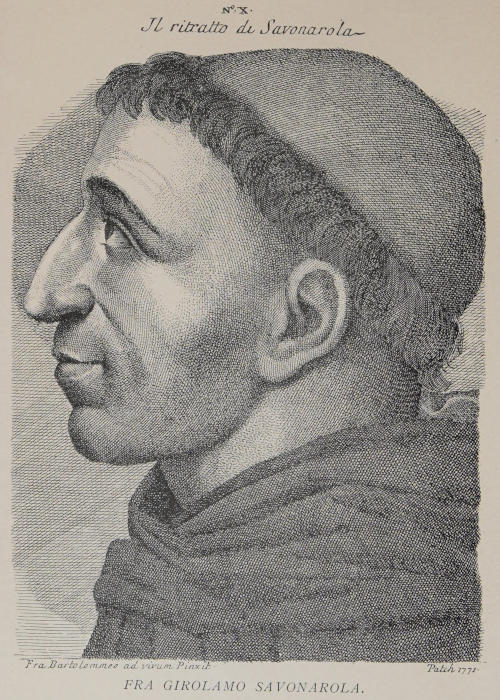
WITH A FRONTISPIECE PORTRAIT OF THE AUTHOR
“The work ... on The Triumph of the Cross is a witness to my faith”
—(Letter of Savonarola to Pope Alexander VI.)
LONDON
SANDS & CO.
DUBLIN
M. H. GILL & SON
1901
Nihil obstat.
Joannes Procter, O.P., S.T.L.
Die Martii 27, 1901.
Imprimatur.
Herbertus Cardinalis Vaughan, Archiepiscopus Westmonast.
Die Martii 28, 1901.
INTRODUCTION.
Savonarola was a speaker rather than a writer. His
was the eloquent ministry of the living word, rather
than the calm apostolate of the lifeless pen. He was
more at home when standing in the pulpit of the
Duomo in Florence, facing the panting, throbbing
crowd, numbering thousands, who, with itching ears and
thirsting souls, drank in his every word, as though the
words were dewdrops from heaven, than when sitting at
the little table—which is still preserved in his lowly cell
at San Marco—holding in his emaciated hand a nerveless,
passionless pen. His great master-intellect and
his large sympathetic heart seemed to long to pour out
their rich pent-up treasures, freely and without stint,
through the channel of his eloquent tongue; whereas
the hand that would perpetuate his thoughts, by stamping
them upon paper, at times seemed palsied. Out of
the abundance of his heart his mouth preferred to speak.
Still he wrote sometimes;—it was generally, however,
under moral compulsion, being impelled to do so by circumstances
which he could not control. He was accused
of error by those, or to those at a distance; his advice was
sought by others who were far away—defence or counsel
had to be committed to paper. For a time he might
not sway the masses, as he would, by the irresistible
magic of his burning words; then we have the apostolate
of the pen. He retired to the seclusion of his
monastic cell, and wrote, as his zeal prompted, his
message to his fellow-men. Many of his treatises—short
ones for the most part—exist. We have his five
books—we might call them chapters, they are so brief—on
“The Simplicity of the Christian Life”; a treatise
on “Humility”; an exposition of the “Our Father,”
and another of the “Hail Mary”;[1] commentaries on
some of the Psalms; an explanation of the Mass,
and of the ceremonies of the Holy Sacrifice; certain
rules for good Christian living (composed when he
was in prison), and a number of other letters and
booklets. But perhaps the most notable, as well as
the most useful, of his writings are the four little
“Books,” as he calls them, which these words are to
introduce to the English-reading public, and which he
himself styles, in the Prologue or Introduction to the
First Book, a defence of “the glorious Triumph of
the Cross” over “the profane and foolish babble of
worldly-wise Philosophers”.
Of St. Philip Neri, the Apostle of Rome, who was
ever staunch in his loyalty to the memory of the one
who, for a time at least, was the Apostle of his own
native Florence, it is said, that this was one of his
favourite books. The Saint’s biographer, Cardinal
Capecelatro, writes: “It is well known that Philip
often read the writings of Savonarola, especially The
Triumph of the Cross, and that he used them for
the instruction of his spiritual children. There are still
preserved in the Vallicella, among the books which
belonged to St. Philip, and which were given by him
to the Congregation, five of Savonarola’s works.”[2]
The history and object of The Triumph of The
Cross, which may be considered the most important
of the works, if we may so call them, of the great
Florentine Reformer, is given by Echard, the Continuator
of Quetif, in his Scriptores Ordinis Prædicatorum.[3]
The Triumph of the Cross is (he tells us) an
accurate work, and one approved by all learned men.
Savonarola undertook it for this special reason, namely,
that he might clearly show what were his real feelings
as regards the Catholic Faith and the Apostolic See;
and that he might refute the calumnious accusation of
heresy and schism, which had been laid to his charge
by his adversaries. It begins thus: “The glorious
triumph of the Cross over the worldly wise and over
wordy sophists, etc.”. It is divided into four books,
of which the first treats of the existence, nature, and
providence of God, and proves the immortality of the
soul of man. In the second the author shows, by
various arguments, how the Christian faith is in accord
with truth and reason. He proceeds, in the third, to
point out that there is nothing, intrinsically, or extrinsically,
impossible in the chief mysteries of the Christian
faith, and that they are not, in any way, at variance
with reason. The fourth book is mainly devoted to an
exposition of the truth of the religion taught by Christ.
It shows that the vagaries of philosophers, astrologers,
idolaters, Jews, Mahometans, and heretics are absolutely
opposed to reason.
This work Savonarola wrote in Latin, and it was
printed at Florence in 1497 in quarto. It was reprinted
there, in quarto, in 1524, and afterwards in Paris at the
Ascension Press, in octavo, in the same year. Next it
was published at Basle by Henrici-Pietri, in 1540, in
folio. Then, more accurately, thanks to the zeal of the
famous John Balesdens, by John Maire at Lyons (1633),
in duodecimo. It was also reproduced at Rome by
Cardinal S. Onufrius Antonius Barberini, brother of
Urban VIII., at the Propaganda Press, in duodecimo,
without any date. Finally, another edition was issued
at Grenoble, in 1666, under the care of the famous
companion of Stephen Mency.
But since many of Savonarola’s adherents were unable
to obtain a copy, and were unacquainted with the Latin
language, in which it was written, in accordance with
their wishes he translated it into the Etruscan tongue,
not indeed (as he warns his readers in his introductory
letter), word for word, or line for line, but merely giving
the sense and the pith of each chapter, and sometimes
(to make a special point the more convincing to his
readers), omitting some passages and adding others.[4]
He says that he did this advisedly, lest it should be purposely,
and maliciously, mis-translated by another. This
was edited at Florence in the year 1497, in quarto, and to
it a Preface was written by Domenico Benevieni, a Florentine
noble, who was Canon Theologian of St. Laurence’s
in the same city. In this Preface Benevieni defended
the author in a very able manner. This version was
reprinted at Venice, by Bernard of Bindoni, in 1531, in
octavo, and again, in octavo, in 1547.[5] It must be
noticed that the seventh chapter of the Fourth Book of
the Latin edition was taken out of its place, and inserted,
by Theodore Bibliandrus, in his collection of works
written against the Mahometan errors. It is to be found
in the second part of the Basle Folio editions of 1543 and
1550, under the title: “Commentatiuncula Savonarolæ
Mahumeticam sectam omni ratione carere ostendens”.
In his Etude sur Jérome Savonarole, the Reverend Père
Bayonne, O.P.,[6] adds to what we have already said, that
the brother of Urban VIII., Cardinal Onufrius Antonius
Barberini—a Capuchin—wishing to vindicate his (Savonarola’s)
innocence, left by will, dated 23rd of August,
1646, 500 gold crowns to bring out a reprint of The
Triumph of the Cross, and his commentary on
the Miserere. The heirs of the Cardinal gave this
commission, as we have seen, to the Propaganda Press;
and these two works accordingly appeared. They were
sufficient to dispel all the illusions of those who still
suspected the author of heresy and of hostility to the
Holy See.
The same writer also quotes M. Perrens as saying that
the Society of Jesus printed The Triumph of the Cross
in their Annals of the Propagation of the Faith (vol. ii.,
p. 211). The most recent edition is one which appeared
in 1899. It was published, both in Latin and Italian, on
parallel pages, at Siena, under the title “Trionfo della
Croce di Fra Girolamo Savonarola, edito per la prima
volte, nei due teste originali Latino e Volgare, per cura
del P. Lodovico Ferretti de’ Predicatori”. I would here
acknowledge, with thanks, my indebtedness to the
Reverend Editor of this valuable edition. He has kindly
put his work at my service in editing the translation
which these words introduce to the English reader.
This is the book which is now presented to the reader
in an English form. It is the first time, as far as I can
ascertain, that it appears, in its entirety, in English.[7]
I say in its entirety. In reality, there are two paragraphs
omitted in the eighth chapter of the Third Book,
the omitted paragraphs being denoted by asterisks.
The reason of the omission is, that the author treats of
a physical question of some delicacy; and, as, since
Savonarola’s day, the views of scientists on the subject
have changed, it has been designedly left out. I may
add, however, that the omission does not in any way
affect the author’s argument.[8] I am fully aware that a
work was published, some years ago, purporting to be an
English translation of the four books, and that the Rev.
Father Lucas, S.J., in his recent biographical study, Fra
Girolamo Savonarola, calls his readers’ attention to it
as “an English translation of The Triumph of The
Cross”.[9] I have the book before me as I write, and I
cannot agree with the learned Jesuit in accepting this
mutilated and eviscerated English version as a translation
of Savonarola’s Triumph of the Cross, nor
do I think that the Florentine Dominican would, were
he able to do so, give either his Nihil Obstat or his
Imprimatur to the work as a reproduction of his own
words, or as the full profession of his own creed. The
title of the book is “The Triumph of the Cross,
by Jerome Savonarola, translated from the Latin ...
by O’Dell Travers Hill, F.R.G.S.”; it was published
in London in 1868. It is not a translation of The
Triumph of the Cross. It is, apparently, only a
translation of certain portions of the book which would
prove palatable to the class of readers for whom the
“translation” was clearly intended. Whole chapters
have been dropped out, evidently without the slightest
compunction, certainly without the least explanation.
In some of the chapters which appear, lengthy passages
have been omitted without the shadow of hesitation.
Truly, it is Hamlet without the Prince of Denmark.
It is no more a translation of the great Dominican’s
famous defence of his orthodoxy—as The Triumph
of the Cross was intended to be—than the garden-fence
of a suburban London villa is a reproduction
upon English soil of the Wall of China, or than
Primrose Hill is an English replica of the Alps. If the
books of Catholic Apologists are to be “translated” in
this way, what is to prevent a Unitarian from giving us
in English an edition of the Bible without any allusion
direct or indirect, to the Blessed Trinity? Or what is to
hinder an Agnostic from reproducing the Gospels in our
mother-tongue, without any reference to the Central
Figure, around whom the whole of the sacred writings
revolve?
The “translator” tells us in his Preface that “this
book is free from all sectarian feeling or prejudice”.
No doubt it is. But why? Everything “sectarian”
in The Triumph of the Cross has been left out
in the “translation”. He speaks of “its freedom from
all sectarian spirit, from all scholastic quibblings”; and
concludes that “its close consecutive reasoning, its
earnestness, convince us that its author was a man far
in advance of his age”. If the unbiassed reader will
peruse the pages of this translation, from first page to
last, from the opening chapter of the First Book to the
closing chapter of the Fourth, and compare the doctrine
of the four books with the teaching of any book written
by any recognised Catholic Apologist, in any tongue,
in this twentieth century, he will find that, in a sense,
the words of the Preface are true, and that Savonarola,
writing in the fifteenth century, was “in advance of his
age”; that he was one with the Catholic writers of this
twentieth age. If he will pursue his reading still
further, and compare the true Triumph of the Cross
with the works of the Catholic Apologists of the middle,
and earlier, nay the earliest ages, he will find that
Savonarola was behind his age, as well as being in
advance of it. There are no “ages” in the history of
the Catholic Creed of the Catholic Church. Like
Jesus Christ, the Church and the Church’s teaching are
“yesterday, to-day, and the same for ever”.[10] Savonarola’s
teaching in this profession of his creed—the
creed in which he lived, in which he died, and which
he preached through life and with his dying breath—is
the creed of the Catholic Church in all places and
in all times. “This is My Covenant with them, saith
the Lord. My Spirit that is in thee, and the words
that I have put in thy mouth, shall not depart out of
thy mouth, nor out of the mouth of thy seed, nor out
of the mouth of thy seed’s seed, saith the Lord, from
henceforth and for ever.”[11]
The translator of what I cannot but call the PseudoTriumph of the Cross, but which he ascribes to
Savonarola, professes on the title-page that it is “translated
from the Latin”; and in the Preface he assures
his readers that “this translation has been made from
a valuable copy, printed with all the abbreviations
peculiar to Savonarola’s manuscript, found in the
Archives of Sion College”. Where, then, does the
fault lie? Who is responsible for the omissions?[12] Is
the defect—or are the defects, for their name is
“Legion”—in the original, or in the “translation”?
Let us see. There is only one Latin copy of The
Triumph of the Cross in the Sion College Archives,
and, as the translator says, it is “a valuable copy”. It
lacks the first page; otherwise it is complete. The loss
of the title-page, however, matters little, as the edition
is recorded at the end of the book: “Venumdatur in
aedibus Ascensianis. Typog. Ascensiana, MDXXIIII.”
Truly “a valuable copy,” printed in Paris by a certain
J. B. Ascensius in the year 1524, only twenty-six years
after the author’s tragic death. It is not the first
edition. This, as we have seen, appeared in Florence
in 1497, the year before he died. Still it is an early
edition. There is another copy of this Ascension
Press edition of 1524 in the library of the British
Museum. A third copy, belonging to the library of
the Dominican Fathers at Woodchester, lies on my
desk as I write these words. It is a small octavo
volume bound in vellum, and besides The Triumph
of the Cross, it contains several other treatises of
the Florentine Dominican. The inscription at the end,
with the date, corresponds to the Sion College copy.
The space at my command will only allow me to call
attention to two or three discrepancies between the
original, the “valuable copy” found in the Archives
of Sion College, and the book which claims to be a
translation.
In the original Latin edition, the Third Book contains
eighteen chapters; in the translation only fifteen
chapters appear. There is no explanation given, either
in the Preface or in the body of the work, of the reason
of the omission, nor is it stated that these three chapters
are omitted. The chapters which are absolutely ignored
in the pseudo-translation are those which appear in the
original, and in this present translation, as chapters xv.,
xvi., and xviii. If the reader will refer to them, he
may perhaps form his own opinion as to the reason
of the omission from what purports to be a translation.
These chapters contain what the translator would probably
call “sectarian” teaching; they embody the
“sectarian spirit,” from which, he tells us, The
Triumph of the Cross is free. The first of the
three omitted chapters treats of the Sacraments, and
teaches that there are seven, even as does the Catholic
Catechism of to-day. Following the argument of St.
Thomas, the author shows the need of each of the
seven Sacraments, from the analogy between the life
of the body and the spiritual life of the soul. In the
following, or sixteenth chapter, which the translator,
on his own responsibility, evidently puts under a ban
of excommunication from an English home, Savonarola
treats of what the scholastics call “the matter and
form” of the Sacraments, and explains, in terse and
clear words, the meaning and object of each of these
seven channels of grace to the soul. This chapter is
“sectarian” indeed. Hence, we may presume, its
eradication, its being pulled up root and branch from
English soil; hence its elimination from English pages;
hence its absolute extermination, as far as English
readers are concerned. Savonarola wrote it in Latin,
and reproduced it in Italian, but we will have no popery
and no popish doctrine in our pure English tongue!
We have it, however, at last, in this translation, as we
have had it from the beginning in the chapter of the
original to which I allude. Baptism, Confirmation,
Holy Eucharist, Penance (or Confession), Extreme
Unction, Holy Orders, Matrimony—all are there, with
their object, their meaning, their “matter and form,”
as the scholastics would call their component parts,
their mode of administration, and their effects upon
the human soul in time and in eternity.
Finally, in the third of the proscribed chapters—the
eighteenth in the original work—we have a dissertation
on the Ceremonies of the Church. Savonarola shows
with what wisdom they form part of the Church’s
discipline, and how they answer to a demand of the
soul of man in his worship of the Most High. The
author explains, too, some of the practices of the
Catholic Church, which, in our days, as in his own, are
often misrepresented or misunderstood.
The unprejudiced reader may draw his own conclusions
as to the reason of the omission of the three
chapters from the book we have been referring to, and
which appear, probably for the first time in English,
in the pages which follow this Introduction. The
Twenty-fifth of the Thirty-nine Articles of the Anglican
Creed declares: “There are two Sacraments ordained
of Christ our Lord ... Baptism and the Supper of
the Lord”. Savonarola says there are seven. The
Twenty-eighth Article professes that “transubstantiation
... cannot be proved in Holy Writ; it is repugnant
to the plain words of Scripture”. Savonarola, on the
contrary, holds that the Catholic doctrine can be
proved, and that it is clearly taught in Holy Writ by
Jesus Christ the Divine Teacher. The Thirty-fourth
Article attaches little importance to ceremonies, and calls
in question the need of outward uniformity in the
services of the Church. Savonarola has an entire
chapter written in their defence and explanation, in
which he speaks of crucifix and images, of devotion to
the Mother of Jesus, of the consecration of churches,
of lighted candles, of sacred vessels, and even of holy
water. What then? The Articles are right; Savonarola
must be wrong; he must be “sectarian”. Then
leave out the sectarianism; omit the chapters in which
he treats of subjects which are distinctly and essentially
Catholic. It is the old story. They will make Savonarola
a Protestant, or, at least, a herald of Protestantism,
a precursor of Luther and Calvin, a harbinger of
the Reformation, whether he will or no. Whereas, as
every reader of his history and writings must know,
he was of Catholics the most Catholic—Catholic
in life, Catholic in death, Catholic to the heart’s
core.
I must leave it to the calm unbiassed judgment of
the reader to decide whether this kind of translation
is fair; whether it is just to the memory of the great
Dominican whom so many, Catholics and non-Catholics
alike, profess to revere; whether it is just even to the
English-reading people, to the vast majority of whom
original works written in Latin or Italian are sealed books,
and who have consequently to depend upon the fidelity
and accuracy of a translation. If the translator had professed
to give an expurgated edition of The Triumph
of the Cross; if he had told his readers that he had
eliminated everything that was “sectarian”; if he had
undertaken to give selections from the work, in defence
of Christianity; if he had professed to reproduce, in
more modern English, the translation published by the
Cambridge University Press in 1661, to which I have
referred—this we could understand; but to call a book
with several chapters ruthlessly discarded, “The
Triumph of the Cross translated from the Latin”—this,
assuredly, it is beyond the power of words to
condemn. The translator of the Cambridge edition of
1661—as we may readily understand both from the
date and the place of the publication—omits the
identical passages omitted in the edition of 1868—those
which I have referred to, and others to which I shall
refer,—but he is candid and fair in so doing. He
prepares the reader for this in his Preface or Dedicatory
Letter, to which he appends his initials, J. W. B. “I
know” (he writes) “that you will not disdain to look
upon him (Savonarola) in this English Dress, wherewith
I have attired him; nor blame me for having cut off
some few shreds, that he might, with more credit, appear
amongst us.... You will approve of my choice of this
author, who lived in the thickest darkness of popery.”
Not so, however, the “translator” of the English edition
of 1868. He suppresses whole paragraphs and entire
chapters without note or comment. Moreover, he assigns
no reason for so doing.
One further reference, and I have done with this so-called
translation. In the original edition of A.D. 1524
we find in the Fourth Book nine chapters. In the
mutilated English version we find also nine. No
chapter, it is true, is bodily omitted from the Fourth
Book. One chapter, however, has come under the
reckless and unscrupulous pruning knife of the translator;
evidently, again, because it ran counter to his
religious views, or the preconceived ideas of those for
whose benefit he was translating. The sixth chapter of
this Fourth Book, which professedly treats of the doctrine
of heretics, is in reality a dissertation on Church government,
and a plea for visible Church unity under one
visible head. After instancing, by way of analogy, the
unity of bees under one queen, and the unity of the
members of the human body under one head, the author
goes on to show the need there is of one Chief Ruler
in the Church. He quotes the prophet Osee, and also
the well-known words of our Lord about the “One
fold and the One Shepherd”. He then proceeds to
argue that Christ was the visible Head of the Church
when on earth, adding that when He ascended into
Heaven, He would not leave the Church “without
any earthly head,” seeing that in such a case it
would become a prey to divisions, confusion, and disorder;
and therefore He said to Peter, “Feed My
sheep”. “Thou art Peter, and upon this rock,” etc.
And again: “I will give unto thee the keys of the
Kingdom of Heaven,” etc. All this we find word for
word in the English version which we are considering.
Savonarola then continues—and the whole of the
following words are excluded from the
pseudo-translation:—“It can not, however, be
supposed that Christ conferred this dignity on Peter
alone, to the exclusion of his successors, since He
Himself has declared that the Church should endure
for ever in the order which He had established. Speaking
to His disciples, and, in their person, addressing
all the faithful, He said: ‘Behold I am with you even
unto the consummation of the world’ (Matt. xxviii.
20). And again, by the mouth of Isaias, He said: ‘He
shall sit upon the throne of David and upon his kingdom;
to establish it, and strengthen it with judgment
and justice, from henceforth and for ever’ (Is. ix. 7).
These passages clearly indicate that the office confided
by Christ to St. Peter, being highly expedient
and necessary to the Church, should, by an unbroken succession,
be guaranteed to her for ever. Hence it follows
that, as Peter was chosen by Christ to be His vicar
and the shepherd of the whole Church, all his successors
must inherit his power. And, as the bishops of Rome
hold the place of Peter, the Roman Church must
consequently be the mistress and ruler of
all churches, and the whole body of the
faithful must live in unity with the Roman
Pontiff. Whosoever, therefore, disagrees in his
teaching with the doctrine of the Roman Church withdraws
from Christ, following crooked ways. And, as all
heretics dissent from the teaching of the Church, they
have all declined from the right way, and are unworthy
of the name of Christians. For by heretics we mean
such as, falsifying the words of Holy Scripture and
choosing a religion for themselves, do obstinately
persevere in their error.
“Again, Truth, as is often said, mates with truth, and
all truths confirm each other. Now heretics disagree
so entirely among themselves, that they have scarcely
one point in common, nay, rather they bespatter each
other with abuse; they present no solidity of argument.
This fact alone proves how far they have wandered
from the Truth. But the doctrine of the Roman
Church, in all matters affecting faith or morals, is one;
and Catholic doctors, though almost innumerable, never
dissent nor desire to dissent from it.”
Every syllable of this profession of Savonarola’s
faith in the supremacy of the successor of St. Peter
is expunged in the translated version. There are no
asterisks to show that words are left out. There is no
footnote, no word in the Preface, to explain the unpardonable
liberty of the translator. A comma is put
after the words “loosed in heaven,” and the translator
continues,—as though this were the author’s continuation,—“from
which we may see that Jesus Christ,”
down to the words “He shall sit and rule upon the
throne of David,” etc. The entire passage about the
successor of St. Peter, “Hence it follows,” is summarily
omitted from what purports to be a translation.
I have nothing more to say, except, in justice to
Savonarola, to enter a protest against the book to
which I have been referring being considered a translation
of The Triumph of the Cross. If I have
dwelt at length upon this subject, it is only out of
respect for, and in justice to the memory of, one for
whom I have a sincere veneration, and who has so
often, and so unjustly and unjustifiably, been represented
as being wanting in loyalty to the See of
Peter, of being “a forerunner of Luther,” and “a harbinger
of the Reformation”.[13] It is by such methods
as the one against which I am protesting that these
accusations against the Catholic loyalty of Savonarola
have been apparently substantiated. It is by the persistent
repetition of them that they have been perpetuated.
“Here” (they say) “is a book of his which professedly
gives us the articles of his creed. It is absolutely
unsectarian. There is nothing distinctively Catholic in
it. Nothing which any non-Catholic could object to.
There is not a word about the seven Sacraments,
about Confession, Extreme Unction, the Mass, Ceremonies,
and above all about the Pope being the successor
of St. Peter in the government of the Church!”
And yet the reader will find all these doctrines of
Catholic belief clearly and luminously treated. He
will find an explicit profession of faith in all the vital
and crucial articles of the Catholic Creed in the volume
which is now presented to him, together with the
author’s “reason for the hope which was in him”. For
Savonarola was ever mindful of the admonition of the
Chief Apostle, “being always ready to satisfy every
one that asketh you a reason for that hope which is
in you”.[14]
The Triumph of the Cross ought to “satisfy”
the English mind upon the subject of his orthodoxy
for ever. The Triumph of the Cross gives the
“reason” of it, in clear and concise and unmistakable
words. It is difficult to see how any one who has
read it, could entertain the shadow of a doubt about
the author’s loyal devotion to the Church of which he
was a faithful child, or of his belief in the teaching of
the one whom he proudly called his “Mother”. Indeed,
it is impossible to see how, with the evidence of this
book before him, any man could hesitate for a moment
as to his belief in the unwavering loyalty of Savonarola
both to the Church and the Church’s teaching, and to
her divinely appointed visible Head.
St. Peter, the Dominican Martyr, as he fell under the
blow of the assassin’s sword, wrote with his own blood
on the ground the word Credo. Savonarola, the
Dominican Apologist, has written Credo in large
letters over every page of The Triumph of the Cross.
It is a history of the religious opinions of his times. It
is more. It is the exposition in writing of the doctrines
which he preached, with such incomparable eloquence,
from beginning to end of his apostolic life. It is his
clear and uncompromising profession of faith to all
time. It is his solemn anathema to heresy, of which,
nevertheless, men have sometimes dared to accuse him.
This book ought to lay that ghost of an accusation
against the Florentine Reformer for ever and for ever.
It proclaims Savonarola’s Catholicity beyond denial or
doubt. It was intended to be his defence of the faith.
It was written as his profession of belief. It was to be
his Credo in life, and the echo of his belief after his
death, when his voice was still, and he could no longer
protest, as he did with such vigour in his lifetime,
against his false accusers. In the Preface which he
wrote to the Apologeticum Fratrum Sancti Marci—published
probably the year before his death—he
says: “Three accusations have been brought against
me: (1) That I have taught a doctrine which is not
true (perversum dogma) ... to this I have already
replied, and my orthodoxy will be clearly seen in my
work, The Triumph of the Cross, which will
shortly appear”. In a letter to Pope Alexander VI.,
written from St. Marco, Florence, on the 22nd of May,
1497,[15] he writes: “The work which I shall shortly
bring out on The Triumph of the Crossis a
witness to my faith; and from it can be seen if I have
ever taught heresy, or in any way opposed the Catholic
faith”. This book is his testimony unto all time.
The late indefatigable and zealous champion of
Savonarola, Professor Paolo Luotto, wrote a goodly
volume, to which he gave the title: Il Vero Savonarola,
et Il Savonarola di S. Pastor. The English
people, as well as Signor Pastor, have had a Savonarola
of their own. The Savonarola of the English
is a Savonarola created by novels and romances,
by non-Catholic and anti-Catholic histories and biographies,
by prejudiced enthusiasts, and unscrupulous
translators. This faithful English translation of the
whole of The Triumph of the Cross—for which we
are indebted to an anonymous but graceful as well as
faithful pen—will, let us hope, reveal The True Savonarola—the
Savonarola of fact and not of fiction,
the Savonarola of history and not merely of romance,
the Savonarola as mirrored in his own words, and not
as misrepresented and distorted, and rendered beyond
recognition by many who, whilst professing to extol him,
and to add lustre to his name, have, in reality, belittled
him, and sullied his fair fame.
JOHN PROCTER, O.P.
Postscript.—Since writing the foregoing Introduction
the recent valuable and interesting work, The
Story of Florence, by Mr. Edmund G. Gardner, has
come into my hands. I have much pleasure in transcribing
the following note, which occurs on page 128:
“Professor Villari justly remarks that ‘Savonarola’s
attacks were never directed in the slightest degree
against the dogmas of the Church of Rome, but solely
against those who corrupted them’. The Triumph
of the Cross was intended to do for the Renaissance
what St. Thomas Aquinas had accomplished for the
Middle Ages in his Summa Contra Gentiles. As this
book is the fullest expression of Savonarola’s creed, it is
much to be regretted that more than one of its English
translators have omitted some of its most characteristic
and important passages bearing upon Catholic practice and
doctrine, without the slightest indication that any such
process of ‘expurgation’ has been carried out.” The
italics are mine.
The Christian teaching concerning the Sanctification, Glory,
and Resurrection of rational creatures contains no Article which
is either impossible or unreasonable
Our belief in the Passion of Christ, in the other mysteries of
His Humanity, and in all the Articles defined by the Church, is
strictly consistent with reason
THE TRUTH OF FAITH MANIFESTED BY THE TRIUMPH OF THE CROSS.
BOOK I. THE TRUTH OF OUR FAITH MADE MANIFEST IN THE TRIUMPH OF THE CROSS. — PROLOGUE.
Written by Fra Girolamo Savonarola of Ferrara, of the Order of Preachers.
The glorious triumph of the Cross embraces so many
mysteries that, in attempting to unfold them, and thus
to silence the profane and foolish babble of worldly-wise
philosophers, I am undertaking a task far above my
powers, and can trust only to the help of the Lord.
It would seem mere waste of time to discuss and
analyse our Faith, based as it is upon the miraculous
works of our Saviour Jesus Christ, which are patent
to the whole world, and upon the teaching of venerable
theologians. Nevertheless, there are nowadays men
living in such bondage to vice, that, even in the light
of the noonday sun, they grope in darkness, and scorn
the marvels of heavenly science. I, therefore, on fire with
zeal for the House of God, intend, for the sake of the
salvation of these misguided men, and in order to rouse
them from the slumber that oppresses them, to recall to
their memory the things of Christ, which they have
forgotten and thrust from their hearts.
Our Faith cannot be demonstrated by natural principles
and causes. Nevertheless, the past and present
events of Church history afford arguments in support of
our religion so convincing that no logical mind can reject
them. At the same time, no one believes that Faith itself
depends upon these arguments, seeing that it is “the gift
of God; not of works, that no man may glory” (Eph.
ii. 8, 9). We make use of these arguments indeed;
but we do so in order to confirm the faith of such as
waver, to prepare unbelievers for the reception of supernatural
light, and to enable the faithful to confute the
arguments of irreligious men; and thus, by exposing
their folly, to undeceive the simple and unlearned who
have been misled by them.
This use of human reasoning does not detract from
the value of Faith; for the axiom that faith proved by
argument has no merit, refers only to the faith of such
as refuse to believe without proof. They who, being
enlightened by God, embrace the Faith without proof,
and who then, in order to strengthen their own belief
and that of others, investigate the grounds of their faith,
deserve commendation, and obey the precept of St. Peter:
“Sanctify the Lord Christ in your hearts, being ready
always to satisfy every one that asketh you a reason of
that hope which is in you” (1 Peter iii. 15). In this
book we intend to be guided by reason only. We shall
not, then, appeal to any authority, but shall proceed as if
we had no belief in any one in the world, no matter how
learned he may be. We shall rely solely on reason. Such
a mode of procedure must, surely, satisfy every one who
is not absolutely foolish.
CHAPTER I. HOW BY MEANS OF VISIBLE THINGS WE ARRIVE AT THE KNOWLEDGE OF SUCH AS ARE INVISIBLE.
The senses, in which all our knowledge originates, take
cognisance only of extrinsic corporeal accidents. Our
understanding, on the other hand, is enabled, by its
subtlety, to penetrate to the substance of natural things,
and thence to rise to the knowledge of such as are invisible
and immaterial. Thus, by the investigation of the
substance and properties, the order, the causes and the
activities of visible things, we are led, by little and little,
to the understanding of invisible substance, and, at length,
to the knowledge of the Divine Majesty; just as, by
means of the external accidents and operations of man,
we arrive at the understanding of his soul, and of its
invisible parts. Philosophers, from the contemplation of
the universe—of the heavens with their magnificence; of
the elements with their divers motions and operations;
of the variety and activity and individual perfections of
the things composed of these elements; and of the
wonderful harmony and greatness and beauty of this
visible world—have raised their eyes to gaze upon invisible
things, and to investigate (so far as might be) their nature
and properties.[16] And, as these philosophers have understood
that natural things are the work of God’s hands,
and are the means of arriving at a knowledge of His
infinite power and glory, we likewise desire to show that
those things which have been seen, and are still witnessed,
in the Church of God, are Divine works, by which we
may attain to the knowledge of the glory and Infinite
Majesty of our Saviour Jesus Christ, who is unseen by us.
Sages of old were wont to marshal before their eyes
all the visible things of the universe. Thus, the wonderful
works of nature constrained them to acknowledge
God as the First Cause of all things, and natural
phenomena as the creation of His unerring wisdom.
We, in like manner, must bring together before our
minds all the wonderful works of Christ, whereby we
desire to prove that He was the First Cause of all things,
and that all His doings proceeded from God, who cannot
err. We would not be understood to say, that these
proofs cause Christians to believe; for they are established
in their faith by the supernatural light of God
(otherwise, their belief would be, not faith, but opinion).
But such testimonies confirm us in our Faith, and prove
to our adversaries that we believe, not lightly, but
thoughtfully and with deliberation. In order the better
to bring the works of Christ, which are continually being
performed in the Church, before the eyes of men, we will
describe them under the figure of a triumphal car, the
figure of the entire universe.
CHAPTER II. HOW THE TRIUMPH OF CHRIST TESTIFIES TO THE TRUTH OF OUR FAITH.
As the power, wisdom and goodness of God are infinite,
they could not be manifested (save most imperfectly) in
one creature. Therefore, philosophers have been wont to
contemplate the Divine Majesty, revealed in the harmony
of the universe, resulting not from one but from numberless
creatures, which, on account of their necessary dependence
one on the other, can with ease be considered
simultaneously. In like manner, we cannot understand
the power and wisdom and goodness of Christ by contemplating
only one of His works. We must recall to
our minds all the wonders which He wrought. Thus we
shall be constrained, not on one count alone, but for many
reasons, to acknowledge His Divinity. For, should we
not be convinced by one of His miracles or arguments,
we cannot (unless we be obstinate) fail to be persuaded
when we consider His works and teaching collectively.
But, although it be easy, by reason of their mutual dependence,
to consider all the marvels of nature collectively,
it is not equally easy to contemplate all the works of Christ
at once. It has, therefore, occurred to me to present them
under the figure of a triumphal car, a similitude easy of
comprehension to the feeblest intellect.
Let us, then, represent to our minds a four-wheeled
chariot on which is seated Christ, as Conqueror, crowned
with thorns, and bearing the marks of His wounds, thus
showing that it is through His Passion and death that
He has overcome the world. Over His Head shines a
light like a triple sun. This represents the Blessed
Trinity, which illuminates His Humanity and the whole
Church with unspeakable splendour. In His left hand
Christ holds the Cross and the instruments of His
Passion, in His right the Old and the New Testaments.
At His Feet are the Host and chalice; vessels of balsam
and of oil; and the other symbols of the Sacraments.
The Blessed Mother of God, the Virgin Mary, is seated
beneath her Son. Around, and below her, are vessels
of gold, silver and precious stones, filled with ashes and
bones of the dead. The Apostles and Preachers go
before the car, appearing to draw it. They are preceded
by the Patriarchs, the Prophets, and innumerable men
and women of the Old Testament. The chariot is encircled
by the army of Martyrs, forming as it were a
crown. They, again, are surrounded by the Doctors of
the Church, bearing open books. Around them, again,
circles a countless multitude of virgins, of both sexes,
adorned with lilies. Behind the car follow innumerable
men and women of all conditions—Jews, Greeks, Latins,
barbarians, rich and poor, learned and simple, small and
great, old and young; all of whom, with one accord, are
praising Christ. And, all around this multitude, gathered
from the Old and from the New Testaments, are the
serried ranks of the enemies of the Church of Christ—emperors
and kings; princes and men in power; sages;
philosophers; heretics; slaves and freemen; men and
women; people of every race and of every tongue. Whilst
around them lie idols, prone and broken, heretical books
burnt, and all sects, and every false religion confounded
and destroyed.
Now the chariot which we have described symbolises
a new world, from whence shall spring a new philosophy.
Its first cause, and the invisible things which become
known to philosophers by means of visible things, are
represented by the figure of the Blessed Trinity, True
God, above the Head of Christ which represents His Manhood,
and by the innumerable company of Angels and
Blessed Spirits, who are all unseen by us. We must
arrive at the knowledge of these spiritual beings by means
of the visible beings grouped around the chariot. And,
just as philosophers teach that the heavens are the cause
of all things produced beneath them, so we say that,
after the Divine Majesty, the chief cause of grace and
salvation is the Passion and Cross of Christ. Beneath
the firmament are the elements, which derive all their
activity from the heavens; so to the Passion of Christ
succeed the Sacraments of the Church, deriving all their
power from It. The elements are followed in the
natural world by particular causes, such as seeds and the
like. In our triumph, the seed is represented by the
teaching of the Gospel, and by the works and example
of the Saints whose relics repose in honour in glorious
tombs, and the memory of whose merits and holy lives
produces continual fruit in the Church. Particular causes
are figured by the Apostles, Patriarchs, Prophets, Martyrs
and Doctors; who, while they lived, regenerated, by
their teaching, the whole world to Christ. Lastly, as in
the natural order effect follows cause, we represent effect
by the countless men and women who have been converted
by the example and the preaching of the Saints.
But, as in nature, every movement is from one contrary
to another, and the generation of one thing is the
destruction of something else (for in all reproductions
there are two opposing forces, of which the stronger
prevails), so, in the spiritual generation, Christ and His
elect have vanquished His enemies, represented by
heresy, prostrate around the triumphal car. The four
wheels of the chariot signify the four quarters of the
world, so marvellously enlightened by Christ, and by
Him brought into subjection.
And, as philosophers, having before their eyes the
order of the universe, and considering the wonderful
effects of nature, did, by searching for their causes, ascend
gradually from the lower to the higher, and attained
to the knowledge of invisible things and of the Divine
Majesty; so, if we examine attentively the works which
Christ has performed, and still does perform, in His
Church (represented by this chariot), we shall begin to
be filled with wonder, and shall diligently seek the
cause of those works, and thus shall, gradually, rise to
the knowledge of invisible things, and of the Divine
Majesty of Christ.
CHAPTER III. CONTAINING CERTAIN FUNDAMENTAL AND IRREFRAGABLE PRINCIPLES.
If an argument is to be conducted satisfactorily, the disputants
must agree with each other about some point.
For, if they disagree on every point, there will be no
possibility of discussion. They may, or may not, of
course, think alike on matters of minor importance; but
they must agree about certain principles, which are so
generally accepted that no one denies them. We must,
therefore, take up our position on certain acknowledged
principles. We cannot argue with one who denies them;
for he who refuses to accept first principles is unreasonable.
First, then, we are all agreed that Jesus Christ
was crucified by the Jews, and was afterwards, throughout
almost the entire world, adored as God, as we Christians
adore Him. This fact is admitted by Jews,
heretics, Mahometans, Greeks, Latins and barbarians;
the belief in it has never died, but has been handed
down, from generation to generation. Testimony to
this conviction is, further, forthcoming in the books
written in every language and diffused throughout the
world, and in the ruins of Christian churches to be
found in every land. These are proof positive that
there is not a spot on the face of the earth where Christ
has not been worshipped, or is not still adored, or where,
at least, there is not some knowledge of Christianity.
Hence, even unbelievers speak of Christ as the God of
the Christians.
If, therefore, no reasonable being will controvert that
which is made manifest by the books and the monuments
of every nation; he who should deny that Christ was
slain by the Jews, and was afterwards adored as God
throughout the world, must be so foolish, that argument
with him would be waste of time. And, if it be acknowledged
that the adoration of Christ has been universal,
the same must be said of the confession of the Blessed
Trinity, and of the Eucharist, the veneration of the
Cross, of the Virgin Mary, and of the Saints. The same
evidence demonstrates, further, that the Apostles, who
were at first fishermen, preached the Cross of Christ;
that they were preceded by the Jewish people, the
Patriarchs and Prophets; and that they were followed
by the glorious Martyrs, the venerable Doctors, the spotless
Virgins of the Church, and likewise by an untold
number of monks and priests, both regular and secular.
Finally, we must remember that, although the tyrants
and the philosophers of the world have fought against
the Church, idolatry, nevertheless, has been destroyed,
heresy has been extirpated and even the Roman Emperor
has been brought into humble subjection to the
fisherman, and that the heretics and their heretical books
have been destroyed. These things being so well known
as to need no proof, we shall presuppose them, as philosophers
are wont to presuppose the truths of science.
For they are acknowledged, not only by Christians, but
by nearly every people and in almost every country, yea
even by Indians and innumerable Mahometans, amongst
whom exist certain proofs of our faith, who admit that
Christ has reigned amongst them and has worked
miracles, and who, although they themselves are in
grave error, yet punish severely all who blaspheme the
Christian truths. Since, then, these truths are so clearly
manifest, they can be gainsaid by none but such as are
foolishly obstinate.
CHAPTER IV. ANSWERS TO THE OBJECTIONS WHICH MAY BE BROUGHT AGAINST THE FOREGOING PROPOSITIONS.
But perhaps some one will say: If your assertions be true,
surely it is strange that no pagan historian or orator
should make any mention of them; but that they, who
minutely describe the wars and other doings of men,
should pass over in silence the works of Christ, which
are so much greater and more wonderful. Exception
must be made in the case of certain historians, who,
wishing to refute Christianity, have rendered testimony
to its truth.
To these objections we reply, that it is false to say that
pagan historians have not written concerning Christ and
His Church. For not only have many authors, both
Greek and Latin, treated fully and eloquently of His
praises, but many of them have been converted to His
Faith, and have propagated it by their preaching and
their writing.[17] And, if our objectors should reply, that
they allude not to those who, after their conversion, have
written about Christ, but to those who have remained in
their errors; our answer is, that our Faith has confirmed
its converts to such a degree, that, not only have they
written of the praises of Christ and of the Church, but
they have not hesitated to shed their blood for His
religion. For not only have those brought up from
their infancy as Christians written in behalf of their
Faith, but likewise innumerable and well-known men, of
different nations, have embraced the truth in their more
mature years. And it is a much more convincing proof
of the truth of Christianity, that its converts should have
died for it, than if they had remained heathens and had
written volumes in its praise. What wonder that proud
and incredulous men should have neglected to narrate
the works of Christ, when, beholding His miracles, they
refused to accept His Faith!
There are two further reasons why pagan historians
have not written in praise of Christ. One reason is the
providence of God; the other their own blindness. God
moves all things, both corporeal and spiritual, and cares
for all things; and no one can move himself to write,
unless he be inspired thereto by God. Therefore, the
heathen historians have not written of Christ, because
God did not move them to do so.
Now, Divine Providence did not inspire them to write
for three reasons. First, God ordinarily makes use of
fitting means to achieve an end, and the pagan philosophers,
who were stained by infidelity and other vices,
were not fit to write of the pure and holy works of
Christ and of His Church.
Secondly, as Christ is Truth itself, and came into the
world to give testimony of the truth, it was not seemly
that men, who, like the pagan poets, orators and historians,
perpetuated lies and fables and praised the foulest
deeds, should have defiled the pure truths of Christ by
writing of Him.
Thirdly, the heathen orators had none but the eloquence
which springs from natural reason; they sought
rather to magnify themselves than to declare the truth.
As the works of Christ, on the other hand, are above
natural reason, it is evident that these pagans were not
fit men to treat of them.
Another cause which prevented the heathen writers
from bearing witness to Christ was the blindness, caused
by their sins, especially pride and vain-glory, which so
completely darkened their hearts that they took no
account of the miracles wrought by Christ, such as the
restoration of sight to the blind, the raising of the dead,
and so many other wonders, which none but God could
perform. Furthermore, as the heathen authors had been
nurtured, from their infancy, in the worship of their gods,
and in idolatrous fables, they, naturally, entertained a
hatred for Christianity, the sworn enemy of idolatry.
They would not, therefore, write anything in favour of
the Church, both on account of their detestation of her,
and for fear of exciting the displeasure of the tyrants
who persecuted the Christians.
Again, we must remember that these poets and orators,
by their egregious flattery, cultivated the good graces of
princes, in the hope of being rewarded by them; and, as
they knew that there was nothing to be gained from Christians
who loved truth and professed poverty, it is not surprising
that they did not write about Christ. Now, on the
contrary, when the Church possesses temporal dominion,
there is no lack of poets and orators to sing the praises of
her princes and prelates; they often even mingle with
their eulogies many things which are not true. If the
Gentile authors did not espouse the cause of Christ, we
need not go far to find the reason of their silence.
CHAPTER V. THE MODE IN WHICH OUR ARGUMENT MUST BE CONDUCTED.
Since we attain to the knowledge of the invisible by
means of the visible, we must understand, that there are
some among the invisible things of God which we can
know by the natural power of our understanding, and by
means of natural things. Such things are, the Existence
of God, His Unity, His Simplicity of Being, and other
truths of this sort, to the knowledge of which philosophers
have attained. But there are others among the invisible
things of God, which we cannot discover by means of
human reason. This is not very strange, seeing that,
even among men who are equal by nature, philosophers can
understand high and subtle matters, of which children
and simple persons must remain in ignorance. This
being so, is it to be wondered at that in God there are
secrets, which no created intellect can investigate? We
cannot understand many of the things which we meet
with every day; how then shall we comprehend God,
who infinitely surpasses all things?
The Divine things which our natural reason is not
competent to discover are those which we believe by
Faith, to wit, the Trinity and Unity of God, the Divinity
and Humanity of our Saviour Jesus Christ, and other
truths of the like nature. But, although we cannot
prove these truths by natural effects or human arguments,
we may, nevertheless, make ourselves very sure
of them by their supernatural effects. For, just as,
by natural effects, we know that the propositions, “God
exists,” and “God is One and Infinite,” etc., are true,
and yet by means of them know not God as He is, nor
behold His Substance; so also, by means of supernatural
effects, we can certify ourselves of the truth of such
propositions as “God is Three and One,” “the Son of
God is both God and Man”. Yet we cannot understand,
nor see these truths, as they are in themselves.
As nature precedes grace, we will first treat of those
invisible things of God which we are competent to
investigate by means of their natural effects, and afterwards
of those which can be known by their effects
which are supernatural. The truths of the first category,
however, we will consider very briefly, since Catholic
theologians and philosophers have discussed them so
thoroughly, as to leave no possibility of doubt.
CHAPTER VI. THE EXISTENCE OF GOD.
If we do not mean to stultify our whole argument, we
must begin by proving the existence of God. What do
we mean by God? All men use this name to designate
that which is higher and more excellent than all other
things. Some call this Highest Being the Prime Mover
of all things; others call it the First Cause and Principle,
or the Highest Good and Supreme Truth. But, whatsoever
God may be called, if His name expresses the
highest and superexcellent nature, His existence must be
acknowledged. This is admitted even by philosophers.
It is of His existence that I wish briefly to speak.
Philosophers have proved, most effectually, that everything
that moves is moved by something else. Even
though men and brutes move themselves, there is in
them one thing that moves and another that is moved;
for the body cannot move when abandoned by the soul.
And, since every movement under the heavens depends
on the movement of the heavens, there must be some
substance that moves the heavens. Now, does that substance
itself move, or does it not? If it does not move,
it must be God, who moves all things, but is Himself
immovable. But if the substance move, it must then be
moved by something else. Now, is that something else
immovable, or is it also moved? If it be moved, who
moves it? If we continue this chain of argument, we
shall see that there must either be one First Mover, or
else an infinite series of movements with no First Mover.
The second hypothesis is philosophically absurd. For, if
there be no First Mover, on which other motors depend,
nothing could move, and no order would reign among
the highest things. There must, then, be one supreme
Mover, whom we call God.
We can deduce a similar argument from the causation
of things. Everything in the world is caused. Nothing
can make itself. Since then many causes concur to the
same effect, and one thing is always prior to another, we
must either assume an infinite series of causes, or believe
in One Supreme Cause, whom all men acknowledge as
God.
Again, amongst natural things we see that one thing
is always more true and more perfect than another. This
could not be the case, did it not approximate more closely
to some Supreme Truth and Perfection. We must, therefore,
agree that there exists some Supreme Being. This
can be no other but God.
Again, we see how, in the natural order, unintelligent
beings proceed by the right means from their beginning
to their end. This cannot happen by chance, since they
always, or almost always, act in the same manner. There
must, then, be some Intelligence that directs them.
What can this Intelligence be save God?
To these arguments we may further add, that no
natural inclination can be futile. Now all men are
naturally inclined to believe in God. From the beginning
of the world until now there has never been (as we
know from their superstitious rites and sacrifices) any
nation so rude and barbarous as not to believe in a God.
Since, then, this belief has been common to every era,
and to every nation, it must be based on natural instinct.
Again, we see how men, when in danger and deprived
of human aid, will, instinctively, invoke the assistance of
God. This is another proof that belief in His existence
is natural to the human soul.
CHAPTER VII. GOD IS NOT A BODY, NOR THE FORM OF A BODY, NOR IS HE A COMPLEX SUBSTANCE.
No true philosopher entertains the slightest doubt that
God is not a body, nor the form of a body, nor a complex
substance. It would be impossible that God should
be a body, seeing that He is the immovable Mover of all
things; for one body, unless it first move itself, cannot
set another in motion. Again, as spirit is more noble
than body, God, were He a body, would not be the
noblest of all beings, neither would He be the Supreme
Ruler, since the body is governed by the spirit.
We must further hold, that God is not the form of
a body, as the soul is the form of the human body; because
that which exists of itself is far more noble than
that which exists in others. Consequently, as God is the
most noble of all things, He must exist in Himself, and
not in any body. Again, things composed of matter
and of form are more perfect than matter alone and form
alone; for the simple reason that the whole is always
more perfect than its parts. If, then, God were the form
of a body, there would be something more perfect than
He; for the combination of matter and form would be
more perfect than form alone. It would further follow
that God could not act by Himself; since, as form has
no being without matter, it cannot operate without
matter. Hence, as God would need others for His
operations, He would not be the First Cause.
It is, likewise, evident that God is not a complex Being,
but Pure Act and Simple Substance; for every complex
being depends on others, and composite bodies depend
on those that are simple. Since, therefore, God is the
First Cause, independent of all others, and the one on
whom all things depend, He cannot be a complex
Being, but must be Simple Act. Again, were He a
complex Substance, He could not be the First Supreme
Being in the universe; for complex bodies do not precede
their parts, but result from them; and the union of
these parts could not take place, had not some first cause
preceded them. We must conclude, therefore, that God
is Simple Substance and Pure Act.[18]
CHAPTER VIII. GOD IS THE PERFECT AND SUPREME GOOD, AND IS OF INFINITE POWER; HE IS IN EVERY PLACE; AND HE IS IMMUTABLE AND ETERNAL.
If we believe (as we must) that God is Pure Act, we
are also compelled to acknowledge that He is perfect,
the Supreme Good, Infinite in Power, Ubiquitous, Immutable
and Eternal. The greater the simplicity of
an immaterial thing, the greater, likewise, will be its
perfection. God being absolutely devoid of complexity,
Pure Act, and Simplicity Itself, we must also conclude
that in Him is supreme Goodness and Perfection.
Again, as everything possesses greater power and
virtue, in proportion as it is raised above matter, and
becomes more formal; God, as Pure Act, being supremely
elevated above all imperfection, and in the
highest degree Formal, must be infinite, and infinitely
Powerful. And, just as particular effects are reduced
to particular causes, universal effects must be reduced to
universal causes. Now, being is the most universal of
all effects, because it is common to all things; it must
therefore proceed from an Universal Cause, which is
God, who is the Cause of being, not only by giving it,
but also by preserving it. And, since it is necessary
that when the cause operates, it must join its power to
its effect, God, being His own Power, must be united
to the being of all things. Therefore He must be
intimately in all things, because being is more closely
allied to nature than any other thing.
God, being indivisible, must be in the whole universe,
and wholly in each of its parts. He is likewise immutable;
because everything that changes must needs be
composite, and God, being Pure Act, can know no
change. He must necessarily also be eternal; because,
were He not eternal, He would be mutable, having
beginning and end; and thus He would not be God,
but a being dependent on other things, and consequently
not the First Cause.
CHAPTER IX. GOD IS ONE.
It is clear that there can be only one God, not many
gods; for the Divine Nature being Simplicity cannot
communicate Itself outside Itself. Every nature which
is communicated to others, suffers composition, because
it must suffer diversity of being. It is impossible therefore,
that the Divine Nature should be shared by other
beings.
If there were more gods than one, they would differ
from one another; and the cause of their difference would
be, either some imperfection, or some perfection. Were
the cause an imperfection, the god that had it would not
be God, because God is wholly perfect. Were the cause
a perfection, the God that had it not, would, for the
same reason, not be God. Thus there cannot be more
gods than one.
A third proof of the unity of God lies in the fact, that
all things in the universe are most excellently ordered.
This perfect order could not be the work of many; it
must proceed from one. Among animals, such as bees
and cranes, we see one ruler directing a multitude of
subjects. And since art imitates nature, in the best human
governments we, likewise, see power vested in one head,
otherwise the government could not stand. In like
manner, since the government of the Universe is of all
forms of government the most perfect, we see that in it
there is but one Supreme Lord and Ruler, who is God.
CHAPTER X. GOD KNOWS ALL THINGS PERFECTLY, AND ACTS OF HIS OWN WILL, AND NOT FROM NATURAL NECESSITY.
It is clear, from what has been said, that God knows all
things. We see in the natural order, that those beings
that are capable of knowing have a larger and more
capacious nature than those that have no cognitive
faculty. For, not only do they know their own form,
but, being of a nature superior to matter, their cognitive
power is able to receive the forms of other things.
Hence the cognition of every cognitive form is ample
and perfect, in proportion as that form is superior to
matter. God, then, being Pure Act, i.e., superior to all
matter and all potentiality, must possess the highest
degree of cognisance, and the most complete understanding
of all things.
God does not understand as men understand, i.e., by
receiving the likeness of things into His understanding.
For, being Simple Substance, His wisdom and His understanding
are His nature; and, being wisdom itself
He knows all things of Himself. And, since the power
of God is nought but God Himself, and He is likewise
wisdom itself, His wisdom must comprehend His power;
and as His power is infinite, His wisdom must alike be
infinite.
Some men entertain the foolish opinion that God
knows superterrestrial things determinately, but that
His knowledge of earthly things is confused and general;
in other words, that man knows more things, or has a
more perfect knowledge of them, than has God. Yet,
even in merely natural things, the greater and more
perfect the power, the more things it embraces and
penetrates; and the more elevated a human intellect,
the greater is its range of understanding, and the more
exquisite its subtlety. Since, then, the Divine understanding
is supereminent, and infinitely perfect, it must
necessarily penetrate all things to their innermost being.
And, since it is Immutable and Eternal, it is necessary
that it should have perfect knowledge, not only of all
things past, present and future, but also of all those
which might ever be called into being. Moreover, this
knowledge has not only existed from all eternity, but
continues in the present, and will endure for ever.
We must, further, affirm that God acts, not from
necessity, but by His Understanding and Will. Nature
acts in a certain order without understanding it; and, as
there cannot be order without intelligence, the operations
of nature must be governed by some superior intellect.
Now, as the intellect which governs is higher than the
nature which is governed, and as God is the First
Principle of all things, it is evident that He must act,
not by natural necessity, but by Understanding and Will.
That which acts by natural necessity is drawn by its
nature to produce an effect as far as possible similar to
itself. Now, as God is Infinite Power, He would, therefore,
were He constrained by natural necessity to act,
produce infinite things—which would be an impossibility.
God produces things according as they exist in Himself
as in their Cause. Even as a house exists in the mind
of an architect who builds it by means of his intelligence
and will, so God also creates all things by means of His
Intelligence and Will.
CHAPTER XI. THE PROVIDENCE OF GOD EXTENDS OVER ALL THINGS.
If our foregoing statements be true, there is no room for
doubt that the Providence of God extends over all things;
not merely over natural things, but over even the smallest
human action.
The word Providence signifies a knowledge of the
order of things, with an intention of reducing them, by
fitting means, to their end. Therefore, as God is Supreme
Wisdom, to Him it belongs to order and dispose of all
things, as the First Cause, who acts on all things by His
understanding, determined by His free will. And, as He
is Supreme Wisdom, whose attribute it is to order all
things aright, we must acknowledge that in Him is
perfect Providence over all things.
Philosophers have never hesitated to recognise Divine
Providence in the marvellous operations of Nature. The
disordered and confused state of human affairs has, however,
presented a difficulty to them, and has led some
among them to deny the Providence of God over human
things.
But, if we reflect, we shall see that it is foolish to deny
the Providence of God in the conduct of human affairs,
as well as in the order of nature. For the more noble
things are, the more perfectly are they ordered; therefore,
as man is the noblest of all beings, his operations must
be ordered.
Again, as the wisest men take more thought and care
for the things which are nearer to their end, than for
those which are more remote from it, so, as man is nearer
to God (the end of all things) than are natural things,
it would be impossible to believe that, while Providence
governs nature, it does not extend to human affairs.
Further, Divine Providence proceeds from the love of
God; and the more God loves a creature, the greater is
His Providence over it. Since, then, by giving to man a
more perfect nature and a higher order of operation than
He has given to natural things, God has shown that His
love for man is greater than His love for natural things,
we cannot doubt that His Providence, likewise, is exercised
in human affairs.
Another proof of what we say lies in the fact that it
is natural (as we see in the case of animals with their
young) for all causes to exercise a certain providence
over their effects. But as all secondary causes act only
in imitation of God, the First Cause, it is evident that He
must exercise Providence over all things, and especially
over man, who is His noblest effect, and whom He loves
more than other natural things.
We must further remember that, if God does not extend
His Providence to man, it must be, either because
He cannot do so, or knows not how to do so, or else
will not do so. Since He is Infinite Power and Infinite
Wisdom, it is vain to say that He cannot care for man,
or knows not how to do so. To say that He will not
do so, is to derogate from His Infinite Goodness; for
none that is good spurns his own work, and no cause
despises its own effect. Neither would it be a righteous
work to care for imperfect things, and not for perfect
ones. When even every good and wise man cares
diligently for human affairs, how shall we say that the
God of Infinite Goodness takes no heed of them?
CHAPTER XII. THE END TO WHICH MAN IS GUIDED BY DIVINE PROVIDENCE.
Since it is the work of Divine Providence to move all
things to their end, and, since all things have their
different proximate ends, they must be moved by
different means. Irrational things are led by natural
instinct, and are rather ruled by others than self-governing.
Man, however, having free will, can take
thought for himself, and is moved towards his end by
God, in such a way that he governs himself, by working
together with God. It is, therefore, essential that he
should diligently strive to discover what is the last end
to which he is destined by Divine Providence; and what
the means are whereby he must attain to it; that so
he may be enabled to order his life conformably to the
designs of God.
Philosophers have studiously endeavoured to search
out the End of Man. In course of time, as their reasoning
became more profound, and their investigation approached
nearer to the truth, they concluded that the end of
human life is the contemplation of Divine things. For
this alone is the proper operation of the human soul, and
it is not directed to any other thing as to its end, but
is desired for itself, and unites man to God. Again, man
so far suffices in himself to this operation, that for it
he needs but few external aids.
This, in fact, is the end of all things that pertain to
man. For all natural things are ordered for the body
of man; his body is ordered for his soul; and all the
powers of his soul serve to this contemplation, which
requires that calm and freedom from passion which art
and civil government are intended to procure for us.
It is thus evident that all things, both natural and
artificial, are ordered to this contemplation, as to the
last end to which Providence moves all men by means
of moral virtues. It influences them, however, in such
a way, as to leave them the freedom of their will. It
is, likewise, clear, that if they will co-operate with the
impulse of Providence, they will, by using the fitting
means, attain to their desired end.
CHAPTER XIII. MAN’S LAST END CANNOT BE ATTAINED IN THIS PRESENT LIFE.
If we give serious consideration to what has been said,
we shall see how difficult, nay impossible, it would be
for man to attain to his last end during the course of
the present life. For, although it be true that beatitude
is the last perfection of man, it is not every degree of
contemplation of Divine things which can render a man
happy. Although the contemplation of God forms the
happiness of man, this contemplation must be perfect,
with the fullest perfection of which human nature is
capable. Whereas, during this mortal life, very few,
scarce any one indeed, can attain to this perfection.
Perfect contemplation demands a fulness of knowledge
to which the greater part of mankind can never arrive.
Some men are hindered therefrom by physical ineptitude,
or by some imperfection in those interior senses which
are the instruments used by the soul in the pursuit of
knowledge. Others again, are so obtuse, that they can
scarcely understand the clearest matters; whilst others
are unable to devote themselves to contemplation, by
reason of the duties imposed on them, through family
cares, and the necessities of social life. And even those
who are able to free themselves from these trammels,
must serve a long apprenticeship before they can attain
to the perfection of knowledge and contemplation. This
for two reasons. Firstly, remembering that we attain to
knowledge of immaterial things by means of sensible
things, it is only reasonable to expect that an extensive
knowledge of material things should be required before
we can hope to attain to a perfect knowledge of such as
are in the highest degree spiritual. Secondly, in order
to attain to perfect contemplation, purity of heart,
quiescence of the passions, and the possession of moral
virtues, are essential; and these things are rarely met
with except among the aged, and even among them are
not possessed save by such as have laboured diligently
for their acquisition. The greater number of those living
in the world, being still young, and, but few of them
having opportunity to devote themselves to the contemplation
of the Truth, it follows that but a small number
will be able to attain to perfect happiness in this life.
Neither need we be astonished at the fact, that it is
exceptional to find souls capable of contemplation, when
daily experience convinces us of the limitations of human
understanding, and of the ease with which men are
deceived in purely natural matters. How much more
easily may we be deceived in things which are Divine?
All our knowledge of natural things springs from the
senses, and what more fallible than the eye, which tells
us that the sun is a tiny sphere, whereas it is much larger
than our entire earth? Again, the imagination can so
obscure the intellect, as to render it difficult for us to
believe that any beings exist, save such as are corporeal.
Our understanding, again, often deceives us, persuading
us to give credence to false and sophistical reasoning,
as is proved by the many varying opinions even amongst
clever men. The divers passions and affections of our
soul, and our evil habits, are a further obstacle to our
apprehension of the truth. If, then, our intellect be so
shackled in its investigation of purely natural things, how
much greater difficulty shall we not have in learning such as
are Divine? The more we consider the hindrances which
beset us in the acquisition of knowledge, the more clear
it becomes that, if true happiness is only to be found in
this life, very few amongst us can attain to it. Children,
youths, women, and all such as are not capable of learning,
and are occupied in human affairs, must be excluded
from the chance of acquiring knowledge, and of attaining,
through knowledge, to beatitude. Such an idea as this
is, of course, absurd, since beatitude is the end of human
life, and that for which all mankind is created.
But there is another reason which makes it impossible
for man to be wholly happy in this life. This reason is,
that happiness being the ultimate good of man, cannot
be marred by any admixture of evil, and, being an all-sufficing
good, it brings with it all other good; so that
when perfect happiness is attained, nothing further remains
for man to desire. But where shall we find, in
this life, a man who wishes for nothing, and who, having
a nature subject, as is our nature, to so many infirmities,
enjoys, nevertheless, perfect immunity from every evil?
Daily experience shows us, that even those who, like
Priam, have been reputed happy, were beset by many
misfortunes.
But let us assume that some one has, so far as it be
possible in this mortal life, attained to the perfect contemplation
of Divine things, and enjoys every other good,
still even he cannot be called truly happy. For, since
happiness means perfect tranquillity of the human heart,
and since all men have a natural, an unceasing desire to
know, this desire must be an obstacle to perfect repose,
as long as knowledge be not complete. The number
of things in the world which men do not know, and yet
desire to know, is almost infinite. Philosophers, after
lifelong study, and much learning, have died leaving
much unknown. For the things of which we have
knowledge form but a small portion of that which there
is to know, and our actual knowledge is most imperfect.
If, then, our intellect be so limited regarding natural
things, how can we expect to understand such as are
supernatural and Divine? The human heart cannot be
satisfied with slight knowledge, but always desires more
perfect knowledge. Thus it is, that the more it knows
God, the more perfectly it desires to know Him; for
natural impetus is swifter, as it nears the end, than at
the beginning. Hence, it follows that, as we cannot, in
the present life, attain to any perfect knowledge of God,
neither can we enjoy perfect happiness.
But, supposing, for argument’s sake, that a man should
attain, in this world, to full knowledge of all things
natural and Divine, he would still fail to be perfectly
happy; because perfect knowledge cannot be acquired
save in old age, when death draws nigh. Even if this
knowledge could be gained in youth, it would still be
no safeguard against death. The desire for immortality
is innate in all men; hence, all men desire to continue
their lives, either in their children, or by some excellent
work; for a wise man who loves a perfect life cannot
fail to hate what destroys it. Therefore, were there no
other life than this, the wisest man, yea, he whom we
assume to be truly happy, could not fail to be saddened
at the thought of death. A philosopher would not indeed
banish the thought of death, for that would be the act of
an unreasonable man; but neither can he be called happy,
who has laboured all his life to acquire some good which
he is unable to retain, and who knows not whether his
end is to be in bliss, or in misery.
We see then, by the foregoing arguments, that, if there
be no life beyond the grave, the lot of man is beyond
measure wretched. For all other things are led by
nature, and easily attain their end; but man is surrounded
by difficulties, and either fails to find his end,
or, if after much toil, he succeeds in finding it, he will
be unable to retain it. That such should be the fate
of the noblest of God’s creatures on earth must appear,
even to the most unlearned mind, an absurdity.
CHAPTER XIV. THE SOUL OF MAN IS IMMORTAL.
The arguments set forth in the last chapter leave no
room to doubt that there is another life; and that the
human soul is immortal. For, as the Providence of
God conducts everything to its own end, man, if his
end be not attainable in this life, must be rendered
capable of securing it in a life to come. Were it otherwise,
the Providence of God would not extend to human
affairs.
There is every proof of the existence of a germ of
immortality in the human soul. The operations of the
intellect cannot proceed from a physical force; because
they extend beyond corporeal things, and are occupied
with God. This argument has compelled philosophers
to acknowledge the immortality and immateriality of the
soul. It is, nevertheless, so difficult to understand how
an immaterial substance can be the form of the body,
that many different opinions have been held about the
mode of this immortality in man, which is called intellect.
It cannot, however, reasonably be denied, that the intellectual
soul is the form of the human body, since all
men acknowledge that it is the rationality of man which
distinguishes him from other animals. This distinction
could not exist were not a rational soul the form of man;
for all specific differences arise from form.
Again, it is universally allowed, that the peculiar
and pre-eminent activity of man is understanding and
reasoning; and man is the principle of this activity.
Man is composed of matter and form. We cannot say
that he is the principle of this activity by virtue of the
matter of which he is composed, but solely by virtue of
the form. Consequently, as this form is nothing but the
intelligent soul, it is the intelligent soul which is the
form of man.
Another argument for the immortality of the soul lies
in the fact that man, like other animals, has the power
of self-motion. Now, as the other animals move by
means of their form, which is their soul, it follows that
it must also be his soul which enables man to move.
We know that man is governed by will and understanding.
The form of man, therefore, must be an intelligent
soul, capable of volition.
If a rational soul were not the form of man, the fact
that a child, unable to use his understanding, is man
would be inexplicable; neither could we see how intelligence
could be attributed to a man who does not use
his reason. If rational substance be not the form of
man, but be self-subsisting, it will not be man, but that
rational substance, which works with the intellect. We
may, of course, maintain, with Plato, that man is not
composed of soul and body; but that he is merely soul,
which is united to the body as a motor is joined to that
which is movable. But this opinion, if we adopt it,
will lead us into many inconsistencies.
For, firstly, if the soul be the whole of man, to the
exclusion of the body, man will not be sensitive; and
when the soul leaves the body, corruption will not
ensue; for the substance of a movable being does not
change when the motor leaves it. It follows, likewise,
that the human body does not live by the intellectual
soul, and is not generated by union with the soul; for
a movable thing is not generated by union with its
motor. Human generation must, therefore, cease; for
as, according to Plato, the soul is not generated, if the
body be not man, one man will not be able to generate
another. If neither the generated body, nor the soul
and body together, but only the soul (which is not
generated), be man, there will no longer, in human
generation, be either fathers or children. These, and
similar absurdities, beset those who will not acknowledge
that the form of the body is an intelligent and immortal
soul.
As the soul is, by its perfection, supreme among all
natural and material forms, it partakes of the nature of
incorporeal and immaterial substances; and, inasmuch
as it partakes of the nature of inferior forms, it is said
to be the form of the human body. In the perfection
wherein it pertains to immaterial forms, it is separated
from the body, so that the intellectual faculty of the
soul is not, like its sensitive faculties, joined to any
corporeal organ. Hence, the soul is sometimes called
the nexus of the world, being the link between the
highest and the lowest things.
We cannot then escape the conclusion, that the form
of the body is a rational soul, which, in spite of the
corruptibility of the body, remains incorruptible. This
attribute of incorruptibility is proper to all intellectual
substances, and is so for divers reasons:—
First, because every perfection must be proportioned
to the thing of which it is the perfection, and, as universal
and incorruptible things, and principally God, are the
perfection of the intellectual soul, whose beatitude consists
in contemplating them, the soul must be incorruptible.
Secondly, as we know that the perfection of the soul
is proportionate to its abstraction from material, and its
elevation to immaterial and Divine things, it is folly to
say that the soul becomes corrupted by segregation from
the body. Such an assertion is tantamount to saying,
that separation from corporeal things is, at one and the
same time, both the perfection, and the destruction of
the soul. And it is equally futile to argue, that the soul
attains perfection, by abstraction from the body, by means
of the understanding, but suffers corruption by separation
from the body by means of its essence. For operation
follows nature; and therefore it is impossible that when
the operation becomes perfect, the nature should become
imperfect. Hence, it is quite unreasonable to say, that
the intellectual soul suffers corruption when it is separated
from the body.
The natural bias of mankind is a further argument in
favour of the doctrine of the immortality of the soul.
We see that all men are anxious about what takes place
after death, and that none have been able to persuade
themselves, that there is no future life. Thus the desire
to know something of the hereafter is apparent in the
writings of philosophers, of poets, and of orators. The
fact of such a desire is a proof of our immortality; for
if there were no future life, not only would this yearning
for knowledge about it be of no service to man, but it
would be injurious to him, by raising desires doomed
only to disappointment. But if we assume that the
intellectual soul is immortal, this natural desire to understand
something of its future life is, far from being
useless, both wholesome and necessary; it enables man
to direct his thoughts to another life, and to tend towards
beatitude.
It is evident, then, that if we deny that the intellectual
soul is the form of the body, and is immortal, we shall
be involved in many inconsistencies. We shall find
it impossible to understand how man can be a rational
animal endowed with free will, and justly liable to
punishment for sin. Neither shall we be able to comprehend
what is the End of man, and what the Providence
of God in his regard. But, granted that an intellectual
and immortal soul be the form of man, all these difficulties
will disappear.
Since the consideration of the other life, which awaits
the soul after death, exceeds the limits of human reason,
we will here conclude our First Book, in order to treat
in the next of the supernatural truths of Faith. For
where reason halts, Faith begins. When we shall have
shown, as we hope to do in the following Book, the
truth of our faith, the immortality of the soul will be
beyond doubt.
BOOK II. — METHOD OBSERVED THROUGHOUT THIS BOOK.
In our last Book we treated of those things which human
reason is capable of grasping. It is our intention to discuss,
in this Book, those things which exceed reason, and
to prove the truth of the Faith, both by natural means,
and by the supernatural deeds of Christ. Since present
occurrences carry more weight than past events, our first
argument shall be founded on the deeds of Christians
within the Church. We speak not of bad Christians, who
are cut off from the body of Christ, but of such as are
Christians in deed, as well as in name. We will next
examine the works which Christ wrought in times past,
and which are known to all the world. And, since He
Himself by His words, “I am come that they may have
life, and may have it more abundantly” (St. John x. 10),
shows that His chief work lies in the perfection of Christian
life, we will demonstrate the truth of the Faith of
Christ: first, by arguments founded on the Christian life;
secondly, by others based on the cause of this life; and
thirdly, by those drawn from the effects of this life.
This chain of reasoning will embrace almost everything
which is at present taking place within the Church
militant.
CHAPTER I. SOME TRUE RELIGION EXISTS IN THE WORLD.
In order to connect what has already been laid down
with what still remains to be said, it is necessary to
acknowledge the existence on earth of some true religion,
or form of Divine worship. Religion, or worship, signifies
the due honour paid to God, as to the universal Principle,
Ruler, and End of all things. Every effect turns naturally
to its cause; submits itself to its cause, in order to become
like to it; and, in a certain sense, invokes the protection of
its cause. By acting thus, the effect is paying honour and
worship to its cause. Now, as man is the effect of God,
there must be in his nature an instinct prompting him to
turn to God, to become subject to Him, to resemble Him,
and to invoke Him, in order from Him to obtain beatitude.
As no natural inclination is given us in vain, these
promptings must spring from religion; and they are
proofs that some true form of Divine worship exists in
the world.
This fact is, again, proved on another count. Man is
possessed of reason and of free will. Now, as reason is
fallible on many points, especially in Divine matters, it
follows that, if God had not revealed some true form of
worship, we should have gone astray, as did the heathen
before the advent of Christ, and should never have attained
beatitude. Thus, our natural instinct would have
misled us, and the Providence of God would have failed
us, in a matter most closely pertaining to our salvation.
It is clear that a natural tendency to religion is innate
in the heart of man, from the fact that some form, though
frequently an erroneous form, of Divine worship has
existed through all generations. If, then, there be no
possibility of satisfying this natural inclination, God has
provided better for the needs of irrational creatures than
for those of man.
It is the property of a cause to infuse its goodness and
perfection into its effect, in order that this effect may, as
far as is possible, resemble the cause. God, who is the
Supreme Good and the First Cause of all things, desires,
more earnestly than does any other cause, to infuse His
goodness into man in order to bring him to beatitude;
and, as the perfection of man consists in that interior
homage whereby he subjects himself to God, it is clear,
that God cannot have made this interior homage impossible,
and that, in other words, some true religion exists
in the world.
CHAPTER II. RELIGION IS BOTH INTERIOR AND EXTERIOR.
God can be honoured by man, both in body and in
spirit; and, therefore, religion must be both interior and
exterior. Interior worship is paid to God by means of
the understanding and the will; and exterior homage
by means of ceremonies and sacrifices.
Interior religion, then, strictly speaking, signifies uprightness
of heart before God, and perfection of life.
For, as every effect honours its cause chiefly by its
perfection, man cannot pay to God a greater homage
than that of a perfect life. This, therefore, constitutes
the truth and completeness of Divine worship, even as
the perfection of a work gives glory to the worker.
And, as we pay homage to God, not only in order to
honour Him, but also in order to receive beatitude from
Him; and as a good life is a more sure way of attaining
to beatitude than are sacrifices and ceremonies, it is
evident that perfection of life is a more true religion
than any exterior form of worship. God is not a body,
but Pure Act: therefore man renders to Him more
perfect worship by purity of heart, than by external
actions, for “God is a Spirit, and they that adore Him,
must adore Him in spirit and in truth” (St. John iv. 24).
CHAPTER III. NO BETTER LIFE CAN BE FOUND THAN THE CHRISTIAN LIFE.
As true religion consists in the perfection of human life;
and as no better life than the Christian life can be conceived,
it follows that there can be no better religion than
the Christian religion. This assertion is easily proved.
Animal life is more perfect than vegetative life; and
among the different degrees of animal life, that one is
the highest which is the most largely endowed with
sensible feeling. If, further, it be the case that intellectual
cognition be superior to sensible feeling, it is certain that
the life of man is more perfect than that of animals.
Among men are likewise found degrees, not of life but
of perfection; for, as man is rational, those men are the
most perfect who live the most nearly according to
reason; for he who lives not according to reason resembles
a beast rather than a man. Again, among those
who live according to reason, there are divers degrees of
perfection. For, as the end of the life of reason is the
contemplation of Divine things, so the more perfectly
a man abstracts himself from earthly things, and devotes
himself to the contemplation of that which is Divine, the
more perfect will be his life. Since the Christian life
consists in separating ourselves, not only from temporal
things, but also from self-love, and in drawing, by love
and contemplation, near to God, so as to become like to
Him, and, so far as possible, to be made one with Him,
it is clear that nothing better than the Christian life can
exist.
As we have already said, the more perfectly a man
follows the dictates of reason, the more perfect will be
his life. It is evident, therefore, that the Christian life
does nothing and permits nothing, not even the least
thing, which is contrary to reason; but that it submits
in all things to the Divine Law.
A virtuous life tends to the contemplation of heavenly
things, and finds its end in this contemplation. Great
purity of heart is requisite for the attainment of this end.
Consequently, as no life so purifies us, and renders us
so apt for contemplation, as does the Christian life, it
follows, that nothing better can be found on earth than
Christianity.
CHAPTER IV. THE END PRESENTED TO US BY THE CHRISTIAN RELIGION IS THE BEST WHICH CAN POSSIBLY BE CONCEIVED.
In order to show that there can be no life better than
the Christian life, we shall first prove that the end set
in view by the Christian religion is the best possible
end, and the one most in accordance with reason, and
that the means furnished by Christianity for the attainment
of that end are those best adapted to that purpose.
It is self-evident that the end held out to us by the
Christian religion is the best possible end, seeing that it
is God, and the vision and fruition of God; and this
vision and fruition is not such as may be gained by
means of creatures, but that wherein God is beheld “face
to face”. Many reasons can be adduced to prove that
this clear vision of God is the end of our human life.
First, as we have already proved, man’s beatitude cannot
be attained in this life; therefore, if he be not created
in vain, it must be attainable in the next. But if, in the
next life, his happiness were to consist in knowing and
contemplating God by means of creatures, it would not
be complete happiness, for his heart would not be at rest;
and happiness consists in the quiescence or satisfaction
of all desires. This tranquillity would be incomplete,
whether his knowledge of creatures were perfect or
imperfect. If he knew creatures imperfectly, his heart
would not be at rest, because he would desire that this
knowledge should be perfect. For we know, by daily
experience, that we desire distinct and particular cognition
of the things which we know only in a general and
confused manner. Were his knowledge of creatures
perfect, he would still desire to know that on which they
depend. For it is natural to us when we see an effect to
wish to know its cause; and the more perfectly we know
the effect the more intensely do we wish to know its
cause, just as the heavier an object is, with the greater
energy does it gravitate to its centre. Hence, as man
becomes happier and more perfect in proportion to his
knowledge of Divine things; and, as his desire of this
knowledge increases proportionately to his progress
therein, it is certain that his wish for this knowledge
will never cease until he attains his Last End. This
End can be nought but God. For, as we know by
experience, our hearts can never be satisfied by any
finite thing. Our intellect is superior to everything
finite, because there is nothing superior to its capacity;
and our ability to understand increases in proportion to
our knowledge. Hence, as everything which is inferior to
God is finite; and, as our intellect is capable of knowing
infinite things, it is true to say that no creature can fill
even one-tenth part of our heart. It becomes, therefore,
not merely reasonable, but even necessary, to acknowledge
that the happiness of man consists in the vision
of God, who alone is greater than the human heart.
Every natural movement, as all philosophers will
admit, tends to some end, in which, when it is attained,
the thing which is moved finds rest. Now God, who
is the term of human desire, is the satisfaction of the
human heart, leaving nought else to be desired. And
this because everything else, being finite, will bear no
comparison to Him who is infinite; and, also, because
all perfection of creatures is to be found in its fullest
excellence in Him who is their Cause. Thus, when
the soul of man possesses God it possesses all things;
for the intellect which knows Him, will know creatures
far more perfectly; and, although the excessive intensity
of things sensible weakens the sense perceiving them,
the excess of that which is intelligible, far from injuring
the understanding, perfects it.
But we must remember that, as God is infinite, and
is outside the realm of creation, our intellect cannot, by
virtue of its natural light, attain to the vision of Him;
because nothing can act beyond the limits of its nature.
Nevertheless, our understanding, which is capable of
rising to infinite things, may, by the Divine Power, be
enabled to behold that which is naturally invisible to it.
Thus the beatitude of man consists in the vision of God,
and he is enabled to enjoy it by means of a supernatural
light, which is called “the light of glory”. It is plain
then, that no more reasonable or better end could be
devised, as the term of human life, than the end set
before us by the Christian religion.
CHAPTER V. A CHRISTIAN LIFE IS THE BEST POSSIBLE MEANS FOR ATTAINING TO HAPPINESS.
If the vision of God be the end of human life, God, who
has made nothing in vain, must have given us some means
of attaining to it. For, just as it would be useless for us
to possess the power of motion, had we not limbs wherewith
to move, so would it be futile to be created for an
end, if we have no means of reaching it. The Christian
religion teaches, that the means whereby we are to attain
to the vision of God are, purity of heart, and grace,
together with all the virtues supernaturally infused into
the soul.
We shall see how true and how reasonable this doctrine
is, if we remember that a means must be proportioned to
its end. Now, as the end of man is the supernatural
vision of God, the Supreme Object of intelligence, there
is needed, in order to attain to it, perfect purity of heart,
consisting in a complete aversion of the mind and heart
from the love of corporeal things, together with a conversion
to things incorporeal and Divine. This purity
of heart is far more explicitly enjoined by the Christian
religion than by any philosopher. Christianity has included
all that philosophy has taught on the subject; at
the same time defining more clearly what is meant by
this purity of heart, and showing that mere natural virtue,
such as is inculcated by philosophers, is not sufficient
for the attainment of an end infinitely superior to nature.
Christianity teaches that the purity of heart which springs
from temperament, imagination, natural religion, from
the influence of the heavenly bodies, or from any other
created thing, will not suffice to bring us to the vision of
God. Our purity must be the fruit of Divine grace. A
fuller explanation of the subject may be found in the
treatise on The Simplicity of Christian Life,[19] in which it
is shown that purity of heart, and the perfect Christian
life, is not the result of natural love, nor is it the creation
of the imagination nor even of reason; that it is not
influenced by the heavenly bodies nor by any spiritual
creatures; but that it comes from the grace of God,
supernaturally infused into the soul. We need not repeat
all that is written in that book, about the most
perfect means for attaining the perfection of the Christian
life. Suffice it to say, that the life of a true Christian,
which embraces the highest form of a holy life, both
natural and supernatural, is most conducive to perfect
happiness.
CHAPTER VI. THE CHRISTIAN LIFE IS A MOST SURE MEANS OF ATTAINING TO BEATITUDE.
If, as has been proved, there be in the world some true
religion, consisting mainly in uprightness of life; and if
the Christian religion surpasses every other; we must
acknowledge Christianity to be true, not only in its
interior spirit, but also in its exterior forms. For there
must be some true external worship which corresponds,
in all things, with interior religion. Therefore, if Christians
live according to the teaching of their Faith, paying
due homage to God, both in order to honour Him and to
attain to beatitude, we cannot doubt that they will thus
arrive at their Last End.
If, again, it pertains to Divine Providence to bring
things to their End by fitting means, and if there are no
better means than the Christian religion whereby man
may attain to beatitude, who can doubt that the Christian
religion conducts man to the eternal enjoyment of the
beatific vision?
Further, if God be just—and we must confess that He
is; and if He exercise Providence over human things,
He will not suffer those who have obeyed His commandments
and professed the Christian religion to fail in the
attainment of their end. He must bring either some
men to beatitude, or none. If none are to attain to
beatitude, creation is in vain. Some men, therefore,
must be saved, and among them God will not pass over
true Christians, who are of all men the best fitted and prepared
for beatitude. If Christians do not attain to the
fruition of their End, we must needs confess that none
others can hope to do so; that all we have hitherto
taught and proved is false; and that all men are living
in disorder and confusion. For where there is no last end
there can be no order in life. It would follow likewise,
that man lives by chance, more miserably than the animals.
This would only be one of many similar absurdities
which would inevitably follow, were we to deny the value
of Christianity.
It must be acknowledged, then, that the teaching of
the Christian religion about the end of man, and the
means necessary for its attainment, is most reasonable;
and we must confess this religion to be true.
CHAPTER VII. THE FAITH OF CHRIST IS TRUE, BECAUSE IT CAUSES MEN TO LEAD A PERFECT LIFE.
In proving Christianity to be true, we have hitherto
made use of arguments founded on the good life of true
Christians. We will now proceed to examine the causes
of this virtuous life. One of the chief causes is, as
the Scripture teaches, the belief in Christ informed by
charity: “The justice of God, by faith of Jesus Christ,
unto all, and upon all them that believe in Him” (Rom.
iii. 22). “Without faith it is impossible to please God”
(Heb. xi. 6). By faith informed by charity, we mean
that, loving Christ crucified above all things, we believe
Him to be truly God and truly Man, One with the
Father and the Holy Ghost, and distinct from them
only in Person.
Universal experience demonstrates the truth of what
we say. For in the present day it is evident to all, and
still more was it so in days gone by, that, as soon as a
man grasps the Faith of Christ and becomes inflamed
with His love, he begins to lead a Christian life, and
makes progress in perfection, in proportion to his increase
of faith and charity; and at the same time he is
confirmed in those virtues, in proportion to his advance
in perfection. On the other hand, they who lead bad
lives are deficient in faith; and they that lack faith lead
bad lives. As this is a truth admitting no denial, we
will investigate it, and, by inquiring into the causes of
such wonderful effects, will deduce proofs of the truth of
the Christian religion.
First. Since all perfection depends upon its cause, no
effect can be more perfect than its cause. Therefore, if
all the truth and uprightness of the Christian life depends
upon the Faith of Christ, as upon its cause, it is impossible
that the Faith of Christ should not be true. And if this
faith be true, we must, with Christians, confess that Christ
is God, and that His religion is the true religion revealed
by God.
Again. It is impossible that falsehood and evil should
be the cause of truth and goodness; for evil, in so far as
it is evil, and falsehood, in so far as it is falsehood, are
nothingness. If, then, the Faith of Christ were false, His
love would be vain and evil. Now, a life so perfect as is
the Christian life could not spring from falsehood and
iniquity. Therefore, the Christian religion must be true.
Furthermore. If this religion be untrue it is the most
stupid falsehood that can possibly be conceived; for to
say (were it not true) that a crucified man is God would
be the extreme of folly. Now, as the Christian life is a
perfect life, it cannot spring from untruth; for all rightly
ordered life proceeds from correctness of understanding,
and all error in human conduct springs from some mistake
on the part of the intellect.
It must also be remembered that capacity for improvement
in any nature is proportioned to the good
disposition already existing therein. Now, as the perfection
of our intellect is truth, and as purity of heart is
the disposition which enables him to become steadfast
in truth, the more a man is purged from earthly affections
the better he will know the truth, the more closely he
will embrace it, and the further he will banish falsehood
from his soul. If this be true, surely Christians, since
their lives are purer than those of other men, would be
the first to know if their religion were false. We see,
however, that far from rejecting their faith, Christians
cling more closely to it in proportion as they increase in
perfection, and that their increase in perfection is proportioned
to their steadfastness in their faith. Therefore,
their faith cannot be false.
Again, as God is the First Cause moving all things,
both spiritual and corporal, it is certain that it is He who
must move the human understanding, and that, apart
from Him, no truth can be known. But who can doubt
that God will inspire to know the truth those who are
prepared for its reception, rather than those who are not
thus disposed, and especially when the truth concerns
eternal salvation? Since then true Christians are better
prepared than are any other men to embrace the truth,
we cannot doubt that, if the Faith of Christ were false,
they would be enlightened by God to reject it. To
think otherwise, would be to doubt the providence and
goodness of God.
The end regulates the means used to attain it, and he
that errs as to his end, will err also as to the means which
he uses. Christians do not err as to the means which
they adopt for attaining to beatitude, and therefore they
do not err as to their end. Now, as all Christians profess
that Christ is their End, and that they strive to be made
like to Him in this life in order to enjoy Him in the
next, it cannot be erroneous to teach that Christ is God,
and is the End of human life.
Again, God proceeds in all things in a certain order,
and in His wisdom governs inferior things by those that
are superior to them. And since the cause is always
more perfect than the effect, He has ordained noblest
causes for the noblest effects. As there is not in the
world a more noble effect than the Christian life, it follows
that the cause from which it springs must be the noblest
possible. Since the Christian life is an effect of the Faith
of Christ, we must acknowledge that that Faith, far from
being a fable, is the noble cause of a noble effect.
All secondary causes are instruments of a primary
cause. Therefore Christ, the Man who was crucified, is
the instrument whereby God chooses to produce that
wonderful effect—the Christian life. Had Christ, in spite
of His assertions, not been God, His pride and mendacity
would have been unparalleled; and God would have used
a bad instrument to produce a most perfect effect—a course
quite out of keeping with His wisdom.
The more closely an effect resembles its cause, the
more perfect does it become. We become more holy
and more Divine in proportion as we walk in the footsteps
of Christ and become like to Him. This is a clear proof
that Christ is true God, and the Cause of man.
Causes are known by their effects, and one of the best
arguments in favour of the Christian religion is the reflection
that, whereas heathen philosophers have laboured
for years to establish rules of conduct, they have gained
but few disciples, of whom even the most virtuous have
never attained to that standard of living which has been
so quickly reached by innumerable Christians of both
sexes and of every race and condition. No one who
reflects on this fact can fail to see that there is no comparison
between the efficacy of the heathen philosophy
and of the Christian Faith, which is able to render the
proud, avaricious, and luxurious, humble, benevolent and
chaste. Every one, consequently, must acknowledge that
Christ, as God, is the Principal Cause of human perfection,
and, as Man, is its Means and Instrumental Cause.
CHAPTER VIII. THE DOCTRINES TAUGHT BY CHRISTIANITY ARE TRUE, AND COME FROM GOD.
The reading, hearing, and study of Holy Scripture is
both a cause of our Christian life, and the substance and
foundation of our religion, of which the object is the truth
of the Faith. Having examined the arguments founded
on the Faith of Christ, we now proceed to investigate
those drawn from Holy Writ.
We know that there can be no certain truth or knowledge
about future things which may or may not happen.
Even philosophers, who were truly wise, admitted this.
These can be known to God alone, and to man only when
God reveals them to him. Man could not know them,
unless it pleased God to make them known. Now Holy
Scripture, in almost every portion, but especially in the
Old Testament, has foretold things which should come
to pass, and which depended on man’s free will. These
prophecies concern not only general, but also particular
things; and they relate to events which were to occur,
not only in one year or in ten, but in a hundred or a
thousand, or three or four thousand years; they were to
happen not only to the Jews and to Christ and His
Church, but were to concern also the Assyrians, the
Chaldeans, the Persians, the Medes, the Greeks, the
Romans, and other lesser kingdoms.[20] Now many of the
events foretold by the Prophets have come to pass; and
the fact of their fulfilment inspires us with confidence
that any that have not yet been accomplished will eventually
be verified. We must, therefore, acknowledge the
Holy Scriptures to be, not a work of human ingenuity,
but the revelation of God’s Providence towards us.
God alone has prescience of the future. Therefore,
no man, be he ever so diligent or wise, can order the
wars and doings of kings and princes, and the names
and places, and divers actions and circumstances of men
in such a way that they shall foreshadow things to come.
The reason is simple. God has the ordering of things
which are to come; they are subject to Him. They are
beyond the power and knowledge of man. The Old
Testament foretells the New Testament, and the things
which Christ has done and suffered, both in His Person
and in His Church. Therefore, we have good reason to
believe that both the Old Testament and the New are
the Word of God.
It is not reasonable to say that Christians have interpreted
the prophecies of Scripture according to their
desires. For, taking into account the differences of times
and circumstances, of language and of authors, the extraordinary
uniformity which exists between the Old
and the New Testaments would not be possible, were
they not the work of one Mind, which knows all that has
taken place at all times. Neither can this uniformity
be ascribed to chance, since there is no discord or want
of harmony between the two Testaments, but perfect
agreement between them, even in the smallest particulars;
so that what is obscure in one passage is explained in
another; and the Scripture interprets itself. Although
those who have not studied the Bible may be ignorant
of this fact, the truth of what I say will be acknowledged
by all who examine Holy Scripture with faith, humility
and purity of heart.
It is on account of this harmony between the Old and
New Testaments, that the Bible possesses the dignity of
an allegorical meaning. But, observe, that by an allegorical,
we do not mean a fabulous, interpretation—such as we
find in the poets—for we interpret parables also, and
their interpretation is not called an allegorical, but literal
and parabolic meaning. We do not intend by the words
of the fable or parable to express what is signified by
the words themselves, but rather what we understand
by the meaning underlying those words. An allegory
requires, first, that the words should narrate, not a fiction,
but some fact that has really occurred; secondly, that
this fact should prefigure some future event; thirdly,
that the fact narrated should have taken place not only
on account of its intrinsic importance, but also as a
forecast of some future occurrence. As no one but
God can compose such allegories, and as the Holy
Scriptures are full of them, it is clear that only God can
be their Author.
The language and style of the Bible are so peculiar,
that none of our most learned and eloquent Doctors have
ever been able to imitate it; nor has it been copied by
any other writer. The Prophets, although they lived
at different times and wrote with varying degrees of
elegance, have all retained the same mode of expression,
which has not been imitated by any other author, and
is, in fact, inimitable. This is a clear proof that the
Holy Scriptures are a Divine and not a human work.
A further confirmation of what we say may be perceived,
if we observe the effects which proceed from the
Scriptures; for the virtue of a cause is known by its
effect. Now, as upon earth there is no more sublime
effect than the Christian life, and as the Bible is a most
powerful instrumental cause and foundation of this life,
it is manifest that it can only proceed from the First
Cause of the Christian life, viz., God. Long experience
teaches us that human science avails but little in the
formation of virtuous habits; for, before Christianity
was preached, the whole world was wrapped in the
darkness of ignorance and sin; but from the time the
Apostles taught the truth, mankind has been enlightened
and initiated into many heavenly secrets.
And even in our own days, we see how the teaching
of the Holy Scripture has more efficacy than has any
other doctrine, in enlightening and consoling men, and
in inclining them to live virtuously. For the preachers
who discourse only on philosophical subjects, and pay
great attention to oratorical effect, produce scarcely any
fruit among their Christian hearers. Whereas our forefathers,
who in past times confined themselves to the
simple preaching of the Holy Scriptures, were able to fill
their hearers with Divine love, enabling them to rejoice
in affliction and even in martyrdom. I speak also from
personal experience. For, when at one time (in order
to demonstrate the profundity of Holy Scripture to
sciolists, proud of their intelligence) I was wont to
discourse on subtle points of philosophy, I found that
the people who heard me were inattentive. But as soon
as I devoted myself to the exposition of the Bible, I
beheld all eyes riveted upon me, and my audience so
intent upon my words, that they might have been carved
out of stone. I found, likewise, that when I set aside
theological questions, and confined myself to explaining
Holy Scripture, my hearers received much more light,
and my preaching bore more fruit, in the conversion of
men to Christ and to a perfect life. For Holy Scripture
contains that marvellous doctrine, which, more surely
than a two-edged sword, pierces men’s hearts with love,
which has adorned the world with virtue, and has overthrown
idolatry, superstition, and numberless errors.
This proves that it can proceed from none but God.
The more completely the human intellect is purified,
the more capable it becomes of apprehending the truth.
Now, as there is no purity of life so perfect as that
produced by Christianity, Christian doctors, of whom
there are many, would (were the Bible not the work of
God) on account of their learning and their holiness, be the
first to discern the fact. So far, however, from denying
the Divine inspiration of the Scriptures, the Fathers of
the Church have left many volumes extolling the teaching
of Holy Writ, and have written and preached that it is
unlawful to alter one iota of the sacred text. Some of
them have, in defence of the Divine origin of the Bible,
even shed their blood. If these men had not had some
certainty that the Scriptures were the work of God, they
would, most assuredly, not have sacrificed their lives in
such a cause.
Again, truth can never disagree with truth; truth
must be in harmony with truth; but it is invariably at
war with falsehood. Now, as every science agrees with
Holy Scripture, it is evident that it must contain, not
falsehood, but truth. The leaders of thought, in every
branch of science, have proved that no true science is
repugnant to Holy Scripture. Therefore, Christians are
not forbidden to study any science, save divination and
such like pernicious superstitions, which are derided by
all true scientists. This harmony between science and
the Bible is a proof of the truth of the latter. Were
the Scriptures false, they would infallibly contradict
science; whereas the Doctors of the Church show that
the Bible and science agree; and they are able to explain
any apparent discrepancy between them.
Further. The more truth is impugned, the more, if it
have a defender, it becomes clear to the human intellect,
which has a natural tendency to truth as to its own
perfection. Christianity has been always opposed, both
by philosophers and by temporal sovereigns, and has
invariably proved itself invincible. This, again, is a
strong proof of its truth; for, had it been false, it must,
inevitably, have succumbed to persecution.
CHAPTER IX. THE TRUTH OF THE FAITH PROVED BY ARGUMENTS FOUNDED ON THE PRAYER AND CONTEMPLATION OF CHRISTIANS.
Faith, and meditation on the Holy Scriptures are not
only the cause, but also the nourishment and perfection,
of the Christian life. Experience, both past and present,
shows that Christians given to continual prayer, acquire
great perfection in a short space of time, and find such
delight in spiritual things, that everything else seems
worthless to them. This is the case not with a few
learned men only, but with many also of the uneducated.
In fact, this is the experience of all, both men and women
of every degree, who exercise themselves in prayer. On
this fact we intend to found an argument for the truth of
our faith.
First. Since God is Pure Act, Supreme Truth, and
Infinite Light, it follows that the nearer man approaches
to Him (in spirit not in body), the more he will partake
of the Divine purity, truth and light. Now, as the Christian
life is more pure and perfect than any other, it must
be nearer to God than any other life; and Christians
approach most closely to Him when they are engaged in
the exercise of prayer and contemplation, which renders
the soul peculiarly capable of receiving the Divine purity,
truth, and light. Since, then, it is by prayer and contemplation,
that Christians are confirmed in their Faith in
Christ Crucified, and fired with love of Him, it is undeniable
that the Faith is Divine truth and light.
Again. Our understanding is naturally inclined to
delight in truth, to desire it, and to shun falsehood; and
the more a natural inclination is purified, the more vehement
it becomes. Prayer purifies the understanding
more efficaciously than does any other mental act; and
therefore, if in time of prayer, the soul be more drawn to
embrace the Faith of Christ than at any other time, this
is a proof that the Faith is truth and not falsehood.
Further. Christians, when they pray, make their supplications
to God for the sake of Christ Crucified, and
through His merits; and nevertheless they ask for great
things. Even should this assertion be disbelieved, it
cannot, at least, be denied that the chief prayer of a Christian
is for grace to live a Christian life, and for joy and
peace of soul. Now, if Christ were not the One whom
they think Him to be, God would surely enlighten them
to see the truth. Or, if they preferred to remain obstinately
in error, their prayers would not be, as they now are,
heard for the sake of Christ.
Again. No cause prevents matter from receiving a
form; and no natural motor prevents a thing from tending
to its end. As beatitude is the end to be attained by
a good life and by prayer, and as man cannot move himself
to pray and to live virtuously, but must be inspired
thereto by God, who inspires Christians to so perfect a
life, and to such sublimity of prayer, and confirms them
in Faith, it is manifest that Faith is the means by which
we are to attain to beatitude, and that this Faith must
proceed from God.
Every cause listens, if we may so speak, to the prayer
of its effect, and by this prayer we mean the desire of
the effect for its perfection, which, if its dispositions be
ordered aright, it will seek to obtain from its cause. We
see in the natural order, that when matter is duly prepared,
the cause does not delay in giving it form; and this proceeds
from the goodness of the cause, for the characteristic
of good is to communicate itself. Hence, as God is
Supreme Goodness, He exceeds all causes in listening to
the prayer of His effects, when they are disposed to receive
His influx. Now, the Christian life, especially as
exhibited in the act of prayer and contemplation, is the
best possible preparation for being heard by God; and
the prayers of Christians are, most surely, not made in
vain. There is nothing which Christians more earnestly
implore of God than to be enlightened as to the truth.
Thus David, in the name of all, prays, saying, “Enlighten
mine eyes, O Lord, that I may never sleep in death”
(Ps. xii. 4). And therefore we must believe that true
Christians are enlightened as to the truth which pertains
to salvation. The more they pray, the more confirmed
do they become in their faith in Christ. Thus, we have
good grounds for believing this faith to be true, and not
false.
A further argument is, that if Christ be not God, it
would be blasphemy to believe and to confess that He is
God—One with the Father and the Holy Ghost—and to
pray through His merits. How could the Divine Goodness
leave in such blindness Christians, the best of mankind,
always ready to extirpate any error which may
dishonour the Divine Majesty? It is absurd to say that
God leaves them in their misbelief, because they obstinately
persevere in it. For, were this the case, why should
He hear their blasphemous prayers? Why, on the contrary,
should He not punish them severely?
If, again, the Faith of Christ be false, could there be a
more absurd superstition than to adore a crucified man
as God? Our understanding naturally loves truth and
abhors falsehood; how then could it be possible, that
innumerable Christians, amongst them men of vast genius
and great learning, could so delight in the contemplation
and love of Christ Crucified, as for His sake, not only
willingly to bear, but even eagerly to desire, hunger and
thirst, labours, threats, opprobrium, scourges, imprisonment,
and even death? Truly the finger of God is here.
CHAPTER X. PROOFS OF THE TRUTH OF THE CHRISTIAN RELIGION FOUNDED ON ITS EXTERNAL FORMS OF WORSHIP.
Our arguments for the truth of Christianity have hitherto
been drawn from the interior aspect of that religion.
We will now proceed to proofs based on its Sacraments,
ceremonies, and other external rites. We will, instead
of considering them individually, which would be a
lengthy task, group all the ceremonies and Sacraments
of the Church under the one which is chief and most
venerable, viz., the Sacrament of the Blessed Eucharist.
We know by experience, and since the first days of
Christianity it has been proved, that the reverent observance
of this exterior worship is the cause, the nourishment,
and the perfection of the Christian life; that they
who frequent the Sacraments devoutly become more holy
day by day; and that they who treat them with irreverent
familiarity become more hardened than other men in
sin. We see this fact exemplified in priests, who, day
and night, administer the Sacraments, and perform the
ceremonies of the Church. For, those who do so devoutly,
are most holy men, so completely purified from earthly
affection, and so closely united to God, that, for love of
Him, they fear not to expose their lives.
Those, on the other hand, who perform their sacred
duties irreligiously, are worse than any other men; for,
besides being guilty of pride, avarice, envy, and other
sins, they are in the most hopeless state possible, for
they are incorrigible; and the admonitions, reprimands
and good examples, which cause others to amend, are
for them only an incitement to scorn, hatred, and worse
sin. We cannot, therefore, deny that the same Sacraments
produce contrary effects in different men. We
must now investigate the cause of this phenomenon. It
is in no wise repugnant to philosophy, that contrary
effects should, by reason of contrary disposition of matter,
spring from the same cause. For, we see how the rays of
the sun harden the earth, and melt ice, cause a well-planted
tree to bear flower and fruit, and wither another
whose roots have not struck deeply. The two effects of
which we have been speaking, viz., the good effect produced
by the Sacraments on good priests and religious,
and the bad effect produced on those that are bad, cannot
spring from a false or empty cause. For, if the externals
of religion did not depend on God, and were not the
instruments of Divine virtue and truth, they could not
produce an effect so excellent as to give birth to the
Christian life, and to nourish and perfect it. For as this
life is wholly spiritual and Divine, it cannot proceed from
any physical power. Who is there that believes that
baptism with water, anointing with chrism, smoke of
incense, oblation of bread and wine upon the altar, and
other rites and ceremonies of the same description, could
of themselves, without any other power, suffice to render
a soul perfect? Surely if these things were human inventions,
or deceits of the devil, they could not produce
holy lives.
But, perhaps you will say, the Christian life is not produced
by this external worship, but by the exercise of
virtues, and by the credulity of men, who, believing these
exterior ceremonies to be Divine, do by means of them
lead a good life, and thus make progress in virtue. Why
is it, then, we would answer, that other men who practise
virtue without the Sacraments, never attain to the same
degree of holiness, as these good priests? Surely, if
external worship were false and useless, those who abstained
from it would become all the better, not being
contaminated by error; and priests who despised these
rites and ceremonies, and made a jest of them, would be
the best of men. Daily experience, however, shows us,
that facts are quite otherwise.
Again, it stands to reason that as God is the Supreme
Truth, man, the more closely he draws nigh to God, partakes
more fully of His light and truth; and the more
he becomes involved in error and falsehood, the further
he recedes from God. But we know that those who
devoutly frequent the Sacraments, and make use of the
ceremonies of the Church, become so united to God, that
manifest signs of the presence of the Divine light appear
in their countenance, and many are rapt in ecstasy, and
their faces are then so transfigured, that they appear to
all men attractive and venerable. And although such
phenomena were more common in past times than at
present, these marvels are still often to be seen in our
own days, amongst both men and women, learned and
ignorant. Whence come these ecstasies, and this holy
contemplation, this fervour of spirit, and these tears
which accompany exterior worship? In truth, if these
external ceremonies are not ordained by God, they are
full of absurdities and fallacies; for they are all typical
of things spiritual and Divine; and our churches, sacraments,
altars, priestly vestments, sacred psalmody, and
ceremonies all typify falsehoods, especially concerning
Christ, of whom they are a figure, and they amount to
nothing save useless lies. But if these exterior rites are
a mere mockery, good men would not take such delight
in them, nor by their means draw so near to God. For,
as we have said, in proportion as men are involved in
error, they recede from God. Hence, we must conclude
that the ritual of the Church is full of grace and truth.
The wonderful ceremonial of the Church, again, and the
symbolical signification of her rites wherein there is
nothing trivial, nothing irrational—but everything, even
the most minute detail, is typical of some mystery—proves,
that these rites are not a human invention, but
a Divine ordinance. It is not our intention here to enlarge
upon the meaning of the ecclesiastical ceremonies,
as this subject will be briefly handled in the next Book.
If, however, any one wishes to know more of these
mysteries without further delay, he will find them explained
in the Christian doctrine; and he will see that
there is no less harmony and order in the ceremonies of
the Church than in the operations of nature. And, unless
he be thoroughly perverse, he will be forced to acknowledge,
that our worship is the outcome, not of a human,
but of a Divine Spirit.
CHAPTER XI. THE TRUTH OF CHRISTIANITY EVIDENCED BY ITS EFFECTS ON THE INTERIOR LIFE OF CHRISTIANS.
We have, to the best of our poor ability, proved the truth
of the Faith by arguments founded on the internal and
external causes of the Christian life. We will next proceed
to demonstrate its truth by its effects on this life. Its
chief interior effect is peace and joy of spirit, and liberty
of soul. We see this effect exemplified in the Saints
of former times (when there was more fervour than at
present). They enjoyed a serenity and peace of mind
which enabled them, not only to remain unshaken in the
midst of affliction, but even to rejoice at martyrdom.
Now, as this joy in the midst of tribulation increases
in them in proportion as they draw nearer to Christ, we
see that peace of soul can only be attained by union with
God, the last end and only satisfaction of the human
heart, in whom alone we can find rest. Those who are
closely united to Him have such firm hope of enjoying
happiness after this life, that they make no account of
the good things of this world, and fear neither persecution
nor loss of life, but eagerly look forward to death, as the
passage to eternal bliss. And God, though He is everywhere,
dwells specially in such souls as these, by His grace
and love, and by the gift of contemplation. He sustains
them by His presence, delivering them from all fear, and
giving them such liberty of spirit, that they are neither
cast down by adversity, nor uplifted by prosperity.
This peace, joy, and freedom of soul cannot proceed
from any natural human power, weakened as we are by
sensuality and ignorance. It must be a supernatural gift
of God, causing us to lift our eyes to the Divine light and
the beatitude promised to us.
We can prove that this peace of soul is caused by union
with God, if we reason in the following manner. The
soul is one, and all its powers spring from it. If, then,
the soul be fixed on the operation of one power, it cannot
attend to the operation of another; just as in intense
contemplation the operations of the senses are suspended,
and in great physical pain or enjoyment the understanding
is no longer exercised. Hence, humanly speaking, it
would be quite impossible that, in the midst of intense
bodily torture, the intellect should enjoy peace and happiness.
And, yet, we behold this phenomenon in innumerable
martyrs, of both sexes, and of every rank of life. Of
course the sages of this world will adduce examples of
a few individuals, who, although not Christians, have
experienced the same ecstacy in the midst of sufferings.
But the Christians in whom this miracle has been wrought
are innumerable, and the least child who is a true
Christian is superior to all the heathen saints, whose
erroneous judgment and perverted affections are conspicuous
in their writings. Thus, this power of rejoicing
in the midst of suffering, is not natural; it is a supernatural
gift of God. This again is a proof of the veracity of
Christianity. For were the Faith of Christ (which is
the cause of these wonderful effects), proved to be false,
it would not come from God, and Christians would thus
be left to their natural weakness, and involved in many
errors.
The more virtuously a man lives, the more clearly he
discerns the truth, and the better he loves good and
hates evil and falsehood. If, then, the religion of Christ
were not true, Christians would live in error, and their
persistence in adoring Christ as God would be criminal.
But experience shows us that Christians are confirmed
in their faith, and enjoy peace, and joy, and liberty of
soul in proportion to their virtue. This would certainly
not be the case were Christianity a falsehood.
The truth of our Faith is also confirmed by the example
of the many religious of both sexes, who in these days,
as well as in past times, have from desire of perfection
left friends and kinsfolk, riches, pleasure, and even their
own will, and have retired into a cloister in some far-off
land, where, submitting to strangers, they have promised
to observe poverty, to possess nothing save with the
permission of their superior, to preserve chastity of soul
and body, to fast and watch as much as their weakness
will permit, and to practise obedience to all commands.
Thus, they renounce worldly possessions, earthly happiness
and their own will; and yet they live as joyfully,
and take as much delight in praising God, as if they
had all that earth can give. With one consent they
acknowledge that all their peace and joy of soul is based
on the Faith in Jesus Crucified. And we cannot repute
them as fools, since among them are not only ignorant
persons, but men renowned for learning, prudence, and
judgment, who would, were their Faith false, speedily
recognise their error. Hence, we must reckon that the
cause of this wonderful effect is the religion of Christ,
which is not false but true.
As these religious, being in a state of life wherein a
high degree of perfection is attainable, make every effort
to advance in perfection, it follows that they are more
fitted than are other men to receive heavenly illumination.
Were the faith false, it would not be possible for its falsehood
to be disguised during so many centuries, and
among so many worthy men; nor could these men
confirm their religion every hour in their hearts, by
their words, their works, and their innumerable writings;
nor, being in the greatest subjection, live in such spiritual
liberty and joy.
Again. Every cause does, as far as possible, direct
its effect to its end, especially when the effect is disposed
to receive the influx of its cause. Hence, God, being
supremely good, conducts all things to their end, unless
they are hindered, by their unfitness, from attaining to it.
Now, as no better disposition for attaining to beatitude
can be found than the life of religious, it follows that
they must be guided by God to beatitude, and that their
peace and joy are a participation of beatitude. As this
aptitude for beatitude springs from the Faith of Christ,
and increases in proportion to the growth of that Faith,
it is clear that the Faith cannot be false, or God would
be fostering errors and spurious joy in the souls of well-disposed
men, and would thus be leading them astray.
All joy again is based on love, which is that first act
of the appetite and will, on which all other acts depend.
Now, as the happiness of religious is not centred on
worldly goods, which they have relinquished, and as
they unanimously acknowledge that the well-spring of
their joy is the Faith of Christ and the hope of another
life, they cannot be living in error. For, the uprightness
of their life would cause them to perceive their mistake;
and thus would banish their peace of mind. But we see
that they experience quite contrary effects, which prove
that the Faith of Christ is true.
CHAPTER XII. THE TRUTH OF CHRISTIANITY MANIFESTED BY ITS VISIBLE EFFECTS ON THE LIVES OF CHRISTIANS.
Another signal effect of the Christian religion is to be
perceived in the exterior of those who profess it; for
their countenance and manner constrain men to reverence
them and hold them in honour. The fiercest men have
become gentle, at the sight of devout Christians clad in
lowly guise. Attila, the ferocious King of the Huns,
beholding Saint Leo, the Pope, in the city of Ravenna,
and hearing his words, abandoned the invasion of Italy.
Totila, the savage King of the Goths, could not confront
the poor and humble monk, St. Benedict; but, prostrating
himself upon the ground, would only rise at the Saint’s
behest. Theodosius, the Emperor, after the slaughter of
the inhabitants of Thessalonica, was by St. Ambrose
banished from the temple of God, and, not daring to
disobey, humbled himself and did penance. Time would
fail me were I to make mention of all the examples that
I can recall; but it is not necessary to enlarge upon
what is so clear. Even in our own time we have seen
arrogant sinners, smitten with compunction at the sight
of holy men; and this compunction has led them to an
entire reformation of life.
Now the cause of this effect is supernatural grace,
with the infusion of all virtues. For we know how the
soul can, by means of the imagination, alter the whole
countenance. Thus angry feelings express themselves
openly on the face: we grow pale with fear, red with
shame; joy makes the eye sparkle, etc. For, as the
understanding makes use of those corporeal organs, the
senses; the thoughts of the understanding (when they
are very intense) often stamp themselves upon the body,
especially on the eyes and countenance. Thus a haughty
mind can be recognised by the arrogance of a man’s
looks; cruelty by his rolling eye; light-mindedness by
restless limbs. Nay, sometimes sin can infect the very
air and the bodies of others—as we see in the case of
malignant old women, who can bewitch little children.
Good and bad habits, when they are deeply rooted in
the soul, cannot be so completely disguised that they
never appear in the face. As we know that every effect
expresses its cause, the beautiful and venerable aspect
of perfect Christians can proceed from nothing, save
from the beauty of their soul, which is, of itself, most
efficacious in the conversion of sinners. Even though a
man be uneducated, if he leads a holy life, he will have
more influence with his fellows than an eloquent and
learned philosopher, or than miracles, either reported
or witnessed. We see how attentively an audience will
listen to the words of a learned preacher, without making
any change in their lives; yet, although his eloquence
may be much praised, it will remain barren if his life
corresponds not to his words. In the same way, both
in past days and in our own time, many miracles have
been wrought, and crowds of men and women have
flocked to see them; but they have produced but little
fruit in the reformation of their lives.
A perfect Christian life, on the contrary, will convert
to God numberless souls, not only among the poor and
simple, but among the learned, and will fill them with
compunction. Indeed many have been so strongly influenced
by the holiness of life exhibited by perfect
Christians, that they have left the world and retired
into a cloister. There must, then, be some intrinsic
power in those who lead holy lives, which enables them
to produce such marvellous effects. I say intrinsic, for
this power is not exterior, since the body does not, strictly
speaking, act upon the spirit; and therefore the exterior
of a perfect Christian could not have power to change
the will and the understanding of other men. The chief
virtue of a perfect Christian, and that which produces
both his good life and his exterior beauty, is his Faith
in, and love of Christ Crucified. And the more this
Faith and love increase, the more beautiful and venerable
does his exterior aspect become.
Truth is stronger than falsehood. Now there is, as
we have already said, no more efficacious means of
inducing men to lead a good life, than the example of
a good Christian. For, the example of virtuous heathens
led very few to heathen perfection; whereas those who
have been converted by the example of Christianity
are innumerable. Hence the root and essence of the
Christian religion cannot be false or futile; otherwise
it would produce less effect on the lives of men than
does philosophy. This, as we know, is not the case.
God is the primary Cause of motion, without which
nothing moves; and, as He does all things wisely, He
produces the noblest effects from the noblest causes.
Therefore, as the Christian life is a most noble effect,
it springs from most noble causes, of which one is the
good example exhibited by this life. One begets the
other, as man begets man, and animals beget animals.
Therefore we must acknowledge, that the example of a
good life is a most noble cause and instrument, used by
God to lead men to true virtue, and that, as this virtue is
Faith informed by charity, Faith also must be true.
CHAPTER XIII. THE TRUTH OF THE FAITH DEMONSTRATED BY THE WONDERFUL WORKS OF CHRIST, ESPECIALLY THOSE WHICH PERTAIN TO HIS POWER.
We have, by the assistance of God, proved the truth of
Faith by the effects daily visible in the Church of Christ.
In further confirmation of our proofs, we can bring forward
further arguments, based on the works which Christ
wrought in past times, and which were patent to the whole
world. As philosophers investigate the natural causes of
the things which they see, we will place before our eyes
the Triumph of the Cross, described before. And, as
philosophers, seeing the greatness and wonderful order
and perfection of the Universe, believe God to be the
most powerful, the wisest and most perfect Cause of
causes, and Prime Mover of all things, we, likewise,
from the marvels described in the Triumph of the Cross,
desire to show that Christ Crucified has surpassed, in
power and wisdom and goodness, all those that have
been honoured and adored as gods, and has done incomparably
greater and more wonderful things than
they have wrought; so that He, most surely, is “a
great God, and a great King above all gods” (Ps.
xciv. 3).
Let us then begin by considering His power, and by
placing before our eyes the Triumph of the Cross. Let us
argue in this wise. Either Christ is the True God and
the First Cause of all things, or He is not. If He be
God, it follows that Christianity is true; and there is
no need for further discussion. If He be not God, He
must have been the proudest man, and the greatest liar
that ever lived. He must also have been exceedingly
foolish. For it would have been, indeed, the height of
folly for a man, unaided by wealth or worldly power,
ignorant of philosophy and of rhetoric, to attempt, merely
by virtue of his death, to fight against the Divine Majesty,
and to usurp to himself the honour due to It; or to strive
to induce learned and powerful men to join a new religion
which should change the whole face of the earth, should
acknowledge him as God, and should inspire his followers
with such fervent love for him, that for his sake they
should be ready to lay down life itself. Could any
absurdity equal such aspirations as these? If, then,
Jesus of Nazareth were not true God, He would be a
most foolish and sacrilegious seducer. How could such
a man have been able to supersede the Law of Moses,
and to struggle successfully against men of authority
and learning, against the powers of heaven and hell,
nay, against God Himself? Why, O Jews, did not
your God take vengeance on Him? For what reason,
ye Gentiles, have your deities not overthrown Him?
How has it come to pass that a poor and lowly man,
put to death by Crucifixion, has accomplished such
mighty deeds? What God, I speak not of men, can
be compared with Christ?
Again, consider how foolish it is to draw a comparison
between Jesus Christ and Apollonius, Pythagoras, Socrates,
Cæsar, or any emperor; since none of them has
either proclaimed himself God, or done any deed which
can be compared to the works of Christ. Mahomet, who
never called himself God, attracted a barbarous people
to himself by force of arms and by sensual indulgence;
he spoke admiringly of Christ, but himself never proposed
anything to his followers, above the force of human nature.
Jesus Christ did not act thus. His commands to men
are most arduous and most difficult to obey; since He
would have them believe in a God, One in Nature, Three
in Person. His followers must confess that the Father,
the Son, and the Holy Ghost are true God, Simple Substance,
and that He is very God, the Son of God, One
with the Father and the Holy Spirit, and true Man, the
Son of the Virgin Mary, who must be reverenced as the
true Mother of God. Furthermore, Christians are bound
to confess that the Cross, which used to be an instrument
of punishment, is a powerful sign of our salvation, and that
a little bread and wine is changed, by virtue of certain
words pronounced over it, into the Body and Blood of
Christ, the heavenly food of our souls, and as such has to
be adored. We must also believe that no one can enter
into the Kingdom of God unless he receive the baptism
which confers heavenly grace. And we must hold, with
inviolable firmness, every point taught by Scripture, however
difficult it may be to human understanding.
Neither is Faith sufficient for salvation. We must also
love invisible things so much as to despise such as are
visible, and to be ready to suffer persecution, and even
death itself, rather than offend God in anything. Christ
does not promise us in this world riches, or honour, or
dignity, but rather poverty, persecution, scourges, exile,
prison, and death. He reserves for us hereafter happiness
unspeakable, a share in the glory of the angels, the resurrection
of the body, and joy which “eye hath not seen,
ear hath not heard, neither hath it entered into the heart
of man to conceive” (1 Cor. ii. 9). And although the
things which our Lord sets before us are most difficult to
human nature, innumerable Christians, of all times and
conditions of life, have accepted His teaching, and adhered
to it so closely, that they have preferred to die rather
than to deny it.
Let us, then, place before our eyes Christ living in
poverty, the reputed son of a carpenter; and let us
question Him as to His thoughts. He will reply: I,
poor though I be and an exile on earth, propose to lay
down laws for the whole human race, and so to change
the face of the world, that, although I shall be crucified,
men shall adore Me as true God, One with the Father
and the Holy Ghost. And it is My will that the cross
and nails and thorny crown, and all the other instruments
of My Passion, shall be honoured and held in veneration
as most precious treasures. Likewise men shall believe
that a little bread and wine is changed into My Body
and Blood, and shall adore It as God. They shall confess
that the water of baptism cleanses from sin, and that
oil and chrism sanctify, and that My doctrine, of which
it is not lawful to change one jot or tittle, surpasses all
other teaching. My Virgin Mother also shall be honoured
and loved throughout the whole world, and My Apostles,
who were fishermen, shall be so revered, that men shall
honour their very bones and ashes. If any poor man
were to speak thus, should we not deride him as a madman?
But, if, in spite of your ridicule, He should say further:
It is My will, not only that men should believe these
things, but should on their account live in holiness, and
should for the sake of invisible things spurn such as are
visible, suffering for love of Me poverty, hunger, thirst,
labour, torture and death—would you not think that He
had lost His senses? And were He to add: I shall
accomplish all these things against the will of the whole
world, and shall overcome kings and princes, the powers
of hell, and the machinations of men—would you not
think Him completely mad?
But what would be your opinion of Him, if, when you
asked Him with what weapons He proposed to achieve
these victories, He should reply: My only arms will be
the tongue, used not in rhetorical or philosophical eloquence,
but in simplicity of preaching; and I know that
by means of this preaching many will be converted to
Me, and will for My name endure suffering and death;
and the blood of My faithful will become the seed of the
Church. And so great will be the power of My doctrine
that Peter the fisherman and his successors will become
heads of the proud city of Rome, and the chiefs of the
world; and emperors will humbly stoop to kiss their feet.
And good and learned men shall, in every language,
compose innumerable books filled with My praises, and
in defence of My doctrine. And when my priests shall,
with great reverence and solemnity, pronounce My word,
all people shall listen to it, standing with bared heads.
And none shall prevail against Me, but My religion shall
endure for ever. Would you not have treated such words
as foolish dreams? And, surely, when we consider how
all these prophecies have been fulfilled, shall we not see
that they could not possibly have been accomplished by
one poor man, nor by all men, nor by all natural or
supernatural power, but only by the infinite power of
God? Beholding these things, can we possibly doubt
that they are the work of God, and that the Faith
of Christ is true? What conjuror, what philosopher,
what powerful king has ever performed the like? Can
Mahomet, can the heathen gods be compared to Christ,
before whose coming none of these things were accomplished,
or even imagined? Neither can we say that
these marvels happened by chance, for they had been
foretold years before their accomplishment by the
Prophets and Sybils, whose books are known to the
whole world. This is another argument in favour of the
truth of Christianity.
In the course of nature some causes invariably produce
their effect; others do so nearly always; and others are
indifferent as to whether they produce their effect or not.
Again, some arguments, i.e., those called demonstrative,
infallibly constrain the understanding to accept a proposition;
others almost always incline the understanding
to receive it; and others sometimes appeal to the mind,
and at other times produce no effect upon it. Demonstration
abounds in mathematical science, though there
is very little of it in natural science, and still less in moral
science which treats of sublime and Divine things. For
our understanding is so weak, that it does not really know
the nature of things; and, therefore, it is with difficulty
convinced with regard to things which are not manifest.
If, then, it be difficult to persuade the understanding to
embrace moral and Divine things, how much harder must
it not be to incline it to virtue and contemplation, seeing
how the flesh ever rebels against the spirit? But it is,
above all things, difficult to incline the intellect to perseverance
in good works. In philosophical schools we
see many systems under many founders; but few sincerely
love what they learn or teach. For, very few who know
what really are good works, are, as a consequence, by
their knowledge of them, attracted to persevere in their
performance. If, then, the greatest philosophers, with all
their learning and eloquence, have scarcely succeeded in
persuading a few men to believe things dictated by reason—such
as, for instance, God’s providence over human
affairs and the duty of practising virtue and avoiding
vice—how much less able would they have been to induce
men to believe things above natural reason, and, above all,
to love good works? But the disciples of Christ, unknown
fishermen, were able, by their simple preaching, to persuade
the world to accept the truths of faith and to love
these truths so ardently, and to pursue good works so unflaggingly,
that in comparison with them they esteemed
all earthly things as dust and ashes, and refused to deny
their faith either for promises or threats, or even for death
itself. Surely, if Christianity were false, the Apostles
could not more easily have persuaded men to accept it,
than philosophers had induced them to embrace systems
which appealed to natural reason. And the words of the
poor fishermen would not alone have sufficed to convert
the world, but those words must needs have been confirmed
by miracles. And who but God could have
enabled them to work their miracles, which surpassed all
the powers of human nature? But, supposing that the
Apostles worked no miracles at all, surely the wonder of
wonders would be that a crucified man should be able, by
means of twelve poor fishermen, to persuade, by words
alone, the entire world to embrace His doctrine. Therefore,
whether the spread of Christianity be due to miracles
or not, we cannot deny that the power of Christ has been
beyond any natural power. And, since the First Cause is
that which is more powerful than other causes, so the true
God must be He that is more mighty than any other god.
Therefore, Jesus Christ, whose Faith has been victorious
over all other forms of religion, must be the true God, and
His teaching must be the true religion.
CHAPTER XIV. THE TRUTH OF CHRISTIANITY SHOWN BY ARGUMENTS BASED ON THE WISDOM OF CHRIST.
The property of wisdom is a capacity to subordinate
things to their end. Thus, that artist is considered a
master who can dispose the circumstances of his art
towards the end which he wishes to attain; and it is
to the architect, and not to the builders, that the credit
of an edifice is due. But artists, seeing that they only
work towards some particular end, are relatively, not
absolutely, wise. He alone who labours for the last
end of human life, and who directs all his activities
towards the attainment of that end, is endowed with
absolute wisdom. Now, as Jesus of Nazareth has pointed
out the true end of human life, and the true means of
attaining thereto, and has done so with a clearness and
a force exercised by no other man, He alone can be
called truly and pre-eminently wise.
Again. As power to beget children is a sign of perfect
virility, so power to teach is a mark of perfect wisdom.
And, surely, never has teacher arisen whose doctrine is
more sublime, or more useful, than is that of Christ; and
never has one taught with ease and power comparable
to His. The systems of philosophers are obscure, and
mingled with many errors; and the teachers themselves
are uncertain on many points, such as Divine Providence,
the end of human life, and the things which pertain to
salvation. But our Saviour, Jesus Christ, has enlightened
even women and children, to understand clearly many
things incomprehensible to philosophers, and has enabled
them to hold His doctrine with a firmness invincible even
by death.
Further. As the power of an agent is known by the
extent and duration of his work, the wisdom of a teacher
is recognised by the number of ignorant sinners whom
he converts, and the speed wherewith their conversion is
effected. For it is no great sign of power to attract
those who are naturally and habitually well disposed;
but only great wisdom can instruct, in a short time, men
of mean understanding, and women and children, and
can reform notorious sinners. Christ alone has succeeded
in effecting these wonders throughout the whole world.
Therefore, He alone is endowed with incomparable wisdom.
Again. It is no great thing to produce natural effects
by natural causes. For example, it does not surprise
us if a conflagration be caused by fire, but it would be
marvellous were it produced by water. Hence, it is
only supreme and infinite power that can act on natural
objects, either without instruments or with such as are
diametrically opposed to the effect produced; or that can
operate on all natural objects with the same instrument.
Thus it is nothing very wonderful that philosophers
should have been able to teach by means of ordinary
methods; but only Supreme Power could have taught
by means of that which, in the world, is accounted
foolishness. Now Christ, by means of the folly and
the ignominy of the Cross, has imparted to men sublime
wisdom, true wisdom, which can only be acquired by the
teaching of the Cross, wisdom, compared to which all
human learning is foolishness. Therefore, the wisdom
of Christ must itself be pre-eminent.
If wisdom mean the science of Divine things, the
wisdom of Christ must exceed all other wisdom. For,
as we see by comparing Christian doctrine with philosophical
systems, no one has treated of Divine things
so fully, or so sublimely, as Christ has done. Theology
has purged philosophy, and made it perfect, and has
diffused so widely the knowledge of the Divine, that
Christians, even the least educated, easily understand
points which are stumbling-blocks to philosophers. And,
further, the preaching of the Apostles has illuminated the
world to see its errors. Since this dawn of the light of
Christ, philosophers and poets, ashamed of their false
gods and fables, have tried to disguise their superstitions
under a cloak of allegory.
Again. It is only great wisdom that can understand
sublime and intricate matters. Christ has taught and
easily defended, most subtle doctrine. How, then, shall
we hesitate to declare His wisdom incomparable? His
doctrine has not only stood the test of argument, but
likewise that of cruel persecution, under which philosophers
would have denied their first principles. For as
their philosophy proceeded from natural reason, they
would have had neither strength nor wisdom to uphold it.
But the teaching of Christ, being supernatural, is likewise,
of necessity, invincible. Christianity is either false or
true. If it be true, discussion is at an end. If it be
false, Christ must still be acknowledged to have been
the wisest of men, seeing that He was able to persuade
men to accept doctrines, difficult and unpalatable, and
to adhere to them so firmly, that no human reason or
power has been able to uproot them from the world.
Nevertheless, in all that Christ has taught there is nothing
repugnant to philosophy or to science. On the contrary,
Christianity culls truth from all systems, even from
paganism. If Christ had not been Wisdom Itself, He
could never have founded so wise a religion as is this.
If His doctrine had been false, it would not be defensible
by science. For philosophers find it sufficiently difficult
to defend even truth against their opponents. Even
were we obliged to acknowledge Christianity to be a
falsehood, we should still be constrained to recognise
the extraordinary sagacity of its Founder, who by
means of subtle fallacies has been able to lead His
disciples to sublime perfection of life. But, seeing that
there can be no harmony between virtue and deceit,
and no agreement between truth and falsehood, we are
driven to confess that Christ is truly wise, with a wisdom
surpassing that of men. His wisdom is attested by the
many who have extolled it, not only by their words and
writing, but by their works, and by the shedding of their
blood.
Finally. The greatest power of wise men appears,
chiefly, in the fact, that they require but a short time in
which to lead their pupils to the perfection of knowledge.
But as no one has given such clear proofs of this power
as Christ has manifested, it is evident that He alone is
wise above all men. Every science is either rational or
real. By rational science we understand logic, rhetoric
and poetry; and the end aimed at by these branches of
rational science is to teach us to weave together arguments,
chains of reasoning, and exhortations, which will
convert men to agree with our opinions. Now, Christ
instructed the Apostles in rational science to such good
purpose, that, by their preaching, they exercised more
influence in the world, than had ever been achieved by any
human power or learning. Real science is either practical
and moral, or speculative. Christ has taught practical
and moral science so effectually, that Christians need
no philosophy but His. Speculative science may be
concerned with Divine things, and in the teaching of
Christ is contained such fulness of Divine knowledge
that, beside it, all human wisdom is stultified. Or, on
the other hand, it may teach the knowledge of numbers
and of figures, as do arithmetic and geometry; but as
this knowledge is in no wise necessary to salvation, the
teaching of Christ disregards it, except for purposes of
allegory. Thirdly, speculative science may treat of
sensible things, in order, by means of them, to lead
men to speculation on intelligible things. The teaching
of Christ exhibits most perfectly this speculative science,
seeing that His preaching abounds in the use of visible
things, as images or mirrors of such as are invisible.
Thus we see that Christ only is supremely wise, since
He only has been able, easily, to lead men to the fulness
of knowledge.
Again. The pleasures of the mind are far greater than
those of the senses; but the greatest of all intellectual
enjoyments is the contemplation of Supreme Truth.
Therefore, since wisdom consists in the cognition and
contemplation of this Truth, he must be wisest who
most delights in it. Now, never has the contemplation of
Truth been so ardently loved, and so strenuously sought
after, as in these days, when, for its sake, men abandon
every earthly joy, and, living like disembodied spirits,
heed not the things of the flesh, and are disturbed at
no tribulation. Thus do they prove that Christ, their
Teacher, is wise beyond all human wisdom, and beyond
all the wisdom of heathen deities, yea, that He is the
very Wisdom of the Eternal God.
CHAPTER XV. THE TRUTH OF CHRIST’S TEACHING IS PROVED BY HIS GOODNESS.
We have shown that Jesus of Nazareth surpasses, in
wisdom and in power, all men and all heathen deities.
Hence, if we believe in the existence of any god, He only
can be that God. It will next be our duty to prove
His Divinity by arguments founded on His goodness, and
to show that Jesus Christ is the Supreme Good and the
End of human life. And we must premise that all human
operations, i.e., such as proceed from free will, are effected
for some end; for appetite always tends to that which
either is good, or appears to be good. It cannot tend to
two things as to its ultimate end; for it is so fully satisfied
by its last end, that it can desire nothing which is not
ordered thereto. Now, as men, though not all of the
same opinion or endowed with the same degree of
knowledge, are yet all of the same nature, they must all
tend to the same end, which is happiness; although, from
their difference of condition, they do not all place their
happiness in the same thing. If, then, we can prove that
Christ is the Last End, to which all nature tends, it will
be clear that He must be the very Truth, the First Cause,
the Supreme Good, and in fact the true God.
In order to make this argument more clear, we must
remember, that, when one thing tends naturally to another
as to its end, it will be hindered in the attainment of this
end, if it be joined by another thing of a contrary nature.
Thus, if a heavy thing move towards its centre, it will
be impeded in its course if it be joined to a light thing
whose tendency it is to go upwards. Thus birds, whose
bodies are heavy, are nevertheless raised aloft by their
wings; whereas, a merely heavy thing moves swiftly
towards its centre. Now, as man is composed of a
corporeal and a spiritual nature, it happens, that, while
his spiritual nature tends to true beatitude, his senses
disturb and trouble him in the pursuit of his end; and,
although they cannot force him to evil, they often incline
him to inordinate desires. From these molestations, and
from the weakness of his understanding, arise the divers
human conceptions of happiness. If we would learn,
by means of man’s natural desire, in what his beatitude
consists, we must not consider the desires and inclinations
of such as live like beasts, but of such as live according
to reason. Just as, if we want to see whether heavy
things move downwards or upwards, we must not choose
birds as a test; but must select something completely
heavy. We may learn what is the Last End of man by
examining the desires of such as have purified themselves
from the defilement of the senses, and who live according
to reason. And as no life is so pure and so reasonable
as the Christian life, we can, from the desires common
to Christians, learn what is the Last End of man. Now,
as Christians unite in an intense love for Christ Crucified,
as the Last End of human life, it follows that we cannot
reasonably hold that any but Christ can be the Last End
of man.
Again. Man’s last end is his ultimate perfection; and
the more perfect he becomes, the nearer does he approach
to his end. Now, nothing causes man to become so perfect
in life and in contemplation, as does Jesus Christ
Crucified; and they who least resemble Him and are
the most remote from Him, are the worst and most
imperfect of men. He, therefore, must be the Last End
of human life.
Further. The desire of the last end is natural to
everything, and is ineradicable. When, therefore, men,
who are purged from vice desire something, they love
it so much that all other things appear to them as nought
in comparison with the object of their desire. They
would rather die than relinquish their pursuit of it.
Now, as the life of true Christians is a pure life, and as
they desire Christ Crucified with so steadfast a desire
that they would sacrifice life itself rather than lose His
love, and would most gladly die for His sake, it is
manifest that Christ is the Supreme Truth and the Last
End of human life. Our argument is further strengthened
by the fact, that nothing is so steadfastly desired as He.
For when men love other things, they love them not
more than themselves, but for their own satisfaction;
and would rather abandon them than die for their sake.
We see, likewise, how all things of the same species
incline naturally to the same end; as all heavy things
tend towards their centre. Therefore, Christ must be
the Last End of human life, since nothing has been
pursued by men with the same ardour and constancy,
that they have shown in following Him. This is the
reason why Christians are so closely united together;
for we see that they love Jesus Christ above all things.
For His sake they likewise love each other, of whatsoever
race and country they may be; and the more
their faith in Christ increases, the stronger grows their
brotherly love. This could not be the case were their
faith not true. For fallacy and error cause, not harmony,
but discord.
Again. The soul enjoys greater happiness in proportion
as, by love and contemplation, it draws nearer
to its last end. But the happiness enjoyed by Christians
far surpasses all pleasures of understanding and sense.
This truth is proved by the invincible constancy of the
martyrs, who went to death rejoicing and exulting; by
the numberless monks and hermits who, relinquishing
all things, and living in the practice of the greatest
austerity, have yet enjoyed incomparable happiness;
and by the numerous philosophers who have found
such delight in the study of Holy Scripture, that, in
order to devote themselves to it, they have abandoned
every other branch of learning. Hence we see that the
joy which souls find in Christ exceeds all other happiness.
If, then, felicity be synonymous with proximity to our
last end, Christ, in whom all happiness is found, must
be the Last End of human life.
In order to comprehend, collectively, all the properties
of our Last End we reason thus. As all things of the
same species tend naturally to the same end, be it
proximate or ultimate, it follows that men, who are all
of the same species, must be fitted for some one thing
which is the common end of human life. Now, all men
agree in professing that they tend towards a last end;
but they differ as to that wherein their last end is to be
found. But since the happiness of mankind consists in
the act of understanding, it is natural to conclude that
this last end is to be found in that thing, towards which
they who live the most rationally and whose affections
are the most purified do uniformly incline; that to
which they steadfastly adhere, loving it better than
themselves; delighting in it; drawing from it sanctity of
ways and brightness of heavenly life; and being raised by
its influence so far above this world, that, in comparison
with their end, they repute all earthly things as worthless.
Now, as all these wonderful effects have never been produced
in man by any, save by Christ Crucified, He must
be the Last End of human life.
But why do we insist on so self-evident a truth knowing,
as we do, that it is the property of Good to communicate
itself, and that the graces and blessings diffused by Christ
over mankind are absolutely unequalled? His coming
has purged the world from error, filled it with sanctity
and virtue, and communicated to all His followers happiness
which no earthly thing could give. His supreme
goodness is further shown by the promptitude and
liberality wherewith He not only forgives sinners, but
so enriches them with His gifts, that where sin did
abound, grace has much more abounded, and they who
return to Him from their sins are enabled to lead a
virtuous life and enjoy their pristine peace and happiness,
whereas they who forsake Him lose all tranquillity of
mind. What further proof do we require that Christ is
the Supreme Good, and the Last End of man?
CHAPTER XVI. THE TRUTH OF CHRISTIANITY IS PROVED BY THE POWER, WISDOM, AND GOODNESS OF CHRIST, CONSIDERED COLLECTIVELY.
We may sum up in a few words what has been already
said about the power, the wisdom, and the goodness of
Christ. Had Christ not been God, He would have been
the most proud and the most foolish of men. And if
(as some hold) the assertion of His Divinity was not
made by Himself but by His disciples, how can a religion
of such goodness, wisdom, and power, be the outcome
of such a falsehood? If Christ be not God, who is
God? God preserves and governs all inferior things
by the requisite means; and, as no means are so suitable
for the attainment of a virtuous life as the Faith and love
of our Saviour Jesus Christ, we must either acknowledge
that He is the true means whereby we attain beatitude,
or must hold, with fatalists, that things happen by
chance; and we must end in denying the existence of
God.
Again. If there be any true religion in the world; and
if no religion be supported by such arguments and
undeniable proofs as is the Christian religion; where,
save in Christianity, are we to seek the true religion?
Further. No religion has endured the constant and
cruel persecution inflicted on Christianity. Other religions,
or rather superstitions, have never roused in
the world the hatred excited by the Faith of Christ.
Yet, in spite of this fact, other religions which persecuted
Christianity, have died out, of themselves, without being
persecuted. Christianity has only flourished, and waxed
stronger, by means of its conflicts. How do we account
for this fact, if Christianity be untrue?
We must remember, likewise, that they who have persecuted
Christians have been, not good and upright men,
but men of infamous life. Is not this a further proof of
the truth of our religion?
Again. No religion has made converts under the
same conditions as those in which men have accepted
the Faith of Christ. For those who have become
Christians have done so, not in hopes of gaining riches,
or honour, or pleasure, but with the expectation of
having to bear poverty and shame, torture and death.
If these men had not been enlightened by true light,
could they have acted thus?
This collection of arguments, surely, ought to convince
all men of the truth of Christianity. For, although the
intellect may not be persuaded by one proof, nor by two,
nor by three, a series of proofs carries as much weight
as does a chain of mathematical demonstrations, or the
sight of a dead man raised to life.
If, then, Christianity be true, all other religions must
be false; for none can be saved except by Faith. This
condition for salvation is a most reasonable one; for
our beatitude is to consist in the vision and fruition of
God, to which none can attain, save by the supernatural
gift of Faith, without which, as St. Paul says, “it is
impossible to please God” (Heb. xi. 6). Neither have
they any ground for excuse or complaint who live in
distant lands, where Christianity is unknown. For, as
all men are endowed with reason, which leads to the
knowledge of God, and as God further manifests Himself
in the natural order of Creation, it follows that if any one
live according to reason, and turn to God for help (as
nature teaches every effect to turn to its cause), Almighty
God, the Supreme Good who is never wanting to any
necessity of, even His irrational, creatures, will still less
fail man in matters pertaining to salvation. He will
rather enlighten him, either by interior inspiration, as
He enlightened Job; or by the ministry of angels, as He
instructed Cornelius the Centurion; or by preaching, as
He taught the Eunuch of Candace, by means of Philip
the Apostle.
BOOK III. — METHOD OBSERVED THROUGHOUT THIS BOOK.
We have already proved the truth of Christianity, by
means of arguments based on the past and present works
of Christ. But it is our duty, not merely to demonstrate
the solid foundations of our Faith, but, also, to defend
it against the objections raised against it; and to show
that, while it teaches many things surpassing human
understanding, not one point of its doctrine is either
unreasonable or incredible.
We will, then, first, discuss the articles of our belief.
Next, we will examine the reasons for the divers moral
commandments imposed upon us. Thirdly, we will demonstrate
the equity of the laws, of which Christianity
makes use in judging. And lastly, we will explain the
hidden meaning of the ceremonies used in our religious
rites.
It is true that many learned writers have treated these
points, fully and eloquently, but we could not omit them
in our work, without leaving it imperfect. And, whereas
other authors have handled these matters with great
diffuseness and subtlety; it is our intention to set them
forth so simply, and so briefly, as to make them easily
intelligible, not only to the learned, but to the ignorant
and unbelieving.
CHAPTER I. GOD CONTAINS WITHIN HIMSELF, AND CAN PERFORM, AN INFINITE NUMBER OF THINGS SURPASSING HUMAN UNDERSTANDING.
If we think, for a moment, of the natural weakness of our
intellect, we shall easily see that in God there must be
many things which exceed our mental capacity. We
believe that the acme of human wisdom has been reached
by a certain number of great philosophers; yet even they
acknowledge themselves to be baffled by some purely
natural phenomena. If, then, men of the very highest
order of intelligence have been able to attain merely to
a very imperfect knowledge of the everyday things of
nature, how can we expect to understand heavenly
mysteries, and the Divine truths which are so far above
any earthly intelligence?
Again. Although men are all of the same species,
they differ so much in mental capacity, that many,
although making every effort, could never succeed in
understanding matters which are comparatively simple
to others. Why then should we wonder, if the angelic
mind be so differentiated from the human, that angels
know many things which men are quite incapable of
comprehending? And as God is infinitely superior to
angels, must there not be in Him infinite things surpassing
the powers of human reason? And although we can,
as a rule, know a cause by its effects; yet when a cause
greatly exceeds its effects, the effects do but most imperfectly
manifest their cause. Hence, God, being
infinitely superior to His effects, can only be most
imperfectly known by them.
It is not difficult, furthermore, to prove that God can do
infinite things of which the human intellect is incapable.
For, as all our knowledge begins from the senses, our
intellect can only, naturally, grasp such things as are
made clear to it by means of the senses; and whatever
efforts we may make, we can never know anything which
exceeds the natural order, or which is beyond our imagination.
Now, God, being Pure Act and Infinite Power,
is not tied down to any order whatsoever, but infinitely
exceeds all created things, both spiritual and corporeal.
Thus we are constrained to acknowledge, that He can
do infinite things which we can never understand. We
know, further, not only that He can do, but that He has
done many such things, viz., things spiritual and angelic.
We can assign three reasons which make it fitting that
God should have done, and should have manifested to
the world, many supernatural things, surpassing the
capacity of human understanding. First. He has done
so with a view to the salvation of mankind. For, as man
is made for God, and for a supernatural end, he could
not attain to that end, were it not revealed to him by
God, together with the means conducive to it. Secondly.
God has acted thus, in order to humble man, and to teach
him to know his own nothingness as compared to the
Divine Majesty. For, in proportion as we realise that we
can neither know nor contemplate (save most imperfectly)
even things revealed to us, we shall become more lowly
minded, and more reverent towards such as are Divine.
Thirdly. By the manifold revelation of His mysteries,
which God has made to the world, man has acquired a
great relish for eternal truths, and has learned to love
the Divine goodness and condescension.
Hence, the fact that we cannot understand the truths
of Christianity is no reason for rejecting these truths.
It is a reason, rather, for making a serious study of the
religion which teaches them, and of thus proving to ourselves
that it contains nothing either unreasonable or incredible.
But to make this more evident, we will (in the
succeeding chapters) descend to particular instances.
CHAPTER II. AN EXAMINATION OF CERTAIN ARTICLES OF THE CHRISTIAN CREED WHICH EXCEED THE LIMITS OF HUMAN UNDERSTANDING.
We may divide the articles of belief peculiar to Christians,
into those that pertain to the Divinity of Christ, and those
that concern His Humanity.
Regarding His Divinity, we believe that there are not
many gods, but one only God. This, the fundamental
doctrine of Christianity, is not merely believed, but also
known, by enlightened and learned men. Secondly.
Together with the Unity, we believe in the Trinity of
God, by which we mean, that the Father, the Son, and
the Holy Ghost, are One God and Three Persons.
These two articles regard the Divine Essence. The
next articles refer to the Divine works. And, first,
considering the works of nature, we profess that God
has created all things, or made them out of nothing.
Next, passing to the works which He has wrought in
the supernatural order, we declare, that God alone can
sanctify the creature, and that He does so, by means
of supernatural gifts, in order to draw the creature to
Himself. We next pass to the works of glory. Considering
the glory of the soul, we profess that such as
have been sanctified by God, will, after death, be glorified
in beatitude and supernatural fruition, and that the body
will rise again. We also acknowledge the immortality
and glorification of the bodies of the just, and the
damnation of the wicked.
Concerning the Humanity of Christ, we believe that
Christ is true God and true Man—Son of God, and Son
of the Virgin Mary, by her conceived and borne, through
the power of the Holy Ghost; that for our salvation He
was crucified, died, and was buried. We believe, moreover,
that He went down to that part of hell called Limbo,
thence to deliver the souls of the Patriarchs; that He
rose again from death to glory, and ascended into
Heaven, where He sits at the right hand of the Father;
and that He will come again to judge the living and the
dead, and to make new the whole face of the earth.
Thus, our whole faith consists in these twelve articles.
We also believe all that is embraced in the Holy
Scriptures, and all that the holy Roman Church has
defined, or shall hereafter define. We shall, therefore,
proceed to discuss these twelve articles of the Creed,
and to show that they contain nothing, either unreasonable,
or incredible. We have not made any mention
of the Blessed Sacrament of the Altar nor of the other
Sacraments; but they are included under the head of
the sanctification of the rational creature, and we shall
further treat of them when we are explaining the ceremonies
of the Church. We have already spoken of the
Unity of God, in the First Article of the First Book.
Therefore, we shall not treat of it now, more especially
as the greatest of the philosophers, and indeed nearly all
men, agree with us in admitting this truth.
CHAPTER III. THE MYSTERY OF THE TRINITY IS NEITHER UNREASONABLE NOR INCREDIBLE.
Passing over the first principle of the Christian Faith,
viz., the unity of God, we will proceed to the second
article which is pre-eminently difficult, viz., the Unity in
Trinity. By this we mean that the three Persons,—Father,
Son, and Holy Ghost,—are not three Gods or
three natures, but One God and One Nature. We hold
that there is One God, of most pure nature; and our
belief is in no wise contrary to philosophy. Although
we believe that the Father, the Son and the Holy Ghost
are One God, we do not teach, as Sabellius taught, that
one Person is called at one time Father, at one time Son,
and at another time Holy Ghost. Nor, do we hold, as was
held by Arius, that the three Persons are substantially
different, and that the Son is inferior and posterior to
the Father, and the Holy Ghost inferior and posterior to
the Father and the Son. We profess, against Sabellius,
that the Father, the Son, and the Holy Ghost are three
distinct Persons. We teach, against Arius, that they are
of one and the same nature, and equal in power and
glory; so that all that belongs to the Father, belongs
likewise to the Son and to the Holy Ghost; and all
that belongs to the Son, belongs equally to the Father
and the Holy Ghost; and all that belongs to the Holy
Ghost, belongs, in like manner, to the Father and the
Son. Thus, there is not between the Divine Persons
the natural distinction which exists among creatures,
consequent upon the more or less that each possesses,
but merely a relative distinction. By which we mean
that the Father possesses all that He has, of Himself,
and from none other; that the Son, who has all that
the Father has, derives it from the Father; and that the
Holy Ghost, who has all that have the Father and the
Son, receives it from Father and Son. Nor, on this
account, are the Son and the Holy Ghost inferior to the
Father, for they are One with Him in Nature and in
dignity. Neither did the Father exist before the Son,
nor the Son before the Holy Ghost. For, God, being
immutable and eternal, the Father could not be God
before He was the Father, and was always God and
Father; and as He could not be Father without a Son,
the Son is necessarily co-eternal with Him; and as the
Holy Ghost is love, and the Father and the Son have
loved each other from all eternity, they can never have
existed without breathing forth the Holy Ghost. Neither
is there any composition in the Divine Essence; for we
believe that each of the Persons is One and the Same with
the Divine Nature. Human reason cannot understand
how in God, who is Pure Act and Simple Substance,
there can be three Persons so completely distinct that
One is not the Other, so that the Father is not the Son,
nor the Son the Father, nor the Holy Ghost the Father
and the Son, nor the Father and the Son the Holy
Ghost; and yet at the same time the Father is the same
Simple Nature as the Son, and the Son as the Father,
and the Holy Ghost as the Father and the Son. For
in God there is Personal, but not natural, distinction;
and as we name things according to our knowledge of
them, and knowing God by means of creatures, we
name Him by names derived from creatures. Now,
among creatures, the production of one living being from
another living being is called generation, and the one
who begets is termed father, and the one begotten,
son. And as in God, one living Person proceeds from
another living Person, we term this procession generation,
and He from whom the other Person proceeds is called
the Father, and the Person who proceeds we name
the Son. This generation, unlike that of men and
animals, is wholly spiritual and Divine. And therefore
we say that the Son is the Word, the Image, and
the Begotten Wisdom of the Father. But the
procession of the Holy Ghost, who is Love, is from the
Father and the Son, because love is the union between
the lover and the beloved, and thus the Holy Ghost
proceeds immediately from two perfect Persons, the
Father and the Son. But because, in the order of
nature, nothing can be found which proceeds immediately
from two equally perfect beings, no special name
has been found for the Holy Ghost and His procession;
and therefore the general term procession has been
retained. It is correct, however, to call this procession
the spiration of the Father and the Son, because the
Holy Ghost proceeds by love, which implies a certain
impetus, or breathing forth, towards the thing beloved.
It is for this reason that the Person proceeding from the
Father and the Son is called, par excellence, the Holy
Spirit, although both the Father and the Son are
equally Spirits and equally Holy. And because in
intellectual nature, there are but two processions—the
one by means of the understanding, the other by means
of the will—faith reasonably teaches that in God there
are but two processions and three Persons.
Any one who desires to learn more about the mystery
of the Holy Trinity, will find inexhaustible treasures of
knowledge in the writings of the Fathers. We have
stated only the mere substance of the Faith, and have
been content to show that in the mystery of the Blessed
Trinity there is nothing incredible or unreasonable.
Faith teaches nothing contrary to reason, but merely
declares, that we cannot, by natural reason alone, arrive
at the knowledge of Divine things. For human reason
can only, by means of creatures, know God as the Cause
and Principle of created things. And, as God is the
Principle and Cause of things, only by means of His
Power, Wisdom, and Goodness, and as the three Divine
Persons are not distinct in these attributes, but united
in them, it follows that reason cannot, by means of
creatures, apprehend the distinction of the Persons of
the Blessed Trinity. We do not say that we should
not believe this mystery because we cannot understand It.
For it is most foolish to gauge truth by our intellectual
capacity; since in God there are infinite mysteries, unfathomable
by the mind of man.
If we further consider the arguments set forth in the
second Book, we can have no doubt as to the Mystery
of the Trinity. Our faith in it is confirmed by certain
peculiar reasons, one being that though this Mystery is
above our reason, it is, in no sense, contrary to it, and
that it is further rendered credible by the likeness borne
to it by many created things. First, by means of the
procession or emanation of creatures, the mind may rise
in some sort to the contemplation of the Divine procession.
For, in creatures we see processions of many kinds,
of which those that belong to the more perfect nature
are likewise most perfect and most interior. For example,
there is in inanimate things a certain sort of
generation. One fire generates another, the virtue of
the generating fire passing into the one generated.
This procession, however, is not perfect nor intrinsic;
for it does not remain in the thing that generates, but
passes into an object outside of itself. Plants, being
animated, have procession more perfect and more intrinsic;
for that which is generated from a plant belongs
to the principle of the plant producing it, and is united
to it. But here, as the thing produced is finally separated
from the principle of the producer, this procession is not
perfect nor intrinsic. As animals are more perfect than
plants, we find in them more perfect and more intrinsic
procession, and one rather spiritual than corporeal.
Now, this procession is the operation of the senses which
remains within the senses themselves. Nevertheless this
operation, being caused by an extrinsic object, its procession
is not wholly intrinsic. But the procession of
the intellect is far more perfect and more interior; because,
since the intellect of itself, and by no external aid, understands
that which it understands, it forms its own
operations within itself, produces the word and the likeness
of the thing known, and is united, as it were, by love
to that thing in such a way as to become an image of
the Trinity—to wit: by understanding, word, and love.
But, since all our knowledge has its origin in sense, the
processions of our intellect are not wholly, but only partly,
extrinsic. We shall find, if we consider the angelic intellect,
that in it the procession of word and of love is
more intrinsic and more perfect than is the case in the
human intellect; because angelic cognition does not arise
from sense, but is wholly interior. Nevertheless, as the
whole of the angelic substance depends on God, we
cannot say that the procession of word and of understanding
in the angelic intellect is as intrinsic as if it
depended on nothing extrinsic; and, therefore, it contains
some imperfection. Knowing then, as we do, that
creatures are noble in proportion as they are perfect and
intrinsic, and understanding, likewise, that every effect
endeavours to imitate its cause, our Faith surely teaches
nothing unreasonable when it professes that, as the
nobility of God infinitely surpasses the nobility of all
creatures, there are in Him most perfect and intrinsic
processions, arising from no extrinsic cause, and having
no existence apart from His Substance; and that all
creatures endeavour, in so far as they can, to imitate
these processions, though they can never equal them in
perfection, since the Divine Persons depend on nothing,
but are God, the Cause of all things. We see, therefore,
that the dogma of the Blessed Trinity contains nothing
either impossible, or unreasonable.
There exists in the spiritual part of man’s nature a
certain likeness to the Trinity, viz., understanding, word,
and love. This likeness becomes more apparent when
man is engaged in actual contemplation of God; for,
then, his understanding is informed by the Divine light
and presence representing the Father; he forms in his
contemplation a concept of God which represents the
Son, and is called the word of the mind; and the Divine
love which springs from his understanding and his concept
of God represents the Holy Spirit. Of course this
human trinity is very remote from the Trinity of God,
and differs from it exceedingly. For our intellectual
word, and our love, are changeable, and are not the
substance of our soul; whereas the Divine Word and
the Divine Love are eternal, consubstantial with the
Father. But in spite of this essential difference, so
vivid a likeness to the Blessed Trinity is apparent in the
nobler creatures that it is proved, that this doctrine is
completely in accord with reason.
This likeness to the Blessed Trinity exists, not only in
the superior, but also in the inferior, ranks of creation,
since the perfection of every creature consists in three
things, viz., beginning, middle, and end. The beginning
is attributed to the Father, the middle to the Son, and
the end to the Holy Ghost. We see, likewise, in
creatures another trinity, that, namely, of substance,
power, and operation. We might point out many other
illustrations of the trace left by the Trinity upon creatures,
and of their tendency to reproduce the number three,
as if it were the sum of their perfection. Aristotle,
the Prince of Peripatetics, following not faith but reason,
says in his Heaven and Earth: “All things appear to
be made up of threes”. And Pythagoras also concludes,
that “all things are determined and perfected in this
number three, which represents beginning, middle, and
end,” and that “this number has been transferred from
creatures to the gods”. And “if we speak of two things
(he adds) we do not mean the sum total of things; but
when we say three things we mean all things; for without
the third thing, the quantity would be incomplete, and
therefore imperfect, since perfection means completeness”.
Pythagoras further adds, that “bodies being composed
of three things—to wit length, breadth, and height—are
perfect quantities”. By these examples, and by the
arguments already brought forward, it becomes clear,
that our belief in the Blessed Trinity is not unreasonable,
but rather that this doctrine is a most credible, and, even
according to our human standard, a most probable one.
For, although far exceeding human reason, it is in no
wise opposed to natural philosophy. It avails itself of
the arguments of philosophy, thereby giving a most sure
sign of its truth.
CHAPTER IV. THE CHRISTIAN DOCTRINE OF CREATION IS NEITHER INCREDIBLE NOR UNREASONABLE.
We have hitherto considered the supernatural in its
relation to God. We will now look at it as it regards
creatures. And first, as every one acknowledges that
God is the Efficient Cause, on whom both heaven and
earth depend, it is neither untrue nor irrational to say,
that God has created all things in time, or that a certain
principle has out of nothing made all things, both visible
and invisible. For what is an efficient cause, save a
cause that gives being to its effects? And is not the
most perfect cause, that which acts upon the most
numerous and the most remote things? God, therefore,
being Pure and Perfect, exercises His power over the
being of all things. Consequently, all things depend on
Him.
It is true that, in earthly things, imperfection precedes
perfection. Nevertheless, speaking strictly, perfection
always precedes imperfection; because every imperfect
thing depends upon the perfect. God, therefore, being
the most pure and perfect Act, precedes all things, and
all things are made by Him.
We believe, further, and most reasonably, that all
things were made out of nothing, without any pre-existing
matter. For, although all things in nature and
in art require material on which to operate, God, being
the universal cause of all effects, gives being to all
things; and as being is a universal effect, it can be produced
only by the universal Cause, who is God. Nothing
can exist that has not been produced by Him; and even
those things which are made out of matter, owe their
being to Him who gave being to that matter. For all
matter is either made out of something, or out of nothing.
If it be made out of nothing, our proposition is proved.
If it be made out of something, that something must
likewise have been made out of something else. So
that we must finally accept either the hypothesis of
creation out of nothing, or that of eternal matter. This
latter alternative is so unreasonable, that we are driven
to the former, namely, that all things were created
originally out of nothing; and, that from created matter
other creatures have been produced. And as God acts,
not from necessity but by free will, it is not necessary to
say, that the world was created from eternity; but that
it was made at the time chosen by the Divine Wisdom.
The reason for creation in time, is hidden in the inscrutable
counsels of the Most High. We can, however, in
some measure, see its congruity with the Divine Nature
and its utility to man. God has done all things for the
good of His elect. Now this good consists, above all,
in the knowledge of God; and man can know God more
perfectly through His having created the world in time,
than if He had created it from all eternity. For, the
fact that the world was created in time, shows that God
is infinitely perfect and infinitely happy in Himself, and
that He has no need of creatures; otherwise He would
not have deferred their creation. Thus, the Christian
Faith teaches nothing incredible, nor irrational, about
creation.
We will now dismiss this subject. It has been amply
treated by the doctors of the Church, who have pulverised
the frivolous arguments whereby Aristotle, and other
philosophers, have sought to prove the eternity of this
world.
CHAPTER V. THE CHRISTIAN TEACHING CONCERNING THE SANCTIFICATION, GLORY, AND RESURRECTION OF RATIONAL CREATURES CONTAINS NO ARTICLE WHICH IS EITHER IMPOSSIBLE, OR UNREASONABLE.
We have already spoken of the sanctification of man by
grace, pointing out that, as man is destined for a supernatural
end, to which he cannot attain save by Divine
grace, this grace is supplied to Him by God, who is
never found wanting to His creatures. We have likewise
treated, at sufficient length, of the glory of the soul, when
we proved that the end of human life is the vision of the
Divine essence in the light of glory. Thus have we
shown that the teaching of Faith concerning the sanctification
and glory of the rational creature, is both reasonable
and credible. The same may also be affirmed of the
doctrine of the resurrection of the dead. For, although
this could not naturally take place, since nature can only
give life by generation, the Divine Power being infinite,
and not limited to natural operation, can perform innumerable
other things in infinite ways. Therefore, to
God the resurrection of the body is most easy. Why
should not He who has made all things out of nothing,
be able, by raising the dead, to make one thing out of
another thing? Death does not mean annihilation.
The soul remains immortal; and the matter of which
the body is formed is changed into other matter. Even
were it resolved into nothing, God could call that
nothingness back to life, as easily as He could create
the world out of nothing.
Hence, we shall see, on reflection, that belief in the
resurrection of the body is neither absurd nor impossible,
but on the contrary reasonable, expedient, and necessary.
Because, as the soul is the form of the body and is
immortal, its separation from the body is unnatural.
Now, as any unnatural condition is incongruous with
the Divine Wisdom, it cannot be permanent; and therefore
the soul must of necessity return to the body.
Again. Without the body, the being of the soul is
imperfect. All things tend to their perfection. Therefore,
without the resurrection of the body, the soul could never
be completely happy, since its desire for perfection
(which consists in the union of soul with body), would
remain eternally unsatisfied.
Further. Happiness is due to those that live aright;
and, in this life, it is not the soul which lives but the man.
Life, intelligence, and all other activities are not attributes
of the soul alone, but of the whole man. It is the whole
man who acts, and the soul is the form, by virtue whereof
he acts. Happiness, therefore, is due not only to the
soul, but to the whole man who lives aright. Now,
without the resurrection of the body, the soul only would
receive reward.
Furthermore. Since Divine Providence rewards the
good and punishes the guilty; and since the body, as
well as the soul, does good and evil, the body equally
deserves punishment or reward. But if the body rise
not again, how is justice to be satisfied?
The foregoing arguments, besides proving the reasonableness
of our faith in the resurrection of the body,
demonstrate further that the body must rise to immortality.
Otherwise, each death would necessitate a
corresponding resurrection, and the series would continue
ad infinitum.
We believe, likewise, that the body will rise to glory.
For matter must be proportionate to its form, and if the
soul, which is the form of the body, be glorified, the body
must receive proportionate glory. For it would not be
fitting that the glorified soul should be joined to a body
not glorified, nor subject in obedience. Therefore, Faith
most logically teaches that, by the power of God, the
glory of the soul overflows into the body, rendering it
agile, completely obedient to the soul, and absolutely
perfect. And, since all bodies are made for man, who
is their end, faith teaches, likewise, that when man is
glorified, the whole world will also be glorified, since
things must needs become proportioned to the end for
which they are destined. After the resurrection, the
body will no longer require sustenance; therefore, the
motions of the heavenly bodies will cease; and animals,
plants, and all compound substances will be resolved
into their elements, purged by fire, and clothed in new
and glorious brightness; and we shall be for ever happy
with the Lord.
CHAPTER VI. THE DOCTRINE OF THE DAMNATION OF THE WICKED IS ONE BEFITTING CHRISTIANITY.
As the just deserve the glory of Heaven, the wicked, who
have gone aside from God, deserve the lowest place on
earth, wherein they and their sins may be punished.
There is no injustice in the eternity of punishment inflicted
for temporal guilt. Even human law (as in the
case of death or lifelong exile), avenges certain crimes by
unending punishment. The wicked are justly deprived
for all eternity of glory, and punished for ever in hell—not
for their passing sins so much as for the malice of
their will, which remained obstinately inclined to sin
until death. Surely, is it not most reasonable to believe,
that they who have preferred temporal pleasure to eternal
glory, and would, (had it been possible), have persevered
in this choice, should be punished with eternal suffering;
the more so as, after this life, they are no longer capable
of meriting eternal life? Again, as we have already
remarked, it is not the soul alone, but the whole man
who acts, and if it be reasonable that the just should be
glorified in soul and body, the wicked equally deserve
twofold punishment.
There are in hell other torments besides that of fire.
But because fire is the most active it is always spoken of
as the chief punishment. The bodies of the damned are
not consumed by this fire, for the Divine Power enables
their souls to preserve these bodies from destruction.
But as, by malice, these souls have turned away from
their Creator, their bodies are not perfectly subject to
them; they are therefore capable of suffering excruciating
torments in the fire of hell, though not of being consumed
by it.
CHAPTER VII. THE DOCTRINE OF THE INCARNATION OF THE SON OF GOD IS, IN NO SENSE, INCREDIBLE, UNSEEMLY, OR UNREASONABLE.
The Christian religion maintains inviolably that God is
Man; that His Person subsists in two natures, viz., the
Divine Nature and the Human; and that the union
between these natures is so perfect that the Person who
is God is likewise Man. No parallel to this union can be
found in nature, for the simple reason, that no perfect
created substance can be united to another substance
in such a manner as to become one with it. Even the
union between soul and body cannot be compared to the
union between the Word and the human nature. The
soul is the form of the body; but form is imperfect; and
as God is Perfection, the Word cannot be the form of the
human nature. Moreover, the Divine Nature and the
human are in Christ two perfect substances; and therefore
the union between them surpasses understanding.
We must not, however, say that this union is impossible.
God can do many things beyond the capacity of our
intelligence. Then, in the union between the Divine and
Human nature, His Divine Majesty suffers no change;
but human nature is, by His infinite power, raised to
wondrous union with His Person.
Neither can we call this union unseemly or unreasonable.
For, from it countless blessings have come to the
world, benefits so numerous indeed that we could not
attempt to name them all, but must content ourselves
with recounting some of them.
First. The Incarnation has been a most powerful
means, whereby man may attain happiness. The true
beatitude of man consists, as we know, in the vision of
the Divine Essence. But, considering the limitations of
human intelligence, and the sublimity of the Divine
Nature, we might justly have despaired of gaining this
supreme happiness. Therefore, God, by uniting in His
own Person the Divine with the Human Nature, (a union
far surpassing the union between the Divine Essence and
the understanding of the blessed), has willed to hold forth
to man hopes of attaining to the glory for which he was
created. And man, since the Incarnation, has aspired to
happiness, with greater ardour than he did before this
mystery was accomplished.
Again. The Incarnation, wherein God has united
Himself (directly, without intermediary), to man, has
made clear to man that God is His sole End, and has
thus taught him to appreciate the excellence of his own
nature. It has so far enlightened the human race, that
men, at the sight of this wonderful union between God
and man, have abandoned the worship of idols. Then,
in their quest of true religion and unalloyed happiness,
they have despised all earthly wealth and dignity and
pleasure.
We must further remember that, as the happiness,
whereunto we were created, far exceeds the capacity of
our understanding, it would have been impossible for us
to have had any sure knowledge or hope of it. Even
the investigations instituted by the most learned philosophers
would have been in vain. Befitting therefore
was it, that God, in His special Providence over man,
should take flesh, in order to assure man of his future
blessedness and to confirm his hopes of it. Hence, by
the Incarnation, mankind has a far more complete and
clear knowledge of beatitude and of Divine things.
We know, likewise, that man, before the Incarnation,
was entangled in affection for many temporal things.
By His Incarnation, God took the surest means possible
to raise him from earth to the love of eternal things.
For, who, seeing this great love of God towards man, will
not be moved to love Him in return? And, in fact, since
God’s love for man has been known upon earth, men
have been so much inflamed with desire for Divine things,
that they have entered into friendship with God, and
with His saints; and they have despised all earthly ties.
Again. Certain means are necessary to enable man
to gain happiness. These means are virtue and spiritual
perfection. These graces have, by the Incarnation, been
abundantly poured out upon mankind. The proof of
this lies in the fact that, since the coming of Christ, the
world has been so fertile in examples of virtue and perfection,
that none, save the blind, can doubt that the
teaching of Christ is the one sure road to blessedness.
Thus, we see, that the Catholic faith teaches, in the dogma
of the Incarnation, nothing either incredible or unreasonable.
CHAPTER VIII. THE BELIEF IN THE VIRGINAL BIRTH OF CHRIST IS CONSISTENT WITH REASON, AND HIS LIFE BEFITTED, IN ALL RESPECTS, HIS DIGNITY.
Hitherto we have undertaken to prove the credibility
and congruity of our belief in the more difficult articles
of the Christian creed. We will now proceed to discuss
such as are easier. First then, if God was able to become
Man, He was also able to be born of a virgin. For
generation signifies the production of a person, not of a
nature; and birth means the entrance into the world,
not of human nature, but of an individual man or woman,
subsisting in that nature. Now, as the Person of the
Son of God subsisted in human nature, it was possible
for God to be born of a woman, from whom He took
that nature. God might, certainly, have formed the body
of Christ from the earth, or from some other material.
He might have done so; but He did not, because it was
more fitting that it should have been born of a woman,
in order that the sight of the Father of all things deigning
to have an earthly mother and kinsfolk and country, and
to suffer the infirmities of human life for love of us, should
excite us to deeper humility.
It was, likewise, most seemly that He who in Heaven
had no mother, and whose Father was the God of all
Purity, should choose for His earthly mother a spotless
virgin, and that He should have no earthly father.[21]
* ****
It was, moreover, highly fitting that Christ should not
have lived a solitary life, but should have mingled with
men. For since He had come upon earth, in order, by
His preaching, to induce mankind to seek for eternal
happiness, it was necessary that He should not, like St.
John the Baptist, lead an austere life but an ordinary
one; that He should follow, in His eating, drinking, and
other habits of life, the customs of His country; that
thus He might enable men to profit by His words and
example. Neither, by choosing the common life, did
He in any sense contravene the principles of the spiritual
life. For, perfection does not necessarily consist in austerity,
but in sincerity and ardent charity; which, by fixing
our mind on eternal things, ensures us against elation in
prosperity, and depression in adversity.
It was also most fitting that Christ should, by His
poverty, set an example to preachers, showing them
that they ought to be free from solicitude about earthly
gains, and from the least taint of avarice. The poverty
of Christ, likewise, threw into stronger relief the power
of His Divine Majesty, which alone, unaided by worldly
power or learning, sufficed to transform the world. His
miracles, again, are reasonably to be expected, since it
was by them that He manifested His Divinity. Finally,
if we reverently and humbly study all His words and
works, we shall find in them the most admirable sequence,
and most perfect order.
CHAPTER IX. THE CHRISTIAN DOCTRINE OF ORIGINAL SIN IS NEITHER UNREASONABLE NOR INCREDIBLE.
In order the better to understand both what has been
said, and what still remains to be said, we must touch
on the subject of that original sin, whereby the whole
human race has been defiled. We have already shown,
that God, in His own good time, created the world,
placing over it, as the head of all things, man, endowed
with an intellectual, immortal and most noble soul; and
that to this soul was fitted an immortal body, obedient
in all things and proportioned to the soul, which, as form,
governs its matter, the body. But, since intellectual
knowledge depends upon the senses, and senses cannot
have any being save in a body composed of fleshly
elements warring against reason, the only body that befits
the soul is the human body.
Nevertheless, we believe, with good reason, that Divine
Providence, which never fails His creatures, mercifully
delivered man at his creation, from corruption, and from
that repugnance to reason inherent in the flesh; and that
He so proportioned the matter of the body to its form,
the soul, that the inferior powers were subject to reason.
Hence, we say that man was, at his creation, endowed
with original justice, i.e., with impassibility, and subjection
of body to soul, and of the sensitive part of his nature
to reason. We further hold that this original justice
would, had not Adam deliberately disobeyed God, have
descended to all his posterity. But it is most reasonable,
that, if man wilfully chose to turn aside from God, he
should be deprived of original justice, of the natural
subjection of his senses to reason, and of the immortality
of his body. This was the just punishment of his sin.
This deprivation of original justice, inflicted on Adam,
and transmitted by him to the whole human race, is
what we mean by original sin.
We see in man such evident proofs of the truth of this
doctrine, that it appeals strongly to our reason. The
Providence of God rewards good deeds, and punishes
evil ones. When we see a penalty inflicted, we know
that some fault has preceded it. Now, we behold the
human body subject to many sufferings—to cold and
heat, to hunger and thirst, to sickness and to death.
We see, moreover, that the intellectual soul is weak in
reason and in will; that it is harassed by the flesh; and,
that, by reason of these infirmities, man falls, daily, into
many errors. These sufferings are the sign of some
antecedent fault. But, although the deficiences of man
seem proper to his nature, God could have supplied them
all, had not man, by his own fault, placed an obstacle in
the way. Therefore, it is quite reasonable to say, that
the defects in human nature, are the outcome of the sin
of our first parent, the representative of our whole race.
The sin of Adam was at the same time both personal
and common to all nature. It was personal, in so far
as it deprived Adam of original justice. It was common,
in so far as the deprivation extended to all his posterity.
From the point of view of the will of the human race,
this privation does not imply sin; but from the point of
view of the malice of Adam, this subtraction of original
justice is the direct consequence of his sin. And, as he
is our head and we are his members, he has implicated
us in his guilt. The actual taking of a thing unjustly
with the hand is thieving, and is called sin: yet the sin
is not in the hand, but in the malice of him that moves
the hand to steal. In like manner our privation of original
justice would not be accounted unto us for sin, nor should
we be born in sin, had we not been, by our first parent,
implicated in his sin. His malice has affected all the
members of his body, and therefore we, who are his members,
are all born in original sin. But if Adam had
never been endowed with original justice, and consequently
had never lost it, we, had we been born with
the irregularity now existent in our nature, should not
have been born in sin. Ours would have been a
purely natural state. For, where there is no malice in
the will, there cannot be sin. It is, therefore, the malice
of our first parent which causes the privation of original
justice, transmitted by him to the human race, to be
accounted as original sin.
There is nothing unjust in the fact that all men have
to suffer the penalty due to one. Man had no natural
right to original justice, in the sense in which he has a
right to the use of his limbs. Justice was a free gift of
God; and the giver has power to choose the time, and
manner, of his gift. If God gave to Adam original
justice, with the understanding that if he did not sin,
both he and all his posterity should keep this gift; but
that if he did sin, both he and his descendants should be
deprived of their privilege, what ground have we for
complaint? Human nature, in its entirety, was included
in Adam. Since, then, original justice is, in no sense, our
due, we could not murmur had Adam never been graced
with it. How therefore can we complain that, in consequence
of Adam’s violation of the conditions imposed
upon him by God, our nature has been deprived of this
privilege? Original sin does not, as is often thought,
mean simply a wound inflicted on human nature, which
has injured it by depriving it of some good proper to it.
It means, rather, the deprivation of that state of original
justice, to which human nature has no claim. It is as
unreasonable to murmur at being born in our purely
natural state, as it would be to complain that we were
not sanctified in the womb, or were not created in the
enjoyment of happiness.
Man cannot attain to beatitude without the gift of
supernatural grace. Therefore, he who dies in original
sin is deprived of eternal life; but he is not, therefore
and thereby, subjected to any sorrow or suffering. Not
being proportioned to beatitude, he is incapable of
enjoying it. He does not, however, suffer from the loss;
because God rectifies his will, conforming it to His own,
and taking from it the desire of that which is impossible
to it. A man who has no claim to an imperial crown,
does not grieve because he is not an Emperor. Neither
does such a soul suffer any sensible pain. On the
contrary, it is endowed with all perfection proper to
human nature—such as the knowledge of all natural
things, and even the contemplation, by means of
creatures, of such as are Divine. It enjoys all the happiness
which human nature can enjoy. Furthermore, God
confers upon these souls certain supernatural gifts—such
as immortality, and impassibility of body—so that they are
not subject to human infirmity; nor will they ever suffer
sensible pain. And, although we believe that the abode
of these souls is Limbo, the place of their habitation
signifies but little. My private opinion, (subject to any
future pronouncement of the Holy Roman Church), is,
that after the resurrection, they will dwell on the purified
and glorified earth. My reason for thus thinking is, that
if the place of habitation be proportioned to the inhabitant,
souls informing immortal and impassible bodies,
and enjoying all the happiness natural to man, ought
not to be deprived of the light of the sun and of other
natural advantages and delights, in which they could
have no share were they detained in a subterranean
Limbo. We may go further, and say, that such a deprivation
would not only be a diminution of happiness,
but a sensible pain. Original sin, however, although it
involves, as its consequence, the loss of the Beatific
Vision, does not imply the endurance of sensible pain.
Thus, we see, that God, in His dealings with souls that
pass from life in original sin, manifests, in a peculiar
manner, His justice and His wisdom. We see also that
the Christian teaching concerning original sin is neither
incredible nor unreasonable.
CHAPTER X. OUR BELIEF IN THE PASSION OF CHRIST, IN THE OTHER MYSTERIES OF HIS HUMANITY, AND IN ALL THE ARTICLES DEFINED BY THE CHURCH, IS STRICTLY CONSISTENT WITH REASON.
God, the Father of mercies, who is all-bountiful, has
supplied for the defects caused by original sin, certain
fitting remedies. Of these the chief are: first, the faith
and sacrifices of the Patriarchs; next, Circumcision; and
thirdly, Holy Baptism. These remedies render man
capable of attaining, by grace, to supernatural happiness.
And if we do not receive this grace, we ought to blame,
not the Providence of God, but the remissness of our
parents.
Some persons may find a difficulty in the fact, that,
although the Saints of the Old Testament died in a state
of grace and cleansed from original sin, they nevertheless
were debarred from entering Heaven. The answer to
this objection is, that, as original sin was an offence
against God, imputed, not to individuals, but to human
nature, it was necessary that His Divine Majesty should
be satisfied, before the gates of Paradise could be opened.
And again, as, by original sin, guilt was incurred by
human nature, which may be said to be composed of an
infinite number of persons, this guilt was in a manner
infinite, and demanded satisfaction, not from one individual
alone, since every creature is finite, but from
the whole human race.
But, another difficulty may be raised on this point. It
may be argued, that it beseems the infinite mercy of
God to accept from man the satisfaction which he is
capable of making, and to remit the debt which he cannot
pay. We answer, that, had there been no other
possibility of satisfying for original sin, God would have
accepted the only satisfaction which man was capable of
making. But, as He was able to satisfy His justice by
other means, He chose to make use of these other means,
thereby both satisfying for sin, and perfecting human
nature. Man could not, of himself, atone for sin. Only
God, who had never sinned, could make fitting satisfaction
for it. Therefore, He, in His infinite mercy, wisdom,
and power, willed, by becoming man, to pay the debt
which man owed, and was unable to pay.
Man owed satisfaction, and God-made Man, alone had
power to make that satisfaction, not, indeed, for Himself,
but for the whole human race. In this fact is revealed
the fitness of His Incarnation, wherein He has united
the Divine to the Human nature. In this mystery we
behold His power, His wisdom, and the goodness whereby
He has wholly given Himself to the human race, to embrace
it, and draw it to His love. But, above all His
other attributes, His mercy is made manifest; for it has
led Him to be crucified for love of us. His justice also
is seen; for He has Himself made satisfaction for original
sin. Hence, while His mercy should inspire repentant
sinners with the surest hope, His justice should cause the
impenitent to tremble. This is the reason why, since
the coming of Christ into the world, so many men have
been drawn from sin to holiness of life.
When we consider these mercies, and the innumerable
other benefits conferred by Christ upon human nature,
we discover depths of wisdom which are unfathomable
by the intellect of man, and which, for this very reason,
are accounted folly by the world. We see, moreover,
how fitting it was that Christ should suffer for the guilt
of mankind.
But since He came, not merely to suffer for man, but
likewise to set him an example of righteous living, it
behoved Him to choose a most bitter and disgraceful
death; thus teaching us that neither shame, nor suffering,
should force us to betray the cause of truth and justice.
Time forbids me to enlarge upon the other reasons which
caused our Saviour to choose His terrible mode of death.
I will only add, that His cross has been, to them that
love Him, a fount of sweetness and of light, known only
to those who have experienced it.
As Christ died in order to make satisfaction for our
sins, and especially for that original sin, on account of
which the Patriarchs were detained in Limbo, it was meet
that, being already delivered from original sin, they should
be enlightened by the descent of Christ into Limbo,
which took place immediately after His death. And it
was, likewise, most fitting that he should remain for three
days in the tomb. Had He stayed there longer, men
would have lost all hope of His Resurrection; and had
He not remained in the sepulchre so long, they would
have denied the reality of His death. But, as abode in
this present life does not befit the life of glory, Christ,
after His Resurrection, did not converse with men, as He
had done before His death. But, as His body was perfect,
and noble above all human bodies, on account both
of the perfection of His Soul, and of His union with the
Word, He ascended into Heaven and sits at the right
hand of the Father, as His true and sole-begotten Son.
The expression sitteth at the right hand of the Father, is
not to be understood as referring to bodily posture, but
as signifying that Christ, beyond all creatures, enjoyed
the fruition of eternal happiness. And, if it be asked
how His body could penetrate the heavens, we answer
that the Divine Power can enable two bodies to exist
together.
Further, it is fitting that the Son of God, who was
unjustly judged by men, should be the Head, and
Standard, and Judge of the living and the dead. For,
in this wise, does His reward correspond to the suffering
which He bore for us. Thus, if we reflect, we shall
see that the acts which Christ performed in the world
are full of mysteries; and we shall understand, that the
Christian religion is not only reasonable, but wonderful,
and Divine.
We have already spoken of the faith which enables us
to believe everything contained in Holy Scripture; and
we have shown how true it is and how reasonable. We
have also shown, that, as the objects of our faith can
proceed from no one but from God, we are bound to
believe them unwaveringly. But since, in doctrine as
in material things, every movable thing must be reduced
to something immovable, we acknowledge, with the
fullest reason, that God has established in His Church,
over which He exercises peculiar care, certain unchanging
doctrines to which all men must submit, doctrines
which contain those first principles from which all conclusions
are deduced. Therefore, the Catholic Faith
most fittingly holds, that all that the Holy Roman
Church has defined, or shall define, is most certain truth.
It rejects all other teaching. For the Church, as we shall
show hereafter, is the firm and solid foundation of the
faith, and our guide to salvation.
CHAPTER XI. THE CHRISTIAN RELIGION MOST PRUDENTLY ESTABLISHES THE TWO PRECEPTS OF CHARITY, AS THE FOUNDATION OF OUR WHOLE MORAL LIFE.
We have already shown, that the Christian religion
teaches nothing concerning faith which is either impossible
or irrational. We shall now proceed to prove
that this is likewise the case in those matters which
regard morals. And, although we have already given
sufficient proofs of this fact, when we pointed out that
the Christian life is the best life possible; nevertheless,
as things are better understood in particular than in
general, we will descend to some details.
The first principle and foundation of our moral
doctrine is the commandment, “Thou shalt love the
Lord thy God with thy whole heart, with thy whole soul,
with all thy mind, and with all thy strength” (Deut.
vi. 5; Matt. xxii. 37; Mark xii. 30; Luke x. 27).
And the second commandment is, “Thou shalt love
thy neighbour as thyself” (Lev. xix. 18; Matt. xxii.
39; Mark xii. 31; Luke x. 37). We must not understand
these commandments as meaning that it is sufficient
for salvation to love God and our neighbour from
natural virtue or inclination. Our love must proceed
from supernatural grace, for the reception of which
we must diligently prepare ourselves. Thus, the first
principle and foundation of the Christian moral life, is
the obligation to love God, by means of supernatural
charity, more than ourselves; and to order ourselves and
all things else to His glory, as to our end. St. Paul
expresses this precept in the following words, “Whether
you eat or drink, or whatsoever else you do, do all to
the glory of God” (1 Cor. x. 31).
But since the rebelliousness of the flesh withdraws men
greatly from the love of God, the precept adds, “thou
shalt love the Lord thy God with thy whole heart,”
which signifies, thou shalt love Him in such a way that
thou shalt subjugate thy sensitive affections to thy will.
For by the heart, is here meant, those sensibilities of our
nature which are the fount and source of desires which
separate us from Divine love. And since the will goes
astray, if it be not conformed to reason, the commandment
adds the words, “and with thy whole soul,”
whereby we understand the will. For, since the soul is
in animals the principle of life and motion, whereby we
distinguish animate from inanimate beings, so, likewise,
does the will move all the powers of the rational soul.
Therefore, God commands us to love Him with our
whole will; so that all our activities may be directed to
Him; our love, desire, joy, fear, and hope, may all be
centred on Him; and our whole soul may turn, in horror,
from all that is contrary to His will, or derogatory to
His honour. The inclination of the will depends entirely
on reason; for we cannot desire what we do not know.
This is expressed by the words in the commandment,
“with thy whole mind,” by which is meant our understanding
and our reason. These must be turned to God,
who must, either habitually or actually, be the chief
object of our contemplation. But we are bound to
honour God, not only with our souls, but with our bodies,
working our external works to His glory. Therefore,
the commandment concludes with the words, “all thy
strength”. Observe the word all, remembering that an
end, being loved for itself, is not loved according to
measure; but the means, being ordained to an end, are
loved in proportion to the end to which they are ordered.
Since, then, God is our End, we are commanded to love
Him with our whole heart, with our whole soul, with all
our mind, and all our strength. That is to say, that,
both interiorly and exteriorly, we must be wholly directed
to God, and lead perfect lives; so that in us God may
be glorified, as the Cause is honoured by the perfection
of its effect. This commandment teaches us, further, in
what manner man is bound to love himself. For self-love
must be directed to God, who must be glorified in
man, as in His own work.
But, as the love of others is not so natural to man as
is self-love, we are taught how we must love our neighbour
by the words, “thou shalt love thy neighbour as
thyself”. That is, thy love of others shall be governed
by the same motive as that which directs thy love of
thyself; and thou must desire for thy neighbour that
same perfection of life, and the other blessings, which
thou dost desire for thyself; so that in him, God may
be honoured and glorified, as in His most perfect work.
Nothing, surely, can be conceived more reasonable, than
these two commandments, on which depend all other
laws, both human and Divine. Therefore all that is
included in them, or results from them, is by Christians
esteemed holy and inviolable; and whatever impugns
them, is reputed impious and diabolical.
CHAPTER XII. THE EXCELLENCE OF THE MORAL TEACHING OF THE CHURCH.
We have already shown how reasonably Holy Scripture
sets before us two tables of commandments: one teaching
us our duty to God, and the other showing what we owe
to our neighbour. For, as each man forms part of a
community, he must be rightly disposed, both towards
the head of the community, and to his fellow-members;
that is to say, towards God, and towards his neighbours.
Man is rightly disposed towards God, when He loves
Him with his whole heart, his whole soul, with all his
mind, and with all his strength. But as we owe to our
civil rulers three duties, viz., loyalty, reverence, and
obedient service, the Christian religion sums up these
our obligations to God in three commandments. The
first commandment bids us to honour the one only true
God, and none other; the second, to reverence His
Holy Name; the third, to pay Him obedient service,
by honouring His day, by both interior and exterior
acts of worship. From these three commandments
spring all the other precepts which relate to man’s
service of God; and by disobedience to them, he forfeits
his eternal salvation.
The second table of the Law concerns man’s duty to
his neighbour. This consists in doing him good, and
avoiding injury to him. The first commandment of this
table is, “Honour thy father and thy mother”. And the
honour which we are hereby bidden to render to our
parents means, not merely that we must reverence them
in our words, but, likewise, that we must help them by
good works. The next three commandments forbid us
to injure any one. We can do harm to others in three
ways, namely by injury to them in their own person;
by injuring them in the person of those connected with
them; and by injuring their property. Hence, the first
of these commandments forbids homicide; the second
prohibits adultery; and the third theft. And, as we are
commanded to abstain from injury to others, not only in
deed, but also in word or desire, the next commandment
forbids false testimony; and the two following warn us
against coveting either the wife, or the property of
another.
But, it may be asked, why are only these two particular
forms of covetousness specified, when desires
contrary to any of the other commandments are equally
criminal? I answer, that the evangelical law punishes,
not only exterior deeds, but likewise interior inordinate
affections. Special mention has, however, been made
of these two kinds of evil desire, because men might
hesitate to condemn them; whereas they would consider
interior rebellion against God or infidelity to Him inexcusable;
and they would look on contempt of parents,
or desire to bring death or dishonour on their fellow-men
as equally detestable. But a covetous longing for the
property of others seems so natural to man, that unless
such covetousness had been expressly forbidden, he
would not have regarded it as sinful. We see, therefore,
how perfectly Christianity legislates for mankind in all
things, whether internal or external; and that all other
precepts, and all philosophical systems of ethics, may
be reduced to these ten commandments, which, in fact,
comprise points which no heathen sages have ever
understood.
Certain counsels are, furthermore, subjoined to the commandments.
For, as the whole scope of the Christian
life tends to the perfection of Divine love, which cannot
be attained without purity of heart, the teaching of the
Church divides the Christian law into two parts, namely,
into positive and negative laws and precepts. The positive
laws regard the perfection of charity by enjoining
good works. The negative precepts concern purity, by
forbidding all that can defile the soul. Now, in order to
complete the perfection of this charity and purity, Christ
has left us certain counsels. He exhorts those that will
be perfect, to sell all that they have and give it to the
poor; to observe chastity; and to embrace the religious
life, whereby they will renounce not only earthly possessions,
but themselves, in order to become entirely devoted
to the contemplation of eternal things, and, in a certain
sense, to be made one with God. In these counsels,
we behold the consummate wisdom of the Christian
religion, in all matters pertaining to morality. For
nothing, required by reason, is neglected; and nothing
contrary to reason is enjoined. A comparison of this
system with any other school of ethics, will show a
superiority, as marked as is the distance between heaven
and earth, or the difference between light and darkness.
CHAPTER XIII. THE PERFECT REASONABLENESS OF THE CHRISTIAN CONSTITUTION AND CODE OF JUDICIAL LAW.
The Christian judicial system, furthermore, can be proved
to be highly reasonable. For, as in every process there
is some principle, which is the measure of other things,
there must be in law some principle or standard which
is the Eternal Law, or certain rule of Divine Wisdom,
governing all the operations and motions of creatures.
From this law all other laws take their rise; for the
power of the first motor is felt by all inferior motors.
This rule and standard exists in God, as in the Supreme
Ruler, and in creatures as in things governed and set in
motion by Him, subject to His Providence, and impressed
with the character of His law, which inclines them to
their proper end.
Rational creatures, being subject, in a peculiar manner,
to Divine Providence, are also, in a special way, governed
by this law; and their obedience to this Divine law
renders it necessary that they should be ruled, likewise,
by a certain natural law. Now, the origin of this natural
law is the light of reason, impressed by God on man,
making clear to him certain principles, both in practical
and in speculative matters. These principles are known
as first or natural laws. From these first laws all other
laws are deduced. And they are deduced in one of two
ways, viz., as conclusions drawn from manifest principles,
(as is generally the case in speculative science); or as
axioms laid down and approved by prudent men, as is
the case with artists who formulate general rules, to be
applied in particular cases. Thus, an architect, in erecting
an individual building, will follow certain principles,
universally observed in all architecture. In matters
concerning morals, law is administered by means either
of conclusions drawn from universal natural laws: e.g.,
murder is forbidden; to poison another is to murder
him; therefore, giving poison to others is forbidden.
Or else, the law is applied by means of certain definite
rules, laid down by legislators, applying the universal
natural law to particular cases. For instance there is a
general law declaring that crime must be punished; but
the particular penalty to be inflicted for a particular
crime must be determined by the judgment of prudent
men, and for the common good. Such laws must,
evidently, vary according to circumstances. These are
called positive, or human, laws. We see, at once, that
all men are not governed by these differing positive laws;
whereas the natural laws are invariable and binding on
all races. They are binding, not merely in so far as
they are general principles, but likewise in the case of
the particular laws deduced from these general principles.
For true principles cannot give rise to false conclusions.
But, as natural law would not suffice for the government
of human life, the assistance of the Divine law is
also necessary; and this for several reasons.
First, because, by law man is directed to the attainment
of his last end; but, as his last end is supernatural,
natural law would not suffice to guide him to it.
Secondly, our understanding is so feeble, that, the
more we descend to particulars, the greater difficulty we
experience in judging aright. The Divine law is therefore
necessary, to enable us to arrive at just conclusions
in particular cases.
Thirdly, human law does not punish or forbid everything
that is criminal; it allows many lesser evils in
order to ward off greater ones. Therefore, a law was
necessary, which should show man that guilt, unpunished
by human law, would be avenged by Divine law.
Fourthly, human law judges not the hidden things of
the heart, but only exterior actions. Therefore, in order
to teach us that we must be perfect both interiorly and
exteriorly, the Divine law, which punishes the sins of
the heart, was necessary.
This Divine law may be called a compendium of the
Divine commandments, and it proceeds from the light
of Faith. We, therefore, speak of it as being essentially
the grace of the Holy Spirit, from which spring all the
commandments of which we have spoken. And from
these universal precepts are deduced, (either by conclusion
or by specially formulated axioms), all particular laws.
The particular laws, derived from the Divine law, are
called canonical laws. Those deduced from natural law
are termed civil laws. The laity are governed by civil,
and the clergy by canonical law.
There is no opposition between the Divine and the
natural law. But, as grace perfects nature, the Divine
law perfects the natural law; and all that pertains to
the natural law pertains, likewise, to the Divine law.
The moral teaching of our natural reason is said to
belong to the natural law. The duties imposed on us
by the light of grace are called the precepts of the Divine
law. We must not, however, imagine that everything
that is contained in the Divine law belongs to the
natural law; for the Sacraments and the truths of Faith
pertain, solely, to the Divine, and not to the natural law.
The Christian religion, then, is organised by the Divine
law. It excludes nothing which is in accordance with
truth or morality; it admits nothing contrary to them.
Therefore, as Christians, we do not despise the good and
reasonable laws, of either uncivilised nations, or of heathen
philosophers. On the contrary, we select from those laws
all that is true and virtuous, and ascribe it to God, who, for
the sake of His elect, has created all truth and all goodness.
On the other hand, our religion is so averse to all fables
or falsehood, that it will not authorise even such books
as have been written to glorify the Faith and the deeds
of the Saints, unless the author be reliable, and the truth
of his writing manifest. And, if, in the government of
the Church, some unjust law exist, it exists, not through
the fault of the Christian religion, but, by reason of the
impiety of some tyrant, whom the Church condemns
and execrates. Thus, we see, that the Christian religion
is most reasonably administered, by means both of civil
and of Divine laws.
CHAPTER XIV. THE SACRAMENTS OF THE CHURCH HAVE BEEN INSTITUTED BY CHRIST, AND ARE ADMIRABLY ADAPTED TO THE NEEDS OF MANKIND.
It is our intention to treat, in this chapter, of the
ceremonies of the Church. And, as her Sacraments are
the chief ceremonies—all other rights being ordained on
their account—we will begin by proving how absolutely
reasonable these Sacraments are. And thus, all the
other rites of the Church will be more easily understood.
Christ, by His Passion, is the universal cause of our
salvation. But, just as, in the law of nature, a universal
cause only operates by means of particular causes, which
apply its virtue to particular effects, it is likewise most
reasonable that there should be some particular cause of
our salvation, whereby the virtue of the Passion of Christ
should be applied to our souls. This particular cause is
found in the Sacraments of the Church, which are the
channels of Christ’s grace to the soul. And, as a particular
cause must be proportioned to the universal cause, and
an instrument to the agent; it is most reasonable and
fitting, that the Sacraments should be composed of
external signs and of words, thus representing Christ,
the Word of the Eternal Father united to human nature.
And, since none can be saved without grace, we can
say most truly, that these Sacraments are Christ’s
instruments in the conferring of grace. We do not
mean, that their power is able to produce the final effect
of grace; but we speak in the sense used by philosophers,
when they say that man is begotten of man and of the
sun’s heat; not meaning, of course, that either human or
solar power is capable of producing the intellectual soul
of man. We must remember that an instrument acts in
two ways; first, by its own form, as in the case of a saw,
which, from the metal of which it is made and its serrated
shape, is able to cut wood; secondly, by the power and
movement of the agent, which, as in the case of the
carpenter using a saw, gives a specific form to the wood.
But, this power does not always produce the ultimate
effect on that on which it is exercised. For we see, that,
though creatures are the instruments used by God in
human generation, they do not beget the intellectual
soul of man, which is created immediately by God; but
that they are only instrumental in the final disposition
of matter, and in the union of soul with body. In the
same way, the Sacraments are not, either by their own
virtue, or by power acquired from the movement of Christ,
the chief agent, able to produce their final effect, which is
grace. Grace proceeds from God alone; but the Sacraments
dispose the soul for the reception of grace; and
this disposition, imparted by them, is, by theologians,
called their character.
We see a proof that the Sacraments thus confer grace,
in the good life of those who receive them, in their conversion
from vice to virtue, and in the progress in perfection
made by those who frequent them. As we have,
however, in the preceding Book, treated at length of
these effects, we will say no more about them for the
present.
CHAPTER XV. THE NUMBER OF THE SACRAMENTS IS REASONABLE.
Since Christ is the universal cause of our salvation and
of the spiritual life by which we live to God; and since
we understand spiritual things by the likeness which
they bear to such as are physical; we must distinguish
the Sacraments which are instituted for the spiritual life,
by comparing them with those things which are ordained
for corporeal life.
Now, in physical life, we have: first, generation, whereby
life is acquired; secondly, development, whereby the
body is perfected; thirdly, nutrition, whereby it is preserved.
Thus the vegetative life possesses powers of
generation, of growth, and of nutrition. But for the
animal nature, as sickness may attack it, nature provides
fitting remedies; and as generation cannot occur without
a parent, some generating factor must exist in the world.
Corresponding to these needs of the physical life, we
have in the spiritual life many Sacraments. Of these
the first is Baptism, whereby man is born again in Christ.
The second is Confirmation, whereby grace is increased
within him, and he is rendered strong enough to endure
the trials, through which all must pass on their way to
eternal life. The third is the Blessed Eucharist, without
which the spiritual life of man would flag, as his body
would faint without food. The fourth is the Sacrament
of Penance, whereby he recovers spiritual health, and the
wounds of his soul are healed. The fifth is Extreme
Unction, which heals the soul, and, (since bodily sickness
is sometimes caused by sin), in some cases restores health
to the body; or, when recovery from sickness is not
expedient, it enables the soul to pass, more devoutly and
easily, to eternal life. The sixth Sacrament is that of
Holy Orders, which provides fathers for the spiritual life.
Then, since the spiritual life could not endure, were the
human race to be extinct, we have the Sacrament of
Matrimony, which is the seventh Sacrament of the
Church. Thus we see, that, as in the physical order
the propagators of physical life may be regarded, either
as the principles of the life of their progeny, or as the
rulers and superiors of their children, so in the spiritual
order, Christ has ordained seven Sacraments to be the
principles and the organisers of the spiritual life.
We see, then, how wisely, and how advisedly, Christ
has instituted seven Sacraments in His Church.
CHAPTER XVI. THE RITES USED IN THE ADMINISTRATION OF THE SACRAMENTS ARE BOTH REASONABLE AND SEEMLY.
The matter and symbols, used in the administration of
our Sacraments, are likewise most fittingly ordained.
Let us first consider Baptism, the Sacrament of regeneration.
We know that birth signifies the change
from non-being into being; and that as all men are born
in original sin, they are all born in a state of privation of
grace or spiritual life; and in proportion as they add
actual to original sin, they are still further deprived of
grace. Therefore, it was most meet, that Christ should
give to the Sacrament of Baptism power to remit sin,
and to confer grace and spiritual life. Again, as bodily
stains are effaced by water, it was fitting that water
should be chosen as the matter of this Sacrament. And,
as we can be born but once, it is reasonable that Baptism
can be but once conferred.
The perfection of spiritual life consists in a constant
and courageous confession of the Cross of Christ, and in
boldly enduring insult for His sake. In order to produce
in us this effect, He has instituted the Sacrament of Confirmation.
Those who fight under a commander, bear
upon them his device or crest; and so those who receive
Confirmation are signed on the forehead with the Cross,
in order to show, that they must not be ashamed to be
the soldiers of Christ. This Cross is made of oil and
of balsam. The oil signifies that the conscience of him
that is anointed must shine, like oil, with those gifts of
the Holy Ghost, wherewith Jesus being most excellently
endowed, was called Christ, or anointed. The balsam
symbolises the sweet odour of virtue, which Christians
are bound to diffuse around them. It is fitting, likewise,
that bishops alone should be empowered to administer
this Sacrament, since they are the leaders of the army
of Christ; and the captains of an army alone can adorn
their soldiers with their insignia.
The Blessed Eucharist being ordained for the nourishment
of the spiritual life, it is meet that its outward signs
should be bread and wine. And, as food is substantially
joined to the body which is nourished, we believe that
Christ exists in this Sacrament, not only by His power,
but in His substance; and that He is thus present,
in order to unite Himself so intimately with them that
receive Him with faith and love, as to become one with
them. Furthermore, as the Blessed Eucharist is to be a
memorial of His Passion, wherein His Body and Blood
were divided, it is meet that His body should be given
to us under the appearance of bread, and His Blood
under the form of wine; although Christ Himself is
wholly present in each species.
When we consider the Sacrament of Penance, we must
remember that physical health proceeds, sometimes, from
natural strength of constitution, and, sometimes, from
the assistance of a physician and of remedies. The same
thing holds good in the spiritual order, but with certain
limitations. For the health of the soul cannot proceed
entirely from our intrinsic power—none being able to
deliver himself from sin without grace; neither can it be
altogether effected by extrinsic assistance—for the co-operation
of our will is always required. Spiritual health,
therefore, needs both an exterior, and an interior, agent.
And, as we call a man physically sound, when he is free
from all weakness caused by disease, we say, in like
manner, that the soul is healed, when it is freed from all
the infirmity caused by sin. Now, sin produces three
bad effects. The first of these is aversion of the soul
from God, and its conversion to creatures. The second
is the penalty incurred by its guilt. And the third is a
diminution of grace and weakness of will; for, by sin,
the soul becomes more prone to evil, and more disinclined
to good. Therefore, the remedial Sacrament of
Penance is most reasonably ordained to remedy these
three evils. The first part of this Sacrament is contrition,
which delivers the soul from aversion to God, causing
it to repent of sin and to return to its Maker; frees it
from the penalty of eternal death, which cannot remain
due to a soul in grace and charity; and renders it inclined
to good and averse to evil. But, as contrition is not
perfect in all men, it does not always remit the entire
penalty of sin. The Lord has, therefore, added two other
parts to the Sacrament of Penance, to wit, Confession
and Satisfaction. Man may wish to pay in this life the
penalty which remains due to him after contrition; but
he cannot know what this penalty may be; he must
therefore submit himself to the judgment of Christ, to
whom alone he owes satisfaction. But, as Christ,
glorified in Heaven, is to us invisible, He has left in
His place, as His ministers, the priests of the Church.
A judge cannot, however, assess the penalty, if he be
ignorant of the crime. Therefore a sinner must make
confession to a priest. This confession is the second
part of the Sacrament of Penance. It follows, that the
ministers of Christ, in their judicial capacity, must be
invested with a twofold power. First, they must be
invested with authority and knowledge to judge the
gravity of sin. Secondly, they must have ability to
bind and to loose. This power of binding and loosing
is known as the power of the Keys. Now, as the Sacraments
are the instruments of grace, it is quite certain,
that, by this power of the Keys, a penitent obtains more
grace, and fuller remission of punishment, than he could
receive merely by contrition. It sometimes happens,
however, that contrition and confession do not suffice to
remit the entire penalty incurred by sin. Therefore, a
third part has been added to the Sacrament of Penance,
namely Satisfaction, or the performance of a penance
enjoined by the priest.
The Sacrament of Extreme Unction has been most
fittingly ordained by Christ, in consideration of human
weakness. For, as bodily sickness is often both the
effect of sin, and the cause of grave spiritual detriment,
a Sacrament was necessary which should repair this
detriment, and should heal both soul and body; or
should, at least, enable the soul to pass more easily, and
with greater purity, into the other life. For the Sacrament
of Penance does not always remit the entire penalty
due to sin; nor does it wholly remove all inclination to
sin and slothfulness in the performance of good. Nay,
these evils are oftentimes increased in sickness, by pain
and anxiety of mind, which hinder the dying from the
remembrance of their sins. Thus, at the hour of death,
there may be many remnants of sin in the soul, which
call for powerful assistance, to enable a man to depart,
purified, to eternal glory. Now, this assistance is given
by that Sacrament, which—to denote that it should only
be administered in sickness unto death—we call Extreme
Unction. The matter of this Sacrament is oil,
which has been chosen as representing a remedy often
used to soothe physical suffering. And, as in sickness,
the physician strives to apply his medicine to the root
of the disease, so in Extreme Unction, the five senses,
which are, so to speak, the chief instruments of sin, are
anointed.
We must next consider the Sacrament of Holy Orders.
As we do so, we shall see, with what good reason it has
been ordained. When Christ withdrew His visible presence
from the Church, it was necessary that He should
have some representatives, who should dispense the
Sacraments to the faithful. And, as they were to be His
instruments, it was likewise necessary that they should
be like, in some manner, to Himself, and thus be proportioned
to their Agent. Christ, being both God and
Man, His ministers had, then, to be, not angels, but men,
endowed with some share of His Divine power. And,
as they could not be immortal, they had to possess this
power, in such a manner, as to be capable of conferring
it on their successors, until the consummation of the
world. This power, for reasons given above when
treating of the Sacraments in general, has been fittingly
bestowed upon the ministers of Christ, under the form
of certain formulated words and signs, such as the
imposition of hands, the presentation of the chalice and
book, etc. But, as the power of Orders is given, to
enable the ministers of the Church to administer the
Sacraments—of which the Blessed Eucharist is the
chief—we must consider the degrees of Orders, with
relation to this adorable Sacrament.
We know that every power designed to produce an important
effect, is served by other and inferior powers, even
as an architect who intends to erect a building, is assisted
by stonecutters, and other labourers. Since, then, the
Sacrament of Holy Orders is instituted, mainly, in order
to consecrate the Body and Blood of Christ, to distribute
It to the faithful, and to cleanse them from sin—in order
to prepare them for Its reception—there must be some
rank or Order, destined, especially, for this office, and
served by ministers of inferior degree. This rank is the
Priesthood, which is created for two ends, viz., to consecrate
the Body and Blood of Christ, and to cleanse
the faithful from sin, in order to enable them to receive
It. Priests, then, must be assisted in both, or in one,
of their offices, by those in lower orders, who will, according
to their dignity, take part in rites more or less
sacred. The lowest Order of door-keepers, is instituted
in order to prepare the people, to separate the faithful
from unbelievers, and to exclude the latter from the
Church. Next in dignity comes the Order of Readers,
whose duty it is to instruct neophytes in the Faith.
Then Exorcists, who must deliver them from the power
of the devil. The office of those in the higher Orders
is, to prepare the faithful for the Sacraments, and to
assist in the celebration of the Blessed Eucharist. Thus
the Acolyths must prepare the vessels and elements used
in the Sacrifice; the Sub-deacons must place the unconsecrated
species in the sacred vessels; and the Deacons
must also have some office with respect to the Consecrated
Elements, inasmuch as they are ordained to
distribute to the faithful the Precious Blood of Christ.
Hence, only Priests, Deacons, and Sub-deacons are said
to be in Sacred Orders; this term signifying, that they
alone, have power to handle that which is most Sacred.
Deacons, Sub-deacons, and Acolyths also assist the
priest in preparing the people. The Deacon reads the
Gospel to them, and the Sub-deacon the Epistle, and
the Acolyth bears the lights, which are intended to show
reverence for the Holy Scripture.
And, as the Sacraments must be administered by
fitting persons, appointed by some superior power, it is
reasonable that Episcopal authority should exist in the
Church, which, while nowise exceeding the sacerdotal
power with regard to the Consecration of the Body of
the Lord, is superior to the priestly power in all that
pertains to the body of the Church, and the solution
of any difficulties which may arise in its government.
But, although there are many different bishops in many
parts of the earth,—the Church being one,—the whole
Christian people is under one head, and is thus united
in one Faith, and in no danger of being divided by
reason of different opinions springing up within the
Church. The power given to the ministers of Christ is
inalienable, and cannot be forfeited by any sin. And
the Sacraments, administered by sinful priests, lose none,
of their efficacy, since their virtue resides in the Sacraments
themselves, not in their ministers. Neither do
those who receive the Sacraments from unworthy priests,
become themselves unworthy. For priests are only His
instruments; and that on which an effect is wrought
becomes like to the principal agent, not like to the
instrument.
Finally, the Sacrament of Matrimony is a state most
fittingly ordained, not only for the public welfare and for
the preservation of the human race, but likewise for the
multiplication of the faithful, to the Glory of God. The
union of man with woman, in so far as it concerns the
good of the Church, is a true Sacrament, blessed by the
ministers of Christ, representing the union of the Church
with our Lord, and conferring grace on those that receive
it devoutly. And as there is only one Christ and one
Church; and as Matrimony represents the union between
them; the bond of wedlock must be indissoluble, in order
that God may be glorified and Holy Church perpetuated.
From what we have said, it is, we think, plain, that
there is nothing unreasonable or impracticable in the
principal ceremonies of the Church.
CHAPTER XVII. ANSWERS TO CERTAIN OBJECTIONS BROUGHT AGAINST THE DOCTRINE OF THE BLESSED EUCHARIST.
Many and great difficulties are wont to arise in man’s
mind concerning the dogma of the Blessed Eucharist.
We, therefore, deem it expedient, to devote some space
to their consideration. When we declare that the whole
Body of Christ is contained in a little bread, and all His
Blood in a little wine; and that, at the same time, the
whole Christ is in Heaven; it seems as if we were affirming
an impossibility. For Christ can only be present in
this Sacrament in one of two ways. Either, the bread is
changed into the Body of Christ; and this appears to be
out of the question. For a thing into which another
thing is changed, has no existence before this change; it
only begins to exist when this change has taken place.
If, then, the bread be changed into the Body of Christ,
His Body cannot have existed before the bread was
changed into It; just as the serpent into which the rod
of Aaron was changed had no existence previous to this
miracle. Thus, the Body of Christ which is in the Blessed
Eucharist, is not the Body which is in Heaven, but
another Body newly produced. Or else, we may say
that the Body of Christ which is in Heaven, comes by
local movement into the Blessed Sacrament. But this
seems, likewise, impossible. Firstly, because, unless His
Body left Heaven altogether, it would have to be in two
places at once. Secondly, because local movement cannot
terminate in more than one place at the same time;
and we know that many Hosts are consecrated at once.
Thirdly, because one Body cannot be in more than one
place at the same moment. How, also, can a full-grown
Body be contained in a little Host, and all Its Blood in
a small chalice? Again, it seems impossible that accidents
can exist without their substance; the more so as we
know, by experience, that the consecrated bread and wine
do what accidents alone could not do—(e.g., nourish, warm,
and strengthen the body)—and that the consecrated
wine, if consumed to excess, would produce intoxication.
Furthermore, the consecrated elements are subject to
vicissitudes, such as burning, putrefaction, etc., which
could not affect mere accidents. And, again, if the elements
be divided into small particles, how can the Body
of Christ be present in each fraction? Our answer to
these objections is that which we have made before, viz.,
that the infinite power of God can do more than we can
conceive; and that, what is impossible to nature and to
man, is possible to Him. In the Blessed Eucharist
there is nothing beyond the power of God. For we say
that the Body and Blood of Christ are present in this
Sacrament by conversion. And this is not impossible to
God, although it is impossible to nature, which cannot
change one thing into another thing already in existence.
If the infinite power of God can create something out of
nothing, can it not, much more, cause one substance to be
transformed into another, and therefore the substance of
bread and wine to become the substance of the Body and
Blood of Christ?
Since, then, the Body of Christ is not present in the
Blessed Eucharist by local movement, i.e., by descent
from Heaven into the Host, but solely by conversion,
we must admit that His presence in Heaven differs
modally from His sacramental presence. In Heaven
His Body, like other bodies, occupies space and is
extended; but He is present in the Host, not by mode
of extension, but in an indivisible manner, and in a mode
so wonderful, that this whole Body is present in every
fragment of the Host. This mode of existence is
possible only to God, whose power exceeds the bounds
of our intelligence. But, observe, that in the Blessed
Eucharist the Body of Christ is present under the
appearance of bread, and His Blood under that of wine;
but as His Blood, His Soul, and his Divinity never leave
His Body, and His Body never leaves His Blood, the
whole Christ is, by natural concomitance, present in
every particle and drop of both species. Christ, furthermore,
is not present in this Sacrament as in a place.
Therefore, although there are many Hosts on many altars,
He is not in many places but in many Sacraments. We
see this in our own case, for we know that our whole
soul is in every part of our body, and yet we do not say
that it is in different places; because the soul is not in
the body as in a place, but as the form in its matter.
As God has created all things out of nothing by His
own Power, without the aid of other causes, He can produce
all natural effects without using secondary causes.
Therefore, although, naturally speaking, substance upholds
accidents, God can preserve accidents without the
help of substance. Many philosophers have maintained
that quantity can exist without substance; and we say
that in the Blessed Eucharist, not quantity only, but all
other accidents, do, by the power of God, exist without
substance. Not only does God enable accidents to exist
without substance; but He enables them to do, and to
suffer, that which substance would do and suffer, were
the accidents joined to substance, e.g., to nourish, to
intoxicate, to putrefy, to burn, etc. These actions and
sufferings do not extend to the Body of Christ, but only
to the accidents. Thus when the Host is broken,
the fracture does not affect the Body of Christ, which
remains entire in each particle.[22] Many other difficulties
may be urged against the dogma of the Eucharist, but
the solution we have given to the difficulties enumerated,
will pave the way to the solution of all others. And it
will be manifest that the Catholic Faith does not, in this
doctrine, propose to our belief anything impossible to
God.
CHAPTER XVIII. THE REASONABLENESS OF THE CEREMONIES OF THE CHURCH.
Having shown that the Sacraments of the Church are
in accordance with reason, it will not be difficult to
prove that other ecclesiastical ceremonies are equally
rational. But as we cannot, for the sake of brevity,
discuss them all, we will confine our attention to a few
of the most important.
First, then, the homage paid by Christians to the
Cross, and to representations of Christ and of His
Saints, may seem to some people irrational. We must,
however, remember that images may be looked upon
from two points of view. We may consider the material
of which they are made, gold, silver, wood, or stone.
Certainly, Christians do not honour images on this account.
Or, we may consider images as representing some
thing or person. And this is the light in which Christians
regard them. They pay homage not to the image itself,
but to the thing or person represented thereby; just as,
when subjects honour a picture of their sovereign, they
honour, not the picture itself, but him who is depicted
thereon. Therefore we pay to images the honour due
to those whom they represent. We give to the Cross
and Crucifix the worship of latria, which is the worship
that we pay to God. We honour an image of the
Virgin Mary with an inferior honour, yet with greater
honour than that which we give to representations of
the other Saints. We honour the Saints as the blessed
friends of God. We erect their images in order to recall
them to our memory, to excite ourselves to virtue by
their example, and to raise our hearts in prayer to God,
through their intercession. There can be no doubt that
pictures and statues, representing holy objects, are as helpful
as books, especially to unlettered and simple folk.
And as we know invisible things by means of such as
are visible, we build and consecrate material churches—thereby
symbolizing the spiritual Church, and enabling
ourselves, by the sight of earthly things, to raise our
minds to the contemplation of Divine mysteries. The
stones of the church signify Christians united in Faith;
and the lime which cements them is charity, which joins
the hearts of the faithful together. The foundation-stone
is Christ; and the stones around it represent the Prophets
and Apostles. The high walls symbolize the sublimity
of the contemplative life; the roof the active life, exposed
to the storms of temptation. The spiritual temple differs
from an earthly edifice in that its foundation is in Heaven.
In the length of the church, we behold the permanence
of the true Church; in its height, the difference of merit
among its members; and in its breadth, the number of
the faithful throughout the world. The sanctuary recalls
to us the Virgins of Christ, and the naves those living in
the married state; for as the sanctuary is narrower and
more holy than the naves, virginity is holier and rarer
than wedlock. The cemetery in front of the church
reminds us of false Christians buried in sin. The altar
represents Christ, on whom we offer our sacrifices, saying
at the end of every prayer, “Through our Lord Jesus
Christ”. The belfry signifies the Holy Scripture, by
means of which, (if we take our stand upon it), we shall
be able to discern the snares of our enemies, and to fight
against them. The bells are preachers calling together
the Church militant and triumphant. The windows we
may take to represent the holy doctors who pour the
light of their teaching into the Church. From the whiteness
of the interior walls we learn purity of heart and
external decorum. The twelve candles, burning before
the crosses of consecration, represent the twelve Apostles,
who have enlightened the world by preaching the Cross
of Christ throughout it. The doors signify the Sacraments,
by means of which, especially of Baptism, we
enter the Church. The lamps symbolize the continual
illumination of the Holy Ghost. The Holy Water may
remind us of the tears of penitents. Finally the sacred
vestments and vessels, the psalms, hymns, and the whole
order of ceremonies, represent the Divine mysteries, which
time will not permit us to explain. But from what has
been said, it is evident, that nothing contained in Christian
doctrine is either incredible or unreasonable.
If any one desires further instruction, and will read,
and carefully reflect on, the works of the Doctors of the
Church, he will understand that our religion is the work,
not of men, but, of Him “who enlighteneth every man
that cometh into this world”. Daily experience proves to
us, that many good men, reflecting upon these mysterious
rites, forget themselves, are raised above worldly thoughts
and earthly things, and that their “conversation is in
heaven”.
BOOK IV. — INTRODUCTION. METHOD OBSERVED THROUGHOUT THIS BOOK.
Would that all men were sincerely zealous in the pursuit
of truth. It would then be far easier to open their
eyes to perceive it, for their intellect tending towards it,
as to its perfection, would readily incline to embrace it.
Indeed some men are so strongly attracted to truth, that
they utter it even against their will.
The knowledge of a thing leads to the knowledge of
its opposite; for instance, if we know the right side we
shall know the left; and if we know what is true, we
shall easily know what is false. And, although truth is
at constant war with falsehood, nevertheless, he that
draws nigh to truth, will ever be victorious. Therefore,
when different and contrary opinions prevail among
men, that opinion may be held to be most probably true
which is supported by the soundest reasoning. Now, as
there exists much discord amongst men on matters of
religion, and the arguments in favour of Christianity are
much stronger than those that can be advanced in
support of any other form of belief, Christianity must
indubitably be the true religion. This is the point
which we shall undertake in this Book to prove, first in
general, and then in particular.
CHAPTER I. NO RELIGION EXCEPT CHRISTIANITY CAN BE TRUE.
From what has just been said, it is evident, that
Christianity is the only true religion. And if this be
the case, and if there be no salvation except through
the faith of Christ, all, save Christians, must be living
in error.
Again, if a virtuous life be the end proposed by all
religions, and if there be no better life than the Christian
life, there can be no religion superior to Christianity.
Any other religion must be either equal or inferior to it.
If other religions be inferior to Christianity, Christianity
must be the best; and we are bound to embrace it, and
to reject all others as idle and superstitious. But if there
be a religion equal to Christianity, it must be the same
as Christianity. For, unless it propose to us the same
end to be attained, and the same means for the attainment
of that end, as Christianity professes, it cannot
be called equal; it must be inferior to the Christian
creed.
Furthermore, if we know a cause by its effects, and if
Christian holiness be the perfection of human life; and,
if we see no such effects produced by any other religion,
Christianity must be true; the more so, as its effects are
so quickly and so easily produced, and as its power
appears so marvellously in the conversion of men.
Therefore, there can be no danger of erring in rejecting
all other creeds, and cleaving to the faith of Christ.
In order, however, to make what we say more clear,
we will descend to particulars, and will discuss divers
forms of religion. But, as it would be useless to attempt
to discuss all the superstitions which have ever existed,
we will reduce them to six, viz., heathen philosophy,
astrology, idolatry, Judaism, heresy, and Mahometanism.
In our analysis of these false religions, we will ignore
the different opinions and divisions which have existed
amongst philosophers, astrologers, idolaters, and heretics.
We will examine their tenets from a general point of
view.
CHAPTER II. THE DEFECTIVE AND ERRONEOUS RELIGIONS TAUGHT BY HEATHEN PHILOSOPHERS.
We must preface our remarks by observing that the
teaching of heathen philosophy, even where its leaders
have not taught erroneous doctrine, is, in all that regards
salvation, exceedingly poor and insufficient. Nor can
we wonder at this, seeing that their only guide was the
light of human reason. For, as the end to which we
aspire must be the rule of all our operations, those who
undertake to lead men to a virtuous way of living ought,
at least, to know what is the true end of human life.
Now, the heathen sages could have no such knowledge,
because it exceeds the bounds of human reason, by
which alone they were enlightened. But if they could
not know the last end of man, still less could they know
by what means he could attain his end. Therefore,
all that they could teach about religion was necessarily
imperfect, uncertain, or erroneous. What sane person,
then, would abandon Christianity, for the tenets of
heathen philosophy?
And, although, the best among the philosophers held
that the end of human life is the contemplation of Divine
things, their teaching on this point is very confused,
because they cannot speak, with any certainty, about
their end. If they were asked, whether, by this contemplation,
they meant contemplation of this present life,
or of the future life, they could not answer with any
certainty. For, considering the perils and troubles of
this life, it would be wholly unreasonable to expect
beatitude in it; and as the philosophers could not, by
means of mere natural reason, discover anything about
the future life, whatever they might say about it would
be unproven, and therefore not accepted by men. They
would, furthermore, involve themselves in the still more
intricate question of the immortality of the soul, the
difficulty of which is shown by the many different
opinions entertained concerning it. The greatest difficulty
on this point arises from the fact, that, as the soul
can perform the operation of understanding without any
corporeal organ, it would appear, that, with regard to
the activity of understanding, the soul cannot be the
form of the body; for it seems as if that which can act
without a body, can exist without a body. This is why
Plato insisted that our soul is not the form, but the
mover of the human body.
Aristotle, on the contrary, maintains that the soul is
the form of the body. He, however, uses such ambiguous
expressions about the understanding, as distinct from the
soul, that his commentator, Averröes, fell into the unreasonable
error of supposing that there is in all men an
intellect, existing independently of other powers. But,
I believe that Aristotle, being a very sagacious man and
knowing that the natural light of reason cannot arrive
at any perfect knowledge of the matter, purposely spoke
very cautiously about it, for fear of being worsted in
argument. Thus the philosophers who followed him,
remained in a dilemma. For, if they called the soul the
form of the body, it seemed that the soul must reasonably
be supposed to be mortal. If they said that the soul
was not the form of the body, it was impossible to see
how man could be said to be man, on account of his
possessing an intellectual soul. And, if, with no clearer
light than the light of natural reason, they had maintained
what Faith teaches, viz., that although the intellectual
power of the soul operates independently of any corporeal
organ, yet, nevertheless, the substance of the soul is the
form of the body, they would have found themselves in
quite as great a difficulty as they were before. For they
would have been asked, whence came this form—a
question to which they could have given no certain
answer. For, as this form is elevated above all corporeal
things, it cannot have been produced by any natural
power; nor, as they did not believe in creation, would
these philosophers have said that it came from nothing.
And, even if they had made such an assertion, they
could not have produced any reasonable proof of what
they said. Their opinion, consequently, would have been
treated with contempt.
Certain ones amongst them, therefore, endeavoured to
evade the difficulty, by maintaining that souls existed
from eternity, before bodies. This opinion, however,
involved them in still greater confusion. For, while they
held that souls were made from eternity before bodies,
they could adduce no reason to hinder the soul from
being the form of the body. They, also, at the same
time, fell into many other inconsistencies, adduced by
the Peripatetics against the Platonists. And, although
Aristotle said that the intellectual soul comes from
without, i.e., not from natural power,—his expression is
very ambiguous; for it explains neither whence, nor how,
the soul comes into the world. And if, as he maintains,
the intellectual soul be immortal, and the form of the
body, it cannot, at the same time, exist before the body,
nor pass from one body to another. Therefore, if the
soul be not produced by natural power, I do not see
how Aristotle can deny Creation.
The philosophers who, unenlightened by faith, assert
that the soul is immortal, and is the form of the body,
expose themselves to further difficulties. They may,
with good reason, be asked whether the world has likewise
existed from eternity, and whether it will last for ever.
If they reply, without being able to prove their words,
that the world had a beginning and will have an end,
their views will be held in derision. If, on the other
hand, with Aristotle, they maintain that the world never
had a beginning and will never have an end, they must
likewise hold that there has existed an infinite series of
years and days. But, if man is the most important part
of the world, no one can, with any show of reason, say
that the world has existed without man; and therefore
infinite men must have died. If, further, as they say, the
soul is immortal, and is the form of the body; and if
it does not pass from one body to another, there must
have been infinite souls. This is, clearly, an irrational
hypothesis. Those who uphold this view will, of course,
maintain that it is not irrational; but by so doing, they
have to face fresh difficulties. For, as the soul is the
form of the body, it is against its nature to be outside
the body; and we know, in fact, that the soul only leaves
the body by compulsion. Now, compulsion, or violence,
cannot continue perpetually, especially in the case of so
noble a thing as the soul.
Those, however, who hold that souls will never return
to their bodies, must admit that souls, in spite of their
dignity, are perpetually banished, by violence, from their
bodies. If they believe in the resurrection of the body,
on the other hand, they must believe in the resurrection
of infinite bodies, which is impossible. They may, indeed,
hold, that, after a certain prolonged space of time, souls will
return to their former bodies, and will become what they
formerly were; and that they will repeat this separation
from, and return to, their bodies an infinite number of
times. But they have no reason, or proof, on which to
ground this hypothesis; and we are right in treating it
with contempt. And, certainly, such a supposition is
unreasonable and absurd, implying, as it does, that we,
and all that exist at present, must have already existed
an infinite number of times.
In these, and in such like difficulties, do they entangle
themselves who try, by natural reason, to discover the
end of human life. Nor, as they ignore the most important
element of life, can they be expected to speak
surely or definitely, either about religion or about virtuous
living. We need not, therefore, be surprised, that the
religious systems of the philosophers are imperfect, and
filled with error.
We shall understand this fact still more clearly, if we
consider the different erroneous conclusions at which they
have arrived; and we shall see how poor and feeble a
thing is the unassisted light of reason. The highest
power of an agent is shown when it exerts itself to its
fullest capacity. Now, human reason has been most
strenuously exerted by the greatest philosophers, who
have exercised it to the utmost of their ability. We see
this by the fact, that the other philosophers who have
succeeded them, have never found anything new to say;
or if they have originated some fresh theory, it has been a
very insignificant one. Since, then, the very greatest
philosophers have been so grossly mistaken in matters
concerning salvation, it is evident that the natural light
of reason is but a treacherous guide.
Of course, the earliest philosophers, who asserted that
the last end of man is to be found in riches, glory,
pleasure, or some other material good, were far more
completely deceived than those who taught that it was
to be sought in the contemplation of Divine things. But,
the teaching of these latter was vague, and left men
in the greatest uncertainty about the affairs of their
salvation.
Again, there are as many opinions and errors about the
nature of the intellectual soul, as there are philosophers.
Setting aside the fallacies enumerated by Aristotle in
his first book, De Anima, even the Aristotelian philosophers
themselves entertain endless different views.
Some teach that the human understanding is one thing,
and others proclaim it to be another; so that, even to
this day, their disciples remain in utter uncertainty. This
confusion would be even more inextricable, had not the
Faith of Christ enlightened the world.
Again, if any one will read the philosophical books
treating of the universe, of the end for which it was
made, and of its supposed beginning and end, he will
find almost as many errors as there are words. And,
although Aristotle, and some of his followers, have tried
to establish the eternity of the world, the Aristotelian
arguments are so weak, that any learned man could easily
overthrow them.
But what are we to say of the number of the angels,
or, as the philosophers call them, the separate substances?
Aristotle, following the motion of the heavens, represents
the angels as being equal in number to the celestial
spheres, as though they were created solely to move the
heavens. This is, of course, an absurdity. It is probable,
however, that Aristotle spoke, not as affirming a
certainty, but as giving an opinion.
Again, the heathen schools of philosophy, besides
their many grave errors, laid down nothing definite or
certain about the externals of Divine worship. They
entertained also many most frivolous ideas about Divine
Providence. And thus, their teaching, far from being
profitable to man’s salvation, or honourable to religion,
was merely a source of confusion to mankind. Nevertheless,
we must not despise the valuable portion of the
old philosophy, but rather make use of it ourselves.
For, although it is not sufficient for salvation, it is often
of great assistance to us in confuting the adversaries of
the Faith.
CHAPTER III. THE FUTILITY AND SUPERSTITION OF THE TRADITIONS OF ASTROLOGY.
Astrologers, who claim to be reputed philosophers,
maintain that human affairs are governed by the heavens
and the stars, making out the sky to be our god, thus
imitating some of the ancients, who worshipped the sun
and the stars. We will, therefore, with the plainest
arguments, demonstrate their error, and show that the
heavenly bodies are not the cause of the things which
man performs by means of his understanding and his
will. Superior things cannot be governed by their
inferiors; hence, as the intellect is more perfect than
any mere body, it cannot be governed by either heavenly
or any other bodies.
Again, it has been proved by philosophers, that no
body operates without movement. Consequently, immovable
things, such as incorporeal substances, amongst
which is the intellect, are not subject to bodies. Hence
we see that the understanding, in proportion to its
abstraction from the restlessness and activity of things
corporeal, works with greater rapidity and greater perfection.
We know, likewise, that everything that is ruled or
moved, whether by heavenly or earthly bodies, is
physical, and subject to time. Now, our understanding
transcends, in its operations, all bodies, and extends to
immaterial things, and even to God. This it could not
do by means of any physical force; for, no agent, in its
operations, exceeds its nature. Hence, the power of the
heavenly bodies cannot, strictly speaking, act upon our
understanding, since the power of the understanding far
surpasses that of the firmament.
Many believers in astrology, being hard pressed by
this argument, try to evade the difficulty by saying, that
the heavenly bodies are not the direct, but the indirect
cause of the operations of our understanding. The
intellect (they argue) makes use of sensitive powers,
especially of imagination, memory, and thought, which
are dependent on physical temperament; and, as our
body, like all other composite bodies, is subject to the
heavenly bodies, these heavenly bodies do, in a certain
sense, influence our understanding. We all know, of
course, that difference of mental endowment is the result
of difference of temperament. But no one who reflects
on the nature of the understanding or of free-will, can
possibly believe, that the heavens can in any way influence
our choice, or rule the course of human events. Everything
that happens from the impression of the celestial
bodies, happens naturally; being naturally subject to
these bodies. Hence, if the operations of free-will were
the result of the impression of these bodies, these operations
would be natural and not voluntary, originating
not from free-will, but from natural animal instinct.
The absurdity of this opinion can be easily demonstrated.
First, we know that all things which act by natural
instinct, proceed, if they be of the same nature, to the
same end, by the same means, and in the same manner;
just as all heavy things tend to their centre. But men,
both in natural and artificial things, tend to different
ends, using different means. Therefore, their operations
are not natural, but voluntary. Secondly, natural
operations are always, or almost always, well ordered;
for nature very seldom errs; whereas human operations
are not always free from error. Thirdly, natural operations,
in so far as they are natural, do not vary;—thus,
all swallows build their nests and feed their young in the
same way; and sparrows, and every species of bird, follow
their own specific method of carrying on these operations.
But, human operations are so diverse, that we see scarcely
two men who act alike; the reason being that man is
guided, not by instinct, but by free-will. Again, did
human choice depend on nature, virtue and vice must be
imputed not to individuals but to nature; which view
would destroy all idea of injustice, or of rational plan, or
of a providence over human affairs. Since nature is
governed by God and is immutable, man would necessarily
be left to act according to his instinct. We can
imagine what would then be the condition of human
affairs.
But, to return to our first proposition. Since the
understanding exceeds, in its operations, all bodies, the
will exceeds them likewise; because its love and desire
aspire even to God. Therefore, the will cannot be
subject to any physical power. Further, as means are
proportioned to their end; and as the last end of man
exceeds any corporeal thing; the operations of the
understanding and of the will, by means of which man
attains his end, transcend all bodies; nor are they
subject to the influence of the heavenly bodies. And,
although our bodies are subject to celestial bodies, and
are, by the impressions made on us by them, inclined to
do what is contrary to right reason; we have, nevertheless,
so much power to resist this inclination, that our operations
may be said to be subject, not to the heavens, but to our
free-will. Thus, as the firmament is not, strictly speaking,
the cause of our actions, it cannot be called our God.
For God is the First Cause, who does all things, and
acts in all things.
Some, however, maintain that the heavenly bodies are
animate. They, therefore, hold that, although of themselves
they do not move our understanding and free-will,
these faculties are, nevertheless, influenced by the
soul which vivifies the heavens. The following arguments
will easily demonstrate the fallacy of this opinion:—
First, it is futile to use an instrument which is not
adapted to produce a desired effect. It has already been
proved that the power of the heavens is not able to
influence the understanding and free-will. It is futile,
therefore, to say that the heavenly bodies, as instruments
of the soul which animates the firmament, act upon our
understanding. Secondly, the soul of the heavens cannot
by means of its instruments, the celestial bodies, affect
immediately or directly, the intellect or will, because
corporeal influences cannot immediately act upon what
is spiritual. But the power of the heavenly bodies may,
certainly, affect our physical temperament, and by means
of it may influence our imagination and interior sense.
These activities, in their turn, may represent to our
understanding some advantage to be sought, or peril
to be avoided. But no one is obliged to heed these
phantasies. We are always free to think, or not to
think of what we choose; and experience proves that man
is master of his actions. Therefore, it is unreasonable
to say that the stars and the firmament, or the soul
which animates them, is God. For God is He who
immediately gives being and operation to all things; it
is He who moves our understanding and free-will;
although in moving it He always respects our liberty,
because He moves all things in a way that is adapted
to their nature. Therefore, all worship given to the
heavens, or to the stars, or to the soul of the firmament,
is empty and dangerous. These bodies are created for
the service of man; and no one ought to worship that
which is meant to be his servant. Hence, we see the
folly of astrologers who assign to the heavens the
government of human affairs, and pretend to direct men
by observation of the stars.
But, even in these modern times, there are some
nominal Christians, who, under certain disguises, try to
uphold the fallacies of astrology. They say, for instance,
that although free-will is, by its nature, subject, not to
the heavens, but to God; nevertheless, since the sensitive
part of our nature—by which almost all men are ruled—is
subject to astral influences, they are able by means of
the stars to foretell many future events; the more so, that
God governs human affairs by means of the stars, as
secondary causes. So far, indeed, does the father of lies
lead them astray, that they delude men into trusting
more to the stars than to God, and they are able to persuade
them to undertake nothing without first consulting
the heavens.
This system of astrological divination so little deserves
the name of science, or of art, that the best philosophers
have judged it unworthy of notice, and have passed it
over in silence. Both Plato and Aristotle ignore it.
The latter proves, in many places, that we can have no
knowledge of the things to which astrology professes to
furnish a clue. For, future events, which may or may
not take place, cannot be known in themselves, as they
as yet possess no being; nor can they be foreseen in
their cause, since they have no definite or determinate
cause, but only such as is uncertain and wholly undetermined.
But, granted that man could arrive at some knowledge
of the future, he certainly could not attain to it by looking
at the heavens, as the universal cause of inferior
things. Certainly no knowledge of particular effects can
be attained by the contemplation of a general cause, but
only by the investigation of proximate and particular
causes. Physicians do not try to discover the causes of
sickness by means of the stars, nor do they endeavour to
cure by an astrolabe; they study, rather, to find out the
special predisposing causes of illness, and the physical
temperament of their patient. Nothing, therefore, can
be more foolish than to attempt to investigate, by the
mere contemplation of the stars and planets, future
events, which will arise from the free-will of individuals
and from particular causes.
Astrologers say that different virtues and properties
reside in different parts of the heavens. The absurdity
of this pretension shows the folly of their other superstitions.
The very greatest philosophers, who, certainly,
were far wiser and better informed than astrologers, have
never discovered in the firmament, the virtue claimed for
it by astrologers. The astrologers further affirm that
this virtue or property acts upon the earth by means
of the moon and of the motion of the firmament, and
that the variety of things caused upon earth proceeds,
primarily, from the diversity of light and from the
motions of the spheres and of the stars; and, secondarily,
from the variety of the dispositions of matter and
of particular agents. Hence, according to their opinion,
if we wish to foretell future events, it does not suffice to
know the varieties of light and of motion in the heavens;
we must also understand the disposition of matter, and
the nature of particular agents, without which the celestial
bodies cannot act. But, since, for reasons before stated,
we could not, even if we had this knowledge, arrive at
any certainty as to the future—especially as to events
which depend on free-will—how can we be likely to gain
such certainty, merely by gazing at the stars?
But, even if we assume with astrologers, that Divine
properties reside in the heavens, this does not prove that
their astrology is not foolish. For such properties can
be nothing but the universal causes of the things which
take place on earth. For, as the stars and planets are
more remote from earth than are the elements, and as
the elements are universal causes of terrestrial things,
the celestial bodies must be causes even more universal.
Now, we cannot, merely by understanding the
generative force of animated beings in general, know the
mode of reproduction peculiar to particular species of
animated life—such as animals or plants. Still less can
we arrive at such knowledge merely by contemplating
the heavens.
But although it is an absurdity, let us concede to
astrologers, that the virtue of the astral bodies is more
particular than that of the elements. Their divination
would still remain an idle folly; for our senses, (which
are the fount of our knowledge), can never investigate
anything so far remote from them as the forces of the
heavens. The greatest philosophers have never discovered
these forces. We cannot understand the properties
even of many things which we handle every day;
and how can astrologers, who cannot compare either in
mental capacity or in learning with philosophers, pretend
to analyse the powers of the stars? But, even if they
did understand these powers, they would have no reason
to boast of their idle superstitions. For the particular
causes, existing under heaven, cannot have been created
in vain, since nothing has been made without a purpose.
If, then, there reside in the firmament certain particular
forces, e.g., one destined to reproduce mankind, another
to reproduce oxen, etc., we should have to say, that
sublunary particular causes exist, only for the purpose of
disposing matter for the reception of the form impressed
on them by astral forces. Therefore, for the purposes of
divination, an astrologer could not be satisfied by the
mere contemplation of the heavens. The heavenly bodies
impress different forms upon matter, according to its
varying disposition; and if matter be not duly prepared,
it is incapable of receiving a form. And, as there may
be many obstacles to the fitting preparation of matter,
an astrologer could not gain any sure knowledge of
particular things by merely gazing at the skies. For
instance, let us suppose that the force contained in one
particular star is adapted to produce grapes from a vine.
We cannot, by merely gazing at the star, calculate the
crop which that vine will bear; for, many things may
hinder its fertility. It may be, for example, planted in
unsuitable soil; it may be cut down; cattle may browse
on it; or some other star may injure it, by causing either
drought or too heavy rains. By merely looking at the
sky we cannot know which of these, and many similar
accidents, may occur. And if we can arrive at no more
certain conclusion than this, about purely natural things,
how much less can we trust our judgment upon those
points which depend on the endless variations of free-will?
Therefore, when we consider the false principles on
which astrology is based, and the mutable nature of
man’s desires and will, we shall see very clearly that
the conduct of human affairs does not depend on the
stars, and that it is an absurdity to try to direct man’s
lives by studying the heavens.
But, it is not our intention to argue at any greater
length against such folly. We will rest content with
having proved that any religion, that ever has been, or
ever shall be invented, for the worship of the stars and
other heavenly bodies, is meaningless and superstitious.
Count Giovanni Pico della Mirandola, whose sublimity
of intelligence and wealth of learning must be numbered
among the great works of God and of nature, has, in his
book of disputations, so subtly confuted and completely
demolished the pretensions of astrologers to powers of
divination, that anyone who reads his treatise intelligently,
and does not then despise astrology, deserves to be considered
an unreasonable man. In order, furthermore,
to convince every one of the folly of astrologers, I also
have composed and published, in the vulgar tongue,[23] a
work in confutation of their doctrine. Therefore, let
whosoever desires it read these books, and he will see
how great a folly it is to devote time to such a superstition,
or to trust in it.
CHAPTER IV. IDOLATRY IS OF ALL THINGS THE MOST VAIN.
We have already shown that the religion of philosophers,
who worshipped the First Cause, was insufficient for
salvation; and that the teaching of astrologers was most
useless and dangerous. How much more contemptible,
then, is worship given to images of wood and stone,
made in the likeness of men or beasts? Surely, such a
religion needs no confutation; since every one can see
that it is foolish to honour senseless things.
Some men, however, to excuse their folly, say that
they do not honour images themselves, but the gods
dwelling in them, just as Christians honour the representations
of the Saints. We shall show, therefore, that
the worship which they pay to these gods, was, and if it
still anywhere exist, is, both impious and superstitious.
This is a fitting place to discuss this subject; for, as we
have been treating of extremes we ought now to speak
of the mean; and midway between God and the heavens,
are the separate substances[24] which were the gods of the
pagans.
But we must remember that God moves the will of
man in two ways: either by showing him good, in order
to excite him to the love of it; or, by applying His power
to the will of man, in order to make that will elicit an
act of love or of desire—just as a shepherd may either
attract a sheep by showing it pasturage; or he may, with
his hand, draw it along. Now, creatures can influence
each other in the former of these two ways; but no man
can act on the will of another in the second way specified.
Because, as the will proceeds immediately from God, it
is immediately subject to Him, and He alone can move
it to will, or not to will. But, although the will be completely
in God’s power, He never acts upon it in such a
way as to deprive man of his liberty. He always leaves
him his free-will; because God moves all things according
to their form and natural propensity. Man, as man, is
immediately subject to God; and to Him alone, as to
the Prime Mover and Ruler of all things, does he owe
the worship of latria.[25] He is bound to pay to other immaterial
substances, only such honour as is proportioned
to their participation in the Divine likeness. Therefore,
the Christian gives all his worship to God. He honours
the Saints and Angels, not as gods but as the friends
of God. He desires that they should pray for him, and
impetrate from God the things that he, of himself, cannot
obtain from Him. He praises God in His Saints, and
thanks Him that He has deigned to bestow such glory
upon His creatures. This is a lawful and holy way
of honouring God and immaterial substances. But
idolaters adored their idols, and burnt incense to them,
and implored favours of them, believing them to be true
gods.
But, as some may argue that, although the heathens
adored many gods, their worship was really referred to
Almighty God, whom they adored in all their other gods;
we shall show that, even were this the case, it would not
justify the folly and evil of idolatry. Firstly, because
the masses of the heathen nations could not appreciate
such distinctions, and were, therefore, misled; and,
secondly, because the heathen ceremonies were largely
composed of absurd and unseemly rites. It cannot be
maintained that these ceremonies were practised only by
impious men who wanted to degrade the worship of their
idols, since they were observed throughout the whole
world, even amongst great men.
But we will not now argue this point any further.
We will confine ourselves to proving, that the idols,
worshipped by the heathen, were not gods, but evil spirits,
in whose person God could not be honoured. It is
proper to every created and well-ordered intellect, not
only to submit itself, and to pay homage to its First
Cause, which is God; but also to dispose all other intelligences
inferior to itself, to do likewise, so that God, the
Worker of all good, may be glorified in all things. But
the spirits adored by idolaters, whilst frequently giving
answers to those who questioned them, never inclined
men to true religion, nor to a well-ordered life. In fact,
we read that they acted quite contrariwise, subverting
all order, deceiving men, and usurping the honour due
to God; thus filling the world with so much sin and
ignorance, that mankind had no knowledge of Him.
Again, good spirits do not work evil, nor encourage
hatred, nor inculcate vice. But we read of the pagan
deities, that amongst them, war, dissensions, sacrilege,
incest, and many other crimes, which we cannot contemplate
without horror, were common; and these fabulous
stories of their lives set a bad example to all mankind.
Furthermore, God being perfect and standing in need
of nothing, does not, for His own sake, desire our worship.
He enjoins it on us for our profit, as a means whereby
we may become perfect and blessed. Therefore, every
well-ordered intelligence ought to endeavour, as far as
possible, to obey this Divine command, and to teach
others to worship God, in order thus to gain beatitude.
Consequently, had the heathen deities been good spirits,
they would have endeavoured to render men virtuous
and perfect in the spiritual life, which consists in the
knowledge, love, and desire of God. Now, on the contrary,
they deceived mankind by so much vanity and falsehood,
that, truth and virtue were far better taught in the
schools of such philosophers as Pythagoras and Socrates,
Plato and Aristotle, than in the temples of the gods.
And the philosophers, who despised or ignored the pagan
religions, were men of better life than the heathen priests.
Further, if the heathen deities had been good spirits,
they would have given to mankind some assurance of
obtaining what it desired, to wit, beatitude and true
virtue; thereby showing that they watched over the
interests of man as guardians, whose duty it was to direct
all things to their proper end; and remembering that,
even philosophers could not, by reason of this weakness
of human intellect, arrive at knowledge of this truth.
But, far from acting thus, the pagan gods confused the
minds of mortals, and prevented them from attaining to
this knowledge.
Good spirits are not liars, and do not deceive men; for
falsehood is always evil. But we read of the gods of the
ancients, that they frequently misled their questioners
by giving them false and ambiguous answers. Again,
as we have shown before, the knowledge of things to
come is a Divine prerogative, which, had the heathen
gods been good spirits, they would not have claimed.
For they did not, like our prophets, say, “Thus saith
God”. They spoke as of themselves, pretending to
prescience of the future, and seducing men into superstition.
They also feigned to disclose to them events to
come by means of the entrails of animals, or the song
and flight of birds, and such like follies. From all this,
good spirits would not only have abstained; they would
even have forbidden them to their followers. Neither
would good spirits have encouraged magical arts, by
means of which, gross immorality was often perpetrated,
innocent persons were deprived of life, and wicked men
were rendered prosperous. On the contrary, they would
have loathed such practices, and would have strenuously
forbidden them.
Again, no good spirit would take pleasure in cruelty.
Now, we read that, for the sacrifices offered to the
heathen deities, not only were beasts slaughtered, but even
children and young maidens were slain by their own
fathers; and this, because the gods desired these massacres,
and delighted in them. And, at the destruction of the
pagan temples, which ensued on the preaching of the
Apostles, there were found innumerable bones of men
and women, but mostly of children, of both sexes.
We could recount endless evils which have sprung
from idolatry. What we have said will, however, suffice,
seeing that, through the mercy of our Lord Jesus Christ,
this false teaching has been swept from the face of the
earth. The heathen religions have likewise been abundantly
confuted and expounded by our forefathers, who
were men of learning. Surely if the pagan idols had
been gods, their worship could never have been so completely
exterminated as it has been.
CHAPTER V. A REFUTATION OF THE JEWISH PERFIDY AND SUPERSTITION.
From what we have been saying it is clear, that, before
the coming of Christ, the light of natural reason was
obscured to such a degree, that, without His succour,
mankind would have been so blinded by sin as to sink
below the level of irrational animals. Therefore, man
required supernatural light. But, as many, (among whom
the Jews are the chief), have made a bad use of the
knowledge which is the origin of this light, we intend to
dispute with them, and to show them their errors;
although they glory in the Old Testament, which they
pervert by strained and erroneous interpretations. Now,
all their hope is centred on the Messiah, for whose
coming they still look. If, then, we are able to prove to
them that the Messiah has already come, and is Jesus
Christ our Saviour, they cannot deny that our religion is
of God, and that they are in error. And, although the
proofs given in our Second Book ought to be sufficient to
convince them, (for if Jesus be not the Messiah, who,
greater or worthier than He, can come?), we will, nevertheless,
adduce some further special arguments founded
on those very Scriptures in which the Jews believe. We
shall, however, discuss these points very briefly, as they
have already been very fully treated by learned men.
We have promised in this Book to make use, not of the
testimony of authority, but of reasoning. Our reasoning,
as it is based on the authority in which our adversaries
believe, is most convincing against them, and most
profitable to other unbelievers. Therefore, on the authority
of the Prophets, we shall prove that Jesus Christ of
Nazareth, crucified by the Jews, is the Messiah of the
Patriarchs and Prophets, and that He was, in many ways,
foretold and foreshadowed in Holy Writ.
First, however, we must establish some self-evident
principles. It was known to all the Jews, that God had
promised to send them a Saviour and a great Prophet,
who should be called the Messiah, and whom all men
were to hear and obey as God Himself. Thus Moses
says to the people: “The Lord thy God will raise up to
thee a Prophet of thy nation and of thy brethren like
unto me: Him thou shalt hear, as thou desirest of the
Lord thy God” (Deut. xviii. 15, 16). And, again, the
Lord speaks in these terms to Moses: “I will raise them
up a Prophet out of the midst of their brethren, like to
thee: and I will put My words in his mouth, and he
shall speak to them all that I shall command him. And
he that will not hear his words, which he shall speak in
My name, I will be the revenger” (Ibid. xviii. 18, 19).
It is certain, then, and acknowledged by all the Jews,
that the circumstances of the Messiah were foretold in
the Mosaic law, in the Psalms, and in the Prophets.
That is to say, there are many predictions concerning
His race, birthplace, and the time of His coming, and
also regarding His life and teaching, His works, and
many other things peculiar to the Messiah. It is known,
moreover, throughout the entire world, that the Old
Testament, interpreted by Christian doctors, shows that
all that is written of the Messiah is true of Jesus of
Nazareth. In fact, so aptly do the prophecies of the
Old Testament apply to Christ and to His Church, that
if the Jews were not loud in proclaiming the antiquity of
Moses and the Prophets, their predictions might be taken
for forgeries of Christianity.
Let us, then, inquire of the Jews, whether Jesus of
Nazareth be, in truth, the Messiah. If He be, they ought
to become Christians; for they have been commanded
to hear and to obey Him. If He be not the Messiah,
how is it that God has allowed all the conditions peculiar
to the Messiah to be manifested to the Jews, since He
enjoined of them to follow Him who should display
these qualifications? If Christ be not the Messiah, we
must say, either that God did not know that Jesus was
to come into the world, or that he could not prevent
His coming; or that, having the power, He had not the
will, to oppose His advent. Any of these answers would
be unworthy of a sane man. If, then, God foreknew the
coming of Christ, and could have prevented it, why did
He not do so, since he had imposed such strict commandments
upon the Jews? It would look as if God
had deceived the Jews; and as if Christians would not
be condemned by Him for following Jesus of Nazareth,
in describing whose career all the Prophets agree, and
who was wonderful above all other men. Certainly, if
He be not the Messiah, we need not expect any greater
wonder-worker than He. If He be not the Messiah,
God, through Him, has deceived the whole human
race. Let the Jews, then, search the Scripture, and see
what distinguishing mark they expect to see in their
Messiah, which is not clearly manifested by Jesus of
Nazareth.
Again, Holy Writ foretells the period in which the
Messiah is to come. This period, as we perceive by
the Scripture, is long since passed. If, then, no man
has ever been seen on earth, possessing greater power,
wisdom, or goodness than Jesus of Nazareth, how can
we doubt, that, if the Messiah be already come, Jesus
was He? Many passages in Holy Scripture indicate the
time fixed for the advent of the Messiah. Thus we read
in Genesis: “The sceptre shall not be taken away from
Juda, nor a ruler from his thigh, till He come that is to
be sent, and He shall be the expectation of nations”
(Gen. xlix. 10). Again in Daniel we read: “Seventy
weeks are shortened upon thy people, and upon thy
holy city, that transgression may be finished, and sin
may have an end, and iniquity may be abolished; and
everlasting justice may be brought; and vision and
prophecy may be fulfilled; and the Saint of saints may
be anointed. Know thou, therefore, and take notice: that
from the going forth of the word, to build up Jerusalem
again, unto Christ the prince, there shall be seven weeks,
and sixty-two weeks: and the street shall be built again,
and the walls in straitness of times. And after sixty-two
weeks Christ shall be slain: and the people that deny
Him shall not be His. And a people, with their leader
that shall come, shall destroy the city and the sanctuary:
and the end thereof shall be waste, and after the end of
the war the appointed desolation. And he shall confirm
the covenant with many, in one week: and in the half
of the week the victim and the sacrifice shall fail: and
there shall be in the temple the abomination of desolation:
and the desolation shall continue even to the
consummation, and to the end” (Dan. ix. 24-27).
We can easily see from these words, that Jesus Christ
is the true Messiah. For the seventy weeks mentioned
have passed long ago; and there is no one except
Christ with whom we can connect them. In the Holy
Scriptures, as we learn from Leviticus xxiii. and xxv., a
week may signify either seven days or seven years. Now,
seventy weeks of years amount to 490 years. And this
period has elapsed, four times, between the days of Daniel
and our own. And, if any one should object, that Daniel
meant by a week neither seven days nor seven years,
but some longer period, we would ask him what the
longer period may be? And as he will not be able
to answer, except in our terms, it is clear that any period
assigned by him, and unspecified by Holy Writ, will be
his own invention. Surely, if by a week God intended
to signify a number of days and years not mentioned in
Scripture, He would, by not apprising Daniel of the
fact, have rendered his prophecy useless, and a cause of
confusion and error. It must, therefore, be conceded
that the time appointed for the advent of the Messiah is
past; and, that He has already come. It were vain
to answer, that, although the weeks predicted by Daniel
have elapsed, the Messiah has not arrived; and to argue
that neither Daniel nor the other Prophets indicate how
soon after the close of the seventy weeks Christ is to
come. For, if this argument held good, it would follow
that the Prophets never foretold, with any certainty,
anything concerning the Messiah. However, Daniel
expressly says, “Know thou, therefore, and take notice:
that from the going forth of the word, to build up
Jerusalem again, unto Christ the Prince, there shall be
seven weeks, and sixty-two weeks”; and again: “He
shall confirm the covenant with many, in one week: and
in the half of the week the victim and the sacrifice shall
fail”. The meaning of which words cannot certainly be
applied to any one except to Christ. Thus we see that
He is indicated by this text; otherwise God would have
led us into error, letting us believe that what was spoken
concerning another, referred to Christ.
But let us now proceed to an exposition of the words.
It is manifest, from what has already been said, that
Jesus came into the world, in order to dispel error, and to
lead men to holiness of life. Hence, the time of His
coming is plainly shown by the words, “seventy weeks
are shortened upon thy people, and upon thy holy city”;
for they indicate that He was to preach first to the Jews.
And the next words, “that transgression may be finished,
and sin may have an end, and everlasting justice be
brought,” have been verified throughout the world.
And, because all Prophets speak of Christ in the same
strain, Daniel continues, “and vision and prophecy may
be fulfilled, and the Saint of saints may be anointed,”
by which we understand the anointing of Jesus Christ,
at His Incarnation, with the unction of the Holy Spirit.
But, as, at the same time, many different things were
accomplished, Daniel describes them all without distinction.
He makes mention, first, of “seven weeks,”
because, in that time, as we read in Esdras and Nehemias,
the temple and city, destroyed by Nabuchadonosor,
were, with the greatest difficulty, restored. He next
speaks of “sixty-two weeks,” because during that
period, as we learn from the book of Maccabees, the
Jews were grievously harassed by their enemies.
Thirdly, Daniel refers to “one week,” because at the
beginning of one week Christ began to preach, and in
the middle of a week He was crucified, for He preached
for three years and a half.[26]
He was followed by His Apostles, who taught the
Jews, that the legal sacrifices and ceremonies need no
longer be observed, since, as the Reality had come, it was
meet that its type should have an end. The doctors of the
Church show that Christ began to preach, and was slain,
at the predicted time; and, as men may read their books
for themselves, I will pass over the subject briefly. And
as the Jews denied Christ before Pilate saying, “we
have no king but Cæsar,” they were justly condemned
by God, and the Gentiles chosen by Him in their stead.
Their rejection is signified by the words, “the people
that shall deny Him shall not be His”: i.e., in punishment
of their sin they were dispersed. Therefore, the
Prophet continues, “and a people”—i.e., the Romans—“with
their leader that shall come”—i.e., Vespasian and
Titus—“shall destroy the city and the sanctuary,” i.e.,
the Temple. And, as the Jews were completely routed
and dispersed, the prophecy concludes with the words,
“and the end thereof shall be waste, and after the end of
the war the appointed desolation”.
God had promised to the Patriarchs and Prophets
to send the Messiah, who should open Heaven to them
and give them a new law. Thus we read in Jeremias:
“Behold the days shall come, saith the Lord, and I will
make a new covenant with the house of Israel, and with
the house of Juda. Not according to the covenant which
I made with their fathers, in the day that I took them
by the hand to bring them out of the land of Egypt:
the covenant which they made void, and I had dominion
over them, saith the Lord. But this shall be the covenant,
that I will make with the house of Israel, after those days,
saith the Lord: I will give My law in their bowels, and
I will write it in their heart: and I will be their God, and
they shall be My people” (Jer. xxxi. 31-33). Therefore
Daniel says, “He shall confirm the covenant with many
in one week”. This means, that Christ should, by His
Blood and His Preaching, with that of His Apostles,
confirm the covenant of the New Testament, not to all,
(for all would not believe), but to many in one week, the
last week, “and in the half of the week the victim and
the sacrifice shall fail,” because in the middle of this week
Jesus Christ was crucified. And, as He was prefigured
by the victims and sacrifices of the Old Law, it was meet
that when He, the true Light, came, these shadows should
flee away. The Temple was thus rendered useless; and
by the will of God it was profaned and utterly destroyed.
Therefore Daniel continues, “and there shall be in the
temple the abomination of desolation”. This abomination
signifies, that the statue of the Emperor Hadrian
should be set up where the Ark of Moses had stood; for
in the eyes of the Jews every idol was abominable. The
expression “abomination” may also refer to the Jewish
sacrifices, which were to become abominable before the
Lord. Finally, as the Jews will not be converted to the
faith, save at the end of the world,[27] Daniel concludes
by saying, “the desolation shall continue even to the
consummation and to the end”.
This is confirmed by the Prophet Osee in the words:
“Thou shalt wait for me many days: thou shalt not play
the harlot,” i.e., thou shalt not worship idols. This
prophecy foretells the fact, that, after their return from
Babylon, even to this day, the Jews have not fallen
into idolatry, save for a little while at the time of the
Maccabees. “And thou shalt be no man’s,” continues
the Prophet, meaning that the Jews should not belong
to Christ; “and I also will wait for thee. For the children
of Israel shall sit many days without king, and without
prince, and without sacrifice, and without altar, and
without ephod, and without teraphim. And after this
the children of Israel shall return, and shall seek the
Lord their God, and David their King,” i.e., Christ, the
Son of David, “and they shall fear the Lord, and His
goodness in the last days” (Osee iii. 3, 5).
This prophecy most distinctly points to Jesus of
Nazareth. And if we study the other Prophets carefully,
we shall see His coming foretold by all. But,
returning to our original point, we observe that the time
for the advent of the Messiah has already passed,—not
only the time determined by the Holy Scriptures, but
also the time indicated by many Jewish doctors,—and, as
no other man save Jesus of Nazareth, has appeared, bearing
the characteristics which were to distinguish the
Messiah, every one must conclude that Christ is the
Messiah promised in the Law and the Prophets.
This truth is further borne out by the last Jewish
captivity; as we shall see, if we compare it with the
Babylonian captivity, by which it is typified. The
captivity of Babylon was a punishment to the Jews for
their many sins, especially for their idolatry, which of all
crimes is the most heinous. Nevertheless, even during
their captivity, they were always consoled by the presence
of their leaders and prophets and holy men; and their
exile did not last for more than seventy years. But their
last captivity has lasted for more than 1400 years, which
they have passed, deprived of all consolation; without
leader, prophet, or holy man. Neither has God assigned
any limit to the time of their captivity. Yet, they have
not incurred this punishment by idolatry, since, as we
have said, they have not, since the Babylonian captivity,
fallen into this crime.
Why, then, have the Jews been scattered over the face
of the earth? And why has their name been made a
byword to all men? Surely, if idolatry be the greatest
of all crimes, and if they have not committed it for
hundreds of years, their punishment ought to be a lighter
one than that which they once incurred for idolatry.
They must, then, be suffering for an offence even more
heinous. This offence is, that, with malicious perfidy and
hatred, they have crucified the true Son of God, whom
they knew by His life, His miracles, and the prophecies
concerning Him, to be the Messiah. They have, with a
few exceptions, persevered in this malice until now.
And it is for this crime, and in order to render testimony
to our faith, that they have been dispersed over the
earth.
Again. For a very long time, no sign of sanctity or
of true religion has appeared among the Hebrew people.
They have been distinguished for avarice and other sins.
The gift of prophecy has failed among them. And God
does not now, as in times past, show, by any sign, that they
are His people. On the other hand, the Church of the
Gentiles manifests all holiness of life, true religion, and
the wonderful works of Christ and of His saints. Thus
is verified the prophecy of Malachy, who, speaking in
the person of God, to the Jews, says, “I have no pleasure
in you, saith the Lord of hosts: and I will not receive a
gift of your hand. For from the rising of the sun even
to the going down, My name is great among the Gentiles,
and in every place there is sacrifice, and there is offered
to My name a clean oblation: for My name is great
among the Gentiles, saith the Lord of hosts” (Mal. i. 10,
11). If God, who is no longer with the Hebrew people,
be not with the Gentiles, He must have utterly forsaken
the human race.
Again. If it be true that God does not despise small
things, neither does He contemn such as are greater. He
has foretold by His Prophets many events, such as
matters concerning the small kingdoms of the Idumeans,
Moabites, Ammonites, far less important than the deeds
of Christ and of His Church. Surely, then, it would be
an extraordinary thing, were He to pass over in silence
these wonderful works; the more so as he made known,
before the coming of our Lord, all the evils which have
since befallen the Jews. Now, as the Kingdom of Christ
was to be to the Jews a far greater and more enduring
calamity than any other, is it reasonable to suppose that
God, who warned them of the minor evils which would
come upon them from Nabuchadonosor, and other kings
and nations, would have made no reference in the
Scripture to the advent of Christ? But, as the Scriptures
do contain abundant mention of Him; and as, by comparing
His works with the words of the Prophets, we see
that no prophecies can apply to Him, save those that
refer to the Messiah, we are driven to conclude, either
that God has deceived us, or that Jesus Christ is the
Messiah.
If, again, we study history, we shall see, that, before the
coming of our Lord, God continually showed forth His
wonders among the Jewish people; but since the advent
of Christ, no marvellous sign has ever been wrought
amongst them. This proves that they are forsaken of
God. That the Almighty has abandoned them, is further
shown, by the blindness of their understanding. For their
doctrines are full of fables so foolish, that no one, with
any sense, would propagate them. And their expositions
of Holy Scripture are so palpably erroneous, that one
wonders that shame has not prevented their publishing,
or even conceiving, the fallacies in which they abound.
We might adduce many other proofs in refutation of
the Jews. But the doctors of the Church have written
very fully on this matter; so, that which we have said
about it must suffice. However, if any one will study
the arguments just brought forward against the Jews,
together with those adduced in our Second Book, he will
most certainly conclude, that Jesus of Nazareth is the true
God, and the Messiah foretold by the Prophets.
CHAPTER VI. THE MALICIOUS UNTRUTHFULNESS OF HERETICS.
We must next consider the case of heretics, who, while
acknowledging Christ and the Gospel, are involved in
many errors. It would take too long to refute every
heresy. Therefore, as learned authors have devoted
themselves to this task, we will simply, by means of
reasoning, confute the principles common to them all.
First, then, we will prove that it is necessary that the
Church should be governed by one only head. For, if
heretics believe that Divine Providence rules the world,
and especially the Church, by which such great deeds
have been wrought, they must, to be consistent, admit
that the form of government ordained by the Lord of
all things must be the best. Now, the best government
is a monarchy; because, by it a nation is brought into
closer unity, than by a government administered by
many; and union and peace are the end aimed at by
government. Therefore, as the government of the Church
is the best kind of government, its government must be
a monarchy.
Again, the government of lower things naturally follows
the government of such as are higher; and the more
closely it resembles it, the more perfect it will be. Hence,
the government of the Church militant, being fashioned
on the pattern of that of the Church triumphant, which
is ruled by God alone, must be administered by one
ruler only.
Further, supernatural things are more perfectly
ordered than are things natural. Now in nature we see
that wheresoever government exists there is only one
ruler; for instance, bees have only one queen, and the
limbs of the body are regulated by the heart. Therefore,
as the government of the Church, being supernatural, is
superior to all other governments, it must be administered
by one governor alone.
Now, all heretics agree with us either about the New
Testament alone, or about the New Testament and the
Old together; although they dissent from us in the
interpretation of the Scriptures. But both in the Old
and in the New Testament, it is distinctly said that the
Church is to have one head. “The children of Juda,
and the children of Israel shall be gathered together:
and they shall appoint themselves under one head,” says
Osee (i. 11). “There shall be one fold and one Shepherd,”
says our Lord (St. John x. 16). No one can reasonably
understand such words as meaning, that after His
ascension, Christ would be the Head of His Church in
such sense that no earthly head would be required. For
He would thus have created endless confusion and discord;
and there would have been no means of adjudicating
between the many opinions concerning faith and
morals, which would have arisen amongst Christians.
Therefore, our Lord, speaking to St. Peter alone, said,
“Feed My sheep” (St. Matt. xxi. 18). And again, “I
have prayed for thee that thy faith fail not: and thou
being once converted, confirm thy brethren” (St. Luke
xxii. 32). Hereby is shown that He left St. Peter as
His vicar. He proved his intention still more clearly
when he said, “Thou art Peter; and upon this rock
I will build My Church, and the gates of hell shall
not prevail against it. And I will give to thee the
keys of the Kingdom of Heaven. And whatsoever
thou shalt bind upon earth, it shall be bound also
in Heaven: and whatsoever thou shalt loose on earth,
it shall be loosed also in Heaven” (St. Matt. xvi.
18, 19).
It cannot, however, be supposed that Christ gave this
dignity to St. Peter only, to the exclusion of his
successors; since He Himself declared, that the Church
should endure for ever in the order established by Him.
Speaking to His disciples, and addressing, in their
person, all the faithful, He said, “Behold I am with
you, even unto the consummation of the world” (St.
Matt. xxviii. 20). And again, by the mouth of Isaias,
He says, “He shall sit upon the throne of David, and
upon his Kingdom: to establish it, and strengthen it
with judgment and with justice, from henceforth and for
ever” (Is. ix. 7). These passages clearly indicate, that
the office confided by Christ to St. Peter, being highly
expedient and necessary to the Church, should, by a
perpetual succession, be guaranteed to her for ever.
Hence it follows that, as St. Peter was chosen by Christ
to be His vicar and the shepherd of the whole Church,
all his successors must inherit his power. And, as the
Bishops of Rome hold the place of Peter, the Roman
Church must consequently be the mistress and ruler of
all churches; and the whole body of the faithful must
be in unity with the Roman Pontiff. Whosoever therefore
disagrees in his teaching with the doctrine of the
Roman Church, withdraws from Christ, following crooked
ways. And, as all heretics dissent from the teaching of
the Church, they have all declined from the right way,
and are unworthy of the name of Christians. For by
heretics we mean such as, falsifying the Holy Scripture,
and choosing a religion for themselves, do obstinately
persevere in their error.
Again, it is often said: “Truth mates with truth, and
all truths confirm each other”. But heretics disagree so
completely between themselves, that they have scarcely
a point in common; nay, rather, they are perpetually
flinging abuse at one another; and no solid argument can
be found in their teaching. This, of itself, proves how far
they have strayed from the truth. But the doctrine of
the Roman Church, so far as regards faith and morals,
is one; and her doctors, though almost innumerable,
never dissent, nor desire to dissent, from it.
Again, the Kingdom of Christ and of the Church
militant will endure until the consummation of the
world. Nay, more, even after the earth shall have been
made new, this kingdom will last for ever, in the Church
triumphant. Now, as many heretics have risen against
the Roman Church, and have been absolutely crushed, it
is clear that they cannot have formed part of the Church,
and that their teaching was not of God.
Again, the sinful lives of many heretics prove, further,
that they come not from God. Not one, even among
the most eminent of the heresiarchs, has been held in the
veneration accorded to the Saints of our Church, whose
very bones and ashes are solemnly honoured, while the
day of their death is commemorated by praises of their
holy lives.
Heretics also fall into numerous errors not only concerning
Holy Scripture, but regarding natural reason
and true philosophy. This is another proof that their
teaching is not inspired by God. But we need not
further discuss their errors, since they have been abundantly
refuted by holy doctors. And their heretical
doctrines (I speak of those that have more publicly
attacked the Church), have been almost entirely extirpated.
This, of itself, is a proof that they came not
forth from God.
CHAPTER VII. THE UTTER IRRATIONALITY OF THE MAHOMETAN RELIGION.
Mahometans, who observe the Jewish rite of circumcision
and maintain almost every heretical doctrine,
stand midway between Jews and heretics. It shall be
our last, and not very difficult, task to refute them. I
say that the task should not be a difficult one, for any
one who knows the religion and reads the Koran of
Mahomet, must be at once convinced of the folly of his
system. All religion, to be true, must be either supernatural,
or must proceed from the light of natural religion.
Now, the Mahometan superstition can be inspired by no
wisdom, either human or Divine, seeing that any one,
however moderately versed in philosophy, can easily
confute it.
The book of the Koran, or collection of precepts, bears
ample testimony to the ignorance of its author, Mahomet.
Its contents are so confusedly brought together, that no
one in the world could, I believe, arrange them. This
want of method is a clear sign of ignorance, or of falseness
of judgment. But the Koran is also so full of
fables and immorality, that it deserves ridicule rather
than serious analysis. It is evident that such a law
could not proceed from natural reason, and still less
from supernatural inspiration, since, as we have before
shown, what is opposed to natural light, is necessarily
opposed also to supernatural wisdom.
Again, a bad beginning rarely, if ever, brings a good
ending. Now, Mahometanism began with Mahomet, who,
as history tells us, was a most unreasonable and unprincipled
man, an adulterer, and a robber. He was
subject to epileptic fits, which often caused him to fall
prostrate, and these falls he attributed to colloquies with
an angel. Gradually, and by means, not of argument,
but of violence and bribery, he gathered around him
a number of uneducated and depraved men; and with
their assistance conquered vast multitudes of people. A
sect, begun in this fashion, was not likely to have a good
end.
Mahomet, in his Koran, approves both the New and
the Old Testament. He commends Christ as a true
Prophet, born of the Virgin Mary. But, in spite of this,
he accuses Christians of having falsified both the Old
and the New Testament. Such an accusation will, easily,
be rejected by any one who considers the uniformity
existing between the versions of the Old and New Testament,
whether written in Hebrew, Greek, Latin, or any
other language, either ancient or modern. Had Christians
tampered with the Scriptures, how could the versions
of the Bible be uniform? This would be wonderful,
existing, as they do, in so many languages, and written
in such numbers of books, both Jewish and Christian,
ancient and modern. This very uniformity of all the
versions of the Scriptures is a clear proof that the fables
of Mahomet, and the Koran itself, are but a tissue of lies.
Again, every true religion is established for the purpose
of teaching a virtuous mode of life. Its end is the
practice of purity of heart. It is intended to facilitate
the contemplation of the Divine mysteries. Now, the
religion of Mahomet is absolutely material. Completely
ignoring true beatitude, it promises to its followers, after
this life, nothing but the enjoyment of sensual gratification.
There is no ground for saying that Mahomet spoke
allegorically. The Koran contains no explanation of
any parable, such as are to be found in our Scriptures.
Among the Mahometans, again, we do not, as in the
Christian religion, meet with any miracles, or manifestation
of Divine phenomena. Mahomet, while acknowledging
Christ as the messenger of God, commissioned to convert
the world by miracles, said that he himself had been sent
by Heaven to convert it by the sword. This pretension
was obviously ridiculous; since God takes no pleasure
in tyranny, nor in compulsory service. There is nothing
striking in the doctrine contained in the Koran; yet the
Mahometans think that they are uttering a wonderful
saying, when they pronounce the words, “There is but
one God, and Mahomet is His prophet”; “God is great
and powerful”. This, and similar phrases, are often
repeated, and to them are added fables, which our very
children would ridicule.
Again, the Mahometans, unlike Christians, own no
prophets, no holy men, no workers of heavenly wonders.
They venerate as saints, certain madmen, who mutilate
their bodies, perform strange antics, and know nothing
of Divine things. Mahomet, also, constantly contradicts
himself in his Koran. He says that he knows not,
whether he and his followers are in the way of salvation;
and that he believes, that none can understand his law.
It is a matter of surprise to me, that he was not stoned by
his own people for giving them an unintelligible code, and
leaving them in doubt about their salvation. His law
indeed, being supported neither by natural reason, by
miracles, nor by sanctity of life, is, fittingly, an object of
derision. If Mahomet had attempted to establish his
religion by preaching, his errors would have been very
easily demonstrated. But, knowing that his doctrine was
indefensible on any logical grounds, he had the astuteness
to command, that it should be propagated by the sword.
It may surprise some persons that Mahomet should have
been successful in perverting so many nations, and in
seducing them from Christ. For, it may be thought
that Mahomet had greater influence than our Lord, the
more so as his kingdom has constantly been on the
increase. Our answer is, that there is nothing in this
fact, which ought to impair our belief in the Christian
religion. It does not, in the least, diminish the strength
of the arguments which we have already adduced to
prove the Divinity of its Founder. For neither in the
law of Mahomet, nor in any other religious system, can
anything be discovered, more holy, or more wonderful,
than the Christian dogmas.
As for the fact of Mahomet’s having withdrawn many
from Christianity, as much may be asserted of the devil.
So, this is no proof of Mahomet’s superiority to Christ.
For Satan has conquered a far greater multitude of souls
than either our Lord or Mahomet have gained. If
numbers are to be considered as a testimony to truth,
we ought to follow in the wake of impious men, rather
than to imitate the piety of the just. Bad men will
always outnumber the good. It is indeed a surprising
mode of arguing in favour of Mahomet, to say, that he
must be superior to Christ, because, by means of the
sword, he has subjected many to his irrational and
degrading law. Such are not our arguments; nor was
the Mahometan system that on which Christianity was
founded. Small wonder is it, that Jesus has so few
followers, since He commands us to live virtuously,
to suffer until death, and yet, promises us none but
invisible rewards. If the reasoning of those who uphold
Mahometanism were correct, it would gainsay, not only
supernatural doctrine, but also philosophy. For the conclusion,
logically arising from it, is, that good is evil; truth,
falsehood; and light, darkness. For, if the fact that a
system is followed by a multitude renders it true and
good and luminous; and if, as is the case, the number
of men living virtuously and reasonably is extremely
small, all our notions of religion and morality must be
reversed.
Again, we must remember that, as God allows those
who will not walk in the truth to be blinded, He suffered
certain nations, as a punishment for their sins, to be
seduced by Mahomet. Surely, had such not been His
will, and had these races not deserved such a chastisement,
Mahomet would have been powerless. For, if
Christ was able, whilst His Name was still unknown, and
the world was full of idolatry, to convert, by peaceful
means, so many nations to Himself, how much more
glorious would be His triumph, now that His Name is
magnified throughout the whole earth? But, as we have
just said, God allowed certain nations to be infected by
Mahometanism, to punish them for their sins. Such a
judgment is consistent with the words of our Lord,
“Many are called, but few are chosen” (St. Matt. xx. 16).
We must, likewise, remember that the Church has frequently
increased numerically, and frequently diminished,
because man possesses free-will, and because God does
not force him to virtue, but draws him by love. He
either promises him eternal happiness, or threatens him,
if he persist in sin, with divers penalties, of which one
of the chief is the darkening of his understanding. Thus,
David, speaking in the person of Christ, and of the just
against the wicked, says, “Let their eyes be darkened
that they see not; and their back bend thou down
always” (Ps. lxviii. 24). Again, we find in Isaias,
“Blind the heart of this people, and make their ears
heavy, and shut their eyes: lest they see with their eyes,
and hear with their ears, and understand with their heart,
and be converted, and I heal them” (Isa. vi. 10). This
blindness of heart and stubbornness of mind, foretold by
the Prophets, was the first punishment that overtook the
Jews.
We know, also, that it has been predicted, that many
are to fall away from the faith. Our Lord, speaking of
the end of the world, says, “Because iniquity hath
abounded, the charity of many hath grown cold” (St.
Matt. xxiv. 12). He says again, “The Son of Man,
when He cometh, shall He find, think you, faith on
earth”? (St. Luke xviii. 8). St. Paul, likewise, writes
thus to Timothy, “Now the Spirit manifestly saith, that
in the last times some shall depart from the faith, giving
heed to spirits of error, and doctrines of devils” (1 Tim.
iv. 1). And, if we study the teaching of the Gospel, we
shall find that this blindness of heart, the severest of all
punishments, because it leads to hell, has been foretold
by Christ, and by Him has been permitted to overtake
men for their ingratitude and malice.
Some one may, however, reply, that it does not seem
just that children should be punished for the sins of their
fathers; and that if the Jews and Mahometans offended
God, them indeed He ought to have punished with blindness,
but not to have involved in the same fate their
descendants. To this argument we would reply, that, as
the faith of Christ is known to the entire world, no one
can be excused for disbelieving it. Of course, children
would not be punished with their fathers, if they did not
commit their fathers’ sins. Men are all the less excusable,
since, if they lived according to natural reason, and
prayed to God for their eternal salvation, they would
most undoubtedly be enlightened by faith. For, although
we know that the judgments of God are unsearchable,
we know likewise that He will never be wanting to any
creature in its necessity. The Apostle says, “For God
hath concluded all in unbelief, that He may have mercy
on all”. Then, contemplating the unfathomable abyss
of the Divine Majesty, he immediately continues, “O
the depth of the riches, of the wisdom, and of the knowledge
of God! How incomprehensible are His judgments,
and how unsearchable His ways! For who hath known
the mind of the Lord? Or who hath been His counsellor?
Or who hath first given to Him, and recompense
shall be made him? For of Him, and by Him, and in
Him, are all things: to Him be glory for ever, Amen”
(Rom. xi. 32-36).
We must, nevertheless, bear in mind that Christ our
Lord, who foretold these evils to come, has likewise
assured us that His Church shall never fail. For “behold,”
He says, “I am with you all days, even unto the consummation
of the world”. Now, as the calamities which
He prophesied have come to pass, we have every reason
to trust that the blessing which He has promised will also
be vouchsafed to us. We may say this with confidence,
as the Church is so solidly established, that it is folly to
think that She can fail. We trust, therefore, that, as
Christ has punished unfaithful Christians, He will likewise
make new His Church, opening to her the whole
world, that, so, there may be “one fold and one
Shepherd”. This, we know, will quickly come to pass.
And, thus, the ship of Peter will plough her way forward,
sometimes borne on by favouring winds, and sometimes
buffeted by storms. But the law of Mahomet, based
not on reason, Divine or human, but on physical force,
cannot endure; for nothing established by violence can
continue.
CHAPTER VIII. THE CHRISTIAN RELIGION WILL REMAIN TRUE AND UNWAVERING UNTO THE END.
As all religion must proceed either from natural reason,
from supernatural light, or from the union of the two, we
should be bound, if there existed any religions or superstitions
besides these that we have enumerated, to refute
them with the same arguments that we have already
used. For all religions founded by men, enlightened
merely by natural light, are based, as is the religion of
the ancient philosophers, on the true principles of human
reason. We have already shown that such a religion
will not suffice for salvation. Such religions may be
founded on false principles of reason. This may occur
in one of two ways. They may be, as is the superstition
of astrology, grounded on false principles concerning
natural things; or, like idolatry, on false principles
emanating from Satan. Further, no religion can exist
proceeding from supernatural light which is not established
on the Old and the New Testament together. A
false religion may, like the Jewish, be based on the Old
Testament alone; or, like heretical sects, on misinterpretation
of the New Testament; or, like Mahometanism,
it may rest on a medley of the Old and the New
Testaments. But Christianity is founded on both the
Testaments, and is illuminated both by natural reason
and by supernatural light. Since then the religions which
we have enumerated,—to wit, philosophy, astrology,
idolatry, Judaism, heresy, and Mahometanism,—are the
chief religions in the world; and since Christianity surpasses
them, both in reasonableness, in miracles, and in
all other ways, as immeasurably as Heaven dominates
earth, or light darkness; it is plain, that Christianity
must be the true religion, and the sure harbour of
salvation.
But to forestall cavilling, we will add that, even should
some one proclaim the advent into the world of a religion
superior to the Christian Faith, this would in no wise
dim the glory of Christianity. Firstly, because, as, at
present, no better religion than that of Christ exists, we
ought to follow it until a better appear. Secondly,
because it is unreasonable to think, that a religion,
superior to Christianity, can exist. For, as the Faith of
Christ sets before us the best possible end, the surest
possible means of attaining thereto, the most perfect
life, and the greatest and most wonderful deeds, it can
never be superseded by any other system.
But, supposing, for the sake of argument, that a religion,
superior to Christianity, should arise, it would not condemn
our Faith. For, since Christianity, as we have
shown, proceeds from supernatural light; and since it is,
in no wise, opposed to that which is natural, it can have
come from none but God. Thus, it can be condemned by
no other religion. Any better religion than Christianity
must approve and commend the Christian Faith; because
any such religion would, necessarily, arise either from
natural or supernatural light. From whichsoever of
these sources it might spring, such a religion would,
necessarily, approve and commend Christianity. For
truth must be ever in harmony with truth; and whatsoever
arises from natural or supernatural light, must
proceed from God the Creator of this dual light, which,
by its beams, enlightens the world with His truth.
Were natural and supernatural light opposed to each
other, one would necessarily be false; and God would
teach men at one time falsehood, and at another time
truth. This hypothesis is manifestly absurd. For, were
God thus to confuse our understanding, we should be
incapable of knowing the truth. To produce such
a condition in His creatures is foreign to the Divine
Nature. Therefore, if any other true religion were to
arise in the world, it would be, of necessity, bound to
approve Christianity, and to commend it as the truth
which leads to eternal life.
CHAPTER IX. EPILOGUE.
Arguments carry greatest weight when accumulated.
Therefore, the conclusion of our work shall consist of a
brief summary of the line of argument pursued throughout
it. We will begin, therefore, by asserting that the
faith of Christians in the teaching of Christ, and their
observance of His commandments, is not founded on
frivolous motives, but on the most prudent grounds.
Every intelligent man who considers the greatness and
the wondrous harmony of the universe, will be convinced,
that there must be a God, the Supreme Cause and
Primary Mover of all things. For, as everything that
moves is moved by some other thing, there must be
some First Mover. Further, spirit being more noble
than body, and God being noble above all things, He
must be a spirit and simple substance, or Pure Act.
Hence it follows, that He is perfect, Supreme Good,
Supreme Power, Immutable, Eternal, One. All that is
noble is, in proportion to its elevation above matter,
more fully endowed with knowledge. God, therefore,
must be Highest Intelligence, and possessed of free-will.
He must act, not out of necessity, but by means of His
Will. As, by means of His Intelligence and Will, He
acts in all things, even in the very least, we must acknowledge
that His providence cares for all things, and
especially for man, for whom He has created every
natural thing. Hence, it pertains to God, to guide man
to his last end, to wit, the contemplation of Divine things.
But, as such beatitude cannot be attained in this present
life, wherein we are encompassed by misery, and enjoy
but scant knowledge of God, we are forced, under pain
of being very inconsistent, to believe in another life, and
to maintain that the soul is immortal, and that it is the
form of the body. Thus the Catholic Church, with respect
to the natural order of things, teaches about God and
the final blessedness of man, nought save what is most
reasonable and intelligible.
If we next call to mind the picture which I drew of
the Triumph of the Cross, we shall see that Christians,
in confessing the faith of Christ, show the truest wisdom.
For, the necessity of the existence of some religion in the
world cannot be denied, when man’s natural tendency to
religion—the means whereby blessedness is attained—is
taken into account. And, if the end of religion be a
good life, and a good life be that true religion whereby
God is perfectly honoured, then as no better life than the
Christian life exists, we must confess Christianity to be
the true religion, whereby man is surely led to blessedness.
If it be a hard matter to believe that Jesus Christ,
who was crucified, is both God and Man, we must bear
in mind, that, were this article of Faith an error, it could
not produce, foster, and develop the Christian life. Yet,
as a matter of fact, this truth produces, more than
does any other article of our belief, consummate perfection
among Christians. Again, we know that the
Holy Scriptures of the Old and New Testament, on
which our whole creed is founded, must be from God.
Otherwise, the innumerable events which they predict
would not have been verified; nor would the Scriptures
have borne such abundant fruit throughout the world.
If our Faith were false, men of purified intellect could not
fail, especially when they are engaged in contemplation
and prayer, to discern its errors; but, contrariwise, we see
that such men are the boldest champions of the Faith.
Again, were our religion false, its exterior rites could not,
as they do, sanctify those who practise them reverently,
nor deprave those who desecrate them. Neither, were
the Faith untrue, could it give to the hearts of Christians
such peace, and joy, and freedom, as to make them account
affliction as a blessing and consolation; nor would it
beautify their very countenance with such an expression
of sincerity and calm, as to render them venerable in
the sight of all men, and a powerful attraction to the
practice of Christian virtue.
Furthermore, when we consider the power of Christ,
whereby He has overcome all—gods, emperors, tyrants,
philosophers, heretics, and barbarous nations; when we
remember how His work has been accomplished—not by
the sword, nor by wealth, nor by human wisdom, but by
the daily torture and death of His martyrs; when we
think of His Divine Wisdom which has so speedily enlightened
the world and purged it of its errors; and when
we reflect upon His mercy, whereby He has attracted
multitudes to His love so powerfully, that not only have
they renounced all earthly possessions, but have gladly
suffered martyrdom rather than deny one jot or tittle
of the faith—can we hesitate as to the truth of Christianity?
What god, or what man, has wrought like
wonders? If these marvellous works have been performed
without a miracle; this, of itself, would be the
greatest of miracles. But if they have been wrought
miraculously, these miracles prove that Christianity is
blessed by God.
If we next study the teaching of Christ, we shall see
that it contains nothing unreasonable. The very mystery
of the Blessed Trinity is imaged forth in creatures. It is
reasonable, again, to believe that God is the Creator of all
things, since everything needs an efficient cause. Likewise,
since man is created for supernatural happiness, it
is logical to maintain the sanctification and glory of the
soul, and the resurrection of the body; for without the
body, the soul would be imperfect. Furthermore, in
order that the senses, more especially the eyes, of glorified
bodies, may have more perfect and more fitting objects
on which to exercise themselves, it is rational to believe
that this earth will likewise be glorified. As God is able
to do more than we can conceive, He was able by His
power to become man. And it was most fitting that He
should become incarnate, in order to instruct mankind
as to its final beatitude, as to the true means for its
attainment, and also, that He might make satisfaction to
the Eternal Father for the sins of men. It beseemed
Him, likewise, to be born of a Spotless Virgin, and to
die upon the Cross, to teach us to face even death for
justice’ sake. It was meet, too, that in order to give us
hopes of our resurrection, He should rise again, and that,
having been unjustly judged by the wicked, He should
become the Judge of the living and the dead.
Again, nothing can be more in accordance with reason,
than is the judicial and ethical code of Christianity; since
no life is so perfect as is the Christian life. This results
from the government of the Church, whose doctrines
contain all that is best in the teaching of philosophers
and sages. There is, again, nothing unreasonable, or
absurd, in ecclesiastical ceremonies. This is evidenced
by the sanctity of life, resulting from devout observance
of them.
Where, then, shall we find a religion, established on
such solid grounds of reason, as is Christianity? Philosophers
ignored the true end of human life. Astrology is
a web of superstition. Idolatry contains neither morality
nor truth. Judaism is refuted by its prophets of old, and
by the present captivity of its followers. The discord
among heretics, and the extermination of their sects, is
a strong proof that they are in error. Mahometanism
outrages every principle of philosophy. Christianity
alone is resplendent with natural and supernatural light;
and is adorned by sanctity, wisdom, miracles, and
wondrous deeds.
Can any intelligent man, then, refrain from devoutly
embracing the Faith of Christ? Can any one fail to
perceive the rashness and folly of those who revile a
religion, blessed by God, and preserved by Him through
centuries of persecution, and consecrated by the blood
of innumerable martyrs? Surely, every man of sound
judgment acknowledges Christianity to be true. Every
man must believe that there exists another life, into
which all must pass; that each one of us must stand
before the awful Judge who will place on His left hand
the wicked condemned to eternal punishment, and, on
His right, the good who will enter into everlasting bliss.
In this glory unutterable they shall gaze for ever on
God in Trinity unspeakable, infinite. They shall rejoice
in the grace of our all-conquering and triumphant Lord
and Saviour, Jesus Christ, to whom be power, and
divinity, and wisdom, and strength, and honour, for ever
and ever. AMEN.
FOOTNOTES
[1] A translation has recently been published by the Catholic Truth
Society.
[2]Life of St. Philip Neri, translated by Father Pope, vol. i., p. 278.
[4] This will account for some few slight and unimportant verbal variations
from the original Latin edition in the present English translation,
which, though it has been compared with the Latin, has been made from
the Italian version.
[5] Many other editions were afterwards printed in Italy and elsewhere,
which are not mentioned by Echard.
[7] An imperfect edition in English appeared in 1661. A copy is to be
found in the Cambridge University Library. It was “printed by John Field,
printer to the University, Cambridge,” under the title, “The Truth of the
Christian Faith; or, The Triumph of the Cross, by Hieronymus Savonarola,
done into English out of the author’s own Italian copy”; and it
was dedicated “To the much honoured Francis S. John, Esq.”.
[8] The alphabetical Index at the end of this translation is not found in
either the Latin or the Italian edition. It is added for the convenience
of the English reader.
[12] In addition to the instances which I shall give later on, the reader
will look in vain in Mr. Travers Hill’s translation for the reference to
“the blessed Mother of God, the Virgin Mary,” the “Host,” “Chalice,”
“Mary,” and “Relics,” which will be found in chapter ii. of the First Book
in this translation (and in the original, which Mr. Hill professes to reproduce
in English). In the following chapter he will also fail to find Savonarola’s
words about “Virgins,” “the Eucharist,” “the Veneration of the
Cross,” and “the reverence due to Mary and the Saints”. In the
eleventh chapter of the Second Book the subjects of cloistral-life, fasting
and watching, and the three vows of religious, which are found in the
original, are suppressed in the “translation”. In the thirteenth chapter
of the same Book, after the words “born of the Virgin Mary,” the author
adds, “Whom He wishes to be reverenced (quam vult adorari) as the
true Mother of God”; the translator omits the words. Later on, in the
same chapter, Savonarola, writing of the Blessed Sacrament—“My Body
and Blood under the appearance of bread and wine”—says: “They shall
most devoutly venerate It”. (In the Italian edition Savonarola expresses
it “they shall adore It as God”), not so the “translator”; nor does he
insert Savonarola’s words: “My Virgin Mother shall be honoured,” which
immediately follow the reference to the Blessed Sacrament. The profession
of faith in the Roman Catholic Church, which the reader of this
volume will find at the end of the tenth chapter of the Third Book, and
which begins: “Therefore, the Catholic faith most fittingly,” etc. (see
page 127), is ignored completely by Mr. Hill, but is found word for word
in Savonarola’s original work. In one place (Book ii., chap. xiii.) the
words, relating to the Eucharist: “In Ipsius Corpus et Sanguinem transmutari”
are rendered “represent His body and blood”!
[13] See Savonarola and the Reformation—a Reply to Dean Farrar, by
the present writer (Catholic Truth Society).
[15] Given by Quetif, Annales O. P., vol. ii., p. 125. An English translation
of the letter is to be found in Savonarola and the Reformation,
before referred to, at page 114.
[16] “When we look up to the sky and contemplate the heavenly bodies,
what can be so evident and so clear, as the existence of a Deity, with
a most marvellous mind, by whom all these bodies are governed?”
(Cicero, De Natura Deorum, lib. ii.)—Editor.
[17]E.g., St. Ignatius the Martyr, St. Polycarp, St. Clement of Alexandria,
etc.—Editor.
[18] As this expression occurs frequently in the following pages, it may be
well, for the uninitiated in scholastic phraseology, to explain its meaning.
Savonarola, in the 10th chapter of this 1st Book, defines Pure Act as
being “superior to all matter and possibility” and in the 2nd chapter of
the following Book, he writes: “God is not a body, but Pure Act”. The
term Pure Act is applied to the Most High by theologians, to exclude all
imperfection, and all possibility of change, or of any further acquisition.
St. Thomas in his Summa Theologica (Pars prima, Quaest. xxv. art. 1) distinguishes
between that which is in actu, and that which is in potentia.
To say of anything that it is in potentia (or possibility) implies that it
may still receive something, or become something which it has not or
is not, something which it lacks; and that, therefore, it is wanting and
imperfect (deficiens et imperfectum)—e.g., a child is in potentia to become
a man—he may some day be a man; or an ignorant man is in potentia to
learning—he may become a learned man; there is a possibility of it—therefore,
as yet, he is imperfect. In actu, on the other hand, means that
it actually possesses some special gift or perfection. God has everything
that He possibly can have, He is everything that He possibly can be in
the scale of perfection—nothing is wanting to Him, nothing further is
possible to Him. Hence St. Thomas concludes: “God is Pure Act
simply and universally perfect; nor is there any imperfection in Him”
(ibid.). No creature can be called Pure Act; because every creature
is in potentia—he may receive or become something which he has not
or is not. The term is applied to God alone.—Editor.
[19]De Simplicitate Vitæ Christianæ. This little work consists of five
short treatises, or, as the author calls them, “Books”. It is from the
pen of Savonarola himself. It was first published in Italian at Florence
in the year 1496, and afterwards, in Latin, at Venice, and at the Ascension
Press in Paris. As the title suggests, it treats of certain practical and
simple rules, which help souls to attain to the perfection of the Christian
life. I do not know of any existing English translation of this booklet.—Editor.
[20] The author, probably, had in his mind the dream of Nabuchadonosor,
interpreted by the prophet Daniel (Dan. ii.).—Editor.
[22] The reader will, naturally, recall the words of St. Thomas, in the
Lauda Sion:—
“Fracto demum Sacramento,
Ne vacilles, sed memento,
Tantum esse sub fragmento,
Quantum toto tegitur,” etc.,
of which the late Father Aylward, O.P., has left the following translation:—
“When the priest the Victim breaketh,
See thy faith it nowise shaketh;
Know that every fragment taketh
All that ’neath the whole there lies;
This in Him no fracture maketh,
’Tis the figure only breaketh,
Form or state, no change there taketh
Place, in what it signifies.”—Editor.
[23]i.e., in Italian. It was published in Florence in the year 1495.
Afterwards a Latin edition, Contra Astrologiam Divinatricem lib. iii.,
was printed.—Editor.
[24]i.e., angels, or else disembodied spirits, or souls which have left this
world; to some of which pagans gave Divine worship.—Editor.
[26] The author, quoting the Book of Leviticus, has already said (p. 183),
that the “week” of Daniel’s prophecy is to be interpreted as being a
week of years. He here reminds his readers that in the middle of the
week our Lord was crucified, i.e., after three years and a half (or half
of seven years) preaching. “He shall confirm His covenant with many,
in one week: and in the half of the week the victim and sacrifice shall
fail” (Dan. ix. 27).—Editor.
[27] Probably a reference to St. Paul’s words: “For I would not have you
ignorant, brethren, of this mystery (lest you should be wise in your own
conceits), that blindness in part has happened in Israel, until the fulness
of the Gentiles shall come in. And so all Israel should be saved, as it is
written: there shall come out of Sion, He that shall deliver, and shall
turn away impiety from Jacob.... According to the Gospel, indeed,
they are enemies for your sake: but according to election they are most
dear for the sake of the fathers” (Rom. xi. 25, 26, 28).—Editor.