 EXTENT of the Roman Empire
at the Time of Christ.—The policy
of ancient Rome was to extend
and hold her possessions by
force of arms. She made demands;
and if they were not
complied with, she spurned the
medium of diplomacy and appealed
for arbitrament to the
god of battles. Her achievements were the achievements
of war. Her glories were the glories of combat.
Her trophies were the treasures of conquered provinces
and chained captives bowed in grief and shame.
Her theory was that "might makes right"; and in
vindication and support of this theory she imbued her
youth with a martial spirit, trained them in the use of
arms from childhood to manhood, and stationed her
legions wherever she extended her empire. Thus, military
discipline and the fortune of successful warfare
formed the basis of the prosperity of Rome.
EXTENT of the Roman Empire
at the Time of Christ.—The policy
of ancient Rome was to extend
and hold her possessions by
force of arms. She made demands;
and if they were not
complied with, she spurned the
medium of diplomacy and appealed
for arbitrament to the
god of battles. Her achievements were the achievements
of war. Her glories were the glories of combat.
Her trophies were the treasures of conquered provinces
and chained captives bowed in grief and shame.
Her theory was that "might makes right"; and in
vindication and support of this theory she imbued her
youth with a martial spirit, trained them in the use of
arms from childhood to manhood, and stationed her
legions wherever she extended her empire. Thus, military
discipline and the fortune of successful warfare
formed the basis of the prosperity of Rome.
At the period of which we write, her invincible
legions had accomplished the conquest of the civilized
earth. Britain, Gaul, Spain, Italy, Illyria, Greece, Asia
Minor, Africa, Egypt, and the islands of the Mediterranean—six
hundred thousand square leagues of the
most fertile territory in the world—had been subdued
to the Roman will and had become obedient to Roman
decrees. "The empire of the Romans," says Gibbon,
"filled the world, and when that empire fell into the
hands of a single person, the world became a safe and
dreary prison for his enemies. The slave of imperial
despotism, whether he was compelled to drag his
gilded chain in Rome and the Senate, or to wear out
a life of exile on the barren rock of Seriphus, or on
the frozen banks of the Danube, expected his fate in
silent despair. To resist was fatal, and it was impossible
to fly. On every side he was encompassed by a
vast extent of sea and land, which he could never hope
to traverse without being discovered, seized, and restored
to his irritated master. Beyond the frontiers,
his anxious view could discover nothing, except the
ocean, inhospitable deserts, hostile tribes of barbarians,
of fierce manners and unknown language, or dependent
kings who would gladly purchase the emperor's
protection by the sacrifice of an obnoxious fugitive.
'Wherever you are,' said Cicero to the exiled Marcellus,
'remember that you are equally within the power
of the conqueror.'"
In obedience to a universal law of development and
growth, when the Roman empire had reached the limits
of physical expansion, when Roman conquest was
complete, when Roman laws and letters had reached
approximate perfection, and when Roman civilization
had attained its crown and consummation, Roman decline
began. The birth of the empire marked the beginning
of the end. It was then that the shades of
night commenced to gather slowly upon the Roman
world; and that the Roman ship of state began to move
slowly but inevitably, upon a current of indescribable
depravity and degeneracy, toward the abyss. The
Roman giant bore upon his shoulders the treasures of
a conquered world; and Bacchus-like, reeled, crowned
and drunken, to his doom.
No period of human history is so marked by lust and
licentiousness as the history of Rome at the beginning
of the Christian era. The Roman religion had fallen
into contempt. The family instinct was dead, and the
marital relation was a mockery and a shame. The
humane spirit had vanished from Roman hearts, and
slavery was the curse of every province of the empire.
The destruction of infants and the gladiatorial games
were mere epitomes of Roman brutality and degeneracy.
Barbarity, corruption and dissoluteness pervaded
every form of Roman life.
A perfect picture of the depravity of the times about
which we write may be had from a perusal of the
Roman satirists, Tacitus and Juvenal. The ordinary
Roman debauchee was not the sole victim of their
wrath. They chiseled the hideous features of the
Cæsars with a finer stroke than that employed by
Phidias and Praxiteles in carving statues of the Olympic
gods.
The purpose of Part II of this volume is to give coloring
and atmosphere to the picture of the trial and
crucifixion of Jesus by describing: (1) The Græco-Roman
religion; and (2) the Græco-Roman social
life, during the century preceding and the century following
the birth of the Savior.
Origin and Multiplicity of the Roman Gods.—The
Romans acquired their gods by inheritance, by importation,
and by manufacture. The Roman race sprang
from a union of Etruscans, Latins, and Sabines; and
the gods of these different tribes, naturalized and
adopted, were the first deities of Rome. Chief among
them were Janus, Jupiter, Juno, and Minerva. Other
early Roman deities were Sol, the Sun, and Luna the
Moon, both of Sabine origin; Mater Matuta, Mother
of Day; Divus Pater Tiberinus, or Father Tiber; Fontus,
the god of fountains; Vesta, the goddess of the
hearth; and the Lares and Penates, household gods.
These primitive Italian divinities were at first
mere abstractions, simple nature-powers; but later they
were Hellenized and received plastic form. The
Greeks and Romans had a common ancestry and the
amalgamation of their religions was an easy matter.
The successive steps in the process of blending the two
forms of worship are historical. From Cumæ, one of
the oldest Greek settlements in Italy, the famous Sibylline
books found their way to Rome; and through these
books the Greek gods and their worship established
themselves in Italy. The date of the arrival of several
of the Hellenic deities is well ascertained. The first
temple to Apollo was vowed in the year 351 A.U.C. To
check a lingering epidemic of pestilence and disease,
the worship of Æsculapius was introduced from Epidaurus
into Rome in the year 463. In 549, Cybele,
the Idæan mother, was imported from Phrygia, in the
shape of a black stone, and was worshiped at Rome by
order of the Sibylline books.
In various ways, the Hellenization of the Roman
religion was accomplished. The Decemviri, to whom
the consulting of the Sibylline books was intrusted, frequently
interpreted them to mean that certain foreign
gods should be invited at once to take up their residence
in Rome.
The introduction of Greek literature also resulted in
the importation of Greek gods. The tragedies of
Livius Andronicus and the comedies of Nævius,
founded upon Greek legends of gods and heroes, were
presented in Rome in the later years of the third century
B.C. Fragments of Greek literature also began to
make their way into the Capital about this time.
Philosophers, rhetoricians, and grammarians flocked
from Greece to Italy and brought with them the works
of Homer, Hesiod and the Greek philosophers, whose
writings were permeated with Greek mythology.
Grecian sculpture was as potent as Grecian literature
in transforming and Hellenizing the religion of
Rome. The subjugation of the Greek colonies in the
south of Italy and the conquests of Greek cities like
Syracuse and Corinth in the East, brought together in
Rome the masterpieces of the Greek sculptors.
A determined effort was made from time to time by
the patriotic Romans to destroy Hellenic influence and
to preserve in their original purity early Roman forms
of worship. But all attempts were futile. The average
Roman citizen, though practical and unimaginative,
was still enamored of the beautiful myths and exquisite
statues of the Greek gods. And it was only by
Hellenizing their own deities that they could bring
themselves into touch and communion with the Hellenic
spirit. The æsthetical and fascinating influence
of the Greek language, literature and sculpture, was
overwhelming. "At bottom, the Roman religion was
based only on two ideas—the might of the gods who
were friendly to Rome, and the power of the ceremonies
over the gods. How could a religion, so poverty-stricken
of thought, with its troops of phantom gods,
beingless shadows and deified abstractions, remain unscathed
and unaltered when it came in contact with
the profusion of the Greek religion, with its circle of
gods, so full of life, so thoroughly anthropomorphised,
so deeply interwoven into everything human?"[135]
Not only from Greece but from every conquered
country, strange gods were brought into Italy and
placed in the Roman pantheon. When a foreign city
was besieged and captured, the Romans, after a preliminary
ceremony, invited the native gods to leave
their temples and go to Rome where, they were assured,
they would have much grander altars and would
receive a more enthusiastic worship. It was a religious
belief of the ancient masters of the world that
gods could be enticed from their allegiance and
induced to emigrate. In their foreign wars, the Romans
frequently kept the names of their own gods
secret to prevent the enemy from bribing them.
The gods at Rome increased in number just in proportion
that the empire expanded. The admission of
foreign territory brought with it the introduction of
strange gods into the Roman worship.
When the Romans needed a new god and could not
find a foreign one that pleased them, they deliberately
manufactured a special deity for the occasion. In the
breaking up and multiplication of the god-idea, they
excelled all the nations of antiquity. It was the duty
of the pontiffs to manufacture a divinity whenever an
emergency arose and one was needed. The god-casting
business was a regular employment of the Decemviri
and the Quindecemviri; and a perusal of the
pages of Roman history reveals these god-makers
actively engaged in their workshops making some
new deity to meet some new development in Roman
life.
The extent of the polytheistic notions of the ancient
Romans is almost inconceivable to the modern mind.
Not only were the great forces of nature deified, but
the simplest elements of time, of thought, and action.
Ordinary mental abstractions were clothed with the
attributes of gods. Mens (Mind), Pudicitia (Chastity),
Pietas (Piety), Fides (Fidelity), Concordia
(Concord), Virtus (Courage), Spes (Hope), and
Voluptas (Pleasure), were all deities of the human
soul, and were enthusiastically worshiped by the Romans.
A single human action was frequently broken
into parts each of which had a little god of its own.
The beginning of a marriage had one deity and its
conclusion, another. Cunina was the cradle-goddess
of a child. Statilinus, Edusa, Potnia, Paventia, Fabelinus
and Catius were other goddesses who presided
over other phases of its infancy. Juventas was
the goddess of its youth; and, in case of loss of
parents, Orbona was the goddess that protected its
orphanage.
Any political development in the Roman state necessitated
a new divinity to mark the change. In the
early periods of their history, the Romans used cattle
as a medium of exchange in buying and bartering.
Pecunia was then the goddess of such exchange. But
when, in later times, copper money came into use, a
god called Æsculanus was created to preside over the
finances; and when, still later, silver money began to
be used, the god Argentarius was called into being to
protect the coinage. This Argentarius was naturally
the son of Æsculanus.
Not only the beneficent but the malign forces of nature
were deified. Pests, plagues, and tempests had
their special divinities who were to be placated.
"There were particular gods for every portion of a
dwelling—the door, the threshold of the door, and
even the hinges of the door. There was a special god
for each different class—even the most menial and the
most immoral; and a special divinity for those who
were afflicted in a peculiar manner, such as the childless,
the maimed or the blind. There was the god of
the stable, and the goddess of the horses; there were
gods for merchants, artists, poets and tillers of the soil.
The gods must be invoked before the harvest could be
reaped; and not even a tree could be felled in the forest
without supplicating the unknown god who might
inhabit it."[136]
The extreme of the Roman divinity-making process
was the deification of mere negative ideas. Tranquillitas
Vacuna was the goddess of "doing nothing."
Not only were special actions and peculiar ideas
broken up and subdivided with an appropriate divinity
for each part or subdivision, but the individual
gods themselves were subdivided and multiplied. It is
said that there were three hundred Jupiters in Rome.
This means that Jupiter was worshiped under three
hundred different forms. Jupiter Pluvius, Jupiter
Fulgurator, Jupiter Tonans, Jupiter Fulminator, Jupiter
Imbricitor, Jupiter Serenator, were only a few
designations of the supreme deity of the Romans.
It will thus be seen that polytheism was insatiable
in its thirst for new and strange gods. When the god-casting
business was once begun, there was no end to
it. And when the Roman empire had reached its
greatest expansion, and Roman public and private life
had attained to complete development, the deities of
the Roman religion were innumerable. No pantheon
could hold them, and no Roman could remember the
names of all. Temples of the gods were everywhere
to be found throughout the empire; and where there
were no altars or temples, certain trees, stones and
rocks were decorated with garlands and worshiped as
sacred places which the gods were supposed to frequent.
Thus the Roman world became crowded with
holy places, and the gods and goddesses became an
innumerable host. Petronius makes a countrywoman
from a district adjoining Rome declare that it was
much easier to find a god in her neighborhood than a
man. We shall see that the multiplicity of the gods
was finally the cause of the decay and ruin of the
Roman religion.
The Roman Priesthood.—The Roman priesthood
was composed of several orders of pontiffs, augurs,
keepers of the Sibylline books, Vestal virgins, epulos,
salians, lupercals, etc.
Fifteen pontiffs exercised supreme control in matters
of religion. They were consecrated to the service of
the gods; and all questions of doubtful religious interpretation
were submitted to the judgment of their
tribunal.
Fifteen learned and experienced augurs observed
the phenomena of nature and studied the flight of birds
as a means of directing the actions of the state.
Fifteen keepers of the Sibylline books read the pages
of their treasures and from them divined coming
events.
Six Vestals, immaculate in their virginity, guarded
the Roman sacred fire, and presided at the national
hearthstone of the Roman race.
Seven epulos conducted the solemn processions and
regulated the religious ceremonies at the annual festivals
of the gods.
Fifteen flamens were consecrated to the service of
separate deities. Those of Jupiter, Mars, and Quirinus
were held in the highest esteem. The Flamen
Dialis, or priest of Jupiter, was loaded down with religious
obligations and restrictions. He was not permitted
to take an oath, to ride, to have anything tied
with knots on his person, to look at a prisoner, see
armed men, or to touch a dog, a goat, or raw flesh, or
yeast. He was not allowed to bathe in the open air;
nor could he spend the night outside the city. He
could resign his office only on the death of his wife.
The Salians were priests of Mars, who, at festivals
celebrated in honor of the war-god, danced in heavy
armor, and sang martial hymns.
Roman Forms of Worship.—Roman worship was
very elaborate and ceremonial. It consisted of sacrifices,
vows, prayers, and festivals. With the exception
of the ancient Hebrews, the Romans were the greatest
formalists and ritualists of antiquity. Every act of
Roman public and private life was supposed to be
framed in accordance with the will of the gods.
There was a formula of prayer adapted to every vicissitude
of life. Cæsar never mounted his chariot, it is
said, that he did not repeat a formula three times to
avert dangers.
A painful exactness in the use of words was required
in the offering of a Roman prayer. A syllable left out
or a word mispronounced, or the intervention of any
disturbing cause of evil import, would destroy the
merit of the formula. The Romans believed that the
voice of prayer should not be interrupted by noises or
bad omens. And that the sound of evil augury might
not be heard at the moment of supplication, they were
in the habit of covering their ears. Musical notes of
favorable import were not objectionable, and frequently
flutes were played while the prayer was being
offered to chase away disturbing sounds. At other
times, the priests had special assistants whose duty it
was to maintain silence during the recital of the formula.
But, if the ceremony was successful, if the language
had been correctly pronounced, without the
omission or addition of a word; if all disturbing causes
and things of evil omen had been alienated from the
services, then the granting of the prayer was assured,
regardless of the motive or intention of the person
praying. It should be remembered that piety and
faith were not necessary to the efficacy of Roman
prayer. Ceremonial precision, rather than purity of
heart, was pleasing to the Roman gods. A peculiar
element entered into the religions of both the ancient
Romans and the ancient Hebrews. It was the principle
of contract in an almost purely juristic sense.
Both the Romans and the Hebrews believed that if
the divine law was obeyed to the letter, their deities
were under the strictest obligation to grant their
petitions.
Under the Roman form of worship, a peculiar act
of supplication was performed by the suppliant who
kissed his right hand, turned round in a circle by the
right, and then seated himself upon the ground. This
was done in obedience to one of the laws of Numa.
The circular movement of the earth, it was thought,
was symbolized by the turning round in a circle; and
the sitting down indicated that the suppliant was confidant
that his prayer would be granted.
The Romans believed that prayers were more efficacious
if said in the immediate presence and, if possible,
in actual contact with the image of the god. The
doorkeepers of the temple were frequently besieged by
suppliants who begged to be admitted into the inclosures
of the sacred places where they might pray to the
deity on the spot.
On account of the vast numbers of the gods, the
Romans were sometimes at a loss to know which one to
address in prayer. Unlike the Greeks, they had no
preferences among their deities. Each was supplicated
in his turn according to the business in hand.
But they were frequently in doubt as to the name of
the god who had control of the subject-matter of their
petitions. In such cases, the practical genius of the
Roman people served them well. They had recourse
to several expedients which they believed would insure
success. When in doubt as to the particular divinity
which they should address in supplication, they would,
at times, invoke, in the first place, Janus, the god of all
good beginnings, the doorkeeper, so to speak, of the
pantheon, who, it was believed, would deliver the
prayer to the proper deity. At other times, in such
perplexity, they would address their petitions to a
group of gods in which they knew the right one was
bound to be. It sometimes happened that they did not
know whether the deity to be supplicated was a god or
goddess. In such an emergency, they expressed themselves
very cautiously, using the alternative proviso:
"Be thou god or goddess." At other times, in cases of
extreme doubt, they prayed to all the deities at once;
and often, in fits of desperation, they dismissed the
entire pantheon and addressed their prayers to the
Unknown God.
Another mode of propitiating the gods was by sacrifice.
Animals, the fruits of the fields, and even human
beings were devoted to this purpose. In the matter of
sacrifice, the practical genius of the Roman people was
again forcibly manifested. They were tactful enough
to adapt the sacrifice to the whims and tastes of the
gods. A provision of the Twelve Tables was that
"such beasts should be used for victims as were becoming
and agreeable to each deity." The framers of
these laws evidently believed that the gods had keenly
whetted appetites and discriminating tastes in the matter
of animal sacrifice. Jupiter Capitolinus was
pleased with an offering of white cattle with gilded
horns, but would not accept rams or bulls. Mars,
Neptune and Apollo were, on the other hand, highly
delighted with the sacrifice of bulls. It was also
agreeable to Mars to have horses, cocks, and asses sacrificed
in his honor. An intact heifer was always
pleasing to the goddess Minerva. A white cow with
moon-shaped horns delighted Juno Calendaris. A
sow in young was sacrificed to the great Mother; and
doves and sparrows to Venus. Unweaned puppies
were offered as victims of expiation to the Lares and
Penates. Black bulls were usually slaughtered to appease
the infernal gods.
The most careful attention was given to the selection
of the victims of sacrifice from the flocks and herds.
Any serious physical defect in the animal disqualified.
A calf was not fit for slaughter if its tail did not reach
to the joint of the leg. Sheep with cloven tongues and
black ears were rejected. Black spots on a white ox
had to be rubbed white with chalk before the beast was
available for sacrifice.
Not only animals were sacrificed, but human beings
as well, to appease the wrath of the gods in time of
awful calamity. In early Roman history, gray-headed
men of sixty years were hurled from the Pons Sublicius
into the Tiber as an offering to Saturn. In the year
227 B.C., the pontiffs discovered from the Sibylline
books that the Gauls and Greeks were to attack and
capture the city. To fulfill the prophecy and, at the
same time to avert the danger, the senate decreed that
a man and woman of each of these two nations should
be buried alive in the forum as a form of constructive
possession. This was nothing but a human sacrifice
to the gods.
Again, two of Cæsar's soldiers, who had participated
in a riot in Rome, were taken to the Campus Martius
and sacrificed to Mars by the pontiffs and the Flamen
Martialis. Their heads were fixed upon the Regia, as
was the case in the sacrifice of the October-horse. As
an oblation to Neptune, Sextus Pompeius had live men
and horses thrown into the sea at the time when a great
storm was destroying the fleet of the enemy.
A near approach to human sacrifice was the custom
of sprinkling the statue of Jupiter Latiaris with the
blood of gladiators. A priest caught the blood as it
gushed from the wound of the dying gladiator, and
dashed it while still warm at the face of the image of
the god.
Suetonius tells us that after the capture of Perugia,
Augustus Cæsar slaughtered three hundred prisoners
as an expiatory sacrifice to Julius Cæsar.
Thus at the beginning of the Christian era, human
beings were still being sacrificed on the altars of superstition.
Ascertaining the Will of the Gods.—Various methods
were employed by the Romans in ascertaining the
will of the gods. Chief among these were the art of
divination from the flight of birds and from the inspection
of the entrails of animals; also from the observation
of lightning and the interpretation of
dreams. The Romans had no oracles like those of the
Greeks, but they frequently sent messengers to consult
the Delphic oracle.
Nothing is stranger or more disgusting in all the
range of religious history than the practice of the
Roman haruspices. That the ancient masters of the
world should have felt themselves obliged to search in
the belly of a beast for the will of Jupiter is one of the
abominable enigmas of Pagan superstition. The inspection
of the entrails of victims was a Tuscan
science, early imported from Etruria, and naturalized
at Rome. Tuscan haruspices accompanied the Roman
armies everywhere, and determined by their skill
whether a battle should be fought or a retreat ordered.
When it was doubtful what to do, an animal was
slaughtered, and the heart, lungs, liver, tongue, spleen,
kidneys and caul were closely inspected with the aid
of a small needle or knife. Various conditions and appearances
of these parts were considered as signs of
the pleasure or disfavor of the gods. Largely developed
veins on the adverse side were considered tokens
of extreme displeasure and an indication of pending
misfortune. It was also considered gravely ominous
when the head or protuberance in the right lobe of the
liver was wanting. The Romans were too practical
and indomitable, however, to allow a single bad omen
to frustrate a great enterprise. If the inspection of the
entrails of the first animal was not favorable, they
slaughtered still others until a propitious sign was observed.
At times, a score of beasts were slain before
the gods gave assent to the enterprise in hand.
Divination from the flight and notes of birds was
another method employed by the Romans in finding
out the will of the gods. And it may be remarked that
this was certainly a more rational and elevated form
of divination than that which we have just discussed.
An eagle swooping down from the skies would certainly
be a more natural and pleasing suggestion of
the thoughts and attributes of Jove than the filthy interior
of the entrails of a bull.
The elements of divination from the flight of birds
were derived either from the significant notes and
sounds of their voices, or from the manner in which
their wings were flapped or their flight conducted. If
the bird flew from the left to the right of the augur,
it was considered a happy omen; if the flight was in
the opposite direction, the enterprise in hand had to
be abandoned or at least delayed. Augury by flight
was usually applied to eagles and vultures, while
woodpeckers, ravens, crows, and screech owls announced
the will of the gods by note. The direction
from which the note came, usually determined the
nature of the augury. But, in the case of the screech owl,
the sounds were always of evil omen, from whatever
side they came. And those who have been so unfortunate
as to hear its mournful, desolate and God-forsaken
tones will not be disposed to censure either
the Romans or their gods for the low esteem in which
they held this bird.
Again, it was a principle of Roman augury that
auspices could be neutralized or overcome. If a crow
furnished an omen, and an eagle gave another which
was opposed to it, the first sign was wiped out, because
the eagle was a larger and nobler bird than the crow.
And, as in the case of prayer, so also in the matter of
the auspices, a disturbing sound would destroy the
effect of the augury. The squeak or cry of a mouse
would destroy a message from Jupiter conveyed in the
scream of an eagle.
But the most potent manifestation of the divine
mind, among the ancient Romans, was that derived
from thunder and lightning. Lightning to them was
the sovereign expression of the will of the gods; and
a single flash blotted out every other sign and token.
It was an irrevocable presage and could not be remotely
modified or evaded. It came directly from the
hand of the deity and was an emphatic revelation of
the divine mind. All places struck by lightning were
considered sacred and were consecrated to the god who
had sent the bolt. Upon the spot where it fell, an altar
was raised and an inclosure formed. The service of
consecration consisted in burying the lightning, that
is, in restoring the earth thrown up by it, and in the
sacrifice of a two-year-old sheep. All such places were
considered hallowed spots and it was impious and sacrilegious
to touch them or even look at them. The
gods deprived of reason those who destroyed the altars
and sacred inclosures of these places.
These various methods of ascertaining the will of
the deities were employed in every important transaction
of Roman public and private life. At times, all
of them coöperated on occasions of vast import and
when the lives and destinies of great men were
involved.
The following single paragraph from Suetonius
contains allusions to all the modes of divination which
we have just discussed:
After the death of Cæsar, upon his return from Apollonia
as he was entering the city, on a sudden, in a clear and
bright sky a circle resembling the rainbow surrounded the
body of the sun; and immediately afterwards, the tomb of
Julia, Cæsar's daughter, was struck by lightning. In his
first consulship whilst he was observing the auguries, twelve
vultures presented themselves as they had done to Romulus.
And when he offered sacrifice, the livers of all the victims
were folded inward in the lower part; a circumstance which
was regarded by those present, who had skill in things of
that nature, as an indubitable prognostic of great and wonderful
fortune.[137]
The interpretation of dreams also formed an important
part in the determination of the will of the
gods, not only among the Romans, but among all ancient
nations. The literature of antiquity, both sacred
and profane, is filled with dreams. Whether the biographer
is Matthew or Plutarch, dreams appear on the
pages of both. Chrysippus made a collection of
prophetical dreams in order to explain their meaning.
Both Galen and Hippocrates believed that dreams
were sent by the gods to men. Artemidorus wrote a
treatise on the subject, and in it he assures us that it
was compiled at the express bidding and under the
direction of Apollo himself.
It was in a dream that Joseph was warned not to put
away Mary his wife.[138] It was also in a dream that an
angel voice warned him to flee into Egypt with the
infant Savior to escape the murderous designs of
Herod.[139] Nearly every great event, both in Greek and
Roman history, seems to have been heralded or attended
by dreams. The following account is given by
Suetonius of the dreams of Quintus Catulus and Marcus
Cicero presaging the reign of Augustus:
Quintus Catulus had a dream, for two nights successively
after his dedication of the Capitol. The first night he dreamt
that Jupiter out of several boys of the order of the nobility
who were playing about his altar, selected one, into whose
bosom he put the public seal of the commonwealth, which he
held in his hand; but in his vision the next night, he saw in
the bosom of Jupiter Capitolinus, the same boy; whom he
ordered to be removed, but it was forbidden by the God, who
declared that it must be brought up to become the guardian
of the state. The next day, meeting Augustus, with whom
till that hour he had not the least acquaintance, and looking
at him with admiration, he said he was extremely like the
boy he had seen in his dream. Some gave a different account
of Catulus's first dream, namely that Jupiter, upon
several noble lads requesting of him that they might have a
guardian, had pointed to one amongst them, to whom they
were to prefer their requests; and putting his fingers to the
boy's mouth to kiss, he afterwards applied them to his own.
Marcus Cicero, as he was attending Caius Cæsar to the
Capitol, happened to be telling some of his friends a dream
which he had the preceding night, in which he saw a comely
youth let down from heaven by a golden chain, who stood
at the door of the Capitol, and had a whip put into his
hands by Jupiter. And immediately upon sight of Augustus,
who had been sent for by his uncle Cæsar to the sacrifice,
and was as yet perfectly unknown to most of the company,
he affirmed that it was the very boy he had seen in his dream.
When he assumed the manly toga, his senatorian tunic becoming
loose in the seam on each side, fell at his feet. Some
would have this to forebode, that the order of which that
was the badge of distinction, would some time or other be
subject to him.[140]
Omens also played an important rôle in molding the
destiny of the Roman state. In his "Life of Cæsar
Augustus," Suetonius says:
Some signs and omens he regarded as infallible. If in
the morning, his shoe was put on wrong, the left instead of
the right, that boded some disaster. If when he commenced
a long journey, by land or sea, there happened to fall a
mizzling rain, he held it to be a good sign of a speedy and
happy return. He was much affected likewise with anything
out of the common course of nature. A palm-tree which
chanced to grow up between some stones in the court of his
house, he transplanted into a court where the images of the
Household Gods were placed, and took all possible care to
make it thrive. In the island of Capri, some decayed
branches of an old ilex, which hung drooping to the ground,
recovered themselves upon his arrival; at which he was so
delighted, that he made an exchange with the Republic of
Naples, of the Island of Ischia, for that of Capri. He likewise
observed certain days; as never to go from home the
day after the Numdinæ, nor to begin any serious business
upon the nones; avoiding nothing else in it, as he writes to
Tiberius, than its unlucky name.[141]
Any unusual happening and all the striking phenomena
of nature were regarded by the Romans as
prodigies or omens indicative of the will of the gods.
The nature of the occurrence indicated the pleasure
or the wrath of the deity. An eclipse of the sun and
the moon, a shooting star, a rainbow of peculiar color,
showers of stones and ashes, were regarded as awful
prodigies, and generally threw the Roman Senate into
a panic. On such occasions, the pontifical college
called a hurried meeting. The augurs and haruspices
were summoned to immediate duty; and everything
was done to ascertain the will of the gods and to do
their bidding. A two-headed snake or a three-legged
chicken, such as we frequently see to-day, would have
shaken the whole Roman religious system to the center.
Such was the credulity of the Roman people, that
the most improbable and impossible stories, mere rumors
born of lying imposture, were heard and believed.
"Idols shed tears or sweated blood, oxen
spoke, men were changed into women, cocks into hens,
lakes or brooks ran with blood or milk, mice nibbled
at the golden vessels of the temples, a swarm of bees
lighted on a temple or in a public place." All such
alleged occurrences required sacrifices and expiatory
rites to conquer the fury and regain the favor of the
gods.
Fall of the Early Roman Religion.—At the beginning
of the Christian era, the old Roman religion,
founded upon the institutions of Numa, had almost
come to an end. The invasion of Italy by the Greek
gods was the first serious assault upon the early Roman
faith. The elegant refinement and fascinating influence
of Greek literature, philosophy and sculpture,
had incrusted with a gorgeous coating the rude forms
of the primitive Roman worship. But, as time advanced,
the old gods grew stale and new deities were
sought. The human soul could not forever feed upon
myths, however brilliant and bewitching. The mysterious
and melancholy rites of Isis came to establish
themselves by the side of those of Janus and Æsculapius.
The somber qualities of the Egyptian worship
seemed to commend it. Even so good and grand a man
as Marcus Aurelius avowed himself an adorer of
Serapis; and, during a sojourn in Egypt, he is reported
to have conducted himself like an Egyptian citizen
and philosopher while strolling through the temples
and sacred groves on the banks of the Nile.[142]
The effect of the repeated changes from one form
of religious faith to another was to gradually destroy
the moral fiber of Roman worship and to shatter
Roman faith in the existence and stability of the gods.
The first manifestation of that disintegration which
finally completely undermined and destroyed the temple
of Roman worship was the familiarity with which
the Romans treated their gods. Familiarity with gods,
as with men, breeds contempt. A striking peculiarity
of both the Roman and Greek mythologies was the intimate
relationship that existed between gods and
human beings. Sometimes it took the form of personal
intercourse from which heroes sprang, as was the case
with Jupiter and Alcmene, of whom Hercules was
born. At other times, deities and human beings traveled
together on long voyages, as was the case with
Minerva and Telemachus on their trip to the island
of Calypso. These were instances of what the Greeks
regarded as that natural and sympathetic relationship
that not only could but should exist between them and
their divinities. But in time the Romans entered upon
a career of frivolous fellowship and familiarity with
their gods which destroyed their mutual respect, and
hastened the dissolution of the bonds that had hitherto
held them together. They began to treat their divinities
as men, deserving of honor indeed, but nevertheless
human beings with all the frailties and attributes
of mortals. "Arnobius speaks of morning serenades
sung with an accompaniment of fifes, as a kind of
reveille to the sleeping gods, and of an evening salutation,
in which leave was taken of the deity with the
wishing him a good night's rest."
The Lectisternia or banquets of the gods were ordinary
religious functions to which the deities themselves
were invited. These feasts were characterized at times
by extreme exclusiveness. It was not right, thought
the Romans, to degrade and humiliate the greater gods
by seating them at the banquet board with smaller
ones. So, a right royal fête was annually arranged in
the Capitol in honor of Jupiter, Juno, and Minerva.
The statue of the great god was placed reclining on a
pillow; and the images of the two goddesses were
seated upon chairs near him. At other times, the functions
were more democratic, and great numbers of the
gods were admitted, as well as a few select and distinguished
mortals. On such occasions, the images of the
gods were placed in pairs on cushions near the table.
The Romans believed that the spirit of the god actually
inhabited or occupied the statue. This we learn
from Lucian. The happy mortals who were fortunate
enough to be present at the banquet, actually believed
that they were seated among the gods. Livy tells us
that once the gods turned on their cushions and reversed
themselves at the table, and that mice then came
and devoured the meats.[143]
The Roman historians very seriously inform us that
special invitations were extended the gods to attend
these banquets. They fail to tell us, however, whether
R.S.V.P. or any other directions were inserted in the
cards of invitation. We are left completely in the
dark as to the formality employed by the deities to
indicate their acceptance or rejection of the proffered
honor.
The purpose of the Lectisternia was at first undoubtedly
to promote hospitality and fellowship, and to conciliate
the good will of the gods. But finally such
intimacy ripened into contempt and all kinds of indecencies
began to be practiced against the deities.
Speaking of the actions of certain Romans, Seneca
says: "One sets a rival deity by the side of another
god; another shows Jupiter the time of day; this one
acts the beadle, the other the anointer, pretending by
gesture to rub in the ointment. A number of coiffeurs
attend upon Juno and Minerva, and make pretence of
curling with their fingers, not only at a distance from
their images, but in the actual temple. Some hold the
looking-glass to them; some solicit the gods to stand
security for them; while others display briefs before
them, and instruct them in their law cases." This rude
conduct was practiced by men. But Seneca, continuing,
says: "Women, too, take their seats at the Capitol
pretending that Jupiter is enamored of them, and not
allowing themselves to be intimidated by Juno's presence."[144]
Roman Skepticism.—Of contempt of the gods,
which was due to many causes, skepticism was born.
The deities of every race had been brought to Rome
and placed in the pantheon; and there, gazing into
each other's faces, had destroyed each other. The multiplicity
of the gods was the chief agency in the destruction
of the Roman faith and ritual. The yoke
and burden of endless ceremonials had been borne for
centuries and were now producing intolerable irritation
and nauseating disgust. The natural freedom of
the soul was in open rebellion and revolt against the
hollow forms and rigid exactions of the Roman ritual.
The eagle of the human intellect was already preparing
to soar above the clouds of superstition. Cicero
gave expression to the prevalent sentiments of educated
Romans of his day when he wrote:
I thought I should be doing an immense benefit both
to myself and to my countrymen if I could entirely eradicate
all superstitious errors. Nor is there any fear that true
religion can be endangered by the demolition of this superstition;
for as this religion which is united with the knowledge
of nature is to be propagated, so, also, are all the roots
of superstition to be destroyed; for that presses upon and
pursues and persecutes you wherever you turn yourself,
whether you consult a diviner or have heard an omen or
have immolated a victim, or beheld a flight of birds;
whether you have seen a Chaldæan or a soothsayer; if it
lightens or thunders, or if anything is struck by lightning;
if any kind of prodigy occurs; some of which things must
be frequently coming to pass, so that you can never rise with
a tranquil mind.
The completion of Roman conquest in the reign of
Augustus was another potent influence in the destruction
of the old Roman religion. The chief employment
of the Roman gods had ever been as servants of
the Roman state in the extension of the Roman empire.
Their services were now no longer needed in this regard,
and their ancient worshipers were ready to repudiate
and dismiss them. The Hebrew characteristic of
humility and resignation in the presence of divine
displeasure was not a Roman trait. The ancient masters
of the world reserved the right to object and even
to rebel when the gods failed to do their duty after
appropriate prayers had been said and proper ceremonies
had been performed. Sacrilege, as the result of
disappointment, was a frequent occurrence in Roman
religious life. Bitter defiance of the heavenly powers
sometimes followed a defeat in battle or a failure in
diplomacy. Augustus, as supreme pontiff, chastised
Neptune, the god of the sea, because he lost his fleet
in a storm, by forbidding the image of the god to be
carried in the procession of the next Circensian games.
The emperor Julian was regarded as a most pious potentate,
but he did not hesitate to defy the gods when
he became displeased. At the time of the Parthian
war, he was preparing to sacrifice ten select and beautiful
bulls to Mars the Avenger, when nine of them
suddenly lay down while being led to the altar, and
the tenth broke his band. The fury of the monarch
was aroused, and he swore by Jupiter that he would
not again offer a sacrifice to Mars.[145] Claudius, the
commander of the Roman fleet at Drepanum, ordered
the sacred pullets to be thrown into the sea because
they would not eat. When Germanicus was sick in
Asia, his devoted admirers offered frequent prayers to
the gods for his recovery. When the report of his
death reached Rome, the temples of the unaccommodating
deities were stoned, and their altars were overturned.[146]
The same feeling of angry resentment and defiance
may be discerned in inscriptions on the graves of relatives
prematurely snatched away by death. An epitaph
on the monument of a child of five years was this:
"To the unrighteous gods who robbed me of my life."
Another on the tombstone of a maiden of twenty,
named Procope, read as follows: "I lift my hand
against the god who has deprived me of my innocent
existence."[147]
The soil of familiarity, contempt and sacrilege
which we have just described, was most fertile ground
for the growth of that rank and killing skepticism
which was destroying the vitals of the Roman faith at
the time of Christ. This unbelief, it is true, was not
universal. At the time of the birth of the Savior, the
Roman masses still believed in the gods and goddesses
of the Greek and Roman mythologies. Superstition
was especially prevalent in the country districts of both
Greece and Italy. Pausanias, who lived about the
middle of the second century of the Christian era, tells
as that in his time the olden legends of god and hero
were still firmly believed by the common people. As
he traveled through Greece, the cypresses of Alcmæon,
the stance of Amphion, and the ashes of the funeral
piles of Niobe's children were pointed out to him. In
Phocis, he found the belief still existing that larks laid
no eggs there because of the sin of Tereus.[148] Plutarch,
who lived about the middle of the first century of our
era, tells us that the people were still modeling the
gods in wax and clay, as well as carving them in marble
and were worshiping them in contempt and defiance
of philosophers and statesmen.[149] But this credulity
was limited to the ignorant and unthinking masses.
The intellectual leaders of both the Greek and Roman
races had long been in revolt against the absurdity and
vulgarity of the myths which formed the foundation
of their popular faiths. The purity and majesty of the
soul felt keenly the insult and outrage of enforced
obedience to the obscene divinities that Homer and
Hesiod had handed down to them. Five hundred
years before Christ, Pindar, the greatest lyric poet of
Greece, had denounced the vulgar tales told of the
deities, and had branded as blasphemous the story of
the cannibal feast spread for the gods by the father of
Pelops. Xenophanes, also, in the sixth century before
Christ, had ridiculed the mythical tales of the Homeric
poems, and had called attention to the purely human
character of popular religions. He had pointed out
that the Ethiopians painted the images of their deities
black, and gave them flat noses, in the likeness of themselves;
that the Thracians, on the other hand, created
their gods blue-eyed and red; and that, in general,
every race had reflected its own physical peculiarities
in the creation of its gods. He declared it to be his
opinion that if the beasts of the field should attempt
to produce a likeness of the gods, the horses would produce
a resemblance of themselves, and that oxen and
lions would ascribe to their own divinities their own
images and peculiarities.
The whole structure of the Roman religion, built
upon myths and adorned with fables, was ill fitted to
stand the tests of analysis and criticism. It was destined
to weaken and crumble the moment it was subjected
to serious rational inquiry. Such inquiry was
inevitable in the progress of that soul-growth which
the centuries were sure to bring. Natural philosophy
and historical study began to dissolve the sacred
legends and to demand demonstration and proof
where faith had before sufficed. Skeptical criticism
began to dissect the formulæ of prayer and to analyze
the elements of augury and sacrifice. Reason began
to revolt against the proposition that Jupiter was justified
in rejecting a petition because a syllable had been
omitted or a word mispronounced. Men began to ask:
"What explanation could be given of the strange
changes of mind in the gods, often threatening evil on
the first inspection of the victim, and at the second
promising good? How did it happen that a sacrifice
to Apollo gave favorable, and one to Diana unfavorable
signs? Why did the Etruscan, the Elan, the
Egyptian, and the Punic inspectors of sacrifice interpret
the entrails in an entirely different manner?
Again, what connection in nature was there between
a fissure in the liver of a lamb, and a trifling advantage
to a man, an inheritance to be expected, or the
like? And on a man's intending to sacrifice, did a
change, corresponding to his circumstances, take place
in the entrails of the beast; so that, supposing another
person had selected the same victim, he would have
found the liver in a quite different condition?"
The gods themselves became subjects of inspection
and analysis. Their origin and nature were studied
historically, and were also reviewed in the light of
natural and ethical products. Three hundred years
before Christ, Evhemere of Messina boldly declared
that the gods were simply ancient kings deified by
fear and superstition after death. Anaxagoras sought
to identify the several deities with the forces and phenomena
of nature, thus converting the pantheon into
an observatory, or into a physical and chemical laboratory.
Metrodorus contended that the gods were deifications
of mere abstract ethical precepts.
Instances are recorded in history, from time to time,
where the philosophers attempted to explain to the
people the natural meaning of those things which they
believed were pregnant with supernatural import. On
a certain occasion, a ram with one horn was found on
the farm of Pericles, and, from this circumstance, an
Athenian diviner, named Lampon, predicted that the
party of the orator would triumph over the opposite
faction and gain control of the government. Whereupon
Anaxagoras dissected the skull, and demonstrated
to the people the natural cause of the phenomenon in
the peculiar shape of the animal's brain. But this reformer
finally suffered the fate of other innovators,
was prosecuted for impiety, and was only saved by the
influence of Pericles.
At the beginning of the Christian era, the religion
of Rome was privately ridiculed and repudiated by
nearly all statesmen and philosophers of the empire,
although they publicly professed it on grounds of
public policy. Seneca, a contemporary of Jesus, advised
observance of rites appointed by law, on patriotic
grounds. "All which things," he says, "a wise
man will observe as being commanded by the laws, but
not as being pleasing to the gods." Again he says:
"All that ignoble rabble of gods which the superstition
of ages has heaped up, we shall adore in such a
way as to remember that their worship belongs rather
to custom than to reality." Ridiculing the popular
notions of the matrimonial relations of the deities, the
same eminent philosopher says: "And what of this,
that we unite the gods in marriage, and that not even
naturally, for we join brothers and sisters? We marry
Bellona to Mars, Venus to Vulcan, Salacia to Neptune.
Some of them we leave unmarried, as though
there were no match for them, which is surely needless,
especially when there are certain unmarried goddesses,
as Populonia, or Fulgora, or the goddess Rumina, for
whom I am not astonished that suitors have been
wanting."
The prevailing skepticism of the times is well illustrated
in a dialogue which Cicero introduces into his
first Tusculan Disputation between M, which may be
interpreted Marcus, and A, which may be translated
Auditor:
Marcus: Tell me, are you not afraid of the three-headed
Cerberus in the infernal regions, and the roaring
of Cocytus, and the passage over Acheron, and
Tantalus, dying with thirst, while water laves
his chin, and Sisyphus,
"Who sweats with arduous toil in vain
The steepy summit of the mount to gain?"
Perhaps you are also afraid of the inexorable
judges, Minos and Rhadamanthus, because before
them neither L. Crassus nor M. Antonius
can defend you, and because appearing before
Grecian judges, you will not be permitted to
employ Demosthenes, but must plead for yourself
before a very great crowd. All these things,
perhaps, you fear, and therefore regard death as
an eternal evil.
Auditor: Do you think I'm such a fool as to give credence
to such things?
Marcus: What! You don't believe in them?
Auditor: Truly, not in the least.
Marcus: I am deeply pained to hear that.
Auditor: Why?
Marcus: Because, if occasion had offered, I could very
eloquently have denounced them, myself.
[150]
The contemptuous scorn of the cultivated Romans
of his time is frequently revealed in the writings of
Cicero. He refers more than once to the famous remark
of Cato, who said that he could not explain why
the haruspices did not laugh in each other's faces when
they began to sacrifice.
At this point, it is worthy of observation that the
prevalent unbelief was not limited to a simple denial
of the existence of mythical divinities and of the efficacy
of the worship rendered them. Roman skepticism
sought to destroy the very foundation of all religious
belief by denying not only the existence of the
gods, but also the immortality of the soul. Cicero is
said to have been the only great Roman of his time
who believed that death was not the end. Students of
Sallust are familiar with his account of the conspiracy
of Cataline in which it is related that Julius Cæsar, in
a speech before the Roman senate, opposed putting the
traitor to death because that form of punishment was
too mild, since beyond the grave there was neither joy
nor sorrow.[151]
Antagonism to the doctrine of the immortality of
the soul reached a melancholy refinement in the
strange contention that life after death was a cruel
thought. Pliny expresses this sentiment admirably
when he says:
What folly it is to renew life after death. Where shall
created beings find rest if you suppose that shades in hell and
souls in heaven continue to have any feeling? You rob us
of man's greatest good—death. Let us rather find in the
tranquillity which preceded our existence the pledge of the
repose which is to follow it.
When skepticism had destroyed their faith in the
gods, and had robbed them of the consolations of religion,
educated Romans sought refuge and solace in
Greek philosophy. Stoicism and Epicureanism were
the dominant spiritual and intellectual forces of the
Roman empire at the time of Christ. Epicureanism
was founded by Epicurus, who was born of an Athenian
family in the Island of Samos about 342 B.C.
Stoicism originated with Zeno, a native of Cittium in
Cyprus, born about the year 340 B.C.
The original design of the system of Epicurus was
to found a commonwealth of happiness and goodness
in opposition to the purely intellectual aristocracy of
Plato and Aristotle. Men were beginning to tire of
speculation and dialectics, and to long for a philosophy
built upon human feeling and sensibility. As a touchstone
of truth, it was proposed to substitute sensation
for intellect. Whatever was pleasing to the natural
and healthful senses was to be taken to be true. The
pursuit of happiness was to be the chief aim of the
devotees of this system. The avoidance of mental pain
and physical suffering, as well as the cultivation of all
pleasurable emotions, were to be the leading features
of every Epicurean programme. In the beginning,
Epicureanism inculcated principles of virtue as a
means of happiness. The mode of life of the first
followers of Epicurus was simple and abstemious.
Barley-bread and water are said to have been their
ordinary food and drink. But in time this form of
philosophy became identified with the coarsest sensuality
and the most wicked lust. This was especially
true after it was transplanted from Greece to Italy.
The doctrines of this school met with a ready response
from the pleasure-seeking, luxury-loving Roman people
who were now enriched by the spoils and treasures
of a conquered world. "This philosophy therefore
became at Rome a mere school of self-indulgence, and
lost the refinement which, in Greece, had led it to recognize
in virtue that which gave zest to pleasure and
in temperance that which prolonged it. It called simply
for a continuous round of physical delights; it
taught the grossest sensuality; it proclaimed the inanity
of goodness and the lawfulness of lust. It was
the road—sure, steep and swift, to awful demoralization."
Stoicism, on the other hand, furnished spiritual and
intellectual food to that nobler class of Romans who
were at once the support and ornament of a magnificent
but decadent civilization. This form of philosophy
was peculiarly consonant with early Roman
instincts and habits. In its teachings were perfectly
reflected that vigor, austerity, and manly self-reliance
which had made the Roman race undisputed masters
of the world. Many of its precepts were not only
moral and ennobling, but deeply religious and sustaining.
A striking kinship between them and certain
Christian precepts has been frequently pointed out.
Justice, fortitude, prudence, and temperance were the
four cardinal virtues of Stoicism. Freedom from all
passions and complete simplicity of life, resulting in
perfect purity of manners, was its chief aim. But the
fundamental principles of both Epicureanism and
Stoicism were destructive of those spiritual elements
which furnish complete and permanent nourishment
to the soul. Stoicism was pantheism, and Epicureanism
was materialism. The Stoic believed that the
human soul was corporeal, but that it was animated
and illuminated by the universal soul. The Epicurean
taught that the soul was composed of material
atoms, which would perish when its component parts
separated or dissolved. Epicureanism was materialistic
in its tendency, and its inevitable result, in perverted
form, was sensualism. Stoicism was pervaded
throughout by a melancholy and desolating fatalism.
It was peculiarly the philosophy of suicide; or, as a
great French writer once described it, "an apprenticeship
for death."[152] To take one's life was not only allowable
but commendable in certain cases. Zeno, the
founder of the sect, taught that incurable disease was a
sufficient excuse for suicide. Marcus Aurelius considered
it an obligation of nature and of reason to make
an end of life when it became an intolerable burden.
"Kill thyself and die erect in the consciousness of thy
own strength," would have been a suitable inscription
over the doorway of every Stoic temple. Seneca furnished
to his countrymen this Stoic panacea for all the
ills of life:
Seest thou yon steep height, that is the descent to freedom.
Seest thou yon sea, yon river, yon well; freedom sits
there in the depths. Seest thou yon low withered tree; there
freedom hangs. Seest thou thy neck, thy throat, thy heart;
they are the ways of escape from bondage.
And the Roman philosopher was not only conscientious
but consistent in his teachings. He was heroic
enough to take the medicine himself which he had prescribed
for others. Indeed, he took a double dose; for
he not only swallowed poison, but also opened his
veins, and thus committed suicide, as other Stoics—such
as Zeno, Cleanthes and Cato—had done before him.
It was not a problem of the Stoic philosophy,
Whether 'tis nobler in the mind to suffer
The slings and arrows of outrageous fortune,
Or to take arms against a sea of troubles,
And by opposing end them?[153]
A familiar illustration of the advocates of suicide
among the Roman writers was that a human body
afflicted with incurable disease, or a human mind
weighed down with intolerable grief, was like a house
filled with smoke. As it was the duty of the occupant
of the house to escape from the smoke by flight, so it
was the duty of the soul to leave the body by suicide.
But neither Epicureanism nor Stoicism could satisfy
the natural longing of the soul for that which is above
the earth and beyond the grave. It was impossible
that philosophy should completely displace religion.
The spiritual nature of the Roman people was still intact
and vigorous after belief in myths was dead. As
a substitute for their ancient faith and as a supplement
to philosophy, they began to deify their illustrious men
and women. The apotheosis of the emperors was the
natural result of the progressive degradation of the
Roman religion. The deification of Julius Cæsar was
the beginning of this servile form of worship; and the
apotheosis of Diocletian was the fifty-third of these
solemn canonizations. Of this number, fifteen were
those of princesses belonging to the imperial family.
Divine honors began to be paid to Cæsar before he
was dead. The anniversary of his birth became a national
holiday; his bust was placed in the temple, and
a month of the year was named for him. After his
assassination, he was worshiped as a god under the
name of Divus Julius; and sacrifices were offered upon
his altar. After Julius Cæsar, followed the deification
of Augustus Cæsar. Even before his death, Octavian
had consented to be worshiped in the provinces,
especially in Nicomedia and Pergamus. After his
death, his worship was introduced into Rome and
Italy.
The act of canonizing a dead emperor was accomplished
by a vote of the senate, followed by a solemn
ceremony, in which an eagle was released at the
funeral pile, and soaring upward, became a symbol of
the ascent of the deceased to the skies. A Roman senator,
Numerius Atticus, swore that he had seen Augustus
ascending to heaven at the time of his consecration;
and received from Livia a valuable gift of money as
a token of her appreciation of his kindness.
Not only were grand and gifted men like Julius and
Augustus Cæsar, but despicable and contemptible
tyrants like Nero and Commodus, raised to the rank
of immortals. And, not content with making gods of
emperors, the Romans made goddesses of their royal
women. Caligula had lived in incestuous intercourse
with his sister Drusilla; nevertheless, he had her immortalized
and worshiped as a divine being. This
same Caligula who was a monster of depravity, insisted
on being worshiped as a god in the flesh throughout
the Roman empire, although the custom had been
not to deify emperors until after they were dead. The
cowardly and obsequious Roman senate decreed him a
temple in Rome. The royal rascal erected another to
himself, and appointed his own private priests and
priestesses, among whom were his uncle Claudius, and
the Cæsonia who afterwards became his wife. This
temple and its ministry were maintained at an enormous
expense. Only the rarest and most costly birds
like peacocks and pheasants, were allowed to be sacrificed
to him. Such was the impious conceit of Caligula
that he requested the Asiatics of Miletus to convert
a temple of Apollo into a shrine sacred to himself.
Some of the noblest statuary of antiquity was
mutilated in displacing the heads of gods to make
places for the head of this wicked monster. A mighty
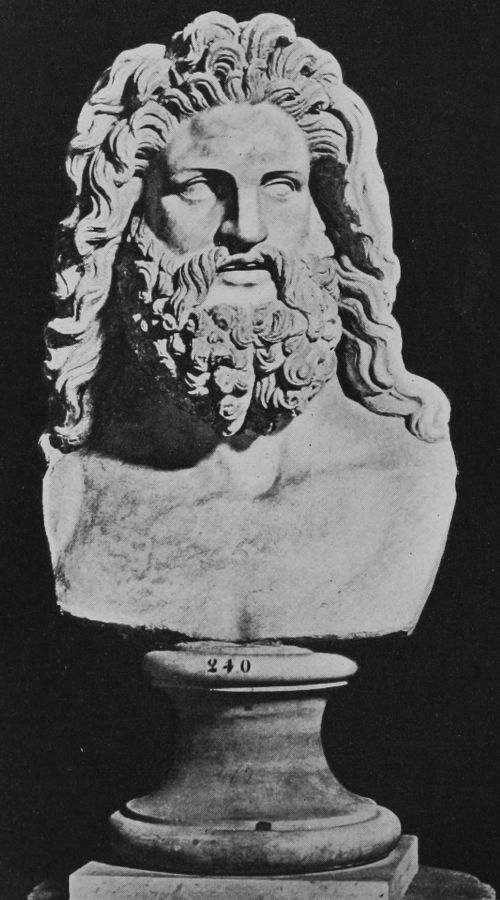
descent this, indeed, from the Olympian Zeus of Phidias
to a bust of Caligula!
Domitian, after his deification, had himself styled
"Lord and God," in all documents, and required all
his subjects to so address him. Pliny tells us that the
roads leading into Rome were constantly filled with
flocks and herds being driven to the Capital to be sacrificed
upon his altar.[154]
The natural and inevitable result of the decay of the
Roman religion was the corruption and demoralization
of Roman social life. All experience teaches that
an assault upon a people's religious system is an assault
upon the entire social and moral organization. Every
student of history knows that a nation will be prosperous
and happy to the extent that it is religiously
intelligent, and in proportion to its loyalty to the laws
of social virtue, to the laws of good government, and
the laws of God; and that an abandonment of its gods
means the wreck and dissolution of its entire social
structure. The annals of Rome furnish a striking confirmation
of this fact.
The closing pages of this chapter will be devoted to
a short topical review of Roman society at the time of
Christ. Only a few phases of the subject can be presented
in a work of this character.
Marriage and Divorce.—The family is the unit of
the social system; and at the hearthstone all civilization
begins. The loosening of the domestic ties is the
beginning of the dissolution of the state; and whatever
weakens the nuptial bonds, tends to destroy the moral
fiber of society. The degradation of women and the
destruction of domestic purity were the first signs of
decay in Roman life. In the early ages of the republic,
marriage was regarded not only as a contract, but as a
sacrament as well. Connubial fidelity was sacredly
maintained. Matrons of the type of Cornelia, the
mother of the Gracchi, were objects of national pride
and affection. The spirit of desperation which caused
the father of Virginia to plunge a butcher's knife into
the chaste and innocent heart of his child to save her
from the lust of Appius Claudius, was a tragic illustration
of the almost universal Roman respect for
virtue in the age of the Tarquins. To such an extent
were the marital relations venerated by the early
Romans that we are assured by Dionysius that five
hundred and twenty years had passed before a single
divorce was granted. Carvilius Ruga, the name of the
first Roman to procure a divorce, has been handed
down to us.[155]
If we are to believe Döllinger, the abandonment of
the policy of lifelong devotion to the marriage relation
and the inauguration of the system of divorce were
due not to the faults of the men but to the dangerous
and licentious qualities of the Roman women. In connection
with the divorce of Carvilius Ruga, he discusses
a widespread conspiracy of Roman wives to
poison their husbands. Several of these husbands fell
victims to this plot; and, as punishment for the crime,
twenty married women were forced to take the poison
which they had themselves prepared, and were thus
put to death. And, about a half century after this
divorce, several wives of distinguished Romans were
discovered to be participants in the bacchanalian
orgies. From all these things, Döllinger infers that
the Roman men began to tire of their wives and to seek
legal separation from them.[156]
But, whatever the cause, the marriage tie was so
easily severed during the latter years of the republic,
that divorce was granted on the slightest pretext. Q.
Antistius Vetus divorced his wife because she was talking
familiarly and confidentially to one of his freedmen.
The wife of C. Sulpicius imprudently entered
the street without a veil, and her husband secured a
divorce on that ground. P. Sempronius Sophus put
away his wife for going to the theater without his
knowledge.
Cicero divorced his first wife that he might marry
a younger and wealthier woman; and because this second
one did not exhibit sufficient sorrow at the death
of his daughter, Tullia, he repudiated her.
Cato, the stern Stoic moralist, was several times divorced.
To accommodate his friend Hortensius he
gave him his second wife Marcia, with her father's
consent; and, after the death of the orator, he remarried
her.
After being several times previously divorced, Pompey
put away Mucia in order that he might wed Julia,
Cæsar's daughter, who was young enough to be the
child of Pompey.
Cæsar himself was five times married. He divorced
his wife, Pompeia, because of her relationship to Clodius,
a dashing and dissolute young Roman, who
entered Cæsar's house on the occasion of the celebration
of the feast of the Bona Dea in a woman's dress,
in order that he might pay clandestine suit to the object
of his lust. Cæsar professed to believe that the charges
against Pompeia were not true, but he divorced her
nevertheless, with the remark that "Cæsar's wife must
be above suspicion." We are reminded by this that,
in ancient as in modern times, society placed greater
restrictions upon women than upon men; for Cæsar,
who uttered this virtuous and heroic sentiment, was a
most notorious rake and profligate. Suetonius tells us
that he debauched many Roman ladies of the first
rank; among them "Lollia, the wife of Aulus Gabinius;
Tertulla, the wife of Marcus Crassus; and
Mucia, the wife of Cneius Pompey." It was frequently
made a reproach to Pompey, "that to gratify
his ambition, he married the daughter of a man upon
whose account he had divorced his wife, after having
had three children by her; and whom he used, with a
deep sigh, to call Ægisthus." But the favorite mistress
of Cæsar was Servilia, the mother of Marcus Brutus.
To consummate an intrigue with her, he gave Servilia
a pearl which cost him six millions of sesterces. And
at the time of the civil war he had deeded to her
for a trifling consideration, several valuable farms.
When people expressed surprise at the lowness of the
price, Cicero humorously remarked: "To let you
know the real value of the purchase, between ourselves,
Tertia was deducted." It was generally suspected at
Rome that Servilia had prostituted her daughter Tertia
to Cæsar; and the witticism of the orator was a
double entendre, Tertia signifying the third (of the
value of the farm), as well as being the name of the
girl, whose virtue had paid the price of the deduction.
Cæsar's lewdness was so flagrant and notorious that his
soldiers marching behind his chariot, on the occasion
of his Gallic triumph, shouted in ribald jest, to the
multitude along the way:
Watch well your wives, ye cits, we bring a blade,
A bald-pate master of the wenching trade.[157]
If this was the private life of the greatest Roman of
the world, who, at the time of his death, was Pontifex
Maximus, the supreme head of the Roman religion,
what must have been the social life of the average citizen
who delighted to style Cæsar the demigod while
living and to worship him as divine, when dead?
A thorough knowledge of the details of the most
corrupt and abandoned state of society recorded in
history may be had by a perusal of the Annals of Tacitus
and the Satires of Juvenal. The Sixth Satire is a
withering arraignment of Roman profligacy and wickedness.
"To see the world in its worst estate," says
Professor Jowett, "we turn to the age of the satirists
and of Tacitus, when all the different streams of evil,
coming from east, west, north, south, the vices of barbarism
and the vices of civilization, remnants of ancient
cults, and the latest refinements of luxury and
impurity, met and mingled on the banks of the Tiber."
Rome was the heart of the empire that pumped its
filthy blood from the center to the extremities, and received
from the provinces a return current of immorality
and corruption. Juvenal complains that
Long since the stream that wanton Syria laves,
Has disembogued its filth in Tiber's waves.
Grecian literature and manners were the main cause
of Roman dissoluteness.
The grandfather of Cicero is said to have made this
declaration: "A Roman's wickedness increases in proportion
to his acquaintance with Greek authors." It
is undeniably true that the domestic immorality of the
Greeks exercised a most baneful influence upon the
social life of the Romans. Both at Athens and in
Sparta marriage was regarded as the means to an end,
the procreation of children as worshipers of the gods
and citizens of the state. In this fundamental purpose
were involved, the Greeks believed, the mission and
the destiny of woman. Marriage was not so much a
sacred institution, as it was a convenient arrangement
whereby property rights were regulated and soldiers
were provided for the army and the navy. This view
was entertained by both the Athenians and the Spartans.
The code of Lycurgus regulated the family relations
to the end that healthy, vigorous children might
be born to a military commonwealth. The Spartan
maidens were required to exercise in the palestra,
almost naked, in the presence of men and strangers.
And so loose and extravagant were the ideas of conjugal
fidelity among the Spartans that it was not regarded
as an improper thing to borrow another man's
wife for the purpose of procreating children, if there
had already been born to the legitimate husband all
the children that he desired. This we learn from
Xenophon[158] and from Polybius,[159] who assure us that it
often happened that as many as four Spartans had one
woman, in common, for a wife. "Already in the time
of Socrates, the wives of Sparta had reached the height
of disrepute for their wantonness throughout the whole
of Greece; Aristotle says that they lived in unbridled
licentiousness; and, indeed, it is a distinctive feature
in the female character there, that publicly and shamelessly
they would speed a well-known seducer of a
woman of rank by wishing him success, and charging
him to think only of endowing Sparta with brave
boys."[160]
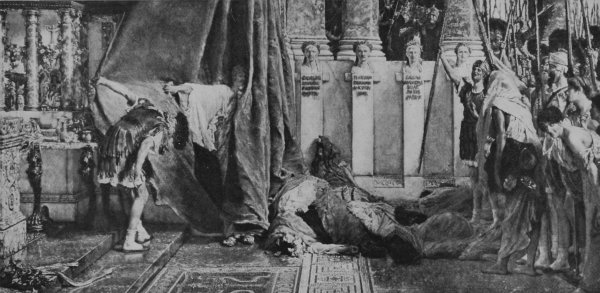
AVE CÆSAR! IO SATURNALIA (ALMA-TADEMA)
At Athens the principle was the same, even if the
gratification of lust was surrounded with a halo of
poetry and sentiment which the Spartan imagination
was incapable of creating. The Athenians were guilty
of a strange perversion of the social instincts by placing
a higher appreciation upon the charms of a certain
class of lewd women that they did upon the virtuous
merits of their own wives and mothers. These latter
were kept in retirement and denied the highest educational
advantages; while the former, the Hetairai,
beautiful and brilliant courtesans, destined for the
pleasure and entertainment of illustrious men, were
accorded the utmost freedom, as well as all the advantages
of culture in the arts and sciences. Demosthenes
has classified the women of ancient Athens in this sentence:
"We have Hetairai for our pleasure, concubines
for the ordinary requirements of the body, and
wives for the procreation of lawful issue and as confidential
domestic guardians." The most renowned of
the Hetairai was Aspasia, the mistress of Pericles.
She was exceedingly beautiful and brilliantly accomplished.
At her house in Athens, poets, philosophers,
statesmen, and sculptors frequently gathered to do her
honor. Pericles is said to have wept only three times
in life; and one of these was when he defended Aspasia
before the dicastery of Athens against the charge of
impiety.
Another of the Hetairai scarcely less famous than
Aspasia was the celebrated Athenian courtesan,
Phryne. Praxiteles, the sculptor, was one of her adorers.
She, too, was tried for impiety before the dicastery.
Hiperides, the Attic orator, defended her. To
create a favorable impression upon the court, he bade
her reveal her bosom to the judges. She did so, and
was acquitted. So great was the veneration in which
Phryne was held that it was considered no profanation
to place her image in the sacred temple at Delphi.
And so overwhelming was her beauty, that her statues
were identified with the Aphrodite of Apelles and the
Cnidian goddess of Praxiteles. At Eleusis, on the
occasion of a national festival, she impersonated Venus
by entering naked into the waves, in the presence of
spectators from all the cities of Greece. She is said
to have amassed such a fortune that she felt justified
in offering to build the walls of Thebes.
Such was the esteem in which these elegant harlots
were held, that we find recorded among their patrons
on the pages of Greek history the names of Pericles,
Demades, Lysias, Demosthenes, Isocrates, Aristotle,
Aristippus, and Epicurus. So little odium attached to
the occupation of this class of women that we read that
Socrates frequently paid visits to one of them named
Theodota and advised her as to the best method of
gaining "friends" and keeping them.[161]
As the sculptors did not hesitate to carve the images
of the Hetairai in marble and give them the names of
the goddesses of Olympus, so the poets, orators, and
historians did not fail to immortalize them in their
poems, orations, and annals. Greek statuary and literature
were then transported to Italy to corrupt
Roman manners. It was not long before adultery and
seduction had completely poisoned and polluted every
fountain of Roman private life. "Liaisons in the first
houses," says Mommsen, "had become so frequent,
that only a scandal altogether exceptional could make
them the subject of special talk; a judicial interference
seems now almost ridiculous."
Roman women of patrician rank, not content with
noblemen as lovers, sought out "lewd fellows of the
baser sort" among slaves and gladiators, as companions
of corrupt intrigues. Juvenal, in his Sixth Satire,
paints a horrible picture of social depravity when he
describes the lewdness of Messalina, the wife of Claudius
I. This woman, the wife of an emperor, and the
mother of the princely Britannicus, descends from the
imperial bed, in the company of a single female slave,
at the dead of night, to a common Roman brothel,
assumes the name Lycisca, and submits to the embraces
of the coarsest Roman debauchees.
The degradation of women was not peculiar to the
Capital of the empire, but extended to every province.
Social impurity was rankest in the East, but it was
present everywhere. Virtue seemed to have left the
earth, and Vice had taken her place as the supreme
mistress of the world.
Luxury and Extravagance.—At the birth of Christ,
the frontiers of the Roman empire comprised all the
territory of the then civilized world. In extending her
conquests, Rome laid heavy tribute upon conquered
nations. All the wealth of the earth flowed into her
coffers. The result was unexampled luxury and extravagance.
A single illustration will serve to show
the mode of life of the wealthy Roman citizen of the
time of which we write. Lucullus, the lieutenant of
Sulla, and the friend of Cicero and Pompey, had
amassed enormous wealth in the Mithradatic wars.
This fortune he employed to inaugurate and maintain
a style of social life whose splendor and extravagance
were the astonishment and scandal of his age and race.
The meals served upon his table, even when no guests
were present, were marked by all the taste, elegance,
and completeness of a banquet. On one occasion, when
he happened to dine alone, the table was not arranged
with the ordinary fullness and splendor; whereupon
he made complaint to the servants, who replied that
they did not think it necessary to prepare so completely
when he was alone. "What! did you not know that
Lucullus would dine with Lucullus?" was his answer.
At another time, Cicero and Pompey met him in the
Forum and requested that he take them with him to
dine, as they desired to learn how his table was spread
when no visitors were expected. Lucullus was embarrassed
for a moment; but soon regained his composure,
and replied that he would be delighted to have such
distinguished Romans dine with him, but that he
would like to have a day for preparation. They refused
this request, however; nor would they consent
that he send directions to his servants, as they
desired to see how meals were served in his home
when no guests were there. Lucullus then requested
Cicero and Pompey to permit him to tell his servants,
in their presence, in what room the repast should
be served. They consented to this; and Lucullus
then directed that the Hall of Apollo should be arranged
for the dinner. Now the dining rooms in
the home of Lucullus were graded in price; and it was
only necessary to designate the room in order to notify
the servants of the style and costliness of the entertainment
desired. The Hall of Apollo called for an expenditure,
at each meal, of fifty thousand drachmas,
the equivalent of $10,000 in our money. And when
Cicero and Pompey sat down at the table of Lucullus
a few hours later, the decorations of the room and the
feast spread before them, offered a spectacle of indescribable
beauty and luxury. The epicure had outwitted
the orator and the general.
Other anecdotes related by Plutarch also illustrate
the luxurious life of Lucullus. Once when Pompey
was sick, his physician prescribed a thrush for his
meal; whereupon Pompey's servants notified him that
a thrush could not be secured in Italy during the
summer time, except in the fattening coops of Lucullus.
Cato despised the luxurious habits of Lucullus; and,
on one occasion, when a young man was extolling the
beauties of frugality and temperance in a speech before
the senate, the Stoic interrupted him by asking: "How
long do you mean to go on making money like Crassus,
living like Lucullus and talking like Cato?"[162]
Lucullus was not the only Roman of his day who
spent fabulous sums of money in luxurious living and
in building palatial residences. M. Lepidus, who was
elected Consul in 87 B.C., erected the most magnificent
private edifice ever seen in Rome.
But the culmination of magnificence in Roman
architecture was the Golden House of Nero. Its walls
were covered with gold and studded with precious
stones. The banquet rooms were decorated with gorgeous
ceilings, and were so constructed that from them
flowers and perfumes could be showered from above
on the guests below.
Concerning the luxurious life of the later days of the
republic, Mommsen says: "Extravagant prices, as
much as one hundred thousand sesterces (£1,000)
were paid for an exquisite cook. Houses were constructed
with special reference to this subject.... A
dinner was already described as poor at which the
fowls were served up to the guests entire, and not
merely the choice portions.... At banquets, above
all, the Romans displayed their hosts of slaves ministering
to luxury, their bands of musicians, their
dancing-girls, their elegant furniture, their carpets
glittering with gold, or pictorially embroidered, their
rich silver plate."[163]
But the luxury and extravagance of the Romans
were nowhere so manifest as in their public bathing
establishments. "The magnificence of many of the
thermæ and their luxurious arrangements were such
that some writers, as Seneca, are quite lost in their descriptions
of them. The piscinæ were often of immense
size—that of Diocletian being 200 feet long—and
were adorned with beautiful marbles. The halls
were crowded with magnificent columns, and were
ornamented with the finest pieces of statuary. The
walls, it has been said, were covered with exquisite
mosaics that imitated the art of the painter in their
elegance of design and variety of color. The Egyptian
syenite was encrusted with the precious green
marbles of Numidia. The rooms contained the works
of Phidias and Praxiteles. A perpetual stream of
water was poured into capacious basins through the
wide mouths of lions of bright and polished silver.
'To such a pitch of luxury have we reached,' says
Seneca, 'that we are dissatisfied if we do not tread on
gems in our baths.'"[164]
The circuses were scarcely inferior to the baths in
magnificence. Caligula is said to have strewn them
with gold dust.
The result of Roman luxury in the matter of food
and drink was a coarse and loathsome gluttony which
finds no parallel in modern life. Epicureanism had
degenerated from barley-bread and water to the costliest
diet ever known. Wealthy Romans of the age of
Augustus did not hesitate to pay two hundred and fifty
dollars for a single fish—the mullet. And that they
might indulge their appetite to the fullest extent, and
prolong the pleasures of eating beyond the requirements
and even the capacity of nature, they were in
the habit of taking an emetic at meal times. We learn
from the letters of Cicero that Julius Cæsar did this on
one occasion when he went to visit the orator at his
country villa. And the degeneracy of Roman life is
nowhere more clearly indicated than in the Fourth
Satire of Juvenal where he describes the gathering of
the great men of the state, at the call of Domitian, to
determine how a turbot should be cooked.
But the reader must not infer that all Romans were
rich and that luxury was indulged in every home. In
the Roman capital the extremes of wealth and poverty
met. The city was filled with idlers, vagabonds and
paupers from all quarters of the globe. In the early
days of the Republic, sturdy farmers had tilled the
soil of Italy and had filled the legions with brave and
hardy warriors. The beginning of the empire witnessed
a radical change. Hundreds of thousands of
these farmers had been driven from their lands to
furnish homes to the disbanded soldiers of conquerors
like Sulla, Marius, and Cæsar. Homeless and poverty-stricken,
they wandered away to Rome to swell
the ranks of mendicants and adventurers that crowded
the streets of the imperial city. The soldiers themselves,
finding agriculture distasteful and unprofitable,
sold their lands to Roman speculators, and returned to
the scene of the triumphs of their military masters.
The inevitable consequence of this influx of strangers
and foreigners, without wealth and without employment,
was the degradation and demoralization of
Roman social and industrial life. Augustus was compelled
to make annual donations of money and provisions
to 200,000 persons who wandered helpless
about the streets. This state of things—fabulous
wealth in the hands of a few, and abject poverty as the
lot of millions—was the harbinger sure and swift of
the destruction of the state.
Slavery.—At the beginning of the Christian era,
slavery existed in every province of the Roman empire.
Nearly everywhere the number of slaves was
much greater than that of the free citizens. In
Attica, according to the census of Demetrius Phalereus,
about the beginning of the fourth century B.C.,
there were 400,000 slaves, 10,000 foreign settlers, and
20,000 free citizens. Zumpt estimates that there were
two slaves to every freeman in Rome in the year 5 B.C.
It frequently happened that a wealthy Roman possessed
as many as 20,000 slaves. Slaves who gained
their freedom might themselves become masters and
own slaves. During the reign of Augustus, a freedman
died, leaving 4,116 slaves. Crassus possessed so
many that his company of architects and carpenters
alone exceeded 500 in number.
The principal slave markets of Greece were those at
Athens, Ephesus, Cyprus, and Samos. In the market
place of each of these cities, slaves were exposed for
sale upon wooden scaffolds. From the neck of each
was hung a tablet or placard containing a description
of his or her meritorious qualities, such as parentage,
educational advantages, health and freedom from
physical defects. They were required to strip themselves
at the request of purchasers. In this way, the
qualifications of slaves for certain purposes could be
accurately judged. The vigorous, large-limbed Cappadocians,
for instance, like our modern draft horses,
were selected for their strength and their ability to lift
heavy loads and endure long-continued work.
The property of the master in the slave was absolute.
The owner might kill or torture his slave at will.
Neither the government nor any individual could
bring him to account for it. Roman law compelled
female slaves to surrender themselves, against their
will, to their master's lust. All the coarseness and brutality
of the haughty, arrogant, and merciless Roman
disposition were manifested in the treatment of their
slaves. Nowhere do we find any mercy or humanity
shown them. On the farms they worked with chains
about their limbs during the day; and at night they
were lodged in the ergastula—subterranean apartments,
badly lighted and poorly ventilated. The most
cruel punishment awaited the slave who attempted to
escape. The fugitavarii—professional slave chasers—ran
him down, branded him on the forehead, and
brought him back to his master. If the master was
very rich, or cared little for the life of the slave, he
usually commanded him to be thrown, as a punishment
for his attempt to flee, to the wild beasts in the amphitheater.
This cruel treatment was not exceptional, but
was ordinary. Cato, the paragon among the Stoics,
was so merciless in his dealings with his slaves that one
of them committed suicide rather than await the hour
of punishment for some transgression of which he was
guilty.[165] It frequently happened that the slaves had
knowledge of crimes committed by their masters. In
such cases they were fortunate if they escaped death,
as the probability of their becoming witnesses against
their masters offered every inducement to put them out
of the way. In his defense of Cluentius, Cicero speaks
of a slave who had his tongue cut out to prevent his
betraying his mistress.[166] If a slave murdered his master,
all his fellow-slaves under the same roof were held
responsible for the deed. Thus four hundred slaves
were put to death for the act of one who assassinated
Pedanius Secundus, during the reign of Nero.[167] Augustus
had his steward, Eros, crucified on the mast of
his ship because the slave had roasted and eaten a quail
that had been trained for the royal quail-pit. Once a
slave was flung to the fishes because he had broken a
crystal goblet.[168] On another occasion, a slave was compelled
to march around a banquet table, in the presence
of the guests, with his hands, which had been cut
off, hanging from his neck, because he had stolen some
trifling article of silverware. Cicero, in his prosecution
of Verres, recites an instance of mean and cowardly
cruelty toward a slave. "At the time," he says,
"in which L. Domitius was prætor in Sicily, a slave
killed a wild boar of extraordinary size. The prætor,
struck by the dexterity and courage of the man, desired
to see him. The poor wretch, highly gratified
with the distinction, came to present himself before
the prætor, in hopes, no doubt, of praise and reward;
but Domitius, on learning that he had only a javelin
to attack and kill the boar, ordered him to be instantly
crucified, under the barbarous pretext that the law
prohibited the use of this weapon, as of all others, to
slaves."
The natural consequence of this cruel treatment was
unbounded hatred of the master by the slave. "We
have as many enemies," says Seneca, "as we have
slaves." And what rendered the situation perilous was
the numerical superiority of the slave over the free
population. "They multiply at an immense rate,"
says Tacitus, "whilst freemen diminish in equal proportion."
Pliny the Younger gave expression to the
universal apprehension when he wrote: "By what
dangers we are beset! No one is safe; not even the
most indulgent, gentlest master." Precautionary measures
were adopted from time to time both by individuals
and by the government to prevent concerted
action among the slaves and to conceal from them all
evidences of their own strength. To keep down mutiny
among his slaves, Cato is said to have constantly
excited dissension and enmity among them. "It was
once proposed," says Gibbon, "to discriminate the
slaves by a peculiar habit; but it was justly apprehended
that there might be some danger in acquainting
them with their own numbers."[169]
If the Roman masters maltreated and destroyed the
bodies of their slaves, the slaves retaliated by corrupting
and destroying the morals of their masters. The
institution of slavery was one of the most potent agencies
in the demoralization of ancient Roman manners.
The education of children was generally confided to
the slaves, who did not fail to poison their minds and
hearts in many ways. In debauching their female
slaves, the Roman masters polluted their own morals
and corrupted their own manhood. The result teaches
us that the law of physics is the law of morals: that
action and reaction are equal, but in opposite directions.
Destruction of New-Born Infants.—The destruction
of new-born children was the deepest stain upon the
civilization of the ancient Greeks and Romans. In
obedience to a provision of the code of Lycurgus, every
Spartan child was exhibited immediately after birth
to public view; and, if it was found to be deformed
and weakly, so that it was unfit to grow into a strong
and healthy citizen of the Spartan military commonwealth,
it was exposed to perish on Mount Taygetus.
The practice of exposing infants was even more arbitrary
and cruel in Rome than in Greece. The Roman
father was bound by no limitations; but could cast his
offspring away to die, through pure caprice. Paulus,
the celebrated jurist of the imperial period, admitted
that this was a paternal privilege. Suetonius tells us
that the day of the death of Germanicus, which took
place A.D. 19, was signalized by the exposition of children
who were born on that day.[170] This was done as a
manifestation of general sorrow. The emperor Augustus
banished his granddaughter Julia on account of
her lewdness and licentiousness, as he had done in the
case of his daughter, Julia. In exile, she gave birth to
a child which Augustus caused to be exposed. It often
happened that new-born babes that had been cast away
to die of cold and hunger or to be devoured by dogs
or wild beasts were rescued by miscreants who brought
them up to devote them to evil purposes. The male
children were destined to become gladiators, and the
females were sold to houses of prostitution. Often
such children were picked up by those who disfigured
and deformed them for the purpose of associating
them with themselves as beggars.
The custom of exposing infants was born of the
spirit of fierceness and barbarity that characterized
many ancient races. Its direct tendency was to make
savages of men by destroying those tender and humane
feelings for the weak and helpless which have been the
most marked attributes of modern civilizations. Occasionally
in our day one hears or reads of a proposition
by some pseudo-philanthropist that the good of
the race demands the destruction of certain persons—deformed
infants, imbecile adults and the like. But
the humanity of the age invariably frowns upon such
proposals. The benign and merciful features of our
Christian creed would be outraged by such a practice.
Gladiatorial Games.—The combats of gladiators
were the culmination of Roman barbarity and brutality.
All the devotees of vice and crime met and mingled
at the arena, and derived strength and inspiration
from its bloody scenes. The gatherings in the amphitheater
were miniatures of Roman life. There,
political matters were discussed and questions of state
determined, as was once the case in the public assemblies
of the people. Now that the gates of Janus were
closed for the third time in Roman history, the combats
of the arena took the place, on a diminutive scale,
of those battles by which Romans had conquered the
world. The processions of the gladiators reminded the
enthusiastic populace of the triumphal entries of their
conquerors into the Roman capital. Nothing so
glutted the appetite and quenched the thirst of a cruel
and licentious race as the gorgeous ceremonials and
bloody butchery of the gladiatorial shows.
These contests, strange to say, first took place at
funerals, and were intended to honor the dead. In 264
B.C., at the burial of D. Junius Brutus, we are told,
three pairs of gladiators fought in the cattle market.
Again, in 216 B.C., at the obsequies of M. Æmilius
Lepidus, twenty-two pairs engaged in combat in the
Forum. And, in 174 B.C., on the death of his father,
Titus Flaminius caused seventy-four pairs to fight for
three days.[171] It will thus be seen that the death of one
Roman generally called for that of several others.
In time, the fondness of these contests had grown so
great that generals and statesmen arranged them on a
gigantic scale as a means of winning the favor and support
of the multitude. The Roman proletariat demanded
not only bread to satisfy their hunger, but
games to amuse them in their hours of idleness. Augustus
not only gave money and rations to 200,000
idlers, but inaugurated gladiatorial shows in which
10,000 combatants fought. Not only men but wild
beasts were brought into the arena. Pompey arranged
a fight of 500 lions, 18 elephants and 410 other ferocious
animals, brought from Africa. In a chase arranged
by Augustus, A.D. 5, 36 crocodiles were killed
in the Flaminian circus, which was flooded for
the purpose. Caligula brought 400 bears into the
arena to fight with an equal number of African wild
animals. But all previous shows were surpassed in
the magnificent games instituted by Trajan, A.D. 106,
to celebrate his victories on the Danube. These games
lasted four months; and, in them, 10,000 gladiators
fought, and 11,000 beasts were slain.
Such was the thirst for blood, and to such a pitch
had the fury of the passions reached at the beginning
of the empire that Romans were no longer satisfied
with small fights by single pairs. They began to demand
regular battles and a larger flow of blood. And
to please the populace, Julius Cæsar celebrated his
triumph by a real battle in the circus. On each side
were arrayed 500 foot soldiers, 300 cavalrymen, and 20
elephants bearing soldiers in towers upon their backs.
This was no mimic fray, but an actual battle in which
blood was shed and men were killed. To vary the entertainment,
Cæsar also arranged a sea fight. He
caused a lake to be dug out on Mars Field, and placed
battleships upon it which represented Tyrian and
Egyptian fleets. These he caused to be manned by a
thousand soldiers and 2,000 oarsmen. A bloody fight
then ensued between men who had no other motive
in killing each other than to furnish a Roman holiday.
Augustus also arranged a sea fight upon an
artificial lake where 3,000 men were engaged. But
both these battles were eclipsed by the great sea
fight which the emperor Claudius caused to be
fought on Lake Fucinus, in the presence of a great
multitude that lined the shore. Nineteen thousand
men engaged in the bloody struggle. On an eminence
overlooking the lake, the Empress Agrippina, in gorgeous
costume, sat by the side of the emperor and
watched the battle.
Announcement of gladiatorial fights in the amphitheater
was made by posters on the walls of the city.
In these advertisements, the number and names of the
fighters were announced. On the day of the performance
a solemn procession of gladiators, walking in
couples, passed through the streets to the arena. The
arrangements of the building and the manner of the
fights were so ordered as to arouse to the highest pitch
of excitement the passions and expectations of the
spectators. The citizens were required to wear the
white toga. The lower rows of seats were occupied by
senators, in whose midst were the boxes occupied by
the imperial family. The equestrian order occupied
places immediately above the senators. The citizens
were seated next after the equestrians, and in the top-most
rows, on benches, were gathered the Roman rabble.
An immense party-colored awning, stretched
above the multitude, reflected into the arena its variegated
hues. Strains of music filled the air while
preparations for the combat were being made. The
atmosphere of the amphitheater was kept cool and
fragrant by frequent sprays of perfume. The regular
combat was preceded by a mock fight with blunt
weapons. Then followed arrangements for the life-and-death
struggle. The manager of the games finally
gave the command, and the fight was on. When one
of the gladiators was wounded, the words "hoc habet"
were shouted. The wounded man fell to the earth,
dropped his weapon, and, holding up his forefinger,
begged his life from the people. If mercy was refused
him, he was compelled to renew the combat or to submit
to the death stroke of his antagonist. Attendants
were at hand with hot irons to apply to the victim to
see that death was not simulated. If life was not extinct,
the fallen gladiator was dragged out to the dead
room, and there dispatched. Servants then ran into
the arena and scattered sand over the blood-drenched
ground. Other fighters standing in readiness, immediately
rushed in to renew the contest. Thus the fight
went on until the Roman populace was glutted with
butchery and blood.
Gladiators were chosen from the strongest and most
athletic among slaves and condemned criminals. Thracians,
Gauls, and Germans were captured and enslaved
for the purpose of being sacrificed in the arena. They
were trained with the greatest care in gladiatorial
schools. The most famous of these institutions was at
Capua in Italy. It was here that Spartacus, a young
Thracian, of noble ancestry, excited an insurrection
that soon spread throughout all Italy and threatened
the destruction of Rome. Addressing himself to seventy
of his fellow-gladiators, Spartacus is said to have
made a bitter and impassioned speech in which he proposed
that, if they must die, they should die fighting
their enemies and not themselves; that, if they were to
engage in bloody battles, these battles should be fought
under the open sky in behalf of life and liberty, and
not in the amphitheater to furnish pastime and entertainment
to their masters and oppressors. The speech
had its effect. The band of fighters broke out of
Capua, and took refuge in the crater of Mount Vesuvius
(73 B.C.). Spartacus became the leader, with
Crixus and œnomaus, two Celtic gladiators, as lieutenants.
Their ranks soon swelled to the proportions
of an army, through accessions of slaves and desperadoes
from the neighborhood of the volcano. During
two years, they terrorized all Italy, defeated two consuls,
and burned many cities. Crixus was defeated and
killed at Mount Gargarus in Apulia by the prætor
Arrius. Spartacus compelled three hundred Roman
prisoners, whom he had captured, to fight as gladiators,
following Roman custom, at the grave of his
fallen comrade and lieutenant. Finally, he himself
was slain, sword in hand, having killed two centurions
before he fell. With the death of their leaders, the
insurgents either surrendered or fled. Those who were
captured were crucified. It is said that the entire way
from Capua to Rome was marked by crosses on which
their bodies were suspended, to the number of ten
thousand.[172]
Throughout Italy were amphitheaters for gladiatorial
games. But the largest and most celebrated of all
was the Coliseum at Rome. Its ruins are still standing.
It was originally called the Flavian Amphitheater.
This vast building was begun A.D. 72, upon the
site of the reservoir of Nero, by the emperor Vespasian,
who built as far as the third row of arches, the
last two rows being finished by Titus after his return
from the conquest of Jerusalem. It is said that twelve
thousand captive Jews were employed in this work, as
the Hebrews were employed in building the Pyramids
of Egypt, and that the external walls alone cost nearly
four millions of dollars. It consists of four stories: the
first, Doric; the second, Ionic; the third and fourth,
Corinthian. Its circumference is nearly two thousand
feet; its length, six hundred and twenty feet; and
its width, five hundred and thirteen. The entrance for
the emperor was between two arches facing the Esquiline,
where there was no cornice. The arena was surrounded
by a wall sufficiently high to protect the spectators
from the wild beasts, which were introduced by
subterranean passages, closed by huge gates from the
side. The Amphitheater is said to have been capable
of seating eighty-seven thousand people, and was inaugurated
by gladiatorial games that lasted one hundred
days, and in which five thousand beasts were
slain. The emperor Commodus himself fought in the
Coliseum, and killed both gladiators and wild beasts.
He insisted on calling himself Hercules, was dressed in
a lion's skin, and had his hair sprinkled with gold dust.
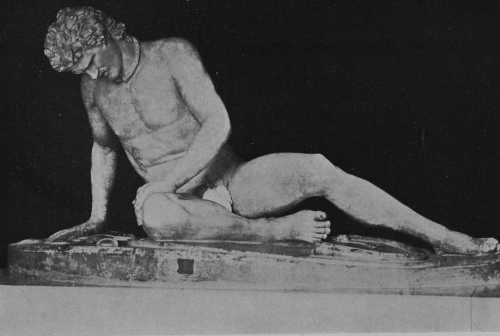
THE DYING GLADIATOR (ANTIQUE SCULPTURE)
An oriental monk, Talemachus, was so horrified at
the sight of the gladiatorial games, that he rushed into
the midst of the arena, and besought the spectators to
have them stopped. Instead of listening to him, they
put him to death.
The first martyrdom in the Coliseum was that of St.
Ignatius, said to have been the child especially blessed
by our Savior, the disciple of John, and the companion
of Polycarp, who was sent to Rome from Antioch
when he was bishop. When brought into the arena,
St. Ignatius knelt down and exclaimed: "Romans who
are here present, know that I have not been brought
into this place for any crime, but in order that by this
means I may merit the fruition of the glory of God,
for love of whom I have been made a prisoner. I am
as the grain of the field and must be ground by the
teeth of the lions that I may become bread fit for His
table." The lions were then let loose, and devoured
him, except the larger bones which the Christians collected
during the night.
The spot where the Christian martyrs suffered was
for a long time marked by a tall cross devoutly kissed
by the faithful. The Pulpit of the Coliseum was used
for the stormy sermons of Gavazzi, who called the
people to arms from thence in the Revolution of
March, 1848.
Græco-Roman Social Depravity, Born of Religion
and Traceable to the Gods.—The modern mind identifies
true religion with perfect purity of heart and
with boundless love. "Do unto others as you would
have others do unto you" is the leading aphorism of
both the Hebrew and Christian faiths. The Sermon
on the Mount is the chart of the soul on the sea of life;
and its beatitudes are the glorifications of the virtues
of meekness, mercy, and peace. To the mind imbued
with the divine precepts of the Savior, it seems incredible
that religion should have ever been the direct
source of crime and sin. It is, nevertheless, a well-established
fact that the Roman and Greek mythologies
were the potent causes of political corruption and
social impurity in both Italy and Greece. Nothing
better illustrates this truth than the abominable practice
that found its inspiration and excuse in the myth
of the rape of Ganymede. The guilty passion of Zeus
for the beautiful boy whom he, himself, in the form of
an eagle, had snatched up from earth and carried away
to Olympus to devote to shameful and unnatural uses,
was the foundation, in Greece, of the most loathsome
habit that ever disgraced the conduct of men. Passionate
fondness for beautiful boys, called paiderastia in
Greek, termed sodomy in modern criminal law, was
the curse and infamy of both Roman and Grecian life.
This unnatural vice was not confined to the vulgar and
degenerate. Men of letters, poets, statesmen and philosophers,
debased themselves with this form of pollution.
It was even legalized by the laws of Crete and
Sparta. Polybius tells us that many Romans paid as
much as a talent ($1,000) for a beautifully formed
youth. This strange perversion of the sexual instincts
was marked by all the tenderness and sweetness of a
modern courtship or a honeymoon. The victim of this
degrading and disgusting passion treated the beautiful
boy with all the delicacy and feeling generally paid a
newly wedded wife. Kisses and caresses were at times
showered upon him. At other times, he became an
object of insane jealousy.
An obscene couplet in Suetonius attributes this filthy
habit to Julius Cæsar in the matter of an abominable
relationship with the King of Bithynia.[173] "So strong
was the influence of the prevalent epidemic on Plato,
that he had lost all sense of the love of women, and in
his descriptions of Eros, divine as well as human, his
thoughts were centered only in his boy passion. The
result in Greece confessedly was that the inclination
for a woman was looked upon as low and dishonorable,
while that for a youth was the only one worthy of a
man of education."[174]
A moment's reflection will convince the most skeptical
of the progress of morality and the advance of
civilization. That which philosophers and emperors
not only approved but practiced in the palmiest days
of the commonwealths of Greece and Rome, is to-day
penalized; and the person guilty of the offense is socially
ostracized and branded with infamy and contempt.
The above is only one of many illustrations of the
demoralizing influence of the myths. The Greeks
looked to the gods as models of behavior, and could
see nothing wrong in paiderastia, since both Zeus and
Apollo had practiced it. Nearly every crime committed
by the Greeks and Romans was sought to be
excused on the ground that the gods had done the same
thing. Euthyphro justified mistreatment of his own
father on the ground that Zeus had chased Cronos, his
father, from the skies.
Homer was not only the Bible, but the schoolbook
of Grecian boys and girls throughout the world; and
their minds were saturated at an early age with the escapades
of the gods and goddesses as told by the immortal
bard. Plato, in the "Republic," deprecates the
influence of the Homeric myths upon the youth of
Greece, when he says: "They are likely to have a bad
effect on those who hear them; for everybody will
begin to excuse his own vices when he is convinced that
similar wickednesses are always being perpetrated by
the kindred of the gods." And Seneca thus condemns
the moral effect of the myth of Zeus and Alcmene:
"What else is this appeal to the precedent of the gods
for, but to inflame our lusts, and to furnish a free license
and excuse for the corrupt act under shelter of
its divine prototype?" "This," says the same author
in another treatise, "has led to no other result than to
deprive sin of its shame in man's eyes, when he saw that
the gods were no better than himself."
We have seen that, in the matter of the multiplicity
of the gods, there were deities of the baser as well as
of the better passions, and of criminal as well as virtuous
propensities. Pausanias tells us that in his day, on
the road to Pellene, there were statues of Hermes
Dolios (the cheat), and that the worshipers of this
god believed that he was always ready to help them in
their intrigues and adventures. The same writer also
tells us that young maidens of Trœzene dedicated their
girdles to Athene Apaturia, the deceiver, for having
cunningly betrayed Æthra into the hands of Neptune.
The festivals of Bacchus were far-famed in ancient
times for the drunken debauches and degrading ceremonies
that accompanied them. The Attic feasts of
Pan were celebrated with every circumstance of low
buffoonery. The solemnities of the Aphrodisia were
akin to the bacchanalian orgies in all the features of
inebriety and lust. The name of the goddess of love
and beauty was blazoned across the portal of more
than one Greek and Roman brothel. The Aphrodite-Lamia
at Athens and the Aphrodite-Stratonikis at
Smyrna were the favorite resorts of the most famous
courtesans of antiquity. Venus was the recognized
goddess of the harlots. A thousand of them guarded
her temple at Corinth; and, when an altar was erected
to her at the Colline gate in Rome, in the year 183
A.U.C., they celebrated a great feast in her honor, and
dedicated chaplets of myrtle and roses, as a means of
obtaining her favor as the guardian divinity of their
calling.
What more could be expected, then, of the morality
of the Greeks and Romans, when we consider the
nature of their religion and the character of their
gods? Jupiter and Apollo were notorious rakes and
libertines; Venus and Flora were brazen-faced courtesans;
Harmonia was a Phrygian dancer, who had
been seduced by Cadmus; Hercules was a gladiator;
Pan was a buffoon; Bacchus was a drunkard, and
Mercury was a highway robber. And not only in the
poems of Homer and Hesiod did the Greek and
Roman youth learn these things, but from the plays of
the theaters and from plastic art as well. If we except
the gladiatorial fights in the amphitheaters, nothing
was more cruel and unchaste than Greek and Roman
tragedy and comedy. At the time of Christ, the tastes
and appetites of the multitude had grown so fierce and
depraved that ordinary spectacles were regarded as
commonplace and insipid. Lifelike realities were demanded
from the actors on the stage; and accordingly,
the hero who played the rôle of the robber chief,
Laureolus, was actually crucified before the spectators,
and was then torn to pieces by a hungry bear.
The burning of Hercules on Mount Œta and the
emasculation of Atys were sought to be realized on the
stage by the actual burning and emasculation of condemned
criminals. Lustful as well as cruel appetites
were inflamed and fed by theatrical representations of
the intrigues and adventures of the gods and goddesses.
Pantomimes and mimic dances, with flute accompaniment,
were employed to reproduce the amours and
passionate devotions of the inhabitants of Olympus.
The guilty loves of Aphrodite with Mars and Adonis,
the adventures of Jupiter and Apollo with the wives
and daughters of mortals, were the plays most frequently
presented and most wildly applauded. And
the ignorant rabble were not the only witnesses of these
spectacles. "The sacerdotal colleges and authorities,"
says Arnobius, "flamens, and augurs, and chaste vestals,
all have seats at these public amusements. There
are seated the collective people and senate, consuls and
consulars, while Venus, the mother of the Roman race,
is danced to the life, and in shameless mimicry is represented
as reveling through all the phases of meretricious
lust. The great mother, too, is danced; the
Dindymene of Pessinus, in spite of her age, surrendering
herself to disgusting passion in the embraces of a
cowherd. The supreme ruler of the world is himself
brought in, without respect to his name or majesty, to
play the part of an adulterer, masking himself in order
to deceive chaste wives, and take the place of their
husbands in the nuptial bed."[175]
Not only gladiatorial games and theatrical shows,
but painting and sculpture as well, served to corrupt
and demoralize Roman and Greek manners. Nor is
there any prudery in this statement. The masterpieces
of the Greek artists have been the astonishment and despair
of all succeeding ages; and the triumphs of modern
art have been but poor imitations of the models of
the first masters. But it is, nevertheless, true that the
embodiment in marble of certain obscene myths was
destructive of ancient morals. The paintings in the
temples and houses of the cities of Greece and Italy
were a constant menace to the mental purity of those
who gazed upon them. The statue of Ganymede at the
side of Zeus was a perpetual reminder to the youth of
Athens of the originator of the loathsome custom of
paiderastia. The paintings of Leda and the swan, of
the courtship of Dionysus and Ariadne, of the naked
Aphrodite ensnared and caught in the net with Ares
that adorned the walls and ceilings of Greek and Roman
homes, were not too well calculated to inspire
pure and virtuous thoughts in the minds and hearts of
tender youths and modest maidens who looked upon
and contemplated them. At Athens, especially, was
the corrupting influence of painting and plastic art
most deeply felt. "At every step," says Döllinger,
"which a Greek or Roman took, he was surrounded
by images of his gods and memorials of their mythic
history. Not the temples only, but streets and public
squares, house walls, domestic implements and drinking
vessels, were all covered and incrusted with ornaments
of the kind. His eye could rest nowhere, not a
piece of money could he take into his hand without
confronting a god. And in this way, through the
magical omnipresence of plastic art, the memory of his
gods had sunk into his soul indelibly, grown up
with every operation of his intellect, and inseparably
blended with every picture of his imagination."[176]
It can thus be easily imagined how close the connection
between the social depravity and the religion of
the Greeks and Romans. What was right in the conduct
of the gods, men could not deem sinful in their
own behavior. Indeed, lewd and lascivious acts were
frequently proclaimed not only right, but sacred,
because they had been both sanctioned and committed
by the gods themselves. "As impurity," says Döllinger,
"formed a part of religion, people had no
scruples in using the temple and its adjoining buildings
for the satisfaction of their lust. The construction
of many of the temples and the prevalent gloom
favored this. 'It is a matter of general notoriety,' Tertullian
says, 'that the temples are the very places
where adulteries were arranged, and procuresses pursue
their victims between the altars.' In the chambers
of the priests and ministers of the temple, impurity
was committed amid clouds of incense; and this,
Minucius adds, more frequently than in the privileged
haunts of this sin. The sanctuaries and priests of Isis
at Rome were specially notorious in this respect. 'As
this Isis was the concubine of Jove herself, she also
makes prostitutes of others,' Ovid said. Still more
shameful sin was practiced in the temples of the Pessinuntine
mother of the gods, where men prostituted
themselves and made a boast of their shame afterwards."[177]
The Bacchanalian Orgies.—The most interesting
passage of ancient literature dealing with social life in
its relation to religious observances, is an extract from
Livy, the most elegant of Roman historians. This passage
describes the bacchanalian orgies, and gives exquisite
touches to certain phases of ancient Roman
social life. Its insertion here entire is excused on the
ground of its direct bearing upon the subject matter
of this chapter:
A Greek of mean condition came, first, into Etruria; not
with one of the many trades which his nation, of all others
the most skilful in the cultivation of the mind and body, has
introduced among us, but a low operator in sacrifices, and a
soothsayer; nor was he one who, by open religious rites, and
by publicly professing his calling and teaching, imbued the
minds of his followers with terror, but a priest of secret
and nocturnal rites. These mysterious rites were, at first, imparted
to a few, but afterwards communicated to great
numbers, both men and women. To their religious performances
were added the pleasures of wine and feasting, to allure
a greater number of proselytes. When wine, lascivious
discourse, night, and the intercourse of the sexes had extinguished
every sentiment of modesty, then debaucheries of
every kind began to be practiced, as every person found at
hand that sort of enjoyment to which he was disposed by
the passion predominant in his nature. Nor were they confined
to one species of vice—the promiscuous intercourse of
free-born men and women, but from this store-house of villany
proceeded false witnesses, counterfeit seals, false evidences,
and pretended discoveries. From the same place, too,
proceeded poison and secret murders, so that in some cases,
even the bodies could not be found for burial. Many of their
audacious deeds were brought about by treachery, but most
of them by force; it served to conceal the violence, that on
account of the loud shouting, and the noise of drums and
cymbals, none of the cries uttered by the persons suffering
violation or murder could be heard abroad.
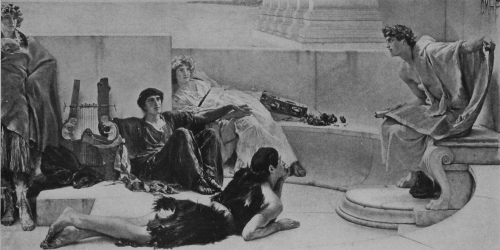
READING FROM HOMER (ALMA-TADEMA)
The infection of this mischief, like that from the contagion
of disease, spread from Etruria to Rome; where, the
size of the city affording greater room for such evils, and
more means of concealment, cloaked it at first; but information
of it was at length brought to the consul, Postumius,
principally in the following manner. Publius Æbutius, whose
father had held equestrian rank in the army, was left an orphan,
and his guardians dying, he was educated under the
eye of his mother Duronia, and his stepfather Titus Sempronius
Rutilus. Duronia was entirely devoted to her husband;
and Sempronius, having managed the guardianship in
such a manner that he could not give an account of the property,
wished that his ward should be either made away with,
or bound to compliance with his will by some strong tie.
The Bacchanalian rites were the only way to effect the ruin
of the youth. His mother told him, that, "During his sickness,
she had made a vow for him, that if he should recover,
she would initiate him among the Bacchanalians; that being,
through the kindness of the gods, bound by this vow, she
wished now to fulfil it; that it was necessary he should preserve
chastity for ten days, and on the tenth, after he should
have supped and washed himself, she would conduct him
into the place of worship." There was a freedwoman called
Hispala Fecenia, a noted courtesan, but deserving of a better
lot than the mode of life to which she had been accustomed
when very young, and a slave, and by which she had
maintained herself since her manumission. As they lived in
the same neighborhood, an intimacy subsisted between her
and Æbutius, which was far from being injurious either to
the young man's character or property; for he had been loved
and wooed by her unsolicited; and as his friends supplied
his wants illiberally, he was supported by the generosity of
this woman; nay, to such a length did she go under the influence
of her affection, that, on the death of her patron,
because she was under the protection of no one, having petitioned
the tribunes and prætors for a guardian, when she
was making her will, she constituted Æbutius her sole heir.
As such pledges of mutual love subsisted, and as neither
kept anything secret from the other, the young man jokingly
bid her not be surprised if he separated himself from her
for a few nights, as, "on account of a religious duty, to
discharge a vow made for his health, he intended to be initiated
among the Bacchanalians." On hearing this, the
woman, greatly alarmed, cried out, "May the gods will
more favorably!" affirming that "It would be better, both
for him and her, to lose their lives than that he should do
such a thing:" she then imprecated curses, vengeance, and
destruction on the head of those who advised him to such a
step. The young man, surprised both at her expressions and
at the violence of her alarm, bid her refrain from curses,
for "it was his mother who ordered him to do so, with the
approbation of his stepfather." "Then," said she, "your
stepfather (for perhaps it is not allowable to censure your
mother), is in haste to destroy, by that act, your chastity,
your character, your hopes and your life." To him, now
surprised by such language, and inquiring what was the matter,
she said, (after imploring the favor and pardon of the
gods and goddesses, if, compelled by her regard for him,
she disclosed what ought not to be revealed), that "when
in service, she had gone into that place of worship, as an
attendant on her mistress, but that, since she had obtained
her liberty, she had never once gone near it: that she knew
it to be the receptacle of all kinds of debaucheries; that it
was well known that, for two years past, no one older than
twenty had been initiated there. When any person was introduced
he was delivered as a victim to the priests, who led
him away to a place resounding with shouts, the sound of
music, and the beating of cymbals and drums, lest his cries
while suffering violation, should be heard abroad." She
then entreated and besought him to put an end to that matter
in some way or other, and not to plunge himself into a situation,
where he must first suffer, and afterwards commit,
everything that was abominable. Nor did she quit him until
the young man gave her his promise to keep himself clear of
those rites.
When he came home, and his mother made mention of
such things pertaining to the ceremony as were to be performed
on that day, and on the several following days, he
told her that he would not perform any of them, nor did
he intend to be initiated. His stepfather was present at this
discourse. Immediately the woman observed that "he could
not deprive himself of the company of Hispala for ten
nights; that he was so fascinated by the caresses and baneful
influence of that serpent, that he retained no respect for his
mother or stepfather, or even the gods themselves." His
mother on one side and his stepfather on the other loading
him with reproaches, drove him out of the house, assisted
by four slaves. The youth on this repaired to his aunt
Æbutia, told her the reason of his being turned out by his
mother, and the next day, by her advice, gave information
of the affair to the consul Postumius, without any witnesses
of the interview. The consul dismissed him, with an order
to come again on the third day following. In the meantime,
he inquired of his mother-in-law, Sulpicia, a woman of respectable
character, "whether she knew an old matron called
Æbutia, who lived on the Aventine hill?" When she had
answered that "she knew her well, and that Æbutia was a
woman of virtue, and of the ancient purity of morals;" he
said that he required a conference with her, and that a messenger
should be sent for her to come. Æbutia, on receiving
the message, came to Sulpicia's house, and the consul, soon
after, coming in, as if by accident, introduced a conversation
about Æbutius, her brother's son. The tears of the woman
burst forth, and she began to lament the unhappy lot of the
youth: who after being robbed of his property by persons
whom it least of all became, was then residing with her,
being driven out of doors by his mother, because, being a
good youth (may the gods be propitious to him), he refused
to be initiated in ceremonies devoted to lewdness, as report
goes.
The consul thinking that he had made sufficient inquiries
concerning Æbutius, and that his testimony was unquestionable,
having dismissed Æbutia, requested his mother-in-law
to send again to the Aventine, and bring from that quarter
Hispala, a freedwoman, not unknown in that neighborhood;
for there were some queries which he wished to make of
her. Hispala being alarmed because she was being sent for
by a woman of such high rank and respectable character, and
being ignorant of the cause, after she saw the lictors in the
porch, the multitude attending to the consul and the consul
himself, was very near fainting. The consul led her into
the retired part of the house, and, in the presence of his
mother-in-law, told her, that she need not be uneasy, if she
could resolve to speak the truth. She might receive a promise
of protection either from Sulpicia, a matron of such dignified
character, or from himself. That she ought to tell
him, what was accustomed to be done at the Bacchanalia, in
the nocturnal orgies in the grove of Stimula. When the
woman heard this, such terror and trembling of all her limbs
seized her, that for a long time she was unable to speak; but
recovering at length she said, that "when she was very young,
and a slave, she had been initiated, together with her mistress;
but for several years past, since she had obtained her
liberty, she knew nothing of what was done there." The
consul commended her so far, as not having denied that she
was initiated, but charged her to explain all the rest with
the same sincerity; and told her, affirming that she knew
nothing further, that "there would not be the same tenderness
or pardon extended to her, if she should be convicted
by another person, and one who had made a voluntary confession;
that there was such a person, who had heard the
whole from her, and had given him a full account of it."
The woman, now thinking without a doubt that it must
certainly be Æbutius who had discovered the secret, threw
herself at Sulpicia's feet, and at first began to beseech her,
"not to let the private conversation of a freedwoman with
her lover be turned not only into a serious business, but even
capital charge;" declaring that "she had spoken of such
things merely to frighten him, and not because she knew anything
of the kind." On this Postumius, growing angry, said
"she seemed to imagine that then too she was wrangling
with her gallant Æbutius, and not that she was speaking in
the house of a most respectable matron, and to a consul."
Sulpicia raised her, terrified, from the ground, and while she
encouraged her to speak out, at the same time pacified her
son-in-law's anger. At length she took courage, and, having
censured severely the perfidy of Æbutius, because he had
made such a return for the extraordinary kindness shown to
him in that very instance, she declared that "she stood in
great dread of the gods, whose secret mysteries she was to
divulge; and in much greater dread of the men implicated,
who would tear her asunder with their hands if she became
an informer. Therefore she entreated this favor of Sulpicia,
and likewise of the consul, that they would send her away
some place out of Italy, where she might pass the remainder
of her life in safety." The consul desired her to be of good
spirits, and said that it should be his care that she might live
securely in Rome.
Hispala then gave a full account of the origin of the mysteries.
"At first," she said, "those rites were performed by
women. No man used to be admitted. They had three
stated days in the year on which such persons were initiated
among the Bacchanalians, in the daytime. The matrons used
to be appointed priestesses, in rotation. Paculla Minia, a
Campanian, when priestess, made an alteration in every particular
as if by the direction of the gods. For she first
introduced men, who were her own sons, Minucius and Herrenius,
both surnamed Cerrinius; changed the time of celebration,
from day to night; and, instead of three days in
the year, appointed five days of initiation in each month.
From the time that the rites were thus made common, and
men were intermixed with women, and the licentious freedom
of the night was added, there was nothing wicked,
nothing flagitious, that had not been practiced among them.
There were more frequent pollution of men, with each other,
than with women. If any were less patient in submitting
to dishonor, or more averse to the commission of vice, they
were sacrificed as victims. To think nothing unlawful, was
the grand maxim of their religion. The men, as if bereft
of reason, uttered predictions, with frantic contortions of
their bodies; the women, in the habit of Bacchantes, with
their hair dishevelled, and carrying blazing torches, ran down
to the Tiber; where, dipping their torches in the water, they
drew them up again with the flame unextinguished, being
composed of native sulphur and charcoal. They said that
those men were carried off by the gods, whom the machines
laid hold of and dragged from their view into secret caves.
These were such as refused to take the oath of the society or
to associate in their crimes, or to submit to defilement. Their
number was exceedingly great now, almost a second state in
themselves and among them were many men and women of
noble families. During the last two years it had been a rule,
that no person above the age of twenty should be initiated,
for they sought for people of such age as made them more
liable to suffer deception and personal abuse." When she
had completed her information, she again fell at the consul's
knees, and repeated the same entreaties, that he might send
her out of the country. The consul requested his mother-in-law
to clear some part of the house, into which Hispala might
remove; accordingly an apartment was assigned her in the
upper part of it, of which the stairs, opening into the street,
were stopped up, and the entrance made from the inner court.
Thither all Fecenia's effects were immediately removed, and
her domestics sent for. Æbutius, also, was ordered to remove
to the house of one of the consul's clients.
When both the informers were by these means in his power,
Postumius represented the affair to the senate, laying before
them the whole circumstance, in due order; the information
given to him at first, and the discoveries gained by his inquiries
afterwards. Great consternation seized on the senators;
not only on the public account, lest such conspiracies
and nightly meetings might be productive of secret treachery
and mischief, but, likewise, on account of their own particular
families, lest some of their relations might be involved in
this infamous affair. The senate voted, however, that thanks
should be given to the consul because he had investigated the
matter with singular diligence, and without exciting any
alarm. They then commit to the consuls the holding an inquiry,
out of the common course, concerning the Bacchanals
and their nocturnal orgies. They ordered them to take care
that the informers, Æbutius and Fecenia, might suffer no
injury on that account; and to invite other informers in the
matter, by offering rewards. They ordered that the officials
in those rites, whether men or women, should be sought for,
not only at Rome, but also throughout all the market towns
and places of assembly, and be delivered over to the power
of the consuls; and also that proclamation should be made in
the city of Rome, and published through all Italy, that
"no persons initiated in the Bacchanalian rites should presume
to come together or assemble on account of those rites,
or to perform any such kind of worship;" and above all,
that search should be made for those who had assembled or
conspired for personal abuse, or for any other flagitious practices.
The senate passed these decrees. The consuls directed
the curule ædiles to make strict inquiry after all the priests
of those mysteries, and to keep such as they could apprehend
in custody until their trial; they at the same time charged
the plebeian ædiles to take care that no religious ceremonies
should be performed in private. To the capital triumvirs the
task was assigned to post watches in proper places in the
city, and to use vigilance in preventing any meetings by
night. In order likewise to guard against fires, five assistants
were joined to the triumvirs, so that each might have
the charge of the buildings in his own separate district, on
this side the Tiber.
After despatching these officers to their several employments,
the consuls mounted the rostrum; and, having summoned
an assembly of the people, one of the consuls, when
he had finished the solemn form of prayer which the magistrates
are accustomed to pronounce before they address the
people, proceeded thus: "Romans, to no former assembly
was this solemn supplication to the gods more suitable or
even more necessary: as it serves to remind you, that these
are the deities whom your forefathers pointed out as the
objects of your worship, veneration and prayers: and not
those which infatuated men's minds with corrupt and foreign
modes of religion, and drove them, as if goaded by the furies,
to every lust and every vice. I am at a loss to know what I
should conceal, or how far I ought to speak out; for I dread
lest, if I leave you ignorant of any particular, I should give
room for carelessness, or if I disclose the whole, that I
should too much awaken your fears. Whatever I shall say,
be assured that it is less than the magnitude and atrociousness
of the affair would justify: exertions will be used by us that
it may be sufficient to set us properly on our guard. That
the Bacchanalian rites have subsisted for some time past in
every country in Italy, and are at present performed in many
parts of this city also, I am sure you must have been informed,
not only by report, but by the nightly noises and the
horrid yells that resound through the whole city; but still
you are ignorant of the nature of that business. Part of you
think it is some kind of worship of the gods; others, some
excusable sport and amusement, and that whatever it may
be, it concerns but a few. As regards the number if I tell
you that there are many thousands, that you would be immediately
terrified to excess is a necessary consequence; unless
I further acquaint you who and what sort of persons they
are. First, then, a great part of them are women, and this
was the source of the evil; the rest are males, but nearly
resembling women; actors and pathics in the vilest lewdness;
night revellers, driven frantic by wine, noise of instruments,
and clamors. The conspiracy, as yet, has no strength; but
it has abundant means of acquiring strength, for they are
becoming more numerous every day. Your ancestors would
not allow that you should ever assemble casually without
some good reason; that is, either when the standard was
erected on the Janiculum, and the army led out on occasion
of elections; or when the tribunes proclaimed a meeting of
the commons, or some of the magistrates summoned you to
it. And they judged it necessary, that wherever a multitude
was, there should be a lawful governor of that multitude
present. Of what kind do you suppose are the meetings
of these people? In the first place, held in the night,
and in the next, composed promiscuously of men and women.
If you knew at what ages the males are initiated, you would
feel not only pity, but also shame for them. Romans, can
you think youths initiated, under such oaths as theirs, are
fit to be made soldiers? That arms should be intrusted with
wretches brought out of that temple of obscenity? Shall
these, contaminated with their own foul debaucheries and
those of others, be champions for the chastity of your wives
and children?
"But the mischief were less, if they were only effeminated
by their practices; or that the disgrace would chiefly affect
themselves; if they refrained their hands from outrage, and
their thoughts from fraud. But never was there in the state
an evil of so great magnitude, or one that extended to so
many persons or so many acts of wickedness. Whatever
deeds of villany have, during late years been committed
through lust; whatever through fraud; whatever through
violence; they have all, be assured, proceeded from that
association alone. They have not yet perpetrated all the
crimes for which they combine. The impious assembly at
present confines itself to outrages on private citizens; because
it has not yet acquired force sufficient to crush the
commonwealth: but the evil increases and spreads daily; it
is already too great for the private ranks of life to contain
it, and aims its views at the body of the state. Unless you
take timely precautions, Romans, their nightly assembly may
become as large as this, held in open day and legally summoned
by a consul. Now they one by one dread you collected
together in the assembly; presently, when you shall have
separated and retired to your several dwellings, in town and
country, they will again come together, and will hold a consultation
on the means of their own safety, and, at the same
time, of your destruction. Thus united, they will cause terror
to every one of you. Each of you therefore, ought to pray
that his kindred may have behaved with wisdom and prudence;
and if lust, if madness, has dragged any of them into
that abyss, to consider such a person as the relation of those
with whom he has conspired for every disgraceful and reckless
act, and not as one of your own. I am not secure, lest
some even of yourselves may have erred through mistake;
for nothing is more deceptive in appearance than false religion.
When the authority of the gods is held out as a
pretext to cover vice, fear enters our minds, lest in punishing
the crimes of men, we may violate some divine right
connected therewith. Numberless decisions of the pontiffs,
decrees of the senate, and even answers of the aruspices,
free you from religious scruples of this character. How
often in the ages of our fathers was it given in charge to
the magistrates, to prohibit the performances of any foreign
religious rites; to banish strolling sacrificers and soothsayers
from the Forum, the circus and the city; to search for and
burn books of divination; and to abolish every mode of sacrificing
that was not conformable to the Roman practice!
For they, completely versed in every divine and human law,
maintained that nothing tended so strongly to the subversion
of religion as sacrifice, when we offered it not after the institutions
of our forefathers, but after foreign customs. Thus
much I thought necessary to mention to you beforehand, that
no vain scruple might disturb your minds when you should
see us demolishing the places resorted to by the Bacchanalians,
and dispersing their impious assemblies. We shall do
all these things with the favor and approbation of the gods;
who, because they were indignant that their divinity was dishonored
by those people's lust and crimes, have drawn forth
their proceedings from hidden darkness into the open light;
and who have directed them to be exposed, not that they
may escape with impunity, but in order that they may be
punished and suppressed. The senate have committed to me
and my colleague, an inquisition extraordinary concerning
that affair. What is requisite to be done by ourselves, in
person, we will do with energy. The charge of posting
watches through the city, during the night, we have committed
to the inferior magistrates; and, for your parts, it is
incumbent on you to execute vigorously whatever duties are
assigned you, and in the several places where each will
be placed, to perform whatever orders you shall receive, and
to use your best endeavors that no danger or tumult may arise
from the treachery of the party involved in the guilt."
They then ordered the decrees of the senate to be read,
and published a reward for any discoverer who should bring
any of the guilty before them, or give information against
any of the absent, adding, that "if any person accused should
fly, they would limit a certain day upon which, if he did not
answer when summoned, he would be condemned in his absence;
and if anyone should be charged who was out of Italy,
they would not allow him any longer time, if he should wish
to come and make his defence." They then issued an edict,
that "no person whatever should presume to buy or sell anything
for the purpose of leaving the country; or to receive
or conceal, or by any means aid the fugitives." On the
assembly being dismissed, great terror spread throughout the
city; nor was it confined merely within the walls, or to
the Roman territory, for everywhere throughout the whole
of Italy alarm began to be felt—when the letters from the
guest-friends were received—concerning the decree of the
senate, and what passed in the assembly and the edict of the
consuls. During the night, which succeeded the day in which
the affair was made public, great numbers attempting to fly,
were seized and bought back by the triumvirs, who had
posted guards at all the gates; and informations were lodged
against many, some of whom, both men and women, put
themselves to death. Above seven thousand men and women
are said to have taken the oath of the association. But it
appeared that the heads of the conspiracy were the two
Catinii, Marcus and Caius, Roman plebeians; Lucius Opiturnius,
a Faliscian; and Minius Cerrinius, a Campanian:
that from these proceeded all their criminal practices, and
that these were the chief priests and founders of the sect.
Care was taken that they should be apprehended as soon
as possible. They were brought before the consuls, and confessing
their guilt, caused no delay to the ends of justice.
But so great were the numbers that fled from the city, that
because the lawsuits and property of many persons were going
to ruin, the prætors, Titius Mænius and Marcus Licinius
were obliged, under the direction of the senate, to adjourn
their courts for thirty days until the inquiries should be finished
by the consuls. The same deserted state of the law
courts, since the persons against whom charges were brought
did not appear to answer, nor could be found in Rome, necessitated
the consuls to make a circuit of the country towns,
and there to make their inquisitions and hold the trials.
Those who, as it appeared, had been only initiated, and had
made after the priest, and in the most solemn form, the prescribed
imprecations, in which the accursed conspiracy for
the perpetration of every crime and lust was contained, but
who had not themselves committed, or compelled others to
commit, any of those acts to which they were bound by the
oath—all such they left in prison. But those who had forcibly
committed personal defilements or murders, or were
stained with the guilt of false evidence, counterfeit seals,
forged wills, or other frauds, all these they punished with
death. A greater number were executed than thrown into
prison; indeed the multitude of men and women who suffered
in both ways, was very considerable. The consuls delivered
the women who were condemned to their relations, or to
those under whose guardianship they were, that they might
inflict the punishment in private; but if there did not appear
any proper person of the kind to execute the sentence, the
punishment was inflicted in public. A charge was then given
to demolish all the places where the Bacchanalians had held
their meetings; first, in Rome, and then throughout all Italy;
excepting those wherein should be found some ancient altar,
or consecrated statue. With regard to the future, the senate
passed a decree, "that no Bacchanalian rites should be celebrated
in Rome or in Italy:" and ordering that, "in case
any person should believe some such kind of worship incumbent
upon him, and necessary; and that he could not,
without offence to religion, and incurring guilt, omit it, he
should represent this to the city prætor, and the prætor should
lay the business before the senate. If permission were granted
by the senate, when not less than one hundred members were
present, then he might perform those rites, provided that no
more than five persons should be present at the sacrifice, and
that they should have no common stock of money, nor any
president of the ceremonies, nor priest."
Another decree connected with this was then made, on a
motion of the consul, Quintus Marcius, that "the business
respecting the persons who had served the consuls as informers
should be proposed to the senate in its original form,
when Spurius Postumius should have finished his inquiries,
and returned to Rome." They voted that Minus Cerrinius,
the Campanian, should be sent to Ardea, to be kept in custody
there; and that a caution should be given to the magistrates
of that city, to guard him with more than ordinary
care, so as to prevent not only his escaping, but his having
an opportunity of committing suicide.
Spurius Postumius some time after came to Rome and on
his proposing the question, concerning the reward to be given
to Publius Æbutius and Hispala Fecenia, because the Bacchanalian
ceremonies were discovered by their exertions, the
senate passed a vote, that "the city quæstors should give
to each of them, out of the public treasury, one hundred
thousand asses; and that the consuls should desire the plebeian
tribunes to propose to the commons as soon as convenient,
that the campaigns of Publius Æbutius should be
considered as served, that he should not become a soldier
against his wishes, nor should any censor assign him a horse
at the public charge." They voted also, that "Hispala
Fecenia should enjoy the privileges of alienating her property
by gift or deed; of marrying out of her rank, and of
choosing a guardian, as if a husband had conferred them
by will; that she should be at liberty to wed a man of honorable
birth, and that there should be no disgrace or ignominy
to him who should marry her; and that the consuls
and prætors then in office, and their successors, should take
care that no injury should be offered to that woman, and
that she might live in safety. That the senate wishes, and
thought proper, that all these things should be so ordered."—All
these particulars were proposed to the commons, and
executed, according to the vote of the senate; and full permission
was given to the consuls to determine respecting the
impunity and rewards of the other informers.[178]
The bacchanalian orgies were first suppressed nearly
two hundred years before Christ. The above extract
from Livy reminds us that at that time the Romans
were still strong and virtuous, and that a proposal of
their Consul to eradicate a vicious evil that threatened
the existence of both domestic life and the State, met
with warm approval and hearty support from both the
Senate and the people. But the insidious infection
was never completely eradicated; and the work of the
"Greek from Etruria" bore bitter fruit in the centuries
that followed. And when we consider that not
only bacchanalian orgies, but Greek literature, painting,
sculpture, tragedy and comedy, were the chief
causes of the pollution of Roman morals and the destruction
of the Roman State, should we be surprised
that Juvenal, in an outburst of patriotic wrath, should
have declaimed against "a Grecian capital in Italy";[179]
and that he should have hurled withering scorn at
The flattering, cringing, treacherous, artful race,
Of fluent tongue and never-blushing face,
A Protean tribe, one knows not what to call,
That shifts to every form, and shines in all.
And, when we consider the state of the Roman
world at the time of Christ, should we be surprised
that St. Paul should have described Romans as "Being
filled with all unrighteousness, fornication, wickedness,
covetousness, maliciousness; full of envy, murder,
debate, deceit, malignity; whisperers, backbiters,
haters of God, despiteful, proud, boasters, inventors
of evil things, disobedient to parents, without understanding,
covenant-breakers, without natural affection,
implacable, unmerciful"?[180]
Suffice it to say, in closing the chapter on Græco-Roman
paganism, that, at the beginning of the Christian
era, the Roman empire had reached the limit of
physical expansion. Roman military glory had culminated
in the sublime achievements of Pompey and of
Cæsar. Mountains, seas, and deserts, beyond which
all was barbarous and desolate, were the natural barriers
of Roman dominion. Roman arms could go no
farther; and Roman ambition could be no longer
gratified by conquest. The Roman religion had fallen
into decay and contempt; and the Roman conscience
was paralyzed and benumbed. Disgusted with this
world, the average Roman did not believe in any other,
and was utterly without hope of future happiness. A
gloomy despondency filled the hearts of men and
drove them into black despair. When approaching
death, they wore no look of triumph, expressed no
belief in immortality, but simply requested of those
whom they were leaving behind, to scatter flowers on
their graves, or to bewail their early end. An epigram
of the Anthology is this: "Let us drink and be merry;
for we shall have no more of kissing and dancing in
the kingdom of Proserpine: soon shall we fall asleep
to wake no more." The same sentiments are expressed
in epitaphs on Roman sepulchral monuments of the
period. One of them reads thus: "What I have eaten
and drunk, that I take with me; what I have left behind
me, that have I forfeited." This is the language
of another: "Reader, enjoy thy life; for after death
there is neither laughter nor play, nor any kind of
enjoyment." Still another: "Friend, I advise, mix
thee a goblet of wine, and drink, crowning thy head
with flowers. Earth and fire consume all that remains
after death." And, finally, one of them assures us that
Greek mythology is false: "Pilgrim, stay thee, listen
and learn. In Hades there is no ferryboat, nor ferryman
Charon; no Æacus or Cerberus;—once dead, and
we are all alike."[181]
Matthew Arnold has very graphically described the
disgusting, sickening, overwhelming despair of the
Roman people at the birth of Christ.
Ah! carry back thy ken,
What, some two thousand years! Survey
The world as it was then.
Like ours it looked, in outward air,
Its head was clear and true;
Sumptuous its clothing, rich its fare;
No pause its action knew.
Stout was its arm, each thew and bone
Seem'd puissant and alive—
But ah! its heart, its heart was stone
And so it could not thrive.
On that hard pagan world disgust
And secret loathing fell;
Deep weariness and sated lust
Made human life a hell.
In his goodly hall with haggard eyes,
The Roman noble lay;
He drove abroad in furious guise
Along the Appian Way.
He made a feast, drank fierce and fast,
And crowned his hair with flowers;
No easier, nor no quicker passed
The impracticable hours.[182]
But the "darkest hour is just before the dawn," and
"the fulness of the time was come." Already the first
faint glimmers of the breaking of a grander and better
day were perceptible to the senses of the noblest and
finest of Roman intellects. Already Cicero had pictured
a glorious millennium that would follow if perfect
virtue should ever enter into the flesh and come to
dwell among men.[183] Already Virgil, deriving inspiration
from the Erythræan Sibylline prophecies, had
sung of the advent of a heaven-born child, whose coming
would restore the Golden Age, and establish enduring
peace and happiness on the earth.[184] Already a
debauched, degraded and degenerate world was crying
in the anguish of its soul: "I know that my Redeemer
liveth!" And, even before the Baptist began to preach
in the wilderness, the ways had been made straight for
the coming of the Nazarene.