On the evening of the 26th of March, 1807,
Aaron Burr, attended by a military guard of
nine men, under the command of Major Nicholas
Perkins, who had been largely instrumental in
his arrest, arrived in the City of Richmond, Virginia.
Immediately upon his arrival he was
lodged in the Eagle Tavern, the leading hostelry
of its time in that city, where he remained
confined until March 30th, when he was
delivered to the civil authorities by virtue of a
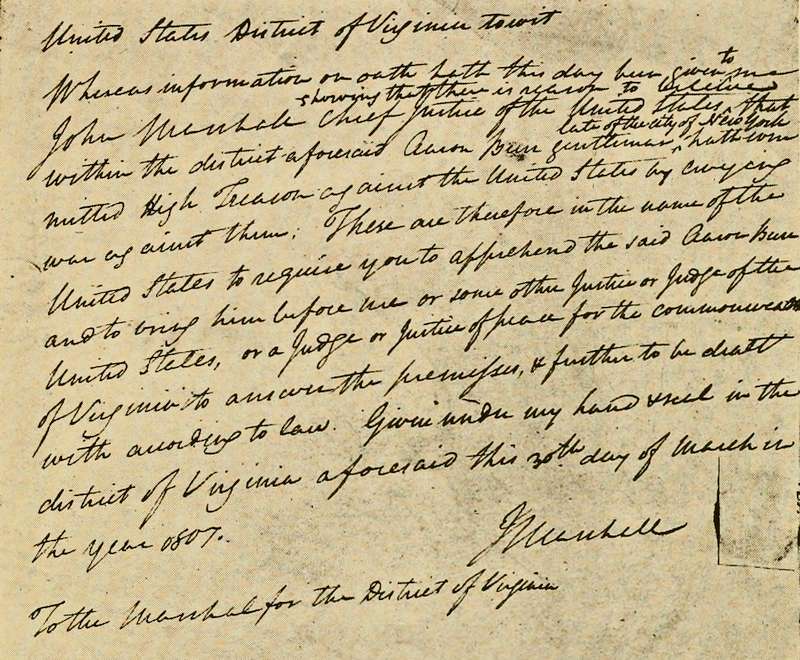
warrant issued by Chief Justice Marshall.
The preliminary examination of Burr was
private. The warrant was served on him in
his apartment by Major Scott, the Marshal of
the Virginia District, who, after informing
him of the object of his visit, conducted him
to another room, where he was brought before
the Chief Justice. The few persons present
were Cæsar A. Rodney, Attorney-General
of the United States; George Hay, the United
States Attorney for the Virginia District; Edmund
Randolph and John Wickham, counsel for
the prisoner; the United States Marshal and
his two deputies; and a few friends of the counsel
for Burr.
The evidence introduced on behalf of the
prosecution was a copy of the record in the case
of Bollman and Swartout in the Supreme Court
of the United States, which contained the depositions
of General Eaton and General Wilkinson
directly connecting Burr with the offense
charged against him. No verbal testimony was
heard, except that of Major Perkins, who told
of the arrest of the prisoner and of his conveyance
of him to Richmond.
At the conclusion of the evidence a motion in
writing was submitted by Mr. Hay for the commitment
of the accused on two charges, viz:—
First. For a high misdemeanor, in setting
on foot, within the United States, a military expedition
against the dominions of the King of
Spain, a foreign prince, with whom the United
States, at the time of the offense, were, and
still are, at peace.
Second. For treason in assembling an armed
force, with a design to seize the city of New
Orleans, to revolutionize the territory attached
to it, and to separate the western from the Atlantic
states.
It soon developed that this motion would
cause considerable discussion, and as previously
agreed upon by counsel, with the approval of
the Chief Justice, the further hearing of the
case was adjourned to the House of Delegates
in the Capitol, where all subsequent proceedings
were had.
The argument on the motion lasted two days.
It was opened by Mr. Hay for the United
States. He was followed by Mr. Wickham and
Mr. Randolph for the accused. Colonel Burr
spoke about ten minutes in his own behalf, and
Mr. Rodney, the Attorney-General of the United
States, closed the discussion.
The third day of the trial, the Chief Justice
delivered his written opinion. “On an application
of this kind,” says he, “I certainly should
not require that proof which would be necessary
to convict the person to be committed on
a trial in chief; nor should I even require that
which should absolutely convince my own mind
of the guilt of the accused; but I ought to require,
and I should require, that probable cause
be shown; and I understand probable cause to
be a case made out by proof furnishing good
reason to believe that the crime alleged has
been committed by the person charged with having
committed it.” The Chief Justice then reviews
the testimony of General Eaton and General
Wilkinson in the Swartout and Bollman
case to show how far these charges are supported
by probable cause, and in conclusion delivers
himself as follows: “I shall not therefore
insert in the commitment the charge of
high treason, since it will be entirely in the
power of the Attorney-General to prefer an indictment
against the prisoner for high treason
should he be furnished with the necessary testimony.”
Burr was now called upon to give bond, and
the amount to be required of him gave rise to
much discussion. The Chief Justice stated,
“that he wished it to be neither too large to
amount to oppression, nor too small to defeat
the objects of justice.” It had occurred to
him that the sum of ten thousand dollars would
perhaps avoid both these extremes. Mr. Hay
earnestly insisted upon a larger amount, but the
amount was fixed at ten thousand. Burr was
then bailed for his appearance at the next term
of the Circuit Court of the United States to convene
at Richmond on the 22d of May next, to
answer the charge of high misdemeanor.
Aaron Burr was now at liberty. President
Jefferson was enraged at the result of the first
trial. The feeling between the partisans of the
Administration and the Federalists, to which
political party Marshall belonged, was rampant.
The friends of Jefferson charged Marshall with
having permitted his political bias and personal
dislike of the President to warp his judgment
in favor of Burr throughout the trial, and Jefferson
in one of his letters to Senator Giles,
written a few days after Burr’s first examination
at Richmond, refers to the tricks of the
judges in hastening the trial so as to clear Burr.
It was evident that Jefferson was to be the real
prosecutor of Burr, and had made up his mind
to convict him at whatever cost.
The 22d of May, 1807, the United States Circuit
Court for the Virginia District convened
in the House of Delegates in the City of Richmond,
Virginia, with Chief Justice Marshall
and Cyrus Griffin, District Judge, on the bench.
Long before the hour the Court was to meet
the hall and the entrances to the Capitol were
thronged with people. Not a few of them were
witnesses and persons summoned as grand
jurors, while others were attracted by the
notoriety of the trial. There could be seen
John Randolph, of Roanoke, “the brilliant, eccentric
leader of the Quids,” in the House, and
afterwards United States Senator from Virginia;
Andrew Jackson, who was loud in his
denunciation of Jefferson and his administration
for “persecuting his innocent friend”;
Winfield Scott, then a young lawyer just admitted
to practice; General Eaton, with a
grudge against the Government for its failure
to pay his claim for services and cash advanced
while consul in Barbary, and with whom Burr
had talked with great freedom about his plans;
Commodore Truxton, another disgruntled officer
of the Government in whom Burr had confided;
Col. Morgan, a valiant old campaigner from the
West, and his two stalwart sons, whose services
Burr tried to enlist, but whom Jefferson
credited with giving him the first intimation of
Burr’s designs; John Graham, who had
been sent out by the Administration to the
Mississippi territory as its confidential agent
to circumvent Burr and expose the conspiracy;
Colonel Dupiester, one of the leading
spirits in the plot and Burr’s trusted
friend and ally; Jonathan Dayton, formerly
speaker of the House of Representatives
and Ex-Senator from the State of New
Jersey, and John Smith, lately a Senator
from Ohio, both friends of Burr and prominent
in the conspiracy with him; Dr. Erick Bollman,
an educated German, who had recently distinguished
himself by a gallant but unsuccessful
attempt to rescue Lafayette from prison in
the castle of Olmutz, Austria, and in whom Burr
had confided. Jefferson expected Bollman to
give testimony that might criminate himself,
and during the trial sent through District Attorney
Hay a pardon for him, which Bollman
indignantly refused to accept. And thither also
came Governor Alston of South Carolina, and
his wife, the beautiful and accomplished Theodosia,
the only daughter of Aaron Burr; who
had fled to his side the moment she had heard
of his arrest.
The court was formally opened at half past
twelve o’clock, and probably there never was
such an array of learning and legal attainments
as was present on that occasion. Foremost and
overshadowing all was John Marshall, the Chief
Justice. “Gentlemen of the profession,” said
Parton, “who witnessed the trial, who saw the
effective dignity with which the judge presided
over the court, who heard him read those opinions,
so elaborate and right, though necessarily
prepared on the spur of the moment, regarded
it as the finest display of judicial skill and
judicial rectitude which they had ever beheld.”
Seated at the bar and appearing in behalf of
the United States were Colonel George Hay,
William Wirt and Alexander MacRae.
Colonel Hay was a son-in-law of James Monroe,
who was afterwards President of the
United States. He was a lawyer of great industry
and much ability, and bore the laboring
oar in the trial. He was a zealous partisan of
Jefferson, and was assisted in the prosecution
by almost daily communications from him.
Later he was appointed United States judge for
the Virginia district. Mr. Wirt was present at
the personal request of President Jefferson.
He was the most eloquent and accomplished advocate
then at the Richmond bar. There was
no one whose rising to speak “so instantaneously
hushed the spectators to silence.” “A
handsome, fortunate, brilliant, high-minded man
was William Wirt,” says Parton, “the toil of
whose life it was to achieve those solid attainments
which alone make brilliancy of utterance
endurable in a court of justice.” Mr. MacRae,
the third attorney for the government, was then
Lieutenant-Governor of Virginia, and while less
able than his two colleagues, was a lawyer of
“respectable ability and a sharp tongue.”
On the side of the defense were the greatest
lawyers of the time. The best known of them
was perhaps Edmund Randolph. Mr. Randolph
had been a delegate to the Continental
Congress and to the Philadelphia Constitutional
Convention, Attorney-General and Governor
of Virginia, and Attorney-General and
Secretary of State under Washington. He was
a man of great experience and learning. Associated
with him from the day of Burr’s arrival
in Richmond was John Wickham, grandfather
of the late General W. C. Wickham and
great-grandfather of Hon. Henry T. Wickham,
an eminent member of the present bar of Virginia.
Mr. Wickham was regarded by many
as the ablest lawyer at the Virginia bar. “The
qualities,” says Mr. William Wirt in the British
Spy, “by which Mr. Wickham strikes the multitude
are his ingenuity and his wit. But those
who look more closely into the anatomy of his
mind, disclose many properties of much higher
dignity and importance. This gentleman, in
my opinion, unites in himself a greater diversity
of talents and acquirements than any other at
the bar in Virginia.” Another great lawyer of
counsel for Burr, and probably the greatest one
of his day, was Luther Martin of Maryland.
He and Burr had formed a friendship about two
years before in Washington, when Justice
Chase of the Supreme Court of the United
States was impeached by the House of Representatives
and tried by the Senate for abuse of
his office in certain political trials. Burr was
then Vice-President of the United States, and
presided over the Senate in that celebrated
proceeding, says a contemporary, “with the
dignity and impartiality of an angel, but with
the rigor of a devil.” Martin was the leading
counsel for Justice Chase, and greatly distinguished
himself. Conspicuous also was Benjamin
Botts, father of the distinguished John
Minor Botts, who although the youngest man on
the side of the defense, had already become
eminent in his profession.
The other counsel for Burr were Charles Lee,
an Ex-Attorney-General of the United States,
and a lawyer of much learning; “Jack” Baker,
who was more of a “good fellow” than lawyer;
and Washington Irving, then attracting some
attention in the field of letters, who to use his
own words, “went to Richmond on an informal
retainer from one of the friends of Col. Burr,”
although, as he said, “his client had little belief
in his legal erudition, and did not look for any
approach to a professional debut, but thought
he might in some way or other be of service
with his pen.”
But of the defense facile princeps was Burr
himself. He was keenly alive to every proceeding,
and while the burden fell upon others, no
move was made, or point conceded, without his
sanction. Mr. Robertson, the reporter of the
trial, says: “Among these stood Aaron Burr,
proudly pre-eminent in point of intelligence to
his brethern of the bar, who had been vice-president
of the United States, and now accused of
the highest and darkest crime in the criminal
code. Standing before the Supreme tribunal
of his country, and with the eyes of the nation
upon him, he was, in the opinion of many, already
condemned. He had the talent and tact,
and the resources of the Government to contend
against, and every faculty of his mind was exerted
in his own defense. The magnitude of
the charge, the number of persons involved, the
former high standing and extraordinary fortunes
of the accused, had excited an interest in
the community such as never before had been
known.”
WARRANT FOR ARREST OF BURR
Facing p. 20
The Marshal had summoned for service on
the grand jury the most intelligent and representative
citizens of the Commonwealth.
Prominent among them was William B. Giles.
He had served in both branches of the Legislature
of Virginia; had been Governor of the State
of Virginia; and representative and senator
in the Congress of the United States. Senator
Giles was a partisan of Jefferson, a member
of what John Randolph called “the President’s
back-stair cabinet.” He was the leader
of the republicans in the Senate, and had been
foremost in the assaults on the “last stronghold
of Federalism—the Judiciary.”
When Senator Giles was called on the voir
dire he was challenged personally by Burr.
Burr claimed the same right of challenging
grand jurors for favor that he had of challenging
petit jurors, and was sustained in his position
by the Chief Justice. His objection to Giles
was that, on occasions in the Senate, he had pronounced
his opinion on certain documents sent
to that body by President Jefferson attributing
to Burr treasonable designs, and upon such information
advocating the suspension of the writ
of habeas corpus. He stated that he could produce
evidence, if necessary, of public utterances
of Senator Giles confirming these views. Senator
Giles was stricken from the panel.
Another former United States Senator, and
afterwards Governor of Virginia, summoned as
a grand juror, was Wilson Cary Nicholas. He
was a personal enemy of Burr, and when his
name was called Burr challenged him. Colonel
Nicholas had served three years in the Senate
when Burr presided over it, and had taken a
very decided part in favor of the election of his
successor. He had freely expressed his suspicions,
both in correspondence and publicly, of
Colonel Burr’s probable objects in the west.
He was rejected.
Some of the other distinguished citizens of
Virginia summoned by the Marshal, and who
served on the grand jury, were Littleton Waller
Tazewell and James Pleasants, both afterwards
United States Senators and Governors of Virginia;
Joseph C. Cabell, one of the founders with
Jefferson of the University of Virginia; William
Daniel, father of the late Judge William
Daniel of the Court of Appeals of Virginia, and
grandfather of John Warwick Daniel, the lamented
senator from Virginia; and Colonel
James Barbour, afterwards Governor of Virginia,
United States Senator, Secretary of War
under John Quincy Adams, and Minister to
England.
The general belief in the guilt of the accused
was manifested at the very beginning of the
trial. The proclamations and the special messages
of President Jefferson to Congress, and
the depositions of Generals Eaton and Wilkinson
had had their effect on the public mind. A
number of citizens summoned for service on the
grand jury frankly admitted they had prejudged
the case, and in consequence of such disqualifications
and excuses the original panel was reduced
to fourteen.
The court, being now without a legal grand
jury in attendance, directed the Marshal to summon
from the bystanders two additional persons.
The Marshal summoned and returned
John Randolph and William Foushee. Mr.
Randolph was named as foreman, but upon being
asked to take the oath, requested to be excused
from serving. He had formed an opinion
concerning the nature and tendency of certain
transactions imputed to Mr. Burr. He had a
strong prepossession, but thought he could divest
himself of it upon evidence. Mr. Burr observed
that he was afraid they would be unable
to find any man without this prepossession.
“The rule is,” said the Chief Justice, “that a
man must not only have formed, but declared an
opinion, in order to exclude him from serving
on the jury.” Mr. Randolph replied that he
had no recollection of having declared one, and
he was thereupon sworn as foreman.
Dr. Foushee when called to be sworn was
found to be disqualified, and was permitted to
withdraw. Colonel James Barbour was called
in his stead and accepted.
The selection of the grand jury having been
completed, the grand jury was duly sworn by
the clerk. It was composed of the following
citizens:
John Randolph, Foreman, Joseph Eggleston,
Joseph C. Cabell, Littleton W. Tazewell, Robert
Taylor, James Pleasants, John Brockenbrough,
William Daniel, James M. Garnett, John Mercer,
Edward Pegram, Munford Beverly, John
Ambler, Thomas Harrison, Alexander Shephard
and James Barbour.
The Chief Justice promptly delivered an appropriate
charge to the grand jury. He dwelt
more particularly upon the definition and nature
of treason, and the testimony requisite to
prove it. He said in part: “To you by the
Constitution and laws of our country is confided
the important right of accusing those whose offenses
shall have rendered them subject to
punishment under the laws of the United States.
It is on you that the fundamental principles on
which the stability of our political institutions
and the safety of individuals most greatly depend.
For to little purpose would laws be
formed to protect the innocent of the body
politic from crimes of the worst nature if a misplaced
nonentity should control the execution of
them. Juries, gentlemen, as well as judges,
should be superior to every temptation, which
hope, fear or compassion, may suggest; who will
allow no influence to balance their love of justice;
who will follow no guide but the laws of
their country.
“In outlining to you, gentlemen of the jury,
those offenses which are cognizable in the court,
and which may scarcely be noticed by you, the
first on the calendar, as well as the highest
known atrocity, is treason against the United
States. With a jealousy peculiar to themselves
the American people have withdrawn the subject
from the power of their legislature, and
have declared in their Constitution that ‘treason
against the United States shall consist only in
levying war against them, or in adhering to
their enemies, giving them aid and comfort.’”
After the grand jury had retired Colonel
Burr addressed the court on the propriety of
specially instructing them in regard to the admissibility
of certain evidence, which he stated
would be laid before the grand jury by the attorney
for the United States. Mr. Hay opposed
this application. He said he could never agree
to it, and he trusted the court also would never
sanction such a suggestion; that Colonel Burr
stood before the court on the same footing as
any other citizen, and he hoped the court would
not distinguish between his case and that of
any other. The question was postponed for
further discussion. The court then adjourned
to the following morning.
The court met the next day and the grand
jury also appeared. It became apparent that
nothing effectual could be done until the arrival
of General Wilkinson, the most important witness
for the Government. The grand jury were
therefore adjourned from day to day until he
put in his appearance.
Meanwhile Mr. Hay had moved to commit
Burr on a charge of high treason against the
United States. On his preliminary examination
he was bailed on the charge of misdemeanor,
but said Mr. Hay “there was no evidence
of an overt act. The evidence is different
now.”
This motion was discussed at length throughout
the day, and provoked one of the most eloquent
debates of the whole trial and revealed
the political passions of the day. Mr. Botts
“begged leave to make a few remarks on this
extraordinary application, and the pernicious
effects such an extraordinary measure, if generally
practised, would inevitably produce.
The organ particularly appropriated for the
consideration of the evidence which the motion
calls for, is the grand jury; and the motion is
to divest the grand jury of the office, which the
Constitution and laws have appropriated to
them, and to devolve it upon the court. The
grand juror’s oath is to inquire into all crimes
and misdemeanors committed within the district
of the State of which they are freeholders.
Their office is to perform that which the court
is now called upon to perform. To them belongs
the exclusive duty of inquiring and examining
into all species of evidence, which may
lead to a conviction of the crimes of which
Colonel Burr is now charged; but there is a
great objection to the exercise of this examining
and committing power by a high law officer,
who is to preside upon the trial, when the grand
jury, the appropriate tribunal, is in session.”
After Mr. Botts had taken his seat, Mr. Hay
in response to an inquiry by the Chief Justice,
as to whether the counsel for the prosecution
intended to open the case more fully, stated,
“that he had not intended to open it more fully;
he did not himself entertain the least doubt, that
if there was sufficient proof produced to justify
the commitment of Colonel Burr, the court had
completely the right to commit him.”
Mr. Wickham complained because the gentlemen
on the other side had not given them notice
of their intended motion. “We come into this
discussion completely off our guard, completely
unprepared.” “The fact is this,” replied Mr.
Hay, “Mr. Wilkinson is known to be a material
witness in this prosecution; his arrival in Virginia,
might be announced in this city, before
he himself reached it. I do not intend to say
what effect it might produce upon Colonel
Burr’s mind; but certainly Colonel Burr would
be able to effect his escape, merely upon paying
the recognizance of his present bail. My only
object then was to keep his person safe, until we
could have investigated the charge of treason;
and I really did not know but that if Colonel
Burr had been previously apprised of my motion
he might have attempted to avoid it. But
I did not promise to make the communication
to the opposite counsel, because it might have
defeated the very end for which it was intended.”
Mr. Wickham observed, “that the present motion
was unprecedented in a system of criminal
jurisprudence, which was upwards of one
hundred years old.” Continuing, Mr. Wickham
said: “What, sir, is the tendency of this
application? What is the motion? I have no
doubt, the gentlemen mean to act correctly—I
wish to cast no imputation; but the counsel and
the court well know that there are a set of busy
people (not I hope employed by the Government)
who, thinking to do right, are laboring
to ruin the reputation of my client. I do not
charge the Government with this attempt; but
the thing is actually done. Attempts have been
made. The press from one end of the continent
to the other, has been enlisted on their side
to excite prejudice against Colonel Burr. Prejudice?
Yes, they have influenced the public
opinion by such representations, and by persons
not passing between the prisoner and his
country, but by ex parte evidence and mutilated
statements. Ought not this court to bar the
door as much as possible, against such misrepresentation?
to shut out every effort to excite
further prejudice, until the case is decided by
a sworn jury? Not by the floating rumors
of the day, but by the evidence of sworn witnesses?”
In reply to Mr. Botts and Mr. Wickham, Mr.
Wirt for the first time addressed the court:
“Where is the crime,” said Mr. Wirt, “of
considering Aaron Burr a subject to the ordinary
operation of the human passions? Towards
any other man, it seems, the attorney
would have been justified in using precautions
against alarms and escapes; it is only improper
when applied to this man. Really, sir, I recollect
nothing in the history of his deportment
which renders it so very incredible, that Aaron
Burr would fly from a prosecution. But at all
events, the attorney is bound to act on general
principles, and to take care that justice be
had against every person accused, by whatever
name he may be called, or by whatever previous
reputation he may be distinguished. This motion,
however, it seems, is not legal at this time,
because there is a grand jury in session. The
amount of the position is, that though it may
be generally true, that the court possesses the
power to hear and commit, yet, if there be a
grand jury, the power of the court is suspended;
and the commitment cannot be had unless
in consequence of a presentment or bill of
indictment found by that body. The general
power of the court being admitted, those who
rely on this exception, should support it by authority;
and, therefore, the loud call for precedents,
which we have heard from the other
side come improperly from that quarter. We
ground this motion in the general power of the
court to commit: let those who say that this
general power is destroyed by the presence of
a grand jury show one precedent to countenance
this original and extraordinary motion. I believe,
sir, I may safely affirm, that not a single
reported case or dictum can be found, which
has the most distant bearing towards such an
idea. Sir, no such dictum or case ought to exist.
It would be unreasonable and destructive
of the principles of justice.
“But, sir, we are told, that the investigation
is calculated to keep alive the public prejudice;
and we hear great complaints about these public
prejudices. The country is represented as
being filled with misrepresentations and calumnies
against Aaron Burr; the public indignation,
it is said, is already sufficiently excited. This
argument is also inapplicable to our right to
make this motion; it does not affect the legality
of our procedure. Sir, if Aaron Burr be innocent
instead of resisting this motion, he ought
to hail it with triumph and exultation. What
is it that we propose to introduce? Not the
rumors that are floating through the world, nor
the bulk of the multitude, nor the speculations
of newspapers, but the evidence of facts. We
propose, that the whole evidence exculpatory
as well as accusative, shall come before you;
instead of exciting, this is the true mode of correcting,
prejudices. The world, which it is
said has been misled and influenced by falsehood,
will now hear the truth. Let the truth
come out, let us know how much of what we
have heard is false, how much of it is true; how
much of what we feel is prejudice, how much
of it is justified by fact. Whoever before heard
of such an apprehension as that which is professed
on the other side? Prejudice excited by
evidence! Evidence, sir, is the great corrector
of prejudice. Why then does Aaron
Burr shrink from it? It is strange to me that a
man, who complains so much of being, without
cause, illegally seized and transported by a
military officer, should be afraid to confront the
evidence; evidence can be promotive only of
truth. I repeat it then, sir, why does he shrink
from the evidence? The gentlemen on the
other side can give the answer. On our part we
are ready to produce that evidence.
“The gentleman assures us, that no imputation
is meant against the Government. Oh no,
sir; Colonel Burr indeed has been oppressed,
has been persecuted; but far be it from the
gentleman to charge the Government with it.
Colonel Burr indeed has been harassed by a
military tyrant, who is ‘the instrument of the
Government bound to blind obedience’; but the
gentleman could not by any means be understood
as intending to insinuate aught to the
prejudice of the Government. The gentleman is
understood, sir; his object is correctly understood.
He would divert the public attention
from Aaron Burr and point it to another quarter.
He would, too, if he could, shift the popular
displeasure, which he has spoken of, from
Aaron Burr to another quarter. These remarks
were not intended for your ear, sir; they
were intended for the people who surround us;
they can have no effect upon the mind of the
court. I am too well acquainted with the
dignity, the firmness, the illumination of this
bench, to apprehend any such consequence.
But the gentlemen would balance the account
of popular prejudices; they would convert the
judicial inquiry into a political question; they
would make it a question between Thomas
Jefferson and Aaron Burr. The purpose is
well understood, sir; but it shall not be served.
I will not degrade the administration of this
country by entering on their defence. Besides,
sir, this is not our business; at present we have
an account to settle, not between Aaron Burr
and Thomas Jefferson, but between Aaron Burr
and the laws of his country. Let us finish his
trial first. The administration, too, will be
tried before their country; before the world.
They, sir, I believe, will never shrink, either
from the evidence or the verdict.”
Mr. Hay then delivered an elaborate argument
in support of his motion and was followed
by Mr. Randolph. Colonel Burr concluded the
debate in a ten minutes’ speech.
“The case is this,” says Colonel Burr: “No
man denies the authority of the court, to commit
for a crime; but no commitment ought to be
made, except on probable cause. This authority
is necessary; because policy requires, that
there should be some power to bind an accused
individual for his personal appearance, until
there shall have been sufficient time to obtain
witnesses for his trial; but this power ought to
be controlled as much as possible.
“The question in the present case, is whether
there is probable cause of guilt; and whether
time ought to be allowed to collect testimony
against me. This time ought generally to be
limited; but there is no precise standard on the
subject; and much is of course left to the sound
discretion of the court. Two months ago, however,
you declared that there had been time
enough to collect the evidence necessary to
commit, on probable cause; and surely, if this
argument was good then, it is still better now.
“As soon as a prosecutor has notice of a
crime, he generally looks out for witnesses. It
is his object to obtain probable cause for committing
the accused. Five months ago, a high
authority declared that there was a crime; that
I was at the head of it; and it mentioned the
very place, too, where the crime was in a state
of preparation. The principal witness against
me, is said to be Mr. Wilkinson. Now, from
what period is the time to be computed? If,
from the time I was suspected, five months;
if, from the time when I was seized, three
months; or is it to be only computed from
the time when I was committed? So that it is
near forty days since the notice must have arrived
at New Orleans. But a vessel navigates
the coast, from New Orleans to Norfolk, in three
weeks. I contend, however, that witnesses
ought to be produced, from the very time when
the crimes are said to be committed. There is,
then, no apology for the delay of the prosecution,
as far as it respects the only person for
whom an apology is attempted to be made.
“There are other serious objections to my
situation. Must I be ready to proceed to trial?
True, sir, but then it must be in their own way.
Are we then on equal terms here? Certainly
not. And again, as to affidavits. The United
States can have compulsory process to obtain
them; but I have no such advantage. An ex
parte evidence, then, is brought before this
court, on a motion for commitment. The evidence
on one side only is exhibited; but if I had
mine also to adduce, it would probably contradict
and counteract the evidence for the
United States. Well, sir, and these affidavits
are put into the newspapers, and they fall into
the hands of the grand jury. I have no such
means as these, sir; and where then is the
equality between the Government and myself.
“The opinion of the court, too, is to be committed
against me. Is this no evil?
“A sufficient answer, sir, has been given to
the argument about my delay; and its disadvantages
to myself have been ably developed.
But my counsel have been charged with declamation
against the Government of the United
States. I certainly, sir, shall not be charged
with declamation; but surely it is an established
principle, sir, that no government is so
high as to be beyond the reach of criticism; and
it is more particularly laid down, that this
vigilance is more peculiarly necessary, when
any government institutes a prosecution: and
one reason is, on account of the vast disproportion
of means which exists between it and the
accused. But, if ever there was a case which
justified this vigilance, it is certainly the present
one, when the Government has displayed
such uncommon activity. If, then, this Government
has been so peculiarly active against me,
it is not improper to make the assertion here,
for the purpose of increasing the circumspection
of the court.”
Mr. Burr observed, that he meant by persecution,
the harassing of any individual, contrary
to the forms of law; and that his case, unfortunately,
presented too many instances of
this description. He would merely state a few
of them. He said that his friends had been
everywhere seized by the military authority; a
practice truly consonant with European despotisms.
He said that persons had been dragged
by compulsory process before particular tribunals,
and compelled to give testimony against
him. His papers, too, had been seized. “And
yet, in England,” said he, “where we say they
know nothing of liberty, a gentleman, who had
been seized and detained two hours, in a back
parlour, had obtained damages to the amount
of one thousand guineas.” He said that an
order had been issued to kill him, as he was descending
the Mississippi, and seize his property.
And yet, they could only have killed his person,
even if he had been formally condemned for
treason. He said that even post-offices had
been broken open, and robbed of his papers;
that, in the Mississippi Territory, even an indictment
was about to be laid against the postmaster;
that he had always taken this for a
felony; but that nothing seemed too extravagant
to be forgiven by the amiable morality
of this Government. “All this,” said Mr. Burr,
“may only prove that my case is a solitary
exception from the general rule. The Government
may be tender, mild and humane to everybody
but me. If so, to be sure it is of little
consequence to anybody but myself. But surely
I may be excused if I complain a little of such
proceedings.”
AFFIDAVIT OF BURR FOR SUBPŒNA DUCES TECUM FOR
PRESIDENT JEFFERSON
Facing p. 40
“Our President,” said Mr. Burr, “is a lawyer
and a great one too. He certainly ought to
know what it is that constitutes a war. Six
months ago, he proclaimed that there was a
civil war. And yet, for six months have they
been hunting for it, and still cannot find one
spot where it existed. There was, to be sure, a
most terrible war in the newspapers; but nowhere
else.”
The next day the court in a written opinion
held that the motion was a proper one at this
stage of the proceedings, and the attorney for
the United States was permitted to open his
testimony; but in doing so, the Chief Justice
expressed his regrets that the result of the motion
“may be publications unfavorable to the
justice and to the right decision of the case.”
Counsel were impressed with this observation
of the court, and an attempt was made to reach
an agreement whereby a public disclosure of
the evidence at this time might be avoided. It
was proposed by counsel for the United States
that Colonel Burr’s recognizance be made sufficiently
large to insure his appearance to answer
the charge of high treason against the
United States, but on the following day this
proposition was rejected by Colonel Burr. Mr.
Hay then proceeded with some reluctance to
the examination of witnesses in support of his
motion to commit Burr, as “he felt the full
force of the objections to a disclosure of the evidence,
and the necessity of the court declaring
its opinion before the case was laid before the
jury.”
The attorney for the United States first
sought to read the deposition of General Wilkinson,
which precipitated the question of the
order in which the testimony was to be introduced
and its admissibility. The Supreme
Court had already decided in the case of Swartout
and Bollman that the deposition of Wilkinson
might be admitted in evidence under certain
circumstances, but that it did not contain
any proof of an overt act. The Chief Justice
observed that no evidence certainly had any
bearing upon the present case unless the overt
act be proved, but he would permit the attorney
for the United States to pursue his own
course as to the order of introducing his testimony.
A lengthy argument here ensued, in which
Mr. Botts took a conspicuous part. In a most
lucid manner he defined the crime of high treason
under the Constitution of the United
States, and applied it to the issue before the
court.
“First,” he said, “it must be proved that
there was an actual war. A war consists
wholly in acts, and not in intentions. The acts
must be in themselves acts of war; and if they
be not so intrinsically, words or intentions cannot
make them so. In England, when conspiring
the death of the King was treason, the quo
animo formed the essence of the offence; but,
in America, the national convention has confined
treason to the act. We cannot have a
constructive war within the meaning of the
Constitution. An intention to levy war, is not
evidence that a war was levied. Intentions are
always mutable and variable; the continuance
of guilty intentions is not to be presumed.
Secondly, the war must not only have been
levied, but Colonel Burr must be proved to
have committed an overt act of treason in that
war. A treasonable intention to coöperate
is no evidence of an actual coöperation. The
acts of others, even if in pursuance of his
plan, would be no evidence against him. It
might not be necessary that he should be present,
perhaps; but he must be, at the time of
levying the war, coöperating by acts, or, in the
language of the Constitution, be committing
overt acts. Thirdly, the overt act by the accused,
as an actual war, must not only be
proved, but it must be proved to have been
committed within this district. Fourthly,
the overt act must be proved by two witnesses.”
The Chief Justice declared this view of the
law to be correct, and General Wilkinson’s
deposition was accordingly put aside.
Mr. Hay realized the utter futility of his
efforts to commit Burr on the charge of treason
at this stage of the case, and readily consented
to Burr’s proposition to double the
amount of his bond to answer the charge of a
misdemeanor. Luther Martin, who appeared
for the first time, became one of his sureties.
He declared in open court that he was happy to
have this opportunity to give a public proof of
his confidence in the honor of Colonel Burr, and
of his belief in his innocence.
General Wilkinson had not as yet put in his
appearance, and much impatience was manifested
because of the inconvenience he had
caused. The grand jury were therefore adjourned
from day to day until the second day
of June, when they were adjourned until the
9th, on which last named day he was expected
to arrive.
The court met accordingly on the 9th, and
after the names of the grand jury had been
called and explanations offered as to the continued
absence of General Wilkinson, Colonel
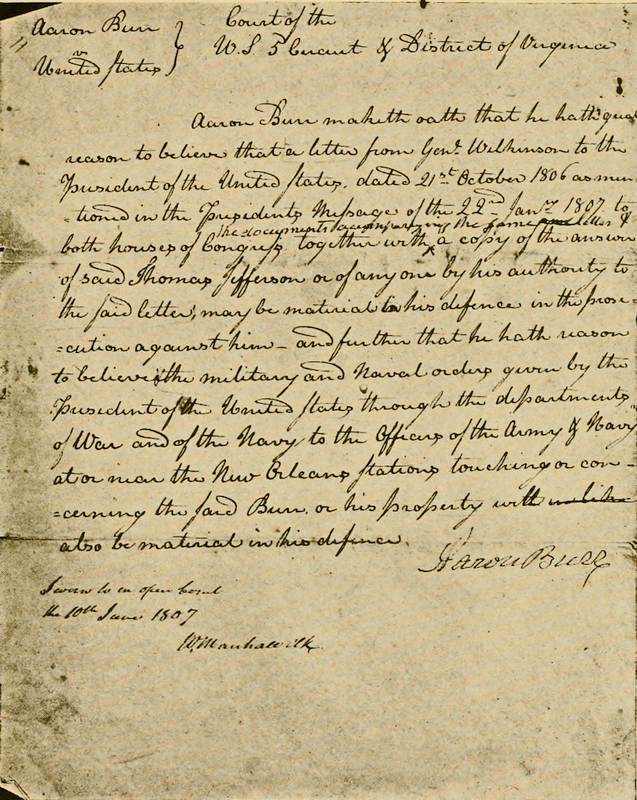
Burr moved the court to issue a subpœna
duces tecum addressed to the President of the
United States, requiring him to produce certain
papers, and on the following day he presented
to the court an affidavit, drawn up and
sworn to by himself in open court in support
of his motion. In this affidavit he sets forth
that he has great reason to believe, that a letter
from General Wilkinson to the President
of the United States, dated October 21st, 1806,
as mentioned in the President’s message of the
22nd January, 1807, to both Houses of Congress,
together with the documents accompanying the
said letter, and copy of the answer of said
Thomas Jefferson, or of anyone by his authority,
to the said letter, may be material in his
defence in the prosecution against him. And
further that he has reason to believe, the
military and naval orders given by the president
of the United States, through the departments
of war and of the navy, to the officers
of the army and navy, at or near New Orleans
stations, touching or concerning the said Burr,
or his property, will also be material in his defense;
and that he had made a personal request
for copies of these papers during a recent visit
to Washington, and had been refused.
Mr. Martin in support of the propriety of
granting this particular subpœna laid down as
a general principle, in all civil or criminal cases,
that every man had a right by process to establish
his rights or his innocence. He asserted
that one of the papers necessary to the defense
is the original letter from General Wilkinson
described in Burr’s affidavit. The other papers
are copies of official orders by the navy and
war departments. He had supposed that every
citizen was entitled to such copies of official
papers as are material to him, and he had
never heard of but one instance where they were
refused, and this was under presidential influence.
“We intend to show,” says Mr. Martin,
“that, by this particular order, his property
and his person were to be destroyed; yes, by
these tyrannical orders, the life and property
of an innocent man were to be exposed to destruction.
We did not expect these originals
themselves. But we did apply for copies; and
were refused under presidential influence. In
New York, in the farcical trials of Ogden and
Smith, the officers of the Government screened
themselves from attending, under the sanction
of the President’s name. Perhaps the same
farce may be repeated here; and it is for this
reason that we applied directly to the President
of the United States. Whether it would have
been best to have applied to the Secretaries of
State, of the Navy and War, I cannot say. All
that we want is the copies of some papers, and
the original of another. This is a peculiar case,
sir. The President has undertaken to prejudge
this trial by declaring, that, ‘of his guilt
there can be no doubt.’ He has assumed to
himself the knowledge of the Supreme Being
himself, and pretended to search the heart of
my highly respected friend. He has proclaimed
him a traitor in the face of that country,
which has rewarded him. He has let slip
the dogs of war, the hell-hounds of persecution,
to hunt down my friend. And would this
President of the United States, who has raised
all of this absurd clamor, pretend to keep back
the papers which are wanted for this trial,
where life is at stake? It is a sacred principle,
that in all such cases, the accused has a right to
all the evidence which is necessary to his defense.
And whoever withholds, wilfully, information
that would save the life of a person,
charged with a capital offence, is substantially
a murderer, and so recorded in the registry of
Heaven.”
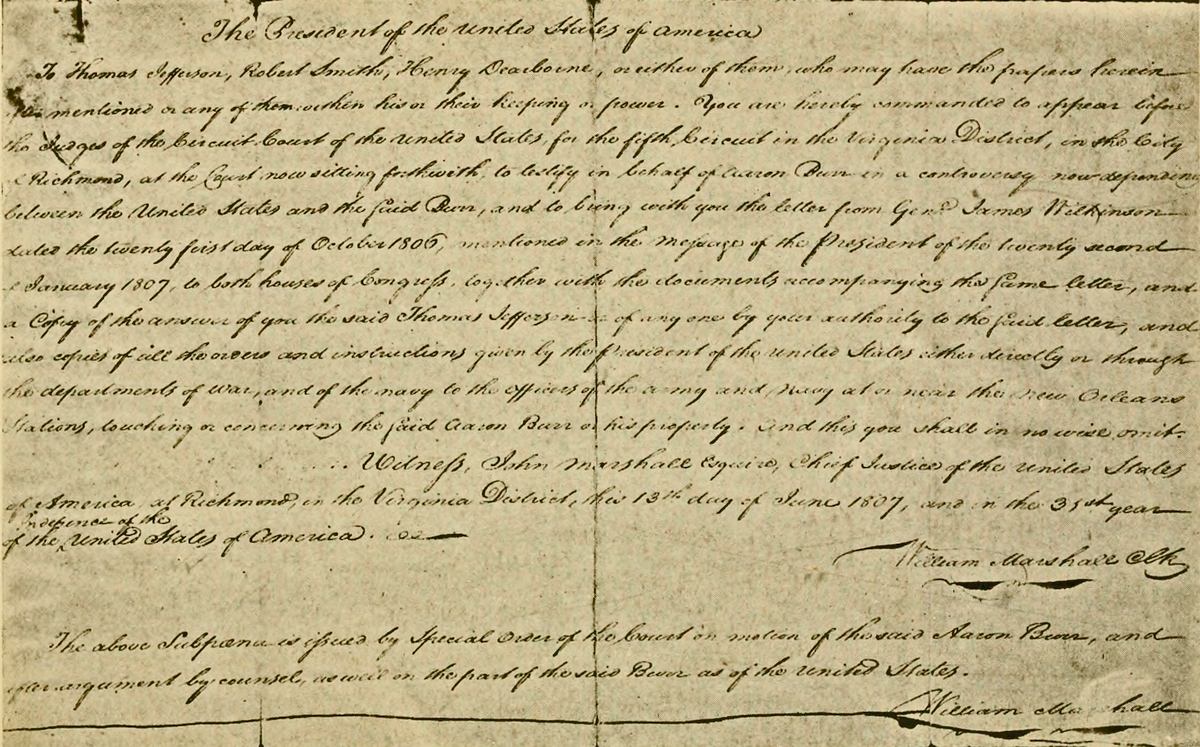
SUBPŒNA DUCES TECUM FOR PRESIDENT JEFFERSON
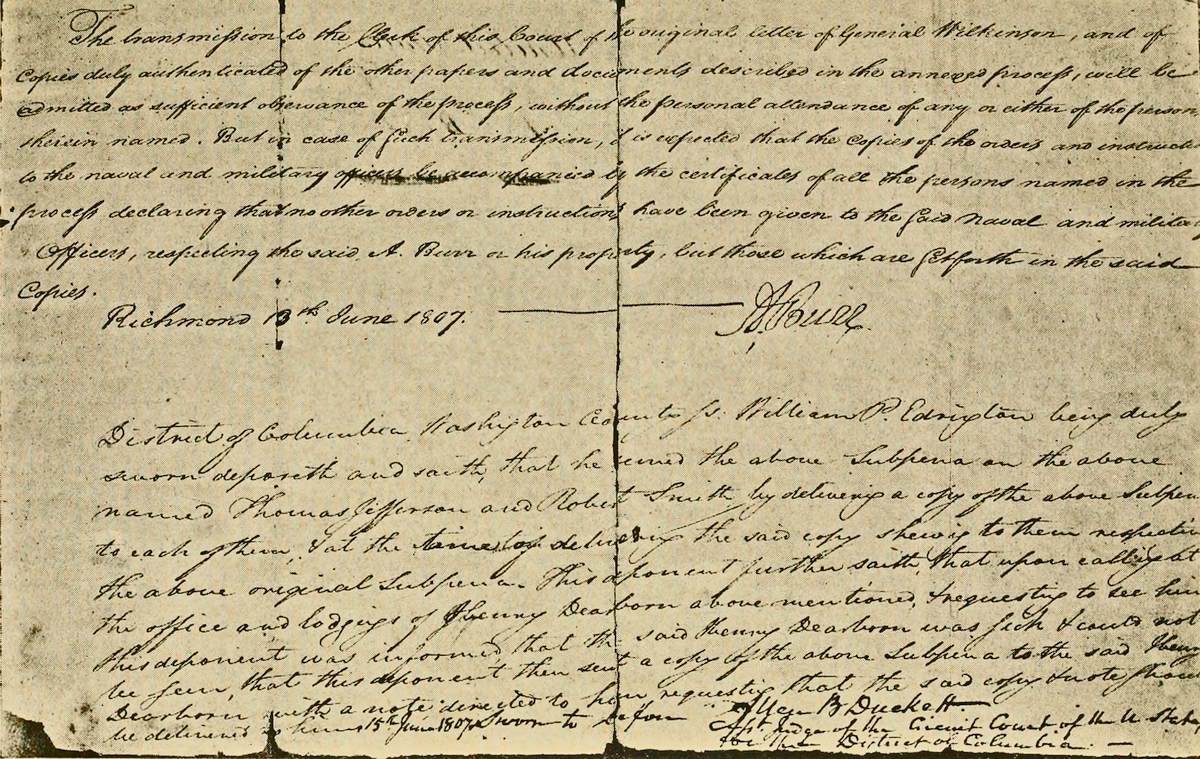
SUBPŒNA DUCES TECUM FOR PRESIDENT JEFFERSON (Continued)
Facing p. 50
Mr. Wirt replied to Mr. Martin, and in the
course of his argument, made the following reference
to Martin’s arraignment of Jefferson
and the administration:
“I cannot take my seat, sir, without expressing
my deep and sincere sorrow at the policy
which the gentlemen in the defense have thought
it necessary to adopt. As to Mr. Martin, I
should have been willing to impute this fervid
language to the sympathies and resentments of
that friendship which he has taken such frequent
occasions to express for the prisoner, his
honourable friend. In the cause of friendship
I can pardon zeal even up to the point of intemperance;
but the truth is, sir, that before Mr.
Martin came to Richmond, this policy was
settled, and on every question incidentally
brought before the court, we were stunned with
invectives against the administration. I appeal
to your recollection, sir, whether this policy was
not manifested even so early as in those new and
until now unheard of challenges to the grand
jury for favour? Whether that policy was not
followed up with increased spirit, in the very
first speeches which were made in this case;
those of Mr. Botts and Mr. Wickham on their
previous question pending the attorney’s motion
to commit? Whether they have not seized
with avidity every subsequent occasion, and on
every mere question of abstract law before the
court, flew off at a tangent from the subject, to
launch into declamations against the government?
Exhibiting the prisoner continually as
a persecuted patriot; a Russell or a Sidney,
bleeding under the scourge of a despot, and dying
for virtue’s sake! If there be any truth in
the charges against him, how different were the
purposes of his soul from those of a Russell or a
Sidney! I beg to know what gentlemen can intend,
expect, or hope, from these perpetual philippics
against the Government? Do they flatter
themselves that this court feel political
prejudices which will supply the place of argument
and innocence on the part of the prisoner?
Their conduct amounts to an insinuation of the
sort. But I do not believe it. On the contrary,
I feel the firm and pleasing assurance, that as to
the court, the beam of their judgment will remain
steady, although the earth itself should
shake under the concussion of prejudice. Or is
it on the bystanders that the gentlemen expect
to make a favourable impression? And do they
use the court merely as a canal, through which
they may pour upon the world their undeserved
invectives against the Government? Do they
wish to divide the popular resentment and
diminish thereby their own quota? Before the
gentlemen arraign the administration, let them
clear the skirts of their client. Let them prove
his innocence; let them prove that he has not
covered himself with the clouds of mystery and
just suspicion; let them prove that he has been
all along erect and fair, in open day, and that
these charges against him are totally groundless
and false. That will be the most eloquent
invective which they can pronounce against the
prosecution; but until they prove this innocence,
it shall be in vain that they attempt to divert
our minds to other objects, and other inquiries.
We will keep our eyes on Aaron Burr until he
satisfies our utmost scruple. I beg to know, sir,
if the course which gentlemen pursue is not disrespectful
to the court itself? Suppose there
are any foreigners here accustomed to regular
government in their own country, what can they
infer from hearing the federal administration
thus reviled to the federal judiciary?
Hearing the judiciary told, that the administration
are ‘Bloodhounds, hunting this man with
a keen and savage thirst for blood; that they
now suppose they have hunted him into their
toils and have him safe.’ Sir, no man, foreigner
or citizen, who hears this language addressed to
the court, and received with all the complacency
at least which silence can imply, can make any
inferences from it very honourable to the court.
It would only be inferred, while they are thus
suffered to roll and luxuriate in these gross invectives
against the administration, that they
are furnishing the joys of a Mahometan paradise
to the court as well as to their client. I
hope that the court, for their own sakes, will
compel a decent respect to that government of
which they themselves form a branch. On our
part, we wish only a fair trial of this case. If
the man be innocent, in the name of God let him
go; but while we are on the question of his guilt
or innocence, let us not suffer our attention and
judgment to be diverted and distracted by the
introduction of other subjects foreign to the
inquiry.”
The counsel for the prosecution admitted that
the President of the United States was amenable
to an ordinary subpœna ad testificandum
as any other citizen, but that the application for
a subpœna duces tecum was addressed to the
discretion of the court, and did not issue as a
process of right. Besides, the papers required
to be produced by such a process must be shown
to be material for the defense. They questioned
the propriety of compelling the chief
magistrate to produce in court any papers in
his possession not public in its character. They
further contended that until the grand jury had
found a true bill and the prosecutor had announced
his intention to proceed to a trial
thereon the prisoner had no right to legal
process.
After five days of debate the Chief Justice
delivered an elaborate opinion on the motion of
Colonel Burr. He decided that the subpœna
duces tecum directed to the president of the
United States might issue. He held that any
person charged with a crime in the courts of the
United States has a right, before, as well as
after indictment, to the process of the court to
compel the attendance of his witnesses; that in
the provisions of the Constitution, and of the
statutes which give to the accused a right to the
compulsory process of the court, there is no exception
whatever.
“If, upon any principle,” said the Chief Justice,
“the President could be construed to stand
exempt from the general provisions of the Constitution,
it would be because his duties, as
chief magistrate, demand his whole time for
national objects. But it is apparent that this
demand is not unremitting; and, if it should
exist at the time when his attendance on a
court, is required, it would be sworn on the return
of the subpœna, and would rather constitute
a reason for not obeying the process of the
court, than a reason against it being issued.
The guard furnished to this high office to protect
him from being harassed by vexatious and
unnecessary subpœnas, is to be looked for in
the conduct of a court after those subpœnas
have issued; not in any circumstance which is to
precede their being issued. If, in being summoned
to give his personal attendance to testify,
the law does not discriminate between the President
and a private citizen, what foundation is
there for the opinion, that this difference is created
by the circumstance, that his testimony depends
on a paper in his possession, not on facts,
which come to his knowledge otherwise than by
writing? The court can perceive no foundation
for such an opinion. The propriety of introducing
any paper into a case, as testimony, must
depend on the character of the paper, not on the
character of the person who holds it. A subpœna
duces tecum, then, may issue to any person
to whom any ordinary subpœna may issue,
directing him to bring any paper of which the
party praying it has a right to avail himself
as testimony; if, indeed, that be the necessary
process for obtaining the view of such
paper.”
The decision of the Chief Justice and the strictures
of Martin threw Jefferson into a violent
rage. We find him promptly writing to Mr.
Hay, “Shall we move to commit Luther Martin
as particeps criminis with Burr? Grayball
will fix upon him misprision of treason at least,
and, at any rate, his evidence will pull down this
unprincipled and impudent Federal bull-dog,
and add another proof that the most clamorous
defenders of Burr are all his accomplices.”
And again he writes to Hay, after discussing at
length the intimation in the decision of the
Chief Justice that even the bodily presence of
the President might be compelled by the court,
which proposition he indignantly denied, “that
the leading feature of our Constitution is the
independence of the legislative, executive and
judiciary of each other; and none are more jealous
of this than the judiciary. But would the
executive be independent of the judiciary if he
were subject to the commands of the latter, and
to imprisonment for disobedience, if the smaller
courts could bandy him from pillar to post, keep
him constantly trudging from North to South
and East and West and withdraw him entirely
from his executive duties?”
The law and reasoning of the decision of the
Chief Justice were convincing. Jefferson knew
that under the Constitution the President had
no superior right to those of any other citizen,
and, while directing substantially all papers required
by the subpœna duces tecum to be furnished,
he refused to appear in person in court.
He openly defied the process of the court. He
intimated that if the court attempted to enforce
its writ he would meet force with force. The
Chief Justice realized what this meant, and the
matter was quietly dropped.
On Saturday, June 13th, twenty-two days
after the court had convened, General Wilkinson
arrived in the city of Richmond, and on the
following Monday he was sworn and sent to the
grand jury, with a notification that it would
facilitate their inquiries if they would examine
him immediately.
Wilkinson was at the head of the army and
Governor of the territory of Louisiana, to which
latter office he had been appointed about the
close of the session of Congress that Burr as
Vice-President presided over the Senate. Between
him and Burr a long friendship had existed.
They had been fellow soldiers in the
War of the Revolution—had shared together
the hardships of the winter of 1775–6, and the
perils of the unsuccessful attack on the city of
Quebec. While it was true they had seen very
little of each other since the war they had at
intervals, and only a short time before the arrest
of Burr, corresponded confidentially and
in cipher. He was undoubtedly in the secrets
of Burr, until he saw the impending explosion,
and then he became active in exposing the plot
and bringing Burr to trial. Certain it is that
Burr regarded him as an associate and denounced
his treachery.
The meeting between Burr and his former
friend Wilkinson was dramatic, and is graphically
described by Washington Irving.
“Burr,” says Irving, “was seated with his back to the entrance, facing
the judges, and conversing with one of his counsel when Wilkinson
strutted into the court and took a stand in a parallel line with Burr
on his right hand. Here he stood for a moment swelling like a turkey
cock, and bracing himself up for the encounter of Burr’s eyes. The
latter did not take any notice of him until the Judge directed the
clerk to swear General Wilkinson; at the mention of the name Burr
turned his head, looked him full in the face with one of his piercing
regards, swept his eye over his whole person from head to foot, as if
to scan its dimensions and then cooly resumed his former position, and
went on conversing with his counsel as tranquilly as ever. The whole look
was over in an instant, but it was an admirable one. There was no
appearance
of study or constraint in it; no affectation
of disdain or defiance; a slight expression
of contempt played over his countenance, such
as you would show on regarding any person to
whom you were indifferent, but whom you considered
mean and contemptible.”
The examination of witnesses by the grand
jury continued from day to day until June 24th,
when in the midst of an argument by Mr. Botts
for an attachment against General Wilkinson
for endeavoring to prevent the free course of
testimony, the grand jury entered the courtroom,
and speaking through its distinguished
foreman, stated that they had agreed upon several
indictments, which he handed to the clerk
of the court. The clerk then read the following
endorsements thereon:
“An indictment against Aaron Burr for
treason—a true bill.”
“An indictment against Aaron Burr for
a misdemeanor—a true bill.”
“An indictment against Herman Blannerhassett
for treason—a true bill.”
“An indictment against Herman Blannerhassett
for a misdemeanor—a true bill.”
The grand jury then adjourned until the next
day, and at the conclusion of Mr. Bott’s argument
on the motion for attachment, Colonel
Burr with his wonted serene and placid air
arose and stated to the court, that as true bills
had been found against him, it was probable, the
United States Attorney would move for his commitment;
he would, however, suggest two ideas
for the consideration of the court. “One was
that it was within their discretion to bail in
certain cases, even when the punishment was
death; and the other was, that it was expedient
for the court to exercise their discretion in this
instance, as he should prove, that the indictment
against him had been obtained by perjury.”
Mr. Hay moved for his commitment. He
stated that if the court had the power to bail,
it was only to be exercised according to their
sound discretion. After much time had been
spent in debate, the Chief Justice observed that
“he was under the necessity of committing
Colonel Burr.” He was accordingly committed
to the custody of the Marshal, and conducted to
the city jail, for the County of Henrico and the
City of Richmond; but two days later on the
affidavit of his counsel, who had visited him in
his confinement, that the miserable state of the
prison would endanger his health, and that it
was so arranged as to deprive him of consultation
with his counsel, and upon the further report
of the Surveyor of the Public Buildings of
the United States, the court entered the following
order:
“Whereupon, it is ordered, that the Marshal
of this district, do cause the front room of the
house now occupied by Luther Martin, Esq.,
which room has been and is used as a dining
room, to be prepared for the reception and safe-keeping
of Colonel Aaron Burr, by securing the
shutters to the windows of the said room by
bars, and the door by a strong bar or pad-lock.
And that he employ a guard of seven men to be
placed on the floor of the adjoining unfinished
house, and on the same story with the before
described front room, and also, at the door opening
into the said front room; and upon the Marshal’s
reporting to the court that the said room
has been so fitted up, and the guard employed,
that then the said Marshal be directed, and he
is hereby directed, to remove to the said room,
the body of the said Aaron Burr from the public
gaol, there to be by him safely kept.”
This building now known as Blair’s Drug
Store, still stands at the corner of Ninth and
Broad Streets, in the City of Richmond, Virginia.
The grand jury had on the day previous
brought in indictments for treason against Ex-Senator
Jonathan Dayton of New Jersey, Ex-Senator
John Smith of Ohio, Comfort Tyler and
Israel Smith of New York; and Davis Floyd of
the territory of Indiana. This completed their
inquiries, and after an appropriate address by
the Chief Justice in which he complimented
them upon the great patience and cheerful attention
with which they had performed the arduous
and laborious duties in which they had
been so long engaged, discharged them from
further attendance on the court.
After some discussion as to procedure, the
clerk of the court read the indictment against
Burr, for treason against the United States,
which with the endorsements thereon (exclusive
of the verdict of the trial jury), is as follows:
“VIRGINIA DISTRICT:
“IN THE CIRCUIT COURT OF THE
UNITED STATES OF AMERICA, IN AND
FOR THE FIFTH CIRCUIT AND VIRGINIA
DISTRICT:
“The grand inquest of the United States of
America, for the Virginia district, upon their
oath do present that Aaron Burr, late of the
city of New York, and State of New York, Attorney
at Law, being an inhabitant of and residing
within the United States, and under the
protection of the laws of the United States, and
owing allegiance and fidelity to the same United
States, not having the fear of God before his
eyes, nor weighing the duty of his said allegiance,
but being moved and seduced by the instigation
of the devil, wickedly devising and
intending the peace and tranquillity of the said
United States to disturb and to stir, move and
excite insurrection, rebellion and war against
the said United States, on the tenth day of December
in the year of Christ one thousand eight
hundred and six at a certain place called and
known by the name of Blannerhassett’s Island,
in the county of Wood and District of Virginia
aforesaid, and within the jurisdiction of this
Court, with force and arms unlawfully, falsely,
maliciously and traitorously did compass, imagine
and intend to raise and levy war, insurrection
and rebellion against the said United
States; and in order to fulfil and bring to effect
the said traitorous compassings, imaginations
and intentions of him, the said Aaron Burr, he,
the said Aaron Burr, afterwards, to wit, on the
said tenth day of December in the year one
thousand eight hundred and six aforesaid, at
the said island, called Blannerhassett’s Island
as aforesaid, in the County of Wood aforesaid
in the District of Virginia aforesaid and within
the jurisdiction of this Court, with a great multitude
of persons whose names at present are
unknown to the grand inquest aforesaid, to a
great number, to wit, to the number of thirty
persons and upwards, armed and arrayed in a
warlike manner, that is to say, with guns,
swords, and dirks and other warlike weapons
as well offensive as defensive, being then and
there unlawfully, maliciously and traitorously
assembled and gathered together, did falsely
and traitorously assemble and join themselves
together against the said United States, and
then and there with force and arms did falsely
and traitorously, and in warlike and hostile
manner, array and dispose themselves against
the said United States, and then and there that
is to say on the day and in the year aforesaid
at the island aforesaid commonly called Blannerhassett’s
Island in the County aforesaid of
Wood, within the Virginia district, and the jurisdiction
of this Court, in pursuance of such their
traitorous intentions and purposes, aforesaid,
he the said Aaron Burr with the said persons
so as aforesaid traitorously assembled and
armed and arrayed in manner aforesaid, most
wickedly, maliciously and traitorously did ordain,
prepare and levy war against the said
United States, contrary to the duty of their
said allegiance and fidelity, against the Constitution,
peace and dignity of the said United
States, and against the form of the Act of Congress
of the said United States, in such case
made and provided:
“And the grand inquest of the United States
of America for the Virginia district upon their
oaths aforesaid do further present, that the said
Aaron Burr, late of the City of New York, and
State of New York, attorney at law, being an
inhabitant of and residing within the United
States and under the protection of the laws of
the United States, and owing allegiance and
fidelity to the same United States, not having
the fear of God before his eyes, nor
weighing the duty of his said allegiance,
but being moved and seduced by the instigation
of the devil, wickedly devising and intending
the peace and tranquillity of the
United States to disturb, and to stir, move, and
excite insurrection, rebellion and war against
the said United States, on the eleventh day of
December in the year of our Lord one thousand
eight hundred and six, at a certain place, called
and known by the name of Blannerhassett’s
Island in the County of Wood and District of
Virginia aforesaid and within the jurisdiction
of this court, with force and arms, unlawfully,
falsely, maliciously and traitorously did compass,
imagine and intend to raise and levy war,
insurrection and rebellion against the said
United States, and in order to fulfil and bring
to effect the said traitorous compassings, imaginations
and intentions of him the said Aaron
Burr, he, the said Aaron Burr, afterwards, to
wit, on the said last mentioned day of December
in the year one thousand eight hundred and six
aforesaid, at a certain place commonly called
and known by the name of Blannerhassett’s
Island in the said County of Wood, in the District
of Virginia aforesaid, and within the jurisdiction
of this court, with one other great multitude
of persons, whose names at present are
unknown to the grand inquest aforesaid, to a
great number, to wit, to the number of thirty
persons and upwards, armed and arrayed in a
warlike manner, that is to say, with guns,
swords and dirks, and other warlike weapons
as well offensive as defensive being then and
there unlawfully, maliciously and traitorously
assembled and gathered together, did falsely
and traitorously assemble and join themselves
together against the said United States, and
then and there with force and arms did falsely
and traitorously and in a warlike and hostile
manner, array and dispose themselves against
the said United States, and then and there, that
is to say, on the day and in the year last mentioned,
at the island aforesaid in the County of
Wood aforesaid, in the Virginia district, and
within the jurisdiction of this Court, in pursuance
of such their traitorous intentions, and
purposes aforesaid, he the said Aaron Burr
with the said persons so as aforesaid traitorously
assembled and armed and arrayed in manner
aforesaid, most wickedly, maliciously and
traitorously did ordain, prepare and levy war
against the said United States, and further to
fulfil and carry into effect the said traitorous
compassings, imaginations and intentions of the
said Aaron Burr against the said United States,
and to carry on the war thus levied as aforesaid
against the said United States, the said
Aaron Burr with the multitude last mentioned
at the island aforesaid, in the said
County of Wood, within the Virginia district
aforesaid and within the jurisdiction of this
court, did array themselves in a warlike manner,
with guns and other weapons offensive and defensive,
and did proceed from the said island
down the river Ohio, in the County aforesaid
within the Virginia district, and within the jurisdiction
of this Court, on the said eleventh day
of December in the year one thousand eight
hundred and six aforesaid, with the wicked and
traitorous intention to descend the said river
and the river Mississippi and by force and arms
traitorously to take possession of a City commonly
called New Orleans in the territory of
Orleans belonging to the United States; contrary
to the duty of their said allegiance and
fidelity, against the Constitution, peace and dignity
of the said United States and against the
form of the Act of the Congress of the United
States in such case made and provided.
HAY.
Attorney of the United States for the Virginia
District.
“Witness in behalf of the United States.
1. Thomas Truxton
2. Stephen Decatur
3. Benjamin Stoddert
4. William Eaton
5. William Duane
6. Erick Bollman
7. Peter Taylor
8. Jacob Allbright
9. Charles Willie
10. John Graham
11. Saml. Swartout
12. Julien Dupeistre
13. Prevost
14. James Miller
15. Saml. Kouten
16. George Morgan
17. John Morgan
18. Thomas Morgan
19. Nicholas Perkins
20. Robert Spence
21. George Harris
22. Cyrus Jones
23. Thomas Peterkin
24. Elias Glover
25. Simeon Poole
26. Dudley Woodbridge
27. David C. Wallace
28. Edward W. Tupper
29. Edmund B. Dana
30. James Read
31. John G. Henderson
32. Alex. Henderson
34. Ambrose Smith
35. Hugh Phelps
36. Gen. Wilkinson
37. Dunbaugh
38. Charles Lindsay
39. John Manhatton
40. James Knox
41. William Love
42. David Fisk
43. Thomas Heartly
44. Stephen S. Welch
45. James Kenney
46. Samuel Moxley
47. Edw. P. Gaines
48. A. D. Smith.”
ENDORSED:
“United States
vs.
Aaron Burr.
Indictment for Treason.
A true Bill.
John Randolph.”
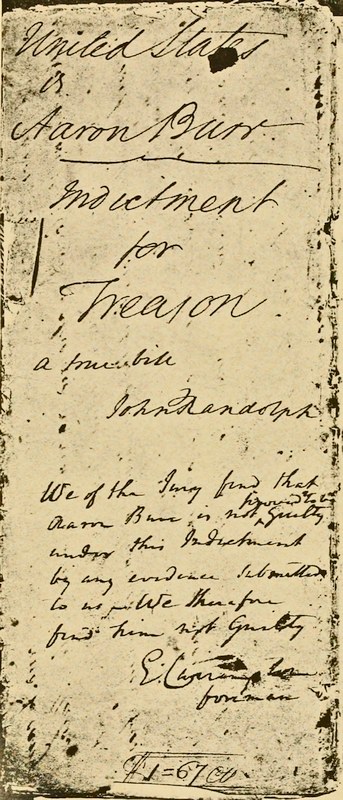
FINDINGS OF THE GRAND AND PETIT JURIES
Facing p. 70
At the conclusion of the reading of the indictment,
Mr. Burr addressed the court as follows:
“I acknowledge myself to be the person
named in the indictment: I plead not guilty;
and put myself upon my country for trial.”
The indictment, as will be observed, specifies
the place of the overt act to be at Blannerhassett
Island, and the time the 10th day of December,
1806.
The court, when the plea was in, made an
order for a venire of forty-eight jurors, twelve
of whom, at least, were to be summoned from
Wood County and on the following day, June
27th, the court ordered the venire facias to issue
to the marshal, returnable on the 3rd day of
August and fixed that day for the trial.
Three days later Burr was, on motion of the
United States attorney, removed from his lodging
at the corner of Ninth and Broad Streets,
and, with the approval of the Governor of Virginia,
placed in the third story of the penitentiary,
therein to be confined, until the 2nd day
of August.
The court pursuant to adjournment met
promptly at 12 o’clock, Monday, August 3rd, in
the House of Delegates, with Chief Justice Marshal
presiding. Judge Griffin, the District
Judge, who had heretofore set in the case, did
not appear until the following Friday.
George Hay, William Wirt and Alexander
MacRae appeared as counsel for the prosecution,
and Edmund Randolph, John Wickham,
Benjamin Botts, John Baker and Luther Martin
for the prisoner. Mr. Charles Lee appeared
about two weeks later.
The court room was crowded with an immense
throng of citizens, when Burr, accompanied
by his son-in-law, Governor Alston, of
South Carolina, and exhibiting his usual serenity
and self-possession, entered. The names
of the jurors were promptly called, and shortly
thereafter the court adjourned until the following
Wednesday, to give counsel for the defense
time to examine the list of the jurors summoned.
The court met pursuant to adjournment, and
for twelve days was engaged in the selection of
a jury for the trial of the case. Of the original
venire of forty-eight, only four, Richard E.
Parker, David Lambert, Hugh Mercer, and
Edward Carrington were elected, and, of the
second venire for a like number, eight were
accepted as competent jurors, namely, Christopher
Anthony, James Sheppard, Reuben
Blakey, Miles Bottes, Henry C. Coleman, Benjamin
Graves, John M. Sheppard, and Richard
Curd.
The jury now being elected and sworn, the
prisoner was directed to stand up. The clerk
read the indictment for treason against him,
and, at the conclusion of the reading, addressed
the jury in the usual form. The case was then
opened for the prosecution by Mr. Hay, it being
agreed that he should fully present the side of
the government, and immediately thereafter
proceed with his evidence.
Mr. Hay dwelt at great length on the crime
of treason.
“In Great Britain,” he said, “there are no
less than ten different species of treason; at
least that was the number when Blakstone
wrote, and it is possible that the number may
have been increased since. But in this country,
where the principle is established in the
Constitution, there are only two descriptions of
treason; and the number being fixed in the
Constitution itself, can never be increased by
the legislature, however important and necessary
it should be, in their opinion, that the
number should be augmented. By the third
section, article 3 of the Constitution of the
United States, ‘treason against the United
States shall consist only in levying war against
them, or in adhering to their enemies; giving
them aid and comfort.’ With respect to the
latter description, there is no occasion to say
anything, as the offense charged in the indictment
is ‘levying war against the United States’;
but it adds that ‘no person shall be convicted
of treason, unless on the testimony of two witnesses
to the same overt act, or on confession
in open court.’”
The first witness called was General Eaton.
Colonel Burr objected to the order of the testimony.
He said Mr. Hay had not stated the nature
of the witness’ testimony; but he presumed
that it related to certain conversations said
to have happened at Washington. He contended
that no such evidence as that, which
tended only to show intentions or designs, was
admissible until an overt act of treason had
been proved. This question was ably argued
by counsel on both sides.
The next day the Chief Justice decided that
so far as the testimony of General Eaton “relates
to the fact charged in the indictment, so
far as it relates to levying war on Blannerhassett’s
Island, so far as it relates to a design
to seize on New Orleans, or to separate by force,
the Western from the Atlantic states, it is
deemed relevant and is now admissible: so far
as it respects other plans to be executed in the
City of Washington, or elsewhere, if it indicate
a treasonable design, it is a design to commit
a distinct act of treason, and is therefore not
relevant to the present indictment. It can
only, by showing a general evil intention, render
it more probable that the intention in the particular
case was evil. It is merely additional
or corroborative testimony, and therefore, if
admissible at any time, it is only admissible according
to the rules and principles which the
court must respect, after hearing that which it
is to confirm.”
General Eaton was then called to the stand
and examined. He stated in the beginning that
he knew nothing of any overt act of treason on
the part of Burr, or of any of the happenings
on Blannerhassett’s Island; but that he knew
much concerning Burr’s expressions of treasonable
intentions.
The next witnesses called to prove treasonable
designs were Commodore Truxton, Peter
Taylor, Blannerhassett’s gardener, and Colonel
Morgan and his two sons.
The prosecution now took up the testimony to
establish the overt act and called to the stand
Jacob Allbright, Peter Taylor, William Love,
Maurice P. Belknap and Edmund B. Dana.
These witnesses proved the assemblage of men,
some thirty or more, on Blannerhassett’s Island,
December 10th, 1806, armed with rifles
and pistols, the pretended purpose of which
was to descend the Ohio River to the City of
New Orleans, and make it the base of operations
in an expedition to Mexico; but failed to
prove the act of levying war.
It was not proved that Burr was present on
the Island when the assemblage of the men took
place.
The only witness, who gave any direct testimony
on the overt act sought to be proved was
Allbright, and he was discredited on cross-examination.
He testified on the night of the
flight from the Island that “a man by the name
of Tupper (meaning General Tupper), laid his
hands upon Blannerhassett, and said: ‘Your
body is in my hands, in the name of the Commonwealth.’
Some such words as that he mentioned.
When Tupper made that motion,
there were seven or eight muskets leveled at
him. Tupper looked about him and said ‘Gentlemen,
I hope you will not do the like.’ One
of the gentlemen who was nearest about two
yards off said ‘I’d as leave as not.’ Tupper
then changed his speech, and said he wished
him to escape safe down the river, and wished
him luck.”
At the conclusion of the evidence relating
directly to the overt act charged in the indictment,
counsel for the prosecution attempted to
introduce collateral testimony of acts beyond
the limits of the jurisdiction of the court; but
Colonel Burr and his counsel strenuously objected
to such testimony as wholly irrelevant
and inadmissible, and moved the court to arrest
the evidence on the ground that the United
States had failed to prove an overt act, constituting
treason, under the Constitution of the
United States.
The argument on this motion, which was so
vital to the further prosecution of the case commenced
on the 20th of August, and continued
until the 29th of that month, and was “doubtless,”
says Parton, “the finest display of legal
knowledge and ability of which the history of
the American bar can boast.”
Mr. Wickham opened the debate and was
followed by Randolph, Wirt, Botts, MacRae,
Hay and Lee. Mr. Martin concluded. It fills
one volume of Mr. Robertson’s report of the
case, and it would be vain to attempt in this
brief review to give anything like a satisfactory
account of it. Some of the reasons urged
in support of the motion were: that Burr, not
being present on Blannerhassett’s Island, was
merely an accessory, and not a principal; that
if he was a principal he was a principal only in
the second degree, where guilt is merely derivative,
and that therefore no parole evidence
could be admitted against him, until a record
was produced of the conviction of the offenders
in the first degree; that the facts must be
proved as laid in the indictment, and evidence
proving the accused to have been absent at the
time of the overt acts is inadmissible to support
an indictment charging him with the commission
of that act; that no parole evidence
could be given to connect the prisoner with the
men assembled on Blannerhassett’s Island,
until an act of treason on the part of these men
was proved; and that the assemblage there was
not an act of treason; that until the fact of a
crime is proved no evidence should be heard
respecting the guilty intentions of the accused.
On Monday, August 31st the Chief Justice
rendered his decision. He read it with great
care and consumed three hours in doing so.
“The question now to be decided,” he began,
“has been argued in a manner worthy of its importance,
and with an earnestness evincing the
strong conviction felt by the counsel on each
side that the law is with them.
“A degree of eloquence seldom displaced on
any occasion has embellished a solidity of argument,
and a depth of research by which the
court has been greatly aided in forming the
opinion it is about to deliver.
“The testimony adduced on the part of the
United States to prove the overt act laid in the
indictment having shown, and the attorney for
the United States having admitted, that the
prisoner was not present when that act, whatever
may be its character, was committed, and
there being no reason to doubt but that he was
at a great distance and in a different state, it is
objected to the testimony offered on the part of
the United States, to connect him with those
who committed the overt act, that such testimony
is totally irrelevant and must therefore
be rejected.
“The arguments in support of this motion
respect in part the merits of the case as it may
be supposed to stand independent of the pleadings,
and in part as exhibited by the pleadings.
“On the first division of the subject two
points are made:
“1st. That conformably to the constitution
of the United States, no man can be convicted
of treason who was not present when the war
was levied.
“2d. That if this construction be erroneous,
no testimony can be received to charge one man
with the overt acts of others until those overt
acts, as laid in the indictment, be proved to the
satisfaction of the court.
“The question which arises on the construction
of the constitution, in every point of view
in which it can be contemplated, is of infinite
moment to the people of this country and to
their government, and requires the most temperate
and the most deliberate consideration.
“Treason against the United States shall
consist only in levying war against them.”
The Chief Justice then proceeds to elaborately
discuss an overt act of levying war. The
opinion delivered by the Supreme Court in the
case of Bollman and Swartout was declared by
him to be not correctly understood; and that
there must be, before an overt act of treason
is completed, either the actual employment of
force or a military assemblage of men, who
are in a posture of war.
In conclusion the Chief Justice said:
“The law of the case being thus far settled;
what ought to be the decision of the court on
the present motion? Ought the court to sit
and hear testimony which cannot affect the
prisoner? or ought the court to arrest that
testimony? On this question much has been
said: much that may perhaps be ascribed to a
misconception of the point really under consideration.
The motion has been treated as a
motion confessedly made to stop relevant testimony;
and, in the course of the argument, it
has been repeatedly stated, by those who oppose
the motion, that irrelevant testimony may
and ought to be stopped. That this statement
is perfectly correct is one of those fundamental
principles in judicial proceedings which is acknowledged
by all, and is founded in the absolute
necessity of the thing. No person will contend
that, in a civil or criminal case, either party is
at liberty to introduce what testimony he
pleases, legal or illegal, and to consume the
whole term in details of facts unconnected with
the particular case. Some tribunal then must
decide on the admissibility of testimony. The
parties cannot constitute this tribunal; for they
do not agree. The jury cannot constitute it;
for the question is whether they shall hear the
testimony or not. Who then but the court can
constitute it? It is of necessity the peculiar
province of the court to judge of the admissibility
of testimony. If the court admit improper
or reject proper testimony, it is an
error of judgment; but it is an error committed
in the direct exercise of their judicial functions.
“The present indictment charges the prisoner
with levying war against the United
States, and alleges an overt act of levying war.
That overt act must be proved, according to
the mandates of the constitution and of the act
of congress, by two witnesses. It is not proved
by a single witness. The presence of the accused
has been stated to be an essential component
part of the overt act in this indictment,
unless the common law principle respecting accessories
should render it unnecessary; and
there is not only no witness who has proved
his actual or legal presence, but the fact of his
absence is not controverted. The counsel for
the prosecution offer to give in evidence subsequent
transactions at a different place and in
a different state, in order to prove—what? the
overt act laid in the indictment? that the prisoner
was one of those who assembled at Blannerhassett’s
Island? No: that is not alleged.
It is well known that such testimony is not competent
to establish such a fact. The constitution
and law require that the fact should be
established by two witnesses; not by the establishment
of other facts from which the jury
might reason to this fact. The testimony then
is not relevant. If it can be introduced, it is
only in the character of corroboratives or confirmatory
testimony, after the overt act has
been proved by two witnesses in such manner
that the question of fact ought to be left with
the jury. The conclusion, that in this state of
things no testimony can be admissible, is so
inevitable that the counsel for the United
States could not resist it. I do not understand
them to deny, that, if the overt act be not
proved by two witnesses so as to be submitted
to the jury, all other testimony must be irrelevant;
because no other testimony can prove
the act. Now, an assemblage on Blannerhassett’s
Island is proved by the requisite number
of witnesses; and the court might submit it to
the jury whether that assemblage amounted to
a levying of war; but the presence of the accused
at that assemblage being nowhere alleged
except in the indictment, the overt act is
not proved by a single witness; and of consequence
all other testimony must be irrelevant.
“The only difference between this motion as
made, and the one in the form which the counsel
for the United States would admit to be
regular, is this: it is now general for the rejection
of all testimony. It might be particular
with respect to each witness as adduced. But
can this be wished? or can it be deemed necessary?
If enough be proved to show that the
indictment cannot be supported, and that no
testimony, unless it be of that description which
the attorney for the United States declares
himself not to possess, can be relevant, why
should a question be taken on each witness?
“Much has been said in the course of the
argument on points on which the court feels
no inclination to comment particularly; but
which may, perhaps, not improperly, receive
some notice.
“That this court dares not usurp power is
most true.
“That this court dares not shrink from its
duty is not less true.
“No man is desirous of placing himself in a
disagreeable situation. No man is desirous of
becoming the peculiar subject of calumny. No
man, might he let the bitter cup pass from him
without self reproach, would drain it to the
bottom. But if he have no choice in the case,
if there be no alternative presented to him but
a dereliction of duty or the opprobrium of those
who are denominated the world, he merits the
contempt as well as the indignation of his country
who can hesitate which to embrace.
“That gentlemen, in a case the most interesting,
in the zeal with which they advocate particular
opinions, and under the conviction, in
some measure produced by that zeal, should
on each side press their arguments too far,
should be impatient at any deliberation in the
court, and should suspect or fear the operation
of motives to which alone they can ascribe that
deliberation, is perhaps a frailty incident to
human nature; but if any conduct on the part
of the court could warrant a sentiment that it
would deviate to the one side or the other from
the line prescribed by duty and by law, that
conduct would be viewed by the judges themselves
with an eye of extreme severity, and
would long be recollected with deep and serious
regret.
“The arguments on both sides have been
intently and deliberately considered. Those
which could not be noticed, since to notice every
argument and authority would swell this opinion
to a volume, have not been disregarded.
The result of the whole is a conviction, as complete
as the mind of the court is capable of receiving
on a complex subject, that the motion
must prevail.
“No testimony relative to the conduct or
declarations of the prisoner elsewhere and subsequent
to the transaction on Blannerhassett’s
Island can be admitted; because such testimony,
being in its nature merely corroborative
and incompetent to prove the overt act in itself,
is irrelevant until there be proof of the overt
act by two witnesses.
“This opinion does not comprehend the proof
by two witnesses that the meeting on Blannerhassett’s
Island was procured by the prisoner.
On that point the court for the present withholds
its opinion for reasons which have been
already assigned; and as it is understood from
the statements made on the part of the prosecution
that no such testimony exists. If there be
such let it be offered; and the court will decide
upon it. The jury have now heard the opinion
of the court on the law of the case. They will
apply that law to the facts, and will find a verdict
of guilty or not guilty as their own consciences
may direct.”
The next morning Mr. Hay, after counsel for
the prosecution had given serious consideration
to the opinion of the court, stated that he
had neither argument nor evidence to offer to
the jury. The jury then retired and after an
absence of twenty-five minutes, reported to the
court through their foreman, Colonel Carrington,
the following verdict endorsed on the indictment:
“We of the jury find that Aaron Burr is not
proved to be guilty under the indictment by
any evidence submitted to us. We therefore
find him not guilty.”
Colonel Burr and his counsel objected to entering
this form of the verdict on the record.
The court at length decided that the verdict
should remain on the indictment as found by
the jury, and that the record of the proceedings
of the court should show simply a verdict of
“not guilty.” The following day Burr was released
from prison on bail.
The trial was now begun on the indictment
for high misdemeanor against him, for having
set on foot a military expedition against the
territory of a foreign prince, to-wit, the
Province of Mexico, which was within the empire
of the King of Spain, who was at peace
with the United States. The trial lasted until
the latter part of October when Burr was acquitted.
THE END