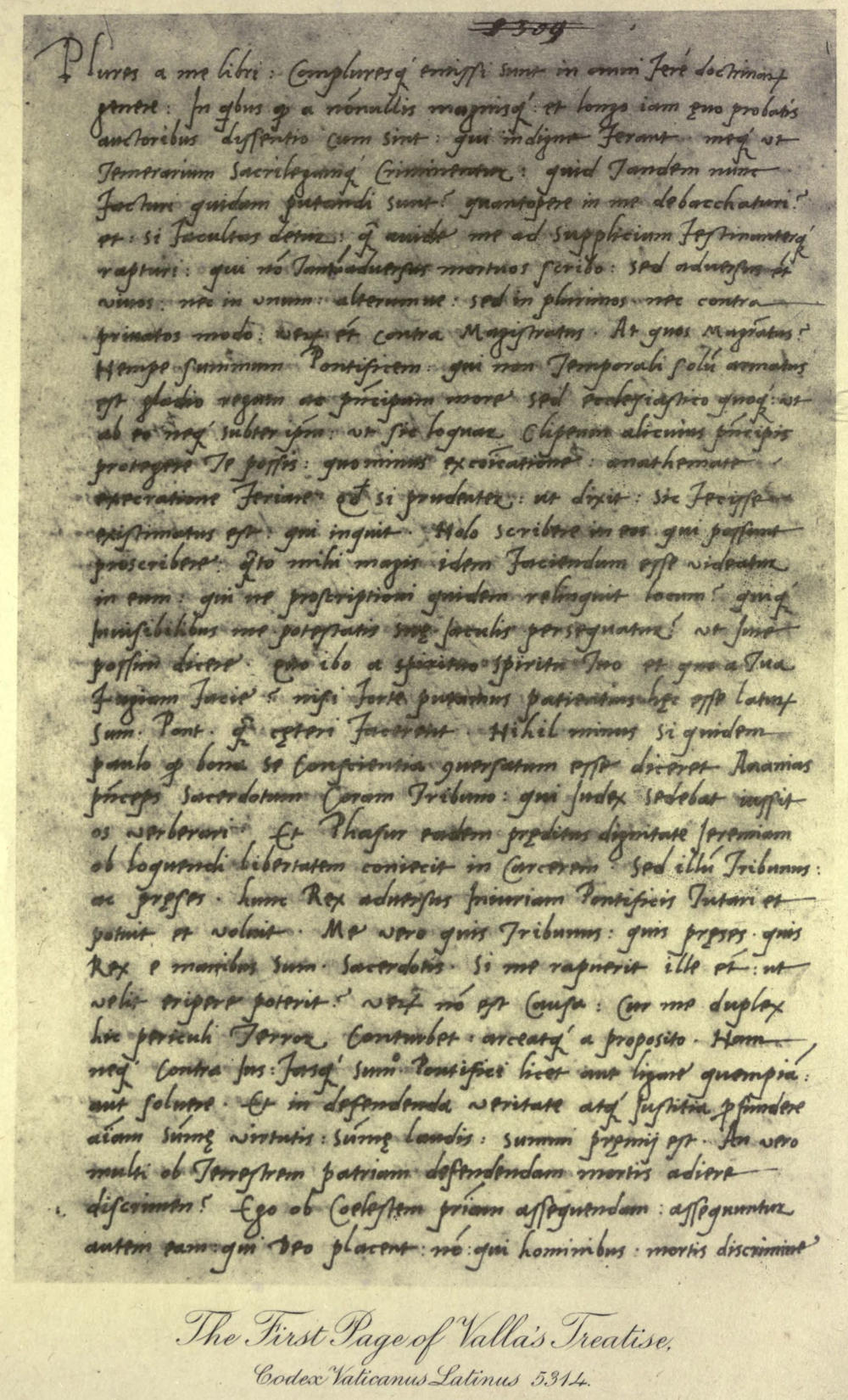
LAURENTII VALLENSIS — DE FALSO CREDITA ET EMENTITA CONSTANTINI DONATIONE DECLAMATIO. [10] — FOOTNOTES
Plures a me libri compluresque emissi sunt in omni fere
doctrinarum genere. In quibus quod a nonnullis magnisque
et longo iam aevo probatis auctoribus dissentio cum sint,
qui indigne ferant meque ut temerarium sacrilegumque criminentur,
quid tandem nunc facturi quidam putandi sunt? Quantopere
in me debacchaturi, et si facultas detur, quam avide me ad supplicium
festinanterque rapturi, qui non tantum adversus mortuos
scribo, sed adversus etiam vivos; nec in unum alterumve, sed in
plurimos; nec contra privatos modo, verum etiam contra magistratus!
At quos magistratus! Nempe summum pontificem, qui non
temporali solum armatus est gladio, regum ac principum more, sed
ecclesiastico quoque, ut ab eo neque subter ipsum, ut sic loquar,
clipeum alicuius principis[11] protegere te possis, quominus excommunicatione,
anathemate, exsecratione[12] feriare. Quod si prudenter,
ut dixit, sic fecisse existimatus est, qui inquit, “Nolo scribere in
eos qui possunt proscribere,” quanto mihi magis idem faciendum [See English page]
esse videatur in eum qui ne proscriptioni quidem relinquat[13] locum,
quique invisibilibus me potestatis suae iaculis persequatur, ut iure
possim dicere, “Quo ibo a spiritu tuo et quo a tua fugiam facie!”
Nisi forte putamus patientius haec esse laturum summum pontificem[14]
quam ceteri[15] facerent. Nihil minus, si quidem Paulo, quod
bona se conscientia conversatum esse dicerat, Ananias, princeps
sacerdotum, coram tribuno qui iudex sedebat, iussit os verberari;[16]
et Phasur, eadem praeditus dignitate, Ieremiam ob loquendi libertatem
coniecit in carcerem. Sed illum tribunus ac praeses, hunc
rex adversus iniuriam pontificis tutari et potuit et voluit. Me vero
quis tribunus, quis praeses, quis rex e manibus summi sacerdotis,
si me rapuerit ille, etiam ut velit eripere poterit?
Verum non est causa cur me duplex hic periculi terror conturbet
arceatque a proposito. Nam neque contra ius fasque summo pontifici
licet aut ligare quempiam[17] aut solvere, et in defendenda
veritate atque iustitia profundere animam summae virtutis,
summae laudis, summi praemii est. An vero multi ob terrestrem
patriam defendendam mortis adiere discrimen? Ego ob caelestem[18]
patriam assequendam (assequuntur autem eam qui Deo placent,
non qui hominibus) mortis discrimine deterrebor? Facessat igitur
trepidatio; procul abeant metus; timores excidant! Forti animo,
magna fiducia, bona spe, defendenda est causa veritatis, causa
iustitiae, causa Dei!
Neque enim is verus est habendus orator qui bene scit[19] dicere
nisi et dicere audeat. Audeamus itaque accusare eum[20] quicumque
digna committit accusatione. Et qui in omnes peccat, unius pro
omnium voce carpatur. At non debeo palam obiurgare fratrem,
sed inter me et ipsum. Immo, “publice peccans,” et qui privatum
consilium non admitteret, “publice arguendus est, ut ceteri
timorem habeant.” An non Paulus, cuius verbis modo sum usus, in [See English page]
os Petrum coram ecclesia reprehendit, quia reprehensibilis erat?
Et hoc ad nostram doctrinam scriptum reliquit.—At non sum
Paulus, qui Petrum possim reprehendere. Immo Paulus sum, qui
Paulum imitor. Quemadmodum, quod multo plus est, unus cum
Deo spiritus efficior, cum studiose mandatis illius obtempero.
Neque aliquem sua dignitas ab increpationibus tutum reddit quae
Petrum non reddidit, multosque alios eodem praeditos gradu; ut
Marcellum quod diis libasset, ut Celestinum quod cum Nestorio
haeretico[21] sentiret, ut quosdam etiam nostra memoria quos ab
inferioribus (quis enim non est inferior papa?) reprehensos
scimus, ut taceam condemnatos.
Neque vero id ago ut quemquam[22] cupiam insectari et in eum
quasi Philippicas scribere, hoc enim a me facinus procul absit, sed
ut errorem a mentibus hominum convellam, ut eos a vitiis sceleribusque
vel admonendo vel increpando summoveam. Non ausim
dicere ut alii per me edocti luxuriantem nimiis sarmentis papalem
sedem, quae Christi vinea est, ferro coerceant, et plenas uvas non
graciles labruscas ferre compellant. Quod cum facio, numquis[23]
erit qui aut mihi os aut sibi aures velit occludere, ne dicam supplicium
mortemque proponere? Hunc ego, si hoc faciat, etiam si papa
sit, quid dicam esse, bonumne pastorem, an aspidem surdam quae
nolit exaudire vocem incantantis, velit eiusdem membra morsu
venenoque praestringere?
Scio iamdudum exspectare[24] aures hominum quidnam pontificibus
Romanis criminis[25] impingam. Profecto ingens, sive supinae
ignorantiae, sive immanis avaritiae quae est idolorum servitus, sive
imperandi vanitatis cuius crudelitas semper est comes. Nam
aliquot iam saeculis aut non[26] intellexerunt donationem Constantini
commenticiam[27] fictamque esse, aut ipsi finxerunt, sive posteriores
in maiorum suorum dolis vestigia imprimentes pro vera quam [See English page]
falsam cognoscerent defenderunt, dedecorantes pontificatus maiestatem,
dedecorantes veterum pontificum memoriam, dedecorantes
religionem Christianam, et omnia caedibus, ruinis,[28] flagitiisque
miscentes. Suam esse aiunt urbem Romam; suum regnum Siciliae
Neapolitanumque; suam universam Italiam, Gallias, Hispanias,[29]
Germanos, Britannos; suum denique occidentem; haec enim
cuncta in ipsa donationis pagina contineri. Ergo haec omnia tua
sunt, summe pontifex? Omnia tibi in animo est recuperare? Omnes
reges ac principes occidentis spoliare urbibus, aut cogere ut annua
tibi tributa pensitent, sententia est?
At ego contra existimo iustius licere principibus spoliare te imperio
omni quod obtines. Nam, ut ostendam, donatio illa unde
natum esse suum ius summi pontifices volunt Silvestro pariter et
Constantino fuit incognita.
Verum antequam ad confutandam donationis paginam venio,
quod unum istorum patrocinium est, non modo falsum verum
etiam stolidum, ordo postulat ut altius repetam. Et primum dicam
non tales fuisse Constantinum Silvestrumque, illum quidem qui
donare vellet, qui iure donare posset, qui ut in manum alteri ea
traderet in sua haberet potestate, hunc autem qui vellet accipere,
quique iure accepturus[30] foret. Secundo loco, si haec non essent,
quae verissima atque clarissima sunt, neque hunc acceptasse neque
illum tradidisse possessionem rerum quae dicuntur donatae, sed
eas semper in arbitrio et imperio Caesarum permansisse. Tertio,
nihil datum Silvestro a Constantino, sed priori pontifici ante quem
etiam baptismum[31] acceperat, donaque illa mediocria fuisse, quibus [See English page]
papa degere vitam posset. Quarto, falso dici donationis exemplum
aut apud Decreta reperiri aut ex historia Silvestri esse sumptum,
quod neque in illa neque in[32] ulla historia invenitur. In eoque
quaedam contraria, impossibilia, stulta, barbara, ridicula contineri.
Praeterea loquar de quorundam[33] aliorum Caesarum vel simulata
vel frivola donatione. Ubi ex abundanti adiciam, si Silvester possedisset,
tamen, sive illo sive quovis alio pontifice a possessione deiecto,
post tantam temporis intercapedinem nec divino nec humano
iure posse repeti. Postremo, ea quae a summo pontifice tenentur
nullius temporis longitudine potuisse[34] praescribi.
Atque quod ad primam partem attinet, loquamur autem de Constantino
prius, deinde de Silvestro.
Non est committendum ut publicam et quasi Caesaream causam
non maiore quam privatae solent ore agamus. Itaque quasi in[35]
contione[36] regum ac principum orans, ut certe facio, nam mea haec
oratio in manus eorum ventura est, libet tamquam praesentes et
in conspectu positos alloqui. Vos appello reges ac principes, difficile
est enim privatum hominem animi regii concipere imaginem,
vestram mentem inquiro, conscientiam scrutor, testimonium postulo.
Numquid[37] vestrum quispiam, si fuisset Constantini loco,
faciendum sibi putasset ut urbem Romam, patriam suam, caput
orbis terrarum, reginam civitatum, potentissimam, nobilissimam,
ditissimam populorum, triumphatricem nationum, et ipso aspectu
sacram, liberalitatis gratia donaret alteri, et se ad humile oppidum
conferret deinde Byzantium? donaret praeterea una cum Roma
Italiam, non provinciam sed provinciarum victricem: donaret tres
Gallias: donaret duas Hispanias: donaret Germanos: donaret
Britannos: totum donaret occidentem: et se altero ex duobus[38]
Imperii oculis orbaret? Hoc ego, ut quis faciat compos mentis,
adduci non possum ut credam.
Quid enim vobis exspectatius, quid iucundius,[39] quid gratius contingere [See English page]
solet, quam accessionem imperiis vestris vos regnisque
adiungere, et longe lateque quam maxime proferre dicionem? In
hoc, ut videre videor, omnis vestra cura, omnis cogitatio, omnis
labor dies[40] noctesque consumitur. Ex hoc praecipua spes gloriae,
propter hoc voluptates relinquitis, propter hoc mille pericula
aditis, propter hoc carissima[41] pignora, propter hoc partem corporis
aequo animo amittitis. Siquidem neminem vestrum aut audivi
aut legi a conatu ampliandi imperii fuisse deterritum, quod aut
luminis, aut manus, aut cruris, aut alterius membri iacturam fecisset.
Quin ipse hic ardor atque haec late dominandi cupiditas, ut
quisque maxime potens est, ita eum maxime angit atque agitat.
Alexander non contentus deserta Libyae pedibus peragrasse, orientem
ad extremum usque Oceanum vicisse, domuisse septentrionem,
inter tot vulnera, tot casus, recusantibus iam, detestantibus[42]
tam longinquas, tam asperas expeditiones militibus,
ipse sibi nihil effecisse videbatur, nisi et occidentem, et omnes nationes
aut vi, aut nominis sui auctoritate sibi tributarias reddidisset.
Parum dico: iam Oceanum transire et si quis alius orbis
esset explorare, ac suo subicere arbitrio destinaverat. In caelum[43]
tandem, ut opinor, tentasset ascendere. Talis fere est omnium
regum voluntas, etsi non omnium talis audacia. Taceo quanta
scelera, quot abominanda propter imperium assequendum ampliandumve
admissa sunt, ut nec fratres a fratrum, nec filii a parentum,
nec parentes a filiorum sanguine nefarias abstineant
manus. Adeo nusquam magis, nusquam atrocius grassari solet humana
temeritas. Et quod mirari possis, non segniores ad hoc videas
animos senum quam iuvenum, orborum quam parentum, regum
quam tyrannorum.
Quod si tanto conatu peti dominatus solet, quanto maiore
necesse est conservetur! Neque enim tantopere miserum est non
ampliare imperium quam imminuere; neque tam deforme tibi
alterius regnum non accedere tuo quam tuum accedere alieno. Nam [See English page]
quod ab rege aliquo aut populo legimus nonnullos praepositos
regno aut urbibus, id factum est non de prima nec de maxima, sed
de postrema quodammodo ac minima imperii parte, atque ea
ratione ut donantem qui donatus est quasi dominum et se ministrum
illius semper agnosceret.
Nunc quaeso, nonne abiecto animo et minime generoso videntur
esse, qui opinantur Constantinum meliorem a se imperii alienasse
partem? Non dico Romam, Italiamque et cetera, sed Gallias, ubi
ipse proelia gesserat, ubi solum diu dominatus fuerat, ubi suae
gloria suique imperii rudimenta posuerat. Hominem, qui cupiditate
dominandi nationibus bella intulisset, socios affinesque bello civili
persecutus imperio privasset; cui nondum perdomitae ac profligatae
reliquiae essent alterius factionis, qui cum multis nationibus
bella gerere non modo soleret spe gloriae imperiique sed etiam necesse
haberet, utpote quotidie[44] a barbaris lacessitus; qui filiis, qui
coniunctis sanguine, qui amicitiis[45] abundaret; qui senatum populumque
Romanum huic facto repugnaturum nosset; qui expertus
esset instabilitatem victarum nationum, et ad omnem fere Romani
principis mutationem rebellantium; qui se meminisset more aliorum
Caesarum, non electione patrum consensuque plebis, sed
exercitu, armis, bello dominatum occupasse; quae tam vehemens
causa et urgens aderat, ut ista negligeret et tanta liberalitate uti
vellet?
Aiunt, quia effectus erat Christianus. Ergone Imperii optima
parte se abdicaret? Credo scelus erat, flagitium, nefas iam regnare,
nec cum Christiana religione coniungi poterat regnum! Qui in
adulterio sunt, qui usuris rem auxerunt, qui aliena possident, ii[46]
post baptismum alienam uxorem, alienam pecuniam, aliena bona
reddere solent. Hanc cogitationem si habes, Constantine, restituere
urbibus libertatem, non mutare dominum debes. Sed non id in [See English page]
causa fuit; tantum in honorem religionis ut faceres adductus es.
Quasi religiosum sit magis regnum deponere quam pro tutela
religionis illud administrare! Nam quod ad accipientes attinet,
neque honesta erit illis neque utilis ista donatio. Tu vero si Christianum
te ostendere, si pietatem indicare tuam, si consultum non
dico Romanae ecclesiae vis sed ecclesiae Dei, nunc praecipue, nunc
principem agas, ut pugnes pro iis[47] qui pugnare non possunt nec
debent, ut eos tua auctoritate tutos reddas qui insidiis iniuriisque
obnoxii sunt. Nabuchodonosor, Cyro, Assuero, multisque aliis
principibus sacramentum veritatis Deus aperiri voluit; a nullo
tamen eorum exegit ut imperio cederet, ut partem regni donaret,
sed tantum libertatem Hebraeis[48] redderet eosque ab infestantibus
finitimis protegeret. Hoc satis fuit Iudaeis; hoc sat erit et Christianis.
Factus es, Constantine, Christianus? At indignissima res
est Christianum te nunc imperatorem minori[49] esse principatu
quam fueras infidelis. Est enim principatus praecipuum quoddam
Dei munus, ad quem gentiles etiam principes a Deo eligi existimantur.
At erat levatus a lepra. Ideo verisimile est referre gratiam
voluisse, et maiore mensura reddere quod acceperat. Itane?
Naaman[50] ille Syrus ab Heliseo curatus munera tantum offerre
voluit, non dimidium bonorum. Constantinus dimidium Imperii
obtulisset? Piget me impudenti fabellae tamquam indubitatae historiae
respondere, sic enim haec fabula ex historia Naaman et
Helisei, ut altera[51] draconis ex fabuloso dracone Beli adumbrata [See English page]
est. Sed, ut ista concedam, numquid in hac historia de donatione
fit mentio? Minime. Verum de hoc commodius postea.[52]
Levatus est a lepra? Cepit[53] ob id mentem Christianam Dei
timore Dei amore imbutus; illi honorem habere voluit. Non tamen
persuaderi possum eum tanta donare voluisse, quippe cum videam
neminem, aut gentilem in honorem deorum, aut fidelem in honorem
Dei viventis, imperium deposuisse sacerdotibusque donasse.
Siquidem ex regibus Israel nemo adduci potuit ut pristino more
ad templum Ierusalem populos sacrificaturos ire permitteret, eo
videlicet timore ne forte ad regem Iudae a quo defecerant redirent,
sacro illo cultu religionis admoniti ac templi maiestate. Et quanto
maius est hoc quod fecisse dicitur Constantinus! Ac ne quid tibi
propter curationem leprae blandiaris, Ieroboam primus a Deo in
regem Israel electus est, et quidem ex infima condicione, quod mea
sententia plus est quam esse lepra levatum;[54] et tamen is non est
ausus regnum suum Deo credere. Et tu vis Constantinum regnum
Deo donasse quod ab illo non accepisset, qui praesertim (id quod
in Ieroboam non cadebat) offenderet filios, deprimeret amicos, negligeret
suos, laederet patriam, maerore omnes afficeret, suique
oblivisceretur!
Qui si etiam talis fuisset, et quasi in alium hominem versus,
certe non defuissent qui eum admonerent, et imprimis filii, propinqui
amici; quos quis est qui non putet protinus Imperatorem
fuisse adituros? Ponite igitur illos ante oculos, mente Constantini
audita, trepidos, festinantes cum gemitu lacrimisque[55] ad genua
principis procumbentes, et hoc voce utentes:
“Itane, pater antehac filiorum amantissime, filios privas, exheredas,[56]
abdicas! Nam quod te optima maximaque Imperii parte
exuere vis, non tam querimur quam miramur. Querimur autem [See English page]
quod eam ad alios defers, cum nostra et iactura et turpitudine.
Quid enim causae est quod liberos tuos exspectata successione
Imperii fraudas, qui ipse una cum patre regnasti? Quid in te commisimus?
Qua in te, qua in patriam, qua in nomen Romanum ac
maiestatem Imperii impietate digni videmur quos praecipua optimaque
prives principatus portione, qui a patriis laribus, a conspectu
natalis soli, ab assueta aura, a vetusta consuetudine relegemur![57]
Penates, fana,[58] sepulchra exules relinquemus, nescio ubi
aut qua terrarum regione victuri!
“Quid nos propinqui, quid nos amici, qui tecum totiens in acie
stetimus, qui fratres, parentes, filios hostili mucrone confossos palpitantesque
conspeximus, nec aliena morte territi sumus, et ipsi
pro te parati mortem oppetere, nunc abs te universi deserimur![59]
Qui Romae gerimus magistratus, qui urbibus Italiae, qui Galliis,
qui Hispaniis, qui ceteris provinciis[60] praesumus, aut praefuturi
sumus,[61] omnesne revocamur! Omnes privati iubemur esse! An
iacturam hanc aliunde pensabis? Et quomodo pro merito ac pro
dignitate poteris, tanta orbis terrarum parte alteri tradita? Num
qui praeerat centum populis, eum tu, Caesar, uni praeficies?
Quomodo tibi istud in mentem venire potuit? Quomodo subita
tuorum te cepit oblivio, ut nihil te misereat amicorum, nihil proximorum,
nihil filiorum? Utinam nos, Caesar, salva tua dignitate
atque victoria, in bello contigisset occumbere potius quam ista
cernamus!
“Et tu quidem de imperio tuo ad tuum arbitratum agere potes,
atque etiam de nobis, uno dumtaxat excepto, in quo[62] ad mortem
usque erimus contumaces; ne a cultu deorum immotalium desistamus—magno
etiam aliis exemplo, ut scias tua ista largitas quid
mereatur de religione Christiana. Nam si non largiris Silvestro
Imperium, tecum Christiani esse volumus, multis factum nostrum
imitaturis: sin largiris, non modo Christiani fieri non sustinebimus, [See English page]
sed invisum, detestabile, exsecrandum nobis hoc nomen efficies,
talesque reddes ut tandem tu et vitae et mortis nostrae miserearis,
nec nos sed te ipsum duritiae accuses.”
Nonne hac oratione Constantinus, nisi exstirpatam[63] ab eo volumus
humanitatem, si sua sponte non movebatur, motus fuisset?
Quid si hos audire noluisset, nonne erant qui huic facto et oratione
adversarentur et manu? An senatus populusque Romanus sibi
tanta in re nihil agendum putasset? Nonne oratorem, ut ait Virgilius,
gravem pietate ac meritis advocasset, qui apud Constantinum
hanc haberet orationem?
“Caesar, si tu tuorum immemor es atque etiam tui, ut nec filiis
hereditatem, nec propinquis opes, nec amicis honores, nec tibi
Imperium esse integrum velis, non tamen senatus populusque
Romanus immemor potest esse sui iuris suaeque dignitatis.
Etenim quomodo tibi tantum permittis de Imperio Romano quod
non tuo sed nostro sanguine paratum[64] est! Tune unum corpus in
duas secabis partes, et ex uno duo efficies regna, duo capita, duas
voluntates; et quasi duobus fratribus gladios quibus[65] de hereditate
decernant porriges! Nos civitatibus quae de hac urbe bene
meritae sunt iura civitatis damus, ut cives Romani sint: tu a nobis
dimidium Imperii aufers, ne hanc urbem parentem suam agnoscant!
Et in alveis quidem apium si duo reges nati sunt, alterum
qui deterior est occidimus: tu in alveo Imperii Romani, ubi unus
et optimus princeps est,[66] alterum et hunc deterrimum, et non
apem sed fucum, collocandum putas! Prudentiam tuam vehementer
desideramus, Imperator. Nam quid futurum est, si vel te
vivo, vel post tuam mortem, aut huic parti quam alienas, aut alteri
quam tibi relinquis, bellum a barbaris nationibus inferatur? Quo [See English page]
robore militum, quibus copiis occurremus? Vix nunc totius Imperii
viribus possumus; tunc poterimus? An perpetuo membrum hoc
cum illo in concordia erit? Ut reor, nec esse poterit, cum Roma
dominari velit, nolit pars illa servire. Quin et te vivo breve intra
tempus, revocatis veteribus praesidibus[67], suffectis novis, te in
tuum regnum profecto et longe agente, hic altero dominante,
nonne omnia nova, id est diversa atque adversa, erunt? Regno
fere inter duos fratres diviso, protinus et populorum animi dividuntur,
et prius a se ipsis quam ab externis hostibus bellum auspicantur.
Idem eventurum in hoc Imperio quis non videt? An
ignoras hanc olim imprimis fuisse causam optimatibus, cur
dicerent citius se in conspectu populi Romani esse morituros quam
rogationem illam ferri sinerent ut pars senatus ac pars plebis ad
incolendum Veios mitteretur, duasque urbes communes[68] populi
Romani esse; si enim in una urbe tantum dissensionum esset, quid
in duabus urbibus futurum! Ita hoc tempore, si tantum discordiarum
in uno Imperio, testor conscientiam tuam ac labores, quid
in duobus imperiis fiet!
“Age vero, putasne hinc fore qui tibi bellis occupato esse auxilio
aut velint aut sciant? Ita ab armis atque ab omni re bellica
abhorrentes erunt qui praeficientur militibus atque urbibus, ut ille
qui praeficit. Quid, nonne hunc tam imperitum regnandi et
iniuriae facilem aut Romanae legiones aut ipsae provinciae[69]
spoliare tentabunt, ut quem sperabunt vel non repugnaturum, vel
poenas non repetiturum? Credo, me hercule, ne unum quidem
mensem illos in officio mansuros, sed statim et ad primum profectionis
tuae nuntium[70] rebellaturos. Quid facies? Quid consilii
capies, cum duplici atque adeo multiplici bello urgebere? Nationes
quas subegimus continere vix possumus; quomodo illis accedente
ex liberis gentibus bello resistetur?
“Tu, Caesar, quid ad te spectet ipse videris. Nobis autem haec
res non minus quam tibi curae esse debet. Tu mortalis es: Imperium
populi Romani decet esse immortale, et quantum in nobis
est erit, neque Imperium modo, verum etiam pudor. Scilicet
quorum religionem contemnimus eorum accipiemus imperium, et,
principes orbis terrarum, huic contemptissimo homini serviemus!
Urbe a Gallis capta, Romani senes demulceri sibi barbam a victoribus
passi non sunt: nunc sibi tot senatorii ordinis, tot praetorii,
tot tribunicii,[71] tot consulares, triumphalesque viri eos dominari
patientur, quos ipsi tamquam[72] servos malos omni contumeliarum
genere suppliciorumque affecerunt! Istine homines
magistratus creabunt, provincias regent, bella gerent, de nobis
sententias capitis ferent? Sub his nobilitas Romana stipendia
faciet, honores sperabit, munera assequetur? Et quod maius
quodque altius penetret vulnus accipere possumus? Non ita
putes, Caesar, Romanum degenerasse sanguinem ut istud passurus
sit aequo animo et non quavis ratione devitandum existimet:
quod medius fidius neque mulieres nostrae[73] sustinerent, sed
magis se una cum dulcibus liberis sacrisque penatibus concremarent,
ut non Carthaginienses[74] feminae[75] fortiores fuerint quam
Romanae.
“Etenim, Caesar, si regem te delegissemus, haberes tu quidem
magnum de Imperio Romano agendi arbitrium, sed non ita ut vel
minimum de ipsius imminueres maiestate, alioquin qui te fecissemus
regem, eadem facultate abdicare te regno iuberemus—nedum
posses regnum dividere, nedum tot provincias[76] alienare, nedum
ipsum regni caput peregrino atque humillimo homini addicere.
Canem ovili praeficimus;[77] quem si lupi mavult officio fungi, aut
eicimus aut occidimus. Nunc tu, cum diu canis officio in ovili
Romano defendendo sis functus, ad extremum in lupum nullo
exemplo converteris?
“Atque, ut intelligas, quandoquidem nos pro iure nostro cogis[78]
asperius loqui, nullum tibi in populi Romani Imperio ius esse. [See English page]
Caesar vi dominatum occupavit,[79] Augustus et in vitium successit
et adversariorum partium profligatione se dominum fecit, Tiberius,
Gaius, Claudius, Nero, Galba, Otho, Vitellius, Vespasianus, ceterique
aut eadem aut simili via libertatem nostram praedati sunt, tu
quoque, aliis expulsis aut interemptis, dominus effectus es. Sileo
quod ex matrimonio natus non sis.
“Quare, ut tibi nostram mentem testificemur, Caesar, si non
libet te[80] Romae principatum tenere, habes filios, quorum aliquem
in locum tuum, nobis quoque permittentibus ac rogantibus,
naturae lege substituas. Sin minus, nobis in animo est publicam
amplitudinem cum privata dignitate defendere. Neque enim minor
haec iniuria Quiritum quam olim fuit violata Lucretia, neque nobis
deerit Brutus qui contra Tarquinium[81] se ad libertatem recuperandam
huic populo praebeat ducem. Et in istos primum quos nobis
praeponis, deinde et in te ferrum stringemus, quod in multos Imperatores
et quidem leviores ob causas fecimus.”
Haec profecto Constantinum, nisi lapidem eum aut truncum
existimamus, permovissent. Quae si populus non dixisset, tamen
dicere apud se et his passim verbis fremere credibile erat. Eamus
nunc et dicamus Constantinum gratificari voluisse Silvestro, quem
tot hominum odiis, tot gladiis subiceret ut vix, quantum sentio,
unum Silvester diem in vita futurus fuisset. Nam eo paucisque
aliis absumptis, videbatur[82] omnis sublatum iri de pectoribus
Romanorum tam dirae iniuriae contumeliaeque suspicio.[83]
Age porro, si fieri potest, concedamus neque preces, neque
minas, neque ullam rationem aliquid profecisse, perstareque adhuc
Constantinum, nec velle a suscepta semel persuasione recedere.[84]
Quis non ad Silvestri orationem, si res vera fuisset umquam,[85]
commotum[86] assentiatur? Quae talis haud dubie fuisset:
“Princeps optime ac fili, Caesar, pietatem quidem tuam tam
pronam tamque effusam non possum non amare atque amplecti,
verumtamen quod in offerendis Deo muneribus immolandisque
victimis nonnihil erres, minime demiror; quippe qui adhuc es in
Christiana militia tiro. Ut non decebat olim a sacerdote omnem
pecudem feramque et avem[87] sacrificari, ita non omne ab eodem
accipiendum est munus. Ego sacerdos sum ac pontifex, qui dispicere
debeo quid ad altare patiar offerri, ne forte, non dico
immundum animal offeratur, sed vipera aut serpens. Itaque sic
habeas. Si foret tui iuris, partem Imperii cum regina orbis, Roma,
alteri tradere quam filiis (quod minime sentio); si populus hic, si
Italia, si ceterae nationes sustinerent, ut quos oderunt et quorum
religionem adhuc respuunt, capti illecebris saeculi, eorum imperio
obnoxii esse vellent (quod impossibile est): tamen, si quid mihi
credendum putas, fili amantissime, ut tibi assentirer[88] ulla adduci
ratione non possem,[89] nisi vellem mihi ipsi esse dissimilis et condiconem
meam oblivisci ac propemodum dominum Iesum[90] abnegare.
Tua enim munera, sive, ut tu vis, tuae remunerationes et
gloriam et innocentiam et sanctimoniam meam atque omnium qui
mihi successuri sunt polluerent ac prorsus everterent, viamque iis
qui ad cognitionem veritatis venturi sunt intercluderent.
“An vero Heliseus,[91] Naaman Syro a lepra curato, mercedem
accipere noluit: ego te curato accipiam? Ille munera respuit; ego
regna mihi dari sinam? Ille personam prophetae maculare noluit;
ego personam Christi quam in me gero maculare potero? Cur
autem ille accipiendis muneribus personam prophetae maculari
putavit? Nempe quod videri poterat vendere sacra, faenerare
donum Dei, indigere praesidiis hominum, elevare atque imminuere
beneficii dignitatem. Maluit ergo sibi principes ac reges[92] beneficiarios
facere, quam ipse beneficiarius illorum esse; immo ne mutua
quidem beneficentia uti. ‘Beatius est enim multo,’ ut inquit Dominus, [See English page]
‘dare quam accipere.’ Eadem mihi atque adeo maior est
causa, cui etiam a Domino praecipitur dicente, ‘Infirmos curate,
mortuos suscitate, leprosos mundate, daemones eicite; gratis
accepistis, gratis date.’ Egone tantum flagitium admittam, Caesar,
ut Dei praecepta[93] non exsequar; ut gloriam meam polluam?
‘Melius est,’ ut inquit Paulus, ‘mihi mori quam ut gloriam meam
quis evacuet.’ Gloria nostra est apud Deum honorificare ministerium
nostrum, ut idem inquit, ‘Vobis dico gentibus; quamdiu
ego quidem sum gentium apostolus, glorificabo ministerium
meum.’
“Ego, Caesar, aliis quoque sim et exemplum et causa delinquendi;
Christianus homo, sacerdos Dei, pontifex Romanus, vicarius
Christi? Iam vero innocentia sacerdotum quomodo incolumis
erit inter opes, inter magistratus, inter administrationem saecularium
negotiorum?[94] Ideone terrenis renuntiamus, ut eadem
uberiora assequamur; et privata abiecimus, ut aliena possideamus
et publica? Nostrae erunt urbes? nostra tributa? nostra vectigalia?
Et cur clericos, si hoc[95] fecerimus, nos vocari licebit? Pars
nostra sive sors, quae Graece dicitur κλῆρος,[96] est non terrena sed
caelestis. Levitae, qui iidem[97] clerici sunt, partem cum fratribus
non fuere sortiti: et tu nos iubes etiam fratrum sortiri portionem!
“Quo mihi divitas atque opes, qui Domini voce iubeor nec de
crastino esse sollicitus, et cui dictum est ab illo: ‘Nolite thesaurizare
super terram; nolite possidere aurum, neque argentum, neque
pecuniam in zonis vestris’; et, ‘Difficilius est divitem introire in
regnum caelorum, quam camelum per foramen acus transire?’
Ideoque pauperes sibi ministros elegit et qui omnia relinquerent[98]
et eum sequerentur; et paupertatis ipse fuit exemplum. Usque adeo
divitiarum pecuniarumque tractatio innocentiae inimica est, non
modo possessio illarum atque dominatus. Unus Iudas, qui loculos [See English page]
habebat et portabat quae mittebantur, praevaricatus est; et amore
pecuniae, cui assueverat, Magistrum, Dominum, Deum et reprehendit
et prodidit. Itaque vereor, Caesar, ne me ex Petro facias
Iudam.
“Audi etiam quid Paulus dicat: ‘Nihil intulimus in hunc mundum:
haud dubium, quod nec auferre quid possumus. Habentes
autem alimenta, et quibus tegamur, his contenti simus. Nam qui
volunt divites fieri, incidunt in tentationem et in laqueum diaboli
et desideria multa et inutilia et nociva, quae mergunt homines in
interitum et perditionem. Radix enim omnium malorum est cupiditas,
quam quidam appetentes erraverunt a fide, et inseruerunt se
doloribus multis. Tu autem, homo Dei, haec fuge.’ Et tu me
accipere iubes, Caesar, quae velut venenum effugere debeo!
“Et quis praeterea, pro tua prudentia, Caesar, consideres, quis
inter haec divinis rebus faciendis locus? Apostoli, quibusdam indignantibus
quod viduae ipsorum in ministerio quotidiano despicerentur,
responderunt non esse aequum relinquere se verbum
Dei et ministrare mensis. Et tamen viduarum mensis ministrare,
quanto aliud est quam exigere vectigalia, curare aerarium, stipendium
numerare militibus, et mille aliis huiusmodi curis implicari?
‘Nemo militans Deo implicat se negotiis saecularibus,’ inquit
Paulus. Numquid Aaron, cum ceteris Levitici generis, aliud
quam Domini tabernaculum procurabat? Cuius[99] filii, quia ignem
alienum in thuribula sumpserant, igni caelesti conflagraverunt. Et
tu iubes nos ignem saecularium divitiarum, vetitum ac profanum,[100]
in sacrata thuribula, id est in sacerdotalia opera sumere! Num
Eleazar, num Phinees, num ceteri pontifices ministrique aut
tabernaculi aut templi quicquam nisi quod ad rem divinam pertineret
administrabant? Administrabant dico? Immo administrare
poterant, si officio suo satisfacere volebant? Quod si nolint, audiant
exsecrationem Domini dicentis: ‘Maledicti, qui opus Domini [See English page]
faciunt negligenter.’ Quae exsecratio, cum in omnes, tum in pontifices
maxime cadit.
“O quantum est pontificale munus! Quantum est caput esse
ecclesiae! Quantum est praeponi pastorem tanto ovili, e cuius
manu uniuscuiusque agni ovisque amissae sanguis exigitur; cui
dictum est: ‘Si amas me plusquam alii, ut fateris, pasce agnos
meos.’ Iterum, ‘si amas me, ut fateris, pasce oves meas.’ Tertio, ‘si
amas me, ut fateris, pasce oves meas!’ Et tu me iubes, Caesar,
capras etiam pascere et porcos, qui nequeunt ab eodem pastore
custodiri!
“Quid, quod me regem facere vis, aut potius Caesarem, id est
regum principem? Dominus Iesus Christus, Deus et homo, rex et
sacerdos, cum se regem affirmaret, audi de quo regno locutus est:
‘Regnum meum,’ inquit, ‘non est de hoc mundo: si enim de hoc
mundo esset regnum meum, ministri mei utique decertarent.’ Et
quae fuit prima vox, ac frequentior[101] clamor praedicationis eius,
nonne hic:[102] ‘Paenitentiam agite; appropinquavit enim regnum
caelorum. Appropinquavit regnum Dei, cui comparabitur regnum
caeli?’ Nonne, cum haec dixit, regnum saeculare nihil ad se pertinere
declaravit? Eoque non modo regnum huiusmodi non quaesivit,
sed oblatum quoque accipere noluit. Nam cum intelligeret
aliquando populos destinasse ut eum raperent regemque facerent,
in montium solitudines fugit. Quod nobis qui locum eius[103] tenemus
non solum exemplo dedit imitandum, sed etiam praecepto, inquiens:
‘Principes gentium dominantur eorum, et qui maiores sunt
potestatem exercent in eos. Non ita erit inter vos; sed quicumque
voluerit inter vos maior fieri sit vester minister, et qui voluerit
primus inter vos esse erit vester servus: sicut filius hominis non
venit ut ministretur ei, sed ut ministret et det animam suam in[104]
redemptionem pro multis.’
“Iudices olim Deus, ut scias, Caesar, constituit super Israel,
non reges, populumque sibi nomen regium postulantem detestatus
est. Nec aliter ob duritiam[105] cordis illorum regem dedit, quam
quod repudium permiserat, quod in nova lege revocavit. Et ego
regnum accipiam, qui vix iudex esse permittor? ‘An nescitis,’
inquit Paulus, ‘quod sancti de hoc mundo iudicabunt? Et si in
vobis iudicabitur mundus, indigni estis qui de minimis iudicetis.
Nescitis quod angelos iudicabimus? Quanto magis saecularia?
Saecularia igitur iudicia si habueritis, contemptibiles qui sunt in
ecclesia, eos constituite ad iudicandum.’ Atqui iudices de rebus et
controversiis[106] tantummodo iudicabant, non etiam tributa exigebant.
Ego exigam, qui scio a Domino interrogatum Petrum: ‘A
quibusnam reges terrae acciperent tributum censumve, a filiis an
ab alienis?’ et cum hic respondisset ‘Ab alienis,’ ad eodem dictum:
‘Ergo liberi sunt filii?’ Quod si omnes filii mei sunt, Caesar, ut
certe sunt, omnes liberi erunt; nihil quisquam solvet. Igitur non
est opus mihi tua donatione, qua nihil assecuturus sum praeter
laborem quem, ut minime debeo, ita minime possum ferre.
“Quid quod necesse haberem potestatem exercere sanguinis,
punire sontes, bella gerere, urbes diripere, regiones ferro ignique
vastare! Aliter non est quod sperem posse me tueri quae tradidisses.
Et si haec fecero, sacerdos, pontifex, Christi vicarius, sum? Ut
illum in me tonantem audiam atque dicentem: ‘Domus mea domus
orationis vocabitur omnibus gentibus, et tu fecisti eam speluncam
latronum.’ ‘Non veni in mundum,’ inquit Dominus, ‘ut iudicem
mundum, sed ut liberem eum.’ Et ego qui illi successi causa mortium [See English page]
ero, cui in persona Petri dictum est: ‘Converte gladium tuum
in locum suum: omnes enim qui acceperint gladium gladio peribunt?’
Ne defendere quidem nobis ferro nos licet, siquidem defendere
Dominum Petrus volebat cum auriculam abscidit servo.
Et tu divitiarum aut comparandarum aut tuendarum causa uti
ferro nos iubes?
“Nostra potestas est potestas clavium, dicente Domino, ‘Tibi
dabo claves regni caelorum. Quodcumque[107] ligaveris super terram
erit ligatum et in caelis, et quodcumque solveris super terram erit
solutum et in caelis. Et portae inferi non praevalebunt adversus
eas.’ Nihil ad hanc potestatem, nihil ad hanc dignitatem,[108] nihil ad
hoc regnum adici potest. Quo qui contentus non est, aliud sibi
quoddam a diabolo postulat, qui etiam Domino dicere ausus est:
‘Tibi dabo omnia regna mundi, si cadens in terram adoraveris me.’
Quare, Caesar, cum pace tua dictum sit, noli mihi diabolus effici
qui Christum, id est me, regna mundi a te data accipere iubeas.
Malo enim illa spernere quam possidere.
“Et ut aliquid de infidelibus, sed, ut spero, futuris fidelibus, loquar;
noli me de angelo lucis reddere illis angelum tenebrarum,
quorum corda ad pietatem inducere volo, non ipsorum cervici
iugum imponere, et gladio quod est verbum Dei, non gladio
ferreo,[109] mihi subicere; ne deteriores efficiantur, ne recalcitrent, ne
cornu feriant, ne nomen Dei meo irritati errore blasphement.[110]
Filios mihi carissimos[111] volo reddere, non servos; adoptare, non
emere; generare, non manu capere; animas eorum offerre sacrificium
Deo, non diabolo corpora. ‘Discite a me,’ inquit Dominus,
‘quia mitis sum et humilis corde. Capite iugum meum, et invenietis
requiem animabus vestris. Iugum enim meum suave[112] et pondus
meum leve.’
“Cuius ad extremum, ut iam[113] finem faciam, illam de[114] hac re [See English page]
sententiam accipe quam quasi inter me et te tulit. ‘Reddite quae
sunt Caesaris Caesari; et quae sunt Dei Deo.’ Quo fit ut nec tu,
Caesar, tua relinquere, neque ego quae Caesaris sunt accipere
debeam; quae vel si millies offeras numquam accipiam.”
Ad hanc Silvestri orationem apostolico viro dignam, quid esset
quod amplius Constantinus posset opponere? Quod cum ita sit, qui
aiunt donationem esse factam nonne iniuriosi sunt in Constantinum,
quem suos privare imperiumque Romanum voluisse convellere;
iniuriosi in senatum populumque Romanum, Italiam,
totumque occidentem, quem contra ius fasque mutari imperium
permississe; iniuriosi in Silvestrum, quem indignam sancto viro
donationem acceptam habuisse; iniuriosi in summum pontificatum
cui licere terrenis potiri regnis et Romanum moderari Imperium
arbitrantur? Haec tamen omnia eo pertinent, ut appareat
Constantinum inter tot impedimenta numquam fuisse facturum,
ut rem Romanam Silvestro ex maxima parte donaret ut isti aiunt.
Age porro, ut credamus istam donationem de qua facit pagina
vestra mentionem, debet constare etiam de acceptatione Silvestri.
Nunc de illa non constat. At credibile est, dicitis, ratam hunc
habuisse donationem. Ita credo, nec ratam habuisse modo, verum
etiam petiisse, rogasse, precibus extorsisse, credibile est. Quid
vos credibile, quod praeter opinionem est hominum, dicitis? Nec
quia in pagina privilegii de donatione fit mentio, putandum est
fuisse acceptatum:[115] sed e contrario, quia non fit mentio de acceptatione,
dicendum est non fuisse donatum.[116] Ita plus contra vos [See English page]
facit, hunc donum respuisse, quam illum dare voluisse; et beneficium
in invitum non confertur. Neque vero tantum donata
respuisse Silvestrum suspicari debemus, sed tacite etiam indicasse
nec illum dare iure[117] nec se iure accipere posse.
Sed o caecam semper inconsultamque avaritiam![118] Demus ut
tabulas quoque de assensu Silvestri proferre possitis veras, incorruptas,
sinceras: num protinus donata sunt quae in talibus[119]
continentur? Ubi possessio? Ubi in manus traditio? Nam si
chartam modo Constantinus dat, non gratificari Silvestro voluit,
sed illudere. Verisimile est, dicitis, qui donat quippiam eum et possessionem
tradere. Videte quid loquamini! cum possessionem non
esse datam constet, et an datum sit ius ambigatur. Verisimile est
qui possessionem non dedit, eum ne ius quidem dare voluisse.
An non constat possessionem numquam fuisse traditam? Quod
negare impudentissimum est. Numquid Silvestrum Constantinus
in Capitolium quasi triumphantem inter frequentium Quiritum,
sed infidelium, plausum duxit? In sella aurea adsistente universo
senatu collocavit? Magistratus pro sua quemque dignitate regem
salutare et adorare iussit? Hoc[120] erga novos principes fieri solet,
non tantum aliquod palatium velut Lateranense tradi. Num postea
per universam Italiam circumduxit?[121] Adiit cum illo Gallias; adiit
Hispanos;[122] adiit Germanos, ceterumque occidentem? Aut si gravabantur[123]
ambo tantum obire terrarum, quibusnam tam ingens
officium delegarunt, qui et Caesaris vice traderent possessionem
et Silvestri acciperent? Magni ii[124] viri atque eximiae auctoritatis
esse debuerunt: et tamen qui fuerint ignoramus. Et quantum in
his duobus verbis, tradere et accipere, subest pondus![125] Nostra
memoria, ut exempla vetusta omittam, numquam aliter facitatum
vidimus, cum quis aut urbis aut regionis aut provinciae dominus
factus est; ita demum traditam existimari possessionem, si magistratus [See English page]
pristini summoveantur novique subrogentur. Hoc si tunc
Silvester fieri non postulasset, tamen magnificentiae Constantini
intererat, ut declararet non verbo se, sed re possessionem tradere,
suos praesides amovere aliosque ab illo substitui iubere. Non traditur
possessio quae penes eosdem remanet qui possidebant, et
novus dominus illos summovere non audet.
Sed fac istud quoque non obstare, et nihilominus putari Silvestrum
possedisse, atque omnia praeter morem praeterque naturam
tunc esse dicamus administrata. Postquam ille abiit, quos provinciis
urbibusque rectores Silvester praeposuit; quae bella gessit;
quas nationes ad arma spectantes oppressit; per quos haec administravit?
Nihil horum scimus, respondetis. Ita puto, nocturno
tempore haec omnia gesta sunt, et ideo nemo vidit.
Age, fuit in possessione Silvester? Quis eum de possessione
deiecit? Nam perpetuo in possessione non fuit, neque successorum
aliquis saltem usque ad Gregorium Magnum, qui et ipse caruit
possessione. Qui extra possessionem est, nec se ab ea deiectum
probare potest, is profecto numquam possedit; et si se possedisse
dicat, insanit. Vides ut te insanum etiam probo! Alioquin, dic
quis papam deiecit? Ipsene Constantinus, an eius filii, an Iulianus,
an quis[126] alius Caesar? Profer nomen expulsoris, profer tempus,
unde primum, unde secundo, ac deinceps expulsus est. Num per
seditionem[127] et caedes, an sine his? Coniurarunt in eum pariter
nationes, an quae prima? Quid! Nemo omnium auxilio fuit: ne
illorum quidem qui per Silvestrum aliumve papam praepositi
urbibus ac provinciis erant? Uno die universa amisit; an paulatim
et per partes? Restitit ipse suique magistratus; an ad primum se
tumultum abdicarunt? Quid! Ipsi victores non in eam faecem[128]
hominum, quam indignam imperio ducebant, ferro grassati sunt,
in ultionem[129] contumeliae, in tutelam occupatae dominationis, in [See English page]
contemptum religionis nostrae, in ipsum etiam posteritatis exemplum?
Omnino eorum qui victi sunt nemo fugam cepit? nemo
latuit? nemo timuit? O admirabilem casum! Imperium Romanum
tantis laboribus, tanto cruore partum, tam placide, tam quiete a
Christianis sacerdotibus vel partum est, vel amissum, ut nullus
cruor, nullum bellum, nulla querela intercesserit; et quod non
minus admirari debeas, per quos hoc gestum sit, quo tempore, quomodo,
quamdiu, prorsus ignotum. Putes in silvis inter arbores
regnasse Silvestrum, non Romae, et inter homines; et ab hibernis[130]
imbribus frigoribusque, non ab hominibus eiectum.
Quis non habet cognitum, qui paulo plura lectitarit, quot reges
Romae, quot consules, quot dictatores, quot tribuni plebis, quot
censores, quot aediles[131] creati fuerint? Nemoque ex tanta hominum
copia, ex tanta vetustate nos fugit. Scimus item quot Atheniensium
duces, quot Thebanorum, quot Lacedaemoniorum exstiterint;
pugnas eorum terrestres navalesque universas tenemus. Non ignoramus
qui reges Persarum, Medorum,[132] Chaldaeorum, Hebraeorum
fuerint, aliorumque plurimorum; et quomodo horum quisque aut
acceperit regnum, aut tenuerit, aut perdiderit, aut recuperaverit.
Romanum autem, sive Silvestrianum, Imperium, qua ratione inceperit,
aut qua desierit, quando, per quos, in ipsa quoque urbe
nescitur. Interrogo num[133] quos harum rerum testes auctoresque
proferre possitis. Nullos, respondetis. Et non pudet vos, non tam
homines, quam pecudes dicere verisimile esse possedisse Silvestrum!
Quod quia vos non potestis, ego e contrario docebo, ad ultimum
usque diem vitae Constantinum, et gradatim deinceps omnes
Caesares possedisse, ut ne quid habeatis quod hiscere possitis.
At perdifficile est et magni, ut opinor, operis hoc docere! Evolvantur
omnes Latinae Graecaeque historiae; citentur ceteri auctores
qui de illis meminere temporibus: ac[134] neminem reperies in hac re
ab alio discrepare. Unum ex mille testimoniis sufficiat.[135] Eutropius,
qui Constantinum, qui tres Constantini filios a patre relictos [See English page]
dominos orbis terrarum vidit, qui de Iuliano filio fratris Constantini
ita scribit: “Hic Iulianus, qui fuit subdiaconus[136] in Romana
ecclesia, Imperator[137] effectus apostatavit in idolorum cultu,[138] rerum
potitus est, ingentique apparatu Parthis intulit bellum, cui expeditioni
ego quoque interfui.” Nec de donatione Imperii occidentis
tacuisset; nec paulo post de Ioviano, qui successit Iuliano, ita
dixisset: “Pacem cum Sapore necessariam quidem sed ignobilem
fecit, mutatis finibus ac nonnulla Imperii Romani parte tradita.
Quod ante, ex quo Romanum Imperium conditum erat, numquam
accidit. Quin etiam legiones nostrae apud Caudium per Pontium
Telesinum[139] et in Hispania apud Numantiam et in Numidia sub
iugo missae sunt, ut nihil tamen finium traderetur.”
Hoc loco libet vos,[140] nuperrime licet[141] defuncti estis, convenire,
pontifices Romani, et te, Eugeni, qui vivis cum Felicis[142] tamen
venia. Cur donationem Constantini magno ore iactitatis, frequenterque
vos ultores erepti Imperii quibusdam regibus principibusque
minamini, et confessionem quandam servitutis a Caesare dum
coronandus est et a nonnullis aliis principibus extorquetis, veluti
ab rege Neapolitano atque Siciliae; id quod numquam aliquis
veterum Romanorum pontificum fecit, non Damasus apud Theodosium,
non Syricius apud Arcadium,[143] non Anastasius apud
Honorium, non Ioannes apud Iustinianum, non alii apud alios
sanctissimi papae apud optimos Caesares, sed semper illorum
Romam Italiamque, cum provinciis quas nominavi, fuisse professi
sunt? Eoque numismata aurea, ut de aliis monumentis sileam
templisque urbis Romanae, circumferuntur, non Graecis sed
Latinis litteris inscripta, Constantini iam Christiani et deinceps [See English page]
cunctorum ferme Imperatorum, quorum multa penes me sunt
cum hac plerumque subscriptione subter imaginem crucis, “Concordia
orbis.” Qualia infinita reperirentur summorum pontificum,
si umquam Romae imperassetis! Quae nulla reperiuntur,
neque aurea, neque argentea, neque ab aliquo visa memorantur.
Et tamen necesse erat illo tempore proprium habere numisma
quisquis imperium Romae teneret; saltem sub imagine Salvatoris
aut Petri.
Pro[144] imperitiam hominum! Non cernitis, si donatio Constantini
vera est, Caesari—de Latino loquor—nihil relinqui. En qualis
Imperator, qualis rex Romanus erit, cuius regnum si quis habeat,
nec aliud habeat, omnino nil habet! Quod si itaque palam est
Silvestrum non possedisse; hoc est, Constantinum non tradidisse
possessionem, haud dubium erit ne ius quidem, ut dixi, dedisse
possidendi: nisi dicitis ius quidem datum, sed aliqua causa possessionem
non traditam; ita plane dabat quod minime futurum
intelligebat; dabat quod tradere non poterat; dabat quod non
prius venire in manus eius cui dabatur possibile erat quam esset
extinctum; dabat donum quod ante quingentos annos aut numquam
valiturum foret. Verum hoc loqui aut sentire insanum est.
Sed iam tempus est, ne longior fiam, causae adversariorum iam
concisae atque laceratae letale[145] vulnus imprimere et uno eam
iugulare ictu. Omnis fere historia, quae nomen historiae meretur,
Constantinum a puero cum patre Constantio[146] Christianum refert
multo etiam ante pontificatum Silvestri; ut Eusebius ecclesiasticae
scriptor historiae, quem Rufinus,[147] non in postremis doctus, in
Latinum interpretatus duo volumina de aevo suo adiecit, quorum [See English page]
uterque paene[148] Constantini temporibus fuit. Adde huc testimonium
etiam Romani pontificis qui his rebus gerendis non interfuit sed
praefuit, non testis sed auctor, non alieni negotii sed sui narrator.
Is est Melchiades papa, qui proximus fuit ante Silvestrum, qui
ita ait: “Ecclesia ad hoc usque pervenit, ut non solum gentes sed
etiam Romani principes, qui totius orbis monarchiam tenebant, ad
fidem Christi et[149] fidei sacramenta concurrerent. E quibus vir
religiosissimus Constantinus, primus fidem veritatis patenter adeptus,
licentiam dedit per universum orbem[150] suo degentibus imperio
non solum fieri Christianos, sed etiam fabricandi ecclesias, et
praedia constituit tribuenda. Denique idem praefatus princeps
donaria immensa contulit, et fabricam templi primae sedis beati
Petri instituit; adeo ut sedem imperialem relinqueret et beato
Petro suisque successoribus profuturam concederet.” En nihil
Melchiades a Constantino datum ait, nisi palatium Lateranense,
et praedia, de quibus Gregorius in registro facit saepissime mentionem.
Ubi sunt qui nos[151] in dubium vocare non sinunt donatio
Constantini valeat necne, cum illa donatio fuerit et ante Silvestrum
et rerum tantummodo privatarum?
Quae res quamquam plana et aperta sit, tamen de ipso quod isti
stolidi proferre solent privilegio disserendum est.
Et ante omnia non modo ille qui Gratianus videri voluit, qui
nonnulla ad opus Gratiani adiecit, improbitatis arguendus est,
verum etiam inscitiae qui opinantur paginam privilegii apud
Gratianum contineri; quod neque docti umquam putarunt, et in
vetustissimis quibusque editionibus[152] decretorum non invenitur.
Et si quo in loco huius rei Gratianus meminisset, non in hoc ubi
isti collocant seriem ipsam orationis abrumpentes, sed in eo ubi
agit de Ludovici[153] pactione meminisset. Praeterea duo millia locorum
in decretis sunt quae ab huius loci fide dissentiant; quorum
unus est ubi, quae superius retuli, Melchiadis verba ponuntur.
Nonnulli eum qui hoc capitulum adiecit aiunt vocatum Paleam
vel vero nomine, vel ideo quod quae de suo adiunxit ad Gratianum
comparata instar palearum iuxta frumenta existimentur. Utcumque
sit, indignissimum est credere, quae ab[154] hoc adiecta sunt, ea
decretorum collectorem aut ignorasse, aut magnifecisse habuisseque
pro veris. Bene habet, sufficit; vicimus. Primum quod hoc
Gratianus non ait ut isti mentiebantur, immo adeo, prout[155] ex
infinitis locis datur intelligi, negat atque confutat. Deinde quod
unum et ignotum et nullius auctoritatis ac minimi[156] hominem
afferunt, ita etiam stolidum, ut ea Gratiano affinxerit, quae cum
ceteris illius dictis congruere non possent. Hunc ergo vos auctorem
profertis? Huius unius testimonio nitimini?[157] Huius chartulam
ad tantae rei confirmationem contra sexcenta probationum genera
recitatis? At ego exspectaveram ut aurea sigilla, marmoratos
titulos, mille auctores ostenderetis.
Sed ipse, dicitis, Palea auctorem profert, fontem historiae ostendit, [See English page]
et Gelasium[158] papam cum multis episcopis in testimonium
citat. “Ex Gestis,” inquit, “Silvestri, quae beatus Gelasius in concilio
septuaginta episcoporum a catholicis legi commemorat, et pro
antiquo usu multas hoc dicit ecclesias imitari; in quibus legitur,
Constantinus et cetera.” Multo superius, ubi de libris legendis et
non legendis agitur, etiam dixerat, “Actus beati Silvestri praesulis,
licet eius qui scripsit nomen ignoremus, a multis tamen ab urbe
Roma catholicis legi cognovimus, et pro antiquo usu hoc imitantur
ecclesiae.” Mira haec auctoritas, mirum testimonium, inexpugnabilis
probatio! Dono vobis hoc, Gelasium dum de concilio septuaginta
episcoporum loquitur id dixisse. Num id dixit, paginam
privilegii in beatissimi Silvestri Gestis legi? Is vero tantum ait
Gesta Silvestri legi[159] et hoc Romae, cuius ecclesiae auctoritatem
multae aliae sequuntur,[160] quod ego non nego; concedo, fateor; me
quoque una cum Gelasio testem exhibeo. Verum quid vobis ista
res prodest, nisi ut in adducendis testibus mentiri voluisse videamini?
Ignoratur nomen eius qui hoc in Decretis ascripsit, et
solus hoc dicit. Ignoratur nomen eius qui scripsit historiam, et
solus is et falso testis affertur. Et vos, boni viri atque prudentes,
hoc satis superque esse ad tantae rei testimonium existimatis? At
videte, quantum inter meum intersit vestrumque iudicium. Ego ne
si hoc quidem apud Gesta Silvestri privilegium contineretur, pro
vero habendum putarem, cum historia illa non historia sit, sed
poetica et impudentissima fabula, ut posterius ostendam; nec
quisquam alius alicuius dumtaxat[161] auctoritatis de hoc privilegio [See English page]
habeat mentionem. Et Iacobus Voraginensis, propensus in amorem
clericorum ut archiepiscopus, tamen in Gestis sanctorum de donatione
Constantini, ut fabulosa nec digna quae inter Gesta Silvestri
poneretur, silentium egit; lata quodammodo sententia
contra eos, si qui haec litteris mandavissent.
Sed ipsum falsarium ac vere “paleam,” non triticum, obtorto
collo in iudicium trahere volo. Quid ais, falsarie? Unde fit quod
istud privilegium inter Silvestri Gesta non legimus? Credo hic
liber rarus est, difficilis inventu, nec vulgo habetur, sed tamquam
fasti olim a pontificibus, aut libri Sibyllini[162] a decemviris custoditur!
Lingua Graeca aut Syriaca aut Chaldaica scriptus est!
Testatur Gelasius a multis catholicis legi; Voraginensis de eo
meminit; nos quoque mille et antique scripta exemplaria vidimus;
et in omni fere cathedrali ecclesia, cum adest Silvestri natalis dies,
lectitantur: et tamen nemo se illic legisse istud ait quod tu affingis,
nemo audisse, nemo somniasse. An alia quaedam fortassis historia
est? Et quaenam ista erit? Ego aliam nescio, nec abs te aliam dici
interpretor, quippe de ea tu loqueris quam Gelasius apud multas
ecclesias lectitari refert. In hac autem tuum privilegium non invenimus.
Quod si istud in Vita Silvestri non legitur, quid tu ita
legi tradidisti? Quid in tanta re iocari ausus es, et levium hominum
cupiditatem eludere?
Sed stultus sum qui illius potius insector audacium, quam istorum
dementiam qui crediderunt. Si quis apud Graecos, apud
Hebraeos, apud barbaros diceret hoc esse memoriae proditum,
nonne iuberetis nominari auctorem, proferri codicem, et locum ab
interprete fideli exponi antequam crederetis? Nunc de lingua [See English page]
vestra, de notissimo codice fit mentio, et vos tam incredibile factum
aut non inquiritis, aut, cum scriptum non reperiatis, tam
prona estis credulitate ut pro scripto habeatis atque pro vero. Et
hoc titulo contenti, terras miscetis et maria, et, quasi nullum subsit
dubium, eos qui vobis non credunt, terrore bellorum aliisque
minis prosequimini. Bone Iesu, quanta vis, quanta divinitas est
veritatis, quae per sese sine magno conatu ab omnibus dolis ac
fallaciis se ipsa defendit, ut non immerito, cum esset apud Darium
regem exorta contentio quid foret maxime validum et alius aliud
diceret, tributa sit palma veritati!
Quia cum sacerdotibus, non cum saecularibus, mihi res est,
ecclesiastica magis quam saecularia sunt exempla repetenda. Iudas
Machabaeus, cum dimissis Romam legatis foedus amicitiamque a
senatu impetrasset, curavit verba foederis in aes incidenda Ierosolimamque
portanda. Taceo de lapideis decalogi tabulis, quas Deus
Moysi dedit. Ista vero tam magnifica Constantini et tam inaudita
donatio nullis neque in auro, neque in argento, neque in aere,
neque in marmore, neque postremo in libris, probari documentis
potest; sed tantum, si isti credimus, in charta, sive membrana.
Iobal primus musices auctor, ut est apud Iosephum, cum esset a
maioribus per manus tradita opinio res humanas semel aqua
iterum igni delendas, doctrinam suam duabus columnis[163] inscripsit,
lateritia contra ignem, lapidea contra aquas; quae ad Iosephi
aevum, ut idem scribit, permansit; ut suum in homines beneficium
semper exstaret. Et apud Romanos rusticanos[164] adhuc et agrestes,
cum parvae et rarae litterae essent, tamen leges duodecim tabularum
in aes fuere incisae, quae vi[165] capta atque incensa a Gallis
urbe incolumes postea sunt repertae. Adeo duo maxima in rebus
humanis, diuturnitatem temporis et fortunae violentiam, vincit [See English page]
circumspecta providentia. Constantinus vero orbis terrarum donationem
papyro[166] tantum et atramento signavit, cum praesertim
machinator fabulae, quisquis ille fuit, faciat Constantinum dicentem
se credere non defore qui donationem hanc impia aviditate
rescinderent! Hoc times, Constantine, et non caves ne ii qui
Romam Silvestro eriperent chartulam quoque surriperent?
Quid ipse Silvester pro se nihil agit? Ita omnia Constantino
remittit? Ita securus ac segnis est in tanto negotio? Nihil sibi,
nihil ecclesiae suae, nihil posteritati prospicit? En, cui Imperium
Romanum administrandum committas,[167] qui tam magnae rei tantoque
aut lucro aut periculo indormit! Si quidem sublata chartula,
privilegii donationem utique aetate procedente probare non
poterit.
“Paginam privilegii” appellat homo vesanus. Privilegiumne tu
(libet velut praesentem insectari) vocas donationem orbis terrarum;
et hoc in pagina vis esse scriptum; et isto genere orationis
usum esse Constantinum? Si titulus absurdus est, qualia cetera
existimemus?
“Constantinus Imperator quarto die sui baptismatis privilegium
Romanae ecclesiae pontifici contulit, ut in toto orbe Romano[168]
sacerdotes ita hunc caput habeant, sicut iudices regem.” Hoc in
ipsa Silvestri historia continetur; ex quo dubitari non potest ubinam
scriptum significetur “privilegium.” Sed, more eorum qui
mendacia machinantur, a vero incoepit[169] ut sequentibus, quae
falsa sunt, conciliet fidem, ut Sinon apud Virgilium:
“Cuncta equidem tibi, rex, fuerint quaecumque fatebor.
Vera, inquit, nec me Argolica de gente negabo.”
Hoc primum, deinde falsa subiecit. Ita hoc loco noster Sinon facit,
qui cum a vero incoepisset, adiecit:
“In eo privilegio, inter cetera, legitur: ‘Utile iudicavimus una
cum omnibus satrapis nostris et universo senatu, optimatibus
etiam, et cum cuncto populo imperio Romanae ecclesiae subiacenti
ut sicut beatus Petrus in terris vicarius Dei videtur esse
constitutus, etiam et pontifices ipsius principis apostolorum vicem
principatus potestatem amplius quam terrenae imperialis nostrae
serenitatis mansuetudo habere videretur, concessam a nobis nostroque
imperio obtineant.’”
O scelerate atque malefice! Eadem quam affers in testimonium
refert historia, longo tempore neminem senatorii ordinis voluisse
accipere religionem Christianam, et Constantinum pauperes sollicitasse
pretio ad baptismum. Et tu ais intra primos statim dies
senatum, optimates, satrapes,[170] quasi iam Christianos, de honestanda
ecclesia Romana cum Caesare decrevisse! Quid! Quod vis
interfuisse satrapes? O cautes, O stipes! Sic loquuntur Caesares?
Sic concipi solent decreta Romana? Quis umquam satrapes in
consiliis Romanorum nominari audivit? Non teneo memoria umquam
legisse me ullum, non modo Romanum, sed ne in Romanorum
quidem provinciis satrapem nominatum. At hic Imperatoris [See English page]
satrapes vocat, eosque senatui praeponit, cum omnes honores,
etiam qui principi deferuntur, tantum a senatu decernantur, aut
iuncto[171] “populoque Romano.” Hinc est quod in lapidibus vetustis
aut tabulis aereis aut numismatis duas litteras videmus scriptas:
S. C.; id est, “Senatus consulto,” vel quattuor:[172] S. P. Q. R., hoc
est, “Senatus populusque Romanus.” Et, ut Tertullianus meminit,
cum Pontius Pilatus de admirandis Christi actionibus ad Tiberium
Caesarem, non ad senatum, scripsisset, siquidem ad senatum scribere
de magnis rebus magistratus consueverant, senatus hanc rem
indigne tulit, Tiberioque praerogativam ferenti ut Iesus pro deo
coleretur repugnavit, ob tacitam tantummodo indignationem
offensae senatoriae dignitatis. Et ut scias quantum senatus valeat
auctoritas, ne pro deo coleretur obtinuit.
Quid! Quod ais optimates? Quos aut primarios in republica
viros intelligimus, qui cur nominentur[173] cum de ceteris magistratibus
silentium sit? aut eos qui populares non sunt, benevolentiam
populi aucupantes, sed optimi cuiusque et bonarum partium studiosi
ac defensores, ut Cicero quadam oratione demonstrat?
Ideoque Caesarem ante oppressam rempublicam popularem fuisse
dicimus, Catonem ex optimatibus, quorum differentiam Sallustius
explicavit. Neque hi optimates magisquam populares aut ceteri
boni viri dicuntur in consilio adhiberi.
Sed quid mirum si adhibentur optimates, ubi cunctus populus,
si homini credimus, cum senatu et Caesare iudicavit, et is quidem
Romanae ecclesiae subiacens! Et quis iste est populus? Romanusne? [See English page]
At cur non dicitur populus Romanus potiusquam populus
subiacens? Quae nova ista contumelia est in Quirites, de quibus
optimi poetae elogium est:
“Tu regere imperio populos, Romane, memento?”
Qui regit alios populos,[174] ipse vocatur populus subiacens, quod
inauditum est. Nam in hoc, ut in multis epistolis Gregorius testatur,
differt Romanus princeps[175] a ceteris, quod solus est princeps
liberi populi. Ceterum ita sit ut vis. Nonne et alii populi subiacent?
An alios quoque significas? Quomodo fieri istud triduo poterat, ut
omnes populi subiacentes imperio Romanae ecclesiae illi decreto
adessent? Tametsi num[176] omnis faex populi iudicabat? Quid!
Antequam subiecisset Romano pontifici populum Constantinus
subiectum vocaret? Quid! Quod ii[177] qui subiacentes vocantur
faciendo dicuntur praefuisse decreto? Quid! Quod hoc ipsum
dicuntur decrevisse, ut sint subiacentes et ut ille cui subiacent hos
habeat subiacentes? Quid agis aliud, infelix,[178] nisi ut iudices te
voluntatem fallendi habere, facultatem non habere?
“Eligentes nobis ipsum principem apostolorum, vel eius
vicarios, firmos apud Deum esse patronos. Et sicut nostra est
terrena imperialis potentia, ita eius sacrosanctam Romanam
ecclesiam decrevimus veneranter honorare, et amplius quam
nostrum imperium terrenumque thronum, sedem sacratissimam
beati Petri gloriose exaltari,[179] tribuentes ei potestatem et gloriam
et dignitatem, atque vigorem et honorificentiam imperialem.”
Revivisce paulisper, Firmiane[180] Lactanti, resisteque huic asino
tam vaste immaniterque rudenti. Ita verborum turgentium strepitu
delectatur, ut eadem repetat et inculcet quae modo dixerat. [See English page]
Huncne in modum aevo tuo loquebantur Caesarum scribae, ne
dicam agasones? Elegit sibi illos Constantinus non patronos, sed
“esse patronos.” Interposuit illud “esse” ut numerum redderet
concinniorem. Honesta ratio! Barbare loqui ut venustius currat
oratio, si modo quid in tanta scabritia venustum esse potest! “Eligentes
principem apostolorum, vel eius vicarios.” Non eligis[181]
Petrum et eius deinceps vicarios, sed aut hunc exclusis illis, aut
illos hoc excluso. Et pontifices Romanos appellat vicarios Petri,
quasi vel vivat Petrus, vel minori dignitate sint ceteri quam Petrus
fuit. Nonne et illud barbarum est; “a nobis nostroque imperio?”
Quasi imperium habeat animum concedendi et potestatem! Nec
fuit contentus dicere “obtineant,” nisi etiam diceret “concessam,”
cum satis alterum esset. Et illud “firmos patronos,” perquam
elegans est! Scilicet firmos vult ne pecunia corrumpantur aut metu
labantur. Et illud “terrena imperialis potentia”; duo adiectiva
sine copula! Et illud “veneranter honorare,” et illud “nostrae
imperialis serenitatis mansuetudo!” Lactantianam eloquentiam
redolet, cum de potentia agatur imperii, serenitatem nominare et
mansuetudinem, non amplitudinem et maiestatem. Quod etiam
tumida superbia inflatum est, ut in illo quoque, “gloriose exaltari”[182]
per “gloriam et potestatem et dignitatem, et vigorem et honorificentiam
imperialem”! quod ex Apocalypsi sumptum videtur, ubi
dicitur: “Dignus est agnus qui occisus est, accipere virtutem et
divinitatem[183] et sapientiam et fortitudinem et honorem et benedictionem.”
Frequenter, ut posterius liquebit, titulos Dei sibi [See English page]
arrogare fingitur Constantinus, et imitari velle sermonem sacrae
Scripturae, quem numquam legerat.
“Atque decernentes sancimus, ut principatum teneat, tam super
quatuor sedes Alexandrinam, Antiochenam, Ierosolimitanam,
Constantinopolitanam, quam etiam super omnes in universo orbe
terrarum Dei ecclesias; etiam pontifex, qui per tempora ipsius
sacrosanctae Romanae ecclesiae extiterit, celsior et princeps
cunctis sacerdotibus et totius mundi existat, et eius iudicio, quae
ad cultum Dei et fidem Christianorum vel stabilitatem procurandam
fuerint, disponantur.”[184]
Omitto hic barbariem sermonis, quod “princeps sacerdotibus”
pro “sacerdotum” dixit, et quod in eodem loco posuit “extiterit” et
“existat,” et, cum dixerit “in universo orbe terrarum,” iterum
addit “totius mundi,” quasi quiddam diversum, aut caelum, quae
mundi pars est, complecti velit, cum bona pars orbis terrarum
sub Roma non esset, et quod “fidem Christianorum,” “vel stabilitatem
procurandam,” tamquam non possent simul esse, distinxit,
et quod “decernere” et “sancire” miscuit, et veluti prius cum
ceteris Constantinus non iudicasset, decernere eum et, tamquam
poenam proponat, sancire, et quidem una cum populo sancire facit.
Quis hoc Christianus pati queat, et non papam, qui hoc patitur
ac libens audit et recitat, censorie severeque castiget, quod, cum a
Christo primatum acceperit Romana sedes et id, Gratiano testante
multisque Graecorum, octava synodus declararit, accepisse dicatur [See English page]
a Constantino vix dum Christiano tamquam a Christo? Hoc ille
modestissimus princeps dicere, hoc piissimus pontifex audire voluisset?
Absit tam grave ab utroque illorum nefas!
Quid, quod multo est absurdius, capitne rerum natura, ut quis
de Constantinopoli loqueretur tamquam una patriarchalium
sedium, quae nondum esset nec patriarchalis, nec sedes, nec urbs
Christiana, nec sic nominata, nec condita, nec ad condendum destinata?
Quippe privilegium concessum est triduo quod Constantinus
esset effectus Christianus, cum Byzantium[185] adhuc erat,
non Constantinopolis. Mentior nisi hoc quoque confiteatur[186] hic
stolidus. Scribit enim prope calcem privilegii:
“Unde congruum prospeximus, nostrum imperium et regiam
potestatem orientalibus transferri regionibus, et in Byzantiae provinciae
optimo loco nomini nostro civitatem aedificari, et illic
nostrum constitui imperium.”
Si ille transferre volebat alio imperium, nondum transtulerat.
Si illic volebat constituere imperium, nondum constituerat. Si sic
volebat aedificare urbem, nondum aedificaverat. Non ergo fecisset
mentionem de patriarchali, de una quattuor sedium, de Christiana,
de sic nominata, de condita; de qua condenda, ut historiae placet
quam Palea in testimonium affert, ne cogitarat quidem. A qua[187]
non videt haec belua, sive is Palea sit, sive alius quem Palea
sequitur, se dissentire, ubi Constantinus, non sua sponte, sed inter
quietem admonitu Dei, non Romae, sed Byzantii, non intra paucos
dies, sed post aliquot annos, dicitur decrevisse de urbe condenda,
nomenque quod in somnis edoctus fuerat indidisse. Quis ergo non [See English page]
videt, qui privilegium composuit, eum diu post tempora Constantini
fuisse, et, cum vellet adornare mendacium, excidisse sibi quod
ante dixisset haec gesta esse Romae tertio die quam ille fuisset
baptizatus: ut in eum decentissime cadat tritum vetustate proverbium,
“Mendaces memores esse oportere”?
Quid, quod Byzantiam provinciam vocat quod erat oppidum
nomine[188] Byzantium? Locus haudquaquam capax tantae urbis condendae:
namque muris complexa est Constantinopolis vetus
Byzantium! Et hic in eius optimo loco ait urbem esse condendam!
Quid, quod Thraciam,[189] ubi positum erat Byzantium, vult esse in
oriente, quae vergit ad Aquilonem! Opinor ignorabat Constantinus
locum quem condendae urbi delegerat, sub quo caelo esset,
urbsque an provincia, quanta eius mensura foret!
“Ecclesiis beatorum apostolorum Petri et Pauli pro continuatione
luminariorum possessionum praedia contulimus, et rebus
diversis eas ditavimus, et per nostram imperialem iussionem
sacram tam in oriente quam in occidente quam etiam a septentrione
et meridionali plaga, videlicet in Iudaea, Graecia, Asia,
Thracia, Africa, et Italia, vel diversis insulis, nostra largitate eis
concessimus, ea prorsus ratione, ut per manus beatissimi patris
nostri Silvestri summi pontificis successorumque eius omnia disponantur.”
O furcifer! Ecclesiaene, id est templa, Romae erant Petro et
Paulo dicatae? Quis eas exstruxerat?[190] Quis aedificare ausus fuisset
cum nusquam foret, ut historia ait, Christianis locus nisi secreta
et latebrae? Aut si qua templa Romae fuissent illis dicata apostolis,
non erant digna in quibus tanta luminaria accenderentur; aediculae
sacrae, non aedes; sacella, non templa; oratoria inter
privatos parietes, non publica delubra. Non ergo ante cura gerenda
erat de luminaribus templorum, quam de ipsis templis.
Quid ais tu, qui facis Constantinum dicentem Petrum et Paulum
beatos, Silvestrum vero cum adhuc vivit beatissimum, et suam
qui paulo ante fuisset ethnicus iussionem sacram? Tantane conferenda
sunt pro luminaribus continuandis, ut totus orbis terrarum
fatigetur? At quae ista praedia sunt, praesertim “possessionum”?
Praediorum possessiones dicere solemus, non “possessionum praedia.”
Das praedia, nec quae praedia explicas. Ditasti diversis
rebus, nec quando, nec quibus rebus ostendis. Vis plagas orbis a
Silvestro disponi, nec pandis quo genere disponendi. Concessisti
haec antea? Cur te hodie incoepisse significas honorare ecclesiam
Romanam et ei privilegium concedere? Hodie concedis; hodie
ditas? Cur dicis “concessimus” et “ditavimus”? Quid loqueris,
aut quid sentis, bestia? Cum fabulae machinatore mihi sermo est,
non cum optimo principe Constantino.
Sed quid in te ullam prudentiam, ullam doctrinam requiro, qui
nullo ingenio, nulla litteratura es praeditus; qui ais “luminariorum”
pro luminarium, et “orientalibus transferri regionibus” pro
eo quod est ad orientales transferri regiones? Quid porro? Istaene
sunt quattuor plagae? Quam orientalem numeras? Thraciamne?
At, ut dixi, vergit ad septentrionem. An Iudaeam? At magis ad
meridiem spectat, utpote vicina Aegypto. Quam item occidentalem?
Italiamne? At haec in Italia gerebantur, quam nemo illic
agens occidentalem vocat; cum Hispanias dicamus esse in occidente;
et Italia hinc ad meridiem illinc ad arcton magisquam ad
occidentem vergit. Quam septentrionalem? An Thraciam? At ipse
ad orientem esse vis. An Asiam? At haec sola totum possidet orientem,
septentrionem vero communem[191] cum Europa. Quam meridionalem?
Certe Africam. At cur non aliquam nominatim
provinciam proferebas? Nisi forte Aethiopes Romano imperio [See English page]
suberant. Et nihilominus non habent locum Asia et Africa cum
orbem terrarum in quattuor dividimus partes et nominatim regiones
singularum referimus, sed cum in tres, Asiam, Africam,
Europam; nisi Asiam pro Asiatica provincia, Africam pro ea
provincia quae prope Gaetulos[192] est, appellas, quae non video cur
praecipue nominentur.[193]
Sicine[194] locutus esset Constantinus, cum quattuor orbis plagas
exsequitur,[195] ut has regiones nominaret, ceteras non nominaret; et
a Iudaea inciperet, quae pars Syriae numeratur et quae amplius
Iudaea non erat, eversa Hierosolima, fugatis et prope exstinctis[196]
Iudaeis, ita ut credam vix aliquem in sua tunc patria remansisse,
sed alias habitasse nationes? Ubi tandem erat Iudaea, quae nec
Iudaea amplius vocabatur, ut hodie videmus illud terrae nomen
exstinctum? Et sicut exterminatis Chananeis Chananea regio desiit
appellari, commutato nomine in Iudaeam a novis incolis, ita exterminatis
Iudaeis et convenis gentibus eam incolentibus desierat
Iudaea nominari.
Nuncupas Iudaeam, Thraciam, insulas; Hispanias vero, Gallias,
Germanos non putas nuncupandos, et cum de aliis linguis loquaris,
Hebraea, Graeca, barbara, de ulla provinciarum Latino sermone
utentium non loqueris. Video: has tu ideo[197] omisisti, ut postea in
donatione complectereris. Et quid non tanti erant tot provinciae
occidentis, ut continuandis luminaribus suppeditarent sumptus,
nisi reliquus orbis adiuvaret?
Transeo quod haec concedi ais per largitatem; non ergo, ut isti
aiunt, ob leprae curationem. Alioquin insolens sit, quisquis renumerationem
loco munerum ponit.
“Beato Silvestro eius vicario de praesenti tradimus palatium
imperii nostri Lateranense, deinde diadema, videlicet coronam
capitis nostri, simulque phrygium, nec non et superhumerale, videlicet
lorum quod imperiale circumdare[198] solet collum, verum etiam [See English page]
chlamydem[199] purpuream, atque tunicam coccineam, et omnia imperialia
indumenta, seu etiam dignitatem imperialium praesidentium
equitum; conferentes etiam ei imperialia sceptra, simulque
cuncta signa atque banna et diversa ornamenta imperialia, et
omnem processionem imperialis culminis, et gloriam potestatis
nostrae.
“Viris etiam diversi ordinis reverendissimis[200] clericis sanctae
Romanae ecclesiae servientibus, illud culmen singularis potentiae
et praecellentiae habere sancimus, cuius amplissimus noster senatus
videtur gloria adornari, id est patricios,[201] consules effici. Nec
non in ceteris dignitatibus imperialibus eos promulgavimus decorari.
Et sicut imperialis extat decorata militia, ita clerum sanctae
Romanae ecclesiae adornari decrevimus. Et quemadmodum imperialis
potentia diversis officiis, cubiculariorum nempe et ostiariorum[202]
atque omnium concubitorum ordinatur,[203] ita et sanctam
Romanam ecclesiam decorari volumus. Et ut amplissime pontificale
decus praefulgeat, decernimus[204] et ut clerici sancti eiusdem
sanctae Romanae ecclesiae mappulis et linteaminibus, id est candidissimo
colore decoratos equos equitent, et sicut noster senatus
calciamentis utitur cum udonibus, id est candido linteamine illustrentur,
et ita caelestia sicut terrena ad laudem Dei decorentur.”
O sancte Iesu! Ad hunc sententias volventem sermonibus imperitis
non respondebis de turbine? Non tonabis? Non in tantam
blasphemiam[205] ultricia fulmina iaculabere? Tantumne probrum in
tua familia sustines? Hoc audire, hoc videre, hoc tamdiu conniventibus
oculis praeterire potes? Sed patiens[206] es, et multae misericordiae.
Vereor tamen ne patientia haec tua sit potius ira et
condemnatio, qualis in illos fuit, de quibus dixisti: “Et dimisi eos
secundum desiderium cordis eorum, ibunt in adinventionibus suis,” [See English page]
et alibi: “Tradidi eos in reprobum sensum, ut faciant quae non
conveniunt, quia non probaverunt se habere notitiam mei.” Iube
me, quaeso, Domine, ut exclamem adversus eos, et forte convertantur.[207]
O Romani pontifices, exemplum facinorum omnium ceteris
pontificibus! O improbissimi scribae et Pharisaei,[208] qui sedetis
super cathedram Moysi, et opera Dathan et Abiron facitis! Itane
vestimenta, apparatus, pompa, equitatus, omnis denique vita
Caesaris vicarium Christi decebit? Quae communicatio sacerdotis
ad Caesarem? Istane Silvester vestimenta sibi induit? Eo apparatu
incessit? Ea celebritate ministrantium domi vixit atque regnavit?
Sceleratissimi homines non intelligunt Silvestro magis vestes
Aaron, qui summus Dei sacerdos fuerat, quam gentilis principis
fuisse sumendas.
Sed haec alias erunt exagitanda vehementius. Impraesentiarum
autem de barbarismo cum[209] hoc sycophanta loquamur, cuius ex
stultiloquio impudentissimum eius patescit[210] sua sponte mendacium.
“Tradimus,” inquit, “palatium imperii nostri Lateranense”;
quasi male hoc loco inter ornamenta donum palatii posuisset,
iterum postea ubi de donis agitur replicavit. “Deinde diadema”;
et quasi illi non videant qui adsunt, interpretatur; “videlicet coronam.”
Verum hic non addidit “ex auro,” sed posterius easdem res
inculcans inquit; “ex auro purissimo et gemmis preciosis.” Ignoravit
homo imperitus diadema e panno esse aut fortassis ex serico;
unde sapiens illud regis dictum celebrari solet, quem ferunt traditum
sibi diadema priusquam capiti imponeret retentum diu considerasse
ac dixisse: “O nobilem magisquam felicem pannum!
Quem si quis penitus agnosceret,[211] quam multis sollicitudinibus[212]
periculisque et miseriis sis refertus, ne humi quidem iacentem [See English page]
vellet tollere.” Iste non putat illud nisi ex auro esse, cui circulus
aureus nunc cum gemmis apponi a regibus solet. Verum non erat
rex Constantinus, nec regem appellare, nec regio se ritu ornare
fuisset ausus. Imperator Romanorum erat, non rex. Ubi rex est,
ibi respublica non est. At in republica multi fuerunt etiam uno
tempore imperatores; nam Cicero frequenter ita scribit: M.
Cicero imperator illi vel illi imperatori salutem: licet postea peculiari
nomine Romanus princeps, ut summus omnium, imperator
appelletur.
“Simulque phrygium, nec non superhumerale, videlicet lorum
quod imperiale circumdare solet collum.” Quis umquam phrygium
Latine dici audivit? Tu mihi dum barbare loqueris videri vis Constantini
aut Lactantii esse sermonem. Plautus in Menaechmis[213]
phrygionem[214] pro concinnatore vestium posuit. Plinius phrygionas[215]
appellat vestes acu pictas, quod earum Phryges fuerint[216] inventores.
Phrygium vero quid significat?[217] Hoc non exponis, quod obscurum;
exponis quod est clarius. Superhumerale ais esse lorum,
nec quid sit lorum tenes; non enim cingulum ex corio factum,
quod dicitur lorum, sentis circumdari pro ornamento Caesaris
collo: hinc est quod habenas et verbera vocamus lora; quod si
quando dicantur lora aurea, non nisi de habenis quae auratae
collo equi aut alterius pecudis circumdari assolent intelligi potest.
Quae te res, ut mea fert opinio, fefellit, et cum lorum circumdare
collo[218] Caesaris atque Silvestri vis, de homine, de imperatore, de
summo pontifice, equum aut asinum[219] facis.
“Verum et chlamydem[220] purpuream, atque tunicam coccineam.”
Quia Matthaeus ait chlamydem coccineam, et Ioannes vestem
purpuream, utrumque voluit hic eodem loco coniungere. Quod si
idem color est, ut Evangelistae significant, quid tu non fuisti contentus
alterum nominasse, ut illi contenti fuerunt: nisi accipis
purpuram, ut nunc imperiti loquuntur, genus panni serici colore [See English page]
albo? Est autem purpura piscis, cuius sanguine lana tingitur,
ideoque a tinctura datum est nomen panno, cuius color pro rubro
accipi potest, licet sit magis nigricans et proximus colori sanguinis
concreti, et quasi violaceus. Inde ab Homero atque Virgilio purpureus
dicitur sanguis et marmor porphyritum,[221] cuius color est
simillimus amethysto;[222] Graeci enim purpuram porphyram vocant.
Coccineum pro rubro accipi forte non ignoras; sed cur faciat
coccineum cum nos dicamus coccum, et chlamys quod genus sit
vestimenti, iurarem te plane nescire.
Atque ut ne se[223] longius persequendo singulas vestes mendacem
proderet, uno semel verbo complexus est, dicens; “omnia imperialia
indumenta.” Quid! Etiamne illa quibus in bello, quibus in
venatione, quibus in conviviis, quibus in ludis amiciri solet? Quid
stultius quam omnia Caesaris indumenta dicere convenire pontifici?
Sed quam lepide addit; “Seu etiam dignitatem imperialium
praesidentium equitum”! “Seu” inquit. Distinguere duo haec invicem
voluit, quasi multum inter se habeant similitudinis, et de
imperatorio habitu ad equestrem dignitatem delabitur,[224] nescio
quid loquens. Mira quaedam effari vult, sed deprehendi in mendacio[225]
timet, eoque inflatis buccis et turgido gutture dat sine
mente sonum.
“Conferentes ei etiam imperialia sceptra.” Quae structura orationis!
Qui nitor! Qui ordo! Quaenam sunt sceptra ista imperialia?
Unum est sceptrum, non plura; si modo sceptrum gerebat imperator.
Num et pontifex sceptrum manu gestabit? Cur non ei dabimus
et ensem et galeam et iaculum?
“Simulque cuncta signa atque banna.” Quid tu “signa” accipis?
Signa sunt aut statuae, unde frequenter legimus signa et tabulas [See English page]
pro sculpturis ac picturis,—prisci enim non in parietibus pingebant,
sed in tabulis,—aut vexilla, unde illud; “Signa, pares
aquilas.” A priore significato sigilla dicuntur parvae statuae atque
sculpturae. Num ergo statuas aut aquilas suas Silvestro dabat Constantinus?
Quid hoc absurdius? At “banna” quid sibi velit, non invenio.
Deus te perdat, improbissime mortalium, qui sermonem
barbarum attribuis saeculo erudito!
“Et diversa ornamenta imperialia.” Quia dixit “banna,” satis
putavit significatum esse, et ideo cetera sub verbum universale
conclusit. Et quam frequenter inculcat “imperalia”; quasi propria
quaedam sint ornamenta imperatoris magis quam consulis, quam
dictatoris, quam Caesaris!
“Et omnem processionem imperialis culminis, et gloriam potestatis
nostrae.”
“Proicit ampullas et sesquipedalia verba,”
“Rex regum Darius, consanguineusque deorum,”
numquam nisi numero plurali loquens.[226] Quae est ista processio
imperialis; cucumeris per herbam torti, et crescentis[227] in ventrem?
Triumphasse existimas Caesarem quotiens domo prodibat, ut nunc
solet papa, praecedentibus albis equis, quos stratos ornatosque
famuli dextrant; quo, ut taceam alias ineptias, nihil est vanius,
nihilque a pontifice Romano alienius? Quae etiam ista gloria est?
Gloriamne, ut Hebraeae linguae mos est, pompam et apparatus
illum splendorem homo Latinus appellasset? Ut illud quoque militiam
pro milites, quod ab Hebraeis sumus mutuati, quorum libros
Constantinus aut ipsius scribae numquam aspexerant?
Verum quanta est munificentia tua, Imperator, qui non satis
habes ornasse[228] pontificem, nisi ornes et omnem clerum! “Culmen [See English page]
singularis potentiae et praecellentiae,” ais, “effici patricios, consules.”
Quis audivit senatores aliosve homines effici patricios?
Consules efficiuntur, non patricii;[229] ex domo vel patricia, quae
eadem senatoria dicitur, siquidem senatores patres conscripti sunt,
vel ex equestri, vel ex plebeia; plusque est senatorem esse quam
patricium, nam senator est unus e delectis consiliariis reipublicae,
patricius[230] vero qui e domo senatoria ortum ducit. Ita qui senator
aut ex patribus conscriptis non protinus et patricius[230] est. Ridiculeque
Romani mei hoc tempore faciunt, qui praetorem suum
senatorem vocant, cum neque senatus ex uno homine constare
possit, necesseque sit senatorem habere collegas; et is[231] qui nunc
senator dicitur fungatur officio praetoris. At dignitas patriciatus in
multis libris invenitur, inquies. Audio: sed in his qui de temporibus
post Constantinum loquuntur. Ergo post Constantinum privilegium
confectum est.
Sed numquid clerici fieri consules possunt? Coniugio sibi interdixere
Latini clerici: et consules fient, habitoque delectu militum
cum legionibus et auxiliis in provincias, quas fuerint sortiti, se
conferent? Ministrine et servi consules fient?[232] Nec bini, ut solebat,
sed centeni ac milleni ministri qui Romanae ecclesiae servient,
dignitate afficientur imperatoria? Et ego stolidus mirabar quod
papa effici diceretur! Ministri imperatores erunt; clerici vero
milites. Militesne clerici fient, aut militaria ornamenta gestabunt,
nisi imperialia ornamenta universis clericis impertis? Nam nescio
quid dicas. Et quis non videt hanc fabulam ab iis excogitatam esse,
qui sibi omnem vestiendi licentiam esse voluerunt? Ut existimem, [See English page]
si qua inter daemones qui aerem incolunt ludorum genera exercentur,
eos exprimendo clericorum cultu, fastu, luxu, exerceri, et
hoc scaenici[233] lusus genere maxime delectari.
Utrum magis insequar, sententiarum an verborum stoliditatem?
Sententiarum audistis. Verborum haec est; ut dicat senatum videri
adornari, quasi non utique adornetur, et quidem adornari gloria;
et quod fit, factum esse velit, ut “promulgavimus” pro promulgamus,
illo enim modo sonat iucundius oratio; et eandem rem per
praesens et per praeteritum enuntiet, velut “decernimus” et
“decrevimus”; et omnia sint referta his vocibus, “decernimus,”
“decoramus,” “imperialis,” “imperatoria,” “potentia,” “gloria”;
et “exstat” pro est posuerit, cum “extare” sit supereminere, vel
superesse; et “nempe” pro scilicet; et “concubitores” pro contubernales.
“Concubitores” sunt qui concumbunt, et coeunt; nimirum
scorta intelligenda sunt. Addit, cum quibus dormiat, ne
timeat, opinor, nocturna phantasmata: addit cubicularios: addit
hostiarios.
Non otiosum[234] est, quare haec ab eo minuta referuntur. Pupillum
instituit aut adolescentem filium, non senem; cui omnia quibus
necesse habet tenera aetas ipse velut amantissimus pater praeparat,
ut David Salomoni[235] fecit. Atque ut per omnes numeros
fabula impleatur, dantur clericis equi, ne asinario illo Christi more
super asellos sedeant; et dantur non operti sive instrati operimentis
coloris albi, sed decorati colore albo. At quibus operimentis!
Non stragulis, non Babylonicis, aut quo alio genere, sed “mappulis [See English page]
et linteaminibus”! Mappae ad mensam pertinent, linteamina
ad lectulos. Et quasi dubium sit cuius sint haec coloris, interpretatur;
“id est candidissimo colore.” Dignus Constantino sermo,
digna Lactantio facundia, cum in ceteris, tum vero in illo “equos
equitent”!
Et cum de vestitu senatorum nihil dixerit, non de laticlavo, non
de purpura, non de ceteris, de calceamentis sibi loquendum putavit;
nec lunulas appellavit, sed udones, sive “cum udonibus,”
quos ut solet homo ineptus exponit, “id est candido linteamine,”
quasi udones linteamen sint! Non occurrit impraesentiarum,[236] ubi
repererim “udones,” nisi apud Martialem Valerium, cuius disticon
quod inscribitur “Udones Cilicii”[237] hoc est:
“Non hos lana dedit, sed olentis barba mariti;
Cinyphio
[238] poterit planta latere sinu.”
Ergo non linei utique, nec candidi sunt udones, quibus hic bipes
asellus non calceari pedes senatorum ait, sed senatores illustrari.
Atque per hoc, “sicut caelestia ita terrena[239] ad laudem Dei decorentur,”
quae tu “caelestia” vocas; quae “terrena”? Quomodo
caelestia decorantur? Quae autem Deo laus sit ista tu videris. Ego
vero, si qua mihi fides est, nihil puto nec Deo nec ceteris hominibus
magis esse invisum quam tantam clericorum in rebus saecularibus
licentiam. Verum quid ego in singula impetum facio? Dies
me deficiat,[240] si universa, non dico amplificare, sed attingere velim.
“Pre[241] omnibus autem licentiam tribuimus beato Silvestro et
successoribus eius ex nostro indictu, ut quem placatus proprio
consilio clericare voluerit et in religioso numero religiosorum [See English page]
clericorum connumerare, nullus ex omnibus praesumat superbe
agere.”
Quis est hic Melchisedec, qui patriarcham Abraam benedicit?
Constantinusne, vix Christianus, facultatem ei, a quo baptizatus
est et quem beatum appellat, tribuit clericandi? Quasi prius nec
fecisset hoc Silvester nec facere potuisset! Et qua comminatione
vetuit, ne quis impedimento esset? “Nullus ex omnibus praesumat
superbe agere.” Qua etiam elegantia! “Connumerare in numero
religioso religiosorum,” “clericare ... clericorum,” et “indictu,”
et “placatus.”
Atque iterum ad diadema revertitur:
“Decrevimus itaque et hoc, ut ipse et successores eius diademate,
videlicet corona, quam ex capite nostro illi concesserimus,[242]
ex auro purissimo et gemmis pretiosis[243] uti debeant pro
honore beati Petri.”
Iterum interpretatur diadema; cum barbaris enim et obliviosis
loquebatur; et adicit “de auro purissimo,” ne forte aliquid aeris
aut scoriae crederes admixtum.[244] Et gemmas cum dixit, addit
“pretiosas” eodem timore ne viles forsitan suspicareris. Cur tamen
non “pretiosissimas,” quemadmodum “aurum purissimum”? Plus
namque[245] interest inter gemmam et gemmam, quam inter aurum et
aurum. Et cum dicere debuisset distinctum gemmis, dixit “ex
gemmis.” Quis non vidit ex eo loco sumptum, quem princeps gentilis
non legerat; “Posuisti in capite eius coronam de lapide pretioso”?
Sic locutus[246] est Caesar vanitate quadam coronae suae
iactandae, si modo Caesares coronabantur, in se ipsum contumeliousus, [See English page]
qui vereretur ne homines opinarentur eum non gestare
coronam ex auro purissimo cum gemmis pretiosis, nisi indicasset?
Accipe causam cur sic loquatur; “pro honore beati Petri.”
Quasi Christus non sit summus angularis lapis, in quo templum
ecclesiae constructum est, sed Petrus; quod iterum postea facit.
Quem si tantopere venerari volebat, cur non templum episcopale
illi potius quam Ioanni Baptistae Romae dicavit?
Quid? Illa loquendi barbaries nonne testatur non saeculo Constantini,
sed posteriori, cantilenam hanc esse confictam? “Decernimus
quod ... uti debeant,”[247] pro eo quod est decernimus[248] ut
utantur: sic nunc barbari homines vulgo loquuntur et scribunt,
“Iussi quod deberes venire,” pro eo quod est, “Iussi ut venires”:
et “decrevimus” et “concessimus,” quasi non tunc fiant illa, sed
alio quodam tempore facta sint.
“Ipse vero beatus papa super coronam clericatus, quam gerit
ad gloriam beatissimi Petri, ipsa ex auro non est passus uti
corona.”
O tuam singularem stultitiam, Constantine! Modo dicebas
coronam super caput papae ad honorem facere beati Petri; nunc
ais non facere, quia Silvester illam recusat; et cum factum recusantis
probes, tamen iubes eum aurea uti corona; et quod hic
non debere se agere existimat, id tu ipsius successores dicis agere
debere. Transeo quod rasuram coronam vocas, et papam pontificem
Romanum, qui nondum peculiariter sic appellari erat
coeptus.
“Phrygium vero candidissimo nitore splendidum, resurrectionem
Dominicam designans, eius sacratissimo vertici manibus nostris
imposuimus, et tenentes frenum equi pro reverentia beati Petri
dextratoris officium illi exhibuimus, statuentes eodem phrygio
omnes eius successores singulariter uti in processionibus ad imperii
nostri imitationem.”
Nonne videtur hic auctor fabulae non per imprudentiam, sed
consulto et dedita opera praevaricari et undique ansas ad se
reprehendendum praebere? In eodem[249] loco ait, phrygio et Dominicam
resurrectionem repraesentari,[250] et imperii Caesarei esse imitationem;
quae duo inter se maxime discrepant. Deum testor, non
invenio quibus verbis, qua verborum atrocitate, confodiam hunc
perditissimum nebulonem. Ita omnia verba plena insaniae evomit.
Constantinum non tantum officio similem Moysi, qui summum
sacerdotem iussu Dei ornavit, sed secreta mysteria[251] facit exponentem,
quod difficillimum est iis qui diu in sacris litteris[252] sunt versati.
Cur non fecisti etiam Constantinum pontificem maximum, ut
multi Imperatores fuerunt, ut commodius ipsius ornamenta in alterum
summum pontificem transferrentur? Sed nescisti historias.
Ago itaque Deo etiam hoc nomine gratias, quod[253] istam nefandissimam
mentem non nisi in stultissimum hominem cadere permisit:
quod etiam posteriora declarant. Namque Aaron sedenti in equo
Moysen[254] inducit dextratoris exhibuisse officium, et hoc non per
medium Israel, sed per Chananeos atque Aegyptios, id est per
infidelem civitatem, ubi non tam imperium erat orbis terrarum
quam daemonum, et daemones colentium populorum.
“Unde ut pontificalis apex non vilescat, sed ut[255] magis quam
imperii terreni dignitas, gloria et potentia decoretur, ecce tam
palatium nostrum, quamque Romanam urbem et omnes Italiae
sive occidentalium regionum provincias,[256] loca, civitates beatissimo
pontifici et universali papae Silvestro tradimus atque relinquimus, [See English page]
et ab eo et a successoribus eius per pragmaticum
constitutum decrevimus disponendas atque iuri sanctae Romanae
ecclesiae permanendas.”
De hoc in oratione Romanorum atque Silvestri multa disseruimus.
Huius loci est ut dicamus neminem fuisse facturum ut
nationes uno cunctas verbo donationis involveret, et qui minutissima
quaeque superius est exsecutus, lorum, calceos,[257] linteamina
equorum,[258] non referret nominatim provincias,[259] quarum singulae
non[260] singulos reges nunc aut principes regibus pares habent. Sed
ignoravit videlicet hic falsator quae provinciae sub Constantino
erant, quae non erant. Nam certe cunctae sub eo non erant.[261]
Alexandro exstincto videmus singulas regiones in ducum partitione
numeratas; a Xenophonte terras principesque nominatos,
qui vel ultro vel armis sub imperio Cyri fuerunt; ab Homero
Graecorum barbarorumque regum nomen, genus, patriam, mores,
vires, pulchritudinem, numerum navium et prope numerum[262] militum,
catalogo[263] comprehensum, cuius exemplum cum multi Graeci,
tum vero nostri Latini, Ennius, Virgilius, Lucanus, Statius, aliique
nonnulli imitati sunt; a Iosue et Moyse in divisione terrae promissionis
viculos quoque universos fuisse descriptos;[264] et tu gravaris
etiam provincias recensere? Occidentales tantum provincias nominas.
Qui sunt fines occidentis; ubi incipiunt, ubi desinunt? Num
ita certi constitutique sunt termini occidentis et orientis, meridieique
et septentrionis, ut sunt Asiae, Africae, Europae? Necessaria
verba subtrahis, ingeris supervacua. Dicis, “provincias, loca, civitates.” [See English page]
Nonne et provinciae et urbes loca sunt? Et cum dixeris
provincias, subiungis civitates, quasi hae sub illis non intelligantur.
Sed non est mirum qui tantam orbis terrarum partem a se
alienat, eundem urbium provinciarumque nomina praeterire, et
quasi lethargo oppressum, quid loquatur ignorare. “Italiae sive
occidentalium regionum,” tamquam aut hoc aut illud, cum tamen
utrumque intelligat: appellans “provincias regionum,” cum sint
potius regiones provinciarum; et “permanendam”[265] dicens pro
permansuram.
“Unde congruum prospeximus, nostrum imperium et regiam
potestatem orientalibus transferri regionibus, et in Byzantiae provinciae
optimo loco nomini nostro civitatem aedificari, et illic
nostrum constitui imperium.”[266]
Taceo quod dixit civitates aedificari, cum urbes aedificentur
non civitates; et “Byzantiam[267] provinciam.” Si tu es Constantinus,
redde causam cur illum potissimum locum condendae urbi[268] delegeris.
Quod enim alio te transferas post Romam traditam non tam
congruum quam necessarium est. Nec te appelles imperatorem,
qui Romam amisisti, et de nomine Romano, quod discerpis, pessime
meritus es; nec regem, quod nemo ante te fecit; nisi ideo te
regem appelles quia Romanus esse desiisti.[269] Sed affers causam
sane honestam:
“Quoniam ubi princeps sacerdotum et Christianae religionis
caput constitutum est ab imperatore caelesti iustum non est ut
illic imperator terrenus habeat potestatem.”
O stultum David, stultum Salomonem, stultum Ezechiam, Iosiamque,
et ceteros reges, stultos ac parum religiosos, qui in urbe
Hierusalem cum summis sacerdotibus habitare sustinuerunt, nec
tota illis urbe cesserunt! Plus sapit Constantinus triduo quam illi
tota vita sapere potuerunt! Et “imperatorem caelestem” appellas,
quia terrenum accepit imperium; nisi Deum intelligis,—nam ambigue
loqueris,—a quo terrenum principatum sacerdotum super
urbe Romana ceterisque locis constitutum esse mentiris.
“Haec vero omnia, quae per hanc imperialem sacram[270] et per
alia divalia decreta statuimus et firmamus,[271] usque in finem mundi
illibata et inconcussa permanere decrevimus.”
Modo terrenum te vocaveras, Constantine: nunc divum sacrumque
vocas. Ad gentilitatem recidis, et plusquam gentilitatem.
Deum te facis, et verba tua sacra, et decreta immortalia; nam
mundo imperas ut tua iussa conservet “illibata et inconcussa.”
Non cogitas quis tu es, modo e[272] sordidissimo impietatis caeno[273]
lotus et vix perlotus? Cur non addebas; “Iota unum aut unus apex
de privilegio hoc non praeteribit,[274] ut non magis pereat caelum et
terra?” Regnum Saul a Deo electi ad filios non pervenit; regnum
David in nepote discerptum est, et postea exstinctum. Et tu ad
finem usque mundi regnum, quod tu sine Deo[275] tradis, permansurum
tua auctoritate decernis? Quis etiam tam cito te docuit
mundum esse periturum? Nam poetis, qui hoc etiam testantur,
non puto te hoc tempore fidem habere. Ergo hoc tu non dixisses,
sed alius tibi affinxit.
Ceterum, qui tam magnifice superbeque locutus est, timere incipit,
sibique diffidere, eoque obtestationibus agit:
“Unde coram Deo vivo, qui nos regnare praecepit,[276] et coram
terribili eius iudicio obtestamur[277] omnes nostros successores Imperatores
vel cunctos optimates, satrapas etiam amplissimumque
senatum et universum populum in universo orbe terrarum, nec
non[278] et in posterum,[279] nulli eorum quoquo modo licere hoc aut
confringere vel in quoquam convelli.”
Quam aequa, quam religiosa adiuratio! Non secus ac si lupus
per innocentiam et fidem obtestetur ceteros lupos atque pastores,
ne oves, quas sustulit interque filios et amicos partitus est, aut illi
adimere, aut hi repetere tentent. Quid tantopere extimescis, Constantine?
Si opus tuum ex Deo non est, dissolvetur: sin ex Deo,
dissolvi non poterit. Sed video! Voluisti imitari Apocalypsim ubi
dicitur: “Contestor autem audienti omnia verba prophetiae libri
huius; si quis apposuerit ad haec, apponet Deus super illum plagas
scriptas in libro isto. Et si quis diminuerit de verbis libri prophetiae
huius, auferet Deus partem eius de libro vitae et de civitate
sancta.” At tu numquam legeras Apocalypsim, ergo non sunt
haec verba tua.
“Si quis autem, quod non[280] credimus, in hoc temerator exstiterit,
aeternis condemnationibus subiaceat condemnatus, et sanctos Dei
apostolos Petrum et Paulum sibi in praesenti et in futura vita
sentiat contrarios, atque in inferno inferiori concrematus cum
diabolo et omnibus deficiat impiis.”
Hic terror atque haec comminatio non[281] saecularis principis
solet esse, sed priscorum sacerdotum ac flaminum, et nunc ecclesiasticorum.
Itaque non est Constantini oratio haec, sed alicuius
clericuli stolidi, nec quid dicat aut quomodo dicat scientis, saginati
et crasi, ac inter crapulam interque fervorem vini has sententias
et haec verba ructantis, quae non in alium transeunt, sed [See English page]
in ipsum convertuntur auctorem. Primum ait, “aeternis condemnationibus
subiaceat,” deinde, quasi plus addi queat, alia
addere vult, et post aeternitatem poenarum adiungit poenas vitae
praesentis; et cum Dei condemnatione nos terreat, adhuc, quasi
maius quiddam sit, terret nos odio Petri,—cui Paulum cur adiungat,
aut cur solum, nescio. Iterumque solito lethargo ad poenas
aeternas redit, veluti non hoc ante dixisset. Quod si minae hae
exsecrationesque Constantini forent, invicem exsecrarer ut tyrannum
et profligatorem reipublicae meae, et illi me Romano ingenio
minarer ultorem. Nunc quis extimescat[282] exsecrationem avarissimi
hominis et ritu histrionum verba simulantis ac sub persona Constantini
alios deterrentis? Hoc est proprie hypocritam esse, si
Graecam vocem exquirimus, sub aliena persona abscondere tuam.
“Huius vero imperialis decreti paginam propriis manibus roborantes
super venerandum corpus beati Petri posuimus.”
Chartane an membrana fuit pagina in qua scripta haec sunt?
Tametsi paginam vocamus alteram faciem, ut dicunt, folii; veluti
quinternio habet folia dena, paginas vicenas.
O rem inauditam et incredibilem! Cum essem adolescentulus,
interrogasse me quendam[283] memini, quis librum Iob scripsisset;
cumque ille respondisset, “Ipse Iob,” tunc me subiunxisse, “Quo
pacto igitur de sua ipsius morte faceret mentionem?” Quod de
multis aliis libris dici potest, quorum ratio huic loco non convenit.
Nam quomodo vere narrari potest id quod nondum esset administratum,
et in tabulis contineri id quod post tabularum, ut sic [See English page]
dicam, sepulturam factum esse ipse fateatur? Hoc nihil aliud est
quam paginam privilegii ante fuisse mortuam sepultamque quam
natam, nec tamen umquam a morte atque sepultura reversam;
praesertim antequam conscripta esset roboratam, nec id una tantum
sed utraque Caesaris manu. Et quid istud est roborare illam?
Chirographone Caesaris, aut anulo signatorio? Magnum nimirum
robur, maiusque multo quam si tabulis aereis mandavisset! Sed
non est opus scriptura aerea, cum super corpus beati Petri charta
reponatur. Cur hic Paulum retices, qui simul iacet cum Petro, et
magis custodire possent ambo quam si afforet tantummodo corpus
unius?
Videtis artes malitiamque[284] nequissimi Sinonis. Quia donatio
Constantini doceri non potest, ideo non in tabulis aereis sed
charteis privilegium esse, ideo latere illud cum corpore sanctissimi
apostoli dixit, ne aut auderemus e venerabili sepulcro[285] inquirere,
aut, si inquireremus, carie absumptum putaremus. Sed ubi tunc
erat corpus beati Petri? Certe nondum in templo ubi nunc est,
non in loco sane munito ac tuto. Ergo non illic Caesar paginam
collocasset. An beatissimo Silvestro paginam non credebat, ut
parum sancto, parum cauto, parum diligenti? O Petre, O Silvester,
O sancti[286] Romanae ecclesiae pontifices, quibus oves Domini commissae
sunt, cur vobis commissam paginam non custodistis?[287] Cur
a tineis illam rodi, cur situ tabescere passi estis? Opinor quia corpora
quoque vestra contabuerunt. Stulte igitur fecit Constantinus.
En redacta in pulverem pagina, ius simul privilegii in pulverem
abiit!
Atqui, ut videmus, paginae exemplar ostenditur. Quis ergo illam
de sinu sanctissimi apostoli temerarius accepit? Nemo, ut reor,
hoc fecit. Unde porro exemplar?[288] Nimirum aliquis antiquorum [See English page]
scriptorum debet afferri, nec posterior Constantini temporibus.
At is nullus affertur, sed fortasse aliquis recens. Unde hic habuit?
Quisquis enim de superiore aetate historiam texit, aut Spiritu
Sancto dictante loquitur, aut veterum scriptorum et eorum quidem
qui de sua aetate scripserunt sequitur auctoritatem. Quare quicumque
veteres non sequitur, is de illorum numero erit quibus ipsa
vetustas praebet audaciam mentiendi. Quod si quo in loco ista res
legitur, non aliter cum antiquitate consentit quam illa glossatoris[289]
Accursii de legatis Romanis ad leges accipiendas dimissis in
Graeciam plusquam stulta narratio cum Tito Livio aliisque praestantissimis
scriptoribus convenit.
“Datum Romae tertio Kalendas[290] Aprilis, Constantino Augusto
quarto consule et Gallicano quarto consule.”
Diem posuit penultimum Martii ut sentiremus hoc factum esse
sub tempus sanctorum dierum, qui illo plerumque tempore solent
esse. Et Constantino quartum consule, et Gallicano quartum consule!
Mirum si uterque ter fuerat consul et in quarto consulatu
forent collegae! Sed mirandum magis Augustum leprosum elephantia,
qui morbus inter ceteros ut elephas inter beluas eminet,
velle etiam accipere consulatum, cum rex Azarias simul ac lepra
tactus est in privato se continuerit, procuratione regni ad Ionatam[291]
filium relegata, ut fere omnes leprosi fecerunt! Quo uno argumento
totum prorsus privilegium confutatur, profligatur, evertitur. Ac
ne quis ambigat ante leprosum esse debuisse quam consulem, sciat
et ex medicina paulatim hunc morbum succrescere, et ex notitia [See English page]
antiquitatis consulatum iniri Ianuario mense magistratumque esse
annuum, et haec Martio proximo gesta referuntur.
Ubi neque hoc[292] silebo; in epistolis scribi solere “datum,” non
autem in ceteris, nisi apud indoctos. Dicuntur enim epistolae dari
vel illi, vel ad illum; illi quidem qui perfert ut puta tabellario, ut
reddat et in manum porrigat homini cui mittuntur; ad illum vero
ut ei a perferente reddantur, hic est is cui mittuntur.[293] Privilegium
autem, ut aiunt, Constantini, quod reddi alicui non debebat, nec
dari debuit dici: ut appareat eum qui sic locutus est mentitum
esse, nec[294] scisse fingere quod Constantinum dixisse ac fecisse verisimile
esset. Cuius stultitiae atque vesaniae affines se ac socios
faciunt quicumque hunc vera dixisse existimant atque defendunt;
licet nihil iam habeant quo opinionem suam, non dico defendere,
sed honeste excusare, possint.
An honesta erroris excusatio est, cum patefactam videas veritatem,
nolle illi acquiescere quia nonnulli magni homines aliter
senserint?[295] Magni, inquam, dignitate, non sapientia nec virtute.
Unde tantum[296] scis an illi quos tu sequeris, si eadem audissent
quae tu, mansuri in sententia fuerint, an a sententia recessuri?
Et nihilominus indignissimum est plus homini velle tribuere quam
veritati, id est Deo. Ita enim quidam omnibus defecti rationibus
solent mihi[297] respondere: Cur tot summi pontifices donationem
hanc veram esse crediderunt? Testificor vos, me vocatis quo nolo,
et invitum me maledicere summis pontificibus cogitis, quos magis
in delictis suis operire vellem. Sed pergamus ingenue loqui, quandoquidem
aliter agi nequit haec causa.
Ut fatear eos ita credidisse, et non malitia[298] fecisse; quid mirum [See English page]
si ista crediderunt, ubi tantum lucri blanditur, cum plurima, ubi
nullum lucrum ostenditur, per insignem imperitiam credant?
Nonne apud Aram Coeli, in tam eximio templo et in loco maxime
augusto,[299] cernimus pictam fabulam Sibyllae et Octaviani, ut
ferunt ex auctoritate Innocentii tertii haec scribentis, qui etiam de
ruina templi Pacis sub natale Salvatoris, hoc est in partu Virginis,
scriptum reliquit? Quae ad evertendam magis fidem quia falsa,
quam ad stabiliendam quia miranda sunt, pertinent. Mentirine ob
speciem[300] pietatis audet vicarius veritatis, et se scientem hoc
piaculo obstringere? An non mentitur? Immo vero a sanctissimis
viris se, cum hoc facit, dissentire non videt? Tacebo alios:
Hieronymus Varronis testimonio utitur, decem Sibyllas fuisse;
quod opus Varro ante Augustum condidit. Idem de templo Pacis
ita scribit: “Vespasianus et Titus Romae templo Pacis aedificato,
vasa templi et universa donaria in delubro illius consecrarunt,
quae Graeca et Romana narrat historia.” Et hic unus indoctus
plus vult libello suo etiam barbare scripto credi quam fidelissimis
veterum, prudentissimorum hominum historiis!
Quia Hieronymum attigi, non patiar hanc contumeliam ipsius
tacito[301] praeteriri. Romae ex auctoritate papae ostenditur codex
Bibliae,[302] tamquam reliquiae sanctorum luminibus[303] semper accensis,
quod dicunt[304] scriptum chirographo Hieronymi. Quaeris argumentum?
Quia multum, ut inquit Virgilius, est pictai vestis et
auri: res quae magis Hieronymi manu indicat scriptum non esse. [See English page]
Illum ego diligentius inspectum comperi scriptum esse iussu regis,
ut opinor, Roberti chirographo hominis imperiti.
Huic simile est, quamquam decem millia huiusmodi Romae sunt,
quod inter religiosa demonstratur in tabella effigies Petri et Pauli,
quam Silvester Constantino ab eisdem apostolis in somnis admonito
in confirmationem visionis exhibuit. Non hoc dico quia
negem effigies illas esse apostolorum (utinamque tam vera esset
epistola nomine Lentuli missa de effigie Christi, quae non minus
improbe ementita est quam privilegium quod confutavimus!) sed
quia tabella illa a Sylvestro non fuerit exhibita Constantino; in
quo non sustineo animi mei admirationem continere.
Disputabo enim aliquid de fabula Silvestri, quia et omnis in hoc
quaestio versatur, et mihi cum sermo sit cum pontificibus
Romanis, de pontifice Romano potissimum loqui decebit, ut ex
uno exemplo facile aliorum coniectura capiatur. Et ex multis
ineptiis quae ibi narrantur unam tantum de dracone attingam, ut
doceam Constantinum non fuisse leprosum. Etenim Gesta Silvestri
ab Eusebio quodam Graeco homine, ut interpres testatur,
composita sunt,[305] quae natio ad mendacia semper promptissima[306]
est, ut Iuvenalis satirica[307] censura ait:
“... Quicquid Graecia mendax
Audet in historia.”
Unde draco ille venerat? Romae dracones non gignuntur. Unde
etiam illi venenum? In Africa tantum pestiferi dracones ob
ardorem regionis esse dicuntur. Unde praeterea tantum veneni [See English page]
ut tam spatiosam civitatem peste corrumperet, praesertim cum in
tam alto specu demersus esset, ad quem centum quinquaginta
gradibus descenderetur? Serpentes, excepto forsitan basilisco,
non afflatu, sed morsu virus inspirant atque interimunt. Nec Cato
Caesarem fugiens cum tanta hominum manu per medias Africae
harenas, dum iter faceret ac dormiret, ullum suorum comitum[308]
serpentis afflatu vidit exstinctum; neque illi populi ob id aerem
sentiunt pestilentem. Et si quid fabulis credimus, et Chimaera et
Hydra et Cerberus sine noxa vulgo conspecti sunt ac tacti.
Adhuc quin eum Romani potius occidissent? Non poterant,
inquis? At multo grandiorem serpentem in Africa ad ripam
Bagradae[309] Regulus occidit. Hunc vero vel obstructo ore specus
facile erat interimere. An nolebant? Ita, opinor, pro deo colebant,
ut Babylonii fecerunt. Cur ergo, ut[310] Daniel illum dicitur occidisse,
non et Silvester hunc potius occidisset, quem[311] canabaceo filo alligasset,
et domum illam in aeternum perdidisset? Ideo commentator
fabulae noluit draconem interimi, ne plane Danielis narratio
referri videretur. Quod si Hieronymus, vir doctissimus ac fidelissimus
interpres, Apollinarisque et Origenes atque Eusebius et
nonnulli alii narrationem Beli fictam esse affirmant, si eam Iudaei
in Veteris Instrumenti archetypo non agnoscunt; id est, si doctissimi
quique Latinorum, plerique Graecorum, singuli Hebraeorum
illam ut fabulam damnant, ego non hanc adumbratam ex illa
damnabo, quae nullius scriptoris auctoritate fulcitur, et quae
magistram multo superat stultitia?
Nam quis beluae subterraneam domum aedificaverat? Quis
illic eam collocaverat, et ne prodiret atque avolaret (volant enim
dracones, ut quidam aiunt, etsi alii negant) imperaverat? Quis
genus illud cibi excogitaverat?[312] Quis feminas,[313] easque virgines ac [See English page]
sanctimoniales, descendere praeceperat, nec nisi Kalendis? An
tenebat draco quis esset dies Kalendarum? Et tam parco raroque
erat cibo contentus? Nec virgines tam altum specum, tam
immanem et esurientem beluam exhorrebant? Credo, blandiebatur
eis draco, ut feminis, ut virginibus, ut cibaria afferentibus.
Credo, etiam cum illis fabulabatur. Quid ni, honore dicto, etiam
coibat? Nam et Alexander et Scipio ex draconis serpentisve cum
matre concubitu geniti dicuntur. Quid, denegato postea victu,
non potius aut prodisset,[314] aut fuisset exstinctus?
O miram hominum dementiam, qui his anilibus deliramentis
fidem habent! Iam vero quamdiu hoc factitatum est? Quando
fieri[315] coeptum? Ante adventum Salvatoris, an postea? Nihil
horum scitur. Pudeat nos, pudeat harum neniarum et levitatis
plusquam inimicae.[316] Erubescat Christianus homo, qui veritatis
se ac lucis filium nominat, proloqui quae non modo vera non sunt,
sed nec verisimilia.
At enim inquiunt, hanc daemones potestatem in gentibus obtinebant,
ut eas diis servientes illuderent. Silete, imperitissimi[317]
homines, ne dicam sceleratissimos, qui fabulis vestris tale semper
velamentum obtenditis! Non desiderat sinceritas Christiana patrocinium
falsitatis; satis per se, superque sua ipsius luce ac veritate
defenditur, sine istis commenticiis ac praestigiosis fabellis, in
Deum, in Christum, in Spiritum Sanctum contumeliosissimis.
Siccine Deus arbitrio daemonum[318] tradiderat genus humanum, ut
tam manifestis, tam imperiosis miraculis seducerentur;[319] ut propemodum
posset iniustitiae[320] accusari, qui oves lupis commisisset,
et homines magnam errorum suorum haberent excusationem?
Quod si tantum olim licebat daemonibus, et nunc apud infideles
vel magis liceret; quod minime videmus, nec ullae ab eis huiusmodi
fabulae proferuntur.
Tacebo de aliis populis; dicam de Romanis, apud quos paucissima
miracula feruntur, eaque vetusta atque incerta. Valerius [See English page]
Maximus ait hiatum illum terrae in medio foro, cum se in eum
Curtius armatum adacto equo immisisset, iterum coisse inque
pristinam formam continuo revertisse. Item Iunonem Monetam,
cum a quodam milite Romano captis Veiis per iocum interrogata
esset, an Romam migrare vellet, respondisse velle.
Quorum neutrum Titus Livius sentit et prior auctor et gravior.
Nam et hiatum permansisse vult, nec tam fuisse subitum quam
vetustum, etiam ante conditam urbem, appellatumque Curtium
lacum quod in eo delituisset Curtius Mettius Sabinus Romanorum
fugiens impressionem; et Iunonem annuisse, non respondisse,
adiectumque fabulae postea vocem reddidisse. Atque de nutu
quoque palam est illos esse mentitos, vel quod motum simulacri,
avellebant autem illud, interpretati sunt sua sponte esse factum,
vel qua lascivia hostilem et victam et lapideam deam interrogabant,
eadem lascivia annuisse finxerunt. Tametsi Livius[321] inquit
non annuisse, sed milites quod annuisset exclamasse. Quae tamen
boni scriptores non defendunt facta, sed dicta excusant. Nam
prout idem Livius ait; “Datur haec[322] venia antiquitati, ut miscendo
humana divinis primordia urbium augustiora faciat.” Et
alibi: “Sed in rebus tam antiquis si qua similia veri sunt pro veris
accipiantur, satis habeam. Haec[323] ad ostentationem scenae gaudentis
miraculis aptiora quam ad fidem; neque affirmare neque
refellere est operae pretium.”[324]
Terentius Varro, his duobus et prior et doctior et, ut sentio,
gravior auctor, ait triplicem historiam de lacu Curtio a totidem
auctoribus proditam; unam a Proculo, quod is lacus ita sit appellatus [See English page]
a Curtio, qui se in eum deiecit; alteram a Pisone, quod a
Mettio Sabino; tertiam a Cornelio, cuius rei socium addit Luctatium,
quod a Curtio consule, cui collega fuit M. Genutius.[325]
Neque vero dissimulaverim Valerium non plane posse reprehendi
quod ita loquatur, cum paulo post graviter et severe subiciat:
“Nec me praeterit de motu et voce deorum immortalium
humanis oculis auribusque percepto, quam in ancipiti opinione
aestimatio versetur. Sed quia non nova dicuntur, sed tradita
repetuntur, fidem auctores vendicent.” De voce deorum dixit
propter Iunonem Monetam et propter simulacrum Fortunae, quod
bis locutum fingitur his verbis: “Rite me, matronae, vidistis,[326] rite
dedicastis.”
At vero nostri fabulatores passim inducunt idola loquentia,
quod ipsi gentiles et idolorum cultores non dicunt et sincerius
negant quam Christiani affirmant. Apud illos[327] paucissima miracula
non fide auctorum, sed veluti sacra quadam ac religiosa
vetustatis commendatione nituntur; apud istos recentiora quaedam
narrantur, quae illorum homines temporum nescierunt.[328]
Neque ego admirationi sanctorum derogo, nec ipsorum divina
opera abnuo,[329] cum sciam tantum fidei quantum est granum sinapis[330]
montes etiam posse transferre. Immo defendo illa ac tueor,
sed misceri cum fabulis non sino. Nec persuaderi possum hos[331]
scriptores alios fuisse quam aut infideles, qui hoc agerent in
derisum Christianorum, si haec figmenta per dolosos homines in [See English page]
manus imperitorum delata acciperentur pro veris, aut fideles
habentes quidem aemulationem Dei, sed non secundum scientiam,[332]
qui non modo de gestis sanctorum, verum etiam Dei
genetricis atque adeo Christi improba quaedam et[333] pseudevangelia
scribere non reformidarunt. Et summus pontifex hos libros
appellat apocryphos, quasi nihil vitii sit[334] quod eorum ignoratur
auctor, quasi credibilia sint quae narrantur, quasi sancta et ad
confirmationem religionis pertinentia; ut iam non minus culpae
sit penes hunc qui mala probat quam penes illum qui mala excogitavit.
Nummos reprobos discernimus, separamus, abicimus;[335]
doctrinam reprobam non discernemus, sed retinebimus, sed cum
bona miscebimus, sed pro bona defendemus?
Ego vero, ut ingenue[336] feram sententiam, Gesta Silvestri nego
esse apocrypha, quia, ut dixi, Eusebius quidam fertur auctor;
sed falsa atque indigna quae legantur existimo cum in aliis tum
vero in alio[337] quod narratur de dracone, de tauro, de lepra, propter
quam refutandam tanta repetii. Neque enim si Naaman leprosus
fuit, continuo et Constantinum leprosum fuisse dicemus? De illo
multi auctores meminerunt, de hoc principe orbis terrarum nemo
ne suorum quidem civium scripsit, nisi nescio quis alienigena, cui
non aliter habenda est fides quam alteri cuidam de vespis intra
nares Vespasiani nidificantibus, et de rana partu a Nerone emissa,
unde Lateranum vocitatum locum dicunt, quod ibi rana lateat in
sepulcro: quod nec vespae ipsae nec ranae, si loqui possent, [See English page]
dixissent;[338] nisi ad deos Capitolinos hoc referunt, quasi illi loqui
consuessent et hoc fieri iussissent.[339]
Sed quid mirer haec non intelligere pontifices, cum nomen
ignorent suum! Cephas enim dicunt vocari Petrum quia caput
apostolorum esset, tamquam hoc vocabulum sit Graecum ἀπὸ τῆς
κεφαλῆς,[340] et non Hebraicum, seu[341] potius Syriacum, quod Graeci
κηφᾶς[342] scribunt, quod apud eos interpretatur Petrus, non caput.
Est enim “petrus,” et “petra,” Graecum vocabulum, stulteque per
etymologiam Latinam exponitur petra, quasi pede trita. Et metropolitanum
ab archiepiscopo distinguunt[343] voluntque illum a
mensura civitatis dictum, cum Graece dicatur non μετρόπολις sed
μητρόπολις,[344] id est mater-civitas sive urbs;[345] et patriarcham quasi
patrem patrum; et papam ab interiectione pape dictum; et fidem
orthodoxam quasi rectae gloriae; et Simonem media correpta, cum
legendum sit media longa, ut Platonem et Catonem;[346] et multa
similia quae transeo, ne culpa aliquorum omnes summos pontifices
videar insectari. Haec dicta sint, ut nemo miretur si donationem
Constantini commenticiam[347] fuisse papae multi non potuerunt
deprehendere, tametsi ab aliquo eorum ortam esse hanc fallaciam
reor.
At dicitis, cur Imperatores, quorum detrimento res ista cedebat,
donationem Constantini non negant, sed fatentur, affirmant, conservant? [See English page]
Ingens argumentum; mirifica defensio! Nam de quo tu
loqueris Imperatore? Si de Graeco, qui verus fuit Imperator,
negabo confessionem: si de Latino, libenter etiam confitebor. Etenim
quis nescit Imperatorem Latinum gratis factum esse a
summo pontifice, ut opinor Stephano, qui Graecum Imperatorem,
quod auxilium non ferret Italiae, privavit, Latinumque fecit; ita
ut plura Imperator a papa quam papa ab Imperatore acciperet?
Sane Troianas opes quibusdam pactionibus soli Achilles et
Patroclus inter se partiti sunt! Quod etiam mihi videntur indicare
Ludovici[348] verba, cum ait; “Ego Ludovicus, Imperator Romanus
Augustus, statuo et concedo per hoc pactum confirmationis
nostrae tibi beato Petro, principi apostolorum, et per te vicario tuo
domino Paschali[349] summo pontifici et successoribus eius in perpetuum,[350]
sicut a praedecessoribus[351] nostris usque nunc in vestra
potestate et dicione[352] tenuistis, Romanam civitatem cum ducatu
suo et suburbanis atque viculis omnibus et territoriis eius montanis
atque maritimis litoribus et portubus, seu cunctis civitatibus,
castellis, oppidis ac villis in Tusciae partibus.”[353]
Tune, Ludovice, cum Paschale pacisceris? Si tua, id est Imperii
Romani, sunt ista, cur alteri concedis? Si ipsius et ab eo[354] possidentur,
quid attinet te illa confirmare? Quantulum etiam ex
Imperio Romano tuum erit, si caput ipsum Imperii amisisti? A
Roma dicitur Romanus Imperator. Quid, cetera quae possides
tuane an Paschalis sunt? Credo tua dices. Nihil ergo valet donatio
Constantini, si ab eo pontifici donata tu possides. Si valet, quo
iure Paschalis tibi cetera remittit, retentis tantum sibi quae
possidet? Quid sibi vult tanta, aut tua in illum, aut illius in te
de Imperio Romano largitio? Merito igitur pactum appellas, quasi
quandam collusionem.
“Sed quid faciam?” inquies. “Repetam armis quae papa occupat?
At ipse iam factus est me potentior. Repetam iure? At ius
meum tantum est quantum ille esse voluit;[355] non enim hereditario
nomine ad Imperium veni, sed pacto, ut, si Imperator esse volo,
haec et haec invicem papae promittam. Dicam nihil donasse ex
Imperio Constantinum? At isto modo causam agerem Graeci
Imperatoris et me omni fraudarem Imperii dignitate. Hac enim
ratione papa se dicit facere Imperatorem me, quasi quendam
vicarium suum, et nisi promittam, non facturum; et nisi paream,
me abdicaturum. Dummodo mihi det, omnia fatebor, omnia
paciscar. Mihi tantum[356] crede, si Romam ego ac[357] Tusciam possiderem,
tantum abest ut facerem quae facio; ut etiam frustra mihi
Paschalis donationis, sicut reor falsae,[358] caneret cantilenam. Nunc
concedo quae nec teneo nec habiturum esse me spero. De iure
papae inquirere non ad me pertinet, sed ad Constantinopolitanum
illum[359] Augustum.”
Iam apud me excusatus es, Ludovice, et quisquis alius princeps[360]
es Ludovici similis. Quid de aliorum Imperatorum cum summis
pontificibus pactione suspicandum est, cum sciamus quid Sigismundus
fecerit, princeps alioqui[361] optimus ac fortissimus, sed iam
affecta aetate minus fortis, quem per Italiam paucis stipatoribus
saeptum in diem vivere vidimus Romae etiam fame periturum, nisi
eum, sed non gratis—extorsit enim donationem—Eugenius pavisset!
Is cum Romam venisset ut pro Imperatore Romanorum coronaretur,
non aliter a papa coronari potuit, quam[362] Constantini donationem
ratam haberet eademque omnia de integro donaret. Quid
magis contrarium quam pro Imperatore Romano[363] coronari qui
Romae ipsi renuntiasset, et coronari ab illo quem et confiteatur et,
quantum in se est, dominum Romani Imperii faciat, ac ratam [See English page]
habere donationem, quae vera si sit, nihil Imperatori de Imperio
reliqui fiat? Quod, ut arbitror, nec pueri fecissent. Quominus
mirum si papa sibi arrogat Caesaris coronationem, quae populi
Romani esse deberet.
Si tu, papa, et potes Graecum Imperatorem privare Italia provinciisque[364]
occidentis, et Latinum Imperatorem facis, cur pactionibus
uteris; cur bona Caesaris partiris; cur in te Imperium[365]
transfers?
Quare sciat, quisquis est qui dicitur[366] Imperator Romanorum,
me iudice se non esse nec Augustum, nec Caesarem, nec Imperatorem,
nisi Romae imperium teneat; et nisi operam det ut urbem
Romam recuperet, plane esse periurum. Nam Caesares illi priores,
quorum fuit primus Constantinus, non adigebantur iusiurandum
interponere quo nunc Caesares obstringuntur, sed quantum
humana ope praestari potest, nihil imminuturos esse de amplitudine
Imperii Romani, eamque sedulo adaucturos.
Non ea re tamen vocati[367] Augusti, quod Imperium augere deberent,
ut aliqui sentiunt Latinae linguae imperiti, est enim Augustus
quasi sacer ab avium gustu dictus, quae in auspiciis adhiberi
solebant, Graecorum quoque testante lingua, apud quos Augustus
σεβαστός[368] dicitur, unde Sebastia vocata. Melius summus pontifex
ab augendo Augustus diceretur, nisi quod dum temporalia auget,
spiritualia minuit. Itaque videas ut quisque pessimus est summorum
pontificum, ita maxime defendendae huic donationi incumbere;
qualis Bonifacius octavus, qui Caelestinum tubis parieti
insertis decepit. Hic et de donatione Constantini scribit et regem
Franciae[369] privavit, regnumque ipsum, quasi donationem Constantini [See English page]
exsequi vellet, ecclesiae Romanae fuisse et esse subiectum
iudicavit; quod statim successores eius, Benedictus et Clemens, ut
improbum iniustumque revocarunt.
Verum quid sibi vult ista vestra, pontifices Romani, sollicitudo
quod a singulis Imperatoribus donationem Constantini exigitis
confirmari, nisi quod iuri diffiditis vestro? Sed laterem lavatis, ut
dicitur; nam neque illa umquam fuit, et quod non est confirmari
non potest; et quicquid donant Caesares, decepti exemplo Constantini
faciunt, et donare Imperium nequeunt.
Age vero, demus Constantinum donasse Silvestrumque aliquando
possedisse, sed postea vel ipsum, vel aliquem ipsorum[370] a
possessione deiectum. (Loquor nunc de his quae papa non possidet;
postea loquar de his quae possidet.) Quid possum vobis
magis dare quam ut ea quae nec fuerunt nec esse potuerunt fuisse
concedam? Tamen[371] dico vos nec iure divino nec iure humano ad
recuperationem agere posse. In lege veteri Hebraeus supra sextum
annum Hebraeo servire vetabatur, et quinquagesimo[372] quoque
anno omnia redibant ad pristinum dominum. Tempore gratiae
Christianus a vicario Christi, redemptoris nostrae servitutis,
premetur servitio aeterno? Quid dicam! Revocabitur ad servitutem
postquam liber factus est diuque potitus libertate?
Sileo quam saevus, quam vehemens, quam barbarus dominatus
frequenter est sacerdotum; quod si antea ignorabatur, nuper est
cognitum ex monstro illo atque portento, Ioanne Vitellesco, cardinale
et patriarcha, qui gladium Petri quo auriculam Malcho
abscidit in Christianorum sanguine lassavit; quo gladio et ipse [See English page]
periit. An vero populis Israel a domo David et Salomonis, quos
prophetae a Deo missi unxerant, tamen propter graviora onera
desciscere licuit, factumque eorum Deus probavit; nobis ob tantam
tyrannidem desciscere non licebit, ab his praesertim qui nec
sunt reges, nec esse possunt, et qui de pastoribus ovium, id est
animarum, facti sunt fures ac latrones?
Et, ut ad ius humanum veniam, quis ignorat nullum ius esse
bellorum; aut si quod est, tamdiu valere quamdiu possideas quae
bello parasti? Nam cum possessionem perdis, et ius perdidisti;
ideoque captivos, si fugerint, nemo ad iudicem repetere solet;
etiam nec praedas,[373] si eas priores domini receperint. Apes et
quaedam alia volucrum genera, si e privato meo longius evolaverint
et in alieno desederint, repeti non queunt. Tu homines, non
modo liberum animal, sed dominum ceterorum, si se in libertatem
manu et armis asserant, non manu et armis repetes, sed
iure, quasi tu homo sis, illi pecudes.
Neque est quod dicas: Romani iuste bella nationibus intulerunt,
iusteque libertate illas exuerunt. Noli me ad istam vocare quaestionem,[374]
ne quid in Romanos meos cogar dicere; quamquam
nullum crimen tam grave esse potuit ut aeternam mererentur
populi servitutem; cum eo quod saepe culpa principis, magnive
alicuius in republica civis, bella gesserunt, et victi immerita
servitutis poena affecti sunt; quorum exemplis plena sunt omnia.
Neque vero lege naturae comparatum est, ut populus sibi
populum subigat. Praecipere aliis eosque exhortari possumus;
imperare illis ac vim afferre non possumus, nisi relicta humanitate
velimus ferociores beluas imitari, quae sanguinarium in infirmiores
imperium exercent, ut leo in quadrupedes, aquila in volucres,
delphinus in pisces. Verumtamen hae beluae non in suum genus [See English page]
sibi ius vindicant,[375] sed in inferius. Quod quanto magis faciendum
nobis est, et homo homini religioni habendus, cum, ut M. Fabius
inquit, nulla supra terras adeo rabiosa belua, cui non imago sua
sancta sit.
Itaque quattuor fere causae sunt ob quas bella inferuntur: aut
ob ulciscendam iniuriam defendendosque amicos; aut timore accipiendae
postea calamitatis, si vires aliorum augeri sinantur; aut
spe praedae; aut gloriae cupiditate; quarum prima nonnihil
honesta, secunda parum, duae posteriores nequaquam honestae
sunt. Et Romanis quidem illata fuere bella frequenter, sed postquam
se defenderant, et illis et aliis ipsi intulerunt; nec ulla gens
est quae dicioni eorum cesserit, nisi bello victa et domita, quam
recte aut qua causa, ipsi viderint. Eos ego nolim nec damnare,
tamquam iniuste pugnaverint, nec absolvere tamquam iuste;
tantum dicam eadem ratione Romanos ceteris bella intulisse qua
reliqui populi regesque, atque ipsis qui hello lacessiti victique sunt
licuisse deficere a Romanis, ut ab aliis dominis defecerunt; ne
forte, quod nemo diceret, imperia omnia ad vetustissimos illos,
qui primi domini fuere, id est, qui primi praeripuere aliena,
referantur.
Et tamen melius in victis bello nationibus populo Romano quam
Caesaribus rempublicam opprimentibus ius est. Quocirca si fas
erat gentibus a Constantino, et quod multo plus est a populo
Romano desciscere, profecto et ab eo ius erit cuicumque cesserit
ille ius suum. Atque, ut audacius agam, si Romanis licebat Constantinum
aut exigere ut Tarquinium, aut occidere ut Iulium
Caesarem, multo magis eum vel Romanis vel provinciis licebit
occidere qui in locum Constantini utcumque successit. Hoc etsi
verum, tamen ultra causam meam est, et idcirco[376] me reprimere
volo nec aliud ex his colligere quae dixi, nisi ineptum esse, ubi [See English page]
armorum vis est, ibi ius quemque afferre verborum; quia quod
armis acquiritur, idem rursus armis amittitur.
Eo quidem magis, quod aliae novae gentes, ut de Gothis
accepimus, quae numquam sub imperio Romano fuerunt, fugatis
veteribus incolis, Italiam et multas provincias occuparunt, quas
in servitutem revocari in qua numquam fuerunt, quae tandem
aequitas est, praesertim victrices, et fortasse a victis? Quo
tempore, si quae urbes ac nationes, ut factum fuisse scimus, ab
Imperatore desertae ad barbarorum adventum necesse habuerunt
deligere sibi regem, sub cuius auspiciis victoriam reportarunt,
numquid hunc postea a principatu deponerent; aut eius filios,
tum commendatione patris, tum propria virtute favorabiles
iuberent esse privatos, ut iterum sub Romano principe essent,
maxime cum eorum opera assidue indigerent, et nullum aliunde
auxilium sperarent? Hos[377] si Caesar ipse, aut Constantinus ad
vitam reversus, aut etiam senatus populusque Romanus ad commune
iudicium, quale in Graecia Amphictyonum[378] fuit, vocaret,
prima statim actione repelleretur, quod a se olim custode desertos,
quod tamdiu[379] sub alio principe degentes, quod numquam alienigenae
regi subditos, quod denique homines libertati natos et in
libertatem robore animi corporisque assertos, ad famulatum
servitiumque reposceret. Ut appareat, si Caesar, si populus
Romanus a repetendo exclusus est, multo vehementius papam
esse exclusum! Et si licet aliis nationibus quae sub Roma fuerunt,
aut regem sibi creare, aut rempublicam tenere, multo magis id
licere populo Romano, praecipue adversus novam papae tyrannidem.
Exclusi a defendenda donatione adversarii, quod nec umquam
fuit et si qua fuisset iam temporum conditione intercidisset, confugiunt
ad alterum genus defensionis, et velut relicta urbe in [See English page]
arcem se recipiunt, quam statim deficientibus cibariis dedere
cogentur. Praescripsit, inquiunt, Romana ecclesia in iis[380] quae
possidet. Cur ergo, quae maior pars est, ea reposcit, in quibus non
praescripsit, et in quibus alii praescripserunt? Nisi id non licet
aliis in hanc, quod huic licet in alios.
Praescripsit Romana ecclesia! Cur ergo ab Imperatoribus
totiens curat sibi ius confirmandum? Cur donationem confirmationemque
Caesarum iactat? Si hoc unum satis est, iniuriam ei
facis si de altero quoque iure non sileas. Cur igitur de altero non
siles? Nempe quia hoc sibi non sufficit.
Praescripsit Romana ecclesia! Et quomodo potest praescripsisse
ubi de nullo titulo sed de malefidei[381] possessione constat;
aut, si malefidei possessionem neges, profecto stultae fidei negare
non possis? An in tanta re tamque aperta excusata debet esse et
iuris et facti ignorantia? Facti quidem, quod Romam provinciasque
non dedit Constantinus, quod ignorare idiotae hominis est,
non summi pontificis; iuris autem, quod illa nec donari potuere
nec accipi, quod nescire vix Christiani est. Itane stulta credulitas
dabit tibi ius in his quae, si prudentior fores, tua numquam fuissent?
Quid! Nonne nunc saltem, postquam te per ignorantiam
atque stultitiam possedisse docui, ius istud, si quod erat, amittes,
et quod inscitia male contulerat tibi, nonne id rursum cognitio
bene adimet, mancipiumque ab iniusto ad iustum dominum revertetur,
fortassis etiam cum usufructu? Quod si adhuc possidere
pergis, iam inscitia in malitiam[382] fraudemque conversa est,
planeque effectus es[383] malefidei possessor.
Praescripsit Romana ecclesia! O imperiti, O divini iuris ignari! [See English page]
Nullus quantusvis[384] annorum numerus verum abolere titulum
potest. An vero captus ego a barbaris, creditusque perisse,[385] post
centum annos quibus captivus fui, postliminio reversus paternae
hereditatis repetitor excludar? Quid hac re inhumanius? Atque,
ut aliquod afferam exemplum, num Jephte, dux Israel, reposcentibus
filiis Ammon terram “a finibus Arnon usque in Iaboc atque in
Iordanem” respondit, “Praescripsit Israel iam per trecentos
annos?” An quod numquam illorum, sed Amorreorum fuisset
terra quam reposcerent ostendit; et hoc argumentum esse, ad
Ammonitas[386] illam non pertinere, quod numquam intra tot annorum
curriculum repoposcissent?
Praescripsit Romana ecclesia! Tace, nefaria lingua! Praescriptionem,
quae fit de rebus mutis et irrationabilibus, ad hominem
transfers, cuius quo diuturnior in servitute possessio eo est
detestabilior? Aves ac ferae in se praescribi nolunt, sed quantolibet
tempore possessae, cum libuerit et oblata fuerit occasio,
abeunt: homini ab homine possesso abire non licebit?[387]
Accipe unde magis fraus dolusque quam ignorantia Romanorum
pontificum appareat utentium iudice bello non iure; cui simile
quiddam primos pontifices in occupanda urbe ceterisque oppidis
credo fecisse. Parum ante me natum, testor eorum memoriam qui
interfuerunt, per inauditum genus fraudis Roma papale accepit
imperium seu tyrannidem potius, cum diu libera fuisset. Is fuit
Bonifacius nonus, octavo in fraude ut[388] in nomine par, si modo
Bonifacii[389] dicendi sunt qui pessime faciunt. Et cum Romani
deprehenso dolo apud se indignarentur, bonus[390] papa in morem
Tarquinii summa quaeque papavera virga decussit. Quod cum
postea, qui ei successit, Innocentius imitari vellet, urbe fugatus [See English page]
est. De aliis pontificibus nolo dicere, qui Romam vi semper oppressam
armisque tenuerunt; licet, quotiens potuit, rebellavit; ut
sexto abhinc anno, cum pacem ab Eugenio obtinere non posset,
nec par[391] esset hostibus qui earn obsidebant, et ipsa papam intra
aedes obsedit, non permissura illum abire priusquam aut pacem
cum hostibus faceret aut administrationem civitatis relegaret ad
cives. At ille maluit urbem deserere dissimulato habitu uno fugae
comite, quam civibus gratificari iusta et aequa petentibus. Quibus
si des electionem, quis ignorat libertatem magis quam servitium
electuros?
Idem suspicari libet de ceteris urbibus quae a summo pontifice
in servitute retinentur, per quem a servitute liberari debuissent.
Longum esset recensere quot urbes ex hostibus captas populus
Romanus olim liberas fecit, adeo ut Titus Flaminius omnem
Graeciam, quae sub Antiocho fuisset, liberam esse et suis uti
legibus iuberet. At papa, ut videre licet, insidiatur sedulo libertati
populorum; ideoque vicissim illi quotidie oblata facultate (ad
Bononiam modo respice) rebellant. Qui si quando sponte, quod
evenire potest aliquo aliunde periculo urgente, in papale imperium
concenserunt, non ita accipiendum est concensisse, ut servos se
facerent; ut numquam subtrahere a iugo colla possent; ut postea
nati non et ipsi arbitrium sui habeant; nam hoc iniquissimum
foret.
“Sponte ad te, summe pontifex, ut nos gubernares venimus;
sponte nunc rursus abs te ne gubernes diutius recedimus. Si qua [See English page]
tibi a nobis debentur, ponatur calculus datorum et acceptorum.
At tu gubernare invitos vis, quasi pupilli simus, qui te ipsum
forsitan sapientius gubernare possemus. Adde huc iniurias quae
aut abs te aut a tuis magistratibus huic civitati frequentissime
inferuntur. Deum testamur, iniuria cogit nos rebellare, ut olim
Israel a Roboam fecit. Et quae tanta fuit illi[392] iniuria? Quanta
portio nostrae calamitatis graviora solvere tributa? Quid enim si
rempublicam nostram exhaurias? Exhausisti.[393] Si templa spolies?
Spoliasti. Si virginibus matribusque familias stuprum inferas?
Intulisti. Si urbem sanguine civili perfundas? Perfudisti. Haec
nobis sustinenda sunt? An potius, cum tu pater nobis esse desieris,
nos quoque filios esse[394] obliviscemur? Pro patre, summe pontifex,
aut si te hoc magis iuvat, pro domino hic te populus advocavit,
non pro hoste atque carnifice: patrem agere aut dominum non vis,
sed hostem ac carnificem. Nos saevitiam tuam impietatemque, etsi
iure offensae poteramus, tamen quia Christiani sumus, non imitabimur,
nec in tuum caput ultorem stringemus gladium, sed te
abdicato atque summoto, alterum patrem dominumve adoptabimus.
Filiis a malis parentibus a quibus geniti sunt fugere licet;
nobis a te, non vero patre sed adoptivo et pessime nos tractante,
non licebit? Tu vero, quae sacerdotii operis sunt, cura, et noli
tibi ponere sedem ad Aquilonem et illinc tonando[395] fulgurantia
fulmina in hunc populum ceterosque vibrare.”
Sed quid plura opus est in re apertissima dicere? Ego non modo
Constantinum non donasse tanta, non modo non potuisse Romanum
pontificem in eisdem praescribere, sed etiam si utrumque
esset, tamen utrumque ius sceleribus possessorum exstinctum
esse contendo, cum videamus totius Italiae multarumque provinciarum
cladem ac vastitatem[396] ex hoc uno fonte fluxisse. Si fons [See English page]
amarus est, et rivus; si radix immunda, et rami; si delibatio
sancta non est, nec massa. Ita e diverso, si rivus amarus, fons
obstruendus est; si rami immundi, e radice vitium venit; si massa
sancta non est, delibatio quoque abominanda[397] est. An possumus
principium potentiae papalis pro iure proferre, quod tantorum
scelerum tantorumque omnis generis malorum cernimus esse
causam?
Quamobrem dico, et exclamo, neque enim timebo homines, Deo
fretus; neminem mea aetate in summo pontificatu fuisse aut
fidelem dispensatorem aut prudentem; qui tantum abest ut dederit
familiae Dei cibum, ut devorarit illam velut cibum et escam
panis.[398] Papa et ipse bella pacatis populis infert, et inter civitates
principesque discordias ferit. Papa et alienas sitit opes, et suas
exsorbet,[399] ut Achilles in Agamemnonem, Δημοβόρος βασιλεύς,[400]
id est populi vexator rex.[401] Papa non modo rempublicam, quod
non Verres, non Catilina, non quispiam peculator auderet, sed
etiam rem ecclesiasticam et Spiritum Sanctum quaestui[402] habet,
quod Simon ille Magus etiam detestaretur. Et cum horum admonetur,
et a quibusdam bonis viris reprehenditur, non negat,
sed palam fatetur, atque gloriatur licere enim[403] quavis ratione patrimonium
ecclesiae a Constantino donatum ab occupantibus
extorquere; quasi eo recuperato religio Christiana futura sit
beata,—et non magis omnibus flagitiis, luxuriis libidinibusque
oppressa, si modo opprimi magis potest, et ullus est sceleri ulterior
locus!
Ut igitur recuperet cetera membra donationis, male ereptas a
bonis viris pecunias peius effundit, militumque equestres pedestresque
copias, quibus omnia infestantur, alit, cum Christus in tot
millibus pauperum fame ac nuditate moriatur. Nec intelligit, O [See English page]
indignum facinus! cum ipse saecularibus auferre[404] quae ipsorum
sunt laborat, illos vicissim sive pessimo exemplo induci, sive
necessitate cogi, licet non est vera necessitas, ad auferenda quae
sunt ecclesiasticorum. Nulla itaque usquam religio, nulla sanctitas,
nullus Dei timor; et quod referens quoque horresco, omnium
scelerum impii homines a papa sumunt excusationem. In illo enim
comitibusque eius est[405] omnis facinoris exemplum, ut cum Esaia
et Paulo, in papam et papae proximos dicere possumus: “Nomen
Dei per vos blasphematur inter gentes. Qui alios docetis, vos
ipsos non docetis; qui praedicatis non furandum, latrocinamini;
qui abominamini idola, sacrilegium facitis; qui in lege et in
pontificatu gloriamini, per praevaricationem legis Deum verum
pontificem inhonoratis.”
Quod si populus Romanus ob nimias opes veram illam Romanitatem
perdidit, si Salomon ob eandem causam in idolatriam amore
feminarum lapsus est, nonne idem putamus fieri in summo pontifice
ac reliquis clericis? Et postea putamus Deum fuisse permissurum
ut materiam peccandi Silvester acciperet? Non patiar hanc
iniuriam fieri sanctissimo viro; non feram hanc contumeliam fieri[406]
pontifici optimo, ut dicatur imperia, regna, provincias accepisse,
quibus renuntiare[407] etiam solent qui clerici fieri volunt. Pauca
possedit Silvester, pauca ceterique sancti pontifices, quorum
aspectus apud hostes quoque erat sacrosanctus; veluti illius
Leonis, qui trucem barbari regis animum terruit ac fregit, quem
Romanae vires nec[408] frangere nec terrere potuerant. Recentes vero
summi pontifices, id est divitiis ac deliciis[409] affluentes, id videntur
laborare, ut quantum prisci fuere sapientes et sancti, tantum ipsi
et impii sint et stulti, et illorum egregias laudes omnibus probris [See English page]
vincant. Haec quis Christiani nominis queat aequo animo ferre?
Verum ego in hac prima nostra oratione nolo exhortari principes
ac populos, ut papam effrenato cursu volitantem inhibeant eumque
intra suos fines consistere compellant, sed tantum admoneant,
qui forsitan iam edoctus veritatem, sua sponte ab aliena domo in
suam, et ab insanis fluctibus saevisque tempestatibus in portum
se recipiet. Sin recuset, tunc ad alteram orationem multo truculentiorem
accingemur. Utinam, utinam aliquando videam, nec enim
mihi quicquam est longius quam hoc videre, et praesertim meo
consilio effectum, ut papa tantum vicarius Christi sit, et non etiam
Caesaris; nec amplius horrenda vox audiatur: “Partes ecclesiae,”
“Partes contra ecclesiam,” “Ecclesia contra Perusinos pugnat,”
“contra Bononienses!” Non contra Christianos pugnat ecclesia,
sed papa; illa pugnat contra spiritualia nequitiae in caelestibus.
Tunc papa et dicetur et erit Pater Sanctus, pater omnium, pater
ecclesiae; nec bella inter Christianos excitabit, sed ab aliis excitata
censura apostolica et papali maiestate sedabit.[410]
THE DISCOURSE OF LORENZO VALLA ON THE FORGERY OF THE ALLEGED DONATION OF CONSTANTINE — FOOTNOTES
I have published many books, a great many, in almost every
branch of learning. Inasmuch as there are those who are
shocked that in these I disagree with certain great writers
already approved by long usage, and charge me with rashness and
sacrilege, what must we suppose some of them will do now! How
they will rage against me, and if opportunity is afforded how
eagerly and how quickly they will drag me to punishment! For I
am writing against not only the dead, but the living also, not this
man or that, but a host, not merely private individuals, but the
authorities. And what authorities! Even the supreme pontiff,
armed not only with the temporal sword as are kings and princes,
but with the spiritual also, so that even under the very shield, so
to speak, of any prince, you cannot protect yourself from him;
from being struck down by excommunication, anathema, curse.
So if he was thought to have both spoken and acted prudently
who said, “I will not write against those who can write ‘Proscribed,’”
how much more would it seem that I ought to follow [See Latin page]
the same course toward him who goes far beyond proscription,
who would pursue me with the invisible darts of his authority, so
that I could rightly say, “Whither shall I go from thy spirit, or
whither shall I flee from thy presence?”[414] Unless perhaps we think
the supreme pontiff would bear these attacks more patiently than
would others. Far from it; for Ananias, the high priest, in the
presence of the tribune who sat as judge, ordered Paul when he
said he lived in good conscience to be smitten on the mouth; and
Pashur, holding the same rank, threw Jeremiah into prison for
the boldness of his speech. The tribune and the governor, indeed,
were able and willing to protect the former, and the king the
latter, from priestly violence. But what tribune, what governor,
what king, even if he wanted to, could snatch me from the hands
of the chief priest if he should seize me?
But there is no reason why this awful, twofold peril should
trouble me and turn me from my purpose; for the supreme pontiff
may not bind nor loose any one contrary to law and justice. And
to give one’s life in defense of truth and justice is the path of the
highest virtue, the highest honor, the highest reward. Have not
many undergone the hazard of death for the defense of their
terrestrial fatherland? In the attainment of the celestial fatherland
(they attain it who please God, not men), shall I be deterred
by the hazard of death? Away then with trepidation, let fears
far remove, let doubts pass away. With a brave soul, with utter
fidelity, with good hope, the cause of truth must be defended, the
cause of justice, the cause of God.
Nor is he to be esteemed a true orator who knows how to speak
well, unless he also has the courage to speak. So let us have the
courage to accuse him, whoever he is, that commits crimes calling
for accusation. And let him who sins against all be called to
account by the voice of one speaking for all. Yet perhaps I ought
not to reprove my brother in public, but by himself. Rather,
“Them that sin” and do not accept private admonition “rebuke
before all, that others also may fear.”[415] Or did not Paul, whose [See Latin page]
words I have just used, reprove Peter to his face in the presence
of the church because he needed reproof? And he left this written
for our instruction. But perhaps I am not a Paul that I should
reprove a Peter. Yea, I am a Paul because I imitate Paul. Just as,
and this is far greater, I become one in spirit with God when I
diligently observe his commandments. Nor is any one made immune
from chiding by an eminence which did not make Peter
immune, and many others possessed of the same rank; for instance,
Marcellus,[416] who offered a libation to the gods, and Celestine
[I] who entertained the Nestorian heresy, and certain even
within our own memory whom we know were reproved, to say
nothing of those condemned, by their inferiors, for who is not
inferior to the Pope?[417]
It is not my aim to inveigh against any one and write so-called
Philippics against him—be that villainy far from me—but to root
out error from men’s minds, to free them from vices and crimes
by either admonition or reproof. I would not dare to say [that my
aim is] that others, taught by me, should prune with steel the
papal see, which is Christ’s vineyard, rank with overabundant
shoots, and compel it to bear rich grapes instead of meager
wildings. When I do that, is there any one who will want to close
either my mouth or his own ears, much less propose punishment
and death? If one should do so, even if it were the Pope, what
should I call him, a good shepherd, or a deaf viper which would
not choose to heed the voice of the charmer, but to strike his
limbs with its poisonous bite?
I know that for a long time now men’s ears are waiting to hear
the offense with which I charge the Roman pontiffs. It is, indeed,
an enormous one, due either to supine ignorance, or to gross
avarice which is the slave of idols, or to pride of empire of which
cruelty is ever the companion. For during some centuries now,
either they have not known that the Donation of Constantine is
spurious and forged, or else they themselves forged it, and their
successors walking in the same way of deceit as their elders [See Latin page]
have defended as true what they knew to be false, dishonoring
the majesty of the pontificate, dishonoring the memory of ancient
pontiffs, dishonoring the Christian religion, confounding everything
with murders, disasters and crimes. They say the city of
Rome is theirs, theirs the kingdom of Sicily and of Naples,[418] the
whole of Italy, the Gauls, the Spains, the Germans, the Britons,
indeed the whole West; for all these are contained in the instrument
of the Donation itself.[419] So all these are yours, supreme
pontiff? And it is your purpose to recover them all? To despoil
all kings and princes of the West of their cities or compel them
to pay you a yearly tribute, is that your plan?
I, on the contrary, think it fairer to let the princes despoil you
of all the empire you hold. For, as I shall show, that Donation
whence the supreme pontiffs will have their right derived was
unknown equally to Sylvester and to Constantine.
But before I come to the refutation of the instrument of the
Donation, which is their one defense, not only false but even
stupid, the right order demands that I go further back. And first,
I shall show that Constantine and Sylvester were not such men
that the former would choose to give, would have the legal right
to give, or would have it in his power to give those lands to
another, or that the latter would be willing to accept them or could
legally have done so. In the second place, if this were not so,
though it is absolutely true and obvious, [I shall show that in
fact] the latter did not receive nor the former give possession of
what is said to have been granted, but that it always remained
under the sway and empire of the Caesars. In the third place, [I
shall show that] nothing was given to Sylvester by Constantine,
but to an earlier Pope (and Constantine had received baptism
even before that pontificate), and that the grants were inconsiderable, [See Latin page]
for the mere subsistence of the Pope. Fourth, that it is
not true either that a copy of the Donation is found in the Decretum
[of Gratian], or that it was taken from the History of
Sylvester; for it is not found in it or in any history, and it is
comprised of contradictions, impossibilities, stupidities, barbarisms
and absurdities. Further, I shall speak of the pretended
or mock donation of certain other Caesars. Then by way of redundance
I shall add that even had Sylvester taken possession,
nevertheless, he or some other pontiff having been dispossessed,
possession could not be resumed after such a long interval under
either divine or human law. Last [I shall show] that the possessions
which are now held by the supreme pontiff could not, in
any length of time, be validated by prescription.
And so to take up the first point, let us speak first of Constantine,
then of Sylvester.
It would not do to argue a public and quasi imperial case
without more dignity of utterance than is usual in private cases.
And so speaking as in an assembly of kings and princes, as I
assuredly do, for this oration of mine will come into their hands,
I choose to address an audience, as it were, face to face. I call
upon you, kings and princes, for it is difficult for a private person
to form a picture of a royal mind; I seek your thought, I search
your heart, I ask your testimony. Is there any one of you who,
had he been in Constantine’s place, would have thought that he
must set about giving to another out of pure generosity the city
of Rome, his fatherland, the head of the world, the queen of
states, the most powerful, the noblest and the most opulent of
peoples, the victor of the nations, whose very form is sacred, and
betaking himself thence to an humble little town, Byzantium;
giving with Rome Italy, not a province but the mistress of
provinces; giving the three Gauls; giving the two Spains; the
Germans; the Britons; the whole West; depriving himself of one
of the two eyes of his empire? That any one in possession of his
senses would do this, I cannot be brought to believe.
What ordinarily befalls you that is more looked forward to, [See Latin page]
more pleasing, more grateful, than for you to increase your empires
and kingdoms, and to extend your authority as far and
wide as possible? In this, as it seems to me, all your care, all your
thought, all your labor, night and day is expended. From this
comes your chief hope of glory, for this you renounce pleasures;
for this you subject yourselves to a thousand dangers; for this
your dearest pledges, for this your own flesh you sacrifice with
serenity. Indeed, I have neither heard nor read of any of you
having been deterred from an attempt to extend his empire
by loss of an eye, a hand, a leg, or any other member. Nay, this
very ardor and this thirst for wide dominion is such that whoever
is most powerful, him it thus torments and stirs the most. Alexander,
not content to have traversed on foot the deserts of Libya,
to have conquered the Orient to the farthest ocean, to have mastered
the North, amid so much bloodshed, so many perils, his
soldiers already mutinous and crying out against such long, such
hard campaigns, seemed to himself to have accomplished nothing
unless either by force or by the power of his name he should
have made the West also, and all nations, tributary to him. I put
it too mildly; he had already determined to cross the ocean, and if
there was any other world, to explore it and subject it to his will.
He would have tried, I think, last of all to ascend the heavens.
Some such wish all kings have, even though not all are so bold.
I pass over the thought how many crimes, how many horrors
have been committed to attain and extend power, for brothers do
not restrain their wicked hands from the stain of brothers’ blood,
nor sons from the blood of parents, nor parents from the blood of
sons. Indeed, nowhere is man’s recklessness apt to run riot further
nor more viciously. And to your astonishment, you see the minds
of old men no less eager in this than the minds of young men,
childless men no less eager than parents, kings than usurpers.
But if domination is usually sought with such great resolution,
how much greater must be the resolution to preserve it! For it is
by no means so discreditable not to increase an empire as to
impair it, nor is it so shameful not to annex another’s kingdom to
your own as for your own to be annexed to another’s. And when [See Latin page]
we read of men being put in charge of a kingdom or of cities by
some king or by the people, this is not done in the case of the chief
or the greatest portion of the empire, but in the case of the last
and least, as it were, and that with the understanding that the
recipient should always recognize the donor as his sovereign and
himself as an agent.
Now I ask, do they not seem of a base and most ignoble mind
who suppose that Constantine gave away the better part of his
empire? I say nothing of Rome, Italy, and the rest, but the Gauls
where he had waged war in person, where for a long time he had
been sole master, where he had laid the foundations of his glory
and his empire! A man who through thirst for dominion had
waged war against nations, and attacking friends and relatives
in civil strife had taken the government from them, who had to
deal with remnants of an opposing faction not yet completely
mastered and overthrown; who waged war with many nations not
only by inclination and in the hope of fame and empire but by
very necessity, for he was harassed every day by the barbarians;
who had many sons, relatives and associates; who knew that the
Senate and the Roman people would oppose this act; who had
experienced the instability of conquered nations and their rebellions
at nearly every change of ruler at Rome; who remembered
that after the manner of other Caesars he had come into power,
not by the choice of the Senate and the consent of the populace,
but by armed warfare; what incentive could there be so strong
and urgent that he would ignore all this and choose to display
such prodigality?
They say, it was because he had become a Christian. Would
he therefore renounce the best part of his empire? I suppose it was
a crime, an outrage, a felony, to reign after that, and that a
kingdom was incompatible with the Christian religion! Those who
live in adultery, those who have grown rich by usury, those who
possess goods which belong to another, they after baptism are
wont to restore the stolen wife, the stolen money, the stolen goods.
If this be your idea, Constantine, you must restore your cities to
liberty, not change their master. But that did not enter into the [See Latin page]
case; you were led to do as you did solely for the glory of your
religion. As though it were more religious to lay down a kingdom
than to administer it for the maintenance of religion! For so far
as it concerns the recipients, that Donation will be neither honorable
nor useful to them. But if you want to show yourself a
Christian, to display your piety, to further the cause, I do not
say of the Roman church, but of the Church of God, now of all
times act the prince, so that you may fight for those who cannot
and ought not to fight, so that by your authority you may safeguard
those who are exposed to plots and injuries. To Nebuchadnezzar,
to Cyrus, to Ahasuerus, and to many other princes, by the
will of God, the mystery of the truth was revealed; but of none
of them did God demand that he should resign his government,
that he should give away part of his kingdom, but only that he
should give the Hebrews their liberty and protect them from their
aggressive neighbors. This was enough for the Jews; it will be
enough for the Christians also. You have become a Christian,
Constantine? Then it is most unseemly for you now as a Christian
emperor to have less sovereignty than you had as an infidel.
For sovereignty is an especial gift of God, to which even the
gentile sovereigns are supposed to be chosen by God.
But he was cured of leprosy! Probably, therefore, he would
have wished to show his gratitude and give back a larger measure
than he had received. Indeed! Naaman the Syrian, cured by
Elisha, wished merely to present gifts, not the half of his goods,
and would Constantine have presented the half of his empire?
I regret to reply to this shameless story as though it were undoubted
and historical, for it is a reflection of the story of Naaman
and Elisha; just as that other story about the dragon is a reflection
of the fabulous dragon of Bel.[420] But yielding this point, is [See Latin page]
there in this story any mention made of a “donation”? Not at all.
But of this, more later.
He was cured of leprosy? He took on therefore a Christian
spirit; he was imbued with the fear of God, with the love of God;
he wished to honor him. Nevertheless I cannot be persuaded that
he wished to give away so much; for, so far as I see, no one,
either pagan, in honor of the gods, or believer, in honor of the
living God, has resigned his empire and given it to priests. In
sooth, of the kings of Israel none could be brought to permit his
people to go, according to the former custom, to sacrifice at the
temple in Jerusalem; for fear lest, moved by that solemn religious
ceremony and by the majesty of the temple, they should return
to the king of Judah from whom they had revolted. And how
much more is Constantine represented to have done! And that
you may not flatter yourself with the cure of leprosy, [let me
say that] Jeroboam was the first one chosen by God to be king
of Israel and indeed from a very low estate, which to my mind is
more than being healed of leprosy; nevertheless he did not presume
to entrust his kingdom to God. And will you have Constantine
give to God a kingdom which he had not received from him,
and that, too, when he would offend his sons (which was not the
case with Jeroboam), humiliate his friends, ignore his relatives,
injure his country, plunge everybody into grief, and forget his
own interests!
But if, having been such a man as he was, he had been transformed
as it were into another man, there would certainly not
have been lacking those who would warn him, most of all his
sons, his relatives, and his friends. Who does not think that they
would have gone at once to the emperor? Picture them to yourself,
when the purpose of Constantine had become known,
trembling, hastening to fall with groans and tears at the feet of
the prince, and saying:
“Is it thus that you, a father hitherto most affectionate toward
your sons, despoil your sons, disinherit them, disown them? We
do not complain of the fact that you choose to divest yourself of
the best and largest part of the empire so much as we wonder at [See Latin page]
it. But we do complain that you give it to others to our loss and
shame. Why do you defraud your children of their expected succession
to the empire, you who yourself reigned in partnership
with your father? What have we done to you? By what disloyalty
to you, to our country, to the Roman name or the majesty
of the empire, are we deemed to deserve to be deprived of the
chiefest and best part of our principality; that we should be
banished from our paternal home, from the sight of our native
land, from the air we are used to, from our ancient ties! Shall
we leave our household gods, our shrines, our tombs, exiles, to
live we know not where, nor in what part of the earth?
“And we, your kindred, your friends, who have stood so often
with you in line of battle, who have seen brothers, fathers, sons,
pierced and writhing under hostile sword, and have not been dismayed
at the death of others, but were ourselves ready to seek
death for your sake, why are we now deserted one and all by
you! We who hold the public offices of Rome, who govern or are
destined to govern the cities of Italy, the Gauls, the Spains, and
the other provinces, are all of us to be deposed? Are all of us to
be ordered into private life? Or will you compensate us elsewhere
for this loss? And how can you, when such a large part of the
world has been given to another? Will your majesty put the man
who had charge of a hundred peoples over one? How could you
have conceived such a plan? How is it that you have suddenly
become oblivious of your subjects, so that you have no consideration
for your friends, nor your kindred, nor your sons? Would
that it had been our lot, your Majesty, while your honor and your
victory were unimpaired, to fall in battle, rather than to see this!
“You have the power, indeed, to do with your empire what you
will, and even with us, one thing however excepted, which we
will resist to the death; we will not give up the worship of the
immortal gods,—just for the sake of a conspicuous example to
others, that you may know how much that bounty of yours will
be worth to the Christian religion. For if you do not give your
empire to Sylvester, we are willing to be Christians with you, and
many will imitate us. But if you do give it, not only will we not [See Latin page]
endure to become Christians, but you will make the name hateful,
detestable, execrable to us, and you will put us in such a position
that at last you will pity our life and our death, nor will you
accuse us, but only yourself, of obstinacy.”
Would not Constantine, unless we would have him totally
devoid of humanity, if he were not moved of his own accord,
have been moved by this speech? But if he had not been willing
to listen to these men, would there not have been those who would
oppose this act with both word and deed? Or would the Senate
and the Roman people have thought that they had no obligation
to do anything in a matter of such importance? Would it not have
put forward some orator “distinguished in character and service,”
as Virgil says, who would hold forth to Constantine as follows:
“Your Majesty, if you are heedless of your subjects and of
yourself, nor care to give your sons an inheritance, nor your
kindred riches, nor your friends honors, nor to keep your empire
intact, the Senate and the Roman people at least cannot be heedless
of its rights and its dignity. How come you to take such liberties
with the Roman Empire, which has been built up, not from
your blood, but from ours! Will you cut one body into two parts,
and out of one kingdom make two kingdoms, two heads, two wills,
and, as it were, reach out to two brothers swords with which to
fight over their inheritance! We give to states which have deserved
well of this city the rights of citizenship, so that they may
be Roman citizens; you take away from us the half of the empire,
so that they will not know this city as their mother. In beehives, if
two kings are born, we kill the weaker one; but in the hive of the
Roman Empire, where there is one prince, and that the best, you
think that another must be introduced, and that the weakest one,
not a bee, but a drone.[421]
“We see a sore lack of prudence on your part, your Majesty.
For what will happen, if either during your life or after your
death, war should be waged by barbarian tribes against the part
of the empire which you are alienating, or against the other, [See Latin page]
which you leave for yourself? With what military force, with
what resources can we go to meet them? Even now with the
troops of the whole empire we have scarcely enough power; shall
we have enough then? Or will this part be forever at peace with
that? In my opinion it cannot be, for Rome will want to rule and
the other part will not want to be subject. Nay, even in your lifetime,
shortly, when the old officials are removed and new ones
put in their places, when you withdraw to your kingdom and
fare far forth and another is ruling here, will not all interests be
different, that is, diverse and contrary? Usually when a kingdom
is divided between two brothers, at once the hearts of the people
also are divided, and war arises from within sooner than from
foreign enemies. That that will happen in this empire, who does
not see it? Or do you not know that it was chiefly on this ground
that the patricians once said that they would rather die before
the eyes of the Roman people than allow the motion to be carried
that part of the Senate and part of the plebeians should be sent
to live at Veii and that the Roman people should have two cities
in common; for if in one city there were so many dissensions,
how would it be in two cities? So in our time, if there are so
many disorders in one empire, your own knowledge and your
labors are a witness, how will it be in two empires!
“Come now, do you think that when you are engaged in wars,
there will be men here willing or able to bear you aid? Those
who will be in command of our soldiers and cities will always
shrink from arms and warfare, as will he who appoints them.
Indeed, will not either the Roman legions or the provinces themselves
try to despoil this man, so inexperienced in ruling and so
inviting to violence, hoping that he will neither fight back nor
seek revenge? By Hercules! I believe they will not remain in
allegiance a single month, but immediately, at the first news of
your departure they will rebel. What will you do? What plan will
you follow when you are pressed with a twofold and even a manifold
war? The nations which we have conquered we can scarcely
hold; how can we withstand them if in addition we have war with
free peoples?
“As for your interests, your Majesty, that is for you to see to.
But this ought to concern us no less than you. You are mortal;
the Empire of the Roman people ought to be immortal, and so
far as in us lies, it will be, and not the Empire alone but respect
for it as well. Shall we, forsooth, accept the government of those
whose religion we despise; shall we, rulers of the world, serve
this altogether contemptible being! When the city was captured
by the Gauls the aged Romans did not suffer their beards to be
stroked by the victors. Will all these men of senatorial, praetorian,
tribunician, consular and triumphal rank now suffer those
to rule them, upon whom as upon guilty slaves they themselves
have heaped every kind of contumely and punishment! Will those
men create magistrates, govern provinces, wage war, pass sentences
of death upon us? Will the Roman nobility take wages
under them, hope for honors and receive rewards at their hands?
What greater, what deeper wound can we receive? Do not think,
your Majesty, that the Roman blood has so degenerated as to
endure this with equanimity and not deem it a thing to be avoided
by fair means or foul. By my faith, not even our women would
suffer it, but they would rather burn themselves with their dear
children and their household gods, for Carthaginian women should
not be braver than Roman.
“To be sure, your Majesty, if we had chosen you king, you
would have a great measure of control over the Roman Empire
indeed, yet not such that you could in the least diminish its
greatness, for then we who should have made you king, by that
same token would order you to abdicate your kingdom. How
much less then could you divide the kingdom, alienate so many
provinces, and deliver even the capital of the kingdom over to
a man who is a stranger and altogether base. We put a watch-dog
over the sheepfold, but if he tries rather to act like a wolf, we
either drive him out or kill him. Now will you, who have long been
the watch-dog of the Roman fold and defended it, at the last in
unprecedented manner turn into a wolf?
“But you must know, since you compel us to speak harshly in
defense of our rights, that you have no right over the Empire of [See Latin page]
the Roman people, for Caesar seized the supreme power by force;
Augustus was the heir of his wrongdoing and made himself
master by the ruin of the opposing factions; Tiberius, Gaius,
Claudius, Nero, Galba, Otho, Vitellius, Vespasian, and the rest,
in the same way or nearly so, made spoil of our liberty; and you
also became ruler by expelling or killing others. I say nothing of
your being born out of wedlock.
“Wherefore, to speak our mind, your Majesty; if you do not
care to keep the government of Rome, you have sons, and by the
law of nature, with our permission, also, and on our motion, you
may substitute one of them in your place. If not, it is our purpose
to defend the public honor and our personal dignity. For this is
no less an act of violence against the Quirites than was once the
rape of Lucretia, nor will there fail us a Brutus to offer himself
to this people as a leader against Tarquinius for the recovery of
liberty. We will draw our swords first upon those whom you are
putting over us, and then upon you, as we have done against many
emperors, and for lighter reasons.”
This would surely have prevailed on Constantine, unless we
deem him made of stone or wood. And if the people would not
have said this, it could be believed that they spoke among themselves
and vented their rage in about these words. Let me go on a
step and say that Constantine wished to benefit Sylvester, the
one whom he would subject to the hatred and the swords of so
many men that he, Sylvester, would scarcely have survived, I
think, a single day. For it seemed that when he and a few others
had been removed all trace of such a cruel outrage and insult
would have been obliterated from the breasts of the Romans.
Let us suppose, however, if possible, that neither prayers, nor
threats, nor any argument availed aught, and that still Constantine
persisted and was not willing to yield through persuasion
the position he had taken. Who would not acknowledge himself
moved by the speech of Sylvester, that is, if the event had
ever actually occurred? It would doubtless have been something
like this:
“Most worthy prince and son, Caesar, though I cannot but
like and embrace your piety, so abject and effusive, nevertheless
you have fallen somewhat into error in offering gifts to God and
immolating victims, and I am not at all surprised at it, for you are
still a novice in the Christian service. As once it was not right
for the priest to sacrifice every sort of beast and animal and fowl,
so now he is not to accept every sort of gift. I am a priest and
pontiff, and I ought to look carefully at what I permit to be
offered on the altar, lest perchance there be offered, I do not say
an unclean animal, but a viper or a serpent. And this is what you
would do. But if it were your right to give a part of the Empire
including Rome, queen of the world, to another than your sons,
a thing I do not at all approve; if this people, if Italy, if the other
nations, should suffer themselves to be willing to submit to the
government of those whom they hate and whose religion, snared
by the enticements of this world, they have hitherto spit upon,—an
impossible supposition; if you nevertheless think I am to be
given anything, my most loving son, I could not by any argument
be brought to give you my assent, unless I were to be false to
myself, to forget my station, and well-nigh deny my Lord Jesus.
For your gifts, or if you wish, your payments, would tarnish and
utterly ruin my honor and purity and holiness and that of all my
successors, and would close the way to those who are about to
come to the knowledge of the truth.
“Elisha was not willing, was he, to accept a reward when
Naaman the Syrian was cured of the leprosy? Should I accept one
when you are cured? He rejected presents; should I allow kingdoms
to be given to me? He was unwilling to obscure the prophetic
office; could I obscure the office of Christ, which I bear in
me? But why did he think that the prophetic office would be
obscured by his receiving gifts? Doubtless because he might seem
to sell sacred things, to put the gift of God out at usury, to want
the patronage of men, to lower and lessen the worth of his benefaction.
He preferred, therefore, to make princes and kings his
beneficiaries rather than to be himself their beneficiary, or even
to allow mutual benefactions. For, as says the Lord, ‘It is more [See Latin page]
blessed to give than to receive.’[422] I am in the same case, only more
so, whom the Lord taught, saying, ‘Heal the sick, cleanse the
lepers, raise the dead, cast out devils: freely ye have received,
freely give.’[423] Shall I commit such a disgrace, your Majesty, as
not to follow the precepts of God; as to tarnish my glory? ‘It
were better,’ says Paul, ‘for me to die than that any man should
make my glorying void.’[424] Our glory is to honor our ministry in
the sight of God, as Paul also said; ‘I speak to you Gentiles,
inasmuch as I am the apostle of the Gentiles, I magnify mine
office.’[425]
“Your Majesty, should even I be both an example and a cause
for the apostasy of others, I, a Christian, a priest of God, pontiff
of Rome, vicar of Christ? For how, indeed, will the blamelessness
of priests remain untouched amid riches, magistracies, and the
management of secular business? Do we renounce earthly possessions
in order to attain them more richly, and have we given
up our own property in order to possess another’s and the
public’s? Shall we have cities, tributes, tolls? How then can you
call us ‘clergy’ if we do this? Our portion, or our lot, which in
Greek is called kleros, is not earthly, but celestial. The Levites,
also clergy, were not allotted a portion with their brethren, and
do you command us to take even our brothers’ portion!
“What are riches and dominions to me who am commanded by
the voice of the Lord not to be anxious for the morrow, and to
whom he said; ‘Lay not up for yourselves treasures upon earth,
possess not gold nor silver nor money in your purses,’[426] and ‘It
is harder for a rich man to enter into the kingdom of heaven, than
for a camel to go through the eye of a needle.’[427] Therefore he chose
poor men as his ministers, and those who left all to follow him,
and was himself an example of poverty. Even so is the handling
of riches and of money, not merely their possession and ownership,
the enemy of uprightness. Judas alone, he that had the [See Latin page]
purses and carried the alms, was a liar, and for the love of money,
to which he had become accustomed, chided and betrayed his
Master, his Lord, his God. So I fear, your Majesty, lest you
change me from a Peter into a Judas.
“Hear also what Paul says: ‘We brought nothing into this
world, and it is certain we can carry nothing out. And having
food and raiment, let us be therewith content. But they that will
be rich fall into temptation and a snare of the devil, and into
many foolish and hurtful lusts, which drown men in destruction
and perdition. For the love of money is the root of all evil, which
while some coveted after, they erred from the faith, and pierced
themselves through with many sorrows. But thou, O man of God,
flee these things.’[428] And you command me, your Majesty, to accept
what I ought to shun as poison!
“And consider besides, for prudence’ sake, your Majesty, what
chance would there be in all this for divine service? To certain
who complained that their destitute were neglected in the daily
distribution, the apostles answered that it was not reason that
they should leave the word of God, and serve tables.[429] Yet to feed
widows, how different is that from exacting tolls, running the
treasury, hiring soldiers, and engaging in a thousand other cares
of this sort! ‘No man that warreth for God entangleth himself
with the affairs of this life,’[430] says Paul. Did Aaron and others of
the tribe of Levi take care of anything except the tabernacle of
the Lord? And his sons, because they had put strange fire in
their censers, were consumed by fire from heaven. And you order
us to put the fire of worldly riches, forbidden and profane, in
our sacred censers, that is, our priestly duties! Did Eleazar, did
Phinehas, did the other priests and ministers, either of the tabernacle
or of the temple, administer anything except what pertained
to the divine service? I say did they administer, nay, could they
have administered anything, if they wished to fulfil their own
duty? And if they did not wish to, they would hear the curse of
the Lord, saying, ‘Cursed be they that do the work of the Lord [See Latin page]
deceitfully.’[431] And this curse, though it impends over all, yet most
of all it impends over the pontiffs.
“Oh what a responsibility is the pontifical office! What a responsibility
it is to be head of the church! What a responsibility to
be appointed over such a great flock as a shepherd at whose hand
is required the blood of every single lamb and sheep lost; to
whom it is said, ‘If thou lovest me more than these, as thou sayest,
feed my lambs.’ Again, ‘If thou lovest me, as thou sayest, feed
my sheep.’ And a third time, ‘If thou lovest me, as thou sayest,
feed my sheep.’[432] And you order me, your Majesty, to shepherd
also goats and swine, which cannot be herded by the same
shepherd!
“What! you want to make me king, or rather Caesar, that is
ruler of kings! When the Lord Jesus Christ, God and man, king
and priest, affirmed himself king, hear of what kingdom he spoke:
‘My kingdom,’ he said, ‘is not of this world; if my kingdom were
of this world, then would my servants fight.’[433] And what was his
first utterance and the oft-repeated burden of his preaching, but
this: ‘Repent, for the kingdom of heaven is at hand.’[434] ‘The kingdom
of God is at hand for him for whom the kingdom of heaven
is prepared.’ When he said this, did he not make clear that he had
nothing to do with secular sovereignty? And not only did he not
seek a kingdom of this sort, but when it was offered him, he would
not accept it. For once when he learned that the people planned
to take him and make him king, he fled to the solitude of the
mountains. He not only gave this to us who occupy his place as an
example to be imitated, but he taught us by precept: ‘The princes
of the Gentiles exercise dominion over them, and they that are
great exercise authority upon them. But it shall not be so among
you; but whosoever will be great among you, let him be your
minister; and whosoever will be chief among you, let him be
your servant; even as the Son of man came not to be ministered
unto, but to minister, and to give his life a ransom for many.’[435]
“Know this, your Majesty; God formerly established judges
over Israel, not kings; and he hated the people for demanding a
king for themselves. And he gave them a king on account of
the hardness of their hearts, but only because he permitted their
rejection, which he revoked in the new law. And should I accept
a kingdom, who am scarcely permitted to be a judge? ‘Or do ye
not know,’ says Paul, ‘that the saints shall judge the world? and
if the world shall be judged by you, you are not the ones to judge
the smallest matters. Know ye not that we shall judge angels?
How much more things that pertain to this life! If then ye have
judgments of things pertaining to this life, set them to judge who
are least in the church.’[436] But judges merely gave judgment concerning
matters in controversy, they did not levy tribute also.
Should I do it, with the knowledge that when Peter was asked
by the Lord, ‘Of whom do the kings of the earth take custom or
tribute? of their own children or of strangers?’ and answered ‘Of
strangers,’ the Lord said, ‘Then are the children free.’[437] But if all
men are my children, your Majesty, as they certainly are, then
will all be free; nobody will pay anything. Therefore your Donation
will be no good to me, and I shall get nothing out of it but
labor which I am least able to do, as also I am least justified in
doing it.
“Nay more, I should have to use my authority to shed blood
in punishing offenders, in waging wars, in sacking cities, in devastating
countries with fire and sword. Otherwise I could not possibly
keep what you have given me. And if I do this am I a priest,
a pontiff, a vicar of Christ? Rather I should hear him thunder out
against me, saying, ‘My house shall be called of all nations the
house of prayer, but ye have made it a den of thieves.’[438] ‘I am not
come into the world,’ said the Lord, ‘to judge the world, but to
save it.’[439] And shall I who have succeeded him be the cause of [See Latin page]
men’s death, I to whom in the person of Peter it was said, ‘Put
up again thy sword into his place, for all they that take the sword
shall perish with the sword’?[440] It is not permitted us even to defend
ourselves with the sword, for Peter wished only to defend his
Lord, when he cut off the servant’s ear. And do you command us
to use the sword for the sake of either getting or keeping riches?
“Our authority is the authority of the keys, as the Lord said,
‘I will give unto thee the keys of the kingdom of heaven: and
whatsoever thou shalt bind on earth shall be bound in heaven:
and whatsoever thou shalt loose on earth shall be loosed in
heaven.’[441] ‘And the gates of hell shall not prevail against it.’[442]
Nothing can be added to this authority, nor to this dignity, nor to
this kingdom. He who is not contented therewith, seeks something
more from the devil, who dared even to say to the Lord, ‘I will
give thee all the kingdoms of the world, if thou wilt fall to the
earth and worship me.’[443] Wherefore, your Majesty, by your leave
let me say it, do not play the part of the devil to me by ordering
Christ, that is, me, to accept the kingdoms of the world at your
hand. For I prefer rather to scorn than to possess them.
“And, to speak of the unbelievers, future believers though, I
hope, do not transform me for them from an angel of light into an
angel of darkness. I want to win their hearts to piety, not impose a
yoke upon their necks; to subject them to me with the sword of
the word of God, not with a sword of iron, that they should not be
made worse than they are, nor kick, nor gore me, nor, angered by
my mistake, blaspheme the name of God. I want to make them my
most beloved sons, not my slaves; to adopt them, not cast them
out; to have them born again, not to seize them out of hand; to
offer their souls a sacrifice to God, not their bodies a sacrifice to
the devil. ‘Come unto me,’ says the Lord, ‘for I am meek and lowly
in heart. Take my yoke upon you, and ye shall find rest for your
souls. For my yoke is easy and my burden is light.’[444]
“Finally, to come to an end at last, in this matter accept that [See Latin page]
sentence of his, which he spoke as though to me and to you;
‘Render unto Caesar the things which are Caesar’s; and unto God,
the things that are God’s.’[445] Accordingly, therefore, your Majesty,
you must not surrender the things that are yours, and I must not
accept the things that are Caesar’s; nor will I ever accept them,
though you offer them a thousand times.”
To this speech of Sylvester’s, worthy of an apostolic hero, what
could there be further for Constantine to bring out in opposition?
Since the case stands thus, do not they who say that the Donation
took place do violence to Constantine when they would have him
rob his own family and tear the Roman Empire asunder? Do they
not do violence to the Senate and the Roman people, to Italy, and
to the whole West, which according to them allowed the government
to be changed contrary to law and justice? Do they not do
violence to Sylvester, who according to them accepted a gift not
befitting a holy man? violence to the supreme pontificate, when
they think that it would take charge of earthly kingdoms and
rule over the Roman Empire? Verily, all this tends to show
plainly that Constantine, in the face of so many obstacles, would
never have thought of giving practically the whole Roman state
to Sylvester, as they say he did.
Proceed to the next point; to make us believe in this “donation”
which your document recites, something ought still to be
extant concerning Sylvester’s acceptance of it. There is nothing
concerning it extant. But it is believable, you say, that he recognized
this “donation.” I believe so, too; that [if it was given] he
not only recognized it, but sought it, asked for it, extorted it with
his prayers; that is believable. But why do you reverse the natural
conjecture and then say it is believable? For the fact that there is
mention of the donation in the document of the deed is no reason
for inferring that it was accepted; but on the contrary, the fact
that there is no mention [anywhere] of an acceptance is reason
for saying that there was no donation. So you have stronger proof [See Latin page]
that Sylvester refused the gift than that Constantine wished to
give it, and a benefaction is not conferred upon a man against his
will. Indeed, we must suspect not so much that Sylvester refused
the grants as that he tacitly disclosed that neither could Constantine
legally make them nor could he himself legally accept.
O avarice, ever blind and ill-advised! Let us suppose that you
may be able to adduce even genuine documents for the assent of
Sylvester, not tampered with, authentic: even so, were the grants
actually made which are found in such documents? Where is any
taking possession, any delivery? For if Constantine gave a charter
only, he did not want to befriend Sylvester, but to mock him.
It is likely, you say, that any one who makes a grant, gives possession
of it, also. See what you are saying; for it is certain that
possession was not given, and the question is whether the title was
given! It is likely that one who did not give possession did not
want to give the title either.
Or is it not certain that possession was never given? To deny
it is the sheerest impudence. Did Constantine ever lead Sylvester
in state to the Capitol amid the shouts of the assembled Quirites,
heathen as they were? Did he place him on a golden throne in
the presence of the whole Senate? Did he command the magistrates,
each in the order of his rank, to salute their king and
prostrate themselves before him? This, rather than the giving of
some palace such as the Lateran, is customary in the creation of
new rulers. Did he afterwards escort him through all Italy? Did
he go with him to the Gauls? Did he go to the Spains? Did he
go to the Germans, and the rest of the West? Or if they both
thought it too onerous to traverse so many lands, to whom did
they delegate such an important function, to represent Caesar in
transferring possession and Sylvester in receiving it? Distinguished
men, and men of eminent authority, they must have
been: and nevertheless we do not know who they were. And how
much weight there is here in these two words, give and receive!
To pass by ancient instances, I do not remember to have seen
any other procedure when any one was made lord of a city, a
country, or a province; for we do not count possession as given [See Latin page]
until the old magistrates are removed and the new ones substituted.
If then Sylvester had not demanded that this be done,
nevertheless the dignity of Constantine required that he show
that he gave possession not in words but in fact, that he ordered
his officers to retire and others to be substituted by Sylvester.
Possession is not transferred when it remains in the hands of
those who had it before, and the new master dares not remove
them.
But grant that this also does not stand in the way, that, notwithstanding,
we assume Sylvester to have been in possession, and
let us say that the whole transaction took place though not in
the customary and natural way. After Constantine went away,
what governors did Sylvester place over his provinces and cities,
what wars did he wage, what nations that took up arms did he
subdue, through whom did he carry on this government? We
know none of these circumstances, you answer. So! I think all
this was done in the nighttime, and no one saw it at all!
Come now! Was Sylvester ever in possession? Who dispossessed
him? For he did not have possession permanently, nor did
any of his successors, at least till Gregory the Great, and even he
did not have possession. One who is not in possession and cannot
prove that he has been disseized certainly never did have possession,
and if he says he did, he is crazy. You see, I even prove
that you are crazy! Otherwise, tell who dislodged the Pope? Did
Constantine himself, or his sons, or Julian, or some other Caesar?
Give the name of the expeller, give the date, from what place was
the Pope expelled first, where next, and so in order. Was it by
sedition and murder, or without these? Did the nations conspire
together against him, or which first? What! Did not one of them
give him aid, not one of those who had been put over cities or
provinces by Sylvester or another Pope? Did he lose everything
in a single day, or gradually and by districts? Did he and his
magistrates offer resistance, or did they abdicate at the first disturbance?
What! Did not the victors use the sword on those dregs
of humanity, whom they thought unworthy of the Empire, to
revenge their outrage, to make sure of the newly won mastery, to [See Latin page]
show contempt for our religion, not even to make an example for
posterity? Did not one of those who were conquered take to flight
at all? Did no one hide? Was no one afraid? O marvellous event!
The Roman Empire, acquired by so many labors, so much bloodshed,
was so calmly, so quietly both won and lost by Christian
priests that no bloodshed, no war, no uproar took place; and not
less marvellous, it is not known at all by whom this was done, nor
when, nor how, nor how long it lasted! You would think that
Sylvester reigned in sylvan shades, among the trees, not at Rome
nor among men, and that he was driven out by winter rains and
cold, not by men!
Who that is at all widely read, does not know what Roman
kings, what consuls, what dictators, what tribunes of the people,
what censors, what aediles were chosen? Of such a large number
of men in times so long past, none escapes us. We know also
what Athenian commanders there were, and Theban, and Lacedemonian;
we know all their battles on land and sea. Nor are the
kings of the Persians unknown to us; of the Medes; of the Chaldeans;
of the Hebrews; and of very many others; nor how each
of these received his kingdom, or held it, or lost it, or recovered it.
But how the Roman Empire, or rather the Sylvestrian, began,
how it ended, when, through whom, is not known even in the city
of Rome itself. I ask whether you can adduce any witnesses of
these events, any writers. None, you answer. And are you not
ashamed to say that it is likely that Sylvester possessed—even
cattle, to say nothing of men!
But since you cannot [prove anything], I for my part will
show that Constantine, to the very last day of his life, and thereafter
all the Caesars in turn, did have possession [of the Roman
Empire], so that you will have nothing left even to mutter. But it
is a very difficult, and, I suppose, a very laborious task, forsooth,
to do this! Let all the Latin and the Greek histories be unrolled,
let the other authors who mention those times be brought in, and
you will not find a single discrepancy among them on this point.
Of a thousand witnesses, one may suffice; Eutropius, who saw
Constantine, who saw the three sons of Constantine who were left [See Latin page]
masters of the world by their father, and who wrote thus in connection
with Julian, the son of Constantine’s brother: “This
Julian, who was subdeacon in the Roman church and when he
became Emperor returned to the worship of the gods, seized the
government, and after elaborate preparations made war against
the Parthians; in which expedition I also took part.”[446] He would
not have kept silent about the donation of the Western Empire
[had it been made], nor would he have spoken as he did a little
later about Jovian, who succeeded Julian: “He made with Sapor
a peace which was necessary, indeed, but dishonorable, the boundaries
being changed and a part of the Roman Empire being
given up, a thing which had never before happened since the
Roman state was founded; no, not even though our legions, at
the Caudine [Forks] by Pontius Telesinus, and in Spain at Numantia,
and in Numidia, were sent under the yoke, were any of
the frontiers given up.”[447]
Here I would like to interrogate you, most recent, though
deceased, Popes, and you, Eugenius, who live, thanks only to
Felix.[448] Why do you parade the Donation of Constantine with a
great noise; and all the time, as though avengers of a stolen
Empire, threaten certain kings and princes; and extort some
servile confession or other from the Emperor when he is crowned,
and from some other princes, such as the king of Naples and
Sicily? None of the early Roman pontiffs ever did this, Damasus
in the case of Theodosius, nor Syricius in the case of Arcadius,
nor Anastasius in the case of Honorius, nor John in the case of
Justinian, nor the other most holy Popes respectively in the case
of the other most excellent Emperors: rather they always regarded
Rome and Italy and the provinces I have named as
belonging to the Emperors. And so, to say nothing of other monuments
and temples in the city of Rome, there are extant gold coins
of Constantine’s after he became a Christian, with inscriptions, [See Latin page]
not in Greek, but in Latin letters, and of almost all the Emperors
in succession. There are many of them in my possession with this
inscription for the most part, under the image of the cross, “Concordia
orbis [The Peace of the World].” What an infinite number
of coins of the supreme pontiffs would be found if you ever had
ruled Rome! But none such are found, neither gold nor silver,
nor are any mentioned as having been seen by any one. And yet
whoever held the government at Rome at that time had to have
his own coinage: doubtless the Pope’s would have borne the
image of the Savior or of Peter.
Alas for man’s ignorance! You do not see that if the Donation
of Constantine is authentic nothing is left to the Emperor, the
Latin Emperor, I mean. Ah, what an Emperor, what a Roman
king, he would be, when if any one had his kingdom and had no
other, he would have nothing at all! But if it is thus manifest that
Sylvester did not have possession, that is, that Constantine did
not give over possession, then there will be no doubt that he [Constantine],
as I have said, did not give even the right to possess.
That is, unless you say that the right was given, but that for
some reason possession was not transferred. In that case he manifestly
gave what he knew would never in the least exist; he gave
what he could not transfer; he gave what could not come into
the possession of the recipient until after it was nonexistent; he
gave a gift which would not be valid for five hundred years, or
never would be valid. But to say or to think this is insanity.
But it is high time, if I am not to be too prolix, to give the
adversaries’ cause, already struck down and mangled, the mortal
blow and to cut its throat with a single stroke. Almost every
history worthy of the name speaks of Constantine as a Christian
from boyhood, with his father Constantius, long before the pontificate
of Sylvester; as, for instance, Eusebius, author of the
Church History, which Rufinus, himself a great scholar, translated
into Latin, adding two books on his own times.[449] Both of these [See Latin page]
men were nearly contemporary with Constantine. Add to this also
the testimony of the Roman pontiff who not only took part, but
the leading part in these events, who was not merely a witness
but the prime mover, who narrates, not another’s doings, but his
own. I refer to Pope Melchiades, Sylvester’s immediate predecessor.
He says: “The church reached the point where not only
the nations, but even the Roman rulers who held sway over the
whole world, came together into the faith of Christ and the sacraments
of the faith. One of their number, a most devout man, Constantine,
the first openly to come to belief in the Truth, gave
permission to those living under his government, throughout the
whole world, not only to become Christians, but even to build
churches, and he decreed that landed estates be distributed among
these. Finally also the said ruler bestowed immense offerings, and
began the building of the temple which was the first seat of the
blessed Peter, going so far as to leave his imperial residence and
give it over for the use of the blessed Peter and his successors.”[450]
You see, incidentally, that Melchiades does not say that anything
was given by Constantine except the Lateran palace, and landed
estates, which Gregory mentions very frequently in his register.
Where are those who do not permit us to call into question
whether the Donation of Constantine is valid, when the “donation”
both antedated Sylvester and conferred private possessions
alone?
But though it is all obvious and clear, yet the deed of gift itself,
which those fools always put forward, must be discussed.
And first, not only must I convict of dishonesty him who
tried to play Gratian and added sections to the work of Gratian,
but also must convict of ignorance those who think a copy of
the deed of gift is contained in Gratian; for the well-informed
have never thought so, nor is it found in any of the oldest copies
of the Decretum. And if Gratian had mentioned it anywhere, he
would have done so, not where they put it, breaking the thread
of the narrative, but where he treats of the agreement of Louis
[the Pious]. Besides, there are two thousand passages in the
Decretum which forbid the acceptance of this passage; for example,
that where the words of Melchiades, which I have cited
above, are given. Some say that he who added this chapter [the
Donation of Constantine] was called Palea,[451] either because that
was his real name or because what he added of his own, compared
with Gratian, is as straw [palea] beside grain. However that may
be, it is monstrous to believe that the compiler of the Decretum
either did not know what was interpolated by this man, or esteemed
it highly and held it for genuine. Good! It is enough! We
have won! First, because Gratian does not say what they lyingly
quote; and more especially because on the contrary, as can be
seen in innumerable passages, he denies and disproves it; and last,
because they bring forward only a single unknown individual, of
not the least authority, so very stupid as to affix to Gratian what
cannot be harmonized with his other statements. This then is the
author you bring forward? On his sole testimony you rely? His
charter, in a matter of such importance, you recite as confirmation
against hundreds of kinds of proof? But I should have expected
you to show gold seals, marble inscriptions, a thousand
authors.
But, you say, Palea himself adduces his author, shows the [See Latin page]
source of his narrative, and cites Pope Gelasius and many bishops
as witnesses; it is, he says, “from the Acts of Sylvester (which
the blessed Pope Gelasius in the Council of the Seventy Bishops
recounts as read by the catholic, and in accordance with ancient
usage many churches he says follow this example) which reads:
‘Constantine ..., etc.’”[452] Considerably earlier, where books to
be read and books not to be read are treated, he had said also;
“The Acts of the blessed Sylvester, chief priest, though we know
not the name of him who wrote it, we know to be read by many of
the orthodox of the city of Rome, and in accordance with ancient
usage the churches follow this example.”[453] Wonderful authority
this, wonderful evidence, irrefutable proof! I grant you this, that
Gelasius in speaking of the Council of the Seventy Bishops said
that. But did he say this, that the deed of gift is to be read
in the Acts of the most blessed Sylvester? He says, indeed, only
that the Acts of Sylvester are read, and that in Rome, and that
many other churches follow her authority. I do not deny this, I
concede it, I admit it, I also stand up with Gelasius as a witness
to it. But what advantage is this to you, except that you may
be shown to have deliberately lied in adducing your witnesses?
The name of the man who interpolated this [“Donation” of
yours] is not known, and he is the only one who says this [that
the Donation is in the Acts of Sylvester]; the name of the man
who wrote the history of Sylvester is not known, and he is the
only one cited as witness, and that erroneously. And good men
and prudent as you are, you think this is enough and more than
enough evidence for such an important transaction! Well! how
your judgment differs from mine! Even if this grant were contained
in the Acts of Sylvester, I should not think it was to be
considered genuine, for that history is not history, but fanciful
and most shameful fiction, as I shall later show; nor does any one
else of any authority whatever make mention of this grant. And [See Latin page]
even James of Voragine, though as an archbishop disposed to
favor the clergy, yet in his Acts of the Saints[454] preserved silence
on the Donation of Constantine as fictitious and not fit to figure
in the Acts of Sylvester; a conclusive judgment, in a way, against
those, if there were any, who would have committed it to writing.
But I want to take the forger himself, truly a “straw” man
without wheat, by the neck, and drag him into court. What do you
say, you forger? Whence comes it that we do not read this grant
in the Acts of Sylvester? This book, forsooth, is rare, difficult to
get, not owned by the many but rather kept as the Fasti once
were by the pontifices, or the Sibylline books by the Decemvirs!
It was written in Greek, or Syriac, or Chaldee! Gelasius testifies
that it was read by many of the orthodox; Voragine mentions
it; we also have seen thousands of copies of it, and written long
ago; and in almost every cathedral it is read when Sylvester’s
Day comes around.[455] Yet nevertheless no one says that he has
read there what you put in it; no one has heard of it; no one has
dreamt of it. Or is there perhaps some other history of Sylvester?
And what can that be? I know no other, nor do I understand that
any other is referred to by you, for you speak of the one which
Gelasius says is read in many churches. In this, however, we do
not find your grant. But if it is not found in the Life of Sylvester,
why do you declare that it is? How did you dare to jest in a
matter of such importance, and to make sport of the cupidity of
silly men?
But I am foolish to inveigh against the audacity of this
[forger], instead of inveighing against the insanity of those who
give him credence. If any one should say that this had been recorded
for remembrance among the Greeks, the Hebrews, the
barbarians, would you not bid him name his author, produce his
book, and the passage, to be explained by a reliable translator,
before you would believe it? But now your own language, and a [See Latin page]
very well-known book are involved, and either you do not question
such an incredible occurrence, or when you do not find it
written down you have such utter credulity as to believe that it
is written down and authentic! And, satisfied with this title, you
move heaven and earth, and, as though no doubt existed, you
pursue with the terrors of war and with other threats those who
do not believe you! Blessed Jesus, what power, what divinity
there is in Truth, which unaided defends itself without any great
struggle from all falsehoods and deceits; so that not undeservedly,
when contention had arisen at the court of king Darius as to what
was most powerful, and one said one thing and another another,
the palm was awarded to Truth.[456]
Since I have to do with priests and not with laymen, I suppose I
must seek ecclesiastical precedents. Judas Maccabaeus, when he
had sent ambassadors to Rome and obtained a friendly alliance
from the Senate, took pains to have the terms of the alliance engraved
on brass and carried to Jerusalem. I pass by the stone
tables of the Decalogue, which God gave to Moses. And this
Donation of Constantine, so magnificent and astounding, cannot
be proved by any copies, in gold, in silver, in brass, in marble,
or even in books, but only, if we believe it, on paper, or parchment.
According to Josephus, Jubal, the inventor of music, when
the elders expressed the opinion that the world was to be destroyed,
once by water, and again by fire, inscribed his teaching
on two columns, one of brick against the fire, and one of stone
against the flood, which columns still remained at the time of
Josephus, as he himself writes, so that his benefaction to men
might always continue. And among the Romans, while still rustic
and country bred, when writing was inadequate and rare, the
laws of the Twelve Tables nevertheless were engraved on brass,
and though the city was stormed and burned by the Gauls they
were afterwards found unharmed. Thus careful foresight overcomes
the two mightiest forces known to man, namely, long lapse [See Latin page]
of time and the violence of fortune. Yet Constantine signed a
donation of the world on paper alone and with ink, though the
very inventor of the fabulous story makes him say that he thought
there would not be lacking those who with unholy greed would
set aside this Donation! Do you have this fear, Constantine, and
do you take no precaution lest those who would snatch Rome
from Sylvester should also steal the charter?
Why does Sylvester do nothing for himself? Does he leave
everything thus to Constantine? Is he so careless and lazy in such
an important matter? Does he not look ahead at all for himself,
for his church, for posterity? See to whom you commit the administration
of the Roman Empire; in the midst of such an
important transaction, fraught with so much either of gain or of
peril, he goes sound asleep! For let the charter ever be lost, he
will not be able, at least as time goes on, to prove the granting of
the “privilege.”[457]
“The page of the privilege” this crazy man calls it [i.e., the
Donation of Constantine]. And do you (let me controvert him as
though he were present) call the gift of the earth a “privilege”;
do you want it written thus in the document; and do you want
Constantine to use that kind of language? If the title is ridiculous,
what shall we think the rest of it is?
“The Emperor Constantine the fourth day after his baptism
conferred this privilege on the pontiff of the Roman church, that
in the whole Roman world priests should regard him as their
head, as judges do the king.” This sentence is part of the History
[Life] of Sylvester,[458] and it leaves no doubt where [nor why] the
document gets its title “privilege.” But, in the manner of those
who fabricate lies, he begins with the truth for the purpose of
winning confidence in his later statements, which are false, as
Sinon says in Virgil:
“... Whate’er
My fate ordains, my words shall be sincere:
I neither can nor dare my birth disclaim;
Greece is my country, Sinon is my name.”
[459]
This first; then he put in his lies. So our Sinon does here; for
when he had begun with the truth, he adds:
“In this privilege, among other things, is this: ‘We—together
with all our satraps and the whole Senate and the nobles also, and
all the people subject to the government of the Roman church[460]—considered
it advisable that, as the blessed Peter is seen to have
been constituted vicar of God on the earth, so the pontiffs who
are the representatives of that same chief of the apostles, should
obtain from us and our Empire the power of a supremacy greater
than the clemency of our earthly imperial serenity is seen to have
conceded to it.’”
O thou scoundrel, thou villain! The same history [the Life of
Sylvester] which you allege as your evidence, says that for a
long time none of senatorial rank was willing to accept the
Christian religion, and that Constantine solicited the poor with
bribes to be baptized. And you say that within the first days,
immediately, the Senate, the nobles, the satraps, as though already
Christians, with the Caesar passed decrees for the honoring of the
Roman church! What! How do you want to have satraps come
in here? Numskull, blockhead! Do the Caesars speak thus; are
Roman decrees usually drafted thus? Whoever heard of satraps
being mentioned in the councils of the Romans?[461] I do not remember
ever to have read of any Roman satrap being mentioned,
or even of a satrap in any of the Roman provinces. But this fellow [See Latin page]
speaks of the Emperor’s satraps, and puts them in before the
Senate, though all honors, even those bestowed upon the ruling
prince, are decreed by the Senate alone, or with the addition “and
the Roman people.” Thus we see carved on ancient stones or
bronze tablets or coins two letters, “S. C.,” that is “By decree of
the Senate,” or four, “S. P. Q. R.,” that is, “The Senate and the
Roman People.” And according to Tertullian, when Pontius
Pilate had written to Tiberius Caesar and not to the Senate concerning
the wonderful deeds of Christ, inasmuch as magistrates
were supposed to write concerning important matters to the
Senate, the Senate gave way to spite and opposed Tiberius’ proposal
that Jesus be worshipped as a God, merely on account of its
secret anger at the offense to senatorial dignity.[462] And, to show how
weighty was the authority of the Senate, Jesus did not obtain
divine worship.
What now! Why do you say “nobles” [“optimates”]? Are we
to understand that these are leading men in the republic; then
why should they be mentioned when the other magistrates are
passed by in silence? Or are they the opposite of the “popular”
party which curries favor with the people; the ones who seek and
champion the welfare of every aristocrat and of the “better” elements,
as Cicero shows in one of his orations? Thus we say that
Caesar before the overthrow of the republic had been a member of
the “popular” party, Cato of the “optimates.” The difference
between them Sallust explained. But the “optimates” are not
spoken of as belonging to the [Emperor’s] council, any more than
the “popular” party, or other respectable men are.
But what wonder that the “optimates” belonged to the council,
when, if we believe this fellow, “all the people,” and the people
“subject to the Roman church” at that, acted officially with the
Senate and the Caesar![463] And what people are these? The Roman [See Latin page]
people? But why not say the Roman people, rather than the
“people subject”? What new insult is this to the Quirites of whom
the great poet sings:
“Do thou, O Roman, take care to rule the peoples with imperial sway!”
[464]
Can those who rule other peoples, themselves be called a subject
people? It is preposterous! For in this, as Gregory in many letters
testifies, the Roman ruler differs from the others, that he alone is
ruler of a free people. But be this as it may. Are not other peoples
also subject? Or do you mean others also? How could it be
brought to pass in three days that all the people subject to the
government of the Roman church gave assent to that decree?
Though did every Tom, Dick, and Harry give his judgment?
What! would Constantine, before he had subjected the people
to the Roman pontiff, call them subject? How is it that those
who are called subjects are said to have been in authority in the
making of the decree? How is it that they are said to have decreed
this very thing, that they should be subject and that he to whom
they are already subject should have them as his subjects? What
else do you do, you wretch, other than admit that you have the
will to commit forgery, but not the ability?
“Choosing that same prince of the apostles, or his vicars, to
be our constant intercessors with God. And, to the extent of our
earthly imperial power, we have decreed that his holy Roman
church shall be honored with veneration: and that more than our
empire and earthly throne, the most sacred seat of the blessed
Peter shall be gloriously exalted; we giving to it power and glory,
and dignity, and vigor and honor imperial.”
Come back to life for a little while, Firmianus Lactantius, stop
this ass who brays so loudly and outrageously. So delighted is he
with the sound of swelling words, that he repeats the same terms [See Latin page]
and reiterates what he has just said. Is it thus that in your age
the secretaries of the Caesars spoke, or even their grooms? Constantine
chose them not “as his intercessors” but “to be his intercessors.”
The fellow inserted that “to be” [esse] so as to get
a more elegant rhythm. A fine reason! To speak barbarously so
that your speech may run along more gracefully, as if indeed,
anything can be graceful in such filthiness. “Choosing the prince
of the apostles, or his vicars”: you do not choose Peter, and then
his vicars, but either him, excluding them, or them, excluding
him.[465] And he calls the Roman pontiffs “vicars” of Peter, either
as though Peter were living, or as though they were of lower rank
than was Peter. And is not this barbarous; “from us and our
empire”?[466] As if the empire had a mind to give grants, and power!
Nor was he content to say “should obtain,” without also saying
“conceded,” though either one would have sufficed. And that “constant
intercessors,”[466] is very elegant indeed! Doubtless he wants
them “constant” so that they may not be corrupted by money
nor moved by fear. And “earthly imperial power”; two adjectives
without a conjunction. And “be honored with veneration”: and
“clemency of our imperial serenity”;[467] it smacks of Lactantian eloquence
to speak of “serenity” and “clemency,” instead of
grandeur and majesty, when the power of the Empire is concerned!
And how inflated he is with puffed-up pride; as in that
phrase “gloriously exalted” by “glory, and power, and dignity,
and vigor, and imperial honor”! This seems to be taken from the
Apocalypse, where it says, “Worthy is the Lamb that was slain,
to receive power, and divinity and wisdom, and strength, and
honor and blessing.”[468] Frequently, as will be shown later, Constantine
is made to arrogate to himself the titles of God, and to try [See Latin page]
to imitate the language of the sacred scriptures, which he had
never read.
“And we ordain and decree that he shall have the supremacy
as well over the four seats, Alexandria, Antioch, Jerusalem, and
Constantinople, as also over all the churches of God in the whole
earth. And the pontiff also, who at the time shall be at the head
of the holy Roman church itself, shall be more exalted than, and
chief over, all the priests of the whole world; and, according to
his judgment everything which is to be provided for the service
of God, and for the faith or the stability of the Christians is to be
administered.”
I will not speak here of the barbarisms in [the forger’s] language
when he says “chief over the priests” instead of chief of the
priests; when he puts in the same sentence “extiterit” and “existat”
[confusing meanings, moods and tenses]; when, having
said “in the whole earth,” he adds again “of the whole world,”
as though he wished to include something else, or the sky, which
is part of the world, though a good part of the earth even was not
under Rome; when he distinguishes between providing for “the
faith” of Christians and providing for their “stability,” as though
they could not coexist;[469] when he confuses “ordain” and “decree,”
and when, as though Constantine had not already joined with the
rest in making the decree, he has him now ordain it, and as
though he imposes a punishment, decree [confirm] it, and confirm
it together with the people. [That, I pass by.] But what
Christian could endure this [other thing], and not, rather, critically
and severely reprove a Pope who endures it, and listens to
it willingly and retails it; namely, that the Roman See, though it
received its primacy from Christ, as the Eighth Synod declared
according to the testimony of Gratian and many of the Greeks, [See Latin page]
should be represented as having received it from Constantine,
hardly yet a Christian, as though from Christ? Would that very
modest ruler have chosen to make such a statement, and that most
devout pontiff to listen to it? Far be such a grave wrong from
both of them!
How in the world—this is much more absurd, and impossible
in the nature of things—could one speak of Constantinople as
one of the patriarchal sees, when it was not yet a patriarchate,
nor a see, nor a Christian city, nor named Constantinople, nor
founded, nor planned! For the “privilege” was granted, so it says,
the third day after Constantine became a Christian; when as yet
Byzantium, not Constantinople, occupied that site. I am a liar if
this fool does not confess as much himself. For toward the end
of the “privilege” he writes:
“Wherefore we have perceived it to be fitting that our empire
and our royal power should be transferred in the regions of the
East; and that in the province of Bizantia [sic], in the most
fitting place, a city should be built in our name; and that our
empire should there be established.”
But if he was intending to transfer the empire, he had not yet
transferred it; if he was intending to establish his empire there,
he had not yet established it; if he was planning to build a city,
he had not yet built it. Therefore he could not have spoken of it
as a patriarchal see, as one of the four sees, as Christian, as
having this name, nor as already built. According to the history
[the Life of Sylvester] which Palea cites as evidence, he had not
yet even thought of founding it. And this beast, whether Palea
or some one else whom Palea follows, does not notice that he contradicts
this history, in which it is said that Constantine issued the
decree concerning the founding of the city, not on his own initiative,
but at a command received in his sleep from God, not at
Rome but at Byzantium, not within a few days [of his conversion]
but several years after, and that he learned its name by
revelation in a dream.[470] Who then does not see that the man who [See Latin page]
wrote the “privilege” lived long after the time of Constantine, and
in his effort to embellish his falsehood forgot that earlier he had
said that these events took place at Rome on the third day after
Constantine was baptized? So the trite old proverb applies nicely
to him, “Liars need good memories.”
And how is it that he speaks of a province of “Byzantia,” when
it was a town, Byzantium by name? The place was by no means
large enough for the erection of so great a city; for the old city
of Byzantium was included within the walls of Constantinople.
And this man says the [new] city is to be built on the most fitting
place in it! Why does he choose to put Thrace, in which Byzantium
lies, in the East, when it lies to the north? I suppose Constantine
did not know the place which he had chosen for the
building of the city, in what latitude it was, whether it was a
town or a province, nor how large it was!
“On the churches of the blessed apostles Peter and Paul, for
the providing of the lights, we have conferred landed estates of
possessions, and have enriched them with different objects; and
through our sacred imperial mandate, we have granted them of
our property in the east as well as in the west; and even in the
north and in the southern quarter; namely, in Judea, Greece,
Asia, Thrace, Africa and Italy and the various islands; under
this condition indeed, that all shall be administered by the hand
of our most blessed father the supreme pontiff, Sylvester, and his
successors.”
O you scoundrel! Were there in Rome churches, that is,
temples, dedicated to Peter and Paul? Who had constructed them?
Who would have dared to build them, when, as history tells us,
the Christians had never had anything but secret and secluded
meeting-places? And if there had been any temples at Rome
dedicated to these apostles, they would not have called for such
great lights as these to be set up in them; they were little chapels,
not sanctuaries; little shrines, not temples; oratories in private
houses, not public places of worship. So there was no need to care
for the temple lights, before the temples themselves were provided.
And what is this that you say? You make Constantine call
Peter and Paul blessed, but Sylvester, still living, “most blessed”;
and call his own mandate, pagan as he had been but a little while
before, “sacred”! Is so much to be donated “for the providing of
the lights” that the whole world would be impoverished? And
what are these “landed estates,” particularly “landed estates of
possessions”? The phrase “possessions of landed estates” is good
usage; “landed estates of possessions” is not. You give landed
estates, and you do not explain which landed estates. You have
enriched “with different objects,” and you do not show when nor
with what objects. You want the corners of the earth to be administered
by Sylvester, and you do not explain how they are to
be administered. You say these were granted earlier? Then why
do you say that you have now begun to honor the Roman church,
and to grant it a “privilege”? Do you make the grant now; do
you enrich it now? Then why do you say “we have granted” and
“we have enriched”? What are you talking about; what is in your
mind, you beast? (I am speaking to the man who made up the
story, not to that most excellent ruler, Constantine.)
But why do I ask for any intelligence in you, any learning, you
who are not endowed with any ability, with any knowledge of
letters, who say “lights” for lamps, and “be transferred in the
regions of the east” instead of “be transferred to the regions of
the east,” as it should be? And what next? Are these “quarters”
of yours really the four quarters of the world? What do you count
as eastern? Thrace? It lies to the north, as I have said. Judea?
It looks rather toward the south, for it is next to Egypt. And
what do you count as western? Italy? But these events occurred in
Italy and no one living there calls it western; for we say the
Spains are in the west; and Italy extends, on one hand to the
south and on the other to the north, rather than to the west. What
do you count as north? Thrace? You yourself choose to put it in
the east. Asia? This alone includes the whole east, but it includes
the north also, like Europe. What do you count as southern?
Africa, of course. But why do you not specify some province?
Perhaps you think even the Ethiopians were subject to the Roman [See Latin page]
Empire! And anyway Asia and Africa do not come into consideration
when we divide the earth into four parts and enumerate
the countries of each, but when we divide it into three, Asia,
Africa, Europe; that is, unless you say Asia for the province of
Asia, and Africa for that province which is next to the Gaetuli,
and I do not see why they, especially, should be mentioned.
Would Constantine have spoken thus when he was describing
the four quarters of the earth? Would he have mentioned
these countries, and not others? Would he have begun with Judea,
which is counted as a part of Syria and was no longer “Judea”
after the destruction of Jerusalem (for the Jews were driven away
and almost exterminated, so that, I suppose, scarcely one then
remained in his own country, but they lived among other nations)?
Where then was Judea? It was no longer called Judea, and
we know that now that name has perished from the earth. Just as
after the driving out of the Canaanites the region ceased to be
called Canaan and was renamed Judea by its new inhabitants, so
when the Jews were driven out and mixed tribes inhabited it, it
ceased to be called Judea.
You mention Judea, Thrace, and the islands, but you do not
think of mentioning the Spains, the Gauls, the Germans, and while
you speak of peoples of other tongues, Hebrew, Greek, barbarian,
you do not speak of any of the provinces where Latin is used.
I see: you have omitted these for the purpose of including them
afterwards in the Donation. And why were not these many great
provinces of the East sufficient to bear the expense of providing
the lights without the rest of the world contributing!
I pass over the fact that you say these are granted as a gift, and
therefore not, as our friends say, in payment for the cure of the
leprosy. Otherwise,—well, any one who classes a gift as a payment
is ill-bred.
“To the blessed Sylvester, his [Peter’s] vicar, we by this
present do give our imperial Lateran palace, then the diadem,
that is, the crown of our head, and at the same time the tiara and
also the shoulder-band,—that is, the strap that usually surrounds [See Latin page]
our imperial neck; and also the purple mantle and scarlet tunic,
and all the imperial raiment; and the same rank as those presiding
over the imperial cavalry; conferring also on him the imperial
scepters, and at the same time all the standards and banners and
the different imperial ornaments, and all the pomp of our imperial
eminence, and the glory of our power.
“And we decree also, as to these men of different rank, the most
reverend clergy who serve the holy Roman church, that they have
that same eminence of distinguished power and excellence, by the
glory of which it seems proper for our most illustrious Senate to
be adorned; that is, that they be made patricians, consuls,—and
also we have proclaimed that they be decorated with the other
imperial dignities. And even as the imperial militia stands decorated,
so we have decreed that the clergy of the holy Roman
church be adorned. And even as the imperial power is ordered
with different offices, of chamberlains, indeed, and door-keepers
and all the bed-watchers, so we wish the holy Roman church also
to be decorated. And, in order that the pontifical glory may shine
forth most fully, we decree also that the holy clergy of this same
holy Roman church may mount mounts adorned with saddle-cloths
and linens, that is, of the whitest color; and even as our
Senate uses shoes with felt socks, that is, they [the clergy] may
be distinguished by white linen, and that the celestial [orders]
may be adorned to the glory of God, just as the terrestrial are
adorned.”
O holy Jesus! This fellow, tumbling phrases about in his
ignorant talk,—will you not answer him from a whirlwind? Will
you not send the thunder? Will you not hurl avenging lightnings
at such great blasphemy? Will you endure such wickedness in
your household? Can you hear this, see this, let it go on so long
and overlook it? But you are long-suffering and full of compassion.
Yet I fear lest this your long-suffering may rather be wrath
and condemnation, such as it was against those of whom you said,
“So I gave them up unto their own hearts’ lust: and they walked [See Latin page]
in their own counsels,”[471] and elsewhere, “Even as they did not like
to retain me in their knowledge, I gave them over to a reprobate
mind, to do those things which are not convenient.”[472] Command
me, I beseech thee, O Lord, that I may cry out against them, and
perchance they may be converted.
O Roman pontiffs, the model of all crimes for other pontiffs!
O wickedest of scribes and Pharisees, who sit in Moses’ seat and
do the deeds of Dathan and Abiram! Will the raiment, the habiliments,
the pomp, the cavalry, indeed the whole manner of life
of a Caesar thus befit the vicar of Christ? What fellowship has the
priest with the Caesar? Did Sylvester put on this raiment; did he
parade in this splendor; did he live and reign with such a throng
of servants in his house? Depraved wretches! They did not know
that Sylvester ought to have assumed the vestments of Aaron,
who was the high priest of God, rather than those of a heathen
ruler.
But this must be more strongly pressed elsewhere. For the
present, however, let us talk to this sycophant about barbarisms
of speech; for by the stupidity of his language his monstrous
impudence is made clear, and his lie.
“We give,” he says, “our imperial Lateran palace”: as though
it was awkward to place the gift of the palace here among the
ornaments, he repeated it later where gifts are treated. “Then
the diadem;” and as though those present would not know, he
interprets, “that is, the crown.” He did not, indeed, here add “of
gold,” but later, emphasizing the same statements, he says, “of
purest gold and precious gems.” The ignorant fellow did not know
that a diadem was made of coarse cloth or perhaps of silk; whence
that wise and oft-repeated remark of the king, who, they say,
before he put upon his head the diadem given him, held it and
considered it long and exclaimed, “O cloth more renowned than
happy! If any one knew you through and through, with how many
anxieties and dangers and miseries you are fraught, he would not [See Latin page]
care to pick you up; no, not even if you were lying on the
ground!” This fellow does not imagine but that it is of gold, with
a gold band and gems such as kings now usually add. But Constantine
was not a king, nor would he have dared to call himself
king, nor to adorn himself with royal ceremony. He was Emperor
of the Romans, not king. Where there is a king, there is no republic.
But in the republic there were many, even at the same
time, who were “imperatores” [generals]; for Cicero frequently
writes thus, “Marcus Cicero, imperator, to some other imperator,
greeting”: though, later on, the Roman ruler, as the highest of
all, is called by way of distinctive title the Emperor.
“And at the same time the tiara and also the shoulder-band,—that
is the strap that usually surrounds our imperial neck.” Who
ever heard “tiara” [phrygium] used in Latin? You talk like a barbarian
and want it to seem to me to be a speech of Constantine’s
or of Lactantius’. Plautus, in the Menaechmi, applied “phrygionem”
to a designer of garments; Pliny calls clothes embroidered
with a needle “phrygiones” because the Phrygians invented them;
but what does “phrygium” mean? You do not explain this, which
is obscure; you explain what is quite clear. You say the “shoulder-band”
is a “strap,” and you do not perceive what the strap is, for
you do not visualize a leather band, which we call a strap, encircling
the Caesar’s neck as an ornament. [It is of leather], hence
we call harness and whips “straps”: but if ever gold straps are
mentioned, it can only be understood as applying to gilt harness
such as is put around the neck of a horse or of some other animal.
But this has escaped your notice, I think. So when you wish to
put a strap around the Caesar’s neck, or Sylvester’s, you change
a man, an Emperor, a supreme pontiff, into a horse or an ass.
“And also the purple mantle and scarlet tunic.” Because Matthew
says “a scarlet robe,” and John “a purple robe,”[473] this fellow
tries to join them together in the same passage. But if they are
the same color, as the Evangelists imply, why are you not content,
as they were, to name either one alone; unless, like ignorant folk
today, you use “purple” for silk goods of a whitish color? The [See Latin page]
“purple” [pupura], however, is a fish in whose blood wool is
dyed, and so from the dye the name has been given to the cloth,
whose color can be called red, though it may rather be blackish
and very nearly the color of clotted blood, a sort of violet. Hence
by Homer and Virgil blood is called purple, as is porphyry, the
color of which is similar to amethyst; for the Greeks call purple
“porphyra.” You know perhaps that scarlet is used for red; but
I would swear that you do not know at all why he makes it
“coccineum” when we say “coccum,” or what sort of a garment a
“mantle” [chlamys] is.
But that he might not betray himself as a liar by continuing
longer on the separate garments, he embraced them all together
in a single word, saying, “all the imperial raiment.” What! even
that which he is accustomed to wear in war, in the chase, at banquets,
in games? What could be more stupid than to say that all
the raiment of the Caesar befits a pontiff!
But how gracefully he adds, “and the same rank as those presiding
over the imperial cavalry.” He says “seu” [“or” for “and”].[474]
He wishes to distinguish between these two in turn, as if they
were very like each other, and slips along from the imperial raiment
to the equestrian rank, saying—I know not what! He
wants to say something wonderful, but fears to be caught lying,
and so with puffed cheeks and swollen throat, he gives forth
sound without sense.
“Conferring also on him the imperial sceptres.” What a turn
of speech! What splendor! What harmony! What are these imperial
sceptres? There is one sceptre, not several; if indeed the
Emperor carried a sceptre at all. Will now the pontiff carry a
sceptre in his hand? Why not give him a sword also, and helmet
and javelin?
“And at the same time all the standards and banners.” What
do you understand by “standards” [signa]? “Signa” are either
statues (hence frequently we read “signa et tabulas” for pieces [See Latin page]
of sculpture and paintings;—for the ancients did not paint on
walls, but on tablets) or military standards (hence that phrase
“Standards, matched eagles”[475]). In the former sense small statues
and sculptures are called “sigilla.” Now then, did Constantine give
Sylvester his statues or his eagles? What could be more absurd?
But what “banners” [banna[476]] may signify, I do not discover.
May God destroy you, most depraved of mortals who attribute
barbarous language to a cultured age!
“And different imperial ornaments.” When he said “banners,”
he thought he had been explicit long enough, and therefore he
lumped the rest under a general term. And how frequently he
drives home the word “imperial,” as though there were certain
ornaments peculiar to the Emperor over against the consul, the
dictator, the Caesar!
“And all the pomp of our imperial eminence, and the glory of
our power.” “He discards bombast and cubit-long words,”[477] “This
king of kings, Darius, the kinsman of the gods,”[478] never speaking
save in the plural! What is this imperial “pomp”; that of the
cucumber twisted in the grass, and growing at the belly? Do you
think the Caesar celebrated a triumph whenever he left his house,
as the Pope now does, preceded by white horses which servants
lead saddled and adorned? To pass over other follies, nothing is
emptier, more unbecoming a Roman pontiff than this. And what
is this “glory”? Would a Latin have called pomp and paraphernalia
“glory,” as is customary in the Hebrew language? And
instead of “soldiers” [milites] you say soldiery [militia[479]] which
we have borrowed from the Hebrews, whose books neither Constantine
nor his secretaries had ever laid eyes on!
But how great is your munificence, O Emperor, who deem it
not sufficient to have adorned the pontiff, unless you adorn all the
clergy also! As an “eminence of distinguished power and excellence,” [See Latin page]
you say, they are “made patricians and consuls.” Who
has ever heard of senators or other men being made patricians?
Consuls are “made,” but not patricians. The senators, the conscript
fathers, are from patrician (also called senatorial), equestrian,
or plebeian families as the case may be. It is greater, also,
to be a senator than to be a patrician; for a senator is one of
the chosen counsellors of the Republic, while a patrician is merely
one who derives his origin from a senatorial family. So one who
is a senator, or of the conscript fathers, is not necessarily forthwith
also a patrician. So my friends the Romans are now making
themselves ridiculous when they call their praetor “senator,”
since a senate cannot consist of one man and a senator must have
colleagues, and he who is now called “senator” performs the
function of praetor. But, you say, the title of patrician is found
in many books.[480] Yes; but in those which speak of times later
than Constantine; therefore the “privilege” was executed after
Constantine.
But how can the clergy become consuls?[481] The Latin clergy
have denied themselves matrimony; and will they become consuls,
make a levy of troops, and betake themselves to the provinces
allotted them with legions and auxiliaries? Are servants and
slaves made consuls? And are there to be not two, as was customary;
but the hundreds and thousands of attendants who serve
the Roman church, are they to be honored with the rank of
general? And I was stupid enough to wonder at what was said
about the Pope’s transformation! The attendants will be generals;
but the clergy soldiers. Will the clergy become soldiers or wear
military insignia, unless you share the imperial insignia with all
the clergy? [I may well ask,] for I do not know what you are
saying. And who does not see that this fabulous tale was concocted
by those who wished to have every possible license in the [See Latin page]
attire they were to wear? If there are games of any kind played
among the demons which inhabit the air I should think that they
would consist in copying the apparel, the pride and the luxury
of the clergy, and that the demons would be delighted most by
this kind of masquerading.
Which shall I censure the more, the stupidity of the ideas, or
of the words? You have heard about the ideas; here are illustrations
of his words. He says, “It seems proper for our Senate to
be adorned” (as though it were not assuredly adorned), and to be
adorned forsooth with “glory.” And what is being done he wishes
understood as already done; as, “we have proclaimed” for “we
proclaim”: for the speech sounds better that way. And he puts
the same act in the present and in the past tense; as, “we decree,”
and “we have decreed.” And everything is stuffed with these
words, “we decree,” “we decorate,” “imperial,” “imperial rank,”
“power,” “glory.” He uses “extat” for “est,” though “extare”
means to stand out or to be above; and “nempe” for “scilicet”
[that is, “indeed” for “to wit”]; and “concubitores” [translated
above, bed-watchers] for “contubernales” [companions or attendants].
“Concubitores” are literally those who sleep together
and have intercourse; they must certainly be understood to be
harlots. He adds those with whom he may sleep, I suppose, that
he may not fear nocturnal phantoms.[482] He adds “chamberlains”;
he adds “door-keepers.”
It is not an idle question to ask why he mentions these details.
He is setting up, not an old man, but a ward or a young son, and
like a doting father, himself arranges for him everything of which
his tender age has need, as David did for Solomon! And that the
story may be filled in in every respect, horses are given the
clergy,—lest they sit on asses’ colts in that asinine way of
Christ’s! And they are given horses, not covered nor saddled
with coverings of white, but decorated with white color. And
what coverings! Not horse-cloths, either Babylonian or any other
kind, but “mappulae” [translated above, saddle-cloths] and [See Latin page]
“linteamina” [linen cloths or sheets, translated above, linen].
“Mappae” [serviettes] go with the table, “linteamina” with the
couch. And as though there were doubt as to their color, he
explains, “that is to say, of the whitest color.” Talk worthy of
Constantine; fluency worthy of Lactantius; not only in the other
phrases, but also in that one, “may mount mounts”!
And when he had said nothing about the garb of senators, the
broad stripe, the purple, and the rest, he thought he had to talk
about their shoes; nor does he specify the crescents [which were
on their shoes], but “socks,” or rather he says “with felt socks,”
and then as usual he explains, “that is, with white linen,” as
though socks were of linen! I cannot at the moment think where
I have found the word “udones” [socks], except in Valerius
Martial, whose distich inscribed “Cilician Socks” runs:
“Wool did not produce these, but the beard of an ill-smelling goat.
Would that the sole in the gulf of the Cinyps might lie.”
[483]
So the “socks” are not linen, nor white, with which this two-legged
ass says, not that the feet of senators are clad, but that senators
are distinguished.
And in the phrase “that the terrestrial orders may be adorned
to the glory of God, just as the celestial,” what do you call celestial,
what terrestrial? How are the celestial orders adorned?[484] You
may have seen what glory to God this is. But I, if I believe
anything, deem nothing more hateful to God and to the rest of
humanity than such presumption of clergy in the secular sphere.
But why do I attack individual items? Time would fail me if I
should try, I do not say to dwell upon, but to touch upon them all.
“Above all things, moreover, we give permission to the blessed
Sylvester and his successors, from our edict, that he may make
priest whomever he wishes, according to his own pleasure and
counsel, and enroll him in the pious number of the religious clergy [See Latin page]
[i.e., regular clergy; or perhaps cardinals]: let no one whomsoever
presume to act in a domineering way in this.”[485]
Who is this Melchizedek that blesses the patriarch Abraham?
Does Constantine, scarcely yet a Christian, give to the man by
whom he was baptized and whom he calls blessed, authority to
make priests? As though Sylvester had not and could not have
done it before! And with what a threat he forbids any one to
stand in the way! “Let no one, whomsoever, presume to act in a
domineering way in this matter.” What elegant diction, too!
“Enroll in the pious number of the religious”; and “clericare,”
“clericorum,” “indictu,” and “placatus”!
And again he comes back to the diadem:
“We also therefore decreed this, that he himself and his successors
might use, for the honor of the blessed Peter, the diadem,
that is the crown, which we have granted him from our own head,
of purest gold and precious gems.”
Again he explains the meaning of diadem, for he was speaking
to barbarians, forgetful ones at that. And he adds “of purest
gold,” lest perchance you should think brass or dross was mixed
in. And when he has said “gems,” he adds “precious,” again
fearing lest you should suspect them of being cheap. Yet why did
he not say most precious, just as he said “purest gold”? For there
is more difference between gem and gem, than between gold and
gold. And when he should have said “distinctum gemmis,” he
said “ex gemmis.” Who does not see that this was taken from
the passage, which the gentile ruler had not read, “Thou settest
a crown of precious stone on his head”?[486] Did the Caesar speak
thus, with a certain vanity in bragging of his crown, if indeed the
Caesars were crowned, but cheapening himself by fearing lest [See Latin page]
people would think that he did not wear a crown “of purest gold
and precious gems,” unless he said so?
Find the reason why he speaks thus: “for the honor of the
blessed Peter.” As though, not Christ, but Peter, were the chief
corner-stone on which the temple of the church is built; an inference
he later repeats! But if he wanted to honor him so much,
why did he not dedicate the episcopal temple at Rome to him,
rather than to John the Baptist?
What? Does not that barbarous way of talking show that the
rigmarole was composed, not in the age of Constantine, but later;
“decernimus quod uti debeant”[487] for the correct form “decernimus
ut utantur”? Boors commonly speak and write that way now;
“Iussi quod deberes venire” for “Iussi ut venires.” And “we
decreed,” and “we granted,” as though it were not being done
now, but had been done some other time!
“But he himself, the blessed Pope, did not allow that crown
of gold to be used over the clerical crown which he wears to the
glory of the most blessed Peter.”
Alas for your singular stupidity, Constantine! Just now you
were saying that you put the crown on the Pope’s head for the
honor of the blessed Peter; now you say that you do not do it,
because Sylvester refuses it. And while you approve his refusal,
you nevertheless order him to use the gold crown; and what he
thinks he ought not to do, that you say his own successors ought
to do![488] I pass over the fact that you call the tonsure a crown,
and the Roman pontiff “Pope,” although that word had not yet
begun to be applied to him as a distinctive title.
“But we placed upon his most holy head, with our own hands,
a glittering tiara of the most dazzling white, representing the
Lord’s resurrection. And holding the bridle of his horse, out of
reverence for the blessed Peter, we performed for him the duty
of squire; decreeing that all his successors, and they alone, use
this same tiara in processions in imitation of our power.”
Does not this fable-fabricator seem to blunder, not through
imprudence, but deliberately and of set purpose, and so as to
offer handles for catching him? In the same passage he says
both that the Lord’s resurrection is represented by the tiara, and
that it is an imitation of Caesar’s power; two things which differ
most widely from each other. God is my witness, I find no words,
no words merciless enough with which to stab this most abandoned
scoundrel; so full of insanity are all the words he vomits
forth. He makes Constantine not only similar in office to Moses,
who at the command of God honored the chief priest, but also
an expounder of secret mysteries, a most difficult thing even for
those long versed in the sacred books. Why did you not make
Constantine supreme pontiff while you were about it, as many
emperors have been, that he might more conveniently transfer his
attire to the other high priest? But you did not know history.
And I give thanks to God on this very score, that he did not
permit this utterly vicious scheme to be suggested save to an
exceedingly stupid man. Subsequent considerations also show this.
For he suggests the fact that Moses performed for Aaron, seated
on a horse, the duty of squire [dextratoris], and that in the midst
not of Israel, but of the Canaanites and the Egyptians, that is,
of an heathen state, where there was not so much a secular
government as one of demons and demon-worshipping peoples.
“Wherefore, in order that the supreme pontificate may not
deteriorate, but may rather be adorned with glory and power
even more than is the dignity of an earthly rule; behold, we give
over and relinquish to the most blessed pontiff and universal
Pope, Sylvester, as well our palace as also the city of Rome and
all the provinces, places and cities of Italy or[489] of the western [See Latin page]
regions; and by our pragmatic sanction we have decreed that
they are to be controlled by him and by his successors, and that
they remain under the law of the holy Roman church.”
We have already, in the oration of the Romans and that of
Sylvester, said a good deal about this.[490] Here it is in place to say
that no one would have thought of including all the nations in a
single word of a grant; and that a man who had earlier followed
out the minutest details of straps, the shoes, the linen horse-cloths,
would not have thought of omitting to cite by name
provinces which now have separate kings or rulers equal to kings,
and more than one to each. But this forger, of course, did not
know which provinces were under Constantine, and which were
not. For certainly not all were under him. When Alexander died,
we see all the countries enumerated one by one in the division
among the generals. We see the lands and rulers which were under
the government of Cyrus, whether voluntarily or by conquest,
named by Xenophon. We see the names of the Greek and barbarian
kings, their lineage, their country, their bravery, their
strength, their excellence, the number of their ships and the approximate
number of their men, included by Homer in his catalog.
And not only did many Greeks follow his example, but our Latin
authors also, Ennius, Virgil, Lucan, Statius, and others. By Joshua
and Moses, in the division of the promised land, even all the little
villages were described. And you refuse to enumerate even provinces!
You name only the “western provinces.”[491] What are the
boundaries of the west; where do they begin; where do they end?
Are the frontiers of west and east, south and north, as definite
and fixed as those of Asia, Africa and Europe? Necessary words
you omit, you heap on superfluous ones. You say, “provinces, [See Latin page]
places and cities.” Are not provinces and cities, “places”? And
when you have said provinces you add cities, as though the latter
would not be understood with the former. But it is not strange
that a man who gives away so large a part of the earth should
pass over the names of cities and of provinces, and as though
overcome with lethargy not know what he says. “Of Italy or of
the western regions,” as though he meant “either ... or” when
he means “both”;[492] speaking of “provinces ... of the ...
regions,” when it should rather be the regions of the provinces;
and using the gerundive, “permanendas,” for the future infinitive
(permansuras).
“Wherefore we have perceived it to be fitting that our empire
and our royal power should be transferred in the regions of the
East; and that in the province of Byzantia [sic], in the most
fitting place, a city should be built in our name; and that our
empire should there be established.”
I pass over the fact that in saying “a city should be built” [he
uses the word for “the state” instead of “the city”], and cities,
not states, are built; and the fact that he says “the province of
Byzantia.”[493] If you are Constantine, give the reason why you
should choose that as the best place for founding your city. For
that you should “transfer” yourself elsewhere after giving up
Rome, was not so much “fitting” as necessary. You should neither
call yourself Emperor when you have lost Rome and deserved
least from the Roman name whose meaning you destroy; nor call
yourself “royal,” for no one before you has done so,—unless you
call yourself a king because you have ceased to be a Roman.[494] But
you allege a reason sound and honorable:
“For where the chief of [all] priests and the head of the Christian
religion has been established by the heavenly Emperor, it is
not right that there an earthly Emperor should have jurisdiction.”
O stupid David, stupid Solomon, stupid Hezekiah, Josiah, and
all the other kings, stupid all and irreligious, who persisted in
dwelling in the city of Jerusalem with the chief priests, and did
not yield them the whole city! Constantine in three days is wiser
than they could be in their whole life. And you call [the Pope]
a “heavenly Emperor” because he accepts an earthly empire;
unless by that term you mean God (for you speak ambiguously)
and mean that an earthly sovereignty of priests was by him
established over the city of Rome and other places, in which case
you lie.
“We decreed, moreover, that all these things which through
this sacred imperial [charter] and through other godlike decrees
we establish and confirm, remain inviolate and unshaken unto the
end of the world.”
A moment ago, Constantine, you called yourself earthly; now
you call yourself divine and sacred. You relapse into paganism
and worse than paganism. You make yourself God, your words
sacred, and your decrees immortal; for you order the world to
keep your commands “inviolate and unshaken.” Do you consider
who you are: just cleansed from the filthiest mire of wickedness,
and scarcely fully cleansed? Why did you not add, “Till
heaven and earth pass, one jot or one tittle shall in no wise pass
from this ‘privilege’”?[495] The kingdom of Saul, chosen by God,
did not pass on to his sons; the kingdom of David was divided
under his grandson, and afterward destroyed. And by your own
authority you decree that the kingdom which you give over
without God, shall remain even until the end of the world!
Whoever taught you that the world is to pass away so soon? For
I do not think that at this time you had faith in the poets, who
alone bear witness to this. So you could not have said this, but
some one else passed it off as yours.
However, he who spoke so grandly and loftily, begins to fear,
and to distrust himself, and so takes to entreating:
“Wherefore, before the living God, who commanded us to reign,
and in the face of his terrible judgment, we entreat all the emperors
our successors, and all the nobles, the satraps also and the
most glorious Senate, and all the people in the whole world, likewise
also for the future, that no one of them, in any way, be
allowed either to break this, or in any way overthrow it.”
What a fair, what a devout adjuration! It is just as if a wolf
should entreat by his innocence and good faith the other wolves
and the shepherds not to try to take away from him, or demand
back, the sheep which he has taken and divided among his offspring
and his friends. Why are you so afraid, Constantine? If
your work is not of God it will be destroyed; but if it is of God
it cannot be destroyed. But I see! You wished to imitate the
Apocalypse, where it says: “For I testify unto every man that
heareth all the words of the prophecy of this book, If any man
shall add unto these things, God shall add unto him the plagues
that are written in this book: And if any man shall take away
from the words of the book of this prophecy, God shall take away
his part out of the book of life, and out of the holy city.”[496] But
you had never read the Apocalypse; therefore these are not
your words.
“If any one, moreover—which we do not believe—prove a
scorner in this matter, he shall be condemned and shall be subject
to eternal damnation; and shall feel the holy apostles of God,
Peter and Paul, opposed to him in the present and in the future
life. And he shall be burned in the lower hell and shall perish with
the devil and all the impious.”
This terrible threat is the usual one, not of a secular ruler, but
of the early priests and flamens, and nowadays, of ecclesiastics.
And so this is not the utterance of Constantine, but of some fool
of a priest who, stuffed and pudgy, knew neither what to say nor
how to say it, and, gorged with eating and heated with wine,
belched out these wordy sentences which convey nothing to [See Latin page]
another, but turn against the author himself. First he says, “shall
be subject to eternal damnation,” then as though more could be
added, he wishes to add something else, and to eternal penalties
he joins penalties in the present life; and after he frightens us
with God’s condemnation, he frightens us with the hatred of
Peter, as though it were something still greater. Why he should
add Paul, and why Paul alone, I do not know. And with his usual
drowsiness he returns again to eternal penalties, as though he had
not said that before. Now if these threats and curses were Constantine’s,
I in turn would curse him as a tyrant and destroyer
of my country, and would threaten that I, as a Roman, would
take vengeance on him. But who would be afraid of the curse of
an overly avaricious man, and one saying a counterfeit speech
after the manner of actors, and terrifying people in the rôle of
Constantine? This is being a hypocrite in the true sense, if we
press the Greek word closely; that is, hiding your own personality
under another’s.
“The page,[497] moreover, of this imperial decree, we, confirming
it with our own hands, did place above the venerable body of the
blessed Peter.”[498]
Was it paper or parchment, the “page” on which this was
written? Though, in fact, we call one side of a leaf, as they say,
a page; for instance, a pamphlet[?] has ten leaves, twenty pages.
But oh! the unheard of and incredible thing [that Constantine
did]! I remember asking some one, when I was a youth, who
wrote the book of Job; and when he answered, “Job himself,”
I rejoined, “How then would he mention his own death?” And
this can be said of many other books, discussion of which is not
appropriate here. For how, indeed, can that be narrated which has
not yet been done; and how can that which [the speaker] himself [See Latin page]
admits was done after the burial, so to say, of the records, be
contained in the records? This is nothing else than saying that
“the page of the privilege” was dead and buried before it was
born, and yet never returned from death and burial; and saying
expressly that it was confirmed before it had been written, and
not with one hand alone at that, but with both of the Caesar’s
hands! And what is this “confirming”? Was it done with the signature
of the Caesar, or with his signet ring? Surely, hard and
fast that,—more so by far than if he had entrusted it to bronze
tablets! But there is no need of bronze inscription, when the
charter is laid away above the body of the blessed Peter. But why
do you here suppress Paul, though he lies with Peter, and the two
could guard it better than if the body of one alone were present?
You see the malicious artfulness of the cunning Sinon![499]
Because the Donation of Constantine cannot be produced, therefore
he said that the “privilege” is not on bronze but on paper
records; therefore he said that it lies with the body of the most
holy apostle, so that either we should not dare to seek it in the
venerable tomb, or if we should seek it, we would think it rotted
away. But where then was the body of the blessed Peter? Certainly
it was not yet in the temple where it now is, not in a place
reasonably protected and safe. Therefore the Caesar would not
have put the “page” there. Or did he not trust the “page” to the
most blessed Sylvester, as not holy enough, not careful nor
diligent enough? O Peter! O Sylvester! O holy pontiffs of the
Roman church! to whom the sheep of the Lord were entrusted,
why did you not keep the “page” entrusted to you? Why have
you suffered it to be eaten by worms, to rot away with mold? I
presume that it was because your bodies also have wasted away.
Constantine therefore acted foolishly. Behold the “page” reduced
to dust; the right conferred by the “privilege” at the same time
passes away into dust.
And yet, as we see, a copy of the “page” is shown. Who then
was so bold as to take it from the bosom of the most holy apostle?
No one did it, I think. Whence then the copy? By all means some [See Latin page]
ancient writer ought to be adduced, one not later than the time
of Constantine. However, none such is adduced, but as it happens
some recent writer or other. Whence did he get it? For whoever
composes a narrative about an earlier age, either writes at the
dictation of the Holy Spirit, or follows the authority of former
writers, and of those, of course, who wrote concerning their own
age. So whoever does not follow earlier writers will be one of
those to whom the remoteness of the event affords the boldness
to lie. But if this story is to be read anywhere, it is not consistent
with antiquity any more than that stupid narrative of the glossator
Accursius about Roman ambassadors being sent to Greece to
get laws agrees with Titus Livius and the other best writers.
“Given at Rome, on the third day before the Kalends of April,
Constantine Augustus consul for the fourth time, and Gallicanus
consul for the fourth time.”[500]
He took the next to the last day of March so that we might
feel that this was done in the season of holy days, which, for the
most part, come at that time. And “Constantine consul for the
fourth time, and Gallicanus consul for the fourth time.” Strange
if each had been consul thrice, and they were colleagues in a
fourth consulship! But stranger still that the Augustus, a leper,
with elephantiasis (which disease is as remarkable among diseases,
as elephants are among animals), should want to even accept a
consulship, when king Azariah, as soon as he was affected with
leprosy, kept himself secluded, while the management of the kingdom
was given over to Jotham his son;[501] and almost all lepers
have acted similarly. And by this argument alone the whole
“privilege” is confuted outright, destroyed, and overturned. And
if any one disputes the fact that Constantine must have been
leprous before he was consul, he should know that according to
physicians this disease develops gradually, that according to the [See Latin page]
known facts of antiquity the consulate is an annual office and
begins in the month of January; and these events are said to
have taken place the following March.
Nor will I here pass over the fact that “given” is usually written
on letters, but not on other documents, except among ignorant
people. For letters are said either to be given one (illi) or to be
given to one (ad illum); in the former case [they are given to]
one who carries them, a courier for instance, and puts them in
the hand of the man to whom they are sent; in the latter case
[they are given] to one in the sense that they are to be delivered
to him by the bearer, that is [they are given to] the
one to whom they are sent. But the “privilege,” as they call it,
of Constantine, as it was not to be delivered to any one, so also
it ought not to be said to be “given.” And so it should be apparent
that he who spoke thus lied, and did not know how to imitate
what Constantine would probably have said and done. And those
who think that he has told the truth, and defend him, whoever
they are, make themselves abetters and accessories in his stupidity
and madness. However, they have nothing now with which to
honorably excuse their opinion, not to speak of defending it.
Or is it an honorable excuse for an error, to be unwilling to acquiesce
in the truth when you see it disclosed, because certain great
men have thought otherwise? Great men, I call them, on account
of their position, not on account of their wisdom or their goodness.
How do you even know whether those whom you follow,
had they heard what you hear, would have continued in their
belief, or would have given it up? And moreover it is most contemptible
to be willing to pay more regard to man than to Truth,
that is, to God. [I say this] for some men beaten at every argument
are wont to answer thus: “Why, have so many supreme
pontiffs believed this Donation to be genuine?” I call you to witness,
that you urge me where I would not, and force me against
my will to rail at the supreme pontiffs whose faults I would prefer
to veil. But let us proceed to speak frankly, inasmuch as this case
cannot be conducted in any other way.
Admitting that they did thus believe and were not dishonest; [See Latin page]
why wonder that they believed these stories where so much profit
allured them, seeing that they are led to believe a great many
things, in which no profit is apparent, through their extraordinary
ignorance? Do you not, at Ara Coeli, in that most notable temple
and in the most impressive place see the fable of the Sibyl and
Octavian[502] depicted by the authority, they say, of Innocent III,
who wrote it and who also left an account of the destruction of the
Temple of Peace on the day of the Savior’s birth, that is, at the
delivery of the Virgin?[503] These stories tend rather to the destruction
of faith, by their falsity, than to the establishment of faith,
by their wonders. Does the vicar of Truth dare to tell a lie under
the guise of piety, and consciously entangle himself in this sin?
Or does he not lie? Verily, does he not see that in perpetrating
this he contradicts the most holy men? Omitting others; Jerome
cites the testimony of Varro that there were ten Sibyls, and Varro
wrote his work before the time of Augustus. Jerome also writes
thus of the Temple of Peace: “Vespasian and Titus, after the
Temple of Peace was built at Rome, dedicated the vessels of the
temple [of the Jews] and all manner of gifts in her shrine, as the
Greek and Roman historians tell.” And this ignorant man, alone,
wants us to believe his libel, barbarously written at that, rather
than the most accurate histories of ancient and most painstaking
authors!
Since I have touched on Jerome, I will not suffer the following
insult to him to be passed by in silence. At Rome, by the authority
of the Pope, with the candles ever burning, as though for a relic
of the saints, is shown a copy of the Bible, which they say is
written in the hand of Jerome. Do you seek proof? Why, there is
“much embroidered cloth and gold,” as Virgil says, a thing which
indicates rather that it was not written by the hand of Jerome.
When I inspected it more carefully, I found that it was written [See Latin page]
by order of a king, Robert, I think, and in the handwriting of an
inexperienced man.
Similarly,—there are indeed ten thousand things of this sort
at Rome,—among sacred objects is shown the panel portrait of
Peter and Paul, which, after Constantine had been spoken to by
these apostles in his sleep, Sylvester produced in confirmation of
the vision. I do not say this because I deny that they are portraits
of the apostles (would that the letter sent in the name of Lentulus
about the portrait of Christ were as genuine, instead of
being no less vicious and spurious than this “privilege” which we
have refuted), but because that panel was not produced for Constantine
by Sylvester. At that story my mind cannot restrain its
astonishment.
So I will briefly discuss the Sylvester legend, because the whole
question hinges on this; and, since I have to do with Roman
pontiffs, it will be in order to speak chiefly of the Roman pontiff
so that from one example an estimate of the others may be
formed. And of the many absurdities told in this [legend] I shall
touch upon one alone, that of the serpent,[504] in order to show that
Constantine had not been a leper. And verily the Life of Sylvester
(Gesta Silvestri), according to the translator, was written
by Eusebius,[505] a Greek, always the readiest people at lying, as
Juvenal’s satirical judgment runs:
“Whatever in the way of history a lying Greek dares tell.”[506]
Whence came that dragon? Dragons are not engendered in
Rome. Whence, too, his venom? In Africa alone, on account of
its hot climate, are there said to be pest-producing dragons.
Whence, too, so much venom that he wasted with pestilence such [See Latin page]
a spacious city as Rome; the more remarkable that the serpent
was down in a cavern so deep that one descended to it by a hundred
and fifty steps? Serpents, excepting possibly the basilisk,
inject their poison and kill, not with their breath, but with their
bite. Cato, fleeing from Caesar through the very midst of the
African deserts with such a large force as he had, did not see any
of his company slain by the breath of a serpent, either on the
march or in camp; nor do the natives think the air pestilential on
account of serpents. And if we believe at all in the stories, the
Chimaera, the Hydra and Cerberus have all often been seen and
touched without injury.
Why hadn’t the Romans already slain it instead [of waiting
for Sylvester]? They couldn’t, you say? But Regulus killed a
much larger serpent in Africa on the banks of the Bagradas. And
it was very easy indeed to kill the one at Rome; for instance, by
closing the mouth of the cavern. Or didn’t they want to? Ah, they
worshipped it as a god, I suppose, as the Babylonians did? Why
then, as Daniel is said to have killed that serpent,[507] had not Sylvester
killed this one when he had bound him with a hempen
thread, and destroyed that brood forever? The reason the inventor
of the legend did not want the dragon slain was that it might not
be apparent that he had copied the narrative of Daniel. But if
Jerome, a most learned and accurate translator, Apollinaris,
Origen, Eusebius and others affirm the story of Bel to be
apocryphal, if the Jews in their original of the Old Testament do
not know it; that is, if all the most learned of the Latins, most
of the Greeks, and certain of the Hebrews, condemn that as a
legend, shall I not condemn this adumbration of it, which is not
based on the authority of any writer, and which far surpasses its
model in absurdity?
For who had built the underground home for the beast? Who
had put it there and commanded it not to come out and fly away
(for dragons fly, as some say; even though others deny it)? Who
had thought out that kind of food for him? Who had directed
that women, virgins at that, devoted to chastity, go down to him, [See Latin page]
and only on the Kalends? Or did the serpent remember what day
was the Kalends? And was he content with such scant and occasional
food? And did not the virgins dread such a deep cavern,
and a beast so monstrous and greedy? I suppose the serpent
wheedled them, as they were women, and virgins, and brought
him his victuals; I suppose he even chatted with them. What if,
pardon the expression, he even had intercourse with them; for
both Alexander and Scipio are said to have been born by the
embrace of a dragon, or a serpent, with their mothers! Why, if
food were afterward denied him, would he not have come out
then, or have died?
O the strange folly of men who have faith in these senile
ravings! How long now had this been going on? When did the
beginning occur? Before the advent of the Savior, or after? As
to this, nothing is known. We should be ashamed! We should be
ashamed of these silly songs, and this frivolity worse than dangerous!
A Christian, who calls himself a son of truth and light,
should blush to utter things which not only are not true, but are
not credible.
But, they say, the demons obtained this power over the heathen,
so as to mock them for serving the gods. Silence, you utter
ignoramuses, not to call you utter rascals, you who always spread
such a veil over your stories! True Christianity does not need the
patronage of falsehood; it is maintained satisfactorily by itself,
and by its own light and truth, without those lying and deceitful
fables,—unmitigated insults to God, to Christ, and to the Holy
Spirit. Would God thus have given the human race over into
the power of demons, to be seduced by such evident, such imposing
miracles, that he might well-nigh be accused of the injustice of
turning sheep over to wolves, and that men should have good
excuse for their errors? But if so much license was once given
demons, even more would be given them now among infidels;
which is by no means the case, nor are any legends of this sort
told by them.
Passing by other peoples, I will speak of the Romans. Among
them the miracles reported are few, and they early and obscure. [See Latin page]
Valerius Maximus tells that that chasm in the middle of the
forum, when Curtius, armed and spurring on his horse, plunged
into it, closed again, and returned forthwith to its former state.[508]
Again, the [effigy of] Juno Moneta, when it was asked, in jest,
by a certain Roman soldier at the capture of Veii, whether it
wanted to move to Rome, replied that it did.[509]
Titus Livius, an earlier and more authoritative writer, knows
neither of these stories. For he has it that the chasm was permanent,
not a sudden opening but an old one, there before the
founding of the city, and called Curtius’ Pond, because Mettius
Curtius, a Sabine, fleeing from an attack by the Romans, had
hidden in it; and that the Juno did not reply, but nodded assent,
and it was added to the story afterwards that she had spoken.[510]
And about the nod also, it is evident that they lied, either by interpreting
the movement of the image when they pulled it away as
made by its own accord, or by pretending in the same joking way
in which they asked the question that the hostile, conquered, stone
goddess nodded assent. Indeed, Livy does not say that she nodded,
but that the soldiers exclaimed that she nodded. Such stories, too,
good writers do not defend as facts, but excuse as tradition.
For even as this same Livy says, “This indulgence is to be
granted antiquity, that by mingling the human and the divine it
may make the beginnings of cities more august.”[511] And elsewhere:
“But in connection with events of such ancient times, if probabilities
should be accepted as facts, no harm would be done. These
stories are more suited to the display of a stage which delights in
wonders, than to sober belief; it is not worth while either to affirm
or to refute them.”[512]
Terentius Varro, an earlier, more learned and, I think, more
authoritative writer than these two, says there were three accounts
of Curtius’ Pond given by as many writers; one by Proculus, that [See Latin page]
this pond was so called for a Curtius who cast himself into it;
another by Piso, that it was named for Mettius the Sabine; the
third by Cornelius, and he adds Luctatius as his associate in the
matter, that it was for Curtius the consul, whose colleague was
Marcus Genutius.[513]
Nor should I have concealed that Valerius cannot be altogether
criticised for speaking as he does, since a little later he earnestly
and seriously adds; “And I do not ignore the fact that as to
human eyes and ears perceiving the movement and the voice of
immortal gods, our judgment is rather confused by wavering
opinion; but because what is said is not new but the repetition of
traditions, the authors may lay claim to credence.”[514] He spoke of
the voice of the gods on account of the Juno Moneta,[515] and on
account of the statue of Fortune which is represented to have
twice spoken in these words, “With due form have you seen me,
matrons; with due form have you dedicated me.”[516]
But our own story-tellers every once in a while bring in talking
idols of which the heathen themselves, and the worshippers of the
idols; do not speak; rather they deny them more earnestly than
the Christians affirm them. Among the heathen the very few
wonders which are told make their way not by the belief of
writers, but by the sanction of their antiquity, as something
sacred and venerable; among our writers wonders more recent
are narrated, wonders of which the men of those times did not
know.
I neither disparage admiration for the saints, nor do I deny
their divine works, for I know that faith, as much of it as a grain
of mustard seed, is able even to remove mountains. Rather I
defend and uphold them, but I do not allow them to be confused
with ridiculous legends. Nor can I be persuaded that these writers
were other than either infidels, who did this to deride the Christians
in case these bits of fiction handed out by crafty men to the [See Latin page]
ignorant should be accepted as true, or else believers with a zeal
for God, to be sure, but not according to knowledge, men who did
not shrink from writing shameless accounts not only of the acts of
the saints but even of the mother of God, and indeed of Christ
himself, nor from writing pseudo-gospels. And the supreme pontiff
calls these books apocryphal as though it were no blemish that
their author is unknown, as though what was told were credible,
as though they were sacred, tending to establish religion; so that
now there is no less fault on his part in that he approves evils,
than on the part of the one who devised them. We detect spurious
coins, we pick them out and reject them; shall we not detect
spurious teaching? Shall we retain it, confuse it with the genuine
and defend it as genuine?
But I, to give my frank opinion, deny that the Acts of Sylvester
is an apocryphal book; because, as I have said, a certain
Eusebius is said to have been its author; but I think it is false and
not worth reading, in other parts as well as in what it has to say
about the serpent, the bull,[517] and the leprosy, to refute which I
have gone over so much ground. For even if Naaman was leprous,
should we forthwith say that Constantine also was leprous? Many
writers allude to it in Naaman’s case; that Constantine the head
of the whole earth had leprosy no one mentioned; at least none
of his fellow citizens, but perhaps some foreigner or other, to be
given no more credence than that other fellow who wrote about
wasps building their nest in Vespasian’s nostrils, and about the
frog taken from Nero at birth, whence they say the place was
called the Lateran, for the frog (rana) is concealed (latere) there
in its grave.[518] Such stuff neither the wasps themselves, nor frogs,
if they could speak, would have uttered! [I pass over the statement
that boys’ blood is a remedy for leprosy, which medical [See Latin page]
science does not admit;[519]] unless they attribute this to the Capitoline
gods, as though they were wont to talk and had ordered this
to be done!
But why should I wonder that the pontiffs are not informed on
these points, when they do not know about their own name! For
they say that Peter is called Cephas because he was the head of
the apostles, as though this noun were Greek, from κεφαλή, and
not Hebrew, or rather Syriac; a noun which the Greeks write
κηφᾶς, and which with them means rock (Petrus), and not head!
For “petrus,” “petra,” (rock) is a Greek noun. And “petra” is
stupidly explained by them through a Latin derivation, as from
“pede trita” (trodden by foot)! And they distinguish “metropolitan”
from “archbishop,” and claim that the former is so called
from the size of the city, though in Greek it is not called
μετρόπολις but μητρόπολις, that is, the mother-state or city. And
they explain “patriarch” as “pater patrum” (father of fathers);
and “papa” (pope) from the interjection “pape” (indeed); and
“orthodox” as from the words meaning “right glory”; and they
pronounce “Simonem” (Simon) with a short middle vowel,
though it should be read with a long one, as are “Platonem”
(Plato) and “Catonem” (Cato). And there are many similar
instances which I pass, lest for the fault of some of the supreme
pontiffs I should seem to attack all. These instances had to be
given so that no one should wonder that many of the Popes have
been unable to detect that the Donation of Constantine was
spurious; though, in my opinion, this deception originated with
one of them.
But you say, “Why do not the Emperors, who were the sufferers
from this forgery, deny the Donation of Constantine, instead of
admitting it, confirming it and maintaining it?” A great argument! [See Latin page]
a marvellous defense! For of which Emperor are you speaking?
If of the Greek one, who was the true Emperor, I will deny the
admission; if of the Latin, I will confess it, and with pleasure.
For who does not know that the Latin Emperor was gratuitously
established by a supreme pontiff, Stephen I think, who robbed the
Greek Emperor because he would not aid Italy, and established
a Latin Emperor; so the Emperor thus received more from the
Pope than the Pope from the Emperor?[520] Oh, of course, Achilles
and Patroclus divided the Trojan spoils between themselves alone
on some such terms. The words of Louis [the Pious] seem to me
to imply just this when he says, “I, Louis, Roman Emperor,
Augustus, ordain and grant, by this compact of our confirmation,
to you, blessed Peter, prince of the apostles, and through you to
your vicar, the supreme pontiff, lord Paschal [I], and to his successors
forever, to hold, just as from our predecessors until now
you have held, under your authority and rule, the Roman state
with its duchy, with all its towns and villages, its mountain districts,
sea coasts and harbors, and all cities, forts, walled towns,
and estates in the districts of Tuscany.”[521]
Do you, Louis, make a pact with Paschal? If these are yours,
that is, the Roman Empire’s, why do you grant them to another?
If they are his and are held in his own possession, what sense is
there in your confirming them? How little of the Roman Empire
will be yours if you lose the very head of the Empire? From Rome
the Roman Emperor takes his name. What! Are your other possessions
yours or Paschal’s? Yours, you will say, I suppose.
Therefore, the Donation of Constantine is not valid at all; that is,
if you possess what was given by him to the pontiff. If it is valid,
by what right does Paschal give you the rest [of the Empire],
retaining for himself only what he possesses? What does your
excessive prodigality toward him at the expense of the Roman
Empire mean, or his toward you? Therefore, deservedly do you
call it a “compact,” something like collusion.
“But what shall I do?” you will say. “Shall I try to recover by
force what the Pope has in his possession? But he, alas, has now
become more powerful than I. Shall I seek to regain it by law?
But my right is only such as he is willing for it to be. For I came
to the throne, not through an inherited title, but by a compact
that if I wish to be Emperor I should promise the Pope in turn
such and such considerations. Shall I say that Constantine did not
give away any of the Empire? But that way I should be arguing
the cause of the Greek Emperor, and I should rob myself of all
imperial dignity. For the Pope says he makes me Emperor with
this very thing in view, as a kind of vicar of his; and unless I
bind myself, he will not make me Emperor; and unless I obey I
shall have to abdicate. If only he gives me the throne I will
acknowledge everything, I will agree to everything. Only; take
my word for it, if I had Rome and Tuscany in my possession, I
would act quite differently and Paschal would sing me that old
song of the Donation, spurious in my opinion, in vain. As things
are, I yield what I neither have nor hope to have. To question the
right of the Pope is not my concern but that of the Emperor
yonder at Constantinople.”
I quite excuse you, Louis, and every other ruler similarly
placed. What must we suspect of the compact of other Emperors
with the supreme pontiffs, when we know what Sigismund did, a
ruler otherwise most excellent and courageous, but at that time
affected and weakened by age? We saw him, hedged in throughout
Italy, with a few retainers, living from day to day at Rome,
and he would, indeed, have perished with hunger, had not Eugenius
fed him,—but not for nothing, for he extorted the Donation
from him. When he had come to Rome to be crowned
Emperor of the Romans, he could not get the Pope to crown him,
except by confirming the Donation of Constantine and by granting
anew all that it contained. What more contradictory than for
him to be crowned Roman Emperor who had renounced Rome
itself, and that by the man whom he both acknowledges and, so
far as he can, makes master of the Roman Empire; and [for the [See Latin page]
Emperor] to confirm the Donation which, if genuine, leaves none
of the Empire for the Emperor! It is a thing which, as I think, not
even children would have done. So it is not strange that the Pope
arrogates to himself the coronation of the Caesar, which ought to
belong to the Roman people.
If you, O Pope, on the one hand can deprive the Greek
Emperor of Italy and the western provinces, and on the other you
create a Latin Emperor, why do you resort to “compacts”? Why
do you divide the Caesar’s estate? Why do you transfer the
Empire to yourself?
Wherefore, let whoever is called Emperor of the Romans know
that in my judgment he is not Augustus, nor Caesar, nor Emperor,
unless he rules at Rome; and unless he takes up the recovery
of the city of Rome, he will plainly be forsworn. For those
earlier Caesars, and Constantine first of them, were not forced
to take the oath by which the Caesars are now bound; but rather
the oath that, so far as it lay in human power, they would not
diminish the extent of the Roman Empire, but would diligently
add to it.
Yet not for this reason are they called Augusti, namely that
they ought to augment the Empire, as some think whose knowledge
of Latin is imperfect; for he is called Augustus, as consecrated,
from “avium gustus” (the taste, or appetite, of the
birds), a customary step in consulting the omens: and this derivation
is supported by the language of the Greeks, among whom the
Augustus is called Σεβαστός, from which Sebastia gets its name.
Better might the supreme pontiff be called Augustus from
“augere” (to augment), except for the fact that when he augments
his temporal he diminishes his spiritual power. Thus it is a fact
that the worse the supreme pontiff is, the more he exerts himself
to defend this Donation. Take the case of Boniface VIII, who
deceived Celestine by means of pipes fixed in the wall.[522] He both
writes concerning the Donation of Constantine, and he despoils
the French king; and, as though he wished to put the Donation [See Latin page]
of Constantine in execution, he decrees that the kingdom itself
belonged to and was subject to the Roman church. This decretal
his successors, Benedict and Clement, revoked outright, as wicked
and unjust.
But what is the significance of your anxiety, Roman pontiffs,
in requiring each Emperor to confirm the Donation of Constantine,
unless it be that you distrust its legality? But you are washing
bricks [you labor in vain], as they say; for that Donation
never existed, and since it does not exist it cannot be confirmed;
and whatever the Caesars grant, their acts are due to deception
as to the precedent of Constantine; and they cannot grant the
Empire.
However, let us grant that Constantine made the Donation and
that Sylvester was at one time in possession, but afterwards either
he himself or another of the Popes lost possession. (I am speaking
now of that of which the Pope is not in possession; later on I
will speak of that of which he is in possession.) What more can
I grant you than to concede the existence of that which never was
and never could be? But even so, I say that you cannot effect
a recovery either by divine or by human law. In the ancient law
it was forbidden that a Hebrew be a Hebrew’s slave more than
six years, and every fiftieth year also everything reverted to the
original owner. Shall a Christian, in the dispensation of grace,
be oppressed in eternal slavery by the vicar of the Christ who
redeemed us from our servitude? What do I say! Shall he be
recalled to servitude after he has been set free and has long
enjoyed his freedom?
How brutal, how violent, how barbarous the tyranny of priests
often is, I do not say. If this was not known before, it has lately
been learned from that monster of depravity, John Vitelleschi,
cardinal and patriarch, who wore out the sword of Peter, with
which [the apostle] cut off the ear of Malchus, with the blood of
Christians. By this sword he himself also perished.[523] But is it true [See Latin page]
that the people of Israel were permitted to revolt from the house
of David and Solomon whom prophets sent by God had anointed,
because their impositions were too heavy; and that God approved
their act? May we not revolt on account of such great tyranny,
particularly from those who are not kings, and cannot be; and
who from being shepherds of the sheep, that is to say, of souls,
have become thieves and brigands?
And to come to human law, who does not know that there is
no right conferred by war, or if there is any, that it prevails just
as long as you possess what you have gotten by war? For when
you lose possession, you have lost the right. And so ordinarily,
if captives have escaped no one summons them into court: and so
also with plunder if the former owners have recovered it. Bees
and any other kind of winged creatures, if they have flown away
far from my property and have settled on another’s, cannot
be reclaimed. And do you seek to reclaim men, who are not only
free creatures, but masters of others, when they set themselves
free by force of arms, [reclaim them] not by force of arms, but
by law, as though you were a man, and they sheep?
Nor can you say, “The Romans were [considered] just in
waging wars against the nations, and just in depriving them of
liberty.” Do not drag me into that discussion, lest I be forced to
speak against my fellow Romans. However, no fault could be so
serious that people should merit everlasting servitude therefor.
And in this connection [one must remember also] that people
often waged a war for which a prince or some important citizen
in the Republic was to blame, and, being conquered, were undeservedly
punished with servitude. There are everywhere abundant
examples of this.
Nor in truth does the law of nature provide that one people
should subjugate another people to itself. We can instruct others,
we can urge them; we cannot rule them and do them violence,
unless, leaving humanity aside, we wish to copy the more savage
beasts which force their bloody rule upon the weaker, as the lion
among quadrupeds, the eagle among birds, the dolphin among
fish. Yet even these creatures do not vaunt authority over their [See Latin page]
own kind, but over an inferior. How much more ought we to act
thus, and as men have due regard for men, since in the words of
Marcus Fabius there is no beast upon the earth so fierce that his
own likeness is not sacred to him?
Now there are four reasons why wars are waged: either for
avenging a wrong and defending friends; or for fear of incurring
disaster later, if the strength of others is allowed to increase; or
for hope of booty; or for desire of glory. Of these the first is
rather honorable, the second less so, and the last two are far from
honorable. And wars were indeed often waged against the Romans,
but after they had defended themselves, they waged war
against their assailants and against others. Nor is there any
nation which yielded to their sway unless conquered in war and
subdued; whether justly, or for what cause, they themselves could
judge. I should be unwilling to condemn them as fighting unjustly
or to acquit them as fighting in a just cause. I can only say that
the Roman people waged wars against others for the same reason
as other peoples and kings did, and that it was left open even to
those who were attacked and conquered in war to revolt from the
Romans just as they revolted from other masters; lest perchance
(and none would agree to this) all authority should be imputed
to the oldest people who were first masters; that is, to those who
were the first to take possession of what belonged to others.
And yet the Roman people had a better right over nations
conquered in war than had the Caesars in their overthrow of the
Republic. Wherefore, if it was right for the nations to revolt
from Constantine, and, what is far more, from the Roman people,
purely it will be right to revolt from him to whom Constantine
gave his authority. And to put the matter more boldly, if the
Roman people were free either to drive Constantine out, as they
did Tarquinius, or to slay him, as they did Julius Caesar, much
more will the Romans or the provinces be free to slay him, who
at any time has succeeded Constantine. But though this is true,
yet it is beyond the scope of my argument, and so I want to restrain
myself and not press anything I have said further than
this, that it is folly to adduce any verbal right, where the right of [See Latin page]
arms prevails, because that which is acquired by arms, is likewise
lost by arms.
This, indeed, the more, that other, new, peoples as we have
heard in the case of the Goths, who were never subject to Roman
rule, after putting to flight the earlier inhabitants, seized upon
Italy and many provinces. What justice, pray, is there in restoring
these to a servitude which they have never experienced;
especially as they are the conquering peoples; and to servitude
perchance under the conquered peoples? And if at this time any
cities and nations, deserted by the Emperor at the arrival of the
barbarians, as we know to have been the case, had been compelled
to elect a king under whose leadership they then won victory,
is there any reason why they should later depose this ruler? Or
should they bid his sons, popular it may be for their father’s
praise, it may be for their own valor, become private citizens,
that they might again become subjects of a Roman prince, even
though they were greatly in need of their assistance and hoped for
no aid elsewhere? If the Caesar himself, or Constantine, returned
to life, or even the Senate and Roman people should call them
before a general court such as the Amphictyony was in Greece,
[the plaintiff] would at once be ruled out at his first plea because
he was reclaiming to bondage and slavery those who once had been
abandoned by him, their guardian, those who for a long time had
been living under another ruler, those who had never been subject
to a foreign-born king, men, in conclusion, who were free-born
and proclaimed free by their vigor of mind and body. How
clear it should be, that if the Caesar, if the Roman people, is
thus debarred from recovering control, much more decidedly is
the Pope! And if the other nations which have been subject to
Rome are free either to appoint a king for themselves or to maintain
a republic, far more are the Roman people themselves free
to do this, especially against the innovation of papal tyranny.
Estopped from defending the Donation, since it never existed
and, if it had existed, it would now have expired from lapse of
time, our adversaries take refuge in another kind of defense; [See Latin page]
figuratively speaking, the city being given up for lost, they betake
themselves to their citadel,—which forthwith they are constrained
by lack of provisions to surrender. “The Roman church,” they
say, “is entitled by prescription to what it possesses.” Why then
does it lay claim to that, the greater part, to which it has no title
by prescription, and to which others are entitled by prescription;
unless others cannot act toward it as it can act toward them?
The Roman church has title by prescription! Why then does
it so often take care to have the Emperors confirm its right? Why
does it vaunt the Donation, and its confirmation by the Caesars?
If this alone is sufficient, you seriously weaken it by not at the
same time keeping silent about the other title [by prescription].
Why don’t you keep silent about that other? Obviously because
this is not sufficient.
The Roman church has prescribed! And how can it have
entered a prescription where no title is established but only
possession through bad faith? Or if you deny that the possession
was a case of bad faith, at least you cannot deny that the faith
[in the Donation] was stupid. Or, in a matter of such importance
and notoriety, ought ignorance of fact and of law to be excused?
Of fact, because Constantine did not make a grant of Rome and
the provinces; a fact of which a man of the common people might
well be ignorant, but not the supreme pontiff. Of law, because they
could not be granted; which any Christian ought to know. And so,
will stupid credulity give you a right to that which, had you been
more conscientious, would never have been yours? Well! Now, at
least, after I have shown that you held possession through ignorance
and stupidity, do you not lose that right, if it was such?
and what ignorance unhappily brought you, does not knowledge
happily take away again? and does not the property revert from
the illegal to the legal master, perchance even with interest? But
if you continue to keep possession in the future, your ignorance
is henceforth changed into malice aforethought and into deceit,
and you become a fraudulent holder.
The Roman church has entered a prescription! O simpletons,
O ignoramuses in divine law! No length of years whatever can [See Latin page]
destroy a true title. Or indeed, if I were captured by barbarians
and supposed to have perished, and should return again home
after a hundred years of captivity, as a claimant of my paternal
inheritance, should I be excluded? What could be more inhuman!
And, to give another example, did Jephthah, the leader of Israel,
when the Ammonites demanded back the land from “the borders
of Arnon even unto Jabbok and unto Jordan,” reply, “Israel has
prescribed this now through three hundred years’ occupation”?
Or did he not show that the land which they demanded as theirs,
had never been theirs, but had been the Amorites’? And the proof
that it did not belong to the Ammonites was that they had never
in the course of so many years claimed it.[524]
The Roman church has prescribed! Keep still, impious tongue!
You transfer “prescription,” which is used of inanimate, senseless
objects, to man; and holding man in servitude is the more detestable,
the longer it lasts. Birds and wild animals do not let themselves
be “prescribed,” but however long the time of captivity,
when they please and occasion is offered, they escape. And may
not man, held captive by man, escape?
Let me tell why the Roman pontiffs show fraud and craft rather
than ignorance in using war instead of law as their arbiter,—and
I believe that the first pontiffs to occupy the city [of Rome]
and the other towns did about the same. Shortly before I was
born, Rome was led by an incredible sort of fraud, I call those
then present there to witness, to accept papal government or
rather usurpation, after it had long been free.[525] The Pope was
Boniface IX, fellow of Boniface VIII in fraud as in name,—if
they are to be called Boniface (benefactor) at all, who are the
worst malefactors. And when the Romans, after the treachery
had been detected, stirred up trouble, the good Pope, after the
manner of Tarquinius, struck off all the tallest poppies with his
stick.[526] When his successor, Innocent [VII], afterwards tried to [See Latin page]
imitate this procedure he was driven out of the city. I will not
speak of other Popes; they have always held Rome down by
force of arms. Suffice it to say that as often as it could it has
rebelled; as for instance, six years ago,[527] when it could not obtain
peace from Eugenius, and it was not equal to the enemies which
were besieging it, it besieged the Pope within his house, and would
not permit him to go out before he either made peace with the
enemy or turned over the administration of the city to the citizens.
But he preferred to leave the city in disguise, with a single companion
in flight, rather than to gratify the citizens in their just
and fair demands. If you give them the choice, who does not know
that they would choose liberty rather than slavery?
We may suspect the same of the other cities, which are kept in
servitude by the supreme pontiff, though they ought rather to be
liberated by him from servitude. It would take too long to enumerate
how many cities taken from their enemies the Roman
people once set free; it went so far that Titus Flaminius [Flamininus]
set free the whole of Greece, which had been under
Antiochus,[528] and directed that it enjoy its own laws. But the Pope,
as may be seen, lies in wait assiduously against the liberty of
countries; and therefore one after another, they daily, as opportunity
affords, rebel. (Look at Bologna just now.) And if at any
time they have voluntarily accepted papal rule, as may happen
when another danger threatens them from elsewhere, it must not
be supposed that they have accepted it in order to enslave themselves,
so that they could never withdraw their necks from the
yoke, so that neither themselves nor those born afterwards should
have control of their own affairs; for this would be utterly
iniquitous.
“Of our own will we came to you, supreme pontiff, that you
might govern us; of our own will we now leave you again, that
you may govern us no more. If you have any claim against us, let [See Latin page]
the balance of debit and credit be determined. But you want to
govern us against our will, as though we were wards of yours, we
who perhaps could govern you more wisely than you do yourself!
Add to this the wrongs all the time being committed against this
state either by you or by your magistrates. We call God to witness
that our wrong drives us to revolt, as once Israel did from Rehoboam.
And what great wrong did they have? What [a small]
part of our calamity is the [mere] payment of heavier taxes!
What then if you impoverish the Republic? You have impoverished
it. What if you despoil our temples? You have despoiled
them. What if you outrage maidens and matrons? You have
outraged them. What if you drench the city with the blood of its
citizens? You have drenched it. Must we endure all this? Nay,
rather, since you have ceased to be a father to us, shall we not
likewise forget to be sons? This people summoned you, supreme
pontiff, to be a father, or if it better pleases you, to be their lord,
not to be an enemy and a hangman; you do not choose to act the
father or the lord, but the enemy and the hangman. But, since
we are Christians, we will not imitate your ferocity and your
impiety, even though by the law of reprisal we might do so, nor
will we bare the avenging sword above your head; but first your
abdication and removal, and then we will adopt another father or
lord. Sons may flee from vicious parents who brought them into
the world; may we not flee from you, not our real father but an
adopted one who treats us in the worst way possible? But do you
attend to your priestly functions; and don’t take your stand in
the north, and thundering there hurl your lightning and thunderbolts
against this people and others.”
But why need I say more in this case, absolutely self-evident
as it is? I contend that not only did Constantine not grant such
great possessions, not only could the Roman pontiff not hold
them by prescription, but that even if either were a fact, nevertheless
either right would have been extinguished by the crimes
of the possessors, for we know that the slaughter and devastation
of all Italy and of many of the provinces has flowed from this [See Latin page]
single source. If the source is bitter, so is the stream; if the root
is unclean, so are the branches; if the first fruit is unholy, so is
the lump.[529] And vice versa, if the stream is bitter, the source must
be stopped up; if the branches are unclean, the fault comes from
the root; if the lump is unholy, the first fruit must also be accursed.
Can we justify the principle of papal power when we
perceive it to be the cause of such great crimes and of such great
and varied evils?
Wherefore I declare, and cry aloud, nor, trusting God, will I
fear men, that in my time no one in the supreme pontificate has
been either a faithful or a prudent steward, but they have gone
so far from giving food to the household of God that they have
devoured it as food and a mere morsel of bread! And the Pope
himself makes war on peaceable people, and sows discord among
states and princes. The Pope both thirsts for the goods of others
and drinks up his own: he is what Achilles calls Agamemnon,
Δημοβόρος βασιλεύς, “a people-devouring king.” The Pope not
only enriches himself at the expense of the republic, as neither
Verres nor Catiline nor any other embezzler dared to do, but he
enriches himself at the expense of even the church and the Holy
Spirit as old Simon Magus himself would abhor doing. And when
he is reminded of this and is reproved by good people occasionally,
he does not deny it, but openly admits it, and boasts that he is
free to wrest from its occupants by any means whatever the
patrimony given the church by Constantine; as though when it
was recovered Christianity would be in an ideal state,—and not
rather the more oppressed by all kinds of crimes, extravagances
and lusts; if indeed it can be oppressed more, and if there is any
crime yet uncommitted!
And so, that he may recover the other parts of the Donation,
money wickedly stolen from good people he spends more
wickedly, and he supports armed forces, mounted and foot, with
which all places are plagued, while Christ is dying of hunger and
nakedness in so many thousands of paupers. Nor does he know, [See Latin page]
the unworthy reprobate, that while he works to deprive secular
powers of what belongs to them, they in turn are either led by
his bad example, or driven by necessity (granting that it may not
be a real necessity) to make off with what belongs to the officers
of the church. And so there is no religion anywhere, no sanctity,
no fear of God; and, what I shudder to mention, impious men
pretend to find in the Pope an excuse for all their crimes. For he
and his followers furnish an example of every kind of crime,
and with Isaiah and Paul, we can say against the Pope and those
about him: “The name of God is blasphemed among the Gentiles
through you, you who teach others, but do not teach yourselves;
who preach against stealing and yourselves are robbers; who
abhor idols, and commit sacrilege; who make your boast of the
law and the pontificate, and through breaking the law dishonor
God, the true pontiff.”[530]
But if the Roman people through excess of wealth lost the well-known
quality of true Romans; if Solomon likewise fell into
idolatry through the love of women; should we not recognize
that the same thing happens in the case of a supreme pontiff and
the other clergy? And should we then think that God would have
permitted Sylvester to accept an occasion of sin? I will not suffer
this injustice to be done that most holy man, I will not allow this
affront to be offered that most excellent pontiff, that he should
be said to have accepted empires, kingdoms, provinces, things
which those who wish to enter the clergy are wont, indeed, to
renounce. Little did Sylvester possess, little also the other holy
pontiffs, those men whose presence was inviolable even among
enemies, as Leo’s presence overawed and broke down the wild
soul of the barbarian king, which the strength of Rome had not
availed to break down nor overawe.[531] But recent supreme pontiffs,
that is, those having riches and pleasures in abundance, seem to
work hard to make themselves just as impious and foolish as those
early pontiffs were wise and holy, and to extinguish the lofty [See Latin page]
praises of those men by every possible infamy. Who that calls
himself a Christian can calmly bear this?
However, in this my first discourse I do not wish to urge princes
and peoples to restrain the Pope in his unbridled course as he
roams about, and compel him to stay within bounds, but only
to warn him, and perhaps he has already learned the truth, to
betake himself from others’ houses to his own, and to put to port
before the raging billows and savage tempests. But if he refuses,
then I will have recourse to another discourse far bolder than
this.[532] If only I may sometime see, and indeed I can scarcely wait
to see it, especially if it is brought about by my counsel, if only
I may see the time when the Pope is the vicar of Christ alone, and
not of Caesar also! If only there would no longer be heard the
fearful cry, “Partisans for the Church,” “Partisans against the
Church,” “The Church against the Perugians,” “against the Bolognese”!
It is not the church, but the Pope, that fights against
Christians; the church fights against “spiritual wickedness in
high places.”[533] Then the Pope will be the Holy Father in fact as
well as in name, Father of all, Father of the church; nor will
he stir up wars among Christians, but those stirred up by others
he, through his apostolic judgment and papal prerogative, will
stop.[534]
PRINTED IN THE UNITED STATES OF AMERICA