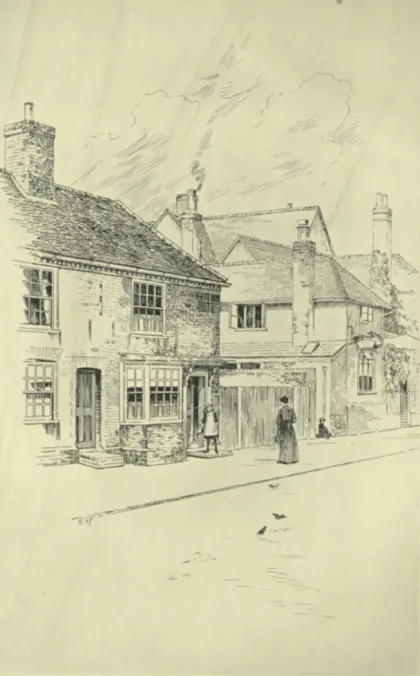
THE BIRTHPLACE OF C. H. SPURGEON, AT KELVEDON. Specially drawn for “The Treasury of David” by E. H. Fitchew.
THE TREASURY OF DAVID
CONTAINING
AN ORIGINAL EXPOSITION OF THE BOOK OF PSALMS;
A COLLECTION OF ILLUSTRATIVE EXTRACTS
FROM THE WHOLE RANGE OF LITERATURE;
A SERIES OF HOMILETICAL HINTS UPON ALMOST EVERY VERSE;
AND LISTS OF WRITERS UPON EACH PSALM.
IN SIX VOLUMES
BY
C. H. SPURGEON.
VOL. II.
PSALM XXVII. TO LVII.
MARSHALL BROTHERS, LTD.
PUBLISHERS
LONDON, EDINBURGH, and NEW YORK.
PREFACE.
Greatly encouraged by the generous reception awarded to my first volume,
I have laboured on with diligence, and am now able to present the reader
with the second instalment of my work. Whether life and health shall be
given me to complete my task, which will probably extend to six volumes,
remains with the gracious Preserver of men; but with his aid and allowance,
my face is set towards that design, and I pray that my purpose may be achieved,
if it be for the divine glory, and for the good of his church.
In this volume, which contains thirty-one sacred odes, we have several
of the more memorable and precious of Zion’s songs. In commenting upon
some of them, I have been overwhelmed with awe, and said with Jacob, “How
dreadful is this place, it is none other than the house of God.” Especially
was this case with the fifty-first; I postponed expounding it week after
week, feeling more and more my inability for the work. Often I sat down
to it, and rose up again without having penned a line. It is a bush burning
with fire yet not consumed, and out of it a voice seemed to cry to me, “Draw
not nigh hither, put off thy shoes from off thy feet.” The Psalm is very
human, its cries and sobs are of one born of woman; but it is freighted with
an inspiration all divine, as if the Great Father were putting words into his
child’s mouth. Such a Psalm may be wept over, absorbed into the soul,
and exhaled again in devotion; but, commented on—ah! where is he who
having attempted it can do other than blush at his defeat?
I have followed the same plan as in the former volume, not only because
I am committed to it by the law of uniformity, but also because it is on the
whole advantageous. Some have suggested alterations, but many more
have commended the very features which would have been improved away,
and therefore I have continued in the selfsame method.
Greater use has, in this volume, been made of the Latin writers. Extracts
have been made not only from those which are condensed in Pool’s Synopsis;
but from many others. These works are a mine of exposition far too little
known. If the index shall serve to introduce fresh expositions to my
ministerial readers, I shall not have laboured in vain.
The acknowledgments of obligation made in Volume I. might very justly
be repeated as concerning Volume II.; the reader will consider them as again
recorded. It may also be needful to repeat the statement that as I give the
name of each Author quoted, each authority is personally responsible for his
own sentiments; and I do not wish it to be supposed that I endorse all
that is inserted. It is often useful to us to know what has been said by authors
whose views we could by no means accept.
More and more is the conviction forced upon my heart that every man
must traverse the territory of the Psalms himself if he would know what a
goodly land they are. They flow with milk and honey, but not to strangers;
they are only fertile to lovers of their hills and vales. None but the Holy
Spirit can give a man the key to the Treasury of David; and even he gives
it rather to experience than to study. Happy he who for himself knows
the secret of the Psalms.
If permitted by the Great Master whom I serve, I shall now proceed with
another portion of this Treasury of David; but the labour and research
are exceedingly great, and my other occupations are very pressing, and
therefore I must crave the patience of the Christian public.
C. H. Spurgeon
INDEX OF AUTHORS QUOTED OR REFERRED TO.
PSALM XXVII. — EXPOSITION. — EXPLANATORY NOTES AND QUAINT SAYINGS. — HINTS TO PREACHERS.
Title and Subject.—Nothing whatever can be drawn from the title as to the time
when this Psalm was written, for the heading, “A Psalm of David,” is common to
so many of the Psalms; but if one may judge from the matter of the song, the writer
was pursued by enemies, verses 2 and 3, was shut out from the house of the Lord, verse 4,
was just parting from father and mother, verse 10, and was subject to slander, verse 12;
do not all these meet in the time when Doeg, the Edomite, spake against him to Saul?
It is a song of cheerful hope, well fitted for those in trial who have learned to lean upon
the Almighty arm. The Psalm may with profit be read in a threefold way, as the
language of David, of the Church, and of the Lord Jesus. The plenitude of Scripture
will thus appear the more wonderful.
Division.—The poet first sounds forth his sure confidence in his God, 1-3, and
his love of communion with him, 4-6. He then betakes himself to prayer, 7-12,
and concludes with an acknowledgment of the sustaining power of faith in his own
case, and an exhortation to others to follow his example.
The Lordis my light and my salvation; whom shall I fear? the Lordis the strength of my life; of whom shall I be afraid?
2 When the wicked, even mine enemies and my foes, came upon me to
eat up my flesh they stumbled and fell.
3 Though an host should encamp against me, my heart shall not fear:
though war should rise against me, in this will I be confident.
1. “The Lord is my light and my salvation.”—Here is personal interest, “my
light,” “my salvation;” the soul is assured of it, and therefore, declaring it boldly.
“My light”—into the soul at the new birth divine light is poured as the precursor
of salvation; where there is not enough light to see our own darkness and to long
for the Lord Jesus, there is no evidence of salvation. Salvation finds us in the dark,
but it does not leave us there; it gives light to those who sit in the valley of the
shadow of death. After conversion our God is our joy, comfort, guide, teacher,
and in every sense our light; he is light within, light around, light reflected from
us, and light to be revealed to us. Note, it is not said merely that the Lord gives
light, but that he “is” light; nor that he gives salvation, but that he is salvation;
he, then, who by faith has laid hold upon God has all covenant blessings in his
possession. Every light is not the sun, but the sun is the father of all lights. This
being made sure as a fact, the argument drawn from it is put in the form of a
question, “Whom shall I fear?” A question which is its own answer. The
powers of darkness are not to be feared, for the Lord, our light, destroys them;
and the damnation of hell is not to be dreaded by us, for the Lord is our salvation.
This is a very different challenge from that of boastful Goliath, for it is based upon
a very different foundation; it rests not upon the conceited vigour of an arm of
flesh, but upon the real power of the omnipotent I AM. “The Lord is the strength
of my life.” Here is a third glowing epithet, to show that the writer’s hope was
fastened with a threefold cord which could not be broken. We may well accumulate
terms of praise where the Lord lavishes deeds of grace. Our life derives all its
strength from him who is the author of it; and if he deigns to make us strong we
cannot be weakened by all the machinations of the adversary. “Of whom shall
I be afraid?” The bold question looks into the future as well as the present. “If
God be for us,” who can be against us, either now or in time to come?
2. This verse records a past deliverance, and is an instance of the way in which
experience should be employed to reassure our faith in times of trial. Each word
is instructive. “When the wicked.” It is a hopeful sign for us when the wicked
hate us; if our foes were godly men it would be a sore sorrow, but as for the
wicked their hatred is better than their love. “Even mine enemies and my foes.”
There were many of them, they were of different sorts, but they were unanimous
in mischief and hearty in hatred. “Came upon me”—advanced to the attack,
leaping upon the victim like a lion upon its prey. “To eat up my flesh,” like
cannibals they would make a full end of the man, tear him limb from limb, and
make a feast for their malice. The enemies of our souls are not deficient in ferocity,
they yield no quarter, and ought to have none in return. See in what danger
David was; in the grip and grasp of numerous, powerful, and cruel enemies, and
yet observe his perfect safety and their utter discomfiture! “They stumbled and
fell.” God’s breath blew them off their legs. There were stones in the way which
they never reckoned upon, and over these they made an ignominious tumble.
This was literally true in the case of our Lord in Gethsemane, when those who came
to take him went backward and fell to the ground; and herein he was a prophetic
representative of all wrestling believers who, rising from their knees shall, by the
power of faith, throw their foes upon their faces.
3. “Though an host should encamp against me, my heart shall not fear.” Before
the actual conflict, while as yet the battle is untried, the warrior’s heart, being
held in suspense, is very liable to become fluttered. The encamping host often
inspires greater dread than the same host in actual affray. Young tells us of
some—
“Who feel a thousand deaths in fearing one.”
Doubtless the shadow of anticipated trouble is, to timorous minds, a more prolific
source of sorrow than the trouble itself, but faith puts a strengthening plaister
to the back of courage, and throws out of the window the dregs of the cup of
trembling. “Though war should rise against me, in this will I be confident.”
When it actually comes to push of pike, faith’s shield will ward off the blow; and
if the first brush should be but the beginning of a war, yet faith’s banners will wave
in spite of the foe. Though battle should succeed battle, and one campaign should
be followed by another, the believer will not be dismayed at the length of the
conflict. Reader, this third verse is the comfortable and logical inference from
the second, confidence is the child of experience. Have you been delivered out of
great perils? Then set up your ensign, wait at your watch-fire, and let the enemy
do his worst.
4 One thing have I desired of the Lord, that will I seek after; that I
may dwell in the house of the Lord all the days of my life to behold the
beauty of the Lord, and to enquire in his temple.
5 For in the time of trouble he shall hide me in his pavilion: in the secret
of his tabernacle shall he hide me; he shall set me up upon a rock.
6 And now shall mine head be lifted up above mine enemies round about
me: therefore will I offer in his tabernacle sacrifices of joy; I will sing, yea,
I will sing praises unto the Lord.
4. “One thing.” Divided aims tend to distraction, weakness, disappointment.
The man of one book is eminent, the man of one pursuit is successful. Let all our
affection be bound up in one affection, and that affection set upon heavenly things.
“Have I desired”—what we cannot at once attain, it is well to desire. God
judges us very much by the desire of our hearts. He who rides a lame horse
is not blamed by his master for want of speed, if he makes all the haste he can,
and would make more if he could; God takes the will for the deed with his
children. “Of the Lord.” This is the right target for desires, this is the well into
which to dip our buckets, this is the door to knock at, the bank to draw upon;
desire of men, and lie on the dunghill with Lazarus: desire of the Lord, and be
carried of angels into Abraham’s bosom. Our desires of the Lord should be
sanctified, humble, constant, submissive, fervent, and it is well if, as with the
Psalmist, they are all molten into one mass. Under David’s painful circumstances
we might have expected him to desire repose, safety, and a thousand other good
things, but no, he has set his heart on the pearl, and leaves the rest. “That will
I seek after.” Holy desires must lead to resolute action. The old proverb says,
“Wishers and woulders are never good housekeepers,” and “wishing never fills
a sack.” Desires are seeds which must be sown in the good soil of activity for
they will yield no harvest. We shall find our desires to be like clouds without
rain, unless followed up by practical endeavours. “That I may dwell in the house
of the Lord all the days of my life.” For the sake of communion with the King,
David longed to dwell always in the palace; so far from being wearied with the
services of the Tabernacle, he longed to be constantly engaged in them, as his lifelong
pleasure. He desired above all things to be one of the household of God, a
home-born child, living at home with his Father. This is our dearest wish, only
we extend it to those days of our immortal life which have not yet dawned. We
pine for our Father’s house above, the home of our souls; if we may but dwell
there for ever, we care but little for the goods or ills of this poor life. “Jerusalem
the golden” is the one and only goal of our heart’s longings. “To behold the beauty
of the Lord.” An exercise both for earthly and heavenly worshippers. We must
not enter the assemblies of the saints in order to see and be seen, or merely to hear
the minister; we must repair to the gatherings of the righteous, intent upon the
gracious object of learning more of the loving Father, more of the glorified Jesus,
more of the mysterious Spirit, in order that we may the more lovingly admire,
and the more reverently adore our glorious God. What a word is that, “the beauty
of the Lord!” Think of it, dear reader! Better far—behold it by faith! What
a sight will that be when every faithful follower of Jesus shall behold “the King
in his beauty!” Oh, for that infinitely blessed vision! “And to enquire in his
temple.” We should make our visits to the Lord’s house enquirers’ meetings. Not
seeking sinners alone, but assured saints should be enquirers. We must enquire
as to the will of God and how we may do it; as to our interest in the heavenly city,
and how we may be more assured of it. We shall not need to make enquiries in
heaven, for there we shall know even as we are known; but meanwhile we should
sit at Jesus’ feet, and awaken all our faculties to learn of him.
5. This verse gives an excellent reason for the Psalmist’s desire after communion
with God, namely, that he was thus secured in the hour of peril. “For in the time
of trouble,” that needy time, that time when others forsake me, “he shall hide me
in his pavilion:” he shall give me the best of shelter in the worst of danger. The
royal pavilion was erected in the centre of the army, and around it all the mighty
men kept guard at all hours; thus in that divine sovereignty which almighty power
is sworn to maintain, the believer peacefully is hidden, hidden not by himself
furtively, but by the king, who hospitably entertains him. “In the secret of his
tabernacle shall he hide me.” Sacrifice aids sovereignty in screening the elect from
harm. No one of old dared to enter the most holy place on pain of death; and
if the Lord has hidden his people there, what foe shall venture to molest them?
“He shall set me up upon a rock.” Immutability, eternity, and infinite power here
come to the aid of sovereignty and sacrifice. How blessed is the standing of the
man whom God himself sets on high above his foes, upon an impregnable rock
which never can be stormed! Well may we desire to dwell with the Lord who
so effectually protects his people.
6. “And now shall mine head be lifted up above mine enemies round about me.”—He
is quite sure of it. Godly men of old prayed in faith, nothing wavering, and
spoke of the answer to their prayers as a certainty. David was by faith so sure
of a glorious victory over all those who beset him, that he arranged in his own heart
what he would do when his foes lay all prostrate before him; that arrangement
was such as gratitude suggested. “Therefore will I offer in his tabernacles sacrifices
of joy.” That place for which he longed in his conflict, should see his thankful
joy in his triumphant return. He does not speak of jubilations to be offered in
his palace, and feastings in his banqueting halls, but holy mirth he selects as most
fitting for so divine a deliverance. “I will sing.” This is the most natural mode
of expressing thankfulness. “Yea, I will sing praises unto the Lord.” The
vow is confirmed by repetition, and explained by addition, which addition vows
all the praise unto Jehovah. Let who will be silent, the believer when his prayer
is heard, must and will make his praise to be heard also; and let who will sing
unto the vanities of the world, the believer reserves his music for the Lord alone.
7 Hear, O Lord, when I cry with my voice: have mercy also upon me,
and answer me.
8 When thou saidst, Seek ye my face; my heart said unto thee, Thy face,
Lord, will I seek.
9 Hide not thy face far from me; put not thy servant away in anger:
thou hast been my help; leave me not, neither forsake me, O God of my
salvation.
10 When my father and my mother forsake me, then the Lord will take
me up.
11 Teach me thy way, O Lord, and lead me in a plain path, because
of mine enemies.
12 Deliver me not over unto the will of mine enemies: for false witnesses
are risen up against me, and such as breathe out cruelty.
7. “Hear, O Lord, when I cry with my voice.”—The pendulum of spirituality
swings from prayer to praise. The voice which in the last verse was turned to
music is here turned to crying. As a good soldier, David knew how to handle his
weapons, and found himself much at home with the weapon of “all prayer.”
Note his anxiety to be heard. Pharisees care not a fig for the Lord’s hearing them,
so long as they are heard of men, or charm their own pride with their sounding
devotions; but with a genuine man, the Lord’s ear is everything. The voice may
be profitably used even in private prayer; for though it is unnecessary, it is often
helpful, and aids in preventing distractions. “Have mercy also upon me.” Mercy
is the hope of sinners and the refuge of saints. All acceptable petitioners dwell
much upon this attribute. “And answer me.” We may expect answers to prayer,
and should not be easy without them any more than we should be if we had
written a letter to a friend upon important business, and had received no reply.
8. In this verse we are taught that if we would have the Lord hear our voice,
we must be careful to respond to his voice. The true heart should echo the will
of God as the rocks among the Alps repeat in sweetest music the notes of the
peasant’s horn. Observe, that the command was in the plural, to all the saints,
“Seek ye;” but the man of God turned it into the singular by a personal application,
“Thy face, Lord, will I seek.” The voice of the Lord is very effectual where all
other voices fail, “When thou saidst,” then my “heart,” my inmost nature was
moved to an obedient reply. Note the promptness of the response—no sooner
said than done; as soon as God said “seek,” the heart said, “I will seek.” Oh,
for more of this holy readiness! Would to God that we were more plastic to the
divine hand, more sensitive of the touch of God’s Spirit.
9. “Hide not thy face far from me.” The word “far” is not in the original,
and is a very superfluous addition of the translators, since even the least hiding
of the Lord’s face is a great affliction to a believer. The command to seek the
Lord’s face would be a painful one if the Lord, by withdrawing himself, rendered
it impossible for the seeker to meet with him. A smile from the Lord is the greatest
of comforts, his frown the worst of ills. “Put not thy servant away in anger.”
Other servants had been put away when they proved unfaithful, as for instance,
his predecessor Saul; and this made David, while conscious of many faults, most
anxious that divine long-suffering should continue him in favour. This is a most
appropriate prayer for us under a similar sense of unworthiness. “Thou hast been
my help.” How truly can we join in this declaration; for many years, in circumstances
of varied trial, we have been upheld by our God, and must and will confess
our obligation. “Ingratitude,” it is said, “is natural to fallen man,” but to spiritual
men it is unnatural and detestable. “Leave me not, neither forsake me.” A prayer
for the future, and an inference from the past. If the Lord had meant to leave
us, why did he begin with us? Past help is but a waste of effort if the soul now
be deserted. The first petition, “leave me not,” may refer to temporary desertions,
and the second word to the final withdrawal of grace, both are to be prayed against;
and concerning the second, we have immutable promises to urge. “O God of my
salvation.” A sweet title worthy of much meditation.
10. “When my father and my mother forsake me.” These dear relations will
be the last to desert me, but if the milk of human kindness should dry up even
from their breasts, there is a Father who never forgets. Some of the greatest of
the saints have been cast out by their families, and persecuted for righteousness’
sake. “Then the Lord will take me up.” Will espouse my cause, will uplift me
from my woes, will carry me in his arms, will elevate me above my enemies, will
at last receive me to his eternal dwelling place.
11. “Teach me thy way, O Lord.” He does not pray to be indulged with his
own way, but to be informed as to the path in which the righteous Jehovah would
have him walk. This prayer evinces an humble sense of personal ignorance, great
teachableness of spirit, and cheerful obedience of heart. “Lead me in a plain
path.” Help is here sought as well as direction; we not only need a map of the
way, but a guide to assist us in the journey. A path is here desired which shall
be open, honest, straightforward, in opposition to the way of cunning, which is
intricate, tortuous, dangerous. Good men seldom succeed in fine speculations
and doubtful courses; plain simplicity is the best spirit for an heir of heaven:
let us leave shifty tricks and political expediences to the citizens of the world—the
New Jerusalem owns plain men for its citizens. Esau was a cunning hunter,
Jacob was a plain man, dwelling in tents. “Because of mine enemies.” These
will catch us if they can, but the way of manifest, simple honesty is safe from their
rage. It is wonderful to observe how honest simplicity baffles and outwits the
craftiness of wickedness. Truth is wisdom. “Honesty is the best policy.”
12. “Deliver me not over unto the will of mine enemies;” or I should be like
a victim cast to the lions, to be rent to pieces and utterly devoured. God be
thanked that our foes cannot have their way with us, or Smithfield would soon
be on a blaze again. “For false witnesses are risen up against me.” Slander is an
old-fashioned weapon out of the armoury of hell, and is still in plentiful use; and
no matter how holy a man may be, there will be some who will defame him.
“Give a dog an ill name, and hang him;” but glory be to God, the Lord’s people
are not dogs, and their ill names do not injure them. “And such as breathe out
cruelty.” It is their vital breath to hate the good; they cannot speak without
cursing them; such was Paul before conversion. They who breathe out cruelty
may well expect to be sent to breathe their native air in hell; let persecutors
beware!
13 I had fainted, unless I had believed to see the goodness of the Lord
in the land of the living.
13. Faintness of heart is a common infirmity; even he who slew Goliath was
subject to its attacks. Faith puts its bottle of cordial to the lip of the soul, and
so prevents fainting. Hope is heaven’s balm for present sorrow. In this land of
the dying, it is our blessedness to be looking and longing for our fair portion in
the land of the living, whence the goodness of God has banished the wickedness
of man, and where holy spirits charm with their society those persecuted saints
who were vilified and despised among men. We must believe to see, not see to
believe; we must wait the appointed time, and stay our soul’s hunger with foretastes
of the Lord’s eternal goodness which shall soon be our feast and our song.
14 Wait on the Lord: be of good courage, and he shall strengthen thine
heart: wait, I say, on the Lord.
14. “Wait on the Lord.” Wait at his door with prayer; wait at his foot with
humility; wait at his table with service; wait at his window with expectancy.
Suitors often win nothing but the cold shoulder from earthly patrons after long
and obsequious waiting; he speeds best whose patron is in the skies. “Be of
good courage.” A soldier’s motto. Be it mine. Courage we shall need, and for
the exercise of it we have as much reason as necessity, if we are soldiers of King
Jesus. “And he shall strengthen thine heart.” He can lay the plaister right upon
the weak place. Let the heart be strengthened, and the whole machine of
humanity is filled with power; a strong heart makes a strong arm. What strength
is this which God himself gives to the heart? Read the “Book of Martyrs,” and
see its glorious deeds of prowess; go to God rather, and get such power thyself.
“Wait, I say, on the Lord.” David, in the words “I say,” sets his own private
seal to the word which, as an inspired man, he had been moved to write. It is
his testimony as well as the command of God, and indeed he who writes these
scanty notes has himself found it so sweet, so reviving, so profitable to draw near
to God, that on his own account he also feels bound to write, “Wait, I say, on the
Lord.”
Verse 1.—“The Lord is my light and my salvation; whom shall I fear?”
Alice Driver, martyr, at her examination, put all the doctors to silence, so that
they had not a word to say, but one looked upon another; then she said, “Have
you no more to say? God be honoured, you be not able to resist the Spirit of
God, in me, a poor woman. I was an honest poor man’s daughter, never brought
up at the University as you have been; but I have driven the plough many a time
before my father, I thank God; yet, notwithstanding, in the defence of God’s
truth, and in the cause of my Master, Christ, by his grace I will set my foot against
the foot of any of you all, in the maintenance and defence of the same; and if I
had a thousand lives they should go for payment thereof.” So the Chancellor
condemned her, and she returned to the prison joyful.—Charles Bradbury.
Verse 1.—“The Lord is my light,” etc. St. John tells us, that “in Christ was
life; and the life was the light of men;” but he adds that “the light shineth in
darkness; and the darkness comprehended it not.” John i. 4, 5. There is a
great difference between the light and the eye that sees it. A blind man may know
a great deal about the shining of the sun, but it does not shine for him—it gives
him no light. So, to know that “God is light,” is one thing (1 John i. 5), and
to be able to say, “The Lord is my light,” is quite another thing. The Lord must
be the light by which the way of life is made plain to us—the light by which we
may see to walk in that way—the light that exposes the darkness of sin—the light by
which we can discover the hidden sins of our own hearts. When he is thus our
light, then he is our salvation also. He is pledged to guide us right; not only to
show us sin, but to save us from it. Not only to make us see God’s hatred of sin,
and his curse upon it, but also to draw us unto God’s love, and to take away the
curse. With the Lord lighting us along the road of salvation, who, or what need
we fear? Our life is hid with Christ in God. Col. iii. 3. We are weak, very weak,
but his “strength is made perfect in weakness.” 2 Cor. xii. 9. With the Lord
himself pledged to be the strength of our life, of whom need we be afraid?—From
Sacramental Meditations on the Twenty-seventh Psalm, 1843.
Verse 1.—“The Lord is my light.” “Light” which makes all things visible,
was the first made of all visible things; and whether God did it for our example,
or no, I know not; but ever since, in imitation of this manner of God’s proceeding,
the first thing we do when we intend to do anything, is to get us “light.”—Sir
Richard Baker.
Verse 1.—“The Lord is my light.” Adorable Sun, cried St. Bernard, I cannot
walk without thee: enlighten my steps, and furnish this barren and ignorant mind
with thoughts worthy of thee. Adorable fulness of light and heat, be thou the true
noonday of my soul; exterminate its darkness, disperse its clouds; burn, dry up,
and consume all its filth and impurities. Divine Sun, rise upon my mind, and
never set.—Jean Baptiste Elias Avrillon, 1652-1729.
Verse 1.—“Whom shall I fear?” Neither spiritual nor military heroes do
exploits through cowardice. Courage is a necessary virtue. In Jehovah is the
best possible foundation for unflinching intrepidity.—William S. Plumer.
Verse 1.—“Of whom shall I be afraid?” I have no notion of a timid, disingenuous
profession of Christ. Such preachers and professors are like a rat playing at
hide-and-seek behind a wainscot, who puts his head through a hole to see if the
coast is clear, and ventures out if nobody is in the way; but slinks back again if
danger appears. We cannot be honest to Christ except we are bold for him. He
is either worth all we can lose for him, or he is worth nothing.—H. G. Salter, A.M.,
in “The Book of Illustrations,” 1840.
Verse 2.—“When the wicked, even mine enemies and my foes, came upon me to
eat up my flesh, they stumbled and fell.” There is no such dainty dish to a malicious
stomach, as the flesh of an enemy; it goes down without chewing, and they swallow
it up whole like cormorants. But though malice have a ravenous stomach, yet she
hath but slow digestion; though her teeth be sharp, yet her feet are lame, at least
apt to stumble; and this made well for David, for when his enemies came upon
him to eat up his flesh, because they came upon the feet of malice, “they stumbled
and fell.” A man may stumble and yet not fall; but to stumble and fall withal,
is the proper stumbling of “the wicked,” and especially of the maliciously wicked;
and such, it seems, was the stumbling of David’s enemies, because the enemies were
such; and such I doubt not shall be the stumbling of mine enemies, because mine
are such; and of what then, of whom now, should I be afraid?—Sir Richard Baker.
Verse 2.—“When the wicked, even mine enemies and my foes, came upon me to
eat up my flesh, they stumbled and fell.” He describes his enemies by their malice,
and by their ruin. 1. His enemies were cruel enemies, blood-suckers, eaters of
flesh. We call them cannibals. As indeed men that have not grace, if they have
greatness, and be opposed, their greatness is inaccessible, one man is a devil to
another. The Scripture calls them “wolves, that leave nothing till morning.”
Zeph. iii. 3. As the great fishes eat up the little ones, so great men they make no
more conscience of eating up other men, than of eating bread; they make no more
bones of overthrowing men and undoing them, than of eating bread. “They eat
up my people as they eat bread.” Psalm xiv. 4. 2. But notwithstanding their
cruelty, they were overthrown. Saith David, “When my foes came upon me to eat up my
flesh, they stumbled and fell.” For, indeed, God’s children, when they are delivered,
it is usually with the confusion of their enemies. God doth two things at once,
because the special grievance of God’s children it is from inward and outward enemies.
He seldom or never delivers them but with the confusion of their enemies. This
will be most apparent at the day of judgment, when Satan, and all that are led by his
spirit, all the malignant church, shall be sent to their own place, and the church
shall be for ever free from all kind of enemies. When the church is most free, then
the enemies of the church are nearest to destruction; like a pair of balances, when
they are up at the one end, they are down at the other. So when it is up with the
church, down go the enemies.—Richard Sibbes.
Verse 2.—“The wicked, mine enemies.” The wicked hate the godly; there is
enmity between the seed of the woman and the serpent. Gen. iii. 15. As in nature
there is an antipathy between the vine and the bay-tree, the elephant and the dragon.
Vultures have an antipathy against sweet smells: so in the wicked there is an
antipathy against the people of God; they hate the sweet perfumes of their graces.
It is true the saints have their infirmities; but the wicked do not hate them for
these, but for their holiness; and from this hatred ariseth open violence: the
thief hates the light, therefore would blow it out.—Thomas Watson.
Verse 2.—There was great wisdom in the prayer of John Wesley: “Lord, if
I must contend, let it not be with thy people.” When we have for foes and enemies
those who hate good men, we have at least this consolation, that God is not on their
side, and therefore it is essentially weak.—William S. Plumer.
Verse 3.—“Though an host should encamp against me,” etc. He puts the case
of the greatest danger that can be. Though an host should encompass me, “my
heart shall not fear: though war should rise against me, in this I will be confident.”
Here is great courage for the time to come. Experience breeds hope and confidence.
David was not so courageous a man of himself; but upon experience of God’s former
comfort and assistance, his faith brake as fire out of the smoke, or as the sun out of a
cloud. Though I was in such-and-such perplexities, yet for the time to come, I
have such confidence and experience of God’s goodness, that I will not fear. He
that seeth God by a spirit of faith in his greatness and power, he sees all other things
below as nothing. Therefore, he saith here, he cares not for the time to come for
any opposition; no, not of an army. “If God be with us, who can be against
us?” Rom. viii. 31. He saw God in his power; and then, looking from God to
the creature, alas! who was he? As Micah, when he had seen God sitting upon
his throne; what was Ahab to him, when he had seen God once? So when the
prophet David had seen God once, then “though an host should encamp against me,
my heart shall not fear,” etc.—Richard Sibbes.
Verse 3.—“Though an host should encamp against me,” etc. If I love my God,
and I love him with a noble-spirited love, all my enemies will fight against me in
vain; I shall never fear them, and the whole world cannot harm me. Charity
cannot be offended, because she takes offence at nothing. Enemies, enviers,
slanderers, persecutors, I defy you; if I love, I shall triumph over your attacks. Ye
can take away my goods; but if my love has a generous spirit, I shall be always
rich enough, and ye cannot take away my love, which alone makes all my riches and
treasures. Ye may blacken my reputation; but as I hold you cheaply quit of all
homage of praise and applause, I, with all my heart, give you a free leave to blame
and to defame. Happily for me, ye cannot blacken me before my God, and his
esteem alone makes amends to me, and rewards me, for all your contempt. Ye
can persecute my body, but there I even will help you on by my penances; the
sooner it shall perish, the sooner shall I be delivered from this domestic enemy,
which is a burden to me. What harm, then, can ye do me? If I am resolved to
suffer all and if I think I deserve all the outrages ye can do me, ye will only give more
loftiness of spirit to my love, more brilliancy to my crown.—Jean Baptiste Elias
Avrillon.
Verse 3.—Those who are willing to be combatants for God, shall also be more
than conquerors through God. None are so truly courageous as those who are
truly religious. If a Christian live, he knows by whose might he stands; and if
he die, he knows for whose sake he falls. Where there is no confidence in God, there
will be no continuance with God. When the wind of faith ceases to fill the sails, the
ship of obedience ceases to plough the seas. The taunts of Ishmael shall never
make an Isaac disesteem his inheritance.—William Secker.
Verses 3, 4.—The favourite grows great by the many favours, gifts, jewels, offices,
the prince bestows on him. The Christian grows rich in experiences, which he wears
as bracelets, and keeps as his richest jewels. He calls one Ebenezer—“hitherto God
hath helped;” another Naphtali—“I have wrestled with God and prevailed;”
another Gershom—“I was a stranger;” another Joseph—“God will yet add more;”
and another, Peniel—“I have seen the face of God.” 1 Sam. vii. 12; Gen. xxx. 8;
Ex. ii. 22; Gen. xxx. 24, and xxxii. 30. I have been delivered from the lion, therefore
shall be from the bear; from lion and bear, therefore from the Philistines;
from the Philistine, therefore from Saul; from Saul, therefore God will deliver me
from every evil work, and preserve me blameless to his heavenly kingdom.—John
Sheffield.
Verse 4.—“One thing have I desired of the Lord, that will I seek after; that I may
dwell in the house of the Lord all the days of my life, to behold the beauty of the Lord,
and to enquire in his temple.” Some interpreters vary concerning what the Psalmist
aims at; I understand thus much in a generality, which is clear, that he means a
communion and fellowship with God, which is that one thing, which if a Christian
had, he needs desire no more: that we should all desire and desire again and be
in love with, and that is enough even to satisfy us, the fruition of God, and the
beholding of him in his ordinances, in his temple, to have correspondency and fellowship
and communion with him there. O God, vouchsafe us that! Now this is so
infinitely sweet, that it was the Psalmist’s only desire, and the sum of all his desires
here, and therefore much more in the tabernacle of heaven which doth make up the
consummation and completeness of all our happiness.—John Stoughton.
Verse 4.—“One thing have I desired of the Lord,” etc. Seeing David would
make but one request to God, why would he not make a greater? for, alas! what
a poor request is this—to desire to dwell in God’s house? and what to do? but only to
see? and to see what? but only a beauty, a fading thing, at most but to enquire;
and what is enquiring? but only to hear news; a vain fancy. And what cause in any
of these why David should make it his request to God? But mark, O my soul,
what goes with it! Take altogether—“to behold the beauty of the Lord, and to enquire
in his temple.” And now tell me, if there be, if there can be, any greater request to
be made? any greater cause to be earnest about it? For though worldly beauty
be a fading thing, yet “the beauty of the Lord,” shall continue when the world shall
fade away; and though enquiring after news be a vain fancy, yet to enquire in
God’s Temple is the way to learn there is no new thing under the sun, and there it
was that Solomon learned that “all is vanity.” Indeed, this “one thing,” that
David desires, is in effect that unum necessarium that Christ speaks of in the gospel;
which Mary makes choice of there, as David doth here.—Sir Richard Baker.
Verse 4.—“One thing,” etc. A heavenly mind gathers itself up into one wish
and no more. “One thing have I desired of the Lord, which I will require.” Grant
me thyself, O Lord, and I will ask no more. The new creature asks nothing of
God, but to enjoy God: give me this, O Lord, and for the rest, let Ziba take all.
I will part with all to buy that one pearl, the riches of heavenly grace.—Jeremy Taylor.
Verse 4.—“One thing.” The first thing, then, is David’s choice, summarily
described in the word, “one thing.” So Christ confirmeth the prophet’s word,
while he called Mary’s choice, “one thing.” Luke x. 42. And that for these three
reasons: First, because it is not a common but a chief good. If there be any good
above it, it is not the chief good; and if there be any good equal unto it, it is not
alone. Next, because it is the last end which we mind eternally to enjoy; if there
be any end beyond it, it is not the last, but amids, and a degree to it. All mids and
ends are used for it, but it is sought for itself, and, therefore, must be but one.
Thirdly, it is a centre whereunto all reasonable spirits draw. As all lines from a
circle meet in the centre, so every one that seeketh happiness aright meeteth in
the chief good, as the only thing which they intend, and, therefore, must be one.
William Struther, in “True Happiness, or King David’s Choice,” 1633.
Verse 4.—“One thing.” Changes, great changes, and many bereavements there
have been in my life. I have been emptied from vessel to vessel. But one thing
has never failed—one thing makes me feel that my life has been one; it has calmed
my joys, it has soothed my sorrows, it has guided me in difficulty, it has strengthened
me in weakness. It is the presence of God—a faithful and loving God. Yes,
brethren, the presence of God is not only light, it is unity. It gives unity to the
heart that believes it—unity to the life that is conformed to it. It was the presence
of God in David’s soul that enabled him to say, “One thing have I desired of the
Lord;” and in St. Paul’s that enabled him to say, “This one thing I do.”—George
Wagner, in the “Wanderings of the Children of Israel,” 1862.
Verse 4.—“One thing”—
One master passion in the breast.
Like Aaron’s serpent, swallows up the rest.
Alexander Pope.
Verse 4.—“That I may dwell in the house of the Lord all the days of my life.” To
approach continually unto the temple, and thither continually to repair was the
dwelling, no doubt, here meant; to dwell, to reside continually there, not to come for a
spurt or a fit.... And thus dwelt Hannah, the daughter of Phanuel, who is said,
in the second of Luke, for the space of four score and four years not to have gone out
of the temple. Not that she was there always, but often, saith Lyra; and venerable
Bede to the same purpose. Not that she was never absent, no, not an hour; but
for that she was often in the temple. And the same St. Luke, speaking of our
Saviour’s disciples, after they had seen him ascended into heaven—“They returned,”
saith he, “to Jerusalem with great joy: and were continually in the temple, praising
and blessing God,” chapter xxiv. 52, 53. Thus, St. Austin’s mother, in her time
too, might be said to dwell in God’s house, whereunto she came so duly and truly
twice a day, “That she, in thy Scriptures,” saith St. Austin, “might hear, O God,
what thou saidst to her, and thou, in her prayers, what she said to thee.” In a
word, such were the Christians the same St. Austin speaks of in another place, whom
he calleth the emmets of God. “Behold the emmet of God,” saith he, “it riseth
early every day, it runneth to God’s church, it there prayeth, it heareth the lesson
read, it singeth a Psalm, it ruminateth what it heareth, it meditateth thereupon,
and hoardeth up within itself the precious corn gathered from that barn-floor.”
John Day’s “David’s Desire to go to Church,” 1609.
Verse 4.—“That I may dwell in the house of the Lord all the days of my life.” In
the beginning of the Psalm, David keeps an audit of his soul’s accounts, reckoning
up the large incomes and lasting treasures of God’s bounty, grace, and mercy;
the sum whereof is this: The Lord is my light and my life, my strength and my
salvation. And now, where shall David design his presence, but where is his light?
Where shall he desire his person, but where is his strength? Where shall he wish
his soul, but where is his life? and where shall he fix his habitation, but where is
his salvation? even in communion with his God; and this, especially, in the holy
worship of his sanctuary. No wonder, then, if above all things he desires and
seeks after this “one thing,” “to dwell in the house of the Lord,” etc.—Robert Mossom.
Verse 4.—“The house of the Lord.” It [the tabernacle, the sanctuary] is called
the house of God because he is present there, as a man delights to be present in his
house. It is the place where God will be met withal. As a man will be found in his
house, and there he will have suitors come to him, where he reveals his secrets. A
man rests, he lies, and lodgeth in his house. Where is a man so familiar as in his
house? and what other place hath he such care to protect and provide for as his
house? and he lays up his treasures and his jewels in his house. So God lays up all
the treasures of grace and comfort in the visible church. In the church he is to be
spoken with as a man in his house. There he gives us sweet meetings; there are
mutual, spiritual kisses. “Let him kiss me with the kisses of his mouth.” Cant.
i. 2. A man’s house is his castle, as we say, that he will protect and provide for.
God will be sure to protect and provide for his church. Therefore he calls the church
of God, that is, the tabernacle (that was the church at that time), the house of God.
If we apply it to our times, that that answers the tabernacle now, is particular visible
churches under particular pastors, where the means of salvation are set up. Particular
visible churches now are God’s tabernacle. The church of the Jews was a national
church. There was but one church, but one place, and one tabernacle; but now
God hath erected particular tabernacles. Every particular church and congregation
under one pastor, their meeting is the church of God, a several church independent.
Richard Sibbes.
Verse 4.—“To behold the beauty of the Lord.” That was one end of his desire,
to dwell in the house of God; not to feed his eyes with speculations and goodly
sights (as indeed there were in the tabernacle goodly things to be seen). No; he had
a more spiritual sight than that. He saw the inward spiritual beauty of those
spiritual things. The other were but outward things, as the apostle calls them.
I desire to dwell in the house of the Lord, “to behold the beauty of the Lord,”
the inward beauty of the Lord especially.—Richard Sibbes.
Verse 4.—“The beauty of the Lord.” In connection with these words, we would
try to show that the character of God is attractive, and fitted to inspire us with
love for him, and to make us, as it were, run after him. The discussion of our
subject may be arranged under three heads. I. Some of the elements of the beauty
of the Lord. II. Where the beauty of the Lord may be seen. III. Peculiar traits
of the beauty of the Lord. I. Some of the elements of the beauty of the Lord.
God is a Spirit. Hence his beauty is spiritual, and its elements must be sought
for in spiritual perfection. 1. One of the elements of this beauty is holiness.
2. But the elements of the divine beauty on which we intend at this time to dwell,
are those which are included under the general description of God’s mercy and grace.
The attractiveness of these is more easily perceived, and their influence is sooner
felt by persons in our fallen condition. It is mainly through the instrumentality
of these that sinners are won over from their enmity against God, and that the
Holy Ghost sheds abroad the love of God in our hearts. 3. Another thing, which
we may call an element of beauty in God, is the combination of his various attributes
in one harmonious whole. The colours of the rainbow are beautiful, when taken
one by one: but there is a beauty in the rainbow, which arises not from any single
tint; there is a beauty in it which would not exist if the several hues were assumed
in succession—a beauty which is the result of their assemblage and collocation,
and consists in their blended radiance. In like manner do the several perfections,
which co-exist and unite in the nature of God, produce a glorious beauty. Holiness
is beautiful; mercy is beautiful; truth is beautiful. But, over and above, there
is a beauty which belongs to such combinations and harmonies as the Psalmist
describes, when he tells us, “Mercy and truth are met together; righteousness and
peace have kissed each other.” “Thy mercy, O Lord, is in the heavens; and thy
faithfulness reacheth unto the clouds. Thy righteousness is like the great
mountains; thy judgments are a great deep,” etc. II. We are next to enquire
where the beauty of the Lord may be seen. It may so far be seen in the natural
world. The throne of nature, although in some respects clouds and darkness are
round about it, is not without its rainbow of beauty, any more than the throne of
grace. The beauty of the Lord may be seen in the moral law. In the law! Even
so. In the unbending law, with its terrible anathema, his beauty and amiableness
shine forth. The law is full of love. The duties of the law are duties of love. Love
is the fulfilling of the law. The curse of the law is designed and employed for the
maintenance of love. Obedience to the law, and the reign of love, are but different
aspects of the same state of things. And one of the sublimest lessons of the law
is the fact, that God is love. Again, the beauty of the Lord may be seen in the
gospel. We see it, as it were, by reflection, in the law; in the gospel, we see it
directly. The law shows us the hearts of men, as God would have them to be;
the gospel shows us God’s own heart. Again, the beauty of the Lord is seen in
Christ. It is seen in Christ, for he is the brightness of the Father’s glory, and the
express image of his person; and he that hath seen Christ, hath seen the Father.
The beauty of the Lord is seen in Christ, when we consider him as the Father’s gift,
and when we look to his offices and to his character. The character of Christ was
the finest spectacle of moral beauty which men or angels ever set their eyes on.
III. We conclude by noticing some traits of the beauty of the Lord. 1. It never
deceives. 2. It never fades. 3. It never loses its power. 4. It never
disappoints.—Condensed from Andrew Gray (1805-1861), in “Gospel Contrasts and
Parallels.”
Verse 4.—“The beauty of the Lord.” The Lord’s beauty, to be seen in his house,
is not the beauty of his essence, for so no man can see God and live (Exod. xxxiii. 18,
20); before this glorious beauty the angels cover their faces with their wings (Isa.
vi. 1, 2); but it is the beauty of his ordinances, wherein God doth reveal to the
eyes of men’s minds, enlightened by his Spirit, the pleasant beauty of his goodness,
justice, love, and mercy in Jesus Christ.—Thomas Pierson, M.A., 1570-1633.
Verse 4.—“The beauty of the Lord.”—“Beauty” is too particular a word to
express the fulness of the Holy Ghost, the pleasantness or the delight of God. Take
the word in a general sense, in your apprehensions. It may be the object of all
senses, inward and outward. Delight is most transcendent for pleasantness; for
indeed God in his ordinances, is not only “beauty” to the eye of the soul, but is
ointment to the smell, and sweetness to the taste, and all in all to all the powers
of the soul. God in Christ, therefore, he is delightful and sweet.... “The beauty
of the Lord” is especially the amiable things of God, which is his mercy and love,
that makes all other things beautiful that is in the church.—Richard Sibbes.
Verse 4.—“To enquire in his temple.” The more grace the more business ye
will find ye have to do with God in his ordinances; little grace hath little to do,
and much grace hath much to do; he hath always business with God, special earnest
business. “To behold the beauty of the Lord, and to enquire in his temple.” Oh,
I have somewhat to enquire after; I am to do something by this duty, and therefore
cannot trifle. He that comes to visit his friend in a compliment, he talks, he walks,
he trifles, and goes home again; but he that comes upon business, he is full of it:
he is like Abraham’s honest and faithful servant. Gen. xxiv. 33. “And there
was set meat before him to eat: but he said, I will not eat, until I have told my
errand.” I have great business with the Lord, about the church, and about my
soul, and I will not eat, nor talk, nor think, nor dally about anything, till I have
told mine errand, or heard my Maker’s errand unto me. And for this end it’s a
rare thing to carry somewhat always on the spirit, to spread before God, a heart
pregnant with some needful request or matter whereof to treat with God. Psalm
xlv. 1.—Richard Steele’s “Antidote against Distractions,” 1673.
Verse 4.—It was David’s earnest prayer, “One thing have I desired of the Lord,
that will I seek after; that I may dwell in the house of the Lord all the days of my life,
to behold the beauty of the Lord, and to enquire in his temple.” There are many that
pray David’s words, but not with David’s heart. Unum petii, one thing have
I desired, de præterito, for the time past; et hoc requiram, this I will still seek after,
de futuro, for the time to come: I have required it long, and this suit I will urge
till I have obtained it. What? To dwell in some of the houses of God all the
days of my life, and to leave them to my children after me; not to serve him there
with devotion, but to make the place mine own possession? These love the house
of God too well; they love it to have and to hold: but because the conveyance is
made by the lawyer, and not by the minister, their title will be found nought in
the end; and if there be not a nisi prius to prevent them, yet at that great day
of universal audit, the Judge of all the world shall condemn them. By this way,
the nearer to the church, the further from God. The Lord’s temple is ordained
to gain us to him, not for us to gain it from him. If we love the Lord, we “will
love the habitation of his house, and the place where his honour dwelleth;” that
so by being humble frequenters of his temple below, we may be made noble saints
of his house above, the glorious kingdom of Jesus Christ.—Thomas Adams.
Verse 4.—David being in this safe condition, what doth he now think upon
or look at, as his main scope? Not as Pyrrhus, king of Epirus, to sit still and
be merry, when he had overcome the Romans and all his enemies, as he sometime
said to Cyneas, the philosopher, but to improve his rest to perpetual piety, in going
from day to day to God’s house, as Hannah is said afterwards to have done.
Luke ii. And this, first, for the solace of his soul, in seeing the beauty of his sanctuary.
Secondly, that he might still be directed aright and be safe. Thirdly, that he
might yet be more highly exalted in kingly glory. Fourthly, for all this, as he
should have abundant cause, sacrificing and singing Psalms to God without ceasing:
see verses 5, 6.—John Mayer.
Verse 4.—O my soul, what sights have I seen in the house of God! what
provisions have I tasted! what entertainments have I had! what enlargements
in prayer and answers thereto! what impressions under his word, what entertainment
at his table, as he has sometimes brought me into his banqueting-house,
and his banner over me has been love! And though I cannot, it may be, say so
much of this as some others; yet what I have found, I cannot but remember with
thankfulness, and desire more; and as this was in the house of God, here would
I still desire to dwell.—Daniel Wilcox, 1676-1733.
Verse 5.—“The time of trouble.” Though God does not always deliver his
people out of trouble, yet he delivers them from the evil of trouble, the despair
of trouble, by supporting the spirit; nay, he delivers by trouble, for he sanctifies
the trouble to cure the souls, and by less troubles delivers from greater.—From a
Broad Sheet in the British Museum, dated, “London: printed for D.M., 1678.”
Verse 5.—“He shall hide me.” The word here used means to hide, to secrete,
and then, to defend or protect. It would properly be applied to one who had fled
from oppression, or from any impending evil, and who should be secreted in a house
or cavern, and thus rendered safe from pursuers, or from the threatening evil.—Albert
Barnes.
Verse 5.—“Pavilion” comes from papilio, a butterfly. It signifies a tent made
of cloth stretched out on poles, which in form resembles in some measure the insect
above named.—Adam Clarke.
Verse 5.—“In the secret of his tabernacle shall he hide me.” He alludes to the
ancient custom of offenders, who used to flee to the tabernacle or altar, where they
esteemed themselves safe. 1 Kings ii. 28.—Matthew Pool.
Verse 5.—“In the secret of his tabernacle.” Were there no other place, he would
put me in the holy of holies, so that an enemy would not dare to approach me.—Adam
Clarke.
Verse 6.—“Now shall mine head be lifted up above mine enemies round about
me.” A man cannot drown so long as his head is above water. Now, it is the
proper office of hope to do this for the Christian in times of any danger. Luke
xxi. 28. “When these things begin to come to pass, then look up, and lift up
your heads: for your redemption draweth nigh.” A strange time, one would
think, for Christ then to bid his disciples lift up their heads in, when they see other
men’s hearts failing them for fear, and for looking after those things which are coming
on the earth (verse 26); yet now is the time of the rising of their sun, when others’
is setting, and the blackness of darkness is overtaking others; because now the
Christian’s feast is coming, for which hope hath saved its stomach so long. “Your
redemption draweth nigh.” Two things make the head hang down—fear and
shame; hope easeth the Christian’s heart of both these, and so forbids him to
give any sign of a desponding mind by a dejected countenance.—William Gurnall.
Verse 6.—“Therefore will I offer in his tabernacle sacrifices of joy.” “Surely,”
some may say, “he could have called on God beyond the precincts of the temple.
Wherever he wandered as an exile, he carried with him the precious promise of
God, so that he needed not to put so great a value upon the sight of the external
edifice. He appears, by some gross imagination or other, to suppose that God
could be enclosed by wood and stones.” But if we examine the words more carefully,
it will be easy to see, that his object was altogether different from a mere
sight of the noble building and its ornaments, however costly. He speaks, indeed,
of the temple, but he places that beauty not so much in the goodliness that was
to be seen by the eye, as in its being the celestial pattern which was shown to Moses,
as it is written in Exod. xxv. 40: “And look that thou make them after their
pattern, which was showed thee in the mount.” As the fashion of the temple was
not framed according to the wisdom of man, but was an image of spiritual things,
the prophet directed his eyes and all his affections to this object. Their madness
is, therefore, truly detestable who wrest this place in favour of pictures and images,
which, instead of deserving to be numbered among temple ornaments, are rather
like dung and filth, defiling all the purity of holy things.—John Calvin.
Verse 8.—“When thou saidst, Seek ye my face; my heart said unto thee, Thy
face, Lord, will I seek.” In the former verse, David begins a prayer to God, “Hear,
O Lord; have mercy upon me, and answer me.” This verse is a ground of that
prayer, “Seek ye my face,” saith God. The heart answers again, “Thy face, Lord,
will I seek;” therefore I am encouraged to pray to thee. In the words are contained
God’s command and David’s obedience. God’s warrant and David’s work
answerable, the voice and the echo: the voice, “Seek my face;” the rebound
back again of a gracious heart, “Thy face, Lord, will I seek.” “When thou saidst.”
It is not in the original. It only makes way to the sense. Passionate speeches
are usually abrupt: “Seek my face:” “Thy face, Lord, will I seek.”... God is
willing to be known. He is willing to open and discover himself; God delights
not to hide himself. God stands not upon state, as some emperors do that think
their presence diminisheth respect. God is no such God, but he may be searched
into. Man, if any weakness be discovered, we can soon search into the depth of
his excellency; but with God it is clean otherwise. The more we know of him,
the more we shall admire him. None admire him more than the blessed angels,
that see most of him, and the blessed spirits that have communion with him.
Therefore he hides not himself, nay, he desires to be known; and all those that
have his Spirit desire to make him known. Those that suppress the knowledge
of God in his will, what he performs for men, and what he requires of them, they
are enemies to God and of God’s people. They suppress the opening of God, clean
contrary to God’s meaning; “Seek my face;” I desire to be made known, and
lay open myself to you. Therefore we may observe by the way, that when we
are in any dark condition, that a Christian finds not the beams of God shining on
him, let him not lay the blame upon God, as if God were a God that delighted to
hide himself. Oh, no! it is not his delight. He loves not strangeness to his poor
creatures. It is not a point of his policy. He is too great to affect[1] such poor
things. No; the fault is altogether in us. We walk not worthy of such a presence;
we want humility and preparation. If there be any darkness in the creature,
that he finds God doth not so shine on him as in former times, undoubtedly the
cause is in himself; for God saith, “Seek my face.” He desires to reveal himself.—Richard
Sibbes.
Verse 8.—“When thou saidst, Seek ye my face,” etc. All the Spirit’s motions
are seasonable, and therefore not to be put off; for delay is a kind of denial, and
savours of such ungrateful contempt, as must needs be very displeasing to him.
“When thou saidst, Seek ye my face; my heart said unto thee, Thy face, Lord, will
I seek.” God does not only expect such an answer, but expects it immediately
upon his call. Whenever he blows with his wind, he looks that we should spread
our sails. If we refuse his offered help, we may deservedly want it when desired.
As Christ withdrew himself from the spouse because she let him stand knocking
so long at the door of her heart, and she still deferred to open, and tired out his
loving forbearance with vain and frivolous excuses. Sol. Song, v. 2, etc. But as
we must not omit the present performance of any duty which he excites unto, we
must not check his influences by being weary of the duties which he assists us in:
if we do not improve extraordinary aids by holding out the longer, we provoke
him to depart.—Timothy Cruso.
Verse 8.—“When thou saidst, Seek ye my face,” etc. We see here thus much,
that God must begin with us, before we can close with him; God must seek us, before
we can seek him; God must first desire that we should draw near to him, before
we for our particulars are able to draw near unto God. Thou saidst, Seek my face;
and then, and not till then my heart said, Thy face, Lord, will I seek.—Thomas
Horton.
Verse 8.—“When thou saidst,” etc. Now God then speaks to the heart to
pray when not only he puts upon the duty by saying to the conscience, This thou
oughtest to do; but God’s speaking to pray is such as his speech at first was, when
he made the world, when he said, “Let there be light, and there was light:” so
he says, let there be a prayer, and there is a prayer; that is, he pours upon a man
a spirit of grace and supplication, a praying disposition; he puts in motives, suggests
arguments and pleas to God; all which you shall find come in readily, and of themselves,
and that likewise with a quickening heat and enlargement of affection, and
with a lingering, and longing, and restlessness of spirit to be alone, to pour out
the soul to God, and to vent and form those motions and suggestions into a prayer,
till you have laid them together, and made a prayer of them. And this is a speaking
to the heart. Observe such times when God doth thus, and neglect them not,
then to strike whilst the iron is hot; thou hast then his ear; it is a special opportunity
for that business, such a one as thou mayst never have the like. Suitors
at court observe molissima fandi tempora, their times of begging when they have
kings in a good mood, which they will be sure to take the advantage of; but especially
if they should find that the king himself should begin of himself to speak of the
business which they would have of him: and thus that phrase of Psalm x. 17,
that God prepares the heart, is understood by some, that God prepares the heart,
and causeth the ear to hear; that is, he fashions it and composeth it into a praying
frame. And sure it is a great sign that God means to hear us when himself shall
thus indite the petition.—Thomas Goodwin.
Verse 8.—“When thou saidst,” etc. And well may this be pleaded, in that
God useth not so to stir up and strengthen us to seek him, but when he intendeth
to be found of us. Psalm x. 17. “Thou hast heard the desire of the humble:
thou wilt prepare their heart, thou wilt cause thine ear to hear.” Jer. xxix. 13.
“And ye shall seek me, and find me, when ye shall search for me with all your
heart.” And God maketh it an argument to himself, that if he say to any inwardly
as well as outwardly, “Seek my face,” he that speaketh righteousness cannot speak
thus to them, and frustrate their prayers, and so bid them seek his face in vain.
Isaiah xlv. 19, “I said not unto the seed of Jacob, Seek ye me in vain; I the Lord
speak right things.” If Ahasuerus bid his spouse to ask, surely he will not fail
to grant her petition (Esther vii. 2); so here. And as when Christ called the blind
man to come to him to tell him his grievance, it was truly said to him by them,
“Be of good comfort, rise, for he calleth thee.” Mark x. 49. So it is in this
case.—Thomas Cobbett.
Verse 8.—“My heart said unto thee.” The heart is between God and our
obedience, as it were, an ambassador. It understands from God what God would
have done, and then it lays a command upon the whole man. The heart and
conscience of man is partly divine, partly human. It hath some divinity in it,
especially if the man be a holy man. God speaks, and the heart speaks. God
speaks to the heart, and the heart speaks to us. And ofttimes when we hear
conscience speaking to us, we neglect it; and as St. Augustine said of himself, “God
spake often to me, and I was ignorant of it.” When there is no command in the word
that the heart directly thinks of (as indeed many profane careless men scarce have a
Bible in their houses), God speaks to them thus; conscience speaks to them some
broken command, that they learn against their wills. They heed it not, but David
did not so. God said, “Seek ye my face;” his heart answers, “Thy face, Lord, will I
seek.” The heart looks upward to God, and then to itself, “My heart said.” It
said to thee, and then to itself. First, his heart said to God, “Lord, I have encouragement
from thee. Thou hast commanded that I should seek thy face.” So his
heart looked to God, and then it speaks to itself, “Thy face, Lord, will I seek.”
It looks first to God, and then to all things that come from itself.—Richard Sibbes.
Verse 8.—There are divers things considerable of us in this answer and compliance
of David’s with God’s command or invitation to him. First, it was seasonable,
and in due time; presently does David make this return: “Thy face, Lord, will
I seek.” This is the property and disposition of every wise and prudent Christian,
to close with the very first opportunities of God’s invitation. Secondly, this answer,
as it was seasonable and present, so it was also full and complete; the performance
was proportionable to the injunction. Ye shall have some kind of people in the
world that God bids them do one thing and they will be sure to do the quite contrary;
or, at least, not do as much as they should do, but do it by halves. But, now, here
David makes return to God in the full extent and proportion of obedience. God
said, “Seek my face,” and he answered, “Thy face, Lord, will I seek.” Thirdly,
it was real and entire, and sincere; “My heart said.” It is one thing to say it with
the mouth, and it is another thing to say it with the heart. With the mouth it is
both easy and ordinary, and nothing more usual. Lord, thy face will we seek,
especially in any trouble or calamity, which is incident unto us; but for the heart
to say it, that is not so frequent. Fourthly, it was settled, and peremptory, “Thy
face will I seek;” there is nothing shall hinder me of it, or keep me from it, but
I will do it against all opposition. Lastly, this protestation of David was absolute
and indefinite and unlimited; “I will seek thy face;” without prescription of
time, or place, or condition; not only now, but hereafter; not only for a time,
but for ever, in all seasons, in all estates, in all circumstances, still I shall keep me
to this—to hold my communion with thee. Then are we Christians, indeed, when
we are so immutably and irreversibly and independently upon the opinions or
practices of any other person.—Condensed from Thomas Horton.
Verse 8.—God hath promised his favour, and, therefore, his people may seek
his favour. Nay, he hath commanded his people to seek his favour, and therefore
they should seek it. It is an unadvised folly, during the suspension of God’s favour,
to unson ourselves, and unpeople ourselves, i.e., by denying the grace and spiritual
relation which exist between us and God. That is not the way to gain favour;
for when we have undone our relation of children we exclude ourselves from the
expectation of favour. No, the wisest and surest way is to seek the renewing of
God’s loving countenance, and not to be driven away from God by our unbelief.—Obadiah
Sedgwick, in “The Doubting Believer,” 1653.
Verse 9.—“Hide not thy face far from me.” When I seek thy face, vouchsafe,
O God, not to hide thy face from me; for to what purpose should I seek it if I cannot
find it? and what hope of finding it if thou be bent to hide it?—Sir Richard Baker.
Verse 9.—“Put not thy servant away in anger.” God puts away many in anger
for their supposed goodness, but not any at all for their confessed badness.—John
Trapp.
Verse 9.—“Thy servant.” It is a blessed and happy thing to be God’s true
“servant.” Consider what the Queen of Sheba said of Solomon’s servants (1 Kings
x. 8): “Happy are these thy servants,” etc. Now Christ Jesus is greater than
Solomon (Matt. xii. 42), and so a better Master. Good earthly masters will honour
good servants, as Prov. xxvii. 18, “He that waiteth on his master shall be
honoured;” chap. xvii. 2, “A wise servant shall have a portion, or inheritance,
among the brethren.” But however some earthly masters may be Nabals and
Labans, yet God will not be so: John xii. 26: “Where I am, there shall also my
servant be.” “If any man serve me, him will my Father honour,” see Luke xii. 37.
The watchful servants are blessed; their master will make them to sit down to
meat, and will come forth and serve them, as Matt. xxv. 21, 23: “Well done,
thou good and faithful servant: thou hast been faithful over a few things, I will
make thee ruler over many things: enter thou into the joy of thy Lord.”—Thomas
Pierson.
Verse 9.—“Thou hast been my help; leave me not,” etc. One act of mercy engages
God to another. Men argue thus: I have showed you kindness already, therefore
trouble me no more; but because God has shown mercy he is more ready still to
show mercy; his mercy in election makes him justify, adopt, glorify.—Thomas
Watson.
Verse 9.—“Leave me not;” rather, “dismiss me not;” “let not go thy hold
of me.” This is the proper sense of the Hebrew verb נָטַשׁ, to set a thing loose,
to let it go, to abandon it.—Samuel Horsley.
Verse 10.—“When my father and my mother forsake me.” As there seems
to be some difficulty in supposing the Psalmist’s parents to have “deserted” him,
they might perhaps be said to have “forsaken” him (as Muis conjectures), that is,
to have left him behind them, as being dead.—James Merrick, M.A., 1720-1769.
Verse 10.—“When my father and my mother forsake me.” It is indeed the
nature of all living creatures, though never so tender of their young ones, yet when
they are grown to a ripeness of age and strength, to turn them off to shift for themselves;
and even a father and a mother, as tender as they are, have yet somewhat
of this common nature in them; for while their children are young they lead them
by the hand, but when they are grown up they leave them to their own legs, and
if they chance to fall let them rise as they can. But God even then takes his children
up, for he knows of what they are made; he knows their strength must be as well
supported as their weakness be assisted; he knows they must as well be taken
up when they fall, as be held up when they stand.—Sir Richard Baker.
Verse 10.—“Father and Mother.” First, who are they? Properly and chiefly
our natural parents, of whom we were begotten and born; to whom (under God)
we owe our being and breeding. Yet here, not they only; but by synecdoche all other
kinsfolks, neighbours, friends, acquaintances, or, indeed, more generally yet, all
worldly comforts, stays, and helps whatsoever. 2. But, then, why these named
the rathest, and the rest to be included in these? Because we promise to ourselves
more help from them than from any of the other. We have a nearer relation to,
and a greater interest in them than any other; and they of all other are the unlikeliest
to forsake us. The very brute creatures forsake not their young ones. A
hen will not desert her chickens, nor a bear endure to be robbed of her whelps.
3. But, then, thirdly, why both named—father and mother too? Partly because
it can hardly be imagined that both of them should forsake their child, though one
should hap to be unkind. Partly because the father’s love being commonly with more
providence, the mother’s with more tenderness; both together do better express
than alone either would do, the abundant love of God towards us, who is infinitely
dear over us, beyond the care of the most provident father, beyond the affection
of the tenderest mother. 4. But, then, fourthly, when may they be said to forsake
us? When at any time they leave us destitute of such help as we stand in need of;
whether it be out of choice, when they list not to help us, though they might if they
would; or out of necessity, when they cannot help us, though they would if they
could.—Robert Sanderson.
Verse 10.—“Then the Lord will take me up.” But dictum factum: these are
but words: Are there producible any deeds to make it good? Verily, there are,
and that to the very letter. When Ishmael’s mother, despairing of his life, had
forsaken him, and laid him down gasping (his last, for ought she knew or could do
to help it), in the wilderness, the Lord took him up; he opened a new spring of
water, and opened her eyes to see it, and so the child was preserved. Genesis xxi.
When Moses’ parents had also forsaken him (for they durst not stand by him any
longer), and laid him down among the rushy flags, the Lord took him up too. He
provided him of a saviour, the king’s own daughter, and of a nurse the child’s own
mother—and so he was preserved too. Exodus ii. 6-9. Take but two examples
more, out of either Testament one. David and St. Paul, both forsaken of men,
both taken up of God. How was David forsaken, in Psalm cxlii. 4, when he had
looked upon his right hand, and saw no man that would know him; he had no
place to fly unto, and no man cared for his soul. But all the while Dominus ad
dextris, there was one at his right hand (though at first he was not aware of him),
ready to take him up; as it there followeth, verse 5, “I cried unto thee, O Lord; I
said, Thou art my refuge and my portion in the land of the living.” And how
St. Paul was forsaken; take it from himself, 2 Timothy iv. 16, “At my first answer
no man stood with me, but all men forsook me:” a heavy case, and had been heavier
had there not been one ready to take his part, at the next verse, “Nevertheless
the Lord stood with me, and strengthened me,” etc. What need we any more
witnesses? In ore duorum—in the mouth of two such witnesses the point is sufficiently
established. But you will yet say, these two might testify what they had already
found post factum. But David, in the text, pronounceth it de futuro, beforehand,
and that somewhat confidently: “The Lord will take me up.” As he doth also
elsewhere: “Sure I am that the Lord will avenge the poor, and maintain the cause
of the helpless.” Psalm cxl. But is there any ground for that? Doubtless there
is; a double ground; one in the nature, another in the promise of God. In his
nature four qualities there are (we take leave so to speak, suitably to our own low
apprehensions, for in the Godhead there are properly no qualities); but call them
qualities or attributes, or what else you will; there are four perfections in God, opposite
to those defects which in our earthly parents we have found to be the chief causes
why they do so oft forsake us; which give us full assurance that he will take us up
when all other succours fail us. Those are his love, his wisdom, his power, his
eternity, and all in his nature. To which four, add his promise, and you have the
fulness of all the assurance that can be desired.—Robert Sanderson.
Verse 10.—“The Lord will take me up;” Hebrew, will gather me, that is, take
me into his care and keeping. In the civil law we find provision made for outcasts
and friendless persons; some hospitals to entertain them, some liberties to comfort
and compensate their trouble. ’Tis sure, that in God the forlorn and fatherless
find mercy.—John Trapp.
Verse 11.—“Teach me thy way, O Lord.” Having compared himself to an
exposed, deserted infant, adopted by God, he anon fairly asks to be shown how to
walk. He asks the grace of being able to observe all his holy commandments,
which he never loses sight of through the whole one hundred-and-fifty Psalms.
What else could he do? when it was the only path to that heavenly house of God,
which he had just declared to be the only wish and desire of his heart.—Robert
Bellarmine (Cardinal), 1542-1621.
Verse 11.—“Lead me in a plain path, because of mine enemies.” If a man,
travelling in the King’s highway, be robbed between sun and sun, satisfaction is
recoverable upon the county where the robbery was made; but if he takes his
journey in the night, being an unseasonable time, then it is at his own peril, he must
take what falls. So, if a man keep in God’s ways, he shall be sure of God’s protection;
but if he stray out of them, he exposeth himself to danger.—Robert Skinner (Bishop),
1636.
Verse 11.—“Because of mine enemies.” If once a man commence a professor,
the eyes of all are upon him; and well they may, for his profession in the world
is a separation from the world. Believers condemn those by their lives who condemn
them by their lips. Righteous David saw many who were waiting to triumph
in his mistakes. Hence the more they watched, the more he prayed: “Teach
me thy way, O Lord, and lead me in a plain path, because of mine enemies.” It
may be rendered, because of mine observers. Christian, if you dwell in the open tent
of licentiousness, the wicked will not walk backward, like modest Shem and Japheth,
to cover your shame: but they will walk forward, like cursed Ham, to publish it.
Thus they make use of your weakness as a plea for their wickedness. Men are
merciless in their censures of Christians; they have no sympathy for their infirmity:
while God weighs them in more equal scales, and says, “The spirit is willing, but
the flesh is weak.” While a saint is a dove in the eyes of God, he is only a raven
in the estimation of sinners.—William Secker.
Verse 13.—“I had fainted,” etc. Study much the all-sufficiency, the power, the
goodness, the unchangeableness of God. 1. The all-sufficiency of God. What
fulness there is in him to make up all you can lose for him; what refreshments
there are in him to sweeten all you can suffer for him. What fulness! You may
as well doubt that all the waters of the ocean cannot fill a spoon, as that the divine
fulness cannot be enough to you, if you should have nothing left in this world;
for all the waters that cover the sea are not so much as a spoonful, compared with
the boundless and infinite fulness of all-sufficiency. What refreshments in him!
One drop of divine sweetness is enough to make one in the very agony of the
cruellest death to cry out with joy, “The bitterness of death is past.” Now in him
there are not only drops, but rivers; not a scanty sprinkling, but an infinite fulness.
2. Eye much the power of God, how it can support under the cross, what it can
bring to pass for you by the cross. No cross so sharp and grievous, but he can make
it sweet and comfortable. No cross so heavy and intolerable, but he can make
light and easy. No cross so ignominious and reproachful, but he can turn it to your
honour. No cross so fastened to you, but he can easily remove it. 3. His goodness.
His all-sufficiency and power make him able, his goodness makes him willing to
do for his people under the cross what his all-sufficiency and almighty power can
afford. His goodness sets his mighty power a-work for his suffering saints. His
goodness sets his all-sufficiency, his fulness, abroach for them, so that it runs freely
upon them; and never more freely than when they are under the cross. “I had
fainted unless I had believed to see the goodness of the Lord,” &c. What is it that
makes you ready to faint under the cross, or thoughts and foresight of it? Look
to the goodness of God, there is support.—Condensed from David Clarkson.
Verse 13.—“I had fainted.” The words in italics are supplied by our
translators; but, far from being necessary, they injure the sense. Throw out the
words I had fainted, and leave a break after the verse, and the elegant figure of the
Psalmist will be preserved: “Unless I had believed to see the goodness of the
Lord in the land of the living”——what! what, alas! should have become of
me!—Adam Clarke.
Verse 13.—“Unless I had believed to see the goodness of the Lord in the land of
the living.” In the Hebrew this verse is elliptical, as Calvin here translates it.
In the French version he supplies the ellipsis, by adding to the end of the verse
the words, “C’estoit fait de moy,” “I had perished.” In our English version,
the words, “I had fainted,” are introduced as a supplement in the beginning of
the verse. Both the supplement of Calvin, and that of our English version, which
are substantially the same, doubtless explain the meaning of the passage; but
they destroy the elegant abrupt form of the expression employed by the Psalmist,
who breaks off in the middle of his discourse without completing the sentence,
although what he meant to say is very evident.—Editorial Note to Calvin, in loc.
Verse 13.—Under sore trouble and distress, labour to exercise a strong and
lively faith. It was a noble and heroic resolution in that holy man Job, under
his singular trials (Job xiii. 15): “Though he slay me, yet will I trust in him;”
as if he had said, Let my strokes be never so sore and heavy, yet I will not let go
my grips of his word and promises, I will not raze these foundations of my hope.
It was the way the Psalmist kept himself from sinking under his heavy burdens:
“I had fainted, unless I had believed to see the goodness of the Lord in the land of the
living.”... Faith brings new strength and auxiliary supplies of grace from
heaven, when the former supply is exhausted and spent; whereof David had the
sweet experience here. As God doth plant and actuate grace in the soul, so he
is pleased to come in with seasonable supplies and reinforcements to the weak and
decayed graces of his people, answerable to their present exigences and pressures;
and thus he doth from time to time feed the believer’s lamp with fresh oil, give
in more faith, more love, more hope, and more desires; and hereby he gives power
to the faint, and strengthens the things which remain when ready to die.—John
Willison.
Verse 13.—“Unless I had believed to see the goodness of the Lord in the land of
the living:” a cordial made up of three sovereign ingredients—a hope to see; and
to see the goodness of God; and the goodness of God in the land of the living.—Sir
Richard Baker.
Verse 13.—“The land of the living.” Alas! what a land of the living is this,
in which there are more dead than living, more under ground than above it;
where the earth is fuller of graves than houses; where life lies trembling under
the hand of death; and where death hath power to tyrannise over life! No, my
soul, there only is the land of the living where there are none but the living; where
there is a church, not militant, but triumphant; a church indeed, but no churchyard,
because none dead, nor none that can die; where life is not passive, nor
death active; where life sits crowned, and where death is swallowed up in victory.—Sir
Richard Baker.
Verse 14.—“Wait on the Lord, be of good courage.”Be comfortable, hold fast
(as the Greek hath), be manly, or, quit thee as a man; which word the apostle useth.
1 Cor. xvi. 13. These are the words of encouragement against remissness, fear,
faintness of heart, or other infirmities.—Henry Ainsworth.
Verse 14.—“Wait on the Lord, be of good courage.”
Stand but your ground, your ghostly foes will fly—
Hell trembles at a heaven-directed eye;
Choose rather to defend than to assail—
Self-confidence will in the conflict fail:
When you are challenged you may dangers meet—
True courage is a fixed, not sudden heat;
Is always humble, lives in self-distrust,
And will itself into no danger thrust.
Devote yourself to God, and you will find
God fights the battles of a will resigned.
Love Jesus! love will no base fear endure—
Love Jesus! and of conquest rest secure.
Thomas Ken (Bishop), 1637-1710-11.
Verse 14.—Think not the government is out of Christ’s hand, when men are
doing many sad things, and giving many heavy blows to the work of God. No,
no; men are but his hand; and it is the hand of God that justly and righteously
is lying heavy upon his people. Look above men, then; you have not to do with
them: there is a turn of matters, just as he is pleased to turn his hand.—Ralph
Erskine, 1685-1752.
Verse 1 (first clause).—The relation of illumination to salvation, or the need
of light if men would be saved.
Verse 1.—The Christian hero, and the secret springs of his courage.
Verse 1.—The believer’s fearless challenge.
Verse 2.—The character, number, power, and cruelty of the enemies of the
church, and the mysterious way in which they have been defeated.
Verse 3.—Christian peace. I. Exhibited in the calm foresight of trouble.
II. Displayed in the confident endurance of affliction. III. Sustained by divine
help and past experience (verses 1, 2). IV. Producing the richest results, glory
to God, etc.
Verse 4.—Model Christian life. I. Unity of desire. II. Earnestness of action.
III. Nearness of communion. IV. Heavenliness of contemplation. V. Progress
in divine education.
Verse 4.—The affection of moral esteem towards God.—Thomas Chalmers.
Verse 4.—A breathing after God.—R. Sibbes’s Sermon.
Verse 4 (last clause).—Sabbath occupations and heavenly delights.
Verse 4 (final clause).—Matters for enquiry in the Temple of old opened up in
the light of the New Testament.
Verse 5.—The threefold shelter. See Exposition.
Verse 6.—The saint’s present triumph over his spiritual foes, his practical
gratitude, and his vocal praises.
Verse 7.—Prayer. To whom addressed? How? “Cry,” etc. When? Left
indefinite. On what it is based? “Mercy.” What it needs? “Hear,”
“answer.”
Verse 8.—The heart in tune with its God. Note, the promptness, heartiness,
personality, unreservedness, accuracy, and resolution of the response to the precept.
Verse 13.—Faith, its precedence of sight, its objects, its sustaining power.
Verse 13.—Believing to see. See Spurgeon’s Sermons. No. 766.
Verse 14.—The believer’s position, “wait;” his condition, “good courage;”
his support, “he shall,” etc.; his perseverance, “wait” repeated a second time;
his reward.
PSALM XXVIII. — EXPOSITION. — EXPLANATORY NOTES AND QUAINT SAYINGS. — HINTS TO PREACHERS.
Title and Subject.—Again, the title, “A Psalm of David,” is too general to
give us any clue to the occasion upon which it was written. Its position, as following
the twenty-seventh, seems to have been designed, for it is a most suitable pendant and
sequel to it. It is another of those “songs in the night” of which the pen of David
was so prolific. The thorn at the breast of the nightingale was said by the old
naturalists to make it sing: David’s griefs made him eloquent in holy psalmody. The
main pleading of this Psalm is that the suppliant may not be confounded with the
workers of iniquity for whom he expresses the utmost abhorrence; it may suit any
slandered saint who, being misunderstood by men, and treated by them as an unworthy
character, is anxious to stand aright before the bar of God. The Lord Jesus may be
seen here pleading as the representative of his people.
Division.—The first and second verses earnestly entreat audience of the Lord in
a time of dire emergency. From verses 2-5, the portion of the wicked is described
and deprecated. In verses 6, 7, and 8, praise is given for the Lord’s mercy
in hearing prayer, and the Psalm concludes with a general petition for the whole host
of militant believers.
Unto thee will I cry, O Lord my rock; be not silent to me, lest, if thou
be silent to me, I become like them that go down into the pit.
2 Hear the voice of my supplications, when I cry unto thee, when I lift
up my hands toward thy holy oracle.
1. “Unto thee will I cry, O Lord my rock.”—A cry is the natural expression
of sorrow, and is a suitable utterance when all other modes of appeal fail us; but
the cry must be alone directed to the Lord, for to cry to man is to waste our
entreaties upon the air. When we consider the readiness of the Lord to hear, and
his ability to aid, we shall see good reason for directing all our appeals at once to
the God of our salvation, and shall use language of firm resolve like that in the text,
“I will cry.” The immutable Jehovah is our rock, the immovable foundation of
all our hopes and our refuge in time of trouble: we are fixed in our determination
to flee to him as our stronghold in every hour of danger. It will be in vain to call
to the rocks in the day of judgment, but our rock attends to our cries. “Be not
silent to me.” Mere formalists may be content without answers to their prayers,
but genuine suppliants cannot; they are not satisfied with the results of prayer
itself in calming the mind and subduing the will—they must go further and obtain
actual replies from heaven, or they cannot rest; and those replies they long to
receive at once, if possible; they dread even a little of God’s silence. God’s voice
is often so terrible that it shakes the wilderness; but his silence is equally full of
awe to an eager suppliant. When God seems to close his ear, we must not therefore
close our mouths, but rather cry with more earnestness; for when our note grows
shrill with eagerness and grief, he will not long deny us a hearing. What a dreadful
case should we be in if the Lord should become for ever silent to our prayers! This
thought suggested itself to David, and he turned it into a plea, thus teaching us
to argue and reason with God in our prayers. “Lest, if thou be silent to me, I become
like them that go down into the pit.” Deprived of the God who answers prayer,
we should be in a more pitiable plight than the dead in the grave, and should soon
sink to the same level as the lost in hell. We must have answers to prayer: ours
is an urgent case of dire necessity; surely the Lord will speak peace to our agitated
minds, for he never can find it in his heart to permit his own elect to perish.
2. This is much to the same effect as the first verse, only that it refers to future
as well as present pleadings. Hear me! Hear me! “Hear the voice of my
supplications!” This is the burden of both verses. We cannot be put off with
a refusal when we are in the spirit of prayer; we labour, use importunity, and
agonise in supplications until a hearing is granted us. The word “supplications,”
in the plural, shows the number, continuance, and variety of a good man’s prayers,
while the expression, “hear the voice,” seems to hint that there is an inner meaning,
or heart-voice, about which spiritual men are far more concerned than for their
outward and audible utterances. A silent prayer may have a louder voice than
the cries of those priests who sought to awaken Baal with their shouts. “When
I lift up my hands toward thy holy oracle:” which holy place was the type of our
Lord Jesus; and if we would gain acceptance, we must turn ourselves evermore
to the blood-besprinkled mercy seat of his atonement. Uplifted hands have ever
been a form of devout posture, and are intended to signify a reaching upward
towards God, a readiness, an eagerness to receive the blessing sought after. We
stretch out empty hands, for we are beggars; we lift them up, for we seek heavenly
supplies; we lift them towards the mercy seat of Jesus, for there our expectation
dwells. O that whenever we use devout gestures, we may possess contrite hearts,
and so speed well with God.
3 Draw me not away with the wicked, and with the workers of iniquity,
which speak peace to their neighbours, but mischief is in their hearts.
4 Give them according to their deeds, and according to the wickedness
of their endeavours: give them after the work of their hands; render to
them their desert.
5 Because they regard not the works of the Lord, nor the operation of
his hands, he shall destroy them, and not build them up.
3. “Draw me not away with the wicked.”—They shall be dragged off to hell like
felons of old drawn on a hurdle to Tyburn, like logs drawn to the fire, like fagots
to the oven. David fears lest he should be bound up in their bundle, drawn to
their doom; and the fear is an appropriate one for every godly man. The best
of the wicked are dangerous company in time, and would make terrible companions
for eternity; we must avoid them in their pleasures, if we would not be confounded
with them in their miseries. “And with the workers of iniquity.” These are overtly
sinful, and their judgment will be sure; Lord, do not make us to drink of their
cup. Activity is found with the wicked even if it be lacking to the righteous. Oh!
to be “workers” for the Lord. “Which speak peace to their neighbours, but mischief
is in their hearts.” They have learned the manners of the place to which they are
going: the doom of liars is their portion for ever, and lying is their conversation
on the road. Soft words, oily with pretended love, are the deceitful meshes of the
infernal net in which Satan catches the precious life; many of his children are
learned in his abominable craft, and fish with their father’s nets, almost as cunningly
as he himself could do it. It is a sure sign of baseness when the tongue and the
heart do not ring to the same note. Deceitful men are more to be dreaded than
wild beasts: it were better to be shut up in a pit with serpents than to be compelled
to live with liars. He who cries “peace” too loudly, means to sell it if he can get
his price. “Good wine needs no bush:” if he were so very peaceful he would not
need to say so; he means mischief, make sure of that.
4. When we view the wicked simply as such, and not as our fellow-men, our
indignation against sin leads us entirely to coincide with the acts of divine justice
which punish evil, and to wish that justice might use her power to restrain by her
terrors the cruel and unjust; but still the desires of the present verse, as our
version renders it, are not readily made consistent with the spirit of the Christian
dispensation, which seeks rather the reformation than the punishment of sinners.
If we view the words before us as prophetic, or as in the future tense, declaring a
fact, we are probably nearer to the true meaning than that given in our version.
Ungodly reader, what will be your lot when the Lord deals with you according to
your desert, and weighs out to you his wrath, not only in proportion to what you
have actually done, but according to what you would have done if you could? Our
“endeavours” are taken as facts; God takes the will for the deed, and punishes
or rewards accordingly. Not in this life, but certainly in the next, God will repay
his enemies to their faces, and give them the wages of their sins. Not according
to their fawning words, but after the measure of their mischievous deeds, will the
Lord mete out vengeance to them that know him not.
5. “Because they regard not the works of the Lord, nor the operation of his hands.”
God works in creation—nature teems with proofs of his wisdom and goodness, yet
purblind atheists refuse to see him: he works in providence, ruling and overruling,
and his hand is very manifest in human history, yet the infidel will not discern him:
he works in grace—remarkable conversions are still met with on all hands, yet the
ungodly refuse to see the operations of the Lord. Where angels wonder, carnal
men despise. God condescends to teach, and man refuses to learn. “He shall
destroy them:” he will make them “behold, and wonder, and perish.” If they
would not see the hand of judgment upon others, they shall feel it upon themselves.
Both soul and body shall be overwhelmed with utter destruction for ever and ever.
“And not build them up.” God’s curse is positive and negative; his sword has
two edges, and cuts right and left. Their heritage of evil shall prevent the ungodly
receiving any good; the ephah shall be too full of wrath to contain a grain of hope.
They have become like old, rotten, decayed houses of timber, useless to the owner,
and harbouring all manner of evil, and, therefore, the Great Builder will demolish
them utterly. Incorrigible offenders may expect speedy destruction: they who
will not mend, shall be thrown away as worthless. Let us be very attentive to all
the lessons of God’s word and work, lest being found disobedient to the divine will,
we be made to suffer the divine wrath.
6 Blessed be the Lord, because he hath heard the voice of my
supplications.
7 The Lordis my strength and my shield; my heart trusted in him, and
I am helped: therefore my heart greatly rejoiceth; and with my song will I
praise him.
8 The Lordis their strength, and he is the saving strength of his anointed.
6. “Blessed be the Lord.” Saints are full of benedictions; they are a blessed
people, and a blessing people; but they give their best blessings, the fat of their
sacrifices, to their glorious Lord. Our Psalm was prayer up to this point, and
now it turns to praise. They who pray well, will soon praise well: prayer and
praise are the two lips of the soul; two bells to ring out sweet and acceptable
music in the ears of God; two angels to climb Jacob’s ladder; two altars smoking
with incense; two of Solomon’s lilies dropping sweet-smelling myrrh; they are
two young roes that are twins, feeding upon the mountain of myrrh and the hill of
frankincense. “Because he hath heard the voice of my supplications.” Real praise
is established upon sufficient and constraining reasons; it is not irrational emotion,
but rises, like a pure spring, from the deeps of experience. Answered prayers
should be acknowledged. Do we not often fail in this duty? Would it not greatly
encourage others, and strengthen ourselves, if we faithfully recorded divine goodness,
and made a point of extolling it with our tongue? God’s mercy is not such an
inconsiderable thing that we may safely venture to receive it without so much as
thanks. We should shun ingratitude, and live daily in the heavenly atmosphere
of thankful love.
7. Here is David’s declaration and confession of faith, coupled with a testimony
from his experience. “The Lord is my strength.” The Lord employs his power
on our behalf, and moreover, infuses strength into us in our hour of weakness. The
Psalmist, by an act of appropriating faith, takes the omnipotence of Jehovah to
be his own. Dependence upon the invisible God gives great independence of spirit,
inspiring us with confidence more than human. “And my shield.” Thus David
found both sword and shield in his God. The Lord preserves his people from
unnumbered ills; and the Christian warrior, sheltered behind his God, is far more
safe than the hero when covered with his shield of brass or triple steel. “My heart
trusted in him, and I am helped.” Heart work is sure work; heart trust is never
disappointed. Faith must come before help, but help will never be long behind-hand.
Every day the believer may say, “I am helped,” for the divine assistance
is vouchsafed us every moment, or we should go back unto perdition; when more
manifest help is needed, we have but to put faith into exercise, and it will be given
us. “Therefore my heart greatly rejoiceth; and with my song will I praise him.”
The heart is mentioned twice to show the truth of his faith and his joy. Observe
the adverb “greatly,” we need not be afraid of being too full of rejoicing at the
remembrance of grace received. We serve a great God, let us greatly rejoice in
him. A song is the soul’s fittest method of giving vent to its happiness, it were
well if we were more like the singing lark, and less like the croaking raven. When
the heart is glowing, the lips should not be silent. When God blesses us, we should
bless him with all our heart.
8. “The Lord is their strength.”—The heavenly experience of one believer is
a pattern of the life of all. To all the militant church, without exception, Jehovah
is the same as he was to his servant David, “the least of them shall be as David.”
They need the same aid and they shall have it, for they are loved with the same
love, written in the same book of life, and one with the same anointed Head. “And
he is the saving strength of his anointed.” Here behold king David as the type of
our Lord Jesus, our covenant Head, our anointed Prince, through whom all blessings
come to us. He has achieved full salvation for us, and we desire saving strength
from him, and as we share in the unction which is so largely shed upon him, we
expect to partake in his salvation. Glory be unto the God and Father of our Lord
Jesus Christ, who has magnified the power of his grace in his only begotten Son,
whom he has anointed to be a Prince and a Saviour unto his people.
9 Save thy people, and bless thine inheritance: feed them also, and lift
them up for ever.
9. This is a prayer for the church militant, written in short words, but full of
weighty meaning. We must pray for the whole church, and not for ourselves alone.
“Save thy people.” Deliver them from their enemies, preserve them from their
sins, succour them under their troubles, rescue them from their temptations, and
ward off from them every ill. There is a plea hidden in the expression, “thy people;”
for it may be safely concluded that God’s interest in the church, as his own portion,
will lead him to guard it from destruction. “Bless thine inheritance.” Grant positive
blessings, peace, plenty, prosperity, happiness; make all thy dearly-purchased and
precious heritage to be comforted by thy Spirit. Revive, refresh, enlarge and
sanctify thy church. “Feed them also.” Be a shepherd to thy flock, let their
bodily and spiritual wants be plentifully supplied. By thy word, and ordinances,
direct, rule, sustain, and satisfy those who are the sheep of thy hand. “And lift
them up for ever.” Carry them in thine arms on earth, and then lift them into thy
bosom in heaven. Elevate their minds and thoughts, spiritualise their affections,
make them heavenly, Christlike, and full of God. O Lord, answer this our petition,
for Jesus’ sake.
Verse 1.—“Unto thee do I cry.” It is of the utmost importance that we should
have a definite object on which to fix our thoughts. Man, at the best of times, has
but little power for realising abstractions; but least of all in his time of sorrow.
Then he is helpless; then he needs every possible aid; and if his mind wander
in vacancy, it will soon weary, and sink down exhausted. God has graciously
taken care that this need not be done. He has so manifested himself to man in
his word, that the afflicted one can fix his mind’s eye on him, as the definite object
of his faith, and hope, and prayer. “Call unto me, and I will answer thee, and
show thee great and mighty things, which thou knowest not.” Jer. xxxiii. 3.
This was what the Psalmist did; and the definiteness of God, as the object of his
trust in prayer, is very clearly marked. And specially great is the privilege of the
Christian in this matter. He can fix his eye on Jesus; he, without any very great
stretch of imagination, can picture that Holy One looking down upon him; listening
to him; feeling for him; preparing to answer him. Dear reader, in the time of
your trouble, do not roam; do not send out your sighs into vacancy; do not let
your thoughts wander, as though they were looking for some one on whom to fix;
for some one to whom you could tell the story of your heart’s need and desolation.
Fix your heart as the Psalmist did, and say, “Unto thee will I cry.”... Oh! how
happy is that man, who feels and knows that when trouble comes, he cannot be
bewildered and confused by the stroke, no matter how heavy it may be. Sorrow-stricken
he will be, but he has his resource, and he knows it, and will avail himself
of it. His is no vague theory of the general sympathy of God for man; his is a
knowledge of God, as a personal and feeling God; he says with the Psalmist, “Unto
thee will I cry.”—Philip Bennett Power.
Verse 1.—“My rock.” One day a female friend called on the Rev. William
Evans, a pious minister in England, and asked how he felt himself. “I am
weakness itself,” he replied; “but I am on the Rock. I do not experience those
transports which some have expressed in the view of death; but my dependence
is on the mercy of God in Christ. Here my religion began, and here it must end.”
Verse 1.—“My rock.” The Rev. John Rees, of Crown Street, Soho, London,
was visited on his death-bed by the Rev. John Leifchild, who very seriously asked
him to describe the state of his mind. This appeal to the honour of his religion
roused him, and so freshened his dying lamp, that raising himself up in his bed,
he looked his friend in the face, and with great deliberation, energy, and dignity,
uttered the following words:—“Christ in his person, Christ in the love of his heart,
and Christ in the power of his arm, is the Rock on which I rest; and now”
(reclining his head gently on the pillow), “Death, strike!”—K. Arvine.
Verse 1.—“Be not silent to me.” Let us next observe what the heart desires
from God. It is that he would speak. “Be not silent to me.” Under these
circumstances, when we make our prayer, we desire that God would let us know
that he hears us, and that he would appear for us, and that he would say, he is our
Father. And what do we desire God to say? We want him to let us know that he
hears us; we want to hear him speak as distinctly to us, as we feel that we have
spoken to him. We want to know, not only by faith that we have been heard, but
by God’s having spoken to us on the very subject whereupon we have spoken to him.
When we feel thus assured that God has heard us, we can with the deepest
confidence leave the whole matter about which we have been praying, in his hands.
Perhaps an answer cannot come for a long time; perhaps things, meanwhile, seem
working in a contrary way; it may be, that there is no direct appearance at all
of God upon the scene; still faith will hold up and be strong; and there will be
comfort in the heart, from the felt consciousness that God has heard our cry about
the matter, and that he has told us so. We shall say to ourselves, “God knows
all about it; God has in point of fact told me so; therefore I am in peace.” And
let it be enough for us that God tells us this, when he will perhaps tell us no more;
let us not want to try and induce him to speak much, when it is his will to speak
but little: the best answer we can have at certain times is simply the statement
that “he hears;” by this answer to our prayer he at once encourages and exercises
our faith. “It is said,” said Rutherford, speaking of the Saviour’s delay in
responding to the request of the Syrophenician woman, “‘he answered not a word,’
but it is not said, he heard not a word. These two differ much. Christ often
heareth when he doth not answer—his not answering is an answer, and speaks thus—‘pray
on, go on and cry, for the Lord holdeth his door fast bolted, not to keep
you out, but that you may knock, and knock, and it shall be opened.’”—Philip
Bennett Power.
Verse 1.—“Lest ... I become like them that go down into the pit.” Thou seest,
great God, my sad situation. Nothing to me is great or desirable upon this earth
but the felicity of serving thee, and yet the misery of my destiny, and the duties
of my state, bring me into connection with men who regard all godliness as a thing
to be censured and derided. With secret horror I daily hear them blaspheming
the ineffable gifts of thy grace, and ridiculing the faith and fervour of the godly
as mere imbecility of mind. Exposed to such impiety, all my consolation, O my
God, is to make my cries of distress ascend to the foot of thy throne. Although
for the present, these sacrilegious blasphemies only awaken in my soul emotions
of horror and pity, yet I fear that at last they may enfeeble me and seduce me into
a crooked course of policy, unworthy of thy glory, and of the gratitude which I
owe to thee. I fear that insensibly I may become such a coward as to blush at
thy name, such a sinner as to resist the impulses of thy grace, such a traitor as to
withhold my testimony against sin, such a self-deceiver as to disguise my criminal
timidity by the name of prudence. Already I feel that this poison is insinuating
itself into my heart, for while I would not have my conduct resemble that of the
wicked who surround me, yet I am too much biassed by the fear of giving them
offence. I dare not imitate them, but I am almost as much afraid of irritating
them. I know that it is impossible both to please a corrupt world and a holy God,
and yet I so far lose sight of this truth, that instead of sustaining me in decision,
it only serves to render my vacillation the more inexcusable. What remains for
me but to implore thy help! Strengthen me, O Lord, against these declensions so
injurious to thy glory, so fatal to the fidelity which is due to thee. Cause me to
hear thy strengthening and encouraging voice. If the voice of thy grace be not
lifted up in my spirit, reanimating my feeble faith, I feel that there is but a step
between me and despair. I am on the brink of the precipice, I am ready to fall
into a criminal complicity with those who would fain drag me down with them into
the pit.—Jean Baptiste Massillon, 1663-1742, freely translated by C. H. S.
Verse 2.—“I lift up my hands toward thy holy oracle.” Called דְּבִיר, debhir,
because there-hence God spake and gave answer. Toward this (a type of Christ,
the Word essential), David lifteth up his hands, that it might be as a ladder, whereby
his prayer might get up to heaven.—John Trapp.
Verse 3.—“Draw me not away with the wicked ... which speak peace to their
neighbours, but mischief is in their hearts.” The godly man abhors dissimulation
towards men; his heart goes along with his tongue, he cannot flatter and hate,
commend and censure. “Let love be without dissimulation.” Romans xii. 9.
Dissembled love is worse than hatred; counterfeiting of friendship is no better
than a lie (Psalm lxxviii. 36), for there is a pretence of that which is not. Many
are like Joab: “He took Amasa by the beard to kiss him, and smote him with his
sword in the fifth rib, that he died.” There is a river in Spain, where the fish seem
to be of a golden colour, but take them out of the water, and they are like other
fish. All is not gold that glitters; there are some pretend much kindness, but they
are like great veins which have little blood; if you lean upon them they are as a
leg out of joint. For my part, I much question his truth towards God, that will
flatter and lie to his friend. “He that hideth hatred with lying lips, and he that
uttereth a slander is a fool.” Proverbs x. 18.—Thomas Watson.
Verse 3.—“Draw me not out with.” An allusion, I conceive, to a shepherd
selecting out a certain portion of his flock. “Reckon me not among.”—Professor Lee.
Verse 3.—“Draw me not away.”אַל־תִּמְשְׁכֵנִי from מָשַׁךְ; that signifies, both to
draw and apprehend, will be best rendered here, seize not on me, as he that seizeth
on any to carry or drag him to execution.—Henry Hammond.
Verse 4.—“Give them according to their deeds,” etc. Here, again, occurs the
difficult question about praying for vengeance, which, however, I shall despatch
in a few words. In the first place, then, it is unquestionable, that if the flesh move
us to seek revenge, the desire is wicked in the sight of God. He not only forbids
us to imprecate evil upon our enemies in revenge for private injuries, but it cannot
be otherwise than that all those desires which spring from hatred must be
disordered. David’s example, therefore, must not be alleged by those who are
driven by their own intemperate passion to seek vengeance. The holy prophet
is not inflamed here by his own private sorrow to devote his enemies to destruction;
but laying aside the desire of the flesh, he gives judgment concerning the matter
itself. Before a man can, therefore, denounce vengeance against the wicked, he
must first shake himself free from all improper feelings in his own mind. In the
second place prudence must be exercised, that the heinousness of the evils which
offend us drive us not to intemperate zeal, which happened even to Christ’s disciples,
when they desired that fire might be brought from heaven to consume those who
refused to entertain their Master. Luke ix. 54. They pretended, it is true, to
act according to the example of Elias, but Christ severely rebuked them, and told
them that they knew not by what spirit they were actuated. In particular, we
must observe this general rule, that we cordially desire and labour for the welfare
of the whole human race. Thus it will come to pass, that we shall not only give
way to the exercise of God’s mercy, but shall also wish the conversion of those who
seem obstinately to rush upon their own destruction. In short, David, being free
from every evil passion, and likewise endued with the spirit of discretion and
judgment, pleads here not so much his own cause as the cause of God. And by
this prayer, he further reminds both himself and the faithful, that although the
wicked may give themselves loose reins in the commission of every species of vice
with impunity for a time, they must at length stand before the judgment-seat of
God.—John Calvin.
Verse 4.—“Give them according to their deeds, and according to the wickedness
of their endeavours.” Yes, great God, since thou hast from the beginning been
only occupied in saving men, thou wilt surely strike with an eternal malediction
these children of iniquity who appear to have been born only to be lost themselves,
and to destroy others. Thy very benevolence towards mankind solicits
thy thunders against these corrupters of society. The more thou hast done for
our race, the more surely will the severity of thy justice reveal itself in destroying
the wretches whose only study is to counteract thy goodness towards mankind.
They labour incessantly to put men far away from thee, O my God, and in return thou
wilt put them far away from thee for ever. They count it great gain to make their
fellows thine enemies, and they shall have the desperate consolation of being such
themselves to all eternity. What more fitting punishment for the wretches who
desire to make all hearts rebel against thine adorable Majesty, than to lie through
the baseness of their nature, under the eternal and frightful necessity of hating
thee for ever.—Jean Baptiste Massillon, rendered, very freely by C. H. S.
Verse 4.—“Give them according to their deeds.” The Egyptians killed the Hebrew
male children, and God smote the firstborn of Egypt. Sisera, who thought to
destroy Israel with his iron chariots, was himself killed with an iron nail, stuck
through his temples. Adoni-bezek, Judges i. 5-7. Gideon slew forty elders of
Succoth, and his sons were murdered by Abimelech. Abimelech slew seventy sons
of Gideon upon one stone, and his own head was broken by a piece of millstone
thrown by a woman. Samson fell by the “lust of the eye,” and before death the
Philistines put out his eyes. Agag, 1 Sam. xx. 33. Saul slew the Gibeonites,
and seven of his sons were hung up before the Lord. 2 Sam. xxi. 1-9. Ahab,
after coveting Naboth’s vineyard, 1 Kings xxi. 19, fulfilled 2 Kings ix. 24-26.
Jeroboam, the same hand that was stretched forth against the altar was withered,
1 Kings xiii. 1-6. Joab having killed Abner, Amasa, and Absalom, was put to
death by Solomon. Daniel’s accusers thrown into the lions’ den meant for Daniel.
Haman hung upon the gallows designed for Mordecai. Judas purchased the field
of blood, and then went and hanged himself. So in the history of later days,
Bajazet was carried about by Tamerlane in an iron cage, as he intended to have
carried Tamerlane. Mazentius built a bridge to entrap Constantine, and was overthrown
himself on that very spot. Alexander VI. was poisoned by the wine he had
prepared for another. Charles IX. made the streets of Paris to stream with
Protestant blood, and soon after blood streamed from all parts of his body in a
bloody sweat. Cardinal Beaton condemned George Wishart to death, and presently
died a violent death himself; he was murdered in bed, and his body was laid out
in the same window from which he had looked upon Wishart’s execution.—G.
S. Bowes, in “Illustrative Gatherings.”
Verse 4.—“Render to them their desert.” Meditate on God’s righteousness,
that it is not only his will, but his nature to punish sin; sin must damn thee
without Christ, there is not only a possibility or probability that sin may ruin,
but without an interest in Christ it must do so; whet much upon thy heart that
must; God cannot but hate sin, because he is holy; and he cannot but punish sin,
because he is righteous. God must not forego his own nature to gratify our humours.—Christopher
Fowler, in “Morning Exercises,” 1676.
Verse 4.—He prayeth against his enemies, not out of any private revenge, but
being led by the infallible spirit of prophecy, looking through these men to the
enemies of Christ, and of his people in all ages.—David Dickson.
Verses 4, 5.—In these verses, as indeed in most of the imprecatory passages,
the imperative and the future are used promiscuously: “Give them——render
them——he shall destroy them.” If therefore, the verbs, in all such passages, were
uniformly rendered in the “future,” every objection against the Scripture imprecations
would vanish at once, and they would appear clearly to be what they are,
namely, prophecies of the divine judgments, which have been since executed against
the Jews, and which will be executed against all the enemies of Jehovah, and his
Christ; whom neither the “works” of creation, nor those of redemption, can
lead to repentance.—George Horne.
Verse 6.—“He hath heard.” Prayer is the best remedy in a calamity. This
is indeed a true catholicum, a general remedy for every malady. Not like the
empiric’s catholicum, which sometimes may work, but for the most part fails: but
that which upon assured evidence and constant experience hath its probatum
est; being that which the most wise, learned, honest, and skilful Physician
that ever was, or can be, hath prescribed—even he that teacheth us how to
bear what is to be borne, or how to heal and help what hath been borne.—William
Gouge.
Verse 7.—“The Lord is my strength.” Oh, sweet consolation! If a man have
a burthen upon him, yet if he have strength added to him, if the burthen be
doubled, yet if his strength be trebled, the burden will not be heavier, but lighter
than it was before to his natural strength; so if our afflictions be heavy, and we
cry out, Oh, we cannot bear them! yet if we cannot bear them with our own
strength, why may we not bear them with the strength of Jesus Christ? Do we
think that Christ could not bear them? or if we dare not think but that Christ
could bear them, why may not we come to bear them? Some may question, can
we have the strength of Christ? Yes; that very strength is made over to us by
faith, for so the Scripture saith frequently, The Lord is our strength; God is our
strength; The Lord Jehovah is our strength; Christ is our strength (Psalm xxviii. 7;
xliii. 2; cxviii. 14; Isaiah xii. 2; Hab. iii. 19; Col. i. 11); and, therefore, is
Christ’s strength ours, made over unto us, that we may be able to bear whatsoever
lies upon us.—Isaac Ambrose.
Verse 7.—“The Lord is my strength” inwardly, “and my shield” outwardly.
Faith finds both these in Jehovah, and the one not without the other, for what
is a shield without strength, or strength without a shield? “My heart trusted in
him, and I am helped:” the idea of the former sentence is here carried out, that
outward help was granted to inward confidence.—W. Wilson, D.D.
Verse 7.—“My heart trusted in him, and I am helped.” Faith substantiateth
things not yet seen; it altereth the tenses, saith one, and putteth the future into
the present tense as here.—John Trapp.
Verse 8.—“The Lord is their strength:” not mine only, but the strength of
every believer. Note—the saints rejoice in their friends’ comforts as well as their
own; for as we have not the less benefit by the light of the sun, so neither by the
light of God’s countenance, for others sharing therein; for we are sure there is
enough for all, and enough for each. This is our communion with all saints, that
God is their strength and ours; Christ their Lord and ours. 1 Cor. i. 2. He is
their strength, the strength of all Israel, because he is the saving strength of “his
anointed,” i.e., 1. Of David in the type: God in strengthening him that was their
king and fought their battles, strengthened the whole kingdom. He calls himself
God’s anointed, because it was the unction he had received that exposed him to
the envy of his enemies, and therefore entitled him to the divine protection.
2. Of Christ, his Anointed, his Messiah, in the antitype. God was his “saving
strength,” qualified him for his undertaking, and carried him through it.—Matthew
Henry.
Verse 9.—“Lift them up.” The word here used may mean sustain them, or
support them; but it more properly means bear, and would be best expressed by
a reference to the fact, that the shepherd carries the feeble, the young, and the
sickly of his flock in his arms, or that he lifts them up when unable themselves
to rise.—Albert Barnes.
Verse 1 (first clause).—A sinner’s wise resolution in the hour of despondency.
Verse 1.—The saint’s fear of becoming like the ungodly.
Verse 1.—God’s silence—what terror may lie in it.
Verse 1 (last clause).—How low a soul may sink when God hides his face.
Verses 1, 2.—Prayer. I. Its nature—a “cry.” 1. The utterance of life. 2. The
expression of pain. 3. The pleading of need. 4. The voice of deep earnestness.
II. Its object—“O Lord, my rock.” God is our Foundation, Refuge, and immutable
Friend. III. Its aim—“Hear,” “Be not silent.” We expect an answer, a clear
and manifest answer, a speedy answer, a suitable answer, an effectual answer.
IV. Its medium—“Toward thy holy oracle.” Our Lord Jesus, the true mercy seat,
etc.
Verse 3.—The characters to be avoided, the doom to be dreaded, the grace to
keep us from both.
Verse 4.—Measure for measure, or punishment proportioned to desert.
Verse 4.—Endeavour the measure of sin rather than mere result. Hence some
are guilty of sins which they were unable to commit.
Verse 5.—Culpable negligence constantly persisted in, losing much blessing,
and involving terrible condemnation.
Verse 6.—Answered prayers, a retrospect and song.
Verse 7.—The heart’s possessions, confidence, experience, joy, and music.
Verse 7.—Adoring God for his mercies. I. What God is to the believer.
II. What should be the disposition of our hearts towards him?—C. Simeon.
Verse 8.—All power given to believers because of their union with Jesus.
Verse 9.—“A prayer for the church militant.” See Exposition and Spurgeon’s
Sermons, No. 768.
PSALM XXIX. — EXPOSITION. — EXPLANATORY NOTES AND QUAINT SAYINGS. — HINTS TO PREACHERS.
Title.—A Psalm of David. The title affords us no information beyond the fact
that David is the author of this sublime song.
Subject.—It seems to be the general opinion of modern annotators, that this Psalm
is meant to express the glory of God as heard in the pealing thunder, and seen in an
equinoctial tornado. Just as the eighth Psalm is to be read by moonlight, when the
stars are bright, as the nineteenth needs the rays of the rising sun to bring out its beauty,
so this can be best rehearsed beneath the black wing of tempest, by the glare of the
lightning, or amid that dubious dusk which heralds the war of elements. The verses
march to the tune of thunderbolts. God is everywhere conspicuous, and all the earth
is hushed by the majesty of his presence. The word of God in the law and gospel is
here also depicted in its majesty of power. True ministers are sons of thunder, and
the voice of God in Christ Jesus is full of majesty. Thus we have God’s works and
God’s word joined together: let no man put them asunder by a false idea that theology
and science can by any possibility oppose each other. We may, perhaps, by a prophetic
glance, behold in this Psalm the dread tempests of the latter days, and the security of
the elect people.
Division.—The first two verses are a call to adoration. From 3 to 10 the path of
the tempest is traced, the attributes of God’s word are rehearsed, and God magnified
in all the terrible grandeur of his power; and the last verse sweetly closes the scene
with the assurance that the omnipotent Jehovah will give both strength and peace to
his people. Let heaven and earth pass away, the Lord will surely bless his people.
Give unto the Lord, O ye mighty, give unto the Lord glory and strength.
2 Give unto the Lord the glory due unto his name; worship the
Lord in the beauty of holiness.
1. “Give,” i.e., ascribe. Neither men nor angels can confer anything upon
Jehovah, but they should recognise his glory and might, and ascribe it to him in
their songs and in their hearts. “Unto the Lord,” and unto him alone, must honour
be given. Natural causes, as men call them, are God in action, and we must not
ascribe power to them, but to the infinite Invisible who is the true source of all.
“O ye mighty.” Ye great ones of earth and of heaven, kings and angels, join in
rendering worship to the blessed and only Potentate; ye lords among men need
thus to be reminded, for ye often fail where humbler men are ardent; but fail no
longer, bow your heads at once, and loyally do homage to the King of kings. How
frequently do grandees and potentates think it beneath them to fear the Lord;
but, when they have been led to extol Jehovah, their piety has been the greatest
jewel in their crowns. “Give unto the Lord glory and strength,” both of which men
are too apt to claim for themselves, although they are the exclusive prerogatives of the
self-existent God. Let crowns and swords acknowledge their dependence upon
God. Not to your arms, O kings, give ye the glory, nor look for strength to your
host of warriors, for all your pomp is but as a fading flower, and your might is as a
shadow which declineth. When shall the day arrive when kings and princes shall
count it their delight to glorify their God? “All worship be to God only,” let this
be emblazoned on every coat of arms.
2. “Give unto the Lord the glory due unto his name.” A third time the admonition
is given, for men are backward in glorifying God, and especially great men, who
are often too much swollen with their own glory to spare time to give God his
rightful praise, although nothing more is asked of them than is most just and right.
Surely men should not need so much pressing to give what is due, especially when the
payment is so pleasant. Unbelief and distrust, complaining and murmuring,
rob God of his honour; in this respect, even the saints fail to give due glory to
their King. “Worship the Lord,” bow before him with devout homage and sacred
awe, and let your worship be such as he appoints. Of old, worship was cumbered
with ceremonial, and men gathered around one dedicated building, whose solemn
pomp was emblematic of “the beauty of holiness;” but now our worship is spiritual,
and the architecture of the house and the garments of the worshippers are matters
of no importance; the spiritual beauty of inward purity and outward holiness being
far more precious in the eyes of our thrice holy God. O for grace ever to worship
with holy motives and in a holy manner, as becometh saints! The call to worship
in these two verses chimes in with the loud pealing thunder, which is the church
bell of the universe ringing kings and angels, and all the sons of earth to their
devotions.
3 The voice of the Lordis upon the waters: the God of glory thundereth:
the Lord is upon many waters.
4 The voice of the Lordis powerful; the voice of the Lordis full of
majesty.
5 The voice of the Lord breaketh the cedars; yea, the Lord breaketh
the cedars of Lebanon.
6 He maketh them also to skip like a calf, Lebanon and Sirion like a
young unicorn.
7 The voice of the Lord divideth the flames of fire.
8 The voice of the Lord shaketh the wilderness; the Lord shaketh the
wilderness of Kadesh.
9 The voice of the Lord maketh the hinds to calve, and discovereth the
forests: and in his temple doth every one speak of his glory.
10 The Lord sitteth upon the flood; yea, the Lord sitteth King for ever.
3. “The voice of the Lord is upon the waters.” The thunder is not only
poetically but instructively called “the voice of God,” since it peals from on high;
it surpasses all other sounds, it inspires awe, it is entirely independent of man,
and has been used on some occasions as the grand accompaniment of God’s speech
to Adam’s sons. There is peculiar terror in a tempest at sea, when deep calleth
unto deep, and the raging sea echoes to the angry sky. No sight more alarming
than the flash of lightning around the mast of the ship; and no sound more
calculated to inspire a reverent awe than the roar of the storm. The children of
heaven have often enjoyed the tumult with humble joy peculiar to the saints, and
even those who know not God have been forced into unwilling reverence while the
storm has lasted. “The God of glory thundereth.” Thunder is in truth no mere
electric phenomenon, but is caused by the interposition of God himself. Even
the old heathen spake of Jupiter Tonans; but our modern wise men will have
us believe in laws and forces, and anything or nothing so that they may be rid
of God. Electricity of itself can do nothing, it must be called and sent upon its
errand; and until the almighty Lord commissions it, its bolt of fire is inert and
powerless. As well might a rock of granite, or a bar of iron fly in the midst of
heaven, as the lightning go without being sent by the great First Cause. “The
Lord is upon many waters.” Still the Psalmist’s ear hears no voice but that of
Jehovah, resounding from the multitudinous and dark waters of the upper ocean
of clouds, and echoing from the innumerable billows of the storm-tossed sea below.
The waters above and beneath the firmament are astonished at the eternal voice.
When the holy Spirit makes the divine promise to be heard above the many waters
of our soul’s trouble, then is God as glorious in the spiritual world as in the universe
of matter. Above us and beneath us all is the peace of God when he gives us quiet.
4. “The voice of the Lord is powerful.” An irresistible power attends the
lightning of which the thunder is the report. In an instant, when the Lord wills
it, the force of electricity produces amazing results. A writer upon this subject,
speaks of these results as including a light of the intensity of the sun in his strength,
a heat capable of fusing the compactest metals, a force in a moment paralysing
the muscles of the most powerful animals; a power suspending the all-pervading
gravity of the earth, and an energy capable of decomposing and recomposing the
closest affinities of the most intimate combinations. Well does Thompson speak
of “the unconquerable lightning,” for it is the chief of the ways of God in physical
forces, and none can measure its power.
As the voice of God in nature is so powerful, so is it in grace; the reader will
do well to draw a parallel, and he will find much in the gospel, which may be
illustrated by the thunder of the Lord in the tempest. His voice, whether in nature
or revelation, shakes both earth and heaven; see that ye refuse not him that
speaketh. If his voice be thus mighty, what must his hand be! beware lest ye
provoke a blow. “The voice of the Lord, is powerful; the voice of the Lord is full
of majesty.” The King of kings speaks like a king. As when a lion roareth, all
the beasts of the forest are still, so is the earth hushed and mute while Jehovah
thundereth marvellously.
“Tis listening fear and dumb amazement all.”
As for the written word of God, its majesty is apparent both in its style, its
matter, and its power over the human mind; blessed be God, it is the majesty
of mercy wielding a silver sceptre; of such majesty the word of our salvation is
full to overflowing.
5. “The voice of the Lord breaketh the cedars.”
“Black from the stroke above, the smouldering pine
Stands a sad shatter’d trunk.”
Noble trees fall prostrate beneath the mysterious bolt, or stand in desolation as
mementoes of its power. Lebanon itself is not secure, high as it stands, and ancient
as are its venerable woods: “Yea, the Lord breaketh the cedars of Lebanon.” The
greatest and most venerable of trees or men, may not reckon upon immunity when
the Lord is abroad in his wrath. The gospel of Jesus has a like dominion over the
most inaccessible of mortals; and when the Lord sends the word, it breaks hearts
far stouter than the cedars.
6. “He maketh them also to skip like a calf; Lebanon and Sirion like a young
unicorn.” Not only the trees, but the mountains themselves move as though they
frisked and leaped like young bulls or antelopes. As our own poets would mention
hills and valleys known to them, so the Psalmist hears the crash and roar among
the ranges of Libanus, and depicts the tumult in graphic terms. Thus sings one
of our own countrymen:—
“Amid Carnarvon’s mountains rages loud
The repercussive roar: with mighty crash
Into the flashing deep, from the rude rocks
Of Penmaen Mawr, heap’d hideous to the sky.
Tumble the smitten cliffs; and Snowdon’s peak,
Dissolving, instant yields his wintry load.
Far seen, the heights of heathy Cheviot blaze,
And Thulè bellows through her utmost isles.”
The glorious gospel of the blessed God has more than equal power over the rocky
obduracy and mountainous pride of man. The voice of our dying Lord rent the
rocks and opened the graves: his living voice still works the like wonders. Glory
be to his name, the hills of our sins leap into his grave, and are buried in the red sea
of his blood, when the voice of his intercession is heard.
7. “The voice of the Lord divideth the flames of fire.” As when sparks fly from
the anvil by blows of a ponderous hammer, so the lightning attends the thundering
strokes of Jehovah.
“At first heard solemn o’er the verge of heaven,
The tempest growls; but as it nearer comes,
And rolls its awful burden on the wind,
The lightnings flash a larger curve, and more
The noise astounds: till overhead a sheet
Of livid flame discloses wide; then shuts
And opens wider; shuts and opens still
Expansive, wrapping ether in a blaze.”
The thunder seems to divide one flash from another, interposing its deepening
roar between the flash which precedes it and the next. That the flashes are truly
flames of fire is witnessed by their frequently falling upon houses, churches, etc.,
and wrapping them in a blaze. How easily could the Lord destroy his rebellious
creatures with his hot thunderbolts! how gracious is the hand which spares such
great offenders, when to crush them would be so easy!
Flames of fire attend the voice of God in the gospel, illuminating and melting
the hearts of men; by these he consumes our lusts and kindles in us a holy flame
of ever-inspiring love and holiness. Pentecost is a suggestive commentary upon
this verse.
8. As the storm travelled, it burst over the desert. “The voice of the Lord
shaketh the wilderness; the Lord shaketh the wilderness of Kadesh.” God courts
not the applause of men—his grandest deeds are wrought where man’s inquisitive
glance is all unknown. Where no sound of man was heard, the voice of God was
terribly distinct. The vast and silent plains trembled with affright. Silence did
homage to the Almighty voice. Low lying plains must hear the voice of God as
well as lofty mountains; the poor as well as the mighty must acknowledge the
glory of the Lord. Solitary and barren places are to be gladdened by the gospel’s
heavenly sound. What a shaking and overturning power there is in the word
of God! even the conservative desert quivers into progress when God decrees it.
9. “The voice of the Lord maketh the hinds to calve,” those timid creatures, in
deadly fear of the tempest, drop their burdens in an untimely manner. Perhaps
a better reading is, “the oaks to tremble,” especially as this agrees with the next
sentence, and “discovereth the forests.” The dense shades of the forest are lit up
with the lurid glare of the lightning, and even the darkest recesses are for a moment
laid bare.
“The gloomy woods
Start at the flash, and from their deep recess
Wide-flaming out, their trembling inmates shake.”
Our first parents sought a refuge among the trees, but the voice of the Lord
soon found them out, and made their hearts to tremble. There is no concealment
from the fire-glance of the Almighty—one flash of his angry eye turns midnight
into noon. The gospel has a like revealing power in dark hearts, in a moment
it lights up every dark recess of the heart’s ungodliness, and bids the soul tremble
before the Lord.
“In his temple doth every one speak of his glory.” Those who were worshipping
in the temple, were led to speak of the greatness of Jehovah as they heard the
repeated thunder-claps. The whole world is also a temple for God, and when he
rides abroad upon the wings of the wind, all things are vocal in his praise. We
too, the redeemed of the Lord, who are living temples for his Spirit, as we see the
wonders of his power in creation, and feel them in grace, unite to magnify his name.
No tongue may be dumb in God’s temple when his glory is the theme. The original
appears to have the force of “every one crieth Glory,” as though all things were
moved by a sense of God’s majesty to shout in ecstasy, “Glory, glory.” Here
is a good precedent for our Methodist friends and for the Gogoniants of the zealous
Welsh.
10. “The Lord sitteth upon the flood.” Flood follows tempest, but Jehovah
is ready for the emergency. No deluge can undermine the foundation of his throne.
He is calm and unmoved, however much the deep may roar and be troubled: his
government rules the most unstable and boisterous of created things. Far out on
the wild waste of waters, Jehovah “plants his footsteps in the sea, and rides upon
the storm,” “Yea, the Lord sitteth King for ever.” Jesus has the government upon
his shoulders eternally: our interests in the most stormy times are safe in his hands.
Satan is not king, but Jehovah Jesus is; therefore let us worship him, and rejoice
evermore.
11 The Lord will give strength unto his people; the Lord will bless his
people with peace.
Power was displayed in the hurricane whose course this Psalm so grandly
pictures; and now, in the cool calm after the storm, that power is promised to
be the strength of the chosen. He who wings the unerring bolt, will give to his
redeemed the wings of eagles; he who shakes the earth with his voice, will terrify
the enemies of his saints, and give his children peace. Why are we weak when
we have divine strength to flee to? Why are we troubled when the Lord’s own
peace is ours? Jesus the mighty God is our peace—what a blessing is this to-day!
What a blessing it will be to us in that day of the Lord which will be in darkness
and not light to the ungodly!
Dear reader, is not this a noble Psalm to be sung in stormy weather? Can
you sing amid the thunder? Will you be able to sing when the last thunders are
let loose, and Jesus judges quick and dead? If you are a believer, the last verse
is your heritage, and surely that will set you singing.
Whole Psalm.—In this Psalm, the strength of Jehovah is celebrated; and the
exemplification of it is evidently taken from a thunder-storm in Lebanon. The
Psalm seems to be addressed to the angels. See Psalm lxxxix. 7. It thus begins:—
“Render unto Jehovah, ye sons of the mighty,
Render unto Jehovah glory and strength;
Render to Jehovah the glory of his name;
Bow down to Jehovah in the majesty of holiness!”
Immediately follows the description of the thunder-storm, in which it does not
seem fanciful to observe the historical progression which is usual on such occasions.
The first lines seem to describe only the noise of the thunder, the description
growing more intense as the rumbling draws nearer.
“The voice of Jehovah is above the waters;
The God of glory thundereth
Jehovah is louder than many waters,
The voice of Jehovah in strength,
The voice of Jehovah in majesty!”
But now the effects become visible; the storm has descended on the mountains
and forests:—
“The voice of Jehovah shivers the cedars,
Even shivers Jehovah the cedars of Lebanon;
And makes them to skip, like a calf;
Lebanon and Sirion, like a young buffalo,
The voice of Jehovah forketh the lightning’s flash!”
From the mountains the storm sweeps down into the plains, where, however, its
effects are not so fearful as on the mountains—
“The voice of Jehovah causeth the desert to tremble—
The voice of Jehovah causeth to tremble the desert of Kadesh—
The voice of Jehovah causeth the oaks to tremble,
And lays bare the forests!
Therefore, in his temple every one speaks of his glory.”
The description of the swollen torrents closes the scene—
“Jehovah upon the rain-torrent sitteth.
Yea, sitteth Jehovah a king for ever.”
And the moral or application of the whole is—
“Jehovah to his people will give strength.
Jehovah will bless his people with peace.”
Robert Murray M’Cheyne, 1813-1843.
Whole Psalm.—There is no phenomenon in nature so awful as a thunder-storm,
and almost every poet from Homer and Virgil down to Dante and Milton, or rather
down to Grahame and Pollok, has described it. In the Bible, too, we have a
thunder-storm, the twenty-ninth Psalm—the description of a tempest, which, rising
from the Mediterranean, and travelling by Lebanon and along the inland mountains,
reaches Jerusalem, and sends the people into the temple-porticoes for refuge;
and, besides those touches of terror in which the geographical progress of the tornado
is described, it derives a sacred vitality and power from the presence of Jehovah
in each successive peal.—James Hamilton, D.D., in “The Literary Attractions of
the Bible,” 1849.
Whole Psalm.—A glorious Psalm of praise sung during a tempest, the majesty
of which shakes universal nature, so much so that the greatness of the power of
the Lord is felt by all in heaven and on earth. This Lord is the God of his people,
who blesses them with strength and peace. To rightly appreciate the feelings
of the bard, one ought to realise an Oriental storm, especially in the mountainous
regions of Palestine, which, accompanied by the terrific echoes of the encircling
mountains, by torrents of rain-like waterspouts, often scatters terror on man and
beast, destruction on cities and fields. Wilson, the traveller, describes such a
tempest in the neighbourhood of Baalbek: “I was overtaken by a storm, as if
the floodgates of heaven had burst; it came on in a moment, and raged with a
power which suggested the end of the world. Solemn darkness covered the earth:
the rain descended in torrents, and sweeping down the mountain side, became
by the fearful power of the storm transmuted into thick clouds of fog.” Compare
also our Lord’s parable, taken from life, in Matt. vii. 27.—Augustus F. Tholuck,
in loc.
Verse 1.—“Give unto the Lord.” Give, give, give. This showeth how unwilling
such are usually to give God his right, or to suffer a word of exhortation to this
purpose.—John Trapp.
Verse 1.—“O ye mighty.” The Septuagint renders it, O ye sons of rams! These
bell-wethers should not cast their noses into the air, and carry their crest the
higher, because the shepherd hath bestowed a bell upon them, more than upon
the rest of the flock.—John Trapp.
Verses 1, 2.—There are three gives in these two verses:—“Give unto the Lord,
give unto the Lord, give unto the Lord the glory that is due unto his name.” Glory
is God’s right, and he stands upon his right; and this the sincere Christian knows,
and therefore he gives him his right, he gives him the honour and the glory that
is due unto his name. But pray do not mistake me. I do not say that such as are
really sincere do actually eye the glory of Christ in all their actions. Oh, no! This
is a happiness desirable on earth, but shall never be attained till we come to heaven.
Bye and base ends and aims will be still ready to creep into the best hearts, but
all sincere hearts sigh and groan under them. They complain to God of them,
and they cry out for justice, justice upon them; and it is the earnest desire and daily
endeavours of their souls to be rid of them; and therefore they shall not be imputed
to them, nor keep good things from them. But now take a sincere Christian in
his ordinary, usual, and habitual course, and you shall find that his aims and ends
in all his actions and undertakings are to glorify God, to exalt God, and to lift up God
in the world. If the hypocrite did in good earnest aim at the glory of God in what
he does, then the glory of God would swallow up his bye-aims and carnal ends,
as Aaron’s rod swallowed up the magicians’ rods. Exod. vii. 10-12. Look, as the
sun puts out the light of the fire, so the glory of God, where it is aimed at, will
put out and consume all bye and base ends. This is most certain, that which is a
man’s great end, that will work out all other ends. He that sets up the glory of
God as his chief end, will find that his chief end will by degrees eat out all low and
base ends. Look, as Pharaoh’s lean kine ate up the fat (Gen. xli. 4), so the glory
of God will eat up all those fat and worldly ends that crowd in upon the soul in
religious work. Where the glory of God is kept up as a man’s greatest end, there
all bye and base ends will be kept at an under.—Thomas Brooks.
Verse 2.—“Give unto the Lord the glory due unto his name.” Which yet you
cannot do, for his name is above all praise (Psalm cxlviii. 13); but you must aim
at it. The Rabbins observe that God’s holy name is mentioned eighteen several
times in this Psalm; that great men especially may give him the honour of his
name, that they may stand in awe and not sin, that they may bring presents to
him who ought to be feared, and those also the very best of the best, since he is
a great king, and standeth much upon his seniority. Mal. i. 14.—John Trapp.
Verse 2.—“Worship the Lord.” If any should ask, Why is the Lord to be
worshipped? Why must he have such high honours from those that are high?
What doth he in the world that calls for such adoration? David answereth
meteorologically as well as theologically, he answers from the clouds (verses 3, 4),
“The voice of the Lord is upon the waters: the God of glory thundereth: the
Lord is upon many waters. The voice of the Lord is powerful; the voice of the
Lord is full of majesty;” as if he had said, Although the Lord Jesus Christ will
not set up an outward, pompous, political kingdom, such as that of Cyrus, Alexander,
etc., yet by the ministry of the gospel he will erect a spiritual kingdom, and gather
to himself a church that shall abide for ever, out of all the nations of the earth; for
the gospel shall be carried and preached, to not only the people of Israel, the Jews,
but to the Gentiles, all the world over, that the minds of men may be enlightened,
awakened, and moved with that unheard of doctrine of salvation by Christ, which
had been hid from ages and generations.—Joseph Caryl.
Verse 3.—“The voice of the Lord is upon the waters: the God of glory thundereth:
the Lord is upon many waters.” Yes, great God, these torrents of tears which flow
down from my eyes announce thy divine presence in my soul. This heart hitherto
so dry, so arid, so hard; this rock which thou hast struck a second time, will not
resist thee any longer, for out of it there now gushes healthful waters in abundance.
The selfsame voice of God which overturns the mountains, thunders, lightens, and
divides the heaven above the sinner, now commands the clouds to pour forth showers
of blessings, changing the desert of his soul into a field producing a hundredfold;
that voice I hear.—J. B. Massillon.
Verses 3-10.—“The Lord,” etc. All things which we commonly say are the
effects of the natural powers of matter and laws of motion, are, indeed (if we will
speak strictly and properly), the effects of God’s acting upon matter continually
and at every moment, either immediately by himself, or mediately by some created
intelligent being. Consequently there is no such thing as the cause of nature,
or the power of nature.—Samuel Clarke,[2] 1675-1729.
Verses 3-10.—
The voice of the Lord on the ocean is known,
The God of eternity thundereth abroad;
The voice of the Lord from the depth of his throne
Is terror and power;—all nature is awed.
The voice of the Lord through the calm of the wood
Awakens its echoes, strikes light through its caves,
The Lord sitteth King on the turbulent flood,
The winds are his servants, his servants the waves.
James Montgomery, 1771-1854.
Verses 3-11.—
Messiah’s voice is in the cloud,
The God of glory thunders loud.
Messiah rides along the floods,
He treads upon the flying clouds.
Messiah’s voice is full of power,
His lightnings play when tempests lower.
Messiah’s voice the cedars breaks,
While Lebanon’s foundation quakes.
Messiah’s voice removes the hills,
And all the plains with rivers fills.
The voice of their expiring God,
Shall make the rocks to start abroad;
Mount Zion and Mount Sirion,
Shall bound along with Lebanon:
The flames of fire shall round him wreathe,
When he shall on the ether breathe.
Messiah’s voice shall shake the earth,
And, lo! the graves shall groan in birth,
Ten thousand thousand living sons
Shall be the issue of their groans.
The peace of God, the gospel sounds;
The peace of God, the earth rebounds;
The gospel everlasting shines
A light from God that ne’er declines.
This is the light Jehovah sends,
To bless the world’s remotest ends.
Barclays Paraphrase.
Verse 4.—“The voice of the Lord.” These vehement repetitions resemble a
series of thunder-claps; one seems to hear the dread artillery of heaven firing
volley after volley, while peal on peal the echo follows the sound.—C. H. S.
Verse 4.—“The voice of the Lord is powerful.” I would render unto God the
glory due unto his name, for the admirable change which he has wrought in my
heart. There was nothing to be found in me but an impious hardness and inveterate
disorder. From this helpless state he changed me into a new man and made
resplendent the glory of his name and the power of his grace. He alone can work
such prodigies. Unbelievers who refuse to acknowledge the hand of God in creation
must surely in this case admit, that “this is the finger of God.” Yes, great God,
chaos knows not how to resist thee, it hears thy voice obediently, but the obdurate
heart repels thee, and thy mighty voice too often calls to it in vain. Thou art
not so great and wonderful in creating worlds out of nothing as thou art when thou
dost command a rebel heart to arise from its abyss of sin, and to run in the ways
of thy commandments. To disperse a chaos of crime and ignorance by the majesty
of thy word, to shed light on the direst darkness, and by the Holy Ghost to establish
harmonious order where all was confusion, manifests in far greater measure thine
omnipotence than the calling forth of heavenly laws and celestial suns from the
first chaos.—J. B. Massillon.
Verse 4.—O may the evangelical “Boanerges” so cause the glorious sound of
the gospel to be heard under the whole heaven, that the world may again be made
sensible thereof; before that voice of the Son of Man, which hath so often called
sinners to repentance, shall call them to judgment.—George Horne.
Verse 4.—Where the word of a king is, there is power, but what imperial voice
shall be likened unto the majestic thunder of the Lord?—C. H. S.
Verse 5.—“The voice of Jehovah.” Philosophers think not that they have
reasoned skilfully enough about inferior causes, unless they separate God very
far from his works. It is a diabolical science, however, which fixes our contemplations
on the works of nature, and turns them away from God. If any one who
wished to know a man, should take no notice of his face, but should fix his eyes
only on the points of his nails, his folly might justly be derided. But far greater
is the folly of those philosophers, who, out of mediate and proximate causes, weave
themselves vails lest they should be compelled to acknowledge the hand of God,
which manifestly displays itself in his works.—John Calvin.
Verse 5.—“The voice of the Lord breaketh the cedars,” etc. Like as tempests
when they arise, and lightning, quickly and in a trice, hurl down and overturn
mountains and the highest trees; even so doth the Lord bring down with a breakneck
fall, the proud, haughty, arrogant, and insolent, who set themselves against
God, and seek the spoil of those that be quiet and godly.—Robert Cawdray.
Verse 5.—“The voice of the Lord breaketh the cedars.” The ancient expositors
remind us that the breaking of the cedar trees by the wind, is a figure of the laying
low of the lofty and proud things of this world, by the rushing mighty wind of the
Holy Spirit, given on that day. Confringit cedros Deus, hoc est humiliat superbos.
(S. Jerome, and so S. Basil.)—Christopher Wordsworth.
Verse 5.—“The Lord breaketh the cedars of Lebanon.”—What a shame is it then
that our hard hearts break not, yield not, though thunder-struck with the dreadful
menaces of God’s mouth!—John Trapp.
Verse 5.—“Breaketh the cedars of Lebanon:”—
When high in air the pine ascends,
To every ruder blast it bends.
The palace falls with heavier weight,
When tumbling from its airy height;
And when from heaven the lightning flies.
It blasts the hills that proudest rise.
Horace, translated by Philip Francis, D.D., 1765.
Verse 5.—“The cedars of Lebanon.” These mighty trees of God, which for
ages have stood the force of the tempest, rearing their ever-green colossal boughs
in the region of everlasting snow, are the first objects of the fury of the lightning,
which is well known to visit first the highest objects.—Robert Murray M’Cheyne.
Verse 6.—“He maketh them also to skip like a calf; Lebanon and Sirion like
a young unicorn;” that is, the Lord by his thundering, powerful voice, first, will
make them skip, as frighted with fear; and secondly, as revived with joy. Yet
more (verse 7), “The voice of the Lord divideth the flames of fire;” that is, will send
and divide to every one as they need (1 Cor. xii. 11), the Holy Spirit, who is compared
to and called fire (Matt. iii. 11), and who came as with a thunder-storm of a rushing
mighty wind, and with the appearance of cloven tongues, like as of fire, and sat upon
each one of the apostles. Acts ii. 2, 3. Nor did this voice of thunder, accompanied
with divided flames of fire reach Jerusalem only; for, as it follows (verse 8), “The
voice of the Lord shaketh the wilderness; the Lord shaketh the wilderness of Kadesh;”
that is, the Lord by the voice of the gospel shall go forth with power to those Gentiles,
who are like a wilderness, barren of goodness, and unmanured in spirituals, though
they dwell in well-governed cities, and are well furnished with morals. It shall go
forth also to those Gentiles who inhabit waste wildernesses, and are not so much
as reduced to civility. These wildernesses, the thundering voice of the Lord hath
shaken heretofore, and doth shake at this day, and will yet further shake, that
the fulness of the Gentiles may come in. Many of these wildernesses hath the
Lord turned into fruitful fields, and pleasant lands, by the voice of the gospel
sounding among them. For in these wildernesses (as it followeth, verse 9), “The
voice of the Lord maketh the hinds to calve;” that is, they that were as wild, as
untaught, and untamed as the hind, or any beast in the forest, he brings to the
sorrows of their new birth, to repentance and gospel humiliation, and in doing
this, “he (as the Psalmist goes on), discovereth the forests;” that is, opens the hearts
of men, which are as thick set and full grown with vanity, pride, hypocrisy, self-love,
and self-sufficiency, as also with wantonness and sensuality, as any forest
is overgrown with thickets of trees and bushes, which deny all passage through,
till cleared away with burning down or cutting up. Such an opening, such a
discovery, doth the Lord make in the forests of men’s hearts, by the sword and
fire, that is, by the word and spirit of the gospel; and when all this is done, the
forest becomes a temple, and as that verse concludes, “In his temple doth every
one speak of his glory.” And if the floods of ungodliness rise up against this people,
whom the thunder and lightning of the gospel have subdued to Christ, and framed
into a holy temple, then the Psalmist assureth us (verse 10), “The Lord sitteth upon
the flood,” that is, ’tis under his power, he ruleth and overruleth it; “Yea, the
Lord sitteth King for ever;” and (verse 11), “The Lord will give strength unto his
people; the Lord will bless his people with peace.” Thus, the Lord “thundereth
marvellously” (Job xxxvii. 5), and these are glorious marvels which he thundereth;
he converts sinners.
Thus, though I like not their way who are given to allegorise the Scriptures,
yet I doubt not but we may make a profitable use of this and many other Scriptures
by way of allegory. This being an undeniable truth, which is the ground of it—that
the Lord puts forth, as it were, the power of thunder and lightning in the
preaching of his Word; these two things are to be marked.—Joseph Caryl.
Verse 6.—“He maketh them also to skip like a calf.” That is to say, he hath
made the splinters and broken pieces of trees that have been struck with lightning,
to fly up into the air, or when they have been shaken by the wind, storms, or by
earthquakes.—John Diodati.
Verse 6.—The original is—
“And makes them skip like a calf,
Lebanon and Sirion, like a young buffalo.”
At first sight it might appear that the cedars were still meant, and that Lebanon
and Sirion were used by metonymy for the cedars which grew upon them. But,
1. We never hear of cedars growing upon Sirion, or Shenir, or Hermon, for it has
all these names; and, 2. There is a parallel passage where this interpretation will
hardly answer in Psalm cxiv. Describing the exodus of Israel, it says—
“The mountains skipped like rams,
And the little hills like lambs.”
The same verb occurs here, the verb which means “to skip, to dance,” used in
Nahum iii. 2, to signify the jolting of chariots, and also in Joel ii. 5. In both these
instances, rough motion, accompanied with noise, seems intended. Now, though
this may very well be understood as a highly figurative description, as it undoubtedly
is, of the usual effects of a thunder-storm; yet it is interesting to compare it with
the following passage of Volney, which describes certain phenomena as frequent
in Mount Lebanon, which may give a new meaning to the “skipping of the
mountains:”—
“When the traveller,” says he, “penetrates the interior of these mountains,
the ruggedness of the roads, the steepness of the declivities, the depth of the
precipices, have at first a terrific effect; but the sagacity of the mules which bear
him soon inspires him with confidence, and enables him to examine at his ease the
picturesque scenes which succeed one another, so as almost to bewilder him. There,
as in the Alps, he sometimes travels whole days to arrive at a spot which was in
sight when he set out. He turns, he descends, he winds round, he climbs; and
under the perpetual change of position, one is ready to think that a magical power
is varying at every step the beauties of the landscapes. Sometimes villages are
seen, ready as it were to slide down the deep declivities, and so disposed that the
roofs of the one row of houses serve as a street to the row above. At another time,
you see a convent seated on an isolated cone, like Marshaia in the valley of Tigré.
Here a rock is pierced by a torrent, forming a natural cascade as at Nahr-el-Leban;
there another rock assumes the appearance of a natural wall! Often on the sides,
ledges of stones, washed down and left by the waters, resemble ruins disposed by
art. In some places, the waters meeting with inclined beds, have undermined
the intermediate earth, and have formed caverns, as at Nahr-el-Kelb, near Antoura.
In other places, they have worn for themselves subterranean channels, through
which flow little rivulets during part of the year, as at Mar Hama. Sometimes these
picturesque circumstances have become tragical ones. Rocks loosened or thrown
off their equilibrium by thaw or earthquake, have been known to precipitate themselves
on the adjacent dwellings, and crush the inhabitants. An accident of this
kind, about twenty years ago, buried a whole village near Mar Djordos, so as to
leave no trace of its existence. More recently, and near the same spot, the soil
of a hill planted with mulberry trees and vines detached itself by a sudden thaw,
and, sliding over the surface of the rock which it had covered, like a vessel launched
from the stocks, established itself entire in the valley below,”—Robert Murray
M’Cheyne.
Verse 7.—“The voice of the Lord divideth the flames of fire.” By the power
of God, the “flames of fire” are “divided” and sent abroad from the clouds upon
the earth, in the terrible form of lightning, that sharp and glittering sword of the
Almighty, which no substance can withstand. The same power of God goeth
forth by his word, “quick and powerful, and sharper than any two-edged sword,”
penetrating, melting, enlightening, and inflaming the hearts of men. Acts ii. 3,
Heb. iv. 12.—George Horne.
Verse 7.—“The voice of the Lord divideth the flames of fire.” The voice of the
Lord is here said to divide the flames; literally, to hew out flames, λατομεῖν φλόγας.
The Sept. has διακόπτει φλόγα πυρός. In the words of Gesenius, “The voice of
Jehovah cutteth out flames of fire, i.e., sendeth out divided flames of fire.” This
is (as Theodoret has observed) very descriptive of the divine action at Pentecost,
sending forth divided flames, like “tela trisulca,” in the tongues of fire which were
divided off from one heavenly source or fountain of flame, and sat upon the heads
of the apostles, and which filled them with the fire of holy zeal and love.—Christopher
Wordsworth.
Verse 7.—“Divideth the flames of fire.” Marg., cutteth out. The Hebrew word
חֹצֵב khatzab means properly to cut, to hew, to hew out; as for example, stones. The
allusion here is undoubtedly to lightning; and the image is either that it seems
to be cut out, or cut into tongues and streaks—or, more probably, that the clouds
seem to be cut or hewed, so as to make openings or paths for the lightning. The
eye is evidently fixed on the clouds, and on the sudden flash of lightning, as if the
clouds had been cleaved or opened for the passage of it. The idea of the Psalmist
is, that the “voice of the Lord,” or the thunder, seems to cleave or open the clouds
for the flames of fire to play amidst the tempest.—Albert Barnes.
Verse 8.—“The Lord shaketh the wilderness of Kadesh.” That Kadesh-Naphtali
is meant, the geographical position of Lebanon would make us believe,
though this is not necessary. And, although Syria is much exposed to earthquakes—as,
for example, that of Aleppo, in 1822, which was sensibly felt at
Damascus—yet it does not seem necessary to imagine anything farther than the
usual effects of a thunder-storm. The oaks and forests of verse 9, suit well with the
description given of the lower limbs of Lebanon, which abound in “thickets of
myrtle, woods of fir, walnut trees, carob trees, and Turkish oaks.” And the rain-torrent
of verse 10 is admirably descriptive of the sudden swell of the thousand
streams which flow from Lebanon. According to modern travellers, the number
of water-courses descending from Lebanon is immense; and the suddenness of
the rise of these streams may be gathered from the contradictions in their accounts.
The Nahr-el-Sazib is described by one as “a rivulet, though crossed by a bridge
of six arches;” by another it is called “a large river.” The Damour (the ancient
Tamyras), which flows immediately from Lebanon, is “a river,” says Mandrell,
“apt to swell much upon sudden rains; in which case, precipitating itself from
the mountains with great rapidity, it has been fatal to many a passenger.” He
mentions a French gentleman, M. Spon, who, a few years before, in attempting
to ford it, was hurried down by the stream, and perished in the sea. This is one
instance of very many in the mountains of Lebanon, where the brook, which is
usually nearly dry, becomes all at once an impassable torrent. When Volney
looked upon the rivers of Syria in summer, he doubted whether they could be called
rivers. But had he ventured to cross them after a thunder-storm, his scepticism
would no longer have had room or time to exercise itself, and he would have felt
the propriety of the Psalmist’s painting, where he says—
“Jehovah sitteth on the rain-torrents,
Jehovah sitteth a King for ever.”
Robert Murray M’Cheyne.
Verse 8.—“The voice of the Lord shaketh the wilderness.” Great God, I have
laboured to escape thee! I sought refuge for my remorse in a retreat where nothing
might recall me to my God. Far away from the succours of religion, remote from
all the channels which bring to me the waters of grace, apart from all whose reproving
witness might restrain me from iniquity; yet even there, Great God, where I believed
that I had found an asylum inaccessible to thine eternal mercy, wherein I could sin
with impunity, even there, in that wilderness, thy voice arrested me and laid me
at thy feet.—J. B. Massillon.
Verse 9.—“The voice of the Lord maketh the hinds to calve.” With respect to
the sense conveyed by the common reading, it may be observed, that hinds bring
forth their young with great difficulty and pain, “bowing themselves, bruising
their young ones, and casting out their sorrows” (Job xxxix. 4, 6); and it therefore
heightens the description given of the terrific character of the thunder-storm, when
the thunder which is here called “the voice of God” is represented as causing,
through the terror which it inspires, the hinds in their pregnant state prematurely
to drop their young; although, according to our ideas of poetical imagery, this
may not accord so well with the other images in the passage, nor appear so beautiful
and sublime as the image of the oaks trembling at the voice of Jehovah.—John
Calvin.
Verse 9.—“The voice of the Lord maketh the hinds to calve.” The care and
tenderness of God towards beasts turns to his praise, as well as the care which he
hath of, and the tenderness which he shows to believers. As it doth exceedingly
advance the glory of God, that he takes care of wild beasts, so it may exceedingly
strengthen the faith of man that he will take care of him. Doth the Lord take
care of hinds? then certainly he takes care of those that particularly belong to him.
There is a special providence of God towards these and such like creatures for the
production of their young. He—if I may so speak with reverence—shows his
midwifery in helping these savage beasts when their pains come upon them. As
the Lord takes man, in an eminent manner, “out of the womb” (Psalm xxii. 9),
so in a manner he takes beasts out of the womb too. “The voice of the Lord
shaketh the wilderness; the Lord shaketh the wilderness of Kadesh;” so we
translate it; but the word which we render “shaketh” is the same with that in
Job xxxix. 2, which signifieth to bring forth; and hence, some very learned in the
Hebrew tongue do not render as we, “The voice of the Lord shaketh the wilderness,”
but “The voice of the Lord maketh the wilderness to bring forth; the Lord maketh
the wilderness of Kadesh to bring forth;” which is not to be understood of the
vegetative creatures (that’s a truth, the Lord makes the trees of the forest to bring
forth both leaves and fruit), but it is meant of animals or living creatures there.
And then when he saith, “The voice of the Lord maketh the wilderness to bring
forth,” the meaning is, the Lord makes the wild beast of the wilderness to bring
forth; which seems to be the clear sense of the place by that which followeth;
for the Psalmist having said this in general at the eighth verse, “The voice of the
Lord maketh the wilderness to bring forth,” he in the ninth verse gives the special
instance of the hind: “The voice of the Lord maketh the hinds to calve.”—Joseph
Caryl.
Verse 9.—“The voice of the Lord maketh the hinds to calve.” It is with great
propriety, says one of the ancients, that Jehovah demands, “The birth of the
hinds dost thou guard?” (Job xxxix. 1), for since this animal is always in flight,
and with fear and terror always leaping and skipping about, she could never bring
her young to maturity without such a special protection. The providence of God,
therefore, is equally conspicuous in the preservation of the mother and the fawn;
both are the objects of his compassion and tender care; and, consequently, that
afflicted man has no reason to charge his Maker with unkindness, who condescends
to watch over the goats and the hinds. It seems to be generally admitted, that
the hind brings forth her young with great difficulty; and so much appears to be
suggested in the verse, “They bow themselves, they bring forth their young ones,
they cast out their sorrows.” But if Pliny, and other naturalists are worthy of
credit, divine providence has been graciously pleased to provide certain herbs,
which greatly facilitate the birth; and by instinct, he directs the hind to feed
upon them, when the time of gestation draws towards a close. Whatever truth
there may be in this assertion, we know from higher authority, that providence
promotes the parturition of the hind, by awakening her fears, and agitating her
frame by the rolling thunder:—“The voice of Jehovah (a common Hebrew phrase,
denoting thunder) maketh the hinds to calve.” Nor ought we to wonder, that so
timorous a creature as the hind, should be so much affected by that awful
atmospheric convulsion, when some of the proudest men that ever existed, have
been known to tremble. Augustus, the Roman Emperor, according to
Suetonius, was so terrified when it thundered, that he wrapped a seal-skin round
his body, with the view of defending it from the lightning, and concealed himself
in some secret corner till the tempest ceased. The tyrant Caligula, who sometimes
affected to threaten Jupiter himself, covered his head, or hid himself under a bed;
and Horace confesses he was reclaimed from atheism by the terror of thunder and
lightning, the effects of which he describes with his usual felicity. (Odes, b. i. 34.)—George
Paxton’s “Illustrations of Scripture.”
Verse 9.—“The voice of the Lord maketh the hinds to calve.” “Cervi sunt
predicatores” says S. Jerome, who bring forth souls to Christ by the gospel which
is God’s voice; and the stripping of the leaves of the forest by the voice of the
Lord, represents their work in humbling the strong oaks and lofty cedars of the
world by the power of the gospel, and in stripping the souls of the worldly-minded
of their manifold disguises (S. Basil). Others apply it to the act of the preachers
of God’s word, disclosing the dark thickets of divine mysteries in the holy Scriptures
by evangelical light set forth by the Holy Ghost (S. Jerome).—Christopher
Wordsworth.
Verse 9 (first clause).—“The voice of Jehovah makes havoc of the oaks, and strippeth
bare the forests.”—Samuel Horsley.
Verse 9.—“In his temple.”—Some conceive that this Psalm was appointed by
David to be sung in the temple in time of thunder, which is not unlikely. There
are writers who make God to be the nominative case to the verb speaketh; and
render it thus, in his temple doth he utter all his glory. As much as to say, much
of his glory God uttereth in his thunder, but all in his temple, for whatsoever there
he speaketh with his mouth he fulfilleth it with his hand.—John Trapp.
Verse 9 (last clause).—David speaking in the former part of the Psalm of the
effects of natural thunder only, towards the close of the Psalm applieth it to the
Word of God, while he saith, “And in his temple doth every one speak of his glory;”
that is, the word and ordinances of God, ministered in his church or temple, will
put every one to acknowledge and speak of the glorious power of God, even much
more than the mighty thunder which soundeth in our ears, or the subtle lightning
which flasheth in our eyes. There is far more royal power in the thunder of the
Word, than in the word of thunder. This terrifieth only to conviction, but that
terrifieth to salvation; for after God speaks terror there in his threatenings, he
speaks comfort in the promises; and when he hath affrighted us with a sense of
our sins and of his wrath due to us for our sins, as with an horrible tempest, he
presently refresheth us with the gentle gales of revealed grace, and with the pleasant
amiable sunshine of his favour by Jesus Christ.—Joseph Caryl.
Verse 11.—“The Lord will give strength unto his people; the Lord will bless his
people with peace;”i.e., he is in war their strength, and their felicity in peace;
in war he is the Author of all that power wherewith they are enabled to oppose and
overcome potent enemies; and in peace, he is their truly felicitating good, and
makes them, by his own vouchsafed presence, a truly blessed people.—John Howe.
Verse 11.—“The Lord will bless his people with peace.” Though some precious
souls that have closed with Christ, and embraced the gospel, be not at present brought
to rest in their own consciences, but continue for awhile under some dissatisfaction
and trouble in their own spirits, yet even then they have peace of conscience in a
threefold respect; in pretio, in promisso, in semine. First, every true believer
hath peace of conscience in pretio; the gospel puts that price into his hand, which
will assuredly purchase it, and that is the blood of Christ. We say that is gold
which is worth gold, which we may anywhere exchange for gold; such is the blood
of Christ; it is peace of conscience, because the soul that hath this may exchange
it for this. God himself cannot deny the poor creature that prays on these terms:
Lord, give me peace of conscience; here is Christ’s blood, the price of it. That
which could pay the debt, surely can procure the receipt. Peace of conscience
is but a discharge under God’s hand, that the debt due to divine justice is fully
paid. The blood of Christ hath done that the greater for the believer, it shall
therefore do this the less. If there were such a rare potion that did infallibly procure
health to every one that takes it, we might safely say, as soon as the sick man hath
drunk it down, that he hath drunk his health, it is in him, though at present he
doth not feel himself to have it: in time it will appear. Secondly, In promisso.
Every true believer hath peace of conscience in the promise, and that we count
as good as ready money in the purse, which we have sure bond for. “The Lord
will bless his people with peace.” He is resolved on it, and then who shall hinder it?
It is worth your reading the whole Psalm, to see what weight the Lord gives to this
sweet promise, for the encouragement of our faith in expecting the performance
thereof. Nothing more hard to enter into the heart of a poor creature (when all is
in an uproar in his bosom, and his conscience threatening nothing but fire and
sword, wrath, vengeance, from God for his sins), than thoughts or hopes of peace and
comfort. Now the Psalm is spent in showing what great things God can do, and
that with no more trouble to himself than a word speaking, “The voice of the Lord
is full of majesty” (verse 4), “It breaks the cedars, it divides the flames, it shakes
the wilderness, it makes the hinds to calve.” This God that doth all this, promiseth
to bless his people with peace, outward and inward; for without this inward peace,
though he might give them peace, yet could he never bless them with peace as
he there undertakes. A sad peace, were it not, to have quiet streets, but cutting
of throats in our houses? yet infinitely more sad to have peace both in our streets
and houses, but war and blood in our guilty consciences. What peace can a poor
creature taste or relish, while the sword of God’s wrath lies at the throat of
conscience? not peace with God himself. Therefore Christ purchased peace of
pardon, to obtain peace of conscience for his pardoned ones, and accordingly hath
bequeathed it in the promise to them, “Peace I leave with you, my peace I give
unto you.” John xiv. 27. Where you see he is both the testator to leave, and
the executor of his own will, to give out with his own hands what his love hath left
believers; so that there is no fear but his will shall be performed to the full, seeing
himself lives to see it done. Thirdly, In semine. Every believer hath this inward
peace in the seed. “Light is sown for the righteous, and gladness for the upright
in heart.” Psalm xcvii. 11. Where sown, but in the believer’s own bosom, when
principles of grace and holiness were cast into it by the Spirit of God? Hence
it is called “the peaceable fruit of righteousness.” Heb. xii. 11. It shoots as
naturally from holiness, as any fruit in its kind doth from the seed proper to it.
It is, indeed, most true, that the seed runs and ripens into this fruit sooner in some
than it doth in others. This spiritual harvest comes not alike soon to all, no more
than the other that is outward doth; but here is the comfort—whoever hath a
seed-time of grace pass over his soul, shall have his harvest-time also of joy.—William
Gurnall.
Verse 11.—“Peace.” There is a threefold “peace,” externa, interna, æterna;
temporal, spiritual, celestial peace. There is outward peace, the blessing; inward
peace, the grace; and everlasting peace, of glory. And as in a stately palace there
is a lodge or court that leads into the inmost goodly rooms, so external peace is
the entrance or introduction to the inward lodgings of the sweet peace of conscience
and of that eternal rest in which our peace in heaven shall be happy, inasmuch as
external peace affords us many accommodations and helps to the gaining and
obtaining both the one and the other.—Ephraim Udall, 1642.
Verse 1.—The duty of ascribing our strength and the honour of it to God; the
penalty of neglecting to do so; the pleasure of so doing.
Verse 1.—National glorying should be in the Lord.
Verse 2 (first clause).—Royal dues, the royal treasury, loyal subjects paying
their dues, the king receiving them. Smugglers and preventive men.
Verse 2 (second clause).—Inspired ritualism. What to do? “Worship.”
Whom? “The Lord.” How? “In the beauty of holiness.” Absence of all
allusions to place, time, order, words, form, vestments, etc.
Verse 3.—God’s voice heard in trouble and above trouble, or in great personal
and national calamities.
Verse 4.—Power and majesty of the gospel. Illustrated by succeeding verses.
Verse 7.—The fire which goes with the word. This is a wide subject.
Verse 8.—The arousing and alarming of godless places by the preaching of the
word.
Verse 9.—The revealing power of the word of God in the secrets of man’s heart,
and its regenerating force.
Verse 9 (last clause).—I. Matchless temple. II. Unanimous worship. III.
Forcible motive. IV. General enthusiasm, “glory.” See Comment.
Verse 10.—The ever-present and undisturbed government of God.
Verse 11.—The twin blessings from the same source; their connection, and
their consummation.
Verse 11.—The two wills, the two blessings, the one people, the one Lord.
PSALM XXX. — EXPOSITION. — EXPLANATORY NOTES AND QUAINT SAYINGS. — HINTS TO PREACHERS.
Title.—A Psalm and Song at the Dedication of the House of David; or rather,
A Psalm; a Song of Dedication for the House. By David. A song of faith since
the house of Jehovah, here intended, David never lived to see. A Psalm of praise, since
a sore judgment had been stayed, and a great sin forgiven. From our English version
it would appear that this Psalm was intended to be sung at the building of that house
of cedar which David erected for himself, when he no longer had to hide himself in the
Cave of Adullam, but had become a great king. If this had been the meaning, it would
have been well to observe that it is right for the believer when removing, to dedicate his
new abode to God. We should call together our Christian friends, and show that where
we dwell, God dwells, and where we have a tent, God has an altar. But as the song
refers to the temple, for which it was David’s joy to lay by in store, and for the site of
which he purchased in his later days the floor of Ornan, we must content ourselves with
remarking the holy faith which foresaw the fulfilment of the promise made to him
concerning Solomon. Faith can sing—
“Glory to thee for all the grace
I have not tasted yet.”
Throughout this Psalm there are indications that David had been greatly afflicted
both personally and relatively, after having, in his presumption, fancied himself secure.
When God’s children prosper one way, they are generally tried another, for few of us
can bear unmingled prosperity. Even the joys of hope need to be mixed with the pains
of experience, and the more surely so when comfort breeds carnal security and self-confidence.
Nevertheless, pardon soon followed repentance, and God’s mercy was
glorified. The Psalm is a song, and not a complaint. Let it be read in the light of
the last days of David, when he had numbered the people, and God had chastened him,
and then in mercy had bidden the angel sheathe his sword. On the floor of Ornan, the
poet received the inspiration which glows in this delightful ode. It is the Psalm of
the numbering of the people, and of the dedication temple which commemorated the
staying of the plague.
Division.—In verses 1, 2, and 3, David extols the Lord for delivering him.
Verses 4 and 5 he invites the saints to unite with him in celebrating divine compassion.
In 6 and 7 he confesses the fault for which he was chastened, 8-10 repeats the supplication
which he offered, and concludes with commemorating his deliverance and vowing
eternal praise.
I will extol thee, O Lord; for thou hast lifted me up, and hast not made
my foes to rejoice over me.
2 O Lord my God, I cried unto thee, and thou hast healed me.
3 O Lord, thou hast brought up my soul from the grave: thou hast kept
me alive that I should not go down to the pit.
1. “I will extol thee.” I will have high and honourable conceptions of thee,
and give them utterance in my best music. Others may forget thee, murmur at
thee, despise thee, blaspheme thee, but “I will extol thee,” for I have been favoured
above all others. I will extol thy name, thy character, thine attributes, thy mercy
to me, thy great forbearance to my people; but, especially will I speak well of
thyself; “I will extol thee,” O Jehovah, this shall be my cheerful and constant
employ. “For thou hast lifted me up.” Here is an antithesis, “I will exalt thee,
for thou hast exalted me.” I would render according to the benefit received. The
Psalmist’s praise was reasonable. He had a reason to give for the praise that was
in his heart. He had been drawn up like a prisoner from a dungeon, like Joseph
out of the pit, and therefore he loved his deliverer. Grace has uplifted us from
the pit of hell, from the ditch of sin, from the Slough of Despond, from the bed
of sickness, from the bondage of doubts and fears: have we no song to offer for
all this? How high has our Lord lifted us? Lifted us up into the children’s place,
to be adopted into the family; lifted us up into union with Christ, “to sit together
with him in heavenly places.” Lift high the name of our God, for he has lifted
us above the stars. “And hast not made my foes to rejoice over me.” This was the
judgment which David most feared out of the three evils; he said, let me fall into
the hand of the Lord, and not into the hand of man. Terrible indeed were our lot
if we were delivered over to the will of our enemies. Blessed be the Lord, we have
been preserved from so dire a fate. The devil and all our spiritual enemies have
not been permitted to rejoice over us; for we have been saved from the fowler’s
snare. Our evil companions, who prophesied that we should go back to our old
sins, are disappointed. Those who watched for our halting, and would fain say,
“Aha! Aha! So would we have it!” have watched in vain until now. O happy
they whom the Lord keeps so consistent in character that the lynx eyes of the world
can see no real fault in them. Is this our case? let us ascribe all the glory to him
who has sustained us in our integrity.
2. “O Lord my God, I cried unto thee, and thou hast healed me.” David sent
up prayers for himself and for his people when visited with the pestilence. He
went at once to head-quarters, and not roundabout to fallible means. God is the
best physician, even for our bodily infirmities. We do very wickedly and foolishly
when we forget God. It was a sin in Asa that he trusted to physicians and not
to God. If we must have a physician, let it be so, but still let us go to our God
first of all; and, above all, remember that there can be no power to heal in medicine
of itself; the healing energy must flow from the divine hand. If our watch is out
of order, we take it to the watchmaker; if body or soul be in an evil plight, let us
resort to him who created them, and has unfailing skill to put them in right
condition. As for our spiritual diseases, nothing can heal these evils but the touch
of the Lord Christ: if we do but touch the hem of his garment, we shall be made
whole, while if we embrace all other physicians in our arms, they can do us no
service. “O Lord my God.” Observe the covenant name which faith uses—“my
God.” Thrice happy is he who can claim the Lord himself to be his portion. Note
how David’s faith ascends the scale; he sang “O Lord” in the first verse, but it is
“O Lord my God,” in the second. Heavenly heart-music is an ascending thing,
like the pillars of smoke which rose from the altar of incense. “I cried unto thee.”
I could hardly pray, but I cried; I poured out my soul as a little child pours out
its desires. I cried to my God: I knew to whom to cry; I did not cry to my
friends, or to any arm of flesh. Hence the sure and satisfactory result—“Thou
hast healed me.” I know it. I am sure of it. I have the evidence of spiritual
health within me now: glory be to thy name! Every humble suppliant with
God who seeks release from the disease of sin, shall speed as well as the Psalmist
did, but those who will not so much as seek a cure, need not wonder if their wounds
putrefy and their soul dies.
3. “O Lord, thou hast brought up my soul from the grave.” Mark, it is not,
“I hope so;” but it is, “Thou hast; thou hast; thou hast”—three times over.
David is quite sure, beyond a doubt, that God has done great things for him,
whereof he is exceeding glad. He had descended to the brink of the sepulchre,
and yet was restored to tell of the forbearance of God; nor was this all, he owned
that nothing but grace had kept him from the lowest hell, and this made him
doubly thankful. To be spared from the grave is much; to be delivered from the
pit is more; hence there is growing cause for praise, since both deliverances are
alone traceable to the glorious right hand of the Lord, who is the only preserver
of life, and the only Redeemer of our souls from hell.
4 Sing unto the Lord, O ye saints of his, and give thanks at the
remembrance of his holiness.
5 For his anger endureth but a moment; in his favour is life; weeping
may endure for a night, but joy cometh in the morning.
4. “Sing unto the Lord, O ye saints of his.” “Join my song; assist me to
express my gratitude.” He felt that he could not praise God enough himself,
and therefore he would enlist the hearts of others. “Sing unto the Lord, O ye saints
of his.” David would not fill his choir with reprobates, but with sanctified persons,
who could sing from their hearts. He calls to you, ye people of God, because ye
are saints: and if sinners are wickedly silent, let your holiness constrain you to
sing. You are his saints—chosen, blood-bought, called, and set apart for God;
sanctified on purpose that you should offer the daily sacrifice of praise. Abound
ye in this heavenly duty. “Sing unto the Lord.” It is a pleasing exercise; it is a
profitable engagement. Do not need to be stirred up so often to so pleasant a
service. “And give thanks.” Let your songs be grateful songs, in which the Lord’s
mercies shall live again in joyful remembrance. The very remembrance of the
past should tune our harps, even if present joys be lacking. “At the remembrance
of his holiness.” Holiness is an attribute which inspires the deepest awe, and
demands a reverent mind; but still give thanks at the remembrance of it. “Holy,
holy, holy!” is the song of seraphim and cherubim; let us join it not dolefully,
as though we trembled at the holiness of God, but cheerfully, as humbly rejoicing
in it.
5. “For his anger endureth but a moment.” David here alludes to those dispensations
of God’s providence which are the chastisement ordered in his paternal
government towards his erring children, such as the plague which fell upon
Jerusalem for David’s sins; these are but short judgments, and they are removed
as soon as real penitence sues for pardon and presents the great and acceptable
sacrifice. What a mercy is this, for if the Lord’s wrath smoked for a long season,
flesh would utterly fail before him. God puts up his rod with great readiness as
soon as its work is done; he is slow to anger and swift to end it. If his temporary
and fatherly anger be so severe that it had need be short, what must be the terror
of eternal wrath exercised by the Judge towards his adversaries? “In his favour
is life.” As soon as the Lord looked favourably upon David, the city lived, and
the king’s heart lived too. We die like withered flowers when the Lord frowns,
but his sweet smile revives us as the dews refresh the fields. His favour not only
sweetens and cheers life, but it is life itself, the very essence of life. Who would
know life, let him seek the favour of the Lord. “Weeping may endure for a
night;” but nights are not for ever. Even in the dreary winter the day-star
lights his lamp. It seems fit that in our nights the dews of grief should fall.
When the Bridegroom’s absence makes it dark within, it is meet that the
widowed soul should pine for a renewed sight of the Well-beloved. “But joy cometh
in the morning.” When the Sun of Righteousness comes, we wipe our eyes, and
joy chases out intruding sorrow. Who would not be joyful that knows Jesus?
The first beams of the morning bring us comfort when Jesus is the day-dawn, and
all believers know it to be so. Mourning only lasts till morning: when the night
is gone the gloom shall vanish. This is adduced as a reason for saintly singing,
and forcible reason it is; short nights and merry days call for the psaltery and
harp.
6 And in my prosperity I said, I shall never be moved.
7 Lord, by thy favour thou hast made my mountain to stand strong:
thou didst hide thy face, and I was troubled.
6. “In my prosperity.” When all his foes were quiet, and his rebellious son
dead and buried, then was the time of peril. Many a vessel founders in a calm.
No temptation is so bad as tranquility. “I said, I shall never be moved.” Ah!
David, you said more than was wise to say, or even to think, for God has founded
the world upon the floods, to show us what a poor, mutable, movable, inconstant
world it is. Unhappy he who builds upon it! He builds himself a dungeon for
his hopes. Instead of conceiving that we shall never be moved, we ought to
remember that we shall very soon be moved altogether. Nothing is abiding beneath
the moon. Because I happen to be prosperous to-day, I must not fancy that I
shall be in my high estate to-morrow. As in a wheel, the uppermost spokes descend
to the bottom in due course, so is it with mortal conditions. There is a constant
revolution; many who are in the dust to-day shall be highly elevated to-morrow;
while those who are now aloft shall soon grind the earth. Prosperity had evidently
turned the Psalmist’s head, or he would not have been so self-confident. He stood
by grace, and yet forgot himself, and so met with a fall. Reader, is there not much
of the same proud stuff in all our hearts? let us beware lest the fumes of intoxicating
success get into our brains and make fools of us also.
7. “Lord, by thy favour thou hast made my mountain to stand strong.” He
ascribed his prosperity to the Lord’s favour—so far good, it is well to own the hand
of the Lord in all our stability and wealth. But observe that the good in a good
man is not unmingled good, for this was alloyed with carnal security. His state
he compares to a mountain, a molehill would have been nearer—we never think
too little of ourselves. He boasted that his mountain stood strong, and yet he
had before, in Psalm xxix., spoken of Sirion and Lebanon as moving like young
unicorns. Was David’s state more firm than Lebanon? Ah, vain conceit, too
common to us all! How soon the bubble bursts when God’s people get conceit
into their heads, and fancy that they are to enjoy immutability beneath the stars,
and constancy upon this whirling orb. How touchingly and teachingly God
corrected his servant’s mistake: “Thou didst hide thy face, and I was troubled.”
There was no need to come to blows, a hidden face was enough. This proves, first,
that David was a genuine saint, for no hiding of God’s face on earth would trouble
a sinner; and, secondly, that the joy of the saint is dependent upon the presence
of his Lord. No mountain, however firm, can yield us rest when our communion
with God is broken, and his face is concealed. However, in such a case, it is well
to be troubled. The next best thing to basking in the light of God’s countenance,
is to be thoroughly unhappy when that bliss is denied us.
“Lord, let me weep for nought for sin!
And after none but thee!
And then I would—O that I might,
A constant weeper be!”
8 I cried to thee, O Lord; and unto the Lord I made supplication.
9 What profit is there in my blood, when I go down to the pit? Shall
the dust praise thee? shall it declare thy truth?
10 Hear, O Lord, and have mercy upon me: Lord, be thou my
helper.
8. “I cried to thee, O Lord.” Prayer is the unfailing resource of God’s people.
If they are driven to their wits’ end, they may still go to the mercy-seat. When
an earthquake makes our mountain tremble, the throne of grace still stands firm,
and we may come to it. Let us never forget to pray, and let us never doubt the
success of prayer. The hand which wounds can heal: let us turn to him who
smites us, and he will be entreated of us. Prayer is better solace than Cain’s building
a city, or Saul’s seeking for music. Mirth and carnal amusements are a sorry
prescription for a mind distracted and despairing: prayer will succeed where all
else fails.
9. In this verse we learn the form and method of David’s prayer. It was an
argument with God, an urging of reasons, a pleading of his cause. It was not a
statement of doctrinal opinions, nor a narration of experience, much less a sly hit
at other people under pretence of praying to God, although all these things and
worse have been substituted for holy supplication at certain prayer-meetings. He
wrestled with the angel of the covenant with vehement pleadings, and therefore
he prevailed. Head and heart, judgment and affections, memory and intellect
were all at work to spread the case aright before the Lord of love. “What profit
is there in my blood, when I go down to the pit?” Wilt thou not lose a songster
from thy choir, and one who loves to magnify thee? “Shall the dust praise thee?
shall it declare thy truth?” Will there not be one witness the less to thy faithfulness
and veracity? Spare, then, thy poor unworthy one for thine own name sake!
10. “Hear, O Lord, and have mercy upon me.” A short and comprehensive
petition, available at all seasons, let us use it full often. It is the publican’s
prayer; be it ours. If God hears prayer, it is a great act of mercy; our petitions
do not merit a reply. “Lord, be thou my helper.” Another compact, expressive,
ever fitting prayer. It is suitable to hundreds of the cases of the Lord’s people;
it is well becoming in the minister when he is going to preach, to the sufferer upon
the bed of pain, to the toiler in the field of service, to the believer under temptation,
to the man of God under adversity; when God helps, difficulties vanish. He is
the help of his people, a very present help in trouble. The two brief petitions of
this verse are commended as ejaculations to believers full of business, denied to
those longer seasons of devotion which are the rare privilege of those whose days
are spent in retirement.
11 Thou hast turned for me my mourning into dancing: thou hast put
off my sackcloth, and girded me with gladness.
12 To the end that my glory may sing praise to thee, and not be silent.
O Lord my God, I will give thanks unto thee for ever.
11. Observe the contrast, God takes away the mourning of his people; and
what does he give them instead of it? Quiet and peace? Ay, and a great deal
more than that. “Thou hast turned for me my mourning into dancing.” He makes
their hearts to dance at the sound of his name. He takes off their sackcloth. That
is good. What a delight to be rid of the habiliments of woe! But what then?
He clothes us. And how? With some common dress? Nay, but with that
royal vestment which is the array of glorified spirits in heaven. “Thou hast girded
me with gladness.” This is better than to wear garments of silk or cloth of gold,
bedight with embroidery and bespangled with gems. Many a poor man wears
this heavenly apparel wrapped around his heart, though fustian and corduroy are
his only outward garb; and such a man needs not envy the emperor in all his
pomp. Glory be to thee, O God, if, by a sense of full forgiveness and present
justification, thou hast enriched my spiritual nature, and filled me with all the
fulness of God.
12. “To the end”—namely, with this view and intent—“that my glory”—that
is, my tongue or my soul—“may sing praise to thee, and not be silent.” It would
be a shameful crime, if, after receiving God’s mercies, we should forget to praise
him. God would not have our tongues lie idle while so many themes for gratitude
are spread on every hand. He would have no dumb children in the house. They
are all to sing in heaven, and therefore they should all sing on earth. Let us sing
with the poet:—
“I would begin the music here,
And so my soul should rise:
Oh for some heavenly notes to bear
My passions to the skies.”
“O Lord my God, I will give thanks unto thee for ever.”
“I’ll praise him in life; I’ll praise him in death;
I’ll praise him as long as he lendeth me breath;
And say when the death-dew lies cold on my brow.
If ever I loved thee, my Jesus, ’tis now.”
Title.—“A Psalm and Song,” etc. It is thought that when these two words
of Psalm and Song are both put in the title of a Psalm, it is meant that the sound
of instruments was to be joined with the voice when they were sung in the Temple,
and that the voice went before when it is said Song and Psalm, and did come after
when it is said Psalm and Song.—John Diodati.
Title.—At the dedication of it.חֲנֻכַּת הַבַּיִת The original word חָנַךְ signifies
initiari, ἐγκαινίζειν, rei novæ primam usurpationem. So Cocceius, to initiate, or
the first use that is made of anything. It was common, when any person had
finished a house and entered into it, to celebrate it with great rejoicing, and keep
a festival, to which his friends were invited, and to perform some religious ceremonies,
to secure the protection of heaven. Thus, when the second temple was finished,
the Priests and Levites, and the rest of the captivity, kept the dedication of the
house of God with joy, and offered numerous sacrifices. Ezra vi. 16. We read in
the New Testament (John x. 22), of the feast of the dedication appointed by Judas
Maccabæus, in memory of the purification and restoration of the temple of Jerusalem,
after it had been defiled and almost laid in ruins by Antiochus Epiphanes; and
celebrated annually, to the time of its destruction by Titus, by solemn sacrifices,
music, songs, and hymns, to the praises of God, and feasts, and everything that
could give the people pleasure, for eight days successively. Josephus Ant. i. xii. § 7.
Judas ordained, that “the days of the dedication should be kept in their season,
from year to year, with mirth and gladness.” 1 Mac. iv. 59. And that this was
customary, even amongst private persons, to keep a kind of religious festival, upon
their first entrance into a new house, appears from the order of God (Deut. xx. 5),
that no person who had built a new house should be forced into the army. “if he
had not dedicated the house,” i.e., taken possession of it according to the usual
ceremonies practised on such occasions; a custom this that hath more or less
prevailed amongst all nations. Thus the Romans dedicated their temples, their
theatres, their statues, and their palaces and houses. Suet. Octav. c. xliii. § 13;
c. xxxi. § 9.—Samuel Chandler.
Title.—The present Psalm is the only one that is called a shir, or song, in the
first book of the Psalms, i.e., Psalms i.-xli. The word שִׁיר shir is found in the
titles of Psalms xlv., xlvi., xlviii., lxv.-lxviii., lxxv., lxxxiii., lxxxvii., lxxxviii.,
xcii., cviii., cxx.-cxxxiv. Psalm xviii. is entitled, “a shirah (or song) of deliverance
from his enemies,” and the present shir may be coupled with it.—Christopher
Wordsworth.
Title.—As by offering the first fruits to God they acknowledged that they
received the increase of the whole year from him, in like manner, by consecrating
their houses to God, they declared that they were God’s tenants, confessing that
they were strangers, and that it was he who lodged, and gave them a habitation
there. If a levy for war, therefore, took place, this was a just cause of exemption,
when any one alleged that he had not yet dedicated his house. Besides, they were
at the same time admonished by this ceremony, that every one enjoyed his house
aright and regularly, only when he so regulated it that it was as it were a sanctuary
of God, and that true piety and the pure worship of God reigned in it. The types
of the law have now ceased, but we must still keep to the doctrine of Paul, that
whatsoever things God appoints for our use are still “sanctified by the word of
God and prayer.” 1 Tim. iv. 4, 5.—John Calvin.
Whole Psalm.—Calmet supposes it to have been made by David on the dedication
of the place which he built on the threshing-floor of Araunah, after the grievous
plague which had so nearly desolated the kingdom. 2 Sam. xxiv. 25; 1 Chron.
xxi. 26. All the parts of the Psalm agree to this: and they agree to this so well,
and to no other hypothesis, that I feel myself justified in modelling the comment
on this principle alone.—Adam Clarke.
Whole Psalm.—In the following verses I have endeavoured to give the spirit
of the Psalm, and to preserve the frequent antitheses.
I will exalt thee, Lord of hosts,
For thou’st exalted me;
Since thou hast silenced Satan’s boasts,
I’ll therefore boast in thee.
My sins had brought me near the grave,
The grave of black despair;
I look’d but there was none to save,
Till I look’d up in prayer.
In answer to my piteous cries,
From hell’s dark brink I’m brought:
My Jesus saw me from the skies,
And swift salvation wrought.
All through the night I wept full sore,
But morning brought relief;
That hand, which broke my bones before,
Then broke my bonds of grief.
My mourning he to dancing turns,
For sackcloth joy he gives,
A moment, Lord, thine anger burns,
But long thy favour lives.
Sing with me then, ye favoured men,
Who long have known his grace;
With thanks recall the seasons when
Ye also sought his face.
C. H. S.
Verse 1.—“I will extol thee, O Lord; for thou hast lifted me up.” I will lift
thee up, for thou hast lifted me up.—Adam Clarke.
Verse 1.—“Thou hast lifted me up.”דִּלִּיתָנִי. The verb is used, in its original
meaning, to denote the reciprocating motion of the buckets of a well, one descending
as the other rises, and vice versa; and is here applied with admirable propriety,
to point out the various reciprocations and changes of David’s fortunes, as described
in this Psalm, as to prosperity and adversity; and particularly that gracious reverse
of his afflicted condition which he now celebrates, God having raised him up to
great honour and prosperity; for having built his palace, he “perceived that the
Lord had established him king over Israel, and that he had exalted his kingdom
for his people Israel’s sake.”—2 Sam. v. 12.—Samuel Chandler.
Verse 2.—“Thou hast healed me.”תִּרְפָּאֵנִי. The verb is used, either for the
healing of bodily disorders (Psalm ciii. 3), or to denote the happy alteration of any
person’s affairs, either in private or public life, by the removal of any kind of
distress, personal or national. Psalm cvii. 20; Isaiah xix. 22. So in the place
before us: “Thou hast healed me,” means, Thou hast brought me out of my
distresses, hast restored my health, and rendered me safe and prosperous. Under
Saul, he was frequently in the most imminent danger of his life, out of which God
wonderfully brought him, which he strongly expresses by saying, “Thou hast
brought up my soul from Hades: thou hast kept me alive, that I should not go down
to the pit.” I thought myself lost, and that nothing could prevent my destruction,
and can scarce help looking on the deliverance thou hast vouchsafed me otherwise
than as a kind of restoration from the dead: Thou hast revived me, or recovered
me to life, from amongst those who go down to the pit; according to the literal
rendering of the latter clause.—Samuel Chandler.
Verse 4.—“Sing unto the Lord, O ye saints of his.” If it were to sing of another
thing, I should require the whole quire of God’s creatures to join in the singing;
but now that it is to sing of God’s “holiness,” what should profane voices do in
the concert? None but “saints” are fit to sing of “holiness,” and specially of
God’s holiness; but most specially with songs of holiness.—Sir Richard Baker.
Verse 4.—“Sing unto the Lord, O ye saints of his.” As God requires outward
and inward worship, so a spiritual frame for inward worship may be forwarded
by the outward composure. Gazing drowsiness hinders the activity of the soul,
but the contrary temper furthers and helps it. Singing calls up the soul into such
a posture, and doth, as it were, awaken it: it is a lively rousing up of the heart.
Singing God’s praise is a work of the most meditation of any we perform in public.
It keeps the heart longest upon the thing spoken. Prayer and hearing pass quick
from one sentence to another; this sticks long upon it. Meditation must follow
after hearing the word, and praying with the minister—for new sentences, still
succeeding, give not liberty, in the instant, well to muse and consider upon what is
spoken: but in this you pray and meditate. God hath so ordered this duty, that,
while we are employed in it, we feed and chew the cud together. “Higgaion,”
or “Meditation,” is set upon some passages of the Psalms, as Psalm ix. 16. The
same may be writ up the whole duty, and all parts of it; namely, “Meditation.”
Set before you one in the posture to sing to the best advantage: eyes lifted to heaven,
denote his desire that his heart may be there too; he hath before him a line or verse
of prayer, mourning, praise, mention of God’s works; how fairly now may his heart
spread itself in meditation on the thing, while he is singing it over! Our singing
is measured in deliberate time not more for music than meditation. He that seeks
not, finds not, this advantage in singing Psalms—hath not yet learned what it
means.—John Lightfoot, 1602-1675.
Verse 5.—“His anger.” Seeing God is often angry with his own servants,
what cause have those of you who fear him, to bless him that he is not angry with
you, and that you do not feel his displeasure! He sets up others as his mark
against which he shoots his arrows; you hear others groaning for his departure,
and yet your hearts are not saddened as theirs are; your eyes can look up towards
heaven with hope, whilst theirs are clouded with a veil of sorrow; he speaks
roughly to them, but comfortable words to you; he seems to set himself against
them as his enemies, whilst he deals with you as a loving friend; you see a reviving
smile in his face and they can discern nothing there but one continued and dreadful
frown. O admire, and for ever wonder at the sovereign, distinguishing grace of
God. Are you that are at ease better than many of his people that are now thrown
into a fiery furnace? Have you less dross than they? Have they sinned, think
you, at a higher rate than you have ever done? He is angry with them for their
lukewarmness, for their backsliding; and have your hearts always burned with
love? Have your feet always kept his way and not declined? Have you never
wandered? Have you never turned aside to the right hand or to the left? Surely
you have; and therefore, what a mercy is it, that he is not angry with you
as well as with them.... Do not presume for all this; for though he is not angry
yet with you, he may be so. This was the fault of David: “In my prosperity I
said, I shall never be moved;” but it immediately follows, “Thou didst hide thy
face, and I was troubled.” The sun shines now upon you, the candle of the Lord
does refresh your tabernacle; but you may meet with many storms, and clouds,
and darkness before you come to your journey’s end. The disciples were once
greatly pleased with the glory of the transfiguration; and during the delightful
interview between Christ, and Moses, and Elias, they thought themselves as in
heaven; but a cloud came and obscured the preceding glory, and then the poor
men were afraid. It is true the anger of God endureth but for a moment; but even
that moment is very sad, and terrible beyond expression. Weeping endureth for
“a night;” but it may be a very bitter and doleful night for all this. It is a night
like that of the Egyptians: when they arose they saw all their first-born slain,
and there was a hideous, universal cry and mourning throughout all the land. So
this night of the anger of the Lord may destroy all our comforts, and make the
first-born of our strength, the confidence and pleasure of our hopes to give up the
ghost.—Timothy Rogers.
Verse 5.—“In his favour is life.”—Let us see wherein the weight of the blessing
and cursing of sheep and goats doth lie. It is not the gift of eternal life that is our
happiness in heaven; but as David saith, “in his favour is life.” If a damned
soul should be admitted to the fruition of all the pleasures of eternal life without
the favour of God, heaven would be hell to him. It is not the dark and horrid
house of woe that maketh a soul miserable in hell, but God’s displeasure, ite maledicti.
If an elect soul should be cast thither, and retain the favour of God, hell would be
an heaven to him, and his joy could not all the devils of hell take from him; his
night would be turned into day.—Edward Marbury.
Verse 5.—As an apprentice holds out in hard labour and (it may be) bad usage
for seven years together or more, and in all that time is serviceable to his master
without any murmuring or repining, because he sees that the time wears away,
and that his bondage will not last always, but he shall be set at large and made
a freeman in the conclusion: thus should everyone that groaneth under the burthen
of any cross or affliction whatsoever, bridle his affections, possess his soul in
patience, and cease from all murmuring and repining whatsoever, considering well
with himself, that the rod of the wicked shall not always rest upon the lot of the
righteous; that weeping may abide at evening, but joy cometh in the morning; and
that troubles will have an end, and not continue for ever.—John Spencer.
Verse 5.—How often have we experienced the literal truth of that verse,
“Weeping may endure for a night, but joy cometh in the morning!” How heavily
does any trouble weigh on us at night! Our wearied nerve and brain seem unable
to bear up under the pressure. Our pulse throbs, and the fevered restless body
refuses to help in the work of endurance. Miserable and helpless we feel; and
passionately weep under the force of the unresisted attack. At last sleep comes.
Trouble, temptation, whatever it be that strives to overcome us, takes the one
step too far which overleaps its mark, and by sheer force drives our poor humanity
beyond the present reach of further trial. After such a night of struggle, and the
heavy sleep of exhaustion, we awake with a vague sense of trouble. Our thoughts
gather, and we wonder over our own violence, as the memory of it returns upon us.
What was it that seemed so hopeless—so dark? Why were we so helpless and
despairing? Things do not look so now—sad indeed still, but endurable—hard,
but no longer impossible—bad enough perhaps, but we despair no more. “Weeping
may endure for a night, but joy cometh in the morning.” And so, when life with its
struggles and toils and sins, bringing us perpetual conflict, ends at last in the fierce
struggle of death, then God “giveth his beloved sleep.” They sleep in Jesus, and
awake to the joy of a morning which shall know no wane—the morning of joy.
The Sun of Righteousness is beaming on them. Light is now on all their ways.
And they can only wonder when they recall the despair and darkness, and toil,
and violence of their earthly life, and say, as they have often said on earth, “Weeping
has endured only for the night, and now it is morning, and joy has come!” And
our sorrows, our doubts, our difficulties, our long looks forward, with despair of
enduring strength for so long a night of trial—Where are they? Shall we not feel
as is so beautifully described in the words of one of our hymns—
“When in our Father’s happy land
We meet our own once more,
Then we shall scarcely understand
Why we have wept before.”
Mary B. M. Duncan, 1825-1865.
Verse 5.—“Weeping may endure for a night, but joy cometh in the morning.”
Their mourning shall last but till morning. God will turn their winter’s night
into a summer’s day, their sighing into singing, their grief into gladness, their
mourning into music, their bitter into sweet, their wilderness into a paradise. The
life of a Christian is filled up with interchanges of sickness and health, weakness
and strength, want and wealth, disgrace and honour, crosses, and comforts, miseries
and mercies, joys and sorrows, mirth and mourning; all honey would harm us,
all wormwood would undo us; a composition of both is the best way in the world
to keep our souls in a healthy constitution. It is best and most for the health
of the soul that the south wind of mercy, and the north wind of adversity, do both
blow upon it; and though every wind that blows shall blow good to the saints,
yet certainly their sins die most, and their graces thrive best, when they are under
the drying, nipping north wind of calamity, as well as under the warm, cherishing
south wind of mercy and prosperity.—Thomas Brooks.
Verse 5.—“Joy cometh in the morning.” The godly man’s joy “cometh in the
morning,” when the wicked man’s goeth; for to him “the morning is even as the
shadow of death.” Job xxiv. 17. He is not only afraid of reproof and punishment,
but he grieves and suffers sufficiently, though nobody should know of his
actions, for the impair and loss, and misspence of his strength and his time and
his money.—Zachary Bogan.
Verse 5.—In the second half of the verse, “weeping” is personified, and
represented by the figure of a wanderer, who leaves in the morning the lodging,
into which he had entered the preceding evening. After him another guest arrives,
namely, “joy.”—E. W. Hengstenberg.
Verse 5.—The princely prophet says plainly, “heaviness may endure for a night,
but joy cometh in the morning.” As the two angels that came to Lot lodged with
him for a night, and when they had despatched their errand, went away in the
morning; so afflictions, which are the angels or the messengers of God. God
sendeth afflictions to do an errand unto us; to tell us we forget God, we forget
ourselves, we are too proud, too self-conceited, and such like; and when they have
said as they were bid, then presently they are gone.—Thomas Playfere.
Verses 5-10.—When a man’s heart is set upon the creatures, there being thorns
in them all, therefore if he will grasp too much of them, or too hard, he shall find
it. God’s children are trained up so to it, that God will not let them go away with
a sin; if they be too adulterously affected, they shall find a cross in such a thing.
You may observe this in the thirtieth Psalm; there you may see the circle God
goes in with his children. David has many afflictions, as appeareth by the fifth
verse: I cried, and then God returned to me, and joy came. What did David
then? “I said, I shall never be moved:” his heart grew wanton, but God would
not let him go away so: “God turned away his face, and I was troubled.” At
the seventh verse he is, you see, in trouble again: well, David cries again, at the
eighth and tenth verses, and then God turned his mourning into joy again. And
this to be his dealing you shall find in all the Scriptures; but because we find this
his dealing set so close together in this Psalm, therefore I name it.—John Preston,
D.D. (1587-1628), in “The Golden Scepter held forth to the Humble.”
Verse 6.—“In my prosperity I said, I shall never be moved.” Our entering
upon a special service for God, or receiving a special favour from God, are two
solemn seasons which Satan makes use of for temptation.... We are apt to
get proud, careless, and confident, after or upon such employments and favours;
even as men are apt to sleep or surfeit upon a full meal, or to forget themselves
when they are advanced to honour. Job’s great peace and plenty made him, as
he confesseth, so confident, that he concluded he should “die in his nest.”
Chap. xxix. 18. David enjoying the favour of God in a more than ordinary
measure, though he was more acquainted with vicissitudes and changes than most
of men, grows secure in his apprehension that he “should never be moved;” but
he acknowledgeth his mistake, and leaves it upon record as an experience necessary
for others to take warning by, that when he became warm under the beams of God’s
countenance, then he was apt to fall into security; and this it seems was usual
with him in all such cases—when he was most secure he was nearest some trouble
or disquiet. “Thou didst hide thy face”—and then to be sure the devil will show
him his—“and I was troubled.” Enjoyments beget confidence; confidence brings
forth carelessness; carelessness makes God withdraw, and gives opportunity to
Satan to work unseen. And thus, as armies after victory growing secure, are oft
surprised; so are we oft after our spiritual advancements thrown down.—Richard
Gilpin.
Verse 6.—“In my prosperity.”בְּשַׁלְוִי The word denotes peace and tranquility,
arising from an affluent, prosperous condition. When God had settled him quietly
on the throne, he thought all his troubles were over, and that he should enjoy
uninterrupted happiness; and that God “had made his mountain so strong, as that
it should never be moved;” i.e., placed him as secure from all danger as though he
had taken refuge upon an inaccessible mountain; or made his prosperity firm,
and subject to no more alteration, than a mountain is liable to be removed out of
its place; or, raised him to an eminent degree of honour and prosperity; a mountain,
by its height, being a very natural representation of a very superior condition,
remarkable for power, affluence, and dignity. He had taken the fortress of Mount
Sion, which was properly his mountain, as he had fixed on it for his dwelling. It
was strong by nature, and rendered almost impregnable by the fortifications he
had added to it. This he regarded as the effect of God’s favour to him, and
promised himself that his peace and happiness for the future should be as undisturbed
and unshaken as Mount Sion itself.—Samuel Chandler.
Verse 6.—“In my prosperity.” Prosperity is more pleasant than profitable
to us. Though in show it look like a fair summer, yet it is indeed a wasting winter,
and spendeth all the fruit we have reaped in the harvest of sanctified affliction.
We are never in greater danger than in the sunshine of prosperity. To be always
indulged of God, and never to taste of trouble, is rather a token of God’s neglect
than of his tender love.—William Struther.
Verse 7.—It is rare to receive much of this world, and not as the prodigal to
go afar off; ’tis hard to keep close to God in prosperity, when we have much of
this world to live upon and content ourselves with; to live upon God, and make
him our content and stay, as if we had no other life nor livelihood but in him; we
are very apt in such a case to contract a carnal frame, let go our hold of God,
discustom ourselves to the exercise of faith, abate and estrange our affections from
God. See how it was with David: “I said, I shall never be moved, thou hast made
my mountain so strong.” I solaced myself on these outward accommodations,
as if I needed no other support, strength, or content, and there were no fear of a
change; no care now to make God my constant joy and stay, and reckon upon
God only for my portion, and that I must follow him with a cross, and be conformed
to my Saviour, in being crucified to the world. What comes of this? “Thou
didst hide thy face, and I was troubled;” namely, because he had too much indulged
a life of sense. Children that are held up by their nurses’ hand, and mind not to
feel their feet and ground when the nurses let them go, they fall, as if they
had no feet or ground to stand upon. Or thus: we are like children, who,
playing in the golden sunshine, and following their sport, stray so far from their
father’s house, that night coming upon them ere they are aware, they are as it were
lost, and full of fears, not knowing how to recover home. The world steals away
our hearts from God, gives so few opportunities for the exercise of the life of faith,
and such advantages to a life of sense, wears off the sense of our dependence on
God, and need thereof, so that when we are put to it by affliction, we are ready
to miscarry ere we can recover our weapon or hold. Faith is our cordial
(Psalm xxvii. 13); now if it be not at hand (as in health, when we have no need
of it, it use to be) we may faint ere we recover the use of it.—Elias Pledger’s Sermon
in “The Morning Exercises,” 1677.
Verse 7.—“Thou didst hide thy face, and I was troubled.” What soul can be
deserted and not be afflicted? Certainly his absence cannot but be lamented
with greatest grief, whose presence the soul prizeth above all earthly joy; when
the evidence of salvation is obscured, the light of God’s countenance darkened,
the comforts of the Spirit detained, then the heavens appear not so clear, the
promises taste not so sweet, the ordinances prove not so lively, yea, the clouds
which hang over the soul gather blackness, doubts arise, fears overflow, terrors
increase, troubles enlarge, and the soul becomes languishingly afflicted, even with
all variety of disquietments.—Robert Mossom.
Verse 7.—“Thou didst hide thy face, and I was troubled.” A believer puts on
the sackcloth of contrition, for having put off the garment of perfection. As the
sugar-loaf is dissolved, and weeps itself way, when dipped in wine; so do our hearts
melt under a sense of divine love.—William Secker.
Verse 7 (last clause).—No verse can more plainly teach us that glorious and
comforting truth on which the mediæval writers especially love to dwell, that it
is the looking, or not looking, of God upon his creature, that forms the happiness
or the misery of that creature; that those secret springs of joy which sometimes
seem to rise up of themselves, and with which a stranger intermeddleth not, are
nothing but God’s direct and immediate looking on us; while the sorrow for which
we cannot assign any especial cause—call it melancholy, or low spirits, or by
whatever other name—is nothing but his turning away his face from us.—John
Mason Neale.
Verse 7 (last clause).—Is spiritual desertion and the hiding of God’s face matter
of affliction, and casting down to believers? Yes, yes; it quails their hearts,
nothing can comfort them. “Thou didst hide thy face, and I was troubled.”
Outward afflictions do but break the skin, this touches the quick; they like rain
fall only upon the tiles, this soaks into the house; but Christ brings to believers
substantial matter of consolation against the troubles of desertion: he himself
was deserted of God for a time, that they might not be deserted for ever.—John
Flavel.
Verse 7 (last clause).—If God be thy portion, then there is no loss in all the
world that lies so hard and so heavy upon thee as the loss of thy God. There is
no loss under heaven that doth so affect and afflict a man that hath God for his
portion, as the loss of his God. David met with many a loss, but no loss made
so sad and so great a breach upon his spirit as the loss of the face of God, the loss
of the favour of God: “In my prosperity I said, I shall never be moved. Lord,
by thy favour thou hast made my mountain to stand strong: thou didst hide thy face,
and I was troubled.” The Hebrew word בָהַל bahal signifies to be greatly troubled,
to be sorely terrified, as you may see in that 1 Sam. xxviii. 21, “And the woman
came unto Saul, and saw that he was sore troubled.” Here is the same Hebrew
word bahal. Saul was so terrified, affrighted, and disanimated with the dreadful
news that the devil in Samuel’s likeness told him, that his very vital spirits so failed
him, that he fell into a deadly swoon. And it was even so with David upon God’s
hiding of his face. David was like a withered flower that had lost all its sap, life,
and vigour, when God had wrapped himself up in a cloud. The life of some
creatures lieth in the light and warmth of the sun; and so doth the life of the
saints lie in the light and warmth of God’s countenance. And, as in an eclipse of
the sun, there is a drooping in the whole frame of nature, so when God hides his
face, gracious souls cannot but droop and languish, and bow down themselves
before him. Many insensible creatures, some by opening and shutting, as marigolds
and tulips, others by bowing and inclining the head, as the solsequy[3] and mallow-flowers,
are so sensible of the presence and absence of the sun, that there seems
to be such a sympathy between the sun and them, that if the sun be gone or clouded,
they wrap up themselves or hang down their heads, as being unwilling to be seen
by any eye but his that fills them: and just thus it was with David when God had
hid his face in a cloud.—Thomas Brooks.
Verse 8.—“I cried to thee, O Lord; and unto the Lord I made supplication.”
Bernard, under a fiction, proposeth a fable well worthy our beholding: therein
the kings of Babylon and Jerusalem, signifying the state of the world and the
church, always warring together; in which encounter, at length it fell out, that
one of the soldiers of Jerusalem was fled to the castle of Justice. Siege laid to
the castle, and a multitude of enemies entrenched round about it, Fear gave over
all hope, but Prudence ministered her comfort. “Dost thou not know,” saith
she, “that our king is the King of glory; the Lord strong and mighty, even the
Lord mighty in battle? Let us therefore despatch a messenger that may inform
him of our necessities.” Fear replieth, “But who is able to break through?
Darkness is upon the face of the earth, and our walls are begirt with a watchful
troop of armed men, and we, utterly inexpert of the way into so far a country.”
Whereupon Justice is consulted. “Be of good cheer,” saith Justice, “I have a
messenger of especial trust, well known to the king and his court, Prayer by name,
who knoweth to address herself by ways unknown in the stillest silence of the
night, till she cometh to the secrets and chamber of the King himself.” Forthwith
she goeth, and findeth the gates shut, knocketh amain, “Open, ye gates of righteousness,
and be ye opened, ye everlasting doors, that I may come in and tell the King
of Jerusalem how our case standeth.” Doubtless the trustiest and effectuallest
messenger we have to send is Prayer. If we send up merits, the stars in heaven
will disdain it, that we which dwell at the footstool of God dare to presume so far,
when the purest creatures in heaven are impure in his sight. If we send up fear
and distrustfulness, the length of the way will tire them out. They are as heavy
and lumpish as gads of iron; they will sink to the ground before they come halfway
to the throne of salvation. If we send up blasphemies and curses, all the
creatures betwixt heaven and earth will band themselves against us. The sun
and the moon will rain down blood; the fire, hot burning coals; the air, thunderbolts
upon our heads. Prayer, I say again, is the surest ambassador; which
neither the tediousness of the way, nor difficulties of the passage, can hinder from
her purpose; quick of speed, faithful for trustiness, happy for success, able to
mount above the eagles of the sky, into the heaven of heavens, and as a chariot
of fire bearing us aloft into the presence of God to seek his assistance.—John King.
Verse 9.—“What profit is there in my blood, when I go down to the pit?”
Implying that he would willingly die, if he could thereby do any real service to
God, or his country. Phil. ii. 17. But he saw not what good could be done by
his dying in the bed of sickness, as might be if he had died in the bed of honour.
Lord, saith he, wilt thou sell one of “thine own people for nought, and not increase
thy wealth by the price?” Psalm xliv. 12.—Matthew Henry.
Verse 9.—“What profit is there in my blood,” etc. The little gain that the Lord
would have by denying his people in the mercies they request, may also be used
as a plea in prayer. David beggeth his own life of God, using this plea, “What
profit is there in my blood?” So did the captive church plead (Psalm xliv. 12);
“Thou sellest thy people for nought, and dost not increase thy wealth by their
price.” So then, poor saints of God when they come and tell the Lord in their
prayers that indeed he may condemn, or confound, or cut or cast them off; he may
continue to frown upon them; he may deny such-and-such requests of theirs, for
such-and-such just causes in them; but what will he gain thereby? He may gain
many praises, etc., by hearing them, and helping them; but what good will it do
him to see them oppressed by the enemies of their souls? or what delight would
it be to him to see them sighing and sinking, and fainting under sad pressures, etc.?
this is an allowed and a very successful kind of pleading.—Thomas Cobbet.
Verse 9.—“Shall the dust praise thee?” Can any number be sufficient to praise
thee? Can there ever be mouths enough to declare thy truth? And may not I
make one—a sinful one I know—but yet one in the number, if thou be pleased
to spare me from descending into the pit?—Sir Richard Baker.
Verse 9.—Prayer that is likely to prevail with God must be argumentative.
God loves to have us plead with him and overcome him with arguments in
prayer.—Thomas Watson.
Verse 11.—“Thou hast turned for me my mourning into dancing: thou hast put
off my sackcloth, and girded me with gladness.” This might be true of David,
delivered from his calamity; it was true of Christ, arising from the tomb, to die
no more; it is true of the penitent, exchanging his sackcloth for the garments of
salvation; and it will be verified in us all, at the last day, when we shall put off
the dishonours of the grave, to shine in glory everlasting.—George Horne.
Verse 11.—“Thou hast turned.” I do so like the ups and downs in the Psalms.—Adelaide
Newton.
Verse 11.—“Thou hast put off my sackcloth, and girded me with gladness.”I say with the apostle, “Overcome evil with good,” sorrow with joy. Joy is the
true remedy for sorrow. It never had, never could have any other. We must
always give the soul that weeps reason to rejoice; all other consolation is utterly
useless.—Alexander Rodolph Vinet, D.D., 1797-1847.
Verse 11.—“Thou hast girded me with gladness.” My “sackcloth” was but
a loose garment about me, which might easily be put off at pleasure, but my
“gladness” is girt about me, to be fast and sure, and cannot leave me though it
would; at least none shall be able to take it from me.—Sir Richard Baker.
Verse 12.—Even as the Chaldeans formerly measured their natural day
differently from the Israelites; they put the day first and the night after; but
the Israelites, on the contrary, according to the order that was observed in the
creation; for in the beginning darkness was upon the face of the deep, and of every
one of the six days it is said, “The evening and the morning were the first day,”
etc. So the times of the world and of the church are differently disposed; for
the world begins hers by the day of temporal prosperity, and finishes it by a night
of darkness and anguish that is eternal; but the church, on the contrary, begins
hers by the night of adversity, which she suffers for awhile, and ends them by a
day of consolation which she shall have for ever. The prophet in this Psalm begins
with the anger of God, but ends with his favour: as of old, when they entered into
the tabernacle they did at first see unpleasant things, as the knives of the sacrifices,
the blood of victims, the fire that burned upon the altar, which consumed the
offerings; but when they passed a little farther there was the holy place, the
candlestick of gold, the shew-bread, and the altar of gold on which they offered
perfumes; and in fine, there was the holy of holies, and the ark of the covenant,
and the mercy-seat and the cherubims, which was called the face of God.—Timothy
Rogers.
Verse 12.—“I will give thanks.” What is praise? The rent we owe to God;
and the larger the farm the greater the rent should be.—G. S. Bowes, 1863.
Title.—House dedication, and how to arrange it.
Whole Psalm.—In this ode we may see the workings of David’s mind before,
and under, and after, the affliction. I. Before the affliction: 6. II. Under the
affliction: 7—10. III. After the affliction: 11, 12.—William Jay.
Verse 1 (first clause).—God and his people exalting each other.
Verse 1 (second clause).—The happiness of being preserved so as not to be the
scorn of our enemies.
Verse 1.—The disappointments of the devil.
Verse 2.—The sick man, the physician, the night-bell, the medicine, and the
cure; or, a covenant God, a sick saint, a crying heart, a healing hand.
Verse 3.—Upbringing and preservation, two choice mercies; made the more
illustrious by two terrible evils, “grave,” and “pit”; traced immediately to the
Lord, “thou hast.”
Verse 4.—Song, a sacred service; “saints” especially called to it; divine
holiness, a choice subject for it; Memory, an admirable aid in it.
Verse 5.—The anger of God in relation to his people.
Verse 5.—The night of weeping, and the morning of joy.
Verse 5.—“Life” in God’s “favour.”
Verse 5.—The transient nature of the believer’s trouble, and the permanence
of his joy.
Verse 6.—The peculiar dangers of “prosperity.”
Verses 6-12.—David’s prosperity had lulled him into a state of undue security:
God sent him this affliction to rouse him from it. The successive frames of his
mind are here clearly marked; and must successively be considered as they are
here presented to our view. I. His carnal security. II. His spiritual dereliction.
III. His fervent prayers. IV. His speedy recovery. V. His grateful acknowledgments.—Charles
Simeon.
Verse 7 (first clause).—Carnal security; its causes, dangers, and cures.
Verse 7 (last clause).—The gracious bemoanings of a soul in spiritual darkness.
Verse 8, in connection with verse 3, prayer the universal remedy.
Verse 9 (first clause).—Arguments with God for continued life and renewed
favour.
Verse 9 (last clause).—The resurrection, a time in which the “dust” shall
“praise” God, and “declare” his “truth.”
Verse 10.—Two gems of prayer; short, but full and needful.
Verse 10.—“Lord, be thou my helper.” I see many fall; I shall fall too except
thou hold me up. I am weak; I am exposed to temptation. My heart is
deceitful. My enemies are strong. I cannot trust in man; I dare not trust in
myself. The grace I have received will not keep me without thee. “Lord, be
thou my helper.” In every duty; in every conflict; in every trial; in every effort
to promote the Lord’s cause; in every season of prosperity; in every hour we
live, this short and inspired prayer is suitable. May it flow from our hearts, be
often on our lips, and be answered in our experience. For if the Lord help us,
there is no duty which we cannot perform; there is no foe which we cannot overcome;
there is no difficulty which we cannot surmount.—James Smith’s Daily
Remembrancer.
Verse 11.—The believer’s change of raiment: illustrate by life of Mordecai
or Joseph; mention all the garbs the believer is made to wear, as a mourner, a
beggar, a criminal, etc.
Verse 12.—Our “glory,” and its relation to God’s glory.
Verse 12.—The end of gracious dispensations.
Verse 12.—Silence—when sinful.
Verse 12 (last clause).—The believer’s vow, and the time for making it. See
the whole Psalm.
PSALM XXXI. — EXPOSITION. — EXPLANATORY NOTES AND QUAINT SAYINGS. — HINTS TO PREACHERS.
Title.—To the chief Musician—a Psalm of David. The dedication to the chief
musician proves that this song of mingled measures and alternate strains of grief and
woe was intended for public singing, and thus a deathblow is given to the notion that
nothing but praise should be sung. Perhaps the Psalms, thus marked, might have
been set aside as too mournful for temple worship, if special care had not been taken
by the Holy Spirit to indicate them as being designed for the public edification of the
Lord’s people. May there not also be in Psalms thus designated a peculiarly distinct
reference to the Lord Jesus? He certainly manifests himself very clearly in the twenty-second,
which bears this title; and in the one before us we plainly hear his dying voice
in the fifth verse. Jesus is chief everywhere, and in all the holy songs of his saints
he is the chief musician. The surmises that Jeremiah penned this Psalm need no
other answer than the fact that it is “a Psalm of David.”
Subject.—The Psalmist in dire affliction appeals to his God for help with much
confidence and holy importunity, and ere long finds his mind so strengthened that he
magnifies the Lord for his great goodness. Some have thought that the occasion in his
troubled life which led to this Psalm, was the treachery of the men of Keilah, and we
have felt much inclined to this conjecture; but after reflection it seems to us that its
very mournful tone, and its allusion to his iniquity demand a later date, and it may
be more satisfactory to illustrate it by the period when Absalom had rebelled, and his
courtiers were fled from him, while lying lips spread a thousand malicious rumours
against him. It is perhaps quite as well that we have no settled season mentioned, or
we might have been so busy in applying it to David’s case as to forget its suitability
to our own.
Division.—There are no great lines of demarcation; throughout the strain undulates,
falling into valleys of mourning, and rising with hills of confidence. However, we
may for convenience arrange it thus: David testifying his confidence in God pleads
for help, 1-6; expresses gratitude for mercies received, 7, 8; particularly describes
his case, 9-13; vehemently pleads for deliverance, 14-18; confidently and thankfully
expects a blessing, 19-22; and closes by showing the bearing of his case upon all
the people of God.
In thee, O Lord do I put my trust; let me never be ashamed: deliver
me in thy righteousness.
2 Bow down thine ear to me; deliver me speedily; be thou my strong
rock, for an house of defence to save me.
3 For thou art my rock and my fortress; therefore for thy name’s sake
lead me, and guide me.
4 Pull me out of the net that they have laid privily for me: for thou art
my strength.
5 Into thine hand I commit my spirit: thou hast redeemed me, O Lord
God of truth.
6 I have hated them that regard lying vanities; but I trust in the Lord.
1. “In thee, O Lord, do I put my trust.” Nowhere else do I fly for shelter, let
the tempest howl as it may. The Psalmist has one refuge, and that the best one.
He casts out the great sheet anchor of his faith in the time of storm. Let other
things be doubtful, yet the fact that he relies upon Jehovah, David lays down
most positively; and he begins with it, lest by stress of trial he should afterwards
forget it. This avowal of faith is the fulcrum by means of which he labours to
uplift and remove his trouble; he dwells upon it as a comfort to himself and a
plea with God. No mention is made of merit, but faith relies upon divine favour
and faithfulness, and upon that alone. “Let me never be ashamed.” How can the
Lord permit the man to be ultimately put to shame who depends alone upon him?
This would not be dealing like a God of truth and grace. It would bring dishonour
upon God himself if faith were not in the end rewarded. It will be an ill day
indeed for religion when trust in God brings no consolation and no assistance.
“Deliver me in thy righteousness.” Thou art not unjust to desert a trustful soul,
or to break thy promises; thou wilt vindicate the righteousness of thy mysterious
providence, and give me joyful deliverance. Faith dares to look even to the sword
of justice for protection: while God is righteous, faith will not be left to be proved
futile and fanatical. How sweetly the declaration of faith in this first verse sounds,
if we read it at the foot of the cross, beholding the promise of the Father as yea
and amen through the Son; viewing God with faith’s eye as he stands revealed
in Jesus crucified.
2. “Bow down thine ear to me.” Condescend to my low estate; listen to me
attentively as one who would hear every word. Heaven with its transcendent
glories of harmony might well engross the divine ear, but yet the Lord has an hourly
regard to the weakest moanings of his poorest people. “Deliver me speedily.”
We must not set times and seasons, yet in submission we may ask for swift as well
as sure mercy. God’s mercies are often enhanced in value by the timely haste
which he uses in their bestowal; if they came late they might be too late—but
he rides upon a cherub, and flies upon the wings of the wind when he intends the
good of his beloved. “Be thou my strong rock.” Be my Engedi, my Adullam;
my immutable, immovable, impregnable, sublime, resort. “For an house of defence
to save me,” wherein I may dwell in safety, not merely running to thee for temporary
shelter, but abiding in thee for eternal salvation. How very simply does the good
man pray, and yet with what weight of meaning! he uses no ornamental flourishes,
he is too deeply in earnest to be otherwise than plain: it were well if all who engage
in public prayer would observe the same rule.
3. “For thou art my rock and my fortress.” Here the tried soul avows yet again
its full confidence in God. Faith’s repetitions are not vain. The avowal of our
reliance upon God in times of adversity is a principal method of glorifying him.
Active service is good, but the passive confidence of faith is not one jot less esteemed
in the sight of God. The words before us appear to embrace and fasten upon the
Lord with a fiducial grip which is not to be relaxed. The two personal pronouns,
like sure nails, lay hold upon the faithfulness of the Lord. O for grace to have our
heart fixed in firm unstaggering belief in God! The figure of a rock and a fortress
may be illustrated to us in these times by the vast fortress of Gibraltar, often
besieged by our enemies, but never wrested from us: ancient strongholds, though
far from impregnable by our modes of warfare, were equally important in those
remoter ages—when in the mountain fastnesses, feeble bands felt themselves to
be secure. Note the singular fact that David asked the Lord to be his rock (verse 2)
because he was his rock; and learn from it that we may pray to enjoy in experience
what we grasp by faith. Faith is the foundation of prayer. “Therefore for thy
name’s sake lead me, and guide me.” The Psalmist argues like a logician with his
fors and therefores. Since I do sincerely trust thee, saith he, O my God, be my
director. To lead and to guide are two things very like each other, but patient
thought will detect different shades of meaning, especially as the last may mean
provide for me. The double word indicates an urgent need—we require double
direction, for we are fools, and the way is rough. Lead me as a soldier, guide me
as a traveller! lead me as a babe, guide me as a man; lead me when thou art with
me, but guide me even if thou be absent; lead me by thy hand, guide me by thy
word. The argument used is one which is fetched from the armoury of free grace:
not for my own sake, but for thy name’s sake guide me. Our appeal is not to any
fancied virtue in our own names, but to the glorious goodness and graciousness
which shine resplendent in the character of Israel’s God. It is not possible that
the Lord should suffer his own honour to be tarnished, but this would certainly
be the case if those who trusted him should perish. This was Moses’ plea, “What
wilt thou do unto thy great name?”
4. “Pull me out of the net that they have laid privily for me.” The enemies of
David were cunning as well as mighty; if they could not conquer him by power,
they would capture him by craft. Our own spiritual foes are of the same order—they
are of the serpent’s brood, and seek to ensnare us by their guile. The prayer
before us supposes the possibility of the believer being caught like a bird; and,
indeed, we are so foolish that this often happens. So deftly does the fowler do his
work that simple ones are soon surrounded by it. The text asks that even out
of the meshes of the net the captive one may be delivered; and this is a proper
petition, and one which can be granted; from between the jaws of the lion and
out of the belly of hell can eternal love rescue the saint. It may need a sharp pull
to save a soul from the net of temptation, and a mighty pull to extricate a man
from the snares of malicious cunning, but the Lord is equal to every emergency,
and the most skilfully placed nets of the hunter shall never be able to hold his
chosen ones. Woe unto those who are so clever at net laying: they who tempt
others shall be destroyed themselves. Villains who lay traps in secret shall be
punished in public. “For thou art my strength.” What an inexpressible sweetness
is to be found in these few words! How joyfully may we enter upon labours, and
how cheerfully may we endure sufferings when we can lay hold upon celestial power.
Divine power will rend asunder all the toils of the foe, confound their politics and
frustrate their knavish tricks; he is a happy man who has such matchless might
engaged upon his side. Our own strength would be of little service when embarrassed
in the nets of base cunning, but the Lord’s strength is ever available; we have
but to invoke it, and we shall find it near at hand. If by faith we are depending
alone upon the strength of the strong God of Israel, we may use our holy reliance
as a plea in supplication.
5. “Into thine hand I commit my spirit.” These living words of David were
our Lord’s dying words, and have been frequently used by holy men in their hour
of departure. Be assured that they are good, choice, wise, and solemn words;
we may use them now and in the last tremendous hour. Observe, the object of
the good man’s solicitude in life and death is not his body or his estate, but his
spirit; this is his jewel, his secret treasure; if this be safe, all is well. See what
he does with his pearl! He commits it to the hand of his God: it came from him,
it is his own, he has aforetime sustained it, he is able to keep it, and it is most fit
that he should receive it. All things are safe in Jehovah’s hands; what we entrust
to the Lord will be secure, both now and in that day of days towards which we
are hastening. Without reservation the good man yields himself to his heavenly
Father’s hand; it is enough for him to be there; it is peaceful living and glorious
dying to repose in the care of heaven. At all times we should commit and continue
to commit our all to Jesus’ sacred care, then, though life may hang on a thread,
and adversities may multiply as the sands of the sea, our soul shall dwell at ease,
and delight itself in quiet resting places. “Thou hast redeemed me, O Lord God
of truth.” Redemption is a solid basis for confidence. David had not known
Calvary as we have done, but temporal redemption cheered him; and shall not
eternal redemption yet more sweetly console us? Past deliverances are strong
pleas for present assistance. What the Lord has done he will do again, for he
changes not. He is a God of veracity, faithful to his promises, and gracious to his
saints; he will not turn away from his people.
6. “I have hated them that regard lying vanities.” Those who will not lean upon
the true arm of strength, are sure to make to themselves vain confidences. Man
must have a god, and if he will not adore the only living and true God, he makes
a fool of himself, and pays superstitious regard to a lie, and waits with anxious
hope upon a base delusion. Those who did this were none of David’s friends;
he had a constant dislike to them: the verb includes the present as well as the
past tense. He hated them for hating God; he would not endure the presence
of idolaters; his heart was set against them for their stupidity and wickedness.
He had no patience with their superstitious observances, and calls their idols vanities
of emptiness, nothings of nonentity. Small courtesy is more than Romanists
and Puseyites deserve for their fooleries. Men who make gods of their riches,
their persons, their wits, or anything else, are to be shunned by those whose faith
rests upon God in Christ Jesus; and so far from being envied, they are to be pitied
as depending upon utter vanities. “But I trust in the Lord.” This might be very
unfashionable, but the Psalmist dared to be singular. Bad example should not
make us less decided for the truth, but the rather in the midst of general defection
we should grow the more bold. This adherence to his trust in Jehovah is the great
plea employed all along: the troubled one flies into the arms of his God, and
ventures everything upon the divine faithfulness.
7 I will be glad and rejoice in thy mercy: for thou hast considered my
trouble; thou hast known my soul in adversities;
8 And hast not shut me up into the hand of the enemy: thou hast set
my feet in a large room.
7. “I will be glad and rejoice in thy mercy.” For mercy past he is grateful, and
for mercy future, which he believingly anticipates, he is joyful. In our most
importunate intercessions, we must find breathing time to bless the Lord: praise
is never a hindrance to prayer, but rather a lively refreshment therein. It is
delightful at intervals to hear the notes of the high-sounding cymbals when the
dolorous sackbut rules the hour. Those two words, glad and rejoice, are an
instructive reduplication, we need not stint ourselves in our holy triumph; this
wine we may drink in bowls without fear of excess. “For thou hast considered
my trouble.” Thou hast seen it, weighed it, directed it, fixed a bound to it, and
in all ways made it a matter of tender consideration. A man’s consideration means
the full exercise of his mind; what must God’s consideration be? “Thou hast
known my soul in adversities.” God owns his saints when others are ashamed to
acknowledge them; he never refuses to know his friends. He thinks not the worse
of them for their rags and tatters. He does not misjudge them and cast them off
when their faces are lean with sickness, or their hearts heavy with despondency.
Moreover, the Lord Jesus knows us in our pangs in a peculiar sense, by having a
deep sympathy towards us in them all; when no others can enter into our griefs,
from want of understanding them experimentally, Jesus dives into the lowest
depths with us, comprehending the direst of our woes, because he has felt the same.
Jesus is a physician who knows every case; nothing is new to him. When we are
so bewildered as not to know our own state, he knows us altogether. He has
known us and will know us: O for grace to know more of him! “Man, know
thyself,” is a good philosophic precept, but “Man, thou art known of God,” is a
superlative consolation. Adversities in the plural—“Many are the afflictions of
the righteous.”
8. “And hast not shut me up into the hand of the enemy.” To be shut up in one’s
hand is to be delivered over absolutely to his power; now, the believer is not in
the hand of death or the devil, much less is he in the power of man. The enemy
may get a temporary advantage over us, but we are like men in prison with the
door open; God will not let us be shut up, he always provides a way of escape.
“Thou hast set my feet in a large room.” Blessed be God for liberty: civil liberty
is valuable, religious liberty is precious, spiritual liberty is priceless. In all troubles
we may praise God if these are left. Many saints have had their greatest enlargements
of soul when their affairs have been in the greatest straits. Their souls
have been in a large room when their bodies have been lying in Bonner’s coalhole,
or in some other narrow dungeon. Grace has been equal to every emergency;
and more than this, it has made the emergency an opportunity for displaying itself.
9 Have mercy upon me, O Lord, for I am in trouble: mine eye is consumed
with grief, yea, my soul and my belly.
10 For my life is spent with grief, and my years with sighing: my
strength faileth because of mine iniquity, and my bones are consumed.
11 I was a reproach among all mine enemies, but especially among my
neighbours, and a fear to mine acquaintance: they that did see me without
fled from me.
12 I am forgotten as a dead man out of mind: I am like a broken vessel.
13 For I have heard the slander of many: fear was on every side: while
they took counsel together against me, they devised to take away my life.
9. “Have mercy upon me, O Lord, for I am in trouble.” Now, the man of God
comes to a particular and minute description of his sorrowful case. He unbosoms
his heart, lays bare his wounds, and expresses his inward desolation. This first
sentence pithily comprehends all that follows, it is the text for his lamenting
discourse. Misery moves mercy—no more reasoning is needed. “Have mercy”
is the prayer; the argument is as prevalent as it is plain and personal, “I am in
trouble.” “Mine eye is consumed with grief.” Dim and sunken eyes are plain
indicators of failing health. Tears draw their salt from our strength, and floods
of them are very apt to consume the source from which they spring. God would
have us tell him the symptoms of our disease, not for his information, but to show
our sense of need. “Yea, my soul and my belly [or body].” Soul and body are
so intimately united, that one cannot decline without the other feeling it. We,
in these days, are not strangers to the double sinking which David describes; we
have been faint with physical suffering, and distracted with mental distress; when
two such seas meet, it is well for us that the Pilot at the helm is at home in the
midst of the waterfloods, and makes storms to become the triumph of his art.
10. “For my life is spent with grief, and my years with sighing.” It had become
his daily occupation to mourn; he spent all his days in the dungeon of distress.
The sap and essence of his existence was being consumed, as a candle is wasted
while it burns. His adversities were shortening his days, and digging for him an
early grave. Grief is a sad market to spend all our wealth of life in, but a far more
profitable trade may be driven there than in Vanity Fair; it is better to go to the
house of mourning than the house of feasting. Black is good wear. The salt of
tears is a healthy medicine. Better spend our years in sighing than in sinning.
The two members of the sentence before us convey the same idea; but there are
no idle words in Scripture, the reduplication is the fitting expression of fervency
and importunity. “My strength faileth because of mine iniquity.” David sees
to the bottom of his sorrow, and detects sin lurking there. It is profitable trouble
which leads us to trouble ourselves about our iniquity. Was this the Psalmist’s
foulest crime which now gnawed at his heart, and devoured his strength? Very
probably it was so. Sinful morsels, though sweet in the mouth, turn out to be
poison in the bowels: if we wantonly give a portion of our strength to sin, it will
by-and-by take the remainder from us. We lose both physical, mental, moral,
and spiritual vigour by iniquity. “And my bones are consumed.” Weakness
penetrated the innermost parts of his system, the firmest parts of his frame felt
the general decrepitude. A man is in a piteous plight when he comes to this.
11. “I was a reproach among all mine enemies.” They were pleased to have
something to throw at me: my mournful estate was music to them, because they
maliciously interpreted it to be a judgment from heaven upon me. Reproach
is little thought of by those who are not called to endure it, but he who passes under
its lash knows how deep it wounds. The best of men may have the bitterest foes,
and be subjected to the most cruel taunts. “But especially among my neighbours.”
Those who are nearest can stab the sharpest. We feel most the slights of those
who should have shown us sympathy. Perhaps David’s friends feared to be
identified with his declining fortunes, and therefore turned against him in order
to win the mercy if not the favour of his opponents. Self interest rules the most
of men: ties the most sacred are soon snapped by its influence, and actions of the
utmost meanness are perpetrated without scruple. “And a fear to mine acquaintance.”
The more intimate before, the more distant did they become. Our Lord
was denied by Peter, betrayed by Judas, and forsaken by all in the hour of his
utmost need. All the herd turn against a wounded deer. The milk of human
kindness curdles when a despised believer is the victim of slanderous accusations.
“They that did see me without fled from me.” Afraid to be seen in the company
of a man so thoroughly despised, those who once courted his society hastened from
him as though he had been infected with the plague. How villainous a thing is
slander which can thus make an eminent saint, once the admiration of his people,
to become the general butt, the universal aversion of mankind! To what extremities
of dishonour may innocence be reduced!
12. “I am forgotten as a dead man out of mind.” All David’s youthful prowess
was now gone from remembrance: he had been the saviour of his country, but his
services were buried in oblivion. Men soon forget the deepest obligations;
popularity is evanescent to the last degree: he who is in every one’s mouth to-day
may be forgotten by all to-morrow. A man had better be dead than be smothered
in slander. Of the dead we say nothing but good, but in the Psalmist’s case they
said nothing but evil. We must not look for the reward of philanthropy this side
of heaven, for men pay their best servants but sorry wages, and turn them out of
doors when no more is to be got out of them. “I am like a broken vessel,” a thing
useless, done for, worthless, cast aside, forgotten. Sad condition for a king! Let
us see herein the portrait of the King of kings in his humiliation, when he made
himself of no reputation, and took upon him the form of a servant.
13. “For I have heard the slander of many.” One slanderous viper is death
to all comfort—what must be the venom of a whole brood? What the ear does
not hear the heart does not rue; but in David’s case the accusing voices were loud
enough to break in upon his quiet—foul mouths had grown so bold, that they poured
forth their falsehoods in the presence of their victim. Shimei was but one of a
class, and his cry of “Go up, thou bloody man,” was but the common speech of
thousands of the sons of Belial. All Beelzebub’s pack of hounds may be in full
cry against a man, and yet he may be the Lord’s anointed. “Fear was on every
side.” He was encircled with fearful suggestions, threatenings, remembrances,
and forebodings; no quarter was clear from incessant attack. “While they took
counsel together against me, they devised to take away my life.” The ungodly act in
concert in their onslaughts upon the excellent of the earth: it is to be wondered
at that sinners should often be better agreed than saints, and generally set about
their wicked work with much more care and foresight than the righteous exhibit
in holy enterprises. Observe the cruelty of a good man’s foes! they will be content
with nothing less than his blood—for this they plot and scheme. Better fall into
the power of a lion than under the will of malicious persecutors, for the beast may
spare its prey if it be fed to the full, but malice is unrelenting and cruel as a wolf.
Of all fiends the most cruel is envy. How sorely was the Psalmist bestead when
the poisoned arrows of a thousand bows were all aimed at his life! Yet in all this
his faith did not fail him, nor did his God forsake him. Here is encouragement
for us.
14 But I trusted in thee, O Lord: I said, Thou art my God.
15 My times are in thy hand: deliver me from the hand of mine enemies,
and from them that persecute me.
16 Make thy face to shine upon thy servant: save me for thy mercies’
sake.
17 Let me not be ashamed, O Lord; for I have called upon thee: let
the wicked be ashamed, and let them be silent in the grave.
18 Let the lying lips be put to silence; which speak grievous things
proudly and contemptuously against the righteous.
In this section of the Psalm he renews his prayers, urging the same pleas as
at first: earnest wrestlers attempt over and over again the same means of gaining
their point.
14. “But I trusted in thee, O Lord.” Notwithstanding all afflicting circumstances,
David’s faith maintained its hold, and was not turned aside from its object. What
a blessed saving clause is this! So long as our faith, which is our shield, is safe,
the battle may go hard, but its ultimate result is no matter of question; if that
could be torn from us, we should be as surely slain as were Saul and Jonathan upon
the high places of the field. “I said, Thou art my God.” He proclaimed aloud his
determined allegiance to Jehovah. He was no fair-weather believer, he could
hold to his faith in a sharp frost, and wrap it about him as a garment fitted to keep
out all the ills of time. He who can say what David did need not envy Cicero his
eloquence: “Thou art my God,” has more sweetness in it than any other utterance
which human speech can frame. Note that this adhesive faith is here mentioned
as an argument with God to honour his own promise by sending a speedy deliverance.
15. “My times are in thy hand.” The sovereign arbiter of destiny holds in
his own power all the issues of our life; we are not waifs and strays upon the ocean
of fate, but are steered by infinite wisdom towards our desired haven. Providence
is a soft pillow for anxious heads, an anodyne for care, a grave for despair. “Deliver
me from the hand of mine enemies, and from them that persecute me.” It is lawful
to desire escape from persecution if it be the Lord’s will; and when this may not
be granted us in the form which we desire, sustaining grace will give us deliverance
in another form, by enabling us to laugh to scorn all the fury of the foe.
16. “Make thy face to shine upon thy servant.” Give me the sunshine of heaven
in my soul, and I will defy the tempests of earth. Permit me to enjoy a sense of
thy favour, O Lord, and a consciousness that thou art pleased with my manner
of life, and all men may frown and slander as they will. It is always enough for a
servant if he pleases his master; others may be dissatisfied, but he is not their
servant, they do not pay him his wages, and their opinions have no weight with
him. “Save me for thy mercies’ sake.” The good man knows no plea but mercy;
whoever might urge legal pleas, David never dreamed of it.
17. “Let me not be ashamed, O Lord; for I have called upon thee.” Put not my
prayers to the blush! Do not fill profane mouths with jeers at my confidence
in my God. “Let the wicked be ashamed, and let them be silent in the grave.” Cause
them to their amazement to see my wrongs righted and their own pride horribly
confounded. A milder spirit rules our prayers under the gentle reign of the Prince
of Peace, and, therefore, we can only use such words as these in their prophetic
sense, knowing as we do full well, that shame and the silence of death are the best
portion that ungodly sinners can expect. That which they desired for despised
believers shall come upon themselves by a decree of retributive justice, at which
they cannot cavil. “As he loved mischief, so let it come upon him.”
18. “Let the lying lips be put to silence.” A right good and Christian prayer;
who but a bad man would give liars more license than need be? May God silence
them either by leading them to repentance, by putting them to thorough shame, or
by placing them in positions where what they may say will stand for nothing.
“Which speak grievous things proudly and contemptuously against the righteous.”
The sin of slanderers lies partly in the matter of their speech; “they speak grievous
things;” things cutting deep into the feelings of good men, and wounding them
sorely in that tender place—their reputations. The sin is further enhanced by
the manner of their speech; they speak proudly and contemptuously; they talk
as if they themselves were the cream of society, and the righteous the mere scum
of vulgarity. Proud thoughts of self are generally attended by debasing estimates
of others. The more room we take up ourselves, the less we can afford our neighbours.
What wickedness it is that unworthy characters should always be the
loudest in railing at good men! They have no power to appreciate moral worth
of which they are utterly destitute, and yet they have the effrontery to mount
the judgment seat, and judge the men compared with whom they are as so much
draff. Holy indignation may well prompt us to desire anything which may rid
the world of such unbearable impertinence and detestable arrogance.
19 Oh how great is thy goodness, which thou hast laid up for them that
fear thee; which thou hast wrought for them that trust in thee before the
sons of men!
20 Thou shalt hide them in the secret of thy presence from the pride of
man: thou shalt keep them secretly in a pavilion from the strife of tongues.
21 Blessed be the Lord: for he hath shewed me his marvellous kindness
in a strong city.
22 For I said in my haste, I am cut off from before thine eyes: nevertheless
thou heardest the voice of my supplications when I cried unto thee.
Being full of faith, the Psalmist gives glory to God for the mercy which he is
assured will be his position.
19. “Oh how great is thy goodness.” Is it not singular to find such a joyful
sentence in connection with so much sorrow? Truly the life of faith is a miracle.
When faith led David to his God, she set him singing at once. He does not tell
us how great was God’s goodness, for he could not; there are no measures which
can set forth the immeasurable goodness of Jehovah, who is goodness itself. Holy
amazement uses interjections where adjectives utterly fail. Notes of exclamation
suit us when words of explanation are of no avail. If we cannot measure we can
marvel; and though we may not calculate with accuracy, we can adore with
fervency. “Which thou hast laid up for them that fear thee.” The Psalmist in
contemplation divides goodness into two parts, that which is in store and that
which is wrought out. The Lord has laid up in reserve for his people supplies beyond
all count. In the treasury of the covenant, in the field of redemption, in the caskets
of the promises, in the granaries of providence, the Lord has provided for all the
needs which can possibly occur to his chosen. We ought often to consider the
laid-up goodness of God which has not yet been distributed to the chosen, but
is already provided for them: if we are much in such contemplations, we shall
be led to feel devout gratitude, such as glowed in the heart of David. “Which
thou hast wrought for them that trust in thee before the sons of men.” Heavenly mercy
is not all hidden in the storehouse; in a thousand ways it has already revealed
itself on behalf of those who are bold to avow their confidence in God; before
their fellow men this goodness of the Lord has been displayed, that a faithless
generation might stand rebuked. Overwhelming are the proofs of the Lord’s
favour to believers, history teems with amazing instances, and our own lives are
full of prodigies of grace. We serve a good Master. Faith receives a large reward
even now, but looks for her full inheritance in the future. Who would not desire
to take his lot with the servants of a Master whose boundless love fills all holy minds
with astonishment?
20. “Thou shalt hide them in the secret of thy presence from the pride of man.”
Pride is a barbed weapon: the proud man’s contumely is iron which entereth into
the soul; but those who trust in God, are safely housed in the Holy of holies, the
innermost court, into which no man may dare intrude; here in the secret dwelling
place of God the mind of the saint rests in peace, which the foot of pride cannot
disturb. Dwellers at the foot of the cross of Christ grow callous to the sneers of
the haughty. The wounds of Jesus distil a balsam which heals all the scars which
the jagged weapons of contempt can inflict upon us; in fact, when armed with
the same mind which was in Christ Jesus, the heart is invulnerable to all the darts
of pride. “Thou shalt keep them secretly in a pavilion from the strife of tongues.”
Tongues are more to be dreaded than beasts of prey—and when they strive, it
is as though a whole pack of wolves were let loose; but the believer is secure even
in this peril, for the royal pavilion of the King of kings shall afford him quiet shelter
and serene security. The secret tabernacle of sacrifice, and the royal pavilion of
sovereignty afford a double security to the Lord’s people in their worst distresses.
Observe the immediate action of God, “Thou shalt hide,” “Thou shalt keep,”
the Lord himself is personally present for the rescue of his afflicted.
21. “Blessed be the Lord.” When the Lord blesses us we cannot do less than
bless him in return. “For he hath showed me his marvellous kindness in a strong
city.” Was this in Mahanaim, where the Lord gave him victory over the hosts of
Absalom? Or did he refer to Rabbath of Ammon, where he gained signal triumphs?
Or, best of all, was Jerusalem the strong city where he most experienced the
astonishing kindness of his God? Gratitude is never short of subjects: her
Ebenezers stand so close together as to wall up her path to heaven on both sides.
Whether in cities or in hamlets our blessed Lord has revealed himself to us, we
shall never forget the hallowed spots: the lonely mount of Hermon, or the village
of Emmaus, or the rock of Patmos, or the wilderness of Horeb, are all alike
renowned when God manifests himself to us in robes of love.
22. Confession of faults is always proper; and when we reflect upon the goodness
of God, we ought to be reminded of our own errors and offences. “For I said
in my haste.” We generally speak amiss when we are in a hurry. Hasty words
are but for a moment on the tongue, but they often lie for years on the conscience.
“I am cut off from before thine eyes.” This was an unworthy speech; but unbelief will
have a corner in the heart of the firmest believer, and out of that corner it will vent
many spiteful things against the Lord if the course of providence be not quite so
smooth as nature might desire. No saint ever was, or ever could be, cut off from
before the eyes of God, and yet no doubt many have thought so, and more than one
have said so. For ever be such dark suspicions banished from our minds. “Nevertheless
thou heardest the voice of my supplications when I cried unto thee.” What a
mercy that if we believe not, yet God abideth faithful, hearing prayer even when
we are labouring under doubts which dishonour his name. If we consider the
hindrances in the way of our prayers, and the poor way in which we present them,
it is a wonder of wonders that they ever prevail with heaven.
23 O love the Lord, all ye his saints: for the Lord preserveth the
faithful, and plentifully rewardeth the proud doer.
24 Be of good courage, and he shall strengthen your heart, all ye that
hope in the Lord.
23. “O love the Lord, all ye his saints.” A most affecting exhortation,
showing clearly the deep love of the writer to his God: there is the more beauty
in the expression, because it reveals love towards a smiting God, love which many
waters could not quench. To bless him who gives is easy, but to cling to him who
takes away is a work of grace. All the saints are benefited by the sanctified miseries
of one, if they are led by earnest exhortations to love their Lord the better. If
saints do not love the Lord, who will? Love is the universal debt of all the saved
family: who would wish to be exonerated from its payment? Reasons for love
are given, for believing love is not blind. “For the Lord preserveth the faithful.”
They have to bide their time, but the recompense comes at last, and meanwhile
all the cruel malice of their enemies cannot destroy them. “And plentifully
rewardeth the proud doer.” This also is cause for gratitude: pride is so detestable
in its acts that he who shall mete out to it its righteous due, deserves the love of
all holy minds.
24. “Be of good courage.” Keep up your spirit, let no craven thoughts
blanch your cheek. Fear weakens, courage strengthens. Victory waits upon
the banners of the brave. “And he shall strengthen your heart.” Power from
on high shall be given in the most effectual manner by administering force to the
fountain of vitality. So far from leaving us, the Lord will draw very near to us
in our adversity, and put his own power into us. “All ye that hope in the Lord.”
Every one of you, lift up your heads and sing for joy of heart. God is faithful,
and does not fail even his little children who do but hope, wherefore then should
we be afraid?
Verse 1.—“In thee, O Lord, do I put my trust.” Let us therefore shun mistrust;
doubt is death, trust alone is life. Let us make sure that we trust the Lord, and
never take our trust on trust. “Let me never be ashamed.” If David prays against
being ashamed, let us strive against it. Lovers of Jesus should be ashamed of
being ashamed.—C. H. S.
Verse 1.—“Deliver me in thy righteousness.” For supporting thy faith, mark
well whereon it may safely rest; even upon God’s righteousness, as well as upon
his mercy. On this ground did the apostle in faith expect the crown of righteousness
(2 Tim. iv. 7, 8), because the Lord from whom he expected it is a righteous judge;
and the Psalmist is bold to appeal to the righteousness of God. Ps. xxxv. 24.
For we may be well assured that what God’s goodness, grace, and mercy moved
him to promise, his truth, his faithfulness, and righteousness will move him to
perform.—William Gouge.
Verses 1, 2, 3:—
Shadows are faithless, and the rocks are false;
No trust in brass, no trust in marble walls;
Poor cots are e’en as safe as princes’ halls.
Great God! there is no safety here below;
Thou art my fortress, thou that seem’st my foe,
’Tis thou, that strik’st the stroke, must guard the blow.
Thou art my God, by thee I fall or stand;
Thy grace hath giv’n me courage to withstand
All tortures, but my conscience and thy hand.
I know thy justice is thyself; I know,
Just God, thy very self is mercy too;
If not to thee, where, whither shall I go?
Francis Quarles.
Verse 2.—“Bow down thine ear.” Listen to my complaint. Put thy ear to
my lips, that thou mayest hear all that my feebleness is capable of uttering. We
generally put our ear near to the lips of the sick and dying that we may hear what
they say. To this the text appears to allude.—Adam Clarke.
Verse 2.—“Deliver me speedily.” In praying that he may be delivered speedily
there is shown the greatness of his danger, as if he had said, All will soon be over
with my life, unless God make haste to help me.—John Calvin.
Verses 2, 3.—“Be thou my strong rock,” etc. What the Lord is engaged to be
unto us by covenant, we may pray and expect to find him in effect. “Be thou
my strong rock,” saith he, “for thou art my rock.”—David Dickson.
Verse 3.—“For thy name’s sake.” If merely a creature’s honour, the credit of
ministers or the glory of angels were involved, man’s salvation would indeed be
uncertain. But every step involves the honour of God. We plead for his name’s
sake. If God should begin and not continue, or if he should carry on but not
complete the work, all would admit that it was for some reason that must bring
reproach on the Almighty. This can never be. God was self-moved to undertake
man’s salvation. His glorious name makes it certain the top-stone shall be laid
in glory.—William S. Plumer.
Verse 3.—“For thy name’s sake.” On account of the fame of thy power, thy
goodness, thy truth, etc. “Lead me.” As a shepherd an erring sheep, as a leader
military bands, or as one leads another ignorant of the way. See Gen. xxiv. 27;
Neh. ix. 12, 13; Ps. xxiii. 3; lxxiii. 24. Govern my counsels, my affections, and
my thoughts.—Martin Geier, 1614-1681.
Verse 4.—“Pull me out of the net:” that noted net, as the Hebrew hath it.—John
Trapp.
Verse 4.—“Pull me out of the net that they have laid privily for me.” By these
words, he intimateth that his enemies did not only by open force come against him,
but by cunning and policy attempted to circumvent him, as when they put him
on, as Saul instructed them, to be the king’s son-in-law, and to this end set him
on to get two hundred foreskins of the Philistines for a dowry, under a pretence
of good-will, seeking his ruin; and when wait also was laid for him to kill him
in his house. But he trusted in God, and prayed to be delivered, if there should
be any the like enterprise against him hereafter.—John Mayer.
Verse 4.—“For thou art my strength.” Omnipotence cuts the net which policy
weaves. When we poor puny things are in the net, God is not. In the old fable
the mouse set free the lion, here the lion liberates the mouse.—C. H. S.
Verse 5.—“Into thine hand I commit my spirit.” These were the last words
of Polycarp, of Bernard, of Huss, of Jerome of Prague, of Luther, Melancthon, and
many others. “Blessed are they,” says Luther, “who die not only for the Lord,
as martyrs, not only in the Lord, as all believers, but likewise with the Lord, as
breathing forth their lives in these words, ‘Into thine hand I commit my spirit.’”
J. J. Stewart Perowne.
Verse 5.—“Into thine hand I commit my spirit.” These words, as they stand
in the Vulgate, were in the highest credit among our ancestors; by whom they
were used in all dangers, difficulties, and in the article of death. In manus tuas,
Domine, commendo spiritum meum, was used by the sick when about to expire,
if they were sensible; and if not, the priest said it in their behalf. In forms of
prayer for sick and dying persons, these words were frequently inserted in Latin,
though all the rest of the prayer was English; for it was supposed there was something
sovereign in the language itself. But let not the abuse of such words hinder
their usefulness. For an ejaculation nothing can be better; and when the pious
or the tempted with confidence use them, nothing can exceed their effect.—Adam
Clarke.
Verse 5.—“Into thine hand I commit my spirit,” etc. For what are the saints
to commit their spirits into the hands of God by Jesus Christ?
1. That they may be safe; i.e., preserved in their passage to heaven, from all
the enemies and dangers that may stand in the way. When saints die, the powers
of darkness would, doubtless, if possible, hinder the ascending of their souls to God.
As they are cast out of heaven, they are filled with rage to see any out of our world
going thither. One thing, therefore, which the saint means in committing his
spirit into the hands of God, is, that the precious depositum may be kept from all
that wish or would attempt its ruin. And they are sure that almighty power
belongs to God: and if this is engaged for their preservation, none can pluck them
out of his hand. The Redeemer hath spoiled principalities and powers, and proved
it by his triumphant ascension to glory; and hath all his and the believer’s enemies
in a chain, so that they shall be more than conquerors in and through him. Angels,
for order’s sake, are sent forth to minister to them and be their guard, who will
faithfully attend them their charge, till they are brought to the presence of the
common Lord of both. “I know,” saith the apostle, “whom I have believed;
and I am persuaded that he is able to keep that which I have committed unto him
against that day.”
2. They commit their soul into the hands of God, that they may be admitted
to dwell with him, even in that presence of his where there is fulness of joy, and
where there are pleasures for evermore: where all evil is excluded, and all good
present, to fill their desires, and find them matter of praise to all eternity.
3. They commit their departing spirits into the hands of God, that their bodies
may be at length raised and reunited to them, and that so they may enter at last
into the blessedness prepared for them that love him....
The grounds on which they may do this with comfort, i.e., with lively hopes
of being happy for ever, are many. To mention only two:—
1. God’s interest in them, and upon the most endearing foundation, that of
redemption. “Into thine hand I commit my spirit: for thou hast redeemed me.”
Redeemed me from hell and the wrath to come, by giving thy Son to die for
me. Lord, I am not only thy creature, but thy redeemed creature, bought with
a price, saith the saint.
Redeemed me from the power of my inward corruption, and from love to it,
and delight in it; and with my consent hast drawn me to be thine, and thine for
ever. Lord, I am thine, save me unchangeably.
2. His known faithfulness. “Into thine hand I commit my spirit, O Lord God
of truth.” Into thine hand I commit my spirit, who hast been a God of truth, in
performing thy promises to all thy people that are gone before me out of this world;
and hast been so to me hitherto, and, I cannot doubt, wilt continue so to the end.—Daniel
Wilcox.
Verse 5.—“Into thine hand.” When those hands fail me, then am I indeed
abandoned and miserable! When they sustain and keep me, then am I safe, exalted,
strong, and filled with good.
Receive me, then, O Eternal Father, for the sake of our Lord’s merits and
words; for he, by his obedience and his death, hath now merited from thee everything
which I do not merit of myself. Into thy hands, my Father and my God,
I commend my spirit, my soul, my body, my powers, my desires. I offer up to
thy hands, all; to them I commit all that I have hitherto been, that thou mayest
forgive and restore all; my wounds, that thou mayest heal them; my blindness,
that thou mayest enlighten it; my coldness, that thou mayest inflame it; my
wicked and erring ways, that thou mayest set me forth in the right path; and
all my evils, that thou mayest uproot them all from my soul. I commend and
offer up into thy most sacred hands, O my God, what I am, which thou knowest
far better than I can know, weak, wretched, wounded, fickle, blind, deaf, dumb,
poor, bare of every good, nothing, yea, less than nothing, on account of my many
sins, and more miserable than I can either know or express. Do thou, Lord God,
receive me and make me to become what he, the divine Lamb, would have me
to be. I commend, I offer up, I deliver over into thy divine hands, all my affairs,
my cares, my affections, my success, my comforts, my labours, and everything
which thou knowest to be coming upon me. Direct all to thy honour and glory;
teach me in all to do thy will, and in all to recognise the work of thy divine hands;
to seek nothing else, and with this reflection alone to find rest and comfort in
everything.
O hands of the Eternal God, who made and still preserve the heavens and earth
for my sake, and who made me for yourselves, suffer me not ever to stray from
you. In those hands I possess my Lamb, and all I love; in them therefore must
I be also, together with him. Together with him, in these loving hands I shall
sleep and rest in peace, since he in dying left me hope in them and in their infinite
mercies, placed me within them, as my only and my special refuge. Since by
these hands I live and am what I am, make me continually to live through them, and
in them to die; in them to live in the love of our Lord, and from them only to
desire and look for every good; that from them I may at last, together with the
Lord, receive the crown.—Fra Thomé de Jesu.
Verse 5.—“Into thine hand I commit my spirit.” No shadowy form of a dark
destiny stands before him at the end of his career, although he must die on the
cross, the countenance of his Father shines before him. He does not behold his
life melting away into the gloomy floods of mortality. He commends it into the
hands of his Father. It is not alone in the general spirit of humanity, that he
will continue to live. He will live on in the definite personality of his own spirit,
embraced by the special protection and faithfulness of his Father. Thus he does
not surrender his life despondingly to death for destruction, but with triumphant
consciousness to the Father for resurrection. It was the very centre of his testament;
assurance of life; surrender of his life into the hand of a living Father.
With loud voice he exclaimed it to the world, which will for ever and ever sink
into the heathenish consciousness of death, of the fear of death, of despair of
immortality and resurrection, because it for ever and ever allows the consciousness
of the personality of God, and of personal union with him, to be obscured and
shaken. With the heart of a lion, the dying Christ once more testified of life with
an expression which was connected with the word of the Old Testament Psalm,
and testified that the Spirit of eternal life was already operative, in prophetic
anticipation, in the old covenant. Thus living as ever, he surrendered his life,
through death, to the eternally living One. His death was the last and highest
fact, the crown of his holy life.—J. P. Lange, D.D., in “The Life of the Lord Jesus
Christ,” 1864.
Verse 5.—“Into thine hand I commit my spirit.” David committed his spirit
to God that he might not die, but Christ and all Christians after him, commit their
spirit to God, that they may live for ever by death, and after death. This Psalm
is thus connected with the twenty-second Psalm. Both of these Psalms were
used by Christ on the cross. From the twenty-second he derived those bitter
words of anguish, “Eloi, Eloi, lama sabachthani?” From the present Psalm
he derived those last words of love and trust which he uttered just before his death.
The Psalter was the hymn-book and prayer-book of Christ.—Christopher Wordsworth.
Verse 6.—“I have hated.” Holy men have strong passions, and are not so
mincing and charitable towards evil doers as smooth-tongued latitudinarians would
have them. He who does not hate evil does not love good. There is such a thing
as a good hater.—C. H. S.
Verse 6.—“They that regard lying vanities.” The Romanists feign miracles
of the saints to make them, as they suppose, the more glorious. They say that the
house wherein the Virgin Mary was when the angel Gabriel came unto her was,
many hundred years after, translated, first, out of Galilee into Dalmatia, above
2,000 miles, and thence over the sea into Italy, where also it removed from one
place to another, till at length it found a place where to abide, and many most
miraculous cures, they say, were wrought by it, and that the very trees when it
came, did bow unto it. Infinite stories they have of this nature, especially in the
Legend of Saints, which they call “The Golden Legend,” a book so full of gross
stuff that Ludovicus Vives, a Papist, but learned and ingenuous, with great
indignation cried out, “What can be more abominable than that book?” and
he wondered why they should call it “golden,” when as he that wrote it was a man
“of an iron mouth and of a leaden heart.” And Melchior Canus, a Romish bishop,
passed the same censure upon that book, and complains (as Vives also had done
before him), that Laertius wrote the lives of philosophers, and Suetonius the lives
of the Cæsars, more sincerely than some did the lives of the saints and martyrs.
They are most vain and superstitious in the honour which they give to the
relics of the saints; as their dead bodies, or some parts of them; their bones, flesh,
hair; yea, their clothes that they wore, or the like. “You may now, everywhere,”
saith Erasmus, “see held out for gain, Mary’s milk, which they honour almost as
much as Christ’s consecrated body; prodigious oil; so many pieces of the cross,
that if these were all gathered together a great ship would scarce carry them. Here
Francis’s hood set forth to view; there the innermost garment of the Virgin Mary;
in one place, Anna’s comb; in another place, Joseph’s stocking; in another place,
Thomas of Canterbury’s shoe; in another place, Christ’s foreskin, which, though
it be a thing uncertain, they worship more religiously than Christ’s whole person.
Neither do they bring forth these things as things that may be tolerated, and to
please the common people, but all religion almost is placed in them.”[4]—Christopher
Cartwright.
Verse 6.—The sense lies thus, that heathen men, when any danger or difficulty
approacheth them, are solemnly wont to apply themselves to auguries and
divinations, and so to false gods, to receive advice and direction from them: but
doing so and observing their responses most superstitiously, they yet gain nothing
at all by it. These David detests, and keeps close to God, hoping for no aid but
from him.—H. Hammond, D.D.
Verse 7.—“I will be glad and rejoice in thy mercy.”—In the midst of trouble
faith will furnish matter of joy, and promise to itself gladness, especially from
the memory of by-past experiences of God’s mercy; as here, “I will be glad and
rejoice in thy mercy.”... The ground of our gladness, when we have found a proof
of God’s kindness to us should not be in the benefit so much as in the fountain of
the benefit; for this giveth us hope to drink again of the like experience from the
fountain which did send forth that benefit. Therefore David says, “I will be glad
and rejoice in thy mercy.”—David Dickson.
Verse 7.—“Thou hast considered my trouble:”
Man’s plea to man, is, that he never more
Will beg, and that he never begg’d before:
Man’s plea to God, is, that he did obtain
A former suit, and, therefore sues again.
How good a God we serve; that when we sue,
Makes his old gifts the examples of his new!
Francis Quarles.
Verse 7.—“Thou hast known my soul in adversities.” One day a person who,
by the calamities of war, sickness, and other affliction, had been reduced from a
state of affluence to penury, came to Gotthold in great distress. He complained
that he had just met one of his former acquaintances, who was even not distantly
related to him, but that he had not condescended to bow, far less to speak to him,
and had turned his eyes away, and passed him as if he had been a stranger. O sir,
he exclaimed with a sigh, how it pained me! I felt as if a dagger had pierced my
heart! Gotthold replied, Don’t think it strange at all. It is the way of the world
to look high, and to pass unnoticed that which is humble and lowly. I know,
however, of One who, though he dwelleth on high, humbleth himself to behold
the things that are in heaven and in the earth (Ps. cxiii. 5, 6), and of whom the royal
prophet testifies: “Thou hast known my soul in adversities.” Yes; though we
have lost our rich attire, and come to him in rags; though our forms be wasted
because of grief, and waxed old (Ps. vi. 7, Luth. Ver.); though sickness and sorrow
have consumed our beauty like a moth (Ps. xxxix. 11); though blushes, and tears,
and dust, overspread our face (Ps. lxix. 7), he still recognises, and is not ashamed
to own us. Comfort yourself with this, for what harm will it do you at last, though
men disown, if God the Lord have not forgotten you?—Christian Scriver.
Verse 8.—He openeth and no man shutteth. Let us bless the Lord for an open
door which neither men nor devils can close. We are not in man’s hands yet,
because we are in the hands of God: else had our feet been in the stocks and not
in the large room of liberty. Our enemies, if they were as able as they are willing,
would long ago have treated us as fowlers do the little birds when they enclose
them in their hand.—C. H. S.
Verse 9.—“Mine eye is consumed with grief.” This expression seems to suggest
that the eye really suffers under the influence of grief. There was an old idea,
which still prevails amongst the uninstructed, that the eye, under extreme grief,
and with a constant profuse flow of tears, might sink away and perish under the
ordeal. There is no solid foundation for this idea, but there is a very serious form
of disease of the eyes, well known to oculists by the title of Glaucoma, which seems
to be very much influenced by mental emotions of a depressing nature. I have
known many striking instances of cases in which there has been a constitutional
proneness to Glaucoma, and in which some sudden grief has brought on a violent
access of the disease and induced blindness of an incurable nature. In such instances
the explanation seems to be somewhat as follows. It is essential to the healthy
performance of the functions of the eye, that it should possess a given amount of
elasticity, which again results from an exact balance between the amount of fluid
within the eye, and the external fibrous case or bag that contains or encloses it.
If this is disturbed, if the fluid increases unduly in quantity, and the eye becomes
too hard, pain and inflammation may be suddenly induced in the interior of the
eye, and sight may become rapidly extinguished. There are a special set of nerves
that preside over this peculiar physical condition, and keep the eye in a proper
state of elasticity; and it is a remarkable fact, that through a long life, as a rule,
we find that the eye preserves this elastic state. If, however, the function of
these nerves is impaired, as it may readily be under the influence of extreme grief,
or any depressing agent, the eye may become suddenly hard. Until a comparatively
recent date, acute Glaucoma, or sudden hardening of the eye, attended with intense
pain and inflammation, caused complete and hopeless blindness; but in the present
day it is capable of relief by means of an operation. The effect of grief in causing
this form of blindness seems to be an explanation of the text, “Mine eye is consumed
with grief.”[5]
Verses 9, 10:—
If thou wouldst learn, not knowing how to pray,
Add but a faith, and say as beggars say:
Master, I’m poor, and blind, in great distress,
Hungry, and lame, and cold, and comfortless;
O succour him that’s gravell’d on the shelf
Of pain, and want, and cannot help himself;
Cast down thine eye upon a wretch, and take
Some pity on me, for sweet Jesus’ sake:
But hold! take heed this clause be not put in,
I never begged before, nor will again.
Francis Quarles.
Verse 10.—“Mine iniquity:” Italian version, “my pains;” because that
death and all miseries are come into the world by reason of sin, the Scripture doth
often confound the names of the cause and of the effects.—John Diodati.
Verse 10.—I find that when the saints are under trial and well humbled, little
sins raise great cries in the conscience; but in prosperity, conscience is a pope
that gives dispensations and great latitude to our hearts. The cross is therefore
as needful as the crown is glorious.—Samuel Rutherford.
Verse 11.—“I was a reproach among all mine enemies.” If anyone strives after
patience and humility, he is a hypocrite. If he allows himself in the pleasures
of this world, he is a glutton. If he seeks justice, he is impatient; if he seeks it
not, he is a fool. If he would be prudent, he is stingy; if he would make others
happy, he is dissolute. If he gives himself up to prayer, he is vainglorious. And
this is the great loss of the church, that by means like these many are held back
from goodness! which the Psalmist lamenting says, “I became a reproof among
all mine enemies.”—Chrysostom, quoted by J. M. Neale.
Verse 11.—“They that did see me without fled from me.” I once heard the
following relation from an old man of the world, and it occurs to me, as illustrative
of what we are now considering. He was at a public assembly, and saw there an
individual withdrawing herself from the crowd, and going into a corner of the room.
He went up to her, she was an old and intimate friend of his; he addressed himself
to her—she, with a sigh, said, “Oh, I have seen many days of trouble since we
last met.” What does the man of the world do? Immediately he withdrew
himself from his sorrow-stricken friend and hid himself in the crowd. Such is the
sympathy of the world with Christ or his servants.—Hamilton Verschoyle.
Verse 12.—“I am forgotten as a dead man out of mind.” A striking instance
of how the greatest princes are forgotten in death is found in the deathbed of
Louis XIV. “The Louis that was, lies forsaken, a mass of abhorred clay; abandoned
‘to some poor persons, and priests of the Chapelle Ardente,’ who make haste
to put him ‘in two lead coffins, pouring in abundant spirits of wine.’ The new
Louis with his court is rolling towards Choisy, through the summer afternoon:
the royal tears still flow; but a word mispronounced by Monseigneur d’Artois
sets them all laughing, and they weep no more.”—Thomas Carlyle in “The French
Revolution.”
Verse 12.—“I am forgotten,” etc. As a dying man with curtains drawn, whom
friends have no hope of, and therefore look off from; or rather like a dead man
laid aside out of sight and out of mind altogether, and buried more in oblivion than
in his grave; when the news is, “she is dead, trouble not the Master.” Luke viii. 49.—Anthony
Tuckney, D.D., 1599-1670.
Verse 12.—“I am like a broken vessel.” As a vessel, how profitable soever it
hath been to the owner, and how necessary for his turn, yet, when it is broken is
thrown away, and regarded no longer: even so such is the state of a man forsaken
of those whose friend he hath been so long as he was able to stand them in stead,
to be of advantage to them.—Robert Cawdray.
Verses 12-15:—
Forgot as those who in the grave abide,
And as a broken vessel past repair,
Slandered by many, fear on every side,
Who counsel take and would my life ensnare.
But, Lord, my hopes on thee are fixed: I said,
Thou art my God, my days are in thy hand;
Against my furious foes oppose thy aid.
And those who persecute my soul withstand.
George Sandys.
Verse 13.—“I have heard the slander of many.” From my very childhood,
when I was first sensible of the concernments of men’s souls, I was possessed with
some admiration to find that everywhere the religious, godly sort of people, who
did but exercise a serious care of their own and other men’s salvation, were made
the wonder and obloquy of the world, especially of the most vicious and flagitious
men; so that they that professed the same articles of faith, the same commandments
of God to be their law, and the same petitions of the Lord’s prayer to be
their desire, and so professed the same religion, did everywhere revile those that
endeavoured to live in good earnest in what they said. I thought this was impudent
hypocrisy in the ungodly, worldly sort of men—to take those for the most intolerable
persons in the land who are but serious in their own religion, and do but endeavour
to perform what all their enemies also vow and promise. If religion be bad, and
our faith be not true, why do these men profess it? If it be true and good, why
do they hate and revile them that would live in the serious practice of it, if they
will not practise it themselves? But we must not expect reason when sin and
sensuality have made men unreasonable.
But I must profess that since I observed the course of the world, and the
concord of the word and providence of God, I took it for a notable proof of man’s
fall, and of the truth of the Scripture, and of the supernatural original of true
sanctification, to find such a universal enmity between the holy and the serpentine
seed, and to find Cain and Abel’s case so ordinarily exemplified, and he that is born
after the flesh persecuting him that is born after the Spirit. And methinks to this
day it is a great and visible help for the confirmation of our Christian faith.—Richard
Baxter.
Verse 13.—“Slander.” Be thou as chaste as ice, as pure as snow, thou shalt
not escape calumny.—William Shakespeare.
Verse 13.—“They took counsel together against me,” etc. While they mangled
his reputation, they did it in such a manner as that they covered their wickedness
under the appearance of grave and considerate procedure, in consulting among
themselves to destroy him as a man who no longer ought to be tolerated on the
earth. It is not to be wondered at, therefore, that his mind was wounded by so
many and so sharp temptations.—John Calvin.
Verse 14.—“But I trusted in thee, O Lord.” The rendering properly is, And
I have trusted in thee, but the Hebrew copulative particle ו, vau, and, is used here
instead of the adversitive particle yet, or nevertheless. David, setting the steadfastness
of his faith in opposition to the assaults of the temptations of which he has
made mention, denies that he had ever fainted, but rather maintains, on the
contrary, that he stood firm in his hope of deliverance from God. Nor does this
imply that he boasted of being so magnanimous and courageous that he could not
be overthrown through the infirmity of the flesh. However contrary to one another
they appear, yet these things are often joined together, as they ought to be, in the
same person, namely, that while he pines away with grief, and is deprived of all
strength, he is nevertheless supported by so strong a hope that he ceases not to
call upon God. David, therefore, was not so overwhelmed in deep sorrow, and
other direful sufferings, as that the hidden light of faith could not shine inwardly
in his heart; nor did he groan so much under the weighty load of his temptations,
as to be prevented from arousing himself to call upon God. He struggled through
many obstacles to be able to make the confession which he here makes. He next
defines the manner of his faith, namely, that he reflected with himself thus—that
God would never fail him nor forsake him. Let us mark his manner of speech:
I have said, Thou art my God. In these words he intimates that he was so entirely
persuaded of this truth, that God was his God, that he would not admit even a
suggestion to the contrary. And until this persuasion prevails so as to take
possession of our minds, we shall always waver in uncertainty. It is, however,
to be observed, that this declaration is not only inward and secret—made rather
in the heart than with the tongue—but that it is directed to God himself, as to
him who is the alone witness of it. Nothing is more difficult, when we see our faith
derided by the whole world, than to direct our speech to God only, and to rest
satisfied with this testimony which our conscience gives us, that he is our God. And
certainly it is an undoubted proof of genuine faith, when, however fierce the waves
are which beat against us, and however sore the assaults by which we are shaken,
we hold fast this as a fixed principle, that we are constantly under the protection
of God, and can say to him freely, Thou art our God.—John Calvin.
Verse 14.—“Thou art my God.” How much it is more worth than ten thousand
mines of gold, to be able to say, God is mine! God’s servant is apprehensive of it,
and he seeth no defect, but this may be complete happiness to him, and therefore
he delights in it, and comforts himself with it. As he did sometime who was a
great courtier in King Cyrus’s court, and one in favour with him; he was to bestow
his daughter in marriage to a very great man, and of himself he had no great means;
and therefore one said to him, O Sir, where will you have means to bestow a dowry
upon your daughter proportionable to her degree? Where are your riches? He
answered, What need I care, ὅπου Κυρος μοι φίλος, Cyrus is my friend. But
may not we say much more, ὅπου Κυριος μοι φίλος, where the Lord is our friend,
that hath those excellent and glorious attributes that cannot come short in any
wants, or to make us happy, especially we being capable of it, and made proportionable.—John
Stoughton’s “Righteous Man’s Plea to True Happinesse,” 1640.
Verse 15.—“My times are in thy hand.” It is observable that when, of late
years, men grew weary of the long and tedious compass in their voyages to the
East Indies, and would needs try a more compendious way by the North-West
passage, it ever proved unsuccessful. Thus it is that we must not use any compendious
way; we may not neglect our body, nor shipwreck our health, nor
anything to hasten death, because we shall gain by it. He that maketh haste
(even this way) to be rich shall not be innocent; for our times are in God’s hands,
and therefore to his holy providence we must leave them. We have a great deal
of work to do, and must not, therefore, be so greedy of our Sabbath-day, our rest,
as not to be contented with our working-day, our labour. Hence it is that a
composed frame of heart, like that of the apostle’s (Phil. i. 21), wherein either to
stay and work, or to go and rest, is the best temper of all.—Edward Reynolds, in
J. Spencer’s “Things New and Old.”
Verse 15.—“My times.” He does not use the plural number, in my opinion,
without reason; but rather to mark the variety of casualties by which the life
of man is usually harassed.—John Calvin.
Verse 15.—“In thy hand.” The watch hangs ticking against the wall, when
every tick of the watch is a sigh, and a consciousness, alas! Poor watch! I called
once to see a friend, the physician and the secretary of one of the most noble and
admirable of the asylums for the insane in this country. A poor creature, with a
clear, bright intelligence, only that some of its chords had become unstrung, who
had usually occupied itself innocently by making or unmaking watches, had just
before I called, exhibited some new, alarming symptoms, dashing one and then
another upon the stone floor, and shivering them. Removed into a more safe
room, I visited him with the secretary. “How came you to destroy your favourite
watches, so much as you loved them, and so quiet as you are?” said my friend;
and the poor patient replied, in a tone of piercing agony, “I could not bear the
tick, tick, ticking, and so I dashed it on the pavement.” But when the watch
is able to surrender itself to the maker, to the hand holding the watch, and measuring
out the moments, it becomes a sight affecting indeed, but very beautiful, very
sublime. We transfer our thought from the watch to the hand that holds the
watch. “My times,” “Thy hand;” the watch and the hour have a purpose, and
are not in vain. God gives man permission to behold two things. Man can see
the whole work, the plan’s completeness, also the minutest work, the first step
towards the plan’s completeness. Nothing is more certain, nothing are men more
indisposed to perceive than this. We have to
To this end God’s real way is made up of all the ways of our life. His hand holds
all our times. “My times;” “Thy hand.” Some lives greatly differ from others.
This we know; but see, some lives fulfil life’s course, gain life’s crown—life in their
degree. This, on the contrary, others quite miss. Yet, for even human strength
there must be a love meted out to rule it. It is said, there is a moon to control
the tides of every sea; is there not a master power for souls? It may not always
be so, apparently, in the more earthly lives, but it is so in the heavenly: not more
surely does the moon sway tides than God sways souls. It does seem sometimes
as if man found no adequate external power, and stands forth ordained to be a law
to his own sphere; but even then his times are in the hands of God, as the pathway
of a star is in the limitations of its system—as the movements of a satellite are in
the forces of its planet. But while I would not pause on morbid words or views
of life, so neither do I desire you to receive or charge me with giving only a moody,
morbid view of the world, and an imperfect theology; but far other. “My times
are in thy hand”—the hand of my Saviour.
“I report as a man may of God’s work—all’s love, but all’s law.
In the Godhead I seek and I find it, and so it shall be
A face like my face that receives thee, a Man like to me
Thou shalt love and be loved by for ever, a hand like this hand
Shall throw open the gates of new life to thee: See the Christ stand!”[7]
And now he is “the restorer of paths to dwell in.” The hand of Jesus is the hand
which rules our times. He regulates our life-clock. Christ for and Christ in us.
My times in his hand. My life can be no more in vain than was my Saviour’s life
in vain.—E. Paxton Hood, in “Dark Sayings on a Harp,” 1865.
Verse 15.—When David had Saul at his mercy in the cave, those about him
said, This is the time in which God will deliver thee. 1 Sam. xxiv. 4. No, saith
David, the time is not come for my deliverance till it can be wrought without sin,
and I will wait for that time; for it is God’s time, and that is the best time.—Matthew
Henry.
Verse 16.—“Make thy face to shine upon thy servant.” When the cloud of
trouble hideth the Lord’s favour, faith knoweth it may shine again, and therefore
prayeth through the cloud for the dissolving of it. “Make thy face to shine upon
thy servant.”—David Dickson.
Verse 18.—“Lying lips ... which speak grievous things proudly and contemptuously
against the righteous.” The primitive persecutors slighted the Christians
for a company of bad, illiterate fellows, and therefore they used to paint the God
of the Christians with an ass’s head and a book in his hand, saith Tertullian; to
signify, that though they pretended learning, yet they were silly and ignorant
people. Bishop Jewel, in his sermon upon Luke xi. 15, cites this out of Tertullian
and applies it to his times. Do not our adversaries the like, saith he, against all
that profess the gospel? Oh! say they, who are those that favour this way?
None but shoemakers, tailors, weavers, and such as never were at the University.
These are the bishop’s own words. Bishop White said in open court, that the
Puritans were all a company of blockheads.—Charles Bradbury.
Verse 18.—“Lying lips ... which speak grievous things proudly and contemptuously
against the righteous.” In that venerable and original monument of
the Vaudois Church, entitled “The Golden Lesson,” of the date 1100, we meet
with a verse, which has been thus translated:—
“If there be any one who loves and fears Jesus Christ,
Who will not curse, nor swear, nor lie,
Nor be unchaste, nor kill, nor take what is another’s,
Nor take vengeance on his enemies;
They say that he is a Vaudès, and worthy of punishment.”
Antoine Monastier, in “A History of Vaudois Church,” 1859.
Verse 19.—“Oh how great is thy goodness, which thou hast laid up for them that
fear thee.” As a provident man will regulate his liberality towards all men in such
a manner as not to defraud his children or family, nor impoverish his own house,
by spending his substance prodigally on others; so God, in like manner, in exercising
his beneficence to aliens from his family, knows well how to reserve for his
own children that which belongs to them, as it were by hereditary right; that
is to say, because of their adoption.—John Calvin.
Verse 19.—“Oh how great is thy goodness, which thou hast laid up for them that
fear thee.”—Mark the phrase, “Laid up for them;” his mercy and goodness it is
intended for them, as a father that lays by such a sum of money, and writes on the
bag, “This is a portion for such a child.” But how comes the Christian to have
this right to God, and all that vast and untold treasure of happiness which is in
him? This indeed is greatly to be heeded; it is faith that gives him a good title
to all this. That which maketh him a child, makes him an heir. Now, faith makes
him a child of God. John i. 12, “But as many as received him, to them gave he
power to become the sons of God, even to them that believe on his name.” As
therefore, if you would not call your birthright into question, and bring your
interest in Christ and those glorious privileges that come along with him, under
a sad dispute in your soul, look to your faith.—William Gurnall.
Verse 19.—“How great is thy goodness, which thou hast laid up for them that fear
thee.” When I reflect upon the words of thy prophet, it seems to me that he means
to depict God as a father who, no doubt, keeps his children under discipline, and
subjects them to the rod; but who, with all his labour and pains, still aims at
nothing but to lay up for them a store which may contribute to their comfort when
they have grown to maturity, and learned the prudent use of it. My Father, in
this world thou hidest from thy children thy great goodness, as if it did not pertain
to them. But being thy children, we may be well assured that the celestial treasure
will be bestowed upon none else. For this reason, I will bear my lot with patience.
But, oh! from time to time, waft to me a breath of air from the heavenly land,
to refresh my sorrowful heart; I will then wait more calmly for its full fruition.—Christian
Scriver.
Verse 19.—“Oh how great is thy goodness.” Let me, to set the crown on the
head of the duty of meditation, add one thing over and above—let meditation be
carried up to admiration: not only should we be affected, but transported, rapt
up and ravished with the beauties and transcendencies of heavenly things; act
meditation to admiration, endeavour the highest pitch, coming the nearest to the
highest patterns, the patterns of saints and angels in heaven, whose actings are
the purest, highest ecstacies and admirations. Thus were these so excellent artists
in meditation, David, an high actor of admiration in meditation, as often we see
it in the Psalms; so in Psalm viii. 1, 9; Psalm xxxi. 19; “Oh how great is thy
goodness,” etc.; Psalm civ. 24; “O Lord, how manifold are thy works,” etc.; and
in other places David’s meditation and admiration were as his harp, well tuned,
and excellently played on, in rarest airs and highest strains; as the precious gold,
and the curious burnishing; or the richest stone, and the exquisitest polishing and
setting of it. So blessed Paul, who was a great artist in musing, acted high in
admiration, his soul was very warm and flaming up in it: it was as a bird with a
strong and long wing that soars and towers up aloft, and gets out of sight.—Nathaniel
Ranew.
Verse 19.—“Before the sons of men,”i.e., openly. The Psalmist here perhaps
refers to temporal blessings conferred on the pious, and evident to all. Some,
however, have supposed the reference to be to the reward of the righteous, bestowed
with the utmost publicity on the day of judgment; which better agrees with our
interpretation of the former part of the verse.—Daniel Cresswell, D.D., F.R.S.
(1776-1844), in loc.
Verse 19.—Believe it, Sirs, you cannot conceive what a friend you shall have
of God, would you but be persuaded to enter into covenant with him, to be his,
wholly his. I tell you, many that sometimes thought and did as you do now, that
is, set light by Christ and hate God, and see no loveliness in him, are now quite
of another mind; they would not for ten thousand worlds quit their interest in
him. Oh, who dare say that he is a hard Master? Who that knows him will say
that he is an unkind friend? Oh, what do poor creatures all, that they do entertain
such harsh, sour thoughts of God? What, do they think that there is nothing
in that scripture, “Oh how great is thy goodness, which thou hast laid up for them
that fear thee!” Doth the Psalmist speak too largely? Doth he say more than
he and others could prove? Ask him, and he will tell you in verse 21, that he
blesseth God. These were things he could speak to, from his own personal
experience; and many thousands as well as he, to whom the Lord had showed
his marvellous kindness, and therefore he doth very passionately plead with the
people of God to love him, and more highly to express their sense of his goodness,
that the world might be encouraged also to have good thoughts of him.—James
Janeway.
Verse 19.—Very observable is that expression of the Psalmist, “Oh how great
is thy goodness, which thou hast laid up for them that fear thee; which thou hast wrought
before the sons of men for them that trust in thee.” In the former clause, God’s
goodness is said to be laid up; in the latter, to be wrought. Goodness is laid up
in the promise, wrought in the performance; and that goodness which is laid up
is wrought for them that trust in God; and thus, as God’s faithfulness engageth
us to believe, so our faith, as it were, engageth God’s faithfulness to perform the
promise.—Nathanael Hardy.
Verse 20.—“Thou shalt keep them secretly in a pavilion from the strife of tongues.”
This our beloved God does secretly, so that no human eyes may or can see, and
the ungodly do not know that a believer is, in God, and in the presence of God,
so well protected, that no reproach or contempt, and no quarrelsome tongues can
do him harm.—Arndt, quoted by W. Wilson, D.D.
Verse 22.—“I said in my haste, I am cut off from before thine eyes: nevertheless
thou heardest the voice of my supplications.” Who would have thought those
prayers should ever have had any prevalency in God’s ears which were mixed with
so much infidelity in the petitioner’s heart!—William Secker.
Verse 22.—“I said in my haste, I am cut off from before thine eyes.”—No, no,
Christian; a prayer sent up in faith, according to the will of God, cannot be lost,
though it be delayed. We may say of it, as David said of Saul’s sword and
Jonathan’s bow, that they never return empty. So David adds, “Nevertheless
thou heardest the voice of my supplications when I cried unto thee.”—John Flavel.
Verse 22.—“I said in my haste, I am cut off from before thine eyes,” etc. Let
us with whom it was once night, improve that morning joy that now shines upon
us. Let us be continual admirers of God’s grace and mercy to us. He has
prevented us with his goodness, when he saw nothing in us but impatience and
unbelief, when we were like Jonas in the belly of hell, his bowels yearned over us,
and his power brought us safe to land. What did we to hasten his deliverance,
or to obtain his mercy? If he had never come to our relief till he saw something
in us to invite him, we had not yet been relieved. No more did we contribute to
our restoration than we do to the rising of the sun, or the approach of day. We
were like dry bones without motion, and without strength. Ezek. xxxvii. 1-11.
And we also said, that ‘we were cut off for our parts, and our hope was gone, and
he caused breath to enter into us, and we live.’ Who is a God like to our God that
pardoneth iniquity, transgression, and sin? that retains not his anger for ever?
that is slow to wrath and delights in mercy? that has been displeased with us for
a moment, but gives us hope of his everlasting kindness? Oh! what love is due
from us to Christ, that has pleaded for us when we ourselves had nothing to say!
That has brought us out of a den of lions, and from the jaws of the roaring lion!
To say, as Mrs. Sarah Wright did, “I have obtained mercy, that thought my time
of mercy past for ever; I have hope of heaven, that thought I was already damned
by unbelief; I said many a time, there is no hope in mine end, and I thought I
saw it; I was so desperate, I cared not what became of me. Oft was I at the very
brink of death and hell, even at the very gates of both, and then Christ shut them.
I was as Daniel in the lion’s den, and he stopped the mouth of those lions, and
delivered me. The goodness of God is unsearchable; how great is the excellency
of his majesty, that yet he would look upon such a one as I; that he has given me
peace that was full of terror, and walked continually, as amidst fire and brimstone.”—Timothy
Rogers.
Verse 22.—“I said in my haste, I am cut off from before thine eyes:”—i.e., Thou
has quite forsaken me, and I must not expect to be looked upon or regarded by
thee any more. I shall perish one day by the hand of Saul, and so be cut off before
thine eyes, be ruined while thou lookest on (1 Sam. xxvii. 1). This he said in his
flight (so some read it), which notes the distress of his affairs: Saul was just at
his back, and ready to seize him, which made the temptation strong; in his haste
(so we read it), which notes the disturbance and discomposure of his mind, which
made the temptation surprising, so that it found him off his guard. Note, it is a
common thing to speak amiss, when we speak in haste and without consideration;
but what we speak amiss in haste, we must repent of at leisure, particularly that
which we have spoken distrustfully of God.—Matthew Henry.
Verse 22.—“I said in my haste.”—Sometimes a sudden passion arises, and
out it goes in angry and froward words, setting all in an uproar and combustion:
by-and-by our hearts recur upon us, and then we wish, “O that I had bit my tongue,
and not given it such an unbridled liberty.” Sometimes we break out into rash
censures of those that it may be are better than ourselves, whereupon when we
reflect, we are ashamed that the fools’ bolt was so soon shot, and wish we had been
judging ourselves when we were censuring our brethren.—Richard Alleine.
Verse 22.—“Nevertheless thou heardest the voice of my supplications when I cried
unto thee.” As if he had said, when I prayed with so little faith, that I, as it were,
unprayed my own prayer, by concluding my case in a manner desperate; yet God
pardoned my hasty spirit, and gave me that mercy which I had hardly any faith
to expect; and what use doth he make of this experience, but to raise every saint’s
hope in a time of need? “Be of good courage, and he shall strengthen your heart,
all ye that hope in the Lord.”—William Gurnall.
Verse 22.—He confesseth the great distress he was in, and how weak his faith
was under the temptation; this he doth to his own shame acknowledge also, that
he may give the greater glory to God. Whence learn, 1.—The faith of the godly
may be slackened, and the strongest faith may sometimes show its infirmity.
“I said in my haste, I am cut off from before thine eyes.” 2.—Though faith be shaken,
yet it is fixed in the root, as a tree beaten by the wind keeping strong grips of good
ground. Though faith seem to yield, yet it faileth not, and even when it is at the
weakest, it is uttering itself in some act, as a wrestler, for here the expression of
David’s infirmity in faith, is directed to God, and his earnest prayer joined with it,
“I am cut off from before thine eyes: nevertheless thou heardest the voice of my
supplications.” 3.—Praying faith, how weak soever, shall not be misregarded of
God; for “nevertheless” saith he, “thou heardest the voice of my supplications.”
4.—There may be in a soul at one time, both grief oppressing, and hope upholding;
both darkness of trouble, and the light of faith; both desperately doubting, and
strong gripping of God’s truth and goodness; both a fainting and a fighting; a
seeming yielding in the fight, and yet a striving of faith against all opposition;
both a foolish haste, and a settled stayedness of faith; as here, “I said in my
haste” etc.—David Dickson.
Verse 22.—David vents his astonishment at the Lord’s condescension in hearing
his prayer. How do we wonder at the goodness of a petty man in granting our
desires! How much more should we at the humility and goodness of the most
sovereign Majesty of heaven and earth!—Stephen Charnock.
Verse 23.—“O love the Lord, all ye his saints.” The holy Psalmist in the words
does, with all the warmth of an affectionate zeal, incite us to the love of God,
which is the incomparably noblest passion of a reasonable mind, its brightest glory
and most exquisite felicity; and it is, as appears evident from the nature of the
thing, and the whole train of divine revelation, the comprehensive sum of that
duty which we owe to our Maker, and the very soul which animates a religious
life, that we “love the Lord with all our heart, and strength, and mind.”—William
Dunlop, A.M., 1692-1720.
Verse 23.—“O love the Lord, all ye his saints,” etc. Some few words are to
be attended in the clearing of the sense. “Saints” here in the text is or may be
read, ye that feel mercies. “Faithful,” the word is sometimes taken for persons,
sometimes things; and so the Lord is said to preserve true men, and truths,
faithful men, and faithfulnesses. “He plenteously rewardeth the proud doer;”
or, the Lord rewardeth plenteously; the Lord, who doth wonderful things.
Plenteously is either in cumulum, abunde, or in nepotes, as some would have it;
but I would rather commend, than go about to amend translations: though I could
wish some of my learned brethren’s quarrelling hours were spent rather upon
clearing the originals, and so conveying over pure Scripture to posterity, than in
scratching others with their sharpened pens, and making cock-pits of pulpits.—Hugh
Peters’ “Sermon preached before both Houses of Parliament, the Lord Mayor and
Aldermen of the City of London, and the Assembly of Divines, at the last Thanksgiving
Day, April 2. For the recovering of the West, and disbanding 5,000 of the King’s
Horse, etc., 1645.”
23. “And plentifully rewardeth the proud doer.” The next query is, how God
rewardeth the proud doer? in which, though the Lord’s proceedings be diverse,
and many times his paths in the clouds, and his judgments in the deep, and the
uttermost farthing shall be paid the proud doer at the great day; yet so much
of his mind he hath left unto us, that even in this life he gives out something to the
proud which he calls “the day of recompense,” which he commonly manifests
in these particulars:—1. By way of retaliation—for Adoni-bezek that would be
cutting off thumbs, had his thumbs cut off. Judges i. 7. So the poor Jews that
cried so loud, “Crucify him, crucify him,” were so many of them crucified, that
if you believe Josephus, there was not wood enough to make crosses, nor in the
usual place room enough to set up the crosses when they were made. Snares are
made and pits are digged by the proud for themselves commonly, to which the
Scripture throughout gives abundant testimony. 2. By shameful disappointments,
seldom reaping what they sow, nor eating what they catch in hunting, which is
most clear in the Jewish State when Christ was amongst them. Judas betrays
him to get money, and hardly lived long enough to spend it. Pilate, to please
Cæsar, withstands all counsels against it, and gives way to that murder, by which
he ruined both himself and Cæsar. The Jewish priests, to maintain that domination
and honour (which they thought the son of Joseph and Mary stole from them)
cried aloud for his death, which proved a sepulchre to them and their glory. And
the poor people that crucified him (through fear of the Romans taking their city)
by his death had their gates opened to the Romans—yea, Cæsar himself, fearing
a great change in his government by Christ living near him (which to-day sets all
the kingcraft in the world to work) met such a change that shortly he had neither
crown nor sceptre to boast of, if you read the story of Titus and Vespasian, all
which dealings of God with the proud is most elegantly set forth unto us by the
Psalmist. “Behold, he travaileth with iniquity, and hath conceived mischief,
and brought forth falsehood. He made a pit, and digged it, and is fallen into the
ditch which be made.”—Hugh Peters.
24. “Be of good courage.” Christian courage may thus be described. It is
the undaunted audacity of a sanctified heart in adventuring upon difficulties and
undergoing hardships for a good cause upon the call of God. The genus, the
common nature of it is an undaunted audacity. This animosity, as some phrase
it, is common both unto men and to some brutes. The lion is said to be the
strongest among beasts, that turneth not away from any. Prov. xxx. 30. And
there is an elegant description of the war horse in regard of boldness. Job xxxix. 19,
etc. And this boldness that is in brutes is spoken of as a piece of this same courage
that God is pleased to give to men. Ezek. iii. 9. This is the Lord’s promise—“As
an adamant harder than flint have I made thy forehead.” The word “harder”
is the same in the Hebrew that is here in my text—fortiorem petra—the rock that
is not afraid of any weather, summer or winter, sun and showers, heat and cold,
frost and snow; it blusheth not, shrinketh not, it changeth not its complexion,
it is still the same. Such a like thing is courage, in the common nature of it.
Secondly, consider the subject, it is the heart, the castle where courage commands
and exerciseth military discipline; (shall I so say) it’s within the bosom, it is the
soul of a valiant soldier. Some conceive our English word courage to be derived
from cordis actio, the very acting of the heart. A valiant man is described
(2 Sam. xvii. 10) for to be a man whose heart is as the heart of a lion. And sometimes
the original translated courageous, as Amos ii. 16, may most properly be
rendered a man of heart. Beloved, valour doth not consist in a piercing eye, in a
terrible look, in big words; but it consists in the mettle, the vigour that is within
the bosom. Sometimes a coward may dwell at the sign of a roaring voice and of
a stern countenance; whereas true fortitude may be found within his breast whose
outward deportment promises little or nothing in that kind. Thirdly, note the
qualification of this same subject; I said a sanctified heart; for I am not now
speaking of fortitude as a moral virtue, whereof heathens that have not God are
capable, and for which many among them that are not Christians, have been
worthily commended. But I am now discoursing of courage as a virtue theological,
as a gracious qualification, put upon the people of God by special covenant. And
there are three things that do characterise it, and which do distinguish it from the
moral virtue of fortitude. (1) The root, whence it ariseth; (2) the rule, whereby
it is directed; (3) the end, to which it is referred. The root, whence it ariseth,
is love to God: all the saints of God that love the Lord be of good courage. The
love of Christ constraineth me to make these bold and brave adventures, saith the
apostle. 2 Cor. v. 14. The rule, whereby it is directed, is the word of God—what
the Lord hath pleased to leave on record for a Christian’s guidance in holy pages.
1 Chron. xxii. 12, 13. “Only the Lord give thee wisdom and understanding, and
give thee charge concerning Israel, that thou mayest keep the law of the Lord thy
God. Then shalt thou prosper, if thou takest heed to fulfil the statutes and
judgments which the Lord charged Moses with concerning Israel: be strong, and
of good courage: dread not, nor be dismayed.” Be a man of mettle, but let thy
mettle be according to my mind, according to this rule. And the end, to which
it refers, is God. For every sanctified man being a self-denying and a God-advancing
man, his God is his centre, wherein his actings, his undertakings rest; and his
soul is not, yea, it cannot be satisfied but in God.—Simeon Ash’s “Sermon preached
before the Commanders of the Military Forces of the renowned Citie of London, 1642.”
Verse 24. “Be of good courage.”—Shall I hint some of the weighty services
that are charged upon all our consciences? The work of mortification, to pick
out our eyes, to chop off our hands, to cut off our feet; do you think that a milksop,
a man that is not a man of a stout spirit, will do this? Now to massacre fleshly
lusts, is (as it were) for a man to mangle and dismember his own body; it is a work
painful and grievous, as for a man to cut off his own feet, to chop off his own
hands, and to pick out his own eyes, as Christ and the apostle Paul do express it.
Besides this, there are in Christians’ bosoms strongholds to be battered, fortifications
to be demolished; there are high hills and mountains that must be levelled with
the ground; there are trenches to be made, valleys to be filled. O beloved, I may
not mention the hills that lie before us in heaven way, which we must climb up,
and craggy rocks that we must get over; and without courage certainly the work
put upon our hands will not be discharged. There are also the walls of Jerusalem
to be repaired, and the temple to be re-edified. If Nehemiah had not been a man
of a brave spirit he would never have gone through stitch with that church work,
those weighty services which he did undertake. How this is applicable to us for
the present time, the time of our begun reformation, I speak not, but rather do
refer it to your considerations. I beseech you to read Neh. iv. 17, 18, “They which
builded on the wall, and they that bare burdens, with those that laded, every one
with one of his hands wrought in the work, and with the other hand held a weapon.
For the builders, every one had his sword girded by his side, and so builded, and
he that sounded the trumpet was by me.” While they were at work, they were
all ready for war.—Simeon Ash.
Verse 24.—“And he shall strengthen thy heart.” Put thou thyself forth in a
way of bold adventure for him, and his providence shall be sweetly exercised for
thy good. A worthy commander, how careful is he of a brave blade, a man that
will fight at a cannon’s mouth! Doth he hear from him that a bone is broken?
Send for the bone-setter. Is he like to bleed to death? Call for the surgeon;
let him post away to prevent that peril. Doth he grow weaker and weaker? Is
there anything in the camp that may restore his spirit? withhold nothing; nothing
is too good, too costly; would he eat gold he should have it. Thus it is with God.
Oh, what letters of commendation doth he give in manifestation of his own love
to them in Pergamos upon this very ground. “Thou, saith the Lord, thou hast
held forth my name, and not denied it, even in those days wherein Antipas was
my faithful martyr, who was slain among you, where Satan dwelleth!” thou didst
fight for Christ in the cave where the devil commanded; thou didst stand and
appear for him when other men did lose heart and courage. Here is a man that
God will own; such a one shall have God’s heart and hand to do him honour,
to yield him comfort. And therefore I appeal to your consciences, is not this
courage worth the having? worth the seeking?—Simeon Ash.
Verse 1 (first clause).—Open avowal of faith. 1. Duties which precede it, self-examination,
etc. 2. Modes of making the confession. 3. Conduct incumbent
on those who have made the profession.
Verse 1 (last clause).—How far the righteousness of God is involved in the
salvation of a believer.
Verse 2 (first clause).—God’s hearing prayer a great condescension.
Verse 2 (second clause).—How far we may be urgent with God as to time.
Verses 2, 3 (last and first clauses).—That which we have we may yet seek for.
Verse 3.—Work out the metaphor of God as a rocky fastness of the soul.
Verse 3 (last clause).—1. A blessing needed, “lead me.” 2. A blessing obtainable.
3. An argument for its being granted, “for thy name’s sake.”
Verse 4.—The rescue of the ensnared. 1. The fowlers. 2. The laying of the
net. 3. The capture of the bird. 4. The cry of the captive. 5. The rescue.
Verse 4 (last clause).—The weak one girt with omnipotence.
Verse 5.—I. Dying, in a saint’s account, is a difficult work. II. The children
of God, when considering themselves as dying, are chiefly concerned for their
departing immortal spirits. III. Such having chosen God for their God, have
abundant encouragement when dying, to commit their departing spirits into his
hand, with hopes of their being safe and happy for ever with him.—Daniel Wilcox.
Verse 5.—The believer’s requiem.
Redemption the foundation of our repose in God.
I. What we do—commit ourselves to God. II. What God has done—redeemed us.
Verse 6.—Holy detestation, as a virtue discriminated from bigotry: or, the
good hater.
Verse 7.—I. An endearing attribute rejoiced in. II. An interesting experience
related. III. A directly personal favour from God delighted in.
Verse 7 (centre clause).—Consider the measure, the effects, the time, the
tempering, the ending, and the recompense.
Verse 7 (last clause).—The Lord’s familiarity with his afflicted.
Verse 8.—Christian liberty, a theme for gladness.
Verse 9.—The mourner’s lament.
Verse 9 (last clauses).—Excessive sorrow, its injurious effects on the body, the
understanding, and the spiritual nature. Sin of it, cure of it.
Verses 9, 10.—The sick man’s moan, a reminder to those who enjoy good
health.
Verse 10.—My strength faileth because of mine iniquity. The weakening influence
of sin.
Verse 11.—The good man evil spoken of.
Verse 12.—The world’s treatment of its best friends.
Verse 14.—Faith peculiarly glorious in seasons of great trial.
The casting forth of the sheet anchor in the storm.
Verse 15.—The believer the peculiar care of providence.
Verse 15 (first clause).—I. The character of the earthly experience of the saints,
“My times,” that is, the changes I shall pass through, etc. II. The advantage
of this variety. 1. Changes reveal the various aspects of the Christian character.
2. Changes strengthen the Christian character. 3. Changes lead us to admire an
unchanging God. III. Comfort for all seasons. 1. This implies that changes of
life are subject to the divine control. 2. That God will support his people under
them. 3. And, consequently, they shall result in our being abundantly profited.
IV. The deportment which should characterise us. Courageous devotion to God
in times of persecution; resignation and contentment in times of poverty and
suffering; zeal and hope in times of labour.—From Stems and Twigs, or Sermon
Framework.
Verse 16.—A sense of divine favour. 1. Its value. 2. How to lose it. 3. How
to obtain a renewal of it. 4. How to retain it.
The heavenly servant’s best reward.
Verse 16 (last clause).—A prayer for saints in all stages. Note its object,
“save me;” and its plea, “thy mercies’ sake.” Suitable to the penitent, the sick,
the doubting, the tried, the advanced believer, the dying saint.
Verse 17.—The shame and silence of the wicked in eternity.
The silence of the grave, its grave eloquence.
Verse 19.—See “Spurgeon’s Sermons,” No. 773. “David’s Holy Wonder at
the Lord’s Great Goodness.”
Verse 20.—The believer preserved from the sneers of arrogance by a sense of
the divine presence, and kept from the bitterness of slander by the glory of the
King whom he serves.
Verse 21.—Marvellous kindness. Marvellous that it should come to me in such
a way, at such a time, in such a measure, for so long.
Verse 21.—Memorable events in life to be observed, recorded, meditated on,
repeated, made the subject of gratitude, and the ground of confidence.
Verse 22.—Unbelief confessed and faithfulness adored.
The mischief of hasty speeches.
Verse 23.—An exhortation to love the Lord. 1. The matter of it, “love the
Lord.” 2. To whom addressed, “all ye his saints.” 3. By whom spoken.
4. With what arguments supported, “for the Lord preserveth,” etc.
Verse 24.—Holy courage. Its excellences, difficulties, encouragements, and
triumphs.
PSALM XXXII. — EXPOSITION. — EXPLANATORY NOTES AND QUAINT SAYINGS. — HINTS TO PREACHERS.
Title.—A Psalm of David, Maschil. That David wrote this gloriously evangelic
Psalm is proved not only by this heading, but by the words of the apostle Paul, in
Romans iv. 6, 7, 8. “Even as David also describeth the blessedness of the man unto
whom God imputeth righteousness without works,” etc. Probably his deep repentance
over his great sin was followed by such blissful peace, that he was led to pour out his
spirit in the soft music of this choice song. In the order of history it seems to follow
the fifty-first. Maschil is a new title to us, and indicates that this is an instructive
or didactic Psalm. The experience of one believer affords rich instruction to others,
it reveals the footsteps of the flock, and so comforts and directs the weak. Perhaps it
was important in this case to prefix the word, that doubting saints might not imagine
the Psalm to be the peculiar utterance of a singular individual, but might appropriate
it to themselves as a lesson from the Spirit of God. David promised in the fifty-first
Psalm to teach transgressors the Lord’s ways, and here he does it most effectually.
Grotius thinks that this Psalm was meant to be sung on the annual day of the Jewish
expiation, when a general confession of their sins was made.
Division.—In our reading we have found it convenient to note the benediction of
the pardoned, verses 1, 2; David’s personal confession, 3, 4, 5; and the application
of the case to others, 6, 7. The voice of God is heard by the forgiven one in 8, 9; and
the Psalm then concludes with a portion for each of the two great classes of men, 10, 11.
Blessed is he whose transgression is forgiven, whose sin is covered.
2 Blessed is the man unto whom the Lord imputeth not iniquity and
in whose spirit there is no guile.
1. “Blessed.” Like the sermon on the mount, this Psalm begins with beatitudes.
This is the second Psalm of benediction. The first Psalm describes the
result of holy blessedness, the thirty-second details the cause of it. The first
pictures the tree in full growth, this depicts it in its first planting and watering.
He who in the first Psalm is a reader of God’s book, is here a suppliant at God’s
throne accepted and heard. “Blessed is he whose transgression is forgiven.” He
is now blessed, and ever shall be. Be he ever so poor, or sick, or sorrowful, he is
blessed in very deed. Pardoning mercy is of all things in the world most to be
prized, for it is the only and sure way to happiness. To hear from God’s own
Spirit the words, “absolvo te” is joy unspeakable. Blessedness is not in this case
ascribed to the man who has been a diligent lawkeeper, for then it would never
come to us, but rather to a lawbreaker, who by grace most rich and free has been
forgiven. Self-righteous Pharisees have no portion in this blessedness. Over the
returning prodigal, the word of welcome is here pronounced, and the music and
dancing begin. A full, instantaneous, irreversible pardon of transgression turns
the poor sinner’s hell into heaven, and makes the heir of wrath a partaker in
blessing. The word rendered forgiven is in the original taken off, or taken away,
as a burden is lifted or a barrier removed. What a lift is here! It cost our Saviour
a sweat of blood to bear our load, yea, it cost him his life to bear it quite away.
Samson carried the gates of Gaza, but what was that to the weight which Jesus
bore on our behalf? “Whose sin is covered.” Covered by God, as the ark was
covered by the mercy-seat, as Noah was covered from the flood, as the Egyptians
were covered by the depths of the sea. What a cover must that be which
hides away for ever from the sight of the all-seeing God all the filthiness of the
flesh and of the spirit! He who has once seen sin in its horrible deformity, will
appreciate the happiness of seeing it no more for ever. Christ’s atonement is the
propitiation, the covering, the making an end of sin; where this is seen and trusted
in, the soul knows itself to be now accepted in the Beloved, and therefore enjoys a
conscious blessedness which is the antepast of heaven. It is clear from the text
that a man may know that he is pardoned: where would be the blessedness of an
unknown forgiveness? Clearly it is a matter of knowledge, for it is the ground
of comfort.
2. “Blessed is the man unto whom the Lord imputeth not iniquity.” The word
blessed is in the plural, oh, the blessednesses! the double joys, the bundles of happiness,
the mountains of delight! Note the three words so often used to denote our
disobedience: transgression, sin, and iniquity, are the three-headed dog at the
gates of hell, but our glorious Lord has silenced its barkings for ever against his
own believing ones. The trinity of sin is overcome by the Trinity of heaven.
Non-imputation is of the very essence of pardon: the believer sins, but his sin
is not reckoned, not accounted to him. Certain divines froth at the mouth with
rage against imputed righteousness, be it ours to see our sin not imputed, and to us
may there be as Paul words it, “Righteousness imputed without works.” He is
blessed indeed who has a substitute to stand for him to whose account all his debts
may be set down. “And in whose spirit there is no guile.” He who is pardoned,
has in every case been taught to deal honestly with himself, his sin, and his God.
Forgiveness is no sham, and the peace which it brings is not caused by playing
tricks with conscience. Self-deception and hypocrisy bring no blessedness, they
may drug the soul into hell with pleasant dreams, but into the heaven of true peace
they cannot conduct their victim. Free from guilt, free from guile. Those who are
justified from fault are sanctified from falsehood. A liar is not a forgiven soul.
Treachery, double-dealing, chicanery, dissimulation, are lineaments of the devil’s
children, but he who is washed from sin is truthful, honest, simple, and childlike.
There can be no blessedness to tricksters with their plans, and tricks, and shuffling,
and pretending: they are too much afraid of discovery to be at ease; their house
is built on the volcano’s brink, and eternal destruction must be their portion.
Observe the three words to describe sin, and the three words to represent pardon,
weigh them well, and note their meanings. (See note at the end.)
3 When I kept silence, my bones waxed old through my roaring all the
day long.
4 For day and night thy hand was heavy upon me: my moisture is turned
into the drought of summer. Selah.
5 I acknowledge my sin unto thee, and mine iniquity have I not hid.
I said, I will confess my transgressions unto the Lord; and thou forgavest
the iniquity of my sin. Selah.
David now gives us his own experience: no instructor is so efficient as one who
testifies to what he has personally known and felt. He writes well who like the
spider spins his matter out of his own bowels.
3. “When I kept silence.” When through neglect I failed to confess, or through
despair dared not to do so, “my bones,” those solid pillars of my frame, the strongest
portions of my bodily constitution, “waxed old,” began to decay with weakness,
for my grief was so intense as to sap my health and destroy my vital energy. What
a killing thing is sin! It is a pestilent disease! A fire in the bones! While we
smother our sin it rages within, and like a gathering wound swells horribly and
torments terribly. “Through my roaring all the day long.” He was silent as to
confession, but not as to sorrow. Horror at his great guilt, drove David to incessant
laments, until his voice was no longer like the articulate speech of man, but so full
of sighing and groaning, that it resembled the hoarse roaring of a wounded beast.
None know the pangs of conviction but those who have endured them. The rack,
the wheel, the flaming fagot are ease compared with the Tophet which a guilty
conscience kindles within the breast: better suffer all the diseases which flesh
is heir to, than lie under the crushing sense of the wrath of almighty God. The
Spanish inquisition with all its tortures was nothing to the inquest which conscience
holds within the heart.
4. “For day and night thy hand was heavy upon me.” God’s finger can crush us—what
must his hand be, and that pressing heavily and continuously! Under
terrors of conscience, men have little rest by night, for the grim thoughts of the
day dog them to their chambers and haunt their dreams, or else they lie awake
in a cold sweat of dread. God’s hand is very helpful when it uplifts, but it is awful
when it presses down: better a world on the shoulder, like Atlas, than God’s hand
on the heart, like David. “My moisture is turned into the drought of summer.”
The sap of his soul was dried, and the body through sympathy appeared to be
bereft of its needful fluids. The oil was almost gone from the lamp of life, and
the flame flickered as though it would soon expire. Unconfessed transgression,
like a fierce poison, dried up the fountain of the man’s strength, and made him
like a tree blasted by the lightning, or a plant withered by the scorching heat of
a tropical sun. Alas! for a poor soul when it has learned its sin but forgets its
Saviour, it goes hard with it indeed. “Selah.” It was time to change the tune,
for the notes are very low in the scale, and with such hard usage, the strings of the
harp are out of order: the next verse will surely be set to another key, or will
rehearse a more joyful subject.
5. “I acknowledged my sin unto thee.” After long lingering, the broken heart
bethought itself of what it ought to have done at the first, and laid bare its bosom
before the Lord. The lancet must be let into the gathering ulcer before relief can
be afforded. The least thing we can do, if we would be pardoned, is to acknowledge
our fault; if we are too proud for this we doubly deserve punishment. “And mine
iniquity have I not hid.” We must confess the guilt as well as the fact of sin. It
is useless to conceal it, for it is well known to God; it is beneficial to us to own
it, for a full confession softens and humbles the heart. We must as far as possible
unveil the secrets of the soul, dig up the hidden treasure of Achan, and by weight
and measure bring out our sins. “I said.” This was his fixed resolution. “I will
confess my transgressions unto the Lord.” Not to my fellow men or to the high
priest, but unto Jehovah; even in those days of symbol the faithful looked to God
alone for deliverance from sin’s intolerable load, much more now, when types and
shadows have vanished at the appearance of the dawn. When the soul determines
to lay low and plead guilty, absolution is near at hand; hence we read, “And
thou forgavest the iniquity of my sin.” Not only was the sin itself pardoned, but
the iniquity of it; the virus of its guilt was put away, and that at once, so soon
as the acknowledgment was made. God’s pardons are deep and thorough: the
knife of mercy cuts at the roots of the ill weed of sin. “Selah.” Another pause
is needed, for the matter is not such as may be hurried over.
“Pause, my soul, adore and wonder,
Ask, O why such love to me?
Grace has put me in the number
Of the Saviour’s family.
Hallelujah!
Thanks, eternal thanks, to thee.”
6 For this shall every one that is godly pray unto thee in a time when
thou mayest be found: surely in the floods of great waters they shall not
come nigh unto him.
7 Thou art my hiding place; thou shalt preserve me from trouble; thou
shalt compass me about with songs of deliverance. Selah.
6. “For this shall every one that is godly pray unto thee in a time when thou mayest
be found.” If the Psalmist means that on account of God’s mercy others would
become hopeful, his witness is true. Remarkable answers to prayer very much
quicken the prayerfulness of other godly persons. Where one man finds a golden
nugget others feel inclined to dig. The benefit of our experience to others should
reconcile us to it. No doubt the case of David has led thousands to seek the Lord
with hopeful courage who, without such an instance to cheer them, might have
died in despair. Perhaps the Psalmist meant for this favour or the like all godly
souls would seek, and here, again, we can confirm his testimony, for all will draw
near to God in the same manner as he did when godliness rules their heart. The
mercy seat is the way to heaven for all who shall ever come there. There is,
however, a set time for prayer, beyond which it will be unavailing; between the
time of sin and the day of punishment mercy rules the hour, and God may be found,
but when once the sentence has gone forth pleading will be useless, for the Lord
will not be found by the condemned soul. O dear reader, slight not the accepted
time, waste not the day of salvation. The godly pray while the Lord has promised
to answer, the ungodly postpone their petitions till the Master of the house has
risen up and shut to the door, and then their knocking is too late. What a blessing
to be led to seek the Lord before the great devouring floods leap forth from their
lairs, for then when they do appear we shall be safe. “Surely in the floods of great
waters they shall not come nigh unto him.” The floods shall come, and the waves
shall rage, and toss themselves like Atlantic billows; whirlpools and waterspouts
shall be on every hand, but the praying man shall be at a safe distance, most surely
secured from every ill. David was probably most familiar with those great land-floods
which fill up, with rushing torrents, the beds of rivers which at other times
are almost dry: these overflowing waters often did great damage, and, as in the case
of the Kishon, were sufficient to sweep away whole armies. From sudden and
overwhelming disasters thus set forth in metaphor the true suppliant will certainly
be held secure. He who is saved from sin has no need to fear anything else.
7. “Thou art my hiding place.” Terse, short sentences make up this verse,
but they contain a world of meaning. Personal claims upon our God are the joy
of spiritual life. To lay our hand upon the Lord with the clasp of a personal “my”
is delight at its full. Observe that the same man who in the fourth verse was
oppressed by the presence of God, here finds a shelter in him. See what honest
confession and full forgiveness will do! The gospel of substitution makes him
to be our refuge who otherwise would have been our judge. “Thou shalt preserve
me from trouble.” Trouble shall do me no real harm when the Lord is with me,
rather it shall bring me much benefit, like the file which clears away the rust, but
does not destroy the metal. Observe the three tenses, we have noticed the
sorrowful past, the last sentence was a joyful present, this is a cheerful future.
“Thou shalt compass me about with songs of deliverance.” What a golden sentence!
The man is encircled in song, surrounded by dancing mercies, all of them proclaiming
the triumphs of grace. There is no breach in the circle, it completely rings him
round; on all sides he hears music. Before him hope sounds the cymbals, and
behind him gratitude beats the timbrel. Right and left, above and beneath, the
air resounds with joy, and all this for the very man who, a few weeks ago, was
roaring all the day long. How great a change! What wonders grace has done
and still can do! “Selah.” There was need of a pause, for love so amazing needs
to be pondered, and joy so great demands quiet contemplation, since language
fails to express it.
8 I will instruct thee and teach thee in the way which thou shalt go; I
will guide thee with mine eye.
9 Be ye not as the horse, or as the mule, which have no understanding:
whose mouth must be held in with bit and bridle, lest they come near unto
thee.
8. “I will instruct thee and teach thee in the way which thou shalt go.” Here
the Lord is the speaker, and gives the Psalmist an answer to his prayer. Our
Saviour is our instructor. The Lord himself deigns to teach his children to walk
in the way of integrity, his holy word and the monitions of the Holy Spirit are the
directors of the believer’s daily conversation. We are not pardoned that we may
henceforth live after our own lusts, but that we may be educated in holiness and
trained for perfection. A heavenly training is one of the covenant blessings which
adoption seals to us: “All thy children shall be taught by the Lord.” Practical
teaching is the very best of instruction, and they are thrice happy who, although
they never sat at the feet of Gamaliel, and are ignorant of Aristotle, and the ethics
of the schools, have nevertheless learned to follow the Lamb whithersoever he
goeth. “I will guide thee with mine eye.” As servants take their cue from the
master’s eye, and a nod or a wink is all that they require, so should we obey the
slightest hints of our Master, not needing thunderbolts to startle our incorrigible
sluggishness, but being controlled by whispers and love-touches. The Lord is the
great overseer, whose eye in providence overlooks everything. It is well for us to
be the sheep of his pasture, following the guidance of his wisdom.
9. “Be ye not as the horse, or as the mule, which have no understanding.” Understanding
separates man from a brute—let us not act as if we were devoid of it.
Men should take counsel and advice, and be ready to run where wisdom points
them the way. Alas! we need to be cautioned against stupidity of heart, for we
are very apt to fall into it. We who ought to be as the angels, readily become
as the beasts. “Whose mouth must be held in with bit and bridle, lest they come near
unto thee.” It is much to be deplored that we so often need to be severely chastened
before we will obey. We ought to be as a feather in the wind, wafted readily in
the breath of the Holy Spirit, but alas! we lie like motionless logs, and stir not
with heaven itself in view. Those cutting bits of affliction show how hard-mouthed
we are, those bridles of infirmity manifest our headstrong and wilful manners.
We should not be treated like mules if there were not so much of the ass about
us. If we will be fractious, we must expect to be kept in with tight rein. Oh
for grace to obey the Lord willingly, lest like the wilful servant, we are beaten with
many stripes. Calvin renders the last words, “Lest they kick against thee,” a
version more probable and more natural, but the passage is confessedly obscure—not,
however, in its general sense.
10 Many sorrows shall be to the wicked: but he that trusteth in the Lord,
mercy shall compass him about.
11 Be glad in the Lord, and rejoice, ye righteous: and shout for joy,
all ye that are upright in heart.
10. “Many sorrows shall be to the wicked.” Like refractory horses and mules,
they have many cuts and bruises. Here and hereafter the portion of the wicked
is undesirable. Their joys are evanescent, their sorrows are multiplying and
ripening. He who sows sin will reap sorrow in heavy sheaves. Sorrows of
conscience, of disappointment, of terror, are the sinner’s sure heritage in time, and
then for ever sorrows of remorse and despair. Let those who boast of present
sinful joys, remember the shall be of the future, and take warning. “But he that
trusteth in the Lord, mercy shall compass him about.” Faith is here placed as the
opposite of wickedness, since it is the source of virtue. Faith in God is the great
charmer of life’s cares, and he who possesses it, dwells in an atmosphere of grace,
surrounded with a body-guard of mercies. May it be given to us of the Lord at
all times to believe in the mercy of God, even when we cannot see traces of its
working, for to the believer, mercy is as all-surrounding as omniscience, and every
thought and act of God is perfumed with it. The wicked have a hive of wasps
around them, many sorrows; but we have a swarm of bees storing honey for us.
11. “Be glad.” Happiness is not only our privilege, but our duty. Truly we
serve a generous God, since he makes it a part of our obedience to be joyful. How
sinful are our rebellious murmurings! How natural does it seem that a man blest
with forgiveness should be glad! We read of one who died at the foot of the
scaffold of overjoy at the receipt of his monarch’s pardon; and shall we receive
the free pardon of the King of kings and yet pine in inexcusable sorrow? “In the
Lord.” Here is the directory by which gladness is preserved from levity. We are
not to be glad in sin, or to find comfort in corn, and wine, and oil, but in our God
is to be the garden of our soul’s delight. That there is a God and such a God, and
that he is ours, ours for ever, our Father and our reconciled Lord, is matter enough
for a never-ending Psalm of rapturous joy. “And rejoice, ye righteous,” redouble
your rejoicing, peal upon peal. Since God has clothed his choristers in the white
garments of holiness, let them not restrain their joyful voices, but sing aloud and
shout as those who find great spoil. “And shout for joy, all ye that are upright in
heart.” Our happiness should be demonstrative; chill penury of love often
represses the noble flame of joy, and men whisper their praises decorously where
a hearty outburst of song would be far more natural. It is to be feared that the
church of the present day, through a craving for excessive propriety, is growing
too artificial; so that enquirers’ cries and believers’ shouts would be silenced if
they were heard in our assemblies. This may be better than boisterous fanaticism,
but there is as much danger in the one direction as the other. For our part, we are
touched to the heart by a little sacred excess, and when godly men in their joy
overleap the narrow bounds of decorum, we do not, like Michal, Saul’s daughter,
eye them with a sneering heart. Note how the pardoned are represented as upright,
righteous, and without guile; a man may have many faults and yet be saved,
but a false heart is everywhere the damning mark. A man of twisting, shifty
ways, of a crooked, crafty nature, is not saved, and in all probability never will
be; for the ground which brings forth a harvest when grace is sown in it, may be
weedy and waste, but our Lord tells us it is honest and good ground. Our observation
has been that men of double tongues and tricky ways are the least likely of
all men to be saved: certainly where grace comes it restores man’s mind to its
perpendicular, and delivers him from being doubled up with vice, twisted with
craft, or bent with dishonesty.
Reader, what a delightful Psalm! Have you, in perusing it, been able to claim
a lot in the goodly land? If so, publish to others the way of salvation.
Title.—The term Maschil is prefixed to thirteen Psalms. Our translators have
not ventured to do more, in the text, than simply print the word in English
characters; in the margin however they render it, as the Geneva version had done
before them, “to give instruction.” It would be going too far to affirm that this
interpretation is subject to no doubt. Some good Hebraists take exception to it;
so that, perhaps, our venerable translators did well to leave it untranslated. Still,
the interpretation they have set down in the margin, as it is the most ancient, so
it is sustained by the great preponderance of authority. It agrees remarkably
with the contents of the thirty-second Psalm, which affords the earliest instance
of its use, for that Psalm is pre-eminently didactic. Its scope is to instruct the
convicted soul how to obtain peace with God, and be compassed about with songs
of deliverance.—William Binnie, D.D., in “The Psalms: their History, Teachings,
and Use,” 1870.
Whole Psalm.—This is a Didascalic Psalm, wherein David teacheth sinners
to repent by his doctrine, who taught them to sin by his example. This science
is universal and pertaineth to all men, and which necessarily we must all learn;
princes, priests, people, men, women, children, tradesmen; all, I say, must be
put to this school, without which lesson all others are unprofitable. But to the
point. This is a mark of a true penitent, when he hath been a stumbling block
to others, to be as careful to raise them up by his repentance as he was hurtful to
them by his sin; and I never think that man truly penitent who is ashamed to
teach sinners repentance, by his own particular proof. The Samaritan woman,
when she was converted, left her bucket at the well, entered the city, and said,
“Come forth, yonder is a man who hath told me all that I have done.” And our
Saviour saith to St. Peter, “When thou art converted, strengthen thy brethren.”
John iv. 29; Luke xxii. 32. St. Paul also, after his conversion is not ashamed
to call himself chiefest of all sinners, and to teach others to repent of their sins by
repenting for his own. Happy, and thrice happy, is the man who can build so
much as he hath cast down.—Archibald Symson.
Whole Psalm.—It is told of Luther that one day being asked which of all the
Psalms were the best, he made answer, “Psalmi Paulini,” and when his friends
pressed to know which these might be, he said, “The 32nd, the 51st, the 130th,
and 143rd. For they all teach that the forgiveness of our sins comes, without the
law and without works, to the man who believes, and therefore I call them Pauline
Psalms; and David sings, ‘There is forgiveness with thee, that thou mayest be
feared,’ this is just what Paul says, ‘God hath concluded them all in unbelief, that
he might have mercy upon all.’ Rom. xi. 32. Thus no man may boast of his own
righteousness. That word, ‘That thou mayest be feared,’ dusts away all merit,
and teaches us to uncover our heads before God, and confess gratia est, non meritum:
remissio, non satisfactio; it is mere forgiveness, not merit at all.”—Luther’s Table
Talk.
Whole Psalm.—Some assert that this Psalm used to be sung on the day of
expiation.—Robert Leighton.
The Penitential Psalms.—When Galileo was imprisoned by the Inquisition
at Rome, for asserting the Copernican System, he was enjoined, as a penance, to
repeat the Seven Penitential Psalms every week for three years. This must have
been intended as extorting a sort of confession from him of his guilt, and acknowledgment
of the justice of his sentence; and in which there certainly was some
cleverness and, indeed, humour, however adding to the iniquity (or foolishness)
of the proceeding. Otherwise it is not easy to understand what idea of painfulness
or punishment the good fathers could attach to a devotional exercise such as this,
which, in whatever way, could only have been agreeable and consoling to their
prisoner.—M. Montague, in “The Seven Penitential Psalms in Verse ... with an
Appendix and Notes,” 1844.
Verse 1.—“Blessed.” Or, O blessed man; or, Oh, the felicities of that man!
to denote the most supreme and perfect blessedness. As the elephant, to denote
its vast bulk, is spoken of in the plural number, Behemoth.—Robert Leighton.
Verse 1.—Notice, this is the first Psalm, except the first of all, which begins
with Blessedness. In the first Psalm we have the blessing of innocence, or rather,
of him who only was innocent: here we have the blessing of repentance, as the
next happiest state to that of sinlessness.—Lorinus, in Neale’s Commentary.
Verse 1.—“Blessed is the man,” saith David, “whose sins are pardoned,” where
he maketh remission of sins to be true felicity. Now there is no true felicity but
that which is enjoyed, and felicity cannot be enjoyed unless it be felt; and it
cannot be felt unless a man know himself to be in possession of it; and a man
cannot know himself to be in possession of it, if he doubt whether he hath it or
not; and therefore this doubting of the remission of sins is contrary to true felicity,
and is nothing else but a torment of the conscience. For a man cannot doubt
whether his sins be pardoned or not, but straightway, if his conscience be not
seared with a hot iron, the very thought of his sin will strike a great fear
into him; for the fear of eternal death, and the horror of God’s judgment
will come to his remembrance, the consideration of which is most terrible.—William
Perkins.
Verse 1.—“Blessed is he whose transgression is forgiven, whose sin is covered.”
Get your sins hid. There is a covering of sin which proves a curse. Prov.
xxviii. 13. “He that covereth his sins shall not prosper;” there is a covering it,
by not confessing it, or which is worse, by denying it—Gehazi’s covering—a covering
of sin by a lie; and there is also a covering of sin by justifying ourselves in it. I
have not done this thing; or, I did no evil in it. All these are evil coverings: he
that thus covereth his sin shall not prosper. But there is a blessed covering of sin:
forgiveness of sin is the hiding it out of sight, and that is the blessedness.—Richard
Alleine.
Verse 1.—“Whose transgression is forgiven.” We may lull the soul asleep with
carnal delights, but the virtue of that opium will be soon spent. All those joys are
but stolen waters, and bread eaten in secret—a poor sorry peace that dares not
come to the light and endure the trial; a sorry peace that is soon disturbed by a
few serious and sober thoughts of God and the world to come; but when once sin
is pardoned, then you have true joy indeed. “Be of good cheer; thy sins be
forgiven thee.” Matt. ix. 2.—Thomas Manton.
Verse 1.—“Forgiven.” Holy David, in the front of this Psalm shows us wherein
true happiness consists; not in beauty, honour, riches (the world’s trinity), but
in the forgiveness of sin. The Hebrew word to forgive, signifies to carry out of sight;
which well agrees with that Jer. l. 20, “In those days, saith the Lord, the iniquity
of Israel shall be sought for, and there shall be none; and the sins of Judah, and
they shall not be found.” This is an incomprehensible blessing, and such as lays
a foundation for all other mercies. I shall but glance at it, and lay down these
five assertions about it. 1. Forgiveness is an act of God’s free grace. The Greek
word to forgive, deciphers the original of pardon; it ariseth not from anything
inherent in us, but is the pure result of free grace. Isa. xliii. 25: “I, even I, am
he that blotteth out thy transgressions for mine own sake.” When a creditor
forgives a debtor, he doeth it freely. Paul cries out, “I obtained mercy.”
1 Tim. i. 13. The Greek signifies, “I was be-mercied;” he who is pardoned, is
all bestrewed with mercy. When the Lord pardons a sinner, he doth not pay a
debt, but give a legacy. 2. God in forgiving sin, remits the guilt and penalty.
Guilt cries for justice: no sooner had Adam eaten the apple, but he saw the flaming
sword, and heard the curse; but in remission God doth indulge the sinner; he
seems to say thus to him: Though thou art fallen into the hands of my justice,
and deservest to die, yet I will absolve thee, and whatever is charged upon thee
shall be discharged. 3. Forgiveness of sin is through the blood of Christ. Free
grace is the impulsive cause; Christ’s blood is the meritorious. “Without shedding
of blood is no remission.” Heb. ix. 22. Justice would be revenged either on the
sinner or the surety. Every pardon is the price of blood. 4. Before sin is forgiven
it must be repented of. Therefore repentance and remission are linked together.
“That repentance and remission of sins should be preached in his name.” Luke
xxiv. 47. Not that repentance doth in a Popish sense merit forgiveness; Christ’s
blood must wash our tears; but repentance is a qualification, though not a cause.
He who is humbled for sin will the more value pardoning mercy. 5. God having
forgiven sin, he will call it no more into remembrance. Jer. xxxi. 34. The Lord
will make an act of indemnity, he will not upbraid us with former unkindnesses,
or sue us with a cancelled bond. “He will cast all our sins into the depths of the
sea.” Mic. vii. 19. Sin shall not be cast in as a cork which riseth up again, but
as lead which sinks to the bottom. How should we all labour for this covenant
blessing!—Thomas Watson.
Verse 1.—“Sin is covered.” Every man that must be happy, must have something
to hide and cover his sins from God’s eyes; and nothing in the world can do
it, but Christ and his righteousness, typified in the ark of the covenant, whose cover
was of gold, and called a propitiatory, that as it covered the tables that were within
the ark, so God covers our sins against those tables. So the cloud covering the
Israelites in the wilderness, signified God’s covering us from the danger of our sins.—Thomas
Taylor’s “David’s Learning: or the Way to True Happinesse,” 1617.
Verse 1.—“Sin covered.” This covering hath relation to some nakedness and
filthiness which should be covered, even sin, which defileth us and maketh us naked.
Why, saith Moses to Aaron, hast thou made the people naked? Ex. xxxii. 25.
The garments of our merits are too short and cannot cover us, we have need
therefore to borrow of Christ Jesus his merits and the mantle of his righteousness,
that it may be unto us as a garment, and as those breeches of leather which God
made unto Adam and Eve after their fall. Garments are ordained to cover our
nakedness, defend us from the injury of the weather, and to adorn us. So the
mediation of our Saviour serveth to cover our nakedness, that the wrath of God
seize not upon us—he is that “white raiment” wherewith we should be clothed,
that our filthy nakedness may not appear—to defend us against Satan—he is
“mighty to save,” etc.—and to be an ornament to decorate us, for he is that
“wedding garment:” “Put ye on the Lord Jesus Christ.” Rev. iii. 18; Isa. lxiii. 1;
Matt. xxii. 11; Rom. xiii. 14.—Archibald Symson.
Verse 1.—The object of pardon—about which it is conversant, is set forth under
divers expressions—iniquity, transgression, and sin. As in law, many words of
like import and signification are heaped up and put together, to make the deed
and legal instrument more comprehensive and effectual. I observe it the rather,
because when God proclaims his name the same words are used, Exod. xxxiv. 7,
“Taking away iniquity, transgression, and sin.” Well, we have seen the meaning
of the expression. Why doth the holy man of God use such vigour and vehemency
of inculcation, “Blessed is the man!” and again, “Blessed is the man!” Partly
with respect to his own case. David knew how sweet it was to have sin pardoned;
he had felt the bitterness of sin in his own soul, to the drying up of his blood, and
therefore he doth express his sense of pardon in the most lively terms. And then,
partly, too, with respect to those for whose use this instruction was written, that
they might not look upon it as a light and trivial thing, but be thoroughly apprehensive
of the worth of so great a privilege. Blessed, happy, thrice happy they
who have obtained pardon of their sins, and justification by Jesus Christ.—Thomas
Manton.
Verses 1, 2.—In these verses four evils are mentioned: 1. Transgression, פֶשַׁע
pesha. 2. Sin, חֲטָאָה chataah. 3. Iniquity, עָוֹן avon. 4. Guile, רְמִיָּה remiyah. The
first signifies the passing over a boundary, doing what is prohibited. The second
signifies the missing of a mark, not doing what was commanded; but it is often
taken to express sinfulness, or sin in the nature, producing transgression in the life.
The third signifies what is turned out of its proper course or situation; anything
morally distorted or perverted. Iniquity, what is contrary to equity or justice. The
fourth signifies fraud, deceit, guile, etc. To remove these evils, three acts are
mentioned: forgiving, covering, and not imputing. 1. Transgression, פֶשַׁע pesha,
must be forgiven, נְשׂוּי nesui, borne away, i.e., by a vicarious sacrifice; for bearing
sin, or bearing away sin, always implies this. 2. Sin, חֲטָאָה chataah, must be
covered, כְּסוּי kesui, hidden from the sight. It is odious and abominable, and must
be put out of sight. 3. Iniquity, עָוֹן avon, what is perverse or distorted, must not
be imputed, לֹא יַחְשֹׁב lo yachshobh, must not be reckoned to his account. 4. Guile,
רְמִיָּה remiyah, must be annihilated from the soul. In whose spirit there is noGUILE. The man whose transgression is forgiven; whose sin is hidden, God having
cast it as a millstone into the depths of the sea; whose iniquity and perversion
is not reckoned to his account; and whose guile, the deceitful and desperately
wicked heart, is annihilated, being emptied of sin, and filled with righteousness,
is necessarily a happy man.—Adam Clarke.
Verses 1, 2.—Transgression. Prevarication. Some understand by it sins of
omission and commission.
Sin. Some understand those inward inclinations, lusts, and motions, whereby
the soul swerves from the law of God, and which are the immediate cause of
external sins.
Iniquity. Notes original sin, the root of all.
Levatus, forgiven, eased, signifies to take away, to bear, to carry away. Two
words in Scripture are chiefly used to denote remission, to expiate, to bear or carry
away: the one signifies the manner whereby it is done, namely, atonement, the
other the effect of this expiation, carrying away; one notes the meritorious cause,
the other the consequent.
Covered. Alluding to the covering of the Egyptians in the Red Sea. Menochius
thinks it alludes to the manner of writing among the Hebrews, which he thinks
to be the same with that of the Romans; as writing with a pencil upon wax spread
upon tables, which when they would blot out they made the wax plain, and drawing
it over the writing, covered the former letters. And so it is equivalent with that
expression of “blotting out sin,” as in the other allusion it is with “casting sin
into the depths of the sea.”
Impute. Not charging upon account. As sin is a defection from the law, so
it is forgiven; as it is offensive to God’s holiness, so it is covered; as it is a debt
involving man in a debt of punishment, so it is not imputed; they all note the
certainty, and extent, and perfection of pardon; the three words expressing sin
here, being the same that are used by God in the declaration of his name.—Stephen
Charnock.
Verses 1, 2, 6, 7.—Who is blessed? Not he who cloaks, conceals, confesses
not his sin. As long as David was in this state he was miserable. There was guile
in his spirit (2), misery in his heart, his very bones waxed old, his moisture was dried
up as the drought in summer (3, 4). Who is blessed? He that is without sin,
he who sins not, he who grieves no more by his sin the bosom on which he reclines.
This is superlative blessedness, its highest element, the happiness of heaven. To
be like God, to yield implicit, ready, full, perfect obedience, the obedience of the
heart, of our entire being; this is to be blessed above all blessedness. But among
those who live in a world of sin, who are surrounded by sin, who are themselves
sinners, who is blessed? “He whose transgression is forgiven, whose sin is covered,
to whom the Lord imputeth not iniquity;” and especially does he feel it to be so,
who can, in some degree, enter into the previous state of David’s soul (3, 4). Ah,
in what a wretched state was the Psalmist previously to this blessedness! How
must sin have darkened and deadened his spiritual faculties, to have guile in the
spirit of one who could elsewhere exclaim, “Search me, O God, and know my heart:
try me, and know my thoughts: and see if there be any wicked way in me,” any
way of pain or grief, any way of sin which most surely leads to these. Ps. cxxxix.
23, 34. What a mournful condition of soul was his, who while he roared all the
day long, yet kept silence before God, had no heart to open his heart unto God,
was dumb before him, not in submission to his will, not in accepting the punishment
of his iniquity (Lev. xxvi. 46), not in real confession, and honest, upright,
and sincere acknowledgment of his iniquity to him against whom he had committed
it. “I kept silence,” not merely I was silent, “I kept silence,” resolutely, perseveringly;
I kept it notwithstanding all the remembrance of my past mercies,
notwithstanding my reproaches of conscience, and my anguish of heart. I kept it
notwithstanding “thy hand was heavy upon me day and night,” notwithstanding
“my moisture,” all that was spiritual in me, my vital spirit, all that was indicative
of spiritual life in my soul, seemed dried up and gone. Yes, Lord, notwithstanding
all this, I kept it. But Nathan came, thou didst send him. He was to me a
messenger full of reproof, full of faithfulness, but full of love. He came with thy
word, and with the word of a King there was power. I acknowledged my sin unto
him, and my iniquity did I not hide, but this was little. Against thee, thee only,
did I sin, and to thee was my confession made. I acknowledged my sin unto thee,
O Lord. I solemnly said that I would do so, and I did it. I confessed my transgression
unto the Lord, “and thou forgavest the iniquity of my sin.”
“Blessed is he whose transgression is forgiven.” Behold the man who is
blessed; blessed in the state of his mind, his guileless spirit, his contrite heart,
the fruit of the spirit of grace; blessed in the forgiveness of a forgiving God; a
forgiveness, perfect, entire, lacking nothing, signified by sin “covered,” “iniquity
not imputed” of the Lord; blessed in the blessings which followed it. “Thou
art my hiding place; thou shalt preserve me from trouble; thou shalt compass me
about with songs of deliverance.” Beneath the hollow of that hand which was once
so heavy upon me, I can now repose. Thou art my hiding place, I dread thee no
more; nay, I dwell in thee as my habitation, and my high tower, my covert, my
safety, my house. Safe in thy love, whatever trouble may be my portion, and
by the mouth of Nathan thy servant thou hast declared that trouble shall be my
portion, I shall yet be preserved; yea, more, so fully wilt thou deliver me that I
believe thou wilt encompass me so with the arms of thy mercy, as to call forth
songs of grateful praise for thy gracious interposition.
Behold the blessedness of him whom God forgives! No wonder, then, that
the Psalmist adds, “for this shall every one that is godly pray unto thee in a time
when thou mayest be found: surely in the floods of great waters they shall not come
nigh unto him.” As much as if he said, Surely after this thy gracious conduct towards
me, all that truly love and fear thee, “every one that is godly,” when he hears of
thy dealings with me, “will pray unto thee.” Encouraged by my example, he will
not keep silence as I foolishly and sinfully did, but will confess and supplicate before
thee, since thou art to be “found,” and hast so wondrously shown that thou art, of
all that truly seek thee, since there is the place of finding, as I lay my hand upon the
victim, and look through that victim to him the promised Seed; since there is the
time of finding, declared in thy word, and manifested by the secret drawing of my
heart to thee by thy grace: since the unwillingness is not in thee, but in thy sinning
creature to come to thee; “for this shall every one that is godly pray unto thee,” then,
however deep the waterfloods may be, however fierce the torrent, and headlong
the stream, they shall not even come nigh unto him, much less shall they overwhelm
him.—James Harrington Evans, M.A., 1785-1849.
Verse 2.—“Unto whom the Lord imputeth not iniquity.” Aben-Ezra paraphrases
it, of whose sins God does not think, does not regard them, so as to bring
them into judgment, reckoning them as if they were not; οὐ μὴ λογιζεται does not
count or calculate them; does not require for them the debt of punishment. To us
the remission is entirely free, our Sponsor having taken upon him the whole business
of paying the ransom. His suffering is our impunity, his bond our freedom, and
his chastisement our peace; and therefore the prophet says, “The chastisement
of our peace was upon him, and by his stripes we are healed.”—Robert Leighton.
Verse 2.—“In whose spirit there is no guile.” In the saint’s trouble, conscience
is full of Scripture sometimes, on which it grounds its verdict, but very ill interpreted.
Oh, saith the poor soul, this place is against me! “Blessed is the man unto whom
the Lord imputeth not iniquity, and in whose spirit there is no guile.” Here, saith he,
is a description of a sincere soul, to be one in whose spirit there is no guile; but I
find much guile in me, therefore I am not the sincere one. Now this is a very weak
yea, false inference. By a spirit without guile, is not meant a person that hath
not the least deceitfulness and hypocrisy remaining in his heart. To be without
sin, and to be without guile, in this strict sense are the same—a prerogative here on
earth peculiar to the Lord Christ (1 Pet. ii. 22), “Who did no sin, neither was guile
found in his mouth.” And therefore when we meet with the same phrase attributed
to the saints, as to Levi, Mal. ii. 6: “Iniquity was not found in his lips;” and to
Nathanael, John i. 47: “Behold an Israelite indeed, in whom is no guile!” we
must sense it in an inferior way, that may suit with their imperfect state here below,
and not put that which was only Christ’s crown on earth, and is the glorified saint’s
robe in heaven, on the weak Christian while militant here on earth, not only with a devil
without, but with a body of sin within him. Wipe thine eyes again, poor soul, and
then if thou readest such places, wherein the Spirit of God speaks so highly and
hyperbolically of his saints’ grace, thou shalt find he doth not assert the perfection
of their grace, free from all mixture of sin, but rather to comfort poor drooping
souls, and cross their misgiving hearts, which, from the presence of hypocrisy, are
ready to overlook their sincerity as none at all, he expresseth his high esteem of
their little grace, by speaking of it as if it were perfect, and their hypocrisy none at
all.—William Gurnall.
Verse 2. “In whose spirit there is no guile.” When once pardon is realised
the believer has courage to be truthful before God: he can afford to have done with
“guile” in the spirit. Who would not declare all his debts when they are certain
to be discharged by another? Who would not declare his malady when he was sure
of a cure? True faith knows not only that “guile” before God is impossible, but
also that it is no longer necessary. The believer has nothing to conceal: he sees
himself as before God, stripped, and laid open, and bare; and if he has learned
to see himself as he is, so also has he learned to see God as he reveals himself. There
is no guile in the spirit of one who is justified by faith; because in the act of justification
truth has been established in his inward parts. There is no guile in the spirit
of him who sees the truth of himself in the light of the truth of God. For the truth
of God shows him at once that in Christ he is perfectly righteous before God, and in
himself he is the chief of sinners. Such a one knows he is not his own, for he is
bought with a price, and therefore he is to glorify God. There is no guile in the
spirit of him whose real object is to glorify Christ and not himself. But when a
man is not quite true to Christ, and has not quite ceased to magnify self, there may
be guile, for he will be more occupied with thoughts about himself than with the
honour of Christ. But if the truth, and honour, and glory of Christ be his supreme
care, he may leave himself out of the question, and, like Christ, “commit himself
to him that judgeth righteously.”—J. W. Reeve, M.A., in “Lectures on the Thirty-second
Psalm,” 1860.
Verse 2.—“No guile.” Sincerity is that property to which pardoning mercy is
annexed. True, indeed, it is that Christ covers all our sins and failings; but it is
only the sincere soul over which he will cast his skirt. “Blessed is he whose sin is
covered. Blessed is the man unto whom the Lord imputeth not iniquity.” None will
doubt this; but which is the man? The next words tell us his name; “And in
whose spirit there is no guile.” Christ’s righteousness is the garment which covers
the nakedness and shame of our unrighteousness; faith the grace that puts this
garment on; but what faith? None but the faith unfeigned, as Paul calls it. 2 Tim.
i. 5. “Here is water,” said the eunuch, “what doth hinder me to be baptized?”
Acts viii. 36. Now mark Philip’s answer, ver. 37: “If thou believest with all
thine heart, thou mayest;” as if he had said, Nothing but an hypocritical heart
can hinder thee. It is the false heart only that finds the door of mercy shut.—William
Gurnall.
Verse 2.—“Guile.” The guile of the spirit is an inward corruption in the soul of
man, whereby he dealeth deceitfully with himself before God in the matter of
salvation.—Thomas Taylor.
Verse 3.—“My bones waxed old.” God sporteth not at the sins of his elect,
but outwardly doth deal with them more hardly, and chastise them more rigorously
than he doth the reprobate. David’s troubles and pains were partly external,
partly internal: external I call those that were cast on his body; internal upon
his conscience. And in the body there were torments and vexations, seizing sometimes
on his flesh—which was less painful—sometimes on his bones, which was more
grievous, yea, almost intolerable, as experience teacheth. And this is God’s just
recompence; when we bestow our strength on sin, God abateth it, and so weakeneth
us. Samson spent his strength on Delilah, but to what weakness was he brought!
Let us, therefore, learn, that God hath given us bones and the strength thereof for
another use, that is, to serve him, and not waste or be prodigal of them in the devil’s
service.—Archibald Symson.
Verse 3.—“My bones waxed old.” By bones, the strength of the body, the
inward strength and vigour of the soul is meant. The conscience of sin, and the
terror of judgment doth break the heart of a true penitent, so long as he beholdeth
his sin deserving death, his judge ready to pronounce the sentence of it, hell open to
receive him for it, and the evil angels, God’s executioners, at hand to hurry him to
it.—Samuel Page, in “David’s Broken Heart,” 1646.
Verse 3.—“My bones waxed old through my roaring all the day long.” David
here not only mourns for sin as a man, but he roars, as it were, like a pained beast.
He seems fitter for a wilderness to cry out, than for a secret chamber to weep in;
at other times he can “water his couch” in the night, now he “roars” all the day
long; at other times “his moisture is dried,” now his “bones,” the pillars of his
house, shake and wax old.—Alexander Carmichael, 1677.
Verse 4.—“Thy hand.” A correcting hand, whereby God scourgeth and
buffeteth his own children. Now the sense of God’s power punishing or correcting,
is called God’s hand, as 1 Sam. v. 11. The hand of God was sore at Ekron, because
of the ark; and a heavy hand in resemblance, because when men smite they lay
their hand heavier than ordinary. Hence, we may note three points of doctrine:
first, that all afflictions are God’s hand; secondly, that God lays his hand heavily
often upon his dear children; thirdly, that God often continues his heavy hand
night and day on them.—Thomas Taylor.
Verse 4.—“My moisture is turned into the drought of summer.” Another meaning
may be attributed to these words. We may suppose the Psalmist to be referring
to spiritual drought.—Charles H. Bingham, B.A., in “Lectures on the Thirty-second
Psalm,” 1836.
Verse 4.—“My moisture is turned into the drought of summer.” The summer is
from the middle of August to the middle of November. The intensity of the heat
is great, and almost intolerable.... Up to the beginning or middle of September
there are no showers, rain being as scarce in summer as snow.... The dry grass
of the fields sometimes takes fire, and produces desolating conflagrations, and the
parched earth is cleft and broken into chasms.—John Eadie, D.D., LL.D., in Biblical
Cyclopædia, 1868.
Verse 4.—“The drought of summer.” Dr. Russell, in his account of the weather
at Aleppo, which very much resembles that of Judæa, says that the verdure of the
spring fades before the middle of May, and before the end of that month the whole
country puts on so parched and barren an aspect that one would scarce think it
capable of producing anything, there being but very few plants that have vigour
enough to resist the extreme heat.—Thomas Harmer’s “Observations,” 1775.
Verse 4.—“The drought of summer.” During the twelve years from 1846 to
1859 only two slight showers fell in Jerusalem between the months of May and
October. One fell in July, 1858, another in June, 1859.—Dr. Whitty’s “Water
Supply of Jerusalem,” quoted in Kitto’s Cyclopædia.
Verse 4.—If God striketh those so sore whom he favoureth, how sharply and
sore will he strike them whom he favoureth not.—Gregory.
Verses 4, 5.—If our offences have been not gnats, but camels, our sorrow must
be not a drop, but an ocean. Scarlet sins call for bloody tears; and if Peter sin
heinously he must weep bitterly. If, then, thy former life hath been a cord of
iniquity, twisted with many threads, a writing full of great blots, a course spotted
with various and grievous sins, multiply thy confessions and enlarge thy humiliation;
double thy fastings and treble thy prayers; pour out thy tears, and fetch deep
sighs; in a word, iterate and aggravate thy acknowledgments, though yet, as the
apostle saith in another case, I say in this, “Grieve not as without hope,” that upon
thy sincere and suitable repentance divine goodness will forgive thee thy sins.—Nathanael
Hardy.
Verse 5.—“Selah.” See Vol. I., pp. 22, 23, 25, 27, 29.
Verse 5.—“I acknowledged my sin unto thee, and mine iniquity have I not hid.”
The godly man is ingenuous in laying open his sins. The hypocrite doth vail and
smother his sin; he doth not abscindere peccatum, but abscondere; like a patient
that hath some loathsome disease in his body, he will rather die than confess his
disease; but a godly man’s sincerity is seen in this—he will confess and shame
himself for sin. “Lo, I have sinned, and I have done wickedly.” 2 Sam. xxiv. 17.
Nay a child of God will confess sin in particular; an unsound Christian will confess
sin by wholesale; he will acknowledge he is a sinner in general, whereas David
doth, as it were, point with his finger to the sore: “I have done this evil” (Psalm
li. 4); he doth not say I have done evil, but this evil. He points at his blood-guiltiness.—Thomas
Watson.
Verse 5.—“I said, I will confess my transgressions unto the Lord; and thou
forgavest the iniquity of my sin.” Be thine own accuser in the free confession of
thy sins. Peccavi pater (as the prodigal child), “Father, I have sinned against heaven,
and in thy sight.” For it fares not in the court of heaven as it doth in our earthly
tribunals. With men a free confession makes way for a condemnation; but with
God, the more a sinner bemoans his offence the more he extenuates the anger of his
Judge. Sin cannot but call for justice, as it is an offence against God; yet, when
once ’tis a wound to the soul it moveth him to mercy and clemency. Wherefore,
as David having but resolved to confess his sins, was accosted eftsoon with an
absolution: so, Tu agnosce, et Dominus ignoscet.[8] Be thou unfeigned in confessing,
and God will be faithful in forgiving. 1 John i. 9. Only let confessio peccati be
professio desinendi[9]—the acknowledgment of thy sin an obligation to leave it; and
then thou mayest build upon it. “He that confesseth and forsaketh shall have
mercy.” Prov. xxviii. 13.—Isaac Craven’s Sermon at Paul’s Cross, 1630.
Verse 5.—“I said, I will confess,” etc. Justified persons, who have their sins
forgiven, are yet bound to confess sin to God.... There are many queries to be
despatched in the handling of this point. The first query, is, what are the reasons
why persons justified and pardoned are yet bound to make confession of sin unto
God in private? The reasons are six. First, they are to confess sin unto God
because holy confession gives a great deal of ease and holy quiet unto the mind of a
sinner: concealed and indulged guilt constracts horror and dread on the conscience.
Secondly, because God loves to hear the complaints and the confessions of his own
people. Lying on the face is the best gesture, and the mourning weed the best
garment that God is well pleased with. A third reason is, because confession of sin
doth help to quicken the heart to strong and earnest supplication to God (see verse 6).
Confession is to the soul as the whetstone is to the knife, that sharpens it and puts
an edge on it; so doth confession of sin. Confessing thy evils to God doth sharpen
and put an edge on thy supplication; that man will pray but faintly that doth
confess sin but slightly. A fourth reason is, because confession of sin will work a
holy contrition and a godly sorrow in the heart. (Psalm xxxviii. 18). Declaration
doth work compunction. Confession of sin is but the causing of sin to recoil on the
conscience, which causeth blushing and shame of face, and grief of heart. A fifth
reason is, because secret confession of sin doth give a great deal of glory to God.
It gives glory to God’s justice. I do confess sin, and do confess God in justice may
damn me for my sin. It gives glory to God’s mercy. I confess sin, yet mercy may
save me. It gives glory to God’s omnisciency. In confessing sin I do acknowledge
that God knoweth my sin. A sixth reason why justified persons must confess sin
unto God is, because holy confession of sin will embitter sin, and endear Christ to
them, when a man shall let sin recoil on his conscience by a confession.—Condensed
from Christopher Love’s “Soul’s Cordiall,” 1683.
Verse 5.—“I said I will confess ... and thou forgavest.” It remaineth
as a truth, remission is undoubtedly annexed to confession. Tantum valent tres
syllabæPec-ca-vi, saith St. Austin, of so great force are those three syllables in
the Latin, three words in the English, when uttered with a contrite heart, “I have
sinned.”—Nathanael Hardy.
Verse 5.—“Thou forgavest the iniquity of my sin.” This sin seems very probably
to have been his adultery with Bathsheba, and murder of Uriah. Now David to
make the pardoning mercy of God more illustrious, saith he did not only forgive
his sin, but the iniquity of his sin; and what was that? Surely the worst that can
be said of that, his complicated sin, is that there was so much hypocrisy in it, he
woefully juggled with God and man in it; this, I do not doubt to say, was the
iniquity of his sin, and put a colour deeper on it than the blood which he shed. And
the rather—I lay the accent there—because God himself, when he would set out
the heinousness of this sin, seems to do it rather from the hypocrisy in the fact than
the fact itself, as appears by the testimony given this holy man (1 Kings xv. 5):
“David did that which was right in the eyes of the Lord, and turned not aside from
anything that he commanded him all the days of his life, save only in the matter
of Uriah the Hittite.” Were there not other false steps which David took besides
this? Doth the Spirit of God, by excepting this, declare his approbation of all that
else he ever did? No, sure the Spirit of God records other sins that escaped this
eminent servant of the Lord; but all those are drowned here, and this mentioned as
the only stain of his life. But why? Surely because there appeared less sincerity,
yea, more hypocrisy in this one sin than in all his others put together; though David
in them was wrong as to the matter of his actions, yet his heart was more right in
the manner of committing them. But here his sincerity was sadly wounded, though
not to the total destruction of the habit, yet to lay it in a long swoon, as to any
actings thereof. And truly the wound went very deep when that grace was stabbed
in which did run the life blood of all the rest. We see, then, God hath reason,
though his mercy prompted him, yea, his covenant obliged him, not to let his child
die of this wound, yet so to heal it that a scar might remain upon the place, a mark
upon the sin, whereby others might know how odious hypocrisy is to God.—William
Gurnall.
Verse 5.—“Thou forgavest the iniquity of my sin.” We must observe the matter
forgiven, and the manner of forgiving. The matter forgiven is the iniquity of his sin.
It is disputed what is meant here by iniquity, whether culpa or pœna. Some understand
pœnam, and think that an allusion is made in this word unto the message of
Nathan, wherein God doth remit the heaviest stroke of his wrath, but yet retains
some part in punishing the child, and permitting Absalom to rebel and abuse king
David’s concubines: so Theodoret, Deus non condigna pœna Davidem punivit.
Some understand culpam, and will have this phrase to be an amplification of that,
as if superbia defendens, or taciturnitas celans, or impietas contra Deum assurgens, or
some such great guilt were meant by this phrase. But as I do not censure these
opinions, which may well stand, so I think the phrase looks back unto that word
which was in the confession. The sin confessed was פֶּשַׁע, and this is but an analysis
of this word; for עֲוֹן חַטָּאתִי, what is it, word for word, but the perverseness of my
aberration? חֲטָּאָה is an aberration from the scope or mark whereat we aim; all
men aim at felicity, but most men stray from it, because they are not led by the
law that guides unto it, the violating whereof is called חֲטָּאָה. But some do stray out
of mere ignorance, and they only break the law; some out of stubbornness, which
will not submit themselves to the Lawgiver; these men’s sin is called perverseness,
which God is said here to forgive. So that David did not confess more against
himself than God includes in his pardon. Well may God exceed our desire; he
never doth come short thereof if it do concern our spiritual, our eternal good. As
he doth exclude no sinner that doth confess, so doth he except against no sin that is
confessed.—Arthur Lake.
Verse 6.—“For this shall every one that is godly pray unto thee in a time when thou
mayest be found,” etc. Seeing he is such a God, who should refuse or delay his
return! Surely every rational and pious mind will, without delay, invoke so gentle
and mild a Lord; will pray to him while he is exorable, or, as the Hebrew expresses it,
in a time of finding. For he who promises pardon, does not promise to-morrow.
There are tempora fandi—certain times in which he may be spoken with, and a
certain appointed day of pardon and of grace, which if a man by stupid perverseness
despise, or by sloth neglect, surely he is justly overwhelmed with eternal might and
misery, and must necessarily perish by the deluge of divine wrath; since he has
contemned and derided that Ark of salvation which was prepared and in which
whoever enters into it shall be safe, while the world is perishing.—Robert Leighton.
Verse 6.—“For this shall every one that is godly pray to thee,” said David. “For
this!” What? Because of his sins. And who? Not the wickedest, but the
“godly,” in this respect, have cause to pray. And for what should he pray?
Surely, for renewed pardon, for increase of grace, and for the perfection of glory.
We cannot say we have no sin. Oh then, let us pray with David, “Enter not into
judgment with thy servant, O Lord!” Where there is a double emphasis observable
it is not ab hoste, but a servo. Though God’s servant, yet he would not have God
to enter into judgment with him. And again, ne intres, it is the very entrance
into judgment that he dreads and prayeth against; not only do not proceed, but
not so much as enter.—Nathanael Hardy.
Verse 6.—“For this shall every one that is godly.” We are here furnished with a
fact which does not appear in the history of David. It is commonly supposed
that after his grievous fall, till Nathan reproved him, he had been careless and
stupefied; and this has often been adduced as a proof of the hardening nature of
sin. But the thing was far otherwise. He was all the while tortured in his mind
yet unwilling to humble himself before God, and condemn himself before men,
as he ought to have done. He kept silence, and endeavoured to pass off the distress
by time, palliation, and excuse. But the repression and concealment of his anguish
preyed not only upon his peace, but his health, and endangered life itself. At
length he was reduced to the deepest penitence, and threw himself, by an unqualified
confession, on the compassion of God. “For this shall every one that is godly pray
unto thee.” Here we see not only that all the godly pray, but every one of them
prays for pardon. This is the very thing which our Saviour teaches his disciples:
“When ye pray, say, Forgive us our trespasses.” And this praying does not only
regard the manifestation of forgiving mercy, as some would have it but the exercise
of it.—William Jay.
Verse 6.—“Godly.” A godly man is like God, he hath the same judgment
with God! he thinks of things as God doth; he hath a God-like disposition; he
partakes of the divine nature. 2. Peter i. 4. A godly man doth bear God’s name
and image: godliness is Godlikeness.—Thomas Watson.
Verse 6.—“A time.” There be seasons, which, if taken, sweeten actions, and
open the door for their better entertainment: Prov. xxv. 11, “A word fitly spoken
is like apples of gold in pictures of silver;” the Hebrew is, A word spoken upon
its wheels: fit times and seasons are wheels to carry words with great advantage.
And so for actions; when things are done in due time they are beautiful, acceptable.
When God gives rain to a land in season, how acceptable is it! when a tree bears
fruit in its season, it is grateful: so when angels or men do things seasonably, it is
pleasing to the Lord Christ: there are fit times, which, if we miss, actions are
unlovely, and miss of their aims. “For this shall every one that is godly pray unto
thee in a time when thou mayest be found.” There are times, if we have the wisdom
to discern them, when prayer will be seasonable, acceptable, effectual.—William
Greenhill.
Verse 6.—“Surely in the floods of great waters they shall not come nigh unto him.”
The effects of prayer heretofore have been wonderful. Prayer hath sent down
hailstones from heaven to overcome five kings with their armies. Prayer hath
shut up the windows of heaven that it should not rain, and again hath opened
them that the earth might give her increase. Prayer hath stayed the swift course
of the sun and caused it to go backward fifteen degrees. Prayer hath held God’s
hands that he could not strike when he was ready to plague his people. Prayer
without any other help or means hath thrown down the strong walls of Jericho.
Prayer hath divided the sea that the floods thereof could not come near the Israelites.
In this place it delivereth the faithful man from all the dangers of this world.
“Surely in the floods of many waters they shall not come nigh unto him.” The sum
is this, That no calamity of this world, no troubles of this life, no terrors of death,
no guiltiness of sin, can be so great, but that a “godly” man by means of his faith
and felicity in Christ shall wade out of them well enough. For howsoever other things
go, still he shall have such a solace in his soul, such a comfort in his conscience, such
a heaven in his heart, knowing himself reconciled to God and justified by faith,
that “Surely in the floods of many waters they shall not come nigh unto him.” Which,
that it may better appear, I shall desire you to observe two things, the danger, the
deliverance. The danger is in these words, “In the floods of many waters;” where
the tribulations that the godly man is subject to in this life are likened, first, to
waters; then, to many waters; thirdly, to a flood of many waters. The deliverance
is in these words, “Surely they shall not come near him;” where the deliverance
of the godly man hath three degrees also. First, “they shall not come near;”
secondly, him, “they shall not come near him;” then, surely—“surely they shall
not come near him.”—Thomas Playfere.
Verse 6.—“The floods of great waters.” The afflictions of the faithful are likened
to waters. Fire and water have no mercy, we say. But of the two water is the
worst. For any fire may be quenched with water; but the force of water, if it
begins to be violent, cannot by any power of man be resisted. But these our
tribulations which are “waters,” are “many waters.” Our common proverb is,
“Seldom comes sorrow alone:” but as waters come rolling and waving many together,
so the miseries of this life.—Thomas Playfere.
Verse 6.—“Floods of great waters.”—Unfamiliar with the sudden flooding of
thirsty water-courses, we seldom comprehend the full force of some of the most
striking images in the Old and New Testaments.—W. J. Conybeare, and J. S. Howson,
in “Life and Epistles of St. Paul.”
Verse 6.—“In the floods,” etc.—Washed he may be, as Paul was in the shipwreck,
but not drowned with those floods of great waters: be they never so great
they are bounded.—Joseph Trapp.
Verse 6.—“Him.” This word must in no case be omitted; it helpeth us to
answer a very strong objection. For it may be said, Many holy men have lost their
goods, have suffered great torments in their body, have been troubled also in mind;
how then did not the “floods of many waters” come near them? The word
“him” helps us to answer. The very philosophers themselves reckoned their
goods pertained no more to them, than, be it spoken with reverence and regard,
the parings of their nails. Zenon hearing news he had lost all he had by sea, said
only thus, Thou hast done very well, Fortune, to leave me nothing but my cloak.
Another, called Anaxarchus, when as Nicocreon the tyrant commanded he should
be beaten to death in a mortar, spake thus to the executioner, Beat and bray as long
as thou wilt Anaxarchus his bag or satchel (so he called his own body), but
Anaxarchus thou canst not touch. Yet these, making so small reckoning of their
goods and body, set their mind notwithstanding at a high rate. The mind of a
man is himself, say they. Hence it is that Julius Cæsar, when Amyclas the pilot was
greatly afraid of the tempest, spake to him thus: What meanest thou to fear, base
fellow? dost thou not know thou earnest Cæsar with thee? As if he should say,
Cæsar’s body may well be drowned, as any other man’s may; but his mind, his
magnanimity, his valour, his fortitude, can never be drowned. Thus far went
philosophy; but divinity goeth a degree further. For philosophy defineth him,
that is, a man, by his reason, and the moral virtues of the mind; but divinity
defineth a Christian man by his faith, and his conjunction thereby with Christ.
Excellently saith Saint Austin: Whence comes it that the soul dieth? Because faith
is not in it. Whence that the body dieth? Because a soul is not in it. Therefore
the soul of thy soul is faith. So that if we would know what is a faithful man, we
must define him, not by his natural soul, as he is reasonable, but by the soul of his
soul, which is his faith. And then we easily answer the objection, that a flood
may come near a faithful man’s goods, near his body, near his reasonable soul;
but to his faith, that is, to HIM, it can never come near.—Thomas Playfere.
Verse 6.—Few verses in the Psalms are harder to be understood than this:
and none has given rise to more varied expositions among the commentators. “For
this.” Some will have it: encouraged by this example, that after so foul a fall
God so readily forgave. Others again: “for this,” namely, warned by this example,
they who are holy shall make their prayers that they may not be permitted to fall
as David did. Whichever be the sense, they well argue from this passage, that
the state of absolute and enduring perfection is impossible to a Christian in this
life.—Lorinus, and Cajetan (1469-1534), quoted by Neale.
Verse 7.—“Thou art my hiding place.” David does not say, “Thou art a hiding-place”
merely as one among many; or the “hiding-place,” as the only one; but,
“Thou art my hiding-place.” There lies all the excellency of the text. “He is mine;
I have embraced the offer of his salvation,” says David; “I have applied to him
in my own person: I have, as a sinner, taken shelter in his love and compassion; I
have placed myself under his wings; I have covered myself with the robe of his
righteousness; and now, therefore, I am safe.” “Blessed is the man whose
transgression is forgiven, whose sin is covered.” This is having a part and a lot
in the matter, having the personal and individual benefit of the Saviour’s work
of atonement. How different is an appropriating from a speculative faith! Men
tell us that they believe the doctrine, that they acknowledge the truth, that they
assent to our creed; and they say, that to declare to them the character of Christ,
as the sinner’s only help and safety, is merely putting before them what they already
know. Now, follow up the idea suggested by the figure in our text, and see the
folly and danger of acting thus. Suppose a traveller upon a bleak and exposed
heath to be alarmed by the approach of a storm. He looks out for shelter. But
if his eye discern a place to hide him from the storm, does he stand still and say, “I
see there is a shelter, and therefore I may remain where I am”? Does he not
betake himself to it? Does he not run, in order to escape the stormy wind and
tempest? It was a “hiding-place” before; but it was his hiding-place only when
he ran into it, and was safe. Had he not gone into it, though it might have been a
protection to a thousand other travellers who resorted there, to him it would have
been as if no such place existed. Who does not see at once, from this simple
illustration, that the blessings of the gospel are such only in their being appropriated
to the soul? The physician can cure only by being applied to; the medicine can
heal them by being taken; money can enrich only by being possessed; and the merchantman
in the parable would have been none the wealthier for discovering that
there was a “pearl of great price,” had he not made it his. So with the salvation
of the gospel: if Christ is the “Balm in Gilead,” apply the remedy; if he is the
“Physician there,” go to him; if he is the “pearl of great price,” sell all that you
have and buy it; and if he is the “hiding-place,” run into it and be safe; there
will be no solid joy and peace in the mind until he is your “hiding-place.”—Fountain
Elwin, 1842.
Verse 7.—“Thou art my hiding-place.”—An allusion, probably, to the city of
refuge.—Adam Clarke.
Verse 7.—“Hiding place.” Kirke White has a beautiful hymn upon this word,
beginning, “Awake, sweet harp of Judah, wake.” We have no room to quote it,
but it will be found in “Our Own Hymn Book,” No. 381.
Verse 7.—“Thou shalt preserve me from trouble.” If we content ourselves with
that word which our translators have chosen here, “trouble,” we must rest in one
of these two senses; either that God shall arm, and indue those that are his with
such a constancy, as those things that trouble others shall not trouble them; but,
“As the sufferings of Christ abound in them, so their consolation also aboundeth
by Christ:” “As unknown, and yet well known; as dying, and behold we live; as
sorrowful, yet always rejoicing; as poor, yet making many rich; as having nothing,
and yet possessing all things” (2 Cor. i. 5; vi. 9); for God uses both these ways
in the behalf of his servants—sometimes to suspend the working of that that should
work their torment, as he suspended the rage of the lions for Daniel, and the heat of
the fire in the furnace for the others; sometimes by imprinting a holy stupefaction
and insensibleness in the person that suffers; so St. Laurence was not only patient,
but merry and facetious when he lay broiling upon the fire, and so we read of many
other martyrs that have been less moved, less affected with their torments than their
executioners or their persecutors have been. That which troubled others never
troubled them; or else the phrase must have this sense, that though they be troubled
with their troubles, though God submit them so far to the common condition of
men, that they be sensible of them, yet he shall preserve them from that trouble
so as that it shall never overthrow them, never sink them into a dejection of spirit, or
diffidence in his mercy! they shall find storms, but a stout and strong ship under
foot; they shall feel thunder and lightning, but garlands of triumphant bays shall
preserve them; they shall be trodden into earth with scorns and contempts, but
yet as seed is buried, to multiply to more. So far this word of our translators assists
our devotion, “Thou shalt preserve me from trouble,” thou shalt make me insensible of
it, or thou shalt make me victorious in it.—John Donne.
Verse 7.—“Thou shalt compass me about with songs of deliverance.” In these
words the prophet David riseth up by a gradation, and goeth beyond that which
he had formerly said concerning his confidence in God. First, he had said that
God was his hiding-place; secondly, that he would preserve him in trouble; and
now, thirdly, that the Lord would make him joyful, and to triumph over his troubles
and enemies, by compassing him, instead of troubles, with mercies.... Learn to
acknowledge God’s goodness to thyself with particular application, as David saith
here, “Thou shalt compass me about with songs of deliverance.” Not only confess
his goodness to others, as to Abraham, Isaac, Jacob; nor only his deliverance of
Noah, Daniel, Lot; but also his mercies to and deliverance of thyself, as Paul did:
“Christ gave himself for me, and died for me.” Gal. ii. 20. This will exceedingly
whet up thankfulness; whereas only to acknowledge God good in himself, or to
others, and not to thyself, will make thee murmur and repine.—Thomas Taylor.
Verse 7.—“Thou shalt compass me about.” This word importeth that as we
are besieged on every side with troubles, so we are compassed with as many comforts
and deliverances; as our crosses grow daily, so our consolations are augmented
day by day. We are on every side offended and on every side defended; therefore
we ought on every side to sound God’s praise, as David saith, “Bless the Lord,
O my soul; and all that is within me.” Ps. ciii. 1.—Archibald Symson.
Verse 7.—“Songs of deliverance.” In that he will not be content only with
thanks, but also will have them conjoined with “songs,” he letteth us see how
high all the strings of his heart are bended that he cannot contain himself for the
mercies of God to his church, and for his manifold deliverances for the same. Many
sing praises to God with an half-open mouth; and, albeit, they can sing aloud any
filthy ballad in their house, they make the mean, I warrant you, in the church, that
scarce can they hear the sound of their own voice. I think they be ashamed to
proclaim and show forth God’s praises, or they fear to deafen God by their loud
singing; but David bended all his forces within and without to praise his God.—Archibald Symson.
Verse 8.—“I will instruct thee and teach thee in the way which thou shalt go.” No
other than God himself can undertake so much as is promised in the text. For
here is faith, a rectifying of the understanding, “I will instruct thee,” and in the
original there is somewhat more than our translation reaches to; it is there, Intelligere
faciam te, I will make thee understand. Man can instruct, God only can make us
understand. And then it is Faciam te, I will make thee, thee, understand; the
work is the Lord’s, the understanding is the man’s: for God does not work in man
as the devil did in idols and in pythonissis, and in ventriloquis, in possessed persons,
who had no voluntary concurrence with the action of the devil, but were merely
passive; God works so in man as that he makes man work too, faciam te, I will
make thee understand; that that shall be done shall be done by me, but in thee;
the power that rectifies the act is God’s, the act is man’s; Faciam te, says God, I
will make thee, thee, every particular person (for that arises out of this singular
and distributive word, thee, which threatens no exception, no exclusion), I will
make every person to whom I present instruction, capable of that instruction;
and if he receive it not, it is only his, and not my fault. And so this first part is an
instruction de credendis, of such things, as by God’s rectifying of our understanding
we are bound to believe. And then, in a second part, there follows a more particular
instructing, Docebo, “I will teach thee,” and that in via, “in the way;” it is not
only de via, to teach thee which is the way, that thou mayst find it, but in via, how
to keep the way when thou art in it; he will teach thee, not only ut gradiaris, that
thou mayst walk in it and not sleep, but quomodo gradieris, that thou mayst walk in
it and not stray; and so this second part is an institution de agendis, of those things
which thine understanding being formerly rectified, and deduced into a belief,
thou art bound to do. And then in the last words of the text, “I will guide thee
with mine eye,” there is a third part, an establishment, a confirmation, by an
incessant watchfulness in God; he will consider, consult upon us (for so much the
original word imports) he will not leave us to contingencies, to fortune; no, nor
to his own general providence, by which all creatures are universally in his protection
and administration, but he will ponder us, consider us, study us; and that with
his eye, which is the sharpest and most sensible organ and instrument, soonest
feels if anything be amiss, and so inclines him quickly to rectify us; and so this
third part is an instruction de sperandis, it hath evermore a relation to the future,
to the constancy and perseverance of God’s goodness towards us; to the end, and
in the end he will guide us with his eye: except the eye of God can be put out we
cannot be put out of his sight and his care. So that, both our freight which we are
to take in, that is, what we are to believe concerning God; and the voyage which we
are to make, how we are to steer and govern our course, that is, our behaviour and
conversation in the household of the faithful; and then the haven to which we
must go, that is, our assurance of arriving at the heavenly Jerusalem, are expressed
in this chart, in this map, in this instruction, in this text.—John Donne.
Verse 8.—This threefold repetition, “I will instruct thee,” “I will teach thee,”
“I will guide thee,” teaches us three properties of a good teacher. First, to make
the people understand the way of salvation; secondly, to go before them; thirdly,
to watch over them and their ways.—Archibald Symson.
Verse 8.—“The way.” If we compare this way with all other ways, it will whet
our care to enter into and continue in it; for, first, this is the King’s highway, in
which we have promise of protection. Ps. xci. 11. Secondly, God’s ways are the
cleanest of all. 2 Sam. xxii. 31. Thirdly, God’s ways are the rightest ways; and,
being rightest, they be also the shortest ways. Hosea xiv. 9. Fourthly, God’s ways
are most lightsome and cheerful. Prov. iii. 17. Therefore, God’s ways being the
safest, cleanest, rightest, shortest, and lightsomest ways, we must be careful to
walk in them.—Condensed from Thomas Taylor.
Verse 8.—“I will guide thee with mine eye.” We read in natural story[10] of some
creatures, Qui solo oculorum aspectu fovent ova,[11] which hatch their eggs only by
looking upon them. What cannot the eye of God produce and hatch in us? Plus
est quod probatur aspectu, quam quod sermone.[12] A man may seem to commend
in words, and yet his countenance shall dispraise. His word infuses good purposes
into us; but if God continue his eye upon us it is a further approbation, for he is a
God of pure eyes, and will not look upon the wicked. “This land doth the Lord
thy God care for, and the eyes of the Lord are always upon it from the beginning of
the year, even to the end thereof.” Deut. xi. 12. What a cheerful spring, what a
fruitful autumn hath that soul, that hath the eye of the Lord always upon her!
The eye of the Lord upon me makes midnight noon; it makes Capricorn Cancer,
and the winter’s the summer’s solstice; the eye of the Lord sanctifies, nay, more
than sanctifies, glorifies all the eclipses of dishonour, makes melancholy cheerfulness,
diffidence assurance, and turns the jealousy of the sad soul into infallibility.... This
guiding us with his eye manifests itself in these two great effects; conversion to
him, and union with him. First, his eye works upon ours; his eye turns ours to
look upon him. Still it is so expressed with an Ecce; “Behold the eye of the Lord is
upon all them that fear him; his eye calls ours to behold that; and then our eye
calls upon his, to observe our cheerful readiness.... When, as a well made picture
doth always look upon him that looks upon it, this image of God in our soul is turned
to him, by his turning to it, it is impossible we should do any foul, any uncomely
thing in his presence.... The other great effect of his guiding us with his eye, is,
that it unites us to himself; when he fixes his eye upon us, and accepts the return
of ours to him, then he ‘keeps’ us as the ‘apple’ of his eye.” Zech. ii. 8....
These are the two great effects of his guiding us by his eye, that first, his eye turns
us to himself, and then turns us into himself; first, his eye turns ours to him, and
then, that makes us all one with himself, so as that our afflictions shall be put upon
his patience, and our dishonours shall be injurious to him; we cannot be safer
than by being his; but thus we are not only his, but he—to every persecutor, in
every one of our behalf, he shall say, Cur me? Why persecutest thou me? And
as he is all power, and can defend us, so here he makes himself all eye, which
is the most tender part, and most sensible of our pressures.—Condensed from
John Donne.
Verse 8.—“I will guide thee with mine eye.” Marg., I will counsel thee, mine
eye shall be upon thee. The margin expresses the sense of the Hebrew. The literal
meaning is, “I will counsel thee; mine eye shall be upon thee.” De Wette: “my
eye shall be directed towards thee.” The idea is that of one who is telling another
what way he is to take in order that he may reach a certain place; and he says
he will watch him, or will keep an eye upon him; he will not let him go wrong.—Albert
Barnes.
Verse 8.—“Mine eye.” We may consider mercies as the beamings of the
Almighty’s eye when the light of his countenance is lifted up upon us; and that
man as guided by the eye, whom mercies attract and attach to his Maker. But
oh! let us refuse to be guided by the eye, and it will become needful that we be
curbed with the hand. If we abuse our mercies, if we forget their Author, and yield
him not gratefully the homage of our affections, we do but oblige him, by his love
for our souls, to apportion us disaster and trouble. Complain not, then, that there
is so much of sorrow in your lot; but consider rather how much of it you may have
wilfully brought upon yourselves. Listen to the voice of God. “I will instruct
thee and teach thee in the way which thou shalt go: I will guide thee with mine eye”—mine
eye, whose glance gilds all that is beautiful, whose light disperses all darkness
prevents all danger, diffuses all happiness. And why, then, is it that ye are sorely
disquieted? why is it that “fear and the pit” are so often upon you; that one
blessing after another disappears from your circle; and that God seems to deal
with you as with the wayward and unruly, on whom any thing of gentleness would
be altogether lost? Ah! if you would account for many mercies that have departed,
if you would insure permanence to those that are yet left, examine how deficient
you may hitherto have been, and strive to be more diligent for the future, in obeying
an admonition which implies that we should be guided by the soft lustres of the
eye, if our obduracy did not render indispensible the harsh constraints of the rein.—Henry Melvill.
Verse 9.—“Be ye not as the horse, or as the mule,” etc. How many run mad
of this cause, inordinate and furious lusts! The prophet Jeremiah, chap. ii. 24,
compareth Israel to “a swift dromedary, traversing her ways,” and to a “wild
ass used to the wilderness, that snuffeth up the wind at her pleasure.” “Be ye not,”
saith the Psalmographer, “as the horse, or as the mule, which have no understanding:
whose mouth must be held in with bit and bridle.” Men have understanding,
not beasts; yet when the frenzy of lust overwhelmeth their senses, we
may take up the word of the prophet and pour it on them: “Every man is a beast
by his own knowledge.” And therefore “man that is in honour and understandeth
not, is like unto beasts that perish” (Ps. xlix. 20). Did not the bridle of God’s
overruling providence restrain their madness, they would cast off the saddle of
reason, and kick nature itself in the face.—Thomas Adams.
Verse 9.—“Be ye not as the horse, or as the mule,” etc. According to the several
natures of these two beasts, the fathers and other expositors have made several
interpretations; at least, several allusions. They consider the horse and the mule
to admit any rider, any burden, without discretion or difference, without debatement
or consideration; they never ask whether their rider be noble or base, nor whether
their load be gold for the treasure, or roots for the market. And those expositors
find the same indifference in an habitual sinner to any kind of sin; whether he sin
for pleasure, or sin for profit, or sin but for company, still he sins. They consider
in the mule, that one of his parents being more ignoble than the other, he is likest
the worst, he hath more of the ass than of the horse in him; and they find in us,
that all our actions and thoughts taste more of the ignobler part of earth than of
heaven. St. Hierome thinks fierceness and rashness to be presented in the horse,
and sloth in the mule. And St. Augustine carries these two qualities far; he thinks
that in this fierceness of the horse the Gentiles are represented, which ran far from
the knowledge of Christianity; and by the laziness of the mule the Jews, who came
nothing so fast, as they were invited by their former helps to the embracing thereof.
They have gone far in these allusions and applications; and they might have gone
as far further as it had pleased them; they have sea-room enough, that will compare
a beast and a sinner together; and they shall find many times, in the way, the
beast the better man.—John Donne.
Verse 9.—“Be ye not as the horse, or as the mule,” etc. Consider the causes
why a broken leg is incurable in a horse, and easily curable in a man. The horse
is incapable of counsel to submit himself to the farrier; and therefore in case his
leg be set he flings, flounces, and flies out, unjointing it again by his misemployed
mettle, counting all binding to be shackles and fetters unto him: whereas a man
willingly resigns himself to be ordered by the surgeon, preferring rather to be a
prisoner for some days, than a cripple all his life. “Be ye not as the horse, or as the
mule, which have no understanding;” but “let patience have its perfect work in
thee.” James i. 4.—Thomas Fuller.
Verse 9.—“Bit and bridle.”מֶתֶג־וָרֶסֶן. The LXX render the first of these two
words by χαλινῷ, the second by κημῷ. The word χαλινός signifies the iron of the
common bridle, which is put into the horse’s mouth, the bit, or curb. But κημός was
something like a muzzle, which was put upon mischievous horses or mules to hinder
them from biting. Xenophon says, that it allowed them to breathe, but kept the
mouth shut, so that they could not bite. Not knowing the term of art for this
contrivance, I call it a muzzle. The verb קְרֹב is a military term, and signifies to
advance, as an enemy, to attack. The “coming near,” therefore, intended here,
is a coming near to do mischief. The admonition given by the Psalmist to his
companions, is to submit to the instruction and guidance graciously promised from
heaven, and not to resemble, in a refractory disposition, those ill-conditioned colts
which are not to be governed by a simple bridle; but, unless their jaws are confined
by a muzzle, will attack the rider as he attempts to mount, or the groom as he leads
them to the pasture and the stable.—Samuel Horsley.
Verse 9.—“Lest they come near unto thee.” The common version of this clause
would be suitable enough in speaking of a wild beast, but in reference to a mule or a
horse the words can only mean, because they will not follow or obey thee of their
own accord; they must be constantly coerced, in the way both of compulsion and
restraint.—J. A. Alexander.
Verse 9.—“Be ye not like a horse or mule, which have no understanding, and
whose ornament is a bridle and bit, to hold them: they do not come unto thee of
themselves.”—Charles Carter, in “The Book of Psalms.” 1869. [A new Translation.]
Verse 10.—“He that trusteth in the Lord, mercy shall compass him about.” Even
as in the midst of the sphere is the centre, from which all lines being drawn do tend
towards their circumference: so a good Christian man hath God for his circumference;
for whatever he thinketh, speaketh, or doth, it tendeth to Christ, of whom
he is compassed round about.—Robert Cawdray.
Verse 10.—“Mercy shall compass him about.” He shall be surrounded with
mercy—as one is surrounded by the air, or by the sunlight. He shall find mercy
and favour everywhere—at home, abroad; by day, by night; in society, in solitude;
in sickness, in health; in life, in death; in time, in eternity. He shall walk amidst
mercies; he shall die amidst mercies; he shall live in a better world in the midst
of eternal mercies.—Albert Barnes.
Verse 10.—“Mark that text,” said Richard Adkins to his grandson Abel, who
was reading to him the thirty-second Psalm. “Mark that text, ‘He that trusteth
in the Lord, mercy shall compass him about.’ I read it in my youth and believed
it; and now I read it in my old age, thank God, I know it to be true. Oh! it is a
blessed thing in the midst of the joys and sorrows of the world, Abel, to trust in the
Lord.”—The Christian Treasury, 1848.
Verse 11.—“Be glad in the Lord, and rejoice, ye righteous: and shout for joy,
all ye that are upright in heart.” This exhortation containeth three parts. First,
what he doth exhort unto, to rejoice. Secondly, whom, the righteous, and upright
men. Thirdly, the limitation, “in the Lord.” He exhorteth them three times—be
glad, rejoice, and be joyful; and as he made mention of a threefold blessing,
so doth he of a threefold joy. Wherein we have two things necessary to be observed.
First, the dulness of our natures, who as slow horses need many spurs and provocations
to spiritual things, whereas we are naturally overmuch bent to carnal
things, that we need no incitations thereunto. But by the contrary in spiritual
things, we are cast into a deep sleep, who cannot be awakened at the first cry;
but as men after drink have need to be roused often, that they may behold the
light; so men drunken with the pleasures of sin, as Nazianzen saith, must be
wakened by divers exhortations; as this same prophet in the subsequent Psalm
redoubleth his exhortations for the same effect. And the apostle to Philippians
saith: “Rejoice in the Lord alway: and again I say, Rejoice” (chap. iv. 4).
Next, perceive that this exhortation grows; for the word be glad, properly in the
original signifieth an inward and hearty joy, by the presence or hope at least of a
thing desirable or good. The word rejoice, to express our joy by some outward
gesture, sometimes used for dancing, as, “The hills skip for gladness.” Ps. lxv. 12.
The word be joyful, to cry for gladness, as the dumb man’s tongue shall sing. This
gradation teacheth us, that this is the nature of spiritual joy—that it still increaseth
in us by certain degrees, until it come to the perfection of all joy, which is signified
by the last word, importing, as it were, a triumph and shouting after victory. So
that they are truly penitent who have overcome sin and Satan in their spiritual
combat, and have triumphed over them as vanquished enemies.—Archibald Symson.
Verse 11.—“Be glad in the Lord, and rejoice, ye righteous.” There is never
a joyful man alive but a believer. Will you say that men take pleasure in their
sins? Why, that is the Devil’s joy; or that they rejoice in full barns and bags?
That is the fool’s joy; or that they rejoice in wine, that is, all dainties that gratify
the palate? That is a Bedlam joy. Read and believe Eccl. ii. 3; indeed, from
the first verse to the eleventh, the whole book, but especially that chapter, is the
divinest philosophy that ever was or will be.—Christopher Fowler (1610-1678),
in “Morning Exercises.”
Verse 11.—“Shout for joy, all ye that are upright in heart,” When the poet
Carpani enquired of his friend Haydn, how it happened that his church music was
so cheerful, the great composer made a most beautiful reply. “I cannot,” he
said, “make it otherwise, I write according to the thoughts I feel: when I think
upon God, my heart is so full of joy that the notes dance and leap, as it were, from
my pen: and, since God has given me a cheerful heart, it will be pardoned me
that I serve him with a cheerful spirit.”—John Whitecross’s Anecdotes.
Verse 11.—Here the sensual man, that haply would catch hold when it is said,
“Rejoice,” by-and-by, when it is added, “in the Lord,” will let his hold go. But
they that, by reason of the billows and waves of the troublesome sea of this world,
cannot brook the speech when it is said, “Rejoice,” are to lay sure hold fast upon
it when it is added, “Rejoice in the Lord.”—Henry Airay.
Verse 11.
O sing unto this glittering, glorious King;
O praise his name, let every living thing;
Let heart and voice, like bells of silver ring
The comfort that this day doth bring.
Kinwellmersh, quoted by A. Moody Stuart.
Verse 11.—It is storied by the famous Tully concerning Syracuse, that there
is no day throughout the whole year so stormy and tempestuous in which the
inhabitants have not some glimpse and sight of the sun. The like observation
may be truly made on all those Psalms of David in which his complaints are most
multiplied, his fears and pressures most insisted on; that there is not any of them
so totally overcast with the black darkness of despair, but that we may easily discern
them to be here and there intervened and streaked with some comfortable expressions
of his faith and hope in God. If in the beginning of a Psalm we find him restless
in his motions, like Noah’s dove upon the overspreading waters; yet in the close
we shall see him like the same dove returning with an olive branch in its mouth,
and fixing upon the ark. If we find him in another Psalm staggering in the midst
of his distresses, through the prevalency of carnal fears, we may also in it behold
him recovering himself again, by fetching arguments from faith, whose topics are
of a higher elevation than to be shaken by the timorous suggestions that arise from
the flesh. If at another time we behold him like to a boat on drift, that is, tossed
and beaten by the inconstant winds and fierce waves; yet we shall still find all his
rollings and agitations to be such as carry him towards the standing shore, where
he rides at last both in peace and safety.—William Spurstowe.
Verse 1.—Gospel benedictions. Take the first Psalm with thirty-second, show
the doctrinal and practical harmoniously blended. Or, take the first, the thirty-second,
and the forty-first, and show how we go from reading the word, to feeling
its power, and thence to living charitably towards men.
Verse 1.—Evangelical Blessedness. I. The original condition of its possessor.
II. The nature of the benefit received. III. The channel by which it came. IV.
The means by which it may be obtained by us.
Verses 1, 2.—The nature of sin and the modes of pardon.
Verse 2.—Non-imputation, a remarkable doctrine. Prove, explain, and
improve it.
Verse 2.—“No guile.” The honesty of heart of the pardoned man.
Verse 3.—Retention of our griefs to ourselves. Natural tendency of timidity
and despair; danger of it; means of divulging grief; encouragements to do so;
the blessed person who is ready to hear confession.
The silent mourner the greatest sufferer.
Verses 3, 4.—“Terrible Convictions and Gentle Drawings.” See “Spurgeon’s
Sermons,” No. 313.
Verse 4.—The sorrows of a convinced soul. Daily, nightly, from God, heavy,
weakening, destroying.
Verse 4 (last clause).—Spiritual drought.
Verse 5.—The gracious results of a full confession; or, confession and absolution
scripturally explained.
Verse 6.—The godly man’s picture, drawn with a Scripture pencil.—Thomas
Watson.
Verse 6.—The experience of one, the encouragement of all.
Verse 6 (first clause).—The day of grace, how to improve it.
Verse 6 (whole verse).—Pardon of sin the guarantee that other mercies shall be
given.
Verse 6 (last clause).—The felicity of the faithful.—Thomas Playfere.
Verse 7.—Danger felt, refuge known, possession claimed, joy experienced.
Verse 7 (first sentence).—Christ, a hiding-place from sin, Satan, and sorrow,
in death, and at judgment.
Verse 7 (second sentence).—Troubles from which saints shall be preserved.
Verse 7 (last sentence).—The circle of song—who draws the circle, what is the
circumference, who is in the centre.
Verse 7.—“Songs of deliverance.” From guilt, hell, death, enemies, doubts,
temptations, accidents, plots, etc.
The divine schoolmaster, his pupils, their lessons, their chastisements and their
rewards.
Verse 8.—The power of the eye.—Henry Melvill. In which he vainly tries to
prove infant baptism and episcopacy, which he admits are not expressly taught in
Scripture, but declares them to be hinted at as with the divine eye.
Verse 9.—God’s bits and bridles, the mules who need them, and reasons why
we ought not to be of the number.
Verse 9.—How far in our actions we are better, and how far worse than horses
and mules.
Verse 10.—The many sorrows which result from sin. The encompassing mercy
of the believer’s life even in his most troublous times.
The portion of the wicked, and the lot of the faithful.
Verse 11.—A believer’s gladness. Its spring, “in the Lord;” its vivacity,
“shout;” its propriety, it is commanded; its beneficial results and its abundant
reasons.
Verse 11.—“Upright in heart,” an instructive description. Not horizontal or
grovelling, nor bent, nor inclined, but vertical in heart.
PSALM XXXIII. — EXPOSITION. — EXPLANATORY NOTES AND QUAINT SAYINGS. — HINTS TO PREACHERS.
Title.—This song of praise bears no title or indication of authorship; to teach us,
says Dickson, “to look upon holy Scripture as altogether inspired of God, and not
put price upon it for the writers thereof.”
Subject and Divisions.—The praise of Jehovah is the subject of this sacred song.
The righteous are exhorted to praise him, verses 1-3; because of the excellency of
his character, 4, 5; and his majesty in creation, 6, 7. Men are bidden to fear before
Jehovah because his purposes are accomplished in providence, 8-11. His people
are proclaimed blessed, 12. The omniscience and omnipotence of God, and his care
of his people are celebrated, in opposition to the weakness of an arm of flesh, 13-19;
and the Psalm concludes with a fervent expression of confidence, 20, 21, and an earnest
prayer, 22.
Rejoice in the Lord, O ye righteous: for praise is comely for the upright.
2 Praise the Lord with harp: sing unto him with the psaltery and an
instrument of ten strings.
3 Sing unto him a new song; play skilfully with a loud noise.
1. “Rejoice in the Lord.” Joy is the soul of praise. To delight ourselves in
God is most truly to extol him, even if we let no notes of song proceed from our
lips. That God is, and that he is such a God, and our God, ours for ever and ever,
should wake within us an unceasing and overflowing joy. To rejoice in temporal
comforts is dangerous, to rejoice in self is foolish, to rejoice in sin is fatal, but to
rejoice in God is heavenly. He who would have a double heaven must begin below
to rejoice like those above. “O ye righteous.” This is peculiarly your duty, your
obligations are greater, and your spiritual nature more adapted to the work, be
ye then first in the glad service. Even the righteous are not always glad, and have
need to be stirred up to enjoy their privileges. “For praise is comely for the upright.”
God has an eye to things which are becoming. When saints wear their choral
robes, they look fair in the Lord’s sight. A harp suits a blood-washed hand. No
jewel more ornamental to a holy face than sacred praise. Praise is not comely
from unpardoned professional singers; it is like a jewel of gold in a swine’s snout.
Crooked hearts make crooked music, but the upright are the Lord’s delight. Praise
is the dress of saints in heaven, it is meet that they should fit it on below.
2. “Praise the Lord with harp.” Men need all the help they can get to stir
them up to praise. This is the lesson to be gathered from the use of musical
instruments under the old dispensation. Israel was at school, and used childish
things to help her to learn; but in these days, when Jesus gives us spiritual manhood,
we can make melody without strings and pipes. We who do not believe
these things to be expedient in worship, lest they should mar its simplicity, do
not affirm them to be unlawful, and if any George Herbert or Martin Luther can
worship God better by the aid of well-tuned instruments, who shall gainsay their
right? We do not need them, they would hinder than help our praise, but if others
are otherwise minded, are they not living in gospel liberty? “Sing unto him.”
This is the sweetest and best of music. No instrument like the human voice. As
a help to singing the instrument is alone to be tolerated, for keys and strings do
not praise the Lord. “With the psaltery and an instrument of ten strings.” The
Lord must have a full octave, for all notes are his, and all music belongs to him.
Where several pieces of music are mentioned, we are taught to praise God with all
the powers which we possess.
3. “Sing unto him a new song.” All songs of praise should be “unto him.”
Singing for singing’s sake is nothing worth; we must carry our tribute to the King,
and not cast it to the winds. Do most worshippers mind this? Our faculties
should be exercised when we are magnifying the Lord, so as not to run in an old
groove without thought; we ought to make every hymn of praise a new song.
To keep up the freshness of worship is a great thing, and in private it is indispensable.
Let us not present old worn-out praise, but put life, and soul, and heart, into every
song, since we have new mercies every day, and see new beauties in the work and
word of our Lord. “Play skilfully.” It is wretched to hear God praised in a
slovenly manner. He deserves the best that we have. Every Christian should
endeavour to sing according to the rules of the art, so that he may keep time and
tune with the congregation. The sweetest tunes and the sweetest voices, with the
sweetest words, are all too little for the Lord our God; let us not offer him limping
rhymes, set to harsh tunes, and growled out by discordant voices. “With a loud
noise.” Heartiness should be conspicuous in divine worship. Well-bred whispers
are disreputable here. It is not that the Lord cannot hear us, but that it is natural
for great exultation to express itself in the loudest manner. Men shout at the sight
of their kings: shall we offer no loud hosannahs to the Son of David?
4 For the word of the Lordis right; and all his works are done in truth.
5 He loveth righteousness and judgment: the earth is full of the goodness
of the Lord.
4. “For the word of the Lord is right.” His ordinances both natural, moral,
and spiritual, are right, and especially his incarnate Word, who is the Lord our
righteousness. Whatever God has ordained must be good, and just, and excellent.
There are no anomalies in God’s universe, except what sin has made; his word of
command made all things good. When we look at his word of promise, and
remember its faithfulness, what reasons have we for joy and thankfulness! “And
all his works are done in truth.” His work is the outflow of his word, and it is true
to it. He neither doth nor saith anything ill; in deed and speech he agrees with
himself and the purest truth. There is no lie in God’s word, and no sham in his
works; in creation, providence, and revelation, unalloyed truth abounds. To act
truth as well as to utter it is divine, let not children of God ever yield their principles
in practice any more than in heart. What a God we serve! The more we know
of him, the more our better natures approve his surpassing excellence; even his
afflicting works are according to his truthful word.
“Why should I complain of want or distress,
Affliction or pain? he told me no less;
The heirs of salvation, I know from his word,
Through much tribulation must follow their Lord.”
God writes with a pen that never blots, speaks with a tongue that never slips, acts
with a hand which never fails. Bless his name.
5. “He loveth righteousness and judgment.” The theory and the practice of
right he intensely loves. He doth not only approve the true and the just, but his
inmost soul delights therein. The character of God is a sea, every drop of which
should become a wellhead of praise for his people. The righteousness of Jesus is
peculiarly dear to the Father, and for its sake he takes pleasure in those to whom
it is imputed. Sin, on the other hand, is infinitely abhorrent to the Lord, and
woe unto those who die in it; if he sees no righteousness in them, he will deal
righteously with them, and judgment stern and final will be the result. “The earth
is full of the goodness of the Lord.” Come hither, astronomers, geologists, naturalists,
botanists, chemists, miners, yea, all of you who study the works of God, for all
your truthful stories confirm this declaration. From the midge in the sunbeam
to leviathan in the ocean all creatures own the bounty of the Creator. Even the
pathless desert blazes with some undiscovered mercy, and the caverns of ocean
conceal the treasures of love. Earth might have been as full of terror as of grace,
but instead thereof it teems and overflows with kindness. He who cannot see it,
and yet lives in it as the fish lives in the water, deserves to die. If earth be full
of mercy, what must heaven be where goodness concentrates its beams?
6 By the word of the Lord were the heavens made; and all the host of
them by the breath of his mouth.
7 He gathereth the waters of the sea together as an heap: he layeth
up the depth in storehouses.
6. “By the word of the Lord were the heavens made.” The angelic heavens, the
sidereal heavens, and the firmament or terrestrial heavens, were all made to start
into existence by a word; what if we say by the Word, “For without him was
not anything made that is made.” It is interesting to note the mention of the
Spirit in the next clause, “and all the host of them by the breath of his mouth;” the
word “breath” is the same as is elsewhere rendered Spirit. Thus the three persons
of the Godhead unite in creating all things. How easy for the Lord to make the
most ponderous orbs, and the most glorious angels! A word, a breath could do
it. It is as easy for God to create the universe as for a man to breathe, nay, far
easier, for man breathes not independently, but borrows the breath in his nostrils
from his Maker. It may be gathered from this verse that the constitution of all
things is from the infinite wisdom, for his word may mean his appointment and
determination. A wise and merciful Word has arranged, and a living Spirit sustains
all the creation of Jehovah.
7. “He gathereth the waters of the sea together as an heap.” The waters were
once scattered like corn strewn upon a threshing floor: they are now collected
in one spot as an heap. Who else could have gathered them into one channel but
their great Lord, at whose bidding the waters fled away? The miracle of the Red
Sea is repeated in nature day by day, for the sea which now invades the shore under
the impulse of sun and moon, would soon devour the land if bounds were not
maintained by the divine decree. “He layeth up the depth in storehouses.” The
depths of the main are God’s great cellars and storerooms for the tempestuous
element. Vast reservoirs of water are secreted in the bowels of the earth, from
which issue our springs and wells of water. What a merciful provision for a
pressing need? May not the text also refer to the clouds, and the magazines of
hail, and snow, and rain, those treasuries of merciful wealth for the fields of earth?
These aqueous masses are not piled away as in lumber rooms, but in storehouses
for future beneficial use. Abundant tenderness is seen in the foresight of our
heavenly Joseph, whose granaries are already filled against earth’s time of need.
These stores might have been, as once they were, the ammunition of vengeance,
they are now a part of the commissariat of mercy.
8 Let all the earth fear the Lord: let all the inhabitants of the world
stand in awe of him.
9 For he spake, and it was done; he commanded, and it stood fast.
10 The Lord bringeth the counsel of the heathen to nought: he maketh
the devices of the people of none effect.
11 The counsel of the Lord standeth for ever, the thoughts of his
heart to all generations.
8. “Let all the earth fear the Lord.” Not only Jews, but Gentiles. The
Psalmist was not a man blinded by national prejudice, he did not desire to restrict
the worship of Jehovah to the seed of Abraham. He looks for homage even to
far-off nations. If they are not well enough instructed to be able to praise at least
let them fear. There is an inferior kind of worship in the trembling which
involuntarily admits the boundless power of the thundering God. A defiant
blasphemer is out of place in a world covered with tokens of the divine power and
Godhead: the whole earth cannot afford a spot congenial for the erection of a
synagogue of Atheism, nor a man in whom it is becoming to profane the name of
God. “Let all the inhabitants of the world stand in awe of him.” Let them forsake
their idols, and reverently regard the only living God. What is here placed as a
wish may also be read as a prophecy: the adoration of God will yet be universal.
9. “For he spake, and it was done.” Creation was the fruit of a word.
Jehovah said, “Light be,” and light was. The Lord’s acts are sublime in their
ease and instantaneousness. “What a word is this?” This was the wondering
enquiry of old, and it may be ours to this day. “He commanded, and it stood fast.”
Out of nothing creation stood forth, and was confirmed in existence. The same
power which first uplifted, now makes the universe to abide; although we may not
observe it, there is as great a display of sublime power in confirming as in creating.
Happy is the man who has learned to lean his all upon the sure word of him who
built the skies!
10. “The Lord bringeth the counsel of the heathen to nought.” While his own
will is done, he takes care to anticipate the wilfulness of his enemies. Before they
come to action he vanquishes them in the council-chamber; and when, well armed
with craft, they march to the assault, he frustrates their knaveries, and makes
their promising plots to end in nothing. Not only the folly of the heathen, but
their wisdom too, shall yield to the power of the cross of Jesus: what a comfort
is this to those who have to labour where sophistry, and philosophy, falsely so called,
are set in opposition to the truth as it is in Jesus. “He maketh the devices of the
people of none effect.” Their persecutions, slanders, falsehoods, are like puff-balls
flung against a granite wall—they produce no result at all; for the Lord overrules
the evil, and brings good out of it. The cause of God is never in danger: infernal
craft is outwitted by infinite wisdom, and Satanic malice held in check by boundless
power.
11. “The counsel of the Lord standeth for ever.” He changes not his purpose,
his decree is not frustrated, his designs are accomplished. God has a predestination
according to the counsel of his will, and none of the devices of his foes can thwart
his decree for a moment. Men’s purposes are blown to and fro like the thread of
the gossamer or the down of the thistle, but the eternal purposes are firmer than
the earth. “The thoughts of his heart to all generations.” Men come and go, sons
follow their sires to the grave, but the undisturbed mind of God moves on in
unbroken serenity, producing ordained results with unerring certainty. No man
can expect his will or plan to be carried out from age to age; the wisdom of one
period is the folly of another, but the Lord’s wisdom is always wise, and his designs
run on from century to century. His power to fulfil his purposes is by no means
diminished by the lapse of years. He who was absolute over Pharaoh in Egypt
is not one whit the less to-day the King of kings and Lord of lords; still do his
chariot wheels roll onward in imperial grandeur, none being for a moment able
to resist his eternal will.
12 Blessed is the nation whose God is the Lord; and the people whom
he hath chosen for his own inheritance.
12. “Blessed is the nation whose God is the Lord.” Israel was happy in the
worship of the only true God. It was the blessedness of the chosen nation to have
received a revelation from Jehovah. While others grovelled before their idols,
the chosen people were elevated by a spiritual religion which introduced them to
the invisible God, and led them to trust in him. All who confide in the Lord are
blessed in the largest and deepest sense, and none can reverse the blessing. “And
the people whom he hath chosen for his own inheritance.” Election is at the bottom
of it all. The divine choice rules the day; none take Jehovah to be their God
till he takes them to be his people. What an ennobling choice this is! We are
selected to no mean estate, and for no ignoble purpose: we are made the peculiar
domain and delight of the Lord our God. Being so blessed, let us rejoice in our
portion, and show the world by our lives that we serve a glorious Master.
13 The Lord looketh from heaven; he beholdeth all the sons of men.
14 From the place of his habitation he looketh upon all the inhabitants
of the earth.
15 He fashioneth their hearts alike; he considereth all their works.
16 There is no king saved by the multitude of an host; a mighty man is
not delivered by much strength.
17 An horse is a vain thing for safety; neither shall he deliver any by his
great strength.
18 Behold, the eye of the Lordis upon them that fear him, upon them
that hope in his mercy;
19 To deliver their soul from death, and to keep them alive in famine.
13. “The Lord looketh from heaven.” The Lord is represented as dwelling
above and looking down below; seeing all things, but peculiarly observing and
caring for those who trust in him. It is one of our choicest privileges to be always
under our Father’s eye, to be never out of sight of our best Friend. “He beholdeth
all the sons of men.” All Adam’s sons are as well watched as was Adam himself,
their lone progenitor in the garden. Ranging from the frozen pole to the scorching
equator, dwelling in hills and valleys, in huts and palaces, alike doth the divine
eye regard all the members of the family of man.
14. “From the place of his habitation he looketh upon all the inhabitants of the earth.”
Here the sentiment is repeated: it is worth repeating, and it needs repeating, for
man is most prone to forget it. As great men sit at their windows and watch the
crowd below, so doth the Lord; he gazeth intently upon his responsible creatures,
and forgets nothing of what he sees.
15. “He fashioneth their hearts alike.” By which is meant that all hearts are
equally fashioned by the Lord, kings’ hearts as well as the hearts of beggars. The
text does not mean that all hearts are created originally alike by God, such a statement
would scarcely be true, since there is the utmost variety in the constitutions
and dispositions of men. All men equally owe the possession of life to the Creator,
and have therefore no reason to boast themselves. What reason has the vessel
to glorify itself in presence of the potter? “He considereth all their works.” Not
in vain doth God see men’s acts: he ponders and judges them. He reads the
secret design in the outward behaviour, and resolves the apparent good into its
real elements. This consideration foretokens a judgment when the results of the
divine thoughts will be meted out in measures of happiness or woe. Consider thy
ways, O man, for God considers them!
16. “There is no king saved by the multitude of an host.” Mortal power is a
fiction, and those who trust in it are dupes. Serried ranks of armed men have
failed to maintain an empire, or even to save their monarch’s life when a decree
from the court of heaven has gone forth for the empire’s overthrow. The all-seeing
God preserves the poorest of his people when they are alone and friendless, but
ten thousand armed men cannot ensure safety to him whom God leaves to
destruction. “A mighty man is not delivered by much strength.” So far from
guarding others, the valiant veteran is not able to deliver himself. When his time
comes to die, neither the force of his arms nor the speed of his legs can save him.
The weakest believer dwells safely under the shadow of Jehovah’s throne, while
the most mighty sinner is in peril every hour. Why do we talk so much of our
armies and our heroes? the Lord alone has strength, and let him alone have praise.
17. “An horse is a vain thing for safety.” Military strength among the Orientals
lay much in horses and scythed chariots, but the Psalmist calls them a lie, a deceitful
confidence. Surely the knight upon his gallant steed may be safe, either by valour
or by flight? Not so, his horse shall bear him into danger or crush him with its
fall. “Neither shall he deliver any by his great strength.” Thus the strongest
defences are less than nothing when most needed. God only is to be trusted and
adored. Sennacherib with all his cavalry is not a match for one angel of the
Lord, Pharaoh’s horses and chariots found it vain to pursue the Lord’s anointed,
and so shall all the leaguered might of earth and hell find themselves utterly
defeated when they rise against the Lord and his chosen.
18. “Behold.” For this is a greater wonder than hosts and horses, a surer
confidence than chariots or shields. “The eye of the Lord is upon them that fear
him.” That eye of peculiar care is their glory and defence. None can take them
at unawares, for the celestial watcher foresees the designs of their enemies, and
provides against them. They who fear God need not fear anything else; let them
fix their eye of faith on him, and his eye of love will always rest upon them.
“Upon them that hope in his mercy.” This one would think to be a small evidence
of grace, and yet it is a valid one. Humble hope shall have its share as well as
courageous faith. Say, my soul, is not this an encouragement to thee? Dost
thou not hope in the mercy of God in Christ Jesus? Then the Father’s eye is as
much upon thee as upon the elder born of the family. These gentle words, like
soft bread, are meant for babes in grace, who need infants’ food.
19. “To deliver their soul from death.” The Lord’s hand goes with his eye;
he sovereignly preserves those whom he graciously observes. Rescues and
restorations hedge about the lives of the saints; death cannot touch them till the
King signs his warrant and gives him leave, and even then his touch is not so much
mortal as immortal; he doth not so much kill us as kill our mortality. “And
to keep them alive in famine.” Gaunt famine knows its master. God has meal
and oil for his Elijahs somewhere. “Verily thou shalt be fed” is a divine provision
for the man of faith. The Preserver of men will not suffer the soul of the righteous
to famish. Power in human hands is outmatched by famine, but God is good at
a pinch, and proves his bounty under the most straitened circumstances. Believer,
wait upon thy God in temporals. His eye is upon thee, and his hand will not long
delay.
20 Our soul waiteth for the Lord: he is our help and our shield.
21 For our heart shall rejoice in him, because we have trusted in his holy
name.
20. “Our soul waiteth for the Lord.” Here the godly avow their reliance upon
him whom the Psalm extols. To wait is a great lesson. To be quiet in expectation,
patient in hope, single in confidence, is one of the bright attainments of a Christian.
Our soul, our life, must hang upon God; we are not to trust him with a few gewgaws,
but with all we have and are. “He is our help and our shield.” Our help in
labour, our shield in danger. The Lord answereth all things to his people. He
is their all in all. Note the three “ours” in the text. These holdfast words are
precious. Personal possession makes the Christian man; all else is mere talk.
21. “For our hearts shall rejoice in him.” The duty commended and commanded
in the first verse is here presented to the Lord. We, who trust, cannot but be of
a glad heart, our inmost nature must triumph in our faithful God. “Because we
have trusted in his holy name.” The root of faith in due time bears the flower of
rejoicing. Doubts breed sorrow, confidence creates joy.
22 Let thy mercy, O Lord, be upon us, according as we hope in thee.
Here is a large and comprehensive prayer to close with. It is an appeal for
“mercy,” which even joyful believers need; and it is sought for in a proportion
which the Lord has sanctioned. “According to your faith be it unto you,” is the
Master’s word, and he will not fall short of the scale which he has himself selected.
Yet, Master, do more than this when hope is faint, and bless us far above what
we ask or even think.
Whole Psalm.—A thanksgiving of the church triumphant in the latter ages, for
her final deliverance, by the overthrow of Antichrist and his armies.—Samuel
Horsley.
Whole Psalm.—Let us follow the holy man a moment in his meditation. His
Psalm is not composed in scholastic form, in which the author confines himself to
fixed rules; and, scrupulously following a philosophical method, lays down
principles, and infers consequences. However, he establishes principles, the most
proper to give us sublime ideas of the Creator; and he speaks with more precision
of the works and attributes of God than the greatest philosophers have spoken
of them.
How absurdly have the philosophers treated of the origin of the world! How
few of them have reasoned conclusively on this important subject! Our prophet
solves the important question by one single principle; and, what is more remarkable,
this principle, which is nobly expressed, carries the clearest evidence with it. The
principle is this: “By the word of the Lord were the heavens made; and all the
host of them by the breath of his mouth,” verse 6. This is the most rational
account that was ever given of the creation of the world. The world is the work of
a self-efficient will, and it is this principle alone that can account for its creation.
The most simple appearances in nature are sufficient to lead us to this principle.
Either my will is self-efficient, or there is some other being whose will is self-efficient.
What I say of myself, I say of my parents; and what I affirm of my parents I
affirm of my more remote ancestors, and of all the finite creatures from whom they
derived their existence. Most certainly, either finite beings have a self-efficient
will, which it is impossible to suppose, for a finite creature with a self-efficient will
is a contradiction: either, I say, a finite creature has a self-efficient will,
or there is a First Cause who has a self-efficient will; and that there is such a
Being is the principle of the Psalmist; “By the word of the Lord were the heavens
made; and all the host of them by the breath of his mouth.”
If philosophers have reasoned inconclusively on the origin of the world, they
have spoken of its government with equal uncertainty. The Psalmist determined
this question with great facility, by a single principle, which results from the
former, and which, like the former, carries its evidence with it. “The Lord looketh
from heaven; he considereth all the works of all the inhabitants of the earth,”
verses 13, 14. This is the doctrine of providence. And on what is the doctrine
of providence founded? On this principle: God “fashioneth their hearts alike,”
verse 15. Attend a moment to the evidence of this reasoning, my brethren. The
doctrine of providence expressed in these words, “God considereth the works of
the inhabitants of the earth,” is a necessary consequence of his principle, “God
fashioneth their hearts alike;” and this principle is a necessary consequence of
that which the Psalmist had before laid down to account for the origin of the world.
Yes, from the doctrine of God the Creator of men, follows that of God the inspector,
the director, rewarder, and the punisher of their actions. One of the most specious
objections that has ever been opposed to the doctrine of providence, is a contrast
between the grandeur of God and the meanness of men. How can such an insignificant
creature as man be the object of the care and attention of such a magnificent
being as God? No objection can be more specious, or, in appearance, more
invincible. The distance between the meanest insect and the mightiest monarch,
who treads and crushes reptiles to death without the least regard to them, is a very
imperfect image of the distance between God and man. That which proves that
it would be beneath the dignity of a monarch to observe the motions of ants, or
worms, to interest himself in their actions, to punish, or to reward them, seems
to demonstrate, that God would degrade himself were he to observe, to direct, to
punish, to reward mankind, who are infinitely inferior to him. But one fact is
sufficient to answer this specious objection: that is, that God has created mankind.
Does God degrade himself more by governing than by creating mankind? Who
can persuade himself that a wise Being has given to intelligent creatures faculties
capable of obtaining knowledge and virtue, without willing that they should
endeavour to acquire knowledge and virtue? Or who can imagine, that a wise
Being, who wills that his intelligent creatures should acquire knowledge and virtue,
will not punish them if they neglect those acquisitions; and will not show by the
distribution of his benefits that he approves their endeavours to obtain them?
Unenlightened philosophers have treated of the attributes of God with as much
abstruseness as they have written of his works. The moral attributes of God,
as they are called in the schools, were mysteries which they could not unfold.
These may be reduced to two classes; attributes of goodness, and attributes of
justice. Philosophers, who have admitted these, have usually taken that for
granted which they ought to have proved. They collected together in their minds
all perfections; they reduced them all to one object which they denominated a
perfect being: and supposing, without proving, that a perfect being existed, they
attributed to him, without proof, everything that they considered as a perfection.
The Psalmist shows by a surer way that there is a God supremely just and supremely
good. It is necessary, in order to convince a rational being of the justice and
goodness of God, to follow such a method as that which we follow to prove his
existence. When we would prove the existence of God, we say, there are creatures,
therefore there is a Creator. In like manner, when we would prove that a Creator
is a just and a good being, we say, there are qualities of goodness and justice in
creatures, therefore he, from whom these creatures derive their existence, is a being
just and good. Now, this is the reasoning of the Psalmist in this Psalm: “The
Lord loveth righteousness and judgment: the earth is full of the goodness of the
Lord” (verse 5); that is to say, it is impossible to consider the works of the
Creator, without receiving evidence of his goodness. And the works of nature
which demonstrate the goodness of God, prove his justice also; for God has created
us with such dispositions, that we cannot enjoy the gifts of his goodness without
obeying the laws of his righteousness. The happiness of an individual who procures
a pleasure by disobeying the laws of equity, is a violent happiness, which cannot
be of long duration; and the prosperity of public bodies, when it is founded in
iniquity, is an edifice which, with its basis, will be presently sunk and gone.
But what we would particularly remark is, that the excellent principles of the
Psalmist, concerning God, are not mere speculations; but truths from which he
derives practical inferences; and he aims to extend their influence beyond private
persons, even to legislators and conquerors. One would think, considering the
conduct of mankind, that the consequences, which are drawn from the doctrines
of which we have been speaking, belong to none but to the dregs of the people; that
lawgivers and conquerors have a plan of morality peculiar to themselves, and are
above the rules to which other men must submit. Our prophet had other notions.
What are his maxims of policy? They are all included in these words: “Blessed
is the nation whose God is the Lord; and the people whom he hath chosen for his
own inheritance,” verse 12. What are his military maxims? They are all included
in these words: “There is no king saved by the multitude of an host: a mighty
man is not delivered by much strength. An horse is a vain thing for safety: neither
shall he deliver any by his great strength,” verses 16, 17. Who proposes these
maxims? A hermit, who never appeared on the theatre of the world? or a man
destitute of the talents necessary to shine there? No: one of the wisest of kings;
one of the most bold and able generals: a man whom God has self-elected to govern
his chosen people, and to command those armies which fought the most obstinate
battles, and gained the most complete victories. Were I to proceed in explaining
the system of the Psalmist, I might prove, that as he had a right to infer the doctrine
of providence from the works of nature, and that of the moral attributes of God
from the works of creation; so from the doctrines of the moral attributes of God,
of providence, and of the works of creation, he had a right to conclude, that no
conquerors or lawgivers could be truly happy but those who acted agreeably to
the laws of the just and good Supreme.—James Saurin.
Verse 1.—“Rejoice in the Lord, O ye righteous.”Exult, ye righteous, in Jehovah!
The Hebrew verb, according to the etymologists, originally means to dance for
joy, and is therefore a very strong expression for the liveliest exultation.—J.
A. Alexander.
Verse 1.—“Rejoice, O ye righteous:” not in yourselves, for that is not safe,
but “in the Lord.”—Augustine.
Verse 1.—“Praise is comely for the upright.” Praise is not comely for any
but the godly. A profane man stuck with God’s praise is like a dunghill stuck
with flowers. Praise in the mouth of a sinner is like an oracle in the mouth of a
fool: how uncomely is it for him to praise God, whose whole life is a dishonouring
of God? It is as indecent for a wicked man to praise God, who goes on in sinful
practices, as it is for an usurer to talk of living by faith, or for the devil to quote
Scripture. The godly are only fit to be choristers in God’s praise; it is called,
“the garment of praise.” Isaiah lxi. 3. The garment sits handsome only on a
saint’s back.—Thomas Watson.
Verse 1.—This Psalm is coupled with the foregoing one by the catchword with
which it opens, which is a repetition of the exhortation with which the preceding
ends, “Rejoice in the Lord, ye righteous;” “Shout for joy, all ye upright.”—Christopher
Wordsworth.
Verse 1.—He pleaseth God whom God pleaseth.—Augustine.
Verse 2.—“Praise the Lord with harp: sing unto him with the psaltery and an
instrument of ten strings.” Here we have the first mention of musical instruments
in the Psalms. It is to be observed that the early fathers almost with one accord
protest against their use in churches; as they are forbidden in the Eastern church
to this day, where yet, by the consent of all the singing is infinitely superior to
anything that can be heard in the West.—J. M. Neale.
Verse 2.—“Harp;” “Psaltery,” etc. Our church does not use musical instruments,
as harps and psalteries, to praise God withal, that she may not seem to
Judaise.—Thomas Aquinas. It was only permitted to the Jews, as sacrifice was,
for the heaviness and grossness of their souls. God condescended to their weakness,
because they were lately drawn off from idols: but now instead of organs, we may
use our own bodies to praise him withal.—Chrysostom. The use of singing with
instrumental music was not received in the Christian churches as it was among
the Jews in their infant state, but only the use of plain song.—Justin Martyr.
Verse 2 (last clause).—It is said that David praised God upon “an instrument
of ten strings;” and he would never have told how many strings there were, but
that without all doubt he made use of them all. God hath given all of us bodies,
as it were, instruments of many strings; and can we think it music good enough
to strike but one string, to call upon him with our tongues only? No, no; when
the still sound of the heart by holy thoughts, and the shrill sound of the tongue
by holy words, and the loud sound of the hands by pious works, do all join together,
that is God’s concert, and the only music wherewith he is affected.—Sir Richard
Baker.
Verse 3.—“Sing unto him.” I. Singing is the music of nature. The Scriptures
tell us the mountains sing (Isa. lv. 12); the valleys sing (Ps. lxv. 13); the trees
of the wood sing (1 Chron. xvi. 33); nay, the air is the bird’s music room, they
chant their musical notes. II. Singing is the music of ordinances. Augustine
reports of himself, that when he came to Milan and heard the people sing, he wept
for joy in the church to hear that pleasing melody. And Beza confesses that at
his first entrance into the congregation, and hearing them sing the ninety-first
Psalm, he felt himself exceedingly comforted, and did retain the sound of it afterwards
upon his heart. The Rabbins tell us that the Jews, after the feast of the
Passover was celebrated, sang the hundred-and-eleventh and five following Psalms;
and our Saviour and his apostles sang a hymn immediately after the blessed Supper.
Matt. xxvi. 30. III. Singing is the music of saints. 1. They have performed
this duty in their greatest numbers. Ps. cxlix. 1, 2. 2. In their greatest straits.
Isa. xxvi. 19. 3. In their greatest flight. Isa. xlii. 10, 11. 4. In their greatest
deliverances. 5. In their greatest plenties. Isa. lxv. 14. In all these changes
singing hath been their stated duty and delight. And indeed it is meet that the
saints and servants of God should sing forth their joys and praises to the Lord
Almighty: every attribute of him can set both their song and their tune.
IV. Singing is the music of angels. Job tells us, “the morning stars sang together,”
chap. xxxviii. 7. Now these “morning stars,” as Pineda tells us, are the angels;
to which the Chaldee paraphrase accords, naming these morning stars, aciem
angelorum, an host of angels. Nay, when this heavenly host was sent to proclaim
the birth of our dearest Jesus, they deliver their message in this raised way of duty.
Luke ii. 13. They were αἰνούντες, delivering their messages in a laudatory
singing, the whole company of angels making a musical quire. Nay, in heaven
there is the angels’ joyous music; they there sing hallelujahs to the Most High,
and to the Lamb who sits upon the throne. Rev. v. 11. V. Singing is the music
of heaven; the glorious saints and angels accent their praises this way, and make
one harmony in their state of blessedness; and this is the music of the bride-chamber.
The saints who were tuning here their Psalms, are now singing their
hallelujahs in a louder strain, and articulating their joys, which here they could
not express to their perfect satisfaction; here they laboured with drowsy hearts,
and faltering tongues; but in glory these impediments are removed, and nothing
is left to jar their joyous celebration.—John Wells, in “Morning Exercises.”
Verse 3.—“A new song.” That is to say, a new and recent composition on
account of recent benefits; or constantly new songs, song succeeding song as
daily new material for divine praise offers itself to the attentive student of the
works of God. Or new, that is, always fresh and full of life, and renewed as new
occasions offer themselves: as Job says, “My glory was fresh in me, and my bow
was renewed in my hand.” Or new, i.e., not common but rare and exquisite; as
the new name in Rev. ii. 17; the new commandment, John xiii. 34. Or this
respects the gospel state, wherein is a new covenant (Heb. viii. 8), a new Jerusalem
(Rev. xxi. 2), a new man (Eph. ii. 15), and all things new. 2 Cor. v. 17. New,
on account of its matter being unknown of men: as in Rev. xiv. 3, “They sung
a new song, and no man could learn that song but the hundred and forty and four
thousand, which were redeemed from the earth.” New may be used in opposition
to old. The song of Moses is old, and of the Lamb is new.—Martin Geier (1614-1681),
in “Poli Synopsis Criticorum.”
Verse 3.—“Sing unto him a new song.” Put off oldness: ye know the new
song. A new man, a New Testament, a new song. A new song belongeth not
to men that are old; none learn that but new men, renewed through grace from
oldness, and belonging now to the New Testament, which is the kingdom of heaven.—Augustine.
Verse 3.—“A new song;” namely, sung with such fervency of affections as
novelties usually bring with them; or, always new, seeing God’s graces never wax
old; or, sung by the motion of this new spirit of grace, which doth not so much
look after the old benefits of the creation as after the new benefit of the redemption
in Christ, which reneweth all things. Ps. xl. 3, and xcvi. 1; Rev. v. 9, and xiv. 3.—John
Diodati.
Verse 3.—“Sing unto him a new song.” It is a melancholy proof of the decline
of the church, when the exhortation to sing a new song is no longer attended to:
in such a case, there is need of the greatest care to prevent the old ones falling into
oblivion.—E. W. Hengstenberg.
Verse 3.—“Play skilfully.” It is not an easy matter to praise God aright;
it must be done corde, ore, opere, with the very best of the best.—John Trapp.
Verse 4.—“The word of the Lord is right.” His word of promise given to the
church. The divine revelation to all setting forth what is to be believed, hoped
for, and done. The decrees of God and his penal judgments. The whole counsel
and determination of God in the creation and government of the world. “Is right,”
without defect or error. The word right is opposed to tortuous; it means true or
certain.—John de Pineda (1577-1637); D. H. Mollerus (1639), and others, in Synopsis.
Verse 4.—“All his works are done in truth.”
Truth is in each flower
As well as in the solemnest things of God:
Truth is the voice of nature and of time—
Truth is the startling monitor within us—
Nought is without it, it comes from the stars,
The golden sun, and every breeze that blows—
Truth, it is God! and God is everywhere!
William Thomas Bacon.
Verse 5.—“The earth is full of the goodness of the Lord.” If we reflect on the
prodigious number of human beings who constantly receive their food, raiment,
and every pleasure they enjoy, from their mother earth, we shall be convinced
of the great liberality with which nature dispenses her gifts; and not only human
beings, but an innumerable quantity of living creatures besides—inhabitants of
the air, the waters, and the earth—are daily indebted to nature for their support.
Those animals which are under our care are still indebted to the earth for their
subsistence; for the grass, which nature spontaneously produces, is their chief
food. The whole race of fishes, except those which men feed for their amusement,
subsist without any of their aid. The species of birds which is perhaps the most
despised and most numerous, is the sparrow. What they require for their support
is incredible, but nature takes care to feed them; they are however but the smallest
part of her children. So great is the quantity of insects, that ages may pass before
even their species and classes can be known. How many and how diversified the
sorts of flies that play in the air! The blood taken from us by the gnat is very
accidental food for them; and we may suppose that where there is one gnat that
lives upon it, there are millions that have never tasted human blood, or that of any
other animal. On what can all these creatures subsist? Perhaps every handful
of earth contains living insects; they are discovered in every drop of water; their
multiplying and means of support are incomprehensible. While nature is thus
prolific in children, she is also fruitful in means for their subsistence; or, rather,
it is the God of nature who has poured into her bosom this inexhaustible store of
riches. He provides each creature with its food and dwelling. For them he causes
the grass and other herbs to grow, leaving each to select its proper food. And,
however mean many creatures may appear to us, he feeds and assists them all.
O Almighty God, how manifest is thy greatness! Thou dost what the united
efforts of all mankind would fail to accomplish. Thou hast given life, and breath,
and being to all creatures that live in the air, the waters, or the earth. Surely
thou wilt do for thy believing people what thou dost for animals and insects!
When we are filled with doubts and fears, let us consider the ravens whom the Lord
feeds when they cry. Let them and all creatures beside, which man takes no care
of, teach us the art of contentment. The great Author of nature knows all our
wants. Let us cast our every care on him, for he careth for us; and may we come
boldly to the throne of grace in faith and sincerity that we may obtain mercy,
and find grace to help us in every time of need.—Christopher Christian Sturm.
Verse 5.—“The earth is full of the goodness of the Lord.” To hear its worthless
inhabitants complain, one would think that God dispensed evil, not good. To
examine the operation of his hand, everything is marked with mercy, and there
is no place where his goodness does not appear. The overflowing kindness of God
fills the earth. Even the iniquities of men are rarely a bar to his goodness: he
causes his sun to rise on the evil and the good, and sends his rain upon the just and
the unjust.—Adam Clarke.
Verse 5.—“The goodness of the Lord.” In discoursing on the glorious perfections
of God, his goodness must by no means be omitted; for though all his perfections
are his glory, yet this is particularly so called, for when Moses, the man of God,
earnestly desired to behold a grand display of the glory of Jehovah, the Lord said,
in answer to his petition, “I will make all my goodness pass before thee;” thus
intimating that he himself accounted his goodness to be his glory (Exod. xxxiii. 19;
xxxiv. 7); and it includes that mercy, grace, longsuffering, and truth, which are
afterwards mentioned. When it relieves the miserable, it is mercy; when it bestows
favours on the worthless, it is grace; when it bears with provoking rebels, it is
longsuffering; when it confers promised blessings, it is truth; when it supplies
indigent beings, it is bounty. The goodness of God is a very comprehensive term;
it includes all the forms of his kindness shown to men; whether considered as
creatures, as sinners, or as believers.—George Burder, 1838.
Verse 5.—“The goodness of the Lord.” He might, if he had pleased, have made
everything we tasted bitter, everything we saw loathsome, everything we touched
a sting, every smell a stench, every sound a discord.—William Paley, D.D., 1743-1805.
Verse 6.—“By the word of the Lord were the heavens made; and all the host of
them by the breath of his mouth.” That the רוּחַ is not spirit, but breath, is evident
from the words “of his mouth” (compare Isaiah xi. 4), and from the parallelism
with “word.” Simple word is simple breath; both together, they stand in contrast
to that exercise of strength, that labour, that use of means and instruments without
which feeble man can bring nothing to perfection. Then there are the parallel
passages, “All the while my breath is in me, and the Spirit of God is in my nostrils,”
Job xxvii. 3. “The Spirit of God hath made me, and the breath of the Almighty
hath given me life.” Job xxxiii. 4. “Thou takest away their breath, they die,
and return to their dust, thou sendest forth thy breath, they are created.” Psalm
civ. 29, 30. On the other hand, however, the exposition which would interpret
רוּחַ פִיו, without reference to the Spirit of God, cannot be a correct one. In the
history of the creation, to which the verse before us, as well as verses seven and
nine, generally refer, the creation is described as the work of the Spirit of God,
and his Word. First, the Spirit of God moved upon the face of waters, then God
said. We may also suppose that the Spirit and the power of God are here represented
by the figure of breath, because that in man is the first sign of life.—E. W.
Hengstenberg.
Verse 6.—“By the word of the Lord.” May be understood of the hypostatic
Word, as John teaches us. John i. 1. (John Cocceius, 1603-1669). This is an
illustration of the old saying, that while Grotius finds Christ nowhere, Cocceius
finds Christ everywhere.—C. H. S.
Verse 6.—Let any make a world, and he shall be a God, saith Augustine; hence
is it that the church maketh it the very first article of her Creed to believe in God
the Father Almighty, maker of heaven and earth.—John Weemse.
Verses 6, 9.—It is all one with God to do as to say, to perform as to promise;
it is as easy, he is as willing, as able, to do the one as the other. There is no such
distance betwixt God’s saying and doing, as amongst men. His saying is doing.
“He spake, and it was done; he commanded, and it stood fast.” “By the word of
the Lord were the heavens made.” “The worlds were framed by the word of God.”
Heb. xi. 3. There is omnipotency in his word, both of command and promise;
therefore called, “The word of his power.” Heb. i. 3. One word of his can do
more in an instant than the united powers of heaven and earth can do to eternity.
This consideration removes at once the chief discouragements that hinder the lively
actings of faith; for what is it that weakens our confidence of the promises’ performance,
but because we look upon the accomplishment as uncertain or difficult,
or future and afar off! Now from hence faith may conclude the performance is
certain, easy, and present.—David Clarkson.
Verse 7.—“He gathereth the waters of the sea together as an heap,” etc. “God
called the gathering together of the waters, seas.” Gen. i. 10. This unstable
element must, like all other elements, be put under law, and confined within bounds,
that there might be a habitable earth for man and all the creatures around him.
Thus the Psalmist sings, “He gathereth the waters of the sea together as an heap:
he layeth up the depth in storehouses.” The boundary was such as to cause his
servants to wonder. They looked from the shore, as we do, and under the influence
of a well-known law, the billows in their heaving swells, seemed as if they would,
as if they did, touch the sky itself; and as if they were so much higher than the
shore, that they were in danger of leaving their basin and stretching over the land.
Just such an impression, we, with all our science, popularly hold. The prophets
thus looked as we do, and under the same kind of feeling. How wonderful, they
thought, is all this! A low barrier of sand is made Jehovah’s agent for bounding
the deep. “The Lord hath placed the sand for the bound of the sea by a perpetual
decree, that it cannot pass it: and though the waves thereof toss themselves, yet
can they not prevail; though they roar, yet can they not pass over it.” Jer. v. 22.—John
Duns, D.D., in “Science and Christian Thought,” 1868.
Verse 7.—“The waters of the sea.” Of all objects that I have ever seen, there
is none which affects my imagination so much as the sea or ocean. I cannot see
the heavings of this prodigious bulk of waters, even in a calm, without a very pleasing
astonishment; but when it is worked up in a tempest, so that the horizon on every
side is nothing but foaming billows and floating mountains, it is impossible to describe
the agreeable horror that rises from such a prospect. A troubled ocean, to a man
who sails upon it, is, I think, the biggest object that he can see in motion, and
consequently gives his imagination one of the highest kinds of pleasure that can
arise from greatness. I must confess it is impossible for me to survey this world
of fluid matter without thinking on the hand that first poured it out, and made
a proper channel for its reception. Such an object naturally raises in my thoughts
the idea of an Almighty Being, and convinces me of his existence as much as a
metaphysical demonstration. The imagination prompts the understanding, and
by the greatness of the sensible object, produces in it the idea of a Being who is
neither circumscribed by time nor space.—Spectator.
Verse 7.—“As a heap.” Dealing with fluids as if they were solids, with an
obvious allusion to Ex. xv. 8. “Depths,” masses of water. The main point of
the description is God’s handling these vast liquid masses, as men handle solid
substances of moderate dimensions, heaping the waves up, and storing them away,
as men might do with stones or wheat.—J. A. Alexander.
Verse 7.—The vast mass of waters which had hitherto covered the entire surface
of the globe, was on the third day of creation brought within narrower compass,
and large tracts of the submerged earth reclaimed and rendered habitable ground....
The waters were, for the most part, congregated together in one vast body,
instead of being universally diffused over the face of the earth. This is the state
of things which we now contemplate; the various great seas and oceans constituting
in fact but one body of water called in different regions by different names, as the
Atlantic, Pacific, Indian, Southern, etc., oceans.—George Bush, on Gen. i. 9.
Verse 8.—“Let all the earth.” For who can doubt that God can do as he wills
upon earth, since he so tamed the unconquerable nature of the sea?—Hugo Grotius,
1583-1645.
Verse 8.—“Let all the earth fear the Lord,” etc. Let them not fear another
instead of him. Doth a wild beast rage? Fear God. Doth a serpent lie in wait?
Fear God. Doth man hate thee? Fear God. Doth the devil fight against thee?
Fear God. For the whole creation is under him whom thou art commanded to
fear.—Augustine.
Verse 9.—“He spake and it was done.” As we say in Latin, Dictum factum,
SAID DONE, no delay having interposed.—Hugo Grotius.
Verse 9.—“He spake, and it was done;” so that the creatures were not
emanations from the divine nature, but effects of the divine will, the fruits of
intelligence, and design, and counsel.—William Binnie, D.D.
Verse 10.—“The Lord bringeth the counsel of the heathen to nought,” etc. The
more the Pharisees of old, and their successors the prelates of late, opposed the
truth, the more it prevailed. The Reformation in Germany was much furthered
by the Papists’ opposition; yea, when two kings (amongst many others), wrote
against Luther, namely Henry VIII. of England, and Ludovicus of Hungary, this
kingly title being entered into the controversy (making men more curious to examine
the matter), stirred up a general inclination towards Luther’s opinions.—Richard
Younge’s Christian Library, 1655.
Verse 11.—“The counsel of the Lord.” Note the contrast between the counsel
of the heathen in the last verse, and the counsel of the Lord in this.—C. H. S.
Verse 11.—“The thoughts.” The same word as devices in the preceding verse.—William
de Burgh, D.D., in loc.
Verse 11.—The wheels in a watch or a clock move contrary one to another,
some one way, some another, yet all serve the intent of the workman, to show the
time, or to make the clock to strike. So in the world, the providence of God may
seem to run cross to his promises; one man takes this way, another runs that way;
good men go one way, wicked men another, yet all in conclusion accomplish the will,
and centre in the purpose of God the great Creator of all things.—Richard Sibbes.
Verse 11 (last clause).—Think not, brethren, because he said, “The thoughts
of his heart,” that God as it were sitteth down and thinketh what he should do,
and taketh counsel to do anything, or not to do anything. To thee, O man, belongs
such tardiness.—Augustine.
Verse 12.—“Blessed—whom he hath chosen.” A man may have his name set
down in the chronicles, yet lost; wrought in durable marble, yet perish; set upon
a monument equal to a Colossus, yet be ignominious; inscribed on the hospital
gates, yet go to hell; written in the front of his own house, yet another come to
possess it; all these are but writings in the dust, or upon the waters, where the
characters perish so soon as they are made; they no more prove a man happy
than the fool could prove Pontius Pilate because his name was written in the Creed.
But the true comfort is this, when a man by assurance can conclude with his own
soul that his name is written in those eternal leaves of heaven, in the book of God’s
election, which shall never be wrapped up in the cloudy sheets of darkness, but
remain legible to all eternity.—Thomas Adams.
Verse 12.—“The people whom he hath chosen.” Some read it, The people which
hath chosen him for their inheritance. It cometh all to one. See Deut. xxvi.
17-19.—John Trapp.
Verse 12.—It is an happiness to have an interest in one greater than ourselves;
an interest in a beggar is of no worth, because he is of no power; but interest in
a prince all men seek, therefore it is said, “Blessed are the people whose God is the
Lord.”—Joseph Symonds.
Verse 12.—Lest it should be thought that men obtain so great a good by their
own efforts and industry, David teaches us expressly that it proceeds from the
fountain of God’s gracious, electing love that we are accounted the people of God.—John
Calvin.
Verse 12.—I have sometimes compared the great men of the world, and the
good men of the world to the consonants and vowels in the alphabet. The consonants
are the most and the biggest letters; they take up most room, and carry the
greatest bulk; but, believe it, the vowels though they are the fewest and least of
all the letters, yet they are most useful; they give the greatest sound of all; there
is no pronunciation without vowels. O beloved, though the great men of the world
take up room, and make a show above others, yet they are but consonants, a
company of mute and dumb consonants for the most part; the good men they are
the vowels that are of the greatest use and most concernment at every turn: a good
man to help with his prayers; a good man to advise with his counsels; a good man
to interpose with his authority; this is the loss we lament, we have lost a good
man; death has blotted out a vowel; and I fear me there will be much silence
where he is lacking; silence in the bed, and silence in the house, and silence in the
shop, and silence in the church, and silence in the parish; for he was everywhere
a vowel, a good man in every respect.—John Kitchin, M.A., in a Funeral Sermon,
1660.
Verse 15.—“He fashioneth their hearts alike.” As an illustration of the passage
as it stands in our version, we append the following:—“Every circumstance concurs
in proving that mankind are not composed of species essentially different from
each other; that, on the contrary, there was originally but one species, which,
after multiplying and spreading over the whole surface of the earth, has undergone
various changes from the influence of climate, food, mode of living, diseases, and
mixture of dissimilar individuals; that at first these changes were not so conspicuous,
and produced only individual varieties; that these varieties became
afterwards more specific, because they were rendered more general, more strongly
marked, and more permanent, by the continual action of the same causes; and
that they are transmitted from generation to generation.”—G. L. Leclerc, Comte
de Buffon, 1707-1788.
Verse 15.—The Creator of all things “fashioneth their hearts alike;” the word
יַחַד, which signifies together at once, intimating that the hearts of all men though
separated from one another by never so vast a gulf of time or place, are as exactly
alike in respect of their original inclinations, as if they had been all moulded at the
same time. The worship of a God and then some kind of religion, is necessary to us,
we cannot shift it off.—William Pinke, 1631.
Verse 15 (last clause).—Two men give to the poor, one seeketh his reward in
heaven, the other the praise of men. Thou in two seest one thing, God understandeth
two. For he understandeth what is within, and knoweth what is within;
their ends he seeth, their base intentions he seeth. “He understandeth all their
works.”—Augustine.
Verse 16.—“There is no king saved by the multitude of an host.” At the battle
of Arbela, the Persian hosts numbered between five hundred thousand and a million
men, but they were utterly put to the rout by Alexander’s band of fifty thousand;
and the once mighty Darius was soon vanquished. Napoleon led more than
half-a-million of men into Russia—
“Not such the numbers, nor the host so dread,
By northern Bren, or Scythian Timour led.”
But the terrible winter left the army a mere wreck, and their leader was soon a
prisoner on the lone rock of St. Helena. All along the line of history this verse
has been verified. The strongest battalions melt like snowflakes when God is
against them.—C. H. S.
Verse 16.—“A mighty man;” or, a giant; Goliath for instance. As the most
skilful swimmers are often drowned, so here.—John Trapp.
Verses 16, 17:—
Not the chief his serried lances,
Not his strength secures the brave:
All in vain the war-horse prances.
Weak his force his lord to save.
Richard Mant.
Verses 16, 17.—The weakness and insufficiency of all human power, however
great, as before of all human intellect.—J. J. Stewart Perowne.
Verses 16, 17.—As a passenger in a storm, that for shelter against the weather,
steppeth out of the way, betaketh him to a fair spread oak, standeth under the
boughs, with his back close to the body of it, and findeth good relief thereby for
the space of some time; till at length cometh a sudden gust of wind, that teareth
down a main arm of it, which falling upon the poor passenger, either maimeth or
mischieveth him that resorted to it for succour. Thus falleth it out with not a
few, meeting in the world with many troubles, and with manifold vexations, they
step aside out of their own way, and too, too often out of God’s, to get under the
wing of some great one, and gain, it may be, some aid and shelter thereby for a
season; but after awhile, that great one himself coming down headlong, and falling
from his former height of favour, or honour, they are also called in question, and to
fall together with him, that might otherwise have stood long enough on their own
legs, if they had not trusted to such an arm of flesh, such a broken staff that
deceived them.—Thomas Gataker.
Verse 17.—“An horse.” If the strength of horses be of God, or be his gift
(Job xxxix. 19), then trust not in the strength of horses: use the strength of horses,
but do not trust the strength of horses. If you trust that strength which God
hath given to horses, you make them your god. How often doth God forbid
trusting in the strength of horses, as knowing that we are apt to trust in anything
that is strong, though but a beast. “An horse is a vain thing for safety: neither
shall he deliver any by his great strength.” As if God had said, you think a horse
can save you, but know he is a vain thing. And when the Psalmist saith, “A horse
is a vain thing,” he doth not mean it of a weak horse, but of a horse of the greatest
strength imaginable; such a horse is a vain thing to save a man, neither can he
deliver any by his strength; and therefore the Lord, when he promised great
deliverances to his people, lest they should expect it by the strength of horses,
saith (Hos. i. 7), “I will save them by the Lord their God, and will not save them
by bow, nor by sword, nor by battle, by horses, nor by horsemen;” as if he had
told them, do not look after creature strength to be saved by; a horse will be a
vain thing to save you, and I can save you effectually without horses, and I will.—Joseph
Caryl.
Verses 17-20.—Man is sensible of his want of earthly blessings, and will never
cease, with excessive care, diligence, and vexation, to hunt after them, till he come
to know that God will provide for him. When one hath great friends which they
are known to lean upon, we say of them, such need take no care, they know such-and-such
will see to them. On the contrary, come to one who knows no end of
toiling and caring, ask him, Why will you thus tire yourself out? He will answer,
I must needs do it, I have none but myself to trust to. So Christ followeth his
disciples’ carefulness to this door, their unbelief, which did not let them consider
our heavenly Father cared for them. No present estate, though never so great,
can free the heart from distraction, because it is subject to decay and vanishing:
we shall never cast the burden of care off our own shoulders, till we learn by faith
to cast it upon the Lord, whose eye is over us for good. He will never renounce
carnal supports who makes not God the stay of his soul for outward things. He
will trust in the abundance of his riches, wisdom, friends, or strength, that makes
not God his strength. The heart of man, being aware of his inability to sustain
himself if he be not underset, will seek out some prop, true or false, sound or rotten,
to lean unto. They will go down to Egypt for help, and stay on horses, and trust
in chariots, because they are many, and in horsemen because they are very strong,
who look not to the Holy One of Israel, and seek not the Lord.—John Ball.
Verse 18.—“Behold,” etc. Hitherto he hath given a proof of God’s providence
towards all men, but now he descends to a particular proof of it, by his care over
his church, which he wonderfully guides, defends, and protects in all dangers and
assaults and that notice may be taken of it, he begins with, “Behold!”—Adam
Clarke.
Verse 18.—“The eye of the Lord is upon.” Look upon the sun, how it casts
light and heat upon the whole world in its general course, how it shineth upon the
good and the bad with an equal influence; but let its beams be but concentred
in a burning-glass, then it sets fire on the object only, and passeth by all others:
and thus God in the creation looketh upon all his works with a general love, erant
omnia valde bona, they pleased him very well. Oh! but when he is pleased to
cast the beams of his love, and cause them to shine upon his elect through Christ,
then it is that their hearts burn within them, then it is that their affections are
inflamed; whereas others are but as it were a little warmed, have a little shine
of common graces cast upon them.—Richard Holdsworth, 1651.
Verse 18.—“Behold, the eye of the Lord is upon them that fear him, upon them
that hope in his mercy.” This is a very encouraging character. They who cannot
claim the higher distinctions of religion, may surely know that they “fear God,
and hope in his mercy.” Some may wonder at the combination; and suppose
that the qualities are incompatible with each other. But the first Christians
“walked in the fear of the Lord, and in the comforts of the Holy Ghost.” They
may think that the fear will injure the hope, or the hope the fear. But these are
even mutually helpful; and they are, not only never so beautiful, but never so
influential as when they are blended. The fear promotes hope by the evidence
it affords; and by keeping us from loose and careless walking, which must always
affect our peace and pleasure. And hope no less befriends this fear. For never
is God seen so glorious, so worthy of all our devotedness to him as when we hope
in his mercy; and even the more assured we are of his regard, the more we shall
enquire, Lord, what wilt thou have me to do? The more we shall tremble at the
thought of offending and grieving him, the more we shall continue upon our knees,
praying, “Let the words of my mouth, and the meditation of my heart, be acceptable
in thy sight, O Lord, my Strength and my Redeemer.” It is called “a lively hope:”
and Christians know, by experience, that upon all their principles and duties it
has the same influence as Spring has upon the fields and the gardens.—William Jay.
Verse 18.—“Who hope in his mercy.” When thou canst not get assurance,
make as much improvement of the grounds upon which thou mayst build hopes
of salvation. The probable grounds thou hast, thou wouldst not part with for all
the world. If thy heart is not full of joy through sense of God’s love, yet thine
eyes are full of tears, and thy soul full of sorrow, through the sense of thy sin:
wouldst thou change thy condition with any hypocrite whatsoever, with the richest
man that hath no grace? I would not have thee rest satisfied with a probability,
but yet bless God for a probability of salvation. Is it nothing that one that hath
deserved hell most certainly, should have a probability that he should escape it?
Would not this be a little ease to the torments of the damned, if they had but a
strong probability that they should be saved? but no hope makes it heavy. When
thou art sick, thou enquirest of the physician. Sir, what do you think of me?
Shall I live, or shall I die? If he reply it is not certain, but there is good hopes, it
is probable you will live and do well; this is some support unto thee in thy sickness.—Thomas
Doolittel, M.A. (1630-1707), in “Morning Exercises.”
Verse 18.—The weakest believer, the least of saints, hath ground to hope. The
gospel is so ordered, the covenant so methodised, God hath made such ample
provision, that every one may “have good hope through grace” (1 Thess.
ii. 16); and all that bear this character are allowed, encouraged, nay, commanded
to hope: their hoping is as mighty a pleasure to God, as it is a comfort to themselves.—Samuel
Doolittle’s “Righteous Man’s Hope in Death,” 1693.
Verses 18, 19.—During the siege of Rochelle, which was endured with unexampled
bravery for nearly fifteen months, the inhabitants were reduced by famine to the
misery of being obliged to have recourse to the flesh of horses, asses, mules, dogs,
cats, rats, and mice; and a single peck of corn is said to have been sold for a sum
equivalent to about twenty-five pounds sterling of our money in the present day.
There were numerous examples of great and liberal generosity among the inhabitants.
Some dispensed their charity so secretly that their names were never discovered.
Among the rest, the following example is narrated:—“The Sieur de la Goute, an
honorary king’s advocate, had a sister, the widow of a merchant named Prosni,
who, being a very religious and benevolent woman, at the time when the famine
became more severe than it had before been, freely assisted the poor with her present
surplus. Her sister-in-law, the wife of her brother, De la Goute, being differently
inclined, reproved her for her conduct, asking her in anger, ‘What she would do
when her all should be expended?’ Her reply was, ‘My sister, the Lord will provide
for me.’ The siege was continued, and the famine increased its fearful ravages;
and poor widow Prosni, who had four children, found herself in a great strait—all
her store of provisions being exhausted. She applied to her sister for relief, who,
in the stead of comforting, reproached her for her improvidence; tauntingly adding
that, as she had done mighty well to be so reduced under all her great faith and
fine words, that ‘the Lord would provide for her,’ so in good time he might provide
for her.
“Wounded to the heart by these words, poor widow Prosni returned to her
house in sad distress; resolving, nevertheless, to meet death patiently. On
reaching her home, her children met her with gladdened hearts and joyous faces,
and told her that a man, to them an entire stranger, had knocked at the door, it
being late; and, on its being opened, he threw in a sack of about two bushels of
wheat; and then, without saying a word, suddenly departed.
“The widow Prosni, scarcely able to believe her own eyes, with an overflowing,
grateful heart towards her gracious benefactor, immediately ran to her sister-in-law
as quickly as her famished condition would allow; and, upon seeing her, exclaimed
aloud, ‘My sister, the LordHATHprovided for me;’ and, saying no more, returned
home again.
“By means of this unexpected relief, conveyed to her so opportunely, she was
enabled to support herself and family until the end of the siege, and she never knew
to whom she was instrumentally indebted for this timely and merciful assistance.”—The
Biblical Treasury, Vol. IX.
Verse 20.—“Our soul waiteth for the Lord.” There is an emphasis on the word
soul which should be attended to; for although this is a common mode of speech
among the Hebrews, yet it expresses earnest affections; as if believers should say,
We sincerely rely upon God with our whole heart, accounting him our shield and
help.—John Calvin.
Verse 20.—“Our soul.” Not our souls, but “our soul,” as if they all had only
one. And what is the language of God by the prophet? “I will give them one
heart and one way.” And thus the two disciples going to Emmaus exclaimed,
upon their discovery and surprise, “Did not our heart burn within us?” And
thus in the beginning of the gospel it was said, “The multitude of them that believed
were of one heart, and of one soul.” We have seen several drops of water on the
table, by being brought to touch, running into one. If Christians were better
acquainted with each other, they would easily unite.—William Jay.
Verse 20.—“He is our help.” Antigonus, king of Syria, being ready to give
battle near the Isle of Andreos, sent out a squadron to watch the motions of his
enemies, and to descry their strength: return was made that they had more ships,
and better manned than he was. “How?” says Antigonus, “that cannot be;
quam multis meipsum opponis (for how many dost thou reckon me?)” intimating
that the dignity of a general weighed down many others, especially when poised
with valour and experience. And where is valour, where is experience to be found,
if not in God? He is the Lord of Hosts; with him alone is strength and power
to deliver Israel out of all her troubles. He may do it, he can do it, he will do it;
he is wise in heart and mighty in strength; besides him there is no Saviour, no
deliverer; he is a shield to the righteous, strength to the weak, a refuge to the
oppressed. He is instar omnium (all in all), and who is like unto him in all the
world?—John Spencer.
Verse 20.—There is an excellent story of a young man, that was at sea in a
mighty raging tempest; and when all the passengers were at their wits’ end for
fear, he only was merry; and when he was asked the reason of his mirth, he
answered, “That the pilot of the ship was his father, and he knew his father would
have a care of him.” The great and wise God, who is our Father, hath from all
eternity decreed what shall be the issue of all wars, what the event of all troubles;
he is our pilot, he sits at the stern; and though the ship of the church or state be
in a sinking condition, yet be of good comfort, our Pilot will have a care of us.
There is nothing done in the lower house of Parliament on earth, but what is first
decreed in the higher house in heaven. All the lesser wheels are ordered and overruled
by the upper. Are not five sparrows, saith Christ, sold for a farthing? One
sparrow is not worth half a farthing. And there’s no man shall have half a
farthing’s worth of harm more than God hath decreed from all eternity.—Edmund
Calamy.
Verse 22.—“According as we hope in thee;” not according to any merits of theirs,
but according to the measure of grace, of the grace of hope which God had bestowed
on them, and encouraged them to exercise on him, in expectation of finding grace
and mercy with him.—John Gill.
Whole Psalm.—This Psalm is eucharistic: the contents are:—I. An exhortation
to praise God (1, 2, 3). II. The arguments to enforce the duty (4-19). III. The
confidence of God’s people in his name, their happiness, and petition. (20-22).—Adam
Clarke.
Verse 1.—Rejoicing—the soul of praise; the Lord—a well-spring of joy.
Character—indispensable to true enjoyment.
Verse 1 (last clause).—Praise comely.What? Vocal, meditative, habitual
praise. Why? It is comely as wings to an angel, we mount with it; as flowers
to a tree, it is our fruit; as a robe to a priest, it is our office; as long hair to a
woman, it is our beauty; as a crown to a king, it is our highest honour. When?
Evermore, but chiefly amid blasphemy, persecution, sickness, poverty, death.
Whom? Not from the ungodly, hypocritical, or thoughtless. To be without
praise is to miss our comeliest adornment.
Verse 2.—Instrumental music. Is it lawful? Is it expedient? If so, its uses,
limits, and laws. A sermon to improve congregational music.
Verse 3 (first clause).—The duty of maintaining the freshness of our devotions.
Freshness, skill, and heartiness, to be combined in our congregational psalmody.
Verse 4.—God’s word and works, their rightness, and agreement, and our view
of both.
Verse 4 (first clause).—The word doctrinal, preceptive, historical, prophetic,
promissory, and experimental, always right, i.e., free from error or evil.
Verse 4 (second clause).—God’s work of creation, providence, and grace, always
in conformity with truth. His hatred of everything like a sham.
Verses 4, 5.—A fourfold argument for praise, from the truth, the faithfulness,
the justice, and goodness of God: I. “For the word of the Lord is right.” II. “All
his works are done in truth.” III. “He loveth righteousness and judgment.” IV.
“The earth is full of his goodness.”—Adam Clarke.
Verse 5.—Justice and goodness equally conspicuous in the divine action.
Verse 5 (last clause).—A matchless theme for an observant eye and an eloquent
tongue.
Verse 6.—The power of the Word and the Spirit in the old and new creations.
Verse 7.—God’s control of destructive and re-constructive agencies.
Verse 7.—The storehouses of the Great Husbandman.
Verse 8.—Reasons for universal worship, obstacles to it, future prospects of
it, our duty in relation to it.
Verse 8 (last clause).—Awe—the soul of worship.
Verse 9.—The irresistible word of Jehovah in creation, in calling his people, in
their comfort and deliverance, in their entrance to glory.
Verse 10.—Educated and philosophical heathen within the reach of missions.
Verses 10, 11.—The opposing counsels.
Verse 11.—The eternity, immutability, efficiency, and wisdom of the divine
decrees. God’s purposes, “the thoughts of his heart,” hence their wisdom, and
yet more their love.
Verse 12.—Two elections made by a blessed people and a gracious God, and
their happy result.
The happiness of the church of God.
God’s delight in his people, and their delight in him.
Verse 13.—Omniscience and its lessons.
Verses 13, 14, 15.—The doctrine of providence.
Verse 15.—God’s acquaintance with men’s hearts, and his estimate of their
actions.
The similarity of human nature.
Verse 16, 17, 18.—The fallacy of human trust, and the security of faith in God.
Verse 18.—Hoping in the mercy of God—false and true forms distinguished.
Verses 18.—I. The eyes of God’s knowledge are upon them. II. The eyes of
his affection are upon them. III. The eyes of his providence are upon them.—William
Jay.
Verse 19.—Life in famine, natural and spiritual, specially a famine of inward
hope and legal satisfaction.
Verse 20.—“Waiting for the Lord” includes: I. Conviction—a persuasion that
the Lord is the supreme good. II. Desire—it is expressed by hungering and
thirsting after righteousness, etc. III. Hope. IV. Patience.—God is never slack
concerning his promise.—William Jay.
Verse 22.—Measure for measure, or mercy proportioned to faith.
PSALM XXXIV. — EXPOSITION. — EXPLANATORY NOTES AND QUAINT SAYINGS. — HINTS TO PREACHERS.
Title.—A Psalm of David, when he changed his behaviour before Abimelech;
who drove him away, and he departed. Of this transaction, which reflects no credit
upon David’s memory, we have a brief account in 1 Samuel xxi. Although the gratitude
of the Psalmist prompted him thankfully to record the goodness of the Lord in vouchsafing
an undeserved deliverance, yet he weaves none of the incidents of the escape into
the narrative, but dwells only on the grand fact of his being heard in the hour of peril.
We may learn from his example not to parade our sins before others, as certain vainglorious
professors are wont to do who seem as proud of their sins as old Greenwich
pensioners of their battles and their wounds. David played the fool with singular
dexterity, but he was not so real a fool as to sing of his own exploits of folly. In the
original, the title does not teach us that the Psalmist composed this poem at the time
of his escape from Achish, the king or Abimelech of Gath, but that it is intended to
commemorate that event, and was suggested by it. It is well to mark our mercies with
well carved memorials. God deserves our best handiwork. David in view of the special
peril from which he was rescued, was at great pains with this Psalm, and wrote it with
considerable regularity, in almost exact accordance with the letters of the Hebrew alphabet.
This is the second alphabetical Psalm, the twenty-fifth being the first.
Division.—The Psalm is split into two great divisions at the close of verse 10,
when the Psalmist having expressed his praise to God turns in direct address to men.
The first ten verses areA HYMN, and the last twelveA SERMON. For further assistance
to the reader we may subdivide thus: In verses 1 to 3, David vows to bless the Lord,
and invites the praise of others; from 4 to 7 he relates his experience, and in 8, 9, 10,
exhorts the godly to constancy of faith. In verses 11-14, he gives direct exhortation,
and follows it up by didactic teaching from verses 15 to the close.
I will bless the Lord at all times: his praise shall continually be in my
mouth.
2 My soul shall make her boast in the Lord: the humble shall hear
thereof, and be glad.
3 O magnify the Lord with me, and let us exalt his name together.
1. “I will bless the Lord at all times.”—He is resolved and fixed, “I will;”
he is personally and for himself determined, let others do as they may; he is
intelligent in head and inflamed in heart—he knows to whom the praise is due,
and what is due, and for what and when. To Jehovah, and not to second causes
our gratitude is to be rendered. The Lord hath by right a monopoly in his
creatures’ praise. Even when a mercy may remind us of our sin with regard to
it, as in this case David’s deliverance from the Philistine monarch was sure to do,
we are not to rob God of his meed of honour because our conscience justly awards
a censure to our share in the transaction. Though the hook was rusty, yet God
sent the fish, and we thank him for it. “At all times,” in every situation, under
every circumstance, before, in and after trials, in bright days of glee, and dark
nights of fear. He would never have done praising, because never satisfied that
he had done enough; always feeling that he fell short of the Lord’s deservings.
Happy is he whose fingers are wedded to his harp. He who praises God for mercies
shall never want a mercy for which to praise. To bless the Lord is never unseasonable.
“His praise shall continually be in my mouth,” not in my heart merely, but
in my mouth too. Our thankfulness is not to be a dumb thing; it should be one
of the daughters of music. Our tongue is our glory, and it ought to reveal the
glory of God. What a blessed mouthful is God’s praise! How sweet, how
purifying, how perfuming! If men’s mouths were always thus filled, there would
be no repining against God, or slander of neighbours. If we continually rolled
this dainty morsel under our tongue, the bitterness of daily affliction would be
swallowed up in joy. God deserves blessing with the heart, and extolling with
the mouth—good thoughts in the closet, and good words in the world.
2. “My soul shall make her boast in the Lord.” Boasting is a very natural
propensity, and if it were used as in this case, the more it were indulged the better.
The exultation of this verse is no mere tongue bragging, “the soul” is in it, the
boasting is meant and felt before it is expressed. What scope there is for holy
boasting in Jehovah! His person, attributes, covenant, promises, works, and a
thousand things besides, are all incomparable, unparalleled, matchless; we may
cry them up as we please, but we shall never be convicted of vain and empty speech
in so doing. Truly he who writes these words of comment has nothing of his own
to boast of, but much to lament over, and yet none shall stop him of his boast in
God so long as he lives. “The humble shall hear thereof, and be glad.” They are
usually grieved to hear boastings; they turn aside from vauntings and lofty
speeches, but boasting in the Lord is quite another matter; by this the most lowly
are consoled and encouraged. The confident expressions of tried believers are a
rich solace to their brethren of less experience. We ought to talk of the Lord’s
goodness on purpose that others may be confirmed in their trust in a faithful God.
3. “O magnify the Lord with me.” Is this request addressed to the humble?
If so it is most fitting. Who can make God great but those who feel themselves
to be little? He bids them help him to make the Lord’s fame greater among the
sons of men. Jehovah is infinite, and therefore cannot really be made greater,
but his name grows in manifested glory as he is made known to his creatures, and
thus he is said to be magnified. It is well when the soul feels its own inability
adequately to glorify the Lord, and therefore stirs up others to the gracious work;
this is good both for the man himself and for his companions. No praise can excel
that which lays us prostrate under a sense of our own nothingness, while divine
grace like some topless Alp rises before our eyes, and sinks us lower and lower in
holy awe. “Let us exalt his name together.” Social, congregated worship is the
outgrowth of one of the natural instincts of the new life. In heaven it is enjoyed
to the full, and earth is likest heaven where it abounds.
4 I sought the Lord, and he heard me, and delivered me from all my
fears.
5 They looked unto him, and were lightened: and their faces were not
ashamed.
6 This poor man cried, and the Lord heard him, and saved him out of all
his troubles.
7 The angel of the Lord encampeth round about them that fear him,
and delivereth them.
4. “I sought the Lord, and he heard me.” It must have been in a very confused
manner that David prayed, and there must have been much of self-sufficiency
in his prayer, or he would not have resorted to methods of such dubious morality
as pretending to be mad and behaving as a lunatic; yet his poor limping prayer
had an acceptance and brought him succour: the more reason for them celebrating
the abounding mercy of the Lord. We may seek God even when we have sinned.
If sin could blockade the mercy-seat it would be all over with us, but the mercy
is that there are gifts even for the rebellious, and an advocate for men who sin.
“And delivered me from all my fears.” God makes a perfect work of it. He clears
away both our fears and their causes, all of them without exception. Glory be to
his name, prayer sweeps the field, slays all the enemies and even buries their bones.
Note the egoism of this verse and of those preceding it; we need not blush to speak
of ourselves when in so doing we honestly aim at glorifying God, and not at exalting
ourselves. Some are foolishly squeamish upon this point, but they should remember
that when modesty robs God it is most immodest.
5. “They looked unto him, and were lightened.” The Psalmist avows that his
case was not at all peculiar, it was matched in the lives of all the faithful; they too,
each one of them on looking to their Lord were brightened up, their faces began
to shine, their spirits were uplifted. What a means of blessing one look at the
Lord may be! There is life, light, liberty, love, everything in fact, in a look at
the crucified One. Never did a sore heart look in vain to the good Physician;
never a dying soul turned its darkening eye to the brazen serpent to find its virtue
gone. “And their faces were not ashamed.” Their faces were covered with joy
but not with blushes. He who trusts in God has no need to be ashamed of his
confidence, time and eternity will both justify his reliance.
6. “This poor man cried.” Here he returns to his own case. He was poor
indeed, and so utterly friendless that his life was in great jeopardy; but he cried
in his heart to the protector of his people and found relief. His prayer was a cry,
for brevity and bitterness, for earnestness and simplicity, for artlessness and grief;
it was a poor man’s cry, but it was none the less powerful with heaven, for “the
Lord heard him,” and to be heard of God is to be delivered; and so it is added the
Lord “saved him out of all his troubles.” At once and altogether David was clean
rid of all his woes. The Lord sweeps our griefs away as men destroy a hive of
hornets, or as the winds clear away the mists. Prayer can clear us of troubles
as easily as the Lord made a riddance of the frogs and flies of Egypt when Moses
entreated him. This verse is the Psalmist’s own personal testimony: he being
dead yet speaketh. Let the afflicted reader take heart and be of good courage.
7. “The angel of the Lord.” The covenant angel, the Lord Jesus, at the head
of all the bands of heaven, surrounds with his army the dwellings of the saints.
Like hosts entrenched so are the ministering spirits encamped around the Lord’s
chosen, to serve and succour, to defend and console them. “Encampeth round
about them that fear him.” On every side the watch is kept by warriors of sleepless
eyes, and the Captain of the host is one whose prowess none can resist. “And
delivereth them.” We little know how many providential deliverances we owe to
those unseen hands which are charged to bear us up lest we dash our foot against
a stone.
8 O taste and see that the Lord is good: blessed is the man that trusteth
in him.
9 O fear the Lord, ye his saints: for there is no want to them that fear
him.
10 The young lions do lack, and suffer hunger: but they that seek the
Lord shall not want any good thing.
8. “O taste and see.” Make a trial, an inward, experimental trial of the goodness
of God. You cannot see except by tasting for yourself; but if you taste you shall
see, for this, like Jonathan’s honey, enlightens the eyes. “That the Lord is good.”
You can only know this really and personally by experience. There is the banquet
with its oxen and fatlings; its fat things full of marrow, and wines on the lees well
refined; but their sweetness will be all unknown to you except you make the
blessings of grace your own, by a living, inward, vital participation in them.
“Blessed is the man that trusteth in him.” Faith is the soul’s taste; they who test
the Lord by their confidence always find him good, and they become themselves
blessed. The second clause of the verse, is the argument in support of the
exhortation contained in the first sentence.
9. “O fear the Lord, ye his saints.” Pay to him humble childlike reverence,
walk in his laws, have respect to his will, tremble to offend him, hasten to serve
him. Fear not the wrath of men, neither be tempted to sin through the virulence
of their threats; fear God and fear nothing else. “For there is no want to them
that fear him.” Jehovah will not allow his faithful servants to starve. He may
not give luxuries, but the promise binds him to supply necessaries, and he will
not run back from his word. Many whims and wishes may remain ungratified,
but real wants the Lord will supply. The fear of the Lord or true piety is not only
the duty of those who avow themselves to be saints, that is, persons set apart and
consecrated for holy duties, but it is also their path of safety and comfort. Godliness
hath the promise of the life which now is. If we were to die like dogs, and
there were no hereafter, yet were it well for our own happiness’ sake to fear the Lord.
Men seek a patron and hope to prosper; he prospers surely who hath the Lord
of Hosts to be his friend and defender.
10. “The young lions do lack, and suffer hunger.” They are fierce, cunning,
strong, in all the vigour of youth, and yet they sometimes howl in their ravenous
hunger, and even so crafty, designing, and oppressing men, with all their sagacity
and unscrupulousness, often come to want; yet simple-minded believers, who
dare not act as the greedy lions of earth, are fed with food convenient for them.
To trust God is better policy than the craftiest politicians can teach or practise.
“But they that seek the Lord shall not want any good thing.” No really good thing
shall be denied to those whose first and main end in life is to seek the Lord. Men
may call them fools, but the Lord will prove them wise. They shall win where the
world’s wiseacres lose their all, and God shall have the glory of it.
11 Come ye children, hearken unto me: I will teach you the fear of the
Lord.
12 What man is he that desireth life, and loveth many days, that he may
see good?
13 Keep thy tongue from evil, and thy lips from speaking guile.
14 Depart from evil, and do good; seek peace, and pursue it.
11. “Come, ye children.” Though a warrior and a king, the Psalmist was not
ashamed to teach children. Teachers of youth belong to the true peerage; their
work is honourable, and their reward shall be glorious. Perhaps the boys and girls
of Gath had made sport of David in his seeming madness, and if so, he here aims
by teaching the rising race to undo the mischief which he had done aforetime.
Children are the most hopeful persons to teach—wise men who wish to propagate
their principles take care to win the ear of the young. “Hearken unto me: I will
teach you the fear of the Lord.” So far as they can be taught by word of mouth,
or learned by the hearing of the ear, we are to communicate the faith and fear of
God, inculcating upon the rising generation the principles and practices of piety.
This verse may be the address of every Sabbath School teacher to his class, of every
parent to his children. It is not without instruction in the art of teaching. We
should be winning and attractive to the youngsters, bidding them “come,” and
not repelling them with harsh terms. We must get them away, apart from toys
and sports, and try to occupy their minds with better pursuits; for we cannot
well teach them while their minds are full of other things. We must drive at the
main point always, and keep the fear of the Lord ever uppermost in our teachings,
and in so doing we may discreetly cast our own personality into the scale by
narrating our own experiences and convictions.
12. Life spent in happiness is the desire of all, and he who can give the young
a receipt for leading a happy life deserves to be popular among them. Mere
existence is not life; the art of living, truly, really, and joyfully living, it is not
given to all men to know. To teach men how to live and how to die, is the aim
of all useful religious instruction. The rewards of virtue are the baits with which
the young are to be drawn to morality. While we teach piety to God we should
also dwell much upon morality towards man.
13. “Keep thy tongue from evil.” Guard with careful diligence that dangerous
member, the tongue, lest it utter evil, for that evil will recoil upon thee, and mar
the enjoyment of thy life. Men cannot spit forth poison without feeling some of
the venom burning their own flesh. “And thy lips from speaking guile.” Deceit
must be very earnestly avoided by the man who desires happiness. A crafty
schemer lives like a spy in the enemy’s camp, in constant fear of exposure and
execution. Clean and honest conversation, by keeping the conscience at ease,
promotes happiness, but lying and wicked talk stuffs our pillow with thorns, and
makes life a constant whirl of fear and shame. David had tried the tortuous policy,
but he here denounces it, and begs others as they would live long and well to avoid
with care the doubtful devices of guile.
14. “Depart from evil.” Go away from it. Not merely take your hands off,
but yourself off. Live not near the pest-house. Avoid the lion’s lair, leave the
viper’s nest. Set a distance between yourself and temptation. “And do good.”
Be practical, active, energetic, persevering in good. Positive virtue promotes
negative virtue; he who does good is sure to avoid evil. “Seek peace.” Not
merely prefer it, but with zeal and care endeavour to promote it. Peace with God,
with thine own heart, with thy fellow man, search after this as the merchantman
after a precious pearl. Nothing can more effectually promote our own happiness
than peace; strife awakens passions which eat into the heart with corroding power.
Anger is murder to one’s own self, as well as to its objects. “And pursue it.” Hunt
after it, chase it with eager desire. It may soon be lost, indeed, nothing is harder
to retain, but do your best, and if enmity should arise let it be no fault of yours.
Follow after peace when it shuns you; be resolved not to be of a contentious spirit.
The peace which you thus promote will be returned into your own bosom, and
be a perennial spring of comfort to you.
15 The eyes of the Lordare upon the righteous, and his ears are open
unto their cry.
16 The face of the Lordis against them that do evil, to cut off the
remembrance of them from the earth.
17 The righteous cry, and the Lord heareth, and delivereth them out of
all their troubles.
18 The Lordis nigh unto them that are of a broken heart; and saveth
such as be of a contrite spirit.
19 Many are the afflictions of the righteous: but the Lord delivereth
him out of them all.
20 He keepeth all his bones: not one of them is broken.
21 Evil shall slay the wicked: and they that hate the righteous shall
be desolate.
22 The Lord redeemeth the soul of his servants: and none of them that
trust in him shall be desolate.
15. “The eyes of the Lord are upon the righteous.” He observes them with
approval and tender consideration; they are so dear to him that he cannot take
his eyes off them; he watches each one of them as carefully and intently as if there
were only that one creature in the universe. “His ears are open unto their cry.”
His eyes and ears are thus both turned by the Lord towards his saints; his whole
mind is occupied about them: if slighted by all others they are not neglected by
him. Their cry he hears at once, even as a mother is sure to hear her sick babe;
the cry may be broken, plaintive, unhappy, feeble, unbelieving, yet the Father’s
quick ear catches each note of lament or appeal, and he is not slow to answer his
children’s voice.
16. “The face of the Lord is against them that do evil.” God is not indifferent
to the deeds of sinners, but he sets his face against them, as we say, being
determined that they shall have no countenance and support, but shall be thwarted
and defeated. He is determinately resolved that the ungodly shall not prosper;
he sets himself with all his might to overthrow them. “To cut off the remembrance
of them from the earth.” He will stamp out their fires, their honour shall be turned
into shame, their names forgotten or accursed. Utter destruction shall be the
lot of all the ungodly.
17. “The righteous cry.” Like Israel In Egypt, they cry out under the heavy
yoke of oppression, both of sin, temptation, care and grief. “And the Lord heareth;”
he is like the night-watchman, who no sooner hears the alarm-bell than he flies
to relieve those who need him. “And delivereth them out of all their troubles.”
No net of trouble can so hold us that the Lord cannot free us. Our afflictions may
be numerous and complicated, but prayer can set us free from them all, for the
Lord will show himself strong on our behalf.
18. “The Lord is nigh unto them that are of a broken heart.” Near in friendship
to accept and console. Broken hearts think God far away, when he is really most
near to them; their eyes are holden so that they see not their best friend. Indeed,
he is with them, and in them, but they know it not. They run hither and thither,
seeking peace in their own works, or in experiences, or in proposals and resolutions,
whereas the Lord is nigh them, and the simple act of faith will reveal him. “And
saveth such as be of a contrite spirit.” What a blessed token for good is a repentant,
mourning heart! Just when the sinner condemns himself, the Lord graciously
absolves him. If we chasten our own spirits the Lord will spare us. He never
breaks with the rod of judgment those who are already sore with the rod of
conviction. Salvation is linked with contrition.
19. “Many are the afflictions of the righteous.” Thus are they made like Jesus
their covenant Head. Scripture does not flatter us like the story books with the
idea that goodness will secure us from trouble; on the contrary, we are again and
again warned to expect tribulation while we are in this body. Our afflictions come
from all points of the compass, and are as many and as tormenting as the mosquitoes
of the tropics. It is the earthly portion of the elect to find thorns and briers growing
in their pathway, yea, to lie down among them, finding their rest broken and
disturbed by sorrow. But, blessed but, how it takes the sting out of the previous
sentence! “But the Lord delivereth him out of them all.” Through troops of ills
Jehovah shall lead his redeemed scatheless and triumphant. There is an end to
the believer’s affliction, and a joyful end too. None of his trials can hurt so much
as a hair of his head, neither can the furnace hold him for a moment after the Lord
bids him come forth of it. Hard would be the lot of the righteous if this promise,
like a bundle of camphire, were not bound up in it, but this sweetens all. The
same Lord who sends the afflictions will also recall them when his design is
accomplished, but he will never allow the fiercest of them to rend and devour his
beloved.
20. “He keepeth all his bones: not one of them is broken.” David had come
off with kicks and cuffs, but no broken bones. No substantial injury occurs to
the saints. Eternity will heal all their wounds. Their real self is safe; they may
have flesh-wounds, but no part of the essential fabric of their being shall be broken.
This verse may refer to frequent providential protections vouchsafed to the saints;
but as good men have had broken limbs as well as others, it cannot absolutely be
applied to bodily preservations; but must, it seems to me, be spiritually applied
to great injuries of soul, which are for ever prevented by divine love. Not a bone
of the mystical body of Christ shall be broken, even as his corporeal frame was
preserved intact. Divine love watches over every believer as it did over Jesus;
no fatal injury shall happen to us, we shall neither be halt nor maimed in the
kingdom, but shall be presented after life’s trials are over without spot or wrinkle
or any such thing, being preserved in Christ Jesus, and kept by the power of God
through faith unto salvation.
21. “Evil shall slay the wicked.” Their adversities shall be killing; they are
not medicine, but poison. Ungodly men only need rope enough and they will hang
themselves; their own iniquities shall be their punishment. Hell itself is but
evil fully developed, torturing those in whom it dwells. Oh! happy they who
have fled to Jesus to find refuge from their former sins, such, and such only will
escape. “And they that hate the righteous shall be desolate.” They hated the best
of company, and they shall have none; they shall be forsaken, despoiled, wretched,
despairing. God makes the viper poison itself. What desolation of heart do
the damned feel, and how richly have they deserved it!
22. “The Lord redeemeth the soul of his servants.”—with price and with power,
with blood and with water. All providential helps are a part of the redemption
by power, hence the Lord is said still to redeem. All thus ransomed belong to
him who bought them—this is the law of justice and the verdict of gratitude.
Joyfully will we serve him who so graciously purchases us with his blood, and
delivers us by his power. “And none of them that trust in him shall be desolate.”
Faith is the mark of the ransomed, and wherever it is seen, though in the least
and meanest of the saints, it ensures eternal salvation. Believer, thou shalt never
be deserted, forsaken, given up to ruin. God, even thy God is thy guardian and
friend, and bliss is thine.
Title.—Abimelech was king of Gath, the same with Achish, 1 Sam. xxi. 20:
who either had two names, or this of Abimelech, as it should seem, was a common
name to all the kings of the Philistines (see Gen. xx. 2; xxvi. 8); as Pharaoh was
to the Egyptian kings and Cæsar to the Roman emperors: the name signifies a
father-king, or my father-king, or a royal father; as kings should be the fathers
of their country: before him David changed his behaviour, his taste, sense, or
reason: he imitated a madman.—John Gill.
Whole Psalm.—(This Psalm is alphabetical). The Alphabetical Psalms, the
psalmi abcedarii, as the Latin fathers called them, are nine in number; and I cannot
help thinking it is a pity that, except in the single instance of the hundred and nineteenth,
no hint of their existence should have been suffered to appear in our
authorised version. I will not take it upon me to affirm, with Ewald, that no
version is faithful in which the acrostic is suppressed; but I do think that the
existence of such a remarkable style of composition ought to be indicated in one
way or another, and that some useful purposes are served by its being actually
reproduced in the translation. No doubt there are difficulties in the way. The
Hebrew Alphabet differs widely from any of those now employed in Europe.
Besides differences of a more fundamental kind, the Hebrew has only twenty-two
letters for our twenty-six; and of the twenty-two a considerable number have
no fellows in ours. An exact reproduction of a Hebrew acrostic in an English
version is therefore impossible.—William Binnie, D.D.
Whole Psalm.—Mr. Hapstone has endeavoured to imitate the alphabetical
character of this Psalm in his metrical version. The letter answering to F is wanting,
and the last stanza begins with the letter answering to R. One verse of his
translation may suffice—
“At all times bless Jehovah’s name will I;
His praise shall in my mouth be constantly:
Boast in Jehovah shall my soul henceforth;
Hear it, ye meek ones, and exult with mirth.”
Verse 1.—“I will bless the Lord at all times.” Mr. Bradford, martyr, speaking
of Queen Mary, at whose cruel mercy he then lay, said, If the queen be pleased to
release me, I will thank her; if she will imprison me, I will thank her; if she will
burn me, I will thank her, etc. So saith a believing soul: Let God do with me
what he will, I will be thankful.—Samuel Clarke’s “Mirrour.”
Verse 1.—Should the whole frame of nature be unhinged, and all outward
friends and supporters prove false and deceitful, our worldly hopes and schemes
be disappointed, and possessions torn from us, and the floods of sickness, poverty
and disgrace overwhelm our soul with an impetuous tide of trouble; the sincere
lover of God, finding that none of these affects his portion and the object of his
panting desires, retires from them all to God his refuge and hiding place, and there
feels his Saviour incomparably better, and more than equivalent to what the whole
of the universe can ever offer, or rob him of; and his tender mercies, unexhausted
fulness, and great faithfulness, yield him consolation and rest; and enable him,
what time he is afraid, to put his trust in him. Thus we find the holy Psalmist
expressing himself: “I will bless the Lord at all times: his praise shall continually
be in my mouth.”—William Dunlop.
Verse 1.—S. Basil tells us that the praise of God, once rightly impressed as
a seal on the mind, though it may not always be carried out into action, yet in
real truth causes us perpetually to praise God.—J. M. Neale’s Commentary.
Verse 2.—“My soul shall make her boast in the Lord.” Not like the boasting
of the Pharisee, so hateful in the eyes of God, so offensive in the ears of the humble;
for the humble can hear this boasting and be glad, which they would never do if it
were not conformable to the rules of humility. Can any boasting be greater than
to say, “I can do all things”? Yet in this boasting there is humility when I add,
“In him that strengtheneth me.” For though God likes not of boasting, yet he
likes of this boasting, which arrogates nothing to ourselves, but ascribes all to
him.—Sir Richard Baker.
Verses 2-6.—There is somewhat very striking and pleasing in the sudden
transitions, and the change of persons, that is observable in these few verses. “My
soul shall boast;” “The humble shall hear;” “I sought the Lord;” “They looked
to him;” “This poor man cried.” There is a force and elegance in the very
unconnection of the expressions, which, had they been more closely tied by the
proper particles, would have been in a great measure lost. Things thus separated
from each other, and yet accelerated, discover, as Longinus observes, the earnestness
and the vehemency of the inward working of the mind; and though it may
seem to interrupt, or disturb the sentence, yet quickens and enforces it.—Samuel
Chandler, D.D.
Verse 3.—Venema remarks that after the affair with Achish, we are told in
1 Samuel xxii. 1, “His brethren, and all his father’s house went down to the cave
Adullam unto him,” and these, together with those who were in debt, and discontented
with Saul’s government, formed a band of four hundred men. To
these his friends and comrades, he relates the story of his escape, and bids them
with united hearts and voices extol the Lord.—C. H. S.
Verse 4.—“I sought the Lord, and he heard me.” God expects to hear from
you before you can expect to hear from him. If you restrain prayer, it is no wonder
the mercy promised is retained. Meditation is like the lawyer’s studying the case
in order to his pleading at the bar: when, therefore, thou hast viewed the promise,
and affected thy heart with the riches of it, then fly thee to the throne of grace,
and spread it before the Lord.—William Gurnall.
Verse 4.—“He delivered me from all my fears.” To have delivered me from
all my troubles had been a great favour, but a far greater to deliver me from all
my fears; for where that would but have freed me from present evil, this secures
me from evil to come; that now I enjoy not only tranquility, but security, a
privilege only of the godly. The wicked may be free from trouble, but can they
be free from fear? No; God knows, though they be not in trouble like other men,
yet they live in more fear than other men. Guiltiness of mind, or mind of the
world, never suffers them to be secure: though they be free sometimes from the
fit of an ague, yet they are never without a grudging; and (if I may use the
expression of poets) though they feel not always the whip of Tysiphone, yet they
feel always her terrors; and, seeing the Lord hath done this for me, hath delivered
me from all my fears, have I not cause, just cause, to magnify him, and exalt his
name?—Sir Richard Baker.
Verse 5.—“They looked unto him.” The more we can think upon our Lord,
and the less upon ourselves, the better. Looking to him, as he is seated upon
the right hand of the throne of God, will keep our heads, and especially our hearts,
steady when going through the deep waters of affliction. Often have I thought
of this when crossing the water opposite the old place of Langholm. I found,
when I looked down on the water, I got dizzy; I therefore fixed my eyes upon
a steady object on the other side, and got comfortably through.—David Smith,
1792-1867.
Verse 6.—“This poor man cried.” The reasons of crying are, 1. Want cannot
blush. The pinching necessity of the saints is not tied to the law of modesty.
Hunger cannot be ashamed. “I mourn in my complaint, and make a noise,”
saith David (Ps. lv. 2); and Hezekiah, “Like a crane or a swallow, so did I chatter.
I did mourn as a dove” (Isa. xxxviii. 14). “I went mourning without the sun: I
stood up, and I cried in the congregation” (Job. xxx. 28). 2. Though God hear
prayer, only as prayer offered in Christ, not because very fervent; yet fervour is a
heavenly ingredient in prayer. An arrow drawn with full strength hath a speedier
issue; therefore, the prayers of the saints are expressed by crying in Scripture.
“O my God, I cry in the daytime, but thou hearest not” (Ps. xxii. 2). “At noon,
will I pray, and cry aloud” (Ps. lv. 17). “In my distress I cried to the Lord”
(Ps. xviii. 6). “Unto thee have I cried, O Lord” (Ps. lxxxviii. 13). “Out of the
depths have I cried” (Ps. cxxx. 1). “Out of the belly of hell cried I” (Jonah
ii. 2). “Unto thee will I cry, O Lord my rock” (Ps. xxviii. 1). Yea, it goeth to
somewhat more than crying: “I cry out of wrong, but I am not heard” (Job xix. 7).
“Also when I cry and shout, he shutteth out my prayer” (Lam. iii. 8). He who
may teach us all to pray, sweet Jesus, “In the days of his flesh, when he had offered
up prayers and supplications with strong crying and tears” (Heb. v. 7); he prayed
with war shouts. 3. And these prayers are so prevalent, that God answereth
them: “This poor man cried, and the Lord heard him, and saved him out of all his
fears” (Ps. xxxiv. 6). “My cry came before him, even into his ears” (Ps. xviii. 6).
The cry addeth wings to the prayer, as a speedy post sent to court upon life and
death: “Our fathers cried unto thee, and were delivered” (Ps. xxii. 5). “The
righteous cry, and the Lord heareth” (Ps. xxxiv. 17).—Samuel Rutherford.
Verse 7.—“The angel of the Lord encampeth round about them that fear him, and
delivereth them.” I will not rub the questions, whether these angels can contract
themselves, and whether they can subsist in a point, and so stand together the
better in so great a number, neither will I trouble myself to examine whether they
are in such-and-such a place in their substance, or only in their virtue and operation.
But this the godly man may assure himself of, that whensoever he shall want their
help, in spite of doors, and locks, and bars, he may have it in a moment’s warning.
For there is no impediment, either for want of power because they are spirits, or
from want of good will, both because it is their duty, and because they bear an
affection in him; not only rejoicing at his first conversion (Luke xv. 10), but, I dare
confidently affirm, always disposed with abundance of cheerfulness to do anything
for him. I cannot let pass some words I remember of Origen’s to this purpose, as
I have them from his interpreter. He brings in the angels speaking after this
manner:—“If he (meaning the Son of God) went down, and went down into a
body, and was clothed with flesh, and endured its infirmities and died for men,
what do we stand still for? Come, let’s all down from heaven together.”—Zachary
Bogan.
Verse 7.—“The angel of the Lord encampeth round about them that fear him.”
This is the first time that, in the Psalter, we read of the ministrations of angels.
But many fathers rather take this passage of the “Angel of the Great Counsel,”
and gloriously to him it applies.—J. M. Neale.
Verse 7.—“The angel of the Lord encampeth round about them that fear him,”
etc. By whom may be meant, either the uncreated Angel, the Lord Jesus Christ,
the Angel of God’s presence, and of the covenant, the Captain of salvation, the
Leader and Commander of the people; and whose salvation is as walls and bulwarks
about them, or as an army surrounding them; or a created angel may be intended
even a single one, which is sufficient to guard a multitude of saints, since one could
destroy at once such a vast number of enemies, as in 2 Kings xix. 35; or one may
be put for more, since they are an innumerable company that are on the side of the
Lord’s people, and to whom they are joined; and these may be said to encamp
about them, because they are an host or army (see Gen. xxxii. 1, 2; Luke ii. 13);
and are the guardians of the saints, that stand up for them and protect them, as
well as minister to them.—John Gill.
Verse 7.—“The angel of the Lord” is represented in his twofold character in
this pair of Psalms, as an angel of mercy, and also as an angel of judgment. Psalm
xxxv. 6. This pair of Psalms (the thirty fourth and thirty-fifth), may in this respect
be compared with the twelfth chapter of the Acts of the Apostles, where the angel
of the Lord is displayed as encamping about St. Peter, and delivering him, and also as
smiting the persecutor, Herod Agrippa.—Christopher Wordsworth, D.D.
Verse 7.—“Round about.” In illustration of this it may be observed, that
according to D’Arvieux, it is the practice of the Arabs to pitch their tents in a circular
form; the prince being in the middle, and the Arabs about him, but so as to leave
a respectful distance between them. And Thevenot, describing a Turkish encampment
near Cairo, having particularly noticed the spaciousness, decorations, and
conveniences of the Bashaw’s tent, or pavilion, adds, “Round the pale of his tent,
within a pistol shot, were above two hundred tents, pitched in such a manner that the
doors of them all looked towards the Bashaw’s tent; and it ever is so, that they
may have their eye always upon their master’s lodging, and be in readiness to assist
him if he be attacked.”—Richard Mant.
Verse 8.—“O taste and see that the Lord is good.” Our senses help our understandings;
we cannot by the most rational discourse perceive what the sweetness
of honey is; taste it and you shall perceive it. “His fruit was sweet to my taste.”
Dwell in the light of the Lord, and let thy soul be always ravished with his love.
Get out the marrow and the fatness that thy portion yields thee. Let fools learn
by beholding thy face how dim their blazes are to the brightness of thy day.—Richard
Alleine, in “Heaven Opened,” 1665.
Verse 8.—“O taste and see,” etc. It is not enough for thee to see it afar off,
and not have it, as Dives did; or to have it in thee, and not to taste it, as Samson’s
lion had great store of honey in him, but tasted no sweetness of it; but thou must as
well have it as see it, and as well taste it as have it. “O taste and see,” says he, “how
sweet the Lord is;” for so indeed Christ giveth his church not only a sight but also
“a taste” of his sweetness. A sight is where he saith thus: “We will rise up early,
and go into the vineyard, and see whether the vine have budded forth the small
grapes, and whether the pomegranates flourish;” there is a sight of the vine. A
taste is where he says thus, “I will bring thee into the wine cellar, and cause thee
to drink spiced wine, and new wine of the pomegranates;” there is a taste of the
wine. The church not only goes into the vineyard and sees the wine, but also goes
into the wine cellar, and tastes the wine.—Thomas Playfere.
Verse 8.—“Taste and see.” There are some things, especially in the depths
of the religious life, which can only be understood by being experienced, and which
even then are incapable of being adequately embodied in words. “O taste and
see that the Lord is good.” The enjoyment must come before the illumination; or
rather the enjoyment is the illumination. There are things that must be loved
before we can know them to be worthy of our love; things to be believed before
we can understand them to be worthy of belief. And even after this—after we are
conscious of a distinct apprehension of some spiritual truth, we can only, perhaps,
answer, if required to explain it, in the words of the philosopher to whom the
question was put, “What is God?” “I know, if I am not asked.”—Thomas Binney’s
“Sermons,” 1869.
Verse 8.—“Taste and see.” Be unwilling that all the good gifts of God should
be swallowed without taste or maliciously forgotten, but use your palate, know
them, and consider them.—D. H. Mollerus.
Verse 8.—Heaven and earth are replete with the goodness of God. We omit
to open our mouths and eyes, on which account the Psalmist desires us to “taste”
and “see.”—Augustus F. Tholuck.
Verse 8.—The “taste and see” invite, as it were, to a sumptuous feast, which
has long been ready; to a rich sight openly exposed to view. The imperatives
are in reality not hortatory but persuasive.—E. W. Hengstenberg.
Verse 8.—All that the believer can attain of spiritual consolation in this life
is but a taste.—David Dickson.
Verse 8:—
O taste the Lord, and see how sweet He is,
The man that trusts in him lives still in bliss.
Sir John Davies, 1569-1626.
Verses 8, 9, 10.—All these verses are beautiful representations of the fulness,
suitableness, completeness, and all-sufficiency of God in Christ to answer all the
wants of his people. And is there not a vast elegance in the comparison taken from
the hunger and rapacity of the lion, even the impetuousness of the young lion, to
that of the patience and silent waiting of the faithful believer? A life of faith will
find food in everything, because it is all founded in Christ. The young lions may,
and will lack, because nothing will supply their voracious appetites but that which
is carnal.—Robert Hawker.
Verse 10.—“The young lions do lack, and suffer hunger.” The old lions will
have it for them, if it be to be had. “But they that seek the Lord shall not want any
good thing.” As they would feel no evil thing within, so they shall want no good
thing without. He that freely opens the upper, will never wholly close the nether
springs. There shall be no silver lacking in Benjamin’s sack, while Joseph has it
to throw in. Grace is not such a beggarly visitant, as will not pay its own way.
When the best of beings is adored, the best of blessings are enjoyed.—William Secker.
Verse 10.—People are apt to fancy that a wild beast’s life must be happy—in
a brute’s sense—and that the carnivorous and graminivorous creatures which
have never come under the dominion of mankind are better off than the domesticated
quadrupeds which buy their quieter and safer lives at the price of ministering
to the luxuries or necessities of their human lords. But the contrary is the case:
the career of a flesh-eating animal must be wretched, even from the tiger’s or leopard’s
point of view. They must often suffer pangs of long-continued hunger, and when
they find and kill food they frequently have to wage desperate war for the enjoyment
of their victim. The cry of almost every wild beast is so melancholy and forlorn,
that it impresses the traveller with sadness more even than with fear. If the
opportunity occurs for watching them in the chase, they are seen to sneak and
sniff about, far less like “kings of the forest,” than poor, dejected, starving wretches,
desperate upon the subject of their next meal. They suffer horribly from diseases
induced by foul diet and long abstinence; and very few are found without scars
in their hide—the tokens of terrible combats. If they live to old age their lot is
piteous: their teeth are worn down, their claws are blunt, and in this state numbers
of them perish by starvation. Not one half of the wild animals die a natural death;
and their life, so far as it can be observed, is a series of stern privations, with desperate
and bloody fights among themselves.—Clipping from “Daily Telegraph.”
Verse 10.—“They that seek the Lord shall not want any good thing.” There shall
be no want to such, and such shall want no good thing: so that he must be such
an one to whom the promise is made; and he must also be sure that it is good for
him which is promised. But oftentimes it is not good for a man to abound with
earthly blessings; as strong drink is not good for weak brains. Yea, if anything be
wanting to a good man, he may be sure it is not good for him; and then better
that he doth want it, than that he did enjoy it; and what wise man will complain
of the want of that, which if he had, would prove more hurtful than gainful to him?
As a sword to a madman, a knife to a child, drink to them that have a fever or the
dropsy. “No good thing will God withhold,” etc., and therefore, not wants themselves,
which to many are also good, yea, very good things, as I could reckon up many.
Want sanctified is a notable means to bring to repentance, to work in us amendment
of life, it stirs up prayer, it weans from the love of the world, it keeps us always
prepared for the spiritual combat, discovers whether we be true believers or hypocrites,
prevents greater evils of sin and punishment to come; it makes us humble, conformable
to Christ our Head, increaseth our faith, our joy, and thankfulness, our
spiritual wisdom, and likewise our patience, as I have largely shown in another
treatise.—Richard Young, in the “Poor’s Advocate,” 1653.
Verse 10.—I remember as I came through the country, that there was a poor
widow woman, whose husband fell at Bothwell: the bloody soldiers came to plunder
her house, telling her they would take all she had. “We will leave thee nothing,”
said they, “either to put in thee, or on thee.” “I care not,” said she, “I will
not want as long as God is in the heavens.” That was a believer indeed.—Alexander
Peden’s Sermon, 1682.
Verse 10.—Take a survey of heaven and earth and all things therein, and whatsoever
upon sure ground appears good, ask it confidently of Christ; his love will
not deny it. If it were good for you that there were no sin, no devil, no affliction,
no destruction, the love of Christ would instantly abolish these. Nay, if the possession
of all the kingdoms of the world were absolutely good for any saint, the love
of Christ would instantly crown him monarch of them.—David Clarkson.
Verse 10 (last clause).—Part of his last afternoon was spent by Columba in
transcribing the Psalms of David. Having come to that passage in the thirty-fourth
Psalm, where it is said, “They that seek the Lord shall not want any good thing,”
he said, “I have come to the end of a page, and I will stop here, for the following
verse, ‘Come, ye children, hearken unto me: I will teach you the fear of the Lord,’
will better suit my successor to transcribe than me. I will leave it, therefore, to
Baithen.” As usual, the bell was rung at midnight for prayers. Columba was the
first to hasten to church. On entering it soon after, Dermid found him on his knees
in prayer, but evidently dying. Raising him up in his arms, he supported his head
on his bosom. The brethren now entered. When they saw Columba in this dying
condition they wept aloud. Columba heard them. He opened his eyes and
attempted to speak, but his voice failed. He lifted up his hands as if to bless them,
immediately after which he breathed out his spirit. His countenance retained
in death the expression it wore in life, so that it seemed as if he had only fallen
asleep.—“Story of Columba and his Successors,” in the Christian Treasury for 1848.
Verse 11.—“Come, ye children.” Venema in substance remarks that David in
addressing his friends in the cave, called them his sons or children, because he was
about to be their teacher, and they his disciples; and again, because they were
young men in the flower of their age, and as sons, would be the builders up of his
house; and still more, because as their leader to whose discipline and command
they were subject, he had a right to address them as his children.—C. H. S.
Verse 11.—“Come ye children,” etc. You know your earthly parents, ay, but
labour to know your heavenly. You know the fathers of your flesh, ay, but strive
to know the Father of your spirits. You are expert in may be in Horace’s Odes,
Virgil’s Eclogues, Cicero’s Orations; oh! but strive to get understanding in David’s
Psalms, Solomon’s Proverbs, and the other plain books of Holy Writ. Manna
was to be gathered in the morning. The orient pearl is generated of the morning
dew; aurora musis amica, the morning is a friend to the muses. O “remember
thy Creator,” know him in the morning of thy childhood. When God had created
the heavens and the earth, the first thing he did was to adorn the world with light,
and separate it from the darkness. Happy is that child on whom the light of saving
knowledge begins to dawn early. God, in the law, required the first-born, and the
first-fruits, so he doth still our first days, to be offered to him. They are wisdom’s
words, “They that seek me early shall find me.” Prov. viii. 17. Where a rabbin
observeth a נ is added to the verb more than usual, which in numbering goeth for
fifty. With this note, that early seeking hath not only twenty, or thirty, but fifty,
nay, indeed, an hundred fold recompense attending on it.—Nathanael Hardy.
Verse 11.—“Come, ye children.” David in this latter part of the Psalm undertakes
to teach children; though a man of war and anointed to be king, he did
not think it below him: though now he had his head so full of cares, and his hands
of business, yet he could find heart and time to give good counsel to young people
from his own experience.—Matthew Henry.
Verse 11.—Observe I. What he expects from them, “Hearken unto me,” leave
your play, lay by your toys, and hear what I have to say to you; not only give
me the hearing, but observe and obey me. II. What he undertakes to teach them,
“The fear of the Lord,” inclusive of all the duties of religion. David was a famous
musician, a statesman, a soldier, but he doth not say to his children, I will teach
you to play upon the harp, or to handle the sword or spear, or draw the bow, or
I will teach you the maxims of state policy, but I will teach you the fear of the Lord,
which is better than all arts and sciences, better than all burnt-offerings and
sacrifices. That is it which we should be solicitous both to learn ourselves, and
to teach our children.—Matthew Henry.
Verse 11.—“I will teach you the fear of the Lord.” I shall introduce the
translation and paraphrase from my old Psalter; and the rather because I believe
there is a reference to that very improper and unholy method of teaching youth
the system of heathen mythology before they are taught one sound lesson of true
divinity, till at last their minds are imbued with heathenism, and the vicious conduct
of gods, goddesses, and heroes (here very properly called tyrants), becomes the
model of their own; and they are as heathenish without as they are heathenish
within.
Trans. “Cummes sones lere me: dred of Lard I sal you lere.”
Par. “Cummes, with trauth and luf: sones, qwam I gette in haly lere: heres me.
With eres of hert. I sal lere you, noght the fabyls of poetes; na the storys
of tyrauntz; bot the dred of oure Larde, that wyl bring you til the felaghschippe
of aungels; and thar in is lyfe.” I need not paraphrase this paraphrase, as it
is plain enough.—Adam Clarke.
Verse 11.—“The fear of the Lord.” The Master of Sentences dwells, from this
verse, on the four kinds of fear: mundane, servile, initial, filial. Mundane, when
we fear to commit sin, simply lest we should lose some worldly advantage or incur
some worldly inconvenience. Servile, when we fear to commit sin, simply because
of hell torments due to it. Initial, when we fear to commit it lest we should lose
the happiness of heaven. Filial, when we fear, only and entirely because we dread
to offend that God whom we love with all our hearts. “I will teach.” Whence
notice, that this fear is not a thing to be learnt all at once; it needs careful study
and a good master. S. Chrysostom compares the Psalmist’s school here with the
resort of heathen students to the academy; and S. Ephraem, referring to this
passage, calls the fear of God itself the school of the mind. “As if he proclaimed,”
says S. Lawrence Justiniani, “I will teach you, not the courses of the stars, not
the nature of things, not the secrets of the heavens, but the fear of the Lord. The
knowledge of such matters, without fear, puffs up; but the fear of the Lord, without
any such knowledge, can save.” “Here,” says Cassiodorus, “is not fear to be
feared, but to be loved. Human fear is full of bitterness; divine fear of sweetness:
the one drives to slavery, the other allures to liberty; the one dreads the prison
of Gehenna, the other opens the kingdom of heaven.”—J. M. Neale.
Verse 11.—“The fear of the Lord.” Let this, therefore, good children, be your
principal care and study; for what shall it avail you to be cunning in Tully, Virgil,
Homer, and other profane writers, if you be unskilful in God’s book? to have
learned Greek and Latin, if you learn not withal the language of Canaan? to have
your speech agreeable to the rules of Priscian, of Lily, if your lives and courses
be not consonant to the rules and laws of Christianity? to have knowledge of the
creatures when you are ignorant of the Creator? to have learned that whereby
you may live a while here, and neglect that whereby you may live eternally hereafter?
Learn to fear God, to serve God, and then God will bless you; for “He
will bless them that fear him, both small and great.” Ps. cxv. 13.—Thomas
Gataker’s “David’s Instructor,” 1637.
Verse 12.—It is no great matter to live long, or always, but to live happily.
That loyal prayer, “Let the king live” (in every language) imports a prosperous
state. When the Psalmist saith, “Who is the man that would see life?” he
explaineth himself presently after by “good days.” Vivere among the Latins
is sometimes as much as valere, to live is as much as to be well; and upon this
account it is that as, on the one hand, the Scripture calls the state of the damned
an eternal death, because their life is only a continuance in misery; so on the other
hand the state of the blessed is an eternal life, because it is a perpetual abode in
felicity.—Nathanael Hardy.
Verse 12.—The benefit of life is not in the length, but in the use of it. He sometimes
lives the least that lives the longest.—Seneca.
Verse 13.—“Keep thy tongue from evil,” etc. Ficinus, after his tracts, De
sanitate tuenda, of keeping good health; and another, of recovering health; and a
third, of prolonging life; because all will not do, wisely addeth a fourth, of laying
hold on eternal life; which cannot be done but by mortifying this earthly member,
a loose and lewd tongue. “For by thy words thou shalt be justified, and by thy
words thou shalt be condemned,” saith the Judge himself. Matt. xii. 37. Compare
Gen. xlix. 21 with Deut. xxxiii. 23, and it will appear that good words ingratiate
with God and man.—John Trapp.
Verse 13.—“And thy lips from speaking guile.” Perhaps David, in warning
us that we speak no guile, reflects upon his own sin in changing his behaviour.
They that truly repent of what they have done amiss, will warn others to take
heed of doing likewise.—Matthew Henry.
Verse 14.—“Depart from evil,” etc. This denotes that evil is near to men; it
keeps close to them, and should be declined and shunned: and it regards all sorts
of evil; evil men and their evil company; evil things, evil words and works, and
all appearance of evil; and the fear of the Lord shows itself in a hatred of it, and
a departure from it. Prov. viii. 13; xvi. 6.—John Gill.
Verse 14.—“Depart from evil.” The other precepts are the duty of works,
and they are four, where the precepts of words were but two; because we must
be more in works than in words; and they are all affirmative, for it is against the
nature of a work to be in the negative; for so working should be no better than
idleness: the two former are general, as general as good and evil; that if we meet
with anything that is evil, our part is to depart, for there is no demuring upon evil.—Sir
Richard Baker.
Verse 14.—“Do good.” Negative goodness is not sufficient to entitle us to
heaven. There are some in the world whose religion runs all upon negatives;
they are not drunkards, they are not swearers, and for this they do bless themselves.
See how the Pharisee vapours (Luke xviii. 11), “God, I thank thee that
I am not as other men are, extortioners, unjust, adulterers,” etc. Alas! the not
being scandalous will no more make a Christian than a cypher will make a sum.
We are bid, not only to cease from evil, but to do good. It will be a poor plea at
last—Lord, I kept myself from being spotted with gross sin: I did no hurt. But
what good is there in thee? It is not enough for the servant of the vineyard that
he doth no hurt there, he doth not break the trees, or destroy the hedges; if he
doth not work in the vineyard he loseth his pay. It is not enough for us to say
at the last day, we have done no hurt, we have lived in no gross sin; but what
good have we done in the vineyard? Where is the grace we have gotten? If we
cannot show this, we shall lose our pay, and miss of salvation.—Thomas Watson.
Verse 14.—“Seek peace, and pursue it.” Yea, do well, and thou shalt not need
to pursue it; peace will find thee without seeking. Augustine says, Fiat justitia,
et habebis pacem—Live righteously, and live peaceably. Quietness shall find out
righteousness wheresoever he lodgeth. But she abhorreth the house of evil. Peace
will not dine where grace hath not first broken her fast. Let us embrace godliness,
and “the peace of God, that passeth all understanding, shall preserve our hearts
and minds in Jesus Christ.” Phil. iv. 7.—Thomas Adams.
Verse 14.—“Seek peace and pursue it.” The most desirable things are not
the easiest to be obtained. What is more lovely to the imagination than the
tranquillity of peace? But this great blessing does not voluntarily present itself:
it must be sought. Even when sought it often eludes the grasp: it flies away, and
must be pursued. 1. The man of a peaceable carriage must be cautious not to
give offence when needless, or, when it may innocently be spared. 2. Another part
of the peaceable man’s character is, not to take offence; especially in small matters,
which are hardly worth a wise man’s notice. 3. If any needless offence has been
either given or taken, we must endeavour to put a stop to it as soon as may be. If a
difference is already begun, stifle it in the birth, and suffer it not to proceed farther.—Condensed
from Dr. Waterland’s Sermon, in J. R. Pitman’s Course of Sermons on
the Psalms, 1846.
Verse 15.—“His ears are open unto their cry.” The word “open” is not in the
original, but the meaning is that the ear of God is propense, and in a leaning kind
of posture, towards the cries of the righteous; the word may here be taken
emphatically, as many times in Scripture it is, for some worthy, choice, and excellent
strain of righteousness. Those who are worthy and righteous indeed, the ear of
God, I say, is propense, and leans and hangs towards them and their prayers,
according to that of Cant. ii. 14, “Let me hear thy voice, for sweet is thy voice.”
There is a kind of naturalness and pleasantness between the ear of God and the prayers
and petitions, and cries of such a righteous man. John xv. 7.—John Goodwin.
Verse 15.—“His ears are open unto their cry.” Hebrew, “Are to their cry,”
or as St. Peter hath it, “His ears are into their prayers” (1 Peter iii. 12); to show
that though their prayers are so faint and feeble that they cannot enter into the
ears of the Lord of Hosts, yet that he will bow down and incline his ears unto, nay,
into their prayers, their breathings. Lam. iii. 56.—John Trapp.
Verses 15-17.—“The eyes of the Lord are upon the righteous, and his ears are
open unto their cry.” Strangers may howl, and we take little notice what they
ail—it is a venture whether we relieve them or no; but if our children cry, being
in great distress, we hasten to their help. Our relation to God may well strengthen
our hope that our desires shall be heard. He that can cry, Abba, Father, may be
confident of the success of his suit, and that God wilt deal with him as a son.—George
Swinnock.
Verse 18.—“The Lord is nigh unto them that are of a broken heart.” God is nigh
unto them (with reverence be it spoken), God takes so much complacency in the
company of such, that he cannot endure to have them far from him; he must have
them always nigh to him, always under his eyes; as for these “broken” ones, he
will be sure not to leave them long, nor to go far from them, but will be ready at
hand to set their bones, to bind up their wounds to keep them from festering. It
may be he may put them to much pain before he brings the cure to perfection,
but it is to prevent future aches. He is a foolish cruel chirurgeon, who, for fear of
putting his patient to some pain, never searcheth the wound, but skins it over
presently; and a wise man will not think him unmerciful that puts him to exquisite
pain, so he make a thorough cure of it. Thus God doth by his patients sometimes,
when the nature of their distemper calls for it. But, however, he will be sure not
to be out of the way when they want him most. It is possible they may look upon
themselves as forgotten by God, they may not know their Physician when he is by
them, and they may take their Friend for an enemy; they may think God far off
when he is near; but when their eyes are opened and their distemper is pretty
well worn off, they will, with shame and thankfulness, acknowledge their error;
nay, they do from their souls confess, that they do not deserve the least look of
kindness from God, but to be counted strangers and enemies; but God will let them
know that he loves to act like himself, that is, like a God of love, mercy, and goodness;
and that they are the persons that he hath set his heart upon; he will have them
in his bosom, never leave them nor forsake them; and though these contrite ones
many times look upon themselves as lost, yet God will save them, and they shall
sing a song of thankfulness amongst his delivered ones.—James Janeway.
Verse 18.—“The Lord is nigh unto them,” etc. Consider the ADVANTAGES of
this broken heart; as I. A broken heart is acceptable and well pleasing to God,
“A broken and a contrite heart, O God, thou wilt not despise.” Psalm li. 17.
II. It makes up many defects in your service and duties, “The sacrifices of God
are a broken spirit.” Psalm li. 17. III. It makes the soul a fit receptacle for God
to dwell in, “For thus saith the high and lofty One that inhabiteth eternity, whose
name is holy; I dwell in the high and holy place with him also that is of a contrite and
humble spirit, to revive the spirit of the humble and to revive the heart of the contrite
ones.” Isaiah lvii. 15. IV. It brings God near to men, “The Lord is nigh unto
them that are of a broken heart, and saveth such as be of a contrite spirit.” Psalm
xxxiv. 18. And V. It lays you open to Christ’s sweet healing, “I will bind up
that which was broken, and will strengthen that which was sick.” Ezek. xxxiv. 16.
And, oh, who would not be broken that they may find Christ’s soft hand healing
them, and find the proof of that sweet word, “For I will restore health unto thee,
and I will heal thee of thy wounds, saith the Lord.” Jer. xxx. 17. Yea, VI. It
puts you in the right road to heaven, where all your wounds and bruises will be
cured; for there is a tree (Rev. xxii. 2) the leaves whereof are for the healing of the
nations; there is no complaining there of wounds or bruises, but all are perfectly
healed.—John Spalding, in “Synaxis Sacra, or a Collection of Sermons,” etc., 1703.
Verse 18.—“The Lord is nigh unto them,” etc. We are apt to overlook men,
in proportion as they are humbled beneath us; God regards them in that proportion.
Vessels of honour are made of that clay which is “broken” into the smallest parts.
George Horne.
Verse 18.—“Broken heart ... contrite spirit.” Oh, this is the misery of all
miseries which ministers have most cause to complain of, that men are not fitted
enough for Jesus Christ, they are not lost enough in themselves for a Saviour. “In
thee the fatherless findeth mercy.” Hosea xiv. 3. Were we more hopeless, helpless,
and fatherless, we should find more mercy from the hand of Jesus Christ. O that
God would awaken and shake some sin-sleeping soul this day! O that this doctrine
thus opened might be as a thunderbolt to let some of you see the inside of yourselves!
O poor sinner, thou hast an unsupportable burden of sin and guilt lying on thy
soul, ready to press thee down to hell, and yet thou feelest it not; thou hast the
wrath of God hanging over thy head by the twined thread of a short life, which it
may be thou mayest not be free from one year, nay, perhaps not one month, but
thou seest it not; if thou didst but see it, then thou wouldest cry out as he did in
Bosworth field, “A horse! a horse! a kingdom for a horse!” So thou wouldest
cry out, None but Christ! nothing but Christ! ten thousand worlds for Christ!
James Nalton, 1664.
Verse 18.—“A contrite spirit.”דַּכְּאֵי־רוּחַ, dakkeey ruach, “the beaten-out spirit.”
In both words the hammer is necessarily implied; in breaking to pieces the ore
first, and then plating out the metal when it has been separated from the ore. This
will call to the reader’s remembrance Jer. xxiii. 29, “Is not my word like as a fire?
saith the Lord: and like a hammer that breaketh the rock in pieces?” The breaking
to shivers, and beating out are metaphorical expressions: so are the hammer and the
rock. What the large hammer struck on a rock by a powerful hand would do, so
does the word of the Lord when struck on the sinner’s heart by the power of the
Holy Spirit. The broken heart, and the contrite spirit, are two essential characteristics
of true repentance.—Adam Clarke.
Verse 19.—“Many are the afflictions of the righteous,” etc. Be our troubles
many in number, strange in nature, heavy in measure; yet God’s mercies are more
numerous, his wisdom more wondrous, his power more miraculous; he will deliver
us out of all.—Thomas Adams.
Verse 19.—“Many are the afflictions of the righteous,” etc. When David did
behold his trouble, like the host of the Aramites (2 Kings vi. 16), he looked back
unto God like Elisha, and spied one with him stronger than all against him. Therefore,
respecting his afflictions he crieth, “Many are the troubles of the righteous;”
respecting the promise he sayeth, “The Lord delivereth him out of all.” Thus, by
his own foot, David measureth the condition of the righteous, and saith, “Many
are the troubles of the righteous;” and then, by his own cure, he showeth how they
should be healed by saying, “The Lord will deliver him out of them all.”...
The lawyer can deliver his client but from strife, the physician can deliver his
patient but from sickness, the master can deliver his servant but from bondage, but
the Lord delivereth us from all. As when Moses came to deliver the Israelites,
he would not leave a hoof behind him, so when the Lord cometh to deliver the
righteous he will not leave a trouble behind him. He who saith, “I put away
all thine iniquities,” will also say, “I put away all thine infirmities.”—Henry Smith.
Verse 20.—“He keepeth all his bones,” which were very many. Perhaps (saith
Abenezra here), David had been scourged by the Philistines, but his bones were not
broken, nor were our Saviour’s. John xix. 36.—John Trapp.
Verse 20.—“All his bones.” Muis observes, “It says not his body, for this he
permits to be afflicted; but it signifies that the evils of the godly are light, and
scarcely penetrate to the bone;” but Geier observes, “This is too subtle, rather
the bone reminds us of the essential parts of the body, by whose injury the whole
frame is endangered. It is a proverbial form of speech like that in Matt. x. 30,
‘The very hairs of your head are all numbered,’ expressing the remarkable defence
afforded to the righteous.” Genebrard, says, “The bones are put by synecdoche
for all the members.”—From Poli Synopsis.
Verse 20.—The passover lamb, of which not a bone was broken, prefigured
Jesus as one, “not a bone of whose body should be broken;” and yet, at the same
time it prefigured the complete keeping and safety of Christ’s body, the church;
as it is written, “He keepeth all his bones; not one of them is broken.”—Andrew
A. Bonar’s Commentary on Leviticus.
Verse 20.—Christ’s bones were in themselves breakable, but could not actually
be broken by all the violence in the world, because God had fore-decreed, a bone
of him shall not be broken. So we confess God’s children mortal; but all the power of
devil or man may not, must not, cannot, kill them before their conversion, according
to God’s election of them to life, which must be fully accomplished.—Thomas Fuller.
Verse 20.—Observe as a point of resemblance between this and the following
Psalm, the mention of the bones here and in Psalm xxxv. 10.—C. Wordsworth.
Verse 21.—“Evil.” Afflictions though in the plural, prove not ruinous to the
righteous, for the Lord delivers him out of them all, whereas evil in the singular
slays the wicked, to signify the difference of God’s economy towards righteous and
wicked men. The former is permitted to fall into many pressures, the latter is not
so frequently exercised with them, yet the many that befall the one do no hurt, but
work good for him, whereas the fewer that befall the wicked, or perhaps the one
singular affliction of his life is the utter ruin of him.—Henry Hammond.
Verse 21:—
Conscience’ self the culprit tortures, gnawing him with pangs unknown;
For that now amendment’s season is for ever past and gone,
And that late repentance findeth pardon none for all her moan.
S. Peter Damiano, 988-1072.
Verse 21.—“Shall be desolate.” In the margin it is, shall be guilty. And this is
the proper meaning of the original word, יֶאְשָׁמו. They are guilty, and liable to
punishment. Thus the word is frequently rendered in our version (see Levit.
iv. 13, 22); and generally includes in it the idea of guilt, and the punishment
incurred by it.—Samuel Chandler, D.D.
Verse 22.—The promises of God to his church, and his threatenings of sin
recorded in the living book of his word, are not antiquate; no age shall ever
superannuate them, or put them out of full force and virtue. What if good persons
and good causes do suffer oppression? The poet is a divine in that case—
Informes hiemes reducit
Jupiter; idem
Summovet. Non si male nunc, et olim
Sic erit.
After foul weather comes fair; though it be ill with us now, it will not be always.
What if enemies of religion and moths of commonwealth do flourish and prosper,
and have all things at will, let it not trouble David and Job; both of them saw as
fair a sunshine shut up in a dark cloud, and a world of foul weather following.—Edward
Marbury.
Verse 22.—Satan cannot tempt longer than God shall give him leave; and
he will never suffer thee to be tempted above measure, but will give a good issue
unto the temptation. Thou art called to fight under the banner of Christ Jesus,
and in the name of the Lord thou shalt be enabled to do valiantly and overcome.
If Satan continue his assaults, “God’s grace is sufficient for thee.” 2 Cor. xii. 9. If
thy strength be clean gone, God’s power shall be magnified the more in thee, and
he hath brought thee low that thou mayest not trust in thyself, but in the living
Lord, and that the whole praise of the victory might be ascribed unto him. If thy
strength did remain, it was not to be leaned unto; and now it is decayed and gone,
there is no cause of fear for the Lord will be thy stay. In the most difficult assaults
and tedious encounters, we are exhorted to “be strong in the Lord, and in the power
of his might.” Be of good courage, and God will grant thee an easy, a joyful victory.
Satan’s drift in tempting is to turmoil, dishearten, and perplex with fears, and
drive into despair; and if thou take heart to rest quietly upon God’s grace, and
fly unto his name, thou shalt put him to flight, thou hast already got the day. Wait
but awhile, and these dark mists and terrible storms shall be dispersed. By these
temptations the Lord hath taught thee to see thy weakness, and the malice of Satan;
to deny thine own wisdom and prize his favour, lightly to esteem all things here
below, and highly to value mercy reaching to the pardon of sin, and heavenly
communion, and fellowship with God. And if this bitter potion hath wrought so
kindly for thy spiritual good, why shouldst thou be dismayed? Trust in the Lord,
be of good courage, and he shall strengthen thee. “The Lord redeemeth the soul
of his servants: and none of them that trust in him shall be desolate.”—John Ball.
Verse 1.—Firm resolution, serious difficulties in carrying it out, helps for its
performance, excellent consequences of so doing.
Six questions.—Who? “I.” What? “Will bless.” Whom? “The Lord.”
When? “At all times.” How?Why?
Verse 1.—Direction for making a heaven below.
Verse 2.—The commendable boaster and his gratified audience.
We may boast of the Lord, in himself, his manifestations of himself, his relationship
to us, our interest in him, our expectations from him, etc.
The duty of believers to relate their experience for the benefit of others.
Verse 3.—Invitation to united praise.
Verse 3.—Magnifying—or making great the work of God, a noble exercise.
Verse 4.—Confessions of a ransomed soul. Simple, honouring to God, exclude
merit, and encourage others to seek also.
Verse 10.—Lions lacking, but the children satisfied. See “Spurgeon’s Sermons,”
No. 65. I. Description of a true Christian, “seek the Lord.” II. The promise set
forth by a contrast. III. The promise fulfilled.
Verse 10.—What is a good thing?
Verse 11.—A royal teacher, his youthful disciples, his mode of instruction,
“Come;” his choice subject.
Verse 11.—Sunday-school work.
Verses 12, 13, 14.—How to make the best of both worlds.
Verse 13.—Sins of the tongue—their mischief, their cause, and their cure.
Verse 14 (first clause).—The relation between the negative and positive virtues.
Verse 14 (second clause).—The royal hunt. The game, the difficulties of the
chase, the hunters, their methods, and their rewards.
Verse 15.—Our observant God. Eyes and ears both set on us.
Verse 16.—The evil man checkmated in life, and forgotten in death.
Verse 17.—Afflictions and their threefold blessing. I. They make us pray.
II. They bring us the Lord’s hearing ear. III. They afford room for joyful
experience of deliverance.
Verse 18.—The nearness of God to broken hearts, and the certainty of their
salvation.
Verse 19.—Black and white, or bane and antidote.
Special people, special trials, special deliverances, special faith as a duty.
Verse 20.—The real safety of a believer when in great perils. His soul, his
spiritual life, his faith, hope, love, etc.; his interest in Jesus, his adoption, justification,
these all kept.
Verse 21.—Wickedness, its own executioner, illustrated by scriptural cases,
by history, by the lost in hell. Lessons from the solemn fact.
The forlorn condition of a man of malicious spirit.
Verses 21, 22.—Who shall and who shall not be desolate.
Verse 22.—Redemption in its various meanings; faith in its universal
preservation; the Lord in his unrivalled glory in the work of grace.
PSALM XXXV. — EXPOSITION. — EXPLANATORY NOTES AND QUAINT SAYINGS. — HINTS TO PREACHERS.
Title.—A Psalm of David.—Here is all we know concerning this Psalm, but
internal evidence seems to fix the date of its composition in those troublous times when
Saul hunted David over hill and dale, and when those who fawned upon the cruel king,
slandered the innocent object of his wrath, or it may be referred to the unquiet days of
frequent insurrections in David’s old age. The whole Psalm is the appeal to heaven
of a bold heart and a clear conscience, irritated beyond measure by oppression and
malice. Beyond a doubt David’s Lord may be seen here by the spiritual eye.
Divisions.—The most natural mode of dividing this Psalm is to note its triple
character. Its complaint, prayer, and promise of praise are repeated with remarkable
parallelism three times, even as our Lord in the Garden prayed three times using the
same words. The first portion occupies from verse 1 to 10, the second from 11 to 18,
and the last from 19 to the close: each section ending with a note of grateful song.
Plead my cause, O Lord, with them that strive with me: fight against
them that fight against me.
2 Take hold of shield and buckler, and stand up for mine help.
3 Draw out also the spear, and stop the way against them that persecute
me: say unto my soul, I am thy salvation.
4 Let them be confounded and put to shame that seek after my soul:
let them be turned back and brought to confusion that devise my hurt.
5 Let them be as chaff before the wind; and let the angel of the Lord
chase them.
6 Let their way be dark and slippery; and let the angel of the Lord
persecute them.
7 For without cause have they hid for me their net in a pit, which without
cause they have digged for my soul.
8 Let destruction come upon him at unawares; and let his net that he
hath hid catch himself: into that very destruction let him fall.
9 And my soul shall be joyful in the Lord: it shall rejoice in his salvation.
10 All my bones shall say, Lord, who is like unto thee, which deliverest
the poor from him that is too strong for him, yea, the poor and the needy
from him that spoileth him?
1. “Plead my cause, O Lord, with them that strive with me.” Plead against those
who plead against me; strive with my strivers; contend with my contenders.
If they urge their suit in the law-court, Lord, meet them there, and beat them at
their own weapons. Every saint of God shall have this privilege: the accuser of the
brethren shall be met by the Advocate of the saints. “Fight against them that
fight against me.” If my adversaries try force as well as fraud, be a match for them;
oppose thy strength to their strength. Jesus does this for all his beloved—for them
he is both intercessor and champion; whatever aid they need they shall receive
from him, and in whatever manner they are assaulted they shall be effectually
defended. Let us not fail to leave our case into the Lord’s hand. Vain is the help
of man, but ever effectual is the interposition of heaven. What is here asked for
as a boon, may be regarded as a promise, to all the saints; in judgment they shall
have a divine advocate, in warfare a divine protection.
2 “Take hold of shield and buckler, and stand up for mine help.” In vivid
metaphor the Lord is pictured as coming forth armed for battle, and interposing
himself between his servant and his enemies. The greater and lesser protections
of providence may be here intended by the two defensive weapons, and by the
Lord’s standing up is meant his active and zealous preservation of his servant in
the perilous hour. This poetic imagery shows how the Psalmist realised the
existence and power of God; and thought of him as a real and actual personage,
truly working for his afflicted.
3. “Draw out also the spear, and stop the way against them that persecute me.”
Before the enemy comes to close quarters the Lord can push them off as with a long
spear. To stave off trouble is no mean act of lovingkindness. As when some
valiant warrior with his lance blocks up a defile, and keeps back a host until his
weaker brethren have made good their escape, so does the Lord often hold the
believer’s foes at bay until the good man has taken breath, or clean fled from his
foes. He often gives the foes of Zion some other work to do, and so gives rest to
his church. What a glorious idea is this of Jehovah blocking the way of persecutors,
holding them at the pike’s end, and giving time for the hunted saint to elude their
pursuit! “Say unto my soul, I am thy salvation.” Besides holding off the enemy
the Lord can also calm the mind of his servant by express assurance from his own
mouth, that he is, and shall be, safe under the Almighty wing. An inward
persuasion of security in God is of all things the most precious in the furnace of
persecution. One word from the Lord quiets all our fears.
4. “Let them be confounded and put to shame that seek after my soul.” There
is nothing malicious here, the slandered man simply craves for justice, and the
petition is natural and justifiable. Guided by God’s good spirit the Psalmist foretells
the everlasting confusion of all the haters of the righteous. Shameful disappointment
shall be the portion of the enemies of the gospel, nor would the most tender-hearted
Christian have it otherwise: viewing sinners as men, we love them and
seek their good, but regarding them as enemies of God, we cannot think of them
with anything but detestation, and a loyal desire for the confusion of their devices.
No loyal subject can wish well to rebels. Squeamish sentimentality may object
to the strong language here used, but in their hearts all good men wish confusion
to mischief-makers.
5. “Let them be as chaff before the wind.” They were swift enough to attack,
let them be as swift to flee. Let their own fears and the alarms of their consciences
unman them so that the least breeze of trouble shall carry them hither and thither.
Ungodly men are worthless in character, and light in their behaviour, being destitute
of solidity and fixedness; it is but just that those who make themselves chaff should
be treated as such. When this imprecation is fulfilled in graceless men, they will
find it an awful thing to be for ever without rest, without peace of mind, or stay
of soul, hurried from fear to fear, and from misery to misery. “And let the angel
of the Lord chase them.” Fallen angels shall haunt them, good angels shall afflict
them. To be pursued by avenging spirits will be the lot of those who delight in
persecution. Observe the whole scene as the Psalmist sketches it: the furious
foe is first held at bay, then turned back, then driven to headlong flight, and chased
by fiery messengers from whom there is no escape, while his pathway becomes dark
and dangerous, and his destruction overwhelming.
6. “Let their way be dark and slippery.” What terrors are gathered here! No
light, no foothold, and a fierce avenger at their heels! What a doom is appointed
for the enemies of God! They may rage and rave to-day, but how altered will
be their plight ere long! “And let the angel of the Lord persecute them.” He will
follow them hot-foot, as we say, never turning aside, but like a trusty pursuivant
serving the writ of vengeance upon them, and arresting them in the name of
unflinching justice. Woe, woe, woe, unto those who touch the people of God; their
destruction is both swift and sure.
7. In this verse the Psalmist brings forward the gravamen of his charge against
the servants of the devil. “For without cause”—without my having injured,
assailed, or provoked them; out of their own spontaneous malice “have they hid
for me their net in a pit,” even as men hunt for their game with cunning and
deception. Innocent persons have often been ruined by traps set for them, into
which they have fallen as guilelessly as beasts which stumble into concealed pits,
and are taken as in a net. It is no little thing to be able to feel that the enmity
which assails us is undeserved—uncaused by any wilful offence on our part. Twice
does David assert in one verse that his adversaries plotted against him “without
cause.” Net-making and pit-digging require time and labour, and both of these
the wicked will expend cheerfully if they may but overthrow the people of God.
Fair warfare belongs to honourable men, but the assailants of God’s church prefer
mean, ungenerous schemes, and so prove their nature and their origin. We must
all of us be on our guard, for gins and pitfalls are still the favourite weapons of the
powers of evil.
8. “Let destruction come upon him at unawares.” This tremendous imprecation
is frequently fulfilled. God’s judgments are often sudden and signal. Death enters
the persecutor’s house without pausing to knock at the door. The thunderbolt
of judgment leaps from its hiding-place, and in one crash the wicked are broken
for ever. “And let his net that he hath hid catch himself: into that very destruction
let him fall.” There is a lex talionis with God which often works most wonderfully.
Men set traps and catch their own fingers. They throw up stones, and they fall
upon their own heads. How often Satan outwits himself, and burns his fingers
with his own coals! This will doubtless be one of the aggravations of hell, that
men will torment themselves with what were once the fond devices of their rebellious
minds. They curse and are cursed; they kick the pricks and tear themselves;
they pour forth floods of fire, and it burns them within and without.
9. “And my soul shall be joyful in the Lord.” Thus rescued, David ascribes
all the honour to the Judge of the right; to his own valorous arm he offers no
sacrifice of boasting. He turns away from his adversaries to his God, and finds a deep
unbroken joy in Jehovah, and in that joy his spirit revels. “It shall rejoice in his
salvation.” We do not triumph in the destruction of others, but in the salvation
given to us of God. Prayer heard should always suggest praise. It were well if
we were more demonstrative in our holy rejoicings. We rob God by suppressing
grateful emotions.
10. As if the tongue were not enough to bless God with, David makes every
limb vocal—“All my bones shall say, Lord, who is like unto thee?” His whole
anatomy he would make resonant with gratitude. Those bones which were to have
been broken by my enemies shall now praise God; every one of them shall bring
its tribute, ascribing unrivalled excellence to Jehovah the Saviour of his people.
Even if worn to skin and bone, yet my very skeleton shall magnify the Lord, “which
deliverest the poor from him that is too strong for him, yea, the poor and the needy from
him that spoileth him.” God is the champion, the true knight-errant of all oppressed
ones. Where there is so much condescension, justice, kindness, power, and
compassion, the loftiest songs should be rendered. Come, dear reader, have you not
been delivered from sin, Satan, and death, and will not you bless the Redeemer?
You were poor and weak, but in due time Christ sought you, and set you free. O
magnify the Lord to-day, and speak well of his name.
11 False witnesses did rise up; they laid to my charge things that I knew
not.
12 They rewarded me evil for good to the spoiling of my soul.
13 But as for me, when they were sick, my clothing was sackcloth: I
humbled my soul with fasting; and my prayer returned into mine own
bosom.
14 I behaved myself as though he had been my friend or brother: I bowed
down heavily as one that mourneth for his mother.
15 But in mine adversity they rejoiced, and gathered themselves together:
yea, the abjects gathered themselves together against me, and I knew it not;
they did tear me, and ceased not:
16 With hypocritical mockers in feasts, they gnashed upon me with their
teeth.
17 Lord, how long wilt thou look on? rescue my soul from their destructions,
my darling from the lions.
18 I will give thee thanks in the great congregation: I will praise thee
among much people.
11. “False witnesses did rise up.” This is the old device of the ungodly, and
we must not wonder if it be used against us as against our Master. To please Saul,
there were always men to be found mean enough to impeach David. “They laid
to my charge things that I knew not.” He had not even a thought of sedition; he
was loyal even to excess; yet they accused him of conspiring against the Lord’s
anointed. He was not only innocent, but ignorant of the fault alleged. It is well
when our hands are so clean that no trace of dirt is upon them.
12. “They rewarded me evil for good.” This is devilish; but men have learned
the lesson well of the old Destroyer, and practise it most perfectly. “To the spoiling
of my soul.” They robbed him of comfort, and even would have taken his life had it
not been for special rescues from the hand of God. The wicked would strip the
righteous naked to their very soul: they know no pity. There are only such limits
to human malice as God himself may see fit to place.
13. “But as for me, when they were sick, my clothing was sackcloth.” David had
been a man of sympathy; he had mourned when Saul was in ill health, putting on
the weeds of sorrow for him as though he were a near and dear friend. His heart
went into mourning for his sick master. “I humbled my soul with fasting.” He
prayed for his enemy, and made the sick man’s case his own, pleading and confessing
as if his own personal sin had brought on the evil. This showed a noble spirit in
David, and greatly aggravated the baseness of those who now so cruelly persecuted
him. “And my prayer returned into mine own bosom.” Prayer is never lost: if
it bless not those for whom intercession is made, it shall bless the intercessors.
Clouds do not always descend in showers upon the same spot from which the vapours
ascended, but they come down somewhere; and even so do supplications in some
place or other yield their showers of mercy. If our dove find no rest for the sole of
her foot among our enemies, it shall fly into our bosoms and bring an olive branch
of peace in its mouth. How sharp is the contrast all through this Psalm between
the righteous and his enemies! We must be earnest to keep the line of demarcation
broad and clear.
14. “I behaved myself as though he had been my friend or brother:” I waited
on him assiduously, comforted him affectionately, and sympathised with him
deeply. This may refer to those days when David played on the harp, and chased
away the evil spirit from Saul. “I bowed down heavily, as one that mourneth for his
mother.” He bowed his head as mourners do. The strongest natural grief was
such as he felt when they were in trouble. The mother usually wins the deepest
love, and her loss is most keenly felt: such was David’s grief. How few professors in
these days have such bowels of compassion; and yet under the gospel there should
be far more tender love than under the law. Had we more hearty love to manhood,
and care for its innumerable ills, we might be far more useful; certainly we should
be infinitely more Christ-like. “He prayeth best that loveth best.”
15. “But in mine adversity they rejoiced.” In my halting they were delighted.
My lameness was sport to them. Danger was near, and they sang songs over my
expected defeat. How glad are the wicked to see a good man limp! “Now,”
say they, “he will meet with his downfall.” “And gathered themselves together,”
like kites and vultures around a dying sheep. They found a common joy in my
ruin, and a recreation in my sorrow, and therefore met together to keep the feast.
They laid their heads together to devise, and their tongues to deceive. “Yea, the
abjects gathered themselves together against me.” Those who deserved horsewhipping,
fellows the soles of whose feet were needing the bastinado, came together to plot, and
held hole and corner meetings. Like curs around a sick lion, the mean wretches
taunted and insulted one whose name had been their terror. The very cripples
hobbled out to join the malicious crew. How unanimous are the powers of evil;
how heartily do men serve the devil; and none decline his service because they
are not endowed with great abilities! “I knew it not.” It was all done behind
my back. What a fluster the world may be in, and the cause of it all may not even
know that he has given offence. “They did tear me, and ceased not.” It is such
dainty work to tear to pieces a good man’s character, that when slanderers have
their hand in they are loath to leave off. A pack of dogs tearing their prey is nothing
compared with a set of malicious gossips mauling the reputation of a worthy man.
That lovers of the gospel are not at this time rent and torn as in the old days of
Mary, is to be attributed to the providence of God rather than to the gentleness of men.
16. “With hypocritical mockers in feasts, they gnashed upon me with their teeth.”
Like professional buffoons who grin around the banquet to make sport, so they
made a business of jeering at the good man; not, however, out of mirth, but from
violent, insatiable hatred. Like cake-scoffers, or men who will jeer for a bit of
bread, these hireling miscreants persecuted David in order to get a bellyful for
themselves from Saul’s table: having moreover an inward grudge against the son
of Jesse because he was a better man than themselves.
Very forcibly might our Lord have used the words of these verses! Let us not
forget to see the Despised and Rejected of men here painted to the life. Calvary
and the ribald crew around the cross seem brought before our eyes.
17. “Lord, how long wilt thou look on?” Why be a mere spectator? Why
so neglectful of thy servant? Art thou indifferent? Carest thou not that we
perish? We may thus reason with the Lord. He permits us this familiarity.
There is a time for our salvation, but to our impatience it often seems to be very
slow in coming; yet wisdom has ordained the hour, and nothing shall delay it.
“Rescue my soul from their destructions.” From their many devices; their
multiplied assaults, be pleased to set me free. “My darling,” my lovely, only,
precious soul, do thou rescue “from the lions.” His enemies were fierce, cunning,
and strong as young lions; God only could deliver him from their jaws, to God
he therefore addresses himself.
18. “I will give thee thanks in the great congregation.” Notable deliverances
must be recorded, and their fame emblazoned. All the saints should be informed
of the Lord’s goodness. The theme is worthy of the largest assembly; the experience
of a believer is a subject fit for an assembled universe to hear of. Most men publish
their griefs, good men should proclaim their mercies. “I will praise thee among
much people.” Among friends and foes will I glorify the God of my salvation.
Praise—personal praise, public praise, perpetual praise—should be the daily revenue
of the King of heaven. Thus, for the second time, David’s prayer ends in praise,
as indeed all prayer should.
19 Let not them that are mine enemies wrongfully rejoice over me:
neither let them wink with the eye that hate me without a cause.
20 For they speak not peace: but they devise deceitful matters against
them that are quiet in the land.
21 Yea, they opened their mouth wide against me, and said, Aha, aha,
our eye hath seen it.
22 This thou hast seen, O Lord: keep not silence: O Lord, be not far
from me.
23 Stir up thyself, and awake to my judgment, even unto my cause, my
God and my Lord.
24 Judge me, O Lord, my God, according to thy righteousness; and
let them not rejoice over me.
25 Let them not say in their hearts, Ah, so would we have it: let them
not say, We have swallowed him up.
26 Let them be ashamed and brought to confusion together that rejoice
at mine hurt: let them be clothed with shame and dishonour that magnify
themselves against me.
27 Let them shout for joy, and be glad, that favour my righteous cause:
yea, let them say continually, Let the Lord be magnified, which hath pleasure
in the prosperity of his servant.
28 And my tongue shall speak of thy righteousness and of thy praise
all the day long.
19. He earnestly prays that as they have no cause for their enmity, they may
have no cause for triumph either in his folly, sin, or overthrow. “Neither let
them wink with the eye that hate me without a cause.” The winking of the eye was the
low-bred sign of congratulation at the ruin of their victim, and it may also have
been one of their scornful gestures as they gazed upon him whom they despised.
To cause hatred is the mark of the wicked, to suffer it causelessly is the lot of the
righteous. God is the natural Protector of all who are wronged, and he is the enemy
of all oppressors.
20. “For they speak not peace.” They love it not; how can they speak it?
They are such troublers themselves that they cannot judge others to be peaceable.
Out of the mouth comes what is in the heart. Riotous men charge others with
sedition. “They devise deceitful matters against them that are quiet in the land.”
David would fain have been an orderly citizen, but they laboured to make him a
rebel. He could do nothing aright, all his dealings were misrepresented. This is
an old trick of the enemy to brand good men with S.S. on their cheeks, as sowers
of sedition, though they have ever been a harmless race, like sheep among wolves.
When mischief is meant, mischief is soon made. Unscrupulous partisans could
even charge Jesus with seeking to overturn Cæsar, much more will they thus accuse his
household. At this very hour, those who stand up for the crown rights of King Jesus
are called enemies of the church, favourers of Popery, friends of Atheists, levellers,
red republicans, and it were hard to say what besides. Billingsgate and Babylon
are in league.
21. “Yea, they opened their mouth wide against me.” As if they would swallow
him. Uttering great lies which needed wide mouths. They set no bounds to their
infamous charges, but poured out wholesale abuse, trusting that if all did not stick,
some of it would. “And said, Aha, aha, our eye hath seen it.” Glad to find out a
fault or a misfortune, or to swear they had seen evil where there was none. Malice
has but one eye; it is blind to all virtue in its enemy. Eyes can generally see
what hearts wish. A man with a mote in his eye sees a spot in the sun. How like a
man is to an ass when he brays over another’s misfortunes! how like to a devil
when he laughs a hyæna-laugh over a good man’s slips! Malice is folly, and when
it holds a festival its tones and gestures far exceed all the freaks and mummeries
of the Lord of misrule.
22. “This thou hast seen, O Lord.” Here is comfort. Our heavenly Father
knows all our sorrow. Omniscience is the saint’s candle which never goes out.
A father will not long endure to see his child abused. Shall not God avenge his
own elect? “Keep not silence.” Rebuke thine enemies and mine, O Lord. A
word will do it. Clear my character, comfort my heart. “O Lord, be not far from
me.” Walk the furnace with me. Stand in the pillory at my side. The sweet
presence of God is the divine cordial of the persecuted; his painful absence would
be their deepest misery.
23. “Stir up thyself.” Be upon thy mettle. Prove that thou art no indifferent
witness to all this infamy. “Awake to my judgment.” Take the sceptre and
summon the great assize; vindicate justice, avenge oppression. Do not tarry as men
do who sleep. “Even unto my cause, my God and my Lord.” He claims a nearness
to his God, he holds him with both hands; he leaves his case with the righteous
Judge. He begs that the suit may be brought on, heard, tried, and verdict given.
Well is it for a man when his conscience is so clear that he dares to make such an
appeal.
24. The appeal is here repeated; the plaintiff feels that the joy of his accusers
will be shortlived as soon as impartial justice rules. The oppressors’ wrong, the
proud man’s contumely, the fool’s grimace—all, all will cease when the righteous
Lord sits down upon the judgment seat.
25. “Let them not say in their hearts, Ah, so would we have it: let them not say,
We have swallowed him up.” Disappoint them of their prey when their mouths
are ready to swallow it. Saints are too dear a morsel for the powers of evil; God
will not give his sheep over to the wolfish jaws of the persecutors. Just when they
are tuning their pipes to celebrate their victory, they shall be made to laugh on
the other side of their mouths. They are all too sure, and too boastful; they
reckon without their host: little do they dream of the end which will be put to
their scheming. Their bird shall be flown, and they themselves shall be in the
trap. The prayer of this text is a promise. Even before the lips of the wicked
can frame a speech of exultation, they shall be disappointed; their heart-speech
shall be forestalled, their wishes frustrated, their knavish tricks exposed.
26. Here is the eternal result of all the laborious and crafty devices of the
Lord’s enemies. God will make little of them, though they “magnified themselves;”
he will shame them for shaming his people, bring them to confusion for
making confusion, pull off their fine apparel and give them a beggarly suit of
dishonour, and turn all their rejoicing into weeping and wailing, and gnashing of
teeth. Truly, the saints can afford to wait.
27. “Let them shout for joy, and be glad, that favour my righteous cause.” Even
those who could not render him active aid, but in their hearts favoured him, David
would have the Lord reward most abundantly. Men of tender heart set great
store by the good wishes and prayers of the Lord’s people. Jesus also prizes those
whose hearts are with his cause. The day is coming when shouts of victory shall
be raised by all who are on Christ’s side, for the battle will turn, and the foes of
truth shall be routed. “Yea, let them say continually, Let the Lord be magnified.”
He would have their gladness contributory to the divine glory; they are not to
shout to David’s praise, but for the honour of Jehovah. Such acclamations may
fitly be continued throughout time and eternity. “Which hath pleasure in the
prosperity of his servant.” They recognised David as the Lord’s servant, and saw
with pleasure the Lord’s favour to him. We can have no nobler title than “servant
of God,” and no greater reward than for our Master to delight in our prosperity.
What true prosperity may be we are not always best able to judge. We must
leave that in Jesus’ hand; he will not fail to rule all things for our highest good.
“For by his saints it stands confessed,
That what he does is always best.”
28. Unceasing praise is here vowed to the just and gracious God. From
morning till evening the grateful tongue would talk and sing, and glorify the Lord.
O for such a resolve carried out by us all!
Whole Psalm.—Bonar entitles this Psalm, “The awful utterance of the Righteous
One regarding those that hate him without cause;” and he makes the following remarks
thereupon:—“Throughout the endless day of eternity the Lord Jesus shall himself
speak the Father’s ‘praise,’ and shall put marked emphasis on his ‘righteousness’—that
righteousness which shall have been exhibited, both in the doom of those
who hated the offered Redeemer, and in the salvation of those who received him.
There is nothing in all this wherein his own may not fully join, especially on that
day when their views of justice shall be far clearer and fuller than now. On that
day we shall be able to understand how Samuel could hew Agag in pieces, and
the godly hosts of Israel slay utterly in Canaan man and woman and child, at God’s
command. We shall be able, not only fully to agree in the doom, ‘Let them be
confounded,’ etc., but even to sing, ‘Amen, Hallelujah,’ over the smoke of torment.
Rev. xix. 1, 2. We should in some measure now be able to use every verse of this
Psalm in the spirit in which the Judge speaks it, we feeling ourselves his assessors
in judging the world. 1 Cor. vi. 2. We shall, at all events, be able to use it on
that day when what is written here shall be all accomplished.”—Andrew A. Bonar.
Verse 1.—“Plead my cause, O God, with them that strive with me.” 1. Doth
the world condemn thee for thy zeal in the service of God? Reproachfully scorn
thee for thy care to maintain good works? not blush to traduce thee with
imputations of preciseness, conceited singularity, pharisaical hypocrisy? Oh
but if thy conscience condemn thee not all this while, if that be rectified by the
sacred word of God, if thou aim at his glory in pursuing thine own salvation, and
side not with the disturbers of the church, go on, good Christian, in the practice
of piety, discourage not thyself in thy laudable endeavours, but recount with comfort
that the Lord is thy judge (1 Cor. iv. 4), with a scio cui crediderim, “I know whom
I have believed.” 2 Tim. i. 12. 2. Art thou wrongfully adjudged in the erroneous
courts of men? are truth and righteousness gone aside from their proper places?
Is equity neglected, and poverty overlaid? Well, have patience awhile, cheer
up thy fainting spirits, there is a God that beholdeth the innocency of thy cause,
unto whom thou hast liberty to make thy last appeal: “Plead my cause, O Lord,
with them that strive with me: fight against them that fight against me.” Or, 3. Art
thou otherwise injured by the hands of malicious men? and doth a penurious estate
disable thee to sue for amends? Doth a Nimrod oppress thee? A Laban defraud
thee? A covetous landlord gripe thee? Well, yet take not the matter into thine
own hands by attempting unlawful courses; presume not to be judge in thine own
cause, for default of a present redress; but often remember what the apostle taught
his Thessalonians: “It is a righteous thing with God to recompense tribulation
to them that trouble you.”—Isaac Craven’s Sermon at Paul’s Cross, 1630.
Verse 1.—“Plead,” etc. More literally, litigate, O Lord, with them that litigate
against me, contend against them that contend with me; i.e., avenge me of mine
adversaries.—Daniel Cresswell, D.D., F.R.S., in “The Psalms of David according
to the Book of Common Prayer: with Critical and Explanatory Notes,” 1843.
Verse 2.—“Shield and buckler.” The word rendered “shield” is in the Hebrew
text מָגְן, magen, which was a short buckler intended merely for defence. The
word rendered “buckler” is צִנָּה tsinnah; it was double the weight of the magen,
and was carried by the infantry; the magen, being lighter and more manageable,
was used by the cavalry. The tsinnah answered to the scutum, and the magento
the clypeus, among the Romans. The word tsinnah, means that kind of shield
from the middle of which there arose a large boss, surmounted by a dagger, and
which was highly useful both as a defensive and an offensive weapon in ancient
warfare.—James Anderson, note to Calvin in loc.
Verse 3.—“Draw out the spear, and stop the way.” The spear in the days of
Saul and David was a favourite weapon. (See 1 Chron. xi.). A valiant man
bravely defending a narrow pass might simply with his lance keep back a pursuing
host, and give time for his friends to escape. Very remarkable were the feats of
valour of this sort performed in Oriental warfare. David would have his God
become his heroic defender, making his enemies pause.—C. H. S.
Verse 3.—“Draw out;” or, as the Hebrew phrase is, empty, that is unsheath
the like is of the sword. Exod. xv. 9; Levit. xxvi. 33.—Henry Ainsworth.
Verse 3.—“Say unto my soul, I am thy salvation.” Observe, 1. That salvation
may be made sure to a man. David would never pray for that which could not be.
Nor would Peter charge us with a duty which stood not in possibility to be
performed. 2 Peter i. 10. “Make your election sure.” And to stop the bawling
throats of all cavilling adversaries, Paul directly proves it: “Know ye not your
own selves, how that Jesus Christ is in you, except ye be reprobates?” 2 Cor. xiii. 5.
We may then know that Christ is in us. If Christ be in us, we are in Christ; if
we be in Christ, we cannot be condemned, for (Rom. viii. 1) “There is no damnation
to them which are in Christ Jesus.” But I leave this point that it may be sure,
as granted; and come to ourselves that we may make it sure. The Papists deny
this, and teach the contrary, that salvation cannot be made sure; much good do
it them, with their sorry and heartless doctrine! If they make that impossible
to any which God hath made easy for many, “into their secret let not my soul
come.” Gen. xlix. 6. Observe, 2. That the best saints have desired to make
their salvation sure. David that knew it, yet entreats to know it more. “I know
thou favourest me” (Psalm xli. 11); yet here still, dic animæ, “Say unto my soul,
I am thy salvation.” A man can never be too sure of his going to heaven.—Thomas
Adams.
Verse 3.—“Say unto my soul.” God may speak with his own voice; and thus
he gave assurance to Abraham, “Fear not, I am thy shield, and thy exceeding
great reward.” Gen. xv. 1. If God speak comfort, let hell roar horror. 2. He
may speak by his works: actual mercies to us demonstrate that we are in his favour,
and shall not be condemned. “By this I know that thou favourest me, because
mine enemy doth not triumph over me.” 3. He may speak by his Son. “Come
unto me, all ye that labour and are heavy laden, and I will give you rest.” Matt.
xi. 28. 4. He may speak by his Scripture; this is God’s epistle to us, and his
letters patent, wherein are granted to us all the privileges of salvation. A universal
si quis; “Whosoever believes, and is baptised, shall be saved.” 5. He may speak
by his ministers, to whom he hath given “the ministry of reconciliation.”
2 Cor. v. 19. 6. He doth speak this by his Spirit: he “sendeth forth the Spirit
of his Son into our hearts, crying, Abba, Father.” Gal. iv. 6. By all these voices
God says to his elect, “I am your salvation.”... “My.” There is no
vexation to the vexation of the soul; so no consolation to the consolation of the
soul.... Let this teach us to make much of this “My.” Luther says
there is great divinity in pronouns. The assurance that God will save some is a
faith incident to devils. The very reprobates may believe that there is a book
of election; but God never told them that their names were written there. The
hungry beggar at the feast-house gate smells good cheer, but the master doth not
say, “This is provided for thee.” It is small comfort to the harbourless wretch
to pass through a goodly city, and see many glorious buildings, when he cannot
say, Hæc mea domus, I have a place here. The beauty of that excellent city
Jerusalem, built with sapphires, emeralds, chrysolites, and such precious stones,
the foundation and walls whereof are perfect gold (Rev. xxi.), affords a soul no
comfort, unless he can say, Mea civitas, I have a mansion in it. The all-sufficient
merits of Christ do thee no good, unless, tua pars et portio, he be thy Saviour. Happy
soul that can say with the Psalmist, “O Lord, thou art my portion!” Let us
all have oil in our lamps, lest if we be then to buy, beg, or borrow, we be shut out
of doors like the fools, not worthy of entrance. Pray, “Lord, say unto my soul,
I am thy salvation.” ... Who? What? To whom? When? Who?The Lord! To the Lord David prays. He hath made a good choice, for there is
salvation in none other. “Thou hast destroyed thyself, but in me is thy help.”
Hosea xiii. 9. The world fails, the flesh fails, the devil kills. Only the Lord saves.
What? Salvation. A special good thing; every man’s desire. I will give thee
a lordship, saith God to Esau. I will give thee a kingdom, saith God to Saul. I
will give thee an apostleship, saith God to Judas. But, I will be thy salvation, he
says to David, and to none but saints. To WHOM? “My salvation.” Not others
only, but “thine.” A man and a Christian are two creatures. He may be a man
that hath reason and outward blessings; he is only a Christian that hath faith,
and part in the salvation of Christ. God is plentiful salvation, but it is not ordinary
to find a cui—to whom. Much of heaven is lost for lack of a hand to apprehend
it. When? In the present, “I am.” Sum, non sufficit quod ero. It is comfort
to Israel in captivity that God says, Ero tua redemptio, I will redeem thee; but the
assurance that quiets the conscience is this, “I am thy salvation.” As God said
to Abraham, “Fear not, I am with thee.” Deferred hope faints the heart.
Whatsoever God forbears to assure us of, oh, pray we him not to delay this, “Lord,
say to our souls, I am your salvation.”—Condensed from Thomas Adams.
Verse 4.—“Let them be confounded and put to shame.” Here David beginneth
his imprecations, which yet, saith Theodoret, he doth not utter as cursing, but as
prophesying rather. If we shall at any time take upon us thus to imprecate (as we
may in some cases), we must see to it, first, that our cause be good; secondly, that
we do it not out of private revenge, but merely for the glory of God; thirdly, that
we utter not a syllable this way, but by the guidance of God’s good Spirit.—John
Trapp.
Verses 4-8, 26.—How are we to account for such prayers for vengeance? We
find them chiefly in four Psalms, the seventh, thirty-fifth, sixty-ninth, and one hundred
and ninth, and the imprecations in these form a terrible climax. In the
last no less than thirty anathemas have been counted. Are these the mere outbursts
of passionate and unsanctified feeling, or are they the legitimate expression of a
righteous indignation? Are they to be excused as being animated by the “spirit
of Elias?” a spirit not unholy indeed, but far removed from the meekness and
gentleness of Christ; or are they the stereotyped forms in which the spirit of
devotion may utter itself? Are they Jewish only, or may they be Christian also?
An uninstructed fastidiousness, it is well known, has made many persons recoil
from reading these Psalms at all. Many have found their lips falter when they
have been called to join in using them in the congregation, and have either uttered
them with bated breath and doubting heart, or have interpreted them in a sense
widely at variance with the letter. Some have tried to reconcile them with a more
enlightened conscience, by regarding such words not as the expression of a wish,
but as the utterance of a prediction; the Hebrew optative, which is distinct
enough from the simple future, absolutely forbids this expedient. Others again
would see in them expressions which may lawfully be used in the soul’s wrestling
against spiritual enemies. And finally, some would defend them as utterances
of righteous zeal for God’s honour, and remind us that if we do not sympathise
with such zeal, it may be not because our religion is more pure, but because our
hearts are colder.
Now the real source of the difficulty lies in our not observing and bearing in
mind the essential difference between the Old Testament and the New. The older
dispensation was in every sense a sterner one than the new. The spirit of Elias,
though not an evil spirit, was not the spirit of Christ. “The Son of Man came
not to destroy men’s lives, but to save them.” Luke ix. 56. And through him his
disciples are made partakers of the same spirit. But this was not the spirit of the
older economy. The Jewish nation had been trained in a sterner school. It had
been steeled and hardened by the discipline which had pledged it to a war of extermination
with idolaters; and however necessary such a discipline might be, it
would not tend to foster the gentler virtues; it is conceivable how even a righteous
man, under it, feeling it to be his bounden duty to root out evil wherever he saw
it, and identifying, as he did, his own enemies with the enemies of Jehovah, might
use language which to us appears unnecessarily vindictive. To men so trained
and taught, what we call “religious toleration,” was a thing not only wrong, but
absolutely inconceivable.
It may be quite true that we find revenge forbidden as directly in the Old
Testament as in the New, as, for instance, in Lev. xix. 18, “Thou shalt not avenge,”
etc., though even there there is a limitation, “against the children of thy people.”
And it may be no less true that we find instances of imprecation in the New; as when
St. Paul says (2 Tim. iv. 14), “Alexander the coppersmith did me much evil: the
Lord reward him according to his works,” or when he exclaims (Acts xxiii. 3), “God
will smite thee, thou whited wall;” or, “If any man love not the Lord Jesus Christ,
let him be anathema.” But even these expressions are very different from the
varied, deliberate, carefully-constructed, detailed anathemas of the Psalms. And
our Lord’s denunciations, to which Hengstenberg refers, are in no way parallel.
They are not curses upon individuals, but in fact solemn utterances of the great
truth, “Except ye repent, ye shall all likewise perish.” But after all, whatever
may be said of particular passages, the general tone which runs through the two
covenants, is unquestionably different. To deny this is not to honour Moses, but
to dishonour Christ. Matt. v. 43; xix. 8. On the other hand, we must not forget
that these imprecations are not the passionate longing for personal revenge. The
singer undoubtedly sees in his enemies the enemies of God and his church. They
that are not with him are against God. And because the zeal of God’s house even
consumes him, he prays that all the doers of iniquity may be rooted out. The
indignation therefore is righteous, though it may appear to us wrongly directed,
or excessive in its utterance.
Once more, the very fact that a dark cloud hid God’s judgment in the world
to come from the view of the Old Testament saints, may be alleged in excuse of
this their desire to see him take vengeance on his enemies here. How deeply the
problem of God’s righteousness exercised their minds, is abundantly evident from
numerous places in the Psalms. They longed to see that righteousness manifested.
It could be manifested, they thought, only in the evident exaltation of the righteous,
and the evident destruction of the wicked here. Hence, with their eye always
fixed on temporal recompense, they could even wish and pray for the destruction
of the ungodly. The awful things of the world to come were to a great extent
hid from their eyes. Could they have seen these, then surely their prayer would
have been not, “Let the angel of the Lord persecute them,” “Blot them out of
thy book;” but rather with him who hung upon the cross; “Father, forgive them,
for they know not what they do.”—J. J. Stewart Perowne.
Verses 4, 8, 26.—David was about as devoid of vindictiveness as any public
character who can well be named. His conduct in relation to Saul, from first to
last displayed a singularly noble spirit, far removed from anything like the lust of
vengeance; and the meekness with which he endured the bitter reproaches of
Shimei, bore witness to the same spirit after his accession to the throne.
When David’s whole career is intelligently and fairly reviewed, it leaves on
the mind the impression of a man possessed of as meek and placable a temper as
was ever associated with so great strength of will, and such strong passions. Even
in the heats of sudden resentment, he was not apt to be hurried into deeds of
revenge. Such being the case, it would certainly have been a strange and
unaccountable thing if he had shown himself less the master of his own spirit in
poems composed in seasons of retirement and communion with God, especially
since these very poems express a keen sense of the heinousness of the sin that has
been laid to his charge. He can affirm regarding his implacable enemies, “As for
me, when they were sick, my clothing was sackcloth: I humbled my soul with
fasting; and my prayer returned into mine own bosom. I behaved myself as
though he had been my friend or brother: I bowed down heavily, as one that
mourneth for his mother.” Psalm xxxv. 13, 14. “O Lord, my God, if I have
done this; if there be iniquity in my hands; if I have rewarded evil unto him
that was at peace with me (yea, I have delivered him that without cause is mine
enemy): let the enemy persecute my soul, and take it; yea, let him tread down
my life upon the earth.” Psalm vii. 3-5. Surely one ought to think twice before
putting on the imprecations an interpretation which would make them utterly
incongruous with these appeals, uttered almost in the same breath.—William
Binnie, D.D.
Verse 5.—“As chaff.” Literally, “As the thistledown.”—John Morison.
Verse 6.—“Let their way be dark and slippery.” A horrible way! Darkness
alone who feareth not? A slippery way alone who avoids not? In a dark and
slippery way, how shalt thou go? where set foot? These two ills are the great
punishments of men: darkness, ignorance; a slippery way, luxury. “Let their
way be darkness and slipping; and let the angel of the Lord persecute them,” that they
be not able to stand. For anyone in a dark and slippery way, when he seeth that
if he move his foot he will fall, and there is no light before his feet, haply resolving
to wait until light come; but here is the angel of the Lord persecuting them.—Augustine.
Verse 6.—“Slippery.” Margin, as in Heb., slipperiness. This is a circumstance
which adds increased terror to the image. It is not only a dark road, but
a road made slippery by rains; a road where they are in danger every moment of
sliding down a precipice where they will be destroyed.—Albert Barnes.
Verse 7.—“They hid for me their net in a pit.” As if David had said that they
had dug a pit, and covered and hid its mouth with a net, that I might pass upon
it and fall into it.—Kimchi.
Verse 8.—“Let destruction come upon him at unawares.” Or a storm, such as
is caused in the Eastern countries by a south wind, very sudden, violent, and
destructive.—John Gill.
Verse 8.—“Let his net that he hath hid catch himself: into that very destruction
let him fall.” By giving Ahithophel rope enough, the Lord preserved David from
perishing. Who will not admire that Goliath should be slain with his own sword,
and that proud Haman should hold Mordecai’s stirrup, and be the herald of his
honour? The wicked shall be undone by their own doings; all the arrows that
they shoot at the righteous shall fall upon their own pates. Maxentius built a
false bridge to drown Constantine, but was drowned himself. Henry the Third
of France was stabbed in the very same chamber where he had helped to contrive
the cruel massacre of the French Protestants. And his brother, Charles the Ninth,
who delighted in the blood of the saints, had blood given him to drink, for he was
worthy. It is usual with God to take persecutors in the snares and pits that they
have laid for his people, as many thousands in this nation have experienced; and
though Rome and her confederates are this day a-laying of snares and traps and
a-digging of pits for the righteous, who will rather burn than bow to their Baal,
yet do but wait and weep, and weep and wait a little, and you shall see that the
Lord will take them in the very snares and pits that they have laid and digged
for his people.—Condensed from Thomas Brooks.
Verse 8.—“Let his net that he hath hid catch himself.” Thou fool, who opposest
thy counsels to those of the Most High. He who devises evil for another, falls at
last into his own pit, and the most cunning finds himself caught by what he had
prepared for another. But virtue without guile, erect like the lofty palm, rises
with greater vigour when it is oppressed.—Pietro Metastasio, 1698-1782.
Verse 9.—“And my soul shall be joyful in the Lord,” etc. While some ascribe
to fortune, and others to their own skill, the praise of their deliverance from danger,
and few, if any, yield the whole praise of it to God, David here declares that he will
not forget the favour which God had bestowed upon him. My soul, says he, shall
rejoice, not in a deliverance of the author of which it is ignorant, but in the salvation
of God. To place the matter in a still stronger light, he assigns to his very bones
the office of declaring the divine glory. As if not content that his tongue should
be employed in this, he applies all the members of his body to the work of setting
forth the praises of God. The style of speaking which he employs is hyperbolical,
but in this way he shows unfeignedly that his love to God was so strong that he
desired to spend his sinews and bones in declaring the reality and truth of his
devotion.—John Calvin.
Verse 10.—“All my bones,” etc. These words contain the most vivid description
of the highest delight which by the whole soul and body should be experienced
and openly manifested. He mentions his soul (verse 9) and all his bones as about
to take part in the joy, to indicate that he most heartily and with his whole body
was about to rejoice, and that the joy which he would manifest would not be of
an ordinary character, but of the highest order, so that each several bone should
sing forth the praises of God.—Hermon Venema, 1697-1787.
Verse 10.—“All my bones.” In the Scriptures emotions are generally ascribed
to the viscera, the bones are usually regarded as passive; in this place and Psalm
li. 8, and in these two places only, exulting joy is attributed to the bones. Ordinary
experience shows us that the intestines have sympathy with our passionate excitements,
but we have no consciousness of the bones becoming sympathetically
sensitive. The expression therefore is highly poetical, and indicates that the joy
intended would be far beyond ordinary and common delight; it would be so profound
that even the most callous part of the human frame would partake of it.
Doubtless the poetry has a basis of truth in it, for though we may not perceive it,
there is most assuredly a true and real sympathy with our mental states in every
particle of bone and muscle, as well as in those tender organs which are more
apparently affected.—C. H. S. Thoughts suggested by a passage in “Biblical
Psychology,” by Franz Delitzsch.
Verse 10.—“All my bones.” That is, whatsoever strength and vigour is in
me it shall be spent in celebrating thy praises. Or, although I have nothing left me
but skin and bones, so poor am I grown, yet I will not be wanting to the work.—John
Trapp.
Verse 10.—My bones are riving through my skin, and yet all my bones are
praising him. “I said, I am cast out of thy sight, but I will look again towards
thy holy temple.”—Thomas Halyburton, 1674-1711.
Verse 11.—“They laid to my charge things that I knew not.” You will say, Why
does God permit wicked people to lay to the charge of the godly such things as
they are clear of: God if he pleased could prevent it, and stop the mouths of the
wicked, that they should not be able to speak against his children? Answer—As
all things work for the best to them that love God, so this works for the good
of God’s people. God doth permit it for the good of his people, and thus he
frustrates the hopes of the wicked: they intend evil against the godly, and God
disposes of it for good. As Joseph said to his brethren, “You intended evil against
me, and God disposed of it for good;” so we may say to such as falsely slander
God’s people, You intended evil against the people of God, but God disposes of it
for good. There is a fivefold good that God brings out of it to his people. First,
God doth by this means humble them, and brings them to examine what is amiss:
so that though they be clear of that crime laid to their charge, yet they will then
examine whether there be nothing else amiss betwixt God and them; they will
search their hearts, and walk more humbly, and cleave more close to the Lord.
Secondly, God doth by this means bring them oftener upon their knees, to seek
unto him, to plead their cause, and to clear their innocency. How oft did the
prophet speak unto God when the wicked did falsely accuse him; how did he make
his moan at the throne of grace unto God, beseeching him to plead his cause, and
to keep him close in his way, that the wicked might not rejoice at his downfall!
So when God’s people see that it is that which the wicked would have, that which
is their joy, to see the godly fall into such and such a sin; then the godly will pray
more earnestly with David, Lord, lead me in a right path because of my observers;
then they will be earnest with God to keep them from falling into that sin that the
wicked desire they might fall into; and this is a second good that comes of it.
Thirdly, God doth use the reproach of the wicked as a preventing medicine against
that crime which the wicked lay to their charge. The godly have unrenewed nature
as well as renewed, and if God should leave them never so little to themselves, they
are not their own keepers, they might fall into that sin which the wicked lay to
their charge: and every godly man and woman may say when they are falsely
accused, It is God’s mercy that I did not fall into that sin that lay to my charge.
God doth use wicked people’s tongues as a warning against such a sin, that when
they see how the wicked joy at a brat of their own hatching, then they consider,
if the wicked thus joy without a cause, what would they do if they had just cause?
Well, by the help of God this shall be a warning to me for ever to watch against
that sin: for the time to come I will pray more against that particular sin than
I have done, and watch more against that sin than I have done; through God’s
help they shall never have occasion to rejoice over me in that kind. Truly, I verily
believe many a child of God can say by experience, I never should have prayed
and watched against such a sin so much, had not God used the tongues of the wicked
as preventing physic: I knew not my own heart, but that I might have fallen into
such and such a sin had not God by this means hedged up my way with thorns;
and this is the third good comes of it. Fourthly, God doth by this means exercise
the graces of his people by letting them undergo bad report as well as good report:
he tries whether they will cleave close to him in all conditions, as Psalm xliv. 15-17.
Fifthly, God doth by this means teach them how to judge of others when they are
falsely accused. For the time to come they will not receive a false report against
their neighbour; they will know the truth of a thing before they believe it, and
they know how to comfort others in the like condition; and thus God disposes
of it for good, and thus God makes the wicked the servant of his people in that
very thing which the wicked think to wrong them most in; for he uses the wicked
as the rod and wisp, to scour off the rust of their graces and to correct their security;
and when the rod hath done its office then it is thrown into the fire: and thus you
see how God disposes of the wicked’s false accusations of his people for good.—Zephaniah
Smyth’s Sermon, “The Malignant’s Plot,” 1647.
Verse 12.—“They rewarded me evil for good.” For the good David did in
killing Goliath, and slaying his ten thousands of the Philistines, and thereby saving
his king and country, Saul and his courtiers envied him, and sought to slay him:
so our Lord Jesus Christ, for all the good he did to the Jews, by healing their bodies
of diseases, and preaching the gospel to them for the benefit of their souls, was
rewarded with reproaches and persecutions, and at last with the shameful death
of the cross; and in like manner are his people used, but this is an evil that shall
not go unpunished; see Prov. xvii. 13.—John Gill.
Verse 12.—“To the spoiling of my soul.” They robbed not his body of goods
but his soul of consolation. They bereaved his soul (that is the word), like a widow
who loses her children in whom she delighted and found succour. They were not
content with injuring his estate, but they were for ruining the man himself by their
undeserved malice, they attacked him in name and reputation, which were as dear
to him as his sons and daughters, or even as his soul. It is evermore an injury
to the soul to be attacked with slander, it puts a man into a warring attitude,
endangers his peace of mind, imperils his enjoyment of quiet contemplation, and
tends to interrupt his communion with God. Thus the spiritual nature is despoiled
and suffers bereavement.—C. H. S.
Verse 13.—“My prayer returned into, or was directed to, my bosom.” Of the
many interpretations that are given of this passage, that appears to me the most
probable which derives it from the posture of the worshipper; who standing with
his head inclined downward toward his bosom, turned away his attention from all
external objects, and uttered his mournful and earnest requests, as if they were
directed to his own bosom. Such a posture of devotion is in use both among Jews
and Mohammedans.—Koehler in Repertor. Lit. Orient.; and Reland de Relig.
Mohammedica, quoted by Walford in loc.
Verse 13 (last clause).—We may read it thus: Let my prayer return into my
bosom; that is, I wished no worse to them than to myself: let me receive of God
such good as I prayed for them. See Psalm lxxix. 12.—Henry Ainsworth.
Verse 14.—“For his mother.” On account of the plurality of wives in an
Eastern household, the sons are usually far more attached to their mother than
their father. Their father they share with a numerous band of half-brothers, who
are envious of them, or of whom they are jealous, but their mother is all their own,
with her they are brought up in childhood; she takes their part in youth, in the
numerous battles of the harem; and on their part when they are grown up, they
love her intensely, and hence their mourning at her decease is of the bitterest kind.—C.
H. S.
Verse 14.—“His mother.” Mahomet was once asked what relation had the
strongest claim upon our affection and respect; when he instantly replied, “The
mother, the mother, the mother.”
Verse 14 (last clause).—Bewaileth his mother: mourneth at her funeral. In this
case the affections are most strong. Therefore the priests were permitted to mourn
for such. Levit. xxi. 1, 2, 3.—Henry Ainsworth.
Verse 15.—“But in mine adversity they rejoiced,” etc.—Do not glory in your
neighbour’s ruins. The fire-fly leaps and dances in the fire, and so do many wicked
men rejoice in the sufferings of others. Such as rejoice in the sufferings of others
are sick of the devil’s disease; but from that disease the Lord deliver all your souls.
’Tis sad to insult over those whom God hath humbled; ’tis high wickedness to
triumph over those to whom God hath given a cup of astonishment to drink. Such
as make the desolations of their neighbours to be the matter either of their secret
repast, or open exultation, such may fear that the very dregs of divine wrath are
reserved for them. ’Tis bad playing upon the harp because others have been put
to hang their harps upon the willows. We must not pray with him in the tragedy,
but it may rain calamities; nor with Clemens’ Gnostic, Give me calamities that I
may glory in them. There cannot be a greater evidence of a wicked heart, than
for a man to be merry because others are in misery. “He that is glad at calamities
(that is, at the calamities of others) shall not be unpunished.” Prov. xvii. 5. If
God be God, such as congratulate our miseries instead of condoling them, shall be
sure to be punished with the worst of punishments; for such do not only sin against
the law of grace, but also against the very law of nature; the law of nature teaching
men to sympathise with those that are in misery, and not to rejoice over them
because of their miseries. O, sirs, do not make others’ mourning your music, do
not make others’ tears your wine; as you would not be made drunk at last with
the wine of astonishment.—Thomas Brooks.
Verse 15.—“But in mine adversity they rejoiced,” etc. Marvellous prophecy
of the cross! second only, if indeed second, to that in the twenty-second Psalm.
Still closer to the history if we take the Vulgate: the scourges were gathered together
upon me. Even so, O Lord Jesus, the ploughers ploughed upon thy back, and
made long furrows: precious furrows for us, where are sown patience for the present
life, and glory in the next; where are sown hope that maketh not ashamed, and
love that many waters cannot quench. “The very abjects.” Even those worst
of abjects, who said, “God, I thank thee that I am not as other men are;” who
had set the poor sinner before the Lord, with their “Moses in the law commanded
that such should be stoned.” “Making mouths at me.” And is it not wonderful
that, well knowing the prophecy, yet the chief priests and scribes should have so
fulfilled it, as that it should be written concerning them. “They that passed by
mocked him, wagging their heads”?—Lewis de Grenada, 1504-1588.
Verse 15.—“In mine adversity they rejoiced.” Now, as men often relent at seeing
the misfortunes of their enemies, so that they cease to hate or persecute those who
are already miserably wretched, it was an evidence of the very cruel and fierce
spirit by which David’s former friends were actuated against him, when, upon
seeing him cast down and afflicted, they were rather by this incited furiously and
insolently to assail him.—John Calvin.
Verse 15.—“The abjects.”The very abjects (Prayer Book Version). The Hebrew
word Nechim, thus translated, comes from a verb signifying to be smitten. Hence,
in the Septuagint it is rendered scourges. But it may also be rendered, with Jerome,
smiters, and may mean smitten with the tongue. Com. Jer. xviii. 18. Another
of its meanings is, according to Buxtorf, the wry-legged, the lame; and so it is used
in 2 Sam. iv. 4; ix. 3; whence the epithet of Necho was given to one of the Pharaohs
who halted in his gait. Our translators seem to have understood the word in this
last sense, as a term of contempt.—Daniel Cresswell.
Verse 15.—David, having showed how compassionate he was to his enemies
in their affliction (verse 14), he presently shows (verse 15), how incompassionate,
or barbarously cruel rather, his enemies were to him in his. “Abjects” are vile
persons, men smitten in their estates and credits; yea, often as slaves or ill
servants smitten with cudgels or whips. So a learned translator renders the Psalm,
The smitten gathered against me; that is, vile men who deserve to be beaten and
cudgelled.—Joseph Caryl.
Verse 16.—“With hypocritical mockers in feasts.” Some cannot be merry,
but it must be with Scripture; if they want a little diversion, the saints must be
the subject of their discourse! they can vent their profane jests upon the word
of God; this is their pastime over their cups upon the ale-bench. How ready
they are with their contumelious reflections; they have learnt their father’s dialect,
they are accusers of the brethren, their speech bewrays them to be Hellians. You
know that in ordinary, we can tell what countryman a person is by his speech,
every country having almost a peculiar idiom; so it is here, these scoffers at
religion by speaking the language of hell, let us understand whence they are. They
have, it may be, a little wit, which they set off with a sort of an air in rhetorical
raillery, and oh, how quick and sharp when they are upon this subject! These
scoffing Ishmaelites are seated in the devil’s chair, somewhat above their brethren
in iniquity, as most deserving the place; and there is less ground to hope that such
persons will be savingly wrought upon who arrive to such a height in sin as to make
a mock of it, and to sport with holiness, than of others. Persons are got a great
way towards hell when they mock at what is serious, and that with delight. This
the Lord will visit for in his due time; for he knows who they are that so dishonour
him by reproaching them that are his.—Oliver Heywood.
Verse 16.—“Hypocritical mockers in feasts.”בְּחַנְפֵי ל׳ מ׳. Very difficult. The
word מָעוֹג, in Kings xvii. 12, the only other passage where it occurs, means “a
cake.” Hence ל׳ מ׳ is interpreted by Gesenius and other to mean, hangers-on at
the tables of the rich (lit. “cake-mockers”) whose business it was, by witticisms
and buffoonery to make entertainment for the guests, and who got their dinner
in return, like the Gr. ψωμοκόλακες, κνισοκόλακες, and the Mediæv. Lat.buccellarii.
Then the words would mean, “Amongst the profanest.”—J. J. Stewart Perowne.
[Would not our word loafers be somewhat analogous to these cake-eaters of
antiquity!]—C. H. S.
Verse 16.—“Hypocritical mockers.” David aggravates the sin of those jeering
companions who made him their table-talk, and could not taste their cheer except
seasoned with some salt jest quibbled out at him, with this, that they were “hypocritical
mockers;” they did it slily, and wrapped up their scoffs, it is like in such
language as might make some think, who did not well observe them, that they
applauded him. There is a way of commending which some have learned to use
when they mean to cast the greatest scorn upon those they hate bitterly, and these
hypocritical mockers deserve the chair to be given them from all other scorners.—William
Gurnall.
Verse 16.—“Mockers in feasts.” If it were known at a feast that there was
any one present or absent, whom the host disliked, it was customary for the guests
to “make fun of them,” and use sarcastic language respecting them. These are
the “hypocritical mockers in feasts.”—John Gadsby.
Verse 17.—Satan no sooner spies our wanderings, but he presently runs with a
complaint to God, filing bills against us in the star-chamber of heaven, where the
matter would go hard with us, but for the Great Lord Chancellor of peace, our
Advocate Jesus Christ. As God keeps all our tears in a bottle, and registereth
the very groans of our holy passion in a book, so Satan keeps a record of our sins,
and solicits justice against us. Were God like man, subject to passions, or incensible
by the suggestions of the common barrator, woe were us. But he will hear one
son of truth before ten thousand fathers of lying. No matter what the plaintiff
libelleth, when the judge acquitteth. We have forfeited our estates by treason,
and the busy devil begs us; but there is one that steps in, and pleads a former
grant, and that both by promise and purchase. “Lord, rescue my soul from their
destructions, my darling from the lions.” Lord Jesus, challenge thine own; let not
Satan enter upon by force or fraud, what thou hast bought with thine own blood.—Thomas
Adams.
Verse 17.—“My darling.” In Poole’s Synopsis the critics explain this name
for the soul, as my only one, my solitary one, desolate, deserted, and destitute of
human hope. Such is the soul under sore affliction. See Ps. xxii. 21. “From
the lions.” Daniel in the den was literally where David was spiritually. Shut
in among fierce, cruel, and angry creatures, and himself defenceless, having no
weapon but prayer, no helper but the Lord. The people of God may be exposed
to the lions of hell, and their roarings may grievously affright them; but the soul
which is their “darling” is also God’s dear one, and therefore they shall be rescued.—C.
H. S.
Verse 19.—“Wink with the eye.” Showing pleasure in their eyes because of
my evil.—Francis Vatablus, 1545.
Verse 19.—“Wink the eye.” This was a sign which malicious persons made
to each other when the object of their malice was gained, scornfully twisting their
eyes together. The Hebrew word here has no sufficiently expressive substitute in
English.—Benjamin Weiss.
Verse 21.—“Our eye hath seen.”Eye for eyes, unless we would say that all
the wicked are so conjoined, that they may seem to have but one eye, heart, head.—John
Trapp.
Verse 21.—Yet, O ye saints, divulge not these things to wicked men; whisper
them softly one to another, with fear and trembling, lest some profane wretch or
other overhear you, and take that for encouragement that was only meant for
caution. What is more common than for the vilest sinners to plead for their excuse,
or warrant rather, the foul miscarriages of God’s dearest saints? Thus the drunkard
looks upon holy Noah as a pot-companion, whereby he discovers his nakedness in
a worse sense than ever Cham did; and thus the unclean sensualist quotes David,
and calls him in to be the patron of his debauchery. Certainly, if there be any
grief that can overcast the perfect joys of the saints in heaven, it is that their names
and examples should, to the great dishonour of God, be produced by wicked and
sinful men, to countenance their grossest sins and wickednesses. But let such know,
that God hath set up these in his church to be monuments of his mercy, to declare
to humble and penitent sinners how great sins he can pardon; yet if any hereupon
imbolden themselves in sin, instead of being set up as monuments of mercy, God
will set them up as pillars of salt.—Ezekiel Hopkins (Bishop).
Verse 21.—He who rejoices in another’s fall rejoices in the devil’s victory.—Ambrose,
quoted in Nichol’s Proverbs.
Verses 21, 22:—
They gape and drawe their mouthes in scorneful wise,
And crie, fie, fie, wee sawe it with our eyes.
But thou their deed, (O Lord!) dost also see;
Then bee not silent soe, nor farr from mee.
Sir John Davies.
Verse 23.—“My God and my Lord.” The cry of Thomas when he saw the
wounds of Jesus. If he did not count our Lord to be divine, neither does David
here ascribe Deity to Jehovah, for there is no difference except in the order of the
words and the tongue in which they were spoken, the meaning is identical. What
words they are, with their two eyes seeing Jehovah in two aspects yet as one,
grasping him with two hands in the double “my” to one heart, for the word is but
one, bowing before him on both knees to worship him in lowliest reverence. Well
might Nouet, in his exposition of the words as used by Thomas, exclaim, “Oh,
sweet word, I will say it all my life long; I will say it in the hour of death; I will
say it in eternity.”—C. H. S.
Verse 24.—“O Lord my God.” O Jehovah my God; here is another precious
word. He takes Jehovah to be his God, in opposition to those who make idols,
or riches, or their own lusts their god. He claims a full possession of all that is
in the great I AM. Even though he views him as a judge he lays the hand of faith
upon his God, and flinches not even before the blaze of his righteousness. It is a
noble word, a grand utterance of faith; he who can pronounce that word “my”
from his inmost soul in such a connection may well laugh to scorn all his enemies.—C.
H. S.
Verse 25.—“Let them not say we have swallowed him up.” And even if they
could, like Jonah’s whale, they would soon be sickened of their feast. A living
child of God were more easily swallowed than digested by the malice of hell.—C.
H. S.
Verse 27.—See how the hearts of the saints have been drawn out against their
persecutors. Prayers are the arms that in times of persecution the saints have
still had recourse to. The Romans being in great distress were put so hard to it,
that they were fain to take the weapons out of the temples of their gods to fight
with their enemies, and so they overcame them: so when the people of God have
been hard put to it by reason of afflictions and persecutions, the weapons that they
have fled to have been prayers and tears, and with these they have overcome their
persecutors.—Thomas Brooks.
Verse 28.—“My tongue shall speak of thy righteousness and of thy praise all the
day long.” See now I have made a discourse something longer; ye are wearied.
Who endureth to praise God all the day long? I will suggest a remedy whereby
thou mayest praise God all the day long if thou wilt. Whatever thou dost, do well,
and thou hast praised God. When thou singest a hymn, thou praisest God, but what
doth thy tongue, unless thy heart also praise him? Hast thou ceased from singing
hymns, and departed that thou mayest refresh thyself? Be not drunken, and thou
hast praised God. Dost thou go away to sleep? Rise not to do evil, and thou
hast praised God. Dost thou transact business? Do no wrong, and thou hast
praised God. Dost thou till thy field? Raise not strife, and thou hast praised
God. In the innocency of thy works prepare thyself to praise God all the day
long.—Augustine.
Verse 1.—Jesus our Advocate and Champion; our friend in the courts of
heaven and the battles of earth.
Verse 2.—Jesus armed as the defender of the faithful.
Verse 3.—Enemies kept at arm’s length. How the Lord does this, and the
blessedness of it to us
Verse 3 (last clause).—Full assurance. An assurance positive, personal, spiritual,
present, divine, complete, coming by a word from God.
Verse 3 (last clause).—Heaven made sure.—Thomas Adams’ Sermon.
Verse 4.—The everlasting confusion of the devil.
Verse 6.—The horrible pilgrimage of the ungodly.
Verse 6.—The trinity of dangers in the pathway of the wicked, their way dark
with ignorance, and slippery with temptation, while behind them is the avenger.
Verse 8.—Destruction at unawares, an awful topic.
Verse 9.—Joy in God and in his salvation.
Verse 10.—A matchless God, and his matchless grace—these are the themes.
An experienced heart, thoroughly quickened—this is the songster; and from this
cometh matchless music.
The music of a shattered harp.
Verse 11.—The meanness, cruelty, sinfulness, and commonness of slander.
Verse 12.—How a soul may be robbed.
Verse 13.—Christian sympathy even for the froward.
Verse 13 (last clause).—Personal benefit of intercessory prayer.
Verses 13, 14.—Compassion to the sick.—C. Simeon.
Verse 15.—The shameful conspiracy of men against our Lord Jesus at his
passion.
Verse 17.—The limit of divine endurance.
Verse 18.—The duty, blessedness, and seasonableness of public praise.
Verse 22.—Omniscience pleaded, a word sought for, presence requested, action
entreated, affiance urged as a claim.
Verse 25.—The ungodly man’s delight, and the righteous man’s refuge.
Verse 26.—The convict dress of the wicked—“clothed with shame,” etc.
Verse 27 (last clause).—What is that prosperity in which the Lord hath
pleasure?
Verse 28.—A blessed theme, a fitting tongue, an endless speech.
PSALM XXXVI. — EXPOSITION. — EXPLANATORY NOTES AND QUAINT SAYINGS. — HINTS TO PREACHERS.
Title.—To the Chief Musician.—He who had the leadership of the Temple services
was charged with the use of this song in public worship. What is everybody’s business
is never done. It was well to have one person specially to attend to the service of song
in the house of the Lord. Of David the servant of the Lord. This would seem to
indicate that the Psalm peculiarly befits one who esteems it an honour to be called
Jehovah’s servant. It isTHE SONG OF HAPPY SERVICE; such a one as all may join
in who bear the easy yoke of Jesus. The wicked are contrasted with the righteous, and
the great Lord of devout men is heartily extolled; thus obedience to so good a Master
is indirectly insisted on, and rebellion against him is plainly condemned.
Divisions.—From 1 to 4 David describes the rebellious: in 5 to 9 he extols the
various attributes of the Lord; in 10 and 11 he addresses the Lord in prayer, and in
the last verse his faith sees in vision the overthrow of all the workers of iniquity.
The transgressions of the wicked saith within my heart, that there is no
fear of God before his eyes.
2 For he flattereth himself in his own eyes, until his iniquity be found
to be hateful.
3 The words of his mouth are iniquity and deceit: he hath left off to be
wise, and to do good.
4 He deviseth mischief upon his bed; he setteth himself in a way that
is not good; he abhorreth not evil.
1. “The transgression of the wicked.” His daring and wanton sin; his breaking
the bounds of law and justice. “Saith within my heart, that there is no fear of God
before his eyes.” Men’s sins have a voice to godly ears. They are the outer index
of an inner evil. It is clear that men who dare to sin constantly and presumptuously
cannot respect the great Judge of all. Despite the professions of unrighteous men,
when we see their unhallowed actions our heart is driven to the conclusion that
they have no religion whatever. Unholiness is clear evidence of ungodliness.
Wickedness is the fruit of an atheistic root. This may be made clear to the candid
head by cogent reasoning, but it is clear already and intuitively to the pious heart.
If God be everywhere, and I fear him, how can I dare to break his laws in his very
presence? He must be a desperate traitor who will rebel in the monarch’s own
halls. Whatever theoretical opinions bad men may avow, they can only be classed
with atheists, since they are such practically. Those eyes which have no fear of
God before them now, shall have the terrors of hell before them for ever.
2. “For.” Here is the argument to prove the proposition laid down in the
former verse. David here runs over the process of reasoning by which he had
become convinced that wicked men have no proper idea of God or respect for him.
God-fearing men see their sins and bewail them, where the reverse is the case we
may be sure there is no fear of God. “He flattereth himself in his own eyes.” He
counts himself a fine fellow, worthy of great respect. He quiets his conscience,
and so deceives his own judgment as to reckon himself a pattern of excellence; if not
for morality, yet for having sense enough not to be enslaved by rules which are
bonds to others. He is the free-thinker, the man of strong mind, the hater of cant,
the philosopher; and the servants of God are, in his esteem, mean-spirited and
narrow-minded. Of all flatteries this is the most absurd and dangerous. Even
the silliest bird will not set traps for itself; the most pettifogging attorney will not
cheat himself. To smoothe over one’s own conduct to one’s conscience (which is
the meaning of the Hebrew) is to smooth one’s own path to hell. The descent to
eternal ruin is easy enough, without making a glissade of it, as self-flatterers do.
“Until his iniquity be found to be hateful.” At length he is found out and detested,
despite his self-conceit. Rottenness smells sooner or later too strong to be concealed.
There is a time when the leprosy cannot be hidden. At last the old house can no
longer be propped up, and falls about the tenant’s ears: so there is a limit to a
man’s self-gratulation; he is found out amid general scorn, and can no longer keep
up the farce which he played so well. If this happen not in this life, the hand of
death will let light in upon the covered character, and expose the sinner to shame
and contempt.
The self-flattering process plainly proves the atheism of sinners, since the bare
reflection that God sees them would render such self-flatteries extremely difficult,
if not impossible. Belief in God, like light reveals, and then our sin and evil are
perceived; but wicked men are in the dark, for they cannot see what is so clearly
within them and around them that it stares them in the face.
3. “The words of his mouth are iniquity and deceit.” This pair of hell dogs
generally hunt together, and what one does not catch the other will; if iniquity
cannot win by oppression, deceit will gain by chicanery. When the heart is so
corrupt as to flatter itself, the tongue follows suit. The open sepulchre of the
throat reveals the foulness of the inner nature. God-fearing men make a conscience
of their words, and if they sin through infirmity they do not invent excuses, or go
about to boast of their wickedness: but because wicked men think little of evil
and artful speeches, we may be clear that God rules not in their souls. The original
by declaring that the words of the wicked are falsehood and deceit is peculiarly
strong; as if they were not only false in quality, but actual falseness itself. “He
hath left off to be wise, and to do good.” From the good way he has altogether gone
aside. Men who fear God proceed from strength to strength in the right path,
but godless men soon forsake what little good they once knew. How could men
apostatise if they had respect unto the supreme Judge? Is it not because they
grow more and more forgetful of God, that in due season they relinquish even that
hypocritical reverence of him which in former days they maintained in order to
flatter their souls?
4. “He deviseth mischief upon his bed.” His place of rest becomes the place
for plotting. His bed is a hot-bed for poisonous weeds. God-fearing men meditate
upon God and his service; but when men turn all their thoughts and inventive
faculties towards evil, their godlessness is proved to a demonstration. He hath
the devil for his bed-fellow who lies abed and schemes how to sin. God is far from
him. “He setteth himself in a way that is not good.” When he gets up he resolutely
and persistently pursues the mischief which he planned. The worst of ways he
prefers for his walking, for he has taught his heart to love filthiness, having accustomed
himself to revel in it in imagination. “He abhorreth not evil.” So far from
having a contempt and abhorrence for evil, he even rejoices in it, and patronises it.
He never hates a wrong thing because it is wrong, but he meditates on it, defends
it, and practises it.
What a portrait of a graceless man these few verses afford us! His jauntiness
of conscience, his licentiousness of speech, his intentness upon wrong-doing, his
deliberate and continued preference of iniquity, and withal his atheistical heart,
are all photographed to the life. Lord, save us from being such.
5 Thy mercy, O Lord, is in the heavens; and thy faithfulness reacheth
unto the clouds.
6 Thy righteousness is like the great mountains; thy judgments are a
great deep: O Lord, thou preservest man and beast.
7 How excellent is thy lovingkindness, O God! therefore the children
of men put their trust under the shadow of thy wings.
8 They shall be abundantly satisfied with the fatness of thy house; and
thou shalt make them drink of the river of thy pleasures.
9 For with thee is the fountain of life: in thy light shall we see light.
From the baseness of the wicked the Psalmist turns his contemplation to the
glory of God. Contrasts are impressive.
5. “Thy mercy, O Lord, is in the heavens.” Like the ethereal blue, it encompasses
the whole earth, smiling upon universal nature, acting as a canopy for all
the creatures of earth, surmounting the loftiest peaks of human provocations, and
rising high above the mists of mortal transgression. Clear sky is evermore above,
and mercy calmly smiles above the din and smoke of this poor world. Darkness
and clouds are but of earth’s lower atmosphere: the heavens are evermore serene,
and bright with innumerable stars. Divine mercy abides in its vastness of expanse,
and matchless patience, all unaltered by the rebellions of man. When we can
measure the heavens, then shall we bound the mercy of the Lord. Towards his
own servants especially, in the salvation of the Lord Jesus, he has displayed grace
higher than the heaven of heavens, and wider than the universe. O that the atheist
could but see this, how earnestly would he long to become a servant of Jehovah!
“Thy faithfulness reacheth unto the clouds.” Far, far above all comprehension is
the truth and faithfulness of God. He never fails, nor forgets, nor falters, nor
forfeits his word. Afflictions are like clouds, but the divine truthfulness is all
around them. While we are under the cloud we are in the region of God’s faithfulness;
when we mount above it we shall not need such an assurance. To every
word of threat, or promise, prophecy or covenant, the Lord has exactly adhered,
for he is not a man that he should lie, nor the son of man that he should repent.
6. “Thy righteousness is like the great mountains.” Firm and unmoved, lofty
and sublime. As winds and hurricanes shake not an Alp, so the righteousness of
God is never in any degree affected by circumstances; he is always just. Who
can bribe the Judge of all the earth, or who can, by threatening, compel him to
pervert judgment? Not even to save his elect would the Lord suffer his righteousness
to be set aside. No awe inspired by mountain scenery can equal that which
fills the soul when it beholds the Son of God slain as a victim to vindicate the
justice of the Inflexible Lawgiver. Right across the path of every unholy man
who dreams of heaven stand the towering Andes of divine righteousness, which
no unregenerate sinner can ever climb. Among great mountains lie slumbering
avalanches, and there the young lightnings try their callow wings until the storm
rushes down amain from the awful peaks; so against the great day of the Lord’s
wrath the Lord has laid up in the mountains of his righteousness dreadful
ammunition of war with which to overwhelm his adversaries. “Thy judgments
are a great deep.” God’s dealings with men are not to be fathomed by every boaster
who demands to see a why for every wherefore. The Lord is not to be questioned
by us as to why this and why that. He has reasons, but he does not choose to
submit them to our foolish consideration. Far and wide, terrible and irresistible
like the ocean are the providential dispensations of God: at one time they appear
as peaceful as the unrippled sea of glass; at another tossed with tempest and
whirlwind, but evermore most glorious and full of mystery. Who shall discover
the springs of the sea? He who shall do this may hope to comprehend the
providence of the Eternal.
“Undiscovered sea!
Into thy dark, unknown, mysterious caves,
And secret haunts unfathomably deep,
Beneath all visible retired, none went
And came again to tell the wonders there.”
Yet as the deep mirrors the sky, so the mercy of the Lord is to be seen reflected
in all the arrangements of his government on earth, and over the profound depth
the covenant rainbow casts its arch of comfort, for the Lord is faithful in all that
he doeth.
“O Lord, thou preservest man and beast.” All the myriads of creatures, rational
and irrational, are fed by Jehovah’s hand. The countless beasts, the innumerable
birds, the inconceivable abundance of fishes, the all but infinite armies of insects,
all owe their continuance in life to the unceasing outgoings of the divine power.
What a view of God this presents to us! What a debased creature must he be
who sees no trace of such a God, and feels no awe of him!
7. “How excellent is thy lovingkindness, O God.” Here we enter into the Holy
of Holies. Benevolence, and mercy, and justice, are everywhere, but the excellence
of that mercy only those have known whose faith has lifted the veil and passed
into the brighter presence of the Lord; these behold the excellency of the Lord’s
mercy. The word translated excellent may be rendered “precious;” no gem or
pearl can ever equal in value a sense of the Lord’s love. This is such a brilliant
as angels wear. Kings’ regalia are a beggarly collection of worthless pebbles when
compared with the tender mercy of Jehovah. David could not estimate it, and
therefore, after putting a note of admiration, he left our hearts and imagination,
and, better still, our experience, to fill up the rest. He writes how excellent! because
he cannot tell us the half of it. “Therefore the children of men put their trust under
the shadow of thy wings.” The best of reasons for the best of courses. The figure
is very beautiful. The Lord overshadows his people as a hen protects her brood,
or as an eagle covers its young; and we as the little ones run under the blessed
shelter and feel at rest. To cower down under the wings of God is so sweet.
Although the enemy be far too strong for us, we have no fear, for we nestle under
the Lord’s wing. O that more of Adam’s race knew the excellency of the heavenly
shelter! It made Jesus weep to see how they refused it: our tears may well lament
the same evil.
8. “They shall be abundantly satisfied with the fatness of thy house.” Those who
learn to put their trust in God shall be received into his house, and shall share in
the provision laid up therein. The dwelling-place of the Lord is not confined to
any place, and hence reside where we may, we may regard our dwelling, if we be
believers, as one room in the Lord’s great house; and we shall, both in providence
and grace, find a soul-contenting store supplied to us as the result of living by faith
in nearness to the Lord. If we regard the assembly of the saints as being peculiarly
the house of God, believers shall, indeed, find in sacred worship the richest spiritual
food. Happy is the soul that can drink in the sumptuous dainties of the gospel—nothing
can so completely fill the soul. “And thou shalt make them drink of the
river of thy pleasures.” As they have the fruits of Eden to feed on, so shall they
have the river of Paradise to drink from. God’s everlasting love bears to us a
constant and ample comfort, of which grace makes us to drink by faith, and then
our pleasure is of the richest kind. The Lord not only brings us to this river, but
makes us drink: herein we see the condescension of divine love. Heaven will,
in the fullest sense, fulfil these words; but they who trust in the Lord enjoy the
antepast even here. The happiness given to the faithful is that of God himself;
purified spirits joy with the same joy as the Lord himself. “That my joy may
be in you, that your joy may be full.”
9. “For with thee is the fountain of life.” This verse is made of simple words,
but like the first chapter of John’s Gospel, it is very deep. From the Lord, as from
an independent self-sufficient spring, all creature life proceeds, by him it is sustained,
through him alone can it be perfected. Life is in the creature, but the fountain of
it is only in the Creator. Of spiritual life, this is true in the most emphatic sense;
“it is the Spirit that quickeneth,” “and we are dead, and our life is hid with Christ
in God.” “In thy light shall we see light.” Light is the glory of life. Life in the
dark is misery, and rather death than life. The Lord alone can give natural, intellectual,
and spiritual life; he alone can make life bright and lustrous. In spiritual
things the knowledge of God sheds a light on all other subjects. We need no candle
to see the sun, we see it by its own radiance, and then see everything else by the
same lustre. We never see Jesus by the light of self, but self in the light of Jesus.
No inward intelligence of ours leads us to receive the Spirit’s light, but the rather,
it often helps to quench the sacred beam; purely and only by his own illumination,
the Holy Ghost lights up the dark recesses of our heart’s ungodliness. Vain are
they who look to learning and human wit, one ray from the throne of God is better
than the noonday splendour of created wisdom. Lord, give me the sun, and let
those who will delight in the wax candles of superstition and the phosphorescence
of corrupt philosophy. Faith derives both light and life from God, and hence she
neither dies nor darkens.
10 O continue thy lovingkindness unto them that know thee; and thy
righteousness to the upright in heart.
11 Let not the foot of pride come against me, and let not the hand of
the wicked remove me.
10. “O continue thy lovingkindness unto them that know thee.” We ask no more
than a continuance of the past mercy. Lord, extend this grace of thine to all the
days of all who have been taught to know thy faithful love, thy tenderness, thine
immutability and omnipotence. As they have been taught of the Lord to know
the Lord, so go on to instruct them and perfect them. This prayer is the heart
of the believer asking precisely that which the heart of his God is prepared to grant.
It is well when the petition is but the reflection of the promise. “And thy
righteousness to the upright in heart.” As thou hast never failed the righteous,
so abide thou in the same manner their defender and avenger. The worst thing
to be feared by the man of God is to be forsaken of heaven, hence this prayer;
but the fear is groundless, hence the peace which faith brings to us. Learn from
this verse, that although a continuance of mercy is guaranteed in the covenant,
we are yet to make it a matter of prayer. For this good thing will the Lord be
enquired of.
11. “Let not the foot of pride come against me.” The general prayer is here
turned into a particular and personal one for himself. Pride is the devil’s sin.
Good men may well be afraid of proud men, for the serpent’s seed will never cease
to bite the heel of the godly. Fain would proud scoffers spurn the saints or trample
them under foot: against their malice prayer lifts up her voice. No foot shall
come upon us, no hand shall prevail against us, while Jehovah is on our side. “Let
not the hand of the wicked remove me.” Suffer me not to be driven about as a fugitive,
nor torn from my place like an uprooted tree. Violence with both hand and foot,
with means fair and means foul, strove to overthrow the Psalmist, but he resorts
to his great Patron, and sings a song of triumph in anticipation of the defeat of his
foes.
12 There are the workers of iniquity fallen: they are cast down, and
shall not be able to rise.
12. “There are the workers of iniquity fallen.” Faith sees them scattered on
the plain. There! before our very eyes sin, death, and hell, lie prostrate. Behold
the vanquished foes! “They are cast down.” Providence and grace have dashed
them from their vantage ground. Jesus has already thrown all the foes of his
people upon their faces, and in due time all sinners shall find it so. “And shall
not be able to rise.” The defeat of the ungodly and of the powers of evil is final,
total, irretrievable. Glory be to God, however high the powers of darkness may
carry it at this present, the time hastens on when God shall defend the right, and
give to evil such a fall as shall for ever crush the hopes of hell; while those who
trust in the Lord shall eternally praise him and rejoice in his holy name.
Title.—“To the Chief Musician,” has given rise to many conjectures. In the
Septuagint the Hebrew word is translated, εἰς τὸ τέλος, to the end; a meaning so
utterly vague as to defy all reasonable conjecture.... The meaning of the
term appears to be this: the Psalms in which it occurs were given in charge by
their inspired authors to the Chief Musician overseeing some specific band of music,
whether harps, psalteries, or wind instruments.—John Jebb, A. M., in “A Literal
Translation of the Book of Psalms,” 1846.
Title.—“The servant of the Lord.” David only uses this title here and in Psalm
eighteen. In both he describes the dealings of God both with the righteous and
the wicked, and it is most fit that at the very outset he should take his place with
the servants of the Lord.—C. H. S.
Whole Psalm.—First part.—A character of a wicked man (verse 1). 1. He
calls evil good (verse 2). 2. He continues in it. 3. He is an hypocrite (verse 3).
4. He is obstinate. 5. He is studious in wickedness (verse 4). Second part.—God’s
patience and mercy (verses 5, 6). 1. To all, even all creatures. 2. But particularly
to his people, which he admires. Upon which the faithful (1) trust, (2) are satisfied
(verses 7, 8). The Third part.—He prays that this effect may light, 1. On God’s
people (verse 10). 2. On himself (verse 11). 3. His acclamation upon it (verse 12).—William
Nicholson (Bishop), 1662.
Verse 1.—In this Psalm we have a description of sin, especially as it appears
in those who have openly broken God’s bands. The introduction is very striking;
“The transgression of the wicked saith within my heart, that there is no fear of God
before his eyes.” How could the “transgression of the wicked” speak within the
heart of him who in the inscription of the Psalm declares himself to be the servant
ofJehovah? These words are generally understood as signifying that the outward
conduct of the sinner, as often as he thought of it, naturally suggested this conclusion
to his mind, that he was destitute of all fear of God. But they may perhaps admit
of another meaning, equally agreeable to the literal reading; wickedness, saith
of the wicked, within my heart, etc. According to this view, the Psalmist meant
that notwithstanding the external pretences of the wicked, and all their attempts
to cover their iniquity, he was certain that they had no real sense of the presence
of God, that they secretly renounced his authority. How was he assured of this?
By a comparison of their conduct with the dictates of the heart. He could not
indeed look into their hearts, but he could look into his own, and there he found
corruption, so strong, that were it not for the fear of God that was implanted within
him, he would be as bad as they.—John Jamieson.
Verse 1.—It is not the imperfection or shortcoming in the fear of God, but the
being destitute of it altogether, that proveth a wicked man: “There is no fear
of God before his eyes.”—David Dickson.
Verse 1 (last clause).—“Not having the fear of God before his eyes,” has become
inwoven into proceedings in criminal courts. When a man has no fear of God,
he is prepared for any crime.
Total depravity is not too strong a term to describe human wickedness. The
sinner has “no fear of God.” Where that is wanting, how can there be any piety?
And if there is no piety, there must be total want of right affections, and that is
the very essence of depravity.—William S. Plumer.
Verse 1.—Durst any mock God with flourishes and formalities in religion, if
they feared him? Durst any provoke God to his face by real and open wickednesses,
if they feared him? Durst any sin with the judgments of God fresh bleeding
before their eyes, if they feared the Lord and his wrath? Durst they sin with
heaps of precious mercy before their eyes, if they feared the Lord and his goodness?
Durst any flatter either others or themselves with hopes of impunity in their sin,
if they feared the Lord and his truth? Durst any slight their own promises,
professions, protestations, oaths, or design the entangling of others by them, rather
than the binding of themselves, did they fear the Lord and his faithfulness, even
the Lord who keepeth covenant and promise for ever? All these and many more
transgressions of the wicked (all these ways of transgression are found among the
wicked, it were well if none of them were found among those who have a name
of godliness; I say, all these transgressions of the wicked) say, “There is no fear
of God before their eyes.”—Joseph Caryl.
Verse 1.—The wicked man has no regard to the oracles of God: he has one
in his own heart, which dictates nothing but rebellion.—Zachary Mudge.
Verse 2.—“For he flattereth himself in his own eyes.” The matter which this
self-flattery especially concerns is sin, as appears from the following clause. He
deceives himself as to its nature and consequences, its evil and aggravations, and
he continues to do so “until his iniquity be found to be hateful;” till it be fully
discovered, and appear in its magnitude and atrocious circumstances both to himself
and others, by some awful divine judgment, such as that mentioned in the last
verse of the Psalm: “There are the workers of iniquity fallen: they are cast down,
and shall not be able to rise.” He adduces this self-deceit and continuance in it,
as illustrating the truth of that judgment he had formed of the state of such a person:
“There is no fear of God before his eyes: for he flattereth himself in his own eyes.”
And surely the proof is incontrovertible. For a man under the bondage of sin
would never flatter himself in his own eyes, were it not that God is not before them.
The reason why he thinks so well of himself is, that God is not in all his thoughts.
He hath cast off all fear about himself because he hath no fear of God.—John
Jamieson.
Verse 2.—“He flattereth himself.” 1. Some flatter themselves with a secret
hope, that there is no such thing as another world. 2. Some flatter themselves
that death is a great way off, and that they shall hereafter have much opportunity
to seek salvation. 3. Some flatter themselves that they lead moral and orderly
lives and therefore think that they shall not be damned. 4. Some make the
advantages under which they live an occasion of self-flattery. They flatter themselves
that they live in a place where the gospel is powerfully preached, and among
a religious people, where many have been converted; and they think it will be
much easier for them to be saved on that account. 5. Some flatter themselves with
their own intentions. They intend to give themselves liberty for a while longer,
and then to reform. 6. There are some who flatter themselves that they do, and
have done, a great deal for their salvation, and therefore hope they shall obtain
it; when indeed they neither do what they ought to do, nor what they might do
even in their present state of unregeneracy; nor are they in any likely way to
be converted. 7. Some hope by their strivings to obtain salvation of themselves.
They have a secret imagination that they shall, by degrees, work in themselves
sorrow and repentance of sin, and love towards God and Jesus Christ. Their
striving is not so much an earnest seeking to God, as a striving to do themselves
that which is the work of God. 8. Some sinners flatter themselves that they are
already converted. They sit down and rest in a false hope, persuading themselves
that all their sins are pardoned; that God loves them; that they shall go to heaven
when they die; and that they need trouble themselves no more. “Because thou
sayest, I am rich, and increased with goods, and have need of nothing; and knowest
not that thou art wretched, and miserable, and poor, and blind, and naked.”
Rev. iii. 17.—Condensed from Jonathan Edwards.
Verse 2.—“In his own eyes.” He had not God before his eyes in holy awe,
therefore he puts himself there in unholy admiration. He who makes little of
God makes much of himself. They who forget adoration fall into adulation. The
eyes must see something, and if they admire not God they will flatter self.—C. H. S.
Verse 2.—“Until his iniquity be found to be hateful;” that is, until he finds
by experience that it is a more dreadful thing to sin against God, and break his
holy commands, than he imagined.—Jonathan Edwards.
Verse 2.—“Hateful.” Odious to himself, to others, and to God.—Gilbert
Genebrard, 1537-1597.
Verse 3.—“He hath left off.” That little light he once had, he hath lost, and
cast off such good practices as once in hypocrisy he performed; neither will he
learn to do better.—John Trapp.
Verse 3 (last clause).—Apostacy from God is really an undoing of all the good
which we have done. ’Tis a wicked repentance quite contrary to the grace of
repentance; as that is a repentance from dead works, so this is a repentance from
works of a better sort: “He hath left off to be wise, and to do good.” ’Tis a perversion
to evil after a seeming conversion from it.—Timothy Cruso.
Verses 3, 4:—
Yet did he spare his sleep, and hear the clock
Number the midnight watches, on his bed
Devising mischief more; and early rose.
And made most hellish meals of good men’s names.
From door to door you might have seen him speed,
Or placed amid a group of gaping fools.
Peace fled the neighbourhood in which he made
His haunts; and, like a moral pestilence,
Before his breath the healthy shoots and blooms
Of social joy and happiness decayed.
Fools only in his company were seen,
And those forsaken of God, and to themselves
Given up. The prudent shunned him and his house
As one who had a deadly moral plague.
Robert Pollock, 1799-1827.
Verse 4.—“He deviseth mischief upon his bed.” As the man that feareth God
communeth with his heart upon his bed, that he may not sin, no, not in his heart;
so the man that feareth not God, deviseth how he may plot and perform sin
willingly.—David Dickson.
Verse 4.—“Upon his bed.” Most diligently does Ayguan follow up the scriptural
expressions concerning a bed and tell us that there are six different beds of
wickedness—that of luxury, that of avarice, of ambition, of greediness, of torpor,
and of cruelty, and he illustrates them all by examples from Scripture.—J. M.
Neale.
Verse 4.—“He setteth himself in a way that is not good.” To wait to sin is to
sin deliberately, yea, to wait to sin resolvedly. That sin is exceedingly sinfully
committed which we set and prepare ourselves to commit. David, describing
a wicked man, saith, “He setteth himself in a way that is not good;” that is, in an
evil way: he doth not only fall into sin (that may be the case of a good man), but
he takes or chooseth an evil way, and then sets or settles himself in it, resolving
not to leave it, no, nor to be beaten out of it. Sin may be said to wait for a godly
man, that is, Satan waits and watches his season to tempt him unto sin; but a
godly man doth not wait nor watch to sin. It is bad enough to be overtaken with
sin, or with a fault (as the apostle speaks, Gal. vi. 1); but to be taken with sin,
and so to wait for a season to take our fill of it, is as bad as bad can be.—Joseph
Caryl.
Verse 4.—“He setteth himself in a way that is not good.” Proud sinners have
strongest conceit that they go right, at least in the way of their choice. Satan
blindeth them so, that they mistake both the end and the way: in their count
they are running to heaven, when they are posting to hell: he serveth them kindly
with fresh post-horses. Sometimes he mounteth them on drunkenness, and when
they have run a stage on that beastliness, he can mount them on lechery. Again,
he can refresh them with avarice; and if they be weary of that slow jade, he setteth
them on lofty ambition, and to make them more spirity he can horse them on restless
contention. Every one seeth not Satan’s enquiry: there is no complexion or
disposition, but he hath a fit horse for it, and that of itself. Every man’s predominant
is a beast of Satan’s saddling and providing to carry men to hell. The
way is one, the post-master is one, he is to be found at every stage, mounting his
gallants, their horses are all of one kind though not of one colour. Happy is the man
whom God dismounteth in that evil way, and more happy is he who taketh with
that stay, and turneth his course to heaven.—William Struther.
Verse 4.—“He abhorreth not,”i.e., is far enough from rejecting any instrument,
however sinful, for attaining his purposes.—J. J. Stewart Perowne.
Verse 5.—“Thy mercy, O Lord, is in the heavens.” David considering the
thoughts and deeds of impious men, and the mercy of God towards them, utters
this exclamation. When men sin so impudently, who does not admire the divine
longsuffering!—Sebastian Munster, 1489-1552.
Verses 5-7.—This Psalm doth fitly set forth unto us the estate and condition
of these times, wherein wickedness increaseth: and so in the former part of the
Psalm is a discovery of wickedness, verse 3. And what should we do when there
is such wickedness in the earth? In the fifth verse, “Thy mercy, O Lord, is in the
heavens; and thy faithfulness reacheth unto the clouds.” God is gathering up all
goodness, mercy, and peace from man to himself; and though there is cruelty,
mischief, and wickedness in the world, in the earth, yet there is mercy, truth, and
faithfulness in the clouds; and it’s good that wisdom, goodness, truth, and righteousness
leave the world, and cleave to God, that so we may follow it; and that what
goodness, mercy, truth, and faithfulness we formerly enjoyed in man, we may
enjoy in God. And when wickedness increaseth, righteousness increaseth likewise:
“Thy righteousness is like the great mountains:” when the world tears and breaks
itself in pieces, then is the righteousness of God a great mountain. “Thy judgments
are a great deep;” when the whole world is become one sea of confusion, then are
the judgments of the Lord a great deep, where not only man, but beasts may rest
safely. “Thou preservest man and beast.” And though this time is a time of
growing and spreading wickedness in man, yet it is a time of sweetest admiration
and love in God; and when men that sin do cry out, O woful man! they that
enjoy God, cry out, O happy man! And though men that live in the earth cry
out, O miserable! what times are here? men that live in heaven cry out, “How
excellent is thy lovingkindness, O God!” The Lord makes all things naked and
bare, that we only may have him to be our safety.—William Sedgwick (1609-1668),
in “The Excellency of the love of God,” a sermon in a vol., entitled “Some flashes
of Lightnings of the Son of Man,” 1648.
Verses 5-9:—
Thy mercie Lord doth to the HEAUENS extend,
Thy faithfullnes doth to the CLOUDES assend;
Thy justice stedfast as a MOUNTAINE is,
Thy JUDGEMENTS deepe as is the great Abisse;
Thy noble mercies saue all liueinge thinges,
The sonnes of men creepe underneath thy winges:
With thy great plenty they are fedd at will,
And of thy pleasure’s streame they drinke their fill;
For euen the well of life remaines with thee,
And in thy glorious light wee light shall see.
Sir John Davies.
Verse 6.—“Thy righteousness is like the great mountains.” Lit. mountains of
God, which men have not planted, and which men cannot move.—Christopher
Wordsworth.
Verse 6.—“Thy judgments are a great deep.” Men’s sins are a great deep, and
Satan’s ways are called a depth; but God’s judgments, his ways in the wheels,
are the greatest deep of all, they are unsearchable.—William Greenhill.
Verse 7.—“How excellent is thy lovingkindness, O God!” etc. The expressions
here which denote the abundance of divine blessings upon the righteous man seem
to be taken from the temple, from whence they were to issue. Under the covert
of the temple, the wings of the cherubim, they were to be sheltered. The richness
of the sacrifices, the streams of oil, wine, odours, etc., and the light of the golden
candlestick, are all plainly referred to.—Samuel Burder.
Verse 7.—“Therefore the children of men put their trust under the shadow of thy
wings.” The word signifies to fly, to betake one’s self to a place of safety: as
the chickens in danger to be seized on, fly under the wings of the hen. “Under
whose wings thou art come to trust.” Ruth ii. 12. The helpless bird pursued
by the kite, in danger to be devoured, runs under the shadow of the dam. Thus
it is with a sinner at the first working of faith, he apprehends himself pursued by
wrath and judgment; he knows if they seize on him he must perish without remedy.
Oh, the sad condition of such a soul! Oh, but he sees Christ spreading his wings
ready to secure perishing sinners; he hears him inviting in the gospel to come
under his shadow! Oh, how sweet is that voice to him (however, while senseless
he rejected it)! He hears, obeys, and runs to Christ for shelter, and so he is safe.
“How excellent is thy lovingkindness, O God! therefore the children of men put their
trust under the shadow of thy wings.”—David Clarkson.
Verse 7.—“Thy wings” A common figure in the Psalms, taken more
immediately, in my opinion, from the wings of the cherubim overshadowing the
mercy-seat which covered the ark; but more remotely from birds, which defend
their young from the solar rays by overshadowing them with their wings.—Francis
Hare (Bishop), 1740.
Verse 7:—
In lonesome cell, guarded and strong I lie,
Bound by Christ’s love, his truth to testify,
Though walls be thick, the door no hand unclose,
God is my strength, my solace, and repose.
In a letter of Jeroninus Segerson, written in the prison at Antwerp to his wife,
named Lysken, who likewise lay a prisoner there, 1551.
Verse 8.—“They shall be abundantly satisfied with the fatness of thy house: and
thou shalt make them drink of the river of thy pleasures.” Mark, first, the excellency
of the provision, “fatness of thy house,” the “river of thy pleasures.” The fattest
is esteemed the fairest and the most excellent food; therefore the saint was enjoined
to offer the fat in sacrifice under the law. As God expects the best from us, so
he gives the best to us. This made David, when he had feasted so curiously, to
sing so cheerfully. Fatness here is the top, the cream of all spiritual delicacies.
“My soul is filled as with marrow and fatness; and my mouth shall praise thee
with joyful lips.” Psalm lxiii. 5. But, though God keeps so noble a house to
satisfy his people’s hunger, what special care doth he take to quench their thirst!
“Thou shalt make them drink of the rivers of thy pleasures.” Oh, he drinks to them,
and they pledge him in his own cup! Hath the child, then, any cause, when his
Father keeps so rare and costly a table, to leave such dainties and go a-begging up
and down the country for scraps and fragments? Oh, how much do these disgrace
their Parent’s provision, and their own discretion! But mark, reader, secondly,
the plenty as well as the excellency of this provision. Here is fatness in the abstract,
a “river of pleasure;” and so much as that they who enjoy it shall be satisfied,
and abundantly satisfied. A river is overflowing and ever flowing; it communicates
its water and yet is never empty. It is fed with springs and fountains, and therefore
it is no wonder if it always be full. They that are at such a well need not complain
of want; but here are not only rivers and fatness, but of God’s people it
is said, “they shall be abundantly satisfied.” In the original it is inebriated. They
shall have not only a sufficiency, but a redundancy of spiritual delights. The
vessels of their souls shall be filled to the brim out of that river whose streams make
glad the city of God. Surely, then, they who may have bread in such abundance,
enough and to spare, in their Father’s house, made of the kidneys of the wheat,
of the finest flour, need not hanker after the world’s homely fare. Our heavenly
Father doth not keep so starveling a house that the world’s scraps should go down
with us.-George Swinnock.
Verse 8.—“They shall be abundantly satisfied with the fatness of thy house.”
I once heard a father tell, that when he removed his family to a new residence where
the accommodation was much more ample, the substance much more rich and
varied than that to which they had previously been accustomed, his youngest son,
yet a lisping infant, ran round every room and scanned every article with ecstacy,
calling out in childish wonder at every new sight, “Is this ours, father? and is
this ours?” The child did not say “yours;” and I observed that the father
while he told the story was not offended with the freedom. You could read in
his glistening eye that the infant’s confidence in appropriating as his own all that
his father had, was an important element in his satisfaction.
Such, I suppose, will be the surprise, and joy, and appropriating confidence
with which the child of our Father’s family will count all his own when he is
removed from the comparatively mean condition of things present, and enters
the infinite of things to come. When the glories of heaven burst upon his view,
he does not stand at a distance like a stranger saying, O God, these are thine. He
bounds forward to touch and taste every provision which those blessed mansions
contain, exclaiming as he looks in the Father’s face, Father, this and this is ours!
The dear child is glad of all the Father’s riches, and the Father is gladder of his
dear child.—William Arnot.
Verse 8.—“The fatness of thy house.” If there is an allusion to the temple,
as Hupfield thinks, “fatness” would = “fat sacrifices,” and men would be regarded
as the priests in the house, after the analogy of Jer. xxxi. 14.—J. J. Stewart Perowne.
Verse 8.—“The fatness of thy house.” Fat was regarded among the Jews, as
among all other nations of antiquity, as the richest part of animals, and therefore
became synonymous with the first, the best, the prime of anything.—Christian D.
Ginsburg, LL.D., in Kitto’s Cyclopedia.
Verse 8.—“Of thy house.” This is emphatic, and means that which thou hast
prepared for thine own household, thine own faithful domestics. Here is intended
not the good things prepared for all men, but for the household retainers of God.—John
Piscator, 1546-1626, and D. H. Mollerus.
Verse 8.—“Pleasures.”Delights, the same word as is translated “Eden”
in Genesis, only it is here in the plural number.—Dalman Hapstone, M. A.
Verse 8.—And, saith one of the fathers, do you ask me what heaven is? Saith
one, When I meet you there I will tell you. The world to come, say the Rabbins,
is the world where all is well. I have read of one that would willingly swim through
a sea of brimstone to get to heaven, for there, and only there, is perfection of
happiness. What are the silks of Persia, the spices of Egypt, the gold of Ophir
and the treasures of both Indies, to the glory of another world? Augustine tells
us that one day, when he was about to write something upon the eighth verse of
the thirty-sixth Psalm, “Thou shalt make them drink of the rivers of thy pleasures,”
and being almost swallowed up with the contemplation of heavenly joys, one called
unto him very loud by his name; and, enquiring who it was, he answered, I am
Jerome, with whom in my lifetime thou hadst so much conference concerning doubts
in Scripture, and am now best experienced to resolve thee of any doubts concerning
the joys of heaven; but only let me first ask thee this question—Art thou able
to put the whole earth, and all the waters of the sea, into a little pot? Canst
thou measure the waters in thy fist, and mete out heaven with thy span, or weigh
the mountains in scales, or the hills in a balance? If not, no more is it possible
that thy understanding should comprehend the least of the joys of heaven; and
certainly the least of the joys of heaven are inconceivable and unexpressible.—Thomas
Brooks.
Verse 9.—“For with thee is the fountain of life.”—These are some of the most
wonderful words in the Old Testament. Their fulness of meaning no commentary
can ever exhaust. They are, in fact, the kernel and the anticipation of much of
the profoundest teaching of S. John.—J. J. Stewart Perowne.
Verse 9.—“In thy light shall we see light.” The object and matter of our eternal
happiness is called “light.” It will not be a dazzling and confounding light as
was the brightness of Moses’ face at his coming down from the mount; the people
could not behold him: it will not be an astonishing light, as that in the mount at
our Lord’s transfiguration; the disciples fell to the ground, their weak eyes could
not behold those glimpses of glory that shined through the vail of flesh. But the
light in our heaven of happiness will be a strengthening and comforting light; it
will strengthen and confirm the eyes of our understanding to behold it. Then
shall we be enabled as the young eagles, to behold the Sun of Righteousness in
his brightness and glory. It was said by the Lord to Moses, “None can see my
face and live.” Exodus xxxiii. 20. That glorious sight which Daniel saw took
strength from him. Dan. x. 8. The object being without him, drew out all his
spirits to behold and admire it and so weakened him; but in heaven our God,
whom we shall see and know, will be within us to strengthen us; then shall we
live because we see his face. It will be also a comforting light, like the light of
the morning to the wearied watchman, who longed after it in the night-time.—William
Colvill.
Verse 9.—“In thy light shall we see light.” ’Tis but a kind of dim twilight comparatively,
which we enjoy here in this world. While we are hid in this prison-house
we can see but little; but our Father’s house above is full of light: “Then
shall the righteous shine forth as the sun,” etc. Matt. xiii. 43. If the Day-star be
risen in your hearts, live in the pleasant and cheerful expectation of perfect day.
For we can ascend but a little way into the mysteries of the kingdom, as long as
we are upon the footstool; and we shall know vastly and inconceivably more in
the first moment after we come to heaven, than we are capable of attaining here
throughout all our days.—Timothy Cruso.
Verse 9.—“In thy light shall we see light.” The light of nature is like a spark,
the light of the gospel a lamp, the light of grace a star, but the light of glory the
sun itself. The higher our ascent the greater our light; God dwelleth “in the
light which no man can approach unto.” 1 Tim. vi. 16—no man, while he carries
mortality and sin about him; but when those two corrupt and uncapable qualities
shall be put off, then shall we be brought to that light. We are now glad of the
sun and stars over our heads, to give us light: what light and delight shall that
be when these are under our feet! That light must needs go as far beyond their
light as they now go beyond us. But alas! they are only able to discourse of that
light, that do enjoy it, to whom that eternal day is risen; not we that live in the
humble shade of mortality and natural dimness. I leave it therefore to your
meditations: it is a glorious light which we do well often to consider, considering
to admire, admiring to love, loving to desire, desiring to seek, and finding to enjoy
for ever.—Thomas Adams.
Verse 9.—“In thy light shall we see light.” There is a great boast of light in
the world, and there is some ground for it in natural things; but, as of old the
world by wisdom knew not God, so of late. If ever we know God, it must be through
the medium of his word. This I take to be the meaning of the passage. The term
light in the last clause means the true knowledge of God; and, in the first, the
true medium of attaining it, namely, divine revelation. The sum seems to amount
to this: the word of God is the grand medium by which we can attain a true and
saving knowledge of God. What the sun and stars are to the regions of matter,
that revelation is to the mental region. Gen. i. 13, 17....
There are many things of which you may entertain no doubt, concerning which
there may be no manner of dispute; yet, make a point of seeing them in God’s
light. Many content themselves with seeing them in the light in which great and
good men have placed them; but, although angels, they are not the true light:
they all view things partially. If what they say be true, yet, if we receive it merely
on their representation, our faith will stand in the wisdom of men, and not in the
power of God. 1 Cor. ii. 5. That knowledge or faith which has not God’s word
for its ground will not stand the day of trial.—Andrew Fuller.
Verse 9.—In this communion of God what can we want? Why, God shall
be all and in all unto us; he shall be beauty for the eye, music for the ear, honey
for the taste, the full content and satisfaction of our desires, and that immediately
from himself. True it is God is all in all in this world, “In him we live, and move,
and have our being;” but here he works by means of secondary causes; here he
gives wine to make the heart glad, and oil, etc.; but there all intervening means
between God and us is removed: “with thee is the fountain of life: in thy light
shall we see light;” not in the light of the sun, or the light of a candle; there is no
need of them (Rev. xxii. 5); but “in thy light,” the light of God himself; yea,
the whole life of glory, together with all the concomitants of it, flows from him
as the sole and original fountain of it. Oh, how sweet must that happiness be
that is so derived!—Edmund Pinchbeck, B.D., in “The Fountain of Life:” a
Funeral Sermon, 1652.
Verse 9.—Whatsoever can be found in the creature, even when God blesseth
the use thereof to his own children, is but a drop from the ocean, is but a little water
out of the well, in comparison of what a believer will see and feel to be in God
reconciled through Christ, for, “with thee is the fountain of life.”—David Dickson.
Verse 10.—“Continue thy lovingkindness.” When God beginneth once to
let out mercy to his servants, he stints not presently, but proceeds....
When Rachel had her first son, she called his name Joseph, which signifieth adding,
or increase; for she said, “The Lord shall add to me another son.” Gen. xxx. 24.
Now God hath begun to show kindness, he shall not only give me this, but he shall
give me another son also. When the Lord hath bestowed one mercy on you, you
may name it Joseph, increase, addition, for God will bestow another upon you.
Abraham had many mercies from God, one after another; and Moses, a multitude
of mercies; he converseth with God face to face; he heareth God speak; he hath
God’s presence to go along with him; yea, he seeth all God’s goodness and glory
to pass before him. When mercies come forth, God will not presently shut the
door of mercy again. “Continue thy lovingkindness.” The Hebrew is, draw forth,
or draw out thy lovingkindness: a metaphor either taken from vessels of wine,
which being set abroach once, yield not only one cup, but many cups; so when
God setteth abroach the wine of his mercy, he will not fill your cup once, but twice
and seven times; or, taken from a mother, who hath her breasts full of milk, draws
them out for her child, not once, but often; the child shall have the breast many
times in the day, and many times in the night, so when God beginneth to show
mercy to you, he will draw out his breasts of consolation, and will bestow mercy
after mercy upon you; or, from a line which is extended, for so God being in a way
of mercy, will extend the line of mercy, and measure out mercy after mercy for you.—William
Greenhill.
Verse 10.—The true mark of a godly man standeth in the conjunction of faith
in God with sincere study of obedience to him, for, He is the man that knoweth God,
and is upright in heart.—David Dickson.
Verse 11.—“Foot” ... “Hand.” Both foot and hand are named because
both used in waging war.—Simeon de Muis.
Verse 12.—“There are the workers of iniquity fallen.” This is said as if the
Psalmist pointed, when he said it, to a particular place with his finger; and the
same mode of expression occurs in Psalm xiv. 5; or, it may be rendered, then (i.e.,
when the just are satisfied with the plenteousness of thy house, being rewarded
for sincerely worshipping thee in it), shall they fall, all that work wickedness; they
shall be cast down, and shall not be able to rise, as is the case with persons who have
been thrown with violence upon the hard ground.—Daniel Cresswell.
Verse 1.—What is the fear of God? How does it operate? What is the effect
of its absence? What should we learn from seeing such evil results?
Or the atheism underlying transgression.
Verse 2.—The arts, motives, assistances, results, and punishments of self-flattery,
and the discovery which concludes it.
Verse 2.—On the deceitfulness of the heart, with regard to the commission
of sin.—Two Sermons, in Jamieson’s “Sermons on the Heart.”
Verse 3.—Bad words. Two out of many kinds.
Verse 3 (second clause).—The relation between true wisdom and practical
goodness.
Verse 4.—Diligence in doing evil, a mark of deep depravity.—W. S. Plumer.
Verse 4.—The abuse of retirement to wicked purposes, a sure characteristic
of an habitual sinner.—N. Marshall.
Verse 4.—The sinner on his bed, in his conduct, in his heart; add to this, in
his death, and in his doom.
Verse 4 (second clause).—Ways which are not good.
Verse 4 (last clause).—Neutrality condemned.
Verses 5, 6.—Four glorious similes of the mercy, faithfulness, and providence
of God. The preacher has here a wealth of poetic imagery never surpassed.
Verse 6.—God’s word and works mysterious.—C. Simeon.
Verse 6 (second clause).—God’s judgments are—I. Often unfathomable—we
cannot discover the foundation or cause, and spring of them. II. They are safe
sailing. Ships never strike on rocks out in the great deeps. III. They conceal
great treasure. IV. They work much good—the great deep, though ignorance
thinks it to be all waste, a salt and barren wilderness, is one of the greatest blessings
to this round world. V. They become a highway of communion with God. The
sea is to-day the great highway of the world.
Verse 6 (last clause).—Kindness of God to the lower animals, as well as man.
Verse 7.—The object, reasons, nature, and experience of faith.
Verse 8 (first clause).—The provisions of the Lord’s house. What they are, their
excellence and abundance, and for whom provided.
Verse 8 (second clause).—The heavenly Hiddekel—Its source, its flood, the happy
drinkers, how they came to drink.
Verse 9 (first clause).—Life, natural, mental, spiritual, proceeds from God, is
sustained, restored, purified, and perfected by him. In him it dwells with
permanency, from him it flows freely, with freshness, abundance, and purity;
to him it should be consecrated.
Verse 9 (second clause).—Light, what it is to see it. Divine light, what it is;
how it is the medium by which we see other light. The experience here described,
and the duty here hinted at.
Verse 10.—I. The character of the righteous—he knows God, and is upright in
heart. II. His privilege—lovingkindness and righteousness. III. His prayer,
continue, etc.
Verse 10.—The need of daily supplies of grace.
Verse 12.—A view of the overthrow of evil powers, principles, and men.
PSALM XXXVII. — EXPLANATORY NOTES AND QUAINT SAYINGS. — HINTS TO PREACHERS.
Title.—Of David.—There is but this word to denote the authorship; whether it
was a song or a meditation we are not told. It was written by David in his old age
(verse 25), and is the more valuable as the record of so varied an experience.
Subject.—The great riddle of the prosperity of the wicked and the affliction of
the righteous, which has perplexed so many, is here dealt with in the light of the future;
and fretfulness and repining are most impressively forbidden. It is a Psalm in which
the Lord hushes most sweetly the too common repinings of his people, and calms their
minds as to his present dealings with his own chosen flock, and the wolves by whom
they are surrounded. It contains eight great precepts, is twice illustrated by autobiographical
statements, and abounds in remarkable contrasts.
Division.—The Psalm can scarcely be divided into considerable sections. It
resembles a chapter of the book of Proverbs, most of the verses being complete in themselves.
It is an alphabetical Psalm: in somewhat broken order, the first letters of
the verses follow the Hebrew alphabet. This may have been not only a poetical invention,
but a help to memory. The reader is requested to read the Psalm through without
comment before he turns to our exposition.
EXPOSITION.
Fret not thyself because of evildoers, neither be thou envious against
the workers of iniquity.
2 For they shall soon be cut down like the grass, and wither as the green
herb.
1. The Psalm opens with the first precept. It is alas! too common for
believers in their hours of adversity to think themselves harshly dealt with when
they see persons utterly destitute of religion and honesty, rejoicing in abundant
prosperity. Much needed is the command, “Fret not thyself because of evildoers.”
To fret is to worry, to have the heart-burn, to fume, to become vexed. Nature
is very apt to kindle a fire of jealousy when it sees law-breakers riding on horses,
and obedient subjects walking in the mire: it is a lesson learned only in the school
of grace, when one comes to view the most paradoxical providences with the devout
complacency of one who is sure that the Lord is righteous in all his acts. It seems
hard to carnal judgments that the best meat should go to the dogs, while loving
children pine for want of it. “Neither be thou envious against the workers of iniquity.”
The same advice under another shape. When one is poor, despised, and in deep
trial, our old Adam naturally becomes envious of the rich and great; and when
we are conscious that we have been more righteous than they, the devil is sure
to be at hand with blasphemous reasonings. Stormy weather may curdle even
the cream of humanity. Evil men instead of being envied, are to be viewed with
horror and aversion; yet their loaded tables, and gilded trappings, are too apt
to fascinate our poor half-opened eyes. Who envies the fat bullock the ribbons
and garlands which decorate him as he is led to the shambles? Yet the case is
a parallel one; for ungodly rich men are but as beasts fattened for the slaughter.
2. “For they shall soon be cut down like the grass.” The scythe of death is
sharpening. Green grows the grass, but quick comes the scythe. The destruction
of the ungodly will be speedy, sudden, sure, overwhelming, irretrievable. The
grass cannot resist or escape the mower. “And wither as the green herb.” The
beauty of the herb dries up at once in the heat of the sun, and so all the glory of
the wicked shall disappear at the hour of death. Death kills the ungodly man
like grass, and wrath withers him like hay; he dies, and his name rots. How
complete an end is made of the man whose boasts had no end! Is it worth while
to waste ourselves in fretting about the insect of an hour, an ephemera which in
the same day is born and dies? Within believers there is a living and incorruptible
seed which liveth and abideth for ever; why should they envy mere flesh, and the
glory of it, which are but as grass, and the flower thereof?
3 Trust in the Lord, and do good; so shalt thou dwell in the land, and
verily shalt be fed.
3. “Trust in the Lord.” Here is the second precept, and one appropriate to
the occasion. Faith cures fretting. Sight is cross-eyed, and views things only
as they seem, hence her envy; faith has clearer optics to behold things as they
really are, hence her peace. “And do good.” True faith is actively obedient.
Doing good is a fine remedy for fretting. There is a joy in holy activity which
drives away the rust of discontent. “So shalt thou dwell in the land.” In “the
land” which floweth with milk and honey; the Canaan of the covenant. Thou
shalt not wander in the wilderness of murmuring, but abide in the promised land
of content and rest. “We which have believed do enter into rest.” Very much
of our outward depends upon the inward; where there is heaven in the heart there
will be heaven in the house. “And verily thou shalt be fed,” or shepherded. To
integrity and faith necessaries are guaranteed. The good shepherd will exercise
his pastoral care over all believers. In truth they shall be fed, and fed on truth.
The promise of God shall be their perpetual banquet; they shall neither lack in
spirituals nor in temporals. Some read this as an exhortation, “Feed on truth;”
certainly this is good cheer, and banishes for ever the hungry heart-burnings of
envy.
4 Delight thyself also in the Lord; and he shall give thee the desires of
thine heart.
4. There is an ascent in this third precept. He who was first bidden not to
fret, was then commanded actively to trust, and now is told with holy desire to
delight in God. “Delight thyself also in the Lord.” Make Jehovah the joy and
rejoicing of thy spirit. Bad men delight in carnal objects; do not envy them
if they are allowed to take their fill in such vain idols; look thou to thy better
delight, and fill thyself to the full with thy sublimer portion. In a certain sense
imitate the wicked; they delight in their portion—take care to delight in yours,
and so far from envying you will pity them. There is no room for fretting if we
remember that God is ours, but there is every incentive to sacred enjoyment of
the most elevated and ecstatic kind. Every name, attribute, word, or deed of
Jehovah, should be delightful to us, and in meditating thereon our soul should
be as glad as is the epicure who feeds delicately with a profound relish for his dainties.
“And he shall give thee the desires of thine heart.” A pleasant duty is here rewarded
with another pleasure. Men who delight in God desire or ask for nothing but
what will please God; hence it is safe to give them carte blanche. Their will is
subdued to God’s will, and now they may have what they will. Our innermost
desires are here meant, not our casual wishes; there are many things which nature
might desire which grace would never permit us to ask for; these deep, prayerful,
asking desires are those to which the promise is made.
5 Commit thy way unto the Lord; trust also in him; and he shall bring
it to pass.
6 And he shall bring forth thy righteousness as the light, and thy
judgment as the noonday.
5. “Commit thy way unto the Lord.” Roll the whole burden of life upon the
Lord. Leave with Jehovah not thy present fretfulness merely, but all thy cares;
in fact, submit the whole tenor of thy way to him. Cast away anxiety, resign
thy will, submit thy judgment, leave all with the God of all. What a medicine
is this for expelling envy! What a high attainment does this fourth precept
indicate! How blessed must he be who lives every day in obedience to it! “Trust
also in him; and he shall bring it to pass.” Our destiny shall be joyfully accomplished
if we confidently entrust all to our Lord. We may serenely sing—
“Thy way, not mine, O Lord,
However dark it be;
O lead me by thine own right hand.
Choose out the path for me.
Smooth let it be or rough,
It will be still the best;
Winding or straight, it matters not,
It leads me to thy rest.
I dare not choose my lot,
I would not if I might;
But choose Thou for me, O my God.
So shall I walk aright.
Take thou my cup, and it
With joy or sorrow fill;
As ever best to thee may seem,
Choose thou my good and ill.”
The ploughman sows and harrows, and then leaves the harvest to God. What
can he do else? He cannot cover the heavens with clouds, or command the rain,
or bring forth the sun or create the dew. He does well to leave the whole matter
with God; and so to all of us it is truest wisdom, having obediently trusted in God,
to leave results in his hands, and expect a blessed issue.
6. “And he shall bring forth thy righteousness as the light.” In the matter of
personal reputation we may especially be content to be quiet, and leave our
vindication with the Judge of all the earth. The more we fret in this case, the
worse for us. Our strength is to sit still. The Lord will clear the slandered. If
we look to his honour, he will see to ours. It is wonderful how, when faith learns
to endure calumny with composure, the filth does not defile her, but falls off like
snow-balls from a wall of granite. Even in the worst cases, where a good name
is for awhile darkened, Providence will send a clearing like the dawning light, which
shall increase until the man once censured shall be universally admired. “And
thy judgment as the noonday.” No shade of reproach shall remain. The man shall
be in his meridian of splendour. The darkness of his sorrow and his ill-repute shall
both flee away.
7 Rest in the Lord, and wait patiently for him: fret not thyself because
of him who prospereth in his way, because of the man who bringeth wicked
devices to pass.
7. “Rest in the Lord.” This fifth is a most divine precept, and requires much
grace to carry it out. To hush the spirit, to be silent before the Lord, to wait in
holy patience the time for clearing up the difficulties of Providence—this is what
every gracious heart should aim at. “Aaron held his peace:” “I opened not
my mouth, because thou didst it.” A silent tongue in many cases not only shows
a wise head, but a holy heart. “And wait patiently for him.” Time is nothing
to him; let it be nothing to thee. God is worth waiting for. “He never is before
his time, he never is too late.” In a story we wait for the end to clear up the plot;
we ought not to prejudge the great drama of life, but stay till the closing scene,
and see to what a finis the whole arrives. “Fret not thyself because of him who
prospereth in his way, because of the man who bringeth wicked devices to pass.” There
is no good, but much evil, in worrying your heart about the present success of
graceless plotters: be not enticed into premature judgments—they dishonour
God, they weary yourself. Determine, let the wicked succeed as they may, that
you will treat the matter with indifference, and never allow a question to be raised
as to the righteousness and goodness of the Lord. What if wicked devices succeed
and your own plans are defeated! there is more of the love of God in your defeats
than in the successes of the wicked.
8 Cease from anger, and forsake wrath: fret not thyself in any wise to
do evil.
9 For evil doers shall be cut off: but those that wait upon the Lord,
they shall inherit the earth.
10 For yet a little while, and the wicked shall not be: yea, thou shalt
diligently consider his place, and it shall not be.
11 But the meek shall inherit the earth; and shall delight themselves
in the abundance of peace.
8. “Cease from anger and forsake wrath.” Especially anger against the arrangements
of Providence, and jealousies of the temporary pleasures of those who
are so soon to be banished from all comfort. Anger anywhere is madness, here
it is aggravated insanity. Yet since anger will try to keep us company, we must
resolvedly forsake it. “Fret not thyself in any wise to do evil.” By no reasonings
and under no circumstances be led into such a course. Fretfulness lies upon the
verge of great sin. Many who have indulged a murmuring disposition have at last
come to sin, in order to gain their fancied rights. Beware of carping at others,
study to be yourself found in the right way; and as you would dread outward sin,
tremble at inward repining.
9. “For evil doers shall be cut off.” Their death shall be a penal judgment;
not a gentle removal to a better state, but an execution in which the axe of justice
shall be used. “But those that wait upon the Lord”—those who in patient faith
expect their portion in another life—“they shall inherit the earth.” Even in this
life they have the most of real enjoyment, and in the ages to come theirs shall be
the glory and the triumph. Passion, according to Bunyan’s parable, has his good
things first, and they are soon over; Patience has his good things last, and they
last for ever.
10. “For yet a little while, and the wicked shall not be.” When bad men reach
to greatness, the judgments of God frequently sweep them away; their riches
melt, their powers decay, their happiness turns to wretchedness; they themselves
cease any longer to be numbered with the living. The shortness of life makes
us see that the glitter of the wicked great is not true gold. O wherefore, tried
believer, dost thou envy one who in a little while will lie lower than the dust? “Yea,
thou shalt diligently consider his place, and it shall not be.” His house shall be empty,
his chair of office vacant, his estate without an owner; he shall be utterly blotted
out, perhaps cut off by his own debauchery, or brought to a deathbed of penury
by his own extravagance. Gone like a passing cloud—forgotten as a dream—where
are his boastings and hectorings, and where the pomp which made poor
mortals think the sinner blest?
11. “But the meek shall inherit the earth.” Above all others they shall enjoy
life. Even if they suffer, their consolations shall overtop their tribulations. By
inheriting the land is meant obtaining covenant privileges and the salvation of
God. Such as are truly humble shall take their lot with the rest of the heirs of grace,
to whom all good things come by a sacred birthright. “And shall delight themselves
in the abundance of peace.” Peace they love and peace they shall have. If they
find not abundance of gold, abundance of peace will serve their turn far better.
Others find joy in strife, and thence arises their misery in due time, but peace leads
on to peace, and the more a man loves it the more shall it come to him. In the
halcyon period of the latter days, when universal peace shall make glad the earth,
the full prophetic meaning of words like these will be made plain.
12 The wicked plotteth against the just, and gnasheth upon him with
his teeth.
13 The Lord shall laugh at him: for he seeth that his day is coming.
14 The wicked have drawn out the sword, and have bent their bow, to
cast down the poor and needy, and to slay such as be of upright conversation.
15 Their sword shall enter into their own heart, and their bows shall
be broken.
Here is the portrait of a proud oppressor armed to the teeth.
12. “The wicked plotteth against the just.” Why can he not let the good man
alone? Because there is enmity between the serpent’s seed and the seed of the
woman. Why not attack him fairly? Why plot and scheme? Because it is
according to the serpent’s nature to be very subtle. Plain sailing does not suit
those who are on board of “The Apollyon.” “And gnasheth upon him with his
teeth.” The wicked show by their gestures what they would do if they could;
if they cannot gnaw they will gnash: if they may not bite they will at least bark.
This is precisely what the graceless world did with “that just One,” the Prince
of Peace. Yet he took no vengeance upon them, but like a silent lamb received
injuries in patience.
13. “The Lord shall laugh at him.” The godly man needs not trouble himself,
but leave well-deserved vengeance to be dealt out by the Lord, who will utterly
deride the malice of the good man’s enemies. Let the proud scorner gnash his
teeth and foam at the mouth; he has one to deal with who will look down upon
him and his ravings with serene contempt. “For he seeth that his day is coming.”
The evil man does not see how close his destruction is upon his heels; he boasts
of crushing others when the foot of justice is already uplifted to trample him as
the mire of the streets. Sinners, in the hand of an angry God, and yet plotting
against his children! Poor souls, thus to run upon the point of Jehovah’s spear.
14. “The wicked have drawn out the sword.” They hold their weapon out of
its sheath, and watch for a time to use it. “And have bent their bow.” One weapon
is not enough, they carry another ready for action. They carry so strong a bow
that they have trodden upon it to bend it—they will lose nothing for want of force
or readiness. “To cast down the poor and needy.” These are their game, the objects
of their accursed malice. These cowards attack not their equals, but seek out
those excellent ones who, from the gentleness of their spirits and the poverty of
their estates, are not able to defend themselves. Note how our meek and lowly
Lord was beset by cruel foes, armed with all manner of weapons to slay him. “And
to slay such as be of upright conversation.” Nothing short of the overthrow and
death of the just will content the wicked. The sincere and straightforward are hated
by the crafty schemers who delight in unrighteousness. See, then, the enemies
of the godly doubly armed, and learn how true were our Lord’s words, “If ye were
of the world, the world would love his own: but because ye are not of the world,
but I have chosen you out of the world, therefore the world hateth you.”
15. “Their sword shall enter into their own heart.” Like Haman they shall
be hanged upon the gallows built by themselves for Mordecai. Hundreds of times
has this been the case. Saul, who sought to slay David, fell on his own sword;
and the bow, his favourite weapon, the use of which he taught the children of Israel,
was not able to deliver him on Gilboa. “And their bows shall be broken.” Their
inventions of evil shall be rendered useless. Malice outwits itself. It drinks the
poisoned cup which it mixed for another, and burns itself in the fire which it kindled
for its neighbour. Why need we fret at the prosperity of the wicked when they
are so industriously ruining themselves while they fancy they are injuring the
saints?
The next nine verses mainly describe the character and blessedness of the godly,
and the light is brought out with a few black touches descriptive of the wicked
and their doom.
16 A little that a righteous man hath is better than the riches of many
wicked.
17 For the arms of the wicked shall be broken: but the Lord upholdeth
the righteous.
18 The Lord knoweth the days of the upright: and their inheritance
shall be for ever.
19 They shall not be ashamed in the evil time: and in the days of famine
they shall be satisfied.
20 But the wicked shall perish, and the enemies of the Lordshall be as
the fat of lambs: they shall consume; into smoke shall they consume away.
21 The wicked borroweth, and payeth not again: but the righteous
sheweth mercy, and giveth.
22 For such as be blessed of him shall inherit the earth; and they that be
cursed of him shall be cut off.
23 The steps of a good man are ordered by the Lord: and he delighteth
in his way.
24 Though he fall, he shall not be utterly cast down: for the Lord
upholdeth him with his hand.
16. “A little that a righteous man hath is better than the riches of many wicked.”
This is a fine proverb. The little of one good man is contrasted with the riches of
many wicked, and so the expression is rendered the more forcible. There is more
happiness in the godly dinner of herbs than in the stalled ox of profane rioters.
In the original there is an allusion to the noise of a multitude, as if to hint at the
turmoil and hurly-burly of riotous wealth, and to contrast it with the quiet of the
humbler portion of the godly. We would sooner hunger with John than feast with
Herod; better feed on scant fare with the prophets in Obadiah’s cave than riot
with the priests of Baal. A man’s happiness consists not in the heaps of gold which
he has in store. Content finds multum in parvo, while for a wicked heart the whole
world is too little.
17. “For the arms of the wicked shall be broken.” Their power to do mischief
shall be effectually taken away, for the arms which they lifted up against God shall
be crushed even to the bone. God often makes implacable men incapable men.
What is a more contemptible sight than toothless malice, armless malevolence!
“But the Lord upholdeth the righteous.” Their cause and course shall be safe, for
they are in good keeping. The sword of two edges smites the wicked and defends
the just.
18. “The Lord knoweth the days of the upright.” His foreknowledge made him
laugh at the proud, but in the case of the upright he sees a brighter future, and
treats them as heirs of salvation. Ever is this our comfort, that all events are
known to our God, and that nothing in our future can take him at unawares. No
arrow can pierce us by accident, no dagger smite us by stealth; neither in time
nor in eternity can any unforeseen ill occur to us. Futurity shall be but a continual
development of the good things which the Lord has laid up in store for us. “And
their inheritance shall be for ever.” Their inheritance fades not away. It is entailed,
so that none can deprive them of it, and preserved, so that none shall destroy it.
Eternity is the peculiar attribute of the believer’s portion: what they have on
earth is safe enough, but what they shall have in heaven is theirs without end.
19. “They shall not be ashamed in the evil time.” Calamities will come, but
deliverances will come also. As the righteous never reckoned upon immunity from
trouble, they will not be disappointed when they are called to take their share of
it, but the rather they will cast themselves anew upon their God, and prove again
his faithfulness and love. God is not a friend in the sunshine only, he is a friend
indeed and a friend in need. “And in the days of famine they shall be satisfied.”
Their barrel of meal and cruse of oil shall last out the day of distress, and if ravens
do not bring them bread and meat, the supply of their needs shall come in some other
way, for their bread shall be given them. Our Lord stayed himself upon this when
he hungered in the wilderness, and by faith he repelled the tempter; we too may
be enabled not to fret ourselves in any wise to do evil by the same consideration.
If God’s providence is our inheritance, we need not worry about the price of wheat.
Mildew, and smut, and bent, are all in the Lord’s hands. Unbelief cannot save a
single ear from being blasted, but faith, if it do not preserve the crop, can do
what is better, namely, preserve our joy in the Lord.
20. “But the wicked shall perish.” Whatever phantom light may mock their
present their future is black with dark, substantial night. Judgment has been given
against them, they are but reserved for execution. Let them flaunt their scarlet
and fine linen, and fare sumptuously every day; the sword of Damocles is above
their heads, and if their wits were a little more awake, their mirth would turn to
misery. “The enemies of the Lord shall be as the fat of lambs.” As the sacrificial
fat was all consumed upon the altar, so shall the ungodly utterly vanish from the
place of their honour and pride. How can it be otherwise? If the stubble dares
to contend with the flame, to what end can it hope to come? “They shall consume.”
As dry wood, as heaps of leaves, as burning coals, they shall soon be gone, and gone
altogether, for “into smoke shall they consume away.” Sic transit gloria mundi.
A puff is the end of all their puffing. There fuming ends in smoke. They made
themselves fat, and perished in their own grease. Consumers of the good they
tried to be, and consumed they shall be.
21. “The wicked borroweth, and payeth not again.” Partly because he will not,
but mainly because he cannot. Want follows upon waste, and debt remains
undischarged. Often are the wicked thus impoverished in this life. Their wanton
extravagance brings them down to the usurer’s door and to the bankrupt’s suit.
“But the righteous sheweth mercy, and giveth.” Mercy has given to him, and therefore
he gives in mercy. He is generous and prosperous. He is not a borrower, but a
giver. So far as the good man can do it, he lends an ear to the requests of need,
and instead of being impoverished by what he imparts, he grows richer, and is able
to do more. He does not give to encourage idleness, but in real mercy, which
supposes real need. The text suggests to us how much better it generally is to
give than to lend. Generally, lending comes to giving in the end, and it is as well
to anticipate the fact, and by a little liberality forestall the inevitable. If these
two sentences describe the wicked and the righteous, the writer of these lines has
reason to know that in and about the city of London the wicked are very numerous.
22. “For such as be blessed of him shall inherit the earth.” God’s benediction
is true wealth after all. True happiness, such as the covenant secures to all the
chosen of heaven, lies wrapped up in the divine favour. “And they that be cursed
of him shall be cut off.” His frown is death; nay, more, ’tis hell.
23. “The steps of a good man are ordered by the Lord.” All his course of life
is graciously ordained, and in lovingkindness all is fixed, settled, and maintained.
No reckless fate, no fickle chance rules us; our every step is the subject of divine
decree. “He delighteth in his way.” As parents are pleased with the tottering
footsteps of their babes. All that concerns a saint is interesting to his heavenly
Father. God loves to view the holy strivings of a soul pressing forward to the skies.
In the trials and the joys of the faithful, Jesus has fellowship with them, and delights
to be their sympathising companion.
24. “Though he fall.” Disasters and reverses may lay him low; he may, like
Job, be stripped of everything; like Joseph, be put in prison; like Jonah, be cast
into the deep. “He shall not be utterly cast down.” He shall not be altogether
prostrate. He shall be brought on his knees, but not on his face; or, if laid prone
for a moment he shall be up again ere long. No saint shall fall finally or fatally.
Sorrow may bring us to the earth, and death may bring us to the grave, but lower
we cannot sink, and out of the lowest of all we shall arise to the highest of all. “For
the Lord upholdeth him with his hand.” Condescendingly, with his own hand, God
upholds his saints; he does not leave them to mere delegated agency, he affords
personal assistance. Even in our falls the Lord gives a measure of sustaining.
Where grace does not keep from going down, it shall save from keeping down. Job
had double wealth at last, Joseph reigned over Egypt, Jonah was safely landed.
It is not that the saints are strong, or wise, or meritorious, that therefore they rise
after every fall, but because God is their helper, and therefore none can prevail
against them.
25 I have been young, and now am old; yet have I not seen the righteous
forsaken, nor his seed begging bread.
26 He is ever merciful, and lendeth; and his seed is blessed.
25. This was David’s observation, “I have been young, and now am old; yet
have I not seen the righteous forsaken, nor his seed begging bread.” It is not my
observation just as it stands, for I have relieved the children of undoubtedly good
men, who have appealed to me as common mendicants. But this does not cast a
doubt upon the observation of David. He lived under a dispensation more outward,
and more of this world than the present rule of personal faith. Never are the
righteous forsaken; that is a rule without exception. Seldom indeed do their
seed beg bread; and although it does occasionally occur, through dissipation,
idleness, or some such causes on the part of their sons, yet doubtless it is so rare a
thing that there are many alive who never saw it. Go into the union house and
see how few are the children of godly parents; enter the gaol and see how much
rarer still is the case. Poor ministers’ sons often become rich. I am not old, but I
have seen the families of the poor godly become rich, and have seen the Lord reward
the faithfulness of the father in the success of the son, so that I have often thought
that the best way to endow one’s seed with wealth is to become poor for Christ’s
sake. In the Indian mission of the “Baptist Missionary Society,” this is abundantly
illustrated.
26. “He is ever merciful, and lendeth.” The righteous are constantly under
generous impulses; they do not prosper through parsimony, but through bounty.
Like the bounteous giver of all good, of whom they are the beloved sons, they delight
in doing good. How stingy, covetous professors can hope for salvation is a marvel
to those who read such verses as this in the Bible. “And his seed is blessed.” God
pays back with interest in the next generation. Where the children of the righteous
are not godly, there must be some reason for it in parental neglect, or some other
guilty cause. The friend of the father is the friend of the family. The God of
Abraham is the God of Isaac and of Jacob.
27 Depart from evil, and do good; and dwell for evermore.
28 For the Lord loveth judgment, and forsaketh not his saints; they
are preserved for ever: but the seed of the wicked shall be cut off.
29 The righteous shall inherit the land, and dwell therein for ever.
Here we have the seventh precept, which takes a negative and positive form,
and is the quintessence of the entire Psalm.
27. “Depart from evil, and do good.” We must not envy the doers of evil,
but depart altogether from their spirit and example. As Lot left Sodom without
casting a look behind, so must we leave sin. No truce or parley is to be held with
sin, we must turn away from it without hesitation, and set ourselves practically
to work in the opposite direction. He who neglects to do good will soon fall into evil.
“And dwell for evermore.” Obtain an abiding and quiet inheritance. Shortlived
are the gains and pleasures of evil, but eternal are the rewards of grace.
28. “For the Lord loveth judgment.” The awarding of honour to whom honour is
due is God’s delight, especially when the upright man has been traduced by his
fellow men. It must be a divine pleasure to right wrongs, and to defeat the machinations,
of the unjust. The great Arbiter of human destinies is sure to deal out
righteous measure both to rich and poor, to good and evil, for such judgment is his
delight. “And forsaketh not his saints.” This would not be right, and, therefore,
shall never be done. God is as faithful to the objects of his love as he is just towards
all mankind. “They are preserved for ever.” By covenant engagements their
security is fixed, and by suretyship fulfilments that safety is accomplished; come
what may, the saints are preserved in Christ Jesus, and because he lives, they shall
live also. A king will not lose his jewels, nor will Jehovah lose his people. As the
manna in the golden pot, which else had melted, was preserved in the ark of the
covenant beneath the mercy-seat, so shall the faithful be preserved in the covenant
by the power of Jesus their propitiation. “But the seed of the wicked shall be cut
off.” Like the house of Jeroboam and Ahab, of which not a dog was left.
Honour and wealth ill-gotten seldom reach the third generation; the curse grows
ripe before many years have passed, and falls upon the evil house. Among the
legacies of wicked men the surest entail is a judgment on their family.
29. “The righteous shall inherit the land.” As heirs with Jesus Christ, the Canaan
above, which is the antitype of “the land,” shall be theirs with all covenant blessing.
“And dwell therein for ever.” Tenures differ, but none can match the holding
which believers have of heaven. Paradise is theirs for ever by inheritance, and
they shall live for ever to enjoy it. Who would not be a saint on such terms?
Who would fret concerning the fleeting treasures of the godless?
30 The mouth of the righteous speaketh wisdom, and his tongue talketh
of judgment.
31 The law of his God is in his heart; none of his steps shall slide.
32 The wicked watcheth the righteous, and seeketh to slay him.
33 The Lord will not leave him in his hand, nor condemn him when he
is judged.
30. “The mouth of the righteous speaketh wisdom.” Where the whole Psalm
is dedicated to a description of the different fates of the just and the wicked, it
was meet to give a test by which they could be known. A man’s tongue is no ill
index of his character. The mouth betrays the heart. Good men, as a rule, speak
that which is to edifying, sound speech, religious conversation, consistent with the
divine illumination which they have received. Righteousness is wisdom in action,
hence all good men are practically wise men, and well may the speech be wise. “His
tongue talketh of judgment.” He advocates justice, gives an honest verdict on things
and men, and he foretells that God’s judgments will come upon the wicked, as in
the former days. His talk is neither foolish nor ribald, neither vapid nor profane.
Our conversation is of far more consequence than some men imagine.
31. “The law of his God is in his heart; none of his steps shall slide.” The best
thing in the best place, producing the best results. Well might the man’s talk
be so admirable when his heart was so well stored. To love holiness, to have the
motives and desires sanctified, to be in one’s inmost nature obedient to the Lord—this
is the surest method of making the whole run of our life efficient for its great
ends, and even for securing the details of it, our steps from any serious mistake.
To keep the even tenor of one’s way, in such times as these, is given only to those
whose hearts are sound towards God, who can, as in the text, call God their God.
Policy slips and trips, it twists and tacks, and after all is worsted in the long run,
but sincerity plods on its plain pathway and reaches the goal.
32. “The wicked watcheth the righteous, and seeketh to slay him.” If it were not
for the laws of the land, we should soon see a massacre of the righteous. Jesus was
watched by his enemies, who were thirsting for his blood: his disciples must not
look for favour where their Master found hatred and death.
33. “The Lord will not leave him in his hand.” God often appears to deliver
his servants, and when he does not do so in this life as to their bodies, he gives their
souls such joy and peace that they triumphantly rise beyond their tormentor’s
power. We may be in the enemy’s hand for awhile, as Job was, but we cannot
be left there. “Nor condemn him when he is judged.” Time shall reverse the
verdict of haste, or else eternity shall clear away the condemnation of time. In
due season just men will be justified. Temporary injustices are tolerated, in the
order of Providence, for purposes most wise; but the bitter shall not always be called
sweet, not light for ever be traduced as darkness; the right shall appear in due
season; the fictitious and pretentious shall be unmasked, and the real and true shall
be revealed. If we have done faithfully, we may appeal from the petty sessions
of society to the solemn assize of the great day.
34 Wait on the Lord, and keep his way, and he shall exalt thee to inherit
the land: when the wicked are cut off, thou shalt see it.
35 I have seen the wicked in great power, and spreading himself like a
green bay tree.
36 Yet he passed away, and, lo, he was not: yea, I sought him, but he
could not be found.
37 Mark the perfect man, and behold the upright: for the end of that
man is peace.
38 But the transgressors shall be destroyed together; the end of the
wicked shall be cut off.
39 But the salvation of the righteous is of the Lord; he is their strength in
the time of trouble.
40 And the Lord shall help them, and deliver them: he shall deliver
them from the wicked, and save them, because they trust in him.
34. “Wait on the Lord.” We have here the eighth precept, and it is a lofty
eminence to attain to. Tarry the Lord’s leisure. Wait in obedience as a servant,
in hope as an heir, in expectation as a believer. This little word “wait” is easy
to say, but hard to carry out, yet faith must do it. “And keep his way.” Continue
in the narrow path; let no haste for riches or ease cause unholy action. Let your
motto be, “On, on, on,” Never flag, or dream of turning aside. “He that endureth
to the end, the same shall be saved.” “And he shall exalt thee to inherit the land.”
Thou shalt have all of earthly good which is really good, and of heavenly good
there shall be no stint. Exaltation shall be the lot of the excellent. “When the wicked
are cut off, thou shalt see it.” A sight how terrible and how instructive! What a
rebuke for fretfulness! what an incentive to gratitude! My soul, be still, as thou
foreseest the end, the awful end of the Lord’s enemies.
35. A second time David turns to his diary, and this time in poetic imagery
tells us of what he had observed. It were well if we too took notes of divine
providences. “I have seen the wicked in great power.” The man was terrible to
others, ruling with much authority, and carrying things with a high hand, a Cæsar
in might, a Crœsus in wealth. “And spreading himself like a green bay tree.”
Adding house to house and field to field, rising higher and higher in the state. He
seemed to be ever verdant like a laurel, he grew as a tree in its own native soil,
from which it had never been transplanted. No particular tree is here meant,
a spreading beech or a wide expanding oak may serve us to realise the picture; it
is a thing of earth, whose roots are in the clay; its honours are fading leaves;
and though its shadow dwarfs the plants which are condemned to pine beneath it,
yet it is itself a dying thing, as the feller’s axe shall prove. In the noble tree,
which claims to be king of the forest, behold the grandeur of the ungodly to-day;
wait awhile and wonder at the change, as the timber is carried away, and the very
root torn from the ground.
36. “Yet he passed away.” Tree and man both gone, the son of man as surely
as the child of the forest. What clean sweeps death makes! “And lo, he was
not.” To the surprise of all men the great man was gone, his estates sold, his
business bankrupt, his house alienated, his name forgotten, and all in a few months!
“Yea, I sought him, but he could not be found.” Moved by curiosity, if we enquire
for the ungodly, they have left no trace; like birds of ill omen none desire to
remember them. Some of the humblest of the godly are immortalised, their names
are imperishably fragrant in the church, while of the ablest of infidels and blasphemers
hardly their names are remembered beyond a few years. Men who were in everybody’s
mouths but yesterday are forgotten to-morrow, for only virtue is immortal.
37. “Mark the perfect man, and behold the upright.” After having watched
with surprise the downfall of the wicked, give your attention to the sincerely godly
man, and observe the blessed contrast. Good men are men of mark, and are worth
our study. Upright men are marvels of grace, and worth beholding. “For the
end of that man is peace.” The man of peace has an end of peace. Peace without
end comes in the end to the man of God. His way may be rough, but it leads home.
With believers it may rain in the morning, thunder at midday, and pour in torrents
in the afternoon, but it must clear up ere the sun goes down. War may last till
our last hour, but then we shall hear the last of it.
38. “But the transgressors shall be destroyed together.” A common ruin awaits
those who joined in common rebellion. “The end of the wicked shall be cut off.”
Their time shall be shortened, their happiness shall be ended, their hopes for ever
blasted, their execution hastened on. Their present is shortened by their sins;
they shall not live out half their days. They have no future worth having, while
the righteous count their future as their true heritage.
39. “But the salvation of the righteous is of the Lord.” Sound doctrine this.
The very marrow of the gospel of free grace. By salvation is meant deliverance
of every kind; not only the salvation which finally lands us in glory, but all the
minor rescues of the way; these are all to be ascribed unto the Lord, and to him
alone. Let him have glory from those to whom he grants salvation. “He is their
strength in the time of trouble.” While trouble overthrows the wicked, it only drives
the righteous to their strong Helper, who rejoices to uphold them.
40. “And the Lord shall help them.” In all future time Jehovah will stand
up for his chosen. Our Great Ally will bring up his forces in the heat of the battle.
“He shall deliver them from the wicked.” As he rescued Daniel from the lions, so
will he preserve his beloved from their enemies; they need not therefore fret, nor
be discouraged. “And save them, because they trust in him.” Faith shall ensure
the safety of the elect. It is the mark of the sheep by which they shall be separated
from the goats. Not their merit, but their believing, shall distinguish them. Who
would not try the walk of faith? Whoever truly believes in God will be no longer
fretful against the apparent irregularities of this present life, but will rest assured
that what is mysterious is nevertheless just, and what seems hard, is, beyond a
doubt ordered in mercy. So the Psalm ends with a note which is the death-knell
of the unhallowed disquietude with which the Psalm commenced. Happy they
who can thus sing themselves out of ill frames into gracious conditions.
Whole Psalm.—The righteous are preserved in Christ with a special preservation
and in a peculiar safety. In the thirty-seventh Psalm this point is excellently
and at large handled, both by direct proof, and by answer to all the usual objections
against their safety. That they shall be preserved is affirmed, verses 3, 17, 23, 25, 32.
The objections answered are many.
Objection 1.—Wicked men flourish.
Solution.—A righteous man should never grieve at that, for “they shall soon
be cut down like the grass, and wither as the green herb.” Verse 2.
Object. 2.—Righteous men are in distress.
Sol.—Verse 6.—The night of their adversity will be turned into the light of
prosperity; and as surely as they can believe when it is night that it shall be day,
so surely may they be persuaded when crosses are upon them, that comfort and
deliverance shall come.
Object. 3.—But there are great plots laid against the righteous, and they are
pursued with great malice, and their intended ruin is come almost to the very issue.
Sol.—Verses 12-15.—The Lord sees all the plots of wicked men, and laughs
at their spiteful and foolish malice; while they are busy to destroy the righteous,
and hope to have a day against them, “The Lord seeth that their own day is coming
upon them, even a day of destruction, a day of great judgment and eternal misery;”
their bow shall be broken, and the sword that they have drawn shall enter into
their own heart.
Object. 4.—But the just have but small means.
Sol.—Verses 16, 17.—“A little that a righteous man hath is better than the
riches of many wicked. For the arms of the wicked shall be broken: but the Lord
upholdeth the righteous.”
Object. 5.—Heavy times are like to befall them.
Sol.—Verse 19.—“They shall not be ashamed in the evil time, and in the days
of famine they shall have enough.”
Object. 6.—But the wicked wax fatter and fatter, and they prevail in vexing
the righteous.
Sol.—Verse 20.—Indeed the wicked are fat, but it is but “the fat of lambs,”
their prosperity shall soon melt; and as they be like smoke in vexing the godly, so
shall they be like smoke in vanishing away.
Object. 7.—But the righteous do fall.
Sol.—Verse 24.—Though he do fall, yet he falls not finally, nor totally, for he
“is not utterly cast down;” and besides, there is an upholding providence of God
in all the falls of the righteous.
Object. 8.—We see some wicked men that do not so fall into adversity, but rather
are in prosperity to their dying days.
Sol.—Verse 28.—Though they do, yet “their seed shall be cut off.”
Object. 9.—But some wicked men are strong yet, and in their seed spread also.
Sol.—Verses 35, 36.—Note also that these “spreading bay-trees” many times
“soon pass away;” and they and their houses are sometimes “utterly cut off.”
Object. 10.—But upright men are under many and long crosses.
Sol.—Verse 37.—Yet, “his end is peace.”
Object. 11.—But nobody stands for the godly when they come into question.
Sol.—Verses 39, 40.—“Their salvation is of the Lord;” he is their strength,
he will help them and deliver them, etc.
But if we would be thus delivered, observe: 1. That we must not unthankfully
fret at God’s providence (verse 1). 2. We must “trust in the Lord and do good”
(verse 3). 3. We must “delight ourselves in the Lord,” and not place our contentment
on earthly things (verse 4). 4. We must “commit our ways to God” (verse 5).
5. We must get patience and humble affections (verses 7-11). 6. We must be of
upright conversation (verse 14). 7. We must be merciful (verses 25, 26). 8. We must
“speak righteous things,” and get “the law into our hearts” (verses 30, 31). 9. We
must “keep our way,” and “wait on God,” and not use ill means.—Nicholas Byfield.
Whole Psalm.—This Psalm may well be styled, The good man’s cordial in bad
times: a sovereign plaister for the plague of discontent: or, a choice antidote
against the poison of impatience—Nathanael Hardy, in a Funeral Sermon, 1649.
Whole Psalm.—This Psalm very much reminds one in its construction of the
sententious and pithy conciseness of the Book of Proverbs. It does not contain
any prayer, nor any direct allusion to David’s own circumstances of persecution
or distress. It is rather the utterance of sound practical wisdom and godliness from
the lips of experience and age, such as we might suppose an elder of the church,
or a father of a family, to let fall as he sat with his household gathered around him,
and listening to his earnest and affectionate admonition.—Barton Bouchier.
Whole Psalm.—The present Psalm is one of the alphabetical Psalms, it is called
“Providentiæ speculum,” by Tertullian; “Potio contra murmur,” by Isidore;
“Vestis piorum,” by Luther.—Christopher Wordsworth.
Verse 1.—“Fret,” or, inflame not, burn not thyself with anger or grief.—John
Diodati.
Verse 1.—“Neither be thou envious,” etc. Queen Elizabeth envied the milk-maid
when she was in prison; but if she had known what a glorious reign she should
have had afterwards for forty-four years, she would not have envied her. And
as little needeth a godly man, though in misery, to envy a wicked man in the ruff
of all his prosperity and jollity, considering what he hath in hand, much more what
he hath in hope.—John Trapp.
Verse 1.—Would it not be accounted folly in a man that is heir to many thousands
per annum that he should envy a stage-player, clothed in the habit of a king, and
yet not heir to one foot of land? who, though he have the form, respect, and apparel
of a king or nobleman, yet he is, at the same time, a very beggar, and worth nothing?
Thus, wicked men, though they are arrayed gorgeously, and fare deliciously, wanting
nothing, and having more than heart can wish, yet they are but only possessors:
the godly Christian is the heir. What good doth all their prosperity do them?
It does but hasten their ruin, not their reward. The ox that is the labouring ox
is the longer lived than the ox that is put into the pasture; the very putting of
him there doth but hasten his slaughter; and when God puts the wicked men into
fat pastures, into places of honour and power, it is but to hasten their ruin. Let no
man, therefore, fret himself because of evil doers, nor be envious at the prosperity
of the wicked; for the candle of the wicked shall be put into everlasting darkness;
they shall soon be cut off, and wither as a green herb.—Ludovic de Carbone, quoted
by John Spencer.
Verse 2.—“Cut down like the grass,” with a scythe, and even at one blow.—Thomas
Wilcocks.
Verse 2.—“Wither.” O bitter word, which will make the ears of them that hear
it to tingle! O sentence intolerable, which depriveth sinners of all good things,
and bringeth them to all woe! The Lord sometime accursed the fig tree, and
immediately, not only the leaves, but also the body and root were wholly withered:
even so, that fearful curse of the last day shall be no less effectual; for on whomsoever
it falleth it shall so scorch them, and shall so make them destitute of God’s
grace, that they shall never more be able to do, to speak, think, or to hope for any
good thing.—Thomas Tymme.
Verse 2.—“Green herb.” We cannot gather riper fruit of patience from any
tree than is found upon the low shrubs of man’s short life; for if that fretting canker
of envy at the prosperity of the wicked have overrun thy mind, a malady from which
the saints have no shelter to be freed, out of this apothecary’s shop take antidote;
either thy time is short to behold it, or theirs shorter to enjoy it: “they are set
in slippery places, and are suddenly destroyed,” Psalm lxxiii. 18; “They spend
their days in wealth, and in a moment go down to the grave,” Job xxi. 13; “They
shall soon be cut down like the grass, and wither as the green herb.”—Edmund Layfield’s
Sermon, entitled “The Mappe of Man’s Mortality and Vanity,” 1630.
Verse 2.—Sometimes the wicked, like the green herb, wither in their spring,
they fall in their rise, they perish in the beginnings of their mischievous designs;
but if they do come to a full growth, they grow but to harvest, the fit season of
their cutting off.—Robert Mossom.
Verse 3.—Note well the double precept “trust” and “do.” This is the true
order, the two must go together, the one produces, the other proves; the promise
is to both.—C. H. S.
Verse 3.—“So shalt thou dwell in the land,” etc. Thou shalt have a settlement,
a quiet settlement, and a maintenance, a comfortable maintenance: “Verily thou
shalt be fed;” some read it, Thou shalt be fed by faith, as the just are said to live
by faith, and it is good living, good feeding upon the promises. “Verily thou shalt
be fed,” as Elijah in the famine, with what is needful for thee. God himself is a
shepherd, a feeder to all those that trust in him, Psalm xxiii. 1.—Matthew Henry.
Verse 3.—“So shalt thou dwell in the land,” etc. The land of Canaan was
considered as the sum of earthly, and the type of heavenly felicity: to be provided
for in the Lord’s land, and there to dwell under his protection, near his ordinances,
and among his people, was all that the genuine Israelite could desire.—Thomas
Scott (1747-1821)in loc.
Verse 3.—“Thou shalt be fed.” A manner of speech taken from cattle feeding
securely, under the conduct and keeping of a good shepherd.—Henry Ainsworth.
Verse 3.—“Thou shalt be fed.” Fed in plenty.—Thomas Secker (Archbishop), 1768.
Verse 3.—Fed in security.—John Parkhurst.
Verse 4.—Note thy part and God’s part. Do thou “delight,” and he will “give.”
C. H. S.
Verse 4.—How much grace and love breathes in these words, “Delight thyself
also in the Lord!” Trust in him was recommended before, and now, this being
added also, how plain is it that your ease and rest is the thing designed! Is it fit
to receive so much kindness with neglect? Again, he delights in you: I speak
to such of whom this may be supposed. And it is indefinitely said, “His delights
were with the sons of men,” Prov. viii. 31. Think what he is, and what you are;
and at once, both wonder and yield. And what else have you to delight in? what
thing will you name that shall supply the place of GOD, or be to you in the stead
of him? Moreover, who should delight in him but you—his friends, his sons, those
of his own house? Think what life and vigour it will infuse into you, and that
“the joy of the Lord will be your strength,” Nehem. viii. 10. How pleasantly
will you hold on your course, and discharge all other duties of this your present
state! You must serve him. Dare you think of throwing off his yoke? How
desirable is it then to take delight in him whom I must serve; which only makes
that service acceptable to him, and easy to myself! Further, this is a pleasure none
can rob you of; a joy that cannot be taken from you. Other objects of your delight
are vanishing daily. Neither men nor devils can ever hinder you delighting in
God, if your hearts be so inclined. And were you never brought to take pleasure
in any person or thing to which you had a former aversion? One that had wronged
you might yet possibly win you by after kindness. Give a reason why you should
be more difficult towards the blessed God that never wronged you, and whose way
towards you hath constantly imported so much good will!
And consider that your condition on earth is such as exposes you to many
sufferings and hardships, which, by your not delighting in him, you can never be
sure to avoid (for they are things common to men), but which, by your delighting
in him, you may be easily able to endure. Besides all this, seriously consider that
you must die. You can make no shift to avoid that. How easily tolerable and
pleasant will it be to think, then, of going to him with whom you have lived in a
delightful communion before! And how dreadful to appear before him to whom
your own heart shall accuse you to have been (against all his importunities and
allurements) a disaffected stranger!—John Howe’s “Treatise of Delight in God.”
Verse 4.—We have in the former part extended the meaning of the words
“Delight thyself in the Lord,” beyond what they seem at first sight literally to signify;
so as not to understand them merely as requiring that very single act of delight
to be immediately and directly terminated on God himself; but to take them as
comprehending all the sum of all holy and religious converse with God, i.e., as it is
delightful or as it is seasoned (intermingled, and as it were besprinkled) with delight;
and upon the same account, of all our other converse, so far as it is influenced by
religion. And I doubt not, to such as shall attentively have considered what hath
been said, it will be thought very reasonable to take them in that latitude; whereof
the very letter of the text (as may be alleged for further justification hereof) is most
fitly capable. For the particle which we read in the Lord, hath not that signification
alone, but signifies also with or by, or besides, or before, or in presence of, as if it had
been said, “Come and sit down with God, retire thyself to him, and solace thyself
in the delights which are to be found in his presence and converse, in walking with
him, and transacting thy course as before him, and in his sight.” As a man may
be said to delight himself with a friend that puts himself under his roof, and, besides
personal converse with himself, freely enjoys the pleasure of all the entertainments,
accomodations, and provisions which he is freely willing to communicate with him,
and hath the satisfaction which a sober person would take in observing the rules
and order of a well-governed house.—John Howe.
Verse 4.—“He shall give thee the desires of thine heart.” It shall be unto thee
even as thou wilt. It is said of Luther that he could have what he would of
Almighty God. What may not a favourite, who hath the royalty of his prince’s
care, obtain of him?—John Trapp.
Verse 4.—“The desires of thine heart.” All the desires of this spiritual seed
are of the nature of this seed, namely, substantial, and shall meet with substance.
All the desires of natural man, even after God, after Christ, after righteousness, shall
burn and perish with him (for they are not the truth, nor do they come from the
truth, nor can they reach to the truth;) but all the desires of this spirit shall live
with the Spirit of God, in rest and satisfaction for ever.—John Pennington, 1656.
Verse 4.—The desires of God and the desires of the righteous, agree in one; they
are of one mind in their desires.—John Bunyan.
Verse 5.—“Commit thy way unto the Lord,” etc. When we bear the burden of
our own affairs ourselves, and are chastised with anxiety and want of success, and
with envying the ungodly who prosper better than we do, the best remedy is first
to do our duty, as we are enabled in the use of the means, then cast the care of the
success over on God, as the ploughman doth when he hath harrowed his land; and
let the burden of it rest on God, and let us not take it off him again, but put our
mind to rest, resolved to take the harvest in good part, as he shall send it.—David
Dickson.
Verse 5.—“Commit thy way unto the Lord,” is rendered by the Vulgate, Revela
viam Domino, reveal thy way; and by St. Ambrose, understood of revealing our
sins to God. Indeed, since is it impossible to cover, why should we not discover,
our sins? Conceal not that which God knoweth already, and would have thee
to make known. It is a very ill office to be the devil’s secretary. Oh, break thy
league with Satan by revealing his secrets, thy sins, to God.—Nathaniel Hardy.
Verse 5.—“Commit thy way unto.” Marg. and Heb., Roll thy way upon—as
one who lays upon the shoulder of one stronger than himself a burden which he is
not able to bear.—William De Burgh, D.D., in “A Commentary on the Book of Psalms.
Dublin: 1860.”
Verse 5.—Note the double again, “Commit” and “trust.”—C. H. S.
Verse 5.—“He shall bring it to pass.” When a hard piece of work is put into
the hand of an apprentice for the first assay of his skill, the beholders are justly
afraid of a miscarriage in his young and unexperienced hand; but when the worker
is an old master of craft, none are afraid but his cunning hand can act again what so
oft it hath wrought to the contentment of all the beholders. Were our God a novice
in the great art of governing the world, and of the church in the bosom thereof; had
he to this day never given any proof of his infinite wisdom, power, and goodness,
in turning about the most terrible accidents to the welfare and joy of his saints;
we might indeed be amazed whenever we feel ourselves sinking in the dangers wherein
the practices of our enemies oft do plunge us over head and ears; but the Lord
having given in times past so many documents of his uncontroverted skill and most
certain will to bring about all human affairs, as to his own glory, so to the real good
of all that love him, it would be in us an impious and unexcusable uncharitableness
to suspect the end of any work which he hath begun.—Robert Baylie’s Sermon before
the House of Commons, 1643.
Verses 5, 7:—
To God thy way commending,
Trust him whose arm of might,
The heavenly circles bending,
Guides every star aright:
The winds, and clouds, and lightning,
By his sure hand are led;
And he will, dark shades brightening,
Show thee what path to tread.
Although to make God falter,
The powers of hell combine,
One jot they cannot alter
Of his all-wise design:
All projects and volition
Of his eternal mind,
Despite all opposition,
Their due fulfilment find.
No more, then, droop and languish,
Thou sorrow-stricken soul;
E’en from the depths of anguish,
Whose billows o’er thee roll,
Thy Father’s hand shall draw thee;
In hope and patience stay,
And joy will soon shed o’er thee
An ever brightening ray.
All faithless murmurs leaving,
Bid them a last good night,
No more thy vexed soul grieving,
Because things seem not right:
Wisely his sceptre wielding,
God sits in regal state,
No power to mortals yielding,
Events to regulate.
Trust with a faith untiring
In thine Omniscient King,
And thou shalt see admiring
What he to light will bring.
Of all thy griefs, the reason
Shall at the last appear;
Why now denied a season,
Will shine in letters clear.
Then raise thine eyes to heaven,
Thou who canst trust his frown;
Thence shall thy meed be given,
The chaplet and the crown;
Thy God the palm victorious
In thy right hand shall plant.
Whilst thou, in accents glorious,
Melodious hymns shall chant.
Paul Gerhard (1606-1676), translated by Frances Elizabeth Cox, in “Hymns
from the German,” 1864.
Verse 6.—“He shall bring forth thy righteousness as the light,” etc. If thou
shouldst be accused as a man of evil designs, let not that trouble thee neither:
for though thy fame may be obscured for a time by calumnies and slanders, as the
sun is by mists and clouds, yet as that scatters them all at last, so shall thy integrity
appear, and shine as bright as the sun at noonday.—Symon Patrick.
Verse 7.—“Rest in the Lord, and wait patiently for him.” There are two words
in the original, which express the privilege and the duty of resting on Christ: one
implies such a state of acquiescence, as silences and clamours of conscience, and
composes the perturbation of the spirit; the other signifies the refreshment
and repose of a weary pilgrim, when he arrives at the end of his journey, and is
settled for life in a secure, commodious, plentiful habitation.—James Hervey.
Verse 7.—“Rest in the Lord, and wait patiently for him.” Take the case of
one who, with a load above his strength, has been toiling some steep and broken
path, when suddenly he finds it lifted off and transferred to another whose strength
he knows to be more than equal to the task, and in whose sympathy he can securely
trust. What would his feeling be but one of perfect rest, and calm reliance, and
joyous freedom, as they went on their way together? And such is the blessedness
of rolling our care upon the Lord—in weakness we are resting on superior strength,
in perplexity and doubt we are resting on superior wisdom, in all times of trial and
hard service we can stay ourselves on the assurance of his perfect sympathy. The
literal meaning of the word “rest,” is “be silent” towards the Lord. With the
eye fixed on him let all unbelieving thoughts be stilled, such thoughts as rise and
rankle in the querulous spirit when it sees only its troubles, and not God in them,
when the mists of earth hide from its sight the eternal stars of heaven. Then like
Jacob, it may say morosely, “All these things are against me;” or, like Elijah,
despondently, “It is enough, now, O Lord, take away my life;” or, like Jonah,
fretfully, “I do well to be angry.” In regard to all such dark and unbelieving
suggestions, the heart is to keep silence, to be still and know that he is God; silent
as to murmuring, but not silent as to prayer, for in that holy meditative stillness
the heart turns to commune with him. What is “resting in God,” but the instinctive
movement and upward glance of the spirit to him; the confiding all one’s griefs
and fears to him, and feeling strengthened, patient, hopeful in the act of doing so!
It implies a willingness that he should choose for us, a conviction that the ordering
of all that concerns us is safer in his hands than in our own.
A few practical remarks:—1. Our “resting patiently” in the Lord applies only
to the trials which he sends, not to the troubles which even Christians often make
for themselves. There is a difference in the burdens that come in the way of duty,
and those that come through our wandering into other ways. We can roll the one
upon the Lord, but with the other our punishment may be to be left to bear them
long, and to be bruised in bearing them. 2. The duty here enjoined is to be carried
through all our life. We all admit that patient waiting is needed for the great trials
of life, but may not acknowledge so readily that it is needed as much for little, daily,
commonplace vexations. But these are as much a test of Christian principle as
the other. 3. This resting in God is a criterion of a man’s spiritual state. It needs a
special faculty of discernment, a new sense to be opened in the soul, before our
fallen nature can understand or desire it.—James D. Burns, M.A.
Verse 7 (first clause).—“Hold thee still” (so it may be translated). And this
is the hardest precept that is given to man; insomuch that the most difficult precept
of action sinks into nothing when compared with this command to inaction.—Jerome.
Verse 7 (first clause).—The Hebrew word rendered silent is דּוֹמ, dom, from which
the English word dumb appears to be derived. The silence here enjoined is opposed
to murmuring or complaining.—James Anderson, in Calvin’s Commentary.
Verse 7.—Note again the twin duties, “rest” and “wait.”
Verse 7.—“Bringeth wicked devices to pass.” Observe the opposition between
this and God’s bringing to pass, in verse five. The ground for grief is that the
ungodly appear to achieve their end, the reason for comfort is that our end shall
be achieved also, and that in the best manner by God himself.—C. H. S.
Verse 8.—“Forsake wrath;” which is anger wrought up to a greater degree;
and the rather to be shunned and avoided, as being very disagreeable to the character
of a good man. “Fret not thyself in any wise to do evil;” evil may be done by
fretting at the prosperity of wicked men, or by imitating them, doing as they do,
in hope of being prosperous as they are.—John Gill.
Verse 9.—“They shall inherit the earth.” He means that they shall live in such a
manner as that the blessing of God shall follow them, even to the grave.—John
Calvin.
Verse 10.—“Thou shalt diligently consider his place, and it shall not be.” To
wit because he shall be grubbed up by the roots.—Arthur Jackson.
Verse 10.—“His place ... shall not be.” The very land he occupied as a home,
and the title to which was unimpeachable, is no longer “his place.” It has passed
into other hands. Nothing of all he had on earth is his. He is as poor as the most
miserable object that subsisted on alms.—William S. Plumer.
Verse 10.—The peacock, a glorious fowl, when he beholds that comely fan and
circle which he maketh of the beautiful feathers of his tail, he rejoiceth, he setteth,
and beholdeth every part thereof: but when he looketh on his feet which he
perceiveth to be black and foul, he by-and-by, with great misliking, vaileth his
top-gallant, and seemeth to sorrow. In like manner, a great many know by
experience, that when they see themselves to abound in riches and honours, they
glory and are deeply conceited of themselves; they praise their fortune, and admire
themselves; they make plots, and appoint much for themselves to perform in
many years to come. This year, they say, we will bear this office, and the next
year that: afterward we shall have the rule of such a province; then we will build a
palace in such a city, whereunto we will adjoin such gardens of pleasure, and such
vineyards: and thus they make a very large reckoning aforehand, who if they did
but once behold their feet, if they did but think upon the shortness of their life, so
transitory and unconstant; how soon would they let fall their proud feathers,
forsake their arrogancy, and change their purpose, their minds, their lives, and
their manners.—Thomas Tymme.
Verse 11.—“The meek shall inherit the earth.” In the meantime, they, and
they only, possess the present earth, as they go toward the kingdom of heaven,
by being humble, and cheerful, and content with what their good God has allotted
them. They have no turbulent, repining, vexatious thoughts that they deserve
better; nor are vexed when they see others possessed of more honour, or more
riches, than their wise God has allotted for their share. But they possess what they
have with a meek and contented quietness: such a quietness as makes their very
dreams pleasing, both to God and themselves.—Izaak Walton (1593-1683), in
“The Complete Angler.”
Verse 11.—“The meek.” What is thy Beloved more than any other beloved?
It is spoken to the spouse. So what is meekness more than any other virtues?
We may say, here is synecdoche speciei, one particular taken for the general, one
virtue for all the rest. Or the effect is put for the cause; because meekness is one
of the principal and chiefest parts of holiness. But if you will give me leave to conjecture,
the Holy Ghost may seem in this promise at once to show the condition
of the church, and to comfort her; and because being laid hard at on every side,
she stands in need of this virtue more than any other, to fit and fashion the reward
to the virtue, to cherish and exalt it in us with the promise of something beyond
our expectation, even the inheritance of the earth. And indeed what fitter reward
can there be of meekness? What more fit and just than that they who have been
made the anvil for injuries to beat on, who have been viri perpessitii, as Seneca
speaks of Socrates, men of great sufferance, who have suffered not only their goods to
be torn from them by oppression and wrong, but their reputations to be wounded
with the sharp razor of detraction, and have withstood the shock of all spectantibus
similes, with the patience of a looker on, should be raised and comforted with a
promise of that which their meekness gave up to the spoil; and that by the providence
of God which loves to thwart the practice of the world, they should be made
heirs even of those possessions which the hand of violence hath snatched from
them.—Anthony Farindon, B.D., 1596-1658.
Verse 11.—Not the hot stirring spirits who bustle for the world shall have it,
but the meek, who are thrust up and down from corner to corner, and hardly
suffered to remain anywhere quietly in it. This earth, which they seem most
deprived of, they only shall have and enjoy. When the Lord hath made it worth
the having, then none shall have it but they. “They shall inherit the earth.” The
earth is the Lord’s; these are the children of the Lord, and they shall inherit
his earth. When the Lord taketh it into his own possession and enjoyment, they
shall succeed him in the possession and enjoyment of it. It is their right, and shall
descend unto them by right, by inheritance. It is the Lord’s right, and by the
Lord shall descend to them as their right. They cannot yet have it, for the Lord
hath it not yet; but when the Lord hath it, it shall fairly descend to them. This
accursed earth they shall never have, but when it is taken into the hands of the Lord,
and blessed by the Lord, then it shall be theirs, then it shall be inherited by the
children of blessing.—John Pennington.
Verse 11.—“And shall delight themselves in the abundance of peace.” Surely
when the glory of the Lord covers the earth, and all the kingdoms of this world
become the kingdoms of the Prince of Peace, and the wicked one is rooted out,
we may well expect peace in rich abundance.—W. Wilson.
Verses 12, 13.—Note how the gesture of the wicked in gnashing their teeth is
returned to them in the Lord’s scornful laughter at their devices. Their plotting,
too, is countermined by that winding up of all plots, which the Lord knoweth,
though they are wilfully ignorant of it.—C. H. S.
Verse 13.—“The Lord shall laugh at him,” etc. He seems to provide very coldly
for our consolation under sorrow, for he represents God as merely laughing. But
if God values highly our salvation, why does he not set himself to resist the fury of
our enemies, and vigorously oppose them? We know that this, as has been said
in Psalm ii. 4, is a proper trial of our patience when God does not come forth at
once, armed for the discomfiture of the ungodly, but connives for a time, and withholds
his hand. Lest the flesh should still murmur and complain, demanding why
God should only laugh at the wicked, and not rather take vengeance upon them,
the reason is added, that he sees the day of their destruction at hand. “For he
seeth that his day is coming.”—John Calvin.
Verse 13.—“For he seeth that his day is coming:” He laughs at such poor worms,
who make themselves so great upon the earth, and act so loftily in their impotence
seeing it must so soon be over with them.—Berleb. Bible, quoted by E. W. Hengstenberg.
Verse 13.—“For he seeth that his day is coming.” His dismal day, his death’s
day, which will also be his doom’s day.—John Trapp.
Verses 14, 15.—The tongue is a “sword” and a “bow,” which shooteth its
arrows, even bitter words, against the humble and upright, Jesus and his disciples.
But these are not the only weapons that have been drawn against them. How
the malice of the Jews returned upon their own heads no one is ignorant, though
few lay it to heart, and consider them as set forth for an example.—George Horne.
Verses 14, 15.—When the wicked are most near to do a mischief to the Lord’s
people, then is a mischief most near unto them.—David Dickson.
Verse 16.—“A little that a righteous man hath,” etc. To wit, 1. Because the
wicked do often enrich themselves by unjust means, and so have much vexation
and trouble with them, and likewise thereby do treasure up wrath against the day of
wrath; whereas the righteous with a little, well gotten, have much peace of
conscience, with hope of heaven hereafter. 2. Because the righteous use theirs well,
and are the better for them; whereas the wicked abuse their many ways, and are
in many respects the worse for them. 3. Because the righteous enjoy what they
have from hand to mouth as the gifts of God, and the pledges of his fatherly love
and care over them, and so it is to them as manna from heaven, and hereby they
enjoy much sweet comfort, and are fully satisfied with what they have; whereas
the wicked have none of this joy nor satisfaction by their wealth. 4. Because
God by his blessing doth usually make that the righteous enjoy to be more effectual
for their good than is the abundance of the wicked. A little coarse fare makes
them more healthful and strong than the wicked are with all their plenty. And,
5. Because the wicked enjoyeth not his wealth long, as the righteous man doth;
and this indeed agrees best with the following words.—Arthur Jackson.
Verse 16.—Strangers to Christ have the use of outward mercies, but cannot
be properly said to have the enjoyment; they seem to be masters of them, but
indeed they are servants to them; possessors as to outward use, but slaves as to
their inward affections; they serve them while they seem to dispose of them; they
do not dominari, but servire—have not the command of, but are enslaved. Nor is
their use truly comfortable; they may fancy comfort, but their comfort is but
a fancy; it flows from another fountain than can be digged in earth; true, solid
comfort is the portion of those only who have the righteousness of Christ for their
portion. These may look upon every temporal enjoyment as a token of everlasting
love, as a pledge and earnest of eternal glory; and both these, because they may
receive them as the purchase of the blood and righteousness of Christ; ay, here
is the well-spring of comfort, the fountain of that comfort which is better than life.
Oh, what comfort is it to taste the sweetness of Christ’s love in every enjoyment!
When we can say, “Christ loved me, and gave himself for me, that I might enjoy
these blessings,” oh, how will this raise the value of every common mercy! Christ’s
righteousness which was performed, the highest expression of his love, purchased
this for me! Upon this account is that of the Psalmist true, “A little that a righteous
man hath is better than the riches of many wicked.” He that hath but food and raiment
hath in this respect more than he that hath the Turkish empire, or the gold of the
Indies. He hath more ground of comfort in his little than they in all.—David
Clarkson.
Verse 16.—If thine estate were but little, yet it would be perfumed with love
and that lump of sugar in thy cup would make the liquor sweet, be it never so small.
As the waters which flow from the hills of some of the islands of Molucca taste of
the cinnamon and cloves which grow there, so should thy gift, though it were but
water, taste of the goodwill and special grace of the Giver. Thy “little,” with the
fear of the Lord, would be “better than the riches of many wicked men.” As a little
ring with a very costly diamond in it is far more worth than many great ones without
it, so thy estate, though it were but a penny, should be joined with the precious
jewel of that love which is better than life, and enjoyed by special promise, and
thereby be infinitely more worth than the thousands and millions of others bestowed
merely from common bounty, and enjoyed only by a general providence.—George
Swinnock.
Verse 16.—’Tis as possible for a wicked man to fill his body with air and his
chest with grace, as his mind with wealth. ’Tis with them as with a ship; it may
be overladen with silver and gold, even unto sinking, and yet have compass and
sides to hold ten times more. So here, a covetous wretch, though he have enough to
sink him, yet he shall never have enough to satisfy him. So that the conclusion
which the Psalmist delivers is most worthy to be observed: “A little that a righteous
man hath is better than the riches of many wicked;” he doth not say of how many,
because let us think of never so many, yea, of all of them, the righteous man’s little
is better in very many respects than all their greatest treasures heaped together.
The King of Spain although the greatest prince in Christendom by far, having his
empire so far extended, that he may truly say, that the sun ever shines upon his
dominions, yet gives this for his motto, Totus non sufficit orbis, The whole world
is not sufficient. God by Solomon tells us that “In the house of the righteous is
much treasure” (Prov. xv. 6), although many times there is scarce a good bed to
lie, or a seat to sit on. The time will certainly come, when the richest wicked men
that ever lived will see clearly that their account would have been much narrower,
and consequently their condition to all eternity less miserable, if they had been
so poor as to have begged their bread from door to door all their lives long. ’Tis
with the blessings of this life as ’tis with perfumed gloves; when they are richly
perfumed their perfume is much more valuable than the leather of which they are
made: so, not so much earthly blessings considered in themselves, as their being
perfumed with the sweet love of God in Christ, is that which maketh them blessings
indeed, truly deserving the name they bear. Now all the blessings of those who
have made Mary’s choice are all thus perfumed; all the barley bread they eat,
be it never so coarse; all the clothes they wear, be they never so mean; with all
their other temporal blessings, they proceed from the same sweet love of God, wherewith
he was moved to bestow Jesus Christ upon them for salvation. Rom. viii. 32.—John
Glascock’s Sermon, entitled “Mary’s Choice,” 1659.
Verses 16, 17.—A little blest is better than a great deal curst; a little blest
is better than a world enjoyed; a pound blest is better than a thousand curst;
a black crust blest is better than a feast curst; the gleanings blest are better than
the whole harvest curst; a drop of mercy blest is better than a sea of mercy curst;
Lazarus’ crumbs blest was better than Dives’ delicates curst; Jacob’s little blest
unto him was better than Esau’s great estate that was curst unto him. ’Tis always
better to have scraps with a blessing, than to have manna and quails with a curse;
a thin table with a blessing is always better than a full table with a snare; a threadbare
coat with a blessing is better than a purple robe curst; a hole, a cave, a den, a
barn, a chimney-corner with a blessing, is better than stately palaces with a curse; a
woollen cap blest is better than a golden crown curst; and it may be that emperor
understood as much, that said of his crown, when he looked on it with tears: “If
you knew the cares that are under this crown you would never stoop to take it up.”
And therefore, why should not a Christian be contented with a little, seeing his
little shall be blest unto him? Isaac tills the ground and sows his seed, and God
blesses him with an hundredfold; and Cain tills the ground and sows his seed,
but the earth is cursed to him and commanded not to yield to him his strength.
Oh, therefore never let a Christian murmur because he hath but little, but rather
let him be still a-blessing of that God that hath blest his little, and doth bless his
little, and that will bless his little to him.—Thomas Brooks.
Verse 17.—“For the arms of the wicked shall be broken: but he upholdeth (or
underprops) the righteous.” By “the arms of the wicked,” you are to understand
their strength, their valour, their power, their wit, their wealth, their abundance,
which is all the arms they have to support and bear up themselves in the world
with. Now, these arms shall be broken, and when they are broken, then, even
then, will God uphold the righteous, that is, God will be a continual overflowing
fountain of good to his righteous ones; so that they shall never want, though all
the springs of the wicked are dried up round about them.—Thomas Brooks.
Verse 18.—“The Lord knoweth the days of the upright.” Depositeth their days,
lays them up in safety for them: for such is the original idea of ירע.—John Fry.
Verse 18.—“The Lord knoweth the days of the upright,” and they cannot be cut
short by the malice of man.—W. Wilson.
Verse 20.—“As the fat of lambs.” As the glory of fat sheep, which are at length
slain.—Targum.
Verse 20.—“Fat of lambs.” As the fat of the sacrifices was consumed on the
altar by the fire (which was a type of God’s righteous vengeance upon sinners),
till it vanished into smoke; so the wicked will be the sacrifices to God’s justice,
and be destroyed by the fire of his indignation.—Thomas Scott.
Verse 20.—“Into smoke shall they consume.” “What hath pride profited us?
or what hath our boasting of riches given us?” Such are the things, they shall
speak who are in hell, and who have sinned. For the hope of the ungodly is like
a dry thistle-down, by the wind carried away, or the thin foam spread upon the billows
or as a smoke floated hither and thither by the wind, or as the remembrance of a
wayfaring man for a day.—Wouter of Stoelwÿk, 1541.
Verse 21.—“Payeth not again;”i.e., has it not in his power, from his straitened
circumstances, to repay what he has borrowed: comp. Deut. xxviii. 12. A Jew
thus circumstanced became the bond-slave of his creditors: comp. 2 Kings iv. 1.—Daniel
Cresswell.
Verse 22.—God promiseth that the seed of his people shall inherit the earth.
The child of such a tenant as paid his rent well, shall not be put out of his farm.—John
Glascock.
Verse 23.—“The steps of a good man are ordered by the Lord.” When this Pilot
undertakes to steer their course, their vessel shall never split upon the rock, run
upon the sands, or spring a leak, so as to sink in the seas. To be sure he will see
them safe in their harbour. He was no Christian, yet I suppose none will deny
but he spake good divinity, who said, “If a man will choose God for his Friend,
he shall travel securely through a wilderness that hath many beasts of prey in it;
he shall pass safely through this world; for he only is safe that hath God for his
guide.” (Ar. Epist. xxvii.) Doth he not speak a little like David himself (Psalm
xxxvii. 23), who never expected to come to glory except he were guided by his
counsel? Now, if a poor heathen could say thus, and see good reason to trust
God, and admire his faithfulness as he doth frequently (and so doth Seneca,
justifying God’s faithfulness in all his dealings with the best men in all their sufferings,
and the prosperity of the wicked); what then shall the heavenly Christian say,
who hath experienced so much of God’s faithfulness in answering his prayers, in
fulfilling his promises, and supplying all his exigencies?—James Janeway.
Verse 23.—“He delighteth in his way.” Note that in verse four, we are bidden
to delight in the Lord, and here he delights in us, and as here our way is his delight,
so in verse thirty-four we are to “keep his way.” These antitheses are instructive.—C.
H. S.
Verses 23, 24.—Strange words to us! the very “steps” all “ordered,” and that
by an Almighty One, who “delights” in the goodness of the good man’s way. And
yet the inference so distinctly to be drawn is that the good man may fall, and that
his God and Guide may stand by and behold and permit!
Let us add to the suggestion of these verses, one or two references which may
help us to establish the principle in our hearts, that the child of God may fall and
still remain the child of God; and also to explain somewhat of the reason why
this is part of their lot, whether ordered, or only permitted, at all events, a step of
the “right way,” by which God leads them to a city of habitation. Psalm cvii. 7.
It is observed near the close of Hezekiah’s good and prosperous life that, “in
the business of the ambassadors of the princes of Babylon ... God left him to try
him, that he might know all that was in his heart.” 2 Chron. xxxii. 31. And again,
in Daniel’s prophecy regarding the latter days, we find (Daniel xi. 35), “And some
of them of understanding shall fall, to try them, and to purge, and to make them white.”
In the two preceding verses, we have also some valuable details regarding such
falls, such as the help with which God will uphold them, the flatteries with which
the world will still beset, and hinder them from rising again; the outward troubles
into which their fall shall lead them, as through a furnace; the high position
(instructors of many) which yet shall not save them from their needed ordeal—the
time appointed—and the end in view. So here. The acknowledgment of
the possibility of the good man’s fall is accompanied with the precious assurance
that “he shall not be utterly cast down.”—Mary B. M. Duncan, in “Under the Shadow,
1867.”
Verse 24.—“Though he fall, he shall not be utterly cast down,” etc. Thus the
Spirit comforts and answers the secret thoughts which everyone might have, saying
with himself, I have, however, seen it happen, that the righteous is oppressed,
and his cause is trodden in the dust by the wicked. Nay, he replies, dear child,
let it be so, that he falls; he still cannot remain lying thus and be cast away; he
must be up again, although all the world doubts of it. For God catches him by
the hand, and raises him again.—Martin Luther.
Verse 24.—“Though he fall,” namely, as one that were faint-hearted, “he shall
not be cast off,” namely, utterly, or for ever from God (2 Cor. iv. 9); “for the Lord
putteth under his hand,” i.e., his power and might, namely, to uphold him from
utter falling away, which we should quickly do if God were not with us.—Thomas
Wilcocks.
Verse 24.—A man pardoned, and justified by faith in Christ, though he may,
and sometimes doth, fall into foul sins, yet they never prevail so far as to reverse
pardon, and reduce to a state of non-justification. “Though he fall, he shall not be
utterly cast down: for the Lord upholdeth him with his hand!” He speaks of a
good man pardoned, justified; he may fall; but how far? from pardon, from
justification? No, then he should utterly fall, be cast down beneath God’s hand;
but the text saith, he shall not be utterly cast down; for the Lord upholdeth him
with his hand; or, as Montanus renders the words, the Lord upholdeth his hands,
and he will not let him sink into such a condition. If it were so, then sin should
have dominion over him, but, Rom. vi. 14. “Sin shall not have dominion over
you;” and chap. viii. 2, justified ones are freed from the law of sin and death;
and verse 30, the predestinated, called, justified, and glorified ones, are so linked
together, that there is no breaking their chain; if they do sin, they have an
“Advocate with the Father, Jesus Christ the righteous, and he is the propitiation
for our sins.” 1 John ii. 1, 2.—William Greenhill.
Verse 25.—“I have been young, and now am old, yet have I not seen the righteous
forsaken” (he doth not say, In my experience I never saw the righteous afflicted,
but, I never saw him left or forsaken in his affliction), “and I never saw his seed
begging their bread:” he puts in that, because begging of bread, especially in the
commonwealth of Israel, and in the state of the Jews, was a note of utter dereliction!
for though God had told them that they should have the poor always with them,
yet he had given an express law that there should be no beggar among them;
therefore, saith he, I have not seen the righteous so forsaken, that they should be
forced to live by begging. If any say, that David himself begged, he asked bread
of Abimelech and of Nabal; I answer, it is a good rule, and it resolves the case;
transitory cases, and sudden accidents, make no beggars: we must not say, David
was a beggar, or begged his bread, because once he was in a strait and asked bread
of Abimelech; and in a second strait sent to Nabal: in such sudden cases, the
richest man in the world may be put to ask a piece of bread. A good man may
fall into such wants, but good men are rarely, if ever or at all, left in them.—Joseph
Caryl.
Verse 25.—“Yet have I not seen the righteous forsaken, nor his seed begging bread.”
Perhaps it will be objected that there have been many righteous men poor: but
the place speaketh of a righteous charitable man, for so the following verse showeth,
which saith, “He is ever merciful, and lendeth; and his seed is blessed.” And
who hath seen such a one or his seed to be brought to such poverty as to beg his
bread? When our Saviour Christ had fed four thousand with seven loaves and a
few fishes, all being filled, seven baskets full of fragments were gathered up; and
it is Saint Austin’s note upon it, crescit dum impenditur victus, sic eleemosyna si
indigentibus erogetur, the victuals in expending were augmented, and so is the alms
which is given to the poor.—Michael Jermin.
Verse 25.—“Yet have I not seen,” etc. I believe this to be literally true in all
cases. I am now grey-headed myself; I have travelled in different countries,
and have had many opportunities of seeing and conversing with religious people
in all situations in life; and I have not, to my knowledge, seen one instance to
the contrary. I have seen no righteous man forsaken, nor any children of the righteous
begging their bread. God puts honour upon all that fear him; and thus careful
is he of them, and of their posterity.—Adam Clarke.
Verse 25.—“Begging bread.” This is not meant of an occasional seeking relief
in want (for so David himself desired bread of Abimelech, 1 Samuel xxi. 3, and
he and his soldiers desired some supply of victuals from Nabal, ch. xxv. 8); but
of living in a continual way of begging from door to door, which is denounced as
a curse against the wicked (Psalm cix. 10), “Let his children be continually
vagabonds, and beg.” Nor doth it hence follow, that neither the righteous man,
nor his seed, are ever brought to this sad degree of misery; but only that it doth
so rarely happen, that David in all his time had never seen it.—Arthur Jackson.
Verse 25.—This observation of the Psalmist will be found generally verified.
We find indeed exceptions, as in the case of Eli’s family. But this was the result
of his defect of character as a righteous man. And we know that the promises
must fail, if they neglect the means necessary to their accomplishment (see Genesis
xviii. 19). But some think that this verse admits of an explanatory supplement;
and render the last clause thus, “Nor his seed (forsaken, though) begging bread.”—David
Davidson, in “The Pocket Commentary, 1836.”
Verse 25.—These words must be taken as a general observation, not absolutely
verified in every case; yet the strict fact is, I apprehend, that the immediate
descendants of truly pious persons are very seldom, if ever reduced to such extremities,
unless by their own great imprudence, or their abandoned practices.—William
Walford.
Verse 25.—Here he recordeth an experiment of his (such as whereof Psalm
cxix. is mostly made up), and if other men’s experiences agree not altogether with
his, it is no wonder: kings use not to mind beggars.—John Trapp.
Verses 25, 26.—Many persons are solicitously perplexed how their children
shall do when they are dead; yet they consider not, how God provided for them
when they were children. Is the Lord’s arm shortened? Did he take thee from
thy mother’s breasts; and when thy parents forsook thee (as the Psalmist saith),
became thy Father? And cannot this experienced mercy to thee, persuade thee
that he will not forsake thine? Is not “Jesus Christ the same yesterday, and
to-day, and for ever?” “I have been young,” saith David, “and now am old;
yet have I not seen the righteous forsaken,” that is granted, nay, “nor his seed
begging bread.”
Many distrustful fathers are so carking for their posterity, that while they live
they starve their bodies, and hazard their souls, to leave them rich. To such a
father it is said justly, Dives es hœredi, pauper inopsque tibi. Like an over-kind hen
he feeds his chickens, and famisheth himself. If usury, circumvention, oppression,
extortion, can make them rich, they shall not be poor. Their folly is ridiculous; they
fear lest their children should be miserable, yet take the only course to make them
miserable; for they leave them not so much heirs to their goods as to their evils.
They do as certainly inherit their fathers’ sins as their lands: “God layeth up
his iniquity for his children: and his offspring shall want a morsel of bread.”
Job xxi. 19.
On the contrary, the good man “is merciful, and lendeth; and his seed is blessed.”
What the worldling thinks shall make his posterity poor, God saith shall make
the good man’s rich. The precept gives a promise of mercy to obedience, not confined
to the obedient man’s self, but extended to his seed, and that even to a thousand
generations, Exodus xx. 6. Trust, then, Christ with thy children; when thy friends
shall fail, usury bear no date, oppression be condemned to hell, thyself rotten to
the dust, the world itself turned and burned into cinders, still “Jesus Christ is the
same, yesterday, and to-day, and for ever.”—Thomas Adams.
Verse 26.—“He is ever merciful, and lendeth; and his seed is blessed.” He,
the good man, is “merciful” to himself, for mercy, like charity, begins at home;
he is not afraid to eat a good meal because he hath children. And he is merciful
to others too; for he will lend and do good to whom he can, and then his seed fares
the better for it. Mark, that the more he gives and lends in doing works of mercy,
the better it is for his children; for those children are ever best provided for whose
parents bear this mind—they had rather trust God with their children, than their
children with riches; and have made this their hope, that though they die, yet
God lives. Did but one of those rich and wretched parents (who pinched and
pined himself to make his son a gentleman, forsooth), rise from the dead, and see
that proverb of Solomon fulfilled in himself, “He begetteth a son, and in his hand
is nothing;” I persuade myself, the rumination of this world afflict him in his
soul as much as any one pain of sense, even in hell itself, O consider this, you that
now live and see it in others; and remember withal, that if your goods be either
ill-gotten, or worse kept, it may be your children’s case when you are departed,
and feel it, though you see it not.—Matthew Griffith.
Verse 28.—“For the Lord ... forsaketh not his saints; they are preserved
for ever.” How? since they die as others do. Mark the antithesis, and that will
explain it. “They are preserved for ever: but the seed of the wicked shall be cut
off.” They are preserved in their posterity: children are but the parents multiplied,
and the parents continued; ’tis nodosa æternitas; when the father’s life is run out
to the last, there is a knot tied, and the line is still continued by the child. I confess
temporal blessings, such as long life, and the promise of an happy posterity, are
more visible in the eye of that dispensation of the covenant; but yet God still
taketh care for the children of his people, and many promises run that way that
belong to the gospel administration, and still God’s service is the surest way to
establish a family, as sin is the ready way to root it out. And if it doth not always
fall out accordingly, yet for the most part it doth; and we are no competent judges
of God’s dispensations in this kind, because we see providence by pieces, and have
not the skill to set them together; but at the day of judgment, when the whole
contexture of God’s dealings is laid before us, we shall clearly understand how
the children of his servants continue, and their seed is established. Psalm cii. 28.—Thomas
Manton.
Verse 29.—“The righteous shall inherit the land,” or the earth. There is clearly
an emphasis in the repetition of the same promise in the same terms which ought
to have been uniformly rendered throughout verses 9, 11, 22, 29, 34. And it cannot
be doubted, that there is a reference to the new heavens and the new earth of Isaiah
lxvi. 17; 2 Peter iii. 13.—W. Wilson.
Verse 29.—“The righteous shall inherit the land,” etc. Comp. Matt. v. 5.
Consider well this Bible truth, of the future exclusive possession of the earth by the
righteous. The millennial kingdom furnishes a fuller explanation.—T. C. Barth.
Verse 31.—“The law of his God is in his heart,” etc. The flock of sheep that’s
indisposed and unwilling to drive, start out of the way into every lane’s end, one
this way and another that; and just so is it with an unwilling heart; one thought
starts this way, and another that, and it’s a piece of skill to drive them through.
But a willing heart, a heart prepared and ready to every good work, it flies quite
up an end, and delights itself in the Lord.—Richard Steele.
Verse 31 (first clause).—He hath a Bible in his head, and another in his heart;
he hath a good treasure within, and there hence bringeth good things.—John Trapp.
Verses 32, 33.—The Jews “watched” that Just One daily and hourly; they
“sought to slay him,” and did so; but Jehovah left him not in their hands, but
vindicated his innocence by raising him from the dead.—George Horne.
Verse 34.—“Wait on the Lord,” etc. He that truly trusts in God will stay
God’s time, and use God’s means, and walk in God’s way, though it seem round
about; they will not neglect their souls for haste; they know this would be to
make more haste than good speed. Nor would they step out of the way, the way
that is holy and righteous, though they may escape a loss, an affliction by it, though
they might gain some desirable advantage by it. True faith goes leaning upon
God, and therefore will “keep his way.” He that will not be liberal for the promoting
and honouring of the gospel; he that fears poverty or affliction more than
he fears sin; he that is more careful for the things of the world than for his soul;
he that takes indirect or suspected courses, to get, or increase, or secure his estate;
he that is not jealous or watchful, lest his cares for the world (when he is much
engaged therein) should be immoderate—it is plain he doth not trust God with his
estate; and he that does not trust God for his estate, whatever he think or pretend,
he does not trust God for his soul, for his salvation; his hopes of heaven and salvation
are but presumption.—David Clarkson.
Verse 34.—“Wait on the Lord.” Bind him not to a day, wake not the Beloved
till he please.—John Trapp.
Verse 34.—“Wait ... keep.” While we are waiting let us take heed of
wavering. Go not a step out of God’s way, though a lion be in the way; avoid
not duty to meet with safety; keep God’s highway, the good old way (Jer. vi. 16),
the way which is paved with holiness. “And an highway shall be there, and a
way, and it shall be called the way of holiness.” Isaiah xxxv. 8. Avoid crooked
paths, take heed of turning to the left hand, lest you be set on the left hand. Sin
doth cross our hopes, it barricades up our way; a man may as well expect to find
heaven in hell, as in a sinful way.—Thomas Watson.
Verse 35.—“Green bay tree.” The LXX translates כְּאֶוְרָח רַעֲנָן as if it were
כְּאֶזְרָח לְבָנֹן, “Like the cedar of Lebanon;” but
אֶזְרָח רַעֲנָן according to Delitzsch, means
a noble timber-tree, one that in the course of centuries of growth has acquired a
gigantic trunk, and an umbrageous, dome-like crown.
Verse 35.—“Green bay tree.” The marginal rendering—“a tree that groweth
in his own soil”—is, no doubt, the true one. The idea generally formed of this
passage by the reader of the English Bible is that the tree referred to was the bay
laurel (Prunus laurocerasus), or cherry laurel of our gardens. But this plant
belongs to an entirely different family. The bay and the Portugal laurels, whose
forms of growth and evergreen leaves make them highly ornamental in shrubberies,
belong to a sub-family (Drupaceæ, Lind.) of the rose tribe (Rosaceæ), but the bay
tree proper, which flourisheth luxuriantly in Southern Europe, is the type of the
laurel family (Lauraceæ). Several circumstances make it unlikely that the true
bay tree represents the Hebrew esrāch. There is no evidence that it was ever so
plentiful in Palestine as to be chosen by the Psalmist in an illustration in a poem
for popular use. It is indeed to be met with, but that chiefly in localities on the
borders of the eastern shore of the Great Sea. The chief objection to the supposition
that the bay tree was referred to by the royal poet is to be found in the
Psalm itself. Having mentioned it in the lines quoted above, he adds, “Yet he
passed away, and, lo, he was not: yea, I sought him, but he could not be found.”
The idea here is not one which could be represented and illustrated by an evergreen
plant, slow of growth, and yet reaching in maturity a height of above thirty feet.
The words demand a quick growing tree, in a soil more than usually favourable
to its growth. Thus planted, and shooting up in calm and sunshine, it would attract
every eye; but when the storm broke over it, when the strong wind swept impetuously
through its branches, it would not stand. Torn up by the root, and
its timber comparatively useless, like Abraham’s dead, it would be buried out of
sight. And thus with the wicked. He was sought and could not be found.—John
Duns, D.D., F.R.S.E., in “Biblical Natural Science.”
Verse 35.—We see no force in the observation of Dr. Duns; in fact, if there
were not other reasons for preferring the translation given in the following note
by Wilson, we should see all the more reason to keep to the bay tree. It was a
tree of permanence and of long-continued verdure, and so the prosperous wicked
seem to be. They look as if their happiness would be eternal; yet, for all that,
those who carefully note the dealings of providence observe with holy wonder that
divine justice cuts short their glory, and they perish utterly.—C. H. S.
“I have seen the wicked in great power (terrible, fierce, violent), and spreading
himself like a green bay tree” (a tree in its native soil, vigorous, and luxuriant, that
had never been transplanted). A striking figure of the ungodly man of the world,
firmly rooted in earthly things—his native soil, grown proud and wanton in his
prosperity, without fear or apprehension of any reverse.—William Wilson.
Verse 35.—“Like a green bay tree,” which produceth all leaves and no fruit.—Matthew
Henry.
Verse 35.—“I have seen the wicked,” saith David, “in great power, and spreading
himself like a green bay-tree.” And why like a green bay-tree? Because in the
winter, when all other trees—as the vine-tree, fig-tree, apple-tree, &c., which are
more profitable trees—are withered and naked, yet the bay-tree continueth as
green in the winter as the summer. So fareth it with wicked men: when the children
of God, in the storms of persecutions, and afflictions, and miseries, seem withered,
and, as it were, dead, yet the wicked all that time flourish, and do appear green
in the eyes of the world: they wallow in worldly wealth, but it is for their destruction;
they wax fat, but it is for the day of slaughter. It was the case of Hophni
and Phinehas: the Lord gave them enough and suffered them to go on and prosper
in their wickedness; but what was the reason? Because he would destroy them.—J.
Gore’s Sermon at St. Paul’s, 1633.
Verses 35, 36.—
——“To-day he puts forth
The tender leaves of hopes, to-morrow blossoms,
And bears his blushing honours thick upon him:
The third day comes a frost, a killing frost;
And—when he thinks, good easy man, full surely
His greatness is a ripening—nips his root,
And then he falls, as I do.”
William Shakspeare, in Henry VIII.
Verses 36, 37.—The hawk flies high, and is as highly prized, being set upon a
perch, vervelled with the gingling bells of encouragement, and carried on his
master’s fist; but being once dead and picked over the perch, is cast upon the
dunghill as good for nothing. The hen scrapes in the dust, not anything rewarded
when she is alive, but being dead, is brought as a choice dish to her master’s table.
Thus wicked men are commonly set in high places, and prosper in this life; and
good men lie grovelling with their mouths in the dust, as the very underlings
of the world; but being once dead, the one is cast into the dungeon of hell, the
other advanced to the kingdom of heaven: the one is into Abraham’s bosom, whilst
the other is tormented with the devil and his angels.—Thomas Westfield, D.D., 1644.
Verse 37.—“Mark ... and behold.” Herodotus maketh mention of a
custom among the Ethiopians to set the dead bodies of their friends in glazed
sepulchres, that their proportions might be obvious to the passengers. How
needless soever that custom was, ’tis doubtless no more than just that the pious
lineaments of their minds who die in the Lord should be presented to the living
in the mirrour of art. Indeed, commendation after death is the tribute of a
religious life. Good works are jewels not to be locked up in a cabinet, but to be
set forth to public view. If Christ would have Mary’s name remembered in the
gospel until the world’s end for one box of ointment poured on his head, we cannot
imagine that he would have the many pious and charitable deeds of his servants
to be buried in oblivion. Consult the Scriptures, and you shall scarce find any
godly man laid in his grave without an epitaph of honour. View the fathers, and
you shall observe it their practice to honour the death of the good by giving them
their deserved praises.—Nathanael Hardy.
Verse 37.—“The perfect man,” etc.—Divines well distinguish of a double
perfection, it is absoluta or comparata. That is absolutely perfect, to which nothing
(that may be accounted truly good) is wanting; and thus He only is perfectus who
is infactus; God, who made all things, and himself is not made, only enjoying
an all-sufficient perfection, in and of himself. That is comparatively perfect, in
which, notwithstanding some wants, there is a fulness compared with others. Thus
every saint is perfect in comparison of the wicked among whom he liveth. In this
respect it is said of Noah, “That he was a perfect man in his generations;” his grace
compared with the wickedness of the old world well deserving the name of perfection;
indeed every upright man is perfect in comparison of them who are openly bad, or
but openly good; stained with wickedness, or but painted with holiness. Thus
one saint may be perfect if compared with another, the strong Christian in respect
of the weak, whom he outstrips in grace and piety: such saints Paul means when he
saith, “We speak wisdom among them that are perfect;” that is, such as have
attained to greater measures of grace than others. It was said of Benaiah, “He
was more honourable than thirty, but he attained not to the first three;” and
though no saint can ever attain to the perfections of the first three, the blessed Trinity,
yet many saints may be honourable amongst thirty perfect in comparison of those
among whom they live.
We must further distinguish of a double perfection, it is extrinseca and intrinseca.
Extrinsical perfection so called, because by imputation, is that which every believer
is partaker of through the perfect righteousness of Christ, whereby all his imperfections
are covered; in this respect the author to the Hebrews tells us, “That
by one offering he hath perfected for ever them that are sanctified;” and S. Paul
tells the Colossians that they were “complete in him,” meaning Christ. Indeed
omnia Dei mandata tunc facta deputantur, quando id quod non fit ignoscitur: divine
commands are then in God’s account fulfilled when our defects for Christ’s sake
are pardoned; and the evangelical perfection of a Christian consists not in perfectione
virtutum, sed remissione vitiorum, in the completion of our graces, but remission
of our sins.
Intrinsical perfection, so called because by inhæsion, is no less rationally than
usually thus distinguished, there is perfectio partium et graduum. He is said to
be perfect, cui nihil deest eorum quæ ad statum salutis necessaria, who wants no graces
that accompany salvation; or he is perfect, cui nihil deest in gradibus gratiarum
et virtutum; who is not defective in the measures of those graces; both these are
frequently and fitly illustrated by the resemblance of a child, and a grown man;
the one whereof hath all the essential and integral parts of a man, the other a
complete use and measure of those parts.—Nathanael Hardy.
Verse 37.—“The end.” All wise men affect the conclusion to be best: to ride
two or three miles of fair way, and to have a hundred deep and foul ones to pass
afterward is uncomfortable; especially when the end is worse than the way. But
let the beginning be troublesome, the progress somewhat more easy, and the journey’s
end happy, and there is fair amends. “Mark the perfect man, and behold the
upright: for the end of that man is peace.” Mark him in the setting out, he hath
many oppositions; mark him in the journey, he is full of tribulations; but mark
in the conclusion, and the end of that man is peace.—Thomas Adams.
Verse 37.—“The end of that man is peace.” Give me leave to determine what
it is to end or die in peace. To end in peace with Euthymius, is to end in pace
cogitationis, in peace of mind as it is opposed to doubting. To end in peace with
Cyprian, is to end in pace securilatis, in peace of security, as it is opposed to final
falling. To end in peace with Origen, is to end in pace conscientiæ, in peace of
conscience as it is opposed to despairing. To end in peace with old Irenæus, is
to end in pace mortis, in the peace of death as it is opposed to labouring. Again,
to end in peace, is to end in pace Dei, in the peace of God which passeth all understanding,
i.e., far beyond men’s apprehensions. To end in peace, is to end in pace
proximi, in peace with our neighbours, i.e., when no outcries or exclamations follow
us. And lastly, to end in peace, is to end in pace sui, in peace with ourselves, i.e.,
when no distractions or perturbations of mind molest us.—Richard Parre.
Verse 37.—The text may be divided into these two parts. Here is, 1. The
godly man’s property; and 2. The godly man’s privilege. His property is perfection;
his privilege is peace. Here is the saint’s character and the saint’s crown:
he is characterised by uprightness or sincerity, and crowned with peace. Here
is the Christian’s way and his end, his motion, and his rest. His way is holiness,
his end happiness; his motion is towards perfection and in uprightness; his rest
is peace at his journey’s end.—John Whitlock, in a Funeral Sermon entitled, “The
Upright Man and his Happy End,” 1658.
Verse 37.—Time would fail me to tell how Christians die, nor can anything
save the pen of the recording angel who has stood by their bed of death and borne
them to Abraham’s bosom, narrate the unnumbered instances of their delightful
departure from the present world, which verify the truth of the Bible. “I could
never have believed,” said a dying saint, “that it was so delightful a thing to die,
or that it was possible to have such views of the heavenly world as I now enjoy.”
The memorable Melancthon, just before he died, chanted in his sleep the words,
“I will not any more eat thereof until it be fulfilled in the kingdom of God.” He
seemed restless, and on being asked by one near him, “Whether there were anything
more that he desired?” replied, Aliud nihil nisi cœlum—nothing more, unless it
be heaven.—Gardiner Spring.
Verse 37.—To die well be sure to live well; we must not think to have Lazarus’s
death, and Dives’s life; like him in Plutarch that would live with Crœsus, as he
said, but he would die with Socrates. No, Balaam’s wishes are foolish and fruitless:
if you would die well, Christians, you must have a care to live well: qualis vita,
finis ita, if you would die quietly, you must live strictly; if you would die comfortably,
you must live comformably; if you would die happily, you must live
holily. “Mark the perfect man, and behold the upright, for the end of that man is
peace.”—John Kitchin, M.A., 1660.
Verse 38.—“The end of the wicked shall be cut off.” The wicked in this world
do easily run up without rub or interruption, many times with acclamations and
applause, all the golden steps of honours and preferments; but upon the highest
stair they find the most slippery standing, and the top of their earthly felicity is
the most immediate and certain descent unto the greatest downfall. They are
royally mounted here upon earth, and gallop swiftly over the fair and green plains
of plenty and pleasures; but at the end of their race they are overturned horse
and man, and tumbled headlong into the pit of destruction. They fairly glide
over the sea of this world with full sail, with much calmness and serenity, and richly
laden; but in the brightest sunshine, and when they least suspect it, they suddenly
and without recovery, sink into the gulf of darkness and desolation.—Robert Bolton.
Verse 40.—“And the Lord shall help them.” He shall, he shall, he shall. Oh,
the rhetoric of God! the safety of the saints! the certainty of the promises!—John
Trapp.
Luther closes his Exposition of the Psalm with the words, Oh, shame on our
faithlessness, mistrust, and vile unbelief, that we do not believe such rich, powerful,
consolatory, declarations of God, and take up so readily with little grounds of
offence, whenever we but hear the wicked speeches of the ungodly. Help, O God,
that we may once attain to right faith. Amen.
Verse 1.—The art of tranquillity.—W. Jones.
Verses 1, 2.—A frequent temptation, and a double corrective—a sight of sinners
in death and in hell.
Verse 2.—How and when the wicked perish.
Verse 3.—I. A combination descriptive of holy living. II. A combination
descriptive of happy living.
Verse 3.—The believer portrayed. I. His object of trust. II. His mode of
life. III. His place of abode. IV. His certainty of provision.
Verse 3 (last clause).—Read it in four ways. I. “Certainly fed,” or the certainty
of supply. II. “Fed in verity,” or the sufficiency of the provision for soul and
body. III. “Fed on truth,” or the spirituality of the provision. IV. “Feed on
truth,” or the duty of choosing such provision.
Verse 4.—Explain the delight and the desire of the believer, and show the connection
between them.
Verses 5, 6.—The higher life. I. Based on hearty resignation. II. Sustained
by faith. III. Constantly unfolded by the Lord. IV. Consummated in meridian
splendour.
Verse 6.—Sweet comfort for slandered saints. Where their character now
is. Who shall reveal it. The gradual yet sure manner of the revelation, and the
glorious conclusion.
Verse 7.—“Rest in the Lord.” What? Where? When? Why? How?
Verse 7.—Peace, patience, self-possession.
Verse 7.—Stillness in God.—Bishop Wilberforce.
Verse 7.—“Rest in the Lord.” I. Rest in the will of God, for whatever he wills
is for your good, your highest good. II. Rest in the love of God, and often meditate
on the words of Jesus on this point, “Thou hast loved them as thou hast loved me.”
III. Rest in the mercy of God. IV. Rest in the word of God. V. Rest in the relation
thy God fills to thee; he is the Father. VI. Rest in the Lord as he is manifested
in Jesus, thy God in covenant.—James Smith.
Verse 8.—A sermon for the fretful. I. Cease from present anger. It
is madness, it is sin; it shuts out our prayers; it will grow into malice; it may
lead to worse. II. Forsake it for the future. Repent of it, watch temper, discipline
thy passion, etc. III. Avoid all kindred feelings of fretfulness, impatience, envy,
etc., for they lead to evil.
Verse 9.—How the humble are the true lords of the land.
Verse 10.—I. Consider what the departed sinner has left. Possessions, joys,
honours, aims, hopes, etc. II. Consider where he has gone. III. Consider whether
you will share the same lot.
Verses 10, 11.—Terror to the wicked: comfort to believers.—A Farindon.
Verse 11.—The meek man’s delight, or “the harvest of a quiet eye.”
Verse 14.—Upright conversation.—I. What it excludes. The horizontal or
earthly, the crooked or crafty, the slanting or sinister. II. What it includes.
Motive, object, language, action. III. What it achieves. It stands like a pillar;
it supports like a column; it ascends like a tower; it adorns like a monument;
it illuminates like a Pharos.
Verse 15.—The self-destructive nature of evil.
Verse 16.—How to make much of a little.
Verses 16, 17.—I. The owners contrasted. II. The possessions compared.
III. The preference given. IV. The reasons declared.
Verse 17 (last clause).—I. The favoured persons. II. Their evident need,
“upholding.” III. Their singular blessedness, “upheld,” above trial, under
trial, after trial. IV. Their august Patron.
Verse 18.—The comforts derivable from a consideration of the divine knowledge.
The eternity of the righteous man’s possessions.
Verse 18.—I. The persons, “the upright.” II. The period, “their days.”
These are known to God—(1) He knows them kindly and graciously; (2) He knows
their number; (3) He knows the nature of them. III. The portion, “their
inheritance shall be for ever.”—William Jay.
Verse 18 (last clause).—What it is. How they come by it. How long they
hold it.
Verse 19.—Good words for hard times.
Verse 21.—Monetary transactions tests of character.
Verse 22.—The divine blessing the secret of happiness. The divine displeasure
the essence of misery.
Verses 23, 24.—I. The divine predestination. II. The divine delight. III. The
divine support.
Verse 24.—Temporary trials. I. To be expected. II. Have their limit.
III. Have their results. IV. Our secret comfort under them.
Verse 26.—The benediction of the good man’s family: what it is, and what
it is not.
Verse 27.—Negative, positive, remunerative.
Verse 28.—I. The Lord’s love of right. II. His faithfulness to the righteous.
III. Their sure preservation thus doubly guaranteed. IV. The doom of the wicked
thus certified.
Verse 29.—Canaan as a type of the righteous man’s inheritance.
Verse 30.—Our speech as a test of godliness.
Verse 31.—I. The best thing. II. In the best place. III. With the best of
results.
Verses 32, 33.—Our enemies; their inveterate malice; our safeguard and
justification.
Verse 34.—I. A twofold admonition: 1. “Wait on the Lord.” 2. “And keep
his way;” wait and work, wait and walk, get grace and exercise it. II. A two-fold
promise: 1. “He shall exalt thee to inherit the land;” God is the source of all
elevation and honour. 2. “When the wicked are cut off, thou shalt see it;” and they
will be cut off.—William Jay.
Verse 34.—Patient faith, persevering holiness, and promised exaltation.
Verse 34 (last clause).—Emotions caused in the godly by a sight of the sinner’s
doom.
Verse 34 (last clause).—The wicked are often cut off—1. Even in life, from
their places, and riches, and prospects. 2. At death they are cut off from all their
possessions and comforts. 3. In the last day they will be cut off from “the resurrection
of life.”—William Jay.
Verses 35, 36, 37.—Three memorable scenes. I. The imposing spectacle. II.
The astounding disappearance. III. The delightful exit.
Verses 39, 40.—I. The doctrines of grace condensed. II. The experience of
the gracious epitomised. III. The promises of grace summarised. IV. The
grandest evidence of grace declared: “because they trust in him.”
PSALM XXXVIII. — EXPOSITION. — EXPLANATORY NOTES AND QUAINT SAYINGS. — HINTS TO PREACHERS.
Title.—A Psalm of David, to bring to remembrance. David felt as if he had
been forgotten of his God, and, therefore, he recounted his sorrows and cried mightily
for help under them. The same title is given to Psalm lxx., where in like manner
the Psalmist pours out his complaint before the Lord. It would be foolish to make
a guess as to the point in David’s history when this was written; it may be a commemoration
of his own sickness and endurance of cruelty; it may, on the other hand,
have been composed by him for the use of sick and slandered saints, without special
reference to himself.
Divisions.—The Psalm opens with a prayer, 1; continues in a long complaint,
2-8; pauses to dart an eye to heaven, 9; proceeds with a second tale of sorrow, 10-14;
interjects another word of hopeful address to God, 15; a third time pours out a flood
of griefs, 16-20; and then closes as it opened, with renewed petitioning, 21 and 22.
O LORD, rebuke me not in thy wrath: neither chasten me in thy hot
displeasure.
1. “O Lord, rebuke me not in thy wrath.” Rebuked I must be, for I am an
erring child and thou a careful Father, but throw not too much anger into the tones
of thy voice; deal gently although I have sinned grievously. The anger of others
I can bear, but not thine. As thy love is most sweet to my heart, so thy displeasure
is most cutting to my conscience. “Neither chasten me in thy hot displeasure.”
Chasten me if thou wilt, it is a Father’s prerogative, and to endure it obediently
is a child’s duty; but, O turn not the rod into a sword, smite not so as to kill. True,
my sins might well inflame thee, but let thy mercy and longsuffering quench the
glowing coals of thy wrath. O let me not be treated as an enemy or dealt with
as a rebel. Bring to remembrance thy covenant, thy fatherhood, and my feebleness,
and spare thy servant.
2 For thine arrows stick fast in me, and thy hand presseth me sore.
3 There is no soundness in my flesh because of thine anger; neither is
there any rest in my bones because of my sin.
4 For mine iniquities are gone over mine head: as an heavy burden
they are too heavy for me.
5 My wounds stink and are corrupt because of my foolishness.
6 I am troubled; I am bowed down greatly; I go mourning all the day
long.
7 For my loins are filled with a loathsome disease: and there is no
soundness in my flesh.
8 I am feeble and sore broken: I have roared by reason of the disquietness
of my heart.
2. “For thine arrows stick fast in me.” By this he means both bodily and
spiritual griefs, but we may suppose, especially the latter, for these are most piercing
and stick the fastest. God’s law applied by the Spirit to the conviction of the
soul of sin, wounds deeply and rankles long; it is an arrow not lightly to be brushed
out by careless mirthfulness, or to be extracted by the flattering hand of self-righteousness.
The Lord knows how to shoot so that his bolts not only strike
but stick. He can make convictions sink into the innermost spirit like arrows
driven in up to the head. It seems strange that the Lord should shoot at his own
beloved ones, but in truth he shoots at their sins rather than them, and those who
feel his sin-killing shafts in this life, shall not be slain with his hot thunderbolts
in the next world. “And thy hand presseth me sore.” The Lord had come to close
dealings with him, and pressed him down with the weight of his hand, so that he
had no rest or strength left. By these two expressions we are taught that conviction
of sin is a piercing and a pressing thing, sharp and sore, smarting and crushing.
Those who know by experience “the terrors of the Lord,” will be best able to vouch
for the accuracy of such descriptions; they are true to the life.
3. “There is no soundness in my flesh because of thine anger.” Mental depression
tells upon the bodily frame; it is enough to create and foster every disease, and
is in itself the most painful of all diseases. Soul sickness tells upon the entire frame;
it weakens the body, and then bodily weakness reacts upon the mind. One drop
of divine anger sets the whole of our blood boiling with misery. “Neither is there
any rest in my bones because of my sin.” Deeper still the malady penetrates, till
the bones, the more solid parts of the system, are affected. No soundness and no
rest are two sad deficiencies; yet these are both consciously gone from every
awakened conscience until Jesus gives relief. God’s anger is a fire that dries up
the very marrow; it searches the secret parts of the belly. A man who has pain
in his bones tosses to and fro in search of rest, but he finds none; he becomes worn
out with agony, and so in many cases a sense of sin creates in the conscience a
horrible unrest which cannot be exceeded in anguish except by hell itself.
4. “For mine iniquities are gone over mine head.” Like waves of the deep sea;
like black mire in which a man utterly sinks. Above my hopes, my strength, and
my life itself, my sin rises in its terror. Unawakened sinners think their sins to be
mere shallows, but when conscience is aroused they find out the depth of iniquity.
“As an heavy burden they are too heavy for me.” It is well when sin is an intolerable
load, and when the remembrance of our sins burdens us beyond endurance. This
verse is the genuine cry of one who feels himself undone by his transgressions and
as yet sees not the great sacrifice.
5. “My wounds stink and are corrupt because of my foolishness.” Apply this to the
body, and it pictures a sad condition of disease; but read it of the soul, and it is
to the life. Conscience lays on stripe after stripe till the swelling becomes a wound
and suppurates, and the corruption within grows offensive. What a horrible
creature man appears to be to his own consciousness when his depravity and vileness
are fully opened up by the law of God, applied by the Holy Spirit! It is true there
are diseases which are correctly described in this verse, when in the worst stage;
but we prefer to receive the expressions as instructively figurative, since the words
“because of my foolishness” point rather at a moral than a physical malady.
Some of us know what it is to stink in our own nostrils so as to loathe ourselves.
Even the most filthy diseases cannot be so foul as sin. No ulcers, cancers, or
putrifying sores, can match the unutterable vileness and pollution of iniquity.
Our own perceptions have made us feel this. We write what we do know, and
testify what we have seen; and even now we shudder to think that so much of
evil should lie festering deep within our nature.
6. “I am troubled.” I am wearied with distress, writhing with pain, in sore
travail on account of sin revealed within me. “I am bowed down greatly.” I
am brought very low, grievously weakened and frightfully depressed. Nothing
so pulls a man down from all loftiness as a sense of sin and of divine wrath concerning
it. “I go mourning all the day long.” The mourner’s soul-sorrow knew
no intermission, even when he went about such business as he was able to attend,
he went forth like a mourner who goes to the tomb, and his words and manners
were like the lamentations of those who follow the corpse. The whole verse may
be the more clearly understood if we picture the Oriental mourner, covered with
sackcloth and ashes, bowed as in a heap, sitting amid squalor and dirt, performing
contortions and writhings expressive of his grief; such is the awakened sinner, not
in outward guise, but in very deed.
7. “For my loins are filled with a loathsome disease”—a hot, dry, parching
disorder, probably accompanied by loathsome ulcers. Spiritually, the fire burns
within when the evil of the heart is laid bare. Note the emphatic words, the evil
is loathsome, it is in the loins, its seat is deep and vital—the man is filled with it.
Those who have passed through the time of conviction understand all this. “And
there is no soundness in my flesh.” This he had said before, and thus the Holy Spirit
brings humiliating truth again and again to our memories, tears away every ground
of glorying, and makes us know that in us, that is, in our flesh, there dwelleth no
good thing.
8. “I am feeble.” The original is “benumbed,” or frozen, such strange incongruities
and contradictions meet in a distracted mind and a sick body—it appears
to itself to be alternately parched with heat and pinched with cold. Like souls
in the Popish fabled Purgatory, tossed from burning furnaces into thick ice, so
tormented hearts rush from one extreme to the other, with equal torture in each.
A heat of fear, a chill of horror, a flaming desire, a horrible insensibility—by these
successive miseries a convinced sinner is brought to death’s door. “And sore
broken.” Crushed as in a mill, pounded as in a mortar. The body of the sick
man appears to be all out of joint and smashed into a palpitating pulp, and the
soul of the desponding is in an equally wretched case; as a victim crushed under
the car of Juggernaut, such is a soul over whose conscience the wheels of divine
wrath have forced their awful way. “I have roared by reason of the disquietness
of my heart.” Deep and hoarse is the voice of sorrow, and often inarticulate and
terrible. The heart learns groanings which cannot be uttered, and the voice fails
to tone and tune itself to human speech. When our prayers appear to be rather
animal than spiritual, they are none the less prevalent with the pitiful Father of
mercy. He hears the murmur of the heart and the roaring of the soul because of
sin, and in due time he comes to relieve his afflicted.
The more closely the preceding portrait of an awakened soul is studied in the
light of experience, the more will its striking accuracy appear. It cannot be a
description of merely outward disorder, graphic as it might then be; it has a depth
and pathos in it which only the soul’s mysterious and awful agony can fully match.
9 Lord, all my desire is before thee; and my groaning is not hid from
thee.
9. “Lord, all my desire is before thee.” If unuttered, yet perceived. Blessed
be God, he reads the longings of our hearts; nothing can be hidden from him;
what we cannot tell to him he perfectly understands. The Psalmist is conscious
that he has not exaggerated, and therefore appeals to heaven for a confirmation
of his words. The good Physician understands the symptoms of our disease and
sees the hidden evil which they reveal, hence our case is safe in his hands. “And
my groaning is not hid from thee.”
“He takes the meaning of our tears,
The language of our groans.”
Sorrow and anguish hide themselves from the observation of man, but God spieth
them out. None more lonely than the broken-hearted sinner, yet hath he the
Lord for his companion.
10 My heart panteth, my strength faileth me: as for the light of mine
eyes, it also is gone from me.
11 My lovers and my friends stand aloof from my sore; and my kinsmen
stand afar off.
12 They also that seek after my life lay snares for me: and they that
seek my hurt speak mischievous things, and imagine deceits all the day
long.
13 But I, as a deaf man, heard not; and I was as a dumb man that
openeth not his mouth.
14 Thus I was as a man that heareth not, and in whose mouth are no
reproofs.
10. “My heart panteth.” Here begins another tale of woe. He was so dreadfully
pained by the unkindness of friends, that his heart was in a state of perpetual
palpitation. Sharp and quick were the beatings of his heart; he was like a hunted
roe, filled with distressing alarms, and ready to fly out of itself with fear. The
soul seeks sympathy in sorrow, and if it finds none, its sorrowful heart-throbs are
incessant. “My strength faileth me.” What with disease and distraction, he was
weakened and ready to expire. A sense of sin, and a clear perception that none
can help us in our distress, are enough to bring a man to death’s door, especially
if there be none to speak a gentle word, and point the broken spirit to the beloved
Physician. “As for the light of mine eyes, it also is gone from me.” Sweet light
departed from his bodily eye, and consolation vanished from his soul. Those
who were the very light of his eyes forsook him. Hope, the last lamp of night,
was ready to go out. What a plight was the poor convict in! Yet here we have
some of us been; and here should we have perished had not infinite mercy interposed.
Now, as we remember the lovingkindness of the Lord, we see how good it was for
us to find our own strength fail us, since it drove us to the strong for strength;
and how right it was that our light should all be quenched, that the Lord’s light
should be all in all to us.
11. “My lovers and my friends stand aloof from my sore.” Whatever affection
they might pretend to, they kept out of his company, lest as a sinking vessel often
draws down boats with it, they might be made to suffer through his calamities.
It is very hard when those who should be the first to come to the rescue, are the
first to desert us. In times of deep soul trouble even the most affectionate friends
cannot enter into the sufferer’s case; let them be as anxious as they may, the sores
of a tender conscience they cannot bind up. Oh, the loneliness of a soul passing
under the convincing power of the Holy Ghost! “And my kinsmen stand afar off.”
As the women and others of our Lord’s acquaintances from afar gazed on his cross,
so a soul wounded for sin sees all mankind as distant spectators, and in the whole
crowd finds none to aid. Often relatives hinder seekers after Jesus, oftener still
they look on with unconcern, seldom enough to do they endeavour to lead the
penitent to Jesus.
12. “They also that seek after my life lay snares for me.” Alas! for us when
in addition to inward griefs, we are beset by outward temptations. David’s foes
endeavoured basely to ensnare him. If fair means would not overthrow him, foul
should be tried. This snaring business is a vile one, the devil’s own poachers alone
condescend to it; but prayer to God will deliver us, for the craft of the entire college
of tempters can be met and overcome by those who are led of the Spirit. “They
that seek my hurt speak mischievous things.” Lies and slanders poured from them
like water from the town-pump. Their tongue was for ever going, and their heart
for ever inventing lies. “And imagine deceits all the day long.” They were never
done, their forge was going from morning to night. When they could not act they
talked, and when they could not talk they imagined, and schemed, and plotted.
Restless is the activity of malice. Bad men never have enough of evil. They
compass sea and land to injure a saint; no labour is too severe, no cost too great
if they may utterly destroy the innocent. Our comfort is, that our glorious Head
knows the pertinacious malignity of our foes, and will in due season put an end
to it, as he even now sets a bound about it.
13. “But I, as a deaf man, heard not.” Well and bravely was this done. A
sacred indifference to the slanders of malevolence is true courage and wise policy.
It is well to be as if we could not hear or see. Perhaps the Psalmist means that this
deafness on his part was unavoidable because he had no power to answer the taunts
of the cruel, but felt much of the truth of their ungenerous accusations. “And
I was as a dumb man that openeth not his mouth.” David was bravely silent, and
herein was eminently typical of our Lord Jesus, whose marvellous silence before
Pilate was far more eloquent than words. To abstain from self-defence is often
most difficult, and frequently most wise.
14. “Thus I was as a man that heareth not, and in whose mouth are no reproofs.”
He repeats the fact of his silence that we may note it, admire it, and imitate it. We
have an advocate, and need not therefore plead our own cause. The Lord will
rebuke our foes, for vengeance belongs to him; we may therefore wait patiently
and find it our strength to sit still.
15 For in thee, O Lord, do I hope: thou wilt hear, O Lord my God.
15. David committed himself to him that judgeth righteously, and so in patience
was able to possess his soul. Hope in God’s intervention, and belief in the power
of prayer, are two most blessed stays to the soul in time of adversity. Turning
right away from the creature to the sovereign Lord of all, and to him as our own
covenant God, we shall find the richest solace in waiting upon him. Reputation
like a fair pearl may be cast into the mire, but in due time when the Lord makes
up his jewels, the godly character shall shine with unclouded splendour. Rest
then, O slandered one, and let not thy soul be tossed to and fro with anxiety.
16 For I said, Hear me, lest otherwise they should rejoice over me: when
my foot slippeth, they magnify themselves against me.
17 For I am ready to halt, and my sorrow is continually before me.
18 For I will declare mine iniquity; I will be sorry for my sin.
19 But mine enemies are lively, and they are strong: and they that hate
me wrongfully are multiplied.
20 They also that render evil for good are mine adversaries; because
I follow the thing that good is.
16. “For I said, hear me, lest otherwise they should rejoice over me.” The good
man was not insensible, he dreaded the sharp stings of taunting malice; he feared
lest either by his conduct or his condition, he should give occasion to the wicked
to triumph. This fear his earnest desires used as an argument in prayer as well
as an incentive to prayer. “When my foot slippeth, they magnify themselves against
me.” The least flaw in a saint is sure to be noticed; long before it comes to a
fall the enemy begins to rail, the merest trip of the foot sets all the dogs of hell
barking. How careful ought we to be, and how importunate in prayer for upholding
grace! We do not wish, like blind Samson, to make sport for our enemies; let
us then beware of the treacherous Delilah of sin, by whose means our eyes may
soon be put out.
17. “For I am ready to halt.” Like one who limps, or a person with tottering
footsteps, in danger of falling. How well this befits us all. “Let him that thinketh
he standeth, take heed lest he fall.” How small a thing will lame a Christian,
how insignificant a stumbling-block may cause him to fall! This passage refers
to weakness caused by pain and sorrow; the sufferer was ready to give up in despair;
he was so depressed in spirit that he stumbled at a straw. Some of us painfully
know what it is to be like dry tinder for the sparks of sorrow; ready to halt, ready
to mourn, and sigh and cry upon any occasion, and for any cause. “And my
sorrow is continually before me.” He did not need to look out of window to find
sorrow, he felt it within, and groaned under a body of sin which was an increasing
plague to him. Deep conviction continues to irritate the conscience; it will not
endure a patched-up peace; but cries war to the knife till the enmity is slain.
Until the Holy Ghost applies the precious blood of Jesus, a truly awakened sinner
is covered with raw wounds which cannot be healed nor bound up, nor mollified
with ointment.
18. “For I will declare mine iniquity.” The slander of his enemies he repudiates,
but the accusations of his conscience he admits. Open confession is good for the
soul. When sorrow leads to hearty and penitent acknowledgment of sin it is blessed
sorrow, a thing to thank God for most devoutly. “I will be sorry for my sin.”
My confession shall be salted with briny tears. It is well not so much to bewail
our sorrows as to denounce the sins which lie at the root of them. To be sorry
for sin is no atonement for it, but it is the right spirit in which to repair to Jesus,
who is the reconciliation and the Saviour. A man is near to the end of his trouble
when he comes to an end with his sins.
19. “But mine enemies are lively, and they are strong.” However weak and
dying the righteous man may be, the evils which oppose him are sure to be lively
enough. Neither the world, the flesh, nor the devil, are ever afflicted with debility
or inertness; this trinity of evils labours with mighty unremitting energy to overthrow
us. If the devil were sick, or our lusts feeble, or Madame Bubble infirm,
we might slacken prayer; but with such lively and vigorous enemies we must
not cease to cry mightily unto our God. “And they that hate me wrongfully are
multiplied.” Here is another misery, that as we are no match for our enemies in
strength, so also they outnumber us as a hundred to one. Wrong as the cause
of evil is, it is a popular one. More and more the kingdom of darkness grows. Oh,
misery of miseries, that we see the professed friends of Jesus forsaking him, and the
enemies of his cross and his cause mustering in increasing bands!
20. “They also that render evil for good are mine adversaries.” Such would
a wise man wish his enemies to be. Why should we seek to be beloved of such
graceless souls? It is a fine plea against our enemies when we can without injustice
declare them to be like the devil, whose nature it is to render evil for good.
“Because I follow the thing that good is.” If men hate us for this reason we may
rejoice to bear it: their wrath is the unconscious homage which vice renders to
virtue. This verse is not inconsistent with the writer’s previous confession; we
may feel deeply guilty before God, and yet be entirely innocent of any wrong to
our fellow men. It is one thing to acknowledge the truth, quite another thing to
submit to be belied. The Lord may smite me justly, and yet I may be able to say
to my fellow man, “Why smitest thou me?”
21 Forsake me not, O Lord: O my God, be not far from me.
22 Make haste to help me, O Lord my salvation.
21. “Forsake me not, O Lord.” Now is the time I need thee most. When
sickness, slander, and sin, all beset a saint, he requires the especial aid of heaven,
and he shall have it too. He is afraid of nothing while God is with him, and God
is with him evermore. “Be not far from me.” Withhold not the light of thy near
and dear love. Reveal thyself to me. Stand at my side. Let me feel that though
friendless besides, I have a most gracious and all-sufficient friend in thee.
22. “Make haste to help me.” Delay would prove destruction. The poor
pleader was far gone and ready to expire, only speedy help would serve his turn.
See how sorrow quickens the importunity of prayer! Here is one of the sweet
results of affliction, it gives new life to our pleading, and drives us with eagerness
to our God. “O Lord my salvation.” Not my Saviour only, but my salvation.
He who has the Lord on his side has salvation in present possession. Faith foresees
the blessed issue of all her pleas, and in this verse begins to ascribe to God the glory
of the expected mercy. We shall not be left of the Lord. His grace will succour
us most opportunely, and in heaven we shall see that we had not one trial too many,
or one pang too severe. A sense of sin shall melt into the joy of salvation; grief
shall lead on to gratitude, and gratitude to joy unspeakable and full of glory.
Title.—The first word, Mizmor, or Psalm, is the designation of forty-four sacred
poems, thirty-two of which are ascribed to David. The English reader must
observe, that this word is not the same in the original Hebrew as that which forms
the general title of the book of Psalms; the latter expressing a Hymn of Praise.
The word Psalm, however, as used both in the context and in the titles of the
individual compositions, is uniformly Mizmor in the original; a term which
accurately defines their poetical character. To explain its proper meaning I must
have recourse to the beautiful and accurate definition of Bishop Lowth. “The
word Mizmor signifies a composition, which in a peculiar manner is cut up into
sentences, short, frequent, and measured by regular intervals.”... He adds
that Zamar means to cut or prune, as applied to the removing superfluous branches
from trees; and, after mentioning the secondary sense of the word, “to sing with
a voice or instrument,” gives it as his opinion, that Mizmor may be more properly
referred to the primary sense of the root, so as to mean a poem cut up into short
sentences, and pruned from all superfluity of words, which is the peculiar
characteristic of the Hebrew poetry.—John Jebb.
Title.—The title that David gives this Psalm is worth your notice, A Psalm
of David to bring to remembrance. David was on his death-bed as he thought, and
he said it shall be a Psalm of remembrance, to bring sin to remembrance, to confess
to God my uncleanness with Bathsheba, to bring to my remembrance the evils
of my life. Whenever God brings thee under affliction, thou art then in a fit plight
to confess sin to God, and call to remembrance thy sin.—Christopher Love.
Title.—The Psalm is “to bring to remembrance.” This seems to teach us that
good things need to be kept alive in our memories, that we should often sit down,
look back, retrace, and turn over in our meditation things that are past, lest at
any time we should let any good thing sink into oblivion. Among the things which
David brought to his own remembrance, the first and foremost were, (1), his past
trials and his past deliverances. The great point, however, in David’s Psalm is to
bring to remembrance, (2), the depravity of our nature. There is, perhaps, no Psalm
which more fully than this describes human nature as seen in the light which God
the Holy Ghost casts upon it in the time when he convinces us of sin. I am persuaded
that the description here does not tally with any known disease of the body.
It is very like leprosy, but it has about it certain features which cannot be found
to meet in any leprosy described either by ancient or modern writers. The fact
is, it is a spiritual leprosy, it is an inward disease which is here described, and David
paints it to the very life, and he would have us to recollect this. A third thing the
Psalm brings to our remembrance is, (3), our many enemies. David says, that his
enemies laid snares for him, and sought his hurt, and spoke mischievous things,
and devised and imagined deceits all the day long. “Well,” says one, “how was
it that David had so many enemies? How could he make so many? Must he
not have been imprudent and rash, or perhaps morose?” It does not appear
so in his life. He rather made enemies by his being scrupulously holy. His enemies
attacked him, not because he was wicked, but as he says, in this very Psalm, they
were his enemies because he loved the thing which is good. The ultimate result
of the religion of Christ is to make peace everywhere, but the first result is to cause
strife. Further, the Psalm reminds us of, (4), our gracious God. Anything which
drives us to God is a blessing, and anything which weans us from leaning on an
arm of flesh, and especially that weans us from trying to stand alone, is a boon
to us.—C. H. S.
Whole Psalm.—The most wonderful features in this Psalm, are the depth of
misery into which the Psalmist gradually plunges in his complaints in the first
part of it, the sudden grasp at the arm of mercy and omnipotence that is made
in verse 8, and the extreme height of comfort and consolation that it reaches in
the end.—Benjamin Weiss.
Verse 1.—“O Lord, rebuke me not in thy wrath.” But is it not an absurd request,
to require God not to rebuke me in his anger; as though I thought he would rebuke
me if he were not angry? Is it not a senseless suit to pray to God not to chasten
me in his displeasure, as though he would chasten me if he were not displeased?
The frowardest natures that are, will yet be quiet as long as they be pleased: and
shall I have such a thought of the great yet gracious God, that he should be pleased
and yet not be quiet? But, O my soul, is it all one, to rebuke in his anger and to
rebuke when he is angry? He may rebuke when he is angry, and yet restrain and
bridle in his anger; but to rebuke in his anger is to let loose the reins to his anger;
and what is it to give the reins to his anger, but to make it outrun his mercy? And
then what a miserable case should I be in, to have his anger to assault me, and
not his mercy ready to relieve me? To have his indignation fall upon me when
his lovingkindness were not by to take it off! Oh, therefore, rebuke me not in thine
anger, O God, but let thy rebuking stay for thy mercy; chasten me not in thy
displeasure, but let thy lovingkindness have the keeping of thy rod.—Sir Richard
Baker.
Verse 1.—“Neither chasten me in thy hot displeasure,” etc. Both these words,
which we translate to chasten, and hot displeasure, are words of a heavy and of a
vehement signification. They extend both to express the eternity of God’s
indignation, even to the binding of the soul and body in eternal chains of darkness.
For the first jasar, signifies in the Scriptures, vincire, to bind, often with ropes,
often with chains; to fetter, or manacle, or pinion men that are to be executed;
so that it imports a slavery, a bondage all the way, and a destruction at last. And
so the word is used by Rehoboam, “My father chastised you with whips, but I will
chastise you with scorpions.” 1 Kings xii. 11. And then, the other word, chamath,
doth not only signify “hot displeasure,” but that effect of God’s hot displeasure
which is intended by the prophet Esay: “Therefore hath he poured forth his
fierce wrath, and the strength of battle, and it hath set him on fire round about,
yet he knew it not, and it burned him, yet he laid it not to heart.” These be the
fearful conditions of God’s hot displeasure, to be in a furnace, and not to feel it;
to be in a habit of sin, and not know what leads us into temptation; to be burnt
to ashes, and so not only without all moisture, all holy tears, but, as ashes, without
any possibility that any good thing can grow in us. And yet this word, chamath,
hath a heavier signification than this; for it signifies poison itself, destruction itself,
for so it is twice taken in one verse: “Their poison is like the poison of a serpent”
(Psalm lviii. 4); so that this hot displeasure is that poison of the soul, obduration
here, and that extension of that obduration, a final impenitence in this life, and
an infinite impenitableness in the next, to die without any actual penitence here,
and live without all possibility of future penitence for ever hereafter. David therefore
foresees, that if God rebuke in anger, it will come to a chastening in hot
displeasure. For what should stop him? For, “if a man sin against the Lord,
who will plead for him?” says Eli. “Plead thou my cause,” says David; it is
only the Lord that can be of counsel with him, and plead for him; and that Lord
is both the judge and angry too.—John Donne.
Verse 2.—“For thine arrows stick fast in me.” First, we shall see in what respect
he calls them “arrows:” and therein, first, that they are alienæ, they are shot
from others, they are not in his own power; a man shoots not an arrow at himself;
and then that they are veloces, swift in coming, he cannot give them their time;
and again, they are vix visibiles, though they be not altogether invisible in their
coming, yet there is required a quick eye, and an express diligence and watchfulness
to avoid them; so they are arrows in the hand of another, not his own; and swift
as they come, and invisible before they come. And secondly, they are many
arrows: the victory lies not in escaping one or two. And thirdly, they “stick”
in him: they find not David so good proof as to rebound back again, and imprint
no sense: and they stick “fast:” though the blow be felt and the wound discerned,
yet there is not a present cure, he cannot shake them off; infixæ sunt; and then,
with all this, they stick fast in him; that is, in all him; in his body and soul; in
him, in his thoughts and actions; in him, in his sins and in his good works too;
infixæ mihi, there is no part of him, no faculty in him, in which they stick not;
for (which may well be another consideration), that “hand” which shot them,
presses him, follows the blow, and presses him “sore,” that is, vehemently. But
yet (which will be our conclusion), sagittæ tuæ, thy arrows, and manus tua, thy hand,
these arrows that are shot, and this hand that presses him so sore, are the arrows,
and the hand of God; and therefore, first, they must have their effect, they cannot
be disappointed: but yet they bring their comfort with them, because they are
his, because no arrows from him, no pressing with his hand, comes without that
balsamum of mercy to heal as fast as he wounds.—John Donne.
Verse 2.—“Thine arrows stick fast.” Though importunity be to God most
pleasing always, yet to us it is then most necessary when the cheerful face of God
is turned into frowns, and when there is a justly conceived fear of the continuance
of his anger: and have I not just cause to fear it, having the arrows of his anger
sticking so fast in me? If he had meant to make me but a butt, at which to shoot
his arrows, he would quickly, I suppose, have taken them up again; but now that
he leaves them sticking in me, what can I think, but that he means to make me
his quiver; and then I may look long enough before he come to pluck them out.
They are arrows, indeed, that are feathered with swiftness, and headed with sharpness;
and to give them a force in flying, they are shot, I may say, out of his cross-bow,
I am sure his bow of cross; for no arrows can fly so fast, none pierce so deep,
as the crosses and afflictions with which he hath surprised me: I may truly say
surprised me, seeing when I thought myself most safe, and said, “I shall never
be moved,” even then, these arrows of his anger lighted upon me, and stick so
fast in my flesh, that no arm but his that shot them is ever able to draw them
forth. Oh, then, as thou hast stretched forth thine arm of anger, O God, to shoot
these arrows at me, so stretch forth thine arm of mercy to draw them forth,
that I may rather sing hymns than dirges unto thee; and that thou mayest show thy
power, as well in pardoning as thou hast done in condemning.—Sir Richard Baker.
Verse 2.—“Thine arrows.” Arrows are (1) swift, (2) secret, (3) sharp, (4) killing,
instruments. They are instruments drawing blood and drinking blood, even unto
drunkenness (Deut. xxxii. 42); afflictions are like arrows in all these properties.
1. Afflictions often come very speedily, with a glance as an arrow, quick as a
thought. 2. Afflictions come suddenly, unexpectedly; an arrow is upon a man
afore he is aware, so are afflictions. Though Job saith, the thing he feared came
upon him, he looked for this arrow before it came; yet usually afflictions are
unlooked-for guests, they thrust in upon us when we dream not of them. 3. They
come with little noise; an arrow is felt before, or, as soon as it is heard; an arrow
flies silently and secretly, stealing upon and wounding a man, unobserved and
unseen. Lastly, all afflictions are sharp, and in their own nature killing and deadly.
That any have good from them, is from the grace of God, not from their nature.—Joseph
Caryl.
Verse 2.—Let no one think these expressions of penitence (verses 1-4) overstrained
or excessive. They are the words of the Holy Spirit of God, speaking
by the mouth of the man after God’s own heart. If we were as repentant as David,
we should bring home to ourselves his language; as it is, our affections are chilled,
and therefore we do not enter into his words.... And let us observe how all the
miseries are referred to their proper end. The sin is not bewailed merely on account
of its ill effect on the guilty one, but on account of the despite done to God. The
Psalmist’s first thought is the “anger” of the Lord, and his “hot displeasure.”
It is not the “arrows” that afflict him so much as that they are God’s. “Thine
arrows stick fast in me, and thy hand presseth me.” The reason why there is no
health in his flesh is because of God’s displeasure. Such is true contrition, “not
the sorrow of the world which worketh death, but the sorrow that worketh repentance
not to be repented of.”—A Commentary on the Seven Penitential Psalms.
Chiefly from Ancient Sources [by A. P. F.], 1847.
Verse 2.—“Thy hand presseth me sore.” Not the hand of Egypt or Ashur;
then were it hand for hand, a duel of some equality: hand to hand; here forces
and stratagems might achieve the victory: but “Thy hand.” The weight of a
man’s blow is but weak, according to the force and pulse of his arm; as the princes
of Midian answered Gideon, when he bade his son try the dint of his sword upon
them; “Rise thou, and fall upon us: for as the man is, so is his strength.”
Judges viii. 21. But “it is a fearful thing to fall into the hands of the living God.”
Heb. x. 31. As Homer called the hands of Jupiter χείρες ἄεπτοι, hands whose
praise could not be sufficiently spoken; which some read χείρες ἄαπτοι, hands
inaccessible, irresistible for strength: all the gods in heaven could not ward a
blow of Jupiter’s hand. This hand never strikes but for sin; and where sin is
mighty his blow is heavy.—Thomas Adams.
Verse 3.—“Thine anger ... my sin.” I, alas! am as an anvil under two
hammers; one of thine anger, another of my sin; both of them beating incessantly
upon me; the hammer of thine anger beating upon my flesh and making that unsound;
the hammer of my sin beating upon my bones and making them unquiet;
although indeed both beat upon both: but thine anger more upon my flesh, as
being more sensible; my sin more upon my bones, as being more obdurate. God’s
anger and sin are the two efficient causes of all misery; but the procatartic[13] cause
indeed is sin: God’s anger, like the house that Samson pulled upon his own head,
falls not upon us but when we pull it upon ourselves by sin.—Sir Richard Baker.
Verse 3.—“My flesh ... my bones.” I know by the unsoundness of my
flesh that God is angry with me; for if it were not for his anger my flesh would
be sound: but what soundness can there be in it now, when God’s angry hand
lies beating upon it continually, and never ceaseth? I know by the unquietness
of my bones that I have sin in my bosom; for if it were not for sin my bones would
be quiet. But what quietness can be in them now, when sin lies gnawing upon
them incessantly with the worm of remorse? One would think my bones were
far enough removed and closely enough hidden from sins doing them any hurt:
yet see the searching nature, the venomous poison of sin, which pierceth through
my flesh, and makes unquietness in my very bones. I know my flesh is guilty
of many faults, by which it justly deserves unsoundness; but what have my bones
done? for they minister no fuel to the flames of my flesh’s sensuality; and why
then should they be troubled? But are not my bones supporters of my flesh, and
are they not by this at least accessory to my flesh’s faults? As accessories, then,
they are subject to the same punishment the flesh itself is, which is the principal.—Sir
Richard Baker.
Verse 3.—“Neither is there any rest in my bones because of my sin.” A Christian
in this life is like quicksilver, which hath a principle of motion in itself, but not
of rest: we are never quiet, but as the ball upon the racket, or the ship upon the
waves. As long as we have sin, this is like quicksilver: a child of God is full of
motion and disquiet.... We are here in a perpetual hurry, in a constant
fluctuation; our life is like the tide; sometimes ebbing, sometimes flowing; here
is no rest; and the reason is because we are out of centre. Everything is in motion
till it comes at the centre; Christ is the centre of the soul; the needle of the compass
trembles till it comes to the North Pole.—Thomas Watson.
Verse 3.—Learn here of beggars how to procure succour and relief. Lay open
thy sores, make known thy need, discover all thy misery, make not thy case better
than it is. Beggars by experience find that the more miserable they appear to
be, the more they are pitied, the more succoured; and yet the mercies of the most
merciful men are but as drops in comparison of the oceans of God’s mercies; and
among men there are many like the priest and Levite in the parable (Luke x. 30-32).
that can pass by a naked, wounded man, left half dead, and not pity him nor succour
him. But God, like the merciful Samaritan, hath always compassion on such as
with sense of their misery are forced to cry out and crave help. Read how Job,
chap. vi. and vii; David, Ps. xxxviii, 3, etc., Hezekiah, Isa. xxxviii. 10, etc., and
other like saints, poured out their complaints before the Lord, and withal observe
what mercy was showed them of the Lord, and you may have in them both good
patterns how to behave yourselves in like cases, and good encouragement so to do.
This is it which God expecteth of us, and whereunto he desireth to bring us, that
seeing our own emptiness and insufficiency, and the impotency and disability of
others to help us, we should in all humility fly to his mercy.—William Gouge.
Verse 4.—“For mine iniquities are gone over mine head: as an heavy burden
they are too heavy for me.” David proceeds to a reason why his prayer must be
vehement, why these miseries of his are so violent, and why God’s anger is permanent,
and he finds all this to be, because in his sins, all these venomous qualities,
vehemence, violence, and continuance, were complicated, and enwrapped; for
he had sinned vehemently, in the rage of lust, and violently, in the effusion of blood,
and permanently, in a long and senseless security. They are all contracted in
this text into two kinds, which will be our two parts in handling these words: first,
the Supergressæ super, “Mine iniquities are gone over my head,” there is the
multiplicity, the number, the succession, and so the continuation of his sin; and
then, the Gravatæ super, “My sins are as a heavy burden, too heavy for me,” there
is the greatness, the weight, the unsupportableness of his sin. St. Augustine calls
these two distinctions or considerations of sin, ignorantiam, et difficultatem; first that
David was ignorant, that he saw not the tide, as it swelled up upon him, abyssus
abyssum, depth called upon depth; and all thy waters, and all thy billows are
gone over me (says he in another place); he perceived them not coming till they
were over him, he discerned not his particular sins then when he committed them,
till they came to the supergressæ super, to that height that he was overflowed,
surrounded, his iniquities were gone over his head; and in that St. Augustine
notes ignorantiam, his unobservance, his inconsiderations of his own case; and
then he notes difficultatem, the hardness of recovering, because he that is under
water hath no air to see by, no air to hear by, he hath nothing to reach to, he touches
not ground, to push him up, he feels no bough to pull him up, and therein that
further notes difficultatem, the hardness of recovering. Now Moses expresses these
two miseries together, in the destruction of the Egyptians, in his song, after Israel’s
deliverance and the Egyptians’ submersion, “The depths have covered them”
(there is the supergressæ super, their iniquities, in that punishment of their iniquities
were gone over their heads), and then, they sank into the bottom like a stone (says
Moses), there is the gravatæ super, they depressed them, suppressed them, oppressed
them, they were under them, and there they must lie. The Egyptians had, David
had, we have, too many sins to swim above water, and too great sins to get above
water again when we are sunk.—John Donne.
Verse 4.—“As an heavy burden they are too heavy for me.” No strength is so
great but it may be overburdened: though Samson went light away with the gates
of Gaza, yet when a whole house fell upon him it crushed him to death. And such,
alas! am I; I have had sin as a burden upon me ever since I was born, but bore
it a long time as light as Samson did the gates of Gaza; but now that I have pulled
a whole house of sin upon me, how can I choose but be crushed to death with so
great a weight? And crushed, O my soul, thou shouldst be indeed, if God for
all his anger did not take some pity on thee, and for all his displeasure did not stay
his hand from further chastening thee.—Sir Richard Baker.
Verse 4.—It is of singular use to us, that the backslidings of the holy men of
God are recorded in Holy Writ. Spots appear nowhere more disagreeable than
when seen in a most beautiful face, or on the cleanest garment. And it is expedient
to have a perfect knowledge of the filthiness of sin. We also learn from them to
think humbly of ourselves, to depend on the grace of God, to keep a stricter eye
upon ourselves, lest perhaps we fall into the same or more grievous sins. Gal. vi. 1.—Herman
Witsius, D.D., 1636-1708.
Verses 4, 5.—It is only when we can enter into all that is implied here that we
begin to see our exceeding sinfulness. There is a certain feeling of sin which does
not interfere with our pride and self-respect. We can have that sort of feeling,
and say pretty earnestly, “Mine iniquities are gone over mine head: as an heavy
burden they are too heavy for me.” But it is otherwise with us when we get to know
ourselves better and to feel ourselves loathsome in our wickedness, when our folly
and meanness and ingratitude oppress us, and we begin to loathe ourselves, and
can enter into verse five. Our wounds, once an object of self-pity, and something
in which we could claim sympathy and healing from our friends, have become
“corrupt,” because of the meanness and folly we feel to be in us. We hide
them now, for if they were seen, would not “lovers and friends stand aloof from
our sore?” Then we are silent except to God, “For in thee, O Lord, do I hope:
thou wilt hear, O Lord my God,” verse 15. O love of God that turns not away!
O blessed Jesus, that turned not away from the leprous man that fell upon his
face and said, “If thou wilt, thou canst make me clean,” but put forth thine hand
and touched him, saying, “I will: be thou clean,” to whom can we go but unto
thee!—Mary B. M. Duncan.
Verse 5.—“My wounds stink and are corrupt,” etc. These expressions seem
to be in a great measure figurative, and significant rather of the diseased state
of his mind than of his body.—William Walford.
Verse 5.—“My wounds stink and are corrupt.”—I know, O Lord, I have done
most foolishly, to let my sores run so long without seeking for help; for now, “My
wounds stink and are corrupt,” in as ill a case as Lazarus’ body was when it had
been four days buried; enough to make any man despair that did not know thee
as I do. For, do not I know, that nullum tempus occurrit tibi; do not I know thou
hast as well wisdom to remedy my foolishness as power to cure my wounds? Could
the grave hold Lazarus when thou didst but open thy mouth to call him forth?
No more can the corruption of my sores be any hindrance to their healing when
thy pleasure is to have them be cured. Although, therefore, I have done my own discretion
wrong to defer my care, yet I will not do thy power wrong to despair of thy cure:
for, how should I despair, who know thee to be as powerful as thou art merciful;
if I may not rather say, to be as merciful as thou art powerful!—Sir Richard Baker.
Verse 5.—“My wounds stink and are corrupt.” Either they must be understood
literally of the sores that were in his body (as the words in the following verse
may also seem to import) which he calls wounds, to intimate that he looked upon
them as the wheals or swelling tumours (for so the original word may signify) which
the rod of God had made in his flesh, or the wounds of those arrows of which he
had spoken (verse 2), “Thine arrows stick fast in me;” or else figuratively, of any
other miseries that God had brought upon him, comparing them to stinking and
festering sores; either to imply the long continuance of them, or the sharp pains
and sorrows which he felt in himself by reason thereof. Yet some, I know, would
have it meant of the shame which his sins had brought upon him.—Arthur Jackson.
Verses 5, 6.—The spiritual feeling of sin is indispensable to the feeling of salvation.
A sense of the malady must ever precede, and prepare the soul for a believing
reception and due apprehension of the remedy. Wherever God intends to reveal
his Son with power, wherever he intends to make the gospel to be “a joyful sound,”
he makes the conscience feel and groan under the burden of sin. And sure am
I that when a man is labouring under the burden of sin, he will be full of complaint.
The Bible records hundreds of the complaints of God’s people under the burden
of sin. “My wounds stink and are corrupt,” cries one, “because of my foolishness.
I am troubled; I am bowed down greatly; I go mourning all the day long.” “My
soul,” cries another, “is full of troubles: and my life draweth nigh unto the grave.”
Psalm lxxxviii. 3. “He hath led me,” groans out a third, “and brought me into
darkness, but not into light.” Lam. iii. 2. A living man must need cry under
such circumstances. He cannot carry the burden without complaining of its
weight. He cannot feel the arrow sticking in his conscience without groaning
under the pain. He cannot have the worm gnawing his vitals, without complaining
of its venomous tooth. He cannot feel that God is incensed against him without
bitterly complaining that the Lord is his enemy. Spiritual complaint then is a
mark of spiritual life, and is one which God recognises as such. “I have surely
heard Ephraim bemoaning himself.” Jer. xxxi. 18. It shows that he has something
to mourn over; something to make him groan being burdened; that sin has been
opened up to him in its hateful malignancy; that it is a trouble and distress to
his soul; that he cannot roll it like a sweet morsel under his tongue; but that
it is found out by the penetrating eye, and punished by the chastening hand of
God.—J. C. Philpot, 1842.
Verse 6.—“I am troubled.” I writhe with pain. This is the proper sense of
the original, which means to “turn out of its proper situation, or course;” thence
to be “distorted, writhed,” as a person in pain. Our Bible translation, which
says in the text, “I am troubled,” adds in the margin, “wried,” an obsolete word,
correctly expressing the Hebrew.—Richard Mant.
Verse 6.—“I go mourning all the day long.” And now was I both a burden
and a terror to myself, nor did I ever so know, as now, what it was to be weary
of my life, and yet afraid to die. Oh, how gladly now would I have been anybody
but myself! Anything but a man! and in any condition but mine own! for there
was nothing did pass more frequently over my mind than that it was impossible
for me to be forgiven my transgression, and to be saved from wrath to come.—John
Bunyan, in “Grace Abounding.”
Verse 6.—Let a man see and feel himself under the bonds of guilt, in danger
of hell, under the power of his lusts, enmity against God, and God a stranger to
him; let but the sense of this condition lie upon his heart, and let him go on in
his jollity if he can. What a woful creature doth a man see himself now to be!
He envies the happiness of the beasts that are filled, and play in their pastures.
We have heard of him who when he saw a toad, stood weeping, because God had
made him a man, so excellent a creature, and not a toad, so abominable: the goodness
of God, then, it seems, as he apprehended it, made him weep; but this man
meets a toad, and he weeps also, but why? because he is a man, who thinks his
estate infinitely worse than the condition of a toad, and if it were possible to attain
it, would change states with the toad, that hath no guilt of sin, fears no wrath of
God, is not under power of lusts or creatures; God is no enemy to it, which is his
miserable state.—Giles Firmin, 1617-1697.
Verse 7.—“For my loins are filled with a loathsome disease.” The word here
used, according to Gesenius (Lex.), properly denotes the internal muscles of the
loins near the kidneys, to which the fat adheres. The word rendered “loathsome”—the
word “disease” being supplied by our translators—is derived from קָלָה, kalah,
a word which means to roast, to parch, as fruit, grain, etc.; and then, in the form
used here, it means scorched, burned; hence, a burning or inflammation; and
the whole phrase would be synonymous with an inflammation of the kidneys. The
word here used does not imply that there was any eruption, or ulcer, though it
would seem from verse five that this was the fact, and that the inflammation had
produced this effect.—Albert Barnes.
Verse 7.—“A loathsome disease.” In many things our estimates are extravagant;
but we never over-estimate the evil of sin. It is as corrupting as it is damning.
It covers the soul with plague-spots, with the leprosy. Isaiah i. 5, 6.—William S.
Plumer.
Verse 8.—“I am feeble.” literally, I am benumbed, I have become deadly cold,
cold as a corpse; possibly with reference to the burning inflammation in the previous
verse, as marking the alternations in the fever fit.—J. J. Stewart Perowne.
Verse 8.—“I have roared by reason of the disquietness of my heart.” Where
sin is, there will never be but unquietness of heart; and an unquiet heart will
always produce these miserable effects—feebleness of body, dejectedness of mind,
and roaring of voice. But how can roaring stand with feebleness, which seems
to require a strength of spirits? Is it not, therefore, a roaring, perhaps not so
much in loudness as in an inarticulate expressing? that having done actions
more like a beast than a man, I am forced to use a voice not so much of a man as
of a beast? Or is it perhaps a roaring in spirit, which the heart may send forth
though the body be feeble; or rather then, most, when it is most feeble; not unlike
the blaze of a candle, then greatest when going out? Howsoever it be, this is
certain: the heart is that unhappy plot of ground, which, receiving into it the
accursed seed of sin, brings forth in the body and soul of man these miserable fruits:
and how, then, can I be free from these weeds of the fruits, since I have received
into me so great a measure of the seed? Oh, vile sin, that I could as well avoid
thee as I can see thee, or could as easily resist thee as I deadly hate thee, I should
not then complain of either feebleness of body, or dejectedness of mind, or roaring
of voice; but I should perfectly enjoy that happy quietness in all my parts, which
thou, O God, didst graciously bestow as a blessed dowry on our first parents at
their creation.—Sir Richard Baker.
Verse 8.—“I have roared,” etc. It is difficult for a true penitent, in the bitterness
of his soul, to go over the life which he has dragged on in sinfulness, without groaning
and sighing from the bottom of his heart. But happy are these groans, happy
these sighs, happy these sobs, since they flow from the influence of grace, and from
the breath of the Holy Spirit, who himself in an ineffable manner groans in us and
with us, and who forms these groans in our hearts by penitence and love! but
as the violence of both, that is, of penitence and of love, cannot but burst the
narrow limits of a penitent heart, it must make a vent for itself by the eyes and
mouth. The eyes shed tears, and the mouth sends forth sighs and groans, which it
can no longer restrain; because they are driven on by the fire of divine love,
and so these lamentations frame themselves into words and intelligible sentences.—Jean
Baptiste Elias Avrillon, 1652-1729.
Verse 8.—“The disquietness of my heart.” David felt pains gather about his
heart, and then he cried out. The heart is the mark that God principally aims at
when a Christian hath turned aside from his upright course; other outward parts
he may hit and deeply wound, but this is but to make holes in the heart, where
the seat of unsoundness that principally offends him is. The fire which conscience
kindles, it may flash forth into the eyes, and tongue, and hands, and make a man
look fearfully, speak desperately, and do bloodily, against the body; but the heat
of the fire is principally within, in the furnace, in the spirit; ’tis but some sparkles
and flashes only that you see come forth at the lower holes of the furnace, which
you behold in the eyes, words, and deeds of such men.—Nicholas Lockyer.
Verse 9.—There are usually, if not always, pains with desires, especially in
desires after the creature, because that oftentimes there is a frustration of our desires,
or an elongation of the things, the things are far off, hard to come by; our desires
oftentimes are mute, they speak not; or the things that we desire, know not our
minds: but our desires after God always speak, they are open unto God, he heareth
their voice. “Lord, all my desire is before thee,” saith David, “and my groaning
is not hid from thee.” Therefore it must needs be sweet, when the soul lies thus
open unto God. Other desires do not assure and secure a man in the things he
desires; a man may wish this and wish that and go without both; but the soul
that thus longs after God is instated in his wish, hath a present enjoyment, and
certainly shall have a full enjoyment of him. “He will fulfil the desire of those
that fear him: he also will hear their cry.” Ps. cxlv. 19.—Joseph Symonds.
Verse 9.—“My groaning is not hid from thee.” Secret tears for secret sins are
an excellent sign of a holy heart, and a healing balsam for broken spirits. God
well understands the language of half words interrupted with sighs, and interprets
them as the streams and breathings of a broken heart. As all our foolishness is
before him to cover it, so is all our heaviness to ease it; and therefore shall our
souls praise and please him more than a bullock with young horns and hoofs upon
his altar. Holy mourning keeps out carnal sorrow and produces spirit joy. It
stirs up the heart of a saint to beg preventing grace which no false heart can perform
without secret reserves. This inward sorrow prevents open shame. God will
never give up such souls to be trampled on by spiritual enemies, who are already
humbled by themselves. In saints’ humiliation there’s a door opened for secret
hope, because of the precious promises that are plighted to it, and especially of
preventing future sin by strengthening grace. For as the love of God is the fountain
of all true repentance, so it is the attractive of more incomes of divine love to
the soul.—Samuel Lee.
Verse 10.—“My heart panteth.” The verb which David here uses signifies
to travel or wander hither and thither, but here it is taken for the agitation or disquietude
which distress of heart engenders when we know not what to do.
According as men are disquieted in mind, so do they turn themselves on all sides;
and so their heart may be said to turn round, or to run to and fro.—John Calvin.
Verse 11.—“My lovers and my friends stand aloof from my sore; and my kinsmen
stand afar off.” So miserable am I, that I am left alone as one utterly forsaken;
they are all pieces that recoil and fly back at the first voice of the powder. Yet
it is not so much me they stand aloof from as my sore; for if it were not for my
sore, I should have enough of their company easily enough; but they cannot abide
sores, their eyes are too tender to endure to see them, and yet hard enough not to
relieve them. Or is it they stand aloof, that is, so near as to show they are willing
enough to see them; but yet so far off as to show they have no meaning to come
and help them!...
“My lovers and my friends stand aloof from my sore,” as fearing more my sore
than me; but “my kinsmen stand afar off,” as fearing me no less than my sore;
and where my lovers and friends by standing aloof do but violate the law of a
contracted friendship, my kinsmen by standing afar off violate even the law of
natural affection; and is not this a grievous thing, that the law of reason, the law
of friendship, the law of nature, shall all be broken rather than I shall be relieved
or find assistance?—Sir Richard Baker.
Verse 11.—“My lovers and my friends stand afar off.” Deserted by false
friends, but conqueror through thee, to thee I speed, who though seeming to act
the part of an enemy, yet never changest thy love; but lovest for ever him whom
thou once hast loved. When thou seemest afar off, thou art near. I conceive
this sorrow on account of the treachery of false friends, and the cowardliness of my
kinsfolk, who are to me as piercing thorns rather than sweet-smelling roses. The
proof of affection is seen by deeds. I hear the name of kinsman and friend; I see
no deed. To thee, therefore, I flee, whose word is deed; for I need thy help.—From
the Latin of A. Rivetus.
Verse 13.—“But I, as a deaf man, heard not; and I was as a dumb man that
openeth not his mouth.” For why should I hear when I meant not to speak? and
why should I speak when I knew beforehand I should not be heard? I knew
by contesting I should but provoke them, and make them more guilty that were
guilty too much before. I therefore thought it better myself to be silent than to
set them a roaring and make them grow outrageous. No doubt a great wisdom
in David, to know that to be deaf and dumb was in this case his best course, but
yet a far greater virtue that knowing it, he was able to do it. Oh, how happy
should we be, if we could always do that which we know is best to be done, and
if our wills were as ready to act, as our reason is able to enact; we should then
decline many rocks we now run upon, we should then avoid many errors we now
run into. To be deaf and dumb are indeed great inabilities and defects, when they
be natural; but when they be voluntary, and I may say artificial, they are then
great abilities, or rather perfections.—Sir Richard Baker.
Verse 13.—“But I, as a deaf man, heard not.” The inspired writer here compares
himself to a dumb and deaf man for two reasons. In the first place, he intimates
that he was so overwhelmed with the false and wicked judgments of his enemies,
that he was not even permitted to open his mouth in his own defence. In the
second place, he alleges before God his own patience, as a plea to induce God the
more readily to have pity upon him; for such meekness and gentleness, not only
with good reason, secures favour to the afflicted and the innocent, but it is also a
sign of true piety.—John Calvin.
Verse 14.—“Thus I was as a man that heareth not, and in whose mouth are no
reproofs.” You, who truly know yourselves; by whom silent suffering, secret
grief, and hidden joy are understood; by the knowledge of your own unspoken
sorrow, unexpressed, because inexpressible feelings, by the consciousness of the
unrevealed depths of your own nature, the earnest, but ever unsatisfied yearnings
of your spirit, learn to reverence and love those by whom you are surrounded,
whose inner life can never be completely read, but whom you are sure must need
sacred sympathy and tender consideration. If a secret grief is constantly gnawing
my heart, making my voice falter in the song of praise, may not my brother’s downcast
eye and heavy heart be occasioned by a similar cause; shall I condemn him
for his want of gladness? No: but remember, “the heart knoweth his own
bitterness, and a stranger doth not intermeddle with his joy.” The silent breathings
of the spirit are not for our ears; the hot tears which in secret fall, are not for our
eyes; in mercy has the veil been drawn round each heart; but by the sacred
memory of our own sadness, let our voice be gentle, our look tender, our tread
quiet, as we pass amongst the mourners.—Jessie Coombs, in “Thoughts for the
Inner Life.” 1867.
Verse 15.—A man that is to go down into a deep pit, he does not throw himself
headlong into it, or leap down at all adventures, but fastens a rope at top upon a
cross beam or some sure place, and so lets himself down by degrees: so let thyself
down into the consideration of thy sin, hanging upon Christ; and when thou art
gone so low that thou canst endure no longer, but art ready to be overcome with
the horror and darkness of thy miserable estate, dwell not too long at the gates
of hell, lest the devil pull thee in, but wind thyself up again by renewed acts of
faith, and “fly for refuge unto the hope that is set before thee.” Heb. vi. 18.—Thomas
Cole (1627-1697), in “Morning Exercises.”
Verse 17.—“For I am ready to halt:” to show my infirmity in my trials and
afflictions; as Jacob halted after his wrestling with God. Gen. xxxii. 31. In
the Greek, I am ready for scourges, that is, to suffer correction and punishment
for my sins: so the Chaldee saith, for calamity.—Henry Ainsworth.
Verse 18.—Pliny writeth of some families that had private marks on their bodies
peculiar to those of that line, and every man hath, as it were, a private sin, which
is most justly called his; but if we will confess our sins aright, we must not leave
out that sin; nay, our chiefest spite must be against it, according to David’s
resolve: “I will declare mine iniquity; I will be sorry for my sin.” ... David
doth not only say, “I will declare,” but, “I will be sorry for my sin.” The people
of God (1 Sam. vii. 6) in the day of their confession not only say, “We have sinned,”
but draw water, and pour it out before the Lord in token of contrition. We
should, in confessing sin, have our hearts so affected, that our eyes, with Job, may
“pour tears before God” (Job xvi. 20); that, with David, “rivers of tears, may
run down our eyes” (Psalm cxix. 136); yea, we should wish with Jeremiah, that
“our head were waters, and our eyes a fountain of tears.” Jer. ix. 1. But, however,
nonne stillabit oculus noster? if we cannot pour out, shall we not drop a tear? or
at least, if we cannot shed a tear, let us breathe forth a sigh for our sins. It is
only the heart broken with godly sorrow that sends forth a true confession.—Nathanael
Hardy.
Verse 20.—“They are mine enemies because I follow the thing that good is.” It
is a bold attempt to ding Satan out of his nest. If we conform us to the men of
this world we find peace with them; they will not discord with us so long as we go
their way; but to shame them by a godly life is an affront they cannot digest;
and to rebuke their sin, findeth at their hand all that Satan disappointed or corruption
provoked can devise. A sleeping dog is quiet, but being stirred, turneth all in
barking and biting. Not to do as they do is matter enough of anger, but a reproof
is the highest degree of disgrace in their account. All that hatred which they
ought to bear to Satan and his instruments, is turned upon God in his rebuking
and reclaiming servants. That anger that in remorse should burn against their
own sin is set against their reprovers.—William Struther.
Verse 22.—“O Lord my salvation.” Faith the suppliant is now made faith
triumphant.—Franz Delitzsch.
Title.—The art of memory. Holy memorabilia. The usefulness of sacred
remembrances.
Verse 1.—The rebuke of God’s wrath. I. Richly deserved. II. Reasonably
dreaded. III. Earnestly deprecated.—B. Davies.
Verse 1.—The evil consequences of sin in this world.—J. J. Blunt.
Verse 1.—The bitterest of bitters, “thy wrath;” why deprecated; and how
escaped.
Verse 2.—God sharply chasteneth many of his children, and yet for all that
he loves them never a whit the less, nor withholdeth in good time his mercy from
them.—Thomas Wilcocks.
Verse 3 (last clause).—Sin causes unrest. He who cures it alone gives rest.
Dwell on both facts.
Verse 4 (first clause).—Sin in its relations to us. To the eye pleasing. To the
heart disappointing. In the bones vexing. Over the head overwhelming.
Verse 4.—The confession of an awakened sinner.
Verse 4 (last clause).—Sin. I. Heavy—“a burden.” II. Very heavy—“a
heavy burden.” III. Superlatively heavy—“too heavy for me.” IV. Not
immovable, for though too heavy for me, yet Jesus bore it.
Verse 5.—“Foolishness.” The folly of sin. Everything that a man has to
do with sin shows his folly. I. Dallying with sin. II. Committing it. III. Continuing
in it. IV. Hiding it. V. Palliating it.—B. Davies.
Verse 6.—Conviction of sin. Its grief, its depth, its continuance.
Verse 6.—“I go mourning.” I. Unlawful reasons for mourning. II. Legitimate
themes for sorrow. III. Valuable alleviations of grief.
Verse 9.—The many desires of God’s children: the fact that God understands
them even when unexpressed; and the certainty that he will grant them.
Verse 9.—Omniscience, a source of consolation to the desponding.
Verse 13.—The wisdom, dignity, power and difficulty of silence.
Verse 15.—Prayer, the offspring of hope.
Hope strengthened by confidence in God’s answering prayer.
Verse 17.—Mr. Ready-to-Halt. His pedigree, and infirmity; his crutches,
and his cure; his history, and safe departure.
Verse 18.—The excellence of penitent confession.
Verse 18.—The twin children of grace—confession and contrition: their mutual
revelation and reaction.
Verse 18 (last clause).—There is good reason for such sorrow, God is well pleased
with it. It benefits the mourner.
Verse 19.—The terrible energy and industry of the powers of evil.
PSALM XXXIX. — EXPOSITION. — EXPLANATORY NOTES AND QUAINT SAYINGS. — HINTS TO PREACHERS.
Title.—To the Chief Musician, even to Jeduthun. Jeduthun’s name, which
signifies praising or celebrating, was a most appropriate one for a leader in sacred
psalmody. He was one of those ordained by the King’s order “for song in the house
of the Lord with cymbals, psalteries, and harps” (1 Chron. xv. 6), and his children
after him appear to have remained in the same hallowed service, even so late as the
days of Nehemiah. To have a name and a place in Zion is no small honour, and to
hold this place by a long entail of grace is an unspeakable blessing. O that our households
may never lack a man to stand before the Lord God of Israel to do him service.
David left this somewhat sorrowful ode in Jeduthun’s hands because he thought him
most fit to set it to music, or because he would distribute the sacred honour of song among
all the musicians who in their turn presided in the choir. A Psalm of David. Such
as his chequered life would be sure to produce; fit effusion for a man so tempted, so
strong in his passions, and yet so firm in faith.
Division.—The Psalmist, bowed down with sickness and sorrow, is burdened with
unbelieving thoughts, which he resolves to stifle, lest any evil should come from their
expression, 1, 2. But silence creates an insupportable grief, which at last demands
utterance, and obtains it in the prayer of verses 3 to 6, which is almost a complaint
and a sigh for death, or at best, a very desponding picture of human life. From verses
7 to 13 the tone is more submissive, and the recognition of the divine hand more distinct:
the cloud has evidently passed, and the mourner’s heart is relieved.
I said, I will take heed to my ways, that I sin not with my tongue: I
will keep my mouth with a bridle, while the wicked is before me.
2 I was dumb with silence, I held my peace, even from good; and my
sorrow was stirred.
1. “I said.” I steadily resolved and registered a determination. In his great
perplexity his greatest fear was lest he should sin; and, therefore, he cast about
for the most likely method for avoiding it, and he determined to be silent. It
is right excellent when a man can strengthen himself in a good course by the
remembrance of a well and wisely-formed resolve. “What I have written I have
written,” or what I have spoken I will perform, may prove a good strengthener
to a man in a fixed course of right. “I will take heed to my ways.” To avoid sin
one had need be very circumspect, and keep one’s actions as with a guard or garrison.
Unguarded ways are generally unholy ones. Heedless is another word for graceless.
In times of sickness or other trouble we must watch against the sins peculiar to
such trials, especially against murmuring and repining. “That I sin not with
my tongue.” Tongue sins are great sins: like sparks of fire ill-words spread, and
do great damage. If believers utter hard words of God in times of depression,
the ungodly will take them up and use them as a justification for their sinful courses.
If a man’s own children rail at him, no wonder if his enemies’ mouths are full of
abuse. Our tongue always wants watching, for it is restive as an ill-broken horse;
but especially must we hold it in when the sharp cuts of the Lord’s rod excite it
to rebel. “I will keep my mouth with a bridle,” or more accurately, with a muzzle.
The original does not so much mean a bridle to check the tongue as a muzzle to
stop it altogether. David was not quite so wise as our translation would make
him; if he had resolved to be very guarded in his speech, it would have been altogether
commendable, but when he went so far as to condemn himself to entire
silence, “even from good,” there must have been at least a little sullenness in his
soul. In trying to avoid one fault, he fell into another. To use the tongue against
God is a sin of commission, but not to use it at all involves an evident sin of omission.
Commendable virtues may be followed so eagerly that we may fall into vices;
to avoid Scylla we run into Charybdis. “While the wicked is before me.” This
qualifies the silence, and almost screens it from criticism, for bad men are so sure
to misuse even our holiest speech, that it is as well not to cast any of our pearls
before such swine; but what if the Psalmist meant, “I was silent while I had
the prosperity of the wicked in my thoughts,” then we see the discontent and
questioning of his mind, and the muzzled mouth indicates much that is not to be
commended. Yet, if we blame we must also praise, for the highest wisdom suggests
that when good men are bewildered with sceptical thoughts, they should not hasten
to repeat them, but should fight out their inward battle upon its own battlefield.
The firmest believers are exercised with unbelief, and it would be doing the devil’s
work with a vengeance if they were to publish abroad all their questionings and
suspicions. If I have the fever myself, there is no reason why I should communicate
it to my neighbours. If any on board the vessel of my soul are diseased, I will
put my heart in quarantine, and allow none to go on shore in the boat of speech
till I have a clean bill of health.
2. “I was dumb with silence.” He was as strictly speechless as if he had been
tongueless—not a word escaped him. He was as silent as the dumb. “I held
my peace, even from good.” Neither bad nor good escaped his lips. Perhaps he
feared that if he began to talk at all, he would be sure to speak amiss, and, therefore,
he totally abstained. It was an easy, safe, and effectual way of avoiding sin, if
it did not involve a neglect of the duty which he owed to God to speak well of his
name. Our divine Lord was silent before the wicked, but not altogether so, for
before Pontius Pilate he witnessed a good confession, and asserted his kingdom.
A sound course of action may be pushed to the extreme, and become a fault. “And
my sorrow was stirred.” Inward grief was made to work and ferment by want
of vent. The pent-up floods were swollen and agitated. Utterance is the natural
outlet for the heart’s anguish, and silence is, therefore, both an aggravation of
the evil and a barrier against its cure. In such a case the resolve to hold one’s
peace needs powerful backing, and even this is most likely to give way when grief
rushes upon the soul. Before a flood gathering in force and foaming for outlet
the strongest banks are likely to be swept away. Nature may do her best to silence
the expression of discontent, but unless grace comes to her rescue, she will be sure
to succumb.
3 My heart was hot within me, while I was musing the fire burned: then
spake I with my tongue,
4 Lord, make me to know mine end, and the measure of my days, what
it is; that I may know how frail I am.
5 Behold, thou hast made my days as an handbreadth; and mine age
is as nothing before thee: verily every man at his best state is altogether
vanity. Selah.
6 Surely every man walketh in a vain shew: surely they are disquieted
in vain: he heapeth up riches, and knoweth not who shall gather them.
3. “My heart was hot within me.” The friction of inward thoughts produced
an intense mental heat. The door of his heart was shut, and with the fire of sorrow
burning within, the chamber of his soul soon grew unbearable with heat. Silence
is an awful thing for a sufferer, it is the surest method to produce madness.
Mourner, tell your sorrow; do it first and most fully to God, but even to pour it
out before some wise and godly friend is far from being wasted breath. “While
I was musing the fire burned.” As he thought upon the ease of the wicked and
his own daily affliction, he could not unravel the mystery of providence, and therefore
he became greatly agitated. While his heart was musing it was fusing, for
the subject was confusing. It became harder every moment to be quiet; his
volcanic soul was tossed with an inward ocean of fire, and heaved to and fro with
a mental earthquake; an eruption was imminent, the burning lava must pour forth
in a fiery stream. “Then spake I with my tongue.” The original is grandly laconic.
“I spake.” The muzzled tongue burst all its bonds. The gag was hurled away.
Misery, like murder, will out. You can silence praise, but anguish is clamorous.
Resolve or no resolve, heed or no heed, sin or no sin, the impetuous torrent forced
for itself a channel and swept away every restraint.
4. “Lord.” It is well that the vent of his soul was Godward and not towards
man. Oh! if my swelling heart must speak, Lord let it speak with thee; even
if there be too much of natural heat in what I say, thou wilt be more patient with
me than man, and upon thy purity it can cast no stain; whereas if I speak to my
fellows, they may harshly rebuke me or else learn evil from my petulance. “Make
me to know my end.” Did he mean the same as Elias in his agony, “Let me die,
I am no better than my fathers?” Perhaps so. At any rate, he rashly and
petulantly desired to know the end of his wretched life, that he might begin to
reckon the days till death should put a finis to his woe. Impatience would pry
between the folded leaves. As if there were no other comfort to be had, unbelief
would fain hide itself in the grave and sleep itself into oblivion. David was neither
the first nor the last who had spoken unadvisedly in prayer. Yet, there is a better
meaning: the Psalmist would know more of the shortness of life, that he might
better bear its transient ills, and herein we may safely kneel with him, uttering
the same petition. That there is no end to its misery is the hell of hell; that there
is an end to life’s sorrow is the hope of all who have a hope beyond the grave. God
is the best teacher of the divine philosophy which looks for an expected end. They
who see death through the Lord’s glass, see a fair sight, which makes them forget
the evil of life in foreseeing the end of life. “And the measure of my days.” David
would fain be assured that his days would be soon over and his trials with them;
he would be taught anew that life is measured out to us by wisdom, and is not a
matter of chance. As the trader measures his cloth by inches, and ells, and yards,
so with scrupulous accuracy is life measured out to man. “That I may know how
frail I am,” or when I shall cease to be. Alas! poor human nature, dear as life
is, man quarrels with God at such a rate that he would sooner cease to be than bear
the Lord’s appointment. Such pettishness in a saint! Let us wait till we are
in a like position, and we shall do no better. The ship on the stocks wonders that
the barque springs a leak, but when it has tried the high seas, it marvels that its
timbers hold together in such storms. David’s case is not recorded for our
imitation, but for our learning.
5. “Behold, thou hast made my days as an handbreadth.” Upon consideration,
the Psalmist finds little room to bewail the length of life, but rather to bemoan
its shortness. What changeful creatures we are! One moment we cry to be
rid of existence, and the next instant beg to have it prolonged! A handbreadth
is one of the shortest natural measures, being the breadth of four fingers; such is
the brevity of life, by divine appointment; God has made it so, fixing the period
in wisdom. The “behold” calls us to attention; to some the thought of life’s
hastiness will bring the acutest pain, to others the most solemn earnestness. How
well should those live who are to live so little! Is my earthly pilgrimage so brief?
then let me watch every step of it, that in the little of time there may be much of
grace. “And mine age is as nothing before thee.” So short as not to amount to
an entity. Think of eternity, and an angel is as a new-born babe, the world a fresh
blown bubble, the sun a spark just fallen from the fire, and man a nullity. Before
the Eternal, all the age of frail man is less than one ticking of a clock. “Verily,
every man at his best state is altogether vanity.” This is the surest truth, that nothing
about man is either sure or true. Take man at his best, he is but a man, and man
is a mere breath, unsubstantial as the wind. Man is settled, as the margin has it,
and by divine decree it is settled that he shall not be settled. He is constant only
in inconstancy. His vanity is his only verity; his best, of which he is vain, is but
vain; and this is verily true of every man, that everything about him is every
way fleeting. This is sad news for those whose treasures are beneath the moon;
those whose glorying is in themselves may well hang the flag half-mast; but those
whose best estate is settled upon them in Christ Jesus in the land of unfading flowers,
may rejoice that it is no vain thing in which they trust.
6. “Surely every man walketh in a vain shew.” Life is but a passing pageant.
This alone is sure, that nothing is sure. All around us shadows mock us; we walk
among them, and too many live for them as if the mocking images were substantial;
acting their borrowed parts with zeal fit only to be spent on realities, and lost upon
the phantoms of this passing scene. Worldly men walk like travellers in a mirage,
deluded, duped, deceived, soon to be filled with disappointment and despair.
“Surely they are disquieted in vain.” Men fret, and fume, and worry, and all for
mere nothing. They are shadows pursuing shadows, while death pursues them.
He who toils and contrives, and wearies himself for gold, for fame, for rank, even
if he wins his desire, finds at the end his labour lost; for like the treasure of the
miser’s dream, it all vanishes when the man awakes in the world of reality. Read
well this text, and then listen to the clamour of the market, the hum of the exchange,
the din of the city streets, and remember that all this noise (for so the word
means), this breach of quiet, is made about unsubstantial, fleeting vanities. Broken
rest, anxious fear, over-worked brain, failing mind, lunacy, these are steps in the
process of disquieting with many, and all to be rich, or, in other words, to load one’s
self with the thick clay; clay, too, which a man must leave so soon. “He heapeth
up riches, and knoweth not who shall gather them.” He misses often the result of his
ventures, for there are many slips between the cup and the lips. His wheat is
sheaved, but an interloping robber bears it away—as often happens with the poor
Eastern husbandman; or, the wheat is even stored, but the invader feasts thereon.
Many work for others all unknown to them. Especially does this verse refer to
those all-gathering muckrakes, who in due time are succeeded by all-scattering
forks, which scatter riches as profusely as their sires gathered them parsimoniously.
We know not our heirs, for our children die, and strangers fill the old ancestral halls;
estates change hands, and entail, though riveted with a thousand bonds, yields
to the corroding power of time. Men rise up early and sit up late to build a house,
and then the stranger tramps along its passages, laughs in its chambers, and forgetful
of its first builder, calls it all his own. Here is one of the evils under the
sun for which no remedy can be prescribed.
7 And now, Lord, what wait I for? my hope is in thee.
8 Deliver me from all my transgressions: make me not the reproach
of the foolish.
9 I was dumb, I opened not my mouth; because thou didst it.
10 Remove thy stroke away from me: I am consumed by the blow of
thine hand.
11 When thou with rebukes dost correct man for iniquity, thou makest
his beauty to consume away like a moth: surely every man is vanity. Selah.
12 Hear my prayer, O Lord, and give ear unto my cry; hold not thy
peace at my tears: for I am a stranger with thee, and a sojourner, as all
my fathers were.
13 O spare me, that I may recover strength, before I go hence, and be
no more.
7. “And now, Lord, what wait I for?” What is there in these phantoms to
enchant me? Why should I linger where the prospect is so uninviting, and the
present so trying? It were worse than vanity to linger in the abodes of sorrow
to gain a heritage of emptiness. The Psalmist, therefore, turns to his God, in
disgust of all things else; he has thought on the world and all things in it, and is
relieved by knowing that such vain things are all passing away; he has cut all cords
which bound him to earth, and is ready to sound “Boot and saddle, up and away.”
“My hope is in thee.” The Lord is self-existent and true, and therefore worthy
of the confidence of men; he will live when all the creatures die, and his fulness
will abide when all second causes are exhausted; to him, therefore, let us direct
our expectation, and on him let us rest our confidence. Away from sand to rock
let all wise builders turn themselves, for if not to-day, yet surely ere long, a storm
will rise before which nothing will be able to stand but that which has the lasting
element of faith in God to cement it. David had but one hope, and that hope entered
within the veil, hence he brought his vessel to safe anchorage, and after a little
drifting all was peace.
8. “Deliver me from all my transgressions.” How fair a sign it is when the
Psalmist no longer harps upon his sorrows, but begs freedom from his sins! What
is sorrow when compared with sin! Let but the poison of sin be gone from the
cup, and we need not fear its gall, for the bitter will act medicinally. None can
deliver a man from his transgressions but the blessed One who is called Jesus, because
he saves his people from their sins; and when he once works this great deliverance
for a man from the cause, the consequences are sure to disappear too. The thorough
cleansing desired is well worthy of note: to be saved from some transgressions
would be of small benefit; total and perfect deliverance is needed. “Make me
not the reproach of the foolish.” The wicked are the foolish here meant: such are
always on the watch for the faults of saints, and at once make them the theme of
ridicule. It is a wretched thing for a man to be suffered to make himself the butt
of unholy scorn by apostasy from the right way. Alas, how many have thus
exposed themselves to well-deserved reproach! Sin and shame go together and
from both David would fain be preserved.
9. “I was dumb, I opened not my mouth; because thou didst it.” This had been
far clearer if it had been rendered, “I am silenced, I will not open my mouth.”
Here we have a nobler silence, purged of all sullenness, and sweetened with
submission. Nature failed to muzzle the mouth, but grace achieved the work
in the worthiest manner. How like in appearance may two very different things
appear! silence is ever silence, but it may be sinful in one case and saintly in another.
What a reason for hushing every murmuring thought is the reflection, “because
thou didst it”! It is his right to do as he wills, and he always wills to do that
which is wisest and kindest; why should I then arraign his dealings? Nay, if it
be indeed the Lord, let him do what seemeth him good.
10. “Remove thy stroke away from me.” Silence from all repining did not prevent
the voice of prayer, which must never cease. In all probability the Lord would
grant the Psalmist’s petition, for he usually removes affliction when we are resigned
to it; if we kiss the rod, our Father always burns it. When we are still, the rod
is soon still. It is quite consistent with resignation to pray for the removal of a trial.
David was fully acquiescent in the divine will, and yet found it in his heart to pray
for deliverance; indeed, it was while he was rebellious that he was prayerless about
his trial, and only when he became submissive did he plead for mercy. “I am
consumed by the blow of thine hand.” Good pleas may be found in our weakness
and distress. It is well to show our Father the bruises which his scourge has made,
for peradventure his fatherly pity will bind his hands, and move him to comfort
us in his bosom. It is not to consume us, but to consume our sins, that the Lord
aims at in his chastisements.
11. “When thou with rebukes dost correct man for iniquity.” God does not trifle
with his rod; he uses it because of sin, and with a view to whip us from it; hence
he means his strokes to be felt, and felt they are. “Thou makest his beauty to consume
away like a moth.” As the moth frets the substance of the fabric, mars all its beauty,
and leaves it worn out and worthless, so do the chastisements of God discover to
us our folly, weakness, and nothingness, and make us feel ourselves to be as worn-out
vestures, worthless and useless. Beauty must be a poor thing when a moth can
consume it and a rebuke can mar it. All our desires and delights are wretched
moth-eaten things when the Lord visits us in his anger. “Surely every man is
vanity.” He is as Trapp wittily says “a curious picture of nothing.” He is
unsubstantial as his own breath, a vapour which appeareth for a little while, and
then vanisheth away. Selah. Well may this truth bring us to a pause, like the
dead body of Amasa, which, lying in the way, stopped the hosts of Joab.
12. “Hear my prayer, O Lord.” Drown not my pleadings with the sound of
thy strokes. Thou hast heard the clamour of my sins, Lord, hear the laments
of my prayers. “And give ear unto my cry.” Here is an advance in intensity:
a cry is more vehement, pathetic, and impassioned, than a prayer. The main
thing was to have the Lord’s ear and heart. “Hold not thy peace at my tears.”
This is a yet higher degree of importunate pleading. Who can withstand tears,
which are the irresistible weapons of weakness? How often women, children,
beggars, and sinners, have betaken themselves to tears as their last resort, and
therewith have won the desire of their hearts!—“This shower, blown up by tempest
of the soul,” falls not in vain. Tears speak more eloquently than ten thousand
tongues; they act as keys upon the wards of tender hearts, and mercy denies them
nothing, if through them the weeper looks to richer drops, even to the blood of
Jesus. When our sorrows pull up the sluices of our eyes, God will ere long interpose
and turn our mourning into joy. Long may he be quiet as though he regarded
not, but the hour of deliverance will come, and come like the morning when the
dewdrops are plentiful. “For I am a stranger with thee.” Not to thee, but with
thee. Like thee, my Lord, a stranger among the sons of men, an alien from my
mother’s children. God made the world, sustains it, and owns it, and yet men
treat him as though he were a foreign intruder; and as they treat the Master, so
do they deal with the servants. “’Tis no surprising thing that we should be
unknown.” These words may also mean, “I share the hospitality of God,” like a
stranger entertained by a generous host. Israel was bidden to deal tenderly with
the stranger, and the God of Israel has in much compassion treated us poor aliens
with unbounded liberality. “And a sojourner, as all my fathers were.” They knew
that this was not their rest; they passed through life in pilgrim guise, they used
the world as travellers use an inn, and even so do I. Why should we dream of
rest on earth when our fathers’ sepulchres are before our eyes? If they had been
immortal, their sons would have had an abiding city this side the tomb; but as the
sires were mortal, so must their offspring pass away. All of our lineage, without
exception, were passing pilgrims, and such are we. David uses the fleeting nature
of our life as an argument for the Lord’s mercy, and it is such a one as God will
regard. We show pity to poor pilgrims, and so will the Lord.
13. “O spare me.” Put by thy rod. Turn away thine angry face. Give
me breathing time. Do not kill me. “That I may recover strength.” Let me have
sufficient cessation from pain, to be able to take repose and nourishment, and so
recruit my wasted frame. He expects to die soon, but begs a little respite from
sorrow, so as to be able to rally and once more enjoy life before its close. “Before
I go hence, and be no more.” So far as this world is concerned, death is a being
no more; such a state awaits us, we are hurrying onward towards it. May the
short interval which divides us from it be gilded with the sunlight of our heavenly
Father’s love. It is sad to be an invalid from the cradle to the grave, far worse
to be under the Lord’s chastisements by the month together, but what are these
compared with the endurance of the endless punishment threatened to those who
die in their sins!
Title.—“To Jeduthun.” A Levite of the family of Merari, and one of the great
masters of the temple of music. The department superintended by Jeduthun
and his colleagues in the temple service was that of the “instruments of the song
of God,” by which are intended the nebel or psaltery, the kinnor or harp, and the
metsiltaim or cymbals. In 2 Chron. xxxv. 15, Jeduthun is called “the king’s seer,”
which would seem to indicate that he was the medium of divine guidance to David.
The name occurs in the title of Psalms xxxix., lxii., lxxvii.; where some have
thought that it indicates some special kind of composition, and others some instrument
of music, but without reason.—William Lindsay Alexander, in Kitto’s
Cyclopædia.
Whole Psalm.—The most beautiful of all the elegies in the Psalter.—H. Ewald.
Verse 1.—“I said.” It was to himself that he said it; and it is impossible
for any other to prove a good or a wise man, without much of this kind of speech
to himself. It is one of the most excellent and distinguishing faculties of a reasonable
creature; much beyond vocal speech, for in that, some birds may imitate us;
but neither bird nor beast has anything of this kind of language, of reflecting or
discoursing with itself. It is a wonderful brutality in the greatest part of men,
who are so little conversant in this kind of speech, being framed and disposed for
it, and which is not only of itself excellent, but of continual use and advantage;
but it is a common evil among men to go abroad, and out of themselves, which
is a madness, and a true distraction. It is true, a man hath need of a well set mind,
when he speaks to himself; for otherwise, he may be worse company to himself
than if he were with others. But he ought to endeavour to have a better with him,
to call in God to his heart to dwell with him. If thus we did, we should find how
sweet this were to speak to ourselves, by now and then intermixing our speech
with discourses unto God. For want of this, the most part not only lose their time
in vanity, in their converse abroad with others, but do carry in heaps of that vanity
to the stock which is in their own hearts, and do converse with that in secret, which
is the greatest and deepest folly in the world.—Robert Leighton.
Verse 1.—No lesson so hard to be learned of us here, as the wise and discreet
government of the tongue. David promised a singular care of this, “I said, I
will take heed,” etc. Socrates reports of one Pambo, an honest, well meaning man,
who came to his friend, desiring him to teach him one of David’s Psalms, he read
to him this verse. He answered: this one verse is enough, if I learn it well.
Nineteen years after, he said, in all that time he had hardly learned that one verse.—Samuel
Page.
Verse 1.—“That I sin not with my tongue.” Man’s mouth, though it be but a
little hole, will hold a world full of sin. For there is not any sin forbidden in the
law or gospel which is not spoken by the tongue, as well as thought in the heart,
or done in the life. Is it not then almost as difficult to rule the tongue as to rule
the world?—Edward Reynor.
Verse 1.—“I will keep a muzzle on my mouth, whilst a wicked man is before me.”—New
Translation, by Charles Carter.
Verse 1.—“While the wicked is before me.” It is a vexation to be tied to hear
so much impertinent babbling in the world, but profitable to discern and abhor it.
A wonder that men can cast out so much wind, and the more they have to utter,
the more they are prodigal of their own breath and of the patience of others, and
careless of their own reckoning. If they believed to give account of every idle
word, they would be more sparing of foolish speaking. I like either to be silent,
or to speak that that may edify. At tables or meetings I cannot stop the mouths of
others, yet may I close mine own ears, and by a heavenly soul-speech with God
divert my mind from fruitless talking. Though I be among them I shall as little
partake their prattling as they do my meditation.—William Struther.
Verse 2.—“I was dumb with silence,” etc. That is, for a while I did what I
resolved; I was so long wholly silent, that I seemed in a manner to be dumb, and
not able to speak. “I held my peace, even from good;” that is, I forbore to speak
what I might well and lawfully enough have spoken, as from alleging anything
that I might have said in mine own defence, from making my complaint to God,
and desiring justice at his hands, and such like; to wit, lest by degrees I should
have been brought to utter anything that was evil, and whilst I intended only to
speak that which was good, some unseemly word might suddenly slip from me; or lest
mine enemies should misconstrue anything I spake.—Arthur Jackson.
Verse 2.—“I was dumb with silence.”—We shall enquire what kind of dumbness
or silence this of the Psalmist was, which he is commended for, and which would
so well beseem us when we smart under the rod of God, and then the doctrine will
be, in a great measure, evident by its own light. We shall proceed in our enquiry,
1. Negatively, to prevent mistakes. 2. Positively, and show you what it doth
import.
First, negatively. 1. This dumbness doth not import any such thing, as if the
prophet had been brought to that pass that he had nothing to say to God by way
of prayer and supplication. He was not so dumb, but that he could pray and cry
too. Verses 8, 10, 11. 2. Nor was he so dumb, as that he could not frame to the
confession and bewailing of his sins. 3. Nor was it a dumbness of stupidity and
senselessness. It doth not imply any such thing, as if by degrees he grew to that
pass, he cared not for, or made no matter of his affliction, but set, as the proverb
is, an hard heart against his hard hap. No, he did make his moan to God, and
as he smarted, so he did lament under the sense of his afflicting hand. 4. Neither
was he so dumb as not to answer God’s voice in the rod that was upon him. 5. Much
less was he dumb, and kept silence in any such sort as they did of whom Amos
speaks (vi. 10), that in their misery they took up a resolution to mention the name
of God no more, in whom they had gloried formerly.
Secondly, affirmatively. 1. He was dumb so as neither to complain of, nor
quarrel with God’s providence, nor to entertain any hard thoughts against him.
Complain to God he did; but against him he durst not. 2. He neither did nor
durst quarrel, or fall out with the ways of holiness for all his sufferings, a thing
we are naturally prone unto. 3. He was dumb, so as not to defend himself, or
justify his own ways before God, as if they were righteous, and he had not deserved
what he suffered. 4. He was dumb, so as to hearken to the voice of the rod. “I
will (saith he in another place) hear what God the Lord will speak.” Psalm lxxxv. 8.
Now a man cannot listen to another while he will have all the talk and discourse
to himself. 5. Lastly, the prophet was dumb, that is, he did acquiesce, and rest
satisfied with God’s dispensation; and that not only as good, but as best.—Condensed
from a Funeral Sermon by Thomas Burroughes, B.D., entitled, “A Soveraign Remedy
for all kindes of Grief,” 1657.
Verse 2.—“I held my peace.” A Christian being asked what fruit he had by
Christ: Is not this fruit, said he, not to be moved at your reproaches? In cases
of this nature, we must refer all to God; si tu tacueris, Deus loquitur; if thou hold
thy peace, God speaks for thee; and if God speaks for us, it is better than we can
speak for ourselves. David saith, Obmutui, quia tu fecisti. “I held my peace,
for it was thy doing.”—Christopher Sutton, B.D., 1629, in Disce Vivere.
Verses 2-9.—An invalid who had been ordered a couple of pills, took them
very absurdly, for, in place of swallowing them at once, he rolled them about in
his mouth, ground them to pieces, and so tasted their full bitterness. Gotthold
was present, and thus mused: The insults and calumnies of a slanderer and adversary
are bitter pills, and all do not understand the art of swallowing without chewing
them. To the Christian, however, they are wholesome in many ways. They remind
him of his guilt, they try his meekness and patience, they show him what he needs
to guard against, and at last they redound to his honour and glory in the sight of
him for whose sake they were endured. In respect of the pills of slander, however,
as well as the others, it is advisable not to roll them about continually in our minds,
or judge of them according to the flesh, and the world’s opinion. This will only
increase their bitterness, spread the savour of it to the tongue, and fill the heart
with proportional enmity. The true way is to swallow, keep silence and forget. We
must inwardly devour our grief, and say, “I will be dumb, and not open my mouth,
because thou didst it.” The best antidotes to the bitterness of slander, are the sweet
promises and consolations of Scripture, of which not the least is this, “Blessed
are ye, when men shall revile you, and persecute you, and shall say all manner of evil
against you falsely, for my sake. Rejoice, and be exceeding glad: for great is your
reward in heaven.” Matt. v. 11, 12. Alas, my God! how hard it is to swallow
the pills of obloquy, to bless them that curse me, to do good to them that hate me,
and to pray for them that despitefully use me! But, Lord, as thou wilt have it so,
give it as thou wilt have it, for it is a matter in which, without thy grace, I can do
nothing!—Christian Scriver.
Verse 3.—“My heart was hot within me, while I was musing the fire burned.”
They say of the loadstone (that wonder in nature), when either by carelessness
in keeping it, or by some accident it loses its virtue, yet by laying it some good
space of time in the filings of steel, it will again recover its virtues: when the spirit
of a Christian by not looking well to it, loses of its heavenly heat and liveliness,
the way of recovery is by laying it asteep in this so warming and quickening meditation.
Oh, how burning and flaming may we often observe the spirit of the holy
Psalmist David, in his acting of meditation! Musing made him hot, yea, burning
hot at the heart. Thus oft in the beginning of a Psalm we find his heart low and
discouraged but as this musing was acted and heightened, his spirit grew hotter,
and at last flies all on a flame, flies up to a very high pitch of heavenly heat. Oh,
how do all the conscientious practisers of meditation, ever and anon experience
these happy, heavenly heats, and heart-enlargements! Ah, if all the saints’ so
glorious heart-quickenings were gathered together, what a rich chain of pearls, pearls
of rare experiences, would they make up of the heart-warming efficacies of meditation.—Nathanael
Ranew.
Verse 3.—“I was musing.” What a blessed (shall I say duty or) privilege
is prayer! Now meditation is a help to prayer. Gerson calls it the nurse of prayer.
Meditation is like oil to the lamp; the lamp of prayer will soon go out unless
meditation cherish and support it. Meditation and prayer are like two turtles,
if you separate one the other dies; a cunning angler observes the time and season
when the fish bite best, and then he throws in the angle; when the heart is warmed
by meditation, now is the best season to throw in the angle of prayer, and fish for
mercy. After Isaac had been in the field meditating he was fit for prayer when he
came home. When the gun is full of powder it is fittest to discharge. So when the
mind is full of good thoughts, a Christian is fittest by prayer to discharge; now he
sends up whole volleys of sighs and groans to heaven. Meditation hath a double
benefit in it, it pours in and pours out; first it pours good thoughts into the mind,
and then it pours out those thoughts again into prayer; meditation first furnisheth
with matter to pray and then it furnisheth with a heart to pray. “I was musing,”
saith David, and the very next words are a prayer, “Lord, make me to know mine
end.” I muse on the works of thy hands, I stretch forth my hands to thee. The
musing of his head made way for the stretching forth of his hands in prayer. When
Christ was upon the Mount, then he prayed: so when the soul is upon the mount of
meditation, now it is in tune for prayer. Prayer is the child of meditation:
meditation leads the van, and prayer brings up the rear.—Thomas Watson.
Verse 3.—“Musing.” Meditation is prayer in bullion, prayer in the ore, soon
melted and run into holy desires. The laden cloud soon drops into rain, the piece
charged soon goes off when fire is put to it. A meditating soul is in proxima potentia
to prayer. This was an ejaculatory prayer shot from his soul when in the company
of the wicked.—William Gurnall.
Verse 3.—“The fire burned.” My thoughts kindled my passions.—Matthew Pool.
Verse 3.—“The fire burned.” Meditate so long till thou findest thy heart grow
warm in this duty. If, when a man is cold you ask how long he should stand by
the fire? sure, till he be thoroughly warm, and made fit for his work. So, Christian,
thy heart is cold; never a day, no, not the hottest day in summer, but it freezeth
there; now stand at the fire of meditation till thou findest thy affections warmed,
and thou art made fit for spiritual service. David mused till his heart waxed hot
within him. I will conclude this with that excellent saying of Bernard: “Lord, I
will never come away from thee without thee.” Let this be a Christian’s resolution,
not to leave off his meditations of God till he find something of God in him; some
moving of the bowels after God; some flamings of love, Cant. v. 4.—Thomas Watson.
Verse 3.—His company was bad, but his thoughts were good; even while the
wicked was before him his heart was hot within him, while he was musing the fire burned.
His thoughts inflame his affections with holy zeal, and this holy fire, as by an ante-peristasis,
burnt so much the hotter for the frost of cursed contrariety that was
about it. When the careful magistrates or officers of a city break into a suspected
house in the night-time, the great question is, What company have you here?
So when God breaks in upon our dark hearts, the enquiry is, What thoughts have
you here? Why do thoughts arise in your minds? Are ye not become judges
of evil thoughts? Luke xxiv. 38; James ii. 4.—Faithful Teat.
Verse 3.—“Then spake I with my tongue, Lord,” etc. It is, indeed, a happy
circumstance when that silence which has long been preserved is first broken before
the Lord.—John Morison.
Verse 4.—“Lord, make me to know mine end,” etc. But did not David know
this? Yes, he knew it, and yet he desires to know it. It is very fit we should ask
of God that he would make us to know the things that we do know; I mean, that
what we know emptily and barely, we may know spiritually and fruitfully, and if
there be any measure of this knowledge, that it may increase and grow more.... We
know we must die, and that it is no long course to the utmost period of life; yet
our hearts are little instructed by this knowledge.—Robert Leighton.
Verse 4.—“Lord, make me to know mine end.” David would know his end,
not so much his death—the end consuming, as Christ the Lord of life—the end
and perfection of all our desires; or know it, not for vain science, but in his experience
feel the reward of his patience. Though thy chastisement be sharp, it will be but
short, and therein sweet; thou shalt lie still and be quiet, thou shalt sleep and be
at rest, Job iii. 13, 17, 18, 19. How few and evil soever thy days be in the world,
by patience and rolling thyself upon God they will prove unto thee both long enough
and good.—Edmund Layfielde.
Verse 4.—“Lord, make me to know mine end,” etc. Seeing that both sorrow
and joy are both able to kill you, and your life hangeth upon so small a thread,
that the least gnat in the air can choke you, as it choked a pope of Rome; a little
hair in your milk strangle you, as it did a councillor in Rome; a stone of a raisin
stop your breath, as it did the breath of Anacreon: put not the evil day far from
you, which the ordinance of God hath put so near; “Remember your Creator in
time, before the days comes wherein you shall say, We have no pleasure in them;”
walk not always with your faces to the east, sometimes have an eye to the west,
where the sun goeth down; sit not ever in the prow of the ship, sometimes go to
the stern; “stand in your watch-towers,” as the creature doth (Rom. viii. 19),
and wait for the hour of your deliverance; provide your armies before that dreadful
king cometh to fight against you with his greater forces; order your houses before
you die, that is, dispose of your bodies and souls, and all the implements of them
both; let not your eyes be gadding after pleasure, nor your ear itching after rumours,
nor your minds wandering in the fields, when death is in your houses; your bodies
are not brass, nor your strength the strength of stones, your life none inheritance,
your breath no more than as the vapour and smoke of the chimney within your
nostrils, or as a stranger within your gates, coming and going again, not to return
any more till the day of final redemption.—John King.
Verse 4.—“Lord, make me to know mine end,” etc. ’Tis worthy your notice,
that passage you read of in Scripture, 1 Sam. x. 2. Samuel, when he had anointed
Saul king, and the people had chosen him, what signal doth he give him, to confirm
him anointed? It was to go to Rachel’s sepulchre. Now the reason is this, that
he might not be glutted with the preferments and honours he was entering upon.
The emperors of Constantinople, in their inaugurations, on their coronation days,
had a mason come and show them several marble stones, and ask them to choose
which of those should be made ready for their grave-stones. And so we read of
Joseph of Arimathea, that he had his tomb in his garden, to check the pleasures of
the place.—Christopher Love.
Verse 4.—“How frail I am.” Between Walsall and Iretsy, in Cheshire, is a
house built in 1636, of thick oak framework, filled in with brick. Over the window
of the tap-room is still legible, cut in the oak, the following Latin inscription:—Fleres
si scires unum tua tempora mensem; rides cum non scis si sit forsitan una dies.
The sense of which is “You would weep if you knew that your life was limited
to one month, yet you laugh while you know not but it may be restricted to a day.”
How sad the thought, that with this silent monitor, this truthful sermon before
their very eyes, numbers have revelled in soul-destructive inebriation! And yet
this is but a likeness of what we see constantly about us.—Quoted in a Monthly
Periodical.
Verse 5.—“My days.” Man’s life is styled days because it is not conferred
upon us by wholesale, by months and years, but by retail of days, hours, minutes,
moments, as to check our curiosity in making enquiry how long we have to live
(verse 4); so acquainting us with the brevity thereof, we may learn to depend
upon God’s bounty for the loan of our life, employ it for his glory, and every day
prepare for the Bridegroom, Christ.—Edmund Layfielde.
Verse 5.—“My days an handbreath.” That is one of the shortest measures.
We need not long lines to measure our lives by: each one carries a measure about
with him, his own hand; that is the longest and fullest measure. It is not so much
as a span: that might possibly have been the measure of old age in the infancy
of the world, but now it is contracted to a handbreath, and that is the longest.
But how many fall short of that! Many attain not to a finger-breadth: multitudes
pass from the womb to the grave; and how many end their course within the compass
of childhood!—Robert Leighton.
Verse 5.—“Behold, thou hast made my days as an handbreath.” The line wherewith
our lives are measured, is made both of coarse and fine thread. 1. It is measured
by itself, and considerable in its own frailty; so the just length of it is “an handbreadth.”
2. Secondly, with eternity, so it is found to be as nothing: “Mine age
is as nothing before thee.”... “An handbreath,” and is that all? So he saith, that
exactly measureth them all, and whatsoever else was created with his own hand.
A handbreath is one of the shortest kind of measures. There is an ell, a cubit, and a
palm or handbreath, whereof there be two kinds, the greater and the less. The
greater handbreath is the whole space betwixt the top of the thumb and the little
finger, when the hand is extended, called a span, in account near twelve inches.
The lesser handbreadth, in a more proper and strict signification, is the just breadth
of the four fingers of the hand closed together, here chiefly intended, this interpretation
best agreeing with the original, and complying most with the prophet’s mind,
by the unanimous consent of the choice interpreters.—Edmund Layfielde.
Verse 5.—“Mine age is as nothing before thee.” 1. David might truly have
said, Mine age is short in respect of Methuselah’s; the days of Methuselah are said
to be nine hundred sixty and nine years; the days of David, by computation of
the time when he began and how long he reigned were not much above three score
and ten, so that he lived not so many tens as Methuselah did hundreds. 2. David
might have said, Mine age is very short in comparison of the age of the world. St.
Paul saith of the fashion of this Macrocosm, it passeth away (1 Cor. vii. 31); but
the age of the microcosm, man, passeth away far swifter. 3. David might have
said, Mine age in this world is exceeding little in comparison of the duration of the
other world. 4. Finally, David might have said, Mine age is scarcely anything
before the angels, whose duration began with this world and shall continue in the
world to come, and so is coætaneous with both the worlds. But all these are far
short of this comparison which he here maketh of his age with God which is eternal,
both a parte ante, and a parte post, from everlasting to everlasting.—Nathanael Hardy.
Verse 5.—“As nothing.” If a man be so diminutive a creature, compared
with the fabric of that great world, and the world itself so little that it cannot contain
the Lord, so little and light that he feels not the weight thereof upon the tip of his
finger, man will well merit the name “nothing,” when he is placed before the Lord.
The keel of man’s life is laden with more vanity than verity and substance, if the
searcher of the reins and heart come aboard to view it. Ten thousand of our days
will not make God one year, and a thousand of our years in his sight are but “as a
day when it is past, and as a watch in the night.” As drops of rain are unto the
sea, and as a gravel stone is in comparison of the sand, so are a thousand years to
the days everlasting.—Edmund Layfielde.
Verse 5.—“Verily every man at his best state is altogether vanity.” The Holy
Spirit is pleased elsewhere to speak more sparingly, as it were, in favour of man;
he discovers the nakedness, but yet comes backward to cast a garment of lenity
over it, that somewhat shadows the shame of it. “Man is like to vanity (Ps. cxliv.
4); their days consume in vanity (Ps. lxxviii. 33); Man is vanity” (Ps. xxxix. 11);
but here with open mouth and unveiled terms full of emphasis, he proclaims every
man to be abstracted vanity; and as if that were short he adds, he is all vanity; mere
vanity, all manner of vanity, altogether vanity: nothing else, nothing less; yea,
somewhat more than vanity, “lighter than vanity” (Ps. lxii. 9); and “vanity of
vanities.” Eccl. i. 2. And that no place of dubitation may be left, he ushers the
doctrine unto our hearts with a strong asseveration; assuredly, in truth, without
all controversy, “man is altogether vanity.”—Edmund Layfielde.
Verse 5.—“Verily every man at his best state is altogether vanity.” Bythner
expounds it thus. “Every man at his best state is altogether vanity;” hoc est omni
ex parte, ita ut vanitas et miseria quæ per creaturas frustratim spargitur in uno homine
aggregata videatur: sic homo evadit compendium omnium vanitatum quæ in creaturis
extant: that is, he is the sink and centre of all the vanities in the world; he is as
it were the universe of vanity.—Quoted in William Reynold’s Funeral Sermon for
the Honourable Francis Pierrepont, 1657.
Verse 5.—“Every Adam standing is all Abel.”—See Hebrew Text.
Verse 5.—“Selah.” A little word, yet of no small difficulty to explain. Left
out of the Bible by the vulgar translators as though it were impertinent, where, let
them consider, whether they come not within the verge of that malediction in
Revelation xxii. 19. The ancient interpreters did not much meddle with it, and our
editions leave it uninterpreted. But seeing “whatsoever things were written aforetime
were written for our learning, that we through patience and comfort of the Scriptures
might have hope” (Romans xv. 4), and till “heaven and earth pass, one jot or one
title shall in no wise pass from the law, till all be fulfilled” (Matt. v. 18), we have
sufficient warrant after the example of the learned, and encouragement to make
enquiry after the mind of the Holy Spirit, in that which he hath both commanded
to be written, and hath commended unto us. Wherein, like the crystal glass, I
will rather present you with the true visage of antiquity, than use any new-framed
feature or painting of my own.
Selah is mentioned seventy-four times in the Scripture, whereof seventy-one
in the book of Psalms, and thrice in the prophet Habakkuk, which is written Psalm-wise;
and it is ever placed in the end of a Psalm or verse, four places only excepted,
where, like the sun in the midst of the planets, it is seated to con-join the precedent
words with the subsequent, and communicate splendour unto both. There was a
threefold use of it in ancient times, whereof the first concerned the music; the
second, the matter handled unto which it was affixed; and the third, the men or
congregation assembled in the temple of the Lord, which two last may still have place
among us Christians, who are ingrafted into the stock Christ, from whence the Jews
were cut off, but from the first we cannot properly suck such nourishment as once
they did.
First of the music. The king’s choir (1 Chron. xxv. 1-6; Psalm lxii., Επιγραφή;
1 Chron. xvi. 41) learned five things by it:
1st. To make a little pause, stop, or stay, when they came to Selah, and to
meditate awhile upon the matter foregoing.
2nd. They knew by that cessation and interval that King David, as he was
prophesying unto the people, and praising God upon the loud sounding cymbals,
was at that instant inspired and taught some new lesson. Wherefore, as men
being in serious discourse, when they hear a sudden noise hold their peace to listen,
saying, hark! see, lo! so David’s heart being smitten by the voice of God’s Spirit,
the music ceased, stopped, and he checked himself as it were thus: “Speak, Lord,
for thy servant heareth.”
3rd. It signifieth the change and variation of the music in some strains, or of
the metre, or sense, or disjunction of the rhyme, or ceasing of some one sort of music,
which howsoever St. Hierome makes some scruple of. The Septuagint, as often
as they meet with Selah in the Hebrew text, in their Greek version translated it,
the change of the song.
4th. It directed them to sing the same verse over again whereunto Selah was
annexed. Lastly, it was their instruction to elevate and lift up their voices, praising
God with louder voices and loud sounding cymbals. “Selah” called upon them
for louder strains of music and shrillness of voice. But seeing the Jewish harmony
and sweet melody is overwhelmed in the ruins of their glorious temple, we remain
unskilled in their notes, which doth obscure our annotations upon it. Let this
suffice for the “music.”
II. “Selah” concerns the text of Scripture itself, or the matter handled, in
five branches. 1st. Some think it to be only an ornament of speech, to grace the
language with a sweet emphasis; or a non-significant word to complete the harmony,
lest the verse should halt for want of a foot, but this conjecture is infirm, and many
feet wide from the truth.
2nd. It is not only an adoration of speech, but signifies an end of that verse,
matter, or Psalm, where it is found, and it is ever in the end of Psalm and verse,
these four places only exempted from this rule: Psalm lv. 19; lvii. 3; Habakkuk
iii. 3, 9. For as we write “finis” at the end of a book, song, or poem, so the Jews
underwrite “Selah,” “Salome,” or “Amen,” at the end or finishing of any canticle
or work. And the modern Jews at this day, following the opinion of Aben-Ezra,
take “Selah” to be the same with “Amen,” using it at the end of their epitaphs
and prayers twice or thrice indifferently; thus: “Amen, Selah, Amen, Selah,”
which receives some credit from this that the particular Psalms end with “Selah”
(Psalm iii. 8), and the books of Psalms with “Amen.” For whereas the Psalter
is divided into five books, four of them end with “Amen”—so be it. As you shall
find: Psalm xli. 13, the end of the first book; Psalm lxxii. 19, the end of the second
book; Psalm lxxxix. 52, the end of the third; and Psalm cvi. 48, the conclusion
of the fourth.
3rd. Selah is an hyperbole or illustration of the truth by way of excess in
advancing and enlarging it, to make the truth and sense more clear and evident,
as if we should say, “that is wonderful!” or, “that is excellent!” and sometimes
by way of aggravation that is “monstrous,” “intolerable,” “horrible!” “The Lord
came from Teman and the holy One from Mount Paran. Selah.” Habak. iii. 3. Selah.
1. God came with great dignity, excellency, and ample majesty. “Many there be
that say of my soul there is no help for him in God. Selah.” Psalm iii. 2. Selah,
as if he had said, Oh, monstrous, and horrible blasphemy, to excommunicate a child
out of the favour of his heavenly Father; and limit his mercy whose hand is
omnipotent to relieve all that rely upon him.
4th. It serves to declare the eternity of the truth revealed in that Psalm or verse,
though perhaps it only began then to be manifested to the church, or more fully
at that time than in former ages. Howsoever, the people unto whom it was
published, or the persons unto whom it was sent, were otherwise persuaded at the
first publication of it. That it was a veritie from everlasting and shall continue
for ever: instance Psalm iii. 8, “Salvation belongs unto the Lord, thy blessing
is upon thy people. Selah.” As if he had said, “This is a thing beyond all controversy
true, that God hath ever delivered, and will for ever bless his people.” This
doctrine is sempeternal and durable, that the mercy of the Lord endureth for ever.
Psalm cxxxvi.
5th. It did instruct them to meditate seriously upon those themes where “Selah”
was engraven, as containing matter worthy of singular observation, meditation,
and remembrance, as either concerning Christ, “Who is the King of glory? The
Lord of hosts, he is the King of glory. Selah.” Psalm xxiv. 10. The mysteries
of grace. “The Lord of hosts is with us; the God of Jacob is our refuge. Selah.”
Psalm xlvi. 7. Man’s duty (Psalm iv. 4; Psalm xxxii. 5), or frailty (Psalm ix. 20;
xxxii. 4). That as the diamond is of greater value than other precious stones,
and the sun is more glorious than the planets, so those sentences are more resplendent,
than other parcels of Scripture. Which though at the first bare view, it doth not
always so appear, there being other texts of Holy Writ more excellent (if it were
meet to make any comparison) where Selah is not found, yet if we dive into the
occasion, scope, and nature of the sentence, we shall more willingly accept, when
we consider, that it is an usual custom of the Holy Spirit, for our singular instruction
and benefit, to propound things of a low and inferior nature to our deepest meditation.
Instance Psalm ix. 16. “The Lord is known by the judgment which he executeth:
the wicked is snared in the work of his own hands,” which is shut up with “Higgaion
Selah,” meditation Selah, as if he had said, here is a matter worthy of observation
and eternal meditation; the righteous should never forget this, that the wicked
perish in their own counsels, and are taken in their own net. An observation worthy
to be engraven in every religious person’s bosom, that God will one time or other
be known among the wicked by his most severe judgments executed upon them,
though they would never learn by his patience and mercies to acknowledge him for
their Lord. Thus far of the matter. Now it remains for a conclusion to unfold
the several instructions which “Selah” afforded unto the congregation, which are
these six.
1st. It served as a note of attention and inattention of the mind to what was sung
or said, Ps. iii. v. 2-8, that wheresoever they cast an eye upon “Selah,” they might
conceive they heard the Lord’s voice from heaven speaking. “Hear this, all ye
people, give ear, all ye inhabitants of the world. Both high and low, rich and poor
together.” Ps. xlix. 1, 2. That as their voices were lift up in singing, so much
more their hearts and affections might be elevated, that their voice and hearts
being both in tune, the joint harmony might be sweet in the ears of the Lord.
2ndly. It was a note of affirmation, whereby they declared their consent and
assent unto the truth delivered, as we say when we approve of another’s speech;
right, just, you say truly, it is most certain. So their “Selah” was as much as
true, certain, excellent. Instance, Ps. iii. 4, “I cried unto the Lord with my voice,
and he heard me out of his holy hill. Selah,” i.e., It is most certain that the Lord
knows the secrets of our hearts, and is the judge of the quick and dead, and will
pass most righteous sentence upon us, giving to every man according to his deeds
in the flesh, whether good or evil. Ps. lii. 3. “Thou lovest evil more than good;
and lying rather than to speak righteousness. Selah.”—that is to say, undeniable,
we all confess it, our own experience and sorrows have made us know this, that
those who have not the fear of God before their eyes love to speak and do all the mischief
they are able against God’s people, to hurt them rather than help them, to wound
their innocent reputation rather than preserve it.
3rdly. It was a devout ejaculation of the heart and soul unto God, wishing and
desiring the accomplishment of what was spoken or promised. Instance, Habak.
iii. 13.—“Thou wentest forth for the salvation of thy people. Selah.” As if he had
said, Lord, I beseech thee, evermore go out so to deliver thine anointed. Ps.
lv. 17-19. “Evening, and morning, and at noon, will I pray, and cry aloud:
and he shall hear my voice. He hath delivered my soul in peace from the battle
that was against me; for there were many with me. God shall hear, and afflict them,
even he that abideth of old. Selah,” i.e., O Lord, I entreat thee, ever bow down an
ear unto my humble suit, and rise up against them that rise up against me.
4thly. It denoted their admiration at some strange, unusual effect, whether
the work of God, or wickedness of man. Ps. lvii. 3. “He shall send from heaven
and save me from the reproach of him that would swallow me up. Selah,” i.e.,
Oh, wonderful and admirable goodness of God, that is pleased to send sometimes
his angel from heaven, always his mercy and truth, to deliver his poor perplexed
servants from them that are too strong and mighty for them, Ps. liv. 3. “Strangers
are risen up against me, and oppressors seek after my soul: they have not set God
before them. Selah,” i.e., Oh, horrible impiety and cruelty to hunt after the life of
the saints, and cast the God of life and his remembrance behind their backs.
5thly. Of humiliation and consternation of their mind, by the consideration of
God’s incomprehensible majesty, and their own great frailty and misery. Instance,
Ps. lxvi. 7. “He ruleth by his power for ever; his eyes behold the nations: let
not the rebellious exalt themselves. Selah,” i.e., here is matter of humiliation
before the King of all the world, Ps. lxviii. 7, 8. “O God, when thou wentest forth
before thy people, when thou didst march through the wilderness. Selah,” i.e., my
very heart trembled to consider; I am moved out of my place, to reflect upon that
majesty before whom “the earth shook, the heavens also dropped at the presence
of God; even Sinai itself was moved at the presence of God, the God of Israel.”
Ps. xxxix. 11. “When thou with rebukes dost correct man for iniquity, thou
makest his beauty to consume away like a moth: surely every man is vanity.
Selah.” As if he should say, this may humble the proudest heart in the world, and
cast him down to the ground.
6thly. It was a note of Doxology and praising of God in a special manner, not
much unlike, or the very same with this, “For thine is the kingdom, the power
and the glory, for ever and ever.” As for example, “All the earth shall worship
thee, and shall sing unto thee, they shall sing to thy name. Selah,” Ps. lxvi. 4.
“Yea, Lord, in thee will we boast all the day long, and praise thy name for ever.
Selah,” Ps. xliv. 8. “Blessed be the Lord God, the God of Israel, who only doeth
wondrous things. And blessed be his glorious name for ever: and let the whole
earth be filled with his glory; so be it, even so be it.” Ps. lxxii. 18, 19.—Edmund
Layfielde.
Verse 6.—“Man walketh in a vain shew.” I see that we who live are nothing
else but images, and a vain shadow.—Sophocles.
Verse 6 (first clause).—When in the Bristol election, his competitor died, Burke
said, “What shadows we are, and what shadows we pursue.”—William S. Plumer.
Verse 6.—Every carnal man walks in a vain shew, and yet how vain is he of
his shew of vanity! He is “disquieted in vain,” and it is only vanity which disquiets
him. He labours all his life for the profit of riches, and yet in death his riches will
not profit him. He that views an ox grazing in a fat pasture, concludes that he
is but preparing for the day of slaughter.—William Secker.
Verse 6.—“He heapeth up riches.” This is the great foolishness and disease,
especially of old age, that the less way a man has to go, he makes the greater provision
for it. When the hands are stiff, and fit for no other labour, they are fitted and
composed for scraping together.—Robert Leighton.
Verse 6.—“He heapeth up riches.” The Hebrew word rendered, “He heapeth
up,” signifies to rake together; in which there is an allusion to the husbandman’s
collecting his corn together before he carries it to the barn. The metaphor is elegant,
intimating the precariousness of human life, and the vanity of human acquisitions;
which though heaped up together like corn, by one person, may soon become the
possession of another.—Samuel Burder.
Verse 6.—
To-morrow, and to-morrow, and to-morrow.
Creeps in this petty pace from day to day,
To the last syllable of recorded time;
And all our yesterdays have lighted fools
The way to dusty death. Out, out, brief candle!
Life’s but a walking shadow; a poor player,
That struts and frets his hour upon the stage,
And then is heard no more; it is a tale
Told by an idiot, full of sound and fury,
Signifying nothing.
William Shakspeare.
Verse 6.—The plentiful showers of tears which stand in our eyes when we come
from the womb, and when we draw to the tomb, are faithful witnesses of man’s
vanity. We bid the world “good morrow” with grief, and “good night” with a
groan.—Edmund Layfielde.
Verse 7.—“Lord, what wait I for?”
At first her mother earth she holdeth deare,
And doth embrace the world and worldly things:
She flies close by the ground and houers here
And mounts not up with her celestiall wings.
Yet vnder heauen she cannot light on ought
That with her heauenly nature doth agree;
She cannot rest, she cannot fix her thought,
She cannot in this world contented bee.
Then as a bee which among weeds doth fall.
Which seeme sweet flowers with lustre fresh and gay
She lights on that, and this, and tasteth all,
But pleased with none, doth rise, and soare away.
So, when the soule finds here no true content,
And like Noah’s doue, can no sure footing take,
She doth returne from whence she first was sent,
And flies to Him, that first her wings did make.
Sir John Davies.
Verse 7.—
O loose this frame, this knot of man untie,
That my free soul may use her wing,
Which is now pinioned with mortality,
As an entangled, hamper’d thing.
What have I left that I should stay and groan?
The most of me to heaven is fled;
My thoughts and joys are all pack’d up and gone.
And for their old acquaintance plead.
George Herbert.
Verse 7.—“My hope is in thee.” Sweet is it that our hope should rest in him
who is never shaken; should abide in him who never changeth; should bind us
to him who can hold us fast to himself, who alone is the full contentment of the
soul; should, as it were, enter into him; since “in him is our being,” who is love.—E.
B. Pusey, D.D., 1853.
Verse 8.—“Make me not the reproach of the foolish.” Let not their prosperity
and my misery give them occasion to deride and reproach me for my serving of
thee and trusting in thee to so little purpose.—Matthew Pool.
Verse 8.—“Make me not the reproach of the foolish.” Doubt not this; that
of all the bitter agony which will be the portion of the lost soul at that, “Depart,
ye cursed,” not the least will be the bitter reproaches and derision of those evil
spirits who have seduced him to his ruin. “For this morsel of meat to have sold
thy birthright! For the fleshly pleasures of a few days to have bartered thine
eternal jewel! For a few grains of yellow earth to have missed the city with streets
of gold, and gates of several pearls! O fool, beyond all folly! O madman, beyond all
insanity! Truly we have need to pray with all earnestness, ‘Make me not the
reproach of the foolish.’”—Origen, quoted by J. M. Neale.
Verse 9.—“I was dumb, I opened not my mouth; because thou didst it.” See
David’s carriage here; it was a patience not constrained, but from satisfaction
of spirit: he saw love in his affliction, and that sweetened his soul.—Joseph Symonds.
Verse 9.—“I was dumb, I opened not my mouth; because thou didst it.” God
is training up his children here. This is the true character of his dealings with
them. The education of his saints is the object he has in view. It is training
for the kingdom; it is education for eternity.... It is the discipline of love. Every
step of it is kindness. There is no wrath nor vengeance in any part of the process.
The discipline of the school may be harsh and stern; but that of the family is love,
We are sure of this; and the consolation which it affords is unutterable. Love will
not wrong us. There will be no needless suffering. Were this but kept in mind
there would be fewer hard thoughts of God amongst men, even when his strokes
are most severe. I know not a better illustration of what the feelings of a saint
should be, in the hour of bitterness, than the case of Richard Cameron’s father.
The aged saint was in prison “for the Word of God, and for the testimony of Jesus
Christ.” The bleeding head of his martyred son was brought to him by his unfeeling
persecutors, and he was asked derisively if he knew it. “I know it, I know it,”—said
the father, as he kissed the mangled forehead of his fair-haired son—“it is
my son’s, my own dear son’s! It is the Lord! good is the will of the Lord, who
cannot wrong me or mine, but who hath made goodness and mercy to follow us
all our days.”—Horatius Bonar, in “The Night of Weeping,” 1847.
Verse 9.—“Because thou didst it.” This holy man had a breach made both
at his body and spirit at this time; he was sick and sad; yet he remembers from
whose hand the blow came. Thou, Lord, didst it; thou, whom I love dearly,
and so can take it kindly; thou whom I have offended, and so take it patiently;
yea, thou, who mightest have cast me into a bed of flames, instead of my bed of
sickness, and therefore I accept thy correction thankfully. Thus he catches at the
blow without retorting it back upon God by any quarrelling discontented language.—William
Gurnall.
Verse 9.—“Because thou didst it.” We digest not a blow from our equals, but a
blow from our king we can well digest. If the King of kings lays his hand on our
backs, let us, beloved, lay our hands on our mouths. I am sure this stopped David’s
mouth from venting fretful speeches. “I held my tongue and said nothing.” Why
didst thou so, David? “Because thou, Lord, didst it;” and God gives this testimony
of such an one; that he is a prudent man that keeps silence at an evil time. Amos
v. 13.—Nicholas Estwick, B.D., 1644.
Verse 9.—Perkins, in his “Salve for a Sick Man,” gives the “last words” of
many holy men, among others of Calvin:—“I held my tongue, because thou, Lord,
hast done it—I mourned as a dove—Lord, thou grindest me to powder, but it
sufficeth me because it is thy hand.”
Verse 9.—I wondered once at providence, and called white providence black
and unjust, that I should be smothered in a town where no soul will take Christ
off my hand. But providence hath another lustre[14] with God than with my bleared
eyes. I proclaim myself a blind body, who knoweth not black and white, in the
unco[15] course of God’s providence. Suppose that Christ should set hell where
heaven is and devils up in glory beside the elect angels (which yet cannot be), I would
I had a heart to acquiesce in his way, without further dispute. I see that infinite
wisdom is the mother of his judgments, and that his ways pass finding out. I
cannot learn, but I desire to learn, to bring my thoughts, will, and lusts in under[16]
Christ’s feet, that he may trample upon them. But, alas! I am still upon Christ’s
wrong side.—Samuel Rutherford.
Verse 9.—A little girl, in the providence of God, was born deaf and dumb. She
was received, and instructed, at an institution established for these afflicted ones.
A visitor was one day requested to examine the children thus sadly laid aside from
childhood’s common joys. Several questions were asked, and quickly answered
by means of a slate and pencil. At length the gentleman wrote, “Why were you
born deaf and dumb?” A look of anguish clouded for the moment the expressive
face of the little girl; but it quickly passed, as she took her slate, and wrote, “Even
so, Father; for so it seemeth good in thy sight.”—Mrs. Rogers, in “The Shepherd
King.”
Verse 10.—“Remove thy plague away from me:” thy plague and mine; thine
by affliction, mine by passion; thine because thou didst send it, mine because I
endure it; thine because it comes from thy justice, mine because it answers my
injustice; remit what I have done, and remove what thou hast done. But whosoever
laid it on, the Lord will take off.—Thomas Adams.
Verse 10.—“Remove,” etc. Having first prayed off his sin, he would now pray
off his pain, though it less troubled him; and for ease he repaireth to Jehovah that
healeth, as well as woundeth. Hosea vi. 1.—John Trapp.
Verse 11.—“Thou makest his beauty to consume away like a moth.” The meaning
may be, As the moth crumbles into dust under the slightest pressure, or the gentlest
touch, so man dissolves with equal ease, and vanishes into darkness, under the
finger of the Almighty.—Paxton’s Illustrations of Scripture.
Verse 11.—“Thou makest his beauty to consume away like a moth.” Moths I
must not omit naming. I once saw some knives, the back bone hafts of which were
said to have been half-consumed by them. I also saw the remains of a hair-seated
sofa which had been devoured. It is no uncommon thing to find dresses consumed
in a single night. In Isaiah li. 6, “wax old” probably refers to a garment that
is moth-eaten. So in Psalm vi. 7, and xxxi. 9, “consumed” means moth-eaten;
and again in Psalm xxxix. 11.—John Gadsby.
Verse 11.—“Like a moth.” The moths of the East are very large and beautiful,
but short lived. After a few showers these splendid insects may be seen fluttering
in every breeze, but the dry weather, and their numerous enemies, soon consign
them to the common lot. Thus the beauty of man consumes away like that of
this gay rover, dressed in his robes of purple, and scarlet, and green.—John Kitto.
Verse 11.—The body of man is as a “garment” to the soul: in this garment
sin hath lodged a “moth,” which, by degrees, fretteth and weareth away, first,
the beauty, then the strength, and, finally, the contexture of its parts. Whoever
has watched the progress of a consumption, or any other lingering distemper, nay, the
slow and silent devastations of time alone, in the human frame, will need no farther
illustration of this just and affecting similitude; but will discern at once the
propriety of the reflection which follows upon it.—“Surely every man is vanity.”
George Horne.
Verse 11.—“Surely every man is vanity.” What is greatness? Can we predicate
it of man, independently of his qualities as an immortal being? or of his actions,
independently of principles and motives? Then the glitter of nobility is not
superior to the plumage of the peacock; nor the valour of Alexander to the fury
of a tiger; nor the sensual delights of Epicurus to those of any animal that roams
the forest.—Ebenezer Porter, D.D., in Lectures on Homiletics, 1834.
Verse 12.—“Hear my prayer, O Lord.” etc. Now, in this prayer of David,
we find three things, which are the chief qualifications of all acceptable prayers.
The first is humility. He humbly confesses his sins, and his own weakness and
worthlessness. We are not to put on a stoical, flinty kind of spirit under our affliction,
that so we may seem to shun womanish repinings and complaints, lest we run into
the other evil, of despising the hand of God, but we are to humble our proud hearts,
and break our unruly passions.... The second qualification of this prayer is, fervency
and importunity, which appears in the elegant gradation of the words, “Hear my
prayer,” my words; if not that, yet “Give ear to my cry,” which is louder; and if
that prevail not, yet, “Hold not thy peace at my tears,” which is the loudest of all;
so David, elsewhere, calls it “the voice of my weeping.”... The third qualification
is faith, “He who comes to God must believe that he is, and that he is a rewarder
of them that diligently seek him.” Heb. xi. 6. And, certainly, as he that comes
to God must believe this, so he that believes this, cannot but come to God; and
if he be not presently answered, “he that believes makes no haste,” he resolves
patiently to wait for the Lord, and to go to no other.—Condensed from Robert Leighton.
Verse 12.—“Hold not thy peace at my tears.” We may, in all humility, plead
our heart-breakings and weepings in sense of want of mercies which we crave, and
our pantings and faintings after the same.—Thomas Cobbett.
Verse 12.—“For I am a stranger with thee, and a sojourner, as all my fathers
were.” Both in thy judgment expressed (Levit. xxv. 23), and in their own opinion
(Heb. xi. 13), Upon which account thou didst take a special care of them, and therefore
do so to me also.—Matthew Pool.
Verse 12.—“I am a stranger with thee and a sojourner.” How settled soever
their condition be, yet this is the temper of the saints upon earth—to count themselves
but strangers. All men indeed are strangers and sojourners, but the saints do best
discern it, and most freely acknowledge it. Wicked men have no firm dwelling
upon earth, but that is against their intentions; their inward thought and desire
is that they may abide for ever; they are strangers against their wills, their abode
is uncertain in the world, and they cannot help it. And pray mark, there are two
distinct words used in this case, strangers and sojourners. A stranger is one that hath
his abode in a foreign country, that is not a native and a denizen of the place, though
he liveth there, and in opposition to the natives he is called a stranger: as if a Frenchman
should live in England, he is a stranger. But a sojourner is one that intendeth
not to settle, but only passeth through a place, and is in motion travelling homeward.
So the children of God in relation to a country of their own in another place, namely,
heaven, they are denizens there, but strangers in the world; and they are sojourners
and pilgrims in regard of their motion and journey towards their country.—Thomas
Manton.
Verse 12.—“A stranger.” 1. A stranger is one that is absent from his country,
and from his father’s house: so are we, heaven is our country, God is there, and
Christ is there. 2. A stranger in a foreign country is not known, nor valued according
to his birth and breeding; so the saints walk up and down in the world like princes
in disguise. 3. Strangers are liable to inconveniences, so are godly men in the
world. Religion, saith Tertullian, is like a strange plant brought from a foreign
country, and doth not agree with the nature of the soil, it thriveth not in the world.
4. A stranger is patient, standeth not for ill usage, and is contented with pilgrims’
fare and lodging. We are now abroad, and must expect hardship. 5. A stranger
is wary, that he may not give offence, and incur the hatred and displeasure of the
natives. 6. A stranger is thankful for the least favour; so we must be thankfully
contented with the things God hath bestowed upon us: anything in a strange country
is much. 7. A stranger, that hath a journey to go, would pass over it as soon as
he can, and so we, who have a journey to heaven desire to be dissolved. 8. A stranger
buyeth not such things as he cannot carry with him; he doth not buy trees, house,
household stuff, but jewels and pearls, and such things as are portable. Our great
care should be to get the jewels of the covenant, the graces of God’s Spirit, those
things that will abide with us. 9. A stranger’s heart is in his country; so is a saint’s.
10. A stranger is inquisitive after the way, fearing lest he should go amiss, so is a
Christian. 11. A stranger provides for his return, as a merchant, that he may
return richly laden. So we must appear before God in Sion. What manner of
persons ought we to be? Let us return from our travel well provided.—Condensed
from Thomas Manton.
Verse 13.—“O spare me, that I may recover strength, before I go hence, and be
no more.” Man in his corrupt state is like Nebuchadnezzar, he hath a beast’s heart,
that craves no more than the satisfaction of his sensual appetite; but when renewed
by grace, then his understanding returns to him, by which he is enabled in praying
for temporals to elevate his desires to a nobler end. Doth David pray that some
farther time may be added to his temporal life? It is not out of a fond love for
this world, but to prepare himself the better for another. Is he comforted with
hopes of a longer stay here? It is not this world’s carnal pleasures that kindle
this joy in his holy breast, but the advantage that thereby he shall have for praising
God in the land of the living ... “O spare me, that I may recover strength.” David
was not yet recovered out of that sin which had brought him exceeding low as you
may perceive, ver. 10, 11. And the good man cannot think of dying with any
willingness till his heart be in a holier frame: and for the peace of the gospel, serenity
of conscience, and inward joy; alas! all unholiness is to it as poison is to the spirits
which drink them up.—William Gurnall.
Verse 13.—“O spare me,” etc. Attachment to life, the feeling cherished by
the Psalmist, when he thus appealed to the Sovereign of the universe, varies in
its character with the occasions and the sentiments by which it is elicited and
confirmed. Take one view of it, and you pronounce it criminal; take another,
and you pronounce it innocent; take a third, and you pronounce it laudable.
I. Life may inspire a criminal attachment, warranting our censure. The most
obvious and aggravated case is that in which the attachment has its foundations
in the opportunities which life affords, of procuring “the wages of unrighteousness,”
and “the pleasures of sin.” II. Life may inspire an innocent attachment, awakening
our sympathy.... Life is a scene in which we often descry a verdant and luxuriant
spot, teeming with health, and ease, and harmony, and joy. We have beheld the
husbands and the wives whose interwoven regards have, from year to year, alleviated
all their afflictions, and heightened all their privileges. We have beheld the parents
and the children whose fellowship has yielded them, through the shifting seasons, a
daily feast. There are indulgent masters, and faithful servants; some neighbourhoods
are undisturbed; some Christian societies are exquisitely attractive; here
and there we have intercourse with those individuals in whom are seen the beauties
of high character irradiated by the beams of general prosperity. You would
pronounce no censure on a man thus happily connected, were he, when beginning
to languish, as one “going the way of all the earth, to cry,” “O spare me, that I
may recover strength, before I go hence, and be no more.” III. The last view which
is has been proposed to take of human life, shows that it may inspire a laudable
attachment, at once challenging our approbation, and urging us to bring our minds
under its influence. The language before us admits of being illustrated as the
prayer of a penitent, a saint, and a philanthropist. 1. Commend him who pleads
for life as a penitent. Was it recently that the Holy Spirit first wounded him with
the arrows of conviction? Perhaps, he doubts the source, the quality, and the result,
of his powerful feelings. He knows that we may be solemnly impressed, without
being converted. There are many considerations which entitle to favourable
opinion those who, not having arrived at a view of their moral state, at once evident
and encouraging, wish earnestly to live, till grace shall have carried them from
victory to victory, and enabled them “to make” their “calling and election sure.”
Even they may fall from their steadfastness; and these words, “O spare me, that I
may recover my strength,” may proceed from the lips of a backslider, once more
blushing, trembling, and petitioning to be restored. 2. Commend him, in the next
place, who pleads for life, as a saint.... The distinguished office of pleading, acting,
and suffering, for the advancement of the divine honour among the profane, the
sensual, the formal, and the worldly is delegated, exclusively, to “the saints which
are upon the earth.” Yet, surely he whose attachment to life is strongly enhanced
by a commission which dooms him to the contradiction of sinners, and defers “the
fulness of joy,” a saint so magnanimous and devoted, puts forth the expressions
of a piety which the very angels are compelled to revere. 3. Commend him, finally,
who pleads for life as a philanthropist. I refer to the generous patron, a man intent
on doing good. I would also refer to a fond parent. I would now refer to “a
preacher of righteousness,” “a good minister of Jesus Christ.”—Outline of a sermon
entitled “Attachment to Life,” preached by Joseph Hughes, M.A., as a Funeral Sermon
for Rev. John Owen, M.A., 1822.
Verse 13.—May not the very elect and faithful themselves fear the day of
judgment, and be far from fetching comfort at it? I answer, he may. First,
at his first conversion and soon after, before he have gotten a full persuasion of
the remission of his sins. And again, in some spiritual desertion, when the Lord
seems to leave a man to himself, as he did David and others, he may fear to think
of the same. And lastly, when he hath fallen into some great sin after he is a strong
man in Christ, he may fear death and judgment, and be constrained to pray with
Job and David, “O spare me, that I may recover strength, before I go hence, and be
no more.”—John Barlow’s Sermon, 1618.
Verses 1, 2.—“I was dumb, etc.” I. There is a time to be silent. He had
been enabled to do this when reproached and unjustly accused by others. He
did it for good; others might attribute it to sullenness, or pride, or timidity, or
conscious guilt; but he did it for good. Breathe upon a polished mirror and it
will evaporate and leave it brighter than before; endeavour to wipe it off, and the
mark will remain. II. There is a time to meditate in silence. The greater the
silence without, often the greater commotion within. “His heart was hot.” The
more he thought, the warmer he grew. The fire of pity and compassion, the fire of
love, the fire of holy zeal burned within him. III. There is a time to speak. “Then
spake I.” The time to speak is when the truth is clear and strong in the mind,
and the feeling of the truth is burning in the heart. The emotions burst forth as
from a volcano. Jer. xx. 8, 9. The language should always be a faithful representation
of the mind and the heart.—G. Rogers, Tutor of the Metropolitan Tabernacle
College.
Verse 2.—There is a sevenfold silence. 1. A stoical silence. 2. A politic
silence. 3. A foolish silence. 4. A sullen silence. 5. A forced silence. 6. A
despairing silence. 7. A prudent, a holy, a gracious silence.—Thomas Brooks’ “Mute
Christian.”
Verse 4.—“Make me to know mine end.” I. What we may desire to know about
our end.Not its date, place, circumstances, but 1. Its nature. Will it be the end of
saint or sinner? 2. Its certainty. 3. Its nearness. 4. Its issues. 5. Its requirements.
In the shape of attention, preparation, passport. II. Why ask God to
make us know it? Because the knowledge is important, difficult to acquire, and can
be effectually imparted by the Lord only.—W. Jackson.
Verse 4.—David prays, I. That he may be enabled continually to keep in
view the end of life: all things should be judged by their end. “Then understood
I their end.” Life may be honourable, and cheerful, and virtuous here; but the
end! What will it be? II. That he may be diligent in the performance of all
the duties of this life. The measure of his days, how short, how much to be done,
how little time to do it in! III. He prays that he may gain much instruction
and benefit from the frailties of life. “That I may know,” etc. My frailties may
make me more humble, more diligent, while I am able for active service; more
dependent upon divine strength, more patient and submissive to the divine will, more
ripe for heaven.—G. Rogers.
Verse 5 (last clause).—Man is vanity, i.e., he is mortal, he is mutable. Observe
how emphatically this truth is expressed here. I. Every man is vanity, without
exception, high and low, rich and poor. II. He is so at his best estate; when he
is young, and strong, and healthful, in wealth and honour, etc. III. He is altogether
vanity, as vain as you can imagine. IV. Verily he is so. V. Selah is annexed,
as a note commanding observation.—Matthew Henry.
Verse 6.—The vanity of man, as mortal, is here instanced in three things, and
the vanity of each shown. I. The vanity of our joys and honours: “Surely every
man walketh in a vain show.” II. The vanity of our griefs and fears: “Surely
they are disquieted in vain.” III. The vanity of our cares and toils: “He heapeth
up riches, and knoweth not who shall gather them.”—Matthew Henry.
Verse 6.—The world’s trinity consists, 1. In fruitless honours: what appears
to them to be substantial honours are but “a vain show.” 2. In needless cares.
“They are disquieted in vain.” Imaginary cares are substituted for real ones. 3. In
useless riches; such as yield no lasting satisfaction to themselves, or in their descent
to others.—G. Rogers.
Verse 7.—“What wait I for?” 1. For what salvation as a sinner? Of works
or grace—from Sinai or Calvary. 2. For what consolation as a sufferer? Earthly or
heavenly? 3. For what supply as a suppliant? Meagre or bountiful? Present
or future? 4. For what communication as a servant? Miraculous or ordinary?
Pleasing or unacceptable? 5. For what instruction as a pupil? Mental or spiritual?
Elating or humbling? Ornamental or useful? 6. For what inheritance as a heir?
Sublunary or celestial?—W. Jackson.
Verse 7.—I. An urgent occasion. “And now Lord,” etc. There are seasons
that should lead us specially to look up to God, and say, “Now, Lord.” “Father,
the hour is come.” II. A devout exclamation, “Now, Lord, what wait I for?”
Where is my expectation? Where my confidence? To whom shall I look? I
am nothing, the world is nothing, all earthly sources of confidence and consolation
fail: “What wait I for?” In life, in death, in a dying world, in a coming judgment,
in an eternity at hand; what is it that I need?—G. Rogers.
Verse 8.—I. Prayer should be general: “Deliver me from all my transgressions.”
We often need anew to say, “God be merciful to me a sinner.” Afflictions should
remind us of our sins. If we pray to be delivered from all transgressions, we are
sure to be delivered from the one for which affliction was sent. II. Prayer should
be particular: “Make me not the reproach of the foolish.” Suffer me not so to speak
or show impatience in affliction as to give occasion even to the foolish to blaspheme.
The thought that many watch for our halting should be a preservative from sin.—G.
Rogers.
Verse 9.—I. The occasion referred to. “I was dumb,” etc. We are not told
what the particular trial was, that each one may apply it to his own affliction, and
because all are to be viewed in the same light. II. The conduct of the Psalmist
upon that particular occasion: “I opened not my mouth.” 1. Not in anger and
rebellion against God in murmurs or complaints. 2. Not in impatience, or complaining,
or angry feelings against men. III. The reason he assigns for this conduct:
“Because thou didst it.”—G. Rogers.
Verse 10.—I. Afflictions are sent by God. “Thy strokes.” They are strokes of
his hand, not of the rod of the law, but of the shepherd’s rod. Every affliction
is his stroke. II. Afflictions are removed by God. “Remove.” He asks not for
miracles, but that God in his own way, in the use of natural means, would interpose
for his deliverance. We should seek his blessing upon the means employed for our
deliverance both by ourselves and others. “Cause to remove,” etc. III. Afflictions
have their end from God. “I am consumed by the conflict,” etc. God has a controversy
with his people. It is a conflict between his will and their wills. The
Psalmist owns himself conquered and subdued in the struggle. We should be more
anxious that this end should be accomplished than that the affliction should be
removed, and when this is accomplished the affliction will be removed.—G. Rogers.
Verse 10.—I. The cause of our trials: “for iniquity.” Oh, this trial is come to
take away my comforts, my peace of mind, and the divine smile! No, this is all
the fruit to take away their sin—the dross, none of the gold—sin, nothing but sin.
II. The effect of our trials. All that he counted desirable in this life, but is not for
his real good, is “consumed.” His robes which are beautiful in men’s esteem are
moth-eaten, but the robe of righteousness upon his soul cannot decay. III. The
design of our trials. They are not penal inflictions, but friendly rebukes and fatherly
corrections. On Christ our Surety the penal consequences were laid, upon us their
paternal chastisements only. IV. The reasonableness of our trials. “Surely everyman is vanity.” How in a world like this could any expect to be exempt from
trials! The world is the same to the Christian as before, and his body is the same.
He has a converted soul in an unconverted body, and how can he escape the external
ills of life?—G. Rogers.
Verse 12.—David pleads the good impressions made upon him by his affliction.
I. It had set him a weeping. II. It had set him a praying. III. It had helped
to wean him from the world.—Matthew Henry.
Verse 12 (last clause).—Am I a stranger and a sojourner with God? Let me
realise, let me exemplify the condition. I. Let me look for the treatment such
characters commonly meet with. II. And surely if any of my own nation be near
me, I shall be intimate with them. III. Let me not be entangled in the affairs of this
life. IV. Let my affection be set on things that are above, and my conversation
be always in heaven. V. Let me be not impatient for home; but prizing it.—W. Jay.
Verse 13.—I. The subject of his petition—not that he may escape death and
live always in this life, because he knows that he must go hence; but 1. That
he may be recovered from his afflictions; and, 2. That he may continue longer
in this life. Such a prayer is lawful when offered in submission to the will of God.
II. The reasons for this petition. 1. That he may remove by his future life the
calumnies that had been heaped upon him. 2. That he may have brighter evidences
of his interest in the divine favour. 3. That he may become a blessing to others,
his family and nation. 4. That he might have greater peace and comfort in death;
and, 5. That he might “have an entrance ministered more abundantly,” etc.—G.
Rogers.
PSALM XL. — EXPOSITION. — EXPLANATORY NOTES AND QUAINT SAYINGS. — HINTS TO PREACHERS.
Title.—To the Chief Musician. Well might so exceedingly precious a Psalm be
specially committed to the most skilled of the sacred musicians. The noblest music
should be made tributary to a subject so incomparable. The dedication shows that
the song was intended for public worship, and was not a merely personal hymn, as
its being in the first person singular might lead us to suppose. A Psalm of David.
This is conclusive as to the authorship: lifted by the Holy Spirit into the region of
prophecy, David was honoured thus to write concerning a far greater than himself.
Subject.—Jesus is evidently here, and although it might not be a violent wresting
of language to see both David and his Lord, both Christ and the church, the double comment
might involve itself in obscurity, and therefore we shall let the sun shine even though
this should conceal the stars. Even if the New Testament were not so express upon
it, we should have concluded that David spoke of our Lord in verses 6-9, but the apostle
in Heb. x. 5-9, puts all conjecture out of court, and confines the meaning to Him
who came into the world to do the Father’s will.
Division.—From verses 1-3, is a personal thanksgiving, followed by a general
declaration of Jehovah’s goodness to his saints, 4, 5. In verses 6-10, we have an
avowal of dedication to the Lord’s will; verses 11-17, contain a prayer for deliverance
from pressing trouble, and for the overthrow of enemies.
I waited patiently for the Lord; and he inclined unto me, and heard
my cry.
2 He brought me up also out of an horrible pit, out of the miry clay,
and set my feet upon a rock, and established my goings.
3 And he hath put a new song in my mouth, even praise unto our God:
many shall see it, and fear, and shall trust in the Lord.
1. “I waited patiently for the Lord.” Patient waiting upon God was a special
characteristic of our Lord Jesus. Impatience never lingered in his heart, much
less escaped his lips. All through his agony in the garden, his trial of cruel mockings
before Herod and Pilate, and his passion on the tree, he waited in omnipotence
of patience. No glance of wrath, no word of murmuring, no deed of vengeance
came from God’s patient Lamb; he waited and waited on; was patient, and patient
to perfection, far excelling all others who have according to their measure glorified
God in the fires. Job on the dunghill does not equal Jesus on the cross. The
Christ of God wears the imperial crown among the patient. Did the Only Begotten
wait, and shall we be petulant and rebellious? “And he inclined unto me, and
heard my cry.” Neither Jesus the head, nor any one of the members of his body,
shall ever wait upon the Lord in vain. Mark the figure of inclining, as though the
suppliant cried out of the lowest depression, and condescending love stooped to
hear his feeble moans. What a marvel is it that our Lord should have to cry as
we do, and wait as we do, and should receive the Father’s help after the same process
of faith and pleading as must be gone through by ourselves! The Saviour’s prayers
among the midnight mountains and in Gethsemane expound this verse. The Son
of David was brought very low, but he rose to victory; and here he teaches us how
to conduct our conflicts so as to succeed after the same glorious pattern of triumph.
Let us arm ourselves with the same mind; and panoplied in patience, armed with
prayer, and girt with faith, let us maintain the Holy War.
2. “He brought me up also out of an horrible pit.” When our Lord bore in his
own person the terrible curse which was due to sin, he was so cast down as to be
like a prisoner in a deep, dark, fearful dungeon, amid whose horrible glooms the
captive heard a noise as of rushing torrents, while overhead resounded the tramp
of furious foes. Our Lord in his anguish was like a captive in the oubliettes, forgotten
of all mankind, immured amid horror, darkness, and desolation. Yet the
Lord Jehovah made him to ascend from all his abasement; he retraced his steps
from that deep hell of anguish into which he had been cast as our substitute. He
who thus delivered our surety in extremis, will not fail to liberate us from our far
lighter griefs. “Out of the miry clay.” The sufferer was as one who cannot find a
foothold, but slips and sinks. The figure indicates not only positive misery as in
the former figure, but the absence of solid comfort by which sorrow might have
been rendered supportable. Once give a man good foothold, and a burden is greatly
lightened, but to be loaded and to be placed on slimy, slippery clay, is to be tried
doubly. Reader, with humble gratitude, adore the dear Redeemer who, for thy sake,
was deprived of all consolation while surrounded with every form of misery; remark
his gratitude at being upborne amid his arduous labours and sufferings, and if thou
too hast experienced the divine help, be sure to join thy Lord in this song. “And
set my feet upon a rock, and established my goings.” The Redeemer’s work is done.
He reposes on the firm ground of his accomplished engagements; he can never
suffer again; for ever does he reign in glory. What a comfort to know that Jesus
our Lord and Saviour stands on a sure foundation in all that he is and does for us,
and his goings forth in love are not liable to be cut short by failure in years to come,
for God has fixed him firmly. He is for ever and eternally able to save unto the
uttermost them that come unto God by him, seeing that in the highest heavens
he ever liveth to make intercession for them. Jesus is the true Joseph taken from
the pit to be Lord of all. It is something more than a “sip of sweetness” to
remember that if we are cast like our Lord into the lowest pit of shame and sorrow,
we shall by faith rise to stand on the same elevated, sure, and everlasting rock of
divine favour and faithfulness.
3. “And he hath put a new song in my mouth, even praise unto our God.” At
the passover, before his passion, our Lord sang one of the grand old Psalms of praise;
but what is the music of his heart now, in the midst of his redeemed! What a
song is that in which his glad heart for ever leads the chorus of the elect! Not
Miriam’s tabour nor Moses’ triumphant hymn o’er Mizraim’s chivalry can for a
moment rival that ever new and exulting song. Justice magnified and grace
victorious; hell subdued and heaven glorified; death destroyed and immortality
established; sin o’erthrown and righteousness resplendent; what a theme for a
hymn in that day when our Lord drinketh the red wine new with us all in our
heavenly Father’s kingdom! Even on earth, and before his great passion, he foresaw
the joy which was set before him, and was sustained by the prospect. “Our God.”
The God of Jesus, the God of Israel, “my God and your God.” How will we praise
him, but, ah! Jesus will be the chief player on our stringed instruments; he will
lead the solemn hallelujah which shall go up from the sacramental host redeemed
by blood. “Many shall see it, and fear, and shall trust in the Lord.” A multitude
that no man can number shall see the griefs and triumphs of Jesus, shall tremble
because of their sinful rejection of him, and then through grace shall receive faith
and become trusters in Jehovah. Here is our Lord’s reward. Here is the assurance
which makes preachers bold and workers persevering. Reader, are you one among
the many? Note the way of salvation, a sight, a fear, a trust! Do you know
what these mean by possessing and practising them in your own soul? Trusting
in the Lord is the evidence, nay, the essence of salvation. He who is a true believer
is evidently redeemed from the dominion of sin and Satan.
4 Blessed is that man that maketh the Lord his trust, and respecteth
not the proud, nor such as turn aside to lies.
5 Many, O Lord my God, are thy wonderful works which thou hast
done, and thy thoughts which are to us-ward: they cannot be reckoned
up in order unto thee: if I would declare and speak of them, they are more
than can be numbered.
4. “Blessed.” This is an exclamation similar to that of the first Psalm, “Oh,
the happiness of the man.” God’s blessings are emphatic, “I wot that he whom
thou blessest is blessed,” indeed and in very truth. “Is that man that maketh the
Lord his trust.” Faith obtaineth promises. A simple, single-eyed confidence in
God is the sure mark of blessedness. A man may be as poor as Lazarus, as hated
as Mordecai, as sick as Hezekiah, as lonely as Elijah, but while his hand of faith
can keep its hold on God, none of his outward afflictions can prevent his being
numbered among the blessed: but the wealthiest and most prosperous man who
has no faith is accursed, be he who he may. “And respecteth not the proud.” The
proud expect all men to bow down and do them reverence, as if the worship of the
golden calves were again set up in Israel; but believing men are too noble to honour
mere money-bags, or cringe before bombastic dignity. The righteous pay their
respect to humble goodness, rather than to inflated self-consequence. Our Lord
Jesus was in this our bright example. No flattery of kings and great ones ever
fell from his lips; he gave no honour to dishonourable men. The haughty were
never his favourites. “Nor such as turn aside to lies.” Heresies and idolatries
are lies, and so are avarice, worldliness, and pleasure-seeking. Woe to those who
follow such deceptions. Our Lord was ever both the truth and the lover of truth,
and the father of lies had no part in him. We must never pay deference to apostates,
time-servers, and false teachers; they are an ill leaven, and the more we purge
ourselves of them the better; they are blessed whom God preserves from all error in
creed and practice. Judged by this verse, many apparently happy persons must
be the reverse of blessed, for anything in the shape of a purse, a fine equipage, or
a wealthy establishment, commands their reverence, whether the owner be a rake
or a saint, an idiot or a philosopher. Verily, were the arch-fiend of hell to start
a carriage and pair, and live like a lord, he would have thousands who would court
his acquaintance.
5. “Many, O Lord my God, are thy wonderful works which thou hast done.”
Creation, providence, and redemption, teem with wonders as the sea with life.
Our special attention is called by this passage to the marvels which cluster around
the cross and flash from it. The accomplished redemption achieves many ends,
and compasses a variety of designs; the outgoings of the atonement are not to
be reckoned up, the influences of the cross reach further than the beams of the
sun. Wonders of grace beyond all enumeration take their rise from the cross;
adoption, pardon, justification, and a long chain of godlike miracles of love proceed
from it. Note that our Lord here speaks of the Lord as “my God.” The man
Christ Jesus claimed for himself and us a covenant relationship with Jehovah.
Let our interest in our God be ever to us our peculiar treasure. “And thy thoughts
which are to us-ward.” The divine thoughts march with the divine acts, for it is
not according to God’s wisdom to act without deliberation and counsel. All the
divine thoughts are good and gracious towards his elect. God’s thoughts of love
are very many, very wonderful very practical! Muse on them, dear reader;
no sweeter subject ever occupied your mind. God’s thoughts of you are many,
let not yours be few in return. “They cannot be reckoned up in order unto thee.”
Their sum is so great as to forbid alike analysis and numeration. Human minds
fail to measure, or to arrange in order, the Lord’s ways and thoughts; and it must
always be so, for he hath said, “As the heavens are higher than the earth, so are
my ways higher than your ways, and my thoughts than your thoughts.” No maze
to lose oneself in like the labyrinth of love. How sweet to be outdone, overcome
and overwhelmed by the astonishing grace of the Lord our God! “If I would
declare and speak of them,” and surely this should be the occupation of my tongue
at all seasonable opportunities, “they are more than can be numbered;” far beyond
all human arithmetic they are multiplied; thoughts from all eternity, thoughts of
my fall, my restoration, my redemption, my conversion, my pardon, my upholding,
my perfecting, my eternal reward; the list is too long for writing, and the value
of the mercies too great for estimation. Yet, if we cannot show forth all the works
of the Lord, let us not make this an excuse for silence; for our Lord, who is in this
our best example, often spake of the tender thoughts of the great Father.
6 Sacrifice and offering thou didst not desire; mine ears hast thou
opened: burnt offering and sin offering hast thou not required.
7 Then said I, Lo, I come: in the volume of the book it is written of me.
8 I delight to do thy will, O my God: yea, thy law is within my heart.
9 I have preached righteousness in the great congregation: lo, I have
not refrained my lips, O Lord, thou knowest.
10 I have not hid thy righteousness within my heart; I have declared
thy faithfulness and thy salvation: I have not concealed thy lovingkindness
and thy truth from the great congregation.
6. Here we enter upon one of the most wonderful passages in the whole of the
Old Testament, a passage in which the incarnate Son of God is seen not through
a glass darkly, but as it were face to face. “Sacrifice and offering thou didst not
desire.” In themselves considered, and for their own sakes, the Lord saw nothing
satisfactory in the various offerings of the ceremonial law. Neither the victim
pouring forth its blood, nor the fine flour rising in smoke from the altar, could yield
content to Jehovah’s mind; he cared not for the flesh of bulls or of goats, neither
had he pleasure in corn and wine, and oil. Typically these offerings had their
worth, but when Jesus, the Antitype, came into the world, they ceased to be of
value, as candles are of no estimation when the sun has arisen. “Mine ears hast
thou opened.” Our Lord was quick to hear and perform his Father’s will; his
ears were as if excavated down to his soul; they were not closed up like Isaac’s
wells, which the Philistines filled up, but clear passages down to the fountains
of his soul. The prompt obedience of our Lord is here the first idea. There is,
however, no reason whatever to reject the notion that the digging of the ear here
intended may refer to the boring of the ear of the servant, who refused out of love
to his master to take his liberty at the year of jubilee; his perforated ear, the token
of perpetual service, is a true picture of our blessed Lord’s fidelity to his Father’s
business, and his love to his Father’s children. Jesus irrevocably gave himself
up to be the servant of servants for our sake and God’s glory. The Septuagint,
from which Paul quoted, has translated this passage, “A body hast thou prepared
me:” how this reading arose it is not easy to imagine, but since apostolical authority
has sanctioned the variation, we accept it as no mistake, but as an instance of various
readings equally inspired. In any case, the passage represents the Only Begotten
as coming into the world equipped for service; and in a real and material body, by
actual life and death, putting aside all the shadows of the Mosaic law. “Burnt
offering and sin offering hast thou not required.” Two other forms of offering are
here mentioned; tokens of gratitude and sacrifices for sin as typically presented
are set aside; neither the general nor the private offerings are any longer demanded.
What need of mere emblems when the substance itself is present? We learn from
this verse that Jehovah values far more the obedience of the heart than all the
imposing performances of ritualistic worship; and that our expiation from sin comes
not to us as the result of an elaborate ceremonial, but as the effect of our great
Substitute’s obedience to the will of Jehovah.
7. “Then said I.” That is to say, when it was clearly seen that man’s misery
could not be remedied by sacrifices and offerings. It being certain that the mere
images of atonement, and the bare symbols of propitiation were of no avail, the
Lord Jesus, in propria persona, intervened. O blessed “then said I.” Lord,
ever give us to hear and feed on such living words as these, so peculiarly and
personally thine own. “Lo, I come.” Behold, O heavens, and thou earth, and
ye places under the earth! Here is something worthy of your intensest gaze. Sit
ye down and watch with earnestness, for the invisible God comes in the likeness
of sinful flesh, and as an infant the Infinite hangs at a virgin’s breast! Immanuel
did not send but come; he came in his own personality, in all that constituted his
essential self he came forth from the ivory palaces to the abodes of misery; he
came promptly at the destined hour; he came with sacred alacrity as one freely
offering himself. “In the volume of the book it is written of me.” In the eternal
decree it is thus recorded. The mystic roll of predestination which providence
gradually unfolds, contained within it, to the Saviour’s knowledge, a written
covenant, that in the fulness of time the divine I should descend to earth to accomplish
a purpose which hecatombs of bullocks and rams could not achieve. What a
privilege to find our names written in the book of life, and what an honour, since
the name of Jesus heads the page! Our Lord had respect to his ancient covenant
engagements, and herein he teaches us to be scrupulously just in keeping our word;
have we so promised, is it so written in the book of remembrance? then let us
never be defaulters.
8. “I delight to do thy will, O my God.” Our blessed Lord alone could completely
do the will of God. The law is too broad for such poor creatures as we are
to hope to fulfil it to the uttermost: but Jesus not only did the Father’s will, but
found a delight therein; from old eternity he had desired the work set before him;
in his human life he was straitened till he reached the baptism of agony in which
he magnified the law, and even in Gethsemane itself he chose the Father’s will,
and set aside his own. Herein is the essence of obedience, namely, in the soul’s
cheerful devotion to God: and our Lord’s obedience, which is our righteousness,
is in no measure lacking in this eminent quality. Notwithstanding his measureless
griefs, our Lord found delight in his work, and for “the joy that was set before
him he endured the cross, despising the shame.” “Yea, thy law is within my heart.”
No outward, formal devotion was rendered by Christ; his heart was in his work,
holiness was his element, the Father’s will his meat and drink. We must each of
us be like our Lord in this, or we shall lack the evidence of being his disciples. Where
there is no heart work, no pleasure, no delight in God’s law, there can be no acceptance.
Let the devout reader adore the Saviour for the spontaneous and hearty manner
in which he undertook the great work of our salvation.
9. “I have preached righteousness in the great congregation.” The purest morality
and the highest holiness were preached by Jesus. Righteousness divine was his
theme. Our Lord’s whole life was a sermon, eloquent beyond compare, and it is
heard each day by myriads. Moreover, he never shunned in his ministry to declare
the whole counsel of God; God’s great plan of righteousness he plainly set forth.
He taught openly in the temple, and was not ashamed to be a faithful and a true
witness. He was the great evangelist; the master of itinerant preachers; the
head of the clan of open-air missionaries. O servants of the Lord, hide not your
lights, but reveal to others what your God has revealed to you; and especially
by your lives testify for holiness, be champions for the right, both in word and deed.
“Lo, I have not refrained my lips, O Lord, thou knowest.” Never either from love
of ease, or fear of men, did the Great Teacher’s lips become closed. He was instant
in season and out of season. The poor listened to him, and princes heard his rebuke;
Publicans rejoiced at him, and Pharisees raged, but to them both he proclaimed
the truth from heaven. It is well for a tried believer when he can appeal to God
and call him to witness that he has not been ashamed to bear witness for him; for
rest assured if we are not ashamed to confess our God he will never be ashamed to
own us. Yet what a wonder is here, that the Son of God should plead just as we
plead, and urge just such arguments as would befit the mouths of his diligent
ministers! How truly is he “made like unto his brethren.”
10. “I have not hid thy righteousness within my heart.” On the contrary,
“Never man spake like this man.” God’s divine plan of making men righteous
was well known to him, and he plainly taught it. What was in our great Master’s
heart he poured forth in holy eloquence from his lips. The doctrine of righteousness
by faith he spake with great simplicity of speech. Law and gospel equally found
in him a clear expositor. “I have declared thy faithfulness and thy salvation.”
Jehovah’s fidelity to his promises and his grace in saving believers were declared
by the Lord Jesus on many occasions, and are blessedly blended in the gospel which
he came to preach. God, faithful to his own character, law and threatenings, and
yet saving sinners, is a peculiar revelation of the gospel. God faithful to the saved
ones evermore is the joy of the followers of Christ Jesus. “I have not concealed
thy lovingkindness and thy truth from the great congregation.” The tender as well
as the stern attributes of God, our Lord Jesus fully unveiled. Concealment was far
from the Great Apostle of our profession. Cowardice he never exhibited, hesitancy
never weakened his language. He who as a child of twelve years spake in the temple
among the doctors, and afterwards preached to five thousand at Gennesaret, and
to the vast crowds at Jerusalem on that great day, the last day of the feast, was
always ready to proclaim the name of the Lord, and could never be charged with
unholy silence. He could be dumb when so the prophecy demanded and patience
suggested, but otherwise, preaching was his meat and his drink, and he kept back
nothing which would be profitable to his disciples. This in the day of his trouble,
according to this Psalm, he used as a plea for divine aid. He had been faithful
to his God, and now begs the Lord to be faithful to him. Let every dumb professor,
tongue-tied by sinful shame, bethink himself how little he will be able to plead
after this fashion in the day of his distress.
11 Withhold not thou thy tender mercies from me, O Lord: let thy
lovingkindness and thy truth continually preserve me.
12 For innumerable evils have compassed me about: mine iniquities
have taken hold upon me, so that I am not able to look up; they are more
than the hairs of mine head: therefore my heart faileth me.
13 Be pleased, O Lord, to deliver me: O Lord, make haste to help me.
14 Let them be ashamed and confounded together that seek after my
soul to destroy it; let them be driven backward and put to shame that
wish me evil.
15 Let them be desolate for a reward of their shame that say unto me,
Aha, aha.
16 Let all those that seek thee rejoice and be glad in thee: let such as
love thy salvation say continually, The Lord be magnified.
17 But I am poor and needy; yet the Lord thinketh upon me: thou
art my help and my deliverer; make no tarrying, O my God.
11. “Withhold not thou thy tender mercies from me, O Lord.” Alas! these were
to be for awhile withheld from our Lord while on the accursed tree, but meanwhile
in his great agony he seeks for gentle dealing; and the coming of the angel to
strengthen him was a clear answer to his prayer. He had been blessed aforetime
in the desert, and now at the entrance of the valley of the shadow of death, like a
true, trustful, and experienced man, he utters a holy, plaintive desire for the
tenderness of heaven. He had not withheld his testimony to God’s truth, now
in return he begs his Father not to withhold his compassion. This verse might
more correctly be read as a declaration of his confidence that help would not be
refused; but whether we view this utterance as the cry of prayer, or the avowal
of faith, in either case it is instructive to us who take our suffering Lord for an
example, and it proves to us how thoroughly he was made like unto his brethren.
“Let thy lovingkindness and thy truth continually preserve me.” He had preached
both of these, and now he asks for an experience of them, that he might be kept
in the evil day and rescued from his enemies and his afflictions. Nothing endears
our Lord to us more than to hear him thus pleading with strong crying and tears
to him who was able to save. O Lord Jesus, in our nights of wrestling we will
remember thee.
12. “For innumerable evils have compassed me about.” On every side he was
beset with evils; countless woes environed the great Substitute for our sins. Our
sins were innumerable, and so were his griefs. There was no escape for us from our
iniquities, and there was no escape for him from the woes which we deserved. From
every quarter evils accumulated about the blessed One, although in his heart evil
found no place. “Mine iniquities have taken hold upon me, so that I am not able
to look up.” He had no sin, but sins were laid on him, and he took them as if they were
his. “He was made sin for us.” The transfer of sin to the Saviour was real, and
produced in him as man the horror which forbade him to look into the face of God,
bowing him down with crushing anguish and woe intolerable. O my soul, what
would thy sins have done for thee eternally if the Friend of sinners had not condescended
to take them all upon himself? Oh, blessed Scripture! “The Lord
hath made to meet upon him the iniquity of us all.” Oh, marvellous depth of
love, which could lead the perfectly immaculate to stand in the sinner’s place, and
bear the horror of great trembling which sin must bring upon those conscious of
it. “They are more than the hairs of mine head: therefore my heart faileth me.”
The pains of the divine penalty were beyond compute, and the Saviour’s soul was
so burdened with them, that he was sore amazed, and very heavy even unto a sweat
of blood. His strength was gone, his spirits sank, he was in an agony.
“Came at length the dreadful night;
Vengeance with its iron rod
Stood, and with collected might
Bruised the harmless Lamb of God.
See, my soul, thy Saviour see
Prostrate in Gethsemane!
There my God bore all my guilt,
This through grace can be believed;
But the horrors which he felt
Are too vast to be conceived.
None can penetrate through thee,
Doleful, dark Gethsemane!
Sins against a holy God;
Sins against his righteous laws;
Sins against his love, his blood;
Sins against his name and cause;
Sins immense as is the sea—
Hide me, O Gethsemane!”
13. “Be pleased, O Lord, to deliver me: O Lord, make haste to help me.” How
touching! How humble! How plaintive! The words thrill us as we think
that after this sort our Lord and Master prayed. His petition is not so much that
the cup should pass away undrained, but that he should be sustained while drinking
it, and set free from its power at the first fitting moment. He seeks deliverance
and help; and he entreats that the help may not be slow in coming; this is after
the manner of our pleadings. Is it not? Note, reader, how our Lord was heard
in that he feared, for there was after Gethsemane a calm endurance which made
the fight as glorious as the victory.
14. “Let them be ashamed and confounded together that seek after my soul to destroy
it.” Whether we read this as a prayer or a prophecy it matters not, for the powers
of sin, and death, and hell, may well be ashamed as they see the result of their malice
for ever turned against themselves. It is to the infinite confusion of Satan that his
attempt to destroy the Saviour destroyed himself; the diabolical conclave who
plotted in council are now all alike put to shame, for the Lord Jesus has met them
at all points, and turned all their wisdom into foolishness. “Let them be driven
backward and put to shame that wish me evil.” It is even so; the hosts of darkness
are utterly put to the rout, and made a theme for holy derision for ever and ever.
How did they gloat over the thought of crushing the seed of the woman! but the
Crucified has conquered, the Nazarene has laughed them to scorn, the dying Son
of Man has become the death of death and hell’s destruction. For ever blessed
be his name.
15. “Let them be desolate,” or amazed; even as Jesus was desolate in his agony,
so let his enemies be in their despair when he defeats them. The desolation caused
in the hearts of evil spirits and evil men by envy, malice, chagrin, disappointment,
and despair, shall be a fit recompense for their cruelty to the Lord when he was in
their hands. “For a reward of their shame that say unto me, Aha, aha.” Did the
foul fiend insult over our Lord? Behold how shame is now his reward! Do wicked
men to-day pour shame upon the name of the Redeemer? Their desolation shall
avenge him of his adversaries! Jesus is the gentle Lamb to all who seek mercy
through his blood; but let despisers beware, for he is the Lion of the tribe of Judah,
and “who shall rouse him up?” The Jewish rulers exulted and scornfully said,
“Aha, aha;” but when the streets of Jerusalem ran like rivers deep with gore,
“and the temple was utterly consumed,” then their house was left unto them desolate,
and the blood of the last of the prophets, according to their own desire, came upon
themselves and upon their children. O ungodly reader, if such a person glance
over this page, beware of persecuting Christ and his people, for God will surely avenge
his own elect. Your “ahas” will cost you dear. It is hard for you to kick against
the pricks.
16. “Let all those that seek thee, rejoice and be glad in thee.” We have done
with Ebal and turn to Gerizim. Here our Lord pronounces benedictions on his
people. Note who the blessed objects of his petitions are: not all men, but some
men, “I pray for them, I pray not for the world.” He pleads for seekers: the
lowest in the kingdom, the babes of the family; those who have true desires, longing
prayers, and consistent endeavours after God. Let seeking souls pluck up heart
when they hear of this. What riches of grace, that in his bitterest hour Jesus
should remember the lambs of the flock! And what does he entreat for them?
it is that they may be doubly glad, intensely happy, emphatically joyful, for such
the repetition of terms implies. Jesus would have all seekers made happy by
finding what they seek after, and by winning peace through his grief. As deep
as were his sorrows, so high would he have their joys. He groaned that we might
sing, and was covered with a bloody sweat that we might be anointed with the
oil of gladness. “Let such as love thy salvation say continually, The Lord be
magnified.” Another result of the Redeemer’s passion is the promotion of the
glory of God by those who gratefully delight in his salvation. Our Lord’s desire
should be our directory; we love with all our hearts his great salvation, let us then,
with all our tongues proclaim the glory of God which is resplendent therein. Never
let his praises cease. As the heart is warm with gladness let it incite the tongue
to perpetual praise. If we cannot do what we would for the spread of the kingdom,
at least let us desire and pray for it. Be it ours to make God’s glory the chief end
of every breath and pulse. The suffering Redeemer regarded the consecration of his
people to the service of heaven as a grand result of his atoning death; it is the joy
which was set before him; that God is glorified is the reward of the Saviour’s travail.
17. “But I am poor and needy.”—The man of sorrows closes with another appeal,
based upon his affliction and poverty. “Yet the Lord thinketh upon me.” Sweet
was this solace to the holy heart of the great sufferer. The Lord’s thoughts of us
are a cheering subject of meditation, for they are ever kind and never cease. His
disciples forsook him, and his friends forgat him, but Jesus knew that Jehovah
never turned away his heart from him, and this upheld him in the hour of need.
“Thou art my help and my deliverer.” His unmoved confidence stayed itself alone
on God. O that all believers would imitate more fully their great Apostle and
High Priest in his firm reliance upon God, even when afflictions abounded and the
light was veiled. “Make no tarrying, O my God.” The peril was imminent, the
need urgent, the suppliant could not endure delay, nor was he made to wait, for
the angel came to strengthen, and the brave heart of Jesus rose up to meet the foe.
Lord Jesus, grant that in all our adversities we may possess like precious faith,
and be found like thee, more than conquerors.
Whole Psalm.—David’s Psalm, or, a Psalm of David; but David’s name is
here set first, which elsewhere commonly is last: or, A Psalm concerning David,
that is, Christ, who is called David in the prophets: Hos. iii. 5; Jer. xxx. 9; Ezek.
xxxiv. 23, and xxxii. 24. Of him this Psalm entreateth as the apostle teacheth,
Heb. x. 5, 6, etc.—Henry Ainsworth.
Whole Psalm.—It is plain, from verses 6-8 of this Psalm, compared with
Heb. x. 5, that the prophet is speaking in the person of Christ, who, 1-5, celebrateth
the deliverance wrought for his mystical body, the church, by his resurrection
from the grave, effecting that of his members from the guilt and dominion of sin;
for the abolition of which he declareth, 6-8, the inefficacy of the legal sacrifices,
and mentioneth his own inclination to do the will of his Father, and 9, 10, to preach
righteousness to the world. 11-13. He representeth himself as praying, while
under his sufferings, for his own, and his people’s salvation; he foretelleth, 14, 15,
the confusion and desolation of his enemies, and, 16, the joy and thankfulness of
his disciples and servants; for the speedy accomplishment of which, 17, he preferreth
a petition.—George Horne.
Verse 1.—“I waited patiently for the Lord: and he inclined unto me, and heard
my cry.” I see that the Lord, suppose he drifteth and delayeth the effect of his
servant’s prayer, and granteth not his desire at the first, yet he heareth him. I
shall give a certain argument, whereby thou may know that the Lord heareth thee,
suppose he delay the effect of thy prayers. Continuest thou in prayer? Hast
thou this strength given thee to persevere in suiting[17] anything? Thou may be
assured he heareth; for this is one sure argument that he heareth thee, for naturallie
our impatience carrieth us to desperation; our suddenness is so great, speciallie
in spiritual troubles, that we cannot continue in suiting. When thou, therefore,
continues in suiting, thou may be sure that this strength is furnished of God, and
cometh from heaven, and if thou have strength he letteth thee see that he heareth
thy prayer; and suppose he delay the effect and force thereof, yet pray continuallie.
This doctrine is so necessary for the troubled conscience, that I think it is the meetest
bridle in the Scripture to refrain our impatience; it is the meetest bit to hold us
in continual exercise of patience; for if the heart understand that the Lord hath
rejected our prayer altogether, it is not possible to continue in prayer; so when
we know that the Lord heareth us, suppose he delay, let us crave patience to abide
his good will.—Robert Bruce, 1559-1631.
Verse 1.—“I waited for the Lord.” The infinite קַוֹּה being placed first brings
the action strongly out: I waited. This strong emphasis on the waiting, has the
force of an admonition; it suggests to the sufferer that everything depends on
waiting.—E. W. Hengstenberg.
Verse 1.—“I waited patiently:” rather anxiously; the original has it, waiting
I waited; a Hebraism, which signifies vehement solicitude.—Daniel Cresswell.
Verse 1.—“I waited.” The Saviour endured his sufferings waitingly, as well
as patiently and prayerfully. He “waited for the Lord.” He expected help
from Jehovah; and he waited for it until it came.—James Frame, in “Christ and
his Work: an Exposition of Psalm XL.” 1869.
Verse 1.—“Patiently.” Our Lord’s patience under suffering was an element
of perfection in his work. Had he become impatient as we often do, and lost heart,
his atonement would have been vitiated. Well may we rejoice that in the midst
of all his temptations, and in the thickest of the battle against sin and Satan, he
remained patient and willing to finish the work which his Father had given him to do.—James
Frame.
Verse 1.—“Heard my cry.” Our Saviour endured his sufferings prayerfully
as well as patiently.—James Frame.
Verse 2.—“An horrible pit.” Some of the pits referred to in the Bible were
prisons, one such I saw at Athens, and another at Rome. To these there were
no openings, except a hole at the top, which served for both door and window.
The bottoms of these pits were necessarily in a filthy and revolting state, and
sometimes deep in mud. “He brought me up also out of an horrible pit, out of the
miry clay;” one of these filthy prisons being in the Psalmist’s view, in Isaiah
xxxviii. 17, called “the pit of corruption,” or putrefaction and filth.—John Gadsby.
Verse 2.—“An horrible pit;” or, as it is in the Hebrew, a pit of noise; so called
because of waters that falling into it, with great violence, make a roaring dreadful
noise; or because of the strugglings and outcries they make that are in it; or
because when anything is cast into deep pits, it will always make a great noise;
and where he stuck fast in “miry clay,” without a seeming possibility of getting
out. And some refer this to the greatness of Christ’s terrors and sufferings, and his
deliverance from them both.—Arthur Jackson.
Verse 2.—Three things are stated in verse two. First, resurrection as the act
of God, “He brought me up,” etc. Secondly, the justification of the name and
title of the Sufferer, “and set my feet upon a rock.” Jesus is set up, as alive from
the dead, upon the basis of accomplished truth. Thirdly, there is his ascension,
“He establisheth my goings.” The Son of God having trodden, in gracious and
self-renouncing obedience the passage to the grave, now enters finally as Man the
path of life. “He is gone into heaven,” says the Spirit. And again, “He ascended
on high, and led captivity captive.”—Arthur Pridham in “Notes and Reflections
on the Psalms,” 1869.
Verse 3.—“A new song.” See Notes on Psalm xxxiii. verse 3.
Verse 3.—“Many shall see it, and fear, and shall trust in the Lord.” The terms
fear, and hope, or trust, do not seem at first view to harmonise; but David has not
improperly joined them together, for no man will ever entertain the hope of the
favour of God but he whose mind is first imbued with the fear of God. I understand
fear, in general, to mean the feeling of piety which is produced in us by the knowledge
of the power, equity, and mercy of God.—John Calvin.
Verse 3.—“Many shall see it, and fear, and shall trust in the Lord.” First of
all they “see.” Their eyes are opened; and their opened eyes see and survey
what they are, where they are, whence they came, and whither they are going....
When the attention of sinners is really and decisively arrested by the propitiation
of Jesus, not only are their eyes opened to their various moral relations, not only
do they “see” but they “fear” too. They “see” and “fear.”... Conviction
follows illumination.... But while the sinner only sees and fears,
he is but in the initial stage of conversion, only in a state of readiness to flee from
the city of destruction. He may have set out on his pilgrimage, but he has not yet
reached his Father to receive the kiss of welcome and forgiveness. The consummating
step has not yet been taken. He has seen indeed; he has feared too; but he
still requires to trust, to trust in the Lord, and banish all his fears. This is the
culminating point in the great change; and, unless this be reached, the other
experiences will either die away, like an untimely blossom, or they will only be
fuel to the unquenchable fire.—James Frame.
Verse 5.—“Many, O Lord my God, are thy wonderful works which thou hast done,”
etc. Behold God in the magnificence and wisdom of the works which his hands
have made, even this immense universe, which is full of his glory. What art and
contrivance! What regularity, harmony, and proportion, are to be seen in all
his productions, in the frame of our own bodies, or those that are about us! And
with what beams of majestic glory do the sun, moon, and stars proclaim how august
and wonderful in knowledge their Maker is! And ought not all these numberless
beauties wherewith the world is stored, which the minds of inquisitive men are
ready to admire, lead up our thoughts to the great Parent of all things, and inflame
our amorous souls with love to him, who is infinitely brighter and fairer than them
all?
Cast abroad your eyes through the nations, and meditate on the mighty acts
which he hath done, and the wisdom and power of his providence, which should
charm all thy affections. Behold his admirable patience, with what pity he looks
down on obstinate rebels; and how he is moved with compassion when he sees
his creatures polluted in their blood, and bent upon their own destruction; how
long he waits to be gracious; how unwillingly he appears to give up with sinners,
and execute deserved vengeance on his enemies; and then with what joy he pardons
for “with him is plenteous redemption.” And what can have more force than
these to win thy esteem, and make a willing conquest of thy heart? so that every
object about thee is an argument of love, and furnishes fuel for this sacred fire.
And whether you behold God in the firmament of his power, or the sanctuary of
his grace, you cannot miss to pronounce him “altogether lovely.”—William Dunlop.
Verse 5.—“Thy thoughts which are to us-ward, they cannot be reckoned up in
order unto thee:”i.e., there is no one can digest them in order; for although that
may be attempted according to the comprehension and meaning of men, yet not
before thee, every attempt of that nature being infinitely beneath thy immeasurable
glory.—Victorinus Bythner’s “Lyre of David;” translated by T. Dee: new edition,
by N. L. Benmohel, 1847.
Verse 5.—“Us-ward.” It is worthy of notice that while addressing his Father,
as Jehovah and his God, our Saviour speaks of the members of the human family
as his fellows. This is implied in the expressions “to us-ward.” He regarded
himself as most intimately associated with the children of men.—James Frame.
Verse 5.—“They cannot be reckoned up in order unto thee.” They are “in order”
in themselves, and if they could be “reckoned up” as they are, they would be
“reckoned in order.” Created mind may not be able to grasp the principle of order
that pervades them, but such a principle there is. And the more we study the
whole series in its interrelations, the more shall we be convinced that as to time
and place all the preparations for the mediatorial work of Christ, all the parts of
its accomplishment, and all the divinely appointed consequents of its acceptation
throughout all time into eternity, are faultlessly in order; they are precisely what
and where and when they should be.—James Frame.
Verse 5.—“They are more than can be numbered.” The pulses of Providence
are quicker than those of our wrists or temples. The soul of David knew right
well their multiplicity, but could not multiply them aright by any skill in arithmetic;
nay, the very sum or chief heads of divine kindnesses were innumerable. His
“wonderful works” and “thoughts” towards him could not be reckoned up in
order by him, they were more than could be numbered.—Samuel Lee (1625-1691),
in “The Triumph of Mercy in the Chariot of Praise.”
Verse 5.—It is Christ’s speech, of whom the Psalm is made, and that relating
unto his Father’s resolved purposes and contrivements from eternity, and those
continued unto his sending Christ into the world to die for us, as verses 6, 7. It
follows so, as although his thoughts and purposes were but one individual act at
first, and never to be altered; yet they became many, through a perpetuated
reiteration of them, wherein his constancy to himself is seen.... My brethren,
if God have been thinking thoughts of mercy from everlasting to those that are
his, what a stock and treasury do these thoughts arise to, besides those that are
in his nature and disposition! This is in his actual purposes and intentions, which
he hath thought, and doth think over, again and again, every moment. “Many,
O Lord my God, are thy wonderful works which thou hast done, and thy thoughts which
are to us-ward,” saith Jesus Christ; for Psalm xl. is a Psalm of Christ, and quoted
by the apostle, and applied unto Christ in Heb. x., “How many are thy thoughts
to us-ward!”—he speaks it in the name of the human nature—that is, to me and
mine. “If I would declare and speak of them, they are more than can be numbered.”
And what is the reason? Because God hath studied mercies, mercies for his
children, even from everlasting. And then, “He reneweth his mercies every
morning;” not that any mercies are new, but he actually thinketh over mercies
again and again, and so he brings out of his treasury, mercies both new and old,
and the old are always new. What a stock, my brethren, must this needs amount
unto!—Thomas Goodwin.
Verse 6.—“Sacrifice and offering ... burnt-offering and sin-offering.”
Four kinds are here specified, both by the Psalmist and apostle: namely,
sacrifice, זֶבַח zebhach, θυσία;
offering, מִנְחָה minchah, προσφορὰ;
burnt-offering, עוֹלָה olah,
ὁλοκαύτωμα;
sin-offering, חֲטָאָה chataah, περὶ ἁμαρτίας. Of all these we may say with
the apostle, it was impossible that the blood of bulls and goats, etc., should take
away sin.—Adam Clarke.
Verse 6.—“Mine ears hast thou opened.” The literal translation is, mine ears
hast thou digged (or pierced) through; which may well be interpreted as meaning,
“Thou hast accepted me as thy slave,” in allusion to the custom (Exod. xxi. 6) of
masters boring the ear of a slave, who had refused his offered freedom, in token
of retaining him.—Daniel Cresswell.
Verse 6.—John Calvin, in treating upon the interpretation, “mine ears hast
thou bored,” says, “this mode of interpretation appears to be too forced and
refined.”
Verse 6.—“Mine ears hast thou opened.” If it be said that the apostle to the
Hebrews read this differently, I answer, this does not appear to me. It is true,
he found a different, but corrupted translation (ὠτία, ears, as the learned have
observed, having been changed into σῶμα, body) in the LXX, which was the version
then in use; and he was obliged to quote it as he found it, under the penalty, if
he altered it, of being deemed a false quoter. He therefore took the translation
as he found it, especially as it served to illustrate his argument equally well. Upon
this quotation from the LXX the apostle argues, verse 9, “He (Christ) taketh
away the first (namely, legal sacrifices), that he may establish the second” (namely,
obedience to God’s will), in offering himself a sacrifice for the sins of mankind;
and thus he must have argued upon a quotation from the Hebrew text as it stands
at present.—Green, quoted in S. Burder’s “Scripture Expositor.”
Verse 6.—The apostle’s reading (Heb. x. 5), though it be far distant from the
letter of the Hebrew, and in part from the LXX (as I suppose it to have been
originally), yet is the most perspicuous interpretation of the meaning of it: Christ’s
body comprehended the ears, and that assumed on purpose to perform in it the
utmost degree of obedience to the will of God, to be obedient even to death, and
thereby to be as the priest.—Henry Hammond.
Verse 6.—
Nor sacrifice thy love can win,
Nor offerings from the stain of sin
Obnoxious man shall clear:
Thy hand my mortal frame prepares,
(Thy hand, whose signature it bears,)
And opes my willing ear.
James Merrick, M.A., 1720-1769.
Verses 6, 7.—In these words an allusion is made to a custom of the Jews to
bore the ears of such as were to be their perpetual servants, and to enrol their names
in a book, or make some instrument of the covenant. “Sacrifice and burnt-offering
thou wouldst not have;” but because I am thy vowed servant, bored
with an awl, and enrolled in thy book, “I said, Lo, I come; I delight to do thy will,
O my God.” These words of the Psalm are alleged by S. Paul, Heb. x. But the
first of them with a most strange difference. For whereas the Psalmist hath,
according to the Hebrew verity, “Sacrifice and burnt-offering thou wouldst not:
mine ears thou hast bored or digged,” כָּרִיתָ; S. Paul reads with the LXX, σῶμα κατηρτίσω μοι,
“A body thou hast prepared or fitted me.” What equipollency can be in
sense between these two? This difficulty is so much the more augmented because
most interpreters make the life of the quotation to lie in those very words where
the difference is, namely, That the words, “A body thou hast prepared me,” are
brought by the apostle to prove our Saviour’s incarnation; whereunto the words
in the Psalm itself (“Mine ears hast thou bored, or digged, or opened”), take them
how you will, will in no wise suit. I answer, therefore, That the life of the quotation
lies not in the words of difference, nor can do, because this epistle was written to
the Hebrews, and so first in the Hebrew tongue, where this translation of the LXX
could have no place. And if the life of the quotation lay here, I cannot see how it
can possibly be reconciled. It lies therefore in the words where there is no difference,
namely, That Christ was such a High Priest as came to sanctify us, not with legal
offerings and sacrifices, but by his obedience in doing like a devoted servant the
will of his Father. Thus, the allegation will not depend at all upon the words of
difference, and so they give us liberty to reconcile them: “Mine ears hast thou
bored,” saith the Psalmist, i.e., Thou hast accepted me for a perpetual servant, as
masters are wont, according to the law, to bore such servants’ ears as refuse to part
from them. Now the LXX, according to whom the apostle’s epistle readeth,
thinking perhaps the meaning of this speech would be obscure to such as knew
not that custom, chose rather to translate it generally σῶμα δὲ κατηρτίσω μοι, “Thou
hast fitted my body,” namely, to be thy servant in such a manner as servants’ bodies
are wont to be. And so the sense is all one, though not specified to the Jewish
custom of boring the ear with an awl, but left indifferently appliable to the custom
of any nation in marking and stigmatising their servants’ bodies.—Joseph Mede,
B.D., 1586-1638.
Verses 6-10.—Here we have in Christ for our instruction, and in David also
(his type) for our example; 1. A firm purpose of obedience, in a bored ear, and
a yielding heart. 2. A ready performance thereof: “Lo, I come.” 3. A careful
observance of the word written: “In the volume of the book it is written of me,”
verse 7. 4. A hearty delight in that observance, verse 8. 5. A public profession
and communication of God’s goodness to others, verses 9, 10. Now, we should
labour to express Christ to the world, to walk as he walked (1 John ii. 6): our lives
should be in some sense parallel with his life, as the transcript with the original:
he left us a copy to write by, saith Saint Peter, 1st Epistle ii. 21.—John Trapp.
Verse 7.—“Then said I, Lo, I come.” As his name is above every name, so
this coming of his is above every coming. We sometimes call our own births,
I confess, a coming into the world; but properly, none ever came into the world
but he. For, 1. He only truly can be said to come, who is before he comes; so
were not we, only he so. 2. He only strictly comes who comes willingly; our crying
and struggling at our entrance into the world, shows how unwillingly we come
into it. He alone it is that sings out, “Lo, I come.” 3. He only properly comes
who comes from some place or other. Alas! we had none to come from but the
womb of nothing. He only had a place to be in before he came.—Mark Frank.
Verse 7.—“Then said I, Lo, I come,” to wit, as surety, to pay the ransom, and
to do thy will, O God. Every word carrieth a special emphasis as, 1. The time,
“then,” even so soon as he perceived that his Father had prepared his body for
such an end, then, without delay. This speed implieth forwardness and readiness;
he would lose no opportunity. 2. His profession in this word, “said I;” he
did not closely, secretly, timorously, as being ashamed thereof, but he maketh
profession beforehand. 3. This note of observation, “Lo,” this is a kind of calling
angels and men to witness, and a desire that all might know his inward intention,
and the disposition of his heart; wherein was as great a willingness as any could
have to anything. 4. An offering of himself without any enforcement or compulsion;
this he manifesteth in this word, “I come.” 5. That very instant set out in the
present tense, “I come;” he puts it not off to a future and uncertain time, but
even in that moment, he saith, “I come.” 6. The first person twice expressed, thus,
“I said,” “I come.” He sendeth not another person, nor substituteth any in
his room; but he, even he himself in his own person, cometh. All which do
abundantly evidence Christ’s singular readiness and willingness, as our surety,
to do his Father’s will, though it were by suffering, and by being made a sacrifice
for our sins.—Thomas Brooks.
Verse 7.—“Lo, I come,”i.e., to appear before thee; a phrase used to indicate
the coming of an inferior into the presence of a superior, or of a slave before his
master, Num. xxii. 38; 2 Sam. xix. 20: as in the similar expression, “Behold,
here I am,” generally expressive of willingness.—J. J. Stewart Perowne.
Verse 7.—“Lo, I come.” Christ’s coming in the spirit is a joyful coming.
I think this, “Lo, I come,” expresses, 1. Present joy. 2. It expresses certain joy:
the “Lo,” is a note of certainty; the thing is certain and true; and his joy is
certain; certain, true, solid joy. 3. It expresses communicative joy; designing
his people shall share of his joy, “Lo, I come!” The joy that Christ has as Mediator
is a fulness of joy, designed for his people’s use, that out of his fulness we may receive,
and grace for grace, and joy for joy; grace answering grace in Jesus, and joy
answering joy in him. 4. It expresses solemn joy. He comes with a solemnity;
“Lo, I come!” according to the council of a glorious Trinity. Now, when the
purpose of heaven is come to the birth, and the decree breaks forth, and the fulness
of time is come, he makes heaven and earth witness, as it were, to his solemn march
on the errand: he says it with a loud, “Lo!” that all the world of men and angels
may notice, “Lo, I come!” And, indeed, all the elect angels brake forth into
joyful songs of praise at this solemnity; when he came in the flesh, they sang,
“Glory to God in the highest, peace on earth, and goodwill towards man.”—Ralph
Erskine, 1685-1752.
Verse 7.—“Lo, I come,” or, am come, to wit, into the world (Heb. x. 5), and
particularly to Jerusalem, to give myself a sacrifice for sin.—Henry Ainsworth.
Verse 7.—“The volume of the book.” What book is meant, whether the Scripture,
or the book of life, is not certain, probably the latter.—W. Wilson, D.D.
Verse 7.—“The volume of the book.” But what volume of manuscript roll
is here meant? Plainly, the one which was already extant when the Psalmist
was writing. If the Psalmist was David himself (as the title of the Psalm seems
to affirm), the only parts of the Hebrew Scriptures then extant, and of course,
the only part to which he could refer, must have been the Pentateuch, and perhaps
the book of Joshua. Beyond any reasonable doubt, then, the κεφαλὶς βιβλίον
(מְגִלַּת סֵפֶר)
was the Pentateuch.... But I apprehend the meaning of the writer to be, that
the book of the law, which prescribes sacrifices that were merely σκιαὶ or παραβολαὶ
of the great atoning sacrifice by Christ, did itself teach, by the use of these, that
something of a higher and better nature was to be looked for than Levitical rites.
In a word, it pointed to the Messiah; or, some of the contents of the written law
had respect to him.—Moses Stuart, M.A., in “A Commentary on the Epistle to the
Hebrews,” 1851.
Verse 7.—“The volume of the book,” etc. When I first considered Rom. v. 14
and other Scriptures in the New Testament which make the first Adam, and the
whole story of him both before and after, and in his sinning or falling, to be the type
and lively shadow of Christ, the second Adam; likewise observing that the apostle
Paul stands admiring at the greatness of this mystery or mystical type, the Christ,
the second Adam should so wonderfully be shadowed forth therein, as Eph. v. 32,
he cries out, “This is a great mystery,” which he speaks applying and fitting some
passages about Adam and Eve unto Christ and his church; it made me more to
consider an interpretation of a passage in Heb. x. 7, out of Psalm xl. 7, which I
before had not only not regarded, but wholly rejected, as being too like a postil[18]
gloss. The passage is, that “when Christ came into the world,” to take our nature
on him, he alleged the reason of it to be the fulfilling of a Scripture written in “the
beginning of God’s book,” ἐν κεφαλίδι Βιβλίου, so out of the original the words may
be, and are by many interpreters, translated, though our translation reads them
only thus, “In the volume of the book it is written of me.” It is true, indeed, that
in the fortieth Psalm, whence they are quoted, the words in the Hebrew may
signify no more than that in God’s book (the manner of writing which was anciently
in rolls of parchment, folded up in a volume) Christ was everywhere written and
spoken of. Yet the word κεφαλις, which out of the Septuagint’s translation
the apostle took, signifying, as all know, the beginning of a book; and we finding
such an emphasis set by the apostle in the fifth chapter of the Ephesians, upon
the history of Adam in the beginning of Genesis, as containing the mystery, yea,
the great mystery about Christ, it did somewhat induce, though not so fully persuade,
me to think, that the Holy Ghost in those words might have some glance at the
story of Adam in the first of the first book of Moses. And withal the rather because
so, the words so understood do intimate a higher and further inducement to Christ
to assume our nature, the scope of the speech, Heb. x., being to render the reason
why he so willingly took man’s nature: not only because God liked not sacrifice
and burnt-offering, which came in but upon occasion of sin, and after the fall, and
could not take sins away, but further, that he was prophesied of, and his assuming
a body prophetically foresignified as in the fortieth Psalm, so even by Adam’s
story before the fall, recorded in the very beginning of Genesis, which many other
Scriptures do expressly apply it unto.—Thomas Goodwin.
Verse 8.—“I delight to do thy will, O my God.” The will of God to redeem
sinners by the incarnation and death of Jesus Christ, was most grateful and pleasing
to the very heart of Christ. It is said, Prov. viii. 31, when he was solacing himself
in the sweetest enjoyment of his Father, whilst he lay in that blessed bosom of
delights, yet the very prospect of this work gave him pleasure, then his “delights
were with the sons of men.” And when he was come into the world, and had endured
many abuses and injuries, and was even now come to the most difficult part of
the work; yet, “how am I straitened, or pained (saith he), till it be accomplished!”
Luke xii. 50. Two things call our thoughts to stay upon them in this point.
First.—The decency of it—why it ought to be so. 1.—It became Christ to go
about this work with cheerfulness and delight, that thereby he might give his death
the nature and formality of a sacrifice. In all sacrifices you shall find that God
had still a regard, a special respect to the will of the offerer. See Exod. xxxv. 5, 21,
and Levit. i. 3. 2.—It ought to be so in view of the unity of Christ’s will with
the Father’s. 3.—This was necessary to commend the love of Jesus Christ to
us for whom he gave himself. That he came into the world to die for us is a mercy
of the first magnitude; but that he came in love to our souls, and underwent all
his sufferings with such willingness for our sakes, this heightens it above all apprehension.
4.—It was necessary to be so for the regulating of all our obedience to
God, according to this pattern; that seeing and setting this great example of
obedience before us, we might never grudge nor grumble at any duty or suffering
that God should call us to. Secondly.—Let us consider and examine whence it
came to be so pleasant and acceptable to Jesus Christ, to come into the world and
die for poor sinners. 1.—That in his sufferings there would be made a glorious
display and manifestation of the divine attributes. 2.—Another delightful prospect
Christ had of the fruit of his sufferings, was the recovery and salvation of all the
elect by his death; and though his sufferings were exceedingly bitter, yet such
fruit of them as this was exceedingly sweet. 3.—Add to this, the glory which
would redound to him from his redeemed ones to all eternity, for it will be the
everlasting employment of the saints in heaven to be ascribing glory, praise, and
honour to the Redeemer. Did Christ find pleasure in abasement and torment,
in suffering and dying for me, and can I find no pleasure in praying, hearing, meditating,
and enjoying the sweet duties of communion with him? Did he come so
cheerfully to die for me, and do I go so deadheartedly to prayers and sacraments
to enjoy fellowship with him? Was it a pleasure to him to shed his blood, and
is it none to me to apply it, and reap the benefits of it? O let there be no more
grumblings, lazy excuses, shiftings of duty, or dead-hearted and listless performances
of them, after such an example as this. Be ready to do the will of God,
be ye also ready to suffer it. And as to sufferings for Christ, they should not be
grievous to Christians that know how cheerfully Christ came from the bosom of
the Father to die for them. What have we to leave or lose, in comparison with
him? What are our sufferings to Christ’s. Alas! there is no compare; there
was more bitterness in one drop of his sufferings than in a sea of ours. To conclude:
your delight and readiness in the paths of obedience is the very measure of your
sanctification.—Condensed from John Flavel.
Verse 8.—Now, saith Christ, “I delight to do thy will, O my God;” it is the joy
and rejoicing of my heart to be a-seeking and a-saving lost sinners. When Christ
was an hungry, he went not into a victualling house but into the temple, and taught
the people most part of the day, to show how much he delighted in the salvation
of sinners, etc. Christ did so much delight, and his heart was so much set upon the
conversion and salvation of the Samaritans, that he neglected his own body to
save their souls, as you may clearly see in John iv.—Thomas Brooks.
Verse 8.—“To do.” It was Jesus who was the doer of the work. The Father
willed it; but he did not do it. It was Jesus who did it, who wrought it out;
who brought it in; who carried it within the veil, and laid it as an acceptable and
meritorious offering at the feet of his well-pleased Father. The work then is done;
it is finished. We need not attempt to do it. We cannot do it. We cannot do
that which is already done; and we could not do it, though it were yet undone.
There is much that man can do, but he cannot make a propitiation.—James Frame.
Verse 8.—“Thy will.” The covenant between the Father and the Son, as
elsewhere, so it is most clearly expressed (Heb. x. 7, from Ps. xl. 7, 8), “Lo, I come:
in the volume of the book it is written of me, I delight to do thy will, O my God.”
And what will? Verse 10, “The will by which we are sanctified through the offering
of the body of Jesus Christ once for all.” The will of God was, that Jesus should
be offered; and to this end, that we might be sanctified and saved. It is called
“The offering of the body of Jesus Christ,” in answer to what was said before,
“A body hast thou prepared me,” or a human nature, by a synecdoche. “My
will,” says God the Father, “is that thou have a body, and that thy body be offered
up; and all to this end, that the children, the elect, might be sanctified.” Says
the Son to this, “Lo, I come to do thy will;”—“I accept of the condition, and
give up myself to the performance of thy will.”—John Owen.
Verse 8.—“Thy law is within my heart.” The law of God is not to be kept
in books, but in the midst of our hearts, that we may rightly understand the same,
admire it, and observe it.—Martin Geier.
Verse 8.—“Thy law is within my heart.” The will of God in which Christ
delighted, was (as appears by the coherence, and the quotation of Heb. x. 5) that
Christ should make his soul an offering for sin, as more acceptable to God than
all other burnt-offerings and sin-offerings. This law was in his heart,
בְּתֹוךְ מֵעָי,
in the midst of his bowels. He did as much delight in it as we do in following those
inclinations which nature has implanted in our hearts, as we do in eating and drinking.
So he expresses it (John iv. 34), “My meat is to do the will of him that sent me,
and to finish his work.” He was as willing to bleed and die for thee as thou art to
eat when hungry. He was delighted as much to be scourged, wounded, crucified,
as thou delightest in meat when most delicious.—David Clarkson.
Verse 8.—“Within my heart,” margin, my bowels. The intestines or viscera
are here mentioned as the place of the most profound spiritual occupation.—Franz
Delitzsch.
Verse 9.—“I have preached righteousness,” etc. It is Jesus who speaks, and
he speaks of himself as a PREACHER. He was a preacher, and a great preacher
too. He was great—1. In genuine eloquence. All the handmaids of the choicest
rhetoric ministered to him as he spake. His mind touched the minds of his auditors
on all sides. 2. He was great in knowledge. Many who have an astonishing
command of words, and who can use their words with astonishing rhetorical
adroitness, spoil their influence by their “lack of knowledge.” They go blunderingly
onward when they attempt to think for themselves, or to guide their hearers into
fields of thought which have not been tracked by minds of the pioneer order. 3. He
was great also in goodness. There is a greatness in goodness, and the greatness of
goodness is an important element in the greatness of a preacher. 4. Jesus was
great, too, in official status. Official status, whether in things civil, literary, or
sacred, when conferred on worthy individuals, confers, in its turn, undoubted weight
and moral authority. Now Jesus was the highest official in the universe. His
authority extended to all other office-bearers, his office exceeded all other offices.
He came from above, and was “above all.” He was Lord of lords, and King of
kings. 5. Another element still in the greatness of Jesus, as a preacher, consisted
in the greatness of his essential dignity. He was God as well as man. Such was
Christ as a preacher. True he was more than a preacher; he was likewise a pattern,
and a priest, and a propitiator; and as pattern, priest, and propitiator, he stands
without a peer. But he was a preacher, too, and as a preacher, he has never had,
and never will have an equal.—Condensed from James Frame.
Verse 9.—“The great congregation.” The “congregation” here referred to
was “great” not only in numbers, but “great” also in the necessities of its individual
members, and great in pollution.—James Frame.
Verses 9, 10.—“I have published.... I would not refrain.... I have not
covered ... I have uttered ... I have not hid:” words are heaped upon words
to express the eager forwardness of a heart burning to show forth its gratitude.
No elaborate description could so well have given us the likeness of one whose
“life was a thanksgiving.”—J. J. Stewart Perowne.
Verses 9, 10.—The true way of justification of sinners by faith is a jewel so
precious and necessary for poor souls, that it should not be concealed: “I have
not hid thy righteousness within my heart.” One sermon on this subject is not
sufficient; it is necessary to make this mystery plain, how by faith in Christ the
man that flieth to him is justified from his sins, and saved according to the covenant
passed between the suffering Mediator and God the faithful promiser, to justify
and save by his own way. “I have declared thy faithfulness and thy salvation.”—David
Dickson.
Verses 9, 10.—“Thy.” The adding thy to every one of them is emphatical;
it was thy righteousness I had commission to declare, thy faithfulness I had order
to proclaim, thy mercy I had charge to publish; thou wert as much interested in
all that I did as I myself was. I shall be counted false and a liar, thou wilt be
counted unjust and cruel, if all be not fulfilled as I have spoken. Since it was
thy rule I observed, and thy glory I aimed at in declaring it, disgrace not thyself
and me in refusing the petition of such a suppliant, who believes in my word which
I gave out by thy authority.—Stephen Charnock.
Verse 10.—“I have not hid.” This intimates, that whoever undertook to preach
the gospel of Christ would be in great temptation to hide it, and conceal it, because
it must be preached with great contention, and in the face of great opposition.—Matthew
Henry.
Verse 10.—“I have not hid,” etc. What God has done for us, or for the church,
we should lay to heart; but not lock up in our heart.—Carl Bernhard Moll in Lange’s
“Bibelwerk,” 1869.
Verse 11.—“Withhold not thou thy tender mercies from me.” Do not hinder
them from coming showering down upon me. “Let thy lovingkindness and thy
truth continually preserve me;” or, do thou employ them in preserving me.—John
Diodati.
Verse 12.—“For innumerable evils have compassed me about: mine iniquities
have taken hold upon me, so that I am not able to look up; they are more than the hairs
of mine head.” We lose ourselves when we speak of the sins of our lives. It may
astonish any considering man to take notice how many sins he is guilty of any one
day; how many sins accompany any one single act; nay, how many bewray themselves
in any one religious duty. Whensoever ye do anything forbidden, you
omit the duty at that time commanded; and whenever you neglect that which is
enjoined, the omission is joined with the acting of something forbidden; so that
the sin, whether omission or commission, is always double; nay, the apostle makes
every sin tenfold. James ii. 10. That which seems one to us, according to the
sense of the law, and the account of God, is multiplied by ten. He breaks every
command by sinning directly against one, and so sins ten times at once; besides
that swarm of sinful circumstances and aggravations which surround every act
in such numbers, as atoms use to surround your body in a dusty room; you may
more easily number these than those. And though some count these but fractions,
incomplete sins, yet even from hence it is more difficult to take an account of their
number. And, which is more for astonishment, pick out the best religious duty
that ever you performed, and even in that performance you may find such a swarm
of sins as cannot be numbered. In the best prayer that ever you put up to God,
irreverence, lukewarmness, unbelief, spiritual pride, self-seeking, hypocrisy,
distractions, etc., and many more, that an enlightened soul grieves and bewails;
and yet there are many more that the pure eye of God discerns, than any man
does take notice of.—David Clarkson.
Verse 12.—“Mine iniquities have taken hold upon me.” They seized him as
the sinner’s substitute, to deal with him as regards their own penalty, according to
the sinner’s desert.—James Frame.
Verse 13.—The remaining verses of this Psalm are almost exactly identical
with Psalm LXX.
Verse 14.—“Let them be ashamed and confounded,” etc. Even this prayer
carried benevolence in its bosom. It sought from the divine Father, such a manifestation
of what was glorious and God-like as might unnerve each rebel arm, and
overawe each rebel heart in the traitor’s company. If each arm were for a little
unnerved, if each heart were for a little unmanned, there might be time for the
better principles of their nature to rise and put an arrest upon the prosecution
of their wicked design. Such being the benevolent aim of the prayer, we need
not wonder that it issued from the same heart that by-and-by exclaimed, “Father,
forgive them, for they know not what they do;” neither need we marvel that it
was answered to the very letter, and that as soon as he said to the traitor band,
“I am he,” they went backward and fell to the ground.—James Frame.
Verse 15.—“Aha, aha.” An exclamation which occurs three times in the
Psalms; and in each case there seems to be reference to the mockery at the Passion.
See xxxv. 21; and lxx. 3, which appear to belong to the same time as the present
Psalm.—Christopher Wordsworth.
Verse 16.—“Let all those that seek thee rejoice and be glad in thee.” As every
mercy to every believer giveth a proof of God’s readiness to show the like mercy
to all believers, when they stand in need; so should every mercy shown to any
of the number, being known to the rest, be made the matter and occasion of
magnifying the Lord.—David Dickson.
Verse 16.—“Such as love thy salvation.” To love God’s salvation is to love
God himself, the Saviour, or Jesus.—Martin Geier.
Verse 16.—“Such as love thy salvation.” One would think that self-love alone
should make us love salvation. Ay, but they love it because it is his, “that love
thy salvation.” It is the character of a holy saint to love salvation itself; not as
his own only, but as God’s, as God’s that saves him.—Thomas Goodwin.
Verse 16.—“Let such as love thy salvation say continually, The Lord be magnified.”
Jesus who gave us our capacity of happiness and our capacity of speaking, realised
the relation which he had established between them; and hence in praying for
his friends, he prayed that in the joy and gladness of their souls they might say,
“The Lord be magnified.” He desired them to speak of their holy happiness;
and it was his wish that when they did speak of it they should speak in terms of
laudation of Jehovah, for he was the source of it. He desired them to say continually,
“The Lord be magnified.”—James Frame.
Verse 17.—In Dr. Malan’s memoir, the editor, one of his sons, thus writes of
his brother Jocelyn, who was for some years prior to his death, the subject of intense
bodily sufferings:—“One striking feature in his character was his holy fear of God,
and reverence for his will. One day I was repeating a verse from the Psalms, ‘As
for me, I am poor and needy, but the Lord careth for me: thou art my helper and
deliverer; O Lord, make no long tarrying.’ He said, ‘Mamma, I love that verse,
all but the last bit, it looks like a murmur against God. He never tarries in
my case.’”—From “The Life, Labours, and Writings of Cæsar Malan (1787-1864):
By one of his sons,” 1689.
Verse 17.—“Yet the Lord thinketh upon me.” Sacred story derives from
heaven the kindness of Abimelech to Abraham, of Laban and Esau to Jacob, of
Ruth to Naomi, of Boaz to Ruth, and Jonathan to David. When others think
of kindness to us, let us imitate David, ’tis the Lord that thinketh upon me, and
forms those thoughts within their hearts. This should calm our spirits when a
former friend’s heart is alienated by rash admissions of false suggestions, or when
any faithful Jonathan expires his spirit into the bosom of God. It should not be
lost what Hobson, the late noted carrier of Cambridge, said to a young student
receiving a letter of the sad tidings of his uncle’s decease (who maintained him
at the University), and weeping bitterly, and reciting the cause of his grief, he
replied, Who gave you that friend? Which saying did greatly comfort him, and
was a sweet support to him afterwards in his ministry. The Everliving God is
the portion of a living faith, and he can never want that hath such an ocean. He
that turns the hearts of kings like rivers at his pleasure, turns all the little brooks
in the world into what scorched and parched ground he pleases.—Samuel Lee.
Verse 17.—“The Lord thinketh upon me.” There are three things in God’s
thinking upon us, that are solacing and delightful. Observe the frequency of his
thoughts. Indeed, they are incessant. You have a friend, whom you esteem
and love. You wish to live in his mind. You say when you part, and when you
write, “Think of me.” You give him, perhaps, a token to revive his remembrance.
How naturally is Selkirk, in his solitary island, made to say:
“My friends, do they now and then send
A wish or a thought after me?
O tell me, I yet have a friend,
Though a friend I am never to see.
Ye winds, that have made me your sport,
Convey to this desolate shore
Some cordial, endearing report.
Of a land I shall visit no more.”
But the dearest connexion in the world cannot be always thinking upon you.
Half his time he is in a state of unconsciousness; and how much during the other
half, is he engrossed! But there is no remission in the Lord’s thoughts....
Observe in the next place, the wisdom of his thoughts. You have a dear child,
absent from you, and you follow him in your mind. But you know not his present
circumstances. You left him in such a place; but where is he now? You left
him in such a condition. But what is he now? Perhaps, while you are thinking
upon his health, he is groaning under a bruised limb, or a painful disorder. Perhaps,
while you are thinking of his safety, some enemy is taking advantage of his innocency.
Perhaps, while you are rejoicing in his prudence, he is going to take a step that
will involve him for life. But when God thinketh upon you, he is perfectly
acquainted with your situation, your dangers, your wants. He knows all your
walking through this great wilderness, and can afford you the seasonable succour
you need. For again, observe the efficiency of his thoughts. You think upon
another, and you are anxious to guide, or defend, or relieve him. But in how many
cases can you think only? Solicitude cannot control the disease of the body,
cannot dissipate the melancholy of the mind. But with God all things are possible.
He who thinks upon you is a God at hand and not afar off; he has all events under
his control; he is the God of all grace. If, therefore, he does not immediately
deliver, it is not because he is unable to redress, but because he is waiting to be
gracious.—William Jay.
Verse 1.—I. My part—praying and waiting. II. God’s part—condescension
and reply.
Verse 2.—I. The depth of God’s goodness to his people. It finds them often in
a horrible pit and miry clay. There is a certain spider which forms a pit in sand,
and lies concealed at the bottom, in order to seize upon other insects that fall into
it. Thus David’s enemies tried to bring him into a pit. II. The height of his
goodness. He brought me out, and set my feet upon a rock. That rock is Christ.
Those feet are faith and hope. III. The breadth of his goodness established my
goings, restored me to my former place in his love, showing me still to have been
his during my low estate. He was the same to me, though I felt not the same
to him. My goings refer both to the past and the future. IV. The strength of
his goodness established my goings, making me stand firmer after every fall.—George
Rogers.
Verses 2, 3.—The sinner’s position by nature, and his rescue by grace.
Verses 2, 3.—By one and the same act the Lord works our salvation, our enemies’
confusion, and the church’s edification.—J. P. Lange’s Commentary.
Verse 3.—The new song, the singer, the teacher.
Verse 4 (last clause).—I. Find out who turn aside to lies—Atheists, Papists,
self-righteous, lovers of sin. II. Show their folly in turning aside from God and
truth, and in turning to fallacies which lead to death. III. Show how to be
preserved from the like folly, by choosing truth, truthful persons, and above all
the service of God.
Verse 5.—I. There are works of God in his people and for his people. There
are his works of creation, of providence, and of redemption, and also his works
of grace, wrought in them by his Spirit, and around them by his providence, as
well as for them by his Son. II. These are wonderful works; wonderful in their
variety, their tenderness, their adaptation to their need, their co-operation with
outward means and their power. III. They are the result of the divine thoughts
respecting us. They come not by chance, not by men, but by the hand of God,
and that hand is moved by his will, and that will by his thought respecting us. Every
mercy, even the least, represents some kind thought in the mind of God respecting
us. God thinks of each one of his people, and every moment. IV. They are
innumerable. “They cannot be reckoned up.” Could we see all the mercies of God
to us and his wonderful works wrought for us individually, they would be countless
as the sands, and all these countless mercies represent countless thoughts in the
mind and heart of God to each one of his people.—George Rogers.
Verse 5.—The multitude of God’s thoughts, and deeds of grace, beginning
in eternity, continuing for ever; and dealing with this life, heaven, hell, sin, angels,
devils, and indeed all things.
Verse 6.—Here David goes beyond himself, and speaks the language of David’s
Son. This was naturally suggested by God’s wonderful works, and innumerable
thoughts of love to man. I. The sacrifices that were not required. These were
the sacrifices and burnt-offerings under the law. 1. When required? From
Adam to the coming of Christ. 2. When not required? 3. Why required before?
As types of the one method of redemption. 4. Why not now required? Because
the great Antetype had come. II. The sacrifice that was required. This was the
sacrifice offered on Calvary. 1. It was required by God by his justice, his wisdom,
his faithfulness, his love, his honour, his glory. 2. It was required by man to give
him salvation and confidence in that salvation. 3. It was required for the honour
of the moral government of God throughout the universe. III. The person by
whom this sacrifice was offered. “Mine ears hast thou opened.” This is the language
of Christ, prospectively denoting—1. Knowledge of the sacrifice required.
2. Consecration of himself as a servant for that end.—George Rogers.
Verse 6.—“Mine ears hast thou opened.” Readiness to hear, fixity of purpose,
perfection of obedience, entireness of consecration.
Verses 6-8.—The Lord gives an ear to hear his word, a mouth to confess it,
a heart to love it, and power to keep it.
Verse 7.—I. The time of Christ’s coming. “Then said I.” When types were
exhausted, when prophecies looked for their fulfilment, when worldly wisdom
had done its utmost, when the world was almost entirely united under one empire,
when the time appointed by the Father had come. II. The design of his coming.
“In the volume” was written—1. The constitution of his person. 2. His teaching.
3. The manner of his life. 4. The design of his death. 5. His resurrection and
ascension. 6. The kingdom he would establish. III. The voluntariness of his
coming, “Lo, I come.” Though sent by the Father, he came of his own accord.
“Christ Jesus came into the world.” Men do not come into the world, they are
sent into it. “Lo, I come,” denotes pre-existence, pre-determination, pre-operation.—George
Rogers.
Verse 8.—“To do thy will, O God.” I. The will of God is seen in the fact of
salvation. It has its origin in the will of God. II. The will of God is seen in the
plan of salvation. All things have proceeded, are proceeding, and will proceed
according to that plan. III. It is seen in the provision of salvation, in the appointment
of his own Son to become the mediator, the atoning sacrifice, the law-fulfiller,
the head of the church, that his plan required. IV. It is seen in the accomplishment
of salvation.
Verse 9.—Referring to our Lord; a great preacher, a great subject, a great
congregation, and his great faithfulness in the work.
Verse 10 (first clause).—I. The righteousness possessed by God. II. The
righteousness prescribed by God. III. The righteousness provided by God.—James
Frame.
Verse 10.—I. The preacher must reveal his whole message. II. He must
not conceal any part. 1. Not of the righteousness of the law or the gospel. 2. Not
of the lovingkindness of grace. 3. Not of any portion of the truth. 1. To omit
is to conceal. 2. To entangle with human reasonings. 3. To cover with flowers
of rhetoric. 4. To give a partial representation. 5. To put one truth in the place
of another. 6. To give the letter without the spirit.—G. R.
Verse 10.—The great sin of concealing what we know of God.
Verse 11.—Enrichment and preservation sought. The true riches are from
God, gifts of his sovereignty, fruits of his mercy, marked with his tenderness. The
best preservations are divine love and faithfulness.
Verse 12.—Compare this with verse 5. The number of our sins, and the number
of his thoughts of love.
Verse 12 (second clause).—I. The soul arrested—“taken hold.” II. The soul
bewildered—“cannot look up.” III. The soul’s only refuge—prayer, ver. 13.
Verse 13.—I. The language of believing prayer—deliver me, help me; looking
for deliverance and help to God only. II. Of earnest prayer—make haste to help
me. III. Of submissive prayer—be pleased, O Lord, if according to thy good
pleasure. IV. Of consistent prayer. Help me, which implies efforts for his own
deliverance, putting his own shoulder to the wheel.
Verses 11-13.—As an instance of clerical ingenuity, it may be well to mention
that Canon Wordsworth has a sermon from these verses upon “The duty of making
responses in public prayer.”
Verse 14.—Honi soit qui mal y pense; or, the reward of malignity.
Verse 16 (last clause).—An every-day saying. Who can use it? What does
it mean? Why should they say it? Why say it continually?
Verse 17.—The humble “But,” and the believing “Yet.” The little “I am,”
and the great “Thou art.” The fitting prayer.
Verse 17.—“The Lord thinketh upon me.” Admire the condescension, and
then consider that this is—I. A promised blessing. II. A practical blessing—he
thinks upon us to supply, protect, direct, sanctify, etc. III. A precious blessing—kind
thoughts, continual, greatly good. He thinks of us as his creatures with
pity, as his children with love, as his friends with pleasure. IV. A present blessing—promises,
providences, visitations of grace.
Verse 17.—I. The less we think of ourselves the more God will think upon us.
II. The less we put trust in ourselves the more we may trust in God for help and
deliverance. III. The less delay in prayer and active efforts the sooner God will
appear for us.
PSALM XLI. — EXPOSITION. — EXPLANATORY NOTES AND QUAINT SAYINGS. — HINTS TO PREACHERS.
Title.—To the Chief Musician. A Psalm of David. This title has frequently
occurred before and serves to remind us of the value of the Psalm, seeing that it was
committed to no mean songster; and also to inform us as to the author who has made
his own experience the basis of a prophetic song, in which a far greater than David is
set forth. How wide a range of experience David had! What power it gave him
to edify future ages! And how full a type of our Lord did he become! What was
bitterness to him has proved to be a fountain of unfailing sweetness to many generations
of the faithful.
Jesus Christ betrayed of Judas Iscariot is evidently the great theme of this Psalm,
but we think not exclusively. He is the antitype of David, and all his people are in
their measure like him; hence words suitable to the Great Representative are most
applicable to those who are in him. Such as receive a vile return for long kindness
to others, may read this song with much comfort, for they will see that it is alas! too
common for the best of men to be rewarded for their holy charity with cruelty and scorn;
and when they have been humbled by falling into sin, advantage has been taken of their
low estate, their good deeds have been forgotten, and the vilest spite has been vented upon
them.
Division.—The Psalmist in verses 1-3, describes the mercies which are promised
to such as consider the poor, and this he uses as a preface to his own personal plea for
succour: from verses 4-9 he states his own case, proceeds to prayer in verse 10, and
closes with thanksgiving, verses 11-13.
Blessed is he that considereth the poor: the Lord will deliver him
in time of trouble.
2 The Lord will preserve him, and keep him alive; and he shall be
blessed upon the earth: and thou wilt not deliver him unto the will of his
enemies.
3 The Lord will strengthen him upon the bed of languishing: thou wilt
make all his bed in his sickness.
1. “Blessed is he that considereth the poor.” This is the third Psalm opening
with a benediction, and there is a growth in it beyond the first two. To search
the word of God comes first, pardoned sin is second, and now the forgiven sinner
brings forth fruit unto God available for the good of others. The word used is
as emphatic as in the former cases, and so is the blessing which follows it. The
poor intended, are such as are poor in substance, weak in bodily strength, despised
in repute, and desponding in spirit. These are mostly avoided and frequently
scorned. The worldly proverb bequeathes the hindmost to one who has no mercy.
The sick and the sorry are poor company, and the world deserts them as the Amalekite
left his dying servant. Such as have been made partakers of divine grace receive
a tenderer nature, and are not hardened against their own flesh and blood; they
undertake the cause of the down trodden, and turn their minds seriously to the
promotion of their welfare. They do not toss them a penny and go on their way,
but enquire into their sorrows, sift out their cause, study the best ways for their
relief, and practically come to their rescue; such as these have the mark of the
divine favour plainly upon them, and are as surely the sheep of the Lord’s pasture
as if they wore a brand upon their foreheads. They are not said to have considered
the poor years ago, but they still do so. Stale benevolence, when boasted of, argues
present churlishness. First and foremost, yea, far above all others put together
in tender compassion for the needy is our Lord Jesus, who so remembered our
low estate, that though he was rich, for our sakes he became poor. All his attributes
were charged with the task of our uplifting. He weighed our case and came in
the fulness of wisdom to execute the wonderful work of mercy by which we are
redeemed from our destructions. Wretchedness excited his pity, misery moved
his mercy, and thrice blessed is he both by his God and his saints for his attentive
care and wise action towards us. He still considereth us; his mercy is always
in the present tense, and so let our praises be.
“The Lord will deliver him in time of trouble.” The compassionate lover of
the poor thought of others and therefore God will think of him. God measures
to us with our own bushel. Days of trouble come even to the most generous, and
they have made the wisest provision for rainy days who have lent shelter to others
when times were better with them. The promise is not that the generous saint
shall have no trouble, but that he shall be preserved in it, and in due time brought
out of it. How true was this of our Lord! never trouble deeper nor triumph
brighter than his, and glory be to his name, he secures the ultimate victory of all
his blood-bought ones. Would that they all were more like him in putting on
bowels of compassion to the poor. Much blessedness they miss who stint their
alms. The joy of doing good, the sweet reaction of another’s happiness, the
approving smile of heaven upon the heart, if not upon the estate; all these the
niggardly soul knows nothing of. Selfishness bears in itself a curse, it is a cancer
in the heart; while liberality is happiness, and maketh fat the bones. In dark
days we cannot rest upon the supposed merit of almsgiving, but still the music of
memory brings with it no mean solace when it tells of widows and orphans whom
we have succoured, and prisoners and sick folk to whom we have ministered.
2. “The Lord will preserve him, and keep him alive.” His noblest life shall
be immortal, and even his mortal life shall be sacredly guarded by the power of
Jehovah. Jesus lived on till his hour came, nor could the devices of crafty Herod
take away his life till the destined hour had struck; and even then no man took
his life from him, but he laid it down of himself, to take it again. Here is the portion
of all those who are made like their Lord, they bless and they shall be blessed, they
preserve and shall be preserved, they watch over the lives of others and they themselves
shall be precious in the sight of the Lord. The miser like the hog is of no
use till he is dead—then let him die; the righteous like the ox is of service during
life—then let him live. “And he shall be blessed upon the earth.” Prosperity
shall attend him. His cruse of oil shall not be dried up because he fed the poor
prophet. He shall cut from his roll of cloth and find it longer at both ends.
“There was a man, and some did count him mad,
The more he gave away the more he had.”
If temporal gains be not given him, spirituals shall be doubled to him. His
little shall be blessed, bread and water shall be a feast to him. The liberal are
and must be blessed even here; they have a present as well as future portion.
Our Lord’s real blessedness of heart in the joy that was set before him is a subject
worthy of earnest thought, especially as it is the picture of the blessing which all
liberal saints may look for. “And thou wilt not deliver him unto the will of his
enemies.” He helped the distressed, and now he shall find a champion in his God.
What would not the good man’s enemies do to him if they had him at their disposal?
Better be in a pit with vipers than be at the mercy of persecutors. This sentence
sets before us a sweet negative, and yet it were not easy to have seen how it could
be true of our Lord Jesus, did we not know that although he was exempted from
much of blessing, being made a curse for us, yet even he was not altogether nor for
ever left of God, but in due time was exalted above all his enemies.
3. “The Lord will strengthen him upon the bed of languishing.” The everlasting
arms shall stay up his soul as friendly hands and downy pillows stay up the body
of the sick. How tender and sympathising is this image; how near it brings our
God to our infirmities and sicknesses! Whoever heard this of the old heathen
Jove, or of the gods of India or China? This is language peculiar to the God of
Israel; he it is who deigns to become nurse and attendant upon good men. If
he smites with one hand he sustains with the other. Oh, it is blessed fainting when
one falls upon the Lord’s own bosom, and is upborne thereby! Grace is the best
of restoratives; divine love is the noblest stimulant for a languishing patient;
it makes the soul strong as a giant, even when the aching bones are breaking through
the skin. No physician like the Lord, no tonic like his promise, no wine like his
love. “Thou wilt make all his bed in his sickness.” What, doth the Lord turn
bedmaker to his sick children? Herein is love indeed. Who would not consider
the poor if such be the promised reward? A bed soon grows hard when the body
is weary with tossing to and fro upon it, but grace gives patience, and God’s smile
gives peace, and the bed is made soft because the man’s heart is content; the
pillows are downy because the head is peaceful. Note that the Lord will make all
his bed, from head to foot. What considerate and indefatigable kindness! Our
dear and ever blessed Lord Jesus, though in all respects an inheritor of this promise,
for our sakes condescended to forego the blessing, and died on a cross and not upon
a bed; yet, even there, he was after awhile upheld and cheered by the Lord his God,
so that he died in triumph.
We must not imagine that the benediction pronounced in these three verses
belongs to all who casually give money to the poor, or leave it in their wills, or
contribute to societies. Such do well, or act from mere custom, as the case may
be, but they are not here alluded to. The blessing is for those whose habit it is
to love their neighbour as themselves, and who for Christ’s sake feed the hungry
and clothe the naked. To imagine a man to be a saint who does not consider the
poor as he has ability, is to conceive the fruitless fig tree to be acceptable; there
will be sharp dealing with many professors on this point in the day when the King
cometh in his glory.
4 I said, Lord, be merciful unto me: heal my soul; for I have sinned
against thee.
5 Mine enemies speak evil of me, When shall he die, and his name perish?
6 And if he come to see me, he speaketh vanity: his heart gathereth
iniquity to itself; when he goeth abroad, he telleth it.
7 All that hate me whisper together against me; against me do they
devise my hurt.
8 An evil disease, say they, cleaveth fast unto him: and now that he
lieth he shall rise up no more.
9 Yea, mine own familiar friend, in whom I trusted, which did eat of
my bread, hath lifted up his heel against me.
Here we have a controversy between the pleader and his God. He had been
a tender friend to the poor, and yet in the hour of his need the promised assistance
was not forthcoming. In our Lord’s case there was a dark and dreary night in
which such arguments were well befitting himself and his condition.
4. “I said”—said it in earnest prayer—“Lord, be merciful unto me.” Prove
now thy gracious dealings with my soul in adversity, since thou didst aforetime
give me grace to act liberally in my prosperity. No appeal is made to justice;
the petitioner but hints at the promised reward, but goes straightforward to lay
his plea at the feet of mercy. How low was our Redeemer brought when such
petitions could come from his reverend mouth, when his lips like lilies dropped such
sweet smelling but bitter myrrh! “Heal my soul.” My time of languishing is
come, now do as thou hast said, and strengthen me, especially in my soul. We
ought to be far more earnest for the soul’s healing than for the body’s ease. We
hear much of the cure of souls, but we often forget to care about it. “For I have
sinned against thee.” Here was the root of sorrow. Sin and suffering are inevitable
companions. Observe that by the Psalmist sin was felt to be mainly evil because
directed against God. This is of the essence of true repentance. The immaculate
Saviour could never have used such language as this unless there be here a reference
to the sin which he took upon himself by imputation; and for our part we tremble
to apply words so manifestly indicating personal rather than imputed sin. Applying
the petition to David and other sinful believers, how strangely evangelical is the
argument: heal me, not for I am innocent, but “I have sinned.” How contrary
is this to all self-righteous pleading! How consonant with grace! How inconsistent
with merit! Even the fact that the confessing penitent had remembered the poor,
is but obliquely urged, but a direct appeal is made to mercy on the ground of great
sin. O trembling reader, here is a divinely revealed precedent for thee, be not
slow to follow it.
5. “Mine enemies speak evil of me.” It was their nature to do and speak evil;
it was not possible that the child of God could escape them. The viper fastened
on Paul’s hand: the better the man the more likely, and the more venomous the
slander. Evil tongues are busy tongues, and never deal in truth. Jesus was
traduced to the utmost, although no offence was in him. “When shall he die, and
his name perish?” They could not be content till he was away. The world is
not wide enough for evil men to live in while the righteous remain, yea, the bodily
presence of the saints may be gone, but their memory is an offence to their foes.
It was never merry England, say they, since men took to Psalm-singing. In the
Master’s case, they cried, “Away with such a fellow from the earth, it is not fit
that he should live.” If persecutors could have their way, the church should have
but one neck, and that should be on the block. Thieves would fain blow out all
candles. The lights of the world are not the delights of the world. Poor blind
bats, they fly at the lamp, and try to dash it down; but the Lord liveth, and
preserveth both the saints and their names.
6. “And if he come to see me, he speaketh vanity.” His visits of sympathy are
visitations of mockery. When the fox calls on the sick lamb his words are soft,
but he licks his lips in hope of the carcass. It is wretched work to have spies
haunting one’s bedchamber, calling in pretence of kindness, but with malice in
their hearts. Hypocritical talk is always fulsome and sickening to honest men,
but especially to the suffering saint. Our divine Lord had much of this from the
false hearts that watched his words. “His heart gathereth iniquity to itself.” Like
will to like. The bird makes its nest of feathers. Out of the sweetest flowers
chemists can distil poison, and from the purest words and deeds malice can gather
groundwork for calumnious report. It is perfectly marvellous how spite spins
webs out of no materials whatever. It is no small trial to have base persons around
you lying in wait for every word which they may pervert into evil. The Master
whom we serve was constantly subject to this affliction. “When he goeth abroad,
he telleth it.” He makes his lies, and then vends them in open market. He is no
sooner out of the house than he outs with his lie, and this against a sick man whom
he called to see as a friend—a sick man to whose incoherent and random speeches
pity should be showed. Ah, black-hearted wretch! A devil’s cub indeed. How
far abroad men will go to publish their slanders! They would fain placard the
sky with their falsehoods. A little fault is made much of; a slip of the tongue
is a libel, a mistake a crime, and if a word can bear two meanings the worse is always
fathered upon it. Tell it in Gath, publish it in Askelon, that the daughters of the
uncircumcised may triumph. It is base to strike a man when he is down, yet such
is the meanness of mankind towards a Christian hero should he for awhile chance
to be under a cloud.
7. “All that hate me whisper together against me.” The spy meets his comrades
in conclave and sets them all a whispering. Why could they not speak out?
Were they afraid of the sick warrior? Or were their designs so treacherous that
they must needs be hatched in secresy? Mark the unanimity of the wicked—“all.”
How heartily the dogs unite to hunt the stag! Would God we were half
as united in holy labour as persecutors in their malicious projects, and were half
as wise as they are crafty, for their whispering was craft as well as cowardice, the
conspiracy must not be known till all is ready. “Against me do they devise my
hurt.” They lay their heads together, and scheme and plot. So did Ahithophel and
the rest of Absalom’s counsellors, so also did the chief priests and Pharisees. Evil
men are good at devising; they are given to meditation, they are deep thinkers,
but the mark they aim at is evermore the hurt of the faithful. Snakes in the grass
are never there for a good end.
8. “An evil disease, say they, cleaveth fast unto him.” They whisper that some
curse has fallen upon him, and is riveted to him. They insinuate that a foul secret
stains his character, the ghost whereof haunts his house, and never can be laid. An
air of mystery is cast around this doubly dark saying, as if to show how indistinct
are the mutterings of malice. Even thus was our Lord accounted “smitten of
God and afflicted.” His enemies conceived that God had forsaken him, and
delivered him for ever into their hands. “And now that he lieth he shall rise up no
more.” His sickness they hoped was mortal, and this was fine news for them.
No more would the good man’s holiness chide their sin, they would now be free
from the check of his godliness. Like the friars around Wickliffe’s bed, their
prophesyings were more jubilant than accurate, but they were a sore scourge to
the sick man. When the Lord smites his people with his rod of affliction for a
small moment, their enemies expect to see them capitally executed, and prepare
their jubilates to celebrate their funerals, but they are in too great a hurry, and
have to alter their ditties and sing to another tune. Our Redeemer eminently foretokened
this, for out of his lying in the grave he has gloriously risen. Vain the
watch, the stone, the seal! Rising he pours confusion on his enemies.
9. “Yea.” Here is the climax of the sufferer’s woe, and he places before it
the emphatic affirmation, as if he thought that such villany would scarcely be
believed. “Mine own familiar friend.” “The man of my peace,” so runs the
original, with whom I had no differences, with whom I was in league, who had
aforetime ministered to my peace and comfort. This was Ahithophel to David,
and Iscariot with our Lord. Judas was an apostle, admitted to the privacy of
the Great Teacher, hearing his secret thoughts, and, as it were, allowed to read
his very heart. “Et tu Brute?” said the expiring Cæsar. The kiss of the traitor
wounded our Lord’s heart as much as the nail wounded his hand. “In whom
I trusted.” Judas was the treasurer of the apostolic college. Where we place
great confidence an unkind act is the more severely felt. “Which did eat of my
bread.” Not only as a guest but as a dependant, a pensioner at my board. Judas
dipped in the same dish with his Lord, and hence the more accursed was his
treachery in his selling his Master for a slave’s price. “Hath lifted up his heel
against me.” Not merely turned his back on me, but left me with a heavy kick
such as a vicious horse might give. Hard is it to be spurned in our need by those
who formerly fed at our table. It is noteworthy that the Redeemer applied only
the last words of this verse to Judas, perhaps because, knowing his duplicity, he
had never made a familiar friend of him in the fullest sense, and had not placed
implicit trust in him. Infernal malice so planned it that every circumstance in
Jesus’ death should add wormwood to it; and the betrayal was one of the bitterest
drops of gall. We are indeed, wretched when our quondam friend becomes
our relentless foe, when confidence is betrayed, when all the rites of hospitality
are perverted, and ingratitude is the only return for kindness; yet in so deplorable
a case we may cast ourselves upon the faithfulness of God, who, having delivered
our Covenant Head, is in verity engaged to be the very present help of all for whom
that covenant was made.
10 But thou O Lord, be merciful unto me, and raise me up, that I
may requite them.
10. “But thou, O Lord, be merciful unto me.” How the hunted and affrighted
soul turns to her God! How she seems to take breath with a “but, thou!” How
she clings to the hope of mercy from God when every chance of pity from man is
gone! “And raise me up.” Recover me from my sickness, give me to regain
my position. Jesus was raised up from the grave; his descent was ended by an
ascent. “That I may requite them.” This as it reads is a truly Old Testament
sentence, and quite aside from the spirit of Christianity, yet we must remember
that David was a person in magisterial office, and might without any personal
revenge, desire to punish those who had insulted his authority and libelled his public
character. Our great Apostle and High Priest had no personal animosities, but
even he by his resurrection has requited the powers of evil, and avenged on death
and hell all their base attacks upon his cause and person. Still the strained
application of every sentence of this Psalm to Christ is not to our liking, and we
prefer to call attention to the better spirit of the gospel beyond that of the old
dispensation.
11 By this I know thou favourest me, because mine enemy doth not
triumph over me.
12 And as for me, thou upholdest me in mine integrity, and settest me
before thy face for ever.
13 Blessed be the Lord God of Israel from everlasting, and to everlasting.
Amen and Amen.
11. We all are cheered by tokens for good, and the Psalmist felt it to be an
auspicious omen, that after all his deep depression he was not utterly given over
to his foe. “By this I know that thou favourest me.” Thou hast a special regard
to me, I have the secret assurance of this in my heart, and, therefore, thine outward
dealings do not dismay me, for I know that thou lovest me in them all. “Because
mine enemy doth not triumph over me.” What if the believer has no triumph over
his foes, he must be glad that they do not triumph over him. If we have not all
we would we should praise God for all we have. Much there is in us over which
the ungodly might exult, and if God’s mercy keeps the dogs’ mouths closed when they
might be opened, we must give him our heartiest gratitude. What a wonder it
is that when the devil enters the lists with a poor, erring, bedridden, deserted,
slandered saint, and has a thousand evil tongues to aid him, yet he cannot win
the day, but in the end slinks off without renown.
“The feeblest saint shall win the day
Though death and hell obstruct his way.”
12. “And as for me,” despite them all and in the sight of them all, “thou upholdest
me in mine integrity;” thy power enables me to rise above the reach of
slander by living in purity and righteousness. Our innocence and consistency
are the result of the divine upholding. We are like those glasses without feet, which
can only be upright while they are held in the hand; we fall, and spill, and spoil all,
if left to ourselves. The Lord should be praised every day if we are preserved
from gross sin. When others sin they show us what we should do but for grace.
“He to-day and I to-morrow,” was the exclamation of a holy man, whenever he
saw another falling into sin. Our integrity is comparative as well as dependant,
we must therefore be humbled while we are grateful. If we are clear of the faults
alleged against us by our calumniators, we have nevertheless quite enough of actual
blameworthiness to render it shameful for us to boast. “And settest me before
thy face for ever.” He rejoiced that he lived under the divine surveillance; tended,
cared for, and smiled upon by his Lord; and yet more, that it would be so world
without end. To stand before an earthly monarch is considered to be a singular
honour, but what must it be to be a perpetual courtier in the palace of the King
Eternal, Immortal, Invisible?
13. The Psalm ends with a doxology. “Blessed be the Lord,” i.e., let him be
glorified. The blessing at the beginning from the mouth of God is returned from
the mouth of his servant. We cannot add to the Lord’s blessedness, but we can pour
out our grateful wishes, and these he accepts, as we receive little presents of flowers
from children who love us. Jehovah is the personal name of our God. “God of
Israel” is his covenant title, and shows his special relation to his elect people.
“From everlasting and to everlasting.” The strongest way of expressing endless
duration. We die, but the glory of God goes on and on without pause. “Amen
and amen.” So let it surely, firmly, and eternally be. Thus the people joined
in the Psalm by a double shout of holy affirmation; let us unite in it with all our
hearts. This last verse may serve for the prayer of the universal church in all
ages, but none can sing it so sweetly as those who have experienced as David did
the faithfulness of God in times of extremity.
Title.—The Syriac says, “It was a Psalm of David, when he appointed overseers
to take care of the poor.”—Adam Clarke.
Whole Psalm.—A prophecy of Christ and the traitor Judas.—Eusebius of
Cæsarea, quoted by J. M. Neale.
Verse 1.—“Blessed is he that considereth the poor.” Interpreters are generally
of opinion that the exercise of kindness and compassion, manifested in taking care
of the miserable, and helping them, is here commended. Those, however, who
maintain that the Psalmist here commends the considerate candour of those who
judge wisely and charitably of men in adversity, form a better judgment of his
meaning. Indeed, the participle, מַשְׂכִּיל maskil, cannot be explained in any other
way. At the same time it ought to be observed on what account it is that David
declares those to be blessed who form a wise and prudent judgment concerning
the afflictions by which God chastises his servants.... Doubtless it happened
to him as it did to the holy patriarch Job, whom his friends reckoned to be one
of the most wicked of men, when they saw God treating him with great severity.
And certainly it is an error which is by far too common among men, to look upon
those who are oppressed with afflictions as condemned and reprobate.... For the
most part, indeed, we often speak rashly and indiscriminately concerning others,
and, so to speak, plunge even into the lowest abyss those who labour under affliction.
To restrain such a rash and unbridled spirit, David says, that they are blessed
who do not suffer themselves, by speaking at random, to judge harshly of their
neighbours; but discerning aright the afflictions by which they are visited, mitigate
by the wisdom of the spirit, the severe and unjust judgments to which we naturally
are so prone.—John Calvin.
Verse 1.—“Blessed is he that considereth the poor.” As Christ considered us
in our state of poverty, so ought we most attentively to consider him in his; to
consider what he suffered in his own person; to discern him suffering in his poor
afflicted members; and to extend to them the mercy which he extended to us.
He, who was “blessed” of Jehovah, and “delivered in the evil day” by a glorious
resurrection, will “bless” and “deliver” in like manner, such as for his sake,
love and relieve their brethren.—George Horne.
Verse 1.—“Blessed is he that considereth the poor.” Not the poor of the world
in common, nor poor saints in particular but some single poor man; for the word
is in the singular number, and designs our Lord Jesus Christ, who, in the last verse
of the preceding Psalm, is said to be poor and needy.—John Gill.
Verse 1.—“Blessed is he that considereth the poor.” I call your attention to
the way in which the Bible enjoins us to take up the care of the poor. It does
not say in the text before us, Commiserate the poor; for, if it said no more than
this, it would leave their necessities to be provided for by the random ebullitions
of an impetuous and unreflecting sympathy. It provides them with a better security
than the mere feeling of compassion—a feeling which, however useful to the purpose
of excitement, must be controlled and regulated. Feeling is but a faint and
fluctuating security. Fancy may mislead it. The sober realities of life may disgust
it. Disappointment may extinguish it. Ingratitude may embitter it. Deceit,
with its counterfeit representations, may allure it to the wrong object. At all
events, Time is the little circle in which it in general expatiates. It needs the
impression of sensible objects to sustain it; nor can it enter with zeal or with vivacity
into the wants of the abstract and invisible soul. The Bible, then, instead of leaving
the relief of the poor to the mere instinct of sympathy, makes it a subject for
consideration—“Blessed is he that considereth the poor,” a grave and prosaic
exercise, I do allow, and which makes no figure in those high-wrought descriptions,
where the exquisite tale of benevolence is made up of all the sensibilities of tenderness
on the one hand, and of all the ecstacies of gratitude on the other. The Bible
rescues the cause from the mischief to which a heedless or unthinking sensibility
would expose it. It brings it under the cognisance of a higher faculty—a faculty
of steadier operation than to be weary in well-doing, and of sturdier endurance
than to give it up in disgust. It calls you to consider the poor. It makes the
virtue of relieving them a matter of computation, as well as of sentiment, and in
so doing puts you beyond the reach of the various delusions, by which you are
at one time led to prefer the indulgence of pity to the substantial interest of its
object; at another, are led to retire chagrined and disappointed from the scene
of duty, because you have not met with the gratitude or the honesty that you laid
your account with; at another, are led to expend all your anxieties upon the
accommodation of time, and to overlook eternity. It is the office of consideration
to save you from all these fallacies. Under its tutorage attention to the wants of
the poor ripens into principle....
It must be obvious to all of you, that it is not enough that you give money, and
add your name to the contributions of charity. You must give it with judgment.
You must give your time and your attention. You must descend to the trouble
of examination. You must rise from the repose of contemplation, and make yourself
acquainted with the object of your benevolent exercises.... To give money
is not to do all the work and labour of benevolence. You must go to the poor
man’s sick-bed. You must lend your hand to the work of assistance. This is
true and unsophisticated goodness. It may be recorded in no earthly documents;
but, if done under the influence of Christian principle, in a word, if done unto Jesus,
it is written in the book of heaven, and will give a new lustre to that crown to which
his disciples look forward in time, and will wear through eternity.—From a Sermon
preached before the Society for Relief of the Destitute Sick, in St. Andrew’s Church,
Edinburgh, by Thomas Chalmers, D.D. and LL.D. (1780-1847).
Verse 1.—“Blessed is he that considereth the poor.” A Piedmontese nobleman
into whose company I fell, at Turin, told me the following story: “I was weary of
life, and after a day such as few have known, and none would wish to remember,
was hurrying along the street to the river, when I felt a sudden check, I turned
and beheld a little boy, who had caught the skirt of my cloak in his anxiety to solicit
my notice. His look and manner were irresistible. No less so was the lesson
he had learnt—‘There are six of us, and we are dying for want of food.’ ‘Why
should I not,’ said I to myself, ‘relieve this wretched family? I have the means,
and it will not delay me many minutes. But what if it does?’ The scene of misery
he conducted me to I cannot describe. I threw them my purse, and their burst
of gratitude overcame me. It filled my eyes, it went as a cordial to my heart. ‘I
will call again to-morrow,’ I cried. ‘Fool that I was to think of leaving a world
where such pleasure was to be had, and so cheaply!’”—Samuel Rogers (1763-1855)
in “Italy.”
Verse 1.—“He that considereth the poor:”—
An ardent spirit dwells with Christian love,
The eagle’s vigour in the pitying dove.
’Tis not enough that we with sorrow sigh,
That we the wants of pleading man supply,
That we in sympathy with sufferers feel,
Nor hear a grief without a wish to heal:
Not these suffice—to sickness, pain, and woe,
The Christian spirit loves with aid to go:
Will not be sought, waits not for want to plead,
But seeks the duty—nay, prevents the need;
Her utmost aid to every ill applies,
And plants relief for coming miseries.
George Crabbe, 1754-1832.
Verse 1.—How foolish are they that fear to lose their wealth by giving it, and
fear not to lose themselves by keeping it! He that lays up his gold may be a good
jailer, but he that lays it out is a good steward. Merchants traffic thither with a
commodity where ’tis precious in regard of scarcity. We do not buy wines in
England to carry them to France, spices in France to carry them to the Indies;
so for labour and work, repentance and mortification, there is none of them in
heaven, there is peace and glory, and the favour of God indeed. A merchant without
his commodity hath but a sorry welcome. God will ask men that arrive at heaven’s
gates, ubi opera? Rev. xxii. 12. His reward shall be according to our works.
Thou hast riches here, and here be objects that need thy riches—the poor; in heaven
there are riches enough but no poor, therefore, by faith in Christ make over to them
thy moneys in this world, that by bill of exchange thou mayest receive it in the
world to come; that only you carry with you which you send before you. Do good
while it is in your power; relieve the oppressed, succour the fatherless, while your
estates are your own; when you are dead your riches belong to others. One light
carried before a man is more serviceable than twenty carried after him. In your
compassion to the distressed, or for pious uses, let your hands be your executors,
and your eyes your overseers.—Francis Raworth, Teacher to the Church at Shoreditch,
in a Funeral Sermon, 1656.
Verses 1, 3.—It is a blessed thing to receive when a man hath need; but ’tis
a more blessed thing to give than to receive. “Blessed (saith the prophet David)
is he that considereth the poor.” What? to say, alas, poor man! the world is hard
with him, I would there were a course taken to do him good? No, no; but so
to consider him as to give; to give till the poor man be satisfied, to draw out one’s
sheaf, ay, one’s very soul to the hungry. But what if troubles should come? were
it not better to keep money by one? Money will not deliver one. It may be an
occasion to endanger one, to bring one into, rather than help one out of trouble; but
if a man be a merciful man, God will deliver him, either by himself, or by some other
man or matter. Ay, but what if sickness come? Why, “the Lord will strengthen
him upon the bed of languishing;” and, which is a great ease and kindness; God,
as it were, himself “will make all his bed in his sickness.” Here poor people have
the advantage: such must not say, Alas, I am a poor woman, what works of mercy
can I do? for they are they who can best make the beds of sick folk, which we see
is a great act of mercy in that it is said, that the Lord himself will make their bed in
their sickness. And there are none so poor, but they may make the beds of the sick.—Richard
Capel.
Verses 1, 5.—“He that considered.” “Mine enemies.” Strigelius has observed,
there is a perpetual antithesis in this Psalm between the few who have a due regard
to the poor in spirit, and the many who afflict or desert them.—W. Wilson, D.D.
Verse 2.—“The Lord will preserve him, and keep him alive.” It is worthy of
remark, that benevolent persons, who “consider the poor,” and especially the sick
poor; who search cellars, garrets, back lanes, and such abodes of misery, to find
them out (even in the places where contagion keeps its seat), very seldom fall a
prey to their own benevolence. The Lord, in an especial manner, keeps them
alive, and preserves them; while many, who endeavour to keep far from the contagion,
are assailed by it, and fall victims to it. God loves the merciful man.—Adam Clarke.
Verse 2.—“He shall be blessed upon the earth.” None of the godly man’s
afflictions shall hinder or take away his begun blessedness, even in this world.—David
Dickson.
Verse 3.—“Thou wilt make all his bed in his sickness.” Into what minuteness
of exquisite and touching tenderness does the Lord condescend to enter! One
feels almost as we may suppose Peter felt when the Saviour came to him, and would
have washed his feet, “Lord! thou shalt never wash my feet;” thou shalt never
make my bed. And yet, “If I wash thee not, thou hast no part with me;” if
the Lord make not our bed in our sickness, there is no peace nor comfort there.
We have had David calling on God to bow down his ear, like a loving mother listening
to catch the feeblest whisper of her child; and the image is full of the sweetest
sympathy and condescension; but here the Lord, the great God of heaven, he
that said when on earth, “I am among you as one that serveth,” does indeed take
upon him the form, and is found in fashion as a servant, fulfilling all the loving
and tender offices of an assiduous nurse.—Barton Bouchier.
Verse 3.—“Thou wilt make all his bed in his sickness.” The meaning rather
is, “it is no longer a sick bed, for thou hast healed him of his disease.”—J. J.
Stewart Perowne.
Verse 3.—When a good man is ill at ease, God promiseth to make all his bed
in his sickness. Pillow, bolster, head, feet, sides, all his bed. Surely that God
who made him knows so well his measure and temper as to make his bed to please
him. Herein his art is excellent, not fitting the bed to the person, but the person
to the bed; infusing patience into him. But, oh! how shall God make my bed,
who have no bed of mine own to make. Thou fool, he can make thy not having
a bed to be a bed unto thee. When Jacob slept on the ground, who would not
have had his hard lodging, therewithal to have his heavenly dream?—Thomas
Fuller.
Verse 3.—Sure that bed must need be soft which God will make.—T. Watson.
Verse 3.—We must not forget that Oriental beds needed not to be made in
the same sense as our own. They were never more than mattresses or quilts thickly
padded, and were turned when they became uncomfortable, and that is just the
word here used.—C. H. S.
Verse 3.—When I visited one day, as he was dying, my beloved friend Benjamin
Parsons, I said, “How are you to-day, Sir?” He said, “My head is resting very
sweetly on three pillows—infinite power, infinite love, and infinite wisdom.”
Preaching in the Canterbury Hall, in Brighton, I mentioned this some time since;
and many months after I was requested to call upon a poor but holy young woman,
apparently dying. She said, “I felt I must see you before I died. I heard you
tell the story of Benjamin Parsons and his three pillows; and when I went through
a surgical operation, and it was very cruel, I was leaning my head on pillows, and
as they were taking them away I said, ‘Mayn’t I keep them?’ The surgeon said,
‘No, my dear, we must take them away.’ ‘But,’ said I, ‘you can’t take away
Benjamin Parsons’ three pillows. I can lay my head on infinite power, infinite
love, and infinite wisdom.’”—Paxton Hood, in “Dark Sayings on a Harp,” 1865.
Verses 3, 4.—What saith David from the very bottom of his heart, in his sickness?
Not, take away this death only. No; but David being sick, first comforts
himself with this promise, “The Lord will strengthen him upon the bed of languishing:
thou wilt make all his bed in his sickness;” and then adds, “I said, Lord, be merciful
unto me, and heal my soul;” that is, destroy my lusts, which are the diseases of
my soul, Lord; and heal my soul, and renew life and communion with thee, which
is the health and strength of my soul. Do not take this sickness and death only
away; but this sin away, that hath dishonoured thee, hath separated between
me and thee: “Heal my soul, for I have sinned against thee.”—Thomas Goodwin.
Verse 4.—“I said, Lord, be merciful.” Mercy, not justice! The extreme
of mercy for the extreme of misery. Righteousness as filthy rags; a flesh in which
dwelleth no good thing, on the one side; on the other, it is “neither herb nor
mollifying plaster that restored” to health; “but thy word, O Lord, which healeth
all things.” Wisd. xvi. 12.—Thomas Aquinas, quoted by J. M. Neale.
Verse 4.—God is the strength of a Christian’s heart, by healing and restoring
him when the infused habits of grace fail, and sin grows strong and vigorous. A
Christian never fails in the exercise of grace, but sin gives him a wound; and therefore
David prayed, “Lord, heal my soul, for I have sinned.” And what David prayed
for, God promiseth to his people: “I will heal their backsliding.” Hosea xiv. 4.
The weakness and decay of grace, brings a Christian presently to the falling sickness;
and so it did David and Ephraim; ay, but God will be a physician to
the soul in this case, and will heal their diseases; and so he did David’s falling
sickness, for which he returned the tribute of praise. Psalm ciii. 3.—Samuel
Blackerby.
Verse 4. (last clause).—Saul and Judas each said, “I have sinned;” but David
says, “I have sinned against thee.”—William S. Plumer.
Verse 5.—“Mine enemies speak evil of me.”To speak is here used in the sense
of to imprecate.—John Calvin.
Verse 5.—“His name.” It is the name, the character, and privileges of a true
servant of God, that calls out the hatred of ungodly men, and they would gladly
extirpate him from their sight.—W. Wilson, D.D.
Verse 6.—“If he come to see me, he speaketh vanity:” many fair words, but none
of them true.—David Dickson.
Verse 6.—I remember a pretty apologue that Bromiard tells:—A fowler, in
a sharp frosty morning, having taken many little birds for which he had long watched,
began to take up his nets, and nipping the birds on the head laid them down. A
young thrush, espying the tears trickling down his cheeks by reason of the extreme
cold, said to her mother, that certainly the man was very merciful and compassionate,
who wept so bitterly over the calamity of the poor birds. But her mother told her
more wisely, that she might better judge of the man’s disposition by his hand than
by his eye; and if the hands do strike treacherously, he can never be admitted
to friendship, who speaks fairly and weeps pitifully.—Jeremy Taylor.
Verse 6.—“His heart gathereth iniquity to itself.” 1. By adding sin to sin, in
that he covers over his malice with such horrid hypocrisy. 2. By inventing or
contriving all the several ways he can to ensnare me, or do me some mischief, thereby
seeking to satisfy and please his corrupt lusts and affections; 3. (which I like best),
by observing all he can in me, and drawing what he can from me, and so laying all
up together in his mind, as the ground of his unjust surmises and censures concerning
me.—Arthur Jackson.
Verse 8.—“An evil disease, say they, cleaveth fast unto him.” An evil deed of
Belial cleaveth fast to him. Grammarians maintain that the word Belial is compounded
of בְּלִי, beli,
and יָעַל, yaal, which signify “not to rise;” the expression, “thing
of Belial” (for so it is literally in the Hebrew), I understand in this place as meaning
an extraordinary and hateful crime which as we commonly say can never be expiated,
and from which there is no possibility of escape; unless perhaps some would rather
refer it to the affliction itself under which he laboured, as if his enemies had said
that he was seized by some incurable malady.—John Calvin.
Verse 8.—“An evil disease,” etc. What is here meant by דְּבַר־בְּלִיַּעַל is matter
of some difficulty. The ancient interpreters generally render it a perverse, or
mischievous, or wicked word; the Chaldee, a perverse word; the Syriac, a word of
iniquity; the LXX, λόγον παράνομον; the Latin, iniquum verbum, a wicked word;
the Arabic, words contrary to the law. And so in all probability it is set to signify
a great slander, or calumny—that as “men of Belial” are slanderous persons, so the
speech of Belial shall signify a slanderous speech. And this is said to “cleave”
to him on whom it is fastened, it being the nature of calumnies, when strongly
affixed on any, to cleave fast, and leave some evil mark behind them.—Henry
Hammond.
Verse 9.—“Yea, mine own familiar friend,” etc. The sufferings of the church,
like those of her Redeemer, generally begin at home: her open enemies can do
her no harm, until her pretended friends have delivered her into their hands; and,
unnatural as it may seem, they who have waxed fat upon her bounty, are sometimes
the first to “lift the heel” against her.—George Horne.
Verse 9.—“Mine own familiar friend.” He who, on visiting me, continually
saluted me with the kiss of love and veneration, and the usual address; peace be
to thee.—Hermann Venema.
Verse 9.—“Which did eat of my bread.” If the same sentiment prevailed among
the Hebrews, which prevails at the present day among the Bedouin Arabs, of sacred
regard to the person and property of one with whom they have eaten bread and
salt, the language is very forcible. “Hath lifted up his heel:” a metaphor drawn
from the horse, which attacks with its heel. This language may well have been
used by our Saviour in John xiii. 18, in the way of rhetorical illustration or emphasis.—George
R. Noyes, D.D.
Verse 9.—“Hath lifted up his heel against me.” In this phrase he seems to
allude to a beast’s kicking at his master by whom he is fed, or the custom of men’s
spurning at or trampling upon those that are cast down on the ground, in a way
of despite and contempt.—Arthur Jackson.
Verse 9.—“Hath lifted up his heel against me;”i.e., hath spurned me, hath
kicked at me, as a vicious beast of burden does; hath insulted me in my misery.—Daniel
Cresswell.
Verse 10.—“That I may requite them.” Either (1), kindness for injuries (as
in Psalm xxxv. 13): it is the mark of a good and brave man to do good to all in
his power, to hurt no one, even though provoked by wrong: or, (2), punishment
for wrong-doing—that I may punish them; for am I not their magistrate, and the
executioner of God’s justice!—Martin Geier.
Verse 10.—“That I may requite them.” David was not as one of the common
people, but a king appointed by God and invested with authority, and it is not
from an impulse of the flesh, but in virtue of the nature of his office, that he is led
to denounce against his enemies the punishment which they had merited.—John
Calvin.
Verse 11.—“By this I know that thou favourest me, because mine enemy doth not
triumph over me:” not because I have no enemies, or because I have no trouble
which would overcome me. Therefore when he wrote down many troubles, he
blotted it (as it were) with his pen again, as a merchant razeth his book when the
debt is discharged; and instead of many troubles, he putteth in, the Lord delivereth.
Because he forgiveth all sins, he is said to deliver from all troubles, to show that
we have need of no Saviour, no helper, no comforter, but him.—Henry Smith.
Verse 11.—“By this I know that thou favourest me.” In this text we see two
things. 1. How David assureth himself of God’s love towards him. 2. How
thankful he is to God for assuring him of his love. The first he doth by two arguments;
one is taken from his enemies, they were prevented of their expectation
“Therefore thou lovest me.” The other is taken from his own estate, which was
not one whit hurt, or impaired, but bettered by them.... Here the prophet
speaketh of his knowledge, and telleth us that though he knew not all things, yet
he knew that God loved him, and so long as he knoweth that, he careth not greatly
for other matters, how the world goeth with him, etc. And, to say the truth, he
need not, for he that is sure of that, is sure of all. God loveth all his creatures as
a good God, and hateth nothing that he made, but he loveth his elect children with
a more especial love than the rest, as a Father in Christ Jesus, and he that is sure
that God doth so favour him, is sure, I say, of all. For to him whom God loveth,
he will deny no good thing, no, not his own Son; and if he gave us his Son, because
he loved us, how shall he not with him give us all things else?
When the child is persuaded that his father loveth him, he is bold to ask this
and that of his father: so may we be bold to ask anything of God our heavenly
Father that is good for us, when we be sure that he loveth us. As Mary and Martha
put Christ in mind but of two things; the first was, that Christ loved their brother
Lazarus; the second was, that Lazarus was sick; “He whom thou lovest is sick:”
it was no need to tell him what he should do, for they knew he would do what might
be done for him, because he loved him. So we may say to the Lord, when we are
sure that he loveth us: Lord, he whom thou lovest wanteth this or that for his
body or his soul. We need not then appoint him what to do, or when, or how;
for look what he seeth most convenient for us, and for his own glory, he will surely
do it. Therefore whatsoever David knoweth, he will be sure to know this; and
whatsoever he is ignorant of, yet of this he will not be ignorant; to teach us that
whatsoever we seek to make sure, this must first be made sure, or else nothing is
sure. Peter bids us make our election sure; Job, when he saith, “I am sure that
my Redeemer liveth,” teacheth us to make our redemption sure. And here David
teacheth us to make God’s favour sure: now if we make that sure, then our election
is sure, our redemption is sure, our vocation is sure, and our salvation is sure.—William
Burton, 1602.
Verse 11.—“Because mine enemy doth not triumph over me.” When God doth
deliver us from the hands of our enemies, or any trouble else, we may persuade
ourselves thereby, he hath a favour unto us, as David did. But then it may be
demanded, If God doth love his church, why doth he suffer his church to be troubled
and molested with enemies? The reason is this, because by this means his love
may be made more manifest in saving and delivering them. For as a sure friend
is not known but in time of need, so God’s goodness and love is never so well perceived
as it is in helping of us when we cannot help ourselves. As Adam’s fall did serve
to manifest God’s justice and mercy, the one in punishing, the other in pardoning
of sin, which otherwise we had never known: so the troubles of the church serve to
manifest, first, our deserts by reason of our sins; secondly, our weakness and
inability to help ourselves; and, thirdly, the lovingkindness of the Lord our God,
in saving and defending, that so we might be truly thankful, and return all the
praise and glory to God, and none to ourselves. So that the church of God may
have enemies, and yet be still the beloved of God, as Lazarus was beloved of Christ,
although he was sick; for whom the Lord loveth he correcteth, and therefore he
correcteth them because he loveth them.—William Burton.
Verse 11.—God preserves his own, and bringeth their foes to nought: after
Passion week comes Easter.—J. P. Lange’s Commentary.
Verse 12.—“Integrity.” This same integrity is like Noah’s ark, wherein he
was preserved, when others perished, being without it. It is like the red thread,
which the spies of Joshua gave to Rahab, it was a charter whereby she claimed
her life when the rest were destroyed, which had not the like. So is this integrity
of small reckoning, I confess, with the men of this world, which think that there is
no other heaven but earth; but as Rahab’s thread was better to her than all her
goods and substance when the sword came, so this is better to God’s children than
all the world when death comes. If they have this within they care not, nay, they
need not care what can come without. If Satan’s buffeting come, this is a helmet
of proof; if Satan’s darts fly out, this is a shield to quench them; if floods of
crosses come to carry us away, this is a boat to bear us up; if all the world cast
mire and filth in our faces, we are never a whit the more deformed, but still beautiful
for all that, for “the king’s daughter,” (saith Solomon, Psalm xlv. 13), that is,
the church of Christ, “is all glorious within.”—William Burton.
Verse 12.—“Settest me before thy face for ever;”or hast confirmed or established
me in thy presence; i.e., either under thine eye and special care, or to minister unto
thee, not only in thy temple, but as a king over thy people, or in that land where
thou art peculiarly present.—Matthew Pool.
Verse 13.—“Blessed be the Lord God of Israel from everlasting, and to everlasting.
Amen, and Amen.” We are here taught, 1. To give glory to God, as “the Lord
God of Israel,” a God in covenant with his people; that has done great and kind
things for them, and has more and better in reserve. 2. To give him glory as an
eternal God, that has both his being and his blessedness “from everlasting and to
everlasting.” 3. To do this with great affection and fervour of spirit, intimated
in a double seal set to it, “Amen, and Amen.” We say Amen to it, and let all
others say Amen too.—Matthew Henry.
Verse 13.—“Amen and Amen.” As the Psalms were not written by one man,
so neither do they form one book. The Psalter is, in fact, a Pentateuch, and the
lines of demarcation, which divide the five books one from another, are clear and
distinct enough. At the end of the 41st Psalm, of the 72nd, of the 89th, and of
the 106th, we meet with the solemn Amen, single or redoubled, following on a
doxology, which indicates that one book ends and that another is about to begin.
A closer study of the Psalms shows that each book possesses characteristics of its
own. Jehovah, (“the Lord”) for example, is prominent as the divine name in
the first book, Elohim (“God”) in the second.—E. H. Plumptre, M.A., in “Biblical
Studies,” 1870.
There is also another observable difference between the two books. In the first,
all those Psalms which have any inscription at all are expressly assigned to David
as their author, whereas in the second we find a whole series attributed to some
of the Levitical singers.—J. J. Stewart Perowne.
How ancient this division is cannot now be clearly ascertained. Jerome, in
his epistle to Marcella, and Epiphanius speak of the Psalms as having been divided
by the Hebrews into five books, but when this division was made they do not inform
us. The forms of ascriptions of praise, added at the end of each of the five books,
are in the Septuagint version, from which we may conclude that this distribution
had been made before that version was executed. It was probably made by Ezra,
after the return of the Jews from Babylon to their own country, and the establishment
of the worship of God in the new temple, and it was perhaps made in imitation of
a similar distribution of the books of Moses. In making this division of the Hebrew
Psalter, regard appears to have been paid to the subject matter of the Psalms.—John
Calvin.
These forty-one Psalms, it has been observed, forming the first book, relate
chiefly to the ministry of Christ upon earth, preparing those who were looking
for the consolation of Israel, for his appearing amongst them. Accordingly, the
second book, commencing with Psalm xlii., may refer chiefly to the infant church
of Christ.—W. Wilson, D.D.
May not the growth of the Book of Psalms be illustrated by the case of our
Modern Hymn Books which in the course of years require first one appendix and
then another, so as to incorporate the growing psalmody of the church? In this
case the purely Davidic Psalms of the first division formed the nucleus to which
other sacred songs were speedily added.—C. H. S.
Verse 1 (first clause).—The incidental blessings resulting from considering the
pious poor. 1. We learn gratitude. 2. We see patience. 3. We often remark
the triumphs of great grace. 4. We obtain light on Christian experience. 5. We
have their prayers. 6. We feel the pleasure of beneficence. 7. We enter into
communion with the lowly Saviour.
Verse 1.—The support of the Small-pox Hospitals recommended.—Bishop
Squire, 1760. Scores of sermons of this kind have been preached from this text.
Verse 2.—“Blessed upon the earth.” What blessings of an earthly character
godly character secures, and in general what it is to be blessed with regard to this
life.
Verse 2 (second clause).—What it is to be delivered in trouble. From impatience,
from despair, from sinful expedients, from violent attacks, from losing fellowship
with God.
Verse 3.—Strength in weakness. Inward strength, divinely given, continuously
sustained, enduring to the end, triumphant in death, glorifying to God, proving
the reality of grace, winning others to the faith.
Verse 3 (last clause).—The heavenly bed-making.
Verse 4 (first clause).—A saying worth repeating: “I said.” It expresses
penitence, humility, earnestness, faith, importunity, fear of God, etc.
Verse 4.—“Heal my soul.” I. The hereditary disease, breaking out in many
disorders—open sin, unbelief, decline of grace, etc. II. Spiritual health struggling
with it; shown in spiritual pain, desire, prayer, effort. III. The well-proved
Physician. Has healed, and will, by his word, his blood, his Spirit, etc.
Verse 4.—“I have sinned against thee.” This confession is personal, plain,
without pretence of excuse, comprehensive and intelligent, for it reveals the very
heart of sin—“against thee.”
Verse 5.—What we may expect. What our enemies desire. What we may,
therefore prize, i.e., the power of Christian life and name. What we should do—tell
the Lord all in prayer. What good will then come of the evil.
Verse 6 (first clause).—The folly and sin of frivolous visits.
Verse 6 (second and third clauses).—Like to like, or the way in which character
draws its like to itself. The same subject might be treated under the title of The
Chiffonnier, or the rag-collector. What he gathers; where he puts it—in his
“heart;” what he does with it; what he gets for it; and what will become of
him.
Verses 7-12.—On a sick bed a man discovers not only his enemies and his
friends, but himself and his God, more intimately.
Verse 9.—The treachery of Judas.
Verse 11.—Deliverance from temptation a token of divine favour.
Verse 12.—This text reveals the insignia of those whom grace has distinguished.
1. Their integrity is manifest. 2. Their character is divinely sustained. 3. They
dwell in the favour of God. 4. Their position is stable and continuous. 5. Their
eternal future is secure.
Verse 13.—I. The object of praise—Jehovah, the covenant God. II. The
nature of the praise—without beginning or end. III. Our participation in the
praise—“Amen and Amen.”
The ancient rabbins saw in the Five Books of the Psalter the
image of the Five Books of the Law. This way of looking
on the Psalms as a second Pentateuch, the echo of the first, passed
over into the Christian church, and found favour with some early
fathers. It has commended itself to the acceptance of good recent
expositors, like Dr. Delitzsch, who calls the Psalter “the Congregation’s
five-fold word to the Lord, even as the Thora (the Law) is
the Lord’s five-fold word to the Congregation.” This may be mere
fancy, but its existence from ancient times shows that the five-fold
division attracted early notice.—William Binnie, D.D.
God presented Israel with the Law, a Pentateuch, and grateful
Israel responded with a Psalter, a Pentateuch of praise, in acknowledgment
of the divine gift.—J. L. K.
HERE ENDETH THE FIRST BOOK OF
THE PSALMS.
PSALM XLII. — EXPOSITION. — EXPLANATORY NOTES AND QUAINT SAYINGS. — HINTS TO PREACHERS.
Title.—To the Chief Musician, Maschil, for the sons of Korah.—Dedicated to
the Master of Music, this Psalm is worthy of his office; he who can sing best can have
nothing better to sing. It is called Maschil, or an instructive ode; and full as it is
of deep experimental expressions, it is eminently calculated to instruct those pilgrims
whose road to heaven is of the same trying kind as David’s was. It is always edifying
to listen to the experience of a thoroughly gracious and much afflicted saint.
That choice band of singers, the sons of Korah, are bidden to make this delightful
Psalm one of their peculiars. They had been spared when their father and all his
company, and all the children of his associates were swallowed up alive in their sin.
(Num. xxvii. 11). They were the spared ones of sovereign grace. Preserved, we
know not why, by the distinguishing favour of God, it may be surmised that after their
remarkable election to mercy, they became so filled with gratitude that they addicted
themselves to sacred music in order that their spared lives might be consecrated to the
glory of God. At any rate, we who have been rescued as they were from going down
into the pit, out of the mere good pleasure of Jehovah, can heartily join in this Psalm,
and indeed all the songs which show forth the praises of our God and the pantings of
our hearts after him. Although David is not mentioned as the author, this Psalm
must be the offspring of his pen; it is so Davidic, it smells of the son of Jesse, it bears
the marks of his style and experience in every letter. We could sooner doubt the authorship
of the second part of Pilgrim’s Progress than question David’s title to be the composer
of this Psalm.
Subject.—It is the cry of a man far removed from the outward ordinances and
worship of God, sighing for the long-loved house of his God; and at the same time it is
the voice of a spiritual believer, under depressions, longing for the renewal of the divine
presence, struggling with doubts and fears, but yet holding his ground by faith in the
living God. Most of the Lord’s family have sailed on the sea which is here so graphically
described. It is probable that David’s flight from Absolom may have been the occasion
for composing this Maschil.
Division.—The structure of the song directs us to consider it in two parts which
end with the same refrain; 1-5 and then 6-11.
As the hart panteth after the water brooks, so panteth my soul after thee,
O God.
2 My soul thirsteth for God, for the living God: when shall I come and
appear before God?
3 My tears have been my meat day and night, while they continually
say unto me, Where is thy God?
4 When I remember these things, I pour out my soul in me: for I had
gone with the multitude, I went with them to the house of God, with the
voice of joy and praise, with a multitude that kept holyday.
5 Why art thou cast down, O my soul? and why art thou disquieted
in me? hope thou in God: for I shall yet praise him for the help of his
countenance.
1. “As the hart panteth after the waterbrooks, so panteth my soul after thee, O
God.” As after a long drought the poor fainting hind longs for the streams, or
rather as the hunted hart instinctively seeks after the river to lave its smoking
flanks and to escape the dogs, even so my weary, persecuted soul pants after the
Lord my God. Debarred from public worship, David was heartsick. Ease he
did not seek, honour he did not covet, but the enjoyment of communion with God
was an urgent need of his soul; he viewed it not merely as the sweetest of all luxuries,
but as an absolute necessity, like water to a stag. Like the parched traveller in
the wilderness, whose skin bottle is empty, and who finds the wells dry, he must
drink or die—he must have his God or faint. His soul, his very self, his deepest
life, was insatiable for a sense of the divine presence. As the hart brays so his
soul prays. Give him his God and he is as content as the poor deer which at length
slakes its thirst and is perfectly happy; but deny him his Lord, and his heart heaves,
his bosom palpitates, his whole frame is convulsed, like one who gasps for breath,
or pants with long running. Dear reader, dost thou know what this is, by personally
having felt the same? It is a sweet bitterness. The next best thing to living in
the light of the Lord’s love is to be unhappy till we have it, and to pant hourly
after it—hourly, did I say? thirst is a perpetual appetite, and not to be forgotten,
and even thus continual is the heart’s longing after God. When it is as natural
for us to long for God as for an animal to thirst, it is well with our souls, however
painful our feelings. We may learn from this verse that the eagerness of our desires
may be pleaded with God, and the more so, because there are special promises
for the importunate and fervent.
2. “My soul.” All my nature, my inmost self. “Thirsteth.” Which is more
than hungering; hunger you can palliate, but thirst is awful, insatiable, clamorous,
deadly. O to have the most intense craving after the highest good! this is no
questionable mark of grace. “For God.” Not merely for the temple and the
ordinances, but for fellowship with God himself. None but spiritual men can
sympathise with this thirst. “For the living God.” Because he lives, and gives
to men the living water; therefore we, with greater eagerness, desire him. A dead
God is a mere mockery; we loathe such a monstrous deity; but the ever-living
God, the perennial fountain of life and light and love, is our soul’s desire. What
are gold, honour, pleasure, but dead idols? May we never pant for these. “When
shall I come and appear before God?” He who loves the Lord loves also the assemblies
wherein his name is adored. Vain are all pretences to religion where the outward
means of grace have no attraction. David was never so much at home as in the
house of the Lord; he was not content with private worship; he did not forsake
the place where saints assemble, as the manner of some is. See how pathetically
he questions as to the prospect of his again uniting in the joyous gathering! How
he repeats and reiterates his desire! After his God, his Elohim (his God to be
worshipped, who had entered into covenant with him), he pined even as the drooping
flowers for the dew, or the moaning turtle for her mate. It were well if all our
resortings to public worship were viewed as appearances before God, it would then
be a sure mark of grace to delight in them. Alas, how many appear before the
minister, or their fellow men, and think that enough! “To see the face of God”
is the nearer translation of the Hebrew; but the two ideas may be combined—he
would see his God and be seen of him; this is worth thirsting after!
3.—“My tears have been my meat day and night.” Salt meats, but healthful
to the soul. When a man comes to tears, constant tears, plenteous tears, tears
that fill his cup and trencher, he is in earnest indeed. As the big tears stand in
the stag’s eyes in her distress, so did the salt drops glitter in the eyes of David.
His appetite was gone, his tears not only seasoned his meat, but became his only
meat, he had no mind for other diet. Perhaps it was well for him that the heart
could open the safety valves; there is a dry grief far more terrible than showery
sorrows. His tears since they were shed because God was blasphemed, were
“honourable dew,” drops of holy water, such as Jehovah putteth into his bottle.
“While they continually say unto me, Where is thy God?” Cruel taunts come
naturally from coward minds. Surely they might have left the mourner alone;
he could weep no more than he did—it was a supererogation of malice to pump more
tears from a heart which already overflowed. Note how incessant was their jeer,
and how artfully they framed it! It cut the good man to the bone to have the
faithfulness of his God impugned. They had better have thrust needles into his
eyes than have darted insinuations against his God. Shimei may here be alluded
to who after this fashion mocked David as he fled from Absalom. He roundly
asserted that David was a bloody man, and that God was punishing him for supplanting
Saul and his house; his wish was father to his thought. The wicked
know that our worst misfortune would be to lose God’s favour, hence their diabolical
malice leads them to declare that such is the case. Glory be to God, they lie in
their throats, for our God is in the heavens, ay, and in the furnace too, succouring
his people.
Verse 4.—“When I remember these things, I pour out my soul in me.” When
he harped upon his woes his heart melted into water and was poured out upon itself.
God hidden, and foes raging, a pair of evils enough to bring down the stoutest heart!
Yet why let reflections so gloomy engross us, since the result is of no value: merely
to turn the soul on itself, to empty it from itself into itself is useless, how much
better to pour out the heart before the Lord! The prisoner’s treadwheel might
sooner land him in the skies than mere inward questioning raise us nearer to consolation.
“For I had gone with the multitude, I went with them to the house of God.”
Painful reflections were awakened by the memory of past joys; he had mingled
in the pious throng, their numbers had helped to give him exhilaration and to awaken
holy delight, their company had been a charm to him as with them he ascended
the hill of Zion. Gently proceeding with holy ease, in comely procession, with
frequent strains of song, he and the people of Jehovah had marched in reverent
ranks up to the shrine of sacrifice, the dear abode of peace and holiness. Far away
from such goodly company the holy man pictures the sacred scene and dwells upon
the details of the pious march. “With the voice of joy and praise, with a multitude
that kept holyday.” The festive noise is in his ears, and the solemn dance before
his eyes. Perhaps he alludes to the removal of the ark and to the glorious gatherings
of the tribes on that grand national holy day and holiday. How changed his present
place! For Zion, a wilderness; for the priests in white linen, soldiers in garments
of war; for the song, the sneer of blasphemy; for the festivity, lamentation; for
joy in the Lord, a mournful dirge over his absence.
“I sigh to think of happier days
When thou, O God, wast nigh,
When every heart was tuned to praise;
And none more blest than I.”
When in a foreign land, amid the idolatries of Popery, we have felt just the same
home-sickness for the house of the Lord which is here described; we have said
“Ziona, Ziona, our holy and beautiful house, when shall I see thee again? Thou
church of the living God, my mother, my home, when shall I hear thy Psalms and
holy prayers, and once again behold the Lord in the midst of his people?” David
appears to have had a peculiarly tender remembrance of the singing of the pilgrims,
and assuredly it is the most delightful part of worship and that which comes nearest
to the adoration of heaven. What a degradation to supplant the intelligent song
of the whole congregation by the theatrical prettinesses of a quartette, the refined
niceties of a choir, or the blowing off of wind from inanimate bellows and pipes!
We might as well pray by machinery as praise by it.
5. “Why art thou cast down, O my soul?” As though he were two men, the
Psalmist talks to himself. His faith reasons with his fears, his hope argues with
his sorrows. These present troubles, are they to last for ever? The rejoicings
of my foes, are they more than empty talk? My absence, from the solemn feasts,
is that a perpetual exile? Why this deep depression, this faithless fainting, this
chicken-hearted melancholy? As Trapp says, “David chideth David out of the
dumps;” and herein he is an example for all desponding ones. To search out the
cause of our sorrow is often the best surgery for grief. Self-ignorance is not bliss;
in this case it is misery. The mist of ignorance magnifies the causes of our alarm;
a clearer view will make monsters dwindle into trifles. “Why art thou disquieted
within me?” Why is my quiet gone? If I cannot keep a public Sabbath, yet
wherefore do I deny my soul her indoor Sabbath? Why am I agitated like a
troubled sea, and why do my thoughts make a noise like a tumultuous multitude?
The causes are not enough to justify such utter yielding to despondency. Up, my
heart! What aileth thee? Play the man, and thy castings down shall turn to
liftings up, and thy disquietudes to calm. “Hope thou in God.” If every evil
be let loose from Pandora’s box, yet is there hope at the bottom. This is the grace
that swims, though the waves roar and be troubled. God is unchangeable, and
therefore his grace is the ground for unshaken hope. If everything be dark, yet
the day will come, and meanwhile hope carries stars in her eyes; her lamps are not
dependent upon oil from without, her light is fed by secret visitations of God, which
sustain the spirit. “For I shall yet praise him.” Yet will my sighs give place
to songs, my mournful ditties shall be exchanged for triumphal pæans. A loss
of the present sense of God’s love is not a loss of that love itself; the jewel is there,
though it gleams not on our breast; hope knows her title good when she cannot
read it clear; she expects the promised boon though present providence stands before
her with empty hands. “For I shall yet praise him for the help of his countenance.”
Salvations come from the propitious face of God, and he will yet lift up his countenance
upon us. Note well that the main hope and chief desire of David rest in
the smile of God. His face is what he seeks and hopes to see, and this will recover
his low spirits, this will put to scorn his laughing enemies, this will restore to him
all the joys of those holy and happy days around which memory lingers. This is
grand cheer. This verse, like the singing of Paul and Silas, looses chains and shakes
prison walls. He who can use such heroic language in his gloomy hours will surely
conquer. In the garden of hope grow the laurels for future victories, the roses of
coming joy, the lilies of approaching peace.
6 O my God, my soul is cast down within me; therefore will I remember
thee from the land of Jordan, and of the Hermonites, from the hill Mizar.
7 Deep calleth unto deep at the noise of thy waterspouts; all thy waves
and thy billows are gone over me.
8 Yet the Lord will command his lovingkindness in the daytime, and
in the night his song shall be with me, and my prayer unto the God of my
life.
9 I will say unto God my rock, Why hast thou forgotten me? why go
I mourning because of the oppression of the enemy?
10 As with a sword in my bones, mine enemies reproach me; while they
say daily unto me, Where is thy God?
11 Why art thou cast down, O my soul? and why art thou disquieted
within me? hope thou in God: for I shall yet praise him, who is the health
of my countenance, and my God.
6. “O my God, my soul is cast down within me.” Here the song begins again
upon the brass. So sweet an ending deserves that for the sake of a second hopeful
close the Psalm should even begin again. Perhaps the Psalmist’s dejection
continued, the spasm of despondency returned; well, then, he will down with
his harp again, and try again its power upon himself, as in his younger days, he
saw its influence upon Saul when the evil spirit came upon him. With God the
song begins the second time more nearly than at first. The singer was also a little
more tranquil. Outward expression of desire was gone; there was no visible panting;
the sorrow was now all restrained within doors. Within or upon himself he was
cast down; and, verily, it may well be so, while our thoughts look more within
than upward. If self were to furnish comfort, we should have but poor provender.
There is no solid foundation for comfort in such fickle frames as our heart is subject
to. It is well to tell the Lord how we feel, and the more plain the confession the
better: David talks like a sick child to its mother, and we should learn to imitate
him. “Therefore will I remember thee.” ’Tis well to fly to our God. Here is
terra firma. Blessed downcasting which drives us to so sure a rock of refuge as thee,
O Lord! “From the hill Mizar.” He recalls his seasons of choice communion
by the river and among the hills, and especially that dearest hour upon the little
hill, where love spake her sweetest language and revealed her nearest fellowship.
It is great wisdom to store up in memory our choice occasions of converse with
heaven; we may want them another day, when the Lord is slow in bringing back
his banished ones, and our soul is aching with fear. “His love in times past”
has been a precious cordial to many a fainting one; like soft breath it has fanned
the smoking flax into a flame, and bound up the bruised reed. Oh, never-to-be-forgotten
valley of Achor, thou art a door of hope! Fair days, now gone, ye have
left a light behind you which cheers our present gloom. Or does David mean that
even where he was he would bethink him of his God; does he declare that, forgetful
of time and place, he would count Jordan as sacred as Siloa, Hermon as holy as
Zion, and even Mizar, that insignificant rising ground, as glorious as the mountains
which are round about Jerusalem! Oh! it is a heavenly heart which can sing—
“To me remains nor place nor time;
My country is in every clime;
I can be calm and free from care
On any shore, since God is there.
“Could I be cast where thou art not,
That were indeed a dreadful lot,
But regions none remote I call,
Secure of finding God in all.”
7. “Deep calleth unto deep at the noise of thy waterspouts.” Thy severe dealings
with me seem to excite all creation to attack me; heaven, and earth, and hell,
call to each other, stirring each other up in dreadful conspiracy against my peace.
As in a waterspout, the deeps above and below clasp hands, so it seemed to David
that heaven and earth united to create a tempest around him. His woes were
incessant and overwhelming. Billow followed billow, one sea echoed the roaring
of another; bodily pain aroused mental fear, Satanic suggestions chimed in with
mistrustful forebodings, outward tribulation thundered in awful harmony with
inward anguish: his soul seemed drowned as in a universal deluge of trouble, over
whose waves the providence of the Lord moved as a watery pillar, in dreadful majesty
inspiring the utmost terror. As for the afflicted one he was like a lonely bark around
which the fury of a storm is bursting, or a mariner floating on a mast, almost every
moment submerged. “All thy waves and thy billows are gone over me.” David
thought that every trouble in the world had met in him, but he exaggerated,
for all the breaking waves of Jehovah have passed over none but the Lord Jesus;
there are griefs to which he makes his children strangers for his love’s sake. Sorrow
naturally states its case forcibly; the mercy is that the Lord after all hath not
dealt with us according to our fears. Yet what a plight to be in! Atlantic rollers
sweeping in ceaseless succession over one’s head, waterspouts coming nearer and
nearer, and all the ocean in uproar around the weary swimmer; most of the heirs
of heaven can realise the description, for they have experienced the like. This
is a deep experience unknown to babes in grace, but common enough to such as
do business on great waters of affliction: to such it is some comfort to remember
that the waves and billows are the Lords, “thy waves and thy billows,” says David,
they are all sent, and directed by him, and achieve his designs, and the child of
God knowing this, is the more resigned.
8. “Yet the Lord will command his lovingkindness in the daytime.” Come what may
there shall be “a certain secret something” to sweeten all. Lovingkindness is a noble
life-belt in a rough sea. The day may darken into a strange and untimely midnight,
but the love of God ordained of old to be the portion of the elect, shall be by sovereign
decree meted out to them. No day shall ever dawn on an heir of grace and find
him altogether forsaken of his Lord: the Lord reigneth, and as a sovereign he will
with authority command mercy to be reserved for his chosen. “And in the night.”
Both divisions of the day shall be illuminated with special love, and no stress of
trial shall prevent it. Our God is God of the nights as well as the days; none
shall find his Israel unprotected, be the hour what it may. “His song shall be
with me.” Songs of praise for blessings received shall cheer the gloom of night.
No music sweeter than this. The belief that we shall yet glorify the Lord for mercy
given in extremity is a delightful stay to the soul. Affliction may put out our
candle, but if it cannot silence our song we will soon light the candle again. “And
my prayer unto the God of my life.” Prayer is yoked with praise. He who is the
living God, is the God of our life, from him we derive it, with him in prayer and
praise we spend it, to him we devote it, in him we shall perfect it. To be assured
that our sighs and songs shall both have free access to our glorious Lord is to have
reason for hope in the most deplorable condition.
9. “I will say unto God my rock, Why hast thou forgotten me.” Faith is allowed
to enquire of her God the causes of his displeasure, and she is even permitted to
expostulate with him and put him in mind of his promises, and ask why apparently
they are not fulfilled. If the Lord be indeed our refuge, when we find no refuge,
it is time to be raising the question, “Why is this?” Yet we must not let go our
hold, the Lord must be “my” rock still; we must keep to him as our alone confidence,
and never forego our interest in him. “Why go I mourning because of the
oppression of the enemy?” He who condescends to be pleaded with by Abraham,
his friend, allows us to put to him the question that we may search out the causes
of his severity towards us. Surely he can have no pleasure in seeing the faces of
his servants stained and squalid with their tears; he can find no content in the
harshness with which their foes assail them. He can never take pleasure in the
tyranny with which Satan vexes them. Why then does he leave them to be mocked
by his enemies and theirs? How can the strong God, who is as firm and abiding
as a rock, be also as hard and unmoved as a rock towards those who trust in him?
Such enquiries humbly pressed often afford relief to the soul. To know the reason
for sorrow is in part to know how to escape it, or at least to endure it. Want of
attentive consideration often makes adversity appear to be more mysterious and
hopeless than it really is. It is a pitiable thing for any man to have a limb amputated,
but when we know that the operation was needful to save life, we are glad to hear
that it has been successfully performed; even thus as trial unfolds, the design of
the Lord in sending it becomes far more easy to bear.
10. “As with a sword in my bones, mine enemies reproach me.” Cruel mockeries
cut deeper than the flesh, they reach the soul as though a rapier were introduced
between the ribs to prick the heart. If reproaches kill not, yet they are killing,
the pain caused is excruciating. The tongue cuts to the bone, and its wounds are
hard to cure. “While they say daily unto me, Where is thy God?” This is the
unkindest cut of all, reflecting as it does both upon the Lord’s faithfulness and his
servant’s character. Such was the malice of David’s foes, that having thought of
the cruel question, they said it, said it daily, repeated it to him, and that for a length
of time; surely the continual yapping of these curs at his heel was enough to madden
him, and perhaps would have done so had he not resorted to prayer and made the
persecutions of his enemies a plea with his Lord.
11. “Why art thou cast down, O my soul? and why art thou disquieted within
me?” In the rehearsal of his sorrow, he finds after all no sufficient ground for
being disquieted. Looked in the face, his fears were not so overwhelming as they
seemed when shrouded in obscurity. “Hope thou in God.” Let the anchor still
keep its hold. God is faithful, God is love, therefore there is room and reason for hope.
“Who is the health of my countenance, and my God.” This is the same hopeful
expression as that contained in verse five, but the addition of “and my God” shows
that the writer was growing in confidence, and was able defiantly to reply to the
question, “Where is thy God?” Here, even here, he is, ready to deliver me.
I am not ashamed to own him amid your sneers and taunts, for he will rescue me
out of your hands. Thus faith closes the struggle, a victor in fact by anticipation,
and in heart by firm reliance. The saddest countenance shall yet be made to shine,
If there be a taking of God at his word and an expectation of his salvation.
“For yet I know I shall him praise
Who graciously to me,
The health is of my countenance,
Yea, mine own God is he.”
Title.—“Sons of Korah.” Who were the sons of Korah? These opinions
have more or less prevailed. One is that they sprang from some one of that name
in the days of David. Mudge and others think that the sons of Korah were a society
of musicians, founded or presided over by Korah. Others think that the sons of
Korah were the surviving descendants of that miserable man who, together with
two hundred and fifty of his adherents, who were princes, perished when “the earth
opened her mouth and swallowed them up, together with Korah.” In Numbers
xxvi. 11, we read: “Notwithstanding the children of Korah died not.” They
had taken the warning given, and had departed from the tents of these wicked
men. Numbers xvi. 24, 26. It must be admitted that the name Korah and the
patronymic Korahite are found in the Scriptures in a way that creates considerable
doubt respecting the particular man from whom the Korahites are named. See
1 Chron. i. 35; ii. 43; vi. 22, 54; ix. 19; xxvi. 1; 2 Chron. xx. 19. Yet the
more common belief is that they descended from him who perished for his gainsaying.
This view is taken by Ainsworth with entire confidence, by Gill, and
others. Korah, who perished, was a Levite. Whatever may have been their
origin, it is clear the sons of Korah were a Levitical family of singers. Nothing,
then, could be more appropriate than the dedication of a sacred song to these very
people.—William S. Plumer.
Title.—“Sons of Korah.” The “Korah” whose “sons” are here spoken of,
is the Levite who headed the insurrection against Moses and Aaron in the wilderness.
Numbers xvi. We find his descendants existing as a powerful Levitical family
in the time of David, at least, if they are to be identified, as is probable, with the
Korahites mentioned in 1 Chron. xii. 6, who, like our own warlike bishops of former
times, seem to have known how to doff the priestly vestment for the soldier’s armour,
and whose hand could wield the sword as well as strike the harp. The Korahites
were a part of the band who acknowledged David as their chief, at Ziklag; warriors
“whose faces,” it is said, “were like the faces of lions, and who were (for speed)
like gazelles upon the mountains.” According to 1 Chron. ix. 17-19, the Korahites
were in David’s time, keepers of the threshold of the tabernacle; and still earlier,
in the time of Moses, watchmen at the entrance of the camp of the Levites. In
1 Chron. xxvi. 1-19, we find two branches of this family associated with that of
Merari, as guardians of the doors of the Temple. There is probably an allusion
to this their office, in Psalm lxxxiv. 10. But the Korahites were also celebrated
musicians and singers; see 1 Chron. vi. 16-33, where Heman, one of the three
famous musicians of the time, is said to be a Korahite (comp. 1 Chron. xxv). The
musical reputation of the family continued in the time of Jehoshaphat (2 Chron.
xx. 19), where we have the peculiar doubly plural form בְּנֵ הַקֶּרְחִים, “Sons of the
Korahites.”—J. J. Stewart Perowne.
Title.—“Sons of Korah.” Mediæval writers remark how here, as so often, it
was the will of God to raise up saints where they could have been least looked for.
Who should imagine that from the posterity of him who said, “Ye take too much
upon you, ye sons of Aaron,” should have risen those whose sweet Psalms would
be the heritage of the church of God to the end of time?—J. M. Neale.
Verse 1.—“The hart panteth after the water brooks.” And here we have started
up, and sent leaping over the plain another of Solomon’s favourites. What elegant
creatures those gazelles are, and how gracefully they bound!... The sacred writers
frequently mention gazelles under the various names of harts, roes, and hinds....
I have seen large flocks of these panting harts gather round the water-brooks in
the great deserts of Central Syria, so subdued by thirst that you could approach
quite near them before they fled.—W. M. Thomson.
Verse 1.—Little do the drunkards think that take so much pleasure in frequenting
the houses of Bacchus that the godly take a great deal more, and have a great deal
more joy in frequenting the houses of God. But ’tis a thing that God promised
long ago by the prophet: “Them will I bring to my holy mountain, and make them
joyful in my house of prayer: their burnt offerings and their sacrifices shall be
accepted upon mine altar; for mine house shall be called an house of prayer for
all people.” Isaiah lvi. 7. And methinks, I hear the willing people of God’s power,
merrily calling one to another in the words of Micah iv. 2, “come, and let us go up
to the mountain of the Lord, and to the house of the God of Jacob; and he will
teach us of his ways, and we will walk in his paths: for the law shall go forth of
Zion, and the word of the Lord from Jerusalem.” How is a godly man ravished
with “the beauty of holiness,” when he is at such meetings! How was holy David
taken with being in the house of God at Jerusalem! insomuch, that if he were kept
from it but a little while, his soul panted for it, and longed after it, and fainted for
lack of it, as a thirsty hart would do for lack of water! “As the hart panteth after
the water brooks, so panteth my soul after thee, O God. My soul thirsteth for God,
for the living God: when shall I come and appear before God?” The poor disconsolate
captives preferred it to the best place in their memory. “If I forget thee, O
Jerusalem, let my right hand forget her cunning” (Psalm cxxxvii. 5); nay, they
preferred it to their chiefest joy: “If I do not remember thee, let my tongue cleave
to the roof of my mouth; if I prefer not Jerusalem above my chief joy,” verse 6.
There was no place in the world that David regarded or cared to be in in comparison
of it. “A day in thy courts is better than a thousand. I had rather be a doorkeeper
in the house of my God, than to dwell in the tents of wickedness” (Psalm
lxxxiv. 10), insomuch, that he could find it in his heart, nay, and would choose,
if he might have his desire, to spend all his days in that house. Psalm xxvii. 4.—Zachary
Bogan.
Verse 1.—The soul strongly desires acquaintance with God here in his ordinances.
Chrysostom’s very rhetorical upon the text, and tells us how that David, like a
lover in absence, must express his affections; as they have their dainty sighs,
and passionate complaints, their loving exclamations, and sundry discoveries of
affection; they can meet with never a tree, but in the bark of it they must engrave
the name of their darling, Δεινὸς δ’ ὁ ἔρως ὥσπερ ὁ κιττὸς αὐτὸν ἐκ πάσης ἀναδῆσαι
προφάσεως;
’twill twine upon every opportunity, as the Moralist speaks. And the true lovers of
God, they are always thinking upon him, sighing for him, panting after him, talking
of him, and (if ’twere possible) would engrave the name of the Lord Jesus upon
the breasts of all the men in the world. Look upon David, now a banished man,
and fled from the presence of Saul, and see how he behaves himself: not like
Themistocles or Camillus, or some of those brave banished worthies. He does not
complain of the ungratefulness of his country, the malice of his adversaries, and
his own unhappy success. No, instead of murmuring, he falls a panting, and that
only after his God. He is banished from the sanctuary, the palace of God’s nearest
presence, and chiefest residence; he can’t enjoy the beauty of holiness, and all
other places seem to him but as the tents of Kedar. He is banished from the temple,
and he thinks himself banished from his God, as it is in the following words, “When
shall I come and appear before God?” The whole stream of expositors run this
way, that it is meant of his strong longing to visit the Temple, and those amiable
courts of his God, with which his soul was so much taken.—Nathanael Culverwel’s
“Panting Soul,” 1652.
Verse 1, 2, 3, are an illustration of the frequent use of the word Elohim in the
second book of Psalms. We give Fry’s translation of the first three verses—
As the hart looketh for the springs of water,
So my soul looketh for thee, O Elohim.
My soul is athirst for Elohim, for the living El:
When shall I go and see the face of Elohim?
My tears have been my meat day and night,
While they say to me continually, Where is thy Elohim?
Verse 2.—“My soul thirsteth for God,” etc. See that your heart rest not short
of Christ in any duty. Let go your hold of no duty until you find something of
Christ in it; and until you get not only an handful, but an armful (with old Simeon,
Luke ii. 28); yea, a heartful of the blessed and beautiful babe of Bethlehem therein.
Indeed you should have commerce with heaven, and communion with Christ in
duty, which is therefore called the presence of God, or your appearing before him.
Exodus xxiii. 17, and Psalm xlii. 2. Your duties then must be as a bridge to give
you passage, or as a boat to carry you over into the bosom of Christ. Holy Mr.
Bradford, Martyr, said he could not leave confession till he found his heart touched
and broken for sin; nor supplication, till his heart was affected with the beauty
of the blessings desired; nor thanksgiving, till his soul was quickened in return
of praises; nor any duty, until his heart was brought into a duty frame, and something
of Christ was found therein. Accordingly Bernard speaks, Nunquam abs
te absque te recedam Domine: I will never depart (in duty) from thee without thee,
Lord. Augustine said he loved not Tully’s elegant orations (as formerly) because
he could not find Christ in them: nor doth a gracious soul love empty duties.
Rhetorical flowers and flourishes, expressions without impressions in praying or
preaching, are not true bread, but a tinkling cymbal to it, and it cannot be put
off with the empty spoon of aëry notions, or lovely (that are not also lively) songs:
if Christ talk with you in the way (of duty) your heart will burn within you. Luke
xxiv. 16, 32.—Christopher Ness’s “Chrystal Mirrour,” 1679.
Verse 2.—“The living God.” There are three respects especially in which
our God is said to be the “living God.” First, originally, because he only hath
life in himself, and of himself, and all creatures have it from him. Secondly,
operatively, because he is the only giver of life unto man. Our life, in the threefold
extent and capacity of it, whether we take it for natural, or spiritual, or eternal,
flows to us from God. Thirdly, God is said to be the “living God” by way of
distinction, and in opposition to all false gods.—Thomas Horton.
Verse 2 (last clause).—A wicked man can never say in good earnest, “When
shall I come and appear before God?” because he shall do so too soon, and before
he would, as the devils that said Christ came “to torment them before their time.”
Ask a thief and a malefactor whether he would willingly appear before the judge.
No, I warrant you, not he; he had rather there were no judge at all to appear
before. And so is it with worldly men in regard of God they desire rather to be
hidden from him.—Thomas Horton.
Verse 2.—“Come and appear before God.” When any of us have been at church,
and waited in the sanctuary, let us examine what did we go thither to see; a shadow
of religion? An outside of Christian forms? A graceful orator? The figures
and shapes of devotion? Surely then we might with as much wisdom, and more
innocence, have gone to the wilderness “to see a reed shaken with the wind.” Can
we say as the Greeks at the feast (John xii. 21), “We would see Jesus?” Or as
Absalom (2 Sam. xiv. 32), “It is to little purpose I am come to Jerusalem if I may
not see the King’s face.” To little purpose we go to church, or attend on ordinances,
if we seek not, if we see not God there.—Isaac Watts, D.D., 1674-1748.
Verse 2.—If you attempt to put a little child off with toys and fine things, it
will not be pleased long, it will cry for its mother’s breast; so, let a man come
into the pulpit with pretty Latin and Greek sentences, and fine stories, these will
not content a hungry soul, he must have the sincere milk of the word to feed upon.—Oliver Heywood.
Verse 2.—“When shall I come and appear before God?”—
While I am banish’d from thy house
I mourn in secret, Lord;
“When shall I come and pay my vows,
And hear thy holy word?”
So while I dwell in bonds of clay,
Methinks my soul shall groan.
“When shall I wing my heavenly way
And stand before thy throne?”
I love to see my Lord below,
His church displays his grace;
But upper worlds his glory know
And view him face to face.
I love to worship at his feet,
Though sin attack me there,
But saints exalted near his seat
Have no assaults to fear.
I’m pleased to meet him in his court,
And taste his heavenly love,
But still I think his visits short,
Or I too soon remove.
He shines, and I am all delight,
He hides and all is pain;
When will he fix me in his sight,
And ne’er depart again?
Isaac Watts, from his Sermons.
Verse 3.—“My tears have been my meat day and night.” The Psalmist could
eat nothing because of his extreme grief.—John Gadsby.
Verse 3.—“They say unto me.” It is not only of me, but to me; they spake it
to his very face, as those who were ready to justify it and make it good, that God
had forsaken him. Backbiting argues more baseness, but open reproach carries
more boldness, and shamelessness, and impudence in it; and this is that which
David’s enemies were guilty of here in this place.—Thomas Horton.
Verse 3.—“Where is thy God?” God’s children are impatient, as far as they
are men, of reproaches; but so far as they are Christian men, they are impatient
of reproaches in religion; “Where is now thy God?” They were not such desperate
Atheists as to think there was no God, to call in question whether there was a God
or no, though, indeed, they were little better; but they rather reproach and upbraid
him with his singularity, where is thy God? You are one of God’s darlings; you
are one that thought nobody served God but you; you are one that will go alone—your
God! So this is an ordinary reproach, an ordinary part for wicked men to
cast at the best people, especially when they are in misery. What is become of
your profession now? What is become of your forwardness and strictness now?
What is become of your God that you bragged so of, and thought yourselves so
happy in, as if he had been nobody’s God but yours? We may learn hence the
disposition of wicked men. It is a character of a poisonful, cursed disposition to
upbraid a man with his religion.
But what is the scope? The scope is worse than the words “where is thy God?”
The scope is to shake his faith and his confidence in God, and this that is which touched
him so nearly while they upbraided him. For the devil knows well enough that as
long as God and the soul join together, it is in vain to trouble any man, therefore
he labours to put jealousies, to accuse God to man, and man to God. He knows
there is nothing in the world can stand against God. As long as we make God
our confidence, all his enterprises are in vain. His scope is, therefore, to shake
our affiance in God. “Where is thy God?” So he dealt with the head of the
church, our blessed Saviour himself, when he came to tempt him. “If thou be
the Son of God, command these stones to be made bread.” Matt. iv. 3. He comes
with an “if,” he laboured to shake him in his Sonship. The devil, since he was
divided from God himself eternally, is become a spirit of division; he labours to
divide even God the Father from his own Son; “If thou be the Son of God?” So
he labours to sever Christians from their head Christ. “Where is thy God?” There
was his scope, to breed division if he could, between his heart and God, that he
might call God into jealousy, as if he had not regarded him: thou hast taken a
great deal of pains in serving thy God; thou seest how he regards thee now; “Where
is thy God?”—Richard Sibbes.
Verse 3.—How powerfully do the scoffs and reproaches of the ungodly tend
to shake the faith of a mind already dejected! How peculiarly afflictive to the
soul that loves God, is the dishonour cast upon him by his enemies!—Henry March,
in “Sabbaths at Home,” 1823.
Verse 3.—“Where is thy God?”
“Where is now thy God!” Oh, sorrow!
Hourly thus to hear him say,
Finding thus the longed-for morrow,
Mournful as the dark to-day.
Yet not thus my soul would languish,
Would not thus be grieved and shamed,
But for that severer anguish,
When I hear the Lord defamed.
“Where is now thy God!” Oh, aid me,
Lord of mercy, to reply—
“He is HERE—though foes invade me,
Know his outstretched arm is nigh.”
Help me thus to be victorious,
While the shield of faith I take;
Lord, appear, and make thee glorious:
Help me for thy honour’s sake.
Henry March.
Verse 4.—“When I remember these things,” etc. To a person in misery it is
a great increase of misery to have been once happy; it was to David an occasion
of new tears when he remembered his former joys. Time was, says the poor soul,
when I thought of God with comfort, and when I thought of him as my own God;
and to lose a God that I once enjoyed is the loss of all my losses, and of all my
terrors the most terrible. Time was when I could go and pray to him, and ease
myself in prayer; but now I have no boldness, no hope, no success in prayer.
I cannot call him my Father any more. Time was when I could read the Bible
and treasure up the promises, and survey the land of Canaan as my own inheritance;
but now I dare not look into the Word lest I read my own condemnation there.
The Sabbath was formerly to me as one of the days of heaven, but now it is also,
as well as the rest, a sad and a mournful day. I formerly rejoiced in the name
of Christ, “I sat under his shadow.” Cant. ii. 3. I was in his eyes as one that
found favour; but now my soul is like the deserts of Arabia, I am scorched with
burning heat. From how great a height have I fallen! How fair was I once for
heaven and for salvation, and now am like to come short of it! I once was flourishing
in the courts of the Lord, and now all my fruit is blasted and withered away: “his
dew lay all night upon my branches,” but now I am like the mountains of Gilboa,
no rain falls upon me. Had I never heard of heaven I could not have been so
miserable as I now am: had I never known God, the loss of him had not been so
terrible as now it is like to be. Job xxix. 2, 3.—Timothy Rogers.
Verse 4 (first clause).—The blessedness of even the remembrance of divine worship
is so great, that it can save the soul from despair.—J. P. Lange’s Commentary.
Verse 4.—“I pour out my soul.” The very soul of prayer lies in the pouring
out of the soul before God.—Thomas Brooks.
Verse 4.—“I had gone with the multitude, I went with them to the house of God,
with the voice of joy and praise, with a multitude that kept holyday.” The gracious
God is pleased to esteem it his glory to have many beggars thronging at the beautiful
gate of his temple, for spiritual and corporal alms. What an honour is it to our
great Landlord that multitudes of tenants flock together to his house to pay their
rent of thanks and worship for their all which they hold of him! How loud and
lovely is the noise of many golden trumpets! Good Lord, what an echo do they
make in heaven’s ears! When many skilful musicians play in concert with well
tuned and prepared instruments the music cannot but be ravishing to God himself.—George
Swinnock.
Verse 4.—Do but consider David’s tears and grief for want of, and his fervent
prayers for the fruition of, public ordinances even then, when he had opportunities
for private performances; and surely thou wilt esteem the ministry of the Word
no mean mercy. See his sorrow when he was driven from God’s sanctuary. “When
I remember these things I pour out my soul in me: for I had gone with the multitude,
I went with them to the house of God.” “My soul is poured out;” that is, I am
overwhelmed with grief, and ever ready to die when I compare my present condition
with my former happiness in the fruition of religious assemblies. There is an
elegancy in the phrase “poured out;” the word is applied to water, or any liquid
thing, and in Scripture signifieth abundance. Joel ii. 28. My life is ready to be
poured out as water upon the ground, which cannot be gathered up again, when I
remember my former mercies, and consider my present misery.... The loss
of his father, mother, wives, children, lands, liberty—nay, of his very life, would
not have gone so near his heart as the loss of public ordinances. As his sorrow
was great for the want, so was his suit most earnest for the enjoyment of them.
How many a prayer doth he put up for the liberty of the tabernacle! Psalm xliii.
3, 4, and xxvii. 4, 8. It is the one thing, the principal thing which he begs of God.—Henry
Smith.
Verse 4.—The bias of the soul is remarkably shown by the objects of regretful
recollection.—Henry March.
Verse 4.—“With a multitude that kept holy day.”
Though private prayer be a brave design
Yet public hath more promises, more love:
And love’s a weight to hearts, to eyes a sign.
We all are but cold suitors; let us move
Where it is warmest. Leave thy six and seven;
Pray with the most: for where most pray, is heaven.
George Herbert, in “The Temple.”
Verse 5.—See also on verse 11, and Psalm xliii. verse 5.
Verse 5.—“Whyart thou cast down, O my soul?” Athanasius counselled
his friend, that when any trouble should fall upon him, he should fall presently to
the reading of this Psalm; for there was a way, he thought, of curing by the like,
as well as by the contrary: for ’tis observed indeed that when two instruments
are tuned to the same unison, if you touch the strings of the one, the strings of the
other will move too, though untouched, if placed at a convenient distance. That
therefore you may try the same experiments upon yourselves, do but set your
affections for a tune in the same key in which these words were spoken; if really
you feel none, imagine some affliction laid upon you; when you have done so, that
you may be the more fully moved, place your attention at a convenient distance,
look narrowly on this holy prophet, observe how he retires himself, shuts out the
world, calls his sad soul to as sad a reckoning: Quare tam tristis? O my soul!
thou that wert infused to give me life; nay, says Philo the Jew, a spark, a beam
of the divinity, thou, which shouldst be to this dark body of mine as the sun is to
the earth, enlightening, quickening, cheering up my spirits; tell me, why art thou
clouded? why art thou cast down?...
Think of this, ye that feel the heaviness of your soul; think of it, ye that do
not, for ye may feel it. Know there is a sorrow “that worketh repentance not to
be repented of.” Know again there is a sorrow “that worketh death.” Remember
there were tears that got sinful Mary heaven; remember again, there were tears
that got sinful Esau nothing. For as in martyrdom, it is not the sword, the boiling
lead, or fire, not what we suffer, but why, that makes us martyrs; so in our sorrows,
it is not how deep they wound, but why, that justifies them. Let every one, therefore,
that hath a troubled heart, ask his soul the “Why:” “Why art thou cast
down?” Is it not for thine own sins, or the sins of others? Take either of them,
thine eyes will have a large field to water. Is it for that thou hast been a child
of wrath, a servant of the devil? Is it for that thou art a candle set in the wind,
blown at by several temptations? or is it for that thou wouldst be freed from them?
“Woe is me, that I sojourn in Mesech, that I dwell in the tents of Kedar!” Psalm
cxx. 5. Art thou troubled as St. Augustine was, when he read that the way to
heaven was narrow, the number small that travelled thither? Or hast thou put
on St. Bernard’s resolution, who had made a compact with his soul, never to joy
till he had heard his Saviour call him, “Come, ye blessed,” nor never to leave
sorrowing till he had escaped the bitter sentence, “Go, ye cursed”? If any of
these be the “Why,” the ground of thy sorrows, if such thoughts have cast thee
down; know, that thy Saviour hath already blessed thee, for, “Blessed are they
that mourn.” The angels are thy servants, they gather thy tears; God is thy
treasurer, he lays them up in his bottle; the Holy Ghost is thy comforter, he will
not leave thee. Fear not, then, to be thus “cast down,” fear not to be thus disquieted
within thee.—Brian Duppa (Bishop), 1588-1662, in a Sermon entitled “The
Soule’s Soliloquie.”
Verse 5.—“Why art thou cast down, O my soul?” Why, or what may be the
reason, that this text is three times used in this Psalm and in the next? whereas
you do not find two verses of the same length used in all the Book of Psalms besides,
except in Psalm cvii., where is often repeated, “O that men would praise the Lord,”
etc. Now, surely, the frequent mention of this text and words doth argue and note
unto us the weightiness of the matter....
Wicked men oppressed David, and the devil tempted him; yet he chides his
own heart and nothing else. David did not chide at Saul, nor chide at Absalom;
but he chides and checks his own heart. “Why art thou cast down, O my soul?”
Though the devil and wicked men, the one do tempt, the other do oppress as
instruments of punishment for sin; yet we with David are to chide our own
hearts.
Consider, what though in our translations the words are translated and rendered
passively, “Why art thou cast down?” yet, in the original, they are rendered actively;
we read it, “Why art thou cast down?” etc.; but in the original it is
read, מַה־תִּשְׁתּוֹחֲחִי נַפְשִׁי וּמַה־תֶּהֱמִי עָלָי[19]
“Why bowest (or pressest) thou down thyself, my soul? and why
tumultest thou against me?” As Arias Montanus, Cur humiliasti te? Cur deprimes
te anima mea? So Lorinus, Prov. xii. 25. And the words so read, they do intimate
thus much, that God’s own people may be cast down too much for the sense of sin,
and they are most active in their own down-casting. It is not God nor the devil
that cast thee down; but Why dost thou cast thyself down? to create more trouble
on thy self than either God doth inflict or the devil tempt thee to.—Christopher
Love, in “The Dejected Soul’s Cure,” 1657.
Verse 5.—“Why art thou cast down, O my soul?” Consider but this, how much
there is of God in the affliction. 1. Came it not without God’s privity? Why art
thou troubled, then? Thy Father knowing of it would have stopped its course
if it had been best for thee. 2. Came it not without his command? Why art thou
troubled? It is the cup that thy Father hath given thee, and wilt thou not drink it?
3. Is it thy Father’s will that thou shouldest suffer, and shall it be thy humour to
rebel? 4. Hath God done no more than he might do? Why dost thou murmur,
as if he had done thee wrong? 5. Is it a piece of his wise acting? Why dost thou
exalt thy foolish will above his infinite wisdom? 6. Is his way a way of mercy?
Why does thy mutinous spirit stumble at it, as a rough way? 7. Is the thing good
that is befallen thee? Why dost thou quarrel as if it were evil? 8. Is it less than
men suffer, than his own people, yea, than his own Son hath suffered, and hast
thou cause to complain? 9. Is it but thy merit? and less than that, too; and shall
the living man complain for the punishment of his sin? 10. Is it in measure,
ordered with care? (1) by the physician’s hand; and (2) a little draught, and (3)
proportioned to thy strength; (4) measured out according to the proportion of
strength and comfort he intends to measure thee out, to bear it withal? Why
art thou cast down? Why art thou disquieted? Is the end and fruit of it but
to make thee white, and purify thee? to purge thy sin past, and to prevent it for
the time to come? and dost thou find a present fruit in it? Dost thou find that
now thou art turned into a chalk-stone; thy groves and images—those corruptions
which did attend thee while thou wert in prosperity, and which would attend thee
if thou hadst these good things which thou wantest, and art disquieted for; and if
those evils which thou feelest or fearest were far from thy sense and fear, would
still attend thee—that those do not now stand up? Lift up thy head, Christian!
say to thy soul, “Why art thou cast down, O my soul? and why art thou disquieted
in me?” Meditate what there is of God in the cause of thy disquietments.—John
Collinge (1623-1690) in “A Cordial for a Fainting Soule,” 1652.
Verse 5.—“Why art thou disquieted?” more literally, tumultuated, a word
frequently applied to the roaring and tumult and tossing of the sea. See Isaiah
xvii. 12; Jer. v. 22; vi. 23; li. 55.—Henry March.
Verse 5.—“Hope thou in God.” I shall show what powerful influence hope
hath on the Christian in affliction, and how. First, it stills and silenceth him under
affliction. It keeps the king’s peace in the heart, which else would soon be in an
uproar. A hopeless soul is clamorous: one while it chargeth God, another while
it reviles his instruments. It cannot long rest, and no wonder, when hope is not
there. Hope hath a rare art in stilling a froward spirit, when nothing else can;
as the mother can make the crying child quiet by laying it to the breast, when the
rod makes it cry worse. This way David took, and found it effectual; when his
soul was unquiet by reason of his present affliction, he lays it to the breast of the
promise: “Why art thou cast down, O my soul? and why art thou disquieted in
me? hope thou in God.” And here his soul sweetly sleeps, as the child with the
breast in his mouth; and that this was his usual way, we may think by the frequent
instances we find; thrice we find him taking this course in two Psalms, xlii. and
xliii.... Secondly, this hope fills the afflicted soul with such inward joy and
consolation, that it can laugh while tears are in the eye, sigh and sing all in a breath;
it is called “the rejoicing of hope,” Heb. iii. 6. And hope never affords more joy
than in affliction. It is on a watery cloud that the sun paints those curious colours
in the rainbow.... There are two graces, which Christ useth above any other,
to fill the soul with joy—faith and hope, because these two fetch all their wine
of joy without door. Faith tells the soul what Christ hath done for it, and so
comforts it; hope revives the soul with the news of what Christ will do: both draw
at one tap—Christ and his promise.—Condensed from William Gurnall.
Verse 5.—“Hope thou in God.” The word which is here rendered “hope”
denotes that expectation which is founded on faith in God, and which leads the
soul to wait upon him. The idea is beautifully expressed in Psalm xxxix. 7. “And
now, Lord, what wait I for? my hope is in thee.”—Henry March.
Verse 5.—“I shall yet praise him for the help of his countenance.” When it
may be said, “He whom God loveth is sick,” then it may be said, “This sickness
is not unto death;” and though it be to the first death, yet not to the second. Who
would think when Jonah was in the sea (Jonah iii.), that he would preach at Ninevah?
Who would think when Nebuchadnezzar was in the forest (Dan. iv.), that he should
reign again in Babel? Who would think when Joseph was banished of his brethren,
that his brethren should seek unto him like his servants? Who would think when
Job scraped his sores upon the dunghill, all his houses were burned, all his cattle
stolen, and all his children dead, that he should be richer than ever he was? These
are the acts of mercy which make the righteous sing, “The Lord hath triumphed
valiantly.” Exodus 15-21.—Henry Smith.
Verse 5.—“I shall yet praise him.” David’s mind is upon the duty more than
upon the mercy; upon the duty, as it is a matter of grace, more than upon the mercy,
as it is a matter of sense. And, therefore, by a happy mistake, his tongue slips, as
men are wont to do in such cases, and he puts one for the other; when he should
say, I shall receive mercy from God, he says, “I shall give praise to him.”—Thomas
Horton.
Verse 5.—He is the skilful physician, who at the same time that he evacuates
the disease, doth also comfort and strengthen nature; and he the true Christian,
that doth not content himself with a bare laying aside evil customs and practices,
but labours to walk in the exercise of the contrary graces. Art thou discomposed
with impatience, haunted with a discontented spirit under any affliction? Think
it not enough to silence thy heart from quarrelling with God, but leave not till
thou canst bring it sweetly to rely on God. Holy David drove it thus far; he did
not only chide his soul for being disquieted, but he charges it to trust in God.—William
Gurnall.
Verse 5.—There was one Alice Benden, who, among others, was imprisoned
for religion in Canterbury Castle; but after awhile, by the bishop’s order, she was
let down into a deep dungeon, where none of her friends could come at her. There
she was fed with an halfpenny bread, and a farthing beer a day, neither would they
allow her any more for her money. Her lodging was upon a little straw, between
a pair of stocks and a stone wall. This made her grievously to bewail and lament
her estate, reasoning with herself, why her Lord God did in so heavy a wise afflict
her, and suffered her thus to be sequestered from the sweet society of her loving
prison-fellows. In this extremity of misery, and in the midst of these dolorous
mournings she continued, till on a night, repeating that of the Psalmist: “Why
art thou so heavy, O my soul? and why art thou so cast down within me? Still trust
in God,” etc.; and, God’s right hand can change all this, etc.; she received comfort
in the midst of her sorrows, and so continued joyful to the time of her release.—Samuel
Clarke’s “Mirrour.”
Verses 5, 11.—In case thou art at any time oppressed with sorrows, ask thy
heart and soul that question which David did in the like case twice in one Psalm:
“Why art thou cast down, O my soul? and why art thou disquieted within me?”
and certainly the soul would return answer, My distress of sadness springs from
my unbelief. You may know the disease by the cure, in the very next words, “O
put thy trust in God; hope thou in God: for I shall yet praise him, who is the health
of my countenance, and my God.” All sorrow of heart springs principally from our
unbelief, not from the greatness of other evils; I mean, destructive sorrow, for godly
sorrow is a friend to godly joy. It is not so much the weight of the burthen, as
the soreness of the back, that troubles the poor beast: so it is not so much the weight
of outward evils, as the inward soreness of a galled conscience, not purified nor
healed by faith, that vexeth and troubleth the poor creature.—Matthew Lawrence,
in “The Use and Practice of Faith,” 1657.
Verses 5, 11.—As afflictions do proceed from ourselves, they may be called troubles,
or perturbations; for the best man doth sometimes cause this bad liquor to boil
out of his own bowels. David, not once, but often, hath cried out, “Why art thou
cast down, O my soul? and why art thou disquieted in me?” And show me the
man that annoyeth and troubleth not himself in vain, because with patience he
doth not tarry the Lord’s leisure? The foolish bird, who, being in a room whose
door is locked, and the casements shut, beateth herself against the wall and windows,
breaking her feathers and bruising her body, whereas, would she stay till the passages
were by the keeper opened, she might depart, being not at all wounded; even so
falleth it out with us: for when the Lord doth shut us up, and straiten our liberty
for a time, we would fain make way for ourselves, having many devices in our
hearts to break through the walls of his providence; whereas, if we would stay his
leisure, depend on his promise, and submit ourselves to be disposed of by his hand,
we might with more ease endure this prison, and with less hurt at the last be set at
liberty. For God is in one mind, and who can change him? He will bring to
pass that thing that he hath decreed upon us.—John Barlow’s Sermon, 1618.
Verses 5, 11.—If you would get assurance, spend more time in strengthening
your evidences for heaven, than in questioning of them. It is the great fault of
many Christians they will spend much time in questioning, and not in strengthening
their comforts. They will reason themselves into unbelief, and say, Lord, why should
I believe? Why should I take hold of a promise that am so unholy and so unmortified
a creature? And so by this they reason themselves to such a pass that they dare
not lay hold upon Christ, whereas it should be your work to reason yourselves into
Christ as much as you can. Labour to strengthen your comforts, and reason thus,
Why should I not believe in Christ? Thus David did. Psalm xlii. “Why art
thou troubled, O my soul, and why art thou cast down within me?” Is not the mercy of
God more than sin in the creature? Is not there free grace where there is guilt?
Are not there pardoning mercies where condemnation is deserved? You should reason
up your comforts rather than reason them down, and spend more time in strengthening
than in questioning of them. You would count him a very unwise man that hath a
lease of so much land, and he himself shall create scruples and doubts, and shall
use no means to make his title good. And truly many Christians are as unwise
for heaven. They have, as I may say, good bond and seal that God will bring them
to heaven, and yet they will question and cavil themselves into unbelief. Beloved,
this should not be, but you ought rather to strengthen your comforts than question
them.—Christopher Love.
Verse 6.—“O my God, my soul is cast down within me: therefore will I remember
thee.” “Because I am very low in spirit, am deeply sorrowful, therefore will I
remember thee. I will remember how condescending thou art to thy ‘poor and
afflicted people;’ how ready to receive them when deserted or cast out by men;
how kind and patient to hear their complaint when they pour out the soul before
thee. I will remember thy lovingkindness to me in seasons past; how thou hast
looked on my distress, hast heard the voice of my supplications, hast delivered me
from my trials, or helped me to bear their burden, strengthening me with strength
in my soul. I will remember all that I have enjoyed of thy presence when waiting
on thee in thy house, or when celebrating thy praises there in company with thy
‘saints, the excellent of the earth.’ I will remember what thou ART; how meet
an object for the trust of a desolate being like myself! For though I am poor,
thou art rich; though I am weak, thou art mighty; though I am miserable, thou art
happy. I will remember that thou art my God. That thou hast manifested thyself
to my soul, that thou hast enabled me to choose thee for my portion, that I have
trusted in thee, and have never been confounded. I will remember that word of
promise on which thou hast caused me to hope, to which thou hast ever been faithful
throughout all the past, and will be, as I truly believe, even unto the end.” Oh,
how happy, even in the midst of their unhappiness, are they, who in their trials,
can thus take shelter in God!—Henry March.
Verse 6.—“MyGod.” Astonishing expression! Who shall dare to say to
the Creator of the ends of the earth, the Majesty in the heavens, “My God”? An
exile, a wanderer, an outcast; a man forsaken, despised, reviled; a soul cast down
and disquieted: he shall dare. By what right? Of covenant.—Henry March.
Verse 6.—“Therefore will I remember thee from the land of Jordan, and of the
Hermonites, from the hill Mizar.” It is remarkable what course the Psalmist took
to regain comfort; he would remember three experiments of his goodness—“the
land of Jordan,” the land “of the Hermonites,” and “the hill Mizar.” First
will I remember the land Jordan; that is, I will remember the great goodness of
God in drying up the river Jordan, that so the tribes of Israel might pass over to
the promised land: why, God that hath been good, will be good. Then, I will
remember the land of the Hermonites; in that land were Sihon, king of the Amorites,
and Og king of Bashan, were defeated; that you read of in Joshua xii. 1, 2. “Now
these are the kings of the land, which the children of Israel smote, and possessed
their land on the other side Jordan toward the rising of the sun, from the river
Arnon unto Mount Hermon.” Mizar, some think to be a little hill near Mount
Sinai, where the law was given. I will remember God’s goodness, in giving a law
to his people. Here David would call to remembrance the goodness of God of old,
to regain to him comfort and quietness in his mind.—Christopher Love.
Verse 6.—“The Hermons,” or the peaks or ridges of Hermon, the plural being
used either because of the two peaks of the mountain (Wilson, “Land of the Bible”),
or as I think probably, of the whole range of its snowy hights.—J. J. Stewart
Perowne.
Verse 6.—“The Hermons,”i.e., as some suppose, Mount Hermon, and the other
mountains upon that side of the river, just as Baalim means Baal, and other idols
worshipped with him; or more probably Mount Hermon considered not as a single
eminence, but a chain or range, like the Alps, the Alleghanies, etc.—J. A. Alexander.
Verse 6.—“From the hill.” He that has a rich life of past experience is thereby
placed upon an eminence from which he may take a happy view of the path lying
before him.—J. P. Lange’s Commentary.
Verse 7.—“Deep calleth unto deep at the noise of thy waterspouts.” Here he
has conjoined two awful and terrific phenomena of nature. It is a fact well ascertained
by the evidence of travellers, that the falling of waterspouts is not uncommon
on the coast of Judea. It should seem that they are occasioned by the congregating
of great masses of cloud, whose waters concentrating to a point, pour themselves
down in a tremendous column, accompanied with a roaring noise. Now, the image
conceived in the mind of the Psalmist seems to be that of the rushing of this vast
water-spout down into the sea, already agitated, and increasing the turbulence
and disorder of its waves. An awful picture! Especially if there be added to it
the ideas of a black tempestuous sky, and the deafening roar occasioned by the
tumult. What would be the situation of a vessel in the midst of such a tempest,
the deluge pouring down from above, and all around her the furious ocean heaving
its tremendous surges—how ungovernable, how helpless, how next to impossible
that she should escape foundering except by some almost miraculous interference.
Yet to such a situation does David here compare the state of his soul when submersed,
as it were, under a sea of afflictions; “all thy waves and thy billows are gone over
me.” How pungent must his sense of grief have been to occasion him to make
use of such a comparison, so strongly expressive of the utmost danger and terror!—Henry
March.
Verse 7.—“Deep calleth unto deep,” etc. The abyss above calls on the abyss
below, in the voice of the droppings of thy waterspouts.—Targum.
Verse 7.—“Deep calleth unto deep.” So let prayer unto prayer, and faith unto
faith, and one grace to the exercise of another. If we cannot prevail with God
it may be the first time, yet we may the second; or if not then, the third.—Thomas
Horton.
Verse 7.—“Deep calleth unto deep.” What’s that? Why, it is expressed in
the verse before: “O God,” says he, “my soul is cast down within me.” “Down,”
that is deep into the jaws of distrust and fear. And, Lord, my soul in this depth
of sorrow, calls for help to thy depth of mercy. For though I am sinking and am
going down, yet not so low but that thy mercy is yet underneath me. Do, of thy
compassions, open those everlasting arms, and catch him that has no help or stay
in himself. For so it is with one that is falling into a well or a dungeon.—John
Bunyan.
Verse 7.—Here the Psalmist feels the spirit of bondage, which is wrath and
fear; and he prays for the joy of God’s salvation, and to be upheld by God’s free
spirit, which is the Holy Spirit, the spirit of love and power. He complains of
“deep calling unto deep.” A soul in the horrible pit hears little else but the calls
of law and justice for vengeance, which are always answered again by the accusations
of Satan and conscience. The storms of Sinai, like a water-spout at sea, threaten
the earthen vessel with a deluge of wrath, which would soon drown it in destruction
and perdition. These waves of real, and some imaginary, displeasure (no less
terrible than real), rolling over the poor creature, are ready to send the bark to the
bottom. This is the terrible way in which some fallen and backsliding souls are
purged and reclaimed, and especially such as have brought public scandal upon the
gospel, and church of Christ.—William Huntington (1744-1813) in “Contemplations
of the God of Israel.”
Verse 7.—“Thy waterspouts,” Dr. Boothroyd translates צִנּוֹרֶיךָ, “thy cataracts.”
In justification of which translation, he observes that the situation of David suggested
this forcible image. He saw the torrents falling from the precipices, and heard
them resounding, and as if calling to one another for assistance; so, says he, all thy
waves, that is, afflictions and troubles, come upon me and overwhelm me.—John
Morison.
Verse 7.—“Waterspouts.” Look at those clouds which hang like a heavy
pall of sackcloth over the sea, along the western horizon. From them, on such
windy days as these, are formed waterspouts, and I have already noticed several
incipient “spouts” lengthening downward from their lower edge. These remarkable
phenomena occur most frequently in spring, but I have also seen them in autumn.
They are not accompanied with much rain; and between the dark stratum above
and the sea, the sky is clear and bright. Here and there fragments of black vapour,
shaped like long funnels, are drawn down from the clouds towards the sea, and
are seen to be in violent agitation, whirling round on themselves as they are driven
along by the wind. Directly beneath them the surface of the sea is also in commotion
by a whirlwind, which travels on in concert with the spout above. I have
often seen the two actually unite in mid air, and rush toward the mountains, writhing,
and twisting, and bending, like a huge serpent, with its head in the clouds and its
tail on the deep.
They make a loud noise, of course, and appear very frightful. “Deep calleth
unto deep at the noise of thy waterspouts: all thy waves and thy billows are gone over
me,” said David, when his soul was cast down within him. But, though formidable
in appearance, they do very little injury. I have never heard of more than one
instance in which they proved destructive even to boats, though the sailors are
extremely afraid of them. As soon as they approach the shore, they dissolve and
disappear. That kind of waterspout which bursts on the mountains, generally in
the dry months of summer, does immense mischief. In a few minutes the wadies
along its track are swollen into furious rivers, which sweep away grain, olives, raisins,
and every other produce of the farmer. I have frequently known them to carry
off and drown flocks of sheep and goats, and even cows, horses, and their owners
also.—W. M. Thomson.
Verse 7.—“All thy waves and thy billows.”
Deep to deep incessant calling,
Tossed by furious tempests’ roll,
Endless waves and billows falling,
Overwhelm my fainting soul.
Yet I see a Power presiding
Mid the tumult of the storm,
Ever ruling, ever guiding,
Love’s intentions to perform.
Yes, mid sorrows most distressing,
Faith contemplates thy design,
Humbly bowing, and confessing
All the waves and billows Thine.
Henry March.
Verse 7.—“All thy waves and thy billows are gone over me.”
Wide o’er misfortune’s surging tide
Billows succeeding billows spread;
Should one, its fury spent, subside,
Another lifts its boisterous head.
Æschylus in “The Seven Chiefs against Thebes.”
Verse 8.—“Yet the Lord will command his lovingkindness.” His expression
is remarkable; he does not say simply that the Lord will bestow, but, “command
his lovingkindness.” As the gift bestowed is grace—free favour to the unworthy;
so the manner of bestowing it is sovereign. It is given by decree; it is a royal
donative. And if he commands the blessing, who shall hinder its reception?—Henry
March.
Verse 8.—’Tis all one to a godly man, night or day. For what night can there
be to him who hath God always with him, who is a sun to comfort him, as well
as a shield to protect him (Ps. lxxxiv. 11); and the light of whose countenance, if it
be but very little, is more comfortable than all things else whatsoever that the
day can bring with it. He can say, “When I sit in darkness, the Lord shall be a
light unto me” (Mic. vii. 8); and “the Lord my God will enlighten my darkness.”
Ps. xviii. 28. To tell you the truth, I think the night is the merriest time that
the godly man hath, and the saddest for the wicked man (who, though he make
use of darkness to hide his sin, yet is he afraid, because of that very thing in which
his safety consists). For if a man be merry in good company, he must needs be
more merry when he enjoys it better, and there is less to disturb his mirth. So
as it is with a godly man in the night, when the greatest part of his hindrances are
removed, and he can “delight himself in the Almighty” without disturbance.
Job. xxvii. 10. David says that the Lord would indeed “command his lovingkindness
in the daytime,” but “in the night (says he) his song shall be with me”—“his
song,” as I think, not of thanksgiving, but of joy and exultation, such as God
uses to give at that time. Job. xxxv. 10. In the daytime the soul is so taken
up with base employments, so distracted with variety of sensible objects, and so
busied with work for the body, that either she hath no leisure at all to do her own
work (such as this joy is as much as anything), or she cannot do it so well as she
would, or so well as she could in the night, when she hath less to do. I doubt not
but the worldly and carnal man, now that I am talking so much of night and sleep,
will be ready to say that I do but dream, and to answer me as the fellow did the
hunter, when he bade him hear “what heavenly music his dogs made.” For I
know he counts the music and songs that we speak of, nothing but a frenzy, or a
fancy at the least, such as mad and diseased people have in their brain, while they
imagine it to be in the air. But, as Peter said of those upon whom the Holy Ghost
fell, “These men are not drunk, as ye suppose;” so may I reply to such men, No
such matter, the godly are not mad, as ye suppose, for their songs are not works
of their own fancy, not made of their own head, but set for them by God himself,
“who giveth songs in the night.” Job. xxxv. 10.—Zachary Bogan.
Verse 8.—“And my prayer unto the God of my life.” Here may be seen that
David’s religion was a religion of prayer after deliverance, as well as before. The
selfish who cry out in trouble will have done with their prayers, when the trouble
is over. With David it was the very reverse. Deliverance from trouble would
strengthen his confidence in God, embolden his addresses to him, and furnish him
with new arguments.... There is great need of prayer after deliverance; for
the time of deliverance is often a time of temptation, the soul being elated, and
thrown off its guard. At such seasons much of the joy that is felt may be merely
natural, as David’s would probably be when rescued from that corroding care which
injures the body as well as distresses the soul. There is danger of mistaking; of
supposing it to be all spiritual, and hence of imagining the soul to be in a higher
state of grace than it really is, and so, of being imperceptibly drawn into a state
of false security. There is then especial need of that prayer. “Hold thou me up,
and I shall be safe.” And with some peculiarly, who being of a sanguine
constitution of mind, are in times of enjoyment, soon puffed up and brought into
danger.—Henry March.
Verse 8 (last clause).—Your song and your prayer must be directed to God as
“the God of your life.” You do not own him as God, except you own and adore
him as your all sufficient good, and that “fulness which filleth all in all.” You
detract from the glory of his Godhead, if you attribute not this to him; and if,
accordingly, as one that cannot live without him, you do not seek union with him,
and join yourself to him, and then rejoice and solace yourself in that blessed conjunction.—John
Howe.
Verse 9.—“God my rock.” David was a fugitive, with little means of defence,
and continually pursued by enemies who were powerful and numerous. The country
in which he wandered was mountainous, and he often sought and found shelter
on the tops of precipitous rocks, or in their natural hollows or excavated caves.
Thus the idea of shelter and defence being associated in his mind with that of a rock,
how natural that he should apply the term to God, and when seeking him as his
refuge and helper, should address him by that appellation.... “Why hast thou
forgotten me?” Not that he supposed he was literally forgotten of God, so as
to be given up and abandoned by him; because he had still sufficient trust in his
faithfulness to seek him for a refuge, and to hope in his mercy. His expression is
to be regarded as the language of feeling, not of judgment. He felt, he seemed,
as one forgotten by God. Those visits of love, those manifestations of favour
with which he had formerly been indulged, and which then seemed to him to be
so many tokens of the divine remembrance, were now withheld, now when, on
account of his distress, they appeared so unspeakably more needful and desirable;
whence it was that he felt as one forgotten.—Henry March.
Verse 10.—“Mine enemies.” It is strange that he should have enemies, that
was so harmless a man that when they were sick and distressed, he prayed for them,
and put on sackcloth for them, as it is, Psalm xxxv. This compassionate, sweet-natured
man, yet, notwithstanding, you see he had enemies, and enemies that would
discover themselves to reproach him, and that bitterly; in the bitterest manner,
they reproach him in his religion. We may be armed by this observation against
the scandal of opposition—that if we meet with enemies in the world, we should
not be much offended at it; grieve we may, but wonder we need not. Was there
ever any that did more good than our Saviour Christ? “He went about doing good.”
Acts x. 38. He did never a miracle that was harmful (but only of the swine that
were drowned in the sea, and that was their own fault), but he went about doing
all the good he could; yet, notwithstanding, we see what malicious opposites he had.
That that is true of the head must be true in the members. Therefore we should
rejoice in our conformity to Christ, if it be in a good cause, that we find enemies
and opposition. The devil is not made a Christian yet, and he will never be made
good, for he is in termino, as we say, he is in his bounds, his nature is immovable;
he is in hell in regard of his estate, though he be loose to do mischief. Now, until
the devil be good, God’s children shall never want enemies; and he will never be
good; therefore, though there were good kings and good governors over all the
world, yet good men shall never want enemies as long as the devil is alive, as long as
he hath anything to do in the world. Enemies, therefore, we must look for, and such
enemies as will not conceal their malice neither; for that were something, if they
would suffer their malice to boil and concoct in their own hearts, but that will not
be, but “out of the abundance of the heart the mouth will speak.”—Richard Sibbes.
Verse 10.—“They say daily unto me.” Here’s their constancy and perseverance
in this their carriage and language, it is daily, or all the day,
כָּל־הַיּוֹם. It is not only
for a fit and away, but it is their frequent and continual practice; it’s every, and
it’s all the day; they begin in the morning, and they hold out still till night as
unquiet persons use to do; and they begin the week with it, and so they continue
till the end; he could never come into their company or near them, but he had such
language from them.—Thomas Horton.
Verse 10.—“Where is thy God?” David might rather have said to them,
Where are your eyes? where is your sight? for God is not only in heaven, but
in me. Though David was shut out from the sanctuary, yet David’s soul was a
sanctuary for God; for God is not tied to a sanctuary made with hands. God
hath two sanctuaries, he hath two heavens—the heaven of heavens and a broken
spirit. God dwelt in David as in his temple. God was with David and in him;
and he was never more with him, nor never more in him than in his greatest
afflictions. They wanted eyes, he wanted not God. Though sometimes God
hide himself, not only from the world but from his own children, yet he is there;
howsoever their sorrow is such that it dims their sight (as we see in Hagar), so that
they cannot see him for the present, he sometimes looks in their face, as we see
in Mary’s case. She could not see Christ distinctly, but thought him to be the
gardener. There is a kind of concealment awhile in heavenly wisdom, yet notwithstanding,
God is with his children always, and they know it by faith though
not by feeling always.... Therefore, it was an ignorant question of them to
ask, Where is thy God? It showed that they were ignorant of the passages of God’s
dealing with his children, as indeed none are greater atheists than your scoffers.
Where is thy God? as if God had been only a God of observation, to be observed
outwardly in all his passages towards his children; whereas, as I said, he is a God
hiding himself ofttimes; and he shows himself in contrary conditions most of all, most
comfortably. His work is by contraries. But these carnal men were ignorant of the
mysteries of religion, and the mysteries of divine providence towards God’s children.
Therefore, their question savours of their disposition, Where is now thy God?—Richard
Sibbes.
Verse 10.—“Where is thy God?” It is the deriding question which persecutors
put to the saints in the time of their trials and troubles, Ubi Deus? “Where is now
your God?” But they may return a bold and confident answer, Hic Deus, “Our
God is here,” our God is nigh unto us, our God is round about us, our God is in
the midst of us, our God has given us his promise “that he will never leave us nor
forsake us.” Heb. xiii. 5. In every trouble, in every danger, in every death, the
Lord will be sure to keep us company. God will bear his children company, not
only whilst they are in a delightful paradise, but also when they are in a howling
wilderness. Hosea ii. 14. When a company of poor Christians were going into
banishment, one standing by to see them pass along said, that it was a very sad
condition that those poor people were in, to be thus hurried from the society of
men, and to be made companions of the beasts of the fields. True, said another,
it were a sad condition indeed, if they were carried to a place where they should
not find their God; but let them be of good cheer, for God goes along with them,
and will exhibit the comforts of his presence whithersoever they go, his presence
is infinite, and filleth all places. The Rabbins put Makom, which signifies place,
among the names of God; Bythner brings them in expounding that text (Esther
iv. 14), thus: “Deliverance shall arise from another place,” that is, from God.
Now, they called God place, because he is in every place, filling heaven and earth
with his presence.—Thomas Brooks.
Verse 10.—Forest-flies, small as they are, drive the noble war-horse mad;
therefore David says, “As with a sword in my bones, mine enemies reproach me;
while they say daily unto me, Where is thy God?”—Frederick William Robertson,
1851.
Verse 11.—Imitate here the example of David, instead of yielding to a vague
grief; cite your soul; enquire of it the particular cause of your sorrow: different
remedies will be requisite according to the different sources of your distress; and
be careful that you trifle not with God, and your comfort, and your salvation, while
you enquire of your soul, “Why art thou cast down, O my soul?” Be impartial,
there is another and more solemn judgment to succeed: be persevering, like the
Psalmist, return, again and again to the investigation: be prayerful; self-love, or
the delusions of your heart, may otherwise deceive you. Pray then to God, to
“search you, and see if there be any wicked way in you.”—Henry Kollock, D.D.,
in “Sermons,” etc. 1822.
Verse 11.—“Hope.” Hope is like the sun, which, as we journey towards it,
casts the shadow of our burden behind us.—Samuel Smiles, LL.D.
Verse 11.—“God ... is the health of my countenance.” The health of David’s
countenance was not in his countenance, but in his God, and this makes his faith
silence his fears, and so peremptorily resolve upon it, that there is a time coming
(how near soever he now lies to the grave’s mouth) when he “shall yet praise him.”
The health and life of thy grace lie both of them, not in thy grace, saith faith, but
in God, who is thy God, therefore I shall yet live and praise him. I do not wonder
that the weak Christian is melancholy and sad, when he sees his sickly face in any
other glass than this.—William Gurnall.
Verse 11.—“The health of my countenance.” The countenance is often a true
index to the mind. In the present awakening in religion, nothing is more remarkable
than the sad or joyous looks of those whom God has spiritually exercised. It is
easy to see who are sad, and who happy. There is nothing new in this; the Psalmist
says, “My soul is cast down within me.” Therefore had he a dejected countenance;
but said he, “Send thy light and thy truth; let them lead me; then will I go unto
God, my exceeding joy.... And he shall be the health of my countenance.” In
his sorrow, the face of Jesus was marred more than any man’s, and his visage
more than the sons of men. The martyr Stephen was so filled with the sight of
Jesus, that in the midst of his persecutors, with death in prospect, he had a face
which “shone as the face of an angel.” My friend, how is it with thee? Is thy
countenance sad? or doth it shine with the joy of the Lord, telling the true tale
of thy life and lot?—J. Denham Smith. 1860.
Verse 11.—Hast thou seen the sun shine forth in February, and the sky blue,
and the hedgerows bursting into bud, and the primrose peeping beneath the bank,
and the birds singing in the bushes? Thou hast thought that spring was already
come in its beauty and sweet odours. But a few days, and the clouds returned, and
the atmosphere was chilled, and the birds were mute, and snow was on the ground,
and thou hast said that spring would never come. And thus sometimes the young
convert finds his fears removed and the comforts of the gospel shed abroad in his
heart, and praise and thanksgiving, and a new song put in his mouth. And he
deems unadvisedly that his troubles are past for ever. But awhile, and his doubts
return, and his comforts die away, and his light is taken from him, and his spirit
is overwhelmed, and he is fain to conclude that salvation and all its blessings are
not for him. But the spring, though late, shall break at last. “Why art thou cast
down, O my soul? and why art thou disquieted within me?”—H. G. Salter’s “Book
of Illustrations,” 1840.
Verse 11.—His arguments and motives hereunto are impregnated with very
great sense and strength; and urged upon himself as the just rate thereof. “Hope
thou in God.” For he is 1. “God.” 2. “Thy God.” 3. “The health of thy countenance,”
and 4. One whom thou shalt (certainly and for ever) praise as such. And
5. Do it yet, as lamentable and hopeless as thy case appears at present through
seeming difficulties or unlikelihoods. God and ourselves well understood, deeply
considered, and skilfully urged and improved, give gracious hearts the best encouragements
and supports under the severest accidents of time. And they will very
strangely animate our hopes in God under our sorest troubles and dejections. David
had (1) confidence in God; and (2) reasons for it; and (3) skill and a heart to urge
them. When he reviewed himself, he saw that his soul was gracious; and so he
knew God valued it. It was bent for praising God; and so he knew that he should
have an opportunity and cause to do it, through some signal favours from him.
He had an interest in God; and he would neither lose it nor neglect it, and he had
great experience of God’s former mercies, and he would not forget them. And
when he thinks on God, then praises must be thought on too, and everything relating
to it, and all the divine perfections, within the circumference of his knowledge, must
have their fresh remembrances and powerful sense revived upon his own heart.—Matthew
Sylvester (1636-1708), in “Morning Exercises.”
Verse 11.—The soul, when once greatly disturbed, is often not soon calmed,
on account of infirmities and remaining corruptions.—Henry March.
Verse 1.—The longing heart and the panting hart compared.
Verses 1, 2.—Those who have enjoyed the presence of God in the public ordinances
of religion will greatly desire, if deprived of them, to be favoured with them again....
Prevention from attending the public ordinances of God’s house may be made
the means of great benefit to the soul. I. By renewing our relish for the provisions
of the Lord’s house, which so soon and so often palls. II. By making us to prize the
means of grace more highly. There is, through human degeneracy, a proneness
to value things less, however excellent in themselves, because of their being common,
or plentiful, or of easy attainment. III. By driving us more directly from God.—H.
March.
Verses 1-3.—The home-sickness of the soul. What awakens it in the soul?
To what is it directed, or does it point or tend? Wherewith can it be satisfied?
By the bitter, but ofttimes wholesome food of tears.—J. P. Lange.
Verse 2.—I. What thirsts? “my soul.” II. For what? “for God.” III. In
what way? “when shall I come.” Or, the cause, incentives, excellences, and
privileges of spiritual thirst.
Verse 2 (last clause).—The true view of public worship.
Verse 2 (last clause).—Appearance before God here and hereafter.—Isaac Watts,
D.D., Two Sermons.
Verse 3.—The believer’s Lent, and its salt meats. I. What causes the sorrow?
II. What will remove it? III. What benefit will come of it?
Verses 3, 10.—The carriage of David’s enemies. I. The nature of it, and that
was “reproach.” II. The expression of it, “They say unto me.” III. The constancy
of it: “daily” or, all the day long. IV. The specification of it, in a scornful and
opprobrious question: “Where is (now) thy God?”—Thomas Horton.
Verse 4.—I. It is common for the mind, in seasons of sorrow, to seek relief from
the present in recollections of the past. II. In recollections of past enjoyments,
those that relate to social worship will be peculiarly dear to the servant of God.
III. Man is a social being, hence he derives help from united worship.—H. March.
Verse 4.—“I pour out my soul in me.” The uselessness of mistrustful
introspection.
Verse 4.—“I had gone with the multitude,” etc. Company, if it be that which
is good, is a very blessed and comfortable accommodation in sundry respects. I. It
is an exercise of men’s faculties, and the powers and abilities of the mind. II. It
is a fence against danger, and a preservative against sadness and various temptations.
III. An opportunity of doing more good.—Thomas Horton.
Verse 4.—“I had gone,” etc. Sunny memories, their lessons of gratitude and
hope.
Verse 4 (last clause).—Not Chaucer’s tales of the Canterbury pilgrims, but David’s
tales of the Jerusalem pilgrims.
Verse 4.—“With the voice,” etc. Congregational singing defended, extolled,
discriminated, and urged.
Verse 5.—Sorrow put to the question, or the Consolatory Catechism.
Verse 5.—The sweetness, safety, and rightness of hope in God. Good grip for
the anchor.
Verse 5.—The music of the future, “I shall yet praise him.”
Verse 5.—“The help of his countenance,” or the sustaining power of God’s presence.
Verse 5.—“Why art thou cast down?” I. The mind, even of a holy man may
be unduly cast down and disquieted. II. In cases of undue dejection and disquietude
the proper remedy is to expostulate with the soul, and to direct it to the only true
source of relief. III. Expostulation with the soul in times of distress, is then
productive of its proper end, when it leads to an immediate application to God.—H.
March.
Verse 5.—An emphasis of enquiry or examination; David calls himself to account
for his present passion and trouble of mind. An emphasis of reproof or objurgation;
David chides and rebukes himself for his present distemper. “Why art thou thus?”—Thomas
Horton.
Verses 5 with 11, or help and health.
Verse 6.—“Remember thee.” The consolation derivable from thoughts of God.
Verse 6.—“Therefore will I remember thee.” There are two ways of understanding
this; each of them instructive and profitable.... I. It may be considered
as an expression of determined remembrance of God should he ever be found in such
places and conditions. Believers can suppose the worst, and yet hope for the best.
II. The language may be considered as an expression of encouragement derived
from reflection. He had been in these situations and circumstances, and had
experienced in them displays of divine providence and grace.—W. Jay.
Verse 7.—“Deep calleth unto deep.” See Spurgeon’s Sermons, No. 865.
Verse 7.—“Deep calleth unto deep.” One evil inviting another. I. The variety
of evils—one evil to another. II. The conjunction of evils—one evil with another.
III. The connexion of evils, or dependence and mutual reference—one evil upon
another.—T. Horton.
Verse 7.—The threefold depth which the saints and servants of God are subject
to here in this life. I. The depth of temptation. II. The depth of desertion.
III. The depth of affliction and human calamities.—T. Horton.
Verses 7, 8.—In seasons of affliction the servants of God will be distinguished
from others by their ready perception and acknowledgment of the hand of God in
their trials.—H. March.
Verse 8.—Daily mercy and nightly song; the mercies of sunshine and shade.
Verse 8 (last clause).—The blessed alternation between praise and prayer.
Verse 8.—“God of my life.” Author, sustainer, comforter, object, crown,
consummation.
Verse 8.—“The God of my life.” There is a threefold life whereof we partake,
and God is the God of each unto us. First, the life of nature; secondly, the life
of grace; thirdly, the life of glory.—T. Horton.
Verse 9.—“God my rock.” Appellations of God, suited to circumstances.—H.
March.
Verse 9.—“My rock.” See Keach in his metaphors.
Verse 9.—I. Why thou? II. Why I? III. Why he? It is a why to all three,
To God, “Why hast thou forgotten me?” To David himself, “Why do I go
mourning?” To David’s adversary, whoever he was, “Why does the enemy oppress
me?”—T. Horton.
Verse 10.—The most grievous of taunts.
Verse 11.—“My God.” I. It’s a word of interest—“My God,” as in covenant
with him. II. A word of compliance—“My God,” as submitting to him. III. A
word of affection—“My God,” as taking delight and rejoicing in him.—T. Horton.
Verse 11.—A catechism, a consolation, a commendation.
Verse 11.—I. David’s experience of God. “He is the health, or help of my
countenance.” II. His relation to God, and interest in him—“And my God.”—T.
Horton.
PSALM XLIII. — EXPOSITION. — EXPLANATORY NOTES AND QUAINT SAYINGS. — HINTS TO PREACHERS.
Subject.—On account of the similarity of the structure of this Psalm to that of
Psalm forty-two, it has been supposed to be a fragment wrongly separated from the
preceding song; but it is always dangerous to allow these theories of error in Holy
Scripture, and in this instance it would be very difficult to show just cause for such
an admission. Why should the Psalm have been broken? Its similarity would have
secured its unity had it ever been part and parcel of the forty-second. Is it not far
more likely that some in their fancied wisdom united them wrongly in the few MSS. in
which they are found as one? We believe the fact is that the style of the poetry was
pleasant to the writer, and therefore in after life he wrote this supplemental hymn after
the same manner. As an appendix it needed no title. David complains of his enemies,
and asks the privilege of communion with God as his surest deliverance from them.
Division.—The Psalmist cries to God in prayer, verses 1-3. Promises praise
in the anticipation of an answer, verse 4, and chides himself for his despondency, verse 5.
Judge me, O God, and plead my cause against an ungodly nation: O
deliver me from the deceitful and unjust man.
2 For thou art the God of my strength: why dost thou cast me off?
why go I mourning because of the oppression of the enemy?
3 O send out thy light and thy truth: let them lead me; let them bring
me unto thy holy hill, and to thy tabernacles.
1. “Judge me, O God.” Others are unable to understand my motives, and
unwilling to give me a just verdict. My heart is clear as to its intent, and therefore I
bring my case before thee, content that thou wilt impartially weigh my character,
and right my wrongs. If thou wilt judge, thy acceptance of my conduct will be
enough for me; I can laugh at human misrepresentation if my conscience knows that
thou art on my side; thou art the only one I care for; and besides, thy verdict will
not sleep, but thou wilt see practical justice done to thy slandered servant. “And
plead my cause against an ungodly nation.” One such advocate as the Lord will
more than suffice to answer a nation of brawling accusers. When people are ungodly
no wonder that they are unjust: those who are not true to God himself cannot
be expected to deal rightly with his people. Hating the King they will not love
his subjects. Popular opinion weighs with many, but divine opinion is far more
weighty with the gracious few. One good word from God outweighs ten thousand
railing speeches of men. He bears a brazen shield before him whose reliance in
all things is upon his God; the arrows of calumny fall harmlessly from such a buckler.
“O deliver me from the deceitful and unjust man.” Deceit and injustice are boon
companions: he who fawns will not fear to slander. From two such devils none
can deliver us but God. His wisdom can outwit the craft of the vilest serpent, and
his power can overmatch the most raging lion. Whether this was Doeg or Ahithophel
is small matter, such double distilled villains are plentiful, and the only way of
dealing with them is to refer the matter to the righteous Judge of all; if we try
to fight them with their own weapons, we shall suffer more serious injury from
ourselves than from them. O child of God, leave these thine enemies in better
hands, remembering that vengeance belongeth not to thee, but to the Lord. Turn
to him in prayer, crying, “O deliver me,” and ere long you shall publish abroad the
remembrance of his salvation.
2. “For.”—Here is argument, which is the very sinew of prayer. If we reasoned
more with the Lord we should have more victories in supplication. “Thou art
the God of my strength.” All my strength belongs to thee—I will not, therefore,
use it on my own behalf against my personal foes. All my strength comes from thee,
I therefore seek help from thee, who art able to bestow it. All my strength is in
thee, I leave therefore this task of combating my foes entirely in thy hands. Faith
which leaves such things alone is wise faith. Note the assurance of David, “thou
art,” not I hope and trust so, but I know it is so; we shall find confidence to be our
consolation. “Why dost thou cast me off?” Why am I treated as if thou didst
loathe me? Am I become an offence unto thee? There are many reasons why the
Lord might cast us off, but no reason shall prevail to make him do so. He hath
not cast off his people, though he for awhile treats them as cast-offs. Learn from
this question that it is well to enquire into dark providences, but we must enquire
of God, not of our own fears. He who is the author of a mysterious trial can best
expound it to us.
“Blind unbelief is sure to err,
And scan his work in vain;
God is his own interpreter,
And he will make it plain.”
“Why go I mourning because of the oppression of the enemy?” Why do I wander
hither and thither like a restless spirit? Why wear I the weeds of sorrow on my
body, and the lines of grief on my face? Oppression makes a wise man mad;
why, Lord, am I called to endure so much of it for so long a time? Here again is a
useful question, addressed to the right quarter. The answer will often be because
we are saints, and must be made like our Head, and because such sorrow is chastening
to the spirit, and yieldeth comfortable fruit. We are not to cross-question the Lord
in peevishness, but we may ask of him in humility; God help us to observe the
distinction so as not to sin through stress of sorrow.
3. “O send out thy light and thy truth.” The joy of thy presence and the faithfulness
of thy heart; let both of these be manifest to me. Reveal my true character
by thy light, and reward me according to thy truthful promise. As the sun darts
forth his beams, so does the Lord send forth his favour and his faithfulness towards
all his people; and as all nature rejoices in the sunshine, even so the saints triumph
in the manifestation of the love and fidelity of their God, which, like the golden
sunbeam, lights up even the darkest surroundings with delightful splendour. “Let
them lead me.” Be these my star to guide me to my rest. Be these my Alpine
guides to conduct me over mountains and precipices to the abodes of grace. “Let
them bring me unto thy holy hill, and to thy tabernacles.” First in thy mercy bring
me to thine earthly courts, and end my weary exile, and then in due time admit
me to thy celestial palace above. We seek not light to sin by, nor truth to be
exalted by it, but that they may become our practical guides to the nearest communion
with God: only such light and truth as are sent us from God will do this, common
light is not strong enough to show the road to heaven, nor will mere moral or physical
truths assist to the holy hill; but the light of the Holy Spirit, and the truth as it
is in Jesus, these are elevating, sanctifying, perfecting; and hence their virtue in
leading us to the glorious presence of God. It is beautiful to observe how David’s
longing to be away from the oppression of man always leads him to sigh more
intensely for communion with God.
4 Then will I go unto the altar of God, unto God my exceeding joy: yea,
upon the harp will I praise thee, O God my God.
5 Why art thou cast down, O my soul? and why art thou disquieted
within me? hope in God: for I shall yet praise him, who is the health of
my countenance, and my God.
4. “Then will I go unto the altar of God.” If David might but be favoured
with such a deliverance as would permit his return, it would not be his own house
of heritage which would be his first resort, but to the altar of God his willing feet
should conduct him. His whole heart would go as a sacrifice to the altar, he himself
counting it his greatest happiness to be permitted to lie as a burnt offering wholly
dedicated to the Lord. With what exultation should believers draw near unto
Christ, who is the antitype of the altar! clearer light should give greater intensity
of desire. “Unto God my exceeding joy.” It was not the altar as such that the
Psalmist cared for, he was no believer in the heathenism of ritualism: his soul
desired spiritual fellowship, fellowship with God himself in very deed. What are
all the rites of worship unless the Lord be in them; what, indeed, but empty shells
and dry husks? Note the holy rapture with which David regards his Lord! He
is not his joy alone, but his exceeding joy; not the fountain of joy, the giver of joy,
or the maintainer of joy, but that joy itself. The margin hath it, “The gladness
of my joy,” i.e., the soul, the essence, the very bowels of my joy. To draw near to
God, who is such a joy to us, may well be the object of our hungering and thirsting.
“Yea, upon the harp will I praise thee.” His best music for his best love. When
God fills us with joy we ought ever to pour it out at his feet in praise, and all the
skill and talent we have should be laid under contribution to increase the divine
revenue of glory. “O God, my God.” How he dwells upon the name which he
loves so well! He already harps on it as though his harp music had begun. What
sweeter sounds can music know than these four words? To have God in possession,
and to know it by faith, is the heart’s heaven—a fulness of bliss lies therein.
5. “Why art thou cast down, O my soul?” If God be thine, why this dejection?
If he uplifts thee, why art thou so near the ground? The dew of love is falling, O
withering heart, revive. “And why art thou disquieted within me?” What cause
is there to break the repose of thy heart? Wherefore indulge unreasonable sorrows,
which benefit no one, fret thyself, and dishonour thy God? Why overburden
thyself with forebodings? “Hope in God,” or “wait for God.” There is need of
patience, but there is ground for hope. The Lord cannot but avenge his own elect.
The heavenly Father will not stand by and see his children trampled on for ever;
as surely as the sun is in the heavens, light must arise for the people of God, though
for awhile they may walk in darkness. Why, then, should we not be encouraged,
and lift up our head with comfortable hope? “For I shall yet praise him.” Times
of complaint will soon end, and seasons of praise will begin. Come, my heart,
look out of the window, borrow the telescopic glass, forecast a little, and sweeten
thy chamber with sprigs of the sweet herb of hope. “Who is the health of my
countenance, and my God.” My God will clear the furrows from my brow, and the
tear marks from my cheek; therefore will I lift up my head and smile in the face
of the storm. The Psalm has a blessed ending, such as we would fain imitate when
death puts an end to our mortal existence.
Whole Psalm.—This Psalm is evidently a continuation or supplement to the
preceding. In some MSS. of Kennicott and de Rossi’s, they are united, and make
one Psalm.—George Phillips, B.D.
Verse 1.—“Judge me, O God, and plead my cause,” etc.—Believers may appeal
to God’s justice, and plead God’s righteousness. I. Touching suffering wrongs
of men. II. Touching sin in relation to God’s wrath. I. Touching suffering
wrongs of men, believers may appeal upon these three grounds: 1. The injustice
that men do to believers, is as well against God’s just nature, as against the believers’
ease. So their appeals to God are agreeable to God’s enmity against injustice;
therefore, his enmity concurs with their appeals. Romans i. 18. 2. Justice in
men is according to God’s nature, as well as for the believer’s welfare, and, therefore,
the disposition and inclination of God’s nature concurs with their prayers for
deliverance. Psalm xi. 7; Luke xxiii. 6, 7. 3. Such wrong God who do wrong
his people (2 Chron. xiv. 11; Zech. ii. 8; Acts ix. 4, 5); so that in deliverance
God vindicates himself as well as the believers. II. Touching sin in relation to
God’s wrath, a true believer may plead God’s justice or righteousness on these
three grounds: 1. Christ our Advocate or Attorney so pleads. John xvii. 24, etc.
Now, the client may plead the same as the advocate, seeing it is in relation to the
same party and the same issue. 2. Christ hath satisfied God’s justice, so that
on Christ was laid all the sins of all believers. He was “wounded” for them. Now,
God cannot in justice punish twice; therefore, seeing Christ was wounded, believers
must be healed. Isaiah liii. 3. Believers have God’s righteousness imputed to
them (2 Cor. v.); therefore, God must deal with believers as he will deal with his
own righteousness.
Useful is this doctrine two ways. I. For terror to the enemies of believers.
How many prevailing cries to the justice of God are against such enemies? 1. Their
own sins cry. 2. Believers’ injuries cry. 3. Believers’ prayers cry. 4. Christ’s
intercession cries over again their prayers and desires (Rev. vi. 9 compared with
Rev. viii. 3). II. The second use is for comfort to believers, that as God’s mercy
is for them, so is his justice to deliver them, not only from men, but from sin; and
in and through Christ they may humbly plead justice as against sinners, so against
sin; not only against the guilt but against the power, that seeing Christ died, sin
should not live.—Condensed from Nathanael Homes, 1652.
Verse 1.—“Ungodly ... deceitful ... unjust.” There are ungodly men who,
being destitute of religious principle, will not scruple to injure us, when they can
thereby gratify their passions or advance their worldly interests. There are deceitful
men who will put on the garb of friendship, and acquire our confidence and esteem,
and then treacherously cheat us out of our property, or our reputation, or our peace.
There are unjust men, who by fraud or by violence, would rob us of our dearest
rights and most valuable possessions, and not only reduce our powers and opportunities
of doing good, but even diminish our means of comfortable subsistence.
And there are oppressors, who taking advantage of our weakness or dependence,
and trampling alike on the maxims of equity and humanity, may exact from us
unreasonable services, impose upon us heavy burdens and cruel restraints, and ply
us with insults, and harrassments, and deprivations, from which we can make no
escape, and for which we can find no redress.—Andrew Thomson, D.D., in “Lectures
on Portions of the Psalms,” 1826.
Verse 2.—“Thou art the God of my strength.” The godly man hath from God a
threefold strength, namely: natural, providential, and spiritual. I. Natural,
Acts xvii. 28. This is twofold: of body, of mind. Of robustness, hardness, and
agility of body; of wit, invention, and valour of mind. Now, these donations
of corporal and mental natural endowments are God’s gifts. Psalm xviii. 43, 39....
II. Providential strength, which is threefold: 1. God’s donation of strengthening
mercies. (1) Corporal: wine to make glad, and bread to strengthen. Psalm
civ. 15. (2) Mental, common gifts; as Paul had a singular gift of language and
single life; Apollos of elocution, argument, power of convincing. 2. Providential
strength is God’s making way for his people to act and put forth their strength.
Psalm lxxviii. 50. 3. Providential strength is God’s concurrence with our lawful
human acting. Psalm xviii. 29.
III. The third sort of power is spiritual: God is the godly man’s spiritual power.
1 John ii. 14: “I have written unto you, young men, because ye are strong,”
namely, with spiritual strength, for it follows, “The word of God abideth in you,
and ye have overcome the wicked one.” This is the main strength of a godly man;
as that text hints, namely, young men are naturally strong, but St. John takes no
notice of that, but commends them for their spiritual strength. This spiritual
strength is from the word of the Spirit, and from the Spirit of the word, that is, from
the Spirit accompanying the word. 1. From the word of the Spirit, the word of
God. Psalm cxix. 50: “This is my comfort in my affliction: for thy word hath
quickened me.” To be “quickened,” i.e., enlivened, is to be full of vigour and
spirit and to act mightily, and to “comfort” is, as the word signifies, to make strong;
for when a man is most cheerful with sobriety, he is most strong. St. John in that
place fore-quoted, saith the young men to whom he wrote were strong because the
word of God abode in them. For (Prov. xii. 25) “whereas sorrow in the heart of
man maketh it stoop”—makes it sickly, weak, drooping—“a good word maketh
it glad,” cheerful, strong, vigorous. And so if the word of a wise friend, how much
more the word of God, with its many strengthening promises? Psalm xx. 2;
cxix. 28. The word of God is the very mind and will of God, and power of God,
and with the word God created the world, therefore, he that receives this word
must needs receive a great deal of strength. Romans i. 16.
2. The Spirit of the word, the Holy Spirit that useth to accompany the word
to them that receive it. By his Spirit God is in a believer (1 Cor. vi. 9; Eph. ii.);
and this is the spirit of strength and power. Eph. iii. 16; 2 Tim. i. 7. As a powerful,
active soul makes a vigorous body, so the Spirit in the soul makes the soul powerful
and strong, being the soul of the soul of a believer. We read more than once or
twice in the Scriptures, that when believers did any eminent act, it is said, the Spirit
of the Lord came upon them, and they did so and so, i.e., the Spirit of God in them
did then put forth its power to make them act powerfully.—Condensed from Nathanael
Homes.
Verse 3.—“O send out thy light and thy truth.” Possibly there may be an allusion
to the Urim and Thummim, as the symbol of light and truth.—J. J. Stewart Perowne.
Verse 3.—“Light and Truth.” Delightful and all-comprehensive words. They
contain all the salvation and all the desire of a believing, confiding soul. But it
is only when thus combined—separated they are no longer a ground of trust and
joy. For what would favour avail without faithfulness? It would be no more
than the uncertain friendship of men, who smile to-day and reproach to-morrow;
who make large promises, but do not perform them. Even the “light” which
angels and glorified spirits enjoy in heaven would be insufficient to banish all fear
and to fill them with satisfaction, were it not for their confidence in the “truth”
of God. How much more, then, must this be the case with erring, sinful mortals on
earth? When the humble spirit is bowed down under a sense of its utter unworthiness
and innumerable weaknesses and defilements, its negligences, follies, and
wanderings, what should save from despair but the confidence that he who has been
merciful will also be faithful; that God is truth as well as light; that he hath said,
“I will never leave thee nor forsake thee;” that he “cannot lie,” and that, therefore,
“his mercy endureth for ever”? On the other hand, truth without light,
faithfulness without grace, would be only the dreadful execution of terrible but
just denunciations on the transgressors of the holy law. “In the day that thou
eatest thereof thou shalt surely die.” Adam ate, and in that day became the subject
of sin and death. This was truth executing judgment. But light arose around
the darkness; beams of mercy tempered the heavy cloud. The promise of the
Great Deliverer was given; then faithfulness was enlisted on the side of grace, and
became engaged for its bestowment; “mercy and truth met together; righteousness
and peace kissed each other.” Since then, all humble and trusting souls have
beheld them united, and have made their union the ground of their confidence and
joy.—Henry March.
Verse 3.—“Thy tabernacles.” There were two tabernacles, one at Zion, where
the ark stood, and another at Gibeon. 1 Chron. xvi. 37, 39. It is not to this fact
that the Psalmist alludes, however, but to the circumstance, in all probability of
the different parts of the tabernacle. There was, first the holiest of all, then the
sanctuary, and then the tabernacle of the convocation. Heb. ix. 1-8.—John
Morison.
Verse 4.—“Then will I go unto the altar of God.” Let us remember that the
approach to God in the holy place is by means of the altar, whence eternally ascendeth
the fragrance and the preciousness of the one whole, perfect burnt-offering, and
where for ever and ever the divine holiness resteth and feedeth with its pure fire
with infinite satisfaction, with inconceivable delight. Oh, what a holy, a divine, a
wondrous place is this “altar of God!” That altar now means all the value and
everlasting efficacy of the one offering of Christ unto God for us; and it is in the
full power and blessedness thereof that we draw nigh to God. To this point, to this
unspeakably blessed position, the light and the truth of God will attract the child
of God. Toward this altar all the rays of the light of divine favour and grace, and
of divine truth, and holiness, have from eternity converged; and from this point
they shine forth toward and upon the soul and heart of the poor, far-off penitent,
attracting him to that altar where he may meet his God. Let us then come to
the altar of God; let us enter the cloud of holy incense that filleth the tabernacle
of the Most High; let us realise how perfectly God is satisfied with that which Christ
has done, with his obedience in dying to meet the claims of divine justice on the
sinner, and to complete the perfect surrender of himself as our “exceeding joy,”
even the gladness of our joy, the heart, essence, substance, and reality of our joy.—John
Offord, 1868.
Verse 4.—“Then will I go unto the altar of God.” He would with cheerfulness
run and offer up the sacrifices of thanksgiving to his gracious deliverer; he would
take his own soul as the burnt-offering, and kindle and burn it up with the fire
of a vigorous love and raised affections terminating upon God, the flames whereof
should ascend to him alone.... “Unto God my exceeding joy,” or, as the Hebrew
is more exactly translated, unto God the gladness of his joy—that which gave a relish
to every other comfort, which was the soul and life of his pleasures, and could only
make them real and lasting; it was God who raised his joy to fulness of satisfaction
and contentment.—William Dunlop.
Verse 4.—“Then will I go ... unto God.” The expression of going
to God implies SUBMISSION and FRIENDSHIP. I. Submission. I will go and pay
my homage to him, as my Sovereign; I will go and hear what he says; I will go
and receive his orders. II. Friendship. I will go and consult him, and converse
with him as a friend; and be thankful that, in such a troublesome and ensnaring
world, I have such a friend to advise with. 1. I will go and tell him my griefs;
how greatly I am distressed with some particular disorder in my body, or with
some disturbance in my family, or with some disappointment in my worldly
circumstances, or (which is worse than all of them together) with a sad darkness
in my soul. 2. I will go and tell him my joys, for even in this vale of tears “my
heart is” sometimes “glad, and my glory rejoiceth.” 3. I will go and tell him of
my sins. He knows them, indeed, already, but he shall hear them from me. 4. I
will go and tell him my fears; how greatly I am distressed at times, when I perceive
this or the other corruption so strong, which I thought had received its death
wound ... how I tremble when I have by my folly provoked the Lord to leave
me, for fear he will never return again, etc. 5. I will go and tell him my hopes,
for some hope I have amidst all my discouragements.... I will go and tell him all
this; I will unbosom and unburthen my whole heart to him; and if my necessities
did not drive me to him, I should go to him from inclination.—Condensed from
Samuel Lavington.
Verse 4.—“Unto God.” Believers are not satisfied in the use of religious duties,
unless they arrive at God himself in those duties. We speak not here of that
arrival at God himself which is by and after all duties, to a beatifical vision of God
in glory, but we speak of that arrival at God himself which is to be had in duties,
while we are in the exercise of duties; namely, to attain to God’s special presence
in them, in an actual communion, communication and conversing with God, so
that we are spiritually sensible he is with us therein. I say God’s special presence
and actual communion, to distinguish it from that ordinary habitual presence
and communion of God’s being with a believer at all times. John xiv. 16.—Nathanael
Homes.
Verse 4.—“My exceeding joy.” The Psalmist might well call God his exceeding
joy, for it infinitely exceeds all other joy in its nature, degree, and duration.—Samuel
Lavington.
Verse 4.—“My exceeding joy.” As faith acquires more strength we come to
think of God and address him in more endearing terms.—J. P. Lange.
Verse 4.—“Exceeding joy.” This can be said of no other joy. All other beauties
have their boundaries, all other glories have their glooms. This is that illimitable
sea, God.—E. Paxton Hood.
Verse 5.—“Why art thou cast down O my soul.” He comes to his former remedy;
he had stilled his grief once before with the same meditation and upbraiding of his
own soul, and chiding himself; but he comes to it here as a probatum est, as a tried
remedy; he takes up his soul very short, “Why art thou so cast down, O my soul?
and why art thou disquieted within me?” You see how David’s passions here are
interlaced with comforts, and his comforts with passions, till at last he gets the
victory of his own heart. Beloved, neither sin nor grief for sin, are stilled and
quieted at the first. You have some short-spirited Christians, if all be not quiet
at the first, all is lost with them; but it is not so with a true Christian soul, with
the best soul living. It was not so with David when he was in distemper; he
checks himself, the distemper was not yet stilled; he checks himself again, then the
distemper breaks out again; he checks himself again, and all little enough to bring
his soul to a holy, blessed, quiet, temper, to that blessed tranquillity and rest that
the soul should be in before it can enjoy its own happiness, and enjoy sweet
communion with God. As you see in physic, perhaps one purge will not carry
away the peccant humour, then a second must be added; perhaps that will not do
it, then there must be a third; so when the soul hath been once checked, perhaps
it will not do, we must fall to it again, go to God again. And then it may be there
will be breaking out of the grief and malady again; we must to it again, and never
give over, that is the right temper of a Christian.—Richard Sibbes.
Verse 5.—“Hope in God.” The more terrible the storm, the more necessary is
the anchor. Heb. vi. 19.—William S. Plumer.
Verse 5.—“Hope in God.” The complete and perfect state of God’s children
here is not in re, but in spe: as Christ’s kingdom is not of this world, so is not our
hope. The worldling’s motto is, “a bird in the hand.” Give me to-day, say they,
and take to-morrow whoso will. But the word of believers is, spero meliora—my
hopes are better than my present possessions.—Elnathan Parr.
Verse 5.—The varied conflicts of the soul afford occasion for the exercise of the
graces, and thus, through the divine wisdom and goodness, are made the means of
eventual good.—Henry March.
Verse 1.—We apply to God—I. As our Judge: “Judge me.” II. As our
Advocate: “Plead my cause.” III. As our Deliverer: “O deliver me.”
Verse 1.—Popular opinion outweighed by divine approbation.
Verse 1.—How the Lord pleads the cause of his people.
Verse 1.—Deceit and injustice twin vipers; their origin, their character, their
folly, their end.
Verses 1, 2, 4, 5.—Five mys: 1. My cause—“plead it.” 2. My strength—“thou
art.” 3. My joy—God is. 4. My soul—“why disquieted.” 5. My God.
Verse 2.—“The God of my strength.” From whom it is derived, to whom it
is dedicated, in whom it resides, by whom it shall be perfected.
Verse 2 (first clause).—1. From thee it comes. 2. By thee it is sustained. 3. To
thee it is dedicated. 4. By thee it will be perfected. 5. By thee it will be rewarded.
Verse 2 (second clause).—I. The nature of apparent forsaking. Painful, protracted,
perplexing. II. The cause of it. Secret sin to be laid bare, past sin chastised,
graces tried, faith ultimately strengthened, etc. III. The best conduct under it.
Appeal to God, confess, submit, pray, trust, etc.
Verse 2 (last clause).—The two “whys.” The questions themselves; the spirit
in which they may be asked. The answers which may be given.
Verse 3.—“O send out thy light and thy truth.” I. What is truth? II. How
truth is to be diffused. III. Why it should be diffused. IV. Who must be the
main agent of it.—Varied from Dr. Bogue. 1800.
Verse 3.—The blessings desired; the guidance sought; the end longed for.
Verse 3.—Under what influence we should resort to divine worship.
Verse 4.—I. The good man’s duty—expressed by going to God. II. His
blessedness—expressed by rejoicing in God.—Samuel Lavington.
Verse 4 (second clause).—It is God alone who can be an exceeding joy to his
creatures.—W. Dunlop’s Sermons.
Verse 4.—The joy of joy. The soul of soul joy.
Verse 4.—The great object of public worship, its bliss, and the praise resulting
from attaining it.
Verse 4.—I. The medium of joy, the altar of God, or God in Christ Jesus. II. The
springs of joy, or the attributes of God—mercy, justice, power, holiness, as seen
in the atonement. III. The value of joy, as comfort, strength, etc.
Verse 4.—“God my exceeding joy.” A most rich and precious title.
Verse 5.—“I shall yet praise him.”I, even I; shall sooner or later, most
assuredly; “yet,” despite troubles, foes, devils; “praise” with gratitude, confidence,
exultation; “him” above all other helpers, though now afflicting me.
Verse 5.—“Health of my countenance,” removing that which mars it—sin,
shame, fear, care, sorrow, weakness, etc.
PSALM XLIV — EXPOSITION. — EXPLANATORY NOTES AND QUAINT SAYINGS. — HINTS TO PREACHERS.
Title.—To the Chief Musician for the sons of Korah, Maschil.—The title is similar
to the forty-second, and although this is no proof that it is by the same author it makes it
highly probable. No other writer should be sought for to father any of the Psalms when
David will suffice, and therefore we are loth to ascribe this sacred song to any but the
great Psalmist, yet as we hardly know any period of his life which it would fairly
describe, we feel compelled to look elsewhere. Some Israelitish patriot fallen on evil
times, sings in mingled faith and sorrow, his country’s ancient glory and her present
griefs, her traditions of former favour and her experience of pressing ills. By Christians
it can best be understood if put into the mouth of the church when persecution is peculiarly
severe. The last verses remind us of Milton’s famous lines on the Massacre of the
Protestants among the mountains of Piedmont.
The song before us is fitted for the voices of the saved by grace, the sons of Korah,
and is to them and to all others full of teaching, hence the title Maschil.
Division.—From 1-3, the Lord’s mighty works for Israel are rehearsed, and in
remembrance of them faith in the Lord is expressed 4-8. Then the notes of complaint
are heard 9-16, the fidelity of the people to their God is avowed, 17-22, and the Lord
is entreated to interpose, 23-26.
We have heard with our ears, O God, our fathers have told us, what
work thou didst in their days, in the times of old.
2 How thou didst drive out the heathen with thy hand, and plantedst
them, how thou didst afflict the people, and cast them out.
3 For they got not the land in possession by their own sword, neither
did their own arm save them: but thy right hand, and thine arm, and the
light of thy countenance, because thou hadst a favour unto them.
1. “We have heard with our ears, O God.” Thy mighty acts have been the
subjects of common conversation; not alone in books have we read thy famous
deeds, but in the ordinary talk of the people we have heard of them. Among the
godly Israelites the biography of their nation was preserved by oral tradition, with
great diligence and accuracy. This mode of preserving and transmitting history
has its disadvantages, but it certainly produces a more vivid impression on the
mind than any other; to hear with the ears affects us more sensitively than to
read with the eyes; we ought to note this, and seize every possible opportunity
of telling abroad the gospel of our Lord Jesus viva voce, since this is the most telling
mode of communication. The expression, “heard with our ears,” may denote the
pleasure with which they listened, the intensity of their interest, the personality
of their hearing, and the lively remembrance they had of the romantic and soul-stirring
narrative. Too many have ears but hear not; happy are they who, having
ears, have learned to hear.
“Our fathers have told us.” They could not have had better informants.
Schoolmasters are well enough, but godly fathers are, both by the order of nature
and grace, the best instructors of their sons, nor can they delegate the sacred duty.
It is to be feared that many children of professors could plead very little before
God of what their fathers have told them. When fathers are tongue-tied religiously
with their offspring, need they wonder if their children’s hearts remain sin-tied?
Just as in all free nations men delight to gather around the hearth, and tell the
deeds of valour of their sires “in the brave days of old,” so the people of God under
the old dispensation made their families cheerful around the table, by rehearsing
the wondrous doings of the Lord their God. Religious conversation need not be
dull, and indeed it could not be if, as in this case, it dealt more with facts and less with
opinions. “What work thou didst in their days, in the times of old.” They began
with what their own eyes had witnessed, and then passed on to what were the
traditions of their youth. Note that the main point of the history transmitted
from father to son was the work of God; this is the core of history, and therefore
no man can write history aright who is a stranger to the Lord’s work. It is delightful
to see the footprints of the Lord on the sea of changing events, to behold him riding
on the whirlwind of war, pestilence, and famine, and above all to see his unchanging
care for his chosen people. Those who are taught to see God in history have learned
a good lesson from their fathers, and no son of believing parents should be left in
ignorance of so holy an art. A nation tutored as Israel was in a history so marvellous
as their own, always had an available argument in pleading with God for aid in
trouble, since he who never changes gives in every deed of grace a pledge of mercy
yet to come. The traditions of our past experience are powerful pleas for present
help.
2. “How thou didst drive out the heathen with thy hand.” The destruction of
the Canaanites from the promised land is the work here brought to remembrance.
A people numerous, warlike, gigantic and courageous, firmly established and
strongly fortified, were driven out by a far feebler nation because the Lord was
against them in the fight. It is clear from Scripture that God sent a plague (so that
the land ate up the inhabitants thereof) and also a visitation of hornets against the
Canaanites, and by other means dispirited them, so that the easy victories of Joshua
were but the results of God’s having worked beforehand against the idolatrous
nation. “And plantedst them.” The tribes of Israel were planted in the places
formerly occupied by the heathen. Hivites and Jebusites were chased from their
cities to make room for Ephraim and Judah. The Great Wonderworker tore up
by the roots the oaks of Bashan, that he might plant instead thereof his own chosen
“vineyard of red wine.” “How thou didst afflict the people.” With judgments
and plagues the condemned nations were harassed, by fire and sword they were
hunted to the death, till they were all expelled, and the enemies of Israel were
banished far away. “And cast them out.” This most probably refers to Israel
and should be read, “caused them to increase.” He who troubled his enemies
smiled on his friends; he meted out vengeance to the ungodly nations, but he
reserved of his mercy for the chosen tribes. How fair is mercy when she stands
by the side of justice! Bright beams the star of grace amid the night of wrath!
It is a solemn thought that the greatness of divine love has its counterpart in the
greatness of his indignation. The weight of mercy bestowed on Israel is balanced
by the tremendous vengeance which swept the thousands of Amorites and Hittites
down to hell with the edge of the sword. Hell is as deep as heaven is high, and the
flame of Tophet is as everlasting as the blaze of the celestial glory. God’s might,
as shown in deeds both of mercy and justice, should be called to mind in troublous
times as a stay to our fainting faith.
3. “For they got not the land in possession by their own sword.” Behold how
the Lord alone was exalted in bringing his people to the land which floweth with
milk and honey! He, in his distinguishing grace, had put a difference between
Canaan and Israel, and therefore, by his own effectual power, he wrought for his
chosen and against their adversaries. The tribes fought for their allotments, but
their success was wholly due to the Lord who wrought with them. The warriors
of Israel were not inactive, but their valour was secondary to that mysterious,
divine working by which Jericho’s walls fell down, and the hearts of the heathen
failed them for fear. The efforts of all the men-at-arms were employed, but as
these would have been futile without divine succour, all the honour is ascribed
unto the Lord. The passage may be viewed as a beautiful parable of the work of
salvation; men are not saved without prayer, repentance, etc., but none of these
save a man, salvation is altogether of the Lord. Canaan was not conquered without
the armies of Israel, but equally true is it that it was not conquered by them; the
Lord was the conqueror, and the people were but instruments in his hands. “Neither
did their own arm save them.” They could not ascribe their memorable victories
to themselves; he who made sun and moon stand still for them was worthy of all
their praise. A negative is put both upon their weapons and themselves as if to
show us how ready men are to ascribe success to second causes. “But thy right
hand, and thine arm, and the light of thy countenance.” The divine hand actively
fought for them, the divine arm powerfully sustained them with more than human
energy, and the divine smile inspired them with dauntless courage. Who could
not win with such triple help, though earth, death, and hell should rise in war against
him? What mattered the tallness of the sons of Anak, or the terror of their chariots
of iron, they were as nothing when Jehovah arose for the avenging of Israel.
“Because thou hadst a favour unto them.” Here is the fountain from whence
every stream of mercy flows. The Lord’s delight in his people, his peculiar affection,
his distinguishing regard—this is the mainspring which moves every wheel of a
gracious providence. Israel was a chosen nation, hence their victories and the
scattering of their foes; believers are an elect people, hence their spiritual blessings
and conquests. There was nothing in the people themselves to secure them success,
the Lord’s favour alone did it, and it is ever so in our case, our hope of final glory
must not rest on anything in ourselves, but on the free and sovereign favour of the
Lord of Hosts.
4 Thou art my King, O God: command deliverances for Jacob.
5 Through thee will we push down our enemies: through thy name
will we tread them under that rise up against us.
6 For I will not trust in my bow, neither shall my sword save me.
7 But thou hast saved us from our enemies, and hast put them to shame
that hated us.
8 In God we boast all the day long, and praise thy name for ever. Selah.
4. “Thou art my King, O God.” Knowing right well thy power and grace
my heart is glad to own thee for her sovereign prince. Who among the mighty
are so illustrious as thou art? To whom, then, should I yield my homage or turn
for aid? God of my fathers in the olden time, thou art my soul’s monarch and
liege Lord. “Command deliverances for Jacob.” To whom should a people look
but to their king? he it is who, by virtue of his office, fights their battles for them.
In the case of our King, how easy it is for him to scatter all our foes! O Lord, the
King of kings, with what ease canst thou rescue thy people; a word of thine can
do it, give but the command and thy persecuted people shall be free. Jacob’s
long life was crowded with trials and deliverances, and his descendants are here
called by his name, as if to typify the similarity of their experience to that of their
great forefather. He who would win the blessings of Israel must share the sorrows
of Jacob. This verse contains a personal declaration and an intercessory prayer;
those can pray best who make most sure of their personal interest in God, and
those who have the fullest assurance that the Lord is their God should be the
foremost to plead for the rest of the tried family of the faithful.
5. “Through thee will we push down our enemies.” The fight was very close,
bows were of no avail, and swords failed to be of service, it came to daggers drawing,
and hand to hand wrestling, pushing and tugging. Jacob’s God was renewing in
the seed of Jacob their father’s wrestling. And how fared it with faith then?
Could she stand foot to foot with her foe and hold her own? Yea, verily, she came
forth victorious from the encounter, for she is great at a close push, and overthrows
all her adversaries, the Lord being her helper.
“Through thy name will we tread them under that rise up against us.” The Lord’s
name served instead of weapons, and enabled those who used it to leap on their
foes and crush them with jubilant valour. In union and communion with God,
saints work wonders; if God be for us, who can be against us? Mark well that
all the conquests of these believers are said to be “through thee,” “through thy
name:” never let us forget this, lest going a warfare at our own charges, we fail
most ignominiously. Let us not, however, fall into the equally dangerous sin of
distrust, for the Lord can make the weakest of us equal to any emergency. Though
to-day we are timid and defenceless as sheep, he can by his power make us strong
as the firstling of his bullock, and cause us to push as with the horns of unicorns,
until those who rose up against us shall be so crushed and battered as never to
rise again. Those who of themselves can scarcely keep their feet, but like little
babes totter and fall, are by divine assistance made to overthrow their foes, and set
their feet upon their necks. Read Christian’s fight with Apollyon, and see how
“The man so bravely played the man
He made the fiend to fly.”
6. “For I will not trust in my bow, neither shall my sword save me.” Thy people
Israel, under thy guidance, shouldered out the heathen, and gained their land,
not by skill of weapons or prowess of arms, but by thy power alone; therefore
will we renounce for ever all reliance upon outward confidences, of which other
men make such boast, and we will cast ourselves upon the omnipotence of our God.
Bows having been newly introduced by king Saul, were regarded as very formidable
weapons in the early history of Israel, but they are here laid aside together with the
all-conquering sword, in order that there may be room for faith in the living God.
This verse, in the first person singular, may serve as the confession of faith of every
believer renouncing his own righteousness and strength, and looking alone to the Lord
Jesus. O for grace to stand to this self-renunciation, for, alas! our proud nature
is all too apt to fix its trust on the puffed-up and supposititious power of the creature.
Arm of flesh, how dare I trust thee? How dare I bring upon myself the curse of
those who rely upon a man?
7. “But thou hast saved us from our enemies.” In ages past all our rescues have
been due to thee, O God. Never hast thou failed us. Out of every danger thou
hast brought us. “And hast put them to shame that hated us.” With the back of
thy saving hand thou hast given them a cuff which has made them hide their faces;
thou hast defeated them in such a manner as to make them ashamed of themselves
to be overthrown by such puny adversaries as they thought the Israelites to be.
The double action of God in blessing his people and confounding his enemies is
evermore to be observed; Pharaoh is drowned, while Israel passes through the
sea; Amalek is smitten, while the tribes rejoice; the heathen are chased from
their abodes while the sons of Jacob rest beneath their vine and fig-tree.
8. “In God we boast all the day long.” We have abundant reason for doing so
while we recount his mighty acts. What blessed boasting is this! it is the only
sort of boasting that is bearable. All other manna bred worms and stank except
that which was laid up before the Lord, and all other boasting is loathsome save
this glorying in the Lord, which is laudable and pleasing. “And praise thy name
for ever.” Praise should be perpetual. If there were no new acts of love, yet ought
the Lord to be praised for what he has done for his people. High let the song be
lifted up as we bring to remembrance the eternal love which chose us, predestinated
us to be sons, redeemed us with a price, and then enriched us with all the fulness of
God.
“Selah.”—A pause comes in fitly here, when we are about to descend from
the highest to the lowest key. No longer are we to hear Miriam’s timbrel, but
rather Rachel’s weeping.
9 But thou hast cast off, and put us to shame; and goest not forth with
our armies.
10 Thou makest us to turn back from the enemy: and they which hate
us spoil for themselves.
11 Thou hast given us like sheep appointed for meat; and has scattered
us among the heathen.
12 Thou sellest thy people for nought, and dost not increase thy wealth
by their price.
13 Thou makest us a reproach to our neighbours, a scorn and a derision
to them that are round about us.
14 Thou makest us a byword among the heathen, a shaking of the head
among the people.
15 My confusion is continually before me, and the shame of my face
hath covered me,
16 For the voice of him that reproacheth and blasphemeth; by reason
of the enemy and avenger.
9. “But thou hast cast off, and put us to shame.” Here the patriot bard begins
to contrast the past glories of the nation’s history with its present sadness and
distress; which he does not ascribe to the death of some human champion, or to
the accidents of war, but solely and alone to the withdrawal of Israel’s God. It
seemed to the mourner that Jehovah had grown weary of his people and put them
away in abhorrence, as men lay aside leprous garments, loathing the sight of them.
To show his displeasures he had made his people to be ridiculed by the heathen,
whose easy victories over their largest armies covered Israel with disgrace. Alas!
for a church and people when the Lord in the active energy of his Spirit withdraws
from them, they want no greater shame or sorrow. He will not cast away his people
finally and totally, but many a church has been left to defeat and disgrace on account
of sin, and therefore all churches should be exceedingly watchful lest the like should
happen to themselves. Poverty and distress bring no shame on a people, but the
Lord’s absence takes from a church everything which can exalt and ennoble. “And
goest not forth with our armies.” If the Lord be not the leader, of what avail are
strong battalions? Vain are the combined efforts of the most zealous workers
if God’s arm be not revealed. May none of us in our churches have to mourn over
the ministry, the Sabbath school, the missionary work, the visiting, the street
preaching, left to be carried out without the divine aid. If our great ally will not go
with us our defeat is inevitable.
10. “Thou makest us to turn back from the enemy.” The humiliating consciousness
that the Lord has left them soon makes men cowards. Flight closes the fight of
those who have not the Lord in the van. “And they which hate us spoil for themselves.”
After defeat and retreat, comes spoliation. The poor, vanquished nation
paid a terrible penalty for being overcome; plunder and murder desolated the
conquered land, and the invaders loaded themselves with every precious thing which
they could carry away. In spiritual experience we know what it is to be despoiled
by our enemies; doubts and fears rob us of our comforts, and terrible forebodings
spoil us of our hopes; and all because the Lord, for wise purposes, sees fit to leave us
to ourselves. Alas! for the deserted soul; no calamity can equal the sorrow of
being left of God, though it be but for a small moment.
11. “Thou hast given us like sheep appointed for meat.” As sheep are slaughtered
for food, so were the people slain in flocks, with ease, and frequency. Not with
the dignity of sacrifice, but with the cruelty of the shambles, were they put to death.
God appeared to give them up like sheep allotted to the butcher, to abandon them
as the hireling abandons the flock to wolves. The plaint is bitterly eloquent. “And
hast scattered us among the heathen.” Many were carried into captivity, far off
from the public worship of the temple of God, to pine as exiles among idolaters.
All this is ascribed to the Lord as being allowed by him, and even appointed by
his decree. It is well to trace the hand of God in our sorrows, for it is surely there.
12. “Thou sellest thy people for nought.” As men sell merchandise to any one
who cares to have it, so the Lord seemed to hand over his people to any nation
who might choose to make war upon them. Meanwhile no good result was perceptible
from all the miseries of Israel; so far as the Psalmist could discover, the Lord’s
name received no honour from the sorrows of his people; they were given away
to their foes as if they were so little valued as not to be worth the ordinary price
of slaves, and the Lord did not care to gain by them so long as they did but suffer.
The woe expressed in this line is as vinegar mingled with gall: the expression is
worthy of the weeping prophet. “And dost not increase thy wealth by their price.”
If Jehovah had been glorified by all this wretchedness it could have been borne
patiently, but it was the reverse; the Lord’s name had, through the nation’s
calamities, been despised by the insulting heathen, who counted the overthrow of
Israel to be the defeat of Jehovah himself. It always lightens a believer’s trouble
when he can see that God’s great name will be honoured thereby, but it is a grievous
aggravation of misery when we appear to be tortured in vain. For our comfort
let us rest satisfied that in reality the Lord is glorified, and when no revenue of
glory is manifestly rendered to him, he none the less accomplishes his own secret
purposes, of which the grand result will be revealed in due time. We do not suffer
for nought, nor are our griefs without result.
13. “Thou makest us a reproach to our neighbours.” Scorn is always an intensely
bitter ingredient in the cup of the oppressed. The taunts and jeers of the victors
pain the vanquished almost as much as their swords and spears. It was a mystery
indeed that God should suffer his royal nation, his peculiar people, to be taunted
by all who dwelt near them. “A scorn and a derision to them that are round about
us.” The down-trodden people had become a common jest; “as base as Israel,”
cried the cruel tongue of the tyrant: so ordinary had the scorn become that the
neighbouring nations, though perhaps equally oppressed, borrowed the language of
the conquerors, and joined in the common mockery. To be a derision to both strong
and weak, superiors, equals, and inferiors, is hard to bear. The tooth of scoffing
bites to the bone. The Psalmist sets forth the brutality of the enemy in many
words, in order to move the pity of the Lord, to whose just anger he traced all the
sorrows of his people; he used the very best of arguments, for the sufferings of
his chosen touch the heart of God far more readily than any other reasonings.
Blessed be his name, our great Advocate above knows how to avail himself of this
powerful plea, and if we are at this hour enduring reproach for truth’s sake, he will
urge it before the eternal throne; and shall not God avenge his own elect? A
father will not long endure to see his children despitefully entreated; he may put
up with it for a little, but his love will speedily arouse his anger, and then it will
fare ill with the persecutor and reviler.
14 “Thou makest us a byword among the heathen, a shaking of the head among the
people.” The lamentation is here repeated. They had sunk so low that none did them
reverence, but universally and publicly they were treated as infamous and despicable.
Those who reviled others dragged in Israel’s name by the way as a garnish to their
insults, and if perchance they saw one of the seed of Jacob in the street they used
lewd gestures to annoy him. Those whose heads were emptiest wagged them at the
separated people. They were the common butts of every fool’s arrow. Such has
been the lot of the righteous in ages past, such is their portion in a measure now,
such may be yet again their heritage in the worst sense. The world knows not its
nobility, it has no eye for true excellence: it found a cross for the Master, and
cannot be expected to award crowns to his disciples.
15. “My confusion is continually before me.” The poet makes himself the
representative of his nation, and declares his own constant distress of soul. He
is a man of ill-blood who is unconcerned for the sorrows of the church of which
he is a member, or the nation of which he is a citizen; the better the heart the
greater its sympathy. “And the shame of my face hath covered me.” One constant
blush, like a crimson mantle, covered him both before God and man, he felt before
God that the divine desertion was well deserved, and before man, that he and his
people were despicable indeed now that heavenly help was gone. It is well for
a nation when there still exists in it men who lay to heart its sin and shame. God
will have pity on his chastened ones, and it is a pledge thereof when he sends us
choice ministers, men of tenderness, who make the people’s case their own.
16. “For the voice of him that reproacheth and blasphemeth.” It seems that
from mocking the people of God, the adversaries advanced to reviling God himself,
they proceeded from persecution to the sin which is next of kin, namely blasphemy.
“By reason of the enemy and avenger.” The enemy boasted of avenging the defeats
of their forefathers; they took revenge for the ancient victories of Israel, by insulting
over the now fallen people. Here was a sad plight for a nation to be placed in,
but it was by no means a hopeless case, for the Lord who brought all this evil upon
them could with equal ease release them from it. So long as Israel looked alone
to her God, and not to her own arm, no foe could retain her beneath his foot; she
must arise, for God was on her side.
17 All this is come upon us; yet have we not forgotten thee, neither
have we dealt falsely in thy covenant.
18 Our heart is not turned back, neither have our steps declined from
thy way;
19 Though thou hast sore broken us in the place of dragons, and
covered us with the shadow of death.
20 If we have forgotten the name of our God, or stretched out our hands
to a strange god;
21 Shall not God search this out? for he knoweth the secrets of the
heart.
22 Yea, for thy sake are we killed all the day long; we are counted as
sheep for the slaughter.
17. “All this is come upon us; yet have we not forgotten thee.” Here the Psalmist
urges that Israel had not turned away from her allegiance to Jehovah. When
in the midst of many griefs we can still cling to God in loving obedience, it must
be well with us. True fidelity can endure rough usage. Those who follow God
for what they get, will leave him when persecution is stirred up, but not so the
sincere believer; he will not forget his God, even though the worst come to the
worst. “Neither have we dealt falsely in thy covenant.” No idol was set up, the
ordained worship was not relinquished, God was still nationally acknowledged,
and therefore the Psalmist is more earnest that the Lord should interpose. This
and the succeeding verses are suitable for the lips of martyrs, indeed the entire
Psalm might be called the martyr’s complaint. Not for sin but for righteousness
did the saints suffer, not for falsehood but for truth, not for forsaking the Lord
but for following hard after him. Sufferings of such a sort may be very terrible,
but they are exceedingly honourable, and the comforts of the Lord shall sustain
those who are accounted worthy to suffer for Christ’s sake.
18. “Our heart is not turned back, neither have our steps declined from thy way.”
Heart and life were agreed, and both were true to the Lord’s way. Neither within
nor without had the godly sufferers offended; they were not absolutely perfect,
but they were sincerely free from all wilful transgression. It was a healthy sign
for the nation that her prophet-poet could testify to her uprightness before God,
both in heart and act; far oftener the case would have worn quite another colour,
for the tribes were all too apt to set up other gods and forsake the rock of their
salvation.
19. “Though thou hast sore broken us in the place of dragons.” Though utterly
crushed and rendered desolate and driven as it were to associate with creatures
such as jackals, owls, serpents, which haunt deserted ruins, yet Israel remained
faithful. To be true to a smiting God, even when the blows lay our joys in ruinous
heaps, is to be such as the Lord delighteth in. Better to be broken by God than
from God. Better to be in the place of dragons than of deceivers. “And covered
us with the shadow of death.” The language is very strong. The nation is described
as completely enveloped in the dense darkness of despair and death, covered up as
though coffined in hopelessness. Yet the claim is made that they still remained
mindful of their God, and a glorious plea it is. Better death than false of faith.
Those who are true to God shall never find him false to them.
20. An appeal is now made to the omniscience of God; he is himself called
in to bear witness that Israel had not set up another god. “If we have forgotten
the name of our God.” This would be the first step in apostasy; men first forget
the true, and then adore the false. “Or stretched out our hands to a strange god.”
Stretching out the hands was the symbol of adoration or of entreaty in prayer;
this they had not offered to any of the idols of the heathen.
21. “Shall not God search this out?” Could such idolatry be concealed from
him? Would he not with holy indignation have detected unfaithfulness to itself,
even had it been hidden in the heart and unrevealed in the life? “For he knoweth
the secrets of the heart.” He is acquainted with the inner workings of the mind,
and therefore this could not have escaped him. Not the heart only which is secret,
but the secrets of the heart, which are secrets of the most secret thing, are as open
to God as a book to a reader. The reasoning is that the Lord himself knew the
people to be sincerely his followers, and therefore was not visiting them for sin;
hence, then, affliction evidently came from quite another cause.
22. “Yea,” i.e., assuredly, certainly, “for thy sake,” not for our offences, but
for obeying thee; the trials of these suppliants came upon them because they
were loyal to their God. “Are we killed all the day long.” Persecution never
ceased to hound them to the death, they had no respite and found no door of escape;
and all in God’s behalf, because they would not forsake their covenant God and
King. “We are counted as sheep for the slaughter;” as if we were only meant to
be killed, and made on purpose to be victims; as if it were as easy and as innocent
a thing to slay us as to slaughter sheep. In this and following verses we clearly
hear the martyr’s cry. From Piedmont and Smithfield, from St. Bartholomew’s
massacre and the dragoonades of Claverhouse, this appeal goes up to heaven, while
the souls under the altar continue their solemn cry for vengeance. Not long shall
the church plead in this fashion, her shame shall be recompensed, her triumph shall
dawn.
23 Awake, why sleepest thou, O Lord? arise, cast us not off
for ever.
24 Wherefore hidest thou thy face, and forgettest our affliction and our
oppression?
25 For our soul is bowed down to the dust: our belly cleaveth unto the
earth.
26 Arise for our help, and redeem us for thy mercies’ sake.
23. “Awake, why sleepest thou, O Lord?” God sleepeth not, but the Psalmist
puts it so, as if on no other theory he could explain the divine inaction. He would
fain see the great Judge ending oppression and giving peace to the holy, therefore
does he cry “Awake;” he cannot understand why the reign of tyranny and the
oppression of virtue are permitted, and therefore he enquires, “Why sleepest thou?”
Arise. This is all thou needest to do, one move of thine will save us. “Cast us
not off for ever.” Long enough hast thou deserted us; the terrible effects of thine
absence are destroying us; end thou our calamities, and let thine anger be appeased.
In persecuting times men are apt to cry, Where is the God of Israel? At the thought
of what the saints have endured from their haughty enemies, we join our voices
in the great martyr cry, and sing with the bard of Paradise:—
“Avenge, O Lord, thy slaughtered saints, whose bones
Lie scattered on the Alpine mountains cold;
Even those who kept thy truth so pure of old,
When all our fathers worshipped stocks and stones.
Forget not: in thy book record their groans
Who were thy sheep.”
24. “Wherefore hidest thou thy face, and forgettest our afflictions and our oppression?”
Not petulantly, but piteously and enquiringly, we may question the
Lord when his dealings are mysterious. We are permitted to order our case with
arguments, and plead the right before the face of the august Majesty. Why, Lord,
dost thou become oblivious of thy children’s woes? This question is far more
easily asked than answered; it is hard, indeed, in the midst of persecution to see
the reason why we are left to suffer so severely.
25. “For our soul is bowed down to the dust.” Our heart is low as low can be,
as low as the dust beneath the soles of men’s feet. When the heart sinks, the man
is down indeed. Heart-sorrow is the very heart of sorrow. “Our belly cleaveth
unto the earth.” The man is prone upon the earth, and he is not only down, but
fastened down on the earth and glued to it. It is misery, indeed, when the heart
cannot escape from itself, is shut up in its own dejection, and bound with the cords
of despondency. God’s saints may be thus abject, they may be not only in the
dust, but on the dunghill with Job and Lazarus, but their day cometh, and their
tide will turn, and they shall have a brave summer after their bitter winter.
26. “Arise for our help.” A short, but sweet and comprehensive prayer, much
to the point, clear, simple, urgent, as all prayers should be. “And redeem us for
thy mercies’ sake.” Here is the final plea. The favour is redemption, the plea
is mercy; and this, too, in the case of faithful sufferers who had not forgotten their
God. Mercy is always a safe plea, and never will any man find a better.
“Were I a martyr at the stake,
I’d plead my Saviour’s name,
Intreat a pardon for his sake,
And urge no other claim.”
Here ends this memorable Psalm, but in heaven its power ends not, but brings
down deliverance for the tried people of God.
Whole Psalm.—On a survey of this Psalm, it would seem not to admit of a
doubt that the speakers are of the race of Israel; and yet expositors for the most
part have found much difficulty in so understanding it, in this—the natural sense—so
as even to be compelled to abandon it, owing to the impossibility of fixing
on any period in the history of that people which would furnish an occasion for it,
and verify its language. Thus, it cannot be referred to the times of the Babylonish
captivity; for to this it is objected, and with reason, first, that verses 11 and 14
represent the speakers as “scattered among the nations,” and “a byword among
the peoples,” whereas their exile was then confined to one country; and, secondly,
that in verses 17-21 there is an assertion of faithful adherence to the worship of
the true God, which he is called to witness as acquitting the sufferers of having
brought the evil on themselves, while that captivity was a punishment of the nation
for their apostasy, and especially for the grievous sin of idolatry. And the same
objections lie to interpreting it with reference to the times of Antiochus Epiphanes
and the Maccabees; beside that, the history of the canon of Scripture is decisive
against assigning so late a date to any of the Psalms. Still less can the times of
David be looked to for the occasion, since, though religion was then pure, there
was, on the other hand, no dispersion of the nation nor any calamity such as to
warrant the lamentation, “Thou hast cast us off, and put us to shame.... Thou
hast given us like sheep appointed for meat,” etc. Whence it appeared that there
was no alternative but to consider the Psalm as exclusively the language of the
Christian church, and, in her primitive days, as the period at once of her greatest
purity and suffering.—William de Burgh.
Whole Psalm.—S. Ambrose observes, that in former Psalms we have seen a
prophecy of Christ’s passion, resurrection, and ascension, and of the coming of
the Holy Ghost, and that here we are taught that we ourselves must be ready to
struggle and suffer, in order that these things may profit us. Human will must
work together with divine grace.—Christopher Wordsworth.
Verse 1.—“We have heard with our ears,”i.e., we have both heard and heeded
it, with utmost attention and affection. It is not a pleonasmus, but an emphasis
that is here used.—John Trapp.
Verse 1.—“Our fathers have told us.” Hear this, saith Basil, ye fathers that
neglect to teach your children such things as may work his fear and love in them,
and faith to rely upon and seek to him in all times of danger. They made their
mouths, as it were, books, wherein the mighty deeds of the Lord might be read
to his praise, and to the drawing of their children’s hearts unto him.—John Mayer.
Verse 1.—“What work thou didst.” Why only “work” in the singular, when
such innumerable deliverances had been wrought by him, from the passage of the
Red Sea to the destruction of the hundred and eighty-five thousand in the camp
of the Assyrians? Because all these were but types of that one great work, that one
stretching forth of the Lord’s hand, when Satan was vanquished, death destroyed,
and the kingdom of heaven opened to all believers.—Ambrose.
Verse 1.—“What work thou didst.” While the songs of other nations sing of
the heroism of their ancestors, the songs of Israel celebrate the works of God.—Augustus
F. Tholuck.
Verse 1.—Three necessary requirements for learning well: 1. Intention and
attention in him who learns, “we have heard with our ears.” 2. Authority in him
that teaches, “our fathers have told us.” 3. Love between the teacher and the
taught, “our fathers.”—Hugo (Cardinal), quoted in Neale’s Commentary.
Verses 1, 2, 4, 8.—Children are their parents’ heirs; it were unnatural for a
father before he dies to bury up his treasure in the earth, where his children should
not find or enjoy it; now the mercies of God are not the least part of his treasure,
nor the least of his children’s inheritance, being both helps to their faith, matter
for their praise, and spurs to their obedience. “Our fathers have told us, what work
thou didst in their days, how thou didst drive out the heathen,” etc. (ver. 1, 2); from
this they ground their confidence; verse 4: “Thou art my King, O God: command
deliverances for Jacob;” and excite their thankfulness, verse 8: “In God we boast
all the day long, and praise thy name for ever.” Indeed, as children are their parents’
heirs, so they become in justice liable to pay their parents’ debts; now the great
debt which the saint at death stands charged with, is that which he owes to God
for his mercies, and, therefore it is but reason he should tie his posterity to the
payment thereof. Thus mayest thou be praising God in heaven and earth at the
same time.—William Gurnall.
Verse 2.—
“Thou with thine hand, hast driven out heathen,
And hast planted them;
The nations thou hast broken down,
But them thou hast engraffed.”
The two clauses of this verse stand in regular contrast. The first has the figure
of rooting out one kind of tree, and planting another, as the Canaanites were rooted
out of Palestine, and Israel was planted in their stead. (Compare Psalm lxxx. 8).
The second figure is that of cutting off bad branches, and engrafting others in their
place, in the same root, which is Palestine again.—Benjamin Weiss.
Verse 3.—“They got not the land in possession by their own sword.” The Lord’s
part in a work is best seen when man’s part, and all that he as an instrument hath
done, or could have done in it, is declared null; being considered as separate from
God who moved the instruments, and did work by them what he pleased.—David
Dickson.
Verse 3.—“Because thou hadst a favour unto them.” Free grace was the
fundamental cause of all their felicity. God loved them because he loved them.
Deut. vii. 7. He chose them of his love, and then loved them for his choice.—John
Trapp.
Verse 3.—God’s love to Israel was free, unmerited, and amazing, and he gave
them a land for which they did not labour, and cities which they built not, and
vineyards and oliveyards which they planted not. Josh. xxiv. 13. In some cases
neither sword nor bow were used, but hornets were the instruments of conquest.
Josh. xxiv. 12. Since the fall of Adam all good things in the lot of any mere man
are undeserved kindnesses.—William S. Plumer.
Verse 3 (last clause).—The prophet does not suppose any worthiness in the person
of Abraham, nor imagine any desert in his posterity, on account of which God
dealt so bountifully with them; but ascribes the whole to the good pleasure of
God.... Nor does the Psalmist here treat of the general benevolence of God,
which extends to the whole human race: but he discourses of the difference which
exists between the elect and the rest of the world, and the cause of this difference
is here referred to the mere good pleasure of God.—John Calvin.
Verse 4.—“My king;” apparently with a personal application to himself, the
poet individually claiming his own place in the covenant between God and his
people.—J. J. Stewart Perowne.
Verse 4.—“Thou art my king, O God; command deliverances for Jacob.” If
there were no creature, no instrument in the world to help, yet would you not be
at a loss in time of need, for he that is on the throne could do it alone. He can
do all that ever you need, without any means or instruments. His bare word is
sufficient, all-sufficient, for it, whatever it be, how great, how difficult, how impossible
soever it seems. Such a power there is even in the word of the great King. There
needs no more to deliver you, to deliver his people anywhere, how deep soever
plunged, but only the command of him that sits on the throne. If the gospel, the
interests of Christ, in these parts of the world, and the dear concerns of our souls,
and the souls of posterity, were all as dry bones, in a more forlorn, and hopeless
condition than they are, he could make all live with a word. He that is our King,
that sits upon the throne, can command life into that which seems as far from living
as a dry bone. While he keeps the throne, it is a senseless heart that fails through
distrust of his power, even when all visible power and help fail.—David Clarkson.
Verse 5.—“Through thee will we push down our enemies”: literally, “We will
toss them in the air with our horn;” a metaphor taken from an ox or bull tossing
the dogs into the air which attack him.—Adam Clarke.
Verse 6.—“I will not trust in my bow, neither shall my sword save me.” By
“bow” and “sword,” he meaneth all manner of weapons and warlike instruments
whatsoever; and by “saving,” he meaneth delivering from dangers, speaking
under the person of one (because all the faithful are but one body), in the name of
all the rest.—Thomas Wilcocks.
Verse 6.—“I will not trust in my bow,” etc. I will not trust in my own sword
or bow, but in the sword of the Divine Warrior, and in the bow of the Divine Archer,
whose arrows are sharp in the heart of his enemies, as described in the next (Psalm
xlv. 3-5), which is connected by that imagery with this Psalm, as well as by its
inner meaning.—Christopher Wordsworth.
Verse 6.—The less confidence we have in ourselves or in anything beside God,
the more evidence have we of the sincerity of our faith in God.—David Dickson.
Verses 6, 7.—The two verses correspond exactly to verse 3. As there, in reference
to the past, the salvation was ascribed wholly to God, so here in reference to the
future.—E. W. Hengstenberg.
Verse 11.—“Like sheep appointed for meat.” This very strongly and strikingly
intimates the extent of the persecution and slaughter to which they were exposed;
there being no creature in the world of which such vast numbers are constantly
slaughtered as of sheep for the subsistence of man. The constancy of such slaughter
is also mentioned in verse 22 as illustrating the continual oppression to which the
Hebrews were subject.—Kitto’s Pictorial Bible.
Verse 11.—“Like sheep appointed for meat,” and not reserved for breeding or
for wool.—Arthur Jackson.
Verse 12.—“Thou sellest thy people for nought, and dost not increase thy wealth
by their price.” The sense is: Thou hast given thy people unto the power of their
enemies without trouble, without causing the victory even to be dearly bought,
as one who parts with a good for any price, which he despises and hates, desiring
merely to get rid of it.—E. W. Hengstenberg.
Verse 12.—“Thou sellest thy people for nought,” etc. Referring to the siege
of Jerusalem by Titus, Eusebius says: “Many were sold for a small price; there
were many to be sold, but few to buy.”
Verse 12.—“And dost not increase thy wealth by their price.” Thou hast not
advanced thy honour and service thereby; for thy enemies do not serve thee more
and better than thy people, nor yet so much.—Matthew Pool.
Verse 12 (last clause). Takest no money for them; literally, enhancest not the
price of them, as a seller usually does to the buyer.—Daniel Cresswell.
Verse 14.—“Thou makest us a byword;” literally, for a similitude, מָשָׁל stands
here, as in the original passage (Deut. xxviii. 37), in the common signification,
similitude. The misery of Israel is so great, that people would figuratively call
a miserable man a Jew, just as liars were called Cretans; wretched slaves, Sardians.
So far are the people from being now “blessed of the Lord” in whom according
to the promise, all the heathen are to be blessed.—E. W. Hengstenberg.
Verse 15.—“My confusion is continually before me.” When the visible church
is visited with sad calamities, the true members thereof are partakers of the trouble,
and sorrow, and shame of that condition.—David Dickson.
Verse 17.—Eusebius, narrating the cruelties inflicted upon the Christians by
the Eastern tyrant, Maximinus, says: “He prevailed against all sorts of people, the
Christians only excepted, who contemned death and despised his tyranny. The
men endured burning, beheading, crucifying, ravenous devouring of beasts, drowning
in the sea, maiming and broiling of the members, goring and digging out of the eyes,
mangling of the whole body; moreover, famine and imprisonment; to be short,
they suffered every kind of torment for the service of God rather than they would
leave the worship of God, and embrace the adoration of idols. Women also, not
inferior to men through the power of the word of God, put on a manly courage,
whereof some suffered the torments with men, some attained unto the like masteries
of virtue.”—From “The Ecclesiastical History of Eusebius Pamphilus.”
Verse 17.—“Yet have we not forgotten thee, neither have we dealt falsely in thy
covenant.” Although we cannot excuse ourselves from many other sins for which
thou hast justly punished us, yet this we must say for ourselves, that through thy
grace we have kept ourselves from apostasy and idolatry, notwithstanding all the
examples and provocations, rewards proposed and promised, or punishments
threatened to induce us thereunto; which we hope thou wilt graciously consider,
and not suffer us to be tempted above what we are able to bear.—Matthew Pool.
Verse 17.—If any of you would abide by Jesus Christ in this storm, try how ye
have covenanted with him, and how ye have closed the bargain with him, and
upon what terms. But I trow there are many of you in this age that are like young
wanton folk, that run fast together and marry, but never take any account how
they will keep house, but presently go to poverty and beggary. I trow it falls
out so with many of you that are professors in this generation. Ye take up your
religion, and ye wot not how, and ye cannot give an account how ye came by it.
I will tell you, sirs; ye will abide no longer by Christ than till a storm blow, and then
ye will quit him and deny his cause. Ye have need to take heed to this, for it will
ruin your souls in the end of the day. But I shall tell you, sirs, the right way of
covenanting with God. It is when Christ and the believer meet. Our Lord gives
him his laws, statutes, and commands, and he charges him not to quit a hoof of
them. No; though he should be torn into a thousand pieces; and the right
covenanter says, Amen.—Alexander Peden’s Sermon, 1682.
Verses 17-19.--Neither the persecuting hand of men, nor the chastising hand
of God, relaxed ancient singular saints. Believers resemble the moon, which emerges
from her eclipse by keeping her motion, and ceases not to shine because the dogs
bark at her. Shall we cease to be professors because others will not cease to be
persecutors?—William Secker.
Verses 17-19.—The church having reported her great troubles, speaks it as
an argument of much sincerity towards God, and strength of grace received from
him: “All this has come upon us” (that is, all these common calamities and
afflictions), “yet have we not forgotten thee, neither have we dealt falsely in thy covenant.
Our heart is not turned back, neither have our steps declined from thy way;” as if she
had said, These afflictions have been strong temptations upon us to cause us to
decline from thy ways, but through grace we have kept our ground and remained
constant in thy covenant, yea, “though thou hast sore broken us in the place of dragons,
and covered us with the shadow of death.” As many, yea, most of the saints have
improved under the cross, so there have been some, who either through their present
unbelief, or forgetfulness of “the exhortation which” (as the apostle saith, Heb.
xii. 5), “speaketh unto them as unto children,” have had their faintings or declinings
under it.—Joseph Caryl.
Verse 18.—“Our heart is not turned back.” Serious piety has become a ludicrous
subject with which the wanton wits of this atheistical world sport themselves;
but behold the wisdom and goodness of God, exhibiting to the world undeniable
testimonies of the truth of religion as often as the sincere professors thereof are
brought to the test by afflictions from the hand of God, or persecutions from the
hands of men. Lo! “here is the faith and patience of the saints;” here is their
courage, meekness, and self-denial, shining as gold in the fire. They have the real
proofs of it before their eyes. Instead of casting them into hell, and convincing
them by eternal fire, he is pleased to cast his own people into the fire of affliction,
that they who scoff at them may be convinced at an easier and cheaper rate. It is
no new thing to see the enemies of religion brought over to embrace it by the
constancy and faithfulness of the saints in their trials and sufferings for it. God
grant that the atheism of this present generation do not occasion a more fiery trial
to the people of God in it than they have yet suffered.—John Flavel.
Verse 18.—“Our heart.” The word לֵבָב or Greek καρδία, that is rendered
“heart,” both in the Old and New Testament, doth signify the understanding,
the mind, will, affections, conscience, the whole soul. “Our heart is not turned
back.” Our understandings and minds are the same as they were in a summer’s
day, though now we be in a winter’s storm; though now we be afflicted, tossed,
broken, and persecuted, yet notwithstanding, “our heart is not turned back,” our
mind, will, affections, and conscience, our whole soul, is the same now as before.—Thomas
Brooks.
Verse 19.—“Though thou hast sore broken us in place of dragons,” etc. Where
men, comparable to dragons for their poison and cruelty, dwell particularly in
Rome, and the Roman jurisdiction, both Pagan and Papal, the seat of Satan, the
great red dragon, and of his wretched brood and offspring, the beast, to whom he
has given his power; where the saints and followers of Christ have been sorely
afflicted and persecuted, and yet have held fast the name of Christ, and not denied
his faith. See Rev. ii. 13, and xii. 3. The wilderness is the habitation of dragons;
and this is the name of the place where the church is said to be in the times of the
Papacy, and where she is fed and preserved for a time, and times, and half-a-time.
Rev. xii. 6, 14. “And covered us with the shadow of death.” As the former phrase
denotes the cruelty of the enemies of Christ’s church and people, this their dismal
afflictions and forlorn state and condition; and may have some respect to the
darkness of Popery, when it was at the height, and the church of Christ was covered
with it, there being very little appearances and breakings forth of gospel light anywhere.—John
Gill.
Verse 19.—“Dragons.” The word rendered dragons—תַּנִּים, tannim—means
either a great fish, a sea monster, a serpent, a dragon, or a crocodile. It may also
mean a jackal, a fox, or a wolf. De Wette renders it here jackals. The idea in the
passage is essentially the same, whichever interpretation of the word is adopted.
The “place of dragons” would denote the place where such monsters are found,
or where they had their abode: that is to say, in desolate places, wastes, deserts,
old ruins, depopulated towns.—Albert Barnes.
Verse 20.—“Stretched out our hands to a strange god.”The stretching out the
hand towards an object of devotion, or an holy place, was an ancient usage among
the Jews and heathens both, and it continues in the East to this time, which continuance
I do not remember to have seen remarked. That this attitude in prayer
has continued among the Eastern people, appears by the following passage from
Pitts, in his account of the religion and manners of the Mohammedans. Speaking
of the Algerines throwing wax candles and pots of oil overboard, as a present to
some marabbot (or Mohammedan saint), Pitts goes on, and says, “When this is
done, they all together hold up their hands, begging the marabbot’s blessing, and a
prosperous voyage.” In the same page he tells us, “the marabbots have generally
a little neat room built over their graves, resembling in figure their mosques or
churches, which is very nicely cleaned, and well looked after.” And in the succeeding
page he tells us, “Many people there are who will scarce pass by any of them without
lifting up their hand, and saying some short prayer.” In like manner, he tells us,
that at quitting the Beat, or holy house at Mecca, to which they make devout
pilgrimages, “they hold up their hands towards the Beat, making earnest petitions.”—Harmer’s
“Observations.”
Verse 21.—“Shall not God search this out?” etc. Are there such variety of
trials appointed to examine the sincerity of men’s graces? How great a vanity,
then, is hypocrisy! and to how little purpose do men endeavour to conceal and
hide it! We say, murder will out; and we may as confidently affirm, hypocrisy
will out. When Rebekah had laid the plot to disguise her son Jacob, and by
personating his brother, to get the blessing, Jacob thus objects against it: “My
father peradventure will feel me, and I shall seem to him as a deceiver, and I shall
bring a curse upon me and not a blessing.” And if he should say, But what if my
father detect the cheat? How, then, shall I look him in the face? How shall
I escape a curse? After the same manner every upright soul scares itself from
the way of hypocrisy. If I dissemble, and pretend to be what I am not, my Father
will find me out. There is no darkness nor shadow of death that can conceal the
hypocrite; but out it will come at last, let him use all the art he can to hide it....
If men’s works be not good, it is impossible they should be hid long. A gilded piece
of brass may pass from hand to hand a little while, but the touchstone will discover
the base metal; and if that does not, the fire will.—John Flavel.
Verse 21.—A godly man dares not sin secretly. He knows that God sees in
secret. As God cannot be deceived by our subtlety, so he cannot be excluded
by our secrecy.—Thomas Watson.
Verse 21.—In time of persecution for religion, nothing can counterbalance
the terrors and allurements of the persecutors, and make a man steadfast in the
cause of God, save the fear of God, and love to God settled in the heart; for the
reason of the saints’ steadfastness in this Psalm, is because God would have searched
out their sin if they had done otherwise, “for he knoweth the secrets of the heart.”—David
Dickson.
Verse 22.—“Yea, for thy sake are we killed all the day long,” etc. Leonard
Schoener left, amongst other papers, the following admonition, to comfort all who
were suffering for Christ’s name:—
“We pray thee, O eternal God, to bow down thy gracious ear. Lord of Sabaoth,
thou Lord of hosts, hear our complaint, for great affliction and persecution have
prevailed. Pride has entered thine inheritance, and many supposed to be Christians,
have united themselves therewith, and have thus brought in the abomination of
desolation. They waste and destroy the Christian sanctuary. They have trodden
the same under foot, and the abomination of desolation is worshipped as God.
They have troubled thy holy city, thrown down thy holy altar, and slain her servants
when they could lay their hands upon them. And now that we as a little flock
are left, they have driven us into all thy lands with contempt and reproach. We
are scattered as sheep having no shepherd. We have been compelled to forsake
house and home. We are as night ravens which abide in the rocks; our chambers
are in holes and crags. They watch for us as fowls that fly in the air. We wander
in the woods, they hunt us with dogs. They lead us away, seized and bound, as
lambs that open not their mouths. They cry out against us as seditious persons and
heretics. We are brought like sheep to the slaughter. Many sit oppressed, and
in bonds which even decay their bodies. Some have sunk under their sufferings,
and died without fault. Here is the patience of the saints in the earth. We must be
tried by suffering here. The faithful have they hanged on trees, strangled, hewn in
pieces, secretly and openly drowned. Not only men, but likewise women and
maidens have borne witness to the truth, that Jesus Christ is the truth, the only
way to eternal life. The world still rages, and rests not; it raves as if mad. They
invent lies against us. They cease not their fires and murders. They make the
world too narrow for us. O Lord, how long wilt thou be silent? How long wilt
thou not judge the blood of thy saints? Let it come up before thy throne. How
precious in thine eye is the blood of thy holy ones! Therefore have we comfort
in all our need, a refuge in thee alone, and in none besides; but neither comfort,
nor rest, nor peace on this earth. But he who hopeth in thee shall never be confounded.
O Lord, there is no sorrow so great that can separate us from thee; therefore,
without ceasing we call upon thee, through Christ thy Son our Lord, whom
thou of thy free grace hast given us for our comfort. He hath prepared and made
known to us the straight path, and the way to eternal life. Everlasting glory and
triumph, honour and praise, be given unto thee, both now and to eternity, and
let thy righteousness remain for ever. Let all the people bless thy holy name,
through Christ the righteous Judge, who cometh to judge the whole world. Amen.”—From
“A Martyrology of the Churches of Christ, commonly called Baptists. Edited
by E. B. Underhill.” 1850.
Verse 22.—“For thy sake are we killed.” It is mercy to us, that when God
might punish us for our sins, he doth make our correction honourable, and our
troubles to be for a good cause—“For thy sake,” etc.—David Dickson.
Verse 22.—“For thy sake.” This passage is cited by St. Paul, Rom. viii. 36,
apparently from the LXX, an illustration of the fact that the church of God has
in all ages been a persecuted church. But there is this remarkable difference between
the tone of the Psalmist and the tone of the apostle: the former cannot understand
the chastening, and complains that God’s heavy hand has been laid without cause
upon his people; the latter can rejoice in persecutions also, and exclaim, “Nay,
in all these things we are more than conquerors, through him that loved us.”—J.
J. Stewart Perowne.
Verse 22.—“Killed.” The word here used is not from קָטַל, but
from הָרַג,
which means to strangle: this is the rendering given in “Lange’s Biblewerk.”
Verse 23.—“Awake, why sleepest thou, O Lord?” and Psalm cxxi. 4, “Behold,
he that keepeth Israel shall neither slumber nor sleep.” If God at no time sleep, why
doth the church call on him so often to awake? If he must be awakened from
sleep, why doth the Psalmist say he never sleeps? Are not these places contradictory?
Answer: It is one thing what the afflicted church cries in the heat of her
sufferings, another thing what the Spirit of truth speaks for the comfort of the
saints. It is ordinary for the best of saints and martyrs, during the storm, to go
to God as Peter did to Christ at sea (sleeping in the stern of the ship), with such
importunity in prayer as if the Lord were no more sensible of their agony than
Jonah was of the mariners’ misery, ready to perish in the turbulent ocean, and they
cried out, What meanest thou, O sleeper? Arise! Saints are so familiar with
God in prayer, as if they were at his bedside.
The Soul’s Application.—O thou never-slumbering Watchman of the house
of Israel, carest not thou that we perish? Awake, awake! put on strength, gird
thyself, O thou arm of God! I know thou art up, but what am I the better except
thou help me up? I know thou sleepest not as man doth, but what advantage
hath my soul by that, except thou show thyself, that I may know thou art waking?
Oh, it is I that am asleep! Thou seemest to sleep only to awaken me. O that
I could watch with thee one hour, as thou bidd’st me; I should soon perceive then
thy vigilancy over me for ever.—William Streat in “The Dividing of the Hoof.”
1654.
Verse 23.—“Awake, why sleepest thou, O Lord?” etc. The weakness of our
faith is open to the temptation of supposing that God regards not the situation
of his people in the world; and the Spirit, who knows our infirmities, provides
a petition suited to this trial, which expresses at the same time an expectation
that God will arise to claim his people as his own.—W. Wilson.
Verse 25.—“For our soul is bowed down to the dust: our belly cleaveth unto the
earth.” We are as to body and soul, smitten and thrown down, glued as it were to
the ground, so that we cannot raise ourselves up.—E. W. Hengstenberg.
Verse 25.—“For our soul is bowed down to the dust,” etc. The speech is
metaphorical, expressing the depth of their misery, or the greatness of their sorrow
and humiliation. 1. The depth of their misery, with the allusion to the case of
a man overcome in battle, or mortally wounded, and tumbling in the dust, or to
a man dead and laid in the earth; as, “Thou hast brought me into the dust of
death.” Psa. xxii. 15. Sure we are, the expression importeth the extremity of
distress and danger, either as a man dead or near death. 2. The greatness of their
sorrow and humiliation; and so the allusion is taken from a man prostrate and
grovelling on the ground, which was their posture of humbling themselves before
the Lord, or when any great calamity befell them. As when Herod Agrippa died,
they put on sackcloth and lay upon the earth weeping.—Thomas Manton.
Verse 1.—The encouraging traditions of church history. The days of yore.
Verse 1.—The parents’ duty, and the children’s privilege.
Verse 1.—Family conversation, the most profitable subject for it.
Verse 1.—The true glory of the good old times.
Verse 2.—The contrast; or, the dealings of God with saints and sinners.
Verse 3.—Free grace exalted. I. In putting a negative upon human power.
II. In manifestations of divine energy. III. In its secret source, “Because thou
hadst a favour unto them.”
Verse 3.—I. The creature laid low. II. The Lord exalted. III. Discriminating
grace revealed.
Verse 3 (last clause).—The eternal well-spring of all mercy.
Verse 4.-I. Divine royalty acknowledged. II. Royal interposition entreated.
III. Divine covenant hinted at, “Jacob;” or, the loyal subject seeking royal aid
for the royal seed.
Verse 4.—Personal allegiance, and pleading intercession.
Verse 4.—“My King.” This intends—I. My Ruler. II. My Honour. III. My
Leader. IV. My Defender.
Verse 4.—The deliverances of Jacob, illustrated by his eventful life.
Verse 5.—Our enemies, in what ways we push them down, by what strength,
and in what spirit.
Verse 5.—Our enemies, their activity, the closeness of their approach, the
certainty of their overthrow, the secret of our strength.
Verse 6.—Relinquishment of outward trusts. “My bow” may miss its aim,
may be broken, may be snatched away. “My sword” may snap, or grow blunt,
or slip from my hold. We may not trust in our abilities, our experience, our shrewdness,
our wealth, etc.
Verse 6.—Self-renunciation—the duty of saint and sinner.
Verse 7.—Accomplished salvation. How never achieved, “But.” By whom
wrought, “thou.” When performed, “hast.” For whom, “us.” To what extent,
“from our enemies.”
Verse 8.—Praise, its continuance—how to make it continual, how to manifest
it perpetually, influence of its continuance, and reasons to compel us to abide in it.
Verse 9.—A lament for the declension of the church.
Verse 9.—In what sense God casts off his people, and why.
Verse 9 (last clause).—The greatest of all calamities for our churches.
Verse 12.—The human and divine estimate of the results of persecution.
Verse 12.—In answer to this complaint. I. God’s people lose nothing eventually
by their privations. II. The wicked gain nothing by their triumphs. III. God
loses none of his glory in his dealings with either.—G. Rogers.
Verse 13.—Trial of cruel mockings; our conduct under them, comfort in them,
and crown from them.
Verse 14.—Unholy proverbs or godless bywords.
Verse 15.—Confessions of a penitent.
Verse 17.—The trial, truth, and triumph of the godly.
Verse 17.—The faithful soul holding fast his integrity.
Verse 17.—What it is to be false to our covenant with God.
Verse 18 (first clause).—When we may be sure that our heart has not apostatised.
Verse 18.—I. The position of the heart in religion—it comes first. II. The
position of the outer moral life in religion—it follows the heart. III. Necessity
of the agreement of the two. IV. The need that both should be faithful to God.
Verse 18.—Connection between the heart and the life, both in constancy and
apostasy.
Verse 18.—God’s delight in the progress of the upright.—Thomas Brooks.
Upright hearts will hold on in the ways of God, and in the ways of well-doing,
notwithstanding all afflictions, troubles, and discouragements, they meet withal.—Thomas
Brooks.
Verse 18.—“Thy ways.” The ways of God are—1, righteous ways; 2, blessed
ways; 3, soul-refreshing ways; 4, transcendent ways—ways that transcend all
other ways; 5, soul-strengthening ways; and 6, sometimes afflicted, perplexed,
and persecuted ways.—Thomas Brooks.
Verse 21.—Can he not? Will he not?
Verse 21.—A question and an assertion.
Verse 22.—I. Innocence in the midst of suffering, “sheep.” II. Honour in
the midst of shame, “for thy sake.”—G. Rogers.
Verse 23.—The cry of a church in sad circumstances. The plaint of a deserted
soul.
Verse 24.—Reasons for the withdrawal of divine comfort.
Verse 25.—The great need, the great prayer, the great plea.
Verse 26.—A fit prayer for souls under conviction, for saints under trial or persecution,
and for the church under oppression or decay.
PSALM XLV. — EXPOSITION. — EXPLANATORY NOTES AND QUAINT SAYINGS. — HINTS TO PREACHERS.
Title.—The many titles of this Psalm mark its royalty, its deep and solemn import,
and the delight which the writer had in it. To the Chief Musician upon Shoshannim.
The most probable translation of this word is upon the lilies, and it is either a poetical
title given to this noblest of songs after the Oriental manner, or it may relate to the tune
to which it was set, or to the instrument which was meant to accompany it. We incline
to the first theory, and if it be the true one, it is easy to see the fitness of borrowing a
name for so beautiful, so pure, so choice, so matchless a poem from the golden lilies,
whose bright array outshone the glory of Solomon. For the sons of Korah. Special
singers are appointed for so divine a hymn. King Jesus deserves to be praised not
with random, ranting ravings, but with the sweetest and most skilful music of the best
trained choristers. The purest hearts in the spiritual temple are the most harmonious
songsters in the ears of God; acceptable song is not a matter so much of tuneful voices
as of sanctified affections, but in no case should we sing of Jesus with unprepared hearts.
Maschil, an instructive ode, not an idle lay, or a romancing ballad, but a Psalm of
holy teaching, didactic and doctrinal. This proves it is to be spiritually understood.
Blessed are the people who know the meaning of its joyful sound. A Song of loves.
Not a carnal, sentimental love song, but a celestial canticle of everlasting love fit for
the tongues and ears of angels.
Subject.—Some here see Solomon and Pharaoh’s daughter only—they are short-sighted;
others see both Solomon and Christ—they are cross-eyed; well-focussed
spiritual eyes see here Jesus only, or if Solomon be present at all, it must be like those
hazy shadows of passers-by which cross the face of the camera, and therefore are dimly
traceable upon a photographic landscape. “The King,” the God whose throne is for
ever and ever, is no mere mortal and his everlasting dominion is not bounded by Lebanon
and Egypt’s river. This is no wedding song of earthly nuptials, but an Epithalamium
for the Heavenly Bridegroom and his elect spouse.
Division.—Verse 1 is an announcement of intention, a preface to the song; verse
3 adores the matchless beauty of Messiah; and from 3-9, he is addressed in admiring
ascriptions of praise. Verses 10, 11, 12, are spoken to the bride. The church is further
spoken of in verses 13-15, and the Psalm closes with another address to the King,
foretelling his eternal fame, 16-17.
My heart is inditing a good matter: I speak of the things which I have
made touching the King: my tongue is the pen of a ready writer.
1. “My heart.” There is no writing like that dictated by the heart. Heartless
hymns are insults to heaven. “Is inditing a good matter.” A good heart will
only be content with good thoughts. Where the fountain is good good streams will
flow forth. The learned tell us that the word may be read overfloweth, or as others,
boileth or bubbleth up, denoting the warmth of the writer’s love, the fulness of
his heart, and the consequent richness and glow of his utterance, as though it were
the ebullition of his inmost soul, when most full of affection. We have here no
single cold expression; the writer is not one who frigidly studies the elegancies
and proprieties of poetry, his stanzas are the natural outburst of his soul, comparable
to the boiling jets of the geysers of Hecla. As the corn offered in sacrifice was
parched in the pan, so is this tribute of love hot with sincere devotion. It is a
sad thing when the heart is cold with a good matter, and worse when it is warm
with a bad matter, but incomparably well when a warm heart and a good matter
meet together. O that we may often offer to God an acceptable minchah, a sweet
oblation fresh from the pan of hearts warmed with gratitude and admiration. “I
speak of the things which I have made touching the King.” This song has “the King”
for its only subject, and for the King’s honour alone was it composed, well might
its writer call it a good matter. The Psalmist did not write carelessly; he calls
his poem his works, or things which he had made. We are not to offer to the Lord
that which cost us nothing. Good material deserves good workmanship. We
should well digest in our heart’s affections and our mind’s meditations any discourse
or poem in which we speak of one so great and glorious as our Royal Lord. As
our version reads it, the Psalmist wrote experimentally things which he had made
his own, and personally tasted and handled concerning the King. “My tongue
is the pen of a ready writer,” not so much for rapidity, for there the tongue always
has the preference, but for exactness, elaboration, deliberation, and skilfulness of
expression. Seldom are the excited utterances of the mouth equal in real weight
and accuracy to the verba scripta of a thoughtful accomplished penman; but here
the writer, though filled with enthusiasm, speaks as correctly as a practised writer;
his utterances therefore are no ephemeral sentences, but such as fall from men who
sit down calmly to write for eternity. It is not always that the best of men are
in such a key, and when they are they should not restrain the gush of their hallowed
feelings. Such a condition of heart in a gifted mind creates that auspicious hour
in which poetry pours forth her tuneful numbers to enrich the service of song in
the house of the Lord.
2 Thou art fairer than the children of men: grace is poured into thy
lips: therefore God hath blessed thee for ever.
2. “Thou.” As though the King himself had suddenly appeared before him,
the Psalmist lost in admiration of his person, turns from his preface to address
his Lord. A loving heart has the power to realise its object. The eyes of a true
heart see more than the eyes of the head. Moreover, Jesus reveals himself when
we are pouring forth our affections towards him. It is usually the case that when
we are ready Christ appears. If our heart is warm it is an index that the sun is
shining, and when we enjoy his heat we shall soon behold his light. “Thou art
fairer than the children of men.” In person, but especially in mind and character,
the King of saints is peerless in beauty. The Hebrew word is doubled, “Beautiful,
beautiful art thou,” Jesus is so emphatically lovely that words must be doubled,
strained, yea, exhausted before he can be described. Among the children of men
many have through grace been lovely in character, yet they have each had a flaw;
but in Jesus we behold every feature of a perfect character in harmonious proportion.
He is lovely everywhere, and from every point of view, but never more so than
when we view him in conjugal union with his church; then love gives a ravishing
flush of glory to his loveliness. “Grace is poured into thy lips.” Beauty and
eloquence make a man majestic when they are united; they both dwell in perfection
in the all fair, all eloquent Lord Jesus. Grace of person and grace of speech reach
their highest point in him. Grace has in the most copious manner been poured
upon Christ, for it pleased the Father that in him should all fulness dwell, and now
grace is in superabundance, poured forth from his lips to cheer and enrich his people.
The testimony, the promises, the invitations, the consolations of our King pour
forth from him in such volumes of meaning that we cannot but contrast those
cataracts of grace with the speech of Moses which did but drop as the rain, and
distil as the dew. Whoever in personal communion with the Wellbeloved has listened
to his voice will feel that “never man spake like this man.” Well did the bride say
of him, “his lips are like lilies dropping sweet-smelling myrrh.” One word from
himself dissolved the heart of Saul of Tarsus, and turned him into an apostle, another
word raised up John the Divine when fainting in the Isle of Patmos. Oftentimes
a sentence from his lips has turned our own midnight into morning, our winter
into spring. “Therefore God hath blessed thee for ever.” Calvin reads it, “Because
God hath blessed thee for ever.” Christ is blessed, blessed of God, blessed for ever,
and this is to us one great reason for his beauty, and the source of the gracious
words which proceed out of his lips. The rare endowments of the man Christ Jesus
are given him of the Father, that by them his people may be blessed with all spiritual
blessings in union with himself. But if we take our own translation, we read that
the Father has blessed the Mediator as a reward for all his gracious labours; and
right well does he deserve the recompense. Whom God blesses we should bless,
and the more so because all his blessedness is communicated to us.
3 Gird thy sword upon thy thigh, O most mighty, with thy glory and
thy majesty.
4 And in thy majesty ride prosperously because of truth and meekness
and righteousness; and thy right hand shall teach thee terrible things.
5 Thine arrows are sharp in the heart of the king’s enemies; whereby
the people fall under thee.
6 Thy throne, O God, is for ever and ever: the sceptre of thy kingdom
is a right sceptre.
7 Thou lovest righteousness, and hatest wickedness: therefore God,
thy God, hath anointed thee with the oil of gladness above thy fellows.
8 All thy garments smell of myrrh, and aloes, and cassia, out of the ivory
palaces, whereby they have made thee glad.
9 King’s daughters were among thy honourable women: upon thy right
hand did stand the queen in gold of Ophir.
3. “Gird thy sword upon thy thigh.” Loving spirits jealous of the Redeemer’s
glory long to see him putting forth his power to vindicate his own most holy cause.
Why should the sword of the Spirit lie still, like a weapon hung up in an armoury;
it is sharp and strong, both for cutting and piercing: O that the divine power of
Jesus were put forth to use it against error. The words before us represent our
great King as urged to arm himself for battle, by placing his sword where it is ready
for use. Christ is the true champion of the church, others are but underlings who
must borrow strength from him; the single arm of Immanuel is the sole hope of the
faithful. Our prayer should be that of this verse. There is at this moment an
apparent suspension of our Lord’s former power, we must by importunate prayer
call him to the conflict, for like the Greeks without Achilles we are soon overcome
by our enemies, and we are but dead men if Jesus be not in our midst. “O most
mighty.” A title well deserved, and not given from empty courtesy like the
serenities, excellencies, and highnesses of our fellow mortals—titles, which are but
sops for vain glory. Jesus is the truest of heroes. Hero worship in his case alone
is commendable. He is mighty to save, mighty in love. “With thy glory and thy
majesty.” Let thy sword both win thee renown and dominion, or as it may mean,
gird on with thy sword thy robes which indicate thy royal splendour. Love
delights to see the Beloved arrayed as beseemeth his excellency; she weeps as she
sees him in the garments of humiliation, she rejoices to behold him in the vestments
of his exaltation. Our precious Christ can never be made too much of. Heaven
itself is but just good enough for him. All the pomp that angels and archangels,
and thrones, and dominions, and principalities, and powers can pour at his feet
is too little for him. Only his own essential glory is such as fully answers to the
desire of his people, who can never enough extol him.
4. “And in thy majesty ride prosperously.” The hero-monarch armed and
apparelled is now entreated to ascend his triumphal car. Would to God that our
Immanuel would come forth in the chariot of love to conquer our spiritual foes
and seize by power the souls whom he has bought with blood. “Because of truth
and meekness and righteousness.” These words may be rendered, “ride forth upon
truth and meekness and righteousness”—three noble chargers to draw the war-chariot
of the gospel. In the sense of our translation it is a most potent argument
to urge with our Lord that the cause of the true, the humble and the good, calls
for his advocacy. Truth will be ridiculed, meekness will be oppressed, and
righteousness slain, unless the God, the Man in whom these precious things are
incarnated, shall arise for their vindication. Our earnest petition ought ever to
be that Jesus would lay his almighty arm to the work of grace lest the good cause
languish and wickedness prevail. “And thy right hand shall teach thee terrible
things.” Foreseeing the result of divine working, the Psalmist prophesies that
the uplifted arm of Messiah will reveal to the King’s own eyes the terrible overthrow
of his foes. Jesus needs no guide but his own right hand, no teacher but his
own might; may he instruct us all in what he can perform, by achieving it speedily
before our gladdened eyes.
5. “Thine arrows.” Our King is master of all weapons: he can strike those
who are near and those afar off with equal force. “Are sharp.” Nothing that
Jesus does is ill done, he uses no blunted shafts, no pointless darts. “In the heart
of the King’s enemies.” Our Captain aims at men’s hearts rather than their heads,
and he hits them too; point-blank are his shots, and they enter deep into the vital
part of man’s nature. Whether for love or vengeance, Christ never misses aim,
and when his arrows stick, they cause a smart not soon forgotten, a wound which
only he can heal. Jesus’ arrows of conviction are sharp in the quiver of his word,
and sharp when on the bow of his ministers, but they are most known to be so when
they find a way into careless hearts. They are his arrows, he made them, he shoots
them. He makes them sharp, and he makes them enter the heart. May none of
us ever fall under the darts of his judgment, for none kill so surely as they.
“Whereby the people fall under thee.” On either side the slain of the Lord are many
when Jesus leads on the war. Nations tremble and turn to him when he
shoots abroad his truth. Under his power and presence, men are stricken
down as though pricked in the heart. There is no standing against the Son of
God when his bow of might is in his hands. Terrible will be that hour when his
bow shall be made quite naked, and bolts of devouring fire shall be hurled upon
his adversaries: then shall princes fall and nations perish.
6. “Thy throne, O God, is for ever and ever.” To whom can this be spoken but
our Lord? The Psalmist cannot restrain his adoration. His enlightened eye
sees in the royal Husband of the church, God, God to be adored, God reigning,
God reigning everlastingly. Blessed sight! Blind are the eyes that cannot see
God in Christ Jesus! We never appreciate the tender condescension of our King
in becoming one flesh with his church, and placing her at his right hand, until we
have fully rejoiced in his essential glory and deity. What a mercy for us that our
Saviour is God, for who but a God could execute the work of salvation? What
a glad thing it is that he reigns on a throne which will never pass away, for we need
both sovereign grace and eternal love to secure our happiness. Could Jesus cease
to reign we should cease to be blessed, and were he not God, and therefore eternal,
this must be the case. No throne can endure for ever, but that on which God
himself sitteth. “The sceptre of thy kingdom is a right sceptre.” He is the lawful
monarch of all things that be. His rule is founded in right, its law is right, its
result is right. Our King is no usurper and no oppressor. Even when he shall
break his enemies with a rod of iron, he will do no man wrong; his vengeance and
his grace are both in conformity with justice. Hence we trust him without
suspicion; he cannot err; no affliction is too severe, for he sends it; no judgment
too harsh, for he ordains it. O blessed hands of Jesus! the reigning power is safe
with you. All the just rejoice in the government of the King who reigns in
righteousness.
7. “Thou lovest righteousness, and hatest wickedness.” Christ Jesus is not neutral
in the great contest between right and wrong: as warmly as he loves the one he
abhors the other. What qualifications for a sovereign! what grounds of confidence
for a people! The whole of our Lord’s life on earth proved the truth of these words;
his death to put away sin and bring in the reign of righteousness, sealed the fact
beyond all question; his providence by which he rules from his mediatorial throne,
when rightly understood, reveals the same; and his final assize will proclaim it
before all worlds. We should imitate him both in his love and hate; they are both
needful to complete a righteous character. “Therefore God, thy God, hath anointed
thee with the oil of gladness above thy fellows.” Jesus as Mediator owned God as his
God, to whom, being found in fashion as a man, he became obedient. On account
of our Lord’s perfect life he is now rewarded with superior joy. Others there are
to whom grace has given a sacred fellowship with him, but by their universal consent
and his own merit, he is prince among them, the gladdest of all because the cause
of all their gladness. At Oriental feasts oil was poured on the heads of distinguished
and very welcome guests; God himself anoints the man Christ Jesus, as he sits
at the heavenly feasts, anoints him as a reward for his work, with higher and fuller
joy than any else can know; thus is the Son of man honoured and rewarded for
all his pains. Observe the indisputable testimony to Messiah’s Deity in verse six,
and to his manhood in the present verse. Of whom could this be written but of
Jesus of Nazareth? Our Christ is our Elohim. Jesus is God with us.
8. “All thy garments smell of myrrh, and aloes, and cassia.” The divine anointing
causes fragrance to distil from the robes of the Mighty Hero. He is delightful to
every sense, to the eye most fair, to the ear most gracious, to the spiritual nostril
most sweet. The excellences of Jesus are all most precious, comparable to the
rarest spices; they are most varied, and to be likened not to myrrh alone, but to
all the perfumes blended in due proportion. The Father always finds a pleasure
in him, in him he is well pleased; and all regenerated spirits rejoice in him, for he
is made of God unto us, “wisdom, righteousness, sanctification, and redemption.”
Note that not only is Jesus most sweet, but even his garments are so; everything
that he has to do with is perfumed by his person. “All” his garments are thus
fragrant; not some of them, but all; we delight as much in his purple of dominion
as in the white linen of his priesthood, his mantle as our prophet is as dear to us
as his seamless coat as our friend. All his dress is fragrant with all sweetness.
To attempt to spiritualise each spice here mentioned would be unprofitable, the
evident sense is that all sweetnesses meet in Jesus, and are poured forth wherever
he is present. “Out of the ivory palaces, whereby they have made thee glad.” The
abode of Jesus now is imperial in splendour, ivory and gold but faintly image his
royal seat; there is he made glad in the presence of the Father, and in the company
of his saints. Oh, to behold him with his perfumed garments on! The very smell
of him from afar ravishes our spirit, what must it be to be on the other side of the
pearl gate, within the palace of ivory, amid those halls of Zion, “conjubilant with
song,” where is the throne of David, and the abiding presence of the Prince! To
think of his gladness, to know that he is full of joy, gives gladness at this moment
to our souls. We poor exiles can sing in our banishment since our King, our Well-beloved,
has come to his throne.
9. “Kings’ daughters were among thy honourable women.” Our Lord’s courts
lack not for courtiers, and those the fairest and noblest. Virgin souls are maids
of honour to the court, the true lilies of heaven. The lowly and pure in heart are
esteemed by the Lord Jesus as his most familiar friends, their place in his palace
is not among the menials but near the throne. The day will come when those
who are “kings’ daughters” literally will count it their greatest honour to serve
the church, and, meanwhile every believing sister is spiritually a King’s daughter,
a member of the royal family of heaven. “Upon thy right hand,” in the place of
love, honour, and power, “did stand the queen in gold of Ophir:” the church shares
her Lord’s honour and happiness, he sets her in the place of dignity, he clothes
her with the best of the best. Gold is the richest of metals, and Ophir gold the
purest known. Jesus bestows nothing inferior or of secondary value upon his
beloved church. In imparted and imputed righteousness the church is divinely
arrayed. Happy those who are members of a church so honoured, so beloved;
unhappy those who persecute the beloved people, for as a husband will not endure
that his wife should be insulted or maltreated, so neither will the heavenly Husband;
he will speedily avenge his own elect. Mark, then, the solemn pomp of the verses
we have read. The King is seen with rapture, he girds himself as a warrior, robes
himself as a monarch, mounts his chariot, darts his arrows, and conquers his foes.
Then he ascends his throne with his sceptre in his hand, fills the palace hall with
perfume brought from his secret chambers, his retinue stand around him, and,
fairest of all, his bride is at his right hand, with daughters of subject princes as
her attendants. Faith is no stranger to this sight, and every time she looks she
adores, she loves, she rejoices, she expects.
10 Hearken, O daughter, and consider, and incline thine ear; forget
also thine own people, and thy father’s house;
11 So shall the king greatly desire thy beauty: for he is thy Lord; and
worship thou him.
12 And the daughter of Tyre shall be there with a gift; even the rich
among the people shall entreat thy favour.
10. “Hearken, O daughter, and consider.” Ever is this the great duty of the
church. Faith cometh by hearing, and confirmation by consideration. No precept
can be more worthy of the attention of those who are honoured to be espoused
unto Christ than that which follows. “And incline thine ear.” Lean forward
that no syllable may be unheard. The whole faculties of the mind should be bent
upon receiving holy teaching. “Forget also thine own people, and thy father’s house.”
To renounce the world is not easy, but it must be done by all who are affianced to
the Great King, for a divided heart he cannot endure; it would be misery to the
beloved one as well as dishonour to her Lord. Evil acquaintances, and even those
who are but neutral, must be forsaken, they can confer no benefit, they must inflict
injury. The house of our nativity is the house of sin—we were shapen in iniquity;
the carnal mind is enmity against God, we must come forth of the house of fallen
nature, for it is built in the City of Destruction. Not that natural ties are broken
by grace, but ties of the sinful nature, bonds of graceless affinity. We have much
to forget as well as to learn, and the unlearning is so difficult that only diligent
hearing, and considering, and bending of the whole soul to it, can accomplish the
work; and even these would be too feeble did not divine grace assist. Yet why
should we remember the Egypt from which we came out? Are the leeks and
the garlic, and the onions anything, when the iron bondage, and the slavish tasks,
and the death-dealing Pharaoh of hell are remembered? We part with folly for
wisdom; with bubbles for eternal joys; with deceit for truth; with misery for
bliss; with idols for the living God. O that Christians were more mindful of the
divine precept here recorded; but, alas! worldliness abounds; the church is defiled;
and the glory of the Great King is veiled. Only when the whole church leads the
separated life will the full splendour and power of Christianity shine forth upon
the world.
11. “So shall the king greatly desire thy beauty.” Whole-hearted love is the
duty and bliss of the marriage state in every case, but especially so in this lofty,
mystic marriage. The church must forsake all others and cleave to Jesus only,
or she will not please him nor enjoy the full manifestation of his love. What less
can he ask, what less may she dare propose than to be wholly his? Jesus sees a
beauty in his church, a beauty which he delights in most when it is not marred
by worldliness. He has always been most near and precious to his saints when
they have cheerfully taken up his cross and followed him without the camp. His
Spirit is grieved when they mingle themselves among the people and learn their
ways. No great and lasting revival of religion can be granted us till the professed
lovers of Jesus prove their affection by coming out from an ungodly world, being
separated, and touching not the unclean thing. “For he is thy Lord; and worship
thou him.” He has royal rights still; his condescending grace does not lessen
but rather enforce his authority. Our Saviour is also our Ruler. The husband
is the head of the wife; the love he bears her does not lessen but strengthen her
obligation to obey. The church must reverence Jesus, and bow before him in
prostrate adoration; his tender union with her gives her liberty, but not license; it
frees her from all other burdens, but places his easy yoke upon her neck. Who
would wish it to be otherwise? The service of God is heaven in heaven, and
perfectly carried out it is heaven upon earth. Jesus, thou art he whom thy church
praises in her unceasing songs, and adores in her perpetual service. Teach us
to be wholly thine. Bear with us, and work by thy Spirit in us till thy will is
done by us on earth as it is in heaven.
12. “And the daughter of Tyre shall be there with a gift.” When the church
abounds in holiness, she shall know no lack of homage from the surrounding people.
Her glory shall then impress and attract the heathen around, till they also unite
in doing honour to the Lord. The power of missions abroad lies at home: a holy
church will be a powerful church. Nor shall there be lack of treasure in her coffers
when grace is in her heart; the free gifts of a willing people shall enable the workers
for God to carry on their sacred enterprises without stint. Commerce shall send
in its revenue to endow, not with forced levies and imperial taxes, but with willing
gifts the church of the Great King. “Even the rich among the people shall intreat
thy favour.” Not by pandering to their follies, but by testifying against their sins,
shall the wealthy be won to the faith of Jesus. They shall come not to favour
the church but to beg for her favour. She shall not be the hireling of the great,
but as a queen shall she dispense her favours to the suppliant throng of the rich
among the people. We go about to beg for Christ like beggars for alms, and many
who should know better will make compromises and become reticent of unpopular
truth to please the great ones of the earth; not so will the true bride of Christ
degrade herself, when her sanctification is more deep and more visible; then will
the hearts of men grow liberal, and offerings from afar, abundant and continual,
shall be presented at the throne of the Pacific Prince.
13 The king’s daughter is all glorious within: her clothing is of wrought
gold.
14 She shall be brought unto the king in raiment of needlework: the
virgins her companions that follow her shall be brought unto thee.
15 With gladness and rejoicing shall they be brought; they shall enter
into the king’s palace.
13. “The king’s daughter is all glorious within.” Within her secret chambers
her glory is great. Though unseen of men her Lord sees her, and commends her.
“It doth not yet appear what we shall be.” Or the passage may be understood
as meaning within herself—her beauty is not outward only or mainly; the choicest
of her charms are to be found in her heart, her secret character, her inward desires.
Truth and wisdom in the hidden parts are what the Lord regards; mere skin-deep
beauty is nothing in his eyes. The church is of royal extraction, of imperial dignity,
for she is a king’s daughter; and she has been purified and renewed in nature, for
she is glorious within. Note the word all. The Bridegroom was said to have all
his garments perfumed, and now the bride is all glorious within—entireness and
completeness are great points. There is no mixture of ill savour in Jesus, nor shall
there be alloy of unholiness in his people, his church shall be presented without
spot or wrinkle, or any such thing. “Her clothing is of wrought gold.” Best
material and best workmanship. How laboriously did our Lord work out the
precious material of his righteousness into a vesture for his people! no embroidery
of golden threads can equal that master-piece of holy art. Such clothing becomes
one so honoured by relationship to the Great King. The Lord looks to it that
nothing shall be wanting to the glory and beauty of his bride.
14. “She shall be brought unto the king in raiment of needlework.” The day
comes when the celestial marriage shall be openly celebrated, and these words
describe the nuptial procession, wherein the queen is brought to her royal Husband
attended by her handmaidens. In the latter-day glory, and in the consummation
of all things, the glory of the bride, the Lamb’s wife, shall be seen by all the universe
with admiration. While she was within doors, and her saints hidden ones, the
church was glorious; what will be her splendour when she shall appear in the likeness
of her Lord in the day of his manifestation? The finest embroidery is but a
faint image of the perfection of the church when sanctified by the Spirit. This
verse tells us of the ultimate rest of the church—the King’s own bosom; of the way
she comes to it, she is brought by the power of sovereign grace; of the time when
this is done—in the future, “she shall be,” it does not yet appear; of the state in
which she shall come—clad in richest array, and attended by brightest spirits.
“The virgins her companions that follow her shall be brought unto thee.” Those who
love and serve the church for her Lord’s sake shall share in her bliss “in that day.”
In one sense they are a part of the church, but for the sake of the imagery they are
represented as maids of honour; and, though the figure may seem incongruous,
they are represented as brought to the King with the same loving familiarity as the
bride, because the true servants of the church are of the church, and partake in
all her happiness. Note that those who are admitted to everlasting communion
with Christ, are pure in heart—virgins, pure in company—“her companions,” pure
in walk—“that follow her.” Let none hope to be brought into heaven at last who
are not purified now.
15. “With gladness and rejoicing shall they be brought.” Joy becomes a marriage
feast. What joy will that be which will be seen at the feasts of paradise when
all the redeemed shall be brought home! Gladness in the saints themselves, and
rejoicing from the angels shall make the halls of the New Jerusalem ring again
with shoutings. “They shall enter into the King’s palace.” Their peaceful abodes
shall be where Jesus the King reigns in state for ever. They shall not be shut out
but shut in. Rights of free entrance into the holiest of all shall be accorded them.
Brought by grace, they shall enter into glory. If there was joy in the bringing,
what in the entering? What in the abiding? The glorified are not field labourers
in the plains of heaven, but sons who dwell at home, princes of the blood, resident
in the royal palace. Happy hour when we shall enjoy all this and forget the sorrows
of time in the triumphs of eternity.
16 Instead of thy fathers shall be thy children, whom thou mayest make
princes in all the earth.
17 I will make thy name to be remembered in all generations; therefore
shall the people praise thee for ever and ever.
16. “Instead of thy fathers shall be thy children.” The ancient saints who stood
as fathers in the service of the Great King have all passed away; but a spiritual
seed is found to fill their places. The veterans depart, but volunteers fill up the
vacant places. The line of grace never becomes extinct. As long as time shall
last, the true apostolical succession will be maintained. “Whom thou mayest make
princes in all the earth.” Servants of Christ are kings. Where a man has preached
successfully, and evangelised a tribe or nation, he gets to himself more than regal
honours, and his name is like the name of the great men that be upon the earth.
Jesus is the king-maker. Ambition of the noblest kind shall win her desire in the
army of Christ; immortal crowns are distributed to his faithful soldiers. The
whole earth shall yet be subdued for Christ, and honoured are they, who shall,
through grace, have a share in the conquest—these shall reign with Christ at his
coming.
17.—“I will make thy name to be remembered in all generations.” Jehovah
by the prophet’s mouth promises to the Prince of Peace eternal fame as well as a
continuous progeny. His name is his fame, his character, his person; these are
dear to his people now—they never can forget them; and it shall be so as long as
men exist. Names renowned in one generation have been unknown to the next
era, but the laurels of Jesus shall ever be fresh, his renown ever new. God will see
to this; his providence and his grace shall make it so. The fame of Messiah is
not left to human guardianship; the Eternal guarantees it, and his promise never
fails. All down the ages the memories of Gethsemane and Calvary shall glow with
unextinguishable light; nor shall the lapse of time, the smoke of error, or the malice
of hell be able to dim the glory of the Redeemer’s fame. “Therefore shall the people
praise thee for ever and ever.” They shall confess thee to be what thou art, and
shall render to thee in perpetuity the homage due. Praise is due from every heart
to him who loved us, and redeemed us by his blood; this praise will never be fully
paid, but will be ever a standing and growing debt. His daily benefits enlarge our
obligations, let them increase the number of our songs. Age to age reveals more
of his love, let every year swell the volume of the music of earth and heaven, and
let thunders of song roll up in full diapason to the throne of him that liveth, and
was dead, and is alive for evermore, and hath the keys of hell and of death.
“Let him be crowned with majesty
Who bowed his head to death,
And be his honours sounded high
By all things that have breath.”
Title. —“Upon Shoshannim,” or upon lilies. It will be remembered that lilies
were an emblem of purity and loveliness, and were introduced as such in the building
of Solomon’s temple (see 1 Kings vii. 19, 22, 26; 2 Chron. iv. 5); and the church
is compared in the Canticles to a “lily among thorns.” Cant. ii. 2. The Psalms
which bear this title, “upon lilies,” are the present, the sixty-ninth and the eightieth
(cp. Ps. lx.); and all these contain prophecies of Christ and his church. The
sixtieth is a parallel to the forty-fourth, and represents her supplicating appeal
to God, and Christ’s victories. The sixty-ninth displays the victories gained by
Christ through suffering. The eightieth is also parallel to the forty-fourth and
sixtieth, a plaintive lament of the church in distress and a supplicating cry for
deliverance. All these three Psalms are (if we may venture to use this expression)
like the voice of the “lily among thorns.” That there is, therefore, some reference
here to the spiritual meaning of the word שֹׁשַׁנִּים, or lilies, in this title, seems at
least to be probable.—Christopher Wordsworth.
Title.—We think that Shoshannim signifies an instrument of six strings, or a
song of rejoicing.—Augustin Calmet, 1672-1757.
Kitto, on the other hand, says that the word is so clearly lilies, that he is disinclined
to go out of the way to bring in the Hebrew word for six.
Title.—“To the chief musician upon Shoshannim.” Some would have it that
instruments whereon were many engravings of lilies, which are six-leaved flowers,
are here meant. And, indeed, some interpreters, because of that derivation of the
word, do thus translate it, upon Shoshannim, that is, upon lilies; and that either
in reference to their wedding garlands, that were made much of lilies, or as intending
by these lilies Christ and his church.—Arthur Jackson.
Title.—“A song.” The word שִׁיר, shir, the meaning of which (song), is
unquestioned, is prefixed to many of the Psalms, three times simply and thirteen
times in connection with Mizmor. There is no mark of peculiarity in their composition.
The meaning of the word seems to be discriminated from Mizmor, as
signifying a thing to be sung, with reference to its poetical structure.—John Jebb.
Whole Psalm.—The Psalter, which sets forth so much truth respecting the person
and work of Christ—truth more precious than gold and sweeter than the honeycomb—is
not silent respecting the bond subsisting between him and his people,
the mystical union between Christ and the church. When a prince sets his
affections on a woman of lowly rank, and takes her home to be his wife, the two
are so united that her debts become his, his wealth and honours become hers. Now,
that there is formed between Christ and the church, between Christ and every soul
that will consent to receive him, a connection, of which the most intimate of all
natural relations is the analogue and type, we have already found to be not only
taught in the Psalms, but to be implied in the very structure of many of them.
He takes his people’s sins upon him, and they receive the right to become the sons
of God; the One Spirit of God wherewith he was baptised without measure, dwells
in them according to the measure of the grace that is given them. I will only add
further, that this union, besides being implied in so many places, is expressly set
forth in one most glorious Psalm—the Nuptial Song of Christ and the Church—which
has for its peculiar theme the home-bringing of Christ’s elect, that they may
be joined to him in a union that shall survive the everlasting hills.—William
Binnie, D.D.
Verse 1.—“My heart is inditing a good matter,” and then, “My tongue shall
be like the pen of a ready writer.” Oh, then I shall go merrily on in his service, when
I have matter prepared in my heart. And, indeed, as the mariner sees further
new stars the further he sails, he loseth sight of the old ones and discovers new; so
the growing Christian, the further he sails in religion he discovers new wants, new
Scriptures affect him, new trials afflict him, new business he finds with God, and
forgetting those things that are behind, he reacheth after those things that are
before, and so finds every day new business with the Lord his God; and he that
is busy trifles not; the more business the less distraction.—Richard Steele.
Verse 1.—“My heart is inditing a good matter.”רָחַשׁ (rakhash), boileth or bubbleth
up; denotes the language of the heart full and ready for utterance.—Victorinus
Bythner.
Verse 1.—“My heart is inditing a good matter.” Here you have the work of
the Spirit of prophecy. By his operation the good “matter” is engendered in the
Psalmist’s bosom, and now his heart is heaving and labouring under the load. It
is just beginning to throw it up, like water from a fountain, that it may flow off
in the channel of the tongue. Here, therefore, you have some insight given you
of the manner of the operation of the Spirit in the heart of man. The Psalmist
says his heart is doing what the Spirit is doing in his heart. The heart does it,
indeed, but it is the Spirit’s working. The Psalmist took all the interest and
pleasure in his subject that he could have done, if the Spirit had had nothing to
do with it; for when the Spirit works, he works not only by the heart, but in the
heart; he seizes upon all its affections, every fibre of it is bent to his will.—George
Harpur, in “Christ in the Psalms,” 1862.
Verse 1.—“Good matter,” the goodspell, or gospel.—Christopher Wordsworth.
Verse 1.—A similitude taken from the mincah, or meat-offering in the law, which
was dressed in the frying-pan (Lev. vii. 9), and there boiled in oil, being made of
fine flour unleavened, mingled with oil (Lev. ii. 5), and afterwards was presented
to the Lord by the priest, ver. 8. Here the matter of this Psalm is as the mincah
or oblation, which with the oil, the grace of the Spirit, was boiled and prepared
in the prophet’s heart, and now presented.—Henry Ainsworth.
Verse 1.—It is reported of Origen, saith Erasmus, that he was ever earnest,
but most of all when he discoursed of Christ. Of Johannes Mollias, a Bononian,
it is said, that whenever he spake of Jesus Christ, his eyes dropped, for he was
fraught with a mighty fervency of God’s Holy Spirit; and like the Baptist, he was
first a burning (boiling or bubbling), and then a shining light.—John Trapp.
Verse 1.—“Touching the king.” It does not all concern the king immediately,
for much of it concerns the queen, and about one-half of it is directly addressed
to her. But it relates to him inasmuch as it relates to his family. Christ ever
identifies himself with his people; so that, whatever is done to them, is done to
himself. Their interests are his.—George Harpur.
Verse 1.—“My tongue” shall be like the pen of one that takes minutes or writes
shorthand: for I shall speak very briefly, and not in words at length, or so as to
be understood in a literal sense, but in figures and emblems.—From “Holy David
and his old English Translators cleared,” 1706. [Anon.]
Verse 1.—“The pen.” We call the prophets the penmen of Scripture, whereas
they were but the pen.—Matthew Henry.
Verse 2.—“Thou art fairer than the children of men: grace is poured into thy
lips.” Thus he begins to set forth his beauty, wherein is the delightfulness of any
person; so is it with the soul when God hath made known to man his own filthiness
and uncomeliness through sin, and that only by Jesus sin is taken away; oh, how
beautiful is this face, the first sight of him! Secondly, “Full of grace are thy lips:”
here is the second commendation; which is, when Jesus hath opened his lips to
us, from them he pours out grace into our soul, when he makes known the Father
to us, and speaks peace to all that are far off and near; when he calls, “Come unto
me, all ye that labour and are heavy laden, and I will refresh you:” and all this
is because God hath blessed him for ever; we are assured he comes from God, and
that he and his works are eternal, and therefore all his grace poured out upon us
shall remain with us, and make us blessed for ever; for he is the Word of God,
and he speaks the mind of God, for he speaks nothing but what he hath heard from
the Father; and when he speaks to our souls with his Word, the Spirit is given,
a certain testimony to our soul that we are the sons of God, and a pledge of our
inheritance; for the Spirit and the Word cannot be separated.—Richard Coore, in
“Christ set forth.”
Verse 2.—“Thou art fairer than the children of men,” etc. Nothing can be more
beautiful than this abrupt way of discourse. The prophet sets out with a professed
design to speak of the king. But as if in the moment he had so intended, the glorious
Person of whom he was going to speak appeared to his view, he instantly leaves
every other consideration to speak to him himself. And what a rapturous address
he makes! He first describes the glories, the beauties, the astonishing loveliness,
of his person. Though to a carnal eye there was no beauty to desire him, his visage
was marred more than any man’s, and his form more than the sons of men, yet
to an eye truly enlightened, he is the king in his beauty, fairer, as the glorious
Mediator, the Head, the Bridegroom of his Church and people, than all the children
of men. And, in the Father’s view, so greatly beloved, so truly glorious, that grace
was poured into his lips. Reader, observe the expression; not simply grace put
into his heart, for the holiness and purity of his person, but poured into his lips,
that, like the honey, it might drop upon his people, and be for ever communicated
to all his redeemed, in an endless perpetuity of all suited blessings here, and glory
hereafter.—Robert Hawker, D.D.
Verse 2.—“Thou art fairer than the children of men.” Are you for beauty?
That takes with most: for this none like Christ. For beauty and comeliness he
infinitely surpasses both men and angels. We read of Moses, that he was exceeding
fair; and of David, that he was ruddy, and of a beautiful countenance; and
Josephus reports of the one of them, that all that saw him were amazed at and
enamoured of his beauty. Oh, but what was their beauty to Christ’s? Were
their beauty, and with theirs the beauty of men and angels put together, it would
all be nothing to the beauty of Christ; not so much as the light of a farthing candle
is to the light of the sun at noon-day.—Edward Pearse in “The Best Match,” 1673.
Verse 2.—“Thou art fairer,” etc. Fair he was (1) in his conception, conceived
in purity, and a fair angel brought the news. Fair (2) in his nativity: ὡραῖος is
the word in the Septuagint, tempustivus, in time, that is, all things are beautiful
in their time, Eccl. iii. 11. And in the fulness of time it was that he was born, and
a fair star pointed to him. Fair (3) in his childhood; he grew up in grace and favour,
Luke ii. 52. The doctors were much taken with him. Fair (4) in his manhood;
had he not been so, says S. Jerome, had there not been something admirable in
his countenance and presence, some heavenly beauty, the apostles and the whole
world (as the Pharisees themselves confess) would not so suddenly have gone after
him. Fair (5) in his transfiguration, white as the light, or as the snow, his face
glittering as the sun (Matt. xvii. 2), even to the ravishing the very soul of S. Peter,
that “he knew not what he said,” could let his eyes dwell upon that face for ever,
and never come down the mount again. Fair (6) in his passion. Nihil indecorum,
no uncomeliness, in his nakedness; his very wounds, and the bloody prints of the
whips and scourges drew an ecce from the mouth of Pilate: “Behold the man!”
the sweetness of his countenance and carriage in the midst of filth and spittle, whips
and buffets. His very comeliness upon the cross, and his giving up the ghost,
made the centurion cry out, he “was the Son of God:” there appeared so sweet a
majesty, so heavenly a lustre in him through that very darkness that encompassed
him. Fair (7) in his resurrection; so subtle a beauty, that mortal eyes, even the
eyes of his own disciples, were not able to see or apprehend it, but when he veiled
it from them. Fair (8) in his ascension; made his disciples stand gazing after
him so long (as if they never could look long enough upon him), till an angel is sent
from heaven to rebuke them, to look home, Acts i. 2.—Mark Frank.
Verse 2.—O fair sun, and fair moon, and fair stars, and fair flowers, and fair
roses, and fair lilies; but O ten thousand thousand times fairer Lord Jesus! Alas!
I have wronged him in making the comparison this way. O black sun and moon!
but O fair Lord Jesus! O black flowers, and black lilies, and roses! but O fair,
fair, ever fair, Lord Jesus! O black heaven! but O fair Christ! O black angels!
but O surpassingly fair Lord Jesus!—Samuel Rutherford.
Verse 2.—In one Christ we may contemplate and must confess all the beauty
and loveliness both of heaven and earth; the beauty of heaven is God, the beauty
of earth is man; the beauty of heaven and earth together is this God-man.—Edward
Hyde, D.D., 1658.
Verse 2.—“Thou.” “I have a passion,” observed Count Zinzendorf in one
of his discourses to the congregation at Herrnhut, “and it is He—He only.”
Verse 2.—“Thou art fairer.” Hebrew, Thou art double fairer; the Hebrew
word is doubled, ad corroborandum, saith Kimchi.—John Trapp.
Verse 2.—“Grace is poured into thy lips.” This is said as if this grace were
a gift, and not something inherent in our Lord himself. And is not this exactly
what we learn from the histories of the evangelists? Before Jesus went forth to
the work of his public mission, the Holy Ghost descended from heaven like a dove
and lit upon him. The Spirit who imparts all its graces to the church of Christ
imparted his graces to Christ himself. Not that the Son of God needed the
anointing of the Spirit of God, but he suffered it to be so that he might be in all
things like his brethren. If he was to be their example, he must show them wherein
their great strength lay. They see in him the fruits of the Holy Ghost who is
promised to themselves. All that Christ ever did as the Head and Representative
of his people, he did by that very Spirit which is still resident in his church.—George
Harpur.
Verse 2.—“Grace is poured into thy lips.” “Full of grace are thy lips.” Full
of grace for the matter, and full of grace for the manner. I. For the matter, he
delivered acceptable doctrine: “The law was given by Moses, but grace came by
Jesus Christ.” John i. 17. Moses had harsh and hard words in his law; “Cursed
is he that continueth not in all things which are written in the book of the law to
do them;” but Christ on the contrary speaks better things, the first words in his
first sermon are, “Blessed are the poor in spirit: for theirs is the kingdom of
heaven.” Matt. v. 3. He cometh unto his people, cum verbo gratiæ, cum osculo
gratiæ, saith Augustine: his lips are full of grace, that is, pouring out gracious words
abundantly. Matt. xi. 28; John iii. 16; Luke iv. 18. “His lips are like lilies
dropping down myrrh” (Cant. v. 13); all that heard him wondered at the gracious
words which proceeded out of his mouth, Luke iv. 22. II. For the manner, he
taught not as the scribes; he spake so sweetly that the very catch-poll officers,
astonished at his words, gave this testimony, “Never man spake like this man,”
John vii. 46. He spake so graciously that the apostles forsook all things and
followed him; at his call Andrew left his nets straightway, James and John their
father without tarrying, Matthew from the receipt of custom, Zaccheus from the
like worldly course, came hastily to receive him joyfully. Mark x. 28; Matt. iv.
20, 21; ix. 9; Luke xix. 6. Nay, beloved, he was so powerful an orator, that the
very winds and waves obeyed his word. Mark iv. 39. It is reported in Holy Writ
that all princes and people were desirous of hearing Solomon’s eloquence; the
Queen of Sheba wondering at the same, cried out, “Happy are these thy servants
which stand continually before thee, and that hear thy wisdom,” 1 Kings x. 8.
Solomon is a type here, but Christ is the truth; and this showeth evidently that
Christ is not a tyrant, but a mild prince, persuading obedience plausibly, not
compelling his people violently; his sayings are his sceptre and his sword: his
piercing exhortations are, as it were, his sharp arrows by which his followers are
subdued unto him.
To conclude this argument, his fair words (as the Scripture speaks) “are as
an honeycomb, sweetness to the soul and health to the bones” (Prov. xvi. 24):
“an honeycomb,” and what more toothsome? “sweetness to the soul and health
to the bones;” and what, I pray, more wholesome? The good man’s soul is Christ’s
own spouse, to which he speaks a great many ways graciously; sometimes correcting,
and what stronger argument of love? for “whom he loveth he chasteneth”
(Heb. xii. 6); sometimes instructing, and his gospel is able to make “the man
of God perfect, throughly furnished unto all good works” (2 Tim. iii. 17); sometimes
wooing in amorous terms, as in his love-song everywhere: “my beloved,”
“my sister,” “my spouse,” “the fairest among women,” “my love,” “my dove,”
etc.; sometimes promising, and that both the blessings of this life present (Fear
thou not; for I am with thee: be not dismayed; for I am thy God: etc., Isaiah
xli. 10), and of that life which is to come. John xvii. 21, 24. But Christ’s excellent
intercession every day to God the Father, appearing in the court of heaven, and
as an advocate pleading for us, is yet fuller of grace; for if Caleb easily granted
his daughter’s request, and bestowed on her “the springs above and the springs
beneath” (Judges i. 15), how shall Almighty God (whose mercies are above all his
works) deny the suits of such a Son in whom he is well pleased?—John Boys.
Verse 2.—“Grace is poured into thy lips.” The former clause noted his inward
perfections; and this signifies his ability and readiness to communicate them to
others.—Matthew Pool.
Verse 2 (second clause).—Never were there such words of love and sweetness
spoken by any man as by him: never was there such a loving and tender heart
as the heart of Jesus Christ: “Grace was poured into his lips.” Certainly never
were there such words of love, sweetness, and tenderness spoken here upon this
earth as those last words of his which were uttered a little before his sufferings,
and are recorded in the 13th, 14th, 15th, 16th and 17th chapters of John. Read
over all the books of love and friendship that were ever written by any of the sons
of men, they do all come far short of those melting strains of love that are there
expressed. So sweet and amiable was the conversation of Jesus Christ, that it is
reported of the apostle Peter in the Ecclesiastical History, that after Christ’s
ascension he wept so abundantly, that he was always seen wiping his face from the
tears; and being asked why he wept so, he answered, He could not choose but
weep as often as he thought of that most sweet conversation of Jesus Christ.—John
Row.
Verse 3.—“Gird thy sword upon thy thigh.” The sword, according to ancient
custom was hung in a belt put round the shoulders, and reaching down to the thigh.
It was suspended on the back part of the thigh, almost to the ground, but was not
girded upon it; the horseman’s sword was fixed on the saddle by a girth. When
David, in spirit invites the Redeemer of the church to gird his sword upon his thigh,
and the spouse says of the valiant of Israel, “every man hath his sword upon his
thigh because of fear in the night” (Cant. iii. 8), they do not mean that the weapon
was literally bound upon their thigh, but hung in the girdle on the back part of it;
for this was the mode in which, by the universal testimony of ancient writers, the
infantry wore their swords. It is still the practice in the East to wear swords in
this manner, for Chardin informs us, that “the Eastern people wear their swords
hanging down at length; and the Turks wear their swords on horseback, and on
their thigh.” But in his poetical invitation to the Redeemer, to gird his sword
upon his thigh, David manifestly points to some special occasion of solemn and
official character; and a clear light is thrown upon his meaning by a custom to
this day observed in the East. “When a Persian or an Ottoman prince ascends
the throne,” says Mr. Morier, “he girds on his sabre. Mohammed Jaffer, for example,
was proclaimed by the Khan, governor pro tempore, till the arrival of his brother,
and was invested in this dignity by the girding of a sword upon his thigh, an honour
which he accepted with a reluctance perhaps not wholly feigned.”—“This ceremony,”
says Dr. Davey, giving an account of an Eastern coronation, “remained
to be performed before the prince could be considered completely king—it was
that of choosing a new name, and putting on the regal sword. The prince went in
great state to the temple, where he presented offerings, and then, the sword having
been girded on his thigh, the priest presented a pot of sandal-powder, in which
the prince, who may now be called king, dipped his fingers.”
From these anecdotes, it is evident girding a sword on the thigh is part of the
ceremony of royal inauguration; and that when the Psalmist addresses the Messiah,
he refers to his receiving the honours and powers of the Lord of all.—G. Paxton’s
Illustrations of Scripture.
Verse 3.—“Thy sword.” The word of God is compared to such a weapon,
for the apostle informs us that it is quick, or living, and powerful, and sharper than
any two-edged sword, piercing even to the dividing asunder of the soul and spirit,
and of the joints and marrow, and laying open the thoughts and intents of the heart.
It must be observed, however, that this description of the word of God is applicable
to it only when Christ girds it on, and employs it as his sword. Of what use is a
sword, even though it be the sword of Goliath, while it lies still in its scabbard,
or is grasped by the powerless hand of an infant? In those circumstances it can
neither conquer nor defend, however well suited it might be to do both in the hand
of a warrior. It is the same with the sword of the Spirit. While it lies still in its
scabbard, or is wielded only by the infantile hand of Christ’s ministers, it is a
powerless and useless weapon; a weapon at which the weakest sinner can laugh,
and against which he can defend himself with the utmost ease. But not so when
he who is the Most Mighty girds it on. Then it becomes a weapon of tremendous
power, a weapon resistless as the bolt of heaven. “Is not my word like a fire,
and a hammer, saith the Lord, which breaketh the rock in pieces?” It is indeed,
for what can be more efficacious and irresistible than a weapon sharper than a two-edged
sword, wielded by the arm of omnipotence? What must his sword be whose
glance is lightning? Armed with this weapon, the Captain of our salvation cuts
his way to the sinner with infinite ease, though surrounded by rocks and mountains,
scatters his strongholds and refuges of lies, and with a mighty blow cleaves asunder
his heart of adamant, and lays him prostrate and trembling at his feet. Since such
are the effects of this weapon in the hand of Christ, it is with the utmost propriety
that the Psalmist begins by requesting him to gird it on, and not suffer it to be
inactive in its scabbard, or powerless in the feeble grasp of his ministers.—Edward
Payson.
Verse 3.—“O most mighty.” Christ is almighty, and so able to make good
all that he speaketh, and to make his word of precept, promise, and threatening
effectual unto the errand for which it is sent.—David Dickson.
Verses 3, 4.—We may reflect with pleasure on the glorious cause in which Christ
is engaged, and the holy war which he carries on, and in which he shall prosper.
It is the cause of truth, of meekness, and righteousness. His gospel, his sword,
which is the word of God, tends to rectify our errors by truth; to control our
passions by that meekness which it promotes, and to regulate our lives by the laws
of righteousness which it inculcates. Let us rejoice that this sacred cause has
hitherto prospered, and shall prosper.—Job Orton, 1717-1783.
Verse 4.—“And in thy majesty ride prosperously,” etc. The wheels of Christ’s
chariot, whereupon he rideth when he goeth to conquer and subdue new converts
to his kingdom, are majesty, truth, meekness, righteousness, manifested in the
preaching of his gospel; majesty, when the stately magnificence of his person and
offices is declared; truth, when the certainty of all that he teacheth in Scripture
is known; meekness, when his grace and mercy is offered to rebels; and righteousness,
when justification by faith in his name is clearly set forth. Christ goeth no voyage
in vain, he cometh not short of his intent and purpose, but doth the work for which
he cometh, preaching the gospel; in his majesty, truth, meekness, and righteousness,
he rideth prosperously.—David Dickson.
Verse 4.—“Ride prosperously, because of truth, and meekness, and righteousness.”
The literal translation would be, “Ride on the word of truth, and the meekness
of righteousness,” and so the Syriac has it. If this rendering be adopted, the
meaning will then be, that the great object of Christ’s gospel was to vindicate the
cause of truth and righteousness in the world. Christ is said to ride on the word
of truth, because the knowledge of the truth depends on the word—it is by the
word that truth is made known. He is said to ride on the meekness or humility
of righteousness, because meekness or humility is its distinguishing characteristic.
The former relates to what man is to believe, the latter to how he is to live.—George
Harpur.
Verse 4.—“Thy right hand shall teach thee terrible things.” This expression
seems only used to imply, either that by his power he should be enabled to do terrible
things, because teaching enables men to do what they are taught, or that by his
almighty power he should experimentally see what great and terrible things should
be done by him.—Arthur Jackson.
Verse 5.—“Thine arrows are sharp in the heart of the king’s enemies.” In a still
bolder metaphor the arrows which are discharged from the bow of Christ are the
preachers of the gospel, especially the apostles and evangelists. “His sagittis”
says S. Jerome, “totus orbis vulneratus et captus est.” Paul, the apostle, was an
arrow of the Lord, discharged from his bow from Jerusalem to Illyricum, and from
Illyricum to Spain, flying from east to west, and subduing Christ’s enemies beneath
his feet.—Christopher Wordsworth.
Verse 5.—While beseeching the Redeemer to ride forth prosperously, and predicting
his success, he seems suddenly to have seen his prayers answered and his
predictions fulfilled. He saw his all-conquering Prince gird on his resistless sword,
array himself in glory and majesty, ascend the chariot of his gospel, display the
banner of his cross, and ride forth, as on the wings of the wind, while the tremendous
voice of a herald proclaimed before him: “Prepare ye the way of the Lord,” exalt
the valleys, and level the hills; make the crooked ways straight, and the rough
places plain; for, behold, the Lord God comes; he comes with a strong hand,
his reward is with him, and his work before him. From the bright and fiery cloud
which enveloped his chariot, and concealed it from mortal eyes, he saw sharp arrows
of conviction shot forth on every side, deeply wounding the obdurate hearts of
sinners, and prostrating them in crowds around his path, while his right hand
extended raised them again, and healed the wounds which his arrows had made;
and his omnipotent voice spoke peace to their despairing souls, and bade them
follow in his train, and witness and share in his triumph. From the same bright
cloud he saw the vengeful lightnings flashing thick and dreadful, to blast and
consume everything that opposed his progress; he saw sin, and death, and hell,
with all its legions, baffled, defeated, and flying in trembling consternation before
him; he saw them overtaken, bound, and chained to his triumphant chariot wheels;
while enraptured voices were heard from heaven exclaiming, “Now is come salvation,
and strength, and the kingdom of God, and the power of his Christ.” Such
was the scene which seems to have burst upon the ravished sight of the entranced
prophet. Transported with the view, he exclaims, “Thine arrows are sharp in
the heart of the king’s enemies; whereby the people fall under thee.”—Edward Payson.
Verse 5.—“The king’s enemies,” is not simply an expression for “Thy enemies,”
as some think, but rather implies that Christ’s kingship is the ground of their enmity;
just as in the second Psalm their cry was, “Let us break their bands asunder.”—George
Harpur.
Verse 6.—“Thy throne, O God.” The original word, is probably vocative, both
in the Greek and in the Hebrew; and is so taken by modern Unitarians, who seek
their refuge by explaining away θεός.—Henry Alford, D.D., on Heb. i. 8.
Verse 7.—“Thou lovest righteousness, and hatest wickedness.” Many a one loves
righteousness, but would not be its champion; such a love is not Christ’s love.
Many a one hates iniquity, not for its own sake, but for the sake of its consequences;
such a hate is not Christ’s hate. To be like Christ we must love righteousness as
he loved, and hate wickedness as he hated. To love and hate as he loves and hates
is to be perfect as he is perfect. The perfection of this love and hate is moral
perfection.—George Harpur.
Verse 7.—“Therefore.” Observe how usual it is to impute Christ’s exaltation
to his merits. God blessed him for ever, as in the second verse of this Psalm (if
such be the sense of that verse), because he was fairer than the children of men,
and grace was poured into his lips. And so the apostle. God highly exalted him
and gave him a name above every name, because he had humbled himself, and
become obedient unto death. And here God anointed him with the oil of gladness
above his fellows, because he loved righteousness and hated iniquity.—George Harpur.
Verse 7.—“Therefore.” He says not, “Wherefore he anointed thee in order
to thy being God, or King, or Son, or Word;” for so he was before, and is for ever,
as has been shown; but rather, “Since thou art God and King, therefore thou
wast anointed, since none but thou couldst unite man to the Holy Ghost, thou the
image of the Father, in which we were made in the beginning: for thine is even
the Spirit.”—Athanasius.
Verse 7.—“Therefore God, thy God.” God was the God of Christ in covenant,
that he might be our God in covenant; for in his transactions, whole Christ, Head
and members, are to be considered (Gal. iii. 16; 1 Cor. xii. 12), the covenant being
first transacted with the Head (who is given for a covenant to us, Isa. xlii. 6), and
then with the members, with him in reference to us and for us. As God did not
fail our surety, but supported him in his great conflict, when out of the depths
he called unto him; so neither will he fail us in time of need. Heb. iv. 16; xiii. 5, 6.—William
Troughton.
Verse 7.—“Therefore God, thy God, hath anointed thee with the oil of gladness
above thy fellows;”i.e., enriched and filled thee in a singular and peculiar manner
with the fulness of the Spirit, whereby thou art consecrated to thy office; and by
reason whereof thou out-shinest and excellest all the saints who are thy “fellows,”
or co-partners in these graces. So that in these words you have two parts, namely
first, the saints’ dignity; and, secondly, Christ’s pre-eminency. First. The saints’
dignity, which consists in this, that they are Christ’s “fellows.” The Hebrew word
מֵחֲבֵרֶךָ, is very full and copious, and is translated consorts, companions, co-partners,
partakers; or, as ours reads it, “fellows;” i.e., such as are partakers with him in
the anointing of the Spirit, who do in their measure receive the same Spirit, every
Christian being anointed, modo sibi proportionato, with the same grace and dignified
with the same titles. 1 John ii. 27; Rev. i. 6. Christ and the saints are in common
one with another. Doth the Spirit of holiness dwell in him? So he doth in them
too. Is Christ King and Priest? Why, so are they, too, by the grace of union
with him. He hath made us kings and priests to God and his Father. This is the
saints’ dignity, to be Christ’s fellows, consorts, or co-partners; so that look whatever
grace or excellency is in Christ, it is not impropriated to himself, but they do share
with him; for indeed he was filled with the fulness of the Spirit for their sakes
and use. As the sun is filled with light not to shine to itself, but to others, so is
Christ with grace; and therefore some translate the text not præ consortibus, above
thy fellows, but propter consortes, for thy fellows;[20] making Christ the first receptacle
of all grace, who first and immediately is filled from the fountain of the Godhead,
but it is for his people who receive and derive from him according to their proportion.
This is a great truth; and the dignity of the saints lies chiefly in the partnership
with Christ, though our translation, “above thy fellows,” suits best both with the
importance of the word and scope of the place. Secondly. But then, whatever
dignity is ascribed herein to the saints, there is, and still must be, a pre-eminency
acknowledged and ascribed to Christ: if they are anointed with the spirit of grace,
much more abundantly is Christ: “God, thy God, hath anointed thee with the oil of
gladness above thy fellows.”—John Flavel.
Verse 7.—“Oil of gladness.” For sweet-smelling oils were also used to beautify
the face upon occasions of feasting and mirth. Ps. xxiii. 5; civ. 15; Isa. lxi. 3.
And likewise this oil of consecration and infusion of the gifts of the Holy Ghost
hath been the cause and foundation of Christ’s human nature’s obtaining of the
everlasting joys and glory. Phil. ii. 9; Heb. xii. 2.—John Diodati.
Verse 7.—Behold, O ye Arians, and acknowledge even hence the truth. The
Psalmist speaks of us all as fellows or partakers of the Lord, but were he one of
things which come out of nothing, and of things generate, he himself had been one
of those who partake. But since he hymned him as the eternal God, saying, “Thy
throne, O God, is for ever and ever,” and has declared that all other things partake
of him, what conclusion must we draw, but that he is distinct from generated things,
and he only the Father’s veritable Word, Radiance, and Wisdom, which all things
generate partake, being sanctified by him in Spirit? And, therefore, he is here
“anointed,” not that he may become God, for he was so even before; nor that he
may become king, for he had the kingdom eternally, existing as God’s image, as the
sacred oracle shows; but in our behalf is this written, as before. For the Israelitish
kings, upon their being anointed, then became kings, not being so before, as David,
as Ezekias, as Josias, and the rest; but the Saviour, on the contrary, being God,
and ever ruling in the Father’s kingdom, and being himself the dispenser of the
Holy Ghost, nevertheless is here said to be anointed, that, as before, being said
as man to be anointed with the Spirit, he might provide for us more, not only
exaltation and resurrection, but the indwelling and intimacy of the Spirit....
And when he received the Spirit, we it was who, by him were made recipients of it.
And, moreover, for this reason, not as Aaron, or David, or the rest, was he anointed
with oil, but in another way, above all his fellows, “with the oil of gladness,” which
he himself interprets to be the Spirit, saying by the prophet, “The Spirit of the
Lord is upon me, because the Lord hath anointed me;” as also the apostle has
said, “How God anointed him with the Holy Ghost.”—Athanasius.
Verse 8.—“All thy garments smell of myrrh, and aloes, and cassia, out of the ivory
palaces, whereby they have made thee glad.” Although there is considerable obscurity
overhanging these words, still the general idea of a supereminent fulness of anointing
is quite apparent, combined, however, with the other idea that the anointing oil
or ointment is of the most exquisite quality. Myrrh, and aloes, and cassia were celebrated
for their peculiar fragrance, on which account they were used in compounding
the choicest unguents. Myrrh and cassia are mentioned in Ex. xxx. 23, 24, as two
of the spices of which the holy anointing oil was made up. All its ingredients were
considered sacred. The Israelites were forbidden to pour it upon man’s flesh, or
to attempt any imitation of it in their own perfumes. Ivory was in early times,
as it still is, rare and costly, and it was highly esteemed as a material for household
decoration, on which the finest workmanship and the most princely expenditure
were displayed. In palaces of ivory, therefore, it was to be expected that, in
correspondence with the magnificence of their structure that the costliness of their
furniture, the ointment employed for anointing would be of the richest perfume,
and in the greatest profusion. According to our version of the Psalm, the divine
Saviour is thus represented as being anointed with oil of the very best kind, even
oil taken from the ivory palaces; and also as receiving it in no ordinary measure.
His anointing was not confined to a few ceremonial drops poured upon the head,
but so abundant is it said to have been, that all his garments smelled of myrrh, and
aloes, and cassia.
Bishop Horsley has proposed a change in the translation, by which means the
idea of abundance is connected, not with the fragrance arising from the anointing,
but with the anointing itself, which is a different and far more important thing.
“Thy garments are all myrrh, aloes, and cassia, excelling the palaces of ivory,
excelling those which delight thee.” This translation, which is strictly literal as
well as poetical, is at the same time comparatively free from obscurity, and it visibly
sets forth, under the most expressive imagery, the surpassing measure of that
anointing which was conferred on our Lord above all his fellows. His garments
are supposed not merely to have been all richly perfumed, or even thoroughly
saturated with the oil of gladness, but to have consisted of the very articles which
entered into the composition of the most precious and odoriferous unguent. “Thy
garments are all myrrh, aloes, and cassia.” This is figurative language, but nothing
could more emphatically exhibit how truly “the Spirit rested on Jesus, and abode
with him” in all the plenitude of his heavenly gifts. That heavenly anointing
constituted, as it were, his very dress, “excelling” in the quantity or measure
of the anointing “the palaces of ivory;” because their furnitures, however highly
scented, were not made of aromatic materials. The strength of the perfumes would
evaporate, the fragrance would soon diminish; but permanent as well as plentiful
fragrance is secured to him whose “garments are all myrrh, aloes, and cassia.”
It is added, in the way of parallelism, “excelling those which delight in thee,”
or those which make thee glad. To say that the persons here alluded to are the
occupiers of the ivory palaces, might perhaps be objected to as fanciful; but palaces
are the abodes of kings; and anointed kings, either literally, or typically, or
spiritually, are the fellows of the Lord’s anointed One; and it does seem manifest
that, as his anointing causes joy and gladness to all the parties concerned in it,
so likewise there is an anointing of those who are honoured to be his fellows which
causes joy and gladness to him. The persons who are in the one verse spoken
of as giving delight to Christ, there is no reason to regard as any other than the
persons spoken of in the former verse as his “fellows.” And if this is the case,
then we have a comparison drawn betwixt the one and the other in the matter of
their anointing, and to that of Christ a decided superiority is ascribed.—David
Pitcairn, in “The Anointed Saviour,” 1846.
Verse 8.—“All thy garments smell of myrrh,” etc. These things are true in
Jesus; by his garments is meant his righteousness; for it is written, He clothed
himself with righteousness and zeal. And here the translator hath put in “smell,”
which rather should have been are, for “his garments are of myrrh, and aloes and
cassia,” that is, truly purging, cleansing, and making sound; for his righteousness,
which is the righteousness of faith, maketh sound-hearted Christians; whereas,
man’s righteousness, which is the righteousness of works, maketh filthy hypocrites.
And by “ivory palaces,” is meant the true faith and fear of God; for ivory is solid
and white, and palaces are king’s houses; and by Christ we are made kings, and our
dwelling is in faith and fear of God; and this is the gladness and joy of our Lord
Jesus, that he brings many sons and daughters unto God.—Richard Coore, 1683.
Verse 8.—“Out of the ivory palaces, whereby they have made thee glad.” Commentators
have been more perplexed in explaining these words than any other part
of the Psalm. Not to detain you with the various expositions that have been
proposed, I will give you what I conceive to be the meaning of the passage. The
word rendered “whereby,” is also the name of a region in Arabia Felix, namely,
Minnæa, which, according to the geographer Strabo, “abounded in myrrh and
frankincense.” Now, it is singular that, according to the historian, Diodorus
Siculus, “the inhabitants of Arabia Felix had sumptuous houses, adorned with
ivory and precious stones.” Putting these two things together, therefore, namely,
that this region abounded in myrrh and frankincense, and that its inhabitants
adorned their houses with ivory, we may, I conceive, find a clue to the Psalmist’s
meaning. If we substitute “Minnæa” for “whereby,” the passage will run thus—
“Myrrh, aloes, and cassia, are all thy garments,
From ivory palaces of Minnæa they have made thee glad.”
You recollect in the verse just going before, the oil with which Christ was said to
be anointed, is called the oil of “gladness.” Accordingly, he is here said to be made
glad (it is the same word in both places in the Hebrew), by the spices of which that
oil is composed. Those spices are said to have been brought out of the most spicy
region of the land of spices, and it is implied that they are the best spices of that
spicy region. “Out of the ivory palaces,” says the Psalmist; not only houses, but
palaces—the mansions of the great, where the best spices would naturally be kept—out
of these have come the myrrh, aloes, and cassia, that have composed the oil of
gladness whereby thou art made glad. God anointed Christ, when he set him on
his everlasting throne, with the oil of gladness; and this anointing was so profuse,
his garments were so overspread with it, that they seemed to be nothing but myrrh,
aloes, and cassia. The spices, moreover, of which the anointing oil was composed
were the best of their kind, brought, as they were, from the ivory palaces of Minnæa.
Such appears to be the Psalmist’s meaning; and when thus understood, the passage
becomes most beautifully expressive of the excellency and unmeasured supply of the
gifts and graces of that Spirit with which Christ was anointed by his Father.—George
Harpur.
Verse 8.—“The ivory palaces.” “The ivory courts.” Probably so called from
the great quantity of ivory used in ornamenting and inlaying them; as the emperor
Nero’s palace, mentioned by Suetonius, was named “aurea,” or “golden,” because
“lita auro,” “overlaid with gold.” This method of ornamenting or inlaying rooms
was very ancient among the Greeks. Homer, in the fourth book of the Odyssey,
seems to mention it, as employed in Menelaus’s palace at Lacedæmon; and that
the Romans sometimes ornamented their apartments in like manner, seems evident
from Horace and Ovid. So in modern times, the winter apartment of the fair
Fatima at Constantinople, has been described by an eye-witness as “wainscotted
with inlaid work of mother-of-pearl, ivory of different colours, and olive wood.”
Ivory is likewise employed at Aleppo, as Dr. Russell informs us, in the decoration
of some of the more expensive apartments.—Richard Mant.
Verse 8.—“Ivory palaces.” Either edifices (1 Kings xxii. 39; Cant. vii. 14),
or ivory coffers, and wardrobes, whence those garments were taken, and are kept.—Westminster
Assembly’s Annotations.
Verse 8.—“Whereby they have made thee glad.” The best sense of the phrase—from
which they rejoice thee—is had by making they refer to the king’s daughters
mentioned in the next verse.—William S. Plumer.
Verse 8.—Gesenius and Delitzsch consider מִנִּי an abbreviated form of the plural
מִנִּים (Ps. cl. 4), “strings,” or “stringed instruments,” and would render thus:—“Thee
glad out of the ivory palaces stringed instruments have made.”—Dalman
Hapstone. [With this rendering Ewald and Lange agree.—J. L. K.]
Verse 9.—“Kings’ daughters.” Albeit the Catholic church consisting of true
converts or real saints be but the one and only true spouse of Christ, yet particular
visible churches consisting of saints by calling, by obligation, by profession, and
common estimation, their own or others, are many. The true church consisting
of true converts (whose praise is of God, to whom only they are certainly known,
and not of men), being but one, is compared to the queen; but the particular, whose
collections and consociations are known to men, being many, are compared to
ladies of honour who serve the queen.—David Dickson.
Verse 9.—“The queen.” It is written of Matilda, the empress, that she was
the daughter of a king, the mother of a king, and the wife of a king.
Ortu magna, viro major, sed maxima prole,
Hic jacet Henrici filia, nupta, parens.
So David intimates in this hymn, that the church is the daughter of a King, at the
13th verse, “The king’s daughter is all glorious within;” and the mother of a king,
at the 16th verse, “Instead of thy fathers shall be thy children, whom thou mayest
make princes in all the earth;” and the wife of a king, in this verse, “Upon thy
right hand did stand the queen,” as being (I speak in the language of Canaan), spiritually
the wedded and bedded wife to the king of glory.—John Boys.
Verse 10.—“Forget also thine own people, and thy father’s house.” Three alls
I expect you to part with, saith Christ. 1. All your sinful lusts, all the ways of
the old Adam, our father’s house. Ever since Adam’s apostacy, God and man
have parted houses. Ever since, our father’s house is a house of ill manners, a
house of sin and wickedness. 2. All your worldly advantages. “If any man
come unto me, and hate not his father, and mother, and wife, and children, and
brethren, and sisters, yea, and his own life also, he cannot be my disciple.”
He that hath all these must be ready to part with all; they are joined not disjunctively
but copulatively. 3. All self, self-will, self-righteousness, self-sufficiencies,
self-confidences, and self-seekings.—Lewis Stuckley.
Verse 10.—“Forget also thine own people, and thy father’s house.” If you see
a bee leave a fair flower and stick upon another, you may conclude that she finds
most honey-dew in that flower she most sticks upon: so here God’s people would
never leave so many fair flowers in the world’s garden, had they not some other
in which they find most sweetness. Christ hath his garden, into which he brings
his beloved, and there she finds other manner of flowers than any the world hath,
in which there is sweetness of a higher nature, even the honey-dew of the choice
mercy and goodness and blessing of God himself: if God’s people do leave the
full breasts of the world, it is because they have found the breasts of consolation
from which they have sucked other manner of sweetness than the breasts of the
world can afford.—Jeremiah Burroughs, in “Moses, his self-denyall.” 1649.
Verse 10.—“Forget.” If thou be on the mountain, have no love to look back
to Sodom. If thou be in the ark, fly not back to the world, as the raven did. If
thou be set on Canaan, forget the flesh-pots of Egypt. If marching against Midian,
forget stooping to the waters of Harod. Judg. vii. If on the house-top, forget
that is below thee. Mark xiii. 15. If thy hand be put to the plough, forget that is
behind thee. Luke ix. 62. Themistocles desired rather to learn the art of forgetfulness
than of memory. Philosophy is an art of remembering, divinity includes
in it an art of forgetting. The first lesson that Socrates taught his scholars was,
Remember; for he thought that knowledge was nothing else but a calling to remembrance
of those things the mind knew ere it knew the body. But the first lesson
that Christ teacheth his scholars is, Forget: “Forget thine own people;” “Repent”
(Matt. iv. 17); first, “eschew evil,” 1 Peter iii. 11.—Thomas Adams.
Verse 11.—“So shall the king greatly desire thy beauty.” This is a most sweet
promise. For the Holy Spirit knoweth that this monster, Monk, sticks fast in our
heart—that we want to be pure and without spot before God. Thus, under Popery,
all my temptation was this. I used to say, “that I would willingly go to the
sacrament if I were but worthy.” Thus we seek, naturally, a purity in ourselves;
and we examine our whole life and want to find a purity in ourselves, that we might
have no need of grace, but might be pronounced righteous upon the grounds of our
own merit.... Thou wilt certainly never become righteous by thyself and thine
own works.... The Holy Spirit saith, therefore, I will give thee wholesome
counsel; and if thou wilt hear me, thou shalt become a virgin all fair. For, if thou
wouldst be beautiful in the sight of God, so that all thy works should please him,
and he should say, “Thy prayer pleaseth me; all that thou sayest, doest, and
thinkest, pleaseth me!” proceed thou thus: “hear, see, and incline thine ear;”
and thou shalt thus become all fair. When thou hast heard, hast seen, hast forgotten
all thine own righteousness, all the law, all traditions, and all that monkery, and
hast believed, then art thou fair; not in thine own beauty, but in the beauty of
the King who has adorned thee with his Word; because he has brought unto thee
thereby his righteousness, his holiness, truth, and fortitude, and all the gifts of
the Holy Spirit.... The Holy Spirit uses the most exalted language. “So shall
the king greatly desire thy beauty:” that is, thou wilt by this faith prevail upon
him to do whatever thou desirest: so that, as one urged by the power of love, he
will spontaneously follow thee, abide with thee, and take up his abode with thee.
For wherever God has given his Word, there he does not leave his work which he
has begun in thee; but he brings upon thee first the temptations of the world, the
devil, and the flesh; that by them he may work upon thee. These are his embraces
whereby he embraceth his spouse through impatiency of love.... The sum of
the whole, therefore, is this: That our beauty does not consist in our own virtues,
nor even in the gifts which we have received from God, by which we put forth virtues
and do all those things which pertain unto the life of the law; but in this—our
apprehending Christ and believing in him. Then it is that we are truly beautiful:
and it is this beauty alone that Christ looks upon, and upon no other.—Martin
Luther.
Verse 11.—In this Psalm Christ is set forth in all his royalty and majesty; yet
he is said “greatly to desire or delight in the beauty” of his queen, that is, the graces
of the saints; and that not with an ordinary delight, but he “greatly desires;”
his desire is increased as her beauty is. For that is there brought in as a motive
unto her to be more holy and conformed unto him, “to incline her ear, and forsake
her father’s house.” “So shall the king greatly desire thy beauty.” Christ hath a
beauty that pleaseth him as well as we have, though of another kind: and, therefore,
ceaseth not till he hath got out every spot and wrinkle out of his spouse’s face,
as the apostle speaks (Eph. v. 27), “so as to present her glorious unto himself,”
that is, delightful and pleasing in his eye.—Thomas Goodwin.
Verse 12.—“And the daughter of Tyre shall be there with a gift.” The daughters
of Tyre are the daughters of the Gentiles, the part standing for the whole. Tyre,
a city bordering on this country where the prophecy was delivered, typified the
nations that were to believe in Christ. Thence came that Canaanitish woman,
who was at first called a dog; for that ye may know that she was from thence, the
gospel speaks thus (Matt. xv. 21-28), “Jesus departed into the coasts of Tyre
and Sidon. And, behold, a woman of Canaan came out of the same coasts,” with
all the rest that is related there. She who at first, at the house of her “father,”
and among her “own people,” was but a dog, who by coming to, and crying after
that “King,” was made beautiful by believing in him, what did she obtain to hear?
“O woman, great is thy faith.” The King has greatly desired thy beauty.—Augustine.
Verse 12.—“With a gift.” Those who sold their property, came with presents
to entreat the face of this “queen,” and “laid what they brought at the apostles’
feet.” Warm then was love in the church.—Augustine.
Verse 12.—“The rich.” They are, indeed, rich in grace, whose graces are
not hindered by riches, whose souls prosper when their bodies prosper, as the apostle
John speaks in his third Epistle; or, who, as ’tis prophesied in this verse, being full
of worldly blessings, are yet hungry and eager in their pursuit after Christ. “The
daughter of Tyre shall be there with a gift; even the rich among the people shall intreat
thy favour,” saith the Psalmist; that is, either the favour of Christ himself, or the
favour of the church, by reason of that spiritual excellence and inward glory which
she hath received from Christ. Now, to see the rich bring their gifts, and, which
is the thing chiefly aimed at here, giving up themselves to Christ, this is a rare sight,
and a remarkable work of grace.—Joseph Caryl.
Verse 13.—“The king’s daughter is all glorious within,” etc. When the children
of God recollect their glorious and heavenly pedigree, they endeavour to excel
others, both in the beautiful disposition of soul, and manner of life. “The king’s
daughter,” that is, the daughter of the heavenly Father, who is also the bride of
the king’s Son; every believing soul “is all glorious,” adorned with a holiness
not only glorious to herself, but also to the Father and the Bridegroom, and is the
beginning of a heavenly glory; and that chiefly “within,” not only when she appears
abroad, and presents herself to the view of men, but also when she sits in the inner
bed-chamber in the secret exercises of religion, in which she in private pleases the
Father and the Bridegroom, who having a regard to the inward man, she above
all endeavours to keep that pure and chaste. Her clothing is of “gold;” in comparison
of which whatever excellency natural men were even possessed of, is but
a shining vanity; nay, it was “wrought” gold, curiously beautified with various
resemblances, which represents the perfections of God himself; and of different
colours, on account of the different yet harmoniously corresponding graces of the
Holy Spirit; or of needlework of the Phrygian embroiderers, or rather the work
of the cunning workman, mentioned in Cant. vii. 1. Nor is the spouse only beautiful
within, but also without; “holding forth the word of life,” Phil. ii. 16, she practises
charity, glorifies Christ, edifies her neighbour, and in this manner she is brought
unto the king, worthy to be presented to him. This is the only way by which
we are to endeavour to obtain familiarity with him, and the sweetest intercourse
of the chastest love, both on earth and in heaven.—Hermann Witsius. 1636-1708.
Verse 13.—“The king’s daughter is all glorious within.” The meaning is, either,
(1.) that her chief glory consisted in this, that she was admitted to such a familiar
privacy with the king; or, (2.) that when she sat in the inmost rooms of the king’s
palace, she was there in her greatest glory, because those rooms were most
gorgeously set forth with all kinds of bravery and glorious furniture; or, (3.) that
she used to be gloriously attired, not only when she went abroad in public, but also
when she stayed within, as being indeed adorned (which may be implied) only for
the delight of the king, and not that others might gaze upon her; or, (4.)—which
I like best—that the inward virtues and endowments of her mind were her greatest
ornament and glory.—Arthur Jackson.
Verse 13.—“All glorious within.” Saints must shine by the comeliness of
Christ, as a gracious husband labours to change his spouse into his own image and
likeness by kindnesses, precepts, and example, that he may take the more delight
in her person; so does our spiritual Solomon change the hue of his Egyptian queen
to deem of things and persons as her Lord and husband judges, and frames her spirit to
delight in doing his will and pleasure, and take the highest solace in obedience,
to enjoy a heavenly freedom, mixed with amiable and joyful reverence. He roots
out of her heart all changeable affections and worldly fancies, and hankering longings
after the fond fashions of Shechem, and all carnal inclinations to the daughters of
Canaan’s lineage, and all the beggarly humours of the besotted world, and to pass
by with a holy scorn all the pitiful pageantry of this perishing and fading life, and
rise to a mean estimate of the baubles and trifles that enchant a carnal heart. At
length she arrives to a noble and generous judgment, counting all but dung and
dross that she may win Christ. As her prince of life was crucified by the world
for her redemption, so she begins to be crucified to it in token of conformity to
him, and at length becomes “all glorious within.”—Samuel Lee, in “The Triumph
of Mercy,” 1676.
Verse 13.—“Within.” The ark was pitched within with the same pitch with
which it was pitched without withal; such is the sincere man, within and without
alike, inside and outside, all one. Yea, he is rather better than he shows, as the
“king’s daughter,” whose outside might sometimes be sackcloth, yet was “all glorious
within, and her inward garments of wrought gold.” Or as the temple, outwardly
nothing but wood and stone to be seen, inwardly all rich and beautiful, especially
the sanctum sanctorum (when the veil was drawn) was all gold. The very floor,
as well as the roof, was overlaid with gold. 1 Kings vi. 30.—John Sheffield.
Verse 13.—“Her clothing is of wrought gold.” Some read it purled works, or
closures of gold, enamelled gold, such as precious stones were set in, which were
exceeding splendid and glorious; such were the clothes of service in the tabernacle,
and the garments and robes of the high priest, which shadowed forth Christ’s
righteousness. Exod. xxviii. 11-14; Exod. xxxix. 1-6.—William Troughton.
Verse 13.—About this time, Father La Combe was called to preach on some
public occasion. The new doctrine, as it was termed, was not altogether a secret.
Public curiosity had become excited. He chose for his text the passage in Psalm
xlv. 13, “The king’s daughter is all glorious within: her clothing is of wrought gold.”
By the king he understood Christ; by the king’s daughter, the church. His doctrine
was, whatever might be true in regard to men’s original depravity, that those who
are truly given to Christ, and are in full harmony with him, are delivered from it:
that is to say, are “all glorious within.” Like Christ, they love God with a love
free from selfishness, with pure love. Like Christ, they are come to do the will
of the Father. Christ is formed in them. They not only have faith in Christ,
and faith in God through Christ, but, as the result of this faith, they have Christ’s
disposition. They are now in a situation to say of themselves individually, in the
language of the apostle Paul, “I live, and yet not I, but Christ liveth in me.” He
did not maintain that all Christians are necessarily the subjects of this advanced
state of Christian experience, but endeavoured to show that this is a possible state;
that, however intense human depravity may be, the grace of God has power to overcome
it; that the example of Christ, the full and rich promises, and even the
commands, give encouragement to effort, and confidence in ultimate victory.—From
the “Life, Religious Opinions and Experiences of Madame de la Mothe Guyon.”
Verse 14.—“The virgins, her companions that follow her, shall be brought unto
thee.” The highest and most excellent Christian cannot say, I have no need of
thee: the queen will not be without any of her true companions. As it is in the
body natural, so it is in the church of Christ, or body mystical; all the members
being fitly joined together and compacted by that which every joint supplieth,
according to the effectual working in the measure of every part, maketh increase
of the body to the edifying of itself in love. Eph. iv. 16; Col. ii. 19.—William
Troughton.
Verse 14.—“The virgins her companions that follow her.” These are members
of the church, but the figure of a bridal train is employed to sustain the allegory.
What a bright train the Royal Bride will have as she goes forth to meet the Bridegroom.
Kings’ daughters will be there, for every crowned head on earth shall
one day bow at the foot of the cross. The daughter of Tyre shall be there—Tyre,
the ancient emporium of the nations—to show that the merchandise of the world
shall be holiness to the Lord. The kings of Sheba and Seba shall offer gifts. Jews
and Gentiles will be there—representatives from all peoples, and tongues, and
nations. They are “virgins.” They keep themselves unspotted from the world.
They are weaned from its idols; they dread its contaminations. Their first care
is to preserve the whiteness of their souls by daily washing in the blood of the Lamb....
They “follow” the royal Bride. They keep by her side in storm and sunshine.
They follow her in the regeneration. They follow her in the search after her Beloved.
Song iii. 2, 3. They follow her to the green pastures and the still waters. They
follow her without the camp bearing his reproach. Like Ruth, they leave father
and mother to follow her. Ruth i. 16. Like Caleb, they follow the Lord fully.
When a crisis comes, and the question, “Who is on the Lord’s side?” involves
heavy issues, and hollow-hearted professors fly away like swallows before the storm,
they follow her. When persecution comes, and Christ’s faithful witnesses have
to prophesy clothed in sackcloth, and perhaps to pass through a baptism of blood
to the crown, they follow her: like Peden, when—the bloodhounds of persecution
in full chase after him, and the lone moor his home—he thought of Richard Cameron
gone to glory, and sighed, “Oh, to be with Richie!”—Duncan Macgregor, M.A.,
in “The Shepherd of Israel; or, Illustrations of the Inner Life,” 1869.
Verse 15.—“With gladness and rejoicing shall they be brought.” No marriage
was ever consummated with that triumphal solemnity as the marriage of Christ
and believers shall be in heaven. Among the Jews the marriage house was called
bethillulah—the house of praise; there was joy on all hands, but not like the joy
that will be in heaven when believers, the spouse of Christ, shall be brought thither.
God the Father will rejoice to behold the blessed accomplishment and consummation
of that glorious design and project of his love. Jesus Christ the Bridegroom will
rejoice to see the travail of his soul, the blessed birth and issue of all his bitter pangs
and agonies. Isaiah liii. 11. The Holy Spirit will rejoice to see the complement
and perfection of that sanctifying design which was committed to his hand (2 Cor.
v. 5); to see those souls, whom he once found as rough stones, now to shine as
the bright polished stones of the spiritual temple. Angels will rejoice; great was the
joy when the foundation of this design was laid, in the incarnation of Christ (Luke
ii. 13); great, therefore, must their joy be when the topstone is set up with shouting,
crying, Grace, grace. The saints themselves shall rejoice unspeakably, when they
shall enter into the king’s palace, and be for ever with the Lord. 1 Thess. iv. 17.
Indeed, there will be joy on all hands, except among the devils and damned, who
shall gnash their teeth with envy, at the everlasting advancement and glory of
believers.—John Flavel.
Verse 15.—“They shall be brought.” Reader! do not fail to observe the manner
of expression, the church is brought, she doth not come of herself. No, she must
be convinced, converted, made willing. No one can come to Christ, except the
Father, who hath sent Christ, draw him. John vi. 44.—Robert Hawker, D.D.
Verse 15.—“They shall enter into the king’s palace.” There are two rich palaces
mentioned in this Psalm: the one an ivory palace (verse 8), whereby is signified
the assemblies of the saints, and ordinances of divine worship, in which the Lord
manifests himself graciously. Here the presence of the Lord is sweet and amiable.
Cant. i. 8; Psalm lxxxiv. 2. The other “palace” is mentioned in this fifteenth
verse, and it is a palace of glory, a palace more bright and splendid than the finest
gold, glorious mansions. John xiv. 2.—William Troughton.
Verse 16.—“Instead of thy fathers shall be thy children.” O church of God,
think not thyself abandoned then, because thou seest not Peter, nor seest Paul—seest
not those through whom thou wast born. Out of thine own offspring has
a body of “fathers” been raised up to thee.—Augustine.
Verse 16.—“Thy children, whom thou mayest make princes in all the earth.” The
new connexion is glorious to the King. Many were his glorious and royal ancestors
down to Jesse, but now there are born to him, the Eternal King, sons as the dew
from the womb of the morning (Ps. cx. 3), who shall, as princes, occupy the thrones
of the world. So our Lord promised to his disciples, “Verily I say unto you, that
ye which have followed me, in the regeneration when the Son of man shall sit in
the throne of his glory, ye also shall sit upon twelve thrones, judging the twelve
tribes of Israel.” Matt. xix. 28. And Paul says, “Do ye not know that the saints
shall judge the world?” 1 Cor. vi. 2.—Augustus F. Tholuck.
Verse 16.—“Princes in all the earth.” Others are but princes in their own
dominion, but he will make you princes in all lands.... Such a kingdom you
shall have, if you will come in to Christ, you shall have the liberty of kings, the
abundance and plenty of kings, the power of kings, the victory of kings, and the
glory of kings.—John Preston.
Verse 17.—“Therefore shall the people praise thee.” Christ’s espousing unto
himself a church, and gathering more and more from age to age by his word and
Spirit unto it, his converting souls and bringing them into the fellowship of his
family, and giving unto them princely minds and affections, wherever they live,
is a large matter of growing and everlasting glory unto his majesty; for in regard
of this point, and what is said before in this Psalm, he addeth as the close of all,
“Therefore shall the people praise thee.”—David Dickson.
Verse 17.—In the Hebrew text, which is here quoted, there is a particle added
to the word ever, which in that case intendeth a proper everlastingness, without
any period or end at all, and thereupon translated “for ever and ever.”—William
Gouge, D.D. on Hebrews i. 8.
Verse 17 (last clause):—
“When morning gilds the skies,
My heart awaking cries;
May Jesus Christ be praised.
...
When sleep her balm denies,
My silent spirit sighs;
May Jesus Christ be praised.
...
In heaven’s eternal bliss,
The loveliest strain is this;
May Jesus Christ be praised.
...
To God the Word on high,
The hosts of angels cry;
May Jesus Christ be praised.
Let mortals, too, upraise
Their voice in hymns of praise;
May Jesus Christ be praised.
Let earth’s wide circle round,
In joyful notes resound;
May Jesus Christ be praised.
Let air, and sea, and sky,
From depth to height reply;
May Jesus Christ be praised.
Be this while life is mine,
My canticle divine;
May Jesus Christ be praised.
Be this the eternal song
Through all the ages on;
May Jesus Christ be praised.”
Translated by Edward Caswall, in “Poems,” 1861.
Verse 1.—In the preface, the prophet commends the subject he is to treat of,
signifying, 1. That it is a good matter—good, as speaking of the Son of God, who
is the chief good. 2. Good for us; for upon the marriage of Christ to his church
depends our good.—Bishop Nicholson.
Verse 1.—Character read by heart-writing. I. The true lover of Christ is sincere—“my
heart”. II. He is a man of emotion. III. A man of holy meditation.
IV. A man of experience—“things I have made.” V. A man who bears witness
for the Lord.
Verse 1.—Three things requisite for Christian teaching: I. That the matter
be good; and concerning the best of all subjects, “touching the King.” II. That
the language be fluent like the pen, etc. 1. Partly from nature. 2. Partly from
cultivation. 3. Partly from the Spirit of God. III. That the heart be absorbed in
it—“My heart is inditing.”—G. R.
Verse 2.—In what respects Jesus is fairer than the best of men.
Verse 2.—Jesus—his person, his gospel, his fulness of blessing.
Verse 2.—I. We may and ought to praise Christ. Angels do, God does, Scripture
does, Old Testament saints and New, so should we. It is the work of heaven begun
on earth. II. For what should we praise him? 1. For his beauty. Is wisdom
beauty? Is righteousness? Is love? Is meekness? All are found in him
supremely—
“All human beauties, all divine,
In our Redeemer meet and shine.”
2. For his grace. Grace of God treasured up in him. 3. For his blessedness—of
God and for ever.—G. R.
Verses 2-5.—In these verses the Lord Jesus is presented, I. As most amiable
in himself. II. As the great favourite of heaven. III. As victorious over his
enemies.—Matthew Henry.
Verse 3.—The captain’s presence desired by the soldier. It is our honour,
our delight, our safety, our strength, our victory, our reward.
Verses 3-5.—Messiah’s victory predicted and desired.—E. Payson’s Sermon.
Verse 5.—I. Arrows of judicial wrath are sharp. II. Arrows of providential
goodness are sharper still. III. Arrows of subduing grace are sharpest of all. The
quiver of the Almighty is full of these arrows.—G. R.
Verse 5.—Arrows—what they are; whose they are; whom they strike; where
they strike; what they do, and what follows.
Verse 6.—The God, the king, his throne, its duration, his sceptre. Let us worship,
obey, trust, acquiesce, rejoice.
Verse 7.—“Thou hatest wickedness.” He hated it when it assailed him in his
temptation, hated it in others, denounced it, died to slay it, will come to condemn it.
Verse 7.—Christ’s love and hate.
Verse 8.—Christ’s garments—his offices, his two natures, his ordinances, his
honours, all are full of fragrance.
Verse 8.—“Whereby they have made thee glad.” We make Jesus glad by our
love, our praise, our service, our gifts, our holiness, our fellowship with him.
Verse 8.—I. The odour of his garments, not of blood and battle, but of sweet
perfume. II. The splendour of his palaces—ivory for rareness, purity, durability,
etc. III. The source of his delight. 1. Himself, the sweet odour of his own graces.
2. His people, the savour of those who are saved. 3. His enemies, “even in them
that perish.” 4. All holy happy creatures who unite to make him glad.—G. R.
Verse 10.—“Christ the best husband: or, an earnest invitation to young women
to come and see Christ.”—George Whitefield’s “Sermon, Preached to a Society of
Young Women, in Fetter Lane.”
Verses 9, 10.—I. The connections of the Bridegroom are to be remembered,
those of the Bride to be forgotten.
Verse 11.—“So shall the king greatly desire thy beauty.” Christ delighting in
the Beauty of the Righteous.—Martin Luther. [Select Works, by H. Cole. I. 281.]
Verses 13-15.—I. The Bride’s new name—“The king’s daughter.” She is
the king’s daughter for two reasons. 1. She is born of God; and 2. She is espoused
to the Son of God. II. The Bride’s character—“All glorious within.” 1. Because
Christ reigns on the throne of her heart. 2. Because she is the temple of the Holy Ghost.
III. The Bride’s raiment—“wrought gold,” “needlework:” this is the righteousness
of Christ; in other words, 1. His perfect obedience. 2. His atoning death. IV. The
Bride’s companions—“Virgins that follow her.” V. The Bride’s home-going—“She
shall be brought unto the king in raiment of needlework.... With gladness
and rejoicing shall they be brought: they shall enter into the king’s palace.” 1. She
shall see the king in his beauty. 2. There will be an open declaration of his love to her
before all worlds.—Duncan Macgregor, M.A.
Verse 14.—I. The presentation of the church to Christ. 1. When souls are
first brought to him—“I have espoused you as,” etc. 2. When they come before
him at death. 3. When the perfected church is presented to him—“That he might
present it,” etc. II. The manner of presentation—1. “in raiment,” etc., such
as he himself wrought out. 2. With all her followers. (1.) Their purity—“virgins.”
(2.) Their fellowship—“companions.” (3.) Their succession—“that follow thee,”
from one age to another until they are complete.—G. R.
Verse 17.—I. Christ is the Father’s delight. “I will make,” etc. II. He
is the church’s theme—his name shall be remembered; and III. He is heaven’s
glory, “Shall praise thee,” etc.—G. R.
PSALM XLVI. — EXPOSITION. — EXPLANATORY NOTES AND QUAINT SAYINGS. — HINTS TO PREACHERS.
Title.—To the Chief Musician.—He who could sing other Psalms so well was
fitly entrusted with this noble ode. Trifles may be left to commoner songsters, but
the most skilful musician in Israel must be charged with the due performance of this
song, with the most harmonious voices and choicest music. For the Sons of Korah.
One alone cannot fulfil the praise, there must be picked choristers under him, whose
joyful privilege it shall be to celebrate the service of song in the house of the Lord. As
to why the Sons of Korah were selected, see our remarks at the head of Psalm XLII.
It may be well to add that they were a division of the Levites who took their turn in serving
at the temple. All the works of holy service ought not to be monopolised by one order
of talent, each company of believers should in due course enjoy the privilege. None
ought to be without a share in the service of God.
A Song upon Alamoth. Which may denote that the music was to be pitched high
for the treble or soprano voices of the Hebrew virgins. They went forth in their dances
to sing the praises of David when he smote the Philistine, it was meet that they should
make merry and be glad when the victories of Jehovah became their theme. We need to
praise God upon virgin hearts, with souls chaste towards his fear, with lively and exalted
expressions, and gladsome strains. Or the word Alamoth may refer to shrill-sounding
instruments, as in 1 Chron. xv. 20, where we read that Zechariah, and Eliab, and
Benaiah were to praise the Lord “with psalteries on Alamoth.” We are not always,
in a slovenly manner, to fall into one key, but with intelligence are to modulate our
praises and make them fittingly expressive of the occasion and the joy it creates in our
souls. These old musical terms cannot be interpreted with certainty, but they are still
useful because they show that care and skill should be used in our sacred music.
Subject.—Happen what may, the Lord’s people are happy and secure, this is the
doctrine of the Psalm, and it might, to help our memories, be calledThe Song of Holy
Confidence, were it not that from the great reformers love to this soul-stirring hymn
it will probably be best remembered asLuther’s Psalm.
Division.—It is divided by inspired authority into three parts, each of which ends
with Selah.
God is our refuge and strength, a very present help in trouble.
2 Therefore will not we fear, though the earth be removed, and
though the mountains be carried into the midst of the sea;
3 Though the waters thereof roar and be troubled, though the mountains
shake with the swelling thereof. Selah.
1. “God is our refuge and strength.” Not our armies, or our fortresses. Israel’s
boast is in Jehovah, the only living and true God. Others vaunt their impregnable
castles, placed on inaccessible rocks and secured with gates of iron, but God is a
far better refuge from distress than all these: and when the time comes to carry
the war into the enemy’s territories, the Lord stands his people in better stead than
all the valour of legions or the boasted strength of chariot and horse. Soldiers
of the cross, remember this, and count yourselves safe, and make yourselves strong
in God. Forget not the personal possessive word “our;” make sure each one of
your portion in God, that you may say, “He is my refuge and strength.” Neither
forget the fact that God is our refuge just now, in the immediate present, as truly
as when David penned the word. God alone is our all in all. All other refuges
are refuges of lies, all other strength is weakness, for power belongeth unto God:
but as God is all-sufficient, our defence and might are equal to all emergencies.
“A very present help in trouble,” or in distresses he has so been found, he has been
tried and proved by his people. He never withdraws himself from his afflicted.
He is their help, truly, effectually, constantly; he is present or near them, close
at their side and ready for their succour, and this is emphasised by the word “very”
in our version, he is more present than friend or relative can be, yea, more nearly
present than even the trouble itself. To all this comfortable truth is added the
consideration that his assistance comes at the needed time. He is not as the swallows
that leave us in the winter; he is a friend in need and a friend indeed. When it is
very dark with us, let brave spirits say, “Come, let us sing the forty-sixth Psalm.”
“A fortress firm, and steadfast rock,
Is God in time of danger;
A shield and sword in every shock,
From foe well-known or stranger.”
2. “Therefore.” How fond the Psalmist is of therefores! his poetry is no
poetic rapture without reason, it is as logical as a mathematical demonstration.
The next words are a necessary inference from these. “Will not we fear.” With
God on our side, how irrational would fear be! Where he is all power is, and all
love, why therefore should we quail? “Though the earth be removed,” though the
basis of all visible things should be so convulsed as to be entirely changed. “And
though the mountains be carried into the midst of the sea;” though the firmest of
created objects should fall to headlong ruin, and be submerged in utter destruction.
The two phrases set forth the most terrible commotions within the range of
imagination, and include the overthrow of dynasties, the destruction of nations,
the ruin of families, the persecutions of the church, the reign of heresy, and whatever
else may at any time try the faith of believers. Let the worst come to the worst,
the child of God should never give way to mistrust; since God remaineth faithful
there can be no danger to his cause or people. When the elements shall melt with
fervent heat, and the heavens and the earth shall pass away in the last general
conflagration, we shall serenely behold “the wreck of matter, and the crash of
worlds,” for even then our refuge shall preserve us from all evil, our strength shall
prepare us for all good.
3. “Though the waters thereof roar and be troubled.” When all things are excited
to fury, and reveal their utmost power to disturb, faith smiles serenely. She is not
afraid of noise, nor even of real force, she knows that the Lord stilleth the raging
of the sea, and holdeth the waves in the hollow of his hand. “Though the mountains
shake with the swelling thereof.” Alps and Andes may tremble, but faith rests on
a firmer basis, and is not to be moved by swelling seas. Evil may ferment, wrath
may boil, and pride may foam, but the brave heart of holy confidence trembles not.
Great men who are like mountains may quake for fear in times of great calamity,
but the man whose trust is in God needs never be dismayed.
“Selah.” In the midst of such a hurly-burly the music may well come to a
pause, both to give the singers breath, and ourselves time for meditation. We are
in no hurry, but can sit us down and wait while earth dissolves, and mountains rock,
and oceans roar. Ours is not the headlong rashness which passes for courage, we
can calmly confront the danger, and meditate upon terror, dwelling on its separate
items and united forces. The pause is not an exclamation of dismay, but merely
a rest in music: we do not suspend our song in alarm, but retune our harps with
deliberation amidst the tumult of the storm. It were well if all of us could say,
“Selah,” under tempestuous trials, but alas! too often we speak in our haste,
lay our trembling hands bewildered among the strings, strike the lyre with a rude
crash, and mar the melody of our life-song.
4 There is a river, the streams whereof shall make glad the city of God,
the holy place of the tabernacles of the Most High.
5 God is in the midst of her; she shall not be moved: God shall help
her, and that right early.
6 The heathen raged, the kingdoms were moved: he uttered his voice,
the earth melted.
7 The Lord of hosts is with us; the God of Jacob is our refuge. Selah.
4. “There is a river.” Divine grace like a smoothly flowing, fertilising, full,
and never-failing river, yields refreshment and consolation to believers. This is
the river of the water of life, of which the church above as well as the church below
partakes evermore. It is no boisterous ocean, but a placid stream, it is not stayed
in its course by earthquakes or crumbling mountains, it follows its serene course
without disturbance. Happy are they who know from their own experience that
there is such a river of God. “The streams whereof” in their various influences,
for they are many, “shall make glad the city of God,” by assuring the citizens that
Zion’s Lord will unfailingly supply all their needs. The streams are not transient
like Cherith, nor muddy like the Nile, nor furious like Kishon, nor treacherous like
Job’s deceitful brooks, neither are their waters “naught” like those of Jericho,
they are clear, cool, fresh, abundant, and gladdening. The great fear of an Eastern
city in time of war was lest the water supply should be cut off during a siege; if
that were secured the city could hold out against attacks for an indefinite period.
In this verse, Jerusalem, which represents the church of God, is described as well
supplied with water, to set forth the fact, that in seasons of trial all-sufficient grace
will be given to enable us to endure unto the end. The church is like a well-ordered
city, surrounded with mighty walls of truth and justice, garrisoned by omnipotence,
fairly built and adorned by infinite wisdom: its burgesses the saints enjoy high
privileges; they trade with far-off lands, they live in the smile of the King; and
as a great river is the very making and mainstay of a town, so is the broad river
of everlasting love and grace their joy and bliss. The church is peculiarly the
“City of God,” of his designing, building, election, purchasing and indwelling. It
is dedicated to his praise, and glorified by his presence. “The holy place of the
tabernacles of the Most High.” This was the peculiar glory of Jerusalem, that the
Lord within her walls had a place where he peculiarly revealed himself, and this is
the choice privilege of the saints, concerning which we may cry with wonder, “Lord,
how is it that thou wilt manifest thyself unto us, and not unto the world?” To
be a temple for the Holy Ghost is the delightful portion of each saint, to be the
living temple for the Lord our God is also the high honour of the church in her
corporate capacity. Our God is here called by a worthy title, indicating his power,
majesty, sublimity, and excellency; and it is worthy of note that under this
character he dwells in the church. We have not a great God in nature, and a little
God in grace; no, the church contains as clear and convincing a revelation of God
as the works of nature, and even more amazing is the excellent glory which shines
between the cherubim overshadowing that mercy-seat which is the centre and
gathering place of the people of the living God. To have the Most High dwelling
within her members, is to make the church on earth like the church in heaven.
5. “God is in the midst of her.” His help is therefore sure and near. Is she
besieged, then he is himself besieged within her, and we may be certain that he
will break forth upon his adversaries. How near is the Lord to the distresses of his
saints, since he sojourns in their midst! Let us take heed that we do not grieve
him; let us have such respect to him as Moses had when he felt the sand of Horeb’s
desert to be holy, and put off his shoes from off his feet when the Lord spake from
the burning bush. “She shall not be moved.” How can she be moved unless her
enemies move her Lord also? His presence renders all hope of capturing and
demolishing the city utterly ridiculous. The Lord is in the vessel, and she cannot,
therefore, be wrecked. “God shall help her.” Within her he will furnish rich
supplies, and outside her walls he will lay her foes in heaps like the armies of
Sennacherib, when the angel went forth and smote them. “And that right early.”
As soon as the first ray of light proclaims the coming day, at the turning of the
morning God’s right arm shall be outstretched for his people. The Lord is up
betimes. We are slow to meet him, but he is never tardy in helping us. Impatience
complains of divine delays, but in very deed the Lord is not slack concerning his
promise. Man’s haste is often folly, but God’s apparent delays are ever wise;
and, when rightly viewed, are no delays at all. To-day the bands of evil may environ
the church of God, and threaten her with destruction; but ere long they shall
pass away like the foam on the waters, and the noise of their tumult shall be silent
in the grave. The darkest hour of the night is just before the turning of the
morning; and then, even then, shall the Lord appear as the great ally of his church.
6. “The heathen raged.” The nations were in a furious uproar, they gathered
against the city of the Lord like wolves ravenous for their prey; they foamed,
and roared, and swelled like a tempestuous sea. “The kingdoms were moved.”
A general confusion seized upon society; the fierce invaders convulsed their own
dominions by draining the population to urge on the war, and they desolated other
territories by their devastating march to Jerusalem. Crowns fell from royal heads,
ancient thrones rocked like trees driven of the tempest, powerful empires fell like
pines uprooted by the blast: everything was in disorder, and dismay seized on all
who knew not the Lord. “He uttered his voice, the earth melted.” With no other
instrumentality than a word the Lord ruled the storm. He gave forth a voice and
stout hearts were dissolved, proud armies were annihilated, conquering powers
were enfeebled. At first the confusion appeared to be worse confounded, when
the element of divine power came into view; the very earth seemed turned to
wax, the most solid and substantial of human things melted like the fat of rams
upon the altar; but anon peace followed, the rage of man subsided, hearts capable
of repentance relented, and the implacable were silenced. How mighty is a word
from God! How mighty the Incarnate Word. O that such a word would come
from the excellent glory even now to melt all hearts in love to Jesus, and to end
for ever all the persecutions, wars, and rebellions of men!
7. “The Lord of hosts is with us.” This is the reason for all Zion’s security,
and for the overthrow of her foes. The Lord rules the angels, the stars, the
elements, and all the hosts of heaven; and the heaven of heavens are under his
sway. The armies of men though they know it not are made to subserve his will.
This Generalissimo of the forces of the land, and the Lord High Admiral of the
seas, is on our side—our august ally; woe unto those who fight against him, for
they shall fly like smoke before the wind when he gives the word to scatter them.
“The God of Jacob is our refuge.” Immanuel is Jehovah of Hosts, and Jacob’s
God is our high place of defence. When this glad verse is sung to music worthy
of such a jubilate, well may the singers pause and the players wait awhile to retune
their instruments; here, therefore, fitly stands that solemn, stately, peaceful note
of rest, Selah.
8 Come, behold the works of the Lord, what desolations he hath made
in the earth.
9 He maketh wars to cease unto the end of the earth; he breaketh the
bow, and cutteth the spear in sunder; he burneth the chariot in the fire.
10 Be still, and know that I am God: I will be exalted among the
heathen, I will be exalted in the earth.
11 The Lord of hosts is with us; the God of Jacob is our refuge. Selah.
8. “Come, behold the works of the Lord.” The joyful citizens of Jerusalem are
invited to go forth and view the remains of their enemies, that they may mark
the prowess of Jehovah and the spoil which his right hand hath won for his people.
It were well if we also carefully noted the providential dealings of our covenant
God, and were quick to perceive his hand in the battles of his church. Whenever
we read history it should be with this verse sounding in our ears. We should read
the newspaper in the same spirit, to see how the Head of the Church rules the nations
for his people’s good, as Joseph governed Egypt for the sake of Israel. “What
desolations he hath made in the earth.” The destroyers he destroys, the desolators
he desolates. How forcible is the verse at this date! The ruined cities of Assyria,
Babylon, Petra, Bashan, Canaan, are our instructors, and in tables of stone record
the doings of the Lord. In every place where his cause and crown have been disregarded
ruin has surely followed; sin has been a blight on nations, and left their
palaces to lie in heaps. In the days of the writer of this Psalm, there had probably
occurred some memorable interposition of God against his Israel’s foes; and as
he saw their overthrow, he called on his fellow citizens to come forth and attentively
consider the terrible things in righteousness which had been wrought on their behalf.
Dismantled castles and ruined abbeys in our own land stand as memorials of the
Lord’s victories over oppression and superstition. May there soon be more of such
desolations.
“Ye gloomy piles, ye tombs of living men,
Ye sepulchres of womanhood, or worse;
Ye refuges of lies, soon may ye fall,
And ’mid your ruins may the owl, and bat,
And dragon find congenial resting place.”
9. “He maketh wars to cease unto the end of the earth.” His voice quiets the
tumult of war, and calls for the silence of peace. However remote and barbarous
the tribe, he awes the people into rest. He crushes the great powers till they cannot
provoke strife again; he gives his people profound repose. “He breaketh the bow,”
the sender of swift-winged death he renders useless. “And cutteth the spear in
sunder”—the lance of the mighty man he shivers. “He burneth the chariot in the
fire”—the proud war-chariot with its death-dealing scythes he commits to the
flames. All sorts of weapons he piles heaps on heaps, and utterly destroys them.
So was it in Judea in the days of yore, so shall it be in all lands in eras yet to come.
Blessed deed of the Prince of Peace! when shall it be literally performed? Already
the spiritual foes of his people are despoiled of their power to destroy; but when
shall the universal victory of peace be celebrated, and instruments of wholesale
murder be consigned to ignominious destruction? How glorious will the ultimate
victory of Jesus be in the day of his appearing, when every enemy shall lick the
dust!
10. “Be still, and know that I am God.” Hold off your hands, ye enemies!
Sit down and wait in patience, ye believers! Acknowledge that Jehovah is God,
ye who feel the terrors of his wrath! Adore him, and him only, ye who partake
in the protections of his grace. Since none can worthily proclaim his nature, let
“expressive silence muse his praise.” The boasts of the ungodly and the timorous
forebodings of the saints should certainly be hushed by a sight of what the Lord
has done in past ages. “I will be exalted among the heathen.” They forget God,
they worship idols, but Jehovah will yet be honoured by them. Reader, the
prospects of missions are bright, bright as the promises of God. Let no man’s heart
fail him; the solemn declarations of this verse must be fulfilled. “I will be exalted
in the earth,” among all people, whatever may have been their wickedness or their
degradation. Either by terror or love God will subdue all hearts to himself. The
whole round earth shall yet reflect the light of his majesty. All the more because
of the sin, and obstinacy, and pride of man shall God be glorified when grace reigns
unto eternal life in all corners of the world.
11. “The Lord of hosts is with us; the God of Jacob is our refuge.” It was
meet to sing this twice over. It is a truth of which no believer wearies, it is a fact
too often forgotten, it is a precious privilege which cannot be too often considered.
Reader, is the Lord on thy side? Is Emmanuel, God with us, thy Redeemer?
Is there a covenant between thee and God as between God and Jacob? If so,
thrice happy art thou. Show thy joy in holy song, and in times of trouble play
the man by still making music for thy God.
Selah. Here as before, lift up the heart. Rest in contemplation after praise.
Still keep the soul in tune. It is easier to sing a hymn of praise than to continue
in the spirit of praise, but let it be our aim to maintain the uprising devotion of
our grateful hearts, and so end our song as if we intended it to be continued.
Selah bids the music rest,
Pause in silence soft and blest;
Selah bids uplift the strain,
Harps and voices tune again;
Selah ends the vocal praise,
Still your hearts to God upraise.
Title.—The LXX referring to the notion of the theme עָלַם, occultavit, render
it ὑπὲρ τῶν κρυφίων, for the hidden; and the Latin, pro arcanis; and the rest of
the ancient interpreters take the same course; the Chaldee referring it to Coreh,
and those that were hidden, i.e., swallowed up, by the earth with him, whilst these
sons of Coreh escaped; as if the mention of the sons of Coreh in the title, by whom
this song was to be sung, referred the whole Psalm to that story. Accordingly,
verse 2, when the Hebrew reads, “Though the earth be removed,” the paraphrase is,
“When our fathers were changed from the earth.”—Henry Hammond.
Title.—The title is peculiar, “Upon Alamoth,” suggesting “a choir of virgins,”
as if this virgin-choir were selected to sing a Psalm that tells of perils and fears and
alarms abounding, in order to show that even the feeble virgins may in that day
sing without dread, because of “The Mighty One” on their side.—Andrew A. Bonar.
Title.—“Upon Alamoth,” [To be sung] en soprano.—Armand de Mestral,
quoted by Perowne.
Whole Psalm.—We sing this Psalm to the praise of God, because God is
with us, and powerfully and miraculously preserves and defends his church and
his word, against all fanatical spirits, against the gates of hell, against the implacable
hatred of the devil, and against all the assaults of the world, the flesh and sin.—Martin
Luther.
Whole Psalm.—Luther and his companions, with all their bold readiness for
danger and death in the cause of truth, had times when their feelings were akin
to those of a divine singer, who said, “Why art thou cast down, O my soul?”
But in such hours the unflinching Reformer would cheerily say to his friend
Melancthon, “Come, Philip, let us sing the forty-sixth Psalm;” and they could
sing it in Luther’s own characteristic version:—
A sure stronghold our God is He,
A timely shield and weapon;
Our help he’ll be, and set us free
From every ill can happen.
...
And were the world with devils filled,
All eager to devour us,
Our souls to fear shall little yield,
They cannot overpower us.
S. W. Christopher, in “Hymn Writers and their Hymns.”
Verse 1.—“God is our refuge and strength,” etc. It begins abruptly, but nobly;
ye may trust in whom and in what ye please; but God (Elohim) is our refuge and
strength. “A very present help.” A help found to be very powerful and effectual
in straits and difficulties. The words are very emphatic: עֶזְרָה בְצָרוֹת נִמְצָא מְאֹד,
ezrah betsaroth nimtsa meod, “He is found an exceeding, or superlative, help in
difficulties.” Such we have found him, and therefore celebrate his praise.—Adam
Clarke.
Verse 2.—“Though the earth be removed.” John Wesley preached in Hyde-park,
on the occasion of the earthquake felt in London, March 8, 1750, and repeated
these words. Charles Wesley composed Hymn 67, Wesley’s Collection, the following
lines of which illustrate this verse:—
How happy then are we,
Who build, O Lord, on thee!
What can our foundation shock?
Though the shatter’d earth remove,
Stands our city on a rock,
On the rock of heavenly love.
Verses 2, 3.—The earth thrown into a state of wild confusion, the mountains
hurled into the mighty deep, the sea tossed into a tempest, and the everlasting
hills drifting on its foaming billows, are the vivid images by which the divine judgments
on wicked and persecuting nations are described in the language of the prophets.—John
Morison.
Verses 2, 3, 5.—Palestine was frequently subject to earthquakes, as might have
been expected from its physical character and situation; and it is a remarkable
circumstance, that although all other parts of the land seem to have been occasionally
the scene of those terrible convulsions, the capital was almost wholly free from
them. Mount Moriah, or the hill of vision, was so called from its towering height,
which made it a conspicuous object in the distance. It stands in the centre of a
group of hills, which surround it in the form of an amphitheatre, and it was chiefly
to this position, under the special blessing of God, that it stood firm and immovable
amid the frequent earthquakes that agitated and ravaged the Holy Land.—Paxton’s
Illustrations of Scripture.
Verse 3.—“Selah.” See “Treasury of David,” Vol. I., pp. 23, 26, 27; and
Vol. II., pp. 224-227.
Verse 4.—“There is a river, the streams whereof shall make glad the city of God.”
What is the river that makes glad the city of God? I answer, God himself is the
river, as in the following verse, “God is in the midst of her.” 1. God the Fatheris the river: “For my people have committed two evils; they have forsaken me
the fountain of living waters, and hewed them out cisterns, broken cisterns, that
can hold no water.” Jer. ii. 13. 2. God the Son is the river, the fountain of
salvation: “In that day there shall be a fountain opened to the house of David,
and to the inhabitants of Jerusalem for sin and for uncleanness.” Zech. xiii. 1.
3. God the Spirit is the river: “He that believeth on me, as the Scripture hath
said, out of his belly shall flow rivers of living water.” “Whosoever drinketh
of the water that I shall give him shall never thirst; but the water that I shall
give him shall be in him a well of water springing up into everlasting life.” John
vii. 38; iv. 14. What are the streams of this river? Answer—the perfections of
God, the fulness of Christ, the operations of the Spirit, and these running in the
channel of the covenant of promise.—Ralph Erskine.
Verse 4.—“There is a river,” etc. This is that flood which Ezekiel beheld in
vision, the waters that came down from the right side of the house, and rising first
to the ancles—then as the prophet passed onward, to the knees—then to the loins—became
afterwards a river that he could not pass over; for the waters were risen,
waters to swim in, a river that could not be passed over. Shall we see in this, with
the angelic doctor, the river of grace which burst forth from Mount Calvary? streams
branching off hither and thither, the pelagim of the Hebrew—“to satisfy the desolate
and waste ground, and to cause the bud of the tender herb to spring forth.” Job
xxxviii. O “fountain of gardens,” “well of living waters,” “streams from Lebanon,”
how do you, the “nether springs” of this world, bring to us something of the everlasting
loveliness and peace of those “upper springs,” by which the beautiful flock
now feed and lie down, none making them afraid! Or with S. Ambrose and
S. Bernard, understand the verse of the “river of water of life, clear as crystal,
proceeding from the throne of God and of the Lamb.” And then the rivers of that
flood shall indeed “make glad the city of God,” the house not made with hands,
eternal in the heavens, where is the tree of life, that beareth twelve manner of fruits,
and yieldeth her fruit every month; that country and that river of which the old
liturgies say, “They who rest in the bosom of Abraham are in the tabernacles of
joy and rest, in the dwellings of light, in the world of pleasure, in the church of the
true Jerusalem, where there is no place for affliction, nor way of sadness, where
there are no wars with the flesh, and no resistance to temptation, where sin is
forgotten, and past danger is only remembered as a present pleasure.”—Thomas
Aquinas, Ambrose, and Bernard, in Neale’s Commentary.
Verse 4.—“There is a river.” The river of God that flows from his throne.
No enemy can cut off this stream from the church of Christ. Observe the reference
to Isaiah xxxvi. 2; xxxvii. 25, compared with 2 Chron. xxxii. 2-4. These gently
flowing, but full streams, are contrasted with the roaring waves of the sea.—T. C.
Barth.
Verse 4.—“There is a river,” etc. The allusion is either to the river Kidron,
which ran by Jerusalem, or to the waters of Shiloah, which by different courses
and branches ran through the city of Jerusalem, and supplied the several parts of
it with water, to the joy and comfort of its inhabitants. But the words are to be
understood in a figurative sense, as applicable to gospel times; and this river either
designs the gospel, the streams of which are its doctrines, which are living waters,
that went out from Jerusalem, and which publish glad tidings of great joy to all
sensible sinners; or the Spirit and his graces, which are compared to a well and
rivers of living water, in the exercises of which the saints have much joy and peace;
or else the Lord himself, who is the place of broad rivers and streams to his people,
and is both their refreshment and protection; or rather his everlasting love to
them is here intended.—John Gill.
Verse 4.—Compared with the waterless deserts around, Judæa and Jerusalem
were well watered, and drought pressed more severely on the besiegers than the
besieged. The allusion here is to the well-known rill and pool of Siloam. So in
Isaiah viii. 6, the blessing of God’s protection is represented by the waters of Siloah,
which go softly.—From “The Psalms Chronologically arranged. By Four Friends,”
1867.
Verse 4.—“The city.” The church of God is like a city, 1. Because a city is a
place of security. 2. A place of society: what one wants another supplies; they
have mutual fellowship. 3. A place of unity, that people may therein live in peace
and concord. 4. A place of trade and traffic. Here is the market of free grace:
“Ho, every one that thirsteth,” etc. Here is the pearl of great price exposed for
sale. 5. A place of freedom, and liberty, freedom from the guilt of sin, wrath of
God, curse of the law, present evil world, bondage to Satan, etc., etc. 6. A place
of order and regularity; it hath its constitutions and ordinances. 7. A place of
rest, and commodious to live in, and thus it is opposed to the wilderness. 8. A
place of privileges. 9. A place of pomp and splendour; there is the king, the court,
the throne. 10. A place of pleasure and beauty, Psalm xlviii. 2.—Ralph Erskine.
Verse 5.—“God is in the midst of her.” It is the real presence of Christ, and
the supernatural power of his Spirit, which makes the church mighty to the
conquest of souls. The church spreads because her “God is in the midst of her.”
When at any time she has forgotten her dependence on the invisible intercession
of her Head, and the gracious energy of his Spirit, she has found herself shorn of
the locks of her great strength, and has become the laughing-stock of the Philistines.—William
Binnie, D.D.
Verse 5.—“God is in the midst of her.” etc. The enemies of the church may toss
her as waves but they shall not split her as rocks. She may be dipped in water as a
feather, but shall not sink therein as lead. He that is a well of water within her to
keep her from fainting, will also prove a wall of fire about her to preserve her from
falling. Tried she may be, but destroyed she cannot be. Her foundation is the
Rock of Ages, and her defence the everlasting Arms. It is only such fabrics as
are bottomed upon the sand, that are overthrown by the wind. The adversaries
of God’s people will push at them as far as their horns will go, but when they have
scoured them by persecution, as tarnished vessels, then God will throw such wisps
into the fire.—William Secker.
Verse 5.—When the Papists were in their ruff, and Melancthon began sometimes
to fear lest the infant Reformation should be stifled in the birth, Luther was
wont to comfort him with these words: “Si nos ruemus, ruet Christus una, scilicet
ille regnator mundi, esto ruat, malo ego cum Christo ruere, quam cum Cæsare stare;
that is, If we perish, Christ must fall too (he is in the midst of us), and if it must
be so, be it so; I had rather perish with Christ, that great Ruler of the world, than
prosper with Cæsar.”—John Collings.
Verse 5.—“And that right early.” Therefore, notice that all the great
deliverances wrought in Holy Scriptures, were wrought so early, as to have been
brought to pass in the middle of the night. So Gideon, with his pitchers and lamps
against the Midianites; so Saul, when he went forth against Nahash, the Ammonite;
so Joshua, when he went up to succour Gibeon; so Samson, when he carried off in
triumph the gates of Gaza; so also the associate kings, under the guidance of
Elisha, in their expedition against the Moabites, when they, according to God’s
command, filled the wilderness with ditches, and then beheld their enemies drawn
to their destruction, by the reflection of the rising sun upon the water.—Michael
Ayguan.
Verse 5.—“Right early.” Rather, with the margin, when the morning appeareth.
The restoration of the Jews will be one of the first things at the season of the second
advent. It will be accomplished in the very dawning of that day, “when the Sun of
Righteousness will rise with healing on his wings.”—Samuel Horsley.
Verse 7.—“The Lord of hosts is with us.” There be three sorts of God’s special
presence, all which may be justly accounted the church’s privilege. First, his
glorious presence, or his presence testified by eminent glory, and the residence thereof.
Thus God is said to be in heaven differentially, so as he is not anywhere else; and
heaven is therefore called his throne or dwelling place (1 Kings viii. 39); as a king
is nowhere so majestically as upon his throne, or in his chair of state; and this is
so great a privilege of the church as that she comes not to enjoy it, until she be
triumphant in heaven, and therefore is not the presence here intended. Secondly,
his gracious presence or his presence testified by tokens of his grace and favour
toward a people, whether visible, as in the temple where he chose to place his name,
and wherein above all places he would be worshipped, in which respect he is said
to dwell between the cherubim (2 Sam. vi. 2); or spiritual tokens of his grace, as
assistance and acceptance in the duties of his worship, together with enjoyment
and benefit of his ordinances. Thus he is present with his church and people in
times of the gospel: “Where two or three are gathered together in my name, there
am I in the midst of them.” Matt. xviii. 20. This kind of presence is a privilege
of the church militant, that he will be with her in holy and spiritual administrations
and ordinances; yet this is not the presence principally intended here. Thirdly,
the providential presence, or his presence testified by acts of special providence,
wherein the power, wisdom, or any other of God’s attributes are eminently put
forth, either by way of assistance or defence for a people. Thus the Lord was
present with Israel in the wilderness by the pillar of fire and of a cloud (Exod. xiii.
21): “And the Lord went before them by day in a pillar of cloud, to lead them
the way; and by night in a pillar of fire, to give them light.” And as this presence
was intended for a guide, so was it also for a defence to his people against their
enemies, and at which their enemies the Egyptians were troubled. Exodus xiv. 20.
By this kind of presence the Lord is with his church militant, in reference to her
external regiment, and more especially in her warfare, standing up for her and
with her against her enemies; and this is the church’s privilege in these words, “The
Lord of hosts is with us.”—John Strickland, B.D. (1601-1670), in a Sermon, entitled,
“Immanuel,” 1644.
Verse 7.—“The God of Jacob.” If any shall ask me, Why then the God of
Jacob more than the God of Isaac? Though it might suffice that the Spirit of God
is pleased so to speak, yet Mr. Calvin gives this reason, the covenant of grace was
more solemnly made and publicly ratified with Abraham and Jacob, than it was
with Isaac, and therefore when he will be looked upon as a God in covenant with his
people, he holds forth himself more frequently by the name of the God of Abraham,
and the God of Jacob, than of the God of Isaac; albeit sometimes he is pleased
to take upon him that style also.—John Strickland.
Verse 7.—“Our refuge.” Our refuge, or stronghold, where the church, as a
ship in quiet haven, may anchor and ride safe; or it may be a metaphor from the
dens or burrows, where weaponless creatures find shelter, when they are hunted
and pursued by their enemies, as Prov. xxx. 26, “The conies are but a feeble folk,
yet make they their houses in the rocks.” They are safe in the rock if they can get
thither, though never so weak in themselves. So the church, though pursued by
bloody enemies, and though weak in herself, if yet she get under the wing of the God of
Jacob, she may be fearless, for she is safe there. He is our refuge. It were to undervalue
God, if we should fear the creatures, when he is with us. Antigonus, when
he overheard his soldiers reckoning how many their enemies were, he steps in unto
them suddenly, demanding, “And how many do you reckon me for?”—John
Strickland.
Verse 8.—“Come, behold the works of the Lord.”Venito, videto. God looks
that his works should be well observed, and especially when he hath wrought any
great deliverance for his people. Of all things, he cannot abide to be forgotten.—John
Trapp.
Verse 8.—“What desolations he hath made in the earth.” We are here first invited
to a tragical sight. We are carried into the camera di morte, to see the ghastly
visage of deaths and desolations all the world over; than which nothing can be
more horrible and dreadful. You are called out to see piles of dead carcasses; to see
whole basketfuls of heads, as was presented to Jehu: a woeful spectacle, but a
necessary one. See, therefore what desolations the Lord hath wrought in all the earth.
Desolations by wars: how many fields have been drenched with blood, and
composted with carcasses; how many millions of men have been cut off in all ages
by the edge of the sword! Desolations by famine; wherein men have been forced
to make their bodies one another’s sepulchres, and mothers to devour their children
of a span long. Desolations by plague and pestilence; which have swept away, as
our story tells us, eight hundred thousand in one city. Desolations by inundations
of waters; which have covered the faces of many regions, and rinsed the earth
of her unclean inhabitants. Desolations by earthquakes, which have swallowed up
whole cities, and those great and populous. Desolations wrought by the hand
of his angels; as in Egypt; in the tents of the Assyrians, one hundred and eighty-five
thousand in one night; in the camp of Israel, in David’s pestilence. Desolations
wrought by the hand of men, in battles and massacres. Desolations by wild beasts;
as in the colonies of Ashur planted in Samaria. Desolations by the swarms of
obnoxious and noisome creatures; as in Egypt, and since in Africa: “He spoke
the word, and the grasshoppers came, and caterpillars innumerable,” Ps. cv. 34.
Insomuch as, in the consulship of M. Fulvius Flaccus, after the bloody wars of Africa,
followed infinite numbers of locusts; which, after devouring of all herbs and fruit,
were, by a sudden wind, hoised into the African Sea: infection followed upon their
putrefaction, and thereupon a general mortality: in number, four-score thousand
died: upon the sea-coast betwixt Carthage and Utica, above two-hundred thousand.
Desolations every way, and by what variety of means soever; yet all wrought by
the divine hand: “What desolations he hath wrought.” Whoever be the instrument,
he is the Author.—Joseph Hall (Bishop).
Verse 8.—Doth not God make great desolations, when he makes that man that
counted himself a most religious man, to confess himself not sufficient for one good
thought? As it was with Paul, does he not make wars to cease when he turns the
heart of a persecutor, earnestly to seek peace with God and man, yea, with his
very enemies? Doth he not break the bow and all weapons of war asunder, and
that in all the earth, when he proclaims peace to all that are far off and near, professor
and profane, Jews and Gentiles?—Richard Coore.
Verse 8-10.—“Come, behold the works of the Lord.” What works? ruining
works. “What desolations he hath made in the earth.” God made strange work in the
world at that time. Those countries which before were as the garden of God,
became like a desolate wilderness: who was able to bear this with patience? Yet
the Spirit of God saith in the next words, it must be patiently borne. When God
lets men strive and war with one another to a common confusion, yet no man may
strive with God about it; and the reason given why no man may, is only this (which
is indeed all the reason in the world), He is God. So it follows in the Psalm; “Be
still, and know that I am God;” as if the Lord had said, Not a word, do not strive nor
reply; whatever you see, hold your peace; know that I, being God, give no
account of any of my matters.—Joseph Caryl.
Verse 9.—He that destroyeth all the instruments of war doth surely make peace;
and he that maketh war to cease, doth certainly make peace begin. Peace is made
two ways; first, by taking up the differences and reconciling the spirits of men;
secondly, by breaking the power and taking away all provisions of war from men.
The Lord maketh peace by both these ways, or by either of them.—Joseph Caryl.
Verse 9.—“He breaketh the bow, and cutteth the spear in sunder; he burneth the
chariot in the fire.” When the Romans had, in their way of speaking, given peace
to a nation, by extirpating the greatest part of the miserable inhabitants, they
collected the arms of the vanquished, and setting them on fire, reduced them to
ashes. A medal, struck by Vespasian, the Roman emperor, on finishing his wars
in Italy, and other parts of the world, represents the goddess of peace holding an
olive branch in one hand, and with a lighted torch in the other, setting fire to a
heap of armour. The custom is thus alluded to by Virgil:—
“O mihi præteritos referat si Jupiter annos!
Qualis eram cum primam aciem Præneste sub ipsa
Stravi, scutorumque incendi victor acervos.”
Æn. lib. iii. v. 1. 560.
“O that Jupiter would restore to me the years that are past! Such as I was, when
under Præneste itself, I routed the foremost rank of the enemy, and victorious
set fire to heaps of armour.”
The same practice, by the command of Jehovah, prevailed among the Jews;
the first instance of it occurs in the book of Joshua, xi. 6. It is also celebrated
in the songs of Zion, as the attendant of peace, and the proof of its continuance:
“He maketh wars to cease,” etc.—Paxton’s Illustrations of Scripture.
Verse 9.—“He burneth the chariot in the fire.” By degrees the chariot came
to be one of the recognised forces in war, and we find it mentioned throughout the
books of Scriptures, not only in its literal sense, but as a metaphor which every one
could understand. In the Psalms, for example, are several allusions to the war-chariot.
“He maketh wars to cease unto the end of the earth; he breaketh the bow,
and cutteth the spear in sunder; he burneth the chariot in the fire.” Ps. xlvi. 9.
Again: “At thy rebuke, O God of Jacob, both the chariot and horse are cast into a
deep sleep.” Ps. lxxvi. 6. And: “Some trust in chariots, and some in horses:
but we will remember the name of the Lord our God.” Ps. xx. 7. Now; the
force of these passages cannot be properly appreciated unless we realise to ourselves
the dread in which the war-chariot was held by the foot soldiers. Even cavalry
were much feared; but the chariots were objects of almost superstitious fear, and
the rushing sound of their wheels, the noise of the horses’ hoofs, and the shaking
of the ground as the “prancing horses and jumping chariots” (Nah. iii. 2), thundered
along, are repeatedly mentioned.—J. G. Wood.
Verse 10.—“Be still, and know that I am God.” The great works of God, wherein
his sovereignty appeared, had been described in the foregoing verses. In the awful
desolations that he made, and by delivering his people by terrible things, he showed
his greatness and dominion. Herein he manifested his power and sovereignty,
and so commands all to be still, and know that he is God. For, says he, “I will be
exalted among the heathen, I will be exalted in the earth.”
In the words may be observed, 1. A duty described, to be still before God, and
under the dispensations of his providence; which implies that we must be still
as to words; not speaking against the sovereign dispensations of providence, or
complaining of them; not darkening counsel by words without knowledge, or
justifying ourselves and speaking great swelling words of vanity. We must be
still as to actions and outward behaviour, so as not to oppose God in his dispensations;
and as to the inward frame of our hearts, cultivating a calm and quiet submission
of soul to the sovereign pleasure of God, whatever it may be.
2. We may observe the ground of this duty, namely the divinity of God. His
being God is a sufficient reason why we should be still before him, in no wise
murmuring, or objecting, or opposing, but calmly and humbly submitting to him.
3. How we must fulfill this duty of being still before God, namely, with a sense
of his divinity, as seeing the ground of this duty, in that we “know” him to be
God. Our submission is to be such as becomes rational creatures. God doth not
require us to submit contrary to reason, but to submit as seeing the reason and
ground of submission. Hence, the bare consideration that God is God may well be
sufficient to still all objections and oppositions against the divine sovereign dispensations.—Jonathan
Edwards.
Verse 10.—“Be still, and know that I am God.” This text of Scripture forbids
quarrelling and murmuring against God. Now let me apply as I go along. There
are very few, and these very well circumstanced, that find themselves in no hazard
of quarrelling with God. I think almost that if angels were on earth, they would
be in hazard of it. I will assure you, there are none that have corruption, but they
have need to be afraid of this. But many give way to this quarrelling, and consider
not the hazard thereof. Beware of it, for it is a dreadful thing to quarrel with God:
who may say unto him, “What doest thou?” It is a good account of Aaron, that
when God made fire to destroy his sons, he held his peace. Let us then, while we
bear the yoke, “sit alone and keep silence, and put our mouths in the dust, if so
be there may be hope.” Lam. iii. 28, 29. Ye know, the murmuring of the children
of Israel cost them very dear. “Be still,” that is, beware of murmuring against
me, saith the Lord. God gives not an account of his matters to any; because
there may be many things ye cannot see through; and therefore ye may think
it better to have wanted them, and much more, for the credit of God and the church.
I say, God gives not an account of his matters to any. Beware, then, of drawing
rash conclusions.—Richard Cameron’s Sermon preached July 18th, 1680, three days
before he was killed at Airsmoss.
Verse 10.—“Be still and know that I am God.” Faith gives the soul a view
of the great God. It teacheth the soul to set his almightiness against sin’s magnitude,
and his infinitude against sin’s multitude; and so quencheth the temptation. The
reason why the presumptuous sinner fears so little, and the despairing soul so much,
is for want of knowing God as great; therefore, to cure them both, the serious
consideration of God, under this notion, is propounded: “Be still, and know that I
am God;” as if he had said, Know, O ye wicked, that I am God, who can avenge
myself when I please upon you, and cease to provoke me by your sins to
your own confusion; and again, know, ye trembling souls, that I am God; and
therefore able to pardon the greatest sins, and cease to dishonour me by your
unbelieving thoughts of me.—William Gurnall.
Verse 10.—“Be still, and know that I am the Lord.” Not everyone is a fit scholar
for God’s school, but such as are purified according to the purification of the
sanctuary. Carnal men are drowned in fleshly and worldly cares, and neither
purged nor lifted up to receive the light of God, or else indisposed by prejudice or
passion, that they cannot learn at all. We will never savingly know him, till our souls
be free of these indispositions. Among all the elements the earth is fitted to receive
seed of the sower; if he cast it into the fire, it burneth; if in the air, it withereth;
if in the waters, it rotteth, the instability of that body is for producing monsters,
because it closeth not straitly the seeds of fishes. Spirits of a fiery temper, or light
in inconstancy, or moving as waters, are not for God’s lessons, but such as in stayed
humility do rest under his hand. If waters be mixed with clay in their substance,
or their surface be troubled with wind, they can neither receive nor render any
image; such unstable spirits in the school of God, lose their time and endanger
themselves.—William Struther.
Verse 10.—“Be still, and know,” etc. As you must come and see (verse 8),
so come and hear what the Lord saith to those enemies of yours.—John Trapp.
Verse 11.—“The Lord of hosts is with us.” On Tuesday Mr. Wesley could with
difficulty be understood, though he often attempted to speak. At last, with all
the strength he had, he cried out, “The best of all is, God is with us.” Again,
raising his hand, and waving it in triumph, he exclaimed with thrilling effect, “The
best of all is, God is with us.” These words seem to express the leading feature
of his whole life. God had been with him from early childhood; his providence
had guided him through all the devious wanderings of human life; and now, when
he was entering the “valley of the shadow of death,” the same hand sustained him.—From
“Wesley and his Coadjutors.” By Rev W. C. Larrabee, A.M. Edited by Rev.
B. F. Tefft, D.D. Cincinnati. 1851.
Verse 1.—The song of faith in troublous times. I. Our refuge. Our only,
impregnable, accessible, delightful place of retreat is our God. II. Our strength.
Our all-sufficient, unconquerable, honourable, and emboldening strength is our
God. III. Our help. Ever near, sympathising, faithful, real, and potent is our
God.
Verse 1.—“A very present help in trouble.” Religion never so valuable as in
seasons of trouble, sickness, and death. God is present helping us to bear trouble,
to improve it, and to survive it. Present by gracious communications and sweet
manifestations; present most when he seems absent, restraining, overruling, and
sanctifying trouble. Trust and wait.—James Smith.
Verse 2.—The reasons, advantages, and glory of holy courage.
Verses 2, 3.—I. The great and many causes for fear. 1. What might come—mountains,
waters, etc., persecution, pestilence, etc. 2. What must come—afflictions,
death, judgment. II. The great and one cause for not fearing. Fearlessness
under such circumstances should be well grounded. God himself is our
refuge, and we confiding in him are fearless.—G. Rogers.
Verse 4.—Glad tidings in sad times; or, the city of God in the times of trouble
and confusion, watered with the river of consolation.—Ralph Erskine.
Verse 4.—What can this “river” be, but that blessed covenant to which David
himself repaired in the time of trouble? ... And what are “the streams” of this
river, but the outgoings and effects of this divine constitution? I. The blood
of Jesus. II. The influences of the Holy Spirit. III. The doctrines and promises
of the gospel. IV. The ordinances of religion. V. All the means of grace.—W.
Jay.
Verse 4.—“Make glad the city of God.” There are four ways in which the streams
of a river would gladden the citizens. I. The first regards prospect. II. The
second regards traffic. III. The third regards fertility. IV. The fourth regards
supply.—W. Jay.
Verse 4.—“City of God.” The church may be called “the city of God,” because,
1. He dwells in it (see verse 5). 2. He founded it and built it. 3. It derives all
privileges and immunities from him. 4. He is the chief Ruler or Governor there.
5. It is his property. 6. He draws the rent of it.—Ralph Erskine.
Verses 4, 5.—To the church, Joy, Establishment, Deliverance.
Verse 6.—What man did and what God did.
Verse 8.—“Behold the works of the Lord.” I. They are worth beholding, for
they are all like himself; well becoming his infinite power, wisdom, justice. II. Our
eyes were given us for this very purpose—not for the beholding of vanity, not for
the ensnaring or wounding of the soul; but for the use and honour of the Creator.
III. The Lord delights to have his works beheld; he knows their excellency and
perfection, and that the more they are seen and noted the more honour will accrue
to the Maker of them. IV. None but we can do it; there is great reason then that
we should carefully “behold,” etc. V. This shall be of great benefit to ourselves.—Bishop
Hall.
Verse 8.—The desolations of the Lord, the consolation of his saints. I. A
declaration of what has happened. II. A promise of what shall be achieved.—Spurgeon’s
Sermons, No. 190.
Verse 9.—The Great Peacemaker, or the principles of the gospel our only hope,
for the total abolition of war.
Verse 10.—“Be still, and know that I am God.” The sole consideration that
God is God, sufficient to still all objections to his sovereignty.—Jonathan Edwards.
Verse 10.—“I am God.” 1. In that he is God, he is an absolutely and infinitely
perfect being. 2. As he is God he is so great, that he is infinitely above all comprehension.
3. As he is God, all things are his own. 4. In that he is God, he is worthy to
be sovereign over all things. 5. In that he is God, he will be sovereign, and will
act as such. 6. In that he is God, he is able to avenge himself on those who oppose
his sovereignty.—Jonathan Edwards.
PSALM XLVII. — EXPOSITION. — EXPLANATORY NOTES AND QUAINT SAYINGS. — HINTS TO PREACHERS.
Title.—To the chief Musician.—Many songs were dedicated to this leader of the
chorus, but he was not overloaded thereby. God’s service is such delight that it cannot
weary us; and that choicest part of it, the singing of his praises, is so pleasurable that
we cannot have too much of it. Doubtless, the chief musician, as he was commissioned
with so many sacred songs, felt that the more the merrier. A Psalm for the Sons of
Korah. We cannot agree with those who think that the sons of Korah were the authors
of these Psalms: they have all the indication of David’s authorship that one could
expect to see. Our ear has grown accustomed to the ring of David’s compositions, and
we are morally certain that we hear it in this Psalm. Every expert would detect here
the autography of the Son of Jesse, or we are greatly mistaken. The sons of Korah
sang these Psalms, but we believe they did not write them. Fit singers were they whose
origin reminded them of sin, whose existence was a proof of sovereign grace, and whose
name has a close connection with the name of Calvary.
Subject.—Whether the immediate subject of this Psalm be the carrying up of the
ark from the house of Obededom to Mount Zion, or the celebration of some memorable
victory, it would be hard to decide. As even the doctors differ, who shall dogmatise?
But it is very clear that both the present sovereignty of Jehovah, and the final victories
of our Lord, are here fitly hymned, while his ascension, as the prophecy of them, is
sweetly gloried in.
Division.—In so short a Psalm, there is no need of any other division than that
indicated by the musical pause at the end of verse 4.
Clap your hands, all ye people; shout unto God with the voice of
triumph.
1. “O clap your hands.” The most natural and most enthusiastic tokens of
exultation are to be used in view of the victories of the Lord, and his universal
reign. Our joy in God may be demonstrative, and yet he will not censure it. “All
ye people.” The joy is to extend to all nations; Israel may lead the van, but all
the Gentiles are to follow in the march of triumph, for they have an equal share
in that Kingdom where there is neither Greek nor Jew, but Christ is all and in all.
Even now if they did but know it, it is the best hope of all nations that Jehovah
ruleth over them. If they cannot all speak the same tongue, the symbolic language
of the hands they can all use. All people will be ruled by the Lord in the latter
days, and will exult in that rule; were they wise they would submit to it now,
and rejoice to do so; yea, they would clap their hands in rapture at the thought.
“Shout,” let your voices keep tune with your hands. “Unto God,” let him have all
the honours of the day, and let them be loud, joyous, universal, and undivided.
“With the voice of triumph,” with gladsome sounds, consonant with such splendid
victories, so great a King, so excellent a rule, and such gladsome subjects. Many
are human languages, and yet the nations may triumph as with one voice. Faith’s
view of God’s government is full of transport. The prospect of the universal reign
of the Prince of Peace is enough to make the tongue of the dumb sing; what will
the reality be? Well might the poet of the seasons bid mountains and valleys
raise their joyous hymn—
“For the Great Shepherd reigns,
And his unsuffering kingdom yet will come.”
2 For the Lord most high is terrible; he is a great King over all the
earth.
2. “For the Lord,” or Jehovah, the self-existent and only God; “Most high,”
most great in power, lofty in dominion, eminent in wisdom, elevated in glory. “Is
terrible,” none can resist his power or stand before his vengeance; yet as these
terrors are wielded on the behalf of his subjects, they are fit reasons for rejoicing.
Omnipotence, which is terrible to crush, is almighty to protect. At a grand review
of the troops of a great prince, all his loyal subjects are filled with triumph, because
their liege lord is so able to defend his own, and so much dreaded by his foes.
“He is a great King over all the earth.” Not over Judea only, but even to the
utmost isles his reign extends. Our God is no local deity, no petty ruler of a tribe;
in infinite majesty he rules the mightiest realms as absolute arbiter of destiny, sole
monarch of all lands, King of kings and Lord of lords. Not a hamlet or an islet
is excluded from his dominion. How glorious will that era be when this is seen
and known of all; when in the person of Jesus all flesh shall behold the glory of
the Lord!
3 He shall subdue the people under us, and the nations under our feet.
3. “He,” with whom is infinite power, “shall subdue the people under us.” The
battle is not ours but the Lord’s. He will take his own time, but he will certainly
achieve victory for his church. Truth and righteousness shall through grace climb
to the ascendant. We wage no doubtful warfare. Hearts the most rebellious,
and wills the most stubborn, shall submit to all-conquering grace. All the Lord’s
people, whether Jews or Gentiles, may clap their hands at this, for God’s victory
will be theirs; but surely apostles, prophets, ministers, and those who suffer and
labour most, may take the largest share in the joy. Idolatry, infidelity, superstition
we shall yet tread upon, as men tread down the stones of the street. “And
the nations under our feet.” The church of God shall be the greatest of monarchies,
her victory shall be signal and decisive. Christ shall take to himself his great power
and reign, and all the tribes of men shall own at once his glory and the glory of
his people in him. How changed will be the position of affairs in coming ages! The
people of God have been under the feet of men in long and cruel persecutions, and
in daily contempt; but God will reverse the position, and the best in character
shall be first in honour.
4 He shall choose our inheritance for us, the excellency of Jacob whom
he loved. Selah.
While as yet we see not all things put under him, we are glad to put ourselves
and our fortunes at his disposal. “He shall choose our inheritance for us.” We
feel his reign to be so gracious that we even now ask to be in the fullest degree the
subjects of it. We submit our will, our choice, our desire, wholly to him. Our heritage
here and hereafter we leave to him, let him do with us as seemeth him good. “The
excellency of Jacob whom he loved.” He gave his ancient people their portion, he
will give us ours, and we ask nothing better; this is the most spiritual and real
manner of clapping our hands because of his sovereignty, namely, to leave all our
affairs in his hands, for then our hands are empty of all care for self, and free to be
used in his honour. He was the boast and glory of Israel, he is and shall be ours.
He loved his people and became their greatest glory; he loves us, and he shall be
our exceeding joy. As for the latter days, we ask nothing better than to stand
in our appointed lot, for if we have but a portion in our Lord Jesus, it is enough
for our largest desires. Our beauty, our boast, our best treasure, lies in having
such a God to trust in, such a God to love us.
Selah. Yes, pause, ye faithful songsters. Here is abundant room for holy
meditation—
“Muse awhile, obedient thought,
Lo, the theme’s with rapture fraught;
See thy King, whose realm extends
E’en to earth’s remotest ends!
Gladly shall the nations own
Him their Lord and God alone;
Clap their hands with holy mirth,
Hail him Monarch of the earth.
Come, my soul, before him bow,
Gladdest of his subjects thou;
Leave thy portion to his choice,
In his sovereign will rejoice,
This thy purest, deepest bliss,
He is thine and thou art his.”
5 God is gone up with a shout, the Lord with the sound of a trumpet.
5. “God is gone up with a shout.” Faith hears the people already shouting.
The command of the first verse is here regarded as a fact. The fight is over, the
conqueror ascends to his triumphal chariot, and rides up to the gates of the city
which is made resplendent with the joy of his return. The words are fully applicable
to the ascension of the Redeemer. We doubt not that angels and glorified spirits
welcomed him with acclamations. He came not without song, shall we imagine
that he returned in silence? “The Lord with the sound of a trumpet.” Jesus is
Jehovah. The joyful strain of the trumpet betokens the splendour of his triumph.
It was meet to welcome one returning from the wars with martial music. Fresh
from Bozrah, with his garments all red from the winepress, he ascended, leading
captivity captive, and well might the clarion ring out the tidings of Immanuel’s
victorious return.
6 Sing praises to God, sing praises: sing praises unto our King, sing
praises.
6. “Sing praises.” What jubilation is here, when five times over the whole earth
is called upon to sing to God! He is worthy, he is Creator, he is goodness itself
Sing praises, keep on with the glad work. Never let the music pause. He never
ceases to be good, let us never cease to be grateful. Strange that we should need
so much urging to attend to so heavenly an exercise. “Sing praises unto our King.”
Let him have all our praise; no one ought to have even a particle of it. Jesus
shall have it all. Let his sovereignty be the fount of gladness. It is a sublime
attribute, but full of bliss to the faithful. Let our homage be paid not in groans
but in songs. He asks not slaves to grace his throne; he is no despot; singing
is fit homage for a monarch so blessed and gracious. Let all hearts that own his
sceptre sing and sing on for ever, for there is everlasting reason for thanksgiving
while we dwell under the shadow of such a throne.
7 For God is the King of all the earth: sing ye praises with understanding.
7. “For God is the King of all the earth.” The Jews of our Saviour’s time
resented this truth, but had their hearts been right they would have rejoiced in
it. They would have kept their God to themselves, and not even have allowed
the Gentile dogs to eat the crumbs from under his table. Alas! how selfishness
turns honey into wormwood. Jehovah is not the God of the Jews only, all the
nations of the earth are, through the Messiah, yet to own him Lord. Meanwhile
his providential throne governs all events beneath the sky. “Sing ye praises with
understanding.” Sing a didactic Psalm. Sound doctrine praises God. Even
under the economy of types and ceremonies, it is clear that the Lord had regard
to the spirituality of worship, and would be praised thoughtfully, intelligently,
and with deep appreciation of the reason for song. It is to be feared from the
slovenly way in which some make a noise in singing, that they fancy any sound
will do. On the other hand, from the great attention paid by some to the mere
music, we feel sadly sure that the sense has no effect upon them. Is it not a sin
to be tickling men’s ears with sounds when we profess to be adoring the Lord?
What has a sensuous delight in organs, anthems, etc., to do with devotion? Do
not men mistake physical effects for spiritual impulses? Do they not often offer
to God strains far more calculated for human amusement than for divine acceptance?
An understanding enlightened of the Holy Spirit is then and then only fully capable
of offering worthy praise.
8 God reigneth over the heathen: God sitteth upon the throne of his
holiness.
8. Now at this moment, over the most debased idolaters, God holds a secret rule;
here is work for faith. How we ought to long for the day when this truth shall
be changed in its aspect, and the rule now unrecognised shall be delighted in! The
great truth that God reigneth in providence is the guarantee that in a gracious gospel
sense his promise shall be fulfilled, and his kingdom shall come. “He sitteth upon
the throne of his holiness.” Unmoved he occupies an undisputed throne, whose
decrees, acts, and commands are holiness itself. What other throne is like this?
Never was it stained with injustice, or defiled with sin. Neither is he who sits
upon it dismayed, or in a dilemma. He sits in serenity, for he knows his own power,
and sees that his purposes will not miscarry. Here is reason enough for holy song.
9 The princes of the people are gathered together, even the people of
the God of Abraham: for the shields of the earth belong unto God: he is
greatly exalted.
9. “The princes of the people are gathered together.” The prophetic eye of the
Psalmist sees the willing subjects of the great King assembled to celebrate his glory.
Not only the poor and the men of low estate are there, but nobles bow their willing
necks to his sway. “All kings shall bow down before him.” No people shall be
unrepresented; their great men shall be good men, their royal ones regenerate ones.
How august will be the parliament where the Lord Jesus shall open the court, and
princes shall rise up to do him honour! “Even the people of the God of Abraham.”
That same God, who was known only to here and there a patriarch like the father
of the faithful, shall be adored by a seed as many as the stars of heaven. The covenant
promise shall be fulfilled, “In thee and in thy seed shall all the nations of the earth
be blessed.” Shiloh shall come, and “to him shall the gathering of the people
be.” Babel’s dispersion shall be obliterated by the gathering arm of the Great
Shepherd King.
“For the shields of the earth belong unto God.” The insignia of pomp, the
emblems of rank, the weapons of war, all must pay loyal homage to the King of
all. Right honourables must honour Jesus, and majesties must own him to be far
more majestic. Those who are earth’s protectors, the shields of the commonwealth,
derive their might from him, and are his. All principalities and powers must be
subject unto Jehovah and his Christ, for “He is greatly exalted.” In nature, in
power, in character, in glory, there is none to compare with him. Oh, glorious
vision of a coming era! Make haste, ye wheels of time! Meanwhile, ye saints,
“Be ye stedfast, unmovable, always abounding in the work of the Lord, forasmuch
as ye know that your labour is not in vain in the Lord.”
Whole Psalm.—Some have applied this Psalm to Christ’s ascension; but it
speaks of his Second Coming. The Mighty One is seated peacefully on his throne.
We are referred back to Psalm xlv.—Andrew A. Bonar.
Verse 1.—“O clap your hands, all ye people; shout unto God with the voice of
triumph.” This should be done, 1. Cheerfully: “Clap your hands,” for this is a sign
of inward joy, Nah. iii. 19. 2. Universally: “O clap your hands, all ye people.”
3. Vocally: “Shout unto God with the voice of triumph.” 4. Frequently: “Sing
praises to God, sing praises: sing praises unto our King, sing praises,” verse 6;
and again “sing praises,” verse 7. It cannot be done too frequently. 5. Knowingly
and discreetly: “Sing ye praises with understanding;” know the reason why ye
are to praise him.—Adam Clarke.
Verse 1.—“O clap your hands,” etc. Such expressions of pious and devout
affection as to some may seem indecent and imprudent, yet ought not to be hastily
censured and condemned, much less ridiculed; because if they come from an upright
heart, God will accept the strength of the affection, and excuse the weakness of
the expressions of it.—Matthew Henry.
Verse 1.—“O clap your hands.” The voice of melody is not so much to be uttered
with the tongue or with the hands; that is, it is our deeds not our words, by which
God is here to be praised. Even as it was in him whose pattern we are to follow:
“Jesus began both to do and to teach.”—J. M. Neale.
Verse 1.—“All ye people.”Peoples, in the plural. Here it is used to call both
Jews and Gentiles—all nations.—William S. Plumer.
Verse 1.—“Shout unto God.”Jubilate Deo: in God, and concerning God, and
in honour of God. He does not excite them to carnal joy.—Martin Geier.
Verse 2.—“For the Lord most high is terrible; he is a great king over all the earth.”
The church celebrates the ascension of Christ, because then he was “highly exalted;”
then he became “terrible” to his enemies, all power in heaven and in earth being
committed to him; and then he began to display the excellent majesty of his
universal kingdom, to which he was then inaugurated, being crowned “King of
kings, and Lord of lords.”—George Horne.
Verse 2.—“The Lord most high is terrible.” Christ is “terrible,” that is, fearful,
or meet to be feared, not of his children only for their good, but of the wicked also
for their punishment; “terrible” to the devil, as being stronger than he, casting
out the prince of darkness by the finger of God. Luke xi. 22; John xii. 31. And
therefore so soon as an unclean spirit saw Jesus, he cried out, “What have we to
do with thee, thou Jesus of Nazareth? art thou come to destroy us?” Mark i. 24;
or as other devils, Matt. viii. 29, “Art thou come hither to torment us before the
time?” for the devils in believing tremble. “Terrible” to hypocrites, and other
impious agents of the devil, as having his fan in his hand to make clean his floor,
and to gather his wheat into his garner, but he will burn up the chaff with unquenchable
fire. Matt. iii. 12. Or Christ is excelsus in potentia, terribilis in justitia; high
in power, and fearful in justice: high in exalting the good, and terrible in humbling
the bad.—John Boys.
Verse 3.—“He shall subdue the people under us, and the nations under our feet.”
The consequence of our Lord’s ascension was the going forth of the all-subduing
Word, under the influence and direction of which the convinced and converted
nations renounced their idols and their lusts, and bowed their willing necks to the
yoke of Jesus. This is that great conquest, foreshowed by the victories of Joshua,
David, and all the faithful heroes of old time, and foretold in language borrowed
from their history.—George Horne.
Verse 3.—“He shall subdue the people under us,” etc., or he shall lead like sheep;
or bring unto the fold; as divers render the word, by comparing Isa. v. 17; Micah
ii. 12. He seems to speak of such a subjugation of them, as was for the good of
the people subdued, because this is matter of rejoicing to them, verse 1; which is
true both of these people whom David subdued, who thereby had opportunities,
obligations, and encouragements to own and worship the true God, which was the only
way to their true and lasting happiness; and especially of those Gentiles who
were subdued to Christ by the preaching of the gospel. The Gentile converts
were in some sort brought under the Jews, because they were subjected to Christ
and to his apostles, and to the primitive church, which were Jews.—Matthew Pool.
Verse 3.—“And the nations under our feet.” By this manner of speech is meant,
that the Gentiles should be scholars, and the Jews schoolmasters, as it were to them;
for to sit under the feet, or at the feet, is used in Scripture for being a scholar, or learning,
as Acts xxii. 3.—Thomas Wilcocks.
Verse 4.—“He shall choose.” Futures are variously rendered; and accordingly
the vulgar Latin, Syriac, and Arabic, render this word, He hath chosen.—Matthew
Pool.
Verse 4.—“He shall choose our inheritance for us.” It is reported of a woman
who, being sick, was asked whether she was willing to live or die; she answered,
“Which God pleases.” But, said one, if God should refer it to you, which would
you choose? “Truly,” replied she, “I would refer it to him again.” Thus that
man obtains his will of God, whose will is subjected to God. We are not to be
troubled that we have no more from God, but we are to be troubled that we do
no more for God. Christians, if the Lord be well pleased with your persons, should
not you be well pleased with your conditions? There is more reason that you
should be pleased with them, than that he should be pleased with you. Believers
should be like sheep, which change their pastures at the will of the shepherd; or
like vessels in a house, which stand to be filled or emptied at the pleasure of their
owner. He that sails upon the sea of this world in his own bottom, will sink at
last into a bottomless ocean. Never were any their own carvers, but they were sure
to cut their own fingers.—William Secker.
Verse 4.—“He shall choose our inheritance for us,” means that he who knows
what is better for us than ourselves, hath chosen, that is, hath appointed, and that
of his own good will and mercy towards us, our inheritance; not only things meet
for this life as lands, and houses, and possessions, etc., but even all other things
concerning the hope of a better life, to wit, a kingdom that cannot be shaken, an
everlasting habitation, an inheritance which is immortal and undefiled, and fadeth
not away, reserved for us in heaven.—John Boys.
Verse 4.—“The excellency (or glory) of Jacob whom he loved;” that is, even
all those excellent things that he gave and promised to Jacob, wherein he might
glory and rejoice. The faithful mean, that they had as great, both abundance
and assurance of God’s grace and goodness, as ever Jacob had.—Thomas Wilcocks.
Verse 4.—It may be thou art godly and poor. ’Tis well; but canst thou tell
whether, if thou wert not poor, thou wouldst be godly? Surely God knows us
better than we ourselves do, and therefore can best fit the estate to the person.—Giles
Fletcher.
Verse 5.—“God is gone up with a shout, the Lord with the sound of a trumpet.”
It is worthy (as Origen suggests) that this mention of the “shout,” and the voice
of the “trumpet,” serves to connect together past and future events in the history
of the church and of the world, and carry our thoughts forward to Christ’s coming
to judgment.—Christopher Wordsworth.
Verse 5.—Thou hast great cause, O my soul, to praise him, and to rejoice before
him, especially if thou considerest that Christ ascended not for himself, but also
for thee: it is God in our nature that is gone up to heaven: whatever God acted
on the person of Christ, that he did as in thy behalf, and he means to act the very same
on thee. Christ as a public person ascended up to heaven; thy interest is in this
very ascension of Jesus Christ; and therefore dost thou consider thy Head as
soaring up? O let every member praise his name; let thy tongue (called thy glory),
glory in this, and trumpet out his praise, that in respect of thy duty it may be verified:
“Christ is gone up with a shout, the Lord with the sound of a trumpet.”—Isaac Ambrose.
Verse 7.—“For God is the King of all the earth:” as if he had said, “Our King,
said I? it is too little; he is King of all the earth.”—John Trapp.
Verse 7.—“Sing ye praises with understanding.” How may we make melody
in our hearts to God in singing of Psalms? We must sing “with understanding.”
We must not be guided by the time, but the words of the Psalm; we must mind
the matter more than the music, and consider what we sing, as well as how we sing;
the tune may affect the fancy, but it is the matter affects the heart, and that God
principally eyes. The Psalmist adviseth us in this particular, and so doth the apostle
(1 Cor. xiv. 15). Otherwise this sweet duty would be more the work of a chorister
than of a Christian, and we should be more delighted in an anthem of the musician’s
making, than in a Psalm of the Spirit’s making. A Lapide observes that in the
text, 1 Cor. xiv. 15, the word understanding is
maschil, משְׂכִּיל, profound judgment:
we must sing wisely, if we will sing gratefully; we must relish what we sing. In a
word, we must sing as we must pray; now the most rude petitioner will understand
what he prays. 1 Cor. xiv. 15. If we do not understand what we sing, it argues
carelessness of spirit, or hardness of heart; and this makes the service impertinent.
Upon this the worthy Davenant cries out, “Adieu to the bellowing of the Papists,
who sing in an unknown tongue.” God will not understand us in that service
which we understand not ourselves. One of the first pieces of the creation was
light, and this must break out in every duty.—John Wells (—1676), in “Morning
Exercises.”
Verse 7.—“Sing ye praises with understanding,” sing an instructive song. Let
sense and sound go together. Let your hearts and heads go with your voices. Understand
what you sing, and feel what you understand.—Adam Clarke.
Verse 7.—“Sing ye praises with understanding;” because in the full light of
the new dispensation, the darkness of the patriarchal ages, the seeing as through
a glass of the Levitical law, are turned into the vision of full and very reality.—Hugo
Victorinus.
Verse 7.—“Sing ye praises with understanding.” Mark this, thou who daily
readest the Psalms, and yet dost not understand them.—Simon de Muis.
Verse 7.—“With understanding.” If they had sung “with understanding,” they
had not adored stones. When a man sensible sang to a stone insensible, did he sing
“with understanding”? But now, brethren, we see not with our eyes whom we
adore, and yet correctly we adore. Much more is God commended to us, that with
our eyes we see him not.—Augustine.
Verse 9.—“The princes of the people are gathered together.” I note from hence,
1. That it is not impossible for great men to be good men; for the heads of a
country to be members of Christ; and for princes as well as the people to serve
the God of Abraham. It is said by the prophet, “upon my peace came great
bitterness;” “a thousand fall on the left hand, but ten thousand at the right hand”
(Psalm xci. 7): ten perish in their prosperity, for one that falleth in adversity.
Homo victus in paradiso, victor in stercore: Adam in the garden of pleasure was overcome
by the subtil serpent, whereas Job on the dunghill of misery was more than a
conqueror. Woodmen say that deer are more circumspect in fat pastures; so the
godly fear most in a rich estate: nihil timendum video (saith one), timeo tamen.[21]
It is a sweet prayer of our church in the Litany. “Good Lord, deliver us in all
time of our wealth,” insinuating that our minds are not so wanton in want as in
abundance: yet, as you see, such is Christ’s unspeakable goodness towards all sorts
of men, in preventing them even with the riches of his mercy, that not only the
mean people, but also the mighty princes among the heathen are joined unto the
church of the God of Abraham.—John Boys.
Verse 9.—“Gathered together.” Christ’s gathering of the saints together unto
him will be at his second coming, his coming to judgment, the general and final
judgment. “Now we beseech you, brethren, by the coming of our Lord Jesus
Christ, and by our gathering together unto him.” 2 Thess. ii. 1.—James Scot
(—1773), in “A Collection of Sermons,” 1774.
Verse 9.—“The people of the God of Abraham.” First, touching the God of
Abraham, it is Christ, whose day Abraham desired to see, and in seeing whereof
he did so much rejoice (John viii.); that is, not only the day of his birth, which
he saw, as we learn by the oath which he caused his servant to take (Gen. xxiv.), but
also the day of his passion, which he saw long ago, and rejoiced in seeing it, when
he said to his son Isaac in the mount, “The Lord will provide a sacrifice.” Gen.
xxii. 8. Secondly, “The people of the God of Abraham,” are his children and
posterity: not only they that are the seed of Abraham, coming out of his loins,
and are “the children of the flesh” (Rom. ix. 9); but “the children of the promise;”
for if they that come out of Abraham’s loins were only his children, then the
Hagarins, the Turks, and Ishmaelites should be the people of God; “But in Isaac
shall thy seed be called.” They that lay hold of the promise by faith, “They that
are of the faith, are the children of Abraham” (Gal. iii. 7), that have the same spirit
of faith that Abraham had. As the apostle saith (Rom. ii. 28), “He is not a Jew
that is one outwardly, but a Jew inwardly is the true Jew.” They that worship
the Messias by believing in him with the faith of Abraham, they are Abraham’s
children, and the people of Abraham’s God, which thing John Baptist affirmeth
(Matt. iii.), “God can of stones raise up children to Abraham.” So the Gentiles,
which worshipped stones, and therefore were “like unto them” (Psalm cxv.), were
notwithstanding raised up to be children to Abraham.—Lancelot Andrews.
Verse 9.—“The shields of the earth belong unto God.” There we have the rulers
of the earth set forth by a double relation; the one upward, they are scuta Deo,
they belong to God; the other downward, they are scuta terræ, “the shields of the
earth;” and both these noting two things, their dignity and their duty. They belong
to God, it is their honour that he hath sealed them: they belong to God, it is their
duty to be subject to him. They are “shields of the earth,” it is their honour that
they are above others: they are “the shields of the earth,” it is their duty to protect
others.—Edward Reynolds (Bishop).
Verse 9.—“The shields of the earth are God’s,” is understood by many as spoken
of princes. I admit that this metaphor is of frequent occurrence in Scripture, nor
does this sense seem to be unsuitable to the scope of the passage.... Yet the sense
will be more simple if we explain the words thus: That, as it is God alone who defends
and preserves the world, the high and supreme majesty which is sufficient for so
exalted and difficult a work as the preservation of the world, is justly looked upon
with admiration. The sacred writer expressly uses the word shields in the plural
number, for, considering the various and almost innumerable dangers which
unceasingly threaten every part of the world, the providence of God must necessarily
interpose in many ways, and make use as it were, of many bucklers.—John Calvin.
Verse 9.—“The shields of the earth.” Magistrates are said to bear the sword,
not to be swords; and they are said to be shields, not to bear shields, and all this
to show that protection and preservation are more essential and intrinsical to their
office than destruction and punishment are.—Joseph Caryl.
Verse 1.—Unusual and enthusiastic expressions of joy when justifiable and even
desirable.
Verses 1-4.—Joy the true spirit of worship. 1. Joy in God’s character. 2. In
his reign. 3. In the triumphs of his gospel. 4. In his favour to his saints.
Verse 2.—The terrors of the Lord viewed by faith as a subject of joy.
Verse 2 (second clause).—The universal reign of Christ as it is and is to be.
Verse 3.—The hope of victory to the church. What shall be subdued? By
whose instrumentality? “Us.” By whose power? “He.” When it shall be
accomplished? What is the token of it? The ascension, verse 5.
Verse 3.—I. The final triumph of the saints. All enemies subdued under them
in earth and hell, within and without. 1. Gradually. 2. Completely. II. The
power by which it is accomplished.—“He shall,” etc. 1. Not without means.
2. Not by means only. 3. But by appointed means made potent by divine energy.—G.
R.
Verse 4.—This comprehends time and eternity. It is a matter of fact, of holy
acquiescence, of desire, of thankfulness.
Verse 4.—I. God is willing to choose our inheritance for us in time and eternity.
II. His choice is better than ours—“the excellency of Jacob.” III. He will leave
us to the consequences of our own choice. IV. He will help us in obtaining that
which he chooses for us.—G. R.
Verse 5.—The ascension. Its publicity, solemnity, triumph, joy. Who went
up. Where he went up. To what he went up. For what purpose. With what
result.
Verse 6.—The importance of holy song. The repetition rebukes our slackness,
and implies that earnestness, frequency, delight, and universality should characterise
the praises offered.
Verse 7 (last clause).—The Psalmody of the instructed, and instruction by
Psalmody; praise should be both the fruit and the vehicle of teaching.
Verse 8 (last clause).—Divine sovereignty always connected with holiness.
Verse 8.—I. God has a throne of holiness, for which he is to be feared by all
men. II. A throne of grace, for which he is to be loved by his redeemed. III.
A throne of glory, for which he is to be praised by his whole creation.
Verse 9.—I. A shield is a merciful weapon, none more so. II. A shield is a
venturous weapon, a kind of surety, which bears the blows and receives the injuries
which were intended for another. III. A shield is a strong weapon, to repel the
darts of wickedness and break them in pieces. IV. A shield is an honourable
weapon, none more: taking away of shields was a sign of victory; preserving them
a sign of glory. V. Remember, a shield must ever have an eye to guide it—you the
shields, the law the eye.—Bishop Reynolds.
PSALM XLVIII. — EXPOSITION. — EXPLANATORY NOTES AND QUAINT SAYINGS. — HINTS TO PREACHERS.
Title.—A Song and Psalm for the Sons of Korah.—A song for joyfulness and
a Psalm for reverence. Alas! every song is not a Psalm, for poets are not all heaven-born,
and every Psalm is not a song, for in coming before God we have to utter mournful
confessions as well as exulting praises. The Sons of Korah were happy in having
so large a selection of song; the worship where such a variety of music was used could
not become monotonous, but must have given scope for all the sacred passions of gracious
souls.
Subject and Divisions.—It would be idle dogmatically to attribute this song to
any one event of Jewish history. Its author and date are unknown. It records the
withdrawal of certain confederate kings from Jerusalem, their courage failing them
before striking a blow. The mention of the ships of Tarshish may allow us to conjecture
that the Psalm was written in connection with the overthrow of Ammon, Moab, and
Edom in the reign of Jehoshaphat; and if the reader will turn to 2 Chron. xx., and
note especially verses 19, 25, and 36, he will probably accept the suggestion. Verses
1, 2, 3, are in honour of the Lord and the city dedicated to his worship. From 4-8
the song records the confusion of Zion’s foes, ascribing all the praise to God; 9, 10, 11
extolling Zion, and avowing Jehovah to be her God for evermore.
Great is the Lord, and greatly to be praised in the city of our God,
in the mountain of his holiness.
2 Beautiful for situation, the joy of the whole earth, is mount Zion, on
the sides of the north, the city of the great King.
3 God is known in her palaces for a refuge.
1. “Great is the Lord.” How great Jehovah is essentially none can conceive;
but we can all see that he is great in the deliverance of his people, great in their
esteem who are delivered, and great in the hearts of those enemies whom he scatters
by their own fears. Instead of the mad cry of Ephesus, “Great is Diana,” we
bear the reasonable, demonstrable, self-evident testimony, “Great is Jehovah.”
There is none great in the church but the Lord. Jesus is “the great Shepherd,”
he is “a Saviour, and a great one,” our great God and Saviour, our great High
Priest; his Father has divided him a portion with the great, and his name shall
be great unto the ends of the earth. “And greatly to be praised.” According to
his nature should his worship be; it cannot be too constant, too laudatory, too
earnest, too reverential, too sublime. There is none like the Lord, and there should
be no praises like his praises. “In the city of our God.” He is great there, and
should be greatly praised there. If all the world beside renounced Jehovah’s worship,
the chosen people in his favoured city should continue to adore him, for in their
midst and on their behalf his glorious power has been so manifestly revealed. In
the church the Lord is to be extolled though all the nations rage against him.
Jerusalem was the peculiar abode of the God of Israel, the seat of the theocratic
government, and the centre of prescribed worship, and even thus is the church
the place of divine manifestation. “In the mountain of his holiness.” Where his
holy temple, his holy priests, and his holy sacrifices might continually be seen.
Zion was a mount, and as it was the most renowned part of the city, it is mentioned
as a synonym for the city itself. The church of God is a mount for elevation and
for conspicuousness, and it should be adorned with holiness, her sons being partakers
of the holiness of God. Only by holy men can the Lord be fittingly praised, and
they should be incessantly occupied with his worship.
2. “Beautiful for situation.” Jerusalem was so naturally, she was styled the
Queen of the East; the church is so spiritually, being placed near God’s heart,
within the mountains of his power, upon the hills of his faithfulness, in the centre
of providential operations. The elevation of the church is her beauty. The more
she is above the world the fairer she is. “The joy of the whole earth is Mount Zion.”
Jerusalem was the world’s star; whatever light lingered on earth was borrowed
from the oracles preserved by Israel. An ardent Israelite would esteem the holy
city as the eye of the nations, the most precious pearl of all lands. Certainly the
church of God, though despised of men, is the true joy and hope of the world. “On
the sides of the north, the city of the great King.” Either meaning that Jerusalem
was in the northern extremity of Judah, or it may denote that part of the city
which lay to the north of Mount Zion. It was the glory of Jerusalem to be God’s
city, the place of his regal dwelling, and it is the joy of the church that God is in
her midst. The great God is the great King of the church, and for her sake he
rules all the nations. The people among whom the Lord deigns to dwell are privileged
above all others; the lines have fallen unto them in pleasant places, and they have
a goodly heritage. We who dwell in Great Britain in the sides of the north, have
this for our chief glory, that the Lord is known in our land, and the abode of his
love is among us.
3. “God is known in her palaces for a refuge.” We worship no unknown god.
We know him as our refuge in distress, we delight in him as such, and run to him
in every time of need. We know nothing else as our refuge. Though we are made
kings, and our houses are palaces, yet we have no confidence in ourselves, but trust
in the Lord Protector, whose well-known power is our bulwark.
4 For, lo, the kings were assembled, they passed by together.
5 They saw it, and so they marvelled; they were troubled, and hasted
away.
6 Fear took hold upon them there, and pain, as of a woman in travail.
7 Thou breakest the ships of Tarshish with an east wind.
8 As we have heard, so have we seen in the city of the Lord of hosts,
in the city of our God: God will establish it for ever. Selah.
4. “The kings were assembled, they passed by together.” They came and they
went. No sooner together than scattered. They came one way and fled twenty ways.
Boastful the gathering hosts with their royal leaders, despairing the fugitive bands,
with their astonished captains. They came like foam on the angry sea, like
foam they melted away. This was so remarkable that the Psalmist puts in a
note of exclamation, “Lo!” What! have they so suddenly fled! Even thus
shall the haters of the church vanish from the field, Papists, Ritualists, Arians,
Sceptics, they shall each have their day, and shall pass on to the limbo of forgetfulness.
5. “They saw it, and so they marvelled.” They came, they saw, but they did
not conquer. There was no veni, vidi, vici for them. No sooner did they perceive
that the Lord was in the Holy City, than they took to their heels. Before the
Lord came to blows with them, they were faint-hearted, and beat a retreat. “They
were troubled and hasted away.” The troublers were troubled. Their haste in
coming was nothing to their hurry in going. Panic seized them, horses were not
fleet enough; they would have borrowed the wings of the wind. They fled ignominiously,
like children in a fright. Glory be to God, it shall be even thus with
the foes of his church; when the Lord cometh to our help, our enemies shall be
as nothing. Could they foresee their ignominious defeat, they would not advance
to the attack.
6. “Fear took hold upon them there.” They were in Giant Despair’s grip.
Where they hoped to triumph, there they quivered with dismay. They did not
take the city, but fear took hold on them. “And pain, as of a woman in travail.”
They were as much overcome as a woman whose fright causes premature delivery;
or as full of pain as a poor mother in her pangs—a strong expression, commonly
employed by Orientals to set forth the extremity of anguish. When the Lord
arises for the help of his church, the proudest of his foes shall be as trembling women,
and their dismay shall be but the beginning of eternal defeat.
7. “Thou breakest the ships of Tarshish with an east wind.” As easily as vessels
are driven to shipwreck, dost thou overturn the most powerful adversaries; or
it may mean the strength of some nations lies in their ships, whose wooden walls
are soon broken; but our strength is in our God, and therefore, it fails not; or
there may be another meaning, though thou art our defence, yet thou takest
vengeance on our inventions, and while thou dost preserve us, yet our ships, our
comforts, our earthly ambitions, are taken from us that we may look alone to thee.
God is seen at sea, but he is equally present on land. Speculative heresies, pretending
to bring us wealth from afar, are constantly assailing the church, but the
breath of the Lord soon drives them to destruction. The church too often relies
on the wisdom of men, and these human helps are soon shipwrecked; yet the church
itself is safe beneath the care of her God and King.
8. “As we have heard, so have we seen in the city of the Lord of hosts, in the city
of our God.” Our fathers’ stories are reproduced before our very eyes. We heard
the promise, and we have seen the fulfilment. The records of Zion, wonderful
as they are, are proved to be truthful, because present facts are in perfect harmony
therewith. Note how the Lord is first spoken of as Lord of hosts, a name of power
and sovereignty, and then as our God, a name of covenant relation and condescension.
No wonder that since the Lord bears both titles, we find him dealing with us after
the precedents of his lovingkindness, and the faithfulness of his promises. “God
will establish it for ever.” The true church can never be disestablished. That
which kings establish can last for time only, that which God establishes endures
to all eternity. “Selah.” Here is a fit place to pause, viewing the past with
admiration, and the future with confidence.
9 We have thought of thy lovingkindness, O God, in the midst of thy
temple.
10 According to thy name, O God, so is thy praise unto the ends of the
earth: thy right hand is full of righteousness.
11 Let mount Zion rejoice, let the daughters of Judah be glad, because
of thy judgments.
9. “We have thought.” Holy men are thoughtful men; they do not suffer
God’s wonders to pass before their eyes and melt into forgetfulness, but they meditate
deeply upon them. “Of thy lovingkindness, O God.” What a delightful subject!
Devout minds never tire of so divine a theme. It is well to think of past lovingkindness
in times of trial, and equally profitable to remember it in seasons of prosperity.
Grateful memories sweeten sorrows and sober joys. “In the midst of thy temple.”
Fit place for so devout a meditation. Where God is most seen he is best loved.
The assembled saints constitute a living temple, and our deepest musings when
so gathered together should have regard to the lovingkindness of the Lord, exhibited
in the varied experiences of each of the living stones. Memories of mercy should
be associated with continuance of praise. Hard by the table of shew-bread commemorating
his bounty, should stand the altar of incense denoting our praise.
10. “According to thy name, O God, so is thy praise unto the ends of the earth.”
Great fame is due to his great name. The glory of Jehovah’s exploits overleaps
the boundaries of earth; angels behold with wonder, and from every star delighted
intelligences proclaim his fame beyond the ends of the earth. What if men are
silent, yet the woods, and seas, and mountains, with all their countless tribes, and
all the unseen spirits that walk them, are full of the divine praise. As in a shell
we listen to the murmurs of the sea, so in the convolutions of creation we hear the
praises of God. “Thy right hand is full of righteousness.” Thy sceptre and thy
sword, thy government and thy vengeance, are altogether just. Thy hand is never
empty, but full of energy, of bounty, and of equity. Neither saint nor sinner shall
find the Lord to be an empty-handed God; he will in both cases deal out righteousness
to the full: to the one, through Jesus, he will be just to forgive, to the other
just to condemn.
11. “Let mount Zion rejoice.” As the first of the cities of Judah, and the main
object of the enemies’ attack, let her lead the song. “Let the daughters of Judah
be glad,” let the smaller towns join the chorus, for they join in the common victory.
Let the women, who fare worst in the havoc of war, be among the gladdest of the
glad, now that the spoilers have fled. All the church, and each individual member,
should rejoice in the Lord, and magnify his name. “Because of thy judgments.”
The righteous acts of the Lord are legitimate subjects for joyful praise. However
it may appear on earth, yet in heaven the eternal ruin of the wicked will be the
theme of adoring song. Rev. xix. 1, 3: “Alleluia; salvation, and glory, and
honour, and power, unto the Lord our God. For true and righteous are his judgments;
for he hath judged the great whore which did corrupt the earth with her
fornication, and hath avenged the blood of his servants at her hand. And again
they said, Alleluia, and her smoke rose up for ever and ever.” Justice which to
our poor optics now seems severe, will then be perceived to be perfectly consistent
with God’s name of love, and to be one of the brightest jewels of his crown.
12 Walk about Zion, and go round about her: tell the towers thereof.
13 Mark ye well her bulwarks, consider her palaces; that ye may tell
it to the generation following.
14 For this God is our God for ever and ever: he will be our guide even
unto death.
12. “Walk about Zion;” often beat her bounds, even as Israel marched around
Jericho. With leisurely and careful inspection survey her. “And go round about
her.” Encircle her again and again with loving perambulations. We cannot too
frequently or too deeply consider the origin, privileges, history, security, and glory
of the church. Some subjects deserve but a passing thought; this is worthy of
the most patient consideration. “Tell the towers thereof.” See if any of them
have crumbled, or have been demolished. Is the church of God what she was
in doctrine, in strength and in beauty? Her foes counted her towers in envy first,
and then in terror, let us count them with sacred exultation. The city of Lucerne,
encircled by its ancient walls, adorned with a succession of towers, is a visible
illustration of this figure; and as we have gone around it, and paused at each
picturesque tower, we have realised the loving, lingering inspection which the
metaphor implies.
13. “Mark ye well her bulwarks.” Consider most attentively how strong are
her ramparts, how safely her inhabitants are entrenched behind successive lines
of defence. The security of the people of God is not a doctrine to be kept in the
background, it may be safely taught, and frequently pondered; only to base hearts
will that glorious truth prove harmful; the sons of perdition make a stumbling
stone even of the Lord Jesus himself, it is little wonder, that they pervert the truth
of God concerning the final perseverance of the saints. We are not to turn away
from inspecting Zion’s ramparts, because idlers skulk behind them. “Consider
her palaces.” Examine with care the fair dwellings of the city. Let the royal
promises which afford quiet resting places for believers be attentively inspected.
See how sound are the defences, and how fair are the pleasaunces of “that ancient
citie,” of which you are citizens. A man should be best acquainted with his own
home; and the church is our dear and blest abode. Would to God professors were
more considerate of the condition of the church; so far from telling the towers,
some of them scarcely know what or where they are; they are too busy counting
their money, and considering their ledgers. Freehold and copyhold, and leasehold,
men measure to an inch, but heavenhold and gracehold are too often taken at
peradventure, and neglected in sheer heedlessness. “That ye may tell it to the
generation following.” An excellent reason for studious observation. We have
received and we must transmit. We must be students that we may be teachers.
The debt we owe to the past we must endeavour to repay by handing down the
truth to the future.
14. “For this God is our God for ever and ever.” A good reason for preserving
a record of all that he has wrought. Israel will not change her God so as to wish
to forget, nor will the Lord change so as to make the past mere history. He will
be the covenant God of his people world without end. There is no other God,
we wish for no other, we would have no other even if other there were. There are
some who are so ready to comfort the wicked, that for the sake of ending their punishment
they weaken the force of language, and make “for ever and ever,” mean but
a time; nevertheless, despite their interpretations we exult in the hope of an eternity
of bliss, and to us “everlasting,” and “for ever and ever” mean what they say.
“He will be our guide even unto death.” Throughout life, and to our dying couch,
he will graciously conduct us, and even after death he will lead us to the living
fountains of waters. We look to him for resurrection and eternal life. This consolation
is clearly derivable from what has gone before; hitherto our foes have
been scattered, and our bulwarks have defied attack, for God has been in our midst,
therefore all possible assaults in the future shall be equally futile.
“The church has all her foes defied
And laughed to scorn their rage;
E’en thus for aye she shall abide
Secure from age to age.”
Farewell, fear. Come hither, gratitude and faith, and sing right joyously.
Title.—“A Song and Psalm.” Wherein both voice and instrument were used;
the voice began first and the instrument after: and where the inscription is a Psalm
and Song, there likely the instrument began and the voice followed.—John
Richardson.
Whole Psalm.—According to Dr. Lightfoot, the constant and ordinary Psalm
for the second day of the week was the forty-eighth.
Verse 1.—“Great is the Lord, and greatly to be praised in the city of our God,”
etc. The prophet, being about to praise a certain edifice, commences by praising
the architect, and says that in the holy city the wonderful skill and wisdom of God,
who built it, is truly displayed. “Great is the Lord, and greatly to be praised;”
and so he is, whether we look at his essence, his power, his wisdom, his justice,
or his mercy, for all are infinite, everlasting, and incomprehensible; and thus,
so much is God greatly to be praised, that all the angels, all men, even all his own
works would not suffice thereto; but of all things revealed, there is no one thing
can give us a greater idea of his greatness, or for which we should praise and thank
him more, than the establishment of his church; and, therefore, the prophet adds,
“in the city of our God, in the mountain of his holiness;” that is to say, “the greatness
of God, and for which he deserves so much praise, is conspicuous in the foundation
and construction of his church.”—Robert Bellarmine (Cardinal).
Verse 1.—“Great is the Lord.” Greater, Job xxxiii. 12. Greatest of all, Psalm
xcv. 3. Greatness itself, Psalm cxlv. 3. A degree he is above the superlative.—John
Trapp.
Verse 1.—“Mountain of his holiness.” The religion in it holy, the people in
it a holy people.—William Nicholson.
Verse 2.—“Beautiful for situation, the joy of the whole earth, is mount zion, on
the sides of the north, the city of the great King.” What is there, or was there, about
Zion to justify the high eulogium of David? The situation is indeed eminently
adapted to be the platform of a magnificent citadel. Rising high above the deep
valley of Gihon and Hinnom, on the west and south, and the scarcely less deep
one of the Cheesemongers on the east, it could only be assailed from the north-west;
and then “on the sides of the north” it was magnificently beautiful, and fortified
by walls, towers, and bulwarks, the wonder and terror of the nations: “For the
kings were assembled, they passed by together. They saw it, and so they marvelled;
they were troubled, and hasted away.” At the thought of it the royal Psalmist again
bursts forth in triumph: “Walk about Zion, and go round about her: tell the towers
thereof. Mark ye well her bulwarks, consider her palaces; that ye may tell it to the
generation following.” Alas! her towers have long since fallen to the ground, her
bulwarks have been overthrown, her palaces have crumbled to dust, and we who
now walk about Zion can tell no other story than this to the generation following.
There is another Zion, however, whose towers are still more glorious, and shall
never be overthrown. “God is known in her palaces for a refuge.” And “this
God is our God for ever and ever.” How often is this name synonymous with the
church of the living God! and no other spot but one can divide with it the affection
of his people—no other name but one can awaken such joyful hopes in the Christian’s
heart. The temporal Zion is now in the dust, but the true Zion is rising and shaking
herself from it, and putting on her beautiful garments to welcome her King when
he comes to reign over the whole earth.—W. M. Thomson, D.D.
Verse 2.—When I stood that morning on the brow of Olivet, and looked down
on the city crowning those battlemented heights, encircled by those deep and dark
ravines, I involuntarily exclaimed, “Beautiful for situation, the joy of the whole
earth, is mount Zion, on the sides of the north, the city of the great King.” And as I
gazed, the red rays of the rising sun shed a halo round the top of the castle of David;
then they tipped with gold each tapering minaret, and gilded each dome of mosque
and church, and at length, bathed in one flood of ruddy light the terraced roofs
of the city, and the grass and foliage, the cupolas, pavements, and colossal walls
of the Haram. No human being could be disappointed who first saw Jerusalem
from Olivet.—J. L. Porter.
Verse 2 (first clause).—Beautiful in climate, that is, Mount Zion is situated in
a fair and lovely climate. This is the view taken by Montanus and Ainsworth.
Bate and Parkhurst read, “Beautiful in extension, i.e., in the prospect which it
extends to the eye.”—Editorial Note to Calvinin loc.
Verse 2.—“Beautiful for situation.” This earth is, by sin, covered with
deformity, and therefore justly might that spot of ground, which was thus beautified
with holiness, be called “the joy of the whole earth,” i.e., what the whole earth had
reason to rejoice in, because God would thus in very deed dwell with man upon
the earth.—Matthew Henry.
Verse 2.—“Beautiful for situation.”
—————— Fair Jerusalem
The holy city, lifted high her towers,
And higher yet the glorious temple rear’d
Her pile, far off appearing like a mount
Of alabaster, topt with golden spires.
John Milton in “Paradise Regained.”
Verse 2.—“On the sides of the north.” Jerusalem, that is the upper and best
part of it, was built on the north side of Mount Zion.—Hadrian Reland, 1676—1718.
Verse 2.—Jerusalem lay to the north of Sion, and this circumstance is mentioned
as a proof of Mount Zion’s greater security, for it was almost inaccessible on any
other side except the north, and there it was defended by Jerusalem, which was
very strong.—Samuel Burder.
Verse 2.—“The great King.” God is named the great King in opposition to
the kings in verse 4.—E. W. Hengstenberg.
Verse 4.—They were many and powerful: kings and a plurality of them. They
were confederate kings. “The kings were assembled.” Forces united are the
most powerful. But all the endeavours of these confederate kings came to nothing.
“They passed by together”—together they came, and together they vanished.—William
Nicholson.
Verses 5, 6.—The potentates of the world saw the miracles of the apostles, the
courage and constancy of the martyrs, and the daily increase of the church, notwithstanding
all their persecutions; they beheld with astonishment the rapid
progress of the faith through the Roman empire; they called upon their gods,
but their gods could not help themselves; idolatry expired at the foot of the victorious
cross.—George Horne.
Verse 6.—“Fear took hold upon them there, and pain, as of a woman in travail.”
Nothing is more unaccountable than panic. No man, no body of men can adequately
guard against such terror. He who made the ears can easily make them to tingle.
He who holds the winds in his fist, can easily make them whisper alarm, or roar
dismay. This is especially to be expected when men so act as to have their own
conscience against them. Job xv. 21. But God can at any time so forsake men
as that they shall be unmanned, and play the fool exceedingly. Lev. xxvi. 36.
Men have fought bravely several battles, and then played the coward.—William
S. Plumer.
Verse 7.—“Thou breakest the ships of Tarshish with an east wind.” It is only
by her Lord that the church gains “the true riches;” when she enters into traffick
with the world, she takes the means of the world for her resources; and when she
trusts in her wealth, in her political power, in earthly cunning, to make merchandise,
the instruments she adopts come to nothing in her hands, and leave her helpless and
poor.—From “A Plain Commentary on the Book of Psalms (The Prayer Book Version),
chiefly founded on the Fathers,” 1859.
Verse 7.—“With an east wind,” which, in Judea, is a very violent and destructive
wind. Kennicot renders the verse thus, “As the east wind dasheth in pieces the
ships of Tharshish;” founding his conjecture upon the similarity in form of two
Hebrew letters, signifying the one in, the other as.—Daniel Cresswell.
Verse 9.—“We have thought.” The Hebrew דּוּם and
דָּבַם and
דָּמְה belong all to
the same signification, of quiet, rest, silence, patient expecting, thinking, considering,
and must be determined to any of these senses by the context. And here that of
expecting or patient waiting, with affiance in him, and without all distrust or repining
at his delays, seems to be most proper for it. For coming to the sanctuary to pray
for mercy, ’tis most agreeable to say we wait for it there, as in the place where he
hath promised to afford it, in return to prayers.—Henry Hammond.
Verses 12, 13.—In a spiritual sense the towers and bulwarks of Sion are those
doctrines of the true faith, which are the strength and glory of the church, which
are to be maintained in their soundness and stability against the assaults of heretical
teachers, so that they may be transmitted unimpaired to following generations.—Origen
and Theodoret, quoted by Wordsworth.
Verse 13.—“Mark ye well her bulwarks.” Margin as in the Hebrew, “Set your
heart to her bulwarks.” That is, pay close attention to them; make the investigation
with care, not as one does whose heart is not in the thing, and who does it negligently.
The word rendered “bulwarks,” חַיִל, khail—means properly, a host or army, and
then a fortification or entrenchment, especially the ditch or trench, with the low
wall or breastwork which surrounds it. 2 Sam. xx. 15; Isaiah xxvi. 1. (Gesenius,
Lex.)—Albert Barnes.
Verse 13.—“Mark ye well:”set your heart, mind earnestly, set your affections
on.—Henry Ainsworth.
Verse 13.—“Her bulwarks.” I. The designation and constitution of Jesus
Christ to be King of the church, King of Zion, is the great bulwark of Zion.
II. The second bulwark of Zion is the promises of God, which are innumerable.
III. The watchful providence of God over the church. IV. Another bulwark is
God’s special presence. God is in an especial manner present in his church.
V. The last bulwark unto which all others may be reduced, is the covenant of God:
“For this God is our God.”—John Owen.
Verse 14.—“This God is our God for ever and ever.” What a portion then is
that of the believer! The landlord cannot say of his fields, these are mine, for
ever and ever. The king cannot say of his crown, this is mine for ever and ever.
These possessions shall soon change masters; these possessors shall soon mingle
with the dust, and even the graves they shall occupy may not long be theirs; but
it is the singular, the supreme happiness of every Christian to say, or to have a
right to say, “This glorious God with all his divine perfections is my God, for ever
and ever, and even death itself shall not separate me from his love.”—George Burder.
Verse 14.—“This God is our God.” The people of God are sometime represented
as so taken with this apprehension of their peculiar relation to God, that they cannot
be content to know, but they proclaim it; nor was it enough the present age should
know, but they must have it told the following generation: “Let Mount Zion
rejoice,” etc. Mark, “That ye may tell the generation following,” “For this is our
God.” See their ostentation of him! This God; q.d., Behold what a God have we!
view him well, and take notice how glorious a God he is. And as they glory in the
greatness of the God to whom they were related, so they do in the eternity of the
relation. “This God is our God for ever and ever.”—John Howe.
Verse 14.—God is not only a satisfying portion, filling every crevice of thy soul
with the light of joy and comfort; and a sanctifying portion, elevating thy soul
to its primitive and original perfection; and a universal portion; not health, or
wealth, or friends, or honours, or liberty, or life, or house, or wife, or child, or pardon,
or peace, or grace, or glory, or earth, or heaven, but all these, and infinitely more,
but also he is an eternal portion. This God would be thy God “for ever and ever.”
Oh, sweet word ever! thou art the crown of the saints’ crown, and the glory of their
glory. Their portion is so full that they desire no more; they enjoy variety and
plenty of delights above what they are able to ask or think, and want nothing but
to have it fixed. May they but possess it in peace without interruption or cessation
they will trample all kingdoms of the earth as dirt under their feet; and lo! thou
art the welcome dove to bring this olive branch in thy mouth. “This God is our
God for ever and ever.” All the arithmetical figures of days, and months, and years,
and ages, are nothing to this infinite cipher ever, which, though it stand for nothing
in the vulgar account, yet contains all our millions; yea, our millions and millions
of millions are less than drops to this ocean ever.—George Swinnock.
Verse 14.—Some expositors have strangely found a difficulty in the last verse,
deeming such a profession of personal faith an inappropriate termination for a
national song. Even Dr. Delitzsch, a wise and devout interpreter, shares in this
notion; going, indeed, so far as to throw out the surmise, that some word must
have been lost from the Hebrew text. To me it seems that the verse, as it stands,
is admirably in harmony with the song, and is its crowning beauty. When the
Lord does great things for church or nation, he means that all the faithful, however
humble their station, should take courage from it, should repose in him fresh confidence,
and cling to him with a firmer hope, and say, “This God shall be our God
for ever; he will guide us even unto death.”—William Binnie.
Verse 14.—“Unto death,” or as some explain it, at death, i.e., he will save us
from it; others, over death, beyond it. But the most obvious explanation, and the
one most agreeable to usage, is that which makes the phrase mean even to the end
of life, or as long as we live. The idea of a future state, though not expressed, is
not excluded.—J. A. Alexander.
Verse 14 (last clause).—The last clause is much misunderstood. It is not, “Our
guide unto death,” for the words are יְנַהֲגֵנוּ עַל־מוּת, “shall lead us over death.”
Surely it means, “It is he who leads over death to resurrection”—over Jordan
to Canaan. The עַל is used in Levit. xv. 25, for “beyond,” in regard to time, and
is not this the sense here? “Beyond the time of death”? Till death is to us over?
Till we have stood upon the grave of death? Yes; he it is who leads us on to this
last victory; he swallows up death in victory, and leads us to trample on death.
And so viewed, we easily discern the beautiful link of thought that joins this Psalm
to that which follows. Such is the celebration of The Mighty One become the glory
of Jerusalem.—Andrew A. Bonar.
[All the suggestions under this Psalm, except those otherwise designated, are by
our beloved friend, Rev. George Rogers, Tutor of The Pastor’s College.]
Verse 1.—I. What the church is to God. 1. His “city:” not a lawless rabble,
but a well organised community. 2. A mountain of holiness, for the display of
justifying righteousness, of sanctifying grace. II. What God is to the church.
1. Its inhabitant. It is his city, his mountain. There he is great. There was
no room for the whole of God in Paradise, there is no room for him in his law, no
room for him in the heaven of angels: in the church only is there room for all his
perfections, for a triune Jehovah. Great everywhere, he is peculiarly great here.
2. The object of its praises. As he is greatest here, so are his praises, and through
the universe on this account.
Verse 2.—I. Was the ancient Zion beautiful for situation? So is the New
Testament church founded upon a rock, upon eternal purpose and grace.
II. Was it the joy of the whole earth? So the New Testament church will become.
III. Was it the special joy of the tribes of Israel that were almost entirely to the
north of Jerusalem? So the church is to the saints. IV. Was it a royal as well
as holy city? So is the church. “Yet have I set,” etc.
Verse 3.—I. God is a refuge in his church. The church is a city of refuge, but
the refuge is not in its church, but its God. 1. For sinners from wrath. 2. For saints
from trials and fears. II. God is there known as such, known to thousands, not
known as such elsewhere. “They that know thy name,” etc.
Verses 4-7.—I. The opposition of worldly powers to the church. “The kings,”
etc. II. The manner in which they are subdued—by their own fears; conscience
has persecuted those who have persecuted the church of God. They who have
seized the ark of God have been glad to return it with an offering. III. The completeness
of their overthrow. As a fleet of ships of Tarshish, dispersed, broken
and engulfed by the east wind.
Verse 8.—I. God has ever been to his people what he now is; the same “heard”
as “seen.” II. He is now what he ever has been: the same “seen” as “heard.”
III. He will ever be what he now is. “Will establish it for ever.”
Verse 9.—I. What are the lovingkindnesses of God? Pity to the wretched
pardon to the penitent, help to the prayerful, comfort to the afflicted, etc. II.
Where are they to be found? “In the midst of,” etc. 1. Here they are revealed.
2. Here they are dispensed. 3. Here they are sought. 4. Here they are enjoyed.
Verse 10.—As the name of God, so his praises are—I. Supreme. II. Unqualified.
III. Universal. IV. Everlasting.
Verse 10.—“Thy right hand,” etc. I. The justice of omnipotence. II. Omnipotence
controlled by justice. III. The omnipotence of justice.
Verse 11.—I. The subjects of his peoples’ joy. Not mercies merely, but judgments.
II. Reasons: 1. Because they are holy—needful to the purity of moral
government. 2. Just—needful to vindicate law. 3. Good—needful for the greatest
amount of good.
Verse 12.—I. What is to be understood by the preservation and protection
of the church? II. What is meant by searching into, and considering of, these
causes and means of the church’s preservation? III. What are those causes and
means of the church’s preservation, those towers and bulwarks which will not fail?
IV. What reason is there why we should thus search into and consider these causes
of the church’s preservation and protection? V. What is the testimony which
we have to give concerning this matter to the ensuing generation?—John Owen’s
Sermon.
Verse 14 (first clause).—This is the language of a proprietary in God: 1. Of
an assured proprietary—“This God is our God.” 2. Of a permanent proprietary—“for
ever and ever.” 3. Of an exulting proprietary.—W. Jay.
Verse 14.—I. The language of discrimination. This God. This God in Christ,
in the church. II. The language of Faith—our God. III. Of Hope—“For ever
and ever.” IV. Of Resignation—“He will be our guide,” etc.
PSALM XLIX. — EXPOSITION. — EXPLANATORY NOTES AND QUAINT SAYINGS. — HINTS TO PREACHERS.
Title.—To the chief Musician, a Psalm for the sons of Korah. This is precisely
the same as on former occasions, and no remark is needed.
Division.—The poet musician sings, to the accompaniment of his harp, the despicable
character of those who trust in their wealth, and so he consoles the oppressed believer.
The first four verses are a preface; from 5 to 12 all fear of great oppressors is removed
by the remembrance of their end and their folly; 13 contains an expression of wonder
at the perpetuity of folly; 14 and 15 contrast the ungodly and the righteous in their
future; and from 16 to 20 the lesson from the whole is given in an admonitory form.
Note the chorus in verses 12 and 20, and also the two Selahs.
Hear this, all ye people; give ear, all ye inhabitants of the world:
2 Both low and high, rich and poor, together.
3 My mouth shall speak of wisdom; and the meditation of my heart
shall be of understanding.
4 I will incline mine ear to a parable: I will open my dark saying upon
the harp.
In these four verses the poet-prophet calls universal humanity to listen to his
didactic hymn.
1. “Hear this, all ye people.” All men are concerned in the subject, it is of
them, and therefore to them that the Psalmist would speak. It is not a topic which
men delight to consider, and therefore he who would instruct them must press
them to give ear. Where, as in this case, the theme claims to be wisdom and
understanding, attention is very properly demanded; and when the style combines
the sententiousness of the proverb with the sweetness of poesy, interest is readily
excited. “Give ear, all ye inhabitants of the world.” “He that hath ears to hear
let him hear.” Men dwelling in all climes are equally concerned in the subject,
for the laws of providence are the same in all lands. It is wise for each one to
feel I am a man, and therefore everything which concerns mortals has a personal
interest to me. We must all appear before the judgment-seat, and therefore we
all should give earnest heed to holy admonition which may help us to prepare for
that dread event. He who refuses to receive instruction by the ear, will not be
able to escape receiving destruction by it when the Judge shall say, “Depart, ye
cursed.”
2. “Both low and high, rich and poor, together.” Sons of great men, and children
of mean men, men of large estate, and ye who pine in poverty, ye are all bidden
to hear the inspired minstrel as he touches his harp to a mournful but instructive
lay. The low will be encouraged, the high will be warned, the rich will be sobered,
the poor consoled, there will be a useful lesson for each if they are willing to learn
it. Our preaching ought to have a voice for all classes, and all should have an
ear for it. To suit our word to the rich alone is wicked sycophancy, and to aim
only at pleasing the poor is to act the part of a demagogue. Truth may be so
spoken as to command the ear of all, and wise men seek to learn that acceptable
style. Rich and poor must soon meet together in the grave, they may well be
content to meet together now. In the congregation of the dead all differences of
rank will be obliterated, they ought not now to be obstructions to united
instructions.
3. “My mouth shall speak of wisdom.” Inspired and therefore lifted beyond
himself, the prophet is not praising his own attainments, but extolling the divine
Spirit which spoke in him. He knew that the Spirit of truth and wisdom spoke
through him. He who is not sure that his matter is good has no right to ask a
hearing. “And the meditation of my heart shall be of understanding.” The same
Spirit who made the ancient seers eloquent, also made them thoughtful. The help
of the Holy Ghost was never meant to supersede the use of our own mental powers.
The Holy Spirit does not make us speak as Balaam’s ass, which merely uttered
sounds, but never meditated; but he first leads us to consider and reflect, and
then he gives us the tongue of fire to speak with power.
4. “I will incline mine ear to a parable.” He who would have others hear,
begins by hearing himself. As the minstrel leans his ear to his harp, so must the
preacher give his whole soul to his ministry. The truth came to the Psalmist as
a parable, and he endeavoured to unriddle it for popular use; he would not leave
the truth in obscurity, but he listened to its voice till he so well understood it as
to be able to interpret and translate it into the common language of the multitude.
Still of necessity it would remain a problem, and a dark saying to the unenlightened
many, but this would not be the songster’s fault, for, saith he, “I will open my dark
saying upon the harp.” The writer was no mystic, delighting in deep and cloudy
things, yet he was not afraid of the most profound topics; he tried to open the
treasures of darkness, and to uplift pearls from the deep. To win attention he
cast his proverbial philosophy into the form of song, and tuned his harp to the
solemn tone of his subject. Let us gather round the minstrel of the King of kings,
and hear the Psalm which erst was led by the chief musician, as the chorus of the
sons of Korah lifted up their voices in the temple.
5 Wherefore should I fear in the days of evil, when the iniquity of my
heels shall compass me about?
6 They that trust in their wealth, and boast themselves in the multitude
of their riches;
7 None of them can by any means redeem his brother, nor give to God
a ransom for him:
8 (For the redemption of their soul is precious, and it ceaseth for ever:)
9 That he should still live for ever, and not see corruption.
10 For he seeth that wise men die, likewise the fool and the brutish
person perish, and leave their wealth to others.
11 Their inward thought is, that their houses shall continue for ever, and
their dwelling places to all generations; they call their lands after their own
names.
12 Nevertheless man being in honour abideth not: he is like the beasts
that perish.
5. “Wherefore should I fear in the days of evil, when the iniquity of my heels shall
compass me about?” The man of God looks calmly forward to dark times when
those evils which have dogged his heels shall gain a temporary advantage over him.
Iniquitous men, here called in the abstract iniquity, lie in wait for the righteous,
as serpents that aim at the heels of travellers: the iniquity of our heels is that
evil which aims to trip us up or impede us. It was an old prophecy that the serpent
should wound the heel of the woman’s seed, and the enemy of our souls is diligent
to fulfil that premonition. In some dreary part of our road it may be that evil
will wax stronger and bolder, and gaining upon us will openly assail us; those who
followed at our heels like a pack of wolves, may perhaps overtake us, and compass
us about. What then? Shall we yield to cowardice? Shall we be a prey to their
teeth? God forbid. Nay, we will not even fear, for what are these foes? What
indeed, but mortal men who shall perish and pass away? There can be no real
ground of alarm to the faithful. Their enemies are too insignificant to be worthy of
one thrill of fear. Doth not the Lord say to us, “I, even I, am he that comforteth
thee: who art thou, that thou shouldest be afraid of a man that shall die, and of
the son of man which shall be made as grass?”
Scholars have given other renderings of this verse, but we prefer to keep to
the authorised version when we can, and in this case we find in it precisely the same
meaning which those would give to it who translate “my heels,” by the words,
“my supplanters.”
6. What if the good man’s foes be among the great ones of the earth! yet he
need not fear them. “They that trust in their wealth.” Poor fools, to be content
with such a rotten confidence. When we set our rock in contrast with theirs, it
would be folly to be afraid of them. Even though they are loud in their brags,
we can afford to smile. What if they glory “and boast themselves in the multitude
of their riches”? yet while we glory in our God we are not dismayed by their proud
threatenings. Great strength, position, and estate, make wicked men very lofty
in their own esteem, and tyrannical towards others; but the heir of heaven is not
overawed by their dignity, nor cowed by their haughtiness. He sees the small
value of riches, and the helplessness of their owners in the hour of death, and therefore
he is not so mean as to be afraid of an ephemera, a moth, a bubble.
7. “None of them can by any means redeem his brother.” With all their riches,
the whole of them put together could not rescue a comrade from the chill grasp
of death. They boast of what they will do with us, let them see to themselves.
Let them weigh their gold in the scales of death, and see how much they can buy
therewith from the worm and the grave. The poor are their equals in this respect;
let them love their friend ever so dearly, they cannot “give to God a reason for him.”
A king’s ransom would be of no avail, a Monte Rosa of rubies, an America of silver,
a world of gold, a sun of diamonds, would all be utterly contemned. O ye boasters,
think not to terrify us with your worthless wealth, go ye and intimidate death
before ye threaten men in whom is immortality and life.
8. “For the redemption of their soul is precious, and it ceaseth for ever.” Too
great is the price, the purchase is hopeless. For ever must the attempt to redeem
a soul with money remain a failure. Death comes and wealth cannot bribe him;
hell follows, and no golden key can unlock its dungeons. Vain, then, are your
threatenings, ye possessors of the yellow clay; your childish toys are despised
by men who estimate the value of possessions by the shekel of the sanctuary.
9. No price could secure for any man “That he should still live for ever, and
not see corruption.” Mad are men now after gold, what would they be if it could
buy the elixir of immortality? Gold is lavished out of the bag to cheat the worm
of the poor body by embalming it, or enshrining it in a coffin of lead, but it is a
miserable business, a very burlesque and comedy. As for the soul, it is too subtle
a thing to be detained when it hears the divine command to soar through tracks
unknown. Never, therefore, will we fear, those base nibblers at our heels, whose
boasted treasure proves to be so powerless to save.
10. “For he seeth that wise men die.” Every one sees this. The proud, persecuting
rich man cannot help seeing it. He cannot shut his eyes to the fact that
wiser men than he are dying, and that he also, with all his craft, must die. “Likewise
the fool and the brutish person perish.” Folly has no immunity from death.
Off goes the jester’s cap, as well as the student’s gown. Jollity cannot laugh off
the dying hour; death who visits the university, does not spare the tavern. Thoughtlessness
and brutishness meet their end as surely as much care and wasting study.
In fact, while the truly wise, so far as this world is concerned, die, the fool has a
worse lot, for he perishes, is blotted out of remembrance, bewailed by none,
remembered no more. “And leave their wealth to others.” Not a farthing can
they carry with them. Whether heirs male of their own body, lawfully begotten,
inherit their estates, or they remain unclaimed, it matters not, their hoardings are
no longer theirs; friends may quarrel over their property, or strangers divide it
as spoil, they cannot interfere. Ye boasters, hold ye your own, before ye dream
of despoiling the sons of the living God. Keep shoes to your own feet in death’s
dark pilgrimage, ere ye seek to bite our heels.
11. “Their inward thought is, that their houses shall continue for ever, and their
dwelling places to all generations.” He is very foolish who is more a fool in his inmost
thought than he dare be in his speech. Such rotten fruit, rotten at the core, are
worldlings. Down deep in their hearts, though they dare not say so, they fancy
that earthly goods are real and enduring. Foolish dreamers! The frequent
dilapidations of their castles and manor-houses should teach them better, but still
they cherish the delusion. They cannot tell the mirage from the true streams of
water; they fancy rainbows to be stable, and clouds to be the everlasting hills.
“They call their lands after their own names.” Common enough is this practice.
His grounds are made to bear the groundling’s name, he might as well write it on
the water. Men have even called countries by their own names, but what are they
better for the idle compliment, even if men perpetuate their nomenclature?
12. “Nevertheless man being in honour abideth not.” He is but a lodger for
the hour, and does not stay a night: even when he dwells in marble halls his notice
to quit is written out. Eminence is evermore in imminence of peril. The hero
of the hour lasts but for an hour. Sceptres fall from the paralysed hands which
once grasped them, and coronets slip away from skulls when the life is departed.
“He is like the beasts that perish.” He is not like the sheep which are preserved
of the Great Shepherd, but like the hunted beast which is doomed to die. He lives
a brutish life and dies a brutish death. Wallowing in riches, surfeited with pleasure,
he is fatted for the slaughter, and dies like the ox in the shambles. Alas! that so
noble a creature should use his life so unworthily, and end it so disgracefully. So
far as this world is concerned, wherein does the death of many men differ from the
death of a dog? They go down—
“To the vile dust from whence they sprung,
Unwept, unhonour’d, and unsung.”
What room is there, then, for fear to the godly when such natural brute beasts
assail them? Should they not in patience possess their souls?
We make a break here, because this stanza appears to be the refrain of the song,
and as such is repeated in the twentieth verse.
13 This their way is their folly: yet their posterity approve their sayings.
Selah.
13. Their vain confidences are not casual aberrations from the path of wisdom
but their way, their usual and regular course; their whole life is regulated by such
principles. Their life-path is essential folly. They are fools ingrain. From first
to last brutishness is their characteristic, grovelling stupidity the leading trait
of their conduct. “Yet their posterity approve their sayings.” Those who follow
them in descent follow them in folly, quote their worldly maxims, and accept their
mad career as the most prudent mode of life. Why do they not see by their fathers’
failure their fathers’ folly? No, the race transmits its weakness. Grace is not
hereditary, but sordid worldliness goes from generation to generation. The race
of fools never dies out. No need of missionaries to teach men to be earthworms,
they crawl naturally to the dust. “Selah.” Well may the minstrel pause, and
bid us muse upon the deep-seated madness of the sons of Adam. Take occasion,
reader, to reflect upon thine own.
14 Like sheep they are laid in the grave; death shall feed on them;
and the upright shall have dominion over them in the morning; and their
beauty shall consume in the grave from their dwelling.
15 But God will redeem my soul from the power of the grave; for he
shall receive me. Selah.
14. “Like sheep they are laid in the grave.” As dumb, driven cattle, they are
hurried to their doom, and are penned in within the gates of destruction. As sheep
that go whither they are driven, and follow their leader without thought, so these
men who have chosen to make this world their all, are urged on by their passions,
till they find themselves at their journey’s end, that end the depths of Hades. Or
if we keep to our own translation, we have the idea of their dying peaceably, and
being buried in quiet, only that they may wake up to be ashamed at the last great day.
“Death shall feed on them.” Death like a grim shepherd leads them on, and conducts
them to the place of their eternal pasturage, where all is barrenness and misery.
The righteous are led by the Good Shepherd, but the ungodly have death for their
shepherd, and he drives them onward to hell. As the power of death rules them
in this world, for they have not passed from death unto life, so the terrors of death
shall devour them in the world to come. As grim giants, in old stories, are said to
feed on men whom they entice to their caves, so death, the monster, feeds on the
flesh and blood of the mighty. “The upright shall have dominion over them in the
morning.” The poor saints were once the tail, but at the day-break they shall
be the head. Sinners rule till night-fall; their honours wither in the evening,
and in the morning they find their position utterly reversed. The sweetest reflection
to the upright is that “the morning” here intended begins an endless, changeless,
day. What a vexation of spirit to the proud worldling, when the Judge of all the
earth holds his morning session, to see the man whom he despised, exalted high in
heaven, while he himself is cast away! “And their beauty shall consume in the
grave from their dwelling.” Whatever of glory the ungodly had shall disappear
in the tomb. Form and comeliness shall vanish from them, the worm shall make
sad havoc of all their beauty. Even their last dwelling place, the grave, shall
not be able to protect the relics committed to it; their bodies shall dissolve, no
trace shall remain of all their strong limbs and lofty heads, no vestige of remaining
beauty shall be discoverable. The beauty of the righteous is not yet revealed, it
waits its manifestations; but all the beauty the wicked will ever have is in full
bloom in this life; it will wither, fade, decay, rot, and utterly pass away. Who,
then, would envy or fear the proud sinner?
15. “But God will redeem my soul from the power of the grave.” Forth from
that temporary resting-place we shall come in due time, quickened by divine energy.
Like our risen Head we cannot be holden by the bands of the grave; redemption
has emancipated us from the slavery of death. No redemption could man find
in riches, but God has found it in the blood of his dear Son. Our Elder Brother
has given to God a ransom, and we are the redeemed of the Lord: because of this
redemption by price we shall assuredly be redeemed by power out of the hand of
the last enemy. “For he shall receive me.” He shall take me out of the tomb,
take me up to heaven. If it is not said of me as of Enoch, “He was not, for God
took him,” yet shall I reach the same glorious state. My spirit God will receive,
and my body shall sleep in Jesus till, being raised in his image, it shall also be
received into glory. How infinitely superior is such a hope to anything which our
oppressors can boast! Here is something which will bear meditation, and therefore
again let us pause, at the bidding of the musician, who inserts a “Selah.”
16 Be not thou afraid when one is made rich, when the glory of his house
is increased;
17 For when he dieth he shall carry nothing away: his glory shall not
descend after him.
18 Though while he lived he blessed his soul: and men will praise thee,
when thou doest well to thyself.
19 He shall go to the generation of his fathers; they shall never see light.
20 Man that is in honour, and understandeth not, is like the beasts that
perish.
16. In these last verses the Psalmist becomes a preacher, and gives admonitory
lessons which he has himself gathered from experience. “Be not thou afraid when
one is made rich.” Let it not give thee any concern to see the godless prosper. Raise
no questions as to divine justice; suffer no foreboding to cloud thy mind. Temporal
prosperity is too small a matter to be worth fretting about; let the dogs have their
bones, and the swine their draff. “When the glory of his house is increased.”
Though the sinner and his family are in great esteem, and stand exceedingly high,
never mind; all things will be righted in due time. Only those whose judgment is
worthless will esteem men the more because their lands are broader; those who
are highly estimated for such unreasonable reasons will find their level ere long,
when truth and righteousness come to the fore.
17. “For when he dieth he shall carry nothing away.” He has but a leasehold
of his acres, and death ends his tenure. Through the river of death man must
pass naked. Not a rag of all his raiment, not a coin of all his treasure, not a jot of
all his honour, can the dying worldling carry with him. Why then fret ourselves
about so fleeting a prosperity? “His glory shall not descend after him.” As he
goes down, down, down for ever, none of his honours or possessions will follow him.
Patents of nobility are invalid in the sepulchre. His worship, his honour, his
lordship, and his grace, will alike find their titles ridiculous in the tomb. Hell
knows no aristocracy. Your dainty and delicate sinners shall find that eternal
burnings have no respect for their affectations and refinements.
18. “Though while he lived he blessed his soul.” He pronounced himself happy.
He had his good things in this life. His chief end and aim were to bless himself.
He was charmed with the adulations of flatterers. “Men will praise thee, when
thou doest well to thyself.” The generality of men worship success, however it may
be gained. The colour of the winning horse is no matter; it is the winner, and
that is enough. “Take care of Number One,” is the world’s proverbial philosophy,
and he who gives good heed to it is “a clever fellow,” “a fine man of business,”
“a shrewd common-sense tradesman,” “a man with his head put on the right
way.” Get money, and you will be “respectable,” “a substantial man,” and your
house will be “an eminent firm in the city,” or “one of our best county families.”
To do good wins fame in heaven, but to do good to yourself is the prudent thing
among men of the world. Yet not a whisper of worldly congratulation can follow
the departing millionaire; they say he died worth a mint of money, but what charm
has that fact to the dull cold ear of death? The banker rots as fast as the shoe-black,
and the peer becomes as putrid as the pauper. Alas! poor wealth, thou
art but the rainbow colouring of the bubble, the tint which yellows the morning
mist, but adds no substance to it.
19. “He shall go to the generation of his fathers.” Where the former generations
lie, the present shall also slumber. The sires beckon to their sons to come to the
land of forgetfulness. Mortal fathers beget not immortal children. As our ancestors
have departed, so also must we. “They shall never see light.” To this upper
region the dead worldling shall never return again to possess his estates, and enjoy
his dignities. Among the dead he must lie in the thick darkness, where no joy
or hope can come to him. Of all his treasures their remains not enough to furnish
him one poor candle; the blaze of his glory is out for ever, and not a spark remains
to cheer him. How then can we look with fear or envy upon a wretch doomed
to such unhappiness?
20. The song ends with the refrain, “Man that is in honour, and understandeth
not, is like the beasts that perish.” Understanding differences men from animals,
but if they will not follow the highest wisdom, and like beasts find their all in this
life, then their end shall be as mean and dishonourable as that of beasts slain in the
chase, or killed in the shambles. From the loftiest elevation of worldly honour
to the uttermost depth of death is but a step. Saddest of all is the reflection, that
though men are like beasts in all the degradation of perishing, yet not in the rest
which animal perishing secures, for, alas! it is written, “These shall go away into
everlasting punishment.”
So ends the minstrel’s lay. Comforting as the theme is to the righteous, it is
full of warning to the worldly. Hear ye it, O ye rich and poor. Give ear to it,
ye nations of the earth.
Whole Psalm.—Strange it is that two Psalms so near together, as this and the
forty-fifth should, and should alone imitate, or be the forerunners of, two works
of David’s son; this Ecclesiastes, the former—the Canticles.—J. M. Neale.
Verse 2.—In this Psalm David, as it were, summons and divides mankind. In
the first verse he summons: “Hear this, all ye people; give ear, all ye inhabitants
of the world.” In the second verse he divides: “Both low and high, rich and poor,
together.” The word in the Hebrew for “high” is בְּנֵי אִישׁ, bene ish, sons of Ish,
and the word for “low” is בְּנֵי אָדָם bene Adam, sons of Adam. If we should translate
the text directly, according to the letter, the words must run, sons of men and sons
of men; for, sons of Adam and sons of Ish are both translated sons of men. Yet
when they are set together in a way of opposition, the one signifieth “low” and the
other “high;” and so our translators render it according to the sense, not sons
of men and sons of men, but “low” and “high.” Junius translates to this sense,
though in more words, as well they who are born of mean men, as they who are
born of honourable.—Joseph Caryl.
Verse 4.—“I will incline mine ear to a parable,”i.e., I will diligently attend,
that I may not sing anything ungracefully; a metaphor taken from musicians
who bring their ear close to the harp, that they may ascertain the harmony of the
sound.—Victorinus Bythner.
Verse 5.—“Wherefore should I fear in the days of evil, when the iniquity of my
heels shall compass me about?” Those that are full of years are approaching the
nearer to their happiness. They have finished their voyage, and now are in sight
of the haven. Nature’s provision is spent, her stock is exhausted, and now the
good man doth not so much descend as fall into the grave, and from thence he rises
to heaven and eternal bliss. And shall he be disturbed at this? shall he be afraid
to be made happy? If I mistake not, this is the meaning of the Psalmist’s words.
They are generally interpreted concerning his ways in general, but they seem to
me to refer particularly to the calamity which his old age was incident to: for
“the days of evil” are old age, and are so called by the wise man (Eccl. xii. 1); and
as the “heel” is the extreme part of the body, so it is here applied to the last part
of man’s life, his declining age; and “iniquity” (as the word is sometimes used
among the Hebrews) signifies here penal evil, and denotes the infirmities and decays
of the concluding part of a man’s life. So that the true meaning of the Psalmist’s
words, is this, I will not now in my last days be dejected with fear and trouble of
mind, for I am coming towards my happiness, my declining years shall deliver me
up to earth, and that shall consign me to everlasting life. This certainly is matter
of joy rather than of fear. For this reason I account my last days to be the most
eligible part of my whole life.—John Edwards, D.D. (1637—1716), in “Theologia
Reformata.”
Verse 5.—“Wherefore should I fear in the days of evil, when the iniquity of my
heels shall compass me about?” That is, when my sins or failings in what I have
done, come to my remembrance, or are chastened upon me. Every man’s heel
hath some iniquity: as we shall have some dirt cleaving to our heels while we walk
in a dirty world, so there is some dirt, some defilement, upon all our actions, which
we may call, the iniquity of our heel.—Joseph Caryl.
Verse 5.—“When the iniquity of my heels shall compass me about?” With
Bishop Lowth, the celebrated Michaelis, Bishop Hare, and a host of other critics, I
decidedly incline to the idea, that עֲקֵבַי, rendered “my heels” is to be regarded as
the present participle of the verb עָקַב, to supplant, to act deceitfully, to deceive, to hold
one by the heel, etc., etc. If this be correct then the proper translation will be:—
Wherefore should I fear in the days of adversity,
The iniquity of my supplanters who surround me?
The Syriac and Arabic read, as does also Dr. Kennicott:—
Why should I fear in the evil day,
When the iniquity of my enemies compasses me about?
John Morison.
Verses 5-9.
Why should I fear the evil hour,
When ruthless foes in ambush lie,
Who revel in their pride of power,
And on their hoarded wealth rely?
A brother’s ransom who can pay,
Or alter God’s eternal doom?
What hand can wrest from death his prey,
Its banquet from the rotting tomb?
From “The Psalter, or Psalms of David, in English verse. By a Member of the
University of Cambridge.” [Benjamin Hall Kennedy, D.D.] 1860.
Verse 6.—“They that trust in their wealth, and boast themselves in the multitude
of their riches.” Here we have the rich man trusting and boasting; surely that
is very confident trusting which issues itself into boasting! That man is ascended
to the highest step of faith in God, who makes his boast of God; such faith have
they in fine gold who boast in it.—Joseph Caryl.
Verse 6.—“They that trust in their wealth.” “The Covetous Man’s Soliloquy.”
Believe me, the times are hard and dangerous; charity is grown cold, and friends
uncomfortable; an empty purse is full of sorrow, and hollow bags make a
heavy heart. Poverty is a civil pestilence, which frights away both friends and
kindred and leaves us to a “Lord have mercy upon us.” It is a sickness very
catching and infectious, and more commonly abhorred than cured. The best
antidote against it is Angelica and providence, and the best cordial is aurum potabile.
Gold-taking fasting is an approved sovereign. Debts are ill humours, and turn at
last to dangerous obstructions. Lending is a mere consumption of the radical
humour, which, if consumed, brings a patient to nothing. Let others trust to
courtiers’ promises, to friends’ performances, to princes’ favours; give me a toy
called gold, give me a thing called money. O blessed Mammon, how extremely
sweet is thy all-commanding presence to my thriving soul! In banishment thou
art my dear companion; in captivity thou art my precious ransom; in trouble
and vexation thou art my dainty rest; in sickness thou art my health; in grief
my only joy; in all extremity my only trust. Virtue must veil to thee; nay, grace
itself, not relished with thy sweetness, would even displease the righteous palates
of the sons of men. Come, then, my soul, advise, contrive, project; go, compass
sea and land; leave no exploit untried, no path untrod, no time unspent; afford
thine eyes no sleep, thy head no rest; neglect thy ravenous belly, unclothe thy
back; deceive, betray, swear, and forswear, to compass such a friend. If thou
be base in birth, it will make thee honourable; if weak in power, it will make thee
formidable. Are thy friends few? It will make them numerous. Is thy cause
bad? It will gain thee advocates. True, wisdom is an excellent help, in case
it bend this way; and learning is a genteel ornament, if not too chargeable: yet,
by your leave, they are but estates for the term of life: but everlasting gold, if well
advantaged, will not only bless thy days, but thy surviving children from generation
to generation. Come, come, let others fill their brains with dear-bought wit, turn
their pence into expenseful charity, and store their bosoms with unprofitable piety;
let them lose all to save their imaginary consciences, and beggar themselves at
home to be thought honest abroad: fill thou thy bags and barns, and lay up for
many years, and take thy rest.—Francis Quarles, in “The Covetous Man’s Care.”
Verse 6.—The form of money agreeth well with the condition of it; for it is
stamped round, because it is so apt to run from a man. Fire, thieves, waters, and
infinite causes there are of consuming riches, and impoverishing their possessors,
though they have even millions and mountains of gold; but suppose that contrary
to their nature they stay by a man, yet cannot he stay by them, but must leave
them in spite of his teeth, as the Psalmist saith (xlix. 17), “The rich man shall
take away nothing when he dieth, neither shall his pomp follow after him.” Thus
death makes a violent divorce between the rich man and his goods, when it is said
unto him, “Thou fool, this night shall they take away thy soul.” The rich man
sleeps (saith Job very elegantly), and when he openeth his eyes there is nothing.
It fares with a rich man at his death, as it doth with a sleeping man when he wakes
out of his dream. A man that dreams of the finding or fruition of some rich booty
is wonderful glad, yet when he awaketh he findeth nothing, but seeth it was only a
dream, and he is sorry; so the rich man seemed in the time of his life to have somewhat,
but at the day of his death all vanisheth like the idea of a dream, and it
vexeth him.—J. D., in “The Threefold Resolutions,” 1608.
Verse 6.—Who knocks more boldly at heaven-gate to be let in than they whom
Christ will reject as workers of iniquity? Oh, what delusion is this! Caligula
never made himself more ridiculous than when he would be honoured as a god,
while he lived more like a devil. Before you would have others take you for
Christians, for God’s sake prove yourselves men and not beasts, as you do by your
brutish lives. Talk not of your hopes of salvation so long as the marks of damnation
are seen upon your flagitious lives. If the way to heaven were thus easy, I promise
you the saints in all ages have been much overseen, to take so great pains in mortifying
their lusts, in denying to satisfy their sensual appetite. To what purpose did they
make so much waste of their sweat in their zealous serving God? and of their tears
that they could serve him no better, if they might have gone to heaven as these
men hope to do? That friar was far more sound in his judgment in this point,
who, preaching at Rome one Lent, when some cardinals and many other great
ones were present, began his sermon thus abruptly and ironically. Saint Peter
was a fool, Saint Paul was a fool, and all the primitive Christians were fools; for
they thought the way to heaven was by prayers and tears, watchings and fastings,
severities of mortification, and denying the pomp and glory of this world; whereas
you here in Rome spend your time in balls and masks, live in pomp, and pride, lust
and luxury, and yet count yourselves good Christians, and hope to be saved; but
at last you will prove the fools, and they will be found to have been the wise men.—William
Gurnall’s Funeral Sermon for Lady Mary Vere, 1671.
Verses 6-10.—David speaks of some “that trust in their wealth, and boast themselves
in the multitude of their riches.” Rich men can do great things, but here is a
thing that they cannot do: “None of them can by any means redeem his brother,
nor give to God a ransom for him.” From what cannot a rich man redeem his brother?
It is true of spiritual redemption; yea, that is furthest out of the rich man’s reach
money will not do it: “We are not redeemed with corrupt things, such as silver
and gold, but with the precious blood of the Son of God.” 1 Peter i. 18, 19. But
the Psalmist speaks of a lower redemption, to which all the riches of man cannot
reach: “None of them can by any means redeem his brother, nor give to God a ransom
for him:” “for the redemption of their soul (that is, of their person from the grave),
is precious, and it ceaseth for ever.” And that he speaks of their redemption from
the grave is more clearly expressed at the ninth verse: “That he should still live
for ever, and not see corruption.” Jesus Christ did not so redeem us that we should
live for ever, and not see corruption. It was the privilege of Jesus Christ the
Redeemer not to see corruption; but Jesus Christ hath not redeemed us that we
should not see corruption. He hath redeemed us that we should live for ever in
heaven, but he hath not redeemed us from corruption, that we should live for ever
on earth, or not see corruption in the grave; for, as it is said in the tenth verse of
the Psalm, we see “that wise men die, likewise the fool and the brutish person perish
and leave their wealth to others;” as if he had said, Neither the one nor the other
sort of men could make this use or improvement of their wealth, to deliver themselves
from going to the grave, for if they could they would have laid all out on that
purchase; but they could not do it, therefore, “they leave their wealth to others.”—Joseph
Caryl.
Verse 7.—“None of them can by any means redeem his brother,” etc. Some
animals devoted to God could be redeemed at a price, but no price could be assigned
to the ransom of a soul. That such a ransom was to be provided, the faith of the
church had always anticipated: “He shall redeem Israel from all his iniquities.”
Psalm cxxx. 8.—W. Wilson, D.D.
Verse 8.—“For the redemption of their soul is precious, and it ceaseth for ever.”
In this judgment tears will not prevail, prayers will not be heard, promises will
not be admitted, repentance will be too late, and as for riches, honourable titles,
sceptres and diadems, these will profit much less, and the inquisition shall be so
curious and diligent, that not one light thought, not one idle word (not repented
of in thy life past) shall be forgotten, for truth itself hath said, not in jest, but in
earnest, of every idle word which men have spoken, they shall give an account in
the day of judgment. Oh, how many which now sin with great delight, yea, even
with greediness (as if we served a god of wood or of stone which seeth nothing nor
can do nothing) will be then astonished, ashamed, and silent. Then shall the days
of thy mirth be ended, and thou shalt be overwhelmed with everlasting darkness,
and in stead of thy pleasures thou shalt have everlasting torments.—Thomas Tymme.
Verse 8.—“For it cost more to redeem their souls: so that he must let that alone
for ever.”—Prayer-book Version.
Verse 8.—“It ceaseth for ever.” That is, wealth for ever comes short of the
power necessary to accomplish this. It has always been insufficient; it always
will be. There is no hope that it ever will be sufficient, that by any increase in the
amount, or by any change in the conditions of the bargain, property or riches can
avail for this. The whole matter is perfectly hopeless as to the power of wealth
in saving one human being from the grave. It must always fail in saving a man
from death. The word rendered ceaseth—חָדַל, khadal, means to leave off, to desist,
to fail. Gen. xi. 8; Ex. ix. 34; Isa. ii. 22.—Albert Barnes.
Verse 11.—“Their inward thought is, that their houses shall continue for ever.”
This is the interpretation of our actions, when we do not make God our portion,
but trust in the abundance of our riches; this is our “inward thought,” the saying
of our heart, Ye are my god. We do in effect say, Thou art my confidence, my
hope, and my joy, and will stand by me when all things cease and fail, and wilt not
suffer me to want, or to be wrong, as long as thou lastest: these are the secret
speeches of our hearts. Christians! many may (orator like), declaim against the
vanity of the creature, and speak as basely of money as others do, and say, We know
it is but a little refined earth; but their hearts close with it, they are loth to part
with it for God’s sake, or upon God’s declared will. As he that speaketh good words
of God, is not said to trust in God; so speaking bad words of worldly riches doth
not exempt us from trusting them. There is a difference between declaiming as
an orator, and acting like a Christian.—Thomas Manton.
Verse 11.—“Their inward thought.” If good thoughts be thy deep thoughts,
if, as we say, the best at the bottom, thy thoughts are then right, and thou art
righteous; for as the deep thoughts of worldlings are worldly thoughts, and the
deep thoughts of wicked men are wicked thoughts, so the deep thoughts of good
men are good thoughts. ’Tis a notable observation of the Holy Ghost’s concerning
worldly men, that “their inward thought is that their houses shall continue for ever,”
etc. Why? is there any thought that is not an inward thought? No, but the
meaning is, though they have some floating thoughts of their mortality, and the
vanity and transitoriness of all worldly things, swimming, as it were, on the top;
yet they do not suffer such thoughts to sink into their hearts, or to go to the bottom;
but the thoughts that lodge there are such as his, who is said by our Saviour to have
thought within himself, “Soul, thou hast much goods laid up for many years; take
thine ease, eat, drink, and be merry.” Luke xii. 19. Note the phrase, “he thought
within himself.” There are other kinds of thoughts that sometimes knock at the
door of the worldling’s heart, nay, sometimes look in at his windows, as Paul’s
sermon began to press in upon Felix his heart, and to set him a-trembling; but
there are other thoughts within, which if they cannot keep good thoughts quite out,
they will keep them off from making any due or deep impression upon the heart.
Now, these thoughts that nestle themselves as it were at the very heart-roots, to
keep others out from reaching thither, these deep thoughts are they which the
Scriptures call the “inward thoughts,” according to that of the Psalmist (Psalm
lxiv. 6), “The inward thought of every one of them, and the heart, is deep.”—Faithful
Teat in “Right Thoughts the Righteous man’s Evidence,” 1666.
Verse 11.—“They call their lands after their own names.” God makes fools
of them, for how few have you that go beyond the third generation? How few
houses have you that the child or the grandchild can say, “This was my grandfather’s,
and my great grandfather’s”? How few houses have you that those
that are now in them can say, “My ancestor dwelt here, and these were his lands”?
Go over a whole country, few can say so. Men when they build, together with
building in the earth, they build castles in the air; they have conceits. Now I build
for my child, and for my child’s child. God crosses them. Either they have no
posterity, or by a thousand things that fall out in the world, it falls out otherwise.
The time is short, and the fashion of this world passeth away; that is, the buildings
pass away, the owning passeth away, all things here pass away; and, therefore,
buy as if you possessed not, buy, so as we neglect not the best possession in heaven,
and so possess these things, as being not possessed and commanded of them.—Richard
Sibbes.
Verse 11.—Mr. A. was a wealthy farmer in Massachusetts, about sixty years
of age, and it had been his ruling, and almost only passion in life to acquire
property. His neighbour B. owned a small farm, which came too near the centre
of A.’s extended domain, was quite a blot in his prospect, and destroyed the regularity
of his lands, and on the whole it was really necessary, in his opinion, that he should
add it to his other property. B. became embarrassed, and was sued; judgments
were obtained, and executions issued. A. now thought he should obtain the land,
but one execution after another was arranged, and finally the debt was paid off
without selling the land. When A. heard of the payment of the last execution,
which put an end to his hopes of obtaining the land, he exclaimed, “Well, B. is an
old man, and cannot live long, and when he dies I can buy the lot.” B. was fifty-eight,
A. was sixty! Reader, do you ever expect to die?—K. Arvine’s Cyclopædia
of Moral and Religious Anecdotes.
Verse 11.—I have purchased, saith one, such lands, and I have got so good a
title to them, that certainly they will remain mine and my heirs for ever; never
considering how all things here below are subject to ebbings and flowings, to turns
and vicissitudes every day.—Joseph Caryl.
Verse 11.—The fleeting nature of all earthly possessions is well illustrated in
the life of William Beckford, and the unenduring character of gorgeous fabrics in
the ruin of his famous Babel, Fonthill Abbey. Byron sang of Beckford’s palace in
Spain, in language most applicable to Fonthill:—
Meek Peace voluptuous lures was ever wont to shun.
Here didst thou dwell; here schemes of pleasure plan,
Beneath yon mountain’s ever beauteous brow.
But now, as if a thing unblest by man,
Thy fairy dwelling is as lone as thou!
Here giant weeds a passage scarce allow,
To halls deserted, portals gaping wide;
Fresh lessons to the thinking bosom, how
Vain are the pleasaunces on earth supplied,
Swept into wrecks anon by Time’s ungentle tide!”
C. H. S.
Verses 11, 12.—“They call theirGROUNDSafter their names. But theGROUNDLING,
in the midst of splendour, endureth not.” In verse 11, we have אֲדָמוֹת, “grounds.”
In verse 12, it is אָדָם, “groundling,” with a designed iteration and play upon the
word; for want of an attention to which the passage has not been fully understood.—John
Mason Good.
Verse 12.—“Man being in honour abideth not.” The rabbins read it thus:
“Adam being in honour, lodged not one night.” The Hebrew word for abide signifies
“to stay or lodge all night.” Adam, then, it seems, did not take up one night’s
lodging in Paradise.—Thomas Watson’s Body of Divinity.
Verse 13.—“This their way is their folly: yet their posterity approve their sayings.”
Master Baxter speaks very well of this in his “Saints’ Everlasting Rest,” which is
a very choice book. The gentry teach their children to follow pleasure, and the
commonalty their children to follow profit, and young ones are ready to follow old
ones. “This their way is their folly.” The very heathen condemn this, and yet
Christians mind it not. Crates the philosopher said, that if possibly he might, he
would willingly mount to the highest place of the city, and there cry aloud in this
manner, “What mean you, my masters, and whither run you headlong? carking
and caring all that ever you can, to gather goods and make riches as you do, whiles
in the meantime you make little or no reckoning at all of your children, unto whom
you are to leave all your riches? Do not most care more for the wealth of their
children’s outward man, than for the health of their inward man?”—J. Votier’s
Survey of Effectual Calling, 1652.
Verse 13.—“This their way is their folly.” The folly of man seldom appears
more than in being very busy about nothing, in making a great cry where there
is little wool; like that empty fellow that showed himself to Alexander—having
spent much time, and taken much pains at it beforehand—and boasted that he
could throw a pea through a little hole, expecting a great reward; but the king
gave him only a bushel of peas, for a recompense suitable to his diligent negligence,
or his busy idleness. Things that are vain and empty are unworthy of our care
and industry. The man that by hard labour and hazard of his life did climb up
to the top of the steeple to set an egg on end, was deservedly the object of pity and
laughter. We shall think him little better than mad that should make as great
a fire for the roasting of an egg as for the roasting of an ox.—George Swinnock.
Verse 13.—“Their folly: yet their posterity approve.” Dr. Leifchild, in his
“Remarkable Facts,” records the following incident, of a person of property, who
had been accustomed regularly to attend his ministry, but who had always manifested
a covetous disposition: “I was sent for to offer to him the consolation of religion
as he lay upon his dying bed. What was my surprise, after having conversed
and prayed with him, to find that he was unwilling to take my hand, muttering
that he knew that he had not done what was right in reference to the support and
furtherance of religion, but intended to amend in that respect. He then requested
me to say what I thought would become of him. How could I reply, but by
exhorting him to repent, and relinquishing all further thoughts of a worldly nature,
to betake himself to the sacrifice and mediation of the Son of God for pardon, safety,
and salvation in that world which he was to all appearance soon about to enter?
He gazed at me with a look of disappointment. Upon a hint being given me to
inquire into his thoughts at that moment, I questioned him very pointedly, and
to my astonishment and horror, he reluctantly disclosed to me the fact that, while
thus seemingly about to breathe his last, his hands were under the bed clothes
grasping the keys of his cabinet and treasures, lest they should be taken from him!
Soon after, he departed this life, and there was, alas! reason to fear that, together
with his property, he had transmitted somewhat of his fatal passion to those who
survived him. It was distressing to me to reflect that a hearer of mine should
quit this world with his fingers stiffened in death around the keys of his treasures.
How strong, how terrible, was the ruling passion in the death of this man!”
Verse 13.—“Selah.” See “Treasury of David,” Vol. I., pp. 23, 26, 27;
and Vol. II., pp. 224-227.
Verse 14.—“Like sheep they are laid in the grave; death shall feed on them;
and the upright shall have dominion over them in the morning; and their beauty shall
consume in the grave from their dwelling,” or as we put in the margin, “The grave
being an habitation to every one of them, shall consume their beauty.” Some may
object, Is not this true of godly men too? are not they thus handled by death
and the grave? doth not death feed on them? and doth not the grave consume
their beauty? I answer, Though it doth, yet it hath not to feed upon, nor consume
them, as it feeds upon and consumes wicked men. For the Psalmist speaks here
of death as it were triumphing over the wicked, whereas the godly triumph over
death. For, first, he saith, The wicked are laid in the grave like sheep: they lived
like wolves or lions, but they are laid in the grave like sheep. If it be asked, Why
like sheep? I answer, not for the innocency of their lives, but for their impotency
in death; as if it had been said, when once death took them in hand to lay them
in the grave, they could make no more resistance than a sheep can against a lion
or a wolf. And when death hath thus laid them in the grave, then secondly, saith
the Psalmist, “Death shall feed on them,” as a lion doth upon a sheep, or any wild
beast upon his prey, which is a further degree of death’s triumph over the wicked.
And, thirdly, “Their beauty shall consume in the grave,” that is, all their bodily
and natural beauty (and this is all the beauty which they have) shall consume
in the grave, whereas the godly have a beauty (and they count it their only beauty)
which the grave cannot consume, and that is the beauty of their graces, the beauty of
holiness, the spiritual beauty of the inner man, yea, and the spiritual beauty of
their outward holy actings shall not consume in the grave; for, “Blessed are the
dead which die in the Lord from henceforth: Yea, saith the Spirit, that they may
rest from their labours; and their works do follow them.” Rev. xiv. 13.—Joseph
Caryl.
Verse 14.—“Death shall feed on them:” rather, “Death shall be their shepherd.”
(Sept.) At the end of the foregoing Psalm, the Psalmist had said in the name of
his people, that “God is our God, for ever and ever; he will lead us as a shepherd
over death,” and here he takes up the same pastoral figure, and contrasts with their
case the case of the proud and prosperous worldly men, who trust in their earthly
riches and power. They will not be led in safety, under the pastoral care of God,
over death. No; death itself will be their Shepherd, and the grave will be their
sheep-fold; where they will be laid together like sheep in a pen. As Augustine
says, “Death is the shepherd of the infidel. Life (i.e., Christ) is the Shepherd of
the faithful.” “In inferno sunt oves quibus pastor Mors est; in cælo sunt oves
quibus pastor Vita est.” And so Keble—
Even as a flock arrayed are they
For the dark grave; Death guides their way,
Death is their Shepherd now.
Christopher Wordsworth.
Verse 14.—“In the morning,” that is, saith Dathe, in the time of judgment. He
thinks there is here an allusion to the usual time of holding courts of justice, which
was in the morning. See Psalms lxxiii. 14, and ci. 8; and Jer. xxi. 12.—Editorial
note to Calvinin loc.
Verse 14.—“Their beauty shall consume in the grave.” And now if we do but
consider a little of the tombs and sepulchres of princes and noblemen, whose glory
and majesty we have seen when they lived here on earth, and do behold the horrible
forms and shapes which they now have, shall we not cry out as men amazed, Is
this that glory? Is this that highness and excellency? Whither now are the
degrees of their waiting servants gone? Where are their ornaments and jewels?
Where is their pomp, their delicacy and niceness? All these things are vanished
away like the smoke, and there is now nothing left but dust, horror, and stink.
The soul being dissolved, there lieth upon the ground not a human body, but a
dead carcase without life, without sense, without strength, and so fearful to look
upon, that the sight thereof may hardly be endured. To be sure, it is a little better
(as touching the substance) than the body of a horse, or a dog, which lieth dead in
the fields, and all that pass by stop their noses and make haste away, that they
be not annoyed with the sight and stink thereof. Such is man’s body now become;
yea, and though it were the body of a monarch, emperor, or a king. Where is
that majesty, that excellency, that authority which he had aforetime when all
men trembled to behold it, and might not come in presence thereof without all
reverence and obeisance? what are all those things become? were they a
dream or shadow? After those things the funeral is prepared, the which is all that
men can carry with them, of all their riches and kingdom, and this also they should
not have, if in their lifetime they did not appoint it for their dignity and honour.
For the prophet David saith truly (verse 16), “Be not thou afraid though one be
made rich, or, if the glory of his house be increased; for when he dieth he shall carry
nothing away with him, neither shall his pomp follow him.”—Thomas Tymme.
Verse 14.—When we look to a charnel-house, and take a view of the grave,
what amazing and dismal scenes present themselves! How many great and
important images appear! Distracting horrors strike our imagination, and hideous
sounds of diseases, destruction, and death, with all their woful and black train,
terrify us. Ah! the melancholy confused heap of the ruins of mankind, what a
terrible carnage is made of the human race! and what a solemn and awful theatre
of mortality, covered with the disordered remains of our fellow creatures, presents
itself to our minds! There lie the bones of a proud monarch, who fancied himself
a little god, mingled with the ashes of his poorest subjects! Death seized him in the
height of his vanity, he was just returning from a conquest, and his haughty mind
was swelled with his power and greatness, when one of these fatal arrows pierced
his heart, and at once finished all his perishing thoughts and contrivances, then
the dream of glory vanished, and all his empire was confined to the grave. Look
how pale that victorious general appears, how dead, and cold, and lifeless these
arms that were once accustomed to war; see if you can discern any difference betwixt
his dust and that of the most despicable slave. Yonder, a numerous army, once
fierce and resolute, whose conquests were rapid as lightning, and made all the
nations to shake for fear of them, are now so weak that they lie a prey, exposed
to the meanest animals, the loathsome worms, who crawl in triumph over them,
and insult their decayed ruins. There a body that was so much doted on, and
solicitously cared for, and the beauty and shape whereof were so foolishly admired,
now noisome and rotten, nothing but vermin are now fond of it, so affecting a
change hath death made upon it. Look, next to this, upon the inglorious ashes of
a rich, covetous wretch, whose soul was glued to this world, and hugged itself in
its treasures; with what mighty throes and convulsions did death tear him from
this earth? How did his hands cling to his gold! with what vehement desires
did he fasten on his silver, all of them weak and fruitless! Look now if riches saved
him in that day, if you can perceive any of his useless treasures lying beside him
in the grave, or if the glory of his house have descended after him! Yonder, an
ambitious statesman, his rotten bones are scarce to be discerned: how did he
applaud his artful schemes! how securely did he think them laid, and flattered
himself with the hopes of an established greatness! but death stepped in, blew
them all up at once; this grave is the whole result of his counsels. And lo, there,
what horrid and suffocating stink ascends from these many hellish sacrifices of
lust and impurity, who wasted their strength in debauch, and carried down with
them nothing but the shame of beastly pleasures to the grave. But there is no
end to the corpses, nor can we survey this terrible field of death’s conquests.—William
Dunlop.
Verse 15 (last clause).—“For he shall take me.” This short half-verse is, as
Böttcher remarks, the more weighty, from its very shortness. The same expression
occurs again, lxxiii. 24, “Thou shalt take me,” the original of both being Gen. v. 24,
where it is used of the translation of Enoch, “He was not, for God took him.”—J.
J. Stewart Perowne.
Verse 17.—“For when he dieth, he shall carry nothing away.” The form of money
agrees well with the condition of it; it is stamped round, because it is so apt to
run away. Could we be rich so long as we live, yet that were uncertain enough,
for life itself is but a dream, a shadow, but a dream of a shadow. (Augustine.)
Rich men are but like hailstones; they make a noise in the world, as the other
rattle on the tiles of a house; down they fall, lie still, and melt away. So that if
riches could stay by a man, yet he cannot stay by them. Spite of his teeth, he
shall carry away nothing when he dies. Life and goods are both in a vessel, both
cast away at once; yea, of the two, life hath the more likelihood of continuance.
Let it fly never so fast away, riches have eagles’ wings, and will outfly it. There
be thieves in the highways, that will take our moneys and spare our lives. In our
penal laws, there be not so many ways to forfeit our lives as our goods. Rich Job
lived to see himself poor to a proverb. How many in this city reputed rich, yet
have broken for thousands! There are innumerable ways to be poor; a fire, a thief, a
false servant, suretyship, trusting of bad customers, an unfaithful factor, a pirate,
an unskilful pilot, hath brought rich men to poverty. One gale of wind is able
to make merchants rich or beggars. Man’s life is like the banks of a river, his
temporal estate is the stream: time will moulder away the banks, but the stream
stays not for that, it glides away continually. Life is the tree, riches are the fruit,
or rather the leaves; the leaves will fall, the fruit is plucked, and yet the tree stands.
Some write of the pine tree, that if the bark be pulled off, it lasts long; being on,
it rots. If the worldling’s bark were stripped off, he might perhaps live the longer,
there is great hope he would live the better.—Thomas Adams.
Verse 17.—“He shall carry nothing away.” It is with us in this world, as it
was in the Jewish fields and vineyards: pluck and eat they might what they would
while they were there; but they might not pocket or put up ought to carry with
them. Deut. xxiii. 24.—Thomas Gataker.
Verse 17.—“He shall carry nothing away.” “He hath swallowed down riches,
and he shall vomit them up again: God shall cast them out of his belly.” Job
xx. 15.
Verse 17.—“Descends.” Death takes the sinner by the throat, and “hauls him
down stairs to the grave.” The indulgence in any sinful propensity has this downward,
deathly tendency. Every lust, whether for riches or honours, for gambling,
wine, or women, leads the deluded, wretched votary step by step to the chambers
of death. There is no hope in the dread prospect; trouble and anguish possess
the spirit. Hast thou escaped, O my soul, from the net of the infernal fowler?
Never forget that it is as a brand snatched from the burning. Oh to grace how
great a debtor!—George Offor’s note in “The Works of John Bunyan.”
Verse 17.—
You will carry none of your riches, fool, to the waters of Acheron.
You will be ferried over quite naked in the infernal boat.
Propertius.
Verse 18.—How foolish is it to account thyself a better man than another, only
because thy dunghill is a little bigger than his! These things are not at all to be
reckoned into the value and worth of a man: they are all without thee, and concern
thee no more than fine clothes do the health or strength of the body. It is wealth
indeed, that makes all the noise and bustle in the world, and challengeth all the
respect and honour to itself; and the ignorant vulgar, whose eyes are dazzled with
pomp and bravery, pay it with a stupid and astonished reverence. Yet know,
that it is but thy silks and velvet, thy lands, or thy retinue and servants, they
venerate, not thee: and if thou thinkest otherwise, thou art as justly ridiculous as
that ass in the apologue that grew very gravely proud, and took state, when the
people fell prostrate before him, adoring, not him, but the idol he carried.—Ezekiel
Hopkins.
Verse 20.—“Like the beasts that perish.” My lords, it is no wonder at all, if
men that affect beastly pleasures, and dote upon perishing honours, become “like
the beasts that perish.” It is no miracle if he that lives like a beast dies like a beast.
Take a man that hath lived like the fool in the gospel, and tell me, what hath this
man done for his immortal soul more than a beast doth for its perishing soul? Soul,
soul, cease from care, eat, drink, and take thine ease: this is the constant ditty of
most men in honour: they have studied clothes and victuals, titles and offices,
ways of gain and pleasure. Am I not yet at highest? They have, it may be,
studied the black art of flattery and treachery; they understand the humour of
the times, the compliances and dependences of this and the other statesman, the
projects of divers princes abroad, and the main design here at home. Is this all?
Why then, be it known unto you, that the men of this strain have made no better
provision for their precious souls, than if they had the soul, the vanishing soul of a
beast within them; and certainly, if we were to judge of the substance of men’s
souls by their unworthy and sensual conversation, we might easily fall into that
heresy, that dangerous dream of some who conceive that their souls are mortal.—Francis
Cheynell, in a Sermon entitled, “The Man of Honour,” ... preached
before the Lords of Parliament, 1645.
Verse 20.—“Like the beasts that perish.” Sin is both formaliter and effective
vile. As it is so in itself, so it has made man vile. No creature so debased as man,
being in this respect become viler than any creature. There is no such depravation
in the nature of any creature, except in the diabolical nature. No creature ever
razed God’s image out of its nature, but only man. There is no aversions to the
will of God, no inclination to what offends him, in any creature on earth but man.
Man, then, who was once the glory of the creation, is become the vilest of all creatures,
for that is vilest which is most contrary to the infinite glory, but so is our nature,
“Man being in honour, abideth not,” is now “like the beasts that perish;” nay, worse
than they, if the greatest evil can make him worse. Man was made a little lower
than the angels, crowned with glory, advanced to be lord and governor of all the
works of his hands; and all creatures in this world were put under his feet. Psalm
viii. 5, 6. But by this natural corruption he that was but a little lower than angels
is now something below the beasts. He was to have dominion, but is made baser
than those over whom he rules. They were put under his feet, but now he is as
low as they. This is the sad issue of natural corruption.—David Clarkson.
Verse 20.—“Like the beasts.” Man is so much a beast, that he cannot know
himself to be one till God teach him. And we never learn to be men till we have
learned that we were beasts.... It is not said he is like this or that beast, but
“he is like the beasts that perish.” Take any beast, or all beasts, the worst of beasts,
he is the picture of them all, and he daily exemplifies the vilest of their qualities
in his own.—Joseph Caryl.
Verse 2.—I. The common needs of rich and poor men. II. The common
privileges of rich and poor saints. III. Their common service. IV. Their common
heaven.
Verse 3.—The deep things of God are intended, I. To exercise our minds to
understand them. II. To try our faith by believing them—“incline” implies a
submissive mind. III. To excite our joy as we grasp them—“upon the harp.”
IV. To employ our faculties in explaining them to others.
Verse 5.—I. The effects of our sin remain, 1. In ourselves. 2. In others.
II. In a time of conviction they “compass us about:” better to do so in this life,
than to haunt us as ghosts for ever. III. When they are pardoned we have nothing
to fear.—G. R.
Verse 7.—1. Implied. The soul needs redeeming. 2. Denied. Wealth, power,
learning, none can redeem. 3. Supplied—a ransom by Jesus. 4. Applied—by
the Spirit to our actual deliverance.
Verse 12 (last clause).—Wherein the ungodly are like beasts, and wherein different.
Verse 12.—Here is a twofold thwarting or crossing of the purposes of the ungodly
worldling. I. The first is, he shall not be that which he ever wished to be: he shall not
continue in honour. II. The other is this, he shall be that which he never desired
to be: he shall be like the beasts that die. He shall miss of that which he sought
for, and he shall have that which he looked not for.—S. Hieron.
Verse 14.—In proportion to the prosperity of the ungodly here, will be their
misery hereafter: as sheep from the fat pasture led to the slaughter-house. II. In
proportion to their luxury here, will be their corruption hereafter—“Death shall
feed on them:” they have become well fed for death to feed on them. III. In
proportion to their dignity here, will be their degradation hereafter—“The upright
shall have,” etc. Oh, what a contrast between the rich man and Lazarus then!
IV. In proportion to their beauty here, will be their deformity hereafter. “Art,
thou become like one of us?”—G. R.
Verse 14.—Sheep, how far they image the wicked.
Verse 14.—“In the morning.” See the various Biblical prophecies of what
will happen “in the morning.”
Verse 15.—1. Return to the dust I shall. 2. Redeem from the dust he will.
3. Receive into heaven he will. 4. Rejoice for ever I shall.
Verse 17.—The loaded and unloaded sinner.
Verse 20.—I. Men of spiritual understanding without worldly honour are higher
than the angels of God in heaven. II. Men in worldly honour without the true
wisdom are worse than the beasts that perish.—G. R.
PSALM L. — EXPOSITION. — EXPLANATORY NOTES AND QUAINT SAYINGS. — HINTS TO PREACHERS.
Title.—A Psalm of Asaph.—This is the first of the Psalms of Asaph, but whether
it was the production of that eminent musician, or merely dedicated to him, we cannot
tell. The titles of twelve Psalms bear his name, but it could not in all of them be meant
to ascribe their authorship to him, for several of these Psalms are of too late a date to
have been composed by the same writer as the others. There was an Asaph in David’s
time, who was one of David’s chief musicians, and his family appear to have continued
long after in their hereditary office of temple musicians. An Asaph is mentioned as a
recorder or secretary in the days of Hezekiah (2 Kings xviii. 18), and another was keeper
of the royal forests under Artaxerxes. That Asaph did most certainly write some of
the Psalms is clear from 2 Chron. xxix. 30, where it is recorded that the Levites were
commanded to “sing praises unto the Lord with the words of David, and of Asaph the
seer,” but that other Asaphic Psalms were not of his composition, but were only
committed to his care as a musician, is equally certain from 1 Chron. xvi. 7, where
David is said to have delivered a Psalm into the hand of Asaph and his brethren. It
matters little to us whether he wrote or sang, for poet and musician are near akin, and
if one composes words and another sets them to music, they rejoice together before the
Lord.
Divisions.—The Lord is represented as summoning the whole earth to hear his
declaration, 1-6; he then declares the nature of the worship which he accepts, 7-15,
accuses the ungodly of breaches of the precepts of the second table, 16-21, and closes
the court with a word of threatening, 22, and a direction of grace, 23.
The mighty God, even the Lord, hath spoken, and called the earth from
the rising of the sun unto the going down thereof.
2 Out of Zion, the perfection of beauty, God hath shined.
3 Our God shall come, and shall not keep silence: a fire shall devour
before him, and it shall be very tempestuous round about him.
4 He shall call to the heavens from above, and to the earth, that he may
judge his people.
5 Gather my saints together unto me; those that have made a covenant
with me by sacrifice.
6 And the heavens shall declare his righteousness: for God is judge
himself. Selah.
1. “The mighty God, even the Lord”—El, Elohim, Jehovah, three glorious
names for the God of Israel. To render the address the more impressive, these
august titles are mentioned, just as in royal decrees the names and dignities of
monarchs are placed in the forefront. Here the true God is described as Almighty,
as the only and perfect object of adoration and as the self-existent One, “Hath
spoken, and called the earth from the rising of the sun until the going down thereof.”
The dominion of Jehovah extends over the whole earth, and therefore to all mankind
is his decree directed. The east and the west are bidden to hear the God who makes
his sun to rise on every quarter of the globe. Shall the summons of the great King
be despised? Will we dare provoke him to anger by slighting his call?
2. “Out of Zion, the perfection of beauty, God hath shined.” The Lord is
represented not only as speaking to the earth, but as coming forth to reveal the
glory of his presence to an assembled universe. God of old dwelt in Zion among his
chosen people, but here the beams of his splendour are described as shining forth
upon all nations. The sun was spoken of in the first verse, but here is a far brighter
sun. The majesty of God is most conspicuous among his own elect, but it is not
confined to them; the church is not a dark lantern, but a candlestick. God shines
not only in Zion, but out of her. She is made perfect in beauty by his indwelling
and that beauty is seen by all observers when the Lord shines forth from her.
Observe how with trumpet voice and flaming ensign the infinite Jehovah
summons the heavens and the earth to hearken to his word.
3. “Our God shall come.” The Psalmist speaks of himself and his brethren
as standing in immediate anticipation of the appearing of the Lord upon the scene.
“He comes,” they say, “our covenant God is coming;” they can hear his voice
from afar, and perceive the splendour of his attending train. Even thus should
we await the long-promised appearing of the Lord from heaven. “And shall not
keep silence.” He comes to speak, to plead with his people, to accuse and judge
the ungodly. He has been silent long in patience, but soon he will speak with
power. What a moment of awe when the Omnipotent is expected to reveal himself!
What will be the reverent joy and solemn expectation when the poetic scene of
this Psalm becomes in the last great day an actual reality! “A fire shall devour
before him, and it shall be very tempestuous round about him.” Flame and hurricane are
frequently described as the attendants of the divine appearance. “Our God is a
consuming fire.” “At the brightness that was before him his thick clouds passed,
hailstones and coals of fire.” Psalm xviii. 12. “He rode upon a cherub, and did
fly; yea, he did fly upon the wings of the wind.” “The Lord Jesus shall be revealed
from heaven with his mighty angels, in flaming fire taking vengeance on them that
know not God.” 2 Thes. i. 7, 8. Fire is the emblem of justice in action, and the
tempest is a token of his overwhelming power. Who will not listen in solemn
silence when such is the tribunal from which the judge pleads with heaven and earth?
4. “He shall call to the heavens from above, and to the earth.” Angels and men,
the upper and the lower worlds, are called to witness the solemn scene. The whole
creation shall stand in court to testify to the solemnity and the truth of the divine
pleading. Both earth beneath and heaven above shall unite in condemning sin;
the guilty shall have no appeal, though all are summoned that they may appeal
if they dare. Both angels and men have seen the guilt of mankind and the goodness
of the Lord, they shall therefore confess the justice of the divine utterance, and
say “Amen” to the sentence of the supreme Judge. Alas, ye despisers! What will
ye do and to whom will ye fly? “That he may judge his people.” Judgment begins
at the house of God. The trial of the visible people of God will be a most awful
ceremonial. He will throughly purge his floor. He will discern between his nominal
and his real people, and that in open court, the whole universe looking on. My
soul, when this actually takes place, how will it fare with thee? Canst thou endure
the day of his coming?
5. “Gather my saints together unto me.” Go, ye swift-winged messengers, and
separate the precious from the vile. Gather out the wheat of the heavenly garner.
Let the long-scattered, but elect people known by my separating grace to be my
sanctified ones, be now assembled in one place. All are not saints who seem to
be so—a severance must be made; therefore let all who profess to be saints be
gathered before my throne of judgment, and let them hear the word which will
search and try the whole, that the false may be convicted and the true revealed.
“Those that have made a covenant with me by sacrifice;” this is the grand test, and
yet some have dared to imitate it. The covenant was ratified by the slaying of
victims, the cutting and dividing of offerings; this the righteous have done by
accepting with true faith the great propitiatory sacrifice, and this the pretenders
have done in merely outward form. Let them be gathered before the throne for
trial, and testing, and as many as have really ratified the covenant by faith in the
Lord Jesus shall be attested before all worlds as the objects of distinguishing grace
while formalists shall learn that outward sacrifices are all in vain. Oh, solemn
assize, how does my soul bow in awe at the prospect thereof!
6. “And the heavens shall declare his righteousness.” Celestial intelligences
and the spirits of just men made perfect, shall magnify the infalliable judgment
of the divine tribunal. Now they doubtless wonder at the hypocrisy of men; then
they shall equally marvel at the exactness of the severance between the true and
the false. “For God is judge himself.” This is the reason for the correctness of
the judgment. Priests of old, and churches of later times, were readily deceived,
but not so the all-discerning Lord. No deputy-judge sits on the great white throne;
the injured Lord of all himself weighs the evidence and allots the vengeance or reward.
The scene in the Psalm is a grand poetical conception, but it is also an inspired
prophecy of that day which shall burn as an oven, when the Lord shall discern
between him that feareth him and him that feareth him not. “Selah.” Here we
may well pause in reverent prostration, in deep searching of heart, in humble prayer
and in awe-struck expectation.
7 Hear, O my people, and I will speak; O Israel, and I will testify
against thee: I am God, even thy God.
8 I will not reprove thee for thy sacrifices or thy burnt offerings, to have
been continually before me.
9 I will take no bullock out of thy house, nor he goats out of thy folds.
10 For every beast of the forest is mine, and the cattle upon a thousand
hills.
11 I know all the fowls of the mountains: and the wild beasts of the
field are mine.
12 If I were hungry, I would not tell thee: for the world is mine, and
the fulness thereof.
13 Will I eat the flesh of bulls, or drink the blood of goats?
14 Offer unto God thanksgiving; and pay thy vows unto the most
High:
15 And call upon me in the day of trouble: I will deliver thee, and thou
shalt glorify me.
The address which follows is directed to the professed people of God. It is
clearly, in the first place, meant for Israel; but is equally applicable to the visible
church of God in every age. It declares the futility of external worship when
spiritual faith is absent and the mere outward ceremonial is rested in.
7. “Hear, O my people, and I will speak.” Because Jehovah speaks, and they
are avowedly his own people, they are bound to give earnest heed. “Let me
speak,” saith the great I AM. The heavens and earth are but listeners, the Lord
is about both to testify and to judge. “O Israel, and I will testify against thee.”
Their covenant name is mentioned to give point to the address; it was a double
evil that the chosen nation should become so carnal, so unspiritual, so false, so
heartless to their God. God himself, whose eyes sleep not, who is not misled by
rumour, but sees for himself, enters on the scene as witness against his favoured
nation. Alas! for us when God, even our fathers’ God, testifies to the hypocrisy
of the visible church. “I am God, even thy God.” He had taken them to be his
peculiar people above all other nations, and they had in the most solemn manner
avowed that he was their God. Hence the special reason for calling them to account.
The law began with, “I am the Lord thy God, which brought thee up out of the
land of Egypt,” and now the session of their judgment opens with the same reminder
of their singular position, privilege, and responsibility. It is not only that Jehovah
is God, but thy God, O Israel; this it is that makes thee so amenable to his searching
reproofs.
8. “I will not reprove thee for thy sacrifice or thy burnt offerings, to have been ever
before me.” Though they had not failed in maintaining his outward worship, or
even if they had, he was not about to call them to account for this: a more weighty
matter was now under consideration. They thought the daily sacrifices and the
abounding burnt offerings to be everything: he counted them nothing if the inner
sacrifice of heart devotion had been neglected. What was greatest with them
was least with God. It is even so to-day. Sacraments (so called) and sacred rites
are the main concern with unconverted but religious men, but with the Most High
the spiritual worship which they forget is the sole matter. Let the external be
maintained by all means according to the divine command, but if the secret and
spiritual be not in them, they are a vain oblation, a dead ritual, and even an abomination
before the Lord.
9. “I will take no bullock out of thy house.” Foolishly they dreamed that
bullocks with horns and hoofs could please the Lord, when indeed he sought for
hearts and souls. Impiously they fancied that Jehovah needed these supplies,
and that if they fed his altar with their fat beasts, he would be content. What he
intended for their instruction, they made their confidence. They remembered not
that “to obey is better than sacrifice, and to hearken than the fat of rams.” “Nor
he goats out of thy folds.” He mentions these lesser victims as if to rouse their common
sense to see that the great Creator could find no satisfaction in mere animal offerings.
If he needed these, he would not appeal to their scanty stalls and folds; in fact, he
here refuses to take so much as one, if they brought them under the false and
dishonouring view, that they were in themselves pleasing to him. This shows that
the sacrifices of the law were symbolical of higher and spiritual things, and were
not pleasing to God except under their typical aspect. The believing worshipper
looking beyond the outward was accepted, the unspiritual who had no respect to
their meaning was wasting his substance, and blaspheming the God of heaven.
10. “For every beast of the forest is mine.” How could they imagine that the
Most High God, possessor of heaven and earth, had need of beasts, when all the
countless hordes that find shelter in a thousand forests and wildernesses belong
to him? “And the cattle upon a thousand hills.” Not alone the wild beasts, but also
the tamer creatures are all his own. Even if God cared for these things, he could
supply himself. Their cattle were not, after all, their own, but were still the great
Creator’s property, why then should he be beholden to them. From Dan to Beersheba,
from Nebaioth to Lebanon, there fed not a beast which was not marked
with the name of the great Shepherd; why, then, should he crave oblations of
Israel? What a slight is here put even upon sacrifices of divine appointment when
wrongly viewed as in themselves pleasing to God! And all this to be so expressly
stated under the law! How much more is this clear under the gospel, when it
is so much more plainly revealed, that “God is a Spirit, and they that worship
him must worship him in spirit and in truth”? Ye Ritualists, ye Sacramentarians,
ye modern Pharisees, what say ye to this?
11. “I know all the fowls of the mountains.” All the winged creatures are under
my inspection and near my hand; what then can be the value of your pairs of
turtledoves and your two young pigeons? The great Lord not only feeds all his
creatures, but is well acquainted with each one; how wondrous is this knowledge!
“And the wild beasts of the field are mine.” The whole population moving over the
plain belongs to me; why then should I seek your beeves and rams? In me all
things live and move; how mad are you to suppose that I desire your living things!
A spiritual God demands other life than that which is seen in animals; he looks
for spiritual sacrifice, for the love, the trust, the praise, the life of your hearts.
12. “If I were hungry, I would not tell thee.” Strange conception, a hungry
God! Yet if such an absurd ideal could be truth, and if the Lord hungered for meat
he would not ask it of men. He could provide for himself out of his own possessions;
he would not turn suppliant to his own creatures. Even under the grossest idea of
God, faith in outward ceremonies is ridiculous. Do men fancy that the Lord needs
banners, and music, and incense, and fine linen? If he did, the stars would emblazon
his standard, the winds and the waves become his orchestra, ten thousand times
ten thousand flowers would breathe forth perfume, the snow should be his alb, the
rainbow his girdle, the clouds of light his mantle. O fools and slow of heart, ye
worship ye know not what! “For the world is mine, and the fulness thereof.”
What can he need who is owner of all things and able to create as he wills? Thus
overwhelmingly does the Lord pour forth his arguments upon formalists.
13. “Will I eat the flesh of bulls, or drink the blood of goats?” Are you so
infatuated as to think this? Is the great I AM subject to corporeal wants, and
are they to be thus grossly satisfied? Heathens thought thus of their idols, but
dare ye think thus of the God who made the heavens and the earth? Can ye have
fallen so low as to think thus of me, O Israel? What vivid reasoning is here! How
the fire-flashes dart into the idiot faces of trusters in outward forms! Ye dupes of
Rome, can ye read this and be unmoved? The expostulation is indignant; the
questions utterly confound; the conclusion is inevitable; heart worship only can
be acceptable with the true God. It is inconceivable that outward things can
gratify him, except so far as through them our faith and love express themselves.
14. “Offer unto God thanksgiving.” No longer look at your sacrifices as in
themselves gifts pleasing to me, but present them as the tributes of your gratitude;
it is then that I will accept them, but not while your souls have no love and no
thankfulness to offer me. The sacrifices, as considered in themselves, are contemned,
but the internal emotions of love consequent upon a remembrance of divine goodness,
are commended as the substance, meaning, and soul of sacrifice. Even when the
legal ceremonials were not abolished, this was true, and when they came to an
end, this truth was more than ever made manifest. Not for want of bullocks on
the altar was Israel blamed, but for want of thankful adoration before the Lord.
She excelled in the visible, but in the inward grace, which is the one thing needful,
she sadly failed. Too many in these days are in the same condemnation. “And
pay thy vows unto the most High.” Let the sacrifice be really presented to the God
who seeth the heart, pay to him the love you promised, the service you covenanted
to render, the loyalty of heart you have vowed to maintain. O for grace to do this!
O that we may be graciously enabled to love God, and live up to our profession!
To be, indeed, the servants of the Lord, the lovers of Jesus, this is our main concern.
What avails our baptism, to what end our gatherings at the Lord’s table, to what
purpose our solemn assemblies, if we have not the fear of the Lord, and vital godliness
reigning within our bosoms?
15. “And call upon me in the day of trouble.” Oh, blessed verse! Is this then
true sacrifice? Is it an offering to ask an alms of heaven? It is even so. The
King himself so regards it. For herein is faith manifested, herein is love proved,
for in the hour of peril we fly to those we love. It seems a small thing to pray to
God when we are distressed, yet is it a more acceptable worship than the mere
heartless presentation of bullocks and he-goats. This is a voice from the throne,
and how full of mercy it is! It is very tempestuous round about Jehovah, and
yet what soft drops of mercy’s rain fall from the bosom of the storm! Who would
not suffer such sacrifice? Troubled one, haste to present it now! Who shall say
that Old Testament saints did not know the gospel? Its very spirit and essence
breathe like frankincense all around this holy Psalm. “I will deliver thee.” The
reality of thy sacrifice of prayer shall be seen in its answer. Whether the smoke
of burning bulls be sweet to me or no, certainly thy humble prayer shall be, and I
will prove it so by my gracious reply to thy supplication. This promise is very
large, and may refer both to temporal and eternal deliverances; faith can turn
it every way, like the sword of the cherubim. “And thou shalt glorify me.” Thy
prayer will honour me, and thy grateful perception of my answering mercy will also
glorify me. The goats and bullocks would prove a failure, but the true sacrifice
never could. The calves of the stall might be a vain oblation, but not the calves
of sincere lips.
Thus we see what is true ritual. Here we read inspired rubrics. Spiritual
worship is the great, the essential matter; all else without it is rather provoking
than pleasing to God. As helps to the soul, outward offerings were precious, but
when men went not beyond them, even their hallowed things were profaned in the
view of heaven.
16 But unto the wicked God saith, What hast thou to do to declare my
statutes, or that thou shouldest take my covenant in thy mouth?
17 Seeing thou hatest instruction, and castest my words behind thee.
18 When thou sawest a thief, then thou consentedst with him, and hast
been partaker with adulterers.
19 Thou givest thy mouth to evil, and thy tongue frameth deceit.
20 Thou sittest and speakest against thy brother; thou slanderest thine
own mother’s son.
21 These things hast thou done, and I kept silence; thou thoughtest
that I was altogether such an one as thyself: but I will reprove thee, and
set them in order before thine eyes.
Here the Lord turns to the manifestly wicked among his people; and such
there were even in the highest places of his sanctuary. If moral formalists had
been rebuked, how much more these immoral pretenders to fellowship with heaven?
If the lack of heart spoiled the worship of the more decent and virtuous, how much
more would violations of the law, committed with a high hand, corrupt the sacrifices
of the wicked?
16. “But unto the wicked God saith.” To the breakers of the second table he
now addresses himself; he had previously spoken to the neglecters of the first.
“What hast thou to do to declare my statutes?” You violate openly my moral law,
and yet are great sticklers for my ceremonial commands! What have you to do
with them? What interest can you have in them? Do you dare to teach my
law to others, and profane it yourselves? What impudence, what blasphemy is
this! Even if you claim to be sons of Levi, what of that? Your wickedness
disqualifies you, disinherits you, puts you out of the succession. It should silence
you, and would if my people were as spiritual as I would have them, for they would
refuse to hear you, and to pay you the portion of temporal things which is due
to my true servants. You count up your holy days, you contend for rituals, you
fight for externals, and yet the weightier matters of the law ye despise! Ye blind
guides, ye strain out gnats and swallow camels; your hypocrisy is written on your
foreheads and manifest to all. “Or that thou shouldest take my covenant in thy
mouth.” Ye talk of being in covenant with me, and yet trample my holiness
beneath your feet as swine trample upon pearls; think ye that I can brook this?
Your mouths are full of lying and slander, and yet ye mouth my words as if they
were fit morsels for such as you! How horrible an evil it is, that to this day we
see men explaining doctrines who despise precepts! They make grace a coverlet
for sin, and even judge themselves to be sound in the faith, while they are rotten
in life. We need the grace of the doctrines as much as the doctrines of grace, and
without it an apostle is but a Judas, and a fair-spoken professor is an arrant enemy
of the cross of Christ.
17. “Seeing thou hatest instruction.” Profane professors are often too wise to
learn, too besotted with conceit to be taught of God. What a monstrosity that
men should declare those statutes which with their hearts they do not know, and
which in their lives they openly disavow! Woe unto the men who hate the
instruction which they take upon themselves to give. “And castest my words
behind thee.” Despising them, throwing them away as worthless, putting them
out of sight as obnoxious. Many boasters of the law did this practically; and in
these last days there are pickers and choosers of God’s words who cannot endure
the practical part of Scripture; they are disgusted at duty, they abhor responsibility,
they disembowel texts of their plain meanings, they wrest the Scriptures to their
own destruction. It is an ill sign when a man dares not look a Scripture in the
face, and an evidence of brazen impudence when he tries to make it mean something
less condemnatory of his sins, and endeavours to prove it to be less sweeping in its
demands. How powerful is the argument that such men have no right to take
the covenant of God into their mouths, seeing that its spirit does not regulate their
lives!
18. “When thou sawest a thief, then thou consentedst with him.” Moral honesty
cannot be absent where true grace is present. Those who excuse others in trickery
are guilty themselves; those who use others to do unjust actions for them are
doubly so. If a man be ever so religious, if his own actions do not rebuke dishonesty,
he is an accomplice with thieves. If we can acquiesce in anything which is not
upright, we are not upright ourselves, and our religion is a lie. “And hast been
partaker with adulterers.” One by one the moral precepts are thus broken by the
sinners in Zion. Under the cloak of piety, unclean livers conceal themselves. We
may do this by smiling at unchaste jests, listening to indelicate expressions, and
conniving at licentious behaviour in our presence; and if we thus act, how dare we
preach, or lead public prayer, or wear the Christian name? See how the Lord lays
righteousness to the plummet! How plainly all this declares that without holiness
no man shall see the Lord! No amount of ceremonial or theological accuracy can
cover dishonesty and fornication; these filthy things must be either purged from
us by the blood of Jesus, or they will kindle a fire in God’s anger which will burn
even to the lowest hell.
19. “Thou givest thy mouth to evil.” Sins against the ninth commandment are
here mentioned. The man who surrenders himself to the habit of slander is a vile
hypocrite if he associates himself with the people of God. A man’s health is readily
judged by his tongue. A foul mouth, a foul heart. Some slander almost as often
as they breathe, and yet are great upholders of the church, and great sticklers for
holiness. To what depths will not they go in evil, who delight in spreading it with
their tongues? “And thy tongue frameth deceit.” This is a more deliberate sort
of slander, where the man dexterously elaborates false witness, and concocts methods
of defamation. There is an ingenuity of calumny in some men, and, alas! even
in some who are thought to be followers of the Lord Jesus. They manufacture
falsehoods, weave them in their loom, hammer them on their anvil, and then retail
their wares in every company. Are these accepted with God? Though they bring
their wealth to the altar, and speak eloquently of truth and of salvation, have they
any favour with God? We should blaspheme the holy God if we were to think so.
They are corrupt in his sight, a stench in his nostrils. He will cast all liars into
hell. Let them preach, and pray, and sacrifice as they will; till they become
truthful, the God of truth loathes them utterly.
20. “Thou sittest and speakest against thy brother.” He sits down to it, makes
it his meat, studies it, resolves upon it, becomes a master of defamation, occupies
the chair of calumny. His nearest friend is not safe, his dearest relative escapes
not. “Thou slanderest thine own mother’s son.” He ought to love him best, but
he has an ill word for him. The son of one’s own mother was to the Oriental a
very tender relation; but the wretched slanderer knows no claims of kindred. He
stabs his brother in the dark, and aims a blow at him who came forth of the same
womb: yet he wraps himself in the robe of hypocrisy, and dreams that he is a
favourite of heaven, an accepted worshipper of the Lord. Are such monsters
to be met with nowadays? Alas! they pollute our churches still, and are roots
of bitterness, spots in our solemn feasts, wandering stars for whom is reserved
the blackness of darkness for ever. Perhaps some such may read these lines, but
they will probably read them in vain; their eyes are too dim to see their own
condition, their hearts are waxen gross, their ears are dull of hearing; they are
given up to a strong delusion to believe a lie, that they may be damned.
21. “These things hast thou done, and I kept silence.” No swift judgment overthrew
the sinner—longsuffering reigned; no thunder was heard in threatening,
and no bolt of fire was hurled in execution. “Thou thoughtest that I was altogether
such an one as thyself.” The inference drawn from the Lord’s patience was infamous:
the respited culprit thought his judge to be one of the same order as himself. He
offered sacrifice, and deemed it accepted; he continued in sin, and remained
unpunished, and therefore he rudely said, “Why need believe these crazy prophets?
God cares not how we live so long as we pay our tithes. Little does he consider
how we get the plunder, so long as we bring a bullock to his altar.” What will
not men imagine of the Lord? At one time they liken the glory of Israel to a calf
and anon their brutish selves. “But I will reprove thee.” At last I will break
silence and let thee know my mind. “And set them in order before thine eyes.”
I will marshal thy sins in battle array. I will make thee see them, I will put them
down item by item, classified, and arranged. Thou shalt know that if silent awhile,
I was never blind or deaf. I will make thee perceive what thou hast tried to deny.
I will leave the seat of mercy for the throne of judgment, and there will I let thee
see how great the difference between thee and me.
22 Now consider this, ye that forget God, lest I tear you in pieces, and
there be none to deliver.
22. “Now” or oh! it is a word of entreaty, for the Lord is loth even to let
the most ungodly run on to destruction. “Consider this;” take these truths to
heart, ye who trust in ceremonies and ye who live in vice, for both of you sin in
that “ye forget God.” Bethink you how unaccepted you are, and turn unto the
Lord. See how you have mocked the eternal, and repent of your iniquities. “Lest
I tear you in pieces,” as a lion rends his prey, “and there be none to deliver,” no
Saviour, no refuge, no hope. Ye reject the Mediator: beware, for ye will sorely
need one in the day of wrath, and none will be near to plead for you. How terrible,
how complete, how painful, how humiliating, will be the destruction of the wicked!
God uses no soft words, or velvet metaphors, nor may his servants do so when
they speak of the wrath to come. O reader, consider this.
23 Whoso offereth praise glorifieth me: and to him that ordereth his
conversation aright will I shew the salvation of God.
23. “Whoso offereth praise glorifieth me.” Praise is the best sacrifice; true,
hearty, gracious thanksgiving from a renewed mind. Not the lowing of bullocks
bound to the altar, but the songs of redeemed men are the music which the ear
of Jehovah delights in. Sacrifice your loving gratitude, and God is honoured
thereby. “And to him that ordereth his conversation aright will I shew the salvation
of God.” Holy living is a choice evidence of salvation. He who submits his whole
way to divine guidance, and is careful to honour God in his life, brings an offering
which the Lord accepts through his dear Son; and such a one shall be more and
more instructed, and made experimentally to know the Lord’s salvation. He
needs salvation, for the best ordering of the life cannot save us, but that salvation
he shall have. Not to ceremonies, not to unpurified lips, is the blessing promised,
but to grateful hearts and holy lives.
O Lord, give us to stand in the judgment with those who have worshipped
thee aright and have seen thy salvation.
Whole Psalm.—The exordium or beginning of this Psalm is the most grand
and striking that can possibly be imagined—the speaker God, the audience an
assembled world! We cannot compare or assimilate the scene here presented
to us with any human resemblance; nor do I imagine that earth will ever behold
such a day till that hour when the trumpet of the archangel shall sound, and shall
gather all the nations of the earth from the four winds, from one end of heaven
to the other; when the dead, small and great, shall stand before God, and the
sea shall give up the dead which are in it, and death and hell shall deliver up the
dead that are in them.—Barton Bouchier.
Verse 1.—“El, Elohim, Jehovah has spoken!” So reads the Hebrew.—Andrew
A. Bonar.
Verse 1 (first clause).—Some have observed that these three names, El, Elohim,
Jehovah, here mentioned, have three very distinct accents set to them, and which
being joined to a verb singular דִּבֶּר, hath spoken, contains the mystery of the trinity
of Persons in the unity of the divine Essence.—John Gill.
Verse 1.—“And called the earth,” etc., i.e., all the inhabitants of the earth he
has commanded to come as witnesses and spectators of the judgment.—Simon
de Muis.
Verses 1-5.—
No more shall atheists mock his long delay;
His vengeance sleeps no more; behold the day!
Behold!—the Judge descends; his guards are nigh,
Tempests and fire attend him down the sky.
When God appears, all nature shall adore him.
While sinners tremble, saints rejoice before him.
Heaven, earth, and hell, draw near; let all things come,
To hear my justice, and the sinner’s doom;
But gather first my saints (the Judge commands),
Bring them, ye angels, from their distant lands.
When Christ returns, wake every cheerful passion,
And shout, ye saints; he comes for your salvation.
Isaac Watts.
Verse 2.—Out of Zion, the perfection of God’s beauty hath shined; or, God has
caused the perfection of beauty to shine out of Zion.—Martin Geier.
Verse 2.—“God hath shined.” Like the sun in his strength, sometimes for
the comfort of his people, as Psalm lxxx. 1; sometimes for the terror of evil-doers,
as Psalm xciv. 1, and here. But evermore God is terrible out of his holy places.
Psalm lxviii. 35, and lxxxix. 7.—John Trapp.
Verse 2.—“God hath shined.” The proper meaning of יָפַא is to scatter rays
from afar, and from a lofty place, and to glitter. It is a word of a grand sound,
says Ch. Schultens, which is always used of a magnificent and flashing light....
It is apparently used of the splendid symbol of God’s presence, as in Deut. xxxiv. 2,
where he is said to scatter beams from Mount Paran. From which it is manifest
that it may refer to the pillar of cloud and fire, the seat of the Divine Majesty
conspicuous on Mount Sinai, or on the tabernacle, or the loftiest part of the temple.—Hermann
Venema.
Verse 3.—“Our God shall come, and shall not keep silence.” He kept silence
that he might be judged, he will not keep silence when he begins to judge. It
would not have been said, “He shall come manifestly,” unless at first he had come
concealed; nor, “He shall not keep silence,” had he not at first kept silence. How
did he keep silence? Ask Isaiah: “He was brought as a lamb to the slaughter,
and as a sheep before her shearers is dumb, so he openeth not his mouth.” Isa.
liii. 7. But he shall come manifestly, and shall not keep silence. How manifestly?
“A fire shall go before him, and round about him a mighty tempest.” That tempest
is to carry wholly away the chaff from the floor which is now in threshing; that
fire, to consume what the tempest carries off. Now, however, he is silent; silent
in judgment, but not in precept. For if Christ is silent, what mean these gospels?
What the voices of the apostles? the canticles of the Psalms? the lofty utterances
of the prophets? Truly in all these Christ is not silent. Howbeit he is silent for
the present in not taking vengeance, not in not warning. But he will come in
surpassing brightness to take vengeance, and will be seen of all, even of those who
believe not on him; but now, forasmuch as although present he was not concealed,
it behoved him to be despised: for unless he had been despised he would not have
been crucified; if not crucified he would not have shed his blood, the price with
which he redeemed us. But in order that he might give a price for us, he was
crucified; that he might be crucified, he was despised; that he might be despised,
he appeared in humble guise.—Augustine.
Verse 3 (first clause).—The future in the first clause may be rendered he is coming,
as if the sound of his voice and the light of his glory had preceded his actual
appearance. The imagery is borrowed from the giving of the law at Sinai.—J. A.
Alexander.
Verse 3 (first clause).—May our God come![22] A prayer for the hastening of
his advent, as in the Apocalypse, xxii. 20.—Pool’s Synopsis.
Verse 3.—“A fire shall devour before him.” As he gave his law in fire, so in
fire shall he require it.—John Trapp.
Verse 4.—“He shall call to the heavens from above, and to the earth.” That these
dumb creatures may be as so many speaking evidences against an unworthy people,
and witnesses of God’s righteous dealings against them. See Deut. xxxii. 1;
Isaiah i. 2; Mic. vi. 2. The Chaldee thus paraphraseth: He will call the high angels
from above; and the just of the earth from beneath.—John Trapp.
Verse 5.—“Gather,” etc. To whom are these words addressed? Many suppose
to the angels, as the ministers of God’s will; but it is unnecessary to make the
expression more definite than it is in the Psalm.—J. J. Stewart Perowne.
Verse 5.—“My saints,” the objects of my mercy, those whom I have called
and specially distinguished. The term is here descriptive of a relation, not of an
intrinsic quality.—J. A. Alexander.
Verse 5.—“Gather my saints together unto me.” There is a double or two-fold
gathering to Christ. There is a gathering unto Christ by faith, a gathering within
the bond of the covenant, a gathering into the family of God, a gathering unto
the root of Jesse, standing up for an ensign of the people. “In that day there
shall be a root of Jesse, which shall stand for an ensign of the people; to it shall
the Gentiles seek: and his rest shall be glorious.” Isa. xi. 10. This is the main
end of the gospel, the great work of ministers, the gathering of sinners unto Christ.
But then there is a gathering unto Christ at the general judgment; and this is
the gathering that is here spoken of. This gathering is consequential to the other.
Christ will gather none to him at the last day but those that are gathered to him
by faith here; he will give orders to gather together unto him all these, and none
but these, that have taken hold of his covenant....
I would speak of Christ’s owning and acknowledging the saints at his second
coming. His owning and acknowledging them is imported in his giving these orders,
“Gather my saints together unto me.”... Now upon this head I mention the
things following:—1. Saintship will be the only mark of distinction in that day.
There are many marks of distinction now; but these will all cease, and this only
will remain. 2. Saintship will then be Christ’s badge of honour. Beware of
mocking at saintship, or sanctity, holiness, and purity; for it is Christ’s badge
of honour, the garment with which his followers are clothed, and will be the only
badge of honour at the great day. 3. Christ will forget and misken none of the
saints. Many of the saints are forgotten here, it is forgotten that such persons
were in the world, but Christ will forget and misken none of them at the great day;
he will give forth a list of all his saints, and give orders to gather them all unto him.
4. He will confess, own, and acknowledge them before his Father, and his holy
angels. Matt. x. 32; Luke xii. 8; Rev. iii. 5; They are to go to my Father’s
house, and they are to go thither in my name, in my right, and at my back; and
so it is necessary I should own and acknowledge them before my Father. But
what need is there for his owning them before the angels? Ans. They are to be
the angels’ companions, and so it is necessary he should own them before the angels.
This will be like a testimonial for them unto the angels. Lastly. The evidences
of his right to, and propriety in them, will then be made to appear. Mal. iii. 17:
“And they shall be mine, saith the Lord of hosts, in that day when I make up
my jewels.” It is too late for persons to become his then; so the meaning is,
they shall evidently appear to be mine.—James Scot, 1773.
Verse 5.—“Gather my saints together unto me.” Our text may be considered
as the commission given by the great Judge to his angels—those ministering spirits
who do his will, hearkening to the voice of his power. The language of the text
is in accordance with that which was uttered by our Lord when, alluding to the
coming of the Son of Man, he says, “And he shall send his angels with a great sound
of a trumpet, and they shall gather together his elect from the four winds, from
one end of heaven to the other.” But previous to this final, this general gathering
together of his saints to judgment, Jehovah gathers them together in various ways,
in various places, and by various means, both of providence and of grace. Previous
to his being seated on a throne of judgment, we behold him sitting on a throne
of mercy, and we hear him saying, “Gather my saints together unto me.” These
words lead us to notice—I. The characters described, “My saints.” II. The
command issued, “Gather my saints together unto me.” I. The characters here
described—“My saints.” By the term “my saints,” we are to understand my
holy ones—those who have been sanctified and set apart by God. None of us
possess this character by nature. We are born sinners, and there is no difference;
but by divine grace we experience a change of nature, and consequently a change
of name. The title of saint is frequently given to the people of God in derision.
“Such an one,” says a man of the world, “is one of your saints.” But, my brethren,
no higher honour can be conferred upon us than to be denominated saints, if we
truly deserve that character; but in what way do we become saints? We become
saints—1. By divine choice. The saints are the objects of everlasting love; their
names are written in the Lamb’s book of life; and it is worthy of remark that
wherever the people of God are spoken of in sacred Scripture, as the objects of that
everlasting love, it is in connection with their personal sanctification. Observe,
they are not chosen because they are saints, nor because it is foreseen that they
will be so, but they are chosen to be saints; sanctification is the effect and the only
evidence of election. We become saints—2. By a divine change which is the
necessary consequence of this election. An inward, spiritual, supernatural, universal
change is effected in the saints by the power of the Holy Ghost. Thus they are
renewed in the spirit of their minds, and made partakers of a divine nature....
Remember, then, this important truth, that Christians are called by the gospel
to be saints; that you are Christians, not so much by your orthodoxy as by your
holiness; that you are saints no further than as you are holy in all manner of
conversation. 3. The people of God furnish an evidence of being saints by their
godly conduct. “By their fruits,” not by their feelings; not by their lips, not
by their general profession, but, “by their fruits shall ye know them.” 4. The
character of the saints is evidenced by divine consecration. The people of God
are called holy inasmuch as they are dedicated to God. It is the duty and the
privilege of saints to consecrate themselves to the service of God. Even a heathen
philosopher could say, “I lend myself to the world, but I give myself to the gods.”
But we possess more light and knowledge, and are therefore laid under greater
obligations than was Seneca.
II. The command issued—“Gather my saints together unto me.” Jehovah
gathers his saints to himself in various ways. 1. He gathers them to himself in their
conversion. The commission given by Christ to his ministers is, “Go ye forth into all
the world, and preach the gospel to every creature,” or in other words, “Gather my
saints together unto me.” The gospel is to be preached to sinners in order that they
may become saints. 2. Saints are gathered together by God in public worship....
3. He gathers his saints together to himself in times of danger. When storms appear
to be gathering around them, he is desirous to screen them from the blast. He
says to them, in the language of Isaiah, “Come, my people, and enter into thy
chamber—the chamber of my perfections and my promises—enter into thy chamber
and shut the doors about thee, and hide thyself until the calamity is overpast.”
4. God gathers his saints together in the service of his church. Thus Christ collected
his apostles together to give them their apostolic commission to go and teach all
nations. At the period of the Reformation, the great Head of the church raised
up Luther and Calvin, together with other eminent reformers, in order that they
might light up a flame in Europe, yea, throughout the world, that the breath of
popery should never be able to blow out. 5. God gathers his saints together in
death, and at the resurrection. “Precious in the sight of the Lord is the death of
his saints.” This is the commission which death is habitually receiving—“Go,
death, and gather such-and-such of my saints unto me.” As the gardener enters
the garden, and plucks the full-blown flower and the ripened fruit, so Jesus Christ
enters the garden of his church and gathers his saints to himself; for he says,
“Father, I will that all they whom thou hast given me may be with me, where I am,
and behold my glory.”—Condensed from J. Sibree’s “Sermon preached at the reopening
of Surrey Chapel, August 29th, 1830.”
Verse 5 (second clause).—“Made,” or ratifying a covenant; literally, cutting,
striking, perhaps in allusion to the practice of slaying and dividing victims as a
religious rite, accompanying solemn compacts. (See Genesis xv. 10-18). The
same usage may be referred to in the following words, over sacrifice, i.e., standing
over it; or, on sacrifice, i.e., founding the engagement on a previous appeal to God.
There is probably allusion to the great covenant transaction recorded in Ex. xxiv.
4-8. This reference to sacrifice shows clearly that what follows was not intended
to discredit or repudiate that essential symbol of the typical or ceremonial system.—J.
A. Alexander.
Verse 5.—“Made a covenant with me.” Formerly soldiers used to take an oath
not to flinch from their colours, but faithfully to cleave to their leaders; this they
called sacramentum militare, a military oath; such an oath lies upon every Christian.
It is so essential to the being of a saint, that they are described by this, “Gather
my saints together unto me; those that have made a covenant with me.” We are not
Christians till we have subscribed this covenant, and that without any reservation.
When we take upon us the profession of Christ’s name, we enlist ourselves in his
muster-roll, and by it do promise that we will live and die with him in opposition
to all his enemies.... He will not entertain us till we resign up ourselves freely
to his disposal, that there may be no disputing with his commands afterwards,
but, as one under his authority, go and come at his word.—William Gurnall.
Verse 6.—“The heavens shall declare his righteousness.” It is the manner of
Scripture to commit the teaching of that which it desires should be most noticeable,
and important to the heavens and the earth: for the heavens are seen by all, and
their light discovers all things. Here it speaks of the heavens, not the earth, because
these are everlasting, but not the earth.—Geier and Muis in Pool’s Synopsis.
Verse 8.—“I will not reprove thee for thy sacrifices;”i.e., for thy neglect of
them, but for thy resting in them, sticking in the bark, bringing me the bare shell
without the kernel, not referring to the right end and use, but satisfying thyself
in the work done.—John Trapp.
Verse 8.—“I will not reprove thee for thy sacrifices or thy burnt offerings continually
before me.” Those words “to have been,” which our translators supply, may be left
out, and the sense remain perfect: or if those words be continued, then the negative
particle not, is to be reassumed out of the first part of the verse, and the whole read
thus, “I will not reprove thee for thy sacrifices or thy burnt offerings not to have been
continually before me.” That is, I will not charge thee with a neglect of outward
duty or worship, the inward or spiritual (of which he speaks, ver. 14), being that
which is most pleasing unto me.—Joseph Caryl.
Verses 8, 9.—It is the very remonstrance which our Lord himself makes against
the Pharisees of his days, for laying so much stress on the outward observance of
their own traditions, the washing of pots and cups and other such like things; the
paying of tithes of anise and mint and cummin; the ostentatious fulfilment of
all ceremonious observances in the eyes of men, the exalting the shadow to the
exclusion of the substance. And have we not seen the like in our own days, even
to the very vestment of the minister, the obeisance of the knee, and the posture
of the body? as if the material church were all in all, and God were no Spirit, that
demanded of those that worshipped him that they should worship him in spirit
and in truth; as if the gold and ornaments of the temple were far beyond the hidden
man of the heart in that which is incorruptible, even the ornament of a meek and
quiet spirit, which is in the sight of God of great price.—Barton Bouchier.
Verse 10.—“For to me [belongs] every beast of the forest, the cattle in hills of a
thousand.” This last idiomatic phrase may either mean a thousand hills, or hills
where the cattle rove by thousands, with probable allusion to the hilly grounds of
Bashan beyond Jordan. According to etymology, the noun in the first clause
means an animal, and that in the second beasts or brutes in general. But when
placed in antithesis, the first denotes a wild beast, and the second domesticated
animals or cattle. Both words were necessary to express God’s sovereign propriety
in the whole animal creation. Thus understood, the verse assigns a reason for the
negative assertion in the one before it. Even if God could stand in need of animal
oblations, for his own sake, or for their sake, he would not be under the necessity
of coming to man for them, since the whole animal creation is his property and
perfectly at his disposal.—J. A. Alexander.
Verses 11, 12.—We show our scorn of God’s sufficiency, by secret thoughts of
meriting from him by any religious act, as though God could be indebted to us,
and obliged by us. As though our devotions could bring a blessedness to God
more than he essentially hath; when indeed “our goodness extends not to him.”
Ps. xvi. 2. Our services to God are rather services to ourselves, and bring a happiness
to us, not to God. This secret opinion of merit (though disputed among the
Papists, yet) is natural to man; and this secret self-pleasing, when we have performed
any duty, and upon that account expect some fair compensation from God, as having
been profitable to him; God intimates this: “The wild beasts of the field are mine.
If I were hungry, I would not tell thee: for the world is mine, and the fulness
thereof.” He implies, that they wronged his infinite fulness, by thinking that he
stood in need of their sacrifices and services, and that he was beholden to them
for their adoration of him. All merit implies a moral or natural insufficiency in the
person of whom we merit, and our doing something for him, which he could not,
or at least so well do for himself. It is implied in our murmuring at God’s dealing
with us as a course of cross providences, wherein men think they have deserved
better at the hands of God by their service, than to be cast aside and degraded
by him. In our prosperity we are apt to have secret thoughts that our enjoyments
were the debts God owed us, rather than gifts freely bestowed upon us. Hence
it is that men are more unwilling to part with their righteousness than with their
sins, and are apt to challenge salvation as a due, rather than beg it as an act of
grace.—Stephen Charnock.
Verse 12.—“If I were hungry,” etc. Pagan sacrifices were considered as feasts
of the gods.—Daniel Cresswell.
Verse 13.—“Will I eat the flesh of bulls, or drink the blood of goats?” That
is, did I want anything I would not tell thee; but hast thou indeed such gross
notions of men, as to imagine that I have appointed and required the blood and
flesh of animals for their own sake and not with some design? Dost thou think
I am pleased with these, when they are offered without faith, love, and gratitude?
Nay, offer the sacrifice of praise, etc. Render to me a spiritual and reasonable
service, performing thy engagements, and then thou wilt find me a very present help
in trouble.—B. Boothroyd.
Verse 15.—“Call upon me,” etc. Prayer is like the ring which Queen Elizabeth
gave to the Earl of Essex, bidding him if he were in any distress send that ring
to her, and she would help him. God commandeth his people if they be in any
perplexity to send this ring to him: “Call upon me in the day of trouble: I will
deliver thee, and thou shalt glorify me.“—George Swinnock.
Verse 15.—“Call upon me in the day of trouble,” etc. Who will scrape to a
keeper for a piece of venison who may have free access to the master of the game to ask
and have? Hanker not after other helpers, rely on him only, fully trusting him
in the use of such means as he prescribeth and affordeth. God is jealous, will have
no co-rival, nor allow thee (in this case) two strings to thy bow. He who worketh
all in all must be unto thee all in all: of, through, and to whom are all things, to
him be all praise for ever. Rom. xi. 36.—George Gipps, in “A Sermon preached
(before God, and from him) to the Honourable House of Commons, 1645.”
Verse 15.—“Call upon me in the day of trouble,” etc. The Lord hath promised
his children supply of all good things, yet they must see the means of impetration;
by prayer. He feeds the young ravens when they call upon him. Ps. cxlvii. 9.
He feeds the young ravens, but first they call upon him. God withholds from
them that ask not, lest he should give to them that desire not. (Augustine.) David
was confident that by God’s power he should spring over a wall; yet not without
putting his own strength and agility to it. Those things we pray for, we must
work for. (Augustine.) The carter in Isidore, when his cart was overthrown,
would needs have his god Hercules come down from heaven, to help him up with
it; but whilst he forbore to set his own shoulder to it, his cart lay still. Abraham
was as rich as any of our aldermen, David as valiant as any of our gentlemen, Solomon
as wise as any of our deepest naturians, Susanna as fair as any of our painted pieces.
Yet none of them thought that their riches, valour, policy, beauty, or excellent parts
could save them; but they stirred the sparks of grace, and bestirred themselves
in pious work. And this is our means, if our meaning be to be saved.—Thomas
Adams.
Verse 15.—“I will deliver thee:” properly, “I will draw thee forth with my own
mighty hand,” and plant thee in liberty and prosperity.—Hermann Venema.
Verse 16.—“Unto the wicked God saith, What hast thou to do to declare my
statutes?” etc. “As snow in summer, and as rain in harvest, so honour is not
seemly for a fool.” Is it not? No wonder then that divine wisdom requires us
ourselves to put off the old man (as snakes put off their skins) before we take on
us the most honourable office of reproving sin; a duty which above any other brings
praise to God, and profit to men; insomuch that God hath not a more honourable
work that I know of to set us about. And what think you? Are greasy scullions
fit to stand before kings? Are dirty kennel-rakers fit to be plenipotentiaries or
ambassadors? Are unclean beasts fit to be made lord-almoners, and sent to bestow
the king’s favours? Are swine fit to cast pearl, and the very richest pearl of God’s
royal word? No man dreams it; consequently none can believe himself qualified
or commissioned to be a reprover of sin “till he is washed, till he is sanctified, till
he is justified in the name of our Lord Jesus Christ, and by the Spirit of our God.”
A lunatick beggar in Athens would not believe but that all the ships in the harbour
were his. His mistake exceeded not theirs, who persuade themselves that this
richer office is theirs, before they are “alive from the dead,” and “born of the
Spirit,” before they are returned to God or to themselves. The Duke of Alva is
said to have complained that, “his king sent him in fetters to fight for him;” because
without his pardon given him, and while he was a prisoner, he employed him in war.
But the supreme King is a more merciful one, and orders our charity to begin at
home; making it our first duty to break off our sins; and then when we have
put off these our shackles, go to fight his battles.—Daniel Burgess (1645—1712-13)
in “The Golden Snuffers.”
Verse 16.—“The wicked.” By whom are meant, not openly profane sinners;
but men under a profession of religion, and indeed who were teachers of others,
as appears from the following expostulations with them: the Scribes, Pharisees,
and doctors among the Jews, are designed, and so Kimchi interprets it of their
wise men, who learnt and taught the law, but did not act according to it.—John
Gill.
Verse 16.—“What hast thou to do to declare my statutes?” etc. All the
mediæval writers teach us, even from the Mosaic law concerning the leper, how
the writer of this Psalm only put into words what those statutes expressed in fact.
For so it is written: “The leper in whom the plague is, ... he shall put a covering
upon his upper lip.” As they all, following Origen, say: Let them who are themselves
of polluted lips, take good heed not to teach others. Or, to take it in the
opposite way, see how Isaiah would not speak to his people, because he was a man
of polluted lips, and he dwelt among a people of polluted lips, till they had been
touched with the living coal from the altar; and by that, as by a sacrament of the
Old Testament, a sentence of absolution had been pronounced upon them.—J. M.
Neale.
Verse 16 (second clause).—Emphasis is laid on the phrase, to declare God’s statutes,
which both denotes such an accurate knowledge of them as one may obtain by
numbering them, and a diligent and public review of them. Properly speaking
the word is derived from the Arabic, and signifies to reckon in dust, for the ancients
were accustomed to calculate in dust finely sprinkled over tablets or the Abacus.—Hermann
Venema.
Verse 16.—“But unto the wicked God saith, What hast thou to do ... to take
my covenant into thy mouth?” For whom is the covenant made but for the wicked?
If men were not wicked or sinful, what needed there a covenant of grace? The
covenant is for the wicked, and the covenant brings grace enough to pardon those
who are most wicked; why, then, doth the Lord say to the wicked, “What hast
thou to do to take my covenant into thy mouth?” Observe what follows, and his
meaning is expounded: “Seeing thou hatest to be reformed.” As if God had said,
Thou wicked man, who protectest thy sin, and holdest it close, refusing to return
and hating to reform; what hast thou to do to meddle with my covenant? Lay
off thy defiled hands. He that is resolved to hold his sin takes hold of the covenant
in vain, or rather he lets it go, while he seems to hold it. Woe unto those who sue
for mercy while they neglect duty.—Joseph Caryl.
Verse 16.—When a minister does not do what he teaches, this makes him a
vile person; nay, this makes him ridiculous, like Lucian’s apothecary, who had
medicines in his shop to cure the cough, and told others that he had them, and
yet was troubled with it himself. With what a forehead canst thou stand in a
pulpit and publish the laws of God, and undertake the charge of souls, that when
thine own nakedness appears, when thy tongue is of a larger size than thy hands,
thy ministry is divided against itself, thy courses give thy doctrine the lie; thou
sayest that men must be holy, and thy deeds do declare thy mouth’s hypocrisy;
thou doest more mischief than a hundred others.—William Fenner.
Verse 17.—“And castest my words behind thee.”Thou castest away contemptuously.
with disgust and detestation, as idols are cast out of a city; or as Moses indignantly
dashed to the earth the tables of the law.—Martin Geier.
Verse 17.—“My words:” apparently the ten commandments, accustomed to
be called the ten words, by which God is often said to have made his covenant with
Israel.—Hermann Venema.
Verse 18.—“When thou sawest a thief, then thou consentedst with him;” or didst
run with him. This was literally true of the Scribes and Pharisees; they devoured
widows’ houses, and robbed them of their substance, under a pretext of long prayers;
they consented to the deeds of Barabbas, a robber, when they preferred him to
Jesus Christ; and they joined with the thieves on the cross in reviling him; and,
in a spiritual sense, they stole away the word of the Lord, every man from his
neighbour; took away the key of knowledge from the people, and put false glosses
upon the sacred writings.—John Gill.
Verse 18.—“Thou consentedst with him;”became his accomplice. Συνέτρεχες αὐτῷ,
LXX, i.e., you helped him to carry off his booty and to make his escape.—Samuel
Horsley.
Verse 18.—“Thou consentedst with him.” Or, thou runnest along with him.
“Hast been partaker with;” namely, thou art his companion; a term taken from
commerce of merchants, or from banquets made after the ancient manner, to which
divers did contribute, and had their shares therein.—John Diodati.
Verse 18 (last clause).—To give entertainment to them we know to be dissolute,
is to communicate with their sins.—Thomas Adams.
Verse 19.—“Thou givest thy mouth to evil,” etc. “Thou givest.” Heb., thou
sendest forth; to wit, free; for the word is used of men’s dismissing their wives
or their servants, whom they left to their freedom. Thou hast an unbridled tongue,
and castest off all restraints of God’s law, and of thine own conscience, and givest
thy tongue liberty to speak what thou pleasest, though it be offensive and
dishonourable to God, and injurious to thy neighbour, or to thy own soul; which
is justly produced as an evidence of their hypocrisy. “To evil,” either to sinful
or mischievous speeches. “Frameth deceit,” i.e., uttereth lies or fair words, wherewith
to circumvent those who deal with them.—Matthew Pool.
Verse 19.—The ninth commandment is now added to the other two, as being
habitually violated by the person here addressed.—J. A. Alexander.
Verse 20.—“Thou sittest and speakest,” etc. A man may both speak and do
evil while he sits still and doth nothing; an idle posture may serve the turn for
such work as that.—Joseph Caryl.
Verse 20.—“Thou sittest and speakest against thy brother,” etc. When you
are sitting still, and have nothing else to do, you are ever injuring your neighbour
with your slanderous speech. Your table-talk is abuse of your nearest friends.—Samuel
Horsley.
Verse 20.—“Thine own mother’s son.” To understand the force of this
expression, it is necessary to bear in mind that polygamy was allowed amongst
the Israelites. Those who were born to the same father were all brethren, but a
yet more intimate relationship subsisted between those who had the same mother
as well as the same father.—French and Skinner.
Verse 21.—“These things hast thou done, and I kept silence.” Neither sleep
nor slumber, nor connivance, nor neglect of anything can be incident to God.
Because he doth not execute present judgment and visible destruction upon sinners,
therefore blasphemy presumptuously inferreth—will God trouble himself about such
petty matters? So they imagined of their imaginary Jupiter. Non vacat exiguis
rebus adesse Jovem. What a narrow and finite apprehension this is of God! He
that causeth and produceth every action—shall he not be present at every action?
What can we do without him, that cannot move but in him? He that takes notice
of sparrows, and numbers the seeds which the very ploughman thrusts in the ground,
can any action of man escape his knowledge, or slip from his contemplation? He
may seem to wink at things, but never shuts his eyes. He doth not always manifest
a reprehensive knowledge, yet he always retains an apprehensive knowledge. Though
David smote not Shimei cursing, yet he heard Shimei cursing. As judges often
determine to hear, but do not hear to determine; so though God does not see to
like, yet he likes to see.—Thomas Adams.
Verse 21.—“Thou thoughtest that I was altogether such an one as thyself.” Such
is the blindness and corruption of our nature, that we have very deformed and
misshapen thoughts of him, till with the eye of faith we see his face in the glass of
the word; and therefore Mr. Perkins affirms, that all men who ever came of Adam
(Christ alone excepted) are by nature atheists; because at the same time that they
acknowledge God, they deny his power, presence, and justice, and allow him to be
only what pleaseth themselves. Indeed, it is natural for every man to desire to
accommodate his lusts with such conception of God as may be most favourable
to and suit best with them. God charges some for this: “Thou thoughtest that
I was altogether such an one as thyself.” Sinners do with God as the Ethiopians do
with angels, whom they picture with black faces that they may be like themselves.—William
Gurnall.
Verse 21.—“Thou thoughtest that I was altogether such an one as thyself.” This
men do when they plead for sins as little, as venial, as that which is below God to
take notice of; because they themselves think it so, therefore God must think it
so too. Men, with a giant-like pride, would climb into the throne of the Almighty,
and establish a contradiction to the will of God by making his own will, and not
God’s, the square and rule of his actions. This principle commenced, and took
date in Paradise, when Adam would not depend upon the will of God revealed to
him, but upon himself and his own will, and thereby makes himself as God.—Stephen
Charnock.
Verse 21.—“I will set them in order before thine eyes.” This is to be understood
more militari, when sins shall be set in rank and file, in bloody array against
thy soul; or more forensi, when they shall be set in order as so many indictments
for thy rebellion and treason.—Stephen Charnock.
Verse 21.—“And set them in order before thine eyes:” as if he should say, Thou
thoughtest all thy sins were scattered and dispersed; that there was not a sin to be
found; that they should never be rallied and brought together; but I assure thee
I will make an army of those sins, a complete army of them, I will set them in rank
and file before thine eyes; and see how thou canst behold, much less contend with,
such an host as they. Take heed therefore you do not levy war against your own
souls; that’s the worst of all civil or intestine wars. If any army of divine terrors
be so fearful, what will an army of black, hellish sins be? when God shall bring
whole regiments of sins against you—here a regiment of oaths, there a regiment of
lies, there a third of false dealings, here a troop of filthy actions, and there a legion
of unclean or profane thoughts, all at once fighting against thy life and everlasting
peace.—Joseph Caryl.
Verse 21.—Atheists do mock at those Scriptures which tell us that we shall
give account of all our deeds; but God shall make them find the truth of it in that
day of their reckoning. It is as easy for him to make their forgetful minds remember
as to create the minds in them. When he applieth his register to their forgetful
spirits they shall see all their forgotten sins. When the printer presseth clean
paper upon his oiled irons, it receiveth the print of every letter: so when God shall
stamp their minds with his register, they shall see all their former sins in a view.
The hand was ever writing against Belshazzar, as he was ever sinning, though he
saw it not till the cup was filled: so is it to the wicked; their sins are numbered,
and themselves weighed, and see not till they be divided by a fearful wakening.—William
Struther.
Verse 21 (last clause).—“God setteth his sins in order before his eyes.”Imprimis,
the sin of his conception. Item, the sins of his childhood. Item, of his youth.
Item, of his man’s estate, etc. Or, Imprimis, sins against the first table. Item,
sins against the second; so many of ignorance, so many of knowledge, so many of
presumption, severally sorted by themselves. He committed sins confusedly,
huddling them up in heaps; but God sets them in order, and methodizes them to
his hands.—Thomas Fuller.
Verse 22.—“Now consider this, ye that forget God,” etc. What is less than a
grain of sand? Yet when it comes to be multiplied, what is heavier than the sands
of the sea? A little sum multiplied rises high; so a little sin unrepented of will
damn us, as one leak in the ship, if it be not well looked to, will drown us. “Little
sins,” as the world calls them, but great sins against the majesty of God Almighty,
whose majesty, against which they are committed, doth accent and enhance them,
if not repented of, will damn. One would think it no great matter to forget God,
yet it has a heavy doom attending on it. The non-improvement of talents, the non-exercise
of grace, the world looks upon as a small thing; yet we read of him who
hid his talent in the earth—he had not spent it, only not trading it is sentenced.—Thomas
Watson.
Verse 22.—“Lest I tear you in pieces.” This is a metaphorical expression,
taken from the strength and irresistible fury of a lion, from which the interference
of the shepherd can supply no protection, or defence, for his flock.—William Walford.
Verse 23.—“Whoso offereth praise glorifieth me.” Thanksgiving is a God-exalting
work. Though nothing can add the least cubit to God’s essential glory,
yet praise exalts him in the eyes of others. Praise is a setting forth of God’s honour,
a lifting up of his name, a displaying the trophy of his goodness, a proclaiming his
excellency, a spreading his renown, a breaking open the box of ointment, whereby
the sweet savour and perfume of God’s name is sent abroad into the world. “To
him that ordereth his conversation aright.” Though the main work of religion lies
within, yet “our light must so shine,” that others may behold it: the foundation
of sincerity is in the heart, yet its beautiful frontispiece appears in the conversation.
The saints are called “jewels,” because they cast a sparkling lustre in the eyes
of others. An upright Christian is like Solomon’s temple, gold within and without:
sincerity is a holy leaven, which if it be in the heart will work itself into the life,
and make it swell and rise as high as heaven. Phil. iii. 20.—Thomas Watson.
Verse 1.—It unspeakably concerns all men to know what God has spoken.—W.
S. Plumer.
Verse 1.—I. Who has spoken? The mighty, not men or angels, but God himself.
II. To whom has he spoken? To all nations—all ranks—all characters. This
calls for, 1. Reverence—it is the voice of God. 2. Hope—because he condescends
to speak to rebels. III. Where has he spoken? 1. In creation. 2. In providence.
3. In his word.—G. R.
Verses 1-6.—I. The court called in the name of the King of kings. II. The
judgment set, and the judge taking his seat; v. 2, 3. III. The parties summoned;
v. 8. IV. The issue of this solemn trial foretold; v. 6.—Matthew Henry.
Verses 1-15.—I. God’s call to man. II. Man’s call to God.
Verse 2.—I. The internal beauty of Zion. 1. Positive beauty of wisdom—holiness—love.
2. Comparative with the beauty of Paradise and the heaven of
angels. 3. Superlative—all the perfections of God combined. II. Its external
glory. Out of it God hath shined. 1. On this world. 2. On gracious souls.
3. On angels who desire to look, etc. 4. On the universe. “All the creatures
heard I,” etc.—G. R.
Verse 4.—I.. What God will do for his people. He will judge them. 1. Deliver.
2. Defend. 3. Uphold. II. The means at his disposal for this purpose. “He shall
call,” etc—heaven and earth are subservient to him for the good of his church.—G. R.
Verse 4.—The judgment of the visible church. It will be by God himself, public,
searching—with fire and wind, exact, final.
Verse 5.—The great family gathering. I. Who are gathered. II. How they
are gathered. III. To whom. IV. When they are gathered.
Verse 5 (last clause).—I. The covenant. II. The sacrifice which ratifies it.
III. How we may be said to make it.
Verse 6 (last clause).—Then slander will not pervert the sentence, undue severity
will not embitter it, partiality will not excuse, falsehood will not deceive, justice
will surely be done.
Verse 7.—Sins of God’s people specially against God, and only known to God. A
searching subject.
Verses 13-15.—What sacrifices are not, and what are acceptable with God.
Verse 15.—I. The occasion—“trouble.” II. The command—“call upon me.”
III. The promise—“I will deliver thee.” IV. The design—“thou shalt,” etc.—G.
R.
Verse 15.—“Thou shalt glorify me.” This we do by praying, and by praising
when prayer is heard; as also by confidence in his promises, submission to his
chastisements, concern for his honour, attachment to his cause, affection to his
people, and by continual obedience to his commands.
Verse 15.—I. A special invitation as to person and time. II. Special promise
to those accepting it. III. Special duty involved when the promise is fulfilled.
Verses 16, 17.—I. The prohibition given. 1. The prohibited things—“declare
my statutes.” “Take my covenant,” etc. (1.) Preaching. (2.) Teaching, as in
Sunday-schools. (3.) Praying. (4.) Attending ordinances. 2. Prohibited persons.
Wicked preachers, etc., while they continue in wickedness. II. The reason assigned;
v. 17. 1. No self-application of the truth. 2. Inward hatred of it. 3. Outward
rejection.—G. R.
Verse 17.—I. The fatal sign. 1. Hating to be taught. 2. Hating what is
taught. II. What it indicates. 1. Pride. 2. Contempt of God. 3. Indifference
to truth. 4. Atheism at heart. 5. Deadness of conscience. II. What it leads
to. See verse 22.
Verses 17, 18.—Rejection of salutary instruction leads sooner or later to open
transgression. Instances, reasons, inferential warnings.
Verses 20, 21.—I. Man speaking and God silent. II. God speaking and man
silent.
Verse 21.—I. God leaves men for a time to themselves. II. They judge of
God on this account by themselves. III. He will in due time reveal their whole
selves to themselves. “I will reprove,” etc.—G. R.
Verses 21, 23.—Note the alternative; a life rightly ordered now, or sins set
in order hereafter.
Verse 22.—I. The accusation—“Ye that forget God,” his omniscience, his
power, his justice, his goodness, his mercy, his word, his great salvation. II. The
admonition—“Consider this,” rouse yourselves from your forgetfulness into serious
reflection. III. The condemnation—“Lest,” etc. 1. The awfulness. “Tear,”
as a lion or eagle its prey—tear body and soul. 2. Its irresistibleness—“None
to deliver.”—G. R.
Verse 23.—I. Salvation is the work of God. II. The evidence of salvation
is holiness of heart and life. III. The effect of that evidence is praise. IV. The
tendency of that praise is to glorify God. God is not glorified by the doubts, and
fears, and murmurings of his people, but by their praise.—G. R.
Verse 23 (last clause).—The true order of life. I. That first which is first. II.
That most which is most. III. That ever which is ever. IV. That all which is all.
PSALM LI. — EXPOSITION. — EXPLANATORY NOTES AND QUAINT SAYINGS. — HINTS TO PREACHERS.
Title.—To the chief Musician.—Therefore not written for private meditation only,
but for the public service of song. Suitable for the loneliness of individual penitence,
this matchless Psalm is equally well adapted for an assembly of the poor in spirit. A
Psalm of David. It is a marvel, but nevertheless a fact, that writers have been found to
deny David’s authorship of this Psalm, but their objections are frivolous, the Psalm
is David-like all over. It would be far easier to imitate Milton, Shakespeare, or Tennyson,
than David. His style is altogether sui generis, and it is as easily distinguishable as
the touch of Rafaelle or the colouring of Rubens. “When Nathan the prophet came
unto him, after he had gone in to Bathsheba.” When the divine message had
aroused his dormant conscience and made him see the greatness of his guilt he wrote
this Psalm. He had forgotten his Psalmody while he was indulging his flesh, but he
returned to his harp when his spiritual nature was awakened, and he poured out his
song to the accompaniment of sighs and tears. The great sin of David is not to be
excused, but it is well to remember that his case has an exceptional collection of specialities
in it. He was a man of very strong passions, a soldier, and an Oriental monarch having
despotic power; no other king of his time would have felt any compunction for having
acted as he did, and hence there were not around him those restraints of custom and
association which, when broken through, render the offence the more monstrous. He
never hints at any form of extenuation, nor do we mention these facts in order to apologise
for his sin, which was detestable to the last degree; but for the warning of others, that
they may reflect that the like licentiousness in themselves at this day might have even a
graver guilt in it than in the erring King of Israel. When we remember his sin, let us
dwell most upon his penitence, and upon the long series of chastisements which rendered
the after part of his life such a mournful history.
Divisions.—It will be simplest to note in the first twelve verses the penitent’s
confessions and plea for pardon, and then in the last seven his anticipatory gratitude
and the way in which he resolves to display it.
Have mercy upon me, O God, according to thy lovingkindness:
according unto the multitude of thy tender mercies blot out my
transgressions.
2 Wash me throughly from mine iniquity, and cleanse me from my sin.
3 For I acknowledge my transgressions: and my sin is ever before me.
4 Against thee, thee only, have I sinned, and done this evil in thy sight:
that thou mightest be justified when thou speakest, and be clear when thou
judgest.
5 Behold, I was shapen in iniquity; and in sin did my mother conceive
me.
6 Behold, thou desirest truth in the inward parts: and in the hidden
part thou shalt make me to know wisdom.
7. Purge me with hyssop, and I shall be clean: wash me, and I shall be
whiter than snow.
8 Make me to hear joy and gladness, that the bones which thou hast broken
may rejoice.
9 Hide thy face from my sins, and blot out all mine iniquities.
10 Create in me a clean heart, O God; and renew a right spirit within me.
11 Cast me not away from thy presence; and take not thy holy spirit
from me.
12 Restore unto me the joy of thy salvation; and uphold me with thy
free spirit.
1. “Have mercy upon me, O God.” He appeals at once to the mercy of God,
even before he mentions his sin. The sight of mercy is good for eyes that are sore
with penitential weeping. Pardon of sin must ever be an act of pure mercy, and
therefore to that attribute the awakened sinner flies. “According to thy lovingkindness.”
Act, O Lord, like thyself; give mercy like thy mercy. Show mercy
such as is congruous with thy grace.
“Great God, thy nature hath no bound:
So let thy pardoning love be found.”
What a choice word is that of our English version, a rare compound of precious
things: love and kindness sweetly blended in one—“lovingkindness,” “According
unto the multitude of thy tender mercies.” Let thy most loving compassions come
to me, and make thou thy pardons such as these would suggest. Reveal all thy
gentlest attributes in my case, not only in their essence but in their abundance.
Numberless have been thine acts of goodness, and vast is thy grace; let me be the
object of thine infinite mercy, and repeat it all in me. Make my one case an
epitome of all thy tender mercies. By every deed of grace to others I feel encouraged,
and I pray thee let me add another and a yet greater one, in my own person, to
the long list of thy compassions. “Blot out my transgressions.” My revolts, my
excesses, are all recorded against me; but, Lord, erase the lines. Draw thy pen
through the register. Obliterate the record, though now it seems engraven in
the rock for ever: many strokes of thy mercy may be needed, to cut out the deep
inscription, but then thou hast a multitude of mercies, and therefore, I beseech thee,
erase my sins.
2. “Wash me throughly.” It is not enough to blot out the sin; his person is
defiled, and he fain would be purified. He would have God himself cleanse him,
for none but he could do it effectually. The washing must be thorough, it must
be repeated, therefore he cries, “Multiply to wash me.” The dye is in itself
immovable, and I, the sinner, have lain long in it, till the crimson is ingrained:
but, Lord, wash, and wash, and wash again, till the last stain is gone, and not a
trace of my defilement is left. The hypocrite is content if his garments be washed;
but the true suppliant cries, “wash me.” The careless soul is content with a nominal
cleansing, but the truly-awakened conscience desires a real and practical washing,
and that of a most complete and efficient kind. “Wash me throughly from mine
iniquity.” It is viewed as one great pollution, polluting the entire nature, and as
all his own; as if nothing were so much his own as his sin. The one sin against
Bathsheba, served to show the Psalmist the whole mountain of his iniquity, of which
that foul deed was but one falling stone. He desires to be rid of the whole mass of
his filthiness, which though once so little observed, had then become a hideous
and haunting terror to his mind. “And cleanse me from my sin.” This is a more
general expression; as if the Psalmist said, “Lord, if washing will not do, try some
other process; if water avails not, let fire, let anything be tried, so that I may but
be purified. Rid me of my sin by some means, by any means, by every means, only
do purify me completely, and leave no guilt upon my soul.” It is not the punishment
he cries out against, but the sin. Many a murderer is more alarmed at the
gallows than at the murder which brought him to it. The thief loves the plunder,
though he fears the prison. Not so David: he is sick of sin as sin; his loudest
outcries are against the evil of his transgression, and not against the painful
consequences of it. When we deal seriously with our sin, God will deal gently with
us. When we hate what the Lord hates, he will soon make an end of it, to our
joy and peace.
3. “For I acknowledge my transgressions.” Here he sees the plurality and
immense number of his sins, and makes open declaration of them. He seems to
say, I make a full confession of them. Not that this is my plea in seeking forgiveness,
but it is a clear evidence that I need mercy, and am utterly unable to look to
any other quarter for help. My pleading guilty has barred me from any appeal
against the sentence of justice: O Lord, I must cast myself on thy mercy, refuse me
not, I pray thee. Thou hast made me willing to confess. O follow up this work
of grace with a full and free remission! “And my sin is ever before me.” My sin
as a whole is never out of my mind; it continually oppresses my spirit. I lay it
before thee because it is ever before me: Lord, put it away both from thee and
me. To an awakened conscience, pain on account of sin is not transient and
occasional, but intense and permanent, and this is no sign of divine wrath, but rather
a sure preface of abounding favour.
4. “Against thee, thee only have I sinned.” The virus of sin lies in its opposition
to God: the Psalmist’s sense of sin towards others rather tended to increase the
force of his feeling of sin against God. All his wrong-doing centred, culminated,
and came to a climax, at the foot of the divine throne. To injure our fellow men
is sin, mainly because in so doing we violate the law of God. The penitent’s heart
was so filled with a sense of the wrong done to the Lord himself, that all other
confession was swallowed up in a broken-hearted acknowledgment of offence against
him. “And done this evil in thy sight.” To commit treason in the very court of
the king and before his eye is impudence indeed: David felt that his sin was committed
in all its filthiness while Jehovah himself looked on. None but a child
of God cares for the eye of God, but where there is grace in the soul it reflects a
fearful guilt upon every evil act, when we remember that the God whom we offend
was present when the trespass was committed. “That thou mightest be justified when
thou speakest, and be clear when thou judgest.” He could not present any argument
against divine justice, if it proceeded at once to condemn him and punish him for
his crime. His own confession, and the judge’s own witness of the whole transaction,
placed the transgression beyond all question or debate; the iniquity was indisputably
committed, and was unquestionably a foul wrong, and therefore the course
of justice was clear and beyond all controversy.
5. “Behold, I was shapen in iniquity.” He is thunderstruck at the discovery
of his inbred sin, and proceeds to set it forth. This was not intended to justify
himself, but it rather meant to complete the confession. It is as if he said, not only
have I sinned this once, but I am in my very nature a sinner. The fountain of my
life is polluted as well as its streams. My birth-tendencies are out of the square
of equity; I naturally lean to forbidden things. Mine is a constitutional disease,
rendering my very person obnoxious to thy wrath. “And in sin did my mother
conceive me.” He goes back to the earliest moment of his being, not to traduce
his mother, but to acknowledge the deep tap-roots of his sin. It is a wicked wresting
of Scripture to deny that original sin and natural depravity are here taught. Surely
men who cavil at this doctrine have need to be taught of the Holy Spirit what be
the first principles of the faith. David’s mother was the Lord’s handmaid, he
was born in chaste wedlock, of a good father, and he was himself “the man after
God’s own heart;” and yet his nature was as fallen as that of any other son of
Adam, and there only needed the occasion for the manifesting of that sad fact.
In our shaping we were put out of shape, and when we were conceived our nature
conceived sin. Alas, for poor humanity! Those who will may cry it up, but he
is most blessed who in his own soul has learned to lament its lost estate.
6. “Behold.” Here is the great matter of consideration. God desires not
merely outward virtue, but inward purity, and the penitent’s sense of sin is greatly
deepened as with astonishment he discovers this truth, and how far he is from
satisfying the divine demand. The second “Behold” is fitly set over against
the first; how great the gulf which yawns between them! “Thou desirest truth
in the inward parts.” Reality, sincerity, true holiness, heart-fidelity, these are
the demands of God. He cares not for the pretence of purity, he looks to the mind,
heart, and soul. Always has the Holy One of Israel estimated men by their inner
nature, and not by their outward professions; to him the inward is as visible as
the outward, and he rightly judges that the essential character of an action lies
in the motive of him who works it. “And in the hidden part thou shalt make me to
know wisdom.” The penitent feels that God is teaching him truth concerning his
nature, which he had not before perceived. The love of the heart, the mystery
of its fall, and the way of its purification—this hidden wisdom we must all attain;
and it is a great blessing to be able to believe that the Lord will “make us to know
it.” No one can teach our innermost nature but the Lord, but he can instruct us
to profit. The Holy Spirit can write the law on our heart, and that is the sum of
practical wisdom. He can put the fear of the Lord within, and that is the beginning
of wisdom. He can reveal Christ in us, and he is essential wisdom. Such poor,
foolish, disarranged souls as ours, shall yet be ordered aright, and truth and wisdom
shall reign within us.
7. “Purge me with hyssop.” Sprinkle the atoning blood upon me with the
appointed means. Give me the reality which legal ceremonies symbolise. Nothing
but blood can take away my blood-stains, nothing but the strongest purification
can avail to cleanse me. Let the sin-offering purge my sin. Let him who was
appointed to atone, execute his sacred office on me; for none can need it more
than I. The passage may be read as the voice of faith as well as a prayer, and so
it runs—“Thou wilt purge me with hyssop, and I shall be clean.” Foul as I am,
there is such power in the divine propitiation, that my sin shall vanish quite away.
Like the leper upon whom the priest has performed the cleansing rites, I shall be
again admitted into the assembly of thy people and allowed to share in the privileges
of the true Israel; while in thy sight also, through Jesus my Lord, I shall be accepted.
“Wash me.” Let it not merely be in type that I am clean, but by real spiritual
purification, which shall remove the pollution of my nature. Let the sanctifying
as well as the pardoning process be perfected in me. Save me from the evils which
my sin has created and nourished in me. “And I shall be whiter than snow.” None
but thyself can whiten me, but thou canst in grace outdo nature itself in its purest
state. Snow soon gathers smoke and dust, it melts and disappears; thou canst
give me an enduring purity. Though snow is white below as well as on the surface,
thou canst work the like inward purity in me, and make me so clean that only an
hyperbole can set forth my immaculate condition. Lord, do this; my faith believes
thou wilt, and well she knows thou canst.
Scarcely does Holy Scripture contain a verse more full of faith than this.
Considering the nature of the sin, and the deep sense the Psalmist had of it, it is
a glorious faith to be able to see in the blood sufficient, nay, all-sufficient merit
entirely to purge it away. Considering also the deep, natural inbred corruption
which David saw and experienced within, it is a miracle of faith that he could rejoice
in the hope of perfect purity in his inward parts. Yet, be it added, the faith is
no more than the word warrants, than the blood of atonement encourages, than
the promise of God deserves. O that some reader may take heart, even now while
smarting under sin, to do the Lord the honour to rely thus confidently on the finished
sacrifice of Calvary and the infinite mercy there revealed.
8. “Make me to hear joy and gladness.” He prays about his sorrow late in
the Psalm; he began at once with his sin; he asks to hear pardon, and then to
hear joy. He seeks comfort at the right time and from the right source. His
ear has become heavy with sinning, and so he prays, “Make me to hear.” No
voice could revive his dead joys but that which quickeneth the dead. Pardon
from God would give him double joy—“joy and gladness.” No stinted bliss awaits
the forgiven one; he shall not only have a double-blooming joy, but he shall hear
it; it shall sing with exultation. Some joy is felt but not heard, for it contends
with fears; but the joy of pardon has a voice louder than the voice of sin. God’s
voice speaking peace is the sweetest music an ear can hear. “That the bones which
thou hast broken may rejoice.” He was like a poor wretch whose bones are crushed,
crushed by no ordinary means, but by omnipotence itself. He groaned under no
mere flesh wounds; his firmest and yet tenderest powers were “broken in pieces
all asunder;” his manhood had become a dislocated, mangled, quivering sensibility.
Yet if he who crushed would cure, every wound would become a new mouth for
song, every bone quivering before with agony would become equally sensible of
intense delight. The figure is bold, and so is the supplicant. He is requesting a
great thing; he seeks joy for a sinful heart, music for crushed bones. Preposterous
prayer anywhere but at the throne of God! Preposterous there most of all but for
the cross where Jehovah Jesus bore our sins in his own body on the tree. A penitent
need not ask to be an hired servant, or settle down in despairing content with
perpetual mourning; he may ask for gladness and he shall have it; for if when
prodigals return the father is glad, and the neighbours and friends rejoice and are
merry with music and dancing, what need can there be that the restored one himself
should be wretched?
9. “Hide thy face from my sins.” Do not look at them; be at pains not to
see them. They thrust themselves in thy way; but, Lord, refuse to behold them,
lest if thou consider them, thine anger burn, and I die. “Blot out all mine iniquities.”
He repeats the prayer of the first verse with the enlargement of it by the word “all.”
All repetitions are not “vain repetitions.” Souls in agony have no space to find
variety of language: pain has to content itself with monotones. David’s face was
ashamed with looking on his sin, and no diverting thoughts could remove it from
his memory; but he prays the Lord to do with his sin what he himself cannot. If
God hide not his face from our sin, he must hide it for ever from us; and if he blot
not out our sins, he must blot our names out of his book of life.
10. “Create.” What! has sin so destroyed us, that the Creator must be called
in again? What ruin then doth evil work among mankind! “Create in me.” I, in
outward fabric, still exist; but I am empty, desert, void. Come, then, and
let thy power be seen in a new creation within my old fallen self. Thou didst make
a man in the world at first; Lord, make a new man in me! “A clean heart.” In
the seventh verse he asked to be clean; now he seeks a heart suitable to that
cleanliness; but he does not say, “Make my old heart clean;” he is too experienced
in the hopelessness of the old nature. He would have the old man buried as a dead
thing, and a new creation brought in to fill its place. None but God can create
either a new heart or a new earth. Salvation is a marvellous display of supreme
power; the work in us as much as that for us is wholly of Omnipotence. The affections
must be rectified first, or all our nature will go amiss. The heart is the rudder of
the soul, and till the Lord take it in hand we steer in a false and foul way. O Lord,
thou who didst once make me, be pleased to new make me, and in my most secret
parts renew me. “Renew a right spirit within me.” It was there once, Lord, put
it there again. The law on my heart has become like an inscription hard to read:
new write it, gracious Maker. Remove the evil as I have entreated thee; but, O
replace it with good, lest into my swept, empty, and garnished heart, from which
the devil has gone out for awhile, seven other spirits more wicked than the first
should enter and dwell. The two sentences make a complete prayer. “Create”
what is not there at all; “renew” that which is there, but in a sadly feeble state.
11. “Cast me not away from thy presence.” Throw me not away as worthless;
banish me not, like Cain, from thy face and favour. Permit me to sit among those
who share thy love, though I only be suffered to keep the door. I deserve to be
for ever denied admission to thy courts; but, O good Lord, permit me still the
privilege which is dear as life itself to me. “Take not thy Holy Spirit from me.”
Withdraw not his comforts, counsels, assistances, quickenings, else I am indeed
as a dead man. Do not leave me as thou didst Saul, when neither by Urim, nor
by prophet, nor by dream, thou wouldst answer him. Thy Spirit is my wisdom,
leave me not to my folly; he is my strength, O desert me not to my own weakness.
Drive me not away from thee, neither do thou go away from me. Keep up the union
between us, which is my only hope of salvation. It will be a great wonder if so
pure a Spirit deigns to stay in so base a heart as mine; but then, Lord, it is all
wonder together, therefore do this, for thy mercy’s sake, I earnestly entreat thee.
12. “Restore unto me the joy of thy salvation.” Salvation he had known, and
had known it as the Lord’s own; he had also felt the joy which arises from being
saved in the Lord, but he had lost it for awhile, and therefore he longed for its
restoration. None but God can give back this joy; he can do it; we may ask
it; he will do it for his own glory and our benefit. This joy comes not first, but
follows pardon and purity: in such order it is safe, in any other it is vain presumption
or idiotic delirium. “And uphold me with thy free Spirit.” Conscious of weakness,
mindful of having so lately fallen, he seeks to be kept on his feet by power superior
to his own. That royal Spirit, whose holiness is true dignity, is able to make us
walk as kings and priests, in all the uprightness of holiness; and he will do so if
we seek his gracious upholding. Such influences will not enslave but emancipate
us; for holiness is liberty, and the Holy Spirit is a free Spirit. In the roughest and
most treacherous ways we are safe with such a keeper; in the best paths we stumble
if left to ourselves. The praying for joy and upholding go well together; it is all
over with joy if the foot is not kept; and, on the other hand, joy is a very upholding
thing, and greatly aids holiness; meanwhile, the free, noble, loyal Spirit is at the
bottom of both.
13 Then will I teach transgressors thy ways; and sinners shall be
converted unto thee.
14 Deliver me from bloodguiltiness, O God, thou God of my salvation:
and my tongue shall sing aloud of thy righteousness.
15 O Lord, open thou my lips; and my mouth shall shew forth thy praise.
16 For thou desirest not sacrifice; else would I give it: thou delightest
not in burnt offering.
17 The sacrifices of God are a broken spirit: a broken and a contrite
heart, O God, thou wilt not despise.
18 Do good in thy good pleasure unto Zion: build thou the walls of
Jerusalem.
19 Then shalt thou be pleased with the sacrifices of righteousness, with
burnt offering and whole burnt offering: then shall they offer bullocks upon
thine altar.
13. “Then will I teach transgressors thy ways.” It was his fixed resolve to
be a teacher of others; and assuredly none instruct others so well as those who
have been experimentally taught of God themselves. Reclaimed poachers make
the best gamekeepers. Huntingdon’s degree of S.S., or Sinner Saved, is more
needful for a soul-winning evangelist than either M.A. or D.D. The pardoned
sinner’s matter will be good, for he has been taught in the school of experience,
and his manner will be telling, for he will speak sympathetically, as one who has
felt what he declares. The audience the Psalmist would choose is memorable—he
would instruct transgressors like himself; others might despise them, but, “a
fellow feeling makes us wondrous kind.” If unworthy to edify saints, he would
creep in along with the sinners, and humbly tell them of divine love. The mercy of
God to one is an illustration of his usual procedure, so that our own case helps us
to understand his “ways,” or his general modes of action: perhaps, too, David
under that term refers to the preceptive part of the word of God, which, having
broken, and having suffered thereby, he felt that he could vindicate and urge upon
the reverence of other offenders. “And sinners shall be converted unto thee.” My
fall shall be the restoration of others. Thou wilt bless my pathetic testimony
to the recovery of many who, like myself, have turned aside unto crooked ways.
Doubtless this Psalm and the whole story of David, have produced for many ages
the most salutary results in the conversion of transgressors, and so evil has been
overruled for good.
14. “Deliver me from bloodguiltiness.” He had been the means of the death
of Uriah, the Hittite, a faithful and attached follower, and he now confesses that fact.
Besides, his sin of adultery was a capital offence, and he puts himself down as one
worthy to die the death. Honest penitents do not fetch a compass and confess their
sins in an elegant periphrasis, but they come to the point, call a spade a spade, and
make a clean breast of all. What other course is rational in dealing with the
Omniscient? “O God, thou God of my salvation.” He had not ventured to come
so near before. It had been, “O God,” up till now, but here he cries, “Thou God
of my salvation.” Faith grows by the exercise of prayer. He confesses sin more
plainly in this verse than before, and yet he deals with God more confidently:
growing upward and downward at the same time are perfectly consistent. None
but the King can remit the death penalty, it is therefore a joy to faith that God
is King, and that he is the author and finisher of our salvation. “And my tongue
shalt sing aloud of thy righteousness.” One would rather have expected him to say,
I will sing of thy mercy; but David can see the divine way of justification, that
righteousness of God which Paul afterwards spoke of by which the ungodly are
justified, and he vows to sing, yea, and to sing lustily of that righteous way of mercy.
After all, it is the righteousness of divine mercy which is its greatest wonder. Note
how David would preach in the last verse, and now here he would sing. We can
never do too much for the Lord to whom we owe more than all. If we could be
preacher, precentor, doorkeeper, pewopener, footwasher, and all in one, all would
be too little to show forth all our gratitude. A great sinner pardoned makes a
great singer. Sin has a loud voice, and so should our thankfulness have. We
shall not sing our own praises if we be saved, but our theme will be the Lord our
righteousness, in whose merits we stand righteously accepted.
15. “O Lord, open thou my lips.” He is so afraid of himself that he commits
his whole being to the divine care, and fears to speak till the Lord unstops his shame-silenced
mouth. How marvellously the Lord can open our lips, and what divine
things we poor simpletons pour forth under his inspiration! This prayer of a
penitent is a golden petition for a preacher. Lord, I offer it for myself and my
brethren. But it may stand in good stead any one whose shame for sin makes him
stammer in his prayers, and when it is fully answered, the tongue of the dumb
begins to sing. “And my mouth shall shew forth thy praise.” If God opens the
mouth he is sure to have the fruit of it. According to the porter at the gate is the
nature of that which comes out of man’s lips; when vanity, anger, falsehood, or
lust unbar the door, the foulest villanies troop out; but if the Holy Spirit opens
the wicket, then grace, mercy, peace, and all the graces come forth in tuneful dances,
like the daughters of Israel when they met David returning with the Philistine’s
head.
16. “For thou desirest not sacrifice.” This was the subject of the last Psalm.
The Psalmist was so illuminated as to see far beyond the symbolic ritual; his eye
of faith gazed with delight upon the actual atonement. “Else would I give it.”
He would have been glad enough to present tens of thousands of victims if these
would have met the case. Indeed, anything which the Lord prescribed he would
cheerfully have rendered. We are ready to give up all we have if we may but be
cleared of our sins; and when sin is pardoned our joyful gratitude is prepared for
any sacrifice. “Thou delightest not in burnt offering.” He knew that no form of
burnt sacrifice was a satisfactory propitiation. His deep soul-need made him look
from the type to the antitype, from the external rite to the inward grace.
17. “The sacrifices of God are a broken spirit.” All sacrifices are presented
to thee in one, by the man whose broken heart presents the Saviour’s merit to thee.
When the heart mourns for sin, thou art better pleased than when the bullock bleeds
beneath the axe. “A broken heart” is an expression implying deep sorrow,
embittering the very life; it carries in it the idea of all but killing anguish in that
region which is so vital as to be the very source of life. So excellent is a spirit
humbled and mourning for sin, that it is not only a sacrifice, but it has a plurality of
excellencies, and is pre-eminently God’s “sacrifices.” “A broken and a contrite
heart, O God, thou wilt not despise.” A heart crushed is a fragrant heart. Men
contemn those who are contemptible in their own eyes, but the Lord seeth not as man
seeth. He despises what men esteem, and values that which they despise. Never
yet has God spurned a lowly, weeping penitent, and never will he while God is
love, and while Jesus is called the man who receiveth sinners. Bullocks and rams
he desires not, but contrite hearts he seeks after; yea, but one of them is better
to him than all the varied offerings of the old Jewish sanctuary.
18. “Do good in thy good pleasure unto Zion.” Let blessings according to thy
wont be poured upon thy holy hill and chosen city. Zion was David’s favourite
spot, whereon he had hoped to erect a temple. The ruling passion is so strong
on him, that when he has discharged his conscience he must have a word for Zion.
He felt he had hindered the project of honouring the Lord there as he desired, but
he prayed God still to let the place of his ark be glorious, and to establish his worship
and his worshipping people. “Build thou the walls of Jerusalem.” This had been
one of David’s schemes, to wall in the holy city, and he desires to see it completed;
but we believe he had a more spiritual meaning, and prayed for the prosperity of
the Lord’s cause and people. He had done mischief by his sin, and had, as it were,
pulled down her walls; he, therefore, implores the Lord to undo the evil, and establish
his church. God can make his cause to prosper, and in answer to prayer he will
do so. Without his building we labour in vain; therefore are we the more instant
and constant in prayer. There is surely no grace in us if we do not feel for the
church of God, and take a lasting interest in its welfare.
19. In those days of joyful prosperity thy saints shall present in great
abundance the richest and holiest thank offerings to thee, and thou shalt be pleased
to accept them. A saved soul expects to see its prayers answered in a revived
church, and then is assured that God will be greatly glorified. Though we bring
no more sacrifices for sin, yet as priests unto God our solemn praises and votive
gifts are thank offerings acceptable to God by Jesus Christ. We bring not the
Lord our least things—our doves and pigeons; but we present him with our best
possessions—our bullocks. We are glad that in this present time we are able to
fulfil in person the declaration of this verse: we also, forecasting the future, wait
for days of the divine presence, when the church of God, with unspeakable joy,
shall offer gifts upon the altar of God, which will far eclipse anything beheld, in
these less enthusiastic days. Hasten it, O Lord.
Title.—“After he had gone in to Bathsheba.” This was the devil’s nest-egg
that caused many sins to be laid, one to, and upon another. See the woful chain of
David’s lust, 2 Sam. xi. and xii.—John Trapp.
Title.—“When Nathan the prophet came unto him as he (i.e., David) had come
unto Bathsheba.” The significant repetition of the phrase came unto, is lost in the
English and most other versions. “As” is not a mere particle of time, simply
equivalent to when, but suggests the ideas of analogy, proportion, and retaliation.—J.
A. Alexander.
Whole Psalm.—This Psalm is the brightest gem in the whole book, and contains
instruction so large, and doctrine so precious, that the tongue of angels could not do
justice to the full development.—Victorinus Strigelius, 1524-1569.
Whole Psalm.—This Psalm is often and fitly called The Sinner’s Guide. In
some of its versions it often helps the returning sinner. Athanasius recommends
to some Christians, to whom he was writing, to repeat it when they awake at night.
All evangelical churches are familiar with it. Luther says, “There is no other
Psalm which is oftener sung or prayed in the church.” This is the first Psalm in
which we have the word Spirit used in application to the Holy Ghost.—William S.
Plumer.
Whole Psalm.—I cannot doubt the prophetic bearing of this Psalm upon the
nation of Israel. In the latter day they shall consider their ways: repentance
and self-loathing will be the result. Blood-guiltiness heavier than that of David
has to be removed from that nation. They will become the teachers of the Gentiles
when first the iniquity of their own transgression has been purged away.—Arthur
Pridham.
Whole Psalm.—This is the most deeply affecting of all the Psalms, and I am
sure the one most applicable to me. It seems to have been the effusion of a soul
smarting under the sense of a recent and great transgression. My God, whether
recent or not, give me to feel the enormity of my manifold offences, and remember
not against me the sins of my youth. What a mine of rich matter and expression
for prayer! Wash, cleanse me, O Lord, and let my sin and my sinfulness be ever
before me. Let me feel it chiefly as sin against thee, that my sorrow may be of
the godly sort. Give me to feel the virulence of my native corruption, purge me
from it thoroughly, and put truth into my inward parts, that mine may be a real
turning from sin unto the Saviour. Create me anew, O God. Withdraw not thy
Spirit. Cause me to rejoice in a present salvation. Deliver me, O God, from the
blood-guiltiness of having offended any of thy little ones; and so open my lips
that I may speak of the wondrous things thou hast done for my soul! May I offer
up spiritual sacrifices; and oh! let not any delinquencies of mine bring a scandal
upon thy church; but do thou so purify and build her up, that even her external
services, freed from all taint of corruption or hypocrisy, may be well-pleasing in
thy sight.—Thomas Chalmers.
Verse 1.—“Have mercy upon me, O God.” I tremble and blush to mention
my name, for my former familiarities with thee only make me more confounded
at being recognised by thee after my guilt. I therefore say not, “Lord, remember
David,” as on a happier occasion; nor as propitiating thee, I used to say, to thy
“servant,” or, “to the son of thy handmaid.” I suggest nothing that should
recall my former relation to thee, and so enhance my wickedness. Ask not, then,
Lord, who I am, but only forgive me who confess my sin, condemn my fault, and
beseech thy pity. “Have mercy upon me, O God.” I dare not say my God, for that
were presumption. I have lost thee by sin, I have alienated myself from thee
by following the enemy, and therefore am unclean. I dare not approach thee,
but standing afar off and lifting up my voice with great devotion and contrition of
heart, I cry and say, “Have mercy upon me, O God.”—From “A Commentary on
the Seven Penitential Psalms, chiefly from ancient sources.” By the Right Rev. A. P.
Forbes, Bishop of Brechin, 1857.
Verse 1.—“Have mercy.” The Hebrew word here translated have mercy,
signifieth without cause or desert; Psalm xxxv. 19; lxix. 4; Ezekiel xiv. 23;
and freely, without paying any price, Exodus xxi. 11. And it is made use of in
Lev. vi. 8, where Noah is said to have found grace in the eyes of the Lord, that is
special favour, such as the Lord beareth to his chosen in Christ Jesus.—Charles de
Coetlogon, A.M., in “The Portraiture of the Christian Penitent,” 1775.
Verse 1.—“Mercy,” “lovingkindness,” “tender mercies.” I cannot but observe
here, the gradation in the sense of the three words made use of, to express the divine
compassion, and the propriety of the order in which they are placed, which would
be regarded as a real excellence and beauty in any classical writer. The first, הָנֵּנִי,
denotes that kind of affection which is expressed by moaning over any object that
we love and pity that στοργὴ, natural affection and tenderness, which even brute
creatures discover to their young ones, by the several noises which they respectively
make over them; and particularly the shrill noise of the camel, by which it testifies
its love to its foal. The second, כְּחַסְדֶּךָ, denotes a strong proneness, a ready, large,
and liberal disposition to goodness and compassion powerfully prompting to all
instances of kindness and bounty; flowing as freely and plentifully as milk into
the breasts, or as waters from a perpetual fountain. This denotes a higher degree
of goodness than the former. The third, רַחֲמֶיךָ, denotes what the Greeks express
by σπλαγχνίζεσθαι; that most tender pity which we signify by the moving of the
heart and bowels, which argues the highest degree of compassion of which human
nature is susceptible. And how reviving is the belief and consideration of these
abundant and tender compassions of God to one in David’s circumstances, whose
mind laboured under the burthen of the most heinous complicated guilt, and the
fear of the divine displeasure and vengeance!—Samuel Chandler.
Verse 1.—“According to the multitude.” Men are greatly terrified at the
multitude of their sins, but here is a comfort—our God hath multitude of mercies.
If our sins be in number as the hairs of our head, God’s mercies are as the stars of
heaven; and as he is an infinite God, so his mercies are infinite; yea, so far are his
mercies above our sins, as he himself is above us poor sinners. By this that the
Psalmist seeketh for multitude of mercies, he would show how deeply he was wounded
with his manifold sins, that one seemed a hundred. Thus it is with us, so long as
we are under Satan’s guiding, a thousand seem but one; but if we betake ourselves
to God’s service, one will seem a thousand.—Archibald Symson.
Verse 1.—“Tender mercies,” or, according to Zanchy in his treatise upon the
attributes of God, such a kind of affection as parents feel when they see their children
in any extremity. 1 Kings iii. 26.—Charles de Coetlogon.
Verse 1.—“Blot out my transgressions.”מְחֵה, mecheh, wipe out. There is
reference here to an indictment: the Psalmist knows what it contains; he pleads
guilty, but begs that the writing may be defaced; that a proper fluid may be applied
to the parchment, to discharge the ink, that no record of it may ever appear against
him: and this only the mercy, lovingkindness, and tender compassions of the Lord
can do.—Adam Clarke.
Verse 1.—“Blot out my transgressions.” What the Psalmist alludes to is not,
as Mr. LeClerc imagines, debts entered into a book, and so blotted out of it when
forgiven; but the wiping or cleansing of a dish, so as nothing afterwards remains
in it. The meaning of the petition is, that God would entirely and absolutely forgive
him, so as that no part of the guilt he had contracted might remain, and the
punishment of it might be wholly removed.—Samuel Chandler.
Verse 1.—“Blot out,” or, as it is used in Exod. xvii. 14, utterly extirpate, so as
that there shall not be any remembrance of them for ever. Isaiah xliii. 25; xliv. 22.—Charles
de Coetlogon.
Verse 1.—“Mytransgressions.” Conscience, when it is healthy, ever speaks
thus: “Mytransgressions.” It was not the guilt of them that tempted you: they
have theirs; but each as a separate agent, has his own degree of guilt. Yours
is your own: the violation of your own and not another’s sense of duty; solitary,
awful, unshared, adhering to you alone of all the spirits of the universe.—Frederick
William Robertson.
Verses 1, 2.—“Transgressions” ... “iniquity” ... “sin.” 1. It is transgression,
פֶּשַׁע, pesha, rebellion. 2. It is
iniquity, עָוֹן, avon, crooked dealing. 3. It
is sin, הַטָּאת, chattath, error and wandering.—Adam Clarke.
Verse 2.—“Wash me.” David prays that the Lord would wash him; therefore
sin defiles, and he was made foul and filthy by his sin; and to wash him much,
and to rinse and bathe him, to show that sin had exceedingly defiled him and stained
him both in soul and body, and made him loathsome, and therefore he desireth
to be washed, and cleansed, and purged from the pollution of sin. Hence we may
learn what a vile, filthy, and miserable thing sin is in the sight of God: it staineth
a man’s body, it staineth a man’s soul, it maketh him more vile than the vilest
creature that lives: no toad is so vile and loathsome in the sight of man, as a sinner,
stained and defiled with sin, is in the sight of God, till he be cleansed and washed
from it in the blood of Christ.—Samuel Smith.
Verse 2.—“Wash me,” etc. כִּבֵּם is peculiarly applied to the washing and cleansing
of garments as fullers wash and cleanse their cloths. 2 Kings xviii. 7; Exod.
xix. 10; Levit. xvii. 15.—Samuel Chandler.
Verse 2.—“Wash me throughly from mine iniquity.” No other washing will
do it but lava tu, wash thou; so foul, as it will need his washing throughly.—Samuel
Page, in “David’s Broken Heart,” 1646.
Verse 2.—“Wash me throughly.” Heb. multiply to wash me; by which phrase
he implies the greatness of his guilt, and the insufficiency of all legal washings,
and the absolute necessity of some other and better thing to wash him, even of
God’s grace, and the blood of Christ.—Matthew Pool.
Verse 2.—“Wash me ... cleanse me.” But why should David speak so
superfluously? use two words when one would serve? For if we be cleansed, what
matter is it whether it be by washing or no? Yet David had great reason for using
both words; for he requires not that God would cleanse him by miracle, but by the
ordinary way of cleansing, and this was washing; he names therefore washing
as the means, and cleansing as the end: he names washing as the work a-doing, and
cleansing as the work done; he names washing as considering the agent, and cleansing
as applying it to the patient; and indeed, as in the figure of the law there was not,
so in the verity of the gospel there is not any ordinary means of cleansing, but
only by washing; and therefore out of Christ our Saviour’s side there flowed water
and blood.—Sir Richard Baker.
Verse 2.—“Cleanse me from my sin.” Observe, it is from the guilt, and not
from the punishment, that he thus asks deliverance. That the sword should never
depart from his house; that the sin, begun, not only secretly even in its full
accomplishment, but far more secretly in the recesses of David’s heart, should be
punished before all Israel and before the sun; that the child so dear to David should
be made one great punishment of his offence; these things, so far as this Psalm
is concerned, might, or might not be. It is of the offence against God; of the defiling,
although it were not then so expressly declared, God’s temple by impurity, that David
speaks.—Ambrose, in J. M. Neale’s Commentary.
Verse 2.—“Sin.” The original word signifies to miss an aim, as an archer
does who shoots short of his mark, beyond, or beside it. It is also used for treading
aside, or tripping, in the act of walking. In a spiritual sense it denotes deviation
from a rule, whether by omission or commission.—Thomas T. Biddulph, A.M.,
in Lectures on the Fifty-first Psalm, 1835.
Verse 2.—Sin is filthy to think of, filthy to speak of, filthy to hear of, filthy to
do; in a word, there is nothing in it but vileness.—Archibald Symson.
Verse 3.—“For I acknowledge my transgressions,” etc. To acknowledge our
transgressions, there is confession; and to have our sin ever before us, there is conviction
and contrition. To acknowledge our transgressions, I say, is to confess our sins;
to call them to mind, to bring them back to our remembrance what we can; to
own them with shame, and to declare them with sorrow; to reckon them up one
by one, to give in a particular account of them, as far as our memory will serve,
and to spread them before the Lord, as Hezekiah did Rabshakeh’s letter, and in
an humble sense of our own vileness to implore his goodness, that he would multiply
his mercies over us, as we have multiplied our transgressions against him, in the
free and full forgiveness of them all. To have our sin ever before us, is throughly
to be convinced of it, to be continually troubled in mind about it, to be truly humbled
under the sense of it, and to be possest of those dreads and terrors of conscience
which may never let us rest or enjoy any quiet within our own breast till we have
reconciled ourselves to a gracious God for it.—Adam Littleton.
Verse 3.—“I acknowledge my transgressions: and my sin is ever before me.” There
cannot be agnitio if there be not cognitio peccati, an acknowledging, unless there
precede a knowledge of sin. David puts them together. If our sins be not
before us, how can we set them before God? And therefore, to the right exercise
of this duty, there is required a previous examination of our hearts, inspection
into our lives, that we may be enabled to see our sins. He that hath not yet asked
himself that question, Quid feci? What have I done? can never make the
confession, sic feci, thus and thus have I done; and in this respect I would, though
not require, yet advise it as a pious and prudent practice, and that which I doubt
not but many Christians have found benefit by, to keep a constant daily catalogue,
as of mercies received, so of sins committed.—Nathanael Hardy.
Verse 3.—“I,” “my,” “my.” David did not think it sufficient to acknowledge
that the whole human race were sinners; but as if he stood alone in the world,
and was the only offender in it, he says, “I acknowledge my transgressions; and
my sin is ever before me.”—Charles de Coetlogon.
Verse 3.—“Mysin.” David owneth his sin, and confesseth it his own. Here
is our natural wealth: what can we call our own but sin? Our food and raiment,
the necessaries of life, are borrowings. We came hungry and naked into the world,
we brought none of these with us, and we deserved none of them here. Our sin
came with us, as David after confesseth. We have right of inheritance in sin, taking
it by traduction and transmission from our parents; we have right of possession.
So Job: “Thou makest me to possess the sins of my youth.”—Samuel Page.
Verse 3.—“MySIN.” It is sin, as sin, not its punishment here, nor hereafter,
not simply any of its evil consequences; but sin, the sin against God, the daring
impiety of my breaking the good and holy law of this living, loving God.—Thomas
Alexander, D.D., in “The Penitent’s Prayer,” 1861.
Verse 3.—“Ever before me.” Sorrow for sin exceeds sorrow for suffering, in
the continuance and durableness thereof: the other, like a landflood, quickly come,
quickly gone; this is a continual dropping or running river, keeping a constant
stream. “My sins,” saith David, “are ever before me;” so also is the sorrow for
sin in the soul of a child of God, morning, evening, day, night, when sick, when
sound, feasting, fasting, at home, abroad, ever within him. This grief begins at
his conversion, continues all his life, ends only at his death.—Thomas Fuller.
Verse 3.—“Before me.”Coram populo, before the people; shame to him:
coram ecclesia, before the church; grief to them: coram inimicis, before the enemies;
joy to them: coram Deo, before God; anger against him: coram Nathane, before
Nathan; a chiding. But if any hope of repentance and amendment, it is in peccatum
meum coram me, my sin before me. Here is the distress of a sinner, he never discerneth
how unhappy he is, till his sin is before him.—Samuel Page.
Verse 4.—“Against thee, thee only, have I sinned, and done this evil in thy sight.”
This verse is differently expounded by different persons, and it has ever been considered,
that this one little point is the greatest difficulty that is met with in the
whole Psalm. Although, therefore, I leave it to others to go according to their
own interpretations, yet I have a good hope that I shall be enabled to give thee
true and genuine meaning of the text. This, then, I would first of all advise the
reader to do—to bear in mind that which I observed at the beginning of the Psalm,
that David is here speaking in the person of all the saints, and not in his own person
only, nor in his own person as an adulterer. Although I do not say it might not
be, that it was this fall which, as a medium, brought him under the knowledge
of himself and of his whole human nature, and made him think thus: “Behold!
I, so holy a king, who have with so much pious devotedness observed the law and
the worship of God, have been so tempted and overcome by the inbred evil and sin
of my flesh, that I have murdered an innocent man, and have for adulterous purposes
taken away his wife! And is not this an evident proof that my nature is more deeply
infected and corrupted by sin than ever I thought it was? I who was yesterday
chaste am to-day an adulterer! I who yesterday had hands innocent of blood,
am to-day a man of blood-guiltiness!” And it might be that in this way he derived
the feeling sense of his entire sinfulness, from his fall into adultery and murder, and
from thence drew this conclusion—that neither the tree nor the fruits of human
nature were good, but that the whole was so deformed and lost by sin, that there was
nothing sound left in the whole of nature. This I would have the reader bear in
mind first of all, if he desire to have the pure meaning of this passage. In the next
place, the grammatical construction is to be explained, which seems to be somewhat
obscure. For what the translator has rendered by the preterperfect, ought to be
the present: “Against thee only do I sin;” that is, I know that before thee I am
nothing but a sinner; or, before thee I do nothing but evil continually; that is,
my whole life is evil and depraved on account of sin. I cannot boast before thee
of merit or of righteousness, but am evil altogether, and in thy sight this is my
character—I do evil. I have sinned, I do sin, and shall sin to the end of the chapter.—Martin
Luther.
Verse 4.—“Against thee, thee only have I sinned.” Is there not matter here
to make us at a stand? For, to say, “Against thee have I sinned,” is most just
and fit; but to say, “AgainstTHEE ONLYI have sinned,” seems something hard.
It had perhaps been a fit speech in the mouth of our first parent Adam; he might
justly have said to God, “Against thee only have I sinned,” who never sinned against
any other; but for us to say it, who commit sins daily against our neighbours, and
especially for David to say it, who had committed two notorious sins against his
neighbour and faithful friend Uriah, what unfitter speech could possibly be devised?
But is it not that these actions of David were great wrongs indeed, and enormous
iniquities against Uriah; but can we properly say they were sins against Uriah?
For what is sin, but a transgression of God’s law? And how then can sin be committed
against any but against him only whose law we transgress? Or is it, that
it may justly be said, “Against thee only have I sinned,” because against others
perhaps in a base tenure, yet only against God in capite? Or is it, that David might
justly say to God, “Against thee only have I sinned;” because from others he might
appeal, as being a king and having no superior; but no appealing from God, as being
King of kings and supreme Lord over all? Or is it that we may justly say, “Against
thee, thee only, have I sinned,” seeing that Christ hath taken and still takes all our
sins upon him; and every sin we commit is as a new burthen laid upon his back,
and upon his back only? Or is it, lastly, that I may justly say, “Against thee,
thee only, have I sinned,” because in thy sight only I have done it? For from others,
I could hide it, and did conceal it? But what can be hidden from thy All-seeing
eye? And yet if this had been the worst, that I had sinned only against thee,
though this had been bad enough, and infinitely too much, yet it might perhaps
have admitted reconcilement; but to do this evil, “in thy sight,” as if I should
say, I would do it though thou stand thyself and look on, and as if in defiance;
what sin so formidable? what sin can be thought of so unpardonable? A sin of
infirmity may admit apology; a sin of ignorance may find out excuse; but a sin
of defiance can find no defence.—Sir Richard Baker.
Verse 4.—“Against thee, thee only, have I sinned.” There is a godly sorrow
which leads a man to life; and this sorrow is wrought in a man by the Spirit of
God, and in the heart of the godly; that he mourns for sin because it has displeased
God, who is so dear and so sweet a Father to him. And suppose he had neither
a heaven to lose, nor a hell to gain, yet he is sad and sorrowful in heart because
he has grieved God.—John Welch, 1576-1622.
Verse 4.—“Have I sinned.” Me, me, adsum, qui feci: Here, here am I that
did it. I whom thou tookest from following the ewes great with lambs, whose
sheep-hook thou hast changed for a sceptre, whose sheep for thine own people
Israel, upon whose head thou hast set a crown of pure gold. I whom thou didst lately
invest in the full monarchy of thy people; to whom thou gavest the possession
of Jerusalem from the Jebusites; I who settled peace, religion, and courts of justice
in Jerusalem, that thou mightest be served and honoured, and I would fain have
built thee an house there; Ego, I, to whom God committed the trust of government
to rule others, the trust of judgment to punish others, as king over his inheritance.
I, to whom God committed the care of others’ souls to guide them by his word,
to direct them by good counsel, to allure them by his gracious promises, to terrify
them by his threatenings, as the Lord’s holy prophet. I, who both ways as king
and prophet should have been an example of holiness and righteousness to all Israel.
Nathan said, Tu es homo, thou art the man, in just accusation, and now David
saith, Ego sum homo, I am the man, in humble confession.—Samuel Page.
Verse 4.—“I have done this evil.” We may find this in experience, that there
be many who will not stick at a general speech that they be sinners, and yet will
scarcely be known of one special evil to account for. If you fall with them into the
several commandments, they will be ready to discover a conceit that there is scarce
one that they are faulty in. In the first commandment they acknowledge no God
but one; in the second, they do not worship images; in the third, they swear
as little as any, and never but for the truth; in the fourth they keep their church
on Sundays as well as most; in the second table, there is neither treason, nor
murder, nor theft, nor whoredom, nor the like gross sin, but concerning it they
are ready to protest their innocency. He that shall hear them in particular, I
do not see how he shall believe them in the general, when they say they be sinners;
for when you arraign them at the several commandments they are ready to plead
not guilty to them all. So long as men are thus without sense and apprehension
of particulars, there is no hope of bringing them ever unto good. Happy is he
that is pricked to the heart with the feeling of “this evil.” The truth of repentance
for that one, will bring him to a thorough repentance for his whole estate. This
one evil throughly understood, brought David on his knees, brake his heart, melted his
soul, made him cry for pardon, beg for purging, and importune the Lord for a free
spirit to establish him.—Samuel Hieron, in “David’s Penitentiall Psalme opened,”
1617.
Verse 4.—“In thy sight.” David was so bent upon his sin, as that the majesty
and presence of God did not awe him at all: this is a great aggravation of sin, and
which makes it to be so much the more heinous. For a thief to steal in the very
sight of the judge, is the highest piece of impudence that may be; and thus it is
for any man to offend in the sight of God and not to be moved with it.—Thomas
Horton.
Verse 4.—“That thou mightest be justified when thou speakest, and be clear when
thou judgest.” But hath not David a defence for it here, and that a very just one?
For, in saying, “Against thee, thee only, have I sinned, that thou mightest be justified
in thy saying,” doth he not speak as though he had sinned to do God a pleasure?
therefore sinned that God might be justified? And what can be more said for
justifying of God? But far is it from David to have any such meaning; his words
import not a lessening but an aggravating of his sin, as spoken rather thus: Because
a judge may justly be taxed of injustice if he lay a greater punishment upon an
offender than the offence deserves; therefore to clear thee, O God, from all possibility
of erring in this kind, I acknowledge my sins to be so heinous, my offences
so grievous, that thou canst never be unmerciful in punishing though thy punishing
should be never so unmerciful. For how can a judge pass the bounds of equity
where the delinquent hath passed all bounds of iniquity? and what error can there
be in thy being severe when the greatness of my fault is a justification of severity?
That thou canst not lay so heavy a doom upon me, which I have not deserved?
Thou canst not pronounce so hard a sentence against me, which I am not worthy
of. If thou judge me to torture, it is but mildness; if to die the death, it is but
my due; if to die everlastingly, I cannot say it were unjust.—Sir Richard Baker.
Verse 5.—“Behold I was shapen in iniquity,” etc. He said not, “Behold,
this evil have I done,” but “Behold I was conceived in sin,” etc. He says not,
“Behold, I, David,” a king, that have received such-and-such mercies from God,
who would have given me more (as God told him), who had that entire communion
with him, and graces from him, I, even I, have done this evil. No; he keeps it
in till he came to this, and then his heart could hold no longer: “Oh, behold I was
conceived in sin.” His debasement was at his auge here. And to whom is it he uttered
this behold? What, to man? No; his meaning is not to call on men, q.d., O ye
sons of men, behold! That is but his secondary aim, arising out of his having
penned it, and delivered it unto the church; but when he uttered it, it was to God,
or rather afore God, and yet not as calling on God to behold, for that needed not.
David had elsewhere said, “God looked down,” etc., “and beheld the sons of men,”
when speaking of this very corruption. He therefore knew God beheld it sufficiently;
but he utters it afore God, or, as spoken of himself between God and himself, thereby
to express his own astonishment and amazement at the sight and conviction of
this corruption, and at the sight of what a monster he saw himself to be in the sight
of God in respect of this sin. It was a behold of astonishment at himself, as before
the great and holy God; and therefore it was he seconds and follows it with another
behold made unto God: “Behold, thou desirest truth in the inward parts.” And it
is as if he had said in both, Oh, how am I in every way overwhelmed, whilst with
one eye cast on myself I see how infinitely corrupt I am in the very constitution
of my nature; and with the other eye I behold and consider what an infinite holy
God thou art in thy nature and being, and what an holiness it is which thou
requirest. I am utterly overwhelmed in the intuition of both these, and able to
behold no more, nor look up unto thee, O holy God!—Thomas Goodwin.
Verse 5.—“Behold, I was shapen in iniquity,” etc. We are not to suppose
that David here reflects upon his parents as the medium of transmitting to him
the elements of moral evil; and that by the introduction of the doctrine of original
sin he intended to extenuate the enormity of his own crimes. On the contrary,
we are to regard him as afflicting himself by the humbling consideration that his
very nature was fallen, that his transgressions flowed from a heart naturally at
enmity with God; that he was not a sinner by accident, but by a depravity of
purpose extending to the inmost desires and purposes of the soul; that there was
“a law in his members, warring against the law of his mind, and bringing him
into captivity to the law of sin and death” (Rom. vii. 23); and that he was one of
a race of guilty beings, none of whom could plead an exemption from an evil heart
of unbelief, ready at all times to depart from the living God. Till we see sin in
the fountain of the heart, we shall never truly mourn over it in the life and conversation.—John
Morison.
Verse 5.—“Behold, I was shapen in iniquity.” He is not low enough down
yet, he must come lower. It is not enough for him to confess that the water is
filthy at the pool; he goes back to the source, and confesses that the whole river
is polluted up to its head. The source is unclean; the very spring wells forth
foul waters.—Thomas Alexander.
Verse 5.—“I was shapen in iniquity.” I shall not easily be persuaded to think
that parents, who are sinners themselves and too much under the influence of bad
affections and passions, will be very likely to produce children without transmitting
to them some of those disorders and corruptions of nature with which they themselves
are infected. And if this be a difficulty, I would beg leave to observe that it
is a difficulty which affects natural as well as revealed religion. Since we must
take human nature as it is, and if it be really in a state of disorder and corruption,
and cannot be otherwise, considering the common law of its production, the
difficulty must have been as ancient as the first man that was born; and therefore
can be no objection against the truth of revelation, but it must be equally so against
natural religion, which must equally allow the thing, if it be in reality a fact, with
revelation itself.—Samuel Chandler.
Verse 5.—Infants are no innocents, being born with original sin; the first sheet
wherein they are wrapped is woven of sin, shame, blood, and filth. Ezek. xvi. 4, etc.
They are said to sin as they were in the loins of Adam, just as Levi is said to pay
tithes to Melchisedek, even in the loins of his forefather Abraham (Heb. vii. 9, 10);
otherwise infants would not die, for death is the wages of sin (Rom. vi. 23); and
the reign of death is procured by the reign of sin, which hath reigned over all mankind
except Christ. All are sinners, infected with the guilt and filth of sin; the rot
(according to the vulgar saying) overrunneth the whole flock. Hence David reflects
upon original sin as the cause of all his actuals, saying, “Behold, I was shapen in
iniquity; and in sin did my mother conceive me.” Thus man’s malady begins betimes,
even in our conception: this subtle serpent sowed his tares very early, so that
we are all “born in sin.” John ix. 34.—Christopher Ness’s “Divine Legacy,” 1700.
Verse 5.—Notwithstanding all that Grotius and others have said to the contrary,
I believe David to speak here of what is commonly called original sin; the propensity
to evil which every man brings into the world with him, and which is the
fruitful source whence all transgression proceeds.—Adam Clarke.
Verse 6.—“Behold.” Before he entereth on any of the parts of the verse he
useth the particle of admiration, “Behold;” which he never useth but in some
remarkable manner, thereby the more to raise us up to the contemplation of such
great matters to be told.—Archibald Symson.
Verse 6.—“Thou desirest truth in the inward parts.” Thou lovest truth, not
shadows or images, but realities; thou lovest truth in the inward parts, inside truth,
a true heart, a pure conscience: he is a Christian who is one inwardly. Rom.
ii. 29.—John Ball.
Verse 6.—“Truth in the inward parts.” A great French pear is called le bon
Chretien, the good Christian, because they say it is never rotten at the core.—George
Swinnock.
Verse 6.—“In the hidden part thou shalt make me to know wisdom.” Piscator,
in his annotations on this Psalm, puts this sense upon it, that David should bless
God for having made him to know this special wisdom in this hidden thing or matter,
and had brought the knowledge thereof home, as a point of saving wisdom, to the
hidden man of his heart, so as to see fully and clearly this native corruption as
the cause of all sin, and on that account to cause him to lay it to heart.—Thomas
Goodwin.
Verse 6.—“In the hidden part thou shalt make me to know wisdom.” It is one
thing to be wise headed and wise tongued, and another to be wise hearted, and
therefore in Scripture nothing more ordinary than to set forth wisdom that is true
indeed by the heart. God himself is said to be wise of heart. Foolish creatures
are like Ephraim, “a silly dove without heart.” They may have head enough,
notion enough, flashing light, appearing to others enough, but they are without
a heart; they have not the great work there, a new head and an old heart, a full
head and an empty heart, a light and burning profession, and a dark, dead, and cold
heart; he that takes up in such a condition is a fool and an errant fool.—John
Murcot, 1657.
Verse 6.—“And in the hidden part thou shalt make me to know wisdom.” Some
read it, “In the hidden part thou hadst made me to know wisdom;” that thou
hadst done, but I have fallen from my high state, marred thy handiwork. “By
one plunge into lust I have fallen and fouled myself.”—Arthur Jackson.
Verse 6.—The copulative particle which connects the two clauses, implies the
correspondence between the revelation of the divine will on the one part and the
desire and prayer of the penitent heart on the other. “Thou desirest truth in the
inward parts: and in the hidden part thou shalt make me to know wisdom.” “What
I want thou hast promised to give.” Repentance and faith are the gifts of God,
and the awakened mind is conscious that they are so.—Thomas T. Biddulph.
Verses 6-8.—The right conviction of sin comprehends its being acknowledged
not only in our works, but also in our entire being.—Augustus F. Tholuck.
Verse 7.—“Purge me with hyssop.” Do I well to prescribe to God with that
he shall purge me, as though I knew all God’s medicines as well as himself? and
which is worse, I to prescribe and he to administer? But excuse me, O my soul,
it is not I that prescribe it to God, it is God that prescribes it to me; for hyssop
is his own receipt, and one of the ingredients prescribed by himself to make the
water of separation for curing the leprosy.... I must confess I was glad at
heart when I first heard hyssop spoken of; to think I should be purged so gently,
and with a thing that may so easily be had, for hyssop grows in every garden;
and then I thought I might go fetch it thence and purge myself, but now I perceive
this is not the hyssop of which Solomon writ when he writ from the cedar to the
hyssop; but this hyssop is rather the herb grace, which never grew in garden but in
that of Paradise, and which none can fetch thence unless God himself deliver it.
The truth is, this hyssop was sometimes a cedar; the highest of all trees became
the lowest of all shrubs, only to be made this hyssop for us: for Christ indeed is
the true hyssop, and his blood the juice of hyssop that only can purge away my
sins.—Sir Richard Baker.
Verse 7.—“Purge me with hyssop.”תְּחַטְּאֵנִי. Properly, expiate my sin with
hyssop. The Psalmist alludes to the purification from the leprosy (Levit. xiv. 52),
or from the touch of a dead body (Num. xix. 19), both of which were to be done
by the sprinkling of water and other things with hyssop.—Samuel Chandler.
Verse 7.—“Hyssop.” The lasaf or asaf, the caper plant, the bright green
creeper which climbs out of the fissures of the rocks in the Sinaitic valleys, has been
identified on grounds of great probability with the “hyssop” or ezob of Scripture;
and thus explains whence came the green branches used, even in the desert, for
sprinkling the water over the tents of the Israelites.—Arthur Penrhyn Stanley, in
“Sinai and Palestine.” 1864.
Verse 7.—“Hyssop.” Between twenty and thirty different plants have been
proposed, but no one of them comes so near the above requirements as the caper
plant (Capparis spinosa). It grows “out of the wall;” its stalks supply both
bunch and rod admirably fitted for the ends indicated; and it has ever been esteemed
in the East as possessing cleansing properties.—John Duns, D.D., in “Biblical
Natural Science.”
Verse 7.—“Hyssop.” What a pity that Solomon’s botany is lost, in which
he spoke of trees, from the cedar that is in Lebanon to the hyssop that springeth
out of the wall! The cedar we know, but what is the “hyssop” of the royal
botanist? Mr. B——, French consul of this city [Sidon], and an enthusiastic
botanist, exhibited to me two varieties of hyssop; one, called zatar by the Arabs,
having the fragrance of thyme, with a hot pungent taste, and long, slender stems.
A bunch of these would answer very well for sprinkling the paschal and sacrificial
blood on the lintel and posts of the doors, and over the persons and houses cleansed
from the leprosy. Mr. B——, however, thinks that a very small green plant, like
a moss which covers old walls in damp places, is the “hyssop” of Solomon. This
I doubt. The other kind also springs out of walls, those of the gardens especially,
and was much more likely to attract the attention of the royal student.—W. M.
Thomson, D.D., in “The Land and the Book.”
Verse 7.—The paraphrase of this verse in the Chaldee is: “Thou wilt sprinkle
me like the priest, which sprinkleth the unclean with the purifying waters, with
hyssop, with the ashes of an heifer, and I shall be clean.”—John Morison.
Verse 7.—“I shall be whiter than snow.” But how is this possible? All the
dyers upon earth cannot dye a red into white; and how, then, is it possible that
my sins which are as red as scarlet should ever be made as white as snow? Indeed
such retrogradation is no work of human art; it must be only his doing who brought
the sun ten degrees back in the dial of Ahaz: for God hath a nitre of grace that
can bring not only the redness of scarlet sins, but even the blackness of deadly
sins, into its native purity and whiteness again. But say it be possible, yet what
need is there of so great a whiteness, as to be “whiter than snow”? seeing snow is
not as paries dealbatus, a painted wall, white without and foul within; but it is
white, intus et in cute, within and without, throughout and all over; and what
eye so curious but such a whiteness may content? Yet such a whiteness will not
serve, for I may be as white as snow and yet a leper still; as it is said of Gehazi
that “he went from Elisha a leper as white as snow;” it must be therefore whiter
than snow. And such a whiteness it is that God’s washing works upon us, makes
within us; for no snow is so white in the eyes of men as a soul cleansed from sin
is in the sight of God. And yet, a whiter whiteness than this too; for being purged
from sin we shall, induere stolam album, put on the white robe; and this is a
whiteness as much whiter than snow as angelical whiteness is more than elemental.—Sir
Richard Baker.
Verse 7.—In the Hebrew language there are two words to express the different
kinds of washing, and they are always used with the strictest propriety; the one,
to signify that kind of washing which pervades the substance of the thing washed, and
cleanses it thoroughly; and the other to express that kind of washing which only
cleanses the surface of a substance which the water cannot penetrate. The former
is applied to the washing of clothes; the latter is used for washing some part of
the body. By a beautiful and strong metaphor, David uses the former word in
this and the second verse: “Wash me throughly from mine iniquity and cleanse
me from my sin;” “Wash me, and I shall be whiter than snow.” So in Jer. iv. 14,
the same word is applied to the heart.—Richard Mant.
Verse 8.—“Make me to hear joy and gladness.” This is the exceeding great
love of the Lord toward his children, that he hath not only provided a sure salvation
for them through the remission of their sins in Christ Jesus, but also seals up in
their heart the testimony thereof by his Holy Spirit of adoption, and that for their
present consolation, lest they should be swallowed up of heaviness through continual
temptations. Though he speak not to all his children as he did to Daniel, by an
angel, “O man, greatly beloved of God,” nor as he did to the blessed Virgin Mary,
“Hail, Mary, freely beloved,” yet doth he witness the same to the hearts of his
children by an inward testimony: when they hear it they are alive; when they
want it they are but dead; their souls refuse all other comfort whatsoever.—William
Cowper.
Verse 8.—“Make me to hear joy and gladness.” As a Christian is the most
sorrowful man in the world, so there is none more glad than he. For the cause
of his joy is greatest. In respect his misery was greatest, his delivery greatest,
therefore his joy greatest. From hell and death is he freed, to life in heaven is
he brought.... The person from whom he seeketh this joy is God: “Make
me to hear,” saith he; whereby he would teach us that this joy cometh only from
God; it is he who is the fountain of joy and all pleasure, for “all good things come
from above.” Natural joys proceed from a natural and fleshly fountain; spiritual
joys spring only from God: so he who seeketh those joys beneath seeketh hot water
under cold ice.—Archibald Symson.
Verse 8.—“Make me to hear joy and gladness.” Another reference to the expiation
of the leper, whose ear was to be touched with the blood of the trespass-offering
and the oil, as well as thumb and toe, to show that his faculties were now
prepared for the service of God; so David prays that his ears may be sanctified
to the hearing of joy and gladness; this an unsanctified heart can never receive.—W.
Wilson.
Verse 8.—“The bones which thou hast broken.” God, in favour to his children,
doth afflict them for sin; and the very phrase of breaking his bones, though it
express extremity of misery and pain, yet it hath hope in it, for broken bones by a
cunning hand may be set again and return to their former use and strength; so
that a conscience distressed for sins is not out of hope; yet upon that hope no wise
man will adventure upon sin, saying, though I am wounded, yet I may be healed
again; though I am broken, I may be repaired; for let him consider—1. Who
breaks his bones—Thou; he that made us our bones and put them in their several
places, and tied them together with ligaments, and covered them with flesh; he that
keepeth all our bones from breaking; it must be a great matter that must move
him to break the bones of any of us. The God of all consolation, that comforteth
us in all our distresses, when he cometh to distress us, this makes affliction weigh
heavy.... 2. The pain of the affliction exprest so feelingly in the breaking of
bones, which, as is said, is the anguish of the soul for sin, and fear of the consuming
fire of God’s wrath, and the tempest, as Job calls it, of anger. 3. The pain of setting
these bones again: for, though bones dislocated may be put in joint, and though
bones broken may be set again, yet this is not done without pain and great extremity
to the patient.
Repentance setteth all our broken, pained bones; it recovereth the soul from
the anguish thereof; but he that once feeleth the smart of a true repentance, will
say, the pleasures of sin, which are but for a season, are as hard a bargain as ever
he made, and as dear bought; they cost tears, which are sanguis vulnerati cordis,
the blood of a wounded heart; they cost sighs and groans which cannot be expressed;
they cost watching, fasting, taming of the body to bring it in subjection, even to
the crucifying of the flesh with the lusts thereof. Therefore, let no man adventure
his bones in hope of setting them again.—Samuel Page.
Verse 8.—“That the bones which thou hast broken may rejoice.” The displeasure
which God expressed against the sins he had been guilty of, and the deep sense
he had of the aggravated nature of them, filled him with those pains and agonies
of mind, as that he compares them to that exquisite torture he must have felt had
all his bones been crushed, for the original word דִּכִּיתָ, signifies more than broken,
namely, being entirely mashed; and he compares the joy that God’s declaring himself
fully reconciled to him would produce in his mind, to that inconceivable pleasure,
which would arise from the instantaneous restoring and healing those bones, after
they had been thus broken and crushed to pieces.—Samuel Chandler.
Verse 9.—“Hide thy face from my sins.” The verb סִתֵּר properly signifies to
veil, or hide with a veil.—Samuel Chandler.
Verse 9.—“Hide thy face from my sins.” He said in the third verse, that his
sin was always in his sight; and now he prays that God would put it out of his
sight. This is a very good order. If we hold our sins in our eyes to pursue them,
God will cast them behind his back to pardon them: if we remember them and
repent, he will forget them and forgive: otherwise, peccatum unde homo non avertit,
advertit Deus: et si advertit, animadvertit—the sin from which man turns not, God
looks to it; and if he look to it, sure he will punish it.—William Cowper.
Verse 9.—“All mine iniquities.” See how one sin calleth to mind many
thousands, which though they lie asleep a long time, like a sleeping debt, yet we
know not how soon they may be reckoned for. Make sure of a general pardon,
and take heed of adding new sins to the old.—John Trapp.
Verse 10.—“Create in me a clean heart, O God.” O thou that createdst the
first heaven and the first earth of nothing! O thou that createst the new heaven
and the new earth (wherein dwells righteousness), when sin had made the creature
worse than nothing! O thou that createst the new creature, the new man, fit to be
an inhabitant of the new world, of the new Jerusalem! O thou that hast said,
“Behold, I make all things new:” create thou in me, even in me, “a clean heart;
and renew a right spirit within me.”—Matthew Lawrence.
Verse 10.—“Create in me a clean heart, O God,” etc. David prayeth the Lord
to create in him a new heart, not to correct his old heart, but to create him a new
heart; showing that his heart was like an old garment, so rotten and tattered that
he could make no good of it by patching or piecing, but even must cut it off, and
take a new. Therefore Paul saith, “Cast off the old man;” not pick him and wash
him till he be clean, but cast him off and begin anew, as David did. Will ye know
what this renewing is? It is the repairing of the image of God, until we be like
Adam when he dwelt in Paradise. As there is a whole old man, so there must be
a whole new man. The old man must change with the new man, wisdom for wisdom,
love for love, fear for fear; his worldly wisdom for heavenly wisdom, his carnal
love for spiritual love, his servile fear for Christian fear, his idle thoughts for holy
thoughts, his vain words for wholesome words, his fleshly works for sanctified works.—Henry
Smith.
Verse 10.—“Create in me a clean heart.”Creating, to speak properly, is to
make of nought, and is here used improperly. The prophet speaketh according
to his own feeling and present judgment of himself, as though he had lost all, and
had no goodness in himself. No doubt the prophet’s heart was in part clean, though
not so much as he desired. These things thus opened, here cometh a question
first to be answered. Quest. Whether David could have lost the cleanness of heart,
having once had it? Ans. No. The gifts and calling of God, that is (as I take
it), the gifts of effectual calling, are such as God never repenteth of or taketh away.
Faith, hope, and charity are abiding gifts, as sure as the election of God, which is
unchangeable. Indeed, the children of God, if we only considered them in themselves
with their enemies, might fall away, but being founded upon the unchangeable
nature of God, and immutability of his counsel, they cannot, the gates of hell
shall not prevail against them, the elect cannot be deceived or plucked out of Christ’s
hands. Nay, certain it is that David did not actually leave his former cleanness.
For sure it is, his heart smiting him (as here it did), so doing before in less matters,
it was not wholly void of cleanness. And again, it could not pray for cleanness
if it were not somewhat clean. This is most sure, that by grievous sins much
filthiness cometh to the soul, as by a boisterous wind a tree may lose his leaves
and some branches, so as that the party sinning may be brought into as great
passions almost as if he had lost all, but the desire of grace is an infallible certainty
of some grace of that kind. The prophet therefore desireth not a clean heart because
he had it not in any sort, but because he could not so well perceive it in himself,
and take such comfort in it as he had done before, and for that he desired it a great
deal more than now he had it. So learned, so rich men, think themselves not
learned, not rich, in respect of that which they do desire, and when the sun is up,
the moon seemeth to have no light.—George Estey, in “Certaine Godly and Learned
Expositions,” 1603.
Verse 10.—“Create in me a clean heart, O God,” etc. This “creation” is from
nothing. David uses the same word of our creation which Moses uses of “the
creation of the heaven and the earth.” Our creation “in Jesus Christ” is no
mere strengthening of our powers, no mere aiding of our natural weakness by the
might of the grace of God, it is not a mere amendment, improvement of our moral
habits; it is a creation out of nothing, of that which we had not before. There
was nothing in us whereof to make it. We were decayed, corrupt, dead in trespasses
and sins. What is dead becometh not alive, except by the infusion of what it
had not. What is corrupt receiveth not soundness, save by passing away itself and
being replaced by a new production. “The old man” passeth not into the
new man, but is “put off.” It is not the basis of the new life, but a hindrance to
it. It must be “put off” and the new man “put on,” “created in Christ Jesus.”—E.
B. Pusey, D.D., 1853.
Verse 10 (first clause).—He used the word create (Heb. bara), a word only used
of the work of God, and showing that the change in him could be wrought only
by God.—Christopher Wordsworth.
Verse 10.—“A clean heart.” The priest was required to make a strict
examination of the skin of the leper before he could pronounce him clean; David
prays God to make his heart clean.—W. Wilson.
Verse 10.—“A right spirit.”A steadfast spirit, i.e., a mind steady in following
the path of duty.—French and Skinner.
Verses 10-12.—Who was to do this work? Not himself; God alone.
Therefore, he prays: “O God, create—O Lord, renew; uphold by thy Spirit.”—Adam
Clarke.
Verse 11.—“Cast me not away from thy presence.” David lamented before
that sin had slain him, and made him like a dead man, wanting a heart or
quickening spirit; and now he fears lest, as the dead are abhorred by the living,
so the Lord should cast him as a dead and abominable thing out of his presence.
Whereof we learn this is one of the just punishments of sin; it procures the casting
out of a man from the face of God; and it may let us see how dear bought are the
pleasures of sin when a man to enjoy the face of the creature deprives himself of
the comfortable face of the Creator; as David here, for the carnal love of the face
of Bathsheba, puts himself in danger to be cast out for ever from the presence of
the Lord his God. If a man could remember this in all Satan’s temptations, what
it is that the deceiver offers, and what it is again that he seeks, he would be loth
to buy the perishing pleasures of sin upon such a price as Satan selleth them, but
would answer him as the apostle did Simon Magus. “Thy money, with thyself,
go into perdition;” thy gain, thy glory, thy pleasure, and whatever thou wouldst
give me to offend the Lord my God, go with thyself into perdition, for what canst
thou offer unto me comparable to that which thou wouldst steal from me?
But how is it that he prays, “Cast me not out from thy presence”? May a man
be cast any way from it? Saith he not himself, “What way can I flee from thy
presence?” This is soon answered by distinguishing his twofold presence—one
in mercy, wherewith he refresheth and comforteth his own, and this without intermission
they enjoy who are in heaven; another, in wrath, whereby he terrifies
and torments without intermission the damned in hell. As to them who are
upon earth, certain it is he is displeased with many, who, because they see not
his angry face, regard it not, borne out with temporal recreations of the creature,
which will fail them; and there are many, again, to whom he looks as a loving
Father in Christ, and yet they see not his merciful face by reason of many interjected
veils; but to them who once have felt the sweetness of his favourable face
it is death to want it.—William Cowper.
Verse 11.—“Cast me not away from thy presence.” Like the leper who is banished
from society till cleansed, or as Saul was rejected from being king, because he obeyed
not the word of the Lord. 1 Sam. xv. 23. David could not but feel that his transgressions
would have deserved a similar rejection.—W. Wilson.
Verse 11.—“Cast me not away.” Lord, though I, alas! have cast thee from
me, yet cast me not away: hide not thy face from me, although I so often have
refused to look at thee; leave me not without help, to perish in my sins, though
I have aforetime left thee.—Fra Thomé de Jesu.
Verse 11.—“Take not thy Holy Spirit from me.” The words of this verse imply
that the Spirit had not altogether been taken away from him, however much his
gifts had been temporarily obscured.... Upon one point he had fallen into
a deadly lethargy, but he was not “given over to a reprobate mind;” and it is
scarcely conceivable that the rebuke of Nathan the prophet should have operated
so easily and so suddenly in arousing him had there been no latent spark of godliness
still remaining.... The truth on which we are now insisting is an important
one, as many learned men have been inconsiderately drawn into the opinion that
the elect, by falling into mortal sin, may lose the Spirit altogether, and be alienated
from God. The contrary is clearly declared by Peter, who tells us that the word
by which we are born again is an incorruptible seed (1 Peter i. 23); and John is
equally explicit in informing us that the elect are preserved from falling away
altogether. 1 John iii. 9. However much they may appear for a time to have
been cast off by God, it is afterwards seen that grace must have been alive in their
breast even during that interval when it seemed to be extinct. Nor is there any
force in the objection that David speaks as if he feared that he might be deprived
of the Spirit. It is natural that the saints, when they have fallen into sin, and have
thus done what they could to expel the grace of God, should feel an anxiety upon this
point; but it is their duty to hold fast the truth, that grace is the incorruptible
seed of God, which never can perish in any heart where it has been deposited. This
is the spirit displayed by David. Reflecting upon his offence, he is agitated with
fears, and yet rests in the persuasion that, being a child of God, he would not be
deprived of what, indeed, he had justly forfeited.—John Calvin.
Verse 12.—“Restore.” It is no small comfort to a man that hath lost his receipt
for a debt paid when he remembers that the man he deals with is a good and just
man, though his discharge is not presently to be found. That God whom thou
hast to deal with is very gracious; what thou hast lost he is ready to restore (the
evidence of thy grace I mean). David begged this, and obtained it. Yea, saith
faith, if it were true what thou fearest, that thy grace was never true, there is mercy
enough in God’s heart to pardon all thy former hypocrisy if thou comest in the
sincerity of thy heart; and so faith persuades the soul by an act of adventure to
cast itself upon God in Christ. Wilt not thou, saith faith, expect to find as much
mercy at God’s hands as thou canst look for at a man’s? It is not beyond the
line of created mercy to forgive many unkindnesses, much falseness and unfaithfulness,
upon an humble, sincere acknowledgment of the same. The world is not so
bad but it abounds with parents who can do thus much for their children, and
masters for their servants; and is that hard for God to do which is so easy in his
creature? Thus faith vindicates God’s name. And so long as we have not lost
sight of God’s merciful heart, our head will be kept above water, though we want
the evidence of our own grace.—William Gurnall.
Verse 12.—“Restore unto me the joy of thy salvation,” etc. How can God
restore that which he took not away? For, can I charge God with the taking
away the joy of his salvation from me? O gracious God, I charge not thee with
taking it, but myself with losing it; and such is the miserable condition of us poor
wretches, that if thou shouldst restore no more to us than what thou takest from
us, we should quickly be at a fault in our estates, and our ruin would be as sudden
as inevitable. But why am I so earnest for restoring? for what good will restoring
do me? and how shall I more keep it being restored, than I kept it before being
enjoyed? and if I so enjoy it, as still to fear to lose it, what joy can there be in
such enjoying? O therefore, not restore it only, but “establish me with thy free
spirit;” that as by thy restoring I may enjoy it entirely, so by thy establishing
I may enjoy it securely.—Sir Richard Baker.
Verse 12.—“Uphold me.” I am tempted to think that I am now an established
Christian, that I have overcome this or that lust so long that I have got into the
habit of the opposite grace, so that there is no fear; I may venture very near the
temptation, nearer than other men. This is a lie of Satan. I might as well speak
of gunpowder getting by habit a power of resisting fire, so as not to catch the spark.
As long as powder is wet it resists the spark, but when it becomes dry it is ready
to explode at the first touch. As long as the Spirit dwells in my heart, he deadens
me to sin, so that if lawfully called through temptation I may reckon upon God
carrying me through. But when the Spirit leaves me, I am like dry gunpowder.
Oh, for a sense of this!—Robert Murray M’Cheyne.
Verse 12.—“Uphold me with thy free spirit.” A loving mother chooses a fitting
place, and a fitting time, to let her little child fall; it is learning to walk, it is getting
over confident, it may come to a dangerous place, and if possessed of all this confidence,
may fall and destroy itself. So she permits it to fall at such a place, and
in such a way as that it may be hurt, wholesomely hurt, but not dangerously so.
It has now lost its confidence, and clings all the more fondly and trustingly to the
strong hand that is able to hold up all its goings. So this David, this little child
of the great God, has fallen; it is a sore fall, all his bones are broken, but it has
been a precious and a profitable lesson to him; he has no confidence any longer
in himself, his trust is not now in an arm of flesh. “Uphold me with thy free spirit.”—Thomas
Alexander.
Verse 12 (last clause).—“Let a free spirit sustain me;” that is, let me not be
enslaved, as I have been, by my sinful passions.—Henry Dimock, M.A., 1791.
Verse 13.—“Then will I teach transgressors thy ways,” etc. We see our duty
craves that when we have received mercy from God for ourselves, we should make
vantage of it for the edification of others. Every talent received from God should
be put to profit, but specially the talent of mercy; as it is greatest, so the Lord
requires greater fruit of it, both for his own glory and for the edification of our
brethren. Seeing we are vessels of mercy, should not the scent and sweet odour
of mercy go from us to others? This duty Christ craved from Peter: “And thou,
when thou art converted, confirm thy brethren.” And this duty, as David here
promiseth, so we may read how he did perform it: “Come unto me, all ye that fear
God, and I will tell you what he hath done for my soul.” The property of a Christian
is, fides per delectionem efficax, faith worketh by love. What availeth it to pretend
faith toward God, where there is no love toward thy neighbour? and wherein can
thy love be declared more than in this, to draw thy neighbour to the participation
of that same merit whereunto God hath called thee? By the law a man was bound
to bring home his neighbour’s wandering beast if he had met with it before; how
much more, then, to turn again his neighbour himself when he wanders from the
Lord his God? If two men walking on the way should both fall into one pit, and
the one being relieved out of it should go his way and forget his neighbour, might
it not justly be called a barbarous and inhuman cruelty? We have all fallen into
one and the same mire of iniquity; since the Lord hath put out his merciful hand
to draw us out of this prison of sin, shall we refuse to put out our hand to see if
possibly we may draw up our brethren with us?—William Cowper (Bishop).
Verse 14 (first clause).—“Deliver me from bloods.” The term bloods in Hebrew
may denote any capital crime; and in my opinion he is here to be considered as
alluding to the sentence of death, to which he felt himself to be obnoxious, and
from which he requests deliverance.—John Calvin.
Verse 14 (first clause).—The Chaldee reads, “Deliver me from the judgment of
murder.”
Verse 14.—“O God, thou God of my salvation.” “O God,” is a good invocation,
for he heareth prayers. Yet to distinguish him from all false gods he is so particular
as to single him from all other: “Thou God.” And to magnify him, and to re-enforce
his petition, he calleth him Deum salutis, “the God of salvation,” which
expresseth him able to deliver him; for it is his nature, and his love, and his glory,
to be a preserver of men. And to bring home this joy and comfort into his own
heart, he addeth, salutis meæ, “of my salvation.” So it is oratio fervens, and the
apostle telleth us that such a prayer prevaileth much with God. For God may
be a Saviour and a deliverer, and yet we may escape his saving hand, his right hand
may skip us. We can have no comfort in the favours of God, except we can apply
them at home; rather we may “think on God and be troubled.”—Samuel Page.
Verse 14.—“And my tongue shall sing aloud of thy righteousness.” Hierom,
Basil, Euthymius, and other ancient doctors observe that natural corruptions and
actual sins are the very rampiers which stop the free passage of song (verse 15).
So David himself doth expound himself: “Deliver me from bloodguiltiness, O God:
and my tongue shall sing aloud of thy righteousness.” His unthankfulness did cry,
his adultery cry, his murder cry unto the Lord for revenge; but alas! himself
was mute, till God in exceeding great mercy did stop the mouths of his clamorous
adversaries, and gave him leave to speak.—John Boys.
Verse 14.—“Aloud.” This for God, for himself, for the church. 1. For God,
that his honour may be proclaimed, therefore they borrowed the voice of still and
loud instruments.... 2. For himself. Having received such a benefit, he
cannot contain himself, this new wine of spiritual joy which filleth his vessel must
have a vent. All passions are loud. Anger chides loud, sorrow cries loud, fear
shrieks loud, and joy sings loud. So he expresseth the vehemency of his affection;
for to whom much is forgiven, they love much. 3. For others. Iron whetteth
iron—examples of zeal and devotion affect much, and therefore solemn and public
assemblies do generally tender the best service to God, because one provoketh another.—Samuel
Page.
Verse 15.—“O Lord, open thou my lips; and my mouth shall shew forth thy
praise.” As man is a little world in the great, so the tongue is a great world in
the little. Nihil habet medium; aut grande malum est, aut grande bonum.[23] It
has no mean; it is either a great evil, or a great good. If good (as Eunapius said
of that famous rhetorician), a walking library, a whole university of edifying knowledge;
but if bad (as St. James doth tell us, ch. iii. 6), “a world of wickedness.”
No better dish for God’s public service, when it is well seasoned; again, none worse,
when ill handled. So that if we desire to be doorkeepers in God’s house, let us
entreat God first to be a doorkeeper in our house, that he would shut the wicket
of our mouth against unsavoury speeches, and open the door of our lips, “that
our mouth may shew forth his praise.” This was David’s prayer, and ought to be
thy practice, wherein observe three points especially; who, the Lord; what, open
my lips; why, that my mouth shall shew forth thy praise. For the first—man of
himself cannot untie the strings of his own stammering tongue, but it is God only
which openeth “a door of utterance.” Col. iv. 3. When we have a good thought,
it is (as the school doth speak) gratia infusa; when a good word, gratia effusa;
when a good work, gratia diffusa. Man is a lock, the Spirit of God has a key, “which
openeth, and no man shutteth;” again, “shutteth, and no man openeth.”
Rev. iii. 7. He did open the heart of Lydia to conceive well, the ears of the prophet
to hear well, the eyes of Elisha’s servant to see well, and here the lips of David
to speak well. Acts xvi.; Isai. 1.; 2 Kings vi. And therefore, whereas in the
former verse he might seem too peremptory, saying, “My tongue shall sing aloud
of thy righteousness;” he doth, as it were, correct himself by this latter edition
and second speech: O Lord, I find myself most unable to sing or say, but “open
thou my lips,” and touch thou my tongue, and then I am sure “my mouth shall
shew forth thy praise.”—John Boys.
Verse 15.—“O Lord, open thou my lips,” etc. Again he seems to have the
case of the leper before his mind, with the upper lip covered, and only crying unclean,
unclean; and he prays as a spiritual leper to be enabled, with freedom and fulness,
to publish abroad the praise of his God.—W. Wilson.
Verse 15 (first clause).—He prays that his lips may be opened; in other words,
that God would afford him matter of praise. The meaning usually attached to the
expression is, that God would so direct his tongue by the Spirit as to fit him for
singing his praises. But though it is true that God must supply us with words,
and that if he do not, we cannot fail to be silent in his praise, David seems rather
to intimate that his mouth must be shut until God called him to the exercise of thanksgiving
by extending pardon.—John Calvin.
Verse 16.—“For thou desirest not sacrifice;” etc. There may be another reason
why David here affirms that God would not accept of a sacrifice, nor be pleased
with a burnt-offering. No particular sacrifices were appointed by the law of Moses
to expiate the guilt of murder and adultery. The person who had perpetrated
these crimes was, according to the divine law, to be punished with death. David
therefore may be understood as declaring, that it was utterly vain for him to think
of resorting to sacrifices and burnt-offerings with a view to the expiation of his
guilt; that his criminality was of such a character, that the ceremonial law made
no provision for his deliverance from the doom which his deeds of horror deserved;
and that the only sacrifices which would avail were those mentioned in the succeeding
verse, “The sacrifices of a broken heart.”—John Calvin.
Verse 16.—“Else would I give it thee.” And good reason it is, that we who
lie daily at the beautiful gate of the temple begging alms of him, and receiving
from his open hand, who openeth his hand, and filleth with his plenty every living
thing, should not think much to return to him such offerings of our goods as his
law requireth.—Samuel Page.
Verses 16, 17.—And now I was thinking what were fit to offer to God for all his
lovingkindness he has showed me; and I thought upon sacrifices, for they have
sometimes been pleasing to him, and he hath oftentimes smelt a sweet odour from
them; but I considered that sacrifices were but shadows of things to come, and
are not now in that grace they have been; for old things are past, and new are now
come; the shadows are gone, the substances are come in place. The bullocks that
are to be sacrificed now are our hearts; it were easier for me to give him bullocks
for sacrifice, than to give him my heart. But why should I offer him that he cares
not for? my heart, I know, he cares for; and if it be broken, and offered up by
penitence and contrition, it is the only sacrifice that now he delights in. But can
we think God to be so indifferent that he will accept of a broken heart? Is a thing
that is broken good for anything? Can we drink in a broken glass? Or can we lean
upon a broken staff? But though other things may be the worse for breaking,
yet a heart is never at the best till it be broken; for till it be broken we cannot
see what is in it; till it be broken, it cannot send forth its sweetest odour; and
therefore, though God loves a whole heart in affection, yet he loves a broken heart
in sacrifice. And no marvel, indeed, seeing it is he himself that breaks it; for as
nothing but goat’s blood can break the adamant, so nothing but the blood of our
scape-goat, Jesus Christ, is able to break our adamantine hearts. Therefore, accept,
O God, my broken heart, which I offer thee with a whole heart; seeing thou canst
neither except against it for being whole, which is broken in sacrifice, nor except
against it for being broken, which is whole in affection.—Sir Richard Baker.
Verse 17.—“The sacrifices of God are a broken spirit: a broken and a contrite
heart,” etc. When speaking of thankfulness, we might have expected him to say,
“a joyful heart, or a thankful heart,” but instead of that he says, “a contrite heart.”
For the joy of forgiveness does not banish sorrow and contrition for sin: this will
still continue. And the deeper the sense of sin, and the truer the sorrow for it,
the more heartfelt also will be the thankfulness for pardon and reconciliation. The
tender, humble, broken heart, is therefore the best thank-offering.—J. J. Stewart
Perowne.
Verse 17.—It may be observed that the second word, נִדְכֶּה, which we render
contrite, denotes the being bruised and broken to pieces, as a thing is bruised in
a mortar (See Numbers xi. 8), and therefore, in a moral sense, signifies such a weight
of sorrow as must wholly crush the mind without some powerful and seasonable
relief.—Samuel Chandler.
Verse 18.—“In thy good pleasure.” Whatever we seek must ever be sought
under this restriction, “Thy good pleasure.” Build thou, but do it in thine own
wise time, in thine own good way. Build thou the walls of separation that divide
the church from the world; let them be in it, not of it; keep them from its evil.
Build thou the walls that bind, that unite thy people into one city, under one polity,
that they all may be one. Build thou, and raze thou; raze all the inner walls that
divide thy people from thy people; hasten that day when, as there is but one
Shepherd, so shall there be but one sheep-fold.—Thomas Alexander.
Verses 18, 19.—Some learned Jewish interpreters, while they assign the Psalm
to the occasion mentioned in the title, conjecture that the 18th and 19th verses
were added by some Jewish bard, in the time of the Babylonish captivity. This
opinion is also held by Venema, Green, Street, French and Skinner. There does
not, however, seem to be any sufficient ground for referring the poem, either in whole
or in part, to that period. Neither the walls of Jerusalem, nor the buildings of
Zion, as the royal palace and the magnificent structure of the temple, which we
know David had already contemplated for the worship of God (2 Samuel vii. 1, etc.),
were completed during his reign. This was only effected under the reign of his
son Solomon. 1 Kings iii. 1.
The prayer, then, in the 18th verse might have a particular reference to the
completion of these buildings, and especially to the rearing of the temple, in which
sacrifices of unprecedented magnitude were to be offered. David’s fears might
easily suggest to him that his crimes might prevent the building of the temple,
which God had promised should be erected. 2 Samuel vii. 13. “The king forgets
not,” observes Bishop Horne, “to ask mercy for his people as well as for himself;
that so neither his own nor their sins might prevent either the building and flourishing
of the earthly Jerusalem, or what was of infinitely greater importance, the promised
blessing of Messiah, who was to descend from him, and to rear the walls of the New
Jerusalem.”—James Anderson’s Note to Calvin, in loc.
[The Psalm is upon its surface so full of suggestions for sermons that I have not
attempted to offer any of my own, but have merely inserted a selection from Mr. G.
Rogers and others.]
Verse 1.—I. The Prayer. 1. For mercy, not justice, Mercy is the sinner’s
attribute—as much a part of the divine nature as justice. The possibility of sin
is implied in its existence. The actual commission of sin is implied in its display.
2. For pardon, not pity merely, but forgiveness. II. The plea. 1. For the pardon
of great sins on account of great mercies, and lovingkindness. 2. Many sins on
account of multitude of mercies. 3. Hell-deserving sins on account of tender
mercies. We who have sinned are human, he who pardons is divine.
“Great God, thy nature hath no bound,
So let thy pardoning love be found.”
Verse 3.—I. Confession. “I acknowledge,” etc. II. Humiliation, not a mere
confession with the lips, but ever before me—in its guilt—defilement—consequences
in this life and hereafter.
Verses 3, 4, 11, 12, 17.—I. Scripture estimate of sin. 1. Personal accountability—“My
sin.” 2. Estimated as hateful to God—“Against thee,” etc. 3. Sin
estimated as separation from God. II. Spiritual restoration. First step—Sacrifice
of a broken spirit. Last step—Spirit of liberty. “Thy free spirit.”—F.
W. Robertson.
Verse 4.—1. The person—“I.” 2. The commission—“done.” 3. The trespass—“evil.”
4. The particularity—“this.” 5. The daring of it—“in thy sight.”—Samuel
Page.
Verse 4.—“Against thee.” 1. Thee, an holy God—a God of pure eyes, and
that cannot endure to behold iniquity. 2. Thee, a just God—who will punish
sin. 3. Thee, an Almighty God. 4. Thee, a gracious God.—T. Horton.
Verse 4.—I. Self-condemnation. 1. For the greatness of sin. Not against
self merely, or fellow men, but God. This includes all guilt, for all is against him.
2. Its effrontery, “in thy sight.” II. Divine justification. 1. In the permission
of sin. 2. In its punishment. 3. In its forgiveness. God must be justified when
he justifies the ungodly.
Verse 6.—See T. Goodwin’s Treatise, entitled, “An Unregenerate Man’s
Guiltiness before God, in respect of Sin and Punishment.” Bk. ix. cap. i. ii.
[Nichol’s edition, Vol. X., p. 324 et seq.]
Verse 7.—Here is, I. Faith in the fact of an atonement for sin. “I shall be
clean.” II. Faith in the method of its application. “Purge me,” etc. Sprinkled
as the blood of sacrifices. III. Faith in its efficacy. “I shall be whiter,” etc.
Verse 10.—I. The change to be effected. 1. A clean heart. 2. A right spirit.
II. The power by which it is accomplished. 1. A creative power, such as created
the world at first. 2. A renewing power, such as continually renews the face of
the earth. III. The acquirement of these blessings. The prayer, “Create,” etc.
Verse 11 (first clause).—I am not cast away, and would be thankful. I deserve
to be cast away, and ought to be penitential. I am afraid of being cast away,
and must be prayerful. “Cast me not away.” 1. From thy protecting presence
into danger. 2. From thy loving presence into wrath. 3. From thy joyous presence
into distress. 4. From thy affluent presence into destitution. 5. From thy gracious
presence into despair. Sin hurries us away from God; grace hastens us into his
embrace: the former severs, and the latter unites, God and the soul.—W. Jackson.
Verse 11.—I. There is often much comfort in much grief. “Cast me not,”
etc. A consciousness of still having the divine presence and a dread of losing it,
prompts the prayer. II. There is often much faith in much fear. “Take not,”
etc. Faith in the spirit works within him while he fears.
Verses 12-13.—A threefold desire: 1. To be happy—“Restore,” etc. 2. To
be consistent—“Uphold,” etc. 3. To be useful—“Then will I teach,” etc.—W.
Jackson.
Verse 13.—I. It is not our duty to seek the conversion of others until we are
converted ourselves. II. The greater enjoyment we have in the ways of God,
the more faithfully and earnestly we shall make them known to others. III. The
more faithfully and earnestly we make them known to others the more they will
be influenced by them.
Verse 15.—I. Confession. His lips are sealed on account—1. Of his fall—and
well they might be. 2. Of natural timidity. 3. Of want of zeal. II. Petition.
“Open thou,” etc. Not my understanding merely and heart, but “lips.” III.
Resolution. Then he would speak freely in God’s praise.
Verse 15.—I. When God does not open our lips we had better keep them closed.
II. When he does open them we ought not to close them. III. When he opens
them it is not to speak in our own praise, and seldom in praise of others, but always
in his own praise. IV. We should use this prayer whenever we are about to speak
in his name. “O Lord, open,” etc.
Verses 16-17.—I. Men would gladly do something towards their own salvation
if they could. “Thou desirest not,” etc., else would I give it. II. All that they
can do is not of the least avail. All the ceremonial observances of Jewish or Gentile
churches could not procure pardon for the least transgression of the moral law.
III. The only offering of man which God will not despise is a broken and a contrite
heart. IV. All other requirement for his salvation God himself will provide.
Verse 18.—I. For whom is the prayer offered—for the church or Zion? 1.
Next to our own welfare we should seek the welfare of Zion. 2. All should seek
it by prayer. II. For what is the prayer offered? 1. The kind of good, not worldly
or ecclesiastical, but spiritual. 2. The measure of good. “In thy good pleasure.
Thine own love to it, and what thou hast already done for it.” 3. The continuance
of good. “Build,” etc. Its doctrines, graces, zeal.
Verse 19.—I. When we are accepted of God our offerings are accepted. “Then,”
etc. II. We should then make the richest offerings in our power, our time, talents,
influence, etc. 1. Holy obedience. 2. Self-sacrifices, not half offerings, but whole
“burnt-offerings;” not lambs merely, but “bullocks.” 3. Zeal for divine
ordinances. “Upon thine altar.” III. God will take pleasure in such services.
“Then shalt thou be pleased.” 1. Because from his own redeemed. 2. Because
given in the name of the Redeemer. With such sacrifices God is well pleased.
PSALM LII. — EXPOSITION. — EXPLANATORY NOTES AND QUAINT SAYINGS. — HINTS TO PREACHERS.
Title.—To the Chief Musician.—Even short Psalms, if they record but one instance
of the goodness of the Lord, and rebuke but briefly the pride of man, are worthy of our
best minstrelsy. When we see that each Psalm is dedicated to “the chief musician,”
it should make us value our Psalmody, and forbid us to praise the Lord carelessly.
Maschil. An Instructive. Even the malice of a Doeg may furnish instruction to
a David. A Psalm of David. He was the prime object of Doeg’s doggish hatred,
and therefore the most fitting person to draw from the incident the lessons concealed
within it. When Doeg the Edomite came and told Saul, and saith unto him, David
is come to the house of Ahimelech. By this deceitful tale-bearing, he procured the
death of all the priests at Nob: though it had been a crime to have succoured David
as a rebel, they were not in their intent and knowledge guilty of the fault. David felt
much the villany of this arch-enemy, and here he denounces him in vigorous terms;
it may be also that he has Saul in his eye.
Division.—We shall follow the sacred pauses marked by the Selahs of the poet.
Why boastest thou thyself in mischief, O mighty man? the goodness
of God endureth continually.
2 Thy tongue deviseth mischiefs; like a sharp razor, working deceitfully.
3 Thou lovest evil more than good; and lying rather than to speak
righteousness. Selah.
1. “Why boastest thou thyself in mischief, O mighty man?” Doeg had small
matter for boasting in having procured the slaughter of a band of defenceless priests.
A mighty man indeed to kill men who never touched a sword! He ought to have
been ashamed of his cowardice. He had no room for exultation! Honourable
titles are but irony where the wearer is mean and cruel. If David alluded to Saul,
he meant by these words pityingly to say, “How can one by nature fitted for nobler
deeds, descend to so low a level as to find a theme for boasting in a slaughter so
heartless and mischievous?” “The goodness of God endureth continually.” A
beautiful contrast. The tyrant’s fury cannot dry up the perennial stream of
divine mercy. If priests be slain their Master lives. If Doeg for awhile triumphs
the Lord will outlive him, and right the wrongs which he has done. This ought
to modify the proud exultations of the wicked, for after all, while the Lord liveth,
iniquity has little cause to exalt itself.
2. “Thy tongue deviseth mischiefs.” Thou speakest with an ulterior design.
The information given was for Saul’s assistance apparently, but in very deed in
his heart the Edomite hated the priests of the God of Jacob. It is a mark of deep
depravity, when the evil spoken is craftily intended to promote a yet greater evil.
“Like a sharp razor, working deceitfully.” David represents the false tongue as
being effectual for mischief, like a razor which, unawares to the person operated
on, is making him bald; so softly and deftly do Oriental barbers perform their
work. Or he may mean that as with a razor a man’s throat may be cut very speedily,
under the pretence of shaving him, even thus keenly, basely, but effectually Doeg
destroyed the band of the priests. Whetted by malice, and guided by craft, he
did his cruel work with accursed thoroughness.
3. “Thou lovest evil more than good.” He loved not good at all. If both had
been equally profitable and pleasant, he would have preferred evil. “And lying
rather than to speak righteousness.” He was more at home at lying than at truth.
He spake not the truth except by accident, but he delighted heartily in falsehood.
“Selah.” Let us pause and look at the proud, blustering liar. Doeg is gone,
but other dogs bark at the Lord’s people. Saul’s cattle-master is buried, but the
devil still has his drovers, who fain would hurry the saints like sheep to the slaughter.
4 Thou lovest all devouring words, O thou deceitful tongue.
5 God shall likewise destroy thee for ever, he shall take thee away, and
pluck thee out of thy dwelling place, and root thee out of the land of the
living. Selah.
4. “Thou lovest.” Thou hast a taste, a gusto for evil language. “All
devouring words.” There are words that, like boa-constrictors, swallow men whole,
or like lions, rend men to pieces; these words evil minds are fond of. Their oratory
is evermore furious and bloody. That which will most readily provoke the lowest
passions they are sure to employ, and they think such pandering to the madness
of the wicked to be eloquence of a high order. “O thou deceitful tongue.” Men can
manage to say a great many furious things, and yet cover all over with the pretext
of justice. They claim that they are jealous for the right, but the truth is they
are determined to put down truth and holiness, and craftily go about it under this
transparent pretence.
5. “God shall likewise destroy thee for ever.” Fain would the persecutor destroy
the church, and therefore God shall destroy him, pull down his house, pluck up
his roots, and make an end of him. “He shall take thee away.” God shall extinguish
his coal and sweep him away like the ashes of the hearth; he would have quenched
the truth, and God shall quench him. “And pluck thee out of thy dwelling place,”
like a plant torn from the place where it grew, or a captive dragged from his home.
Ahimelech and his brother priests were cut off from their abode, and so should those
be who compassed and contrived their murder. “And root thee out of the land of
the living.” The persecutor shall be eradicated, stubbed up by the root, cut up
root and branch. He sought the death of others and death shall fall upon him.
He troubled the land of the living, and he shall be banished to that land where
the wicked cease from troubling. Those who will not “let live” have no right to
“live.” God will turn the tables on malicious men, and mete to them a portion
with their own measure. “Selah.” Pause again, and behold the divine justice
proving itself more than a match for human sin.
6 The righteous also shall see, and fear, and shall laugh at him:
7 Lo, this is the man that made not God his strength; but trusted in the
abundance of his riches, and strengthened himself in his wickedness.
8 But I am like a green olive tree in the house of God: I trust in the
mercy of God for ever and ever.
9 I will praise thee for ever, because thou hast done it: and I will wait
on thy name; for it is good before thy saints.
6. “The righteous”—the object of the tyrant’s hatred—shall outlive his enmity,
and “also shall see,” before his own face, the end of the ungodly oppressor. God
permits Mordecai to see Haman hanging on the gallows. David had brought to
him the tokens of Saul’s death on Gilboa. “And fear.” Holy awe shall sober
the mind of the good man; he shall reverently adore the God of providence. “And
shall laugh at him.” If not with righteous joy, yet with solemn contempt. Schemes
so far-reaching all baffled, plans so deep, so politic, all thwarted. Mephistopheles
outwitted, the old serpent taken in his own subtlety. This is a goodly theme for
that deep-seated laughter which is more akin to solemnity than merriment.
7. “Lo.” Look ye here, and read the epitaph of a mighty man, who lorded
it proudly during his little hour, and set his heel upon the necks of the Lord’s chosen.
“This is the man that made not God his strength.” Behold the man! The great
vainglorious man. He found a fortress, but not in God; he gloried in his might,
but not in the Almighty. Where is he now? How has it fared with him in the
hour of his need? Behold his ruin, and be instructed. “But trusted in the
abundance of his riches, and strengthened himself in his wickedness.” The substance
he had gathered, and the mischiefs he had wrought, were his boast and glory.
Wealth and wickedness are dreadful companions; when combined they make a
monster. When the devil is master of money bags, he is a devil indeed. Beelzebub
and Mammon together heat the furnace seven times hotter for the child of God,
but in the end they shall work out their own destruction. Wherever we see to-day
a man great in sin and substance, we shall do well to anticipate his end. and view
this verse as the divine in memoriam.
8. “But I,” hunted and persecuted though I am, “am like a green olive tree.”
I am not plucked up or destroyed, but am like a flourishing olive, which out of
the rock draws oil, and amid the drought still lives and grows. “In the house
of God.” He was one of the divine family, and could not be expelled from it; his
place was near his God, and there was he safe and happy, despite all the machinations
of his foes. He was bearing fruit, and would continue to do so when all his proud
enemies were withered like branches lopped from the tree. “I trust in the mercy
of God for ever and ever.” Eternal mercy is my present confidence. David knew
God’s mercy to be eternal and perpetual, and in that he trusted. What a rock
to build on! What a fortress to fly to!
9. “I will praise thee for ever.” Like thy mercy shall my thankfulness be.
While others boast in their riches I will boast in my God; and when their glorying
is silenced for ever in the tomb, my song shall continue to proclaim the lovingkindness
of Jehovah. “Because thou hast done it.” Thou hast vindicated the
righteous, and punished the wicked. God’s memorable acts of providence, both
to saints and sinners, deserve and must have our gratitude. David views his prayers
as already answered, the promises of God as already fulfilled, and therefore at once
lifts up the sacred Psalm. “And I will wait on thy name.” God shall still be the
Psalmist’s hope; he will not in future look elsewhere. He whose name has been
so gloriously made known in truth and righteousness, is justly chosen as our
expectation for years to come. “For it is good before thy saints.” Before or among
the saints David intended to wait, feeling it to be good both for him and them
to look to the Lord alone, and wait for the manifestation of his character in due
season. Men must not too much fluster us; our strength is to sit still. Let the
mighty ones boast, we will wait on the Lord; and if their haste brings them present
honour, our patience will have its turn by-and-by, and bring us the honour which
excelleth.
Title.—That Maschil means a sacred composition, is evident from the seventh
verse of the 47th Psalm, where the passage which we render, “Sing ye praises with
understanding,” is literally, “Sing ye a Maschil,” or song of instruction. This
word occurs as a title in thirteen places; and six times is prefixed to compositions
of David’s. In several instances it occurs in consecutive Psalms; i.e., in the 42nd
(of which the 43rd is the sequel), the 44th and 45th, the 52nd, 53rd, 54th, and 55th,
the 88th and 89th. A circumstance which favours the notion that the term was
one peculiarly used by some particular editor or collector of a certain portion of
the Psalter.—John Jebb.
Verse 1 (first clause).—Why doth he glory in malice that is mighty? that is, he,
that in malice is mighty, why doth he glory? There is need that a man be mighty
but in goodness, not in malice. Is it any great thing to glory in malice? To build a
house doth belong to few men, any ignorant man you please can pull down. To
sow wheat, to dress the crop, to wait until it ripen, and in that fruit on which one
has laboured to rejoice, doth belong to few men: with one spark any man you
please can burn all the crop.... What art thou about to do, O mighty man,
what art thou about to do, boasting thyself much? Thou art about to kill a man:
this thing also a scorpion, this also a fever, this also a poisonous fungus can do.
To this is thy mightiness reduced, that it be made equal to a poisonous fungus!—Augustine.
Verse 1.—By “mischief” is understood not simply what evil he had done,
but the prosperity which he now enjoyed, obtained through mischief; as is clear
both from the word boasting and from the seventh verse.... Formerly he was
the chief of Saul’s shepherds (1 Sam. xxi. 8), but by that wicked destruction of
the priests of God by Saul, and the execution of the cruel sentence, he obtained the
chief place near to the king (ibid. xxii. 9).—Hermann Venema.
Verse 1.—“O mighty man.” These words may be added either by way of irony,
as if he had said, A great deal of valour and prowess you have shown in slaying
a company of unarmed men, the priests of the Lord, yea, women and children, no
way able to resist you; or else to imply the ground of his vain boasting, to wit,
either his present greatness, as being a man in great place, and of great power with
Saul; or the great preferments he expected from Saul.—Arthur Jackson.
Verse 1.—“The goodness of God endureth continually.” He contrasts the goodness
of God with the wealth and might of Doeg, and the foundation of his own confidence
as widely different from that of Doeg, his own placed upon the goodness of God,
enduring for ever and showing itself effectual. It is as if he had said, The goodness
of God to which I trust, is most powerful and the same throughout all time, and
in it I shall at all times most surely rejoice that goodness of God, since now it sustains
me, so it will exalt me in its own good time; it therefore is, and will be above me....
Not without emphasis does he say the goodness אֵלof the strong God, a contrast to
Doeg the hero, and the ruinous foundation of his fortune.—Hermann Venema.
Verse 2.—“Thy tongue deviseth mischiefs, like a sharp razor, working deceitfully.”
Thus our version. But I do not very well understand the propriety of the tongue’s
devising mischief, and devising it like a sharp razor. But we may easily avoid this
harsh comparison by rendering the words: Thou contrivest mischiefs with thy tongue,
as with a sharp razor, O thou dealer in deceit: i.e., Thou contrivest with thy smooth
and flattering tongue to wound the reputation and character of others, as though
thou wast cutting their throats with a smooth razor.—Samuel Chandler.
Verse 2.—“Like a sharp razor,” that instead of shaving the hair lanceth the
flesh; or missing the beard cutteth the throat.—John Trapp.
Verse 2.—The smooth, adroit manner of executing a wicked device neither
hides nor abates its wickedness. Murder with “a sharp razor” is as wicked as
murder with a meat-axe or a bludgeon. A lie very ingeniously framed and rehearsed
in an oily manner, is as great a sin, and in the end will be seen to be as great a folly
as the most bungling attempt at deception.—William S. Plumer.
Verse 3.—“Thou lovest evil more than good.”—“Thou hast loved evil,” he says,
“more than good,” not by simply preferring it, but by substituting it; so that in
the stead of good he hath done evil, and that from the inmost love of his soul, bent
upon evil; wherefore he does not say that he admitted, but loved evil, not moral
only, but physical, for the destruction of his neighbours; so to have loved it, that
he willed nothing but evil, being averse to all good.—Hermann Venema.
Verse 4.—“Thou lovest all devouring words, O thou deceitful tongue.”—He was
all tongue; a man of words: and these the most deceitful and injurious.—Adam
Clarke.
Verse 5.—“God shall destroy thee for ever,” etc. There are four words the
Psalmist makes use of to denote the utter vengeance that awaited this deceitful
and bloody wretch, all of them having a very strong meaning. The first, יִתָּצךָ
from נָחַץ, signifies to pull down, and break utterly into pieces; as when an altar
is demolished. (Judges vi. 30; viii. 9.)
The second, יַחְתְּךָ from
the root חֶתֶה,
which signifies to twist anything, or pluck it up by twisting it round, as trees are sometimes
twisted up. The third, יסָּחֲךָ
from נָסַח, which properly signifies utterly to
sweep away anything like dust or chaff; and
the expression יסָּחֲךָ מֵאֹהֶל means not
sweep thee away from thy tent, but, sweep thee away, that thou mayest be no longer a
tent; thyself, thy family, thy fortune, shall be wholly and entirely swept away,
and dissipated for ever; to which
the fourth word, שֵׁרֶשְׁךָ, answers, eradicabit te,
he shall root thee out from the land of the living. ’Tis impossible words can express
a more entire and absolute destruction.—Samuel Chandler.
Verse 5.—“God shall likewise destroy thee for ever.” Here are quot verba tot
tonotrua, so many words, so many thunderclaps. As thou hast destroyed the Lord’s
priests, and their whole city, razing and harassing it; so God will demolish and
destroy thee utterly as an house pulled down to the ground, so that one stone is
not left upon another (Lev. xiv. 45); so shall God pull down Doeg from that high
preferment, which he by sycophancy hath got at court.—John Trapp.
Verse 5.—Wonderful is the force of the verbs in the original, which convey to
us the four ideas of laying prostrate, dissolving as by fire, sweeping away as with a
besom, and totally extirpating root and branch, as a tree is eradicated from the spot
on which it grew. If a farther comment be wanted, it may be found in the history
of David’s enemies, and the crucifiers of the Son of David; but the passage will
be fully and finally explained by the destruction of the world of the ungodly at the
last day.—George Horne.
Verse 5.—The poet accumulates dire and heavy words, and mingles various
metaphors that he might paint the picture of this man’s destruction in more lively
colours. Three metaphors appear to be joined together, the first taken from a
building, the second from a tent, the third from a tree, if attention is given to the
force and common acceptation of the words.—Hermann Venema.
Verse 5.—“He shall take thee away;” or, seize thee, as coals are taken with the
tongs.—J. J. Stewart Perowne.
Verse 6.—“The righteous also shall see,” etc. That is, to use the apt words of
Gejerus, “This shall not be a secret judgment, or known only to a few, but common
fame shall spread abroad throughout the kingdom, or city, the notable punishment of
the ungodly. The righteous also shall not pass by such an event with indifference
but with earnest eyes shall contemplate it,” etc. I add, and hence shall they take
joy, and turn it to their own use, to the greater fearing of God.... The righteous,
upon whose destruction the ungodly man was intent, shall survive and spend
their lives safe in the favour of God; they shall see with attentive mind, they shall
consider; nor, as worldlings are accustomed, shall they pass it by without reflection
or improvement, they shall see and fear, namely, God the just judge; and instructed
in his judgment by this instance, they shall be the more careful to abstain from
all designs and crimes of the kind.—Hermann Venema.
Verse 6.—“And shall laugh at him;” or over him—over the wicked man thus
cast down—they shall laugh. Such exultation, to our modern sensibilities, seems
shocking, because we can hardly conceive of it, apart from the gratification of
personal vindictiveness. But there is such a thing as a righteous hatred, as a
righteous scorn. There is such a thing as a shout of righteous joy at the downfall
of the tyrant and the oppressor, at the triumph of righteousness and truth over
wrong and falsehood.—J. J. Stewart Perowne.
Verse 7.—“Lo, this is the man that made not God his strength.” David having
showed (in verses 5, 6) the wicked man, by the righteous judgment of God rooted
out of the land of the living, shows us in the next verse, the righteous man at once
fearing and laughing at this sight, as also pointing at him saying, “Lo this is the
man that made not God his strength.” The words are a divine but cutting sarcasm.
The original is geber, which signifieth a strong, valiant man: as we say in English,
Lo, this is the brave and gallant man you wot of! But who was this for a man?
He was one, saith he, that “trusted in the abundance of his riches.” Oh! ’tis hard
to abound in riches and not to trust in them. Hence that caution (Psalm lxii. 10):
“If riches increase, set not your heart upon them.” Now, what is the setting the
heart upon riches but our rejoicing and trusting in them? And because the heart
of man is so easily persuaded into this sinful trust upon riches, therefore the apostle
is urgent with Timothy to persuade all rich men—not only mere worldly rich men,
but godly rich men—against it; yea, he urgeth Timothy to persuade rich men
against two sins, which are worse than all the poverty in the world, yet the usual
attendants of riches—pride and confidence: “Charge them that are rich in this
world, that they be not highminded.” 1 Tim. vi. 17.—Joseph Caryl.
Verses 7, 8.—Perhaps some of you have been long professors, and yet come
to little growth in love to God, humility, heavenly-mindedness, mortification;
and it is worth the digging to see what lies at the root of your profession, whether
there be not a legal principle that hath too much influenced you. Have you not
thought to carry all with God from your duties and services, and too much laid
up your hopes in your own actings? Alas! this is as so much dead earth, which
must be thrown out, and gospel principles laid in the room thereof. Try but this
course, and try whether the spring of thy grace will not come on apace. David
gives an account how he came to stand and flourish when some that were rich and
mighty, on a sudden withered and came to nothing. “Lo,” saith he, “this is the
man that made not God his strength; but trusted in the abundance of his riches.”
“But I am like a green olive tree in the house of God: I trust in the mercy of God for
ever and ever.” While others trust in the riches of their own righteousness and
services, and make not Christ their strength, do thou renounce all, and trust in
the mercy of God in Christ, and thou shalt be like a green olive when they fade
and wither.—William Gurnall.
Verse 8 (first clause):—
“But I an olive charged with fruit
In fertile soil that grows.”
This appears to express the meaning of the Hebrew words, which our translators
render, “like a green olive tree,” but which in reality have no reference to the colour,
but to the flourishing, vigorous, and thriving state of the plant; just as Homer
gives it the epithet of “luxuriant,” and “flourishing;” and Ovid that of “ever-flourishing.”
The fact is, the colour of the leaves of this tree is not a bright, lively
green; but a dark, disagreeable, or yellowish one. Scheuchzen describes the leaves,
as “superne coloris atrovirentis, vel in virdi flavescentis.” An English traveller,
writing from Italy, thus expresses his disappointment about the olive tree:—“The
fields, and indeed the whole face of Tuscany, are in a manner covered with olive
trees; but the olive tree does not answer the character I had conceived of it. The
royal Psalmist and some of the sacred writers, speak with rapture of the ‘green
olive tree,’ so that I expected a beautiful green; and I confess to you, I was
wretchedly disappointed to find its hue resembling that of our hedges when they
are covered with dust.” I have heard other travellers express the same feeling of
disappointment. “The true way of solving the difficulty,” as Harmer properly
remarks, “is to consider the word translated ‘green,’ not as descriptive of colour,
but of some other property; youthfulness, vigour, prosperity, or the like.”—Richard
Mant.
Verse 8.—“Green olive tree in the house of God.”—Several expositors fancifully
imagine that olive trees grew in certain of the courts of the Tabernacle; but the
notion must not be endured, it would have been too near an approach to the groves
of the heathen to have been tolerated, at least in David’s time. The text should
surely be read with some discretion; the poet does not refer to olive trees in God’s
house, but compares himself in the house of God to an olive tree. This reminds us
of the passage, “Thy children like olive plants around thy table,” where some
whose imaginations have been more lively than their judgments, have seen a table
surrounded, not with children, but with olive plants. Whoever, in the realms of
common sense ever heard of olive plants round a table? If, as Thrupp supposes,
Nob was situated upon the Mount of Olives, we can, without any conjecture, see
a reason for the present reference to a flourishing olive tree.—C.
H. S.
Verse 9.—He compares himself (1) With an olive tree, a tree always green, lasting
long and fruitful, whose fruit is most useful and grateful: so he paints his future
state as joyful, glorious, lasting, and useful and pleasing to men: plainly a reference
is made to the royal and prophetic office, in both of which he represents himself
as an olive tree, by supplying others with oil through his rule and instruction:
(2) With the olive growing luxuriantly, and abounding in spreading boughs, and so
spacious and large.... (3) But why does he add in the house of God? That he
might indicate, unless I am deceived: (a) That he should possess a dwelling in that
place where the house of God was, whence he was now exiled through the calumnies
of Doeg and the attacks of Saul stirred up thereby: (b) That he should perform
distinguished service to the house of God, by adorning it, and by restoring religion,
now neglected, and practising it with zeal: (c) That he should derive from God
and his favour, whose that house was, all his prosperity: (d) That he, like a son
of God, should rejoice in familiarity with him, and should become heir to his
possessions and promises.—Hermann Venema.
Verse 1.—The confidence of faith. I. The circumstances were distressing.
1. David was misjudged. 2. David exiled. 3. A bad man in power. 4. God’s
priests slain. II. The consolation was abiding. 1. There is a God. 2. He is good.
3. His goodness continues. 4. Good will, therefore, overcome. III. The rejoinder
was triumphant, “Why boastest thou?” 1. The mischief did not touch the
main point. 2. It would be overruled. 3. It would recoil. 4. It would expose
the perpetrators to scorn.
Verse 3.—In what cases men clearly love evil more than good.
Verses 7, 8.—The worldling like an uprooted tree, the believer a vigorous, well-planted
olive.
Verse 8.—The believer’s character, position, confidence, and continuance.
Verse 9.—The double duty, and the double reason: the single heart and its
single object.
Verse 9.—What God has done, what we will do, and why.
PSALM LIII. — EXPOSITION. — EXPLANATORY NOTES AND QUAINT SAYINGS. — HINTS TO PREACHERS.
Title.—To the Chief Musician.—If the leader of the choir is privileged to sing the
jubilates of divine grace, he must not disdain to chant the misereres of human depravity.
This is the second time he has had the same Psalm entrusted to him (see Psalm xiv.),
and he must, therefore, be the more careful in singing it. Upon Mahalath. Here
the tune is chosen for the musician, probably some mournfully solemn air; or perhaps a
musical instrument is here indicated, and the master of the choir is requested to make
it the prominent instrument in the orchestra; at any rate, this is a direction not found
in the former copy of the Psalm, and seems to call for greater care. The word “Mahalath”
appears to signify, in some forms of it, “disease,” and truly this Psalm isthe Song
of Man’s Disease—the mortal, hereditary taint of sin. Maschil. This is a second
additional note not found in Psalm xiv., indicating that double attention is to be given
to this most instructive song. A Psalm of David. It is not a copy of the fourteenth
Psalm, emended and revised by a foreign hand; it is another edition by the same author,
emphasised in certain parts, and re-written for another purpose.
Subject.—The evil nature of man is here brought before our view a second time,
in almost the same inspired words. All repetitions are not vain repetitions. We are
slow to learn, and need line upon line. David after a long life, found men no better
than they were in his youth. Holy Writ never repeats itself needlessly, there is good
cause for the second copy of this Psalm; let us read it with more profound attention
than before. If our age has advanced from fourteen to fifty-three, we shall find the
doctrine of this Psalm more evident than in our youth.
[The reader is requested to peruse Psalm XIV., “Treasury of David,” Vol. I.]
The fool hath said in his heart, There is no God. Corrupt are they, and
have done abominable iniquity: there is none that doeth good.
2 God looked down from heaven upon the children of men, to see if there
were any that did understand, that did seek God.
3 Every one of them is gone back: they are altogether become filthy;
there is none that doeth good, no, not one.
4 Have the workers of iniquity no knowledge? who eat up my people
as they eat bread: they have not called upon God.
5 There were they in great fear, where no fear was: for God hath scattered
the bones of him that encampeth against thee: thou hast put them to shame,
because God hath despised them.
6 Oh that the salvation of Israel were come out of Zion! When God
bringeth back the captivity of his people, Jacob shall rejoice, and Israel shall
be glad.
1. “The fool hath said in his heart, There is no God.” And this he does because
he is a fool. Being a fool he speaks according to his nature; being a great fool
he meddles with a great subject, and comes to a wild conclusion. The atheist is,
morally, as well as mentally, a fool, a fool in the heart as well as in the head; a
fool in morals as well as in philosophy. With the denial of God as a starting point,
we may well conclude that the fool’s progress is a rapid, riotous, raving, ruinous
one. He who begins at impiety is ready for anything. “No God,” being interpreted,
means no law, no order, no restraint to lust, no limit to passion. Who but a fool
would be of this mind? What a Bedlam, or rather what an Aceldama, would the
world become if such lawless principles came to be universal! He who heartily
entertains an irreligious spirit, and follows it out to its legitimate issues is a son
of Belial, dangerous to the commonwealth, irrational and despicable. Every
natural man, is, more or less a denier of God. Practical atheism is the religion of
the race. “Corrupt are they.” They are rotten. It is idle to compliment them
as sincere doubters, and amiable thinkers—they are putrid. There is too much
dainty dealing nowadays with atheism; it is not a harmless error, it is an offensive,
putrid sin, and righteous men should look upon it in that light. All men being
more or less atheistic in spirit, are also in that degree corrupt; their heart is foul,
their moral nature is decayed. “And have done abominable iniquity.” Bad
principles soon lead to bad lives. One does not find virtue promoted by the example
of your Voltaires and Tom Paines. Those who talk so abominably as to deny their
Maker will act abominably when it serves their turn. It is the abounding denial
and forgetfulness of God among men which is the source of the unrighteousness
and crime which we see around us. If all men are not outwardly vicious it is to
be accounted for by the power of other and better principles, but left to itself the
“No God” spirit so universal in mankind would produce nothing but the most
loathsome actions. “There is none that doeth good.” The one typical fool is
reproduced in the whole race; without a single exception men have forgotten the
right way. This accusation twice made in the Psalm, and repeated a third time
by the inspired apostle Paul, is an indictment most solemn and sweeping, but he
who makes it cannot err, he knows what is in man; neither will he lay more to man’s
charge than he can prove.
2. “God looked down from heaven upon the children of men.” He did so in ages
past, and he has continued his steadfast gaze from his all-surveying observatory.
“To see if there were any that did understand, that did seek God.” Had there been one
understanding man, one true lover of his God, the divine eye would have discovered
him. Those pure heathens and admirable savages that men talk so much of, do
not appear to have been visible to the eye of Omniscience, the fact being that they
live nowhere but in the realm of fiction. The Lord did not look for great grace,
but only for sincerity and right desire, but these he found not. He saw all nations,
and all men in all nations, and all hearts in all men, and all motions of all hearts,
but he saw neither a clear head nor a clean heart among them all. Where God’s eyes
see no favourable sign we may rest assured there is none.
3. “Every one of them is gone back.” The whole mass of manhood, all of it, is
gone back. In the fourteenth Psalm it was said to turn aside, which was bad enough,
but here it is described as running in a diametrically opposite direction. The life
of unregenerate manhood is in direct defiance of the law of God, not merely apart
from it but opposed to it. “They are altogether become filthy.” The whole lump
is soured with an evil leaven, fouled with an all-pervading pollution, made rank
with general putrefaction. Thus, in God’s sight, our atheistic nature is not the
pardonable thing that we think it to be. Errors as to God are not the mild diseases
which some account them, they are abominable evils. Fair is the world to blind
eyes, but to the all-seeing Jehovah it is otherwise. “There is none that doeth good,
no, not one.” How could there be, when the whole mass was leavened with so evil a
leaven? This puts an end to the fictions of the innocent savage, the lone patriarch,
“the Indian whose untutored mind,” etc. Pope’s verse—
“Father of all, in every age,
In every clime adored,
By saint, by savage, or by sage,
Jehovah, Jove, or Lord,”
evaporates in smoke. The fallen race of man, left to its own energy, has not produced
a single lover of God or doer of holiness, nor will it ever do so. Grace must interpose
or not one specimen of humanity will be found to follow after the good and true.
This is God’s verdict after looking down upon the race. Who shall gainsay it?
4. “Have the workers of iniquity no knowledge?” They have no wisdom,
certainly, but even so common a thing as knowledge might have restrained them.
Can they not see that there is a God? that sin is an evil thing? that persecution
recoils upon a man’s own head? Are they such utter fools as not to know that they
are their own enemies, and are ruining themselves? “Who eat up my people as
they eat bread.” Do they not see that such food will be hard to digest, and will
bring on them a horrible vomit when God deals with them in justice? Can they
imagine that the Lord will allow them to devour his people with impunity? They
must be insane indeed. “They have not called upon God.” They carry on their
cruel enterprises against the saints, and use every means but that which is essential
to success in every case, namely, the invocation of God. In this respect persecutors
are rather more consistent than Pharisees who devoured widows’ houses, and prayed
too. The natural man, like Ishmael, loves not the spiritual seed, is very jealous
of it, and would fain destroy it, because it is beloved of God; yet the natural man
does not seek after the like favour from God. The carnal mind envies those who
obtain mercy, and yet it will not seek mercy itself. It plays the dog in the manger.
Sinners will out of a malicious jealousy devour those who pray, but yet they will not
pray themselves.
5. “There were they in great fear, where no fear was.” David sees the end of
the ungodly and the ultimate triumph of the spiritual seed. The rebellious march
in fury against the gracious, but suddenly they are seized with a causeless panic.
The once fearless boasters tremble like the leaves of the aspen, frightened at their
own shadows. In this sentence and this verse, this Psalm differs much from the
fourteenth. It is evidently expressive of a higher state of realisation in the poet,
he emphasises the truth by stronger expressions. Without cause the wicked are
alarmed. He who denies God is at bottom a coward, and in his infidelity he is
like the boy in the churchyard who “whistles to keep his courage up.” “For God
hath scattered the bones of him that encampeth against thee.” When the wicked see
the destruction of their fellows they may well quail. Mighty were the hosts which
besieged Zion, but they were defeated, and their unburied carcasses proved the
prowess of the God whose being they dared to deny. “Thou hast put them to shame,
because God hath despised them.” God’s people may well look with derision upon their
enemies since they are the objects of divine contempt. They scoff at us, but we
may with far greater reason laugh them to scorn, because the Lord our God considers
them as less than nothing and vanity.
6. “Oh that the salvation of Israel were come out of Zion.” Would God the final
battle were well over. When will the Lord avenge his own elect? When will the
long oppression of the saints come to its close, and glory crown their heads? The
word “salvation” is in the plural, to show its greatness. “When God bringeth
back the captivity of his people, Jacob shall rejoice, and Israel shall be glad.” Inasmuch
as the yoke has been heavy, and the bondage cruel, the liberty will be gladsome,
and the triumph joyous. The second advent and the restoration of Israel are our
hope and expectation.
We have attempted to throw into rhyme the last two verses of this Psalm:—
The foes of Zion quake for fright,
Where no fear was they quail;
For well they know that sword of might
Which cuts through coats of mail.
The Lord of old defiled their shields,
And all their spears he scorn’d;
Their bones lay scatter’d o’er the fields,
Unburied and unmourn’d.
Let Zion’s foes be filled with shame;
Her sons are bless’d of God;
Though scoffers now despise their name,
The Lord shall break the rod.
Oh! would our God to Zion turn,
God with salvation clad;
Then Judah’s harps should music learn,
And Israel be glad.
Whole Psalm.—Probably the two Psalms refer to different periods; the fourteenth
to the earlier portion of the world, or of Jewish history; the fifty-third to a later,
perhaps a still future time. Jehovah, through Christ, is frequently said to turn
to the world to see what its condition is, and always with the same result. “All
flesh had corrupted its way” in the days of Noah, and, “when the Son of Man
cometh” again, it is intimated that he will scarcely “find faith on the earth.”
The two Psalms also apply to different persons. The former refers to the enemies of
God, who tremble when his presence is made known; “they are in great fear,”
because vengeance is about to be inflicted on them for their sins. Here the Supreme
Being is called Jehovah. In the fifty-third Psalm the interests of God’s people
are principally kept in view. The ungodly are regarded as plotting against the
righteous, and it is in this relation their case is considered. The fear that was just
and reasonable, in the fourteenth Psalm, because it concerned the unrighteous
under a sense of impending judgment, is said to be unfounded in the fifty-third,
because God was in the midst of his people, “scattering the bones of their enemies,”
and showing himself, not as Jehovah, but as the Elohim of his redeemed children.
The fourteenth Psalm contemplates judgment; the fifty-third deliverance; and
thus, though seemingly alike, a different lesson is conveyed in each.
The Psalm, then, descriptive of the universal and continuous corruption of
man’s nature, very properly occupies an introductory place in a series intended
to represent the enemies of Messiah, who oppose his church during his absence,
and who are to attempt to resist his power when he comes again. Before entering
upon an examination of the character of these opponents, this Psalm teaches
that, until changed by grace, all are gone astray; “there is none righteous, no,
not one,” and that for all there is but one remedy, “the Deliverer coming out of
Zion, who shall turn away ungodliness from Jacob.”—R. H. Ryland, M.A., in “The
Psalms restored to Messiah,” 1853.
Whole Psalm.—The state of earth ought to be deeply felt by us. The world
lying in wickedness should occupy much of our thoughts. The enormous guilt, the
inconceivable pollution, the ineffably provoking Atheism of this fallen province
of God’s dominion, might be a theme for our ceaseless meditation and mourning.
To impress it the more on us, therefore, the Psalm repeats what has been already
sung in Psalm xiv. It is the same Psalm, with only a few words varied; it is “line
upon line, precept upon precept;” the harp’s most melancholy, most dismal notes
again sounded in our ear. Not that the Lord would detain us always, or disproportionately
long, amid scenes of sadness; for elsewhere he repeats in like manner
that most triumphant melody, Psalm lx. 6-12; cviii. 6-13; but it is good to
return now and then to the open field on which we all were found, cast out in loathsome
degradation.—Andrew A. Bonar, in “Christ and his Church in the Book of
Psalms,” 1859.
Whole Psalm.—A second edition of the fourteenth Psalm, with variations more
or less important, in each verse. That either of these compositions is an incorrect
copy of the other is highly improbable, because two such copies of the same Psalm
would not have been retained in the collection, and because the variations are too
uniform, consistent, and significant, to be the work of chance or mere traditional
corruption. That the changes were deliberately made by a later writer is improbable,
because such a liberty would hardly have been taken with a Psalm of David, and
because the later form, in that case, would either have been excluded from the
Psalter or substituted for the first form, or immediately connected with it.
The only satisfactory hypothesis is, that the original author afterwards re-wrote
it, with such modifications as were necessary to bring out certain points distinctly,
but without any intention to supersede the use of the original composition, which
therefore still retains its place in the collection. This supposition is confirmed by
the titles, which ascribe both Psalms to David.... As a general fact, it may
be stated, that the variations in the Psalm before us are such as render the
expression stronger, bolder, and in one or two cases more obscure and difficult.—J.
A. Alexander 1850.
Whole Psalm.—This Psalm is a variation of Psalm xiv. In each of these two
Psalms the name of God occurs seven times. In Psalm xiv. it is three times Elohim,
and four times Jehovah; in the present Psalm it is seven times Elohim.—Christopher
Wordsworth, 1868.
Whole Psalm.—God, in this Psalm, “speaketh twice,” for this is the same almost
verbatim with the fourteenth Psalm. The scope of it is to convince us of our sins,
to set us a-blushing, and to set us a-trembling because of them; there is need of
“line upon line” to this purpose. God, by the Psalmist, here shows—
I. The fact of sin. God is a witness to it. He looks down from heaven and
sees all the sinfulness of men’s hearts and lives. All this is open and naked before
him.
II. The fault of sin. It is iniquity (verses 1, 4); it is an unrighteous thing;
it is that in which there is no good (verses 1, 3); it is going back from God (verse 3).
III. The fountain of sin. How comes it that men are so bad? Surely, it is
because there is no fear of God before their eyes; they say in their hearts, there is
no God at all to call us to account, none that we need to stand in awe of. Men’s
bad practices flow from their bad principles.
IV. The folly of sin. He is a fool (in the account of God, whose judgment we
are sure is right) who harbours such corrupt thoughts. The “workers of iniquity,”
whatever they pretend to, “have no knowledge;” they may truly be said to know
nothing that do not know God. Verse 4.
V. The filthiness of sin. Sinners are “corrupt” (verse 1); their nature is
vitiated and spoiled; their iniquity is “abominable;” it is odious to the holy
God, and renders them so; whereas, otherwise he “hates nothing that he has made.”
What neatness soever proud sinners pretend to, it is certain that wickedness is the
greatest nastiness in the world.
VI. The fruit of sin. See to what a degree of barbarity it brings men at last!
See their cruelty to their brethren! They “eat them up as they eat bread.” As
if they had not only become beasts, but beasts of prey. See their contempt of
God at the same time—they have not called upon him, but scorn to be beholden
to him.
VII. The fear and shame that attends sin (verse 5). “There were they in great
fear” who had made God their enemy; their own guilty consciences frightened
them and filled them with horror. This enables the virgin, the daughter of Zion,
to put them to shame and expose them, “because God hath despised them.”
VIII. The faith of the saints, and their hope and power touching this great
evil (verse 6). There will come a Saviour, a great salvation, a salvation from sin.
O that it might be hastened! for it will bring in glorious and joyful times. There
were those in the Old Testament times that looked and hoped, that prayed and waited
for this redemption. Such salvations were often wrought, and all typical of the
everlasting triumphs of the glorious church.—Condensed from Matthew Henry, 1662-1714.
Verse 1.—“The fool hath said is his heart,” etc. It is in his heart he says this;
this is the secret desire of every unconverted bosom. If the breast of God were
within reach of men, it would be stabbed a million of times in one moment. When
God was manifest in the flesh, he was altogether lovely; he did no sin; he went
about continually doing good: and yet they took him and hung him on a tree;
they mocked him and spat upon him. And this is the way men would do with God
again. Learn—1st. The fearful depravity of your heart. I venture to say there
is not an unconverted man present, who has the most distant idea of the monstrous
wickedness that is now within his breast. Stop till you are in hell, and it will break
out unrestrained. But still let me tell you what it is—you have a heart that would
kill God if you could. If the bosom of God were now within your reach, and one
blow would rid the universe of God, you have a heart fit to do the deed. 2nd. The
amazing love of Christ—“While we were enemies, Christ died for us.”—Robert
Murray M’Cheyne, 1813-1843.
Verse 1.—“There is no God.”אֵין is properly a noun, and means nonentity,
or non-existence: “nothing of God,” or “no such thing as God.” It cannot be
explained as a wish—“No God!” i.e., O that there were no God!—because אֵין in
usage always includes the substantive verb, and denies the existence, or at least
the presence of the person or thing to which it is prefixed. This is also clear from
the use of the same word in the last clause, where its sense is unambiguous.—J. A.
Alexander on Psalm XIV.
Verse 1.—“There is no God.” Thus denying the agency of Providence, for the
word Elohim, here translated God, means judge (compare Exodus xxii. 28), and
has reference not to the essence, but to the providence of the Deity.—Daniel Cresswell,
1776-1844.
Verse 1.—It is to be noted that Scripture saith, “The fool hath said in his
heart,” and not “thought in his heart;” that is to say, he doth not so fully think
it in judgment, as he hath a good will to be of that belief, for seeing that it makes
not for him that there should be a God, he doth seek by all means accordingly to
persuade and resolve himself, and studies to affirm, prove, and verify it to himself
as some theme or position, all which labour, notwithstanding that sparkle of our
creation light, whereby men acknowledge a Deity, burneth still within; and in
vain doth he strive utterly to alienate it or put it out, so that it is out of the corruption
of his heart and will, and not out of the natural apprehension of his brain and conceit,
that he doth set down his opinion, as the comical poet saith, “Then came my mind
to be of my opinion,” as if himself and his mind had been two diverse things; therefore,
the atheist hath rather said, and held it in his heart, than thought or believed
in his heart that there is no God.—Francis Bacon (1560-1626), in “Thoughts on
Holy Scripture.”
Verse 2.—“That did seek God.” Although all things are full of God, yet is
he to be sought for of godly men, by reason of the darkness which compasseth our
minds through original sin. For both the flesh, and the senses, and earthly
affections do hinder us from knowing of him, yea, though he be present—Peter
Martyr, 1500-1562.
Verses 2, 3.—Their sin is described in gradation. They do not understand,
because a true knowledge of things divine forms the basis of proper conduct towards
God; they do not ask for God, because they only care for him whose clear and sure
insight apprehends him as their highest possession; they are gone aside, because
he who cares not for him is sure to get estranged from him, and to deviate from his
paths; and they are altogether become filthy (i.e., worthless), because man’s proper
strength and fitness for virtue must well from the fountain of communion with
God.—Augustus F. Tholuck, 1856.
Verse 3.—“They are altogether become filthy.”נֶאְֶלָחוּ neelachu. They are become
sour and rancid; a metaphor taken from milk that has fermented and turned sour,
rancid and worthless.—Adam Clarke, 1760-1832.
Verse 3 (second clause).—The word נֶאְֶלָחוּ, rendered “they are become filthy,” might
be read, they have become rotten or putrid.—John Morison, 1829.
Verse 3 (last clause).—Evil men are not only guilty of sins of commission, having
done abominable iniquity, but they are guilty of many sins of omission. In fact,
they have never done one holy act. They may be moral, decent, amiable, they
may belong to the church; but “there is none that doeth good, no not one.”—William
S. Plumer, 1867.
Verse 4.—“Have the workers of iniquity no knowledge?” Conscience is a means
to curb and restrain, control and rebuke corrupt nature, and the swelling forms
of it. It is not there as a native inhabitant, but as a garrison planted in a rebellious
town by the great Governor of the world, to keep the rebellion of the inhabitants
within compass, who else would break forth into present confusion. David,
speaking of the corruption of man by nature after this question, Whether there be
not some knowledge to discover their evil doings to them? yes, says he, “Have they
no knowledge, who eat up my people as bread?” Yes; and therefore (verse 5) “They
are often in fear,” God having placed this there to overcome them with fear; and
by that to restrain them from many outrages against God’s people, whom in their
desires, and sometimes practice, they eat up as bread. Therefore this knowledge is
put in as a bridle to corrupt nature, as a hook was put into Sennacherib’s nostrils
(Isa. xxxvii. 29) to rule and tame men, and overcome them with fear. If they had
no knowledge they would eat up one another, and the church, as bread; but there
is their fear, says he, that is, thence it comes to pass they are kept in awe.—Thomas
Goodwin, 1600-1679.
Verse 4.—“Who eat up my people as they eat bread.”C’est, n’en font non plus
de conscience, que de manger un morceau de pain. [That is, they have no more
scruple in doing this than in eating a morsel of bread.]—French Margin.
Verse 4.—“My people.” David may call the serious his people, because of his
regard for them, and because they were his supporters and friends. They adhered
to him in all his afflictions. [“Thy people shall be my people, and thy God my
God.” Ruth i. 16.]—Benjamin Boothroyd, 1836.
Verse 5.—“There were they in great fear, where no fear was.” There is a fond
and superstitious fear, when men are afraid of their shadows, as Pisander was
afraid of meeting his own soul; and Antenor would never go forth of the doors,
but either in a coach closed upon all sides, or with a target borne over his head,
fearing, I guess, lest the sky should fall down upon it, according to that in the Psalm,
“They fear where no fear is.”—John King, 1559-1621.
Verse 5.—“There were they in great fear, where no fear was.” Behold how
fearful a hell a wounded conscience is! For why is Cain afraid to be killed, seeing
there is none living to perform it, but his father and mother, and perhaps some women
children which the Scripture nameth not? It is God’s just judgment, that they
that will not fear the Lord who is only to be feared, should stand in fear of them who
are justly no cause of fear. He that lately feared not to kill his brother, is now
made a terror to himself. Hereby also we may consider what is the repentance
of the wicked; they see perhaps the fault together with the punishment, but they
admit the fault and lament the punishment.—Nicholas Gibbens, 1602.
[See the Hints of Psalm XIV.]
Verse 1.—The fool’s inside and outside.
Verse 1.—I. The folly of atheism. He who says there is no God is a fool. 1. No
reason for the assertion. 2. All reason against it. II. The seat of atheism is the
heart; it is a moral unbelief not an intellectual, the language of the will not of the
understanding. III. Cause of atheism. 1. Loving evil. 2. Hating good.—G. R.
Verse 2.—I. God has not left the world to itself. II. He takes particular notice
of all that is in it. III. The only thing he values in it is the knowledge of himself.—G.
R.
Verse 4.—How far knowledge is and is not a restraint upon ungodliness.
Verse 4.—It is a sin not to call upon God. I. What is it to call upon God?
Three things required in it. 1. A drawing near to him. 2. A speaking to him.
1 Sam. i. 12, 13. 3. A praying to him. II. How should we call upon God?
1. Reverently, considering (1) God’s holiness and greatness; (2) our own sin and
weakness. Gen. xviii. 27. 2. Understandingly. 1 Cor. xiv. 15. (1) Of what we
ask. (2) Of whom we ask it. 3. Submissively. 4. Believingly. Mark xi. 24;
James i. 6. 5. Sincerely. James iv. 3. 6. Constantly. (1) So as to be always
in a praying frame. (2) So as to take all occasions of pouring forth our souls in
prayer to God. (3) So as to let no day slip without prayer. III. How it appears
to be a sin not to call upon God. 1. He hath commanded it. Isa. lv. 6; 1 Tim.
ii. 8. 2. Because praying is one of the principal parts of worship we owe to God.
IV. Who are guilty of this sin? 1. All who pray to any one else but God. 2. All
who neglect either public, private, or family prayer. 3. All who pray, but not
aright.—William Beveridge (1636-1708), in “Thesaurus Theoligicus.”
Verse 5.—I. What persecutors are to themselves—their own tormentors, full
even of groundless fears. II. What they are to one another—though in concert here,
their bones are scattered hereafter. III. What they are to those whom they
persecute—made ashamed before them. IV. What they are to God—a contempt
and derision.—G. R.
Verse 6.—I. There is salvation for Israel. II. That salvation is in Zion.
III. Their salvation remains there when they are banished from it. IV. Their
joy becomes greater when they return.—G. R.
PSALM LIV. — EXPOSITION. — EXPLANATORY NOTES AND QUAINT SAYINGS. — HINTS TO PREACHERS.
Title.—To the Chief Musician on Neginoth. The music was to be that of stringed
instruments. Variety is to be studied in our tunes, and in all other matters relating
to sacred song. Monotony is often the death of congregational praise. Providence
is varied, and so should our recording songs be. Maschil. We are to learn and to
teach by what we sing. Edification must not be divorced from Psalmody. A Psalm
of David. David’s productions were as plentiful as they are profitable. His varied
life was for our benefit, for from it we derive these hymns, which at this hour are as
fresh and as precious as when he wrote them. When the Ziphims came and said to
Saul, Doth not David hide himself with us? To curry favour with Saul they were
guilty of gross inhospitality. What cared they what innocent blood was shed so that
they earned the graceless monarch’s smile! David came quietly among them, hoping
for a little rest in his many flights, but they descried him in his solitary abode, and
betrayed him. He turns to God in prayer, and so strong was his faith that he soon sang
himself into delightful serenity.
Divisions.—From verse 1 to 3, where the Selah makes a pause for us, the Psalmist
pleads with God, and then in the rest of the song, laying aside all doubt, he chants a
hymn of joyful triumph. The vigour of faith is the death of anxiety, and the birth
of security.
Save me, O God, by thy name, and judge me by thy strength.
2 Hear my prayer, O God; give ear to the words of my mouth.
3 For strangers are risen up against me, and oppressors seek after my
soul: they have not set God before them. Selah.
1. “Save me, O God.” Thou art my Saviour; all around me are my foes and
their eager helpers. No shelter is permitted me. Every land rejects me and denies
me rest. But thou, O God, wilt give me refuge, and deliver me from all my enemies.
“By thy name,” by thy great and glorious nature. Employ all thine attributes for
me. Let every one of the perfections which are blended in thy divine name work
for me. Is not thine honour pledged for my defence? “And judge me by thy
strength.” Render justice to me, for none else will or can. Thou canst give me
efficient justice, and right my wrongs by thine omnipotence. We dare not appeal
to God in a bad cause, but when we know that we can fearlessly carry our cause
before his justice we may well commit it to his power.
2. “Hear my prayer, O God.” This has ever been the defence of saints. As
long as God hath an open ear we cannot be shut up in trouble. All other weapons
may be useless, but all-prayer is evermore available. No enemy can spike this
gun. “Give ear to the words of my mouth.” Vocal prayer helps the supplicant,
and we keep our minds more fully awake when we can use our tongues as well as
our hearts. But what is prayer if God hear not? It is all one whether we babble
nonsense or plead arguments if our God grant us not a hearing. When his case
had become dangerous, David could not afford to pray out of mere custom, he must
succeed in his pleadings, or become the prey of his adversary.
3. “For strangers are risen up against me.” Those who had no cause for ill-will
had gone against him; persons to whom he could have given no offence, for
they were strangers to him. They were aliens to his God also, and should these be
allowed to worry and destroy him. A child may well complain to his father when
strangers come in to molest him? What right have they to interfere? Let them
leave off meddling and mind their own concerns. “And oppressors seek after my
soul.” Saul, that persecuting tyrant, had stamped his own image on many more.
Kings generally coin their own likeness. He led the way, and others followed
seeking David’s soul, his blood, his life, his very existence. Cruel and intense were
they in their malice, they would utterly crush the good man; no half measures
would content them. “They have not set God before them.” They had no more regard
for right and justice than if they knew no God, or cared for none. Had they
regarded God they would not have betrayed the innocent to be hunted down like a
poor harmless stag. David felt that atheism lay at the bottom of the enmity which
pursued him. Good men are hated for God’s sake, and this is a good plea for them to
urge in prayer. “Selah.” As if he said, “Enough of this, let us pause.” He
is out of breath with indignation. A sense of wrong bids him suspend the music
awhile. It may also be observed, that more pauses would, as a rule, improve our
devotions: we are usually too much in a hurry: a little more holy meditation
would make our words more suitable and our emotions more fervent.
4 Behold, God is mine helper: the Lord is with them that uphold my
soul.
5 He shall reward evil unto mine enemies: cut them off in thy truth.
6 I will freely sacrifice unto thee: I will praise thy name, O Lord; for
it is good.
7 For he hath delivered me out of all trouble: and mine eye hath seen
his desire upon mine enemies.
4. “Behold, God is mine helper.” He saw enemies everywhere, and now to
his joy as he looks upon the band of his defenders he sees one whose aid is better
than all the help of men; he is overwhelmed with joy at recognising his divine
champion, and cries, “Behold.” And is not this a theme for pious exultation in all
time, that the great God protects us, his own people: what matters the number
or violence of our foes when HE uplifts the shield of his omnipotence to guard us,
and the sword of his power to aid us? Little care we for the defiance of the foe
while we have the defence of God. “The Lord is with them that uphold my soul.”
The reigning Lord, the great Adonai is in the camp of my defenders. Here was a
greater champion than any of the three mighties, or than all the valiant men who
chose David for their captain. The Psalmist was very confident, he felt so
thoroughly that his heart was on the Lord’s side that he was sure God was on his
side. He asked in the first verse for deliverance, and here he returns thanks for
upholding: while we are seeking one mercy which we have not, we must not be
unmindful of another which we have. It is a great mercy to have some friends
left us, but a greater mercy still to see the Lord among them, for like so many cyphers
our friends stand for nothing till the Lord sets himself as a great unit in the front
of them.
5. “He shall reward evil unto mine enemies.” They worked for evil, and they
shall have their wages. It cannot be that malice should go unavenged. It were
cruelty to the good to be lenient to their persecutors. It is appointed, and so it
must ever be, that those who shoot upward the arrows of malice shall find them
fall upon themselves. The recoil of their own gun has often killed oppressors. “Cut
them off in thy truth.” Not in ferocious revenge is this spoken, but as an Amen
to the sure sentence of the just Judge. Let the veracity of thy threatenings be
placed beyond dispute, the decree is right and just, let it be fulfilled. It is not a
private desire, but the solemn utterance of a military man, a grossly injured man,
a public leader destined to be a monarch, and a man well trained in the school of
Moses, whose law ordains eye for eye, and tooth for tooth.
6. “I will freely sacrifice unto thee.” Spontaneously will I bring my free-will
offerings. So certain is he of deliverance that he offers a vow by anticipation. His
overflowing gratitude would load the altars of God with victims cheerfully presented.
The more we receive, the more we ought to render. The spontaneousness of our gift
is a great element in their acceptance; the Lord loveth a cheerful giver. “I will
praise thy name, O Lord.” As if no amount of sacrifice could express his joyful
feelings, he resolves to be much in vocal thanksgiving. The name which he invoked
in prayer (verse 1), he will now magnify in praise. Note how roundly he brings
it out: “O Jehovah.” This is ever the grand name of the revealed God of Israel,
a name which awakens the sublimest sentiments, and so nourishes the most acceptable
praise. None can praise the Lord so well as those who have tried and proved
the preciousness of his name in seasons of adversity. The Psalmist adds, “for
it is good,” and surely we may read this with a double nominative, God’s name
is good, and so is his praise. It is of great use to our souls to be much in praise;
we are never so holy or so happy as when our adoration of God abounds. Praise
is good in itself, good to us, and good to all around us. If David’s enemies are
described in the third verse as not setting God before them, he here declares that
he is of a different mind from them, for he resolves to have the Lord in perpetual
remembrance in his sacrifices and praises.
7. “For he hath delivered me out of all trouble.” Up to that time deliverance
had come, and for that danger also he felt that rescue was near. David lived
a life of dangers and hair-breadth ’scapes, yet was he always safe. In the
retrospect of his very many deliverances he feels that he must praise God, and looking
upon the mercy which he had sought as though it were already received, he sang
this song over it—
“And a new song is in my mouth,
To long loved music set,
Glory to thee for all the grace
I have not tasted yet.”
Out of all trouble our covenant God is pledged to bring us, and therefore even
now let us uplift the note of triumph unto Jehovah, the faithful preserver of them
that put their trust in him. Thus far we have proved his promise good; he changes
not, and therefore in all the unknown future he will be equally our guardian and
defence, “showing himself strong in the behalf of them whose heart is perfect toward
him.” “And mine eyes hath seen his desire upon mine enemies.” He knew that
yet he should look on his haughty foes, gazing down on them in triumph as now
they looked on him in contempt. He desired this as a matter of justice, and not
of personal pique. His righteous soul exulted because he knew that unprovoked
and gratuitous malice would meet with a righteous punishment. Could we keep
out of our hearts all personal enmity as fully as the Psalmist did in this Psalm,
we might yet equally feel with him a sacred acquiescence and delight in that divine
justice which will save the righteous and overthrow the malicious.
In closing, let us trust that if we are friendless as this man of God, we may
resort to prayer as he did, exercise the like faith, and find ourselves ere long singing
the same joyous hymn of praise.
Title.—From the inscription, learn, 1. Particular straits and particular deliveries
should be particularly remarked: as David here remembereth the danger he was in
by the treachery of the Ziphims. 2. Mighty men will find readily more friends
in an evil cause, than the godly do find in a good cause: as Saul has the Ziphims
to offer their service to his cruelty, when David was in straits. 3. The wicked
are very hearty to do an ill turn, and glad to find occasion of it. “Doth not David,”
say they, “hide himself with us?” as if this had been good and blessed news.—David
Dickson (1583-1662), in “A Brief Explication upon the Psalms.”
Whole Psalm.—The church has taken a clear view in appointing this as one
of the Psalms in commemoration of the passion of Jesus. It is seen with greatest
effect as a simple prophecy of Christ. Read thus, it is very plain and intelligible;
requiring little more than the first idea to exhibit a perfect correspondence with
the life and feelings of the Messiah.—William Hill Tucker, in “The Psalms ...
with Notes,” 1840.
Whole Psalm.—In the first three verses, David being sought for by his enemies,
prays against them. That was his course, he always began his conflict with God,
contending and wrestling with him for a blessing and assistance. He durst not
lift up his hand even against the enemies of God (yet what durst not David do?)
till he had first lifted them up in humble supplication to the Lord his strength,
“Who taught his hands to war, and his fingers to fight.” Psalm cxliv. 1. This
being done, his courage breaks out like lightning, he doubts not of slaying his
thousands and ten thousands. So in the fourth and fifth verses, he becomes his
own prophet, promising himself victory. For who can resist him who hath omnipotence
for his second? Or how can any enemy maintain a fight against that
captain who hath beforehand defeated and broken their forces by his prayers? assured
his conquest before he put on his armour? Then in the last verses, David concludes
where he began, thankfully acknowledgeth God’s goodness in his deliverance, and
the dissipation of his enemies, obliging himself to a return of dutiful, affectionate
service, in consideration of so great mercies received.—J. Dolben, in a Thanksgiving
Sermon, 1665.
Whole Psalm.—Blessed Redeemer! give me grace to eye thee, and to call to
my recollection thine exercises amidst the false friends and open foes, which in the
days of thy flesh surrounded thee. Lord! help me so to consider thee, who didst
endure such a contradiction of sinners against thyself, that I may not be weary and
faint in mind. And while the Ziphims of the present hour harass and distress
me, and would deliver my soul up into the hand of the enemy: oh! for grace to be
looking unto thee, and deriving strength from thee, that I may discover thy gracious
hand delivering me out of all my troubles, and making me more than conqueror in
thy strength, and in the power of thy might.—Robert Hawker, D.D., 1753-1827.
Verse 1.—“Save me, O God!” As David was at this time placed beyond the
reach of human assistance, he must be understood as praying to be saved by the
name and the power of God, in an emphatical sense, or by these in contradistinction
to the usual means of deliverance. Though all help must ultimately come from
God, there are ordinary methods by which he generally extends it. When these
fail, and every earthly stay is removed, he must then take the work into his own
hands. It was in such a situation that David here fled to the saints’ last asylum,
and sought to be saved by a miracle of divine power.—John Calvin.
Verse 1.—“Judge me by thy strength,” or power, i.e., determine, decide my cause
by thy mighty power. Saul, in the cause between him and David, was resolved to
end it by force only, and to arbitrate in no other way than by a javelin, a sword,
or his forces. The Psalmist well knew that Saul, in this respect, would be too hard
for him; and therefore applies for protection and justice to one whose power he
knew was infinitely superior to his adversaries, and who, he was assured, could
and would defend him.—Samuel Chandler (1693-1766), in “A Critical History
of the Life of David.”
Verse 2 (second clause).—Let “the words of my mouth” with which I have defended
my cause, be pleasing and acceptable to thee. For in this way can prayers and
words of the mouth be correctly distinguished, unless any one should wish simply
to understand by them prayers uttered by the mouth; but, as I have said, the phrase
is more emphatic.—Hermann Venema, 1697-1787.
Verse 3.—“Strangers:” aliens to his truth, men who from unbelief have estranged
themselves from all lot and portion in his covenant—oppress and persecute.—William
Hill Tucker.
Verse 3 (first clause).—The Chaldee interpreter reads, proud men, instead of
“strangers,” a reading which also is found in eight of Kennicott’s Codices. So
also Psalm lxxxvi. 14.—William Walford, in “The Book of Psalms. A New Translation,”
etc., 1837.
Verse 3 (first clause).—There is a great mistake made by rendering the word זָרִים
(zarim) “strangers.” The Ziphites surely were Israelites, and not strangers. The
fact is this, that word is taken from זָרָה (zarah) the primary meaning of which is
“to scatter,” “to disperse,” also “to sift,” as grain. Hence it signifies, likewise
figuratively, to sift a matter, to investigate, to search out, to trace out. So here
David complains of the new and dangerous enemies he had got in the Ziphites,
who became Saul’s spies. When he pleads, therefore, for deliverance, saying,
“Save me, O God,” etc., he describes the danger he was in: “For spies have risen
against me.”—Benjamin Weiss, in “New Translation, Exposition and Chronological
Arrangement of the Psalms,” 1858.
Verse 3.—“Oppressors seek after my soul;”i.e., my life at least; my soul also
they would destroy, if it lay in their power, as the Papists delivered up John Huss
to the devil.—John Trapp, 1611-1662.
Verse 3.—“Selah.” See “Treasury of David,” Vol. I., pp. 23, 26, 27; and
Vol. II., pp. 224-227.
Verse 4.—“Behold,” says he, I produce a certain fact, well-known, demonstrated
by a new proof, and worthy of all attention; for the particle behold, contains this
breadth of meaning.—Hermann Venema.
Verse 4.—Christ sees with the utmost clearness, that God will be his own“helper,” and of them—the disciples and believers—“that uphold his soul.” In the
same moment, does he foresee the destruction of his enemies. He views, in thought,
the armies of Titus, the fall of the Jewish nation, and the dispersion of the remnant.
He beholds the avenging hand of God, stretched in fury over the destroyers.—William
Hill Tucker.
Verse 4 (second clause).—Such as take part with the persecuted saints, God
will take part with them: “The Lord is with them that uphold my soul.”—David
Dickson.
Verses 4, 5.—He is assured of help to himself and to his friends, and of vengeance
to his enemies. Whence learn, 1. Fervent prayer hath readily a swift answer, and
sometimes wonderfully swift, even before a man have ended speech, as here David
findeth in experience. “Behold,” saith he, “God is my helper.” 2. The sight of
faith is very clear, and piercing through all clouds, when God holds forth the light of
his Spirit unto it, it can demonstrate God present in an instant; ready to help in
greatest straits: “Behold, God is my helper.” 3. There is more joy in God’s felt
presence than grief in felt trouble; for, “Behold, God is mine helper,” was more comfortable
to David than his friends’ unkindness, and strangers’ malice was grievous.—David
Dickson.
Verse 5.—“Cut them off.” He desires that God would destroy them with a
death-dealing blow, which is the force the word צָמַת contains; its primitive sense
is to be silent, to keep silence, whence it is transferred to a stroke penetrating deeply
and striking fatally, such as is called a silent blow, opposed to a sounding one, which
is wont to rebound and not pierce deeply.—Hermann Venema.
Verse 6.—“I will freely sacrifice unto thee.” He would sacrifice freely: by
which he does not allude to the circumstance, that sacrifices of thanksgiving were
at the option of worshippers, but to the alacrity and cheerfulness with which he
would pay his vow when he had escaped his present dangers.—John Calvin.
Verse 7.—“Mine eye hath seen his desire upon mine enemies.” Or, mine eye
hath looked upon mine enemies; that is, he was able to meet them without terror.—Samuel
Davidson, D.D., 1852.
Verse 7.—The reader will note that the words his desire are supplied by our
translators, and are not in the original text.—C. H. S.
Verse 1.—In the deliverance of the saints the honour and power of God are
concerned. I. Their failure would dishonour both. II. Their salvation glorifies
both. III. Both are immutable, therefore we have a sure plea at all times.
Verse 2.—Our main concern in prayer. I. What is meant by God’s hearing
prayer. II. How we may know that he has done so. III. What is to be done
when this is doubtful. IV. What is due to him when the hearing is given.
Verse 3.—Strange trials. I. They are not altogether strange. 1. Not so to
God. 2. Not so in the history of the church. 3. Not so to the provisions of grace
wherein they are anticipated. II. Wherein they are strange. 1. They reveal
God anew. 2. Endear forgotten promises. 3. Train unused graces. 4. Bring
new praises, etc.
Verse 3 (last clause).—The root of sin: if they remembered his authority they
dared not, if they tasted his love they would not, if they were conformed to his
nature they could not.
Verse 4.—A theme for wonder. 1. At his unmerited grace, that he should
side with me. 2. At his gracious power, for who can resist him? 3. At his practical
help, for he has upheld my soul.
Verse 6.—We should sacrifice voluntarily, liberally, joyfully, continuously,
with pure motive.
Verse 6.—The goodness of praising the good name.
Verse 7 (first clause).—The exclamation of the newly-pardoned penitent, the
cry of the delivered saint, the song of the ripe Christian, the shout of the glorified
believer.
PSALM LV. — EXPOSITION. — EXPLANATORY NOTES AND QUAINT SAYINGS. — HINTS TO PREACHERS.
Title.—To the Chief Musician on Neginoth.—Another song to be accompanied by
stringed instruments. The strain is at one time mournful, and at another softly sweet.
It needed the chief musician’s best care to see that the music was expressive of the sentiment.
Maschil. It is not a mere personal hymn, there is teaching in it for us all,
and where our Lord shines through David, his personal type, there is a great deep of
meaning. Of David. The man of many conditions, much tried and much favoured,
persecuted but delivered and exalted, was from experience enabled to write such precious
verses in which he sets forth not only the sorrows of common pilgrims, but of the Lord
of the way himself.
Subject.—It would be idle to fix a time, and find an occasion for this Psalm with
any dogmatism. It reads like a song of the time of Absalom and Ahithophel. It
was after David had enjoyed peaceful worship (verse 14), when he was or had just been
a dweller in a city (verses 9, 10, 11), and when he remembered his former roamings
in the wilderness. Altogether it seems to us to relate to that mournful era when the
King was betrayed by his trusted counsellor. The spiritual eye ever and anon sees the
Son of David and Judas, and the chief priests appearing and disappearing upon the
glowing canvas of the Psalm.
Divisions.—From verses 1 to 8 the suppliant spreads his case in general before his
God; in verses 9, 10, 11, he portrays his enemies; in verses 12-14, he mentions
one special traitor, and cries for vengeance, or foretells it in verse 15. From verses
16 to 19 he consoles himself by prayer and faith; in verses 20 and 21 he again mentions
the deceitful covenant-breaker, and closes with a cheering exhortation to the saints
(verse 22), and a denunciation of destruction upon the wicked and deceitful (verse 23).
Give ear to my prayer, O God; and hide not thyself from my supplication.
2 Attend unto me, and hear me: I mourn in my complaint, and make
a noise;
3 Because of the voice of the enemy, because of the oppression of the
wicked: for they cast iniquity upon me, and in wrath they hate me.
4 My heart is sore pained within me: and the terrors of death are fallen
upon me.
5 Fearfulness and trembling are come upon me, and horror hath overwhelmed
me.
6 And I said, Oh that I had wings like a dove! for then would I fly away,
and be at rest.
7 Lo, then would I wander far off, and remain in the wilderness. Selah.
8 I would hasten my escape from the windy storm and tempest.
1. “Give ear to my prayer, O God.” The fact is so commonly before us, otherwise
we should be surprised to observe how universally and constantly the saints
resort to prayer in seasons of distress. From the Great Elder Brother down to the
very least of the divine family, all of them delight in prayer. They run as naturally
to the mercy-seat in time of trouble as the little chickens to the hen in the hour
of danger. But note well that it is never the bare act of prayer which satisfies the
godly, they crave an audience with heaven, and an answer from the throne, and
nothing less will content them. “Hide not thyself from my supplication.” Do
not stop thine ear, or restrain thy hand. When a man saw his neighbour in distress,
and deliberately passed him by, he was said to hide himself from him; and the
Psalmist begs that the Lord would not so treat him. In that dread hour when
Jesus bore our sins upon the tree, his Father did hide himself, and this was the
most dreadful part of all the Son of David’s agony. Well may each of us deprecate
such a calamity as that God should refuse to hear our cries.
2. “Attend unto me, and hear me.” This is the third time he prays the same
prayer. He is in earnest, in deep and bitter earnest. If his God do not hear, he
feels that all is over with him. He begs for his God to be a listener and an answerer.
“I mourn in my complaint, and make a noise.” He gives a loose to his sorrows,
permits his mind to rehearse her griefs, and to pour them out in such language
as suggests itself at the time, whether it be coherent or not. What a comfort that
we may be thus familiar with our God! We may not complain of him, but we may
complain to him. Our rambling thoughts when we are distracted with grief we
may bring before him, and that too in utterances rather to be called “a noise”
than language. He will attend so carefully that he will understand us, and he
will often fulfil desires which we ourselves could not have expressed in intelligible
words. “Groanings that cannot be uttered,” are often prayers which cannot be
refused. Our Lord himself used strong cryings and tears, and was heard in that
he feared.
3. “Because of the voice of the enemy.” The enemy was vocal and voluble
enough, and found a voice where his godly victim had nothing better than a “noise.”
Slander is seldom short of expression, it prates and prattles evermore. Neither
David, nor our Lord, nor any of the saints were allowed to escape the attacks of
venomous tongues, and this evil was in every case the cause of acute anguish.
“Because of the oppression of the wicked:” the unjust pressed and oppressed the
righteous; like an intolerable burden they crushed them down, and brought
them to their knees before the Lord. This is a thrice-told story, and to the end
of time it will be true; he that is born after the flesh will persecute him that is
born after the Spirit. The great seed of the woman suffered from a bruised heel.
“For they cast iniquity upon me,” they black me with their sootbags, throw the
dust of their lying over me, cast the vitriol of their calumny over me. They
endeavour to trip me up, and if I do not fall they say I do. “And in wrath they
hate me.” With a hearty ill will they detested the holy man. It was no sleeping
animosity, but a mortal rancour which reigned in their bosoms. The reader needs
not that we show how applicable this is to our Lord.
4. “My heart is sore pained within me.” His spirit writhed in agony, like a
poor worm; he was mentally as much in pain as a woman in travail physically.
His inmost soul was touched; and a wounded spirit who can bear? If this were
written when David was attacked by his own favourite son, and ignominiously
driven from his capital, he had reason enough for using these expressions. “And
the terrors of death are fallen upon me.” Mortal fears seized him, he felt like one
suddenly surrounded with the glooms of the shadow of death, upon whom the eternal
night suddenly descends. Within and without he was afflicted, and his chief terror
seemed to come from above, for he uses the expression, “Fallen upon me.” He
gave himself up for lost. He felt that he was as good as dead. The inmost centre
of his nature was moved with dismay. Think of our Lord in the garden, with his
“soul exceeding sorrowful even unto death,” and you have a parallel to the griefs
of the Psalmist. Perchance, dear reader, if as yet thou hast not trodden this gloomy
way, thou wilt do soon; then be sure to mark the foot prints of thy Lord in this miry
part of the road.
5. “Fearfulness and trembling are come upon me.” Like housebreakers these
robbers were entering his soul. Like one who feels a fainting fit coming over him,
so the oppressed suppliant was falling into a state of terror. His fear was so great
as to make him tremble. He did not know what would happen next, or how soon
the worst would come. The sly, mysterious whisperings of slander often cause
a noble mind more fear than open antagonism; we can be brave against an open
foe, but cowardly, plotting conspiracies bewilder and distract us. “And horror
hath overwhelmed me.” He was as one enveloped in a darkness that might be felt.
As Jonah went down into the sea, so did David appear to go down into deeps of
horror. He was unmanned, confounded, brought into a hideous state of suspense
and mortal apprehension.
6. “And I said, Oh that I had wings like a dove! for then would I fly away, and
be at rest.” If he could not resist as an eagle, he would escape as a dove. Swiftly
and unobserved, on strong, untiring pinions would he hie away from the abodes of
slander and wickedness. His love of peace made him sigh for an escape from the
scene of strife.
“O for a lodge in some vast wilderness,
Some boundless contiguity of shade,
Where rumour of oppression and deceit
Might never reach me more.”
We are all too apt to utter this vain desire, for vain it is; no wings of doves
or eagles could bear us away from the sorrows of a trembling heart. Inward grief
knows nothing of place. Moreover, it is cowardly to shun the battle which God
would have us fight. We had better face the danger, for we have no armour for
our backs. He had need of a swifter conveyance than doves’ pinions who would
outfly slander; he may be at rest who does not fly, but commends his case to his
God. Even the dove of old found no rest till she returned to her ark, and we amid
all our sorrow may find rest in Jesus. We need not depart; all will be well if we
trust in him.
7. “Lo, then would I wander far off.” Yet when David was far off, he sighed
to be once more near Jerusalem; thus, in our ill estate we ever think the past to
be better than the present. We shall be called to fly far enough away, and perchance
we shall be loth to go; we need not indulge vain notions of premature escape
from earth. “And remain in the wilderness.” He found it none such a dear abode
when there, yet resolves now to make it his permanent abode. Had he been condemned
to receive his wish he would ere long have felt like Selkirk, in the poet’s
verse—
“O solitude, where are the charms
That sages have found in thy face?
Better dwell in the midst of alarms
Than reign in this horrible place.”
Our Lord, while free from all idle wishes, found much strength in solitude, and
loved the mountain’s brow at midnight, and the quiet shade of the olives of
Gethsemane. It is better practically to use retirement than pathetically to sigh
for it. Yet it is natural, when all men do us wrong, to wish to separate ourselves
from their society; nature, however, must yield to grace, and we must endure the
contradiction of sinners against ourselves, and not be weary and faint in our minds.
“Selah.” After such a flight well may the mind rest. When we are going too
fast, and giving way too freely to regrets, it is well to cry, “halt,” and pause awhile
till more sober thoughts return.
8. “I would hasten my escape.” He tried to pause but could not, like a horse
which when pulled up slips on a little because of the speed at which he was going.
David declares that he would not waste a moment, or stay to bid adieu to his friends,
but up and away at once, for fear he should be too late, and because he could bear
the clamour of his foes no longer. “From the windy storm and tempest.” A storm was
brewing, and, like a dove, he would outfly it and reach a calmer region. Swifter
than the storm-cloud would he fly, to avoid the deluge of rain, and the flash of the
lightning. Alas! poor soul, no such wings are thine, as yet thou must tarry here
and feel the tempest; but be of good cheer, thou shalt stretch thy wings ere long
for a bolder flight, heaven shall receive thee, and there thy sorrows shall have a
finis of felicity among the birds of paradise.
9 Destroy, O Lord, and divide their tongues: for I have seen violence
and strife in the city.
10 Day and night they go about it upon the walls thereof: mischief also
and sorrow are in the midst of it.
11 Wickedness is in the midst thereof: deceit and guile depart not from
her streets.
9. “Destroy, O Lord.” Put mine enemies to the rout. Let them be devoured
by the sword, since they have unsheathed it against me. How could we expect
the exiled monarch to offer any other prayer than this against the rebellious bands
of Absalom, and the crafty devices of Ahithophel? “Divide their tongues.” Make
another Babel in their debates and councils of war. Set them at cross purposes.
Divide the pack that the hunted one may escape. The divisions of error are the
hope of truth. “For I have seen violence and strife in the city.” The rabble and
their leaders were plotting and planning, raging and contending against their king,
running wild with a thousand mad projects: anarchy had fermented among them,
and the king hoped that now it might come to pass that the very lawlessness which
had exiled him would create weakness among his foes. Revolution devours its
own children. They who are strong through violence, will sooner or later find
that their strength is their death. Absalom and Ahithophel may raise the mob,
but they cannot so easily rule it, nor so readily settle their own policy as to remain
firm friends. The prayer of David was heard, the rebels were soon divided in their
councils; Ahithophel went his way to be hanged with a rope, and Absalom to
be hanged without one.
10. “Day and night they go about it upon the walls thereof.” The city, the holy
city had become a den of wickedness: conspirators met in the dark and talked in
little knots in the streets even in broad daylight. Meanwhile the country was
being roused to revolt, and the traitors without threatened to environ the city, and
act in concert with the rebels within. No doubt there was a smothered fire of
insurrection which Absalom kindled and fanned, which David perceived with alarm
some time before he left Jerusalem; and when he quitted the city it broke out into
an open flame. “Mischief also and sorrow are in the midst of it.” Unhappy capital
to be thus beset by foes, left by her monarch, and filled with all those elements
of turbulence which breed evil and trouble. Unhappy king to be thus compelled
to see the mischief which he could not avert laying waste the city which he loved
so well. There was another King whose many tears watered the rebellious city,
and who said, “O Jerusalem, Jerusalem, how often would I have gathered thy
children together, even as a hen gathereth her chickens under her wings, and ye
would not!”
11. “Wickedness is in the midst thereof.” The very heart of the city was base.
In her places of authority crime went hand in hand with calamity. All the wilder
and more wicked elements were uppermost; the canaille were commanders; the
scum floated uppermost; justice was at a discount; the population was utterly
demoralised; prosperity had vanished and order with it. “Deceit and guile depart not
from her streets.” In all the places of concourse crafty tongues were busy persuading
the people with cozening phrases. Crafty demagogues led the people by the nose.
Their good king was defamed in all ways, and when they saw him go away, they
fell to reviling the governors of their own choosing. The forum was the fortress
of fraud, the congress was the convention of cunning. Alas, poor Jerusalem, to be
thus the victim of sin and shame! Virtue reviled and vice regnant! Her solemn
assemblies broken up, her priests fled, her king banished, and troops of reckless
villains parading her streets, sunning themselves on her walls, and vomiting their
blasphemies in her sacred shrines. Here was cause enough for the sorrow which
so plaintively utters itself in these verses.
12 For it was not an enemy that reproached me; then I could have borne
it: neither was it he that hated me that did magnify himself against me;
then I would have hid myself from him:
13 But it was thou, a man mine equal, my guide, and mine acquaintance.
14 We took sweet counsel together, and walked unto the house of God
in company.
12. The reader will do well to observe how accurately the Psalmist described
his own Psalm when he said, “I mourn in my complaint,” or rather “give loose
to my thoughts,” for he proceeds from one point of his sorrow to another, wandering
on like one in a maze, making few pauses, and giving no distinct intimations that
he is changing the subject. Now from the turbulent city his mind turns to the
falsehearted councillor. “For it was not an enemy that reproached me; then I could
have borne it.” It was not an open foe, but a pretended friend; he went over to
the other camp and tried to prove the reality of his treachery by calumniating
his old friend. None are such real enemies as false friends. Reproaches from
those who have been intimate with us, and trusted by us, cut us to the quick; and
they are usually so well acquainted with our peculiar weaknesses that they know
how to touch us where we are most sensitive, and to speak so as to do us most damage.
The slanders of an avowed antagonist are seldom so mean and dastardly as those
of a traitor, and the absence of the elements of ingratitude and treachery renders
them less hard to bear. We can bear from Shimei what we cannot endure from
Ahithophel. “Neither was it he that hated me that did magnify himself against me;
then I would have hid myself from him.” We can find a hiding-place from open foes,
but who can escape from treachery? If our enemies proudly boast over us we nerve
our souls for resistance, but when those who pretended to love us leer at us with
contempt, whither shall we go? Our blessed Lord had to endure at its worst the
deceit and faithlessness of a favoured disciple; let us not marvel when we are called
to tread the road which is marked by his pierced feet.
13. “But it was thou.” He sees him. The poetic fury is on him, he sees the
traitor as though he stood before him in flesh and blood. He singles him out, he
points his finger at him, he challenges him to his face. “But thou.” Et tu, Brute?
And thou, Ahithophel, art thou here? Judas, betrayest thou the Son of Man? “A
man mine equal.” Treated by me as one of my own rank, never looked upon as an
inferior, but as a trusted friend. “My guide,” a counsellor so sage that I trusted
thine advice and found it prudent to do so. “And mine acquaintance,” with
whom I was on most intimate terms, who knew me even as I knew him by mutual
disclosures of heart. No stranger occasionally conversed with, but a near and
dear friend admitted to my secret fellowship. It was fiendish treason for such
a one to prove falsehearted. There was no excuse for such villainy. Judas stood
very much in this relation to our Lord, he was treated as an equal, trusted as
treasurer, and in that capacity often consulted with. He knew the place where
the Master was wont to spend his solitude, in fact, he knew all the Master’s movements,
and yet he betrayed him to his remorseless adversaries. How justly might
the Lord have pointed at him and said, “But thou;” but his gentler spirit warned
the son of perdition in the mildest manner, and had not Iscariot been tenfold a child
of hell he would have relinquished his detestable purpose.
14. “We took sweet counsel together.” It was not merely the counsel which
men take together in public or upon common themes, their fellowship had been
tender and confidential. The traitor had been treated lovingly and trusted much.
Solace, mutual and cheering, had grown out of their intimate communings. There
were secrets between them of no common kind. Soul had been in converse with
soul, at least on David’s part. However feigned might have been the affection
of the treacherous one, the betrayed friend had not dealt with him coldly, or guarded
his utterance before him. Shame on the wretch who could belie such fellowship
and betray such confidence! “And walked unto the house of God in company.”
Religion had rendered their intercourse sacred, they had mingled their worship,
and communed on heavenly themes. If ever any bonds ought to be held inviolable,
religious connection should be. There is a measure of impiety, of a detestable
sort, in the deceit which debases the union of men who make professions of godliness.
Shall the very altar of God be defiled with hypocrisy? Shall the gatherings of the
temple be polluted by the presence of treachery? All this was true of Ahithophel,
and in a measure of Judas. His union with the Lord was on the score of faith, they
were joined in the holiest of enterprises, he had been sent on the most gracious of
errands. His co-operation with Jesus to serve his own abominable ends stamped
him as the firstborn of hell. Better had it been for him had he never been born.
Let all deceitful professors be warned by his doom, for like Ahithophel he went
to his own place by his own hand, and retains a horrible pre-eminence in the calendar
of notorious crime. Here was one source of heart-break for the Redeemer, and it
is shared in by his followers. Of the serpent’s brood some vipers still remain, who
will sting the hand that cherished them, and sell for silver those who raised them
to the position which rendered it possible for them to be so abominably treacherous.
15 Let death seize upon them, and let them go down quick into hell: for
wickedness is in their dwellings, and among them.
15. Not thus would Jesus pray, but the rough soldier David so poured out the
anguish of his spirit, under treachery and malice seldom equalled and altogether
unprovoked. The soldier, as such, desires the overthrow of his foes, for this very
end he fights; and viewed as a matter of law and justice, David was right in his wish;
he was waging a just, defensive war against men utterly regardless of truth and
justice. Read the words as a warrior’s imprecation. “Let death seize upon them.”
Traitors such as these deserve to die, there is no living with them, earth is polluted
by their tread; if spies are shot, much more these sneaking villains. “Let them
go down quick into hell.” While in the vigour of life into sheol let them sink, let
them suddenly exchange the enjoyment of the quick or living for the sepulchres
of the dead. There is, however, no need to read this verse as an imprecation, it is
rather a confident expectation or prophecy: God would, he was sure, desolate
them, and cast them out of the land of the living into the regions of the dead. “For
wickedness is in their dwellings, and among them.” They are too bad to be spared,
for their houses are dens of infamy, and their hearts fountains of mischief. They
are a pest to the commonwealth, a moral plague, a spiritual pestilence, to be stamped
out by the laws of men and the providence of God. Both Ahithophel and Judas soon
ended their own lives; Absalom was hanged in the oak, and the rebels perished
in the wood in great numbers. There is Justice in the universe, love itself demands
it; pity to rebels against God, as such, is no virtue—we pray for them as creatures,
we abhor them as enemies of God. We need in these days far more to guard against
the disguised iniquity which sympathises with evil, and counts punishment to be
cruelty, than against the harshness of a former age. We have steered so far from
Scylla that Charybdis is absorbing us.
16 As for me, I will call upon God; and the Lord shall save me.
17 Evening, and morning, and at noon, will I pray, and cry aloud: and
he shall hear my voice.
18 He hath delivered my soul in peace from the battle that was against
me: for there were many with me.
19 God shall hear, and afflict them, even he that abideth of old. Selah.
Because they have no changes, therefore they fear not God.
16. “As for me, I will call upon God.” The Psalmist would not endeavour
to meet the plots of his adversaries by counterplots, nor imitate their incessant
violence, but in direct opposition to their godless behaviour would continually
resort to his God. Thus Jesus did, and it has been the wisdom of all believers
to do the same. As this exemplifies the contrast of their character, so it will foretell
the contrast of their end—the righteous shall ascend to their God, the wicked shall
sink to ruin. “And the Lord shall save me.” Jehovah will fulfil my desire, and
glorify himself in my deliverance. The Psalmist is quite sure. He knows that
he will pray, and is equally clear that he will be heard. The covenant name is the
pledge of the covenant promise.
17. “Evening, and morning, and at noon, will I pray.” Often, but none too
often. Seasons of great need call for frequent seasons of devotion. The three
periods chosen are most fitting; to begin, continue, and end the day with God
is supreme wisdom. Where time has naturally set up a boundary, there let us
set up an altar-stone. The Psalmist means that he will always pray; he will run
a line of prayer right along the day and track the sun with his petitions. Day and
night he saw his enemies busy (verse 10), and therefore he would meet their activity
by continuous prayer. “And cry aloud.” He would give a tongue to his complaint;
he would be very earnest in his pleas with heaven. Some cry aloud who never say
a word. It is the bell of the heart that rings loudest in heaven. Some read
it, “I will muse and murmur;” deep heart-thoughts should be attended with
inarticulate but vehement utterances of grief. Blessed be God, moaning is translatable
in heaven. A father’s heart reads a child’s heart. “And he shall hear
my voice.” He is confident that he will prevail; he makes no question that he
would be heard, he speaks as if already he were answered. When our window
is opened towards heaven, the windows of heaven are open to us. Have but a
pleading heart and God will have a plenteous hand.
18. “He hath delivered my soul in peace from the battle that was against me.”
The deliverance has come. Joab has routed the rebels. The Lord has justified
the cause of his anointed. Faith sees as well as foresees; to her foresight is sight.
He is not only safe but serene, “delivered in peace”—peace in his inmost soul.
“For there were many with me;” many contending against me. Or it may be that
he thankfully acknowledges that the Lord raised him up unexpected allies, fetched
him succour when he most needed it, and made the friendless monarch once more
the head of a great army. The Lord can soon change our condition, and he often
does so when our prayers become fervent. The crisis of life is usually the secret
place of wrestling. Jabbok makes Jacob a prevailing prince. He who stripped
us of all friends to make us see himself in their absence, can give them back again
in greater numbers that we may see him more joyfully in the fact of their presence.
19. “God shall hear, and afflict them.” They make a noise as well as I, and
God will hear them. The voice of slander, malice, and pride, is not alone heard
by those whom it grieves, it reaches to heaven, it penetrates the divine ear, it
demands vengeance, and shall have it. God hears and delivers his people, he hears
and destroys the wicked. Their cruel jests, their base falsehoods, their cowardly
insults, their daring blasphemies are heard, and shall be repaid to them by the
eternal Judge. “Even he that abideth of old.” He sits in eternity, enthroned judge
for evermore; all the prayers of saints and profanities of sinners are before his
judgment-seat, and he will see that justice is done. “Selah.” The singer pauses,
overwhelmed with awe in the presence of the everlasting God. “Because they
have no changes, therefore they fear not God.” His own reverential feeling causes
him to remember the daring godlessness of the wicked; he feels that his trials
have driven him to his God, and he declares that their uninterrupted prosperity
was the cause of their living in such neglect of the Most High. It is a very manifest
fact that long-continued ease and pleasure are sure to produce the worst influences
upon graceless men: though troubles do not convert them, yet the absence of them
makes their corrupt nature more readily develop itself. Stagnant water becomes
putrid. Summer heat breeds noxious insects. He who is without trouble is often
without God. It is a forcible proof of human depravity that man turns the mercy
of God into nutriment for sin: the Lord save us from this.
20 He hath put forth his hands against such as be at peace with him:
he hath broken his covenant.
21 The words of his mouth were smoother than butter, but war was in
his heart: his words were softer than oil, yet were they drawn swords.
20. The Psalmist cannot forget the traitor’s conduct, and returns again to
consider it. “He hath put forth his hands against such as be at peace with him.”
He smites those to whom he had given the hand of friendship, he breaks the bonds
of alliance, he is perfidious to those who dwell at ease because of his friendly
professions. “He hath broken his covenant.” The most solemn league he has
profaned, he is regardless of oaths and promises.
21. “The words of his mouth were smoother than butter.” He lauded and larded
the man he hoped to devour. He buttered him with flattery and then battered him
with malice. Beware of a man who has too much honey on his tongue; a trap
is to be suspected where the bait is so tempting. Soft, smooth, oily words are
most plentiful where truth and sincerity are most scarce. “But war was in his
heart.” He brought forth butter in a lordly dish, but he had a tent-pin ready for
the temples of his guest. When heart and lip so widely differ, the man is a monster,
and those whom he assails are afflicted indeed. “His words were softer than oil.”
Nothing could be more unctuous and fluent, there were no objectionable syllables,
no jars or discords, his words were as yielding as the best juice of the olive; “yet
were they drawn swords,” rapiers unsheathed, weapons brandished for the fray. Ah!
base wretch, to be cajoling your victim while intending to devour him! entrapping
him as if he were but a beast of prey; surely, such art thou thyself!
22. Cast thy burden upon the Lord, and he shall sustain thee: he shall
never suffer the righteous to be moved.
22. “Thy burden,” or what thy God lays upon thee, lay thou it “upon the Lord.”
His wisdom casts it on thee, it is thy wisdom to cast it on him. He cast thy lot
for thee, cast thy lot on him. He gives thee thy portion of suffering, accept it with
cheerful resignation, and then take it back to him by thine assured confidence.
“He shall sustain thee.” Thy bread shall be given thee, thy waters shall be sure.
Abundant nourishment shall fit thee to bear all thy labours and trials. As thy
days so shall thy strength be. “He shall never suffer the righteous to be moved.”
He may move like the boughs of a tree in the tempest, but he shall never be moved
like a tree torn up by the roots. He stands firm who stands in God. Many would
destroy the saints, but God has not suffered it, and never will. Like pillars, the godly
stand immovable, to the glory of the Great Architect.
23 But thou, O God, shalt bring them down into the pit of destruction;
bloody and deceitful men shall not live out half their days: but I will trust
in thee.
23. For the ungodly a sure, terrible, and fatal overthrow is appointed. Climb
as they may, the pit yawns for them, God himself will cause them to descend into it,
and destruction there shall be their portion. “Bloody and deceitful men,” with
double iniquity of cruelty and craft upon them, “shall not live out half their days;”
they shall be cut off in their quarrels, or being disappointed in their artifices, vexation
shall end them. They were in heart murderers of others, and they became in reality
self-murderers. Doubt not that virtue lengthens life, and that vice tends to shorten
it. “But I will trust in thee.” A very wise, practical conclusion. We can have
no better ground of confidence. The Lord is all, and more than all that faith can
need as the foundation of peaceful dependence. Lord, increase our faith evermore.
Title.—Maschil. This is often prefixed to those Psalms in which David speaks
of himself as being chastened by God, inasmuch as the end of chastisement is
instruction.—Simon de Muis, 1587-1644.
Whole Psalm.—A prayer of the Man Christ in his humiliation, despised and
rejected of men, when he was made sin for his people, that they might he made
the righteousness of God in him, when he was about to suffer their punishment,
pay their debt, and discharge their ransom.
Utter depravity of the inhabitants of Jerusalem; betrayment of Messiah by
one of the twelve whom he had ordained to the apostolical office, and who was
Messiah’s constant attendant in all his ministerial circuits.
Premature and punitive death of the traitor Judas, and of others banded together
to crucify the Lord of glory.—John Noble Coleman, M.A., in “A Revision of the
authorised English Versions of the Book of Psalms,” 1863.
Verse 1.—In the first clause he uses the word תְּפִלָּתִי, that he might indicate
that he merely sought justice from God as a Judge; but in the second he implores
the favour of God, that if perchance the prayer for justice be less becoming to himself
as a sinner, God may not deny his grace.—Hermann Venema.
Verse 1.—“Hide not thyself from my supplication.” A figure taken from the
conduct of a king who debars an offender from seeing his face (2 Sam. xiv. 24),
or from an enemy, who conceals himself from the ox, etc.; that is, pretends not
to see it, and goes away, leaving it (see Deut. xxii. 1, 3, 4; and Isa. lviii. 7); or,
from a false friend, or an unkind person, who, foreseeing that he may be entreated
by a miserable and needy man, will not let himself be seen, but seeks to make
escape.—Martin Geier, 1614-1681.
Verse 2.—“I mourn.” As one cast down with sorrow, making a doleful noise.—Henry
Ainsworth, 1622.
Verse 2.—“I mourn,” etc. A mourning suppliant shall neither lose his prayers
nor his tears; for, “I mourn,” is brought for a reason of his hope that God shall
attend and hear him.—David Dickson.
Verse 2.—“I mourn in my complaint.” The literal translation of these words
is, I will suffer to wander in my thinking; i.e., I will let my mind wander, or my
thoughts rove as they will.—J. A. Alexander.
Verse 2.—“In my complaint.” Saints have their complaints on account of
their sins and corruptions, their barrenness and unfruitfulness, and the decay of
vital religion in them, and because of the low estate of Zion, the declining state of
the interest of Christ, and the little success of his gospel; and they mourn, in these
complaints, over their own sins, and the sins of others, professors and profane,
and under afflictions temporal and spiritual, both their own and the church’s. Christ
also in the days of his flesh, had his complaints of the perverseness and faithlessness
of the generation of men among whom he lived; of the frowardness, pride, and
contentions, of his disciples; of the reproaches, insult, and injuries of his enemies;
and of the dereliction of his God and Father; and he often mourned on account
of one or other of these things, being a man of sorrows and acquainted with griefs.—John
Gill.
Verse 2.—“In my complaint.” The word here employed commonly means
discourse, meditation. It here occurs in the sense of complaint, as in Job vii. 13;
ix. 27; xxi. 4; xxiii. 2; Ps. cxlii. 2; 1 Sam. i. 16. It is not used, however, to
denote complaint in the sense of fault-finding, complaining, accusing, or the idea
that we have been dealt with unjustly. This is not the meaning in this place or
in the Scriptures generally. It is the language of a troubled, not of an injured spirit.—Albert
Barnes, 1868.
Verse 2.—In confession, when the soul melts into a holy shame and sorrow
for the sins he spreads before the Lord, he feels a holy smart and pain within, and
doth not act a tragical part with a comical heart. Chrysostom saith, “To paint
tears is worse than to paint the face.” Here is true fervency, “I mourn in my
complaint and make a noise.” There may be fire in the pan when there is none
in the piece; a loud wind but no rain with it. David made a noise with his voice,
and mourned in his spirit.—William Gurnall, 1617-1679.
Verse 3.—“Because of the voice of the enemy,” there is their railing;
“because of the oppression of the wicked,” there is their violent robbing him of his
estate; “they cast iniquity upon me,” there are their slanderous traducings of him,
and charging him with faults falsely; “in wrath they hate me,” there is their cruel
seeking to kill.—David Dickson.
Verse 3.—“For they cast iniquity upon me.” They tumble it on me, as men
do stones or anything else upon their besiegers, to endamage them; so did these
sin, shame, anything, upon innocent David, to make him odious.—John Trapp.
Verse 4.—“Is sore pained,” or, trembleth with pain. The word usually meaneth
such pains as a woman feeleth in her travail.—Henry Ainsworth.
Verse 4.—“The terrors of death are fallen upon me.” “My heart,” said the
afflicted Psalmist, “is sore pained within me;” and though I am repeatedly assured
of my interest in the divine love and favour, yet now “the terrors of death are fallen
upon me.” The case of David is so far from being peculiar to himself, that it portrays
in the most striking colours, a state of mind to which many of the most exemplary
Christians are frequently, if not constantly, subject. Many, whose hopes are placed
on the right foundation, even Christ Jesus, and whose conduct is uniform and
consistent, are yet harassed almost continually by the tormenting fears of death....
It will be an interesting and useful enquiry to examine into the real causes of a
fear, which cultivates melancholy and despondency on the one hand and destroys
our happiness on the other. To effect this design I shall consider, I. The various
causes of the fear of death. II. The arguments calculated to remove it. There
are few, indeed, so hardened in the slavery of vice, or so utterly regardless of every
admonition, as to consider the awful period of dissolution without some emotions of
terror and dismay. There is something so peculiarly awful in the idea of a change
hitherto unknown, and of a state hitherto untried, that the most hardy veterans have
owned its tremendous aspects.... One of the first causes of the fear of death
is conscious guilt. The most hardened are conscious of many things which they
may not readily confess; and the most self-righteous is conscious of many crimes
which he artfully studies to conceal. Whilst the Christian is looking only to his
own habits and temper, he may and will be always wretched; but if he looks to
the great Surety, Christ Jesus, his gloomy prospect will soon be turned to joy. An
attachment to this world is also a (second) cause of the fear of death. A principle
of self-preservation is also a (third) cause of the fear of death. That our bodies,
which are pampered by pride and nourished by indulgence, should be consigned
to the silent grave, and become even the food of worms, is a humbling reflection
to the boasted dignity of man. Besides, nature revolts at the idea of its own
dissolution; hence a desire of preserving life, evidently implanted in us. The
devil is also (fourthly) often permitted to terrify the consciences of men, and thereby
increase at least the fear of death. Unbelief is also a (fifth) cause of the fear of
death. Were our faith more frequently in exercise, we should be enabled to look
beyond the dreary mansions of the grave with a hope full of immortality. Our
fears of death may be often caused by looking for that perfection in ourselves, which
we shall never easily discover. II. Consider the arguments calculated to remove
the fear of death. It may be necessary to premise that the consolations of religion
belong only to real Christians; for the wicked have just reason to dread the approach
of death. But to such as are humbled under a sense of their own unworthiness,
and who have fled to Christ for pardon and salvation, they have no cause to apprehend
either the pain or the consequences of death; because first, the sting of death
is taken away. Secondly, because death is no longer an enemy but a friend. Instead
of threatening us with misery, it invites us to happiness. Thirdly, the safety of
our state is founded on the oath, the purpose, and promise of God. A fourth
argument calculated to remove the fear of death, is the consideration of the benefits
resulting from it. The benefits which believers receive from Christ at the resurrection
also, is a fifth argument calculated to remove the fear of death.—Condensed from
a Sermon by John Grove, M.A., F.A.S., 1802.
Verses 4, 5.—In the version of the Psalter used in the Prayer-book, this verse
stands with a more homely and expressive simplicity, “My heart is disquieted
within me, and the fear of death is fallen upon me. Fearfulness and trembling
are come upon me, and an horrible dread hath overwhelmed me.” The fear of
death is upon all flesh. It is no sign of manhood to be without it. To overcome
it in the way of duty is courage; to meet death with patience is faith; but not
to fear it is either a gift of special grace, or a dangerous insensibility. No doubt
great saints have been able to say, “I have a desire to depart.” And many have
rushed to martyrdom, as to the love and bosom of their Lord; but for the rest,
the multitude of his flock, who are neither wilful sinners, nor to be numbered among
the saints, the thought of death is a thought of fear. We see that, on the first feeling
of their having so much as set foot in the path leading to the grave, even good men
feel the “terror of death,” “a horrible dread,” which makes every pulse to beat
with a hurried and vehement speed. Their whole nature, both in body and in
soul, trembles to its very centre; and their heart is “disquieted,” “sore pained,”
within them....
Let us see what are the causes or reasons of this “fear of death.” The fact
must needs be a consciousness of personal sinfulness. A sense of unfitness to meet
God, our unreadiness to die, a multitude of personal faults, evil tempers, thoughts,
and inclinations; the recollection of innumerable sins, of great omissions and lukewarmness
in all religious duties, the little love or gratitude we have to God, and the
great imperfection of our repentance; all these make us tremble at the thought of
going to give up our account. We feel as if it were impossible we could be saved.
Shame, fear, and a “horrible dread,” fall upon us.—Henry Edward Manning, M.A.,
1850.
Verse 5.—“Fearfulness and trembling are come upon me.” In this pitiful condition
of mind, learn, that it is not a thing inconsistent with godliness to be much moved
with fear in time of danger; natural affections are not taken away in conversion,
but sanctified and moderated.—Daniel Dickson.
Verse 5.—“Fearfulness.” How natural is this description! He is in distress,
he mourns, makes a noise, sobs and sighs, his heart is wounded, he expects nothing
but death; this produces fear, this produces tremor, which terminates in that deep
apprehension of approaching and inevitable ruin that overwhelms him with horror.
No man ever described a mounded heart like David.—Adam Clarke.
Verse 6.—“And I said, Oh that I had wings like a dove! for then would I fly
away, and be at rest.” Wherever the Psalmist cast his eye, the inscription was
vanity and vexation. A deluge of sin and misery covered the world, so that like
Noah’s dove he could find no rest for the sole of his foot below, therefore does he
direct his course toward heaven, and say, “Oh that I had wings like a dove! for
then would I fly away and be at rest;” but rest is not a denizen of this world, nothing
but the heaven of heavens is at rest, and here does he fix only.—Thomas Sharp
(1630-1693), in “Divine Comforts.”
Verse 6.—“Oh that I had wings like a dove! for then would I fly away, and be
at rest,” King David, though for innocency not only a dove, but the phœnix of
doves, and so a notable type of Christ, upon whom the Holy Ghost descended in
the shape of a dove, yet was his whole life nothing else but bellum sine induciis,
a perpetual persecution without intermission. Such was also the portion of Christ
the Lord of David; and such to the world’s end will ever be the lot of those that
are the heritage of Christ. My text imports no less; which, taken historically, is
the voice of David pursued by his enemies; prophetically, the voice of Christ at
his passion; mystically, the voice of that mystical dove, the innocent soul, surrounded
and environed with the snares of death; even generalis quædam querela (saith
Pellican), a general complaint of the malice of the wicked persecuting the righteous.
For (alas that it should be! yet so it is)—
“Non rete accipitri tenditur, neque milvio,
Qui malè faciunt, nobis; illis qui nil faciunt, tenditur.”[24]
“The net is not pitched for ravenous birds, as are the hawk and the kite; but
for poor harmless birds, that never meditate mischief.’ And
“Dat veniam corvis, vexat, censura columbas.”
“The dove shall surely be shot at, when the carrion-crow shall go shot-free.”[25]
It will then be no news unto you, that here the faithful soul, the spouse, the dove
of Christ, when trouble and heaviness take hold upon her, and the floods of Belial
compass her about Tanquam avis e cave liberari cupit (as St. Austin speaks of the
cloistered monks in his time), “Desireth like a bird to be loosed out of her cage.”
Or, that as Jonas (by interpretation a dove), after three days’ and three nights’
imprisonment in the whale’s belly, could not but long after his enlargement. So
the dove-like soul of man, when not three, but many days, and months, and years,
she hath been imprisoned in the body, hath a longing desire to be enlarged, and to
fly unto God that made her; and so mourning like a dove in devout supplication
and mounting like a dove in divine speculation, breaks forth into these sad elegies:
“Oh that I had wings!” and “Alas, that I have not wings! Woe is me that
I am constrained to dwell with Mesech, and to have mine habitation among the
tents of Kedar. Like as the hart desires the water-brook, so longeth my soul to
be with thee, O God. I desire to be dissolved and to be with Christ. Who will
give me wings?” etc. Which is as if the poor distressed soul, pathetically
bemoaning her forlorn estate of pilgrimage, should thus more plentifully enlarge
herself. “My spouse is already ascended higher than the winds, than the clouds,
than the highest heavens, and I, poor soul, as a husbandless widow, as a tutorless
orphan, as a comfortless exile, am left desolate and disconsolate in this valley of
tears; none to care for me, none to comfort me, till I have regained him whom
I love, and in whom I live. Nay (which worse is), this mine own familiar friend,
this nearest and dearest companion of mine, my body, is even a burden unto me.
The weight of it, and oft the sins that hang so fast on it, doth so clog and shackle me,
so glue and nail me to the earth, that I cannot raise or rear up myself towards heaven.
Or let him therefore descend to relieve me, being filia, sponsa, soror, his daughter,
and spouse, and sister; or let him give me wings wherewith I may ascend to him,
under the shadow of whose wings I shall surely rest in safety.” Ps. xci. 4.
“I must confess it was the very bitterness of extremity that first compelled
me to love him, though of himself no less lovely than love itself. It was the sharp
sauce of affliction that gave edge to mine affections, and sharpened mine appetite
to that ‘sweet meat that endureth to everlasting life.’ But now, having had some
little foretaste of him, I am even in an holy ecstacy, so ravished, so transported
with a fervent desire of him and of his presence, that ubi sum, ibi non sum; ubi
non sum, ibi animus est: ‘where I am, there I am not; and where I am not, there
am I.’ For, anima est ubi amat, non ubi animat:[26] ‘The soul is where it loveth,
not where it liveth.’ Now sigh I not so much for the present dangers I would
decline, as because of my absent love, whom I most desire. ‘Who will give me
wings?’” etc.
In the scanning of which verse, ye will observe with me,
I. The efficient or author of these wings—God. “Who will give me?” Who?
that is, who but God?
II. The matter of the wish—“wings.” “Who will give me wings?”
III. The form of those wings—dove-like. “Who will give me wings like unto
a dove?”
IV. The end mediate—flying. “Then would I fly away.”
V. The end ultimate—resting. “And be at rest.”
I. “Who will give me?” There’s Christian humility. II. “Who will give
me wings?” There’s prudent celerity. III. “Wings like unto a dove.” There’s
innocent simplicity. IV. “Then would I fly away.” There’s devout sublimity.
V. “And be at rest.” There’s permanent security.—John Rawlinson, in “The
Dove-like Sovle. A Sermon preached before the Prince’s Highnes at Whitehall,”
Feb. 19, 1618.
Verse 6.—“Oh that I had wings,” etc. Some of the most astounding sermons
ever delivered have been preached on this text, which was a very favourite one
with the old divines. They ransacked Pliny and Aldrovandus for the most outrageous
fables about doves, their eyes, their livers, their crops, and even their dung, and
then went on to find emblems of Christians in every fact and fable. Griffith Williams,
at considerable length, enlarges upon the fact that David did not desire wings like
a grasshopper to hop from flower to flower, as those hasty souls who leap in religion
but do not run with perseverance; nor like an ostrich which keeps to the earth,
though it be a bird, as hypocrites do who never mount towards heavenly things;
nor like an eagle, or a peacock, or a beetle, or a crow, or a kite, or a bat; and after
he has shown in many ways the similarity between the godly and doves, he refers
us to Hugo Cardinalis, and others, for more. We do not think it would be to
edification to load these pages with such eccentricities and conceits. This one
single sentence from Bishop Patrick is worth them all, “He rather wished than
hoped to escape.” He saw no way of escape except by some improbable or impossible
means.—C. H. S.
Verse 6.—When the Gauls had tasted the wine of Italy, they asked where the
grapes grew, and would never be quiet till they came there. Thus may you
cry, “Oh that I had wings like a dove! for then would I fly away, and be at rest.”
A believer is willing to lose the world for the enjoyment of grace; and he is willing
to leave the world for the fruition of glory.—William Secker.
Verse 6.—“Wings like a dove.” The pigeon, or dove, is one of the swiftest
of birds.—The Religious Tract Society’s “Book of Psalms, with Preface and Explanatory
Notes.”
Verse 6.—An old writer tells us it would have been more honourable for him
to have asked for the strength of an ox to bear his trials, than for the wings of a
dove to flee from them.—William Jay, 1769-1853.
Verse 6.—“Dove.” The reference is to the turtle-dove, I suppose. Their
low, sad plaint may be heard all day long at certain seasons in the olive-groves,
and in the solitary and shady valleys among these mountains; I have, however,
been more affected by it in the vast orchards round Damascus than anywhere else—so
subdued, so very sorrowful among the trees, where the air sighs softly, and little
rills roll their melting murmurs down the flowery aisles. These birds can never
be tamed. Confined in a cage they droop, and like Cowper, sigh for
“A lodge in some vast wilderness—some boundless contiguity of shade;”
and no sooner are they set at liberty than they flee, as a bird, to their mountain
Ps. xi. 1. David refers to their habits in this respect when his heart was sore pained
within him: “Oh that I had wings like a dove! for then would I fly away, and be
at rest. Lo, then would I wander far off, and remain in the wilderness.” And there
you will meet these timid birds far away from the haunts of cruel hunters, of whose
society they are peculiarly suspicious.—W. M. Thomson, in “The Land and the
Book,” 1859.
Verse 6.—“Oh that I had wings,” etc.—
At first her mother-earth she holdeth deare,
And doth embrace the world and worldly things;
She flies close by the ground, and hovers here,
And mounts not up with her celestiall wings.
Yet under heaven she cannot light on ought
That with her heavenly nature doth agree;
She cannot rest, she cannot fix her thought,
She cannot in this world contented be:
Then as a bee which among weeds doth fall,
Which seeme sweet flowers, with lustre fresh and gay;
She lights on that, and this, and tasteth all,
But pleas’d with none, doth rise and soare away;
So when the Soule finds here no true content;
And, like Noah’s dove, can no sure footing take,
She doth returne from whence she first was sent,
And flies to him that first her wings did make.
Sir John Davies, 1569-1626.
Verse 7.—“Lo, then would I wander far off,” etc. A passage in the “Octavia”
of Seneca has been referred to as being parallel to this of David. It is in the answer
of Octavia to the Chorus, act v., ver. 914-923.
My woes who enough can bewail?
O what notes can my sorrows express?
Sweet Philomel’s self e’en would fail
To respond with her plaintive distress.
O had I her wings, I would fly
To where sorrows I ne’er should feel more,
Upborne on her plumes through the sky,
Regions far from mankind would explore.
In a grove where sad silence should reign,
On a spray would I seat me alone;
In shrill lamentations complain,
And in wailings would pour forth my moan.
J. B. Clarke [From Adam Clarke, in loc.]
Verse 8.—“I would hasten my escape from the windy storm and tempest.” There
was a windy storm and tempest without, and which is worse, a tumult and combustion
within in his thoughts. A man may escape from external confusions, but how
shall he fly from himself? If he be out of the reach of all the blood-suckers on
earth, and all the furies in hell, yet be dogged and haunted with his own turbulent,
ungovernable cogitations, he needs no other tormentors. This holy man was thus
doubly distressed, a storm abroad and an earthquake at home rendered his condition
most dolorous; but for both he hath εν μεγα; he goes not about with the foxes
of this world to relieve himself with subtle stratagems and wiles, by carnal shifts
and policies, a vanity tossed to and fro by them that seek death. No, his one great
refuge is to get aloft, to ascend to God.—Thomas Sharp.
Verse 9.—“Destroy, Lord, and divide their tongues.” In the first place, their
tongues were truly destroyed and they themselves divided, when the testimony of
the two false witnesses agreed not so together. Then, secondly, by the contradictory
account of the soldiers that kept watch at the sepulchre.—Michael Ayguan (1416),
in J. M. Neale’s Commentary, 1860.
Verse 9.—“Divide their tongues:”i.e., cause them to give conflicting opinions.—French
and Skinner, 1842.
Verse 10.—“Mischief also and sorrow are in the midst of it.” The city, as
Abenezra observes, was like a circle; violence and strife were as a line round about
it, and mischief and sorrow the centre of it; and these two commonly go together:
where mischief is, sorrow follows.—John Gill.
Verse 12.—“Then I could have borne it.” It is remarkable that the Lord, who
endured the other unspeakable sorrows and agonies of his passion in perfect and
marvellous silence, allowed his grief at this one alone to escape him, bewailing himself
to his disciples that one of them should betray him, and addressing that one,
when he was taken, in these words of reproach—“Judas, betrayest thou the Son
of Man with a kiss?”—Fra Thomé de Jesu, 1582.
Verse 12.—“Then I would have hid myself from him.” It is generally easy to
get out of the way of an avowed enemy, but how can one be on his guard against
a treacherous friend?—A. R. Fausset, in “A Commentary, Critical, Experimental,
and Practical,” 1866.
Verse 13.—“A man mine equal.” The LXX here not badly, ἰσόψυχε (of equal
soul), Jerome, unanimus mens (of one mind).—Hermann Venema.
Verse 14.—“We took sweet counsel.” From מָתַק, to be sweet, and the ordinary
notion of סוֹד for secret,
the phrase נַמְתִּיק סוֹד will literally be read, we made our secret
sweet. And so it may be an elegance, to signify the pleasure of his friendship, or
of communicating secrets to him.—Henry Hammond.
Verse 14.—The first clause speaks of private intimacy, the next of association
in public acts, and especially in the great festivals and processions of the temple.—J.
J. Stewart Perowne, 1864.
Verse 14.—“In company.” In the end of the verse בְּרָגֶשׁ may be rendered
with a noise: and so the Chaldee seems to have taken it, which reads with haste;
and to that agree the Jewish doctors, who tell us men are to go in haste and with
speed to the synagogue, but return thence very leisurely.—Henry Hammond.
Verse 15.—“Let death seize upon them, and let them go down quick into hell.”
The last part and end of sinners’ lives is worst with them. They have in their
lives been busily trading in the world, buying and selling, and getting gain and
ruffling it in the world, but meanwhile by their sins they run deep in debt with
God, and for want of interest in Christ to be their surety at death (it may be on
the sudden) it comes to that of the Psalmist, “Let death seize upon them, and let
them go down quick into hell.” Death seizeth on them unawares, as a sergeant or
pursevant, casts them into prison, which is expressed by their going down quick
into hell (as it is said, Num. xvi. 32, 33), that Korah and his company did.—Anthony
Tuckney, 1599-1670.
Verse 15.—“Let death seize upon them” by divine warrant, and let them go
quick into hell; let them be dead and buried, and damned in a moment; for
wickedness is wherever they are, it is in the midst of them. The souls of impenitent
sinners go down quick, or alive, into hell; for they have a perfect sense of their
miseries, and shall therefore live still, that they may be still miserable. This prayer
is a prophecy of the utter, the final, the everlasting ruin of all those who, whether
secretly or openly, oppose and rebel against the Lord’s Messiah.—Matthew Henry.
Verse 15.—“Quick,” that is, alive, like Korah, Dathan and Abiram.—From
“The Psalms chronologically arranged. By Four Friends,” 1867.
Verse 15.—Throughout this series of Psalms, there appears to be a peculiar
penalty attached to each class of transgressions, or, each variety of opposition
against God meets a suitable end. The ungodly, that is, the irreligious and indifferent
lay up for themselves an evil recompence when the wrath of God shall be revealed
(Psalm liv. 5): but an instant punishment falls upon false and treacherous professors;
as Paul denounced “anathema” against any who perverted the gospel
of Christ in the churches of Galatia; so in this Psalm, “Let death seize upon them,
and let them go down quick into hell,” announces the awful judgment of Jehovah,
as once it was shown upon Dathan and Abiram; a punishment that will by its
suddenness and notoriety at the same time expose the guilt, and make manifest
the displeasure of the Almighty against it.—R. H. Ryland, in “The Psalms restored
to Messiah,” 1853.
Verse 17.—“Evening, and morning, and at noon, will I pray.” This was the
custom of the pious Hebrews. See Dan. vi. 10. The Hebrews began their day
in the evening, and hence David mentions the evening first. The rabbins say, men
should pray three times each day, because the day changes three times. This was
observed in the primitive church; but the times in different places were various.
The old Psalter gives this a curious turn: “At even I sall tel his louing (praise) what
tim Crist was on the Crosse; and at morn I sall schew his louing, what tim he ros
fra dede. And sua he sall here my voice at midday, that is sitand at the right hand
of his fader, wheder he stegh (ascended) at midday.”—Adam Clarke.
Verse 17.—“Evening and morning,” etc. The three principal parts of the day
are mentioned, not as marking special times set apart for prayer, but as a poetical
expression for “the whole day,” “at all times,” “without ceasing.”—J. J. Stewart
Perowne.
Verse 17.—If our poor, frail bodies need refreshment from food three times a
day, who, that knows his own weakness, will say that we need not as frequent
refreshment for our poor frail spirits?—William S. Plumer, 1867.
Verse 17.—I can no more believe him to be frequent and spiritual in ejaculatory
prayer, who neglects the season of solemn prayer, than I can believe that he keeps
every day in the week a Sabbath, who neglects to keep that one which God hath
appointed.—William Gurnall, 1617-1679.
Verse 17.—There is no limited time in the court of heaven for hearing petitions.
It is not like the court of earthly princes, for there is a free access any day of the
week, any hour of the day, or the night, any minute of the hour. As the lawyer
saith of the king, for having his due, Nullum tempus occurrit regi: so may I say
of the godly, for making his prayers and granting his requests, Nullum tempus
occurrit fidelibus, no time unseasonable, so the heart be seasoned with faith; no
non term in God’s court of requests. He keeps continually open house for all comers
and goers; and indeed, most for comers, then goers. His eyes are always open
to behold our tears; his ears are always open to hear our groans; his heart also
and his bowels are always open, and never shut up so fast, but they will yearn and
turn within him, if our misery be never so little. For as we have not an High Priest
to pray by “that cannot be touched with the feeling of our infirmities;” so neither
have we a God to pray to, that shall see us in distress, and hear us call and cry,
and never be moved.—Zachary Bogan (1625-1659), in “Meditations of the Mirth
of a Christian Life.”
Verse 17.—“And cry aloud.” The word here employed properly means to
murmur; to make a humming sound; to sigh; to growl; to groan. Here the
language means that he would give utterance to his deep feelings in appropriate
tones—whether words, sighs, or groans.—Albert Barnes.
Verse 17.—“And he shall hear.” And what will this loud cry obtain? A
hearing without doubt, so he assures himself, “He shall hear me.” Not that God
hears any prayers whether he will or no (as men sometimes do that upon importunity
which they have no mind to); but he hath no will, no mind not to hear such prayers,
the prayers of those who cry aloud to him.—Joseph Caryl, 1602-1673.
Verse 18.—“He hath delivered my soul in peace from the battle.” In the midst
of war the Lord can keep a man as safe as in the time of peace, and in extreme
perils preserve him from danger. He that depends upon God in the time of trouble,
albeit he had an host against him, yet hath he more with him when God is with
him, than can be against him.—David Dickson.
Verse 18.—“For.” The “for” implies the reason why God interposed to
deliver him; namely, because of the general principle that God ministers relief
when his people are come to an extremity.—A. R. Fausset.
Verse 18.—“There were many with me.” This is doubtful whether it be meant
of foes or friends. If of foes, it may be resolved thus: for with many (with a great
multitude) they were fighters with me. If of friends, it may be understood of God’s
angels, that in a great number were with him, pitching camp for his aid (Psalm
xxxiv. 7); as Elisha said, “Many more are with us than with them.” 2 Kings
vi. 16, 17. The Chaldee explaineth it, “For in many afflictions his word was for
my help.”—Henry Ainsworth.
Verse 19.—“Even he that abideth of old.” The deeds by which God had already
showed himself from of old as the righteous King and Judge, the judgments, for
example, upon the wicked in the land of Shinar (ver. 9), the company of Korah
(ver. 9 and 18), the cities of the plain (ver. 15), pledge his still ready interposition.
He who had already so long held the throne, must now also show himself as King
and Judge; he cannot now, at so late a period, be another.—E. W. Hengstenberg,
1845.
Verse 19.—“Because they have no changes, therefore they fear not God.” That
is, there is no new thing among them, no extraordinary providential turns, no
judiciary changes, their prosperity keeps a settled course, and because they find all
things going on in the old course of providence, therefore they go on in their old
course of sinfulness, “they fear not God;” intimating, that as such changes always
should, so usually they do, awaken fear; and that, if the Lord would but change,
and toss, and tumble them about, by various troublesome dispensations, surely
they would fear him.—Joseph Caryl.
Verse 19.—“Because they have no changes,” etc. Or, “with whom also there
be no changes, yet they fear not God.” If changes be referred to their temporal
estates and welfare, as Job x. 17 (it is the same word
there as here, חְלִיפוֹת),
“changes and war are against me;” then, according to the first translation,
“because,” etc., a reason is given of their perseverance in wickedness, and contempt
of God; to wit, their constant and uninterrupted world prosperity. Or,
according to the second, “With whom there are no changes, yet,” etc.; it is a great
aggravation of their impenitency, that notwithstanding so much goodness vouchsafed
unto them, they should continue so unthankful as to requite so ill, or so stupid
and insensible as not to acknowledge the author. But if changes be referred, as
by many, to the soul, then the meaning is—that through long use and continuance
of sinning, they are, through God’s just judgment, become altogether obdurate
and inflexible; and therefore, no wonder if nothing work upon them to their
conversion. “Can the Ethiopian change his skin?” etc. Jer. xiii. 23. But this
“changes” might also have another meaning. The Grecians used to say, στρέπται
φρένες ἐσθλῶν, that the minds or hearts of good men are changeable; their
meaning is, that good men are merciful. Quos quisque est major, magis est placabilis
ira: et faciles motus mens generosa capit, as the Latin proverb expresses it. He
may therefore say, that they show by their cruel unmercifulness, that they have
no fear or sense of God at all; else they would fear him, of whose mercy themselves
stood in so much need, and consider that they whom they so fiercely persecute are
his creatures as well as they.—Westminster Assembly’s Annotations.
Verse 19.—“They have no changes,” etc. Who are they who have no changes?
Apparently those whom God is said to humble or chastise. And what is the meaning
of the word “changes” as here used? Many understand it of a moral change;
“who are without change of heart or reformation.” But the word never occurs
in this sense. It means, properly, “a change,” in the sense of succession; as of
garments, of troops relieving guard, servants leaving work, and the like. Hence
it would rather mean in a moral sense: “They who have no cessation in their
course (by being relieved guard, for instance), who always continue, and persevere
in their evil life.” Calvin and others understand it of change of fortune, i.e., “who
are always prosperous;” but this again is not supported by usage.—J. J. Stewart
Perowne.
Verse 19.—“They fear not God.” The fear required here, is to fear him as God,
and as God presented in this name, Elohim; which, though it be a name primarily
rooted in power and strength (for El is Deus fortis, The powerful God; and as there
is no love without fear, so there is no fear without power), yet properly it signifies
his judgment, and order, and providence, and dispensations and government of his
creatures. It is that name which goes through all God’s whole work of the creation,
and disposition of all creatures in the first of Genesis: in all that he is called by
no other name than this, the name God; not by Jehovah, to present an infinite
majesty; nor by Adonai, to present an absolute power; nor by Tzebaoth, to
present a force, or conquest: but only the name of God, his name of government.
All ends in this; to fear God is to adhere to him, in his way, as he hath dispensed
and notified himself to us; that is, as God is manifested in Christ, in the Scriptures,
and applied to us out of those Scriptures, by the church: not to rest in nature
without God, nor in God without Christ.—John Donne, 1573-1631.
Verse 21.—“The words of his mouth were smoother than butter,” etc. Of this
complexion are the cant of hypocrites, the charity of bigots and fanatics, the
benevolence of atheists, the professions of the world, the allurements of the flesh,
and the temptations of Satan, when he thinks proper to appear in the character
of an angel of light.—George Horne, 1730-1792.
Verse 21.—“Butter.” The Eastern butter is by no means like the solid substance,
which is known by that name in these colder climates; but is liquid and
flowing, as appears from different passages in Scripture, particularly Job xxix. 6;
xx. 17; and as is confirmed by the accounts of modern travellers; so that in fact
it more resembles “cream,” which Vitringa says is the genuine sense of the word
here used.—Richard Mant, 1776-1849.
Verse 21.—To avoid all difficulties, the readiest expedient is to receive the
Septuagint rendering of חָלְקוּ, διεμερίσθησαν, they were, or are divided, viz., the
members of the wicked man there spoken of, they are at great distance one from the
other; מַחֲמָאֹת פִּיו, butter their mouth, or, their
mouth is butter, וּקִרָב־לִבּוֹ and war their
heart, or, their heart is war; and this seems to be the fairest rendering of it.—Henry
Hammond, 1605-1660.
Verse 21.—A feigned friend is much like a crocodile who, when he smileth,
poisoneth; and when he weepeth, devoureth; or the hyæna, having the voice of
a man and the mind of a wolf, speaking like a friend and devouring like a fiend;
or the flattering sirens that sweetly sing the sailor’s wreck; or the fowler’s pipe
that pleasantly playeth the bird’s death; or the bee, who carrieth honey in her
mouth and a sting in her tail; or the box-tree, whose leaves are always green, but
the seeds poison. So his countenance is friendly and his words pleasant, but his
intent dangerous, and his deeds unwholesome.
His fetch is to flatter, to catch what he can;
His purpose obtained, a fig for his man.
L. Wright, 1616.
Verse 21.—“The words of his mouth were smoother than butter, but war was in his
heart: his words were softer than oil, yet were they drawn swords.” Well, when I
came to the justice again, there was Mr. Foster, of Bedford, who coming out of
another room, and seeing me by the light of the candle, for it was dark night when
I came thither, he said unto me, “Who is there? John Bunyan?” with much
seeming affection, as if he would have leaped in my neck and kissed me,[27] which
made me somewhat wonder that such a man as he, with whom I had so little
acquaintance, and, besides, that had ever been a close opposer of the ways of God,
should carry himself so full of love to me, but afterwards when I saw what he did,
it caused me to remember those sayings, “Their tongues were softer than oil, yet
were they drawn swords,” and again, “Beware of men,” etc. When I had answered
him that, blessed be God, I was well, he said, “What is the occasion of your being
here?” or to that purpose. To whom I answered that I was at a meeting of people
a little way off, intending to speak a word of exhortation to them; but the justice
hearing thereof (said I) was pleased to send his warrant to fetch me before him,
etc.—John Bunyan. In relation to J. B.’s imprisonment: written by himself. Offor’s
edit., Vol. I. p. 52.
Verse 21 (first clause).—
Smooth are his words, his voice as honey sweet,
Yet war is in his heart, and dark deceit.
Mosschus (B.C. 250).
Verse 22.—“Cast thy burden upon the Lord,” etc. The remedy which the Psalm
suggests, and, perhaps, the only resource in a difficulty of the kind, where the
enemies of true religion are fighting under the semblance of friendship, is announced
in an oracular voice from God: “Cast thy care upon Jehovah, for he will sustain
thee; he will not suffer the just one to be tossed about for ever.”—R. H. Ryland.
Verse 22.—“Cast thy burden upon the Lord,” etc. The best way to ease thyself
is to lay thy load upon God; he will take it up and also carry thee. There is many
a man would be willing to go of himself, if another would but carry his burden for
him; but if thou throwest thy burden upon God he will not only carry that, but
will also carry thee. He cares not how much weight a Christian layeth on his back;
a true Israelite may ease himself, and best please his God at once. God delights
not to see tears in thine eyes, or paleness in thy countenance; thy groans and sighs
make no music in his ears. He had rather that thou wouldst free thyself of thy
burden by casting it upon him, that he might rejoice in thy joy and comfort. Now,
true confidence in God, and resting upon God, will both free thee of thy burden
and also bring in the strength of God to sustain and bear thee up from falling.
Wouldst thou, therefore, own God as thy strength, and fetch strength from God
to thy soul? rest upon God, roll thyself upon him, and that, (1) In time of greatest
weakness. (2) In time of greatest service. (3) In times of greatest trials.—Samuel
Blackerby, 1674.
Verse 22.—“Cast thy burden” on him in the same way that the ship in a storm
casts her burden on the anchor, which anchor holds on to its sure fixing place. And
to my mind, that is the more beautiful sense of the two—a sense which once entered
into, may be followed out in these glorious verses:—
And I see the good ship riding, all in a perilous road;
The low reef booming on her lee; the swell of ocean poured
Sea after sea, from stem to stern; the mainmast by the broad;
The bulwarks down; the rudder gone; the boats stove by the chains.
But courage still, brave mariners, the ANCHOR yet remains:
And he will flinch—no, never an inch—until ye pitch sky high;
Then he moves his head as if he said, “Fear nought; for here am I!”
J. M. Neale’s Commentary.
Verse 23.—“Shalt bring them down.” Indicating a violent death, like that
of the slain ox, which is said to descend, when it falls under the stroke. The pit of
putrefaction is meant, in which the corpse decays, nor does it here merely denote
the sepulchre, but the ignominious condition of a corpse cast forth, as when it is
thrown into a pit.—Hermann Venema.
Verse 23.—“Bloody and deceitful men shall not live out half their days.” A wicked
man never lives out half his days; for either he is cut off before he hath lived half
the course of nature, or he is cut off before he hath lived a quarter of the course of
his desires; either he lives not half so long as he might, or not a tenth, not a hundredth
part so long as he would; and therefore let him die when he will, his death is full
of terror, trouble, and confusion, because he dies out of season. He never kept
time or season with God, and surely God will not keep or regard his time or season.—Joseph
Caryl.
Verse 23.—“Half their days.” In the Jewish account threescore years was
the age of a man, and death at any time before that was looked upon as untimely,
and deemed and styled כּרת excision, of which they made thirty-six degrees; so
that not to live out half one’s days, is in their style to die before thirty years old.—Henry
Hammond.
Verse 23 (second clause).—The more sins we do commit, the more we hasten
our own death; because as the wise man saith, “The fear of the Lord prolongeth
days, but the years of the wicked shall be shortened” (Prov. x. 27); and the
prophet David saith, “Bloody and deceitful men shall not live out half their days;”
for sin is an epitomiser or shortener of everything: it consumes our wealth, it confines
our liberty, it impeacheth our health, and it abbreviated our life, and brings us
speedily into our graves.—Griffith Williams, 1636.
Verse 1 (second clause).—I. An evil to be dreaded: “Hide not thyself,” etc.
1. By long delay in an urgent case. 2. In the sinner’s case by refusing to hear
altogether. II. Causes which may produce it. 1. In the man. 2. In the prayer
itself. 3. In the manner of the prayer. III. Evils which will follow—a list which
the preacher can readily think of. IV. Remedies for the evil. There is none if it
should continue; but heart-searching, repentance, importunity, pleading the name
of Jesus, etc., will lead to its removal.
Verse 2.—The Great Hearer. I. What address shall we present to him?
II. What sort of attention do we desire? III. How shall we secure it? IV. What
is the reflex duty on our part?—To attend and hear him.
Verse 2 (second clause).—Allowable complaining. I. Not of God but to God.
II. Mainly of ourselves. III. Of the world as against God and right. IV. Ever
with holy grief, and not selfish vexation.
Verse 4.—The terrors of death. See Sermon by Grove in the Notes.
Verse 7.—Solitude. I. Its fancied benefits. II. Its sore temptations. III. Its
occasional benefits. IV. Its sweet solaces.
Verse 8.—Too hasty a flight from trial. 1. Would show rebellion against God.
2. Would manifest cowardly want of faith. 3. Would involve loss of useful
experience. 4. Would land us in other and worse trials. 5. Would prevent our
glorifying God. 6. Would mar our conformity to Christ and fellowship with his
people. 7. Would lessen the value of heaven.
Verse 9 (first clause).—The Babel of heresies. Essential, for truth is one.
Inevitable, for the motives of heretics clash. Providential, for so they weaken each
other. Judicial, for so they torment each other.
Verse 10 (first clause).—The activity of evil.
Verse 10 (second clause).—The diabolical twins, or cause and effect.
Verse 14.—The social companionships which grow out of religion. 1. They
are on a good foundation. 2. They yield profit—“counsel.” 3. They yield
pleasure—“sweet.” 4. They lead to enthusiasm—“walked in company.” 5. They
ought to be sacredly maintained. 6. But they need to be carefully watched.
Verse 16.—The contrast. I. A child of God will not wrong others as they do
him. II. He will call upon God as they do not. III. God will hear him as he does
not the wicked. IV. God will deal with him at last otherwise than with them.
Verse 17. 1.—David will pray fervently; “I will pray and cry aloud.” 2. He
will pray frequently; every day, and three times a day, evening and morning,
and at noon.—Matthew Henry.
Verse 19.—The eternal government of God a threat to the ungodly.
Verse 19 (second part).—Prosperity creating atheism. This involves—1.
Ingratitude—they ought to be the more devout. 2. Impudence—they think
themselves as God. 3. Forgetfulness—they forget that changes will come. 4.
Ignorance—they know not that unbroken prosperity is often for awhile the portion
of the accursed. 5. Insanity—for there is no reason in their conduct. 6. Rottenness—preparing
them to be cast away for ever.
Verse 21.—The hypocrite’s mouth. 1. It has many words. 2. They are only
from his mouth. 3. They are very smooth. 4. They conceal rather than reveal
his purpose. 5. They are cutting and killing. 6. They will kill himself.
Verse 22 (first clause).—Here we see the believer has—1. A burden to try him.
2. A duty to engage him, “Cast thy burden,” etc. 3. A promise to encourage him,
“He shall sustain,” etc.—Ebenezer Temple, 1850.
Verse 22 (last clause).—Who are the righteous? What is meant by their being
moved? Whose permission is needful to accomplish it? Will he give it?
“Never.” Why not?
Verse 23 (last clause).—The grand “I WILL.” Sum up the Psalm.—When
I pray, 1-3. II. When I faint, 4-7. III. When I am sore beset, 9-11.
IV. When I am betrayed, 12-14, 20, 21. V. When others perish, 15. VI. After
I am delivered, 18. VII. In every condition, 22.
PSALM LVI. — EXPOSITION. — EXPLANATORY NOTES AND QUAINT SAYINGS. — HINTS TO PREACHERS
Title.—To the Chief Musician. That mighty minstrel by degrees acquired a
noble repertoire of hallowed songs, and set them all to music. Upon Jonath-elem-rechokim—this
was probably the title of the tune, as we should say Old Hundred, or
Sicilian Mariners. Perhaps the title may however belong to the Psalm, and if so it is
instructive, for it has been translated “the silent dove in distant places.” We have
here the songs of God’s servant, who rejoices once more to return from banishment, and
to leave those dangerous places where he was compelled to hold his peace even from good.
There is such deep spiritual knowledge in this Psalm that we might say of it, “Blessed
art thou David Bar-jonas, for flesh and blood hath not revealed this unto thee.” When
David plays the Jonah he is not like the prophet of that name; in David the love of
the dove predominates, but in Jonah its moaning and complaining are most notable.
Michtam of David. This is the second golden Psalm; we had the first in Psalm xvi.,
to which this Psalm has a great likeness, especially in its close, for it ends in the joyful
presence. A golden mystery, the gracious secret of the life of faith is in both these Psalms
most sweetly unveiled, and a pillar is set up because of God’s truth. When the Philistines
took him in Gath. He was then like a dove in strangers’ hands, and on his escape he
records his gratitude.
Divisions.—In verses 1 and 2, he pours out his complaint; in verses 3 and 4 he
declares his confidence in God; in verses 5 and 6 he returns to his complaining, but
pleads with earnest hope in verses 7-9, and sings a grateful song from verse 10 to the
close.
Be merciful unto me, O God: for man would swallow me up; he fighting
daily oppresseth me.
2 Mine enemies would daily swallow me up: for they be many that fight
against me, O thou most High.
1. “Be merciful unto me, O God.” In my deep distress my soul turns to thee,
my God. Man has no mercy on me, therefore double thy mercy to me. If thy
justice has let loose my enemies, let thy mercy shorten their chain. It is sweet
to see how the tender dove-like spirit of the Psalmist flies to the tenderest attribute
for succour in the hour of peril. “For man would swallow me up.” He is but
thy creature, a mere man, yet like a monster he is eager for blood, he pants, he
gapes for me; he would not merely wound me, or feed on my substance, but he
would fain swallow me altogether, and so make an end of me. The open mouths
of sinners when they rage against us should open our mouths in prayer. We may
plead the cruelty of men as a reason for the divine interposition—a father is soon
aroused when his children are shamefully entreated. “He fighting daily oppresseth
me.” He gives me no interval—he fights daily. He is successful in his unrighteous
war—he oppresses me, he crushes me, he presses me sore. David has his eye on
the leader of his foes, and lays his plaint against him in the right place. If we may
thus plead against man, much more against that great enemy of souls, the devil.
We ask the Lord to forgive us our trespasses, which is another way of saying, “Be
merciful unto me, O God,” and then we say, “Lead us not into temptation, but
deliver us from the evil one.” The more violent the attack of Satan the stronger
our plea for deliverance.
2. “Mine enemies would daily swallow me up.” Their appetite for blood never
fails them. With them there is no truce or armistice. They are many, but one
mind animates them. Nothing I can do can make them relent. Unless they can
quite devour me they will never be content. The ogres of nursery tales exist in
reality in the enemies of the church, who would crush the bones of the godly, and
make a mouthful of them if they could. “For they be many that fight against me.”
Sinners are gregarious creatures. Persecutors hunt in packs. These wolves of the
church seldom come down upon us singly. The number of our foes is a powerful
plea for the interposition of the one Defender of the faithful, who is mightier than
all their bands. These foes of the gracious are also keen-eyed, and ever on the
watch, hence the margin calls them “observers.” “O thou most High.” Thus he
invokes against the lofty ones of the earth the aid of one who is higher than the
highest. Some translate the words differently, and think that the writer means
that his foes assailed him from the high places in which pride and power had placed
them. Saul, his great foe, attacked him from his throne with all the force which
his high position placed at his disposal: our comfort in such a case is near to hand,
for God will help us from a higher place than our proudest foes can occupy. The
greatness of God as the Most High is a fertile source of consolation to weak saints
oppressed by mighty enemies.
3 What time I am afraid, I will trust in thee.
4 In God I will praise his word, in God I have put my trust; I will not
fear what flesh can do unto me.
3. “What time I am afraid.” David was no braggart, he does not claim never
to be afraid, and he was no brutish Stoic free from fear because of the lack of
tenderness. David’s intelligence deprived him of the stupid heedlessness of ignorance,
he saw the imminence of his peril, and was afraid. We are men, and therefore
liable to overthrow; we are feeble, and therefore unable to prevent it; we are
sinful men, and therefore deserving it, and for all these reasons we are afraid. But
the condition of the Psalmist’s mind was complex—he feared, but that fear did not
fill the whole area of his mind, for he adds, “I will trust in thee.” It is possible,
then, for fear and faith to occupy the mind at the same moment. We are strange
beings, and our experience in the divine life is stranger still. We are often in a
twilight, where light and darkness are both present, and it is hard to tell which
predominates. It is a blessed fear which drives us to trust. Unregenerate fear
drives from God, gracious fear drives to him. If I fear man I have only to trust
God, and I have the best antidote. To trust when there is no cause for fear, is
but the name of faith, but to be reliant upon God when occasions for alarm are
abundant and pressing, is the conquering faith of God’s elect. Though the verse
is in the form of a resolve, it became a fact in David’s life, let us make it so in ours.
Whether the fear arise from without or within, from past, present, or future, from
temporals, or spirituals, from men or devils, let us maintain faith, and we shall
soon recover courage.
4. “In God I will praise his word.” Faith brings forth praise. He who can
trust will soon sing. God’s promise, when fulfilled, is a noble subject for praise,
and even before fulfilment it should be the theme of song. It is in or through God
that we are able to praise. We praise as well as pray in the Spirit. Or we may
read it—in extolling the Lord one of the main points for thanksgiving is his revealed
will in the Scriptures, and the fidelity with which he keeps his word of promise.
“In God I have put my trust.” Altogether and alone should we stay ourselves
on God. What was a gracious resolve in the former verse, is here asserted as already
done. “I will not fear what flesh can do unto me.” Faith exercised, fear is banished,
and holy triumph ensues, so that the soul asks, “What can flesh do unto me?”
What indeed? He can do me no real injury; all his malice shall be overruled
for my good. Man is flesh, flesh is grass—Lord, in thy name I defy its utmost
wrath. There were two verses of complaint, and here are two of confidence; it
is well to weigh out a sufficient quantity of the sweet to counteract the sour.
5 Every day they wrest my words: all their thoughts are against me
for evil.
6 They gather themselves together, they hide themselves, they mark
my steps, when they wait for my soul.
5. “Every day they wrest my words.” This is a common mode of warfare among
the ungodly. They put our language on the rack, they extort meanings from it
which it cannot be made fairly to contain. Thus our Saviour’s prophecy concerning
the temple of his body, and countless accusations against his servants, were founded
on wilful perversions. They who do this every day become great adepts in the
art. A wolf can always find in a lamb’s discourse a reason for eating him. Prayers
are blasphemies if you choose to read them the wrong way upwards. “All their
thoughts are against me for evil.” No mixture of good will tone down their malice.
Whether they viewed him as a king, a Psalmist, a man, a father, a warrior, a sufferer,
it was all the same, they saw through coloured glass, and could not think a generous
thought towards him. Even those actions of his which were an undoubted blessing
to the commonwealth, they endeavoured to undervalue. Oh, foul spring, from
which never a drop of pure water can come!
6. “They gather themselves together.” Firebrands burn the fiercer for being
pushed together. They are afraid to meet the good man till their numbers place
terrible odds against him. Come out, ye cowards, man by man, and fight the old
hero! No, ye wait till ye are assembled like thieves in bands, and even then ye
waylay the man. There is nothing brave about you. “They hide themselves.”
In ambuscade they wait their opportunity. Men of malice are men of cowardice.
He who dares not meet his man on the king’s highway, writes himself down a villain.
Constantly are the reputations of good men assailed with deep-laid schemes, and
diabolical plots, in which the anonymous enemies stab in the dark. “They mark
my steps,” as hunters mark the trail of their game, and so track them. Malicious
men are frequently very sharp-sighted to detect the failings, or supposed failings,
of the righteous. Spies and mouchards are not all in the pay of earthly governments,
some of them will have wages to take in red-hot coin from one who himself
is more subtle than all the beasts of the field. “When they wait for my soul.”
Nothing less than his life would content them, only his present and eternal ruin
could altogether glut them. The good man is no fool, he sees that he has enemies,
and that they are many and crafty; he sees also his own danger, and then he shows
his wisdom by spreading the whole case before the Lord, and putting himself under
divine protection.
7 Shall they escape by iniquity? in thine anger cast down the people,
O God.
8 Thou tellest my wanderings: put thou my tears into thy bottle: are
they not in thy book?
9 When I cry unto thee, then shall mine enemies turn back: this I know;
for God is for me.
7. “Shall they escape by iniquity?” Will such wickedness as this stand them
in good stead? Can it be that this conduct shall enable them to avoid the sentence
of earthly punishment? They slander the good man to screen themselves—will
this avail them? They have cunningly managed hitherto, but will there not be
an end to their games? “In thine anger cast down the people, O God.” Trip them
up in their tricks. Hurl them from the Tarpeian rock. A persecuted man finds a
friend even in an angry God, how much more in the God of love! When men seek
to cast us down, it is but natural and not at all unlawful to pray that they may
be disabled from the accomplishment of their infamous designs. What God often
does we may safely ask him to do.
8. “Thou tellest my wanderings.” Every step which the fugitive had taken
when pursued by his enemies, was not only observed but thought worthy of
counting and recording. We perhaps are so confused after a long course of trouble,
that we hardly know where we have or where we have not been; but the omniscient
and considerate Father of our spirits remembers all in detail, for he has counted
them over as men count their gold, for even the trial of our faith is precious in his
sight. “Put thou my tears into thy bottle.” His sorrows were so many that there
would need a great wine-skin to hold them all. There is no allusion to the little
complimentary lachrymatories of fashionable and fanciful Romans, it is a robuster
metaphor by far; such floods of tears had David wept that a leathern bottle would
scarce hold them. He trusts that the Lord will be so considerate of his tears as
to store them up as men do the juice of the vine, and he hopes that the place of
storage will be a special one—“thy bottle,” not a bottle. “Are they not in thy
book?” Yes, they are recorded there, but let not only the record but the grief
itself be present to thee. Look on my griefs as real things, for these move the heart
more than a mere account, however exact. How condescending is the Lord! How
exact his knowledge of us! How generous his estimations! How tender his
regard!
9. “When I cry unto thee, then shall mine enemies turn back.” So soon as I
pray they shall fly. So surely as I cry they shall be put to the rout.
“So swift is prayer to reach the sky,
So kind is God to me.”
The machinery of prayer is not always visible, but it is most efficient. God inclines
us to pray, we cry in anguish of heart, he hears, he acts, the enemy is turned back.
What irresistible artillery is this which wins the battle as soon as its report is heard!
What a God is this who hearkens to the cry of his children, and in a moment delivers
them from the mightiest adversaries! “This I know.” This is one of the believer’s
certainties, his axioms, his infallible, indisputable verities. “For God is for me.”
This we know, and we know, therefore, that none can be against us who are worth
a moment’s fear. “If God be for us, who can be against us?” Who will restrain
prayer when it is so potent? Who will seek any other ally than God, who is
instantly present so soon as we give the ordained signal, by which we testify both
our need and our confidence?
10 In God will I praise his word: in the Lord will I praise his word.
11 In God have I put my trust: I will not be afraid what man can do
unto me.
12 Thy vows are upon me, O God: I will render praises unto thee.
13 For thou hast delivered my soul from death: wilt not thou deliver
my feet from falling, that I way walk before God in the light of the living?
10. “In God will I praise his word.” Now comes the thanksgiving. He is
a wretch who, having obtained help, forgets to return a grateful acknowledgment.
The least we can do is to praise him from whom we receive such distinguished
favours. Does David here mean “by God’s grace I will praise him?” If so,
he shows us that all our emotions towards God must be in God, produced by him
and presented as such. Or does he mean, “that which in God is most the object
of my praise is his word, and the faithfulness with which he keeps it?” If so,
we see how attached our hearts should be to the sure word of promise, and especially
to him who is the Word incarnate. The Lord is to be praised under every aspect,
and in all his attributes and acts, but certain mercies more peculiarly draw out
our admiration towards special portions of the great whole. That praise which
is never special in its direction cannot be very thoughtful, and it is to be feared
cannot be very acceptable. “In the Lord will I praise his word.” He delights to
dwell on his praise, he therefore repeats his song. The change by which he brings
in the glorious name of Jehovah is doubtless meant to indicate that under every
aspect he delights in his God and in his word.
11. “In God have I put my trust.” This and the former verse are evidently
the chorus of the Psalm. We cannot be too careful of our faith, or see too sedulously
that it is grounded on the Lord alone. “I will not be afraid what man can do unto
me.” Faith has banished fear. He views his foes in their most forcible character,
calling them not flesh, but indicating them as man, yet he dreads them not; though
the whole race were his enemies he would not be afraid now that his trust is stayed
on God. He is not afraid of what they threaten to do, for much of that they cannot
do; and even what is in their power, what they can do, he defies with holy daring.
He speaks for the future, “I will not,” for he is sure that the security of the present
will suffice for days to come.
12. “Thy vows are upon me, O God.” Vows made in his trouble he does not
lightly forget, nor should we. We voluntarily made them, let us cheerfully keep
them. All professed Christians are men under vows, but especially those who in
hours of dire distress have re-dedicated themselves unto the Lord. “I will render
praises unto thee.” With heart, and voice, and gift, we should cheerfully extol
the God of our salvation. The practice of making solemn vows in times of trouble
is to be commended, when it is followed by the far less common custom of fulfilling
them when the trouble is over.
13. “For thou hast delivered my soul from death.” His enemies were defeated
in their attempts upon his life, and therefore he vowed to devote his life to God.
“Wilt not thou deliver my feet from falling?” One mercy is a plea for another, for
indeed it may happen that the second is the necessary complement of the first.
It little boots that we live, if we are made to fall in character by the thrusts of our
enemies. As lief not be, as live to be bereft of honour, and fallen prostrate before
my enemies. “That I may walk before God in the light of the living,” enjoying the
favour and presence of God, and finding the joy and brightness of life therein.
Walking at liberty, in holy service, in sacred communion, in constant progress
in holiness, enjoying the smile of heaven—this I seek after. Here is the loftiest
reach of a good man’s ambition, to dwell with God, to walk in righteousness before
him, to rejoice in his presence, and in the light and glory which it yields. Thus
in this short Psalm, we have climbed from the ravenous jaws of the enemy into
the light of Jehovah’s presence, a path which only faith can tread.
Title.—The words “Jonath-elem-rechokim” may be rendered, concerning the
mute dove among them that are afar off, or in far places.—John Gill.
Title.—“Michtam.” See also Explanatory Notes on Psalm xvi., in the
“Treasury of David,” Vol. I., pp. 197, 198.
Verse 1.—“Be merciful.” This is the second of the Psalms beginning with
the miserere; the fifty-first being the first of them.—C. H. S.
Verse 1.—“Be merciful unto me, O God.” This is to me the one source of all
my expectations, the one fountain of all promises: Miserere mei, Deus, miserere
mei.—Bernard, 1091-1157.
Verse 1.—“Be merciful.” His first wrestling in prayer is with the check of
his conscience, whether for his daily sins, or in particular for casting himself in
such apparent danger, as to have ventured without probable security, to seek shelter
among the enemies of the people of God, whose blood he himself had shed abundantly;
for this rashness or other sins he beggeth mercy.—David Dickson.
Verse 1.—“Man.” He uses the indefinite term man in this verse, though in
the next he speaks of having many enemies, the more forcibly to express the truth,
that the whole world was combined against him, that he experienced no humanity
amongst men, and stood in the last necessity of divine help.—John Calvin.
Verse 1.—“Would swallow me up.”Soop me up (as the Hebrew word soundeth);
make but one draught of me or suck me in as a whirlpool, swallow me up as a
ravenous wild beast.—John Trapp.
Verse 1.—“He fighting daily.” There is no morning on which we can arise
and go forth into the world, and say, “No enemy will come out against me to-day.”
There is no night in which we can retire from that world, and think to find safety
in the solitude of our own chambers, and say, “No evil can enter here.”—Barton
Bouchier, in “Manna in the Heart,” 1855.
Verses 1, 2.—The same words are applicable to the situation and circumstances
of David, pursued by his enemies; of Christ, persecuted by the Jews; of the church,
afflicted in the world; and of the soul, encompassed by enemies, against whom
she is forced to wage perpetual war.—George Horne.
Verse 2.—“O thou most High.” The Hebrew is not that rendered “Most High”
in Ps. vii. 17; nor in our version is it ever rendered “Most High” in any other
place, although found in the Hebrew Bible more than fifty times. There are but
two other places where it is applied, as an epithet, to God; Ps. xcii. 8; Mic. vi. 6.
It is commonly rendered from above, on high, high places, high; once loftily,
Ps. lxxiii. 8.... The probable meaning is, they “fight against me from the high
places of authority, both in Jerusalem and in Gath,” q.d., mine enemies are in
power.—William S. Plumer’s “Studies in the Book of Psalms,” 1867.
Verse 3.—“What time I am afraid, I will trust in thee.” There is nothing like
faith to help at a pinch; faith dissolves doubts as the sun drives away the mists.
And that you may not be put out, know that your time for believing always is.
There are times when some graces may be out of use, but there is no time wherein
faith can be said to be so. Wherefore faith must be always in exercise. Faith
is the eye, is the mouth, is the hand, and one of these is of use all the day long. Faith
is to see, to receive, to work, or to eat; and a Christian should be seeing or receiving,
or working, or feeding all day long. Let it rain, let it blow, let it thunder, let it
lighten, a Christian must still believe. “At what time,” said the good man, “I am
afraid, I will trust in thee.”—John Bunyan.
Verse 3.—“What time I am afraid,” etc. A divine spark may live in a smoke
of doubts without a speedy rising into a flame. When grace is at the bottom of
doubting, there will be reliance on Christ and lively petitions to him. Peter’s
faith staggers when he began to sink, but he casts a look and sends forth a cry to
his Saviour, acknowledging his sufficiency; Matt. xiv. 30, “Lord, save me.”
Sometimes those doubtings strengthen our trust and make us take hold faster on
God. Ps. lvi. 3, “What time I am afraid, I will trust in thee.” This was a fear
of himself or others, rather than a jealousy of God. Had he had unworthy suspicions
of him, he would not have trusted him; he would not have run for remedy to the
object of his fear. The waverings where faith is, are like the tossings of a ship fast
at anchor (still there is a relying upon God), not like a boat carried by the waves
of the sea to be dashed against a rock. If the heart stay on Christ in the midst
of those doubtings, it is not an evil heart of unbelief. Such doubtings consist with
the indwelling of the Spirit, who is in the heart, to perform the office of a Comforter
against such fears and to expel those thick fumes of nature.—Stephen Charnock.
Verse 3.—“What time I am afraid,” etc. I know not what to do, but I’ll try
my old way, ’tis good for me to draw near still; I’ll do so still as I use to do; I’ll
cast myself down upon the free grace of Christ in the promises; I’ll lay the weight
of my sinking spirit there, I’ll renew my hold, life, expectation there; this is my
old path, I’ll never be turned or beaten out here. This Christian in his strength
may challenge all the gates of hell. This was David’s course (Ps. lxxi. 5), “Thou
art my trust from my youth,” etc. Thence was it that he could say, “What time
I am afraid, I will trust in thee:” his shield and sword was always in his hand, therefore
he could make use of it when fear and inward trouble offered themselves.
“Afraid!” alas, who is not? but what course will you take then? Even what
course you used to take, i.e., believe; use faith always; and have it now.—Elias
Pledger(—1676), in “Morning Exercises.”
Verse 3.—“What time,” etc. Literally, “What day.” As “Man daily
oppresseth me” (ver. 1), so “Every day, when I am afraid, I trust in thee.”—A.
R. Fausset.
Verse 3.—It is a good maxim with which to go into a world of danger; a good
maxim to go to sea with; a good maxim in a storm; a good maxim when in danger
on the land; a good maxim when we are sick; a good maxim when we think of
death and the judgment—“What time I am afraid, I will trust in thee.”—Albert
Barnes.
Verse 3.—“I will trust in thee.” Faith and fear stand together; and so fear
and love.—John Richardson, 1654.
Verses 3, 4.—Sometimes faith comes from prayer in triumph, and cries, Victoria.
It gives such a being and existence to the mercy prayed for in the Christian’s soul,
before any likelihood of it appears to sense and reason, that the Christian can silence
all his troubled thoughts with the expectation of its coming. So Hannah prayed,
“and was no more sad.” 1 Samuel i. 18. Yea, it will make the Christian disburse
his praises for the mercy long before it is received. Thus high faith wrought in
David. “At what time I am afraid, I will trust in thee,” and in the next words,
“In God I will praise his word;” that is, he would praise God for his promise before
there was any performance of it to him, when it had no existence but in God’s
faithfulness and David’s faith. This holy man had such a piercing eye of faith, that
he could see the promise when he was at the lowest ebb of misery, so certain and
unquestionable in the power and truth of God, that he could then praise God as
if the promised mercy had been actually fulfilled to him.—William Gurnall.
Verse 4.—“In God I will praise his word.” Or, praise him for his word; for
the whole Scripture that was then in being.—John Gill.
Verse 4.—The best hold that faith can have of God, is to take him by “his word,”
however his dispensation seems to be; this will give satisfaction at length; for
“In God I will praise his word,” is as much as to say, albeit he withhold comfort
and deliverance from me, so that I cannot find what I would, yet let me have “his
word,” and I will give him the glory of all his attributes.—David Dickson.
Verse 4.—“I will not fear what flesh can do unto me.” Fear not man, he is but
flesh. Thou needest not, thou oughtest not to fear. Thou needest not. What,
not such a great man; not such a number of men, who have the keys of all the
prisons at their girdle; who can kill or save alive? No, not these; only look
they be thy enemies for righteousness’ sake. Take heed thou makest not the least
child thine enemy, by offering wrong to him; God will right the wicked even upon
the saint. If he offends he shall find no shelter under God’s wing for his sin. This
made Jerome complain that the Christians’ sin made the arms of those barbarous
nations which invaded Christendom victorious: Nostris peccatis fortes sunt barbari.
But if man’s wrath find thee in God’s way, and his fury take fire at thy holiness,
thou needest not fear though thy life be the prey he hunts for. Flesh can only
wound flesh; he may kill thee, but not hurt thee. Why shouldest thou fear to
be stripped of that which thou hast resigned already to Christ? It is the first
lesson thou learnest, if a Christian, to deny thyself, take up thy cross, and follow
thy master; so that the enemy comes too late; thou hast no life to lose, because
thou hast given it already to Christ; nor can man take away that without God’s
leave; all thou hast is insured; and though God hath not promised thee immunity
from suffering in this kind, yet he hath undertaken to bear the loss, yea, to
pay thee a hundredfold, and thou shalt not stay for it till another world. Again,
thou oughtest not to fear flesh. Our Saviour (Matt. x.) thrice, in the compass
of six verses, commands us not to fear man: if thy heart quail at him, how wilt
thou behave thyself in the list against Satan, whose little finger is heavier than
man’s loins? The Romans had arma prælusoria, weapons rebated, or cudgels,
which they were tried at before they came to the sharp. If thou canst not bear
a bruise in thy flesh from man’s cudgels and blunt weapons, what wilt thou do
when thou shalt have Satan’s sword in thy side? God counts himself reproached
when his children fear a sorry man; therefore we are bid sanctify the Lord, not
to fear their fear.—William Gurnall.
Verse 4.—“I will not fear,” etc. Eusebius tells us of a notable speech that
Ignatius used when he was in his enemies’ hands, not long before he was to suffer,
which argued a raised spirit to a wonderful height above the world, and above
himself. “I care,” says he, “for nothing visible or invisible, that I might get
Christ. Let fire, the cross, the letting out of beasts upon me, breaking of my bones,
the tearing of my members, the grinding of my whole body, and the torments of
the devils come upon me, so be it I may get Christ.”—From Jeremiah Burroughs’
“Moses his Self-denyall,” 1649.
Verse 4.—“What flesh can do,” etc. It is according to the phrase of Scripture,
when it would speak contemptibly of man and show him to be the lowest creature,
to call him “flesh,” to set forth the weakness that man is subject to.—John
Arrowsmith, 1600-1660.
Verse 4 (last clause).—Fear of man—grim idol, bloody mouthed; many souls
has he devoured and trampled down into hell! His eyes are full of hatred to Christ’s
disciples. Scoffs and jeers lurk in his eye. The laugh of the scorner growls in his
throat. Cast down this idol. This keeps some of you from secret prayer, from
worshipping God in your family, from going to lay your case before ministers, from
openly confessing Christ. You that have felt God’s love and Spirit, dash this idol
to pieces. “Who art thou, that thou shouldest be afraid of a man that shall die?”
“Fear not, thou worm Jacob.” “What have I to do any more with idols?”—Robert
Murray M’Cheyne, 1813-1843.
Verse 4.—Faith groweth valiant in fight; albeit it began like a coward, and
staggered in the first conflict, yet it groweth stout, incontinent, and pulls its
adversaries under foot: “In God I have put my trust; I will not fear what flesh
can do unto me.”—David Dickson.
Verse 5.—“Every day they wrest my words;” or, they put my words to pain
and grief, or, they painfully and grievously wrest my words. David’s enemies
took up what he spake, and put a new shape upon it; and this they did so vexingly,
that they are said to “wrest” his words: a thing is vexed when it is wrested or wrought
quite out of the form it before had. The same metaphor the apostle Peter useth
in reference to doctrine, speaking of the Epistles of Paul, in which “are some things
hard to be understood, which they that are unlearned and unstable wrest,” or put
upon the rack; they painfully form his words, and represent them in a meaning
which he never intended. 2 Pet. iii. 16. What is spoken may be right both in
the matter and intendment of the speaker, yet another wrests, forms and fashions
it in his own mould, and makes it bear a sense which the speaker never dreamed
of.—Joseph Caryl.
Verse 5.—“Every day they wrest my words,” etc. Mr. Jewel, the Bishop of
Salisbury, who, according to his life, died most godly and patiently, at the point
of death used the versicle of the Hymn, “Te Deum,” “O Lord, in thee have
I trusted, let me never be confounded,” whereupon, suppressing the rest, they
published, that the principal champion of the heretics, in his very last words, cried
he was confounded.—Lord Bacon’s “Bible Thoughts.”
Verse 5.—“They wrest my words.” Whatever Christ said in justification of
himself was twisted to a meaning injurious to him. So it is still in the world, self-justification
by words answers but little purpose with ungodly men.—W. Wilson,
D.D., 1860.
Verse 6.—“They mark my steps.” Go whither I will, they are at my heels.—William
Nicholson (1671), in “David’s Harp Strung and Tuned.”
Verse 8.—“Put thou my tears in thy bottle.” Among other things in the collection
of Mr. Abbott, of Cairo, he had a lachrymatory, or tear bottle, which had been
found in a tomb at Thebes. This interested me very much. The custom in old
times was, when a person was ill, or in great distress, for his friends to go to see
him, and take with them a tear bottle. Then, as the tears rolled down the cheeks
of the sufferer, they were caught in these bottles, sealed up, and preserved as a
memorial of the event. This is what David referred to in Psalm lvi. 8. “Put
thou my tears into thy bottle.” But it implies much more than at first suggests itself,
and much more than I can attempt to write. For instance, it is as if David had
said, “Visit me, and behold my tears;” (“O visit me with thy salvation!”) for
without such visit there could be no bottling of his tears. “Thou tellest my
wanderings; O visit me, and behold my anguish; put my tears into thy bottle,”
for “they have been my meat day and night.” Psalm xliii. 3. “Keep them
before thee, by way of remembrance, and when thou seest the bottle, O think of
him whose tears it contains. Are they not in thy book?” That is, God’s book
of remembrance, that was written for those “who thought upon his name”
(Mal. iii. 16), just as the kings of old used to keep a book of chronicles of important
events. See Esther vi. 1-11.—John Gadsby, 1860.
[We insert this to show what has been said by others; but we do not think
there is the slightest allusion to this piece of Roman etiquette in this text.—C. H. S.]
Verse 8.—“My tear:” the singular used collectively. “In thy bottle:” as if
one should say, take care of my tears, as of a kind of wine that is very costly, and
very pleasant to thee; or, that hereafter you may measure out to me just that
quantity of joys: a metaphor from the keeper of a vineyard, who receives into
his vessel the drops of the grapes pressed out by the wine-press of affliction. The
word ותּר (uter[28]) denotes the manner in which they preserved their wine. (1 Samuel
xvi. 20; Joshua ix. 4, 13), and milk also (Judges iv. 19).—Martin Geier.
Verse 8.—“Put thou my tears into thy bottle.” What a sweet thought is suggested
here of God’s remembrance of his peoples’ affliction! It is an interesting figure
of speech, of bottling their tears. But the sense is, they are remembered. And
woe will be to the man that offends one of God’s little ones on his account. What
are now bottles of tears, will be poured out in the end as so many vials of wrath.
But reader! think how the tears of Jesus have been treasured up when shedding
for the sins of his people.—Robert Hawker, 1753-1827.
Verse 8.—“Put thou my tears into thy bottle.” It is the witty observation of
one, that God is said in Scripture to have a bag and a bottle, a bag for our sins,
and a bottle for our tears; and that we should help to fill this, as we have that.
There is an allusion here in the original that cannot be Englished.—John Trapp.
Verse 8.—“Are they not in thy book?” While we remain in this vale of misery,
God keeps all our tears in a bottle; so precious is the water that is distilled from
penitent eyes: and because he will be sure not to fail, he notes how many drops
there be in his register. It was a precious ointment wherewith the woman in the
Pharisee’s house (it is thought Mary Magdalene) anointed the feet of Christ; but
her tears, wherewith she washed them, were more worth than her spikenard.—Abraham
Wright, in “A Practical Commentary or Exposition upon the Book of
Psalms,” 1661.
Verse 9.—“When I cry.” The cry of faith and prayer to God is more dreadful
to our spiritual foes than the war-whoop of the Indian is to his surprised brother
savages.—Adam Clarke.
Verse 9 (first clause).—It was somewhat that when David prayed he was saved
from his enemies. “I will call on the Lord: so shall I be saved from mine enemies.”
(2 Sam. xxii. 4); there is the defensive power of prayer; but it is more that it puts
enemies to the foil. “When I cry unto thee, then shall mine enemies turn back”
and be put to flight: there is the offensive power of prayer. In David’s tower
there was an armoury, thalpijoth, a place to hang swords with two edges, swords
with two mouths (Cant. iv. 4); a defensive and an offensive edge. Both edges
must be used by such as seek safety. Prayer is a sword with two edges. “Put
up thy sword into his place,” says Christ to Peter; “for all they that take the
sword shall perish with the sword.” Matt. xxii. 52. But he that takes not this
sword may happen to perish by the sword; and the drawing of this sword may save
a man from perishing by the sword. Mark that last reason that our Saviour adds
why Peter should put up his sword: “Thinkest thou that I cannot now pray to
my Father, and he shall presently give me more than twelve legions of angels?”
(ver. 53.) As if he had said, If it were my mind to confound these mine enemies
that now set upon me, I should not need thy sword to do it. I could pray to my
Father, and could presently by prayer bring such forces into the field as should
rout and scatter all mine enemies; hereby implying, that if he would, he could do his
enemies more damage and mischief by his prayers against them than by the sword
and all instruments of war. Prayer is twelve legions strong, yea, twelve legions of
angels strong against enemies.—Jeremiah Dyke (1620), in the Righteous Man’s
Tower.
Verse 9.—“This I know.” Faith goeth upon solid grounds, and is not a fallible
conjecture, but a sure knowledge.—David Dickson.
Verse 10.—“In God will I praise his word: in the Lord will I praise his word.”—The
first word, Elohim, is a name belonging to God as a judge, the second word,
Jehovah, is a name of mercy. I will praise God whether he deal with me in a way
of justice or in a way of mercy, when he hath thunder in his voice, as well as when he
hath honey under his tongue. Oh, how should we praise God, and pleasure ourselves
by such a frame!—Stephen Charnock.
Verse 10 (first clause).—By the assistance of God I shall be enabled to praise
him for the performance of his promises.—Symon Patrick, 1626-1707.
Verse 12.—“Thy vows are upon me, O God.” Whoever is conversant with
the Psalms of David, will find him frequently making vows, and careful in paying
them. When these words dropt from him he was just delivered out of a pressing
danger among the Philistines, with whom he took shelter from the rage of King
Saul, who unweariedly pursued him; but he soon found that the remembrance of
his past achievements to their damage was still so fresh amongst them, and they
so exasperated thereupon, that his life was in constant danger. In his distress
he flies to God, his wonted refuge, and sends up earnest addresses to him, vowing
if he would open a way for his deliverance out of these new straits, he would show
his grateful sense of so signal a mercy, by the exactness and accuracy of his future
obedience. God hears and succours him; and he thereupon gratefully looks back,
endeavours to renew the sense of his former obligation to his great Deliverer, and
to stir up himself by suitable returns, and so cries out, “Thy vows are upon me,
O God;” as if he should say, I resolve, O Lord, not to forget what was transacted
while I was under my fears. Thou hast heard my cries, and I own myself firmly
bound by my vows. I was serious and in earnest when I made them, and I will
endeavour to show that I was so by my care to perform them. “Thy vows,” O God,
made indeed on my part, but justly to be exacted on thine, “are upon me,” they
do in reality hold me fast, and I desire not to be released. I am sensible I deserve
to be stigmatised for a perfidious wretch if I ever forget them. This temper of
holy David with reference to the vows he made on this occasion, should be ours
with reference to all the sacred vows we any way come under. All Christians, as
such, are necessarily under vows to the blessed God; and particular circumstances
may make it expedient for us to come under special engagements to him. But
wherever they are such as that they may justly be denominated vows of God, i.e.,
are such as his word will warrant; we should make holy David, as speaking in
this text, our pattern, and set ourselves to imitate him, in seriously owning their
binding force, and endeavouring to answer and pay them.—Edmund Calamy, in
“A Practical Discourse Concerning Vows,” 1704.
Verse 12.—“Thy vows are upon me, O God.” A well-composed vow will make
thee more circumspect and wary in the general course of thy life. Such an influence
it hath, as doth more directly work on one particular part, yet is not terminated
to that particular only. Thus it was with David. These “vows” were made
when he was in danger of his life, as it seemeth from verse 13: for when God heard
him, he delivered his soul from death: for this he vowed praises in particular,
and he will render them. But, withal, he takes himself to be hereby engaged to
a more exact and circumspect walk before God in all duties; so he expresseth
himself in the latter part of verse 13.—Henry Hurst (1629-1696), in “The Morning
Exercise at Cripplegate,” 1661.
Verses 12, 13.—“Thy vows are upon me, O God.” Passively, vows made to
God, not by God; or the obligations of those vows and prayers which I have made
and upon which I have received answers. Sacrifices of thanksgiving were called
vows, as having been vowed to God upon the want, and to be paid upon the receipt,
of mercy. Lev. i. 1, “If the sacrifice that is offered be a vow.” Thy vows are
upon me; the fruit of my vows, so that I stand indebted to God for the return
of praise. “Thou hast delivered.” He understands some great danger wherein
he had sunk had not God stood by him, and from a greater mercy, the deliverance
of his soul from death, argues for a less, the keeping his feet from falling. “That
I may walk before God in the light of the living.” By light of the living is meant
life, which is called being enlightened with the “light of the living.” Job. xxxiii. 30.
Sometimes eternal life in heaven. John viii. 12, “He that follows me shall not
walk in darkness, but shall have the light of life.” “To walk before God.” To
walk obediently in the sight of God; with a respect to his presence; a walking
unto all well pleasing. This is the last argument in the Psalm whereon he builds
his strongest plea, as if he knew not what to urge if this should fail him; as if he
should have said, Lord, I have had experience of thy wisdom in contriving, thy power
in effecting, thy mercy in bestowing deliverance upon me, thy goodness in answering
my vows and prayers. “Thou hast delivered from death,” a danger as great and
unavoidable as death itself; O Lord, art not thou the same as thou wert? Art
not thou still as wise to design, and as gracious to confer further mercy? Wilt
thou not as certainly also deliver my feet from falling? The one contains his
experience, the other the inference or conclusion he draws from it. Mercies received
are in a special manner to be remembered. Mercies received are encouragements
to ask, and strong grounds to hope for the mercies we want.—Stephen Charnock.
Verse 13.—“From falling,” or, as more literally translated, from a thrust, or
a push, by which one is caused to fall.—O. Prescott Hiller.
Verse 13 (last clause).—To walk in the presence of God is partly under his eyes,
his guidance and care, partly in particular, where God is wont to be present, where
he is worshipped by his people, and scatters his blessings, opposed to his present state
by which he was removed from the place of his worship and presence. Conf. 1 Sam.
xxvi. 19, etc. Lastly, to walk in the light of the living denotes in general to live
amongst those who live in the light, or who enjoy the light, as it is said elsewhere,
in the land of the living—Psalm xxvii. 13; Isaiah xxxviii. 11; liii. 8;
Ezekiel xxxii. 32; Psalm cxlii. 6—opposed to the dead or the region of the dead,
who dwell in darkness. But in particular it signifies to live in a safe and prosperous
state, whose well-known emblem is light.—Hermann Venema.
Verse 13 (last clause).—We cannot restrict this phrase to the light of mortal
life; David’s vows bound him to walk in the light of spiritual life, and also in the
light of eternal life, of which by faith he was a partaker. And most commentators
have applied this verse to the light of glory in the world to come, as the real and
final object of the believer’s conversation here on earth.—W. Wilson, D.D.
Verses 2, 3.—I. Fears are common to all men, at one time or another. II. Improper
and inefficacious means of removing fear are often resorted to. III. There
is here suggested a true and effectual method of removing fear.—Robert Morrison
(1782-1834), in “A Parting Memorial.”
Verse 3.—“What time I am afraid, I will trust in thee.” Whensoever we are
afraid of any evil, we are still to put our trust in God. I. What is it to put our
trust in God? 1. To keep our hearts from desponding or sinking down under
any fears. 2. To comfort ourselves in God. 3. To expect deliverance from him.
II. What is there in God we ought to put our trust in? 1. In his promises. 2. In
his properties. His power, wisdom, justice, mercy, all-sufficiency. III. Why
should we in all our fears put our trust in God? 1. Because there is none else
can secure us from our fears. Whereas, 2. There are no fears but God can secure
us from them, either by removing the thing feared, or by subduing the fear of the
thing.—Bishop Beveridge.
Verse 3.—I. There is fear without trust. II. There is trust without fear.
III. There is fear and trust united.—G. R.
Verse 7.—I. From iniquity there is an escape. II. By iniquity there is no
escape. The mercy of God secures the one. The justice of God prevents the other.—G.
R.
Verse 8.—Here are—I. Manifold mercies, to reclaim from wanderings.
II. Tender mercies, putting tears in a bottle. III. Covenant mercies, “Are they
not,” etc.—G. R.
Verse 9.—I. God is on the side of his people. II. He is known to be on their
side. III. In answer to prayer he appears on their side. IV. When he appears
enemies flee. Or—I. The fact, God is for me. II. The knowledge of that fact—“This
I know.” III. The use of that knowledge—“When I cry,” etc. IV. The
consequence of that use—“Mine enemies turn back.”—G. R.
Verse 10.—I. “I will praise God for his word.” II. In his word, as he is there
revealed. III. By his word. “Thou hast put a song,” etc.
Verse 12.—Here is—I. Past dedication. II. Present consecration. III. Future
glorification.—G. R.
Verses 12, 13.—You have here—I. The commemoration of former mercies:
“Thou hast delivered.” II. The confidence of future: “Wilt not thou.” III. The
end of all: “To walk before God in the light of the living.”—Stephen Charnock.
Verse 13.—I. The language of Gratitude—“Thou hast,” etc. II. Of Faith—“Wilt
not thou,” etc. III. Of Hope—“That I may walk,” etc.—G. R.
PSALM LVII. — EXPOSITION. — EXPLANATORY NOTES AND QUAINT SAYINGS. — HINTS TO PREACHERS.
Title.—To the Chief Musician.—So glad a song as this becomes ere it closes,
should be in the keeping of the most skilled of all the temple minstrels. Al-taschith,
i.e., Destroy not. This petition is a very sententious prayer, as full as it is brief,
and well worthy to be the motto for a sacred song. David had said, “destroy not,”
in reference to Saul, when he had him in his power and now he takes pleasure in
employing the same words in supplication to God. We may infer from the spirit of
the Lord’s prayer, that the Lord will spare us as we spare our foes. There are four
of these “Destroy not” Psalms, namely, the 57th, 58th, 59th, and 75th. In all of
them there is a distinct declaration of the destruction of the wicked and the preservation
of the righteous, and they all have probably a reference to the overthrow of the Jews,
on account of their persecution of the great Son of David: they will endure heavy
chastisement, but concerning them it is written in the divine decree, “Destroy them not.”
Michtam of David. For quality this Psalm is called golden, or a secret, and it well
deserves the name. We may read the words and yet not know the secret joy of David,
which he has locked up in this golden casket. When he fled from Saul in the cave.
This is a song from the bowels of the earth, and, like Jonah’s prayer from the bottom
of the sea, it has a taste of the place. The poet is in the shadow of the cave at first, but
he comes to the cavern’s mouth at last, and sings in the sweet fresh air, with his eye on
the heavens, watching joyously the clouds floating therein.
Divisions.—We have here prayer, 1-6, and praise, 7-11. The hunted one takes
a long breath of prayer, and when he is fully inspired, he breathes out his soul in jubilant
song.
Be merciful unto me, O God, be merciful unto me: for my soul trusteth
in thee: yea, in the shadow of thy wings will I make my refuge, until
these calamities be overpast.
2 I will cry unto God most high; unto God that performeth all things
for me.
3 He shall send from heaven, and save me from the reproach of him that
would swallow me up. Selah. God shall send forth his mercy and his truth.
4 My soul is among lions: and I lie even among them that are set on
fire, even the sons of men, whose teeth are spears and arrows, and their tongue
a sharp sword.
5 Be thou exalted, O God, above the heavens; let thy glory be above
all the earth.
6 They have prepared a net for my steps; my soul is bowed down: they
have digged a pit before me, into the midst whereof they are fallen themselves.
Selah.
1. “Be merciful unto me, O God, be merciful unto me.” Urgent need suggests
the repetition of the cry, for thus intense urgency of desire is expressed. If “he
gives twice who gives quickly,” so he who would receive quickly must ask twice.
For mercy the Psalmist pleads at first, and he feels he cannot improve upon his
plea, and therefore returns to it. God is the God of mercy, and the Father of mercies,
it is most fit therefore that in distress we should seek mercy from him in whom
it dwells. “For my soul trusteth in thee.” Faith urges her suit right well. How
can the Lord be unmerciful to a trustful soul? Our faith does not deserve mercy,
but it always wins it from the sovereign grace of God when it is sincere, as in this
case where the soul of the man believed. “With the heart man believeth unto
righteousness.” “Yea, in the shadow of thy wings will I make my refuge.” Not in
the cave alone would he hide, but in the cleft of the Rock of ages. As the little
birds find ample shelter beneath the parental wing, even so would the fugitive place
himself beneath the secure protection of the divine power. The emblem is delightfully
familiar and suggestive. May we all experimentally know its meaning. When
we cannot see the sunshine of God’s face, it is blessed to cower down beneath the
shadow of his wings. “Until these calamities be overpast.” Evil will pass away,
and the eternal wings will abide over us till then. Blessed be God, our calamities
are matters of time, but our safety is a matter of eternity. When we are under
the divine shadow, the passing over of trouble cannot harm us; the hawk flies
across the sky, but this is no evil to the chicks when they are safely nestling beneath
the hen.
2. “I will cry.” He is quite safe, but yet he prays, for faith is never dumb.
We pray because we believe. We exercise by faith the spirit of adoption whereby
we cry. He says not, I do cry, or I have cried, but I will cry, and indeed, this
resolution may stand with all of us until we pass through the gates of pearl; for
while we are here below we shall still have need to cry. “Unto God most high”—Prayers
are for God only; the greatness and sublimity of his person and character
suggest and encourage prayer: however high our enemies, our heavenly Friend
is higher, for he is “Most high,” and he can readily send from the height of his power
the succour which we need. “Unto God that performeth all things for me.” He
has cogent reason for praying, for he sees God performing. The believer waits and
God works. The Lord has undertaken for us, and he will not draw back, he will go
through with his covenant engagements. Our translators have very properly
inserted the words, “all things,” for there is a blank in the Hebrew, as if it were a
carte blanche, and you might write therein that the Lord would finish anything
and everything which he has begun. Whatsoever the Lord takes in hand he will
accomplish; hence past mercies are guarantees for the future, and admirable reasons
for continuing to cry unto him.
3. “He shall send from heaven.” If there be no fit instruments on earth, heaven
shall yield up its legions of angels for the succour of the saints. We may in times of
great straits expect mercies of a remarkable kind; like the Israelites in the wilderness,
we shall have our bread hot from heaven, new every morning; and for the overthrow
of our enemies God shall open his celestial batteries, and put them to utter
confusion. Wherever the battle is more fierce than ordinary, there shall come
succours from headquarters, for the Commander-in-chief sees all. “And save me
from the reproach of him that would swallow me up.” He will be in time, not only
to rescue his servants from being swallowed up, but even from being reproached.
Not only shall they escape the flames, but not even the smell of fire shall pass upon
them. O dog of hell, I am not only delivered from thy bite, but even from thy bark.
Our foes shall not have the power to sneer at us, their cruel jests and taunting gibes
shall be ended by the message from heaven, which shall for ever save us. “Selah.”
Such mercy may well make us pause to meditate and give thanks. Rest, singer,
for God has given thee rest! “God shall send forth his mercy and his truth.” He
asked for mercy, and truth came with it. Thus evermore doth God give us more
than we ask or think. His attributes, like angels on the wing, are ever ready
to come to the rescue of his chosen.
4. “My soul is among lions.” He was a very Daniel. Howled at, hunted,
wounded, but not slain. His place was in itself one of extreme peril, and yet faith
made him feel himself secure, so that he could lie down. The cave may have
reminded him of a lion’s den, and Saul and his band shouting and yelling in their
disappointment at missing him, were the lions; yet beneath the divine shelter
he felt himself safe. “And I lie even among them that are set on fire.” Perhaps
Saul and his band kindled a fire in the cavern while they halted in it, and David
was thus reminded of the fiercer fire of their hate which burned within their hearts.
Like the bush in Horeb, the believer is often in the midst of flames, but never
consumed. It is a mighty triumph of faith when we can lie down even among
firebrands and find rest, because God is our defence. “Even the sons of men, whose
teeth are spears and arrows, and their tongue a sharp sword.” Malicious men carry a
whole armoury in their mouths; they have not harmless mouths, whose teeth
grind their own food as in a mill, but their jaws are as mischievous as if every tooth
were a javelin or an arrow. They have no molars, all their teeth are canine, and their
nature is canine, leonine, wolfish, devilish. As for that busy member the tongue,
in the case of the malicious, it is a two-edged, keen, cutting, killing sword. The
tongue, which is here compared to a sword, has the adjective sharp added to it, which
is not used in reference to the teeth, which are compared to spears, as if to show
that if men were actually to tear us with their teeth, like wild beasts, they could
not thereby wound us so severely as they can do with their tongues. No weapon
is so terrible as a tongue sharpened on the devil’s grindstone; yet even this we need
not fear, for “No weapon that is formed against thee shall prosper, and every
tongue that riseth against thee in judgment thou shalt condemn.”
5. “Be thou exalted, O God, above the heavens.” This is the chorus of the Psalm.
Before he has quite concluded his prayer the good man interjects a verse of praise;
and glorious praise too, seeing it comes up from the lion’s den and from amid the
coals of fire. Higher than the heavens is the Most High, and so high ought our
praises to rise. Above even the power of cherubim and seraphim to express it,
the glory of God is revealed and is to be acknowledged by us. “Let thy glory be
above all the earth.” As above, so below, let thy praises, O thou great Jehovah,
be universally proclaimed. As the air surrounds all nature, so let thy praises gird
the earth with a zone of song.
6. “They have prepared a net for my steps.” The enemies of the godly spare
no pains, but go about their wicked work with the coolest deliberation. As for
each sort of fish, or bird, or beast, a fitting net is needed, so do the ungodly suit
their net to their victim’s circumstances and character with a careful craftiness
of malice. Whatever David might do, and whichever way he might turn, his
enemies were ready to entrap him in some way or other. “My soul is bowed down.”
He was held down like a bird in a trap; his enemies took care to leave him no chance
of comfort. “They have digged a pit before me, into the midst whereof they are fallen
themselves.” He likens the designs of his persecutors to pits, which were commonly
dug by hunters to entrap their prey; these were made in the usual path of the
victim, and in this case David says, “before me,” i.e., in my ordinary way. He
rejoices because these devices had recoiled upon themselves. Saul hunted David,
but David caught him more than once and might have slain him on the spot. Evil
is a stream which one day flows back to its source. “Selah.” We may sit down
at the pit’s mouth and view with wonder the just retaliations of providence.
7 My heart is fixed, O God, my heart is fixed: I will sing and give praise.
8 Awake up, my glory; awake, psaltery and harp: I myself will awake
early.
9 I will praise thee, O Lord, among the people: I will sing unto thee
among the nations.
10 For thy mercy is great unto the heavens, and thy truth unto the clouds.
11 Be thou exalted, O God, above the heavens: let thy glory be above
all the earth.
7. “My heart is fixed.” One would have thought he would have said, “My
heart is fluttered;” but no, he is calm, firm, happy, resolute, established. When
the central axle is secure, the whole wheel is right. If our great bower anchor
holds, the ship cannot drive. “O God, my heart is fixed.” I am resolved to trust
thee, to serve thee, and to praise thee. Twice does he declare this to the glory of
God who thus comforts the souls of his servants. Reader, it is surely well with
thee, if thy once roving heart is now firmly fixed upon God and the proclamation
of his glory. “I will sing and give praise.” Vocally and instrumentally will I
celebrate thy worship. With lip and with heart will I ascribe honour to thee.
Satan shall not stop me, nor Saul, nor the Philistines. I will make Adullam ring
with music, and all the caverns thereof echo with joyous song. Believer, make a
firm decree that your soul in all seasons shall magnify the Lord.
“Sing, though sense and carnal reason
Fain would stop the joyful song:
Sing, and count it highest treason
For a saint to hold his tongue.”
8. “Awake up, my glory.” Let the noblest powers of my nature bestir themselves:
the intellect which conceives thought, the tongue which expresses it, and
the inspired imagination which beautifies it—let all be on the alert now that the
hour for praise has come. “Awake, Psaltery and harp.” Let all the music with
which I am familiar be well attuned for the hallowed service of praise. “I myself
will awake early.” I will awake the dawn with my joyous notes. No sleepy verses
and weary notes shall be heard from me; I will thoroughly arouse myself for this
high employ. When we are at our best we fall far short of the Lord’s deserts, let
us, therefore, make sure that what we bring him is our best, and, if marred with
infirmity, at least let it not be deteriorated by indolence. Three times the Psalmist
calls upon himself to awake. Do we need so much arousing, and for such work?
Then let us not spare it, for the engagement is too honourable, too needful to be left
undone or ill done for want of arousing ourselves.
9. “I will praise thee, O Lord, among the people.” Gentiles shall hear my praise.
Here is an instance of the way in which the truly devout evangelic spirit o’erleaps
the boundaries which bigotry sets up. The ordinary Jew would never wish the
Gentile dogs to hear Jehovah’s name, except to tremble at it; but this grace-taught
Psalmist has a missionary spirit, and would spread the praise and fame of his God.
“I will sing unto thee among the nations.” However far off they may be, I would
make them hear of thee through my glad Psalmody.
10. “For thy mercy is great unto the heavens.” Right up from man’s lowliness
to heaven’s loftiness mercy reaches. Imagination fails to guess the height of
heaven, and even thus the riches of mercy exceed our highest thoughts. The
Psalmist, as he sits at the cave’s mouth and looks up to the firmament, rejoices
that God’s goodness is vaster and sublimer than even the vaulted skies. “And
thy truth unto the clouds.” Upon the cloud he sets the seal of his truth, the rainbow,
which ratifies his covenant; in the cloud he hides his rain and snow, which prove
his truth by bringing to us seedtime and harvest, cold and heat. Creation is great,
but the Creator greater far. Heaven cannot contain him; above clouds and stars
his goodness far exceeds.
11. “Be thou exalted, O God, above the heavens.” A grand chorus. Take it
up, ye angels and ye spirits made perfect, and join in it, ye sons of men below, as
ye say, “Let thy glory be above all the earth.” The prophet in the previous verse spoke
of mercy “unto the heavens,” but here his song flies “above the heavens;” praise
rises higher and higher, and knows no bound.
Title.—This Psalm was composed, as the title notes, by David prayer-wise,
when he hid himself from Saul in the cave, and is inscribed with a double title,
Al-taschith, Michtam of David. Al-taschith refers to the scope, and Michtam to
the dignity of the subject-matter. The former signifies destroy not, or, let there
be no slaughter; and may either refer to Saul, concerning whom he gave charge
to his servants not to destroy him; or rather it hath reference to God, to whom
in this great exigence he poured out his soul in this pathetical ejaculation; Al-taschith,
destroy not. The latter title, Michtam, signifies a golden ornament, and
so is suited to the choice and excellent matter of the Psalm, which much more
deserves such a title than Pythagoras’ golden verses did.—John Flavel (1627-1691),
in “Divine Conduct, or the Mystery of Providence.”
Title.—A Psalm composed when David fled from Saul in the cave, which is
referred to in Ps. cxlii., and which, because it is without any other distinction called
“the cave,” is probably that celebrated cave where David with his six hundred
followers lay concealed when Saul entered and David cut off the skirt of his robe.
The king, accompanied by three thousand followers, chased him to the loftiest
alpine heights—“to the sheep-cotes,” where the cattle were driven in the hottest
summer months only—to hunt him in every hiding-place. There was a cave, in
the darkened cool of which David and his men were hid. Such caves in Palestine
and the East are frequently enlarged by human hands, and so capacious that they
accommodate thousands of people. This song of complaint was written during the
hours of suspense which David spent there, to wait until the calamity was overpast
(ver. 2); in which he only gradually gains a stout heart (ver. 8). His life was really
suspended by a hair if Saul or any of his attendants had espied him!—Augustus F.
Tholuck, 1856.
Title.—“The cave.” There appear good grounds for the local tradition which
fixes the cave on the borders of the Dead Sea, although there is no certainty with
regard to the particular cave pointed out. The cave so designated is at a point
to which David was far more likely to summon his parents, whom he intended
to take from Bethlehem into Moab, than to any place in the western plains....
It is an immense natural cavern, the mouth of which can be approached only on
foot along the side of the cliff. Irby and Mangles, who visited it without being
aware that it was the reputed Cave of Adullam, state that it “runs in by a long
winding, narrow passage, with small chambers or cavities on either side. We soon
came to a large chamber with natural arches of great height; from this last there
were numerous passages, leading in all directions, occasionally joined by others
at right angles, and forming a perfect labyrinth, which our guides assured us had
never been perfectly explored—the people being afraid of losing themselves. The
passages are generally four feet high by three feet wide, and were all on a level with
each other.” ... It seems probable that David as a native of Bethlehem, must have
been well acquainted with this remarkable spot, and had probably often availed
himself of its shelter, when out with his father’s flocks. It would, therefore,
naturally occur to him as a place of refuge when he fled from Gath.—John Kitto
(1804-1854), in “A Cyclopædia of Biblical Literature.”
Whole Psalm.—Mystically this hymn may be construed of Christ, who was in
the days of his flesh assaulted by the tyranny both of spiritual and temporal enemies.
His temporal enemies, Herod and Pontius Pilate, with the Gentiles and people
of Israel, furiously raged and took counsel together against him. The chief priests
and princes were, saith Hierome, like lions, and the people like the whelps of lions,
all of them in a readiness to devour his soul. The rulers laid a net for his feet in
their captious interrogatories, asking (Matt. xxii. 17), “Is it lawful to give tribute
unto Cæsar, or not?” and (John viii. 5) whether the woman taken in the very act
of adultery should be stoned to death or no. The people were “set on fire,” when
as they raged against him, and their teeth and tongues were spears and swords, in crying,
“Crucify him, crucify him.” His spiritual enemies also sought to swallow him up;
his soul was among lions all the days of his life, at the hour of his death especially.
The devil in tempting and troubling him, had laid a snare for his feet; and death,
in digging a pit for him, had thought to devour him. As David was in the cave, so
Christ the Son of David was in the grave.—John Boys, 1571-1625.
Verse 1.—“Be merciful unto me, O God,” etc. This excellent Psalm was
composed by David when there was enough to discompose the best man in the
world. The repetition notes both the extremity of the danger, and the ardency of
the supplicant. Mercy! Mercy! Nothing but mercy, and that exerting itself in
an extraordinary way, can now save him from ruin. The arguments he pleads
for obtaining mercy in this distress are very considerable. 1. He pleads his
reliance upon God as an argument to move mercy. “My soul trusteth in thee,” etc.
This his trust and dependence upon God, though it be not argumentative in respect
of the dignity of the act; yet it is so in respect both of the nature of the object, a
compassionate God, who will not expose any that take shelter under his wings,
and in respect of the promise, whereby protection is assured to them that fly to
him for sanctuary. Isa. xxvi. 3. 2. He pleads former experiences of his help in
past distresses, as an argument encouraging hope under the present strait (ver. 2).—John
Flavel.
Verse 1.—“Be merciful unto me.” According to the weight of the burden that
grieveth us, is the cry that comes from us. How do poor condemned prisoners cry
to their judges, “Have pity upon us, have pity upon us!” David, in the day
of his calamities doubles his prayer for mercy: “Be merciful unto me, O God, be
merciful unto me: for my soul trusteth in thee,” etc. “Until these calamities be
overpast.” It was not a single calamity, but a multitude of calamities which
compassed David, and therefore he compasseth the Lord about with petitions.
His spirit being up in prayer, like a bell that rings out, he strikes on both sides,
“Be merciful unto me, O God, be merciful unto me.”—Joseph Caryl.
Verse 1.—“Be merciful unto me.” The first clause contains the prayer itself
in a very forcible word חָנֵּנִי, properly, “Show thy most tender affection to me,”
such as animals, with a humming sound, show to their young.—Hermann Venema.
Verse 1.—“For my soul trusteth in thee.” The best reason with God, who
“taketh pleasure in those that hope in his mercy.” Ps. cxlvii. 11.—Pool’s Synopsis.
Verse 1.—“Soul.” His soul trusted in God; and this is a form of expression
the force of which is not to be overlooked; for it implies that the trust which he
exercised proceeded from his very innermost affections—that it was of no volatile
character, but deeply and strongly rooted. He declares the same truth in figurative
terms, when he adds his persuasion that God would cover him with the shadow of
his wings.—John Calvin.
Verse 1.—“In the shadow of thy wings I will trust;” properly, I will seek for
protection. The very delightful figure here employed, is taken from the chicken
lying safely hid under the mother’s wings: at the same time it seems to have
reference to the wings of the cherubim, by which the mercy-seat was covered.—Simon
de Muis, 1587-1644.
Verse 1.—“The shadow of thy wings.” Compare Psalm xvii. 8; lxi. 4; and
Matthew xxiii. 37; and the Apocalyptic imagery, describing the church fleeing
from the dragon in the wilderness; and “to her are given the two wings of the
great eagle,” and she is delivered from the dragon, who desires to swallow her up.
See Rev. xii. 6, 15, 16.—Christopher Wordsworth, 1868.
Verse 1.—“Until these calamities be overpast.” He compareth his affliction and
calamity to a storm that cometh and goeth: as it is not always fair weather with
us in this life, so not always foul. Athanasius said of Julian furiously raging against
the Lord’s Anointed, “Nubecula est, cito transibit,” he is a little cloud; he will
soon pass away. Man is born to labour and dolor, to travail and trouble; to labour
in his actions, to dolor in his passions; and so, “Great are the troubles of the
righteous, but the Lord delivereth him out of all.” If we put our trust in him
and cast all our care upon him, he will in his good time bring it to pass, that all our
afflictions shall overpass. He will either take them from us or us from them, and
then we shall assuredly know that the troubles of this life present are not worthy
of the glory which in the life to come shall be showed unto us. For as the globe
of the earth, which improperly for his show of bigness we term the world, and is,
after the mathematician’s account, many thousand miles in compass; yet, being
compared unto the greatness of the starry sky’s circumference, is but a centre or
little prick: so the travail and affliction in this life temporal, in respect of the joys
eternal in the world to come, bear not any proportion, but are to be reputed in
comparison a very nothing, as a dark cloud that cometh and goeth in a moment.—John
Boys.
Verses 1, 2, 3.—“In the shadow of thy wings will I make my refuge, until these
calamities be overpast,” etc. As if he said, Lord, I am already in the cave and in the
hold, and in the shadow of it, but yet for all that I think not myself safe indeed,
till I have made my refuge in the shadow of thy wings: that is therefore the course I
resolve and build upon. It was wisely done of him: and mark what course he
takes to do it, verse 2, “I will cry unto God most high,” I will by prayer put myself
under the shadow of God’s wings; and mark what success should follow, verse 3,
“He shall send from heaven, and save me from the reproach of him that would
swallow me up. God shall send forth his mercy and his truth.” When we send
prayers up to heaven, God will send help down from heaven. But yet David prays
to God, as well as trusts in God. And unless we pray as well as trust, our trust will
fail us, for we must trust to God for that we pray for.—Jeremiah Dyke, 1620.
Verse 2.—“Unto God that performeth all things for me.” God’s favours already
received are a pledge that he will complete his work of love “upon (עַל) me.” The
beginning is the earnest of the completion. His word is a guarantee for the performance
of “all things” that I need. (Compare verse 3; Psalm lvi. 4; 1 Samuel ii. 9;
iii. 12; xxiii. 17; xxiv. 21; Psalm cxxviii. 8; Job x. 3, 8; xiv. 15; Philippians
i. 6; Isaiah xxvi. 12).—A. R. Fausset.
Verse 2.—“God that performeth all things for me.” Heb. that performeth (or
perfecteth, or finisheth, as this word is rendered, Psalm cxxxviii. 8, i.e., will
certainly perform or finish), for, or towards, or concerning me. He doth not express
what he performeth, or perfecteth, or fulfilleth, but leaveth it to be understood,
as being easy to be understood. “He performeth” or perfecteth, to wit, all that
he hath promised; engaged himself to perform what he hath begun to do, or what
is yet to be performed; it being usual in the Hebrew language to understand a
verbal noun after the verb. He implies that God is not like men, who make large
promises, but either through inability, or carelessness, or unfaithfulness, do not
perform them, but will certainly be as good as his word.—Matthew Pool, 1624-1679.
Verse 2 (last clause).—The word which we translate “performeth” comes from a
root that signifies both to perfect and to desist or cease. For when a business is
performed and perfected, the agent then ceases and desists from working: he puts
to the last hand when he finishes the work. To such a happy issue the Lord hath
brought all his doubtful and difficult matters before; and this gives him encouragement
that he will still be gracious, and perfect that which concerneth him now, as
he speaks, Psalm cxxxviii. 8, “The Lord will perfect that which concerneth me.”
The Septuagint renders it by τὸν εὐεργετήσοντά με, who profiteth or benefiteth me.
And it is a certain truth, that all the results and issues of providence are profitable
and beneficial to the saints. But the supplement in our translation well conveys
the importance of the place: “who performeth all things;” and it involves the
most strict and proper notion of providence, which is nothing else but the performance
of God’s gracious purposes and promises to his people. And therefore Vatablus
and Muis supply and fill up the room which the conciseness of the original leaves,
with quæ promisit: “I will cry unto God most high; unto God that performeth
the things which he hath promised.” Payment is the performance of promises. Grace
makes the promise, and providence the payment. Piscator fills it with benignitatem
et misericordiam suam; “unto God that performeth his kindness and mercy.” But
still it supposes the mercy performed to be contained in the promise, and much
more so in the providential performance of it to us.—John Flavel.
Verse 2 (last clause).—David even then when he fled from Saul in the cave he
looks upon God as having performed all things for him. The word is, he hath
perfected all things; and it is observable that David uses the same expression of
praising God here when he was in the cave, hiding himself to save his life as he did
when he triumphed over his enemies.—Ps. vi. and Ps. cviii.—Jeremiah Burroughs,
1599-1646.
Verse 2 (last clause).—The Targum curiously paraphrases this clause: “Who
ordered the spider that wrought the web, on my account, at the mouth of the cave;”
applying a later historical fact, which, however, may have had its prototype in
David’s history.—Andrew A. Bonar, in “Christ and his Church in the Book of Psalms,”
1859.
Verse 3.—“Him that would swallow me up.” If I were to take you to my house,
and say that I had an exquisitely fat man, and wished you to join me in eating
him, your indignation could be restrained by nothing. You would pronounce
me to be crazy. There is not in New York a man so mean that he would not put
down a man who should propose to have a banquet off from a fellow man, cutting
steaks out of him, and eating them. And that is nothing but feasting on the human
body, while they all will sit down, and take a man’s soul, and look for the tender
loins, and invite their neighbours in to partake of the little titbits. They will take a
man’s honour and name, and broil them over the coals of their indignation, and
fill the whole room with the aroma thereof, and give their neighbour a piece, and
watch him, and wink as he tastes it. You all eat men up.... You eat the souls,
the finest elements of men. You are more than glad if you can whisper a word
that is derogatory to a neighbour, or his wife, or his daughter.... The morsel is
too exquisite to be lost. Here is the soul of a person, here is a person’s hope for
this world and the world to come, and you have it on your fork, and you cannot
refrain from tasting it, and give it to some one else to taste. You are cannibals,
eating men’s honour and name and rejoicing in it—and that, too, when you do not
always know that the things charged against them are true; when in ninety-nine
cases out of a hundred the probabilities are that they are not true.—Henry Ward
Beecher, 1870.
Verse 3.—“God shall send forth his mercy and his truth,” viz., to save me. That
is to say, God, to manifest his mercy, and vindicate the truth of his promises, will
save me. The reader will observe, that mercy and truth are here poetically
represented as ministers of God, standing in his presence, ready to execute his
pleasure, and employed by him in the salvation of his people.—Samuel Chandler.
Verse 3.—“His mercy and his truth.” He need not send down angels, he need
send but “mercy and truth” down, which elsewhere it is said he prepares in the
heavens. Ps. lxi. 7. He prepares commissions for them, and sends them down
with them for execution.—Thomas Goodwin.
Verse 4.—“My soul is among lions.” This may also be construed of the church
and that both in respect of her spiritual enemies and temporal. As for her ghostly
foes, the devil is a roaring lion (1 Pet. v. 8), and our sins are the whelps of lions,
ready to devour us. And concerning outward enemies, the church in this world
is like Daniel in the lion’s den, or as “the sucking child playing upon the hole of
the asp.” Isa. xi. 8. She hath here no visible power or outward help to fly to
for succour, all her trust is in the Lord, and “under the shadow of his wings is her
refuge, till this evil is overpast.” ... And surely, beloved, if the church had not
any other enemies, but only these monstrous Antichrists of Rome, yet she might
truly complain with our prophet here, “My soul is among lions.” Eleven popes
had that name, whereof all, excepting two or three, were roaring lions in their Bulls,
and ravening lions in seeking after their prey. Leo the tenth so pilled[29] and polled[30]
the goodly nations of Germany with his impardonable pardons and merciless
indulgences, as that his insupportable cruelty gave the first occasion of the Reformation
of religion in that country.—John Boys.
Verse 4 (first clause).—“Mudge translates literally, ‘I lie with my soul amidst
lionesses.’” This agrees with the opinion of Bochart, who thinks that the animals
here intended are lionesses, properly, when giving suck to their young, a time when
they are peculiarly fierce and dangerous, “nor need we wonder,” he observes, “that
the lioness is reckoned among the fiercest lions; for the lioness equals, or even
exceeds, the lion in strength and fierceness;” and this he proves from the testimonies
of ancient writers.—James Anderson’s Note to Calvin in loc., 1846.
Verse 4.—“And I lie even among them that are set on fire.” The whole pith
lies in the word אֶשְׁכְּבָהI will recline, which denotes a tranquil and secure condition
of body and mind, like a man reclining and sleeping, as Ps. iii. 5: “I laid me down
and slept, I awaked;” and lived composedly; Ps. iv. 9; “I will both lay me down
in peace” etc.—Hermann Venema.
Verse 4.—The horrors of a lion’s den, the burning of a fiery furnace, and the
cruel onset of war, are the striking images by which David here describes the peril
and wretchedness of his present condition.—John Morison.
Verse 6.—“Net.” Not having fire-arms, the ancients were much more skilful
than the moderns in the use of snares, nets, and pits for capturing wild animals.
A large class of Biblical figures and allusions necessarily presupposes this state of
things.—W. M. Thomson.
Verse 7.—“My heart is fixed, O God” etc. The Psalmist, knowing that it is
the order and work of God, first to prepare the heart for communion, and then to
incline his own ear to hear his people, and to entertain communion with them in
ordinances, he doth observe this order, and follow it with a practise suitable to it
in his daily addresses to God, that is thus, wheresoever he doth find his heart put
into a fitted and prepared frame for communion with God, he doth not let it die
again, and go out of frame by a slothful neglect of such a disposition of heart. No,
but he immediately sets himself to duty, to worship God, and to the acts of his
worship, in his ordinances, as he expresseth himself in Ps.
lvii. 7; viz.,
thus—נָכוֹן לִבִּי אֱלֹהִים נָכוֹן לִבִּי,
Nachon libbi Elohim, nachon libbi (there is the first; he finds
his heart fitted and prepared for communion with God): “My heart,” saith he,
“is fitted or prepared” (for the word נָכוֹן, nachon is the passive conjugation niphal,
signifying, he is fitted or prepared, from the root, כּוּן chun, he fitted or prepared, in
the active; and so it is rather to be rendered prepared or fitted, then “fixed,”
thus: לִבִּי, libbi, my heart; נָכוֹן, nachon, is fitted or prepared), “O God, my heart
is fitted or prepared” for communion with thee. Well, what follows? He presently
sets himself upon that great duty and ordinance of communion with God, in the
praising of his name and singing forth those praises, as in the words immediately
following in the same verse, thus: “My heart is prepared, O God, my heart is
prepared:” therefore, וַאֲזַמֵּרָה, ashidah va-azamerah, “I will sing and give praise.”—William
Strong, in “Communion with God,” 1656.
Verse 7.—“My heart is fixed, O God,” etc. Fitness for duty lies in the orderly
temper of body and mind, making a man willing to undertake, and able to finish
his work with comfortable satisfaction. If either the body or mind be distempered, a
man is unfit for such an undertaking; both must be in a suitable frame, like a well-tuned
instrument, else there will be no melody: hence when David prepared himself
for praises and worship, he tells us his heart was ready and fixed, and then, his tonguewas ready also (Psalm xlv. 1.), so was his hand with Psaltery and harp; all these
were awakened into a suitable posture. That a man is or hath been in a fit order
for service may be concluded from (1.) His alacrity to undertake a duty. (2.) His
activity in the prosecution. (3.) His satisfaction afterward. Right grounds and
principles in these things being still pre-supposed.—Richard Gilpin, (1625-1699,
1700) in “Dæmonologia Sacra.”
Verse 7.—“I will sing.” It should alarm the wicked that they are contending
with a people who sing and shout on the battle-field. Yea, they never sing louder
than when most distressed and afflicted. Whether saints conquer or are conquered
they still sing on. Blessed be God for that. Let sinners tremble at contending
with men of a spirit so heavenly.—William S. Plumer.
Verse 7.—Sincerity makes the Christian sing, when he hath nothing to his supper,
David was in none of the best case when in the cave, yet we never find him merrier:
his heart makes sweeter music than ever his harp did.—William Gurnall.
Verses 7, 8.—That worship that is performed with a sleepy, drowsy body, is a
weak worship, but the Psalmist here makes the awaking of the body to be the fruit and
effect of the preparation of the heart; “Awake up, my glory; awake, Psaltery and
harp: I myself will awake early.” Why so? My heart is prepared. The heart
prepared and thereby awakened, will awake the body. To worship God therefore
without a prepared heart, is to worship him with a drowsy body, because with a
drowsy heart, and therefore weakly.—John Angier, in “An Help to better Hearts,
for better Times,” 1647.
Verse 8.—“Awake up, my glory; awake, Psaltery and harp: I myself will awake
early.” We must prevent God by early praise as well as prayer; “The God of
my mercy shall prevent me,” sings David; and every child of David must prevent
God again with his songs. Jehoshaphat delighted God with instruments of music
before his deliverance. Faith must tune an επινίκιον, a psalm of victory before the
triumph. Praise is the ingenious mother of future mercies; as the Virgin Mary
sang at Hebron before the birth of her son at Bethlehem. Oh, heavenly contention
between mercy and duty!—Samuel Lee, 1625-1691.
Verse 8.—“Awake up, my glory,” etc. We must sing with excited grace. Not
only with grace habitual, but with excited and actual: the musical instrument
delights not but when it is played upon. In this duty we must follow Paul’s advice
to Timothy (2 Tim. i. 6), ἀναζωπυρεῖν, stir up the grace that is in us, and cry out
as David, “Awake love, awake delight.” Ps. lvii. 8. The clock must be wound
up before it can guide our time; the bird pleaseth not in her nest, but in her notes;
the chimes only make music while they are going. Let us therefore beg the Spirit
to blow upon our garden, that the spices thereof may flow out, when we set upon
this joyous service. God loves active grace in duty, that the soul should be ready
trimmed when it presents itself to Christ in any worship.—John Wells, in “Morning
Exercises,” 1674.
Verse 8.—“I will awake early,” Literally, “I will awake the dawn,” a bold
figure of poetry, as if the writer had said—The morning shall not awake me to praise;
but in my songs I will anticipate the dawn.—R. T. Society’s Notes.
Verse 8.—It will answer our purpose to take notice, first, of the terms David
uses, and then, secondly, press the exhortation. Of the terms he uses: 1. My glory.
That is my soul (say some) because the spirit of a man is the glory of a man, whereby
he is dignified and raised so much above the brutes, as to be but a “little lower than
the angels,” nay, to be akin to God himself, “the Father of spirits.” My musical
skill, say others, the glory of the artist above the unskilful; and that wherein David
had the glory of excelling, as Jubal had of the first invention. My tongue, say others;
for this is also the glory of a man above dumb creatures, and the glory of a wise
man above a fool. And as the tongue is the glory of a man, so the glory of the
tongue is to glorify God. Praise is the glory of all other uses to which the tongue
is employed; and the tongue is, in the body, that “temple of the Holy Ghost,”
what the silver trumpet was in the temple of Solomon; to sound the high praises of
God, and express the raised affections of our souls.
2. “Awake Psaltery and harp.” The one for a Psalm, the other for a spiritual
song or hymn; that is to say, all my musical instruments and skill I will employ in,
and consecrate to the glory of him who “puts new songs into my mouth.” He first
teaches my fingers to fight, and then to play the epinikion, or song of triumph.
Sound, then, my Psaltery and harp, emulous of those that are around the throne
above; your melody can soften my cares, lay my fears, and turn my cave into a
choir. As to these instruments in the worship of God, they were doubtless allowed
to David, and to the church in his time. They were agreeable to the state of that
church and people, who were led very much by their senses; and whose infant and
less discerning condition made it needful for the natural man to have something
to fasten upon and be entertained with in the worship of God, and to sweeten and
take off from the labour and burden of that service. But as the gospel worship
and appointments are a more spiritual, pleasant, and reasonable service, and need
them less, so in the gospel institution we find no footsteps of them; and we know
who first brought them into the church, as well as who first brought them into the
world. It is not my business here to dispute this matter; and he must at any
time do it but indifferently, whose inclination is against him all the while, and whose
genius tempts him to wish himself solidly confuted in all he can advance. But since I
find these instruments in my text, and since the sound of such texts as these is made
use of to turn the public worship so frequently into concerts of music, I shall leave
them with this remark: that to let them alone, especially in public worship, though
one thought them tolerable, has a much better grace with it than to declare them
“sorely displeasing to God, and that they filthily defile his holy house and place of
prayer.”
3. “I myself will awake early.” And without this, all the rest had been an empty
sound; there would have been no melody to the Lord, whatsoever good music
he might have made to himself. He would not put God off with a sacrifice of mere
air. He summons the attendance of all his powers. Himself is the offering; and
his music plays to the sacrifice, as it goes up in holy affections and spiritual joys;
and unless these accompany the song, the mere breath of an organ, or the trembling
of the strings of an harp is as good devotion and less offensive to God. Consider
the nature and excellency of the duty. Singing Psalms is a compound of several other
duties. It contains prayer to a very great advantage: the stretch of the voice
does humour and lead on the earnest reaching of the mind after the desired blessing.
It is the very element and breath of praise; and the apostle tells us that “teaching
and admonishing one another” is performed in singing “Psalms and hymns and
spiritual songs.” For when we sing of judgment, it is awakening to sinners; and
when we sing of mercy, it is comforting to all. Meditation cannot have a better
help. The solemn movement of the time gives room for the mind to compass the
full sense of the matter, and to impress it deep; and while the tongue is making
the pause, the heart may make elevation. In short, it gives an accent to all duty;
it is the music of all other ordinances; It is adapted and suited to all circumstances;
as appears from the Psalms composed upon all occasions and subjects, doctrinal,
prophetical, hortatory, and historical; of praise and prayer, of grief and joy, in the
penitential and complaining, in the triumphal and rejoicing; as if singing of psalms
could stand for everything, and, like the manna in the wilderness, gives a taste
of all the other food we enjoy in the house of God.—Benjamin Grosvenor, D.D.
(1675-1758), in “An Exhortation to the Duty of Singing.” Eastcheap Lectures,
1810.
Verse 8.—The Psaltery was a stringed instrument, usually with twelve strings,
and played with the fingers. The harp or lyre was a stringed instrument, usually
consisting of ten strings. Josephus says that it was struck or played with a key.
It appears, however, that it was sometimes played with the fingers.—Albert Barnes.
Verse 9.—“I will praise thee, O Lord, among the people.” The Spirit of God
who indited this scripture, made his penman know that the Gentiles should have
the use of his Psalms.—David Dickson.
Verse 9.—“The people”—“the nations.” The Hebrew church was neither
called nor qualified to be a missionary society, but it never ceased to desire and
hope for the conversion of the nations. This is seen in those passages in which the
Psalmists betray a consciousness that they shall one day have all the world for
auditors. How boldly does David exclaim, “I will sing unto thee among the nations.”
In the same spirit, a later Psalmist summons the church to lift up her voice, so that
all the nations may hear her recital of the Lord’s mighty acts: “O give thanks
unto the Lord; call upon his name: make known his deeds among the people.”
Ps. cv. 1. The full import of this class of texts is often hidden from the English
reader by the circumstance that our translators have hardly ever used the word
people in its plural form. Twice in the Revelation they venture to write peoples;
everywhere else the singular form has to do duty for both numbers; so that in not
a few passages the sense is greatly obscured to those who have no access either
to the original or to other versions. In the Psalms, in particular, the mention of
the Gentiles is more frequent than the English reader is made aware of. It is to
be observed, moreover, that in addition to this strain of indirect prediction, the
conversion of the world is articulately celebrated in many glorious Psalms. Indeed,
so numerous are these, and so generally distributed over the centuries between
David and Ezra, that it would seem that at no time during the long history of
inspired Psalmody, did the Spirit cease to indite new songs in which the children
of Zion might give utterance to their world-embracing hopes.—William Binnie,
D.D., in “The Psalms: their History, Teachings, and Use,” 1870.
Verses 10, 11.—A hard and ungrateful heart beholds even in prosperity only
isolated drops of divine grace; but a grateful one like David’s, though chased by
persecutors, and striking the harp in the gloom of a cave, looks upon the mercy
and faithfulness of God as a mighty ocean, waving and heaving from the earth
to the clouds, and from the clouds to the earth again.—Augustus F. Tholuck.
Verse 11.—“Be thou exalted, O God, above the heavens,” etc. Greater words of
prayer than these never came from human lips. Heaven and earth have as they
imply, a mutually interwoven history, and the blessed, glorious end of this is in
the sunrise of the Divine glory over both.—Franz Delitzsch, 1869.
Verse 1 (first clause).—Repetition in prayer. I. Its dangers. May degenerate
into “vain repetitions.” Carried to excess painfully suggests the idea, God is
unwilling. II. Its uses. Eases the soul like tears. Manifests intense emotion.
Enables those of less mental activity to join in a general supplication.—R. A. Griffin.
Verse 1.—Here are—I. Calamities. 1. War. 2. Pestilence. 3. Privations.
4. Sin, greatest of all. 5. Death. 6. Curse of a broken law. II. Here is a refuge
from these calamities. 1. In God. 2. Specially in the mercy of God. III. There
is flying to that refuge. 1. By faith; “My soul trusteth in thee;” “Under the
shadow,” etc. 2. By prayer; “Be,” etc. IV. Here is continuance both in faith
and prayer; “until,” etc.—G. R.
Verses 1, 4, 6, 7.—Note the varying condition of the same heart, at the same
time. “My soul trusteth in thee.” “My soul is among lions.” “My soul is bowed
down.” “My heart is fixed.”
Verse 2.—Prayer to the performing God. He performs all his promises, all
my salvation, all my preservation, all needed between here and heaven. Here
he reveals his omnipotence, his grace, his faithfulness, his immutability; and we
are bound to show our faith, patience, joy, and gratitude.
Verse 2.—Strange reasons. I. The Psalmist, in the depths of distress, cries
to God, because he is most high in glory. Surely this thought might well paralyse
him with the fear of divine inaccessibility, but the soul quickened with suffering,
sees through and beyond the metaphor, rejoices in the truth, “Though the Lord
be high, yet hath he respect unto the lowly.” II. He cries to God for help, because
God is performing all things for him. Why urge him then? Prayer is the music
to which “the mighty man of war” goes forth to battle.—R. A. G.
Verse 3.—The saint’s comfort in adversity. I. All contingencies are provided
for: “He shall (or will) send.” II. The highest resources are available: “from
heaven.” III. The worst foes will be overcome in the end: “him that would
swallow me up.” IV. By the holiest means: “mercy and truth.”—R. A. G.
Verse 3.—The celestial messengers. What they are. The certainty of their
being sent. Their effectual operation. The grateful receiver.
Verse 3 (last clause).—The harmony of the divine attributes in salvation. Mercy
founded on truth, truth vindicating mercy. Mercy without injustice, justice
honoured in mercy.
Verse 4.—“My soul is among lions.” How came I there? If for God’s sake,
then I may remember—1. So was my Lord in the wilderness. 2. The lions are
chained. 3. Their howling is all they can do. 4. I shall come out of their den
alive, unhurt, honoured. 5. The Lion of Judah is with me. 6. I shall soon be
among the angels.
Verse 5.—I. The end which God has in view, both in heaven and earth, in a
sinful and in sinless worlds—his own glory. II. Our duty to acquiesce in that
end: “Be thou,” etc.—not self, not men, not angels—“Be thou exalted,” etc. In
this we would acquiesce—1. Actively, by seeking that end. 2. Passively, by submission
to his will.—G. R.
Verse 6 (first clause).—I. Who are they? 1. Those who lead us into sin.
2. Who argue from worldly philosophy. 3. Who proclaim priestly and sacramental
superstition. 4. Who decoy us from the church of God. 5. Who teach Antinomian
doctrine. II. How shall we escape them? 1. Keep out of their way. 2. Keep
to God’s way. 3. Trust daily in the Lord.
Verse 6.—“My soul is bowed down.” I. The prostration. 1. Caused by enemies,
weakness, fear, pain. 2. Deep, agonising, self-revealing. 3. Common to the Head
and the members. II. The consolation. 1. Bowed down, but not condemned.
2. Hoping in the promise. 3. Trusting in God. 4. Expecting a blessing from
the trial.
Verse 7 (first clause).—It is implied that the “heart” is the main thing required
in all acts of devotion; nothing is done to purpose in religion further than it is
done with the heart. The heart must be “fixed;” fixed for the duty, fitted and
put in frame for it; fixed in the duty by a close application; attending on the Lord
without distraction.—Matthew Henry.
Verse 7.—I. What is fixed? the heart, not the mind merely, but the will, the
conscience, the affections, which draw the mind after them: “My heart is fixed”—found
an anchorage, a resting-place, not therefore at the mercy of every gale,
etc. II. The objects upon which it is fixed. 1. Upon God. 2. Upon his word.
3. Upon his salvation. 4. Upon heaven. III. The fixedness of the heart upon
these objects, denotes—1. Singleness of aim. 2. Uniformity of action. 3. Perseverance
to the end.—G. R.
Verses 7, 8, 9.—1. He that will be thankful must treasure up in his heart and
memory the courtesy that is done him; so had David done, and therefore he
mentions his heart; and to make it more emphatical, he names it again, “My
heart.” 2. After he remembers it, he must be affected with it, and resolve upon
it; so doth David: “My heart is ready,” or else, “My heart is fixed;” confirmed
I am in it to be thankful, and I cannot be altered. 3. ’Tis not enough that a man
carry about with him a thankful heart; he must anunciare, tell it abroad, and
make it known publicly what God hath done for him; yea, and do it joyfully too:
“I will,” saith David, “sing and give praise.” 4. He must use all means he can
to make it known—“tongue,” “psaltery,” and “harp,” all are little enough.
Whence, by an apostrophe, David turns to these. “Awake, my glory:” i.e.Tongue, awake; lute and harp, awake; I myself will awake. 5. He must not do
it in a sleepy manner, but with intention and earnestness of spirit: “Awake, awake,
I will awake.” 6. He must take the first opportunity to do it, and not hang off
and delay it: “I will awake early.” 7. He must do it in such a place, and such
an assembly as may most redound to God’s honour: “I will praise thee, O Lord,
among the people: I will sing unto thee among the nations.”—William Nicholson.
Verse 8.—“I myself will wake early.” I will sleep lightly, for I am in an enemy’s
country; I will ask God to arouse me; I will set the alarum of watchfulness; I
will hear the cock of providential warning; the light of the Sun shall arouse me;
the activities of the church, the trumpet of my foes, and the bell of duty shall
combine to awaken me.
Verse 9.—Who? “I.” What? “Will praise.” Whom? “Thee, O Lord.”
Where? “Among the people.” Why?
Verse 9.—Public profession. I. A necessity. II. A privilege. III. A duty.—R.
A. G.
Verse 10.—The mercy of God reaches to the heavens—I. As a throne. God
is exalted in our eyes by his mercy. II. As a ladder. By mercy we ascend from
earth to heaven. III. As a rainbow. Present and past mercies argue exemption
for the saints from the wrath of heaven. IV. As a mountain. Its base is on the
earth though its summit is lost in clouds. The influence of the cross towers to the
heaven of heavens. Who can tell the glory of the summit of this mountain, whose
base is refulgent with glory!—R. A. G.
Verse 10.—The amazing greatness of mercy. It is not said merely that it is
high as heaven, but great unto the heavens. It is high as the heavens, over-topping
the greatest sin, and highest thought of man. II. It is wide as the far-reaching
sky, compassing men of all ages, countries, classes, etc. III. It is deep. Everything
of God is proportionate; this, therefore, is deep in abiding foundation, and
infinite wisdom.
Hunt, Barnard & Co., Ltd., Printers, London and Aylesbury.
5. On application for information to the Royal London Ophthalmic Hospital, as to the effect
of grief upon the eye, we received the above, with much other valuable information, from George
Critchett, Esq., the senior medical officer. The courtesy of this gentleman, and of the
secretary of that noble institution, deserves especial mention.
10. A reviewer remarks upon the bad natural history which we quote. We reply that to alter
it would be to spoil the allusions, and we are making a book for men, not for babes. No person
in his senses, is likely at this day to believe the fables which in former ages passed current for
facts.