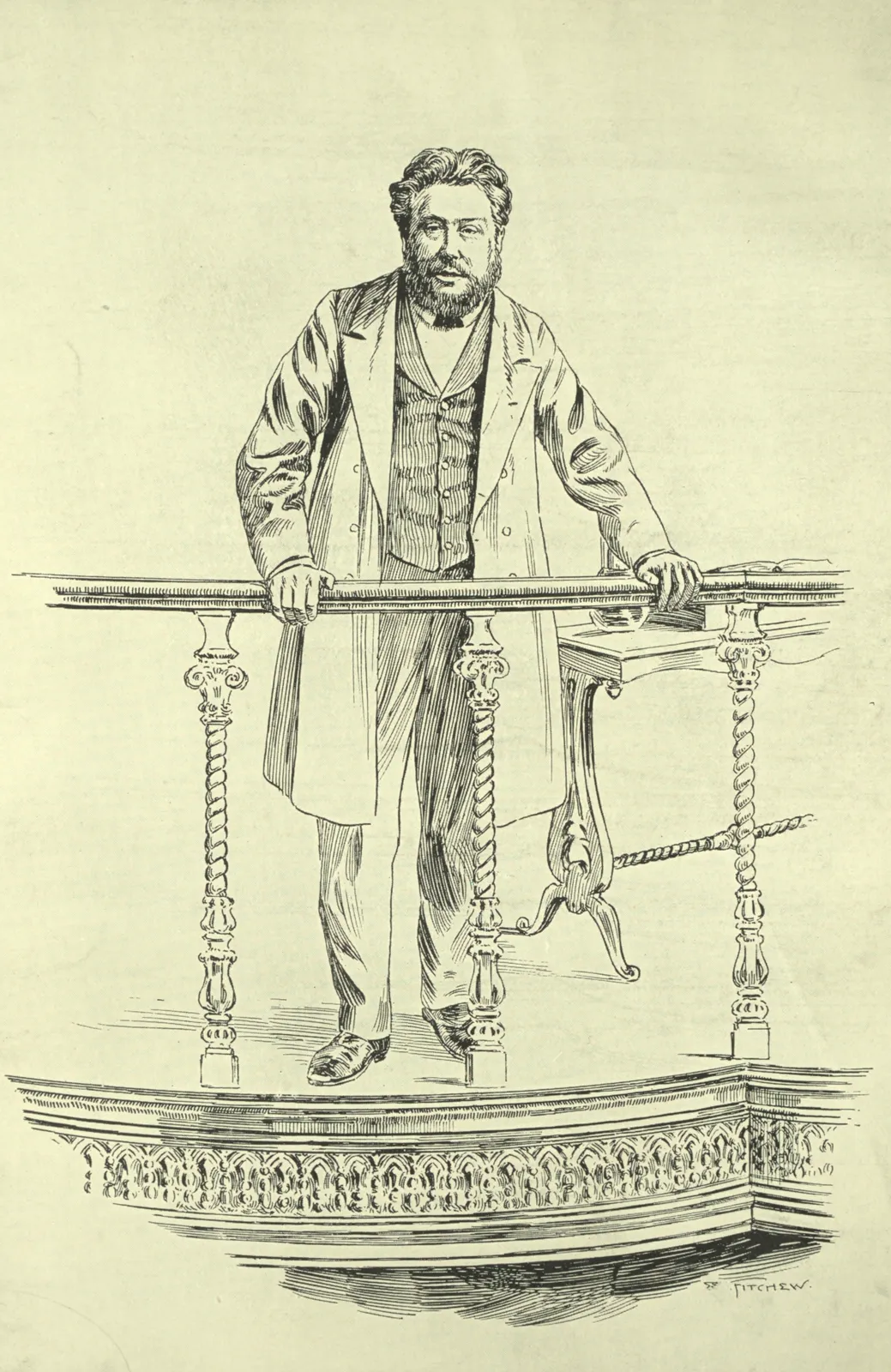
C. H. SPURGEON IN HIS PULPIT. Specially drawn for “The Treasury of David” by E. H. Fitchew.
THE TREASURY OF DAVID
CONTAINING
AN ORIGINAL EXPOSITION OF THE BOOK OF PSALMS;
A COLLECTION OF ILLUSTRATIVE EXTRACTS
FROM THE WHOLE RANGE OF LITERATURE;
A SERIES OF HOMILETICAL HINTS UPON ALMOST EVERY VERSE;
AND LISTS OF WRITERS UPON EACH PSALM.
IN SIX VOLUMES
BY
C. H. SPURGEON.
VOL. I.
PSALM I. TO XXVI.
MARSHALL BROTHERS, LTD.
PUBLISHERS
LONDON, EDINBURGH, and NEW YORK.
PREFACE.
My Preface shall at least possess the virtue of brevity, as I find it difficult
to impart to it any other.
The delightful study of the Psalms has yielded me boundless profit and
ever-growing pleasure; common gratitude constrains me to communicate
to others a portion of the benefit, with the prayer that it may induce them to
search further for themselves. That I have nothing better of my own to offer
upon this peerless book is to me matter of deepest regret; that I have anything
whatever to present is subject for devout gratitude to the Lord of grace.
I have done my best, but, conscious of many defects, I heartily wish I could
have done far better.
The Exposition here given is my own. I consulted a few authors before
penning it, to aid me in interpretation and arouse my thoughts; but, still I
can claim originality for my comments, at least so I honestly think. Whether
they are better or worse for that, I know not; at least I know I have sought
heavenly guidance while writing them, and therefore I look for a blessing on
the printing of them.
The collection of quotations was an after-thought. In fact, matter grew
upon me which I thought too good to throw away. It seemed to me that it
might prove serviceable to others, if I reserved portions of my reading upon
the various Psalms; those reserves soon acquired considerable bulk, so much
so that even in this volume only specimens are given and not the bulk.
One thing the reader will please clearly to understand, and I beg him to
bear it in mind: I am far from endorsing all I have quoted. I am neither
responsible for the scholarship or orthodoxy of the writers. The names are
given that each author may bear his own burden; and a variety of writers
have been quoted that the thoughts of many minds might be before the
reader. Still I trust nothing evil has been admitted; if it be so it is an
oversight.
The research expended on this volume would have occupied far too much
of my time, had not my friend and amanuensis, Mr. John L. Keys, most
diligently aided me in investigations at the British Museum, Dr. Williams’s
Library, and other treasuries of theological lore. With his help I have
ransacked books by the hundred, often without finding a memorable line as a
reward, but at other times with the most satisfactory result. Readers little
know how great labour the finding of but one pertinent extract may involve;
labour certainly I have not spared: my earnest prayer is that some measure
of good may come of it to my brethren in the ministry and to the church at
large.
The Hints to Preachers are very simple, and an apology is due to my
ministerial readers for inserting them, but I humbly hope they may render
assistance to those for whom alone they are designed, viz., lay preachers
whose time is much occupied, and whose attainments are slender.
Should this first volume meet with the approbation of the judicious, I
shall hope by God’s grace to continue the work as rapidly as I can consistently
with the research demanded and my incessant pastoral duties. Another
volume will follow in all probability in twelve months’ time, if life be spared
and strength be given.
It may be added, that although the comments were the work of my health,
the rest of the volume is the product of my sickness. When protracted illness
and weakness laid me aside from daily preaching, I resorted to my pen as an
available means of doing good. I would have preached had I been able, but
as my Master denied me the privilege of thus serving him, I gladly availed
myself of the other method of bearing testimony for his name. O that he
may give me fruit in this field also, and his shall be all the praise.
C. H. Spurgeon
INDEX OF AUTHORS QUOTED OR REFERRED TO.
PSALM I. — EXPOSITION. — EXPLANATORY NOTES AND QUAINT SAYINGS. — HINTS TO PREACHERS.
Title.—This Psalm may be regarded asThe Preface Psalm, having in it a
notification of the contents of the entire Book. It is the psalmist’s desire to teach us
the way to blessedness, and to warn us of the sure destruction of sinners. This then,
is the matter of the first Psalm, which may be looked upon, in some respects, as the
text upon which the whole of the Psalms make up a divine sermon.
Division.—This Psalm consists of two parts: in the first (from verse 1 to the end
of the 3rd) David sets out wherein the felicity and blessedness of a godly man consisteth,
what his exercises are, and what blessings he shall receive from the Lord. In the second
part (from verse 4 to the end) he contrasts the state and character of the ungodly, reveals
the future, and describes, in telling language, his ultimate doom.
Blessed is the man that walketh not in the counsel of the ungodly,
nor standeth in the way of sinners, nor sitteth in the seat of the
scornful.
2 But his delight is in the law of the Lord; and in his law doth he
meditate day and night.
“BLESSED”—see how this Book of Psalms opens with a benediction, even
as did the famous Sermon of our Lord upon the Mount! The word translated
“blessed” is a very expressive one. The original word is plural, and it is a controverted
matter whether it is an adjective or a substantive. Hence we may
learn the multiplicity of the blessings which shall rest upon the man whom God
hath justified, and the perfection and greatness of the blessedness he shall enjoy.
We might read it, “Oh, the blessednesses!” and we may well regard it (as Ainsworth
does) as a joyful acclamation of the gracious man’s felicity. May the like
benediction rest on us!
Here the gracious man is described both negatively (verse 1) and positively
(verse 2). He is a man who does not walk in the counsel of the ungodly. He takes
wiser counsel, and walks in the commandments of the Lord his God. To him
the ways of piety are paths of peace and pleasantness. His footsteps are ordered
by the Word of God, and not by the cunning and wicked devices of carnal men.
It is a rich sign of inward grace when the outward walk is changed, and when
ungodliness is put far from our actions. Note next, he standeth not in the way of
sinners. His company is of a choicer sort than it was. Although a sinner himself,
he is now a blood-washed sinner, quickened by the Holy Spirit, and renewed in
heart. Standing by the rich grace of God in the congregation of the righteous,
he dares not herd with the multitude that do evil. Again it is said, “nor sitteth in
the seat of the scornful.” He finds no rest in the atheist’s scoffings. Let others
make a mock of sin, of eternity, of hell and heaven, and of the Eternal God; this
man has learned better philosophy than that of the infidel, and has too much sense
of God’s presence to endure to hear his name blasphemed. The seat of the scorner
may be very lofty, but it is very near to the gate of hell; let us flee from it, for
it shall soon be empty, and destruction shall swallow up the man who sits therein.
Mark the gradation in the first verse:
He walketh not
in the counsel
of the
ungodly.
Nor standeth
in the way
of
sinners.
Nor SITTETH
in the SEAT
of
SCORNFUL.
When men are living in sin they go from bad to worse. At first they merely
walk in the counsel of the careless and ungodly, who forget God—the evil is rather
practical than habitual—but after that, they become habituated to evil, and they
stand in the way of open sinners who wilfully violate God’s commandments; and
if let alone, they go one step further, and become themselves pestilent teachers
and tempters of others, and thus they sit in the seat of the scornful. They have
taken their degree in vice, and as true Doctors of Damnation they are installed,
and are looked up to by others as Masters in Belial. But the blessed man, the
man to whom all the blessings of God belong, can hold no communion with such
characters as these. He keeps himself pure from these lepers; he puts away evil
things from him as garments spotted by the flesh; he comes out from among the
wicked, and goes without the camp, bearing the reproach of Christ. O for grace
to be thus separate from sinners.
And now mark his positive character. “His delight is in the law of the Lord.”
He is not under the law as a curse and condemnation, but he is in it, and he delights
to be in it as his rule of life; he delights, moreover, to meditate in it, to read it by
day, and think upon it by night. He takes a text and carries it with him all day
long; and in the night-watches, when sleep forsakes his eyelids, he museth upon
the Word of God. In the day of his prosperity he sings psalms out of the Word
of God, and in the night of his affliction he comforts himself with promises out
of the same book. “The law of the Lord” is the daily bread of the true believer.
And yet, in David’s day, how small was the volume of inspiration, for they had
scarcely anything save the first five books of Moses! How much more, then,
should we prize the whole written Word which it is our privilege to have in all our
houses! But, alas, what ill-treatment is given to this angel from heaven! We
are not all Berean searchers of the Scriptures. How few among us can lay claim
to the benediction of the text! Perhaps some of you can claim a sort of negative
purity, because you do not walk in the way of the ungodly; but let me ask you—Is
your delight in the law of God? Do you study God’s Word? Do you make
it the man of your right hand—your best companion and hourly guide? If not,
this blessing belongeth not to you.
3 And he shall be like a tree planted by the rivers of water, that bringeth
forth his fruit in his season; his leaf also shall not wither; and whatsoever
he doeth shall prosper.
“And he shall be like a tree planted;” not a wild tree, but “a tree planted,”
chosen, considered as property, cultivated and secured from the last terrible uprooting,
for “every plant, which my heavenly Father hath not planted, shall be
rooted up:” Matthew xv. 13. “By the rivers of water;” so that even if one river
should fail, he hath another. The rivers of pardon and the rivers of grace, the
rivers of the promise and the rivers of the communion with Christ, are never-failing
sources of supply. He is “like a tree planted by the rivers of water, that bringeth forth
his fruit in his season;” not unseasonable graces, like untimely figs, which are
never full-flavoured. But the man who delights in God’s Word, being taught by it,
bringeth forth patience in the time of suffering, faith in the day of trial, and holy
joy in the hour of prosperity. Fruitfulness is an essential quality of a gracious
man, and that fruitfulness should be seasonable. “His leaf also shall not wither;”
his faintest word shall be everlasting; his little deeds of love shall be had in remembrance.
Not simply shall his fruit be preserved, but his leaf also. He shall neither
lose his beauty nor his fruitfulness. “And whatsoever he doeth shall prosper.”
Blessed is the man who hath such a promise as this. But we must not always
estimate the fulfilment of a promise by our own eye-sight. How often, my brethren,
if we judge by feeble sense, may we come to the mournful conclusion of Jacob,
“All these things are against me!” For though we know our interest in the promise,
yet are we so tried and troubled, that sight sees the very reverse of what that promise
foretells. But to the eye of faith this word is sure, and by it we perceive that our
works are prospered, even when everything seems to go against us. It is not outward
prosperity which the Christian most desires and values; it is soul prosperity
which he longs for. We often, like Jehoshaphat, make ships to go to Tarshish for gold,
but they are broken at Ezion-geber; but even here there is a true prospering, for
it is often for the soul’s health that we should be poor, bereaved, and persecuted.
Our worst things are often our best things. As there is a curse wrapped up in the
wicked man’s mercies, so there is a blessing concealed in the righteous man’s crosses,
losses, and sorrows. The trials of the saint are a divine husbandry, by which he
grows and brings forth abundant fruit.
4 The ungodly are not so: but are like the chaff which the wind driveth
away.
We have now come to the second head of the Psalm. In this verse the contrast
of the ill estate of the wicked is employed to heighten the colouring of that fair
and pleasant picture which precedes it. The more forcible translation of the Vulgate
and of the Septuagint version is—“Not so the ungodly, not so.” And we are hereby
to understand that whatever good thing is said of the righteous is not true in the case
of the ungodly. Oh! how terrible is it to have a double negative put upon the
promises! and yet this is just the condition of the ungodly. Mark the use of the
term “ungodly,” for, as we have seen in the opening of the Psalm, these are
the beginners in evil, and are the least offensive of sinners. Oh! if such is the sad
state of those who quietly continue in their morality, and neglect their God, what
must be the condition of open sinners and shameless infidels? The first sentence
is a negative description of the ungodly, and the second is the positive picture.
Here is their character—“they are like chaff,” intrinsically worthless, dead, unserviceable,
without substance, and easily carried away. Here, also, mark their
doom—“the wind driveth away;” death shall hurry them with its terrible blast
into the fire in which they shall be utterly consumed.
5 Therefore the ungodly shall not stand in the judgment, nor sinners in
the congregation of the righteous.
They shall stand there to be judged, but not to be acquitted. Fear shall lay
hold upon them there; they shall not stand their ground; they shall flee away;
they shall not stand in their own defence; for they shall blush and be covered with
eternal contempt.
Well may the saints long for heaven, for no evil men shall dwell there, “nor
sinners in the congregation of the righteous.” All our congregations upon earth are
mixed. Every Church has one devil in it. The tares grow in the same furrows as
the wheat. There is no floor which is as yet thoroughly purged from chaff. Sinners
mix with saints, as dross mingles with gold. God’s precious diamonds still lie in
the same field with pebbles. Righteous Lots are this side heaven continually
vexed by the men of Sodom. Let us rejoice then, that in “the general assembly
and church of the firstborn” above, there shall by no means be admitted a single
unrenewed soul. Sinners cannot live in heaven. They would be out of their element.
Sooner could a fish live upon a tree than the wicked in Paradise. Heaven would
be an intolerable hell to an impenitent man, even if he could be allowed to enter;
but such a privilege shall never be granted to the man who perseveres in his iniquities.
May God grant that we may have a name and a place in his courts above!
6 For the Lord knoweth the way of the righteous: but the way of the
ungodly shall perish.
Or, as the Hebrew hath it yet more fully, “The Lord is knowing the way of the
righteous.” He is constantly looking on their way, and though it may be often
in mist and darkness, yet the Lord knoweth it. If it be in the clouds and tempest
of affliction, he understandeth it. He numbereth the hairs of our head; he will
not suffer any evil to befall us. “He knoweth the way that I take: when he hath
tried me, I shall come forth as gold.” (Job xxiii. 10.) “But the way of the ungodly
shall perish.” Not only shall they perish themselves, but their way shall perish too.
The righteous carves his name upon the rock, but the wicked writes his remembrance
in the sand. The righteous man ploughs the furrows of earth, and sows a harvest
here, which shall never be fully reaped till he enters the enjoyments of eternity;
but as for the wicked, he ploughs the sea, and though there may seem to be a shining
trail behind his keel, yet the waves shall pass over it, and the place that knew him
shall know him no more for ever. The very “way” of the ungodly shall perish.
If it exist in remembrance, it shall be in the remembrance of the bad; for the Lord
will cause the name of the wicked to rot, to become a stench in the nostrils of the good,
and to be only known to the wicked themselves by its putridity.
May the Lord cleanse our hearts and our ways, that we may escape the doom
of the ungodly, and enjoy the blessedness of the righteous!
Whole Psalm.—As the book of the Canticles is called the Song of Songs by a
Hebraism, it being the most excellent, so this Psalm may not unfitly be entitled,
the Psalm of Psalms, for it contains in it the very pith and quintessence of
Christianity. What Jerome saith on St. Paul’s epistles, the same may I say of this
Psalm; it is short as to the composure, but full of length and strength as to the
matter. This Psalm carries blessedness in the frontispiece; it begins where we all
hope to end: it may well be called a Christian’s Guide, for it discovers the quicksands
where the wicked sink down in perdition, and the firm ground on which
the saints tread to glory.—Thomas Watson’s Saints’ Spiritual Delight, 1660.
This whole Psalm offers itself to be drawn into these two opposite propositions:
a godly man is blessed, a wicked man is miserable; which seem to stand as two
challenges, made by the prophet: one, that he will maintain a godly man against
all comers, to be the only Jason for winning the golden fleece of blessedness; the
other, that albeit the ungodly make a show in the world of being happy, yet they
of all men are most miserable.—Sir Richard Baker, 1640.
I have been induced to embrace the opinion of some among the ancient interpreters
(Augustine, Jerome, etc.), who conceive that the first Psalm is intended
to be descriptive of the character and reward of the Just One, i.e. the Lord Jesus.—John
Fry, B.A., 1842.
Verse 1.—The psalmist saith more to the point about true happiness in this
short Psalm than any one of the philosophers, or all of them put together; they
did but beat the bush, God hath here put the bird into our hand.—John Trapp, 1660.
Verse 1.—Where the word blessed is hung out as a sign, we may be sure that we
shall find a godly man within.—Sir Richard Baker.
Verse 1.—The seat of the drunkard is the seat of the scornful.—Matthew
Henry, 1662-1714.
Verse 1.—“WalkethNOT ... NORstandeth ... NORsitteth,” etc. Negative
precepts are in some cases more absolute and peremptory than affirmatives; for
to say, “that hath walked in the counsel of the godly,” might not be sufficient; for,
he might walk in the counsel of the godly, and yet walk in the counsel of the ungodly
too; not both indeed at once, but both at several times; where now, this negative
clears him at all times.—Sir Richard Baker.
Verse 1.—The word הָאִישׁ haishis emphatic, that man; that one among a thousand
who lives for the accomplishment of the end for which God created him.—Adam
Clarke, 1844.
Verse 1.—“That walketh not in the counsel of the ungodly.” Mark certain circumstances
of their differing characters and conduct. I. The ungodly man has
his counsel. II. The sinner has his way; and III. The scorner has his seat. The
ungodly man is unconcerned about religion; he is neither zealous for his own salvation
nor for that of others; and he counsels and advises those with whom he converses
to adopt his plan, and not trouble themselves about praying, reading, repentance,
etc., etc.; “there is no need for such things; live an honest life, make no
fuss about religion, and you will fare well enough at last.” Now, “blessed is the
man who walks not in this man’s counsel,” who does not come into his measures,
nor act according to his plan.
The sinner has his particular way of transgressing; one is a drunkard, another
dishonest, another unclean. Few are given to every species of vice. There are
many covetous men who abhor drunkenness, many drunkards who abhor covetousness,
and so of others. Each has his easily besetting sin; therefore, says the prophet,
“Let the wicked forsake HIS WAY.” Now, blessed is he who stands not in such a man’sWAY.
The scorner has brought, in reference to himself, all religion and moral feeling
to an end. He has sat down—is utterly confirmed in impiety, and makes a mock
at sin. His conscience is seared, and he is a believer in all unbelief. Now, blessed
is the man who sits not down in hisSEAT.—Adam Clarke.
Verse 1.—In the Hebrew, the word “blessed” is a plural noun, ashrey (blessednesses),
that is, all blessednesses are the portion of that man who has not gone away,
etc.; as though it were said, “All things are well with that man who,” etc. Why
do you hold any dispute? Why draw vain conclusions? If a man has found that
pearl of great price, to love the law of God and to be separate from the ungodly,
all blessednesses belong to that man; but, if he does not find this jewel, he will
seek for all blessednesses but will never find one! For as all things are pure unto
the pure, so all things are lovely unto the loving, all things good unto the good;
and, universally, such as thou art thyself, such is God himself unto thee, though
he is not a creature. He is perverse unto the perverse, and holy unto the holy.
Hence nothing can be good or saving unto him who is evil; nothing sweet unto him
unto whom the law of God is not sweet. The word “counsel” is without doubt
here to be received as signifying decrees and doctrines, seeing that no society of
men exists without being formed and preserved by decrees and laws. David, however,
by this term strikes at the pride and reprobate temerity of the ungodly. First,
because they will not humble themselves so far as to walk in the law of the Lord,
but rule themselves by their own counsel. And then he calls it their “counsel,”
because it is their prudence, and the way that seems to them to be without error.
For this is the destruction of the ungodly—their being prudent in their own eyes
and in their own esteem, and clothing their errors in the garb of prudence and
of the right way. For if they came to men in the open garb of error, it would
not be so distinguishing a mark of blessedness not to walk with them. But David
does not here say, “in the folly of the ungodly,” or “in the error of the ungodly;”
and therefore he admonishes us to guard with all diligence against the appearance
of what is right, that the devil transformed into an angel of light do not seduce
us by his craftiness. And he contrasts the counsel of the wicked with the law of
the Lord, that we may learn to beware of wolves in sheep’s clothing, who are always
ready to give counsel to all, to teach all, and to offer assistance unto all, when they
are of all men the least qualified to do so. The term “stood” descriptively represents
their obstinacy, and stiff-neckedness, wherein they harden themselves and make
their excuses in words of malice, having become incorrigible in their ungodliness.
For “to stand,” in the figurative manner of Scripture expression, signifies to be
firm and fixed: as in Rom. xiv. 4, “To his own master he standeth or falleth: yea,
he shall be holden up, for God is able to make him stand.” Hence the word
“column” is by the Hebrew derived from their verb “to stand,” as is the word
statue among the Latins. For this is the very self-excuse and self-hardening of
the ungodly—their appearing to themselves to live rightly, and to shine in the
eternal show of works above all others. With respect to the term “seat,” to sit in
the seat, is to teach, to act the instructor and teacher; as in Matt. xxiii. 2, “The
scribes sit in Moses’ chair.” They sit in the seat of pestilence, who fill the church
with the opinions of philosophers, with the traditions of men, and with the counsels
of their own brain, and oppress miserable consciences, setting aside, all the while, the
word of God, by which alone the soul is fed, lives, and is preserved.—Martin Luther,
1536-1546.
Verse 1.—“The scornful.”Peccator cum in profundum venerit contemnet—when
a wicked man comes to the depth and worst of sin, he despiseth. Then the
Hebrew will despise Moses (Exodus ii. 14), “Who made thee a prince and a judge
over us?” Then Ahab will quarrel with Micaiah (1 Kings xxii. 18), because he
doth not prophesy good unto him. Every child in Bethel will mock Elisha
(2 Kings ii. 23), and be bold to call him “bald pate.” Here is an original drop of
venom swollen to a main ocean of poison: as one drop of some serpents’ poison,
lighting on the hand, gets into the veins, and so spreads itself over all the body
till it hath stifled the vital spirits. God shall “laugh you to scorn,” (Psalm ii. 4),
for laughing him to scorn; and at last despise you that have despised him in us.
That which a man spits against heaven, shall fall back on his own face. Your
indignities done to your spiritual physicians shall sleep in the dust with your ashes,
but stand up against your souls in judgment.—Thomas Adams, 1614.
Verse 2.—“But his will is in the law of the Lord.” The “will,” which is here
signified, is that delight of heart, and that certain pleasure, in the law, which does
not look at what the law promises, nor at what it threatens, but at this only; that
“the law is holy, and just, and good.” Hence it is not only a love of the law, but
that loving delight in the law which no prosperity, nor adversity, nor the world,
nor the prince of it, can either take away or destroy; for it victoriously bursts its
way through poverty, evil report, the cross, death, and hell, and in the midst of
adversities, shines the brightest.—Martin Luther.
Verse 2.—“His delight is in the law of the Lord.”—This delight which the prophet
here speaks of is the only delight that neither blushes nor looks pale; the only delight
that gives a repast without an after reckoning; the only delight that stands in
construction with all tenses; and like Æneas Anchyses, carries his parents upon
his back.—Sir Richard Baker.
Verse 2.—“In his law doth he meditate.” In the plainest text there is a world
of holiness and spirituality; and if we in prayer and dependence upon God did
sit down and study it, we should behold much more than appears to us. It may
be, at once reading or looking, we see little or nothing; as Elijah’s servant went
once, and saw nothing; therefore he was commanded to look seven times. What
now? says the prophet, “I see a cloud rising, like a man’s hand;” and by-and-by,
the whole surface of the heavens was covered with clouds. So you may look lightly
upon a Scripture and see nothing; “meditate often upon it, and there you shall see a
light, like the light of the sun.”—Joseph Caryl, 1647.
Verse 2.—“In his law doth he meditate day and night.”—The good man doth
meditate on the law of God day and night. The pontificians beat off the common
people from this common treasury, by objecting this supposed difficulty. Oh,
the Scriptures are hard to be understood, do not you trouble your heads about
them; we will tell you the meaning of them. They might as well say, heaven is a
blessed place, but it is a hard way to it; do not trouble yourselves, we will go thither
for you. Thus in the great day of trial, when they should be saved by their book,
alas! they have no book to save them. Instead of the Scriptures they can present
images; these are the laymen’s books; as if they were to be tried by a jury of
carvers and painters, and not by the twelve apostles. Be not you so cheated; but
study the gospel as you look for comfort by the gospel. He that hopes for the
inheritance, will make much of the conveyance.—Thomas Adams.
Verse 2.—To “meditate,” as it is generally understood, signifies to discuss, to
dispute; and its meaning is always confined to a being employed in words, as in
Psalm xxxii. 30, “The mouth of the righteous shall meditate wisdom.” Hence
Augustine has, in his translation, “chatter”; and a beautiful metaphor it is—as
chattering is the employment of birds, so a continual conversing in the law of the
Lord (for talking is peculiar to man), ought to be the employment of man. But I
cannot worthily and fully set forth the gracious meaning and force of this word;
for this “meditating” consists first in an intent observing of the words of the law,
and then in a comparing of the different Scriptures; which is a certain delightful
hunting, nay, rather a playing with stags in a forest, where the Lord furnishes us
with the stags, and opens to us their secret coverts. And from this kind of employment,
there comes forth at length a man well instructed in the law of the Lord to
speak unto the people.—Martin Luther.
Verse 2.—“In his law doth he meditate day and night.” The godly man will
read the Word by day, that men, seeing his good works, may glorify his Father who
is in heaven; he will do it in the night, that he may not be seen of men: by day,
to show that he is not one of those who dread the light; by night, to show that he
is one who can shine in the shade: by day, for that is the time for working—work
whilst it is day; by night, lest his Master should come as a thief, and find him idle.—Sir
Richard Baker.
Verse 2.—I have no rest, but in a nook, with the book.—Thomas à Kempis,
1380-1471.
Verse 2.—“Meditate.” Meditation doth discriminate and characterise a man;
by this he may take a measure of his heart, whether it be good or bad; let me allude
to that; “For as he thinketh in his heart, so is he.” Prov. xxiii. 7. As the meditation
is, such is the man. Meditation is the touchstone of a Christian; it shows what
metal he is made of. It is a spiritual index; the index shows what is in the book,
so meditation shows what is in the heart.—Thomas Watson’s Saints’ Spiritual
Delight.
Meditation chews the cud, and gets the sweetness and nutritive virtue of the
Word into the heart and life: this is the way the godly bring forth much fruit.—Bartholomew
Ashwood’s Heavenly Trade, 1688.
The naturalists observe that to uphold and accommodate bodily life, there
are divers sorts of faculties communicated, and these among the rest: 1. An attractive
faculty, to assume and draw in the food; 2. A retentive faculty, to retain it
when taken in; 3. An assimilating faculty, to concoct the nourishment; 4. An
augmenting faculty, for drawing to perfection. Meditation is all these. It helps
judgment, wisdom, and faith to ponder, discern, and credit the things which reading
and hearing supply and furnish. It assists the memory to lock up the jewels of divine
truth in her sure treasury. It has a digesting power, and turns special truth into
spiritual nourishment; and lastly, it helps the renewed heart to grow upward and
increase its power to know the things which are freely given to us of God.—Condensed
from Nathaniel Ranew, 1670.
Verse 3.—“A tree.”—There is one tree, only to be found in the valley of the
Jordan, but too beautiful to be entirely passed over; the oleander, with its bright
blossoms and dark green leaves, giving the aspect of a rich garden to any spot where
it grows. It is rarely if ever alluded to in the Scriptures. But it may be the tree
planted by the streams of water which bringeth forth his fruit in due season, and
“whose leaf shall not wither.”—A. P. Stanley, D.D., in “Sinai and Palestine.”
Verse 3.—“A tree planted by the rivers of water.”—This is an allusion to the
Eastern method of cultivation, by which rivulets of water are made to flow between
the rows of trees, and thus, by artificial means, the trees receive a constant supply
of moisture.
Verse 3.—“His fruit in his season.”—In such a case expectation is never disappointed.
Fruit is expected, fruit is borne, and it comes also in the time in which
it should come. A godly education, under the influences of the divine Spirit, which
can never be withheld where they are earnestly sought, is sure to produce the fruits
of righteousness; and he who reads, prays, and meditates, will ever see the work
which God has given him to do; the power by which he is to perform it; and the
times, places, and opportunities for doing those things by which God can obtain most
glory, his own soul most good, and his neighbour most edification.—Adam Clarke.
Verse 3.—“In his season.” The Lord reckons the times which pass over us,
and puts them to our account: let us, therefore, improve them, and, with the impotent
persons at the pool of Bethesda, step in when the angel stirs the water. Now
the church is afflicted, it is a season of prayer and learning; now the church is
enlarged, it is a season of praise; I am now at a sermon, I will hear what God will
say; now in the company of a learned and wise man, I will draw some knowledge
and counsel from him; I am under a temptation, now is a fit time to lean on the
name of the Lord; I am in a place of dignity and power, let me consider what it is
that God requireth of me in such a time as this. And thus as the tree of life bringeth
fruit every month, so a wise Christian, as a wise husbandman, hath his distinct employments
for every month, bringing forth his fruit in his season.—John Spencer’s
Things New and Old, 1658.
Verse 3.—“In his season.” Oh, golden and admirable word! by which is
asserted the liberty of Christian righteousness. The ungodly have their stated
days, stated times, certain works, and certain places; to which they stick so closely,
that if their neighbours were perishing with hunger, they could not be torn from
them. But this blessed man, being free at all times, in all places, for every work, and
to every person, will serve you whenever an opportunity is offered him; whatsoever
comes into his hands to do, he does it. He is neither a Jew, nor a Gentile, nor a Greek,
nor a barbarian, nor of any other particular person. He gives his fruit in his season,
so often as either God or man requires his work. Therefore his fruits have no name,
and his times have no name.—Martin Luther.
Verse 3.—“His leaf also shall not wither.” He describes the fruit before he
does the leaf. The Holy Spirit himself always teaches every faithful preacher in
the church to know that the kingdom of God does not stand in word but in power.
1 Cor. iv. 20. Again, “Jesus began both to do and to teach.” Acts i. 1. And
again, “Which was a prophet mighty in deed and word.” Luke xxiv. 19. And
thus, let him who professes the word of doctrine, first put forth the fruits of life, if he
would not have his fruit to wither, for Christ cursed the fig tree which bore no fruit.
And as Gregory saith, that man whose life is despised is condemned by his doctrine,
for he preaches to others, and is himself reprobated.—Martin Luther.
Verse 3.—“His leaf also shall not wither.” The Lord’s trees are all evergreens.
No winter’s cold can destroy their verdure; and yet, unlike evergreens in our
country, they are all fruit bearers.—C. H. S.
Verse 3.—“And whatsoever he doeth, [or, maketh or taketh in hand] shall prosper.”
And with regard to this “prospering,” take heed that thou understandest not a
carnal prosperity. This prosperity is hidden prosperity, and lies entirely secret in
spirit; and therefore if thou hast not this prosperity that is by faith, thou shouldst
rather judge thy prosperity to be the greatest adversity. For as the devil bitterly
hates this leaf and the word of God, so does he also those who teach and hear it,
and he persecutes such, aided by all the powers of the world. Therefore thou hearest
of a miracle the greatest of all miracles, when thou hearest that all things prosper
which a blessed man doeth.—Martin Luther.
Verse 3.—A critical journal has shown that instead of “Whatsoever it doeth
shall prosper,” the rendering might be, “Whatsoever it produceth shall come to
maturity.” This makes the figure entire, and is sanctioned by some MSS. and ancient
versions.
Verse 3 (last clause).—Outward prosperity, if it follow close walking with God,
is very sweet; as the cipher, when it follows a figure, adds to the number, though
it be nothing in itself.—John Trapp.
Verse 4.—“Chaff.” Here by the way, we may let the wicked know they have
a thanks to give they little think of; that they may thank the godly for all the good
days they live upon the earth, seeing it is for their sakes and not for their own that
they enjoy them. For as the chaff while it is united and keeps close to the wheat,
enjoys some privileges for the wheat’s sake, and is laid up carefully in the barn;
but as soon as it is divided, and parted from the wheat, it is cast out and scattered
by the wind; so the wicked, whilst the godly are in company and live amongst
them, partake for their sake of some blessedness promised to the godly; but if
the godly forsake them or be taken from them, then either a deluge of water comes
suddenly upon them, as it did upon the old world when Noah left it; or a deluge
of fire, as it did upon Sodom, when Lot left it, and went out of the city.—Sir Richard
Baker.
Verse 4.—“Driveth away,” or tosseth away; the Chaldee translateth for “wind,”
“whirlwind.”—Henry Ainsworth, 1639.
This shows the vehement tempest of death, which sweeps away the soul of the
ungodly.
Verse 5.—“Therefore the ungodly shall not stand in the judgment,” etc. And
may not a reason also be conceived thus, why the ungodly can never come to be of
the congregation of the righteous: the righteous go a way that God knows, and
the wicked go a way that God destroys; and seeing that these ways can never
meet, how should the men meet that go these ways? And to make sure work
that they shall never meet indeed, the prophet expresseth the way of the righteous
by the first link of the chain of God’s goodness, which is his knowledge; but
expresseth the way of the wicked by the last link of God’s justice, which is his destroying;
and though God’s justice and his mercy do often meet, and are contiguous
one to another, yet the first link of his mercy and the last link of his justice can
never meet, for it never comes to destroying till God be heard to say Nescio vos,
“I know you not,” and nescio vos in God, and God’s knowledge, can certainly never
possibly meet together.—Sir Richard Baker.
Verse 5.—The Irish air will sooner brook a toad, or a snake, than heaven a
sinner.—John Trapp.
Verse 6.—“For the Lord knoweth the way of the righteous: but the way of the
ungodly shall perish.” Behold how David here terrifies us away from all prosperous
appearances, and commends to us various temptations and adversities. For this
“way” of the righteous all men utterly reprobate; thinking also, that God knoweth
nothing about any such way. But this is the wisdom of the cross. Therefore,
it is God alone that knoweth the way of the righteous, so hidden is to it the righteous
themselves. For his right hand leads them on in a wonderful manner, seeing that
it is a way, not of sense, nor of reason, but of faith only; even of that faith that
sees in darkness, and beholds things that are invisible.—Martin Luther.
Verse 6.—“The righteous.” They that endeavour righteous living in themselves
and have Christ’s righteousness imputed to them.—Thomas Wilcocks, 1586.
Verse 1.—May furnish an excellent text upon “Progress in Sin,” of “The Purity
of the Christian,” or “The Blessedness of the Righteous.” Upon the last subject
speak of the believer as BLESSED—1. By God; 2. In Christ; 3. With all blessings;
4. In all circumstances; 5. Through time and eternity; 6. To the highest degree.
Verse 1.—Teaches a godly man to beware, (1) of the opinions, (2) of the practical
life, and (3) of the company and association of sinful men. Show how meditation
upon the Word will assist us in keeping aloof from these three evils.
The insinuating and progressive nature of sin.—J. Morison.
Verse 1, in connection with the whole Psalm. The wide difference between the
righteous and the wicked.
Verse 2.—The Word of God. 1. The believer’s delight in it. 2. The believer’s
acquaintance with it. We long to be in the company of those we love.
Verse 2.—I. What is meant by “the law of the Lord.” II. What there is in
it for the believer to delight in. III. How he shows his delight, thinks of it, reads
much, speaks of it, obeys it, does not delight in evil.
Verse 2 (last clause).—The benefits, helps, and hindrances of meditation.
Verse 3.—“The fruitful tree.” I. Where it grows. II. How it came there.
III. What it yields. IV. How to be like it.
Verse 3.—“Planted by the rivers of water.” I. The origination of Christian
life, “planted.” II. The streams which support it. III. The fruit expected from it.
Verse 3.—Influence of religion upon prosperity.—Blair.
The nature, causes, signs, and results of true prosperity.
“Fruit in his season;” virtues to be exhibited at certain seasons—patience in
affliction; gratitude in prosperity; zeal in opportunity, etc.
“His leaf also shall not wither;” the blessing of retaining an unwithered profession.
Verse 5.—The sinner’s double doom. 1. Condemned at the judgment-bar.
2. Separated from the saints. Reasonableness of these penalties, “therefore,”
and the way to escape them.
“The congregation of the righteous” viewed as the church of the first-born above.
This may furnish a noble topic.
Verse 6 (first sentence).—A sweet encouragement to the tried people of God.
The knowledge here meant. 1. Its character.—It is a knowledge of observation
and approbation. 2. Its source.—It is caused by omniscience and infinite love.
3. Its results.—Support, deliverance, acceptance, and glory at last.
Verse 6 (last clause).—His way of pleasure, of pride, of unbelief, of profanity,
of persecution, of procrastinating, of self-deception, etc.; all these shall come to
an end.
PSALM II. — EXPOSITION. — EXPLANATORY NOTES AND QUAINT SAYINGS. — HINTS TO PREACHERS.
Title.—We shall not greatly err in our summary of this sublime Psalm if we call
itThe Psalm of Messiah the Prince; for it sets forth as in a wondrous vision
the tumult of the people against the Lord’s anointed, the determinate purpose of God
to exalt his own Son, and the ultimate reign of that Son over all his enemies. Let us
read it with the eye of faith, beholding, as in a glass, the final triumph of our Lord Jesus
Christ over all his enemies. Lowth has the following remarks upon this Psalm: “The
establishment of David upon his throne, notwithstanding the opposition made to it
by his enemies, is the subject of the Psalm. David sustains in it a twofold character,
literal and allegorical. If we read over the Psalm, first with an eye to the literal David,
the meaning is obvious, and put beyond all dispute by the sacred history. There is
indeed an uncommon glow in the expression and sublimity in the figures, and the diction
is now and then exaggerated, as it were on purpose to intimate, and lead us to the contemplation
of higher and more important matters concealed within. In compliance
with this admonition, if we take another survey of the Psalm as relative to the person and
concerns of the spiritual David, a noble series of events immediately rises to view, and
the meaning becomes more evident, as well as more exalted. The colouring which may
perhaps seem too bold and glaring for the king of Israel, will no longer appear so when
laid upon his great Antitype. After we have thus attentively considered the subjects apart,
let us look at them together, and we shall behold the full beauty and majesty of this most
charming poem. We shall perceive the two senses very distinct from each other, yet
conspiring in perfect harmony, and bearing a wonderful resemblance in every feature
and lineament, while the analogy between them is so exactly preserved, that either may
pass for the original from whence the other was copied. New light is continually cast
upon the phraseology, fresh weight and dignity are added to the sentiments, till, gradually
ascending from things below to things above, from human affairs to those that are Divine,
they bear the great important theme upwards with them, and at length place it in the
height and brightness of heaven.”
Division.—This Psalm will be best understood if it be viewed as a four-fold picture.
(In verses 1, 2, 3) the Nations are raging; (4 to 6) the Lord in heaven derides them;
(7 to 9) the Son proclaims the decree; and (from 10 to end) advice is given to the kings
to yield obedience to the Lord’s anointed. This division is not only suggested by the
sense, but is warranted by the poetic form of the Psalm, which naturally falls into four
stanzas of three verses each.
Why do the heathen rage, and the people imagine a vain thing?
2 The kings of the earth set themselves, and the rulers take counsel
together, against the Lord, and against his anointed, saying,
3 Let us break their bands asunder, and cast away their cords from us.
We have, in these first three verses, a description of the hatred of human nature
against the Christ of God. No better comment is needed upon it than the apostolic
song in Acts iv. 27, 28: “For of a truth against thy holy child Jesus, whom thou
hast anointed, both Herod, and Pontius Pilate, with the Gentiles, and the people
of Israel, were gathered together, for to do whatsoever thy hand and thy counsel
determined before to be done.” The Psalm begins abruptly with an angry
interrogation; and well it may: it is surely but little to be wondered at, that the
sight of creatures in arms against their God should amaze the psalmist’s mind.
We see the heathen raging, roaring like the sea, tossed to and fro with restless waves,
as the ocean in a storm; and then we mark the people in their hearts imagining a
vain thing against God. Where there is much rage there is generally some folly,
and in this case there is an excess of it. Note, that the commotion is not caused
by the people only, but their leaders foment the rebellion. “The kings of the earth
set themselves.” In determined malice they arrayed themselves in opposition
against God. It was not temporary rage, but deep-seated hate, for they set themselves
resolutely to withstand the Prince of Peace. “And the rulers take counsel
together.” They go about their warfare craftily, not with foolish haste, but
deliberately. They use all the skill which art can give. Like Pharaoh, they cry,
“Let us deal wisely with them.” O that men were half as careful in God’s service
to serve him wisely, as his enemies are to attack his kingdom craftily. Sinners
have their wits about them, and yet saints are dull. But what say they? what is
the meaning of this commotion? “Let us break their bands asunder.” “Let us
be free to commit all manner of abominations. Let us be our own gods. Let us
rid ourselves of all restraint.” Gathering impudence by the traitorous proposition
of rebellion, they add—“let us cast away”; as if it were an easy matter,—“let us
fling off ‘their cords from us.’” What! O ye kings, do ye think yourselves Samsons?
and are the bands of Omnipotence but as green withs before you? Do you dream
that you shall snap to pieces and destroy the mandates of God—the decrees of the
Most High—as if they were but tow? And do ye say, “Let us cast away their cords
from us?” Yes! There are monarchs who have spoken thus, and there are still
rebels upon thrones. However mad the resolution to revolt from God, it is one in
which man has persevered ever since his creation, and he continues in it to this very
day. The glorious reign of Jesus in the latter day will not be consummated, until a
terrible struggle has convulsed the nations. His coming will be as a refiner’s fire, and
like fuller’s soap, and the day thereof shall burn as an oven. Earth loves not her
rightful monarch, but clings to the usurper’s sway: the terrible conflicts of the
last days will illustrate both the world’s love of sin and Jehovah’s power to give
the kingdom to his only Begotten. To a graceless neck the yoke of Christ is intolerable,
but to the saved sinner it is easy and light. We may judge ourselves by
this, do we love that yoke, or do we wish to cast it from us?
4 He that sitteth in the heavens shall laugh: the Lord shall have them
in derision.
Let us now turn our eyes from the wicked council-chamber and raging tumult of
man, to the secret place of the majesty of the Most High. What doth God say?
What will the King do unto the men who reject his only-begotten Son, the Heir
of all things?
Mark the quiet dignity of the Omnipotent One, and the contempt which he
pours upon the princes and their raging people. He has not taken the trouble to
rise up and do battle with them—he despises them, he knows how absurd, how
irrational, how futile are their attempts against him—he therefore laughs at them.
5 Then shall he speak unto them in his wrath, and vex them in his sore
displeasure.
6 Yet have I set my king upon my holy hill of Zion.
After he has laughed he shall speak; he needs not smite; the breath of his
lips is enough. At the moment when their power is at its height, and their fury
most violent, then shall his Word go forth against them. And what is it that he
says?—it is a very galling sentence—“Yet,” says he, “despite your malice, despite
your tumultuous gatherings, despite the wisdom of your counsels, despite the craft
of your lawgivers, ‘yet have I set my king upon my holy hill of Zion.’” Is not that a
grand exclamation! He has already done that which the enemy seeks to prevent.
While they are proposing, he has disposed the matter. Jehovah’s will is done, and
man’s will frets and raves in vain. God’s Anointed is appointed, and shall not be
disappointed. Look back through all the ages of infidelity, hearken to the high
and hard things which men have spoken against the Most High, listen to the rolling
thunder of earth’s volleys against the Majesty of heaven, and then think that God
is saying all the while, “Yet have I set my king upon my holy hill of Zion.” Yet
Jesus reigns, yet he sees of the travail of his soul, and “his unsuffering kingdom
yet shall come” when he shall take unto himself his great power, and reign
from the river unto the ends of the earth. Even now he reigns in Zion, and
our glad lips sound forth the praises of the Prince of Peace. Greater conflicts
may here be foretold, but we may be confident that victory will be given
to our Lord and King. Glorious triumphs are yet to come; hasten them, we pray
thee, O Lord! It is Zion’s glory and joy that her King is in her, guarding her from
foes, and filling her with good things. Jesus sits upon the throne of grace, and the
throne of power in the midst of his church. In him is Zion’s best safeguard; let
her citizens be glad in him.
“Thy walls are strength, and at thy gates
A guard of heavenly warriors waits;
Nor shall thy deep foundations move,
Fixed on his counsels and his love.
Thy foes in vain designs engage;
Against his throne in vain they rage,
like rising waves, with angry roar,
That dash and die upon the shore.”
7 I will declare the decree: the Lord hath said unto me, Thou art my son;
this day have I begotten thee.
8 Ask of me, and I shall give thee the heathen for thine inheritance, and
the uttermost parts of the earth for thy possession.
9 Thou shalt break them with a rod of iron; thou shalt dash them in pieces
like a potter’s vessel.
This Psalm wears something of a dramatic form, for now another person is
introduced as speaking. We have looked into the counsel-chamber of the wicked,
and to the throne of God, and now we behold the Anointed declaring his rights of
sovereignty, and warning the traitors of their doom.
God has laughed at the counsel and ravings of the wicked, and now Christ the
Anointed himself comes forward, as the Risen Redeemer, “declared to be the Son
of God with power, according to the spirit of holiness, by the resurrection from the
dead.” Rom. i. 4. Looking into the angry faces of the rebellious kings, the
Anointed One seems to say, “If this sufficeth not to make you silent, ‘I will declare
the decree.’” Now this decree is directly in conflict with the device of man, for its
tenour is the establishment of the very dominion against which the nations are
raving. “Thou art my Son.” Here is a noble proof of the glorious Divinity of
our Immanuel. “For unto which of the angels said he at any time, Thou art my Son,
this day have I begotten thee?” What a mercy to have a Divine Redeemer in
whom to rest our confidence! “This day have I begotten thee.” If this refers to
the Godhead of our Lord, let us not attempt to fathom it, for it is a great truth, a
truth reverently to be received, but not irreverently to be scanned. It may be added,
that if this relates to the Begotten One in his human nature, we must here also
rejoice in the mystery, but not attempt to violate its sanctity by intrusive prying
into the secrets of the Eternal God. The things which are revealed are enough,
without venturing into vain speculations. In attempting to define the Trinity,
or unveil the essence of Divinity, many men have lost themselves: here great ships
have foundered. What have we to do in such a sea with our frail skiffs?
“Ask of me.” It was a custom among great kings to give to favoured ones
whatever they might ask. (See Esther v. 6; Matt. xiv. 7.) So Jesus hath but to
ask and have. Here he declares that his very enemies are his inheritance. To
their face he declares this decree, and “Lo! here,” cries the Anointed One, as he
holds aloft in that once pierced hand the sceptre of his power, “He hath given me
this, not only the right to be a king, but the power to conquer.” Yes! Jehovah
hath given to his Anointed a rod of iron with which he shall break rebellious nations
in pieces, and, despite their imperial strength, they shall be but as potters’ vessels,
easily dashed into shivers, when the rod of iron is in the hand of the omnipotent
Son of God. Those who will not bend must break. Potters’ vessels are not to be
restored if dashed in pieces, and the ruin of sinners will be hopeless if Jesus shall
smite them.
“Ye sinners seek his grace,
Whose wrath ye cannot bear;
Fly to the shelter of his cross,
And find salvation there.”
10 Be wise now therefore, O ye kings: be instructed, ye judges of the
earth.
11 Serve the Lord with fear, and rejoice with trembling.
12 Kiss the Son, lest he be angry, and ye perish from the way, when his
wrath is kindled but a little. Blessed are all they that put their trust in
him.
The scene again changes, and counsel is given to those who have taken counsel
to rebel. They are exhorted to obey, and give the kiss of homage and affection
to him whom they have hated.
“Be wise.”—It is always wise to be willing to be instructed, especially when
such instruction tends to the salvation of the soul. “Be wise now, therefore;”
delay no longer, but let good reason weigh with you. Your warfare cannot succeed,
therefore desist and yield cheerfully to him who will make you bow if you refuse
his yoke. O how wise, how infinitely wise is obedience to Jesus, and how dreadful
is the folly of those who continue to be his enemies! “Serve the Lord with fear;”
let reverence and humility be mingled with your service. He is a great God, and
ye are but puny creatures; bend ye, therefore, in lowly worship, and let a filial fear
mingle with all your obedience to the great Father of the Ages. “Rejoice with
trembling.”—There must ever be a holy fear mixed with the Christian’s joy. This
is a sacred compound, yielding a sweet smell, and we must see to it that we burn no
other upon the altar. Fear, without joy, is torment; and joy, without holy fear,
would be presumption. Mark the solemn argument for reconciliation and obedience.
It is an awful thing to perish in the midst of sin, in the very way of rebellion; and
yet how easily could his wrath destroy us suddenly. It needs not that his anger
should be heated seven times hotter; let the fuel kindle but a little, and we are consumed.
O sinner! Take heed of the terrors of the Lord; for “our God is a consuming
fire.” Note the benediction with which the Psalm closes:—“Blessed are
all they that put their trust in him.” Have we a share in this blessedness? Do we
trust in him? Our faith may be slender as a spider’s thread; but if it be real, we
are in our measure blessed. The more we trust, the more fully shall we know this
blessedness. We may therefore close the Psalm with the prayer of the apostles:—“Lord,
increase our faith.”
The first Psalm was a contrast between the righteous man and the sinner; the
second Psalm is a contrast between the tumultuous disobedience of the ungodly
world and the sure exaltation of the righteous Son of God. In the first Psalm, we
saw the wicked driven away like chaff; in the second Psalm, we see them broken
in pieces like a potter’s vessel. In the first Psalm, we beheld the righteous like a
tree planted by the rivers of water; and here, we contemplate Christ, the Covenant
Head of the righteous, made better than a tree planted by the rivers of water, for he
is made king of all the islands, and all the heathen bow before him and kiss the dust;
while he himself gives a blessing to all those who put their trust in him. The two
Psalms are worthy of the very deepest attention; they are, in fact, the preface in
the entire Book of Psalms, and were by some of the ancients, joined into one. They
are, however, two Psalms; for Paul speaks of this as the second Psalm. (Acts
xiii. 33.) The first shows us the character and lot of the righteous; and the next
teaches us that the Psalms are Messianic, and speak of Christ the Messiah—the
Prince who shall reign from the river even unto the ends of the earth. That they
have both a far-reaching prophetic outlook we are well assured, but we do not feel
competent to open up that matter, and must leave it to abler hands.
Verse 1.—“Why do nations make a noise,” tumultuate or rage? The Hebrew
verb is not expressive of an internal feeling, but of the outward agitation which
denotes it. There may be an allusion to the rolling and roaring of the sea, often
used as an emblem of popular commotion, both in the Scriptures and the classics.
The past tense of this verb (why have they raged?) refers to the commotion as already
begun, while the future in the next clause expresses its continuance.—J. A. Alexander,
D.D., 1850.
Verse 1.—“Rage.” The word with which Paul renders this in the Greek denotes
rage, pride, and restiveness, as of horses that neigh, and rush into the battle.
Ἐφρύαξαν, from Φρυάσσω, to snort or neigh, properly applied to a high-mettled
horse. See Acts iv. 25.
Verse 1.—“A vain thing.” A medal was struck by Diocletian, which still remains
bearing the inscription, “The name of Christians being extinguished.” And in
Spain, two monumental pillars were raised, on which were written:—I. “Diocletian
Jovian Maximian Herculeus Cæsares Augusti, for having extended the Roman
Empire in the east and the west, and for having extinguished the name of Christians,
who brought the Republic to ruin.” II. “Diocletian Jovian Maximian Herculeus
Cæsares Augusti, for having adopted Galerius in the east, for having everywhere
abolished the superstition of Christ, for having extended the worship of the gods.”
As a modern writer has elegantly observed: “We have here a monument raised
by Paganism, over the grave of its vanquished foe. But in this, ‘the people imagined
a vain thing;’ so far from being deceased, Christianity was on the eve of its final
and permanent triumph, and the stone guarded a sepulchre empty as the urn which
Electra washed with her tears. Neither in Spain, nor elsewhere, can be pointed
out the burial place of Christianity; it is not, for the living have no tomb.”
Verses 1-4.—Herod, the fox, plotted against Christ, to hinder the course of
his ministry and mediatorship, but he could not perform his enterprise; ’tis so
all along, therefore it is said, “Why do the heathen imagine a vain thing?” A
vain thing, because a thing successless, their hands could not perform it. It was vain,
not only because there was no true ground of reason why they should imagine or do
such a thing, but vain also because they laboured in vain, they could not do it, and
therefore it follows, “He that sitteth in the heavens shall laugh: the Lord shall have
them in derision.” The Lord see what fools they are, and men (yea, themselves)
shall see it. The prophet gives us an elegant description to this purpose. Isaiah
lix. 5, 6. “They weave the spider’s web.... Their webs shall not become garments,
neither shall they cover themselves with their works.” As if he had said, they have been
devising and setting things in a goodly frame to catch flies; they have been spinning
a fine thread out of their brains, as the spider doth out of her bowels; such is their
web, but when they have their web they cannot cut it out, or make it up into a
garment. They shall go naked and cold, notwithstanding all their spinning and
weaving, all their plotting and devising. The next broom that comes will sweep
away all their webs and the spiders too, except they creep apace. God loves and
delights to cross worldly proverbs and worldly craft.—Joseph Caryl, 1647.
Verse 2.—The many had done their part, and now the mighty show themselves.—John
Trapp.
Verse 2.—“They banded themselves against the Lord, and against his Anointed.”
But why did they band themselves against the Lord, or against his Anointed?
What was their desire of him? To have his goods? No, he had none for himself;
but they were richer than he. To have his liberty? Nay, that would not
suffice them, for they had bound him before. To bring the people into dislike of
him? Nay, that would not serve them, for they had done so already, until even
his disciples were fled from him. What would they have then? his blood? Yea,
“they took counsel,” saith Matthew, “to put him to death.” They had the devil’s
mind, which is not satisfied but with death. And how do they contrive it? He
saith, “they took counsel about it.”—Henry Smith, 1578.
Verse 2.—“Against Jehovah and against his Anointed.” What an honour it
was to David to be thus publicly associated with Jehovah! And, because he was
HIS anointed, to be an object of hatred and scorn to the ungodly world! If this
very circumstance fearfully augmented the guilt, and sealed the doom of these
infatuated heathen, surely it was that which above everything else would preserve
the mind of David calm and serene, yea, peaceful and joyful notwithstanding the
proud and boastful vauntiness of his enemies.... When writing this Psalm
David was like a man in a storm, who hears only the roaring of the tempest, or sees
nothing but the raging billows threatening destruction on every side of him. And
yet his faith enabled him to say, “The people imagine a vain thing.” They cannot
succeed. They cannot defeat the counsels of heaven. They cannot injure the
Lord’s Anointed.—David Pitcairn, 1851.
Verse 3.—Resolved they were to run riot as lawless, and aweless, and therefore
they slander the sweet laws of Christ’s kingdom as bonds and thick cords, which
are signs of slavery. Jer. xxvii. 2, 6, 7. But what saith our Saviour? “My yoke
is easy, and my burden is light.” It is no more burden to a regenerate man than
wings to a bird. The law of Christ is no more as bands and cords, but as girdles
and garters which gird up his loins and expedite his course.—John Trapp.
Verse 4.—“He that sitteth in the heavens.” Hereby it is clearly intimated, (1)
that the Lord is far above all their malice and power, (2) that he seeth all their
plots, looking down on all; (3) that he is of omnipotent power, and so can do
with his enemies as he lists. “Our God is in the heavens: he hath done whatsoever
he pleased.” Psalm cxv. 3.—Arthur Jackson, 1643.
Verse 4.—“He that sitteth in the heavens shall laugh,” etc. Sinners’ follies are
the just sport of God’s infinite wisdom and power; and those attempts of the kingdom
of Satan, which in our eyes are formidable, in his are despicable.—Mathew
Henry.
Verse 4.—“He that sitteth in the heavens shall laugh.” They scoff at us, God
laughs at them. Laugh? This seems a hard word at the first view: are the injuries
of his saints, the cruelties of their enemies, the derision, the persecution of all
that are round about us, no more but matter of laughter? Severe Cato thought
that laughter did not become the gravity of Roman consuls; that it is a diminution
of states, as another told princes; and is it attributed to the Majesty of heaven?
According to our capacities, the prophet describes God, as ourselves would be in a
merry disposition, deriding vain attempts. He laughs, but it is in scorn; he scorns,
but it is with vengeance. Pharaoh imagined that by drowning the Israelite males,
he had found a way to root their name from the earth; but when at the same time,
his own daughter, in his own court, gave princely education to Moses, their deliverer,
did not God laugh?
Short is the joy of the wicked. Is Dagon put up to his place again? God’s
smile shall take off his head and his hands, and leave him neither wit to guide nor
power to subsist.... We may not judge of God’s works until the fifth act: the
case, deplorable and desperate in outward appearance, may with one smile from
heaven find a blessed issue. He permitted his temple to be sacked and rifled, the
holy vessels to be profaned and caroused in; but did not God’s smile make Belshazzar
to tremble at the handwriting on the wall? Oh, what are his frowns, if
his smiles be so terrible!—Thomas Adams.
Verse 4.—The expression, “He that sitteth in the heavens,” at once fixes our
thoughts on a being infinitely exalted above man, who is of the earth, earthly.
And when it is said, “He shall laugh,” this word is designed to convey to our minds
the idea, that the greatest confederacies amongst kings and peoples, and their
most extensive and vigorous preparations, to defeat HIS purposes or to injure HIS
servants, are in HIS sight altogether insignificant and worthless. He looks upon
their poor and puny efforts, not only without uneasiness or fear, but HE laughs at
their folly; HE treats their impotency with derision. He knows how HE can crush
them like a moth when HE pleases, or consume them in a moment with the breath
of HIS mouth. How profitable it is for us to be reminded of truths such as these!
Ah! it is indeed “a vain thing” for the potsherds of the earth to strive with the
glorious Majesty of Heaven.—David Pitcairn.
Verse 4.—“The Lord,” in Hebrew, Adonai, mystically signifieth my stays, or
my sustainers—my pillars. Our English word “Lord” hath much the same force,
being contracted of the old Saxon word “Llaford,” or “Hlafford,” which cometh
from “Laef,” to sustain, refresh, cherish.—Henry Ainsworth.
Verse 4.—“He that sitteth in the heavens shall laugh at them: the Lord shall have
them in derision.” This tautology or repetition of the same thing, which is frequent
in the Scriptures, is a sign of the thing being established: according to the authority
of the patriarch Joseph (Gen. xli. 32), where, having interpreted the dreams of Pharaoh
he said, “And for that the dream was doubled unto Pharaoh twice; it is because
the thing is established by God, and God will shortly bring it to pass.” And therefore,
here also, “shall laugh at them,” and “shall have them in derision,” is a repetition
to show that there is not a doubt to be entertained that all these things will most
surely come to pass. And the gracious Spirit does all this for our comfort and
consolation, that we may not faint under temptation, but lift up our heads with
the most certain hope; because “he that shall come will come, and will not tarry.”
Hebrews x. 37.—Martin Luther.
Verse 5.—“Vex them;” either by horror of conscience, or corporal plagues;
one way or the other he will have his pennyworths of them, as he always has had
of the persecutors of his people.—John Trapp.
Verses 5, 9.—It is easy for God to destroy his foes.... Behold Pharaoh, his
wise men, his hosts, and his horses plouting and plunging, and sinking like lead
in the Red sea. Here is the end of one of the greatest plots ever formed against
God’s chosen. Of thirty Roman emperors, governors of provinces, and others
high in office, who distinguished themselves by their zeal and bitterness in persecuting
the early Christians, one became speedily deranged after some atrocious cruelty,
one was slain by his own son, one became blind, the eyes of one started out of his head,
one was drowned, one was strangled, one died in a miserable captivity, one fell
dead in a manner that will not bear recital, one died of so loathsome a disease that
several of his physicians were put to death because they could not abide the stench
that filled his room, two committed suicide, a third attempted it, but had to call
for help to finish the work, five were assassinated by their own people or servants,
five others died the most miserable and excruciating deaths, several of them having
an untold complication of diseases, and eight were killed in battle, or after being
taken prisoners. Among these was Julian the apostate. In the days of his prosperity
he is said to have pointed his dagger to heaven defying the Son of God, whom
he commonly called the Galilean. But when he was wounded in battle, he saw
that all was over with him, and he gathered up his clotted blood, and threw it into
the air, exclaiming, “Thou hast conquered, O thou Galilean.” Voltaire has told
us of the agonies of Charles IX. of France, which drove the blood through the pores
of the skin of that miserable monarch, after his cruelties and treachery to the
Huguenots.—William S. Plummer, D.D., LL.D., 1867.
Verse 6.—“Yet have I set my King.” Notice—1. The royal office and character
of our glorious Redeemer: he is a King, “This name he hath on his vesture and
on his thigh.” Rev. xix. 16. 2. The authority by which he reigns; he is “my King,”
says God the Father, and I have set him up from everlasting: “The Father judgeth
no man; but hath committed all judgment unto the Son.” The world disowns
his authority, but I own it; I have set him, I have “given him to be head over all
things to the church.” 3. His particular kingdom over which he rules; it is over
“my holy hill of Zion”—an eminent type of the gospel church. The temple was
built upon Mount Zion and therefore called a holy hill. Christ’s throne is in his
church, it is his head-quarters, and the place of his peculiar residence. Notice the
firmness of the divine purpose with respect unto this matter. “Yet have I set”
him “King;” i.e., whatever be the plots of hell and earth to the contrary, he reigns
by his Father’s ordination.—Stephen Charnock, 1628-1680.
Verse 6.—“Yet have I set myKing,” etc.—Jesus Christ is a threefold King.
First, his enemies’ King; secondly, his saints’ King; thirdly, his Father’s King.
First. Christ is his enemies’ King, that is, he is King over his enemies. Christ
is a King above all kings. What are all the mighty men, the great, the honourable
men of the earth to Jesus Christ? They are but like a little bubble in the water;
for if all the nations, in comparison to God, be but as the drop of the bucket, or
the dust of the balance, as the prophet speaks in Isaiah xl. 15, how little then must
be the kings of the earth! Nay, beloved, Christ Jesus is not only higher than kings,
but he is higher than the angels; yea, he is the head of angels; and, therefore, all
the angels in heaven are commanded to worship him. Col. ii. 12 Heb. i. 6.... He
is King over all kingdoms, over all nations, over all governments, over all powers,
over all people Dan. vii. 14.... The very heathen are given to Christ, and the
uttermost parts of the earth for his possession. Psalm ii. 8.
Secondly. Jesus Christ is his saints’ King. He is King of the bad, and of the
good; but as for the wicked, he rules over them by his power and might; but the
saints, he rules in them by his Spirit and graces. Oh! this is Christ’s spiritual
kingdom, and here he rules in the hearts of his people, here he rules over their consciences,
over their wills, over their affections, over their judgments and understandings,
and nobody hath anything to do here but Christ. Christ is not only
the King of nations, but the King of saints; the one he rules over, the other he
rules in.
Thirdly. Jesus Christ is his Father’s King too, and so his Father calls him: “I
have set my King upon my holy hill of Zion.” Well may he be our King, when he is
God’s King. But you may say, how is Christ the Father’s King? Because he
rules for his Father. There is a twofold kingdom of God committed to Jesus Christ;
first, a spiritual kingdom, by which he rules in the hearts of his people, and so is
King of saints; and, secondly, a providential kingdom, by which he rules the affairs
of this world, and so he is King of nations.—Condensed from William Dyer’s Christ’s
Famous Titles, 1665.
Verse 6.—“Zion.” The name “Zion” signifies a “distant view” (speculam.)
And the church is called “a distant view” (specula), not only because it views
God and heavenly things by faith (that is, afar off), being wise unto the things that
are above, not unto those that are on the earth: but also, because there are within
her true viewers, or seers, and watchmen in the spirit, whose office it is to take
charge of the people under them, and to watch against the snares of enemies and
sins; and such are called in the Greek bishops (ἐπίσκοποι), that is, spyers or seers;
and you may for the same reason give them, from the Hebrew, the appellation of
Zionians of Zioners.—Martin Luther.
Verse 7.—The dispute concerning the eternal filiation of our Lord betrays more
of presumptuous curiosity than of reverent faith. It is an attempt to explain
where it is far better to adore. We could give rival expositions of this verse, but
we forbear. The controversy is one of the most unprofitable which ever engaged
the pens of theologians.—C. H. S.
Verse 8.—“Ask of me.” The priesthood doth not appear to be settled upon
Christ by any other expression than this, “Ask of me.” The Psalm speaks of his
investiture in his kingly office; the apostle refers this to his priesthood, his commission,
for both took date at the same time; both bestowed, both confirmed by
the same authority. The office of asking is grounded upon the same authority as
the honour of king. Ruling belonged to his royal office, asking to his priestly.
After his resurrection, the Father gives him a power and command of asking.—Stephen
Charnock.
Verse 8.—As the limner looks on the person whose picture he would take, and
draws his lines to answer him with the nearest similitude that he can, so God looks
on Christ as the archetype to which he will conform the saint, in suffering, in grace,
in glory; yet so that Christ hath the pre-eminence in all. Every saint must suffer,
because Christ suffered: Christ must not have a delicate body under a crucified
head; yet never any suffered, or could, what he endured. Christ is holy, and
therefore so shall every saint be, but in an inferior degree; an image cut in clay
cannot be so exact as that engraved on gold. Now, our conformity to Christ appears,
that as the promises made to him were performed upon his prayers to his Father,
his promises made to his saints are given to them in the same way of prayer: “Ask
of me,” saith God to his Son, “and I shall give thee.” And the apostle tells us,
“Ye have not, because ye ask not.” God hath promised support to Christ in all
his conflicts. Isaiah xlii. 1. “Behold my servant, whom I uphold;” yet he prayed
“with strong cries and tears,” when his feet stood within the shadow of death. A
seed is promised to him, and victory over his enemies, yet for both these he prays.
Christ towards us acts as a king, but towards his Father as a priest. All he speaks
to God is by prayer and intercession. So the saints, the promise makes them kings
over their lusts, conquerors over their enemies; but it makes them priests towards
God, by prayer humbly to sue out those great things given in the promise.—William
Gurnall, 1617-1679.
Verse 8.—It will be observed in our Bible that two words of verse eight are in
italics, intimating that they are not translations of the Hebrew, but additions made
for the purpose of elucidating the meaning. Now if the “thee” and the “for” are
left out, the verse will read thus, “Ask of me, and I shall give the heathen, thine
inheritance, and thy possession, the uttermost parts of the earth.” And this reading
is decidedly preferable to the other. It implies that by some previous arrangement
on the part of God, he had already assigned an inheritance of the heathen, and the
possession of the earth, to the person of whom he says, “Thou art my Son.” And
when God says, “I will give,” etc., he reveals to his Anointed, not so much in what
the inheritance consisted, and what was the extent of possession destined for him,
as the promise of his readiness to bestow it. The heathen were already “the inheritance,”
and the ends of the earth “the possession,” which God had purposed
to give to his Anointed. Now he says to him, “Ask of me,” and he promises to fulfil
his purpose. This is the idea involved in the words of the text, and the importance
of it will become more apparent, when we consider its application to the spiritual
David, to the true Son of God, “whom he hath appointed the heir of all
things.”
Verse 9.—The “rod” has a variety of meanings in Scripture. It might be of
different materials, as it was employed for different purposes. At an early period,
a wooden rod came into use as one of the insignia of royalty, under the name of
sceptre. By degrees the sceptre grew in importance, and was regarded as characteristic
of an empire, or of the reign of some particular king. A golden sceptre denoted
wealth and pomp. The right, or straight sceptre of which we read in Psalm xlv. 6,
is expressive of the justice and uprightness, the truth and equity, which shall distinguish
Messiah’s reign, after his kingdom on earth has been established. But
when it is said in Rev. xix. 15, that he, “whose name is called the Word of God,”
will smite the nations, and “rule them with a rod of iron,” if the rod signifies “his
sceptre,” then the “iron” of which it is made must be designed to express the
severity of the judgments which this omnipotent “King of kings” will inflict on
all who resist his authority. But to me it appears doubtful whether the “rod of
iron” symbolizes the royal sceptre of the Son of God at his second advent. It is
mentioned in connection with “a sharp sword,” which leads me to prefer the opinion
that it also ought to be regarded as a weapon of war; at all events, the “rod of
iron” mentioned in the Psalm we are endeavouring to explain, is evidently not
the emblem of sovereign power, although represented as in the hands of a king,
but an instrument of correction and punishment. In this sense the word “rod”
is often used.... When the correcting rod, which usually was a wand
or cane, is represented, as in the second Psalm, to be of “iron” it only indicates
how weighty, how severe, how effectual the threatened chastisement will be—it
will not merely bruise, but it will break. “Thou shalt break them with a rod of iron.”
Now it is just such a complete breaking as would not readily be effected excepting
by an iron rod, that is more fully expressed in the following clause of the verse,
“Thou shalt dash them in pieces like a potter’s vessel.” The completeness of the
destruction, however, depends on two things. Even an iron rod if gently used,
or used against a hard and firm substance, might cause little injury; but, in the
case before us, it is supposed to be applied with great force, “Thou shalt dash them;”
and it is applied to what will prove as brittle and frangible as “a potter’s vessel”—“Thou
shalt dash them in pieces.” ... Here, as in other respects, we must feel
that the predictions and promises of this Psalm were but very partially fulfilled
in the history of the literal David. Their real accomplishment, their awful completion,
abides the day when the spiritual David shall come in glory and in majesty
as Zion’s King, with a rod of iron to dash in pieces the great antichristian confederacy
of kings and peoples, and to take possession of his long-promised and dearly-purchased
inheritance. And the signs of the times seem to indicate that the coming
of the Lord draws nigh.—David Pitcairn.
Verse 10.—“Be wise now, therefore, O ye kings,” etc. As Jesus is King of kings
and Judge of judges, so the gospel is the teacher of the greatest and wisest. If
any are so great as to spurn its admonitions, God will make little of them; and if
they are so wise as to despise its teachings, their fancied wisdom shall make fools
of them. The gospel takes a high tone before the rulers of the earth, and they who
preach it should, like Knox and Melville, magnify their office by bold rebukes and
manly utterances even in the royal presence. A clerical sycophant is only fit to be
a scullion in the devil’s kitchen.—C. H. S.
Verse 11.—“Serve the Lord with fear.” This fear of God qualifies our joy. If
you abstract fear from joy, joy will become light and wanton; and if you abstract
joy from fear, fear then will become slavish.—William Bates, D.D., 1625-1699.
Verse 11.—“Serve the Lord with fear, and rejoice with trembling.” There are
two kinds of serving and rejoicing in God. First, a serving in security, and a rejoicing
in the Lord without fear; these are peculiar to hypocrites, who are secure,
who please themselves, and who appear to themselves to be not unuseful servants,
and to have great merit on their side, concerning whom it is said (Psalm x. 5), “Thy
judgments are far above out of his sight;” and also afterwards (Psalm xxxvi. 1),
“There is no fear of God before his eyes.” These do righteousness without judgment
at all times; and permit not Christ to be the Judge to be feared by all, in whose
sight no man living is justified. Secondly, a serving with fear and a rejoicing with
trembling; these are peculiar to the righteous who do righteousness at all times,
and always rightly attemper both; never being without judgments, on the one
hand, by which they are terrified and brought to despair of themselves and of all
their own works; nor without that righteousness, on the other, on which they rest,
and in which they rejoice in the mercy of God. It is the work of the whole lives of
these characters to accuse themselves in all things, and in all things to justify and
praise God. And thus they fulfil that word of Proverbs, “Blessed is the man that
feareth alway” (xxviii. 14); and also that of Philip. iv. 4, “Rejoice in the Lord
alway.” Thus, between the upper and nether mill-stone (Deut. xxiv. 6), they are
broken in pieces and humbled, and the husks thus being bruised off, they come
forth the all-pure wheat of Christ.—Martin Luther.
Verse 11.—The fear of God promotes spiritual joy; it is the morning star which
ushers in the sunlight of comfort. “Walking in the fear of God, and in the comfort
of the Holy Ghost.” God mingles joy with fear, that fear may not be slavish.—Thomas
Watson, 1660.
Verse 12.—“Kiss,” a sign of love among equals: Gen. xxxiii. 4; 1 Sam. xx.
41; Rom. xvi. 16; 1 Cor. xvi. 20. Of subjection in inferiors: 1 Sam. x. 1. Of
religious adoration in worshippers: 1 Kings xix. 18; Job xxxi. 27.—John Richardson,
Bishop of Ardagh, 1655.
Verse 12.—“Kiss the Son, lest he be angry.” From the Person, the Son, we
shall pass to the act (Osculamini, kiss the Son); in which we shall see, that since
this is an act which licentious men have depraved (carnal men do it, and treacherous
men do it—Judas betrayed his Master by a kiss), and yet God commands this, and
expresses love in this; everything that hath, or may be abused, must not therefore
be abandoned; the turning of a thing out of the way, is not a taking of that thing
away, but good things deflected to ill uses by some, may be by others reduced to
their first goodness. Then let us consider and magnify the goodness of God, that
hath brought us into this distance, that we may kiss the Son, that the expressing of
this love lies in our hands, and that, whereas the love of the church, in the Old Testament,
even in the Canticle, went no farther but to the Osculatur me (O that he would
kiss me with the kisses of his mouth! Cant. i. 1), now, in the Christian church, and
in the visitation of a Christian soul, he hath invited us, enabled us to kiss him, for
he is presentially amongst us. This leads us to give an earnest persuasion and
exhortation to kiss the Son, with all those affections, which we shall there find to
be expressed in the Scriptures, in that testimony of true love, a holy kiss. But then
lest that persuasion by love should not be effectual and powerful enough to us, we
shall descend from that duty, to the danger, from love, to fear, “lest he be angry;”
and therein see first, that God, who is love, can be angry; and then, that this God
who is angry here, is the Son of God, he that hath done so much for us, and therefore
in justice may be angry; he that is our Judge, and therefore in reason we are
to fear his anger: and then, in a third branch, we shall see how easily this anger
departs—a kiss removes it.
Verse 12.—“Kiss the Son.” That is, embrace him, depend upon him all these
ways: as thy kinsman, as thy sovereign; at thy going, at thy coming; at thy
reconciliation, in the truth of religion in thyself, in a peaceable unity with the church,
in a reverent estimation of those men, and those means whom he sends. Kiss him,
and be not ashamed of kissing him; it is that which the spouse desired, “I would
kiss thee, and not be despised.” Cant. vii. 1. If thou be despised for loving Christ
in his gospel, remember that when David was thought base, for dancing before
the ark, his way was to be more base. If thou be thought frivolous for thrusting
in at service, in the forenoon, be more frivolous, and come again in the afternoon:
“Tanto major requies, quanto ab amore Jesu nulla requies;”[1] “The more thou
troublest thyself, or art troubled by others for Christ, the more peace thou hast in
Christ.” ... “Lest he be angry.” Anger, as it is a passion that troubles, and
disorders, and discomposes a man, so it is not in God; but anger, as it is a sensible
discerning of foes from friends, and of things that conduce, or disconduce to his
glory, so it is in God. In a word, Hilary hath expressed it well: “Pæna patientis,
ira decernentis;” “Man’s suffering is God’s anger.” When God inflicts such
punishments as a king justly incensed would do, then God is thus angry. Now
here, our case is heavier; it is not this great, and almighty, and majestical God,
that may be angry—that is like enough; but even the Son, whom we must kiss,
may be angry; it is not a person whom we consider merely as God, but as man;
nay, not as man neither, but a worm, and no man, and he may be angry, and angry
to our ruin.... “Kiss the Son,” and he will not be angry; if he be, kiss
the rod, and he will be angry no longer—love him lest he be; fear him when he is
angry: the preservative is easy, and so is the restorative too: the balsamum of
this kiss is all, to suck spiritual milk out of the left breast, as well as out of the right,
to find mercy in his judgments, reparation in his ruins, feasts in his lents, joy in his
anger.—From Sermons of John Donne, D.D., Dean of St. Paul’s, 1621-1631.
Verse 12.—“Kiss the Son.” To make peace with the Father, kiss the Son.
“Let him kiss me,” was the church’s prayer. Cant. i. 2. Let us kiss him—that
be our endeavour. Indeed, the Son must first kiss us by his mercy, before we can
kiss him by our piety. Lord, grant in these mutual kisses and interchangeable
embraces now, that we may come to the plenary wedding supper hereafter; when
the choir of heaven, even the voices of angels, shall sing epithalamiums, nuptial
songs, at the bridal of the spouse of the Lamb.—Thomas Adams.
Verse 12.—“If his wrath be kindled but a little;” the Hebrew is, if his nose or
nostril be kindled but a little; the nostril, being an organ of the body in which
wrath shows itself, is put for wrath itself. Paleness and snuffling of the nose are
symptoms of anger. In our proverbials, to take a thing in snuff, is to take it in
anger.—Joseph Caryl.
Verse 12.—“His wrath.” Unspeakable must the wrath of God be when it is
kindled fully, since perdition may come upon the kindling of it but a little.—John
Newton.
Whole Psalm.—Shows us the nature of sin, and the terrible results of it if it
could reign.
Verse 1.—Nothing is more irrational than irreligion. A weighty theme.
The reasons why sinners rebel against God, stated, refuted, lamented, and repented
of.
The crowning display of human sin in man’s hatred of the Mediator.
Verses 1 and 2.—Opposition to the gospel, unreasonable and ineffectual.—Two
sermons by John Newton.
Verses 1 and 2.—These verses show that all trust in man in the service of God
is vain. Inasmuch as men oppose Christ, it is not good to hang our trust upon the
multitude for their number, the earnest for their zeal, the mighty for their countenance,
or the wise for their counsel, since all these are far oftener against Christ than for
him.
Verse 2.—“Spurgeon’s Sermons,” No. 495, “The Greatest Trial on Record.”
Verse 3.—The true reason of the opposition of sinners to Christ’s truth, viz.:
their hatred of the restraints of godliness.
Verse 4.—God’s derision of the rebellious, both now and hereafter.
Verse 5.—The voice of wrath. One of a series of sermons upon the voices of the
divine attributes.
Verse 6.—Christ’s sovereignty. 1. The opposition to it: “yet.” 2. The certainty
of its existence: “Yet have I set.” 3. The power which maintains it: “have I
set.” 4. The place of its manifestation: “my holy hill of Zion.” 5. The blessings
flowing from it.
Verse 7.—The divine decree concerning Christ, in connection with the decrees
of election and providence. The Sonship of Jesus.
This verse teacheth us faithfully to declare, and humbly to claim, the gifts and
calling that God hath bestowed upon us.—Thomas Wilcocks.
Verse 8.—Christ’s inheritance.—William Jay.
Prayer indispensable.—Jesus must ask.
Verse 9.—The ruin of the wicked. Certain, irresistible, terrible, complete, irretrievable,
“like a potter’s vessel.”
The destruction of systems of error and oppression to be expected. The gospel
an iron rod quite able to break mere pots of man’s making.
Verse 10.—True wisdom, fit for kings and judges, lies in obeying Christ.
The gospel, a school for those who would learn how to rule and judge well. They
may consider its principles, its exemplar, its spirit, etc.
Verse 11.—Mingled experience. See the case of the women returning from the
sepulchre. Matt. xxviii. 8. This may be rendered a very comforting subject,
if the Holy Spirit direct the mind of the preacher.
True religion, a compound of many virtues and emotions.
Verse 12.—An earnest invitation. 1. The command. 2. The argument. 3. The
benediction upon the obedient.—“Spurgeon’s Sermons,” No. 260.
Last clause.—Nature, object, and blessedness of saving faith.
PSALM III. — EXPOSITION. — EXPLANATORY NOTES AND QUAINT SAYINGS. — HINTS TO PREACHERS.
Title.—“A Psalm of David when he fled from Absalom his Son.” You will
remember the sad story of David’s flight from his own palace, when, in the dead of
the night, he forded the brook Kedron, and went with a few faithful followers to hide
himself for awhile from the fury of his rebellious son. Remember that David in this
was a type of the Lord Jesus Christ. He, too, fled; he, too, passed over the brook
Kedron when his own people were in rebellion against him, and with a feeble band of
followers he went to the garden of Gethsemane. He, too, drank of the brook by the
way, and therefore doth he lift up the head. By very many expositors this is entitledThe Morning Hymn. May we ever wake with holy confidence in our hearts, and a
song upon our lips!
Division.—This Psalm may be divided into four parts of two verses each. Indeed,
many of the Psalms cannot be well understood unless we attentively regard the parts
into which they are to be divided. They are not continuous descriptions of one scene,
but a set of pictures of many kindred subjects. As in our modern sermons, we divide
our discourse into different heads, so it is in these Psalms. There is always unity,
but it is the unity of a bundle of arrows, and not of a single solitary shaft. Let us now
look at the Psalm before us. In the first two verses you have David making a complaint
to God concerning his enemies; he then declares his confidence in the Lord
(3, 4), sings of his safety in sleep (5, 6), and strengthens himself for future conflict
(7. 8).
Lord, how are they increased that trouble me! many are they that rise
up against me.
2 Many there be which say of my soul, There is no help for him in God.
Selah.
The poor broken-hearted father complains of the multitude of his enemies,
and if you turn to 2 Samuel xv. 12, you will find it written that “the conspiracy
was strong; for the people increased continually with Absalom,” while the troops
of David constantly diminished! “Lord how are they increased that trouble me!”
Here is a note of exclamation to express the wonder of woe which amazed and perplexed
the fugitive father. Alas! I see no limit to my misery, for my troubles are
enlarged! There was enough at first to sink me very low; but lo! my enemies
multiply. When Absalom, my darling, is in rebellion against me, it is enough to
break my heart; but lo! Ahithophel hath forsaken me, my faithful counsellors
have turned their backs on me; lo! my generals and soldiers have deserted my
standard. “How are they increased that trouble me!” Troubles always come
in flocks. Sorrow hath a numerous family.
“Many are they that rise up against me.” Their hosts are far superior to mine!
Their numbers are too great for my reckoning!
Let us here recall to our memory the innumerable hosts which beset our Divine
Redeemer. The legions of our sins, the armies of fiends, the crowd of bodily pains,
the host of spiritual sorrows, and all the allies of death and hell, set themselves
in battle against the Son of Man. O how precious to know and believe that he has
routed their hosts, and trodden them down in his anger! They who would have
troubled us he has removed into captivity, and those who would have risen up
against us he has laid low. The dragon lost his sting when he dashed it into the
soul of Jesus.
David complains before his loving God of the worst weapon of his enemies’
attacks, and the bitterest drop of his distresses. “Oh!” saith David, “many
there be that say of my soul, There is no help for him in God.” Some of his distrustful
friends said this sorrowfully, but his enemies exultingly boasted of it, and longed
to see their words proved by his total destruction. This was the unkindest cut of
all, when they declared that his God had forsaken him. Yet David knew in his
own conscience that he had given them some ground for this exclamation, for he
had committed sin against God in the very light of day. Then they flung his crime
with Bathsheba into his face, and they said, “Go up, thou bloody man; God hath
forsaken thee and left thee,” Shimei cursed him and swore at him to his very face,
for he was bold because of his backers, since multitudes of the men of Belial thought
of David in like fashion. Doubtless, David felt this infernal suggestion to be
staggering to his faith. If all the trials which come from heaven, all the temptations
which ascend from hell, and all the crosses which arise from earth, could be mixed
and pressed together, they would not make a trial so terrible as that which is contained
in this verse. It is the most bitter of all afflictions to be led to fear that there
is no help for us in God. And yet remember our most blessed Saviour had to endure
this in the deepest degree when he cried, “My God, my God, why hast thou forsaken
me?” He knew full well what it was to walk in darkness and to see no light. This
was the curse of the curse. This was the wormwood mingled with the gall. To be
deserted of his Father was worse than to be the despised of men. Surely we should
love him who suffered this bitterest of temptations and trials for our sake. It will
be a delightful and instructive exercise for the loving heart to mark the Lord in his
agonies as here portrayed, for there is here, and in very many other Psalms, far
more of David’s Lord than of David himself.
“Selah.” This is a musical pause; the precise meaning of which is not known.
Some think it simply a rest, a pause in the music; others say it means, “Lift up
the strain—sing more loudly—pitch the tune upon a higher key—there is nobler
matter to come, therefore retune your harps.” Harp-strings soon get out of order
and need to be screwed up again to their proper tightness, and certainly our heart-strings
are evermore getting out of tune. Let “Selah” teach us to pray
“O may my heart in tune be found
Like David’s harp of solemn sound.”
At least, we may learn that wherever we see “Selah,” we should look upon it as a
note of observation. Let us read the passage which precedes and succeeds it with
greater earnestness, for surely there is always something excellent where we are
required to rest and pause and meditate, or when we are required to lift up our
hearts in grateful song. “Selah.”
3 But thou, O Lord, art a shield for me; my glory, and the lifter up of
mine head.
4 I cried unto the Lord with my voice, and he heard me out of his holy
hill. Selah.
Here David avows his confidence in God. “Thou, O Lord, art a shield for me.”
The word in the original signifies more than a shield; it means a buckler round
about, a protection which shall surround a man entirely, a shield above, beneath,
around, without and within. Oh! what a shield is God for his people! He wards
off the fiery darts of Satan from beneath, and the storms of trials from above, while,
at the same instant, he speaks peace to the tempest within the breast. Thou art
“my glory.” David knew that though he was driven from his capital in contempt
and scorn, he should yet return in triumph, and by faith he looks upon God as
honouring and glorifying him. O for grace to see our future glory amid present
shame! Indeed, there is a present glory in our afflictions, if we could but discern
it; for it is no mean thing to have fellowship with Christ in his sufferings. David
was honoured when he made the ascent of Olivet, weeping, with his head covered;
for he was in all this made like unto his Lord. May we learn, in this respect, to
glory in tribulations also! “And the lifter up of mine head”—thou shalt yet exalt
me. Though I hang my head in sorrow, I shall very soon lift it up in joy and thanksgiving.
What a divine trio of mercies is contained in this verse!—defence for the
defenceless, glory for the despised, and joy for the comfortless. Verily we may
well say, “There is none like the God of Jeshurun.”
“I cried unto the Lord with my voice.” Why doth he say, “with my voice?”
Surely, silent prayers are heard. Yes, but good men often find that, even in secret,
they pray better aloud than they do when they utter no vocal sound. Perhaps,
moreover, David would think thus:—“My cruel enemies clamour against me;
they lift up their voices, and, behold, I lift up mine, and my cry outsoars them all.
They clamour, but the cry of my voice in great distress pierces the very skies, and
is louder and stronger than all their tumult; for there is one in the sanctuary who
hearkens to me from the seventh heaven, and he hath ‘heard me out of his holy hill.’”
Answers to prayers are sweet cordials for the soul. We need not fear a frowning
world while we rejoice in a prayer-hearing God.
Here stands another Selah. Rest awhile, O tried believer, and change the strain
to a softer air.
5 I laid me down and slept; I awaked; for the Lord sustained me.
6 I will not be afraid of ten thousands of people, that have set themselves
against me round about.
David’s faith enabled him to lie down; anxiety would certainly have kept him
on tiptoe, watching for an enemy. Yea, he was able to sleep, to sleep in the midst of
trouble, surrounded by foes. “So he giveth his beloved sleep.” There is a sleep
of presumption; God deliver us from it! There is a sleep of holy confidence; God
help us so to close our eyes! But David says he awaked also. Some sleep the
sleep of death; but he, though exposed to many enemies, reclined his head on the
bosom of his God, slept happily beneath the wing of Providence in sweet security,
and then awoke in safety. “For the Lord sustained me.” The sweet influence of
the Pleiades of promise shone upon the sleeper, and he awoke conscious that the
Lord had preserved him. An excellent divine has well remarked—“This quietude
of a man’s heart by faith in God, is a higher sort of work than the natural resolution
of manly courage, for it is the gracious operation of God’s Holy Spirit upholding a
man above nature, and therefore the Lord must have all the glory of it.”
Buckling on his harness for the day’s battle, our hero sings, “I will not be afraid
of ten thousands of people, that have set themselves against me round about.” Observe
that he does not attempt to under-estimate the number or wisdom of his enemies.
He reckons them at tens of thousands, and he views them as cunning huntsmen
chasing him with cruel skill. Yet he trembles not, but looking his foeman in the
face he is ready for the battle. There may be no way of escape; they may hem
me in as the deer are surrounded by a circle of hunters; they may surround me on
every side, but in the name of God I will dash through them; or, if I remain in the
midst of them, yet shall they not hurt me; I shall be free in my very prison.
But David is too wise to venture to the battle without prayer; he therefore
betakes himself to his knees, and cries aloud to Jehovah.
7 Arise, O Lord; save me, O my God: for thou hast smitten all mine
enemies upon the cheek bone; thou hast broken the teeth of the ungodly.
His only hope is in his God, but that is so strong a confidence, that he feels the
Lord hath but to arise and he is saved. It is enough for the Lord to stand up, and
all is well. He compares his enemies to wild beasts, and he declares that God hath
broken their jaws, so that they could not injure him; “Thou hast broken the teeth of
the ungodly.” Or else he alludes to the peculiar temptations to which he was then
exposed. They had spoken against him; God, therefore, has smitten them upon
the cheek bone. They seemed as if they would devour him with their mouths; God
hath broken their teeth, and let them say what they will, their toothless jaws
shall not be able to devour him. Rejoice, O believer, thou hast to do with a dragon
whose head is broken, and with enemies whose teeth are dashed from their jaws!
8 Salvation belongeth unto the Lord: thy blessing is upon thy people.
Selah.
This verse contains the sum and substance of Calvinistic doctrine. Search
Scripture through, and you must, if you read it with a candid mind, be persuaded
that the doctrine of salvation by grace alone is the great doctrine of the word of
God: “Salvation belongeth unto the Lord.” This is a point concerning which we
are daily fighting. Our opponents say, “Salvation belongeth to the free will of
man; if not to man’s merit, yet at least to man’s will;” but we hold and teach
that salvation from first to last, in every iota of it, belongs to the Most High God. It
is God that chooses his people. He calls them by his grace; he quickens them
by his Spirit, and keeps them by his power. It is not of man, neither by man;
“not of him that willeth, nor of him that runneth, but of God that showeth mercy.”
May we all learn this truth experimentally, for our proud flesh and blood will never
permit us to learn it in any other way. In the last sentence the peculiarity and
speciality of salvation are plainly stated: “Thy blessing is upon thy people.”
Neither upon Egypt, nor upon Tyre, nor upon Nineveh; thy blessing is upon thy
chosen, thy blood-bought, thine everlastingly-beloved people. “Selah:” lift up
your hearts, and pause, and meditate upon this doctrine. “Thy blessing is upon
thy people.” Divine, discriminating, distinguishing, eternal, infinite, immutable
love, is a subject for constant adoration. Pause my soul, at this Selah, and consider
thine own interest in the salvation of God; and if by humble faith thou art enabled
to see Jesus as thine by his own free gift of himself to thee, if this greatest of all
blessings be upon thee, rise up and sing—
“Rise, my soul! adore and wonder!
Ask, ‘O why such love to me?’
Grace hath put me in the number
Of the Saviour’s family:
Hallelujah!
Thanks, eternal thanks to thee.”
Title.—With regard to the authority of the Titles, it becomes us to speak with
diffidence, considering the very opposite opinions which have been offered upon
this subject by scholars of equal excellence. In the present day, it is too much the
custom to slight or omit them altogether, as though added, nobody knows when or
by whom, and as, in many instances, inconsistent with the subject-matter of the
Psalm itself: while Augustine, Theodoret, and various other early writers of the
Christian church, regard them as a part of the inspired text; and the Jews still
continue to make them a part of their chant, and their rabbins to comment upon
them.
It is certainly unknown who invented or placed them where they are: but
it is unquestionable that they have been so placed from time immemorial; they
occur in the Septuagint, which contains also in a few instances titles to Psalms that
are without any in the Hebrew; and they have been copied after the Septuagint by
Jerome. So far as the present writer has been able to penetrate the obscurity that
occasionally hangs over them, they are a direct and most valuable key to the general
history or subject of the Psalms to which they are prefixed; and, excepting where
they have been evidently misunderstood or misinterpreted, he has never met with a
single instance in which the drift of the title and its respective Psalm do not exactly
coincide. Many of them were, doubtless, composed by Ezra at the time of editing
his own collection, at which period some critics suppose the whole to have been
written; but the rest appear rather to be coeval, or nearly so, with the respective
Psalms themselves, and to have been written about the period of their production.—John
Mason Good, M.D., F.R.S., 1854.
See title. Here we have the first use of the word Psalm. In Hebrew, Mizmor,
which hath the signification of pruning, or cutting off superfluous twigs, and is
applied to songs made of short sentences, where many superfluous words are put
away.—Henry Ainsworth.
Upon this note an old writer remarks, “Let us learn from this, that in times of
sore trouble men will not fetch a compass and use fine words in prayer, but will offer
a prayer which is pruned of all luxuriance of wordy speeches.”
Whole Psalm.—Thus you may plainly see how God hath wrought in his church
in old time, and therefore should not discourage yourselves for any sudden change;
but with David, acknowledge your sins to God, declare unto him how many there
be that vex you and rise up against you, naming you Huguenots, Lutherans, Heretics,
Puritans, and the children of Belial, as they named David. Let the wicked idolators
brag that they will prevail against you and overcome you, and that God hath given
you over, and will be no more your God. Let them put their trust in Absalom, with
his large golden locks; and in the wisdom of Ahithophel, the wise counsellor; yet
say you, with David, “Thou, O Lord, art my defender, and the lifter up of my head.”
Persuade yourselves, with David, that the Lord is your defender, who hath compassed
you round about, and is, as it were, a “shield” that doth cover you on every
side. It is he only that may and will compass you about with glory and honour.
It is he that will thrust down those proud hypocrites from their seat, and exalt the
lowly and meek. It is he which will “smite” your “enemies on the cheek bone,”
and burst all their teeth in sunder. He will hang up Absalom by his own long hairs;
and Ahithophel through desperation shall hang himself. The bands shall be broken
and you delivered; for this belongeth unto the Lord, to save his from their enemies,
and to bless his people, that they may safely proceed in their pilgrimage to heaven
without fear.—Thomas Tymme’s “Silver Watch Bell,” 1634.
Verse 1.—Absalom’s faction, like a snowball, strangely gathered in its motion.
David speaks of it as one amazed; and well he might, that a people he had so many
ways obliged, should almost generally revolt from him, and rebel against him, and
choose for their head such a silly, giddy young fellow as Absalom was. How slippery
and deceitful are the many! And how little fidelity and constancy is to be found
among men! David had had the hearts of his subjects as much as ever any king
had, and yet now of a sudden he had lost them! As people must not trust too much
to princes (Psalm cxlvi. 3), so princes must not build too much upon their interest
in the people. Christ the Son of David had many enemies, when a great multitude
came to seize him, when the crowd cried, “Crucify him, crucify him,” how were
they then increased that troubled him! Even good people must not think it
strange if the stream be against them, and the powers that threaten them grow
more and more formidable.—Matthew Henry.
Verse 2.—When the believer questions the power of God, or his interest in
it, his joy gusheth out as blood out of a broken vein. This verse is a sore stab
indeed.—William Gurnall.
Verse 2.—A child of God startles at the very thought of despairing of help in
God; you cannot vex him with anything so much as if you offer to persuade him,
“There is no help for him in God.” David comes to God, and tells him what his
enemies said of him, as Hezekiah spread Rabshakeh’s blasphemous letter before
the Lord; they say, “There is no help for me in thee;” but, Lord, if it be so, I am
undone. They say to my soul, “There is no salvation” (for so the word is) “for
him in God;” but, Lord, do thou say unto my soul, “I am thy salvation” (Psalm
xxxv. 3), and that shall satisfy me, and in due time silence them.—Matthew Henry.
Verses 2, 4, 8.—“Selah”.סֶלָה. Much has been written on this word, and still
its meaning does not appear to be wholly determined. It is rendered in the Targum
or Chaldee paraphrase, לְעַלְמִין, lealmin, for ever, or to eternity. In the Latin Vulgate,
it is omitted, as if it were no part of the text. In the Septuagint it is rendered Διάψαλμα,
supposed to refer to some variation or modulation of the voice in singing.
Schleusner, Lex. The word occurs seventy-three times in the Psalms, and three
times in the book of Habakkuk (iii. 3, 9, 13). It is never translated in our version,
but in all these places the original word Selah is retained. It occurs only in poetry,
and is supposed to have had some reference to the singing or cantillation of poetry,
and to be probably a musical term. In general, also, it indicates a pause in the
sense, as well as in the musical performance. Gesenius (Lex.) supposes that the
most probable meaning of this musical term or note is silence or pause, and that
its use was, in chanting the words of the Psalm, to direct the singer to be silent, to
pause a little, while the instruments played an interlude or harmony. Perhaps
this is all that can now be known of the meaning of the word, and this is enough to
satisfy every reasonable enquiry. It is probable, if this was the use of the term,
that it would commonly correspond with the sense of the passage, and be inserted
where the sense made a pause suitable; and this will doubtless be found usually
to be the fact. But any one acquainted at all with the character of musical notation
will perceive at once that we are not to suppose that this would be invariably or
necessarily the fact, for the musical pauses by no means always correspond with
pauses in the sense. This word, therefore, can furnish very little assistance in determining
the meaning of the passages where it is found. Ewald supposes, differing
from this view, that it rather indicates that in the places where it occurs the voice
is to be raised, and that it is synonymous with up, higher, loud, or distinct, from סַל,
sal, סָלַל salal, to ascend. Those who are disposed to enquire further respecting its
meaning, and the uses of musical pauses in general, may be referred to Ugolin,
“Thesau. Antiq. Sacr.,” tom. xxii.—Albert Barnes, 1868.
Verses 2, 4, 8.—Selah, סֶלָה, is found seventy-three times in the Psalms, generally
at the end of a sentence or paragraph; but in Psalm lv. 19 and lvii. 3, it stands in
the middle of the verse. While most authors have agreed in considering this word
as somehow relating to the music, their conjectures about its precise meaning have
varied greatly. But at present these two opinions chiefly obtain. Some, including
Herder, De Wette, Ewald (Poet Bücher, i. 179), and Delitzsch,
derive it from סֶלָה, or
סָלַל, to raise and understand an elevation of the voice or music; others, after Gesenius,
in Thesaurus, derive it from סֶלָח, to be still or silent, and understand a pause in the
singing. So Rosenmüller, Hengstenberg, and Tholuck. Probably selah was used
to direct the singer to be silent, or to pause a little, while the instruments played
an interlude (so Sept., διάψαλμα) or symphony. In Psalm ix. 16, it occurs in the
expression higgaion selah, which Gesenius, with much probability, renders instrumental,
pause; i.e., let the instruments strike up a symphony, and let the singer
pause. By Tholuck and Hengstenberg, however, the two words are rendered
meditation, pause; i.e., let the singer meditate while the music stops.—Benjamin
Davis, Ph.D., LL.D., article Psalms, in Kitto’s Cyclopædia of Biblical Literature.
Verse 3.—“Lifter up of my head.” God will have the body partake with the
soul—as in matters of grief, so in matters of joy; the lanthorn shines in the light
of the candle within.—Richard Sibbs, 1639.
There is a lifting up of the head by elevation to office, as with Pharaoh’s butler;
this we trace to the divine appointment. There is a lifting up in honour after shame,
in health after sickness, in gladness after sorrow, in restoration after a fall, in victory
after a temporary defeat; in all these respects the Lord is the lifter up of our
head.—C. H. S.
Verse 4.—When prayer leads the van, in due time deliverance brings up the
rear.—Thomas Watson.
Verse 4.—“He heard me.” I have often heard persons say in prayer, “Thou
art a prayer-hearing and a prayer-answering God,” but the expression contains a
superfluity, since for God to hear is, according to Scripture, the same thing as to
answer.—C. H. S.
Verse 5.—“I laid me down and slept; I awaked: for the Lord sustained me.”
The title of the Psalm tells us when David had this sweet night’s rest; not when
he lay on his bed of down in his stately palace at Jerusalem, but when he fled for
his life from his unnatural son Absalom, and possibly was forced to lie in the open
field under the canopy of heaven. Truly it must be a soft pillow indeed that could
make him forget his danger, who then had such a disloyal army at his back hunting
of him; yea, so transcendent is the influence of this peace, that it can make the
creature lie down as cheerfully to sleep in the grave, as on the softest bed. You
will say that child is willing that calls to be put to bed; some of the saints have
desired God to lay them at rest in their beds of dust, and that not in a pet and discontent
with their present trouble, as Job did, but from a sweet sense of this peace
in their bosoms. “Now let thy servant depart in peace, for mine eyes have seen thy
salvation,” was the swan-like song of old Simeon. He speaks like a merchant that
had got all his goods on ship-board, and now desires the master of the ship to hoist
sail, and be gone homewards. Indeed, what should a Christian, that is but a foreigner
here, desire to stay any longer for in the world, but to get his full lading in for heaven?
And when hath he that, if not when he is assured of his peace with God? This
peace of the gospel, and sense of the love of God in the soul, doth so admirably
conduce to the enabling of a person in all difficulties, and temptations, and troubles,
that ordinarily, before he calls his saints to any hard service, or hot work, he gives
them a draught of this cordial wine next their hearts, to cheer them up and embolden
them in the conflict.—William Gurnall.
Verse 5.—Gurnall, who wrote when there were houses on old London Bridge,
has quaintly said, “Do you not think that they sleep as soundly who dwell on
London Bridge as they who live at Whitehall or Cheapside? for they know that
the waves which rush under them cannot hurt them. Even so may the saints rest
quietly over the floods or trouble or death, and fear no ill.”
Verse 5.—Xerxes, the Persian, when he destroyed all the temples in Greece,
caused the temple of Diana to be preserved for its beautiful structure: that soul
which hath the beauty or holiness shining in it, shall be preserved for the glory of
the structure; God will not suffer his own temple to be destroyed. Would you
be secured in evil times? Get grace and fortify this garrison; a good conscience
is a Christian’s fort-royal. David’s enemies lay round about him; yet saith he,
“I laid me down and slept.” A good conscience can sleep in the mouth of a cannon;
grace is a Christian’s coat of mail, which fears not the arrow or bullet. True grace
may be shot at, but can never be shot through; grace puts the soul into Christ,
and there it is safe, as the bee in the hive, as the dove in the ark. “There is no
condemnation to them which are in Christ Jesus.” Rom. viii. 1.—Thomas Watson.
Verse 5.—“The Lord sustained me.” It would not be unprofitable to consider
the sustaining power manifested in us while we lie asleep. In the flowing of the
blood, heaving of the lung, etc., in the body and the continuance of mental faculties
while the image of death is upon us.—C. H. S.
Verse 6.—“I will not be afraid of ten thousands of people, that have set themselves
against me round about.” The psalmist will trust, despite appearances. He will not
be afraid though ten thousands of people have set themselves against him round
about. Let us here limit our thoughts to this one idea, “despite appearances.”
What could look worse to human sight than this array of ten thousands of people?
Ruin seemed to stare him in the face; wherever he looked an enemy was to be
seen. What was one against ten thousand? It often happens that God’s people
come into circumstances like this; they say, “All these things are against me;”
they seem scarce able to count their troubles; they cannot see a loophole through
which to escape; things look very black indeed; it is great faith and trust which
says under these circumstances “I will not be afraid.”
These were the circumstances under which Luther was placed, as he journeyed
towards Worms. His friend Spalatin heard it said, by the enemies of the Reformation,
that the safe conduct of a heretic ought not to be respected, and became alarmed
for the reformer. “At the moment when the latter was approaching the city, a
messenger appeared before him with this advice from the chaplin, ‘Do not enter
Worms!’ And this from his best friend, the elector’s confidant, from Spalatin
himself!... But Luther, undismayed, turned his eyes upon the messenger, and
replied, ‘Go and tell your master, that even should there be as many devils in Worms
as tiles upon the housetops, still I would enter it.’ The messenger returned to
Worms, with this astounding answer: ‘I was then undaunted,’ said Luther, a few
days before his death, ‘I feared nothing.’”
At such seasons as these, the reasonable men of the world, those who walk by
sight and not by faith, will think it reasonable enough that the Christian should
be afraid; they themselves would be very low if they were in such a predicament.
Weak believers are now ready to make excuses for us, and we are only too ready
to make them for ourselves; instead of rising above the weakness of the flesh, we
take refuge under it, and use it as an excuse. But let us think prayerfully for a
little while, and we shall see that it should not be thus with us. To trust only when
appearances are favourable, is to sail only with the wind and tide, to believe only
when we can see. Oh! let us follow the example of the psalmist, and seek that unreservedness
of faith which will enable us to trust God, come what will, and to say
as he said, “I will not be afraid of ten thousands of people, that have set themselves
against me round about.”—Philip Bennett Power’s ‘I wills’ of the Psalms, 1862.
Verse 6.—“I will not be afraid,” etc. It makes no matter what our enemies be,
though for number, legions; for power, principalities; for subtilty, serpents; for
cruelty, dragons; for vantage of place, a prince of the air; for maliciousness,
spiritual wickedness; stronger is he that is in us, than they who are against
us; nothing is able to separate us from the love of God. In Christ Jesus our Lord,
we shall be more than conquerors.—William Cowper, 1612.
Verse 7.—“Arise, O Lord,” Jehovah! This is a common scriptural mode of
calling upon God to manifest his presence and his power, either in wrath or favour.
By a natural anthropomorphism, it describes the intervals of such manifestation
as periods of inaction or of slumber, out of which he is besought to rouse himself.
“Save me,” even me, of whom they say there is no help for him in God. “Save me,
O my God,” mine by covenant and mutual engagement, to whom I therefore have a
right to look for deliverance and protection. This confidence is warranted, moreover,
by experience. “For thou hast,” in former exigencies, “smitten all mine enemies,”
without exception “(on the) cheek” or jaw, an act at once violent and insulting.—J.
A. Alexander, D.D.
Verse 7.—“Upon the cheek bone.”—The language seems to be taken from a
comparison of his enemies with wild beasts. The cheek bone denotes the bone in
which the teeth are placed, and to break that is to disarm the animal.—Albert Barnes,
in loc.
Verse 7.—When God takes vengeance upon the ungodly, he will smite in such
a manner as to make them feel his almightiness in every stroke. All his power
shall be exercised in punishing and none in pitying. O that every obstinate sinner
would think of this, and consider his unmeasurable boldness in thinking himself
able to grapple with Omnipotence!—Stephen Charnock.
Verse 8.—“Salvation belongeth unto the Lord:” parallel passage in Jonah ii. 9,
“Salvation is of the Lord.” The mariners might have written upon their ship,
instead of Castor and Pollux, or the like device, Salvation is the Lord’s; the Ninevites
might have written upon their gates, Salvation is the Lord’s; and whole mankind,
whose cause is pitted and pleaded by God against the hardness of Jonah’s heart,
in the last, might have written on the palms of their hands, Salvation is the Lord’s.
It is the argument of both the Testaments, the staff and supportation of heaven
and earth. They would both sink, and all their joints be severed, if the salvation
of the Lord were not. The birds in the air sing no other notes, the beasts in the
field give no other voice, than Salus Jehovæ, Salvation is the Lord’s. The walls
and fortresses to our country’s gates, to our cities and towns, bars to our houses,
a surer cover to our heads than a helmet of steel, a better receipt to our bodies than
the confection of apothecaries, a better receipt to our souls than the pardons of
Rome, is Salus Jehovæ, the salvation of the Lord. The Salvation of the Lord blesseth,
preserveth, upholdeth all that we have; our basket and our store, the oil in our
cruses, our presses, the sheep in our fold, our stalls, the children in the womb, at our
tables, the corn in our field, our stores, our garners; it is not the virtue of the stars,
nor nature of all things themselves, that giveth being and continuance to any of
these blessings. And, “What shall I more say?” as the apostle asked (Heb. xi.),
when he had spoken much, and there was much more behind, but time failed him.
Rather, what should I not say? for the world is my theatre at this time, and I
neither think nor can feign to myself anything that hath not dependence upon this
acclamation, Salvation is the Lord’s. Plutarch writeth, that the Amphictions in
Greece, a famous council assembled of twelve sundry people, wrote upon the temple
of Apollo Pythius, instead of the Iliads of Homer, or songs of Pindarus (large and
tiring discourses), short sentences and memoratives, as, Know thyself, Use moderation,
Beware of suretyship, and the like; and doubtless though every creature in
the world, whereof we have use, be a treatise and narration unto us of the goodness
of God, and we might weary our flesh, and spend our days in writing books of that
inexplicable subject, yet this short apothegm of Jonah comprehendeth all the rest,
and standeth at the end of the song, as the altars and stones that the patriarch set
up at the parting of the ways, to give knowledge to the after-world by what means
he was delivered. I would it were daily preached in our temples, sung in our streets,
written upon our door-posts, painted upon our walls, or rather cut with an adamant
claw upon the tables of our hearts, that we might never forget salvation to be the
Lord’s. We have need of such remembrances to keep us in practice of revolving
the mercies of God. For nothing decayeth sooner than love: nihil facilius quam
amor putrescit. And of all the powers of the soul, memory is most delicate, tender,
and brittle, and first waxeth old, memoria delicata, tenera, fragilis, in quam primum
senectus incurrit; and of all the apprehensions of memory, first benefit primum
senescit beneficium.—John King’s Commentary on Jonah, 1594.
Verse 8.—“Thy blessing is upon thy people.” The saints are not only blessed
when they are comprehensors, but while they are viators. They are blessed before
they are crowned. This seems a paradox to flesh and blood: what, reproached
and maligned, yet blessed! A man that looks upon the children of God with a
carnal eye, and sees how they are afflicted, and like the ship in the gospel, which
was covered with waves (Matt. viii. 24), would think they were far from blessedness.
Paul brings a catalogue of his sufferings (2 Cor. xi. 24-26), “Thrice was I beaten
with rods, once was I stoned, thrice I suffered shipwreck,” etc. And those Christians
of the first magnitude, of whom the world was not worthy, “Had trails of cruel
mockings and scourgings, they were sawn asunder, they were slain with the sword,”
Heb. xi. 36, 37. What! and were all these during the time of their sufferings
blessed? A carnal man would think, if this be to be blessed, God deliver him from
it. But, however sense would give their vote, our Saviour Christ pronounceth the
godly man blessed; though a mourner, though a martyr, yet blessed. Job on the
dunghill was blessed Job. The saints are blessed when they are cursed. Shimei
did curse David (2 Samuel xvi. 5), “He came forth and cursed him;” yet when he
was cursed David he was blessed David. The saints though they are bruised, yet
they are blessed. Not only they shall be blessed, but they are so. Psalm cxix. 1.
“Blessed are the undefiled.” Psalm iii. 8. “Thy blessing is upon thy people.”—Thomas
Watson.
As a curious instance of Luther’s dogmatical interpretations, we give very considerable
extracts from his rendering of this Psalm without in any degree endorsing them.—C. H. S.
Whole Psalm.—That the meaning of this Psalm is not historical, is manifest
from many particulars, which militate against its being so understood. And first
of all, there is this which the blessed Augustine has remarked; that the words,
“I laid me down to sleep and took my rest,” seem to be the words of Christ rising
from the dead. And then that there is at the end the blessing of God pronounced
upon the people, which manifestly belongs to the whole church. Hence, the blessed
Augustine interprets the Psalm in a threefold way: first, concerning Christ the
head; secondly concerning the whole of Christ, that is, Christ and his church, the
head and the body; and thirdly, figuratively, concerning any private Christian.
Let each have his own interpretation. I, in the meantime, will interpret it concerning
Christ; being moved so to do by the same argument that moved Augustine—that
the fifth verse does not seem appropriately to apply to any other but Christ.
First, because, “lying down” and “sleeping,” signify in this place altogether a
natural death, not a natural sleep. Which may be collected from this—because
it then follows, “and rose again.” Whereas if David had spoken concerning the
sleep of the body, he would have said, “and awoke;” though this does not make
so forcibly for the interpretation of which we are speaking, if the Hebrew word be
closely examined. But again, what new thing would he advance by declaring that
he laid him down and slept? Why did he not say also that he walked, ate, drank,
laboured, or was in necessity, or mention particularly some other work of the body?
And moreover, it seems an absurdity under so great a tribulation, to boast of nothing
else but the sleep of the body; for that tribulation would rather force him to a
privation from sleep, and to be in peril and distress; especially since those two
expressions, “I laid me down,” and “I slept,” signify the quiet repose of one lying
down in his place, which is not the state of one who falls asleep from exhausture
through sorrow. But this consideration makes the more forcibly for us—that he
therefore glories in his rising up again because it was the Lord that sustained him,
who raised him up while sleeping, and did not leave him in sleep. How can such a
glorying agree, and what new kind of religion can make it agree, with any particular
sleep of the body? (for in that case, would it not apply to the daily sleep also?) and
especially, when this sustaining of God indicates at the same time an utterly forsaken
state in the person sleeping, which is not the case in corporal sleep; for there the
person sleeping may be protected even by men being his guards; but this sustaining
being altogether of God, implies, not a sleep, but a heavy conflict. And lastly, the
word HEKIZOTHI itself favours such an interpretation; which, being here put
absolutely and transitively, signifies, “I caused to arise or awake.” As if he had
said, “I caused myself to awake, I roused myself.” Which certainly more aptly
agrees with the resurrection of Christ than with the sleep of the body; both because
those who are asleep are accustomed to be roused and awaked, and because it is
no wonderful matter, nor a matter worthy of so important a declaration, for any
one to awake of himself, seeing that it is what takes place every day. But this
matter being introduced by the Spirit as a something new and singular, is certainly
different from all that which attends common sleeping and waking.
Verse 2.—“There is no help for him in his God.” In the Hebrew the expression
is simply, “in God,” without the pronoun “his,” which seems to me to give clearness
and force to the expression. As if he had said, They say of me that I am not only
deserted and oppressed by all creatures, but that even God, who is present with all
things, and preserves all things, and protects all things, forsakes me as the only
thing out of the whole universe that he does not preserve. Which kind of temptation
Job seems also to have tasted where he says, “Why hast thou set me as a mark
against thee?” vii. 20. For there is no temptation, no, not of the whole world
together, nor of all hell combined in one, equal unto that wherein God stands contrary
to a man, which temptation Jeremiah prays against (xvii. 17), “Be not a terror
unto me; thou art my hope in the day of evil;” and concerning which also the
sixth Psalm following saith, “O Lord, rebuke me not in thine anger;” and we find
the same petitions throughout the psaltery. This temptation is wholly unsupportable,
and is truly hell itself; as it is said in the same sixth Psalm, “for in death
there is no remembrance of thee,” etc. In a word, if you have never experienced
it, you can never form any idea of it whatever.
Verse 3.—“For thou, O Lord, art my helper, my glory, and the lifter up of my
head.” David here contrasts three things with three; helper, with many troubling;
glory, with many rising up; and the lifter up of the head, with the blaspheming
and insulting. Therefore, the person here represented is indeed alone in the estimation
of man, and even according to his own feelings also; but in the sight of God,
and in a spiritual view, he is by no means alone; but protected with the greatest
abundance of help; as Christ saith (John xvi. 32), “Behold, the hour cometh when
ye shall leave me alone; and yet I am not alone, because the Father is with me.”...
The words contained in this verse are not the words of nature, but of
grace; not of free-will, but of the spirit of strong faith; which, even though seeing
God, as in the darkness of the storm of death and hell, a deserting God, acknowledges
him a sustaining God; when seeing him as a persecuting God, acknowledges him a
helping God; when seeing him as a condemner, acknowledges him a Saviour. Thus
this faith does not judge of things according as they seem to be, or are felt, like a
horse or mule which have no understanding; but it understands things which are
not seen, for “hope that is seen is not hope: for what a man seeth, why doth he yet
hope for?” Romans viii. 24.
Verse 4.—“I cried unto the Lord with my voice, and he heard me out of his holy
hill.” In the Hebrew, the verb is in the future, and is, as Hieronymus translates
it, “I will cry,” and, “he shall hear;” and this pleases me better than the perfect
tense; for they are the words of one triumphing in, and praising and glorifying
God, and giving thanks unto him who sustained, preserved, and lifted him up,
according as he had hoped in the preceding verse. For it is usual with those that
triumph and rejoice, to speak of those things which they have done and suffered,
and to sing a song of praise unto their helper and deliverer; as in Psalm lxvi. 16,
“Come, then, all ye that fear God, and I will declare what he hath done for my
soul. I cried unto him with my mouth, and he was extolled with my tongue.”
And also Psalm lxxxi. 1, “Sing aloud unto God our strength.” And so again,
Exodus xv. 1, “Let us sing unto the Lord, for he hath triumphed gloriously.” And
so here, being filled with an overflowing sense of gratitude and joy, he sings of his
being dead, of his having slept and rose up again, of his enemies being smitten, and of
the teeth of the ungodly being broken. This it is which causes the change; for he
who hitherto had been addressing God in the second person, changes on a sudden
his address to others concerning God, in the third person, saying, “and he heard
me,” not “and thou heardest me;” and also, “I cried unto the Lord,” not “I
cried unto thee,” for he wants to make all know what benefits God has heaped
upon him; which is peculiar to a grateful mind.
Verse 5.—“I laid me down and slept; I awaked; for the Lord sustained me.”
Christ, by the words of this verse signifies his death and burial.... For it
is not to be supposed that he would have spoken so importantly concerning mere
natural rest and sleep; especially since that which precedes, and that which follows,
compel us to understand him as speaking of a deep conflict and a glorious victory
over his enemies. By all which things he stirs us up and animates us to faith in
God, and commends unto us the power and grace of God; that he is able to raise
us up from the dead; an example of which he sets before us, and proclaims it unto us
as wrought in himself.... And this is shown also farther in his using
gentle words, and such as tend wonderfully to lessen the terror of death. “I laid
me down (saith he), and slept.” He does not say, I died and was buried; for death
and the tomb had lost both their name and their power. And now death is not
death, but a sleep; and the tomb not a tomb, but a bed and resting place;
which was the reason why the words of this prophecy were put somewhat obscurely
and doubtfully, that it might by that means render death most lovely in our eyes
(or rather most contemptible), as being that state from which, as from the sweet
rest of sleep, an undoubted arising and awaking are promised. For who is not most
sure of an awaking and arising, who lies down to rest in a sweet sleep (where death
does not prevent)? This person, however, does not say that he died, but that he
laid him down to sleep, and that therefore he awaked. And moreover, as sleep is
useful and necessary for a better renewal of the powers of the body (as Ambrosius
says in his hymn), and as sleep relieves the weary limbs, so is death also equally
useful, and ordained for the arriving at a better life. And this is what David says
in the following Psalm, “I will lay me down in peace, and take my rest, for thou,
Lord, in a singular manner hast formed me in hope.” Therefore, in considering
death, we are not so much to consider death itself, as that most certain life and
resurrection which are sure to those who are in Christ; that those words (John
viii. 51) might be fulfilled, “If a man keep my saying, he shall never see death.”
But how is it that he shall never see it? Shall he not feel it? Shall he not die?
No! he shall only see sleep, for, having the eyes of his faith fixed upon the resurrection,
he so glides through death, that he does not even see death; for death, as I
have said, is to him no death at all. And hence, there is that also of John xi. 25,
“He that believeth in me, though he were dead, yet shall he live.”
Verse 7.—“For thou hast smitten all mine enemies upon the cheek bone; thou hast
broken the teeth of the ungodly.” Hieronymus uses this metaphor of “cheek bones,”
and “teeth,” to represent cutting words, detractions, calumnies, and other injuries
of the same kind, by which the innocent are oppressed: according to that of Proverbs
xxx. 14, “There is a generation whose teeth are as swords, and their jaw-teeth
as knives, to devour the poor from off the earth, and the needy from among
men.” It was by these that Christ was devoured, when, before Pilate he was condemned
to the cross by the voices and accusations of his enemies. And hence it is
that the apostle saith (Gal. v. 15), “But if ye bite and devour one another, take heed
that ye be not consumed one of another.”
Verse 8.—“Salvation is of the Lord, and thy blessing is upon thy people.” A
most beautiful conclusion this, and, as it were, the sum of all the feelings spoken
of. The sense is, it is the Lord alone that saves and blesses: and even though the
whole mass of all evils should be gathered together in one against a man, still, it is
the Lord who saves: salvation and blessing are in his hands. What then shall I
fear? What shall I not promise myself? When I know that no one can be destroyed,
no one reviled, without the permission of God, even though all should rise
up to curse and to destroy; and that no one of them can be blessed and saved without
the permission of God, how much soever they may bless and strive to save
themselves. And as Gregory Nazianzen says, “Where God gives, envy can avail
nothing; and where God does not give labour can avail nothing.” And in the
same way also Paul saith (Rom. viii. 31), “If God be for us, who can be against
us?” And so, on the contrary, if God be against them, who can be for them?
And why? Because “salvation is of the Lord,” and not of them, nor of us, for
“vain is the help of man.”—Martin Luther.
Verse 1.—“The saint telling his griefs to his God.” (1) His right to do so. (2) The
proper manner of telling them. (3) The fair results of such holy communications
with the Lord.
When may we expect increased troubles? Why are they sent? What is our
wisdom in reference to them?
Verse 2.—The lie against the saint and the libel upon his God.
Verse 3.—The threefold blessing which God affords to his suffering ones—Defence,
Honour, Joy. Show how all these may be enjoyed by faith, even in
our worst estate.
Verse 4.—(1) In dangers we should pray. (2) God will graciously hear. (3) We
should record his answers of grace. (4) We may strengthen ourselves for the future
by remembering the deliverances of the past.
Verse 5.—(1) Describe sweet sleeping. (2) Describe happy waking. (3) Show
how both are to be enjoyed, “for the Lord sustained me.”
Verse 6.—Faith surrounded by enemies and yet triumphant.
Verse 7.—(1) Describe the Lord’s past dealing with his enemies; “thou hast.”
(2) Show that the Lord should be our constant resort, “O Lord,” “O my God.”
(3) Enlarge upon the fact that the Lord is to be stirred up: “Arise.” (4) Urge
believers to use the Lord’s past victories as an argument with which to prevail with
him.
Verse 8 (first clause).—Salvation of God from first to last. (See the exposition).
Verse 8 (last clause).—They were blessed in Christ, through Christ, and shall be
blessed with Christ. The blessing rests upon their persons, comforts, trials, labours,
families, etc. It flows from grace, is enjoyed by faith, and is insured by oath, etc.—James
Smith’s Portions, 1802-1862.
PSALM IV. — EXPOSITION. — EXPLANATORY NOTES AND QUAINT SAYINGS. — HINTS TO PREACHERS.
Title.—This Psalm is apparently intended to accompany the third, and make
a pair with it. If the last may be entitledThe Morning Psalm, this from its matter
is equally deserving of the title ofThe Evening Hymn. May the choice words of the
8th verse be our sweet song of rest as we retire to our repose!
“Thus with my thoughts composed to peace,
I’ll give mine eyes to sleep;
Thy hand in safety keeps my days,
And will my slumbers keep.”
The Inspired title runs thus: “To the chief Musician on Neginoth, a Psalm of
David.” The chief musician was the master or director of the sacred music of the
sanctuary. Concerning this person carefully read 1 Chron. vi. 31, 32; xv. 16-22; xxv.
1, 7. In these passages will be found much that is interesting to the lover of sacred
song, and very much that will throw a light upon the mode of praising God in the temple.
Some of the titles of the Psalms are, we doubt not, derived from the names of certain
renowned singers, who composed the music to which they were set.
On Neginoth, that is, on stringed instruments, or hand instruments, which were
played on with the hand alone, as harps and cymbals. The joy of the Jewish church
was so great that they needed music to set forth the delightful feelings of their souls,
our holy mirth is none the less overflowing because we prefer to express it in a more
spiritual manner, as becometh a more spiritual dispensation. In allusion to these
instruments to be played on with the hand, Nazianzen says. “Lord I am an instrument
for thee to touch.” Let us lay ourselves open to the Spirits touch, so shall we make
melody. May we be full of faith and love, and we shall be living instruments of music.
Hawker says “The Septuagint read the word which we have rendered in our translation
chief musician Lamenetz, instead of Lamenetzoth, the meaning of which is unto
the end.” From whence the Greek and Latin fathers imagined, that all psalms which
bear this inscription refer to the Messiah the great end. If so, this Psalm is addressed
to Christ; and well it may, for it is all of Christ, and spoken by Christ, and hath respect
only to his people as being one with Christ. The Lord the Spirit give the reader to
see this, and he will find it most blessed.
Division.—In the first verse David pleads with God for help. In the second he
expostulates with his enemies, and continues to address them to the end of verse 5. Then
from verse 6 to the close he delightfully contrasts his own satisfaction and safety with
the disquietude of the ungodly in their best estate. The Psalm was most probably written
upon the same occasion as the preceding, and is another choice flower from the garden
of affliction. Happy is it for us that David was tried, or probably we should never have
heard these sweet sonnets of faith.
Hear me when I call, O God of my righteousness: thou hast enlarged
me when I was in distress; have mercy upon me, and hear my prayer.
This is another instance of David’s common habit of pleading past mercies as a
ground for present favour. Here he reviews his Ebenezers and takes comfort from
them. It is not to be imagined that he who has helped us in six troubles will leave
us in the seventh. God does nothing by halves, and he will never cease to help
us until we cease to need. The manna shall fall every morning until we cross the
Jordan.
Observe, that David speaks first to God and then to men. Surely we should
all speak the more boldly to men if we had more constant converse with God. He
who dares to face his Maker will not tremble before the sons of men.
The name by which the Lord is here addressed, “God of my righteousness,”
deserves notice, since it is not used in any other part of Scripture. It means, Thou
art the author, the witness, the maintainer, the judge, and the rewarder of my
righteousness; to thee I appeal from the calumnies and harsh judgments of men.
Herein is wisdom, let us imitate it and always take our suit, not to the petty courts
of human opinion, but into the superior court, the King’s Bench of heaven.
“Thou hast enlarged me when I was in distress.” A figure taken from an army
enclosed in a defile, and hardly pressed by the surrounding enemy. God hath
dashed down the rocks and given me room; he hath broken the barriers and set
me in a large place. Or, we may understand it thus:—“God hath enlarged my
heart with joy and comfort when I was like a man imprisoned by grief and sorrow.”
God is a never-failing comforter.
“Have mercy upon me.” Though thou mayest justly permit my enemies to
destroy me, on account of my many and great sins, yet I flee to thy mercy, and I
beseech thee hear my prayer, and bring thy servant out of his troubles. The best
of men need mercy as truly as the worst of men. All the deliverances of saints,
as well as the pardons of sinners, are the free gifts of heavenly grace.
2 O ye sons of men, how long will ye turn my glory into shame? how long
will ye love vanity, and seek after leasing? Selah.
In this second division of the Psalm, we are led from the closet of prayer into
the field of conflict. Remark the undaunted courage of the man of God. He allows
that his enemies are great men (for such is the import of the Hebrew words translated—sons
of men), but still he believes them to be foolish men, and therefore chides
them, as though they were but children. He tells them that they love vanity, and
seek after leasing, that is, lying, empty fancies, vain conceits, wicked fabrications.
He asks them how long they mean to make his honour a jest, and his fame a
mockery? A little of such mirth is too much, why need they continue to indulge
in it? Had they not been long enough upon the watch for his halting? Had
not repeated disappointments convinced them that the Lord’s anointed was not
to be overcome by all their calumnies? Did they mean to jest their souls into
hell, and go on with their laughter until swift vengeance should turn their merriment
into howling? In the contemplation of their perverse continuance in their vain
and lying pursuits, the Psalmist solemnly pauses and inserts a Selah. Surely we
too may stop awhile, and meditate upon the deep-seated folly of the wicked, their
continuance in evil, and their sure destruction; and we may learn to admire that
grace which has made us to differ, and taught us to love truth, and seek after
righteousness.
3 But know that the Lord hath set apart him that is godly for himself:
the Lord will hear when I call unto him.
“But know.” Fools will not learn, and therefore they must again and again
be told the same thing, especially when it is such a bitter truth which is to be taught
them, viz:—the fact that the godly are the chosen of God, and are, by distinguishing
grace, set apart and separated from among men. Election is a doctrine which unrenewed
men cannot endure, but nevertheless, it is a glorious and well-attested
truth, and one which should comfort the tempted believer. Election is the guarantee
of complete salvation, and an argument for success at the throne of grace. He who
chose us for himself will surely hear our prayers. The Lord’s elect shall not be condemned,
nor shall their cry be unheard. David was king by divine decree, and
we are the Lord’s people in the same manner; let us tell our enemies to their faces,
that they fight against God and destiny, when they strive to overthrow our souls.
O beloved, when you are on your knees, the fact of your being set apart as God’s
own peculiar treasure, should give you courage and inspire you with fervency and
faith. “Shall not God avenge his own elect, which cry day and night unto him?”
Since he chose to love us he cannot but choose to hear us.
4 Stand in awe, and sin not: commune with your own heart upon your
bed, and be still. Selah.
“Tremble and sin not.” How many reverse this counsel and sin but tremble not.
O that men would take the advice of this verse and commune with their own hearts.
Surely a want of thought must be one reason why men are so mad as to despite
Christ and hate their own mercies. O that for once their passions would be quiet
and let them be still, that so in solemn silence they might review the past, and
meditate upon their inevitable doom. Surely a thinking man might have enough
sense to discover the vanity of sin and the worthlessness of the world. Stay, rash
sinner, stay ere thou take the last leap. Go to thy bed and think upon thy ways.
Ask counsel of thy pillow, and let the quietude of night instruct thee! Throw not
away thy soul for nought! Let reason speak! Let the clamorous world be still
awhile, and let thy poor soul plead with thee to bethink thyself before thou seal its
fate, and ruin it for ever! Selah. O sinner! pause while I question thee awhile
in the words of a sacred poet,—
“Sinner, is thy heart at rest?
Is thy bosom void of fear?
Art thou not by guilt oppress’d?
Speaks not conscience in thine ear?
Can this world afford thee bliss?
Can it chase away thy gloom?
Flattering, false, and vain it is;
Tremble at the worldling’s doom!
Think, O sinner, on thy end,
See the judgment-day appear,
Thither must thy spirit wend,
There thy righteous sentence hear.
Wretched, ruin’d, helpless soul,
To a Saviour’s blood apply;
He alone can make thee whole,
Fly to Jesus, sinner, fly!”
5 Offer the sacrifices of righteousness, and put your trust in the Lord.
Provided that the rebels had obeyed the voice of the last verse, they would now
be crying,—“What shall we do to be saved?” And in the present verse, they
are pointed to the sacrifice, and exhorted to trust in the Lord. When the Jew offered
sacrifice righteously, that is, in a spiritual manner, he thereby set forth the Redeemer,
the great sin-atoning Lamb; there is, therefore, the full gospel in this exhortation
of the Psalmist. O sinners, flee ye to the sacrifices of Calvary, and there put your
whole confidence and trust, for he who died for men is the Lord Jehovah.
6 There be many that say, Who will shew us any good? Lord, lift thou
up the light of thy countenance upon us.
We have now entered upon the third division of the Psalm, in which the faith
of the afflicted one finds utterance in sweet expressions of contentment and peace.
There were many, even among David’s own followers, who wanted to see rather
than to believe. Alas! this is the tendency of us all! Even the regenerate sometimes
groan after the sense and sight of prosperity, and are sad when darkness
covers all good from view. As for worldlings, this is their unceasing cry. “Who
will shew us any good?” Never satisfied, their gaping mouths are turned in every
direction, their empty hearts are ready to drink in any fine delusion which impostors
may invent; and when these fail, they soon yield to despair, and declare that there
is no good thing in either heaven or earth. The true believer is a man of a very
different mould. His face is not downward like the beasts’, but upward like the
angels’. He drinks not from the muddy pools of Mammon, but from the fountain
of life above. The light of God’s countenance is enough for him. This is his riches,
his honour, his health, his ambition, his ease. Give him this, and he will ask no
more. This is joy unspeakable, and full of glory. Oh, for more of the indwelling
of the Holy Spirit, that our fellowship with the Father and with his Son Jesus Christ
may be constant and abiding!
7 Thou hast put gladness in my heart, more than in the time that their
corn and their wine increased.
“It is better,” said one, “to feel God’s favour one hour in our repenting souls,
than to sit whole ages under the warmest sunshine that this world affordeth.” Christ
in the heart is better than corn in the barn, or wine in the vat. Corn and wine are
but fruits of the world, but the light of God’s countenance is the ripe fruit of heaven.
“Thou art with me,” is a far more blessed cry than “Harvest home.” Let my
granary be empty, I am yet full of blessings if Jesus Christ smiles upon me; but if
I have all the world, I am poor without Him.
We should not fail to remark that this verse is the saying of the righteous man,
in opposition to the saying of the many. How quickly doth the tongue betray
the character! “Speak, that I may see thee!” said Socrates to a fair boy. The
metal of a bell is best known by its sound. Birds reveal their nature by their song.
Owls cannot sing the carol of the lark, nor can the nightingale hoot like the owl.
Let us, then, weigh and watch our words, lest our speech should prove us to be
foreigners, and aliens from the commonwealth of Israel.
8 I will both lay me down in peace, and sleep: for thou, Lord, only makest
me dwell in safety.
Sweet Evening Hymn! I shall not sit up to watch through fear, but I will lie
down; and then I will not lie awake listening to every rustling sound, but I will lie
down in peace and sleep, for I have nought to fear. He that hath the wings of God
above him needs no other curtain. Better than bolts or bars is the protection of the
Lord. Armed men kept the bed of Solomon, but we do not believe that he slept
more soundly than his father, whose bed was the hard ground, and who was haunted
by blood-thirsty foes. Note the word “only,” which means that God alone was
his keeper, and that though alone, without man’s help, he was even then in good
keeping, for he was “alone with God.” A quiet conscience is a good bedfellow.
How many of our sleepless hours might be traced to our untrusting and disordered
minds. They slumber sweetly whom faith rocks to sleep. No pillow so soft as a
promise; no coverlet so warm as an assured interest in Christ.
O Lord, give us this calm repose on thee, that like David we may lie down in
peace, and sleep each night while we live; and joyfully may we lie down in the
appointed season, to sleep in death, to rest in God!
Dr. Hawker’s reflection upon this Psalm is worthy to be prayed over and fed
upon with sacred delight. We cannot help transcribing it.
“Reader! let us never lose sight of the Lord Jesus while reading this psalm.
He is the Lord our righteousness; and therefore, in all our approaches to the mercy
seat, let us go there in a language corresponding to this which calls Jesus the Lord
our righteousness. While men of the world, from the world are seeking their chief
good, let us desire his favour which infinitely transcends corn and wine, and all the
good things which perish in the using. Yes, Lord, thy favour is better than life itself.
Thou causest them that love thee to inherit substance, and fillest all their treasure.
“Oh! thou gracious God and Father, hast thou in such a wonderful manner
set apart one in our nature for thyself? Hast thou indeed chosen one out of the
people? Hast thou beheld him in the purity of his nature,—as one in every point
godly? Hast thou given him as the covenant of the people? And hast thou
declared thyself well pleased in him? Oh! then, well may my soul be well pleased
in him also. Now do I know that my God and Father will hear me when I call upon
him in Jesus’ name, and when I look up to him for acceptance for Jesus’ sake?
Yes, my heart is fixed, O Lord, my heart is fixed; Jesus is my hope and righteousness,
the Lord will hear me when I call. And henceforth will I both lay me down
in peace and sleep securely in Jesus, accepted in the Beloved; for this is the rest
wherewith the Lord causeth the weary to rest, and this is the refreshing.”
Verse 1.—“Hear me when I call,” etc. Faith is a good orator and a noble disputer
in a strait; it can reason from God’s readiness to hear: “Hear me when I
call, O God.” And from the everlasting righteousness given to the man in the justification
of his person: “O God of my righteousness.” And from God’s constant
justice in defending the righteousness of his servant’s cause: “O God of my righteousness.”
And from both present distresses and those that are by-past, wherein he
hath been, and from by-gone mercies received: “Thou hast enlarged me when I was
in distress.” And from God’s grace, which is able to answer all objections from
the man’s unworthiness or ill-deserving: “Have mercy upon me, and hear my
prayer.”—David Dickson, 1653.
Verse 1.—“Hear me.” The great Author of nature and of all things does nothing
in vain. He instituted not this law, and, if I may so express it, art of praying,
as a vain and insufficient thing, but endows it with wonderful efficacy for producing
the greatest and happiest consequences. He would have it to be the key by which
all the treasures of heaven should be opened. He has constructed it as a powerful
machine, by which we may, with easy and pleasant labour, remove from us the
most dire and unhappy machinations of our enemy, and may with equal ease draw
to ourselves what is most propitious and advantageous. Heaven and earth, and
all the elements, obey and minister to the hands which are often lifted up to heaven
in earnest prayer. Yea, all works, and, which is yet more and greater, all the words
of God obey it. Well known in the sacred Scriptures are the examples of Moses
and Joshua, and that which James (v. 17) particularly mentions of Elijah, whom
he expressly calls δμοιοπαθὴς, a man subject to like infirmities with ourselves, that
he might illustrate the admirable force of prayer, by the common and human weakness
of the person by whom it was offered. And that Christian legion under Antoninus
is well known and justly celebrated, which, for the singular ardour and efficacy
of its prayers, obtained the name of κεραυνοβόλος, the thundering legion.—Robert
Leighton, D.D., Archbishop of Glasgow, 1611-1684.
Verse 2.—“O ye sons of men, how long will ye turn my glory into shame? how
long will ye love vanity, and seek after leasing? Selah.” Prayer soars above the
violence and impiety of men, and with a swift wing commits itself to heaven, with
happy omen, if I may allude to what the learned tell us of the augury of the ancients,
which I shall not minutely discuss. Fervent prayers stretch forth a strong, wide-extended
wing, and while the birds of night hover beneath, they mount aloft, and
point out, as it were, the proper seats to which we should aspire. For certainly
there is nothing that cuts the air so swiftly, nothing that takes so sublime, so happy,
and so auspicious a flight as prayer, which bears the soul on its pinions, and leaves
far behind all the dangers, and even the delights of this low world of ours. Behold
this holy man, who just before was crying to God in the midst of distress, and with
urgent importunity entreating that he might be heard, now, as if he were already
possessed of all he had asked, taking upon him boldly to rebuke his enemies, how
highly soever they were exalted, and how potent soever they might be even in the
royal palace.—Robert Leighton, D.D.
Verse 2.—“O ye sons of men, how long will ye turn my glory into shame?” etc.
We might imagine every syllable of this precious Psalm used by our Master some
evening, when about to leave the temple for the day, and retiring to his wonted
rest at Bethany (verse 8), after another fruitless expostulation with the men of
Israel. And we may read it still as the very utterance of his heart, longing over
man, and delighting in God. But further, not only is this the utterance of the
Head, it is also the language of one of his members in full sympathy with him in
holy feeling. This is a Psalm with which the righteous may make their dwellings
resound, morning and evening, as they cast a sad look over a world that rejects
God’s grace. They may sing it while they cling more and more every day to Jehovah,
as their all-sufficient heritage, now and in the age to come. They may sing it, too,
in the happy confidence of faith and hope, when the evening of the world’s day is
coming, and may then fall asleep in the certainty of what shall greet their eyes on
the resurrection morning—
“Sleeping embosomed in his grace,
Till morning-shadows flee.”
Andrew A. Bonar, 1859.
Verse 2.—“Love Vanity.” They that love sin, love vanity; they chase a bubble,
they lean upon a reed, their hope is as a spider’s web.
“Leasing.” This is an old Saxon word signifying falsehood.
Verse 2.—“How long will ye love vanity, and seek after leasing?” “Vanity
of vanities, and all is vanity.” This our first parents found, and therefore named
their second son Abel, or vanity. Solomon, that had tried these things, and could
best tell the vanity of them, he preacheth this sermon over again and again,
“Vanity of vanities, and all is vanity.” It is sad to think how many thousands
there be that can say with the preacher, “Vanity of vanities, all is vanity;” nay,
swear it, and yet follow after these things as if there were no other glory, nor felicity,
but what is to be found in these things they call vanity. Such men will sell Christ,
heaven, and their souls, for a trifle, that call these things vanity, but do not cordially
believe them to be vanity, but set their hearts upon them as if they were their
crown, the top of all their royalty and glory. Oh! let your souls dwell upon the
vanity of all things here below, till your hearts be so thoroughly convinced and
persuaded of the vanity of them, as to trample upon them, and make them a footstool
for Christ to get up, and ride in a holy triumph in your hearts.
Gilemex, king of Vandals, led in triumph by Belisarius, cried out, “Vanity of
vanities, all is vanity.” The fancy of Lucian, who placeth Charon on the top of a
high hill, viewing all the affairs of men living, and looking on their greatest cities
as little birds’ nests, is very pleasant. Oh, the imperfection, the ingratitude, the
levity, the inconstancy, the perfidiousness of those creatures we most servilely
affect! Ah, did we but weigh man’s pain with his payment, his crosses with his
mercies, his miseries with his pleasures, we should then see that there is nothing
got by the bargain, and conclude, “Vanity of vanities, all is vanity.” Chrysostom
said once, “That if he were the fittest in the world to preach a sermon to the whole
world, gathered together in one congregation, and had some high mountain for his
pulpit, from whence he might have a prospect of all the world in his view, and were
furnished with a voice of brass, a voice as loud as the trumpets of the archangel,
that all the world might hear him, he would choose to preach upon no other text
than that in the Psalms, O mortal men, ‘How long will ye love vanity, and follow
after leasing?’”—Thomas Brooks, 1608-1680.
Verse 2.—“Love Vanity.” Men’s affections are according to their principles;
and every one loves that most without him which is most suitable to somewhat
within him: liking is founded in likeness, and has therefore that word put upon it.
It is so in whatsoever we can imagine; whether in temporals or spirituals, as to the
things of this life, or of a better. Men’s love is according to some working and
impression upon their own spirits. And so it is here in the point of vanity; those
which are vain persons, they delight in vain things; as children, they love such
matters as are most agreeable to their childish dispositions, and as do suit them
in that particular. Out of the heart comes all kind of evil.—Thomas Horton, 1675.
Verse 3.—“The Lord hath set apart him that is godly for himself.” When God
chooseth a man, he chooseth him for himself; for himself to converse with, to
communicate himself unto him as a friend, a companion, and his delight. Now,
it is holiness that makes us fit to live with the holy God for ever, since without it
we cannot see him (Heb. xii. 14), which is God’s main aim, and more than our being
his children; as one must be supposed a man, one of mankind, having a soul reasonable,
ere we can suppose him capable of adoption, or to be another man’s heir. As
therefore it was the main first design in God’s eye, before the consideration of our
happiness, let it be so in ours.—Thomas Goodwin, 1600-1679.
Verse 3.—What rare persons the godly are: “The righteous is more excellent
than his neighbour.” Prov. xii. 26. As the flower of the sun, as the wine of Lebanon,
as the sparkling upon Aaron’s breastplate, such is the orient splendour of a person
embellished with godliness.... The godly are precious, therefore they are set
apart for God, “Know that the Lord hath set apart him that is godly for himself.” We
set apart things that are precious; the godly are set apart as God’s peculiar treasure
(Psalm cxxxv. 4); as his garden of delight (Cant. iv. 12); as his royal diadem
(Isaiah xliii. 3); the godly are the excellent of the earth (Psalm xvi. 3); comparable
to fine gold (Lam. iv. 2); double refined. Zech. xiii. 9. They are the glory of the
creation. Isaiah xlvi. 13. Origen compares the saints to sapphires and crystals:
God calls them jewels. Mal. iii. 17.—Thomas Watson.
Verse 3.—“The Lord will hear when I call unto him.” Let us remember that
the experience of one of the saints concerning the verity of God’s promises, and
of the certainty of the written privileges of the Lord’s people, is a sufficient proof of
the right which all his children have to the same mercies, and a ground of hope
that they also shall partake of them in their times of need.—David Dickson, 1653.
Verse 4.—“Stand in awe, and sin not.” Jehovah is a name of great power
and efficacy, a name that hath in it five vowels, without which no language can
be expressed; a name that hath in it also three syllables, to signify the Trinity
of persons, the eternity of God, One in Three and Three in One; a name of such
dread and reverence amongst the Jews, that they tremble to name it, and therefore
they use the name Adonai (Lord) in all their devotions. And thus ought every
one to “stand in awe, and sin not,” by taking the name of God in vain; but to
sing praise, and honour, to remember, to declare, to exalt, to praise and bless it;
for holy and reverend, only worthy and excellent is his name.—Rayment, 1630.
Verse 4.—“Commune with your own heart.” The language is similar to that
which we use when we say, “Consult your better judgment,” or, “Take counsel
of your own good sense.”—Albert Barnes, in loc.
Verse 4.—If thou wouldst exercise thyself to godliness in solitude, accustom
thyself to soliloquies, I mean to conference with thyself. He needs never be idle
that hath so much business to do with his own soul. It was a famous answer
which Antisthenes gave when he was asked what fruit he reaped by all his studies.
By them, saith he, I have learned both to live and talk with myself. Soliloquies
are the best disputes; every good man is best company for himself of all the
creatures. Holy David enjoineth this to others, “Commune with your own hearts
upon your bed, and be still.” “Commune with your own hearts;” when ye have
none to speak with, talk to yourselves. Ask yourselves for what end ye were
made, what lives ye have led, what times ye have lost, what love ye have abused,
what wrath ye have deserved. Call yourselves to a reckoning, how ye have
improved your talents, how true or false ye have been to your trust, what provision
ye have laid in for an hour of death, what preparation ye have made for
a great day of account. “Upon your beds.” Secrecy is the best opportunity
for this duty. The silent night is a good time for this speech. When we have
no outward objects to disturb us, and to call our eyes, as the fool’s eyes are always,
to the ends of the earth; then our eyes, as the eyes of the wise, may be in our
heads; and then our minds, like the windows in Solomon’s temple, may be broad
inwards. The most successful searches have been made in the night season; the
soul is then wholly shut up in the earthly house of the body, and hath no visits
from strangers to disquiet its thoughts. Physicians have judged dreams a probable
sign whereby they might find out the distempers of the body. Surely, then,
the bed is no bad place to examine and search into the state of the soul. “And
be still.” Self-communion will much help to curb your headstrong, ungodly
passions. Serious consideration, like the casting up of earth amongst bees, will
allay inordinate affections when they are full of fury, and make such a hideous
noise. Though sensual appetites and unruly desires are, as the people of Ephesus,
in an uproar, pleading for their former privilege, and expecting their wonted
provision, as in the days of their predominancy, if conscience use its authority,
commanding them in God’s name, whose officer it is, to keep the king’s peace,
and argue it with them, as the town-clerk of Ephesus, “We are in danger to be
called in question for this days’s uproar, there being no cause whereby we may
give an account of this day’s concourse;” all is frequently by this means hushed,
and the tumult appeased without any further mischief.—George Swinnock,
1627-1673.
Verse 4.—“Commune with your own heart upon your bed, and be still.” When
we are most retired from the world, then we are most fit to have, and usually have,
most communion with God. If a man would but abridge himself of sleep, and
wake with holy thoughts, when deep sleep falleth upon sorrowful labouring men,
he might be entertained with visions from God, though not such visions as Eliphaz
and others of the saints have had, yet visions he might have. Every time God
communicates himself to the soul, there is a vision of love, or mercy, or power,
somewhat of God in his nature, or in his will, is showed unto us. David shows
us divine work when we go to rest. The bed is not all for sleep: “Commune with
your own heart upon your bed, and be still.” Be still or quiet, and then commune
with your hearts; and if you will commune with your hearts, God will come and
commune with your hearts too, his Spirit will give you a loving visit and visions
of his love.—Joseph Caryl.
Verse 4.—“Stand in awe.”
With sacred awe pronounce his name,
Whom words nor thoughts can reach.
John Needham, 1768.
Verse 6.—Where Christ reveals himself there is satisfaction in the slenderest
portion, and without Christ there is emptiness in the greatest fulness.—Alexander
Grosse, on enjoying Christ, 1632.
Verse 6.—“Many,” said David, “ask who will shew us any good?” meaning
riches, and honour, and pleasure, which are not good. But when he came to godliness
itself, he leaves out “many,” and prayeth in his own person, “Lord, lift thou
up the light of thy countenance upon us;” as if none would join with him.—Henry
Smith.
Verse 6.—“Who will shew us any good?” This is not a fair translation. The
word any is not in the text, nor anything equivalent to it; and not a few have
quoted it, and preached upon the text, placing the principal emphasis upon this
illegitimate. The place is sufficiently emphatic. There are multitudes who say,
Who will shew us good? Man wants good; he hates evil as evil, because he has
pain, suffering, and death through it; and he wishes to find that supreme good which
will content his heart, and save him from evil. But men mistake this good. They
look for a good that is to gratify their passions; they have no notion of any
happiness that does not come to them through the medium of their senses. Therefore
they reject spiritual good, and they reject the supreme God, by whom alone
all the powers of the soul of man can be gratified.—Adam Clarke.
Verse 6.—“Lift thou up,” etc. This was the blessing of the high priest and
is the heritage of all the saints. It includes reconciliation, assurance, communion,
benediction, in a word, the fulness of God. Oh, to be filled therewith!—C. H. S.
Verses 6, 7.—Lest riches should be accounted evil in themselves, God sometimes
gives them to the righteous; and lest they should be considered as the chief
good, he frequently bestows them on the wicked. But they are more generally
the portion of his enemies than his friends. Alas! what is it to receive and not
to be received? to have none other dews of blessing than such as shall be followed
by showers of brimstone? We may compass ourselves with sparks of security,
and afterwards be secured in eternal misery. This world is a floating island, and
so sure as we cast anchor upon it, we shall be carried away by it. God, and all
that he has made, is not more than God without anything that he has made. He
can never want treasure who has such a golden mine. He is enough without the
creature, but the creature is not anything without him. It is, therefore, better to
enjoy him without anything else, than to enjoy everything else without him. It
is better to be a wooden vessel filled with wine, than a golden one filled with
water.—William Secker’s Nonsuch Professor, 1660.
Verse 7.—What madness and folly is it that the favourites of heaven should
envy the men of the world, who at best do but feed upon the scraps that come
from God’s table! Temporals are the bones; spirituals are the marrow. Is it
below a man to envy the dogs, because of the bones? And is it not much more
below a Christian to envy others for temporals, when himself enjoys spirituals?—Thomas
Brooks.
Verse 7.—“Thou hast put gladness in my heart.” The comforts which God
reserves for his mourners are filling comforts (Rom. xv. 13); “The God of hope
fill you with joy” (John xvi. 24); “Ask that your joy may be full.” When God
pours in the joys of heaven they fill the heart, and make it run over (2 Cor. vii. 4);
“I am exceeding joyful;” the Greek is, I overflow with joy, as a cup that is filled
with wine till it runs over. Outward comforts can no more fill the heart than
a triangle can fill a circle. Spiritual joys are satisfying (Psalm lxiii. 5); “My
heart shall be satisfied as with marrow and fatness; and my mouth shall praise
thee with joyful lips;” “Thou hast put gladness in my heart.” Worldly joys do
put gladness into the face, but the spirit of God puts gladness into the heart; divine
joys are heart joys (Zech. x. 7; John xvi. 22); “Your heart shall rejoice”
(Luke i. 47); “My spirit rejoiced in God.” And to show how filling these comforts
are, which are of a heavenly extraction, the Psalmist says they create greater joy
than when “corn and wine increase.” Wine and oil may delight but not satisfy;
they have their vacuity and indigence. We may say, as Zech. x. 2, “They comfort
in vain;” outward comforts do sooner cloy than cheer, and sooner weary than fill.
Xerxes offered great rewards to him that could find out a new pleasure; but the
comforts of the Spirit are satisfactory, they recruit the heart (Psalm xciv. 19),
“Thy comforts delight my soul.” There is as much difference between heavenly
comforts and earthly, as between a banquet that is eaten, and one that is painted
on the wall.—Thomas Watson.
Verse 8.—It is said of the husbandman, that having cast his seed into the ground,
he sleeps and riseth day and night, and the seed springs and grows he knoweth
not how. Mark iv. 26, 27. So a good man having by faith and prayer cast his
care upon God, he resteth night and day, and is very easy, leaving it to his God
to perform all things for him according to his holy will.—Matthew Henry.
Verse 8.—When you have walked with God from morning until night, it
remaineth that you conclude the day well, when you would give yourself to rest
at night. Wherefore, first look back and take a strict view of your whole
carriage that day past. Reform what you find amiss; and rejoice, or be grieved,
as you find you have done well or ill, as you have advanced or declined in grace
that day. Secondly, since you cannot sleep in safety if God, who is your keeper
(Psalm cxi. 4, 5), do not wake and watch for you (Psalm cxxvii. 1); and though
you have God to watch when you sleep, you cannot be safe, if he that watcheth
be your enemy. Wherefore it is very convenient that at night you renew and
confirm your peace with God by faith and prayer, commending and committing
yourself to God’s tuition by prayer (Psalm iii. 4, 5; Psalm xcii. 2), with thanksgiving
before you go to bed. Then shall you lie down in safety. Psalm iv. 8. All
this being done, yet while you are putting off your apparel, when you are lying down,
and when you are in bed, before you sleep, it is good that you commune with your
own heart. Psalm iv. 4. If possibly you can fall asleep with some heavenly meditation,
then will your sleep be more sweet (Prov. iii. 21, 24, 25); and more secure (Prov. vi.
21, 22); your dreams fewer, or more comfortable; your head will be fuller of good
thoughts (Prov. vi. 22), and your heart will be in a better frame when you awake,
whether in the night or in the morning.—Condensed from Henry Scudder’s Daily
Walk, 1633.
Verse 8.—“I will both,” etc. We have now to retire for a moment from the
strife of tongues and the open hostility of foes, into the stillness and privacy of
the chamber of sleep. Here, also, we find the “I will” of trust. “I will both
lay me down in peace, and sleep; for thou, Lord, only makest me dwell in safety.”
God is here revealed to us as exercising personal care in the still chamber. And
there is something here which should be inexpressibly sweet to the believer, for
this shows the minuteness of God’s care, the individuality of his love; how it
condescends and stoops, and acts, not only in great, but also in little spheres;
not only where glory might be procured from great results, but where nought
is to be had save the gratitude and love of a poor feeble creature, whose life has
been protected and preserved, in a period of helplessness and sleep. How blessed
would it be if we made a larger recognition of God in the still chamber; if we
thought of him as being there in all hours of illness, of weariness, and pain; if
we believed that his interest and care are as much concentrated upon the feeble
believer there as upon his people when in the wider battle field of the strife of
tongues. There is something inexpressibly touching in this “laying down” of
the Psalmist. In thus lying down he voluntarily gave up guardianship of himself;
he resigned himself into the hands of another; he did so completely, for in the absence
of all care he slept; there was here a perfect trust. Many a believer lies down,
but it is not to sleep. Perhaps he feels safe enough so far as his body is concerned,
but cares and anxieties invade the privacy of his chamber; they come to try his
faith and trust; they threaten, they frighten, and alas! prove too strong for trust.
Many a poor believer might say, “I will lay me down, but not to sleep.” The author
met with a touching instance of this, in the case of an aged minister whom he visited
in severe illness. This worthy man’s circumstances were narrow, and his family
trials were great; he said, “The doctor wants me to sleep, but how can I sleep
with care sitting on my pillow?” It is the experience of some of the Lord’s people,
that although equal to an emergency or a continued pressure, a reaction sets in
afterwards; and when they come to be alone their spirits sink, and they do not
realise that strength from God, or feel that confidence in him which they felt while
the pressure was exerting its force.... There is a trial in stillness; and oftentimes
the still chamber makes a larger demand upon loving trust than the battle field.
O that we could trust God more and more with personal things! O that he were
the God of our chamber, as well as of our temples and houses! O that we could
bring him more and more into the minutiæ of daily life! If we did thus, we should
experience a measure of rest to which we are, perhaps, strangers now; we should
have less dread of the sick chamber; we should have that unharassed mind which
conduces most to repose, in body and soul; we should be able to say, “I will lie
down and sleep, and leave to-morrow with God!” Ridley’s brother offered to remain
with him during the night preceding his martyrdom, but the bishop declined, saying,
that “he meant to go to bed, and sleep as quietly as ever he did in his life.”—Philip
Bennett Power’s ‘I Wills’ of the Psalms.
Verse 8.—Due observation of Providence will both beget and secure inward
tranquility in your minds amidst the vicissitudes and revolutions of things in this
unstable vain world. “I will both lay me down in peace, and sleep; for the Lord
only maketh me dwell in safety.” He resolves that sinful fears of events shall not
rob him of his inward quiet, nor torture his thoughts with anxious presages: he
will commit all his concerns into that faithful fatherly hand that had hitherto wrought
all things for him; and he means not to lose the comfort of one night’s rest, nor
bring the evil of to-morrow upon the day; but knowing in whose hand he was,
wisely enjoys the sweet felicity of a resigned will. Now this tranquility of our
minds is as much begotten and preserved by a due consideration of providence as by
anything whatsoever.—John Flavel, 1627-1691.
Verse 8.—Happy is the Christian, who having nightly with this verse, committed
himself to his bed as to his grave, shall at last, with the same words, resign himself
to his grave as to his bed, from which he expects in due time to arise, and sing a
morning hymn with the children of the resurrection.—George Horne, D.D., 1776.
Verse 9.—“Sleep.”
“How blessed was that sleep
The sinless Saviour knew!
In vain the storm-winds blew,
Till he awoke to others’ woes,
And hushed the billows to repose.
How beautiful is sleep—
The sleep that Christians know!
Ye mourners! cease your woe,
While soft upon his Saviour’s breast,
The righteous sinks to endless rest.”
Mrs. M’Cartree.
Verse 1.—Is full of matter for a sermon upon, past mercies a plea for present
help. The first sentence shows that believers desire, expect, and believe in a God
that heareth prayer. The title—God of my righteousness, may furnish a text (see
exposition), and the last sentence may suggest a sermon upon, “The best of saints
must still appeal to God’s mercy and sovereign grace.”
Verse 2.—Depravity of man as evinced (1) by continuance in despising Christ,
(2) loving vanity in his heart, and (3) seeking lies in his daily life.
Verse 2.—The length of the sinner’s sin. “How long?” May be bounded
by repentance, shall be by death, and yet shall continue in eternity.
Verse 3.—Election.—Its aspects towards God, our enemies, and ourselves.
Verse 3.—“The Lord will hear when I call unto him.” Answers to prayer certain
to special persons. Mark out those who can claim the favour.
Verse 3.—The gracious Separatist. Who is he? Who separated him? With
what end? How to make men know it?
Verse 4.—The sinner directed to review himself, that he may be convinced of
sin.—Andrew Fuller, 1754-1815.
Verse 4.—“Be still.” Advice—good, practical, but hard to follow. Times
when seasonable. Graces needed to enable one to be still. Results of quietness.
Persons who most need the advice. Instances of its practice. Here is much material
for a sermon.
Verse 5.—The nature of those sacrifices of righteousness which the Lord’s people
are expected to offer.—William Ford Vance, 1827.
Verse 6.—The cry of the world and the church contrasted. Vox populi not
always Vox Dei.
Verse 6.—The cravings of the soul all satisfied in God.
Verses 6, 7.—An assurance of the Saviour’s love, the source of unrivalled joy.
Verse 7.—The believer’s joys. (1) Their source, “Thou;” (2) their season—even
now—“Thou hast;” (3) their position, “in my heart;” (4) their excellence,
“more than in the time that their corn and their wine increased.”
Another excellent theme suggests itself—“The superiority of the joys of grace
to the joys of earth;” or, “Two sort of prosperity—which is to be the more
desired?”
Verse 8.—The peace and safety of the good man.—Joseph Lathrop, D.D., 1805.
Verse 8.—A bedchamber for believers, a vesper song to sing in it, and a guard
to keep the door.
Verse 8.—The Christian’s good-night.
Verses 2 to 8.—The means which a believer should use to win the ungodly to
Christ. (1). Expostulation, verse 2. (2.) Instruction, verse 3. (3.) Exhortation,
verses 4, 5. (4.) Testimony to the blessedness of true religion, as in verses 6, 7.
(5.) Exemplification of that testimony by the peace of faith, verse 8.
PSALM V. — EXPOSITION. — EXPLANATORY NOTES AND QUAINT SAYINGS. — HINTS TO PREACHERS.
Title.—“To the Chief Musician upon Nehiloth, a Psalm of David.” The Hebrew
word Nehiloth is taken from another word, signifying “to perforate,” “to bore
through,” whence it comes to mean a pipe or a flute; so that this song was probably
intended to be sung with an accompaniment of wind instruments, such as the horn,
the trumpet, flute, or cornet. However, it is proper to remark that we are not sure of
the interpretation of these ancient titles, for the Septuagint translates it, “For him
who shall obtain inheritance,” and Aben Ezra thinks it denotes some old and well-known
melody to which this Psalm was to be played. The best scholars confess that great
darkness hangs over the precise interpretation of the titles; nor is this much to be
regretted, for it furnishes an internal evidence of the great antiquity of the Book. Throughout
the first, second, third, and fourth Psalms, you will have noticed that the subject
is a contrast between the position, the character, and the prospects of the righteous and
of the wicked. In this Psalm you will note the same. The Psalmist carries out a
contrast between himself made righteous by God’s grace, and the wicked who opposed
him. To the devout mind there is here presented a precious view of the Lord Jesus,
of whom it is said that in the days of his flesh, he offered up prayers and supplication
with strong crying and tears.
Division.—The Psalm should be divided into two parts, from the first to the seventh
verse, and then from the eighth to the twelfth. In the first part of the Psalm David most
vehemently beseeches the Lord to hearken to his prayer, and in the second part he retraces
the same ground.
Give ear to my words, O Lord, consider my meditation.
There are two sorts of prayers—those expressed in words, and the unuttered
longings which abide as silent meditations. Words are not the essence but the
garments of prayer. Moses at the Red Sea cried to God, though he said nothing.
Yet the use of language may prevent distraction of mind, may assist the powers
of the soul, and may excite devotion. David, we observe, uses both modes of
prayer, and craves for the one a hearing, and for the other a consideration. What
an expressive word! “Consider my meditation.” If I have asked that which is right,
give it to me; if I have omitted to ask that which I most needed, fill up the vacancy
in my prayer. “Consider my meditation.” Let thy holy soul consider it as
presented through my all-glorious Mediator: then regard thou it in thy wisdom,
weigh it in the scales, judge thou of my sincerity, and of the true state of my
necessities, and answer me in due time for thy mercy’s sake! There may be prevailing
intercession where there are no words; and alas! there may be words
where there is no true supplication. Let us cultivate the spirit of prayer which is
even better than the habit of prayer. There may be seeming prayer where there
is little devotion. We should begin to pray before we kneel down, and we should
not cease when we rise up.
2 Hearken unto the voice of my cry, my King, and my God: for unto
thee will I pray.
“The voice of my cry.” In another Psalm we find the expression, “The voice
of my weeping.” Weeping has a voice—a melting, plaintive tone, an ear-piercing
shrillness, which reaches the very heart of God: and crying hath a voice—a soul-moving
eloquence; coming from our heart it reaches God’s heart. Ah! my
brothers and sisters, sometimes we cannot put our prayers into words: they are
nothing but a cry: but the Lord can comprehend the meaning, for he hears a voice
in our cry. To a loving father his children’s cries are music, and they have a magic
influence which his heart cannot resist. “My King and my God.” Observe carefully
these little pronouns, “my King, and my God.” They are the pith and marrow
of the plea. Here is a grand argument why God should answer prayer—because
he is our King and our God. We are not aliens to him: he is the King of our
country. Kings are expected to hear the appeals of their own people. We are
not strangers to him; we are his worshippers, and he is our God: ours by covenant,
by promise, by oath, by blood.
“For unto thee will I pray.” Here David expresses his declaration that he
will seek to God, and to God alone. God is to be the only object of worship: the
only resource of our soul in times of need. Leave broken cisterns to the godless,
and let the godly drink from the Divine fountain alone. “Unto thee will I pray.”
He makes a resolution, that as long as he lived he would pray. He would never
cease to supplicate, even though the answer should not come.
3 My voice shalt thou hear in the morning, O Lord; in the morning will
I direct my prayer unto thee, and will look up.
Observe, this is not so much a prayer as a resolution, “‘My voice shalt thou
hear,’ I will not be dumb, I will not be silent, I will not withhold my speech, I will
cry to thee, for the fire that dwells within compels me to pray.” We can sooner
die than live without prayer. None of God’s children are possessed with a dumb
devil.
“In the morning.” This is the fittest time for intercourse with God. An
hour in the morning is worth two in the evening. While the dew is on the grass,
let grace drop upon the soul. Let us give to God the mornings of our days and
the morning of our lives. Prayer should be the key of the day and the lock of
the night. Devotion should be both the morning star and the evening star.
If we merely read our English version, and want an explanation of these two
sentences, we find it in the figure of an archer, “I will direct my prayer unto thee,”
I will put my prayer upon the bow, I will direct it towards heaven, and then when
I have shot up my arrow, I will look up to see where it has gone. But the Hebrew
has a still fuller meaning than this—“I will direct my prayer.” It is the word
that is used for the laying in order of the wood and the pieces of the victim upon
the altar, and it is used also for the putting of the shewbread upon the table. It
means just this: “I will arrange my prayer before thee;” I will lay it out upon
the altar in the morning, just as the priest lays out the morning sacrifice. I will
arrange my prayer; or, as old Master Trapp has it, “I will marshal up my prayers,”
I will put them in order, call up all my powers, and bid them stand in their proper
places, that I may pray with all my might, and pray acceptably.
“And will look up,” or, as the Hebrew might better be translated, “‘I will
look out,’ I will look out for the answer; after I have prayed, I will expect that
the blessing shall come.” It is a word that is used in another place where we
read of those who watched for the morning. So will I watch for thine answer,
O my Lord! I will spread out my prayer like the victim on the altar, and I will
look up, and expect to receive the answer by fire from heaven to consume the
sacrifice.
Two questions are suggested by the last part of this verse. Do we not miss
very much of the sweetness and efficacy of prayer by a want of careful meditation
before it, and of hopeful expectation after it? We too often rush into the
presence of God without forethought or humility. We are like men who
present themselves before a king without a petition, and what wonder is it that
we often miss the end of prayer? We should be careful to keep the stream of
meditation always running; for this is the water to drive the mill of prayer. It
is idle to pull up the flood-gates of a dry brook, and then hope to see the wheel
revolve. Prayer without fervency is like hunting with a dead dog, and prayer
without preparation is hawking with a blind falcon. Prayer is the work of the
Holy Spirit, but he works by means. God made man, but he used the dust of
the earth as a material: the Holy Ghost is the author of prayer, but he employs
the thoughts of a fervent soul as the gold with which to fashion the vessel. Let
not our prayers and praises be the flashes of a hot and hasty brain, but the steady
burning of a well-kindled fire.
But, furthermore, do we not forget to watch the result of our supplications?
We are like the ostrich, which lays her eggs and looks not for her young. We
sow the seed, and are too idle to seek a harvest. How can we expect the Lord to
open the windows of his grace, and pour us out a blessing, if we will not open
the windows of expectation and look up for the promised favour? Let holy
preparation link hands with patient expectation, and we shall have far larger answers
to our prayers.
4 For thou art not a God that hath pleasure in wickedness: neither shall
evil dwell with thee.
5 The foolish shall not stand in thy sight: thou hatest all workers of
iniquity.
6 Thou shalt destroy them that speak leasing: the Lord will abhor the
bloody and deceitful man.
And now the Psalmist having thus expressed his resolution to pray, you hear
him putting up his prayer. He is pleading against his cruel and wicked enemies.
He uses a most mighty argument. He begs of God to put them away from him,
because they were displeasing to God himself. “For thou art not a God that
hath pleasure in wickedness: neither shall evil dwell with thee.” “When I pray
against my tempters,” says David, “I pray against the very things which thou
thyself abhorrest.” Thou hatest evil: Lord, I beseech thee, deliver me from it!
Let us learn here the solemn truth of the hatred which a righteous God must
bear towards sin. He has no pleasure in wickedness, however wittily, grandly,
and proudly it may array itself. Its glitter has no charm for him. Men may
bow before the successful villainy, and forget the wickedness of the battle in the
gaudiness of the triumph, but the Lord of Holiness is not such-an-one as we are.
“Neither shall evil dwell with thee.” He will not afford it the meanest shelter.
Neither on earth nor in heaven shall evil share the mansion of God. Oh, how
foolish are we if we attempt to entertain two guests so hostile to one another as
Christ Jesus and the devil! Rest assured, Christ will not live in the parlour of
our hearts if we entertain the devil in the cellar of our thoughts. “The foolish
shall not stand in thy sight.” Sinners are fools written large. A little sin is a great
folly, and the greatest of all folly is great sin. Such sinful fools as these must be
banished from the court of heaven. Earthly kings were wont to have fools in
their trains, but the only wise God will have no fools in his palace above. “Thou
hatest all workers of iniquity.” It is not a little dislike, but a thorough hatred which
God bears to workers of iniquity. To be hated of God is an awful thing. O let
us be very faithful in warning the wicked around us, for it will be a terrible thing
for them to fall into the hands of an angry God! Observe, that evil speakers must
be punished as well as evil workers, for “thou shalt destroy them that speak leasing.”
All liars shall have their portion in the lake which burneth with fire and brimstone.
A man may lie without danger of the law of man, but he will not escape the law
of God. Liars have short wings, their flight shall soon be over, and they shall
fall into the fiery floods of destruction. “The Lord will abhor the bloody and deceitful
man.” Bloody men shall be made drunk with their own blood, and they who
began by deceiving others shall end with being deceived themselves. Our old
proverb saith, “Bloody and deceitful men dig their own graves.” The voice of
the people is in this instance the voice of God. How forcible is the word abhor!
Does it not show us how powerful and deep-seated is the hatred of the Lord against
the workers of iniquity?
7 But as for me, I will come into thy house in the multitude of thy mercy:
and in thy fear will I worship toward thy holy temple.
With this verse the first part of the Psalm ends. The Psalmist has bent his
knee in prayer: he has described before God, as an argument for his deliverance,
the character and the fate of the wicked; and now he contrasts this with the
condition of the righteous. “But as for me, I will come into thy house.” I will
not stand at a distance, I will come into thy sanctuary, just as a child comes into
his father’s house. But I will not come there by my own merits; no, I have a
multitude of sins, and therefore I will come in the multitude of thy mercy. I will
approach thee with confidence because of thy immeasurable grace. God’s judgments
are all numbered, but his mercies are innumerable; he gives his wrath by weight,
but without weight his mercy. “And in thy fear will I worship toward thy holy
temple,”—towards the temple of thy holiness. The temple was not built on earth
at that time; it was but a tabernacle; but David was wont to turn his eyes
spiritually to that temple of God’s holiness where between the wings of the Cherubim
Jehovah dwells in light ineffable. Daniel opened his window towards Jerusalem,
but we open our hearts towards heaven.
8 Lead me, O Lord, in thy righteousness because of mine enemies; make
thy way straight before my face.
Now we come to the second part, in which the Psalmist repeats his arguments,
and goes over the same ground again.
“Lead me, O Lord,” as a little child is led by its father, as a blind man is guided
by his friend. It is safe and pleasant walking when God leads the way. “In
thy righteousness,” not in my righteousness, for that is imperfect, but in thine, for
thou art righteousness itself. “Make thy way,” not my way, “straight before my
face.” Brethren, when we have learned to give up our own way, and long to walk
in God’s way, it is a happy sign of grace; and it is no small mercy to see the way
of God with clear vision straight before our face. Errors about duty may lead
us into a sea of sins, before we know where we are.
9 For there is no faithfulness in their mouth; their inward part is very
wickedness; their throat is an open sepulchre; they flatter with their
tongue.
This description of depraved man has been copied by the Apostle Paul, and,
together with some other quotations, he has placed it in the second chapter of
Romans, as being an accurate description of the whole human race, not of David’s
enemies only, but of all men by nature. Note that remarkable figure, “Their
throat is an open sepulchre,” a sepulchre full of loathsomeness, of miasma, of
pestilence and death. But, worse than that, it is an open sepulchre, with all its
evil gases issuing forth, to spread death and destruction all around. So, with
the throat of the wicked, it would be a great mercy if it could always be closed.
If we could seal in continual silence the mouth of the wicked it would be like a
sepulchre shut up, and would not produce much mischief. But “their throat
is an open sepulchre,” consequently all the wickedness of their heart exhales, and
comes forth. How dangerous is an open sepulchre; men in their journeys might
easily stumble therein, and find themselves among the dead. Ah! take heed of
the wicked man, for there is nothing that he will not say to ruin you; he will long
to destroy your character, and bury you in the hideous sepulchre of his own wicked
throat. One sweet thought here, however. At the resurrection there will be a
resurrection not only of bodies, but characters. This should be a great comfort
to a man who has been abused and slandered. “Then shall the righteous shine
forth as the sun.” The world may think you vile, and bury your character; but
if you have been upright, in the day when the graves shall give up their dead, this
open sepulchre of the sinner’s throat shall be compelled to give up your heavenly
character, and you shall come forth and be honoured in the sight of men. “They
flatter with their tongue.” Or, as we might read it, “They have an oily tongue, a
smooth tongue.” A smooth tongue is a great evil; many have been bewitched
by it. There be many human ant-eaters that with their long tongues covered
with oily words entice and entrap the unwary and make their gain thereby. When
the wolf licks the lamb, he is preparing to wet his teeth in its blood.
10 Destroy thou them, O God; let them fall by their own counsels; cast
them out in the multitude of their transgressions; for they have rebelled
against thee.
“Against thee:” not against me. If they were my enemies I would forgive
them, but I cannot forgive thine. We are to forgive our enemies, but God’s
enemies it is not in our power to forgive. These expressions have often been
noticed by men of over refinement as being harsh, and grating on the ear. “Oh!”
say they, “they are vindictive and revengeful.” Let us remember that they
might be translated as prophecies, not as wishes; but we do not care to avail
ourselves of this method of escape. We have never heard of a reader of the Bible
who, after perusing these passages, was made revengeful by reading them, and
it is but fair to test the nature of a writing by its effects. When we hear a judge
condemning a murderer, however severe his sentence, we do not feel that we should
be justified in condemning others for any private injury done to us. The Psalmist
here speaks as a judge, ex officio; he speaks as God’s mouth, and in condemning
the wicked he gives us no excuse whatever for uttering anything in the way of
malediction upon those who have caused us personal offence. The most shameful
way of cursing another is by pretending to bless him. We were all somewhat
amused by noticing the toothless malice of that wretched old priest of Rome when
he foolishly cursed the Emperor of France with his blessing. He was blessing
him in form and cursing him in reality. Now, in direct contrast we put this healthy
commination of David, which is intended to be a blessing by warning the sinner
of the impending curse. O impenitent man, be it known unto thee that all thy
godly friends will give their solemn assent to the awful sentence of the Lord, which
he shall pronounce upon thee in the day of doom! Our verdict shall applaud
the condemning curse which the Judge of all the earth shall thunder against the
godless.
In the following verse we once more find the contrast which has marked the
preceding Psalms.
11 But let all those that put their trust in thee rejoice: let them ever
shout for joy, because thou defendest them: let them also that love thy
name be joyful in thee.
Joy is the privilege of the believer. When sinners are destroyed our rejoicing
shall be full. They laugh first and weep ever after; we weep now, but shall rejoice
eternally. When they howl we shall shout, and as they must groan for ever, so
shall we ever shout for joy. This holy bliss of ours has a firm foundation, for O
Lord, we are joyful in thee. The eternal God is the well-spring of our bliss. We
love God, and therefore we delight in him. Our heart is at ease in our God. We
fare sumptuously every day because we feed on him. We have music in the house,
music in the heart, and music in heaven, for the Lord Jehovah is our strength and
our song; he also is become our salvation.
12 For thou, Lord, wilt bless the righteous; with favour wilt thou compass
him as with a shield.
Jehovah has ordained his people the heirs of blessedness, and nothing shall
rob them of their inheritance. With all the fulness of his power he will bless them,
and all his attributes shall unite to satiate them with divine contentment. Nor
is this merely for the present, but the blessing reaches into the long and unknown
future. “Thou Lord, wilt bless the righteous.” This is a promise of infinite length,
of unbounded breadth, and of unutterable preciousness.
As for the defence which the believer needs in this land of battles, it is here
promised to him in the fullest measure. There were vast shields used by the ancients
as extensive as a man’s whole person, which would surround him entirely. So
says David, “With favour wilt thou compass him as with a shield.” According
to Ainsworth there is here also the idea of being crowned, so that we wear a royal
helmet, which is at once our glory and defence. O Lord, ever give to us this gracious
coronation!
Verse 1.—“Give ear to my words, O Lord, consider my meditation.” It is certain
that the greater part of men, as they babble out vain, languid, and inefficacious
prayers, most unworthy the ear of the blessed God, so they seem in some degree
to set a just estimate upon them, neither hoping for any success from them, nor
indeed seeming to be at all solicitous about it, but committing them to the mind
as vain words, which in truth they are. But far be it from a wise and pious man,
that he should so foolishly and coldly trifle in so serious an affair; his prayer has
a certain tendency and scope, at which he aims with assiduous and repeated desires,
and doth not only pray that he may pray, but that he may obtain an answer; and
as he firmly believes that it may be obtained, so he firmly, and constantly, and
eagerly urges his petition, that he may not flatter himself with an empty hope.—Robert
Leighton, D.D.
Verses 1, 2.—Observe the order and force of the words, “my cry,” “the voice
of my prayer;” and also, “give ear,” “consider,” “hearken.” These expressions
all evince the urgency and energy of David’s feelings and petitions. First, we
have, “give ear;” that is, hear me. But it is of little service for the words to
be heard, unless the “cry,” or the roaring, or the meditation, be considered. As
if he had said, in a common way of expression, I speak with deep anxiety and
concern, but with a failing utterance; and I cannot express myself, nor make
myself understood as I wish. Do thou, therefore, understand from my feelings
more than I am able to express in words. And, therefore, I add my “cry;” that
what I cannot express in words for thee to hear, I may by my “cry” signify to
thine understanding. And when thou hast understood me, then, O Lord “Hearken
unto the voice of my prayer,” and despise not what thou hast thus heard and understood.
We are not, however, to understand that hearing, understanding, and
hearkening, are all different acts in God, in the same way as they are in us; but
that our feelings towards God are to be thus varied and increased; that is, that
we are first to desire to be heard, and then, that our prayers which are heard may
be understood; and then, that being understood, they may be hearkened unto,
that is, not disregarded.—Martin Luther.
Verse 1.—“Meditation” fits the soul for supplication; meditation fills the soul
with good liquor, and then prayer broaches it, and sets it a-running. David first
mused, and then spake with his tongue, “Lord, make me to know mine end.”
Psalm xxxix. 3, 4. Nay, to assure us that meditation was the mother which bred
and brought forth prayer, he calls the child by its parent’s name, “Give ear to my
words, O Lord, consider my meditation.” Meditation is like the charging of a piece,
and prayer the discharging of it. “Isaac went into the field to meditate.”
Genesis xxiv. 63. The Septuagint, the Geneva translation, and Tremellius,
in his marginal notes on it, read it to “pray;” and the Hebrew word הָגִיג used
there signifieth both to pray and meditate; whereby we may learn they are very
near akin; like twins, they be in the same womb, in the same word. Meditation
is the best beginning of prayer, and prayer is the best conclusion of meditation.
When the Christian, like Daniel, hath first opened the windows of his soul by contemplation,
then he may kneel down to prayer.—George Swinnock.
Verse 3.—“My voice shalt thou hear in the morning, O Lord.”
When first thy eyes unveil, give thy soul leave
To do the like; our bodies but forerun
The spirit’s duty; true hearts spread and heave
Unto their God, as flowers do to the sun:
Give him thy first thoughts, then, so shalt thou keep
Him company all day, and in him sleep.
Yet never sleep the sun up; prayer should
Dawn with the day, there are set awful hours
’Twixt heaven and us; the manna was not good
After sun-rising, for day sullies flowers.
Rise to prevent the sun; sleep doth sins glut,
And heaven’s gate opens when the world’s is shut.
Walk with thy fellow creatures; note the hush
And whisperings amongst them. Not a spring
Or leaf but hath his morning hymn; each bush
And oak doth know I AM—canst thou not sing?
O leave thy cares and follies! Go this way,
And thou art sure to prosper all the day.
Henry Vaughan, 1621-1695.
Verse 3.—“My voice shalt thou hear in the morning.” “In the morning shall
my prayer prevent thee,” said Heman. That is the fittest time for devotion, you
being then fresh in your spirits, and freest from distractions. Which opportunity
for holy duties may fitly be called the wings of the morning.—Edward Reyner, 1658.
Verse 3.—“In the morning.” “In the days of our fathers,” says Bishop Burnet,
“when a person came early to the door of his neighbour, and desired to speak with
the master of the house, it was as common a thing for the servants to tell him with
freedom—‘My master is at prayer,’ as it now is to say, ‘My master is not up.’”
Verse 3.—“In the morning I will direct my prayer unto thee, and will look up,”
or I will marshal my prayer, I will bring up petition after petition, pleading after
pleading, even till I become like Jacob, a prince with God, till I have won the field
and got the day. Thus the word is applied by a metaphor both to disputations
with men and supplications to God. Further, we may take the meaning plainly
without any strain of rhetoric, Set thy words in order before me. Method is good
in everything, either an express or covert method. Sometimes it is the best of
art to cover it; in speaking there is a special use of method, for though, as one said
very well (speaking of those who are more curious about method than serious about
matter), “Method never converted any man;” yet method and the ordering of words
is very useful. Our speeches should not be heaps of words, but words bound up;
not a throng of words, but words set in array, or, as it were, in rank and file.—Joseph
Caryl.
Verse 3.—“I will direct my prayer unto thee, and will look up.” In the words
you may observe two things: first, David’s posture in prayer; secondly, his practice
after prayer. First, his posture in prayer, “I will direct my prayer unto thee.”
Secondly, his practice after prayer, “And I will look up.” The prophet in these
words, makes use of two military words. First, he would not only pray, but
marshal up his prayers, he would put them in battle array; so much the Hebrew
word עָרַךְ imports. Secondly, when he had done this, then he would be as a spy
upon his watch-tower, to see whether he prevailed, whether he got the day or no;
and so much the Hebrew word צָפָה imports. When David had set his prayers,
his petitions, in rank and file, in good array, then he was resolved he would look
abroad, he would look about him to see at what door God would send in an answer
of prayer. He is either a fool or a madman, he is either very weak or very wicked,
that prays and prays, but never looks after his prayers; that shoots many an arrow
towards heaven, but never minds where his arrows alight.—Thomas Brooks.
Verse 3.—David would direct his prayer to God and look up; not down to the
world, down to corruption, but up to God what he would speak. Psalm lxxxv. 8.
“I will hear what God the Lord will speak.” Let the resolution of the prophet
be thine, “I will look unto the Lord; I will wait for the God of my salvation: my
God will hear me.” Micah vii. 7.—William Greenhill, 1650.
Verse 3.—“I will direct my prayer to thee, and will look up,” that is, I will trade,
I will send out my spiritual commodities, and expect a gainful return; I will make
my prayers, and not give them for lost, but look up for an answer. God will bring
man home by a way contrary to that by which he wandered from him. Man fell
from God by distrust, by having God in suspicion; God will bring him back by
trust, by having good thoughts of him. Oh, how richly laden might the vessel
which thou sendest out come home, wouldst thou but long and look for its return!—George
Swinnock.
Verse 3.—Faith hath a supporting art after prayer: it supports the soul to
expect a gracious answer: “I will direct my prayer unto thee, and will look up,”
or I will look; for what, but for a return? An unbelieving heart shoots at
random, and never minds where his arrow lights, or what comes of his praying;
but faith fills the soul with expectation. As a merchant, when he casts up his
estate, he counts what he hath sent beyond sea, as well as what he hath in hand;
so doth faith reckon upon what he hath sent to heaven in prayer and not received,
as well as those mercies which he hath received, and are in hand at present. Now
this expectation which faith raiseth in the soul after prayer, appears in the power
that it hath to quiet and compose the soul in the interim between the sending forth,
as I may say, the ship of prayer, and its return home with its rich lading it goes
for, and it is more or less, according as faith’s strength is. Sometimes faith comes
from prayer in triumph, and cries, Victoria. It gives such a being and existence
to the mercy prayed for in the Christian’s soul before any likelihood of it appears
to sense and reason, that the Christian can silence all his troubled thoughts with
the expectation of its coming. Yea, it will make the Christian disburse his praises
for the mercy long before it is received.... For want of looking up many a prayer
is lost. If you do not believe, why do you pray? And if you believe, why do
you not expect? By praying you seem to depend on God; by not expecting, you
again renounce your confidence. What is this, but to take his name in vain?
O Christian, stand to your prayer in a holy expectation of what you have begged
upon the credit of the promise.... Mordecai, no doubt, had put up many prayers
for Esther, and therefore he waits at the king’s gate, looking what answer God
would in his providence give thereunto. Do thou likewise.—William Gurnall.
Verse 4.—“Thou art not a God that hath pleasure in wickedness.” As a man
that cutteth with a dull knife is the cause of cutting, but not of the ill-cutting
and hacking of the knife—the knife is the cause of that; or if a man strike upon
an instrument that is out of tune, he is the cause of the sound, but not of the jarring
sound—that is the fault of the untuned strings; or, as a man riding upon a lame
horse, stirs him—the man is the cause of the motion, but the horse himself of the
halting motion: thus God is the author of every action, but not of the evil of that
action—that is from man. He that makes instruments and tools of iron or other
metal, he maketh not the rust and canker which corrupteth them, that is from
another cause; nor doth that heavenly workman, God Almighty, bring in sin
and iniquity; nor can he be justly blamed if his creatures do soil and besmear
themselves with the foulness of sin, for he made them good.—Spencer’s Things New
and Old.
Verses 4-6.—Here the Lord’s alienation from the wicked is set forth gradually,
and seems to rise by six steps. First, he hath no pleasure in them; secondly, they
shall not dwell with them; thirdly, he casteth them forth, they shall not stand in
his sight; fourthly, his heart turns from them, thou hatest all the workers of iniquity;
fifthly, his hand is turned upon them, thou shalt destroy them that speak leasing;
sixthly, his spirit riseth against them, and is alienated from them, the Lord will abhor
the bloody man. This estrangement is indeed a strange (yet a certain) punishment
to “the workers of iniquity.” These words, “the workers of iniquity,” may be
considered two ways. First, as intending (not all degrees of sinners, or sinners
of every degree, but) the highest degree of sinners, great, and gross sinners, resolved
and wilful sinners. Such as sin industriously, and, as it were, artificially, with skill
and care to get themselves a name, as if they had an ambition to be accounted
workmen that need not be ashamed in doing that whereof all ought to be ashamed;
these, in strictness of Scripture sense, are “workers of iniquity.” Hence note,
notorious sinners made sin their business, or their trade. Though every sin be a
work of iniquity, yet only some sinners are “workers of iniquity;” and they who
are called so, make it their calling to sin. We read of some who love and make a lie.
Rev. xxii. 15. A lie may be told by those who neither love nor make it; but there
are lie-makers, and they, sure enough, are lovers of a lie. Such craftsmen in sinning
are also described in Psalm lviii. 2.—“Yea, in heart ye work wickedness; ye weigh
the violence of your hands in the earth.” The psalmist doth not say, they had
wickedness in their heart, but they did work it there; the heart is a shop within,
an underground shop; there they did closely contrive, forge, and hammer out
their wicked purposes, and fit them into actions.—Joseph Caryl.
Verse 5.—What an astonishing thing is sin, which maketh the God of love and
Father of mercies an enemy to his creatures, and which could only be purged by
the blood of the Son of God! Though all must believe this who believe the Bible,
yet the exceeding sinfulness of sin is but weakly apprehended by those who have
the deepest sense of it, and will never be fully known in this world.—Thomas Adam’s
Private Thoughts, 1701-1784.
Verse 5 (last clause).—“Thou hatest all workers of iniquity.” For what God
thinks of sin, see Deut. vii. 22; Prov. vi. 16; Rev. ii. 6, 15; where he expresseth
his detestation and hatred of it, from which hatred proceeds all those direful plagues
and judgments thundered from the fiery mouth of his most holy law against it;
nay, not only the work, but worker also of iniquity becomes the object of his
hatred.—William Gurnall.
Verse 5 (last clause).—“Thou hatest all workers of iniquity.” If God’s hatred
be against the workers of iniquity, how great is it against iniquity itself! If a
man hate a poisonous creature, he hates poison much more. The strength of
God’s hatred is against sin, and so should we hate sin, and hate it with strength;
it is an abomination unto God, let it be so unto us. Prov. vi. 16-19, “These six
things doth the Lord hate; yea, seven are an abomination unto him; a proud look,
a lying tongue, and hands that shed innocent blood, an heart that deviseth wicked
imaginations, feet that be swift in running to mischief, a false witness that speaketh
lies, and he that soweth discord among brethren.”—William Greenhill.
Verse 5 (last clause).—Those whom the Lord hates must perish. But he hates
impenitent sinners, “Thou hatest all workers of iniquity.” Now, who are so properly
workers of iniquity as those who are so eager at it that they will not leave
this work, though they be in danger to perish for it? Christ puts it out of doubt.
The workers of iniquity must perish. Luke xiii. 27. Those whom the Lord will
tear in his wrath must perish with a witness; but those whom he hates, he tears, &c.
Job xvi. 8. What more due to such impenitent sinners than hatred! What more
proper than wrath, since they treasure up wrath? Rom. ii. Will he entertain
those in the bosom of love whom his soul hates? No; destruction is their portion.
Prov. xxi. 15. If all the curses of the law, all the threatenings of the gospel, all
judgments in earth or in hell, will be the ruin of him, he must perish. If the Lord’s
arm be strong enough to wound him dead, he must die. Psalm lxviii. 21....
Avoid all that Christ hates. If you love, approve, entertain that which is hateful to
Christ, how can he love you? What is that which Christ hates? The psalmist
(Psalm xlv. 7) tells us, making it one of Christ’s attributes, to hate wickedness....
As Christ hates iniquity, so the “workers of iniquity.” You must not love them,
so as to be intimate with them, delight in the company of evil doers, openly profane,
scorners of godliness, obstructors of the power of it. 2 Cor. vi. 14-18. If you love
so near relations to wicked men, Christ will have no relation to you. If you would
have communion with Christ in sweet acts of love, you must have no fellowship
with the unfruitful works of darkness, nor those that act them.—David Clarkson,
B.D., 1621-1686.
Verse 6.—“Thou shalt destroy them that speak leasing,” whether in jest or earnest.
Those that lie in jest will (without repentance) go to hell in earnest.—John Trapp.
Verse 6.—“Thou shalt destroy them that speak leasing,” etc. In the same field
wherein Absalom raised battle against his father, stood the oak that was his gibbet.
The mule whereon he rode was his hangman, for the mule carried him to the tree,
and the hair wherein he gloried served for a rope to hang. Little know the wicked
how everything which now they have, shall be a snare to trap them when God
begins to punish them.—William Cowper, 1612.
Verse 7.—“In thy fear will I worship.” As natural fear makes the spirits retire
from the outward parts of the body to the heart, so a holy fear of miscarrying,
in so solemn a duty, would be a means to call thy thoughts from all exterior carnal
objects, and fix them upon the duty in hand. As the sculpture is on the seal, so
will the print on the wax be; if the fear of God be deeply engraven on thy heart,
there is no doubt but it will make a suitable impression on the duty thou
performest.—William
Gurnall.
Verse 7.—David saith, “In thy fear will I worship toward thy holy temple.” The
temple did shadow forth the body of our Lord Christ, the Mediator, in whom only
our prayers and services are accepted with the Father which Solomon respected
in looking towards the temple.—Thomas Manton, D.D., 1620-1677.
Verse 7.—“But as for me,” etc. A blessed verse this! a blessed saying! The
words and the sense itself, carry with them a powerful contrast. For there are
two things with which this life is exercised, Hope and Fear, which are, as it were,
those two springs of Judges i. 15, the one from above, the other from beneath. Fear
comes from beholding the threats and fearful judgments of God; as being a God
in whose sight no one is clean, every one is a sinner, every one is damnable. But
hope comes from beholding the promises, and the all-sweet mercies of God; as it is
written (Psalm xxv. 6), “Remember, O Lord, thy lovingkindnesses, and thy tender
mercies which have been ever of old.” Between these two, as between the upper
and nether millstone, we must always be ground and kept, that we never turn
either to the right hand or to the left. For this turning is the state peculiar to
hypocrites, who are exercised with the two contrary things, security and presumption.—Martin
Luther.
Verse 9.—If the whole soul be infected with such a desperate disease, what a
great and difficult work is it to regenerate, to restore men again to spiritual life
and vigour, when every part of them is seized by such a mortal distemper! How
great a cure doth the Spirit of God effect in restoring a soul by sanctifying it! To
heal but the lungs or the liver, if corrupted, is counted a great cure, though performed
but upon one part of thee; but all thy inward parts are very rottenness. “For
there is no faithfulness in their mouth; their inward part is very wickedness: their
throat is an open sepulchre; they flatter with their tongue.” How great a cure is it
then to heal thee! Such as is only in the skill and power of God to do.—Thomas
Goodwin.
Verse 9.—“Their throat is an open sepulchre.” This figure graphically portrays
the filthy conversation of the wicked. Nothing can be more abominable to the
senses than an open sepulchre, when a dead body beginning to putrefy steams forth
its tainted exhalations. What proceeds out of their mouth is infected and putrid;
and as the exhalation from a sepulchre proves the corruption within, so it is with
the corrupt conversation of sinners.—Robert Haldane’s “Expositions of the Epistle
to the Romans,” 1835.
Verse 9.—“Their throat is an open sepulchre.” This doth admonish us, (1) that
the speeches of natural unregenerate men are unsavoury, rotten, and hurtful to
others; for, as a sepulchre doth send out noisome savours and filthy smells, so
evil men do utter rotten and filthy words. (2) As a sepulchre doth consume and
devour bodies cast into it, so wicked men do with their cruel words destroy others;
they are like a gulf to destroy others. (3) As a sepulchre, having devoured many
corpses, is still ready to consume more, being never satisfied, so wicked men, having
overthrown many with their words, do proceed in their outrage, seeking whom
they may devour.—Thomas Wilson, 1653.
Verse 9.—“Their inward part,” etc. Their hearts are storehouses for the
devil.—John Trapp.
Verse 10.—All those portions where we find apparently prayers that breathe revenge,
are never to be thought of as anything else than the breathed assent of righteous
souls to the justice of their God, who taketh vengeance on sin. When taken
as the words of Christ himself, they are no other than an echo of the Intercessor’s
acquiescence at last in the sentence on the barren fig-tree. It is as if he cried aloud,
“Hew it down now, I will intercede no longer, the doom is righteous, destroy them,
O God; cast them out in (or, for) the multitude of their transgressions, for they have
rebelled against thee.” And in the same moment he may be supposed to invite his
saints to sympathise in his decision; just as in Rev. xviii. 20, “Rejoice over her,
thou heaven, and ye holy apostles and prophets.” In like manner, when one of
Christ’s members, in entire sympathy with his Head, views the barren fig-tree from
the same point of observation, and sees the glory of God concerned in inflicting the
blow, he too can cry, “Let the axe smite!” Had Abraham stood beside the angel
who destroyed Sodom, and seen how Jehovah’s name required the ruin of these
impenitent rebels, he would have cried out, “Let the shower descend; let the fire
and brimstone come down!” not in any spirit of revenge; not from want of tender
love to souls, but from intense earnestness of concern for the glory of his God. We
consider this explanation to be the real key that opens all the difficult passages in
this book, where curses seem to be called for on the head of the ungodly. They are
no more than a carrying out of Deut. xxvii. 15-26, “Let all the people say, Amen,”
and an entering into the Lord’s holy abhorrence of sin, and delight in acts of justice
expressed in the “Amen hallelujah,” of Rev. xix. 3.—Andrew A. Bonar, 1859.
Verse 10.—(Or imprecatory passages generally). Lord, when in my daily service I
read David’s Psalms, give me to alter the accent of my soul according to their several
subjects. In such Psalms wherein he confesseth his sins, or requesteth thy pardon,
or praiseth for former, or prayeth for future favours, in all these give me to raise
my soul to as high a pitch as may be. But when I come to such Psalms wherein
he curseth his enemies, O there let me bring my soul down to a lower note. For
those words were made only to fit David’s mouth. I have the like breath, but not
the same spirit to pronounce them. Nor let me flatter myself, that it is lawful for
me, with David, to curse thine enemies, lest my deceitful heart entitle mine enemies
to be thine, and so what was religion in David, prove malice in me, whilst I act
revenge under the pretence of piety.—Thomas Fuller, D.D., 1608-1661.
Verse 12.—When the strong man armed comes against us, when he darts his fiery
darts, what can hurt us, if God compass us about with his lovingkindness as with a
shield? He can disarm the tempter and restrain his malice, and tread him under
our feet. If God be not with us, if he do not give us sufficient grace, so subtle, so
powerful, so politic an enemy, will be too hard for us. How surely are we foiled,
and get the worse, when we pretend to grapple with him in our own strength! How
many falls, and how many bruises by those falls have we got, by relying too much
on our own skill? How often have we had the help of God when we have humbly
asked it! And how sure are we to get the victory, if Christ pray for us that we do
not fail! Luke xxii. 31. Where can we go for shelter but unto God our Maker!
When this lion of the forest does begin to roar, how will he terrify and vex us,
till he that permits him for awhile to trouble us, be pleased to chain him up
again!—Timothy Rogers, 1691.
Verse 12.—“As with a shield.” Luther, when making his way into the presence
of Cardinal Cajetan, who had summoned him to answer for his heretical opinions
at Augsburg, was asked by one of the Cardinal’s minions, where he should find a
shelter, if his patron, the Elector of Saxony, should desert him? “Under the
shelter of heaven!” was the reply. The silenced minion turned round and went his
way.
Verse 12.—“With favour wilt thou compass him as with a shield.” The shield
is not for the defence of any particular part of the body, as almost all the other
pieces are: helmet, fitted for the head; plate designed for the breast; and so others,
they have their several parts, which they are fastened to; but the shield is a piece
that is intended for the defence of the whole body. It was used therefore to be made
very large; for its broadness, called a gate or door, because so long and large, as in a
manner to cover the whole body. And if the shield were not large enough at once
to cover every part, yet being a movable piece of armour, the skilful soldier might
turn it this way or that way, to catch the blow or arrow from lighting on any
part they were directed to. And this indeed doth excellently well set forth the
universal use that faith is of to the Christian. It defends the whole man: every
part of the Christian by it is preserved.... The shield doth not only defend the
whole body, but it is a defence to the soldier’s armour also; it keeps the arrow
from the helmet as well as head, from the breast and breastplate also. Thus faith,
it is armour upon armour, a grace that preserves all the other graces.—William
Gurnall.
Verses 1, 2.—Prayer in its threefold form. “Words, meditation, cry.” Showing
how utterance is of no avail without heart, but that fervent longings and silent
desires are accepted, even when unexpressed.
Verse 3.—The excellence of morning devotion.
Verse 3 (last two clauses).—1. Prayer directed. 2. Answers expected.
Verse 4.—God’s hatred of sin an example to his people.
Verse 5.—“The foolish.” Show why sinners are justly called fools.
Verse 7.—“Multitude of thy mercy.” Dwell upon the varied grace and goodness
of God.
Verse 7.—The devout resolution.
Verse 7.—I. Observe the singularity of the resolution. II. Mark the object of
the resolution. It regards the service of God in the sanctuary. “I will come into
thine house ... in thy fear will I worship towards thy holy temple.” III. The
manner in which he would accomplish the resolution. (1) Impressed with a sense
of the divine goodness: “I will come into thy house in the multitude of thy mercy.”
(2) Filled with holy veneration: “And in thy fear will I worship.”—William Jay,
1842.
Verse 8.—God’s guidance needed always, and especially when enemies are
watching us.
Verse 10.—Viewed as a threatening. The sentence, “Cast them out in the
multitude of their transgressions,” is specially fitted to be the groundwork of a
very solemn discourse.
Verse 11.—I. The character of the righteous: faith and love. II. The privileges
of the righteous. (1) Joy—great, pure, satisfying, triumphant (shout), constant
(ever). (2) Defence—by power, providence, angels, grace, etc.
Verse 11.—Joy in the Lord both a duty and a privilege.
Verse 12 (first clause).—The divine blessing upon the righteous. It is ancient,
effectual, constant, extensive, irreversible, surpassing, eternal, infinite.
Verse 12 (second clause).—A sense of divine favour a defence to the soul.
PSALM VI. — EXPOSITION. — EXPLANATORY NOTES AND QUAINT SAYINGS. — HINTS TO PREACHERS.
Title.—This Psalm is commonly known as the first ofThe Penitential Psalms,[2]and certainly its language well becomes the lip of a penitent, for it expresses at once
the sorrow (verses 3, 6, 7), the humiliation (verses 2 and 4), and the hatred of sin (verse
8), which are the unfailing marks of the contrite spirit when it turns to God. O Holy
Spirit, beget in us the true repentance which needeth not to be repented of. The title
of this Psalm is, “To the chief Musician on Neginoth upon Sheminith,[3] A Psalm
of David,” that is, to the chief musician with stringed instruments, upon the eight,
probably the octave. Some think it refers to the bass or tenor key, which would certainly
be well adapted to this mournful ode. But we are not able to understand these
old musical terms, and even the term “Selah,” still remains untranslated. This, however,
should be no difficulty in our way. We probably lose but very little by our ignorance,
and it may serve to confirm our faith. It is a proof of the high antiquity of these Psalms
that they contain words, the meaning of which is lost even to the best scholars of the Hebrew
language. Surely these are but incidental (accidental I might almost say, if I did not
believe them to be designed by God), proofs of their being, what they profess to be, the
ancient writings of King David of olden times.
Division.—You will observe that the Psalm is readily divided into two parts. First,
there is the Psalmist’s plea in his great distress, reaching from the first to the end of the
seventh verse. Then you have, from the eighth to the end, quite a different theme. The
Psalmist has changed his note. He leaves the minor key, and betakes himself to sublime
strains. He tunes his note to the high key of confidence, and declares that God hath
heard his prayer, and hath delivered him out of all his troubles.
O Lord, rebuke me not in thine anger, neither chasten me in thy hot
displeasure.
2 Have mercy upon me, O Lord; for I am weak: O Lord, heal me;
for my bones are vexed.
3 My soul is also sore vexed: but thou, O Lord, how long?
4 Return, O Lord, deliver my soul: oh save me for thy mercies’ sake.
5 For in death there is no remembrance of thee: in the grave who shall
give thee thanks?
6 I am weary with my groaning; all the night make I my bed to swim; I
water my couch with my tears.
7 Mine eye is consumed because of grief; it waxeth old because of all
mine enemies.
Having read through the first division, in order to see it as a whole, we will now
look at it verse by verse. “O Lord, rebuke me not in thine anger.” The Psalmist
is very conscious that he deserves to be rebuked, and he feels, moreover, that the
rebuke in some form or other must come upon him, if not for condemnation, yet for
conviction and sanctification. “Corn is cleaned with wind, and the soul with
chastenings.” It were folly to pray against the golden hand which enriches us by
its blows. He does not ask that the rebuke may be totally withheld, for he might
thus lose a blessing in disguise; but, “Lord, rebuke me not in thine anger.” If
thou remindest me of my sin, it is good; but, oh, remind me not of it as one incensed
against me, lest thy servant’s heart should sink in despair. Thus saith Jeremiah,
“O Lord, correct me, but with judgment; not in thine anger, lest thou bring me
to nothing.” I know that I must be chastened, and though I shrink from the rod
yet do I feel that it will be for my benefit; but, oh, my God, “chasten me not in thy
hot displeasure,” lest the rod become a sword, and lest in smiting, thou shouldest also
kill. So may we pray that the chastisements of our gracious God, if they may not
be entirely removed, may at least be sweetened by the consciousness that they are
“not in anger, but in his dear covenant love.”
2, 3. “Have mercy upon me, O Lord; for I am weak.” Though I deserve
destruction, yet let thy mercy pity my frailty. This is the right way to plead with
God if we would prevail. Urge not your goodness or your greatness, but plead
your sin and your littleness. Cry, “I am weak,” therefore O Lord, give me strength
and crush me not. Send not forth the fury of thy tempest against so weak a vessel.
Temper the wind to the shorn lamb. Be tender and pitiful to a poor withering
flower, and break it not from its stem. Surely this is the plea that a sick man would
urge to move the pity of his fellow if he were striving with him, “Deal gently with
me, ‘for I am weak.’” A sense of sin had so spoiled the Psalmist’s pride, so taken
away his vaunted strength, that he found himself weak to obey the law, weak through
the sorrow that was in him, too weak, perhaps, to lay hold on the promise. “I am
weak.” The original may be read, “I am one who droops,” or withered like a
blighted plant. Ah! beloved, we know what this means, for we, too, have seen
our glory stained, and our beauty like a faded flower.
“O Lord heal me; for my bones are vexed.” Here he prays for healing, not
merely the mitigation of the ills he endured, but their entire removal, and the curing
of the wounds which had arisen therefrom. His bones were “shaken,” as the Hebrew
has it. His terror had become so great that his very bones shook; not only did his
flesh quiver, but the bones, the solid pillars of the house of manhood, were made to
tremble. “My bones are shaken.” Ah, when the soul has a sense of sin, it is
enough to make the bones shake; it is enough to make a man’s hair stand up on
end to see the flames of hell beneath him, an angry God above him, and danger and
doubt surrounding him. Well might he say, “My bones are shaken.” Lest, however,
we should imagine that it was merely bodily sickness—although bodily sickness
might be the outward sign—the Psalmist goes on to say, “My soul is also sore vexed.”
Soul-trouble is the very soul of trouble. It matters not that the bones shake if
the soul be firm, but when the soul itself is also sore vexed this is agony indeed.
“But thou, O Lord, how long?” This sentence ends abruptly, for words failed, and
grief drowned the little comfort which dawned upon him. The Psalmist had still,
however, some hope; but that hope was only in his God. He therefore cries, “O
Lord, how long?” The coming of Christ into the soul in his priestly robes of grace
is the grand hope of the penitent soul; and, indeed, in some form or other, Christ’s
appearance is, and ever has been, the hope of the saints.
Calvin’s favourite exclamation was “Domine usque quo”—“O Lord, how long?”
Nor could his sharpest pains, during a life of anguish, force from him any other word.
Surely this is the cry of the saints under the altar, “O Lord, how long?” And this
should be the cry of the saints waiting for the millennial glories, “Why are his
chariots so long in coming; Lord, how long?” Those of us who have passed
through conviction of sin knew what it was to count our minutes hours, and our
hours years, while mercy delayed its coming. We watched for the dawn of grace,
as they that watch for the morning. Earnestly did our anxious spirits ask, “O
Lord, how long?”
4 “Return, O Lord; deliver my soul.” As God’s absence was the main cause
of his misery, so his return would be enough to deliver him from his trouble. “Oh
save me for thy mercies’ sake.” He knows where to look, and what arm to lay hold
upon. He does not lay hold on God’s left hand of justice, but on his right hand of
mercy. He knew his iniquity too well to think of merit, or appeal to anything but
the grace of God.
“For thy mercies’ sake.” What a plea that is! How prevalent it is with God!
If we turn to justice, what plea can we urge? but if we turn to mercy we may still
cry, notwithstanding the greatness of our guilt, “Save me for thy mercies’ sake.”
Observe how frequently David here pleads the name of Jehovah, which is always
intended where the word Lord is given in capitals. Five times in four verses we
here meet with it. Is not this a proof that the glorious name is full of consolation
to the tempted saint? Eternity, Infinity, Immutability, Self-existence, are all in
the name Jehovah, and all are full of comfort.
5. And now David was in great fear of death—death temporal, and perhaps
death eternal. Read the passage as you will, the following verse is full of power.
“For in death there is no remembrance of thee; in the grave who shall give thee thanks?”
Churchyards are silent places; the vaults of the sepulchre echo not with songs.
Damp earth covers dumb mouths. “O Lord?” said he, “if thou wilt spare me I
will praise thee. If I die, then must my mortal praise at least be suspended; and
if I perish in hell, then thou wilt never have any thanksgiving from me. Songs of
gratitude cannot rise from the flaming pit of hell. True, thou wilt doubtless be glorified,
even in my eternal condemnation, but then, O Lord, I cannot glorify thee voluntarily;
and among the sons of men, there will be one heart the less to bless thee.”
Ah! poor trembling sinners, may the Lord help you to use this forcible argument.
It is for God’s glory that a sinner should be saved. When we seek pardon, we are
not asking God to do that which will stain his banner, or put a blot on his escutcheon.
He delighteth in mercy. It is his peculiar, darling attribute. Mercy honours God.
Do not we ourselves say, “Mercy blesseth him that gives, and him that takes?”
And surely, in some diviner sense, this is true of God, who, when he gives mercy,
glorifies himself.
6, 7.—The Psalmist gives a fearful description of his long agony: “I am weary
with my groaning.” He had groaned till his throat was hoarse; he had cried for
mercy till prayer became a labour. God’s people may groan, but they may not
grumble. Yea, they must groan, being burdened, or they will never shout in the
day of deliverance. The next sentence, we think, is not accurately translated.
It should be, “I shall make my bed to swim every night,” (when nature needs rest,
and when I am most alone with my God). That is to say, my grief is fearful even
now, but if God do not soon save me, it will not stay of itself, but will increase, until
my tears will be so many, that my bed itself shall swim. A description rather of
what he feared would be, than of what had actually taken place. May not our
forebodings of future woe become arguments which faith may urge when seeking
present mercy? “I water my couch with my tears. Mine eye is consumed because
of grief; it waxeth old because of all mine enemies.” As an old man’s eye grows
dim with years, so says David, my eye is grown red and feeble through weeping.
Conviction sometimes has such an effect upon the body, that even the outward
organs are made to suffer. May not this explain some of the convulsions and
hysterical attacks which have been experienced under convictions in the revivals in
Ireland? Is it surprising that some should be smitten to the earth, and begin to
cry aloud; when we find that David himself made his bed to swim, and grew old
while he was under the heavy hand of God? Ah! brethren, it is no light matter
to feel one’s self a sinner, condemned at the bar of God. The language of this Psalm
is not strained and forced, but perfectly natural to one in so sad a plight.
8 Depart from me, all ye workers of iniquity; for the Lord hath heard
the voice of my weeping.
9 The Lord hath heard my supplication; the Lord will receive my prayer.
10 Let all mine enemies be ashamed and sore vexed: let them return and
be ashamed suddenly.
8. Hitherto, all has been mournful and disconsolate, but now—
“Your harps, ye trembling saints,
Down from the willows take.”
Ye must have your times of weeping, but let them be short. Get ye up, get ye up,
from your dunghills! Cast aside your sackcloth and ashes! Weeping may endure
for a night, but joy cometh in the morning.
David has found peace, and rising from his knees he begins to sweep his house
of the wicked. “Depart from me, all ye workers of iniquity.” The best remedy for
us against an evil man is a long space between us both. “Get ye gone; I can have
no fellowship with you.” Repentance is a practical thing. It is not enough to
bemoan the desecration of the temple of the heart, we must scourge out the buyers
and sellers, and overturn the tables of the money changers. A pardoned sinner
will hate the sins which cost the Saviour his blood. Grace and sin are quarrelsome
neighbours, and one or the other must go to the wall.
“For the Lord hath heard the voice of my weeping.” What a fine Hebraism,
and what grand poetry it is in English! “He hath heard the voice of my weeping.”
Is there a voice in weeping? Does weeping speak? In what language doth it
utter its meaning? Why, in that universal tongue which is known and understood
in all the earth, and even in heaven above. When a man weeps, whether
he be a Jew or Gentile, Barbarian, Scythian, bond or free, it has the same meaning
in it. Weeping is the eloquence of sorrow. It is an unstammering orator, needing
no interpreter, but understood of all. Is it not sweet to believe that our tears are
understood even when words fail! Let us learn to think of tears as liquid prayers,
and of weeping as a constant dropping of importunate intercession which will wear
its way right surely into the very heart of mercy, despite the stony difficulties which
obstruct the way. My God, I will “weep” when I cannot plead, for thou hearest
the voice of my weeping.
9. “The Lord hath heard my supplication.” The Holy Spirit had wrought into
the Psalmist’s mind the confidence that his prayer was heard. This is frequently
the privilege of the saints. Praying the prayer of faith, they are often infallibly
assured that they have prevailed with God. We read of Luther that, having on
one occasion wrestled hard with God in prayer, he came leaping out of his closet
crying, “Vicimus, vicimus;” that is, “We have conquered, we have prevailed with
God.” Assured confidence is no idle dream, for when the Holy Ghost bestows it
upon us, we know its reality, and could not doubt it, even though all men should
deride our boldness. “The Lord will receive my prayer.” Here is past experience
used for future encouragement. He hath, he will. Note this, O believer, and imitate
its reasoning.
10. “Let all mine enemies be ashamed and sore vexed.” This is rather a prophecy
than an imprecation, it may be read in the future. “All my enemies shall be
ashamed and sore vexed.” They shall return and be ashamed instantaneously,—in a
moment;—their doom shall come upon them suddenly. Death’s day is doom’s
day, and both are sure and may be sudden. The Romans were wont to say, “The
feet of the avenging Deity are shod with wool.” With noiseless footsteps vengeance
nears its victim, and sudden and overwhelming shall be its destroying stroke. If this
were an imprecation, we must remember that the language of the old dispensation
is not that of the new. We pray for our enemies, not against them. God have
mercy on them, and bring them into the right way.
Thus the Psalm, like those which precede it, shows the different estates of the
godly and the wicked. O Lord, let us be numbered with thy people, both now and for
ever!
Whole Psalm.—David was a man that was often exercised with sickness and
troubles from enemies, and in all the instances almost that we meet with in the
Psalms of these his afflictions, we may observe the outward occasions of trouble
brought him under the suspicion of God’s wrath and his own iniquity; so that he
was seldom sick, or persecuted, but this called on the disquiet of conscience, and
brought his sin to remembrance; as in this Psalm, which was made on the occasion
of his sickness, as appears from verse eight, wherein he expresseth the vexation of
his soul under the apprehension of God’s anger; all his other griefs running into
this channel, as little brooks, losing themselves in a great river, change their
name and nature. He that was at first only concerned for his sickness, is now
wholly concerned with sorrow and smart under the fear and hazard of his soul’s
condition; the like we may see in Psalm xxxviii., and many places more.—Richard
Gilpin, 1677.
Verse 1.—“Rebuke me not.” God hath two means by which he reduceth his
children to obedience; his word, by which he rebukes them; and his rod, by which
he chastiseth them. The word precedes, admonishing them by his servants whom
he hath sent in all ages to call sinners to repentance: of the which David himself
saith, “Let the righteous rebuke me;” and as a father doth first rebuke his disordered
child, so doth the Lord speak to them. But when men neglect the warnings of
his word, then God as a good father, takes up the rod and beats them. Our Saviour
wakened the three disciples in the garden three times, but seeing that served not, he
told them that Judas and his band were coming to awaken them whom his own
voice could not waken.—A. Symson, 1638.
Verse 1.—“Jehovah, rebuke me not in thine anger,” etc. He does not altogether
refuse punishment, for that would be unreasonable; and to be without it, he judged
would be more hurtful than beneficial to him; but what he is afraid of is the wrath
of God, which threatens sinners with ruin and perdition. To anger and indignation
David tacitly opposes fatherly and gentle chastisement, and this last he was willing
to bear.—John Calvin, 1509-1564.
Verse 1.—“O Lord, rebuke me not in thine anger.”
The anger of the Lord? Oh, dreadful thought!
How can a creature frail as man endure
The tempest of his wrath? Ah, whither flee
To ’scape the punishment he well deserves?
Flee to the cross! the great atonement there
Will shield the sinner, if he supplicate
For pardon with repentance true and deep,
And faith that questions not. Then will the frown
Of anger pass off the face of God,
Like a black tempest cloud that hides the sun.
Anon.
Verse 1.—“Lord, rebuke me not in thine anger,” etc.; that is, do not lay upon
me that thou hast threatened in thy law; where anger is not put for the decree,
nor the execution, but for the denouncing. So (Matt. iii. 11, and so Hos. xi. 9),
“I will not execute the fierceness of mine anger,” that is, I will not execute my
wrath as I have declared it. Again, it is said, he executes punishment on the
wicked; he declares it not only, but executeth it, so anger is put for the execution
of anger.—Richard Stock, 1641.
Verse 1.—“Neither chasten me in thine hot displeasure.”
O keep up life and peace within,
If I must feel thy chastening rod!
Yet kill not me, but kill my sin,
And let me know thou art my God.
O give my soul some sweet foretaste
Of that which I shall shortly see!
Let faith and love cry to the last,
“Come, Lord, I trust myself with thee!”
Richard Baxter, 1615-1691.
Verse 2.—“Have mercy upon me, O Lord.” To fly and escape the anger of
God, David sees no means in heaven or in earth, and therefore retires himself to
God, even to him who wounded him that he might heal him. He flies not with
Adam to the bush, nor with Saul to the witch, nor with Jonah to Tarshish; but
he appeals from an angry and just God to a merciful God, and from himself to
himself. The woman who was condemned by King Philip, appealed from Philip
being drunken to Philip being sober. But David appeals from one virtue, justice,
to another, mercy. There may be appellation from the tribunal of man to the
justice-seat of God; but when thou art indicted before God’s justice-seat, whither
or to whom wilt thou go but to himself and his mercy-seat, which is the highest
and last place of appellation? “I have none in heaven but thee, nor in earth besides
thee.”... David, under the name of mercy, includeth all things, according to
that of Jacob to his brother Esau, “I have gotten mercy, and therefore I have gotten
all things.” Desirest thou any thing at God’s hands? Cry for mercy, out of which
fountain all good things will spring to thee.—Archibald Symson.
Verse 2.—“For I am weak.” Behold, what rhetoric he useth to move God
to cure him, “I am weak,” an argument taken from his weakness, which indeed
were a weak argument to move any man to show his favour, but is a strong
argument to prevail with God. If a diseased person would come to a physician,
and only lament the heaviness of his sickness, he would say, God help thee; or
an oppressed person come to a lawyer, and show him the estate of his action and
ask his advice, that is a golden question; or to a merchant to crave raiment, he
will either have present money or a surety; or a courtier favour, you must have
your reward ready in your hand. But coming before God the most forcible argument
that ye can use is your necessity, poverty, tears, misery, unworthiness, and confessing
them to him, it shall be an open door to furnish you with all things that he hath....
The tears of our misery are forcible arrows to pierce the heart of our heavenly
Father, to deliver us and pity our hard case. The beggars lay open their sores
to the view of the world, that the more they may move men to pity them. So
let us deplore our miseries to God, that he, with the pitiful Samaritan, at the sight
of our wounds, may help us in due time.—Archibald Symson.
Verse 2.—“Heal me,” etc. David comes not to take physic upon wantonness,
but because the disease is violent, because the accidents are vehement; so
vehement, so violent, as that it hath pierced ad ossa, and ad animam, “My bones
are vexed, and my soul is sore troubled,” therefore “heal me;” which is the reason
upon which he grounds this second petition, “Heal me, because my bones are vexed,”
etc.—John Donne.
Verse 2.—“My bones are vexed.” The Lord can make the strongest and most
insensible part of man’s body sensible of his wrath when he pleaseth to touch him,
for here David’s bones are vexed.—David Dickson.
Verse 2.—The term “bones” frequently occurs in the psalms, and if we examine
we shall find it used in three different senses. (1.) It is sometimes applied literally
to our blessed Lord’s human body, to the body which hung upon the cross, as,
“They pierced my hands and my feet; I may tell all my bones.” (2.) It has
sometimes also a further reference to his mystical body the church. And then
it denotes all the members of Christ’s body that stand firm in the faith, that cannot
be moved by persecutions, or temptations, however severe, as, “All my bones
shall say, Lord, who is like unto thee?” (3.) In some passages the term bones
is applied to the soul, and not to the body, to the inner man of the individual Christian.
Then it implies the strength and fortitude of the soul, the determined courage
which faith in God gives to the righteous. This is the sense in which it is used in
the second verse of Psalm vi., “O Lord, heal me; for my bones are vexed.”—Augustine,
Ambrose, and Chrysostom; quoted by F. H. Dunwell, B.A., in “Parochial Lectures
on the Psalms,” 1855.
Verse 3.—“My soul.” Yokefellows in sin are yokefellows in pain; the soul
is punished for informing, the body for performing, and as both the informer and
performer, the cause and the instrument, so shall the stirrer up of sin and the executer
of it be punished.—John Donne.
Verse 3.—“O Lord, how long?” Out of this we have three things to observe;
first, that there is an appointed time which God hath measured for the crosses
of all his children, before which time they shall not be delivered, and for which
they must patiently attend, not thinking to prescribe time to God for their delivery,
or limit the Holy One of Israel. The Israelites remained in Egypt till the complete
number of four hundred and thirty years were accomplished. Joseph was three
years and more in the prison till the appointed time of his delivery came. The
Jews remained seventy years in Babylon. So that as the physician appointeth
certain times to the patient, both wherein he must fast, and be dieted, and wherein
he must take recreation, so God knoweth the convenient times both of our humiliation
and exaltation. Next, see the impatiency of our nature in our miseries, our flesh
still rebelling against the Spirit, which oftentimes forgetteth itself so far, that it
will enter into reasoning with God, and quarrelling with him as we may read of
Job, Jonas, etc., and here also of David. Thirdly, albeit the Lord delay his coming
to relieve his saints, yet hath he great cause if we could ponder it; for when we were
in the heat of our sins, many times he cried by the mouth of his prophets and servants,
“O fools, how long will you continue in your folly?” And we would not hear;
and therefore when we are in the heat of our pains, thinking long, yea, every day
a year till we be delivered, no wonder it is if God will not hear; let us consider
with ourselves the just dealing of God with us; that as he cried and we would not
hear, so now we cry, and he will not hear.—A. Symson.
Verse 3.—“O Lord, how long?” As the saints in heaven have their usque quo,
how long, Lord, holy and true, before thou begin to execute judgment? So,
the saints on earth have their usque quo. How long, Lord, before thou take off
the execution of this judgment upon us? For, our deprecatory prayers are not
mandatory, they are not directory, they appoint not God his ways, or his times;
but as our postulatory prayers are, they also are submitted to the will of God, and
have all in them that ingredient, that herb of grace, which Christ put into his own
prayer, that veruntamen, yet not my will, but thy will be fulfilled; and they have
that ingredient which Christ put into our prayer, fiat voluntas, thy will be done in
earth as it is in heaven; in heaven there is no resisting of his will; yet in heaven
there is a soliciting, a hastening, an accelerating of the judgment, and the glory of
the resurrection; so though we resist not his corrections here upon earth, we may
humbly present to God the sense which we have of his displeasure, for this sense
and apprehension of his corrections is one of the principal reasons why he sends
them; he corrects us therefore that we might be sensible of his corrections; that
when we, being humbled under his hand, have said with his prophet, “I will bear
the wrath of the Lord because I have sinned against him” (Mic. vii. 9), he may be
pleased to say to his correcting angel, as he did to his destroying angel, This is
enough, and so burn his rod now, as he put up his sword then.—John Donne.
Verse 4.—“Return, O Lord, deliver my soul,” etc. In this his besieging of
God, he brings up his works from afar off, closer; he begins in this Psalm, at a
deprecatory prayer; he asks nothing, but that God would do nothing, that he
would forbear him—rebuke me not, correct me not. Now, it costs the king less to
give a pardon than to give a pension, and less to give a reprieve than to give a pardon,
and less to connive, not to call in question, than either reprieve, pardon, or pension;
to forbear is not much. But then as the mathematician said, that he could make
an engine, a screw, that should move the whole frame of the world, if he could have
a place assigned him to fix that engine, that screw upon, so that it might work
upon the world; so prayer, when one petition hath taken hold upon God, works
upon God, moves God, prevails with God, entirely for all. David then having got
this ground, this footing in God, he brings his works closer; he comes from the
deprecatory to a postulatory prayer; not only that God would do nothing against
him, but that he would do something for him. God hath suffered man to see Arcana
imperii, the secrets of his state, how he governs—he governs by precedent; by
precedents of his predecessors, he cannot, he hath none; by precedents of other
gods he cannot, there are none; and yet he proceeds by precedents, by his own
precedents, he does as he did before, habenti dat, to him that hath received he gives
more, and is willing to be wrought and prevailed upon, and pressed with his own
example. And, as though his doing good were but to learn how to do good better,
still he writes after his own copy, and nulla dies sine linea. He writes something to
us, that is, he doth something for us every day. And then, that which is not often
seen in other masters, his copies are better than the originals; his latter mercies
larger than his former; and in this postulatory prayer, larger than the deprecatory,
enters our text, “Return, O Lord; deliver my soul: O save me,” etc.—John Donne.
Verse 5.—“For in death there is no remembrance of thee, in the grave who will
give thee thanks?” Lord, be thou pacified and reconciled to me ... for shouldst
thou now proceed to take away my life, as it were a most direful condition for me
to die before I have propitiated thee, so I may well demand what increase of glory
or honour will it bring unto thee? Will it not be infinitely more glorious for thee
to spare me, till by true contrition I may regain thy favour?—and then I may
live to praise and magnify thy mercy and thy grace: thy mercy in pardoning so
great a sinner, and then confess thee by vital actions of all holy obedience for the
future, and so demonstrate the power of thy grace which hath wrought this change
in me; neither of which will be done by destroying me, but only thy just judgments
manifested in thy vengeance on sinners.—Henry Hammond, D.D., 1659.
Verse 6.—“I fainted in my mourning.” It may seem a marvellous change
in David, being a man of such magnitude of mind, to be thus dejected and cast
down. Prevailed he not against Goliath, against the lion and the bear, through
fortitude and magnanimity? But now he is sobbing, sighing, and weeping as a
child! The answer is easy; the diverse persons with whom he hath to do occasioneth
the same. When men and beasts are his opposites, then he is more than a conqueror;
but when he hath to do with God against whom he sinned, then he is less than nothing.
Verse 6.—“I caused my bed to swim.”... Showers be better than dews, yet
it is sufficient if God at least hath bedewed our hearts, and hath given us some
sign of a penitent heart. If we have not rivers of waters to pour forth with David,
neither fountains flowing with Mary Magdalen, nor as Jeremy, desire to have a
fountain in our head to weep day and night, nor with Peter weep bitterly; yet
if we lament that we cannot lament, and mourn that we cannot mourn: yea, if
we have the smallest sobs of sorrow and tears of compunction, if they be true and
not counterfeit, they will make us acceptable to God; for as the woman with the
bloody issue that touched the hem of Christ’s garment, was no less welcome to
Christ than Thomas, who put his fingers in the print of the nails; so, God looketh
not at the quantity, but the sincerity of our repentance.
Verse 6.—“My bed.” The place of his sin is the place of his repentance, and so
it should be; yea, when we behold the place where we have offended, we should
be pricked in the heart, and there again crave him pardon. As Adam sinned in
the garden, and Christ sweat bloody tears in the garden. “Examine your hearts
upon your beds, and convert unto the Lord;” and whereas ye have stretched
forth yourselves upon your bed to devise evil things, repent there and make them
sanctuaries to God. Sanctify by your tears every place which ye have polluted
by sin. And let us seek Christ Jesus on our own bed, with the spouse in the Canticles,
who saith, “By night on my bed I sought him whom my soul loveth.”—Archibald
Symson.
Verse 6.—“I water my couch with tears.” Not only I wash, but also I water.
The faithful sheep of the great Shepherd go up from the washing place, every one
bringeth forth twins, and none barren among them. Cant. iv. 2. For so Jacob’s
sheep, having conceived at the watering troughs, brought forth strong and party-coloured
lambs. David likewise, who before had erred and strayed like a lost
sheep, making here his bed a washing place, by so much the less is barren in obedience,
by how much the more he is fruitful in repentance. In Solomon’s temple stood the
caldrons of brass, to wash the flesh of those beasts which were to be sacrificed
on the altar. Solomon’s father maketh a water of his tears, a caldron of his bed,
an altar of his heart, a sacrifice, not of the flesh of unreasonable beasts, but of his
own body, a living sacrifice, which is his reasonable serving of God. Now the
Hebrew word here used signifies properly, to cause to swim, which is more than
simply to wash. And thus the Geneva translation readeth it, I cause my bed every
night to swim. So that as the priests used to swim in the molten sea, that they
might be pure and clean, against they performed the holy rites and services of the
temple, in like manner the princely prophet washeth his bed, yea, he swimmeth
in his bed, or rather he causeth his bed to swim in tears, as in a sea of grief and
penitent sorrow for his sin.—Thomas Playfere, 1604.
Verse 6.—“I water my couch with my tears.” Let us water our bed every night
with our tears. Do not only blow upon it with intermissive blasts, for then like
fire, it will resurge and flame the more. Sin is like a stinking candle newly put
out, it is soon lighted again. It may receive a wound, but like a dog it will easily
lick itself whole; a little forbearance multiplies it like Hydra’s heads. Therefore,
whatsoever aspersion the sin of the day has brought upon us, let the tears of the
night wash away.—Thomas Adams.
Verses 6, 7.—Soul-trouble is attended usually with great pain of body too, and
so a man is wounded and distressed in every part. There is no soundness in
my flesh, because of thine anger, says David. “The arrows of the Almighty are
within me, the poison whereof drinketh up my spirit.” Job vi. 4. Sorrow of heart
contracts the natural spirits, making all their motions slow and feeble; and the
poor afflicted body does usually decline and waste away; and, therefore, saith
Heman, “My soul is full of troubles, and my life draweth nigh unto the grave.”
In this inward distress we find our strength decay and melt, even as wax before
the fire, for sorrow darkeneth the spirits, obscures the judgment, blinds the memory
as to all pleasant things, and beclouds the lucid part of the mind, causing the lamp
of life to burn weakly. In this troubled condition the person cannot be without
a countenance that is pale, and wan, and dejected, like one that is seized with strong
fear and consternation; all his motions are sluggish, and no sprightliness nor activity
remains. A merry heart doth good, like a medicine; but a broken spirit drieth
the bones. Hence come those frequent complaints in Scripture: My moisture
is turned into the drought of the summer: I am like a bottle in the smoke; my
soul cleaveth unto the dust: my face is foul with weeping, and on my eyelid is
the shadow of death. Job xvi. 16, xxx. 17, 18-19. My bones are pierced in me,
in the night season, and my sinews take no rest; by the great force of my disease
is my garment changed. He hath cast me into the mire, and I am become like
dust and ashes. Many times indeed the trouble of the soul does begin from the
weakness and indisposition of the body. Long affliction, without any prospect of
remedy, does, in process of time, begin to distress the soul itself. David was a
man often exercised with sickness and the rage of enemies; and in all the instances
almost that we meet with in the Psalms, we may observe that the outward occasions
of trouble brought him under an apprehension of the wrath of God for his sin.
(Psalm vi. 1, 2; and the reasons given, verses 5 and 6.) All his griefs running
into this most terrible thought, that God was his enemy. As little brooks lose
themselves in a great river, and change their name and nature, it most frequently
happens, that when our pain is long and sharp, and helpless and unavoidable, we
begin to question the sincerity of our estate towards God, though at its first assault
we had few doubts or fears about it. Long weakness of body makes the soul more
susceptible of trouble, and uneasy thoughts.—Timothy Rogers on Trouble of Mind.
Verse 7.—“Mine eye is consumed.” Many make those eyes which God hath
given them, as it were two lighted candles to let them see to go to hell; and for
this God in justice requiteth them, that seeing their minds are blinded by the lust
of the eyes, the lust of the flesh, and the pride of life, God I say, sendeth sickness
to debilitate their eyes which were so sharp-sighted in the devil’s service, and their
lust now causeth them to want the necessary sight of their body.
Verse 7.—“Mine enemies.” The pirates seeing an empty bark, pass by it;
but if she be loaded with precious wares, then they will assault her. So, if a man
have no grace within him, Satan passeth by him, as not a convenient prey for him,
but being loaded with graces, as the love of God, his fear, and such other spiritual
virtues, let him be persuaded that according as he knows what stuff is in him, so
will he not fail to rob him of them, if in any case he may.—Archibald Symson.
Verse 7.—That eye of his that had looked and lusted after his neighbour’s wife
is now dimmed and darkened with grief and indignation. He had wept himself
almost blind.—John Trapp.
Verse 8.—“Depart from me,” etc., i.e., you may now go your way; for that
which you look for, namely, my death, you shall not have at this present; for
the Lord hath heard the voice of my weeping,i.e., has graciously granted me that
which with tears I asked of him.—Thomas Wilcocks.
Verse 8.—“Depart from me, all ye workers of iniquity.” May not too much
familiarity with profane wretches be justly charged upon church members? I
know man is a sociable creature, but that will not excuse saints as to their carelessness
of the choice of their company. The very fowls of the air, and beasts
of the field, love not heterogeneous company. “Birds of a feather flock together.”
I have been afraid that many who would be thought eminent, of a high stature
in grace and godliness, yet see not the vast difference there is between nature and
regeneration, sin and grace, the old and the new man, seeing all company is alike
unto them.—Lewis Stuckley’s “Gospel Glass,” 1667.
Verse 8.—“The voice of my weeping.” Weeping hath a voice, and as music
upon the water sounds farther and more harmoniously than upon the land, so
prayers, joined with tears, cry louder in God’s ears, and make sweeter music than
when tears are absent. When Antipater had written a large letter against
Alexander’s mother unto Alexander, the king answered him, “One tear from my
mother will wash away all her faults.” So it is with God. A penitent tear is an
undeniable ambassador, and never returns from the throne of grace unsatisfied.
Spencer’s Things New and Old.
Verse 8.—The wicked are called “workers of iniquity,” because they are free
and ready to sin, they have a strong tide and bent of spirit to do evil, and they
do it not to halves but thoroughly; they do not only begin or nibble at the bait
a little (as a good man often doth), but greedily swallow it down, hook and all;
they are fully in it, and do it fully; they make a work of it, and so are “workers of
iniquity.”—Joseph Caryl.
Verse 8.—Some may say, “My constitution is such that I cannot weep; I may
as well go to squeeze a rock, as think to get a tear.” But if thou canst not weep
for sin, canst thou grieve? Intellectual mourning is best; there may be sorrow
where there are no tears, the vessel may be full though it wants vent; it is not so
much the weeping eye God respects as the broken heart; yet I would be loath
to stop their tears who can weep. God stood looking on Hezekiah’s tears (Isaiah
xxxviii. 5), “I have seen thy tears.” David’s tears made music in God’s ears,
“The Lord hath heard the voice of my weeping.” It is a sight fit for angels to behold,
tears as pearls dropping from a penitent eye.—T. Watson.
Verse 8.—“The Lord hath heard the voice of my weeping.” God hears the
voice of our looks, God hears the voice of our tears sometimes better than the
voice of our words; for it is the Spirit itself that makes intercession for us. Rom.
viii. 26. Gemitibus inenarrabilibus, in those groans, and so in those tears, which we
cannot utter; ineloquacibus, as Tertullian reads that place, devout, and simple
tears, which cannot speak, speak aloud in the ears of God; nay, tears which we
cannot utter; not only not utter the force of the tears, but not utter the very
tears themselves. As God sees the water in the spring in the veins of the earth
before it bubble upon the face of the earth, so God sees tears in the heart of a man
before they blubber his face; God hears the tears of that sorrowful soul, which
for sorrow cannot shed tears. From this casting up of the eyes, and pouring out
the sorrow of the heart at the eyes, at least opening God a window through which
he may see a wet heart through a dry eye; from these overtures of repentance,
which are as those imperfect sounds of words, which parents delight in, in their
children, before they speak plain, a penitent sinner comes to a verbal and a more
express prayer. To these prayers, these vocal and verbal prayers from David,
God had given ear, and from this hearing of those prayers was David come to this
thankful confidence, “The Lord hath heard, the Lord will hear.”—John Donne.
Verse 8.—What a strange change is here all on a sudden! Well might Luther
say, “Prayer is the leech of the soul, that sucks out the venom and swelling thereof.”
“Prayer,” said another, “is an exorcist with God, and an exorcist against sin and
misery.” Bernard saith, “How oft hath prayer found me despairing almost,
but left me triumphing, and well assured of pardon!” The same in effect saith
David here, “Depart from me, all ye workers of iniquity; for the Lord hath heard
the voice of my weeping.” What a word is that to his insulting enemies! Avaunt!
come out! vanish! These be words used to devils and dogs, but good enough
for a Doeg or a Shimei. And the Son of David shall say the same to his enemies
when he comes to judgment.—John Trapp.
Verse 9.—“The Lord hath heard my supplication,” etc. The Psalmist three
times expresses his confidence of his prayers being heard and received, which may
be either in reference to his having prayed so many times for help, as the apostle
Paul did (2 Cor. xii. 8); and as Christ his antitype did (Matt. xxvi. 39, 42, 44);
or to express the certainty of it, the strength of his faith in it, and the exuberance
of his joy on account of it.—John Gill, D.D., 1697-1771.
Verse 10.—“Let all mine enemies be ashamed,” etc. If this were an imprecation,
a malediction, yet it was medicinal, and had rationem boni, a charitable
tincture and nature in it; he wished the men no harm as men. But it is rather
prædictorium, a prophetical vehemence, that if they will take no knowledge of
God’s declaring himself in the protection of his servants, if they would not consider
that God had heard, and would hear, had rescued, and would rescue his children,
but would continue their opposition against him, heavy judgments would certainly
fall upon them; their punishment should be certain, but the effect should be uncertain;
for God only knows whether his correction shall work upon his enemies to
their mollifying, or to their obduration.... In the second word, “Let them be sore
vexed,” he wishes his enemies no worse than himself had been, for he had used the
same word of himself before, Ossa turbata, My bones are vexed; and, Anima turbata,
My soul is vexed; and considering that David had found this vexation to be his
way to God, it was no malicious imprecation to wish that enemy the same physic
that he had taken, who was more sick of the same disease than he was. For this
is like a troubled sea after a tempest; the danger is past, but yet the billow is
great still; the danger was in the calm, in the security, or in the tempest, by misinterpreting
God’s corrections to our obduration, and to a remorseless stupefaction;
but when a man is come to his holy vexation, to be troubled, to be shaken with
the sense of the indignation of God, the storm is past, and the indignation of
God is blown over. The soul is in a fair and near way of being restored to a
calmness, and to reposed security of conscience that is come to this holy vexation.—John
Donne.
Verse 10.—“Let all mine enemies [or all mine enemies shall] be ashamed, and
sore vexed,” etc. Many of the mournful Psalms end in this manner, to instruct
the believer that he is continually to look forward, and solace himself with beholding
that day, when his warfare shall be accomplished; when sin and sorrow
shall be no more; when sudden and everlasting confusion shall cover the enemies
of righteousness; when the sackcloth of the penitent shall be exchanged for a
robe of glory, and every tear become a sparkling gem in his crown; when to sighs
and groans shall succeed the songs of heaven, set to angelic harps, and faith shall
be resolved into the vision of the Almighty.—George Horne.
Verse 1.—A Sermon for afflicted souls. I. God’s twofold dealings. (1) Rebuke
by a telling sermon, a judgment on another, a slight trial in our own person, or
a solemn monition in our conscience by the Spirit. (2) Chastening. This follows
the other when the first is disregarded. Pain, losses, bereavements, melancholy,
and other trials. II. The evils in them to be most dreaded, anger and hot displeasure.
III. The means to avert these ills. Humiliation, confession, amendment,
faith in the Lord, etc.
Verse 1.—The believer’s greatest dread, the anger of God. What this fact
reveals in the heart? Why it is so? What removes the fear?
Verse 2.—The argumentum ad misericordiam.
Verse 2.—First sentence—Divine healing. 1. What precedes it, my bones are
vexed. 2. How it is wrought. 3. What succeeds it.
Verse 3.—The impatience of sorrow; its sins, mischief, and cure.
Verse 3.—A fruitful topic may be found in considering the question, How long
will God continue afflictions to the righteous?
Verse 4.—“Return, O Lord.” A prayer suggested by a sense of the Lord’s
absence, excited by grace, attended with heart searching and repentance, backed
by pressing danger, guaranteed as to its answer, and containing a request for all
mercies.
Verse 4.—The prayer of the deserted saint. 1. His state: his soul is evidently
in bondage and danger: 2. His hope: it is in the Lord’s return. 3. His plea: mercy
only.
Verse 5.—The final suspension of earthly service considered in various practical
aspects.
Verse 5.—The duty of praising God while we live.
Verse 6.—Saints’ tears in quality, abundance, influence, assuagement, and
final end.
Verse 7.—The voice of weeping. What it is.
Verse 8.—The pardoned sinner forsaking his bad companions.
Verse 9.—Past answers the ground of present confidence. He hath, he will.
Verse 10.—The shame reserved for the wicked.
PSALM VII. — EXPOSITION. — EXPLANATORY NOTES AND QUAINT SAYINGS. — HINTS TO PREACHERS.
Title.—“Shiggaion of David, which he sang unto the Lord, concerning the words
of Cush the Benjamite.”—“Shiggaion of David.” As far as we can gather from the
observations of learned men, and from a comparison of this Psalm with the only other
Shiggaion in the Word of God (Hab. iii.), this title seems to mean “variable songs,”
with which also the idea of solace and pleasure is associated. Truly our life-psalm
is composed of variable verses; one stanza rolls along with the sublime metre of triumph,
but another limps with the broken rhythm of complaint. There is much bass in the
saint’s music here below. Our experience is as variable as the weather in England.
From the title we learn the occasion of the composition of this song. It appears
probable that Cush the Benjamite had accused David to Saul of treasonable conspiracy
against his royal authority. This the king would be ready enough to credit, both from
his jealousy of David, and from the relation which most probably existed between himself,
the son of Kish, and this Cush, or Kish, the Benjamite. He who is near the throne
can do more injury to a subject than an ordinary slanderer.
This may be called theSong of the Slandered Saint. Even this sorest of evils
may furnish occasion for a Psalm. What a blessing would it be if we could turn even
the most disastrous event into a theme for song, and so turn the tables upon our great
enemy. Let us learn a lesson from Luther, who once said, “David made Psalms;
we also will make Psalms, and sing them as well as we can to the honour of our Lord,
and to spite and mock the devil.”
Division.—In the first and second verses the danger is stated, and prayer offered.
Then the Psalmist most solemnly avows his innocence (3, 4, 5). The Lord is pleaded
with to arise to judgment (6, 7). The Lord, sitting upon his throne, hears the renewed
appeal of the Slandered Supplicant (8, 9). The Lord clears his servant, and threatens
the wicked (10, 11, 12, 13). The slanderer is seen in vision bringing a curse upon
his own head (14, 15, 16) while David retires from trial singing a hymn of praise to
his righteous God. We have here a noble sermon upon that text: “No weapon that
is formed against thee shall prosper, and every tongue that riseth against thee in
judgment thou shalt condemn.”
O Lord my God, in thee do I put my trust: save me from all them
that persecute me, and deliver me:
2 Lest he tear my soul like a lion, rending it in pieces, while there is none
to deliver.
David appears before God to plead with him against the Accuser, who had
charged him with treason and treachery. The case is here opened with an
avowal of confidence in God. Whatever may be the emergency of our condition
we shall never find it amiss to retain our reliance upon our God. “O Lord my
God,” mine by a special covenant, sealed by Jesus’ blood, and ratified in my own
soul by a sense of union to thee; “in thee,” and in thee only, “do I put my trust,”
even now in my sore distress. I shake, but my rock moves not. It is never right
to distrust God, and never vain to trust him. And now, with both divine relationship
and holy trust to strengthen him, David utters the burden of his desire—“save
me from all them that persecute me.” His pursuers were very many, and
any one of them cruel enough to devour him; he cries, therefore, for salvation
from them all. We should never think our prayers complete until we ask for
preservation from all sin, and all enemies. “And deliver me,” extricate me from
their snares, acquit me of their accusations, give a true and just deliverance in
this trial of my injured character. See how clearly his case is stated; let us see
to it, that we know what we would have when we are come to the throne of mercy.
Pause a little while before you pray, that you may not offer the sacrifice of fools.
Get a distinct idea of your need, and then you can pray with the more fluency of
fervency.
“Lest he tear my soul.” Here is the plea of fear co-working with the plea of
faith. There was one among David’s foes mightier than the rest, who had both
dignity, strength, and ferocity, and was, therefore, “like a lion.” From this foe
he urgently seeks deliverance. Perhaps this was Saul, his royal enemy; but in
our own case there is one who goes about like a lion, seeking whom he may
devour, concerning whom we should ever cry, “Deliver us from the Evil One.”
Notice the vigour of the description—“rending it in pieces, while there is none to
deliver.” It is a picture from the shepherd-life of David. When the fierce lion
had pounced upon the defenceless lamb, and had made it his prey, he would rend
the victim in pieces, break all the bones, and devour all, because no shepherd was
near to protect the lamb or rescue it from the ravenous beast. This is a soul-moving
portrait of a saint delivered over to the will of Satan. This will make the bowels
of Jehovah yearn. A father cannot be silent when a child is in such peril. No,
he will not endure the thought of his darling in the jaws of a lion, he will arise and
deliver his persecuted one. Our God is very pitiful, and he will surely rescue his
people from so desperate a destruction. It will be well for us here to remember
that this is a description of the danger to which the Psalmist was exposed from
slanderous tongues. Verily this is not an overdrawn picture, for the wounds of a
sword will heal, but the wounds of the tongue cut deeper than the flesh, and are
not soon cured. Slander leaves a slur, even if it be wholly disproved. Common
fame, although notoriously a common liar, has very many believers. Once let an
ill word get into men’s mouths, and it is not easy to get it fully out again. The
Italians say that good repute is like the cypress, once cut, it never puts forth leaf
again; this is not true if our character be cut by a stranger’s hand, but even then
it will not soon regain its former verdure. Oh, ’tis a meanness most detestable
to stab a good man in his reputation, but diabolical hatred observes no nobility
in its mode of warfare. We must be ready for this trial, for it will surely come
upon us. If God was slandered in Eden, we shall surely be maligned in this land
of sinners. Gird up your loins, ye children of the resurrection, for this fiery trial
awaits you all.
3 O Lord my God, if I have done this; if there be iniquity in my hands;
4 If I have rewarded evil unto him that was at peace with me; (yea, I have
delivered him that without cause is mine enemy:)
5 Let the enemy persecute my soul, and take it; yea, let him tread down
my life upon the earth, and lay mine honour in the dust. Selah.
The second part of this wandering hymn contains a protestation of innocence,
and an invocation of wrath upon his own head, if he were not clear from the evil
imputed to him. So far from hiding treasonable intentions in his hands, or ungratefully
requiting the peaceful deeds of a friend, he had even suffered his enemy
to escape when he had him completely in his power. Twice had he spared Saul’s
life; once in the cave of Adullam, and again when he found him sleeping in the
midst of his slumbering camp; he could, therefore, with a clear conscience, make
his appeal to heaven. He needs not fear the curse whose soul is clear of guilt.
Yet is the imprecation a most solemn one, and only justifiable through the extremity
of the occasion, and the nature of the dispensation under which the Psalmist lived.
We are commanded by our Lord Jesus to let our yea be yea, and our nay, nay;
“for whatsoever is more than this cometh of evil.” If we cannot be believed
on our word, we are surely not to be trusted on our oath; for to a true Christian
his simple word is as binding as another man’s oath. Especially beware, O unconverted
men! of trifling with solemn imprecations. Remember the woman at
Devizes, who wished she might die if she had not paid her share in a joint purchase,
and who fell dead there and then with the money in her hand.
Selah. David enhances the solemnity of this appeal to the dread tribunal of
God by the use of the usual pause.
From these verses we may learn that no innocence can shield a man from the
calumnies of the wicked. David had been scrupulously careful to avoid any
appearance of rebellion against Saul, whom he constantly styled “the Lord’s
anointed;” but all this could not protect him from lying tongues. As the
shadow follows the substance, so envy pursues goodness. It is only at the tree
laden with fruit that men throw stones. If we would live without being slandered
we must wait till we get to heaven. Let us be very heedful not to believe the flying
rumours which are always harassing gracious men. If there are no believers in
lies there will be but a dull market in falsehood, and good men’s characters will be
safe. Ill-will never spoke well. Sinners have an ill-will to saints, and therefore,
be sure they will not speak well of them.
6 Arise, O Lord, in thine anger, lift up thyself because of the rage of mine
enemies: and awake for me to the judgment that thou hast commanded.
7 So shall the congregation of the people compass thee about: for their
sakes therefore return thou on high.
We now listen to a fresh prayer, based upon the avowal which he has just made.
We cannot pray too often, and when our heart is true, we shall turn to God in prayer
as naturally as the needle to its pole.
“Arise, O Lord, in thine anger.” His sorrow makes him view the Lord as a
judge who had left the judgment-seat and retired into his rest. Faith would move
the Lord to avenge the quarrel of his saints. “Lift up thyself because of the rage
of mine enemies”—a still stronger figure to express his anxiety that the Lord would
assume his authority and mount the throne. Stand up, O God, rise thou above
them all, and let thy justice tower above their villainies. “Awake for me to the
judgment that thou hast commanded.” This is a bolder utterance still, for it implies
sleep as well as inactivity, and can only be applied to God in a very limited sense.
He never slumbers, yet doth he often seem to do so; for the wicked prevail, and
the saints are trodden in the dust. God’s silence is the patience of longsuffering,
and if wearisome to the saints, they should bear it cheerfully in the hope that sinners
may thereby be led to repentance.
“So shall the congregation of the people compass thee about.” Thy saints shall
crowd to thy tribunal with their complaints, or shall surround it with their solemn
homage: “for their sakes therefore return thou on high.” As when a judge travels
at the assizes, all men take their cases to his court that they may be heard, so will
the righteous gather to their Lord. Here he fortifies himself in prayer by pleading
that if the Lord will mount the throne of judgment, multitudes of the saints would
be blessed as well as himself. If I be too base to be remembered, yet “for their
sakes,” for the love thou bearest to thy chosen people, come forth from thy secret
pavilion, and sit in the gate dispensing justice among the people. When my suit
includes the desires of all the righteous it shall surely speed, for “shall not God
avenge his own elect?”
8 The Lord shall judge the people: judge me, O Lord, according to my
righteousness, and according to mine integrity that is in me.
9 Oh let the wickedness of the wicked come to an end; but establish the
just: for the righteous God trieth the hearts and reins.
If I am not mistaken, David has now seen in the eye of his mind the Lord ascending
to his judgment-seat, and beholding him seated there in royal state, he draws near
to him to urge his suit anew. In the last two verses he besought Jehovah to arise,
and now that he is arisen, he prepares to mingle with “the congregation of the
people” who compass the Lord about. The royal heralds proclaim the opening
of the court with the solemn words, “The Lord shall judge the people.” Our petitioner
rises at once, and cries with earnestness and humility, “Judge me, O Lord, according
to my righteousness, and according to mine integrity that is in me.” His hand is on
an honest heart, and his cry is to a righteous Judge. He sees a smile of complacency
upon the face of the King, and in the name of all the assembled congregation he
cries aloud, “Oh let the wickedness of the wicked come to an end; but establish the
just.” Is not this the universal longing of the whole company of the elect? When
shall we be delivered from the filthy conversation of these men of Sodom? When
shall we escape from the filthiness of Mesech and the blackness of the tents of Kedar?
What a solemn and weighty truth is contained in the last sentence of the ninth
verse! How deep is the divine knowledge?—“he trieth.” How strict, how
accurate, how intimate his search!—“he trieth the hearts,” the secret thoughts,
“and reins,” the inward affections. “All things are naked and opened to the
eyes of him with whom we have to do.”
10 My defence is of God, which saveth the upright in heart.
11 God judgeth the righteous, and God is angry with the wicked every day.
12 If he turn not, he will whet his sword; he hath bent his bow, and made
it ready.
13 He hath also prepared for him the instruments of death; he ordaineth
his arrows against the persecutors.
The judge has heard the cause, has cleared the guiltless, and uttered his voice
against the persecutors. Let us draw near, and learn the results of the great
assize. Yonder is the slandered one with his harp in hand, hymning the justice
of his Lord, and rejoicing aloud in his own deliverance. “My defence is of God,
which saveth the upright heart.” Oh, how good to have a true and upright heart.
Crooked sinners, with all their craftiness, are foiled by the upright in heart. God
defends the right. Filth will not long abide on the pure white garments of the
saints, but shall be brushed off by divine providence, to the vexation of the men
by whose base hands it was thrown upon the godly. When God shall try our cause,
our sun has risen, and the sun of the wicked is set for ever. Truth, like oil, is ever
above, no power of our enemies can drown it; we shall refute their slanders in
the day when the trumpet wakes the dead, and we shall shine in honour when lying
lips are put to silence. O believer, fear not all that thy foes can do or say against
thee, for the tree which God plants no winds can hurt. “God judgeth the righteous,”
he hath not given thee up to be condemned by the lips of persecutors. Thine
enemies cannot sit on God’s throne, nor blot thy name out of his book. Let them
alone, then, for God will find time for his revenges.
“God is angry with the wicked every day.” He not only detests sin, but is angry
with those who continue to indulge in it. We have no insensible and stolid God
to deal with; he can be angry, nay, he is angry to-day and every day with you,
ye ungodly and impenitent sinners. The best day that ever dawns on a sinner
brings a curse with it. Sinners may have many feast days, but no safe days. From
the beginning of the year even to its ending, there is not an hour in which God’s
oven is not hot, and burning in readiness for the wicked, who shall be as stubble.
“If he turn not, he will whet his sword.” What blows are those which will be
dealt by that long uplifted arm! God’s sword has been sharpening upon the
revolving stone of our daily wickedness, and if we will not repent, it will speedily
cut us in pieces. Turn or burn is the sinner’s only alternative. “He hath bent
his bow and made it ready.” Even now the thirsty arrow longs to wet itself with
the blood of the persecutor. The bow is bent, the aim is taken, the arrow is fitted
to the string, and what, O sinner, if the arrow should be let fly at thee even now!
Remember, God’s arrows never miss the mark, and are, every one of them, “instruments
of death.” Judgment may tarry, but it will not come too late. The
Greek proverb saith, “The mill of God grinds late, but grinds to powder.”
14 Behold, he travaileth with iniquity, and hath conceived mischief, and
brought forth falsehood.
15 He made a pit, and digged it, and is fallen into the ditch which he made.
16 His mischief shall return upon his own head, and his violent dealing
shall come down upon his own pate.
In three graphic pictures we see the slanderer’s history. A woman in travail
furnishes the first metaphor. “He travaileth with iniquity.” He is full of it,
pained until he can carry it out, he longs to work his will, he is full of pangs until
his evil intent is executed. “He hath conceived mischief.” This is the original
of his base design. The devil has had doings with him, and the virus of evil is in
him. And now behold the progeny of this unhallowed conception. The child
is worthy of its father, his name of old was “the father of lies,” and the birth doth
not belie the parent, for he brought forth falsehood. Thus, one figure is carried out
to perfection; the Psalmist now illustrates his meaning by another taken from
the stratagems of the hunter. “He made a pit and digged it.” He was cunning
in his plans, and industrious in his labours. He stooped to the dirty work of digging.
He did not fear to soil his own hands, he was willing to work in a ditch if others might
fall therein. What mean things men will do to wreak revenge on the godly. They
hunt for good men, as if they were brute beasts; nay, they will not give them the
fair chase afforded to the hare or the fox, but must secretly entrap them, because
they can neither run them down nor shoot them down. Our enemies will not
meet us to the face, for they fear us as much as they pretend to despise us. But
let us look on to the end of the scene. The verse says, he “is fallen into the ditch
which he made.” Ah! there he is, let us laugh at his disappointment. Lo! he
is himself the beast, he has hunted his own soul, and the chase has brought him
a goodly victim. Aha, aha, so should it ever be. Come hither and make merry
with this entrapped hunter, this biter who has bitten himself. Give him no pity,
for it will be wasted on such a wretch. He is but rightly and richly rewarded by
being paid in his own coin. He cast forth evil from his mouth, and it has fallen
into his bosom. He has set his own house on fire with the torch which he lit to
burn a neighbour. He sent forth a foul bird, and it has come back to its nest.
The rod which he lifted on high, has smitten his own back. He shot an arrow
upward, and it has “returned upon his own head.” He hurled a stone at another,
and it has “come down upon his own pate.” Curses are like young chickens, they
always come home to roost. Ashes always fly back in the face of him that throws
them. “As he loved cursing, so let it come unto him” (Ps. cix. 17.) How often
has this been the case in the histories of both ancient and modern times. Men
have burned their own fingers when they were hoping to brand their neighbour.
And if this does not happen now, it will hereafter. The Lord has caused dogs to
lick the blood of Ahab in the midst of the vineyard of Naboth. Sooner or later
the evil deeds of persecutors have always leaped back into their arms. So will
it be in the last great day, when Satan’s fiery darts shall all be quivered in his own
heart, and all his followers shall reap the harvest which they themselves
have sown.
17 I will praise the Lord according to his righteousness: and will sing
praise to the name of the Lord most high.
We conclude with the joyful contrast. In this all these Psalms are agreed;
they all exhibit the blessedness of the righteous, and make its colours the more
glowing by contrast with the miseries of the wicked. The bright jewel sparkles
in a black foil. Praise is the occupation of the godly, their eternal work, and their
present pleasure. Singing is the fitting embodiment for praise, and therefore
do the saints make melody before the Lord Most High. The slandered one is
now a singer: his harp was unstrung for a very little season, and now we leave him
sweeping its harmonious chords, and flying on their music to the third heaven of
adoring praise.
Title.—“Shiggaion,” though some have attempted to fix on it a reference to
the moral aspect of the world as depicted in this Psalm, is in all probability to
be taken as expressing the nature of the composition. It conveys the idea of something
erratic (שָׁגָה, to wander) in the style; something not so calm as other Psalms;
and hence Ewald suggests that it might be rendered, “a confused ode,” a Dithyramb.
This characteristic of excitement in the style, and a kind of disorder in the sense,
suits Habakkuk iii. 1, the only other place where the word occurs.—Andrew A.
Bonar.
Whole Psalm.—Whatever might be the occasion of the Psalm, the real subject
seems to be the Messiah’s appeal to God against the false accusations of his enemies;
and the predictions which it contains of the final conversion of the whole world,
and of the future judgment, are clear and explicit.—Samuel Horsley, LL.D.,
1733-1806.
Verse 1.—“O Lord, my God, in thee do I put my trust.” This is the first instance
in the Psalms where David addresses the Almighty by the united names Jehovah
and my God. No more suitable words can be placed at the beginning of any act
of prayer or praise. These names show the ground of the confidence afterwards
expressed. They “denote at once supreme reverence and the most endearing
confidence. They convey a recognition of God’s infinite perfections, and of his
covenanted and gracious relations.”—William S. Plumer.
Verse 2.—“Lest he tear my soul like a lion,” etc. It is reported of tigers, that
they enter into a rage upon the scent of fragrant spices; so do ungodly men at
the blessed savour of godliness. I have read of some barbarous nations, who,
when the sun shines hot upon them, they shoot up their arrows against it; so do
wicked men at the light and heat of godliness. There is a natural antipathy between
the spirits of godly men and the wicked. Genesis iii. 15. “I will put enmity
between thy seed and her seed.”—Jeremiah Burroughs, 1660.
Verse 3.—“O Lord, my God, if I have done this, if there be iniquity in my hands.”
In the primitive times the people of God were then a people under great reproach.
What strange things does Tertullian tell us they reproached them withal; as that
in their meetings they made Thyestes suppers, who invited his brother to a supper,
and presented him with a dish of his own flesh. They charged them with uncleanness
because they met in the night (for they durst not meet in the day), and said, they
blew out the candles when they were together, and committed filthiness. They
reproached them for ignorance, saying, they were all unlearned; and therefore
the heathens in Tertullian’s time used to paint the God of the Christians with an
ass’s head, and a book in his hand, to signify that though they pretended learning,
yet they were an unlearned, silly people, rude and ignorant. Bishop Jewel in his
sermon upon Luke xi. 5, cites this out of Tertullian, and applies it to his time:—“Do
not our adversaries do the like,” saith he, “at this day, against all those that
profess the gospel of Christ? Oh, say they, who are they that favour this way? they
are none but shoemakers, tailors, weavers, and such as were never at the university;”
they are the bishop’s own words. He cites likewise Tertullian a little after, saying,
that the Christians were accounted the public enemies of the State. And Josephus
tells us of Apollinaris, speaking concerning the Jews and Christians, that they are
more foolish than any barbarian. And Paulus Fagius reports a story of an Egyptian,
concerning the Christians, who said, “They were a gathering together of a most
filthy, lecherous people;” and for the keeping of the Sabbath, he says, “they
had a disease that was upon them, and they were fain to rest the seventh day because
of that disease.” And so in Augustine’s time, he hath this expression, “Any one
that begins to be godly, presently he must prepare to suffer reproach from the
tongues of adversaries;” and this was their usual manner of reproach, “What
shall we have of you, an Elias? a Jeremy?” And Nazianzen in one of his orations
says, “It is ordinary to reproach, that I cannot think to go free myself.” And
so Athanasius, they called him Sathanasius, because he was a special instrument
against the Arians. And Cyprian, they called him Coprian, one that gathers
up dung, as if all the excellent things that he had gathered in his works were but
dung.—Jeremiah Burroughs.
Verse 3.—“If I have done this; if there be iniquity in my hands.” I deny not
but you may, and ought to be sensible of the wrong done to your name, for as “a
good name is a precious ointment” (Cant. i. 3), so to have an evil name is a great
judgment; and therefore you ought not to be insensible of the wrong done to
your name by slanders and reproaches, saying, “Let men speak of me what they
please, I care not, so long as I know mine own innocency,” for though the testimony
of your own innocency be a ground of comfort unto you, yet your care must be
not only to approve yourselves unto God, but also unto men, to be as careful of
your good names as possibly ye can; but yet you are not to manifest any distemper
or passion upon the reproachful speeches of others against you.—Thomas Gouge,
1660.
Verse 3.—It is a sign that there is some good in thee if a wicked world abuse
thee. “Quid mali feci?” said Socrates, what evil have I done that this bad man
commends me? The applause of the wicked usually denotes some evil, and their
censure imports some good.—Thomas Watson.
Verse 3.—“If there be iniquity in my hands.” Injustice is ascribed to the hand,
not because injustice is always, though usually it be, done by the hand. With the
hand men take away, and with that men detain the right of others. David speaks
thus (1 Chron. xii. 17), “Seeing there is no wrong in mine hands;” that is, I have
done no wrong.—Joseph Caryl.
Verses 3, 4.—A good conscience is a flowing spring of assurance. “For our
rejoicing is this, the testimony of our conscience, that in simplicity and godly
sincerity, not with fleshly wisdom, but by the grace of God, we have had our conversation
in the world, and more abundantly to you-ward.” 2 Cor. i. 12. “Beloved,
if our heart condemn us not, then have we confidence towards God.” 1 John iii. 21.
A good conscience has sure confidence. He who has it sits in the midst of all
combustions and distractions, Noah-like, all sincerity and serenity, uprightness and
boldness. What the probationer disciple said to our Saviour, “Master, I will
follow thee whithersover thou goest,” that a good conscience says to the believing
soul; I will stand by thee; I will strengthen thee; I will uphold thee; I will be
a comfort to thee in life, and a friend to thee in death. “Though all should leave
thee, yet will I never forsake thee.”—Thomas Brooks.
Verse 4.—“Yea, I have delivered him that without cause is mine enemy.” Meaning
Saul, whose life he twice preserved, once in Engedi, and again when he slept on
the plain.—John Gill.
Verse 4.—“If I have rewarded evil unto him that was at peace with me.” To
do evil for good, is human corruption; to do good for good, is civil retribution;
but to do good for evil, is Christian perfection. Though this be not the grace of
nature, yet it is the nature of grace.—William Seeker.
Verse 4.—Then is grace victorious, and then hath a man a noble and brave
spirit, not when he is overcome by evil (for that argueth weakness), but when he
can overcome evil. And it is God’s way to shame the party that did the wrong,
and to overcome him too; it is the best way to get the victory over him. When
David had Saul at an advantage in the cave, and cut off the lap of his garment,
and did forbear any act of revenge against him, Saul was melted, and said to David,
“Thou art more righteous than I.” 1 Sam. xxiv. 17. Though he had such a hostile
mind against him, and chased and pursued him up and down, yet when David forbore
revenge when it was in his power it overcame him, and he falls a-weeping.—Thomas
Manton.
Verse 5.—“Let him tread down my life upon the earth.” The allusion here is
to the manner in which the vanquished were often treated in battle, when they
were rode over by horses, or trampled by men in the dust. The idea of David is,
that if he was guilty he would be willing that his enemy should triumph over him,
should subdue him, should treat him with the utmost indignity and scorn.—Albert
Barnes, in loc.
Verse 5.—“Mine honour in the dust.” When Achilles dragged the body of
Hector in the dust around the walls of Troy, he did but carry out the usual manners
of those barbarous ages. David dares in his conscious innocence to imprecate such
an ignominious fate upon himself if indeed the accusation of the black Benjamite
be true. He had need have a golden character who dares to challenge such an
ordeal.—C. H. S.
Verse 6.—“The judgment which thou hast ordained.” In the end of the verse
he shows that he asks nothing but what is according to the appointment of God.
And this is the rule which ought to be observed by us in our prayers; we should
in everything conform our requests to the divine will, as John also instructs us.
1 John iv. 14. And, indeed, we can never pray in faith unless we attend, in the first
place, to what God commands, that our minds may not rashly and at random start
aside in desiring more than we are permitted to desire and pray for. David, therefore,
in order to pray aright, reposes himself on the word and promise of God; and
the import of his exercise is this: Lord, I am not led by ambition, or foolish head-strong
passion, or depraved desire, inconsiderately to ask from thee whatever is
pleasing to my flesh; but it is the clear light of thy word which directs me, and
upon it I securely depend.—John Calvin.
Verse 7.—“The congregation of the people:” either, 1. A great number of all
sorts of people, who shall observe thy justice, and holiness, and goodness in pleading
my righteous cause against my cruel and implacable oppressor. Or rather, 2. The
whole body of thy people Israel, by whom both these Hebrew words are commonly
ascribed in Holy Scripture. “Compass thee about;” they will, and I, as their king
and ruler in thy stead, will take care that they shall come from all parts and meet
together to worship thee, which in Saul’s time they have grossly neglected, and
been permitted to neglect, and to offer to thee praises and sacrifices for thy favour
to me, and for the manifold benefits which they shall enjoy by my means, and under
my government. “For their sakes;” or, for its sake, i.e., for the sake of thy congregation,
which now is woefully dissipated and oppressed, and has in a great measure
lost all administration of justice, and exercise of religion. “Return thou on high,”
or, return to thy high place, i.e. to thy tribunal, to sit there and judge my cause. An
allusion to earthly tribunals, which generally are set up on high above the people.
1 Kings x. 19.—Matthew Pool, 1624-1679.
Verse 8.—Believers! let not the terror of that day dispirit you when you meditate
upon it; let those who have slighted the Judge, and continue enemies to him and
the way of holiness, droop and hang down their heads when they think of his coming;
but lift ye up your heads with joy, for the last day will be your best day. The
Judge is your Head and Husband, your Redeemer and your Advocate. Ye must
appear before the judgment-seat; but ye shall not come into condemnation. His
coming will not be against you, but for you. It is otherwise with unbelievers, a
neglected Saviour will be a severe Judge.—Thomas Boston, 1676-1732.
Verse 9.—“The righteous God trieth the hearts and reins.” As common experience
shows that the workings of the mind, particularly the passions of joy, grief, and
fear, have a very remarkable effect on the reins or kidneys (see Prov. xxiii. 16;
Psalm lxxiii. 21), so from their retired situation in the body, and their being hid in
fat, they are often used to denote the most secret workings and affections of the
soul. And to “see or examine the reins,” is to see or examine those most secret
thoughts or desires of the soul.—John Parkhurst, 1762.
Verse 9 (last clause).—“The righteous God trieth the hearts and reins.”
“I that alone am infinite, can try
How deep within itself thine heart doth lie.
Thy seamen’s plummet can but reach the ground,
I find that which thine heart itself ne’er found.”
Francis Quarles, 1592-1644.
Verse 9.—“The heart” may signify the cogitations, and the “reins” the affections.—Henry
Ainsworth.
Verse 10.—“My defence is of God.” Literally, “My shield is upon God,” like
Psalm lxii. 8, “My salvation is upon God.” The idea may be taken from the armour-bearer,
ever ready at hand to give the needed weapon to the warrior.—Andrew A.
Bonar.
Verse 11.—“God judgeth the righteous,” etc. Many learned disputes have arisen
as to the meaning of this verse; and it must be confessed that its real import is
by no means easily determined: without the words written in italics, which are not
in the original, it will read thus, “God judgeth the righteous, and God is angry every
day.” The question still will be, is this a good rendering? To this question it may
be replied, that there is strong evidence for a contrary one. Ainsworth translates it,
“God is a just judge; and God angrily threateneth every day.” With this corresponds
the reading of Coverdale’s Bible, “God is a righteous judge, and God is ever
threatening.” In King Edward’s Bible, of 1549, the reading is the same. But there
is another class of critics who adopt quite a different view of the text, and apparently
with much colour of argument. Bishop Horsley reads the verse, “God is a
righteous judge, although he is not angry every day.” In this rendering he seems
to have followed most of the ancient versions. The Vulgate reads it, “God is a
judge, righteous, strong, and patient; will he be angry every day?” The Septuagint
reads it, “God is a righteous judge, strong, and longsuffering; not bringing
forth his anger every day.” The Syriac has it, “God is the judge of righteousness;
he is not angry every day.” In this view of the text Dr. A. Clarke agrees, and
expresses it as his opinion that the text was first corrupted by the Chaldee. This
learned divine proposes to restore the text thus, “אֵל, el, with the vowel point
tseri, signifies God; אַל, al, the same letters, with the point pathach, signifies not.”
There is by this view of the original no repetition of the divine name in the verse,
so that it will simply read, as thus restored, “God is a righteous judge, and is NOT
angry every day.” The text at large, as is intimated in the Vulgate, Septuagint,
and some other ancient versions, conveys a strong intimation of the longsuffering of
God, whose hatred of sin is unchangeable, but whose anger against transgressors is
marked by infinite patience, and does not burst forth in vengeance every day.—John
Morison, in “An Exposition of the Book of Psalms,” 1829.
Verse 11.—“God is angry.” The original expression here is very forcible. The
true idea of it appears to be, to froth or foam at the mouth with indignation.—Richard
Mant, D.D., 1824.
Verses 11, 12.—God hath set up his royal standard in defiance of all the sons
and daughters of apostate Adam, who from his own mouth are proclaimed rebels
and traitors to his crown and dignity; and as against such he hath taken the field,
as with fire and sword, to be avenged on them. Yea, he gives the world sufficient
testimony of his incensed wrath, by that of it which is revealed from heaven daily in
the judgments executed upon sinners, and those many but of a span long, before
they can show what nature they have by actual sin, yet crushed to death by God’s
righteous foot, only for the viperous kind of which they come. At every door where
sin sets its foot, there the wrath of God meets us. Every faculty of soul, and member
of body, are used as a weapon of unrighteousness against God; so every one hath
its portion of wrath, even to the tip of the tongue. As man is sinful all over, so is he
cursed all over. Inside and outside, soul and body, is written all with woes and
curses, so close and full, that there is not room for another to interline, or add to
what God hath written.—William Gurnall.
Verses 11-13.—The idea of God’s righteousness must have possessed great
vigour to render such a representation possible. There are some excellent remarks
upon the ground of it in Luther, who, however, too much overlooks the fact, that
the Psalmist presents before his eyes this form of an angry and avenging God,
primarily with the view of strengthening by its consideration his own hope, and
pays too little regard to the distinction between the Psalmist, who only indirectly
teaches what he described as part of his own inward experience, and the prophet:
“The prophet takes a lesson from a coarse human similitude, in order that he might
inspire terror unto the ungodly. For he speaks against stupid and hardened people,
who would not apprehend the reality of a divine judgment of which he had just
spoken; but they might possibly be brought to consider this by greater earnestness
on the part of man. Now, the prophet is not satisfied with thinking of the sword,
but he adds thereto the bow; even this does not satisfy him, but he describes how
it is already stretched, and aim is taken, and the arrows are applied to it as here
follows. So hard, stiff-necked, and unabashed are the ungodly, that however many
threatenings may be urged against them, they will still remain unmoved. But in
these words he forcibly describes how God’s anger presses hard upon the ungodly,
though they will never understand this until they actually experience it. It is also
to be remarked here, that we have had so frightful a threatening and indignation
against the ungodly in no Psalm before this; neither has the Spirit of God attacked
them with so many words. Then in the following verses, he also recounts their plans
and purposes, shows how these shall not be in vain, but shall return again upon
their own head. So that it clearly and manifestly appears to all those who suffer
wrong and reproach, as a matter of consolation, that God hates such revilers and
slanderers above all other characters.”—E. W. Hengstenberg, in loc., 1845.
Verse 12.—“If he turn not,” etc. How few do believe what a quarrel God hath
with wicked men? And that not only with the loose, but the formal and hypocritical
also? If we did we would tremble as much as to be among them as to be in a
house that is falling; we would endeavour to “save” ourselves “from this untoward
generation.” The apostle would not so have abjured them, so charged, so
entreated them, had he not known the danger of wicked company. “God is angry
with the wicked every day;” his bow is bent, the arrows are on the string; the instruments
for their ruin are all prepared. And is it safe to be there where the arrows of
God are ready to fly about our ears? How was the apostle afraid to be in the bath
with Cerinthus! “Depart,” saith God by Moses, “from the tents of Korah, Dathan,
and Abiram, lest ye be consumed in all their sins.” How have the baskets of good
figs suffered with the bad! Is it not prejudicial to the gold to be with the dross?
Lot had been ruined by his neighbourhood to the Sodomites if God had not wrought
wonderfully for his deliverance. Will you put God to work miracles to save you
from your ungodly company? It is dangerous being in the road with thieves whilst
God’s hue and cry of vengeance is at their backs. “A companion of fools shall be
destroyed.” The very beasts may instruct you to consult better for your security:
the very deer are afraid of a wounded chased deer, and therefore for their preservation
thrust him out of their company.—Lewis Stuckley.
Verse 12.—“If he turn not, he will whet his sword,” etc. The whetting of the
sword is but to give a keener edge that it may cut the deeper. God is silent as long
as the sinner will let him; but when the sword is whet, it is to cut; and when the
bow is bent, it is to kill; and woe be to that man who is the butt.—William Secker.
Verse 13.—“He hath also prepared for him the instruments of death; he ordaineth
his arrows against the persecutors.” It is said that God hath ordained his arrows
against the persecutors; the word signifies such as burn in anger and malice against
the godly; and the word translated ordained, signifies God hath wrought his arrows;
he doth not shoot them at random, but he works them against the wicked. Illiricus
hath a story which may well be a commentary upon this text in both the parts of it.
One Felix, Earl of Wartenberg, one of the captains of the Emperor Charles V., swore
in the presence of divers at supper, that before he died he would ride up to the spurs
in the blood of the Lutherans. Here was one that burned in malice, but behold
how God works his arrows against him: that very night the hand of God so struck
him, that he was strangled and choked in his own blood; so he rode not, but bathed
himself, not up to the spurs, but up to the throat, not in the blood of the Lutherans,
but in his own blood before he died.—Jeremiah Burroughs.
Verse 13.—“He ordaineth his arrows.” This might more exactly be rendered,
“He maketh his arrows burning.” This image would seem to be deduced from the
use of fiery arrows.—John Kitto, 1804-1854.
Verse 14.—“Behold, he travaileth with iniquity,” etc. The words express the
conception, birth, carriage, and miscarriage, of a plot against David. In which you
may consider:—(1.) What his enemies did. (2.) What God did. (3.) What we all
should do: his enemies’ intention, God’s prevention, and our duty; his enemies’ intention,
he travaileth with iniquity, and conceiveth mischief; God’s prevention, he
brought forth a lie; our duty, Behold.... Observe the aggravation of the sin, he
conceiveth. He was not put upon it, or forced into it; it was voluntary. The
more liberty we have not to sin, makes our sin the greater. He did not this in
passion, but in cold blood. The less will, less sin.—Richard Sibbs.
Verse 14.—“He travaileth with iniquity, and hath conceived mischief.” All note
that conceiving is before travailing, but here travailing, as a woman in labour, goeth
first; the reason whereof is, that the wicked are so hotly set upon the evil which they
maliciously intend, that they would be immediately acting of it if they could tell
how, even before they have conceived by what means; but in fine they bring forth
but a lie, that is, they find that their own hearts lied to them, when they promised
good success, but they had evil. For their haste to perpetrate mischief is intimated
in the word rendered “persecutors” (verse 13), which properly signifieth ardentes,
burning; that is, with a desire to do mischief—and this admits of no delay. A
notable common-place, both setting forth the evil case of the wicked, especially
attempting anything against the righteous, to move them to repentance—for thou
hast God for thine enemy warring against thee, whose force thou canst not resist—and
the greedy desire of the wicked to be evil, but their conception shall all prove
abortive.—J. Mayer, in loc.
Verse 14.—“And hath brought forth falsehood.” Every sin is a lie.—Augustine.
Verse 14.—
“Earth’s entertainments are like those of Jael,
Her left hand brings me milk, her right, a nail.”
Thomas Fuller.
Verses 14, 15.—“They have digged a pit for us”—and that low, unto hell—“and
are fallen into it themselves.”
“No juster law can be devised or made,
Than that sin’s agents fall by their own trade.”
The order of hell proceeds with the same degrees; though it give a greater portion,
yet still a just proportion, of torment. These wretched guests were too busy with
the waters of sin; behold, now they are in the depth of a pit, “where no water is.”
Dives, that wasted so many tuns of wine, cannot now procure water, not a pot of
water, not a handful of water, not a drop of water, to cool his tongue. Desideravit
guttam, qui non dedit micam.[4] A just recompense! He would not give a crumb;
he shall not have a drop. Bread hath no smaller fragment than a crumb, water
no less fraction than a drop. As he denied the least comfort to Lazarus living, so
Lazarus shall not bring him the least comfort dead. Thus the pain for sin answers
the pleasure of sin.... Thus damnable sins shall have semblable punishments;
and as Augustine of the tongue, so we may say of any member.... If it will
not serve God in action, it shall serve him in passion.—Thomas Adams.
Verse 15.—“He made a pit and digged it.” The practice of making pitfalls was
anciently not only employed for ensnaring wild beasts, but was also a stratagem
used against men by the enemy, in time of war. The idea, therefore, refers to a man
who, having made such a pit, whether for man or beast, and covered it over so as
completely to disguise the danger, did himself inadvertently tread on his own trap,
and fall into the pit he had prepared for another.—Pictorial Bible.
Verse 16.—That most witty of commentators, Old Master Trapp, tells the
following notable anecdote, in illustration of this verse:—That was a very remarkable
instance of Dr. Story, who, escaping out of prison in Queen Elizabeth’s days,
got to Antwerp, and there thinking himself out of the reach of God’s rod, he got
commission under the Duke of Alva to search all ships coming thither for English
books. But one Parker, an English merchant, trading to Antwerp, laid his snare
fair (saith our chronicler), to catch this foul bird, causing secret notice to be given
to Story, that in his ship were stores of heretical books, with other intelligence that
might stand him in stead. The Canonist conceiving that all was quite sure, hasted
to the ship, where, with looks very big upon the poor mariners, each cabin, chest,
and corner above-board were searched, and some things found to draw him further
on: so that the hatches must be opened, which seemed to be unwillingly done, and
great signs of fear were showed by their faces. This drew on the Doctor to descend
into the hold, where now in the trap the mouse might well gnaw, but could not get
out, for the hatches were down, and the sails hoisted up, which, with a merry gale
were blown into England, where ere long he was arraigned, and condemned of high
treason, and accordingly executed at Tyburn, as he had well deserven.
Verse 16.—The story of Phalaris’s bull, invented for the torment of others,
and serving afterwards for himself, is notorious in heathen story.... It was a
voluntary judgment which Archbishop Cranmer inflicted on himself when he thrust
that very hand into the fire, and burnt it, with which he had signed to the popish
articles, crying out, “Oh, my unworthy right hand!” but who will deny that the
hand of the Almighty was also concerned in it?—William Turner in “Divine Judgments
by way of Retaliation,” 1697.
Verse 17.—To bless God for mercies is the way to increase them; to bless him
for miseries is the way to remove them: no good lives so long as that which is thankfully
improved; no evil dies so soon as that which is patiently endured.—William
Dyer.
Verse 1.—The necessity of faith when we address ourselves to God. Show
the worthlessness of prayer without trust in the Lord.
Verses 1, 2.—Viewed as a prayer for deliverance from all enemies, especially
Satan the lion.
Verse 3.—Self-vindication before men. When possible, judicious, or serviceable.
With remarks upon the spirit in which it should be attempted.
Verse 4.—“The best revenge.” Evil for good is devil-like, evil for evil is beastlike,
good for good is man-like, good for evil is God-like.
Verse 6.—How and in what sense divine anger may become the hope of the
righteous.
Fire fought by fire, or man’s anger overcome by God’s anger.
Verse 7.—“The congregation of the people.” 1. Who they are. 2. Why they
congregate together with one another. 3. Where they congregate. 4. Why they
choose such a person to be the centre of their congregation.
Verse 7.—The gathering of the saints around the Lord Jesus.
Verse 7 (last clause).—The coming of Christ to judgment for the good of his saints.
Verse 8.—The character of the Judge before whom we all must stand.
Verse 9 (first clause).—(1) By changing their hearts; or (2) by restraining their
wills, (3) or depriving them of power, (4) or removing them. Show the times when,
the reasons why, such a prayer should be offered, and how, in the first sense, we
may labour for its accomplishment.
Verse 9.—This verse contains two grand prayers, and a noble proof that the
Lord can grant them.
Verse 9.—The period of sin, and the perpetuity of the righteous:—Matthew
Henry.
Verse 9.—“Establish the just.” By what means and in what sense the just are
established, or, the true established church.
Verse 9 (last clause).—God’s trial of men’s hearts.
Verse 10.—“Upright in heart.” Explain the character.
Verse 10.—The believer’s trust in God, and God’s care over him. Show the
action of faith in procuring defence and protection, and of that defence upon our
faith by strengthening it, etc.
Verse 11.—The Judge, and the two persons upon their trial.
Verse 11 (second clause).—God’s present, daily, constant, and vehement anger,
against the wicked.
Verse 12.—See “Spurgeon’s Sermons,” No. 106. “Turn or Burn.”
Verses 14, 15, 16.—Illustrate by three figures the devices and defeat of persecutors.
Verse 17.—The excellent duty of praise.
Verse 17.—View the verse in connection with the subject of the Psalm, and
show how the deliverance of the righteous, and the destruction of the wicked are
themes for song.
PSALM VIII. — EXPOSITION. — EXPLANATORY NOTES AND QUAINT SAYINGS. — HINTS TO PREACHERS.
Title.—“To the Chief Musician upon Gittith, a Psalm of David.” We are not
clear upon the meaning of the word Gittith. Some think it refers to Gath, and may
refer to a tune commonly sung there, or an instrument of music there invented, or a
song of Obededom the Gittite, in whose house the ark rested, or, better still, a song sung
over Goliath of Gath. Others, tracing the Hebrew to its root, conceive it to mean a song
for the winepress, a joyful hymn for the treaders of grapes. The term Gittith is applied
to two other Psalms (lxxxi. and lxxxiv.), both of which, being of a joyous character,
it may be concluded, that where we find that word in the title, we may look for a hymn
of delight.
We may style this Psalm the song of the Astronomer: let us go abroad and sing
it beneath the starry heavens at eventide, for it is very probable that in such a position,
it first occurred to the poets mind. Dr. Chalmers says, “There is much in the scenery
of a nocturnal sky, to lift the soul to pious contemplation. That moon, and these stars,
what are they? They are detached from the world, and they lift us above it. We feel
withdrawn from the earth, and rise in lofty abstraction from this little theatre of human
passions and human anxieties. The mind abandons itself to reverie, and is transferred
in the ecstasy of its thought to distant and unexplored regions. It sees nature
in the simplicity of her great elements, and it sees the God of nature invested with the
high attributes of wisdom and majesty.”
Division.—The first and last verses are a sweet song of admiration, in which the
excellence of the name of God is extolled. The intermediate verses are made up of holy
wonder at the Lord’s greatness in creation, and at his condescension towards man.
Poole, in his annotation, has well said, “It is a great question among interpreters,
whether this Psalm speaks of man in general, and of the honour which God puts upon
him in his creation; or only of the man Christ Jesus. Possibly both may be reconciled
and put together, and the controversy, if rightly stated, may be ended, for the scope and
business of this Psalm seems plainly to be this: to display and celebrate the great love
and kindness of God to mankind, not only in his creation, but especially in his redemption
by Jesus Christ, whom, as he was man, he advanced to the honour and dominion
here mentioned, that he might carry on his great and glorious work. So Christ is the
principal subject of this Psalm, and it is interpreted of him, both by our Lord himself
(Matt. xxi. 16), and by his holy apostle (1 Cor. xv. 27; Heb. ii. 6, 7).”
O Lord our Lord, how excellent is thy name in all the earth! who hast
set thy glory above the heavens.
Unable to express the glory of God, the Psalmist utters a note of exclamation.
O Jehovah our Lord! We need not wonder at this, for no heart can measure, no
tongue can utter, the half of the greatness of Jehovah. The whole creation is full
of his glory and radiant with the excellency of his power; his goodness and his
wisdom are manifested on every hand. The countless myriads of terrestrial beings,
from man the head, to the creeping worm at the foot, are all supported and nourished
by the Divine bounty. The solid fabric of the universe leans upon his eternal arm.
Universally is he present, and everywhere is his name excellent. God worketh ever
and everywhere. There is no place where God is not. The miracles of his power
await us on all sides. Traverse the silent valleys where the rocks enclose you on
either side, rising like the battlements of heaven till you can see but a strip of the
blue sky far overhead; you may be the only traveller who has passed through that
glen; the bird may start up affrighted, and the moss may tremble beneath the first
tread of human foot; but God is there in a thousand wonders, upholding yon rocky
barriers, filling the flowercups with their perfume, and refreshing the lonely pines
with the breath of his mouth. Descend, if you will, into the lowest depths of the
ocean, where undisturbed the water sleeps, and the very sand is motionless in unbroken
quiet, but the glory of the Lord is there, revealing its excellence in the silent
palace of the sea. Borrow the wings of the morning and fly to the uttermost parts
of the sea, but God is there. Mount to the highest heaven, or dive into the deepest
hell, and God is in both hymned in everlasting song, or justified in terrible
vengeance. Everywhere, and in every place, God dwells and is manifestly at work.
Nor on earth alone is Jehovah extolled, for his brightness shines forth in the firmament
above the earth. His glory exceeds the glory of the starry heavens; above the region
of the stars he hath set fast his everlasting throne, and there he dwells in light
ineffable. Let us adore him “who alone spreadeth out the heavens, and treadeth
upon the waves of the sea; who maketh Arcturus, Orion, and Pleiades, and the
chambers of the south.” (Job ix. 8, 9.) We can scarcely find more fitting words
than those of Nehemiah, “Thou even thou, art Lord alone; thou hast made heaven,
the heaven of heavens, with all their hosts, the earth, and all things that are therein,
the seas, and all that is therein, and thou preservest them all; and the host of
heaven worshippeth thee.” Returning to the text we are led to observe that this
Psalm is addressed to God, because none but the Lord himself can fully know his
own glory. The believing heart is ravished with what it sees, but God only knows
the glory of God. What a sweetness lies in the little word our, how much is God’s
glory endeared to us when we consider our interest in him as our Lord. How excellent
is thy name! no words can express that excellency; and therefore it is left
as a note of exclamation. The very name of Jehovah is excellent, what must his
person be. Note the fact that even the heavens cannot contain his glory, it is set
above the heavens, since it is and ever must be too great for the creature to express.
When wandering amid the Alps, we felt that the Lord was infinitely greater than
all his grandest works, and under that feeling we roughly wrote these few lines:—
Yet in all these how great soe’er they be,
We see not Him. The glass is all too dense
And dark, or else our earthborn eyes too dim.
Yon Alps, that lift their heads above the clouds
And hold familiar converse with the stars,
Are dust, at which the balance trembleth not,
Compared with His divine immensity.
The snow-crown’d summits fail to set Him forth.
Who dwelleth in Eternity, and bears
Alone, the name of High and Lofty One.
Depths unfathomed are too shallow to express
The wisdom and the knowledge of the Lord.
The mirror of the creatures has no space
To bear the image of the Infinite.
’Tis true the Lord hath fairly writ His name,
And set His seal upon creation’s brow.
But as the skilful potter much excels
The vessel which he fashions on the wheel,
E’en so, but in proportion greater far,
Jehovah’s self transcends His noblest works.
Earth’s ponderous wheels would break, her axles snap,
If freighted with the load of Deity.
Space is too narrow for the Eternal’s rest,
And time too short a footstool for His throne.
E’en avalanche and thunder lack a voice,
To utter the full volume of His praise.
How then can I declare Him! Where are words
With which my glowing tongue may speak His name!
Silent I bow, and humbly I adore.
2 Out of the mouth of babes and sucklings hast thou ordained strength
because of thine enemies, that thou mightest still the enemy and the avenger.
Nor only in the heavens above is the Lord seen, but the earth beneath is telling
forth his majesty. In the sky, the massive orbs, rolling in their stupendous grandeur,
are witnesses of his power in great things, while here below, the lisping utterances of
babes are the manifestations of his strength in little ones. How often will children
tell us of a God whom we have forgotten! How doth their simple prattle refute
those learned fools who deny the being of God! Many men have been made to
hold their tongues, while sucklings have borne witness to the glory of the God of
heaven. It is singular how clearly the history of the church expounds this verse.
Did not the children cry “Hosannah!” in the temple, when proud Pharisees were
silent and contemptuous? and did not the Saviour quote these very words as
a justification of their infantile cries? Early church history records many amazing
instances of the testimony of children for the truth of God, but perhaps more modern
instances will be most interesting. Foxe tells us, in the Book of Martyrs, that when
Mr. Lawrence was burnt in Colchester, he was carried to the fire in a chair, because,
through the cruelty of the Papists, he could not stand upright, several young children
came about the fire and cried, as well as they could speak, “Lord, strengthen thy
servant, and keep thy promise.” God answered their prayer, for Mr. Lawrence died
as firmly and calmly as any one could wish to breathe his last. When one of the
Popish chaplains told Mr. Wishart, the great Scotch martyr, that he had a devil in
him, a child that stood by cried out, “A devil cannot speak such words as yonder
man speaketh.” One more instance is still nearer to our time. In a postscript to
one of his letters, in which he details his persecution when first preaching In Moorfields,
Whitfield says, “I cannot help adding that several little boys and girls, who
were fond of sitting round me on the pulpit while I preached, and handed to me
people’s notes—though they were often pelted with eggs, dirt, &c., thrown at me—never
once gave way; but, on the contrary, every time I was struck, turned up
their little weeping eyes, and seemed to wish they could receive the blows for me.
God make them, in their growing years, great and living martyrs for him who, out of
the mouth of babes and sucklings, perfects praise!” He who delights in the songs
of angels is pleased to honour himself in the eyes of his enemies by the praises of
little children. What a contrast between the glory above the heavens, and the
mouths of babes and sucklings! yet by both the name of God is made excellent.
3 When I consider thy heavens, the work of thy fingers, the moon and
the stars, which thou hast ordained;
4 What is man, that thou art mindful of him? and the son of man, that
thou visitest him?
At the close of that excellent little manual entitled “The Solar System,” written
by Dr. Dick, we find an eloquent passage which beautifully expounds the text:—A
survey of the solar system has a tendency to moderate the pride of man and
to promote humility. Pride is one of the distinguishing characteristics of puny
man, and has been one of the chief causes of all the contentions, wars, devastations,
systems of slavery, and ambitious projects which have desolated and demoralized
our sinful world. Yet there is no disposition more incongruous to the character
and circumstance of man. Perhaps there are no rational beings throughout the
universe among whom pride would appear more unseemly or incompatible than
in man, considering the situation in which he is placed. He is exposed to numerous
degradations and calamities, to the rage of storms and tempests, the devastations
of earthquakes and volcanoes, the fury of whirlwinds, and the tempestuous billows
of the ocean, to the ravages of the sword, famine, pestilence, and numerous diseases;
and at length he must sink into the grave, and his body must become the companion
of worms! The most dignified and haughty of the sons of men are liable to these
and similar degradations as well as the meanest of the human family. Yet, in such
circumstances, man—that puny worm of the dust, whose knowledge is so limited,
and whose follies are so numerous and glaring—has the effrontery to strut in all
the haughtiness of pride, and to glory in his shame.
When other arguments and motives produce little effect on certain minds, no
considerations seem likely to have a more powerful tendency to counteract this
deplorable propensity in human beings, than those which are borrowed from the
objects connected with astronomy. They show us what an insignificant being—what
a mere atom, indeed, man appears amidst the immensity of creation!
Though he is an object of the paternal care and mercy of the Most High, yet he
is but as a grain of sand to the whole earth, when compared to the countless myriads
of beings that people the amplitudes of creation. What is the whole of this globe
on which we dwell compared with the solar system, which contains a mass of matter
ten thousand times greater? What is it in comparison of the hundred millions
of suns and worlds which by the telescope have been described throughout the
starry regions? What, then, is a kingdom, a province, or a baronial territory,
of which we are as proud as if we were the lords of the universe and for which we
engage in so much devastation and carnage? What are they, when set in
competition with the glories of the sky? Could we take our station on the lofty
pinnacles of heaven, and look down on this scarcely distinguishable speck of earth,
we should be ready to exclaim with Seneca, “Is it to this little spot that the great
designs and vast desires of men are confined? Is it for this there is so much disturbance
of nations, so much carnage, and so many ruinous wars? Oh, the folly of
deceived men, to imagine great kingdoms in the compass of an atom, to raise armies
to decide a point of earth with the sword!” Dr. Chalmers, in his Astronomical
Discourses, very truthfully says, “We gave you but a feeble image of our comparative
insignificance, when we said that the glories of an extended forest would suffer
no more from the fall of a single leaf, than the glories of this extended universe
would suffer though the globe we tread upon, ‘and all that it inherits, should
dissolve.’”
5 For thou hast made him a little lower than the angels, and hast crowned
him with glory and honour.
6 Thou madest him to have dominion over the works of thy hands; thou
hast put all things under his feet:
7 All sheep and oxen, yea, and the beasts of the field;
8 The fowl of the air, and the fish of the sea, and whatsoever passeth through
the paths of the sea.
These verses may set forth man’s position among the creatures before he fell;
but as they are, by the apostle Paul, appropriated to man as represented by the
Lord Jesus, it is best to give most weight to that meaning. In order of dignity,
man stood next to the angels, and a little lower than they; in the Lord Jesus this
was accomplished, for he was made a little lower than the angels by the suffering
of death. Man in Eden had the full command of all creatures, and they came
before him to receive their names as an act of homage to him as the vicegerent of
God to them. Jesus in his glory, is now Lord, not only of all living, but of all created
things, and, with the exception of him who put all things under him, Jesus is Lord
of all, and his elect, in him, are raised to a dominion wider than that of the first
Adam, as shall be more clearly seen at his coming. Well might the Psalmist wonder
at the singular exaltation of man in the scale of being, when he marked his utter
nothingness in comparison with the starry universe.
Thou madest him a little lower than the angels—a little lower in nature, since
they are immortal, and but a little, because time is short; and when that is over,
saints are no longer lower than the angels. The margin reads it, “A little while
inferior to.” Thou crownest him. The dominion that God has bestowed on man
is a great glory and honour to him; for all dominion is honour, and the highest
is that which wears the crown. A full list is given of the subjugated creatures,
to show that all the dominion lost by sin is restored in Christ Jesus. Let none
of us permit the possession of any earthly creature to be a snare to us, but let us
remember that we are to reign over them, and not to allow them to reign over us.
Under our feet we must keep the world, and we must shun that base spirit which
is content to let worldly cares and pleasures sway the empire of the immortal soul.
9 O Lord our Lord, how excellent is thy name in all the earth!
Here, like a good composer, the poet returns to his key-note, falling back, as
it were, into his first state of wondering adoration. What he started with as a
proposition in the first verse, he closes with as a well proven conclusion, with a
sort of quod erat demonstrandum. O for grace to walk worthy of that excellent
name which has been named upon us, and which we are pledged to magnify!
Title.—“Gittith,” was probably a musical instrument used at their rejoicings
after the vintage. The vintage closed the civil year of the Jews, and this Psalm
directs us to the latter-day glory, when the Lord shall be King over all the earth,
having subdued all his enemies. It is very evident that the vintage was adopted
as a figurative representation of the final destruction of all God’s enemies. Isaiah
lxiii. 1-6; Rev. xix. 18-20. The ancient Jewish interpreters so understood
this Psalm, and apply it to the mystic vintage. We may then consider this interesting
composition as a prophetic anticipation of the kingdom of Christ, to be established
in glory and honour in the “world to come,” the habitable world. Heb. ii. 5. We
see not yet all things put under his feet, but we are sure that the Word of God shall
be fulfilled, and every enemy, Satan, death, and hell, shall be for ever subdued and
destroyed, and creation itself delivered from the bondage of corruption into the
glorious liberty of the children of God. Rom. viii. 17-23. In the use of this
Psalm, then, we anticipate that victory, and in the praise we thus celebrate, we go
on from strength to strength till, with him who is our glorious Head, we appear
in Zion before God.—W. Wilson, D.D., in loc.
Whole Psalm.—Now, consider but the scope of the Psalm, as the apostle
quoteth it to prove the world to come. Heb. ii. Any one that reads the Psalm
would think that the Psalmist doth but set forth old Adam in his kingdom, in his
paradise, made a little lower than the angels—for we have spirits wrapped up in
flesh and blood, whereas they are spirits simply—a degree lower, as if they were
dukes, and we marquises; one would think, I say, that this were all his meaning,
and that it is applied to Christ but by way of allusion. But the truth is, the apostle
bringeth it in to prove and to convince these Hebrews, to whom he wrote, that
that Psalm was meant of Christ, of that man whom they expected to be the Messiah,
the Man Christ Jesus. And that he doth it, I prove by the sixth verse—it is the
observation that Beza hath—“One in a certain place,” quoting David, διεμαρτύρατο,
hath testified; so we may translate it, hath testified it, etiam atque etiam, testified
most expressly; he bringeth an express proof for it that it was meant of the Man
Christ Jesus; therefore it is not an allusion. And indeed it was Beza that did first
begin that interpretation that I read of, and himself therefore doth excuse it and
make an apology for it, that he diverteth out of the common road, though since
many others have followed him.
Now the scope of the Psalm is plainly this: in Rom. v. 14, you read that Adam
was a type of him that was to come. Now in Psalm viii. you find there Adam’s
world, the type of a world to come; he was the first Adam, and had a world, so
the second Adam hath a world also appointed for him; there are his oxen and his
sheep, and the fowls of the air, whereby are meant other things, devils perhaps,
and wicked men, the prince of the air; as by the heavens there, the angels, or the
apostles rather—“the heavens declare the glory of God;” that is applied to the
apostles, that were preachers of the gospel.
To make this plain to you, that that Psalm where the phrase is used, “All things
under his feet,” and quoted by the apostle in Eph. i. 22—therefore it is proper—was
not meant of man in innocency, but of the Messiah, the Lord Jesus Christ;
and therefore, answerably, that the world there is not this world, but a world on
purpose made for this Messiah, as the other was for Adam.
First, it was not meant of man in innocency properly and principally. Why?
Because in the second verse he saith, “Out of the mouth of babes and sucklings
hast thou ordained strength.” There were no babes in the time of Adam’s innocency,
he fell before there were any. Secondly, he addeth, “That thou mightest still
the enemy and the avenger;” the devil that is, for he showed himself the enemy
there, to be a manslayer from the beginning. God would use man to still him;
alas! he overcame Adam presently. It must be meant of another therefore, one
that is able to still this enemy and avenger.
Then he saith, “How excellent is thy name in all the earth! who hast set thy
glory above the heavens.” Adam had but paradise, he never propagated God’s
name over all the earth; he did not continue so long before he fell as to beget sons;
much less did he found it in the heavens.
Again, verse 4, “What is man, and the son of man?” Adam, though he was
man, yet he was not the son of man; he is called indeed, “the son of God” (Luke
iii. 38), but he was not filius hominis. I remember Ribera urgeth that.
But take an argument the apostle himself useth to prove it. This man, saith
he, must have all subject to him; all but God, saith he; he must have the angels
subject to him, for he hath put all principalities and powers under his feet, saith he.
This could not be Adam, it could not be the man that had this world in a state of
innocency; much less had Adam all under his feet. No, my brethren, it was too
great a vassalage for Adam to have the creatures thus bow to him. But they are
thus to Jesus Christ, angels and all; they are all under his feet, he is far above
them.
Secondly, it is not meant of man fallen, that is as plain; the apostle himself
saith so. “We see not,” saith he, “all things subject unto him.” Some think that
it is meant as an objection that the apostle answereth; but it is indeed to prove
that man fallen cannot be meant in Psalm viii. Why? Because, saith he, we
do not see anything, all things at least, subject unto him; you have not any one
man, or the whole race of man, to whom all things have been subject; the creatures
are sometimes injurious to him. We do not see him, saith he; that is, the nature
of man in general considered. Take all the monarchs in the world, they never
conquered the whole world; there was never any one man that was a sinner that
had all subject to him. “But we see,” saith he—mark the opposition—“but
we see Jesus,” that Man, “crowned with glory and honour;” therefore, it is this
Man, and no man else; the opposition implieth it.... So now it remaineth then,
that it is only Christ, God-man, that is meant in Psalm viii. And indeed, and in
truth, Christ himself interpreteth the Psalm of himself; you have two witnesses
to confirm it, Christ himself and the apostle. Matt. xxi. 16. When they cried
hosanna to Christ, or “save now,” and made him the Saviour of the world, the
Pharisees were angry, our Saviour confuteth them by this very Psalm: “Have
ye not read,” saith he, “out of the mouths of babes and sucklings thou hast perfected
praise?” He quoteth this very Psalm which speaks of himself; and Paul, by
his warrant, and perhaps from that hint, doth thus argue out of it, and convince
the Jews by it.—Thomas Goodwin.
Verse 1.—“How excellent is thy name in all the earth!” How illustrious is
the name of Jesus throughout the world! His incarnation, birth, humble, and
obscure life, preaching, miracles, passion, death, resurrection, and ascension, are
celebrated through the whole world. His religion, the gifts and graces of his Spirit,
his people—Christians, his gospel, and the preachers of it, are everywhere spoken
of. No name is so universal, no power and influence so generally felt, as those
of the Saviour of mankind. Amen.—Adam Clarke.
Verse 1.—“Above the heavens;” not in the heavens, but “above the heavens;”
even greater, beyond, and higher than they; “angels, principalities, and powers,
being made subject unto him.” As Paul says, he hath “ascended up far above
all heavens.” And with this his glory above the heaven is connected, his sending
forth his name upon earth through his Holy Spirit. As the apostle adds in this
passage, “He hath ascended up far above all heavens; and he gave some apostles.”
And thus here: “Thy name excellent in all the world;” “Thy glory above the
heavens.”—Isaac Williams.
Verse 2.—“Out of the mouth of babes and sucklings hast thou ordained strength,”
etc. In a prophetic manner, speaking of that which was to be done by children
many hundreds of years after, for the asserting of his infinite mercy in sending
his Son Jesus Christ into the world to save us from our sins. For so the Lord
applieth their crying, “Hosannah to the Son of David” in the temple. And
thus both Basil and other ancients, and some new writers also understand it. But
Calvin will have it meant of God’s wonderful providing for them, by turning their
mothers’ blood into milk, and giving them the faculty to suck, thus nourishing
and preserving them, which sufficiently convinceth all gainsayers of God’s wonderful
providence towards the weakest and most shiftless of all creatures.—John Mayer,
1653.
Verse 2.—Who are these “babes and sucklings?” 1. Man in general, who
springeth from so weak and poor a beginning as that of babes and sucklings, yet is
at length advanced to such power as to grapple with, and overcome the enemy and
the avenger. 2. David in particular, who being but a ruddy youth, God used
him as an instrument to discomfit Goliath of Gath. 3. More especially our
Lord Jesus Christ, who assuming our nature and all the sinless infirmities of it,
and submitting to the weakness of an infant, and after dying is gone in the same
nature to reign in heaven, till he hath brought all his enemies under his feet.
Psalm cx. 1, and 1 Cor. xv. 27. Then was our human nature exalted above
all other creatures, when the Son of God was made of a woman, carried in the
womb. 4. The apostles, who to outward appearance were despicable, in a manner
children and sucklings in comparison of the great ones of the world; poor
despised creatures, yet principal instruments of God’s service and glory. Therefore
’tis notable, that when Christ glorifieth his Father for the wise and free
dispensation of his saving grace (Matt. xi. 25), he saith, “I thank thee, O Father,
Lord of heaven and earth, because thou hast hid these things from the wise and
prudent, and hast revealed them unto babes,” so called from the meanness of their
condition.... And you shall see it was spoken when the disciples were sent abroad,
and had power given them over unclean spirits. “In that hour Jesus rejoiced in
spirit, and said, I thank thee, O Father, Lord of heaven and earth, that thou hast
hid these things from the wise and prudent, and hast revealed them unto babes.”
This he acknowledged to be an act of infinite condescension in God. 5. Those children
that cried Hosanna to Christ, make up part of the sense, for Christ defendeth their
practice by this Scripture.... 6. Not only the apostles, but all those that fight
under Christ’s banner, and are listed into his confederacy, may be called babes and
sucklings; first, because of their condition; secondly, their disposition....
1. Because of their condition ... God in the government of the world is pleased
to subdue the enemies of his kingdom by weak and despised instruments. 2. Because
of their disposition: they are most humble spirited. We are told (Matt. xviii. 3),
“Except ye be converted, and become as little children,” etc. As if he had
said, you strive for pre-eminence and worldly greatness in my kingdom; I tell
you my kingdom is a kingdom of babes and containeth none but the humble, and
such as are little in their own eyes, and are contented to be small and despised
in the eyes of others, and so do not seek after great matters in the world. A young
child knoweth not what striving or state meaneth, and therefore by an emblem
and visible representation of a child set in the midst of them, Christ would take
them off from the expectation of a carnal kingdom.—Thomas Manton, 1620-1677.
Verse 2.—“That thou mightest still the enemy and the avenger.” This very
confusion and revenge upon Satan, who was the cause of man’s fall, was aimed
at by God at first; therefore is the first promise and preaching of the gospel to
Adam brought in rather in sentencing him than in speaking to Adam, that the
seed of the woman should break the serpent’s head, it being in God’s aim as much
to confound him as to save poor man.—Thomas Goodwin.
Verse 2.—The work that is done in love loses half its tedium and difficulty.
It is as with a stone, which in the air and on the dry ground we strain at but cannot
stir. Flood the field where it lies, bury the block beneath the rising water; and
now, when its head is submerged, bend to the work. Put your strength to it. Ah!
it moves, rises from its bed, rolls on before your arm. So, when under the heavenly
influences of grace the tide of love rises, and goes swelling over our duties and
difficulties, a child can do a man’s work, and a man can do a giant’s. Let love
be present in the heart, and “out of the mouth of babes and sucklings God ordaineth
strength.”—Thomas Guthrie, D.D.
Verse 2.—“Out of the mouth of babes and sucklings.” etc. That poor martyr,
Alice Driver, in the presence of many hundreds, did so silence Popish bishops,
that she and all blessed God that the proudest of them could not resist the spirit
in a silly woman; so I say to thee, “Out of the mouth of babes and sucklings” God
will be honoured. Even thou, silly worm, shalt honour him, when it shall appear
what God hath done for thee, what lusts he hath mortified, and what graces he hath
granted thee. The Lord can yet do greater things for thee if thou wilt trust him.
He can carry thee upon eagles’ wings, enable thee to bear and suffer strong affliction
for him, to persevere to the end, to live by faith, and to finish thy course with
joy. Oh! in that he hath made thee low in heart, thy other lowness shall be so
much the more honour to thee. Do not all as much and more wonder at God’s
rare workmanship in the ant, the poorest bug that creeps, as in the biggest elephant?
That so many parts and limbs should be united in such a little space; that so poor
a creature should provide in the summer-time her winter food. Who sees not as
much of God in a bee as in a greater creature? Alas! in a great body we look
for great abilities and wonder not. Therefore, to conclude, seeing God hath clothed
thy uncomely parts with the more honour, bless God, and bear thy baseness more
equally; thy greatest glory is yet to come, that when the wise of the world have
rejected the counsel of God, thou hast (with those poor publicans and soldiers),
magnified the ministry of the gospel. Surely the Lord will also be admired in thee
(1 Thess. i.), a poor silly creature, that even thou wert made wise to salvation and
believest in that day. Be still poor in thine own eyes, and the Lord will make
thy proudest scornful enemies to worship at thy feet, to confess God hath done
much for thee, and wish thy portion when God shall visit them.—Daniel Rogers,
1642.
Verse 3.—“When I consider.” Meditation fits for humiliation. When David
had been contemplating the works of creation, their splendour, harmony, motion,
influence, he lets the plumes of pride fall, and begins to have self-abasing thoughts.
“When I consider thy heavens, the work of thy fingers, the moon and the stars which
thou hast ordained, what is man that thou art mindful of him?”—Thomas Watson.
Verse 3.—“When I consider thy heavens,” etc. David surveying the firmament,
broke forth into this consideration: “When I consider thy heavens, the work of
thy fingers, the moon and the stars, which thou hast created, what is man?” etc. How
cometh he to mention the moon and stars, and omit the sun? the other being but
his pensioners, shining with that exhibition of light which the bounty of the sun
allots them. It is answered, this was David’s night meditation, when the sun,
departing to the other world, left the lesser lights only visible in heaven; and as
the sky is best beheld by day in the glory thereof, so too it is best surveyed by night
in the variety of the same. Night was made for man to rest in. But when I cannot
sleep, may I, with the Psalmist, entertain my waking with good thoughts. Not
to use them as opium, to invite my corrupt nature to slumber, but to bolt out bad
thoughts, which otherwise would possess my soul.—Thomas Fuller, 1608-1661.
Verse 3.—“Thy heavens.” The carnal mind sees God in nothing, not even
in spiritual things, his word and ordinances. The spiritual mind sees him in everything,
even in natural things, in looking on the heavens and the earth and all the
creatures—“Thyheavens;” sees all in that notion, in their relation to God as
his work, and in them his glory appearing; stands in awe, fearing to abuse his
creatures and his favours to his dishonour. “The day is thine, and the night also
is thine;” therefore ought not I to forget thee through the day, nor in the night.—Robert
Leighton, D.D.
Verse 3.—“The stars.” I cannot say that it is chiefly the contemplation of their
infinitude, and the immeasurable space they occupy, that enraptures me in the
stars. These conditions rather tend to confuse the mind; and in this view of
countless numbers and unlimited space there lies, moreover, much that belongs
rather to a temporary and human than to an eternally abiding consideration. Still
less do I regard them absolutely with reference to the life after this. But the mere
thought they are so far beyond and above everything terrestrial—the feeling, that
before them everything earthly so utterly vanishes to nothing—that the single
man is so infinitely insignificant in the comparison with these worlds strewn over
all space—that his destinies, his enjoyments, and sacrifices, to which he attaches
such a minute importance—how all these fade like nothing before such immense
objects; then, that the constellations bind together all the races of man, and all
the eras of the earth, that they have beheld all that has passed since the beginning
of time, and will see all that passes until its end; in thoughts like these I can always
lose myself with a silent delight in the view of the starry firmament. It is, in very
truth, a spectacle of the highest solemnity, when, in the stillness of night, in a
heaven quite clear, the stars, like a choir of worlds, arise and descend, while existence,
as it were, falls asunder into two separate parts; the one, belonging to earth, grows
dumb in the utter silence of night, and thereupon the other mounts upward in
all its elevation, splendour, and majesty. And, when contemplated from this
point of view, the starry heavens have truly a moral influence on the mind.—Alexander
Von Humboldt, 1850.
Verse 3.—“When I consider thy heavens,” etc. Could we transport ourselves
above the moon, could we reach the highest star above our heads, we should instantly
discover new skies, new stars, new suns, new systems, and perhaps more
magnificently adorned. But even there, the vast dominions of our great Creator
would not terminate; we should then find, to our astonishment, that we had only
arrived at the borders of the works of God. It is but little that we can know of
his works, but that little should teach us to be humble, and to admire the divine
power and goodness. How great must that Being be who produced these immense
globes out of nothing, who regulates their courses, and whose mighty hand directs
and supports them all. What is the clod of earth which we inhabit, with all the
magnificent scenes it presents to us, in comparison of those innumerable worlds?
Were this earth annihilated, its absence would no more be observed than that of
a grain of sand from the sea shore. What then are provinces and kingdoms when
compared with those worlds? They are but atoms dancing in the air, which are
discovered to us by the sunbeams. What then am I, when reckoned among the
infinite number of God’s creatures? I am lost in mine own nothingness! But
little as I appear in this respect, I find myself great in others. There is great beauty
in this starry firmament which God has chosen for his throne! How admirable
are those celestial bodies! I am dazzled with their splendour, and enchanted
with their beauty! But notwithstanding this, however beautiful, and however
richly adorned, yet this sky is void of intelligence. It is a stranger to its own beauty,
while I, who am mere clay, moulded by a divine hand, am endowed with sense
and reason. I can contemplate the beauty of these shining worlds; nay, more,
I am already, to a certain degree, acquainted with their sublime Author; and
by faith I see some small rays of his divine glory. O may I be more and more
acquainted with his works, and make the study of them my employ, till by a glorious
change I rise to dwell with him above the starry regions.—Christopher Christian
Sturm’s “Reflections,” 1750-1786.
Verse 3.—“Work of God’s fingers.” That is most elaborate and accurate: a
metaphor from embroiderers, or from them that make tapestry.—John Trapp.
Verse 3.—“When I consider thy heavens,” etc. It is truly a most Christian
exercise to extract a sentiment of piety from the works and the appearances of
nature. It has the authority of the sacred writers upon its side, and even our
Saviour himself gives it the weight and the solemnity of his example. “Behold
the lilies of the field; they toil not, neither do they spin, yet your heavenly Father
careth for them.” He expatiates on the beauty of a single flower, and draws from
it the delightful argument of confidence in God. He gives us to see that taste
may be combined with piety, and that the same heart may be occupied with all
that is serious in the contemplations of religion, and be at the same time alive to
the charms and the loveliness of nature. The Psalmist takes a still loftier flight.
He leaves the world, and lifts his imagination to that mighty expanse which spreads
above it and around it. He wings his way through space, and wanders in thought
over its immeasurable regions. Instead of a dark and unpeopled solitude, he
sees it crowded with splendour, and filled with the energy of the divine presence.
Creation rises in its immensity before him, and the world, with all which it inherits,
shrinks into littleness at a contemplation so vast and so overpowering. He wonders
that he is not overlooked amid the grandeur and the variety which are on every
side of him; and, passing upward from the majesty of nature to the majesty of
nature’s Architect, he exclaims, “What is man, that thou art mindful of him, or
the son of man that thou shouldest deign to visit him?” It is not for us to say
whether inspiration revealed to the psalmist the wonders of the modern astronomy.
But, even though the mind be a perfect stranger to the science of these enlightened
times, the heavens present a great and an elevating spectacle, an immense concave
reposing upon the circular boundary of the world, and the innumerable lights which
are suspended from on high, moving with solemn regularity along its surface. It
seems to have been at night that the piety of the Psalmist was awakened by this
contemplation; when the moon and the stars were visible, and not when the sun had
risen in his strength and thrown a splendour around him, which bore down and
eclipsed all the lesser glories of the firmament.—Thomas Chalmers, D.D., 1817.
Verse 3.—“Thy heavens:”—
This prospect vast, what is it?—weigh’d aright.
’Tis nature’s system of divinity,
And every student of the night inspires.
’Tis elder Scripture, writ by God’s own hand:
Scripture authentic! uncorrupt by man.
Edward Young.
Verse 3.—“The stars.” When I gazed into these stars, have they not looked
down on me as if with pity from their serene spaces, like eyes glistening with heavenly
tears over the little lot of man!—Thomas Carlyle.
Verses 3, 4.—“When I consider thy heavens,” etc. Draw spiritual inferences
from occasional objects. David did but wisely consider the heavens, and he breaks
out into self-abasement and humble admirations of God. Glean matter of instruction
to yourselves, and praise to your Maker from everything you see; it
will be a degree of restoration to a state of innocency, since this was Adam’s task
in paradise. Dwell not upon any created object only as a virtuoso, to gratify your
rational curiosity, but as a Christian, call religion to the feast, and make a spiritual
improvement. No creature can meet our eyes but affords us lessons worthy of our
thoughts, besides the general notices of the power and wisdom of the Creator. Thus
may the sheep read us a lesson of patience, the dove of innocence, the ant and bee
raise blushes in us for our sluggishness, and the stupid ox and dull ass correct and
shame our ungrateful ignorance.... He whose eyes are open cannot want an instructor,
unless he wants a heart.—Stephen Charnock.
Verse 4.—“What is man, that thou art mindful of him?” etc. My readers
must be careful to mark the design of the Psalmist, which is to enhance, by this
comparison, the infinite goodness of God; for it is, indeed, a wonderful thing that
the Creator of heaven, whose glory is so surpassingly great as to ravish us with
the highest admiration, condescends so far as graciously to take upon him the care
of the human race. That the Psalmist makes this contrast may be inferred from
the Hebrew word אֱנוֹשׁ, enosh, which we have rendered man, and which expresses
the frailty of man rather than any strength or power which he possesses....
Almost all interpreters render פָּקַד, pakad, the last word of this verse, to visit; and
I am unwilling to differ from them, since this sense suits the passage very well.
But as it sometimes signifies to remember, and as we will often find in the Psalms
the repetition of the same thought in different words, it may here be very properly
translated to remember; as if David had said, “This is a marvellous thing, that
God thinks upon men, and remembers them continually.”—John Calvin, 1509-1564.
Verse 4.—“What is man?” But, O God, what a little lord hast thou made
over this great world! The least corn of sand is not so small to the whole earth,
as man is to the heaven. When I see the heavens, the sun, the moon, and stars,
O God, what is man? Who would think thou shouldst make all these creatures
for one, and that one well-near the least of all? Yet none but he can see what
thou hast done; none but he can admire and adore thee in what he seeth: how
had he need to do nothing but this, since he alone must do it! Certainly the price
and value of things consist not in the quantity; one diamond is worth more than
many quarries of stone; one loadstone hath more virtue than mountains of earth.
It is lawful for us to praise thee in ourselves. All thy creation hath not more wonder
in it than one of us: other creatures thou madest by a simple command; Man,
not without a divine consultation: others at once; man thou didst form, then
inspire: others in several shapes, like to none but themselves; man, after thine
own image: others with qualities fit for service; man, for dominion. Man had
his name from thee; they had their names from man. How should we be consecrated
to thee above all others, since thou hast bestowed more cost on us than other!—Joseph
Hall, D.D., Bishop of Norwich, 1574-1656.
Verse 4.—“What is man, that thou art mindful of him? or the son of man, that
thou shouldst visit him?” And (Job vii. 17, 18) “What is man, that thou shouldst
magnify him? and that thou shouldst set thy heart upon him? and that thou shouldst
visit him every morning?” Man, in the pride of his heart, seeth no such great
matter in it; but a humble soul is filled with astonishment. “Thus saith the
high and lofty One that inhabiteth eternity, whose name is Holy; I dwell in the
high and holy place, with him also that is of a contrite and humble spirit, to revive
the spirit of the humble, and to revive the heart of the contrite ones.” Isaiah
lvii. 15. Oh, saith the humble soul, will the Lord have respect unto such a vile worm
as I am? Will the Lord acquaint himself with such a sinful wretch as I am? Will
the Lord open his arms, his bosom, his heart to me? Shall such a loathsome creature
as I find favour in his eyes? In Ezek. xvi. 1-5, we have a relation of the wonderful
condescension of God to man, who is there resembled to a wretched infant cast
out in the day of its birth, in its blood and filthiness, no eye pitying it; such loathsome
creatures are we before God; and yet when he passed by, and saw us polluted
in our blood, he said unto us, “Live.” It is doubled because of the strength of its
nature; it was “the time of love” (verse 8). This was love indeed, that God should
take a filthy, wretched thing, and spread his skirts over it, and cover its nakedness,
and swear unto it, and enter into a covenant with it, and make it his; that is, that
he should espouse this loathsome thing to himself, that he would be a husband to
it; this love unfathomable, love inconceivable, self-principle love; this is the
love of God to man, for God is love. Oh, the depth of the riches of the bounty
and goodness of God! How is his love wonderful, and his grace past finding out!
How do you find and feel your hearts affected upon the report of these things?
Do you not see matter of admiration and cause of wonder? Are you not as it
were launched forth into an ocean of goodness, where you can see no shore, nor
feel no bottom? Ye may make a judgment of yourselves by the motions and
affections that ye feel in yourselves at the mention of this. For thus Christ judged
of the faith of the centurion that said unto him, “Lord, I am not worthy that thou
shouldst come under my roof. When Jesus heard this, he marvelled, and said to
them that followed him, I say unto you, I have not found so great faith, no, not
in Israel,” Matthew viii. 8-10. If, then, you feel not your souls mightily affected
with the condescension of God, say thus unto your souls, What aileth thee, O my
soul, that thou art no more affected with the goodness of God? Art thou dead,
that thou canst not feel? Or art thou blind that thou canst not see thyself compassed
about with astonishing goodness? Behold the King of glory descending
from the habitation of his majesty, and coming to visit thee! Hearest not thou
his voice, saying, “Open to me, my sister: behold, I stand at the door and knock.
Lift up yourselves, O ye gates, and be ye lifted up, ye everlasting doors, that the
King of glory may come in?” Behold, O my soul, how he waits still while thou
hast refused to open to him! Oh, the wonder of his goodness! Oh, the
condescension of his love, to visit me, to sue unto me, to wait upon me, to be acquainted
with me! Thus work up your souls into an astonishment at the
condescension of God.—James Janeway, 1674.
Verse 4.—Man, in Hebrew—infirm or miserable man—by which it is apparent
that he speaks of man not according to the state of his creation, but as fallen into
a state of sin, and misery, and mortality. Art mindful of him, i.e., carest for him,
and conferrest such high favours upon him. The son of man, Heb., the son of Adam
that great apostate from and rebel against God; the sinful son of a sinful father—his
son by likeness of disposition and manners, no less than by procreation; all
which tends to magnify the divine mercy. That thou visitest him—not in anger,
as that word is sometimes used, but with thy grace and mercy, as it is taken in
Gen. xxi. 1; Ex. iv. 31; Psalm lxv. 9; cvi. 4; cxliv. 3.
Verse 4.—“What is man?” The Scripture gives many answers to this
question. Ask the prophet Isaiah, “What is man?” and he answers (xl. 6), man
is “grass”—“All flesh is grass, and all the goodliness thereof is as the flower of
the field.” Ask David, “What is man?” He answers (Psalm lxii. 9), man is
“a lie,” not a liar only, or a deceiver, but “a lie,” and a deceit. All the answers
the Holy Ghost gives concerning man, are to humble man: man is ready to flatter
himself, and one man to flatter another, but God tells us plainly what we are....
It is a wonder that God should vouchsafe a gracious look upon such a creature
as man; it is wonderful, considering the distance between God and man, as man
is a creature and God the creator. “What is man,” that God should take notice
of him? Is he not a clod of earth, a piece of clay? But consider him as a sinful
and an unclean creature, and we may wonder to amazement: what is an unclean
creature that God should magnify him? Will the Lord indeed put value upon
filthiness, and fix his approving eye upon an impure thing? One step further;
what is rebellious man, man an enemy to God, that God should magnify him!
what admiration can answer this question? Will God prefer his enemies, and
magnify those who would cast him down? Will a prince exalt a traitor, or give
him honour who attempts to take away his life? The sinful nature of man is an
enemy to the nature of God, and would pull God out of heaven; yet God even at
that time is raising man to heaven: sin would lessen the great God, and yet God
greatens sinful man.—Joseph Caryl.
Verse 4.—“What is man?” Oh, the grandeur and littleness, the excellence
and the corruption, the majesty and meanness of man!—Pascal, 1623-1662.
Verse 4.—“Thou visitest him.” To visit is, first, to afflict, to chasten, yea, to
punish; the highest judgments in Scripture come under the notions of visitations.
“Visiting the iniquity of the fathers upon the children” (Ex. xxxiv. 7), that is,
punishing them.... And it is a common speech with us when a house hath the
plague, which is one of the highest strokes of temporal affliction, we use to say,
“Such a house is visited.” Observe then, afflictions are visitations.... Secondly,
to visit, in a good sense, signifies to show mercy, and to refresh, to deliver and to
bless; “Naomi heard how that the Lord had visited his people in giving them
bread.” Ruth i. 6. “The Lord visited Sarah,” etc. Gen. xxi. 1, 2. That greatest
mercy and deliverance that ever the children of men had, is thus expressed, “The
Lord hath visited and redeemed his people.” Luke i. 68. Mercies are visitations;
when God comes in kindness and love to do us good, he visiteth us. And these
mercies are called visitations in two respects: 1. Because God comes near to us when
he doth us good; mercy is a drawing near to a soul, a drawing near to a place.
As when God sends a judgment, or afflicts, he is said to depart and go away from
that place; so when he doth us good, he comes near, and as it were applies himself
in favour to our persons and habitations. 2. They are called a visitation because
of the freeness of them. A visit is one of the freest things in the world; there is
no obligation but that of love to make a visit; because such a man is my friend
and I love him, therefore I visit him. Hence, that greatest act of free grace in
redeeming the world is called a visitation, because it was as freely done as ever
any friend made a visit to see his friend, and with infinite more freedom. There
was no obligation on man’s side at all, many unkindnesses and neglects there were;
God in love came to redeem man. Thirdly, to visit imports an act of care and
inspection, of tutorage and direction. The pastor’s office over the flock is expressed
by this act (Zech. x. 3; Acts xv. 36); and the care we ought to have of the fatherless
and widows is expressed by visiting them. “Pure religion,” saith the apostle James,
“is this, To visit the fatherless and widows in their affliction” (chap. i. 27); and
in Matt. xxv. 34, Christ pronounceth the blessing on them who, when he was in
prison, visited him, which was not a bare seeing, or asking ‘how do you,’ but it
was care of Christ in his imprisonment, and helpfulness and provision for him in his
afflicted members. That sense also agrees well with this place, Job vii. 17, 18,
“What is man, that thou shouldst visit him?”—Joseph Caryl.
Verse 4.—“What is man, that thou art mindful of him? or the son of man, that
thou visitest him?”
Lord, what is man that thou
So mindful art of him? Or what’s the son
Of man, that thou the highest heaven didst bow,
And to his aide didst runne?
Man’s but a piece of clay
That’s animated by thy heavenly breath,
And when that breath thou tak’st away,
He’s clay again by death.
He is not worthy of the least
Of all thy mercies at the best.
Baser than clay is he,
For sin hath made him like the beasts that perish,
Though next the angels he was in degree;
Yet this beast thou dost cherish.
He is not worthy of the least,
Of all thy mercies, he’s a beast.
Worse than a beast is man,
Who after thine own image made at first,
Became the divel’s sonne by sin. And can
A thing be more accurst?
Yet thou thy greatest mercy hast
On this accursed creature cast.
Thou didst thyself abase,
And put off all thy robes of majesty,
Taking his nature to give him thy grace,
To save his life didst dye.
He is not worthy of the least
Of all thy mercies; one’s a feast.
Lo! man is made now even
With the blest angels, yea, superior farre.
Since Christ sat down at God’s right hand in heaven,
And God and man one are.
Thus all thy mercies man inherits
Though not the least of them he merits.
Thomas Washbourne, D.D., 1654.
Verse 4.—“What is man?”—
How poor, how rich, how abject, how august,
How complicate, how wonderful is man!
How passing wonder HE who made him such!
Who centred in our make such strange extremes!
From different natures marvellously mix’d,
Connexion exquisite of distant worlds!
Distinguish’d link in being’s endless chain!
Midway from nothing to the Deity!
A beam ethereal, sullied and absorb’d,
Though sullied and dishonour’d, still divine!
Dim miniature of greatness absolute!
An heir of glory! a frail child of dust!
Helpless, immortal! insect infinite!
A worm! a god! I tremble at myself,
And in myself am lost.
Edward Young, 1681-1775.
Verses 4-8.—“What is man,” etc.
——Man is ev’ry thing,
And more: he is a tree, yet bears no fruit;
A beast, yet is, or should be more:
Reason and speech we onely bring.
Parrats may thank us, if they are not mute,
They go upon the score.
Man is all symmetrie,
Full of proportions, one limbe to another,
And all to all the world besides:
Each part may call the farthest, brother.
For head with foot hath private amitie,
And both with moons and tides.
Nothing hath got so farre,
But man hath caught and kept it, as his prey.
His eyes dismount the highest starre:
He is in little all the sphere.
Herbs gladly cure our flesh, because that they
Finde their acquaintance there.
For us the windes do blow;
The earth doth rest, heav’n move, and fountains flow.
Nothing we see, but means our good,
As our delight, or as our treasure:
The whole is, either our cupboard of food,
Or cabinet of pleasure.
The starres have us to bed;
Night draws the curtain, which the sun withdraws:
Musick and light attend our head.
All things unto our flesh are kinde
In their descent and being; to our minde
In their ascent and cause.
Each thing is full of dutie:
Waters united are our navigation;
Distinguished, our habitation;
Below, our drink; above, our meat:
Both are our cleanlinesse. Hath one such beautie?
Then how are all things neat!
More servants wait on man,
Than he’l notice of: in ev’ry path
He treads down that which doth befriend him,
When sicknesse makes him pale and wan,
Oh, mightie love! Man is one world, and hath
Another to attend him.
George Herbert, 1593.
Verse 5.—“Thou hast made him a little lower than the angels.” Perhaps it was
not so much in nature as in position that man, as first formed, was inferior to the
angels. At all events, we can be sure that nothing higher could be affirmed of the
angels, than that they were made in the image of God. If, then, they had originally
superiority over man, it must have been in the degree of resemblance. The angel
was made immortal, intellectual, holy, powerful, glorious, and in these properties
lay their likeness to the Creator. But were not these properties given also to man?
Was not man made immortal, intellectual, holy, powerful, glorious? And if the
angel excelled the man, it was not, we may believe, in the possession of properties
which had no counterpart in the man; both bore God’s image, and both therefore
had lineaments of the attributes which centre in Deity. Whether or not these
lineaments were more strongly marked in the angel than in the man, it were presumptuous
to attempt to decide; but it is sufficient for our present purposes that the
same properties must have been common to both, since both were modelled after
the same divine image; and whatever originally the relative positions of the angel
and the man, we cannot question that since the fall man has been fearfully inferior
to the angels. The effect of transgression has been to debase all his powers, and so
bring him down from his high rank in the scale of creation; but, however degraded
and sunken, he still retains the capacities of his original formation, and since these
capacities could have differed in nothing but degree from the capacities of the angel,
it must be clear that they may be so purged and enlarged as to produce, if we may
not say to restore, the equality.... Oh! it may be, we again say, that an erroneous
estimate is formed, when we separate by an immense space the angel and the man,
and bring down the human race to a low station in the scale of creation. If I search
through the records of science, I may indeed find that, for the furtherance of magnificent
purposes, God hath made man “a little lower than the angels;” and I cannot
close my eyes to the melancholy fact, that as a consequence upon apostasy there
has been a weakening and a rifling of those splendid endowments which Adam
might have transmitted unimpaired to his children. And yet the Bible teems with
notices, that so far from being by nature higher than men, angels even now possess
not an importance which belongs to our race. It is a mysterious thing, and one to
which we scarcely dare allude, that there has arisen a Redeemer of fallen men, but
not of fallen angels. We would build no theory on so awful and inscrutable a truth;
but is it too much to say, that the interference on the behalf of man and the noninterference
on the behalf of angels, gives ground for the persuasion, that men occupy
at least not a lower place than angels in the love and the solicitude of their Maker?
Besides, are not angels represented as “ministering spirits, sent forth to minister
to the heirs of salvation?” And what is the idea conveyed by such a representation,
if it be not that believers, being attended and waited on by angels, are as children
of God marching forwards to a splendid throne, and so elevated amongst creatures,
that those who have the wind in their wings, and are brilliant as a flame of fire,
delight to do them honour? And, moreover, does not the repentance of a single
sinner minister gladness to a whole throng of angels? And who shall say that
this sending of a new wave of rapture throughout the hierarchy of heaven does not
betoken such immense sympathy with men as goes far towards proving him the
occupant of an immense space in the scale of existence? We may add also, that
angels learn of men; inasmuch as Paul declares to the Ephesians, that “now unto
the principalities and powers in heavenly places is made known by the church, the
manifold wisdom of God.” And when we further remember, that in one of those
august visions with which the Evangelist John was favoured, he beheld the representatives
of the church placed immediately before the eternal throne, whilst angels,
standing at a greater distance, thronged the outer circle, we seem to have accumulated
proof that men are not to be considered as naturally inferior to angels—that however
they may have cast themselves down from eminence, and sullied the lustre and
sapped the strength of their first estate, they are still capable of the very loftiest
elevation, and require nothing but the being restored to their forfeited position,
and the obtaining room for the development of their powers, in order to their shining
forth as the illustrious ones of the creation, the breathing, burning images of the
Godhead.... The Redeemer is represented as submitting to be humbled—“made
a little lower than the angels,” for the sake or with a view to the glory that was to
be the recompense of his sufferings. This is a very important representation—one
that should be most attentively considered; and from it may be drawn, we think, a
strong and clear argument for the divinity of Christ.
We could never see how it could be humility in any creature, whatever the dignity
of his condition, to assume the office of a Mediator and to work out our reconciliation.
We do not forget to how extreme degradation a Mediator must consent to be reduced,
and through what suffering and ignominy he could alone achieve our redemption;
but neither do we forget the unmeasured exaltation which was to be the Mediator’s
reward, and which, if Scripture be true, was to make him far higher than the highest
of principalities and powers; and we know not where would have been the amazing
humility, where the unparalleled condescension, had any mere creature consented
to take the office on the prospect of such a recompense. A being who knew that he
should be immeasurably elevated if he did a certain thing, can hardly be commended
for the greatness of his humility in doing that thing. The nobleman who should
become a slave, knowing that in consequence he should be made a king, does not
seem to us to afford any pattern of condescension. He must be the king already,
incapable of obtaining any accession to his greatness, ere his entering the state of
slavery can furnish an example of humility. And, in like manner, we can never
perceive that any being but a divine Being can justly be said to have given a model
of condescension in becoming our Redeemer.... If he could not lay aside the
perfections, he could lay aside the glories of Deity; without ceasing to be God he
could appear to be man; and herein we believe was the humiliation—herein that
self-emptying which Scripture identifies with our Lord’s having been “made a
little lower than the angels.” In place of manifesting himself in the form of God,
and thereby centering on himself the delighted and reverential regards of all unfallen
orders of intelligences, he must conceal himself in the form of a servant, and no
longer gathering that rich tribute of homage, which had flowed from every quarter
of his unlimited empire, produced by his power, sustained by his providence, he had
the same essential glory, the same real dignity, which he had ever had. These
belonged necessarily to his nature, and could no more be parted with, even for a
time, than could that nature itself. But every outward mark of majesty and of
greatness might be laid aside; and Deity, in place of coming down with such dazzling
manifestations of supremacy as would have compelled the world he visited to fall
prostrate and adore, might so veil his splendours, and so hide himself in an ignoble
form, that when men saw him there should be no “beauty that they should desire
him.” And this was what Christ did, in consenting to be “made a little lower than
the angels;” and in doing this he emptied himself, or “made himself of no reputation.”
The very being who in the form of God had given its light and magnificence
to heaven, appeared upon earth in the form of a servant; and not merely so—for
every creature is God’s servant, and therefore the form of a servant would have
been assumed, had he appeared as an angel or an archangel—but in the form of
the lowest of these servants, being “made in the likeness of men”—of men the
degraded, the apostate, the perishing.—Henry Melvill, B.D., 1854.
Verses 5, 6.—God magnifies man in the work of creation. The third verse shows
us what it was that raised the Psalmist to this admiration of the goodness of God
to man: “When I consider thy heavens, the work of thy fingers, the moon and the stars,
which thou hast ordained; Lord, what is man?” God in the work of creation made
all these things serviceable and instrumental for the good of man. What is man,
that he should have a sun, moon, and stars, planted in the firmament for him?
What creature is this? When great preparations are made in any place, much
provisions laid in, and the house adorned with richest furnitures, we say, “What
is this man that comes to such a house?” When such a goodly fabric was raised
up, the goodly house of the world adorned and furnished, we have reason admiringly
to say, What is this man that must be the tenant or inhabitant of his house? There
is yet a higher exaltation of man in the creation; man was magnified with the
stamp of God’s image, one part whereof the Psalmist describes in the sixth verse,
“Thou madest him to have dominion over the works of thy hands; thou hast put all
things under his feet,” etc. Thus man was magnified in creation. What was man
that he should have the rule of the world given him? That he should be lord over
the fish of the sea, and over the beasts of the field, and over the fowls of the air?
Again, man was magnified in creation, in that God set him in the next degree to
the angels; “Thou hast made him a little lower than the angels;” there is the first
part of the answer to this question, man was magnified in being made so excellent a
creature, and in having so many excellent creatures made for him. All which may
be understood of man as created in God’s image; but since the transgression it is
peculiar to Christ, as the apostle applies it (Heb. ii. 6), and if those who have their
blood and dignity restored by the work of redemption, which is the next part of
man’s exaltation.—Joseph Caryl.
Verses 5-8.—Augustine having allegorised much about the wine-presses in
the title of this Psalm, upon these words, “What is man, or the son of man,” the
one being called אֱנוֹשׁ, from misery, the other בֶן אָדָם, the Son of Adam, or man, saith,
that by the first is meant man in the state of sin and corruption, by the other, man
regenerated by grace, yet called the son of man because made more excellent by the
change of his mind and life, from old corruption to newness, and from an old to a
new man; whereas he that is still carnal is miserable; and then ascending from the
body to the head, Christ, he extols his glory as being set over all things, even the
angels and heavens, and the whole world as is elsewhere showed that he is. Eph. i.
21. And then leaving the highest things he descended to “sheep and oxen;” whereby
we may understand sanctified men and preachers, for to sheep are the faithful
often compared, and preachers to oxen. 1 Cor. ix. “Thou shalt not muzzle the
mouth of the ox that treadeth out the corn.” “The beasts of the field” set forth the
voluptuous that live at large, going in the broad way: the fowls of the air, the lifted
up by pride: “the fishes of the sea,” such as through a covetous desire of riches
pierce into the lower parts of the earth, as the fishes dive to the bottom of the sea.
And because men pass the seas again and again for riches, he addeth, “that passeth
through the way of the sea,” and to that of diving to the bottom of the waters may be
applied (1 Tim. vi. 9), “They that will be rich, fall into many noisome lusts, that
drown the soul in perdition.” And hereby seem to be set forth the three things
of the world of which it is said, “they that love them, the love of the Father is not in
them.” “The lust of the heart” being sensuality; “the lust of the eyes,” covetousness;
to which is added, “the pride of life.” Above all these Christ was set,
because without all sin; neither could any of the devil’s three temptations, which
may be referred hereunto, prevail with him. And all these, as well as “sheep and
oxen,” are in the church, for which it is said, that into the ark came all manner of
beasts, both clean and unclean, and fowls; and all manner of fishes, good and bad,
came into the net, as it is in the parable. All which I have set down, as of which
good use may be made by the discreet reader.—John Mayer.
Verse 6.—“Thou hast put all things under his feet.” Hermodius, a nobleman
born, upbraided the valiant captain Iphicrates for that he was but a shoemaker’s
son. “My blood,” saith Iphicrates, “taketh beginning at me; and thy blood,
at thee now taketh her farewell;” intimating that he, not honouring his house with
the glory of his virtues, as the house had honoured him with the title of nobility,
was but as a wooden knife put into an empty sheath to fill up the place; but for
himself, he, by his valorous achievements was now beginning to be the raiser of his
family. Thus, in the matter of spirituality, he is the best gentleman that is the
best Christian. The men of Berea, who received the word with all readiness, were
more noble than those of Thessalonica. The burgesses of God’s city be not of base
lineage, but truly noble; they boast not of their generations, but their regeneration,
which is far better; for, by their second birth they are the sons of God, and the
church is their mother, and Christ their elder brother, the Holy Ghost their tutor,
angels their attendants, and all other creatures their subjects, the whole world their
inn, and heaven their home.—John Spencer’s “Things New and Old.”
Verse 6.—“Thou madest him to have dominion over the works of thy hands,” etc.
For thy help against wandering thoughts in prayer ... labour to keep thy distance
to the world, and that sovereignty which God hath given thee over it in its profits
and pleasures, or whatever else may prove a snare to thee. While the father and
master know their place, and keep their distance, so long children and servants will
keep theirs by being dutiful and officious; but when they forget this, the father
grows fond of the one, and the master too familiar with the other, then they begin to
lose their authority, and the others to grow saucy and under no command; bid
them go, and it may be they will not stir; set them a task, and they will bid you
do it yourself. Truly, thus it fares with the Christian; all the creatures are his
servants, and so long as he keeps his heart at a holy distance from them, and maintains
his lordship over them, not laying them in his bosom, which God hath put “under
his feet,” all is well; he marches to the duties of God’s worship in a goodly order.
He can be private with God, and these not be bold to crowd in to disturb him.—William
Gurnall.
Verses 7, 8.—He who rules over the material world, is Lord also of the intellectual
or spiritual creation represented thereby. The souls of the faithful, lowly and
harmless are the sheep of his pasture; those who, like oxen, are strong to labour
in the church, and who, by expounding the Word of Life, tread out the corn for the
nourishment of the people, own him for their kind and beneficent Master; nay,
tempers fierce and untractable as the beasts of the desert, are yet subject to his
will; spirits of the angelic kind, that, like the birds of the air, traverse freely the
superior region, move at his command; and those evil ones whose habitation is in
the deep abyss, even to the great leviathan himself, all are put under the feet of
King Messiah.—George Horne, D.D.
Verse 8.—Every dish of fish and fowl that comes to our table, is an instance
of this dominion man has over the works of God’s hands, and it is a reason of our
subjection to God our chief Lord, and to his dominion over us.
Verse 1.—“O Lord, our Lord.”—Personal appropriation of the Lord as ours.
The privilege of holding such a portion.
“How excellent,” etc. The excellence of the name and nature of God in all
places, and under all circumstances.
Sermon or lecture upon the glory of God in creation and providence.
“In all the earth.” The universal revelation of God in nature and its excellency.
“Thy glory above the heavens.” The incomprehensible and infinite glory of God.
“Above the heavens.” The glory of God outsoaring the intellect of angels, and
the splendour of heaven.
Verse 2.—Infant piety, its possibility, potency, “strength,” and influence,
“that thou mightest still,” etc.
The strength of the gospel not the result of eloquence or wisdom in the speaker.
Great results from small causes when the Lord ordains to work.
Great things which can be said and claimed by babes in grace.
The stilling of the powers of evil by the testimony of feeble believers.
The stilling of the Great Enemy by the conquests of grace.
Verse 4.—Man’s insignificance. God’s mindfulness of man. Divine visits.
The question, “What is man?” Each of these themes may suffice for a discourse,
or they may be handled in one sermon.
Verse 5.—Man’s relation to the angels.
The position which Jesus assumed for our sakes.
Manhood’s crown—the glory of our nature in the person of the Lord Jesus.
Verses 5, 6, 7, 8.—The universal providential dominion of our Lord Jesus.
Verse 6.—Man’s rights and responsibilities towards the lower animals.
Verse 6.—Man’s dominion over the lower animals, and how he should exercise it.
Verse 6 (second clause).—The proper place for all worldly things, “under his
feet.”
Verse 9.—The wanderer in many climes enjoying the sweetness of his Lord’s name
in every condition.
PSALM IX. — EXPOSITION. — EXPLANATORY NOTES AND QUAINT SAYINGS. — HINTS TO PREACHERS.
Title.—“To the Chief Musician upon Muth-labben, a Psalm of David.” The
meaning of this title is very doubtful. It may refer to the tune to which the Psalm
was to be sung, so Wilcocks and others think; or it may refer to a musical instrument
now unknown, but common in those days; or it may have a reference to Ben, who is
mentioned in 1 Chron. xv. 18, as one of the Levitical singers. If either of these conjectures
should be correct, the title of Muth-labben has no teaching for us, except it is
meant to show us how careful David was that in the worship of God all things should be
done according to due order. From a considerable company of learned witnesses we
gather that the title will bear a meaning far more instructive, without being fancifully
forced: it signifies a Psalm concerning the death of the Son. The Chaldee has, “concerning
the death of the Champion who went out between the camps,” referring to Goliath
of Gath, or some other Philistine, on account of whose death many suppose this Psalm
to have been written in after years by David. Believing that out of a thousand guesses
this is at least as consistent with the sense of the Psalm as any other, we prefer it; and
the more especially so because it enables us to refer it mystically to the victory of the
Son of God over the champion of evil, even the enemy of souls (verse 6). We have here
before us most evidently a triumphal hymn; may it strengthen the faith of the militant
believer, and stimulate the courage of the timid saint, as he sees herethe Conqueror, on
whose vesture and thigh is the name written, King of kings and Lord of lords.
Order.—Bonar remarks, “The position of the Psalms in their relations to each
other is often remarkable. It is questioned whether the present arrangement of them
was the order in which they were given forth to Israel, or whether some later compiler,
perhaps Ezra, was inspired to attend to this matter, as well as to other points connected
with the canon. Without attempting to decide this point, it is enough to remark that
we have proof that the order of the Psalms is as ancient as the completing of the canon,
and if so, it seems obvious that the Holy Spirit wished this book to come down to us
in its present order. We make these remarks, in order to invite attention to the fact,
that as the eighth caught up the last line of the seventh, this ninth Psalm opens with an
apparent reference to the eighth:—
“I will praise thee, O Lord, with my whole heart;
I will shew forth all thy marvellous works.
I will be glad and rejoice in thee. (Comp. Song i. 4; Rev. xix. 7.)
I will sing to THY NAME, O thou Most High.” Verses 1, 2.
As if “The Name,” so highly praised in the former Psalm, were still ringing in the
ear of the sweet singer of Israel. And in verse 10, he returns to it, celebrating their
confidence who “know” that “name” as if its fragrance still breathed in the atmosphere
around.
Division.—The strain so continually changes, that it is difficult to give an outline
of it methodically arranged: we give the best we can make. From verses 1 to 6 is
a song of jubilant thanksgiving; from 7 to 12, there is a continual declaration of faith
as to the future. Prayer closes the first great division of the Psalm in verses 13 and 14.
The second portion of this triumphal ode, although much shorter, is parallel in all its
parts to the first portion, and is a sort of rehearsal of it. Observe the song for past
judgments, verses 15, 16; the declaration of trust in future justice, 17, 18; and the
closing prayer, 19, 20. Let us celebrate the conquests of the Redeemer as we read this
Psalm, and it cannot but be a delightful task if the Holy Ghost be with us.
I will praise thee, O Lord, with my whole heart; I will shew forth all
thy marvellous works.
2 I will be glad and rejoice in thee: I will sing praise to thy name, O thou
most High.
3 When mine enemies are turned back, they shall fall and perish at thy
presence.
4 For thou hast maintained my right and my cause; thou satest in the
throne judging right.
5 Thou hast rebuked the heathen, thou hast destroyed the wicked, thou
hast put out their name for ever and ever.
6 O thou enemy, destructions are come to a perpetual end: and thou hast
destroyed cities; their memorial is perished with them.
1. With a holy resolution the songster begins his hymn; I will praise thee,
O Lord. It sometimes needs all our determination to face the foe and bless the
Lord in the teeth of his enemies; vowing that whoever else may be silent we
will bless his name; here, however, the overthrow of the foe is viewed as complete,
and the song flows with sacred fulness of delight. It is our duty to praise the Lord;
let us perform it as a privilege. Observe that David’s praise is all given to the
Lord. Praise is to be offered to God alone; we may be grateful to the intermediate
agent, but our thanks must have long wings and mount aloft to heaven. With
my whole heart. Half heart is no heart. I will show forth. There is true praise
in the thankful telling forth to others of our heavenly Father’s dealings with us;
this is one of the themes upon which the godly should speak often to one another, and
it will not be casting pearls before swine if we make even the ungodly hear of the
loving-kindness of the Lord to us. All thy marvellous works. Gratitude for one
mercy refreshes the memory as to thousands of others. One silver link in the chain
draws up a long series of tender remembrances. Here is eternal work for us, for
there can be no end to the showing forth of all his deeds of love. If we consider
our own sinfulness and nothingness, we must feel that every work of preservation,
forgiveness, conversion, deliverance, sanctification, &c., which the Lord has wrought
for us, or in us is a marvellous work. Even in heaven, divine loving-kindness will
doubtless be as much a theme of surprise as of rapture.
2. Gladness and joy are the appropriate spirit in which to praise the goodness
of the Lord. Birds extol the Creator in notes of overflowing joy, the cattle low
forth his praise with tumult of happiness, and the fish leap up in his worship with
excess of delight. Moloch may be worshipped with shrieks of pain, and Juggernaut
may be honoured by dying groans and inhuman yells, but he whose name is Love
is best pleased with the holy mirth, and sanctified gladness of his people. Daily
rejoicing is an ornament to the Christian character, and a suitable robe for God’s
choristers to wear. God loveth a cheerful giver, whether it be the gold of his purse
or the gold of his mouth which he presents upon his altar. I will sing praise to
thy name, O thou most High. Songs are the fitting expressions of inward thankfulness,
and it were well if we indulged ourselves and honoured our Lord with more of them.
Mr. B. P. Power has well said, “The sailors give a cheery cry as they weigh anchor,
the ploughman whistles in the morning as he drives his team; the milkmaid sings
her rustic song as she sets about her early task; when soldiers are leaving friends
behind them, they do not march out to the tune of the Dead March in ‘Saul,’ but
to the quick notes of some lively air. A praising spirit would do for us all that
their songs and music do for them; and if only we could determine to praise the
Lord, we should surmount many a difficulty which our low spirits never would
have been equal to, and we should do double the work which can be done if the heart
be languid in its beating, if we be crushed and trodden down in soul. As the evil
spirit in Saul yielded in the olden time to the influence of the harp of the son of
Jesse, so would the spirit of melancholy often take flight from us, if only we would
take up the song of praise.”
3. God’s presence is evermore sufficient to work the defeat of our most furious
foes, and their ruin is so complete when the Lord takes them in hand, that even
flight cannot save them, they fall to rise no more when he pursues them. We
must be careful, like David, to give all the glory to him whose presence gives the
victory. If we have here the exultings of our conquering Captain, let us make the
triumphs of the Redeemer the triumphs of the redeemed, and rejoice with him at
the total discomfiture of all his foes.
4. One of our nobility has for his motto, “I will maintain it;” but the Christian
has a better and more humble one, “Thou hast maintained it.” “God and my
right,” are united by my faith: while God lives my right shall never be taken
from me. If we seek to maintain the cause and honour of our Lord we may suffer
reproach and misrepresentation, but it is a rich comfort to remember that he who
sits in the throne knows our hearts, and will not leave us to the ignorant and
ungenerous judgment of erring man.
5. God rebukes before he destroys, but when he once comes to blows with the
wicked he ceases not until he has dashed them in pieces so small that their very
name is forgotten, and like a noisome snuff their remembrance is put out for ever
and ever. How often the word “thou” occurs in this and the former verse, to
show us that the grateful strain mounts up directly to the Lord as doth the smoke
from the altar when the air is still. My soul send up all the music of all thy powers
to him who has been and is thy sure deliverance.
6. Here the Psalmist exults over the fallen foe. He bends as it were, over his
prostrate form, and insults his once vaunted strength. He plucks the boaster’s
song out of his mouth, and sings it for him in derision. After this fashion doth
our Glorious Redeemer ask of death, “Where is thy sting?” and of the grave,
“Where is thy victory?” The spoiler is spoiled, and he who made captive is
led into captivity himself. Let the daughters of Jerusalem go forth to meet their
King, and praise him with timbrel and harp.
7 But the Lord shall endure for ever: he hath prepared his throne for
judgment.
8 And he shall judge the world in righteousness, he shall minister judgment
to the people in uprightness.
9 The Lord also will be a refuge for the oppressed, a refuge in times of
trouble.
10 And they that know thy name will put their trust in thee: for thou
Lord, hast not forsaken them that seek thee.
11 Sing praises to the Lord, which dwelleth in Zion: declare among the
people his doings.
12 When he maketh inquisition for blood, he remembereth them: he
forgetteth not the cry of the humble.
In the light of the past the future is not doubtful. Since the same Almighty
God fills the throne of power, we can with unhesitating confidence, exult in our
security for all time to come.
7. The enduring existence and unchanging dominion of our Jehovah, are the
firm foundations of our joy. The enemy and his destructions shall come to a
perpetual end, but God and his throne shall endure for ever. The eternity of divine
sovereignty yields unfailing consolation. By the throne being prepared for judgment,
are we not to understand the swiftness of divine justice. In heaven’s court suitors
are not worn out with long delays. Term-time lasts all the year round in the court
of King’s Bench above. Thousands may come at once to the throne of the Judge
of all the earth, but neither plaintiff nor defendant shall have to complain that
he is not prepared to give their cause a fair hearing.
8. Whatever earthly courts may do, heaven’s throne ministers judgment in
uprightness. Partiality and respect of persons are things unknown in the
dealings of the Holy One of Israel. How the prospect of appearing before the
impartial tribunal of the Great King should act as a check to us when tempted
to sin, and as a comfort when we are slandered or oppressed.
9. He who gives no quarter to the wicked in the day of judgment, is the defence
and refuge of his saints in the day of trouble. There are many forms of oppression;
both from man and from Satan oppression come to us; and for all its forms, a
refuge is provided in the Lord Jehovah. There were cities of refuge under the law,
God is our refuge-city under the gospel. As the ships when vexed with tempest
make for harbour, so do the oppressed hasten to the wings of a just and gracious
God. He is a high tower so impregnable, that the hosts of hell cannot carry it
by storm, and from its lofty heights faith looks down with scorn upon her enemies.
10. Ignorance is worst when it amounts to ignorance of God, and knowledge
is best when it exercises itself upon the name of God. This most excellent knowledge
leads to the most excellent grace of faith. O, to learn more of the attributes and
character of God. Unbelief, that hooting nightbird, cannot live in the light of
divine knowledge, it flies before the sun of God’s great and gracious name. If we
read this verse literally, there is, no doubt, a glorious fulness of assurance in the
names of God. We have recounted them in the “Hints for Preachers,” and would
direct the reader’s attention to them. By knowing his name is also meant an
experimental acquaintance with the attributes of God, which are everyone of them
anchors to hold the soul from drifting in seasons of peril. The Lord may hide
his face for a season from his people, but he never has utterly, finally, really, or
angrily, forsaken them that seek him. Let the poor seekers draw comfort from this
fact, and let the finders rejoice yet more exceedingly, for what must be the Lord’s
faithfulness to those who find if he is so gracious to those who seek.
“O hope of every contrite heart,
O joy of all the meek,
To those who fall how kind thou art,
How good to those who seek.
“But what to those who find, ah, this
Nor tongue nor pen can show
The love of Jesus what it is,
None but his loved ones know.”
11. Being full of gratitude himself, our inspired author is eager to excite others
to join the strain, and praise God in the same manner as he had himself vowed to
do in the first and second verses. The heavenly spirit of praise is gloriously contagious,
and he that hath it is never content unless he can excite all who surround him to
unite in his sweet employ. Singing and preaching, as means of glorifying God,
are here joined together, and it is remarkable that, connected with all revivals
of gospel ministry, there has been a sudden outburst of the spirit of song. Luther’s
Psalms and Hymns were in all men’s mouths, and in the modern revival under
Wesley and Whitfield, the strains of Charles Wesley, Cennick, Berridge, Toplady,
Hart, Newton, and many others, were the outgrowth of restored piety. The singing
of the birds of praise fitly accompanies the return of the gracious spring of divine
visitation through the proclamation of the truth. Sing on brethren, and preach
on, and these shall both be a token that the Lord still dwelleth in Zion. It will
be well for us when coming up to Zion, to remember that the Lord dwells among
his saints, and is to be had in peculiar reverence of all those that are about him.
When an inquest is held concerning the blood of the oppressed, the martyred
saints will have the first remembrance; he will avenge his own elect. Those saints
who are living shall also be heard; they shall be exonerated from blame, and kept
from destruction, even when the Lord’s most terrible work is going on; the man
with the inkhorn by his side shall mark them all for safety, before the slaughtermen
are permitted to smite the Lord’s enemies. The humble cry of the poorest saints
shall neither be drowned by the voice of thundering justice nor by the shrieks of
the condemned.
13 Have mercy upon me, O Lord; consider my trouble which I suffer of
them that hate me, thou that liftest me up from the gates of death:
14 That I may shew forth all thy praise in the gates of the daughter of
Zion: I will rejoice in thy salvation.
Memories of the past and confidences concerning the future conducted the man
of God to the mercy seat to plead for the needs of the present. Between
praising and praying he divided all his time. How could he have spent it
more profitably? His first prayer is one suitable for all persons and occasions,
it breathes a humble spirit, indicates self knowledge, appeals to the proper attributes,
and to the fitting person. Have mercy upon me, O Lord. Just as Luther used
to call some texts little Bibles, so we may call this sentence a little prayer-book;
for it has in it the soul and marrow of prayer. It is multum in parvo, and like
the angelic sword turns every way. The ladder looks to be short, but it reaches
from earth to heaven.
What a noble title is here given to the Most High. Thou that liftest me up from
the gates of death! What a glorious lift! In sickness, in sin, in despair, in
temptation, we have been brought very low, and the gloomy portal has seemed
as if it would open to imprison us, but, underneath us were the everlasting arms,
and, therefore, we have been uplifted even to the gates of heaven. Trapp quaintly
says, “He commonly reserveth his hand for a dead lift, and rescueth those who
were even talking of their graves.” We must not overlook David’s object in desiring
mercy, it is God’s glory: “that I may show forth all thy praise.” Saints are not
so selfish as to look only to self; they desire mercy’s diamond that they may let
others see it flash and sparkle, and may admire Him who gives such priceless gems
to his beloved. The contrast between the gates of death and the gates of the New
Jerusalem is very striking; let our songs be excited to the highest and most
rapturous pitch by the double consideration of whence we are taken, and to what
we have been advanced, and let our prayers for mercy be made more energetic
and agonizing by a sense of the grace which such a salvation implies. When David
speaks of his showing forth all God’s praise, he means that, in his deliverance grace
in all its heights and depths would be magnified. Just as our hymn puts it:—
“O the length and breadth of love!
Jesus, Saviour, can it be?
All thy mercy’s height I prove,
All the depth is seen in me.”
Here ends the first part of this instructive psalm, and in pausing awhile we feel
bound to confess that our exposition has only flitted over its surface, and has not
digged into the depths. The verses are singularly full of teaching, and if the Holy
Spirit shall bless the reader, he may go over this Psalm, as the writer has done
scores of times, and see on each occasion fresh beauties.
15 The heathen are sunk down in the pit that they made: in the net which
they hid is their own foot taken.
16 The Lord is known by the judgment which he executeth: the wicked
is snared in the work of his own hands. Higgaion. Selah.
In considering this terrible picture of the Lord’s overwhelming judgments of his
enemies, we are called upon to ponder and meditate upon it with deep seriousness
by the two untranslated words, Higgaion, Selah. Meditate, pause. Consider,
and tune your instrument. Bethink yourselves and solemnly adjust your hearts
to the solemnity which is so well becoming the subject. Let us in a humble spirit
approach these verses, and notice, first, that the character of God requires the
punishment of sin. Jehovah is known by the judgment which he executeth; his holiness
and abhorrence of sin are thus displayed. A ruler who winked at evil would soon
be known by all his subjects to be evil himself, and he, on the other hand, who is
severely just in judgment reveals his own nature thereby. So long as our God
is God, he will not, he cannot spare the guilty; except through that one glorious
way in which he is just, and yet the justifier of him that believeth in Jesus. We
must notice, secondly, that the manner of his judgment is singularly wise, and
indisputably just. He makes the wicked become their own executioners. “The
heathen are sunk down in the pit that they made, &c.” Like cunning hunters
they prepared a pitfall for the godly and fell into it themselves: the foot of the
victim escaped their crafty snares, but the toils surrounded themselves: the cruel
snare was laboriously manufactured, and it proved its efficacy by snaring its own
maker. Persecutors and oppressors are often ruined by their own malicious projects.
“Drunkards kill themselves; prodigals beggar themselves;” the contentious
are involved in ruinous costs; the vicious are devoured with fierce diseases; the
envious eat their own hearts; and blasphemers curse their own souls. Thus,
men may read their sin in their punishment. They sowed the seed of sin, and
the ripe fruit of damnation is the natural result.
17 The wicked shall be turned into hell, and all the nations that forget
God.
18 For the needy shall not alway be forgotten: the expectation of the
poor shall not perish for ever.
17. The justice which has punished the wicked, and preserved the righteous,
remains the same, and therefore in days to come, retribution will surely be meted
out. How solemn is the seventeenth verse, especially in its warning to forgetters
of God. The moral who are not devout, the honest who are not prayerful, the
benevolent who are not believing, the amiable who are not converted, these must
all have their portion with the openly wicked in the hell which is prepared for the
devil and his angels. There are whole nations of such; the forgetters of God are
far more numerous than the profane or profligate, and according to the very forceful
expression of the Hebrew, the nethermost hell will be the place into which all of
them shall be hurled headlong. Forgetfulness seems a small sin, but it brings
eternal wrath upon the man who lives and dies in it.
18. Mercy is as ready to her work as ever justice can be. Needy souls fear
that they are forgotten; well, if it be so, let them rejoice that they shall not alway
be so. Satan tells poor tremblers that their hope shall perish, but they have here
divine assurance that their expectation shall not perish for ever. “The Lord’s people
are a humbled people, afflicted, emptied, sensible of need, driven to a daily attendance
on God, daily begging of him, and living upon the hope of what is promised;”
such persons may have to wait, but they shall find that they do not wait in vain.
19 Arise, O Lord; let not man prevail: let the heathen be judged in
thy sight.
20 Put them in fear, O Lord, that the nations may know themselves to
be but men. Selah.
19. Prayers are the believer’s weapons of war. When the battle is too hard
for us, we call in our great ally, who, as it were, lies in ambush until faith gives
the signal by crying out, “Arise, O Lord.” Although our cause be all but lost,
it shall be soon won again if the Almighty doth but bestir himself. He will not
suffer man to prevail over God, but with swift judgments will confound their
gloryings. In the very sight of God the wicked will be punished, and he who is
now all tenderness will have no bowels of compassion for them, since they had
no tears of repentance while their day of grace endured.
20. One would think that men would not grow so vain as to deny themselves
to be but men, but it appears to be a lesson which only a divine schoolmaster can
teach to some proud spirits. Crowns leave their wearers but men, degrees of eminent
learning make their owners not more than men, valour and conquest cannot elevate
beyond the dead level of “but men;” and all the wealth of Crœsus, the wisdom
of Solon, the power of Alexander, the eloquence of Demosthenes, if added together,
would leave the possessor but a man. May we ever remember this, lest like those
in the text, we should be put in fear.
Before leaving this Psalm, it will be very profitable if the student will peruse
it again as the triumphal hymn of the Redeemer, as he devoutly brings the glory
of his victories and lays it down at his Father’s feet. Let us joy in his joy, and
our joy shall be full.
Whole Psalm.—We are to consider this song of praise, as I conceive, to be the
language of our great Advocate and Mediator, “in the midst of the church giving
thanks unto God,” and teaching us to anticipate by faith his great and final victory
over all the adversaries of our peace temporal and spiritual, with especial reference
to his assertion of his royal dignity on Zion, his holy mountain. The victory over
the enemy, we find by the fourth verse, is again ascribed to the decision of divine
justice, and the award of a righteous judge, who has at length resumed his tribunal.
This renders it certain, that the claim preferred to the throne of the Almighty,
could proceed from the lips of none but our Melchizedec.—John Fry, B.A., 1842.
Verse 1.—“I will praise thee, O Lord, with my whole heart.” As a vessel by
the scent thereof tells what liquor is in it, so should our mouths smell continually
of that mercy wherewith our hearts have been refreshed: for we are called vessels
of mercy.—William Cowper, 1612.
Verse 1.—“I will praise the Lord with my whole heart, I will shew forth all thy
marvellous works.” The words, “With my whole heart,” serve at once to show
the greatness of the deliverances wrought for the psalmist, and to distinguish him
from the hypocrites—the coarser, who praise the Lord for his goodness merely
with the lips; and the more refined, who praise him with just half their heart,
while they secretly ascribe the deliverance more to themselves than to him. “All
thy wonders,” the marvellous token of thy grace. The Psalmist shows by this
term, that he recognised them in all their greatness. Where this is done, there
the Lord is also praised with the whole heart. Half-heartedness, and the depreciation
of divine grace, go hand in hand. The בְּ is the בְּinstrum. The heart is the
instrument of praise, the mouth only its organ.—E. W. Hengstenberg.
Verse 1 (second clause).—When we have received any special good thing from
the Lord, it is well, according as we have opportunities, to tell others of it. When
the woman who had lost one of her ten pieces of silver, found the missing portion
of her money, she gathered her neighbours and her friends together, saying, “Rejoice
with me, for I have found the piece which I had lost.” We may do the same;
we may tell friends and relations that we have received such-and-such a blessing,
and that we trace it directly to the hand of God. Why have we not already done
this? Is there a lurking unbelief as to whether it really came from God; or are
we ashamed to own it before those who are perhaps accustomed to laugh at such
things? Who knows so much of the marvellous works of God as his own people;
if they be silent, how can we expect the world to see what he has done? Let us
not be ashamed to glorify God, by telling what we know and feel he has done;
let us watch our opportunity to bring out distinctly the fact of his acting; let us
feel delighted at having an opportunity, from our own experience, of telling what
must turn to his praise; and them that honour God, God will honour in turn;
if we be willing to talk of his deeds, he will give us enough to talk about.—P. B.
Power, in ‘I Wills’ of the Psalms.
Verses 1, 2.—“I will confess unto thee, O Lord, with my whole heart,” etc. Behold,
with what a flood of the most sweet affections he says that he “will confess,” “show
forth,” “rejoice,” “be glad,” and “sing,” being filled with ecstasy! He does not
simply say, “I will confess,” but, “with my heart,” and “with my whole heart.”
Nor does he propose to speak simply of “works,” but of the “marvellous works” of
God, and of “all” those “works.” Thus his spirit (like John in the womb) exults
and rejoices in God his Saviour, who has done great things for him, and those marvellous
things which follow. In which words are opened the subject of this Psalm:
that is, that he therein sings the marvellous works of God. And these works are
wonderful, because he converts, by those who are nothing, those who have all things,
and, by the Almuth who live in hidden faith, and are dead to the world, he humbles
those who flourish in glory, and are looked upon in the world. Thus accomplishing
such mighty things without force, without arms, without labour, by the cross only
and blood. But how will his saying, that he will show forth “all” his marvellous
works, agree with that of Job. ix. 10, “which doeth great things past finding out;
yea, and wonders without number”? For who can show forth all the marvellous
works of God? We may say, therefore, that these things are spoken in that excess
of feeling in which he said (Psalm vi. 6), “I will water my couch with my tears.”
That is, he hath such an ardent desire to speak of the wonderful works of God, that,
as far as his wishes are concerned, he would set them “all” forth, though he could
not do it, for love has neither bounds nor end: and as Paul saith (1 Cor. xiii. 7),
“Love beareth all things, believeth all things, hopeth all things;” hence it can do
all things, and does do all things, for God looketh at the heart and spirit.—Martin
Luther.
Verse 3.—“When mine enemies are turned back,” etc. Were turned back, repulsed,
and put to flight. To render this in the present time, as our translators did, is
certainly improper; it destroys the coherence, and introduces obscurity. Ainsworth
saw this, and rendered in the past, “When mine enemies turned backward.”
“At thy presence.” That is, by thine anger. For as God’s presence or face denotes
his favour to such as fear and serve him, so it denotes his anger towards the wicked.
“The face of Jehovah is against them that do evil.”—B. Boothroyd, 1824.
Verse 3.—“They shall fall and perish.” It refers to those that either faint in a
march, or are wounded in a battle, or especially that in flight meet with galling
haps in their way, and so are galled and lamed, rendered unable to go forward, and
so fall, and become liable to all the chances of pursuits, and as here, are overtaken
and perish in the fall.—Henry Hammond, D.D.
Verse 5.—“Thou hast rebuked the heathen,” etc.—Augustine applieth all this
mystically, as is intimated (verse 1) that it should be applied for, “I will speak,”
said he, “of all thy wonderful works;” and what so wonderful as the turning of
the spiritual enemy backward, whether the devil, as when he said, “Get thee behind
me, Satan;” or the old man, which is turned backward when he is put off, and the
new man put on?—John Mayer.
Verse 8.—“He shall judge the world in righteousness.” In this judgment tears
will not prevail, prayers will not be heard, promises will not be admitted, repentance
will be too late; and as for riches, honourable titles, sceptres, and diadems, these
will profit much less; and the inquisition shall be so curious and diligent, that not
one light thought nor one idle word (not repented of in the life past), shall be forgotten.
For truth itself hath said, not in jest, but in earnest, “Of every idle word
which men have spoken, they shall give an account in the day of judgment.” Oh,
how many which now sin with great delight, yea, even with greediness (as if we served
a god of wood or of stone, which seeth nothing, or can do nothing), will be then
astonished, ashamed, and silent! Then shall the days of thy mirth be ended, and
thou shalt be overwhelmed with everlasting darkness; and instead of thy pleasures,
thou shalt have everlasting torments.—Thomas Tymme.
Verse 8.—“He shall judge the world in righteousness.” Even Paul, in his great
address on Mars’ Hill, a thousand years after, could find no better words in which to
teach the Athenians the doctrine of the judgment-day than the Septuagint rendering
of this clause.—William S. Plumer.
Verse 8.—The guilty conscience cannot abide this day. The silly sheep, when
she is taken, will not bleat, but you may carry her and do what you will with her,
and she will be subject; but the swine, if she be once taken, she will roar and cry,
and thinks she is never taken but to be slain. So of all things the guilty conscience
cannot abide to hear of this day, for they know that when they hear of it, they hear
of their own condemnation. I think if there were a general collection made through
the whole world that there might be no judgment-day, then God would be so rich
that the world would go a-begging and be a waste wilderness. Then the covetous
judge would bring forth his bribes; then the crafty lawyer would fetch out his bags;
the usurer would give his gain, and a double thereof. But all the money in the
world will not serve for our sin, but the judge must answer his bribes, he that hath
money must answer how he came by it, and just condemnation must come upon
every soul of them; then shall the sinner be ever dying and never dead, like the
salamander, that is ever in the fire and never consumed.—Henry Smith.
Verse 9.—It is reported of the Egyptians that, living in the fens, and being vexed
with gnats, they used to sleep in high towers, whereby, those creatures not being
able to soar so high, they are delivered from the biting of them: so would it be
with us when bitten with cares and fear, did we but run to God for refuge, and rest
confident of his help.—John Trapp.
Verse 10.—“They that know thy name will put their trust in thee.” Faith is an
intelligent grace; though there can be knowledge without faith, yet there can be no
faith without knowledge. One calls it quicksighted faith. Knowledge must carry
the torch before faith. 2 Tim. i. 12. “For I know whom I have believed.” As in
Paul’s conversion a light from heaven “shined round about him” (Acts ix. 3), so
before faith be wrought, God shines in with a light upon the understanding. A
blind faith is as bad as a dead faith: that eye may as well be said to be a good eye
which is without sight, as that faith is good without knowledge. Devout ignorance
damns; which condemns the church of Rome, that think it a piece of their religion
to be kept in ignorance; these set up an altar to an unknown God. They say
ignorance is the mother of devotion; but sure where the sun is set in the understanding,
it must needs be night in the affections. So necessary is knowledge to the being
of faith, that the Scriptures do sometimes baptise faith with the name of knowledge.
Isa. liii. 11. “By his knowledge shall my righteous servant justify many.” Knowledge
is put there for faith.—Thomas Watson.
Verse 10.—“They that know thy name will put their trust in thee: for thou, Lord,
hast not forsaken them that seek thee.” The mother of unbelief is ignorance of God,
his faithfulness, mercy, and power. They that know thee, will trust in thee. This
confirmed Paul, Abraham, Sarah, in the faith. “I know whom I have believed,
and am persuaded that he is able to keep that which I have committed unto him
against that day.” 2 Tim. i. 12. “He is faithful that promised,” and “able also
to perform.” Heb. x. 23, and xi. 11; Rom. iv. 21. The free promises of the Lord
are all certain, his commandments right and good, the recompense of reward inestimably
to be valued above thousands of gold and silver; trust therefore in the
Lord, O my soul, and follow hard after him. Thou hast his free promise, who never
failed, who hath promised more than possibly thou couldst ask or think, who hath
done more for thee than ever he promised, who is good and bountiful to the wicked
and ungodly; thou doest his work, who is able and assuredly will bear thee out.
There is a crown of glory proposed unto thee above all conceit of merit; stick fast
unto his word, and suffer nothing to divide thee from it. Rest upon his promises
though he seem to kill thee; cleave unto his statutes though the flesh lust, the world
allure, the devil tempt by flatteries or threatenings to the contrary.—John Ball,
1632.
Verse 10.—“They that know thy name will put their trust in thee.” They can do
no otherwise who savingly know God’s sweet attributes, and noble acts for his
people. We never trust a man till we know him, and bad men are better known than
trusted. Not so the Lord; for where his name is ointment poured forth, the virgins
love him, fear him, and rejoice in him, and repose upon him.—John Trapp.
Verse 12.—“When he maketh inquisition for blood he remembereth them.” There
is a time when God will make inquisition for innocent blood. The Hebrew word
doresh, from darash, that is here rendered inquisition, signifies not barely to seek,
to search, but to seek, search, and enquire with all diligence and care imaginable.
Oh, there is a time a-coming when the Lord will make a very diligent and careful
search and enquiry after all the innocent blood of his afflicted and persecuted people,
which persecutors and tyrants have spilt as water upon the ground; and woe to
persecutors when God shall make a more strict, critical, and careful enquiry after
the blood of his people than ever was made in the inquisition of Spain, where all
things are carried with the greatest diligence, subtlety, secrecy, and severity.
O persecutors, there is a time a-coming, when God will make a strict enquiry after
the blood of Hooper, Bradford, Latimer, Taylor, Ridley, etc. There is a time
a-coming, wherein God will enquire who silenced and suspended such-and-such
ministers, and who stopped the mouths of such-and-such, and who imprisoned,
confined, and banished such-and-such, who were once burning and shining lights,
and who were willing to spend and be spent that sinners might be saved, and that
Christ might be glorified. There is a time when the Lord will make a very narrow
enquiry into all the actions and practices of ecclesiastical courts, high commissions,
committees, assizes, etc, and deal with persecutors as they have dealt with his
people.—Thomas Brooks.
Verse 12.—“When he maketh inquisition for blood, he remembereth them.” There
is vox sanguinis, a voice of blood; and “he that planted the ear, shall he not hear?”
It covered the old world with waters. The earth is filled with cruelty; it was
vox sanguinis that cried, and the heavens heard the earth, and the windows of heaven
opened to let fall judgment and vengeance upon it.—Edward Marbury, 1649.
Verse 12.—“When he maketh inquisition for blood,” etc. Though God may
seem to wink for a time at the cruelty of violent men, yet will call them at last to a
strict account for all the innocent blood they have shed, and for their unjust and unmerciful
usuage of meek and humble persons; whose cry he never forgets (though
he doth not presently answer it), but takes a fit time to be avenged of their
oppressors.—Symon Patrick, D.D., 1626-1707.
Verse 12.—“He maketh inquisition for blood.” He is so stirred at this sin, that
he will up, search out the authors, contrivers, and commissioners of this scarlet
sin, he will avenge for blood.—William Greenhill.
Verse 12.—“He forgetteth not the cry of the humble.” Prayer is a haven to the
shipwrecked man, an anchor to them that are sinking in the waves, a staff to the
limbs that totter, a mine of jewels to the poor, a healer of diseases, and a guardian
of health. Prayer at once secures the continuance of our blessings, and dissipates
the clouds of our calamities. O blessed prayer! thou art the unwearied conqueror
of human woes, the firm foundation of human happiness, the source of ever-enduring
joy, the mother of philosophy. The man who can pray truly, though languishing
in extremest indigence, is richer than all beside, whilst the wretch who never bowed
the knee, though proudly sitting as monarch of all nations, is of all men most
destitute.—Chrysostom.
Verse 14.—“That I may show forth all thy praise,” etc. To show forth all God’s
praise is to enter largely into the work. An occasional “God, I thank thee,” is no fit
return for a perpetual stream of rich benefits.—William S. Plumer.
Verse 15.—“The heathen are sunk down in the pit that they made,” etc. Whilst
they are digging pits for others, there is a pit a-digging and a grave a-making for
themselves. They have a measure to make up, and a treasure to fill, which at
length will be broken open, which, methinks, should take off them which are set upon
mischief from pleasing themselves in their plots. Alas! they are but plotting their
own ruin, and building a Babel which will fall upon their own heads. If there were
any commendation in plotting, then that great plotter of plotters, that great engineer,
Satan, would go beyond us all and take all the credit from us. But let us not envy
Satan and his in their glory. They had need of something to comfort them. Let
them please themselves with their trade. The day is coming wherein the daughter
of Sion shall laugh them to scorn. There will be a time wherein it shall be said,
“Arise, Sion, and thresh.” Micah iv. 13. And usually the delivery of God’s
children is joined with the destruction of his enemies; Saul’s death, and David’s
deliverance; the Israelites’ deliverance, and the Egyptians’ drowning. The church
and her opposites are like the scales of a balance; when one goes up, the other goes
down.—Richard Sibbs.
Verses 15-17. It will much increase the torment of the damned, in that their
torments will be as large and strong as their understandings and affections, which
will cause those violent passions to be still working. Were their loss never so great,
and their sense of it never so passionate, yet if they could but lose the use of their
memory, those passions would die, and that loss being forgotten, would little trouble
them. But as they cannot lay by their life and being, though then they would
account annihilation of singular mercy, so neither can they lay aside any part of
their being. Understanding, conscience, affections, memory, must all live to torment
them, which should have helped to their happiness. And as by these they should
have fed upon the love of God, and drawn forth perpetually the joys of his presence,
so by these must they now feed upon the wrath of God, and draw forth continually
the dolours of his absence. Therefore, never think, that when I say the hardness
of their hearts, and their blindness, dulness, and forgetfulness shall be removed,
that therefore they are more holy and happy than before: no, but morally more vile,
and hereby far more miserable. Oh, how many times did God by his messengers
here call upon them, “Sinners, consider whither you are going. Do but make a
stand awhile, and think where your way will end, what is the offered glory that you
so carelessly reject: will not this be bitterness in the end?” And yet these men
would never be brought to consider. But in the latter days, saith the Lord, they
shall perfectly consider it, when they are ensnared in the work of their own hands,
when God hath arrested them, and judgment is passed upon them, and vengeance
is poured out upon them to the full, then they cannot choose but consider it, whether
they will or no. Now they have no leisure to consider, nor any room in their
memories for the things of another life. Ah! but then they shall have leisure
enough, they shall be where they shall have nothing else to do but consider it: their
memories shall have no other employment to hinder them; it shall even be engraven
upon the tables of their hearts. God would have the doctrine of their eternal state
to have been written on the posts of their doors, on their houses, on their hands,
and on their hearts: he would have had them mind it and mention it, as they rise
and lie down, and as they walk abroad, that so it might have gone well with them
at their latter end. And seeing they rejected this counsel of the Lord, therefore
shall it be written always before them in the place of their thraldom, that which
way soever they look they may still behold it.—Richard Baxter.
Verse 16.—“The Lord is known by the judgment which he executeth.” Now if
the Lord be known by the judgment which he executeth; then, the judgment
which he executeth must be known; it must be an open judgment; and such are
very many of the judgments of God, they are acted as upon a stage. And I may
give you an account in three particulars why the Lord will sometimes do justice
in the place of beholders, or in the open sight of others. First, that there may be
witnesses enough of what he doth, and so a record of it be kept, at least in the minds
and memories of faithful men for the generations to come. Secondly, the Lord
doth it not only that he may have witnesses of his justice, but also that his justice and
the proceedings of it, may have effect and a fruit upon those who did not feel it, nor
fall under it. This was the reason why the Lord threatened to punish Jerusalem in
the sight of the nations. Ezek. v. 6, 7, 8, 14, 15.... God would execute judgment
in Jerusalem, a city placed in the midst of the nations that as the nations had taken
notice of the extraordinary favours, benefits, deliverances, and salvations which
God wrought for Jerusalem, so they might also take notice of his judgments and
sore displeasure against them. Jerusalem was not seated in some nook, corner, or
by-place of the world, but in the midst of the nations, that both the goodness and
severity of God towards them might be conspicuous.... God lets some sinners
suffer, or punisheth them openly, both because he would have all others take notice
that he dislikes what they have done, as also because he would not have others do
the like, lest they be made like them, both in the matter and manner of their sufferings.
’Tis a favour as well as our duty, to be taught by other men’s harms, and to be
instructed by their strokes to prevent our own.... Thirdly, God strikes some
wicked men in open view, or in the place of beholders for the comfort of his own
people, and for their encouragement. Psalm lviii. 10, 11. “The righteous shall
rejoice when he seeth the vengeance;” not that he shall be glad of the vengeance,
purely as it is a hurt or a suffering to the creature; but the righteous shall be glad
when he seeth the vengeance of God as it is a fulfilling of the threatening of God
against the sin of man, and an evidence of his own holiness.... It is said (Exod.
xiv. 30, 31), that God having overwhelmed the Egyptians in the Red Sea, the
Israelites saw the Egyptians dead upon the sea shore: God did not suffer the carcases
of the Egyptians to sink to the bottom of the sea, but caused them to lie upon the
shore, that the Israelites might see them; and when Israel saw that dreadful stroke
of the Lord upon the Egyptians, it is said, “The people feared the Lord, and believed
the Lord, and his servant Moses.” Thus they were confirmed in their faith by God’s
open judgments upon the Egyptians. They were smitten in the place of beholders,
or in the open sight of others.—Condensed from Joseph Caryl.
Verse 16.—“The Lord is known by the judgments which he executeth;” when
he lays his hand upon sinners, saints tremble, consider his power, majesty, greatness,
the nature of his judgments, and so judge themselves, and remove out of the way
whatever may provoke.... As fire begets a splendour round about where it
is, so do the judgments of God set out to the world his glory, justice, holiness.—William
Greenhill.
Verse 16.—“Snared in the work of his own hands.” The wages that sin bargains
with the sinner are life, pleasure and profit; but the wages it pays him with are
death, torment, and destruction. He that would understand the falsehood and
deceit of sin, must compare its promises and its payments together.—Robert South,
D.D., 1633-1716.
Verse 16.—“Higgaion, Selah,” that is, as Ainsworth renders it, “Meditation,
Selah:” showing this ought to be seriously considered of. The word “Higgaion”
is again had (Psalm xcii. 3); being mentioned among other musical instruments,
whereby we may gather it to be one of them; for there is psaltery, nable, higgaion,
and harp.—John Mayer.
Verse 16.—“The wicked is snared in the works of his own hands.” Not only
do we read it in the word of God, but all history, all experience, records the same
righteous justice of God, in snaring the wicked in the work of their own hands.
Perhaps the most striking instance on record, next to Haman on his own gallows, is
one connected with the horrors of the French Revolution, in which we are told
that, “within nine months of the death of the queen Marie Antoinette by the
guillotine, every one implicated in her untimely end, her accusers, the judges, the
jury, the prosecutors, the witnesses, all, every one at least whose fate is known,
perished by the same instrument as their innocent victim.” “In the net which
they had laid for her was their own foot taken—into the pit which they digged for
her did they themselves fall.”—Barton Bouchier, 1855.
Verse 17.—The ungodly at death must undergo God’s fury and indignation.
“The wicked shall be turned into hell.” I have read of a loadstone in Ethiopia which
hath two corners, with one it draws the iron to it, with the other it puts the iron
from it; so God hath two hands, of mercy and justice; with the one he will draw
the godly to heaven, with the other he will thrust the sinner to hell; and oh, how
dreadful is that place! It is called a fiery lake (Rev. xx. 15); a lake, to denote
the plenty of torments in hell; a fiery lake to show the fierceness of them: fire is
the most torturing element. Strabo in his geography mentions a lake in Galilee
of such a pestiferous nature that it scaldeth off the skin of whatsoever is cast into
it; but, alas! that lake is cool compared with this fiery lake into which the damned
are thrown. To demonstrate this fire terrible, there are two most pernicious qualities
in it. 1. It is sulphureous, it is mixed with brimstone (Rev. xxi. 8), which is unsavoury
and suffocating. 2. It is inextinguishable; though the wicked shall be
choked in the flames, yet not consumed (Rev. xx. 10); “And the devil was cast into
the lake of fire and brimstone, where the beast and the false prophet are, and shall
be tormented day and night for ever and ever.” Behold the deplorable condition of
all ungodly ones in the other world, they shall have a life that always dies, and a
death that always lives: may not this affright men out of their sins, and make them
become godly? unless they are resolved to try how hot the hell-fire is.—Thomas
Watson.
Verse 17.—“The wicked shall be turned into hell,” etc. By “the wicked” man
we must understand unregenerate persons, whoever they are that are in a state
of unregeneracy.... That person is here spoken of us a “wicked” man that
“forgets God,” who does not think of him frequently, and with affection, with fear
and delight, and those affections that are suitable to serious thoughts of God....
To forget God and to be a wicked person is all one. And these two things will
abundantly evince the truth of this assertion: namely, that this forgetfulness of
God excludes the prime and main essentials of religion, and also includes in it the
highest and most heinous pieces of wickedness, and therefore must needs denominate
the subject, a wicked person.... Forgetfulness of God excludes the principal and
essential parts of religion. It implies that a man doth neither esteem nor value the
all-sufficiency and holiness of God, as his happiness and portion, as his strength
and support; nor doth he fear him, nor live in subjection to his laws and commands,
as his rule; nor doth he aim at the glory of God as his end: therefore every one who
thus forgets God must certainly be a wicked person.... To exclude God out
of our thoughts and not to let him have a place there, not to mind, nor think upon
God, is the greatest wickedness of the thoughts that can be. And, therefore, though
you cannot say of such a one, he will be drunk, or he will swear, cozen, or oppress;
yet if you can say he will forget God, or that he lives all his days never minding
nor thinking upon God, you say enough to speak him under wrath, and to turn
him into hell without remedy.—John Howe, 1630-1705.
Verse 17.—“The wicked shall be turned into hell.”לִשְׁאוֹלָה, Lisholah—headlong
into hell, down into hell. The original is very emphatic.—Adam Clarke.
Verse 17.—All wickedness came originally with the wicked one from hell; thither
it will be again remitted, and they who hold on its side must accompany it on its
return to that place of torment, there to be shut up for ever. The true state
both of “nations,” and the individuals of which they are composed, is to be estimated
from one single circumstance; namely, whether in their doings they remember,
or “forget God.” Remembrance of him is the well-spring of virtue; forgetfulness
of him, the fountain of vice.—George Horne, D.D.
Verse 17.—
Hell, their fit habitation, fraught with fire
Unquenchable, the house of woe and pain.
John Milton, 1608-1674.
Verse 17.—
Will without power, the element of hell,
Abortive all its acts returning still
Upon itself;... Oh, anguish terrible!
Meet guerdon of self-love, its proper ill!
Malice would scowl upon the foe he fears;
And he with lip of scorn would seek to kill;
But neither sees the other, neither hears—
For darkness each in his own dungeon bars,
Lust pines for dearth, and grief drinks its own tears—
Each in its solitude apart. Hate wars
Against himself, and feeds upon his chain,
Whose iron penetrates the soul it scars,
A dreadful solitude each mind insane,
Each its own place, its prison all alone,
And finds no sympathy to soften pain.
J. A. Heraud.
Verse 18.—“For the needy shall not alway be forgotten,” etc. This is a sweet
promise for a thousand occasions, and when pleaded before the throne in his name
who comprehends in himself every promise, and is indeed himself the great promise
of the Bible, it would be found like all others, yea and amen.—Robert Hawker, D.D.,
1820.
Verse 18.—“The expectation of the poor shall not perish.” A heathen could
say, when a bird, scared by a hawk, flew into his bosom, I will not betray thee
unto thy enemy, seeing thou comest for sanctuary unto me. How much less will
God yield up a soul unto its enemy, when it takes sanctuary in his name, saying,
Lord I am haunted with such a temptation, dogged with such a lust; either thou
must pardon it, or I am damned; mortify it, or I shall be a slave to it; take me
into the bosom of thy love for Christ’s sake; castle me in the arms of thy everlasting
strength; it is in thy power to save me from, or give me up into the hands of my
enemy; I have no confidence in myself or any other: into thy hands I commit
my cause myself, and rely on thee. This dependence of a soul undoubtedly will
awaken the almighty power of God for such a one’s defence. He hath sworn the
greatest oath that can come out of his blessed lips, even by himself, that such as
thus fly for refuge to hope in him, shall have strong consolation. Heb. vi. 17. This
indeed may give the saint the greater boldness of faith to expect kind entertainment
when he repairs to God for refuge, because he cannot come before he is looked for;
God having set up his name and promises as a strong tower, both calls his people
into these chambers and expects they should betake themselves thither.—William
Gurnall.
Verse 18.—As sometimes God is said to hear us in not hearing us, so we may
say he should sometimes deny us if he did not delay us. It is (saith Chrysostom)
like money, which lying long in the bank, comes home at last with a duck in its
mouth, with use upon use; when money is out a great time, it makes a great return:
we can stay thus upon men, and cannot we, shall not we, stay upon the Lord, and
for the Lord, for a large return. God causeth us by delay to make the more prayers;
and the more we pray, the longer we stay, the more comfort we shall have, and
the more sure we are that we shall have it in the latter end. Distinguish between
denying and delaying.... In God our Father are all dimensions of love, and that in
an infinite degree; infinitely infinite: what if he defer us? so do we our children,
albeit we mean no other but to give them their own asking, yet we love to see them
wait, that so they may have from us the best things when they are at the best,
in the best time, and in the best manner: if a mother should forget her only boy,
yet God hath an infinite memory, he nor can, nor will forget; the expectation
of the waiter shall not fail for ever, that is, never.—Richard Capel.
Verse 19.—“Arise, O Lord,” etc. What does this mean? Are we to consider
the Psalmist as praying for the destruction of his enemies, as pronouncing a malediction,
a curse upon them? No; these are not the words of one who is wishing
that mischief may happen to his enemies; they are the words of a prophet, of one
who is foretelling, in Scripture language, the evil that must befall them on account
of their sins.—Augustine.
Verse 20.—“Put them in fear, O Lord,” etc. We should otherwise think ourselves
gods. We are so inclined to sin that we need strong restraints, and so swelled
with a natural pride against God, that we need thorns in the flesh to let out the
corrupt matter. The constant hanging the rod over us makes us lick the dust, and
acknowledge ourselves to be altogether at the Lord’s mercy. Though God hath
pardoned us, he will make us wear the halter about our necks to humble us.—Stephen
Charnock.
Verse 20.—“That the nations may know themselves to be but men.” The original
word is אֱנוֹשׁ, enosh; and therefore it is a prayer that they may know themselves
to be but miserable, frail, and dying men. The word is in the singular number,
but it is used collectively.—John Calvin.
Verse 1.—I. The only object of our praise—“thee, O Lord.” II. The abundant
themes of praise—“all thy marvellous works.” III. The proper nature of praise—“with
my whole heart.”—B. Davies.
Verse 1.—“I will show forth.” Endless employment and enjoyment.
Verse 1.—“Thy marvellous works.” Creation, Providence, Redemption, are
all marvellous, as exhibiting the attributes of God in such a degree as to excite
the wonder of all God’s universe. A very suggestive topic.
Verse 2.—Sacred song: its connection with holy gladness.
The duty, excellence, and grounds of holy cheerfulness.
Verse 4.—(1) The rights of the righteous are sure to be assailed, (2) but equally
sure to be defended.
Verse 6.—I. The great enemy. II. The destructions he has caused. III. The
means of his overthrow. IV. The rest which shall ensue.
Verse 7 (first clause).—The eternity of God—the comfort of saints, the terror
of sinners.
Verse 8.—The justice of God’s moral government, especially in relation to the
last great day.
Verse 10.—I. All-important knowledge—“know thy name.” II. Blessed
result—“will put their trust in thee.” III. Sufficient reason—“for thou, Lord,
hast not forsaken them that seek thee.”—T. W. Medhurst.
Knowledge, Faith, Experience, the connection of the three.
Verse 10.—The names of God inspire trust. JEHOVAH Jireh, Tsidkenu,
Rophi, Shammah, Shalom, Nissi, ELOHIM, SHADDAI, ADONAI, etc.
Verse 11.—I. Zion, what is it? II. Her glorious inhabitant, what doth he?
III. The twofold occupation of her sons—“sing praises,” “declare among the
people his doings.” IV. Arguments from the first part of the subject to encourage
us in the double duty.
Verse 12.—I. God on awful business. II. Remembers his people; to spare,
honour, bless, and avenge them. III. Fulfils their cries, in their own salvation,
and overthrow of enemies. A consolatory sermon for times of war or pestilence.
Verse 13.—“Have mercy upon me, O Lord.” The publican’s prayer expounded,
commended, presented, and fulfilled.
Verse 13.—“Thou liftest me up from the gates of death.” Deep distresses. Great
deliverances. Glorious exaltations.
Verse 14.—“I will rejoice in thy salvation.” Especially because it is thine,
O God, and therefore honours thee. In its freeness, fulness, suitability, certainty,
everlastingness. Who can rejoice in this? Reasons why they should always
do so.
Verse 15.—Lex talionis. Memorable instances.
Verse 16.—Awful knowledge; a tremendous alternative as compared with
verse 10.
Verse 17.—A warning to forgetters of God.
Verse 18.—Delays in deliverance. I. Unbelief’s estimate of them—“forgotten,”
“perish.” II. God’s promise—“not always.” III. Faith’s duty—wait.
Verse 19.—“Let not man prevail.” A powerful plea. Cases when employed
in Scripture. The reason of its power. Times for its use.
Verse 20.—A needful lesson, and how it is taught.
PSALM X. — EXPOSITION. — EXPLANATORY NOTES AND QUAINT SAYINGS. — HINTS TO PREACHERS.
Since this Psalm has no title of its own, it is supposed by some to be a fragment
of Psalm ix. We prefer, however, since it is complete in itself, to consider it as a
separate composition. We have had instances already of Psalms which seem meant
to form a pair (Ps. i. and ii., Ps. iii. and iv.), and this, with the ninth, is another specimen
of the double Psalm.
The prevailing theme seems to be the oppression and persecution of the wicked;
we will, therefore, for our own guidance, entitle it, The Cry of the Oppressed.
Division.—The first verse, in an exclamation of surprise, explains the intent of
the Psalm, viz., to invoke the interposition of God for the deliverance of his poor and
persecuted people. From verse 2 to 11, the character of the oppressor is described in
powerful language. In verse 12, the cry of the first verse bursts forth again, but with
a clearer utterance. In the next place (verses 13-15), God’s eye is clearly beheld as
regarding all the cruel deeds of the wicked; and as a consequence of divine omniscience
the ultimate judgment of the oppressed is joyously anticipated (verses 16-18). To
the Church of God during times of persecution, and to individual saints who are smarting
under the hand of the proud sinner, this Psalm furnishes suitable language both for
prayer and praise.
Why standest thou afar off, O Lord? why hidest thou thyself in times
of trouble?
To the tearful eye of the sufferer the Lord seemed to stand still, as if he calmly
looked on, and did not sympathize with his afflicted one. Nay, more, the Lord
appeared to be afar off, no longer “a very present help in trouble,” but an inaccessible
mountain, into which no man would be able to climb. The presence
of God is the joy of his people, but any suspicion of his absence is distracting beyond
measure. Let us, then, ever remember that the Lord is nigh us. The refiner
is never far from the mouth of the furnace when his gold is in the fire, and the Son
of God is always walking in the midst of the flames when his holy children are cast
into them. Yet he that knows the frailty of man will little wonder that when we
are sharply exercised, we find it hard to bear the apparent neglect of the Lord when
he forbears to work our deliverance.
“Why hidest thou thyself in times of trouble?” It is not the trouble, but the
hiding of our Father’s face, which cuts us to the quick. When trial and desertion
come together, we are in as perilous a plight as Paul, when his ship fell into a place
where two seas met (Acts xxvii. 41). It is but little wonder if we are like the vessel
which ran aground, and the fore-part stuck fast, and remained unmovable, while
the hinder part was broken by the violence of the waves. When our sun is eclipsed,
it is dark indeed. If we need an answer to the question, “Why hidest thou thyself?”
it is to be found in the fact that there is a “needs-be,” not only for trial, but for
heaviness of heart under trial (1 Pet. i. 6); but how could this be the case, if the
Lord should shine upon us while he is afflicting us? Should the parent comfort
his child while he is correcting him, where would be the use of the chastening?
A smiling face and a rod are not fit companions. God bares the back that the
blow may be felt; for it is only felt affliction which can become blest affliction.
If we are carried in the arms of God over every stream, where would be the trial,
and where the experience, which trouble is meant to teach us?
2 The wicked in his pride doth persecute the poor: let them be taken in
the devices that they have imagined.
3 For the wicked boasteth of his heart’s desire, and blesseth the covetous,
whom the Lord abhorreth.
4 The wicked, through the pride of his countenance, will not seek after
God: God is not in all his thoughts.
5 His ways are always grievous; thy judgments are far above out of
his sight: as for all his enemies, he puffeth at them.
6 He hath said in his heart, I shall not be moved: for I shall never be in
adversity.
7 His mouth is full of cursing and deceit and fraud: under his tongue
is mischief and vanity.
8 He sitteth in the lurking places of the villages: in the secret places
doth he murder the innocent: his eyes are privily set against the poor.
9 He lieth in wait secretly as a lion in his den: he lieth in wait to catch
the poor: he doth catch the poor, when he draweth him into his net.
10 He croucheth, and humbleth himself, that the poor may fall by his
strong ones.
11 He hath said in his heart, God hath forgotten: he hideth his face;
he will never see it.
2. The second verse contains the formal indictment against the wicked: “The
wicked in his pride doth persecute the poor.” The accusation divides itself into two
distinct charges,—pride and tyranny; the one the root and cause of the other.
The second sentence is the humble petition of the oppressed: “Let them be taken
in the devices that they have imagined.” The prayer is reasonable, just, and natural.
Even our enemies themselves being judges, it is but right that men should be done
by as they wished to do to others. We only weigh you in your own scales, and
measure your corn with your own bushel. Terrible shall be the day, O persecuting
Babylon! when thou shalt be made to drink of the winecup which thou thyself
hast filled to the brim with the blood of saints. There are none who will dispute
the justice of God, when he shall hang every Haman on his own gallows, and cast
all the enemies of his Daniels into their own den of lions.
3. The indictment being read, and the petition presented, the evidence is now
heard upon the first count. The evidence is very full and conclusive upon the
matter of pride, and no jury could hesitate to give a verdict against the prisoner
at the bar. Let us, however, hear the witnesses one by one. The first testifies
that he is a boaster. “For the wicked boasteth of his heart’s desire.” He is a very
silly boaster, for he glories in a mere desire: a very brazen-faced boaster, for that
desire is villainy; and a most abandoned sinner, to boast of that which is his shame.
Bragging sinners are the worst and most contemptible of men, especially when
their filthy desires,—too filthy to be carried into act—become the theme of their
boastings. When Mr. Hate-Good and Mr. Heady are joined in partnership, they
drive a brisk trade in the devil’s wares. This one proof is enough to condemn
the prisoner at the bar. Take him away, jailor! But stay, another witness desires
to be sworn and heard. This time, the impudence of the proud rebel is even more
apparent; for he “blesseth the covetous, whom the Lord abhorreth.” This is insolence,
which is pride unmasked. He is haughty enough to differ from the Judge of all
the earth, and bless the men whom God hath cursed. So did the sinful generation
in the days of Malachi, who called the proud happy, and set up those that worked
wickedness (Mal. iii. 15). These base pretenders would dispute with their Maker;
they would—
“Snatch from his hand the balance and the rod,
Rejudge his justice, be the god of God.”
How often have we heard the wicked man speaking in terms of honour of the
covetous, the grinder of the poor, and the sharp dealer! Our old proverb hath it—
“I wot well how the world wags;
He is most loved that hath most bags.”
Pride meets covetousness, and compliments it as wise, thrifty, and prudent. We
say it with sorrow, there are many professors of religion who esteem a rich man,
and flatter him, even though they know that he has fattened himself upon the
flesh and blood of the poor. The only sinners who are received as respectable are
covetous men. If a man is a fornicator, or a drunkard, we put him out of the
church; but who ever read of church discipline against that idolatrous wretch,—the
covetous man? Let us tremble, lest we be found to be partakers of this atrocious
sin of pride, “blessing the covetous, whom Jehovah abhorreth.”
4. The proud boastings and lewd blessing of the wicked have been received
in evidence against him, and now his own face confirms the accusation, and his
empty closet cries aloud against him. “The wicked, through the pride of his
countenance, will not seek after God.” Proud hearts breed proud looks and stiff
knees. It is an admirable arrangement that the heart is often written on the
countenance, just as the motion of the wheels of a clock find their record on its face.
A brazen face and a broken heart never go together. We are not quite sure that
the Athenians were wise when they ordained that men should be tried in the dark
lest their countenances should weigh with the judges; for there is much more
to be learned from the motions of the muscles of the face than from the words of
the lips. Honesty shines in the face, but villainy peeps out at the eyes.
See the effect of pride; it kept the man from seeking God. It is hard to pray
with a stiff neck and an unbending knee. “God is not in all his thoughts:” he
thought much, but he had no thoughts for God. Amid heaps of chaff there was
not a grain of wheat. The only place where God is not is in the thoughts of the
wicked. This is a damning accusation; for where the God of heaven is not, the
Lord of hell is reigning and raging; and if God be not in our thoughts, our thoughts
will bring us to perdition.
5. “His ways are always grievous.” To himself they are hard. Men go a rough
road when they go to hell. God has hedged-up the way of sin: O what folly to
leap these hedges and fall among the thorns! To others, also, his ways cause
much sorrow and vexation; but what cares he? He sits like the idol god upon
his monstrous car, utterly regardless of the crowds who are crushed as he rolls
along. “Thy judgments are far above out of his sight:” he looks high, but not
high enough. As God is forgotten, so are his judgments. He is not able to comprehend
the things of God; a swine may sooner look through a telescope at the
stars than this man study the Word of God to understand the righteousness of
the Lord. “As for all his enemies, he puffeth at them.” He defies and domineers;
and when men resist his injurious behaviour, he sneers at them, and threatens to
annihilate them with a puff. In most languages there is a word of contempt
borrowed from the action of puffing with the lips, and in English we should express
the idea by saying, “He cries ‘Pooh! Pooh!’ at his enemies.” Ah! there is one
enemy who will not thus be puffed at. Death will puff at the candle of his life and
blow it out, and the wicked boaster will find it grim work to brag in the tomb.
6. The testimony of the sixth verse concludes the evidence against the prisoner
upon the first charge of pride, and certainly it is conclusive in the highest
degree. The present witness has been prying into the secret chambers of the heart,
and has come to tell us what he has heard. “He hath said in his heart, I shall not
be moved: for I shall never be in adversity.” O impertinence run to seed! The
man thinks himself immutable, and omnipotent too, for he, he is never to be in
adversity. He counts himself a privileged man. He sits alone, and shall see no
sorrow. His nest is in the stars, and he dreams not of a hand that shall pluck him
thence. But let us remember that this man’s house is built upon the sand, upon a
foundation no more substantial than the rolling waves of the sea. He that is too
secure is never safe. Boastings are not buttresses, and self-confidence is a sorry
bulwark. This is the ruin of fools, that when they succeed they become too big,
and swell with self-conceit, as if their summer would last for ever, and their flowers
bloom on eternally. Be humble, O man! for thou art mortal, and thy lot is mutable.
The second crime is now to be proved. The fact that the man is proud and
arrogant may go a long way to prove that he is vindictive and cruel. Haman’s
pride was the father of a cruel design to murder all the Jews. Nebuchadnezzar
builds an idol; in pride he commands all men to bow before it; and then cruelty
stands ready to heat the furnace seven times hotter for those who will not yield
to his imperious will. Every proud thought is twin brother to a cruel thought. He
who exalts himself will despise others, and one step further will make him a tyrant.
7. Let us now hear the witnesses in court. Let the wretch speak for himself,
for out of his own mouth he will be condemned. “His mouth is full of cursing
and deceit and fraud.” There is not only a little evil there, but his mouth is full
of it. A three-headed serpent hath stowed away its coils and venom within the
den of his black mouth. There is cursing which he spits against both God and
men, deceit with which he entraps the unwary, and fraud by which, even in his
common dealings, he robs his neighbours. Beware of such a man: have no sort
of dealing with him: none but the silliest of geese would go to the fox’s sermon,
and none but the most foolish will put themselves into the society of knaves. But
we must proceed. Let us look under this man’s tongue as well as in his mouth;
“under his tongue is mischief and vanity.” Deep in his throat are the unborn words
which shall come forth as mischief and iniquity.
8. Despite the bragging of this base wretch, it seems that he is as cowardly
as he is cruel. “He sitteth in the lurking places of the villages: in the secret places
doth he murder the innocent: his eyes are privily set against the poor.” He acts the
part of the highwayman, who springs upon the unsuspecting traveller in some
desolate part of the road. There are always bad men lying in wait for the saints.
This is a land of robbers and thieves; let us travel well armed, for every bush
conceals an enemy. Everywhere there are traps laid for us, and foes thirsting
for our blood. There are enemies at our table as well as across the sea. We are
never safe, save when the Lord is with us.
9. The picture becomes blacker, for here is the cunning of the lion, and of the
huntsman, as well as the stealthiness of the robber. Surely there are some men
who come up to the very letter of this description. With watching, perversion,
slander, whispering, and false swearing, they ruin the character of the righteous,
and murder the innocent; or, with legal quibbles, mortgages, bonds, writs, and
the like, they catch the poor, and draw them into a net. Chrysostom was peculiarly
severe upon this last phase of cruelty, but assuredly not more so than was
richly merited. Take care, brethren, for there are other traps besides these.
Hungry lions are crouching in every den, and fowlers spread their nets in every
field.
Quarles well pictures our danger in those memorable lines,—
“The close pursuers’ busy hands do plant
Snares in thy substance; snares attend thy want;
Snares in thy credit; snares in thy disgrace;
Snares in thy high estate; snares in thy base;
Snares tuck thy bed; and snares surround thy board;
Snares watch thy thoughts; and snares attack thy word;
Snares in thy quiet; snares in thy commotion;
Snares in thy diet; snares in thy devotion;
Snares lurk in thy resolves; snares in thy doubt;
Snares lie within thy heart, and snares without;
Snares are above thy head, and snares beneath;
Snares in thy sickness; snares are in thy death.”
O Lord! keep thy servants, and defend us from all our enemies!
10. “He croucheth and humbleth himself, that the poor may fall by his strong
ones.” Seeming humility is often armour-bearer to malice. The lion crouches
that he may leap with the greater force, and bring down his strong limbs upon
his prey. When a wolf was old and had tasted human blood, the old Saxon cried,
“Ware, wolf!” and we may cry, “Ware, fox!” They who crouch to our feet
are longing to make us fall. Be very careful of fawners; for friendship and flattery
are deadly enemies.
11. As upon the former count, so upon this one; a witness in forthcoming,
who has been listening at the keyhole of the heart. Speak up, friend, and let us
hear your story. “He hath said in his heart, God hath forgotten: he hideth his face;
he will never see it.” This cruel man comforts himself with the idea that God is
blind, or, at least, forgetful: a fond and foolish fancy, indeed. Men doubt
Omniscience when they persecute the saints. If we had a sense of God’s presence
with us, it would be impossible for us to ill-treat his children. In fact, there can
scarcely be a greater preservation from sin than the constant thought of “thou,
God, seest me.”
Thus has the trial proceeded. The case has been fully stated; and now it is
but little wonder that the oppressed petitioner lifts up the cry for judgment, which
we find in the following verse:—
12 Arise, O Lord; O God, lift up thine hand; forget not the humble.
With what bold language will faith address its God! and yet what unbelief
is mingled with our strongest confidence. Fearlessly the Lord is stirred up to
arise and lift up his hand, yet timidly is he begged not to forget the humble; as
if Jehovah could ever be forgetful of his saints. This verse is the incessant cry
of the Church, and she will never refrain therefrom until her Lord shall come in
his glory to avenge her of all her adversaries.
13 Wherefore doth the wicked contemn God? he hath said in his heart,
Thou wilt not require it.
14 Thou hast seen it; for thou beholdest mischief and spite, to requite
it with thy hand: the poor committeth himself unto thee; thou art the helper
of the fatherless.
15 Break thou the arm of the wicked and the evil man: seek out his
wickedness till thou find none.
In these verses the description of the wicked is condensed, and the evil of his
character traced to its source, viz., atheistical ideas with regard to the government
of the world. We may at once perceive that this is intended to be another
urgent plea with the Lord to show his power, and reveal his justice. When the
wicked call God’s righteousness in question, we may well beg him to teach them
terrible things in righteousness. In verse 13, the hope of the infidel and his heart-wishes
are laid bare. He despises the Lord, because he will not believe that sin
will meet with punishment: “he hath said in his heart, Thou wilt not require it.”
If there were no hell for other men, there ought to be one for those who question
the justice of it. This vile suggestion receives its answer in verse 14. “Thou
hast seen it; for thou beholdest mischief and spite, to requite it with thy hand.” God
is all-eye to see, and all-hand to punish his enemies. From Divine oversight there
is no hiding, and from Divine justice there is no fleeing. Wanton mischief shall
meet with woeful misery, and those who harbour spite shall inherit sorrow. Verily
there is a God which judgeth in the earth. Nor is this the only instance of the
presence of God in the world; for while he chastises the oppressor, he befriends
the oppressed. “The poor committeth himself unto thee.” They give themselves
up entirely into the Lord’s hands. Resigning their judgment to his enlightenment,
and their wills to his supremacy, they rest assured that he will order all things
for the best. Nor does he deceive their hope. He preserves them in times of need,
and causes them to rejoice in his goodness. “Thou art the helper of the fatherless.”
God is the parent of all orphans. When the earthly father sleeps beneath the
sod, a heavenly Father smiles from above. By some means or other, orphan children
are fed, and well they may when they have such a Father.
15. In this verse we hear again the burden of the Psalmist’s prayer: “Break
thou the arm of the wicked and the evil man.” Let the sinner lose his power to sin;
stop the tyrant, arrest the oppressor, weaken the loins of the mighty, and dash
in pieces the terrible. They deny thy justice: let them feel it to the full. Indeed,
they shall feel it; for God shall hunt the sinner for ever: so long as there is a grain
of sin in him it shall be sought out and punished. It is not a little worthy of note,
that very few great persecutors have ever died in their beds: the curse has manifestly
pursued them, and their fearful sufferings have made them own that divine justice
at which they could at one time launch defiance. God permits tyrants to arise
as thorn-hedges to protect his church from the intrusion of hypocrites, and that
he may teach his backsliding children by them, as Gideon did the men of Succoth
with the briers of the wilderness; but he soon cuts up these Herods, like the thorns,
and casts them into the fire. Thales, the Milesian, one of the wise men of Greece,
being asked what he thought to be the greatest rarity in the world, replied, “To
see a tyrant live to be an old man.” See how the Lord breaks, not only the arm,
but the neck of proud oppressors! To the men who had neither justice nor mercy
for the saints, there shall be rendered justice to the full, but not a grain of mercy.
16 The Lordis King for ever and ever: the heathen are perished out
of his land.
17 Lord, thou hast heard the desire of the humble: thou wilt prepare
their heart, thou wilt cause thine ear to hear:
18 To judge the fatherless and the oppressed, that the man of the earth
may no more oppress.
The Psalm ends with a song of thanksgiving to the great and everlasting King,
because he has granted the desire of his humble and oppressed people, has defended
the fatherless, and punished the heathen who trampled upon his poor and afflicted
children. Let us learn that we are sure to speed well, if we carry our complaint
to the King of kings. Rights will be vindicated, and wrongs redressed, at his
throne. His government neglects not the interests of the needy, nor does it tolerate
oppression in the mighty. Great God, we leave ourselves in thine hand; to thee
we commit thy church afresh. Arise, O God, and let the man of the earth—the
creature of a day—be broken before the majesty of thy power. Come, Lord Jesus,
and glorify thy people. Amen and Amen.
Whole Psalm.—There is not, in my judgment, a Psalm which describes the
mind, the manners, the works, the words, the feelings, and the fate of the ungodly
with so much propriety, fulness, and light, as this Psalm. So that, if in any respect
there has not been enough said heretofore, or if there shall be anything wanting
in the Psalms that shall follow, we may here find a perfect image and representation
of iniquity. This Psalm, therefore, is a type, form, and description of that man,
who, though he may be in the sight of himself and of men more excellent than
Peter himself, is detestable in the eyes of God; and this it was that moved Augustine,
and those who followed him, to understand the Psalm of Antichrist. But as
the Psalm is without a title, let us embrace the most general and common understanding
of it (as I said), and let us look at the picture of ungodliness which it sets
before us. Not that we would deny the propriety of the acceptation in which
others receive it, nay, we will, in our general acceptation of the Psalm, include also
its reference to Antichrist. And, indeed, it will not be at all absurd if we join
this Psalm with the preceding, in its order thus. That David, in the preceding
spoke of the ungodly converted, and prayed for those who were to be converted.
But that here he is speaking of the ungodly that are still left so, and in power prevailing
over the weak Almuth, concerning whom he has no hope, or is in a great
uncertainty of mind, whether they ever will be converted or not.—Martin Luther.
Verse 1.—“Why hidest thou thyself in times of trouble?” The answer to this
is not far to seek, for if the Lord did not hide himself it would not be a time of
trouble at all. As well ask why the sun does not shine at night, when for certain
there could be no night if he did. It is essential to our thorough chastisement
that the Father should withdraw his smile: there is a needs be not only for manifold
temptations, but that we be in heaviness through them. The design of the rod is
only answered by making us smart. If there be no pain, there will be no profit.
If there be no hiding of God, there will be no bitterness, and consequently no purging
efficacy in his chastisements.—C. H. S.
Verse 1 (last clause).—“Times of trouble” should be times of confidence; fixedness
of heart on God would prevent fears of heart. Psalm cxii. 7. “He shall not be
afraid of evil tidings: his heart is fixed.” How? “Trusting in the Lord. His
heart is established, he shall not be afraid.” Otherwise without it we shall be
as light as a weather-cock, moved with every blast of evil tidings, our hopes will
swim or sink according to the news we hear. Providence would seem to sleep
unless faith and prayer awaken it. The disciples had but little faith in their Master’s
account, yet that little faith awakened him in a storm, and he relieved them.
Unbelief doth only discourage God from showing his power in taking our parts.—Stephen
Charnock.
Verse 2.—“The wicked in his pride doth persecute the poor.” The Oppressor’s
Plea. I seek but what is my own by law; it was his own free act and deed—the
execution lies for goods and body; and goods or body I will have, or else my money.
What if his beggarly children pine, or his proud wife perish? they perish at their
own charge, not mine; and what is that to me? I must be paid, or he lie by it
until I have my utmost farthing, or his bones. The law is just and good; and,
being ruled by that, how can my fair proceedings be unjust? What is thirty in
the hundred to a man of trade? Are we born to thrum caps or pick straws? and
sell our livelihood for a few tears, and a whining face? I thank God they move
me not so much as a howling dog at midnight. I’ll give no day if heaven itself
would be security. I must have present money, or his bones.... Fifteen shillings
in the pound composition! I’ll hang first. Come, tell me not of a good conscience:
a good conscience is no parcel of my trade; it hath made more bankrupts than
all the loose wives in the universal city. My conscience is no fool: it tells me my
own is my own, and that a well crammed bag is no deceitful friend, but will stick
close to me when all my friends forsake me. If to gain a good estate out of nothing,
and to regain a desperate debt which is as good as nothing, be the fruits and sign
of a bad conscience, God help the good. Come, tell me not of griping and oppression.
The world is hard, and he that hopes to thrive must gripe as hard. What I give
I give, and what I lend I lend. If the way to heaven be to turn beggar upon earth,
let them take it that like it. I know not what you call oppression, the law is my
direction; but of the two, it is more profitable to oppress than to be oppressed.
If debtors would be honest and discharge, our hands were bound; but when their
failing offends my bags, they touch the apple of my eye, and I must right them.—Francis
Quarles.
Verse 2.—That famous persecutor, Domitian, like others of the Roman emperors,
assumed divine honours, and heated the furnace seven times hotter against Christians
because they refused to worship his image. In like manner, when the popes of
Rome became decorated with the blasphemous titles of Masters of the World, and
Universal Fathers, they let loose their blood-hounds upon the faithful. Pride
is the egg of persecution.—C. H. S.
Verse 2.—“Pride,” is a vice which cleaveth so fast unto the hearts of men,
that if we were to strip ourselves of all faults one by one, we should undoubtedly
find it the very last and hardest to put off.—Richard Hooker, 1554-1600.
Verse 3.—“The wicked boasteth,” etc. He braggeth of his evil life, whereof
he maketh open profession; or he boasteth that he will accomplish his wicked
designs; or glorieth that he hath already accomplished them. Or it may be understood
that he commendeth others who are according to the desires of his own soul;
that is, he respecteth or honoureth none but such as are like him, and them only
he esteemeth. Psalm xxxvi. 4, and xlix. 18; Rom. i. 32.—John Diodati, 1648.
Verse 3.—“The wicked ... blesseth the covetous.” Like will to like, as the common
proverb is. Such as altogether neglect the Lord’s commandments not only commit
divers gross sins, but commend those who in sinning are like themselves. For
in their affections they allow them, in their speeches they flatter and extol them,
and in their deeds they join with them and maintain them.—Peter Muffet, 1594.
Verse 3.—“The covetous.” Covetousness is the desire of possessing that which
we have not, and attaining unto great riches and worldly possessions. And whether
this be not the character of trade and merchandise and traffic of every kind, the
great source of those evils of over-trading which are everywhere complained of,
I refer to the judgment of the men around me, who are engaged in the commerce
and business of life. Compared with the regular and quiet diligence of our fathers,
and their contentment with small but sure returns, the wild and widespread
speculation for great gains, the rash and hasty adventures which are daily made,
and the desperate gamester-like risks which are run, do reveal fully surely that a
spirit of covetousness hath been poured out upon men within the last thirty or
forty years. And the providence of God corresponding thereto, by wonderful
and unexpected revolutions, by numerous inventions for manufacturing the productions
of the earth, in order to lead men into temptation, hath impressed upon
the whole face of human affairs, a stamp of earnest worldliness not known to our
fathers: insomuch that our youth do enter life no longer with the ambition of
providing things honest in the sight of men, keeping their credit, bringing up their
family, and realising a competency, if the Lord prosper them, but with the ambition
of making a fortune, retiring to their ease, and enjoying the luxuries of the present
life. Against which crying sin of covetousness, dearly beloved brethren, I do most
earnestly call upon you to wage a good warfare. This place is its seat, its stronghold,
even this metropolitan city of Christian Britain; and ye who are called by the
grace of God out of the great thoroughfare of Mammon, are so elected for the express
purpose of testifying against this and all other the backslidings of the church planted
here; and especially against this, as being in my opinion, one of the most evident
and the most common of them all. For who hath not been snared in the snare of
covetousness?—Edward Irving, 1828.
Verse 3.—“The covetous, whom the Lord abhorreth.” Christ knew what he
spake when he said, “No man can serve two masters.” Matt. vi. 24. Meaning
God and the world, because each would have all. As the angel and the devil
strove for the body of Moses (Jude 9), not who should have a part, but who should
have the whole, so they strive still for our souls, who shall have all. Therefore,
the apostle saith, “The love of this world is enmity to God” (James iv. 4), signifying
such emulation between these two, that God cannot abide the world should have a
part, and the world cannot abide that God should have a part. Therefore, the
love of the world must needs be enmity to God, and therefore the lovers of the
world must needs be enemies to God, and so no covetous man is God’s servant,
but God’s enemy. For this cause covetousness is called idolatry (Eph. v. 5), which
is the most contrary sin to God, because as treason sets up another king in the king’s
place, so idolatry sets up another god in God’s place.—Henry Smith.
Verse 4.—“The wicked, through the pride of his countenance, will not seek after
God.” He is judged a proud man (without a jury sitting on him), who when
condemned will not submit, will not stoop so low as to accept of a pardon. I must
indeed correct myself, men are willing to be justified, but they would have their
duties to purchase their peace and the favour of God. Thousands will die and be
damned rather than they will have a pardon upon the sole account of Christ’s merits
and obedience. Oh, the cursed pride of the heart! When will men cease to be
wiser than God? To limit God? When will men be contented with God’s way
of saving them by the blood of the everlasting covenant? How dare men thus
to prescribe to the infinitely wise God? Is it not enough for thee that thy destruction
is of thyself? But must thy salvation be of thyself too? Is it not enough that
thou hast wounded thyself, but wilt thou die for ever, rather than be beholden to a
plaister of free grace? Wilt be damned unless thou mayest be thine own Saviour?
God is willing (“God so loved the world that he gave his only Son”), art thou so
proud as that thou wilt not be beholden to God? Thou wilt deserve, or have
nothing. What shall I say? Poor thou art, and yet proud; thou hast nothing
but wretchedness and misery, and yet thou art talking of a purchase. This is a
provocation. “God resisteth the proud,” especially the spiritually proud. He
that is proud of his clothes and parentage, is not so contemptible in God’s eyes as he
that is proud of his abilities, and so scorns to submit to God’s methods for his
salvation by Christ, and by his righteousness alone.—Lewis Stuckley.
Verse 4.—“The wicked, through the pride of his countenance, will not seek after
God.” The pride of the wicked is the principal reason why they will not seek after
the knowledge of God. This knowledge it prevents them from seeking in various
ways. In the first place, it renders God a disagreeable object of contemplation
to the wicked, and a knowledge of him as undesirable. Pride consists in an unduly
exalted opinion of one’s self. It is, therefore, impatient of a rival, hates a superior,
and cannot endure a master. In proportion as it prevails in the heart, it makes
us wish to see nothing above us, to acknowledge no law but our own wills, to follow
no rule but our own inclinations. Thus it led Satan to rebel against his Creator,
and our first parents to desire to be as gods. Since such are the effects of pride,
it is evident that nothing can be more painful to a proud heart than the thoughts of
such a being as God; one who is infinitely powerful, just and holy; who can neither
be resisted, deceived, nor deluded; who disposes, according to his own sovereign
pleasure, of all creatures and events; and who, in an especial manner, hates pride,
and is determined to abase and punish it. Such a being pride can contemplate
only with feelings of dread, aversion, and abhorrence. It must look upon him as
its natural enemy, the great enemy, whom it has to fear. But the knowledge of
God directly tends to bring this infinite, irresistible, irreconcilable enemy full to
the view of the proud man. It teaches him that he has a superior, a master, from
whose authority he cannot escape, whose power he cannot resist, and whose will
he must obey, or be crushed before him, and be rendered miserable for ever. It
shows him what he hates to see, that, in despite of his opposition, God’s counsel
shall stand, that he will do all his pleasure, and that in all things wherein men deal
proudly, God is above them. These truths torture the proud unhumbled hearts
of the wicked, and hence they hate that knowledge of God which teaches these
truths, and will not seek it. On the contrary, they wish to remain ignorant of
such a being, and to banish all thoughts of him from their minds. With this view,
they neglect, pervert, or explain away those passages of revelation which describe
God’s true character, and endeavour to believe that he is altogether such a one
as themselves.
How foolish, how absurd, how ruinous, how blindly destructive of its own object,
does pride appear! By attempting to soar, it only plunges itself in the mire;
and while endeavouring to erect for itself a throne, it undermines the ground on
which it stands, and digs its own grave. It plunged Satan from heaven into hell;
it banished our first parents from paradise; and it will, in a similar manner, ruin
all who indulge in it. It keeps us in ignorance of God, shuts us out from his favour,
prevents us from resembling him, deprives us in this world of all the honour and
happiness which communion with him would confer; and in the next, unless
previously hated, repented of, and renounced, will bar for ever against us the door
of heaven, and close upon us the gates of hell. O then, my friends, beware, above
all things, beware of pride! Beware, lest you indulge it imperceptibly, for it is
perhaps, of all sins, the most secret, subtle, and insinuating.—Edward Payson, D.D.,
1783-1827.
Verse 4.—David speaks in Psalm x. of great and potent oppressors and politicians,
who see none on earth greater than themselves, none higher than they, and think
therefore that they may impunè prey upon the smaller, as beasts use to do; and
in the fourth verse this is made the root and ground of all, that God is not in all his
thoughts. “The wicked, through the pride of his countenance, will not seek after
God: God is not in all his thoughts.” The words are diversely read, and all make
for this sense. Some read it, “No God in all his crafty presumptuous purposes;”
others, “All his thoughts are, there is no God.” The meaning whereof is not only
that among the swarm and crowd of thoughts that fill his mind, the thought of
God is seldom to be found, and comes not in among the rest, which yet is enough
for the purpose in hand; but further, that in all his projects and plots, and consultations
of his heart (the first reading of the words intends), whereby he contrives
and lays the plot, form, and draught of all his actions, he never takes God or his will
into consideration or consultation, to square and frame all accordingly, but proceeds
and goes on in all, and carries on all as if there were no God to be consulted with.
He takes not him along with him, no more than if he were no God; the thoughts of
him and his will sway him not. As you use to say, when a combination of men
leave out some one they should advise with, that such a one is not of their counsel,
is not in the plot; so nor is God in their purposes and advisings, they do all without
him. But this is not all the meaning, but farther, all their thought is, that there
is no God. This is there made the bottom, the foundation, the groundwork and
reason of all their wicked plots and injurious projects, and deceitful carriages and
proceedings, that seeing there is no God or power above them to take notice of it, to
regard or requite them, therefore they may be bold to go on.—Thomas Goodwin.
Verse 4.—“Of his countenance.” Which pride he carrieth engraven in his very
countenance and forehead, and makes it known in all his carriages and gestures.
“Will not seek,” namely, he contemneth all divine and human laws, he feareth not,
respecteth not God’s judgments; he careth for nothing, so he may fulfil his desires;
enquires after, nor examines nothing; all things are indifferent to him.—John
Diodati.
Verse 4.—“All his thoughts are, there is no God;” thus some read the passage.
Seneca says, there are no atheists, though there would be some; if any say there is
no God, they lie; though they say it in the day time, yet in the night when they are
alone they deny it; howsoever some desperately harden themselves, yet if God doth
but show himself terrible to them, they confess him. Many of the heathens and
others, have denied that there is a God, yet when they were in distress, they did fall
down and confess him, as Diagoras, that grand atheist, when he was troubled with
the strangullion, acknowledged a deity which he had denied. These kind of atheists
I leave to the tender mercies of God, of which I doubt it whether there be any for
them.—Richard Stock.
Verse 4.—“God is not in all his thoughts.” It is the black work of an ungodly
man or an atheist, that God is not in all his thoughts. What comfort can be had
in the being of God without thinking of him with reverence and delight? A God
forgotten is as good as no God to us.—Stephen Charnock.
Verse 4.—Trifles possess us, but “God is not in all our thoughts,” seldom the
sole object of them. We have durable thoughts of transitory things, and flitting
thoughts of a durable and eternal good. The covenant of grace engageth the whole
heart to God, and bars anything else from engrossing it; but what strangers are
God and the souls of most men! Though we have the knowledge of him by creation,
yet he is for the most part an unknown God in the relations wherein he stands to
us, because a God undelighted in. Hence it is, as one observes, that because we
observe not the ways of God’s wisdom, conceive not of him in his vast perfections,
nor are stricken with an admiration of his goodness, that we have fewer good sacred
poems than of any other kind. The wits of men hang the wing when they come to
exercise their reasons and fancies about God. Parts and strength are given us, as
well as corn and wine to the Israelites, for the service of God, but those are consecrated
to some cursed Baal, Hosea ii. 8. Like Venus in the poet, we forsake heaven to
follow some Adonis.—Stephen Charnock.
Verses 4, 5.—The world hath a spiritual fascination and witchcraft, by which,
where it hath once prevailed, men are enchanted to an utter forgetfulness of themselves
and God, and being drunk with pleasures, they are easily engaged to a madness
and height of folly. Some, like foolish children, are made to keep a great
stir in the world for very trifles, for a vain show; they think themselves great,
honourable, excellent, and for this make a great bustle, when the world hath not
added one cubit to their stature of real worth. Others are by this Circe transformed
into savage creatures, and act the part of lions and tigers. Others, like swine,
wallow in the lusts of uncleanness. Others are unmanned, putting off all natural
affections, care not who they ride over, so they may rule over or be made great.
Others are taken with ridiculous frenzies, so that a man that stands in the cool shade
of a sedate composure would judge them out of their wits. It would make a man
admire to read of the frisks of Caius Caligula, Xerxes, Alexander, and many others,
who because they were above many men, thought themselves above human nature.
They forgot they were born and must die, and did such things as would have made
them, but that their greatness overawed it, a laughing-stock and common scorn
to children. Neither must we think that these were but some few or rare instances
of worldly intoxication, when the Scripture notes it as a general distemper of all
that bow down to worship this idol. They live “without God in the world,” saith
the apostle, that is, they so carry it as if there were no God to take notice of them to
check them for their madness. “God is not in all his thoughts.” Verse 4. “The
judgments of God are far above out of his sight;” he puffs at his enemies (ver. 5), and
saith in his heart, he “shall never be moved.” Verse 6. The whole Psalm describes
the worldling as a man that hath lost all his understanding, and is acting the part
of a frantic bedlam. What then can be a more fit engine for the devil to work with
than the pleasures of the world?—Richard Gilpin.
Verse 5.—“Grievous,” or troublesome; that is, all his endeavours and actions
aim at nothing but at hurting others. “Are far above,” for he is altogether carnal,
he hath not any disposition nor correspondence with the justice of thy law, which
is altogether spiritual; and therefore cannot lively represent unto himself thy
judgments, and the issue of the wicked according to the said law. Rom. vii. 14;
1 Cor. ii. 14. “He puffeth;” he doth most arrogantly despise them, and is confident
he can overthrow them with a puff.—John Diodati.
Verse 5.—“Thy judgments are far above out of his sight.” Because God does
not immediately visit every sin with punishment, ungodly men do not see that in
due time he judges all the earth. Human tribunals must of necessity, by promptness
and publicity, commend themselves to the common judgment, but the Lord’s modes
of dealing with sin are sublimer and apparently more tardy, hence the bat’s eyes of
godless men cannot see them, and the grovelling wits of men cannot comprehend
them. If God sat in the gate of every village and held his court there, even fools
might discern his righteousness, but they are not capable of perceiving that for a
matter to be settled in the highest court, even in heaven itself, is a far more solemn
matter. Let believers take heed lest they fall in a degree into the same error, and
begin to criticise the actions of The Great Supreme, when they are too elevated for
human reason to comprehend them.—C. H. S.
Verse 5.—“The judgments of God are far above out of his sight.” Out of his sight,
as an eagle at her highest towering so lessons herself to view, that he sees not the
talons, nor fears the grip. Thus man presumes till he hath sinned, and then despairs
as fast afterwards. At first, “Tush, doth God see it?” At last, “Alas! will God
forgive it?” But if a man will not know his sins, his sins will know him; the
eyes which presumption shuts, commonly despair opens.—Thomas Adams.
Verse 5.—“As for all his enemies, he puffeth at them.” David describeth a proud
man, puffing at his enemies: he is puffed up and swelled with high conceits of himself,
as if he had some great matter in him, and he puffs at others as if he could do some
great matter against them, forgetting that himself is but, as to his being in this
world, a puff of wind which passeth away.—Joseph Caryl.
Verse 5.—“As for all his enemies he puffeth at them;” literally, “He whistles at
them.” He is given over to the dominion of gloomy indifference, and he cares as
little for others as for himself. Whosoever may be imagined by him to be an enemy
he cares not. Contempt and ridicule are his only weapons; and he has forgotten
how to use others of a more sacred character. His mental habits are marked by
scorn; and he treats with contempt the judgments, opinions, and practices of the
wisest of men.—John Morison.
Verse 6.—“He hath said in his heart, I shall not be moved: for I shall never be
in adversity.” Carnal security opens the door for all impiety to enter into the soul.
Pompey, when he had in vain assaulted a city, and could not take it by force, devised
this stratagem in way of agreement; he told them he would leave the siege and make
peace with them, upon condition that they would let in a few weak, sick, and
wounded soldiers among them to be cured. They let in the soldiers, and when the
city was secure, the soldiers let in Pompey’s army. A carnal settled security will
let in a whole army of lusts into the soul.—Thomas Brooks.
Verse 6.—“He hath said in his heart, I shall not be moved: for I shall never be
in adversity.” To consider religion always on the comfortable side; to congratulate
one’s self for having obtained the end before we have made use of the means; to
stretch the hands to receive the crown of righteousness before they have been
employed to fight the battle; to be content with a false peace, and to use no efforts
to obtain the graces to which true consolation is annexed: this is a dreadful calm,
like that which some voyagers describe, and which is a very singular forerunner of a
very terrible event. All on a sudden, in the wide ocean, the sea becomes calm, the
surface of the water clear as a crystal, smooth as glass—the air serene; the unskilled
passenger becomes tranquil and happy, but the old mariner trembles. In
an instant the waves froth, the winds murmur, the heavens kindle, a thousand gulfs
open, a frightful light inflames the air, and every wave threatens sudden death.
This is an image of many men’s assurance of salvation.—James Saurin, 1677-1730.
Verse 7.—“Under his tongue is mischief and vanity.” The striking allusion of
this expression is to certain venomous reptiles, which are said to carry bags of poison
under their teeth, and with great subtlety to inflict the most deadly injuries upon
those who come within their reach. How affectingly does this represent the sad
havoc which minds tainted with infidelity inflict on the community! By their
perversions of truth, and by their immoral sentiments and practices, they are as
injurious to the mind as the deadliest poison can be to the body.—John Morison.
Verse 7.—Cursing men are cursed men.—John Trapp.
Verses 7-9.—In Anne Askew’s account of her examination by Bishop Bonner,
we have an instance of the cruel craft of persecutors: “On the morrow after, my
lord of London sent for me at one of the clock, his hour being appointed at three.
And as I came before him, he said he was very sorry of my trouble, and desired to
know my opinion in such matters as were laid against me. He required me also
boldly in any wise to utter the secrets of my heart; bidding me not to fear in any
point, for whatsoever I did say within his house no man should hurt me for it.
I answered, ‘For so much as your lordship hath appointed three of the clock, and my
friends shall not come till that hour, I desire you to pardon me of giving answer
till they come.’” Upon this Bale remarks: “In this preventing of the hour may
the diligent perceive the greediness of this Babylon bishop, or bloodthirsty wolf, concerning
his prey. ‘Swift are their feet,’ saith David, ‘in the effusion of innocent
blood, which have fraud in their tongues, venom in their lips, and most cruel vengeance
in their mouths.’ David much marvelleth in the spirit that, taking upon
them the spiritual governance of the people, they can fall into such frenzy or forgetfulness
of themselves, as to believe it lawful thus to oppress the faithful, and to
devour them with as little compassion as he that greedily devoureth a piece of bread.
If such have read anything of God, they have little minded their true duty therein.
‘More swift,’ saith Jeremy, ‘are our cruel persecutors than the eagles of the air.
They follow upon us over the mountains, and lay privy wait for us in the wilderness.’
He that will know the crafty hawking of bishops to bring in their prey, let him learn
it here. Judas, I think, had never the tenth part of their cunning workmanship.’”—John
Bale, D.D., Bishop of Ossory, 1495-1563, in “Examination of Anne Askew.”
Parker Society’s Publications.
Verse 8.—“He sitteth in the lurking places of the villages,” etc. The Arab robber
lurks like a wolf among these sand-heaps, and often springs out suddenly upon
the solitary traveller, robs him in a trice, and then plunges again into the wilderness
of sand-hills and reedy downs, where pursuit is fruitless. Our friends are careful
not to allow us to straggle about, or lag behind, and yet it seems absurd to fear a
surprise here—Kaifa before, Acre in the rear, and travellers in sight on both sides.
Robberies, however, do often occur, just where we now are. Strange country!
and it has always been so. There are a hundred allusions to just such things in the
history, the Psalms, and the prophets of Israel. A whole class of imagery is based
upon them. Thus, in Psalm x. 8-10, “He sits in the lurking places of the villages:
in the secret places doth he murder the innocent: he lieth in wait secretly as a
lion in his den: he lieth in wait to catch the poor: he doth catch the poor, when
he draweth him into his net; he croucheth and humbleth himself, that the poor
may fall by his strong ones.” And a thousand rascals, the living originals of this
picture, are this day crouching and lying in wait all over the country to catch poor
helpless travellers. You observe that all these people we meet or pass are armed;
nor would they venture to go from Acre to Kaifa without their musket, although
the cannon of the castles seem to command every foot of the way. Strange, most
strange land! but it tallies wonderfully with its ancient story.—W. M. Thomson,
D.D., in “The Land and the Book,” 1859.
Verse 8.—My companions asked me if I knew the danger I had escaped. “No,”
I replied; “What danger?” They then told me that, just after they started,
they saw a wild Arab skulking after me, crouching to the ground, with a musket in
his hand; and that, as soon as he had reached within what appeared to them musket-shot
of me, he raised his gun; but, looking wildly around him, as a man will do
who is about to perpetrate some desperate act, he caught sight of them and disappeared.
Jeremiah knew something of the ways of these Arabs when he wrote,
(chap. iii. 2) “In the ways hast thou sat for them, as the Arabian in the wilderness;”
and the simile is used in Psalm x. 9, 10, for the Arabs wait and watch for their prey
with the greatest eagerness and perseverance.—John Gadsby, in “My Wanderings,”
1860.
Verse 8.—“He sitteth in the lurking places of the villages: in the secret places
doth he murder the innocent: his eyes are privily set against the poor.” All this
strength of metaphor and imagery is intended to mark the assiduity, the cunning,
the low artifice, to which the enemies of truth and righteousness will often resort in
order to accomplish their corrupt and vicious designs. The extirpation of true religion
is their great object; and there is nothing to which they will not stoop in order to
effect that object. The great powers which have oppressed the church of Christ, in
different ages, have answered to this description. Both heathen and papistical
authorities have thus condescended to infamy. They have sat, as it were, in ambush
for the poor of Christ’s flock; they have adopted every stratagem that infernal
skill could invent; they have associated themselves with princes in their palaces,
and with beggars on their dunghill; they have resorted to the villages, and they
have mingled in the gay and populous city; and all for the vain purpose of attempting
to blot out a “name which shall endure for ever, and which shall be continued
as long as the sun.”—John Morison.
Verse 9.—“He doth catch the poor.” The poor man is the beast they hunt,
who must rise early, rest late, eat the bread of sorrow, sit with many a hungry meal,
perhaps his children crying for food, while all the fruit of his pains is served into
Nimrod’s table. Complain of this while you will, yet, as the orator said of Verres,
pecuniosus nescit damnari. Indeed, a money-man may not be damnified, but he
may be damned. For this is a crying sin, and the wakened ears of the Lord will hear
it, neither shall his provoked hands forbear it. Si tacuerint pauperes loquentur
lapides. If the poor should hold their peace, the very stones would speak. The
fines, rackings, enclosures, oppressions, vexations, will cry to God for vengeance.
“The stone will cry out of the wall, and the beam out of the timber shall answer
it.” Hab. ii. 11. You see the beasts they hunt. Not foxes, nor wolves, nor boars,
bulls, nor tigers. It is a certain observation, no beast hunts its own kind to devour
it. Now, if these should prosecute wolves, foxes, &c., they should then hunt their
own kind; for they are these themselves, or rather worse than these, because here
homo homini lupus. But though they are men they hunt, and by nature of the same
kind, they are not so by quality, for they are lambs they persecute. In them there
is blood, and flesh, and fleece to be had; and therefore on these do they gorge themselves.
In them there is weak armour of defence against their cruelties; therefore
over these they may domineer. I will speak it boldly: there is not a mighty Nimrod
in this land that dares hunt his equal; but over his inferior lamb he insults like a
young Nero. Let him be graced by high ones, and he must not be saluted under
twelve score off. In the country he proves a termagant; his very scowl is a prodigy,
and breeds an earthquake. He would be a Cæsar, and tax all. It is well if he
prove not a cannibal! Only Macro salutes Sejanus so long as he is in Tiberius’s
favour; cast him from that pinnacle, and the dog is ready to devour him.—Thomas
Adams.
Verse 9.—“He draweth him into his net.” “They hunt with a net.” Micah
vii. 2. They have their politic gins to catch men; gaudy wares and dark shops (and
would you have them love the light that live by darkness, as many shopkeepers?)
draw and tole customers in, where the crafty leeches can soon feel their pulses; if
they must buy, they shall pay for their necessity. And though they plead, We compel
none to buy our ware, caveat emptor; yet with fine voluble phrases, damnable
protestations, they will cast a mist of error before an eye of simple truth, and with
cunning devices hunt them in. So some among us have feathered their nests, not
by open violence, but politic circumvention. They have sought the golden fleece,
not by Jason’s merit, but by Medea’s subtlety, by Medea’s sorcery. If I should
intend to discover these hunters’ plots, and to deal punctually with them, I should
afford you more matter than you would afford me time. But I limit myself, and
answer all their plans with Augustine. Their tricks may hold in jure fori, but not
in jure poli—in the common-pleas of earth, not before the king’s bench in
heaven.—Thomas Adams.
Verse 9.—Oppression turns princes into roaring lions, and judges into evening
wolves. It is an unnatural sin, against the light of nature. No creatures do oppress
them of their own kind. Look upon the birds of prey, as upon eagles, vultures,
hawks, and you shall never find them preying upon their own kind. Look upon
the beasts of the forest, as upon the lion, the tiger, the wolf, the bear, and you shall
ever find them favourable to their own kind; and yet men unnaturally prey upon
one another, like the fish in the sea, the great swallowing up the small.—Thomas
Brooks.
Verse 10.—“He croucheth, and humbleth himself,” etc. There is nothing too
mean or servile for them, in the attempt to achieve their sinister ends. You shall
see his holiness the Pope washing the pilgrims’ feet, if such a stratagem be necessary
to act on the minds of the deluded multitude; or you shall see him sitting on a throne
of purple, if he wishes to awe and control the kings of the earth.—John Morison.
Verse 10.—If you take a wolf in a lambskin, hang him up; for he is the worst of
the generation.—Thomas Adams.
Verse 11.—“He hath said in his heart, God hath forgotten.” Is it not a senseless
thing to be careless of sins committed long ago? The old sins forgotten by men,
stick fast in an infinite understanding. Time cannot raze out that which hath been
known from eternity. Why should they be forgotten many years after they were
acted, since they were foreknown in an eternity before they were committed, or
the criminal capable to practise them? Amalek must pay their arrears of their
ancient unkindness to Israel in the time of Saul, though the generation that committed
them were rotten in their graves. 1 Sam. xv. 2. Old sins are written in a
book, which lies always before God; and not only our own sins, but the sins of
our fathers to be requited upon their posterity. “Behold it is written.” Isa. lxv. 6.
What a vanity is it then to be regardless of the sins of an age that went before us;
because they are in some measure out of our knowledge, are they therefore blotted
out of God’s remembrance? Sins are bound up with him, as men do bonds, till
they resolve to sue for the debt. “The iniquity of Ephraim is bound up.” Hosea
xiii. 12. As his foreknowledge extends to all acts that shall be done, so his remembrance
extends to all acts that have been done. We may as well say, God foreknows
nothing that shall be done to the end of the world, as that he forgets anything
that hath been done from the beginning of the world.—Stephen Charnock.
Verse 11.—“He hath said in his heart, God hath forgotten: he hideth his face; he
will never see it.” Many say in their hearts, “God seeth them not,” while with
their tongues they confess he is an all-seeing God. The heart hath a tongue in it
as well as the head, and these two tongues seldom speak the same language. While
the head-tongue saith, “We cannot hide ourselves from the sight of God,” the
heart-tongue of wicked men will say, “God will hide himself from us, he will not
see.” But if their heart speak not thus, then as the prophet saith (Isa. xxix. 15),
“They dig deep to hide their counsel from the Lord;” surely they have a hope
to hide their counsels, else they would not dig deep to hide them. Their digging is
nor proper, but tropical; as men dig deep to hide what they would not have in the
earth, so they by their wits, plots, and devices, do their best to hide their counsels
from God, and they say, “Who seeth, who knoweth? We, surely, are not seen either
by God or man.”—Joseph Caryl.
Verse 11.—The Scripture everywhere places sin upon this root. “God hath
forgotten: he hideth his face; he will never see it.” He hath turned his back upon the
world. This was the ground of the oppression of the poor by the wicked, which he
mentions, verses 9, 10. There is no sin but receives both its birth and nourishment
from this bitter root. Let the notion of providence be once thrown out, or the
belief of it faint, how will ambition, covetousness, neglect of God, distrust, impatience,
and all other bitter gourds, grow up in a night! It is from this topic all iniquity
will draw arguments to encourage itself; for nothing so much discountenances those
rising corruptions, and puts them out of heart, as an actuated belief that God takes
care of human affairs.—Stephen Charnock.
Verse 11.—“He hath said in his heart,” etc. “Because sentence against an
evil work is not executed speedily, therefore the heart of the sons of men is fully
set in them to do evil.” Eccl. viii. 11. God forbears punishing, therefore men forbear
repenting. He doth not smite upon their back by correction, therefore they
do not smite upon their thigh by humiliation. Jer. xxxi. 19. The sinner thinks
thus: “God hath spared me all this while, he hath eked out patience into longsuffering;
surely he will not punish.” “He hath said in his heart, God hath forgotten.”
God sometimes in infinite patience adjourns his judgments and puts off the sessions
a while longer; he is not willing to punish. 2 Peter iii. 9. The bee naturally gives
honey, but stings only when it is angered. The Lord would have men make their
peace with him. Isa. xxvii. 5. God is not like a hasty creditor that requires the
debt, and will give no time for the payment; he is not only gracious, but “waits to
be gracious.” (Isa. xxx. 18); but God by his patience would bribe sinners to repentance;
but alas! how is this patience abused. God’s longsuffering hardens:
because God stops the vials of his wrath, sinners stop the conduit of tears.—Thomas
Watson.
Verse 11.—“He hath said in his heart, God hath forgotten: he hideth his face; he
will never see it.” Because the Lord continues to spare them, therefore they go
on to provoke him. As he adds to their lives, so they add to their lusts. What is
this, but as if a man should break all his bones because there is a surgeon who is
able to set them again?... Because justice seems to wink, men suppose her blind;
because she delays punishment, they imagine she denies to punish them; because
she does not always reprove them for their sins, they suppose she always approves
of their sins. But let such know, that the silent arrow can destroy as well as the
roaring cannon. Though the patience of God be lasting, yet it is not everlasting.—William
Secher.
Verses 11, 12, 13.—The atheist denies God’s ordering of sublunary matters.
“Tush, doth the Lord see, or is there knowledge in the Most High?” making him a
maimed Deity, without an eye of providence, or an arm of power, and at most
restraining him only to matters above the clouds. But he that dares to confine
the King to heaven, will soon after endeavour to depose him and fall at last flatly
to deny him.—Thomas Fuller.
Verse 13.—“He hath said in his heart, Thou wilt not require it.”—As when the
desperate pirate, ransacking and rifling a bottom, was told by the master, that
though no law could touch him for the present, he should answer it at the day of
judgment, replied, “If I may stay so long ere I come to it, I will take thee and thy
vessel too.” A conceit wherewith too many land-thieves and oppressors flatter
themselves in their hearts, though they dare not utter it with their lips.—Thomas
Adams.
Verses 13, 14.—What, do you think that God doth not remember our sins which
we do not regard? for while we sin the score runs on, and the Judge setteth down
in that table of remembrance, and his scroll reacheth up to heaven. Item, for
lending to usury; item, for racking of rents; item, for starching thy ruffs; item,
for curling thy hair; item, for painting thy face; item, for selling of benefices;
item, for starving of souls; item, for playing at cards; item, for sleeping in the
church; item, for profaning the Sabbath-day, with a number more hath God to
call to account, for every one must answer for himself. The fornicator, for
taking of filthy pleasure; the careless prelate, for murthering so many thousand
souls; the landlord, for getting money from his poor tenants by racking of his
rents; see the rest, all they shall come like very sheep when the trumpet shall
sound, and the heaven and earth shall come to judgment against them; when the
heavens shall vanish like a scroll, and the earth shall consume like fire, and all the
creatures standing against them; the rocks shall cleave asunder and the mountains
shake and the foundation of the earth shall tremble, and they shall say to the mountain,
Cover us, fall upon us, and hide us from the presence of his anger and wrath,
whom we have not cared to offend. But they shall not be covered and hid; but
then shall they go the back way, to the snakes and serpents, to be tormented of
devils for ever.—Henry Smith.
Verse 14.—“Thou hast seen it; for thou beholdest mischief and spite, to requite
it with thy hands,” etc. This should be a terror to the wicked, to think that whatsoever
they do, they do it in the sight of him that shall judge them, and call them
to a strict account for every thought conceived against his majesty; and therefore,
it should make them afraid to sin; because that when they burn with lust, and
toil with hatred, when they scorn the just and wrong the innocent, they do all this,
not only in conspectu Dei, within the compass of God’s sight, but also in sinu diuinitatis,
in the bosom of that Deity, who, though he suffered them for a time to run on,
like “a wild ass used to the wilderness,” yet he will find them out at the last, and
then cut them off and destroy them. And as this is terror unto the wicked, so it
may be a comfort unto the godly to think that he who should hear their prayers
and send them help, is so near unto them; and it should move them to rely still
upon him, because we are sure of his presence wherever we are.—G. Williams, 1636.
Verse 14.—“The poor committeth himself unto thee.” The awkwardness of our
hearts to suffer comes much from distrust. An unbelieving soul treads upon the
promise as a man upon ice; at first going upon it he is full of fears and tumultuous
thoughts lest it should crack. Now, daily resignation of thy heart, as it will give
thee an occasion of conversing more with the thoughts of God’s power, faithfulness,
and other of his attributes (for want of familiarity with which, jealousies
arise in our hearts when put to any great plunge), so also it will furnish thee with
many experiences of the reality both of his attributes and promises; which, though
they need not any testimony from sense, to gain them credit with us, yet so much
are we made of sense, so childish and weak is our faith, that we find our hearts much
helped by those experiences we have had, to rely on him for the future. Look,
therefore, carefully to this; every morning leave thyself and ways in God’s hand,
as the phrase is. Psalm x. 14. And at night look again how well God hath looked
to his trust, and sleep not till thou hast affected thy heart with his faithfulness,
and laid a stronger charge on thy heart to trust itself again in God’s keeping in the
night. And when any breach is made, and seeming loss befalls thee in any enjoyment,
which thou hast by faith insured of thy God, observe how God fills up that
breach, and makes up that loss to thee; and rest not till thou hast fully vindicated
the good name of God to thy own heart. Be sure thou lettest no discontent or
dissatisfaction lie upon thy spirit at God’s dealings; but chide thy heart for it,
as David did his. Psalm xlii. And thus doing, with God’s blessing, thou shalt
keep thy faith in breath for a longer race, when called to run it.—W. Gurnall.
Verse 14.—“Thou art the helper of the fatherless.” God doth exercise a more
special providence over men, as clothed with miserable circumstances; and therefore
among his other titles this is one, to be a “helper of the fatherless.” It is the
argument the church used to express her return to God; Hosea xiv. 3, “For in
thee the fatherless find mercy.” Now what greater comfort is there than this, that
there is one presides in the world who is so wise he cannot be mistaken, so faithful
he cannot deceive, so pitiful he cannot neglect his people, and so powerful that he
can make stones even to be turned into bread if he please!... God doth not
govern the world only by his will as an absolute monarch, but by his wisdom and
goodness as a tender father. It is not his greatest pleasure to show his sovereign
power, or his inconceivable wisdom, but his immense goodness, to which he makes
the other attributes subservient.—Stephen Charnock.
Verse 14.—“Thou hast seen it,” etc. If God did not see our ways, we might sin
and go unpunished; but forasmuch as he seeth them with purer eyes than to behold
iniquity and approve it, he is engaged both in justice and honour to punish all that
iniquity of our ways which he seeth or beholdeth. David makes this the very
design of God’s superintendency over the ways of men: “Thou hast seen it: for
thou beholdest mischief and spite to requite it with thy hand: the poor committeth himself
unto thee; thou art the helper of the fatherless.” Thus the Psalmist represents
the Lord as having taken a view or survey of the ways of men. “Thou hast seen.”
What hath God seen? Even all that wickedness and oppression of the poor spoken
of in the former part of the Psalm, as also the blasphemy of the wicked against
himself (verse 13), “Wherefore doth the wicked contemn God? he hath said in his
heart, Thou wilt not require it.” What saith the Psalmist concerning God, to this
vain, confident man? “Thou,” saith he, “beholdest mischief and spite;” but to
what purpose? the next words tell us that—“to requite it with thy hand.” As
thou hast seen what mischief they have done spitefully, so in due time thou wilt
requite it righteously. The Lord is not a bare spectator, he is both a rewarder and
an avenger. Therefore, from the ground of this truth, that the Lord seeth all our
ways, and counteth all our steps, we, as the prophet exhorts (Isaiah iii. 10, 11),
may “say to the righteous, that it shall be well with him: for they shall eat the
fruit of their doings.” We may also say, “Woe unto the wicked! it shall be ill
with him: for the reward of his hands shall be given him.” Only idols which have
eyes and see not, have hands and strike not.—Joseph Caryl.
Verse 14.—“Thou hast seen it; for thou beholdest mischief and spite, to requite
it with thy hand: the poor committeth himself unto thee; thou art the helper of the
fatherless.” Let the poor know that their God doth take care of them, to visit
their sins with rods who spoil them, seeing they have forgotten that we are members
one of another, and have invaded the goods of their brethren; God will arm them
against themselves, and beat them with their own staves; either their own
compassing and over-reaching wits shall consume their store, or their unthrifty
posterity shall put wings upon their riches to make them fly; or God shall not
give them the blessing to take use of their wealth, but they shall leave to such as
shall be merciful to the poor. Therefore let them follow the wise man’s counsel
(Eccles. x. 20), “Curse not the rich, no, not in thy bedchamber;” let no railing
and unchristian bitterness wrong a good cause; let it be comfort enough to them
that God is both their supporter and avenger. Is it not sufficient to lay all the
storms of discontent against their oppressors, that God sees their affliction, and
cometh down to deliver and avenge them?—Edward Marbury.
Verse 14.—“Thou hast seen it; for thou beholdest mischief and spite, to requite
it with thy hand,” etc. God considers all your works and ways, and will not you
consider the works, the ways of God? Of this be sure, whether you consider the
ways of God, his word-ways, or work-ways, of this be sure, God will consider your
ways, certainly he will; those ways of yours which in themselves are not worth
the considering or looking upon, your sinful ways, though they are so vile, so abominable,
that if yourselves did but look upon them and consider them, you would be
utterly ashamed of them; yea, though they are an abomination to God while he
beholds them, yet he will behold and consider them. The Lord who is of purer
eyes than to behold any the least iniquity, to approve it, will yet behold the greatest
of your iniquities, and your impurest ways to consider them. “Thou,” said David,
“beholdest mischief and spite, to requite it:” God beholdeth the foulest, dirtiest
ways of men, their ways of oppression and unrighteousness, their ways of intemperance
and lasciviousness, their ways of wrath and maliciousness, at once
to detest, detect, and requite them. If God thus considereth the ways of men,
even those filthy and crooked ways of men, should not men consider the holy, just
and righteous ways of God?—Joseph Caryl.
Verses 14-18.—“God delights to help the poor.” He loves to take part with
the best, though the weakest side. Contrary to the course of most, who when
a controversy arises use to stand in a kind of indifferency or neutrality, till they
see which part is strongest, not which is justest. Now if there be any consideration
(besides the cause) that draws or engages God, it is the weakness of the side. He
joins with many, because they are weak, not with any, because they are strong;
therefore he is called the helper of the friendless, and with him the fatherless (the
orphans) find mercy. By fatherless we are not to understand such only whose
parents are dead, but any one that is in distress; as Christ promiseth his disciples;
“I will not leave you orphans,” that is, helpless, and (as we translate) comfortless;
though ye are as children without a father, yet I will be a father to you. Men
are often like those clouds which dissolve into the sea; they send presents to the
rich, and assist the strong; but God sends his rain upon the dry land, and lends his
strength to those who are weak.... The prophet makes this report to God of himself
(Isaiah xxv. 4): “Thou hast been a strength to the poor, a strength to the needy
in his distress, a refuge from the storm,” etc.—Joseph Caryl.
Verse 16.—“The Lord is King for ever and ever: the heathen are perished out
of his land.” Such confidence and faith must appear to the world strange and
unaccountable. It is like what his fellow citizens may be supposed to have felt
(if the story be true) toward that man of whom it is recorded, that his powers of
vision were so extraordinary, that he could distinctly see the fleet of the Carthaginians
entering the harbour of Carthage, while he stood himself at Lilybœum, in Sicily.
A man seeing across an ocean, and able to tell of objects so far off! he could feast
his vision on what others saw not. Even thus does faith now stand at its Lilybœum,
and see the long tossed fleet entering safely the desired haven, enjoying the bliss
of that still distant day, as if it was already come.—Andrew A. Bonar.
Verse 17.—There is a humbling act of faith put forth in prayer. Others style
it praying in humility; give me leave to style it praying in faith. In faith which
sets the soul in the presence of that mighty God, and by the sight of him, which
faith gives us, it is that we see our own vileness, sinfulness, and abhor ourselves,
and profess ourselves unworthy of any, much less of those mercies we are to seek
for. Thus the sight of God had wrought in the prophet (Isaiah vi. 5), “Then said
I, Woe is me! for I am undone; because I am a man of unclean lips: for mine
eyes have seen the King, the Lord of hosts.” And holy Job speaks thus (Job xlii.
5, 6), “Now mine eye seeth thee: wherefore I abhor myself, and repent in dust
and ashes.” This is as great a requisite to prayer as any other act; I may say
of it alone, as the apostle (James i. 7), that without it we shall receive nothing at
the hands of God! God loves to fill empty vessels, he looks to broken hearts.
In the Psalms how often do we read that God hears the prayers of the humble;
which always involves and includes faith in it. Psalm ix. 12, “He forgetteth not
the cry of the humble,” and Psalm x. 17, “Lord thou hast heard the desire of the
humble: thou wilt prepare their heart, thou wilt cause thine ear to hear.” To be deeply
humbled is to have the heart prepared and fitted for God to hear the prayer; and
therefore you find the Psalmist pleading sub forma pauperis, often repeating, “I am
poor and needy.” And this prevents our thinking much if God do not grant the
particular thing we do desire. Thus also Christ himself in his great distress (Psalm
xxii.), doth treat God (verse 2), “O my God, I cry in the day-time, but thou hearest
not; and in the night season am not silent. Our fathers trusted in thee. They
cried unto thee, and were delivered. But I am a worm, and no man; reproached
of men, and despised of the people; (verse 6)” and he was “heard” in the end
“in that he feared.” And these deep humblings of ourselves, being joined with
vehement implorations upon the mercy of God to obtain, is reckoned into the account
of praying by faith, both by God and Christ. Matt. viii.—Thomas Goodwin.
Verse 17.—“Lord, thou hast heard the desire of the humble.” A spiritual prayer
is a humble prayer. Prayer is the asking of an alms, which requires humility.
“The publican, standing afar off, would not lift up so much as his eyes unto heaven,
but smote upon his breast, saying, God be merciful to me a sinner.” Luke xviii. 13.
God’s incomprehensible glory may even amaze us and strike a holy consternation
into us when we approach nigh unto him: “O my God, I am ashamed and blush
to lift up my face to thee.” Ezra ix. 6. It is comely to see a poor nothing lie
prostrate at the feet of its Maker. “Behold now, I have taken upon me to speak
unto the Lord, which am but dust and ashes.” Gen. xviii. 27. The lower the
heart descends, the higher the prayer ascends.—Thomas Watson.
Verse 17.—“Lord, thou hast heard, the desire of the humble,” etc. How pleasant
is it, that these benefits, which are of so great a value both on their own account,
and that of the divine benignity from whence they come, should be delivered into
our hands, marked, as it were, with this grateful inscription, that they have been
obtained by prayer!—Robert Leighton.
Verse 17.—“The desire of the humble.” Prayer is the offering up of our desires
to God in the name of Christ, for such things as are agreeable to his will. It is
an offering of our desires. Desires are the soul and life of prayer; words are but
the body; now as the body without the soul is dead, so are prayers unless they are
animated with our desires: “Lord, thou hast heard the desire of the humble.” God
heareth not words, but desires.—Thomas Watson.
Verse 17.—God’s choice acquaintances are humble men.—Robert Leighton.
Verse 17.—He that sits nearest the dust, sits nearest heaven.—Andrew Gray,
of Glasgow, 1616.
Verse 17.—There is a kind of omnipotency in prayer, as having an interest
and prevalency with God’s omnipotency. It hath loosed iron chains (Acts xvi.
25, 26); it hath opened iron gates (Acts xii. 5-10); it hath unlocked the windows
of heaven (1 Kings xviii. 41); it hath broken the bars of death (John xi. 40, 43).
Satan hath three titles given in the Scriptures, setting forth his malignity against
the church of God: a dragon, to note his malice; a serpent, to note his subtlety;
and a lion, to note his strength. But none of all these can stand before prayer.
The greatest malice of Haman sinks under the prayer of Esther; the deepest policy,
the counsel of Ahithophel, withers before the prayer of David; the largest army,
a host of a thousand Ethiopians, run away like cowards before the prayer of Asa.—Edward
Reynolds, 1599-1676.
Verse 18.—“To judge the fatherless and the oppressed,” etc. The tears of the
poor fall down upon their cheeks, et ascendunt ad cœlum, and go up to heaven and
cry for vengeance before God, the judge of widows, the father of widows and orphans.
Poor people be oppressed even by laws. Woe worth to them that make evil laws
against the poor, what shall be to them that hinder and mar good laws? What
will ye do in the day of great vengeance when God shall visit you? he saith he
will hear the tears of the poor woman, when he goeth on visitation. For their
sake he will hurt the judge, be he never so high, he will for widows’ sakes change
realms, bring them into temptation, pluck his judges’ skins over their heads.
Cambyses was a great emperor, such another as our master is, he had many lord
deputies, lord presidents, and lieutenants under him. It is a great while ago since
I read the history. It chanced he had under him in one of his dominions a briber,
a gift-taker, a gratifier of rich men; he followed gifts as fast as he that followed
the pudding; a handmaker in his office, to make his son a great man, as the old
saying is “Happy is the child whose father goeth to the devil.” The cry of the
poor widow came to the emperor’s ear, and caused him to slay the judge quick,
and laid his skin in his chair of judgment, that all judges that should give judgment
afterward, should sit in the same skin. Surely it was a goodly sign, a goodly
monument, the sign of the judge’s skin. I pray God we may once see the sign of
the skin in England. Ye will say, peradventure, that this is cruelly and uncharitably
spoken. No, no; I do it charitably, for a love I bear to my country. God saith,
“I will visit.” God hath two visitations; the first is when he revealeth his word
by preachers; and where the first is accepted, the second cometh not. The second
visitation is vengeance. He went to visitation when he brought the judge’s skin
over his ears. If this word be despised, he cometh with the second visitation with
vengeance.—Hugh Latimer, 1480-1555.
Verse 18.—“Man of the earth,” etc. In the eighth Psalm (which is a circular
Psalm ending as it did begin, “O Lord our God, how excellent is thy name in all
the world!” That whithersoever we turn our eyes, upwards or downwards, we
may see ourselves beset with his glory round about), how doth the prophet base
and discountenance the nature and whole race of man; as may appear by his
disdainful and derogatory interrogation, “What is man that thou art mindful of
him; and the Son of Man, that thou regardest him?” In the ninth Psalm, “Rise,
Lord; let not man have the upper hand; let the nations be judged in thy sight.
Put them in fear, O Lord, that the heathen may know themselves to be but men.”
Further, in the tenth Psalm, “Thou judgest the fatherless and the poor, that the
man of the earth do no more violence.”
The Psalms, as they go in order, so, methinks they grow in strength, and each
hath a weightier force to throw down our presumption. 1. We are “men,”
and the “sons of men,” to show our descent and propagation. 2. “Men in our
own knowledge,” to show that conscience and experience of infirmity doth convict
us. 3. “Men of the earth,” to show our original matter whereof we are framed.
In the twenty-second Psalm, he addeth more disgrace; for either in his own name,
regarding the misery and contempt wherein he was held, or in the person of Christ,
whose figure he was, as if it were a robbery for him to take upon him the nature
of man, he falleth to a lower style, at ego sum vermis et non vir; but I am a worm,
and no man. For as corruption is the father of all flesh, so are the worms his brethren
and sisters, according to the old verse—
“First man, next worms, then stench and loathsomeness,
Thus man to no man alters by changes.”
Abraham, the father of the faithful (Genesis xviii.), sifteth himself into the coarsest
man that can be, and resolveth his nature into the elements whereof it first rose.
“Behold I have begun to speak to my Lord, being dust and ashes.” And if any
of the children of Abraham, who succeed him in the faith, or any of the children
of Adam, who succeed him in the flesh, thinketh otherwise, let him know that there
is a threefold cord twisted by the finger of God, that shall tie him to his first original,
though he contend till his heart break. “O earth, earth, earth, hear the word of
the Lord” (Jer. xxii.); that is, earth by creation, earth by continuance, earth by
resolution. Thou camest earth, thou remainest earth, and to earth thou must
return.—John King.
Verse 18.—“The man of the earth.” Man dwelling in the earth, and made of
earth.—Thomas Wilcocks.
Verse 1.—The answer to these questions furnishes a noble topic for an experimental
sermon. Let me suggest that the question is not to be answered in
the same manner in all cases. Past sin, trials of graces, strengthening of faith,
discovery of depravity, instruction, etc., etc., are varied reasons for the hiding
of our Father’s face.
Verse 2.—Religious persecution in all its phases based on pride.
Verse 3.—God’s hatred of covetousness: show its justice.
Verse 4.—Pride the barrier in the way of conversion.
Verse 4 (last clause).—Thoughts in which God is not, weighed and condemned.
Verse 5.—“Thy judgments are far above out of his sight.” Moral inability of
men to appreciate the character and acts of God.
Verse 6.—The vain confidence of sinners.
Verse 8.—Dangers of godly men, or the snares in the way of believers.
Verse 9.—The ferocity, craftiness, strength, and activity of Satan.
Verse 9 (last clause).—The Satanic fisherman, his art, diligence, success, etc.
Verse 10.—Designing humility unmasked.
Verse 11.—Divine omniscience and the astounding presumption of sinners.
Verse 12.—“Arise, O Lord.” A prayer needful, allowable, seasonable, etc.
Verse 13 (first clause).—An astounding fact, and a reasonable enquiry.
Verse 13.—Future retribution: doubts concerning it. I. By whom indulged:
“the wicked.” II. Where fostered: “in his heart.” III. For what purpose:
quieting of conscience, etc. IV. With what practical tendency: “contemn God.”
He who disbelieves hell distrusts heaven.
Verses 13, 14.—Divine government in the world. I. Who doubt it? and
why? II. Who believe it? and what does this faith cause them to do?
Verse 14 (last clause).—A plea for orphans.
Verse 16.—The Eternal Kingship of Jehovah.
Verse 17 (first clause).—I. The Christian’s character—“humble.” II. An
attribute of the Christian’s whole life—“desire:” he desires more holiness, communion,
knowledge, grace, and usefulness; and then he desires glory. III. The
Christian’s great blessedness—“Lord, thou hast heard the desire of the humble.”
Verse 17 (whole verse).—I. Consider the nature of gracious desires. II. Their
origin. III. Their result. The three sentences readily suggest these divisions,
and the subject may be very profitable.
PSALM XI. — EXPOSITION. — EXPLANATORY NOTES AND QUAINT SAYINGS. — HINTS TO PREACHERS.
Subject.—Charles Simeon gives an excellent summary of this Psalm in the following
sentences:—“The Psalms are a rich repository of experimental knowledge. David,
at the different periods of his life, was placed in almost every situation in which a believer,
whether rich or poor, can be placed; and in these heavenly compositions he delineates
all the workings of the heart. He introduces, too, the sentiments and conduct of the
various persons who were accessory either to his troubles or his joys; and thus sets before
us a compendium of all that is passing in the hearts of men throughout the world. When
he penned this Psalm he was under persecution from Saul, who sought his life, and
hunted him ‘as a partridge upon the mountains.’ His timid friends were alarmed
for his safety, and recommended him to flee to some mountain where he had a hiding-place,
and thus to conceal himself from the rage of Saul. But David, being strong in
faith, spurned the idea of resorting to any such pusillanimous expedients, and determined
confidently to repose his trust in God.”
To assist us to remember this short, but sweet Psalm, we will give it the name of
“The Song of the Stedfast.”
Division.From 1 to 3, David describes the temptation with which he was assailed,
and from 4 to 7, the arguments by which his courage was sustained.
In the Lord put I my trust: how say ye to my soul, Flee as a bird to your
mountain?
2 For, lo, the wicked bend their bow, they make ready their arrow upon
the string, that they may privily shoot at the upright in heart.
3 If the foundations be destroyed, what can the righteous do?
These verses contain an account of a temptation to distrust God, with which
David was, upon some unmentioned occasion, greatly exercised. It may be,
that in the days when he was in Saul’s court, he was advised to flee at a time when
this flight would have been charged against him as a breach of duty to the king, or a
proof of personal cowardice. His case was like that of Nehemiah, when his enemies,
under the garb of friendship, hoped to entrap him by advising him to escape for
his life. Had he done so, they could then have found a ground of accusation.
Nehemiah bravely replied, “Shall such a man as I flee?” and David, in a like
spirit, refuses to retreat, exclaiming, “In the Lord put I my trust: how say ye to
my soul, Flee as a bird to your mountain?” When Satan cannot overthrow us
by presumption, how craftily will he seek to ruin us by distrust! He will employ
our dearest friends to argue us out of our confidence, and he will use such plausible
logic, that unless we once for all assert our immovable trust in Jehovah, he will
make us like the timid bird which flies to the mountain whenever danger presents
itself. How forcibly the case is put! The bow is bent, the arrow is fitted to the
string: “Flee, flee, thou defenceless bird, thy safety lies in flight; begone, for
thine enemies will send their shafts into thy heart; haste, haste, for soon wilt thou
be destroyed!” David seems to have felt the force of the advice, for it came
home to his soul; but yet he would not yield, but would rather dare the danger
than exhibit a distrust in the Lord his God. Doubtless, the perils which encompassed
David were great and imminent; it was quite true that his enemies were ready
to shoot privily at him; it was equally correct that the very foundations of law and
justice were destroyed under Saul’s unrighteous government: but what were all
these things to the man whose trust was in God alone? He could brave the dangers,
could escape the enemies, and defy the injustice which surrounded him. His
answer to the question, “What can the righteous do?” would be the counter-question,
“What cannot they do?” When prayer engages God on our side, and
when faith secures the fulfilment of the promise, what cause can there be for flight,
however cruel and mighty our enemies? With a sling and a stone, David had
smitten a giant before whom the whole hosts of Israel were trembling, and the
Lord, who delivered him from the uncircumcised Philistine, could surely deliver
him from King Saul and his myrmidons. There is no such word as “impossibility”
in the language of faith; that martial grace knows how to fight and conquer,
but she knows not how to flee.
4 The Lordis in his holy temple, the Lord’s throne is in heaven: his
eyes behold, his eyelids try, the children of men.
5 The Lord trieth the righteous: but the wicked and him that loveth
violence his soul hateth.
6 Upon the wicked he shall rain snares, fire and brimstone, and an horrible
tempest: this shall be the portion of their cup.
7 For the righteous Lord loveth righteousness; his countenance doth
behold the upright.
David here declares the great source of his unflinching courage. He borrows
his light from heaven—from the great central orb of deity. The God of the believer
is never far from him; he is not merely the God of the mountain fastnesses, but of
the dangerous valleys and battle plains.
“Jehovah is in his holy temple.” The heavens are above our heads in all regions
of the earth, and so is the Lord ever near to us in every state and condition. This
is a very strong reason why we should not adopt the vile suggestions of distrust.
There is one who pleads his precious blood in our behalf in the temple above, and
there is one upon the throne who is never deaf to the intercession of his Son. Why,
then, should we fear? What plots can men devise which Jesus will not discover?
Satan has doubtless desired to have us, that he may sift us as wheat, but Jesus
is in the temple praying for us, and how can our faith fail? What attempts can
the wicked make which Jehovah shall not behold? And since he is in his holy
temple, delighting in the sacrifice of his Son, will he not defeat every device, and
send us a sure deliverance?
“Jehovah’s throne is in the heavens;” he reigns supreme. Nothing can be
done in heaven, or earth, or hell, which he doth not ordain and over-rule. He
is the world’s great Emperor. Wherefore, then, should we flee? If we trust
this King of kings, is not this enough? Cannot he deliver us without our cowardly
retreat? Yes, blessed be the Lord our God, we can salute him as Jehovah-nissi;
in his name we set up our banners, and, instead of flight, we once more raise the
shout of war.
“His eyes behold.” The eternal Watcher never slumbers; his eyes never know
a sleep. “His eyelids try the children of men:” he narrowly inspects their actions,
words and thoughts. As men, when intently and narrowly inspecting some very
minute object, almost close their eyelids to exclude every other object, so will the
Lord look all men through and through. God sees each man as much and as perfectly
as if there were no other creature in the universe. He sees us always; he never
removes his eye from us; he sees us entirely, reading the recesses of the soul as
readily as the glancing of the eye. Is not this a sufficient ground of confidence,
and an abundant answer to the solicitations of despondency? My danger is not
hid from him; he knows my extremity, and I may rest assured that he will not
suffer me to perish while I rely alone on him. Wherefore, then, should I take the
wings of the timid bird, and flee from the dangers which beset me.
“The Lord trieth the righteous:” he doth not hate them, but only tries them.
They are precious to him, and therefore he refines them with afflictions. None
of the Lord’s children may hope to escape from trial, nor, indeed, in our right minds,
would any of us desire to do so, for trial is the channel of many blessings.
“’Tis my happiness below
Not to live without the cross;
But the Saviour’s power to know,
Sanctifying every loss.
Trials make the promise sweet;
Trials give new life to prayer;
Trials bring me to his feet—
Lay me low, and keep me there.
Did I meet no trials here—
No chastisement by the way—
Might I not, with reason, fear
I should prove a cast-away!
Bastards may escape the rod,
Sunk in earthly vain delight;
But the true-born child of God
Must not—would not, if he might.”
William Cowper.
Is not this a very cogent reason why we should not distrustfully endeavour to shun
a trial?—for in so doing we are seeking to avoid a blessing.
“But the wicked and him that loveth violence his soul hateth:” why, then, shall
I flee from these wicked men? If God hateth them, I will not fear them. Haman
was very great in the palace until he lost favour, but when the king abhorred him,
how bold were the meanest attendants to suggest the gallows for the man at whom
they had often trembled! Look at the black mark upon the faces of our persecutors,
and we shall not run away from them. If God is in the quarrel as well as ourselves,
it would be foolish to question the result, or avoid the conflict. Sodom and
Gomorrah perished by a fiery hail, and by a brimstone shower from heaven; so
shall all the ungodly. They may gather together like Gog and Magog to battle,
but the Lord will rain upon them “an overflowing rain, and great hailstones, fire,
and brimstone:” Ezek. xxxviii. 22. Some expositors think that in the term
“horrible tempest,” there is in the Hebrew an allusion to that burning, suffocating
wind, which blows across the Arabian deserts, and is known by the name of Simoom.
“A burning storm,” Lowth calls it, while another great commentator reads it
“wrathwind;” in either version the language is full of terrors. What a tempest
will that be which shall overwhelm the despisers of God! Oh! what a shower
will that be which shall pour out itself for ever upon the defenceless heads of impenitent
sinners in hell! Repent, ye rebels, or this fiery deluge shall soon surround
you. Hell’s horrors shall be your inheritance, your entailed estate, “the portion
of your cup.” The dregs of that cup you shall wring out, and drink for ever. A
drop of hell is terrible, but what must a full cup of torment be? Think of it—a
cup of misery, but not a drop of mercy. O people of God, how foolish is it to fear the
faces of men who shall soon be faggots in the fire of hell! Think of their end, their
fearful end, and all fear of them must be changed into contempt of their threatenings
and pity for their miserable estate.
The delightful contrast of the last verse is well worthy of our observation, and
it affords another overwhelming reason why we should be stedfast, unmovable,
not carried away with fear, or led to adopt carnal expedients in order to avoid
trial. “For the righteous Lord loveth righteousness.” It is not only his office
to defend it, but his nature to love it. He would deny himself if he did not defend
the just. It is essential to the very being of God that he should be just; fear not,
then, the end of all your trials, but “be just, and fear not.” God approves, and,
if men oppose, what matters it? “His countenance doth behold the upright.” We
need never be out of countenance, for God countenances us. He observes, he
approves, he delights in the upright. He sees his own image in them, an image
of his own fashioning, and therefore with complacency he regards them. Shall
we dare to put forth our hand unto iniquity in order to escape affliction? Let us
have done with by-ways and short turnings, and let us keep to that fair path of
right along which Jehovah’s smile shall light us. Are we tempted to put our light
under a bushel, to conceal our religion from our neighbours? Is it suggested to
us that there are ways of avoiding the cross, and shunning the reproach of Christ?
Let us not hearken to the voice of the charmer, but seek an increase of faith, that
we may wrestle with principalities and powers, and follow the Lord, fully going
without the camp, bearing his reproach. Mammon, the flesh, the devil, will all
whisper in our ear, “Flee as a bird to your mountain;” but let us come forth and
defy them all. “Resist the devil, and he will flee from you.” There is no room
or reason for retreat. Advance! Let the vanguard push on! To the front! all
ye powers and passions of our soul. On! on! in God’s name, on! for “the Lord
of hosts is with us; the God of Jacob is our refuge.”
Whole Psalm.—The most probable account of the occasion of this Psalm is that
given by Amyraldus. He thinks it was composed by David while he was in the
court of Saul, at a time when the hostility of the king was beginning to show itself,
and before it had broken out into open persecution. David’s friends, or those
professing to be so, advised him to flee to his native mountains for a time, and
remain in retirement, till the king should show himself more favourable. David
does not at that time accept the counsel, though afterwards he seems to have
followed it. This Psalm applies itself to the establishment of the church against
the calumnies of the world and the compromising counsel of man, in that confidence
which is to be placed in God the Judge of all.—W. Wilson, D.D., in loc.,
1860.
Whole Psalm.—If one may offer to make a modest conjecture, it is not improbable
this Psalm might be composed on the sad murder of the priests by Saul
(1 Sam. xxii. 19), when after the slaughter of Abimelech, the high priest, Doeg,
the Edomite, by command from Saul, “slew in one day fourscore and five persons
which wore a linen ephod.” I am not so carnal as to build the spiritual church
of the Jews on the material walls of the priests’ city at Nob (which then by Doeg
was smitten with the edge of the sword), but this is most true, that “knowledge
must preserve the people;” and (Mal. ii. 7), “The priests’ lips shall preserve
knowledge;” and then it is easy to conclude, what an earthquake this massacre
might make in the foundations of religion.—Thomas Fuller.
Whole Psalm.—Notice how remarkably the whole Psalm corresponds with
the deliverance of Lot from Sodom. This verse, with the angel’s exhortation,
“Escape to the mountains, lest thou be consumed,” and Lot’s reply, “I cannot
escape to the mountains, lest some evil take me and I die.” Genesis xix. 17-19.
And again, “The Lord’s seat is in heaven, and upon the ungodly he shall rain snares,
fire, brimstone, storm and tempest,” with “Then the Lord rained upon Sodom and
Gomorrah brimstone and fire out of heaven:” and again, “His countenance
will behold the thing that is just,” with “Delivered just Lot ... for that righteous
man vexed his righteous soul with their ungodly deeds.” 2 Peter ii. 7,8.—Cassiodorus
(A.D., 560) in John Mason Neale’s “Commentary on the Psalms, from Primitive
and Mediæval Writers,” 1860.
Whole Psalm.—The combatants at the Lake Thrasymene are said to have been
so engrossed with the conflict, that neither party perceived the convulsions of
nature that shook the ground—
“An earthquake reeled unheedingly away,
None felt stern nature rocking at his feet.”
From a nobler cause, it is thus with the soldiers of the Lamb. They believe, and,
therefore, make no haste; nay, they can scarcely be said to feel earth’s convulsions
as other men, because their eager hope presses forward to the issue at the advent
of the Lord.—Andrew A. Bonar.
Verse 1.—“I trust in the Lord: how do ye say to my soul, Swerve on to your
mountain like a bird?” (others, “O thou bird.”) Saul and his adherents mocked
and jeered David with such taunting speeches, as conceiving that he knew no other
shift or refuge, but so betaking himself unto wandering and lurking on the mountains;
hopping, as it were, from one place to another like a silly bird; but they thought
to ensnare and take him well enough for all that, not considering God who was
David’s comfort, rest and refuge.—Theodore Haak’s “Translation of the Dutch
Annotations, as ordered by the Synod of Dort, in 1618.” London, 1657.
Verse 1.—“With Jehovah I have taken shelter; how say ye to my soul, Flee,
sparrows, to your hill?” “Your hill,” that hill from which you say your help
cometh: a sneer. Repair to that boasted hill, which may indeed give you the
help which it gives the sparrow: a shelter against the inclemencies of a stormy
sky, no defence against our power.—Samuel Horsley, in loc.
Verse 1.—“In the Lord put I my trust: how say ye to my soul, Flee as a bird
to your mountain?” The holy confidence of the saints in the hour of great trial
is beautifully illustrated by the following ballad which Anne Askew, who was burned
at Smithfield in 1546, made and sang when she was in Newgate:—
Like as the armèd knight,
Appointed to the field,
With this world will I fight,
And Christ shall be my shield.
Faith is that weapon strong,
Which will not fail at need:
My foes, therefore, among
Therewith will I proceed.
As it is had in strength
And force of Christe’s way,
It will prevail at length,
Though all the devils say nay.
Faith in the fathers old
Obtained righteousness;
Which make me very bold
To fear no world’s distress.
I now rejoice in heart,
And hope bids me do so;
For Christ will take my part,
And ease me of my woe.
Thou say’st Lord, whoso knock,
To them wilt thou attend:
Undo therefore the lock,
And thy strong power send.
More enemies now I have
Than hairs upon my head:
Let them not me deprave,
But fight thou in my stead.
On thee my care I cast,
For all their cruel spite:
I set not by their haste;
For thou art my delight.
I am not she that list
My anchor to let fall
For every drizzling mist,
My ship substantial.
Not oft use I to write,
In prose, nor yet in rhyme;
Yet will I shew one sight
That I saw in my time.
I saw a royal throne,
Where justice should have sit,
But in her stead was one
Of moody, cruel wit.
Absorbed was righteousness.
As of the raging flood:
Satan, in his excess,
Sucked up the guiltless blood.
Then thought I, Jesus Lord,
When thou shall judge us all,
Hard it is to record
On these men what will fall.
Yet, Lord, I thee desire,
For that they do to me,
Let them not taste the hire
Of their iniquity.
Verse 1.—“How say ye to my soul, Flee as a bird to your mountain?” We
may observe, that David is much pleased with the metaphor in frequently comparing
himself to a bird, and that of several sorts: first, to an eagle (Psalm ciii. 5),
“My youth is renewed like the eagle’s;” sometimes to an owl (Psalm cii. 6), “I am
like an owl in the desert;” sometimes to a pelican, in the same verse, “Like a
pelican in the wilderness;” sometimes to a sparrow (Psalm cii. 7), “I watch, and
am as a sparrow;” sometimes to a partridge, “As when one doth hunt a partridge.”
I cannot say that he doth compare himself to a dove, but he would compare himself
(Psalm lv. 6), “O that I had the wings of a dove, for then I would flee away, and
be at rest.” Some will say, How is it possible that birds of so different a feather
should all so fly together as to meet in the character of David? To whom we
answer, That no two men can more differ one from another, than the same servant
of God at several times differeth from himself. David in prosperity, when commanding,
was like an eagle; in adversity, when contemned, like an owl; in devotion,
when retired, like a pelican; in solitariness, when having no company, like a sparrow;
in persecution, when fearing too much company (of Saul), like a partridge. This
general metaphor of a bird, which David so often used on himself, his enemies in
the first verse of this Psalm used on him, though not particularising the kind thereof:
“Flee as a bird to your mountain;” that is, speedily betake thyself to thy God,
in whom thou hopest for succour and security.
Seeing this counsel was both good in itself, and good at this time, why doth
David seem so angry and displeased thereat? Those his words, “Why say you
to my soul, Flee as a bird to your mountain?” import some passion, at leastwise, a
disgust of the advice. It is answered, David was not offended with the counsel,
but with the manner of the propounding thereof. His enemies did it ironically
in a gibing, jeering way, as if his flying thither were to no purpose, and he unlikely
to find there the safety he sought for. However, David was not hereby put out
of conceit with the counsel, beginning this Psalm with this his firm resolution,
“In the Lord put I my trust: how say ye then to my soul,” etc. Learn we from
hence, when men give us good counsel in a jeering way, let us take the counsel, and
practise it; and leave them the jeer to be punished for it. Indeed, corporal cordials
may be envenomed by being wrapped up in poisoned papers; not so good spiritual
advice where the good matter receives no infection from the ill manner of the delivery
thereof. Thus, when the chief priests mocked our Saviour (Matt. xxvii. 43), “He
trusteth in God, let him deliver him now if he will have him.” Christ trusted in
God never a whit the less for the fleer and flout which their profaneness was pleased
to bestow upon him. Otherwise, if men’s mocks should make us to undervalue good
counsel, we might in this age be mocked out of our God, and Christ, and Scripture,
and heaven; the apostle Jude, verse 18, having foretold that in the last times there
should be mockers, walking after their own lusts.—Thomas Fuller.
Verse 1.—It is as great an offence to make a new, as to deny the true God. “In
the Lord put I my trust;” how then “say ye unto my soul” (ye seducers of souls),
“that she should fly unto the mountains as a bird;” to seek unnecessary and foreign
helps, as if the Lord alone were not sufficient? “The Lord is my rock, and my
fortress, and he that delivereth me, my God, and my strength; in him will I trust:
my shield, the horn of my salvation, and my refuge. I will call upon the Lord,
who is worthy to be praised, so shall I be safe from mine enemies.” “Whom have
I in heaven but thee,” amongst those thousands of angels and saints, what Michael
or Gabriel, what Moses or Samuel, what Peter, what Paul? “and there is none in
earth that I desire in comparison of thee.”—John King, 1608.
Verse 1.—In temptations of inward trouble and terror, it is not convenient to
dispute the matter with Satan. David in Psalm xlii. 11, seems to correct himself
for his mistake; his soul was cast down within him, and for the cure of that
temptation, he had prepared himself by arguments for a dispute; but perceiving
himself in a wrong course, he calls off his soul from disquiet to an immediate
application to God and the promises, “Trust still in God, for I shall yet praise
him;” but here he is more aforehand with his work; for while his enemies were
acted by Satan to discourage him, he rejects the temptation at first, before it settled
upon his thoughts, and chaseth it away as a thing that he would not give ear to.
“In the Lord put I my trust: how say ye to my soul, Flee as a bird to your mountain?”
And there are weighty reasons that should dissuade us from entering the lists with
Satan in temptation of inward trouble.—Richard Gilpin.
Verse 1.—The shadow will not cool except in it. What good to have the shadow
though of a mighty rock, when we sit in the open sun? To have almighty power
engaged for us, and we to throw ourselves out of it, by bold sallies in the mouth of
temptation! The saints’ falls have been when they have run out of their trench
and stronghold; for, like the conies, they are a weak people in themselves, and
their strength lies in the rock of God’s almightiness, which is their habitation.—William
Gurnall.
Verse 1.—The saints of old would not accept deliverances on base terms. They
scorned to fly away for the enjoyment of rest except it were with the wings of a
dove, covered with silver innocence. As willing were many of the martyrs to
die, as to dine. The tormentors were tired in torturing Blandina. “We are
ashamed, O Emperor! The Christians laugh at your cruelty, and grow the more
resolute,” said one of Julian’s nobles. This the heathen counted obstinacy; but
they knew not the power of the Spirit, nor the secret armour of proof which saints
wear about their hearts.—John Trapp.
Verse 2.—“For, lo, the wicked bend their bow,” etc. This verse presents an
unequal combat betwixt armed power, advantaged with policy, on the one side;
and naked innocence on the other. First, armed power: “They bend their bows,
and make ready their arrows,” being all the artillery of that age; secondly,
advantaged with policy: “that they may privily shoot,” to surprise them with an
ambush unawares, probably pretending amity and friendship unto them; thirdly,
naked innocence: if innocence may be termed naked, which is its own armour;
“at the upright in heart.”—Thomas Fuller.
Verse 2.—“For, lo, the ungodly bend their bow, and make ready their arrows
within the quiver: that they may privily shoot at them which are true of heart.” The
plottings of the chief priests and Pharisees that they might take Jesus by subtlety
and kill him. They bent their bow, when they hired Judas Iscariot for the betrayal
of his Master; they made ready their arrows within the quiver when they sought
“false witnesses against Jesus to put him to death.” Matt. xxvi. 59. “Them
which are true of heart.” Not alone the Lord himself, the only true and righteous,
but his apostles, and the long line of those who should faithfully cleave to him
from that time to this. And as with the Master, so with the servants: witness
the calumnies and the revilings that from the time of Joseph’s accusation by his
mistress till the present day, have been the lot of God’s people.—Michael Ayguan,
1416, in J. M. Neale’s Commentary.
Verse 2.—“That they may secretly shoot at them which are upright in heart.”
They bear not their bows and arrows as scarecrows in a garden of cucumbers, to
fray, but to shoot, not at stakes, but men; their arrows are jacula mortifera (Psalm
vii.), deadly arrows, and lest they should fail to hit, they take advantage of the
dark, of privacy and secrecy; they shoot privily. Now this is the covenant of
hell itself. For what created power in the earth is able to dissolve that work which
cruelty and subtlety, like Simeon and Levi, brothers in evil, are combined and confederate
to bring to pass? Where subtlety is ingenious, insidious to invent, cruelty
barbarous to execute, subtlety giveth counsel, cruelty giveth the stroke. Subtlety
ordereth the time, the place, the means, accommodateth, concinnateth circumstances;
cruelty undertaketh the act: subtlety hideth the knife, cruelty cutteth the throat:
subtlety with a cunning head layeth the ambush, plotteth the train, the stratagem;
and cruelty with as savage a heart, sticketh not at the dreadfullest, direfullest objects,
ready to wade up to the ankles, the neck, in a whole red sea of human, yea, country
blood: how fearful is their plight that are thus assaulted!—John King.
Verse 3.—“If the foundations be destroyed, what can the righteous do?” But
now we are met with a giant objection, which with Goliath must be removed, or
else it will obstruct our present proceedings. Is it possible that the foundations
of religion should be destroyed? Can God be in so long a sleep, yea, so long a
lethargy, as patiently to permit the ruins thereof? If he looks on, and yet doth
not see these foundations when destroyed, where then is his omnisciency? If he
seeth it, and cannot help it, where then is his omnipotency? If he seeth it, can
help it, and will not, where then is his goodness and mercy? Martha said to Jesus
(John xi. 21), “Lord, if thou hadst been here, my brother had not died.” But
many will say, Were God effectually present in the world with his aforesaid attributes,
surely the foundations had not died, had not been destroyed. We answer negatively,
that it is impossible that the foundations of religion should ever be totally and finally
destroyed, either in relation to the church in general, or in reference to every true
and lively member thereof. For the first, we have an express promise of Christ.
Matt. xvi. 18. “The gates of hell shall not prevail against it.” Fundamenta tamen
stant inconcussa Sionis. And as for every particular Christian (2 Tim. ii. 19),
“Nevertheless, the foundation of God standeth sure, having this seal, the Lord
knoweth them that are his.” However, though for the reasons aforementioned
in the objections (the inconsistency thereof with the attributes of God’s omnipotency,
omnisciency, and goodness), the foundations can never totally and finally, yet may
they partially be destroyed, quoad gradum, in a fourfold degree, as followeth. First,
in the desires and utmost endeavours of wicked men.
{1. Hoc velle,
They bring their {2. Hoc agere,
{3. Totum posse.
If they destroy not the foundations, it is no thanks to them, seeing all the world
will bear them witness they have done their best (that is, their worst), what their
might and malice could perform. Secondly, in their own vainglorious imaginations:
they may not only vainly boast, but also verily believe that they have destroyed
the foundations. Applicable to this purpose, is that high rant of the Roman
emperor (Luke ii. 1): “And it came to pass in those days, that there went out a
decree from Cæsar Augustus, that all the world should be taxed.” All the world!
whereas he had, though much, not all in Europe, little in Asia, less in Africa, none
in America, which was so far from being conquered, it was not so much as known
to the Romans. But hyperbole is not a figure, but the ordinary language of pride;
because indeed Augustus had very much, he proclaimeth himself to have all the
world.... Thirdly, the foundations may be destroyed as to all outward visible illustrious
apparition. The church in persecution is like unto a ship in a tempest; down
go all their masts, yea, sometimes for the more speed they are forced to cut them
down: not a piece of canvas to play with the winds, no sails to be seen; they
lie close knotted to the very keel, that the tempest may have the less power upon
them, though when the storm is over, they can hoist up their sails as high, and
spread their canvas as broad as ever before. So the church in the time of persecution
feared, but especially felt, loseth all gayness and gallantry which may attract and
allure the eyes of beholders, and contenteth itself with its own secrecy. In a word,
on the work-days of affliction she weareth her worst clothes, whilst her best are
laid up in her wardrobe, in sure and certain hope that God will give her a holy and
happy day, when with joy she shall wear her best garments. Lastly they may be
destroyed in the jealous apprehensions of the best saints and servants of God, especially
in their melancholy fits. I will instance in no puny, but in a star of the first magnitude
and greatest eminency, even Elijah himself complaining (1 Kings xix. 10):
“And I, even I only, am left; and they seek my life, to take it away.”—Thomas
Fuller.
Verse 3.—“If.” It is the only word of comfort in the text, that what is said
is not positive, but suppositive; not thetical, but hypothetical. And yet this comfort
which is but a spark (at which we would willingly kindle our hopes), is quickly
sadded with a double consideration. First, impossible suppositions produce impossible
consequences, “As is the mother, so is the daughter.” Therefore, surely
God’s Holy Spirit would not suppose such a thing but what was feasible and possible,
but what either had, did, or might come to pass. Secondly, the Hebrew word is
not the conditional im, si, si forte, but chi, quia, quoniam, because, and (although
here it be favourably rendered if), seemeth to import, more therein, that the sad
case had already happened in David’s days. I see, therefore, that this if, our only
hope in the text, is likely to prove with Job’s friends, but a miserable comforter.
Well, it is good to know the worst of things, that we may provide ourselves
accordingly; and therefore let us behold this doleful case, not as doubtful, but as
done; not as feared, but felt; not as suspected, but at this time really come to
pass.—Thomas Fuller.
Verse 3.—“If the foundations,” etc. My text is an answer to a tacit objection
which some may raise; namely, that the righteous are wanting to themselves,
and by their own easiness and inactivity (not daring and doing so much as they
might and ought), betray themselves to that bad condition. In whose defence
David shows, that if God in his wise will and pleasure seeth it fitting, for reasons
best known to himself to suffer religion to be reduced to terms of extremity, it is not
placed in the power of the best man alive to remedy and redress the same. “If
the foundations be destroyed, what can the righteous do?” My text is hung about
with mourning, as for a funeral sermon, and contains: First, a sad case supposed,
“If the foundations be destroyed.” Secondly, a sad question propounded,
“What can the righteous do?” Thirdly, a sad answer implied, namely, that they
can do just nothing, as to the point of re-establishing the destroyed foundation.—Thomas
Fuller.
Verse 3.—“If the foundations be destroyed,” etc. The civil foundation of a
nation or people, is their laws and constitutions. The order and power that’s
among them, that’s the foundation of a people; and when once this foundation
is destroyed, “What can the righteous do?” What can the best, the wisest in the
world, do in such a case? What can any man do, if there be not a foundation of
government left among men? There is no help nor answer in such a case but
that which follows in the fourth verse of the Psalm, “The Lord is in his holy temple,
the Lord’s throne is in heaven: his eyes behold, his eyelids try, the children of men;”
as if he had said, in the midst of these confusions, when as it is said (Psalm
lxxxii. 5), “All the foundations of the earth are out of course;” yet God keeps
his course still, he is where he was and as he was, without variableness or shadow of
turning.—Joseph Caryl.
Verse 3.—“The righteous.” The righteous indefinitely, equivalent to the
righteous universally; not only the righteous as a single arrow, but in the whole
sheaf; not only the righteous in their personal, but in their diffusive capacity.
Were they all collected into one body, were all the righteous living in the same
age wherein the foundations are destroyed, summoned up and modelled into one
corporation, all their joint endeavours would prove ineffectual to the re-establishing
of the fallen foundations, as not being man’s work, but only God’s work to perform.—Thomas
Fuller.
Verse 3.—“The foundations.”Positions, the things formerly fixed, placed,
and settled. It is not said, if the roof be ruinous, or if the side walls be shattered,
but if the foundations.
Verse 3.—“Foundations be destroyed.” In the plural. Here I will not warrant
my skill in architecture, but conceive this may pass for an undoubted truth: it
is possible that a building settled on several entire foundations (suppose them pillars)
close one to another, if one of them fall, yet the structure may still stand, or rather
hang (at the least for a short time) by virtue of the complicative, which it receiveth
from such foundations which still stand secure. But in case there be a total rout,
and an utter ruin of all the foundations, none can fancy to themselves a possibility
of that building’s subsistence.—Thomas Fuller.
Verse 3.—“WhatCANthe righteous?” The can of the righteous is a limited
can, confined to the rule of God’s word; they can do nothing but what they can
lawfully do. 2 Cor. xiii. 8. “For we can do nothing against the truth, but for
the truth:” Illud possumus, quod jure possumus. Wicked men can do anything;
their conscience, which is so wide that it is none at all, will bear them out to act
anything how unlawful soever, to stab, poison, massacre, by any means, at any
time, in any place, whosoever standeth betwixt them and the effecting their desires.
Not so the righteous; they have a rule whereby to walk, which they will not, they
must not, they dare not, cross. If therefore a righteous man were assured, that
by the breach of one of God’s commandments he might restore decayed religion,
and re-settle it statu quo prius, his hands, head, and heart are tied up, he can do
nothing, because their damnation is just who say (Rom. iii. 8), “Let us do evil that
good may come thereof.”
Verse 3.—“Do.” It is not said, What can they think? It is a great blessing
which God hath allowed injured people, that though otherwise oppressed and
straitened, they may freely enlarge themselves in their thoughts.—Thomas Fuller.
Verse 3.—Sinning times have ever been the saints’ praying times: this sent
Ezra with a heavy heart to confess the sin of his people, and to bewail their
abominations before the Lord. Ezra ix. And Jeremiah tells the wicked of his
degenerate age, that “his soul should weep in secret places for their pride.” Jer.
xiii. 17. Indeed, sometimes sin comes to such a height, that this is almost all the
godly can do, to get into a corner, and bewail the general pollutions of the age.
“If the foundations be destroyed, what can the righteous do?” Such dismal days of
national confusion our eyes have seen, when foundations of government were destroyed,
and all hurled into military confusion. When it is thus with a people, “What can
the righteous do?” Yes, this they may, and should do, “fast and pray.” There
is yet a God in heaven to be sought to, when a people’s deliverance is thrown beyond
the help of human policy or power. Now is the fit time to make their appeal to
God, as the words following hint: “The Lord is in his holy temple, the Lord’s throne
is in heaven;” in which words God is presented sitting in heaven as a temple, for
their encouragement, I conceive, in such a desperate state of affairs, to direct their
prayers thither for deliverance. And certainly this hath been the engine that
hath been instrumental, above any, to restore this poor nation again, and set it
upon the foundation of that lawful government from which it had so dangerously
departed.—William Gurnall.
Verse 4.—The infinite understanding of God doth exactly know the sins of
men; he knows so as to consider. He doth not only know them, but intently
behold them: “His eyelids try the children of men,” a metaphor taken from men,
that contract the eyelids when they would wistly and accurately behold a thing:
it is not a transient and careless look.—Stephen Charnock.
Verse 4.—“His eyes behold,” etc. God searcheth not as man searcheth, by
enquiring into that which before was hid from him; his searching is no more but
his beholding; he seeth the heart, he beholdeth the reins; God’s very sight is
searching. Heb. iv. 13. “All things are naked and opened unto his eyes,”
τετραχηλισμένα, dissected or anatomised. He hath at once as exact a view of the most
hidden things, the very entrails of the soul, as if they had been with never so great
curiosity anatomised before him.—Richard Alleine, 1611-1681.
Verse 4.—“His eyes behold,” etc. Consider that God not only sees into all
you do, but he sees it to that very end that he may examine and search into it.
He doth not only behold you with a common and indifferent look, but with a
searching, watchful, and inquisitive eye: he pries into the reasons, the motives,
the ends of all your actions. “The Lord’s throne is in heaven: his eyes behold,
his eyelids try, the children of men.” Rev. i. 14, where Christ is described, it is said,
his eyes are as a flame of fire: you know the property of fire is to search and make
trial of those things which are exposed unto it, and to separate the dross from the
pure metal: so, God’s eye is like fire, to try and examine the actions of men: he
knows and discerns how much your very purest duties have in them of mixture,
and base ends of formality, hypocrisy, distractedness, and deadness: he sees through
all your specious pretences, that which you cast as a mist before the eyes of men
when yet thou art but a juggler in religion: all your tricks and sleights of outward
profession, all those things that you use to cozen and delude men withal, cannot
possibly impose upon him: he is a God that can look through all those fig-leaves of
outward profession, and discern the nakedness of your duties through them.—Ezekiel
Hopkins, D.D.
Verse 4.—“His eyes behold,” etc. Take God into thy counsel. Heaven overlooks
hell. God at any time can tell thee what plots are hatching there against
thee.—William Gurnall.
Verse 4.—“His eyes behold, his eyelids try, the children of men.” When an
offender, or one accused for any offence, is brought before a judge, and stands at
the bar to be arraigned, the judge looks upon him, eyes him, sets his eye upon him,
and he bids the offender look up in his face; “Look upon me,” saith the judge,
“and speak up:” guiltiness usually clouds the forehead and clothes the brow;
the weight of guilt holds down the head! the evil doer hath an ill look, or dares not
look up; how glad is he if the judge looks off him. We have such an expression
here, speaking of the Lord, the great Judge of heaven and earth: “His eyelids
try the children of men,” as a judge tries a guilty person with his eye and reads the
characters of his wickedness printed in his face. Hence we have a common speech
in our language, such a one looks suspiciously, or, he hath a guilty look. At that
great gaol-delivery described in Rev. vi. 16, All the prisoners cry out to be hid from
the face of him that sat upon the throne. They could not look upon Christ, and they
could not endure Christ should look on them; the eyelids of Christ try the children
of men.... Wickedness cannot endure to be under the observation of any eye,
much less of the eye of justice. Hence the actors of it say, “Who seeth us?” It
is very hard not to show the guilt of the heart in the face, and it is as hard to have
it seen there.—Joseph Caryl.
Verse 5.—“The Lord trieth the righteous.” Except our sins, there is not such
plenty of anything in all the world as there is of troubles which come from sin,
as one heavy messenger came to Job after another. Since we are not in paradise,
but in the wilderness, we must look for one trouble after another. As a bear
came to David after a lion, and a giant after a bear, and a king after a giant, and
Philistines after a king, so, when believers have fought with poverty, they shall
fight with envy; when they have fought with envy, they shall fight with infamy;
when they have fought with infamy, they shall fight with sickness; they shall
be like a labourer who is never out of work.—Henry Smith.
Verse 5.—“The Lord trieth the righteous.”—Times of affliction and persecution
will distinguish the precious from the vile, it will difference the counterfeit professor
from the true. Persecution is a Christian’s touchstone, it is a lapis lydius that
will try what metal men are made of, whether they be silver or tin, gold or dross,
wheat or chaff, shadow or substance, carnal or spiritual, sincere or hypocritical.
Nothing speaks out more soundness and uprightness than a pursuing after holiness,
even then when holiness is most afflicted, pursued, and persecuted in the world:
to stand fast in fiery trials argues much integrity within.—Thomas Brooks.
Verse 5.—Note the singular opposition of the two sentences. God hates the
wicked, and therefore in contrast he loves the righteous; but it is here said that
he tries them: therefore it follows that to try and to love are with God the same
thing.—C. H. S.
Verse 6.—“Upon the wicked he shall rain snares.” Snares to hold them; then
if they be not delivered, follow fire and brimstone, and they cannot escape. This
is the case of a sinner if he repent not; if God pardon not, he is in the snare of
Satan’s temptation, he is in the snare of divine vengeance; let him therefore cry
aloud for his deliverance, that he may have his feet in a large room. The wicked
lay snares for the righteous, but God either preventeth them that their souls ever
escape them, or else he subventeth them: “The snares are broken, and we are
delivered.” No snares hold us so fast as those of our own sins; they keep down
our heads, and stoop us that we cannot look up: a very little ease they are to him
that hath not a seared conscience.—Samuel Page, 1646.
Verse 6.—“He shall rain snares.” As in hunting with the lasso, the huntsman
casts a snare from above upon his prey to entangle its head or feet, so shall the Lord
from above with many twistings of the line of terror, surround, bind, and take
captive the haters of his law.—C. H. S.
Verse 6.—“He shall rain snares,” etc. He shall rain upon them when they
least think of it even in the midst of their jollity, as rain falls on a fair day. Or,
he shall rain down the vengeance when he sees good, for it rains not always. Though
he defers it, yet will it rain.—William Nicholson, Bishop of Gloucester, in “David’s
Harp Strung and Tuned,” 1662.
Verse 6.—“Upon the wicked he shall rain snares, fire and brimstone, and an
horrible tempest.” The strange dispensation of affairs in this world is an argument
which doth convincingly prove that there shall be such a day wherein all the involucra
and entanglements of providence shall be clearly unfolded. Then shall the riddle
be dissolved, why God hath given this and that profane wretch so much wealth,
and so much power to do mischief: is it not that they might be destroyed for ever?
Then shall they be called to a strict account for all that plenty and prosperity for
which they are now envied; and the more they have abused, the more dreadful
will their condemnation be. Then it will be seen that God gave them not as mercies,
but as “snares.” It is said that God “will rain on the wicked snares, fire and
brimstone, and an horrible tempest:” when he scatters abroad the desirable things
of this world, riches, honours, pleasures, etc., then he rains “snares” upon them;
and when he shall call them to an account for these things, then he will rain upon
them “fire and brimstone, and an horrible tempest” of his wrath and fury. Dives,
who caroused on earth, yet, in hell could not obtain so much as one poor drop of
water to cool his scorched and flaming tongue: had not his excess and intemperance
been so great in his life, his fiery thirst had not been so tormenting after death;
and therefore, in that sad item that Abraham gives him (Luke xvi. 25), he bids him
“remember, that thou, in thy lifetime, receivedst thy good things, and likewise Lazarus
evil things; but now he is comforted, and thou art tormented.” I look upon this
as a most bitter and a most deserved sarcasm; upbraiding him for his gross folly,
in making the trifles of this life his good things. Thou hast received thy good things,
but now thou art tormented. Oh, never call Dives’s purple and delicious fare
good things, if they thus end in torments! Was it good for him to be wrapped
in purple who is now wrapped in flames? Was it good for him to fare deliciously
who was only thereby fatted up against the day of slaughter?—Ezekiel Hopkins.
Verse 6.—“Snares, fire and brimstone, storm and tempest: this shall be the portion
of their cup.” After the judgment follows the condemnation: pre-figured as we
have seen, by the overthrow of Sodom and Gomorrah. “Snares:” because the
allurements of Satan in this life will be their worst punishments in the next; the
fire of anger, the brimstone of impurity, the tempest of pride, the lust of the flesh,
the lust of the eyes, and the pride of life. “This shall be their portion;” compare
it with the Psalmist’s own saying, “The Lord himself is the portion of my inheritance
and my cup.” Psalm xvi. 5.—Cassiodorus, in J. M. Neale’s Commentary.
Verse 6.—“The portion of their cup.” Heb., the allotment of their cup. The
expression has reference to the custom of distributing to each guest his mess of
meat.—William French and George Skinner, 1842.
Verse 7.—That God may give grace without glory is intelligible; but to admit
a man to communion with him in glory without grace, is not intelligible. It is
not agreeable to God’s holiness to make any inhabitant of heaven, and converse
freely with him in a way of intimate love, without such a qualification of grace:
“The righteous Lord loveth righteousness; his countenance doth behold the upright;”
he looks upon him with a smiling eye, and therefore he cannot favourably look
upon an unrighteous person; so that this necessity is not founded only in the
command of God that we should be renewed, but in the very nature of the thing,
because God, in regard of his holiness, cannot converse with an impure creature.
God must change his nature, or the sinner’s nature must be changed. There can
be no friendly communion between two of different natures without the change
of one of them into the likeness of the other. Wolves and sheep, darkness and
light, can never agree. God cannot love a sinner as a sinner, because he hates
impurity by a necessity of nature as well as a choice of will. It is as impossible
for him to love it as to cease to be holy.—Stephen Charnock.
Verse 1.—Faith’s bold avowal, and brave refusal.
Verse 1.—Teacheth us to trust in God, how great soever our dangers be; also
that we shall be many times assaulted to make us put far from us this trust, but
yet that we must cleave unto it, as the anchor of our souls, sure and steadfast.—Thomas
Wilcocks.
Verse 1.—The advice of cowardice, and the jeer of insolence, both answered
by faith. Lesson—Attempt no other answer.
Verse 2.—The craftiness of our spiritual enemies.
Verse 3.—This may furnish a double discourse. I. If God’s oath and promise
could remove, what could we do? Here the answer is easy. II. If all earthly things
fail, and the very State fall to pieces, what can we do? We can suffer joyfully,
hope cheerfully, wait patiently, pray earnestly, believe confidently, and triumph
finally.
Verse 3.—Necessity of holding and preaching foundation truths.
Verse 4.—The elevation, mystery, supremacy, purity, everlastingness, invisibility,
etc., of the throne of God.
Verses 4, 5.—In these verses mark the fact that the children of men, as well
as the righteous, are tried; work out the contrast between the two trials in their
design and result, etc.
Verse 5.—“The Lord trieth the righteous.” I. Who are tried? II. What in
them is tried?—Faith, love, etc. III. In what manner?—Trials of every sort.
IV. How long? V. For what purposes?
Verse 5.—“His soul hateth.” The thoroughness of God’s hatred of sin. Illustrate
by providential judgments, threatenings, sufferings of the Surety, and the
terrors of hell.
Verse 5.—The trying of the gold, and the sweeping out of the refuse.
Verse 6.—“He shall rain.” Gracious rain and destroying rain.
Verse 6.—The portion of the impenitent.
Verse 7.—The Lord possesses righteousness as a personal attribute, loves it
in the abstract, and blesses those who practise it.
PSALM XII. — EXPOSITION. — EXPLANATORY NOTES AND QUAINT SAYINGS. — HINTS TO PREACHERS.
Title.This Psalm is headed, “To the Chief Musician upon Sheminith, a Psalm
of David,” which title is identical with that of the sixth Psalm, except that Neginoth
is here omitted. We have nothing new to add, and therefore refer the reader to our
remarks on the dedication of Psalm VI. As Sheminith signifies the eight, the Arabic
version says it is concerning the end of the world, which shall be the eighth day, and refers
it to the coming of the Messiah: without accepting so fanciful an interpretation, we
may read this song of complaining faith in the light of His coming who shall break
in pieces the oppressor. The subject will be the better before the mind’s eye if we entitle
this Psalm: “Good Thoughts in bad Times.” It is supposed to have been written
while Saul was persecuting David, and those who favoured his cause.
Division.—In the first and second verses David spreads his plaint before the Lord
concerning the treachery of his age; verses 3 and 4 denounce judgments upon proud
traitors; in verse 5, Jehovah himself thunders out his wrath against oppressors;
hearing this, the Chief Musician sings sweetly of the faithfulness of God and his care
of his people, in verses 6 and 7; but closes on the old key of lament in verse 8, as he
observes the abounding wickedness of his times. Those holy souls who dwell in Mesech,
and sojourn in the tents of Kedar, may read and sing these sacred stanzas with hearts
in full accord with their mingled melody of lowly mourning and lofty confidence.
Help, Lord; for the godly man ceaseth; for the faithful fail from among
the children of men.
2 They speak vanity every one with his neighbour: with flattering lips
and with a double heart do they speak.
“Help, Lord.” A short, but sweet, suggestive, seasonable, and serviceable
prayer; a kind of angel’s sword, to be turned every way, and to be used on all
occasions. Ainsworth says the word rendered “help,” is largely used for all manner
of saving, helping, delivering, preserving, etc. Thus it seems that the prayer is
very full and instructive. The Psalmist sees the extreme danger of his position,
for a man had better be among lions than among liars; he feels his own inability
to deal with such sons of Belial, for “he who shall touch them must be fenced with
iron;” he therefore turns himself to his all-sufficient Helper, the Lord, whose help
is never denied to his servants, and whose aid is enough for all their needs. “Help,
Lord,” is a very useful ejaculation which we may dart up to heaven on occasions
of emergency, whether in labour, learning, suffering, fighting, living, or dying.
As small ships can sail into harbours which larger vessels, drawing more water,
cannot enter, so our brief cries and short petitions may trade with heaven when
our soul is wind-bound, and business-bound, as to longer exercises of devotion,
and when the stream of grace seems at too low an ebb to float a more laborious
supplication. “For the godly man ceaseth;” the death, departure, or decline
of godly men should be a trumpet-call for more prayer. They say that fish smell
first at the head, and when godly men decay, the whole commonwealth will soon
go rotten. We must not, however, be rash in our judgment on this point, for Elijah
erred in counting himself the only servant of God alive, when there were thousands
whom the Lord held in reserve. The present times always appear to be peculiarly
dangerous, because they are nearest to our anxious gaze, and whatever evils are
rife are sure to be observed, while the faults of past ages are further off, and are
more easily overlooked. Yet we expect that in the latter days, “because iniquity
shall abound, the love of many shall wax cold,” and then we must the more
thoroughly turn from man, and address ourselves to the Churches’ Lord, by whose
help the gates of hell shall be kept from prevailing against us. “The faithful fail
from among the children of men;” when godliness goes, faithfulness inevitably
follows; without fear of God, men have no love of truth. Common honesty is
no longer common, when common irreligion leads to universal godlessness. David
had his eyes on Doeg, and the men of Ziph and Keilah, and perhaps remembered
the murdered priests of Nob, and the many banished ones who consorted with
him in the cave of Adullam, and wondered where the state would drift without
the anchors of its godly and faithful men. David, amid the general misrule, did
not betake himself to seditious plottings, but to solemn petitionings; nor did he
join with the multitude to do evil, but took up the arms of prayer to withstand
their attacks upon virtue.
“They speak vanity every one with his neighbour.” They utter that which is
vain to hear, because of its frivolous, foolish, want of worth; vain to believe, because
it was false and lying; vain to trust to, since it was deceitful and flattering; vain
to regard, for it lifted up the hearer, filling him with proud conceit of himself. It
is a sad thing when it is the fashion to talk vanity. “Ca’ me, and I’ll ca’ thee,”
is the old Scotch proverb; give me a high-sounding character, and I will give you
one. Compliments and fawning congratulations are hateful to honest men; they
know that if they take they must give them, and they scorn to do either. These
accommodation-bills are most admired by those who are bankrupt in character.
Bad are the times when every man thus cajoles and cozens his neighbour. “With
flattering lips and with a double heart do they speak.” He who puffs up another’s
heart, has nothing better than wind in his own. If a man extols me to my face,
he only shows me one side of his heart, and the other is black with contempt for
me, or foul with intent to cheat me. Flattery is the sign of the tavern where
duplicity is the host. The Chinese consider a man of two hearts to be a very base
man, and we shall be safe in reckoning all flatterers to be such.
3 The Lord shall cut off all flattering lips, and the tongue that speaketh
proud things:
4 Who have said, With our tongue will we prevail; our lips are our own:
who is lord over us?
Total destruction shall overwhelm the lovers of flattery and pride, but meanwhile
how they hector and fume! Well did the apostle call them “raging
waves of the sea, foaming out their own shame.” Free-thinkers are generally
very free-talkers, and they are never more at ease than when railing at God’s
dominion, and arrogating to themselves unbounded license. Strange is it that
the easy yoke of the Lord should so gall the shoulders of the proud, while the iron
bands of Satan they bind about themselves as chains of honour: they boastfully
cry unto God, “Who is lord over us?” and hear not the hollow voice of the evil
one, who cries from the infernal lake, “I am your lord, and right faithfully do ye
serve me.” Alas, poor fools, their pride and glory shall be cut off like a fading
flower! May God grant that our soul may not be gathered with them. It is worthy
of observation that flattering lips, and tongues speaking proud things, are classed
together: the fitness of this is clear, for they are guilty of the same vice, the first
flatters another, and the second flatters himself, in both cases a lie is in their right
hands. One generally imagines that flatterers are such mean parasites, so cringing
and fawning, that they cannot be proud; but the wise man will tell you that while
all pride is truly meanness, there is in the very lowest meanness no small degree
of pride. Cæsar’s horse is even more proud of carrying Cæsar, than Cæsar is of
riding him. The mat on which the emperor wiped his shoes, boasts vaingloriously,
crying out, “I cleaned the imperial boots.” None are so detestably domineering
as the little creatures who creep into office by cringing to the great; those are
bad times, indeed, in which these obnoxious beings are numerous and powerful.
No wonder that the justice of God in cutting off such injurious persons is matter
for a Psalm, for both earth and heaven are weary of such provoking offenders,
whose presence is a very plague to the people afflicted thereby. Men cannot tame
the tongues of such boastful flatterers; but the Lord’s remedy if sharp is sure,
and is an unanswerable answer to their swelling words of vanity.
5 For the oppression of the poor, for the sighing of the needy, now will
I arise, saith the Lord; I will set him in safety from him that puffeth at him.
In due season the Lord will hear his elect ones, who cry day and night unto
him, and though he bear long with their oppressors, yet will he avenge them speedily.
Observe that the mere oppression of saints, however silently they bear it, is in
itself a cry to God: Moses was heard at the Red Sea, though he said nothing;
and Hagar’s affliction was heard despite her silence. Jesus feels with his people,
and their smarts are mighty orators with him. By-and-by, however, they begin
to sigh and express their misery, and then relief comes post-haste. Nothing moves
a father like the cries of his children; he bestirs himself, wakes up his manhood,
overthrows the enemy, and sets his beloved in safety. A puff is too much for the
child to bear, and the foe is so haughty, that he laughs the little one to scorn; but
the Father comes, and then it is the child’s turn to laugh, when he is set above
the rage of his tormentor. What virtue is there in a poor man’s sighs, that they
should move the Almighty God to arise from his throne. The needy did not dare
to speak, and could only sigh in secret, but the Lord heard, and could rest no longer,
but girded on his sword for the battle. It is a fair day when our soul brings God
into her quarrel, for when his bare arm is seen, Philistia shall rue the day. The
darkest hours of the Church’s night are those which precede the break of day.
Man’s extremity is God’s opportunity. Jesus will come to deliver just when his
needy ones shall sigh, as if all hope had gone for ever. O Lord, set thy now near
at hand, and rise up speedily to our help. Should the afflicted reader be able to
lay hold upon the promise of this verse, let him gratefully fetch a fulness of comfort
from it. Gurnal says, “As one may draw out the wine of a whole hogshead at one
tap, so may a poor soul derive the comfort of the whole covenant to himself through
one promise, if he be able to apply it.” He who promises to set us in safety, means
thereby preservation on earth, and eternal salvation in heaven.
6 The words of the Lordare pure words: as silver tried in a furnace of
earth, purified seven times.
7 Thou shalt keep them, O Lord, thou shalt preserve them from this
generation for ever.
Verse 6.—What a contrast between the vain words of man, and the pure words
of Jehovah. Man’s words are yea and nay, but the Lord’s promises are yea and
amen. For truth, certainty, holiness, faithfulness, the words of the Lord are pure
as well-refined silver. In the original there is an allusion to the most severely-purifying
process known to the ancients, through which silver was passed when
the greatest possible purity was desired; the dross was all consumed, and only the
bright and precious metal remained; so clear and free from all alloy of error or
unfaithfulness is the book of the words of the Lord. The Bible has passed through
the furnace of persecution, literary criticism, philosophic doubt, and scientific
discovery, and has lost nothing but those human interpretations which clung to
it as alloy to precious ore. The experience of saints has tried it in every conceivable
manner, but not a single doctrine or promise has been consumed in the most excessive
heat. What God’s words are, the words of his children should be. If we would
be Godlike in conversation, we must watch our language, and maintain the strictest
purity of integrity and holiness in all our communications.
7. To fall into the hands of an evil generation, so as to be baited by their cruelty,
or polluted by their influence, is an evil to be dreaded beyond measure; but it
is an evil foreseen and provided for in the text. In life many a saint has lived a
hundred years before his age, as though he had darted his soul into the brighter
future, and escaped the mists of the beclouded present: he has gone to his grave
unreverenced and misunderstood, and lo! as generations come and go, upon a
sudden the hero is unearthed, and lives in the admiration and love of the excellent
of the earth; preserved for ever from the generation which stigmatised him as a
sower of sedition, or burned him as a heretic. It should be our daily prayer that
we may rise above our age as the mountain-tops above the clouds, and may stand
out as heaven-pointing pinnacle high above the mists of ignorance and sin which
roll around us. O Eternal Spirit, fulfil in us the faithful saying of this verse! Our
faith believes those two assuring words, and cries, “Thou shalt,” “thou shalt.”
8 The wicked walk on every side, when the vilest men are exalted.
8. Here we return to the fount of bitterness, which first made the Psalmist run
to the wells of salvation, namely, the prevalence of wickedness. When those in
power are vile, their underlings will be no better. As a warm sun brings out noxious
flies, so does a sinner in honour foster vice everywhere. Our turf would not so
swarm with abominables if those who are styled honourables did not give their
countenance to the craft. Would to God that the glory and triumph of our Lord
Jesus would encourage us to walk and work on every side; as like acts upon like,
since an exalted sinner encourages sinners, our exalted Redeemer must surely
excite, cheer, and stimulate his saints. Nerved by a sight of his reigning power
we shall meet the evils of the times in the spirit of holy resolution, and shall the
more hopefully pray, “Help, Lord.”
Verse 1.—“Help, Lord.” ’Twas high time to call to heaven for help, when
Saul cried, “Go, kill me up the priests of Jehovah” (the occasion as it is thought
of making this Psalm), and therein committed the sin against the Holy, as some
grave divines are of opinion. 1 Sam. xxii. 17. David, after many sad thoughts
about that slaughter, and the occasion of it, Doeg’s malicious information, together
with the paucity of his fast friends, and the multitude of his sworn enemies at court,
breaks forth abruptly into these words, “Help Lord,” help at a dead lift. The Arabic
version hath it, Deliver me by main force, as with weapons of war, for “the Lord
is a man of war.” Ex. xv. 3.—John Trapp.
Verse 1.—“The faithful.” “A faithful man,” as a parent, a reprover, an adviser,
one “without guile,” “who can find?” Prov. xx. 6. Look close. View thyself
in the glass of the word. Does thy neighbour or thy friend, find thee faithful to
him? What does our daily intercourse witness? Is not the attempt to speak
what is agreeable oft made at the expense of truth? Are not professions of regard
sometimes utterly inconsistent with our real feelings? In common life, where
gross violations are restrained, a thousand petty offences are allowed, that break
down the wall between sin and duty, and, judged by the divine standard, are indeed
guilty steps upon forbidden ground.—Charles Bridges, 1850.
Verse 1.—A “faithful” man must be, first of all, faithful to himself; then,
he must be faithful to God; and then, he must be faithful to others, particularly
the church of God. And this, as it regards ministers, is of peculiar importance.—Joseph Irons, 1840.
Verse 1.—Even as a careful mother, seeing her child in the way when a company
of unruly horses run through the streets in full career, presently whips up her child
in her arms and taketh him home; or as the hen, seeing the ravenous kite over her
head, clucks and gathers her chickens under her wings; even so when God hath a
purpose to bring a heavy calamity upon a land, it hath been usual with him to
call and cull out to himself, such as are his dearly beloved. He takes his choice
servants from the evil to come. Thus was Augustine removed a little before Hippo
(wherein he dwelt) was taken; Parœus died before Heidelburg was sacked; and
Luther was taken off before Germany was overrun with war and bloodshed.—Ed.
Dunsterville in a Sermon at the Funeral of Sir Sim. Harcourt, 1642.
Verse 1.—“Help, Lord; for the godly man ceaseth,” etc.:—
Back then, complainer, loathe thy life no more,
Nor deem thyself upon a desert shore,
Because the rocks the nearer prospect close.
Yet in fallen Israel are there hearts and eyes,
That day by day in prayer like thine arise;
Thou knowest them not, but their Creator known.
Go, to the world return, nor fear to cast
Thy bread upon the waters, sure at last
In joy to find it after many days.
John Keble, 1792-1866.
Verses 1, 2, 4.—Consider our markets, our fairs, our private contracts and
bargains, our shops, our cellars, our weights, our measures, our promises, our protestations,
our politic tricks and villainous Machiavelism, our enhancing of the
prices of all commodities, and tell, whether the twelfth Psalm may not as fitly be
applied to our times as to the days of the man of God; in which the feigning, and
lying, and facing, and guile, and subtlety of men provoked the psalmist to cry out,
“Help, Lord; for there is not a godly man left: for the faithful are failed from among
the children of men: they speak deceitfully every one with his neighbour, flattering
with their lips, and speak with a double heart, which have said, With our tongue we
will prevail; our lips are our own: who is Lord over us?”—R. Wolcombe, 1612.
Verse 2.—“They speak vanity every one with his neighbour: with flattering
lips and with a double heart do they speak.” The feigned zeal is just like a waterman,
that looks one way and rows another way; for this man pretends one thing
and intends another thing; as Jehu pretended the zeal of God’s glory, but his aim
was at his master’s kingdom; and his zeal to God’s service was but to bring him
to the sceptre of the kingdom. So Demetrius professed great love unto Diana,
but his drift was to maintain the honour of his profession; and so we have too
many that make great show of holiness, and yet their hearts aim at other ends;
but they may be sure, though they can deceive the world and destroy themselves,
yet not God, who knoweth the secrets of all hearts.—Gr. Williams, 1636.
Verse 2.—“They speak vanity.”—
Faithless is earth, and faithless are the skies!
Justice is fled, and truth is now no more!
Virgil’s Æneid, IV. 373.
Verse 2.—“With a double heart.” Man is nothing but insincerity, falsehood,
and hypocrisy, both in regard to himself and in regard to others. He does not
wish that he should be told the truth, he shuns saying it to others; and all these
moods, so inconsistent with justice and reason, have their roots in his heart.—Blaise
Pascal.
Verse 2.—“With flattering lips and with a double heart do they speak.” There
is no such stuff to make a cloak of as religion; nothing so fashionable, nothing
so profitable: it is a livery wherein a wise man may serve two masters, God and
the world, and make a gainful service by either. I serve both, and in both myself,
by prevaricating with both. Before man none serves his God with more severe
devotion: for which, among the best of men, I work my own ends, and serve myself.
In private, I serve the world; not with so strict devotion, but with more delight;
where fulfilling of her servants’ lusts, I work my end and serve myself. The house
of prayer who more frequents than I? In all Christian duties who more forward
than I? I fast with those that fast, that I may eat with those that eat. I mourn
with those that mourn. No hand more open to the cause than mine, and in their
families none prays longer and with louder zeal. Thus when the opinion of a holy
life hath cried the goodness of my conscience up, my trade can lack no custom,
my wares can want no price, my words can need no credit, my actions can lack
no praise. If I am covetous it is interpreted providence; if miserable, it is counted
temperance; if melancholy, it is construed godly sorrow; if merry, it is voted
spiritual joy; if I be rich, it is thought the blessing of a godly life; if poor, supposed
the fruit of conscionable dealing; if I be well spoken of, it is the merit of holy
conversation; if ill, it is the malice of malignants. Thus I sail with every wind,
and have my end in all conditions. This cloak in summer keeps me cool, in winter
warm, and hides the nasty bag of all my secret lusts. Under this cloak I walk in
public fairly with applause, and in private sin securely without offence, and officiate
wisely without discovery. I compass sea and land to make a proselyte; and
no sooner made, but he makes me. At a fast I cry Geneva, and at a feast I cry
Rome. If I be poor, I counterfeit abundance to save my credit; if rich, I dissemble
poverty to save charges. I most frequent schismatical lectures, which I find most
profitable; from thence learning to divulge and maintain new doctrines; they
maintain me in suppers thrice a week. I use the help of a lie sometimes, as a new
stratagem to uphold the gospel; and I colour oppression with God’s judgments
executed upon the wicked. Charity I hold an extraordinary duty, therefore not
ordinarily to be performed. What I openly reprove abroad, for my own profit,
that I secretly act at home, for my own pleasure. But stay, I see a handwriting
in my heart which damps my soul. It is charactered in these said words, “Woe
be to you, hypocrites.” Matt. xxiii. 13.—Francis Quarles’ “Hypocrite’s Soliloquy.”
Verse 2.—“With flattering lips,” etc. The world indeed says that society could
not exist if there were perfect truthfulness and candour between man and man;
and that the world’s propriety would be as much disturbed if every man said what
he pleased, as it was in those days of Israelitish history, when every man did that
which was right in his own eyes. The world is assuredly the best judge of its own
condition and mode of government, and therefore I will not say what a libel does
such a remark contain, but oh, what a picture does it present of the social edifice,
that its walls can be cemented and kept together only by flattery and falsehood.—Barton
Bouchier.
Verse 2.—“Flattering lips.” The philosopher Bion being asked what animal
he thought the most hurtful, replied, “That of wild creatures a tyrant, and of
tame ones a flatterer.” The flatterer is the most dangerous enemy we can have.
Raleigh, himself a courtier, and therefore initiated into the whole art of flattery,
who discovered in his own career and fate its dangerous and deceptive power, its
deep artifice and deeper falsehood, says, “A flatterer is said to be a beast that
biteth smiling. But it is hard to know them from friends—they are so obsequious
and full of protestations; for, as a wolf resembles a dog, so doth a flatterer a friend.”—The
Book of Symbols, 1844.
Verse 2.—“They speak with a double heart.” The original is, “A heart and a
heart:” one for the church, another for the change; one for Sundays, another
for working-days; one for the king, another for the pope. A man without a heart
is a wonder, but a man with two hearts is a monster. It is said of Judas “There
were many hearts in one man;” and we read of the saints, “There was one heart
in many men.” Acts. iv. 32. Dabo illis cor unum; a special blessing.—Thomas
Adams.
Verse 2.—When men cease to be faithful to their God, he who expects to find
them so to each other will be much disappointed. The primitive sincerity will
accompany the primitive piety in her flight from the earth; and then interest
will succeed conscience in the regulation of human conduct, till one man cannot
trust another farther than he holds him by that tie. Hence, by the way, it is,
that though many are infidels themselves, yet few choose to have their families
and dependants such; as judging, and rightly judging, that true Christians are
the only persons to be depended on for the exact discharge of social duties.—George
Horne.
Verse 3.—“The Lord shall cut off all flattering lips,” etc. They who take pleasure
in deceiving others, will at the last find themselves most of all deceived, when the
Sun of truth, by the brightness of his rising, shall at once detect and consume
hypocrisy.—George Horne.
Verse 3.—“Cut off lips and tongues.” May there not be here an allusion to
those terrible but suggestive punishments which Oriental monarchs were wont
to execute on criminals? Lips were cut off and tongues torn out when offenders
were convicted of lying or treason. So terrible and infinitely more so are the punishments
of sin.—C. H. S.
Verses 3, 4.—It need not now seem strange to tell you that the Lord is the owner
of our bodies, that he has so much propriety therein that they are more his than
ours. The apostle tells us as much. 1 Cor. vi. 20. “Glorify God in your bodies
which are his.” Our bodies and every member thereof, are his: for if the whole
be so, no part is exempted. And therefore they spake proud things, and presumptuously
usurped the propriety of God, who said, “Our lips are our own;”
as though their lips had not been his who is Lord and Owner of all, but they had
been lords thereof, and might have used them as they list. This provoked God to
show what right he had to dispose of such lips and tongues, by cutting them off.—David
Clarkson.
Verse 4.—“Who have said, With our tongues will we prevail; who is Lord over
us?” So it was: twelve poor and unlearned men on the one side, all the eloquence
of Greece and Rome arrayed on the other. From the time of Tertullus to that of
Julian the apostate, every species of oratory, learning, wit, was lavished against
the church of God; and the result, like the well-known story of that dispute between
the Christian peasant and the heathen philosopher, when the latter, having challenged
the assembled fathers of a synod to silence him, was put to shame by the simple
faith of the former “In the name of our Lord Jesus Christ, I command thee to be
dumb.” Who is Lord over us? “Who is the Lord, that I should obey his voice
to let Israel go?” Ex. v. 2. “What is the Almighty, that we should serve him?”
Job. xxi. 15. “Who is that God that shall deliver you?” Dan. iii. 15.—Michael
Ayguan, in J. M. Neale’s Commentary.
Verse 4.—“Our lips are our own.” If we have to do with God, we must quit
claim to ourselves and look on God as our owner; but this is fixed in the hearts of
men, We will be our own; we will not consent to the claim which God makes to
us: “Our lips are our own.” Wicked men might as well say the same thing of
their whole selves; our bodies, strength, time, parts, etc., are our own, and who is
Lord over us?—John Howe.
Verse 4.—From the faults of the wicked we must learn three contrary lessons;
to wit: 1. That nothing which we have is our own. But, 2. Whatsoever is given
to us of God is for service to be done to him. 3. That whatsoever we do or say,
we have a Lord over us to whom we must be answerable when he calleth us to
account.—David Dickson.
Verse 5.—“For the oppression of the poor,” etc. When oppressors and persecutors
do snuff and puff at the people of God, when they defy them, and scorn them, and
think that they can with a blast of their breath blow them away, then God will
arise to judgment, as the Chaldee has it; at that very nick of time when all seems
to be lost, and when the poor, oppressed, and afflicted people of God can do nothing
but sigh and weep, and weep and sigh, then the Lord will arise and ease them of
their oppressions, and make their day of extremity a glorious opportunity to work
for his own glory and his people’s good. Matt. xxii. 6, 7. “And the remnant
took his servants, and entreated them spitefully, and slew them. But when the
king heard thereof, he was wroth: and he sent forth his armies and destroyed
those murderers, and burned up their city.”—Thomas Brooks.
Verse 5.—Fear ye, whosoever ye be, that do wrong the poor; you have power
and wealth, and the favour of the judges, but they have the strongest weapons
of all, sighings and groanings, which fetch help from heaven for them. These
weapons dig down houses, throw up foundations, overthrow whole nations.—Chrysostom.
Verse 5.—“For the sighing of the needy now will I arise, saith the Lord.” God
is pleased to take notice of every grace, even the least and lowest, and every gracious
inclination in any of his servants. To fear his name is no great matter, yet these
have a promise. To think on his name less, yet set down in a “book of remembrance.”
God sets down how many good thoughts a poor soul hath had. As evil thoughts in
wicked men are taken notice of—they are the first fruits of the evil heart (Matt.
xv. 19)—so good thoughts are they which lie uppermost, and best discover a good
heart. A desire is a small matter, especially of the poor man, yet God regards the
desire of the poor, and calls a good desire the greatest kindness; “The desire of
a man is his kindness.” A tear makes no great noise, yet hath a voice, “God hath
heard the voice of my weeping.” It is no pleasant water, yet God bottles it up.
A groan is a poor thing, yet is the best part of a prayer sometimes (Rom. viii. 26);
a sigh is less, yet God is awakened and raised up by it. Psalm xii. 5. A look is less
than all these, yet this is regarded (Jonah ii. 4); breathing is less, yet (Lam. iii. 56),
the church could speak of no more; panting is less than breathing, when one is
spent for lack of breath, yet this is all the godly can sometimes boast of. Psalm
xlii. 1. The description of a godly man is ofttimes made from his least quod sic.
Blessed are the poor, the meek, they that mourn, and they who hunger and thirst.
Never did Hannah pray better than when she could get out never a word, but cried,
“Hard, hard heart.” Nor did the publican, than when he smote his breast and
cried, “Lord, be merciful to me a sinner.” Nor Mary Magdalene, than when she
came behind Christ, sat down, wept, but kept silence. How sweet is music upon
the waters! How fruitful are the lowest valleys! Mourning hearts are most
musical, lowest most fruitful. The good shepherd ever takes most care of his weak
lambs and feeble sheep. The father makes most of the least, and the mother looks
most after the sick child. How comfortable is that of our Saviour, “It is not
the will of your Father which is in heaven that one of these little ones should perish!”
And that heaven is not to be entered but by such as are like the little child.—John
Sheffield, 1654.
Verse 5.—“The oppression of the poor.” Insolent and cruel oppressing of the
poor is a sin that brings desolating and destroying judgments upon a people. God
sent ten wasting judgments one after another upon Pharaoh, his people, and land,
to revenge the cruel oppression of his poor people. “Rob not the poor, because
he is poor: neither oppress the afflicted in the gate: for the Lord will plead their
cause.” Prov. xxii. 22, 23. To rob and oppress the rich is a great sin; but to
rob and oppress the poor is a greater; but to rob and oppress the poor because
he is poor, and wants money to buy justice, is the top of all inhumanity and impiety.
To oppress any one is sin; but to oppress the oppressed is the height of sin. Poverty,
and want, and misery, should be motives to pity; but oppressors make them the
whetstones of their cruelty and severity, and therefore the Lord will plead the cause
of his poor oppressed people against their oppressors without fee or fear; yea,
he will plead their cause with pestilence, blood, and fire. Gog was a great oppressor
of the poor (Ezekiel xxxviii. 8-14), and God pleads against him with pestilence,
blood, and fire (verse 22); “and I will plead against him, with pestilence and with
blood; and I will rain upon him, and upon his bands, and upon the many people
that are with him, an overflowing rain, and great hailstones, fire and brimstone.”—Thomas
Brooks.
Verse 6.—“The words of the Lord are pure words,” etc. How beautifully is
this verse introduced, by way of contrast to what was said before concerning!
Do sinners talk of vanity? let saints then speak of Jesus and his gospel. Do they
talk impure words? then let the faithful use the pure words of God, which like
silver, the more used, the more melted in the fire, the more precious will they be.
It is true, indeed, despisers will esteem both God and his word as trifling; but oh,
what an unknown treasure doth the word, the promises, the covenant relation
of the divine things of Jesus contain! They are more to be desired than gold,
yea, than pure gold; sweeter also than honey and the honeycomb.—Robert Hawker.
Verse 6.—“The words of the Lord are pure words,” etc. They that purify silver
to the purpose, use to put it in the fire again and again, that it may be thoroughly
tried. So is the truth of God; there is scarce any truth but hath been tried over
and over again, and still if any dross happen to mingle with it, then God calls it in
question again. If in former times there have been Scriptures alleged that have
not been pertinent to prove it, that truth shall into the fire again, that what is
dross may be burnt up; the Holy Ghost is so curious, so delicate, so exact, he
cannot bear that falsehood should be mingled with the truths of the gospel. That
is the reason, therefore, why that God doth still, age after age, call former things
in question, because that there is still some dross one way or other mingled with
them; either in the stating the opinions themselves, or else in the Scriptures that
are brought and alleged for them, that have passed for current, for he will never
leave till he have purified them. The doctrine of God’s free grace hath been tried
over, and over, and over again. Pelagius begins, and he mingles his dross with it:
he saith, grace is nothing but nature in man. Well, his doctrine was purified,
and a great deal of dross purged out. Then come the semi-Pelagians, and they
part stakes; they say, nature can do nothing without grace, but they make nature
to concur with grace, and to have an influence as well as grace; and the dross of
that was burnt up. The Papists, they take up the same quarrel, but will neither
be Pelagians nor semi-Pelagians, yet still mingle dross. The Arminians, they
come, and they refine popery in that point anew; still they mingle dross. God
will have this truth tried seven times in the fire, till he hath brought it forth as
pure as pure may be. And I say it is because that truth is thus precious.—Thomas
Goodwin.
Verse 6.—The Scripture is the sun; the church is the clock. The sun we know
to be sure, and regularly constant in his motions; the clock, as it may fall out,
may go too fast or too slow. As then, we should condemn him of folly that should
profess to trust the clock rather than the sun, so we cannot but justly tax the
credulity of those who would rather trust to the church than to the Scripture.—Bishop
Hall.
Verse 6.—“The words of the Lord are pure words.” Men may inspect detached
portions of the Book, and please themselves with some things, which, at first view,
have the semblance of conniving at what is wrong. But let them read it, let them
read the whole of it; let them carry along in their minds the character of the persons
to which the different portions of it were addressed; the age of the world, and
the circumstances under which the different parts of it were written, and the particular
objects which even those portions of it have in view, which to an infidel mind appear
the most exceptionable; and they may be rationally convinced that, instead of
originating in the bosom of an impostor, it owes its origin to men who wrote “as
they were moved by the Holy Ghost.” Let them scrutinise it with as much severity
as they please; only let their scrutiny be well informed, wisely directed, and with
a fair and ingenuous mind, and we have no fears for the issue. There are portions
of it on which ignorance and folly have put constructions that are forced and unnatural,
and which impure minds have viewed in shadows reflected from their own
impurity. Montesquieu said of Voltaire, Lorsque Voltaire lit un livre, il le fait,
puis il écrit contre ce qu’il a fait: “When Voltaire reads a book, he makes it what
he pleases, and then writes against what he has made.” It is no difficult matter
to besmear and blot its pages, and then impute the foul stains that men of corrupt
minds have cast upon it, to its stainless Author. But if we honestly look at it
as it is, we shall find that like its Author, it is without blemish and without spot.—Gardiner
Spring, D.D.
Verse 6.—“The words of the Lord are pure words: as silver tried in a furnace
of earth, purified seven times.” The expression may import two things: first, the
infallible certainty of the word; and, secondly, the exact purity. First, the
infallible certainty of the word, as gold endureth in the fire when the dross is consumed.
Vain conceits comfort us not in a time of trouble; but the word of God,
the more it is tried, the more you will find the excellency of it—the promise is tried,
as well as we are tried, in deep afflictions; but, when it is so, it will be found to be
most pure, “The word of the Lord is tried; he is a buckler to all those that trust
in him” (Prov. xxx. 5); as pure gold suffers no loss by the fire, so the promises
suffer no loss when they are tried, but stand to us in our greatest troubles. Secondly,
it notes the exact perfection of the word: there is no dross in silver and gold that
hath been often refined; so there is no defect in the word of God.—Thomas Manton.
Verse 6.—Fry thus translates this verse:—
The words of Jehovah are pure words—
Silver refined in the crucible—
Gold, seven times washed from the earth.
מְזֻּקָק though sometimes applied to express the purity of silver, is more strictly an
epithet of gold, from the peculiar method made use of in separating it from the
soil by repeated washings and decantations.—John Fry, in loc.
Verse 6.—“Seven times.” I cannot but admit that there may be a mystic
meaning in the expression “seven times,” in allusion to the seven periods of the
church, or to that perfection, implied in the figure seven, to which it is to be brought
at the revelation of Jesus Christ. This will be more readily allowed by those who
admit of the prophetic interpretation of the seven epistles of the Book of Revelation.—W. Wilson, D.D., in loc.
Verse 8.—“When the vilest men are exalted:” Heb., vilities, οὐτίδανοι, the
abstract for the concrete, quisquiliæ, οὐτίδανοι. Oft, empty vessels swim aloft,
rotten posts are gilt with adulterate gold, the worst weeds spring up bravest. Chaff
will get to the top of the fan, when good corn, as it lieth at the bottom of the heap,
so it falls low at the feet of the fanner. The reason why wicked men “walk” on
every side, are so brisk, so busy (and who but they?) is given to be this, because
losels and rioters were exalted. See Prov. xxviii. 12, 18, and xxix. 2. As rheums
and catarrhs fall from the head to the lungs and cause a consumption of the whole
body, so it is in the body politic. As a fish putrefies first in the head and then in all
the parts, so here. Some render the text thus, “When they (that is, the wicked)
are exalted,” it is a “shame for the sons of men,” that other men who better deserve
preferment, are not only slighted, but vilely handled by such worthless ambitionists,
who yet the higher they climb, as apes, the more they discover their deformities.—John
Trapp.
Verse 8.—Good thus translates this verse:—
Should the wicked advance on every side;
Should the dregs of the earth be uppermost?
The original is given literally, זֻלּוּת means “fœces, fœculences, dregs.”
כְּרֻם is here
an adverb, and imports uppermost, rather than exalted.—J. Mason Good, in loc.
Verse 1.—“Help, Lord.” I. The Prayer itself, short, suggestive, seasonable,
rightly directed, vehement. II. Occasions for its use. III. Modes of its answer.
IV. Reasons for expecting gracious reply.
First two clauses.—Text for funeral of an eminent believer.
Whole verse.—I. The fact bewailed—describe godly and faithful, and show how
they fail. II. The feeling excited. Mourning the loss, fears for church, personal
need of such companions, appeal to God. III. The forebodings aroused. Failure
of the cause, judgments impending, etc. IV. The faith remaining: “Help, Lord.”
Verse 1.—Intimate connection between yielding honour to God and honesty to
man, since they decline together.
Verse 2 (first clause).—A discourse upon the prevalence and perniciousness
of vain talk.
The whole verse.—Connection between flattery and treachery.
“A double heart.” Right and wrong kinds of hearts, and the disease of duplicity.
Verse 3.—God’s hatred of those twin sins of the lips—Flattery and Pride (which
is self flattery). Why he hates them. How he shows his hatred. In whom he
hates them most. How to be cleansed from them.
Verse 3, 4.—I. The revolt of the tongue. Its claim of power, self-possession,
and liberty. Contrast between this and the believer’s confession, “we are not
our own.” II. The method of its rebellion—“flattery, and speaking proud things.”
III. The end of its treason—“cut off.”
Verse 5.—The Lord aroused—How! Why! What to do! When!
Last clause.—Peculiar danger of believers from those who despise them and
their special safety. Good practical topic.
Verse 6.—The purity, trial, and permanency of the words of the Lord.
Seven crucibles in which believers try the word. A little thought will suggest
these.
Verse 7.—Preservation from one’s generation in life and for ever. A very
suggestive theme.
Verse 8.—Sin in high places specially infectious. Call to the rich and prominent
to remember their responsibility. Thankfulness for honourable rulers. Discrimination
to be used in choice of our representatives, or civic magistrates.
PSALM XIII. — EXPOSITION. — EXPLANATORY NOTES AND QUAINT SAYINGS. — HINTS TO PREACHERS.
Occasion.—The Psalm cannot be referred to any especial event or period in David’s
history. All attempts to find it a birthplace are but guesses. It was, doubtless, more
than once the language of that much tried man of God, and is intended to express the
feelings of the people of God in those ever-returning trials which beset them. If the
reader has never yet found occasion to use the language of this brief ode, he will do so
ere long, if he be a man after the Lord’s own heart. We have been wont to call this
the “How Long Psalm.” We had almost said the Howling Psalm, from the incessant
repetition of the cry “how long?”
Division.—This Psalm is very readily to be divided into three parts:—the question
of anxiety, 1, 2; the cry of prayer, 3, 4; the song of faith, 5, 6.
How long wilt thou forget me, O Lord for ever? how long wilt thou
hide thy face from me?
2 How long shall I take counsel in my soul, having sorrow in my heart
daily? how long shall mine enemy be exalted over me?
“How long?”—This question is repeated no less than four times. It betokens
very intense desire for deliverance, and great anguish of heart. And what if there
be some impatience mingled therewith; is not this the more true a portrait of our
own experience? It is not easy to prevent desire from degenerating into impatience.
O for grace that, while we wait on God, we may be kept from indulging a murmuring
spirit! “How long?” Does not the oft-repeated cry become a very HOWLING?
And what if grief should find no other means of utterance? Even then, God is
not far from the voice of our roaring; for he does not regard the music of our prayers,
but his own Spirit’s work in them in exciting desire and inflaming the affections.
“How long?” Ah! how long do our days appear when our soul is cast down
within us!
“How wearily the moments seem to glide
O’er sadness! How the time
Delights to linger in its flight!”
Time flies with full-fledged wing in our summer days, but in our winters he
flutters painfully. A week within prison-walls is longer than a month at liberty.
Long sorrow seems to argue abounding corruption; for the gold which is long
in the fire must have had much dross to be consumed, hence the question “how
long?” may suggest deep searching of heart. “How long wilt thou forget me?”
Ah, David! how like a fool thou talkest! Can God forget? Can Omniscience fail
in memory? Above all, can Jehovah’s heart forget his own beloved child? Ah!
brethren, let us drive away the thought, and hear the voice of our covenant God by
the mouth of the prophet, “But Zion said, The Lord hath forsaken me, and my
Lord hath forgotten me. Can a woman forget her sucking child, that she should
not have compassion on the son of her womb? yea, they may forget, yet will I not
forget thee. Behold, I have graven thee upon the palms of my hands; thy walls
are continually before me.” “For ever?” Oh, dark thought! It was surely
bad enough to suspect a temporary forgetfulness, but shall we ask the ungracious
question, and imagine that the Lord will for ever cast away his people? No, his
anger may endure for a night, but his love shall abide eternally. “How long wilt
thou hide thy face from me?” This is a far more rational question, for God may
hide his face, and yet he may remember still. A hidden face is no sign of a forgetful
heart. It is in love that his face is turned away; yet to a real child of God, this
hiding of his Father’s face is terrible, and he will never be at ease until once more
he hath his Father’s smile. “How long shall I take counsel in my soul, having sorrow
in my heart daily?” There is in the original the idea of “laying up” counsels
in his heart, as if his devices had become innumerable but unavailing. Herein
we have often been like David, for we have considered and reconsidered day after
day, but have not discovered the happy device by which to escape from our trouble.
Such store is a sad sore. Ruminating upon trouble is bitter work. Children fill
their mouths with bitterness when they rebelliously chew the pill which they ought
obediently to have taken at once. “How long shall mine enemy be exalted over me?”
This is like wormwood in the gall, to see the wicked enemy exulting while our soul
is bowed down within us. The laughter of a foe grates horribly upon the ears
of grief. For the devil to make mirth of our misery is the last ounce of our complaint,
and quite breaks down our patience; therefore let us make it one chief argument in
our plea with mercy.
Thus the careful reader will remark that the question “how long?” is put
in four shapes. The writer’s grief is viewed, as it seems to be, as it is, as it affects
himself within, and his foes without. We are all prone to play most on the worst
string. We set up monumental stones over the graves of our joys, but who thinks
of erecting monuments of praise for mercies received? We write four books of
Lamentations and only one of Canticles, and are far more at home in wailing out a
Miserere than in chanting a Te Deum.
3 Consider and hear me, O Lord my God! lighten mine eyes, lest I sleep
the sleep of death;
4 Lest mine enemy say, I have prevailed against him; and those that
trouble me rejoice when I am moved.
But now prayer lifteth up her voice, like the watchman who proclaims the day-break.
Now will the tide turn, and the weeper shall dry his eyes. The mercy-seat is
the life of hope and the death of despair. The gloomy thought of God’s having
forsaken him is still upon the Psalmist’s soul, and he therefore cries, “Consider
and hear me.” He remembers at once the root of his woe, and cries aloud that it
may be removed. The final absence of God is Tophet’s fire, and his temporary
absence brings his people into the very suburbs of hell. God is here entreated to
see and hear, that so he may be doubly moved to pity. What should we do if we
had no God to turn to in the hour of wretchedness?
Note the cry of faith, “O LordMYGod!” Is it not a very glorious fact that
our interest in our God is not destroyed by all our trials and sorrows? We may
lose our gourds, but not our God. The title-deed of heaven is not written in the
sand, but in eternal brass.
“Lighten mine eyes:” that is, let the eye of my faith be clear, that I may see
my God in the dark; let my eye of watchfulness be wide open, lest I be entrapped,
and let the eye of my understanding be illuminated to see the right way. Perhaps,
too, here is an allusion to that cheering of the spirits so frequently called the enlightening
of the eyes because it causes the face to brighten, and the eyes to sparkle.
Well may we use the prayer, “Lighten our darkness, we beseech thee, O Lord!”
for in many respects we need the Holy Spirit’s illuminating rays. “Lest I sleep
the sleep of death.” Darkness engenders sleep, and despondency is not slow in
making the eyes heavy. From this faintness and dimness of vision, caused by
despair, there is but a step to the iron sleep of death. David feared that his trials
would end his life, and he rightly uses his fear as an argument with God in prayer;
for deep distress has in it a kind of claim upon compassion, not a claim of right,
but a plea which has power with grace. Under the pressure of heart sorrow, the
Psalmist does not look forward to the sleep of death with hope and joy, as assured
believers do, but he shrinks from it with dread, from which we gather that bondage
from fear of death is no new thing.
Another plea is urged in the fourth verse, and it is one which the tried believer
may handle well when on his knees. We make use of our arch-enemy for once,
and compel him, like Samson, to grind in our mill while we use his cruel arrogance
as an argument in prayer. It is not the Lord’s will that the great enemy of our
souls should overcome his children. This would dishonour God, and cause the
evil one to boast. It is well for us that our salvation and God’s honour are so
intimately connected, that they stand or fall together.
Our covenant God will complete the confusion of all our enemies, and if for
awhile we become their scoff and jest, the day is coming when the shame will change
sides, and the contempt shall be poured on those to whom it is due.
5 But I have trusted in thy mercy; my heart shall rejoice in thy salvation.
6 I will sing unto the Lord, because he hath dealt bountifully with me.
What a change is here! Lo, the rain is over and gone, and the time of the
singing of birds is come. The mercy-seat has so refreshed the poor weeper, that
he clears his throat for a song. If we have mourned with him, let us now dance
with him. David’s heart was more often out of tune than his harp. He begins
many of his Psalms sighing, and ends them singing; and others he begins in joy
and ends in sorrow; “so that one would think,” says Peter Moulin, “that those
Psalms had been composed by two men of a contrary humour.” It is worthy to
be observed that the joy is all the greater because of the previous sorrow, as calm
is all the more delightful in recollection of the preceding tempest.
“Sorrows remembered sweeten present joy.”
Here is his avowal of his confidence: “But I have trusted in thy mercy.” For
many a year it had been his wont to make the Lord his castle and tower of defence,
and he smiles from behind the same bulwark still. He is sure of his faith, and his
faith makes him sure; had he doubted the reality of his trust in God, he would
have blocked up one of the windows through which the sun of heaven delights to
shine. Faith is now in exercise, and consequently is readily discovered; there is
never a doubt in our heart about the existence of faith while it is in action; when
the hare or partridge is quiet we see it not, but let the same be in motion and we soon
perceive it. All the powers of his enemies had not driven the Psalmist from his
stronghold. As the shipwrecked mariner clings to the mast, so did David cling
to his faith; he neither could nor would give up his confidence in the Lord his God.
O that we may profit by his example, and hold by our faith as by our very life!
Now hearken to the music which faith makes in the soul. The bells of the
mind are all ringing, “My heart shall rejoice in thy salvation.” There is joy and
feasting within doors, for a glorious guest has come, and the fatted calf is killed.
Sweet is the music which sounds from the strings of the heart. But this is not all;
the voice joins itself in the blessed work, and the tongue keeps tune with the soul,
while the writer declares, “I will sing unto the Lord.”
“I will praise thee every day.
Now thine anger’s turned away;
Comfortable thoughts arise
From the bleeding sacrifice.”
The Psalm closes with a sentence which is a refutation of the charge of forgetfulness
which David had uttered in the first verse, “He hath dealt bountifully with
me.” So shall it be with us if we wait awhile. The complaint which in our haste
we utter shall be joyfully retracted, and we shall witness that the Lord hath dealt
bountifully with us.
Verse 1.—“How long wilt thou forget me, O Lord?” etc. The departures of
God from true believers are never final; they may be tedious, but they are
temporary. As the evil spirit is said to depart from Christ for a season (Luke
iv. 13; though he quitted that temptation, he did not quit his design, so as to
tempt no more), so the good Spirit withdraws from those that are Christ’s for a
season only, ’tis with a purpose of coming again. When he hath most evidently
forsaken, ’tis as unquestionable that sooner or later he will return; and the happiness
of his return will richly recompense for the sadness of his desertion; Isa. liv. 7,
“For a small moment have I forsaken thee; but with great mercies will I gather
thee;” here is not only a gathering after a forsaking, but “great mercies” to make
amends for “a small moment.” He who hath engaged to be our God for ever,
cannot depart for ever.—Timothy Cruso, 1696.
Verse 1.—“How long wilt thou forget me, O Lord?” Whatever be the pressing
need of Christ’s followers in troubles, and their constant cleaving to duty for all
that; and whatever be Christ’s purpose of love towards them, yet he seeth it fit
ofttimes not to come to them at first, but will let the trial go on till it come to a
height, and be a trial indeed, and put them seriously to it; for before he came
he lets them row “about five and twenty or thirty furlongs” (the last of which
make near four miles, eight furlongs going to a mile); and (Mark vi. 48) he came
not till the fourth watch of the night, which is the morning watch. We are indeed
very sparing of ourselves in trouble, and do soon begin to think that we are low and
tried enough, and therefore would be delivered; but our wise Lord seeth that we
need more.—George Hutcheson, 1657.
Verse 1.—“How long,” etc. Enquire into the cause of God’s anger. He is
never angry but when there is very great reason, when we force him to be so. What
is that accursed thing in our hearts, or in our lives, for which God hides his face,
and frowns upon us? What particular disobedience to his commands is it for
which he has taken up the rod? Job x. 2; “I will say unto God, Do not condemn
me; shew me wherefore thou contendest with me;” as if he should say, Lord, my
troubles and my sorrows are very well known.... We must not cease to be solicitous
to know what are the particular sins that have made him to tear us up by the roots,
to throw us down as with a whirlwind; what is it that has made him so long angry
with us, and so long to delay his help, that if any evil be undiscovered in our souls,
we may lament it with a seasonable grief, and get a pardon for it. It is not the
common course of God’s providence to cover his servants with so thick a darkness
as this is, which our troubled souls labour under in the day, or rather in the night
of his displeasure; and, therefore, we may with humility desire to know why he
proceeds with us in a way that is so singular; for it is some way delightful to the
understanding to pierce into the reasons and causes of things.—Timothy Rogers.
Verse 1.—“How long wilt thou forget me,” etc. For God to forget David, not
to mind him, or look after him, is much! If his eye be never so little once off us,
the spiritual adversary is ready presently to seize on us, as the kite on the chick
if the hen look not carefully after it.... As a father will sometimes cross his son
to try the child’s disposition, to see how he will take it, whether he will mutter and
grumble at it, and grow humorous and wayward, neglect his duty to his father because
his father seemeth to neglect him, or make offer to run away and withdraw himself
from his father’s obedience because he seemeth to carry himself harshly and roughly
towards him, and to provoke him thereunto; so doth God likewise ofttimes cross
his children and seemeth to neglect them, so to try their disposition, what metal
they are made of, how they stand affected towards him: whether they will neglect
God because God seemeth to neglect them, forbear to serve him because he seemeth
to forget them, cease to depend upon him because he seemeth not to look after
them, to provide for them, or to protect them. Like Joram’s prophane pursuivant,
“This evil,” saith he, “is of the Lord; what should I wait for the Lord any longer?”
Or whether they will still constantly cleave to him, though he seem not to regard
them, nor to have any care of them; and say with Isaiah, “Yet will I wait upon
God, though he have hid his face from us, and I will look for him though he look
not on us;” for, “They are blessed that wait on him; and he will not fail in due
time to show mercy unto all them that do so constantly wait on him.” Isa. viii. 17;
xxx. 18. As Samuel dealt with Saul; he kept away till the last hour, to see what
Saul would do when Samuel seemed not to keep touch with him. So doth God
with his saints, and with those that be in league with him; he withdraweth himself
oft, and keeps aloof oft for a long time together to try what they will do, and what
courses they will take when God seemeth to break with them and to leave them
in the suds, as we say; amidst many difficulties much perplexed, as it was with
David at this time.—Thomas Gataker, 1637.
Verse 1.—1. For desertions. I think them like lying fallow of lean and weak
land for some years, while it gathers sap for a better crop. It is possible to gather
gold, where it may be had, with moonlight. Oh, if I could but creep one foot,
or half a foot, nearer in to Jesus, in such a dismal night as that when he is away,
I should think it a happy absence! 2. If I knew that the Beloved were only gone
away for trial, and further humiliation, and not smoked out of the house with new
provocations, I would forgive desertions and hold my peace at his absence. But
Christ’s bought absence (that I bought with my sin), is two running boils at once,
one upon each side; and what side then can I lie on? 3. I know that, as night
and shadows are good for flowers, and moonlight and dews are better than a continual
sun, so is Christ’s absence of special use, and that it hath some nourishing virtue
in it, and giveth sap to humility, and putteth an edge on hunger, and furnisheth a
fair field to faith to put forth itself, and to exercise its fingers in gripping it seeth
not what.—Samuel Rutherford, 1600-1661.
Verses 1, 2.—That which the French proverb hath of sickness is true of all evils,
that they come on horseback and go away on foot; we have often seen that a sudden
fall, or one meal’s surfeit, has stuck by many to their graves; whereas pleasures
come like oxen, slow and heavily, and go away like post-horses, upon the spur.
Sorrows, because they are lingering guests, I will entertain but moderately, knowing
that the more they are made of the longer they will continue: and for pleasures,
because they stay not, and do but call to drink at my door, I will use them as
passengers with slight respect. He is his own best friend that makes the least
of both of them.—Joseph Hall.
Verses 1, 2.—“HowLONGwilt thou forget me? HowLONGwilt thou hide thy
face from me? HowLONGshall I take counsel in my soul?” The intenseness
of the affliction renders it trying to our fortitude; but it is by the continuance
of it that patience is put to the test. It is not under the sharpest, but the longest
trials, that we are most in danger of fainting. In the first case, the soul collects all
its strength, and feels in earnest to call in help from above; but, in the last, the
mind relaxes, and sinks into despondency. When Job was accosted with evil
tidings, in quick succession, he bore it with becoming fortitude; but when he could
see no end to his troubles, he sunk under them.—Andrew Fuller.
Verses 1-4.—Everything is strangely changed; all its comeliness, and beauty,
and glory, vanishes when the life is gone: life is the pleasant thing; ’tis sweet
and comfortable; but death with its pale attendants, raises a horror and aversion
to it everywhere. The saints of God dread the removal of his favour, and the
hiding of his face; and when it is hid, a faintness and a cold amazement and fear
seizes upon every part, and they feel strange bitterness, and anguish, and tribulation,
which makes their joints to tremble, and is to them as the very pangs of death.—Timothy
Rogers.
Verses 1, 5, 6.—Prayer helps towards the increase and growth of grace, by
drawing the habits of grace into exercise. Now, as exercise brings benefit to the
body, so does prayer to the soul. Exercise doth help to digest or breathe forth
those humours that clog the spirits. One that stirs little we see grow pursy, and
is soon choked up with phlegm, which exercise clears the body of. Prayer is the
saint’s exercise-field, where his graces are breathed; it is as the wind to the air,
it brightens the soul; as bellows to the fire, which clears the coal of those ashes
that smother them. The Christian, while in this world, lives in an unwholesome
climate; one while, the delights of it deaden and dull his love of Christ; another
while, the trouble he meets in it damps his faith on the promise. How now should
the Christian get out of these distempers, had he not a throne of grace to resort
to, where if once his soul be in a melting frame, he (like one laid in a kindly sweat),
soon breathes out the malignity of his disease, and comes into his right temper again?
How often do we find the holy prophet, when he first kneels down to pray, full of
fears and doubts, who, before he and the duty part, grows into a sweet familiarity
with God, and repose in his own spirit! (Psalm xiii. 1) He begins his prayer as
if he thought God would never give him a kind look more: “How long wilt thou
forget me, O Lord? for ever?” But by that time he had exercised himself a little
in duty, his distemper wears off, the mists scatter, and his faith breaks out as the
sun in its strength, verses 5, 6: “I have trusted in thy mercy; my heart shall rejoice
in thy salvation. I will sing unto the Lord.” Thus his faith lays the cloth, expecting
a feast ere long to be set on: he that now questioned whether he should ever hear
good news from heaven, is so strong in faith as to make himself merry with the
hopes of that mercy which he is assured will come at last. Abraham began with
fifty, but his faith got ground on God every step till he brought down the price of
their lives to ten.—William Gurnall.
Verses 1, 6.—Whatever discouragements thou meetest with in thine attendance
on God in ordinances, be like the English jet, fired by water, and not like our ordinary
fires, quenched by it; let them add to, not diminish, thy resolution and courage;
let not one repulse beat thee off; be violent, give a second storm to the kingdom of
heaven. Parents sometimes hide themselves to make their children continue
seeking. He that would not at first open his mouth, nor vouchsafe the woman of
Canaan a word, doth, upon her continued and fervent petitions, at last open his
hand and give her whatsoever she asks: “O woman, be it unto thee as thou wilt.”
Continued importunity is undeniable oratory. And truly, if after all thy pains
thou findest Jesus Christ, will it not make amends for thy long patience? Men
that venture often at a lottery, though they take blanks twenty times, if afterwards
they get a golden bason and ewer, it will make them abundant satisfaction. Suppose
thou shouldst continue knocking twenty, nay, forty years, yet if at last, though
but one hour before thou diest thy heart be opened to Christ, and he be received
into thy soul, and when thou diest heaven be opened to thee, and thy soul received
into it, will it not infinitely requite thee for all thy labour? Oh, think of it, and
resolve never to be dumb while God is deaf, never to leave off prayer till God return
a gracious answer. And for thy comfort, know that he who began his Psalm with,
“How long wilt thou forget me, O Lord? for ever? how long wilt thou hide thy face
from me?” comes to conclude it with, “I will sing unto the Lord, because he hath
dealt bountifully with me.”—George Swinnock.
Verse 2.—“How long?” There are many situations of the believer in this
life in which the words of this Psalm may be a consolation, and help to revive sinking
faith. A certain man lay at the pool of Bethesda, who had an infirmity thirty
and eight years. John v. 5. A woman had a spirit of infirmity eighteen years,
before she was “loosed.” Luke xiii. 11. Lazarus all his life long laboured under
disease and poverty, till he was released by death and transferred to Abraham’s
bosom. Luke xvi. 20-22. Let every one, then, who may be tempted to use the
complaints of this Psalm, assure his heart that God does not forget his people, help
will come at last, and, in the meantime, all things shall work together for good
to them that love him.—W. Wilson, D.D.
Verse 2.—“How long shall I take counsel in my soul, having sorrow in my heart
daily?” There is such a thing as to pore on our guilt and wretchedness, to the
overlooking of our highest mercies. Though it be proper to know our own hearts,
for the purposes of conviction, yet, if we expect consolation from this quarter,
we shall find ourselves sadly disappointed. Such, for a time, appears to have been
the case of David. He seems to have been in great distress; and as is common
in such cases, his thoughts turned inward, casting in his mind what he should do,
and what would be the end of things. While thus exercised, he had sorrow in his
heart daily: but, betaking himself to God for relief, he succeeded, trusting in his
mercy, his heart rejoiced in his salvation. There are many persons, who, when in
trouble, imitate David in the former part of this experience: I wish we may imitate
him in the latter.—Andrew Fuller.
Verses 2, 4.—“How shall mine enemy be exalted over me?” ’Tis a great relief
to the miserable and afflicted, to be pitied by others. It is some relief when others,
though they cannot help us, yet seem to be truly concerned for the sadness of our
case; when by the kindness of their words and of their actions they do a little
smooth the wounds they cannot heal; but ’tis an unspeakable addition to the
cross, when a man is brought low under the sense of God’s displeasure, to have
men to mock at his calamity, or to revile him, or to speak roughly; this does
inflame and exasperate the wound that was big enough before; and it is a hard
thing when one has a dreadful sound in his ears to have every friend to become
a son of thunder. It is a small matter for people that are at ease, to deal severely
with such as are afflicted, but they little know how their severe speeches and their
angry words pierce them to the very soul. ’Tis easy to blame others for complaining,
but if such had felt but for a little while what it is to be under the fear of God’s
anger, they would find that they could not but complain. It cannot but make
any person restless and uneasy when he apprehends that God is his enemy. It
is no wonder if he makes every one that he sees, and every place that he is in, a
witness of his grief; but now it is a comfort in our temptations and in our fears,
that we have so compassionate a friend as Christ is to whom we may repair, “For
we have not an high priest which cannot be touched with the feeling of our infirmities;
but was in all points tempted like as we are, yet without sin.” Heb. iv. 15.—Timothy
Rogers.
Verse 3.—“Lighten mine eyes, lest I sleep the sleep of death.” In time of sickness
and grief, the “eyes” are dull and heavy; and they grow more and more so as
death approaches, which closes them in darkness. On the other hand, health and
joy render the organs of vision bright and sparkling, seeming, as it were, to impart
“light” to them from within. The words, therefore, may be fitly applied to a
recovery of the body natural, and thence, of the body politic, from their respective
maladies. Nor do they less significantly describe the restoration of the soul to a
state of spiritual health and holy joy, which will manifest themselves in like manner,
by “the eyes of the understanding being enlightened;” and in this case, the soul
is saved from the sleep of sin, as the body is in the other, from the sleep of death.—George
Horne.
Verse 3.—Why dost thou hide thy face? happily thou wilt say, None can see
thy face and live. Ah, Lord, let me die, that I may see thee; let me see thee,
that I may die: I would not live, but die; that I may see Christ, I desire death;
that I may live with Christ, I despise life.—Augustine.
Verse 3.—“How long wilt thou hide thy face from me?” Oh, excellent hiding,
which is become my perfection! My God, thou hidest thy treasure to kindle my
desire! Thou hidest thy pearl, to inflame the seeker; thou delayest to give, that
thou mayest teach me to importune; seemest not to hear, to make me persevere.—John
Anselm, 1034-1109.
Verse 4.—
Ah! can you bear contempt; the venom’d tongue
Of those whom ruin pleases, the keen sneer,
The lewd reproaches of the rascal herd;
Who for the selfsame actions, if successful,
Would be as grossly lavish in your praise?
To sum up all in one—can you support
The scornful glances, the malignant joy,
Or more detested pity of a rival—
Of a triumphant rival?
James Thomson, 1700-1748.
Verse 4.—“And those that trouble me rejoice when I am moved”—compose comedies
out of my tragedies.—John Trapp.
Verse 5.—“I have trusted in thy mercy; my heart shall rejoice in thy salvation.”
Faith rejoiceth in tribulations, and triumpheth before the victory. The patient
is glad when he feels his physic to work, though it make him sick for the time,
because he hopes it will procure health. We rejoice in afflictions, not that they
are joyous for the present, but because they shall work for our good. As faith
rejoiceth, so it triumpheth in assurance of good success; for it seeth not according
to outward appearance, but when all means fail, it keepeth God in sight, and
beholdeth him present for our succour.—John Ball.
Verse 5.—“I have trusted in thy mercy; my heart shall rejoice in thy salvation.”
Though passion possess our bodies, let “patience possess our souls.” The law
of our profession binds us to a warfare; patiendo vincimus, our troubles shall end,
our victory is eternal. Here David’s triumph (Psalm xviii. 38-40), “I have
wounded them, that they were not able to rise; they are fallen under my feet.
Thou hast subdued under me those that rose up against me. Thou hast also given
me the neck of mine enemies,” etc. They have wounds for their wounds; and
the treaders down of the poor are trodden down by the poor. The Lord will subdue
those to us that would have subdued us to themselves; and though for a short
time they rode over our heads, yet now at last we shall everlastingly tread upon
their necks. Lo, then, the reward of humble patience and confident hope.
Speramus et superamus. Deut. xxxii. 31. “Our God is not as their God, even our
enemies being judges.” Psalm xx. 7. “Some put their trust in chariots, and
some in horses.” But no chariot hath strength to oppose, nor horse swiftness to
escape, when God pursues. Verse 8. “They are brought down and fallen; we
are risen and stand upright.” Their trust hath deceived them; down they fall,
and never to rise. Our God hath helped us; we are risen, not for a breathing
space, but to stand upright for ever.—Thomas Adams.
Verse 5.—None live so easily, so pleasantly, as those that live by faith.—Matthew
Henry.
Verse 5.—Wherefore I say again, “Live by faith;” again I say, always live by
it, rejoice through faith in the Lord. I dare boldly say it is thy fault and neglect
of its exercise if thou suffer either thy own melancholy humour or Satan to interrupt
thy mirth and spiritual alacrity, and to detain thee in dumps and pensiveness at
any time. What if thou beest of a sad constitution? of a dark complexion? Is
not faith able to rectify nature? Is it not stronger than any hellebore? Doth
not an experienced divine and physician worthily prefer one dram of it before all
the drugs in the apothecary’s shop for this effect? Hath it not sovereign virtue
in it, to excerebrate all cares, expectorate all fears and griefs, evacuate the mind
of all ill thoughts and passions, to exhilarate the whole man? But what good
doth it to any to have a cordial by him if he use it not? To wear a sword, soldier-like,
by his side, and not to draw it forth in an assault? When a dump overtakes
thee, if thou wouldst say to thy soul in a word or two, “Soul, why art thou disquieted?
know and consider in whom thou believest,” would it not presently
return to its rest again? Would not the Master rebuke the winds and storms,
and calm thy troubled mind presently? Hath not every man something or other
he useth to put away dumps, to drive away the evil spirit, as David with his harp?
Some with merry company, some with a cup of sack, most with a pipe of tobacco,
without which they cannot ride or go. If they miss it a day together they are
troubled with rheums, dulness of spirits. They that live in fens and ill airs dare
not stir out without a morning draught of some strong liquor. Poor, silly, smoky
helps, in comparison with the least taste (but for dishonouring faith I would say
whiff) or draught of faith.—Samuel Ward, 1577-1653.
Verse 6.—“I will sing unto the Lord, because he hath dealt bountifully with me.”
Faith keeps the soul from sinking under heavy trials, by bringing in former experiences
of the power, mercy, and faithfulness of God to the afflicted soul. Hereby
was the Psalmist supported in distress. Oh, saith faith, remember what God hath
done both for thy outward and inward man: he hath not only delivered thy body
when in trouble, but he hath done great things for thy soul; he hath brought thee
out of a state of black nature, entered into a covenant relation with thee, made
his goodness pass before thee; he hath helped thee to pray, and many times hath
heard thy prayers and thy tears. Hath he not formerly brought thee out of the
horrible pit, and out of the miry clay, and put a new song in thy mouth, and made
thee to resolve never to give way to such unbelieving thoughts and fears again?
and how unbecoming is it for thee now to sink in trouble?—John Willison,
1680-1750.
Verse 6.—“I will sing unto the Lord.” Mr. John Philpot having lain for some
time in the bishop of London’s coal-house, the bishop sent for him, and amongst
other questions, asked him why they were so merry in prison? singing (as the
prophet speaks) Exultantes in rebus pessimis, rejoicing in your naughtiness, whereas
you should rather lament and be sorry. Mr. Philpot answered, “My lord, the
mirth which we make is but in singing certain Psalms, as we are commanded by
Paul to rejoice in the Lord, singing together hymns and Psalms, for we are in a
dark, comfortless place, and therefore, we thus solace ourselves. I trust, therefore,
your lordship will not be angry, seeing the apostle saith, ‘If any be of an upright
heart, let him sing Psalms;’ and we, to declare that we are of an upright mind to
God, though we are in misery, yet refresh ourselves with such singing.” After
some other discourse, saith he, “I was carried back to my lord’s coal-house, where I,
with my six fellow prisoners, do rouze together in the straw, as cheerfully (I thank
God) as others do in their beds of down.” And in a letter to a friend, he thus writes:
“Commend me to Mr. Elsing and his wife, and thank them for providing me some
ease in my prison; and tell them that though my lord’s coal-house be very black,
yet it is more to be desired of the faithful than the Queen’s palace. The world
wonders how we can be so merry under such extreme miseries; but our God is
omnipotent, who turns misery into felicity. Believe me, there is no such joy in
the world, as the people of God have under the cross of Christ: I speak by experience,
and therefore believe me, and fear nothing that the world can do unto you, for when
they imprison our bodies, they set our souls at liberty to converse with God; when
they cast us down, they lift us up; when they kill us, then do they send us to everlasting
life. What greater glory can there be than to be made conformable to our
Head, Christ? And this is done by affliction. O good God, what am I, upon whom
thou shouldst bestow so great a mercy? This is the day which the Lord hath
made; let us rejoice and be glad in it. This is the way, though it be narrow,
which is full of the peace of God, and leadeth to eternal bliss. Oh, how my heart
leapeth for joy that I am so near the apprehension thereof! God forgive me my
unthankfulness and unworthiness of so great glory. I have so much joy, that though
I be in a place of darkness and mourning, yet I cannot lament; but both night and
day am so full of joy, as I never was so merry before; the Lord’s name be praised
for ever. Our enemies do fret, fume, and gnash their teeth at it. O pray instantly
that this joy may never be taken from us; for it passeth all the delights in this
world. This is the peace of God that passeth all understanding. This peace, the
more his chosen be afflicted, the more they feel it, and therefore cannot faint neither
for fire nor water.”—Samuel Clarke’s “Mirrour,” 1671.
Verse 6.—“I will sing unto the Lord.” How far different is the end of this
Psalm from the beginning!—John Trapp.
Verse 6.—“I will sing unto the Lord,” etc. I never knew what it was for God
to stand by me at all turns, and at every offer of Satan to afflict me, etc., as I have
found him since I came in hither; for look how fears have presented themselves, so
have supports and encouragements; yet, when I have started, even as it were at
nothing else but my shadow, yet God, as being very tender of me, hath not suffered
me to be molested, but would with one Scripture or another, strengthen me against
all; insomuch that I have often said, Were it lawful, I could pray for greater trouble,
for the greater comfort’s sake. Eccles. vii. 14; 2 Cor. i. 5.—John Bunyan, 1628-1688.
Verse 1.—The apparent length of sorrow, only apparent. Contrast with days
of joy, with eternal misery and eternal joy. Impatience, and other evil passions,
cause the seeming length. Means of shortening, by refusing to forestall, or to repine
afterwards.
Verse 1 (second clause).—Hiding of the divine face. Why at all? Why from
me? Why so long?
Verse 2.—Advice to the dejected, or the soul directed to look out of itself for
consolation.—A. Fuller.
Verse 2 (first clause).—Self-torture, its cause, curse, crime, and cure.
Verse 2.—“Having sorrow in my heart daily.” I. The cause of daily sorrow.
Great enemy, unbelief, sin, trial, loss of Jesus’ presence, sympathy with others,
mourning for human ruin. II. The necessity of daily sorrow. Purge corruptions,
excite graces, raise desires heavenward. III. The cure of daily sorrow. Good food
from God’s table, old wine of promises, walks with Jesus, exercise in good works,
avoidance of everything unhealthy.—B. Davis.
Verse 2. (second clause).—Time anticipated when defeat shall be turned into
victory.
Verse 3.—By accommodating the text to the believer. I. True character of
Satan, “enemy.” II. Remarkable fact that his enemy is exalted over us. III.
Pressing enquiry, “How long?”—B. Davis.
Verse 3.—“Lighten mine eyes.” A prayer fit for (1) Every benighted sinner.
(2) Every seeker of salvation. (3) Every learner in Christ’s school. (4) Every
tried believer. (5) Every dying saint.—B. Davis.
Verse 4.—Noteth the nature of the wicked two ways; namely, the more they
prevail the more insolent they are; they wonderfully exult over those that are
afflicted.—T. Wilcocks.
Verse 5.—Experience and perseverance. “I have,” “my heart shall.”
Verse 6.—The bountiful giver and the hearty singer.
The whole Psalm would make a good subject, showing the stages from mourning
to rejoicing, dwelling especially upon the turning point, prayer. There are two
verses for each, mourning, praying, rejoicing.—A. G. Brown.
PSALM XIV. — EXPOSITION. — EXPLANATORY NOTES AND QUAINT SAYINGS. — HINTS TO PREACHERS.
Title.—This admirable ode is simply headed, “To the Chief Musician by David.”
The dedication to the Chief Musician stands at the head of fifty-three of the Psalms,
and clearly indicates that such Psalms were intended, not merely for the private use
of believers, but to be sung in the great assemblies by the appointed choir at whose head
was the overseer, or superintendent, called in our version, “the Chief Musician,” and
by Ainsworth, “the master of the Music.” Several of these Psalms have little or no
praise in them, and were not addressed directly to the Most High, and yet were to be
sung in public worship; which is a clear indication that the theory of Augustine lately
revived by certain hymn-book makers, that nothing but praise should be sung, is
far more plausible than Scriptural. Not only did the ancient Church chant hallowed
doctrine and offer prayer amid her spiritual songs, but even the wailing notes of complaint
were put into her mouth by the sweet singer of Israel who was inspired of God.
Some persons grasp at any nicety which has a gloss of apparent correctness upon it,
and are pleased with being more fancifully precise than others; nevertheless it will
ever be the way of plain men, not only to magnify the Lord in sacred canticles, but also,
according to Paul’s precept, to teach and admonish one another in Psalms and hymns
and spiritual songs, singing with grace in their hearts unto the Lord.
As no distinguishing title is given to this Psalm, we would suggest as an assistance
to the memory, the heading—CONCERNING PRACTICAL ATHEISM. The many conjectures
as to the occasion upon which it was written are so completely without foundation, that
it would be a waste of time to mention them at length. The apostle Paul, in Romans
iii., has shown incidentally that the drift of the inspired writer is to show that both Jews
and Gentiles are all under sin; there was, therefore, no reason for fixing upon any
particular historical occasion, when all history reeks with terrible evidence of human
corruption. With instructive alterations, David has given us in Psalm liii. a second
edition of this humiliating psalm, being moved of the Holy Ghost thus doubly to declare
a truth which is ever distasteful to carnal minds.
Division.—The world’s foolish creed (verse 1); its practical influence in corrupting
morals, 1, 2, 3. The persecuting tendencies of sinners, 4; their alarms, 5; their
ridicule of the godly, 6; and a prayer for the manifestation of the Lord to his people’s
joy.
The fool hath said in his heart, There is no God. They are corrupt, they
have done abominable works, there is none that doeth good.
“The fool.” The Atheist is the fool pre-eminently, and a fool universally. He
would not deny God if he were not a fool by nature, and having denied God it is
no marvel that he becomes a fool in practice. Sin is always folly, and as it is the
height of sin to attack the very existence of the Most High, so is it also the greatest
imaginable folly. To say there is no God is to belie the plainest evidence, which
is obstinacy; to oppose the common consent of mankind, which is stupidity; to
stifle consciousness, which is madness. If the sinner could by his atheism destroy
the God whom he hates there were some sense, although much wickedness, in his
infidelity; but as denying the existence of fire does not prevent its burning a man
who is in it, so doubting the existence of God will not stop the Judge of all the earth
from destroying the rebel who breaks his laws; nay, this atheism is a crime which
much provokes heaven, and will bring down terrible vengeance on the fool who
indulges it. The proverb says, “A fool’s tongue cuts his own throat,” and in this
instance it kills both soul and body for ever: would to God the mischief stopped
even there, but alas! one fool makes hundreds, and a noisy blasphemer spreads
his horrible doctrines as lepers spread the plague. Ainsworth, in his “Annotations,”
tells us that the word here used is Nabal, which has the signification of fading,
dying, or falling away, as a withered leaf or flower; it is a title given to the foolish
man as having lost the juice and sap of wisdom, reason, honesty, and godliness.
Trapp hits the mark when he calls him “that sapless fellow, that carcase of a man,
that walking sepulchre of himself, in whom all religion and right reason is withered
and wasted, dried up and decayed.” Some translate it the apostate, and others
the wretch. With what earnestness should we shun the appearance of doubt as to
the presence, activity, power and love of God, for all such mistrust is of the nature
of folly, and who among us would wish to be ranked with the fool in the text? Yet
let us never forget that all unregenerate men are more or less such fools.
The fool “hath said in his heart.” May a man with his mouth profess to believe,
and yet in heart say the reverse? Had he hardly become audacious enough to
utter his folly with his tongue? Did the Lord look upon his thoughts as being in
the nature of words to him though not to man? Is this where man first becomes
an unbeliever?—in his heart, not in his head? And when he talks atheistically, is
it a foolish heart speaking and endeavouring to clamour down the voice of conscience?
We think so. If the affections were set upon truth and righteousness,
the understanding would have no difficulty in settling the question of a present
personal Deity, but as the heart dislikes the good and the right, it is no wonder
that it desires to be rid of that Elohim, who is the great moral Governor, the Patron
of rectitude and the Punisher of iniquity. While men’s hearts remain what they
are, we must not be surprised at the prevalence of scepticism; a corrupt tree will
bring forth corrupt fruit. “Every man,” says Dickson, “so long as he lieth unrenewed
and unreconciled to God is nothing in effect but a madman.” What wonder
then if he raves? Such fools as those we are now dealing with are common to all
time, and all countries; they grow without watering, and are found all the world
over. The spread of mere intellectual enlightenment will not diminish their number,
for since it is an affair of the heart, this folly and great learning will often dwell
together. To answer sceptical cavillings will be labour lost until grace enters to
make the mind willing to believe; fools can raise more objections in an hour than
wise men can answer in seven years, indeed it is their mirth to set stools for wise men
to stumble over. Let the preacher aim at the heart, and preach the all-conquering
love of Jesus, and he will by God’s grace win more doubters to the faith of the gospel
than any hundred of the best reasoners who only direct their arguments to the head.
“The fool hath said in his heart, There is no God,” or “no God.” So monstrous
is the assertation, that the man hardly dared to put it as a positive statement, but
went very near to doing so. Calvin seems to regard this saying “no God,” as hardly
amounting to a syllogism, scarcely reaching to a positive, dogmatical declaration;
but Dr. Alexander clearly shows that it does. It is not merely the wish of the
sinner’s corrupt nature, and the hope of his rebellious heart, but he manages after a
fashion to bring himself to assert it, and at certain seasons he thinks that he believes
it. It is a solemn reflection that some who worship God with their lips may in their
hearts be saying, “no God.” It is worthy of observation that he does not say
there is no Jehovah, but there is no Elohim; Deity in the abstract is not so much
the object of attack, as the covenant, personal, ruling and governing presence of
God in the world. God as ruler, lawgiver, worker, Saviour, is the butt at which
the arrows of human wrath are shot. How impotent the malice! How mad the
rage which raves and foams against him in whom we live and move and have our
being! How horrible the insanity which leads a man who owes his all to God to
cry out, “No God”! How terrible the depravity which makes the whole race
adopt this as their hearts’ desire, “no God”!
“They are corrupt.” This refers to all men, and we have the warrant of the Holy
Ghost for so saying; see the third chapter of the Epistle to the Romans. Where
there is enmity to God, there is deep, inward depravity of mind. The words are
rendered by eminent critics in an active sense, “they have done corruptly:” this
may serve to remind us that sin is not only in our nature passively as the source of
evil, but we ourselves actively fan the flame and corrupt ourselves, making that
blacker still which was black as darkness itself already. We rivet our own chains
by habit and continuance.
“They have done abominable works.” When men begin with renouncing the
Most High God, who shall tell where they will end? When the Master’s eyes are
put out, what will not the servants do? Observe the state of the world before
the flood, as pourtrayed in Genesis vi. 12, and remember that human nature is
unchanged. He who would see a terrible photograph of the world without God
must read that most painful of all inspired Scriptures, the first chapter of the epistle
to the Romans. Learned Hindoos have confessed that the description is literally
correct in Hindostan at the present moment; and were it not for the restraining
grace of God, it would be so in England. Alas! it is even here but too correct a
picture of things which are done of men in secret. Things loathsome to God and
man are sweet to some palates.
“There is none that doeth good.” Sins of omission must abound where transgressions
are rife. Those who do the things which they ought not to have done,
are sure to leave undone those things which they ought to have done. What a
picture of our race is this! Save only where grace reigns, there is none that doeth
good; humanity, fallen and debased, is a desert without an oasis, a night without
a star, a dunghill without a jewel, a hell without a bottom.
2 The Lord looked down from heaven upon the children of men, to see
if there were any that did understand, and seek God.
3 They are all gone aside, they are all together become filthy: there is
none that doeth good, no, not one.
“The Lord looked down from heaven upon the children of men.” As from a watch-tower,
or other elevated place of observation, the Lord is represented as gazing
intently upon men. He will not punish blindly, nor like a tyrant command an
indiscriminate massacre because a rumour of rebellion has come up to his ears.
What condescending interest and impartial justice are here imagined! The case
of Sodom, visited before it was overthrown, illustrates the careful manner in which
Divine Justice beholds the sin before it avenges it, and searches out the righteous
that they perish not with the guilty. Behold then the eyes of Omniscience ransacking
the globe, and prying among every people and nation, “to see if there were
any that did understand and seek God.” He who is looking down knows the good,
is quick to discern it, would be delighted to find it; but as he views all the unregenerate
children of men his search is fruitless, for of all the race of Adam, no
unrenewed soul is other than an enemy to God and goodness. The objects of the
Lord’s search are not wealthy men, great men, or learned men; these, with all they
can offer, cannot meet the demands of the great Governor: at the same time, he
is not looking for superlative eminence in virtue, he seeks for any that understand
themselves, their state, their duty, their destiny, their happiness; he looks for any
that seek God, who, if there be a God, are willing and anxious to find him out. Surely
this is not too great a matter to expect; for if men have not yet known God, if they
have any right understanding, they will seek him. Alas! even this low degree of
good is not to be found even by him who sees all things; but men love the hideous
negation of “No God,” and with their backs to their Creator, who is the sun of
their life, they journey into the dreary region of unbelief and alienation, which is a
land of darkness as darkness itself, and of the shadow of death without any order and
where the light is as darkness.
“They are all gone aside.” Without exception, all men have apostatized from
the Lord their Maker, from his laws, and from the eternal principles of right. Like
stubborn heifers they have sturdily refused to receive the yoke, like errant sheep
they have found a gap and left the right field. The original speaks of the race as a
whole, as a totality; and humanity as a whole has become depraved in heart and
defiled in life. “They have altogether become filthy;” as a whole they are spoiled
and soured like corrupt leaven, or, as some put it, they have become putrid and
even stinking. The only reason why we do not more clearly see this foulness is
because we are accustomed to it, just as those who work daily among offensive odours
at last cease to smell them. The miller does not observe the noise of his own mill,
and we are slow to discover our own ruin and depravity. But are there no special
cases, are all men sinful? “Yes,” says the Psalmist, in a manner not to be mistaken,
“they are.” He has put it positively, he repeats it negatively, “There is none that
doeth good, no, not one.” The Hebrew phrase is an utter denial concerning any mere
man that he of himself doeth good. What can be more sweeping? This is the
verdict of the all-seeing Jehovah, who cannot exaggerate or mistake. As if no hope
of finding a solitary specimen of a good man among the unrenewed human family
might be harboured for an instant. The Holy Spirit is not content with saying all
and altogether, but adds the crushing threefold negative, “none, no, not one.” What
say the opponents to the doctrine of natural depravity to this? Rather what do
we feel concerning it? Do we not confess that we by nature are corrupt, and do
we not bless the sovereign grace which has renewed us in the spirit of our
minds, that sin may no more have dominion over us, but that grace may rule
and reign?
4 Have all the workers of iniquity no knowledge? who eat up my people
as they eat bread, and call not upon the Lord.
Hatred of God and corruptness of life are the motive forces which produce persecution.
Men who having no saving knowledge of divine things, enslave themselves
to become workers of iniquity, have no heart to cry to the Lord for deliverance,
but seek to amuse themselves with devouring the poor and despised people of God.
It is hard bondage to be a “worker of iniquity;” a worker at the galleys, or in the
mines of Siberia, is not more truly degraded and wretched; the toil is hard and the
reward dreadful; those who have no knowledge choose such slavery, but those
who are taught of God cry to be rescued from it. The same ignorance which keeps
men bondsmen to evil, makes them hate the freeborn sons of God; hence they seek
to eat them up “as they eat bread,”—daily, ravenously, as though it were an ordinary,
usual, every-day matter to oppress the saints of God. As pikes in a pond eat up
little fish, as eagles prey on smaller birds, as wolves rend the sheep of the pasture,
so sinners naturally and as a matter of course persecute, malign, and mock the
followers of the Lord Jesus. While thus preying, they forswear all praying, and in
this act consistently, for how could they hope to be heard while their hands are full
of blood?
5 There were they in great fear: for God is in the generation of the
righteous.
Oppressors have it not all their own way, they have their fits of trembling and
their appointed seasons of overthrow. There—where they denied God and hectored
against his people; there—where they thought of peace and safety, they were made
to quail. “There were they”—these very loud-mouthed, iron-handed, proud-hearted
Nimrods and Herods, these heady, high-minded sinners—“there were they
in great fear.” A panic terror seized them: “they feared a fear,” as the Hebrew
puts it; an undefinable, horrible, mysterious dread crept over them. The most
hardened of men have their periods when conscience casts them into a cold sweat
of alarm. As cowards are cruel, so all cruel men are at heart cowards. The ghost
of past sin is a terrible spectre to haunt any man, and though unbelievers may
boast as loudly as they will, a sound is in their ears which makes them ill at ease.
“For God is in the generation of the righteous.” This makes the company of
godly men so irksome to the wicked because they perceive that God is with them.
Shut their eyes as they may, they cannot but perceive the image of God in the
character of his truly gracious people, nor can they fail to see that he works for their
deliverance. Like Haman, they instinctively feel a trembling when they see God’s
Mordecais. Even though the saint may be in a mean position, mourning at the
gate where the persecutor rejoices in state, the sinner feels the influence of the
believer’s true nobility and quails before it, for God is there. Let scoffers beware,
for they persecute the Lord Jesus when they molest his people; the union is very
close between God and his people, it amounts to a mysterious indwelling, for God
is in the generation of the righteous.
6 Ye have shamed the counsel of the poor, because the Lordis his refuge.
Notwithstanding their real cowardice, the wicked put on the lion’s skin and
lord it over the Lord’s poor ones. Though fools themselves, they mock at the truly
wise as if the folly were on their side; but this is what might be expected, for how
should brutish minds appreciate excellence, and how can those who have owl’s
eyes admire the sun? The special point and butt of their jest seems to be the confidence
of the godly in their Lord. What can your God do for you now? Who is
that God who can deliver out of our hand? Where is the reward of all your praying
and beseeching? Taunting questions of this sort they thrust into the faces of
weak but gracious souls, and tempt them to feel ashamed of their refuge. Let us
not be laughed out of our confidence by them, let us scorn their scorning and defy
their jeers; we shall need to wait but a little, and then the Lord our refuge will
avenge his own elect and ease himself of his adversaries, who once made so light
of him and of his people.
7 Oh that the salvation of Israel were come out of Zion! when the Lord,
bringeth back the captivity of his people, Jacob shall rejoice, and Israel shall
be glad.
Natural enough is this closing prayer, for what would so effectually convince
atheists, overthrow persecutors, stay sin, and secure the godly, as the manifest
appearance of Israel’s great Salvation? The coming of Messiah was the desire of
the godly in all ages, and though he has already come with a sin-offering to purge
away iniquity, we look for him to come a second time, to come without a sin-offering
unto salvation. O that these weary years would have an end! Why tarries he so
long? He knows that sin abounds and that his people are down-trodden; why
comes he not to the rescue? His glorious advent will restore his ancient people
from literal captivity, and his spiritual seed from spiritual sorrow. Wrestling
Jacob and prevailing Israel shall alike rejoice before him when he is revealed as
their salvation. O that he were come! What happy, holy, halcyon, heavenly
days should we then see! But let us not count him slack, for behold, he comes,
he comes quickly! Blessed are all they that wait for him.
Whole Psalm.—There is a peculiar mark upon this Psalm, in that it is twice
in the Book of Psalms. The fourteenth Psalm and the fifty-third Psalm are the
same with the alteration of one or two expressions at most. And there is another
mark put upon it, that the apostle transcribes a great part of it.—Rom. iii. 10-12.
It contains a description of a most deplorable state of things in the world—ay,
in Israel; a most deplorable state, by reason of the general corruption that
was befallen all sorts of men, in their principles, and in their practices, and in their
opinions.
First, it was a time when there was a mighty prevalent principle of atheism
got into the world, got among the great men of the world. Saith he, “That is their
principle, they say in their hearts, ‘There is no God.’” It is true, they did not
absolutely profess it; but it was the principle whereby all their actings were regulated
and which they conformed unto. “The fool,” saith he, “hath said in his heart,
There is no God.” Not this or that particular man, but the fool—that is, those
foolish men; for in the next word he tells you “They are corrupt;” and verse 3,
“They are all gone aside.” “The fool” is taken indefinitely for the great company
and society of foolish men, to intimate that whatsoever they were divided about
else, they were all agreed in this. “They are all a company of atheists,” saith he,
“practical atheists.”
Secondly, their affections were suitable to this principle, as all men’s affections
and actions are suitable to their principles. What are you to expect from men
whose principle is, that there is no God? Why, saith he, for their affections, “They
are corrupt;” which he expresseth again (verse 3), “They are all gone aside, they
are all together become filthy.” “All gone aside.” The word in the original is,
“They are all grown sour;” as drink, that hath been formerly of some use, but
when grown vapid—lost all its spirits and life—it is an insipid thing, good for nothing.
And, saith he, “They are altogether become filthy”—“become stinking,” as the
margin hath it. They have corrupt affections, that have left them no life, no savour;
but stinking, corrupt lusts prevail in them universally. They say, “There is no
God;” and they are filled with stinking, corrupt lusts.
Thirdly, if this be their principle and these their affections, let us look after
their actions, to see if they be any better. But consider their actions. They be
of two sorts:—1. How they act in the world, 2. How they act towards the people
of God.
1. How do they act in the world? Why, consider that, as to their duties which
they omit, and as to the wickednesses which they perform. What good do they
do? Nay, saith he, “None of them doeth good.” Yea, some of them. “No, not
one.” Saith he, verses 1, 3, “There is none that doeth good, no, not one.” If
there was any one among them that did attend to what was really good and useful
in the world, there was some hope. “No,” saith he, “their principle is atheism,
their affections are corrupt; and for good, there is not one of them doeth any good—they
omit all duties.”
What do they do for evil? Why saith he, “They have done abominable works”—“works,”
saith he, “not to be named, not to be spoken of—works which God
abhors, which all good men abhor.” “Abominable works,” saith he, “such as the
very light of nature would abhor;” and give me leave to use the expression of the
Psalmist—“Stinking, filthy works.” So he doth describe the state and condition
of things under the reign of Saul, when he wrote this Psalm.
2. “If thus it be with them, and if thus it be with their own ways, yet they
let the people of God alone; they will not add that to the rest of their sins.” Nay,
it is quite otherwise, saith he, “They eat up my people as they eat bread.” “Those
workers of iniquity have no knowledge, who eat up my people as they eat bread,
and call not upon the Lord.” What is the reason why he brings it in in that manner?
Why could he not say, “They have no knowledge that do such abominable things;”
but brings it in thus, “They have no knowledge who eat up my people as they eat
bread”? “It is strange, that after all my dealings with them and declaration
of my will, they should be so brutish as not to know this would be their ruin. Don’t
they know this will devour them, destroy them, and be called over again in a particular
manner?” In the midst of all the sins, and greatest and highest provocations
that are in the world, God lays a special weight upon the eating of his people.
They may feed upon their own lusts what they will; but, “Have they no knowledge,
that they eat up my people as they eat bread?”
There are very many things that might be observed from all this; but I aim to
give but a few hints from the Psalm.
Well, what is the state of things now? You see what it was with them. How
was it with the providence of God in reference unto them? Which is strange, and
a man would scarce believe it in such a course as this is, he tells you (verse 5), notwithstanding
all this, they were in great fear. “There were they in great fear,”
saith he. May be so, for they saw some evil coming upon them. No, there was
nothing but the hand of God in it; for in Psalm liii. 5, where these words are repeated,
it is, “There were they in great fear, where no fear was”—no visible cause of fear;
yet they were in great fear.
God by his providence seldom gives an absolute, universal security unto men
in their height of sin, and oppression, and sensuality, and lusts; but he will secretly
put them in fear where no fear is: and though there be nothing seen that should
cause them to have any fear, they shall act like men at their wits’ end with fear.
But whence should this fear arise? Saith he, it ariseth from hence, “For God
is in the generation of the righteous.” Plainly they see their work doth not go on;
their meat doth not digest with them; their bread doth not go well down. “They
were eating and devouring my people, and when they came to devour them, they
found God was among them (they could not digest their bread); and this put them
in fear; quite surprised them.” They came, and thought to have found them a
sweet morsel: when engaged, God was there filling their mouth and teeth with
gravel; and he began to break out the jawbone of the terrible ones when they came
to feed upon them. Saith he, “God was there.” (Verse 5.)
The Holy Ghost gives an account of the state of things that was between those two
sorts of people he had described—between the fool and the people of God—them
that were devouring, and them that had been utterly devoured, had not God been
among them. Both were in fear—they that were to be devoured, and those that
did devour. And they took several ways for their relief; and he showeth what
those ways were, and what judgment they made upon the ways of one another.
Saith he, “Ye have shamed the counsel of the poor, because the Lord is his refuge.”
There are the persons spoken of—they are “the poor;” and that is those who
are described in the verses foregoing, the people that were ready to be eaten up
and devoured.
And there is the hope and refuge that these poor had in such a time as this,
when all things were in fear; and that was “the Lord.” The poor maketh the
Lord his refuge.
And you may observe here, that as he did describe all the wicked as one man,
“the fool,” so he describes all his own people as one man, “the poor”—that is,
the poor man: “Because the Lord is his refuge.” He keeps it in the singular
number. Whatsoever the people of God may differ in, they are all as one man in
this business.
And there is the way whereby these poor make God their refuge. They do it
by “counsel,” saith he. It is not a thing they do by chance, but they look upon
it as their wisdom. They do it upon consideration, upon advice. It is a thing of
great wisdom.
Well, what thoughts have the others concerning this acting of theirs? The
poor make God their refuge; and they do it by counsel. What judgment, now,
doth the world make of this counsel of theirs? Why, they “shame it;” that is, they
cast shame upon it, contemn it as a very foolish thing, to make the Lord their refuge.
“Truly, if they could make this or that great man their refuge, it were something;
but to make the Lord their refuge, this is the foolishest thing in the world,” say they.
To shame men’s counsel, to despise their counsel as foolish, is as great contempt as
they can lay upon them.
Here you see the state of things as they are represented in this Psalm, and spread
before the Lord; which being laid down, the Psalmist showeth what our duty is
upon such a state of things—what is the duty of the people of God, things being thus
stated. Saith he, “Their way is to go to prayer:” verse 7, “O that the salvation of
Israel were come out of Zion! when the Lord bringeth back the captivity of his people,
Jacob shall rejoice, and Israel shall be glad.” If things are thus stated, then cry, then
pray, “O that the salvation of Israel were come out of Zion,” etc. There shall a
revenue of praise come to God out of Zion, to the rejoicing of his people.—John
Owen.
Verse 1.—“The fool.” That sapless fellow, that carcase of a man, that walking
sepulchre of himself, in whom all religion and right reason is withered and wasted,
dried up and decayed. That apostate in whom natural principles are extinct, and
from whom God is departed, as when the prince is departed, hangings are taken
down. That mere animal that hath no more than a reasonable soul, and for little
other purpose than as salt, to keep his body from putrefying. That wicked man
hereafter described, that studieth atheism.—John Trapp.
Verse 1.—“The fool,” etc. The world we live in is a world of fools. The far
greater part of mankind act a part entirely irrational. So great is their infatuation,
that they prefer time to eternity, momentary enjoyments to those that shall never
have an end, and listen to the testimony of Satan in preference to that of God.
Of all folly, that is the greatest, which relates to eternal objects, because it is the
most fatal and when persisted in through life, entirely remediless. A mistake in
the management of temporal concerns may be afterwards rectified. At any rate, it
is comparatively of little importance. But an error in spiritual and eternal matters,
as it is in itself of the greatest moment, if carried through life, can never be remedied;
because after death there is no redemption. The greatest folly that any creature
is capable of, is that of denying or entertaining unjust apprehensions of the being and
perfections of the great Creator. Therefore, in a way of eminence, the appellation of
fool is given by the Spirit of God, to him who is chargeable with this guilt. “The
fool hath said in his heart, There is no God.”—John Jamieson, M.A., 1789.
Verse 1.—“The fool,” a term in Scripture signifying a wicked man, used also by
the heathen philosophers to signify a vicious person, נָבָל as
coming from נָבֵל signifies
the extinction of life in men, animals, and plants; so
the word נָבֵל is taken, Isaiah
xl. 7, נָבֵל צִיץ “the flower fadeth” (Isaiah xxviii. 1), a plant that hath lost all that
juice that made it lovely and useful. So a fool is one that hath lost his wisdom and
right notion of God and divine things, which were communicated to man by creation;
one dead in sin, yet one not so much void of rational faculties, as of grace in those
faculties; not one that wants reason, but abuses his reason.—Stephen Charnock.
Verse 1.—“The fool hath said,” etc. This folly is bound up in every heart.
It is bound, but it is not tongue-tied; it speaks blasphemous things against God,
it says there is “no God.” There is a difference indeed in the language: gross sins
speak this louder, there are crying sins; but though less sins speak it not so loud
they whisper it. But the Lord can hear the language of the heart, the whisperings
of its motions, as plainly as we hear one another in our ordinary discourse. Oh, how
heinous is the least sin, which is so injurious to the very being of the great God!—David Clarkson.
Verse 1.—“The fool hath said in his heart, There is no God.” If you will turn
over some few leaves as far as the fifty-third Psalm, you shall not only find my text,
but this whole Psalm, without any alteration, save only in the fifth verse, and that
not at all in the sense neither. What shall we say? Took the Holy Spirit of God
such especial particular notice of the sayings and deeds of a fool, that one expression
of them would not serve the turn? Or, does the babbling and madness of a fool
so much concern us, as that we need to have them urged upon us once and again,
and a third time in the third of the Romans? Surely not any one of us present
here, is this fool! Nay, if any one of us could but tell where to find such a fool as
this, that would offer to say, though in his heart, “There is no God,” he should not rest
in quiet, he should soon perceive we were not of his faction. We that are able to
tell David an article or two of faith more than ever he was acquainted with! Nay,
more; can we with any imaginable ground of reason be supposed liable to any suspicion
of atheism, that are able to read to David a lecture out of his own Psalms,
and explain the meaning of his own prophecies much clearer than himself which
held the pen to the Holy Spirit of God? Though we cannot deny but that in other
things there may be found some spice of folly and imperfection in us, but it cannot
be imagined that we, who are almost cloyed with the heavenly manna of God’s
word, that can instruct our teachers, and are able to maintain opinions and tenets,
the scruples whereof not both the universities in this land, nor the whole clergy are
able to resolve, that it should be possible for us ever to come to that perfection and
excellency of folly and madness, as to entertain thought that there is no God: nay,
we are not so uncharitable as to charge a Turk or an infidel with such a horrible
imputation as this.
Beloved Christians, be not wise in your own conceits: if you will seriously
examine the third of Romans (which I mentioned before), you shall find that Paul,
out of this Psalm, and the like words of Isaiah, doth conclude the whole posterity
of Adam (Christ only excepted), under sin and the curse of God; which inference
of his were weak and inconcluding, unless every man of his own nature were such a
one as the prophet here describes; and the same apostle in another place expresses,
“Even altogether without God in the world,” i.e., not maintaining it as an opinion
which they would undertake by force of argument to confirm, That there is no God:
for we read not of above three or four among the heathens that were of any fashion,
which went thus far; but such as though in their discourse and serious thoughts
they do not question a deity, but would abhor any man that would not liberally
allow unto God all his glorious attributes, yet in their hearts and affections they
deny him; they live as if there was no God, having no respect at all to him in all
their projects and therefore, indeed and in God’s esteem, become formally, and in
strict propriety of speech very atheists.—William Chillingworth, 1602-1643.
Verse 1.—“The fool hath said in his heart, There is no God.” Why do men resist
God’s authority, against which they cannot dispute? and disobey his commands,
unto which they cannot devise to frame an exception? What but the spirit of
enmity, can make them regret “so easy a yoke,” reject so “light a burden,” shun and
fly off from so peaceful and pleasant paths? yea, and take ways that so manifestly
“take hold of hell, and lead down to the chambers of death,” rather choosing to
perish than obey? Is not this the very height of enmity? What further proof
would we seek of a disaffected and implacable heart? Yet to all this we may cast
in that fearful addition, their saying in their heart, “No God;” as much as to say,
“O that there were none!” This is enmity not only to the highest pitch of
wickedness, to wish their common parent extinct, the author of their being, but even
unto madness itself. For in the forgetful heat of this transport, it is not thought
on that they wish the most absolute impossibility; and that, if it were possible, they
wish, with his, the extinction of their own and of all being; and that the sense of
their hearts, put into words, would amount to no less than a direful and most
horrid execration and curse upon God and the whole creation of God at once! As
if, by the blasphemy of their poisonous breath, they would wither all nature, blast
the whole universe of being, and make it fade, languish, and droop into nothing.
This is to set their mouth against heaven and earth, themselves, and all things at
once, as if they thought their feeble breath should overpower the omnipotent Word,
shake and shiver the adamantine pillars of heaven and earth, and the Almighty
fiat be defeated by their nay, striking at the root of all! So fitly is it said “The fool
hath in his heart” muttered thus. Nor are there few such fools; but this is plainly
given us as the common character of apostate man, the whole revolted race, of whom
it is said in very general terms, “They are all gone back, there is none that doeth
good.” This is their sense, one and all, that is, comparatively; and the true state
of the case being laid before them, it is more their temper and sense to say, “No
God,” than to repent, “and turn to him.” What mad enmity is this! Nor can
we devise into what else to resolve it.—John Howe.
Verse 1.—“The fool hath said in his heart, there is no God.” He that shall deny
there is a God, sins with a very high hand against the light of nature; for every
creature, yea, the least gnat and fly, and the meanest worm that crawls upon the
ground will confute and confound that man that disputes whether there be a God
or no. The name of God is written in such full, fair and shining characters upon
the whole creation, that all men may run and read that there is a God. The notion
of a deity is so strongly and deeply impressed upon the tables of all men’s hearts,
that to deny a God is to quench the very principles of common nature; yea, it is
formally deicidium, a killing of God, as much as in the creature lies. There are none of
these atheists in hell, for the devils believe and tremble. James ii. 19. The Greek
word φρίσσουσι, that is here used, signifies properly the roaring of the sea; it implies
such an extreme fear, as causeth not only trembling, but also a roaring and screeching
out. Mark vi. 49; Acts xvi. 29. The devils believe and acknowledge four articles
of our faith. Matt. viii. 29. (1.) They acknowledge God; (2.) Christ; (3) The
day of judgment; (4.) That they shall be tormented then; so that he that doth not
believe that there is a God, is more vile than a devil. To deny there is a God, is a
sort of atheism that is not to be found in hell.
“On earth are atheists many.
In hell there is not any.”
Augustine, speaking of atheists saith, “That albeit there be some who think, or
would persuade themselves, that there is no God, yet the most vile and desperate
wretch that ever lived would not say, there was no God.” Seneca hath a remarkable
speech, Mentiuntur qui dicunt se non sentire Deum esse: nam etsi tibi affirmant
interdiù noctu tamen dubitant. They lie, saith he, who say they perceive not there
is a God; for although they affirm it to thee in the daytime, yet by night they doubt
of it. Further, saith the same author, I have heard of some that deny that there
was a God; yet never knew the man, but when he was sick he would seek unto
God for help; therefore they do but lie that say there is no God; they sin against
the light of their own consciences; they who most studiously go about to deny God,
yet cannot do it but some check of conscience will fly in their faces. Tully would
say that there was never any nation under heaven so barbarous as to deny that
there was a God.—T. Brooks.
Verse 1.—“The fool hath said in his heart, There is no God.” Popery has not
won to itself so great wits as atheism; it is the superfluity of wit that makes atheists.
These will not be beaten down with impertinent arguments; disordered hail-shot
of Scriptures will never scare them; they must be convinced and beaten by their
own weapons. “Hast thou appealed to Cæsar? To Cæsar thou shalt go.” Have
they appealed to reason? Let us bring reason to them, that we may bring them to
reason. We need not fear the want of weapons in that armoury, but our own
ignorance and want of skill to use them. There is enough even in philosophy to
convince atheism, and make them confess, “We are foiled with our own weapons;”
for with all their wit atheists are fools.—Thomas Adams.
Verse 1.—As there is no wound more mortal than that which plucketh forth
man’s heart or soul; so, likewise, is there no person or pestilence of greater force
suddenly in men to kill all faith, hope, and charity, with the fear of God, and consequently
to cast them headlong into the pit of hell, than to deny the principle and
foundation of all religion—namely, that there is a God.—Robert Cawdray’s
“Treasury or Storehouse of Similes,” 1609.
Verse 1.—“The fool hath said in his heart, There is no God.”—Who in the world
is a verier fool, a more ignorant, wretched person, than he that is an atheist? A
man may better believe there is no such man as himself, and that he is not in being,
than that there is no God; for himself can cease to be, and once was not, and shall
be changed from what he is, and in very many periods of his life knows not that
he is; and so it is every night with him when he sleeps; but none of these can
happen to God; and if he knows it not, he is a fool. Can anything in this world
be more foolish than to think that all this rare fabric of heaven and earth can come
by chance, when all the skill of art is not able to make an oyster? To see rare
effects, and no cause; an excellent government and no prince; a motion without
an immovable; a circle without a centre; a time without eternity; a second
without a first; a thing that begins not from itself, and therefore, not to perceive
there is something from whence it does not begin, which must be without beginning;
these things are so against philosophy and natural reason, that he must needs be a
beast in his understanding that does not assent to them; this is the atheist: “The
fool hath said in his heart, There is no God.” That is his character; the thing framed,
says that nothing framed it; the tongue never made itself to speak, and yet talks
against him that did; saying, that which is made, is, and that which made it, is
not. But this folly is as infinite as hell, as much without light or bound, as the
chaos of the primitive nothing.—Jeremy Taylor, 1613-1667.
Verse 1.—“The fool hath said in his heart, There is no God.” A wise man, that
lives up to the principles of reason and virtue, if one considers him in his solitude
as taking in the system of the universe, observing the mutual dependence and harmony
by which the whole frame of it hangs together, beating down his passions,
or swelling his thoughts with magnificent ideas of providence, makes a nobler
figure in the eye of an intelligent being, than the greatest conqueror amidst the
pomps and solemnities of a triumph. On the contrary, there is not a more ridiculous
animal than an atheist in his retirement. His mind is incapable of rapture or elevation:
he can only consider himself as an insignificant figure in a landscape, and
wandering up and down in a field or a meadow, under the same terms as the meanest
animals about him, and as subject to as total a mortality as they, with this aggravation,
that he is the only one amongst them who lies under the apprehension of it.
In distresses he must be of all creatures the most helpless and forlorn; he feels
the whole pressure of a present calamity, without being relieved by the memory
of anything that is past, or the prospect of anything that is to come. Annihilation
is the greatest blessing that he proposes to himself, and a halter or a pistol the only
refuge he can fly to. But if you would behold one of these gloomy miscreants in
his poorest figure, you must consider them under the terrors or at the approach of
death. About thirty years ago, I was a shipboard with one of these vermin, when
there arose a brisk gale, which could frighten nobody but himself. Upon the rolling
of the ship he fell upon his knees, and confessed to the chaplain, that he had been a vile
atheist and had denied a Supreme Being ever since he came to his estate. The good
man was astonished, and a report immediately ran through the ship, that there
was an atheist upon the upper deck. Several of the common seamen, who had
never heard the word before, thought it had been some strange fish; but they were
more surprised when they saw it was a man, and heard out of his own mouth, “That
he never believed till that day that there was a God.” As he lay in the agonies of
confession, one of the honest tars whispered to the boatswain, “That it would be a
good deed to heave him overboard.” But we were now within sight of port, when
of a sudden the wind fell, and the penitent relapsed, begging all of us that were
present, as we were gentlemen, not to say anything of what had passed. He had
not been ashore above two days, when one of the company began to rally him upon
his devotion on shipboard, which the other denied in so high terms, that it produced
the lie on both sides, and ended in a duel. The atheist was run through the body,
and after some loss of blood, became as good a Christian as he was at sea, till he
found that his wound was not mortal. He is at present one of the free-thinkers of
the age, and now writing a pamphlet against several received opinions concerning
the existence of fairies.—Joseph Addison (1671-1719), in “The Tattler.”
Verse 1.—
“‘There is no God,’ the fool in secret said:
‘There is no God that rules or earth or sky.’
Tear off the band that binds the wretch’s head,
That God may burst upon his faithless eye!
Is there no God?—The stars in myriads spread,
If he look up, the blasphemy deny;
While his own features, in the mirror read,
Reflect the image of Divinity.
Is there no God?—The stream that silver flows,
The air he breathes, the ground he treads, the trees,
The flowers, the grass, the sands, each wind that blows,
All speak of God; throughout, one voice agrees,
And, eloquent, his dread existence shows:
Blind to thyself, ah, see him, fool, in these!”
Giovanni Cotta.
Verse 1.—
“The owlet, Atheism,
Sailing on obscene wings across the noon,
Drops his blue-fringed lids, and shuts them close,
And, hooting at the glorious sun in heaven,
Cries out, ‘Where is it?’”
Samuel Taylor Coleridge, 1772-1834.
Verse 1.—“They are corrupt, they have done abominable works.” Sin pleaseth
the flesh. Omne simile nutrit simile. Corruption inherent is nourished by the
accession of corrupt actions. Judas’s covetousness is sweetened with unjust gain.
Joab is heartened and hardened with blood. 1 Kings ii. 5. Theft is fitted to and
fatted in the thievish heart with obvious booties. Pride is fed with the officious
compliments of observant grooms. Extortion battens in the usurer’s affections
by the trolling in of his moneys. Sacrilege thrives in the church-robber by the
pleasing distinctions of those sycophant priests, and helped with their not laborious
profit. Nature is led, is fed with sense. And when the citadel of the heart is once
won, the turret of the understanding will not long hold out. As the suffumigations
of the oppressed stomach surge up and cause the headache, or as the thick spumy
mists, which vapour up from the dark and foggy earth, do often suffocate the brighter
air, and to us more than eclipse the sun, the black and corrupt affections, which
ascend out of the nether part of the soul, do no less darken and choke the understanding.
Neither can the fire of grace be kept alive at God’s altar (man’s heart),
when the clouds of lust shall rain down such showers of impiety on it. Perit omne
judicium, cum res transit ad affectum. Farewell the perspicuity of judgment, when the
matter is put to the partiality of affection.—Thomas Adams.
Verse 1.—“They are corrupt, they have done abominable things: there is none that
doeth good.” “Men,” says Bernard, “because they are corrupt in their minds,
become abominable in their doings: corrupt before God, abominable before men.
There are three sorts of men of which none doeth good. There are those who neither
understand nor seek God, and they are the dead: there are others who understand
him, but seek him not, and they are the wicked. There are others that seek him
but understand him not, and they are the fools.” “O God,” cries a writer of the
middle ages, “how many are here at this day who, under the name of Christianity,
worship idols, and are abominable both to thee and to men! For every man
worships that which he most loves. The proud man bows down before the idol of
worldly power; the covetous man before the idol of money; the adulterer before
the idol of beauty; and so of the rest.” And of such, saith the apostle, “They
profess that they know God, but in works deny him, being abominable and disobedient,
and unto every good work reprobate.” Titus i. 16. “There is none that
doeth good.” Notice how Paul avails himself of this testimony of the epistle to the
Romans, where he is proving concerning “both Jews and Gentiles, that they are
all under sin.” Rom. iii. 9.—John Mason Neale, in loc.
Verse 1.—The argument of my text is the atheist’s divinity, the brief of his belief
couched all in one article, and that negative too, clean contrary to the fashion of
all creeds, “There is no God.” The article but one; but so many absurdities tied
to the train of it, and itself so irreligious, so prodigiously profane, that he dares
not speak it out, but saith it softly to himself, in secret, “in his heart.” So the
text yields these three points; Who is he? A “fool.” What he saith, “no God.”
How he speaks it, “in his heart.” A fool, his bolt, and his draught. I will speak
of them severally.... There is a child in years, and there is a child in manners,
ætate et moribus, saith Aristotle. So there is a fool; for fools and children both are
called νηπιοι. There is a fool in wit, and there is a fool in life; stultus in scientia,
et stultus in conscientia, a witless and a graceless fool. The latter is worthy of the
title as the first; both void of reason; not of the faculty but of the use. Yea, the
latter fool is indeed the more kindly of the twain; for the sot would use his reason
if he could; the sinner will not though he may. It is not the natural, but the moral
fool that David means, the wicked and ungracious person, for so is the sense of the
original term.... It is time we leave the person, and come unto the act. What
hath this fool done? Surely nothing; he hath only said. What hath he said?
Nay, nothing either; he hath only thought: for to say in heart, is but to think.
There are two sorts of saying in the Scripture, one meant indeed so properly, the
other but in hope; one by word of mouth, the other by thought of heart. You see
the Psalmist means here the second sort. The bolt the fool here shoots is atheism:
he makes no noise at the loss of it, as bowmen use; he draws and delivers closely,
and stilly, out of sight, and without sound: he saith, “God is not,” but “in heart.”
The heart hath a mouth; intus est os cordis, saith Augustine. God, saith Cyprian,
is cordis auditor, he hears the heart; then belike it hath some speech. When God
said to Moses, quare clamas? why criest thou? we find no words he uttered: silens
auditur, saith Gregory, he is heard through saying nothing. There is a silent
speech (Psalm iv. 4), “Commune with your own heart,” saith David, “and be
still.” Speech is not the heart’s action, no more than meditation is the mouth’s.
But sometimes the heart and mouth exchange offices; lingua mea meditabitur,
saith David. Psalm xxxv. 28. There is lingua meditans, a musing tongue; here is
cor loquens, a speaking heart. And to say the truth, the philosopher saith well,
it is the heart doth all things, mens videt, mens audit, mens loquitur. It is the heart
that speaks, the tongue is but the instrument to give the sound. It is but the
heart’s echo to repeat the words after it. Except when the tongue doth run before
the wit, the heart doth dictate to the mouth; it suggests what it shall say. The
heart is the soul’s herald: look what she will have proclaimed, the heart reads it,
and the mouth cries it. The tongue saith nought but what the heart saith first.
Nay, in very deed, the truest and kindest speech is the heart’s. The tongue and
lips are Jesuits, they lease, and lie, and use equivocations: flattery, or fear, or other
by-respect, other wry respect adulterate their words. But the heart speaks as it
means, worth twenty mouths, if it could speak audibly.—Richard Clerke. D.D.,
1634 (one of the translators of our English Bible).
Verses 1, 4.—The Scripture gives this as a cause of the notorious courses of wicked
men, that “God is not in all their thoughts.” Psalm x. 4. They forget there is a
God of vengeance and a day of reckoning. “The fool” would needs enforce upon
his heart, that “there is no God,” and what follows: “Corrupt they are, there is none
doeth good: they eat up my people as bread,” etc. They make no more bones of
devouring men and their estates, than they make conscience of eating a piece of
bread. What a wretched condition hath sin brought man unto, that the great
God who “filleth heaven and earth” (Jer. xxiii. 24) should yet have no place in
the heart which he hath especially made for himself! The sun is not so clear as
this truth, that God is, for all things in the world are because God is. If he were
not, nothing could be. It is from him that wicked men have that strength they
have to commit sin, therefore sin proceeds from atheism, especially these plotting
sins; for if God were more thought on, he would take off the soul from sinful contrivings,
and fix it upon himself.—Richard Sibbes.
Verse 2.—“To see if there were any that did understand ... seek God.” None
seek him aright, and as he ought to be sought, nor can do while they live in sin;
for men in seeking God fail in many things: as, First, men seek him not for himself.
Secondly, they seek him not alone, but other things with him. Thirdly, they seek
other things before him, as worldlings do. Fourthly, they seek him coldly or carelessly.
Fifthly, they seek him inconstantly; example of Judas and Demas.
Sixthly, they seek him not in his word, as heretics do. Seventhly, they seek him
not in all his word, as hypocrites do. Lastly, they seek him not seasonably and
timely, as profane, impenitent sinners do; have no care to depend upon God’s
word, but follow their own lusts and fashions of this world.—Thomas Wilson, 1653.
Verses 2, 3.—What was the issue of God’s so looking upon men? “They are
all gone aside,” that is, from him and his ways; “They are altogether become filthy;”
their practices are such as make them stink; “There is none that doeth good, no,
not one;” of so many millions of men as are upon the earth, there is not one doeth
good. There were men of excellent parts then in the world, men of soul, but
not one of them did know God, or seek after God: Paul therefore hath laid it down
for a universal maxim, that the animal, natural, or intellectual man, receives not
the things of the Spirit of God for they are foolishness unto him, and so are rejected
by him.—William Greenhill.
Verse 3.—The ungodly are “vile” persons (Nah. i. 14). “I will make thy
grave; for thou art vile.” Sin makes men base, it blots their name, it taints their
blood: “They are altogether become filthy;” in the Hebrew it is, they are become
stinking. Call wicked men ever so bad, you cannot call them out of their name;
they are “swine” (Matt. vii. 6); “vipers” (Matt. iii. 7); “devils” (John vi. 70).
The wicked are the dross and refuse (Psa. cxix. 119); and heaven is too pure to
have any dross mingle with it.—Thomas Watson.
Verse 3.—“Altogether become filthy.” Thus the Roman satirist describes his own
age:
“Nothing is left, nothing, for future times
To add to the full catalogue of crimes;
The baffled sons must feel the same desires,
And act the same mad follies as their sires,
Vice has attained its zenith.”
Juvenal, Sat. 1.
Verse 3.—“There is none that doeth good, no not one.” Origen maketh a question
how it could be said that there was none, neither among the Jews nor Gentiles,
that did any good; seeing there were many among them which did clothe the naked,
feed the hungry, and did other good things: he hereunto maketh this answer:—That
like as one that layeth a foundation, and buildeth upon it a wall or two, yet
cannot be said to have built a house till he have finished it; so although those
might do some good things, yet they attained not unto perfect goodness, which
was only to be found in Christ. But this is not the apostle’s meaning only to
exclude men from the perfection of justice; for even the faithful and believers
were short of that perfection which is required; he therefore showeth what men
are by nature, all under sin and in the same state of damnation, without grace and
faith in Christ: if any perform any good work, either it is of grace, and so not of
themselves, or if they did it by the light of nature, they did it not as they ought,
and so it was far from a good work indeed.—Andrew Willet (1562-1621), on
Romans iii. 10.
Verse 4.—“Have the workers of iniquity no knowledge?” Men’s ignorance is
the reason why they fear not what they should fear. Why is it that the ungodly
fear not sin? Oh, it’s because they know it not. “Have the workers of iniquity no
knowledge?” Sure enough they have none, for “they eat up my people as they eat
bread;” such morsels would scald their mouths, they would not dare to be such
persecutors and destroyers of the people of God; they would be afraid to touch
them if they did but know what they did.—Richard Alleine.
Verse 4.—“Who eat up my people as they eat bread.”—That is, quotidiè, daily,
saith Austin; as duly as they eat bread; or, with the same eagerness and voracity.
These man-eaters, these Λαοβόροι, cruel cannibals, make no more conscience to
undo a poor man, than to eat a good meal when they are hungry. Like pickerels
in a pond, or sharks in the sea, they devour the poorer, as those do the lesser fishes;
and that many times with a plausible, invisible consumption; as the usurer, who,
like the ostrich, can digest any metal; but especially money.—John Trapp.
Verse 4.—“Who eat up my people as they eat bread.” Oh, how few consult and
believe the Scriptures setting forth the enmity of wicked men against God’s people!
The Scripture tells us “they eat up God’s people as bread,” which implies a strange
inclination in them to devour the saints, and that they take as great delight therein
as a hungry man in eating, and that it is natural to them to molest them. The
Scripture compares them, for their hateful qualities, to the lions and bears, to foxes
for subtlety, to wild bulls, to greedy swine, to scorpions, to briers and thorns
(grievous and vexing things). The Scripture represents them as industrious and
unwearied in their bloody enterprises, they cannot sleep without doing mischief.
Herodias had rather have the blood of a saint than half a kingdom. Haman would
pay a great fine to the king that the scattered Jews (who keep not the king’s laws)
may be cut off. Wicked men will run the hazard of damning their own souls, rather
than not fling a dagger at the apple of God’s eye. Though they know what one
word—aha!—cost, yet they will break through all natural, civil, and moral obligations,
to ruin God’s people. The Holy Ghost calls them “implacable” men, fierce
and headstrong; they are like the hot oven for fury, like the sea for boundless
rage; yet “who hath believed” this Scripture “report”? Did we believe what
enemies all wicked men are unto all saints, we should not lean to our own
prudence and discretion to secure us from any danger by these men; we would
get an ark to secure us from the deluge of their wrath; if at any time we be cast
among them and delivered, we would bless God with the three children, that the
hot fiery oven did not consume us; we would not wonder when we hear of any of
their barbarous cruelty, but rather wonder at God’s restraining them every day; we
would be suspicious of receiving hurt when cast among light and frothy companions;
we would shun their company as we do lions and scorpions; we would never commit
any trust or secret into their hands; we would not be light-hearted whilst in their
society; we would not rely on their promises any more than we would on the promise
of the devil, their father; we would long for heaven, to be delivered from “the
tents of Kedar;” we would not count any of the saints secured from danger, though
related to any great wicked man; we would not twist ourselves with them by
matching ourselves or children to these sons and daughters of Belial; neither would
we make choice of devils to be our servants.—Lewis Stuckley.
Verse 4.—This is an evil world. It hates the people of God. “Because ye are
not of the world, therefore the world hateth you.” John xv. 19. Haman’s hatred
was against the whole seed of the Jews. When you can find a serpent without a
sting, or a leopard without spots, then may you expect to find a wicked world without
hatred to the saints. Piety is the target which is aimed at. “They are mine
adversaries because I follow the thing that good is.” Psalm xxxviii. 20. The world
pretends to hate the godly for something else, but the ground of the quarrel is holiness.
The world’s hatred is implacable: anger may be reconciled, hatred cannot. You
may as soon reconcile heaven and hell as the two seeds. If the world hated Christ,
no wonder that it hates us. “The world hated me before it hated you.” John
xv. 18. Why should any hate Christ? This blessed Dove had no gall, this rose of
Sharon did send forth a most sweet perfume; but this shows the world’s baseness,
it is a Christ-hating and a saint-eating world.—Thomas Watson.
Verse 5.—“There were they in great fear.” That we may not mistake the meaning
of the point, we must understand that this faintheartedness and cowardliness doth
not always come upon presumptuous sinners when they behold imminent dangers,
for though none of them have true courage and fortitude, yet many of them have a
kind of desperate stoutness and resolution when they do, as it were, see death present
before their faces; which proceedeth from a kind of deadness that is upon their
hearts, and a brawniness that hath overgrown their conscience to their greater
condemnation. But when it pleaseth the Lord to waken them out of the dead
slumber, and to set the worm of conscience awork within them, then this doctrine
holdeth true without any exception, that the boldest sinners prove at length the
basest cowards: and they that have been most audacious in adventuring upon
the most mischievous evils, do become of all others most timorous when God’s
revenging hand seizeth upon them for the same.—John Dod, 1547-1645.
Verse 5.—“God is in the generation of the righteous;” that is, he favours that
generation or sort of men; God is in all generations, but such he delights in most:
the wicked have cause enough to fear those in whom God delights.—Joseph Caryl.
Verse 5.—The King of Glory cannot come into the heart (as he is said to come
into the hearts of his people as such; Psalm xxiv. 9, 10), but some glory of himself
will appear; and as God doth accompany the word with majesty because it is his
word, so he doth accompany his own children, and their ways, with majesty, yea,
even in their greatest debasements. As when Stephen was brought before the
council as a prisoner at the bar for his life, then God manifested his presence to him,
for it is said, “his face shone as the face of an angel of God.” (Acts vi. 15); in a
proportionable manner it is ordinarily true what Solomon says of all righteous men,
“A man’s wisdom makes his face to shine.” Eccles. viii. 1. Thus Peter also speaks
(1 Peter iv. 14): “If you be reproached for the name of Christ, happy are you,
for the Spirit,” not only of God, or of grace, but “of glory, resteth upon you.” And
so in the martyrs; their innocency and carriage, and godly behaviour, what majesty
had it with it! What an amiableness in the sight of the people, which daunted,
dashed and confounded their most wretched oppressors; so that although the
wicked persecutors “did eat up God’s people as bread” (verse 4), yet it is added that
they were in great fear upon this very account, that “God is in the generation of the
just.” Verse 5. God stands, as it were, astonished at their dealings: “Have
the workers of iniquity no knowledge,” (so in the words afore) “that eat up my people
as bread,” and make no more ado of it than a man doth that heartily eats of his
meat? They seem to do thus, they would carry it and bear it out; but for all
that they are in great fear whilst they do thus, and God strikes their hearts with
terror then when they most insult. Why? For, “God is in the generation of, or
dwelleth in the just,” and God gives often some glimmerings, hints, and warnings
to the wicked (such as Pilate had concerning Christ), that his people are righteous.
And this you may see in Phil. i. 28: “And in nothing terrified by your adversaries,
which is to them an evident token of perdition, but to you of salvation, and that
of God.” In that latter passage, I observe that an assurance of salvation, and a
spirit of terror, and that of God, is given to either. In the Old Testament it is
recorded of David (1 Sam. xviii. 12), that although Saul hated him (verse 9), and
sought to destroy him (verses 10, 11), “yet Saul was afraid of David, because
the Lord was with him, and was departed from Saul;” which is the reason in
hand. God manifested his presence in David, and struck Saul’s conscience with his
godly and wise carriage, and that made him afraid.—Thomas Goodwin.
Verse 6.—“Ye have shamed the counsel of the poor, because the Lord is his refuge.”In the fifty-third Psalm it is, “Thou hast put them to shame, because God hath
despised them.” Of course, the allusion is totally different in each; in this Psalm
it is the indignant remonstrance of the Psalmist with “the workers of iniquity”
for undervaluing and putting God’s poor to shame; the other affirms the final
shame and confusion of the ungodly, and the contempt in which the Lord holds them.
In either case it sweetly illustrates God’s care of his poor, not merely the poor in
spirit, but literally the poor and lowly ones, the oppressed and the injured. It is
this character of God which is so conspicuously delineated in his word. We may look
through all the Shasters and Vedas of the Hindoo, the Koran of the Mahometan,
the legislation of the Greek, and the code of the Roman, aye, and the Talmud of
the Jew, the bitterest of all; and not in one single line or page shall we find a vestige
or trace of that tenderness, compassion, or sympathy for the wrongs, and oppressions,
and trials, and sorrows of God’s poor, which the Christian’s Bible evidences in almost
every page.—Barton Bouchier.
Verse 6.—“Ye have shamed.” Every fool that saith in his heart there is no God,
hath out of the same quiver a bolt to shoot at goodness. Barren Michal hath too
many sons, who, like their mother, jeer at holy David.—John Trapp.
Verse 6.—“Ye have shamed,” saith he, “the counsel of the poor.” There is nothing
that wicked men do so despise as the making God a refuge—nothing which they
scorn in their hearts like it. “They shame it,” saith he, “It is a thing to be cast
out of all consideration. The wise man trusts in his wisdom, the strong man in his
strength, the rich man in his riches; but this trusting in God is the foolishest thing
in the world.” The reasons of it are—1. They know not God; and it is a foolish
thing to trust one knows not whom. 2. They are enemies to God, and God is their
enemy; and they account it a foolish thing to trust their enemy. 3. They know
not the way of God’s assistance and help. And—4. They seek for such help, such
assistance, such supplies as God will not give; to be delivered, to serve their lusts;
to be preserved, to execute their rage, filthiness, and folly. They have no other
design or end of these things; and God will give none of them. And it is a foolish
thing in any man to trust God to be preserved in sin. It is true their folly is their
wisdom, considering their state and condition. It is a folly to trust in God to live
in sin, and despise the counsel of the poor.—John Owen.
Verse 6.—“Ye have made a mock of the counsel of the poor:” and why? “because
the Lord is his trust.” This is the very true cause, whatsoever other pretences there
be. Whence observe this doctrine; that true godliness is that which breeds the
quarrel between God’s children and the wicked. Ungodly men may say what they
list, as, namely, that they hate and dislike them for that they are proud and saucy in
meddling with their betters; for that they are so scornful and disdainful towards
their neighbours; for that they are malcontent, and turbulent, and I know not
what; but the true reason is yielded by the Lord in this place, to wit, because they
make him their stay and their confidence, and will not depend upon lying vanities
as the men of the world do.—John Dod.
Verse 6.—“The Lord is his refuge.”—Be persuaded actually to hide yourselves
with Jesus Christ. To have a hiding-place and not to use it, is as bad as to want
one; fly to Christ; run into the holes of this Rock.—Ralph Robinson, 1656.
Verse 7.—“O that the salvation,” etc. Like as when we be in quiet, we do pray
either nothing at all, or very coldly unto God; so in adversity and trouble, our
spirit is stirred up and enkindled to prayer, whereof we do find examples everywhere
in the Psalms of David: so that affliction is as it were the sauce of prayer, as hunger
is unto meat. Truly their prayer is usually unsavoury who are without afflictions,
and many of them do not pray truly, but do rather counterfeit a prayer, or pray
for custom.—Wolfgang Musculus, 1497-1563.
Verse 7.—“Out of Zion.” Zion the church is no Saviour, neither dare we trust
in her ministers or ordinances, and yet salvation comes to men through her. The
hungry multitudes are fed by the hands of the disciples, who delight to act as the
servitors of the gospel feast. Zion becomes the site of the fountain of healing waters
which shall flow east and west till all nations drink thereat. What a reason for
maintaining in the utmost purity and energy all the works of the church of the
living God!—C. H. S.
Verse 7.—“When the Lord turneth the captivity of his people: then shall Jacob
rejoice and Israel shall be glad.”—Notice that by Israel we are to understand those
other sheep which the Lord has that are not of this fold, but which he must also
bring, that they may hear his voice. For it is Israel, not Judah; Sion, not Jerusalem.
“When the Lord turneth the captivity of his people.” “Then,” as it is in the parallel
passage, “were we like unto them that dream.” A glorious dream indeed, in which,
fancy what we may, the half of the beauty, the half of the splendour, will not be
reached by our imagination. “The captivity” of our souls to the law of concupiscence,
of our bodies to the law of death; the captivity of our senses to fear; the
captivity, the conclusion of which is so beautifully expressed by one of our greatest
poets:—namely, Giles Fletcher (1588-1623), in his “Christ’s Triumph over Death.”
“No sorrow now hangs clouding on their brow;
No bloodless malady impales their face;
No age drops on their hairs his silver snow;
No nakedness their bodies doth embrace;
No poverty themselves and theirs disgrace;
No fear of death the joy of life devours;
No unchaste sleep their precious time deflowers;
No loss, no grief, no change, wait on their winged hours.”
John Mason Neale, in loc.
Verse 1 (first clause).—The folly of atheism.
Verse 1.—Atheism of the heart.—Jamieson’s Sermons on the Heart.
Verse 1 (whole verse).—Describe: I. The creed of the fool. II. The fool who
holds the creed: or thus, Atheism. I. Its source: “the heart.” II. Its creed:
“no God.” III. Its fruits: “corrupt,” etc.
Verse 1.—I. The great source of sin—alienation from God. II. Its place
of dominion—the heart. III. Its effect upon the intellect—makes man a fool.
IV. Its manifestations in the life—acts of commission and omission.
Verse 1 (last clause).—The lantern of Diogenes. Hold it up upon all classes,
and denounce their sins.
Verse 2.—I, Condescending search. II. Favoured subjects. III. Generous
intentions.
Verse 2.—What God looks for, and what we should look for. Men usually
are quick to see things congruous to their own character.
Verses 2, 3.—God’s search for a naturally good man; the results; lessons to be
learned therefrom.
Verse 3.—Total depravity of the race.
Verse 4.—“Have all the workers of iniquity no knowledge?” If men rightly
knew God, his law, the evil of sin, the torment of hell, and other great truths, would
they sin as they do? Or if they know these and yet continue in their iniquities,
how guilty and foolish they are! Answer the question both positively and negatively,
and it supplies material for a searching discourse.
Verse 4. (first clause).—The crying sin of transgressing against light and knowledge.
Verse 4 (last clause).—Absence of prayer, a sure mark of a graceless state.
Verse 5.—The foolish fears of those who have no fear of God.
Verse 5.—The Lord’s nearness to the righteous, its consequences to the persecutor,
and its encouragement to saints.
Verse 6.—The wisdom of making the Lord our refuge.—John Owen.
Verse 6.—Describe I. The poor man here intended. II. His counsel. III. His
reproach. IV. His refuge.
Verse 6.—Trust in God, a theme for mockery to fools only. Show its wisdom.
Verse 7.—Longings for the Advent.
Verse 7.—“Out of Zion.” The church, the channel of blessings to men.
Verse 7.—Discourse to promote revival. I. Frequent condition of the church,
“captivity.” II. Means of revival—the Lord’s coming in grace. III. Consequences,
“rejoice,” “be glad.”
Verse 7.—Captivity of soul. What it is. How provided for. How accomplished.
With what results.
PSALM XV. — EXPOSITION. — EXPLANATORY NOTES AND QUAINT SAYINGS. — HINTS TO PREACHERS.
Subject, &c.—This Psalm of David bears no dedicatory title at all indicative of
the occasion upon which it was written, but it is exceedingly probable that, together with
the twenty-fourth Psalm, to which it bears a striking resemblance, its composition was
in some way connected with the removal of the ark to the holy hill of Zion. Who should
attend upon the ark was a matter of no small consequence, for because unauthorised
persons had intruded into the office, David was unable on the first occasion to complete
his purpose of bringing the ark to Zion. On the second attempt he is more careful, not
only to allot the work of carrying the ark to the divinely appointed Levites (1 Chron.
xv. 2), but also to leave it in charge of the man whose house the Lord had blessed, even
Obededom, who, with his many sons, ministered in the house of the Lord. (1 Chron.
xxvi. 8, 12.) Spiritually we have here a description of the man who is a child at home in
the Church of God on earth, and who will dwell in the house of the Lord for ever above. He
is primarily Jesus, the perfect man, and in him all who through grace are conformed
to his image.
Division.—The first verse asks the question; the rest of the verses answer it. We
will call the PsalmThe Question and Answer.
Lord, who shall abide in thy tabernacle? who shall dwell in thy holy
hill?
1.—The Question.Jehovah. Thou high and holy One, who shall be permitted
to have fellowship with thee? The heavens are not pure in thy sight, and thou
chargedst thine angels with folly, who then of mortal mould shall dwell with thee,
thou dread consuming fire? A sense of the glory of the Lord and of the holiness
which becomes his house, his service, and his attendants, excites the humble mind
to ask the solemn question before us. Where angels bow with veiled faces, how
shall man be able to worship at all? The unthinking many imagine it to be a very
easy matter to approach the Most High, and when professedly engaged in his worship
they have no questionings of heart as to their fitness for it; but truly humbled
souls often shrink under a sense of utter unworthiness, and would not dare to
approach the throne of the God of holiness if it were not for him, our Lord, our
Advocate, who can abide in the heavenly temple, because his righteousness endureth
for ever. “Who shall abide in thy tabernacle?” Who shall be admitted to be one
of the household of God, to sojourn under his roof and enjoy communion with himself?
“Who shall dwell in thy holy hill?” Who shall be a citizen of Zion, and an
inhabitant of the heavenly Jerusalem? The question is raised, because it is
a question. All men have not this privilege, nay, even among professors there are
aliens from the commonwealth, who have no secret intercourse with God. On
the grounds of law no mere man can dwell with God, for there is not one upon earth
who answers to the just requirements mentioned in the succeeding verses. The
questions in the text are asked of the Lord, as if none but the Infinite Mind could
answer them so as to satisfy the unquiet conscience. We must know from the Lord
of the tabernacle what are the qualifications for his service, and when we have
been taught of him, we shall clearly see that only our spotless Lord Jesus, and
those who are conformed unto his image, can ever stand with acceptance before
the Majesty on high.
Impertinent curiosity frequently desires to know who and how many shall be
saved; if those who thus ask the question, “Who shall dwell in thy holy hill?”
would make it a soul-searching enquiry in reference to themselves they would act
much more wisely. Members of the visible church, which is God’s tabernacle of
worship, and hill of eminence, should diligently see to it, that they have the preparation
of heart which fits them to be inmates of the house of God. Without the
wedding-dress of righteousness in Christ Jesus, we have no right to sit at the banquet
of communion. Without uprightness of walk we are not fit for the imperfect church
on earth, and certainly we must not hope to enter the perfect church above.
2 He that walketh uprightly, and worketh righteousness, and speaketh
the truth in his heart.
3 He that backbiteth not with his tongue, nor doeth evil to his neighbour,
nor taketh up a reproach against his neighbour.
4 In whose eyes a vile person is contemned; but he honoureth them
that fear the Lord. He that sweareth to his own hurt, and changeth not.
5 He that putteth not out his money to usury, nor taketh reward against
the innocent. He that doeth these things shall never be moved.
2.—The Answer. The Lord in answer to the question informs us by his Holy
Spirit of the character of the man who alone can dwell in his holy hill. In perfection
this holiness is found only in the Man of Sorrows, but in a measure it is wrought in
all his people by the Holy Ghost. Faith and the graces of the Spirit are not mentioned,
because this is a description of outward character, and where fruits are
found the root may not be seen, but it is surely there. Observe the accepted man’s
walk, work and word. “He that walketh uprightly,” he keeps himself erect as those
do who traverse high ropes; if they lean on one side over they must go, or as those
who carry precious but fragile ware in baskets on their heads, who lose all if they
lose their perpendicular. True believers do not cringe as flatterers, wriggle as serpents,
bend double as earth-grubbers, or crook on one side as those who have sinister aims;
they have the strong backbone of the vital principle of grace within, and being
themselves upright, they are able to walk uprightly. Walking is of far more importance
than talking. He only is right who is upright in walk and downright in
honesty. “And worketh righteousness.” His faith shows itself by good works,
and therefore is no dead faith. God’s house is a hive for workers, not a nest for
drones. Those that rejoice that everything is done for them by another, even the
Lord Jesus, and therefore hate legality, are the best doers in the world upon gospel
principles. If we are not positively serving the Lord, and doing his holy will to
the best of our power, we may seriously debate our interest in divine things,
for trees which bear no fruit must be hewn down and cast into the fire. “And
speaketh the truth in his heart.” The fool in the last Psalm spoke falsely in his heart;
observe both here and elsewhere in the two Psalms, the striking contrast. Saints
not only desire to love and speak truth with their lips, but they seek to be true
within; they will not lie even in the closet of their hearts, for God is there to listen;
they scorn double meanings, evasions, equivocations, white lies, flatteries, and
deceptions. Though truths, like roses, have thorns about them, good men wear them
in their bosoms. Our heart must be the sanctuary and refuge of truth, should it
be banished from all the world beside, and hunted from among men; at all risk
we must entertain the angel of truth, for truth is God’s daughter. We must be
careful that the heart is really fixed and settled in principle, for tenderness of conscience
towards truthfulness, like the bloom on a peach, needs gentle handling,
and once lost it were hard to regain it. Jesus was the mirror of sincerity and holiness.
Oh, to be more and more fashioned after his similitude!
3. After the positive comes the negative. “He that backbiteth not with his tongue.”
There is a sinful way of backbiting with the heart when we think too hardly of a
neighbour, but it is the tongue which does the mischief. Some men’s tongues bite
more than their teeth. The tongue is not steel, but it cuts, and its wounds are very
hard to heal; its worst wounds are not with its edge to our face, but with its back
when our head is turned. Under the law, a night hawk was an unclean bird, and
its human image is abominable everywhere. All slanderers are the devil’s bellows
to blow up contention, but those are the worst which blow at the back of the fire.
“Nor doeth evil to his neighbour.” He who bridles his tongue will not give a licence
to his hand. Loving our neighbour as ourselves will make us jealous of his good
name, careful not to injure his estate, or by ill example to corrupt his character.
“Nor taketh up a reproach against his neighbour.” He is a fool if not a knave who
picks up stolen goods and harbours them; in slander as well as robbery, the receiver
is as bad as the thief. If there were no gratified hearers of ill reports, there would
be an end of the trade of spreading them. Trapp says, that “the tale-bearer carrieth
the devil in his tongue, and the tale-hearer carries the devil in his ear.” The
original may be translated, “endureth;” implying that it is a sin to endure or
tolerate tale-bearers. “Show that man out!” we should say of a drunkard, yet
it is very questionable if his unmannerly behaviour will do us so much mischief
as the tale-bearer’s insinuating story. “Call for a policeman!” we say if we see a
thief at his business; ought we to feel no indignation when we hear a gossip at
her work? Mad dog! Mad dog!! is a terrible hue and cry, but there are few curs
whose bite is so dangerous as a busybody’s tongue. Fire! fire!! is an alarming
note, but the tale-bearer’s tongue is set on fire of hell, and those who indulge it had
better mend their manners, or they may find that there is fire in hell for unbridled
tongues. Our Lord spake evil of no man, but breathed a prayer for his
foes; we must be like him, or we shall never be with him.
4. “In whose eyes a vile person is contemned; but he honoureth them that fear the
Lord.” We must be as honest in paying respect as in paying our bills. Honour
to whom honour is due. To all good men we owe a debt of honour, and we have no
right to hand over what is their due to vile persons who happen to be in high places.
When bad men are in office, it is our duty to respect the office, but we cannot so
violate our consciences as to do otherwise than contemn the men; and on the other
hand, when true saints are in poverty and distress, we must sympathize with their
afflictions and honour the men none the less. We may honour the roughest cabinet
for the sake of the jewels, but we must not prize false gems because of their setting.
A sinner in a gold chain and silken robes is no more to be compared with a saint in
rags than a rushlight in a silver candlestick with the sun behind a cloud. The proverb
says, that “ugly women, finely dressed, are the uglier for it,” and so mean
men in high estate are the more mean because of it. “He that sweareth to his own
hurt, and changeth not.” Scriptural saints under the New Testament rule “swear not
at all,” but their word is as good as an oath: those men of God who think it right
to swear, are careful and prayerful lest they should even seem to overshoot the mark.
When engagements have been entered into which turn out to be unprofitable, “the
saints are men of honour still.” Our blessed Surety swore to his own hurt, but how
gloriously he stood to his suretiship! what a comfort to us that he changeth not,
and what an example to us to be scrupulously and precisely exact in fulfilling our
covenants with others! The most far-seeing trader may enter into engagements
which turn out to be serious losses, but whatever else he loses, if he keeps his honour,
his losses will be bearable; if that be lost all is lost.
5 “He that putteth not out his money to usury.” Usury was and is hateful both
to God and man. That a lender should share with the borrower in gains made by
his money is most fitting and proper; but that the man of property should eat up
the poor wretch who unfortunately obtained a loan of him is abominable. Those
who grind poor tradesmen, needy widows, and such like, by charging them interest
at intolerable rates, will find that their gold and their silver are cankered. The
man who shall ascend into the hill of the Lord must shake off this sin as Paul shook
the viper into the fire. “Nor taketh reward against the innocent.” Bribery is a sin
both in the giver and the receiver. It was frequently practised in Eastern courts of
justice; that form of it is now under our excellent judges almost an unheard-of thing;
yet the sin survives in various forms, which the reader needs not that we should
mention; and under every shape it is loathsome to the true man of God. He remembers
that Jesus instead of taking reward against the innocent died for the guilty.
5 “He that doeth these things shall never be moved.” No storm shall tear him
from his foundations, drag him from his anchorage, or uproot him from his place.
Like the Lord Jesus, whose dominion is everlasting, the true Christian shall never
lose his crown. He shall not only be on Zion, but like Zion, fixed and firm. He
shall dwell in the tabernacle of the Most High, and neither death nor judgment shall
remove him from his place of privilege and blessedness.
Let us betake ourselves to prayer and self-examination, for this Psalm is as fire
for the gold, and as a furnace for silver. Can we endure its testing power?
Verse 1.—“Lord, who shall abide in thy tabernacle?”—In that the church of
Christ upon earth is a “tabernacle,” we may note, that neither the church itself
nor the members of it, have any fixed or firm seat of habitation in this world: “Arise,
depart, for this is not your rest.” Micah ii. 10. “Here have we no continuing
city, but we seek one to come.” Heb. xiii. 14. God’s tabernacle, being a movable
temple, wandered up and down, sometimes in the desert, sometimes in Shiloh,
sometimes among the Philistines, sometimes in Kirjathjearim, and never found
any settled place till it was translated into the mountain of God: even so the church
of God wandereth as a straggler and a stranger in the wilderness of this world, being
destitute, tormented, and afflicted on every side, persecuted from this city to that,
and never enjoying any constant habitation of sound and sure rest until it be translated
unto “God’s holy hill.” The verb גּוּר gur (as the learned in Hebrew note)
signifying to dwell as a stranger, or a sojourner, imports that a citizen of heaven is
a pilgrim on earth.... In that the church is a tabernacle, we may see
that it is not a fort, compassed about with any strong walls, armed with any human
forces; and yet such as keep within her are defended from heat of sun, and hurt of
storms. Her strength is not here, but from above, for Christ her Head is in all her
troubles a present help, a refuge against the tempest, a shadow against the heat.
Isa. xxv. 4. The church on earth is indeed a tabernacle, but it is God’s tabernacle,
wherein he dwelleth as in his house; “Lord, who shall abide in thy tabernacle?”
for to this end the Lord commanded the tabernacle to be made, that he might dwell
among them; and again, whereas he promised by Moses to set his tabernacle among
them the blessed apostle construeth it of his dwelling among them. 2 Cor. vi. 16.
“You are,” saith he, “the temple of the living God, as God hath said, I will dwell
in them, and walk in them.” To the same purpose, God is said elsewhere to dwell
in Sion, and to walk in the midst of the seven golden candlesticks, that is, in the
midst of the seven churches in the midst of his city (Psa. xlvi. 5), in the midst of
his people. Isa. xii. 6.—John Boys, D.D., Dean of Canterbury, 1571-1625.
Verse 1.—“Lord, who shall abide,” etc. If David, a man endued with an excellent
and divine spirit, one in whom singular wisdom, rare knowledge, and deep
understanding of hidden secrets appeared, who being taught of God in heavenly
things, far surpassed and exceeded in wisdom all his teachers and counsellors, did
notwithstanding desire to know the sheep from the goats, the good from the bad,
the saints from the hypocrites, the true worshippers of God from dissemblers, the
true inhabitants of the holy tabernacle from the intruders of the wicked, lest therein
he should be deceived; how great cause have we, in whom neither the like spirit,
neither such wisdom, nor equal knowledge, nor comparable understanding, by many
degrees appeareth to fear our own weakness, to doubt of our own judgments, to confess
our own infirmity, and to suspect the subtle sleights and coloured pretences of
men: and for further knowledge in hidden, deep, and secret things, with David to
demand and ask this question, “Lord, who shall abide in thy tabernacle? who
shall dwell in thy holy hill?”... Where David saith, “Who shall abide in thy
holy hill?” he giveth us to understand that there is no true and sound rest but in
the holy hill of the Lord, which is the church. Then the wicked and ungodly which
are not of God’s house, of his holy hill, of the church, have no quiet, rest, nor sound
peace; but they are in continual perplexity, continual torment, continual disquietness
of their minds.—Richard Turnbull, 1606.
Verse 1.—“Abide in thy tabernacle,” etc.—The worshippers in the outer court
only will get their eternal abode without among the dogs, sorcerers, etc.; but they
that shall be inhabitants of heaven, come further in, even unto the tabernacle itself:
their souls are fed at his table, they find the smell of his garments as of myrrh, aloes,
and cassia; and if they miss it at any time, it is the grief of their souls, and they
are never at rest till they recover it again.—Thomas Boston.
Verse 1.—“Who shall dwell,” etc.
“Now, who is he? Say, if ye can,
Who so shall gain the firm abode?
Pilate shall say, ‘Behold the Man!’
And John, ‘Behold the Lamb of God!’”
John Barclay, quoted by A. A. Bonar, in loc.
Verse 1.—“Holy Hill.”—Heaven is aptly compared to a hill, hell to a hole. Now
who shall ascend unto this holy mount? None but those whom this mount comes
down unto, that have sweet communion with God in this life present, whose conversation
is in heaven, though their commoration be for awhile upon earth, who do
here eat, and drink, and sleep, eternal life.—John Trapp.
Verses 1, 2.—The disguising and counterfeiting of hypocrites in all ages, occasioned
haply this query: for, as Paul speaks, “all are not Israel that are of Israel,” a great
many living in the church are not of the church, according to that of the doctors
upon this place, multi sunt corpore qui non sunt fide, multi nomine qui non sunt nomine.
Wherefore David, here perceiving that sundry people were shuffled into God’s
tabernacle like goats among the sheep, and tares among the corn, being Jews outwardly,
but not inwardly, deceiving others often, and sometimes themselves also,
with a bare profession of religion, and false opinion of true piety, cometh unto God
(as to the searcher and trier of the hearts of men, acquainted with all secrets, and
best understanding who are his own), saying unto him, O Lord, forsomuch as there
is so much unsoundness and hypocrisy reigning among those that dwell in thy
tabernacle, professing thy word, and frequenting the places of thy worship; I
beseech thee most humbly, to declare to thy people some tokens and cognizances
by which a true subject of thy kingdom may be discerned from the children of this
world. Here then, observe, that an external profession of faith, and outward
communion with the church of God, is not sufficient unto salvation, unless we lead an
incorrupt life correspondent to the same, doing the thing which is right, and speaking
the truth in our heart. And, therefore, the silly Papist is exceedingly deceived in
relying so much upon the church’s outside, to wit upon the succession of Roman
bishops, upon the multitudes of Roman Catholics, upon the power and pomp of
the Roman synagogue, crying as the Jews in old time, “The temple of the Lord,
the temple of the Lord,” our church is the temple of the Lord. The carnal and
careless gospeller is deceived also, placing all his religion in the formal observation of
outward service, for a mere verbal Christian is a real atheist, according to that of
Paul (Titus i. 16), “In word they profess that they know God, but in their works
they deny him;” and so many who seem to sojourn in God’s tabernacle for a time,
shall never rest upon his “holy hill;” and this assertion is expressly confirmed by
Christ himself: “Not every one (saith he) that saith unto me, Lord, Lord, shall
enter into the kingdom of heaven; but he that doeth the will of my Father which is
in heaven. Many will say to me in that day, Lord, Lord, have we not prophesied in
thy name? and in thy name have cast out devils? and in thy name have done
many wonderful works? And then will I profess unto them, I never knew you:
depart from me ye that work iniquity.” Matt. vii. 21-23. Consider this, all ye
which are Christians in lip only, but not in life, making a mask of religion, or rather a
very vizard, with eyes, and mouth, and nose, fairly painted and proportioned to
all pretences and purposes. O think on this, all ye that forget God, he that dwelleth
on high, and beholds the things here below, suffers none to rest upon the mountain
of his holiness but such as walk uprightly, doing that which is just, and speaking that
which is true.—John Boys.
Verse 2.—“He that walketh uprightly,” etc.—If neither the golden reason of
excellency can move us, nor the silver reason of profit allure us, then must the iron
reason of necessity enforce us to integrity and uprightness of heart. For first, such is
the necessity thereof, that without integrity the best graces we seem to have are
counterfeit, and, therefore, but glorious sins; the best worship we can perform is
but hypocrisy, and therefore abominable in God’s sight. For uprightness is the
soundness of all grace and virtues, as also of all religion and worship of God, without
which they are unsound and nothing worth. And first, as touching graces, if they
be not joined with uprightness of heart, they are sins under the masks or vizards of
virtue, yea, as it may seem, double sins: for as Augustine saith, Simulata æquitas
est duplex iniquitas, quia et iniquitas est, et simulatio: Feigned equity is double
iniquity, both because it is iniquity, and because it is feigning.—George Downame,
D.D., 1604.
Verse 2.—“He that walketh uprightly.”—Here two questions are moved: First.
Why David describes a sound member of the church, and inheritor of heaven, by
works rather than by faith, seeing the kingdom of heaven is promised unto faith,
and the profession thereof also maketh one a member of the visible church?
Secondly. Why, among all the fruits of faith, almost innumerable, he makes choice
of those duties especially which concern our neighbours? To the first, answer
may be, that in this, and in all other places of Holy Scripture, where good works
are commanded or commended in any, faith is ever presupposed, according to
that apostolical maxim, “Whatsoever is not of faith is sin;” “Without me,”
saith our blessed Saviour, “ye can do nothing” (John xv. 5); and without faith in
him it is impossible to please God (Heb. xi. 6); fides est operum fomes, as Paulinus
wittily: “Faith (as our church speaks), is the nest of good works; albeit our birds
be never so fair, though haply we do that which is right, and speak that which is true,
yet all these will be lost, except it be brought forth in a true belief.” Aristides
was so just in his government that he would not tread awry for any respect to friend
or despite of foe. Pomponius is said to have been so true, that he never made lie
himself, nor suffered a lie in other. Curtius at Rome, Menæceus at Thebes, Codrus
at Athens, exposed themselves unto voluntary death, for the good of their neighbours
and country: yet, because they wanted the rest of true faith in the world’s Saviour
where to lay their young, we cannot (if we speak with our prophet here from God’s
oracle), say that they shall ever rest upon his holy hill. Another answer may be,
that faith is an inward and hidden grace, and many deceive themselves and others
with a feigned profession thereof, and therefore the Holy Spirit will have every man’s
faith to be tried and known by their fruits, and howsoever eternal life be promised
to faith, and eternal damnation be threatened against infidelity, yet the sentence
of salvation and condemnation shall be pronounced according to works, as the
clearest evidence of both. It is truly said, out of Bernard, that although our good
works are not causa regnandi, yet they be via regni, the causeway wherein, albeit
not the cause wherefore, we must ascend God’s holy hill. To the second demand,
why the duties immediately belonging to God, are not mentioned here, but only
such as concern our brother? Answer is made, that this question is propounded
of such as, living in the visible church, openly profess the faith, and would seem to
be devout, hearing the word of God, and calling upon his name; for of such as are
profane atheists, and do not so much as make a semblance of holiness, there is no
question to be made, for, without all doubt, there can be no resting place for such in
the kingdom of heaven. Now that we may discern aright which of those that profess
religion are sound, and which unsound; the marks are not to be taken from an
outward hearing of the word, or receiving of the sacraments, and much less from a
formal observation of human traditions in God’s tabernacle (for all these things
hypocrites usually perform), but from the duties of righteousness, giving every
man his due, because the touchstone of piety towards God is charity towards our
brother. “Herein,” saith John, “are the children of God known, and the children
of the devil: whosoever doth not righteousness is not of God, neither he that loveth
not his brother.”—John Boys.
Verse 2.—There is no ascertaining the quality of a tree but by its fruits. When
the wheels of a clock move within, the hands on the dial will move without. When
the heart of a man is sound in conversion, then the life will be fair in profession.
When the conduit is walled in, how shall we judge of the spring but by the waters
which run through the pipes?—William Secker.
Verse 2.—“And worketh righteousness.” A man must first be righteous before
he can work righteousness of life. “He that doeth righteousness is righteous,
even as he is righteous.” 1 John iii. 7. The tree makes the fruit, not the fruit the
tree; and therefore the tree must be good before the fruit can be good. Matt.
vii. 18. A righteous man may make a righteous work, but no work of an unrighteous
man can make him righteous. Now, we become righteous only by faith, through
the righteousness of Christ imputed to us. Rom. v. 1.... Wherefore let men
work as they will, if they be not true believers in Christ, they are not workers of
righteousness; and, consequently they will not be dwellers in heaven. Ye must
then close with Christ in the first place, and by faith receive the gift of imputed
righteousness, or ye will never truly bear this character of a citizen of Zion. A man
shall as soon force fruit out of a branch broken off from the tree and withered, as
work righteousness without believing in, and uniting with Christ. These are two
things by which those that hear the gospel are ruined.—Thomas Boston.
Verse 2.—“Worketh righteousness.” Jacob’s ladder had stairs, upon which he
saw none standing still, but all either ascending, or else descending by it. Ascend
you likewise to the top of the ladder, to heaven, and there you shall hear one say,
“My Father doth now work, and I work also.” Whereupon Basil noteth that
King David having first said, “Lord, who shall dwell in thy tabernacle?” adds then,
not he that hath wrought righteousness heretofore, but he that doth now work
righteousness, even as Christ saith, “My Father doth now work, and I work
also.”—Thomas Playfere.
Verse 2.—But here observe David saith, “that worketh righteousness;” not
that talks about, thinks about, or hears of, righteousness; because, “not the hearers
of the law, but the doers of the law, shall be justified.” What then do we owe
unto others? That which Christ saith (Matt. vii.), “Whatsoever ye would that
men should do unto you, do ye also unto them,” even unto your enemies: that is,
to injure no one, to succour those that suffer injury, and to do good unto all men. But
these things, I say, are spoken especially unto those who have respect of persons;
as if he had said, It is not because thou art a priest, nor because thou art of a religious
order, nor because thou prayest much, nor because thou dost miracles, nor because
thou teachest excellently, nor because thou art dignified with the title of father,
nor because thou art the doer of any work (except righteousness), that thou shalt
rest in the holy hill of the Lord; for if thou be destitute of the work of righteousness,
neither all thy good works, nor thy indulgences, nor thy votes and suffrages, nor thy
intercessions, shall avail thee anything. Therefore, the truth is firm; that it is
the walker without spot, and the doer of righteousness, that shall rest in the tabernacle
of the Lord. Yet how many are there, who build, increase and adorn churches,
monasteries, altars, vessels, garments, etc., who, all the while never so much as
think of the works of righteousness; nay, who tread righteousness under foot that
they may work these their own works, and because of them hope to gain the pardon
of their unrighteousness, while thousands are deceived by these means! Hence,
in the last day, Christ will say, “I was an hungered, I was thirsty, I was naked, I
was in prison, I was a stranger.” He will not say one word about those works
which are done and admired at this day. And on the other hand, it is of no account
against thee that thou art a layman, or poor, or sick or contemptible, or how vile
soever thou art, if thou workest righteousness, thou shalt be saved. The only
work that we must hope will be considered and accounted of, is the work of righteousness:
all other works that either urge or allure us on under a show of godliness,
are a thing of nought.—Martin Luther.
Verse 2.—“And speaketh the truth in his heart.” Anatomists have observed
that the tongue in man is tied with a double string to the heart. And so in truth
spoken there is necessary a double agreement of our words. 1. With our heart.
That is, to the speaking of truth, it is necessary our words agree with our mind and
thoughts about the thing. We must speak as we think, and our tongues must be
faithful interpreters of our mind; otherwise we lie, not speaking as we think. So
what is truth in itself may be spoken by a man, and yet he be a liar; namely, if he
does not think as he speaks. 2. With the thing as it is in itself. Though we think
a thing to be so, which is not so, we lie, when we affirm it; because it is not as we
say, though we really think it is so. For our mistaken notions of things can never
stamp lies to pass current for truths. 2 Thess. ii. 11.—Thomas Boston.
Verse 2.—I this day heard a sermon from Psalm xv. 2, “And speaketh the truth
in his heart.” ... O my soul, receive the admonition that has been given thee!
Study truth in the inward parts; let integrity and truth always accompany thee,
and preserve thee: speak the truth in thy heart. I am thankful for any conviction
and sense I have of the evil of lying; Lord, increase my abhorrence of it: as a further
assistance and help against this mean, sordid, pernicious vice, I would endeavour,
and resolve, in pursuit of the directions laid before us in the sermon, to mortify
those passions and corruptions from whence this sin of lying more ordinarily flows,
and which are the chief occasion of it, as “out of the heart proceed evil thoughts”
(Matt. xv. 19); so, from the same fountain proceed evil words. And I would, with
the greatest zeal, set myself against such corruptions as upon observation I find
more commonly betray me into this iniquity: pride often indites our speech, and
coins many a lie; so envy, covetousness, malice, etc. I would endeavour to cleanse
myself from all this filthiness: there never will be a mortified tongue while there
is an unmortified heart. If I love the world inordinately, it is a thousand to one I
shall be often stretching a point to promote a worldly interest; and if I hate my
brother, it is the same odds I shall reproach him. Lord, help me to purge the fountain,
and then the streams will be pure. When the spring of a clock, and all the
movements are right, the hand will go right; and so it is here. The tongue follows
the inward inclination. I would resolve to do nothing that may need a lie. If
Gehazi’s covetousness had not shamed him, he had not wanted a lie to excuse him,
“He that walks uprightly, walks surely” and safely in this, as well as other respects.
Prov. x. 9. May I do nothing that is dishonourable and mean, nothing that cannot
bear the light, and then I shall have little temptation to lying. I would endeavour
for a lively sense of the eye of God upon me, acting and speaking in his presence.
Lord, I desire to set thee always before me; thou understandest my thoughts as
perfectly as others do my words. I would consider before I speak, and not speak
much or rashly. Prov. xxix. 20. I would often think of the severity of a future
judgment, when every secret shall be made manifest, and the hypocrite and liar exposed
before angels and men. Lastly, I would frequently beg divine assistance
herein. Psalm cxix. 29; Prov. xxx. 8. O my God, help me in my future conduct,
remove from me the way of lying; may the law of kindness and truth be in my
tongue; may I take heed to my ways, that I sin not with my tongue. I bewail
my past miscarriages in this respect, and flee to thy mercy through the blood of
Christ; bless to me the instructions that have been this day given me; let no
iniquity prevail against me; “Keep back thy servant from presumptuous sins, and
cleanse me from secret faults.” I commit my thoughts, desires, and tongue, to thy
conduct and government; may I think and act in thy fear, and always speak the
truth in my heart.—Benjamin Bennet’s “Christian Oratory,” 1728.
Verses 2, 5.—As the eagle casteth off her beak, and so reneweth her youth, and
the snake strippeth off her old skin, and so maketh herself smooth: even so he
that will enter into the joys of God, and rest upon his holy mountain, must, as the
Scripture speaks, put off the old man and put on the new, which, after God, is created
in righteousness and true holiness, repenting truly, speedily, steadily.—Robert Cawdray.
Verse 3.—“He that backbiteth not with his tongue, nor doeth evil to his neighbour.”
Lamentation for the gross neglect of this duty, or the frequent commission of this sin.
What tears are sufficient to bewail it? How thick do censures and reproaches
fly in all places, at all tables, in all conventions! And this were the more tolerable,
if it were only the fault of ungodly men, of strangers and enemies to religion; for
so saith the proverb, “Wickedness proceedeth from the wicked.” When a man’s
heart is full of hell, it is not unreasonable to expect that his tongue should be set
on fire of hell; and it is no wonder to hear such persons reproach good men, yea,
even for their goodness. But alas! the disease doth not rest here, this plague is
not only among the Egyptians but Israelites too. It is very doleful to consider
how professors sharpen their tongues like swords against professors; and one good
man censures and reproaches another, and one minister traduceth another; and
who can say, “I am clean from this sin”? O that I could move your pity in
this case! For the Lord’s sake pity yourselves, and do not pollute and wound
your consciences with this crime. Pity your brethren; let it suffice that godly
ministers and Christians are loaded with reproaches by wicked men—there is no
need that you should combine with them in this diabolical work. You should
support and strengthen their hands against the reproaches of the ungodly world,
and not add affliction to the afflicted. O pity the world, and pity the church
which Christ hath purchased with his own blood, which methinks bespeaks you in
the words, “Have pity upon me, have pity upon me, O ye my friends; for the
hand of God hath touched me.” Job. xix. 21. Pity the mad and miserable world,
and help it against this sin; stop the bloody issue; restrain this wicked practice
amongst men as much as possibly you can, and lament it before God, and for
what you cannot do yourselves, give God no rest until he shall please to work a
cure.—Matthew Poole, 1624-1679.
Verse 3.—“He that backbiteth not,” etc. Detraction or slander is not lightly
to be passed over, because we do so easily fail in this point. For the good name
of a man, as saith Solomon, is a precious thing to every one, and to be preferred
before much treasure, insomuch that it is no less grievous to hurt a man with the
tongue than with a sword: nay, ofttimes the stroke of a tongue is grievouser than the
wound of a spear, as it is in the French proverb. And therefore the tongue must be
bridled, that we hurt not in any wise the good name of our neighbour; but preserve
it unto him safe and sound as much as in us shall lie. That which he addeth touching
evil or injury not to be done to our neighbour, is like unto that which we have seen
already concerning the working or exercising of righteousness. He would have us
therefore so to exercise all upright dealing, that we might be far from doing any
damage or wrong to our neighbours. And by the name of neighbour, is meant
every man and woman, as it is plain and evident. For we are all created of God,
and placed in this world that we might live uprightly and sincerely together. And
therefore he breaketh the law of human society (for we are all tied and bound by this
law of nature) that doth hurt or injury to another. The third member of this verse
is, nor that reproacheth another, or, that maintaineth not a false report given one
against another; which latter particle seemeth to be the better, since he had spoken
before expressly, touching the good name of another, not to be hurt or wronged
with our tongue. To the which fault this is next in degree, wherewith we are too
much encumbered, and which we scarce acknowledge to be a fault, when we further
and maintain the slanders devised and given out by another against a man, either
by hearing them or by telling them forth to others, as we heard them. For why?
It seemeth for the most part to be enough for us if we can say, that we feign not this
or that, nor make it of our own heads, but only tell it forth as we heard it of others,
without adding anything of our own brain. But as oft as we do this we fail in our
duty doing, in not providing for our neighbour’s credit, as were requisite for the
things, which being uttered by others ought to be passed over in silence and to lie
dead, we gather up, and by telling them forth, disperse them abroad, which whether
it be a sin or no, when as we ought by all means possible to wish and do well unto
our neighbour, all men do see. And therefore thou that travellest towards eternal
life, must not only not devise false reports and slanders against other men, but
also not so much as have them in thy mouth being devised by others, neither by
any means assist or maintain them in slandering; but by all honest and lawful
means, provide for the credit and estimation of thy neighbour, so much as in
thee lieth.—Peter Baro, D.D., 1560.
Verse 3.—“He that backbiteth not with his tongue.” The Hebrew
word רָגַל signifieth
to play the spy, and by a metaphor to backbite or slander, for backbiters and
whisperers, after the manner of spies, go up and down dissembling their malice,
that they may espy the faults and defects of others, whereof they may make a
malicious relation to such as will give ear to their slanders. So that backbiting is a
malicious defamation of a man behind his back.... And that the citizen of heaven
doth and ought to abhor from backbiting, the horrible wickedness of this sin doth
evince. For first, Lev. xix. 16, where it is straightly forbidden, the “tale-bearer”
is compared to a pedlar: “Thou shalt not walk about with tales and slanders,
as it were a pedlar among thy people.” So much רָכִיל signifieth. For as the
pedlar having bought his wares of some one or more goeth about from house to
house that he may sell the same to others; so backbiters and tale-bearers, gathering
together tales and rumours, as it were wares, go from one to another, that such
wares as either themselves have invented, or have gathered by report, they may
utter in the absence of their neighbour to his infamy and disgrace. Likewise Psalm
l. 20, it is condemned as a notable crime, which God will not suffer to go unpunished;
Ezek. xxii. 9, it is reckoned among the abominations of Jerusalem, for which
destruction is denounced against it; and Rom. i. 29, 30, among the crimes of the
heathen, given over unto a reprobate sense, this is placed: they were “whisperers
and backbiters.”—George Downame.
Verse 3.—“He that backbiteth not.” He that is guilty of backbiting, that speaks
evil of another behind his back, if that which he speaks be false, is guilty of lying,
which is prejudicial to salvation. If that which he speaks be true, yet he is void of
charity in seeking to defame another. For as Solomon observes, “Love covereth
all sins.” Prov. x. 12. Where there is love and charity, there will be a covering
and concealing of men’s sins as much as may be. Now, where charity is wanting,
their salvation is not to be expected. 1 Cor. xiii. 1, etc.; 1 John iii. 14,15.—Christopher
Cartwright, 1602-1658.
Verse 3.—“Backbiteth not.” This crime is a conjugation of evils, and is productive
of infinite mischiefs; it undermines peace, and saps the foundation of friendship;
it destroys families, and rends in pieces the very heart and vitals of charity; it
makes an evil man party, and witness, and judge, and executioner of the innocent.—Bishop Taylor.
Verse 3.—“Backbiteth.” The scorpion hurteth none but such as he toucheth
with the tip of his tail; and the crocodile and basilisk slay none but such as either
the force of their sight, or strength of their breath reacheth. The viper woundeth
none but such as it biteth; the venomous herbs or roots kill none but such as taste,
or handle, or smell them, and so come near unto them; but the poison of slanderous
tongues is much more rank and deadly; for that hurteth and slayeth, woundeth
and killeth, not only near, but afar off; not only at hand, but by distance of place
removed; not only at home, but abroad, not only in our own nation but in foreign
countries; and spareth neither quick nor dead.—Richard Turnbull.
Verse 3.—“Backbiteth.” The word here used comes from a root signifying
foot, and denotes a person who goes about from house to house, speaking things he
should not (1 Tim. v. 13); and a word from this root signifies spies; and the phrase
here may point at persons who creep into houses, pry into the secrets of families,
divulge them, and oftentimes represent them in a false light. Such are ranked
among the worst of men, and are very unfit to be in the society of saints, or in a
church of Christ. See Rom. i. 30.—John Gill.
Verse 3.—“Nor taketh up a reproach against his neighbour.” The saints of God
must not be too light of hearing, much less of believing all tales, rumours, and
reports of their brethren; and charity requireth that we do not only stop and stay
them, but that we examine them before we believe them. Saul, the king, too light
of belief in this point, believed the slanderous and false reports of David’s enemies,
who put into Saul’s head that David imagined evil against him. Yea, David himself
showed his great infirmity in that, that without due examination and proof of
the matter, he believed the false report of Ziba against Mephibosheth, the son of
Jonathan; of whom to David the king, persecuted by Absalom his son, Ziba
reported falsely, that he should say, “This day shall the house of Israel restore unto
me the kingdom of my father.” The example of whose infirmity in Scripture reproved,
must not we follow; but let us rather embrace the truth of that heavenly
doctrine which, through God’s Spirit, here he preacheth, that we believe not false
reports against our neighbours.—Richard Turnbull.
Verse 3.—Despise not thy neighbour, but think thyself as bad a sinner, and that
the like defects may befall thee. If thou canst not excuse his doing, excuse his
intent which may be good; or if the deed be evil, think it was done of ignorance;
if thou canst no way excuse him, think some great temptation befell him, and that
thou shouldst be worse if the like temptation befell thee; and give God thanks that
the like as yet hath not befallen thee. Despise not a man being a sinner, for though
he be evil to-day, he may turn to-morrow.—Williams Perkins, 1558-1602.
Verses 3, 4, 5.—They that cry down moral honesty, cry down that which is a
great part of religion, my duty towards God, and my duty towards man. What
care I to see a man run after a sermon, if he cozens and cheats as soon as he comes
home? On the other side, morality must not be without religion, for if so, it may
change as I see convenience. Religion must govern it. He that has not religion
to govern his morality, is not a dram better than my mastiff-dog; so long as you
stroke him, and please him, and do not pinch him, he will play with you as finely
as may be, he is a very good moral mastiff; but if you hurt him, he will fly in your
face, and tear out your throat.—John Seldon, 1584-1654.
Verse 4.—“In whose eyes a vile person is contemned,” etc. When wicked Jehoram,
king of Israel, came to Eliseus, the prophet, to ask counsel of the Lord, and to entreat
for waters, having in company Jehoshaphat, the king of Judah, being virtuous;
the prophet showeth his contempt to the one being wicked, and his reverence to
the other, being godly, faithful and virtuous, said, “As the Lord of hosts liveth, before
whom I stand, were it not that I regard the presence of Jehoshaphat, the king
of Judah, I would not look toward thee, nor see thee.” 2 Kings iii. 14. Thus was
the wicked vile in his sight; thus did he not flatter the ungodly. In like manner
godly Mordecai, the Jew, having Haman the ambitious and proud Agagite in contempt,
would in no wise bow the knee unto him in sign of honour, as the rest of
the people did; for which cause he was extremely hated, menaced and molested of
proud and wicked Haman. To wink at their wickedness, to uphold them in their
iniquity, to fawn upon them and flatter them, to praise them when they deserve
just reproof, is, as it were, an honouring of them; to which, as to a most grievous
sin, the prophet denounceth a most bitter curse: “Woe unto them that call evil
good, and good evil; that put darkness for light, and light for darkness; that put
bitter for sweet, and sweet for bitter!” Isaiah v. 20.—Richard Turnbull.
Verse 4.—“In whose eyes a vile person is contemned.” To contemn the wicked
and honour the godly, are opposite the one to the other. But the former may seem
not to be sufficiently beseeming to a godly man. For why should he contemn or
despise others, who is commanded by all means to care for the credit of others,
as we heard even now? Nay, a godly man, letting others go, ought to search into
himself, and to accuse himself, but not to judge of others. But this saying of the
prophet is to be understood rather of the faults than of the person. As every
man therefore is to be loved, so are the faults of every man to be hated of the
godly. For so is God himself, whom we desire to be like unto, that we might dwell
with him, affected and disposed. For why? he hateth no man, nay, he hateth
nothing at all in this whole universal world, but only sin. For he is the author and
preserver of all things that be; and therefore doth good and wisheth well to all;
only of sin he is not the author, but the free and unconstrained will of man and
Satan. Notwithstanding God doth so greatly hate sin, that by reason thereof he
doth sometimes neglect and forsake men, yea, and have them in contempt. So
then a godly man hateth no man, nor contemneth any; but yet notwithstanding
he disliketh sin in sinful men, and that he sticketh not to let them perceive either
by reproving them, or shunning their company, or by doing of some other thing,
whereby they may know they are misliked of good men for their enormities, and
see themselves to be contemned of others for their wicked and ungodly life. A
good man therefore must not flatter the ungodly in their ungracious attempts, but
must freely declare that he disalloweth their course and conversation.—Peter Baro.
Verse 4.—“In whose eyes a vile person is contemned.” Augustine, as Posidonius
writeth, showing what hatred he had to tale-bearers and false reporters of others,
had two verses written over his table; by translation these:—
“He that doth love with bitter speech the absent to defame,
Must surely know that at this board no place is for the same.”
Richard Turnbull.
Verse 4.—“In whose eyes a vile person is contemned.” The burgess of the New
Jerusalem, reprobos reprobat, et probos probat; he cannot flatter any man, nor fancy
such as in whom he findeth not aliquid Christi, something of the image of God. A
golden Colosse stuffed with rubbish, he cannot stoop to, “But he honoureth them
that fear the Lord,” as the only earthly angels, though never so mean and despicable
in the world’s eye. Mr. Fox, being asked whether he remembered not such a poor
servant of God who had received succour from him in time of trouble? answered
“I remember him well; I tell you, I forget the lords and ladies, to remember
such.”—John Trapp.
Verse 4.—“He honoureth them that fear the Lord.” Though the godly some
way or other be injurious unto us, we ought nevertheless to honour and not to despise
them. So Joseph did Mary, though he supposed her to have dealt injuriously with
him; and she had done so, indeed, if it had been with her as he imagined. Calvin’s
resolution concerning Luther was very admirable in this respect. They differed
much about the presence of Christ in the sacrament; and Luther being of a vehement
spirit, wrote bitterly against those that did hold otherwise in that point than
himself did. This enforced some, who were more nearly concerned in the business,
to prepare to answer Luther; which Calvin understanding, and fearing lest they,
being provoked by Luther’s tartness, should deal with him in the like kind, he wrote
unto Bullinger, a prime man among them, persuading and exhorting him to carry
the business so as to show all due respect unto Luther, considering what worth and
excellency there was in him, however he had demeaned himself in that particular.
And he adds, that he often used to say, that although Luther should call him devil,
yet he would do him that honour to acknowledge him a choice servant of God.—Christopher
Cartwright.
Verse 4.—“He honoureth them that fear the Lord.” I have read of one that said,
If he should meet a preacher and an angel together, he would first salute the preacher
and then the angel.—Charles Bradbury’s “Cabinet of Jewels,” 1785.
Verse 4.—“He that sweareth to his own hurt, and changeth not.”
“His words are bonds, his oaths are oracles;
His love sincere, his thoughts immaculate;
His tears pure messengers, sent from his heart;
His heart as far from fraud as heaven from earth.”
William Shakespere.
Verse 5.—The Puritanic divines are almost all of them against the taking of
any interest upon money, and go the length of saying that one penny per cent.
per annum will shut a man out of heaven if persisted in. It appeared to me to
be useless to quote opinions in which I cannot agree, especially as this would occupy
space better employed. The demanding of excessive and grinding interest is a
sin to be detested; the taking of the usual and current interest in a commercial
country is not contrary to the law of love. The Jews were not engaged in commerce,
and to lend money even at the lowest interest to their fellow farmers in times of
poverty would have been usurious; but they might lend to strangers, who would
usually be occupied in commerce, because in the commercial world, money is a
fruitful thing, and the lender has a right to a part of its products; a loan to enable
a non-trader to live over a season of want is quite another matter.—C. H. S.
Verse 5.—“He that putteth not out his money to usury.” By usury is generally
understood the gain of anything above the principal, or that which was lent, exacted
only in consideration of the loan, whether it be in money, corn, wares, or the like.
It is most commonly taken for an unlawful profit which a person makes of his
money or goods. The Hebrew word for usury signifies biting. The law of God
prohibits rigorous imposing conditions of gain for the loan of money or goods, and
exacting them without respect to the condition of the borrower, whether he gain
or lose; whether poverty occasioned his borrowing, or a visible prospect of gain
by employing the borrowed goods. It is said in Exod. xxii. 25, 26, “If thou lend
money to any of my people that is poor by thee, thou shalt not be to him as an
usurer, neither shalt thou lay upon him usury,” etc. And in Lev. xxv. 35, 36, 37,
“If thy brother be waxen poor, and fallen into decay with thee, then thou shalt
relieve him; yea, though he be a stranger, or a sojourner, that he may live with
thee: take thou no usury of him,” etc. This law forbids the taking usury from a
brother that was poor, an Israelite reduced to poverty, or from a proselyte; but
in Deut. xxiii. 20, God seems to tolerate usury towards strangers; “Unto a stranger
thou mayest lend upon usury.” By strangers, in this passage, some understand
the Gentiles in general, or all such as were not Jews, excepting proselytes. Others
think that by strangers are meant the Canaanites, and the other people that were
devoted to slavery and subjection; of these the Hebrews were permitted to exact
usury, but not of such strangers with whom they had no quarrel, and against whom
the Lord had not denounced his judgments. The Hebrews were plainly commanded
in Exod. xxii. 25, etc., not to receive usury for money from any that borrowed
from necessity, as in that case in Neh. v. 5, 7. And such provision the law made
for the preserving of estates to their families by the year of jubilee; for a people
that had little concern in trade, could not be supposed to borrow money but out of
necessity: but they were allowed to lend upon usury to strangers, whom yet they
must not oppress. This law, therefore, in the strictness of it, seems to have been
peculiar to the Jewish state; but in the equity of it, it obligeth us to show mercy
to those we have advantage against, and to be content to share with those we
lend to in loss, as well as profit, if Providence cross them. And upon this condition,
a valuable commentator says, “It seems as lawful for me to receive interest for
money, which another takes pains with, improves, but runs the hazard of in trade, as
it is to receive rent for my land, which another takes pains with, improves, but
runs the hazard of in husbandry.”—Alexander Cruden, 1701-1770.
Verse 5.—“He that putteth not out his money to usury.” “If thou lend money
to any of my people that is poor by thee.” Exod. xxii. 25. Rather, according to
the letter of the original, “If thou lend money to my people, even to a poor man
with thee.” The Israelites were a people but little engaged in commerce, and
therefore could not in general be supposed to borrow money but from sheer necessity;
and of that necessity the lender was not to take advantage by usurious exactions.
The law is not to be understood as a prohibition of interest at any rate whatever,
but of excessive interest or usury. The clause, “Thou shalt not be to him as an
usurer,” is equivalent to saying, “Thou shalt not domineer and lord it over him
rigorously and cruelly.” That this class of men were peculiarly prone to be
extortionate and oppressive in their dealings with debtors would seem to be implied
by the etymology of the original term for usury (נֶשֶּׁךְ neshek), which comes from
a root signifying to bite; and in Neh. v. 2-5, we have a remarkable case of the
bitter and grinding effects resulting from the exercise of the creditor’s rights over
the debtor. A large portion of the people had not only mortgaged their lands,
vineyards and houses, but had actually sold their sons and daughters into bondage,
to satisfy the claims of their grasping creditors. In this emergency Nehemiah
espoused the cause of the poor, and compelled the rich, against whom he called
the people together, to remit the whole of their dues; and, moreover, exacted
from them an oath that they would never afterwards oppress their poor brethren
for the payment of those debts. This was not because every part of those proceedings
had been contrary to the letter of the Mosaic law, but because it was a flagrant
breach of equity under the circumstances. It was taking a cruel and barbarous
advantage of the necessities of their brethren, at which God was highly indignant,
and which his servants properly rebuked. From this law the Hebrew canonists
have gathered a general rule, that “Whoso exacteth of a poor man, and knoweth
that he hath not aught to pay with, he transgresseth against this prohibition, Thou
shalt not be to him as an exacting creditor.” (Maimonides, in Ainsworth.) We
nowhere learn from the institutes delivered by Moses that the simple taking of
interest, especially from the neighbouring nations (Deut. xxiii. 19, 20), was forbidden
to the Israelites; but the divine law would give no countenance to the griping
and extortionate practices to which miserly money-lenders are always prone. The
deserving and industrious poor might sometimes be reduced to such straits, that
pecuniary accommodations might be very desirable to them; and towards such
God would inculcate a mild, kind, and forbearing spirit, and the precept is enforced
by the relation which they sustained to him: q.d., “Remember that you are lending
to my people, my poor; and therefore take no advantage of their necessities. Trust
me against the fear of loss, and treat them kindly and generously.”—George Bush,
in “Notes on the Book of Exodus,” 1856.
Verse 5.—“He that putteth not out his money to usury.” With respect to the
first clause, as David seems to condemn all kinds of usury in general, and without
exception, the very name has been everywhere held in detestation. But crafty
men have invented specious names under which to conceal the vice; and thinking
by this artifice to escape, they have plundered with greater excess than if they had
lent on usury avowedly and openly. God, however, will not be dealt with and
imposed upon by sophistry and false pretences. He looks upon the thing as it
really is. There is no worse species of usury than an unjust way of making bargains,
where equity is disregarded on both sides. Let us, then, remember that all bargains,
in which the one party unrighteously strives to make gain by the loss of the other
party, whatever name may be given to them, are here condemned. It may be
asked, whether all kinds of usury are to be put into this denunciation, and regarded
as alike unlawful? If we condemn all without distinction, there is a danger lest
many, seeing themselves brought into such a strait as to find that sin must be
incurred, in whatever way they can turn themselves, may be rendered bolder by
despair, and may rush headlong into all kinds of usury without choice or discrimination.
On the other hand, whenever we concede that something may be
lawfully done in this way, many will give themselves loose reins, thinking that a
liberty to exercise usury, without control or moderation, has been granted them.
In the first place, therefore, I would, above all things, counsel my readers to beware
of ingeniously contriving deceitful pretexts by which to take advantage of their
fellow men, and let them not imagine that anything can be lawful to them which
is grievous and hurtful to others.... It is not without cause that God has
in Lev. xxv. 35, 36, forbidden usury, adding this reason: “And if thy brother
be waxen poor, and fallen in decay with thee; then thou shalt relieve him: yea,
though he be a stranger, or a sojourner; that he may live with thee. Take thou
no usury of him, or increase.” We see that the end for which the law was framed
was that man should not cruelly oppress the poor, who ought rather to receive
sympathy and compassion. This was, indeed, a part of the judicial law which
God appointed for the Jews in particular; but it is a common principle of justice,
which extends to all nations, and to all ages, that we should keep ourselves from
plundering and devouring the poor who are in distress and want. Whence it follows,
that the gain which he who lends his money upon interest acquires, without doing
injury to any one, is not to be included under the head of unlawful usury. The
Hebrew word נֶשֶּׁךְneshek, which David employs, being derived from another word
which signifies to bite, sufficiently shows that usuries are condemned in so far as
they involve in them, or lead to, a license of robbing or plundering our fellow men.
Ezekiel, indeed (chapters xviii. 17, and xxii. 12), seems to condemn the taking
of any interest whatever upon money lent; but he, doubtless, has an eye to the
unjust and crafty arts of gaining by which the rich devoured the poor people. In
short, provided we had engraven on our hearts the rule of equity which Christ
prescribes in Matt. vii. 12, “Therefore, all things whatsoever ye would that men
should do to you, do ye even so to them,” it would not be necessary to enter into
lengthened disputes concerning usury.—John Calvin, in loc.
Verse 5 (first clause).—The Mosaic law forbids the lending of money for interest
to an Israelite. Exod. xxii. 25; Lev. xxv. 37; Deut. xxiii. 19; Prov. xxviii. 8;
Ezek. xviii. 8. In several of the passages referred to, it is expressly supposed that
money is lent only to the poor, a supposition which has its ground in the simple
relations of the Mosaic times, in which lending, for the purpose of speculation and
gain, had no existence. Such lending ought only to be a work of brotherly love;
and it is a great violation of that if any one, instead of helping his neighbour, takes
advantage of his need to bring him into still greater straits. The Mosaic regulation
in question has, accordingly, its import also for New Testament times. With the
interest-lending of capitalists, who borrow for speculation, it has nothing to do.
This belongs to a quite different matter, as is implied even by the name נֶשֶׁךְ, a
mordendo, according to which only such usury can be meant as plagues and impoverishes
a neighbour. By unseasonable comparison with our modes of speech,
many would expound, “His money he puts not to interest.”—E. W. Hengstenberg.
Verse 5 (first clause).—The worm called in Latin teredo, whereof Pliny hath
reported something in his story, breeding in wood, to the touch is soft, yet it hath
such teeth as endeavoureth and consumeth the hard timber. So the usurer is a
soft beast at first to handle, but in continuance of time the hardness of his teeth
will eat thee up, both flesh and bone, if thou beware not. He pleadeth love, but
not for thy sake, but for his own; for as the ivy colleth and claspeth the oak as a
lover, but thereby it groweth up and overtoppeth the oak, and sucketh out the
juice and sap thereof, that it cannot thrive nor prosper; so the usurer colleth,
embraceth, and claspeth in arms the borrower, that thereby himself may grow
richer, and suck all wealth, goods, and riches from him, that he never thriveth or
prospereth after. The pleasure the usurer showeth is like the playing of the cat
with the silly mouse: the cat playeth with the mouse, but the play of the cat is
the death of the mouse. The usurer pleasureth the borrower; but the pleasure
of the usurer is the undoing of the borrower. The fox through craft slideth and
tumbleth, and maketh much pastime till he come to the prey, then he devoureth:
the usurer maketh many fair speeches, giveth out many fair promises, pretendeth
very great kindness, until he have got thee within his compass, then he crusheth
and cruciateth thee. The usurer preyeth upon the poor, he waxeth rich of the
penury of his brother, he clotheth himself with the coat of the naked, he gathereth
riches of the indigency and want of his neighbour; he feedeth himself of the bread
of the hungry, and devoureth his poor brother, as the great beasts do the smaller;
than which, saith Ambrose, there is no greater inhumanity and cruelty, no greater
wretchedness and iniquity, as Chrysostom in many places, and Basil upon this
Psalm, have well observed.—Richard Turnbull.
Verse 5.—The rich make the poor to fill them; for usurers feed upon the poor,
even as great fishes devour the small. Therefore, he which said, Let there not
be a beggar in Israel (Deut. xv. 4), said too, Let there not be an usurer in Israel.
For if there be usurers in Israel there will be beggars in Israel; for usurers make
beggars, even as lawyers make quarrellers.... It is a miserable occupation to live
by sin, and a great comfort to a man when he looketh upon his gold and silver,
and his heart telleth him, All this is well gotten; and when he lieth upon his
death-bed, and must leave all to his children, he can say unto them, I leave you
mine own; but the usurer cannot say, I leave you mine own, but I leave you other
men’s; therefore the usurer can never die in peace, because if he die before he
maketh restitution, he dieth in his sin.—Henry Smith.
Verse 5.—Biting usurers were so abhorred in the primitive church, that as
they condemned the usurer himself, so they made the scribes, who wrote the bonds,
and also the witnesses, incapable of any benefit; and that no testament or latter
will, written by such should be valid. The house of the usurer was called domus
Satanæ, the house of the devil; and they ordained that no man should eat or drink
with such usurers, nor fetch fire from them; and after they were dead that they
should not be buried in Christian burial. The conclusion of this is (Ezek. xviii. 13),
this sin is matched with theft; and verse 11, with adultery; and verse 12, with
violence; it is the daughter of oppression and sister to idolatry, and he that doth
these things shall not dwell in God’s holy hill. Albeit, these worldings think themselves
more honest than thieves and adulterers, yet the Lord maketh their case
all alike.—John Weemse, 1636.
Verse 5.—“Taketh reward against the innocent.”—I am sure this is scala inferni,
the right way to hell, to be covetous, to take bribes, and pervert justice. If a
judge should ask me the way to hell, I should show him this way: First, let him
be a covetous man; let his heart be poisoned with covetousness. Then let him
go a little further and take bribes; and, lastly, pervert judgments. Lo, here is
the mother, and the daughter, and the daughter’s daughter. Avarice is the mother;
she brings forth bribe-taking, and bribe-taking perverting of judgment. There
lacks a fourth thing to make up the mess, which, so help me God, if I were judge,
should be hangum tuum, a Tyburn tippet to take with him; an it were the judge
of the King’s Bench, my Lord Judge of England, yea, an it were my Lord Chancellor
himself, to Tyburn with him.—Hugh Latimer.
Verse 5.—“Taketh reward against the innocent.” I come to corrupt lawyers
and advocates, who so often take rewards against the innocent, as they do take upon
them the defence of such causes as they in their own conscience are persuaded to
be evil and unjust. Which being so common a fault among lawyers, as that very
few which plead causes, either in civil or ecclesiastical courts, do seem to make
any conscience thereof, to whom all is fish that cometh to their nets; therefore
all lawyers are to be exhorted to apply this note unto themselves.—George Downame.
Verse 5.—“He that doeth.” ’Tis not said he that professes this or that, or he
that believes thus and thus, or he that is of such or such an opinion or way of worship,
or he that sets up new lights, and pretends the Spirit for his immediate guide; ’tis
not he that hears much or talks much of religion; no, nor he that preaches and
prays much, nor he that thinks much of these things, and means well; but ’tis he
that “doeth these things”—that is actually employed about them—that is the
religious and truly godly man. ’Tis not, I say, a formal professor, a confidant
solifidian, a wild opinionist, a high flown perfectist; it is not a constant hearer,
or a mighty talker, or a laborious teacher, or a gifted brother, or a simple well-wisher
must pass; but ’tis the honest and sincere doer of these things, that will abide the
test and stand the trial; when all other flashy pretences shall, in those searching
flames, be burnt and consumed like “hay and stubble,” as the apostle expresses it.
To wear Christ’s livery and to do him no service is but to mock a gracious Master;
to own him in our profession and deny him in our practice, is, with Judas, to betray
him with a kiss of homage; with the rude soldiers to bow the knee before him,
and, in the meantime, to beat his sacred head with his reeden sceptre, and with
Pilate to crown him with thorns, to crucify the Lord and write over his head, “King
of the Jews:” in a word, to grieve him with our honours, and wound him with our
acknowledgments. A Christian profession without a life answerable, will be so
far from saving any one, that ’twill highly aggravate his condemnation; when a dissembled
friendship at the great day of discoveries shall be looked upon as the worst of
enmities. A mere outside formality of worship, is at best but Prometheus’ sacrifice,
a skeleton of bones and a religious cheat.... The harmless humour of meaning
well is not enough to approve a man’s spiritual state, to acquit obligations, or
to ascertain his expectations. For he that bids us “eschew evil” does immediately
subjoin, that we must “follow” and “hold fast that which is good.” It will be
no good account not to have done evil, unless we make it appear that we have
been doing good too; since the non-commission of great sins will not excuse our
omission of great duties. In the busy commonwealth of bees, the drone without
a sting, as she has no weapon for mischief, so, wanting a tool for employ, is
deservedly cashiered the hive.—Condensed from Adam Littleton, D.D., 1627-1694.
Verse 5.—“He that doeth these things, shall never be moved.” Mark how the
prophet saith not, he that readeth these things, or he that heareth these things,
but he that doth them, shall never be removed. For were it enough to read or
hear these precepts, then should an infinite number of vain and wicked persons
enter into, and continue in the church, which notwithstanding have no place
therein; for there are very few, or none at all, which have not read, or at least have
not heard these things, yet they will not do them. Neither doth he say, he that
talketh of these things, but he that doth them; for many now in these days can
talk gloriously of uprightness, justice, truth, in whom notwithstanding, there is
neither upright dealings, nor sound righteousness, nor unfeigned truth to be found.
Many can say that slander is sin, injury is iniquity, to receive false reports is uncharitable,
that it becometh not the saints to flatter the wicked, that to break
promise and falsify their oaths is unseemly, to give upon usury is oppression, to
receive bribes against the innocent is extreme cruelty; yet themselves backbite
and hurt their neighbour, they themselves believe every tale that is brought them,
they flatter and fawn upon the wicked for advantage, they swear and forswear for
commodity, they oppress through usury, and receive gifts of bribery against the
innocent; and so in word they speak of these things, but do them not indeed....
Neither doth David say he that preacheth these, “shall never be removed,” for then
not only many other wicked persons, which can speak of, yea many ungodly men
which can also preach of virtue, should have the place in the Lord’s tabernacle,
and rest upon his holy hill; but also among others, even Balaam the covetous
prophet, should have a sure place in God’s tabernacle; for he could say,
“If Balak would give me his house full of silver and gold, I cannot go beyond the
word of the Lord my God, to do less or more” (Num. xxii. 18); yet he took rewards;
yet he was carried away with covetousness, as much as in him lay, to work the
destruction of Israel, the innocent people of the Lord.—Richard Turnbull.
Verse 5.—“Shall never be moved.” Moved he may be for a time, but not removed
for ever. His soul is bound up in the bundle of life, near unto the throne of glory;
when the souls of the wicked are restless as a stone in the midst of a sling, saith the
Targum in 1 Sam. xxv.—John Trapp.
Verse 5 (last clause).—The holy soul is the love of God, the joy of angels; her
eyes dare look upon the glorious Judge whom she knows to be her Saviour. Her
heart is courageous; she dares stand the thunder; and when guilty minds creep
into corners, she is confident in him that he will defend her. She challengeth the
whole world to accuse her of injustice, and fears not the subornation of false witnesses,
because she knows the testimony of her own conscience. Her language is free
and bold, without the guiltiness of broken stops. Her forehead is clear and smooth,
as the brow of heaven. Her knees are ever bent to the throne of grace; her feet
travelling towards Jerusalem; her hands weaving the web of righteousness. Good
men bless her; good angels guard her; the Son of God doth kiss her; and when
all the world shall be turned to a burning pile, she shall be brought safe to the
mountain of joy, and set in a throne of blessedness for ever.—Thomas Adams.
Verse 1.—Qualifications for church membership on earth and in heaven. A
subject for self-examination.
Verse 1.—I. Comparison of the church to the tabernacle. God’s presence
manifested, sacrifice offered, and vessels of grace preserved in it; mean externally,
glorious within. II. Comparison of its double position to that of the tabernacle.
Moving in the wilderness, and fixed on the hill. III. Enquire into qualifications
for admittance into church and tabernacle. Parallel with the priests, etc.
Verse 1.—The great question. Asked by idle curiosity, despair, godly fear,
earnest enquirer, soul troubled by falls of others, holy faith. Give answer to each.
Verse 1.—The citizen of Zion described.—Thomas Boston’s Sermons.
Verse 1.—Anxiety to know the true saints, how far lawful and profitable.
Verse 1.—God the only infallible discerner of true saints.
Verse 2.—“He that walketh uprightly.” I. What he must be. He must be
upright in heart. A man himself bent double cannot walk uprightly. II. How
he must act. Neither from impulse, ambition, gain, fear, or flattery. He must
not be warped in any direction, but stand perpendicularly. III. What he must
expect. Snares, etc. to trip him. IV. Where he must walk. Path of duty, the
only one in which he can walk uprightly. V. Where he must look. Up, right-up,
and then he will be upright.
Verse 2.—“Speaketh the truth in his heart.” Subject:—Heart falsehood and
heart truth.
Verse 2 (first clause).—The citizen of Zion an upright walker.
Verse 2 (middle clause).—The citizen of Zion, a worker of righteousness.
Verse 2 (last clause).—The citizen of Zion, a speaker of truth.—Four Sermons
in Thomas Boston’s Works.
Verse 3.—The evils of detraction. It affects three persons here mentioned:
the backbiter, the suffering neighbour, and the taker-up of the reproach.
Verse 3.—“Nor taketh up a reproach.” The sin of being too ready to believe
ill reports. Common, cruel, foolish, injurious, wicked.
Verse 4.—The duty of practically honouring those who fear the Lord. Commendation,
deference, assistance, imitation, etc.
Verse 4.—The sin of estimating persons other than by their practical characters.
Verse 4 (last clause).—The Lord Jesus as our unchanging Surety, his oath and
his hurt.
Verse 5.—The evidences and privileges of godly men.
Verse 5 (last clause).—The fixedness and safety of the godly.
PSALM XVI. — EXPOSITION. — EXPLANATORY NOTES AND QUAINT SAYINGS. — HINTS TO PREACHERS.
Title.—Michtam of David.This is usually understood to meanTHE GOLDEN
PSALM, and such a title is most appropriate, for the matter is as the most fine gold.
Ainsworth calls it “David’s jewel, or notable song.” Dr. Hawker, who is always
alive to passages full of savour, devoutly cries, “Some have rendered it precious, others
golden, and others, precious jewel; and as the Holy Ghost, by the apostles Peter and
Paul, hath shown us that it is all about the Lord Jesus Christ, what is here said of him
is precious, is golden, is a jewel indeed!” We have not met with the term Michtam
before, but if spared to write upon Psalms lvi., lvii., lviii., lix. and lx., we shall see
it again, and shall observe that like the present these Psalms, although they begin with
prayer, and imply trouble, abound in holy confidence and close with songs of assurance
as to ultimate safety and joy. Dr. Alexander, whose notes are peculiarly valuable,
thinks that the word is most probably a simple derivative of a word signifying to hide,
and signifies a secret or mystery, and indicates the depth of doctrinal and spiritual
import in these sacred compositions. If this be the true interpretation it well accords
with the other, and when the two are put together, they make up a name which every
reader will remember, and which will bring the precious subject at once to mind.The
Psalm of the precious secret.
Subject.—We are not left to human interpreters for the key to this golden mystery,
for, speaking by the Holy Ghost, Peter tells us, “David speaketh concerningHim.”
(Acts ii. 25). Further on in his memorable sermon he said, “Men and brethren, let
me freely speak unto you of the patriarch David, that he is both dead and buried, and
his sepulchre is with us unto this day. Therefore being a prophet, and knowing that
God had sworn with an oath to him, that of the fruit of his loins, according to the flesh,
he would raise up Christ to sit on his throne; he seeing this before spake of the resurrection
of Christ, that his soul was not left in hell, neither his flesh did see corruption.”
(Acts ii. 29-31.) Nor is this our only guide, for the apostle Paul, led by the same
infallible inspiration, quotes from this Psalm, and testifies that David wrote of the man
through whom is preached unto us the forgiveness of sins. (Acts xiii. 35-8.) It has
been the usual plan of commentators to apply the Psalm both to David, to the saints,
and to the Lord Jesus, but we will venture to believe that in it “Christ is all;” since
in the ninth and tenth verses, like the apostles on the mount, we can see “no man but
Jesus only.”
Division.—The whole is so compact that it is difficult to draw sharp lines of division.
It may suffice to note our Lord’s prayer of faith, verse 1, avowal of faith in Jehovah alone,
2, 3, 4, 5, the contentment of his faith in the present, 6, 7, and the joyous confidence
of his faith for the future (8, 11.)
Preserve me, O God: for in thee do I put my trust.
“Preserve me,” keep, or save me, or as Horsley thinks, “guard me,” even as body-guards
surround their monarch, or as shepherds protect their flocks. Tempted
in all points like as we are, the manhood of Jesus needed to be preserved from the
power of evil; and though in itself pure, the Lord Jesus did not confide in that
purity of nature, but as an example to his followers, looked to the Lord, his God,
for preservation. One of the great names of God is “the Preserver of men,” (Job
vii. 20), and this gracious office the Father exercised towards our Mediator and
Representative. It had been promised to the Lord Jesus in express words, that
he should be preserved, Isa. xlix. 7, 8. “Thus saith the Lord, the Redeemer of
Israel and his Holy One, to him whom man despiseth, to him whom the nation
abhorreth, I will preserve thee, and give thee for a covenant of the people.” This
promise was to the letter fulfilled, both by providential deliverance and sustaining
power, in the case of our Lord. Being preserved himself, he is able to restore the
preserved of Israel, for we are “preserved in Christ Jesus and called.” As one with
him, the elect were preserved in his preservation, and we may view this mediatorial
supplication as the petition of the Great High Priest for all those who are in him.
The intercession recorded in John xvii. is but an amplification of this cry, “Holy
Father, keep through thine own name those whom thou hast given me, that they
may be one, as we are.” When he says “preserve me,” he means his members,
his mystical body, himself, and all in him. But while we rejoice in the fact that
the Lord Jesus used this prayer for his members, we must not forget that he employed
it most surely for himself; he had so emptied himself, and so truly taken
upon him the form of a servant, that as man he needed divine keeping even as
we do, and often cried unto the strong for strength. Frequently on the mountain-top
he breathed forth this desire, and on one occasion in almost the same words,
he publicly prayed, “Father, save me from this hour,” (John xii. 27.) If Jesus
looked out of himself for protection, how much more must we, his erring followers,
do so!
“O God.” The word for God here used in El אֵל, by which name the Lord Jesus,
when under a sense of great weakness, as for instance when upon the cross, was
wont to address the Mighty God, the Omnipotent Helper of his people. We, too,
may turn to El, the Omnipotent One, in all hours of peril, with the confidence that
he who heard the strong cryings and tears of our faithful High Priest, is both able
and willing to bless us in him. It is well to study the name and character of God,
so that in our straits we may know how and by what title to address our Father
who is in heaven.
“For in thee do I put my trust,” or, I have taken shelter in thee. As chickens run
beneath the hen, so do I betake myself to thee. Thou art my great overshadowing
Protector, and I have taken refuge beneath thy strength. This is a potent argument
in pleading, and our Lord knew not only how to use it with God, but how to yield
to its power when wielded by others upon himself. “According to thy faith be
it done unto thee,” is a great rule of heaven in dispensing favour, and when we can
sincerely declare that we exercise faith in the Mighty God with regard to the mercy
which we seek, we may rest assured that our plea will prevail. Faith, like the
sword of Saul, never returns empty; it overcomes heaven when held in the hand of
prayer. As the Saviour prayed, so let us pray, and as he became more than a
conqueror, so shall we also through him; let us when buffeted by storms right
bravely cry to the Lord as he did, “in thee do I put my trust.”
2 O my soul, thou hast said unto the Lord, Thou art my Lord: my goodness
extendeth not to thee:
3 But to the saints that are in the earth, and to the excellent, in whom
is all my delight.
4 Their sorrows shall be multiplied that hasten after another god: their
drink offerings of blood will I not offer, nor take up their names into my lips.
5 The Lordis the portion of mine inheritance and of my cup: thou
maintainest my lot.
“O my soul, thou hast said unto the Lord, Thou art my Lord.” In his inmost
heart the Lord Jesus bowed himself to do service to his Heavenly Father, and
before the throne of Jehovah his soul vowed allegiance to the Lord for our sakes.
We are like him when our soul, truly and constantly in the presence of the heart-searching
God, declares her full consent to the rule and government of the Infinite
Jehovah, saying, “Thou art my Lord.” To avow this with the lip is little, but
for the soul to say it, especially in times of trial, is a gracious evidence of spiritual
health; to profess it before men is a small matter, but to declare it before Jehovah
himself is of far more consequence. This sentence may also be viewed as the
utterance of appropriating faith, laying hold upon the Lord by personal covenant
and enjoyment; in this sense may it be our daily song in the house of our pilgrimage.
“My goodness extendeth not to thee.” The work of our Lord Jesus was not needful
on account of any necessity in the Divine Being. Jehovah would have been
inconceivably glorious had the human race perished, and had no atonement been
offered. Although the life-work and death-agony of the Son did reflect unparalleled
lustre upon every attribute of God, yet the Most Blessed and Infinitely Happy
God stood in no need of the obedience and death of his Son; it was for our sakes
that the work of redemption was undertaken, and not because of any lack or want
on the part of the Most High. How modestly does the Saviour here estimate his
own goodness! What overwhelming reasons have we for imitating his humility!
“If thou be righteous, what givest thou him? or what receiveth he of thine hand?”
(Job xxxv. 7.)
“But to the saints that are in the earth.” These sanctified ones, although still
upon the earth, partake of the results of Jesus’ mediatorial work, and by his goodness
are made what they are. The peculiar people, zealous for good works, and
hallowed to sacred service, are arrayed in the Saviour’s righteousness and washed
in his blood, and so receive of the goodness treasured up in him; these are the persons
who are profited by the work of the man Christ Jesus; but that work added nothing
to the nature, virtue, or happiness of God, who is blessed for evermore. How much
more forcibly is this true of us, poor unworthy servants, not fit to be mentioned
in comparison with the faithful Son of God! Our hope must ever be that haply
some poor child of God may be served by us, for the Great Father can never need
our aid. Well may we sing the verses of Dr. Watts:
“Oft have my heart and tongue confess’d
How empty and how poor I am;
My praise can never make thee blest,
Nor add new glories to thy name.
Yet, Lord, thy saints on earth may reap
Some profit by the good we do;
These are the company I keep,
These are the choicest friends I know.”
Poor believers are God’s receivers, and have a warrant from the Crown to receive
the revenue of our offerings in the King’s name. Saints departed we cannot bless;
even prayer for them is of no service; but while they are here we should practically
prove our love to them, even as our Master did, for they are the excellent of the earth.
Despite their infirmities, their Lord thinks highly of them, and reckons them to
be as nobles among men. The title of “His Excellency” more properly belongs
to the meanest saint than to the greatest governor. The true aristocracy are
believers in Jesus. They are the only Right Honourables. Stars and garters are
poor distinctions compared with the graces of the Spirit. He who knows them
best says of them, “in whom is all my delight.” They are his Hephzibah and his
land Beulah, and before all worlds his delights were with these chosen sons of men.
Their own opinion of themselves is far other than their Beloved’s opinion of them;
they count themselves to be less that nothing, yet he makes much of them, and
sets his heart towards them. What wonders the eyes of Divine Love can see where
the hands of Infinite Power have been graciously at work. It was this quicksighted
affection which led Jesus to see in us a recompense for all his agony, and sustained
him under all his sufferings by the joy of redeeming us from going down into the pit.
The same loving heart which opens towards the chosen people is fast closed
against those who continue in their rebellion against God. Jesus hates all
wickedness, and especially the high crime of idolatry. The text while it shows
our Lord’s abhorrence of sin, shows also the sinner’s greediness after it. Professed
believers are often slow towards the true Lord, but sinners “hasten after another god.”
They run like madmen where we creep like snails. Let their zeal rebuke our
tardiness. Yet theirs is a case in which the more they haste the worse they speed,
for their sorrows are multiplied by their diligence in multiplying their sins. Matthew
Henry pithily says, “They that multiply gods multiply griefs to themselves; for
whosoever thinks one god too little, will find two too many, and yet hundreds not
enough.” The cruelties and hardships which men endure for their false gods is
wonderful to contemplate; our missionary reports are a noteworthy comment
on this passage; but perhaps our own experience is an equally vivid exposition;
for when we have given our heart to idols, sooner or later we have had to smart
for it. Near the roots of our self-love all our sorrows lie, and when that idol is
overthrown, the sting is gone from grief. Moses broke the golden calf and ground
it to powder, and cast it into the water of which he made Israel to drink, and so
shall our cherished idols become bitter portions for us, unless we at once forsake
them. Our Lord had no selfishness; he served but one Lord, and served him only.
As for those who turn aside from Jehovah, he was separate from them, bearing their
reproach without the camp. Sin and the Saviour had no communion. He came
to destroy, not to patronize or be allied with the works of the devil. Hence he
refused the testimony of unclean spirits as to his divinity, for in nothing would he
have fellowship with darkness. We should be careful above measure not to connect
ourselves in the remotest degree with falsehood in religion; even the most solemn
of Popish rites we must abhor. “Their drink offerings of blood will I not offer.”
The old proverb says, “It is not safe to eat at the devil’s mess, though the spoon
be never so long.” The mere mentioning of ill names it were well to avoid,—“nor
take up their names into my lips.” If we allow poison upon the lip, it may ere long
penetrate to the inwards, and it is well to keep out of the mouth that which we
would shut out from the heart. If the Church would enjoy union with Christ,
she must break all the bonds of impiety, and keep herself pure from all the pollutions
of carnal will-worship, which now pollute the service of God. Some professors
are guilty of great sin in remaining in the communion of Popish churches, where
God is as much dishonoured as in Rome herself, only in a more crafty manner.
“The Lord is the portion of mine inheritance and of my cup.” With what confidence
and bounding joy does Jesus turn to Jehovah, whom his soul possessed
and delighted in! Content beyond measure with his portion in the Lord his God,
he had not a single desire with which to hunt after other gods; his cup was full,
and his heart was full too; even in his sorest sorrows he still laid hold with both
his hands upon his Father, crying, “My God, my God;” he had not so much as a
thought of falling down to worship the prince of this world, although tempted
with an “all these will I give thee.” We, too, can make our boast in the Lord;
he is the meat and the drink of our souls. He is our portion, supplying all our
necessities, and our cup yielding royal luxuries; our cup in this life, and our inheritance
in the life to come. As children of the Father who is in heaven, we inherit,
by virtue of our joint heirship with Jesus, all the riches of the covenant of grace;
and the portion which falls to us sets upon our table the bread of heaven and the
new wine of the kingdom. Who would not be satisfied with such dainty diet?
Our shallow cup of sorrow we may well drain with resignation, since the deep cup
of love stands side by side with it, and will never be empty. “Thou maintainest
my lot.” Some tenants have a covenant in their leases that they themselves shall
maintain and uphold, but in our case Jehovah himself maintains our lot. Our
Lord Jesus delighted in this truth, that the Father was on his side, and would maintain
his right against all the wrongs of men. He knew that his elect would be reserved
for him, and that almighty power would preserve them as his lot and reward for
ever. Let us also be glad, because the Judge of all the earth will vindicate our
righteous cause.
6 The lines are fallen unto me in pleasant places; yea, I have a goodly
heritage.
7 I will bless the Lord, who hath given me counsel: my reins also instruct
me in the night seasons.
Jesus found the way of obedience to lead into “pleasant places.” Notwithstanding
all the sorrows which marred his countenance, he exclaimed, “Lo, I come;
in the volume of the book it is written of me, I delight to do thy will, O my God:
yea, thy law is within my heart.” It may seem strange, but while no other man
was ever so thoroughly acquainted with grief, it is our belief that no other man
ever experienced so much joy and delight in service, for no other served so faithfully
and with such great results in view as his recompense of reward. The joy which
was set before him must have sent some of its beams of splendour a-down the
rugged places where he endured the cross, despising the shame, and must have
made them in some respects pleasant places to the generous heart of the Redeemer.
At any rate, we know that Jesus was well content with the blood-bought portion
which the lines of electing love marked off as his spoil with the strong and his portion
with the great. Therein he solaced himself on earth, and delights himself in heaven;
and he asks no more “GOODLY HERITAGE” than that his own beloved may be with
him where he is and behold his glory. All the saints can use the language of this
verse, and the more thoroughly they can enter into its contented, grateful, joyful
spirit the better for themselves, and the more glorious to their God. Our Lord
was poorer than we are, for he had not where to lay his head, and yet when he
mentioned his poverty he never used a word of murmuring; discontented spirits
are as unlike Jesus as the croaking raven is unlike the cooing dove. Martyrs have
been happy in dungeons. “From the delectable orchard of the Leonine prison the
Italian martyr dated his letter, and the presence of God made the gridiron of Laurence
pleasant to him.” Mr. Greenham was bold enough to say, “They never felt God’s
love, or tasted forgiveness of sins, who are discontented.” Some divines think
that discontent was the first sin, the rock which wrecked our race in paradise;
certainly there can be no paradise where this evil spirit has power, its slime will
poison all the flowers of the garden.
“I will bless the Lord, who hath given me counsel.” Praise as well as prayer was
presented to the Father by our Lord Jesus, and we are not truly his followers unless
our resolve be, “I will bless the Lord.” Jesus is called Wonderful, Counsellor, but
as man he spake not of himself, but as his Father had taught him. Read in confirmation
of this, John vii. 16; viii. 28; and xii. 49, 50; and the prophecy
concerning him in Isaiah xi. 2, 3. It was our Redeemer’s wont to repair to his
Father for direction, and having received it, he blessed him for giving him counsel.
It would be well for us if we would follow his example of lowliness, cease from
trusting in our own understanding, and seek to be guided by the Spirit of God.
“My reins also instruct me in the night seasons.” By the reins understand the
inner man, the affections and feelings. The communion of the soul with God brings
to it an inner spiritual wisdom which in still seasons is revealed to itself. Our
Redeemer spent many nights alone upon the mountain, and we may readily conceive
that together with his fellowship with heaven, he carried on a profitable commerce
with himself; reviewing his experience, forecasting his work, and considering
his position. Great generals fight their battles in their own mind long before the
trumpet sounds, and so did our Lord win our battle on his knees before he gained
it on the cross. It is a gracious habit after taking counsel from above to take counsel
within. Wise men see more with their eyes shut by night than fools can see by
day with their eyes open. He who learns from God and so gets the seed, will soon
find wisdom within himself growing in the garden of his soul; “Thine ears shall
hear a voice behind thee, saying, This is the way, walk ye in it, when ye turn to
the right hand and when ye turn to the left.” The night season which the sinner
chooses for his sins is the hallowed hour of quiet when believers hear the soft still
voices of heaven, and of the heavenly life within themselves.
8 I have set the Lord always before me: because he is at my right hand,
I shall not be moved.
9 Therefore my heart is glad, and my glory rejoiceth: my flesh also shall
rest in hope.
10 For thou wilt not leave my soul in hell; neither wilt thou suffer thine
Holy One to see corruption.
11 Thou wilt shew me the path of life: in thy presence is fulness of joy;
at thy right hand there are pleasures for evermore.
The fear of death at one time cast its dark shadow over the soul of the Redeemer,
and we read that “he was heard in that he feared.” There appeared unto him
an angel, strengthening him; perhaps the heavenly messenger reassured him of his
glorious resurrection as his people’s surety, and of the eternal joy into which he
should admit the flock redeemed by blood. Then hope shone full upon our Lord’s
soul, and, as recorded in these verses, he surveyed the future with holy confidence
because he had a continued eye to Jehovah, and enjoyed his perpetual presence.
He felt that thus sustained, he could never be driven from his life’s grand design;
nor was he, for he stayed not his hand till he could say, “It is finished.” What an
infinite mercy was this for us! In this immoveableness, caused by simple faith
in the divine help, Jesus is to be viewed as our exemplar; to recognize the presence
of the Lord is the duty of every believer; “I have set the Lord always before me;”
and to trust the Lord as our champion and guard is the privilege of every saint;
“because he is at my right hand, I shall not be moved.” The apostle translates this
passage, “I foresaw the Lord always before my face;” Acts ii. 25; the eye of
Jesus’ faith could discern beforehand the continuance of divine support to his
suffering Son, in such a degree that he should never be moved from the accomplishment
of his purpose of redeeming his people. By the power of God at his right
hand he foresaw that he should smite through all who rose up against him, and
on that power he placed the firmest reliance. He clearly foresaw that he must
die, for he speaks of his flesh resting, and of his soul in the abode of separate spirits;
death was full before his face, or he would not have mentioned corruption; but
such was his devout reliance upon his God, that he sang over the tomb, and rejoiced
in vision of the sepulchre. He knew that the visit of his soul to Sheol, or the invisible
world of disembodied spirits, would be a very short one, and that his body in a
very brief space would leave the grave, uninjured by its sojourn there; all this
made him say, “my heart is glad,” and moved his tongue, the glory of his frame,
to rejoice in God, the strength of his salvation. Oh for such holy faith in the prospect
of trial and of death! It is the work of faith, not merely to create a peace which
passeth all understanding, but to fill the heart full of gladness until the tongue,
which, as the organ of an intelligent creature, is our glory, bursts forth in notes of
harmonious praise. Faith gives us living joy, and bestows dying rest. “My flesh
also shall rest in hope.”
Our Lord Jesus was not disappointed in his hope. He declared his Father’s
faithfulness in the words, “thou wilt not leave my soul in hell,” and that faithfulness
was proven on the resurrection morning. Among the departed and disembodied
Jesus was not left; he had believed in the resurrection, and he received it on the
third day, when his body rose in glorious life, according as he had said in joyous
confidence, “neither wilt thou suffer thine Holy One to see corruption.” Into the
outer prison of the grave his body might go, but into the inner prison of corruption
he could not enter. He who in soul and body was pre-eminently God’s “Holy
One,” was loosed from the pains of death, because it was not possible that he should
be holden of it. This is noble encouragement to all the saints; die they must,
but rise they shall, and though in their case they shall see corruption, yet they
shall rise to everlasting life. Christ’s resurrection is the cause, the earnest, the
guarantee, and the emblem of the rising of all his people. Let them, therefore,
go to their graves as to their beds, resting their flesh among the clods as they now
do upon their couches.
“Since Jesus is mine, I’ll not fear undressing,
But gladly put off these garments of clay;
To die in the Lord is a covenant blessing,
Since Jesus to glory through death led the way.”
Wretched will that man be who, when the Philistines of death invade his soul,
shall find that, like Saul, he is forsaken of God; but blessed is he who has the
Lord at his right hand, for he shall fear no ill, but shall look forward to an eternity
of bliss.
11.—“Thou wilt shew me the path of life.” To Jesus first this way was shown,
for he is the first-begotten from the dead, the first-born of every creature. He
himself opened up the way through his own flesh, and then trod it as the forerunner
of his own redeemed. The thought of being made the path of life to his people,
gladdened the soul of Jesus. “In thy presence is fulness of joy.” Christ being
raised from the dead ascended into glory, to dwell in constant nearness to God,
where joy is at its full for ever: the foresight of this urged him onward in his
glorious but grievous toil. To bring his chosen to eternal happiness was the high
ambition which inspired him, and made him wade through a sea of blood. O God,
when the worldling’s mirth has all expired, for ever with Jesus may we dwell “at
thy right hand,” where “there are pleasures for evermore;” and meanwhile, may
we have an earnest by tasting thy love below. Trapp’s note on the heavenly verse
which closes the Psalm is a sweet morsel, which may serve for a contemplation,
and yield a foretaste of our inheritance. He writes, “Here is as much said as
can be, but words are too weak to utter it. For quality there is in heaven joy and
pleasures; for quantity, a fulness, a torrent whereat they drink without let or loathing;
for constancy, it is at God’s right hand, who is stronger than all, neither can any
take us out of his hand; it is a constant happiness without intermission: and for
perpetuity it is for evermore. Heaven’s joys are without measure, mixture, or
end.”
Title.—There is a diversity of opinion as to the meaning of the title of this Psalm.
It is called “Michtam of David,” but Michtam is the Hebrew word untranslated—the
Hebrew word in English letters—and its signification is involved in obscurity.
According to some, it is derived from a verb which means to hide, and denotes a
mystery or secret. Those who adopt this view, regard the title as indicating a
depth of doctrinal and spiritual import in the Psalm, which neither the writer nor
any of his contemporaries had fathomed. According to others, it is derived from
a verb which means to cut, to grave, to write, and denotes simply a writing of David.
With this view agree the Chaldee and Septuagint versions, the former translating
it, “a straight sculpture of David;” and the latter, “an inscription upon a pillar
to David.” Others again, look upon “Michtam,” as being derived from a noun
which means gold, and they understand it as denoting a golden Psalm—a Psalm
of surpassing excellence, and worthy of being written in letters of gold. This was
the opinion of our translators, and hence they have rendered it on the margin—“A
golden Psalm of David.” The works of the most excellent Arabian poets were
called golden, because they were written in letters of gold; and this golden song
may have been written and hung up in some conspicuous part of the Temple. Many
other interpretations have been given of this term, but at this distance of time, we
can only regard it as representing some unassignable peculiarity of the composition.—James
Frame, 1858.
Title.—Such are the riches of this Psalm, that some have been led to think the
obscure title, “Michtam,” has been prefixed to it on account of its golden stores.
For כֶתֶם is used of the “gold of Ophir” (e.g., Psalm xlv. 9), and מִכְתָּם might be
a derivative from that root. But as there is a group of five other Psalms (namely,
lvi., lvii., lviii., lix., lx.), that bear this title, whose subject-matter is various, but
which all end in a tone of triumph, it has been suggested that the Septuagint may
be nearly right in their Στηλογραφία, as if “A Psalm to be hung up or inscribed
on a pillar to commemorate victory.” It is, however, more likely still that the
term “Michtam” (like “Maschil”), is a musical term, whose real meaning and
use we have lost, and may recover only when the ransomed house of Israel return
home with songs. Meanwhile, the subject-matter of this Psalm itself is very clearly
this—the righteous one’s satisfaction with his lot.—Andrew A. Bonar.
Whole Psalm.—Allow that in verse ten it is clear that our Lord is in this Psalm,
yet the application of every verse to Jesus in Gethsemane appears to be far-fetched,
and inaccurate. How verse nine could suit the agony and bloody sweat, it is hard
to conceive, and equally so is it with regard to verse six. The “cup” of verse
five is so direct a contrast to that cup concerning which Jesus prayed in anguish
of spirit, that it cannot be a reference to it. Yet we think it right to add, that
Mr. James Frame has written a very valuable work on this Psalm, entitled, “Christ
in Gethsemane,” and he has supported his theory by the opinion of many of the
ancients. He says, “All the distinguished interpreters of ancient days, such as
Eusebius, Jerome, and Augustine, explain the Psalm as referring to the Messiah,
in his passion and his victory over death and the grave, including his subsequent
exaltation to the right hand of God;” and in a foot note he gives the following
quotations: Jerome.—“The Psalm pertains to Christ, who speaks in it.... It
is the voice of our King, which he utters in the human nature that he had assumed,
but without detracting from his divine nature.... The Psalm pertains to his passion.”
Augustine.—“Our King speaks in this Psalm in the person of the human nature
that he assumed, at the time of his passion, the royal title inscribed will show itself
conspicuous.”—C. H. S.
Whole Psalm.—The present Psalm is connected in thought and language with
the foregoing, and linked on to the following Psalm by catchwords. It is entitled
in the Syriac and Arabic versions, a Psalm on the Election of the Church, and on
the Resurrection of Christ.—Christopher Wordsworth, D.D., 1868.
Verse 1.—“Preserve me, O God.” Here David desireth not deliverance from
any special trouble, but generally prayeth to be fenced and defended continually
by the providence of God, wishing that the Lord would continue his mercy towards
him unto the end, and in the end; whereby he foresaw it was as needful for him
to be safe guarded by God, his protection in the end, as at the time present; as
also how he made no less account of it in his prosperity than in adversity. So that
the man of God still feared his infirmity, and therefore acknowledged himself ever
to stand in need of God his help. And here is a sure and undoubted mark of the
child of God, when a man shall have as great a care to continue and grow in well-doing,
as to begin; and this paying for the gift of final perseverance is a special
note of the child of God. This holy jealousy of the man of God made him so to
desire to be preserved at all times, in all estates, both in soul and body.—Richard
Greenham, 1531-1591.
Verse 1.—“For in thee do I put my trust.” Here the prophet setteth down
the cause why he prayeth to God: whereby he declareth, that none can truly call
upon God unless they believe. Rom. x. 14. “How shall they call on him in whom
they have not believed?” In regard whereof, as he prayeth to God to be his
Saviour, so he is fully assured that God will be his Saviour. If, then, without
faith we cannot truly call upon God, the men of this world rather prate like parrots
than pray like Christians, at what time they utter these words; for that they trust
not in God they declare both by neglecting the lawful means, and also in using
unlawful means. Some we see trust in friends; some shoulder out, as they think,
the cross with their goods; some fence themselves with authority; others bathe
and baste themselves in pleasure to put the evil day far from them; others make
flesh their arm; and others make the wedge of gold their confidence; and these
men when they seek for help at the Lord, mean in their hearts to find it in their
friends, good authority and pleasure, howsoever for fear, they dare not say this
outwardly. Again, here we are to observe under what shelter we may harbour
ourselves in the showers of adversity, even under the protection of the Almighty.
And why? “Whoso dwelleth in the secret of the Most High, shall abide in the
shadow of the Almighty.” And here in effect is showed, that whosoever putteth
his trust in God shall be preserved; otherwise the prophet’s reason here had not
been good. Besides, we see he pleadeth not by merit, but sueth by faith, teaching
us that if we come with like faith, we may obtain the like deliverance.—Richard
Greenham.
Verse 2.—“O my soul, thou hast said unto the Lord, Thou art my Lord.” I wish
I could have heard what you said to yourself when these words were first mentioned.
I believe I could guess the language of some of you. When you heard me repeat
these words, “O my soul, thou hast said unto the Lord, Thou art my Lord,” you thought,
“I have never said anything to the Lord, unless when I cried out, Depart from me,
for I desire not the knowledge of thy ways.” Has not something like this passed
in your minds? I will try again. When I first mentioned the text, “Let me
consider,” you secretly said, “I believe that I did once say to the Lord, Thou art
my Lord; but it was so long ago, that I had almost forgotten it; but I suppose
that it must have been at such a time when I was in trouble. I had met with
disappointments in the world; and then, perhaps, I cried, Thou art my portion,
O Lord. Or, perhaps, when I was under serious impressions, in the hurry of my
spirits, I might look up to God and say, Thou art my Lord. But, whatever I could
or did formerly say, I am certain that I cannot say it at present.” Have none of
you thought in this manner? I will hazard one conjecture more; and I doubt
not but in this case I shall guess rightly. When I repeated these words, ‘O my
soul, thou hast said unto the Lord, Thou art my Lord;’ ‘So have I,’ thought one;
‘So have I,’ thought another; I have said it often, but I said it with peculiar
solemnity and pleasure, when, in an act of humble devotion, I lately threw my
ransomed, rescued, grateful soul at his feet, and cried, ‘O Lord, truly I am thy
servant; I am thy servant; thou hast loosed my bonds.” The very recollection
of it is pleasant; and I shall now have an opportunity of renewing my vows, and
hope to recover something of the divine serenity and joy which I at that time
experienced.’”—Samuel Lavington’s Sermons, 1810.
Verse 2.—“Thou art my Lord.” He acknowledgeth the Lord Jehovah; but
he seeth him not as it were then afar off, but drawing near unto him, he sweetly
embraceth him; which thing is proper unto faith, and to that particular applying
which we say to be in faith.—Robert Rollock, 1600.
Verse 2.—“My goodness extendeth not to thee.” I think the words should be
understood of what the Messiah was doing for men. My goodness, טוֹבָתִי tobhathi,
“my bounty” is not to thee. What I am doing can add nothing to thy divinity;
thou art not providing this astonishing sacrifice because thou canst derive any
excellence from it; but this bounty extends to the saints—to all the spirits of just
men made perfect, whose bodies are still in the earth; and to the excellent, אַדִּירֵי
addirey, “the noble or super-eminent ones,” those who through faith and patience
inherit the promises. The saints and illustrious ones not only taste of my goodness,
but enjoy my salvation. Perhaps angels themselves may be intended; they are
not uninterested in the incarnation, passion, death, and resurrection of our Lord.
They desire to look into these things; and the victories of the cross in the conversion
of sinners cause joy among the angels of God.—Adam Clarke.
Verse 2.—“My goodness extendeth not to thee;” “My well-doing extendeth
not to thee.” Oh, what shall I render unto thee, my God, for all thy benefits towards
me? what shall I repay? Alas! I can do thee no good, for mine imperfect
goodness cannot pleasure thee who art most perfect and goodness itself; my well-doing
can do thee no good, my wickedness can do thee no harm. I receive all good
from thee, but no good can I return to thee; wherefore I acknowledge thee to be
most rich, and myself to be most beggarly; so far off is it that thou standest in any
need of me. Wherefore I will join myself to thy people, that whatsoever I have
they may profit by it; and whatsoever they have I may profit by it, seeing the
things that I have received must be put out to loan, to gain some comfort to others.
Whatsoever others have, they have not for their own private use, but that by them,
as by pipes and conduits, they liberally should be conveyed unto me also. Wherefore
in this strain we are taught, that if we be the children of God, we must join ourselves
in a holy league to his people, and by mutual participation of the gifts of God, we
must testify each to other, that we be of the number and communion of saints; and
this is an undoubted badge and cognizance of him that loveth God, if he also loveth
them that are begotten of God. Wherefore, if we so profess ourselves to be of
God and to worship him, then we must join ourselves to the church of God which
with us doth worship God. And this must we do of necessity, for it is a branch
of our belief that there is a communion of saints in the church; and if we believe
that there is a God, we must also believe that there is a remnant of people, unto
whom God revealeth himself, and communicateth his mercies, in whom we must
have all our delight, to whom we must communicate according to the measure of
grace unto every one of us.—Richard Greenham.
Verse 2.—“My goodness extendeth not to thee.” Oh, how great is God’s goodness
to you! He calls upon others for the same things, and conscience stands
as Pharaoh’s taskmasters, requiring the tale of bricks but not allowing straw;
it impels and presseth, but gives no enlargement of heart, and buffets and wounds
them for neglect: as the hard creditor that, taking the poor debtor by the throat,
saith, “Pay me that thou owest me,” but yields him no power to do it; thus God
might deal with you also, for he oweth not assistance to us; but we owe obedience to
him. Remember, we had power, and it is just to demand what we cannot do,
because the weakness that is in us is of ourselves: we have impoverished ourselves.
Therefore, when in much mercy he puts forth his hand into the work with thee,
be very thankful. If the work be not done, he is no loser; if done, and well done,
he is no gainer. Job xxii. 2; xxxv. 6-8. But the gain is all to thee; all the
good that comes by it is to thyself.—Joseph Symonds, 1639.
Verse 2 (last clause).—It is a greater glory to us that we are allowed to serve
God, than it is to him that we offer him that service. He is not rendered happy
by us; but we are made happy by him. He can do without such earthly servants;
but we cannot do without such a heavenly Master.—William Secker.
Verse 2 (last clause).—There is nothing added to God: he is so perfect, that
no sin can hurt him; and so righteous, that no righteousness can benefit him.
O Lord, my righteousness extendeth not to thee! thou hast no need of my righteousness.
Acts xvii. 24, 25. God hath no need of anything.—Richard Stock, 1641.
Verse 2.—As Christ is the head of man, so is God the head of Christ (1 Cor.
xi. 3); and as man is subject unto Christ, so is Christ subject to God; not in regard
of the divine nature, wherein there is an equality, and consequently no dominion of
jurisdiction; nor only in his human nature, but in the economy of a Redeemer,
considered as one designed, and consenting to be incarnate, and take our flesh;
so that after this agreement God had a sovereign right to dispose of him according
to the articles consented to. In regard of his undertaking and the advantage
he was to bring to the elect of God upon earth, he calls God by the solemn title of
“his Lord.” “O my soul, thou hast said unto the Lord, Thou art my Lord: my
goodness extendeth not to thee; but to the saints that are in the earth.” It seems
to be the speech of Christ in heaven, mentioning the saints on earth as at a distance
from him. I can add nothing to the glory of thy majesty, but the whole fruit of
my meditation and suffering will redound to the saints on earth.—Stephen Charnock.
Verses 2, 3.—“My goodness extendeth not to thee; but to the saints.” God’s
goodness to us should make us merciful to others. It were strange indeed a soul
should come out of his tender bosom with a hard uncharitable heart. Some children
do not indeed take after their earthly parents, as Cicero’s son, who had nothing
of his father but his name; but God’s children all partake of their heavenly Father’s
nature. Philosophy tells us, that there is no reaction from the earth to the heavens;
they indeed shed their influences upon the lower world, which quicken and fructify
it, but the earth returns none back to make the sun shine the better. David knew
that his goodness extendeth not unto God, but this made him reach it forth to his
brethren. Indeed, God hath left his poor saints to receive the rents we owe unto
him for his mercies. An ingenuous guest, though his friend will take nothing for
his entertainment, yet, to show his thankfulness, will give something to his servants.—William Gurnall.
Verse 3.—“But to the saints that are in the earth, and to the excellent, in whom
is all my delight.”—My brethren, look upon saintship as the greatest excellency
to love it. So did Christ. His eye was “upon the excellent ones in the earth;”
that is, upon the saints, who were excellent to him; yea, also even when not saints,
because God loved them. Isaiah xliii. 4. It is strange to hear how men by their
speeches will undervalue a saint as such, if without some other outward excellency.
For whilst they acknowledge a man a saint, yet in other respects, they will contemn
him; “He is a holy man,” they will say, “but he is weak,” etc. But is he a saint?
And can there be any such other imperfection or weakness found as shall lay him
low in thy thoughts in comparison of other carnal men more excellent? Hath
not Christ loved him, bought him, redeemed him?—Thomas Goodwin.
Verse 3.—“But to the saints.” I understand that a man then evinces affection
towards God, and towards those who love God, when his soul yearns after them—when
he obliges himself to love them by practically serving and benefiting them—acting
towards them as he would act towards God himself were he to see him in
need of his service, as David says he did.—Juan de Valdes, 1550.
Verse 3.—“The saints.” The Papists could abide no saints but those which
are in heaven; which argueth that they live in a kingdom of darkness, and err, not
knowing the Scriptures, nor the power of God; for if they were but meanly conversant
in the Scriptures, in the holy epistles, they should find almost in every epistle
mention made of the saints who are thereunto called in Jesus Christ, through whom
they are sanctified by the Holy Ghost. And mark, he calleth them “excellent.”
Some think rich men to be excellent, some think learned men to be excellent, some
count men in authority so to be, but here we are taught that those men are excellent
who are sanctified by God’s graces.—Richard Greenham.
Verse 3.—By David’s language, there were many singular saints in his day:
“To the saints that are in the earth, and to the excellent, in whom is all my delight.”
Was it so then, and should it not be so now? We know the New Testament outshines
the Old as much as the sun outshines the moon. If we then live in a more
glorious dispensation, should we not maintain a more glorious conversation?...
“The excellent.” Were the sun to give no more delight than a star, you could not
believe he was the regent of the day; were he to transmit no more heat than a glow-worm,
you would question his being the source of elementary heat. Were God to
do no more than a creature, where would his Godhead be? Were a man to do no
more than a brute, where would his manhood be? Were not a saint to excel a
sinner, where would his sanctity be?—William Secker.
Verse 3.—Ingo, an ancient king of the Draves, who making a stately feast,
appointed his nobles, at that time Pagans, to sit in the hall below, and commanded
certain poor Christians to be brought up into his presence-chamber, to sit with him
at his table, to eat and drink of his kingly cheer, at which many wondering,
he said, he accounted Christians, though never so poor, a greater ornament to
his table, and more worthy of his company than the greatest peers unconverted
to the Christian faith; for when these might be thrust down to hell, those might
be his comforts and fellow princes in heaven. Although you see the stars sometimes
by their reflections in a puddle, in the bottom of a well, or in a stinking ditch, yet
the stars have their situation in heaven. So, although you see a godly man in a
poor, miserable, low, despised condition, for the things of this world, yet he is fixed
in heaven, in the region of heaven: “Who hath raised us up,” saith the apostle,
“and made us sit together in heavenly places in Christ Jesus.”—Charles Bradbury’s
“Cabinet of Jewels,” 1785.
Verse 3.—To sum up all, we must know that we neither do nor can love the godly
so well as we should do; but all is well if we would love them better, and do like
ourselves the less because we do love them no more, and that this is common or
usual with me, then I am right: so that we are to love the godly first because God
commands it, because they are good; and in these cases our faith doth work by
our love to good men. Next, when I am at the worst, like a sick sheep, I care not
for the company of other sheep, but do mope in a corner by myself; but yet I do not
delight in the society of goats or dogs, it proves that I have some good blood left
in me; it is because for the present I take little or no delight in myself or in my God,
that I delight no better in the godly: yet as I love myself for all that, so I may be
said to love them for all this. Man indeed is a sociable creature, a company-keeper
by nature when he is himself; and if we do not associate ourselves with the ungodly,
though for the present, and care not much to show ourselves amongst the godly,
the matter is not much, it is a sin of infirmity, not a fruit of iniquity. The disciples
went from Christ, but they turned not to the other side as Judas did, who did forsake
his Master and joined himself to his Master’s enemies, but they got together.
Some say Demas did repent (which I think to be the truth), and then he did “embrace
this present world,” but for the present fit: put case he did forsake Paul;
so did better men than he. Indeed as long as a man hath his delights about him,
he will embrace the delights of this present world, or the delights which belong to the
world to come; join with Paul, or cleave to the world. In this temptation our stay
is, first, that we care not for the company of goats; next, that as we should, so
we would, and desire that we may take delight in the company of sheep, to count
them the only excellent men in the world, in whom is all our delight. The conclusion
is, that to love the saints as saints, is a sound proof of faith; the reason is, for that
we cannot master our affections by love, but first we must master our understandings
by faith.—Richard Capel, 1586-1656.
Verse 4.—“Drink offerings of blood.” The Gentiles used to offer, and sometimes
to drink part of the blood of their sacrifices, whether of beasts or of men, as
either of them were sacrificed.—Matthew Poole.
Verse 4.—“Drink offerings of blood.” It is uncertain whether this expression
is to be understood literally to be blood, which the heathen actually mixed in their
libations when they bound themselves to the commission of some dreadful deed, or
whether their libations are figuratively called offerings of blood to denote the horror
with which the writer regarded them.—George R. Noyes, in loc, 1846.
Verse 4 (last clause).—A sin rolled under the tongue becomes soft and supple,
and the throat is so short and slippery a passage, that insensibly it may slide down
from the mouth into the stomach; and contemplative wantonness quickly turns into
practical uncleanness.—Thomas Fuller.
Verse 5.—“The Lord is the portion of mine inheritance.” If the Lord be thy
portion, then thou mayst conclude omnipotency is my portion, immensity, all-sufficiency,
etc. Say not, If so, then I should be omnipotent, etc. There is a vast
difference betwixt identity and interest, betwixt conveying of a title and transmutation
of nature. A friend gives thee an invaluable treasure, and all the securities
of it that thou canst desire; wilt thou deny it is thine because thou art not changed
into its nature? The attributes are thine, as thy inheritance, as thy lands are thine;
not because thou art changed into their nature, but because the title is conveyed
to thee, it is given thee, and improved for thy benefit. If another manage it, who
can do it with greater advantage to thee than thou to thyself, it is no infringement of
thy title.... The Lord is our portion, and this is incomparably more than if we
had heaven and earth; for all the earth is but as a point compared with the vastness
of the heavens, and the heavens themselves are but a point compared with God.
What a large possession have we then! There is no confiscation of it, no banishment
from it. Our portion fills heaven and earth, and is infinitely above heaven and
below earth, and beyond both. Poor men boast and pride themselves of a kingdom,
but we have more than all the kingdoms of the world and the glory thereof. Christ
has given us more than the devil could offer him.—David Clarkson.
Verse 5.—“Portion of mine inheritance and of my cup,” may contain an allusion
to the daily supply of food, and also to the inheritance of Levi. Deut. xviii. 1, 2.—“Critical
and Explanatory Pocket Bible.” By A. R. Fausset and B. M. Smith, 1867.
Verses 5, 6.—“The Lord is the portion of mine inheritance: the lines are fallen
unto me in pleasant places; yea, I have a goodly heritage.” “Blessed are the people
that are in such a case; yea, blessed are the people whose God is the Lord.” No
greater mercy can be bestowed upon any people, family, or person, than this, for
God to dwell among them. If we value this mercy according to the excellency
and worth of that which is bestowed, it is the greatest; if we value it according to
the good will of him that gives it, it will appear likewise to be the greatest favour.
The greatness of the good will of God in giving himself to be our acquaintance, is
evident in the nature of the gift. A man may give his estate to them to whom his
love is not very large, but he never gives himself but upon strong affection. God
gives abundantly to all the works of his hands; he causeth the sun to shine upon the
evil and upon the good, and the rain to descend upon the just and the unjust; but
it cannot be conceived that he should give himself to be a portion, a friend, father,
husband, but in abundance of love. Whosoever therefore shall refuse acquaintance
with God, slighteth the greatest favour that ever God did bestow upon man. Now,
consider what a high charge this is; to abuse such a kindness from God is an act
of the greatest vileness. David was never so provoked as when the king of Ammon
abused his kindness, in his ambassadors, after his father’s death. And God is highly
provoked when his greatest mercies, bestowed in the greatest love, are rejected
and cast away. What could God give more and better than himself?... Ask
David what he thinks of God; he was well acquainted with him, he dwelt in his
house, and by his good will would never be out of his more immediate presence and
company: enquire, I pray, what he found amiss in him. That you may know his
mind the better, he hath left it upon record in more than one or two places, what a
friend he hath had of God. “The lines are fallen unto me in pleasant places; yea,
I have a goodly heritage.” Why, what is that you boast of so much, O David?
Have not others had kingdoms as well as you? No, that’s not the thing; a crown is
one of the least jewels in my cabinet: “The Lord is the portion of mine inheritance
and of my cup.”—James Janeway.
Verses 5, 6.—Take notice not only of the mercies of God, but of God in the mercies.
Mercies are never so savoury as when they savour of a Saviour.—Ralph Venning,
1620-1673.
Verse 6.—“The lines are fallen unto me in pleasant places; yea, I have a goodly
heritage.” Bitter herbs will go down very well, when a man has such delicious
“meats which the world knows not of.” The sense of our Father’s love is like
honey at the end of every rod; it turns stones into bread, and water into wine,
and the valley of trouble into a door of hope; it makes the biggest evils seem as if they
were none, or better than none; for it makes our deserts like the garden of the
Lord, and when we are upon the cross for Christ, as if we were in paradise with
Christ. Who would quit his duty for the sake of suffering, that hath such relief
under it? Who would not rather walk in truth, when he hath such a cordial to
support him, than by the conduct of fleshly wisdom, to take any indirect or irregular
method for his own deliverance?—Timothy Cruso.
Verse 6.—“The lines.” Probably alluding to the division of the land by lot,
and the measuring of it off by ropes and lines. David believed in an overruling
destiny which fixed the bounds of his abode, and his possessions; he did more,
he was satisfied with all the appointment of the predestinating God.—C. H. S.
Verse 7.—“I will bless the Lord who hath given me counsel.” The Holy Ghost is a
spirit of counsel, powerfully instructing and convincingly teaching how to act and
walk, for he directs us to set right steps, and to walk with a right foot, and thereby
prevents us of many a sin, by seasonable instruction set on upon our hearts with a
strong hand; as Isaiah viii. 11. For, as the same prophet says (Isaiah xi. 2), he is
the spirit of counsel and of might. Of counsel to direct; of might, to strengthen
the inner man. Such he was to Christ the Head, of whom it is there spoken. For
instance, in that agony (on the determination of which our salvation depended),
and conflict in the garden, when he prayed, “Let this cup pass,” it was this good
Spirit that counselled him to die; and he blesseth God for it. “I bless the Lord
that hath given me counsel.” It was that counsel that in that case caused his heart
to say, “Not my will, but thine.”—Thomas Goodwin.
Verse 7.—“My reins.” Common experience shows that the workings of the
mind, particularly the passions of joy, grief, and fear, have a very remarkable effect
on the reins or kidneys, and from their retired situation in the body, and their being
hid in fat, they are often used in Scripture to denote the most secret working of
the soul and affections.—John Parkhurst.
Verse 7.—“My reins also instruct me in the night seasons.” This shows that
God, who, he says, was always present to him, had given him some admonition
in his dreams, or at least his waking thoughts by night, from whence he gathered a
certain assurance of his recovery; possibly he might be directed to some remedy.
Antonine thanks the gods for directing him in his sleep to remedies.—Z. Mudge, in
loc, 1744.
Verse 7.—“My reins also instruct me in the night seasons.” We have a saying
among ourselves that “the pillow is the best counsellor;” and there is much truth in
the saying, especially if we have first committed ourselves in prayer to God, and
taken a prayerful spirit with us to our bed. In the quiet of its silent hours, undisturbed
by the passions, and unharassed by the conflicts of the world, we can commune
with our own heart, and be instructed and guarded as to our future course
even “in the night season.” David especially seems to have made these seasons
sources of great profit as well as delight. Sometimes he loved to meditate upon God
as he lay upon his bed; and it was no doubt as he meditated on the Lord’s goodness
and on the way by which he had led him, that he was, as it were, constrained, even
at midnight, to arise and pray. While, therefore, we acknowledge the pillow to
be a good counsellor, let us with David here acknowledge also that it is the Lord
who gives the counsel, and sends the instruction in the night season.—Barton Bouchier.
Verse 8.—“I have set the Lord always before me.” David did not by fits and
starts set the Lord before him; but he “always” set the Lord before him in his
course; he had his eye upon the Lord, and so much the Hebrew word imports: I
have equally set the Lord before me; that is the force of the original word, that is,
I have set the Lord before me, at one time as well as another, without any irregular
affections or passions, etc. In every place, in every condition, in every company,
in every employment, and in every enjoyment, I have set the Lord equally before
me; and this raised him, and this will raise any Christian, by degrees, to a very
great height of holiness.—Thomas Brooks.
Verse 8.—“I have set the Lord always before me.” Hebrew, I have equally set,
or proposed. The apostle translateth it, “I foresaw the Lord always before my
face.” Acts ii. 25. I set the eye of my faith full upon him, and suffer it not to
take to other things; I look him in the face, oculo irretorto, as the eagle looketh
upon the sun; and oculo adamantino, with an eye of adamant, which turns only
to one point: so here I have equally set the Lord before me, without irregular affections
and passions. And this was one of those lessons that his reins had taught him, that
the Holy Spirit had dictated unto him.—John Trapp.
Verse 8.—“I have set the LordALWAYSbefore me.” Like as the gnomon doth
ever behold the north star, whether it be closed and shut up in a coffer of gold,
silver, or wood, never losing its nature; so a faithful Christian man, whether he
abound in wealth or be pinched with poverty, whether he be of high or low degree in
this world, ought continually to have his faith and hope surely built and grounded
upon Christ, and to have his heart and mind fast fixed and settled in him, and to
follow him through thick and thin, through fire and water, through wars and peace,
through hunger and cold, through friends and foes, through a thousand perils and
dangers, through the surges and waves of envy, malice, hatred, evil speeches, railing
sentences, contempt of the world, flesh, and devil, and even in death itself, be it
never so bitter, cruel, and tyrannical, yet never to lose sight and view of Christ,
never to give over faith, hope, and trust in him.—Robert Cawdray.
Verse 8.—“I have set the Lord always before me.” By often thinking of God,
the heart will be enticed into desires after him. Isaiah xxvi. 8. “The desire
of our soul is to thy name, and to the remembrance of thee;” and see what follows,
verse 9: “With my soul have I desired thee in the night; yea, with my spirit
within me will I seek thee early.” Love sets the soul on musing, and from musing
to praying. Meditation is prayer in bullion, prayer in the ore—soon melted and
run into holy desires. The laden cloud soon drops into rain; the piece charged
soon goes off when fire is put to it. A meditating soul is in proxima potentia to
prayer.—William Gurnall.
Verse 8.—“I have set the Lord always before me,” etc. He that by faith eyes
God continually as his protector in trouble “shall not be moved” with any evil that
he suffers, and he that eyes God by faith as his pattern in holiness, shall not be moved
from doing that which is good. This thought—the Lord is at our right hand—keeps
us from turning either to the right hand or to the left. It is said of Enoch, that
“he walked with God” (Genesis v. 22), and though the history of his life be very
short, yet ’tis said of him a second time (verse 24), that “he walked with God.”
He walked so much with God that he walked as God: he did not “walk” (which
kind of walking the apostle reproves, 1 Cor. iii. 3), “as men.” He walked so little
like the world that his stay was little in the world. “He was not,” saith the text,
“for God took him.” He took him from the world to himself, or, as the author
to the Hebrews reports it, “he was translated that he should not see death, for he
had this testimony, that he pleased God.”—Joseph Caryl.
Verse 8.—“Because he is at my right hand,” etc. Of ourselves we stand not at
any time, by his power we may overcome at all times. And when we are sorest
assaulted he is ever ready at our right hand to support and stay us that we shall not
fall. He hath well begun, and shall happily go forward in his work, who hath in
truth begun. For true grace well planted in the heart, how weak, soever, shall
hold out for ever. All total decays come from this—that the heart was never truly
mollified, nor grace deeply and kindly rooted therein.—John Ball.
Verse 8.—“He is at my right hand.” This phrase of speech is borrowed from
those who, when they take upon them the patronage, defence, or tuition of any,
will set them on their right hand, as in place of most safeguard. Experience confirmeth
this in children, who in any imminent danger shroud and shelter themselves
under their father’s arms or hands, as under a sufficient buckler. Such was the
estate of the man of God, as here appeareth, who was hemmed and edged in with the
power of God, both against present evils, and dangers to come.—Richard Greenham.
Verse 8.—Even as a column or pillar is sometimes on thy right hand, and sometimes
on thy left hand, because thou dost change thy standing, sitting, or walking,
for it is unmovable and keepeth one place; so God is sometimes favourable and
bountiful unto thee, and sometimes seemeth to be wroth and angry with thee,
because thou dost fall from virtue to vice, from obedience and humility to pride
and presumption; for in the Lord there is no change, no, not so much as any shadow
of change. He is immutable, always one and everlasting. If thou wilt bend thyself
to obedience, and to a virtuous and godly life, thou shalt ever have him a strong
rock, whereupon thou mayst boldly build a castle and tower of defence. He will
be unto thee a mighty pillar, bearing up heaven and earth, whereto thou mayst
lean and not be deceived, wherein thou mayst trust and not be disappointed. He
will ever be at thy right hand, that thou shalt not fall. He will take thy part, and
will mightily defend thee against all enemies of thy body and of thy soul; but if thou
wilt shake hands with virtue, and bid it adieu, and farewell, and, forsaking the
ways of God, wilt live as thou list, and follow thy own corruption, and make no
conscience of aught thou doest, defiling and blemishing thyself with all manner of
sin and iniquity, then be sure the Lord will appear unto thee in his fury and
indignation. From his justice and judgments none shall ever be able to deliver
thee.—Robert Cawdray.
Verse 9.—“My heart is glad.” Men may for a time be hearers of the gospel,
men may for order’s sake pray, sing, receive the sacraments; but if it be without
joy, will not that hypocrisy in time break out? Will they not begin to be weary?
Nay will they not be as ready to hear any other doctrine? Good things cannot
long find entertainment in our corruptions, unless the Holy Ghost hath changed us
from our old delights to conceive pleasure in these things.—Richard Greenham.
Verse 9.—“My heart is glad, and my glory rejoiceth.” His inward joy was not
able to contain itself. We testify our pleasure on lower occasions, even at the gratification
of our senses; when our ear is filled with harmonious melody, when our
eye is fixed upon admirable and beauteous objects, when our smell is recreated with
agreeable odours, and our taste also by the delicacy and rareness of provisions; and
much more will our soul show its delight, when its faculties, that are of a more
exquisite constitution, meet with things that are in all respects agreeable and pleasant
to them; and in God they meet with all those: with his light our understanding is
refreshed, and so is our will with his goodness and his love.—Timothy Rogers.
Verse 9.—“Therefore my heart is glad.” etc. That is, I am all over in very good
plight, as well as heart can wish, or require; I do over-abound exceedingly with
joy; “God forgive me mine unthankfulness and unworthiness of so great glory”
(as that martyr said): “In all the days of my life I was never so merry as now I
am in this dark dungeon,” etc. Wicked men rejoice in appearance, and not in
heart (2 Cor. v. 12); their joy is but skin deep, their mirth frothy and flashy,
such as wetteth the mouth, but warmeth not the heart. But David is totus
totus, quantus quantus exultabundus; his heart, glory, flesh, (answerable, as some
think to that of the apostle, 1 Thess. v. 23; spirit, soul, and body) were all
overjoyed.—John Trapp.
Verse 9.—“My flesh shall rest in hope.” If a Jew pawned his bed-clothes, God
provided mercifully that it should be restored before night: “For,” saith he, “that
is his covering: wherein shall he sleep?” Exodus xxii. 27. Truly, hope is the
saint’s covering, wherein he wraps himself, when he lays his body down to
sleep in the grave: “My flesh,” saith David, “shall rest in hope.” O Christian,
bestir thyself to redeem thy hope before this sun of thy temporal life goes down
upon thee, or else thou art sure to lie down in sorrow. A sad going to the bed of
the grave he hath who hath no hope of a resurrection to life.—William Gurnall.
Verse 9.—“My flesh shall rest in hope.” That hope which is grounded on the
word, gives rest to the soul; ’tis an anchor to keep it steady. Heb. vi. 13. Which
shows the unmovableness of that which our anchor is fastened to. The promise
sustains our faith, and our faith is that which supports us. He that hopes in the
Word as David did (Psalm cxix. 81), lays a mighty stress upon it; as Samson did
when he leaned upon the pillars of the house, so as to pull it down upon the Philistines.
A believer throws the whole weight of all his affairs and concernments, temporal,
spiritual, and eternal, upon the promises of God, like a man resolved to stand or fall
with them. He ventures himself, and all that belongs to him, entirely upon this
bottom, which is in effect to say, if they will not bear me up, I am content to sink; I
know that there shall be a performance of those things which have been told me from
the Lord, and therefore I will incessantly look for it.—Timothy Cruso.
Verse 10.—“For thou wilt not leave my soul in hell,” etc. The title of this golden
text may be—The embalming of the dead saints: the force whereof is to free the
souls from dereliction in the state of death, and to secure the bodies of God’s saints
from corruption in the grave. It is the art which I desire to learn, and at this time,
teach upon this sad occasion,[5] even the preparing of this confection against our
burials.—George Hughes, 1642.
Verse 10.—Many of the elder Reformers held that our Lord in soul actually
descended into hell, according to some of them to suffer there as our surety, and
according to others to make a public triumph over death and hell. This idea was
almost universally, and, as we believe, most properly repudiated by the Puritans.
To prove this fact, it may be well to quote from Corbet’s witty itinerary of,
“Foure clerkes of Oxford, doctors two, and two
That would be docters.”
e laments the secularisation of church appurtenances at Banbury, by the Puritans
whom he describes as,
——“They which tell
That Christ hath nere descended into hell.
But to the grave.”
C. H. S. The quotation is from Richard Corbet’s Poems, 1632.
Verse 10.—“My soul in hell.” Christ in soul descended into hell, when as our
surety he submitted himself to bear those hellish sorrows (or equivalent to them),
which we were bound by our sins to suffer for ever. His descension is his projection
of himself into the sea of God’s wrath conceived for our sins, and his ingression
into most unspeakable straits and torments in his soul, which we should else have
suffered for ever in hell. This way of Christ’s descending into hell is expressly uttered
in the person of David, as the type of Christ. Psalm lxxxvi. 13; cxvi. 3; lxix. 1-3.
Thus the prophet Isaiah saith, “His soul was made an offering.” Isaiah liii. 10.
And this I take it David means, when he said of Christ, “Thou wilt not leave my soul
in hell.” Psalm xvi.; Acts ii. And thus Christ descended into hell when he was alive,
not when he was dead. Thus his soul was in hell when in the garden he did sweat
blood, and on the cross when he cried so lamentably, “My God, my God, why hast
thou forsaken me?” Matt. xxvi. 38.—Nicholas Byfield’s “Exposition of the Creed,”
1676.
Verse 10.—“In hell.”Sheol here, as hades in the New Testament, signifies the
state of the dead, the separate state of souls after death, the invisible world of souls,
where Christ’s soul was, though it did not remain there, but on the third day returned
to its body again. It seems best of all to interpret this word of the grave as it is
rendered; Gen. xlii. 38; Isaiah xxxviii. 18.—John Gill.
Verse 10.—“Thine Holy One.”Holiness preserves the soul from dereliction,
in the state of death, and the body of the saint from corruption in the grave. If
it be desired by any that doubt of it, to see the clear issue of this from the text, I shall
guide them to read this text with a great accent upon that term, “Thine Holy One,”
that they may take special notice of it, even the quality of that man exempted from
these evils. In this the Spirit of God puts an emphasis upon holiness, as counter-working
and prevailing over death and the grave. It is this and nothing but this,
that thus keeps the man, dead and buried, from desertion in death, and corruption
in the grave.—George Hughes.
Verse 10.—The great promise to Christ is, that though he took a corruptible body
upon him, yet he should “not see corruption,” that is, partake of corruption, corruption
should have no communion with, much less power over him.—Joseph Caryl.
Verse 10.—Quoted by the apostle Peter (Acts ii. 27); on which Hackett (Com.
in loc.) observes:—“The sense then may be expressed thus: Thou wilt not give me
up as a prey to death; he shall not have power over me, to dissolve the body and
cause it to return to dust.”
Verse 11.—In this verse are four things observable:—1. A Guide, Thou. 2. A
Traveller, Me. 3. A Way, the Path. 4. The End, Life, described after. For that
which follows is but the description of this life.
This verse is a proper subject for a meditation. For, all three are solitary. The
guide is but one; the traveller, one; the way, one; and the life, the only one. To
meditate well on this is to bring all together; and at last make them all but one.
Which that we may do, let us first seek our Guide.
The Guide. Him we find named in the first verse—Jehovah. Here we may
begin, as we ought in all holy exercises, with adoration. For, “unto him all knees
shall bow;” nay, unto his name. For holy is his name. Glory be to thee, O God!
He is Deus, therefore holy; he is Deus fortis, therefore able. “For the strength
of the hills is his;” and if there be a way on earth, he can “show” it; for in his
hands are all the corners of the earth. But is he willing to “show”? Yes, though
he be Deus, holy (which is a word terrible to poor flesh and blood), yet he is Deus
meus, my holiness. That takes away servile fear. He is meus, we have a property
in him; and he is willing: “Thou wilt show,” etc. And that you may know he
will guide, David shows a little above how diligently he will guide. First, he will
go before, he will lead the way himself: if I can but follow, I shall be sure to go
right. And he that hath a guide before him, and will not follow, is worthy to be
left behind. But say, I am willing, I do desire to go, and I do follow: what if,
through faintness in the long way, I fall often? or, for want of care step out of the
way, shall I not then be left behind? Fear not; for “He is at my right hand, so
that I shall not slip.” Verse 8. This is some comfort indeed. But we are so soon
weary in this way, and do fall and err so often, that it would weary the patience of a
good guide to lead us but one day. Will he bear with us, and continue to the end?
Yes, always; or this text deceives us; for all this is found in the eighth verse. We
must have him or none; for he is one, and the only one. So confessed Asaph:
“Whom have I on earth but thee?” Seek this good Guide, he is easy to be
found: “Seek, and ye shall find.” You shall find that he is first holy;
secondly, able; thirdly, willing; fourthly, diligent; and fifthly, constant. O my
soul! to follow him, and he will make thee both able to follow to the end; and
holy in the end.
The traveller. Having found the Guide, we shall not long seek for one that wants
him; for, see, here is a man out of his way. And that will soon appear if we consider
his condition. For, he is a stranger (“Thou wilt show me”); and what am I? “I
am a stranger, and a sojourner, as all my fathers were,” says he, in another place.
But this was in the old time under the law; what, are we, their sons, in the gospel,
any other? Peter tells us no: that we are strangers and pilgrims too; that is,
travellers. We travel, as being out of our country; and we are strangers to those
we converse with. For neither the natives be our friends, nor anything we possess
truly our own. It is time we had animum revertendi; and surely so we have if
we could but pray on the way. Converte nos Domine. But it is so long since we
came hither, we have forgot the way home: obliti sunt montis mei. Yet still we are
travelling; and, we think, homewards. For all hope well: oculi omnium sperant
in te. But right, like pilgrims, or rather, wanderers. For we scarce know if we go
right; and, which is worse, have little care to enquire.
“Me.” David still keeps the singular number. As there is but one guide, so
he speaks in the person but of one traveller. There is somewhat, peradventure,
in that. It is to show his confidence. The Lord’s prayer is in the plural, but the
creed in the singular. We may pray that God would guide all; but we can be confident
for none but ourselves. “Thou wilt show,” or thou dost, or hast, as some
translate: all is but to show particular confidence. “Thou wilt show me;” me,
not us, a number indefinite wherein I may be one; but me in particular that am
out of the way; that am myself alone; that must walk in “the path” alone. Either
I must follow, or go before others; I must work for myself alone; believe for myself
alone; and be saved by one alone. The way in this text that I must walk is but one;
nay, it is but a “path” where but one can go: this is no highway, but a way of
sufferance by favour: it is none of ours. It is no road; you cannot hurry here,
or gallop by troops: it is but semita, a small footpath for one to go alone in. Nay,
as it is a way for one alone, so it is a lonely way: preparate vias ejus in solitudine,
saith John, and he knew which way God went, who is our Guide in solitudine: there
is the sweetness of solitariness, the comforts of meditation. For God is never more
familiar with man than when man is in solitudine, alone, in his path by himself.
Christ himself came thus, all lonely; without troop, or noise, and ever avoided
the tumultuous multitude, though they would have made him a king. And he
never spake to them but in parables; but to his that sought him, in solitudine,
in private, he spake plain; and so doth he still love to do to the soul, in private
and particular. Therefore well said David, “Thou wilt show me,” in particular,
and in the singular number. But how shall I know that I, in particular, shall be
taught and showed this way? This prophet, that had experience, will tell us: mites
docebit, the humble he will teach. Psalm xxv. 9. If thou canst humble thyself,
thou mayst be sure to see thy guide; Christ hath crowned this virtue with a blessing:
“Blessed are the meek;” for them he will call to him and teach. But thou must be
humble then. For heaven is built like our churches, high-roofed within, but with
a strait low gate; they then that enter there must stoop, ere they can see God.
Humility is the mark at every cross, whereby thou shalt know if thou be in the
way: if any be otherwise minded, God also shall reveal it unto you, for, “Thou
wilt show.”
“The path.” But let us now see what he will show us: “the path.” We must
know, that as men have many paths out of their highway—the world—but they
all end in destruction; so God hath many paths out of his highway, the word, but
they all end in salvation. Let us oppose ours to his (as indeed they are opposite),
and see how they agree. Ours are not worth marking, his marked with an attendite,
to begin withal; ours bloody, his unpolluted; ours crooked, his straight; ours lead
to hell, his to heaven. Have not we strayed then? We had need to turn and
take another path, and that quickly: we may well say, semitas nostras, à viâ tuâ.
Well, here is the Book, and here are the ways before you; and he will show you. Here
is semita mandatorum, in the one hundred-and-nineteenth Psalm, verse thirty-five;
here is semita pacifica (Prov iii. 17); here is semita æquitatis (Prov. iv. 11); here is
semita justitiæ (Psalm xxiii. 3); here is semita judicii (Prov. xvii. 23); and many
others. These are, every one of them, God’s ways; but these are somewhat too many
and too far off: we must seek the way where all these meet, and that will bring us
into “the path;” these are many, but I will show you yet “a more excellent way,”
saith Paul. 1 Cor. xii. 31.
We must begin to enter at via mandatorum; for till then we are in the dark and
can distinguish no ways, whether they be good or bad. But there we shall meet
with a lantern and a light in it. Thy commandment is a lantern, and the law a light.
Prov. vi. 23. Carry this with thee (as a good man should, lex Dei in corde ejus);
and it will bring thee into the way. And see how careful our Guide is; for lest the
wind should blow out this light, he hath put it into a lantern to preserve it. For
the fear, or sanction, of the “commandments,” preserves the memory of the law in
our hearts, as a lantern doth a light burning within it. The law is the light, and
the commandment the lantern. So that neither flattering Zephyrus, nor blustering
Boreas shall be able to blow it out, so long as the fear of the sanction keeps it in.
This is lucerna pedibus (Psalm cxix. 105); and will not only show thee where thou
shalt tread, but what pace thou shalt keep. When thou hast this light, take Jeremy’s
counsel; enquire for semita antiqua, before thou goest any further. “Stand (saith
he) in the ways and behold and ask for the old way; which is the good way, and
walk therein, and ye shall find rest for your souls.” This will bring you some
whither where you may rest awhile. And whither is that? Trace this path, and
you shall find this “old way” to run quite through all the Old Testament till it
end in the New, the gospel of peace, and there is rest. And that this is so Paul
affirms. For the law, which is the “old way,” is but the pedagogue to the gospel.
This then is “a more excellent way” than the law, the ceremonies whereof in respect
of this were called “beggarly rudiments.” When we come there, we shall find the
way pleasant and very light, so that we shall plainly see before us that very path,
that only path, “the path of life” (semita vitæ), in which the gospel ends, as the
law ends in the gospel. Now what is semita vitæ that we seek for? “All the ways of
God are truth,” saith David. Psalm cxix. 151. He doth not say they are veræ,
or veritates, but veritas; all one truth. So, all the ways of God end in one truth.
Semita vitæ, then, is truth. And so sure a way to life is truth, that John says, he had
“no greater joy” than to hear that his sons “walked in truth.” 3 John i. 3. “No
greater joy:” for it brings them certainly to a joy, than which there is none greater.
Via veritatis is “the gospel of truth.” but semita vitæ is the truth itself. Of these,
Esay prophesied, et erit ibi semita et via, etc. “There shall be a path, and a way;”
and the way shall be called holy, the proper epithet of the gospel: “the holy gospel,”
that is the way. But the path is the epitome of this way (called in our text, by way
of excellence, “the path,” in the singular); than which there is no other. “The gospel
of your salvation,” saith Paul, is “the word of truth;” and “thy word is truth,”
saith our Saviour to his Father. Truth, then, is “the path of life,” for it is the epitome
of the gospel, which is the way. This is that truth which Pilate (unhappy man)
asked after, but never stayed to be resolved of. He himself is the word; the word
is the truth; and the truth is “the path of life,” trodden by all the patriarchs,
prophets, apostles, martyrs and confessors, that ever went to heaven before us. The
abstract of the gospel, the gate of heaven, semita vitæ, “the path of life,” even Jesus
Christ the righteous, who hath beaten the way for us, gone himself before us, and
left us the prints of his footsteps for us to follow, where he himself sits ready to
receive us. So, the law is the light, the gospel is the way, and Christ is “the path
of life.”—William Austin, 1637.
Verse 11.—It is Christ’s triumphing in the consideration of his exaltation, and
taking pleasure in the fruits of his sufferings: “Thou wilt show me the paths of life.”
God hath now opened the way to paradise, which was stopped up by a flaming sword,
and made the path plain by admitting into heaven the head of the believing world.
This is part of the joy of the soul of Christ; he hath now a fulness of joy, a satisfying
delight instead of an overwhelming sorrow; a “fulness of joy,” not only some
sparks and drops as he had now and then in his debased condition; and that in
the presence of his Father. His soul is fed and nourished with a perpetual vision
of God, in whose face he beholds no more frowns, no more designs of treating him
as a servant, but such smiles that shall give a perpetual succession of joy to him,
and fill his soul with fresh and pure flames. Pleasures they are, pleasantness in
comparison whereof the greatest joys in this life are anguish and horrors. His
soul hath joys without mixture, pleasures without number, a fulness without want,
a constancy without interruption, and a perpetuity without end.—Stephen Charnock.
Verse 11.—“In thy presence,” etc. To the blessed soul resting in Abraham’s
bosom, there shall be given an immortal, impassible, resplendent, perfect, and glorious
body. Oh, what a happy meeting will this be, what a sweet greeting between the
soul and body, the nearest and dearest acquaintance that ever were! What a
welcome will that soul give to her beloved body! Blessed be thou (will she say),
for thou hast aided me to the glory I have enjoyed since I parted with thee; blessed
art thou that sufferedst thyself to be mortified, giving “thy members as weapons
of righteousness unto God.” Rom. vi. 13. Cheer up thyself, for now the time of
labour is past, and the time of rest is come. Thou wast sown and buried in the dust
of earth with ignominy, but now raised in glory; sown in weakness, but raised in
power; sown a natural body, but raised a spiritual body; sown in corruption,
but raised in incorruption. 1 Cor. xv. 43. O my dear companion and familiar,
we took sweet counsel together, we two have walked together as friends in God’s
house (Psalm lv. 14), for when I prayed inwardly, thou didst attend my devotions
with bowed knees and lifted-up hands outwardly. We two have been fellow labourers
in the works of the Lord, we two have suffered together, and now we two shall ever
reign together; I will enter again into thee, and so both of us together will
enter into our Master’s Joy, where we shall have pleasures at his right hand for
evermore.
The saints, entered as it were into the chamber of God’s presence, shall have joy
to their ears in hearing their own commendating and praise, “Well done, good and
faithful servant” (Matt. xxv. 21); and in hearing the divine language of heavenly
Canaan; for our bodies shall be vera et viva, perfect like Christ’s glorious body,
who did both hear other and speak himself after his resurrection, as it is apparent in
the gospels’ history. Now, then, if the words of the wise spoken in due places be
like “apples of gold with pictures of silver” (Prov. xxv. 11), if the mellifluous speech
of Origen, the silver trumpet of Hillary, the golden mouth of Chrysostom, bewitched
as it were their auditory with exceeding great delight; if the gracious eloquence
of heathen orators, whose tongues were never touched with a coal from God’s altar,
could steal away the hearts of their hearers, and carry them up and down whither
they would, what a “fulness of joy” will it be to hear not only the sanctified, but
also the glorified tongues of saints and angels in the kingdom of glory?...
Bonaventure fondly reports at all adventure, that St. Francis hearing an angel a
little while playing on a harp, was so moved with extraordinary delight, that he
thought himself in another world. Oh! what a “fulness of joy” will it be to hear
more than twelve legions of angels, accompanied with a number of happy saints
which no man is able to number, all at once sing together, “Hallelujah, holy, holy,
holy, Lord God Almighty, which was, and is, and is to come.” “And every creature
which is in heaven, and on earth, and under the earth, and such as are in the sea,
and all that are in them, heard I saying, Blessing, and honour, and glory, and power,
be unto him that sitteth upon the throne, and unto the Lamb for ever and ever.”
Rev. iv. 8; v. 13. If the voices of mortal men, and the sound of cornet, trumpet,
harp, sackbut, psaltery, dulcimer, and other well-tuned instruments of music,
passing through our dull ears in this world be so powerful, that all our affections
are diversely transported according to the divers kinds of harmony, then how shall
we be ravished in God’s presence when we shall hear heavenly airs with heavenly
ears!
Concerning “fulness of joy” to the rest of the senses I find a very little or
nothing in holy Scriptures, and therefore seeing God’s Spirit will not have a pen to
write, I may not have a tongue to speak. Divines in general affirm, that the smelling,
and taste, and feeling, shall have joy proportionable to their blessed estate, for
this corruptible must put on incorruption, and this mortal immortality; the body
which is sown in weakness is to be raised in power; it is sown a natural body, but
it is raised a spiritual body, buried in dishonour, raised in glory; that is, capable
of good, and, as being impassible, no way subject to suffer evil, insomuch that it
cannot be hurt if it should be cast into hell fire, no more than Shadrach, Meshech,
and Abednego, were hurt in the burning oven. In one word, God is not only to the
souls, but also to the bodies of the saints, all in all things; a glass to their sight,
honey to their taste, music to their hearing, balm to their smelling.—John Boys.
Verse 11.—“In thy presence is fulness of joy.” The saints on earth are all but
viatores, wayfaring men, wandering pilgrims far from home; but the saints in
heaven are comprehensores, safely arrived at the end of their journey. All we
here present for the present, are but mere strangers in the midst of danger, we are
losing ourselves and losing our lives in the land of the dying. But ere long, we
may find our lives and ourselves again in heaven with the Lord of life, being found
of him in the land of the living. If when we die, we be in the Lord of life, our souls
are sure to be bound up in the bundle of life, that so when we live again we may
be sure to find them in the life of the Lord. Now we have but a dram, but a scruple,
but a grain of happiness, to an ounce, to a pound, to a thousand weight of heaviness;
now we have but a drop of joy to an ocean of sorrow; but a moment of ease to an age
of pain; but then (as St. Austin very sweetly in his Soliloquies), we shall have endless
ease without any pain, true happiness without any heaviness, the greatest measure
of felicity without the least of misery, the fullest measure of joy that may be, without
any mixture of grief. Here therefore (as St. Gregory the divine adviseth us), let us
ease our heaviest loads of sufferings, and sweeten our bitterest cups of sorrows with the
continual meditation and constant expectation of the fulness of joy in the presence
of God, and of the pleasure at his right hand for evermore.
“In thy presence, IS,” etc., there it is, not there it was, nor there it may be, nor
there it will be, but there it is, there it is without cessation or intercision, there it
always hath been, and is, and must be. It is an assertion æternæ veritatis, that is
always true, it may at any time be said that there it is. “In thy presence is the fulness
of joy;” and herein consists the consummation of felicity; for what does any
man here present wish for more than joy? And what measure of joy can any
man wish for more than fulness of joy? And what kind of fulness would any man
wish for rather than this fulness, the fulness κατ’ ἐξοχὴν? And where would any
man wish to enjoy this fulness of joy rather than in the presence of God, which is
the ever-flowing and the over-flowing fountain of joy? And when would any man
wish for this enjoyment of the fulness of joy in the very fountain of joy rather than
presently, constantly, and incessantly? Now all these desirables are encircled within
the compass of the first remarkable, to make up the consummation of true felicity.
“In thy presence is fulness of joy.”—“The Consummation of Felicity,” by Edward
Willan, 1645.
Verse 11.—The human nature of Christ in heaven hath a double capacity of
glory, happiness and delight; one on that mere fellowship and communion with
his Father and the other persons, through his personal union with the Godhead.
Which joy of his in this fellowship, Christ himself speaks of as to be enjoyed by
him: “In thy presence is fulness of joy, and at thy right hand are pleasures for evermore.”
And this is a constant and settled fulness of pleasure, such as admits not
any addition or diminution, but is always one and the same, and absolute and entire
in itself; and of itself alone sufficient for the Son of God, and heir of all things to
live upon, though he should have had no other comings in of joy and delight from
any creature. And this is his natural inheritance.—Thomas Goodwin.
Verse 11.—“In thy presence isFULNESSof joy.” In heaven they are free from
want; they can want nothing there unless it be want itself. They may find the
want of evil, but never find the evil of want. Evil is but the want of good, and
the want of evil is but the absence of want. God is good, and no want of good can
be in God. What want then can be endured in the presence of God, where no evil is,
but all good that the fulness of joy may be enjoyed? Here some men eat their
meat without any hunger, whilst others hunger without any meat to eat, and some
men drink extremely without any thirst, whilst others thirst extremely without
any drink. But in the glorious presence of God, not any one can be pampered
with too much, nor any one be pined with too little. They that gather much of
the heavenly manna, “have nothing over;” and “they that gather little have no
lack.” They that are once possessed of that presence of God, are so possessed with
it that they can never feel the misery of thirst or hunger.—Edward Willan.
Verse 11.—“Fulness.” Every soul shall there enjoy an infinite happiness,
because it shall enjoy infinite goodness. And it shall be for ever enjoyed, without
disliking of it, or losing of it, or lacking any of it. Every soul shall enjoy as much
good in that presence, by the presence of that good, as it shall be able to receive,
or to desire to receive. As much as shall make it fully happy. Every one shall be
filled so proportionately full; and every desire in any soul shall be fulfilled so perfectly
in that presence of glory, with the glory of that presence, that no one shall
ever wish for any more, or ever be weary of that it has, or be willing to change it
for any other.—Edward Willan.
Verse 11.—“Fulness of joy.” When a man comes to the sea, he doth not complain
that he wants his cistern of water: though thou didst suck comfort from
thy relations; yet when thou comest to the ocean, and art with Christ, thou shalt
never complain that thou hast left thy cistern behind. There will be nothing to
breed sorrow in heaven; there shall be joy, and nothing but joy, heaven is set out by
that phrase, “Enter thou into the joy of thy Lord.” Here joy enters into us,
there we enter into joy; the joys we have here are from heaven; the joys that we
shall have with Christ are without measure and without mixture. “In thy presence
is fulness of joy.”—Thomas Watson.
Verse 11.—“In thy presence is fulness of joy.” In this life our joy is mixed
with sorrow like a prick under the rose. Jacob had joy when his sons returned
home from Egypt with the sacks full of corn, but much sorrow when he perceived
the silver in the sack’s mouth. David had much joy in bringing up the ark of God,
but at the same time great sorrow for the breach made upon Uzza. This is the
Lord’s great wisdom to temper and moderate our joy. As men of a weak constitution
must have their wine qualified with water for fear of distemper, so must
we in this life (such is our weakness), have our joy mixed with sorrow, lest we turn
giddy and insolent. Here our joy is mixed with fear (Psalm ii.), “Rejoice with
trembling;” the women departed from the sepulchre of our Lord “with fear and
great joy.” Matthew xxviii. 8. In our regenerate estate, though we have joy from
Christ that is “formed in us,” yet the impression of the terrors of God before the
time of our new birth remains in us; as in a commotion of the sea by a great tempest
after a stormy wind hath ceased, yet the impression of the storm remains and makes
an agitation. The tender mother recovering her young child from danger of a fall
hath joy from the recovery; but with much fear with the impression of the danger:
so after we are recovered here from our dangerous falls by the rich and tender mercies
of our God, sometime preventing us, sometime restoring us, though we rejoice in
his mercy, and in our own recovery out of the snares of Satan, yet in the midst of
our joy the remembrance of former guiltiness and danger do humble our hearts
with much sorrow, and some trepidation of heart. As our joy here is mixed with
fears, so with sorrow also. Sound believers do look up to Christ crucified, and do
rejoice in his incomparable love, that such a person should have died such a death
for such as were enemies to God by sinful inclinations and wicked works; they
look down also upon their own sins that have wounded and crucified the Lord of
glory, and this breaketh the heart, as a widow should mourn, who by her froward
and lewd behaviour hath burst the heart of a kind and loving husband.
The sound believers look to their small beginnings of grace, and they rejoice
in the work of God’s hands; but when they compare it with that original and primitive
righteousness, they mourn bitterly, as the elders of Israel did at the rebuilding of
the temple (Ezra iii. 12); “They who had seen the first house wept.” But in
heaven our joy will be full, without mixture of sorrow (John xvi. 20); “Your
sorrow,” saith our Lord, “shall be turned into joy.” Then will there be no sorrow
for a present trouble, nor present fear of future troubles. Then their eye will deeply
affect their heart: the sight and knowledge of God the supreme and infinite good
will ravish, and take up all their heart with joy and delight. Peter in the Mount
(Matthew xvii.), was so affected with that glorious sight, that he forgot both the
delights and troubles that were below; “It is good to be here,” said he. How
much more will all worldly troubles and delights be forgot at that soul-satisfying
sight in heaven, which is as far above that of Peter in the Mount, as the third heaven
is above that Mount, and as the uncreated is above the created glory!—William
Colvill’s “Refreshing Streams,” 1655.
Verse 11.—“In thy presence is fulness of joy; at thy right hand there are pleasures
for evermore.” Mark, for quality, there are pleasures; for quantity, fulness; for
dignity, at God’s right hand; for eternity, for evermore. And millions of years
multiplied by millions, make not up one minute to this eternity of joy that the
saints shall have in heaven. In heaven there shall be no sin to take away your
joy, nor no devil to take away your joy; nor no man to take away your joy. “Your
joy no man taketh from you.” John xvi. 22. The joy of the saints in heaven is
never ebbing, but always flowing to all contentment. The joys of heaven never
fade, never wither, never die, nor never are lessened nor interrupted. The joy of
the saints in heaven is a constant joy, an everlasting joy, in the root and in the cause,
and in the matter of it and in the objects of it. “Their joy lasts for ever whose
objects remain for ever”—Thomas Brooks.
Verse 11.—“Pleasures for evermore.” The soul that is once landed at the
heavenly shore is past all storms. The glorified soul shall be for ever bathing itself
in the rivers of pleasure. This is that which makes heaven to be heaven, “We shall
be ever with the Lord.” 1 Thess. iv. 17. Austin saith, “Lord, I am content to
suffer any pains and torments in this world, if I might see thy face one day; but
alas! were it only a day, then to be ejected heaven, it would rather be an aggravation
of misery;” but this word, “ever with the Lord,” is very accumulative, and makes
up the garland of glory: a state of eternity is a state of security.—Thomas Watson.
Verse 11.—This then may serve for a ground of comfort to every soul distressed
with the tedious bitterness of this life; for short sorrow here, we shall have eternal
joy; for a little hunger, an eternal banquet; for light sickness and affliction, everlasting
health and salvation; for a little imprisonment, endless liberty; for disgrace,
glory. Instead of the wicked who oppress and afflict them, they shall have the
angels and saints to comfort and solace them, instead of Satan to torment and
tempt them, they shall have Jesus to ravish and affect them. Joseph’s prison
shall be turned into a palace; Daniel’s lions’ den into the presence of the Lion of
the Tribe of Judah; the three children’s hot fiery furnace, into the New Jerusalem
of pure gold; David’s Gath, into the tabernacle of the living God.—John Cragge’s
“Cabinet of Spirituall Jewells,” 1657.
Verse 11.—This heavenly feast will not have an end, as Ahasuerus’s feast had,
though it lasted many days; but “At thy right hand are pleasures for evermore.”—William Colvill.
Michtam of David.—Under the title of “The Golden Psalm,” Mr. Canon Dale
has published a small volume, which is valuable as a series of good simple discourses,
but ought hardly to have been styled “an exposition.” We have thought it right
to give the headings of the chapters into which his volume is divided, for there is
much showiness, and may be some solidity in the suggestions.
Verse 1.—The seeking of the gold. The believer conscious of danger, trusting
in God only for deliverance.
Verses 2, 3.—The possessing of the gold. The believer looking for justification
to the righteousness of God alone, while maintaining personal holiness by companionship
with the saints.
Verses 4, 5.—The testing of the gold. The believer finding his present portion,
and expecting his eternal inheritance in the Lord.
Verse 6.—The prizing or valuing of the gold. The believer congratulating himself
on the pleasantness of his dwelling and the goodness of his heritage.
Verses 7, 8.—The occupying of the gold. The believer seeking instruction from
the counsels of the Lord by night, and realising his promise by day.
Verses 9, 10.—The summing or reckoning of the gold. The believer rejoicing and
praising God for the promise of a rest in hope and resurrection into glory.
Verse 11.—The perfecting of the gold. The believer realising at God’s right hand
the fulness of joy and the pleasures for evermore.
Upon this suggestive Psalm we offer the following few hints out of many—
Verse 1.—The prayer and the plea. The preserver and the truster. The dangers
of the saints and the place of their confidence.
Verse 2.—“Thou art my Lord.” The soul’s appropriation, allegiance, assurance
and avowal.
Verses 2, 3.—The influence and sphere of goodness. No profit to God, or
departed saints or sinners, but to living men. Need of promptness, etc.
Verses 2, 3.—Evidence of true faith. I. Allegiance to divine authority.
II. Rejection of self-righteousness. III. Doing good to the saints. IV. Appreciation
of saintly excellence. V. delight in their society.
Verse 3.—Excellent of the earth. May be translated noble, wonderful, magnificent.
They are so in their new birth, nature, clothing, attendance, heritage, etc.,
etc.
Verse 3.—“In whom is all my delight.” Why Christians should be objects of
our delight. Why we do not delight in them more. Why they do not delight in
us. How to make our fellowship more delightful.
Verse 3.—Collection sermon for poor believers. I. Saints. II. Saints on the
earth. III. These are excellent. IV. We must delight in them. V. We must
extend our goodness to them.—Matthew Henry.
Verse 4.—Sorrows of idolatry illustrated in heathens and ourselves.
Second clause.—The duty of complete separation from sinners in life and lip.
Verse 5.—Future inheritance and present cup found in God. (See Exposition).
Last clause.—What our “lot” is. What danger it is in. Who defends it.
Verse 6.—“Pleasant places.” Bethlehem, Calvary, Olivet, Tabor, Zion, Paradise,
etc. II. Pleasant purposes, which made these lines fall to me. III. Pleasant
praises. By service, sacrifice, and song.
Verse 6 (second clause).—I. A heritage. II. A goodly heritage. III. I have
it. IV. Yea, or the Spirit’s witness.
Verse 6.—“A goodly heritage.” That which makes our portion good is—I. The
favour of God with it. II. That it is from a Father’s hand. III. That it comes
through the covenant of grace. IV. That it is the purchase of Christ’s blood.
V. That it is an answer to prayer, and a blessing from above upon honest endeavours.
Verse 6.—We may put this acknowledgment into the mouth of—I. An indulged
child of providence. II. An inhabitant of this favoured country. III. A Christian
with regard to his spiritual condition.—William Jay.
Verse 7.—Taking counsel’s opinion. Of whom? Upon what? Why? When?
How? What then?
Verse 7.—Upward and inward, or two schools of instruction.
Verse 8.—Set the Lord always before you as—I. Your protector. II. Your
leader. III. Your example. IV. Your observer.—William Jay.
Verses 8, 9.—A sense of the divine presence our best support. It yields.
I. Good confidence concerning things without. “I shall not be moved.” II. Good
cheer within. “My heart is glad.” III. Good music for the living tongue. “My
glory rejoiceth.” IV. Good hope for the dying body. “My flesh also,” etc.
Verse 9 (last clause).—I. The saint’s Sabbath (rest). II. His sarcophagus (in
hope). III. His salvation (for which he hopes).
Verses 9, 10.—Jesus cheered in prospect of death by the safety of his soul and
body; our consolation in him as to the same.
Verse 10.—Jesus dead, the place of his soul and his body. A difficult but interesting
topic.
Verses 10, 11.—Because he lives we shall live also. The believer, therefore,
can also say, “Thou wilt show me the path of life.” This life means the blessedness
reserved in heaven for the people of God after the resurrection. It has three characters.
The first regards its source—it flows from “his presence.” The second
regards its plenitude—it is “fulness” of joy. The third regards its permanency—the
pleasures are “for evermore.”—William Jay.
Verse 11.—A sweet picture of heaven. (See Exposition.)
PSALM XVII. — EXPOSITION. — EXPLANATORY NOTES AND QUAINT SAYINGS. — HINTS TO PREACHERS.
Title and Subject.—A Prayer of David.David would not have been a man
after God’s own heart, if he had not been a man of prayer. He was a master in the
sacred art of supplication. He flies to prayer in all times of need, as a pilot speeds
to the harbour in the stress of tempest. So frequent were David’s prayers that they
could not all be dated and entitled; and hence this simply bears the author’s name, and
nothing more. The smell of the furnace is upon the present Psalm, but there is evidence
in the last verse that he who wrote it came unharmed out of the flame. We have in
the present plaintive song, An appeal to Heavenfrom the persecutions of earth.
A spiritual eye may see Jesus here.
Divisions.—There are no very clear lines of demarcation between the parts; but
we prefer the divisions adopted by that precious old commentator, David Dickson.
In verses 1-4, David craves justice in the controversy between him and his oppressors.
In verses 5 and 6, he requests of the Lord grace to act rightly while under the trial. From
verse 7-12, he seeks protection from his foes, whom he graphically describes; and in
verses 13 and 14, pleads that they may be disappointed; closing the whole in the most
comfortable confidence that all would certainly be well with himself at the last.
Hear the right, O Lord, attend unto my cry, give ear unto my prayer,
that goeth not out of feigned lips.
2 Let my sentence come forth from thy presence; let thine eyes behold
the things that are equal.
3 Thou hast proved mine heart; thou hast visited me in the night; thou
hast tried me, and shalt find nothing; I am purposed that my mouth shall
not transgress.
4 Concerning the works of men, by the word of thy lips I have kept me
from the paths of the destroyer.
1. “Hear the right, O Lord.” He that has the worst cause makes the most
noise; hence the oppressed soul is apprehensive that its voice may be drowned,
and therefore pleads in this one verse for a hearing no less than three times. The
troubled heart craves for the ear of the great Judge, persuaded that with him to
hear is to redress. If our God could not or would not hear us, our state would be
deplorable indeed; and yet some professors set such small store by the mercy-seat,
that God does not hear them for the simple reason that they neglect to plead. As
well have no house if we persist like gipsies in living in the lanes and commons;
as well have no mercy-seat as be always defending our own cause and never going
to God. There is more fear that we will not hear the Lord than that the Lord
will not hear us. “Hear the right;” it is well if our case is good in itself and can
be urged as a right one, for right shall never be wronged by our righteous Judge;
but if our suit be marred by our infirmities, it is a great privilege that we may make
mention of the righteousness of our Lord Jesus, which is ever prevalent on high.
Right has a voice which Jehovah always hears; and if my wrongs clamour against
me with great force and fury, I will pray the Lord to hear that still louder and mightier
voice of the right, and the rights of his dear Son. “Hear, O God, the just One;”
i.e., “hear the Messiah,” is a rendering adopted by Jerome, and admired by Bishop
Horsley, whether correct or not as a translation, it is proper enough as a plea. Let
the reader plead it at the throne of the righteous God, even when all other arguments
are unavailing.
“Attend unto my cry.” This shows the vehemence and earnestness of the
petitioner; he is no mere talker, he weeps and laments. Who can resist a cry?
A real hearty, bitter, piteous cry, might almost melt a rock, there can be no fear
of its prevalence with our heavenly Father. A cry is our earliest utterance, and
in many ways the most natural of human sounds; if our prayer should like the
infant’s cry be more natural than intelligent, and more earnest than elegant, it
will be none the less eloquent with God. There is a mighty power in a child’s
cry to prevail with a parent’s heart. “Give ear unto my prayer.” Some repetitions
are not vain. The reduplication here used is neither superstition nor tautology,
but is like the repeated blow of a hammer hitting the same nail on the head to fix
it the more effectually, or the continued knocking of a beggar at the gate who
cannot be denied an alms. “That goeth not out of feigned lips.” Sincerity is a
sine quâ non in prayer. Lips of deceit are detestable to man and much more to
God. In intercourse so hallowed as that of prayer, hypocrisy even in the remotest
degree is as fatal as it is foolish. Hypocritical piety is double iniquity. He who
would feign and flatter had better try his craft with a fool like himself, for to deceive
the all-seeing One is as impossible as to take the moon in a net, or to lead the sun
into a snare. He who would deceive God is himself already most grossly deceived.
Our sincerity in prayer has no merit in it, any more than the earnestness of a mendicant
in the street; but at the same time the Lord has regard to it, through Jesus,
and will not long refuse his ear to an honest and fervent petitioner.
2. “Let my sentence come forth from thy presence.” The Psalmist has now grown
bold by the strengthening influence of prayer, and he now entreats the Judge of
all the earth to give sentence upon his case. He had been libelled, basely and
maliciously libelled; and having brought his action before the highest court, he,
like an innocent man, has no desire to escape the enquiry, but even invites and sues
for judgment. He does not ask for secrecy, but would have the result come forth
to the world. He would have sentence pronounced and executed forthwith. In
some matters we may venture to be as bold as this; but except we can plead something
better than our own supposed innocence, it were terrible presumption thus to
challenge the judgment of a sin-hating God. With Jesus as our complete and
all-glorious righteousness we need not fear, though the day of judgment should
commence at once, and hell open her mouth at our feet, but might joyfully prove
the truth of our hymn writer’s holy boast—
“Bold shall I stand in that great day;
For who ought to my charge shall lay?
While, through thy blood, absolved I am
From sin’s tremendous curse and shame.”
“Let thine eyes behold the things that are equal.” Believers do not desire any
other judge than God, or to be excused from judgment, or even to be judged on
principles of partiality. No; our hope does not lie in the prospect of favouritism
from God, and the consequent suspension of his law; we expect to be judged on
the same principles as other men, and through the blood and righteousness of our
Redeemer we shall pass the ordeal unscathed. The Lord will weigh us in the scales
of justice fairly and justly; he will not use false weights to permit us to escape,
but with the sternest equity those balances will be used upon us as well as upon
others; and with our blessed Lord Jesus as our all in all we tremble not, for we
shall not be found wanting. In David’s case, he felt his cause to be so right that
he simply desired the Divine eyes to rest upon the matter, and he was confident
that equity would give him all that he needed.
3. “Thou hast proved mine heart.” Like Peter, David uses the argument,
“Thou knowest all things, thou knowest that I love thee.” It is a most assuring
thing to be able to appeal at once to the Lord, and call upon our Judge to be a
witness for our defence. “Beloved, if our heart condemn us not, then have we
confidence towards God.” “Thou hast visited me in the night.” As if he had
said, “Lord, thou hast entered my house at all hours; and thou hast seen me
when no one else was nigh; thou hast come upon me unawares and marked my
unrestrained actions, and thou knowest whether or no I am guilty of the crimes
laid at my door.” Happy man who can thus remember the omniscient eye, and
the omnipresent visitor, and find comfort in the remembrance. We hope we have
had our midnight visits from our Lord, and truly they are sweet; so sweet that
the recollection of them sets us longing for more of such condescending communings.
Lord, if, indeed, we had been hypocrites, should we have had such fellowship, or
feel such hungerings after a renewal of it? “Thou hast tried me, and shalt find
nothing.” Surely the Psalmist means nothing hypocritical or wicked in the sense
in which his slanderers accused him; for if the Lord should put the best of his
people into the crucible, the dross would be a fearful sight, and would make penitence
open her sluices wide. Assayers very soon detect the presence of alloy, and when
the chief of all assayers shall, at the last, say of us that he has found nothing,
it will be a glorious hour indeed—“They are without fault before the throne of
God.” Even here, as viewed in our covenant Head, the Lord sees no sin in Jacob,
nor perverseness in Israel; even the all-detecting glance of Omniscience can see
no flaw where the great Substitute covers all with beauty and perfection. “I am
purposed that my mouth shall not transgress.” Oh those sad lips of ours! we had
need purpose to purpose if we would keep them from exceeding their bounds. The
number of diseases of the tongue is as many as the diseases of all the rest of the man
put together, and they are more inveterate. Hands and feet one may bind, but
who can fetter the lips? iron bands may hold a madman, but what chains can
restrain the tongue? It needs more than a purpose to keep this nimble offender
within its proper range. Lion-taming and serpent-charming are not to be mentioned
in the same day as tongue-taming, for the tongue can no man tame. Those who
have to smart from the falsehoods of others should be the more jealous over themselves;
perhaps this led the Psalmist to register this holy resolution; and, moreover,
he intended thereby to aver that if he had said too much in his own defence, it was
not intentional, for he desired in all respects to tune his lips to the sweet and simple
music of truth. Nothwithstanding all this David was slandered, as if to show us
that the purest innocence will be bemired by malice. There is no sunshine without
a shadow, no ripe fruit unpecked by the birds.
4. “Concerning the works of men.” While we are in the midst of men we shall
have their works thrust under our notice, and we shall be compelled to keep a corner
in our diary headed “concerning the works of men.” To be quite clear from the
dead works of carnal humanity is the devout desire of souls who are quickened by
the Holy Spirit. “By the word of thy lips I have kept me from the paths of the destroyer.”
He had kept the highway of Scripture, and not chosen the bye-paths of malice.
We should soon imitate the example of the worst of men if the grace of God did not
use the Word of God as the great preservative from evil. The paths of the destroyer
have often tempted us; we have been prompted to become destroyers too, when
we have been sorely provoked, and resentment has grown warm; but we have
remembered the example of our Lord, who would not call fire from heaven upon his
enemies, but meekly prayed, “Father, forgive them.” All the ways of sin are the
paths of Satan,—the Apollyon or Abaddon, both of which words signify the destroyer.
Foolish indeed are those who give their hearts to the old murderer, because for the
time he panders to their evil desires. That heavenly Book which lies neglected on
many a shelf is the only guide for those who would avoid the enticing and entangling
mazes of sin; and it is the best means of preserving the youthful pilgrim from ever
treading those dangerous ways. We must follow the one or the other; the Book
of Life, or the way of death; the word of the Holy Spirit, or the suggestion of the
Evil Spirit. David could urge as the proof of his sincerity that he had no part
or lot with the ungodly in their ruinous ways. How can we venture to plead our
cause with God, unless we also can wash our hands clean of all connection with
the enemies of the Great King?
5 Hold up my goings in thy paths, that my footsteps slip not.
6 I have called upon thee, for thou wilt hear me, O God: incline thine
ear unto me, and hear my speech.
5. Under trial it is not easy to behave ourselves aright; a candle is not easily
kept alight when many envious mouths are puffing at it. In evil times prayer is
peculiarly needful, and wise men resort to it at once. Plato said to one of his
disciples, “When men speak ill of thee, live so that no one will believe them;”
good enough advice, but he did not tell us how to carry it out. We have a precept
here incorporated in an example; if we would be preserved, we must cry to the
Preserver, and enlist divine support upon our side. “Hold up my goings”—as a
careful driver holds up his horse when going down hill. We have all sorts of paces,
both fast and slow, and the road is never long of one sort, but with God to hold up
our goings, nothing in the pace or in the road can cast down. He who has been
down once and cut his knees sadly, even to the bone, had need redouble his zeal
when using this prayer; and all of us, since we are so weak on our legs through
Adam’s fall, had need use it every hour of the day. If a perfect father fell, how
shall an imperfect son dare to boast? “In thy paths.” Forsaking Satan’s paths,
he prayed to be upheld in God’s paths. We cannot keep from evil without keeping
to good. If the bushel be not full of wheat, it may soon be once more full of chaff.
In all the appointed ordinances and duties of our most holy faith, may the Lord
enable us to run through his upholding grace! “That my footsteps slip not.” What!
slip in God’s ways? Yes, the road is good, but our feet are evil, and therefore
slip, even on the King’s highway. Who wonders if carnal men slide and fall in
ways of their own choosing, which, like the vale of Siddim, are full of deadly slime-pits?
One may trip over an ordinance as well as over a temptation. Jesus Christ
himself is a stumbling-block to some, and the doctrines of grace have been the
occasion of offence to many. Grace alone can hold up our goings in the paths of
truth.
6. “I have called upon thee, for thou wilt hear me, O God.” Thou hast always
heard me, O my Lord, and therefore I have the utmost confidence in again
approaching thine altar. Experience is a blessed teacher. He who has tried the
faithfulness of God in hours of need, has great boldness in laying his case before
the throne. The well of Bethlehem, from which we drew such cooling draughts
in years gone by, our souls long for still; nor will we leave it for the broken cisterns
of earth. “Incline thine ear unto me, and hear my speech.” Stoop out of heaven
and put thine ear to my mouth; give me thine ear all to myself, as men do when
they lean over to catch every word from their friend. The Psalmist here comes
back to his first prayer, and thus sets us an example of pressing our suit again and
again, until we have a full assurance that we have succeeded.
7 Shew thy marvellous lovingkindness, O thou that savest by thy right
hand them which put their trust in thee from those that rise up against them.
8 Keep me as the apple of the eye, hide me under the shadow of thy wings.
9 From the wicked that oppress me, from my deadly enemies, who compass
me about.
10 They are inclosed in their own fat: with their mouth they speak proudly.
11 They have now compassed us in our steps: they have set their eyes
bowing down to the earth;
12 Like as a lion that is greedy of his prey, and as it were a young lion
lurking in secret places.
7. “Shew thy marvellous lovingkindness.” Marvellous in its antiquity, its
distinguishing character, its faithfulness, its immutability, and above all, marvellous
in the wonders which it works. That marvellous grace which has redeemed us
with the precious blood of God’s only begotten, is here invoked to come to the rescue.
That grace is sometimes hidden; the text says, “Shew it.” Present enjoyments
of divine love are matchless cordials to support fainting hearts. Believer, what a
prayer is this! Consider it well. O Lord, shew thy marvellous lovingkindness;
shew it to my intellect, and remove my ignorance; shew it to my heart, and revive
my gratitude; shew it to my faith, and renew my confidence; shew it to my
experience, and deliver me from all my fears. The original word here used is the
same which in Psalm iv. 3 is rendered set apart, and it has the force of, Distinguish
thy mercies, set them out, and set apart the choicest to be bestowed upon me in
this hour of my severest affliction. “O thou that savest by thy right hand them which
put their trust in thee from those that rise up against them.” The title here given to
our gracious God is eminently consolatory. He is the God of salvation; it is his
present and perpetual habit to save believers; he puts forth his best and most
glorious strength, using his right hand of wisdom and might, to save all those, of
whatsoever rank or class, who trust themselves with him. Happy faith thus to
secure the omnipotent protection of heaven! Blessed God, to be thus gracious
to unworthy mortals, when they have but grace to rely upon thee! The right
hand of God is interposed between the saints and all harm; God is never at a loss
for means; his own bare hand is enough. He works without tools as well as with
them.
8. “Keep me as the apple of the eye.” No part of the body more precious, more
tender, and more carefully guarded than the eye; and of the eye, no portion more
peculiarly to be protected than the central apple, the pupil, or, as the Hebrew
calls it, “the daughter of the eye.” The all-wise Creator has placed the eye in a
well-protected position; it stands surrounded by projecting bones like Jerusalem
encircled by mountains. Moreover, its great Author has surrounded it with many
tunics of inward covering, besides the hedge of the eyebrows, the curtain of the
eyelids, and the fence of the eyelashes; and, in addition to this, he has given to
every man so high a value for his eyes, and so quick an apprehension of danger, that
no member of the body is more faithfully cared for than the organ of sight. Thus,
Lord, keep thou me, for I trust I am one with Jesus, and so a member of his mystical
body. “Hide me under the shadow of thy wings.” Even as the parent bird completely
shields her brood from evil, and meanwhile cherishes them with the warmth
of her own heart, by covering them with her wings, so do thou with me, most
condescending God, for I am thine offspring, and thou hast a parent’s love
in perfection. This last clause is in the Hebrew in the future tense, as if to show
that what the writer had asked for but a moment before he was now sure would
be granted to him. Confident expectation should keep pace with earnest
supplication.
9. “From the wicked that oppress me, from my deadly enemies, who compass me
about.” The foes from whom David sought to be rescued were wicked men. It is
hopeful for us when our enemies are God’s enemies. They were deadly enemies,
whom nothing but his death would satisfy. The foes of a believer’s soul are mortal
foes most emphatically, for they who war against our faith aim at the very life
of our life. Deadly sins are deadly enemies, and what sin is there which hath not
death in its bowels? These foes oppressed David, they laid his spirit waste, as
invading armies ravage a country, or as wild beasts desolate a land. He likens
himself to a besieged city, and complains that his foes compass him about. It may
well quicken our business upward, when all around us, every road, is blockaded
by deadly foes. This is our daily position, for all around us dangers and sins are
lurking. O God, do thou protect us from them all.
10. “They are inclosed in their own fat.” Luxury and gluttony beget vainglorious
fatness of heart, which shuts up its gates against all compassionate emotions
and reasonable judgments. The old proverb says that full bellies make empty
skulls, and it is yet more true that they frequently make empty hearts. The rankest
weeds grow out of the fattest soil. Riches and self-indulgence are the fuel upon
which some sins feed their flames. Pride and fulness of bread were Sodom’s twin
sins. (Ezek. xvi. 49.) Fed hawks forget their masters; and the moon at its fullest
is furthest from the sun. Eglon was a notable instance that a well-fed corporation
is no security to life, when a sharp message comes from God, addressed to the inward
vitals of the body. “With their mouth they speak proudly.” He who adores himself
will have no heart to adore the Lord. Full of selfish pleasure within his heart, the
wicked man fills his mouth with boastful and arrogant expressions. Prosperity
and vanity often lodge together. Woe to the fed ox when it bellows at its owner,
the poleaxe is not far off.
11. “They have now compassed us in our steps.” The fury of the ungodly is
aimed not at one believer alone, but at all the band; they have compassed us.
All the race of the Jews were but a morsel for Haman’s hungry revenge, and all
because of one Mordecai. The prince of darkness hates all the saints for their
Master’s sake. The Lord Jesus is one of the us, and herein is our hope. He is the
Breaker, and will clear a way for us through the hosts which environ us. The
hatred of the powers of evil is continuous and energetic, for they watch every step,
hoping that the time may come when they shall catch us by surprise. If our spiritual
adversaries thus compass every step, how anxiously should we guard all our movements,
lest by any means we should be betrayed into evil! “They have set their
eyes bowing down to the earth.” Trapp wittily explains this metaphor by an allusion
to a bull when about to run at his victim; he lowers his head, looks downward,
and then concentrates all his force in the dash which he makes. It most probably
denotes the malicious jealousy with which the enemy watches the steps of the
righteous; as if they studied the ground on which they trod, and searched after
some wrong footmark to accuse them for the past, or some stumbling-stone to cast
in their future path to trip them in days to come.
12. Lions are not more greedy, nor their ways more cunning than are Satan
and his helpers when engaged against the children of God. The blood of souls
the adversary thirsts after, and all his strength and craft are exercised to the utmost
to satisfy his detestable appetite. We are weak and foolish like sheep; but we have
a shepherd wise and strong, who knows the old lion’s wiles, and is more than a
match for his force; therefore will we not fear, but rest in safety in the fold. Let
us beware, however, of our lurking foe; and in those parts of the road where we
feel most secure, let us look about us lest, peradventure, our foe should leap upon
us.
13 Arise, O Lord, disappoint him, cast him down: deliver my soul from
the wicked, which is thy sword:
14 From men which are thy hand, O Lord, from men of the world, which
have their portion in this life, and whose belly thou fillest with thy hid treasure:
they are full of children, and leave the rest of their substance to their babes.
13. “Arise, O Lord.” The more furious the attack, the more fervent the
Psalmist’s prayer. His eye rests singly upon the Almighty, and he feels that God
has but to rise from the seat of his patience and the work will be performed at once.
Let the lion spring upon us, if Jehovah steps between we need no better defence.
When God meets our foe face to face in battle, the conflict will soon be over. “Disappoint
him.” Be beforehand with him, outwit and outrun him. Appoint it
otherwise than he has appointed, and so disappoint him. “Cast him down.”
Prostrate him. Make him sink upon his knees. Make him bow as the conquered
bows before the conqueror. What a glorious sight will it be to behold Satan
prostrate beneath the foot of our glorious Lord! Haste, glorious day! “Deliver
my soul from the wicked, which is thy sword.” He recognizes the most profane and
oppressive as being under the providential rule of the King of kings, and used as
a sword in the divine hand. What can a sword do unless it be wielded by a hand?
No more could the wicked annoy us, unless the Lord permitted them so to do.
Most translators are, however, agreed that this is not the correct reading, but that
it should be as Calvin puts it, “Deliver my soul from the ungodly man by thy
sword.” Thus David contrasts the sword of the Lord with human aids and reliefs,
and rests assured that he is safe enough under the patronage of heaven.
14. Almost every word of this verse has furnished matter for discussion to
scholars, for it is very obscure. We will, therefore, rest content with the common
version, rather than distract the reader with divers translations. “From men
which are thy hand.” Having styled the ungodly a sword in his Father’s hand,
he now likens them to that hand itself, to set forth his conviction that God could
as easily remove their violence as a man moves his own hand. He will never slay his
child with his own hand. “From men of the world,” mere earthworms; not men
of the world to come, but mere dwellers in this narrow sphere of mortality; having
no hopes or wishes beyond the ground on which they tread. “Which have their
portion in this life.” Like the prodigal, they have their portion, and are not content
to wait their Father’s time. Like Passion in the “Pilgrim’s Progress,” they have
their best things first, and revel during their little hour. Luther was always afraid
lest he should have his portion here, and therefore frequently gave away sums of
money which had been presented to him. We cannot have earth and heaven too
for our choice and portion; wise men choose that which will last the longest.
“Whose belly thou fillest with thy hid treasure.” Their sensual appetite gets the
gain which it craved for. God gives to these swine the husks which they hunger
for. A generous man does not deny dogs their bones; and our generous God gives
even his enemies enough to fill them, if they were not so unreasonable as never
to be content. Gold and silver which are locked up in the dark treasuries of the
earth are given to the wicked liberally, and they therefore roll in all manner of
carnal delights. Every dog has his day, and they have theirs, and a bright
summer’s day it seems; but ah! how soon it ends in night! “They are full of
children.” This was their fondest hope, that a race from their loins would prolong
their names far down the page of history, and God has granted them this
also; so that they have all that heart can wish. What enviable creatures they
seem, but it is only seeming! “They are full of children, and leave the rest of their
substance to their babes.” They were fat housekeepers, and yet leave no lean wills.
Living and dying they lacked for nothing but grace, and alas! that lack spoils
everything. They had a fair portion within the little circle of time, but eternity
entered not into their calculations. They were penny wise, but pound foolish;
they remembered the present, and forgot the future; they fought for the shell,
and lost the kernel. How fine a description have we here of many a successful
merchant, or popular statesman; and it is, at first sight, very showy and tempting,
but in contrast with the glories of the world to come, what are these paltry molehill
joys. Self, self, self, all these joys begin and end in basest selfishness; but oh,
our God, how rich are those who begin and end in thee! From all the contamination
and injury which association with worldly men is sure to bring us, deliver thou us,
O God!
15 As for me, I will behold thy face in righteousness: I shall be satisfied,
when I awake, with thy likeness.
15. “As for me.” “I neither envy nor covet these men’s happiness, but partly
have and partly hope for a far better.” To behold God’s face and to be changed
by that vision into his image, so as to partake in his righteousness, this is my noble
ambition; and in the prospect of this I cheerfully waive all my present enjoyments.
My satisfaction is to come; I do not look for it as yet. I shall sleep awhile, but
I shall wake at the sound of the trumpet; wake to everlasting joy, because I arise
in thy likeness, O my God and King! Glimpses of glory good men have here below
to stay their sacred hunger, but the full feast awaits them in the upper skies.
Compared with this deep, ineffable, eternal fulness of delight, the joys of the worldling
are as a glowworm to the sun, or the drop of a bucket to the ocean.
Title.—“A prayer of David.” Since many of the Psalms consist of prayers,
the question may be asked why such an inscription more especially belongs to
this. But though the others contain divers prayers mixed with other matters,
this is a supplication through its whole course.—The Venerable Bede, 672-735.
Verse 1.—“Hear ... attend ... give ear.” This petition repeated thrice, indicates
a great power of feeling and many tears; because the craft of the ungodly, in truth,
grieves and afflicts the spiritual man more than their power and violence, for we
can get a knowledge of open force and violence, and, when we see the danger, can
in some way guard against it.—Martin Luther.
Verse 1.—“That goeth not out of feigned lips.”—There are such things as “feigned
lips;” a contradiction between the heart and the tongue, a clamour in the voice
and scoffing in the soul, a crying to God, “Thou art my father, the guide of my
youth;” and yet speaking and doing evil to the utmost of our power (Jer. iii. 4, 5),
as if God could be imposed upon by fawning pretences, and, like old Isaac, take
Jacob for Esau, and be cozened by the smell of his garments; as if he could not
discern the negro heart under an angel’s garb.... This is an unworthy conceit of
God, to fancy that we can satisfy for inward sins, and avert approaching judgments
by external offerings, by a loud voice, with a false heart, as if God (like children),
would be pleased with the glittering of an empty shell, or the rattling of stones,
the chinking of money, a mere voice, and crying without inward frames and intentions
of service.—Stephen Charnock.
Verse 1.—“Not out of feigned lips.” It is observable, that the eagle soareth
on high, little intending to fly to heaven, but to gain her prey; and so it is that
many do carry a great deal of seeming devotion in lifting up their eyes towards
heaven; but they do it only to accomplish with more ease, safety, and applause
their wicked and damnable designs here on earth; such as without are Catos,
within Neros; hear them, no man better; search and try them, no man worse;
they have Jacob’s voice, but Esau’s hands; they profess like saints, but practise
little Satans; they have their long prayers, but short prayings; they are like
apothecaries’ gallipots—having without the title of some excellent preservative,
but within they are full of deadly poison; counterfeit holiness is their cloak for
all manner of villanies, and the midwife to bring forth all their devilish designs.—Peter
Bales, in Spencer’s “Things New and Old.”
Verse 1.—“Not out of feigned lips.” Not only a righteous cause, but a righteous
prayer are urged as motives why God should hear. Calvin remarks on the importance
of joining prayer to the testimony of a good conscience, lest we defraud God of his
honour by not committing all judgment to him.—J. J. Stewart Perowne.
Verse 1.—Though thy prayers be never so well framed in regard of words, and
reverently performed as to thy external gestures; yet all is nothing, if thy heart
be not in the duty. For prayer is not a work of the head, or hand, or eyes only, but
chiefly a work of the heart, and therefore called in Scripture, the “pouring out of
the soul” (1 Sam. i. 15); and the “pouring out of the heart.” Psalm lxii. 8. And,
indeed, the very soul of prayer lieth in the pouring out of the soul before the Lord.
Whensoever, therefore, thou drawest near unto God in prayer, let it be with thine
heart and soul, otherwise thou canst have no assurance of audience, and acceptance;
for as Cyprian speaketh, Quomodo te audiri a Deo postulas, etc. How canst thou
expect the Lord should hear thee, when thou hearest not thyself? or that he should
regard thy prayers, when thou regardest not what thou prayest? Certainly that
prayer reacheth not the heart of God, which reacheth not our own.—Thomas Gouge,
1605-1681.
Verse 2.—David appeals unto God to judge the righteousness of his heart towards
Saul—“Let my sentence come forth from thy presence.” From Saul and his
courtiers there comes a hard sentence; they call me traitor, they call me rebel;
but, Lord, leave me not unto their sentence, “Let my sentence come from thy
presence;” that I know will be another sentence than what cometh from them,
for thou hast proved me, and tried me, and findest nothing in me.—Jeremiah
Burroughs.
Verse 3.—“Thou hast proved mine heart:”—
What! take it at adventure, and not try
What metal it is made of? No, not I.
Should I now lightly let it pass,
Take sullen lead for silver, sounding brass,
Instead of solid gold, alas!
What would become of it in the great day
Of making jewels, ’twould be cast away.
The heart thou giv’st me must be such a one,
As is the same throughout. I will have none
But that which will abide the fire.
Tis not a glitt’ring outside I desire,
Whose seeming shows do soon expire:
But real worth within, which neither dross,
Nor base alloys, make subject unto loss.
If, in the composition of thine heart,
A stubborn, steely wilfulness have part,
That will not bow and bend to me,
Save only in a mere formality
Of tinsel-trimm’d hypocrisy,
I care not for it, though it show as fair
As the first blush of the sun-gilded air.
The heart that in my furnace will not melt,
When it the glowing heat thereof hath felt,
Turn liquid, and dissolve in tears
Of true repentance for its faults, that hears
My threat’ning voice, and never fears,
Is not an heart worth having. If it be
An heart of stone, ’tis not an heart for me.
The heart, that, cast into my furnace, spits
And sparkles in my face, falls into fits
Of discontented grudging, whines
When it is broken of its will, repines
At the least suffering, declines
My fatherly correction, is an heart
On which I care not to bestow mine art.
The heart that vapours out itself in smoke,
And with these cloudy shadows thinks to cloke
Its empty nakedness, how much
Soever thou esteemest, it is such
As never will endure my touch.
I’ll bring it to my furnace, and there see
What it will prove, what it is like to be.
If it be gold, it will be sure
The hottest fire that can be to endure.
And I shall draw it out more pure.
Affliction may refine, but cannot waste
That heart wherein my love is fixed fast.
Francis Quarles.
Verse 3.—“Thou hast visited me in the night,” etc. In the night the soul is
free from business with the world, and therefore freest for business with God;
and then did God prove and visit David, that is, examine and sift him, by calling
to his mind all his ways and works in former passages; and the issue of this trial
was he found nothing; not that his soul was empty of good things, or that there was
nothing evil in him; but God, upon examination, found nothing of that evil in
him which some men suspected him of; namely, either any ill will or evil design
against Saul, in reference to whom he called his cause a righteous cause, or “the
right” (verse 1); “Hear the right, O Lord.”—Joseph Caryl.
Verse 3 (third clause, New Translation).—“Thou hast smelted me, and found
in me no dross.” A metaphor taken from the smelting of metals to purify them
from extraneous matter.—Geddes.
Verse 3.—“Proved ... visited in the night ... tried.” Tribulation, whereby,
when examined, I was found righteous, is called not only night, in that it is wont
to disturb with fear, but fire in that it actually burns.—Augustine.
Verse 3.—“I am purposed that my mouth shall not transgress.”—Wherefore,
if thou be upon a mountain, look not backward again unto Sodom as Lot’s wife
did; if thou be within the ark, fly not out again into the world as Noah’s crow
did; if thou be well washed, return not again to the mire as the hog doth; if thou
be clean, run not again to thy filth, as the dog doth; if thou be going towards the
land of Canaan, think not on the flesh-pots of Egypt; if thou be marching against
the host of Midian, drink not of the waters of Harod; if thou be upon the housetop,
come not down; if thou have set thy hand to the plough, look not behind thee;
remember not those vices which are behind thee.—Thomas Playfere.
Verses 3, 4, 5.—Where there is true grace, there is hatred of all sin, for hatred
is πρὸς τὸ γένος. Can a man be resolved to commit what he hates? No, for his
inward aversion would secure him more against it than all outward obstacles.
As this inward purpose of a good man is against all sin, so more particularly
against that which doth so easily beset him. David seems in several places to
be naturally inclined to lying, but he takes up a particular resolution against it:
(verse 3), “I am purposed that my mouth shall not transgress;” זַמֹּתִי—I have contrived
to waylay and intercept the sin of lying when it hath an occasion to approach
me. A good man hath not only purposes, but he endeavours to fasten and strengthen
those purposes by prayer; so David (verse 5), “Hold up my goings in thy paths,
that my footsteps slip not.” He strengthens himself by stirring up a liveliness in
duty, and by avoiding occasions of sin; (verse 4), “I have kept me from the paths
of the destroyer;” whereas, a wicked man neither steps out of the way of temptation,
nor steps up to God for strength against it.—Stephen Charnock.
Verse 4.—“Concerning the works of men, by the word of thy lips I have kept me
from the paths of the destroyer:” as if he had said, Would you know how it comes
to pass that I escape those ungodly works and practices which men ordinarily
take liberty to do? I must ascribe it to the good word of God; it is this I consult
with, and by it I am kept from those foul ways whereinto others, that make no
use of the word for their defence, are carried by Satan the destroyer. Can we
go against sin and Satan with a better weapon than Christ used to vanquish the
tempter with? And, certainly, Christ did it to set us an example how we should
come armed into the field against them; for Christ could with one beam shot from
his Deity (if he had pleased to exert it), have as easily laid the bold fiend at his
foot, as afterward he did them that came to attack him; but he chose rather to
conceal the majesty of his Divinity, and let Satan come up closer to him, that so
he might confound him with the word, and thereby give him a proof of that sword
of his saints, which he was to leave them for their defence against the same enemy.
The devil is set out by the leviathan (Isaiah xxvii. 1), him God threatens to punish
with his strong sword; alluding to that great fish, the whale, which fears no fish
like the sword-fish, by whom this great devourer of all other fish is so often killed;
for, receiving one prick from his sword, he hasteneth to the shore, and beats himself
against it till he dies. Thus the devil, the great devourer of souls, who sports
himself in the sea of this world, as the leviathan in the waters, and swallows the
greatest part of mankind without any power to make resistance against him, is
himself vanquished by the word. When he has to do with a saint armed with this
sword, and instructed how to use this weapon, he then, and not till then, meets
his match.—William Gurnall.
Verse 4.—“By the word of thy lips,” etc. It is a great relief against temptations
to have the word ready. The word is called, “The sword of the Spirit,” Eph.
vi. 17. In spiritual conflicts there is none like to that. Those that ride abroad
in time of danger, will not be without a sword. We are in danger, and had need
handle the sword of the Spirit. The more ready the Scripture is with us, the greater
advantage in our conflicts and temptations. When the devil came to assault Christ,
he had Scripture ready for him, whereby he overcame the tempter. The door is
barred upon Satan, and he cannot find such easy entrance when the word is hid in
our hearts, and made use of pertinently. “I write unto you, young men, because
ye are strong.” Where lies their strength? “And the word of God abideth in
you, and ye have overcome the wicked one.” 1 John ii. 14. Oh, it is a great
advantage when we have the word not only by us, but in us, engrafted in the
heart; when it is present with us, we are more able to resist the assaults of Satan.
Either a man forgets the word, or hath lost his affection to it, before he can be drawn
to sin.—Thomas Manton.
Verse 5.—“Hold up my goings in thy paths, that my footsteps slip not.” Lord,
whatsoever the wrath of Saul be against me, yet let neither that, nor any other
thing put me out of thy way, but keep my heart close unto thee, and keep my paths
in thy way; let not my footsteps so much as slide from thee, for, Lord, they watch
for my halting; if they can find but the least slip from me, they take advantage
of it to the utmost; and I am a poor and a weak creature, therefore Lord help me,
that my footsteps may not slide.—Jeremiah Burroughs.
Verse 5.—“Hold up my goings in thy paths, that my footsteps slip not.” As a
stone cast up into the air cannot go any higher, neither yet there abide when the
power of the hurler ceaseth to drive it; even so, seeing our corrupt nature can
go downward only, and the devil, the world, and the flesh, driveth to the same
way; how can we proceed further in virtue, or stand therein, when we are tempted,
if our merciful and good God do not by his Holy Spirit, from time to time, guide and
govern us?—Robert Cawdray.
Verse 5.—“Hold up my goings in thy paths, that my footsteps slip not.” Lord,
hold me up, that I may hold out. Thou hast set the crown at the end of the race;
let me run the race, that I may wear the crown. It was Beza’s prayer, and let it
be ours, “Lord, perfect what thou hast begun in me, that I may not suffer shipwreck
when I am almost at the haven.”—Thomas Watson.
Verse 5.—In fierce assaults and strong temptations, when Satan layeth siege
to the soul, shooting his fiery darts, and using stratagems of policy, joining his
endeavours with our corruptions, as wind with tide, then we have cause to pray
as David, “Hold up my goings in thy paths, that my footsteps slip not.” The
apostle also found he had need of help from heaven when he was assaulted, and
therefore he prayed “thrice,” that the thing that he feared might depart from
him. 2 Cor. xii. Christ hath taught us to pray daily, “Lead us not into temptation,”
for it is dangerous; and then temptations are most dangerous, when,
1. Most suitable—when Satan joins with our disposition or constitution; 2. Continual;
3. When opportunity and power is greatest.—Joseph Symonds.
Verse 6.—“I have called upon thee, for thou wilt hear me.” I have cried, says
the Psalmist, because thou hast heard me. One would think he should have said
contrariwise: thou hast heard me because I have cried; yet, he says, I have cried
because thou hast heard me; to show that crying doth not always go before hearing
with God, as it doth with us; but that God will not only hear our cry, but also
hear us before we cry, and will help us.—T. Playfere.
Verse 6.—“I have called upon thee,” etc. Prayer is the best remedy in a calamity.
This is indeed a true catholicon, a general remedy for every malady. Not like the
empiric’s catholicon, which sometimes may work, but for the most part fails, but
that which upon assured evidence and constant experience hath its probatum est;
being that which the most wise, learned, honest, and skilful Physician that ever
was, or can be, hath prescribed, even he that teacheth us how to bear what is to
be borne, or how to heal and help what hath been borne.—William Gouge, 1575-1653.
Verse 6.—I have called upon thee formerly, therefore, Lord, hear me now.
It will be a great comfort to us if trouble, when it comes, finds the wheels of prayer
a-going, for then may we come with the more boldness to the throne of grace.
Tradesmen are willing to oblige those that have been long their customers.—Matthew
Henry.
Verse 8.—“Keep me as the apple of the eye.” He prays for deliverance (verse 7),
“Show thy marvellous lovingkindness” to me; Lord, my straits they are marvellous,
I know not what to do, whither to turn me, but my eyes are towards thee; as
straits are marvellous, so let the lovingkindness of God be marvellous towards
me, and “Keep me as the apple of thy eye.” O Lord unto them I am but a dog,
a vile creature in the eyes of Saul and those about him: but blessed be thy name,
I can look up to thee, and know that I am dear unto thee as the apple of thy eye.
All the saints of God are dear to God at all times, but the persecuted saints, they
are the apple of God’s eye; if at any time they are dear to God, then especially
when they are most persecuted; now they are the apple of his eye, and the apple
of an eye is weak, and little able to resist any hurt, but so much the more is the
man tender of the apple of his eye. The saints are weak and shiftless for themselves,
but the Lord is so much the more tender over them.—Jeremiah Burroughs.
Verse 8.—Does it not appear to thee to be a work of providence, that considering
the weakness of the eye, he has protected it with eyelids, as with doors, which whenever
there is occasion to use it are opened, and are again closed in sleep? And that
it may not receive injury from the winds, he has planted on it eyelashes like a
strainer; and over the eyes has disposed the eyebrows like a penthouse, so that
the sweat from the head may do no mischief.—Socrates, in Xenophon.
Verse 9.—“From the wicked:” as though he had said, They are equally enemies
to thee and me; not more opposite to me by their cruelty, than by their wickedness
they are to thee. Vindicate then, at once, thyself, and deliver me.—John Howe.
Verse 10.—“They are inclosed in their own fat,” or their fat has inclosed them;
either their eyes, that they can hardly see out of them, or their hearts, so that they
are stupid and senseless, and devoid of the fear of God; the phrase is expressive
of the multitude of their wealth, and increase of power, by which they were swelled
with pride and vanity, and neither feared God nor regarded man; so the Targum
paraphrases it, “their riches are multiplied, their fat covers them.”—John Gill.
Verse 10.—“They are inclosed in their own fat.” Their worldly prosperity
puffeth them up, and makes them insensible and obdurate against all reason and
just fear; and the Scripture doth use this term of a fattened heart in this sense,
because that the fat of man hath no feeling in it, and those that are very fat are
less subject to the passion of fear.—John Diodati.
Verse 10.—“They are inclosed in their own fat.” To say a man is fat, often
means he is very proud. Of one who speaks pompously it is said, “What can
we do? tassi kullap ināl,” that is, “from the fat of his flesh he declares himself.”
“Oh, the fat of his mouth! how largely he talks!” “Take care, fellow! or I will
restrain the fat of thy mouth.”—J. Roberts, in “Oriental Illustrations:” 1844.
Verse 11.—“They have now compassed us in our steps: they have set their eyes
bowing down to the earth.” A man who has people watching him to find out a cause
for accusation against him to the king, or to great men, says, Yes, they are around
my legs and my feet; their eyes are always open; they are ever watching my
“suvadu,” “steps;” that is, they are looking for the impress or footsteps in the
earth. For this purpose the eyes of the enemies of David were “bowing down to
the earth.”—Joseph Roberts.
Verse 11.—“They have now compassed us in our steps.” Like those who destroy
game by battue, and so make a ring around their prey from which their victims
cannot escape.—C. H. S.
Verse 11.—“They have set their eyes bowing down to the earth.” The allusion
probably is to the huntsman tracing the footmarks of the animal he pursues.—Religious
Tract Society’s Commentary.
Verse 11.—“They have set their eyes bowing to the earth.” It is an allusion, as
I conceive, to hunters, who go poring upon the ground to prick the hare, or to find
the print of the hare’s claw, when the hounds are at a loss, and can make nothing of
it by the scent.—Joseph Caryl.
Verse 12.—“Like a lion,” etc. In “Paradise Lost,” we have a fine poetical
conception of the arch enemy prowling around our first parents when he first beheld
their happiness, and resolved to ruin them.
—— About them round
A lion now, he stalks with fiery glare;
Then, as a tiger, who by chance hath spied
In some purlieu, two gentle fawns at play,
Straight crouches close, then rising, changes oft
His couchant watch, as one who chose his ground,
Whence rushing he might surest seize them both,
Grip’d in each paw.
John Milton.
Verse 12.—We were consulting as to the best means of getting at a rhinoceros
cow which we saw standing at some distance under a tree, when a troop of impalas
came charging down, with a fine old lioness after them. We went and saw her
lying down, but so flat to the ground, head and all, that no man could shoot with
any certainty; and she never for a moment took her eyes from us. When we
got up to her, she was lying down flat as a plate to the ground; but her head might
have been on a pivot, as her watchful eye glared on us all round, without appearing
to move her body, as we decreased the circle, in the hopes she would stand up and
give us a fair chance of a shot behind the shoulder.... I looked for a tree to climb
up, near enough to make tolerably sure of my shot, and was just getting up one,
when the lioness made off.—William Charles Baldwin, F.R.G.S., in “African
Hunting,” 1863.
Verse 13.—“The wicked, which is thy sword.”—The devil and his instruments
both are God’s instruments, therefore “the wicked” are called his “sword,” his
“axe” (Psalm xvii. 13; Isaiah x. 15); now let God alone to wield the one, and
handle the other. He is but a bungler that hurts and hackles his own legs with
his own axe; which God should do if his children should be the worse for Satan’s
temptations. Let the devil choose his way, God is a match for him at every weapon.
If he will try it by force of arms, and assaults the saints by persecution, as the “Lord
of hosts” he will oppose him. If by policy and subtlety, he is ready there also.
The devil and his whole council are but fools to God; nay, their wisdom foolishness.—William
Gurnall.
Verses 13, 14.—“Thy sword ... thy hand.” Thou canst as easily command
and manage them, as a man may wield his sword, or move his hand. Wilt thou
suffer thine own sword, thine own hand, to destroy thine own servant?—J. Howe.
Verse 14 (first clause).—How wonderful are the dispensations of the providence
of God, who can use even the wicked to promote the present happiness and the
final salvation of his saints!—J. Edwards, M.A., 1856.
Verse 14.—“Men of the world, which have their portion in this life.” Time and
this lower world, bound all their hopes and fears. They have no serious believing
apprehensions of anything beyond this present life; therefore, have nothing to
withhold them from the most injurious violence, if thou withhold them not; men
that believe not another world, are the ready actors of any imaginable mischiefs
and tragedies in this.—John Howe.
Verse 14.—“Men which are thy hand,” etc. What shall we say then? Because
God maketh use of thy sins, art thou excused? Is not thine evil evil, because he
picketh good out of it? Deceive not thyself therein. When thou hast done such
service to thy Master and Maker, though seven and seven years, as Jacob did service
to Laban, thou shalt lose thy wages and thy thanks too. Oh, well were thou if
thou didst but lose, for thou shalt also gain a sorrowful advantage. It is unprofitable,
nay, miserable service which thou hast thus bestowed. Babylon shall be the hammer
of the Lord a long time to bruise the nations, himself afterwards bruised; Asshur
his rod to scourge his people, but Asshur shall be more scourged. These hammers,
rods, axes, saws, other instruments, when they have done their offices, which they
never meant, shall be thrown themselves into the fire, and burnt to ashes. Satan
did service to God, it cannot be denied, in the afflicting of Job, winnowing of Peter,
buffeting of Paul, executing of Judas, and God did a work in all these, either to
prove patience, or to confirm faith, or to try strength, or to commend justice;
yet is Satan “reserved in chains, under darkness, to the retribution of the great
day.” Judas did service to God, in getting honour to his blessed name for the
redemption of mankind, whilst the world endureth, yet was his wages an alder-tree
to hang himself upon, and which is worse, he hangeth in hell for eternal generations.
He had his wages, and lost his wages. That which the priest gave him, he lost,
and lost his apostleship, but gained the recompense of everlasting unhappiness,
and lies in the lowest lake, for the worm and death to gnaw upon without ceasing.—John King.
Verse 14.—“Thy hand.” The hand of God, his correcting or cherishing hand,
sometimes is an immediate, and sometimes a mediate hand. Sometimes it is
immediate, when God by himself doth chasten, or punish, or afflict, when no second
cause doth appear or intervene. So it may seem Satan means, when he saith (Job
i. 11), “Put forth thy hand,” that is, do it thine own self, let no other have the handling
of Job but thyself. God doth send such immediate afflictions; a man is afflicted in
his body, in his estate, and many other ways, and he cannot find anything in the
creature whence it should come; it is an immediate stroke of God, he cannot see
how, or which way, or at what door this evil came in upon him; therefore it is
called a creating of evil. Isaiah xlv. 7. “I make peace, and create evil.” Now
creation is out of nothing, there is nothing out of which it is wrought. So many
times God bringeth evil upon a people or person when there is no appearance of second
causes, no matter out of which it is made, but it comes as a creature, formed by
the only hand of God. Sometimes likewise it is called God’s hand, when it is the
hand of a creature; it is God’s hand in a creature’s hand; God’s hand when it is
the hand of wicked men, God’s hand when it is Satan’s hand. So that place is
translated (Psalm xvii. 13, 14), “Deliver my soul from the wicked, which is thy sword:
from men which are thy hand:” so that “thy hand” may be understood of an
instrument; Satan himself is God’s hand to punish in that sense, as wicked men
here are said to be God’s hand: “from men which are thy hand,” though there be
other readings of that place; some read it, deliver me from men by thy hand; and
others, deliver me from men of thy hand; but our translation may very well carry
the sense of the original in it, “from men which are thy hand;” as Nebuchadrezzar,
that wicked king, is called God’s servant (Jer. xliii. 10), “I will send and take
Nebuchadrezzar my servant:” God speaks of him as his servant, or as his hand
in the thing.—Joseph Caryl.
Verse 14.—“Men of the world, which have their portion in this life.” The large
portion of the wicked in the things of this world, may tell the righteous of how
little value this is, in the account of God; in that these things are often given to
his enemies plentifully, when denied in such a measure to his children. Now this
cannot be because he loves or favours his enemies most; but because these lower
things, given them in what degree soever, are so mean in his account, as that his
chosen may learn by his distribution of them, to regard them as he does; namely,
as no part of their felicity, but as common favours to all his creatures, good or
bad, enemies or friends.—Daniel Wilcox.
Verse 14.—“Men which have their portion in this life.” God gives wicked men
a portion here to show unto them what little good there is in all these things, and
to show the world what little good there is in all the things that are here below in
the world. Certainly if they were much good they should never have them: it
is an argument there is no great excellency in the strength of body, for an ox hath
it more than you; an argument there is no great excellency in agility of body, for
a dog hath it more than you; an argument no great excellency in gay clothes, for
a peacock hath them more than you; an argument there is not any great excellency
in gold and silver, for the Indians that know not God have them more than you;
and if these things had any great worth in them, certainly God would never give
them to wicked men—a certain argument. As it is an argument there is no great
evil in affliction in this world, because that the saints are so much afflicted; so
no great argument there is any great good in this world, for the wicked they enjoy
so much of it. Luther hath such an expression as this in his comment upon Genesis,
saith he, “The Turkish empire, as great as it is, is but a crumb, that the Master
of the family, that God, casts to dogs:” the whole Turkish empire, such an esteem
had Luther of it; and indeed it is no more. All the things of the world, God
in giving of them to Turks and wicked ones, his enemies, shows there is not
much excellency and good in them: God therefore will cast them promiscuously
up and down in the world, because he looks upon them as worthless things;
God doth not so much regard whether men be prepared to give him the
glory of them, yea or no, they shall have them; however he is content to venture
them. Indeed, when God comes unto his choice mercies in Christ, there he looks
to have glory from them, and he doth never give them to any, but first he prepares
them, that they may give him the glory of those mercies. But it is otherwise with
others; as, suppose you see a man gathering of crabs, although swine be under
the tree, he cares not much to drive them away; they are but crabs, let them have
them; but if he were gathering any choice and precious fruit, if any swine should
come under, he drives them away. As for outward things, crabs, the Lord suffers
the swine of the world to come grunting and take them up; but when he comes
to his choice mercies in his Christ, there he makes a distinction. Oh, this is precious
fruit! A blacksmith that is working upon iron, though a great many cinders and
little bits of iron fly up and down, he regards them not; but a goldsmith that is
working upon gold, he preserves every rag, and every dust of gold; and a lapidary
that is working upon precious stones, every little bit he will be sure to preserve;
a carpenter that is only hewing of timber, he regards it not much if chips fly up
and down; but it is not so with a lapidary. So these outward things are but as
the chips and cinders, and such kind of things as those are, and therefore God ever
gives a portion to wicked men out of them.—Jeremiah Burroughs.
Verse 14.—“Men which have their portion in this life.” I have read of Gregory,
that being advanced to preferment, professed that there was no Scripture that
went so to his heart, that struck such a trembling into his spirit, that daunted him
so much, as this Scripture did:—“Here you have your reward, son; in your lifetime
you have had your pleasure.” Oh, this was a dreadful Scripture that sounded
in his ears continually, as Hierom speaks of that Scripture, “Arise, ye dead, and
come to judgment:” night and day he thought that Scripture sounded in his ears;
so Gregory:—“Here you have your reward; in this life you have had your pleasure.”
This was the Scripture that night and day sounded in his ears. O that it might
please God to assist so far, to speak out of this Scripture to you, that I might make
this Scripture ring in your ears even when you lie upon your beds, after the sermon
is done; that yet you may think this Scripture rings in your ears: “Men of this
world, who have their portion in this life.”—Jeremiah Burroughs.
Verse 14.—“Which have their portion in this life.” The earth and the commodities
thereof God distributeth without respect of persons, even to them that are his
children by creation only, and not by adoption. But yet there is a difference between
the prosperity of the one and the other; for the one is but with anxiety of heart
(even in laughter their heart is heavy); the others’ is with cheerfulness and joy
in the Spirit; the one’s is a pledge of the greater preferment in the world to come,
the others’ is their whole portion, and as if God should say, “Let them take that
and look for no more.” The one’s is with the blessing of the people, who wish
they had more; the others’ with their curse and hatred, who are grieved that they
have so much.—Miles Smith.
Verse 14.—“Their portion in this life.” The good man’s best, and the bad
man’s worst, lie in shall be’s (Isaiah iii. 10, 11), in reversion. Here Dives had nothing
but his “good things,” but hereafter he had no good thing. Here Lazarus had his
“evil things,” but afterwards no evil thing. The good man when he dies, takes
his leave of, and departs from, all evil; and the evil man when he dies, takes his
leave of, and departs from, all his goods, which was all the good he had. “Now
he is comforted, but thou art tormented.” Luke xvi. 25. Oh! ’tis a sad thing
to have one’s portion of good only in this life.—Ralph Venning’s “Helps to Piety,”
1620-1673.
Verse 14.—“This life.” There is yet another thing to be seen far more monstrous
in this creature; that whereas he is endued with reason and counsel, and knoweth
that this life is like unto a shadow, to a dream, to a tale that is told, to a watch
in the night, to smoke, to chaff which the wind scattereth, to a water-bubble, and
such-like fading things; and that life to come shall never have end; he yet nevertheless
setteth his whole mind most carefully upon this present life, which is to-day,
and to-morrow is not; but of the life which is everlasting he doth not so much as
think. If this be not a monster, I know not what may be called monstrous.—Thomas
Tymme.
Verse 14.—What wicked men possess of this world is all that ever they can
hope for: why should we grudge them filled bags, or swelling titles! it is their
whole portion; they now receive their good things. Hast thou food and clothing?
that is children’s fare; envy not ungodly men, who flaunt it in the gallantry of
the world: they have more than you; but it is all they are like to have; the Psalmist
gives us an account of their estate. They are the men of this world, which have
their portion in this life, and whose bellies God filleth with his hid treasure. Whereas
thou, O Christian, who possessest nothing, art heir-apparent of heaven, co-heir
with Jesus Christ, who is the heir of all things, and hast an infinite mass of riches
laid up for thee; so great and infinite, that all the stars of heaven are too few to
account it by: you have no reason to complain of being kept short; for all that
God hath is yours, whether prosperity or adversity, life or death, all is yours. What
God gives is for your comfort; what he denies or takes away is for your trial:
it is for the increase of those graces which are far more gracious than any temporal
enjoyment. If, by seeing wicked and ungodly men flow in wealth and ease, when
thou art forced to struggle against the inconveniences and difficulties of a poor
estate, thou hast learnt a holy contempt and disdain of the world, believe it, God
hath herein given thee more than if he had given thee the world itself.—Ezekiel
Hopkins.
Verse 14.—To show that wicked men have often the greatest portion in this
world, I need not speak much; the experience of all ages since the beginning of
the world confirms it, your own observation, I believe, can seal to it; however,
Scripture abundantly evinces it. The first murderer that ever was, carries possession
in his very name: Cain signifies so much. Gen. iv. 8. Go on in the whole
series of Scripture, and you shall find Joseph persecuted by his brethren; Esau
(as Rivet observes on Gen. xxxii.), advanced in the world for a time far above Jacob;
go on, and you find the Israelites, God’s peculiar, in captivity, and Pharaoh upon
the throne; Saul ruling, and David in a cave, or in a wilderness; Job upon the
dunghill; Jeremy in the dungeon; Daniel in the den, and the children in the furnace,
and Nebuchadnezzar on the throne. In the New Testament you have Felix on
the bench, Paul at the bar; Dives in the palace, Lazarus at his gate (Luke xvi. 19);
he clothed in purple, Lazarus in rags and overspread with sores; he banqueted
and fared deliciously every day, the other desired but the crumbs from the table,
and could not have them; Dives beset with his rich and stately attendance, Lazarus
hath no other society but the dogs which came to lick his sores; all which Austin and
Tertullian against Marcion (lib. 4), conceive to be a true history of what was really
acted, though others think it parabolical. Job tells us that “the tabernacles of
robbers” sometimes “prosper” (Job xii. 6), which prosperity he at large describes
(chap. xxi. from verses 7 to 14); exalted in “power,” verse 7; multiplied in their
posterity, verses 8, 11; safe at home, verse 9; increased abroad, verse 10; have
their fill of pleasure, verse 12, and wealth at will, verse 13. David speaks his own
experience of this. Psalm xxxvii. 35; lxxiii. 7. So in the text, they enjoy not only
common favours, as air to breathe in, earth to walk on; their bellies are filled with
his “hid treasure,” and that not for themselves only, but for their posterity too;
they “leave the rest of their substance to their babes;” in a word, “they have their
portion in this life.”—John Frost, 1657.
Verse 14.—A master or lord pays his servant his present wages, while he cuts
his son short in his allowance during his nonage, that he may learn to depend upon
his father for the inheritance. Thus doth God, the great Lord of all, deal with
his slaves, who serve him for the hire of some temporal advantage; he gives them
their present reward and wages; but though his goodness hath determined a better
portion to be a reward to the piety and obedience of his children, yet he gives it
them in reversion, little in hand, that they may learn to live upon the promise, and
by faith to depend upon the goodness and faithfulness of their Father for their
heavenly inheritance; that they, walking not by sight but faith (which is a Christian’s
work and condition here), may “not look at the things which are seen,” etc. 2 Cor.
iv. 18.... This discovers that rotten foundation upon which many men build their
hopes of heaven. Surely (are many ready to argue) if God did not love me he would
not give me such a portion in the world. Deceive not thyself in a matter of so great
concernment. Thou mayest as well say God loved Judas, because he had the
bags, or Dives, because he fared deliciously, who are now roaring in hell.—John
Frost.
Verse 14.—The word which denotes the “belly” may have been fixed, by the
divine Spirit, to indicate the fact, that a very great proportion of the sin of worldly
and depraved characters is connected with the indulgence of base and degrading
lusts; and that they abuse the very bounty of heaven, in riveting the chain of sense
upon their unhappy souls. But let them remember, that their sensual idolatries
will, at last, be followed up by the most fearful visitations of divine wrath.—John
Morison.
Verse 14.—“Whose belly thou fillest with thy hid treasure.” Wicked men may
abound in earthly things. They may have the earth and the fulness of it, the earth,
and all that is earthly; their bellies are filled by God himself with hidden treasure.
Precious things are usually hidden, and all that’s named treasure, though it be
but earthly, hath a preciousness in it. Hidden treasures of earth fill their bellies
who slight the treasures of heaven, and whose souls shall never have so much as a
taste of heavenly treasures: riches and honour are the lots of their inheritance
who have no inheritance among those whose lot is glory. They have the earth
in their hands (Job ix. 24), who have nothing of heaven in their hearts; they bear
sway in the world who are slaves to the world; they govern and order others at
their will who are led captive by Satan at his will. Be not offended and troubled
to see the reins of government in their hands who know not how to govern themselves,
or to see them rule the world who are unworthy to live in the world.—Joseph Caryl.
Verse 14.—“Whose belly thou fillest with thy hid treasure.” The hearts of saints
only are filled with the “hidden manna,” but the bellies of the wicked are often
filled with hidden treasure; that is, with those dainties and good things which are
virtually hidden in, and formally spring out of, the belly and bowels of the earth.
The Lord easily grants them their wish in such things, and gives them “their portion,”
which is all their portion, “in this life.” For as they are but common professors,
so these are but common mercies, such as many of his enemies receive, who are but
fatted as oxen for the slaughter, and fitted for destruction. True happiness is not
to be judged by lands or houses, by gold or silver. The world is a narrow bound:
unless we get beyond the creature, and set our hopes above this world, we cannot
be happy. As hypocrites desire, so they attain much of the world, but they shall
attain no more, how much soever they seem to desire it.—Joseph Caryl.
Verse 14.—“Whose belly thou fillest.” That is, their sensual appetite, as oftentimes
that term is used (Rom. xvi. 18; Phil. iii. 19), “with thy hid treasures;”
namely the riches which either God is wont to hide in the bowels of the earth, or
lock up in the repository of providence, dispensing them at his own pleasure.—John
Howe.
Verse 14.—“Whose belly thou fillest,” etc.:—
Thou from thy hidden store,
Their bellies, Lord, hast fill’d;
Their sons are gorg’d, and what is o’er,
To their sons’ sons they yield.
Richard Mant.
Verse 14.—“They are full of children.” So it appears by that which follows,
it ought to be read, and not according to that gross, but easy ὑῶν for υἱῶν,
mistake of some transcribers of the seventy. As if in all this he pleaded thus:
“Lord, thou hast abundantly indulged those men already, what need they more?
They have themselves, from thy unregarded bounty, their own vast swollen desires
sufficiently filled, enough for their own time; and when they can live no longer
in their persons, they may in their posterity, and leave not strangers, but their
numerous offspring, their heirs. Is it not enough that their avarice be gratified,
except their malice be also? that they have whatsoever they can conceive desirable
for themselves, unless they may also infer whatever they can think mischievous
on me?” To this description of his enemies, he ex opposito, subjoins some account
of himself in this his closure of the Psalm. “As for me,” here he is at his statique
point; and, after some appearing discomposure, his spirit returns to a consistency,
in consideration of his own more happy state, which he opposes and prefers to
theirs, in the following respects. That they were wicked, he righteous. “I will
behold thy face in righteousness.” That their happiness was worldly, terrene,
such only as did spring from the earth; his heavenly and divine, such as should
result from the face and image of God. Theirs present, temporary, compassed
within this life; his future, everlasting, to be enjoyed when he should awake. Theirs
partial, defective, such as would but gratify their bestial part, fill their bellies;
his adequate, complete (the εὐδαιμονία τοῦ συνετοῦ), a happiness of proportion, such as
should satisfy the man. “I shall be satisfied,” etc.—John Howe.
Verse 14.—“They are full of children.” Margin, their children are full. The
margin probably expresses the sense of the Hebrew better than the text. The
literal rendering would be, “satisfied are their sons;” that is, they have enough
to satisfy the wants of their children. The expression, “they are full of children,”
is harsh and unnatural, and is not demanded by the original, or by the main thought
in the passage. The obvious signification is, that they have enough for themselves
and for their children.—Albert Barnes.
Verse 15.—“I will behold thy face.” I look upon the face of a stranger and
it moves me not; but upon a friend, and his face presently transforms mine into
a lively, cheerful aspect. “As iron sharpeneth iron, so doth the face of a man
his friend” (Prov. xxvii. 17), puts a sharpness and a quickness into his looks. The
soul that loves God, opens itself to him, admits his influences and impressions, is
easily moulded and wrought to his will, yields to the transforming power of his
appearing glory. There is no resistant principle remaining when the love of God is
perfected in it; and so overcoming is the first sight of his glory upon the awaking
soul, that it perfects it, and so his likeness, both at once.—John Howe.
Verse 15.—“I will behold,” etc. In the words we have, 1. The time of his
complete and consummate happiness—“When I awake.” 2. The matter of his
happiness, and the manner of enjoying it; the matter and object—“God’s face,
or likeness;” the manner of enjoying—“I will behold thy face.” 3. His perfect
disposition and condition in the state of happiness—“I shall behold in righteousness,”
having my heart perfectly conformed to the will of God, the perfect and
adequate rule of righteousness. 4. The measure of his happiness—“I shall be
satisfied;” my happiness will be full in the measure, without want of anything
that can make me happy; all my desires shall be satisfied, and my happiness in
respect of duration shall be eternal, without a shadow or fear of a change.—William
Colvill.
Verse 15.—He doth profess his resolution, yet notwithstanding all the danger
he was in, to go on in the ways of God, and expects a gracious issue; but I, saith
he, “will behold thy face in righteousness;” indeed, I cannot behold the face of the
king without danger to me; there are a great many that run to kill me, and they
desire his face; but though I cannot see his face, yet, Lord, I shall behold thy face;
“I will behold thy face,” and it shall be “in righteousness;” I will still keep on in
the ways of righteousness, and “when I awake”—for I believe that these troubles
will not hold long—I shall not sleep in perpetual sleep, but I shall awake and be
delivered, and then “I shall be satisfied with thy likeness:” there shall be the manifestation
of thy glory to me, that shall satisfy me for all the trouble that I have
endured for thy name’s sake, that my soul shall say, I have enough.—Jeremiah
Burroughs.
Verse 15.—“I shall be satisfied,” etc. The fulness of the felicity of heaven
may appear if we compare it with the joys and comforts of the Holy Spirit. Such
they are, as that the Scripture styles them strong consolations (Heb. vi. 17); full
joys (John xv. 11); joy unspeakable and full of glory (1 Pet. i. 8); abounding consolations.
2 Cor. i. 5. And yet all the joy and peace that believers are partakers
of in this life is but as a drop to the ocean, as a single cluster to the whole vintage,
as the thyme or honey upon the thigh of a bee to the whole hive fully fraught with
it, or as the break and peep of day to the bright noontide. But yet these tastes
of the water, wine, and honey of this celestial Canaan, with which the Holy Spirit
makes glad the hearts of believers, are both far more desirable and satisfactory
than the overflowing streams of all earthly felicities. And there are none who have
once tasted of them, but say as the Samaritan woman did, “Lord, give me that
water, that I thirst not, neither come hither to draw.” John iv. 15. So also the
first and early dawnings of the heavenly light fill the soul with more serenity, and
ravish it with more pure joy, than the brightest sunshine of all worldly splendour
can ever do. I have read of a devout person who but dreaming of heaven, the
signatures and impression it made upon his fancy were so strong, as that when
he awake he knew not his cell, could not distinguish the night from the day, nor
difference by his taste, oil from wine; still he was calling for his vision and saying,
Redde mihi campos floridos, columnam auream, comitem Hieronymum, assistentes
angelos: give me my fresh and fragrant fields again, my golden pillar of light,
Jerome my companion, angels my assistants. If heaven in a dream produce such
ecstacies as drown and overwhelm the exercises of the senses to inferior objects,
what trances and complacencies must the fruition of it work in those who have their
whole rational appetite filled, and their body beautified with its endless glory?—William
Spurstow, 1656.
Verse 15.—“I shall be satisfied.” Have you never seen how when they were
finishing the interior of buildings they kept the scaffolding up? The old Pope,
when he had Michael Angelo employed in decorating the interior of that magnificent
structure, the Sistine Chapel, demanded that the scaffolding should be taken
down so that he could see the glowing colours that with matchless skill were being
laid on. Patiently and assiduously did that noble artist labour, toiling by day,
and almost by night, bringing out his prophets and sibyls and pictures wondrous
for their beauty and significance, until the work was done. The day before it
was done, if you had gone into that chapel and looked up, what would you have
seen? Posts, planks, ropes, lime, mortar, slop, dirt. But when all was finished,
the workmen came, and the scaffolding was removed. And then, although the
floor was yet covered with rubbish and litter, when you looked up, it was as if heaven
itself had been opened, and you looked into the courts of God and angels. Now,
the scaffolding is kept around men long after the fresco is commenced to be painted;
and wondrous disclosures will be made when God shall take down this scaffolding
body, and reveal what you have been doing. By sorrow and by joy; by joys which
are but bright colours, and by sorrows which are but shadows of bright colours;
by prayer; by the influences of the sanctuary; by your pleasures; by your business;
by reverses; by successes and by failures; by what strengthened your
confidence, and by what broke it down; by the things that you rejoiced in, and
by the things that you mourned over—by all that God is working in you. And
you are to be perfected, not according to the things that you plan, but according
to the divine pattern. Your portrait and mine are being painted, and God by
wondrous strokes and influences is working us up to his own ideal. Over and
above what you are doing for yourself, God is working to make you like him. And
the wondrous declaration is, that when you stand before God, and see what has
been done for you, you shall be “satisfied.” Oh, word that has been wandering
solitary and without a habitation ever since the world began, and the morning
stars sang together for joy! Has there ever been a human creature that could
stand on earth while clothed in the flesh, and say, “I am satisfied”? What is
the meaning of the word? Sufficiently filled; filled full; filled up in every part.
And when God’s work is complete, we shall stand before him, and, with the bright
ideal and glorified conception of heavenly aspiration upon us, looking up to God,
and back on ourselves, we shall say, “I am satisfied;” for we shall be like him.
Amen. Why should we not be satisfied?—Henry Ward Beecher, in “Royal Truths,”
1862.
Verse 15.—“When I awake, I shall be satisfied with thy likeness.” He speaks
here of the resurrection; he calls it an awaking, for you know death is called a
sleep. “Those that are asleep in the Lord shall rise first.” He had spoken before
of those that had put their happiness in the comforts of this life, suitable to their
bodies, to the animal state of their bodies; that is clear by the fourteenth verse,
“Deliver me from the men that are thine hand, O Lord, who have their portion in
this life, whose belly thou fillest with thy treasure: they are full of children, and
leave to them outward things,” bodily things. “But as for me,” said he, “I will
behold thy face in thy righteousness” (there is the vision of God which is his happiness
in his soul): “and I shall be satisfied when I awake” (when I rise again),
“with thine image.” It is not the image of God only upon himself that he means
here. Why? Because that doth not satisfy a holy heart, but it is that image
of the invisible God which the human nature of Jesus Christ is, who, in opposition
to all these outward pleasures, will be all in all to us; he is a spiritual creature,
his human nature is spiritualised, made glorious, and our bodies shall be made
spiritual likewise. “The body is made for the Lord, and the Lord for the body,”
and this when they are both raised up; Christ is raised up already, and because
he hath ordained the one to be serviceable to the other, he will also raise up our
bodies; and when he doth raise me up, saith David, though other men have their
bellies full here, and have animal pleasures they delight in; yet when I shall awake
at latter day, and shall see this image of thine, shall see thy Son, I shall be satisfied:
“When I awake, I shall be satisfied with thine image.”—Thomas Goodwin.
Verse 15.—“I shall be satisfied, when I awake, with thy likeness.” In this Psalm
holy David’s afflictions are neither few nor small; his innocency that is wounded
by malicious slanderers, his life that is in jeopardy by deadly enemies that compass
him about; his present condition that is embittered unto him by the pressing wants
of a barren wilderness, while his foes live deliciously in Saul’s court. And yet
under the weight and combination of so many sore evils, David carries himself
as one that is neither hopeless nor forsaken, yea, lays his estate in the balance against
theirs, and in this low ebb of his, vies with them for happiness; and at last shutting
up the Psalm with a triumphant epiphonema, concludes himself to be by far the
better man. “As for me, I will behold thy face in righteousness: I shall be satisfied,
when I awake, with thy likeness.” They, ’tis true, enjoy the face of their king, whose
favour is as a cloud of latter rain promising a fruitful harvest of many blessings,
“but I,” saith he, “shall behold the face of God in righteousness,” whose loving-kindness
is better than life, clothed with all its royalties. They have their bellies
filled with hidden treasure, having more than a common hand of bounty opened
unto them; but I have more gladness put into my heart, more than in the time
that their corn and wine increased. They have their portion in hand, and as being
men of this world; but I have mine laid up in the other: “I shall be satisfied, when
I awake, with thy likeness.” In these words we have his and every believer’s eternal
happiness in the other life, set forth in three particulars as a most effectual antidote
against present troubles and temptations that arise from the malice of wicked
men against them.—William Spurstow.
Verse 15.—“I shall be satisfied, when I awake, with thy likeness.” The saints
in heaven have not yet awaked in God’s likeness. The bodies of the righteous
still sleep, but they are to be satisfied on the resurrection morn, when they awake.
When a Roman conqueror had been at war, and won great victories, he would
return to Rome with his soldiers, enter privately into his house, and enjoy himself
till the next day, when he would go out of the city to re-enter it publicly in triumph.
Now, the saints, as it were, enter privately into heaven without their bodies; but
on the last day, when their bodies wake up, they will enter into their triumphal
chariots. Methinks I see that grand procession, when Jesus Christ first of all,
with many crowns on his head, with his bright, glorious, immortal body, shall lead
the way. Behind him come the saints, each of them clapping their hands, or pouring
sweet melody from their golden harps; all entering in triumph. And when they
come to heaven’s gates, and the doors are opened wide to let the King of glory
in, how will the angels crowd at the windows and on the housetops, like the inhabitants
in the Roman triumphs, to watch the pompous procession, and scatter
heaven’s roses and lilies upon them, crying, “Hallelujah! hallelujah! hallelujah!
the Lord God Omnipotent reigneth.” “I shall be satisfied” in that glorious day
when all the angels of God shall come to see the triumphs of Jesus, and when his
people shall be victorious with him.—Spurgeon’s Sermons.
Verse 15.—“I shall be satisfied ... with thy likeness.” Let a man who is thirsty
be brought to an ocean of pure water, and he has enough. If there be enough in
God to satisfy the angels, then sure there is enough to satisfy us. The soul is but
finite, but God is infinite. Though God be a good that satisfies, yet he does not
surfeit. Fresh joys spring continually from his face; and he is as much to be
desired after millions of years by glorified souls as at the first moment. There
is a fulness in God that satisfies, and yet so much sweetness that the soul still desires.
God is a delicious good. That which is the chief good must ravish the soul with
pleasure; there must be in it rapturous delight and quintessence of joy. In Deo
quadam dulcedine delectatur anima immo rapitur: the love of God drops such infinite
suavity into the soul as is unspeakable and full of glory. If there be so much delight
in God, when we see him only by faith (1 Peter i. 8), what will the joy of vision be,
when we shall see him face to face! If the saints have found so much delight in
God while they were suffering, oh, what joy and delight will they have when they
are being crowned! If flames are beds of roses, what will it be to lean on the bosom
of Jesus! What a bed of roses that will be! God is a superlative good. He is
better than anything you can put in competition with him; he is better than health,
riches, honour. Other things maintain life, he gives life. Who would put anything
in balance with the Deity? Who would weigh a feather against a mountain of
gold? God excels all other things more infinitely than the sun the light of a taper.
God is an eternal good. He is the Ancient of days, yet never decays, nor waxes
old. Daniel vii. 9. The joy he gives is eternal, the crown fadeth not away. 1 Peter
v. 4. The glorified soul shall be ever solacing itself in God, feasting on his love,
and sunning itself in the light of his countenance. We read of the river of pleasure
at God’s right hand; but will not this in time be dried up? No. There is a fountain
at the bottom which feeds it. Psalm xxxvi. 9. “With the Lord is a fountain of
life.” Thus God is the chief good, and the enjoyment of God for ever is the highest
felicity of which the soul is capable.—Thomas Watson.
Verse 15.—“When I awake,” etc. The sincere Christian is progressive, never
at his journey’s end till he gets to heaven; this keeps him always in motion,
advancing in his desires and endeavours forward: he is thankful for little grace,
but not content with great measures of grace. “When I awake,” saith David,
“I shall be satisfied with thy likeness.” He had many a sweet entertainment at
the house of God in his ordinances. The Spirit of God was the messenger that
brought him many a covered dish from God’s table, inward consolations which
the world knew not of. Yet David has not enough, it is heaven alone that can
give him his full draught. They say the Gauls, when they first tasted of the wines
of Italy, were so taken with their lusciousness and sweetness, that they could not
be content to trade thither for this wine, but resolved they would conquer the
land where they grew. Thus the sincere soul thinks it not enough to receive a
little now and then of grace and comfort from heaven, by trading and holding
commerce at a distance with God in his ordinances here below, but projects and
meditates a conquest of that holy land and blessed place from which such rich
commodities come, that he may drink the wine of that kingdom in that kingdom.—William
Gurnall.
Verse 15.—“When I awake.” How apt and obvious is the analogy between
our awaking out of natural sleep, and the holy soul’s rising up out of the darkness
and torpor of its present state into the enlivening light of God’s presence?
It is truly said so to awake at its first quitting these darksome regions, when it
lays aside its cumbersome night-veil. It doth so more perfectly in the joyful morning
of the resurrection-day when mortality is swallowed up in life, and all the yet hovering
shadows of it are vanished and fled away. And how known and usual an application
this is of the metaphorical terms of sleeping and awaking in Holy Writ, I need
not tell them who have read the Bible. Nor doth this interpretation less fitly
accord to the other contents of this verse; for to what state do the sight of God’s
face, and satisfaction with his likeness, so fully agree, as to that of future blessedness
in the other world? But then the contexture of discourse in this and the foregoing
verse together, seems plainly to determine us to this sense: for what can be more
conspicuous in them, than a purposed comparison, an opposition of two states of
felicity mutually to each other? That of the wicked whom he calls men of time
(as the words מִמְתִים מֵחֶלֶד are rendered by Pagninus—Homines de tempore—and
do literally signify) and whose portion, he tells us, is in this life: and the righteous
man’s, his own; which he expected not to be till he should awake, that is, not till
after his life.—John Howe.
Verse 15.—There is a sleep of deadness of spirit, out of which the shining of
God’s loving countenance doth awake a believer and revive the spirit of the contrite
ones; and there is a sleep of death bodily, out of which the lovingkindness of the
Lord shall awake all his own in the day of the resurrection, when he shall so change
them into the similitude of his own holiness and glorious felicity that they shall
be fully contented for ever: and this first and second delivery out of all trouble
may every believer expect and promise to himself. “I shall be satisfied when
I awake with thy likeness.”—David Dickson.
Verse 15.—There is a threefold meaning in this verse, inasmuch as it is in Christ
alone, the firstborn from the dead, the express image of Jehovah’s glory, that the
saints will rise immortal, incorruptible, and be like the angels in heaven. 1. They
will greatly delight in the glorious state in which they will rise. 2. They will greatly
delight in Jesus, in whom, and by whom, resurrection and immortality are brought
to light; and 3. They will delight greatly in beholding the blessed and reconciled
countenance of Jehovah, the Father, whom no eye of flesh can see. This is the
difference between the appearance of God to Israel on Mount Sinai, and the happy
state in which the saints will behold him in the resurrection. Glorious as the scene
on Sinai was, yet the Lord said to Israel, “You have seen no תְּמוּנָה (Temunah),
no manner of similitude,” or likeness, or countenance; but David speaks of the
spiritual glory of the triumphant saints in the resurrection, when they shall see
Jehovah as he is, and rejoice in his beatific presence for ever and ever.—Benjamin
Weiss, in loc. 1858.
Verse 15.—Everlasting life and salvation in heaven, is not a truth revealed
only by the gospel, but was well known, clearly revealed, and firmly believed, by
the saints of old. They had assurance of this, that they should live with God for
ever in glory. “When I awake, with thy likeness.” Psalm xvii. 15. “Thou wilt
receive me to glory.” Psalm lxxiii. 24. “In thy presence is fulness of joy; at
thy right hand there are pleasures for evermore.” Psalm xvi. 11. They looked for
another country, whereof Canaan was but a type and shadow, as the apostle shows
in the epistle to the Hebrews, chap. xi. 16. They knew there was an eternal state
of happiness for the saints, as well as an eternal state of misery for the wicked;
they did believe this in those days.—Samuel Mather on the “Types,” 1705.
Verse 1.—The voice of Jesus—our Righteousness, and our own voice. Work
out the thought of both coming up to the ear of heaven, noting the qualities of
our prayer as indicated by the psalmist’s language, such as earnestness, perseverance,
sincerity, etc.
Verse 2.—“Let my sentence come forth from thy presence.” I. When it will
come. II. Who dare meet it now. III. How to be among them.
Verse 3.—“Thou hast proved mine heart.” The metal, the furnace, the refiner, etc.
Verse 3.—“Thou hast visited me in the night.” I. Glorious visitor. II. Favoured
individual. III. Peculiar season. IV. Refreshing remembrance. V. Practical result.
Verse 3 (last sentence).—Transgressions of the lip, and how to avoid them.
Verse 4.—The highway and the by-paths. The world and sin. “The paths
of the destroyer”—a significant name for transgression.
Verse 5.—“Hold up.” I. Who? God. II. What? “My goings.” III.
When? Present tense. IV. Where? “In thy paths.” V. Why? “That
my footsteps slip not.”
Verse 5.—Let me observe David and learn to pray as he prayed, “Hold up
my goings in thy paths, that my footsteps slip not.” I. See his course. He speaks
of his “goings.” Religion does not allow a man to sit still. He speaks of his
goings “in God’s paths.” These are threefold. (1). The path of his commands.
(2). The path of his ordinances. (3). The path of his dispensations. II. His concern
respecting this course. It is the language of—(1) conviction; (2) of apprehension;
(3) of weakness; (4) of confidence.—William Jay.
Verse 6.—Two words, both great, though little, “call” and “hear.” Two
persons, one little and the other great, “I,” “Thee, O God.” Two tenses: past,
“I have;” future, “Thou wilt.” Two wonders, that we do not call more, and
that God hears such unworthy prayers.
Verse 7 (first sentence).—See Exposition. A view of divine lovingkindness desired.
Verse 7.—“O thou,” etc. God, the Saviour of believers.
Verse 8.—Two most suggestive emblems of tenderness and care. Involving
in the one case living unity, as the eye with the body, and in the other, loving
relationship, as the bird and its young.
Verse 14.—“Men of the world, which have their portion in this life.” Who they
are? What they have? Where they have it? What next?
Verse 14.—“Men which are thy hand.” Providential control and use of wicked men.
Verse 15.—This is the language (1) of a man whose mind is made up; who
has decided for himself; who does not suspend his conduct upon the resolution
of others. (2) Of a man rising in life, and with great prospects before him. (3) It
is the language of a Jew.
Verse 15.—The beholding of God’s face signifies two things. I. The enjoyment
of his favour. II. Intimate communion with him.—William Jay.
Verse 15.—See “Spurgeon’s Sermons,” No. 25. Title, “The Hope of Future
Bliss.” Divisions. I. The Spirit of this utterance. II. The matter of it. III. The
contrast implied in it.
Verse 15.—To see God and to be like him, the believer’s desire.—J. Fawcett.
PSALM XVIII. — EXPOSITION. — EXPLANATORY NOTES AND QUAINT SAYINGS. — HINTS TO PREACHERS.
Title.—“To the chief Musician, a Psalm of David, the servant of the Lord, who
spake unto the Lord the words of this song in the day that the Lord delivered him from
the hand of all his enemies, and from the hand of Saul.” We have another form of
this Psalm with significant variations (2 Sam. xxii.), and this suggests the idea that
it was sung by David at different times when he reviewed his own remarkable history,
and observed the gracious hand of God in it all. Like Addison’s hymn beginning,
“When all thy mercies, O my God,” this Psalm is the song of a grateful heart overwhelmed
with a retrospect of the manifold and marvellous mercies of God. We will
call itTHE GRATEFUL RETROSPECT. The title deserves attention. David, although
at this time a king, calls himself “the servant of Jehovah,” but makes no mention
of his royalty; hence we gather that he counted it a higher honour to be the Lord’s servant
than to be Judah’s king. Right wisely did he judge. Being possessed of poetic genius,
he served the Lord by composing this Psalm for the use of the Lord’s house; and it is
no mean work to conduct or to improve that delightful part of divine worship, the singing
of the Lord’s praises. Would that more musical and poetical ability were consecrated,
and that our chief musicians were fit to be trusted with devout and spiritual psalmody.
It should be observed that the words of this song were not composed with the view of
gratifying the taste of men, but were spoken unto Jehovah. It were well if we had a
more single eye to the honour of the Lord in our singing, and in all other hallowed exercises.
That praise is little worth which is not directed solely and heartily to the Lord. David
might well be thus direct in his gratitude, for he owed all to his God, and in the day of
his deliverance he had none to thank but the Lord whose right hand had preserved him.
We too should feel that to God and God alone we owe the greatest debt of honour and
thanksgiving.
If it be remembered that the second and the forty-ninth verses are both quoted in
the New Testament (Heb. ii. 13; Rom. xv. 9) as the words of the Lord Jesus, it will
be clear that a greater than David is here. Reader, you will not need our aid in this
respect: if you know Jesus you will readily find him in his sorrows, deliverance, and
triumphs all through this wonderful Psalm.
Division.—The first three verses are the proem or preface in which the resolve to
bless God is declared. Delivering mercy is most poetically extolled from verse 4 to
verse 19; and then the happy songster, from verse 20 to 28, protests that God had acted
righteously in thus favouring him. Filled with grateful joy he again pictures his
deliverance, and anticipates future victories from verse 29-45; and in closing speaks
with evident prophetic foresight of the glorious triumphs of the Messiah, David’s seed
and the Lord’s anointed.
I will love thee, O Lord, my strength.
2 The Lordis my rock, and my fortress, and my deliverer; my God,
my strength, in whom I will trust; my buckler, and the horn of my salvation,
and my high tower.
3 I will call upon the Lord, who is worthy to be praised: so shall I be
saved from mine enemies.
1. “I will love thee, O Lord.” With strong, hearty affection will I cling to
thee; as a child to its parent, or a spouse to her husband. The word is intensely
forcible, the love is of the deepest kind. “I will love heartily, with my inmost
bowels.” Here is a fixed resolution to abide in the nearest and most intimate
union with the Most High. Our triune God deserves the warmest love of all our
hearts. Father, Son and Spirit have each a claim upon our love. The solemn
purpose never to cease loving naturally springs from present fervour of affection.
It is wrong to make rash resolutions, but this when made in the strength of God
is most wise and fitting. “My strength.” Our God is the strength of our life,
our graces, our works, our hopes, our conflicts, our victories. This verse is not
found in 1 Sam. xxii., and is a most precious addition, placed above all and after
all to form the pinnacle of the temple, the apex of the pyramid. Love is still the
crowning grace.
2. “The Lord is my rock and my fortress.” Dwelling among the crags and
mountain fastnesses of Judea, David had escaped the malice of Saul, and here he
compares his God to such a place of concealment and security. Believers are
often hidden in their God from the strife of tongues and the fury of the storm of
trouble. The clefts of the Rock of Ages are safe abodes. “My deliverer,” interposing
in my hour of peril. When almost captured the Lord’s people are rescued
from the hand of the mighty by him who is mightier still. This title of “deliverer”
has many sermons in it, and is well worthy of the study of all experienced saints.
“My God;” this is all good things in one. There is a boundless wealth in this
expression; it means, my perpetual, unchanging, infinite, eternal good. He who
can say truly “my God,” may well add, “my heaven, my all.” “My strength;”
this word is really “my rock,” in the sense of strength and immobility. My sure,
unchanging, eternal confidence and support. Thus the word rock occurs twice,
but it is no tautology, for the first time it is a rock for concealment, but here a rock
for firmness and immutability. “In whom I will trust.” Faith must be exercised,
or the preciousness of God is not truly known; and God must be the object of
faith, or faith is mere presumption. “My buckler,” warding off the blows of my
enemy, shielding me from arrow or sword. The Lord furnishes his warriors with
weapons both offensive and defensive. Our armoury is completely stored so that
none need go to battle unarmed. “The horn of my salvation,” enabling me to push
down my foes, and to triumph over them with holy exultation. “My high tower,”
a citadel high planted on a rocky eminence beyond the reach of my enemies, from
the heights of which I look down upon their fury without alarm, and survey a wide
landscape of mercy reaching even unto the goodly land beyond Jordan. Here
are many words, but none too many; we might profitably examine each one of
them had we leisure, but summing up the whole, we may conclude with Calvin,
that David here equips the faithful from head to foot.
3. In this verse the happy poet resolves to invoke the Lord in joyful song,
believing that in all future conflicts his God would deal as well with him as in the
past. It is well to pray to God as to one who deserves to be praised, for then we
plead in a happy and confident manner. If I feel that I can and do bless the Lord
for all his past goodness, I am bold to ask great things of him. That word So has
much in it. To be saved singing is to be saved indeed. Many are saved mourning
and doubting; but David had such faith that he could fight singing, and win the
battle with a song still upon his lips. How happy a thing to receive fresh mercy
with a heart already sensible of mercy enjoyed, and to anticipate new trials with a
confidence based upon past experiences of divine love!
“No fearing or doubting with Christ on our side,
We hope to die shouting, ‘The Lord will provide.’”
4 The sorrows of death compassed me, and the floods of ungodly men made
me afraid.
5 The sorrows of hell compassed me about: the snares of death prevented
me.
6 In my distress I called upon the Lord, and cried unto my God: he
heard my voice out of his temple, and my cry came before him, even into his
ears.
7 Then the earth shook and trembled; the foundations also of the hills
moved and were shaken, because he was wroth.
8 There went up a smoke out of his nostrils, and fire out of his mouth
devoured: coals were kindled by it.
9 He bowed the heavens also, and came down: and darkness was under
his feet.
10 And he rode upon a cherub, and did fly: yea, he did fly upon the
wings of the wind.
11 He made darkness his secret place; his pavilion round about him
were dark waters and thick clouds of the skies.
12 At the brightness that was before him his thick clouds passed, hail
stones and coals of fire.
13 The Lord also thundered in the heavens, and the Highest gave his
voice; hail stones and coals of fire.
14 Yea, he sent out his arrows, and scattered them; and he shot out
lightnings, and discomfited them.
15 Then the channels of waters were seen, and the foundations of the world
were discovered at thy rebuke, O Lord, at the blast of the breath of thy
nostrils.
16 He sent from above, he took me, he drew me out of many waters.
17 He delivered me from my strong enemy, and from them which hated
me: for they were too strong for me.
18 They prevented me in the day of my calamity: but the Lord was my
stay.
19 He brought me forth also into a large place; he delivered me, because
he delighted in me.
In most poetical language the Psalmist now describes his experience of Jehovah’s
delivering power. Poesy has in all her treasures no gem more lustrous than the
sonnet of the following verses; the sorrow, the cry, the descent of the Divine One,
and the rescue of the afflicted, are here set to a music worthy of the golden harps.
The Messiah our Saviour is evidently, over and beyond David or any other believer,
the main and chief subject of this song; and while studying it we have grown more
and more sure that every line here has its deepest and profoundest fulfilment in
Him; but as we are desirous not to extend our comment beyond moderate bounds,
we must leave it with the devout reader to make the very easy application of the
passage to our once distressed but now triumphant Lord.
4. “The sorrows of death compassed me.” Death like a cruel conqueror seemed
to twist round about him the cords of pain. He was environed and hemmed in
with threatening deaths of the most appalling sort. He was like a mariner broken
by the storm and driven upon the rocks by dreadful breakers, white as the teeth
of death. Sad plight for the man after God’s own heart, but thus it is that Jehovah
dealeth with his sons. “The floods of ungodly men made me afraid.” Torrents
of ungodliness threatened to swamp all religion, and to hurry away the godly man’s
hope as a thing to be scorned and despised; so far was this threat fulfilled, that
even the hero who slew Goliath began to be afraid. The most seaworthy bark is
sometimes hard put to it when the storm fiend is abroad. The most courageous
man, who as a rule hopes for the best, may sometimes fear the worst. Beloved
reader, he who pens these lines has known better than most men what this verse
means, and feels inclined to weep, and yet to sing, while he writes upon a text so
descriptive of his own experience. On the night of the lamentable accident at
the Surrey Music Hall, the floods of Belial were let loose, and the subsequent remarks
of a large portion of the press were exceedingly malicious and wicked; our soul
was afraid as we stood encompassed with the sorrows of death and the blasphemies
of the cruel. But oh, what mercy was there in it all, and what honey of goodness
was extracted by our Lord out of this lion of affliction! Surely God hath heard me!
Art thou in an ill plight? Dear friend, learn thou from our experience to trust
in the Lord Jehovah, who forsaketh not his chosen.
5. “The sorrows of hell compassed me about.” From all sides the hell-hounds
barked furiously. A cordon of devils hemmed in the hunted man of God; every
way of escape was closed up. Satan knows how to blockade our coasts with the
iron war-ships of sorrow, but, blessed be God, the port of all prayer is still open,
and grace can run the blockade bearing messages from earth to heaven, and blessings
in return from heaven to earth. “The snares of death prevented me.” The old
enemy hunts for his prey, not only with the dogs of the infernal kennel, but also
with the snares of deadly craft. The nets were drawn closer and closer until the
contracted circle completely prevented the escape of the captive:—
“About me cords of hell were wound,
And snares of death my footsteps bound.”
Thus hopeless was the case of this good man, as hopeless as a case could be, so utterly
desperate that none but an almighty arm could be of any service. According
to the four metaphors which he employs, he was bound like a malefactor for
execution; overwhelmed like a shipwrecked mariner; surrounded and standing
at bay like a hunted stag; and captured in a net like a trembling bird. What
more of terror and distress could meet upon one poor defenceless head?
6. “In my distress I called upon the Lord, and cried unto my God.” Prayer
is that postern gate which is left open even when the city is straitly besieged by
the enemy; it is that way upward from the pit of despair to which the spiritual
miner flies at once when the floods from beneath break forth upon him. Observe
that he calls, and then cries; prayer grows in vehemence as it proceeds. Note
also that he first invokes his God under the name of Jehovah, and then advances
to a more familiar name, “my God;” thus faith increases by exercise, and he whom
we at first viewed as Lord is soon seen to be our God in covenant. It is never an
ill time to pray; no distress should prevent us from using the divine remedy of
supplication. Above the noise of the raging billows of death, or the barking
dogs of hell, the feeblest cry of a true believer will be heard in heaven. “He heard
my voice out of his temple, and my cry came before him, even into his ears.” Far up
within the bejewelled walls, and through the gates of pearl, the cry of the suffering
suppliant was heard. Music of angels and harmony of seraphs availed not to drown
or even to impair the voice of that humble call. The king heard it in his palace
of light unsufferable, and lent a willing ear to the cry of his own beloved child.
O honoured prayer, to be able thus through Jesus’ blood to penetrate the very
ears and heart of Deity. The voice and the cry are themselves heard directly
by the Lord, and not made to pass through the medium of saints and intercessors;
“My cry came before Him;” the operation of prayer with God is immediate and
personal. We may cry with confident and familiar importunity, while our Father
himself listens.
7. There was no great space between the cry and its answer. The Lord is not
slack concerning his promise, but is swift to rescue his afflicted. David has in
his mind’s eye the glorious manifestations of God in Egypt, at Sinai, and on different
occasions to Joshua and the judges; and he considers that his own case exhibits
the same glory of power and goodness, and that, therefore, he may accommodate
the descriptions of former displays of the divine majesty into his hymn of praise.
“Then the earth shook and trembled.” Observe how the most solid and immovable
things feel the force of supplication. Prayer has shaken houses, opened prison
doors, and made stout hearts to quail. Prayer rings the alarm bell, and the Master
of the house arises to the rescue, shaking all things beneath his tread. “The foundations
also of the hills moved and were shaken, because of his wrath.” He who fixed
the world’s pillars can make them rock in their sockets, and can upheave the corner-stones
of creation. The huge roots of the towering mountains are torn up when
the Lord bestirs himself in anger to smite the enemies of his people. How shall
puny man be able to face it out with God when the very mountains quake with
fear? Let not the boaster dream that his present false confidence will support
him in the dread day of wrath.
8. “There went up a smoke out of his nostrils.” A violent oriental method
of expressing fierce wrath. Since the breath from the nostrils is heated by strong
emotion, the figure portrays the Almighty Deliverer as pouring forth smoke in
the heat of his wrath and the impetuousness of his zeal. Nothing makes God so
angry as an injury done to his children. He that toucheth you toucheth the apple
of mine eye. God is not subject to the passions which govern his creatures, but
acting as he does with all the energy and speed of one who is angry, he is here aptly
set forth in poetic imagery suitable to human understandings. The opening of
his lips is sufficient to destroy his enemies; “and fire out of his mouth devoured.”
This fire was no temporary one but steady and lasting; “Coals were kindled by
it.” The whole passage is intended to depict God’s descent to the help of his child,
attended by earthquake and tempest: at the majesty of his appearing the earth
rocks, the clouds gather like smoke, and the lightning as flaming fire devours, setting
the world on a blaze. What grandeur of description is here! Bishop Mant very
admirably rhymes the verse thus:—
“Smoke from his heated nostrils came,
And from his mouth devouring flame;
Hot burning coals announced his ire,
And flashes of careering fire.”
9. Amid the terror of the storm Jehovah the Avenger descended, bending
beneath his foot the arch of heaven. “He bowed the heavens also, and came down.”
He came in haste, and spurned everything which impeded his rapidity. The thickest
gloom concealed his splendour, “and darkness was under his feet;” he fought within
the dense vapours, as a warrior in clouds of smoke and dust, and found out the
hearts of his enemies with the sharp falchion of his vengeance. Darkness is no
impediment to God; its densest gloom he makes his tent and secret pavilion. See
how prayer moves earth and heaven, and raises storms to overthrow in a moment
the foes of God’s Israel. Things were bad for David before he prayed, but they
were much worse for his foes so soon as the petition had gone up to heaven. A
trustful heart, by enlisting the divine aid, turns the tables on its enemies. If I must
have an enemy let him not be a man of prayer, or he will soon get the better of
me by calling in his God into the quarrel.
10. There is inimitable grandeur in this verse. Under the Mosaic system the
cherubim are frequently represented as the chariot of God; hence Milton, in
“Paradise Lost,” writes of the Great Father,—
“He on the wings of cherubim
Uplifted, in paternal glory rode
Far into chaos.”
Without speculating upon the mysterious and much-disputed subject of the
cherubim, it may be enough to remark that angels are doubtless our guards and
ministering friends, and all their powers are enlisted to expedite the rescue of the
afflicted. “He rode upon a cherub, and did fly.” Nature also yields all her agents
to be our helpers, and even the powers of the air are subservient: “yea, he did fly
upon the wings of the wind.” The Lord comes flying when mercy is his errand,
but he lingers long when sinners are being wooed to repent. The flight here pictured
is as majestic as it is swift; “flying all abroad” is Sternhold’s word, and he is
not far from correct. As the eagle soars in easy grandeur with wings outspread,
without violent flapping and exertion, so comes the Lord with majesty of omnipotence
to aid his own.
11. The storm thickened, and the clouds pouring forth torrents of rain combined
to form the secret chamber of the invisible but wonder-working God. “Pavilioned
in impervious shade” faith saw him, but no other eye could gaze through the “thick
clouds of the skies.” Blessed is the darkness which encurtains my God; if I may
not see him, it is sweet to know that he is working in secret for my eternal good.
Even fools can believe that God is abroad in the sunshine and the calm, but faith is
wise, and discerns him in the terrible darkness and threatening storm.
12. Suddenly the terrible artillery of heaven was discharged; the brightness
of lightning lit up the clouds as with a glory proceeding from him who was concealed
within the cloudy pavilion; and volleys of hailstones and coals of fire were hurled
forth upon the enemy. The lightnings seemed to cleave the clouds and kindle
them into a blaze, and then hailstones and flakes of fire with flashes of terrific grandeur
terrified the sons of men.
13. Over all this splendour of tempest pealed the dread thunder. “The Lord
also thundered in the heavens, and the Highest gave his voice.” Fit accompaniment
for the flames of vengeance. How will men bear to hear it at the last when addressed
to them in proclamation of their doom, for even now their hearts are in their mouths
if they do but hear it muttering from afar? In all this terror David found a theme
for song, and thus every believer finds even in the terrors of God a subject for holy
praise. “Hailstones and coals of fire” are twice mentioned to show how certainly
they are in the divine hand, and are the weapons of Heaven’s vengeance. Horne
remarks that “every thunderstorm should remind us of that exhibition of power
and vengeance, which is hereafter to accompany the general resurrection;” may
it not also assure us of the real power of him who is our Father and our friend, and
tend to assure us of our safety while he fights our battles for us. The prince of the
power of the air is soon dislodged when the cherubic chariot is driven through his
dominions; therefore let not the legions of hell cause us dismay. He who is with
us is greater than all they that be against us.
14. The lightnings were darted forth as forked arrows upon the hosts of the
foe, and speedily “scattered them.” Boastful sinners prove to be great cowards
when Jehovah enters the lists with them. They despise his words, and are very
tongue-valiant, but when it comes to blows they fly apace. The glittering flames,
and the fierce bolts of fire “discomfited them.” God is never at a loss for weapons.
Woe be unto him that contendeth with his Maker! God’s arrows never miss their
aim; they are feathered with lightning, and barbed with everlasting death. Fly,
O sinner, to the rock of refuge before these arrows stick fast in thy soul.
15. So tremendous was the shock of God’s assault in arms that the order of
nature was changed, and the bottoms of rivers and seas were laid bare. “The
channels of waters were seen;” and the deep cavernous bowels of the earth were
upheaved till “the foundations of the world were discovered.” What will not
Jehovah’s “rebuke” do? If “the blast of the breath of thy nostrils,” O Lord, be
so terrible, what must thine arm be? Vain are the attempts of men to conceal
anything from him whose word unbars the deep, and lifts the doors of earth from
their hinges! Vain are all hopes of resistance, for a whisper of his voice makes
the whole earth quail in abject terror.
16. Now comes the rescue. The Author is divine, “He sent;” the work is
heavenly, “from above;” the deliverance is marvellous, “He drew me out of many
waters.” Here David was like another Moses, drawn from the water; and thus
are all believers like their Lord, whose baptism in many waters of agony and in
his own blood has redeemed us from the wrath to come. Torrents of evil shall
not drown the man whose God sitteth upon the floods to restrain their fury.
17. When we have been rescued, we must take care to ascribe all the glory to
God by confessing our own weakness, and remembering the powers of the conquered
enemy. God’s power derives honour from all the incidents of the conflict.
Our great spiritual adversary is a “strong enemy” indeed, much too strong for
poor, weak creatures like ourselves, but we have been delivered hitherto and shall
be even to the end. Our weakness is a reason for divine help; mark the force
of the “for” in the text.
18. It was an ill day, a day of calamity, of which evil foes took cruel advantage
while they used crafty means utterly to ruin him, yet David could say, “but the
Lord is my stay.” What a blessed but which cuts the Gordian knot, and slays the
hundred-headed hydra! There is no fear of deliverance when our stay is in Jehovah.
19. “He brought me forth also into a large place.” After pining awhile in the prison-house
Joseph reached the palace, and from the cave of Adullam David mounted
to the throne. Sweet is pleasure after pain. Enlargement is the more delightful
after a season of pinching poverty and sorrowful confinement. Besieged souls
delight in the broad fields of the promise when God drives off the enemy and sets
open the gates of the environed city. The Lord does not leave his work half done,
for having routed the foe he leads out the captive into liberty. Large indeed is
the possession and place of the believer in Jesus, there need be no limit to his peace,
for there is no bound to his privilege. “He delivered me, because he delighted in
me.” Free grace lies at the foundation. Rest assured, if we go deep enough,
sovereign grace is the truth which lies at the bottom of every well of mercy. Deep
sea fisheries in the ocean of divine bounty always bring the pearls of electing, discriminating
love to light. Why Jehovah should delight in us is an answerless
question, and a mystery which angels cannot solve; but that he does delight in
his beloved is certain, and is the fruitful root of favours as numerous as they are
precious. Believer, sit down, and inwardly digest the instructive sentence now
before us, and learn to view the uncaused love of God as the cause of all the lovingkindness
of which we are the partakers.
20 The Lord rewarded me according to my righteousness; according
to the cleanness of my hands hath he recompensed me.
21 For I have kept the ways of the Lord, and have not wickedly departed
from my God.
22 For all his judgments were before me, and I did not put away his statutes
from me.
23 I was also upright before him, and I kept myself from mine iniquity.
24 Therefore hath the Lord recompensed me according to my righteousness,
according to the cleanness of my hands in his eyesight.
25 With the merciful thou wilt shew thyself merciful; with an upright
man thou wilt shew thyself upright;
26 With the pure thou wilt shew thyself pure; and with the froward
thou wilt shew thyself froward.
27 For thou wilt save the afflicted people; but wilt bring down high
looks.
28 For thou wilt light my candle: the Lord my God will enlighten my
darkness.
20. “The Lord rewarded me according to my righteousness.” Viewing this Psalm
as prophetical of the Messiah, these strongly-expressed claims to righteousness
are readily understood, for his garments were white as snow; but considered as
the language of David they have perplexed many. Yet the case is clear, and if
the words be not strained beyond their original intention, no difficulty need occur.
Albeit that the dispensations of divine grace are to the fullest degree sovereign
and irrespective of human merit, yet in the dealings of Providence there is often
discernible a rule of justice by which the injured are at length avenged, and the
righteous ultimately delivered. David’s early troubles arose from the wicked
malice of envious Saul, who no doubt prosecuted his persecutions under cover of
charges brought against the character of “the man after God’s own heart.” These
charges David declares to have been utterly false, and asserts that he possessed
a grace-given righteousness which the Lord had graciously rewarded in defiance
of all his calumniators. Before God the man after God’s own heart was a humble
sinner, but before his slanderers he could with unblushing face speak of the “cleanness
of his hands” and the righteousness of his life. He knows little of the sanctifying
power of divine grace who is not at the bar of human equity able to plead innocence.
There is no self-righteousness in an honest man knowing that he is honest, nor even
in his believing that God rewards him in providence because of his honesty, for such
is often a most evident matter of fact; but it would be self-righteousness indeed
if we transferred such thoughts from the region of providential government into
the spiritual kingdom, for there grace reigns not only supreme but sole in the distribution
of divine favours. It is not at all an opposition to the doctrine of salvation
by grace, and no sort of evidence of a Pharisaic spirit, when a gracious man, having
been slandered, stoutly maintains his integrity, and vigorously defends his character.
A godly man has a clear conscience, and knows himself to be upright; is he to deny
his own consciousness, and to despise the work of the Holy Ghost, by hypocritically
making himself out to be worse than he is? A godly man prizes his integrity very
highly, or else he would not be a godly man at all; is he to be called proud because
he will not readily lose the jewel of a reputable character? A godly man can see
that in divine providence uprightness and truth are in the long run sure to bring
their own reward; may he not, when he sees that reward bestowed in his own
case, praise the Lord for it? Yea rather, must he not show forth the faithfulness
and goodness of his God? Read the cluster of expressions in this and the following
verses as the song of a good conscience, after having safely outridden a storm of
obloquy, persecution, and abuse, and there will be no fear of our upbraiding the
writer as one who set too high a price upon his own moral character.
21. Here the assertion of purity is repeated, both in a positive and a negative
form. There is “I have” and “I have not,” both of which must be blended in
a truly sanctified life; constraining and restraining grace must each take its share.
The words of this verse refer to the saint as a traveller carefully keeping to “the
ways of the Lord,” and “not wickedly,” that is, designedly, wilfully, persistently,
defiantly forsaking the ordained pathway in which God favours the pilgrim with
his presence. Observe how it is implied in the expression “and have not wickedly
departed from my God,” that David lived habitually in communion with God, and
knew him to be his own God, whom he might speak of as “my God.” God never
departs from his people, let them take heed of departing from him.
22. “For all his judgments were before me.” The word, the character, and
the actions of God should be evermore before our eyes; we should learn, consider,
and reverence them. Men forget what they do not wish to remember, but the
excellent attributes of the Most High are objects of the believer’s affectionate and
delighted admiration. We should keep the image of God so constantly before
us that we become in our measure conformed unto it. This inner love to the right
must be the main spring of Christian integrity in our public walk. The fountain
must be filled with love to holiness, and then the streams which issue from it will
be pure and gracious. “I did not put away his statutes from me.” To put away
the Scriptures from the mind’s study is the certain way to prevent their influencing
the outward conversation. Backsliders begin with dusty Bibles, and go on to
filthy garments.
23. “I was also upright before him.” Sincerity is here claimed; sincerity,
such as would be accounted genuine before the bar of God. Whatever evil men
might think of Him, David felt that he had the good opinion of his God. Moreover,
freedom from his one great besetting sin he ventures also to plead, “I kept myself
from mine iniquity.” It is a very gracious sign when the most violent parts of our
nature have been well guarded. If the weakest link in the chain is not broken,
the stronger links will be safe enough. David’s impetuous temper might have led
him to slay Saul when he had him in his power, but grace enabled him to keep his
hands clean of the blood of his enemy; but what a wonder it was, and how well
worthy of such a grateful record as these verses afford! It will be a sweet cordial
to us one of these days to remember our self-denials, and to bless God that we were
able to exhibit them.
24. God first gives us holiness, and then rewards us for it. We are his workmanship;
vessels made unto honour; and when made, the honour is not withheld
from the vessel; though, in fact, it all belongs to the Potter upon whose wheel
the vessel was fashioned. The prize is awarded to the flower at the show, but
the gardener reared it; the child wins the prize from the schoolmaster, but the
real honour of his schooling lies with his master, although instead of receiving he
gives the reward.
25. The dealings of the Lord in his own case, cause the grateful singer to remember
the usual rule of God’s moral government; he is just in his dealings with the sons
of men, and metes out to each man according to his measure. “With the merciful
thou wilt shew thyself merciful; with an upright man thou wilt shew thyself upright.”
Every man shall have his meat weighed in his own scales, his corn meted in his
own bushel, and his land measured with his own rod. No rule can be more fair,
to ungodly men more terrible, or to the generous more honourable. How would
men throw away their light weights, and break their short yards, if they could
but believe that they themselves are sure to be in the end the losers by their knavish
tricks? Note that even the merciful need mercy; no amount of generosity to
the poor, or forgiveness to enemies, can set us beyond the need of mercy. Lord,
have mercy upon me, a sinner.
26. “With the pure thou wilt shew thyself pure; and with the froward thou wilt
shew thyself froward.” The sinner’s frowardness is sinful and rebellious, and the
only sense in which the term can be applied to the Most Holy God is that of judicial
opposition and sternness, in which the Judge of all the earth will act at cross-purposes
with the offender, and let him see that all things are not to be made subservient
to wicked whims and wilful fancies. Calvin very forcibly says, “This brutish and
monstrous stupidity in men compels God to invent new modes of expression, and
as it were to clothe himself with a different character.” There is a similar sentence
in Leviticus xxvi. 21-24, where God says, “and if ye walk contrary unto (or
perversely with) me, then will I also walk contrary unto (or perversely, or roughly,
or at random with) you.” As if he had said that their obstinacy and stubbornness
would make him on his part forget his accustomed forbearance and gentleness,
and cast himself recklessly or at random against them. We see then what the
stubborn at length gain by their obduracy; it is this, that God hardens himself
still more to break them in pieces, and if they are of stone, he causes them to feel
that he has the hardness of iron. The Jewish tradition was that the manna tasted
according to each man’s mouth; certainly God shows himself to each individual
according to his character.
27. “For thou wilt save the afflicted people.” This is a comforting assurance
for the poor in spirit whose spiritual griefs admit of no sufficient solace from any
other than a divine hand. They cannot save themselves nor can others do it, but
God will save them. “But wilt bring down high looks.” Those who look down
on others with scorn shall be looked down upon with contempt ere long. The Lord
abhors a proud look. What a reason for repentance and humiliation! How
much better to be humble than to provoke God to humble us in his wrath! A
considerable number of clauses occur in this passage in the future tense; how forcibly
are we thus brought to remember that our present joy or sorrow is not to have
so much weight with us as the great and eternal future!
28. “For thou wilt light my candle.” Even the children of the day sometimes
need candle-light. In the darkest hour light will arise; a candle shall be lit, it
will be comfort such as we may fittingly use without dishonesty—it will be our own
candle; yet God himself will find the holy fire with which the candle shall burn;
our evidences are our own, but their comfortable light is from above. Candles
which are lit by God the devil cannot blow out. All candles are not shining, and
so there are some graces which yield no present comfort; but it is well to have
candles which may by and by be lit, and it is well to possess graces which may yet
afford us cheering evidences. The metaphor of the whole verse is founded upon
the dolorous nature of darkness and the delightfulness of light; “truly the light
is sweet, and a pleasant thing it is for the eyes to behold the sun;” and even so the
presence of the Lord removes all the gloom of sorrow, and enables the believer
to rejoice with exceeding great joy. The lighting of the lamp is a cheerful moment
in the winter’s evening, but the lifting up of the light of God’s countenance is happier
far. It is said that the poor in Egypt will stint themselves of bread to buy oil for
the lamp, so that they may not sit in darkness; we could well afford to part with
all earthly comforts if the light of God’s love could but constantly gladden our souls.
29 For by thee I have run through a troop; and by my God have I leaped
over a wall.
30 As for God, his way is perfect: the word of the Lord is tried: he is
a buckler to all those that trust in him.
31 For who is God save the Lord? or who is a rock save our God?
32 It is God that girdeth me with strength, and maketh my way perfect.
33 He maketh my feet like hinds’ feet, and setteth me upon my high
places.
34 He teacheth my hands to war, so that a bow of steel is broken by
mine arms.
35 Thou hast also given me the shield of thy salvation: and thy right
hand hath holden me up, and thy gentleness hath made me great.
36 Thou hast enlarged my steps under me, that my feet did not slip.
37 I have pursued mine enemies, and overtaken them: neither did I
turn again till they were consumed.
38 I have wounded them that they were not able to rise: they are fallen
under my feet.
39 For thou hast girded me with strength unto the battle; thou hast
subdued under me those that rose up against me.
40 Thou hast also given me the necks of mine enemies; that I might
destroy them that hate me.
41 They cried, but there was none to save them: even unto the Lord,
but he answered them not.
42 Then did I beat them small as the dust before the wind: I did cast
them out as the dirt in the streets.
43 Thou hast delivered me from the strivings of the people; and thou
hast made me the head of the heathen: a people whom I have not known
shall serve me.
44 As soon as they hear of me, they shall obey me: the strangers shall
submit themselves unto me.
45 The strangers shall fade away, and be afraid out of their close places.
Some repetitions are not vain repetitions. Second thoughts upon God’s mercy
should be and often are the best. Like wines on the lees our gratitude grows
stronger and sweeter as we meditate upon divine goodness. The verses which we
have now to consider are the ripe fruit of a thankful spirit; they are apples of gold
as to matter, and they are placed in baskets of silver as to their language. They
describe the believer’s victorious career and his enemies’ confusion.
29. “For by thee I have run through a troop; and by my God have I leaped over
a wall.” Whether we meet the foe in the open field or leap upon them while they
lurk behind the battlements of a city, we shall by God’s grace defeat them in either
case; if they hem us in with living legions, or environ us with stone walls, we shall
with equal certainty obtain our liberty. Such feats we have already performed,
hewing our way at a run through hosts of difficulties, and scaling impossibilities at a
leap. God’s warriors may expect to have a taste of every form of fighting, and must
by the power of faith determine to quit themselves like men; but it behoves them
to be very careful to lay all their laurels at Jehovah’s feet, each one of them saying,
“by my God” have I wrought this valiant deed. Our spolia optima, the trophies
of our conflicts, we hereby dedicate to the God of Battles, and ascribe to him all
glory and strength.
30. “As for God, his way is perfect.” Far past all fault and error are God’s
dealings with his people; all his actions are resplendent with justice, truth, tenderness,
mercy, and holiness. Every way of God is complete in itself, and all his ways
put together are matchless in harmony and goodness. Is it not very consolatory
to believe that he who has begun to bless us will perfect his work, for all his ways
are “perfect?” Nor must the divine “word” be without its song of praise. “The
word of the Lord is tried,” like silver refined in the furnace. The doctrines are
glorious, the precepts are pure, the promises are faithful, and the whole revelation
is superlatively full of grace and truth. David had tried it, thousands have tried it,
we have tried it, and it has never failed. It was meet that when way and word
had been extolled, the Lord himself should be magnified; hence it is added, “He
is a buckler to all those that trust in him.” No armour of proof or shield of brass
so well secures the warrior as the covenant God of Israel protects his warring people.
He himself is the buckler of trustful ones; what a thought is this! What peace
may every trusting soul enjoy!
31. Having mentioned his God, the Psalmist’s heart burns, and his words sparkle;
he challenges heaven and earth to find another being worthy of adoration or trust
in comparison with Jehovah. His God, as Matthew Henry says, is a None-such.
The idols of the heathen he scorns to mention, snuffing them all out as mere nothings
when Deity is spoken of. “Who is God save the Lord?” Who else creates, sustains,
foresees, and overrules? Who but he is perfect in every attribute, and glorious in
every act? To whom but Jehovah should creatures bow? Who else can claim
their service and their love? “Who is a rock save our God?” Where can lasting
hopes be fixed? Where can the soul find rest? Where is stability to be found?
Where is strength to be discovered? Surely in the Lord Jehovah alone can we
find rest and refuge.
32. Surveying all the armour in which he fought and conquered, the joyful
victor praises the Lord for every part of the panoply. The girdle of his loins earns
the first stanza: “It is God that girdeth me with strength, and maketh my way perfect.”
Girt about the loins with power from heaven, the warrior was filled with
vigour, far above all created might; and, whereas, without this wonderous belt he
would have been feeble and effeminate, with relaxed energies and scattered forces,
he felt himself, when braced with the girdle of truth, to be compact in purpose,
courageous in daring, and concentrated in power; so that his course was a complete
success, so undisturbed by disastrous defeat as to be called “perfect.” Have we
been made more than conquerors over sin, and has our life hitherto been such as
becometh the gospel? Then let us ascribe all the glory to him who girt us with
his own inexhaustible strength, that we might be unconquered in battle and unwearied
in pilgrimage.
33. The conqueror’s feet had been shod by a divine hand, and the next note
must, therefore, refer to them. “He maketh my feet like hinds’ feet, and setteth me
upon my high places.” Pursuing his foes the warrior had been swift of foot as a
young roe, but, instead of taking pleasure in the legs of a man, he ascribes the boon
of swiftness to the Lord alone. When our thoughts are nimble, and our spirits rapid,
like the chariots of Amminadib, let us not forget that our best Beloved’s hand has
given us the choice favour. Climbing into impregnable fortresses, David had been
preserved from slipping, and made to stand where scarce the wild goat can find a
footing; herein was preserving mercy manifested. We, too, have had our high
places of honour, service, temptation, and danger, but hitherto we have been kept
from falling. Bring hither the harp, and let us emulate the Psalmist’s joyful thanksgiving;
had we fallen, our wailings must have been terrible; since we have stood,
let our gratitude be fervent.
34. “He teacheth my hands to war.” Martial prowess and skill in the use of
weapons are gratefully acknowledged to be the result of divine teaching; no sacrifice
is offered at the shrine of self in praise of natural dexterity, or acquired skilfulness;
but, regarding all warlike prowess as a gift of heavenly favour, thankfulness is
presented to the Giver. The Holy Spirit is the great Drill-master of heavenly
soldiers. “So that a bow of steel is broken by mine arms.” A bow of brass is probably
meant, and these bows could scarcely be bent by the arms alone, the archer
had to gain the assistance of his foot; it was, therefore, a great feat of strength to
bend the bow, so far as even to snap it in halves. This was meant of the enemies’ bow,
which he not only snatched from his grasp, but rendered useless by breaking it in
pieces. Jesus not only destroyed the fiery suggestions of Satan, but he broke his
arguments with which he shot them, by using Holy Scripture against him; by
the same means we may win a like triumph, breaking the bow and cutting the spear
in sunder by the sharp edge of revealed truth. Probably David had by nature a
vigorous bodily frame; but it is even more likely that, like Samson, he was at times
clothed with more than common strength; at any rate, he ascribes the honour of
his feats entirely to his God. Let us never wickedly rob the Lord of his due, but faithfully
give unto him the glory which is due unto his name.
35. “Thou hast also given me the shield of thy salvation.” Above all we must
take the shield of faith, for nothing else can quench Satan’s fiery darts; this shield
is of celestial workmanship, and is in all cases a direct gift from God himself; it is
the channel, the sign, the guarantee, and the earnest of perfect salvation. “Thy
right hand hath holden me up.” Secret support is administered to us by the preserving
grace of God, and at the same time Providence kindly yields us manifest aid. We are
such babes that we cannot stand alone; but when the Lord’s right hand upholds
us, we are like brazen pillars which cannot be moved. “Thy gentleness hath made
me great.” There are several readings of this sentence. The word is capable of
being translated, “thy goodness hath made me great.” David saw much of
benevolence in God’s action towards him, and he gratefully ascribed all his greatness
not to his own goodness, but to the goodness of God. “Thy providence” is another
reading, which is indeed nothing more than goodness in action. Goodness is the
bud of which providence is the flower; or goodness is the seed of which providence
is the harvest. Some render it, “thy help,” which is but another word for providence;
providence being the firm ally of the saints, aiding them in the service
of their Lord. Certain learned annotators tell us that the text means, “thy humility
hath made me great.” “Thy condescension” may, perhaps, serve as a comprehensive
reading, combining the ideas which we have already mentioned, as well
as that of humility. It is God’s making himself little which is the cause of our being
made great. We are so little that if God should manifest his greatness without
condescension, we should be trampled under his feet; but God, who must stoop to
view the skies and bow to see what angels do, looks to the lowly and contrite, and
makes them great. While these are the translations which have been given to the
adopted text of the original, we find that there are other readings altogether; as for
instance, the Septuagint, which reads, “thy discipline”—thy fatherly correction—“hath
made me great;” while the Chaldee paraphrase reads, “thy word hath
increased me.” Still the idea is the same. David ascribes all his own greatness
to the condescending goodness and graciousness of his Father in heaven. Let us
all feel this sentiment in our own hearts, and confess that whatever of goodness or
greatness God may have put upon us, we must cast our crowns at his feet, and
cry, “thy gentleness hath made me great.”
36. “Thou hast enlarged my steps.” A smooth pathway leading to spacious
possessions and camping-grounds had been opened up for him. Instead of threading
the narrow mountain paths, and hiding in the cracks and corners of caverns, he
was able to traverse the plains and dwell under his own vine and fig tree. It is
no small mercy to be brought into full Christian liberty and enlargement, but it
is a greater favour still to be enabled to walk worthily in such liberty, not being
permitted to slip with our feet. To stand upon the rocks of affliction is the result of
gracious upholding, but that aid is quite as much needed in the luxurious plains
of prosperity.
37. The preservation of the saints bodes ill for their adversaries. The Amalekites
thought themselves clear away with their booty, but when David’s God guided
him in the pursuit, they were soon overtaken and cut in pieces. When God is
with us sins and sorrows flee, and all forms of evil are “consumed” before the power
of grace. What a noble picture this and the following verses present to us of the
victories of our glorious Lord Jesus!
38. The destruction of our spiritual enemies is complete. We may exult over
sin, death and hell, as disarmed and disabled for us by our conquering Lord; may
he graciously give them a like defeat within us.
39 and 40. It is impossible to be too frequent in the duty of ascribing all our
victories to the God of our salvation. It is true that we have to wrestle with our
spiritual antagonists, but the triumph is far more the Lord’s than ours. We must
not boast like the ambitious votaries of vainglory, but we may exult as the willing
and believing instruments in the Lord’s hands of accomplishing his great designs.
41. “They cried, but there was none to save them; even unto the Lord, but he
answered them not.” Prayer is so notable a weapon that even the wicked will take to
it in their fits of desperation. Bad men have appealed to God against God’s own
servants, but all in vain; the kingdom of heaven is not divided, and God never
succours his foes at the expense of his friends. There are prayers to God which
are no better than blasphemy, which bring no comfortable reply, but rather provoke
the Lord to greater wrath. Shall I ask a man to wound or slay his own child to
gratify my malice? Would he not resent the insult against his humanity? How
much less will Jehovah regard the cruel desires of the enemies of the church, who dare
to offer their prayers for its destruction calling its existence schism, and its doctrine
heresy!
42. The defeat of the nations who fought with King David was so utter and
complete that they were like powders pounded in a mortar; their power was broken
into fragments and they became as weak as dust before the wind, and as mean as
the mire of the roads. Thus powerless and base are the enemies of God now become
through the victory of the Son of David upon the cross. Arise, O my soul, and meet
thine enemies, for they have sustained a deadly blow, and will fall before thy bold
advance.
“Hell and my sins resist my course,
But hell and sin are vanquish’d foes;
My Jesus nail’d them to his cross,
And sung the triumph when he rose.”
43. “Thou hast delivered me from the strivings of the people.” Internal strife
is very hard to deal with. A civil war is war in its most miserable form; it is a
subject for warmest gratitude when concord rules within. Our poet praises Jehovah
for the union and peace which smiled in his dominions, and if we have peace in
the three kingdoms of our spirit, soul, and body, we are in duty bound to give
Jehovah a song. Unity in a church should assuredly excite like gratitude. “Thou
hast made me the head of the heathen; a people whom I have not known shall serve
me.” The neighbouring nations yielded to the sway of Judah’s prince. Oh when
shall all lands adore King Jesus, and serve him with holy joy? Surely there is far
more of Jesus than of David here. Missionaries may derive rich encouragement from
the positive declaration that heathen lands shall own the Headship of the Crucified.
44. “As soon as they hear of me, they shall obey me.” Thus readily did the once
struggling captain become a far-renowned victor, and thus easy shall be our triumphs.
We prefer, however, to speak of Jesus. In many cases the gospel is speedily received
by hearts apparently unprepared for it. Those who have never heard the gospel
before, have been charmed by its first message, and yielded obedience to it; while
others, alas! who are accustomed to its joyful sound, are rather hardened than
softened by its teachings. The grace of God sometimes runs like fire among the
stubble, and a nation is born in a day. “Love at first sight” is no uncommon
thing when Jesus is the wooer. He can write Cæsar’s message without boasting, Veni,
vidi, vici; his gospel is in some cases no sooner heard than believed. What inducements
to spread abroad the doctrine of the cross!
45. “The strangers shall fade away.” Like sear leaves or blasted trees our foes
and Christ’s foes shall find no sap and stamina remaining in them. Those who are
strangers to Jesus are strangers to all lasting happiness; those must soon fade who
refuse to be watered from the river of life. “And be afraid out of their close places.”
Out of their mountain fastnesses the heathen crept in fear to own allegiance to Israel’s
king, and even so, from the castles of self-confidence and the dens of carnal security,
poor sinners come bending before the Saviour, Christ the Lord. Our sins which have
entrenched themselves in our flesh and blood as in impregnable forts, shall yet be
driven forth by the sanctifying energy of the Holy Spirit, and we shall serve the
Lord in singleness of heart.
Thus with remembrances of conquests in the past, and with glad anticipations
of victories yet to come the sweet singer closes the description, and returns to exercise
of more direct adoration of his gracious God.
46 The Lord liveth; and blessed be my rock; and let the God of my
salvation be exalted.
47 It is God that avengeth me, and subdueth the people under me.
48 He delivereth me from mine enemies: yea, thou liftest me up above
those that rise up against me: thou hast delivered me from the violent man.
49 Therefore will I give thanks unto thee, O Lord, among the heathen,
and sing praises unto thy name.
50 Great deliverance giveth he to his king; and sheweth mercy to his
anointed, to David, and to his seed for evermore.
46. “The Lord liveth.” Possessing underived, essential, independent and eternal
life. We serve no inanimate, imaginary, or dying God. He only hath immortality.
Like loyal subjects let us cry, Live on, O God. Long live the King
of kings. By thine immortality do we dedicate ourselves afresh to thee. As the
Lord our God liveth so would we live to him. “And blessed be my rock.” He is
the ground of our hope, and let him be the subject of our praise. Our hearts bless
the Lord, with holy love extolling him.
Jehovah lives, my rock be blest!
Praised be the God who gives me rest!
“Let the God of my salvation be exalted.” As our Saviour, the Lord should more
than ever be glorified. We should publish abroad the story of the covenant and the
cross, the Father’s election, the Son’s redemption, and the Spirit’s regeneration.
He who rescues us from deserved ruin should be very dear to us. In heaven they
sing, “Unto him that loved us and washed us in his blood;” the like music should
be common in the assemblies of the saints below.
47. “It is God that avengeth me, and subdueth the people under me.” To rejoice in
personal revenge is unhallowed and evil, but David viewed himself as the instrument
of vengeance upon the enemies of God and his people, and had he not rejoiced in
the success accorded to him he would have been worthy of censure. That sinners
perish is in itself a painful consideration, but that the Lord’s law is avenged upon
those who break it is to the devout mind a theme for thankfulness. We must,
however, always remember that vengeance is never ours, vengeance belongeth unto
the Lord, and he is so just and withal so long-suffering in the excercise of it, that
we may safely leave its administration in his hands.
48. From all enemies, and especially from one who was pre-eminent in violence,
the Lord’s anointed was preserved, and at the last over the head of Saul and all
other adversaries he reigned in honour. The like end awaits every saint, because
Jesus who stooped to be lightly esteemed among men is now made to sit far above all
principalities and powers.
49. Paul cites this verse (Rom. xv. 9): “And that the Gentiles might glorify
God for his mercy; as it is written, For this cause I will confess to thee among the
Gentiles, and sing unto thy name.” This is clear evidence that David’s Lord is
here, but David is here too, and is to be viewed as an example of a holy soul making
its boast in God even in the presence of ungodly men. Who are the despisers of God
that we should stop our mouths for them? We will sing to our God whether they
like it or no, and force upon them the knowledge of his goodness. Too much politeness
to traitors may be treason to our King.
50. This is the winding-up verse into which the writer throws a fulness of expression,
indicating the most rapturous delight of gratitude. “Great deliverance.”
The word “deliverance” is plural, to show the variety and completeness of the
salvation; the adjective “great” is well placed if we consider from what, to what,
and how we are saved. All this mercy is given to us in our King, the Lord’s Anointed,
and those are blessed indeed who as his seed may expect mercy to be built up for
evermore. The Lord was faithful to the literal David, and he will not break his
covenant with the spiritual David, for that would far more involve the honour of
his crown and character.
The Psalm concludes in the same loving spirit which shone upon its commencement;
happy are they who can sing on from love to love, even as the pilgrims
marched from strength to strength.
Whole Psalm.—The general argument of the Psalm may be thus stated: it is a
magnificent eucharistic ode. It begins with a celebration of the glorious perfections
of the Divinity, whose assistance the speaker had so often experienced. He describes,
or rather, he delineates, his perils, the power of his enemies, his sudden deliverance
from them, and the indignation and power of his divine deliverer manifested
in their overthrow. He paints these in so lively colours, that while we read we
seem to see the lightning, to hear the thunders, to feel the earthquake. He afterwards
describes his victories, so that we seem to be eye-witnesses of them, and
take part in them. He predicts a wide-extended empire, and concludes with a
lofty expression of grateful adoration of Jehovah, the Author of all his deliverances
and triumphs. The style is highly oratorical and poetical, sublime, and full of
uncommon figures of speech. It is the natural language of a person of the highest
mental endowments, under a divine inspiration, deeply affected by remarkable
divine benefits, and filled with the most lofty conceptions of the divine character
and dispensations.—John Brown, D.D., 1853.
Whole Psalm.—Kitto, in “The Pictorial Bible,” has the following note upon
2 Samuel xxii.:—“This is the same as the eighteenth Psalm.... The Rabbins
reckon up seventy-four differences between the two copies, most of them very
minute. They probably arose from the fact that the poem was, as they conjecture,
composed by David in his youth, and revised in his later days when he sent it to
the chief musician. The present is, of course, supposed to be the earlier copy.”
Whole Psalm.—The eighteenth Psalm is called by Michaelis more artificial,
and less truly terrible than the Mosaic odes. In structure it may be so, but surely
not in spirit. It appears to many besides us, one of the most magnificent lyrical
raptures in the Scriptures. As if the poet had dipped his pen in “the brightness
of that light which was before his eye,” so he describes the descending God. Perhaps
it may be objected that the nodus is hardly worthy of the vindex—to deliver David
from his enemies, could Deity ever be imagined to come down? But the objector
knows not the character of the ancient Hebrew mind. God in its view had not to
descend from heaven; he was nigh—a cloud like a man’s hand might conceal—a
cry, a look might bring him down. And why should not David’s fancy clothe him,
as he came, in a panoply befitting his dignity, in clouds spangled with coals of fire?
If he was to descend, why not in state? The proof of the grandeur of this Psalm
is in the fact, that it has borne the test of almost every translation, and made doggerel
erect itself, and become divine. Even Sternhold and Hopkins its fiery whirlwind
lifts up, purifies, touches into true power, and then throws down, helpless and panting,
upon their ancient common. Perhaps the great charm of the eighteenth, apart
from the poetry of the descent, is the exquisite and subtle alternation of the I and
the Thou. We have spoken of parallelism, as the key to the mechanism of Hebrew
song. We find this as existing between David and God—the delivered and the
deliverer—beautifully pursued throughout the whole of this Psalm. “I will
love thee, O Lord, my strength.” “I will call upon the Lord, who is worthy
to be praised.” “He sent from above; he took me; he drew me out of many
waters.” “Thou wilt light my candle.” “Thou hast given me the shield of thy
salvation.” “Thou hast girded me with strength unto battle.” “Thou hast
given me the necks of mine enemies.” “Thou hast made me the head of the
heathen.” It has been ingeniously argued, that the existence of the I suggests,
inevitably as a polar opposite, the thought of the Thou, that the personality of
man proves thus the personality of God; but, be this as it may, David’s perception
of that personality is nowhere so intense as here. He seems not only
to see, but to feel and touch, the object of his gratitude and worship.—George
Gilfillan, in “The Bards of the Bible,” 1852.
Whole Psalm.—He that would be wise, let him read the Proverbs; he that
would be holy, let him read the Psalms. Every line in this book breathes peculiar
sanctity. This Psalm, though placed among the first, was penned among the last,
as the preface assures us, and is left as the epitome of the general history of David’s
life. It is twice recorded in the Scripture (2 Sam. xxii., and in this book of Psalms),
for the excellency and sweetness thereof; surely that we should take double notice
of it. Holy David, being near the shore, here looks on his former dangers and
deliverances with a thankful heart, and writes this Psalm to bless the Lord: as if
each of you that are grown into years should review your lives and observe the
wonderful goodness and providence of God towards you; and then sit down and
write a modest memorial of his most remarkable mercies, for the comfort of yourselves
and posterity; an excellent practice. What a comfort would it be for you
to read how good your God was to your father or grandfather, that are dead and
gone! So would your children rejoice in the Lord upon the reading of his goodness
to you; and you cannot have a better pattern for this than holy David, who wrote
this Psalm when he was threescore and seven years old; when he had outlived
most of his troubles, and almost ready for his journey to his Father in heaven, he
resolves to leave this good report of him upon earth. And I pray mark how he
begins: he sets not up trophies to himself, but triumphs in his God—“I will love
thee, O Lord, my strength.” As the love of God is the beginning of all our mercies,
so love to God should be the end and effect of them all. As the stream leads us to the
spring, so all the gifts of God must lead us to the giver of them. Lord, thou hast
saved me from sickness, “I will love thee;” from death and hell, “I will love thee;”
on me thou hast bestowed grace and comfort, “I will love thee, O Lord, my strength.”
And after he had heaped on God all the sweet names he could devise (verse 2), as
the true saint thinks he can never speak too well of God, or too ill of himself, then he
begins his narrative. 1. Of his dangers (verse 4); “Snares of death,” “Floods of
ungodly men,” “Sorrows of hell.” Hell and earth are combined against each holy
man, and will trouble sufficiently in this world, if they cannot keep him out of a
better. 2. Of his retreat, and that was, earnest prayer to God (verse 6), “I called
upon the Lord, and cried unto my God.” When our prayers are cries ardent and
importunate, then they speed: “My cry came before him, even into his ears.” The
mother trifles while the child whimpers, but when he raises his note—strains every
nerve and cries every vein—then she throws all aside, and gives him his desire.
While our prayers are only whispers, our God can take his rest; but when we fall to
crying, “Now will I arise, saith the Lord.” 3. Of his rescue (verses 7 to 20), by
the powerful and terrible arm of the Lord, who is in a lofty strain brought in to his
servant’s help, as if he would mingle heaven and earth together, rather than leave
his child in the lion’s paws. 4. Of the reason of this gracious dealing of God with
him (verse 20, etc.) He was a righteous person, and he had a righteous cause.
And thereupon he turns to God, saying, Thou hast dealt with me just as thou art
wont to do, for “with the merciful thou wilt show thyself merciful; with an upright
man thou wilt show thyself upright.”—Richard Steele’s “Plain Discourse upon
Uprightness,” 1670.
Whole Psalm.—Sometimes the Lord cheers and comforts the hearts of his people
with smiling and reviving providences, both public and personal. There are times
of lifting up, as well as casting down by the hand of providence. The scene changes,
the aspects of providence are very cheerful and encouraging; their winter seems to
be over; they put off their garments of mourning; and then, ah, what sweet returns
are made to heavenly gracious souls! Doth God lift them up by prosperity? they
also will lift up their God by praises. See title, and verses 1-3 of Psalm xviii.
So Moses, and the people with him (Exodus xv.), when God had delivered them
from Pharaoh, how do they exalt him in a song of thanksgiving, which for the elegancy
and spirituality of it, is made an emblem of the doxologies given to God in glory by
the saints. Rev. xv. 1.—John Flavel.
Title.—“The servant of the Lord;”—the name given to Moses (Josh. i. 1, 13, 15,
and in nine other places of that book) and to Joshua (Josh. xxiv. 29; Judg. ii. 8);
but to none other except David (here, and in the title to Ps. xxxvi.). Cp. Acts
xiii. 36, ὑπηρετήσας. This is significant; reminding us of the place occupied by David
in the history of Israel. He was the appointed successor of Moses and Joshua,
who extended the power of Israel over the whole region allotted to them by Divine
promise.—W. Kay, 1871.
Title.—This Psalm, which is entitled a shirah (or song), is David’s hymn of praise
to God for his deliverance from all his enemies (see the title, and above, 2 Sam. xxii.),
and has an appropriate place in the present group of Psalms, which speak of resurrection
after suffering. It is entitled a Psalm of David, “the servant of the Lord,”
and thus is coupled with another Psalm of deliverance, Ps. xxxvi.—Christopher
Wordsworth.
Verse 1.—“I will love thee, O Lord.”—The word whereby the Psalmist expresseth
his entire affection, in the noun signifieth a womb, and importeth such an affection
as cometh from the innermost part of man (רֶהֶם matrix), from his bowels, from the
bottom of his heart, as we speak. It is, therefore, oft put for such pity and compassion
as moveth the bowels. Some, therefore, thus translate that phrase, “From
my innermost bowels will I love thee, O Lord.” To give evidence of his entire and
ardent love of God, he oft professeth his wonderful great love to God’s commandments,
whereof he saith with admiration, “Oh, how I love thy law! I love thy
commandments above gold; yea, above fine gold. I love them exceedingly”
(Psalm cxix. 97, 127, 167); therefore, he saith to God, “Consider how I love thy
precepts” (verse 159).—William Gouge, 1575-1653.
Verse 1.—“I will love thee.” Intimately as a mother loves the child that comes
out of her womb.—Westminster Assembly’s Annotations, 1651.
Verses 1, 2.—God hath, as it were, made himself over to believers. David
doth not say, God will give or bestow salvation upon me; but he saith, “He is the
horn of my salvation.” It is God himself who is the salvation and the portion of
his people. They would not care much for salvation if God were not their salvation.
It more pleaseth the saints that they enjoy God, than that they enjoy salvation.
False and carnal spirits will express a great deal of desire after salvation, for they
like salvation, heaven, and glory well; but they never express any longing desire
after God and Jesus Christ. They love salvation, but they care not for a Saviour.
Now that which faith pitcheth most upon is God himself; he shall be my salvation,
let me have him, and that is salvation enough; he is my life, he is my comfort, he
is my riches, he is my honour, and he is my all. Thus David’s heart acted immediately
upon God, “I will love thee, O Lord, my strength. The Lord is my rock, and
my fortress, and my deliverer; my God, my strength, in whom I will trust; my buckler,
and the horn of my salvation, and my high tower.” It pleased holy David more that
God was his strength, than that God gave him strength; that God was his deliverer,
than that he was delivered; that God was his fortress, his buckler, his horn, his high
tower, than that he gave him the effect of all these. It pleased David, and it pleases
all the saints more that God is their salvation, whether temporal or eternal, than that
he saves them: the saints look more at God than at all that is God’s.—Joseph Caryl.
Verses 1, 2.—David speaks like one in love with God, for he doth adorn him with
confession of praise, and his mouth is filled with the praise of the Lord, which he
expresseth in this exuberancy and redundancy of holy oratory.—Edward Marbury.
Verse 2.—“The Lord is my rock.” As the rocks that are hard to be clambered
unto are good refuges to fly unto from the face of pursuers, so God is the safety of
all such as in distress do fly to him for succour.—Robert Cawdray.
Verse 2.—“My deliverer.” He who betook himself to one of these inaccessible
retreats, was sometimes obliged by famine to surrender to his enemy, who lay in
wait for him beneath; but Jehovah gives him not only security but liberty; not
only preserves him, as it were, in an inaccessible retreat, but at the same time
enables him to go forth in safety.—Jarchi.
Verse 2.—“The horn of my salvation.” The allusion here is doubtful. Some
have supposed the reference to be to the horns of animals, by which they defend
themselves and attack their enemies. “God is to me, does for me, what their horns
do for them.” Others consider it as referring to the well-established fact, that
warriors were accustomed to place horns, or ornaments like horns, on their helmets.
The horn stands for the helmet; and “the helmet of salvation” is an expression
equivalent to “a saving, a protecting helmet.” Others consider the reference as
to the corners or handles of the altar in the court of the tabernacle or temple, which
are called its horns. Others suppose the reference to be to the highest point of a
lofty and precipitous mountain, which we are accustomed to call its peak. No
doubt, in the Hebrew language, horn is used for mountain as in Isaiah v. 1. A very
fertile mountain is called a horn of oil. The sense is substantially the same, whichever
of these views we take; though, from the connection with “shield” or “buckler,”
I am induced to consider the second of these views as the most probable. It seems
the same idea as that expressed, Psalm cxl. 7, “Thou hast covered,” and thou wilt
cover “my head in the day of battle.”—John Brown.
Verse 2.—“The horn of my salvation.” Horns are the well-known emblems of
strength and power, both in the sacred and profane writers; by a metaphor taken
from horned animals, which are frequently made subjects of comparison by poetical
writers, and the strength of which, whether for offence or defence, consists
principally in their horns. Bruce speaks of a remarkable head-dress worn by the
governors of provinces in Abyssinia, consisting of a large broad fillet, bound upon
their foreheads and tied behind their heads, and having in the middle of it a horn,
or a conical piece of silver, gilt, about four inches long, much in the shape of our
common candle extinguishers. It is called kirn or horn, and is only worn on reviews
or parades after victory. He supposes this, like other Abyssinian usages, to be
taken from the Hebrews, and is of opinion that there are many allusions to the
practice in Scripture, in the expressions, “lifting up the horn,” “exalting the horn,”
and the like.—Richard Mant.
Verse 2.—“The Lord is my high tower.” If a man do run to a tower, yet if that
be a weak and an insufficient tower, without men and munition, and a ruinous
shaken tower; or if a man do make choice of a tower, a strong sufficient tower,
yet if in his danger he betake not himself to that tower, but he sit still; or if he sit
not still, yet he but only go and walk on easily towards it, he may well be met withal,
and a danger may arrest him, surprise him, and cut him off before he get the tower
over his head. But the man that will be safe, as he must choose a strong tower,
so he must go to, nay, run into that tower. Running will not secure a man unless
the tower be strong.... David was got unto his tower, and in that tower there was
thundering ordnance, and David put fire to them by prayer, verse 6, “In my distress I
called upon the Lord, and cried unto my God: he heard my voice out of his temple,
and my cry came before him, even into his ears.” Here David prays and gives
fire to the cannon, and what followed? See verses 7, 8, 13, 14. “Then the earth
shook and trembled,” etc. “There went up a smoke out of his nostrils,” etc. “The
Lord also thundered in the heavens, and the Highest gave his voice; hail stones
and coals of fire. Yea, he sent out his arrows, and scattered them; and he shot
out lightnings, and discomfited them.” There were no guns nor ordnance invented
and in use in David’s time, and yet David’s prayers being in this tower, did him as
good service against his enemies as all the ordnance and cannons in the world have
done. David had thundering ordnance, and with them discomfited his enemies
long before powder and guns were invented. It is a memorable and well known
story of that Christian legion that was in Marcus Aurelius’s army: the enemy being
in great straits, those Christian soldiers did by their prayers not only procure rain,
by which his languishing army was refreshed, but also obtained hail mixed with
thunderbolts against his enemies, upon which he honoured them with the name of
Legio fulminatrix, the Thundering Legion. They used David’s cannon against the
enemy, and discharged that thundering ordnance by their prayers, and that to the
confusion of their enemies.—Jeremiah Dyke’s “Righteous Man’s Tower,” 1639.
Verse 2.—“My high tower.” Even as the fowls of the air, that they may escape
the nets and snares of the fowlers, are wont to fly up on high; so we, to avoid the
infinite snares of innumerable temptations, must fly to God; and lift up ourselves
from the corruptions, lying vanities, and deceitful sleights of the world.—Robert
Cawdray.
Verse 3.—“I will call upon the Lord, who is worthy to be praised.” Prayer and
invocation of God should always be joined with praises and thanksgivings, and
used as a means whereby faith shall extract the good which it knoweth is in God,
and of which he hath made promise.—David Dickson.
Verse 3.—“So shall I be saved from mine enemies.” Whoso comes to God as
he should will not call in vain. The right kind of prayer is the most potent instrumentality
known on earth.—William S. Plumer.
Verse 4.—“Sorrows of death.” It is heaven’s peculiar to be the land of the
living; all this life is at most but the shadow of death, the gate of death, the sorrowsof death, the snares of death, the terrors of death, the chambers of death, the sentence
of death, the savour of death, the ministration of death, the way of death.—Matthew Griffith, 1634.
Verse 4.—“The bands or cords of death encompassed me.” It is not very easy
to fix the precise meaning of the phrase, “bands” or “cords” of death. It may
either be considered as equivalent to “the bands by which the dead are bound,”
in which case, to be encircled with the bands of death is just a figurative expression
for being dead; or it may be considered as equivalent to the bands in which a person
is bound in the prospect of a violent death, and by which his violent death is secured,
he being prevented from escaping. It has been supposed by some, that the allusion
is to the ancient mode of hunting wild animals. A considerable tract of country
was surrounded with strong ropes. The circle was gradually contracted, till the
object of pursuit was so confined as to become an easy prey to the hunter. These
cords were the cords of death, securing the death of the animal. The phrase is
applicable to our Lord in both senses; but as “the floods” of wickedness, or the
wicked, are represented as making him afraid subsequently to his being encircled
with the cords of death, I am disposed to understand it in the latter of these two
senses.—John Brown.
Verse 4.—“The floods.” There is no metaphor of more frequent occurrence
with the sacred poets, than that which represents dreadful and unexpected calamities
under the images of overwhelming waters. This image seems to have been especially
familiar with the Hebrews, inasmuch as it was derived from the peculiar habit and
nature of their own country. They had continually before their eyes the river
Jordan, annually overflowing its banks, when at the approach of summer the snows
of Libanus and the neighbouring mountains melted, and, suddenly pouring down
in torrents, swelled the current of the river. Besides, the whole country of Palestine,
although it was not watered by many perennial streams, was, from the mountainous
character of the greater part of it, liable to numerous torrents, which
precipitated themselves through the narrow valleys after the periodical rainy
seasons. This image, therefore, however known, and adopted by other poets, may
be considered as particularly familiar and, as it were, domestic with the Hebrews;
who accordingly introduce it with greater frequency and freedom.—Robert Lowth
(Bishop), 1710-1787.
Verse 5.—“The snares of death prevented me.” The word “snares,” signifies
such traps or gins as are laid for birds and wild beasts. The English word “prevent”
has changed its meaning in some measure since our authorised translation of the
Bible was made. Its original meaning is to “come before.”—John Brown.
Verse 6.—“In my distress.” If you listen even to David’s harp, you shall hear
as many hearse-like airs as carols; and the pencil of the Holy Spirit hath laboured
more in describing the afflictions of Job than the felicities of Solomon. Prosperity
is not without many fears and distastes; and adversity is not without comforts
and hopes. We see, in needleworks and embroideries, it is more pleasing to have a
lively work upon a sad and solemn ground, than to have a dark and melancholy
work upon a lightsome ground; judge, therefore, of the pleasures of the heart by
the pleasures of the eye. Certainly virtue is like precious odours—most fragrant
when they are crushed; for prosperity doth best discover vice, but adversity doth
best discover virtue.—Francis Bacon, Baron of Verulam, etc., 1561-1626.
Verse 6.—“I called upon the Lord and cried.” Prayer is not eloquence but
earnestness; not the definition of helplessness, but the feeling of it; it is the cry
of faith to the ear of mercy.—Hannah Moore, 1745-1833.
Verse 6.—“He heard my voice out of his temple,” etc. The Ædiles or chamberlains
among the Romans, had ever their doors standing open for all who had occasion
of request or complaint to have free access to them. “God’s mercy-doors are wide
open to the prayers of his faithful people.” The Persian kings held it a piece of
their silly glory to deny an easy access to their greatest subjects. It was death
to solicit them uncalled. Esther herself was afraid. But the king of heaven manifesteth
himself to his people, he calls to his spouse, with, “Let me see thy face, let
me hear thy voice,” etc., and assigneth her negligence herein as the cause of her soul-sickness.
The door of the tabernacle was not of any hard or debarring matter,
but a veil, which is easily penetrable. And whereas in the temple none came near
to worship, but only the high priest, others stood without in the outer court. God’s
people are now a kingdom of priests, and are said to worship in the temple, and at
the altar. Rev. xi. 1. “Let us therefore draw near with a true heart in full assurance
of faith:” “let us come boldly to the throne of grace, that we may obtain mercy,
and find grace to help in time of need.” Heb. x. 22; iv. 16.—Charles Bradbury’s
“Cabinet of Jewels,” 1785.
Verse 6.—Oh! how true is that saying, that “Faith is safe when in danger, and
in danger when secure; and prayer is fervent in straits, but in joyful and prosperous
circumstances, if not quite cold and dead, at least lukewarm.” Oh, happy straits,
if they hinder the mind from flowing forth upon earthly objects, and mingling itself
with the mire; if they favour our correspondence with heaven, and quicken our love
to celestial objects, without which, what we call life, may more properly deserve the
name of death!—Robert Leighton, D.D.
Verses 6, 7.—The prayer of a single saint is sometimes followed with wonderful
effects; “In my distress I called upon the Lord, and cried unto my God: he heard
my voice out of his temple, and my cry came before him, even into his ears. Then the
earth shook and trembled; the foundations also of the hills moved and were shaken,
because he was wroth:” what then can a thundering legion of such praying souls
do? It was said of Luther, iste vir potuit cum Deo quicquid voluit, That man could
have of God what he would; his enemies felt the weight of his prayers; and the
church of God reaped the benefits thereof. The Queen of Scots professed she was
more afraid of the prayers of Mr. Knox, than of an army of ten thousand men. These
were mighty wrestlers with God, howsoever contemned and vilified among their
enemies. There will a time come when God will hear the prayers of his people
who are continually crying in his ears, “How long, Lord, how long?”—John
Flavel.
Verse 7.—“Then the earth shook and trembled.” The word גָּעַשׁ signifies, to move
or shake violently: it is employed, also, to denote the reeling and staggering of a
drunken man. Jer. xxv. 16.—John Morison, in loc.
Verse 7.—Let no appearing impossibilities make you question God’s accomplishment
of any of his gracious words. Though you cannot see how the thing can be
done, ’tis enough if God hath said that he will do it. There can be no obstructions
to promised salvation which we need to fear. He who is the God of this salvation
and the Author of the promise will prepare his own way for the doing of his own work,
so that “every valley shall be filled, and every mountain and hill shall be brought
low.” Luke iii. 5. Though the valleys be so deep that we cannot see the bottom,
and the mountains so high that we cannot see the tops of them, yet God knows how
to raise the one and level the other. Isaiah lxiii. 1. “I that speak in righteousness
(or faithfulness) am mighty to save.” If anything would keep back the kingdom of
Christ, it would be our infidelity; but he will come though he should find no faith on
the earth. See Rom. iii. 3. Cast not away your confidence because he defers his
performances. Though providences run cross, though they move backwards and
forwards, you have a sure and faithful word to rely upon. Promises, though they
be for a time seemingly delayed, cannot be finally frustrated. Dare not to harbour
such a thought within yourselves as Psalm lxxvii. 8; “Doth his promise fail for
evermore?” The being of God may as well fail as the promise of God. That
which does not come in your time, will be hastened in his time, which is always the
more convenient season. Accuse him not of slowness who hath said, “I come
quickly,” that is, he comes as soon as all things are ready and ripe for his appearance.
’Tis as true that “the Lord is not slack concerning his promise” (2 Peter iii. 9), as
that he is never guilty of breaking his promise. Wait, therefore, how long soever he
tarry; do not give over expecting: the heart of God is not turned though his face
be hid; and prayers are not flung back, though they be not instantly answered.—Timothy
Cruso.
Verses 7, 8.—The volcanic phenomena of Palestine open a question of which
the data are, in a scientific point of view, too imperfect to be discussed; but there
is enough in the history and literature of the people to show that there was an agency
of this kind at work. The valley of the Jordan, both in its desolation and vegetation,
was one continued portent; and from its crevices ramified even into the interior
of Judæa the startling appearances, if not of the volcano, at least of the earthquake.
Their historical effect in the special theatres of their operation will appear as we
proceed; but their traces on the permanent feeling of the nation must be noticed
here. The writings of the psalmists and prophets abound with indications which
escape the eye of a superficial reader. Like the soil of their country, they actually
heave and labour with the fiery convulsions which glow beneath their surface.—Arthur
Penrhyn Stanley.
Verses 7-9.—While Jesus hung on the cross a preternatural “darkness covered
all the land;” and no sooner had he yielded up his spirit, than “the vail of the
temple was rent in twain from the top even to the bottom, and the earth did quake,
and the rocks rent, and the graves were opened; and many bodies of the saints
that slept arose, and came out of the graves, after his resurrection, and went into
the holy city, and appeared unto many.”—John Brown.
Verses 7-9.—In the night in which the Idumæans lay before Jerusalem, there
arose a prodigious tempest and fierce winds, with most vehement rains, frequent
lightnings, and terrible thunderings, and great roarings of the shaken earth; and
it was manifest that the state of the universe was disordered at the slaughter of men;
so that one might guess that these were signs of no small calamity.... At the
day of Pentecost, when the priests, by night, went into the inner temple, according
to their custom, to execute their office, they said they perceived, first of all, a shake
and a noise, and after that a sudden voice, “Let us go hence.”... A few days
after the feast of unleavened bread, a strange and almost incredible sight was seen,
which would, I suppose, be taken for a mere fable, were it not related by such as
saw it, and did not the miseries which followed appear answerable to the signs; for,
before the sun set, were seen on high, in the air, all over the country, chariots and
armed regiments moving swiftly in the clouds, and encompassing the city.—Flavius
Josephus, 37-103.
Verse 8.—“There went up a smoke out of his nostrils,”עָלָה עָשָׁן בְּאַפּוֹ. Or there
ascended into his nose, as the words, literally rendered, signify. The ancients placed
the seat of anger in the nose, or nostrils; because when it grows warm and violent,
it discovers itself, as it were, by a heated vehement breath, that proceeds from
them.—Samuel Chandler, D.D., F.R. and A.S.S., 1766.
Verses 8-19.—David calls the full force of poetical imagery to aid, to describe
in a becoming manner the marvels of his deliverances. He means to say that they
were as manifest as the signs of heaven and earth, as sudden and powerful as the
phenomena in the kingdom of nature surprise terrified mortals. Deliverance being
his theme, he might have taken the figure from the peaceable phenomena of the
heavens. But since man heeds heaven more in anger than in blessing, and regards
God more when he descends on earth in the storm than in the rainbow, David
describes the blessed condescension of God by the figure of a tempest. In order to
thoroughly appreciate the beauty and truthfulness of this figure, we should
endeavour to realise the full power of an Oriental storm, as it is described in Psalm
xxix. Solitary lightning precedes the discharge—this is meant by the coals in verse 8:
the clouds approach the mountain summits—the heavens bow, as verse 9 has it; the
storm shakes its pinions; enwrapped in thick clouds as in a tent, God descends to
the earth; hail (not unfrequently attending Eastern storms) and lightning issue from
the black clouds, through the dissolving layers of which is seen the fiery splendour
which hides the Lord of nature. He speaks, and thunder is his voice; he shoots,
and flashes of lightning are his arrows. At his rebuke, and at the blast of his
breath the earth recedes—the sea foams up, and its beds are seen—the land bursts,
and the foundations of the world are discovered. And lo! an arm of deliverance
issues forth from the black clouds, and the destructive fire grasps the wretched one
who had cried out from the depths, pulls him forth, and delivers him from all his
enemies! Yes, the hand of the Lord has done marvellous things in the life of David.
But the eye of faith alone could perceive in them all the hand of God. Thousands
whose experiences of the delivering hand of God are not less signal than those of
David, stop short at the powers of nature, and instead of bending the knee before
the All-merciful God, content themselves to express with cold hearts their admiration
of the changes of the destiny of man.—Augustus F. Tholuck, D.D., Ph.D. 1856.
Verse 9.—“He bowed the heavens also, and came down.” As in a tempest the
clouds come nearer to the earth, and from the mountains to the valleys, so the
Psalmist adopts this figure peculiar to such occasions as described God’s near approach
to judgment (Psalm cxliv. 5, etc.; Heb. iii. 6); “and darkness was under his feet.”
We have here the increase of the horrors of the tempest, and its still nearer approach,
but God is not yet revealed, it is darkness under his feet. Thick darkness was the
accompaniment of God’s descent on Mount Sinai (Exod. xx. 21; Deut. iv. 11):
and it invests his throne, to veil from us the overwhelming majesty of deity.
Psalm xcvii. 2. But this darkness, while it hides his coming judgment, bespeaks
sorrow and anguish to the objects of his wrath. Luke xxi. 25, 26.—W. Wilson.
in loc.
Verses 9-11:—
“He also bowed the heavens,
And thence he did descend;
And thickest clouds of darkness did
Under his feet attend.
And he upon a cherub rode,
And thereon he did fly;
Yea, on the swift wings of the wind,
His flight was from on high.
He darkness made his secret place;
About him for his tent
Dark waters were, and thickest clouds
Of the airy firmament.”
Scotch Version, 1649.
Verses 9-12:—
“In his descent, bow’d heaven with earth did meet,
And gloomy darkness roll’d beneath his feet;
A golden winged cherub he bestrid,
And on the swiftly-flying tempest rid.
He darkness made his secret cabinet;
Thick fogs and dropping clouds about him set;
The beams of his bright presence these expel,
Whence showers of burning coals and hailstones fell.”
George Sandys, 1577-1643.
Verse 10.—“Cherub.” The Hebrew name hath affinity with Rechub, a chariot,
used in Psalm civ. 3, almost in like sense as “cherub” is here; and the cherubims are
called a chariot, 1 Chron. xxviii. 18; and God’s angels are his chariots, Psalm
lxviii. 18, and they seem to be meant in this place; for as the angels are said to fly,
Dan. ix. 21; so the cherubims had wings, Exod. xxv. 20, and are by the apostle
called “cherubims of glory,” Heb. ix. 5. In Psalm lxxx. 2, God is said “to sit
on the cherubims,” as here, to ride; and “a cherub” may be put for many, or all
the cherubims, as chariot for chariots. Psalm lxviii. 18.—Henry Ainsworth.
Verse 10.—“Cherubs.” The “cherub” with the countenances of man, the lion,
the bull, and the eagle (combining in itself, as it were, the intelligence, majesty,
strength, and life of nature), was a symbol of the powers of nature. When powerful
elements, as in a storm, are serving God, he is said to “ride on a cherub.”—Augustus
F. Tholuck.
Verse 10.—“Cherub.”—
“He on the wings of cherub rode sublime
On the crystalline sky.”
John Milton.
Verse 10.—When God comes to punish his foes and rescue his people, nothing
has ever surprised his friends or foes more than the admirable swiftness with which
he moves and acts: He flies “upon the wings of the wind.”—William S. Plumer.
Verse 10.—Every circumstance that can add to the splendour of Jehovah’s
descent upon his enemies is thrown into the narrative by the inspired poet. It
is not enough that the heavens should bend beneath him, and that clouds of darkness
should be seen rolling, in terrible majesty, under his feet; cherubic legions also
are the willing supporters of his throne, and, swift as air, he flies “upon the wings
of the wind.” Into this amazing scene the awful appendages of the mercy-seat are
introduced; on the bending heavens, the cloudy chariot rides sublime, and the
winds of heaven bear it majestically along.—J. Morison.
Verse 12.—“Coals of fire.” The word signifies, living, burning coals. Where
the lightning fell, it devoured all before it, and burned whatever it touched into
burning embers.—Samuel Chandler.
Verse 14.—“Yea, he sent out his arrows, and scattered them,” etc. O that you
who are now strangers to God would but consider these things! O that you would
but think what this battle may be, where the combatants are so unequal! Stand
still, O sun, in the valley of Ajalon, till the Lord have avenged him of his enemies!
Muster yourselves, O ye stars, and fight in your courses against those miserable
sinners that have waged war against their Maker; plant your mighty cannons,
shoot down huge hailstones, arrows of fire, and hot thunderbolts! Oh, how do
the wounded fall! How many are the slain of the Lord, multitudes in the Valley
of Decision, for the day of the Lord is terrible. Behold, God’s enemies falling by
thousands, behold the garments rolling in blood, hear the prancing of his terrible
ones, the mountains are covered with horses and chariots of fire. God’s soldiers run
from one place to another with their flaming swords in their hands, armed with the
justice of God, jealousy, power, and indignation! Oh, the dreadful slaughter that
is made! Millions, millions fall; they are not able to stand; not one of them can
lift up his hand; their hearts fail them; paleness and trembling hath seized upon
the stoutest of them all. The bow of the Lord is strong; from the blood of the slain,
from the fat of the mighty, the bow of the Lord turneth not back, the sword of the
Almighty returns not empty. How do the mighty ones fall in this battle! A hot
battle indeed, in which none escape! Who is he that cometh from Edom, with dyed
garments from Bozrah? He that is glorious in his apparel, and thy garments like
him that treadeth the wine vat? I have trodden the wine-press alone, and of the
people there was none with me. For I will tread them in mine anger and trample
them in my fury; and I will bring down their strength to the earth: the hand of
the Lord shall be known, the power of the mighty Jehovah shall be felt, and his
indignation towards his enemies. For behold he will come with fire and with chariots
like a whirlwind, to render his anger with fury, and his rebuke with flames of fire;
for by fire and by his sword will he plead with all flesh; and the slain of the Lord
shall be many, and the saints shall go forth and look upon the carcases of the men
that have transgressed against me. For their worm shall not die, neither shall
their fire be quenched, and they shall be an abhorring unto all flesh. Upon the wicked
he shall rain snares, fire, and brimstone, and a horrible tempest. This shall be the
portion of their cup! This it is to fight against God! This it is to defy the Lord of
Hosts!—James Janeway.
Verse 14.—“He shot out his lightnings.”בְּרָקִים רָב. LXX ἀστραπὰς ἐπλήθυνε.
Fulgura multiplicavit; Vulg. and so all the versions. He multiplied his thunderbolts;
or, shot them out thick one after another; as the word properly signifies.
וַיְהֻמֵּם. And discomfited them, as we render the word; or rather, as I think it
should be translated, and melted them; namely, the heavens.—Samuel Chandler.
Verse 14 (last clause).—It is written, “destroyed them,” because the Holy Ghost
would not so much as name, by the mouth of his prophet, the evil spirits to whom
he refers.—Euthymius Zigabenus (1125) quoted by J. M. Neale.
Verse 15.—“The foundations of the world were discovered;” i.e., such large and
deep chasms, or apertures, were made by the violence of the earthquake, as one
might almost see the very foundations, or as Jonah calls them, the bottoms, or rather,
the extremities of the mountains, in the bottom of the sea. Jonah ii. 6.—Samuel
Chandler.
Verse 15.—The Lord interposed with the same notoriety of his presence, as
when the waters of the sea were driven back by a strong east wind, and the deep
turned into dry ground (Ex. xiv. 21, 22), to give the Israelites a safe passage out
of their thraldom, and to drown the Egyptians.—Henry Hammond.
Verse 16.—“He sent from above,” etc. He “sent” angels, or assistance otherwise.—Matthew
Poole.
Verse 16.—“He took.” God’s grasp cannot be broken. None can pluck his
chosen out of his hand.—William S. Plumer.
Verse 16.—“Drew me out of many waters.” This hath reference to Moses’ case,
who was “drawn out of the water,” and thereupon called Mosheh (Ex. ii. 10); that
word Mashah is used here by David, and nowhere else in Scripture. “Waters,”
signify troubles, and sometimes multitudes of people.—H. Ainsworth.
Verse 18.—“They prevented me in the day of my calamity;” i.e., came on me
suddenly unawares, when I was unprovided and helpless, and must have destroyed
me had not God upheld and supported me when I was in danger of perishing. God
was to the Psalmist לְמִשֵׁעָן, for a staff to support him. What the staff is to one that
is ready to fall, the means of recovering and preserving him; that was God to David
in the time of his extremity. For he several times preserved him from Saul, when
he, David, thought his destruction by him almost unavoidable. See 1 Sam.
xxiii. 26, 27.—Samuel Chandler.
Verse 18.—“They prevented me in the day of my calamity: but the Lord was my
stay.” When Henry the Eighth had spoken and written bitterly against Luther;
saith Luther, Tell the Henries, the bishops, the Turks, and the devil himself, do
what they can, we are the children of the kingdom, worshipping of the true God,
whom they, and such as they, spit upon and crucified. And of the same spirit
were many martyrs. Basil affirms of the primitive saints, that they had so much
courage and confidence in their sufferings, that many of the heathens seeing their
heroic zeal and constancy, turned Christians.—Charles Bradbury.
Verse 20.—“The Lord rewarded me according to my righteousness; according
to the cleanness of my hands hath he recompensed me.” We must stand our ground,
and be stiff for ourselves against all misjudgings. It is good to be zealously affected
always in a good matter, whether it respects the glory of God immediately and
alone, or whether it respects the credit of our brethren or our own. To desire to
be famous in the world, and as those giants in the old world (Gen. vi. 4), men of
renown, or, as the original text hath it, men of name, is a very great vanity; but
to protect and preserve our good name is a great and necessary duty.—Joseph Caryl.
Verse 21.—“I have not wickedly departed from my God;” that is, with a purpose
and resolution of heart to continue in a way of sinning; and that is the property
of sincerity. A man indeed may be overtaken and surprised by a temptation, but
it is not with a resolution to forsake God and to cleave unto the sin, or rest in it.
He will not sleep in it, spare it, or favour it; that is, to do wickedly against God,
to have a double heart and a double eye; to look upon two objects, partly at God
and partly at sin; so to keep God, as to keep some sin also, as it is with all false-hearted
men in the world. They look not upon God alone, let them pretend to
religion never so much, yet they look not unto God alone, but upon something else
together with God; as Herod regarded John, but regarded his Herodias more;
and the young man in the gospel, comes to Christ, yet he looks after his estate;
and Judas followed in Christ, yet looks after the bag; this is to depart wickedly from
God.—William Strong, 1650.
Verse 21 (last clause).—Although a godly man may break a particular commandment
again and again against knowledge, yet his knowledge never suffers him to
go so far as to venture knowingly to break the covenant of grace with God, and to
depart from him; when he hath gone on so far in a sin as he comes to apprehend
he must break with God, and lose him if he goes on any further, this apprehension
stays him, stops and brings him back again; he may presumptuously venture
(though seldom; and always to his cost) to commit an act of sin against knowledge,
because he may withal think, that by one act the covenant is not broken, nor all
friendship and love hazarded between God and him, nor his interest in the state of
grace, nor God, quite lost by it, though he may well think he would be displeased
with him; but if he should begin to allow himself in it, and to continue to go on
again and again in it, then he knows the covenant would be broken, it cannot
stand with grace; and when this apprehension comes, and comes in strongly, he
cannot sin against it, for this were to cast away the Lord, and to depart wickedly from
him, now so he doth not. So David, though he sinned highly and presumptuously,
yet says he, “I have not departed wickedly from my God;” that is, I have not so
far departed from him as though I apprehended I should utterly lose my interest
in him, yet I would go on. No; for he is my God, there lies the consideration that
kept him from departing from him. So Psalm xliv. 17, “We have not dealt falsely
in thy covenant,” says the church there. Many acts of displeasing him may pass
and be ventured, but if the holy soul thinks that the covenant lay at stake, that he
and God must utterly part and break off, thus far he will never go.—Thomas Goodwin.
Verses 22, 23.—An unsound soul will not take notice of such a precept as opposeth
his special sin; such a precept must go for a blank, which the soul throws by, and
will not think of, but as conscience now and then puts him in mind of it, whether
he will or no. But it is not so with a man in whom sincerity is: that precept which
doth most oppose that sin to which he is most inclined, he labours to obey as well
as any other. An unsound soul sets so many of God’s statutes before him, as rulers
to walk by, as suits with himself and the times, and no more. Such precepts as
oppose his special corruptions, or displease the times, and so expose him to suffering,
these he baulks and puts away, as David here saith, and calls them as the rotten
Scribes and Pharisees were wont to do, “least commandments,” small things not
to be regarded; which rottenness Christ took up roundly in those ironical words,
“Whosoever shall break one of these least commandments, shall be called the least
in the kingdom of God.” Godly sincerity makes no difference of greatest and least
between the precepts of God, but sets all before a man as a rule to walk by, and makes
the soul laborious to observe all. “Then shall I not be ashamed, when I have
respect unto all thy commandments.” Psalm cxix. 6.—Nicholas Lockyer, 1649.
Verse 23.—“I was also upright before him, and I kept myself from mine iniquity.”
He who says, “Lo, I come: in the volume of the book it is written of me, I delight
to do thy will, O my God; yea, thy law is within my heart;” and who by the apostle,
in the tenth chapter of the epistle to the Hebrews, is identified with Jesus Christ,
says also (verse 12), “innumerable evils have compassed me about; mine iniquities
have taken hold upon me, so that I am not able to look up: they are more than
the hairs of mine head; therefore mine heart faileth me;” and in the forty-first
Psalm, “He whose familiar friend, to whom he had committed a trust, who ate of
his bread, lifted up his heel against him,” whom our Lord in the thirteenth chapter
of the gospel of John identifies with himself, says (verse 4), “Lord, be merciful to me:
heal my soul for I have sinned;” I am guilty “before thee.” The difficulty is
removed by the undoubtedly true principle—the principle which, above all others,
gives Christianity its peculiar character—“He who knew no sin, was made sin;”
“On his righteous servant, Jehovah made to fall the iniquities of us all.” In this
sense, “innumerable iniquities compassed him,” the iniquities made to fall on him
made “his” as to their liabilities—by divine appointment laid hold of him. In
the sense of culpa—blame-worthiness—he had no sin. In the sense of reatus—liability
to the penal effects of sin—never had any one so much sin to bear as
he—“He bore the sins of many.”—John Brown.
Verse 23.—“I was upright before him.” Hence observe:—first, that a godly
man may have his heart upright and perfect even in the imperfection of his ways.
Secondly, a man that is sincere is in God’s account a perfect man: sincerity is the
truth of all grace, the highest pitch that is to be attained here. Thirdly, sincerity of
heart gives a man boldness even in the presence of God, notwithstanding many
failings. The Lord doth “charge his angels with folly,” how much more man that
“dwells in a house of clay”? Job. iv. David, whose faith failed, and who had
said, “I shall one day perish by the hand of Saul,” and whose tongue had faltered
also to Abimelech, the priest; three or four several lies he had told; yet David
can say to God, that he was perfect with him for all that. It is a strange boldness
that the saints have in the presence of God by virtue of the new covenant. All their
sins shall be laid open at the last day as a cancelled bond, that they wonder how
they shall look upon them and not blush; but the same spirit of sonship that shall
give them perfect boldness then, doth give them boldness in a great measure even
now in this life; that they shall be able to say, “Neither height nor depth,” etc.,
nothing “shall separate us from the love of Christ.”—William Strong.
Verse 23.—“I was upright,” etc. An upright Christian will not allow himself
in any known sin; he dares not touch the forbidden fruit. Gen. xxxix. 9. “How
then can I do this great wickedness, and sin against God?” Though it be a complexion-sin,
he disinherits it. There is no man but doth propend and incline more
to one sin than another; as in the body there is one humour predominant, or as in
the hive there is one master-bee; so in the heart there is one master-sin; there is
one sin which is not only near to a man as the garment, but dear to him as the right
eye. This is Satan’s fort-royal, all his strength lies here; and though we beat down
his out-works, gross sin, yet if we let him hold this fort of complexion-sin, it is as
much as he desires. The devil can hold a man as fast by this one link, as by a whole
chain of vices. The fowler hath the bird fast enough by one wing. Now, an upright
Christian will not indulge himself in this complexion-sin: “I was upright before
him, and kept myself from mine iniquity.” An upright Christian takes the sacrificing
knife of mortification, and runs it through his dearest sin. Herod did many things,
but there was one sin so dear to him, that he would sooner behead the prophet,
than behead that sin. Herod would have a gap for his incest. An upright heart
is not only angry with sin (which may admit of reconciliation), but hates sin; and
if he sees this serpent creeping into his bosom, the nearer it is the more he hates
it.—Thomas Watson.
Verse 23.—“I kept myself.” Kept himself! Who made man his own keeper?
It’s the Lord that is his keeper: he is the keeper of Israel, and the preserver of man.
If a man cannot keep himself from sorrow, how is he able to keep himself from sin?
God indeed in our first conversion works upon us as he did upon the earth, or Adam’s
body in paradise, before he breathed a soul into it, and made it a living creature;
such a power as Christ put forth on Lazarus in his grave, for we are “dead in trespasses
and sins;” but yet being living he must walk and act of himself, the Lord
will have us to co-operate together with him, for we are built upon Christ, not as dead,
but as “living stones.” 1 Pet. ii. 5. The grace whereby we are made alive is his,
and the power is his; he it is that works in us both to will and to do, when we perform
anything; and yet by his grace we do it also; ille facit ut nos faciamus, quæ præcepit
(Augustine).—William Strong.
Verse 23.—“I kept myself from mine iniquity.” It is possible to keep ourselves
from such sins as David did, who professes here of himself great sincerity, that he
had kept himself from that iniquity to which he was strongly tempted, and which
he was prone to fall into. The method which holy David made use of gives us the
first and best direction; and that is, by constant and fervent prayer to implore
the divine aid and the continual assistance of his Holy Spirit, that God would not
only keep us from falling into them, but even turn our hearts from inclining to them,
and help us to see our folly and our danger. For alas! we are not able of ourselves
to help ourselves, not so much as to think a good thought, much less to resist an
evil inclination, or a strong temptation; but “our sufficiency is of God:” “It is
God (says the Psalmist here), that girdeth me with strength, and maketh my way
perfect:” verse 32.... Next, that we take care to avoid such things and decline
such occasions as are most likely to snare us and gain upon us, lest one thing hook
in another, and we be caught in the gin before we suspect the danger.—Henry Dove,
1690.
Verse 23.—“Mine iniquity.” A man’s darling sin may change with the change
of a man’s condition, and some occasion that may present itself. What was Saul’s
and Jehu’s sin before they came unto the crown we know not; but surely it was
that wherein their lust did afterwards run out—the establishing a kingdom upon
their posterity. Wantonness may be the darling of a man’s youth, and worldliness
the darling of his age; and a man’s being raised unto honour, and having the opportunities
that he had not in times past, the lust may run in another channel, he having
now such an opportunity as before he never expected.—William Strong.
Verse 23.—“Mine iniquity.” There is some particular sin to which one is more
prone than to another, of which he may say by way of emphasis, ’tis “mine iniquity,”
at which he may point with his finger, and say, “That’s it.”... There are more
temptations to some sins than others, from the different professions or courses of
life men take upon themselves. If they follow the court I need not tell you what
temptations and snares there are to divers sins, and what danger there is of falling
into them, unless your vows for virtue, and a tender regard to the honour which
cometh of God only, keep you upright. If they be listed in the camp, that tempts
them to rapine and violence, neglect of God’s worship, and profaneness. If they
exercise trading and merchandise, they meet with greater enticements to lying
and cozening, over-reaching and unjust dealing; and the mystery of some trades,
as bad men manage them, is a downright “mystery of iniquity.” If husbandry,
to anxiety about the things of the world, a distrust of God’s providence, or murmuring
against it. Nay, I could wish in the most sacred profession of all there might be an
exception made in this particular; but Paul tells us that even in his days “some
preached Christ even of envy and strife,” some for filthy lucre only, as well as “some
of good will.” Phil. i. 15.—Henry Dove.
Verse 23.—“Mine iniquity.” The actual reign of sin is commonly of some
particular master-lust, which is as the viceroy over all the rest of the sins in the
soul, and commands them all as lord paramount, and makes them all subservient
and subordinate unto it; and this is according to custom, calling, constitution,
abilities, relations, and according to the different administrations of the Spirit of
God; for though God be not the author of sin, yet he is the orderer of sin. So that
it is that way of sin and death that a man chooseth to himself, he having looked
abroad upon all the contentments of the world, his own corrupt inclination doth
choose unto himself to follow with greatest sweetness and contentment and delight
as that wherein the happiness of his life consists; that as in the body there is in
every one some predominant humour, so there is in the body of sin also; that as
in the natural man, though there be all the faculties, yet some faculties are in some
more lively and vigorous than in others, some are more witty, some are more strong,
some quick of sight, some have a ready ear, and others a nimble tongue, etc. So
it is in the old man also; there is all the power of sin in an unregenerate man, but
in some more dexterous one way than another; as men in the choice of calling,
some have a greater inclination to one thing than to another, so it is in the choice
of contentments also: as in the appetite for food, so it is in lust, being nothing else
but the appetite of the creature corrupted to some sinful object.—William Strong.
Verse 23.—Growth in mortification.... Men may deceive themselves when
they estimate their progress herein by having overcome such lusts as their natures
are not so prone unto. The surest way is to take a judgment of it from the decay
of a man’s bosom-sin, even as David did estimate his uprightness by his “keeping
himself from his iniquity;” so a man of his growth in uprightness. When physicians
would judge of a consumption of the whole, they do it not by the falling away of
any part whatever, as of the flesh in the face alone, or any the like; such a particular
abatement of flesh in some one part may come from some other cause; but they
use to judge by the falling away of the brawn of the hands, or arms and thighs,
etc., for these are the more solid parts. The like judgments do physicians make upon
other diseases, and of the abatement of them from the decrease in such symptoms as
are pathognomical, and proper, and peculiar to them. In like manner also the
estimate of the progress of the victories of a conqueror in an enemy’s kingdom is
not taken from the taking or burning of a few villages or dorps, but by taking the
forts and strongest holds, and by what ground he hath won upon the chief strength,
and by what forces he hath cut off the main army. Do the like in the decrease of,
and victory over, your lusts.—Thomas Goodwin.
Verse 23.—We must always remember that though the grace of God prevents
us, that we may have a good will, and works in us when we have it, that so we may
find success; yet in vain do we expect the continuance of his help without diligent
endeavours. Whilst he assists our weakness, he does not intend to encourage our
laziness, and therefore we are also “to labour, and strive according to his working,
which worketh in us mightily,” as the apostle expresses it, Col. i. 29.—Henry Dove.
Verses 24-26.—As you may see a proportion between sins and punishments
which are the rewards of them, that you can say, Such a sin brought forth this
affliction, it is so like the father; so you might see the like proportion between your
prayers and your walking with God, and God’s answers to you, and his dealings
with you. So did David; “According to the cleanness of my hands hath he recompensed
me,” etc. His speech notes some similitude or likeness; as, for example,
the more by-ends or carnal desires you had in praying, and the more you mingled
of these with your holy desires, and the more want of zeal, fervency, etc., were found
in your prayers, the more you shall, it may be, find of bitterness mingled with the
mercy, when it is granted, and so much imperfection, and want of comfort in it.
So says David in this same Psalm (verses 25, 26), “With the pure thou wilt show
thyself pure.” Pure prayers have pure blessings; et è contra, “With the froward
thou wilt show thyself froward.” And again, as you in praying sometimes slackened
and grew cold, so you might see the business in like manner to cool, and cast backward;
as, “When Moses’ hands were down, Amalek prevailed; but when they were
lifted up, Israel had the better.” Exod. xvii. 12. God let him see a proportion,
which argued his prayer was the means of prevailing. A man finds in praying that
his suit sometimes sticks, and goes not on as he expected; this is because he gives
not so good a fee as he was wont, and doth not ply God and solicit him; but on
the contrary, when he was stirred up to pray, then still he found things to go well. By
this a man may clearly see that it was the prayer which God did hear and regarded.
Thus, likewise, when a man see hills and dales in a business, fair hopes often and
then all dashed again, and the thing in the end brought to pass, let him look back
upon his prayers. Didst not thou in like manner just deal with God? when thou
hadst prayed earnestly, and thought thou hadst even carried it, then dash all again
by interposing some sin, and thus again and again? Herein God would have you
observe a proportion, and it may help you to discern how and when they are answered
and obtained by prayer, because God deals thus with you therein in such a proportion
to your prayers.—Thomas Goodwin.
Verses 24-27.—Even as the sun, which, unto eyes being sound and without
disease, is very pleasant and wholesome, but unto the same eyes, when they are
feeble, sore and weak, is very troublesome and hurtful, yet the sun is ever all one
and the selfsame that was before; so God, who hath ever shown himself benign
and bountiful to those who are kind and tender-hearted towards his saints, and are
merciful to those who show mercy. But unto the same men, when they fall into
wickedness and grow to be full of beastly cruelty, the Lord showeth himself to be very
wrathful and angry, and yet is one and the same immutable God from everlasting
to everlasting.—Robert Cawdray.
Verse 25.—“With the merciful thou wilt show thyself merciful; with an upright
man thou wilt shew thyself upright.” “An upright”—the same word is oft translated
“perfect,” he is good throughout, though not thoroughly; not one that
personates religion, but that is a religious person. He is perfect, because he would
be so. So Noah is termed (Gen. vi. 9); “Noah was a just man and perfect (i.e.,
upright) in his generation:” he was a good man in a bad age. He was like a glowing
spark of fire in a sea of water, which is perfect goodness; and therefore the Holy
Ghost doth so hang upon his name, as if he could not give over—it is an excellent
preacher’s observation—verse 8, “But Noah was a just man and perfect in his
generation, and Noah walked with God. And Noah found grace in the eyes of
the Lord. These are the generations of Noah: Noah begat three sons.” Noah,
Noah, Noah, I love the sound of thy name; and so are all your names precious to
God, though hated by men, if the name of God be dear and sweet to you. ’Tis also
sometimes translated “plain.” Gen. xxv. 27. Jacob was אִישׁ תָּם, “a plain,”
that is, an upright man, “dwelling in tents.” Esau was “a cunning hunter,” but
Jacob was a plain man without welt or gard; you might well know his heart by his
tongue, save once when Rebekah put a cunning trick into his head, otherwise he
was a most “upright,” downright man. And the plain meaning of it is, a simple,
cordial, unfeigned, and exact man: this is the man we are looking for.
“Man.” This substantive the Hebrews use to drown in the adjective, but here
the Holy Ghost exhibits a word, and a choice one too, signifying a strong, valiant
man; the same word (Psalm xlv. 3), “O mighty man!” that’s meant of our Lord
Christ, who was a most strong and valiant man, that could meet the wrath of God,
the malice of the devil, and the sin of man, in the face, and come off with triumph.
And so the Dutch translate this clause in 2 Sam. xxii.: “With the right valiant
person, thou behavest thyself upright.” In short, if the words were literally
translated, they run thus:—a man of uprightness: that is every way you behold him,
an upright man: like an even die, cast him which way you will he will be found
square and right; a stiff and strong man to tread down both lusts within and temptations
without; an Athanasius contra mundum, a Luther contra Romam; this is a
man of an excellent spirit, and such is our upright man. “Thou wilt show thyself upright,”
or, “wilt be upright with him;” for one word in the Hebrew makes all these
six, “Thou wilt upright it with him.” If men will deal plainly with God, he will
deal plainly with them. He that is upright in performing his duty shall find God
upright in performing his promises. It is God’s way to carry to men as they carry
to him. If thou hast a design to please him, he will have a design to please thee;
if thou wilt echo to him when he calls, he’ll echo to thee when thou callest. On
the other side; if a man will wrestle with God, he will wrestle with him; if thou
wilt be fast and loose with him, and walk frowardly towards him, thou shalt have as
good as thou bringest; if thou wilt provoke him with never-ending sins, he will
pursue thee with never-ending torments; if thou wilt sin in tuo eterno, thou must
suffer in suo eterno, and every man shall find like for like.... An upright heart
is single without division. Unto an hypocrite there be “gods many and lords many,”
and he must have an heart for each; but to the upright there is but one God the
Father, and one Lord Jesus Christ, and one heart will serve them both. He that
fixes his heart upon the creatures, for every creature he must have an heart, and
the dividing of his heart destroys him. Hos. x. 2. Worldly profits knock at the
door, he must have an heart for them; carnal pleasures present themselves, he must
have an heart for them also; sinful preferments appear, they must have an heart
too—Necessariorum numerus parvus, opinionum nullus; of necessary objects the
number is few, of needless vanities the number is endless. The upright man hath
made choice of God and hath enough.—Richard Steele.
Verse 25.—“With the merciful,” etc. In Jupiter’s hall-floor there are set two
barrels of gifts, the one of good gifts or blessings, the other of evil gifts or plagues.
Thus spake Homer falsely of Jupiter; it may be truly spoken of the true God,
Jehovah; that he hath in his hand two cups, the one of comforts, the other of crosses,
which he poureth out indifferently for the good and for the bad; “with the kind
(or merciful) he will shew himself kind, and with the froward, froward.” Now this is
not to make God the author of evil, but of justice, which is good; quorum deus
non est author eorum est justus ultor, saith Augustine; “God is not the author of sin,
but he punisheth the sinner justly.”—Miles Smith (Bishop), 1632.
Verse 26.—“With the pure thou wilt shew thyself pure,” etc. But doth the Lord
take colour from every one he meets, or change his temper as the company changes?
That’s the weakness of sinful man: he cannot do so with whom there is no variableness
nor shadow of changing. God is pure, and upright with the unclean and
hypocritical, as well as with the pure and upright, and his actions show him to be
so. God shows himself froward with the froward when he deals with him as he hath
said he will deal with the froward—deny them and reject them. God shows himself
pure with the pure, when he deals with them as he hath said he will—hear them
and accept them. Though there be nothing in purity and sincerity which deserveth
mercy, yet we cannot expect mercy without them. Our comforts are not grounded
upon our graces, but our comforts are the fruits or consequents of our graces.—Joseph
Caryl.
Verse 26.—“The froward one.” Here, as in the first promise, the two combatants
stand contrasted—the seed of the woman and the serpent—the benignantly bountiful,
perfect, pure One, and the froward one, whose works he came to destroy, and who
made it his great business to circumvent him whom he feared. The literal meaning
of the word is “tortuous,” or “crooked,” and both the ideas of perversity and
cunning which the figure naturally suggests, are very applicable to “that old serpent
the devil.” From the concluding part of the sentence, I think there is no
doubt that it is the latter idea that is intended to be conveyed. God cannot deal
perversely with any one; but he outwits the wise, and takes the cunning in their
own craftiness.—John Brown.
Verse 26.—“With the froward thou wilt shew thyself froward.” The Hebrew
word in the root signifieth to wrest or writhe a thing, or to wrest or turn a thing,
as wrestlers do their bodies. Hence by a trope, it is translated often to wrestle, because
a cunning man in wrestling, turneth and windeth his body, and works himself in
and out every way, to get an advantage of his adversary any way; therefore your
cunning-headed men, your crafty men, are fitly presented under this word; they are
like wrestlers who turn and wind themselves in and out, and lie for all advantages;
or as we speak, they “lie at catch.” A man knows not where to have them, or what
they mean when they speak plainest, or swear solemnest; when we think we see
their faces, we see but their vizards; all their promises and performances too are
under a disguise.... And this word is applied to the Lord himself, “With the froward
thou wilt shew thyself froward;” that is, if men will be winding and turning,
and thinking to catch others or over-reach the Lord himself with tricks and turnings
of wit, the Lord will meet and answer them in their own kind; he can turn as fast as
they, he can put himself into such intricate labyrinths of infinite wisdom and sacred
craft, as shall entangle and ensnare the most cunning wrestler or tumbler of them all.
He will Cretize the Cretians, supplant the supplanters of his people.—Joseph Caryl.
Verse 26.—“Wilt shew thyself froward.” It is a similitude taken from wrestlers,
and noteth a writhing of one’s self against an adversary. Compare herewith Deut.
xxxii. 5. “They are a perverse and crooked generation,” the same two words that
are here in this text; the latter importeth that they wriggled and writhed after the
manner of wrestlers that wave up and down, and wind the other way, when one
thinks to have him here or there. But all will not serve their turn to save them
from punishment. God will be sure to meet with them, his Word will lay hold on
them, and their sin shall find them out.—John Trapp.
Verse 27.—“The afflicted people.” The word rendered “afflicted,” properly
signifies “poor” or “needy.” The persons spoken of are obviously afflicted ones,
for they need to be saved or delivered; but it is not their affliction, so much as their
poverty, that is indicated by the epithet here given them; and, from the poor
being contrasted, not with the wealthy, but with the proud—for that is the meaning
of the figurative expression, “the man of high looks”—it seems plain that, though
the great body of the class referred to have always been found among the comparatively
“poor in this world,” the reference is to those poor ones whom our Lord
represents as “poor in spirit.”—John Brown.
Verse 27.—“High looks:” namely, the proud; the raising up of the eyebrows
being a natural sign of that vice. Psalm ci. 5; Prov. vi. 17.—John Diodati.
Verse 28.—“For thou wilt light my candle,” etc. The Psalmist speaks in this
place of artificial light; “a candle,” or “lamp;” which has been supposed to be
illustrated by the custom prevailing in Egypt of never suffering their houses to be
without lights, but burning lamps even through the night, so that the poorest people
would rather retrench part of their food than neglect it. Supposing this to have
been the ancient custom, not only in Egypt, but in the neighbouring countries of
Arabia and Judæa, “the lighting of the lamp” in this passage may have had a
special allusion. In the parallel passage, 2 Sam. xxii. 29, Jehovah is figuratively
styled the “lamp” of the Psalmist, as above.—Richard Mant.
Verse 28 (first clause).—“Thou also shalt”—when none else can. And notice
too, how here, and often elsewhere, the Psalmist begins with speaking of God, and
ends with speaking to him. So the bride in the Canticles, “Let him kiss me with
the kisses of his mouth, for thy love is better than wine.”—Dionysius the Carthusian
(1471), quoted by J. M. Neale.
Verse 29.—“By thee I have run through a troop,” etc. David ascribes his victories
to God, declaring that, under his conduct, he had broken through the wedges or phalanxes
of his enemies, and had taken by storm their fortified cities. Thus we see that,
although he was a valiant warrior, and skilled in arms, he arrogates nothing to
himself.—John Calvin.
Verse 29.—“By my God have I leaped over a wall;” or, “taken a fort.”—Henry
Hammond.
Verse 29.—“Leaped over a wall.” This probably refers to his having taken
some remarkable town by scaling the ramparts.—John Kitto, in “The Pictorial
Bible.”
Verse 31.—“For who is God save the Lord?” Here first in the Psalms, occurs
the name Eloah, rendered God. It occurs more than fifty times in the Scriptures,
but only four times in the Psalms. It is the singular of Elohim. Many have supposed
that this name specially refers to God as an object of religious worship. That
idea may well be prominent in this place.—William S. Plumer.
Verse 32.—“It is God that girdeth me with strength.” One of the few articles of
Eastern dress which I wore in the East, was the girdle, which was of great use as a
support to the body in the long and weary camel-rides through the Desert. The
support and strengthening I received in this way, gave me a clearer idea than I had
before the meaning of the Psalmist.—John Anderson, in “Bible from Bible Lands,”
1856.
Verse 33.—“He maketh my feet like hinds’ feet, and setteth me upon my high
places:” that is, he doth give swiftness and speed to his church; as Augustine
interpreted it, transcendendo spinosa, et umbrosa implicamenta hujus sæculi, passing
lightly through the thorny and shady incumbrances of this world. “He will make
me walk upon my high places.” David saith, “He setteth me upon high places.”
For, consider David, as he then was, when he composed this Psalm, it was at the
time when God had delivered him from the hand of all his enemies, and from the
hand of Saul. For then God set his feet on high places, settling his kingdom, and
establishing him in the place of Saul.—Edward Marbury.
Verse 33.—“He maketh my feet like hinds’ feet:” מְשַׁוֶּה רַגְלַי כָּאַיָּלוֹת. Celerity of
motion was considered as one of the qualities of an ancient hero. Achilles is celebrated
for being πόδας ὠκύς. Virgil’s Nisus is hyperbolically described, “Et ventis
et fulminis ocior alis;” and the men of God, who came to David, “Men of might,
and men of war fit for the battle, that could handle shield and buckler,” are said
to have had “faces like the faces of lions,” and to have been “as swift as the roes
upon the mountains.” 1 Chron. xii. 8. Asahel is described as “light of foot as a
wild roe” (2 Sam. ii. 18); and Saul seems called the roe (in the English translation,
“the beauty) of Israel.” 2 Sam. i. 19. It has been said that the legs of the hind
are straighter than those of the buck, and that she is swifter than he is; but there
is no sufficient proof of this. Gataker gives the true account of it when he says,
“The female formula is often used for the species.” This is not uncommon in
Hebrew. The female ass obviously stands for the ass species. Gen. xii. 16; Job.
i. 3; xlii. 12. Some (at the head of whom is Bochart, Hierozoicon, P. i. L. ii. c. 17),
have supposed the reference to be to the peculiar hardness of the hoof of the roe, which
enables it to walk firmly, without danger of falling, on the roughest and rockiest
places. Virgil calls the hind “æri-pedem,” brass-footed. Others suppose the
reference to be to its agility and celerity. There is nothing to prevent our supposing
that there is a reference to both these distinguishing qualities of the hind’s feet.—John Brown.
Verse 33.—“He maketh my feet like hinds’ feet,” etc. He maketh me able to stand
on the sides of mountains and rocks, which were anciently used as fastnesses in time
of war. The feet of the sheep, the goat, and the hart are particularly adapted to
standing in such places. Mr. Merrick has here very appositely cited the following
passage from Xenophon; Lib. de Venatione: Ἐπισκοπεῖν δεῖ ἔχοντα τὰς κύνας τὰς μὲν
ἐν ὄρεσι ἑστώσας ’λαφους. See also Psalm civ. 18, where the same property of standing
on the rocks and steep cliffs is attributed to the wild goat.—Stephen Street, M.A.,
in loc., 1790.
Verse 34.—“He teacheth my hands to war,” etc. To him I owe all that military
skill, or strength, or courage, which I have. My strength is sufficient, not only to
bend “a bow of steel,” but to break it.—Matthew Poole.
Verse 34.—“Steel.” The word so rendered in the authorised version, properly
means “copper” (נְחוּשָׁה). It is doubtful if the Hebrews were acquainted with the
process of hardening iron into steel, for though the “northern iron” of Jer. xv. 12,
has been supposed by some to be steel, this is by no means certain; it may have
only been a superior sort of iron.—William Lindsay Alexander, in “Kitto’s Cyclopædia.”
Verse 34.—The drawing of a mighty bow was a mark of great slaughter and
skill.
“So the great master drew the mighty bow,
And drew with ease. One hand aloft display’d,
The bending horns, and one the string essay’d.”
Alexander Pope, 1688-1744. [Translation of Homer.]
Verses 37, 38:—
Oh, I have seen the day,
When with a single word,
God helping me to say,
“My trust is in the Lord;”
My soul has quelled a thousand foes,
Fearless of all that could oppose.
William Cowper, 1731-1800.
Verse 38.—“I have wounded them,” etc. Greater is he that is in us than he
that is against us, and God shall bruise Satan under our feet shortly. Rom. xv. 20.—W. Wilson.
Verses 38-40.—Though passion possess our bodies, let “patience possess our
souls.” The law of our profession binds us to a warfare; patiendo vincimus, our
troubles shall end, our victory is eternal. Hear David’s triumph, “I have wounded
them that they were not able to rise: they are fallen under my feet. Thou hast subdued
under me those that rose up against me. Thou hast given me the necks of mine enemies,”
etc. They have wounds for their wounds; and the treaders down of the poor are
trodden down by the poor. The Lord will subdue those to us that would have
subdued us to themselves; and though for a short time they rode over our heads,
yet now at last we shall everlastingly tread upon their necks. Lo, then, the reward
of humble patience and confident hope!—Thomas Adams.
Verse 39.—To be well girt was to be well armed in the Greek and Latin idioms,
as well as in the Hebrew.—Alexander Geddes, LL.D., 1737-1802.
Verse 41.—“They shall cry, but there shall be none to help them,” etc. Sad examples
enough there are of the truth of this prophecy. Of Esau it is written that he “found
no place of repentance, though he sought it carefully with tears.” Heb. xii. 17.
Of Antiochus, though he vowed in his last illness, “that also he would become a
Jew himself, and go through all the world that was inhabited, and declare the power
of God, yet,” continues the historian, “for all this his pains would not cease, for
the just judgment of God was come upon him.” 2 Macc. ix. 17, 18. But most
appropriately to this passage, it is written of Saul, “When he enquired of the Lord,
the Lord answered him not, neither by dreams nor by Urim, nor by prophets.”
1 Sam. xxviii. 6. And therefore, the prophet warns us: “Give glory to the Lord
your God, before he cause darkness, and before your feet stumble upon the dark
mountains” (Jer. xiii. 16): as Saul’s feet, indeed, stumbled on the dark mountains
of Gilboa. “Even unto the Lord shall they cry:” but not, as it has been well remarked,
by a Mediator: and so, crying to him in their own name, and by their
own merits, they cry in vain.—John Lorinus (1569-1634), and Remigius (900),
quoted by J. M. Neale.
Verse 41.—“Even unto the Lord.” As nature prompteth men in an extremity
to look up for help; but because it is but the prayer of the flesh for ease, and not
of the Spirit for grace, and a good use of calamities, and not but in extreme despair
of help elsewhere, therefore God hears them not. In Samuel it is, “They looked,
but there was none to save them,” q.d., If they could have made any other shift,
God should never have heard of them.—John Trapp.
Verse 42.—“I did cast them out as the dirt in the streets,” or rather “of the streets.”
In the East, all household refuse and filth is cast forth into the streets, where all of it
that is at all edible is soon cleared away by birds and dogs, and all that is not is
speedily dried up by the sun. To cast forth any one, therefore, as the dirt of the
streets, is a strong image of contempt and rejection.—John Kitto.
Verses 43, 44.—If these words can be explained literally of David, they apply
much more naturally to Jesus Christ, who has been delivered from the strivings of
the Jewish people; when, after the terrible opposition he met with on their part,
to the establishment of the gospel, he was made the head of the Gentiles who were a
strange people, and whom he had not formerly acknowledged as his, but who nevertheless
obeyed him with astonishing readiness as soon as they heard his voice.—Louis Isaac le Maistre de Stacy, 1613-1684.
Verse 45.—The first clause is comparatively easy. “The strangers shall fade
away”—“shall gradually wither and disappear;” but the second clause is very
difficult, “They shall be afraid out of their close places.” One Jewish scholar interprets
it, “They shall fear for the prisons in which I will throw them and keep them
confined.”[6] Another, “They shall tremble in their castles to which they have
betaken themselves for fear of me.” Another,[7] “They shall surrender themselves
from their fortresses.” The general meaning is plain enough. The class referred
to are represented as reduced to a state of complete helpless subjugation. As to the
event referred to, if we keep to the rendering of our translators the meaning may be,
“The Pagans, retired now generally to villages and remote places, shall gradually
dwindle away, and fearfully anticipate the complete extinction of their religion.”
This exactly accords with history. If with some interpreters we read, “The strangers
shall fade away, and be afraid because of their prisons,” then the meaning may be,
“that they who only feigned submission, when persecution for the word should
arise should openly apostatise.” This, too, would be found consonant with fact.
The first of these interpretations seems the more probable.—John Brown.
Verse 46.—“The Lord liveth: and blessed be my rock; and let the God of my
salvation be exalted.”—Let us unite our hearts in this song for a close of our praises.
Honours die, pleasures die, the world dies; but “The Lord liveth.” My flesh is
as sand; my fleshly life, strength, glory, is as a word written on sand; but “blessed
be myRock.” Those are for a moment; this stands for ever. The curse shall
devour those; everlasting blessings on the head of this. Let outward salvations
vanish; let the saved be crucified; let the “God” of our salvations “be exalted.”
This Lord is my rock; this God is my salvation.—Peter Sterry, 1649.
Verse 46.—“The Lord liveth.” Why do you not oppose one God to all the armies
of evils that beset you round? why do you not take the more content in God when
you have the less of the creature to take content in? why do you not boast in your
God? and bear up yourselves big with your hopes in God and expectations from
him? Do you not see young heirs to great estates act and spend accordingly?
And, why shall you, being the King of heaven’s son, be lean and ragged from day to
day, as though you were not worth a groat? O sirs, live upon your portion, chide
yourselves for living besides what you have. There are great and precious promises,
rich, enriching mercies; you may make use of God’s all-sufficiency; you can blame
none but yourselves if you be defective or discouraged. A woman, truly godly
for the main, having buried a child, and sitting alone in sadness, did yet bear up
her heart with the expression, “God lives”; and having parted with another, still
she redoubled, “Comforts die, but God lives.” At last her dear husband dies,
and she sat oppressed and most overwhelmed with sorrow. A little child she had
yet surviving, having observed what before she spoke to comfort herself, comes to
her and saith, “Is God dead, mother? is God dead?” This reached her heart,
and by God’s blessing recovered her former confidence in her God, who is a living
God. Thus do you chide yourselves; ask your fainting spirits under pressing outward
sorrows, is not God alive? and why then doth not thy soul revive? why
doth thy heart die within thee when comforts die! Cannot a living God support
thy dying hopes? Thus, Christians, argue down your discouraged and disquieted
spirits as David did.—Oliver Heywood’s “Sure Mercies of David.” 1672.
Verse 47.—“It is God.” “Sir, this is none other than the hand of God; and
to him alone belongs the glory, wherein none are to share with him. The General
served you with all faithfulness and honour; and the best commendation I can
give him is that I dare say he attributes all to God, and would rather perish than
assume to himself.”—Written to the Speaker of the House of Commons, after the battle
of Naseby, June 14, 1645, byOliver Cromwell.
Verse 49.—I admire King David a great deal more when I see him in the quire
than when I see him in the camp; when I see him singing as the sweet singer of
Israel, than when I see him fighting as the worthy warrior of Israel. For fighting with
others he did overcome all others; but singing, and delighting himself, he did overcome
himself.—Thomas Playfere.
James Hervey has two sermons upon “Love to God” from this text.
Verse 2.—The many excellences of Jehovah to his people.
Verse 2.—God the all-sufficient portion of his people.—C. Simeon’s Works,
Vol. v., p. 85.
Verse 3.—Prayer resolved upon; praise rendered; result anticipated.
Verses 4-6.—Graphic picture of a distressed soul, and its resorts in the hour
of extremity.
Verse 5 (first clause).—The condition of a soul convinced of sin.
Verse 5 (second clause).—The way in which snares and temptations are, by Satanic
craft, arranged so as to forestall or prevent us.
Verse 6.—The time, the manner, the hearing, and the answering of prayer.
Verse 7.—The quaking of all things in the presence of an angry God.
Verse 10.—Celestial and terrestrial agencies subservient to the divine purposes.
Verse 11.—The darkness in which Jehovah hides. Why? When? What
then? etc.
Verse 13.—“Hailstones and coals of fire.” The terrific in its relation to Jehovah.
Verse 16.—The Christian, like Moses, “one taken out of the water.” The whole
verse a noble subject; may be illustrated by life of Moses.
Verse 17.—The saint’s pæan of victory over Satan, and all other foes.
Verse 17 (last clause).—Singular but sound reason for expecting divine help.
Verse 18.—The enemy’s “craft,” “They prevented me in the day of my calamity.”
The enemy chained. “But the Lord was my stay.”
Verse 19.—The reason of grace, and the position in which it places its chosen
ones.
Verse 21.—Integrity of life, its measure, source, benefit, and dangers.
Verse 22.—The need of considering sacred things, and the wickedness of carelessly
neglecting them.
Verse 23.—The upright heart and its darling sin.—W. Strong’s Sermons.
Verse 23.—Peccata in deliciis; a discourse of bosom sins.—P. Newcome.
Verse 23.—The sure trial of uprightness.—Dr. Bates.
Verse 25.—Equity of the divine procedure.—C. Simeon.
Verse 26.—Echoes, in providence, grace, and judgment.
Verse 27.—Consolation for the humble, and desolation for the proud.
Verse 27 (second clause).—The bringing down of high looks. In a way of grace
and justice. Among saints and sinners, etc. A wide theme.
Verse 28.—A comfortable hope for an uncomfortable state.
Verse 29.—Believing exploits recounted. Variety, difficulty in themselves, ease
in performance, completeness, impunity, and dependence upon divine working.
Verse 30.—God’s way, word, and warfare.
Verse 31.—A challenge. I. To the gods. World, pleasure, etc. Which among
these deserve the name? II. To the rocks, self-confidence, superstition, etc. On
which can we trust?
Verse 36.—Divine benevolence in the arranging of our lot.
Verse 39.—The Red Cross Knight armed for the fray.
Verse 41.—Unavailing prayers—on earth and in hell.
Verse 42.—The sure overthrow, final shame, and ruin of evil.
Verse 43 (last clause).—Our natural and sinful distance from Christ, no bar to
grace.
Verse 44.—Rapid advance of the gospel in some places, slow progress in others.
Solemn considerations.
Verse 46.—The living God, and how to bless and exalt him.
Verse 50.—The greatness of salvation, “great deliverance;” its channel, “the
King;” and its perpetuity, “for evermore.”
PSALM XIX. — EXPOSITION. — EXPLANATORY NOTES AND QUAINT SAYINGS. — HINTS TO PREACHERS.
Subject.—It would be idle to enquire into the particular period when this delightful
poem was composed, for there is nothing in its title or subject to assist us in the enquiry.
The heading, “To the chief Musician, a Psalm of David,” informs us that David wrote
it, and that it was committed to the Master of the service of song in the sanctuary for
the use of the assembled worshippers. In his earliest days the Psalmist, while keeping
his father’s flock, had devoted himself to the study of God’s two great books—nature and
Scripture; and he had so thoroughly entered into the spirit of these two only volumes
in his library, that he was able with a devout criticism to compare and contrast them,
magnifying the excellency of the Author as seen in both. How foolish and wicked are
those who instead of accepting the two sacred tomes, and delighting to behold the same
divine hand in each, spend all their wits in endeavouring to find discrepancies and
contradictions. We may rest assured that the true “Vestiges of Creation” will never
contradict Genesis, nor will a correct “Cosmos” be found at variance with the narrative
of Moses. He is wisest who reads both the world-book and the Word-book as two
volumes of the same work, and feels concerning them, “My Father wrote them both.”
Division.—This song very distinctly divides itself into three parts, very well described
by the translators in the ordinary heading of our version. The creatures show
God’s glory, 1-6. The word showeth his grace, 7-11. David prayeth for grace,
12-14. Thus praise and prayer are mingled, and he who here sings the work of God
in the world without, pleads for a work of grace in himself within.
The heavens declare the glory of God; and the firmament sheweth his
handywork.
2 Day unto day uttereth speech, and night unto night sheweth knowledge.
3 There is no speech nor language, where their voice is not heard.
4 Their line is gone out through all the earth, and their words to the end
of the world. In them hath he set a tabernacle for the sun,
5 Which is as a bridegroom coming out of his chamber, and rejoiceth as
a strong man to run a race.
6 His going forth is from the end of the heaven, and his circuit unto the
ends of it: and there is nothing hid from the heat thereof.
1. “The heavens declare the glory of God.” The book of nature has three leaves,
heaven, earth, and sea, of which heaven is the first and the most glorious, and by
its aid we are able to see the beauties of the other two. Any book without its first
page would be sadly imperfect, and especially the great Natural Bible, since its
first pages, the sun, moon, and stars, supply light to the rest of the volume, and are
thus the keys, without which the writing which follows would be dark and undiscerned.
Man walking erect was evidently made to scan the skies, and he who
begins to read creation by studying the stars begins the book at the right place.
The heavens are plural for their variety, comprising the watery heavens with
their clouds of countless forms, the aerial heavens with their calms and tempests,
the solar heavens with all the glories of the day, and the starry heavens with all
the marvels of the night; what the Heaven of heavens must be hath not entered
into the heart of man, but there in chief all things are telling the glory of God. Any
part of creation has more instruction in it than human mind will ever exhaust, but
the celestial realm is peculiarly rich in spiritual lore. The heavens declare, or are
declaring, for the continuance of their testimony is intended by the participles
employed; every moment God’s existence, power, wisdom, and goodness, are being
sounded abroad by the heavenly heralds which shine upon us from above. He
who would guess at divine sublimity should gaze upward into the starry vault; he
who would imagine infinity must peer into the boundless expanse; he who desires
to see divine wisdom should consider the balancing of the orbs; he who would
know divine fidelity must mark the regularity of the planetary motions; and he
who would attain some conceptions of divine power, greatness, and majesty, must
estimate the forces of attraction, the magnitude of the fixed stars, and the brightness
of the whole celestial train. It is not merely glory that the heavens declare, but the
“glory of God,” for they deliver to us such unanswerable arguments for a conscious,
intelligent, planning, controlling, and presiding Creator, that no unprejudiced
person can remain unconvinced by them. The testimony given by the heavens
is no mere hint, but a plain, unmistakeable declaration; and it is a declaration of
the most constant and abiding kind. Yet for all this, to what avail is the loudest
declaration to a deaf man, or the clearest showing to one spiritually blind? God
the Holy Ghost must illuminate us, or all the suns in the milky way never will.
“The firmament sheweth his handy-work;” not handy, in the vulgar use of that
term, but hand-work. The expanse is full of the works of the Lord’s skilful, creating
hands; hands being attributed to the great creating Spirit to set forth his care
and workmanlike action, and to meet the poor comprehension of mortals. It is
humbling to find that even when the most devout and elevated minds are desirous
to express their loftiest thoughts of God, they must use words and metaphors drawn
from the earth. We are children, and must each confess, “I think as a child, I
speak as a child.” In the expanse above us God flies, as it were, his starry flag to
show that the King is at home, and hangs out his escutcheon that atheists may see
how he despises their denunciations of him. He who looks up to the firmament
and then writes himself down an atheist, brands himself at the same moment as an
idiot or a liar. Strange is it that some who love God are yet afraid to study the
God-declaring book of nature; the mock-spirituality of some believers, who are
too heavenly to consider the heavens, has given colour to the vaunts of infidels
that nature contradicts revelation. The wisest of men are those who with pious
eagerness trace the goings forth of Jehovah as well in creation as in grace; only
the foolish have any fears lest the honest study of the one should injure our faith in
the other. Dr. M’Cosh has well said, “We have often mourned over the attempts
made to set the works of God against the Word of God, and thereby excite, propagate,
and perpetuate jealousies fitted to separate parties that ought to live in closest
union. In particular, we have always regretted that endeavours should have been
made to depreciate nature with a view of exalting revelation; it has always appeared
to us to be nothing else than the degrading of one part of God’s works in the hope
thereby of exalting and recommending another. Let not science and religion be
reckoned as opposing citadels, frowning defiance upon each other, and their troops
brandishing their armour in hostile attitude. They have too many common foes,
if they would but think of it, in ignorance and prejudice, in passion and vice, under
all their forms, to admit of their lawfully wasting their strength in a useless warfare
with each other. Science has a foundation, and so has religion; let them unite
their foundations, and the basis will be broader, and they will be two compartments
of one great fabric reared to the glory of God. Let the one be the outer and the
other the inner court. In the one, let all look, and admire and adore; and in the
other, let those who have faith kneel, and pray, and praise. Let the one be the
sanctuary where human learning may present its richest incense as an offering to
God, and the other the holiest of all, separated from it by a veil now rent in twain,
and in which, on a blood-sprinkled mercy-seat, we pour out the love of a reconciled
heart, and hear the oracles of the living God.”
2. “Day unto day uttereth speech, and night unto night sheweth knowledge.” As
if one day took up the story where the other left it, and each night passed over
the wondrous tale to the next. The original has in it the thought of pouring out,
or welling over, with speech; as though days and nights were but as a fountain
flowing evermore with Jehovah’s praise. Oh to drink often at the celestial well,
and learn to utter the glory of God! The witnesses above cannot be slain or
silenced; from their elevated seats they constantly preach the knowledge of God,
unawed and unbiassed by the judgments of men. Even the changes of alternating
night and day are mutely eloquent, and light and shade equally reveal the Invisible
One; let the vicissitudes of our circumstances do the same, and while we bless the
God of our days of joy, let us also extol him who giveth “songs in the night.”
The lesson of day and night is one which it were well if all men learned. It
should be among our day-thoughts and night-thoughts to remember the flight
of time, the changeful character of earthly things, the brevity both of joy and sorrow,
the preciousness of life, our utter powerlessness to recall the hours once flown, and
the irresistible approach of eternity. Day bids us labour, night reminds us to prepare
for our last home; day bids us work for God, and night invites us to rest in him;
day bids us look for endless day, and night warns us to escape from everlasting night.
3. “There is no speech nor language, where their voice is not heard.” Every
man may hear the voices of the stars. Many are the languages of terrestrials,
to celestials there is but one, and that one may be understood by every willing
mind. The lowest heathen are without excuse, if they do not discover the invisible
things of God in the works which he has made. Sun, moon, and stars are God’s
travelling preachers; they are apostles upon their journey confirming those who
regard the Lord, and judges on circuit condemning those who worship idols.
The margin gives us another rendering, which is more literal, and involves less
repetition; “no speech, no words, their voice is not heard;” that is to say, their
teaching is not addressed to the ear, and is not uttered in articulate sounds; it
is pictorial, and directed to the eye and heart; it touches not the sense by which
faith comes, for faith cometh by hearing. Jesus Christ is called the Word, for
he is a far more distinct display of Godhead than all the heavens can afford; they
are, after all, but dumb instructors; neither star nor sun can arrive at a word, but
Jesus is the express image of Jehovah’s person, and his name is the Word of God.
4. “Their line is gone out through all the earth, and their words to the end of the
world.” Although the heavenly bodies move in solemn silence, yet in reason’s ear
they utter precious teachings. They give forth no literal words, but yet their
instruction is clear enough to be so described. Horne says that the phrase employed
indicates a language of signs, and thus we are told that the heavens speak by their
significant actions and operations. Nature’s words are like those of the deaf and
dumb, but grace tells us plainly of the Father. By their line is probably meant
the measure of their domain which, together with their testimony, has gone out
to the utmost end of the habitable earth. No man living beneath the copes of
heaven dwells beyond the bounds of the diocese of God’s Court-preachers; it
is easy to escape from the light of ministers, who are as stars in the right hand of
the Son of Man; but even then men, with a conscience yet unseared, will find a
Nathan to accuse them, a Jonah to warn them, and an Elijah to threaten them
in the silent stars of night. To gracious souls the voices of the heavens are more
influential far, they feel the sweet influences of the Pleiades, and are drawn towards
their Father God by the bright bands of Orion.
“In them hath he set a tabernacle for the sun.” In the midst of the heavens
the sun encamps, and marches like a mighty monarch on his glorious way. He
has no fixed abode, but as a traveller pitches and removes his tent, a tent which
will soon be taken down and rolled together as a scroll. As the royal pavilion
stood in the centre of the host, so the sun in his place appears like a king in the midst
of attendant stars.
5. “Which is as a bridegroom coming out of his chamber.” A bridegroom comes
forth sumptuously apparelled, his face beaming with a joy which he imparts to
all around; such, but with a mighty emphasis, is the rising Sun. “And rejoiceth
as a strong man to run a race.” As a champion girt for running cheerfully addresses
himself to the race, so does the sun speed onward with matchless regularity and
unwearying swiftness in his appointed orbit. It is but mere play to him; there
are no signs of effort, flagging or exhaustion. No other creature yields such joy
to the earth as her bridegroom the sun; and none, whether they be horse or eagle,
can for an instant compare in swiftness with that heavenly champion. But all
his glory is but the glory of God; even the sun shines in light borrowed from the
Great Father of Lights.
“Thou sun, of this great world both eye and soul,
Acknowledge Him thy greater; sound His praise
Both when thou climb’st, and when high noon hast gained
And when thou fall’st.”
6. “His going forth is from the end of the heaven, and his circuit unto the ends
of it.” He bears his light to the boundaries of the solar heavens, traversing the
zodiac with steady motion, denying his light to none who dwell within his range.
“And there is nothing hid from the heat thereof.” Above, beneath, around, the
heat of the sun exercises an influence. The bowels of the earth are stored with
the ancient produce of the solar rays, and even yet earth’s inmost caverns feel
their power. Where light is shut out, yet heat and other more subtle influences
find their way.
There is no doubt a parallel intended to be drawn between the heaven of grace
and the heaven of nature. God’s way of grace is sublime and broad, and full of
his glory; in all its displays it is to be admired and studied with diligence; both
its lights and its shades are instructive; it has been proclaimed, in a measure,
to every people, and in due time shall be yet more completely published to the ends
of the earth. Jesus, like a sun, dwells in the midst of revelation, tabernacling
among men in all his brightness; rejoicing, as the Bridegroom of his church, to
reveal himself to men; and, like a champion, to win unto himself renown. He
makes a circuit of mercy, blessing the remotest corners of the earth; and there
are no seeking souls, however degraded and depraved, who shall be denied the
comfortable warmth and benediction of his love—even death shall feel the power
of his presence, and resign the bodies of the saints, and this fallen earth shall be
restored to its pristine glory.
7 The law of the Lordis perfect, converting the soul: the testimony of
the Lord is sure, making wise the simple.
8 The statutes of the Lordare right, rejoicing the heart: the commandment
of the Lordis pure, enlightening the eyes.
9 The fear of the Lordis clean, enduring for ever: the judgments of
the Lordare true and righteous altogether.
10 More to be desired are they than gold, yea, than much fine gold: sweeter
also than honey and the honeycomb.
11 Moreover by them is thy servant warned: and in keeping of them
there is great reward.
In the three following verses we have a brief but instructive hexapla containing
six descriptive titles of the word, six characteristic qualities mentioned, and six
divine effects declared. Names, nature, and effect are well set forth.
7. “The law of the Lord is perfect;” by which he means not merely the law of
Moses but the doctrine of God, the whole run and rule of sacred Writ. The doctrine
revealed by God he declares to be perfect, and yet David had but a very small
part of the Scriptures, and if a fragment, and that the darkest and most historical
portion, be perfect, what must the entire volume be? How more than perfect
is the book which contains the clearest possible display of divine love, and gives
us an open vision of redeeming grace. The gospel is a complete scheme or law
of gracious salvation, presenting to the needy sinner everything that his terrible
necessities can possibly demand. There are no redundancies and no omissions
in the Word of God, and in the plan of grace; why then do men try to paint this
lily and gild this refined gold? The gospel is perfect in all its parts, and perfect
as a whole: it is a crime to add to it, treason to alter it, and felony to take
from it.
“Converting the soul.”—Making the man to be returned or restored to the place
from which sin had cast him. The practical effect of the Word of God is to turn
the man to himself, to his God, and to holiness; and the turn or conversion is not
outward alone, “the soul” is moved and renewed. The great means of the conversion
of sinners is the Word of God, and the more closely we keep to it in our ministry
the more likely are we to be successful. It is God’s Word rather than man’s comment
on God’s Word which is made mighty with souls. When the law drives and the
gospel draws, the action is different but the end is one, for by God’s Spirit the soul
is made to yield, and cries, “Turn me, and I shall be turned.” Try men’s depraved
nature with philosophy and reasoning, and it laughs your efforts to scorn, but the
Word of God soon works a transformation.
“The testimony of the Lord is sure.” God bears his testimony against sin, and
on behalf of righteousness; he testifies of our fall and of our restoration; this
testimony is plain, decided, and infallible, and is to be accepted as sure. God’s
witness in his Word is so sure that we may draw solid comfort from it both for
time and eternity, and so sure that no attacks made upon it, however fierce or subtle,
can ever weaken its force. What a blessing that in a world of uncertainties we
have something sure to rest upon! We hasten from the quicksands of human
speculations to the terra firma of Divine Revelation.
“Making wise the simple.” Humble, candid, teachable minds receive the word,
and are made wise unto salvation. Things hidden from the wise and prudent are
revealed unto babes. The persuadable grow wise, but the cavillers continue fools.
As a law or plan the Word of God converts, and then as a testimony it instructs;
it is not enough for us to be converts, we must continue to be disciples; and if
we have felt the power of truth, we must go on to prove its certainty by experience.
The perfection of the gospel converts, but its sureness edifies; if we would be edified
it becomes us not to stagger at the promise through unbelief, for a doubted gospel
cannot make us wise, but truth of which we are assured will be our establishment.
8. “The statutes of the Lord are right.” His precepts and decrees are founded
in righteousness, and are such as are right or fitted to the right reason of man. As
a physician gives the right medicine, and a counsellor the right advice, so does
the Book of God. “Rejoicing the heart.” Mark the progress; he who was converted
was next made wise and is now made happy; that truth which makes the heart
right then gives joy to the right heart. Free grace brings heart-joy. Earthborn
mirth dwells on the lip, and flushes the bodily powers; but heavenly delights satisfy
the inner nature, and fill the mental faculties to the brim. There is no cordial of
comfort like that which is poured from the bottle of Scripture.
“Retire and read thy Bible to be gay.”
“The commandment of the Lord is pure.” No mixture of error defiles it, no
stain of sin pollutes it; it is the unadulterated milk, the undiluted wine. “Enlightening
the eyes,” purging away by its own purity the earthly grossness which
mars the intellectual discernment: whether the eye be dim with sorrow or with
sin, the Scripture is a skilful oculist, and makes the eye clear and bright. Look
at the sun and it puts out your eyes, look at the more than sunlight of Revelation
and it enlightens them; the purity of snow causes snow-blindness to the Alpine
traveller, but the purity of God’s truth has the contrary effect, and cures the natural
blindness of the soul. It is well again to observe the gradation; the convert became
a disciple and next a rejoicing soul, he now obtains a discerning eye, and as a spiritual
man discerneth all things, though he himself is discerned of no man.
9. “The fear of the Lord is clean.” The doctrine of truth is here described
by its spiritual effect, viz., inward piety, or the fear of the Lord; this is clean in
itself, and cleanses out the love of sin, sanctifying the heart in which it reigns.
Mr. Godly-fear is never satisfied till every street, lane, and alley, yea, and every
house and every corner of the town of Mansoul is clean rid of the Diabolonians
who lurk therein. “Enduring for ever.” Filth brings decay, but cleanness is
the great foe of corruption. The grace of God in the heart being a pure principle
is also an abiding and incorruptible principle, which may be crushed for a time,
but cannot be utterly destroyed. Both in the Word and in the heart, when the
Lord writes, he says with Pilate, “What I have written, I have written;” he will
make no erasures himself, much less suffer others to do so. The revealed will of
God is never changed; even Jesus came not to destroy but to fulfil, and even the
ceremonial law was only changed as to its shadow, the substance intended by it is
eternal. When the governments of nations are shaken with revolution, and ancient
constitutions are being repealed, it is comforting to know that the throne of God
is unshaken, and his law unaltered.
“The judgments of the Lord are true and righteous altogether;”—jointly and
severally the words of the Lord are true; that which is good in detail is excellent
in the mass; no exception may be taken to a single clause separately, or to the
book as a whole. God’s judgments, all of them together, or each of them apart,
are manifestly just, and need no laborious excuses to justify them. The judicial
decisions of Jehovah, as revealed in the law, or illustrated in the history of his
providence, are truth itself, and commend themselves to every truthful mind;
not only is their power invincible, but their justice is unimpeachable.
10. “More to be desired are they than gold, yea, than much fine gold.” Bible
truth is enriching to the soul in the highest degree; the metaphor is one which
gathers force as it is brought out;—gold—fine gold—much fine gold; it is good,
better, best, and therefore it is not only to be desired with a miser’s avidity, but
with more than that. As spiritual treasure is more noble than mere material wealth,
so should it be desired and sought after with greater eagerness. Men speak of
solid gold, but what is so solid as solid truth? For love of gold pleasure is forsworn,
ease renounced, and life endangered; shall we not be ready to do as much for love
of truth? “Sweeter also than honey and the honeycomb.” Trapp says, “Old people
are all for profit, the young for pleasure; here’s gold for the one, yea, the finest
gold in great quantity; here’s honey for the other, yea, live honey dropping from
the comb.” The pleasures arising from a right understanding of the divine testimonies
are of the most delightful order; earthly enjoyments are utterly contemptible,
if compared with them. The sweetest joys, yea, the sweetest of the sweetest falls
to his portion who has God’s truth to be his heritage.
11. “Moreover by them is thy servant warned.” We are warned by the Word
both of our duty, our danger, and our remedy. On the sea of life there would
be many more wrecks, if it were not for the divine storm-signals which give to the
watchful a timely warning. The Bible should be our Mentor, our Monitor, our
Memento Mori, our Remembrancer, and the Keeper of our Conscience. Alas,
that so few men will take the warning so graciously given; none but servants
of God will do so, for they alone regard their Master’s will. Servants of God not
only find his service delightful in itself, but they receive good recompense; “In
keeping of them there is great reward.” There is a wage, and a great one; though
we earn no wages of debt, we win great wages of grace. Saints may be losers for
a time, but they shall be glorious gainers in the long run, and even now a quiet
conscience is in itself no slender reward for obedience. He who wears the herb
called heart’s-ease in his bosom is truly blessed. However, the main reward is
yet to come, and the word here used hints as much, for it signifies the heel, as if
the reward would come to us at the end of life when the work was done;—not while
the labour was in the hand, but when it was gone and we could see the heel of it.
Oh, the glory yet to be revealed! It is enough to make a man faint for joy at
the prospect of it. Our light affliction, which is but for a moment, is not worthy
to be compared with the glory which shall be revealed in us. Then shall we know
the value of the Scriptures when we swim in that sea of unutterable delight to
which their streams will bear us, if we commit ourselves to them.
12 Who can understand his errors? cleanse thou me from secret faults.
13 Keep back thy servant also from presumptuous sins; let them not
have dominion over me: then shall I be upright, and I shall be innocent from
the great transgression.
14 Let the words of my mouth, and the meditation of my heart, be
acceptable in thy sight, O Lord, my strength, and my redeemer.
12. “Who can understand his errors?” A question which is its own answer. It
rather requires a note of exclamation than of interrogation. By the law is the
knowledge of sin, and in the presence of divine truth, the Psalmist marvels at the
number and heinousness of his sins. He best knows himself who best knows the
Word, but even such an one will be in a maze of wonder as to what he does not
know, rather than on the mount of congratulation as to what he does know. We
have heard of a comedy of errors, but to a good man this is more like a tragedy.
Many books have a few lines of errata at the end, but our errata might well be as
large as the volume if we could but have sense enough to see them. Augustine
wrote in his older days a series of Retractations; ours might make a library if we
had enough grace to be convinced of our mistakes and to confess them. “Cleanse
thou me from secret faults.” Thou canst mark in me faults entirely hidden from
myself. It were hopeless to expect to see all my spots; therefore, O Lord, wash
away in the atoning blood even those sins which my conscience has been unable to
detect. Secret sins, like private conspirators, must be hunted out, or they may
do deadly mischief; it is well to be much in prayer concerning them. In the Lateran
Council of the Church of Rome, a decree was passed that every true believer must
confess his sins, all of them, once in a year to the priest, and they affixed to it this
declaration, that there is no hope of pardon but in complying with that decree.
What can equal the absurdity of such a decree as that? Do they suppose that
they can tell their sins as easily as they can count their fingers? Why, if we could
receive pardon for all our sins by telling every sin we have committed in one hour,
there is not one of us who would be able to enter heaven, since, besides the sins
that are known to us and that we may be able to confess, there are a vast mass of
sins, which are as truly sins as those which we lament, but which are secret, and
come not beneath our eyes. If we had eyes like those of God, we should think very
differently of ourselves. The transgressions which we see and confess are but
like the farmer’s small samples which he brings to market, when he has left his
granary full at home. We have but a very few sins which we can observe and
detect, compared with those which are hidden from ourselves and unseen by our
fellow-creatures.
13. “Keep back thy servant also from presumptuous sins; let them not have
dominion over me.”—This earnest and humble prayer teaches us that saints may
fall into the worst of sins unless restrained by grace, and that therefore they must
watch and pray lest they enter into temptation. There is a natural proneness to
sin in the best of men, and they must be held back as a horse is held back by the
bit or they will run into it. Presumptuous sins are peculiarly dangerous. All
sins are great sins, but yet some sins are greater than others. Every sin has in it
the very venom of rebellion, and is full of the essential marrow of traitorous rejection
of God; but there be some sins which have in them a greater development of the
essential mischief of rebellion, and which wear upon their faces more of the brazen
pride which defies the Most High. It is wrong to suppose that because all sins
will condemn us, that therefore one sin is not greater than another. The fact is,
that while all transgression is a greatly grievous and sinful thing, yet there are
some transgressions which have a deeper shade of blackness, and a more double
scarlet-dyed hue of criminality than others. The presumptuous sins of our text
are the chief and worst of all sins; they rank head and foremost in the list of
iniquities. It is remarkable that though an atonement was provided under the
Jewish law for every kind of sin, there was this one exception: “But the soul that
sinneth presumptuously shall have no atonement; it shall be cut off from the
midst of my people.” And now under the Christian dispensation, although in the
sacrifice of our blessed Lord there is a great and precious atonement for presumptuous
sins, whereby sinners who have erred in this manner are made clean, yet without
doubt, presumptuous sinners, dying without pardon, must expect to receive a
double portion of the wrath of God, and a more terrible portion of eternal punishment
in the pit that is digged for the wicked. For this reason is David so anxious
that he may never come under the reigning power of these giant evils. “Then
shall I be upright, and I shall be innocent from the great transgression.” He shudders
at the thought of the unpardonable sin. Secret sin is a stepping-stone to presumptuous
sin, and that is the vestibule of “the sin which is unto death.” He who
is not wilful in his sin, will be in a fair way to be innocent so far as poor sinful man
can be; but he who tempts the devil to tempt him is in a path which will lead him
from bad to worse, and from the worse to the worst.
14. “Let the words of my mouth, and the meditation of my heart, be acceptable
in thy sight, O Lord, my strength, and my Redeemer.” A sweet prayer, and so spiritual
that it is almost as commonly used in Christian worship as the apostolic benediction.
Words of the mouth are mockery if the heart does not meditate; the shell is nothing
without the kernel; but both together are useless unless accepted; and even if
accepted by man, it is all vanity if not acceptable in the sight of God. We must in
prayer view Jehovah as our strength enabling, and our Redeemer saving, or we shall
not pray aright, and it is well to feel our personal interest so as to use the word
my, or our prayers will be hindered. Our near Kinsman’s name, our Goel or
Redeemer, makes a blessed ending to the Psalm; it began with the heavens, but
it ends with him whose glory fills heaven and earth. Blessed Kinsman, give us
now to meditate acceptably upon thy most sweet love and tenderness.
Whole Psalm.—The magnificent scenery to which the poem alludes is derived
entirely from a contemplation of nature, in a state of pastoral seclusion; and a
contemplation indulged in, at noontide or in the morning, when the sun was travelling
over the horizon, and eclipsing all the other heavenly bodies by his glory. On
which account it forms a perfect contrast with the eighth Psalm, evidently composed
in the evening, and should be read in connection with it, as it was probably written
nearly at the same time: and as both are songs of praise derived from natural
phenomena, and therefore peculiarly appropriate to rural or pastoral life.—John
Mason Good.
Whole Psalm.—The world resembleth a divinity-school, saith Plutarch, and
Christ, as the Scripture telleth, is our doctor, instructing us by his works, and by
his words. For as Aristotle had two sorts of writings, one called exoterical, for his
common auditors, another acroamatical, for his private scholars and familiar
acquaintance: so God hath two sorts of books, as David intimates in this Psalm;
namely, the book of his creatures, as a common-place book for all men in the world:
“The heavens declare the glory of God,” verses 1-6; the book of his Scriptures as a
statute-book for his domestical auditory, the church: “The law of the Lord is an
undefiled law,” verses 7, 8. The great book of the creatures in folio, may be termed
aptly the shepherd’s kalendar, and the ploughman’s alphabet, in which even the most
ignorant may run (as the prophet speaks) and read. It is a letter patent, or open
epistle for all, as David, in our text, Their sound is gone out into all lands, and their
words unto the ends of the world; there is neither speech nor language but have heard
of their preaching. For albeit, heaven, and the sun in heaven, and the light in
the sun are mute, yet their voices are well understood, catechising plainly the first
elements of religion, as, namely, that there is a God, and that this God is but one
God, and that this one God excelleth all other things infinitely both in might and
majesty. Universus mundus (as one pithily) nihil aliud est quàm Deus explicatus:
the whole world is nothing else but God expressed. So St. Paul, Rom. i. 20: God’s
invisible things, as his eternal power and Godhead, “are clearly seen” by the creation
of the world, “being understood by the things that are made.” The heavens
declare this, and the firmament showeth this, and the day telleth this, and the
night certifieth this, the sound of the thunder proclaimeth, as it were, this in all
lands, and the words of the whistling wind unto the ends of the world. More
principally the sun, which as a bridegroom cometh out of his chamber, and rejoiceth
as a giant to run his course. The body thereof (as mathematicians have confidently
delivered) is one hundred and sixty-six times bigger than the whole earth, and yet
it is every day carried by the finger of God so great a journey, so long a course,
that if it were to be taken on the land, it should run every several hour of the day
two hundred and twenty-five German miles. It is true that God is incapable to
sense, yet he makes himself, as it were, visible in his works; as the divine poet
(Du Bartas) sweetly:—
“Therein our fingers feel, our nostrils smell,
Our palates taste his virtues that excel,
He shows him to our eyes, talks to our ears,
In the ordered motions of the spangled spheres.”
So “the heavens declare,” that is, they make men declare the glory of God, by their
admirable structure, motions, and influence. Now, the preaching of the heavens
is wonderful in three respects. 1. As preaching all the night and all the day without
intermission: verse 2. One day telleth another, and one night certifieth another.
2. As preaching in every kind of language: verse 3, There is neither speech, nor
language, but their voices are heard among them. 3. As preaching in every part
of the world, and in every parish of every part, and in every place of every parish:
verse 4, Their sound is gone into all lands, and their words unto the ends of the world.
They be diligent pastors, as preaching at all times; and learned pastors, as preaching
in all tongues; and catholic pastors, as preaching in all towns. Let us not then
in this University (where the voices of so many great doctors are heard), be like
to truants in other schools, who gaze so much upon the babies[8], and gilded cover,
and painted margent of their book, that they neglect the text and lesson itself.
This is God’s primer, as it were, for all sorts of people; but he hath another book
proper only for his domestical auditory the church: “He sheweth his word unto
Jacob, his statutes and his judgments unto Israel. He hath not dealt so with
any nation, neither have the heathen knowledge of his laws.” Psa. cxlvii. 19, 20.
Heathen men read in his primer, but Christian men are well acquainted with his
Bible. The primer is a good book, but it is imperfect; for after a man hath learned
it he must learn more; but “the law of the Lord,” that is, the body of the Holy
Scriptures, is a most absolute canon of all doctrines appertaining either to faith
or good manners; it is a perfect law, converting the soul, giving wisdom to the simple,
sure, pure, righteous, and rejoicing the heart, etc.—John Boys.
Whole Psalm. Saint Chrysostom conjectures that the main intention of the
greatest part of this Psalm consists in the discovery of divine providence, which
manifests itself in the motions and courses of the heavenly bodies, concerning,
which the Psalmist speaketh much, from verse 1 to verse 7. Saint Austin upon
the place, is of a quite different opinion, who conjectures that Christ is the whole
subject of this Psalm; whose person is compared to the sun for excellency and
beauty, and the course of whose doctrine was dispersed round about the world
by his apostles, to which Saint Paul alludes (Rom. x. 18); “Have they not heard?
Yes, verily, their sound went into all the earth,” etc., and the efficacy of whose
gospel is like the heat of the sun, which pierceth into the very heart of the earth, so
that into the secrets of the soul. I confess this allegorical exposition is not altogether
impertinent, neither is that literal exposition of Saint Chrysostom to be blamed,
for it hath its weight. But to omit all variety of conjectures, this Psalm contains
in it:
1. A double kind of the knowledge of God, of which one is by the book of the creature;
and this divines call a natural knowledge: there is not any one creature, but it is
a leaf written all over with the description of God; his eternal power and Godhead
may be understood by the things that are seen, saith the apostle. Rom. i. 20.
And, as every creature, so especially “the heavens” do lead us to the knowledge
of a God: so verse 1 of this Psalm: “The heavens declare the glory of God, and
the firmament sheweth his handywork;” they are the theatres, as it were, of his
wisdom, and power, and glory. Another is by the book of Scripture; and this knowledge
is far more distinct and explicit: with the other even the heathens do grope
after a deity, but with this Christians do behold God, as it were, with open face.
The characters here are now fresh, spiritual, complete, and lively. The word of
God is the singular means to know God aright. Look, as the light which comes
from the sun, so that word of God, which is light, is the clearest way to know God
who is light itself. Hence it is that the Psalmist stands much upon this from verse 7
to verse 12, where he sets open the word in its several encomiums and operations;
namely, in its perfection, its certainties and firmness; its righteousness, and purity,
and truth; and then in its efficacy—that it is a converting word, an enlightening
word, an instructing word, a rejoicing word, a desirable word, a warning word,
and a rewarding word.
2. A singular and experimental knowledge of himself.—So it seemeth, that that
word which David did so much commend, he did commend it from an experimental
efficacy; he had found it to be a righteous, and holy, and pure, and discovering
word, laying open, not only visible and gross transgressions, but also, like the light
of the sun, those otherwise unobserved and secret atoms of senses flying within
the house; I mean in the secret chambers of the soul.—Obadiah Sedgwick, 1660.
Verse 1.—“The heavens declare the glory of God,” etc.—The eminent saints
of ancient times were watchful observers of the objects and operations of nature.
In every event they saw the agency of God; and, therefore, they took delight in
its examination. For they could not but receive pleasure from witnessing the
manifestations of his wisdom and beneficence, whom they adored and loved. They
had not learned, as we have in modern times, to interpose unbending laws between
the Creator and his works; and then, by giving inherent power to these laws, virtually
to remove God away from his creation into an ethereal extramundane sphere of
repose and happiness. I do not say that this is the universal feeling of the present
day. But it prevails extensively in the church, and still more in the world. The
ablest philosophers of modern times do, indeed, maintain that a natural law is
nothing more than the uniform mode in which God acts; and that, after all, it is
not the efficiency of the law, but God’s own energy, that keeps all nature in motion;
that he operates immediately and directly, not remotely and indirectly, in bringing
about every event, and that every natural change is as really the work of God as
if the eye of sense could see his hand turning round the wheels of nature. But,
although the ablest philosophy of modern times has reached this conclusion, the
great mass of the community, and even of Christians, are still groping in the darkness
of that mechanical system which ascribes the operations of the natural world to
nature’s laws instead of nature’s God. By a sort of figure, indeed, it is proper,
as the advocates of this system admit, to speak of God as the author of natural
events, because he originally ordained the laws of nature. But they have no idea
that he exerts any direct and immediate agency in bringing them about; and,
therefore, when they look upon these events they feel no impression of the presence
and active agency of Jehovah.
But how different, as already remarked, were the feelings of ancient saints.
The Psalmist could not look up to heaven without exclaiming, “The heavens declare
the glory of God; and the firmament sheweth his handywork. Day unto day uttereth
speech, and night unto night sheweth knowledge. There is no speech nor language
where their voice is not heard.” When he cast his eyes abroad upon the earth, his
full heart cried out, “O Lord, how manifold are thy works! In wisdom hast thou
made them all; the earth is full of thy riches.” In his eye everything was full
of God. It was God who “sent springs into the valleys, which run among the
hills.” When the thunder-storm passed before him, it was “God’s voice in the
heavens, and his lightnings that lighted the world.” When he heard the bellowings,
and saw the smoke of the volcano, it was “God who looketh on the earth, and it
trembleth; he toucheth the hills, and they smoke.”—Edward Hitchcock, D.D.,
LL.D., 1867.
Verse 1.—“The heavens declare,” etc. Man has been endued by his Creator
with mental powers capable of cultivation. He has employed them in the study
of the wonderful works of God which the universe displays. His own habitation
has provided a base which has served him to measure the heavens. He compares
his own stature with the magnitude of the earth on which he dwells; the earth,
with the system in which it is placed; the extent of the system, with the distance
of the nearest fixed stars; and that distance again serves as a unit of measurement
for other distances which observation points out. Still no approach is made to
any limit. How extended these wonderful works of the Almighty may be no man
can presume to say. The sphere of creation appears to extend around us indefinitely
on all sides; “to have its centre everywhere, its circumference nowhere.” These
are considerations which from their extent almost bewilder our minds. But how
should they raise our ideas toward their great Creator, when we consider that all
these were created from nothing, by a word, by a mere volition of the Deity. “Let
them be,” said God, and they were. “By the word of the Lord were the heavens
made, and all the host of them by the breath of his mouth.” “For he spake, and
it was done. He commanded, and it stood fast.” Psalm xxxiii. 6, 9. What
must be that power which so formed worlds on worlds; worlds in comparison of
which this earth which we inhabit sinks into utter nothingness! Surely when
we thus lift up our thoughts to the heavens, the moon and the stars which he
hath ordained, we must feel, if we can ever feel, how stupendous and incomprehensible
is that Being who formed them all; that “the heavens” do indeed “declare
the glory of God; and the firmament sheweth his handywork.”—Temple Chevallier,
in “The Hulsean Lectures for 1827.”
Verse 1.—I have often been charmed and awed at the sight of the nocturnal
heavens, even before I knew how to consider them in their proper circumstances
of majesty and beauty. Something like magic has struck my mind, on transient
and unthinking survey of the æthereal vault, tinged throughout with the purest
azure, and decorated with innumerable starry lamps. I have felt, I know not
what, powerful and aggrandising impulse, which seemed to snatch me from the
low entanglements of vanity, and prompted an ardent sigh for sublimer objects.
Methought I heard, even from the silent spheres, a commanding call to spurn the
abject earth, and pant after unseen delights. Henceforth I hope to imbibe more
copiously this moral emanation of the skies, when, in some such manner as the
preceding, they are rationally seen, and the sight is duly improved. The stars,
I trust, will teach as well as shine, and help to dispel both nature’s gloom and my
intellectual darkness. To some people they discharge no better a service than
that of holding a flambeau to their feet, and softening the horrors of their night.
To me and my friends may they act as ministers of a superior order, as counsellors
of wisdom, and guides to happiness! Nor will they fail to execute this nobler
office, if they gently light our way into the knowledge of their adored Maker—if
they point out with their silver rays our path to his beatific presence.—James
Hervey, A.M., 1713-1758.
Verse 1.—Should a man live underground, and there converse with the works
of art and mechanism, and should afterwards be brought up into the open day, and
see the several glories of the heaven and earth, he would immediately pronounce
them the works of such a Being as we define God to be.—Aristotle.
Verse 1.—When we behold “the heavens,” when we contemplate the celestial
bodies, can we fail of conviction? Must we not acknowledge that there is a Divinity,
a perfect Being, a ruling intelligence, which governs; a God who is everywhere
and directs all by his power? Anybody who doubts this may as well deny there
is a sun that lights us. Time destroys all false opinions, but it confirms those which
are formed by nature. For this reason, with us as well as with other nations, the
worship of the gods and the holy exercises of religion, increase in purity and extent
every day.—Cicero.
Verse 1.—“The heavens declare the glory of God,” etc. They discover his wisdom,
his power, his goodness; and so there is not any one creature, though never so little,
but we are to admire the Creator in it. As a chamber hung round about with
looking-glasses represents the face upon every turn, thus all the world doth the
mercy and the bounty of God; though that be visible, yet it discovers an invisible
God and his invisible properties.—Anthony Burgess, 1656.
Verse 1.—None of the elect are in that respect so unwise as to refuse to hear
and consider the works and words of God as not appertaining unto him. God
forbid. No man in the world doth with more fervency consider the works of God,
none more readily lift up their ears to hear God speak than even they who have
the inward revelation of the Holy Spirit.—Wolfgang Musculus.
Verse 1.—During the French revolution Jean Bon St. André, the Vendean
revolutionist, said to a peasant, “I will have all your steeples pulled down, that
you may no longer have any object by which you may be reminded of your old
superstitions.” “But,” replied the peasant, “you cannot help leaving us the stars.”—John
Bate’s “Cyclopædia of Moral and Religious Truths,” 1865.
Verse 1.—“The heavens declare the glory of God”—
How beautiful this dome of sky,
And the vast hills in fluctuation fixed
At thy command, how awful! Shall the soul,
Human and rational, report of thee
Even less than these? Be mute who will, who can,
Yet I will praise thee with impassioned voice.
My lips, that may forget thee in the crowd,
Cannot forget thee here, where thou hast built
For thine own glory, in the wilderness!
William Wordsworth, 1770-1850.
Verse 1.—“The firmament sheweth his handywork”—
The glittering stars
By the deep ear of meditation heard,
Still in their midnight watches sing of him.
He nods a calm. The tempest blows his wrath:
The thunder is his voice; and the red flash
His speedy sword of justice. At his touch
The mountains flame. He shakes the solid earth,
And rocks the nations. Nor in these alone—
In ev’ry common instance God is seen.
James Thomson.
Verse 1.—
These are thy glorious works, Parent of good,
Almighty! Thine this universal frame,
Thus wondrous fair. Thyself how wondrous, then
Unspeakable, who sitt’st above these heavens
To us invisible, or dimly seen
In these thy lowest works; yet these declare
Thy goodness beyond thought, and power divine.
John Milton.
Verses 1, 2.—In order more fully to illustrate the expressive richness of the
Hebrew, I would direct the attention of my reader to the beautiful phraseology
of the XIX. Psalm. The literal reading of the first and second verses may be thus
given:—
“The heavens are telling the glory of God,
The firmament displaying the work of his hands;
Day unto day welleth forth speech,
Night unto night breatheth out knowledge.”
Thus the four distinct terms in the original are preserved in the translation; and
the overflowing fulness with which day unto day pours forth divine instruction,
and the gentle whisperings of the silent night, are contrasted as in the Hebrew.—Henry
Craik, 1860.
Verses 1-4.—Though all preachers on earth should grow silent, and every
human mouth cease from publishing the glory of God, the heavens above will never
cease to declare and proclaim his majesty and glory. They are for ever preaching;
for, like an unbroken chain, their message is delivered from day to day and from
night to night. At the silence of one herald another takes up his speech. One
day, like the other, discloses the same spectacles of his glory, and one night, like the
other, the same wonders of his majesty. Though nature be hushed and quiet when
the sun in his glory has reached the zenith on the azure sky—though the world
keep her silent festival when the stars shine brightest at night—yet, says the Psalmist,
they speak; ay, holy silence itself is a speech, provided there be the ear to hear it.—Augustus
T. Tholuck.
Verses 1-4.—“The heavens declare the glory of God, and the firmament showeth
his handywork.” If the heavens declare the glory of God, we should observe what
that glory is which they declare. The heavens preach to us every day....
“Their line is gone out through all the earth, and their words to the end of the world.”
Sun, moon, and stars are preachers; they are universal, they are natural apostles.
The world is their charge; “their words,” saith the Psalm, “go to the end of the
world.” We may have good doctrine from them, especially this doctrine in the
text, of the wisdom and power of God. And it is very observable that the apostle
alludes to this text in the Psalm for a proof of gospel preaching to the whole world.
Rom. x. 18. The gospel, like the sun, casts his beams over, and sheds his light
into all the world. David in the Psalm saith, “Their line is gone out,” etc. By
which word he shows that the heavens, being so curious a fabric, made, as it were,
by a line and level, do clearly, though silently, preach the skill and perfections of
God. Or, that we may read divine truths in them as a line formed by a pen into words
and sentences (the original signifies both a measuring line and a written line), letters
and words in writing being nothing but lines drawn into several forms or figures.
But the Septuagint, whose translation the apostle citeth, for Kavam, their line, read
Kolam, their sound; either misreading the word or studiously mollifying the sense
into a nearer compliance with the latter clause of the verse, “And their words to
the end of the world.”—Joseph Caryl.
Verses 1-4.—Like as the sun with his light beneficially comforteth all the
world, so Christ, the Son of God, reacheth his benefits unto all men, so that they
will receive them thankfully, and not refuse them disobediently.—Robert Cawdray.
Verse 2.—“Day unto day,” etc. But what is the meaning of the next word—One
day telleth another, and one night certifieth another? Literally, dies diem
dicit, is nothing else but dies diem docet. One day telleth another, is one day teacheth
another. The day past is instructed by the day present: every new day doth
afford new doctrine. The day is a most apt time to learn by reading and conference;
the night a most fit time for invention and meditation. Now that which thou canst
not understand this day thou mayest haply learn the next, and that which is not
found out in one night may be gotten in another. Mystically (saith Heirom),
Christ is this “day,” who saith of himself, “I am the light of the world,” and his
twelve apostles are the twelve hours of the day; for Christ’s Spirit revealed by
the mouths of his apostles the mysteries of our salvation, in other ages not so fully
known unto the sons of men. One day telleth another, that is, the spiritual utter
this unto the spiritual; and one night certifieth another, that is, Judas insinuates
as much unto the Jews in the night of ignorance, saying, “Whomsoever I shall
kiss, that is he, lay hold on him.” Matt. xxvi. 28. Or, the Old Testament only
shadowing Christ is the night, and the New Testament plainly showing Christ, is
the day.—John Boys.
Verse 2.—“Day unto day,” or day after day; the vicissitude or continual succession
of day and night speaketh much divine knowledge. The assiduity and
constancy without any intermission by the heavens preaching is hereby expressed.—John
Richardson.
Verse 2.—“Uttereth,” poureth forth abundantly; “sheweth,” demonstrates
clearly and effectively, without ambiguity. Job xxxvi. 2. Many in the full light
of gospel day, hear not that speech, who yet in the night of affliction and trouble,
or in the conviction of their natural darkness, have that knowledge communicated
to them which enables them to realise the joy that cometh in the morning.—W.
Wilson.
Verse 2.—“Sheweth knowledge.” We may illustrate the differing measures
in which natural objects convey knowledge to men of differing mental and spiritual
capacity by the story of our great English artist. He is said to have been engaged
upon one of his immortal works, and a lady of rank looking on remarked, “But,
Mr. Turner, I do not see in nature all that you describe there.” “Ah, Madam,”
answered the painter, “do you not wish you could?”—C. H. S.
Verse 3.—“There is no speech,” etc. The sunset was one of the most glorious
I ever beheld, and the whole earth seemed so still that the voice of neither God nor
man was heard. There was not a ripple upon the waters, not the leaf of a tree
nor even of a blade of grass moving, and the rocks upon the opposite shore reflected
the sun’s “after-glow,” and were again themselves reflected from or in the river
during the brief twilight, in a way I do not remember ever to have beheld before.
No! I will not say the voice of God was not heard; it spoke in the very stillness
as loud as in roaring thunder, in the placid scene as in rocks and cliffs impassable,
and louder still in the heavens and in the firmament, and in the magnificent prospect
around me. His wondrous works declared him to be near, and I felt as if the very
ground upon which I was treading was holy.—John Gadsby.
Verse 4.—“Their line is gone out,” etc. “Their sound went,” etc. Rom. x. 18.
The relations which the gospel of Christ Jesus hath to the Psalms of David I find
to be more than to all the Bible besides, that seldom anything is written in the
New Testament, but we are sent to fetch our proofs from these. The margin here
sends me to the Psalm, and the Psalm sends me back to this again; showing that
they both speak one thing. How comes it then that it is not one, for “line” and
“sound” are not one thing? Is there not some mistake here? Answer—To
fetch a proof from a place is one thing, an allusion is another. Sometimes the
evangelists are enforced to bring their proofs for what they write out of the Old
Testament, else we should never believe them, and then they must be very sure
of the terms, when they say, “This was done that it might be fulfilled which was
spoken,” etc. But the apostle was not now upon that account; only showing
to the Romans the marvellous spreading of the gospel, alluding to this passage of
David discoursing of “the heavens,” to which the prophet compared the publication
of the word; the sun and moon and stars not only shining through, but round
all the earth. The same subject Paul was now upon, and for this purpose makes
use of a term fitter to express the preaching of the gospel, by the word “sound,”
than that other word expressing the limitations of the law, by the word “line:”
both of these agreeing that there is no fitter comparison to be fetched from anything
in nature than from “the heavens,” their motions, revolutions, influences upon
sublunary bodies; also in their eclipses, when one text seems to darken another,
as if it were put out altogether by crossing and opposing, which is but seemingly
so to the ignorant, they agree sweetly enough in themselves; no bridegroom can
agree better with his bride, nor rejoice more to run his course. So they both conclude
in this, that the sun never saw that nation yet where the world of truth, in one
degree or other (all the world, you must think, cannot be right under the meridian)
hath not shined.—William Streat, in “The Dividing of the Hoof,” 1654.
Verse 4.—“Unto the end of the world.” Venantius Fortunatus eleven hundred
years ago witnesses to the peregrinations of Paul the apostle.
He passed the ocean’s curled wave,
As far as islands harbours have;
As far as Brittain yields a bay,
Or Iceland’s frozen shore a stay.
John Cragge, 1557.
Verse 4.—“Their line is gone out through all the earth,” etc. The molten sea
did stand upon twelve oxen, that is, as Paul doth interpret it, upon twelve apostles
(1 Cor. ix. 10); which in that they looked four ways, east, west, north, and south,
they did teach all nations. And in that they looked three and three together,
they did represent the blessed Trinity. Not only teaching all nations, but also in that
sea of water, baptising them in the name of the Father, and of the Son, and of the
Holy Ghost. Wherefore, though the two kine which carried the ark wherein were
the tables of the law, went straight and kept one path, turning neither to the right
hand nor to the left; yet these twelve oxen which carried the molten sea, signifying
the doctrine of the gospel, went not straight, neither kept one path, but turned into
the way of the Gentiles; yea, they looked all manner of ways, east, west, north,
and south. And those two kine stood still and lowed no more when they came
to the field of Joshua, dwelling in Bethshemesh, that is, the house of the sun. To
note, that all the kine, and calves, and sacrifices, and ceremonies of the old law
were to cease and stand still when they came to Jesus, who is the true Joshua,
dwelling in heaven, which is the true Bethshemesh. But these twelve oxen were
so far from leaving off, either to go, or to low, when they came to Christ, that even
then they went much faster and lowed much louder; so that now “their sound
is gone out into all lands, and their words to the end of the world;” and “in them hath
God set” Bethshemesh, that is, a house or “tabernacle for the sun.” Therefore, as
the material sun, through the twelve signs of the Zodiac, goeth forth from the uttermost
parts of the heaven, and runneth about to the end of it again: in like sort,
the spiritual Sun of Righteousness, by the twelve apostles, as by twelve signs, hath
been borne round about the world, that he might be not only “the glory of his people
Israel,” but also “a light to lighten the Gentiles;” and that all, “all the ends
of the earth might see the salvation of our God.”—Thomas Playfere.
Verses 4-6.—It appears to me very likely that the Holy Ghost in these expressions,
which he most immediately uses about the rising of the sun, has an
eye to the rising of the Sun of Righteousness from the grave, and that the expressions
that the Holy Ghost here uses are conformed to such a view. The times of the
Old Testament are times of night in comparison of the gospel day, and are so represented
in Scripture, and therefore the approach of the day of the New Testament
dispensation in the birth of Christ, is called the day-spring from on high visiting
the earth (Luke i. 78), “Through the tender mercy of our God; whereby the day-spring
from on high hath visited us;” and the commencing of the gospel dispensation
as it was introduced by Christ, is called the Sun of Righteousness rising. Mal. iv. 2.
But this gospel dispensation commences with the resurrection of Christ. Therein
the Sun of Righteousness rises from under the earth, as the sun appears to do in
the morning, and comes forth as a bridegroom. He rose as the joyful, glorious
bridegroom of his church; for Christ, especially as risen again, is the proper bridegroom,
or husband, of his church, as the apostle teaches (Rom. vii. 4), “Wherefore,
my brethren, ye also are become dead to the law by the body of Christ; that ye
should be married to another, even to him who is raised from the dead, that we should
bring forth fruit unto God.” He that was covered with contempt, and overwhelmed
in a deluge of sorrow, has purchased and won his spouse, for he loved the church,
and gave himself for it, that he might present it to himself; now he comes forth
as a bridegroom to bring home his purchased spouse to him in spiritual marriage,
as he soon after did in the conversion of such multitudes, making his people willing
in the day of his power, and hath also done many times since, and will do in a yet
more glorious degree. And as the sun when it rises comes forth like a bridegroom
gloriously adorned, so Christ in his resurrection entered on his state of glory. After
his state of sufferings, he rose to shine forth in ineffable glory as the King of heaven
and earth, that he might be a glorious bridegroom, in whom his church might be
unspeakably happy. Here the Psalmist says that God has placed a tabernacle for
the sun in the heavens: so God the Father had prepared an abode in heaven for
Jesus Christ; he had set a throne for him there, to which he ascended after he
rose. The sun after it is risen ascends up to the midst of heaven, and then at that
end of its race descends again to the earth; so Christ when he rose from the grave
ascended up to the height of heaven, and far above all heavens, but at the end of the
gospel day will descend again to the earth. It is here said that the risen sun
“rejoiceth as a strong man to run a race.” So Christ, when he rose, rose as a man
of war, as the Lord strong and mighty, the Lord mighty in battle; he rose to conquer
his enemies, and to show forth his glorious power in subduing all things to himself,
during that race which he had to run, which is from his resurrection to the end of
the world, when he will return to the earth again.... That the Holy Ghost here
has a mystical meaning, and has respect to the light of the Sun of Righteousness,
and not merely the light of the natural sun, is confirmed by the verses that follow
in which the Psalmist himself seems to apply them to the word of God, which is
the light of that Sun, even of Jesus Christ, who himself revealed the word of God:
see the very next words, “The law of the Lord is perfect,” etc.—Jonathan Edwards,
1703-1758.
Verse 5.—“Which is as a bridegroom,” etc. The sun is described like a bridegroom
coming out of his chamber, dressed and prepared, and as a giant rejoicing
to run his race; but though the sun be thus prepared, and dressed, and ready,
yet if the Lord send a writ and a prohibition to the sun to keep within his chamber,
he cannot come forth, his journey is stopped. Thus also he stops man in his nearest
preparations for any action. If the Lord will work, who shall let it? Isaiah
xliii. 13. That is, there is no power in heaven or earth which can hinder him. But
if the Lord will let, who shall work? Neither sun, nor stars, nor men, nor devils,
can work, if he forbids them. The point is full of comfort.—Joseph Caryl.
Verse 5.—“Which is as a bridegroom,” etc. The Sun of Righteousness appeared
in three signs especially; Leo, Virgo, Libra. 1. In Leo, roaring as a lion, in the
law; so that the people could not endure his voice. 2. In Virgo, born of a pure
virgin in the gospel. 3. In Libra, weighing our works in his balance at the day of
judgment. Or as Bernard distinguisheth his threefold coming aptly—venit ad
homines, venit in homines, venit contra homines: in the time past he came unto men
as upon this day[9]; in the time present, he comes by his spirit into men every day;
in the time future, he shall come against men at the last day. The coming here
mentioned is his coming in the flesh—for so the fathers usually gloss the text—he
came forth of the virgin’s womb, “as a bridegroom out of his chamber.” As a
bridegroom, for the King of heaven at this holy time made a great wedding for his
Son. Matt. xxii. 1. Christ is the bridegroom, man’s nature the bride, the conjunction
and blessed union of both in one person is his marriage. The best way to
reconcile two disagreeing families is to make some marriage between them: even
so, the Word became flesh, and dwelt among us in the world that he might hereby
make our peace, reconciling God to man and man to God. By this happy match
the Son of God is become the Son of Man, even flesh of our flesh, and bone of our
bones; and the sons of men are made the sons of God, “of his flesh and of his bones,”
as Paul saith, Eph. v. 30. So that now the church being Christ’s own spouse, saith,
“I am my Beloved’s, and my Beloved is mine.” Cant. vi. 3. My sin is his sin,
and his righteousness is my righteousness. He who knew no sin, for my sake was
made sin; and I, contrariwise, having no good thing, am made the righteousness
of God in him: I which am brown by persecution, and black by nature (Cant. i. 5),
so foul as the sow that walloweth in the mire, through his favour am comely, without
spot or wrinkle, so white as the snow, like a lily among thorns, even the fairest
among women. Cant. ii. 2. This happy marriage is not a mar age, but it makes
a merry age, being “the consolation of Israel,” and comfort of Jerusalem’s heart.
Indeed, Christ our husband doth absent himself from us in his body for a time;
but when he did ascend into heaven he took with him our pawn, namely his flesh;
and he gave us his pawn, namely, his Spirit, assuring us that we shall one day, when
the world is ended, enter with him into the wedding chamber, and there feast with
him, and enjoy his blessed company for evermore.—John Boys.
Verse 6.—“There is nothing hid from the heat thereof.”—This is literally the
case. The earth receives its heat from the sun, and by conduction, a part of it
enters the crust of our globe. By convection, another portion is carried to the
atmosphere, which it warms. Another portion is radiated into space, according
to laws yet imperfectly understood, but which are evidently connected with the
colour, chemical composition, and mechanical structure of parts of the earth’s
surface. At the same time the ordinary state of the air, consisting of gases and
vapour, modifies the heat rays and prevents scorching. Thus, the solar heat is
equalised by the air. Nothing on earth or in air is hid from the heat of the sun....
Even the colour of some bodies is changed by heat.... Heat also is in bodies in a
state which is not sensible, and is therefore called latent heat, or heat of fluidity,
because it is regarded as the cause of fluidity in ponderable substances. It can
fuse every substance it does not decompose below the melting point, as in the case
of wood. Every gas may be regarded as consisting of heat, and some basis of
ponderable matter, whose cohesion it overcomes, imparting a tendency to great
expansion, when no external obstacle prevents, and this expansive tendency is
their elasticity or tension. Certain gases have been liquefied under great pressure,
and extreme cold. Heat, also, at certain temperatures, causes the elasticity of
vapours to overcome the atmospheric pressure which can no longer restrain them.
An example of this is the boiling point of water; and, indeed, in every case the
true instance is the boiling point. Philosophers are agreed that the affinity of
heat for any ponderable substance is superior to all other forces acting upon it.
No ponderable matters can combine without disengagement of heat.... And the
same occurs from every mechanical pressure and condensation of a body. In all
these cases, and many more, there are like evidences of the presence and influences
of heat; but the facts now advanced are sufficient to show us the force of the
expression, that in terrestrial things nothing is hid from, or can by any possibility
escape the agency of heat.—Edwin Sidney, A.M., in “Conversations on the Bible
and Science,” 1866.
Verse 6 (last clause).—“There is nothing hid from the heat,” nothing from the
light of Christ. It is not solely on the mountain top that he shines, as in the days
before he was fully risen, when his rays, although unseen by the rest of the world,
formed a glory round the heads of his prophets, who saw him while to the chief
part of mankind he was still lying below the horizon. Now, however, that he is
risen, he pours his light through the valley, as well as over the mountain; nor is
there any one, at least in these countries, who does not catch some gleams of that
light, except those who burrow and hide themselves in the dark caverns of sin.
But it is not light alone that Christ sheds from his heavenly tabernacle. As nothing
is hid from his light, neither is anything hid from his heat. He not only enlightens
the understanding, so that it shall see and know the truth; he also softens, and
melts, and warms the heart, so that it shall love the truth, and calls forth fruit
from it, and ripens the fruit he has called forth; and that too on the lowliest plant
which creeps along the ground, as well as the loftiest tree....
Though while he was on earth, he had fullest power of bestowing every earthly
gift, yet, in order that he should be able to bestow heavenly gifts with the same
all-healing power, it was necessary that he should go up into heaven. When he
had done so, when he had ascended into his tabernacle in the heavens, then, he promises
his disciples, he would send down the Holy Spirit of God, who should bring them
heavenly gifts, yea, who should enter into their hearts, and make them bring forth
all the fruits of the Spirit in abundance; should make them abound in love, in peace,
in longsuffering, in gentleness, in goodness, in faith, in meekness, in temperance.
These are the bright heavenly rays, which, as it were, make up the pure light of
Christ; and from this heat nothing is hid. Even the hardest heart may be melted
by it; even the foulest may be purified.—Julius Charles Hare, M.A., 1841.
Verse 7.—“The law of the Lord is perfect, converting the soul.” To man fallen,
the law only convinceth of sin, and bindeth over to death, it is nothing but a killing
letter; but the gospel, accompanied by the power of the Spirit, bringeth life. Again,
it is said, “The law of the Lord is perfect, converting the soul;” therefore it seems the
law may also be a word of salvation to the creature. I answer; by the law there,
is not meant only that part of the word which we call the covenant of works, but
there it is put for the whole word, for the whole doctrine of the covenant of life
and salvation; as Psalm i. 2: “His delight is in the law of the Lord; and in his
law doth he meditate day and night.” And if you take it in that stricter sense,
then it converteth the soul but by accident, as it is joined with the gospel, which is
the ministry of life and righteousness, but in itself it is the law of sin and death.
Look, as a thing taken simply, would be poison and deadly in itself, yet mixed
with other wholesome medicines, it is of great use, is an excellent physical ingredient;
so the law is of great use as joined with the gospel, to awaken and startle the sinner,
to show him his duty, to convince him of sin and judgment; but it is the gospel
properly that pulls in the heart.—Thomas Manton.
Verse 7.—The law, or doctrine, an orderly manner of instruction, an institution
or disposition, called in Hebrew torah, which implies both doctrine and an orderly
disposition of the same. Therefore where one prophet, relating David’s words,
saith the law of man (2 Sam. vii. 19), another saith, the orderly estate, or, course of
man. 1 Cor. xvii. 17. The Holy Ghost, in Greek, calls it Nomos, a law (Heb. viii.
10), from Jer. xxxi. 33. This name is most commonly ascribed to the precepts
given by Moses at Mount Sinai (Deut. xxxii. 4; Mal. iv. 4; John i. 17, and vii. 19);
it is also largely used for all his writings. For the history of Genesis is called law
(Gal. iv. 21), from Gen. xvi. And though sometimes the law be distinguished
from the Psalms and Prophets (Luke xvi. 16, and xxiv. 24), yet the other prophets’
books are called law (1 Cor. xiv. 21), from Isa. xxviii. 11; the Psalms are also thus
named (John x. 24 and xv. 25), from Psalm lxxxii. 6 and xxxv. 19. Yea, one Psalm
is called a law (Psalm lxxviii. 1); and the many branches of Moses’ doctrine as
the law of the sin-offering, etc., Lev. vi. 25. And generally it is used for any doctrine,
as the law of works, the law of faith, etc. Rom. iii. 27.—Henry Ainsworth.
Verse 7.—“Converting the soul.” This version conveys a sense good and true
in itself, but is not in accordance with the design of the Psalmist which is, to express
the divine law on the feelings and affections of good men. The Hebrew terms
properly mean, “bringing back the spirit,” when it is depressed by adversity,
by refreshing and consoling it: like food, it restores the faint, and communicates
vigour to the disconsolate.—William Walford, 1837.
Verse 7.—“Converting the soul.” The heart of man is the most free and hard
of anything to work upon, and to make an impression and stamp upon this hard
heart, this heart that is so stony, adamantine, “harder than the nether millstones,”
as the Scripture teacheth. To compel this free-will, this Domina sui actus, the
queen in the soul, the empress, it cannot be without a divine power, without a
hand that is omnipotent; but the ministers do this by the Word—they mollify,
and wound, and break this heart, they incline, and bow, and draw this free-will
whither the spirit listeth. And Clemens Alexandrinus is not afraid to say, that if
the fables of Orpheus and Amphion were true—that they drew birds, beasts, and
stones, with their ravishing melody—yet the harmony of the Word is greater, which
translates men from Helicon to Zion, which softens the hard heart of man obdurate
against the truth, that “raises up children to Abraham of stones,” that is (as he
interprets), of unbelievers, which he calls stocks and stones, that put their trust
in stones and stocks; which metamorphoses men that are beastlike, wild birds
for their lightness and vanity, serpents for their craft and subtlety, lions for their
wrath and cruelty, swine for voluptuousness and luxury, etc.; and charms them
so that of wild beasts they become tame men; that makes living stones (as he did
others) come of their own accord to the building of the walls of Jerusalem (as he
of Thebes), to the building of a living temple to the everliving God. This must
needs be a truly persuasive charm, as he speaks.—John Stoughton’s “Choice Sermons,”
1640.
Verse 7.—“Making wise the simple.” The apostle Paul in Eph. i. 8, expresseth
conversion, and the whole work inherently wrought in us, by the making of a man
wise. It is usual in the Scriptures, and you may ofttimes meet with it: “converting
the soul,” “making wise the simple.” The beginning of conversion, and so all along,
the increase of all grace to the end, is expressed by wisdom entering into a man’s
heart. “If wisdom enter into thy heart,” and so goes on to do more and more;
not unto thy head only—a man may have all that, and be a fool in the end, but
when it entereth into the heart, and draws all the affections after it, and along
with it, “when knowledge is pleasant to thy soul,” then a man is converted; when
God breaks open a man’s heart, and makes wisdom fall in, enter in, and make a
man wise.—Thomas Goodwin.
Verse 7.—This verse, and the two next following, which treat of God’s law,
are in Hebrew, written each of them with ten words, according to the number of
the ten commandments, which are called the ten words. Exodus xxxiv. 28.—Henry
Ainsworth.
Verses 7, 8.—“The testimony of the Lord is pure, enlightening the eyes,” revealing
the object, ennobling the organ.—Richard Stock.
Verses 7-11.—All of us are by nature the children of wrath; our souls are
like the porches of Bethesda (John v.), in which are lodged a great many “sick
folk, blind, halt, withered;” and the Scriptures are like the pool of Bethesda, into
which whosoever entereth, after God’s Holy Spirit hath a little stirred the water,
is “made whole of whatsoever disease he hath.” He that hath anger’s frenzy,
being as furious as a lion, by stepping into this pool shall in good time become
as gentle as a lamb; he that hath the blindness of intemperance, by washing in
this pool shall easily see his folly; he that hath envy’s rust, avarice’s leprosy, luxury’s
palsy, shall have means and medicines here for the curing of his maladies. The
word of God is like the drug catholicon, that is instead of all purges; and like the
herb panaces, that is good for all diseases. Is any man heavy? the statutes of the
Lord rejoice the heart: is any man in want? the judgments of the Lord are more to
be desired than gold, yea, than much fine gold, and by keeping of them there is great
reward: is any man ignorant? the testimonies of the Lord give wisdom to the simple,
that is, to little ones, both in standing and understanding. In standing, as unto
little Daniel, little John the evangelist, little Timothy: to little ones in understanding;
for the great philosophers who were the wizards of the world, because
they were not acquainted with God’s law became fools while they professed themselves
wise. Rom. i. 22. But our prophet saith, “I have more understanding
than all my teachers, because thy testimonies are my meditation,” and my study.
Psalm cxix. 99. To conclude, whatsoever we are by corruption of nature, God’s
law converteth us, and maketh us to speak with new tongues, and to sing new songs
unto the Lord, and to become new men and new creatures in Christ. 2 Cor. v. 17.—J.
Boys.
Verse 8.—“The statutes.” Many divines and critics, and Castalio in particular,
have endeavoured to attach a distinct shade of meaning to the words, law, testimony,
the statutes, commandments, fear, judgments, occurring in this context. תּוֹרָה, the
law, has been considered to denote the preceptive part of revelation. עֵדוּת, the
testimony, has been restricted to the doctrinal
part. פִּקּוּדִים, the statutes, has been
regarded as relating to such things as have been given in charge. מִצְוָה, the commandment,
has been taken to express the general body of the divine law and doctrine.
יִרְאָה, religious fear. מִשְׁפָּטִים, the judgments, the civil statutes of the Mosaic law,
more particularly the penal sanctions.—John Morison.
Verse 8.—“The statutes of the Lord are right, rejoicing the heart.” How odious
is the profaneness of those Christians who neglect the Holy Scriptures, and give
themselves to reading other books! How many precious hours do many spend,
and that not only on work days, but holy days, in foolish romances, fabulous
histories, lascivious poems! And why this, but that they may be cheered and
delighted, when as full joy is only to be had in these holy books. Alas! the joy
you find in those writings is perhaps pernicious, such as tickleth your lust, and
promoteth contemplative wickedness. At the best it is but vain, such as only
pleaseth the fancy and affecteth the wit; whereas these holy writings (to use David’s
expression), are “right, rejoicing the heart.” Again, are there not many who more
set by Plutarch’s morals, Seneca’s epistles, and such like books, than they do by
the Holy Scriptures? It is true, Beloved, there are excellent truths in those moral
writings of the heathen, but yet they are far short of these sacred books. Those
may comfort against outward trouble, but not against inward fears; they may
rejoice the mind, but cannot quiet the conscience; they may kindle some flashy
sparkles of joy, but they cannot warm the soul with a lasting fire of solid consolations.
And truly, brethren, if ever God give you a spiritual ear to judge of things aright,
you will then acknowledge there are no bells like to those of Aaron’s, no harp like
to that of David’s, no trumpet like to that of Isaiah’s, no pipes like to those of the
apostle’s; and, you will confess with Petrus Damianus, that those writings of
heathen orators, philosophers, poets, which formerly were so pleasing, are now dull
and harsh in comparison of the comfort of the Scriptures.—Nathanael Hardy, D.D.,
1618-1670.
Verse 10.—“Sweeter than honey and the honeycomb.” Love the word written.
Psa. cxix. 97. “Oh, how love I thy law!” “Lord,” said Augustine, “let the
holy Scriptures be my chaste delight.” Chrysostom compares the Scripture to a
garden, every truth is a fragrant flower, which we should wear, not on our bosom,
but in our heart. David counted the word “sweeter than honey and the honeycomb.”
There is that in Scripture which may breed delight. It shows us the way to riches:
Deut. xxviii. 5, Prov. iii. 10; to long life: Psa. xxxiv. 12; to a kingdom: Heb.
xii. 28. Well, then, may we count those the sweetest hours which are spent in reading
the holy Scriptures; well may we say with the prophet (Jer. xv. 16), “Thy words
were found and I did eat them; and they were the joy and rejoicing of my heart.”—Thomas
Watson.
Verse 10.—“Sweeter than honey and the honeycomb.” There is no difference
made amongst us between the delicacy of honey in the comb and that which is
separated from it. From the information of Dr. Halle, concerning the diet of
the Moors of Barbary, we learn that they esteem honey a very wholesome breakfast,
“and the most delicious that which is in the comb with the young bees in it, before
they come out of their cases, whilst they still look milk-white.” (Miscellanea
Curiosa, vol. iii. p. 382.) The distinction made by the Psalmist is then perfectly
just and conformable to custom and practice, at least of more modern, and probably,
equally so of ancient times.—Samuel Burder, A.M., in “Oriental Customs,” 1812.
Verse 11.—“Moreover by them is thy servant warned.” A certain Jew had
formed a design to poison Luther, but was disappointed by a faithful friend, who
sent Luther a portrait of the man, with a warning against him. By this, Luther
knew the murderer and escaped his hands. Thus the word of God, O Christian,
shows thee the face of those lusts which Satan employs to destroy thy comforts
and poison thy soul.—G. S. Bowes, B.A., in “Illustrative Gatherings for Preachers
and Teachers,” 1860.
Verse 11.—“In keeping of them there is great reward.” This “keeping of them”
implies great carefulness to know, to remember, and to observe; and the “reward”
(lit. “the end”), i.e., the recompense, is far beyond anticipation.—W. Wilson.
Verse 11.—“In keeping of them there is great reward.” Not only for keeping,
but in keeping of them, there is great reward. The joy, the rest, the refreshing,
the comforts, the contents, the smiles, the incomes that saints now enjoy, in the
ways of God, are so precious and glorious in their eyes, that they would not exchange
them for ten thousands worlds. Oh! if the vails,[10] be thus sweet and glorious
before pay-day comes, what will be that glory that Christ will crown his saints
with for cleaving to his service in the face of all difficulties, when he shall say to
his Father, “Lo, here am I, and the children which thou hast given me.” Isa.
viii. 18. If there be so much to be had in the wilderness, what then shall be had
in paradise!—Thomas Brooks.
Verse 11.—“In keeping of them there is great reward.” Not only for keeping
but in keeping of them. As every flower hath its sweet smell, so every good action
hath its sweet reflection upon the soul: and as Cardan saith, that every precious
stone hath some egregious virtue; so here, righteousness is its own reward, though
few men think so, and act accordingly. Howbeit, the chief reward is not till the
last cast, till we come to heaven. The word here rendered “reward,” signifieth
the heel, and by a metaphor, the end of a work, and the reward of it, which is not till
the end.—John Trapp.
Verse 11.—“Reward.” Though we should not serve God for a reward, yet
we shall have a reward for our service. The time is coming when ungodliness
shall be as much prosecuted by justice, as in times past godliness had been persecuted
by injustice. Though our reward be not for our good works, yet we shall have our
good works rewarded, and have a good reward for our works. Though the best of
men (they being at the best but unprofitable servants) deserve nothing at the hands
of God, yet they may deserve much at the hands of men; and if they have not
the recompense they deserve, yet it is a kind of recompense to have deserved. As
he said, and nobly, “I had rather it should be said, Why doth not Cato’s image
stand here? than that it should be said, Why doth it stand here?”—Ralph Venning,
1620-1673.
Verse 12.—“Who can understand his errors?” After this survey of the works
and word of God, he comes at last to peruse the third book, his conscience; a book
which though wicked men may keep shut up, and naturally do not love to look
in to it, yet will one day be laid open before the great tribunal in the view of the
whole world, to the justifying of God when he judges, and to impenitent sinners’
eternal confusion. And what finds he here? A foul, blurred copy that he is puzzled
how to read; “who,” says he, “can understand his errors?” Those notions which
God had with his own hand imprinted upon conscience in legible characters, are
partly defaced and slurred with scribble and interlinings of “secret faults;” partly
obliterated and quite razed out with capital crimes, “presumptuous sins.” And yet
this manuscript cannot be so abused, but it will still give in evidence for God; there
being no argument in the world that can with more force extort an acknowledgment
of God from any man’s conscience than the conviction of guilt itself labours under.
For the sinner cannot but know he has transgressed a law, and he finds within
him, if he is not past all sense, such apprehensions that though at present he “walk
in the ways of his heart and in the sight of his eyes” (as the wise man ironically
advises the young man to do, Ecc. xi. 9), yet he knows (as the same wise man there
from his own experience tells him) that “for all these things God will bring him into
judgment.” The conscience being thus convicted of sin, where there is any sense
of true piety the soul will, with David, here address itself to God for pardon, that
it may be “cleansed from secret faults;” and for grace, that by its restraints, and
preventions, and assistances, it may be “kept back from presumptuous sins,” and
if unhappily engaged, that it may be freed at least from the “dominion” of them—“Keep
back thy servant also from presumptuous sins; let them not have dominion
over me,” etc.—Adam Littleton.
Verse 12.—The prophet saith, “Who can understand his own faults?” No
man can, but God can; therefore reason after this manner, as Saint Bernard saith:
I know and am known; I know but in part, but God knows me and knows me
wholly; but what I know, I know but in part. So the apostle reasons; “I know
nothing of myself, yet am I not hereby justified.”
Admit that thou keepest thyself so free, and renewest thy repentance so daily
that thou knowest nothing by thyself, yet mark what the apostle adds farther;
“Notwithstanding, I do not judge myself I am not hereby justified, but he that
judgeth me is the Lord.” This is the condition of all men; he that is infinite knows
them; therefore they should not dare to judge themselves, but with the prophet
David, in Psalm xix., entreat the Lord that he would cleanse them from their secret
sins.—Richard Stock.
Verse 12.—“Who can understand his own errors?” None can to the depth
and bottom. In this question there are two considerables:—1. A concession;
2. A confession. He makes a grant that our life is full of errors; and the Scriptures
say the same, while they affirm that “All we like sheep have gone astray” (Isa.
liii. 6); “I have gone astray like a lost sheep” (Psa. cxix. 176); that the “house
of Israel” hath “lost sheep,” Matt. x. 6. I need not reckon up the particulars,
as the errors of our senses, understandings, consciences, judgments, wills, affections,
desires, actions, and occurrences. The whole man in nature is like a tree nipped at
root, which brings forth worm-eaten fruits. The whole man in life is like an instrument
out of tune, which jars at every stroke. If we cannot understand them,
certainly they are very many.—Robert Abbot, 1646.
Verse 12.—“Who can understand his errors?” If a man repent not until he
have made confession of all his sins in the ear of his ghostly father, if a man cannot
have absolution of his sins until his sins be told by tale and number in the priest’s
ear; in that, as David saith, none can understand, much less, then, utter all his
sins: Delicta quis intelligat? “Who can understand his sins?” In that David of
himself complaineth elsewhere how that his “sins are overflowed his head, and as
a heavy burden do depress him” (Psa. xxxviii. 4); alas! shall not a man by this
doctrine be utterly driven from repentance? Though they have gone about something
to make plasters for their sores, of confession or attrition to assuage their
pain, bidding a man to hope well of his contrition, though it be not so full as is
required, and of his confession, though he have not numbered all his sins, if so
be that he do so much as in him lieth; dearly beloved, in that there is none but
that herein he is guilty (for who doth as much as he may?) trow ye that this plaster
is not like salt for sore eyes? Yes, undoubtedly, when they have done all they
can for the appeasing of consciences in these points, this is the sum, that we yet should
hope well, but yet so hope that we must stand in a mammering[11] and doubting
whether our sins be forgiven. For to believe remissionem peccatorum, that is to be
certain of “forgiveness of sins,” as our creed teacheth us, they count it a presumption.
Oh, abomination! and that not only herein, but in all their penance
as they paint it.—John Bradford (Martyr) 1510-1555.
Verse 12.—“Who can understand his errors?” By “errors” he means his
unwitting and inconsiderate mistakes. There are sins, some of which are committed
when the sun shines—i.e., with light and knowledge; and then, as it is
with colours when the sun shines, you may see them; so these, a man can see,
and know, and confess them particularly to be transgressions. There are other
sins which are committed either in the times of ignorance, or else (if there be
knowledge), yet with unobservance. Either of these may be so heaped up in the
particular number of them, that as a man did when he did commit them, take
no notice of them; so now, after the commission, if he should take the brightest
candle to search all the records of his soul, yet many of them would escape his notice.
And, indeed, this is a great part of our misery, that we cannot understand all our
debts. We can easily see too many, yet many more lie, as it were, dead and out of
sight. To sin is one great misery, and then to forget our sins is a misery too. If in
repentance we could set the battle in array, point to every individual sin in the true and
particular times of acting and re-acting, oh, how would our hearts be more broken
with shame and sorrow, and how would we adore the richness of the treasure of
mercy which must have a multitude in it to pardon the multitude of our infinite
errors and sins. But this is the comfort; though we cannot understand every
particular sin, or time of sinning, yet if we be not idle to search and cast over the
books, and if we be heartily grieved for these sins which we have found out, and
can by true repentance turn from them unto God, and by faith unto the blood
of Jesus Christ, I say that God, who knows our sins better than we can know them,
and who understands the true intentions and dispositions of the heart—that if
it did see the unknown sins it would be answerably carried against them—he will
for his own mercy sake forgive them, and he, too, will not remember them. Nevertheless,
though David saith, “Who can understand his errors?” as the prophet Jeremiah
spake also, “The heart of man is desperately wicked, who can know it?” yet must
we bestir ourselves at heaven to get more and more heavenly light, to find out more
and more of our sinnings. So the Lord can search the heart; and, though we
shall never be able to find out all our sins which we have committed, yet it is proper
and beneficial for us to find out yet more sins than yet we do know. And you shall
find these in your own experience; that as soon as ever grace entered your hearts,
you saw sin in another way than you ever saw it before; yea, and the more grace
hath traversed and increased in the soul the more full discoveries hath it made
of sins. It hath shown new sins as it were; new sins, not for their being, not as
if they were not in the heart and life before, but for their evidence and our apprehension.
We do now see such wages and such inclinations to be sinful which we
did not think to be so before. As physic brings those humours which had their
residence before now more to the sense of the patient, or as the sun makes open the
motes of dust which were in the room before, so doth the light of the word discover
more corruption.—Obadiah Sedgwick.
Verse 12.—“Who can understand his errors?” Who can tell how oft he
offendeth? No man. The hairs of a man’s head may be told, the stars appear
in multitudes, yet some have undertaken to reckon them; but no arithmetic can
number our sins. Before we can recount a thousand we shall commit ten thousand
more; and so rather multiply by addition than divide by subtraction; there is
no possibility of numeration. Like Hydra’s head, while we are cutting off twenty by
repentance, we find a hundred more grown up. It is just, then, that infinite sorrows
shall follow infinite sins.—Thomas Adams.
Verse 12.—“Cleanse thou me from secret faults.” It is the desire of a holy person
to be cleansed, not only from public, but also from private and secret sins. Rom.
vii. 24. “O wretched man (saith Paul), who shall deliver me?” Why, O blessed
apostle! what is it that holds thee? What is it that molests thee? Thy life,
thou sayest, was unblamable before thy conversion, and since thy conversion.
Phil. iii. Thou hast exercised thyself to have always a conscience void of offence
toward God and toward men. Acts xxiv. 16. And yet thou criest out, “O wretched
man,” and yet thou complainest, “Who shall deliver me?” Verily, brethren,
it was not sin abroad, but at home: it was not sin without, but at this time sin
within; it was not Paul’s sinning with man, but Paul’s sinning within Paul: oh!
that “law of his members warring (secretly within him) against the law of his
mind;” this, this made that holy man so to cry out, so to complain. As Rebekah
was weary of her life, not as we read for any foreign disquietments, but because
of domestic troubles: “The daughters of Heth” within the house made her “weary
of her life;” so the private and secret birth of corruption within Paul—the workings
of that—that was the cause of his trouble, that was the ground of his exclamation
and desires, “Who shall deliver me?” I remember that the same Paul adviseth
the Ephesians as “to put off the former conversation” so “to put on the renewed
spirit of the mind” (Eph. iv. 22, 23); intimating that there are sins lurking within
as well as sins walking without; and that true Christians must not only sweep
the door, but wash the chamber; my meaning is, not only come off from sins
which lie open in the conversation, but also labour to be cleansed from sins and
sinning which remain secret and hidden in the spirit and inward disposition.—Obadiah
Sedgwick.
Verse 12.—“Cleanse thou me from secret faults.” Learn to see thy spots. Many
have unknown sins, as a man may have a mole on his back and himself never know
it. Lord, cleanse me from my secret faults. But have we not spots whereof we
are not ignorant? In diseases sometimes nature is strong enough to put forth
spots, and there she cries to us by these outward declarations that we are sick.
Sometimes she cannot do it but by the force of cordials. Sometimes conscience
of herself shows us our sins; sometimes she cannot but by medicines, arguments
that convince us out of the holy word. Some can see, and will not, as Balaam;
some would see, and cannot, as the eunuch; some neither will nor can, as Pharaoh;
some both can and will, as David.... We have many spots which God does not
hear from us, because we see them not in ourselves. Who will acknowledge that
error, whereof he does not know himself guilty? The sight of sins is a great happiness,
for it causeth an ingenuous confession.—Thomas Adams.
Verse 12.—“Cleanse thou me from secret faults.”—The law of the Lord is so
holy that forgiveness must be prayed for, even for hidden sins. (Note—This was a
principal text of the Reformers against the auricular confession of the Roman
Catholics.)—T. C. Barth’s “Bible Manual,” 1865.
Verse 12.—“Secret faults.” Sins may be termed “secret” either, 1. When
they are coloured and disguised—though they do fly abroad, yet not under that
name, but apparelled with some semblance of virtues. Cyprian complains of
such tricks in his second epistle, which is to Donatus. 2. When they are kept off
from the stage of the world; they are like fire in the chimney; though you do not
see it, yet it burns. So many a person, like those in Ezekiel, “commit abominations
in secret”—that is, so as the public eye is not upon them. He is sinful, and acts
it with the greatest vileness; all the difference betwixt another sinner and him
is this—that he is, and the other saith he is, a sinner. Just as ’twixt a book shut
and a book opened; that which is shut hath the same lines and words, but the other
being opened every man may see and read them. 3. When they are kept, not only
from the public eye, but from any mortal eye; that is, the carnal eye of him who
commits the sins sees them not: he doth, indeed, see them with the eye of conscience,
but not with an eye of natural sense. Even those persons with whom he doth
converse, and who highly commend the frame of his ways, cannot yet see the secret
discoursings and actings of sin in his mind and heart. For, brethren, all the actings
of sin are not without, they are not visible; but there are some, yea, the most
dangerous actings within the soul, where corruption lies as a fountain and root.
The heart of man is a scheme of wickedness; nay, a man saith that in his heart
which he dares not speak with his tongue, and his thought will do that which his
hands dare not to execute. Well, then, sin may be called “secret” when it is sin,
and acted as sin, even there, where none but God and conscience can see. Methinks
sin is like a candle in a lantern, where the shining is first within and then bursting
out at the windows; or like evils and ulcerous humours, which are scabs and scurvy
stuff, first within the skin, and afterwards they break out to the view on the outside.
So it is with sin; it is a malignant humour and a fretting leprosy, diffusing itself
into several secret acts and workings within the mind, and then it breaks abroad
and dares adventure the practice of itself to the eye of the world; and be it that
it may never see the light, that it may be like a child born and buried in the womb,
yet as that child is a man, a true man there closeted in that hidden frame of nature,
so sin is truly sin, though it never gets out beyond the womb which did conceive
and enliven it.—Obadiah Sedgwick.
Verse 12.—“Secret faults.” “Secret sins” are more dangerous to the person
in some respects than open sins. For a man doth, by his art of sinning, deprive
himself of the help of his sinfulness. Like him who will carry his wound covered,
or who bleeds inwardly, help comes not in because the danger is not descried nor
known. If a man’s sin breaks out there is a minister at hand, a friend near, and
others to reprove, to warn, to direct; but when he is the artificer of his lusts, he
bars himself of all public remedy, and takes great order and care to damn his soul,
by covering his “secret sins” with some plausible varnish which may beget a good
opinion in others of his ways. A man does by his secrecy give the reins unto corruption:
the mind is fed all the day long either with sinful contemplations or projectings,
so that the very strength of the soul is wasted and corrupted. Nay, secret actings
do but heat and inflame natural corruption. As in shouldering in a crowd, when
one hath got out of the door, two or three are ready to fall out after; so when a
man hath given his heart leave to act a secret sin, this begets a present, and quick,
and strong flame in corruption to repeat and multiply and throng out the acts.
Sinful acts are not only fruits of sin, but helps and strengths, all sinning being more
sinful by more sinning, not only in the effects but in the cause: the spring and
cause of sin will grow mad and insolent hereby, and more corrupt; this being a
truth, that if the heart gives way for one sin, it will be ready for the next; if it
will yield to bring forth once at the devil’s pleasure, it will bring it forth twice by
its own motion. A man by “secret sins” doth but polish and square the hypocrisy
of his heart: he doth strive to be an exact hypocrite; and the more cunning he
is in the palliating of his sinnings, the more perfect he is in his hypocrisy.—Obadiah
Sedgwick.
Verse 12.—“Secret faults.” Beware of committing acts which it will be necessary
to conceal. There is a singular poem by Hood, called “The Dream of Eugene
Aram”—a most remarkable piece it is indeed, illustrating the point on which we
are now dwelling. Aram had murdered a man, and cast his body into the river—“a
sluggish water, black as ink, the depth was so extreme.” The next morning
he visited the scene of his guilt—
“And sought the black accursed pool,
With a wild misgiving eye;
And he saw the dead in the river bed,
For the faithless stream was dry.”
Next he covered the corpse with heaps of leaves, but a mighty wind swept through
the wood and left the secret bare before the sun—
“Then down I cast me on my face,
And first began to weep,
For I knew my secret then was one
That earth refused to keep;
On land or sea though it should be
Ten thousand fathoms deep.”
In plaintive notes he prophesies his own discovery. He buried his victim in a
cave, and trod him down with stones, but when years had run their weary round,
the foul deed was discovered and the murderer put to death.
Guilt is a “grim chamberlain,” even when his fingers are not bloody red. Secret
sins bring fevered eyes and sleepless nights, until men burn out their consciences,
and become in very deed ripe for the pit. Hypocrisy is a hard game to play at,
for it is one deceiver against many observers; and for certain it is a miserable
trade, which will earn at last, as its certain climax, a tremendous bankruptcy.
Ah! ye who have sinned without discovery, “Be sure your sin will find you out;”
and bethink you, it may find you out ere long. Sin, like murder, will come out;
men will even tell tales about themselves in their dreams. God has made men
to be so wretched in their consciences that they have been obliged to stand forth
and confess the truth. Secret sinner! if thou wantest the foretaste of damnation
upon earth, continue in thy secret sins; for no man is more miserable than he who
sinneth secretly, and yet trieth to preserve a character. Yon stag, followed by
the hungry hounds, with open mouths, is far more happy than the man who is
pursued by his sins. Yon bird, taken in the fowler’s net, and labouring to escape,
is far more happy than he who hath weaved around himself a web of deception, and
labours to escape from it, day by day making the toils more thick and the web
more strong. Oh the misery of secret sins! One may well pray, “Cleanse thou
me from secret faults.”—Spurgeon’s Sermon (No. 116), on “Secret Sins.”
Verse 12.—The sin through ignorance (שְׁגָגָה) is the same that David prays
against in Psalm xix. 12, “Who can understand
his errors (שְׁגִיאוֹת)? cleanse thou
me from secret things!” These are not sins of omission, but acts committed by a
person, when at the time, he did not suppose that what he did was sin. Although
he did the thing deliberately, yet he did not perceive the sin of it. So deceitful
is sin, we may be committing that abominable thing which cast angels into an
immediate and an eternal hell, and yet at the moment be totally unaware! Want
of knowledge of the truth, and too little tenderness of conscience to hide it from us.
Hardness of heart and a corrupt nature cause us to sin unperceived. But here
again the form of the Son of Man appears! Jehovah, God of Israel, institutes
sacrifice for sins of ignorance, and thereby discovers the same compassionate and
considerate heart that appears in our High Priest, “who can have compassion
on the ignorant!” Heb. v. 2. Amidst the types of this tabernacle, we recognise
the presence of Jesus—it is his voice that shakes the curtains, and speaks in the
ear of Moses, “If a soul shall sin through ignorance!” The same yesterday, to-day,
and for ever!—Andrew A. Bonar, in “Commentary on Leviticus,” ch. iv. v. 2.
Verse 12 (last clause).—This is a singular difference between pharisaical and real
sanctity: that is curious to look abroad, but seeth nothing at home: so that Pharisee
condemned the Publican, and saw nothing in himself worthy of blame; but this
careful to look at home, and searcheth into the secret corners, the very spirit of the
mind. So did good David when he prayed, “Cleanse thou me from secret faults.”—Nathanael
Hardy.
Verse 12.—Our corruptions have made us such combustible matter, that there
is scarce a dart thrown at us in vain: when Satan tempts us, it is but like the casting
of fire into tinder, that presently catcheth: our hearts kindle upon the least spark
that falls; as a vessel that is brimful of water, upon the least jog, runs over. Were
we but true to ourselves, though the devil might knock by his temptations, yet he
could never burst open the everlasting doors of our hearts by force or violence:
but, alas! we ourselves are not all of one heart and one mind: Satan hath got a
strong party within us, that, as soon as he knocks, opens to him, and entertains
him. And hence it is, that many times, small temptations and very petty occasions
draw forth great corruptions; as a vessel, that is full of new liquor, upon the least
vent given, works over into foam and froth; so truly, our hearts, almost upon every
slight and trivial temptation, make that inbred corruption that lodgeth there,
swell and boil, and run over into abundance of scum and filth in our lives and conversations.—Ezekiel
Hopkins.
Verse 12.—Sins are many times hid from the godly man’s eye, though he commits
them, because he is not diligent and accurate in making a search of himself, and in
an impartial studying of his own ways. If any sin be hid, as Saul was behind the
stuff, or as Rahab had hid the spies, unless a man be very careful to search, he shall
think no sin is there where it is. Hence it is that the Scripture doth so often command
that duty of searching and trying, of examining and communing with our hearts.
Now what need were there of this duty, but that it is supposed many secrets and
subtle lusts lie lurking in our hearts, which we take no notice of? If then the
godly would find out their hidden lusts, know the sins they not yet know, they
must more impartially judge themselves; they must take time to survey and
examine themselves; they must not in an overly and slight manner, but really
and industriously look up and down as they would search for thieves; and they
must again and again look into this dark corner, and that dark corner of their hearts,
as the woman sought for the lost groat. This self-scrutiny and self-judging, this
winnowing and sifting of ourselves, is the only way to see what is chaff and what
is wheat, what is mere refuse and what is enduring.—Anthony Burgess.
Verse 12.—Sin is of a growing and advancing nature. From weakness to wilfulness,
from ignorance to presumption, is its ordinary course and progress. The
cloud that Elijah’s man saw, was at first no bigger than a hand’s-breadth, and it
threatened no such thing as a general tempest; but yet, at last, it overspreads
the face of the whole heavens; so truly, a sin that at first ariseth in the soul but
as a small mist, and is scarcely discernible; yet, if it be not scattered by the breath
of prayer, it will at length overspread the whole life, and become most tempestuous
and raging. And therefore, David, as one experienced in the deceitfulness of sin,
doth thus digest and methodise his prayer: first against secret and lesser sins;
and then against the more gross and notorious; as knowing the one proceeds and
issues from the other: Lord, cleanse me from my secret faults; and this will be a
most effectual means to preserve and keep thy servant from presumptuous sins.—Ezekiel
Hopkins.
Verses 12, 13.—That there is a difference betwixt infirmities and presumptuous
sins is not to be denied; it is expressly in the Holy Scripture. Papists say that
the man who doth a mortal sin is not in the state of grace; but for venials, a man
may commit (in their divinity) who can tell how many of them, and yet be in Christ
for all that! I hope there is no such meaning in any of our divines as to tie up
men’s consciences, to hang on such a distinction of sins; since it is beyond the
wit of man to set down a distinct point between mortal and venial sins. Now
when it is an impossible matter punctually to set down to the understanding of man
which is, and which is not a venial sin, they must pardon me for giving the least
way to such divinity as must needs leave the conscience of a man in a maze and
labyrinth. I find that the nature of infirmities doth so depend upon circumstances,
that that is an infirmity in one man which is a gross sin in another; and some men
plead for themselves that the things they do are but infirmities. He that will
sin, and when he hath done will say—not to comfort his soul against Satan, but—to
flatter himself in his sin, that it is but an infirmity; for aught I know, he may
go to hell for his infirmities. Besides, if that be good divinity, that a man who is
in the state of grace may do infirmities, but not commit gross sins, then I would
I could see a man that would undertake to find us out some rule out of the word,
by which a sinner may find by his sin, when he is in Christ and when out of Christ; at
what degrees of sinning—where lies the mathematical point and stop—that a man
may say, “Thus far may I go and yet be in grace; but if I step a step farther,
then I am none of Christ’s.” We all know that sins have their latitude; and
for a man to hang his conscience on such a distinction as hath no rule to define
where the difference lies, is not safe divinity. The conscience on the rack will not
be laid and said with forms and quiddities. The best and nearest way to quiet the
heart of man is to say, that be the sin a sin of infirmity when we strive and strive
but yield at last; or, of precipitancy, when we be taken in haste, as he was who
said in his haste, “All men are liars;” or, a mere gross sin in the matter: ay, say
it be a presumptuous sin, yet if we allow it not, it hinders not but we are in Christ,
though we do with reluctancy act and commit it. And I say that we do resist it if
we do not allow it. For let us not go about to deny that a godly man during his
being a godly man may possibly commit gross and presumptuous sins; and for
infirmities, if we allow them and like them that we know to be sins, then we do not
resist them; and such a man who allows himself in one is guilty of all, and is none
of Christ’s as yet. Be the sin what it will, James makes no distinction; and, where
the law distinguisheth not, we must not distinguish. I speak not of doing a sin,
but allowing; for a man may do it, and yet allow it not; as in Paul (Rom. vii. 15, 16),
“That which I would not, that I do;” and he that allows not sin doth resist it.
Therefore, a man may resist it, hate it, and yet do it. All the difference that I know
is this: 1. That a man may live after his conversion all his days, and yet never
fall into a gross sin. By gross here I mean presumptuous sins also. So David
saith not “cleanse,” but “KEEP BACKthy servant from presumptuous sins.” We
may, then, be kept from them. I speak not that all are, but some be; and, therefore,
in itself all might be. 2. For lesser sins, “secret faults,” we cannot live without
them—they are of daily and almost hourly incursions; but yet we must be cleansed
from them, as David speaks. Daily get your pardon; there is a pardon, of course,
for them; they do not usually distract and plague the conscience, but yet we must
not see them and allow them; if we do our case is to be pitied, we are none of Christ’s
as yet. 3. Great staring sins a man cannot usually and commonly practise them,
but he shall allow them. So Psalm xix. 13, “Keep back thy servant from presumptuous
sins; let them not have dominion over me,” implying that except we be kept back
from them they will have dominion over us. It follows, “then shall I be upright;”
so that the man in whom gross or presumptuous sin or sins have no dominion, he is
an upright man.—Richard Capel.
Verses 12, 13.—The Psalmist was sensible of sin’s force and power; he was
weary of sin’s dominion; he cries unto God to deliver him from the reign of all
the sins he knew; and those sins which were secret and concealed from his view,
he begs that he might be convinced of them, and throughly cleansed from them.
The Lord can turn the heart perfectly to hate the sin that was most of all beloved;
and the strength of sin is gone when once ’tis hated; and as the hatred grows stronger
and stronger, sin becomes weaker and weaker daily.—Nathaniel Vincent, 1695.
Verse 13.—“Keep back thy servant also from all presumptuous sins.” He doth
desire absolutely to be kept from “presumptuous sins;” but then, he adds by
way of supposition and reserve, that if he could not by reason of his naughty heart
be kept from them, yet that they might not have full power and dominion over
him.—Thomas Manton.
Verse 13.—“Keep back thy servant.” It is an evil man’s cross to be restrained,
and a good man’s joy to be kept back from sin. When sin puts forth itself, the
evil man is putting forth his hand to the sin; but when sin puts forth itself, the
good man is putting forth his hand to heaven; if he finds his heart yielding, out
he cries, O keep back thy servant. An evil man is kept back from sin, as a friend
from a friend, as a lover from his lover, with knit affections and projects of meeting;
but a good man is kept back from sin, as a man from his deadly enemy, whose presence
he hates, and with desires of his ruin and destruction. It is the good man’s misery
that he hath yet a heart to be more tamed and mastered; it is an evil man’s vexation
and discontent, that still, or at any time, he is held in by cord or bridle. And
thus you see what David aims at in desiring to be kept back from presumptuous
sins, namely, not a mere suspension, but a mortification, not a not acting only,
but a subduing of the inclination; not for a time, but for ever.—Obadiah Sedgwick.
Verse 13.—“Keep back thy servant,” etc. Even all the people of God, were
they not kept by God’s grace and power, they would every moment be undone
both in soul and body. It is not our grace, our prayer, our watchfulness keeps
us, but it is the power of God, his right arm, supports us; we may see David praying
to God that he would “keep” him in both these respects from temporal dangers
(Psalm xvii. 8, 9; “keep me,”) etc.; where he doth not only pray to be kept, but
he doth insinuate how carefully God keeps his people, and in what precious account
their safety is, even as “the apple of the eye,” and for spiritual preservation he
often begs it. Though David be God’s “servant” yet he will, like a wild horse,
run violently, and that into “presumptuous sins,” if God “keep” him not “back,”
yea, he prayeth that God would “keep” the particular parts of his body that they
sin not: “keep the door of my lips” (Psalm cxli. 3); he entreateth God to “keep”
his lips and to set a watch about his mouth, as if he were not able to set guard
sure enough: thus much more are we to pray that God would “keep” our hearts,
our minds, our wills, our affections, for they are more masterful.—Anthony Burgess.
Verse 13.—“Keep back thy servant.” God keeps back his servants from sin:
1. By preventing grace, which is, by infusing such a nature as is like a bias into
a bowl, drawing it aside another way; 2. By assisting grace, which is a further
strength superadded to that first-implanted nature of holiness; like a hand upon
a child holding him in; 3. By quickening grace, which is, when God doth enliven
our graces to manifest themselves in actual opposition; so that the soul shall
not yield, but keep off from entertaining the sin; 4. By directing grace, which is,
when God confers that effectual wisdom to the mind, tenderness to the conscience,
watchfulness to the heart, that his servants become greatly solicitous of his honour,
scrupulously jealous of their own strength, and justly regardful of the honour of
their holy profession; 5. By doing grace, which is, when God effectually inclines the
hearts of his servants to the places and ways of their refuge, safeties, and preservation
from sin, by enlarging the spirit of supplication, and framing the heart to the reverent
and affectionate use of his ordinances.—Condensed from Obadiah Sedgwick.
Verse 13.—“Thy servant:” as if he had said, “O God, thou art my Lord, I have
chosen thee, to whom I will give obedience; thou art he whom I will follow; I bestow
all that I am on thee. Now a Lord will help his servant against an enemy, who
for the Lord’s service is the servant’s enemy. O my Lord, help me! I am not
able by my own strength to uphold myself, but thou art All-sufficiency”—“Keep
back thy servant from presumptuous sins.”... Beloved, it is a great thing to stand
in near relations to God; and then it is a good thing to plead by them with God,
forsomuch as nearer relations have strongest force with all. The servant can do
more than a stranger, and the child than a servant, and the wife than a child....
There be many reasons against sinning.... Now this also may come in, namely,
the speciality of our relation to God, that we are his children, and he is our Father;
we are his servants, and he is our Lord: though the common obligations are many
and sufficient, yet the special relations are also a further tie: the more near a person
come to God, the more careful he should be not to sin against God.—Obadiah Sedgwick.
Verse 13.—“Presumptuous sins.” The Rabbins distinguish all sins unto those
committed בְּשׁוֹגֵגignorantly,
and מֵזִידpresumptuously.—Benjamin Kennicott, D.D.,
1718-1783.
Verse 13.—“Presumptuous sins.” When sin grows up from act to delight,
from delight to new acts, from repetition of sinful acts to vicious indulgence, to habit
and custom and a second nature, so that anything that toucheth upon it is grievous
and strikes to the man’s heart; when it is got into God’s place, and requires to
be loved with the whole strength, makes grace strike sail, and other vices do it
homage, demands all his concerns to be sacrificed to it and to be served with his
reputation, his fortunes, his parts, his body and soul, to the irreparable loss of his
time and eternity both—this is the height of its dominion—then sin becomes “exceeding
sinful,” and must needs make strange and sad alterations in the state of
saints themselves, and be great hindrances to them in their way to Heaven, having
brought them so near to Hell.—Adam Littleton.
Verse 13.—“Presumptuous sins.” The distribution of sins into sins of ignorance,
of infirmity, and of presumption, is very usual and very useful, and complete enough
without the addition (which some make) of a fourth sort, to wit, sins of negligenceor inadvertency, all such sins being easily reducible to some of the former three.
The ground of the distinction is laid in the soul of man, where there are three distinct
prime faculties, from which all our actions flow—the understanding, the will, and
the sensual appetite or affections.... The enquiry must be, when a sin is done,
where the fault lay most; and thence it must have the right denomination. 1. If
the understanding be most in fault, not apprehending that good it should, or not
aright, the sin is so done, though possibly it may have in it somewhat both of infirmity
and presumption withal, is yet properly a sin of ignorance. 2. If the main fault
be in the affections, through some sudden passion or perturbation of mind, blinding,
or corrupting, or but outrunning the judgment—as of fear, anger, desire, joy, or
any of the rest—the sin thence arising, though perhaps joined with some ignorance
or presumption withal, is yet properly a sin of infirmity. But if the understanding
be competently informed with knowledge, and not much blinded or transported
with the incursion of any sudden, or violence of any vehement perturbation, so as
the greatest blame must remain upon the untowardness of the will, resolvedly
bent upon the evil, the sin arising from such wilfulness, though probably not free
from all mixture of ignorance and infirmity withal, is yet properly a wilful presumption,
such a presumptuous sin as we are now in treaty of. Rules are soonest learned
and best remembered when illustrated with fit examples; and of such the rich
storehouse of the Scripture affordeth us in each kind variety and choice enough,
whence it shall suffice us to propose but one eminent of each sort. The men, all of
them for their holiness, of singular and worthy renown: David, St. Peter, and St.
Paul. The sins, all of them for their matter, of the greatest magnitude: murdering
of the innocent, abnegation of Christ, persecution of the church: Paul’s persecution
a grievous sin, yet a sin of ignorance; Peter’s denial a grievous sin, yet a sin of
infirmity; David’s murder, a far more grievous sin than either of both, because
a sin of presumption. St. Paul, before his conversion, whilst he was Saul, persecuted
and wasted the church of God to the utmost of his power, making havoc of the
professors of Christ, entering into their very houses, and haling thence to prison,
both men and women; and posting abroad with letters into remote quarters, to
do all the mischief he could, everywhere with great fury, as if he had been mad,
breathing out, wherever he came, nothing but threatenings and slaughter against
the disciples of the Lord. His affections were not set against them through any
personal provocations, but merely out of zeal to the law; and surely his zeal had
been good had it not been blind. Nor did his will run cross to his judgment, but
was led by it, for he “verily thought in himself that he ought to do many things
contrary to the name of Jesus;” and verily his will had been good had it not been
misled. But the error was in his understanding, his judgment being not yet actually
convinced of the truth of the Christian religion. He was yet fully persuaded that
Jesus was an impostor, and Christianity a pestilent sect, raised by Satan, to the
disgrace and prejudice of Moses and the law. If these things had indeed been
so, as he apprehended them, his affections and will, in seeking to root out such a
sect, had been not only blameless, but commendable. It was his erroneous judgment
that poisoned all, and made that which otherwise had been zeal, to become persecution.
But, however, the first discernible obliquity therein being in the
understanding, that persecution of his was therefore a sin of ignorance, so called,
and under that name condemned by himself. 1 Tim. i. 13. But such was not
Peter’s denial of his Master. He knew well enough who he was, having conversed
so long with him, and having, long before, so amply confessed him. And he knew
also that he ought not, for anything in the world, to have denied him. That made
him so confident before that he would not do it, because he was abundantly satisfied
that he should not do it. Evident it is, then, that Peter wanted no knowledge, either
of the Master’s person, or of his own duty; and so no plea left him of ignorance,
either facti or juris. Nor was the fault so much in his will as to make it a sin properly
of presumption. For albeit de facto he did deny him when he was put to it, and
that with fearful oaths and imprecations, yet was it not done with any prepensed
apostasy, or out of design, yea, he came rather with a contrary resolution, and he
still honoured his Master in his heart, even then when he denied him with his tongue;
and as soon as ever the watchword was given him by the second cock, to prefer to
his consideration what he had done, it grieved him sore that he had so done, and he
wept bitterly for it. We find no circumstance, in the whole relation, that argueth
any deep obstinacy in his will. But in his affections, then! Alas! there was the
fail! A sudden qualm of fear surprising his soul when he saw his Master so despitefully
used before his face (which made him apprehensive of what hard usage himself
might fall under if he should there and then have owned him) took from him for
that time the benefit and use of his reason, and so drew all his thoughts to this
one point—how to decline the present danger—that he had never a thought at so
much liberty as to consult his judgment, whether it were a sin or no. And this,
proceeding from such a sudden distemper of passion, Peter’s denial was a sin properly
of infirmity. But David’s sin, in contriving the death of Uriah, was of a yet higher
pitch, and of a deeper dye than either of these. He was no such stranger in the law
of God as not to know that the wilful murder of an innocent party, such as he also
knew Uriah to be, was a most loud crying sin; and therefore nothing surer than
that it was not merely a sin of ignorance. Neither yet was it a sin properly of
infirmity, and so capable of that extenuating circumstance of being done in the
heat of anger, as his uncleanness with Bathsheba was in the heat of lust, although
that extenuation will not be allowed to pass there, unless in tanto only, and as it
standeth in comparison with this fouler crime. But having time and leisure enough
to bethink himself what he was about, he doth it in cool blood, and with much
advised deliberation, plotting and contriving this way and that way to perfect his
design. He was resolved, whatsoever should become of it, to have it done; in
regard of which settled resolution of his will, this sin of David was therefore a high
presumptuous sin.—Robert Sanderson (Bishop of Lincoln), 1587-1662-3.
Verse 13.—“Presumptuous sins.” David prays that God would keep him
back from “presumptuous sins,” from known and evident sins, such as proceed
from the choice of the perverse will against the enlightened mind, which are committed
with deliberation, with design, resolution, and eagerness, against the checks
of conscience, and the motions of God’s spirit: such sins are direct rebellion against
God, a despising of his command, and they provoke his pure eyes.—Alexander
Cruden.
Verse 13.—“Then shall I be innocent from the great transgression.” It is in
the motions of a tempted soul to sin, as in the motions of a stone falling from the
brow of a hill; it is easily stopped at first, but when once it is set a-going, who
shall stay it? And therefore it is the greatest wisdom in the world to observe
the first motions of the heart, to check and stop it there.—G. H. Salter.
Verse 13.—“The great transgression.” Watch very diligently against all sin;
but above all, take special heed of those sins that come near to the sin against the
Holy Ghost; and these are, hypocrisy, taking only the outward profession of religion,
and so dissembling and mocking of God; sinning wilfully against conviction of
conscience, and against great light and knowledge, sinning presumptuously, with
a high hand. These sins, though none of them are the direct sin against the Holy
Ghost, yet they will come very near to it: therefore take special heed of them,
lest they, in time, should bring you to the committing of that unpardonable sin.—Robert
Russel, 1705.
Verse 13.—“Let them not have dominion over me.” Any small sin may get
the upper-hand of the sinner and bring him under in time, and after that is once
habituated by long custom so as he cannot easily shake off the yoke, neither redeem
himself from under the tyranny thereof. We see the experiment of it but too often
and too evidently in our common swearers and drunkards. Yet do such kind of sins,
for the most part, grow on by little and little, steal into the throne insensibly, and
do not exercise dominion over the enslaved soul till they have got strength by many
and multiplied acts. But a presumptuous sin worketh a great alteration in the
state of the soul at once, and by one single act advanceth marvellously, weakening
the spirit, and giving a mighty advantage to the flesh, even to the hazard of a complete
conquest.—Robert Sanderson.
Verse 13.—To sin presumptuously is the highest step. So in David’s account;
for first he prays, “Lord keep me from secret sins,” which he maketh sins of ignorance,
and then next he prays against “presumptuous sins,” which, as the opposition shows,
are sins against knowledge; for says he, “if they get dominion over me, I shall
not be free from that great offence,” that is, that unpardonable sin which shall
never be forgiven: so as these are nearest it of any other, yet not so as that every one
that falls into such a sin commits it, but he is nigh to it, at the next step to it.
For to commit that sin, but two things are required—light in the mind, and malice
in the heart; not malice alone, unless there be light, for then that apostle had
sinned it, so as knowledge is the parent of it, it is “after receiving the knowledge
of the truth.” Heb. x. 27, 28.—Thomas Goodwin.
Verse 13.—Happy souls, who, under a sense of peace through the blood of Jesus,
are daily praying to be kept by the grace of the Spirit. Such truly know themselves,
see their danger of falling, will not, dare not palliate or lessen the odious nature,
and hateful deformity of their sin. They will not give a softer name to sin than it
deserves, lest they depreciate the infinite value of that precious blood which Jesus
shed to atone its guilt. Far will they be from flattering themselves into a deceitful
notion that they are perfect, and have no sin in them. The spirit of truth delivers
them from such errors; he teacheth them as poor sinners to look to the Saviour,
and to beseech him to “keep back” the headstrong passions, the unruly lusts, and
evil concupiscences which dwell in their sinful natures. Alas! the most exalted
saint, the most established believer, if left to himself, how soon might the blackest
crimes, the most “presumptuous sins,” get the “dominion” over him! David
had woeful experience of this for a season. He prays from a heartfelt sense of
past misery, and the dread of future danger, and he found the blessing of that
covenant-promise: “Sin shall not have dominion over you; for ye are not under
the law, but under grace.” Rom. vi. 14.—William Mason, 1719-1791, in “A
Spiritual Treasury for the Children of God.”
Verse 14.—“Let the words of my mouth, and the meditation of my heart, be acceptable
in thy sight, O Lord,” was David’s prayer. David could not bear it, that a word
or a thought of his should miss acceptation with God. It did not satisfy him that
his actions were well witnessed unto men on earth, unless his very thoughts were
witnessed to by the Lord in heaven.—Joseph Caryl.
Verse 14.—“Let the words of my mouth,” etc. The best of men have their failing,
and an honest Christian may be a weak one; but weak as he may be, the goodness
and sincerity of his heart will entitle him to put the petition of this verse, which
no hypocrite or cunning deceiver can ever make use of.—Thomas Sherlock (Bishop),
1676-1761.
Verse 14.—“Let the words of my mouth, and the meditation of my heart be acceptable
in thy sight, O Lord, my strength, and my Redeemer.” Fast and pray; Lord, I do
fast, and I would pray; for to what end do I withhold sustenance from my body if
it be not the more to cheer up my soul? my hungry, my thirsty soul? But the
bread, the water of life, both which I find nowhere but in thy word, I partake not
but by exercising my soul therein. This I begin to do, and fain would do it well,
but in vain shall I attempt except thou do bless: bless me then, O Lord; bless
either part of me, both are thine, and I would withhold neither part from thee. Not
my body; I would set my tongue on work to speak of thee; not my soul, I would
exercise my heart in thinking on thee; I would join them in devotion which thou
hast joined in creation. Yea, Lord, as they have conspired to sin against thee, so
do they now consort to do their duty to thee; my tongue is ready, my heart is
ready; I would think, I would speak; think upon thee, speak to thee. But, Lord,
what are my words? what are my thoughts? Thou knowest the thoughts of men,
that they are altogether vanity, and our words are but the blast of such thoughts;
both are vile. It were well it were no more; both are wicked, my heart a corrupt
fountain, and my tongue an unclean stream; and shall I bring such a sacrifice to
God? The halt, the lame, the blind, though otherwise the beasts be clean, yet are
they sacrifices abominable to God: how much more if we offer those beasts which
are unclean? And yet, Lord, my sacrifice is no better, faltering words, wandering
thoughts, are neither of them presentable to thee; how much less evil thoughts
and idle words? Yet such are the best of mine. What remedy? If any, it is in
thee, O Lord, that I must find it, and for it now do I seek unto thee. Thou only,
O Lord, canst hallow my tongue, and hallow my heart that my tongue may speak,
and my heart think that which may “be acceptable unto thee,” yea, that which may
be thy delight. Do not I lavish? Were it not enough that God should bear with,
that he should not punish, the defects of my words, of my thoughts? May I presume
that God shall accept of me? nay, delight in me? Forget I who the Lord is?
Of what majesty? Of what felicity? Can it stand with his Majesty to vouchsafe
acceptance? with his felicity to take content in the words of a worm? in the
thoughts of a wretch? And, Lord, I am too proud that vilify myself so little, and
magnify thee no more. But see whither the desire of thy servant doth carry him;
how, willing to please, I consider not how hard it is for dust and ashes to please
God, to do that wherein God should take content. But Lord, here is my comfort,
that I may set God to give content unto God; God is mine, and I cannot want
access unto God, if God may approach himself. Let me be weak, yet God is strong;
O Lord, thou are “my strength.” Let me be a slave to sin, God is a Saviour; O
Lord, thou art my Saviour; thou hast redeemed me from all that woful state whereunto
Adam cast me, yea, thou hast built me upon a rock, strong and sure, that the
gates of hell might never prevail against me. These two things hast thou done
for me, O Lord, and what may not he presume of for whom thou hast done these
things! I fear not to come before thee. I presume my devotion shall content
thee; be thine eyes never such all-seeing eyes, I will be bold to present my inward,
my outward man before thee; be thy eyes never so holy eyes, I will not fly with
Adam to hide my nakedness from thee, for I am able to keep my ground; seeing I
am supported by my Lord, I doubt not but to prove a true Israelite, and to prevail
with God. For all my woe, for all my sin, I will not shrink, nay, I will approach,
approach to thee, for thou art “My Redeemer.” The nearer I come to thee, the
freer shall I be both from sin and woe. Oh, blessed state of man who is so weak, so
strong; so wretched, and so happy; weak in himself, strong in God; most happy
in God, though in himself a sinful wretch. And now, my soul, thou wouldst be
devout; thou mayst be what thou wouldst: sacrifice to God thy words, sacrifice
to God thy thoughts, make thyself a holocaust, doubt not but thou shalt be accepted,
thou shalt content even the most glorious the most holy eyes of God. Only presume
not of thyself, presume on him; build thy words, build thy thoughts upon thy
Rock, they shall not be shaken; free thy words, free thy thoughts (thoughts and
words enthralled to sin), by thy Saviour, and thy sacrifice shall be accepted. So
let me build on thee, so let me be enlarged by thee, in soul, in body, that “The
words of my mouth, and the meditation of my heart, be acceptable in thy sight, O Lord,
my strength and my Redeemer.”—Arthur Lake (Bishop), in “Divine Meditations,” 1629.
Verse 1.—“Chalmers’ Astronomical Discourses” will suggest to the preacher
many ways of handling this theme. The power, wisdom, goodness, punctuality,
faithfulness, greatness, and glory of God are very visible in the heavens.
Verses 1-5.—Parallel between the heavens and the revelation of Scripture,
dwelling upon Christ as the central Sun of Scripture.
Verse 1.—“The heavens declare the glory of God.” Work in which we may unite,
the nobility, pleasure, usefulness, and duty of such service.
Verse 2.—Voices of the day and of the night. Day and night thoughts.
Verse 3.—The marginal reading, coupled with verse four, suggests the eloquence
of an unobtrusive life—silent yet heard.
Verse 4.—In what sense God is revealed to all men.
Verses 4, 5, 6.—The Sun of righteousness. I. His tabernacle. II. His appearance
as a Bridegroom. III. His joy as a champion. IV. His circuit and his
influence.
Verse 5.—“Rejoiceth as a strong man,” etc. The joy of strength, the joy of
holy labour, the joy of the anticipated reward.
Verse 6.—The permeating power of the gospel.
Verse 7 (first clause).—Holy Scripture. I. What it is—“law.” II. Whose
it is—“of the Lord.” III. What is its character—“perfect.” IV. What its result—“converting
the soul.”
Verse 7 (second clause).—I. Scholars. II. Class-book. III. Teacher.
IV. Progress.
Verses 7, 8, 9.—The Hexapla. See Notes.
Verse 7 (last clause).—The wisdom of a simple faith.
Verse 8 (first clause).—The heart-cheering power of the Word. I. Founded in
its righteousness. II. Real in its quality. III. Constant in its operation.
Verse 8 (second clause).—Golden ointment for the eyes.
Verse 9.—The purity and permanence of true religion, and the truth and justice
of the principles upon which it is founded.
Verse 10.—Two arguments for loving God’s statutes—Profit and Pleasure.
Verse 10.—The inexpressible delights of meditation on Scripture.
Verse 11 (first clause).—I. What? “Warned.” II. How? “By them.”
III. Who? “Thy servant.” IV. When? “Is”—present.
Verse 11 (second clause).—Evangelical rewards—“In,” not for keeping.
Verse 13 (last clause).—“The great transgression.” What it is not, may be,
involves, and suggests.
Verse 14.—A prayer concerning our holy things.
Verse 14.—All wish to please. Some please themselves. Some please men.
Some seek to please God. Such was David. I. The prayer shows his humility.
II. The prayer shows his affection. III. The prayer shows a consciousness of duty.
IV. The prayer shows a regard to self-interest.—William Jay.
Verse 14.—The harmony of heart and lips needful for acceptance.
PSALM XX. — EXPOSITION. — EXPLANATORY NOTES AND QUAINT SAYINGS. — HINTS TO PREACHERS.
Subject.—We have before us a National Anthem, fitted to be sung at the outbreak
of war, when the monarch was girding on his sword for the fight. If David had not
been vexed with wars, we might never have been favoured with such Psalms as this.
There is a needs be for the trials of one saint, that he may yield consolation to others.
A happy people here plead for a beloved sovereign, and with loving hearts cry to Jehovah,
“God save the King.” We gather that this song was intended to be sung in public,
not only from the matter of the song, but also from its dedication “To the Chief Musician.”
We know its author to have been Israel’s sweet singer, from the short title, “A Psalm of
David.” The particular occasion which suggested it, it would be mere folly to conjecture,
for Israel was almost always at war in David’s day. His sword may have
been hacked, but it was never rusted. Kimchi reads the title, concerning David, or,
for David, and it is clear that the King is the subject as well as the composer of the
song. It needs but a moment’s reflection to perceive that this hymn of prayer is prophetical
of our Lord Jesus, and is the cry of the ancient church on behalf of her Lord,
as she sees him in vision enduring a great fight of afflictions on her behalf. The militant
people of God, with the great Captain of salvation at their head, may still in earnest
plead that the pleasure of the Lord may prosper in his hand. We shall endeavour to
keep to this view of the subject in our brief exposition, but we cannot entirely restrict
our remarks to it.
Division.—The first four verses are a prayer for the success of the king. Verses
5, 6, and 7 express unwavering confidence in God and his Anointed; verse 8 declares
the defeat of the foe, and verse 9 is a concluding appeal to Jehovah.
The Lord hear thee in the day of trouble; the name of the God of Jacob
defend thee;
2 Send thee help from the sanctuary, and strengthen thee out of Zion;
3 Remember all thy offerings, and accept thy burnt sacrifice; Selah.
4 Grant thee according to thine own heart, and fulfil all thy counsel.
1. “The Lord hear thee in the day of trouble.” All loyal subjects pray for their
king, and most certainly citizens of Zion have good cause to pray for the Prince
of Peace. In times of conflict loving subjects redouble their pleas, and surely in
the sorrows of our Lord his church could not but be in earnest. All the Saviour’s
days were days of trouble, and he also made them days of prayer; the church joins
her intercession with her Lord’s, and pleads that he may be heard in his cries and
tears. The agony in the garden was especially a gloomy hour, but he was heard
in that he feared. He knew that his Father heard him always, yet in that troublous
hour no reply came until thrice he had fallen on his face in the garden; then sufficient
strength was given in answer to prayer, and he rose a victor from the conflict. On
the cross also his prayer was not unheard, for in the twenty-second Psalm he tells
us, “thou hast heard me from the horns of the unicorns.” The church in this
verse implies that her Lord would be himself much given to prayer; in this he is our
example, teaching us that if we are to receive any advantage from the prayers of
others, we must first pray for ourselves. What a mercy that we may pray in the
day of trouble, and what a still more blessed privilege that no trouble can prevent the
Lord from hearing us! Troubles roar like thunder, but the believer’s voice will be
heard above the storm. O Jesus, when thou pleadest for us in our hour of trouble,
the Lord Jehovah will hear thee. This is a most refreshing confidence, and it may
be indulged in without fear.
“The name of the God of Jacob defend thee;” or, as some read it, “set thee in a
high place.” By “the name” is meant the revealed character and Word of God;
we are not to worship “the unknown God,” but we should seek to know the covenant
God of Jacob, who has been pleased to reveal his name and attributes to his people.
There may be much in a royal name, or a learned name, or a venerable name, but it
will be a theme for heavenly scholarship to discover all that is contained in the
divine name. The glorious power of God defended and preserved the Lord Jesus
through the battle of his life and death, and exalted him above all his enemies. His
warfare is now accomplished in his own proper person, but in his mystical body,
the church, he is still beset with dangers, and only the eternal arm of our God in
covenant can defend the soldiers of the cross, and set them on high out of the reach
of their foes. The day of trouble is not over, the pleading Saviour is not silent,
and the name of the God of Israel is still the defence of the faithful. The name,
“God of Jacob,” is suggestive; Jacob had his day of trouble, he wrestled, was heard,
was defended, and in due time was set on high, and his God is our God still, the
same God to all his wrestling Jacobs. The whole verse is a very fitting benediction
to be pronounced by a gracious heart over a child, a friend, or a minister, in prospect
of trial; it includes both temporal and spiritual protection, and directs the mind
to the great Source of all good. How delightful to believe that our heavenly Father
has pronounced it upon our favoured heads!
2. “Send thee help from the sanctuary.” Out of heaven’s sanctuary came the
angel to strengthen our Lord, and from the precious remembrance of God’s doings
in his sanctuary our Lord refreshed himself when on the tree. There is no help
like that which is of God’s sending, and no deliverance like that which comes out of
his sanctuary. The sanctuary to us is the person of our blessed Lord, who was
typified by the temple, and is the true sanctuary which God has pitched, and not
man: let us fly to the cross for shelter in all times of need, and help will be sent to
us. Men of the world despise sanctuary help, but our hearts have learned to prize
it beyond all material aid. They seek help out of the armoury, or the treasury,
or the buttery, but we turn to the sanctuary. “And strengthen thee out of Zion.”
Out of the assemblies of the pleading saints who had for ages prayed for their
Lord, help might well result to the despised sufferer, for praying breath is never
spent in vain. To the Lord’s mystical body the richest good comes in answer to
the pleadings of his saints assembled for holy worship as his Zion. Certain
advertisers recommend a strengthening plaster, but nothing can give such strength
to the loins of a saint as waiting upon God in the assemblies of his people. This
verse is a benediction befitting a Sabbath morning, and may be the salutation
either of a pastor to his people, or of a church to its minister. God in the sanctuary
of his dear Son’s person, and in the city of his chosen church is the proper object of
his people’s prayers, and under such a character may they confidently look to him for
his promised aid.
3. “Remember all thy offerings, and accept thy burnt sacrifice. Selah.” Before
war kings offered sacrifice, upon the acceptance of which they depended for success;
our blessed Lord presented himself as a victim, and was a sweet savour unto the
Most High, and then he met and routed the embattled legions of hell. Still does
his burnt sacrifice perfume the courts of heaven, and through him the offerings of
his people are received as his sacrifices and oblations. We ought in our spiritual
conflicts to have an eye to the sacrifice of Jesus, and never venture to war until
first the Lord has given us a token for good at the altar of the cross, where faith
beholds her bleeding Lord. “Selah.” It is well to pause at the cross before we
march onward to battle, and with the Psalmist cry “Selah.” We are too much
in a hurry to make good haste. A little pausing might greatly help our speed.
Stay, good man, there is a haste which hinders; rest awhile, meditate on the
burnt sacrifice, and put thy heart right for the stern work which lieth before thee.
4. “Grant thee according to thine own heart, and fulfil all thy counsel.” Christ’s
desire and counsel were both set upon the salvation of his people; the church of
old desired for him good speed in his design, and the church in these latter days,
with all her heart desires the complete fulfilment of his purpose. In Christ Jesus
sanctified souls may appropriate this verse as a promise; they shall have their
desire, and their plans to glorify their Master shall succeed. We may have our own
will when our will is God’s will. This was always the case with our Lord, and
yet he said, “not as I will, but as thou wilt.” What need for submission in our
case; if it was necessary to him, how much more for us!
5 We will rejoice in thy salvation, and in the name of our God we will
set up our banners: the Lord fulfil all thy petitions.
6 Now know I that the Lord saveth his anointed; he will hear him from
his holy heaven with the saving strength of his right hand.
7 Some trust in chariots, and some in horses: but we will remember the
name of the Lord our God.
5. “We will rejoice in thy salvation.” In Jesus there is salvation; it is his own,
and hence it is called thy salvation; but it is ours to receive and ours to rejoice in.
We should fixedly resolve that come what may, we will rejoice in the saving arm of
the Lord Jesus. The people in this Psalm, before their king went to battle, felt
sure of victory, and therefore began to rejoice beforehand; how much more ought
we to do this who have seen the victory completely won! Unbelief begins weeping
for the funeral before the man is dead; why should not faith commence piping
before the dance of victory begins? Buds are beautiful, and promises not yet fulfilled
are worthy to be admired. If joy were more general among the Lord’s people,
God would be more glorified among men; the happiness of the subjects is the honour
of the sovereign. “And in the name of our God we will set up our banners.” We
lift the standard of defiance in the face of the foe, and wave the flag of victory over
the fallen adversary. Some proclaim war in the name of one king and some of
another but the faithful go to war in Jesu’s name, the name of the incarnate God,
Immanuel, God with us. The times are evil at present, but so long as Jesus lives
and reigns in his church we need not furl our banners in fear, but advance them
with sacred courage.
“Jesu’s tremendous name
Puts all our foes to flight;
Jesus, the meek, the angry Lamb
A lion is in fight.”
The church cannot forget that Jesus is her advocate before the throne, and therefore
she sums up the desires already expressed in the short sentence, “The Lord
fulfil all thy petitions.” Be it never forgotten that among those petitions is that
choice one, “Father, I will that they also whom thou hast given me be with me
where I am.”
6. “Now know I that the Lord saveth his anointed.” We live and learn, and
what we learn we are not ashamed to acknowledge. He who thinks he knows everything
will miss the joy of finding out new truth; he will never be able to cry, “now
know I,” for he is so wise in his own conceit that he knows all that can be revealed and
more. Souls conscious of ignorance shall be taught of the Lord, and rejoice as they
learn. Earnest prayer frequently leads to assured confidence. The church pleaded
that the Lord Jesus might win the victory in his great struggle, and now by faith
she sees him saved by the omnipotent arm. She evidently finds a sweet relish in
the fragrant title of “anointed;” she thinks of him as ordained before all worlds
to his great work, and then endowed with the needful qualifications by being anointed
of the Spirit of the Lord; and this is evermore the choicest solace of the believer,
that Jehovah himself hath anointed Jesus to be a Prince and a Saviour, and that
our shield is thus the Lord’s own anointed. “He will hear him from his holy heaven
with the saving strength of his right hand.” It is here asserted confidently that God’s
holiness and power would both come to the rescue of the Saviour in his conflict,
and surely these two glorious attributes found congenial work in answering the
sufferer’s cries. Since Jesus was heard, we shall be; God is in heaven, but our
prayers can scale those glorious heights; those heavens are holy, but Jesus purifies
our prayers, and so they gain admittance; our need is great, but the divine arm
is strong, and all its strength is “saving strength;” that strength, moreover, is in
the hand which is most used and which is used most readily—the right hand. What
encouragements are these for pleading saints!
7. Contrasts frequently bring out the truth vividly, and here the church sets
forth the creature-confidences of carnal men in contrast with her reliance upon the
Prince Immanuel and the invisible Jehovah. “Some trust in chariots, and some in
horses.” Chariots and horses make an imposing show, and with their rattling, and
dust, and fine caparisons, make so great a figure that vain man is much taken with
them; yet the discerning eye of faith sees more in an invisible God than in all these.
The most dreaded war-engine of David’s day was the war-chariot, armed with
scythes, which mowed down men like grass: this was the boast and glory of the
neighbouring nations; but the saints considered the name of Jehovah to be a far
better defence. As the Israelites might not keep horses, it was natural for them
to regard the enemy’s cavalry with more than usual dread. It is, therefore, all the
greater evidence of faith that the bold songster can here disdain even the horse of
Egypt in comparison with the Lord of hosts. Alas, how many in our day who
profess to be the Lord’s are as abjectly dependent upon their fellow-men or upon
an arm of flesh in some shape or other, as if they had never known the name of
Jehovah at all. Jesus, be thou alone our rock and refuge, and never may we mar
the simplicity of our faith. “We will remember the name of the Lord our God.” “Our
God” in covenant, who has chosen us and whom we have chosen; this God is our
God. The name of our God is Jehovah, and this should never be forgotten; the
self-existent, independent, immutable, ever-present, all-filling I AM. Let us adore
that matchless name, and never dishonour it by distrust or creature-confidence.
Reader, you must know it before you can remember it. May the blessed Spirit
reveal it graciously to your soul!
8 They are brought down and fallen: but we are risen, and stand upright.
9 Save, Lord: let the king hear us when we call.
8. How different the end of those whose trusts are different! The enemies of
God are uppermost at first, but they ere long are brought down by force, or else fall
of their own accord. Their foundation is rotten, and therefore when the time comes
it gives way under them; their chariots are burned in the fire, and their horses
die of pestilence, and where is their boasted strength? As for those who rest on
Jehovah, they are often cast down at the first onset, but an Almighty arm uplifts
them, and they joyfully stand upright. The victory of Jesus is the inheritance of
his people. The world, death, Satan and sin, shall all be trampled beneath the
feet of the champions of faith; while those who rely upon an arm of flesh shall be
ashamed and confounded for ever.
9. The Psalm is here recapitulated. That Jesus might himself be delivered,
and might then, as our King, hear us, is the two-fold desire of the Psalm. The first
request is granted, and the second is sure to all the seed; and therefore we may
close the Psalm with the hearty shout “God save the King.” “God save King
Jesus, and may he soon come to reign.”
Whole Psalm.—This Psalm is the prayer which the church might be supposed
offering up, had all the redeemed stood by the cross, or in Gethsemane, in full consciousness
of what was doing there. Messiah, in reading these words, would know
that he had elsewhere the sympathy he longed for, when he said to the three disciples,
“Tarry ye here, and watch with me.” Matt. xxvi. 38. It is thus a pleasant song,
of the sacred singer of Israel, to set forth the feelings of the redeemed in their Head,
whether in his sufferings or in the glory that was to follow.—Andrew A. Bonar.
Whole Psalm.—There are traces of liturgical arrangement in many of the Psalms.
There is frequently an adaptation to the circumstances of public worship. Thus,
when the Jewish church wished to celebrate the great act of Messiah the High Priest
making a sacrifice for the people on the day of atonement, as represented in the
twenty-second Psalm, a subject so solemn, grand, and affecting, was not commenced
suddenly and unpreparedly, but first a suitable occasion was sought, proper characters
were introduced, and a scene in some degree appropriate to the great event was fitted
for its reception. The priests and Levites endeavour to excite in the minds of the
worshippers an exalted tone of reverential faith. The majesty and power of God,
all the attributes which elevate the thoughts, are called in to fill the souls of the
worshippers with the most intense emotion; and when the feelings are strung to
the highest pitch, an awful, astounding impression succeeds, when the words are
slowly chanted, “My God, my God, why hast thou forsaken me?” We are to
suppose, then, that the series of Psalms, from the twentieth to the twenty-fourth
inclusive, was used as a service or office in the public worship of the Jewish church.[12]—R. H. Ryland, M.A., in “The Psalms Restored to Messiah,” 1853.
Whole Psalm.—Really good wishes are good things, and should be expressed in
words and deeds. The whole Psalm thus teaches. Christian sympathy is a great
branch of Christian duty. There may be a great deal of obliging kindness in that
which costs us little.—William S. Plumer.
Verse 1.—“The Lord hear thee in the day of trouble.” All the days of Christ
were days of trouble. He was a brother born for adversity, a man of sorrows and
acquainted with griefs.... But more particularly it was a “day of trouble” with
him when he was in the garden, heavy and sore amazed, and his sweat was, as it
were, droops of blood falling on the ground, and his soul was exceeding sorrowful,
even unto death; but more especially this was his case when he hung upon the
cross ... when he bore all the sins of his people, endured the wrath of his Father,
and was forsaken by him. Now, in this “day of trouble,” both when in the garden
and on the cross, he prayed unto his Father, as he had been used to do in other
cases, and at other times; and the church here prays that God would hear and
answer him, as he did.—Condensed from John Gill.
Verse 1.—“The name.” Whereas they say, “The name of the God of Jacob,”
thereby they mean God himself; but they thus speak of God because all the knowledge
that we have of God ariseth from the knowledge of his name, and as to that
end he hath given himself in the Scriptures sundry names, that thereby we might
know not only what he is in himself, so far as it is meet for us to know, but especially
what he is to us, so by them, and them principally, we know him to be, as he is, not
only in himself, but unto us.... From this knowledge of the name of God ariseth
confidence in prayer! as when they know him, and here call him “the God of Jacob,”
that is, he that hath made a covenant of mercy with him and with his posterity, that
he will be their God and they shall be his people, that they may be bold to flee to
him for succour, and confidently call upon him in the day of their trouble to hear them,
and to help them, as they do. And the more that they know of his name, that is,
of his goodness, mercy, truth, power, wisdom, justice, etc., so may they the more
boldly pray unto him, not doubting but that he will be answerable unto his name....
For as among men, according to the good name that they have for liberality and pity,
so will men be ready to come unto them in their need, and the poor will say, “I will
go to such an house for they have a good name, and are counted good to the poor,
and merciful, all men speak well of them for their liberality;” and this name of theirs
giveth the encouragement to come boldly and often. So when we know God thus
by his name, it will make us bold to come unto him in prayer.... Or, if a man be
never so merciful, and others know it not, and so they are ignorant of his good
name that he hath, and that he is worthy of, they cannot, with any good hope,
come unto him, for they know not what he is; they have heard nothing of him at all.
So when, by unbelief, we hardly conceive of God and of his goodness, or for want of
knowledge are ignorant of his good name, even of all his mercy, and of his truth,
pity and compassion that is in him, and so know not his great and glorious name, we
can have little or no heart at all to come unto him in trouble, and seek unto him for
help by prayer, as these did here; and this maketh some so forward unto prayer,
they are so well acquainted with the name of God, that they doubt not of speeding,
and others again are so backward unto it, they are so wholly ignorant of his name.—Nicholas
Bownd, 1604.
Verse 1.—“The name of the God of Jacob defend thee.” This is a beautiful allusion
to the history of the patriarch Jacob. Jehovah had appeared for him, when he
fled from his brother Esau, at Bethel, and Jacob said to his household, “Let us arise,
and go up to Bethel; and I will make there an altar unto God, who answered me in
the day of my distress, and was with me in the way which I went.” Gen. xxxv. 3.—John
Morison.
Verse 1.—“The name of the God of Jacob defend thee.” Hebrew, “set thee in
an high place,” such as God’s name is. Prov. xviii. 10. “The righteous runneth
into it and is safe,” as in a tower of brass, or town of war. By the name of God is
meant, Deus nominatissimus, the most renowned God, saith Junius, and “worthy
to be praised,” as Psalm xviii. 3; and he is called the God of Jacob here, saith
another, first, because Jacob was once in the like distress (Gen. xxxii. 6, 7); secondly,
because he prayed to the like purpose (Gen. xxxv. 3); thirdly, because he prevailed
with God as a prince; “and there God spake with us” (Hosea xii. 4); fourthly,
because God of Jacob is the same with “God of Israel,” and so the covenant is
pleaded.—John Trapp.
Verse 1.—“The name of the God of Jacob defend thee.”—There is an assurance
of thy protection, of thy safety, in the midst of ten thousand foes, and of thy perseverance
to the end. But you will say, how will the name of the God of Jacob
defend me? Try it. I have, over and over again; therefore I speak what I do
know and testify what I have seen. “The name of the God of Jacob defend thee.”
I was once goaded by a poor silly Irish papist to try it, who told me, in his consummate
ignorance and bigotry, that if a priest would but give him a drop of holy water,
and make a circle with it around a field full of wild beasts, they would not hurt
him. I retired in disgust at the abominable trickery of such villains, reflecting,
what a fool I am that I cannot put such trust in my God as this poor deluded man
puts in his priest and a drop of holy water! And I resolved to try what “the name
of the God of Jacob” would do, having the Father’s fixed decrees, the Son’s unalterable
responsibility, and the Spirit’s invincible grace and operation around me. I tried
it and felt my confidence brighten. O brethren, get encircled with covenant engagements,
and covenant blood, and covenant grace, and covenant promises, and covenant
securities: then will “the Lord hear you in the time of trouble, and the name of the
God of Jacob will defend you.”—Joseph Irons.
Verse 1.—A sweeter wish, or a more consolatory prayer for a child of sorrow
was never uttered by man, “The Lord hear thee in the day of trouble; the name of
the God of Jacob defend thee.” And who is there of the sons of men to whom a “day
of trouble” does not come, whose path is not darkened at times, or with whom is it
unclouded sunshine from the cradle to the grave? “Few plants,” says old Jacomb,
“have both the morning and the evening sun;” and one far older than he said,
“Man is born to trouble.” A “day of trouble,” then, is the heritage of every child
of Adam. How sweet, as I have said, how sweet the wish, “The Lord hear thee in
the day of trouble.” It is the prayer of another in behalf of some troubled one, and
yet it implies that the troubled one himself had also prayed, “The Lord hear thee”—hear
and answer thine own prayer!—Barton Bouchier.
Verses 1, 2.—The scene presented in this place to the eye of faith is deeply affecting.
Here is the Messiah pouring out his heart in prayer in the day of his trouble; his
spouse overhears his agonising groans; she is moved with the tenderest sympathy
towards him; she mingles her prayers with his; she entreats that he may be
supported and defended.... It may now, perhaps, be said, he is out of the reach of
trouble, he is highly exalted, he does not want our sympathies or our prayers. True;
yet still we may pray for him—see Matthew xxv. 40—“Inasmuch as ye have done
it unto one of the least of these my brethren, ye have done it unto me.” We can
pray for him in his members. And thus is fulfilled what is written in Psalm lxxii. 15,
“And he shall live, and to him shall be given of the gold of Sheba: prayer also shall
be made for him continually (that is, in his suffering members): and daily shall
he be praised” (that is, in his own admirable person).—Hamilton Verschoyle, 1843.
Verses 1-5.—These are the words of the people, which they spake unto God
in the behalf of their king; and so they did as David desired them, namely, pray
for him. If they did thus pray for him, being desired thereunto, and it was their
bound duty so to do, and they knew it to be so, and therefore did make conscience
of it, and it had been a great fault for them to have failed in it; then by consequence
it followeth of necessity, that whensoever any of our brethren or sisters in Christ
shall desire this duty at our hands, we must be careful to perform it; and it were a
fault not to be excused in us, both against God and them, to fail in it. Therefore
we must not think that when godly men and women at their parting or otherwise,
desire our prayers, and say, “I pray you pray for me,” or, “remember me in your
prayers,” that these are words of course (though I do not deny, but that many do
so use them, and so doing they take the name of God in vain); but we should be persuaded,
that out of the abundance of their feeling of their own wants they speak
unto us, and so be willing by our prayers to help to supply them. And especially
we should do it when they shall make known their estate unto us, as here David
did to the people, giving them to understand that he should or might be in great
danger of his enemies, and so it was “a time of trouble” unto him, as he called it....
Most of all this duty of prayer ought to be carefully performed when we have promised
it unto any upon such notice of their estate. For as all promises ought to be kept,
yea, though it be to our own hindrance, so those most of all that so nearly concern
them. And as if when any should desire us to speak to some great man for them,
and we promise to do it, and they trust to it, hoping that we will be as good as our
words; it were a great deceit in us to fail them, and so to frustrate their expectation;
so when any have desired us to speak to God for them, and upon our promise they
would comfort themselves over it, if we should by negligence deceive them, it were
a great fault in us, and that which the Lord would require at our hands, though
they should never know of it. Therefore, as we ought daily to pray one for another
unasked, as our Saviour Christ hath taught us, “O our Father which art in heaven,”
etc., so more specially and by name should we do it for them that have desired it
of us. And so parents especially should not forget their children in their prayers,
which daily ask their blessing, and hope to be blessed of God by their prayers.
Secondarily, if we should neglect to pray for them that have desired it at our hands,
how could we have any hope that others whom we have desired to pray for us
should perform that duty unto us? Nay, might not we justly fear that they would
altogether neglect it, seeing we do neglect them? and should it not be just with
God so to punish us? according to the saying of our Saviour Christ, “With what
measure ye mete, it shall be measured to you again.” Matt. vii. 2. And I remember
that this was the saying of a reverend father in the church, who is now fallen asleep
in the Lord, when any desired him to pray for them (as many did, and more than
any that I have known), he would say unto them, “I pray you pray for me, and
pray that I may remember you, and then I hope I shall not forget you.” Therefore
if we would have others pray for us, let us pray for them.—Nicholas Bownd.
Verses 1, 5.—In the first verse the Psalmist says, “The Lord hear thee in the
day of trouble;” and in the fifth he says, “The Lord perform all thy petitions.”
Does he in both these cases refer to one and the same time? The prayers mentioned
in the first verse are offered in “the day of trouble,” in the days of his flesh; are
the petitions to which he refers in the fourth verse also offered in the days of his flesh?
Many think not. Before our blessed Saviour departed out of this world, he prayed
to the Father for those whom he had given him, that he would keep them from
the evil of the world, that they might be one, even as he was one with the Father.
He prayed too for his murderers. After his ascension into heaven, he sat down at
the right hand of the Father, where he “maketh intercession for us.” “If any
man sin, we have an advocate with the Father, Jesus Christ, the righteous.” It
is to this, as many think, that the prophet refers when he says, “The Lord perform
all thy petitions;” to the intercession which he is continually making for us.—F. H.
Dunwell.
Verse 2.—“Send thee help from the sanctuary.” Here we see the nature of true
faith, that it causeth us to see help in heaven, and so to pray for it when there is
none to be seen in the earth. And this is the difference between faith and unbelief;
that the very unbelievers can by reason conceive of help, so long as they have any
means to help them; but if they fail they can see none at all; so they are like unto
those that are purblind, who can see nothing but near at hand. But faith seeth
afar off, even into heaven, so that it is “the evidence of things that are not seen;”
for it looketh unto the power of God, who hath all means in his hand, or can work
without them, who made all of nothing, and “calleth the things that be not, as
though they were.” So that as the holy martyr Stephen, when his enemies were
ready to burst for anger and gnash at him with their teeth, looked steadfastly into
heaven, and saw Christ standing at the right hand of God ready to defend him; so
faith in the promises of the word doth see help in heaven ready for us, when there
are no means in earth.—Nicholas Bownd.
Verse 2.—“Send thee help from the sanctuary.” Why “from the sanctuary,”
but because the Lord presented himself there as upon the mercy-seat! The sanctuary
was in Zion, the mercy-seat was in the sanctuary, the Lord was in the mercy-seat;
he would have himself set forth as residing there. Herein they pray, and
pray in faith for help and strength.—David Clarkson.
Verse 2.—“Strengthen thee out of Zion.” That is, out of the assemblies of the
saints, where they are praying hard for thy welfare.—John Trapp.
Verse 3.—“Remember all thy offerings, and accept thy burnt sacrifice.” “All thy
offerings:” the humiliation that brought him from heaven to earth; the patient
tabernacling in the womb of the holy Virgin; the poor nativity; the hard manger;
ox and ass for courtiers; the weary flight into Egypt; the poor cottage in Nazareth;
the doing all good, and bearing all evil; the miracles, the sermons, the teachings;
the being called a man gluttonous and a wine-bibber, the friend of publicans and
sinners; the attribution of his wondrous deeds to Beelzebub. “And accept thy
burnt sacrifice.” As every part of the victim was consumed in a burnt sacrifice,
so what limb, what sense of our dear Lord did not agonise in his passion? The
thorny crown on his head: the nails in his hands and feet; the reproaches that
filled his ears; the gloating multitude on whom his dying gaze rested; the vinegar
and the gall; the evil odours of the hill of death and corruption. The ploughers
ploughed upon his back, and made long furrows; his most sacred face was smitten
with the palm of the hand, his head with the reed. What could have been done
more for the vineyard than he did not do in it? Isa. v. 4. So, what more could have
been borne by the vine, that this dear Vine did not bear? “Remember” them
now, O Father, call to mind for us sinners, for us miserable sinners, and for our salvation,
“all” these “offerings;” “accept,” instead of our eternal punishment, who
are guilty, his “burnt sacrifice,” who did no sin, neither was guile found in his
mouth!—Dionysius, and Gerhohus (1093-1169), quoted by J. M. Neale.
Verse 3.—“Accept:” Hebrew, “turn to ashes,” by fire from heaven, in token
of his acceptance as was usual.—Matthew Poole.
Verse 3.—“That thy burnt offering may be fat.” That is, abundant, fruitful,
and full. But here we must understand this burnt offering, as we did the sacrifice,
in a spiritual sense, as we have before observed. Thus Christ offered up himself
wholly upon the cross to be consumed by the fire of love. And here, instead of
“all thy sacrifice,” it might be rendered “the whole of thy sacrifice.” Even as
burnt sacrifice (holocaustum) signifies the whole of it being burnt with fire. By
which groaning of the Spirit, he shows and teaches the righteous, that they should
pray and hope that none of their sufferings shall be vain, but that all shall be well-pleasing,
remembered, and fully acceptable.—Martin Luther.
Verse 3.—“Selah.”[13]—This word, in the judgment of the learned, is sometime
vox optantis, the voice of one that wisheth, equivalent to amen; or vox admirantis,
the voice of one admiring, showing some special matter; or vox affirmantis, of one
affirming, avouching what is said; or vox meditantis, of one meditating, requiring
consideration of what is said. But withal, it is a rest in music. Jerome saith it
is commutatio metri, or vicissitudo canendi.—Edward Marbury.
Verse 4.—“Grant thee according to thine own heart, and fulfil all thy counsel.”
Let us here call to mind the zealous and earnest desire of the Redeemer to accomplish
his work, “I have a baptism to be baptised with; and how am I straitened till
it be accomplished.” Luke xii. 50. “With desire I have desired to eat this passover
with you before I suffer” (Luke xxii. 15); that he might leave a memorial
of his sufferings and death, for the strengthening and refreshing of their souls. These
earnest desires and anticipations did the Father satisfy, as of one with whom he
was well pleased.—W. Wilson.
Verse 4.—“Fulfil all thy counsel;” whatever was agreed upon in the counsel
and covenant of peace between him and his Father, relating to his own glory, and
the salvation of his people.—John Gill.
Verse 4.—“Fulfil all thy counsel.” Answer thee, ad cardinem desiderii, as a
father, Augustine, expresseth it; let it be unto thee even as thou wilt. Sometimes
God doth not only grant a man’s prayer, but fulfilleth his counsel; that is, in that
very way, by that very means, which his judgment pitched upon in his thoughts.—John
Trapp.
Verse 5 (first clause).—Whosoever do partake with Christ’s subjects in trouble,
shall share with them also in the joy of their deliverance; therefore it is said, “We
will rejoice in thy salvation.”—David Dickson.
Verse 5.—“In the name of our God.” As those cried out, Judges vii. 20, “The
sword of the Lord and of Gideon;” and as we have it in Joshua vi. 20, “And the
people shouted, and the walls of Jericho fell down;” and king Abiah, crying out
with his men in the same, killed five hundred thousand of the children of Israel;
and so now also, according to the military custom in our day, the soldiers boast in the
name and glory of their general, in order to encourage themselves against their
enemies. And it is just this custom that the present verse is now teaching, only in a
godly and religious manner.—Martin Luther.
Verse 5.—“In the name of our God we will set up our banners.” The banners
formerly so much used were a part of military equipage, borne in times of war to
assemble, direct, distinguish, and encourage the troops. They might possibly be
used for other purposes also. Occasions of joy, splendid processions, and especially
a royal habitation, might severally be distinguished in this way. The words of
the Psalmist may perhaps be wholly figurative: but if they should be literally
understood, the allusion of erecting a banner in the name of the Lord, acknowledging
his glory, and imploring his favour, might be justified from an existing
practice. Certain it is that we find this custom prevalent on this very principle in
other places, into which it might originally have been introduced from Judea. Thus
Mr. Turner (Embassy to Thibet, p. 31), says, “I was told that it was a custom with
the Soobah to ascend the hill every month, when he sets up a white flag, and performs
some religious ceremonies, to conciliate the favour of a dewta, or invisible being,
the genius of the place, who is said to hover about the summit, dispensing at his
will, good and evil to every thing around him.”—Samuel Burder’s “Oriental
Customs,” 1812.
Verse 5.—“In the name of our God we will set up our banners.” In all religious
as well as warlike processions the people carry banners. Hence, on the pinnacles of
their sacred cars, on the domes or gateways of their temples, and on the roof of a
new house, may be seen the banner of the caste or sect, floating in the air. Siva the
Supreme, also, is described as having a banner in the celestial world.—Joseph Roberts’
“Oriental Illustrations.”
Verse 5.—“In the name of our God we will set up our banners.” 1. We will wage
war in his name, we will see that our cause be good, and make his glory our end
in every expedition; we will ask counsel at his mouth, and take him along with us;
we will follow his conduct, implore his aid, and depend upon it, and refer the issue
to him. David went against Goliath in the name of the Lord of hosts. 1 Sam.
xvii. 45. 2. We will celebrate our victories in his name. When “we lift up our
banners” in triumph, and set up our trophies, it shall be “in the name of our
God,” he shall have all the glory of our success, and no instrument shall have any part
of the honour that is due to him.—Matthew Henry.
Verse 5.—“We will set up our banners.”—Confession of Christ, as the only name
whereby we can be saved, is the “banner” which distinguishes his faithful people.
O that this confession were more distinct, more pure, more zealous, in those who seem
to be his followers, then would they be more united, more bold, in the profession
of their religion, more successful in the cause of Christ, terrible as an army with
“banners.” Cant. vi. 4.—W. Wilson.
Verse 5.—“Our banners.” Will you know the staff, the colours, and the flag
or streamer of this ensign? Why, the staff is his cross, the colours are blood and
water, and the streamer the gospel, or preaching of them to the world. The staff
that carried the colours was of old time fashioned like a cross, a cross bar near the
top there was, from which the flag or streamer hung; so as it were prefiguring,
that all the hosts and armies of the nations were one day to be gathered under the
banner of the cross, to which soldiers should daily flow out of all the nations and
kingdoms of the earth.—Mark Frank, 1613-1664.
Verse 5.—“The Lord fulfil all thy petitions,” for thyself and for others, now
that thou sittest on the right hand of the Father, pleading for us and showing thy
side and thy wounds.—Dionysius, quoted by Isaac Williams.
Verse 6.—“Now know I.” A sudden change of number, speaking in the person
of one, thereby to note the unity and consent of the people to this prayer, as though
they had been all one, and uttered it all with one mouth. “The Lord will help his
anointed;” that is, his king, whom he hath established. See Psalm ii. 2; xviii. 50.
“And will hear him (see verse 1), from his sanctuary.” One readeth it thus—“from
the heavens of his holiness;” meaning, from heaven where his holiness dwelleth.—Thomas Wilcocks.
Verse 6.—“He will hear him.” I would be glad of the prayers of all the churches
of Christ; O that there were not a saint on earth but that I were by name in his
morning and evening prayer (whosoever thou art that readest, I beseech thee pray
for me); but above all, let me have a property in those prayers and intercessions
that are proper only to Christ; I am sure then I should never miscarry: Christ’s
prayers are heavenly, glorious, and very effectual.—Isaac Ambrose, 1592-1674.
Verse 6.—“His anointed.” As priests, and sometimes kings and prophets,
were among the Jews anointed to their offices, so our Saviour was anointed as a
Prophet, to preach glad tidings to the meek; as a Priest, to bind up the broken-hearted;
and as a King to deliver the captives. As the unction means designation
and ordination, it is properly applied to the divine person of the Mediator: he is
spoken of as God, who was “anointed with the oil of gladness above his fellows.”
Heb. i. 8, 9. As the anointing with the Holy Spirit signifies the gifts and aids of
the Holy Spirit, it terminates upon his human nature only, and not his divine person,
which has all the perfections in itself, and cannot properly, in the sense last mentioned
be said to be anointed with the Holy Spirit. But yet as the human nature is taken
into a subsistence in his divine person, the anointed may properly enough be predicated
and affirmed of his Person. The unction of our Redeemer has a great
stress laid upon it in Scripture. And therefore we read, “Whosoever believeth
that Jesus is the Christ, is born of God.” “Who is a liar but he that denieth that
Jesus is the Christ?” 1 John v. 1; ii. 22. Our Saviour’s enemies were sensible
of this, when they made an order, that if “any man did confess that he was Christ,
he should be put out of the synagogue.” John ix. 22. Our Saviour’s anointing
was superior to that of any other, and more excellent as to the work to which he
was consecrated. The apostles and others, who are called his followers, had the
Spirit by measure, but Christ without measure. He is “fairer than the sons of men”
(Psalm xlv. 2); and had a glory as the “only begotten of the Father, full of grace
and truth” (John i. 14, 16); and of his fulness the apostles and all others receive.
Christ’s anointing answers to that of Aaron his type; the precious ointment which
was “poured upon his head, ran down to the skirts of his garments.” Psalm cxxxiii. 2.
Our Saviour was so anointed, as to “fill all in all.” Eph. i. 23. He filleth
all his members, and all their faculties, with all those measures of the Spirit, which
they ever receive.—Condensed from John Hurrion, 1675-1731.
Verse 7.—“Some trust in chariots, and some in horses: but we will remember the
name of the Lord our God.”—About Michaelmas I was in the utmost extremity,
and having gone out in very fine weather, I contemplated the azure heavens, and
my heart was so strengthened in faith (which I do not ascribe to my own powers,
but solely to the grace of God), that I thought within myself, “What an excellent
thing it is when we have nothing, and can rely upon nothing, but yet are acquainted
with the living God, who made heaven and earth, and place our confidence alone in
him, which enables us to be so tranquil even in necessity!” Although I was well
aware that I required something that very day, yet my heart was so strong in faith
that I was cheerful, and of good courage. On coming home I was immediately
waited upon by the overseer of the workmen and masons, who, as it was Saturday,
required money to pay their wages. He expected the money to be ready, which
he wished to go and pay, but enquired, however, whether I had received anything.
“Has anything arrived?” asked he. I answered, “No, but I have faith in God.”
Scarcely had I uttered the words when a student was announced, who brought me
thirty dollars from some one, whom he would not name. I then went into the
room again, and asked the other “how much he required this time for the workmen’s
wages?” He answered, “Thirty dollars.” “Here they are,” said I, and
enquired at the same time, “if he needed any more?” He said, “No,” which very
much strengthened the faith of both of us, since we so visibly saw the miraculous
hand of God, who sent it at the very moment when it was needed.—Augustus Herman
Franke, 1663-1727.
Verse 7.—“Some trust in chariots,” etc.—Vain is the confidence of all wickedness.
In war, chariots, horses, navies, numbers, discipline, former successes, are relied
on; but the battle is not to the strong. “Providence favours the strong battalions”
may sound well in a worldling’s ear, but neither Providence nor the Bible so teaches.
In peace, riches, friends, ships, farms, stocks, are relied upon, yet they can neither
help nor save. Let him that glorieth glory in the Lord.—William S. Plumer.
Verse 7.—“We will remember the name of the Lord our God.” By the name of
God is generally understood, in Holy Writ, the various properties and attributes of
God: these properties and attributes make up and constitute the name of God.
As when Solomon says, “The name of the Lord is a strong tower; the righteous
runneth into it and is safe.” And, by remembering, considering, meditating upon
this name of God, the Psalmist represents himself as comforted or strengthened,
whatever might be the duties to which he was called, or the dangers to which he
was exposed. Others were for looking to other sources of safety and strength,
“some trusting in chariots, and some in horses;” but the Psalmist always set himself
to the “remembering the name of the Lord our God:” and always, as it would
seem, with satisfaction and success. And here is the peculiarity of the passage on
which we wish to dwell, and from which we hope to draw important lessons and
truths—the Psalmist “remembers the name of the Lord his God;” not any one
property or attribute to God; but the whole combination of divine perfections.
And he “remembers” this “name;” the expression implying, not a transient
thought, but meditation—consideration; and yet the result of the recollection
is gladness and confidence.—Henry Melvill.
Verse 7.—It is easy to persuade papists to lean on priests and saints, on old
rags and painted pictures—on any idol; but it is hard to get a Protestant to trust
in the living God.—William Arnot, 1858.
Verse 7.—Weak man cannot choose but have some confidence without himself
in case of apparent difficulties, and natural men do look first to some earthly thing
wherein they confide. “Some trust in chariots, and some in horses,” some in one
creature, some in another. The believer must quit his confidence in these things,
whether he have them or want them, and must rely on what God hath promised
in his word to do unto us. “But we will remember the name of the Lord our God.”—David Dickson.
Verse 7.—They that “trust in chariots and horses,” will have no king but Cæsar;
but the “armies in heaven” which follow thee have themselves no arms, and no
strength but in following thee.—Isaac Williams.
Verse 7.—Numa being told that his enemies were coming upon him, as he was
offering sacrifices, thought it was sufficient for his safety that he could say, I am
about the service of my God. When Jehoshaphat had once established a preaching
ministry in all the cities of Judah, then, and not till then, the fear of the Lord fell on
the neighbouring nations, and they made no war; albeit, he had before that placed
forces in all the fenced cities.—Charles Bradbury.
Verse 7:—
“Some their warrior horses boast,
Some their chariots marshall’d host;
But our trust will we proclaim
In our God Jehovah’s name.”
Richard Mant.
Verse 8.—“They are brought down” from their horses and chariots in which
they trusted. Hebrew: they bowed down, as being unable to stand longer because
of their mortal wounds. Compare Judges v. 27. “Stand upright.” Standing
firmly upon our legs, and keeping the field, as conquerors use to do.—Matthew
Poole.
This Psalm has been much used for coronation, thanksgiving, and fast sermons,
and no end of nonsense and sickening flattery has been tacked thereto by the trencher-chaplains
of the world’s church. If kings had been devils, some of these gentry
would have praised their horns and hoofs; for although some of their royal highnesses
have been very obedient servants of the prince of darkness, these false prophets have
dubbed them “most gracious sovereigns,” and have been as much dazzled in their
presence as if they had beheld the beatific vision.—C. H. S.
Whole Psalm.—A loyal song and prayer for subjects of King Jesus.
Verse 1.—Two great mercies in great trouble—hearing at the throne, and defence
from the throne.
Verses 1, 2.—I. The Lord’s trouble in its nature and its cause. II. How the Lord
exercised himself in his trouble. III. We ought not to be unmoved spectators of
the trouble of Jesus.—Hamilton Verschoyle.
Verses 1-3.—A model of good wishes for our friends. I. They include personal
piety. The person who is spoken of prays, goes to the sanctuary, and offers sacrifice.
We must wish our friends grace. II. They point upward. The blessings are distinctly
recognised as divine. III. They do not exclude trouble. IV. They are
eminently spiritual. Acceptance, etc.
Verse 2.—Sanctuary help—a suggestive topic.
Verse 3.—God’s ceaseless respect to the sacrifice of Jesus.
Verses 3, 4.—The great privilege of this fourfold acceptance in the Beloved.
Verse 5.—Joy in salvation, to be resolved on and practised.
Verse 5.—Setting up the banner. Open avowal of allegiance, declaration of war,
index of perseverance, claim of possession, signal of triumph.
Verse 5 (last clause).—The prevalence of our Lord’s intercession, and the acceptance
of our prayers through him.
Verse 6.—“His anointed.” Our Lord as the Anointed. When? With what
unction? How? For what offices? etc.
Verse 6.—“He will hear him.” The ever-prevalent Intercessor.
Verse 6.—God’s “saving strength;” the strength of his most used and most
skilful hand.
Verse 6 (first clause).—“Now know I.” The moment when faith in Jesus fills
the soul. The time when assurance is given. The period when a truth gleams
into the soul, etc.
Verse 7.—Creature confidence. Apparently mighty, well adapted, showy, noisy,
etc. Faithful trust. Silent, spiritual, divine, etc.
Verse 7.—“The name of the Lord our God.”—Comfortable reflections from the
name and character of the true God.
Verse 8.—Tables turned.
Verse 9.—“Save, Lord.” One of the shortest and most pithy prayers in the
Bible.
Verse 9 (last clause).—I. To whom we come, and what then. “To a king.”
II. How we come, and what it means. “We call.” III. What we want, and
what it implies. “Hear us.”
PSALM XXI. — EXPOSITION. — EXPLANATORY NOTES AND QUAINT SAYINGS. — HINTS TO PREACHERS.
Subject.—The title gives us but little information; it is simply, To the chief
Musician, a Psalm of David. Probably written by David, sung by David, relating to
David, and intended by David to refer in its fullest reach of meaning to David’s Lord.
It is evidently the fit companion of Psalm Twenty, and is in its proper position next
to it. Psalm Twenty anticipates what this regards as realized. If we pray to-day
for a benefit and receive it, we must, ere the sun goes down, praise God for that mercy,
or we deserve to be denied the next time. It has been called David’s triumphant song,
and we may remember it as The Royal Triumphal Ode. “The king” is most prominent
throughout, and we shall read it to true profit if our meditation of him shall be
sweet while perusing it. We must crown him with the glory of our salvation; singing
of his love, and praising his power. The next Psalm will take us to the foot of the cross,
this introduces us to the steps of the throne.
Division.—The division of the translators will answer every purpose. A thanksgiving
for victory, verses 1 to 6. Confidence of further success, verses 7 to 13.
The king shall joy in thy strength, O Lord; and in thy salvation how
greatly shall he rejoice!
2 Thou hast given him his heart’s desire, and hast not withholden the
request of his lips. Selah.
3 For thou preventest him with the blessings of goodness: thou settest
a crown of pure gold on his head.
4 He asked life of thee, and thou gavest it him, even length of days for
ever and ever.
5 His glory is great in thy salvation: honour and majesty hast thou
laid upon him.
6 For thou hast made him most blessed for ever: thou hast made him
exceeding glad with thy countenance.
1. “The king shall joy in thy strength, O Lord.” Jesus is a Royal Personage.
The question, “Art thou a King then?” received a full answer from the Saviour’s
lips: “Thou sayest that I am a King. To this end was I born, and for this purpose
came I into this world, that I might bear witness unto the truth.” He is not merely
a King, but the King; King over minds and hearts, reigning with a dominion of
love, before which all other rule is but mere brute force. He was proclaimed King
even on the cross, for there, indeed, to the eye of faith, he reigned as on a throne,
blessing with more than imperial munificence the needy sons of earth. Jesus has
wrought out the salvation of his people, but as a man he found his strength in Jehovah
his God, to whom he addressed himself in prayer upon the lonely mountain’s side,
and in the garden’s solitary gloom. That strength so abundantly given is here
gratefully acknowledged, and made the subject of joy. The Man of Sorrows is
now anointed with the oil of gladness above his fellows. Returned in triumph from
the overthrow of all his foes, he offers his own rapturous Te Deum in the temple
above, and joys in the power of the Lord. Herein let every subject of King Jesus
imitate the King; let us lean upon Jehovah’s strength, let us joy in it by unstaggering
faith, let us exult in it in our thankful songs. Jesus not only has thus rejoiced,
but he shall do so as he sees the power of divine grace bringing out from their sinful
hiding-places the purchase of his soul’s travail; we also shall rejoice more and more
as we learn by experience more and more fully the strength of the arm of our covenant
God. Our weakness unstrings our harps, but his strength tunes them anew. If
we cannot sing a note in honour of our own strength, we can at any rate rejoice in
our omnipotent God.
“And in thy salvation how greatly shall he rejoice!” Everything is ascribed
to God; the source is thy strength and the stream is thy salvation. Jehovah planned
and ordained it, works it and crowns it, and therefore it is his salvation. The joy
here spoken of is described by a note of exclamation and a word of wonder: “how
greatly!” The rejoicing of our risen Lord must, like his agony, be unutterable.
If the mountains of his joy rise in proportion to the depth of the valleys of his grief,
then his sacred bliss is high as the seventh heaven. For the joy which was set before
him he endured the cross, despising the shame, and now that joy daily grows, for he
rests in his love and rejoices over his redeemed with singing, as in due order they
are brought to find their salvation in his blood. Let us with our Lord rejoice in
salvation, as coming from God, as coming to us, as extending itself to others, and as
soon to encompass all lands. We need not be afraid of too much rejoicing in this
respect; this solid foundation will well sustain the loftiest edifice of joy. The shoutings
of the early Methodists in the excitement of the joy were far more pardonable
than our own lukewarmness. Our joy should have some sort of inexpressibleness
in it.
2. “Thou hast given him his heart’s desire.” That desire he ardently pursued
when he was on earth, both by his prayer, his actions, and his suffering; he manifested
that his heart longed to redeem his people, and now in heaven he has his desire
granted him, for he sees his beloved coming to be with him where he is. The desires
of the Lord Jesus were from his heart, and the Lord heard them; if our hearts are
right with God, he will in our case also “fulfil the desire of them that fear him.”
“And hast not withholden the request of his lips.” What is in the well of the heart
is sure to come up in the bucket of the lips, and those are the only true prayers
where the heart’s desire is first, and the lip’s request follows after. Jesus prayed
vocally as well as mentally; speech is a great assistance to thought. Some of us
feel that even when alone we find it easier to collect our thoughts when we can pray
aloud. The requests of the Saviour were not withheld. He was and still is a prevailing
Pleader. Our Advocate on high returns not empty from the throne of
grace. He asked for his elect in the eternal council-chamber, he asked for blessings
for them here, he asked for glory for them hereafter, and his requests have speeded.
He is ready to ask for us at the mercy-seat. Have we not at this hour some desire
to send up to his Father by him? Let us not be slack to use our willing, loving, all-prevailing
Intercessor.
“Selah.” Here a pause is very properly inserted, that we may admire the
blessed success of the king’s prayers, and that we may prepare our own requests
which may be presented through him. If we had a few more quiet rests, a few
more Selahs in our public worship, it might be profitable.
3. “For thou preventest him with the blessings of goodness.” The word prevent formerly
signified to precede or go before, and assuredly Jehovah preceded his Son with
blessings. Before he died saints were saved by the anticipated merit of his death,
before he came believers saw his day and were glad, and he himself had his delights
with the sons of men. The Father is so willing to give blessings through his Son,
that instead of his being constrained to bestow his grace, he outstrips the Mediatorial
march of mercy. “I say not that I will pray the Father for you, for the Father
himself loveth you.” Before Jesus calls the Father answers, and while he is yet
speaking he hears. Mercies may be bought with blood, but they are also freely
given. The love of Jehovah is not caused by the Redeemer’s sacrifice, but that love,
with its blessings of goodness, preceded the great atonement, and provided it for
our salvation. Reader, it will be a happy thing for thee if, like thy Lord, thou
canst see both providence and grace preceding thee, forestalling thy needs, and
preparing thy path. Mercy, in the case of many of us, ran before our desires and
prayers, and it ever outruns our endeavours and expectancies, and even our hopes
are left to lag behind. Prevenient grace deserves a song; we may make one out
of this sentence, let us try. All our mercies are to be viewed as “blessings;” gifts
of a blessed God, meant to make us blessed; they are “blessings of goodness,” not
of merit, but of free favour; and they come to us in a preventing way, a way of prudent
foresight, such as only preventing love could have arranged. In this light the verse
is itself a sonnet!
“Thou settest a crown of pure gold on his head.” Jesus wore the thorn-crown,
but now wears the glory-crown. It is a “crown,” indicating royal nature, imperial
power, deserved honour, glorious conquest, and divine government. The crown
is of the richest, rarest, most resplendent, and most lasting order—“gold,” and
that gold of the most refined and valuable sort, “pure gold,” to indicate the excellence
of his dominion. This crown is set upon his head most firmly, and whereas other
monarchs find their diadems fitting loosely, his is fixed so that no power can move
it, for Jehovah himself has set it upon his brow. Napoleon crowned himself, but
Jehovah crowned the Lord Jesus; the empire of the one melted in an hour, but
the other has an abiding dominion. Some versions read, “a crown of precious
stones;” this may remind us of those beloved ones who shall be as jewels in his crown,
of whom he has said, “They shall be mine in the day when I make up my jewels.”
May we be set in the golden circlet of the Redeemer’s glory, and adorn his head for
ever!
4. “He asked life of thee, and thou gavest it him, even length of days for ever and
ever.” The first words may suit King David, but the length of days for ever and
ever can only refer to the King Messiah. Jesus, as man, prayed for resurrection
and he received it, and now possesses it in immortality. He died once, but being
raised from the dead he dieth no more. “Because I live, ye shall live also,” is
the delightful intimation which the Saviour gives us, that we are partakers of his
eternal life. We had never found this jewel, if he had not rolled away the stone
which covered it.
5. “His glory is great in thy salvation.” Immanuel bears the palm; he once
bore the cross. The Father has glorified his Son, so that there is no glory like
unto that which surroundeth him. See his person as it is described by John in
the Revelation; see his dominion as it stretches from sea to sea; see his splendour
as he is revealed in flaming fire. Lord, who is like unto thee? Solomon in all
his glory could not be compared with thee, thou once despised Man of Nazareth!
Mark, reader: salvation is ascribed to God; and thus the Son, as our Saviour,
magnifies his Father; but the Son’s glory is also greatly seen, for the Father glorifies
his Son.
“Honour and majesty hast thou laid upon him.” Parkhurst reads, “splendour
and beauty.” These are put upon Jesus, as chains of gold, and stars and tokens
of honour are placed upon princes and great men. As the wood of the tabernacle
was overlaid with pure gold, so is Jesus covered with glory and honour. If there
be a far more exceeding and eternal weight of glory for his humble followers, what
must there be for our Lord himself? The whole weight of sin was laid upon him;
it is but meet that the full measure of the glory of bearing it away should be laid
upon the same beloved person. A glory commensurate with his shame he must and
will receive, for well has he earned it. It is not possible for us to honour Jesus too
much; what our God delights to do, we may certainly do to our utmost. Oh
for new crowns for the lofty brow which once was marred with thorns!
“Let him be crowned with majesty
Who bowed his head to death,
And be his honours sounded high
By all thing that have breath.”
6. “For thou hast made him most blessed for ever.” He is most blessed in himself,
for he is God over all, blessed for ever; but this relates to him as our Mediator,
in which capacity blessedness is given to him as a reward. The margin has it,
thou hast set him to be blessings; he is an overflowing wellspring of blessings to others,
a sun filling the universe with light. According as the Lord sware unto Abraham,
the promised seed is an everlasting source of blessings to all the nations of the earth.
He is set for this, ordained appointed, made incarnate with this very design, that
he may bless the sons of men. Oh that sinners had sense enough to use the Saviour
for that end to which he is ordained, viz., to be a Saviour to lost and guilty souls.
“Thou hast made him exceeding glad with thy countenance.” He who is a blessing
to others cannot but be glad himself; the unbounded good-doing of Jesus ensures
him unlimited joy. The loving favour of his Father, the countenance of God, gives
Jesus exceeding joy. This is the purest stream to drink of, and Jesus chooses
no other. His joy is full. Its source is divine. Its continuance eternal. Its
degree exceeding all bounds. The countenance of God makes the Prince of Heaven
glad; how ought we to seek it, and how careful should we be lest we should provoke
him by our sins to hide his face from us! Our anticipations may cheerfully fly
forward to the hour when the joy of our Lord shall be shed abroad on all the saints,
and the countenance of Jehovah shall shine upon all the blood-bought. So shall
we “enter into the joy of our Lord.”
So far all has been “the shout of them that triumph, the song of them that
feast.” Let us shout and sing with them, for Jesus is our King, and in his triumphs
we share a part.
7 For the king trusteth in the Lord, and through the mercy of the most
High he shall not be moved.
8 Thine hand shall find out all thine enemies: thy right hand shall find
out those that hate thee.
9 Thou shalt make them as a fiery oven in the time of thine anger: the
Lord shall swallow them up in his wrath, and the fire shall devour them.
10 Their fruit shalt thou destroy from the earth, and their seed from
among the children of men.
11 For they intended evil against thee: they imagined a mischievous
device, which they are not able to perform.
12 Therefore shalt thou make them turn their back, when thou shalt make
ready thine arrows upon thy strings against the face of them.
13 Be thou exalted, Lord, in thine own strength: so will we sing and
praise thy power.
7. “For the king trusteth in the Lord.” Our Lord, like a true King and leader,
was a master in the use of the weapons, and could handle well the shield of faith,
for he has set us a brilliant example of unwavering confidence in God. He felt
himself safe in his Father’s care until his hour was come, he knew that he was always
heard in heaven; he committed his cause to him that judgeth right, and in his last
moments he committed his spirit into the same hands. The joy expressed in the
former verses was the joy of faith, and the victory achieved was due to the same precious
grace. A holy confidence in Jehovah is the true mother of victories. This Psalm
of triumph was composed long before our Lord’s conflict began, but faith overleaps
the boundaries of time, and chants her “Io triumphe,” while yet she sings her
battle song.
“Through the mercy of the Most High he shall not be moved.” Eternal mercy
secures the mediatorial throne of Jesus. He who is Most High in every sense,
engages all his infinite perfections to maintain the throne of grace upon which
our King in Zion reigns. He was not moved from his purpose, nor in his sufferings,
nor by his enemies, nor shall he be moved from the completion of his designs. He
is the same yesterday, to-day, and for ever. Other empires are dissolved by the
lapse of years, but eternal mercy maintains his growing dominion evermore; other
kings fail because they rest upon an arm of flesh, but our monarch reigns on in
splendour because he trusteth in Jehovah. It is a great display of divine mercy to
men that the throne of King Jesus is still among them: nothing but divine mercy
could sustain it, for human malice would overturn it to-morrow if it could. We
ought to trust in God for the promotion of the Redeemer’s kingdom, for in Jehovah
the King himself trusts: all unbelieving methods of action, and especially all reliance
upon mere human ability, should be for ever discarded from a kingdom where
the monarch sets the example of walking by faith in God.
8. “Thine hand shall find out all thine enemies: thy right hand shall find out
those that hate thee.” The destruction of the wicked is a fitting subject for joy to
the friends of righteousness; hence here, and in most scriptural songs, it is noted
with calm thanksgiving. “Thou hast put down the mighty from their seats,”
is a note of the same song which sings, “and hast exalted them of low degree.”
We pity the lost for they are men, but we cannot pity them as enemies of Christ.
None can escape from the wrath of the victorious King, nor is it desirable that
they should. Without looking for his flying foes he will find them with his hand,
for his presence is about and around them. In vain shall any hope for escape,
he will find out all, and be able to punish all, and that too with the ease and rapidity
which belong to the warrior’s right hand. The finding out relates, we think, not
only to the discovery of the hiding-places of the haters of God, but to the touching
of them in their tenderest parts, so as to cause the severest suffering. When he
appears to judge the world hard hearts will be subdued into terror, and proud spirits
humbled into shame. He who has the key of human nature can touch all its springs
at his will, and find out the means of bringing the utmost confusion and terror
upon those who aforetime boastfully expressed their hatred of him.
9. “Thou shalt make them as a fiery oven in the time of thine anger.” They
themselves shall be an oven to themselves, and so their own tormentors. Those
who burned with anger against thee shall be burned by thine anger. The fire
of sin will be followed by the fire of wrath. Even as the smoke of Sodom and
Gomorrah went up to heaven, so shall the enemies of the Lord Jesus be utterly
and terribly consumed. Some read it, “thou shalt put them as it were into a
furnace of fire.” Like faggots cast into an oven they shall burn furiously beneath
the anger of the Lord; “they shall be cast into a furnace of fire, there shall be
weeping and gnashing of teeth.” These are terrible words, and those teachers do
not well who endeavour by their sophistical reasonings to weaken their force.
Reader, never tolerate slight thoughts of hell, or you will soon have low thoughts
of sin. The hell of sinners must be fearful beyond all conception, or such language
as the present would not be used. Who would have the Son of God to be his enemy
when such an overthrow awaits his foes? The expression, “the time of thine
anger,” reminds us that as now is the time of his grace, so there will be a set time
for his wrath. The judge goes upon assize at an appointed time. There is a day
of vengeance of our God; let those who despise the day of grace remember this
day of wrath.
“The Lord shall swallow them up in his wrath, and the fire shall devour them.”
Jehovah will himself visit with his anger the enemies of his Son. The Lord Jesus
will, as it were, judge by commission from God, whose solemn assent and co-operation
shall be with him in his sentences upon impenitent sinners. An utter destruction
of soul and body, so that both shall be swallowed up with misery, and be devoured
with anguish, is here intended. Oh, the wrath to come! The wrath to come!
Who can endure it? Lord, save us from it, for Jesu’s sake.
10. “Their fruit shalt thou destroy from the earth.” Their life’s work shall be a
failure, and the result of their toil shall be disappointment. That in which they
prided themselves shall be forgotten; their very names shall be wiped out as
abominable, “and their seed from among the children of men.” Their posterity
following in their footsteps shall meet with a similar overthrow, till at last the race
shall come to an end. Doubtless the blessing of God is often handed down by the
righteous to their sons, as almost a heirloom in the family, while the dying sinner
bequeaths a curse to his descendants. If men will hate the Son of God, they must
not wonder if their own sons meet with no favour.
11. “For they intended evil against thee.” God takes notice of intentions. He
who would, but could not, is as guilty as he who did. Christ’s church and cause
are not only attacked by those who do not understand it, but there are many who
have the light and yet hate it. Intentional evil has a virus in it which is not found
in sins of ignorance; now as ungodly men with malice aforethought attack the
gospel of Christ, their crime is great, and their punishment will be proportionate.
The words “against thee” show us that he who intends evil against the poorest
believer means ill to the King himself: let persecutors beware.
“They imagined a mischievous device, which they are not able to perform.” Want
of power is the clog on the foot of the haters of the Lord Jesus. They have the
wickedness to imagine, and the cunning to devise, and the malice to plot mischief, but
blessed be God, they fail in ability; yet they shall be judged as to their hearts,
and the will shall be taken for the deed in the great day of account. When we
read the boastful threatenings of the enemies of the gospel at the present day, we
may close our reading by cheerfully repeating, “which they are not able to perform.”
The serpent may hiss, but his head is broken; the lion may worry, but he cannot
devour; the tempest may thunder, but cannot strike. Old Giant Pope bites his
nails at the pilgrims, but he cannot pick their bones as aforetime. Growling forth
a hideous “non possumus,” the devil and all his allies retire in dismay from the
walls of Zion, for the Lord is there.
12. “Therefore shalt thou make them turn their back, when thou shalt make ready
thine arrows upon thy strings against the face of them.” For a time the foes of God
may make bold advances, and threaten to overthrow everything, but a few ticks
of the clock will alter the face of their affairs. At first they advance impudently
enough, but Jehovah meets them to their teeth, and a taste of the sharp judgments
of God speedily makes them flee in dismay. The original has in it the thought of
the wicked being set as a butt for God to shoot at, a target for his wrath to aim at.
What a dreadful situation! As an illustration upon a large scale, remember
Jerusalem during the siege; and for a specimen in an individual, read the story
of the death-bed of Francis Spira. God takes sure aim; who would be his target?
His arrows are sharp and transfix the heart; who would wish to be wounded by
them? Ah, ye enemies of God, your boastings will soon be over when once the
shafts begin to fly!
13. “Be thou exalted, Lord, in thine own strength.” A sweet concluding verse.
Our hearts shall join in it. It is always right to praise the Lord when we call to
remembrance his goodness to his Son, and the overthrow of his foes. The exaltation
of the name of God should be the business of every Christian; but since such poor
things as we fail to honour him as he deserves, we may invoke his own power to aid
us. Be high, O God, but do thou maintain thy loftiness by thine own almightiness,
for no other power can worthily do it.
“So will we sing and praise thy power.” For a time the saints may mourn,
but the glorious appearance of their divine Helper awakens their joy. Joy should
always flow in the channel of praise. All the attributes of God are fitting subjects
to be celebrated by the music of our hearts and voices, and when we observe a
display of his power, we must extol it. He wrought our deliverance alone, and he
alone shall have the praise.
Whole Psalm.—The last Psalm was a litany before the king went forth to battle.
This is apparently a Te Deum on his return.—J. J. Stewart Perowne, B.D., in the
“Book of Psalms: a New Translation, with Introductions and Notes,” 1864.
Whole Psalm.—The prayer which the church offers up at the conclusion of
the preceding Psalm now issues in a hymn of praise, the result of a believing view
of the glory which is to follow, when Messiah’s sufferings are ended. This is one
of the beautiful songs of which we find many in Scripture, prepared by the Holy
Spirit to awaken and enliven the hopes and expectations of the church while she
waits for the Lord, and to give utterance to her joy at the time of his arrival. The
theme is Messiah’s exaltation and glory, and the time chosen for its delivery is
just the moment when darkness covered the earth, and all nature seemed about
to die with its expiring Lord. Scripture deals largely in contrasts. It seems to
be suitable to the human mind to turn from one extreme to another. Man can
endure any change, however violent and contradictory, but a long continuance,
a sameness either of joy or sorrow, has a debilitating and depressing effect.—R. H.
Ryland.
Whole Psalm.—“After this I looked ... and behold a throne was set in heaven,
and one sat on the throne.” Rev. iv. 1, 2. Such may be considered as the
description of this Psalm, after the foregoing prayer. “He who in the preceding
Psalm,” says St. Jerome, “was prayed for as having taking the form of a servant,
in this is King of kings, and Lord of lords.”—Isaac Williams.
Whole Psalm.—I am persuaded that there is not one who consents to the application
of the preceding Psalm to Christ in his trouble, who will fail to recognise
in this, Christ in his triumph. There he was in the dark valley—the valley of
Achor; now he is on the mount of Zion; there he was enduring sorrow and travail;
now he remembers no more the anguish, for joy that a spiritual seed is born into
the world; there he was beset with deadly enemies, who encompassed him on
every side; but here he has entered upon that which is written in Psalm lxxviii.
65, 66, “Then the Lord awaked as one out of sleep, and like a mighty man that
shouteth by reason of wine. And he smote his enemies in the hinder parts: he
put them to a perpetual reproach.”—Hamilton Verschoyle.
Whole Psalm.—As you have already observed in the heading of this Psalm,
it is said to have been composed by David. He wrote of himself in the third person,
and as “the king.” He penned the Psalm, not so much for his own use, as for his
people’s. It is, in fact, a national anthem, celebrating the majesty and glory of
David, but ascribing both to God—expressing confidence in David’s future, but
building that confidence upon God alone.—Samuel Martin, in “Westminster Chapel
Pulpit,” 1860.
Verse 1.—“Thy strength ... thy salvation.” So you have two words, “virtus
and salus,” strength and salvation. Note them well; for not virtus without salus,
nor salus without virtus, neither without the other is full, nor both without Tua
Domine. In virtute is well, so it have in salute after it. For not in strength alone
is there matter of joy, every way considered. No, not in God’s strength, if it have
not salvation behind it. Strength, not to smite us down, but strength to deliver;
this is the joyful side. Now turn it the other way. As strength, if it end in salvation,
is just cause for joy, so salvation, if it go with strength, makes joy yet more joyful;
for it becomes a strong salvation, a mighty deliverance.—Launcelot Andrews (Bishop),
1555-1626, in “Conspiracie of the Gowries.”
Verse 1.—“In thy salvation how greatly shall he rejoice.” Oh, it is good rejoicing
in the strength of that arm which shall never wither, and in the shadow of those
wings which shall never cast their feathers! in him that is not there yesterday
and here to-day, but the same yesterday, to-day, and for ever! For as he is, so shall
the joy be.—Launcelot Andrews.
Verse 2.—“Thou hast given him the desire of his soul.” He desired to eat the
passover, and to lay down his life when he would and again when he would to
take it; and thou hast given it to him. “And hast not deprived him of the good
pleasure of his lips.” “My peace,” saith he, “I leave with you;” and it was
done.—Augustine, in loc.
Verse 2 (first clause).—Good men are sure to have out their prayers either in
money, or in money’s worth, as they say—in that very thing, or a better.—John
Trapp.
Verse 3.—“For thou preventest him with the blessings of goodness: thou settest
a crown of pure gold on his head.” The Son of God could not be more ready to
ask for the blessings of the divine goodness, than the Father was to give them;
and his disposition is the same towards all his adopted sons. Christ, as King and
Priest, weareth a crown of glory, represented by the purest and most resplendent
of metals—gold. He is pleased to esteem his saints, excelling in different virtues,
as the rubies, the sapphires, and the emeralds, which grace and adorn that crown.
Who would not be ambitious of obtaining a place therein?—George Horne.
Verse 3.—“Thou hast prevented him with the blessings of goodness.” As if he
should say, “Lord, I never asked a kingdom, I never thought of a kingdom, but
thou hast prevented me with the blessings of thy goodness.”... From whence
I take up this note or doctrine, that it is a sweet thing and worthy of all our thankful
acknowledgments, to be prevented with the blessings of God’s goodness, or God’s
good blessings.... It is no new thing for God to walk in a way of preventing love
and mercy with the children of men. Thus he hath always dealt, doth deal, and
will deal; thus he hath always dealt with the world, with the nations of the world,
with great towns and places, with families, and with particular souls.... As for
particular souls, you know how it was with Matthew the publican, sitting at the
receipt of custom. “Come and follow me,” says Christ; preventing of him. And
you know how it was with Paul: “I was a blasphemer, and I was a persecutor, but
I obtained mercy.” How so? Did he seek it first? ‘No,’ says he, ‘I went
breathing out threatenings against the people of God, and God met me, and un-horsed
me; God prevented me with his grace and mercy.’ Thus Paul. And
pray tell me what do you think of that whole chapter of Luke—the fifteenth?
There are three parables: the parable of the lost groat, of the lost sheep, and of
the lost son. The woman lost her groat, and swept to find it, but did the groat
make first towards the woman, or the woman make after the groat first? The
shepherd lost his sheep, but did the sheep make first after the shepherd, or the
shepherd after the sheep? Indeed, it is said concerning the lost son, that he first
takes up a resolution, “I will return home to my father,” but when his father saw
him afar off, he ran and met him, and embraced him, and welcomed him home.
Why? But to show that the work of grace and mercy shall be all along carried
on in a way of preventing love.—Condensed from William Bridge, 1600-1670.
Verse 3.—“For thou hast prevented him with the blessings of sweetness.” Because
he had first quaffed the blessing of thy sweetness, the gall of our sins did not hurt
him.—Augustine.
Verse 3.—“Thou preventest him.” The word “prevent” is now generally used
to represent the idea of hindrance. “Thou preventest him,” would mean commonly,
“Thou hinderest him.” But here the word “prevent” means to go before. Thou
goest before him with the blessings of thy goodness as a pioneer, to make crooked
ways straight, and rough places smooth; or, as one who strews flowers in the path
of another, to render the way beautiful to the eye and pleasant to the tread.—Samuel
Martin.
Verse 3 (first clause).—The text is an acknowledgment of God’s goodness. God
had anticipated David’s wants; and he writes. “Thou preventest—thou goest
before him—with goodness.” The words “blessings of goodness” suggest that God’s
gifts are God’s love embodied and expressed. And this greatly enhances the value
of our blessings—that they are cups as full of God and of God’s kindness as of
happiness and blessedness.—Samuel Martin.
Verse 3 (first clause).—A large portion of our blessing is given us before our
asking or seeking. Existence, reason, intellect, a birth in a Christian land, the
calling of our nation to the knowledge of Christ, and Christ himself, with many
other things, are unsought bestowed on men, as was David’s right to the throne on
him. No one ever asked for a Saviour till God of his own motion promised “the
seed of the woman.”—William S. Plumer.
Verse 3.—“Thou settest a crown of pure gold on his head.” Christ may be said
to have a fourfold glory, or crown. 1. As God co-essential with the Father; “the
brightness of the Father’s glory, and the express image of his person.” Heb. i. 2, 3.
2. He hath a crown and glory as Mediator, in respect of the power, authority, and
glory wherewith he is invested as God’s great deputy, and anointed upon the hill
of Zion, having power, and a rod of iron, even in reference to enemies. 3. He
hath a crown and glory in respect of the manifestation of his glory in the executing
of his offices, when he makes his mediatory power and glory apparent in particular
steps: thus sometimes he is said to take his power to him (Rev. xi. 17); and is said
to be crowned when the white horse of the gospel rides in triumph. Rev. vi. 2.
The last step of this glory will be in the day of judgment; in short, this consists
in his exercising his former power committed to him as Mediator. 4. There is a
crown and glory which is in a manner put on him by particular believers, when
he is glorified by them, not by adding anything to his infinite glory, but by their
acknowledging of him to be so.—James Durham, 1622-1658.
Verse 3.—The “crown of pure gold” has respect to his exaltation at the right
hand of God, where he is crowned with glory and honour, and this “crown” being
of “pure gold,” denotes the purity, glory, solidity, and perpetuity of his kingdom.—John
Gill.
Verse 4.—“He asked life of thee, and thou gavest it him, even length of days for
ever and ever.” The glory of God is concerned in Christ’s living for ever. 1. The
glory of his faithfulness: for eternal life and blessedness were pledged to Immanuel
in covenant as the reward of his work (Psalm cx. 1-4; Isaiah ix. 6, 7, etc.); and
it was in the anticipation and confident hope of this, that he “endured the cross,
despising the shame.” Heb. xii. 2; Psalm xvi. 8-11. 2. The glory of his justice.
The justice of God was honoured and fully satisfied in all its righteous demands
by the death of Christ. His subsequent life is the expression on the part of God
of that satisfaction. His perpetual life is a permanent declaration that in him and
his finished work the everlasting righteousness of Jehovah rests for ever satisfied.
Death can “never more have dominion over him:” for to inflict the penalty
again would be a violation of justice. 3. The glory of his grace. The glory of
this grace he now lives actively to promote. John xvii. 2. By living “ever” at
God’s right hand, he appears as an eternal memorial of God’s love in making him
our Mediator and Substitute—our Saviour from sin and wrath; and his permanent
appearance there will keep all heaven perpetually in mind that “by the grace of
God they are what they are,” owing all to the sovereign mercy of God through Jesus
Christ. He shall appear as the blessed medium through which all the gifts and
joys of salvation shall flow to the guilty for evermore. Thus the power of God
and all his moral attributes secure the perpetuity of the life of the risen and exalted
Saviour.—Ralph Wardlaw, D.D.
Verse 4.—“He asked life of thee, and thou gavest it him.” He asked a resurrection
saying “Father, glorify thy Son;” and thou gavest it him, “Length of days for ever
and ever.” The prolonged ages of this world which the church was to have, and
after them an eternity, world without end.—Augustine.
Verse 4.—“He asked life of thee,” etc. Thus God is better to his people than their
prayers; and when they ask but one blessing, he answereth them as Naaman did
Gehazi, with Nay, take two. Hezekiah asked but one life, and God gave him fifteen
years, which we reckon at two lives and more. He giveth liberally and like himself;
as great Alexander did when he gave the poor beggar a city; and when he sent
his schoolmaster a ship full of frankincense, and bade him sacrifice freely.—John
Trapp.
Verses 4-8.—If David had before been without the symbol of his royal dignity,
namely, the diadem, he was the more justified in praising the goodness of God,
which had now transferred it from the head of an enemy to his own.—Augustus F.
Tholuck.
Verse 5.—“His glory is great in thy salvation.”—I remember one dying and
hearing some discourses of Jesus Christ; “Oh,” said she, “speak more of this—let
me hear more of this—be not weary of telling his praise; I long to see him, how
should I but long to hear of him?” Surely I cannot say too much of Jesus Christ.
On this blessed subject no man can possibly hyperbolise. Had I the tongues of men
and angels, I could never fully set forth Christ. It involves an eternal contradiction,
that the creature can see to the bottom of the Creator. Suppose all the sands on
the sea-shore, all the flowers, herbs, leaves, twigs of trees in woods and forests, all
the stars of heaven, were all rational creatures; and had they that wisdom, and
tongues of angels to speak of the loveliness, beauty, glory, and excellency of Christ,
as gone to heaven, and sitting at the right hand of his Father, they would, in all their
expressions, stay millions of miles on this side Jesus Christ. Oh, the loveliness,
beauty, and glory of his countenance! Can I speak, or you hear of such a Christ?
And are we not all in a burning love, in a seraphical love, or at least in a conjugal
love? O my heart, how is it thou art not love sick? How is it thou dost not
charge the daughters of Jerusalem as the spouse did: “I charge you, O daughters
of Jerusalem if ye find my beloved, that ye shall tell him, that I am sick of love.”
Cant. v. 8.—Isaac Ambrose.
Verse 5.—“Honour and majesty hast thou laid upon him.” If it be demanded
whether Christ were exalted unto his glory and dignity, according to both his natures,
both his Godhead and his manhood, I answer, according to both. According to
his Godhead, not as it is considered in itself, but inasmuch as his Godhead, which
from his birth unto his death did little show itself, after his resurrection was made
manifest in his manhood; for, as the apostle saith (Rom. i. 4), “He was declared
mightily to be the Son of God by the resurrection from the dead,” even by the
resurrection, and after his resurrection from the dead, he which was thought only
to be man, was most plainly manifested likewise to be God. Now, as touching his
manhood, he was therein exalted unto highest majesty in the heavenly places, not
only shaking off all infirmities of man’s nature, but also being beautified and adorned
with all qualities of glory, both in his soul and in his body, yet so that he still retaineth
the properties of a true body, for even as he was man, he was set at the right hand
of the Father, to rule and reign over all, till all his enemies be destroyed, and put
under his feet. To knit up all in a word, Christ, God, and man, after his resurrection,
was crowned with glory and honour, even such as plainly showed him to be God,
and was set on the throne of God, there to rule and reign as sovereign Lord and King,
till he come in the clouds to judge both quick and dead. Here, then, is both matter
of comfort and consolation unto the godly, and likewise of fear and astonishment
unto the wicked and ungodly.—Henry Airay, 1560-1616.
Verse 5 (last clause).—Christ was “a man of sorrows” on earth, but he is full of
joy in heaven. He that “wipes away all tears from the eyes of his people,” surely
has none of his own. There was a joy set before him before he suffered, and doubtless
it was given him when he sat down at God’s right hand. We may take the latter
to be an actual donation of the former; the joy he had in prospect when he suffered
he had in possession when he came to his throne. This is the time of his receiving
the Father’s public approbation, and the tokens of his love, before the whole heavenly
assembly, which must be matter of great joy to him who so much valued and delighted
in his Father’s love.—John Hurrion, 1675-1731.
Verse 5.—Happy he who hath a bone, or an arm, to put the crown upon the
head of our highest King, whose chariot is paved with love. Were there ten thousand
millions of heavens created above these highest heavens, and again as many above
them, and as many above them, till angels were wearied with counting, it were but
too low a seat to fix the princely throne of that Lord Jesus (whose ye are) above them
all.—Samuel Rutherford.
Verse 6.—“Thou hast made him exceeding glad:” literally, “brightened him,”
possibly in allusion to the brightness of Moses’ face.—Dalman Hapstone, M.A.,
in “The Ancient Psalms ... A Literal Translation and Notes,” etc, 1867.
Verse 6.—“Thou hast made him exceeding glad with thy countenance.” Though
this be metaphorically used for favour, yet is the speech not all metaphor, and that
well-experienced Christians will tell you.—Zachary Bogan, in “The Mirth of a
Christian Life,” 1653.
Verse 6 (first clause).—Literally, as in the Bible marginal translation, “Thou
hast set him to be blessings for ever.” Most truly said of the King in whom all the
nations of the earth were to be blessed.—Richard Mant.
Verse 8.—“Thine hand shall find out all thine enemies: thy right hand shall find
out those that hate thee.” By a kind of climax in the form of expression, “hand,”
is followed by “right hand,” a still more emphatic sign of active strength. To
“find,” in this connection, includes the ideas of detecting and reaching. Compare
1 Sam. xxiii. 17; Isaiah x. 10; in the latter of which places the verb is construed
with a preposition (ל), as it is in the first clause of the verse before us, whereas in
the other clause it governs the noun directly. If any difference of meaning was
intended, it is probably not greater than that between find and find out in
English.—Joseph Addison Alexander.
Verse 8.—“Thine hand shall find out all thine enemies: thy right hand shall find
out those that hate thee.” Saul killed himself, for fear of falling into the hands of his
enemies, and thought death less terrible than the shame that he would have endured in
seeing himself in their power. What will it be then “to fall into the hands of the
living God” (Heb. x. 31), of an offended God? of God unchangeably determined
to be avenged? “Who can stand before his indignation?” says the prophet
Nahum (chap. i. 6). Who will dare look on him? Who will dare show himself?
“Who may abide the day of his coming” (Mal. iii. 2) without shuddering and fainting
for fear? If Joseph’s brethren were so terrified that they “could not answer him,”
when he said, “I am Joseph your brother,” how will it be with sinners, when they
shall hear the voice of the Son of God, when he shall triumph over them in his wrath,
and say unto them, “I am he” whom ye despised; “I am he” whom ye have
offended; “I am he” whom ye have crucified? If these words, “I am he,” overthrew
the soldiers in the garden of Olives (John xviii. 6), though spoken with extreme
gentleness, how will it be when his indignation bursts forth, when it falls upon his
enemies like a thunderbolt, and reduces them into dust? Then will they cry out in
terror and say to the mountains, “Fall on us, and hide us from the face of him that
sitteth on the throne, and from the wrath of the Lamb.” Rev. vi. 16.—James Nouet.
Verse 8.—“Thine hand shall find out,” etc. It is not meant only of a discovery
of a person (though it be a truth, that the Lord will discover all that are his enemies),
but thine hand shall find them out, is, it shall take hold of them, grasp them, and
arrest them. “Thine hand shall find out” all “thine enemies,” though close,
though covert enemies; not only thy above-ground enemies, but thy under-ground
enemies; as well those that undermine thee, as those that assault thee.—Joseph
Caryl.
Verse 9.—“Thou shall make them as a fiery oven in the time of thine anger: the
Lord shall swallow them up in his wrath, and the fire shall devour them.” How then
shall it fare with sinners, when, after all, shall come that general fire so often foretold,
which shall either fall from heaven, or ascend out of hell, or (according to Albertus
Magnus), proceed from both, and shall devour and consume all it meets with?
Whither shall the miserable fly, when that river of flames, or (to say better), that
inundation and deluge of fire shall so encompass them, as no place of surety shall be
left; where nothing can avail but a holy life; when all besides shall perish, in
that universal ruin of the whole world? What lamentations were in Rome, when
it burnt for seven days together! What shrieks were heard in Troy, when it was
wholly consumed with flames! What howling and astonishment in Pentapolis,
when those cities were destroyed with fire from heaven! What weeping was there
in Jerusalem, when they beheld the house of God, the glory of their kingdom, the
wonder of the world, involved in fire and smoke! Imagine what these people
felt; they saw their houses and goods on fire, and no possibility of saving them;
when the husband heard the shrieks and cries of his dying wife; the father, of his
little children; and, unawares, perceived himself so encompassed with flames, that
he could neither relieve them, nor free himself. What shall it then profit the
worldlings, to have rich vessels of gold and silver, curious embroideries, precious
tapestries, pleasant gardens, sumptuous palaces, and all what the world now esteems,
when they shall with their own eyes, behold their costly palaces burnt, their rich
and curious pieces of gold melted, and their flourishing and pleasant orchards consumed,
without power to preserve them or themselves? All shall burn, and with
it the world, and all the memory and fame of it shall die; and that which mortals
thought to be immortal, shall then end and perish.—Jeremy Taylor.
Verse 9.—“Thou shalt make them as a fiery oven in the time of thine anger.” They
shall not only be cast into a furnace of fire (Matt. xiii. 42), but he shall make them
themselves as a fiery oven or furnace, they shall be their own tormentors, the
reflections and terrors of their own consciences will be their hell. Those that might
have had Christ to rule and save them, but rejected him, and fought against him,
even the remembrance of that will be enough to make them to eternity a fiery oven
to themselves.—Matthew Henry.
Verse 9.—“Thou shalt make them as a fiery oven:” thou shalt make them on
fire within, by the consciousness of their ungodliness: “In the time of thy countenance;”
in the time of thy manifestation.—Augustine.
Verse 9.—“As a fiery oven,” where the burning is extremely hot, the heat striking
upon what is in it from all sides, above, below, and about, on all hands, and the
door closed from going out, or from suffering any cool refreshment to come in.—David
Dickson.
Verse 9.—“As a fiery oven.” Shall make them like a vault of fire, literally,
“an oven,” as in our translation, or “furnace of fire.” Bishop Horsley remarks,
“It describes the smoke of the Messiah’s enemies perishing by fire, ascending like
the smoke of a furnace. ‘The smoke of their torments shall ascend for ever and
ever.’” How awfully grand is that description of the ruins of the cities of the
plain, as the prospect struck on Abraham’s eye on the fatal morning of their
destruction! “And he looked toward Sodom and Gomorrah, and toward all the
land of the plain, and beheld, and, lo, the smoke of the country went up as the
smoke of a furnace.” Milton puts it—
“Overhead the dismal hiss
Of fiery darts in flaming volleys flew,
And flying vaulted either host with fire.”
Richard Mant.
Verse 9.—The Chaldee reads:—“The fire of Gehenna, or hell.”—John Morison.
Verse 9.—“The time of thine anger.” If God be willing to pour out his heavy
displeasure upon those that displease him, what can hinder his mighty arm from
performing? Creatures indeed may be angry, but oftentimes, like drones without
stings, cannot hurt; as cannons charged with powder without shot only make a
roaring; like the Pope’s Bulls, threaten many, hurt none but those whose consciences
are enslaved. Saul may be angry at David, but cannot find him out; but from
God’s all-piercing eye none can hide himself. Satan may desire to kill Job, Jonah
may be angry till death for Nineveh’s preservation; yet God puts a bit in both
their mouths, who, if he be angry, nothing can be holden out of his reach. Princes,
if they take captives, may have them rescued from them again, as Lot was from
the King of Sodom; bought with a price, as Joseph of the Ishmaelites. But no
power can rescue us from God’s anger, no ransom but Christ’s blood redeem us.
God’s will being set afoot, all his attributes follow; if his will say, Be angry, his
eye seeks out the object of his anger, and finds it; his wisdom tempers the cup,
his hand whets the sword, his arm strikes the blow. Thus you see there is a time
of God’s anger for sin, because he will have it so.—John Cragge.
Verse 9.—“The fire shall devour them.” Being troubled by the vengeance
of the Lord, after the accusation of their conscience, they shall be given up to eternal
fire to be devoured.—Augustine.
Verse 9.—I have read that a frown of Queen Elizabeth killed Sir Christopher
Hatton, the Lord Chancellor of England. What then shall the frowns of the King
of nations do? If the rocks rend, the mountains melt, and the foundations of the
earth tremble under his wrath; how will the ungodly sinner appear when he comes
in all his royal glory to take vengeance on all that knew him not, and that obeyed
not his glorious gospel.—Charles Bradbury.
Verse 10.—“Their fruit shalt thou destroy from the earth, and their seed from among
the children of men.” A day is coming when all the “fruits” of sin, brought forth
by sinners in their words, their writings, and their actions shall be “destroyed;”
yea, the tree itself, which had produced them, shall be rooted up, and cast into
the fire. The “seed” and posterity of the wicked, if they continue in the way of
their forefathers, will be punished like them. Let parents consider, that upon
their principles and practices may depend the salvation or destruction of multitudes
after them. The case of the Jews, daily before their eyes, should make them
tremble.—George Horne.
Verse 11.—“They intended,” or warped. Hebrew, have bent or stretched. A
similitude taken from weavers, who warp their yarn before they weave: or from
archers, who, when they have bent their bow and put in their arrow, do take their
aim.—John Diodati.
Verse 12.—“Therefore shalt thou make them turn their back,” or, thou shalt set
them as a butt, “when thou shalt make ready thine arrows upon thy strings against the
face of them.” The judgments of God are called his “arrows,” being sharp, swift,
sure, and deadly. What a dreadful situation, to be set as a mark and “butt”
at which these arrows are directed! View Jerusalem encompassed by the Roman
armies without, and torn to pieces by the animosity of desperate and bloody factions
within! No farther commentary is requisite upon this verse.—George Horne.
Verse 1.—The joy of Jesus and of his people in the strength and salvation of
God.
Verses 1, 2.—The doctrine of the resurrection of Jesus Christ contained in the
text, may be considered under three heads:—I. As an answer to prayer. II. His
joy therein—even in the resurrection. III. As a necessary appendage to this—our
own individual concern in his glory and in his joy.—Hamilton Verschoyle.
Verse 2.—The successful Advocate.
Verse 3 (first clause).—Preventing mercies.
Verse 3 (first clause).—God going before us, or, God’s anticipation of our
necessities by his merciful dispensations. God prevents us with the blessings
of his goodness:—I. When we come into the world. II. When we become personal
transgressors. III. When we enter upon the duties and upon the cares of mature
life. IV. When, in the general course of life, we enter upon new paths. V. In
the dark “valley of the shadow of death.” VI. By giving us many mercies without
our asking for them; and thus creating occasion, not for prayer, but for praise only.
VII. By opening to us the gate of heaven, and by storing heaven with every provision
for our blessedness.—Samuel Martin.
Verse 3 (second clause).—Jesus crowned. I. His previous labours. II. The
dominion bestowed. III. The character of the crown. IV. The divine coronant.
Verse 4.—Jesus ever living.
Verse 5.—The glory of the Mediator.
Verse 6.—The blessedness of Jesus.
Verse 7.—Jesus, an example of faith and of its results.
Verse 8.—The secret sinner unearthed, and deprived of all hope of concealment.
Verses 8, 9.—The certainty and terror of the punishment of the wicked.
Verses 11, 12.—The guilt and punishment of evil intentions.
Verse 12.—The retreat of the grand army of hell.
Verse 13.—A devout Doxology. I. God exalted. II. God alone exalted.
III. God exalted by his own strength. IV. His people singing his praise.
PSALM XXII. — EXPOSITION. — EXPLANATORY NOTES AND QUAINT SAYINGS. — HINTS TO PREACHERS.
Title.—“To the chief Musician upon Aijeleth Shahar. A Psalm of David.”
This ode of singular excellence was committed to the most excellent of the temple
songsters; the chief among ten thousand is worthy to be extolled by the chief Musician;
no meaner singer must have charge of such a strain; we must see to it that we call up
our best abilities when Jesus is the theme of praise. The words Aijeleth Shahar are
enigmatical, and their meaning is uncertain; some refer them to a musical instrument
used upon mournful occasions, but the majority adhere to the translation of our margin,
“Concerning the hind of the morning.” This last interpretation is the subject of much
enquiry and conjecture. Calmet believes that the Psalm was addressed to the music
master who presided over the band called the “Morning Hind,” and Adam Clarke
thinks this to be the most likely of all the conjectural interpretations, although he himself
inclines to the belief that no interpretation should be attempted, and believes that it is a
merely arbitrary and unmeaning title, such as Orientals have always been in the habit
of appending to their songs. Our Lord Jesus is so often compared to a hind, and
his cruel huntings are so pathetically described in this most affecting psalm, that we
cannot but believe that the title indicates the Lord Jesus under a well-known poetical
metaphor; at any rate, Jesus is that Hind of the morning concerning whom David
here sings.
Subject.—This is beyond all othersThe Psalm of the Cross. It may have been
actually repeated word by word by our Lord when hanging on the tree; it would be
too bold to say that it was so, but even a casual reader may see that it might have been.
It begins with, “My God, my God, why hast thou forsaken me?” and ends, according
to some, in the original with “It is finished.” For plaintive expressions uprising
from unutterable depths of woe we may say of this Psalm, “there is none like it.” It
is the photograph of our Lord’s saddest hours, the record of his dying words, the lachrymatory
of his last tears, the memorial of his expiring joys. David and his afflictions
may be here in a very modified sense, but, as the star is concealed by the light of the
sun, he who sees Jesus will probably neither see nor care to see David. Before us we
have a description both of the darkness and of the glory of the cross, the sufferings of
Christ and the glory which shall follow. Oh for grace to draw near and see this great
sight! We should read reverently, putting off our shoes from off our feet, as Moses
did at the burning bush, for if there be holy ground anywhere in Scripture it is in this
Psalm.
Division.—From the commencement to the twenty-first verse is a most pitiful cry
for help, and from verse 21 to 31 is a most precious foretaste of deliverance. The first
division may be sub-divided at the tenth verse, from verse 1 to 10 being an appeal based
upon covenant relationship; and from verse 10 to 21 being an equally earnest plea
derived from the imminence of his peril.
My God, my God, why hast thou forsaken me? why art thou so far from
helping me, and from the words of my roaring?
2 O my God, I cry in the daytime, but thou hearest not; and in the night
season, and am not silent.
3 But thou art holy, O thou that inhabitest the praises of Israel.
4 Our fathers trusted in thee: they trusted, and thou didst deliver them.
5 They cried unto thee, and were delivered: they trusted in thee, and
were not confounded.
6 But I am a worm, and no man; a reproach of men, and despised of
the people.
7 All they that see me laugh me to scorn: they shoot out the lip, they
shake the head, saying,
8 He trusted on the Lordthat he would deliver him: let him deliver
him, seeing he delighted in him.
9 But thou art he that took me out of the womb: thou didst make me
hope when I was upon my mother’s breasts.
10 I was cast upon thee from the womb: thou art my God from my
mother’s belly.
1. “My God, my God, why hast thou forsaken me?” This was the startling
cry of Golgotha: Eloi, Eloi, lama sabacthani. The Jews mocked, but the angels
adored when Jesus cried this exceeding bitter cry. Nailed to the tree we behold
our great Redeemer in extremities, and what see we? Having ears to hear let
us hear, and having eyes to see let us see! Let us gaze with holy wonder, and
and mark the flashes of light amid the awful darkness of that midday-midnight.
First, our Lord’s faith beams forth and deserves our reverent imitation; he keeps
his hold upon his God with both hands and cries twice, “My God, my God!” The
spirit of adoption was strong within the suffering Son of Man, and he felt no doubt
about his interest in his God. Oh that we could imitate this cleaving to an afflicting
God! Nor does the sufferer distrust the power of God to sustain him, for the title
used—“El”—signifies strength, and is the name of the Mighty God. He knows
the Lord to be the all-sufficient support and succour of his spirit, and therefore
appeals to him in the agony of grief, but not in the misery of doubt. He would
fain know why he is left, he raises that question and repeats it, but neither the
power nor the faithfulness of God does he mistrust. What an enquiry is this before
us! “Why hast thou forsaken me?” We must lay the emphasis on every word of
this saddest of all utterances. “Why?” what is the great cause of such a strange
fact as for God to leave his own Son at such a time and in such a plight? There
was no cause in him, why then was he deserted? “Hast:” it is done, and the
Saviour is feeling its dread effect as he asks the question; it is surely true, but
how mysterious! It was no threatening of forsaking which made the great Surety
cry aloud, he endured that forsaking in very deed. “Thou:” I can understand
why traitorous Judas and timid Peter should be gone, but thou, my God, my
faithful friend, how canst thou leave me? This is worst of all, yea worse than all
put together. Hell itself has for its fiercest flame the separation of the soul from God.
“Forsaken:” if thou hadst chastened I might bear it, for thy face would shine;
but to forsake me utterly, ah! why is this? “Me:” thine innocent, obedient,
suffering Son, why leavest thou me to perish? A sight of self seen by penitence,
and of Jesus on the cross seen by faith will best expound this question. Jesus is
forsaken because our sins had separated between us and our God.
“Why art thou so far from helping me, and from the words of my roaring?” The
Man of Sorrows had prayed until his speech failed him, and he could only utter
moanings and groanings as men do in severe sicknesses, like the roarings of a wounded
animal. To what extremity of grief was our Master driven! What strong crying
and tears were those which made him too hoarse for speech! What must have
been his anguish to find his own beloved and trusted Father standing afar off, and
neither granting help nor apparently hearing prayer. This was good cause to
make him “roar.” Yet there was a reason for all this which those who rest in
Jesus as their Substitute well know.
2. “O my God, I cry in the daytime, but thou hearest not.” For our prayers to
appear to be unheard is no new trial, Jesus felt it before us, and it is observable
that he still held fast his believing hold on God, and cried still, “My God.” On
the other hand his faith did not render him less importunate, for amid the hurry
and horror of that dismal day he ceased not his cry, even as in Gethsemane he had
agonized all through the gloomy night. Our Lord continued to pray even though
no comfortable answer came, and in this he set us an example of obedience to his
own words, “men ought always to pray, and not to faint.” No daylight is too
glaring, and no midnight too dark to pray in; and no delay or apparent denial,
however grievous, should tempt us to forbear from importunate pleading.
3. “But thou art holy, O thou that inhabitest the praises of Israel.” However
ill things may look, there is no ill in thee, O God! We are very apt to think and
speak hardly of God when we are under his afflicting hand, but not so the obedient
Son. He knows too well his Father’s goodness to let outward circumstances libel
his character. There is no unrighteousness with the God of Jacob, he deserves
no censures; let him do what he will, he is to be praised, and to reign enthroned
amid the songs of his chosen people. If prayer be unanswered it is not because
God is unfaithful, but for some other good and weighty reason. If we cannot
perceive any ground for the delay, we must leave the riddle unsolved, but we must
not fly in God’s face in order to invent an answer. While the holiness of God is in
the highest degree acknowledged and adored, the afflicted speaker in this verse
seems to marvel how the holy God could forsake him, and be silent to his cries.
The argument is, thou art holy, oh! why is it that thou dost disregard thy holy
One in his hour of sharpest anguish? We may not question the holiness of God,
but we may argue from it, and use it as a plea in our petitions.
4. “Our fathers trusted in thee: they trusted, and thou didst deliver them.” This
is the rule of life with all the chosen family. Three times over is it mentioned,
they trusted, and trusted, and trusted, and never left off trusting, for it was their
very life; and they fared well too, for thou didst deliver them. Out of all their
straits, difficulties, and miseries faith brought them by calling their God to the
rescue; but in the case of our Lord it appeared as if faith would bring no assistance
from heaven, he alone of all the trusting ones was to remain without deliverance.
The experience of other saints may be a great consolation to us when in deep waters
if faith can be sure that their deliverance will be ours; but when we feel ourselves
sinking, it is poor comfort to know that others are swimming. Our Lord here
pleads the past dealings of God with his people as a reason why he should not be
left alone; here again he is an example to us in the skilful use of the weapon of
all prayer. The use of the plural pronoun “our” shows how one with his people
Jesus was even on the cross. We say, “Our Father which art in heaven,” and he
calls those “our fathers” through whom we came into the world, although he
was without father as to the flesh.
5. “They cried unto thee, and were delivered: they trusted in thee, and were not
confounded.” As if he had said, “How is it that I am now left without succour
in my overwhelming griefs, while all others have been helped?” We may remind
the Lord of his former lovingkindnesses to his people, and beseech him to be still
the same. This is true wrestling; let us learn the art. Observe, that ancient
saints cried and trusted, and that in trouble we must do the same; and the invariable
result was that they were not ashamed of their hope, for deliverance came in due
time; this same happy portion shall be ours. The prayer of faith can do the deed
when nothing else can. Let us wonder when we see Jesus using the same pleas
as ourselves, and immersed in griefs far deeper than our own.
6. “But I am a worm, and no man.” This verse is a miracle in language. How
could the Lord of glory be brought to such abasement as to be not only lower than
the angels, but even lower than men. What a contrast between “I AM” and
“I am a worm”! yet such a double nature was found in the person of our Lord
Jesus when bleeding on the tree. He felt himself to be comparable to a helpless,
powerless, down-trodden worm, passive while crushed, and unnoticed and despised
by those who trod upon him. He selects the weakest of creatures, which is all
flesh; and becomes, when trodden upon, writhing, quivering flesh, utterly devoid
of any might except strength to suffer. This was a true likeness of himself when his
body and soul had become a mass of misery—the very essence of agony—in the
dying pangs of crucifixion. Man by nature is but a worm; but our Lord puts
himself even beneath man, on account of the scorn which was heaped upon him
and the weakness which he felt, and therefore he adds, “and no man.” The privileges
and blessings which belonged to the fathers he could not obtain while deserted
by God, and common acts of humanity were not allowed him, for he was rejected
of men; he was outlawed from the society of earth, and shut out from the smile of
heaven. How utterly did the Saviour empty himself of all glory, and become of no
reputation for our sakes! “A reproach of men”—their common butt and jest; a
byword and a proverb unto them: the sport of the rabble, and the scorn of the
rulers. Oh the caustic power of reproach, to those who endure it with patience,
yet smart under it most painfully! “And despised of the people.” The vox populi
was against him. The very people who would once have crowned him then contemned
him, and they who were benefited by his cures sneered at him in his woes.
Sin is worthy of all reproach and contempt, and for this reason Jesus, the Sinbearer,
was given up to be thus unworthily and shamefully entreated.
7, 8. “All they that see me laugh me to scorn.” Read the evangelistic narrative
of the ridicule endured by the Crucified One, and then consider, in the light of this
expression, how it grieved him. The iron entered into his soul. Mockery has for
its distinctive description “cruel mockings;” those endured by our Lord were
of the most cruel kind. The scornful ridicule of our Lord was universal; all sorts
of men were unanimous in the derisive laughter, and vied with each other in insulting
him. Priest and people, Jews and Gentiles, soldiers and civilians, all united in
the general scoff, and that at the time when he was prostrate in weakness and ready
to die. Which shall we wonder at the most, the cruelty of man or the love of the
bleeding Saviour? How can we ever complain of ridicule after this?
“They shoot out the lip, they shake the head.” These were gestures of contempt.
Panting, grinning, shaking of the head, thrusting out of the tongue, and other modes
of derision were endured by our patient Lord; men made faces at him before whom
angels vail their faces and adore. The basest signs of disgrace which disdain could
devise were maliciously cast at him. They punned upon his prayers, they made
matter for laughter of his sufferings, and set him utterly at nought. Herbert sings
of our Lord as saying,—
“Shame tears my soul, my body many a wound;
Sharp nails pierce this, but sharper that confound;
Reproaches which are free, while I am bound.
Was ever grief like mine?”
“Saying, He trusted on the Lord that he would deliver him: let him deliver him,
seeing he delighted in him.” Here the taunt is cruelly aimed at the sufferer’s faith
in God, which is the tenderest point in a good man’s soul, the very apple of his eye.
They must have learned the diabolical art from Satan himself, for they made rare
proficiency in it. According to Matthew xxvii. 39-44, there were five forms of
taunt hurled at the Lord Jesus; this special piece of mockery is probably mentioned
in this psalm because it is the most bitter of the whole; it has a biting, sarcastic
irony in it, which gives it a peculiar venom; it must have stung the Man of Sorrows
to the quick. When we are tormented in the same manner, let us remember him
who endured such contradiction of sinners against himself, and we shall be comforted.
On reading these verses one is ready, with Trapp, to ask, Is this a prophecy
or a history? for the description is so accurate. We must not lose sight of the
truth which was unwittingly uttered by the Jewish scoffers. They themselves
are witnesses that Jesus of Nazareth trusted in God: why then was he permitted
to perish? Jehovah had aforetime delivered those who rolled their burdens upon
him: why was this man deserted? Oh that they had understood the answer!
Note further, that their ironical jest, “seeing he delighted in him,” was true. The
Lord did delight in his dear Son, and when he was found in fashion as a man, and
became obedient unto death, he still was well pleased in him. Strange mixture!
Jehovah delights in him, and yet bruises him; is well pleased, and yet slays him.
9. “But thou art he that took me out of the womb.” Kindly providence attends
with the surgery of tenderness at every human birth; but the Son of Man, who was
marvellously begotten of the Holy Ghost, was in an especial manner watched over
by the Lord when brought forth by Mary. The destitute state of Joseph and Mary,
far away from friends and home, led them to see the cherishing hand of God in the
safe delivery of the mother, and the happy birth of the child; that Child now fighting
the great battle of his life, uses the mercy of his nativity as an argument with God.
Faith finds weapons everywhere. He who wills to believe shall never lack reasons
for believing. “Thou didst make me hope when I was upon my mother’s breasts.”
Was our Lord so early a believer? Was he one of those babes and sucklings out
of whose mouths strength is ordained? So it would seem; and if so, what a plea
for help! Early piety gives peculiar comfort in our after trials, for surely he who
loved us when we were children is too faithful to cast us off in our riper years. Some
give the text the sense of “gave me cause to trust, by keeping me safely,” and
assuredly there was a special providence which preserved our Lord’s infant days
from the fury of Herod, the dangers of travelling, and the ills of poverty.
10. “I was cast upon thee from the womb.” Into the Almighty arms he was
first received, as into those of a loving parent. This is a sweet thought. God
begins his care over us from the earliest hour. We are dandled upon the knee of
mercy, and cherished in the lap of goodness; our cradle is canopied by divine love,
and our first totterings are guided by his care. “Thou art my God from my mother’s
belly.” The psalm begins with “My God, my God,” and here, not only is the claim
repeated, but its early date is urged. Oh noble perseverance of faith, thus to continue
pleading with holy ingenuity of argument! Our birth was our weakest and
most perilous period of existence; if we were then secured by Omnipotent tenderness
surely we have no cause to suspect that divine goodness will fail us now. He who
was our God when we left our mother will be with us till we return to mother earth,
and will keep us from perishing in the belly of hell.
11 Be not far from me; for trouble is near; for there is none to help.
12 Many bulls have compassed me: strong bulls of Bashan have beset
me round.
13 They gaped upon me with their mouths, as a ravening and a roaring lion.
14 I am poured out like water, and all my bones are out of joint, my
heart is like wax; it is melted in the midst of my bowels.
15 My strength is dried up like a potsherd; and my tongue cleaveth
to my jaws; and thou hast brought me into the dust of death.
16 For dogs have compassed me: the assembly of the wicked have inclosed
me: they pierced my hands and my feet.
17 I may tell all my bones: they look and stare upon me.
18 They part my garments among them, and cast lots upon my vesture.
19 But be not thou far from me, O Lord: O my strength, haste thee to
help me.
20 Deliver my soul from the sword; my darling from the power of the
dog.
21 Save me from the lion’s mouth: for thou hast heard me from the
horns of the unicorns.
The crucified Son of David continues to pour out his complaint and prayer.
We need much grace that while reading we may have fellowship with his sufferings.
May the blessed Spirit conduct us into a most clear and affecting sight of our Redeemer’s
woes.
11. “Be not far from me.” This is the petition for which he has been using
such varied and powerful pleas. His great woe was that God had forsaken him, his
great prayer is that he would be near him. A lively sense of the divine presence
is a mighty stay to the heart in times of distress. “For trouble is near; for there is
none to help.” There are two “fors,” as though faith gave a double knock at mercy’s
gate; that is a powerful prayer which is full of holy reasons and thoughtful arguments.
The nearness of trouble is a weighty motive for divine help; this moves our heavenly
Father’s heart, and brings down his helping hand. It is his glory to be our very
present help in trouble. Our Substitute had trouble in his inmost heart, for he
said, “the waters have come in, even unto my soul;” well might he cry, “be not
far from me.” The absence of all other helpers is another telling plea. In our
Lord’s case none either could or would help him, it was needful that he should tread
the winepress alone; yet was it a sore aggravation to find that all his disciples had
forsaken him, and lover and friend were put far from him. There is an awfulness
about absolute friendlessness which is crushing to the human mind, for man was
not made to be alone, and is like a dismembered limb when he has to endure heart-loneliness.
12. “Many bulls have compassed me: strong bulls of Bashan have beset me round.”
The mighty ones in the crowd are here marked by the tearful eye of their victim.
The priests, elders, scribes, Pharisees, rulers, and captains bellowed round the cross
like wild cattle, fed in the fat and solitary pastures of Bashan, full of strength and
fury; they stamped and foamed around the innocent One, and longed to gore him
to death with their cruelties. Conceive of the Lord Jesus as a helpless, unarmed,
naked man, cast into the midst of a herd of infuriated wild bulls. They were brutal
as bulls, many, and strong, and the Rejected One was all alone, and bound naked
to the tree. His position throws great force into the earnest entreaty, “Be not
far from me.”
13. “They gaped upon me with their mouths, as a ravening and a roaring lion.”
Like hungry cannibals they opened their blasphemous mouths as if they were about
to swallow the man whom they abhorred. They could not vomit forth their anger
fast enough through the ordinary aperture of their mouths, and therefore set the
doors of their lips wide open like those who gape. Like roaring lions they howled
out their fury, and longed to tear the Saviour in pieces, as wild beasts raven over
their prey. Our Lord’s faith must have passed through a most severe conflict
while he found himself abandoned to the tender mercies of the wicked, but he came
off victorious by prayer; the very dangers to which he was exposed being used to
add prevalence to his entreaties.
14. Turning from his enemies, our Lord describes his own personal condition
in language which should bring the tears into every loving eye. “I am poured out
like water.” He was utterly spent, like water poured upon the earth; his heart
failed him, and had no more firmness in it than running water, and his whole being
was made a sacrifice, like a libation poured out before the Lord. He had long been
a fountain of tears; in Gethsemane his heart welled over in sweat, and on the cross
he gushed forth with blood; he poured out his strength and spirit, so that he was
reduced to the most feeble and exhausted state. “All my bones are out of joint,”
as if distended upon a rack. Is it not most probable that the fastening of the hands
and feet, and the jar occasioned by fixing the cross in the earth, may have dislocated
the bones of the Crucified One? If this is not intended, we must refer the expression
to that extreme weakness which would occasion relaxation of the muscles and a
general sense of parting asunder throughout the whole system. “My heart is
like wax; it is melted in the midst of my bowels.” Excessive debility and intense
pain made his inmost life to feel like wax melted in the heat. The Greek liturgy
uses the expression, “thine unknown sufferings,” and well it may. The fire of
Almighty wrath would have consumed our souls for ever in hell; it was no light
work to bear as a substitute the heat of an anger so justly terrible. Dr. Gill wisely
observes, “if the heart of Christ, the Lion of the tribe of Judah, melted at it, what
heart can endure or hands be strong, when God deals with them in his wrath?”
15. “My strength is dried up like a potsherd.” Most complete debility is here
portrayed; Jesus likens himself to a broken piece of earthenware, or an earthen
pot, baked in the fire till the last particle of moisture is driven out of the clay. No
doubt a high degree of feverish burning afflicted the body of our Lord. All his
strength was dried up in the tremendous flames of avenging justice, even as the
paschal lamb was roasted in the fire. “My tongue cleaveth to my jaws;” thirst and
fever fastened his tongue to his jaws. Dryness and a horrible clamminess tormented
his mouth, so that he could scarcely speak. “Thou hast brought me into the dust of
death;” so tormented in every single part as to feel dissolved into separate atoms,
and each atom full of misery; the full price of our redemption was paid, and no
part of the Surety’s body or soul escaped its share of agony. The words may set
forth Jesus as having wrestled with Death until he rolled into the dust with his
antagonist. Behold the humiliation of the Son of God! The Lord of Glory stoops
to the dust of death. Amid the mouldering relics of mortality Jesus condescends
to lodge!
Bishop Mant’s version of the two preceding verses is forcible and accurate:—
“Pour’d forth like water is my frame;
My bones asunder start;
As wax that feels the searching flame,
Within me melts my heart.
My wither’d sinews shrink unstrung
Like potsherd dried and dead:
Cleaves to my jaws my burning tongue
The dust of death my bed.”
16. We are to understand every item of this sad description as being urged
by the Lord Jesus as a plea for divine help; and this will give us a high idea of his
perseverance in prayer. “For dogs have compassed me.” Here he marks the more
ignoble crowd, who, while less strong than their brutal leaders, were not less
ferocious, for there they were howling and barking like unclean and hungry dogs.
Hunters frequently surround their game with a circle, and gradually encompass them
within an ever-narrowing ring of dogs and men. Such a picture is before us. In the
centre stands, not a panting stag, but a bleeding, fainting man, and around him
are the enraged and unpitying wretches who have hounded him to his doom. Here
we have the “hind of the morning” of whom the psalm so plaintively sings, hunted
by bloodhounds, all thirsting to devour him. The assembly of the wicked have inclosed
me: thus the Jewish people were unchurched, and that which called itself an
assembly of the righteous is justly for its sins marked upon the forehead as an
assembly of the wicked. This is not the only occasion when professed churches
of God have become synagogues of Satan, and have persecuted the Holy One and
the Just. They pierced my hands and my feet. This can by no means refer to David,
or to any one but Jesus of Nazareth, the once crucified but now exalted Son of
God. Pause, dear reader, and view the wounds of thy Redeemer.
17. So emaciated was Jesus by his fastings and sufferings that he says, “I
may tell all my bones.” He could count and re-count them. The posture of the
body on the cross, Bishop Horne thinks, would so distend the flesh and skin as to
make the bones visible, so that they might be numbered. The zeal of his Father’s
house had eaten him up; like a good soldier he had endured hardness. Oh that
we cared less for the body’s enjoyment and ease and more for our Father’s business!
It were better to count the bones of an emaciated body than to bring leanness into
our souls.
“They look and stare upon me.” Unholy eyes gazed insultingly upon the
Saviour’s nakedness, and shocked the sacred delicacy of his holy soul. The sight of
the agonizing body ought to have ensured sympathy from the throng, but it only
increased their savage mirth, as they gloated their cruel eyes upon his miseries.
Let us blush for human nature and mourn in sympathy with our Redeemer’s shame.
The first Adam made us all naked, and therefore the second Adam became naked
that he might clothe our naked souls.
18. “They part my garments among them, and cast lots upon my vesture.” The
garments of the executed were the perquisites of the executioners in most cases,
but it was not often that they cast lots at the division of the spoil; this incident
shows how clearly David in vision saw the day of Christ, and how surely the Man
of Nazareth is he of whom the prophets spake: “these things, therefore, the soldiers
did.” He who gave his blood to cleanse us gave his garments to clothe us. As
Ness says, “this precious Lamb of God gave up his golden fleece for us.” How
every incident of Jesus’ griefs is here stored up in the treasury of inspiration, and
embalmed in the amber of sacred song; we must learn hence to be very mindful of
all that concerns our Beloved, and to think much of everything which has a connection
with him. It may be noted that the habit of gambling is of all others the most
hardening, for men could practise it even at the cross-foot while besprinkled with the
blood of the Crucified. No Christian will endure the rattle of the dice when he thinks
of this.
19. “But be not thou far from me, O Lord.” Invincible faith returns to the
charge, and uses the same means, viz., importunate prayer. He repeats the petition
so piteously offered before. He wants nothing but his God, even in his lowest
state. He does not ask for the most comfortable or nearest presence of God, he
will be content if he is not far from him; humble requests speed at the throne.
“O my strength, haste thee to help me.” Hard cases need timely aid: when necessity
justifies it we may be urgent with God as to time and cry, “make haste;” but
we must not do this out of wilfulness. Mark how in the last degree of personal
weakness he calls the Lord “my strength;” after this fashion the believer can sing,
“when I am weak, then am I strong.”
20. “Deliver my soul from the sword.” By the sword is probably meant entire
destruction, which as a man he dreaded; or perhaps he sought deliverance from
the enemies around him, who were like a sharp and deadly sword to him. The Lord
had said, “Awake, O sword,” and now from the terror of that sword the Shepherd
would fain be delivered as soon as justice should see fit. “My darling from the
power of the dog.” Meaning his soul, his life, which is most dear to every man.
The original is, “my only one,” and therefore is our soul dear, because it is our
only soul. Would that all men made their souls their darlings, but many treat them
as if they were not worth so much as the mire of the streets. The dog may mean
Satan that infernal Cerberus, that cursed and cursing cur; or else the whole company
of Christ’s foes, who though many in number were as unanimous as if there
were but one, and with one consent sought to rend him in pieces. If Jesus cried
for help against the dog of hell, much more may we. Cave canem, beware of the dog,
for his power is great, and only God can deliver us from him. When he fawns upon
us, we must not put ourselves in his power; and when he howls at us, we may
remember that God holds him with a chain.
21. “Save me from the lion’s mouth: for thou hast heard me from the horns of the
unicorns.” Having experienced deliverance in the past from great enemies, who
were strong as the unicorns, the Redeemer utters his last cry for rescue from death,
which is fierce and mighty as the lion. This prayer was heard, and the gloom of
the cross departed. Thus faith, though sorely beaten, and even cast beneath the
feet of her enemy, ultimately wins the victory. It was so in our Head, it shall be
so in all the members. We have overcome the unicorn, we shall conquer the lion,
and from both lion and unicorn we shall take the crown.
22 I will declare thy name unto my brethren: in the midst of the congregation
will I praise thee.
23 Ye that fear the Lord, praise him; all ye the seed of Jacob, glorify
him; and fear him, all ye the seed of Israel.
24 For he hath not despised nor abhorred the affliction of the afflicted;
neither hath he hid his face from him; but when he cried unto him, he heard.
25 My praise shall be of thee in the great congregation: I will pay my vows
before them that fear him.
26 The meek shall eat and be satisfied: they shall praise the Lord that
seek him: your heart shall live for ever.
27 All the ends of the world shall remember and turn unto the Lord:
and all the kindreds of the nations shall worship before thee.
28 For the kingdom is the Lord’s: and he is the governor among the
nations.
29 All they that be fat upon earth shall eat and worship: all they that
go down to the dust shall bow before him: and none can keep alive his own
soul.
30 A seed shall serve him; it shall be accounted to the Lord for a
generation.
31 They shall come, and shall declare his righteousness unto a people
that shall be born, that he hath done this.
The transition is very marked; from a horrible tempest all is changed into
calm. The darkness of Calvary at length passed away from the face of nature,
and from the soul of the Redeemer, and beholding the light of his triumph and its
future results the Saviour smiled. We have followed him through the gloom, let
us attend him in the returning light. It will be well still to regard the words as a
part of our Lord’s soliloquy upon the cross, uttered in his mind during the last few
moments before his death.
22. “I will declare thy name unto my brethren.” The delights of Jesus are always
with his church, and hence his thoughts, after much distraction, return at the first
moment of relief to their usual channel; he forms fresh designs for the benefit of
his beloved ones. He is not ashamed to call them brethren, “Saying, I will declare
thy name unto my brethren, in the midst of the church will I sing praise unto thee.”
Among his first resurrection words were these, “Go to my brethren.” In the verse
before us, Jesus anticipates happiness in having communication with his people;
he purposes to be their teacher and minister, and fixes his mind upon the subject
of his discourse. The name, i.e., the character and conduct of God are by Jesus Christ’s
gospel proclaimed to all the holy brotherhood; they behold the fulness of the Godhead
dwelling bodily in him, and rejoice greatly to see all the infinite perfections
manifested in one who is bone of their bone and flesh of their flesh. What a precious
subject is the name of our God! It is the only one worthy of the only Begotten,
whose meat and drink it was to do the Father’s will. We may learn from this resolution
of our Lord, that one of the most excellent methods of showing our thankfulness
for deliverances is to tell to our brethren what the Lord has done for us. We mention
our sorrows readily enough; why are we so slow in declaring our deliverances?
“In the midst of the congregation will I praise thee.” Not in a little household gathering
merely does our Lord resolve to proclaim his Father’s love, but in the great
assemblies of his saints, and in the general assembly and church of the first-born.
This the Lord Jesus is always doing by his representatives, who are the heralds of
salvation, and labour to praise God. In the great universal church Jesus is the
One authoritative teacher, and all others, so far as they are worthy to be called
teachers, are nothing but echoes of his voice. Jesus, in this second sentence, reveals
his object in declaring the divine name, it is that God may be praised; the church
continually magnifies Jehovah for manifesting himself in the person of Jesus, and
Jesus himself leads the song, and is both precentor and preacher in his church.
Delightful are the seasons when Jesus communes with our hearts concerning divine
truth; joyful praise is the sure result.
23. “Ye that fear the Lord praise him.” The reader must imagine the Saviour
as addressing the congregation of the saints. He exhorts the faithful to unite with
him in thanksgiving. The description of “fearing the Lord” is very frequent
and very instructive; it is the beginning of wisdom, and is an essential sign of
grace. “I am a Hebrew and I fear God” was Jonah’s confession of faith. Humble
awe of God is so necessary a preparation for praising him that none are fit to sing
to his honour, but such as reverence his word; but this fear is consistent with the
highest joy, and is not to be confounded with legal bondage, which is a fear which
perfect love casteth out. Holy fear should always keep the key of the singing pew.
Where Jesus leads the tune none but holy lips may dare to sing. “All ye the seed
of Jacob glorify him.” The genius of the gospel is praise. Jew and Gentile saved
by sovereign grace should be eager in the blessed work of magnifying the God of
our salvation. All saints should unite in the song; no tongue may be silent, no
heart may be cold. Christ calls us to glorify God, and can we refuse? “And fear
him all ye the seed of Israel.” The spiritual Israel all do this, and we hope the day
will come when Israel after the flesh will be brought to the same mind. The more
we praise God the more reverently shall we fear him, and the deeper our reverence
the sweeter our songs. So much does Jesus value praise that we have it here under
his dying hand and seal that all the saints must glorify the Lord.
24. “For he hath not despised nor abhorred the affliction of the afflicted.” Here
is good matter and motive for praise. The experience of our covenant Head and
Representative should encourage all of us to bless the God of grace. Never was
man so afflicted as our Saviour in body and soul from friends and foes, by heaven
and hell, in life and death; he was the foremost in the ranks of the afflicted, but
all those afflictions were sent in love, and not because his Father despised and
abhorred him. ’Tis true that justice demanded that Christ should bear the burden
which as a substitute he undertook to carry, but Jehovah always loved him, and
in love laid that load upon him with a view to his ultimate glory and to the accomplishment
of the dearest wish of his heart. Under all his woes our Lord was honourable
in the Father’s sight, the matchless jewel of Jehovah’s heart. “Neither hath
he hid his face from him.” That is to say, the hiding was but temporary, and was
soon removed; it was not final and eternal. “But when he cried unto him, he heard.”
Jesus was heard in that he feared. He cried in extremis and de profundis, and was
speedily answered; he therefore bids his people join him in singing a Gloria in
excelsis.
Every child of God should seek refreshment for his faith in this testimony of
the Man of Sorrows. What Jesus here witnesses is as true to-day as when it was
first written. It shall never be said that any man’s affliction or poverty prevented
his being an accepted suppliant at Jehovah’s throne of grace. The meanest applicant
is welcome at mercy’s door:—
“None that approach his throne shall find
A God unfaithful or unkind.”
25. “My praise shall be of thee in the great congregation.” The one subject
of our Master’s song is the Lord alone. The Lord and the Lord only is the theme
which the believer handleth when he gives himself to imitate Jesus in praise. The
word in the original is “from thee,”—true praise is of celestial origin. The rarest
harmonies of music are nothing unless they are sincerely consecrated to God
by hearts sanctified by the Spirit. The clerk says, “Let us sing to the praise and
glory of God;” but the choir often sing to the praise and glory of themselves. Oh
when shall our service of song be a pure offering? Observe in this verse how Jesus
loves the public praises of the saints, and thinks with pleasure of the great congregation.
It would be wicked on our part to despise the twos and threes; but, on
the other hand, let not the little companies snarl at the greater assemblies as though
they were necessarily less pure and less approved, for Jesus loves the praise of the
great congregation. “I will pay my vows before them that fear him.” Jesus dedicates
himself anew to the carrying out of the divine purpose in fulfilment of his vows
made in anguish. Did our Lord when he ascended to the skies proclaim amid the
redeemed in glory the goodness of Jehovah? And was that the vow here meant?
Undoubtedly the publication of the gospel is the constant fulfilment of covenant
engagements made by our Surety in the councils of eternity. Messiah vowed to
build up a spiritual temple for the Lord, and he will surely keep his word.
26. “The meek shall eat and be satisfied.” Mark how the dying Lover of our
souls solaces himself with the result of his death. The spiritually poor find a feast
in Jesus, they feed upon him to the satisfaction of their hearts; they were famished
until he gave himself for them, but now they are filled with royal dainties. The
thought of the joy of his people gave comfort to our expiring Lord. Note the
characters who partake of the benefit of his passion; “the meek,” the humble, and
lowly. Lord make us so. Note also the certainty that gospel provisions shall not
be wasted, “they shall eat;” and the sure result of such eating, “and be satisfied.”
“They shall praise the Lord that seek him.” For a while they may keep a fast, but
their thanksgiving days must and shall come. “Your heart shall live for ever.”
Your spirits shall not fail through trial, you shall not die of grief, immortal joys shall
be your portion. Thus Jesus speaks even from the cross to the troubled seeker.
If his dying words are so assuring, what consolation may we not find in the truth
that he ever liveth to make intercession for us! They who eat at Jesus’ table
receive the fulfilment of the promise, “Whosoever eateth of this bread shall live
for ever.”
27. In reading this verse one is struck with the Messiah’s missionary spirit.
It is evidently his grand consolation that Jehovah will be known thoughout all
places of his dominion. “All the ends of the world shall remember and turn unto
the Lord.” Out from the inner circle of the present church the blessing is to spread
in growing power until the remotest parts of the earth shall be ashamed of their
idols, mindful of the true God, penitent for their offences, and unanimously earnest for
reconcilation with Jehovah. Then shall false worship cease, “and all the kindreds
of the nations shall worship before thee,” O thou only living and true God. This
hope which was the reward of Jesus is a stimulus to those who fight his battles.
It is well to mark the order of conversion as here set forth; they shall “remember”—this
is reflection, like the prodigal who came unto himself; “and turn unto Jehovah”—this
is repentance, like Manasseh who left his idols and “worship”—this is holy
service, as Paul adored the Christ whom once he abhorred.
28. “For the kingdom is the Lord’s.” As an obedient Son the dying Redeemer
rejoiced to know that his Father’s interests would prosper through his pains. “The
Lord reigneth” was his song as it is ours. He who by his own power reigns supreme
in the domains of creation and providence, has set up a kingdom of grace, and by the
conquering power of the cross that kingdom will grow until all people shall own
its sway and proclaim that “he is the governor among the nations.” Amid the tumults
and disasters of the present the Lord reigneth; but in the halcyon days of peace
the rich fruit of his dominion will be apparent to every eye. Great Shepherd, let
thy glorious kingdom come.
29. “All they that be fat upon earth,” the rich and great are not shut out. Grace
now finds the most of its jewels among the poor, but in the latter days the mighty
of the earth “shall eat,” shall taste of redeeming grace and dying love, and shall
“worship” with all their hearts the God who deals so bountifully with us in Christ
Jesus. Those who are spiritually fat with inward prosperity shall be filled with the
marrow of communion, and shall worship the Lord with peculiar fervour. In the
covenant of grace Jesus has provided good cheer for our high estate, and he has
taken equal care to console us in our humiliation, for the next sentence is, “all they
that go down to the dust shall bow before him.” There is relief and comfort in bowing
before God when our case is at its worst; even amid the dust of death prayer kindles
the lamp of hope.
While all who come to God by Jesus Christ are thus blessed, whether they be
rich or poor, none of those who despise him may hope for a blessing. “None can
keep alive his own soul.” This is the stern counterpart of the gospel message of “look
and live.” There is no salvation out of Christ. We must hold life, and have life
as Christ’s gift, or we shall die eternally. This is very solid evangelical doctrine,
and should be proclaimed in every corner of the earth, that like a great hammer it
may break in pieces all self-confidence.
30. “A seed shall serve him.” Posterity shall perpetuate the worship of the
Most High. The kingdom of truth on earth shall never fail. As one generation
is called to its rest, another will arise in its stead. We need have no fear for the
true apostolic succession; that is safe enough. “It shall be accounted to the Lord
for a generation.” He will reckon the ages by the succession of the saints, and set
his accounts according to the families of the faithful. Generations of sinners come
not into the genealogy of the skies. God’s family register is not for strangers, but
for the children only.
31. “They shall come.” Sovereign grace shall bring out from among men the
bloodbought ones. Nothing shall thwart the divine purpose. The chosen shall
come to life, to faith, to pardon, to heaven. In this the dying Saviour finds a sacred
satisfaction. Toiling servant of God, be glad at the thought that the eternal purpose
of God shall suffer neither let nor hindrance. “And shall declare his righteousness
unto a people that shall be born.” None of the people who shall be brought to God
by the irresistible attractions of the cross shall be dumb, they shall be able to tell
forth the righteousness of the Lord, so that future generations shall know the truth.
Fathers shall teach their sons, who shall hand it down to their children; the burden
of the story always being “that he hath done this,” or, that “It is finished.” Salvation’s
glorious work is done, there is peace on earth, and glory in the highest. “It
is finished,” these were the expiring words of the Lord Jesus, as they are the last
words of this Psalm. May we by living faith be enabled to see our salvation finished
by the death of Jesus!
Title.—Aijeleth Shahar. The title of the twenty-second Psalm is Aijeleth Shahar—the
morning hart. The whole Psalm refers to Christ, containing much that cannot
be applied to another: parting his garments, casting lots for his vesture, etc. He
is described as a kindly, meek and beautiful hart, started by the huntsmen at the
dawn of the day. Herod began hunting him down as soon as he appeared. Poverty,
the hatred of men, and the temptation of Satan, joined in the pursuit. There always
was some “dog,” or “bull,” or “unicorn,” ready to attack him. After his first
sermon the huntsmen gathered about him, but he was too fleet of foot, and escaped.
The church had long seen the Messiah “like a roe, or a young hart, upon the mountains,”
had “heard the voice of her Beloved,” and had cried out, “Behold, he
cometh, leaping upon the mountains, skipping upon the hills;” sometimes he was
even seen with the dawn of the day, in the neighbourhood of the temple, and beside
the enclosures of the vineyards. The church requested to see him “on the mountains
of Bether,” and upon “the mountains of spices.” The former probably signifying
the place of his sufferings, and the latter the sublime acclivities of light, glory, and
honour, where the “hart” shall be hunted no more. But in the afternoon, the
huntsmen who had been following the “young roe” from early day-break, had
succeeded in driving him to the mountains of Bether. Christ found Calvary a
craggy, jagged, and fearful hill—“a mountain of division.” Here he was driven
by the huntsmen to the edges of the awful precipices yawning destruction from below,
while he was surrounded and held at bay by all the beasts of prey and monsters of the
infernal forest. The “unicorn,” and the “bulls of Bashan,” gored him with their
horns; the great “lion” roared at him; and the “dog” fastened himself upon
him. But he foiled them all. In his own time he bowed his head and gave up the
ghost. He was buried in a new grave; and his assailants reckoned upon complete
victory. They had not considered that he was a “morning hart.” Surely enough,
at the appointed time, did he escape from the hunter’s net, and stand forth on the
mountains of Israel ALIVE, and never, NEVER to die again. Now he is with Mary
in the garden, giving evidence of his own resurrection; in a moment he is at Emmaus,
encouraging the too timid and bewildered disciples. Nor does it cost him any
trouble to go thence to Galilee to his friends, and again to the Mount of Olives,
“on the mountains of spices,” carrying with him the day-dawn, robed in life and
beauty for evermore.—Christmas Evans, 1766-1838.
Title.—It will be very readily admitted that the hind is a very appropriate emblem
of the suffering and persecuted righteous man who meets us in this Psalm.... That
the hind may be a figurative expression significant of suffering innocence, is put
beyond a doubt by the fact, that the wicked and the persecutors in this Psalm,
whose peculiar physiognomy is marked by emblems drawn from the brute creation, are
designed by the terms dogs, lions, bulls, etc.—E. W. Hengstenberg.
Title.—“The hind.” Much extraordinary symbolism has by old authors been
conjured up and clustered around the hind. According to their curious natural
history, there exists a deadly enmity between the deer and the serpent, and the
deer by its warm breath draws serpents out of their holes in order to devour them.
The old grammarians derived Elaphas, or hart, from elaunein tous opheis, that is,
of driving away serpents. Even the burning a portion of the deer’s horns was said
to drive away all snakes. If a snake had escaped the hart after being drawn out
by the hart by its breath, it was said to be more vehemently poisonous than before.
The timidity of the deer was ascribed to the great size of its heart, in which they
thought was a bone shaped like a cross.—Condensed from Wood’s “Bible Animals,”
by C. H. S.
Whole Psalm.—This is a kind of gem among the Psalms, and is peculiarly excellent
and remarkable. It contains those deep, sublime, and heavy sufferings of Christ,
when agonizing in the midst of the terrors and pangs of divine wrath and death
which surpass all human thought and comprehension. I know not whether any
Psalm throughout the whole book contains matter more weighty, or from which the
hearts of the godly can so truly perceive those sighs and groans, inexpressible by
man, which their Lord and Head, Jesus Christ, uttered when conflicting for us in
the midst of death, and in the midst of the pains and terrors of hell. Wherefore
this Psalm ought to be most highly prized by all who have any acquaintance with
temptations of faith and spiritual conflicts.—Martin Luther.
Whole Psalm.—This Psalm, as it sets out the sufferings of Christ to the full, so
also his three great offices. His sufferings are copiously described from the beginning
of the Psalm to verse 22. The prophetical office of Christ, from verse 22
to verse 25. That which is foretold about his vows (verse 25), hath respect to his
priestly function. In the rest of the Psalm the kingly office of Christ is set forth.—William Gouge, D.D. (1575-1653), in “A Commentary on the whole Epistle to the
Hebrews.”[14]
Whole Psalm.—This Psalm seems to be less a prophecy than a history.—Cassiodorus.
Whole Psalm.—This Psalm must be expounded, word for word, entire and in
every respect, of Christ only; without any allegory, trope, or anagoge.—Bakius,
quoted by F. Delitzsch, D.D., on Hebrews, ii. 12.
Whole Psalm.—A prophecy of the passion of Christ, and of the vocation of the
Gentiles.—Eusebius of Cæsarea.
Verse 1.—“My God, my God, why hast thou forsaken me?” We contrast this
with John xvi. 32, “I am not alone, because the Father is with me.” That these
words in David were not withstanding the words of Christ, there is no true believer
ignorant; yet how cross our Lord’s words in John! Answer:—It is one thing
to speak out of present sense of misery, another thing to be confident of a never-separated
Deity. The condition of Christ in respect of his human state (not the
divine), is in all outward appearances, like ours; we conceive the saints’ condition
very lamentable at times, as if God were for ever gone. And Christ (to teach us
to cry after God the Father, like children after the mother, whose very stepping
but at the door, ofttimes makes the babe believe, and so saith that his father is gone
for ever), presents in his own sufferings how much he is sensible of ours in that
case. As for his divine nature, he and his Father can never sunder in that, and so at
no time is he alone, but the Father is always with him.—William Streat, in “The
Dividing of the Hoof,” 1654.
Verse 1.—“My God, my God,” etc. There is a tradition that our Lord, hanging
on the cross, began, as we know from the gospel, this Psalm; and repeating it and
those that follow gave up his most blessed spirit when he came to the fifth verse of
the thirty-first Psalm. However that may be, by taking these first words on his
lips he stamped the Psalm as belonging to himself.—Ludolph, the Carthusian (circa.
1350), in J. M. Neale’s Commentary.
Verse 1.—“My God, my God,” etc. It was so sharp, so heavy an affliction to
Christ’s soul, that it caused him who was meek under all other sufferings as a lamb,
to roar under this like a lion. For so much those words of Christ signify, “My
God, my God, why hast thou forsaken me? why art thou so far from helping me, and
from the words of my roaring?” It comes from a root that signifies to howl or roar
as a lion, and rather signifies the noise made by a wild beast than the voice of a man.
And it is as much as if Christ had said, O my God, no words can express my anguish,
I will not speak, but roar, howl out my complaints. Pour it out in volleys of groans.
I roar as a lion. It’s no small matter will make that majestic creature to roar.
And sure so great a spirit as Christ’s would not have roared under a slight burden.
Did God really forsake Jesus Christ upon the cross? then from the desertion
of Christ singular consolation springs up to the people of God; yea, manifold consolation.
Principally it’s a support in these two respects, as it is preventive of your
final desertion and a comfortable pattern to you in your present sad desertions.
1. Christ’s desertion is preventive of your final desertion. Because he was forsaken
for a time you shall not be forsaken for ever. For he was forsaken for you. It is
every way as much for the dear Son of God, the darling delight of his soul, to be forsaken
of God for a time, as if such a poor inconsiderable thing as thou art shouldst
be cast off to eternity. Now, this being equivalent and borne in thy room, must needs
give thee the highest security in the world that God will never finally withdraw
from thee. 2. Moreover, this sad desertion of Christ becomes a comfortable pattern
to poor deserted souls in divers respects; and the proper business of such souls,
at such times, is to eye it believingly. Though God deserted Christ, yet at the
same time he powerfully supported him. His omnipotent arms were under
him, though his pleased face was hid from him. He had not indeed his smiles, but
he had his supportations. So, Christian, just so shall it be with thee. Thy God
may turn away his face, he will not pluck away his arm. When one asked of holy
Mr. Baines how the case stood with his soul, he answered, “Supports I have, though
suavities I want.” Our Father in this deals with us as we ourselves sometimes do
with a child that is stubborn and rebellious. We turn him out of doors and bid him
begone out of our sight, and there he sighs and weeps; but however for the humbling
of him, we will not presently take him into house and favour; yet we order, at
least permit the servants to carry him meat and drink: here is fatherly care and
support, though no former smiles or manifested delights.... Though God forsook
Christ, yet at that time he could justify God. So you read, “O my God (saith
he), I cry in the day time; but thou hearest not, and in the night season, and am
not silent; but thou art holy.” Is not thy spirit according to thy measure, framed
like Christ’s in this; canst thou not say, even when he writes bitter things against
thee, he is a holy, faithful and good God for all this! I am deserted but not wronged.
There is not one drop of injustice in all the sea of my sorrows. Though he condemned
me I must and will justify him: this also is Christ-like.—John Flavel.
Verse 1.—“My God, my God.” The repetition is expressive of fervent desire—“My
God,” in an especial sense, as in his words after the resurrection to Mary Magdalene,
“I ascend unto my God, and your God;” “My God,” not as the Son of
God only, but in that nature which he hath assumed, as the beloved Son in whom
the Father is well pleased; who is loved of the Father and who loveth the Father
more than the whole universe. It is observed that this expression, “My God,” is
three times repeated.—Dionysius, quoted by Isaac Williams.
Verse 1.—“My God.” It was possible for Christ by faith to know that he was
beloved of God, and he did know that he was beloved of God, when yet as to sense
and feeling he tasted of God’s wrath. Faith and the want of sense are not inconsistent;
there may be no present sense of God’s love, nay, there may be a present
sense of his wrath, and yet there may be faith at the same time.—John Row’s
“Emmanuel,” 1680.
Verse 1.—This word, “My God,” takes in more than all the philosophers in the
world could draw out of it.—Alexander Wedderburn, 1701.
Verse 1.—That there is something of a singular force, meaning, and feeling in
these words is manifest from this—the evangelists have studiously given us this
verse in the very words of the Hebrew, in order to show their emphatic force.
And moreover I do not remember any one other place in the Scriptures where we
have this repetition, Eli, Eli.—Martin Luther.
Verse 1.—“Why?” Not the “why” of impatience or despair, not the sinful
questioning of one whose heart rebels against his chastening, but rather the cry
of a lost child who cannot understand why his father has left him, and who longs to
see his father’s face again.—J. J. Stewart Perowne.
Verse 1.—“My roaring.”שָׁאַג seems primarily to denote the roaring of a lion;
but, as applied to intelligent beings, it is generally expressive of profound mental
anguish poured forth in audible and even vehement strains. Psalm xxxviii. 9;
xxxiii. 3; Job iii. 24. Thus did the suffering Messiah pour forth strong crying and
tears, to him that was able to save him from death. Heb. v. 7.—John Morison.
Verse 1.—When Christ complains of having been forsaken by God, we are not
to understand that he was forsaken by the First Person, or that there was a dissolution
of the hypostatic union, or that he lost the favour and friendship of the Father;
but he signifies to us that God permitted his human nature to undergo those dreadful
torments, and to suffer an ignominious death, from which he could, if he chose,
most easily deliver him. Nor did such complaints proceed either from impatience
or ignorance, as if Christ were ignorant of the cause of his suffering, or was not most
willing to bear such abandonment in his suffering; such complaints were only a
declaration of his most bitter sufferings. And whereas, through the whole course of
his passion, with such patience did our Lord suffer, as not to let a single groan or
sigh escape from him, so now, lest the bystanders may readily believe that he was
rendered impassible by some superior power; therefore, when his last moments
were nigh, he protests that he is true man, truly passible: forsaken by his Father
in his sufferings, the bitterness and acuteness of which he then intimately felt.—Robert Bellarmine (Cardinal), 1542-1621.
Verse 1.—Divines are wont commonly to say, that Christ, from the moment
of his conception, had the sight of God, his human soul being immediately united
to the Deity, Christ from the very moment of his conception had the sight of God.
Now for our Saviour, who had known experimentally how sweet the comfort of his
Father’s face had been, and had lived all his days under the warm beams and
influences of the Divinity, and had had his soul all along refreshed with the sense of
the Divine presence, for him to be left in that horror and darkness, as to have no
taste of comfort, no glimpse of the Divinity breaking in upon his human soul, how
great an affliction must that needs be unto him!—John Row.
Verse 1.—Desertion is in itself no sin; for Christ endured its bitterness, ay, he
was so deep in it, that when he died, he said, “Why hast thou forsaken me?” A
total, a final desertion ours is not; partial the best have had and have. God turns
away his face, David himself is troubled: “The just shall live by faith,” and not
by feeling.—Richard Capel.
Verse 1.—Oh! how will our very hearts melt with love, when we remember
that as we have been distressed for our sins against him; so he was in greater agonies
for us? We have had gall and wormwood, but he tasted a more bitter cup. The
anger of God has dried up our spirits, but he was scorched with a more flaming
wrath. He was under violent pain in the garden, and on the cross; ineffable was
the sorrow that he felt, being forsaken of his Father, deserted by his disciples,
affronted and reproached by his enemies, and under a curse for us. This Sun was
under a doleful eclipse, this living Lord was pleased to die, and in his death was under
the frowns of an angry God. The face was then hid from him that had always
smiled before; and his soul felt that horror and that darkness which it had never
felt before. So that there was no separation between the divine and human nature,
yet he suffered pains equal to those which we had deserved to suffer in hell for ever.
God so suspended the efficacies of his grace that it displayed in that hour none of
its force and virtue on him. He had no comfort from heaven, none from his angels,
none from his friends, even in that sorrowful hour when he needed comfort most.
Like a lion that is hurt in the forest, so he roared and cried out, though there was
no despair in him; and when he was forsaken, yet there was trust and hope in these
words, “My God, my God.”—Timothy Rogers.
Verse 1.—Here is comfort to deserted souls; Christ himself was deserted; therefore,
if thou be deserted, God dealeth no otherwise with thee than he did with Christ.
Thou mayst be beloved of God and not feel it; Christ was so, he was beloved of
the Father, and yet had no present sense and feeling of his love. This may be a
great comfort to holy souls under the suspension of those comforts and manifestations
which sometimes they have felt; Christ himself underwent such a suspension,
therefore such a suspension of divine comfort may consist with God’s love. Thou
mayst conclude possibly, “I am a hypocrite, and therefore God hath forsaken me;”
this is the complaint of some doubting Christians, “I am a hypocrite, and therefore
God hath forsaken me;” but thou hast no reason so to conclude: there was no
failure in Christ’s obedience, and yet Christ was forsaken in point of comfort; therefore
desertion, in point of comfort, may consist with truth of grace, yes, with the
highest measure of grace; so it did in our Saviour.—John Row.
Verse 1.—Lord, thou knowest what it is for a soul to be forsaken, it was sometime
thine own case when thou complainedst, “My God, why hast thou forsaken
me?” not, O my Lord! but that thou hadst a divine supportment, but thou hadst
not (it seemeth) that inward joy which at other times did fill thee; now thou art
in thy glory, pity a worm in misery, that mourns and desires more after thee than
all things: Lord, thou paidst dear for my good, let good come unto me.—Joseph
Symonds, 1658.
Verse 1.—The first verse expresses a species of suffering that never at any other
time was felt in this world, and never will be again—the vengeance of the Almighty
upon his child—“My God, why hast thou forsaken me?”—R. H. Ryland.
Verse 2.—“O my God, I cry in the daytime, but thou hearest not,” etc. How like
is this expostulation to that of a human child with its earthly parent! It is based on
the ground of relationship—“I am thine; I cry day and night, yet I am not heard.
Thou art my God, yet nothing is done to silence me. In the daytime of my life I
cried; in this night season of my death I intreat. In the garden of Gethsemane I
occupied the night with prayers; with continual ejaculations have I passed through
this eventful morning. O my God, thou hast not yet heard me, therefore am I not
yet silent; I cannot cease till thou answerest.” Here Christ urges his suit in a manner
which none but filial hearts adopt. The child knows that the parent yearns over
him. His importunity is strengthened by confidence in paternal love. He keeps
not silence, he gives him no rest because he confides in his power and willingness to
grant the desired relief. This is natural. It is the argument of the heart, an
appeal to the inward yearnings of our nature. It is also scriptural, and is thus stated,
“If ye then being evil, know how to give good gifts unto your children, how much
more shall your heavenly Father give the Holy Spirit to them that ask him?”
Luke xi. 13.—John Stevenson, in “Christ on the Cross,” 1842.
Verse 2.—The princely prophet says, “Lord, I cry unto thee in the daytime, but
thou hearest not, also in the night time, and yet this is not to be thought folly to me.”[15]
Some perhaps would think it a great point of folly for a man to cry and call unto
him who stops his ears, and seems not to hear. Nevertheless, this folly of the faithful
is wiser than all the wisdom of the world. For we know well enough, that howsoever
God seem at the first not to hear, yet the Lord is a sure refuge in due time—in
affliction. Psalm ix. 9.—Thomas Playfere.
Verses 2, 3.—Well, what hears God from him, now he hears nothing from God,
as to the deliverance prayed for? No murmuring at God’s proceedings; nay, he
hears quite the contrary, for he justifies and praises God: “But thou art holy, O
thou that inhabitest the praises of Israel.” Observe whether thou canst not gather
something from the manner of God’s denying the thing prayed for, which may sweeten
it to thee! Haply thou shalt find he denies thee, but it is with a smiling countenance,
and ushers it in with some expressions of grace and favour, that may assure thee his
denial proceeds not from displeasure. As you would do with a dear friend, who,
may be, comes to borrow a sum of money of you; lend it you dare not, because
you see plainly it is not for his good; but in giving him the denial, lest he should
misinterpret it, as proceeding from want of love and respect, you preface it with
some kind of language of your hearty affection to him, as that you love him, and
therefore deny him, and shall be ready to do for him more than that comes to.
Thus God sometimes wraps up his denials in such sweet intimations of love, as
prevents all jealousies arising in the hearts of his people.—William Gurnall.
Verses 2, 3.—They that have conduit-water come into their houses, if no water
come they do not conclude the spring to be dry, but the pipes to be stopped or
broken. If prayer speed not, we must be sure that the fault is not in God, but in
ourselves; were we but ripe for mercy, he is ready to extend it to us, and even waits
for the purpose.—John Trapp.
Verse 3.—“But thou art holy.” Here is the triumph of faith—the Saviour stood
like a rock in the wide ocean of temptation. High as the billows rose, so did his
faith, like the coral rock, wax greater and stronger till it became an island of salvation
to our shipwrecked souls. It is as if he had said, “It matters not what I endure
Storms may howl upon me; men despise; devils tempt; circumstances overpower;
and God himself forsake me, still God is holy; there is no unrighteousness
in him.”—John Stevenson.
Verse 3.—“But thou art holy.” Does it seem strange that the heart in its darkness
and sorrow should find comfort in this attribute of God? No, for God’s holiness
is but another aspect of his faithfulness and mercy. And in that remarkable name,
“the Holy One of Israel,” we are taught that he who is the “holy” God is also the
God who has made a covenant with his chosen. It would be impossible for an
Israelite to think of God’s holiness without thinking also of that covenant relationship.
“Be ye holy; for I, the Lord your God am holy,” were the words in
which Israel was reminded of their relation to God. See especially Lev. xix. 1.
We see something of this feeling in such passages as Psalm lxxxix. 16-19; xcix.
5-9; Hosea xi. 8, 9; Isaiah xli. 14; xlvii. 4.—J. J. Stewart Perowne.
Verse 3.—Were temptations never so black, faith will not hearken to an ill word
spoken against God, but will justify God always.—David Dickson.
Verses 4, 5.—Those who look upon this Psalm as having a primary reference
to the King of Israel, attribute great beauty to these words, from the very pleasing
conjecture that David was, at the time of composing them, sojourning at Mahanaim,
where Jacob, in his distress, wrestled with the angel, and obtained such signal
blessings. That, in a place so greatly hallowed by associations of the past, he
should make his appeal to the God of his fathers, was alike the dictate of patriarchal
feeling and religion.—John Morison D.D., in “Morning Meditations.”
Verse 5.—“Thou didst deliver them,” but thou wilt not deliver me; nay, rather
thou didst deliver them because thou wilt not deliver me.—Gerhohus.
Verse 6.—“But I am a worm, and no man.” A fisherman, when he casts his
angle into the river, doth not throw the hook in bare, naked, and uncovered, for
then he knows the fish will never bite, and therefore he hides the hook within a
worm, or some other bait, and so, the fish, biting at the worm, is catched by the
hook. Thus Christ, speaking of himself, saith, “Ego vermis et non homo.” He,
coming to perform the great work of our redemption, did cover and hide his Godhead
within the worm of his human nature. The grand water-serpent, Leviathan,
the devil, thinking to swallow the worm of his humanity, was caught upon the
hook of his divinity. This hook stuck in his jaws, and tore him very sore. By
thinking to destroy Christ, he destroyed his own kingdom, and lost his own power
for ever.—Lancelot Andrews.
Verse 6.—“I am a worm.” Christ calls himself “a worm” ... on account
of the opinion that men of the world had of him.... The Jews esteemed Christ
as a worm, and treated him as such; he was loathsome to them and hated by them;
every one trampled upon him, and trod him under foot as men do worms....
The Chaldee paraphrase renders it here a weak worm; and though Christ is the
mighty God, and is also the Son of man, whom God made strong for himself; yet
there was a weakness in his human nature, and he was crucified through it, 2 Cor.
xiii. 4: and it has been observed by some, that the
word תּוֹלַעַת there used signifies
the scarlet worm, or the worm that is in the grain or berry with which scarlet is
dyed; and like this scarlet worm did our Lord look, when by way of mockery he
was clothed with a scarlet robe; and especially when he appeared in his dyed
garments, and was red in his apparel, as one that treadeth in the wine vat; when
his body was covered with blood when he hung upon the cross, which was shed to
make crimson and scarlet sins as white as snow.—John Gill.
Verse 6.—“I am a worm.” An humble soul is emptied of all swelling thoughts
of himself. Bernard calls humility a self-annihilation. Job xxii. 29. “Thou wilt
save the humble;” in the Hebrew it is, “Him that is of low eyes.” An humble
man hath lower thoughts of himself than others can have of him; David, though a
king, yet looked upon himself as “a worm:” “I am a worm, and no man.” Bradford
a martyr, yet subscribes himself “a sinner.” Job x. 15. “If I be righteous, yet
will I not lift up my head:” like the violet, a sweet flower, but hangs down the
head.—Thomas Watson.
Verse 6.—“A worm.” So trodden under foot, trampled on, maltreated, buffeted
and spit upon, mocked and tormented, as to seem more like a worm than a man.
Behold what great contempt hath the Lord of Majesty endured, that his confusion
may be our glory; his punishment our heavenly bliss! Without ceasing impress
this spectacle, O Christian, on thy soul!—Dionysius, quoted by Isaac Williams.
Verse 6.—“I am a worm.” Among the Hindoos, when a man complains and
abhors himself, he asks: “What am I? A worm! a worm!” “Ah, the proud
man! he regarded me as a worm, well should I like to say to him, ‘We are all worms.’”
“Worm, crawl out of my presence.”—Joseph Roberts.
Verse 7.—“All they that see me laugh me to scorn,” etc. Imagine this dreadful
scene. Behold this motley multitude of rich and poor, of Jews and Gentiles!
Some stand in groups and gaze. Some recline at ease and stare. Others move
about in restless gratification at the event. There is a look of satisfaction on every
countenance. None are silent. The velocity of speech seems tardy. The theme
is far too great for one member to utter. Every lip, and head, and finger, is now a
tongue. The rough soldiers, too, are busied in their coarse way. The work of
blood is over. Refreshment has become necessary. Their usual beverage of vinegar
and water is supplied to them. As they severally are satisfied, they approach the
cross, hold some forth to the Saviour, and bid him drink as they withdraw it.
Luke xxiii. 36. They know he must be suffering an intense thirst, they therefore
aggravate it with the mockery of refreshment. Cruel Romans! and ye, O regicidal
Jews! Was not death enough? Must mockery and scorn be added? On this sad
day Christ made you one indeed! Dreadful unity—which constituted you the
joint mockers and murderers of the Lord of glory!—John Stevenson.
Verse 7.—“All they that see me laugh me to scorn,” etc. There have been persons
in our own days, whose crimes have excited such detestation that the populace would
probably have torn them in pieces, before, and even after their trial, if they could
have had them in their power. Yet when these very obnoxious persons have been
executed according to their sentence, if, perhaps, there was not one spectator who
wished them to escape, yet neither was one found so lost to sensibility as to insult
them in their dying moments. But when Jesus suffers, all that see him laugh him to
scorn; they shoot out the lip, they shake the head; they insult his character and
his hope.—John Newton.
Verse 7.—“They shoot out the lip.” To protrude the lower lip is, in the East,
considered a very strong indication of contempt. Its employment is chiefly confined
to the lower orders.—Illustrated Commentary.
Verses 7, 8.—It was after his crucifixion, and during the hours that he hung
upon the cross, that his sufferings in this way—the torment of beholding and
hearing the scorn and mockery which was made of the truth of his person and doctrine—exceedingly
abounded, and in such and so many kinds of mockery and insult
that some consider this to have been the chiefest pain and sorrow which he endured
in his most sacred passion. For as, generally, those things are considered the most
painful to endure of which we are most sensible, so it seems to these persons, that
sufferings of this kind contain in them more cause for feeling than any other sufferings.
And, therefore, although all the torments of the Lord were very great, so that
each one appears the greatest, and no comparison can be made between them;
yet, nevertheless, this kind of suffering appears to be the most painful. Because
in other troubles, not only the pain and suffering of them, but the troubles themselves,
in themselves, may be desired by us, and such as we suffer for love’s sake,
in order by them to evince that love. Wherefore, the stripes, the crown of thorns,
the buffetings, the cross, the gall, the vinegar, and other bodily torments, besides
that they torment the body, are often a means for promoting the divine honour,
which it holds in esteem above all else. But to blaspheme God, to give the lie to
eternal truths, to deface the supreme demonstrations of the divinity and majesty
of the Son of God (although God knoweth how to extract from these things the
good which he intends), nevertheless are, in their nature, things, which, from their
so greatly affecting the divine honour, although they may be, for just considerations,
endured, can never be desired by any one, but must be abhorrent to all. Our Lord
then, being, of all, the most zealous for the divine honour, for which he also died,
found in this kind of suffering, more than in all other, much to abhor and nothing
to desire. Therefore with good reason it may be held to be the greatest of all, and
that in which, more than in all other, he exhibited the greatest suffering and patience.—Fra Thomé de Jesu, in “The Sufferings of Jesus,” 1869.
Verses 7-9.—All that see me made but a laughynge stocke on me, they
mocked me wyth their lyppes, and wagged theyr heades at me. Sayenge, thys
vyllayne referred all thynges to the Lord, let him now delyver hym yf he wyll,
for he loveth hym well. But yet thou arte he whyche leddest me oute of my mother’s
wombe myne one refuge, even from my mother’s teates. As sone as I came into
this worlde, I was layde in thy lappe, thou art my God even from my mother’s
wombe.—From “The Psalter of David in English, truly translated out of Latyn,”
in “Devout Psalms,” etc., by E. Whitchurche, 1547.
Verse 8.—Here are recorded some of those very words, by which the persecutors
of our Lord expressed their mockery and scorn. How remarkable to find them
in a Psalm written so many hundred years before!—John Stevenson.
Verses 9, 10.—Faith is much strengthened by constant evidences of God’s favour.
Herewith did he support his faith that said to God, “Thou art he that took me out
of the womb: thou didst make me hope when I was upon my mother’s breasts. I was
cast upon thee from the womb: thou art my God from my mother’s belly.” “Thou
art my trust from my youth. By thee have I been holden up from the womb:
thou art he that took me out of my mother’s bowels.” Psalm lxxi. 5, 6. It was
not only the disposition of Obadiah towards God, but also the evidence that thereby
he had of God’s affection towards him, that made him with confidence say to Elijah,
“I fear the Lord from my youth.” 1 Kings xviii. 12. By long continuance of
ancient favour, many demonstrations are given of a fast, fixed and unremovable
affection. So as if, by reason of temptations, one or more evidences should be
questioned, yet others would remain to uphold faith, and to keep it from an utter
languishing, and a total falling away. As when a house is supported by many
pillars, though some be taken away, yet by the support of them which remain,
the house will stand.—William Gouge.
Verses 9, 10.—David acknowledges ancient mercies, those mercies which had
been cast upon him long ago, these were still fresh and new in his memory, and this
is one affection and disposition of a thankful heart—to remember those mercies
which another would have quite forgotten, or never thought of. Thus does David
here; the mercies of his infancy, and his childhood, and his younger years, which
one would have imagined, that now in his age had been quite out of his mind; yet
these does he here stir up himself to remember and bring to his thoughts. “Took
me out of the womb:” when was that? It may have been threescore years ago
when David penned the Psalms. He thinks of those mercies which God vouchsafed
him when he was not capable of thinking, nor considering what was bestowed upon
him; and so are we taught hence to do, in an imitation of his holy example which
is here set before us: those mercies which God hath bestowed in our minority we
are to call to mind and acknowledge in our riper years.—Thomas Horton.
Verses 9, 10.—Here the tribulation begins to grow lighter, and hope inclines
towards victory; a support, though small, and sought out with deep anxiety, is
now found. For after he had felt that he had suffered without any parallel or
example, so that the wonderful works of God as displayed toward the fathers afforded
him no help, he comes to the wonderful works of God toward himself, and in these
he finds the goodwill of God turned towards him, and which was displayed towards
him alone in so singular a way.—Martin Luther.
Verses 9, 10.—The bitter severity of the several taunts with which his enemies
assailed our Lord, had no other effect than to lead the Saviour to make a direct
appeal to his Father.... That appeal is set before us in these two verses. It is
of an unusual and remarkable nature. The argument on which it is founded is most
forcible and conclusive. At the same time, it is the most seasonable and appropriate
that can be urged. We may thus paraphrase it, “I am now brought as a
man to my extremity. It is said that God disowns me; but it cannot be so. My
first moment of existence he tenderly cared for. When I could not even ask for,
or think of his kindness, he bestowed it upon me. If, of his mere good pleasure
he brought me into life at first, he will surely not forsake me when I am departing
out of it. In opposition, therefore, to all their taunts, I can and I will appeal to
himself. Mine enemies declare, O God, that thou hast cast me off—but thou art
he that took me out of the womb. They affirm that I do not, and need not trust in thee;
but thou didst make me hope (or, keptest me in safety, margin) when I was upon my
mother’s breasts. They insinuate that thou wilt not acknowledge me as thy Son;
but I was cast upon thee from the womb; thou art my God from my mother’s belly.”—John
Stevenson.
Verse 10.—“I was cast upon thee from the womb: thou art my God from my mother’s
belly.” There is a noble passage in Eusebius, in which he shows the connection
between our Lord’s incarnation and his passion: that he might well comfort himself
while hanging on the cross by the remembrance that the very same body then
“marred more than any man, and his form more than the sons of men” (Isaiah
lii. 14), was that which had been glorified by the Father with such singular honour,
when the Holy Ghost came upon Mary, and the power of the Highest overshadowed
her. That this body, therefore, though now so torn and so mangled, as it had once
been the wonder, so it would for ever be the joy, of the angels; and having put on
immortality, would be the support of his faithful people to the end of time—J. M.
Neale, in loc.
Verse 10.—I was like one forsaken by his parent, and wholly cast upon Providence.
I had no father upon earth, and my mother was poor and helpless.—Matthew Poole.
Verse 11.—“Be not far from me; for trouble is near;” and so it is high time
for thee to put forth a helping hand. Hominibus profanis mirabilis videtur hæc
ratio, to profane persons, this seemeth to be a strange reason, saith an interpreter;
but it is a very good one, as this prophet knew, who therefore makes it his plea.—John
Trapp.
Verse 12.—“Strong bulls of Bashan have beset me round.” These animals are
remarkable for the proud, fierce, and sullen manner in which they exercise their
great strength. Such were the persecutors who now beset our Lord. These were
first, human, and secondly, spiritual foes; and both were alike distinguished by
the proud, fierce, and sullen manner in which they assaulted him.—John Stevenson.
Verses 12, 13.—“Bashan” was a fertile country (Numb. xxxii. 4), and the
cattle there fed were fat and “strong.” Deut. xxxii. 14. Like them, the Jews
in that good land “waxed fat and kicked,” grew proud and rebelled; forsook God
“that made them, and lightly esteemed the rock of their salvation.”—George Horne.
Verse 13.—A helpless infant, or a harmless lamb, surrounded by furious bulls
and hungry lions, aptly represented the Saviour encompassed by his insulting and
bloody persecutors.—Thomas Scott, 1747-1881.
Verse 14.—“I am poured out like water, and all my bones are out of joint: my
heart is like wax; it is melted in the midst of my bowels.” He was faint. Such
a feeling of languor and faintness supervened that language fails to express it,
and the emblem of “water poured out” is employed to represent it. As the water
falls from the vessel to the earth, see how its particles separate farther and farther
from each other. Its velocity increases as it falls. It has no power to stay itself
midway, much less to return to its place. It is the very picture of utter weakness.
So did our Lord feel himself to be when hanging on the cross. He was faint with
weakness. The sensations experienced when about to faint away are very overpowering.
We appear to our own consciousness to be nothing but weakness, as
water poured out. All our bones feel relaxed and out of joint; we seem as though
we had none. The strength of bone is gone, the knitting of the joints is loosened,
and the muscular vigour fled. A sickly giddiness overcomes us. We have no
power to bear up. All heart is lost. Our strength disappears like that of wax,
of melting wax, which drops upon surrounding objects, and is lost. Daniel thus
describes his sensations on beholding the great vision, “There remained no strength
in me: for my vigour was turned into corruption, and I retained no strength.”
Dan. x. 8. In regard, however, to the faintness which our Lord experienced, we
ought to notice this additional and remarkable circumstance, that he did not altogether
faint away. The relief of insensibility he refused to take. When
consciousness ceases, all perception of pain is necessarily and instantly terminated.
But our Lord retained his full consciousness throughout this awful scene; and
patiently endured for a considerable period, those, to us, insupportable sensations
which precede the actual swoon.—John Stevenson.
Verse 14.—“I am poured out like water:” that is, in the thought of my enemies
I am utterly destroyed. “For we must needs die, and are as water spilt on the
ground, which cannot be gathered up again.” 2 Sam. xiv. 14. “What marvel,”
asks St. Bernard, “that the name of the Bridegroom should be as ointment poured
forth, when he himself, for the greatness of his love, was poured forth like water!”—J.
M. Neale.
Verse 14.—“I am poured out like water,”i.e., I am almost past all recovery,
as water spilt upon the ground.—John Trapp.
Verse 14.—“All my bones are out of joint.” The rack is devised as a most exquisite
pain, even for terror. And the cross is a rack, whereon he was stretched till, saith
the Psalm, “all his bones were out of joint.” But even to stand, as he hung, three
long hours together, holding up but the arms at length, I have heard it avowed
of some that have felt it, to be a pain scarce credible. But the hands and the feet
being so cruelly nailed (part, of all other, most sensible, by reason of the texture
of sinews there in them most) it could not but make his pain out of measure painful.
It was not for nothing, that dolores acerrimi dicuntur cruciatus (saith the heathen
man), that the most sharp and bitter pains of all other have their name from hence,
and are called cruciatus—pains like those of the cross. It had a meaning, that they
gave him, that he had (for his welcome to the cross) a cup mixed with gall or myrrh;
and (for his farewell) a sponge of vinegar; to show by the one the bitterness, and
by the other the sharpness of the pains of this painful death.—Lancelot Andrewes.
Verse 14.—“All my bones are out of joint.” We know that the greatest and
most intolerable pain that the body can endure, is that arising from a bone out
of its place, or dislocated joint. Now when the Lord was raised up upon the cross,
and his sacred body hung in the air from the nails, all the joints began to give, so
that the bones were parted the one from the other so visibly that, in very truth
(as David had prophesied) they might tell all his bones, and thus, throughout his
whole body, he endured acute torture. Whilst our Lord suffered these torments,
his enemies, who had so earnestly desired to see him crucified, far from pitying
him, were filled with delight, as though celebrating a victory.—Fra Thomè de Jesu.
Verse 15.—“My strength is dried up,” etc. Inflammation must have commenced
early and violently in the wounded parts—then been quickly imparted to those
that were strained, and have terminated in a high degree of feverish burning over
the whole body. The animal juices would be thus dried up, and the watery particles
of the blood absorbed. The skin parched by the scorching sun till midday would
be unable to supply or to imbibe any moisture. The loss of blood at the hands
and feet would hasten the desiccation. Hence our Lord says, “My strength is
dried up like a potsherd, and my tongue cleaveth to my jaws.” The fever would
devour his small remaining strength. And THIRST, that most intolerable of all bodily
privations, must have been overpowering. His body appeared to his feeling like
a potsherd that had been charred in the potter’s kiln. It seemed to have neither
strength nor substance left in it. So feeble had he become, so parched and dried
up that CLAMMINESS OF THE MOUTH, one of the forerunners of immediate dissolution,
had already seized him; “My tongue cleaveth to my jaws, and thou hast brought
me into the dust of death.”—John Stevenson.
Verse 15.—“My strength is dried up;” not as in the trial of gold and silver,
but “like a potsherd,” as the earthen vessel dried up by the heat, spoken in
humiliation.—Isaac Williams, in loc.
Verse 15.—“A potsherd.”חֶרֶשׂ, rendered potsherd, is a word which denotes
a piece of earthenware, frequently in a broken state. As employed in the verse
under consideration, it seems to derive considerable illustration from the corresponding
word in Arabic, which expresses roughness of skin, and might well convey
to the mind an idea of the bodily appearance of one in whom the moisture of the
fluids had been dried up by the excess of grief.—John Morison.
Verse 15.—That hour what his feelings were it is dangerous to define: we know
them not; we may be too bold to determine of them. To very good purpose it
was that the ancient Fathers of the Greek church in their liturgy, after they had
recounted all the particular pains, as they are set down in his passion, and by all
and by everyone of them called for mercy, do, after all, shut up with this Δι’ αγνωστων
κοπῶν καὶ βασάνων ελέησον καὶ σῶσον ἡμᾰς. By thine unknown sorrows and sufferings,
felt by thee, but not distinctly known by us, have mercy upon us and save us.—Lancelot
Andrewes.
Verse 16.—“Dogs have compassed me.” So great and varied was the malignity
exhibited by the enemies of our Lord, that the combined characteristics of two
species of ferocious animals were not adequate to its representation. Another
emblematical figure is therefore introduced. The assembly of the wicked is compared
to that of “dogs” who haunt about the cities, prowl in every corner, snarl
over the carrion, and devour it all with greediness—like “dogs,” with their wild
cry in full pursuit, with unfailing scent tracking their victim, with vigilant eye
on all its movements, and with a determination which nothing can falter, they run
it on to death. The Oriental mode of hunting, both in ancient and modern times,
is murderous and merciless in the extreme. A circle of several miles in circumference
is beat round; and the men, driving all before them, and narrowing as
they advance, inclose the prey on every side. Having thus made them prisoners,
the cruel hunters proceed to slaughter at their own convenience. So did the enemies
of our Lord: long before his crucifixion it is recorded that they used the most
treacherous plans to get him into their power.—John Stevenson.
Verse 16.—“Dogs have compassed me.” At the hunting of the lion, a whole
district is summoned to appear, who, forming themselves first into a circle, enclose
a space of four or five miles in compass, according to the number of the people
and the quality of the ground which is pitched upon for the scene of action. The
footmen advance first, rushing into the thickets with their dogs and spears, to
put up the game; while the horsemen, keeping a little behind, are always ready to
charge upon the first sally of the wild beast. In this manner they proceed, still
contracting their circle, till they all at last close in together, or meet with some other
game to divert them.—Dr. Shaw’s Travels, quoted in Paxton’s “Illustrations of
Scripture.”
Verse 16.—“They pierced my hands and my feet;” namely, when they nailed
Christ to the cross. Matt. xxvii. 35; John xx. 25. Where let me simulate, saith
a learned man, the orator’s gradation, Facinus vincire civem Romanum, etc. It
was much for the Son of God to be bound, more to be beaten, most of all to be slain;
Quid dicam in crucem tolle? but what shall I say to this, that he was crucified?
That was the most vile and ignominious; it was also a cruel and cursed kind of
death, which yet he refused not; and here we have a clear testimony for his cross.—John
Trapp.
Verse 16.—“They pierced my hands and my feet.” Of all sanguinary punishments,
that of crucifixion is one of the most dreadful—no vital part is immediately
affected by it. The hands and feet which are furnished with the most numerous
and sensitive organs, are perforated with nails, which must necessarily be of some
size to suit their intended purpose. The tearing asunder of the tender fibres of
the hands and feet, the lacerating of so many nerves, and bursting so many blood-vessels,
must be productive of intense agony. The nerves of the hand and foot are
intimately connected, through the arm and leg, with the nerves of the whole body;
their laceration therefore must be felt over the entire frame. Witness the melancholy
result of even a needle’s puncture in even one of the remotest nerves. A spasm
is not unfrequently produced by it in the muscles of the face, which locks the jaws
inseparably. When, therefore the hands and feet of our blessed Lord were transfixed
with nails, he must have felt the sharpest pangs shoot through every part of
his body. Supported only by his lacerated limbs, and suspended from his pierced
hands, our Lord had nearly six hours’ torment to endure.—John Stevenson.
Verse 16.—“They pierced my hands and my feet.” That evangelical prophet
testifies it, “Behold I have graven thee upon the palms of my hands.” Isaiah
xlix. 16. Were we not engraven there when his hands were pierced for us? “They
digged my hands and my feet.” And they digged them so deep, that the very
prints remained after his resurrection, and their fingers were thrust into them for
evidence sake. Some have thought that those scars remain still in his glorious
body, to be showed at his second appearing: “They shall see him whom they
have pierced.” That is improbable, but this is certain; there remains still an
impression upon Christ’s hands and his heart, the sealing and wearing of the elect
there, as precious jewels.—Thomas Adams.
Verse 17.—“I may tell all my bones: they look and stare upon me.” The skin
and flesh were distended by the posture of the body on the cross, that the bones,
as through a thin veil, became visible, and might be counted.—George Horne.
Verse 17.—“I may tell all my bones.” For, as the first Adam by his fall, lost
the robe of innocence, and thence forth needed other garments, so the second Adam
vouchsafed to be stripped of his earthly vestments, to the end it might hereafter
be said to us, “Bring forth the first robe, and put it on him.” Luke xv. 22.—Gerhohus,
quoted by J. M. Neale.
Verse 17.—“They look and stare upon me.” Sensitively conscious of his condition
upon the cross, the delicate feelings of the holy Saviour were sorely pained by the
gaze of the multitude. With impudent face they looked upon him. To view
him better they halted as they walked. With deliberate insolence they collected
in groups, and made their remarks to each other on his conduct and appearance.
Mocking his naked, emaciated, and quivering body, they “looked and stared upon
him.”—John Stevenson.
Verse 17.—“They look and stare upon me.” Oh, how different is that look
which the awakened sinner directs to Calvary, when faith lifts up her eye to him
who agonised, and bled, and died, for the guilty! And what gratitude should
perishing men feel, that from him that hangs upon the accursed tree there is heard
proceeding the inviting sound, “Look unto me, and be ye saved, all ye ends of
the earth, for I am God, and besides me there is none else.”—John Morison.
Verse 18.—“They part my garments,” etc. Perfectly naked did the cruciarii
hang upon the cross, and the executioners received their clothes. There is nothing
to show that there was a cloth even round the loins. The clothes became the property
of the soldiers, after Roman usage. The outer garment was divided probably into
four, by ripping up the seams. Four soldiers were counted off as a guard, by the
Roman code. The under garment could not be divided, being woven; and this
led the soldiers to the dice-throwing.—J. P. Lange,
D.D., on Matthew xxvii. 35.
Verse 18.—“They part my garments,” etc. Instruments will not be wanting
to crucify Christ, if it were but for his old clothes, and those but little worth; for
these soldiers crucify him, though they got but his garments for their reward. Christ
did submit to suffer naked, hereby to teach us:—1. That all flesh are really naked
before God by reason of sin (Exodus xxxii. 25; 2 Chron. xxviii. 19), and therefore
our Surety behoved to suffer naked. 2. That he offered himself a real captive
in his sufferings, that so he might fully satisfy justice by being under the power
of his enemies, till he redeemed himself by the strong hand, having fully paid the
price; for therefore did he submit to be stripped naked, as conquerors use to do
with prisoners. 3. That by thus suffering naked he would expiate our abuse of
apparel, and purchase to us a liberty to make use of suitable raiment, and such
as becometh us in our station. 4. That by this suffering naked he would purchase
unto them who flee to him to be covered with righteousness and glory, and to walk
with him in white for ever, and would point out the nakedness of those who, not
being found clothed with his righteousness, shall not be clothed upon with immortality
and glory. 2 Cor. v. 2, 3. 5. He would also by this, teach all his followers to resolve
on nakedness in their following of him, as a part of their conformity with their
Head (1 John iv. 17; Rom. viii. 35; Heb. xi. 37), and that therefore they should
not dote much on their apparel when they have it.—George Hutcheson, 1657.
Verse 18.—“And cast lots upon my vesture.” Trifling as this act of casting
the lot for our Lord’s vesture may appear, it is most significant. It contains a
double lesson. It teaches us how greatly that seamless shirt was valued; how
little he had to whom it belonged. It seemed to say, this garment is more valuable
than its owner. As it was said of the thirty pieces of silver, “A goodly price at
which I was prized at of them;” so may we say regarding the casting of the lot,
“How cheaply Christ was held!”—John Stevenson.
Verse 20.—“My darling” had better be rendered “my lonely, or solitary one.”
For he wishes to say that his soul was lonely and forsaken by all, and that there
was no one who sought after him as a friend, or cared for him, or comforted him:
as we have it, Psalm cxlii. 4, “Refuge failed me; no one cared for my soul; I looked
on my right hand, but there was no one who would know me;” that is, solitude
is of itself a certain cross, and especially so in such great torments, in which it is
most grievous to be immersed without an example and without a companion. And
yet, in such a state, everyone of us must be, in some suffering or other, and especially
in that of death; and we must be brought to cry out with Psalm xxv. 16, “Turn thee
unto me, and have mercy upon me, for I am desolate and afflicted.”—Martin Luther.
Verse 20.—“The dog.” It is scarcely possible for a European to form an idea
of the intolerable nuisance occasioned in the villages and cities of the East, by the
multitude of dogs that infest the streets. The natives, accustomed from their
earliest years to the annoyance, come to be regardless of it; but to a stranger,
these creatures are the greatest plague to which he is subjected; for as they are
never allowed to enter a house, and do not constitute the property of any particular
owner, they display none of those habits of which the domesticated species among
us are found susceptible, and are destitute of all those social qualities which often
render the dog the trusty and attached friend of man.... The race seems wholly
to degenerate in the warm regions of the East, and to approximate to the character
of beasts of prey, as in disposition they are ferocious, cunning, bloodthirsty, and
possessed of the most insatiable voracity: and even in their very form there is
something repulsive; their sharp and savage features; their wolf-like eyes; their
long hanging ears; their straight and pointed tails; their lank and emaciated
forms, almost entirely without a belly, give them an appearance of wretchedness
and degradation, that stands in sad contrast with the general condition and qualities
of the breed in Europe.... These hideous creatures, dreaded by the people for
their ferocity, or avoided by them as useless and unclean, are obliged to prowl about
everywhere in search of a precarious existence.... They generally run in bands, and
their natural ferocity, inflamed by hunger, and the consciousness of strength, makes
them the most troublesome and dangerous visitors to the stranger who unexpectedly
finds himself in their neighbourhood, as they will not scruple to seize whatever he
may have about him, and even, in the event of his falling, and being otherwise
defenceless, to attack and devour him.... These animals, driven by hunger, greedily
devour everything that comes in their way; they glut themselves with the most
putrid and loathsome substances that are thrown about the cities, and of nothing
are they so fond as of human flesh, a repast, with which the barbarity of the despotic
countries of Asia frequently supplies them, as the bodies of criminals slain for
murder, treason, or violence, are seldom buried, and lie exposed till the mangled
fragments are carried off by the dogs.—From “Illustrations of Scripture, by the late
Professor George Paxton, D.D., revised and enlarged by Robert Jamieson,” 1843.
Verse 21.—“Save me from the lion’s mouth.” Satan is called a lion, and that
fitly; for he hath all the properties of the lion: as bold as a lion, as strong as a
lion, as furious as a lion, as terrible as the roaring of a lion. Yea, worse: the lion
wants subtlety and suspicion; herein the devil is beyond the lion. The lion will
spare the prostrate, the devil spares none. The lion is full and forbears, the devil
is full and devours. He seeks all; let not the simple say, He will take no notice
of me; nor the subtle, He cannot overreach me; nor the noble say, He will not
presume to meddle with me; nor the rich, He dares not contest with me; for he
seeks to devour all. He is our common adversary, therefore let us cease all quarrels
amongst ourselves, and fight with him.—Thomas Adams.
Verse 21.—“Save me ... from the horns of the unicorns.” Those who
are in great trouble from the power or cruelty of others, often cry out to their gods,
“Ah! save me from the tusk of the elephant, from the mouth of the tiger and the
tusks of the boar, deliver me, deliver me!” “Who will save me from the horn of
the Kāndam?” This animal is now extinct in these regions, and it is not easy
to determine what it was; the word in the Sathur—Agarāthe—is rendered “jungle
cow.”—Joseph Roberts.
Verse 21.—“The horns of the unicorns.” On turning to the Jewish Bible we
find that the word רְאֵם is translated as buffalo, and there is no doubt that this rendering
is nearly the correct one, and at the present day naturalists are nearly agreed that
the reêm of the Old Testament must have been now the extinct urus.... The
presence of these horns affords a remarkable confirmation to a well-known passage
in Julius Cæsar’s familar “Commentaries.” “The uri are little inferior to elephants
in size” (“magnitudine paulo infra elephantos;”) “but are bulls in their nature,
colour, and figure. Great is their strength, and great their swiftness; nor do they
spare man or beast when they have caught sight of them.”—J. G. Wood, M.A.,
F.L.S., in “Bible Animals,” 1869.
Verse 22.—“I will declare thy name unto my brethren.” Having thus obtained
relief from the oppressive darkness, and regained conscious possession of the joy
and light of his Father’s countenance, the thoughts and desires of the Redeemer
flow into their accustomed channel. The glory of God in the salvation of his
church.—John Stevenson.
Verse 22.—“My brethren.” This gives evidence of the low condescension of the
Son of God, and also of the high exaltation of sons of men; for the Son of God
to be a brother to sons of men is a great degree of humiliation, and for sons of men
to be made brethren with the Son of God is a high degree of exaltation; for Christ’s
brethren are in that respect sons of God, heirs of heaven, or kings, not earthly,
but heavenly; not temporary, but everlasting kings.... This respect of Christ
to his brethren is a great encouragement and comfort to such as are despised and
scorned by men of this world for Christ’s professing of them.—William Gouge.
Verse 24.—“For he hath not despised nor abhorred the prayer of the poor, neither
hath he hid his face from me; but when I cried unto him, he heard me.” Let him,
therefore, that desires to be of the seed of Israel, and to rejoice in the grace of the
gospel, become poor, for this is a fixed truth, our God is one that has respect unto
the poor! And observe the fulness and diligence of the prophet. He was not
content with having said “will not despise,” but adds, “and will not abhor;”
and again, “will not turn away his face;” and again, “will hear.” And then he
adds himself as an example, saying “When I cried,” as our translation has it. As
if he had said, “Behold ye, and learn by my example, who have been made the
most vile of all men, and numbered among the wicked; when I was despised, cast
out, rejected, behold! I was held in the highest esteem, and taken up, and heard.
Let not this state of things, therefore, after this, my encouraging example, frighten
you; the gospel requires a man to be such a character before it will save him.”
These things, I say, because our weakness requires so much exhortation, that it
might not dread being humbled, nor despair when humbled, and thus might, after
the bearing of the cross, receive the salvation.—Martin Luther.
Verse 25.—“My praise shall be of thee in the great congregation,” etc. The joy
and gratitude of our adorable Lord rise to such a height at this great deliverance, his
heart so overflows with fresh and blessed consciousness of his heavenly Father’s
nearness, that he again pours forth the expression of his praise. By its repetition,
he teaches us that this is not a temporary burst of gratitude, but an abiding determination,
a full and settled resolution.—John Stevenson.
Verse 25.—“In the great congregation.” Saints are fittest witnesses of sacred
duties. That which, in Psa. cxvi. 14, is implied under this particle of restraint,
“his,” in “the presence of all his people,” is in Psa. xxii. 25, more expressly noted
by a more apparent description, thus: “I will pay my vows before them that fear
him.” None but true saints do truly fear God. 1. This property of God’s people,
that they fear the Lord, showeth that they will make the best use of such sacred,
solemn duties performed in their presence. They will glorify God for this your
zeal; they will join their spirits with your spirit in this open performance of duty;
they will become followers of you, and learn of you to vow and pay unto the Lord,
and that openly, publicly. 2. As for others, they are no better than such hogs and
dogs as are not meet to have such precious pearls and holy things cast before them,
lest they trample them under their feet.—William Gouge.
Verse 26.—“The meek shall eat and be satisfied: they shall praise the Lord that
seek him; your heart shall live for ever.” A spiritual banquet is prepared in the
church for the “meek” and lowly in heart. The death of Christ was the sacrifice
for sin; his flesh is meat indeed, and his blood is drink indeed. The poor in spirit
feed on this provision, in their hearts by faith, and are satisfied, and thus, whilst
they “seek” the Lord, they “praise” him also, and their “hearts” (or souls), are
preserved unto eternal life.—“Practical Illustrations of the Book of Psalms,” 1836.
Verse 26.—“The meek.” Bonaventure engraved this sweet saying of our Lord,
“Learn of me, for I am meek and lowly in heart,” in his study. O that this saying
was engraved upon all your foreheads, and upon all your hearts!—Charles Bradbury.
Verse 26.—“They shall praise the Lord that seek him; your heart shall live for
ever.” Now, I would fain know the man that ever went about to form such laws
as should bind the hearts of men, or prepare such rewards as should reach the souls
and consciences of men! Truly, if any mortal man should make a law that his
subjects should love him with all their hearts and souls, and not dare, upon peril of
his greatest indignation, to entertain a traitorous thought against his royal person,
but presently confess it to him, or else he would be avenged on him, he would
deserve to be more laughed at for his pride and folly, than Xerxes for casting his
fetters into the Hellespont, to chain the waves into his obedience; or Caligula,
that threatened the air, if it durst rain when he was at his pastimes, who durst not
himself so much as look into the air when it thundered. Certainly a madhouse
would be more fit for such a person than a throne, who should so far forfeit his reason,
as to think that the thoughts and hearts of men were within his jurisdiction.—William
Gurnall.
Verse 26.—“Your heart,” that is, not your outward man, but the hidden man
of the heart (Ezek. xxxvi. 26); the new man which is created after the image of
God in righteousness and true holiness, “shall live for ever.” The life which animates
it is the life of the Spirit of God.—John Stevenson.
Verse 27.—“All the ends of the world shall remember and turn unto the Lord; and
all the kindreds of the nations shall worship before him.” This passage is a prediction
of the conversion of the Gentiles. It furnishes us with two interesting ideas; the
nature of true conversion—and the extent of it under the reign of the Messiah.
1. The NATURE of true conversion:—It is to “remember”—to “turn to the Lord”—and
to “worship before him.” This is a plain and simple process. Perhaps the
first religious exercise of mind of which we are conscious is reflection. A state
of unregeneracy is a state of forgetfulness. God is forgotten. Sinners have lost
all just sense of his glory, authority, mercy, and judgment; living as if there were
no God, or as if they thought there was none. But if ever we are brought to be the
subjects of true conversion, we shall be brought to remember these things. This
divine change is fitly expressed by the case of the prodigal, who is said to have come
to himself, or to his right mind. But further, true conversion consists not only
in remembering but in “turning to the Lord.” This part of the passage is expressive
of a cordial relinquishment of our idols, whatever they have been, and an acquiescence
in the gospel way of salvation by Christ alone. Once more, true conversion to Christ
will be accompanied with the “worship” of him. Worship, as a religious exercise,
is the homage of the heart, presented to God according to his revealed will....
2. The EXTENT of conversion under the kingdom or reign of the Messiah: “All
the ends of the world shall remember and turn unto the Lord; and all the kindreds of
the nations shall worship before him.” It was fit that the accession of the Gentiles
should be reserved for the gospel day, that it might grace the triumph of Christ
over his enemies, and appear to be what it is, “the travail of his soul.” This great
and good work, begun in the apostles’ days, must go on, and “must increase,”
till “All the ends of the world shall remember and turn,” and “all the kindreds of the
nations shall worship before him.” Conversion work has been individual; God has
gathered sinners one by one. Thus it is at present with us; but it will not be thus
always. People will flock to Zion as doves to their windows. Further, conversion
work has hitherto been circumscribed within certain parts of the world. But the
time will come when “all the kindreds of the earth” shall worship. These hopes are
not the flight of an ardent imagination; they are founded on the true sayings of
God. Finally, while we are concerned for the world, let us not forget our own
souls. So the whole world be saved and we lost, what will it avail us?—Condensed
from Andrew Fuller.
Verse 27.—“All the ends of the world shallREMEMBER”—this is a remarkable
expression. It implies that man has forgotten God. It represents all the successive
generations of the world as but one, and then it exhibits that one generation, as
if it had been once in paradise, suddenly remembering the Lord whom it had known
there, but had long forgotten.... The converted nations, we learn by this verse,
will not only obtain remembrance of their past loss, but will also be filled with
the knowledge of present duty.—John Stevenson.
Verse 27.—“All the nations of the world” (יִוְכְּרוּ jizkeru, the same Hebrew root
with אַוְכִּיר azkir) “shall remember;” why? what is that? or what shall they remember?
Even this: they shall turn to the Lord, and worship him, in his name, in his ordinances;
as is explained in the words following of the verse: “And all the families
of the nations” (וְיִשְׁתַּחֲזוּ jishtachavu, “shall bow” down themselves, or) “worship
before thee,” etc. And so in Psalm lxxxvi. 9, “All nations whom thou hast made
shall come” (וְיִשְׁתַּחֲווּ vejishtachavu) “and they shall worship before thee;” and how
shall they do so? Even by recording, remembering, and making mention of the
glory of thy name; as in the words following (וִיבַבְּרוּ לִשְׁמֶךָ vicabbedu lishmecha,) “and
shall glorify thy name.”—William Strong’s “Saints’ Communion with God,” 1656.
Verses 27, 28.—The one undeviating object of the Son all through was, the glory
of the Father: he came to do his will, and he fulfilled it with all the unvarying
intensity of the most heavenly affection. What, then, will not be the exuberant
joy of his heart, when in his glorious kingdom, he shall see the Father beyond all
measure glorified?... The praise and honour and blessing which will be yielded
to the Father in that day through him, so that God shall be all in all, will make him
feel he underwent not a sorrow too much for such a precious consummation....
Every note of thanksgiving which ascends to the Father, whether from the fowls of
the air, or the beasts of the field, or the fishes of the sea, or the hills, or the mountains,
or the trees of the forest, or the rivers of the valleys—all shall gladden his heart,
as sweet in the ears of God, for the sake of him who redeemed even them from the
curse, and restored to them a harmony more musical than burst from them on the
birthday of their creation. And man! renewed and regenerated man! for whose
soul the blood was spilt, and for the redemption of whose body death was overcome,
how shall the chorus of his thanksgiving, in its intelligent and articulate hallelujahs,
be the incense which that Saviour shall still love to present unto the Father, a sweet-smelling
savour through himself, who, that he might sanctify his people by his own
blood, suffered without the camp. How are the channels choked up or impaired
in this evil world, wherein the praises and glory of our God should flow as a river!
How will Christ then witness, to the delight of his soul, all cleared and restored!
No chill upon the heart, no stammering in the tongue, in his Father’s praises! No
understanding dull, or eye feeble, in the apprehension of his glory! No hand
unready, or foot stumbling, in the fulfilling of his commandments. God, the glory
of his creatures: his glory their service and their love; and all this the reward
to Jesus of once suffering himself.—C. J. Goodhart, M.A., in “Bloomsbury Lent
Lectures,” 1848.
Verse 29.—“And they shall bow that go down into the dust; their soul liveth not;”
that is, whose soul liveth not, by an Hebraism; it being meant, that he who is of
most desperate condition, being without hope of life and salvation, his sins are so
notorious, shall “eat” also of this feast, and be turned to God to “worship” and
serve him; being thus plucked out of the jaws of death and everlasting destruction,
as it were, being before this very hour ready to seize upon him. The new translation,
“None can keep alive his own soul,” as it agreeth not with the Hebrew, so it makes
the sense more perplexed. By “him that goeth down to the dust, whose soul liveth
not,” some understand the most miserably poor, who have nothing to feed upon,
whereby their life may be preserved, yet shall feed also of this feast as well as the
rich, and praise God. Ainsworth is for either spiritually poor and miserable, because
most wicked, or worldly poor; and there is an exposition of Basil’s, understanding
by the rich, the rich in faith and grace, touching which, or the rich properly so called,
he is indifferent. But because it is said, “The fat of the earth,” I prefer the former,
and that the close of the verse may best answer to the first part; the latter by
“those that are going to the dust,” understand the miserably poor. So that there is a
commonplace of comfort for all, both richest, and poorest, if they be subjects of
God’s kingdom of grace: their souls shall be alike fed by him and saved.—John
Mayer.
Verse 29.—“All they that go down to the dust;” either those who stand quivering
on the brink of the grave, or those who occupy the humble, sequestered walks of
life. As the great and opulent of the earth are intended in the first clause, it is
not by any means unnatural to suppose that the image of going “down to the dust,”
is designed to represent the poor and mean of mankind, who are unable to support
themselves, and to provide for their multiplied necessities. If the grave be alluded
to, as is thought by many eminent divines, the beautiful sentiment of the verse will
be, that multitudes of dying sinners shall be brought to worship Jehovah, and that
those who cannot save or deliver themselves shall seek that shelter which none
can find but those who approach the mercy-seat. “Rich and poor,” as Bishop
Horne observes, “are invited”—that is, to “worship God;” “and the hour is
coming when all the race of Adam, as many as sleep in the ‘dust’ of the earth,
unable to raise themselves from thence, quickened and called forth by the voice
of the Son of Man, must bow the knee to King Messiah.”—John Morison.
Verse 29.—To be brought to the dust, is, first, a circumlocution or description
of death: “Shall the dust praise thee, shall it declare thy truth?” Psalm xxx. 9.
That is shall I praise thee when I am among the dead? “What profit is there in
my blood, when I go down to the pit?” Not that profit, sure, I cannot bring thee in
the tribute of praise when my life’s gone out. Secondly, to be brought to the dust
is a description of any low and poor condition. “All they that be fat upon earth”
(that is, the great and mighty), “shall eat and worship” “all they that go down to
the dust” (that is, the mean and base), “shall bow before him.” As if he had said,
rich and poor, high and low, the king and the beggar, have alike need of salvation
by Jesus Christ, and must submit unto him, that they may be saved, for, as it there
follows, “none can keep alive his own soul.” The captivity of the Jews in Babylon
is expressed under those notions of death, and of dwelling in the dust (Isaiah xxvi. 19);
to show how low, that no power but his who can raise the dead, could work their
deliverance.—Joseph Caryl.
Verse 29.—“None can keep alive his own soul.” And yet we look back to our
conversion, and its agonies of earnestness, its feelings of deep, helpless dependence—of
Christ’s being absolutely our daily, hourly need—supplier—as a past something—a
stage of spiritual life which is over. And we are satisfied to have it so. The Spirit
of God moved over our deadness, and breathed into us the breath of life. My soul
became a living soul. But was this enough? God’s word says, No. “None can
keep alive his own soul.” My heart says, No. Truth must ever answer to truth.
I cannot (ah! have I not tried, and failed?) I cannot keep alive my own soul. We
cannot live upon ourselves. Our physical life is kept up by supply from without—air,
food, warmth. So must the spiritual life. Jesus gives, Jesus feeds us day by
day, else must the life fade out and die. “None can keep alive his own soul.” It
is not enough to be made alive. I must be fed, and guided, and taught, and kept
in life. Mother, who hast brought a living babe into the world, is your work done?
Will you not nurse it, and feed it, and care for it, that it may be kept alive? Lord,
I am this babe. I live indeed, for I can crave and cry. Leave me not, O my
Saviour. Forsake not the work of thine own hands. In thee I live. Hold me,
carry me, feed me, let me abide in thee. “For the kingdom is the Lord’s: and
he is the governor among the nations. All they that be fat upon earth shall eat and
worship: all they that go down to the dust shall bow before him: and none can
keep alive his own soul.” In our work for God, we need to remember this. Is not the
conversion, the arousing of sinners, the great, and with many, the sole aim in working
for God? Should it be so? Let us think of this other work. Let us help to keep
alive. Perhaps it is less distinguished, as it may be less distinguished to feed a
starving child than to rescue a drowning man. But let us walk less by sight, more by
faith. Let us not indeed neglect to call to life those who are spiritually dead. But
oh! let us watch for the more hidden needs of the living—the fading, starving,
fainting souls, which yet can walk and speak, and cover their want and sorrow.
Let us be fellow-workers with God in all his work. And with a deep heart-feeling
of the need of constant life supplies from above, let us try how often, how freely, we
may be made the channels of those streams of the “water of life,”—for “none can
keep alive his own soul.”—Mary B. M. Duncan, in “Bible Hours,” 1866.
Verse 29.—Having considered the vastness and glory of the prospect, our Lord
next contemplates the reality and minuteness of its accomplishment. He sets
before his mind individual cases and particular facts. He appears to look upon
this picture of the future as we do upon a grand historical painting of the past. It
seems natural to gaze with silent admiration on the picture as a whole, then to fix
the attention on particular groups, and testify our sense of the general excellence,
by expatiating on the truth and beauty of the several parts.—John Stevenson.
Verse 30.—“A seed shall serve him.” This figurative expression signifies Christ
and his people, who yield true obedience to God—they are called by this name in a
spiritual and figurative, but most appropriate sense. The idea is taken from the
operations of the husbandman who carefully reserves every year a portion of his
grain for seed. Though it be small, compared with all the produce of his harvest,
yet he prizes it very highly and estimates it by the value of that crop which it may
yield in the succeeding autumn. Nor does he look only to the quantity, he pays
particular regard to the quality of the seed. He reserves only the best, nay, he will
put away his own if spoiled, that he may procure better. The very smallest quantity
of really good seed, is, to him, an object of great desire, and if by grievous failure
of crops, he should not be able to procure more than a single grain, yet would he
accept it thankfully, preserve it carefully, and plant it in the most favourable soil.
Such is the source from which the metaphor is taken.—John Stevenson.
Verse 31.—“And shall declare his righteousness.” The occupation of the seed
is to “declare,” to testify from their own experience, from their own knowledge
and convictions, that grand subject, theme, or lesson, which they have learned....
They will declare the righteousness of God the Holy Ghost in his convictions of
sin, in his reproofs of conscience, in his forsaking of the impenitent, and in his abiding
with the believer. And in a special manner, they will declare the righteousness of
God the Son, during his human life, in his sufferings, and death, as man’s surety,
by which he “magnified the law, and made it honourable” (Isa. xlii. 21), and
on account of which they are able to address him by this name, “The Lord our
Righteousness.” (Jer. xxiii. 6.)—John Stevenson.
Verse 31.—“A people that shall be born.” What is this? What people is there
that is not born? According to my apprehensions I think this is said for this reason—because
the people of other kings are formed by laws, by customs, and by manners;
by which, however, you can never move a man to true righteousness: it is only a
fable of righteousness, and a mere theatrical scene or representation. For even the
law of Moses could form the people of the Jews unto nothing but unto hypocrisy.
But the people of this King are not formed by laws to make up an external appearance,
but they are begotten by water and by the Spirit unto a new creature of truth.—Martin
Luther.
Whole Psalm.—The volume entitled “Christ on the Cross,” by Rev. J. Stevenson,
has a sermon upon every verse. We give the headings, they are suggestive.
Verse 1. The Cry. 2. The Complaint. 3. The Acknowledgment. 4-6. The
Contrast. 6. The Reproach. 7. The Mockery. 8. The Taunt. 9, 10. The
Appeal. 11. The Entreaty. 12, 13. The Assault. 14. The Faintness. 15. The
Exhaustion. 16. The Piercing. 17. The Emaciation. 17. The Insulting Gaze.
18. The Partition of the Garments and Casting Lots. 19-21. The Importunity.
21. The Deliverance. 22. The Gratitude. 23. The Invitation. 24. The
Testimony. 25. The Vow. 26. The Satisfaction of the Meek; the Seekers of the
Lord praising Him; the Eternal Life. 27. The Conversion of the World. 28. The
Enthronement. 29. The Author of the Faith. 30. The Seed. 31. The Everlasting
Theme and Occupation. The Finish of the Faith.
Verse 1.—The Saviour’s dying cry.
Verse 2.—Unanswered prayer. Enquire the reasons for it; encourage our hope
concerning it; urge to continuance in importunity.
Verse 3.—Whatever God may do, we must settle it in our minds that he is holy
and to be praised.
Verse 4.—God’s faithfulness in past ages a plea for the present.
Verses 4, 5.—Ancient saints. I. Their life. “They trusted.” II. Their practice.
“They cried.” III. Their experience. “Were not confounded.” IV. Their voice
to us.
Verses 6-18.—Full of striking sentences upon our Lord’s sufferings.
Verse 11.—A saint’s troubles, his arguments in prayer.
Verse 20.—“My darling.” A man’s soul to be very dear to him.
Verse 21 (first clause).—“Lion’s mouth.” Men of cruelty. The devil. Sin.
Death. Hell.
Verse 22.—Christ as a brother, a preacher, and a precentor.
Verse 22.—A sweet subject, a glorious preacher, a loving relationship, a heavenly
exercise.
Verse 23.—A threefold duty, “praise him,” “glorify him;” “fear him;” towards
one object, “the Lord;” for three characters, “ye that fear him, seed of Jacob, seed
of Israel,” which are but one person.
Verse 23.—Glory to God the fruit of the tree on which Jesus died.
Verse 24.—A consoling fact in history attested by universal experience.
Verse 24 (first clause).—A common fear dispelled.
Verse 25.—Public praise. I. A delightful exercise—“praise.” II. A personal
participation—“My praise.” III. A fitting object—“of thee.” IV. A special
source—“from thee.” V. An appropriate place—“in the great congregation.”
Verse 25 (second clause).—Vows. What vows to make, when and how to make
them, and the importance of paying them.
Verse 26.—Spiritual feasting. The guests, the food, the host, and the satisfaction.
Verse 26 (second clause).—Seekers who shall be singers. Who they are? What
they shall do? When? and what is the reason for expecting that they shall?
Verse 27 (last clause).—Life everlasting. What lives? Source of life. Manner
of life. Why for ever? What occupation? What comfort to be derived from
it?
Verse 27.—Nature of true conversion, and extent of it under the reign of the
Messiah.—Andrew Fuller.
Verse 27.—The universal triumph of Christianity certain.
Verse 27.—The order of conversion. See the Exposition.
Verse 28.—The empire of the Kings of kings as it is, and as it shall be.
Verse 29.—Grace for the rich, grace for the poor, but all lost without it.
Verse 29 (last clause).—A weighty text upon the vanity of self-confidence.
Verse 30.—The perpetuity of the church.
Verse 30 (last clause).—Church history, the marrow of all history.
Verse 31.—Future prospects for the church. I. Conversions certain. II.
Preachers promised. III. Succeeding generations blest. IV. Gospel published.
V. Christ exalted.
PSALM XXIII. — EXPOSITION. — EXPLANATORY NOTES AND QUAINT SAYINGS. — HINTS TO PREACHERS.
There is no inspired title to this Psalm, and none is needed, for it records no special
events, and needs no other key than that which every Christian may find in his own
bosom. It is David’s Heavenly Pastoral; a surpassing ode, which none of the
daughters of music can excel. The clarion of war here gives place to the pipe of peace,
and he who so lately bewailed the woes of the Shepherd tunefully rehearses the joys of
the flock. Sitting under a spreading tree, with his flock around him, like Bunyan’s
shepherd-boy in the Valley of Humiliation, we picture David singing this unrivalled
pastoral with a heart as full of gladness as it could hold; or, if the Psalm be the product
of his after years, we are sure that his soul returned in contemplation to the lonely water-brooks
which rippled among the pastures of the wilderness, where in early days he had
been wont to dwell. This is the pearl of Psalms whose soft and pure radiance delights
every eye; a pearl of which Helicon need not be ashamed, though Jordan claims it.
Of this delightful song it may be affirmed that its piety and its poetry are equal, its
sweetness and its spirituality are unsurpassed.
The position of this Psalm is worthy of notice. It follows the twenty-second, which
is peculiarly the Psalm of the Cross. There are no green pastures, no still waters on
the other side of the twenty-second Psalm. It is only after we have read, “My God, my
God, why hast thou forsaken me!” that we come to “The Lord is my Shepherd.”
We must by experience know the value of the blood-shedding, and see the sword awakened
against the Shepherd, before we shall be able truly to know the sweetness of the good
Shepherd’s care.
It has been said that what the nightingale is among birds, that is this divine ode
among the Psalms, for it has sung sweetly in the ear of many a mourner in his night of
weeping, and has bidden him hope for a morning of joy. I will venture to compare
it also to the lark, which sings as it mounts, and mounts as it sings, until it is out of
sight, and even then is not out of hearing. Note the last words of the Psalm—“I will
dwell in the house of the Lord for ever;” these are celestial notes, more fitted for the
eternal mansions than for these dwelling places below the clouds. Oh that we may
enter into the spirit of the Psalm as we read it, and then we shall experience the days
of heaven upon the earth!
The Lordis my shepherd; I shall not want.
2 He maketh me to lie down in green pastures: he leadeth me beside
the still waters.
3 He restoreth my soul: he leadeth me in the paths of righteousness
for his name’s sake.
4 Yea, though I walk through the valley of the shadow of death, I will
fear no evil: for thou art with me; thy rod and thy staff they comfort me.
5 Thou preparest a table before me in the presence of mine enemies: thou
anointest my head with oil; my cup runneth over.
6 Surely goodness and mercy shall follow me all the days of my life:
and I will dwell in the house of the Lord for ever.
1. “The Lord is my shepherd.” What condescension is this, that the Infinite
Lord assumes towards his people the office and character of a Shepherd! It should
be the subject of grateful admiration that the great God allows himself to be
compared to anything which will set forth his great love and care for his own people.
David had himself been a keeper of sheep, and understood both the needs of the
sheep and the many cares of a shepherd. He compares himself to a creature weak,
defenceless, and foolish, and he takes God to be his Provider, Preserver, Director,
and, indeed, his everything. No man has a right to consider himself the Lord’s
sheep unless his nature has been renewed, for the scriptural description of unconverted
men does not picture them as sheep, but as wolves or goats. A sheep is an object
of property, not a wild animal; its owner sets great store by it, and frequently
it is bought with a great price. It is well to know, as certainly as David did, that
we belong to the Lord. There is a noble tone of confidence about this sentence.
There is no “if” nor “but,” nor even “I hope so;” but he says, “The Lord is my
shepherd.” We must cultivate the spirit of assured dependence upon our heavenly
Father. The sweetest word of the whole is that monosyllable, “My.” He does
not say, “The Lord is the shepherd of the world at large, and leadeth forth the
multitude as his flock,” but “The Lord is my shepherd;” if he be a Shepherd
to no one else, he is a Shepherd to me; he cares for me, watches over me, and
preserves me. The words are in the present tense. Whatever be the believer’s
position, he is even now under the pastoral care of Jehovah.
The next words are a sort of inference from the first statement—they are
sententious and positive—“I shall not want.” I might want otherwise, but when
the Lord is my Shepherd he is able to supply my needs, and he is certainly willing
to do so, for his heart is full of love, and therefore “I shall not want.” I shall not
lack for temporal things. Does he not feed the ravens, and cause the lilies to grow?
How, then, can he leave his children to starve? I shall not want for spirituals, I
know that his grace will be sufficient for me. Resting in him he will say to me,
“As thy day so shall thy strength be.” I may not possess all that I wish for, but
“I shall not want.” Others, far wealthier and wiser than I, may want, but “I
shall not.” “The young lions do lack, and suffer hunger: but they that seek the
Lord shall not want any good thing.” It is not only “I do not want,” but “I
shall not want.” Come what may, if famine should devastate the land, or calamity
destroy the city, “I shall not want.” Old age with its feebleness shall not bring me
any lack, and even death with its gloom shall not find me destitute. I have all
things and abound; not because I have a good store of money in the bank, not
because I have skill and wit with which to win my bread, but because “The Lord
is my Shepherd.” The wicked always want, but the righteous never; a sinner’s
heart is far from satisfaction, but a gracious spirit dwells in the palace of content.
2. “He maketh me to lie down in green pastures: he leadeth me beside the still
waters.” The Christian life has two elements in it, the contemplative and the
active, and both of these are richly provided for. First, the contemplative, “He
maketh me to lie down in green pastures.” What are these “green pastures” but the
Scriptures of truth—always fresh, always rich, and never exhausted? There is
no fear of biting the bare ground where the grass is long enough for the flock to
lie down in it. Sweet and full are the doctrines of the gospel; fit food for souls,
as tender grass is natural nutriment for sheep. When by faith we are enabled to
find rest in the promises, we are like the sheep that lie down in the midst of the
pasture; we find at the same moment both provender and peace, rest and refreshment,
serenity and satisfaction. But observe: “He maketh me to lie down.” It is the
Lord who graciously enables us to perceive the preciousness of his truth, and to
feed upon it. How grateful ought we to be for the power to appropriate the
promises! There are some distracted souls who would give worlds if they could
but do this. They know the blessedness of it, but they cannot say that this
blessedness is theirs. They know the “green pastures,” but they are not made to
“lie down” in them. Those believers who have for years enjoyed a “full assurance
of faith” should greatly bless their gracious God.
The second part of a vigorous Christian’s life consists in gracious activity. We
not only think, but we act. We are not always lying down to feed, but are
journeying onward toward perfection; hence we read, “he leadeth me beside the
still waters.” What are these “still waters” but the influences and graces of his
blessed Spirit? His Spirit attends us in various operations, like waters—in the
plural—to cleanse, to refresh, to fertilise, to cherish. They are “still waters,”
for the Holy Ghost loves peace, and sounds no trumpet of ostentation in his
operations. He may flow into our soul, but not into our neighbour’s, and therefore
our neighbour may not perceive the divine presence; and though the blessed Spirit
may be pouring his floods into one heart, yet he that sitteth next to the favoured
one may know nothing of it.
“In sacred silence of the mind
My heaven, and there my God I find.”
Still waters run deep. Nothing more noisy than an empty drum. That silence is
golden indeed in which the Holy Spirit meets with the souls of his saints. Not
to raging waves of strife, but to peaceful streams of holy love does the Spirit of
God conduct the chosen sheep. He is a dove, not an eagle; the dew, not the
hurricane. Our Lord leads us beside these “still waters;” we could not go there
of ourselves, we need his guidance, therefore is it said, “he leadeth me.” He does
not drive us. Moses drives us by the law, but Jesus leads us by his example, and
the gentle drawings of his love.
3. “He restoreth my soul.” When the soul grows sorrowful he revives it; when
it is sinful he sanctifies it; when it is weak he strengthens it. “He” does it. His
ministers could not do it if he did not. His Word would not avail by itself. “He
restoreth my soul.” Are any of us low in grace? Do we feel that our spirituality
is at its lowest ebb? He who turns the ebb into the flood can soon restore our
soul. Pray to him, then, for the blessing—“Restore thou me, thou Shepherd of
my soul!”
“He leadeth me in the paths of righteousness for his name’s sake.” The Christian
delights to be obedient, but it is the obedience of love, to which he is constrained
by the example of his Master. “He leadeth me.” The Christian is not obedient
to some commandments and neglectful of others; he does not pick and choose,
but yields to all. Observe, that the plural is used—“the paths of righteousness.”
Whatever God may give us to do we would do it, led by his love. Some Christians
overlook the blessing of sanctification, and yet to a thoroughly renewed heart this
is one of the sweetest gifts of the covenant. If we could be saved from wrath, and
yet remain unregenerate, impenitent sinners, we should not be saved as we desire,
for we mainly and chiefly pant to be saved from sin and led in the way of holiness.
All this is done out of pure free grace; “for his name’s sake.” It is to the honour
of our great Shepherd that we should be a holy people, walking in the narrow way
of righteousness. If we be so led and guided we must not fail to adore our heavenly
Shepherd’s care.
4. “Yea, though I walk through the valley of the shadow of death, I will fear no
evil: for thou art with me; thy rod and thy staff they comfort me.” This unspeakably
delightful verse has been sung on many a dying bed, and has helped to make the
dark valley bright times out of mind. Every word in it has a wealth of meaning.
“Yea, though I walk,” as if the believer did not quicken his pace when he came
to die, but still calmly walked with God. To walk indicates the steady advance
of a soul which knows its road, knows its end, resolves to follow the path, feels quite
safe, and is therefore perfectly calm and composed. The dying saint is not in a
flurry, he does not run as though he were alarmed, nor stand still as though he
would go no further, he is not confounded nor ashamed, and therefore keeps to his
old pace. Observe that it is not walking in the valley, but through the valley. We
go through the dark tunnel of death and emerge into the light of immortality. We
do not die, we do but sleep to wake in glory. Death is not the house but the porch,
not the goal but the passage to it. The dying article is called a valley. The storm
breaks on the mountain, but the valley is the place of quietude, and thus full often
the last days of the Christian are the most peaceful in his whole career; the mountain
is bleak and bare, but the valley is rich with golden sheaves, and many a saint has
reaped more joy and knowledge when he came to die than he ever knew while he
lived. And, then, it is not “the valley of death,” but “the valley of the shadow of
death,” for death in its substance has been removed, and only the shadow of it
remains. Some one has said that when there is a shadow there must be light somewhere,
and so there is. Death stands by the side of the highway in which we have
to travel, and the light of heaven shining upon him throws a shadow across our path;
let us then rejoice that there is a light beyond. Nobody is afraid of a shadow, for a
shadow cannot stop a man’s pathway even for a moment. The shadow of a dog
cannot bite; the shadow of a sword cannot kill; the shadow of death cannot destroy
us. Let us not, therefore, be afraid. “I will fear no evil.” He does not say there
shall not be any evil; he had got beyond even that high assurance, and knew that
Jesus had put all evil away; but “I will fear no evil;” as if even his fears, those
shadows of evil, were gone for ever. The worst evils of life are those which do not
exist except in our imagination. If we had no troubles but real troubles, we should
not have a tenth part of our present sorrows. We feel a thousand deaths in fearing
one, but the Psalmist was cured of the disease of fearing. “I will fear no evil,” not
even the Evil One himself; I will not dread the last enemy, I will look upon him
as a conquered foe, an enemy to be destroyed, “For thou art with me.” This is the
joy of the Christian! “Thou art with me.” The little child out at sea in the storm
is not frightened like all the other passengers on board the vessel, it is asleep in
its mother’s bosom; it is enough for it that its mother is with it; and it should
be enough for the believer to know that Christ is with him. “Thou art with me; I
have in having thee, all that I can crave: I have perfect comfort and absolute
security, for thou art with me.” “Thy rod and thy staff,” by which thou governest
and rulest thy flock, the ensigns of thy sovereignty and of thy gracious care—“they
comfort me.” I will believe that thou reignest still. The rod of Jesse shall still be
over me as the sovereign succour of my soul.
Many persons profess to receive much comfort from the hope that they shall
not die. Certainly there will be some who will be “alive and remain” at the coming
of the Lord, but is there so very much of advantage in such an escape from death
as to make it the object of Christian desire? A wise man might prefer of the two
to die, for those who shall not die, but who “shall be caught up together with the
Lord in the air,” will be losers rather than gainers. They will lose that actual
fellowship with Christ in the tomb which dying saints will have, and we are expressly
told they shall have no preference beyond those who are asleep. Let us be of Paul’s
mind when he said that “To die is gain,” and think of “departing to be with Christ,
which is far better.” This twenty-third Psalm is not worn out, and it is as sweet
in a believer’s ear now as it was in David’s time, let novelty-hunters say what they
will.
5. “Thou preparest a table before me in the presence of mine enemies.” The good
man has his enemies. He would not be like his Lord if he had not. If we were
without enemies we might fear that we were not the friends of God, for the friendship
of the world is enmity to God. Yet see the quietude of the godly man in spite of,
and in the sight of, his enemies. How refreshing is his calm bravery! “Thou
preparest a table before me.” When a soldier is in the presence of his enemies, if he
eats at all he snatches a hasty meal, and away he hastens to the fight. But observe:
“Thou preparest a table,” just as a servant does when she unfolds the damask
cloth and displays the ornaments of the feast on an ordinary peaceful occasion.
Nothing is hurried, there is no confusion, no disturbance, the enemy is at the door
and yet God prepares a table, and the Christian sits down and eats as if everything
were in perfect peace. Oh! the peace which Jehovah gives to his people, even
in the midst of the most trying circumstances!
“Let earth be all in arms abroad,
They dwell in perfect peace.”
“Thou anointest my head with oil.” May we live in the daily enjoyment of this
blessing, receiving a fresh anointing for every day’s duties. Every Christian is a
priest, but he cannot execute the priestly office without unction, and hence we
must go day by day to God the Holy Ghost, that we may have our heads anointed
with oil. A priest without oil misses the chief qualification for his office, and the
Christian priest lacks his chief fitness for service when he is devoid of new grace
from on high. “My cup runneth over.” He had not only enough, a cup full, but
more than enough, a cup which overflowed. A poor man may say this as well as
those in higher circumstances. “What, all this, and Jesus Christ too?” said a
poor cottager as she broke a piece of bread and filled a glass with cold water.
Whereas a man may be ever so wealthy, but if he be discontented his cup cannot
run over; it is cracked and leaks. Content is the philosopher’s stone which turns
all it touches into gold; happy is he who has found it. Content is more than a
kingdom, it is another word for happiness.
6. “Surely goodness and mercy shall follow me all the days of my life.” This
is a fact as indisputable as it is encouraging, and therefore a heavenly verily, or
“surely” is set as a seal upon it. This sentence may be read, “only goodness and
mercy,” for there shall be unmingled mercy in our history. These twin guardian
angels will always be with me at my back and my beck. Just as when great princes
go abroad they must not go unattended, so it is with the believer. Goodness and
mercy follow him always—“all the days of his life”—the black days as well as the
bright days, the days of fasting as well as the days of feasting, the dreary days of
winter as well as the bright days of summer. Goodness supplies our needs, and
mercy blots out our sins. “And I will dwell in the house of the Lord for ever.” “A
servant abideth not in the house for ever, but the son abideth ever.” While I am here
I will be a child at home with my God; the whole world shall be his house to me;
and when I ascend into the upper chamber I shall not change my company, nor
even change the house; I shall only go to dwell in the upper storey of the house
of the Lord for ever.
May God grant us grace to dwell in the serene atmosphere of this most blessed
Psalm!
Whole Psalm.—David has left no sweeter Psalm than the short twenty-third. It
is but a moment’s opening of his soul; but, as when one, walking the winter street,
sees the door opened for some one to enter, and the red light streams a moment
forth, and the forms of gay children are running to greet the comer, and genial
music sounds, though the door shuts and leaves the night black, yet it cannot shut
back again all that the eyes, the ear, the heart, and the imagination have seen—so
in this Psalm, though it is but a moment’s opening of the soul, are emitted truths
of peace and consolation that will never be absent from the world. The twenty-third
Psalm is the nightingale of the Psalms. It is small, of a homely feather,
singing shyly out of obscurity; but, oh! it has filled the air of the whole world
with melodious joy, greater than the heart can conceive. Blessed be the day on
which that Psalm was born! What would you say of a pilgrim commissioned of
God to travel up and down the earth singing a strange melody, which, when one
heard, caused him to forget whatever sorrow he had? And so the singing angel
goes on his way through all lands, singing in the language of every nation, driving
away trouble by the pulses of the air which his tongue moves with divine power.
Behold just such an one! This pilgrim God has sent to speak in every language on
the globe. It has charmed more griefs to rest than all the philosophy of the world.
It has remanded to their dungeon more felon thoughts, more black doubts, more
thieving sorrows, than there are sands on the sea-shore. It has comforted the noble
host of the poor. It has sung courage to the army of the disappointed. It has
poured balm and consolation into the heart of the sick, of captives in dungeons, of
widows in their pinching griefs, of orphans in their loneliness. Dying soldiers have
died easier as it was read to them; ghastly hospitals have been illuminated; it
has visited the prisoner, and broken his chains, and, like Peter’s angel, led him
forth in imagination, and sung him back to his home again. It has made the dying
Christian slave freer than his master, and consoled those whom, dying, he left behind
mourning, not so much that he was gone, as because they were left behind, and
could not go too. Nor is its work done. It will go singing to your children and
my children, and to their children, through all the generations of time; nor will it
fold its wings till the last pilgrim is safe, and time ended; and then it shall fly back
to the bosom of God, whence it issued, and sound on, mingled with all those sounds
of celestial joy which make heaven musical for ever.—Henry Ward Beecher, in
“Life Thoughts.”
Whole Psalm.—This Psalm may well be called David’s bucolicon, or pastoral, so
daintily hath he struck upon the whole string, through the whole hymn. Est
Psalmus honorabilis, saith Aben-Ezra; it is a noble Psalm, written and sung by
David, not when he fled into the forest of Hareth (1 Sam. xxii. 5), as some Hebrews
will have it; but when as having overcome all his enemies, and settled his kingdom,
he enjoyed great peace and quiet, and had one foot, as it were, upon the battlements
of heaven. The Jews at this day use for most part to repeat this Psalm after they
are sat down to meat.—John Trapp.
Whole Psalm.—Augustine is said to have beheld, in a dream, the one hundred
and nineteenth Psalm rising before him as a tree of life in the midst of the paradise
of God. This twenty-third may be compared to the fairest flowers that grew
around it. The former has even been likened to the sun amidst the stars—surely
this is like the richest of the constellations, even the Pleiades themselves!—John
Stoughton, in “The Songs of Christ’s Flock,” 1860.
Whole Psalm.—Some pious souls are troubled because they cannot at all times,
or often, use, in its joyous import, the language of this Psalm. Such should remember
that David, though he lived long, never wrote but one twenty-third Psalm. Some
of his odes do indeed express as lively a faith as this, and faith can walk in darkness.
But where else do we find a whole Psalm expressive of personal confidence, joy, and
triumph, from beginning to end? God’s people have their seasons of darkness and
their times of rejoicing.—William S. Plumer.
Verse 1.—“The Lord is my shepherd; I shall not want.” Let them say that
will, “My lands shall keep me, I shall have no want, my merchandise shall be my
help, I shall have no want;” let the soldier trust unto his weapons, and the
husbandman unto his labour; let the artificer say unto his art, and the tradesman
unto his trade, and the scholar unto his books, “These shall maintain me, I shall
not want.” Let us say with the church, as we both say and sing, “The Lord is
my keeper, I shall not want.” He that can truly say so, contemns the rest, and
he that desires more than God, cannot truly say, the Lord is his, the Lord is this
shepherd, governor and commander, and therefore I shall not want.—John Hull,
B.D., in “Lectures on Lamentations,” 1617.
Verse 1.—“The Lord is my shepherd; I want nothing:” thus it may be equally
well rendered, though in our version it is in the future tense.—J. R. Macduff, D.D.,
in “The Shepherd and his Flock,” 1866.
Verse 1.—“The Lord is my shepherd.” We may learn in general from the
metaphor, that it is the property of a gracious heart to draw some spiritual use or
other from his former condition. David himself having sometimes been a shepherd,
as himself confesseth when he saith, “he took David from the sheepfold from
following the sheep,” etc., himself having been a shepherd, he beholds the Lord the
same to him. Whatsoever David was to his flock—watchful over them, careful to
defend them from the lion and the bear, and whatsoever thing else might annoy them,
careful of their pasturage and watering, etc., the same and much more he beholds the
Lord to himself. So Paul: “I was a persecutor, and an oppressor: but the Lord
had mercy on me.” This we may see in good old Jacob: “With this staff,” saith
he, “I passed over Jordan;” and that now God had blessed him and multiplied
him exceedingly. The doctrine is plain; the reasons are, first, because true grace
makes no object amiss to gather some gracious instruction: it skills not what the
object be, so that the heart be gracious; for that never wants matter to work upon.
And, secondly, it must needs be so, for such are guided by God’s Spirit, and
therefore are directed to a spiritual use of all things.—Samuel Smith’s “Chiefe
Shepheard,” 1625.
Verse 1.—“Shepherd.” May this sweet title persuade Japhet to dwell in the
tents of Shem: my meaning is, that those who as yet never knew what it was to
be enfolded in the bosom of Jesus, who as yet were never lambs nor ewes in Christ’s
fold, consider the sweetness of this Shepherd, and come in to him. Satan deals
seemingly sweet, that he may draw you into sin, but in the end he will be really
bitter to you. Christ, indeed, is seemingly bitter to keep you from sin, hedging up
your way with thorns. But he will be really sweet if you come into his flock, even
notwithstanding your sins. Thou lookest into Christ’s fold, and thou seest it hedged
and fenced all about to keep you in from sin, and this keeps thee from entering; but
oh! let it not. Christ, indeed, is unwilling that any of his should wander, and if
they be unwilling too, it’s well. And if they wander he’ll fetch them in, it may be
with his shepherd’s dog (some affliction); but he’ll not be, as we say, dogged himself.
No, he is and will be sweet. It may be, now Satan smiles, and is pleasant to you
while you sin; but know, he’ll be bitter in the end. He that sings syren-like now,
will devour lion-like at last. He’ll torment you and vex you, and be burning and
bitterness to you. O come in therefore to Jesus Christ; let him be now the shepherd
of thy soul. And know then, he’ll be sweet in endeavouring to keep thee from sin
before thou commit it; and he’ll be sweet in delivering thee from sin after thou
hast committed it. O that this thought—that Jesus Christ is sweet in his carriage
unto all his members, unto all his flock, especially the sinning ones, might persuade
the hearts of some sinners to come in unto his fold.—John Durant, 1652.
Verse 1 (first clause).—Feedeth me, or, is my feeder, my pastor. The word comprehendeth
all duties of a good herd, as together feeding, guiding, governing, and
defending his flock.—Henry Ainsworth.
Verse 1.—“The Lord is my shepherd.” Now the reasons of this resemblance I
take to be these:—First, one property of a good shepherd is, skill to know and
judge aright of his sheep, and hence is it that it is a usual thing to set mark upon
sheep, to the end that if they go astray (as of all creatures they are most subject to
wander), the shepherd may seek them up and bring them home again. The same
thing is affirmed of Christ, or rather indeed Christ affirmeth the same thing of himself,
“I know them, and they follow me.” John x. 27. Yea, doubtless, he that hath
numbered the stars, and calleth them all by their names, yea, the very hairs of our
head, taketh special notice of his own children, “the sheep of his pasture,” that
they may be provided for and protected from all danger. Secondly, a good shepherd
must have skill in the pasturing of his sheep, and in bringing them into such fruitful
ground, as they may battle and thrive upon: a good shepherd will not suffer his
sheep to feed upon rotten soil, but in wholesome pastures.... Thirdly, a good
shepherd, knowing the straying nature of his sheep, is so much the more diligent
to watch over them, and if at any time they go astray, he brings them back again.
This is the Lord’s merciful dealing towards poor wandering souls.... Fourthly, a
good shepherd must have will to feed his sheep according to his skill: the Lord of
all others is most willing to provide for his sheep. How earnest is Christ with Peter,
to “feed his sheep,” urging him unto it three several times! Fifthly, a good shepherd
is provided to defend his flock.... The Lord is every way provided for the safety
and defence of his sheep, as David confesseth in this Psalm (verse 4), “Thy rod and
thy staff they comfort me.” And again, “I took unto me two staves” (saith
the Lord), “the one I called Beauty, and the other I called Bands; and I fed the
flock.” Zech. xi. 7. Sixthly, it is the property of a good shepherd, that if any of his
sheep be weak and feeble, or his lambs young, for their safety and recovery he will
bear them in his arms. The Lord is not wanting to us herein. Isa. xl. 11. And
lastly, it is the property of a good shepherd to rejoice when the strayed sheep is
brought home. The Lord doth thus rejoice at the conversion of a sinner. Luke
xv. 7.—Samuel Smith.
Verse 1.—“The Lord is my shepherd.” I notice that some of the flock keep
near the shepherd, and follow whithersoever he goes without the least hesitation,
while others stray about on either side, or loiter far behind; and he often turns
round and scolds them in a sharp, stern cry, or sends a stone after them. I saw
him lame one just now. Not altogether unlike the good Shepherd. Indeed, I
never ride over these hills, clothed with flocks, without meditating upon this delightful
theme. Our Saviour says that the good shepherd, when he putteth forth his own
sheep, goeth before them, and they follow. John x. 4. This is true to the letter.
They are so tame and so trained that they follow their keeper with the utmost
docility. He leads them forth from the fold, or from their houses in the villages,
just where he pleases. As there are many flocks in such a place as this, each one takes
a different path, and it is his business to find pasture for them. It is necessary,
therefore, that they should be taught to follow, and not to stray away into the
unfenced fields of corn which lie so temptingly on either side. Any one that thus
wanders is sure to get into trouble. The shepherd calls sharply from time to time
to remind them of his presence. They know his voice, and follow on; but, if a
stranger call, they stop short, lift up their heads in alarm, and, if it is repeated,
they turn and flee, because they know not the voice of a stranger. This is not the
fanciful costume of a parable, it is simple fact. I have made the experiment
repeatedly. The shepherd goes before, not merely to point out the way, but to
see if it is practicable and safe. He is armed in order to defend his charge, and in
this he is very courageous. Many adventures with wild beasts occur, not unlike
that recounted by David (1 Sam. xvii. 34-36), and in these very mountains; for
though there are now no lions here, there are wolves in abundance; and leopards
and panthers, exceeding fierce, prowl about the wild wadies. They not unfrequently
attack the flock in the very presence of the shepherd, and he must be ready to do
battle at a moment’s warning. I have listened with intense interest to their graphic
descriptions of downright and desperate fights with these savage beasts. And
when the thief and the robber come (and come they do), the faithful shepherd has
often to put his life in his hand to defend his flock. I have known more than one
case in which he had literally to lay it down in the contest. A poor faithful fellow
last spring, between Tiberias and Tabor, instead of fleeing, actually fought three
Bedawin robbers until he was hacked to pieces with their khanjars, and died among
the sheep he was defending. Some sheep always keep near the shepherd, and
are his special favourites. Each of them has a name, to which it answers joyfully,
and the kind shepherd is ever distributing to such, choice portions which he gathers
for that purpose. These are the contented and happy ones. They are in no danger
of getting lost or into mischief, nor do wild beasts or thieves come near them. The
great body, however, are mere worldlings, intent upon their mere pleasures or selfish
interests. They run from bush to bush, searching for variety or delicacies, and
only now and then lift their heads to see where the shepherd is, or, rather, where
the general flock is, lest they get so far away as to occasion a remark in their little
community, or rebuke from their keeper. Others, again, are restless and discontented,
jumping into everybody’s field, climbing into bushes, and even into leaning trees,
whence they often fall and break their limbs. These cost the good shepherd
incessant trouble.—W. M. Thomson, D.D., in “The Land and the Book.”
Verse 1.—“Shepherd.” As we sat, the silent hillsides around us were in a moment
filled with life and sound. The shepherds led their flocks forth from the gates of
the city. They were in full view, and we watched them and listened to them with
no little interest. Thousands of sheep and goats were there, grouped in dense,
confused masses. The shepherds stood together until all came out. Then they
separated, each shepherd taking a different path, and uttering as he advanced a shrill
peculiar call. The sheep heard them. At first the masses swayed and moved, as
if shaken by some internal convulsion; then points struck out in the direction
taken by the shepherds; these became longer and longer until the confused masses
were resolved into long, living streams, flowing after their leaders. Such a sight
was not new to me, still it had lost none of its interest. It was perhaps one of the
most vivid illustrations which human eyes could witness of that beautiful discourse
of our Lord recorded by John, “And the sheep hear the shepherd’s voice: and
he calleth his own sheep by name, and leadeth them out. And when he putteth
forth his own sheep, he goeth before them, and the sheep follow him: for they
know his voice. And a stranger will they not follow, but will flee from him: for
they know not the voice of strangers,” chap. x. 3-5. The shepherds themselves
had none of that peaceful and placid aspect which is generally associated with
pastoral life and habits. They looked more like warriors marching to the battle-field—a
long gun slung from the shoulder, a dagger and heavy pistols in the belt, a
light battle-axe or ironheaded club in the hand. Such were the equipments; and
their fierce flashing eyes and scowling countenances showed but too plainly that
they were prepared to use their weapons at any moment.—J. L. Porter, A.M.,
in “The Giant Cities of Bashan,” 1867.
Verse 1.—“I shall not want.” You must distinguish ’twixt absence, and ’twixt
indigence. Absence is when some thing is not present; indigence or want, is when a
needful good is not present. If a man were to walk, and had not a staff, here were
something absent. If a man were to walk, and had but one leg, here were something
whereof he were indigent. It is confessed that there are many good things
which are absent from a good person, but no good thing which he wants or is indigent
of. If the good be absent and I need it not, this is no want; he that walks without
his cloak, walks well enough, for he needs it not. As long as I can walk carefully
and cheerfully in my general or particular calling, though I have not such a load
of accessories as other men have, yet I want nothing, for my little is enough and serves
the turn.... Our corruptions are still craving, and they are always inordinate,
they can find more wants than God needs to supply. As they say of fools, they
can propose more questions than twenty wise men need to answer. They in James
iv. 3, did ask, but received not; and he gives two reasons for it:—1. This asking
was but a lusting: “ye lust and have not” (verse 4): another, they did ask to
consume it upon their lusts (verse 3). God will see that his people shall not want;
but withal, he will never engage himself to the satisfying of their corruptions, though
he doth to the supply of their conditions. It is one thing what the sick man wants,
another what his disease wants. Your ignorance, your discontents, your pride,
your unthankful hearts, may make you to believe that you dwell in a barren land,
far from mercies (as melancholy makes a person to imagine that he is drowning,
or killing, etc.); whereas if God did open your eyes as he did Hagar’s, you might see
fountains and streams, mercies and blessings sufficient; though not many, yet
enough, though not so rich, yet proper, and every way convenient for your good and
comfort; and thus you have the genuine sense, so far as I can judge of David’s
assertion, “I shall not want.”—Obadiah Sedgwick.
Verse 1.—“I shall not want.” Only he that can want does not want; and he
that cannot does. You tell me that a godly man wants these and these things,
which the wicked man hath; but I tell you he can no more be said to “want”
them than a butcher may be said to want Homer, or such another thing, because
his disposition is such, that he makes no use of those things which you usually
mean. ’Tis but only necessary things that he cares for, and those are not many.
But one thing is necessary, and that he hath chosen, namely, the better part.
And therefore if he have nothing at all of all other things, he does not want, neither
is there anything wanting which might make him rich enough, or by absence whereof
his riches should be said to be deficient. A body is not maimed unless it have lost a
principal part: only privative defects discommend a thing, and not those that are
negative. When we say, there is nothing wanting to such-and-such a creature or
thing that a man hath made, we mean that it hath all that belongs necessarily to
it. We speak not of such things as may be added for compliments or ornaments
or the like, such as are those things usually wherein wicked men excel the godly.
Even so it is when we say that a godly man wanteth nothing. For though in regard
of unnecessary goods he be “as having nothing;” yet in regard of others he is as
if he possessed all things. He wants nothing that is necessary either for his glorifying
of God (being able to do that best in and by his afflictions), or for God’s glorifying
of him, and making him happy, having God himself for his portion and supply of
his wants, who is abundantly sufficient at all times, for all persons, in all conditions.—Zachary Bogan.
Verse 1.—“I shall not want.” To be raised above the fear of want by committing
ourselves to the care of the Good Shepherd, or by placing our confidence in worldly
property, are two distinct and very opposite things. The confidence in the former
case, appears to the natural man to be hard and difficult, if not unreasonable and
impossible: in the latter it appears to be natural, easy, and consistent. It requires,
however, no lengthened argument to prove that he who relies on the promise of
God for the supply of his temporal wants, possesses an infinitely greater security
than the individual who confides in his accumulated wealth. The ablest financiers
admit that there must be appended to their most choice investments, this felt or
expressed proviso—“So far as human affairs can be secure.”... Since then no
absolute security against want can be found on earth, it necessarily follows, that he
who trusts in God is the most wise and prudent man. Who dare deny that the
promise of the living God is an absolute security?—John Stevenson.
Verse 1.—“I shall not want.” The sheep of Christ may change their pasture,
but they shall never want a pasture. “Is not the life more than meat, and the
body than raiment?” Matt. vi. 25. If he grant unto us great things, shall we
distrust him for small things? He who has given us heavenly beings will also give
us earthly blessings. The great Husbandman never overstocked his own commons.—William Secker.
Verse 1.—“I shall not want.” Ever since I heard of your illness, and the Lord’s
mercy in sustaining and restoring, I have been intending to write, to bless the Lord
with my very dear sister, and ask for some words to strengthen my faith, in detail
of your cup having run over in the hour of need. Is it not, indeed, the bleating
of Messiah’s sheep, “I shall not want”? “shall not want,” because the Lord is our
Shepherd! Our Shepherd the All-sufficient! nothing can unite itself to him;
nothing mingle with him; nothing add to his satisfying nature; nothing diminish
from his fulness. There is a peace and fulness of expression in this little sentence,
known only to the sheep. The remainder of the Psalm is a drawing out of this,
“I shall not want.” In the unfolding we find repose, refreshment, restoring mercies,
guidance, peace in death, triumph, an overflowing of blessings; future confidence,
eternal security in life or death, spiritual or temporal, prosperity or adversity, for
time or eternity. May we not say, “The Lord is my Shepherd”? for we stand on
the sure foundation of the twenty-third Psalm. How can we want, when united
to him! we have a right to use all his riches. Our wealth is his riches and glory.
With him nothing can be withheld. Eternal life is ours, with the promise that all
shall be added; all he knows we want. Our Shepherd has learned the wants of
his sheep by experience, for he was himself “led as a sheep to the slaughter.” Does
not this expression, dictated by the Spirit, imply a promise, and a full promise,
when connected with his own words, “I know my sheep,” by what painful discipline
he was instructed in this knowledge, subjected himself to the wants of every sheep,
every lamb of his fold, that he might be able to be touched with a feeling of their
infirmities? The timid sheep has nothing to fear; fear not want, fear not affliction,
fear not pain; “fear not;” according to your want shall be your supply, “The
Lord is my portion, saith my soul; therefore will I trust in him.”—Theodosia A.
Howard, Viscountess Powerscourt (1830), in “Letters,” etc., edited by Robert Daly,
D.D., 1861.
Verse 1.—“I shall not want.” One of the poor members of the flock of Christ
was reduced to circumstances of the greatest poverty in his old age, and yet he
never murmured. “You must be badly off,” said a kind-hearted neighbour to
him one day as they met upon the road, “you must be badly off; and I don’t know
how an old man like you can maintain yourself and your wife; yet you are always
cheerful!” “Oh, no!” he replied, “we are not badly off, I have a rich Father,
and he does not suffer me to want.” “What! your father not dead yet? he must
be very old indeed!” “Oh!” said he, “my Father never dies, and he always
takes care of me!” This aged Christian was a daily pensioner on the providence
of his God. His struggles and his poverty were known to all; but his own
declaration was, that he never wanted what was absolutely necessary. The days
of his greatest straits were the days of his most signal and timely deliverances. When
old age benumbed the hand of his industry, the Lord extended to him the hand of
charity. And often has he gone forth from his scanty breakfast, not knowing from
what earthly source his next meal was to be obtained. But yet with David he could
rely on his Shepherd’s care, and say, “I shall not want;” and as certainly as he
trusted in God, so surely, in some unexpected manner was his necessity supplied.—John Stevenson.
Verse 1.—In the tenth chapter of John’s gospel, you will find six marks of Christ
sheep:—1. They know their Shepherd; 2. They know his voice; 3. They hear
him calling them each by name; 4. They love him.; 5. They trust him; 6. They
follow him—In “The Shepherd King,” by the Authoress of “The folded Lamb”
[Mrs. Rogers], 1856.
Verses 1-4.—Come down to the river; there is something going forward worth
seeing. Yon shepherd is about to lead his flock across; and as our Lord says of
the good shepherd—you observe that he goes before, and the sheep follow. Not all
in the same manner, however. Some enter boldly, and come straight across. These
are the loved ones of the flock, who keep hard by the footsteps of the shepherd,
whether sauntering through green meadows by the still waters, feeding upon the
mountains, or resting at noon beneath the shadow of great rocks. And now others
enter, but in doubt and alarm. Far from their guide, they miss the ford, and are
carried down the river, some more, some less; and yet, one by one, they all struggle
over and make good their landing. Notice those little lambs. They refuse to enter,
and must be driven into the stream by the shepherd’s dog, mentioned by Job in
his “parable.” Poor things! how they leap, and plunge, and bleat in terror!
That weak one yonder will be swept quite away, and perish in the sea. But no;
the shepherd himself leaps into the stream, lifts it into his bosom, and bears it
trembling to the shore. All safely over, how happy they appear! The lambs
frisk and gambol about in high spirits, while the older ones gather round their faithful
guide, and look up to him in subdued but expressive thankfulness. Now, can you
watch such a scene, and not think of that Shepherd who leadeth Joseph like a flock;
and of another river, which all his sheep must cross? He, too, goes before, and, as
in the case of this flock, they who keep near him “fear no evil.” They hear his
sweet voice saying, “When thou passest through the waters, I will be with thee;
and through the rivers they shall not overflow thee.” Isaiah xliii. 2. With eye
fastened on him, they scarcely see the stream, or feel its cold and threatening waves.—W. M. Thomson.
Verse 2.—“He maketh me to lie down in green pastures,” etc. Not only he hath
“green pastures” to lead me into, which shows his ability, but he leads me into them,
which shows his goodness. He leads me not into pastures that are withered and
dry, that would distaste me before I taste them; but he leads me into “green
pastures,” as well to please my eye with the verdure as my stomach with the herbage;
and inviting me, as it were, to eat by setting out the meat in the best colour. A
meat though never so good, yet if it look not handsomely, it dulls the appetite;
but when besides the goodness it hath also a good look, this gives the appetite another
edge, and makes a joy before enjoying. But yet the goodness is not altogether
in the greenness. Alas! green is but a colour, and colours are but deceitful things;
they might be green leaves, or they might be green flags or rushes; and what good
were to me in such a greenness? No, my soul; the goodness is in being “green
pastures,” for now they perform as much as they promise; and as in being green
they were a comfort to me as soon as I saw them, so in being green “pastures”
they are a refreshing to me now as soon as I taste them. As they are pleasant to
look on, so they are wholesome to feed on: as they are sweet to be tasted, so they
are easy to be digested; that I am now, methinks, in a kind of paradise and seem
not to want anything unless perhaps a little water with which now and then to
wash my mouth, at most to take sometimes a sip: for though sheep be no great
drinkers, and though their pastures being green, and full of sap, make drink the less
needful; yet some drink they must have besides. And now see the great goodness
of this Shepherd, and what just cause there is to depend upon his providence; for he
lets not his sheep want this neither, but “he leadeth them beside still waters,” not
waters that roar and make a noise, enough to fright a fearful sheep, but waters “still”
and quiet; that though they drink but little, yet they may drink that little without
fear. And may I not justly say now, “The Lord is my Shepherd; I shall not
want”? And yet perhaps there will be want for all this; for is it enough that he lead
them into green pastures and beside still waters? May he not lead them in, and
presently take them out again before their bellies be half full; and so instead of
making them happy, make them more miserable? set them in a longing with the
sight, and then frustrate them of their expectation? No, my soul; the measure
of this Shepherd’s goodness is more than so. He not only leadeth them into green
pastures, but “he makes them to lie down” in them—he leads them not in to post
over their meat as if they were to eat a passover, and to take it in transitu, as dogs
drink Nylus; but, “he makes them to lie down in green pastures,” that they may
eat their fill and feed at leisure; and when they have done, “lie down” and take
their ease, that their after reckoning may be as pleasing as their repast.—Sir Richard
Baker.
Verse 2.—“He leadeth me.” Our guiding must be mild and gentle, else it is
not duxisti, but traxisti—drawing and driving, and no leading. Leni spiritu non
durâ manu—rather by an inward sweet influence to be led, than by an outward
extreme violence to be forced forward.... Touching what kind of cattle, to very
good purpose, Jacob, a skilful shepherd, answereth Esau (who would have had
Jacob and his flocks have kept company with him in his hunting pace), Nay, not so,
sir, said Jacob, it is a tender cattle that is under my hands, and must be softly driven,
as they may endure: if one “should over drive them but one day,” they would all
die or be laid up for many days after. Gen. xxxiii. 13.—Lancelot Andrewes.
Verse 2.—“He leadeth me,” etc. In ordinary circumstances the shepherd does
not feed his flock, except by leading and guiding them where they may gather for
themselves; but there are times when it is otherwise. Late in autumn, when the
pastures are dried up, and in winter, in places covered with snow, he must furnish
them food or they die. In the vast oak woods along the eastern sides of Lebanon,
between Baalbek and the cedars, there are there gathered innumerable flocks,
and the shepherds are all day long in the bushy trees, cutting down the branches,
upon whose green leaves and tender twigs the sheep and goats are entirely supported.
The same is true in all mountain districts, and large forests are preserved
on purpose.—W. M. Thomson.
Verse 2.—“Lie down”—“leadeth.” Sitting Mary and stirring Martha are
emblems of contemplation and action, and as they dwell in one house, so must these
in one heart.—Nathanael Hardy.
Verse 2.—This short but touching epitaph is frequently seen in the catacombs
at Rome, “In Christo, in pace”—(In Christ, in peace). Realise the constant
presence of the Shepherd of peace. “He maketh me to lie down!” “He leadeth
me.”—J. R. Macduff, D.D.
Verse 2 (last clause).—“Easily leadeth,” or “comfortably guideth me:” it noteth
a soft and gentle leading, with sustaining of infirmity.—H. Ainsworth.
Verse 2.—“Green pastures.” Here are many pastures, and every pasture rich
so that it can never be eaten bare; here are many streams, and every stream so
deep and wide that it can never be drawn dry. The sheep have been eating in these
pastures ever since Christ had a church on earth, and yet they are as full of grass as
ever. The sheep have been drinking at these streams ever since Adam, and yet
they are brim full to this very day, and they will so continue till the sheep are above
the use of them in heaven!—Ralph Robinson, 1656.
Verse 2.—“Green pastures ... beside the still waters.” From the top of the
mound [of Arban on the Khabour] the eye ranged over a level country bright with
flowers, and spotted with black tents, and innumerable flocks of sheep and camels.
During our stay at Arban, the colour of these great plains was undergoing a continual
change. After being for some days of a golden yellow, a new family of flowers would
spring up, and it would turn almost in a night to a bright scarlet, which would again
as suddenly give way to the deepest blue. Then the meadows would be mottled
with various hues, or would put on the emerald green of the most luxuriant of pastures.
The glowing descriptions I had so frequently received from the Bedouins, of the
beauty and fertility of the banks of the Khabour were more than realised. The
Arabs boast that its meadows bear three distinct crops of grass during the year,
and the wandering tribes look upon its wooded banks and constant green sward as a
paradise during the summer months, where man can enjoy a cool shade, and beast
can find fresh and tender herbs, whilst all around is yellow, parched, and sapless.—Austin H. Layard, 1853.
Verse 2.—With guidance to “green pastures,” the Psalmist has, with good reason,
associated guardianship beside “still waters;” for as we can only appropriate the
word through the Spirit, so we shall ordinarily receive the Spirit through the
word; not indeed only by hearing it, not only by reading it, not only by reflecting
upon it. The Spirit of God, who is a most free agent, and who is himself the source
of liberty, will come into the heart of the believer when he will, and how he will,
and as he will. But the effect of his coming will ever be the realisation of some
promise, the recognition of some principle, the attainment of some grace, the understanding
of some mystery, which is already in the word, and which we shall thus
find, with a deeper impression, and with a fuller development, brought home with
power to the heart.—Thomas Dale, M.A., in “The Good Shepherd,” 1847.
Verse 2.—“Still waters;” which are opposed to great rivers, which both affright
the sheep with their noise, and expose them to the danger of being carried away
by their swift and violent streams, whilst they are drinking at them.—Matthew
Poole.
Verse 2.—“Still waters;” Hebrew, “Waters of rests,” ex quibus diligunt oves
bibere, saith Kimchi, such as sheep love to drink of, because void of danger, and
yielding a refreshing air. Popish clergymen are called the “inhabitants of the
sea,” Rev. xii. 12, because they set abroach gross, troubled, brackish, and sourish
doctrine, which rather bringeth barrenness to their hearts, and gnaweth their
entrails than quencheth their thirst, or cooleth their heat. The doctrine of the
gospel, like the waters of Siloe (Isa. viii. 8), run gently, but taste pleasantly.—John
Trapp.
Verse 3.—“He restoreth my soul,” etc. The subjects experimentally treated
in this verse are, first, the believer’s liability to fall, or deviate even within the fold
of the church, else wherefore should he need to be “restored?” Next, the promptitude
of the Good Shepherd to interpose for his rescue. “He restoreth my soul.”
Then, Christ’s subsequent care “to lead him in the paths of righteousness;” and, lastly,
the reason assigned wherefore he will do this—resolving all into the spontaneousness,
the supremacy, the omnipotence of grace. He will do all, “for his own name’s
sake.”—Thomas Dale.
Verse 3.—“He restoreth my soul.” The same hand which first rescued us from
ruin, reclaims us from all our subsequent aberrations. Chastisement itself is
blended with tenderness; and the voice which speaks reproof, saying, “They have
perverted their way, and they have forsaken the Lord their God,” utters the kindest
invitation, “Return, ye backsliding children, and I will heal your backslidings.”
Nor is the voice unheard, and the call unanswered or unfelt. “Behold, we come
unto thee; for thou art the Lord our God.” Jer. iii. 22. “When thou saidst,
Seek my face; my heart said unto thee, Thy face, Lord, will I seek.”—J. Thornton’s
“Shepherd of Israel,” 1826.
Verse 3.—“He restoreth my soul.” He restores it to its original purity, that
was now grown foul and black with sin; for also, what good were it to have “green”
pastures and a black soul! He “restores” it to its natural temper in affections,
that was grown distempered with violence of passions; for alas! what good were
it to have “still” waters and turbulent spirits! He “restores” it indeed to life,
that was grown before in a manner quite dead; and who could “restore my soul”
to life, but he only that is the Good Shepherd and gave his life for his sheep?—Sir
Richard Baker.
Verse 3.—“He shall convert my soul;” turn me not only from sin and ignorance,
but from every false confidence, and every deceitful refuge. “He shall bring me
forth in paths of righteousness;” in those paths of imputed righteousness which are
always adorned with the trees of holiness, are always watered with the fountains
of consolation, and always terminate in everlasting rest. Some, perhaps, may ask,
why I give this sense to the passage? Why may it not signify the paths of duty,
and the way of our own obedience? Because such effects are here mentioned as
never have resulted, and never can result, from any duties of our own. These are
not “green pastures,” but a parched and blasted heath. These are not “still waters,”
but a troubled and disorderly stream. Neither can these speak peace or administer
comfort when we pass through the valley and shadow of death. To yield these
blessings, is the exalted office of Christ, and the sole prerogative of his obedience.—James Hervey.
Verse 3.—“He restoreth my soul:” Hebrew, “He bringeth it back;” either,
1. From its errors or wandering; or, 2. Into the body, out of which it was even
departing and fainting away. He reviveth or comforteth me.—Matthew Poole.
Verse 3.—“Paths of righteousness.” Alas! O Lord, these “paths of righteousness”
have a long time so little been frequented, that prints of a path are almost
clean worn out; that it is a hard matter now, but to find where the paths lie, and
if we can find them, yet they are so narrow and so full of ruts, that without special
assistance it is an impossible thing not to fall or go astray. Even so angels, and
those no mean ones, were not able to go right in these “paths of righteousness,” but
for want of leading, went away and perished. O, therefore, thou the Great Shepherd
of my soul, as thou art pleased of thy grace to lead me into them, so vouchsafe with
thy grace to lead me in them; for though in themselves they be “paths of righteousness,”
yet to me they will be but paths of error if thou vouchsafe not, as well to
lead me in them, as into them.—Sir Richard Baker.
Verse 3.—“Paths.” In the wilderness and in the desert there are no raised
paths, the paths being merely tracks; and sometimes there are six or eight paths
running unevenly alongside each other. No doubt this is what is figuratively
referred to in Psalm xxiii. 3, “He leadeth me in the paths of righteousness,” all leading
to one point.—John Gadsby.
Verse 3.—“For his name’s sake.” Seeing he hath taken upon him the name
of a “Good Shepherd,” he will discharge his part, whatever his sheep be. It is not
their being bad sheep that can make him leave being a “Good Shepherd,” but he will
be “good,” and maintain the credit of “his name” in spite of all their badness;
and though no benefit come to them of it, yet there shall glory accrue to him by it,
and “his name” shall nevertheless be magnified and extolled.—Sir Richard Baker.
Verse 4.—“Yea, though I walk through the valley of the shadow of death, I will
fear no evil.” To “fear no evil,” then, “in the valley of the shadow of death,”
is a blessed privilege open to every true believer! For death shall be to him no
death at all, but a very deliverance from death, from all pains, cares, and sorrows,
miseries and wretchedness of this world, and the very entry into rest, and a beginning
of everlasting joy: a tasting of heavenly pleasures, so great, that neither tongue is
able to express, neither eye to see, nor ear to hear them, no, nor any earthly man’s
heart to conceive them.... And to comfort all Christian persons herein, holy
Scripture calleth this bodily death a sleep, wherein man’s senses be, as it were, taken
from him for a season, and yet, when he awaketh, he is more fresh than when he
went to bed!... Thus is this bodily death a door or entering into life, and therefore
not so much dreadful, if it be rightly considered, as it is comfortable; not a mischief,
but a remedy for all mischief; no enemy, but a friend; not a cruel tyrant, but a
gentle guide: leading us not to mortality, but to immortality! not to sorrow and
pain, but to joy and pleasure, and that to endure for ever!—Homily against the
Fear of Death, 1547.
Verse 4.—“Yea, though I walk through the valley of the shadow of death, I will
fear no evil.” Though I were called to such a sight as Ezekiel’s vision, a valley
full of dead men’s bones; though the king of terrors should ride in awful pomp
through the streets, slaying heaps upon heaps, and thousands should fall at my
side, and ten thousands at my right hand, I will fear no evil. Though he should
level his fatal arrows at the little circle of my associates, and put lover and friend
far from me, and mine acquaintance into darkness, I will fear no evil. Yea, though I
myself should feel his arrow sticking fast in me, the poison drinking up my spirits;
though I should in consequence of that fatal seizure, sicken and languish, and have
all the symptoms of approaching dissolution, still I will fear no evil. Nature, indeed,
may start back and tremble, but I trust that he who knows the flesh to be weak,
will pity and pardon these struggles. However I may be afraid of the agonies of
dying, I will fear no evil in death. The venom of his sting is taken away. The point
of his arrow is blunted so that it can pierce no deeper than the body. My soul is
invulnerable. I can smile at the shaking of his spear; look unmoved on the ravages
which the unrelenting destroyer is making on my tabernacle; and long for the happy
period when he shall have made a breach wide enough for my heaven-aspiring spirit
to fly away and be at rest.—Samuel Lavington.
Verse 4.—“Yea, though I walk through the valley of the shadow of death, I will
fear no evil.” “I want to talk to you about heaven,” said a dying parent[16] to a
member of his family. “We may not be spared to each other long. May we meet
around the throne of glory, one family in heaven!” Overpowered at the thought,
his beloved daughter exclaimed, “Surely you do not think there is any danger?”
Calmly and beautifully he replied, “Danger, my darling! Oh, do not use that
word! There can be no danger to the Christian, whatever may happen! All is
right! All is well! God is love! All is well! Everlastingly well! Everlastingly
well!”—John Stevenson.
Verse 4.—“Though I walk through the valley of the shadow of death, I will fear
no evil.” What not fear then? Why, what friend is it that keeps up your spirits,
that bears you company in that black and dismal region? He will soon tell you
God was with him, and in those slippery ways he leaned upon his staff, and these
were the cordials that kept his heart from fainting. I challenge all the gallants in
the world, out of all their merry, jovial clubs, to find such a company of merry
cheerful creatures as the friends of God are. It is not the company of God, but the
want of it, that makes sad. Alas! you know not what their comforts be, and
strangers intermeddle not with their joy. You think they cannot be merry when
their countenance is so grave; but they are sure you cannot be truly merry when
you smile with a curse upon your souls. They know that he spoke that sentence
which could not be mistaken, “Even in laughter the heart is sorrowful; and the
end of that mirth is heaviness.” Prov. xiv. 13. Then call your roaring, and your
singing, and laughter, mirth; but the Spirit of God calls it madness. Eccl. ii. 2.
When a carnal man’s heart is ready to die within him, and with Nabal, to become
like a stone, how cheerfully then can those look that have God for their friend!
Which of the valiant ones of the world can outface death, look joyfully into eternity?
Which of them can hug a fagot, embrace the flames? This the saint can do, and more
too; for he can look infinite justice in the face with a cheerful heart; he can hear
of hell with joy and thankfulness; he can think of the day of judgment with great
delight and comfort. I again challenge all the world to produce one out of all their
merry companies, one that can do all this. Come, muster up all your jovial blades
together; call for your harps and viols; add what you will to make the concert
complete; bring in your richest wines; come, lay your heads together, and study
what may still add to your comfort. Well, is it done? Now, come away, sinner,
this night thy soul must appear before God. Well now, what say you, man? What!
doth your courage fail you? Now call for your merry companions, and let them
cheer thy heart. Now call for a cup, a whore; never be daunted, man. Shall one of
thy courage quail, that could make a mock at the threatenings of the Almighty
God? What so boon and jolly but now, and now down in the mouth! Here’s a
sudden change indeed! Where are thy merry companions, I say again? All
fled? Where are thy darling pleasures? Have all forsaken thee? Why shouldst
thou be dejected; there’s a poor man in rags that’s smiling? What! art thou
quite bereft of all comfort? What’s the matter, man? What’s the matter? There’s
a question with all my heart, to ask a man that must appear before God to-morrow
morning. Well, then, it seems your heart misgives you. What then did you mean
to talk of joys and pleasures? Are they all come to this? Why, there stands
one that now hath his heart as full of comfort as ever it can hold, and the very
thoughts of eternity, which do so daunt your soul, raise his! And would you know
the reason? He knows he is going to his Friend; nay, his Friend bears him company
through that dirty lane. Behold how good and how pleasant a thing it is for God
and the soul to dwell together in unity! This it is to have God for a friend. “Oh
blessed is the soul that is in such a case; yea, blessed is the soul whose God is the
Lord.” Psa. cxliv. 15.—James Janeway.
Verse 4.—“Though I walk through the valley of the shadow of death.” Any darkness
is evil, but darkness and the shadow of death is the utmost of evils. David put the
worst of his case and the best of his faith when he said, “Though I walk in the valley
of the shadow of death, I will fear no evil;” that is, in the greatest evil I will fear no
evil.... Again, to be under the shadow of a thing, is to be under the
power of a thing.... Thus, to be under the shadow of death, is to be
so under the power or reach of death, that death may take a man and seize upon
him when it pleaseth. “Though I walk in the valley of the shadow of death,” that is,
though I be so near death, that it seems to others death may catch me every moment,
though I be under so many appearances and probabilities of extreme danger, that
there appears an impossibility, in sense, to escape death, “yet I will not fear.”—Joseph Caryl.
Verse 4.—“Valley of the shadow of death.” A valley is a low place, with mountains
on either side. Enemies may be posted on those mountains to shoot their arrows
at the traveller, as ever was the case in the East; but he must pass through it. The
Psalmist, however, said he would fear no evil, not even the fiery darts of Satan,
for the Lord was with him. The figure is not primarily, as is sometimes supposed,
our dying moments, though it will beautifully bear that explanation; but it is the
valley beset with enemies, posted on the hills. David was not only protected in
that valley, but even in the presence of those enemies, his table was bountifully
spread (verse 5). The Bedouin, at the present day often post themselves on the
hills to harass travellers, as they pass along the valleys.—John Gadsby.
Verse 4.—“I will fear no evil.” It hath been an ancient proverb, when a man
had done some great matter, he was said to have “plucked a lion by the beard;”
when a lion is dead, even to little children it hath been an easy matter. As boys,
when they see a bear, a lion, or a wolf dead in the streets, they will pull off their
hair, insult over them, and deal with them as they please; they will trample upon
their bodies, and do that unto them being dead, which they durst not in the least
measure venture upon whilst they are alive. Such a thing is death, a furious beast, a
ramping lion, a devouring wolf, the helluo generis humani (eater up of mankind),
yet Christ hath laid him at his length, hath been the death of death, so that God’s
children triumph over him, such as those refined ones in the ore of the church, those
martyrs of the primitive times, who cheerfully offered themselves to the fire, and
to the sword, and to all the violence of this hungry beast; and have played upon him,
scorned and derided him, by the faith that they had in the life of Christ, who hath
subdued him to himself. 1 Cor. xv.—Martin Day, 1660.
Verse 4.—“Thou art with me.” Do you know the sweetness, the security, the
strength of “Thou art with me”? When anticipating the solemn hour of death,
when the soul is ready to halt and ask, How shall it then be? can you turn in soul-affection
to your God and say, “There is nothing in death to harm me, while thy
love is left to me”? Can you say, “O death, where is thy sting”? It is said,
when a bee has left its sting in any one, it has no more power to hurt. Death has
left its sting in the humanity of Christ, and has no more power to harm his child.
Christ’s victory over the grave is his people’s. “At that moment I am with you,”
whispers Christ; “the same arm you have proved strong and faithful all the way
up through the wilderness, which has never failed, though you have been often
forced to lean on it all your weakness.” “On this arm,” answers the believer,
“I feel at home; with soul-confidence, I repose on my Beloved; for he has supported
through so many difficulties, from the contemplation of which I shuddered. He
has carried over so many depths, that I know his arm to be the arm of love.” How
can that be dark, in which God’s child is to have the accomplishment of the longing
desire of his life? How can it be dark to come in contact with the light of life?
It is “his rod,” “his staff;” therefore they “comfort.” Prove him—prove him
now, believer! it is your privilege to do so. It will be precious to him to support
your weakness; prove that when weak, then are you strong; that you may be
secure, his strength shall be perfected in your perfect weakness. Omnipotent love
must fail before one of his sheep can perish; for, says Christ, “none shall pluck my
sheep out of my hand.” “I and my Father are one;” therefore we may boldly say,
“Yea, though I walk through the valley of the shadow of death, I will fear no evil; for
thou art with me.”—Viscountess Powerscourt.
Verse 4.—“Thy rod.” Of the virga pastoralis there are three uses:—1. Numerare
oves—to reckon up or count the sheep; and in this sense they are said “to pass
under the rod” (Lev. xxvii. 32), the shepherd tells them one by one. And even
so are the people of God called the rod of his inheritance (Jer. x. 16), such as he
takes special notice or account of. And take the words in this sense—“Thy rod
doth comfort me”—it holds well; q.d. “Though I am in such eminent dangers
by reason of evil men, yet this is my comfort—I am not neglected of thee; thou
dost not suffer me to perish; thou takest notice of me; thou dost take and make an
account of me; thy special care looks after me.” 2. Provocare oves: when the sheep
are negligent and remiss in following or driving, the shepherd doth, with his rod,
put them on, quicken their pace. And in this sense also David saith well, “Thy
rod doth comfort me;” for it is a work which doth breed much joy and comfort in
the hearts of God’s people, when God doth put them out of a lazy, cold, formal
walking, and doth, some way or other, cause them to mend their pace, to grow
more active and fervent in his service and worship. 3. Revocare oves: the sheep
sometimes are petulante divagantes, idly and inconsiderably straying from the flock,
grazing alone, and wandering after other pastures, not considering the dangers which
attend them by such a separation and wandering; and, therefore, the shepherd
doth with his rod strike and fetch them in again, and so preserve them. In this sense
also David might well say, “Thy rod doth comfort me;” for it is a great comfort that
the Lord will not leave his sheep to the ways of discomfort, but brings them off
from sinful errings and wanderings, which always do expose them to their greatest
dangers and troubles. So that the words do intimate a singular part of God’s
gubernation or careful providence of his flock.—Obadiah Sedgwick.
Verse 4.—“Rod and staff.” The shepherd invariably carries a staff or rod with
him when he goes forth to feed his flock. It is often bent or hooked at one end,
which gave rise to the shepherd’s crook in the hand of the Christian bishop. With
this staff he rules and guides the flock to their green pastures, and defends them from
their enemies. With it also he corrects them when disobedient, and brings them
back when wandering. This staff is associated as inseparably with the shepherd
as the goad is with the ploughman.—W. M. Thomson.
Verse 4.—The Psalmist will trust, even though all be unknown. We find him
doing this in Psalm xxiii. 4: “Yea, though I walk through the valley of the shadow
of death, I will fear no evil.” Here, surely there is trust the most complete. We
dread the unknown far above anything that we can see; a little noise in the dark
will terrify, when even great dangers which are visible do not affright: the unknown,
with its mystery and uncertainty often fills the heart with anxiety, if not with
foreboding and gloom. Here, the Psalmist takes the highest form of the unknown,
the aspect which is most terrible to man, and says, that even in the midst of it he
will trust. What could be so wholly beyond the reach of human experience or
speculation, or even imagination, as “the valley of the shadow of death,” with all
that belonged to it? but the Psalmist makes no reservation against it; he will
trust where he cannot see. How often are we terrified at the unknown; even
as the disciples were, “who feared as they entered the cloud;” how often is the
uncertainty of the future a harder trial to our faith than the pressure of some present
ill! Many dear children of God can trust him in all known evils; but why those
fears and forebodings and sinkings of heart, if they trust him equally for the
unknown? How much, alas! do we fall short of the true character of the children
of God, in this matter of the unknown! A child practically acts upon the declaration
of Christ that “sufficient unto the day is the evil thereof,” we, in this respect far
less wise than he, people the unknown with phantoms and speculations, and too
often forget our simple trust in God.—Philip Bennett Power.
Verse 4.—“For thou art with me; thy rod and thy staff comfort me. Thou shalt
prepare a table before me, against them that trouble me. Thou hast anointed my head
with oil, and my cup shall be full.” Seeing thou art with me, at whose power and
will all troubles go and come, I doubt not but to have the victory and upper hand
of them, how many and dangerous soever they are; for thy rod chasteneth me when
I go astray, and thy staff stayeth me when I should fall—two things most necessary
for me, good Lord; the one to call me from my fault and error, and the other to
keep me in thy truth and verity. What can be more blessed than to be sustained
and kept from falling by the staff and strength of the Most High? And what can
be more profitable than to be beaten with his merciful rod when we go astray? For
he chasteneth as many as he loveth, and beateth as many as he receiveth into his
holy profession. Notwithstanding, while we are here in this life, he feeds us with
the sweet pastures of the wholesome herbs of his holy word, until we come to eternal
life; and when we put off these bodies, and come into heaven, and know the blessed
fruition and riches of his kingdom, then shall we not only be his sheep, but also
the guests of his everlasting banquet; which, Lord, thou settest before all them that
love thee in this world, and dost so anoint and make glad our minds with thine Holy
Spirit, that no adversities nor troubles can make us sorry. In this sixth part, the
prophet declares the old saying amongst wise men, “It is no less mastery to keep
the thing that is won, than it was to win it.” King David perceives right well the
same; and therefore, as before in the Psalm he said, the Lord turned his soul, and
led him into the pleasant pastures, where virtue and justice reigned, for his name’s
sake, and not for any righteousness of his own; so saith he now, that being brought
into the pastures of truth, and into the favour of the Almighty, and accounted
and taken for one of his sheep, it is only God that keeps and maintains him, in the
same state, condition, and grace. For he could not pass through the troubles and
shadow of death, as he and all God’s elect people must do, but only by the assistance
of God, and, therefore, he saith, he passes through all peril because he was with him.—John Hooper (martyr), 1495-1555.
Verse 4.—By the way, I note that David amidst his green pastures, where he
wanted nothing, and in his greatest ease and highest excellency, recordeth the valley
of misery and shade of death which might ensue, if God so would; and therewithal
reckoneth of his safest harbour and firm repose, even in God alone. And this is
true wisdom indeed, in fair weather to provide for a tempest; in health to think
of sickness; in prosperity, peace and quietness, to forecast the worst, and with
the wise emmet, in summer to lay up for the winter following. The state of man is
full of trouble, the condition of the godly man more. Sinners must be corrected,
and sons chastised, there is no question. The ark was framed for the waters, the
ship for the sea; and happy is the mariner that knoweth where to cast anchor;
but oh! blessed is the man that can take a right sanctuary, and knoweth whereupon
to rely, and in whom to trust in the day of his need. “I will not fear, for thou art
with me.” In this Psalm, I take it, is rather vouched not what the prophet always
performed, but what in duty must be performed, and what David’s purpose was to
endeavour unto for the time to come. For after so many pledges of God’s infinite
goodness, and by the guidance of his rod and stay of his sheep-hook, God willing,
he would not fear, and this is the groundwork of his affiance. Peter in the gospel by
our Saviour, in consideration of infirmity through fear denying his Master, is willed
after his conversion by that favourable aspect of our Saviour, to confirm his brethren,
and to train them in constancy; for verily God requireth settled minds, resolute
men, and confirmed brethren. So upon occasions past, David found it true that he
should not have been heretofore at any time, and therefore professeth, that for the
time to come he would be no marigold-servant of the Lord, to open with the sun
and shut with the dew—to serve him in calmer times only, and at a need, to shoot
neck out of collar, fearfully and faithlessly to slip aside or shrink away. Good people,
in all heartless imperfections, mark, I pray you, that they who fear every mist that
ariseth or cloud that appeareth—who are like the mulberry tree, that never shooteth
forth or showeth itself, till all hard weather be past—who, like standers-by and
lookers-on, neuters and internimists—who, like Metius Suffetius, dare not venture
upon, nor enter into, nor endeavour any good action of greatest duty to God, prince,
or country, till all be sure in one side—are utterly reproved by this ensample.—John
Prime, 1588.
Verse 4.—The death of those that are under sin, is like a malefactor’s execution:
when he is panelled and justly convicted, one pulleth the hat doggedly from him,
another his band, a third bindeth his hands behind his back; and the poor man,
overcome with grief and fear, is dead before he die. But I look for the death of
the righteous, and a peaceable end, that it shall be as a going to bed of an honest
man: his servants with respect take off his clothes and lay them down in order; a
good conscience then playing the page ordereth all, so that it confirmeth and
increaseth his peace; it biddeth good night to Faith, Hope, and such other attending
graces and gifts in the way—when we are come home to heaven there is no use of
them—but it directeth Love, Peace, Joy, and other home graces, that as they
conveyed us in the way, so they attend at death, and enter into the heavens with us.—William Struther.
Verse 4.—The Lord willeth us in the day of our troubles to call upon him, adding
this promise—that he will deliver us. Whereunto the prophet David did so trust,
feeling the comfortable truth thereof at sundry times in many and dangerous perils,
that he persuaded himself (all fear set apart), to undergo one painful danger, or
other whatsoever; yea, if it were to “walk in the valley of the shadow of death,” that
he should not have cause to fear; comforting himself with his saying (which was
God’s promise made unto all), “For thou art with me; thy rod and thy staff they
comfort me.” Is God’s “staff” waxen so weak, that we dare not now lean too much
thereon, lest it should break? or is he now such a changeling, that he will not be with
us in our trouble according to his promise? Will he not give us his “staff” to
stay us by, and reach us his hand to hold us up, as he hath been wont to do? No
doubt but that he will be most ready in all extremity to help, according to his promise.
The Lord that created thee, O Jacob, and he that formed thee, O Israel, saith thus;
“Fear not, for I will defend thee,” etc. Isaiah xliii.—Thomas Tymme.
Verse 4.—Not long before he died, he blessed God for the assurance of his love,
and said, He could now as easily die as shut his eyes; and added, Here am I longing
to be silent in the dust, and enjoying Christ in glory. I long to be in the arms of
Jesus. It is not worth while to weep for me. Then, remembering how busy the
devil had been about him, he was exceedingly thankful to God for his goodness
in rebuking him.—Memoir of James Janeway.
Verse 4.—When Mrs. Hervey, the wife of a missionary in Bombay, was dying, a
friend said to her, that he hoped the Saviour would be with her as she walked through
the dark valley of the shadow of death. “If this,” said she, “is the dark valley,
it has not a dark spot in it; all is light.” She had, during most of her sickness,
bright views of the perfections of God. “His awful holiness,” she said, “appeared
the most lovely of all his attributes.” At one time she said she wanted words to
express her views of the glory and majesty of Christ. “It seems,” said she, “that
if all other glory were annihilated and nothing left but his bare self, it would be
enough; it would be a universe of glory!”
Verse 4, 5.—A readiness of spirit to suffer gives the Christian the true enjoyment
of life.... The Christian, that hath this preparation of heart, never tastes more
sweetness in the enjoyments of this life, than when he dips these morsels in the
meditation of death and eternity. It is no more grief to his heart to think of the
remove of these, which makes way for those far sweeter enjoyments, than it would
be to one at a feast, to have the first course taken off, when he hath fed well on it,
that the second course of all rare sweetmeats and banqueting stuff may come on,
which it cannot till the other be gone. Holy David, in this place, brings in, as it
were, a death’s head with his feast. In the same breath almost, he speaks of his
dying (verse 4), and of the rich feast he at present sat at through the bounty of
God (verse 5), to which he was not so tied by the teeth, but if God, that gave him
this cheer, should call him from it, to look death in the face, he could do it, and
fear no evil when in the valley of the shadow of it. And what think you of the blessed
apostle Peter? Had not he, think you, the true enjoyment of his life, when he
could sleep so sweetly in a prison (no desirable place), fast bound between two soldiers
(no comfortable posture), and this the very night before Herod would have brought
him forth, in all probability, to his execution? no likely time, one would think,
to get any rest; yet we find him, even there, thus, and then, so sound asleep, that
the angel, who was sent to give him his gaol deliverance, smote him on the side
to awake him. Acts xii. 6, 7. I question whether Herod himself slept so well
that night, as this his prisoner did. And what was the potion that brought this
holy man so quietly to rest? No doubt this preparation of the gospel of peace—he
was ready to die, and that made him able to sleep. Why should that break his
rest in this world, which if it had been effected, would have brought him to his
eternal rest in the other?—William Gurnall.
Verses 4, 6.—The Psalmist expresseth an exceeding confidence in the midst
of most inexpressible troubles and pressures. He supposes himself “walking
through the valley of the shadow of death.” As “death” is the worst of evils, and
comprehensive of them all, so the “shadow” of death is the most dismal and dark
representation of those evils to the soul, and the “valley” of that shadow the most
dreadful bottom and depth of that representation. This, then, the prophet
supposed that he might be brought into. A condition wherein he may be overwhelmed
with sad apprehensions of the coming of a confluence of all manner of evils upon
him—and that not for a short season, but he may be necessitated to “walk” in
them, which denotes a state of some continuance, a conflicting with most dismal evils,
and in their own nature tending to death—is in the supposal. What, then, would
he do if he should be brought into this estate? Saith he, “Even in that condition,
in such distress, wherein I am, to my own and the eyes of others, hopeless, helpless,
gone, and lost, ‘I will fear no evil.’” A noble resolution, if there be a sufficient
bottom and foundation for it, that it may not be accounted rashness and groundless
confidence, but true spiritual courage and holy resolution. Saith he, “It is because
the Lord is with me.” But, alas! what if the Lord should now forsake thee in
this condition, and give thee up to the power of thine enemies, and suffer thee,
by the strength of thy temptations, wherewith thou art beset, to fall utterly from
him? Surely then thou wouldst be swallowed up for ever; the waters would go
over thy soul, and thou must for ever lie down in the shades of death. “Yea,” saith
he, “but I have an assurance to the contrary; ‘Goodness and mercy shall follow
me all the days of my life.’”—John Owen.
Verse 5.—“Thou preparest a table before me in the presence of mine enemies.”
God doth not at all depend upon wicked men in the benediction of his servants;
they concur not with him, neither per modum principii, for he alone is the cause;
nor per modum auxilii, for he without them can bless his all: their malicious
renitency of spirit, or attempt against God’s blessing of his people, is too impotent
to frustrate God’s intention and pleasure. An effectual impediment must not only
have contrariety in it, but superiority: a drop of water cannot put out the fire,
for though it hath a contrary nature, yet it hath not greater power. Now the
malice and contrivances of evil men are too short and weak for the divine intention
of blessing, which is accompanied with an almighty arm. Evil men are but men,
and God is a God; and being but men, they can do no more than men. The Lord
will clear it to all the world, that he rules the earth, and that “his counsel shall
stand;” and where he blesseth, that man shall be blessed; and whom he curseth,
that man shall be cursed; that the creatures can do neither good nor evil; that
his people are the generation of his care and love, though living in the midst of
deadly enemies.—Condensed from Obadiah Sedgwick.
Verse 5.—“In the presence of mine enemies:” they seeing and envying and
fretting at it, but not being able to hinder it.—Matthew Poole.
Verse 5.—“Thou anointest my head with oil; my cup runneth over.” In the
East the people frequently anoint their visitors with some very fragrant perfume;
and give them a cup or glass of some choice wine, which they are careful to fill till
it runs over. The first was designed to show their love and respect; the latter
to imply that while they remained there, they should have an abundance of everything.
To something of this kind the Psalmist probably alludes in this passage.—Samuel
Burder.
Verse 5.—“Thou anointest my head with oil.” Anointing the head with oil
is a great refreshment. There are three qualities of oil—lævor, nitor, odor, a smoothness
to the touch, brightness to the sight, fragrancy to the smell, and so, gratifying
the senses, it must needs cause delight to those anointed with it. To this Solomon
alludes when persuading to a cheerful life, he saith, “Let thy head lack no ointment.”
How fully doth this represent the Spirit’s unction which alone rejoices and exhilarates
the soul! It is called the “oil of gladness,” and the “joy of the Holy Ghost.”—Nathanael
Hardy.
Verse 5.—“Thou anointest my head with oil.” It is an act of great respect
to pour perfumed oil on the head of a distinguished guest; the woman in the gospel
thus manifested her respect for the Saviour by pouring “precious ointment” on
his head. An English lady went on board an Arabian ship which touched at Trincomalee,
for the purpose of seeing the equipment of the vessel, and to make some
little purchases. After she had been seated some time in the cabin, an Arabian
female came and poured perfumed oil on her head.—Joseph Roberts.
Verse 5.—“Thou anointest my head with oil.” In the East no entertainment
could be without this, and it served, as elsewhere a bath does, for (bodily)
refreshment. Here, however, it is naturally to be understood of the spiritual oil
of gladness.—T. C. Barth.
Verse 5.—“Thou anointest my head with oil.” Thou hast not confined thy
bounty merely to the necessaries of life, but thou hast supplied me also with its
luxuries.—In “A plain Explanation of Difficult Passages in the Psalms,” 1831.
Verse 5.—“Thou anointest my head with oil.” The unguents of Egypt may
preserve our bodies from corruption, ensuring them a long duration in the dreary
shades of the sepulchre, but, O Lord, the precious perfumed oil of thy grace
which thou dost mysteriously pour upon our souls, purifies them, adorns them,
strengthens them, sows in them the germs of immortality, and thus it not only
secures them from a transitory corruption, but uplifts them from this house
of bondage into eternal blessedness in thy bosom.—Jean Baptiste Massillon,
1663-1742.
Verse 5.—“My cup runneth over.” He had not only a fulness of abundance,
but of redundance. Those that have this happiness must carry their cup upright,
and see that it overflow into their poor brethren’s emptier vessels.—John Trapp.
Verse 5.—“My cup runneth over.” Wherefore doth the Lord make your cup
run over, but that other men’s lips might taste the liquor? The showers that
fall upon the highest mountains, should glide into the lowest valleys. “Give,
and it shall be given you,” is a maxim little believed. Luke vi. 38.—William
Secker.
Verse 5.—“My cup runneth over.” Or as it is in the Vulgate: And my
inebriating chalice, how excellent it is! With this cup were the martyrs inebriated,
when, going forth to their passion, they recognised not those that belonged to them;
not their weeping wife, not their children, not their relations; while they gave
thanks and said, “I will take the cup of salvation!”—Augustine.
Verse 6.—“I will dwell in the house of the Lord for ever.” A wicked man, it
may be, will turn into God’s house, and say a prayer, etc., but the prophet would
(and so all godly men must) dwell there for ever; his soul lieth always at the
throne of grace, begging for grace. A wicked man prayeth as the cock croweth;
the cock crows and ceaseth, and crows again, and ceaseth again, and thinks not
of crowing till he crows again: so a wicked man prays and ceaseth, prays and ceaseth
again; his mind is never busied to think whether his prayers speed or no; he thinks
it is good religion for him to pray, and therefore he takes for granted that his prayers
speed, though in very deed God never hears his prayers, nor no more respects them
than he respects the lowing of oxen, or the gruntling of hogs.—William Fenner,
B.D. (1600-1640), in “The Sacrifice of the Faithful.”
Verse 6.—“I will dwell in the house of the Lord for ever.” This should be at
once the crown of all our hopes for the future, and the one great lesson taught us
by all the vicissitudes of life. The sorrows and the joys, the journeying and the
rest, the temporary repose and the frequent struggles, all these should make us
sure that there is an end which will interpret them all, to which they all point,
for which they all prepare. We get the table in the wilderness here. It is as when
the son of some great king comes back from foreign soil to his father’s dominions,
and is welcomed at every stage in his journey to the capital with pomp of festival
and messengers from the throne, until at last he enters his palace home, where the
travel-stained robe is laid aside, and he sits down with his father at his table.—Alexander
Maclaren, 1863.
Verse 6.—Mark David’s resolute persuasion, and consider how he came unto
it, namely, by experience of God’s favour at sundry times, and after sundry manners.
For before he set down this resolution, he numbered up divers benefits received
of the Lord; that he fed him in green pastures, and led him by the refreshing waters
of God’s word; that he restores him and leads him in the paths of righteousness;
that he strengthened him in great dangers, even of death, and preserveth him;
that in despite of his enemies, he enricheth him with many benefits. By means
of all these mercies of God bestowed on him, he came to be persuaded of the continuance
of the favour of God towards him.—William Perkins.
Verse 1.—Work out the similitude of a shepherd and his sheep. He rules, guides,
feeds, and protects them; and they follow, obey, love, and trust him. Examine
as to whether we are sheep; show the lot of the goats who feed side by side with
the sheep.
Verse 1 (second clause).—The man who is beyond the reach of want for time
and eternity.
Verse 2 (first clause).—Believing rest. I. Comes from God—“He maketh.”
II. Is deep and profound—“lie down.” III. Has solid sustenance—“in green
pastures.” IV. Is subject for constant praise.
Verse 2.—The contemplative and the active element provided for.
Verse 2.—The freshness and richness of Holy Scripture.
Verse 2 (second clause).—Onward. The Leader, the way, the comforts of the
road, and the traveller in it.
Verse 3.—Gracious restoration, holy guidance, and divine motives.
Verse 4.—The soft silence of the Spirit’s work.
Verse 4.—God’s presence the only sure support in death.
Verse 4.—Life in death and light in darkness.
Verse 4 (second clause).—The calm and quiet of the good man’s end.
Verse 4 (last clause).—The tokens of divine government—the consolation of
the obedient.
Verse 5.—The warrior feasted, the priest anointed, the guest satisfied.
Verse 5 (last clause).—The means and uses of the continued anointings of the
Holy Spirit.
Verse 5.—Providential super-aboundings, and what is our duty concerning
them.
Verse 6 (first clause).—The blessedness of content.
Verse 6.—On the road and at home, or heavenly attendants and heavenly
mansions.
PSALM XXIV. — EXPOSITION. — EXPLANATORY NOTES AND QUAINT SAYINGS. — HINTS TO PREACHERS.
Title.—A Psalm of David. From the title we learn nothing but the authorship;
but this is interesting, and leads us to observe the wondrous operations of the Spirit
upon the mind of Israel’s sweet singer, enabling him to touch the mournful string in
Psalm twenty-two, to pour forth gentle notes of peace in Psalm twenty-three, and here
to utter majestic and triumphant strains. We can do or sing all things when the Lord
strengtheneth us.
This sacred hymn was probably written to be sung when the ark of the covenant
was taken up from the house of Obed-edom, to remain within curtains upon the hill
of Zion. The words are not unsuitable for the sacred dance of joy in which David
led the way upon that joyful occasion. The eye of the Psalmist looked, however, beyond
the typical upgoing of the ark to the sublime ascension of the King of glory. We will
call it The Song of the Ascension.
Division.—The Psalm makes a pair with the fifteenth Psalm. It consists of
three parts. The first glorifies the true God, and sings of his universal dominion;
the second describes the true Israel, who are able to commune with him; and the
third pictures the ascent of the true Redeemer, who has opened heaven’s gates for the
entrance of his elect.
The earth is the Lord’s, and the fulness thereof; the world, and they
that dwell therein.
2 For he hath founded it upon the seas, and established it upon the floods.
1. How very different is this from the ignorant Jewish notion of God which
prevailed in our Saviour’s day. The Jews said, “The holy land is God’s, and
the seed of Abraham are his only people;” but their great Monarch had long before
instructed them,—“The earth is the Lord’s, and the fulness thereof.” The whole
round world is claimed for Jehovah, “and they that dwell therein” are declared
to be his subjects. When we consider the bigotry of the Jewish people at the time
of Christ, and how angry they were with our Lord for saying that many widows
were in Israel, but unto none of them was the prophet sent, save only to the widow
of Sarepta, and that there were many lepers in Israel, but none of them was healed
except Naaman the Syrian,—when we recollect, too, how angry they were at the
mention of Paul’s being sent to the Gentiles, we are amazed that they should have
remained in such blindness, and yet have sung this Psalm, which shows so clearly
that God is not the God of the Jews only, but of the Gentiles also. What a rebuke
is this to those wiseacres who speak of the negro and other despised races as though
they were not cared for by the God of heaven! If a man be but a man the Lord
claims him, and who dares to brand him as a mere piece of merchandise! The
meanest of men is a dweller in the world, and therefore belongs to Jehovah. Jesus
Christ has made an end of the exclusiveness of nationalities. There is neither
barbarian, Scythian, bond nor free; but we all are one in Christ Jesus.
Man lives upon “the earth,” and parcels out its soil among his mimic kings
and autocrats; but the earth is not man’s. He is but a tenant at will, a leaseholder
upon most precarious tenure, liable to instantaneous ejectment. The great
Landowner and true Proprietor holds his court above the clouds and laughs at
the title-deeds of worms of the dust. The fee-simple is not with the lord of the
manor nor the freeholder, but with the Creator. The “fulness” of the earth may
mean its harvests, its wealth, its life, or its worship; in all these senses the Most
High God is Possessor of all. The earth is full of God; he made it full and he keeps
it full, notwithstanding all the demands which living creatures make upon its
stores. The sea is full, despite all the clouds which rise from it; the air is full,
notwithstanding all the lives which breathe it; the soil is full, though millions
of plants derive their nourishment from it. Under man’s tutored hand the world
is coming to a greater fulness than ever, but it is all the Lord’s; the field and the
fruit, the earth and all earth’s wonders are Jehovah’s. We look also for a sublimer
fulness when the true ideal of a world for God shall have been reached in millennial
glories, and then most clearly the earth will be the Lord’s, and the fulness thereof.
These words are now upon London’s Royal Exchange, they shall one day be written
in letters of light across the sky.
The term “world” indicates the habitable regions, wherein Jehovah is especially
to be acknowledged as Sovereign. He who rules the fish of the sea and the fowl
of the air should not be disobeyed by man, his noblest creature. Jehovah is the
Universal King, all nations are beneath his sway: true Autocrat of all the nations,
emperors and czars are but his slaves. Men are not their own, nor may they call
their lips, their hearts, or their substance their own; they are Jehovah’s rightful
servants. This claim especially applies to us who are born from heaven. We
do not belong to the world or to Satan, but by creation and redemption we are the
peculiar portion of the Lord.
Paul uses this verse twice, to show that no food is unclean, and that nothing is
really the property of false gods. All things are God’s; no ban is on the face of
nature, nothing is common or unclean. The world is all God’s world, and the
food which is sold in the shambles is sanctified by being my Father’s, and I need
not scruple to eat thereof.
2. In the second verse we have the reason why the world belongs to God, namely,
because he has created it, which is a title beyond all dispute. “For he hath founded
it upon the seas.” It is God who lifts up the earth from out of the sea, so that the
dry land, which otherwise might in a moment be submerged, as in the days of Noah,
is kept from the floods. The hungry jaws of ocean would devour the dry land if
a constant fiat of Omnipotence did not protect it. “He hath established it upon
the floods.” The world is Jehovah’s, because from generation to generation he
preserves and upholds it, having settled its foundations. Providence and Creation
are the two legal seals upon the title-deeds of the great Owner of all things. He
who built the house and bears up its foundation has surely a first claim upon it.
Let it be noted, however, upon what insecure foundations all terrestrial things
are founded. Founded on the seas! Established on the floods! Blessed be
God the Christian has another world to look forward to, and rests his hopes upon a
more stable foundation than this poor world affords. They who trust in worldly
things build upon the sea; but we have laid our hopes, by God’s grace, upon the
Rock of Ages; we are resting upon the promise of an immutable God, we are
depending upon the constancy of a faithful Redeemer. Oh! ye worldlings, who
have built your castles of confidence, your palaces of wealth, and your bowers of
pleasure upon the seas, and established them upon the floods; how soon will your
baseless fabrics melt, like foam upon the waters! Sand is treacherous enough, but
what shall be said of the yet more unstable seas?
3 Who shall ascend into the hill of the Lord? or who shall stand in his
holy place?
4 He that hath clean hands, and a pure heart; who hath not lifted up
his soul unto vanity, nor sworn deceitfully.
5 He shall receive the blessing from the Lord, and righteousness from the
God of his salvation.
6 This is the generation of them that seek him, that seek thy face, O Jacob.
Selah.
Here we have the true Israel described. The men who shall stand as courtiers
in the palace of the living God are not distinguished by race, but by character;
they are not Jews only, nor Gentiles only, nor any one branch of mankind peculiarly,
but a people purified and made meet to dwell in the holy hill of the Lord.
3. “Who shall ascend into the hill of the Lord?” It is uphill work for the
creature to reach the Creator. Where is the mighty climber who can scale the
towering heights? Nor is it height alone; it is glory too. Whose eye shall see the
King in his beauty and dwell in his palace? In heaven he reigns most gloriously,
who shall be permitted to enter into his royal presence? God has made all, but
he will not save all; there is a chosen company who shall have the singular honour
of dwelling with him in his high abode. These choice spirits desire to commune
with God, and their wish shall be granted them. The solemn enquiry of the text
is repeated in another form. Who shall be able to “stand” or continue there?
He casteth away the wicked, who then can abide in his house? Who is he that
can gaze upon the Holy One, and can abide in the blaze of his glory? Certainly
none may venture to commune with God upon the footing of the law, but grace
can make us meet to behold the vision of the divine presence. The question before
us is one which all should ask for themselves, and none should be at ease till they
receive an answer of peace. With careful self-examination let us enquire, “Lord,
is it I?”
4. “He that hath clean hands.” Outward, practical holiness is a very precious
mark of grace. To wash in water with Pilate is nothing, but to wash in innocency
is all-important. It is to be feared that many professors have perverted the doctrine
of justification by faith in such a way as to treat good works with contempt; if
so, they will receive everlasting contempt at the last great day. It is vain to prate
of inward experience unless the daily life is free from impurity, dishonesty, violence,
and oppression. Those who draw near to God must have “clean hands.” What
monarch would have servants with filthy hands to wait at his table? They who
were ceremonially unclean could not enter into the Lord’s house which was made
with hands, much less shall the morally defiled be allowed to enjoy spiritual fellowship
with a holy God. If our hands are now unclean, let us wash them in Jesu’s
precious blood, and so let us pray unto God, lifting up pure hands. But “clean
hands” would not suffice, unless they were connected with “a pure heart.” True
religion is heart-work. We may wash the outside of the cup and the platter as
long as we please, but if the inward parts be filthy, we are filthy altogether in the
sight of God, for our hearts are more truly ourselves than our hands are. We may
lose our hands and yet live, but we could not lose our heart and still live; the very
life of our being lies in the inner nature, and hence the imperative need of purity
within. There must be a work of grace in the core of the heart as well as in the
palm of the hand, or our religion is a delusion. May God grant that our inward
powers may be cleansed by the sanctifying Spirit, so that we may love holiness
and abhor all sin. The pure in heart shall see God, all others are but blind bats;
stone-blindness in the eyes arises from stone in the heart. Dirt in the heart throws
dust in the eyes.
The soul must be delivered from delighting in the grovelling toys of earth;
the man who is born for heaven “hath not lifted up his soul unto vanity.” All men
have their joys, by which their souls are lifted up; the worldling lifts up his soul
in carnal delights, which are mere empty vanities; but the saint loves more substantial
things; like Jehoshaphat, he is lifted up in the ways of the Lord. He who
is content with the husks will be reckoned with the swine. If we suck our consolation
from the breasts of the world, we prove ourselves to be its home-born children.
Does the world satisfy thee? Then thou hast thy reward and thy portion in this
life; make much of it, for thou shalt know no other joy.
“Nor sworn deceitfully.” The saints are men of honour still. The Christian
man’s word is his only oath; but that is as good as twenty oaths of other men.
False speaking will shut any man out of heaven, for a liar shall not enter into God’s
house, whatever may be his professions or doings. God will have nothing to do
with liars, except to cast them into the lake of fire. Every liar is a child of the
devil, and will be sent home to his father. A false declaration, a fraudulent statement,
a cooked account, a slander, a lie—all these may suit the assembly of the
ungodly, but are detested among true saints: how could they have fellowship
with the God of truth, if they did not hate every false way?
5. It must not be supposed that the persons who are thus described by their
inward and outward holiness are saved by the merit of their works; but their works
are the evidences by which they are known. The present verse shows that in
the saints grace reigns and grace alone. Such men wear the holy livery of the Great
King because he has of his own free love clothed them therewith. The true saint
wears the wedding garment, but he owns that the Lord of the feast provided it
for him, without money and without price. “He shall receive the blessing from
the Lord, and righteousness from the God of his salvation.” So that the saints need
salvation; they receive righteousness, and “the blessing” is a boon from God
their Saviour. They do not ascend the hill of the Lord as givers but as receivers,
and they do not wear their own merits, but a righteousness which they have received.
Holy living ensures a blessing as its reward from the thrice Holy God, but it is itself
a blessing of the New Covenant and a delightful fruit of the Spirit. God first gives
us good works, and then rewards us for them. Grace is not obscured by God’s
demand for holiness, but is highly exalted as we see it decking the saint with jewels,
and clothing him in fair white linen; all this sumptuous array being a free gift
of mercy.
6. “This is the generation of them that seek him, that seek thy face, O Jacob.”
These are the regeneration, these are in the line of grace; these are the legitimate
seed. Yet they are only seekers; hence learn that true seekers are very dear in
God’s esteem, and are entered upon his register. Even seeking has a sanctifying
influence; what a consecrating power must lie in finding and enjoying the Lord’s
face and favour! To desire communion with God is a purifying thing. Oh to
hunger and thirst more and more after a clear vision of the face of God; this will
lead us to purge ourselves from all filthiness, and to walk with heavenly circumspection.
He who longs to see his friend when he passes takes care to clear the
mist from the window, lest by any means his friend should go by unobserved.
Really awakened souls seek the Lord above everything, and as this is not the usual
desire of mankind, they constitute a generation by themselves; a people despised
of men but beloved of God. The expression “O Jacob” is a very difficult one,
unless it be indeed true that the God of Jacob here condescends to be called Jacob,
and takes upon himself the name of his chosen people.
The preceding verses correct the inordinate boastings of those Jews who vaunted
themselves as the favourites of heaven; they are told that their God is the God
of all the earth, and that he is holy, and will admit none but holy ones into his
presence. Let the mere professor as he reads these verses listen to the voice which
saith, “without holiness no man shall see the Lord.”
“Selah.” Lift up the harp and voice, for a nobler song is coming; a song of
our Well-beloved.
7 Lift up your heads, O ye gates; and be ye lift up, ye everlasting doors;
and the King of glory shall come in.
8 Who is this King of glory? The Lord is strong and mighty, the Lord
mighty in battle.
9 Lift up your heads, O ye gates; even lift them up, ye everlasting doors;
and the King of glory shall come in.
10 Who is this King of glory? The Lord of hosts, he is the King of
glory. Selah.
7. These last verses reveal to us the great representative man, who answered
to the full character laid down, and therefore by his own right ascended the holy
hill of Zion. Our Lord Jesus Christ could ascend into the hill of the Lord because
his hands were clean and his heart was pure, and if we by faith in him are conformed
to his image we shall enter too. We have here a picture of our Lord’s glorious
ascent. We see him rising from amidst the little group upon Olivet, and as the
cloud receives him, angels reverently escort him to the gates of heaven.
The ancient gates of the eternal temple are personified and addressed in song
by the attending cohort of rejoicing spirits.
“Lo his triumphal chariot waits,
And angels chant the solemn lay,
‘Lift up your heads, ye heavenly gates;
Ye everlasting doors, give way.’”
They are called upon “to lift up their heads,” as though with all their glory
they were not great enough for the All glorious King. Let all things do their utmost
to honour so great a Prince; let the highest heaven put on unusual loftiness in
honour of “the King of Glory.” He who, fresh from the cross and the tomb, now
rides through the gates of the New Jerusalem is higher than the heavens; great
and everlasting as they are, those gates of pearl are all unworthy of him before
whom the heavens are not pure, and who chargeth his angels with folly. “Lift
up your heads, O ye gates.”
8. The watchers at the gate hearing the song look over the battlements and
ask, “Who is this King of glory?” A question full of meaning and worthy of
the meditations of eternity. Who is he in person, nature, character, office and
work? What is his pedigree? What his rank and what his race? The answer
given in a mighty wave of music is, “The Lord strong and mighty, the Lord mighty
in battle.” We know the might of Jesus by the battles which he has fought, the
victories which he has won over sin, and death, and hell, and we clap our hands
as we see him leading captivity captive in the majesty of his strength. Oh for a
heart to sing his praises! Mighty hero, be thou crowned for ever King of kings
and Lord of lords.
9. “Lift up your heads, O ye gates; even lift them up, ye everlasting doors; and
the King of glory shall come in.” The words are repeated with a pleasing variation.
There are times of deep earnest feeling when repetitions are not vain but full of
force. Doors were often taken from their hinges when Easterners would show welcome
to a guest, and some doors were drawn up and down like a portcullis, and may
possibly have protruded from the top; thus literally lifting up their heads. The
picture is highly poetical, and shows how wide heaven’s gate is set by the ascension
of our Lord. Blessed be God, the gates have never been shut since. The opened
gates of heaven invite the weakest believer to enter.
Dear reader, it is possible that you are saying, “I shall never enter into the
heaven of God, for I have neither clean hands nor a pure heart.” Look then to
Christ, who has already climbed the holy hill. He has entered as the forerunner of
those who trust him. Follow in his footsteps, and repose upon his merit. He
rides triumphantly into heaven, and you shall ride there too if you trust him. “But
how can I get the character described?” say you. The Spirit of God will give you
that. He will create in you a new heart and a right spirit. Faith in Jesus is the
work of the Holy Spirit, and has all virtues wrapped up in it. Faith stands by
the fountain filled with blood, and as she washes therein, clean hands and a pure
heart, a holy soul and a truthful tongue are given to her.
10. The closing note is inexpressibly grand. Jehovah of hosts, Lord of men
and angels, Lord of the universe, Lord of the worlds, is the King of glory. All
true glory is concentrated upon the true God, for all other glory is but a passing
pageant, the painted pomp of an hour. The ascended Saviour is here declared
to be the Head and Crown of the universe, the King of Glory. Our Immanuel
is hymned in sublimest strains. Jesus of Nazareth is Jehovah Sabaoth.
Whole Psalm.—It will be seen that this Psalm was written to be chanted in
responsive parts, with two choruses. To comprehend it fully, it should be understood
that Jerusalem, as the city of God, was by the Jews regarded as a type of
heaven. It so occurs in the Apocalypse, whence we have adopted it in our poetical
and devotional aspirations. The court of the tabernacle was the scene of the Lord’s
more immediate residence—the tabernacle his palace, and the ark his throne. With
this leading idea in his mind, the most cursory reader—if there be cursory readers
of the Bible—cannot fail to be struck with the beauty and sublimity of this composition,
and its exquisite suitableness to the occasion. The chief musician, who
was probably in this case the king himself, appears to have begun the sacred lay
with a solemn and sonorous recital of these sentences:—
“The earth is the Lord’s, and the fulness thereof;
The world, and they that dwell therein,
For he hath founded it upon the seas,
And established it upon the floods.”
The chorus of vocal music appears to have then taken up the song, and sung
the same words in a more tuneful and elaborate harmony; and the instruments
and the whole chorus of the people fell in with them, raising the mighty declaration
to heaven. There is much reason to think that the people, or a large body of them,
were qualified or instructed to take their part in this great ceremonial. The historical
text says, “David, and all the house of Israel played before the Lord upon all manner
of instruments,” etc. We may presume that the chorus then divided, each singing
in their turns, and both joining at the close—
“For he hath founded it upon the seas,
And established it upon the floods.”
This part of the music may be supposed to have lasted until the procession reached
the foot of Zion, or came in view of it, which, from the nature of the enclosed site,
cannot be till one comes quite near to it. Then the king must be supposed to have
stepped forth, and begun again, in a solemn and earnest tone—
“Who shall ascend into the hill of the Lord?
Or who shall stand in his holy place?”
To which the first chorus responds—
“He that hath clean hands, and a pure heart;
Who hath not lifted up his soul unto vanity, nor sworn deceitfully.”
And then the second chorus—
“He shall receive the blessing from the Lord,
And righteousness from the God of his salvation.”
This part of the sacred song may, in like manner, be supposed to have lasted
till they reached the gate of the city, when the king began again in this grand and
exalted strain:—
“Lift up your heads, O ye gates;
And be ye lift up, ye everlasting doors,
And the King of glory shall come in!”
repeated then, in the same way as before, by the general chorus.
The persons having charge of the gates on this high occasion ask—
“Who is the King of glory?”
To which the first chorus answers—
“It is Jehovah, strong and mighty—
Jehovah mighty in battle.”
which the second chorus then repeats in like manner as before, closing it with the
grand universal chorus,
“He is the King of glory! He is the King of glory!”
We must now suppose the instruments to take up the same notes, and continue
them to the entrance to the court of the tabernacle. There the king again begins—
“Lift up your heads, O ye gates;
And be ye lift up, ye everlasting doors;
And the King of glory shall come in.”
This is followed and answered as before—all closing, the instruments sounding,
the chorus singing, the people shouting—
“He is the King of Glory!”
John Kitto’s “Daily Bible Illustrations.”
Whole Psalm.—The coming of the Lord of glory, the high demands upon his
people proceeding from this, the absolute necessity to prepare worthily for his
arrival, form the subject-matter of this Psalm.—E. W. Hengstenberg.
Whole Psalm.—We learn from the rabbins, that this was one of certain Psalms
which were sung in the performance of Jewish worship on each day in the week:—
The 24th Psalm on the
1st, the Lord’s-day, our Sunday.
48th “
2nd ”
82nd “
3rd ”
94th “
4th ”
81st “
5th ”
93rd “
6th ”
92nd “
7th, the Jewish Sabbath.
This Psalm, then, appropriated to the Lord’s-day, our Sunday, was intended
to celebrate the resurrection of Messiah, and his ascension into heaven, there to
sit as a priest upon God’s throne, and from thence to come down bringing blessings
and mercies to his people.—R. H. Ryland.
Whole Psalm.—Anthem of praise, performed when the heads of the gates of
Jerusalem were lifted up to receive the ark; and those of the Israelites who were
ceremoniously clean, were alone permitted to accompany it into the court of the
tabernacle. A Psalm of David. Verses 1, 2, chorus. 3. First voice. 4, 5. Second
voice. 6. Chorus. 7. Semi-chorus accompanying the ark. 8. Voice from within
the gates. 8. Chorus of priests accompanying the ark. 9. Chorus of priests and
people with the ark. 10. Voice within the gates. 10. Grand chorus.—From
“The Psalms, with Prefatory Titles, etc., from the Port Royal Authors,” by Mary
Anne Schimmelpenninck, 1825.
Whole Psalm.—How others may think upon this point, I cannot say, nor pretend
to describe, but for my own part, I have no notion of hearing, or of any man’s ever
having seen or heard, anything so great, so solemn, so celestial, on this side the gates
of heaven.—Patrick Delany, D.D., 1686-1768.
Verse 1.—“The earth is the Lord’s,” that is, Christ’s, who is the “Lord of lords”
(Rev. xix. 16); for the whole world and all the things therein are his by a twofold
title. First, by donation of God his Father, having “all power given unto him
in heaven and in earth” (Matt. xxviii. 18), even whatsoever things the Father hath
are his (John xvi. 15); and so consequently “made heir of all things.” Heb. i. 2.
Secondly, the earth is Christ’s and all that therein is, by right of creation, for “he
founded it,” saith our prophet, and that after a wonderful manner, “upon the seas
and floods.” ... All things then are Christ’s, in respect of creation, “by whom all
things were made” (John i. 3); in respect of sustentation, as upholding all things
by his mighty word (Heb. i. 3); in respect of administration, as reaching from
one end to another, and ordering all things sweetly (Wis. viii. 1); in one word—“Of
him, and through him, and to him, are all things.” Rom. xi. 36. From
hence we may learn (1), That Christ is “the King of glory,” “Lord of Hosts,”
even Almighty God. For he that made all, is “Lord over all;” he that is the
Creator of heaven and earth is Almighty (saith our Creed); able to do whatsoever
he will, and more than he will too—more by his absolute power, than he will by
his actual—“able to raise up children unto Abraham” out of the very stones of
the street, though he doth not actually produce such a generation. His almightiness
evidently proves him to be God, and his founding of the world his almightiness; for
“The gods that have not made the heaven and earth shall perish from the earth,
and from under these heavens.” Jer. x. 11. (2). Seeing the compass of the world
and all they that dwell therein are the Lord’s, it is plain that the church
is not confined within the limits of one region, or glued, as it were, to one seat only.
The Donatists in old time, would tie the church only to Cartenna in Africa, the
Papists in our time to Rome in Italy; but the Scriptures plainly affirm that the
golden candlesticks are removed from one place to another, and that the kingdom
of God is taken away from one nation and given unto another country that brings
forth the fruit thereof; in every region he that feareth God and worketh righteousness
is accepted of him. Acts x. 35.—John Boys.
Verse 1.—“The earth is Jehovah’s.”—The object of the beginning of the Psalm
is to show that the Jews had nothing of themselves which could entitle them to
approach nearer or more familiarly to God than the Gentiles. As God by his
providence preserves the world, the power of his government is alike extended
to all, so that he ought to be worshipped by all, even as he also shows to all men,
without exception, the fatherly care he has about them.—J. Calvin.
Verse 1.—“The earth is the Lord’s.” It is Christ’s by creation (verse 2; John
i. 1, 2), and it is his by resurrection (Matt. xxviii. 18), and by his glorious ascension
into heaven, where he is enthroned King of the world in his human nature. This
Psalm takes up the language of the first Ascension Psalm (Psalm viii.)—Christopher
Wordsworth, D.D. in loc.
Verse 1.—St. Chrysostom, suffering under the Empress Eudoxia, tells his friend
Cyriacus how he armed himself beforehand: εἰ μὲν βούλεται ἡ βασίλισσα ἐξορίσαι μέ, etc.
“I thought, will she banish me? ‘The earth is the Lord’s, and the fulness thereof.’
Take away my goods? ‘Naked came I into the world, and naked must I return.’
Will she stone me? I remembered Stephen. Behead me? John Baptist came
into my mind,” etc. Thus it should be with every one that intends to live and
die comfortably: they must, as we say, lay up something for a rainy day; they
must stock themselves with graces, store up promises, and furnish themselves with
experiences of God’s lovingkindness to others and themselves too, that so, when
the evil day comes, they may have much good coming thereby.—John Spencer.
Verse 1.—“The earth is the Lord’s.” As David, in his youthful days, was tending
his flocks on Bethlehem’s fertile plains, the spirit of the Lord descended upon him,
and his senses were opened, and his understanding enlightened, so that he could
understand the songs of the night. The heavens proclaimed the glory of God,
the glittering stars formed the general chorus, their harmonious melody resounded
upon earth, and the sweet fulness of their voices vibrated to its utmost bounds.
“Light is the countenance of the Eternal,” sung the setting sun: “I am the hem
of his garment,” responded the soft and rosy twilight. The clouds gathered themselves
together and said, “We are his nocturnal tent.” And the waters in the
clouds, and the hollow voices of the thunders, joined in the lofty chorus, “The
voice of the Eternal is upon the waters, the God of glory thundereth in the heavens,
the Lord is upon many waters.”
“He flieth upon my wings,” whispered the winds, and the gentle air added,
“I am the breath of God, the aspirations of his benign presence.” “We hear
the songs of praise,” said the parched earth; “all around is praise; I alone am
sad and silent.” Then the falling dew replied, “I will nourish thee, so that thou shalt
be refreshed and rejoice, and thy infants shall bloom like the young rose.” “Joyfully
we bloom,” sang the refreshed meads; the full ears of corn waved as they
sang, “We are the blessing of God, the hosts of God against famine.”
“We bless thee from above,” said the gentle moon; “We, too, bless thee,”
responded the stars; and the lightsome grasshopper chirped, “Me, too, he blesses
in the pearly dew-drop.” “He quenched my thirst,” said the roe; “And refreshed
me,” continued the stag; “And grants us our food,” said the beasts of the forest;
“And clothes my lambs,” gratefully added the sheep.
“He heard me,” croaked the raven, “when I was forsaken and alone;” “He
heard me,” said the wild goat of the rocks, “when my time came, and I brought
forth.” And the turtle-dove cooed, and the swallow and other birds joined the
song, “We have found our nests, our houses, we dwell upon the altar of the
Lord, and sleep under the shadow of his wing in tranquillity and peace.” “And
peace,” replied the night, and echo prolonged the sound, when chanticleer awoke
the dawn, and crowed with joy, “Open the portals, set wide the gates of the
world! The King of glory approaches. Awake! Arise, ye sons of men, give
praises and thanks unto the Lord, for the King of glory approaches.”
The sun arose, and David awoke from his melodious rapture. But as long
as he lived the strains of creation’s harmony remained in his soul, and daily he
recalled them from the strings of his harp.—From the “Legend of the Songs of the
Night,” in the Talmud, quoted in “Biblical Antiquities.” By F. A. Cox, D.D.,
LL.D., 1852.
Verse 1.—The pious mind views all things in God, and God in all things.—Ingram
Cobbin, 1839.
Verse 2.—“He hath founded it upon the seas, and established it upon the floods.”
This founding the land upon the seas, and preparing it upon the floods, is so wonderfully
wonderful, that Almighty God asked his servant Job, “Whereupon are
the foundations thereof fastened?” Job xxxviii. 6. Xerxes commanded his
soldiers to fetter the waters of Hellispontus; and so God bindeth, as it were, the
floods in fetters, as St. Basil plainly, Ligatum est mare præcepto Creatoris quasi
compedibus; he saith unto the sea, “Hitherto shalt thou come, but no further,
there shall it stay thy proud waves.” “He gathereth the waters of the sea together
as an heap; he layeth up the depth in storehouses” (Job xxxviii. 11; Psalm
xxxiii. 7); so that without his leave not so much as one drop can overflow the
land.—John Boys.
Verse 2. (New translation.)—“For he hath founded it upon the seas, and upon
streams doth he make it fast.” The reference is no doubt to the account of the Creation,
in Genesis, the dry land having emerged from the water, and seeming to rest upon
it. (Comp. cxxxvi. 6; Prov. viii. 29.) It would, however, be quite out of place
to suppose that in such language we have the expression of any theory, whether
popular or scientific, as to the structure of the earth’s surface: Job says (xxvi. 7),
“He hangeth the earth upon nothing.” Such expressions are manifestly poetical.
See Job xxxviii. 6.—J. J. Stewart Perowne.
Verse 2.—“Upon the seas:” that is, upon the great abyss of waters which is
under the earth, enclosed in great hollow places, whence the heads of rivers do
spring, and other waters bubble out upon the earth.—John Diodati.
Verse 2.—“Above the floods he hath established it.” Both the words עַל (Al)
in the two clauses of this verse mean either “above” as we have rendered it, and
refer to Gen. i. 9, 10, denoting that Jehovah hath called forth dry land from the
midst of the seas, and established it above the floods, and hath set a boundary
to the latter never to turn and overflow it (see Job xxxviii. 8; Psalm civ. chronologically
Psalm vii. 9); or “by, or at,” as they often denote, and refer to the same
subject of the omnipotence of God in relation to the same quoted passages, i.e.,
that though our globe is situated at or by the floods—is surrounded with mighty
waters whose single wave could bury it for ever, still the Lord has so established
it that this never can happen. This is a mighty reason why the earth and all its
fulness and inhabitants belong to Jehovah.—Benjamin Weiss.
Verse 2.—Hereby is mystically meant, that he hath set his church above the
waters of adversities, so that how high soever they arise, it is kept still above them
in safety, and so shall be for evermore; or it may agree thus—he will take in all
nations to be his in grace, because all be his creatures; he made them so admirable
an habitation at the first, and upholds it still, showing hereby how much he regards
them; therefore he will now extend his favour further towards them, by taking
them in to be his people.—Augustine, quoted by Mayer.
Verse 3.—“Who shall ascend?” Indeed, if none must ascend but he that
is clean and pure, and without vanity and deceit, the question is quickly answered,
None shall, for there is none so: dust is our matter, so not clean; defiled is our
nature, so not pure; lighter, the heaviest of us, than vanity, and deceitful upon
the balance the best of us; so no ascending so high for any of us. Yet there is
One we hear of, or might have heard of to-day, that rose and ascended up on high,
was thus qualified as the Psalmist speaks of, all clean and pure, no chaff at all,
no guile found in his mouth. 1 Pet. ii. 22. Yea, but it was but One that was so;
what’s that to all the rest? Yes, somewhat ’tis. He was our Head, and if the Head
be once risen and ascended, the members will all follow after in their time.—Mark
Frank.
Verse 3.—“The hill of the Lord,” can be no other than a hill of glory. His
holy place is no less than the very place and seat of glory. And being such, you
cannot imagine it but hard to come by, the very petty glories of the world are so.
This is a hill of glory, hard to climb, difficult to ascend, craggy to pass up, steep to
clamber, no plain campagnia to it, the broad easy way leads some whither else
(Matt. vii. 13); the way to this is narrow (verse 14); ’tis rough and troublesome.
To be of the number of Christ’s true faithful servants is no slight work; ’tis a fight,
’tis a race, ’tis a continual warfare; fastings and watchings, and cold and nakedness,
and hunger and thirst, bonds, imprisonments, dangers and distresses, ignominy
and reproach, afflictions and persecutions, the world’s hatred and our friends’
neglect, all that we call hard or difficult is to be found in the way we are to go. A
man cannot leave a lust, shake off bad company, quit a course of sin, enter upon
a way of virtue, profess his religion or stand to it, cannot ascend the spiritual hill,
but he will meet some or other of these to contest and strive with. But not only to
ascend, but to stand there, as the word signifies; to continue at so high a pitch,
to be constant in truth and piety, that will be hard indeed, and bring more difficulties
to contest with.—Mark Frank.
Verses 3, 4.—The Psalm begins with a solicitous enquiry, subjoins a satisfactory
answer, and closes with a most pertinent but rapturous apostrophe. This is the
enquiry, “Who shall ascend into the hill of the Lord? or who shall stand in his holy
place?” This is the answer, “He that hath clean hands, and a pure heart;” “he
shall receive the blessing” of plenary remission “from the Lord, and righteousness
also from the God of his salvation:” even that perfect righteousness which is not
acquired by man, but bestowed by Jehovah; which is not performed by the saint,
but received by the sinner; which is the only solid basis to support our hopes of
happiness, the only valid plea for an admission into the mansions of joy. Then
follows the apostrophe: the prophet foresees the ascension of Christ and his saints
into the kingdom of heaven. He sees his Lord marching at the head of the redeemed
world, and conducting them into regions of honour and joy. Suitably to such a
view, and in a most beautiful strain of poetry, he addresses himself to the heavenly
portals. “Lift up your heads, O ye gates; and be ye lift up, ye everlasting doors;
and the King of glory,” with all the heirs of his grace and righteousness, shall make
their triumphant entry; “shall enter in,” and go out no more.—James Hervey.
Verses 3, 4.—It is not he who sings so well or so many Psalms, nor he who fasts
or watches so many days, nor he who divides his own among the poor, nor he who
preaches to others, nor he who lives quietly, kindly and friendly; nor, in fine,
is it he who knows all sciences and languages, nor he who works all virtuous and all
good works that ever any man spoke or read of, but it is he alone, who is pure within
and without.—Martin Luther.
Verse 4.—“He that hath clean hands, and a pure heart.” Shall I tell you, then,
who is a moral man in the sight of God? It is he that bows to the divine law as
the supreme rule of right; he that is influenced by a governing regard to God in
all his actions; he that obeys other commands spontaneously, because he has
obeyed the first and great command, “Give me thy heart.” His conduct is not
conformed to custom or expediency, but to one consistent, immutable standard
of duty. Take this man into a court of justice, and call on him to testify, and he
will not bear false witness. Give him the charge of untold treasures, he will not
steal. Trust him with the dearest interests of yourself or family, you are safe,
because he has a living principle of truth and integrity in his bosom. He is as
worthy of confidence in the dark as at noonday; for he is a moral man, not because
reputation or interest demands it, not because the eye of public observation is
fixed upon him, but because the love and fear of God have predominant ascendancy
in his heart.—Ebenezer Porter, D.D., 1834.
Verse 4.—Conditions that suit none but Christ. [Bellarmine.] “He that hath
clean hands;” “the clean of hands,” Marg.:—those hands from which went forth
virtue and healing; hands ever lifted up in prayer to God, or in blessing to man;
hands stretched forth on the cross for the cleansing of the whole world.—Isaac
Williams, in loc.
Verse 4.—“Who hath not lifted up his soul unto vanity,” is read by Arius Montanus,
“He that hath not received his soul in vain.” Oh! how many receive their souls
in vain, making no more use of them than the swine, of whom the philosopher
observes, cujus anima pro sale, their souls are only for salt to keep their bodies from
stinking. Who would not grieve to think that so choice a piece should be employed
about so vain a use!—George Swinnock.
Verse 4.—“Nor sworn deceitfully;” or inured his tongue to any other kind
of the language of hell’s rotten communication, to the dishonouring of God, or
deceiving of others. Perjury is here instanced for the rest, as one of the most
heinous. But Peraldus reckoneth up four-and-twenty several sins of the tongue,
all which every burgess of the New Jerusalem is careful to avoid, as the devil’s
drivel, no way becoming his pure lip.—John Trapp.
Verse 4.—Now we come to the four conditions requisite to render such an ascent
possible. 1. Abstinence from evil doing: “He that hath clean hands.” 2. Abstinence
from evil thought: “and a pure heart.” 3. Who does that duty which
he is sent into the world to do: “That hath not lift up his mind unto vanity;” or,
as it is in the Vulgate, “Who hath not received his soul in vain.” And, 4. Remembers
the vows by which he is bound to God: “nor sworn to deceive.” And in the fullest
sense, there was but One in whom all these things were fulfilled; so that in reply
to the question, “Who shall ascend into the hill of the Lord?” he might well
answer, “No man hath ascended up to heaven, but he that came down from heaven,
even the Son of man which is in heaven.” John iii. 13. “Therefore it is well
written,” says St. Bernard, “that such an High Priest became us, because he knows
the difficulty of that ascent to the celestial mountain, he knows the weakness of us
that have to ascend.”—Lorinus and Bernard, quoted by J. M. Neale.
Verse 4.—Heaven is not won with good words and a fair profession. The doing
Christian is the man that shall stand, when the empty boaster of his faith shall fall.
The great talkers of religion are often the least doers. His religion is in vain whose
profession brings not letters testimonial from a holy life.—William Gurnall.
Verse 5.—“He shall receive the blessing;” as before, “Thou shalt set him to
be a blessing.” Psalm xxi. 6. His name is never without blessing. In him shall
all the nations of the earth be blessed. On the mount of his beatitudes, on the
heavenly Mount Sion, crowned as “the Son of the blessed.” “From the Lord;”
even the “God and Father of our Lord Jesus Christ.” Eph. i. 3.—Isaac Williams.
Verse 5.—“He shall receive ... righteousness.” As for our own righteousness
which we have without him, Esay telleth us, “it is a defiled cloth;” and St. Paul,
that it is but “dung.” Two very homely comparisons, but they be the Holy
Ghost’s own; yet nothing so homely as in the original, where they be so odious, as
what manner of defiled cloth, or what kind of dung we have not dared to translate.
Our own then being no better, we are driven to seek for it elsewhere. “He shall
receive his righteousness,” saith the prophet; and “the gift of righteousness,” saith the
apostle. Phil. iii. 8, 9; Rom. v. 17. It is then another, to be given us, and to
be received by us, which we must seek for. And whither shall we go for it? Job
alone dispatcheth this point (chap. xv. 15; iv. 18; xxv. 5.). Not to the heavens or
stars, they are unclean in his sight. Not to the saints, for in them he found folly.
Not to the angels, for neither in them found he steadfastness. Now, if none of these
will serve, we see a necessary reason why Jehovah must be a part of this name,
“the Lord our righteousness.” Jer. xxiii. 6.—Lancelot Andrewes.
Verse 6.—“This is the generation of them that seek him, that seek thy face.”
Christians must be seekers. This is the generation of seekers. All mankind, if ever
they will come to heaven, they must be a generation of seekers. Heaven is a
generation of finders, of possessors, of enjoyers, seekers of God. But here we are a
generation of seekers. We want somewhat that we must seek. When we are at
best, we want the accomplishment of our happiness. It is a state of seeking here,
because it is a state of want; we want something alway. But to come more
particularly to this seeking the face of God, or the presence of God.... The presence
of God meant here is, that presence that he shows in the time of need, and in his
ordinances. He shows a presence in need and necessity, that is, a gracious presence
to his children, a gracious face. As in want of direction, he shows his presence of
light to direct them; in weakness he shows his strength; in trouble and perplexity
he will show his gracious and comfortable presence to comfort them. In perplexity
he shows his presence to set the heart at large, answerable to the necessity. So in
need God is present with his children, to direct them, to comfort them, to strengthen
them, if they need that.—Richard Sibbes.
Verse 6.—“This is the generation.” By the demonstrative pronoun “this,”
the Psalmist erases from the catalogue of the servants of God all counterfeit Israelites,
who, trusting only to their circumcision and the sacrifice of beasts, have no concern
about offering themselves to God; and yet, at the same time, they rashly thrust
themselves into the church.—John Calvin.
Verse 6.—“That seek thy face, O Jacob.” In Prov. vii. 15, and xxix. 26, we
have “seeking the face of” in the sense of seeking the favour of, or showing delight in.
Their delight is not in Esau, who got “the fatness of earth” (Gen. xxvii. 39) as his
portion. And those writers may be right who consider Jacob as a name for Messiah,
to whom belong the true birthright and blessing.—Andrew A. Bonar.
Verse 6.—“That seek thy face, O Jacob.” He is “the seed of Jacob;” he is
“the Holy One of Israel;” “the face of thine Anointed” is the face of him who
is both God and man; for “we shall see him as he is.”—Isaac Williams.
Verse 6.—“O Jacob,” or, O God of Jacob. As the church is called Christ
(1 Cor. xii. 12), so God is here called “Jacob;” such a near union there is betwixt
him and his people. Or, this is Jacob. So the true seekers are fitly called, first,
because Israelites indeed (John i. 47; Rom. ix. 6); secondly, because they see
God face to face, as Jacob did at Peniel (Gen. xxxii. 24-30); thirdly, because they
also, as he, do bear away a blessing (Hos. xii. 4), even “righteousness from the
God of their salvation,” as in the verse aforegoing.—John Trapp.
Verse 7.—“Lift up your heads, O ye gates.” The gates of the temple were indeed
as described, very lofty and magnificent, in proportion to the gigantic dimensions
of that extraordinary edifice. But the phrase, “Lift up your heads,” refers not
so much to their loftiness, as to the upper part being formed so as to be lifted up;
while the under portion opened in folding doors.—Robert Jamieson, in Paxton’s
“Illustrations of Scripture.”
Verse 7.—“Lift up your heads, O ye gates.” At the castle of Banias, in Syria, are
the remains of an ancient gate which was drawn up, like a blind, the gate fitting in
grooves. This will fully explain the term.—John Gadsby.
Verse 7.—“Lift up.” A phrase or term taken from triumphal arches or great
porticoes, set up, or beautified and adorned for the coming in of great, victorious,
and triumphant captains.—John Diodati.
Verse 7.—“Be ye lift up, ye everlasting doors; and the King of glory shall come in.”
Some interpret this of the doors of our heart, according to that (Rev. iii. 20), “Behold,
I stand at the door, and knock: if any man hear my voice, and open the door, I will
come in to him,” etc. In the gospel history, we find that Christ had a fourfold
entertainment among men. Some received him into house, not into heart, as Simon
the Pharisee (Luke vii. 44), who gave him no kiss nor water to his feet; some into
heart, but not into house, as the faithful centurion (Matt. viii. 8), esteeming himself
unworthy that Christ should come under his roof; some neither into house nor
heart, as the graceless Gergesites (Matt. viii. 34); some both into house and heart,
as Lazarus, Mary, Martha. John iii. 15; Luke x. 38. Now that Christ may dwell
in our hearts by faith, and that our bodies may be temples of his Holy Spirit, we must
as our prophet exhorts here, lift up our souls, that is, in the words of St. Paul (Col.
iii. 2), our affections must be set on things which are above, and not on things which are
on earth: if we desire to lift up our hearts unto Christ’s verity, we may not lift them
up unto the world’s vanity; that is, we must not fasten our love too much upon the
things of this life, but on those pleasures at God’s right hand which are evermore;
that as we have borne the image of the first Adam, who was earthly, so we should
bear the image of the second Adam, which is heavenly. 1 Cor. xv. 49. The prophane
worldling sings a Nunc dimittis unto Christ, and saith as the devils, “Ah! what have
we to do with thee, thou Jesus of Narazeth?” (Mark i. 24); and as Job reports his
words, “Depart from us, for we desire not the knowledge of thy ways.” Job xxi. 14.
On the contrary, the religious soul, enjoying the possession of the Saviour,
chanteth a merry Magnificat, and a pleasant Te Deum: she saith unto Christ, as
Ruth unto Naomi (Ruth i. 16), “Intreat me not to leave thee, or to return from
following after thee.” Nay, death itself shall not part us, for when I am loosed out
of my body’s prison, I hope to be with Christ; as Ittai then unto David, I say unto
Jesus, “As the Lord liveth, and as my Lord the king liveth, surely in what place
the lord my king shall be, whether in death, or life, even there also will thy servant
be.” 2 Sam. xv. 21. O Lord, which art the God of my salvation, I lift my heart
to thee, desirous to seek thee, both in the right ubi—where thou mayst be found,
and in the right quando—while thou mayst be found. Psalm xviii. 47; xxv. 1.
Open my dull ears and hard heart, that thy Son my Saviour may come in and dwell
with me. Grant me grace that I may still hear while he calleth, open while he
knocketh, and hold him also when I have him; that I may both ascend thine hill,
and stand in thine holy places; that I may not only sojourn in thy tabernacle, but
also rest and dwell upon the mountain of thine holiness.—John Boys.
Verse 7.—“Everlasting doors.” Heaven’s gates are called “everlasting,” because
they shall endure for ever, or because they be the doors unto the life which is everlasting.—John
Boys.
Verse 7.—Whatever we may think of these things, David thought it high time
for him to bid such a messenger welcome, and to open his heart for the receiving
his God. Hear what he saith to his own heart and others: “Lift up your heads,
O ye gates; and be ye lift up, ye everlasting doors; and the King of glory shall come
in.” And because the door of men’s hearts is locked, and barred and bolted, and
men are in a deep sleep, and will not hear the knocking that is at the gate, though it
be loud, though it be a king; therefore David knocks again, “Lift up, ye everlasting
doors.” Why, what haste, saith the sinner? What haste? Why, here’s the King
at your gates; and that not an ordinary king neither; he is a glorious King, that
will honour you so far, if you open quickly, as to lodge within, to take up his abode
in your house, to dwell with you. But the soul for all this doth not yet open, but
stands still questioning, as if it were an enemy rather than a friend that stood
there, and asks, “Who is this King of glory?” Who? He answers again, “It is
the Lord of Hosts;” he, that if you will not open quickly and thankfully too, can
easily pull your house down about your ears; he is the Lord of hosts, that King
who hath a mighty army always at his command, who stand ready for their
commission, and then you should know who it is you might have had for your friend;
“Lift up, therefore, your heads, O ye gates.” Open quickly, ye that had rather
have God for your friend than for your enemy. Oh, why should not the soul of every
sinner cry out, Lord, the door is locked, and thou hast the key; I have been trying
what I can do, but the wards are so rusty that I cannot possibly turn the key?
But, Lord, throw the door off the hinges, anything in the world so thou wilt but
come in and dwell here. Come, O mighty God, break through doors of iron, and
bars of brass, and make way for thyself by thy love and power. Come, Lord, and
make thyself welcome; all that I have is at thy service; O fit my soul to entertain
thee!—James Janeway.
Verse 7.—He hath left with us the earnest of the Spirit, and taken from us the
earnest of our flesh, which he hath carried into heaven as a pledge that the whole
shall follow after.—Tertullian.
Verse 7.—Christ is gone to heaven as a victor; leading sin, Satan, death, hell, and
all his enemies in triumph at his chariot wheels. He has not only overcome his
enemies for himself, but for all his people, whom he will make conquerors, yea,
“more than conquerors.” As he has overcome, so shall they also overcome; and
as he is gone to heaven a victor, they shall follow in triumph. He is in heaven as a
Saviour. When he came from heaven it was in the character of a Saviour; when on
earth he obtained eternal salvation; in heaven he lives as a Saviour; when he comes
again from heaven he will come as a Saviour; and when he will return, he will return
as a Saviour. He is also gone to heaven as the rightful heir. He is not gone to
heaven as a sojourner, but as “the heir of all things.” He is the heir of heavenly
glory and happiness, and believers are “heirs of God, and joint heirs with Christ.”—Henry Pendlebury, 1626-1695.
Verse 7.—“O clap your hands together, all ye people; sing unto God with the
voice of melody. God is gone up with a merry noise, and the Lord with the sound
of the trump.” Psalm xlvii. 1, 5. This Ark, which has saved the world from
destruction, after floating on a deluge of blood, rests at length on the mountain.
This innocent Joseph, whose virtue had been oppressed by the synagogue, is brought
out of the dungeon to receive a crown. This invincible Samson has carried away
the gates of hell, and goes in triumph to the everlasting hills. This victorious
Joshua has passed over Jordan with the ark of the covenant, and takes possession of
the land of the living. This Sun of righteousness, which had gone down ten degrees,
returns backward to the place which it had left. He who was “a worm” at his
birth, a Lamb in his passion, and a Lion in his resurrection, now ascends as an Eagle
to heaven, and encourages us to follow him thither. This day heaven learns to
endure man’s presence, and men to walk above the stars; the heavenly Jerusalem
receives its rightful King, the church its High Priest, the house of God its Heritor,
the whole world its Ruler. “O sing praises, sing praises unto our God: O sing
praises, sing praises unto our King.” Psalm xlvii. 6-8. “God reigneth over the
heathen, God sitteth upon his holy seat.” “The princes of the people are joined
unto” him; “he is very highly exalted” above them.—From “The Life of Jesus
Christ in Glory,” translated from the French of James Nouet.
Verses 7, 8.—Christ being now arrived at heaven’s doors, those heavenly spirits
that accompanied him began to say, “Lift up your heads, O ye gates; and be ye lift
up, ye everlasting doors; and the King of glory shall come in!” to whom some of
the angels that were within, not ignorant of his person, but admiring his majesty
and glory, said again, “Who is the King of glory?” and then they answered, “The
Lord strong and mighty, the Lord mighty in battle;” and thereupon those twelve
gates of the holy city, of new Jerusalem, opened of their own accord, and Jesus
Christ with all his ministering spirits entered in. O my soul, how should this heighten
thy joy and enlarge thy comforts, in that Christ is now received up into glory?
Every sight of Christ is glorious, and in every sight thou shouldst wait on the Lord
Jesus Christ for some glorious manifestations of himself. Come, live up to the rate of
this great mystery; view Christ as entering into glory, and thou wilt find the same
sparkles of glory on thy heart. Oh! this sight is a transforming sight: “We all,
with open face beholding as in a glass the glory of the Lord, are changed into the
same image from glory to glory, even as by the Spirit of the Lord.” 2 Cor. iii. 18.—Isaac Ambrose.
Verses 7, 8.—Ye that are thus the living temples of the Lord, and have already
entertained his sanctifying Spirit into you, do you lift up your hearts in the use of
holy ordinances through faith, in joyful desires and assured expectation of him;
yea, be you abundantly lift up by faith in the use of holy means, who are the everlasting
habitation of an everlasting God, with a joyful and assured welcome of him;
for so shall you invite and undoubtedly entertain the high and mighty Potentate,
the Lord Christ into your souls, with the glorious manifestation and ravishing operation
of his love, benefits, and graces. And know, O all ye faithful and obedient ones,
for your courage and comfort, who, and of what quality this glorious King, the Lord
Jesus is, whom the world despises but you honour. Why, he is the Almighty God,
of power all-sufficient to preserve and defend his people and church, that in trust of
him do love and serve him, against all the strength and power of men and devils that
do or shall malign or oppose themselves against them, and to put them to the foil,
as we his Israel in the letter have found by experience for your instruction and
corroboration that are his people in spirit.—George Abbot, in “Brief Notes upon the
whole Book of Psalms,” 1651.
Verses 7-10.—Oh, what tongue of the highest archangel of heaven can express
the welcome of thee, the King of glory, into these blessed regions of immortality?
Surely the empyreal heaven never resounded with so much joy: God ascended
with jubilation, and the Lord with the sound of the trumpet. It is not for us, weak
and finite creatures, to wish to conceive those incomprehensible, spiritual, divine
gratulations, that the glorious Trinity gave to the victorious and now glorified
human nature. Certainly, if, when he brought his only-begotten Son into the
world, he said, “Let all the angels worship him;” much more now that he “ascends
on high, and hath led captivity captive, hath he given him a name above all names,
that at the name of Jesus all knees should bow.” And if the holy angels did so carol
at his birth, in the very entrance into that state of humiliation and infirmity with
what triumph did they receive him now returning from the perfect achievement of
man’s redemption? and if, when his type had vanished Goliath, and carried his
head into Jerusalem, the damsels came forth to meet him with dances and timbrels,
how shall we think those angelical spirits triumphed in meeting of the great
Conqueror of hell and death? How did they sing, “Lift up your heads, ye gates!
and be lifted up, ye everlasting doors; and the King of glory shall come in.” Surely
as he shall come, so he went; and, “Behold, he shall come with thousands of his holy
ones; thousand thousands ministered unto him, and ten thousand thousands stood
before him;” from all whom, methinks I hear that blessed applause, “Worthy is
the Lamb that was killed, to receive power, and riches, and wisdom, and strength,
and honour, and glory, and praise: praise and honour, and glory, and power, be to
him that sitteth upon the throne, and to the Lamb for evermore.” And why dost
not thou, O my soul, help to bear thy part with that happy choir of heaven? Why
art not thou rapt out of my bosom, with an ecstacy of joy, to see this human nature
of ours exalted above all the powers of heaven adored of angels, archangels, cherubim,
seraphim, and all those mighty and glorious spirits, and sitting there crowned with
infinite glory and majesty?—Joseph Hall.
Verses 7-10.—In the twenty-fourth Psalm, we have an account of the actual
entrance of Christ into heaven. When the King of England wishes to enter the
city of London, through the Temple Bar, the gate being closed against him, the herald
demands entrance. “Open the gate.” From within a voice is heard, “Who is
there?” The herald answers, “The King of England!” The gate is at once
opened, and the king passes, amidst the joyful acclamations of his people. This
is an ancient custom, and the allusion is to it in this Psalm. “The Lord ascended
with a shout;” he approached the heavenly portal—the herald in his escort
demanded an entrance, “Lift up your heads, O ye gates; and be ye lift up, ye everlasting
doors; and the King of glory shall come in.” The celestial watchers within
ask, “Who is the King of glory?” The heralds answer, “The Lord strong and
mighty, the Lord mighty in battle.” The question and answer being repeated once
more, the gates lift up their heads, and the everlasting doors are lifted up. The
Prince enters his Father’s palace, greeted with the acclamations of heaven, all whose
inhabitants unite in one shout of Joy ineffable: “The Lord of Hosts, he is the King
of glory!”—Christmas Evans.
Verses 7-10.—If we follow our Redeemer in his ascension and session at the
right hand of God, where he is constituted Lord of all, angels, principalities, and
powers being made subject to him, and where he sits till his enemies are made his
footstool, we shall observe the tide of celestial blessedness rise higher and higher
still. The return of a great and beloved prince, who should by only hazarding his
life, have saved his country, would fill a nation with ecstacy. Their conversation in
every company would turn upon him, and all their thoughts and joys concentrate
in him. See then the King of kings, after having by death abolished death, and
brought life and immortality to light; after spoiling the powers of darkness, and
ruining all their schemes; see him return in triumph! There was something like
triumph when he entered into Jerusalem. All the city was moved, saying, “Who
is this?” And the multitude answered, It is Jesus, the prophet of Nazareth;
and the very children sung, Hosannah to the Son of David: blessed be he that cometh
in the name of the Lord; hosannah in the highest! How much greater then must
be the triumph of his entry into the heavenly Jerusalem! Would not all the city
be “moved” in this case, saying “Who is this?” See thousands of angels attending
him, and ten thousand times ten thousand come forth to meet him! The entrance
of the ark into the city of David was but a shadow of this, and the responsive strains
which were sung on that occasion would on this be much more applicable.—Andrew
Fuller.
Verses 7-10.—Why is the song repeated? Why are the everlasting gates
invited to lift up their heads a second time? We may not pretend here, or in any
place, to know all the meaning of the divine Psalms. But what if the repetition
of this verse was meant to put us in mind that our Saviour’s ascension will be
repeated also? He will not indeed die any more; death can no more have any
dominion over him; “there remaineth no more sacrifice for sin.” Neither of course
can he rise again any more. But as he will come again at the end of the world, to
judge the quick and the dead, so after that descent he will have to ascend again.
And I say, this second ascension may be signified by the Psalmist calling on the
everlasting doors to lift up their heads a second time, and make way for the King
of glory. Now observe the answer made this second time, “Who is the King of
glory? The Lord strong and mighty, the Lord mighty in battle. Lift up your heads,
O ye gates; even lift them up, ye everlasting doors; and the King of glory shall come
in. Who is this King of glory? The Lord of hosts, he is the King of glory.” Before,
it was “the Lord strong and mighty, the Lord mighty in battle;” now it is “The Lord
of Hosts.” Christ ascending the first time, to intercede for us at his Father’s right
hand, is called “The Lord mighty in battle.” But Christ, ascending the second
time, after the world hath been judged, and the good and bad separated for ever,
is called “the Lord of hosts.” Why this difference in his divine titles? We may
reverently take it, that it signifies to us the difference between his first and second
coming down to earth, his first and second ascension into heaven. As in other
respects his first coming was in great humility, so in this, that he came, in all
appearance, alone. The angels were indeed waiting round him, but not visibly,
not in glory. “He trode the winepress alone, and of the people there was none
with him.” He wrestled with death, hell and Satan, alone. Alone he rose from the
dead: alone, as far as man could see, he went up to heaven. Thus he showed
himself “the Lord mighty in battle,” mighty in that single combat which he, as our
champion, our David, victoriously maintained against our great enemy. But when
he shall come down and go up the second time, he will show himself “the Lord of
hosts.” Instead of coming down alone in mysterious silence, as in his wonderful
incarnation, he will be followed by all the armies of heaven. “The Lord my God
will come, and all his saints with him.” “The Lord cometh with ten thousand of
his saints.” “The Son of Man will come in the glory of his Father, and all the holy
angels with him.” “Thousand thousands will stand around him, and ten thousand
times ten thousand will minister unto him.” Instead of the silence of that quiet
chamber at Nazareth, and of the holy Virgin’s womb, there will be the voice of the
archangel, and the trump of God accompanying him. Thus he will come down as
the Lord of hosts, and as the Lord of hosts he will ascend again to his Father. After
the judgment, he will pass again through the everlasting doors, with a greater
company than before; for he will lead along with him, into the heavenly habitation,
all those who shall have been raised from their graves and found worthy. Hear how
the awful sight is described by one who will doubtless have a high place in that day
near the Judge. The great apostle and prophet, St. Paul, says, “The Lord himself
shall descend from heaven with a shout; and the dead in Christ shall rise first: then
we which are alive and remain shall be caught up together with them in the clouds, to
meet the Lord in the air, and so shall we ever be with the Lord.”—John Keble, M.A.
Verses 7-10.—
In his blessed life
I see the path, and in his death the price,
And in his great ascent the proof supreme
Of immortality. And did he rise?
Hear, O ye nations! hear it, O ye dead!
He rose! He rose! He burst the bars of death.
Lift up your heads, ye everlasting gates!
And give the King of glory to come in.
Who is the King of glory? He who left
His throne of glory for the pangs of death.
Lift up your heads, ye everlasting gates!
And give the King of glory to come in.
Who is the King of glory? He who slew
The ravenous foe that gorged all human race.
The King of glory, he whose glory filled
Heaven with amazement at his love to man,
And with divine complacency beheld
Powers most illumined ’wildered in the theme.
Edward Young.
Verses 7-10.—
Lift up your heads, ye gates, and, O prepare,
Ye living orbs, your everlasting doors,
The King of glory comes!
What King of glory? He whose puissant might
Subdued Abaddon, and the infernal powers
Of darkness bound in adamantine chains:
Who, wrapp’d in glory, with the Father reigns,
Omnipotent, immortal, infinite!
James Scott.
Verse 8.—“Who is the King of glory?” Christ in two respects is “the King
of glory.” 1. For that all honour and glory belong properly to him—his is “the
kingdom, the power, and the glory” (Matt. vi. 13), called in this regard, “The Lord
of glory.” 1 Cor. ii. 8. 2. For that Christ maketh us partakers of his glory, termed
in this respect our glorious Lord Jesus. James ii. 1. If the Lord of hosts, strong
and mighty in battle, be the King of glory, then Christ, (having conquered all his
enemies, and made them his footstool, triumphing over death, and the devil which
is the founder of death, and sin which is the sting of death, and the grave which is
the prison of death, and hell itself which is the proper dominion of the devil and
death) is doubtless in himself, “the King of glory.” And for as much as he died
for our sins, and is risen again for our justification, and is ascended on high to give
gifts unto men—in this life grace, in the next glory—what is he less than a “King
of glory” towards us, of whom and through whom alone we that fight his battles
are delivered from the hands of all that hate us, and so made victors (1 Cor. xv. 57),
yea, “more than conquerors.” Rom. viii. 37.—John Boys.
Verse 8.—“The Lord strong and mighty.” “Strong and mighty,” in subduing
all adversaries; and overcoming death and the devil who had the power of death.—Ludolphus, quoted by Isaac Williams.
Verse 10.—“Jehovah of hosts,” or, as the Hebrew is, Jehovah Tsebaoth, for so
the word is used by the apostles, untranslated in the Greek, Sabaoth. Rom. ix. 29.
It signifieth hosts or armies standing ready in martial order, and in battle array, and
comprehendeth all creatures in heaven and in earth, which are pressed to do the
will of God.—Henry Ainsworth.
Verse 1.—The great Proprietor, his estates and his servants, his rights and wrongs.
Verse 1.—“The earth is the Lord’s.” I. Mention other claimants—idols: pope,
man, devil, etc. II. Try the suit. III. Carry out the verdict. Use our substance,
preach everywhere, claim all things for God. IV. See how glorious the earth looks
when she bears her Master’s name.
Verse 1 (last clause).—All men belong to God. His sons or his subjects, his
servants or his serfs, his sheep or his goats, etc.
Verse 2.—Divine purposes accomplished by singular means.
Verse 2.—Founded on the seas. Instability of terrestrial things.
Verse 3.—The all-important question.
Verse 4 (first clause).—Connection between outward morality and inward purity.
Verse 4 (second clause).—Men judged by their delights.
Verse 4.—“Clean hands.” 1. How to get them clean. II. How to keep them
clean. III. How to defile them. IV. How to get them clean again.
Verses 4, 5.—Character manifested and favour received.
Verse 5 (second clause).—The good man receiving righteousness and needing
salvation, or the evangelical meaning of apparently legal passages.
Verse 6.—Those who truly seek fellowship with God.
Verse 7.—Accommodate the text to the entrance of Jesus Christ into our hearts.
I. There are obstacles, “gates,” “doors.” II. We must will to remove them:
“lift up.” III. Grace must enable us: “be ye lift up.” IV. Our Lord will enter.
V. He enters as “King,” and “King of glory.”
Verse 7.—The ascension and its teachings.
Verses 7-10.—I. His title—the Lord of hosts. II. His victories, implied in
the expression, The Lord strong and mighty in battle. III. His mediatorial title,
The King of glory. IV. His authoritative entrance into the holy place.—John
Newton’s “Messiah.”
Verse 8.—The mighty Hero. His pedigree, his power, his battles, his victories.
Verse 10.—The sovereignty and glory of God in Christ.
PSALM XXV. — EXPOSITION. — EXPLANATORY NOTES AND QUAINT SAYINGS. — HINTS TO PREACHERS.
Title.—A Psalm of David. David is pictured in this Psalm as in a faithful
miniature. His holy trust, his many conflicts, his great transgressions, his bitter
repentance, and his deep distresses are all here; so that we see the very heart of “the
man after God’s own heart.” It is evidently a composition of David’s later days, for
he mentions the sins of his youth, and from its painful references to the craft and cruelty
of his many foes, it will not be too speculative a theory to refer it to the period when
Absalom was heading the great rebellion against him. This has been styled the second
of the seven Penitential Psalms. It is the mark of a true saint that his sorrows remind
him of his sins, and his sorrow for sin drives him to his God.
Subject and Division.—The twenty-two verses of this Psalm begin in the original
with the letters of the Hebrew alphabet in their proper order. It is the first instance
we have of an inspired acrostic or alphabetical song. This method may have been
adopted by the writer to assist the memory; and the Holy Spirit may have employed
it to show us that the graces of style and the arts of poetry may lawfully be used in his
service. Why should not all the wit and ingenuity of man be sanctified to noblest ends
by being laid upon the altar of God? From the singularity of the structure of the Psalm,
it is not easy to discover any marked divisions; there are great changes of thought,
but there is no variation of subject; the moods of the writer’s mind are twofold—prayer
and meditation; and as these appear in turns, we shall thus divide the verses. Prayer
from verses 1 to 7; meditation, verses 8, 9, 10; prayer, verse 11; meditation, verses
12-15; prayer, verses 16 to end.
Unto thee, O Lord, do I lift up my soul.
2 O my God, I trust in thee: let me not be ashamed, let not mine
enemies triumph over me.
3 Yea, let none that wait on thee be ashamed: let them be ashamed
which transgress without cause.
4 Shew me thy ways, O Lord; teach me thy paths.
5 Lead me in thy truth, and teach me: for thou art the God of my salvation;
on thee do I wait all the day.
6 Remember, O Lord, thy tender mercies and thy lovingkindnesses;
for they have been ever of old.
7 Remember not the sins of my youth, nor my transgressions: according
to thy mercy remember thou me for thy goodness’ sake, O Lord.
1. “Unto thee, O Lord.”—See how the holy soul flies to its God like a dove to
its cote. When the storm-winds are out, the Lord’s vessels put about and make
for their well-remembered harbour of refuge. What a mercy that the Lord will
condescend to hear our cries in time of trouble, although we may have almost
forgotten him in our hours of fancied prosperity. “Unto thee, O Jehovah, do I lift
up my soul.” It is but mockery to uplift the hands and the eyes unless we also
bring our souls into our devotions. True prayer may be described as the soul rising
from earth to have fellowship with heaven; it is taking a journey upon Jacob’s
ladder, leaving our cares and fears at the foot, and meeting with a covenant God
at the top. Very often the soul cannot rise, she has lost her wings, and is heavy
and earth-bound; more like a burrowing mole than a soaring eagle. At such dull
seasons we must not give over prayer, but must, by God’s assistance, exert all our
power to lift up our hearts. Let faith be the lever and grace be the arm, and the
dead lump will yet be stirred. But what a lift it has sometimes proved! With
all our tugging and straining we have been utterly defeated, until the heavenly
loadstone of our Saviour’s love has displayed its omnipotent attractions, and then
our hearts have gone up to our Beloved like mounting flames of fire.
2. “O my God.” This title is more dear and near than the name Jehovah,
which is used in the first sentence. Already the sweet singer has drawn nearer to
his heavenly helper, for he makes bold to grasp him with the hand of assured
possession, calling him, my God. Oh the more than celestial music of that word—“my
God!” It is to be observed that the Psalmist does not deny expression to
those gracious feelings with which God had favoured him; he does not fall into
loathsome mock modesty, but finding in his soul a desire to seek the Lord he avows
it; believing that he had a rightful interest in Jehovah he declares it, and knowing
that he had confidence in his God he professes it; “O my God, I trust in thee.”
Faith is the cable which binds our boat to the shore, and by pulling at it we draw
ourselves to the land; faith unites us to God, and then draws us near to him. As
long as the anchor of faith holds there is no fear in the worst tempest; if that
should fail us there would be no hope left. We must see to it that our faith is sound
and strong, for otherwise prayer cannot prevail with God. Woe to the warrior
who throws away his shield; what defence can be found for him who finds no
defence in God? “Let me not be ashamed.” Let not my disappointed hopes
makes me feel ashamed of my former testimonies to thy faithfulness. Many were
on the watch for this. The best of men have their enemies, and should pray
against them that they may not see their wicked desires accomplished. “Let
not mine enemies triumph over me.” Suffer no wicked mouth to make blasphemous
mirth out of my distresses by asking “Where is thy God?” There is a great
jealousy in believers for the honour of God, and they cannot endure that unbelievers
should taunt them with the failure of their expectations from the God of
their salvation. All other trusts will end in disappointment and eternal shame,
but our confidences shall never be confounded.
3. “Yea, let none that wait on thee be ashamed.” Suffering enlarges the heart
by creating the power to sympathize. If we pray eagerly for ourselves, we shall
not long be able to forget our fellow-sufferers. None pity the poor like those who
have been or are still poor, none have such tenderness for the sick as those who
have been long in ill health themselves. We ought to be grateful for occasional
griefs if they preserve us from chronic hard-heartedness; for of all afflictions, an
unkind heart is the worst, it is a plague to its possessor, and a torment to those
around him. Prayer when it is of the Holy Ghost’s teaching is never selfish; the
believer does not sue for monopolies for himself, but would have all in like case to
partake of divine mercy with him. The prayer may be viewed as a promise; our
Heavenly Father will never let his trustful children find him untrue or unkind. He
will ever be mindful of his covenant. “Let them be ashamed which transgress without
cause.” David had given his enemies no provocation; their hatred was wanton.
Sinners have no justifiable reason or valid excuse for transgressing; they benefit
no one, not even themselves by their sins; the law against which they transgress
is not harsh or unjust; God is not a tyrannical ruler, providence is not a bondage:
men sin because they will sin, not because it is either profitable or reasonable to do
so. Hence shame is their fitting reward. May they blush with penitential shame
now, or else they will not be able to escape the everlasting contempt and the bitter
shame which is the promotion of fools in the world to come.
4. “Shew me thy ways, O Lord.” Unsanctified natures clamour for their own
way, but gracious spirits cry, “Not my will, but thine be done.” We cannot at
all times discern the path of duty, and at such times it is our wisdom to apply to
the Lord himself. Frequently the dealings of God with us are mysterious, and then
also we may appeal to him as his own interpreter, and in due time he will make all
things plain. Moral, providential and mental forms of guidance are all precious
gifts of a gracious God to a teachable people. The second petition, “teach me thy
paths,” appears to mean more than the first, and may be illustrated by the case
of a little child who should say to his father, “Father, first tell me which is the
way, and then teach my little trembling feet to walk in it.” What weak dependent
creatures we are! How constantly we cry to the Strong for strength!
5. “Lead me in thy truth, and teach me.” The same request as in the last verse.
The little child having begun to walk, asks to be still led onward by its parent’s helping
hand, and to be further instructed in the alphabet of truth. Experimental teaching
is the burden of this prayer. Lead me according to thy truth, and prove thyself
faithful; lead me into truth that I may know its preciousness, lead me by the way
of truth that I may manifest its spirit. David knew much, but he felt his ignorance
and desired to be still in the Lord’s school; four times over in these two verses he
applies for a scholarship in the college of grace. It were well for many professors
if instead of following their own devices, and cutting out new paths of thought for
themselves, they would enquire for the good old ways of God’s own truth, and beseech
the Holy Ghost to give them sanctified understandings and teachable spirits. “For
thou art the God of my salvation.” The Three-One Jehovah is the Author and
Perfector of salvation to his people. Reader, is he the God of your salvation?
Do you find in the Father’s election, in the Son’s atonement, and in the Spirit’s
quickening all the grounds of your eternal hopes? If so, you may use this as an
argument for obtaining further blessings; if the Lord has ordained to save you,
surely he will not refuse to instruct you in his ways. It is a happy thing when we
can address the Lord with the confidence which David here manifests, it gives us
great power in prayer, and comfort in trial. “On thee do I wait all the day.”
Patience is the fair handmaid and daughter of faith; we cheerfully wait when we
are certain that we shall not wait in vain. It is our duty and our privilege to wait
upon the Lord in service, in worship, in expectancy, in trust all the days of our life.
Our faith will be tried faith, and if it be of the true kind, it will bear continued trial
without yielding. We shall not grow weary of waiting upon God if we remember how
long and how graciously he once waited for us.
6. “Remember, O Lord, thy tender mercies and thy loving-kindnesses.” We are
usually tempted in seasons of affliction to fear that our God has forgotten us, or
forgotten his usual kindness towards us; hence the soul doth as it were put the Lord
in remembrance, and beseech him to recollect those deeds of love which once he
wrought towards it. There is a holy boldness which ventures thus to deal with the
Most High, let us cultivate it; but there is also an unholy unbelief which suggests
our fears, let us strive against it with all our might. What gems are those two
expressions, “tender mercies and loving-kindnesses”! They are the virgin honey of
language; for sweetness no words can excel them; but as for the gracious favours
which are intended by them, language fails to describe them.
“When all thy mercies, O my God,
My rising soul surveys,
Transported with the view, I’m lost
In wonder, love and praise.”
If the Lord will only do unto us in the future as in the past, we shall be well
content. We seek no change in the divine action, we only crave that the river of
grace may never cease to flow.
“For they have been ever of old.” A more correct translation would be “from
eternity.” David was a sound believer in the doctrine of God’s eternal love. The
Lord’s loving-kindnesses are no novelties. When we plead with him to bestow
them upon us, we can urge use and custom of the most ancient kind. In courts of law
men make much of precedents, and we may plead them at the throne of grace.
“Faith,” saith Dickson, “must make use of experiences and read them over unto
God out of the register of a sanctified memory, as a recorder to him who cannot
forget.” With an unchangeable God it is a most effectual argument to remind
him of his ancient mercies and his eternal love. By tracing all that we enjoy to
the fountain-head of everlasting love we shall greatly cheer our hearts, and those
do us but sorry service who try to dissuade us from meditating upon election and its
kindred topics.
7 “Remember not the sins of my youth.” Sin is the stumbling-block. This is
the thing to be removed. Lord, pass an act of oblivion for all my sins, and especially
for the hot-blooded wanton follies of my younger years. Those offences which we
remember with repentance God forgets, but if we forget them, justice will bring them
forth to punishment. The world winks at the sins of young men, and yet they are
not so little after all; the bones of our youthful feastings at Satan’s table will
stick painfully in our throats when we are old men. He who presumes upon his
youth is poisoning his old age. How large a tear may wet this page as some of
us reflect upon the past! “Nor my transgressions.” Another word for the same
evils. Sincere penitents cannot get through their confessions at a gallop; they
are constrained to use many bemoanings, for their swarming sins smite them with
so innumerable griefs. A painful sense of any one sin provokes the believer to
repentance for the whole mass of his iniquities. Nothing but the fullest and
clearest pardon will satisfy a thoroughly awakened conscience. David would have
his sins not only forgiven, but forgotten.
“According to thy mercy remember thou me for thy goodness’ sake, O Lord.” David
and the dying thief breathe the same prayer, and doubtless they grounded it upon
the same plea, viz, the free grace and unmerited goodness of Jehovah. We dare
not ask to have our portion measured from the balances of justice, but we pray
to be dealt with by the hand of mercy.
8 Good and upright is the Lord: therefore will he teach sinners in the
way.
9 The meek will he guide in judgment: and the meek will he teach his
way.
10 All the paths of the Lordare mercy and truth unto such as keep his
covenant and his testimonies.
These three verses are a meditation upon the attributes and acts of the Lord.
He who toils in the harvest field of prayer should occasionally pause awhile and
refresh himself with a meal of meditation.
8. “Good and upright is the Lord: therefore will he teach sinners in the way.”
Here the goodness and the rectitude of the divine character are beheld in friendly
union; he who would see them thus united in bonds of perfect amity must stand
at the foot of the cross and view them blended in the sacrifice of the Lord Jesus. It
is no less true than wonderful that through the atonement the justice of God pleads
as strongly as his grace for the salvation of the sinners whom Jesus died to save.
Moreover, as a good man naturally endeavours to make others like himself, so will
the Lord our God in his compassion bring sinners into the way of holiness and
conform them to his own image; thus the goodness of our God leads us to expect
the reclaiming of sinful men. We may not conclude from God’s goodness that he
will save those sinners who continue to wander in their own ways, but we may be
assured that he will renew transgressors’ hearts and guide them into the way of
holiness. Let those who desire to be delivered from sin take comfort from this.
God himself will condescend to be the teacher of sinners. What a ragged school
is this for God to teach in! God’s teaching is practical; he teaches sinners not only
the doctrine, but the way.
9. “The meek will he guide in judgment.” Meek spirits are in high favour with
the Father of the meek and lowly Jesus, for he sees in them the image of his only-begotten
Son. They know their need of guidance, and are willing to submit their own
understandings to divine will, and therefore the Lord condescends to be their guide.
Humble spirits are in this verse endowed with a rich inheritance; let them be of
good cheer. Trouble puts gentle spirits to their wits’ ends, and drives them to
act without discretion, but grace comes to the rescue, enlightens their mind to
follow that which is just, and helps them to discern the way in which the Lord would
have them to go. Proud of their own wisdom fools will not learn, and therefore miss
their road to heaven, but lowly hearts sit at Jesu’s feet, and find the gate of glory,
for “the meek will he teach his way.” Blessed teacher! Favoured scholar! Divine
lesson! My soul, be thou familiar with the whole.
10. This is a rule without an exception. God is good to those that be good.
Mercy and faithfulness shall abound towards those who through mercy are made
faithful. Whatever outward appearances may threaten we should settle it steadfastly
in our minds that while grace enables us to obey the Lord’s will we need not
fear that Providence will cause us any real loss. There shall be mercy in every
unsavoury morsel, and faithfulness in every bitter drop; let not our hearts be
troubled, but let us rest by faith in the immutable covenant of Jehovah, which is
ordered in all things and sure. Yet this is not a general truth to be trampled upon
by swine, it is a pearl for a child’s neck. Gracious souls, by faith resting upon the
finished work of the Lord Jesus, keep the covenant of the Lord, and, being sanctified
by the Holy Spirit, they walk in his testimonies; these will find all things co-working
for their good, but to the sinner there is no such promise. Keepers of the covenant
shall be kept by the covenant; those who follow the Lord’s commands shall find
the Lord’s mercy following them.
11 For thy name’s sake, O Lord, pardon mine iniquity; for it is great.
This sentence of prayer would seem out of place were it not that prayer is always
in its place, whether in season or out of season. Meditation having refreshed the
Psalmist, he falls to his weighty work again, and wrestles with God for the remission of
his sin. “For thy name’s sake, O Lord.” Here is a blessed, never-failing plea.
Not for our sakes or our merits’ sake, but to glorify thy mercy, and to show forth
the glory of thy divine attributes. “Pardon mine iniquity.” It is confessed, it
is abhorred, it is consuming my heart with grief; Lord forgive it; let thine own
lips pronounce my absolution. “For it is great.” It weighs so heavily upon me
that I pray thee remove it. Its greatness is no difficulty with thee, for thou art a
great God, but the misery which it causes to me is my argument with thee for speedy
pardon. Lord, the patient is sore sick, therefore, heal him. To pardon a great
sinner will bring thee great glory, therefore for thy name’s sake pardon me.
Observe how this verse illustrates the logic of faith, which is clean contrary to that
of a legal spirit; faith looks not for merit in the creature, but hath regard to the
goodness of the Creator; and instead of being staggered by the demerits of sin
it looks to the precious blood, and pleads all the more vigorously because of the
urgency of the case.
12 What man is he that feareth the Lord? him shall he teach in the way
that he shall choose.
13 His soul shall dwell at ease; and his seed shall inherit the earth.
14 The secret of the Lordis with them that fear him; and he will shew
them his covenant.
15 Mine eyes are ever toward the Lord; for he shall pluck my feet out of
the net.
12. “What man is he that feareth the Lord?” Let the question provoke self-examination.
Gospel privileges are not for every pretender. Art thou of the seed
royal or no? “Him shall he teach in the way that he shall choose.” Those whose
hearts are right shall not err for want of heavenly direction. Where God sanctifies
the heart he enlightens the head. We all wish to choose our way; but what a
mercy is it when the Lord directs that choice, and makes free-will to be good-will!
If we make our will God’s will, God will let us have our will. God does not violate
our will, but leaves much to our choice; nevertheless, he instructs our wills, and so
we choose that which is well-pleasing in his sight. The will should be subject to
law; there is a way which we should choose, but so ignorant are we that we need
to be taught, and so wilful that none but God himself can teach us effectually.
13. He who fears God has nothing else to fear. “His soul shall dwell at ease.”
He shall lodge in the chamber of content. One may sleep as soundly in the little
bed in the corner as in the Great Bed of Ware; it is not abundance but content
that gives true ease. Even here, having learned by grace both to abound and to
be empty, the believer dwells at ease; but how profound will be the ease of his soul
for ever! There he will enjoy the “otium cum dignitate;” ease and glory shall
go together. Like a warrior whose battles are over, or a husbandman whose barns
are full, his soul shall take its ease, and be merry for ever. “His seed shall inherit
the earth.” God remembers, Isaac for the sake of Abraham, and Jacob for the sake of
Isaac. Good men’s sons have a goodly portion to begin the world with, but many
of them, alas! turn a father’s blessing into a curse. The promise is not broken
because in some instances men wilfully refuse to receive it; moreover, it is in its
spiritual meaning that it now holds good; our spiritual seed do inherit all that was
meant by “the earth,” or Canaan; they receive the blessing of the new covenant.
May the Lord make us the joyful parents of many spiritual children, and we shall
have no fears about their maintenance, for the Lord will make each one of them
princes in all the earth.
14. “The secret of the Lord is with them that fear him.” Some read it “the
friendship:” it signifies familiar intercourse, confidential intimacy, and select
fellowship. This is a great secret. Carnal minds cannot guess what is intended
by it, and even believers cannot explain it in words, for it must be felt to be known.
The higher spiritual life is necessarily a path which the eagle’s eye hath not known,
and which the lion’s whelp has not travelled; neither natural wisdom nor strength
can force a door into this inner chamber. Saints have the key of heaven’s hieroglyphics;
they can unriddle celestial enigmas. They are initiated into the fellowship
of the skies; they have heard words which it is not possible for them to repeat
to their fellows. “And he will shew them his covenant.” Its antiquity, security,
righteousness, fulness, graciousness and excellence shall be revealed to their hearts
and understandings, and above all, their own part in it shall be sealed to their souls
by the witness of the Holy Spirit. The designs of love which the Lord has to his
people in the covenant of grace, he has been pleased to show to believers in the
Book of Inspiration, and by his Spirit he leads us into the mystery, even the hidden
mystery of redemption. He who does not know the meaning of this verse, will
never learn it from a commentary; let him look to the cross for the secret lies there.
15. “Mine eyes are ever toward the Lord.” The writer claims to be fixed in his
trust, and constant in his expectation; he looks in confidence and waits in hope.
We may add to this look of faith and hope the obedient look of service, the humble
look of reverence, the admiring look of wonder, the studious look of meditation
and the tender look of affection. Happy are those whose eyes are never removed
from their God. “The eye,” says Solomon, “is never satisfied with seeing,” but this
sight is the most satisfying in the world. “For he shall pluck my feet out of the net.”
Observe the conflicting condition in which a gracious soul may be placed, his eyes
are in heaven and yet his feet are sometimes in a net; his nobler nature ceases not
to behold the glories of God, while his baser parts are enduring the miseries of the
world. A net is the common metaphor for temptation. The Lord often keeps his
people from falling into it, and if they have fallen he rescues them. The word
“pluck” is a rough word, and saints who have fallen into sin find that the means
of their restoration are not always easy to the flesh; the Lord plucks at us sharply
to let us feel that sin is an exceeding bitter thing. But what a mercy is here!
Believer, be very grateful for it. The Lord will deliver us from the cunning devices
of our cruel enemy, and even if through infirmity we have fallen into sin, he will not
leave us to be utterly destroyed but will pluck us out of our dangerous state; though
our feet are in the net, if our eyes are up unto God, mercy certainly will interpose.
16 Turn thee unto me, and have mercy upon me; for I am desolate and
afflicted.
17 The troubles of my heart are enlarged: O bring thou me out of my
distresses.
18 Look upon mine affliction and my pain; and forgive all my sins.
19 Consider mine enemies; for they are many; and they hate me with
cruel hatred.
20 O keep my soul, and deliver me: let me not be ashamed; for I put my
trust in thee.
21 Let integrity and uprightness preserve me; for I wait on thee.
22 Redeem Israel, O God, out of all his troubles.
16. His own eyes were fixed upon God, but he feared that the Lord had averted
his face from him in anger. Oftentimes unbelief suggests that God has turned
his back upon us. If we know that we turn to God we need not fear that he will
turn from us, but may boldly cry, “Turn thee unto me.” The ground of quarrel is
always in ourselves, and when that is removed there is nothing to prevent our full
enjoyment of communion with God. “Have mercy upon me.” Saints still must
stand upon the footing of mercy; notwithstanding all their experience they cannot
get beyond the publican’s prayer, “Have mercy upon me.” “For I am desolate and
afflicted.” He was lonely and bowed down. Jesus was in the days of his flesh
in just such a condition; none could enter into the secret depths of his sorrows,
he trod the winepress alone, and hence he is able to succour in the fullest sense those
who tread the solitary path.
“Christ leads me through no darker rooms
Than he went through before;
He that into God’s kingdom comes,
Must enter by this door.”
17. “The troubles of my heart are enlarged.” When trouble penetrates the heart
it is trouble indeed. In the case before us, the heart was swollen with grief like a
lake surcharged with water by enormous floods; this is used as an argument for
deliverance, and it is a potent one. When the darkest hour of the night arrives we
may expect the dawn; when the sea is at its lowest ebb the tide must surely turn;
and when our troubles are enlarged to the greatest degree, then may we hopefully
pray, “O bring thou me out of my distresses.”
18. “Look upon mine affliction and my pain.” Note the many trials of the saints;
here we have no less than six words all descriptive of woe. “Desolate, and afflicted,
troubles enlarged, distresses, affliction, and pain.” But note yet more the submissive
and believing spirit of a true saint; all he asks for is, “Lord, look upon my evil
plight;” he does not dictate or even express a complaint; a look from God will
content him, and that being granted he asks no more. Even more noteworthy is
the way in which the believer under affliction discovers the true source of all the
mischief, and lays the axe at the root of it. “Forgive all my sins,” is the cry of a
soul that is more sick of sin than of pain, and would sooner be forgiven than healed.
Blessed is the man to whom sin is more unbearable than disease, he shall not be long
before the Lord shall both forgive his iniquity and heal his diseases. Men are slow
to see the intimate connection between sin and sorrow, a grace-taught heart alone
feels it.
19. “Consider mine enemies.” Watch them, weigh them, check them, defeat
them. “For they are many.” They need the eyes of Argus to watch them, and
the arms of Hercules to match them, but the Lord is more than sufficient to defeat
them. The devils of hell and the evils of earth are all vanquished when the Lord
makes bare his arm. “They hate me with cruel hatred.” It is the breath of the
serpent’s seed to hate; their progenitor was a hater, and they themselves must
needs imitate him. No hate so cruel as that which is unreasonable and unjust.
A man can forgive one who has injured him, but one whom he has injured he hates
implacably. “Behold I send you forth as sheep in the midst of wolves,” is still
our Master’s word to us.
20. “O keep my soul” out of evil, “and deliver me” when I fall into it. This is
another version of the prayer, “Lead us not into temptation, but deliver us from
evil.”
“Let me not be ashamed.” This is the one fear which like a ghost haunted the
Psalmist’s mind. He trembled lest his faith should become the subject of ridicule
through the extremity of his affliction. Noble hearts can brook anything but shame.
David was of such a chivalrous spirit, that he could endure any torment rather
than to be put to dishonour. “For I put my trust in thee.” And therefore the name
of God would be compromised if his servants were deserted; this the believing
heart can by no means endure.
21. “Let integrity and uprightness preserve me.” What better practical safeguards
can a man require? If we do not prosper with these as our guides, it is
better for us to suffer adversity. Even the ungodly world admits that “honesty
is the best policy.” The heir of heaven makes assurance doubly sure, for apart
from the rectitude of his public life, he enlists the guardian care of heaven in secret
prayer: “for I wait on thee.” To pretend to wait on God without holiness of life
is religious hypocrisy, and to trust to our own integrity without calling upon
God is presumptuous atheism. Perhaps the integrity and uprightness referred
to are those righteous attributes of God, which faith rests upon as a guarantee that
the Lord will not forfeit his word.
22. “Redeem Israel, O God, out of all his troubles.” This is a very comprehensive
prayer, including all the faithful and all their trials. Sorrow had taught the
Psalmist sympathy, and given him communion with the tried people of God; he
therefore remembers them in his prayers. Israel, the tried, the wrestling, the
conquering hero, fit representative of all the saints. Israel in Egypt, in the wilderness,
in wars with Canaanites, in captivity, fit type of the church militant on earth. Jesus
is the Redeemer from trouble as well as sin, he is a complete Redeemer, and
from every evil he will rescue every saint. Redemption by blood is finished: O
God, send us redemption by power. Amen and Amen.
Whole Psalm.—This is the first of the seven alphabetical Psalms, the others
being the 34th, 37th, 111th, 112th, 119th, and 145th. They are specimens of that
acrostic mode of writing which seems to have been once so fashionable among the
Jews, as is testified by numerous instances of such composition, which are to be
met with in their works. Other poetic artifices were likewise adopted. We find
many instances of poems being so constructed, that a prayer name, or some particular
sentiment, would be not unfrequently expressed by the initial letters of the verses.
See Bartolocci’s “Bibliotheca Rabbinica,” vol. ii. p. 260, where examples of such
artifices are cited.—George Phillips, B.D., in “The Psalms in Hebrew with a
Commentary,” 1846.
Whole Psalm.—This is the first fully alphabetic Psalm.... The only lesson
which the use of the alphabetic form may teach is this:—that the Holy Spirit was
willing to throw his words into all the moulds of human thought and speech; and
whatever ingenuity man may exhibit in intellectual efforts, he should consecrate these
to his Lord, making him the “Alpha and Omega” of his pursuits.—Andrew A. Bonar.
Whole Psalm.—Saving grace is a secret that no man knows but the elect and
the elect cannot know it neither without special illumination:—1. Special showing—“Shew
me thy ways, O Lord,” saith David. 2. Barely showing will not serve the
turn, but there must be a special teaching—“Teach me thy paths,” ver. 4. 3. Bare
teaching will not avail neither, but there must be a special inculcative teaching—“Teach
me in thy ways,” to ver. 8. 4. Inculcative teaching will not do the deed
neither, but there must be a special directive teaching—“Guide in judgment and
teach,” ver. 9. 5. Directive teaching will not be sufficient neither, but there must
be a special manu-ductive teaching—“Lead me forth in thy truth, and teach me,”
ver. 5. 6. Manu-ductive teaching will not be effectual, but there must be also a
special, choice teaching, a determination of the very will, an elective teaching—“Him
shall he teach in the way that he shall choose,” verse 12. And what secret is this?
not common grace, for that is not the secret of the elect, but special and peculiar
grace. 1. The special grace of prayer—“Unto thee, O Lord, do I lift up my soul,”
verse 1. 2. A special grace of faith—“My God, I trust in thee,” ver. 2. 3. A
special grace of repentance—“Remember not the sins of my youth,” etc., verse 7.
4. A special grace of hope—“My hope is in thee,” verse 21. 5. A special grace of
continual living in God’s sight, and dependence upon God—“Mine eyes are ever
toward the Lord,” verse 15. 6. Which is the root of all God’s special and eternal
favour and mercy—“Remember, O Lord thy tender mercies and thy lovingkindnesses;
for they have been ever of old,” verse 6; even God’s special mercy to him in particular,
verse 11.—William Fenner, in “Hidden Manna,” 1626.
Whole Psalm.—In these four Psalms which immediately follow one another
we may find the soul of David presented in all the several postures of piety—lying,
standing, sitting, kneeling. In the twenty-second Psalm, he is lying all along, falling
flat on his face, low grovelling on the ground, even almost entering into a degree of
despair. Speaking of himself in the history of Christ in the mystery, “My God.
why hast thou forsaken me?” In the twenty-third Psalm, he is standing, and
through God’s favour, in despite of his foes, trampling and triumphing over all
opposition; “The Lord is my shepherd, therefore shall I lack nothing.” In the
twenty-fourth Psalm he is sitting, like a doctor in his chair, or a professor in his place,
reading a lecture of divinity, and describing the character of that man—how he must
be accomplished—“who shall ascend into the holy hill,” and hereafter be partaker
of happiness. In this twenty-fifth Psalm, he is kneeling, with hands and voice lifted
up to God, and on these two hinges the whole Psalm turneth; the one is a hearty
beseeching of God’s mercy, the other a humble bemoaning of his own misery.—Thomas
Fuller.
Verse 1.—“Unto thee, O Lord, do I lift up my soul.”The lifting up of the heart
presupposeth a former dejection of his soul. The soul of man is pressed down
with sin and with the cares of this world, which, as lead doth the net, draweth it
so down, that it cannot mount above till God send spiritual prayers, as cork to the net,
to exalt it; which arise out of faith, as the flame doth out of the fire, and which
must be free of secular cares, and all things pressing down, which showeth unto
us that worldlings can no more pray than a mole is able to fly. But Christians
are as eagles which mount upward. Seeing then the heart of man by nature is fixed
to the earth, and of itself is no more able to rise therefrom than a stone which is
fixed in the ground, till God raises it by his power, word, and workmen; it should
be our principal petition to the Lord, that it would please him to draw us, that we
might run after him; that he would exalt and lift up our hearts to heaven, that they
may not lie still in the puddle of this earth.—Archibald Symson.
Verse 1.—“Unto thee, O Lord, do I lift up my soul.” A godly man prays as a
builder builds. Now a builder first layeth a foundation, and because he cannot
finish in one day, he comes the second day, and finds the frame standing that he
made the first day, and then he adds a second day’s work; and then he comes a
third day and finds his two former days’ work standing; then he proceeds to a
third day’s work, and makes walls to it, and so he goes on till his building be finished.
So prayer is the building of the soul till it reach up to heaven; therefore a godly
heart prays, and reacheth higher and higher in prayer, till at last his prayers reach
up to God.—William Fenner.
Verse 1.—“Unto thee, O Lord, do I lift up my soul:”unto thee in the fulness of thy
merits, unto thee in the riches of thy grace; unto thee in the embraces of thy love and
comforts of thy Spirit; unto thee, that thy thorns may be my crown, thy blood my
balsam, thy curse my blessing, thy death my life, thy cross my triumph. Thus is my
“life hid with Christ in God;” and if so, then where should be my soul, but where
is my life? And, therefore, “unto thee, O Lord, do I lift up my soul.” ... O
make good thy name of Lord unto me; as Lord, rebuke Satan and restrain all
earthly and carnal affections, that they do not once dare to whisper a temptation
to my soul, a distraction to my thoughts, whilst I am in communion with thee, in
prayer at thy holy ordinance. Do thou as Lord, rule me by thy grace, govern me
by thy Spirit, defend me by thy power, and crown me with thy salvation. Thou
Lord, the preserver of heaven and earth, “thou openest thy hand, and satisfiest
the desire of every living thing.” Psalm cxlv. 16. O open now thine hand, thy
bosom, thy bounty, thy love, and satisfy the desires of my longing soul, which I
here “lift up unto thee.”—Robert Mossom, 1657.
Verse 1.—“Unto thee, O Lord, do I lift up my soul.” Cyprian saith, that in the
primitive times the minister was wont to prepare the people’s minds to pray, by
prefacing, Sursum corda, lift up your hearts. The Jews at this day write upon the
walls of their synagogues these words, Tephillah belo cavannah ceguph belo neshamah;
that is, A prayer without the intention of the affection is like a body without a soul.
And yet their devotion is a mere outside, saith one—a brainless head and a soulless
body: “This people draweth nigh to me with their lips, but their heart is far from
me.” Isaiah xxix. 13. A carnal man can as little lift up his heart in prayer, as a
mole can fly. A David finds it a hard task; since the best heart is lumpish, and
naturally beareth downwards, as the poise of a clock, as the lead of a net. Let us
therefore “lay aside every weight, and the sin that doth so easily beset us;” and
pray to God to draw us up to himself, as the loadstone doth the iron.—John Trapp.
Verse 1.—“Unto thee I lift up my soul.” This follows by a natural consequence
after the sublime appeal in the foregoing Psalm to the gates of heaven to lift up
their heads to receive Christ, the Lord of hosts and the King of glory, ascending
into heaven. As the Collect for Ascension-day expresses it, “Grant, O Lord, that
like as we do believe thy only-begotten Son, our Lord Jesus Christ, to have ascended
into the heavens, so we may also in heart and mind thither ascend;” and for the
Sunday after Ascension, “O God, who hast exalted thine only Son with great triumph
to thy kingdom in heaven, send thy Holy Ghost to comfort us, and exalt us to the
same place, whither our Saviour Christ is gone before.”—Christopher Wordsworth,
in loc.
Verse 1.—“I lift up my soul,” alluding to the sacrifices, which were wont to
be lifted up. Hence prayers not answered, not accepted, are said to be stopped
from ascending. Lam. iii. 44. When you met with such expressions in the Old
Testament concerning prayer, you must still understand them to be allusions to the
sacrifices, because the sacrifices were lifted up and did ascend.—Joseph Caryl.
Verse 1.—“My soul.” But how shall I call it mine, seeing it is thine, thine
by purchase, thine having bought it with thy blood? Yea, is it not thy spouse
whom thou hast wedded to thyself by thy Spirit through faith? And is not this
holy sacrament the marriage feast? If so, sure then, my Jesus, I was lost in myself,
till found in thee; and therefore my soul is now, and not till now, truly mine, in
being wholly thine; so that I can say with confidence, “I lift up my soul unto
thee.”—Robert Mossom.
Verse 2, 3.—When David had prayed, “O my God, I trust in thee; let me not be
ashamed!” In the next verse, as if conscious to himself that his prayers were too
restrictive, narrow, and niggardly, he enlargeth the bounds thereof, and builds them
on a broader bottom, “Yea, let none that wait on thee be ashamed.” Thus it is that
charity in the midst of our religious devotions must have rehoboth (room enough to
expatiate in). Our petitions must not be pent or confined to our own private good,
but extended to the benefit of all God’s servants, in what condition soever.—Thomas
Fuller.
Verse 3.—“Yea, let none that wait on thee be ashamed.” To wit, neither by their
own disappointments, nor mine. For this last some add, because if he should fail
of his hopes, he knew this would be a great discouragement of others.—Arthur
Jackson, M.A., 1593-1666.
Verse 3.—“Let them be ashamed which transgress without cause.” All persons
who transgress, do it, in some sense, without cause; since they cannot excuse or
justify their conduct. God is so amiable and excellent in every part of his great
name, that he deserves our constant reverence and love. His law is so holy, just,
and good, and all his precepts concerning all things so righteous and calculated to
make us happy, that the mouth of every transgressor must be stopped. Hence
we all must be covered with shame, if dealt with according to our deserts, for all
have sinned. But since God has promised to be merciful to those who truly repent,
and unfeignedly believe his holy gospel, shame will be the portion of those only who
wilfully persist in their wickedness, and refuse to return to God by Jesus Christ.
These then are the persons whom the Psalmist speaks of as transgressing without
cause, and doubtless these have no cloak for their sin.—William Richardson, 1825.
Verse 3.—“Let them be ashamed which transgress without cause.” Let shame
be sent to the right owner, even to those that deal disloyally, unprovoked on my
part. And so it was; for Achitophel hanged himself, Absalom was trussed up by
the hand of God, and dispatched by Joab; the people that conspired with him,
partly perished by the sword, and partly fled home, much ashamed of their enterprise.
Oh, the power of prayer! what may not the saints have for asking?—John Trapp.
Verse 4.—“Shew me thy ways, O Lord,” etc. There are the “ways” of men,
and the “ways” of God; the “paths” of sin, and the “paths” of righteousness:
there are “thy ways,” and there are my ways; thine the ways of truth, mine the
ways of error; thine which are good in thine eyes, and mine which are good in mine
eyes; thine which lead to heaven, mine which lead to hell. Wherefore, “Shew
me thy ways, O Lord; teach me thy paths,” lest I mistake mine own ways for thine;
yea, lead me in the truth, and teach me, lest I turn out of thy ways into mine own:
“shew me thy ways,” by the ministry of thy word; “teach me thy paths,” in the
guidance of thy Spirit, “lead me in thy truth,” by the assistance of thy grace.—Robert
Mossom.
Verses 4, 5, 9.—Do what you know, and God will teach you what to do. Do
what you know to be your present duty, and God will acquaint you with your future
duty as it comes to be present. Make it your business to avoid known omissions,
and God will keep you from feared commissions. This rule is of great moment, and
therefore I will charge it upon you by express Scripture. “Shew me thy ways, O
Lord,” i.e., those way wherein I cannot err. “Teach me thy paths,” i.e., that narrow
path which is too commonly unknown, those commands that are most strict and
difficult, verse 5. “Lead me in thy truth, and teach me,” i.e., teach me evidently,
that I may not be deceived; so teach me, that I may not only know thy will, but
do it. Here’s his prayer, but what grounds hath he to expect audience? “For
thou art the God of my salvation,” q.d., thou Lord, wilt save me, and therefore do not
refuse to teach me. “On thee do I wait all the day,” i.e., the whole day, and every
day. Other arguments are couched in the following verses, but what answer? verse 9,
“The meek will he guide in judgment: and the meek will he teach his way,” i.e., those
that submit their neck to his yoke, those that are not conceited that they can guide
themselves; in necessary, great, and weighty matters they shall not err.—Samuel
Annesley, D.D., (1620-1696), in “Morning Exercises at Cripplegate.”
Verse 5.—“Lead me in thy truth, and teach me.” The soul that is unsatiable in
prayer, he proceeds, he gets near to God, he gains something, he winds up his heart
higher. As a child that seeth the mother have an apple in her hand, and it would
fain have it, it will come and pull at the mother’s hand for it: now she lets go one
finger, and yet she holds it, and then he pulls again; and then she lets go another
finger, and yet she keeps it, and then the child pulls again, and will never leave pulling
and crying till it hath got it from its mother. So a child of God, seeing all graces
to be in God, he draws near to the throne of grace begging for it, and by his earnest
and faithful prayers he opens the hands of God to him; God dealing as parents to
their children, holds them off for awhile; not that he is unwilling to give, but to
make them more earnest with God, to draw them the nearer to himself.—William
Fenner.
Verse 5.—“On thee do I wait all the day.” We must “wait all the day.”
1. Though it be a long day, though we be kept waiting a great while, quite beyond
our own reckoning; though when we have waited long, we are still put to wait
longer, and are bid, with the prophet’s servant, to go yet seven times (1 Kings xviii. 43),
before we perceive the least sign of mercy coming.... 2. Though it be a
dark day, yet let us wait upon God “all the day.” Though while we are kept
waiting for what God will do, we are kept in the dark concerning what he is
doing, and what is best for us to do, yet let us be content to wait in the dark. Though
we see not our signs, though there is none to tell us how long, yet let us resolve to
wait, how long soever it may be; for though what God doth we know not now,
yet we shall know hereafter when the mystery of God shall be finished....
3. Though it be a stormy day, yet we must wait upon God “all the day.” Though
we are not only becalmed, and do not get forward, but though the wind be contrary,
and drive us back; nay, though it be boisterous, and the church be tossed with
tempests, and ready to sink, yet we must hope the best, yet we must wait, and
weather the storm by patience. It is some comfort that Christ is in the ship; the
church’s cause is Christ’s own cause, he has espoused it, and he will own it; he is
embarked in the same bottom with his people, and therefore why are you fearful?...
To wait on God, is—1. To live a life of desire towards God; to wait on him
as the beggar waits on his benefactor, with earnest desires to receive supplies from him,
as the sick and sore at Bethesda’s pool waited for the stirring of the water, and
attended in the porches with desire to be helped in and healed.... 2. It is to live a life
of delight in God, as the lover waits on his beloved. Desire is love in motion, as a bird
upon the wing; delight is love at rest, as a bird upon the nest; now, though our desire
must still be so towards God, as that we must be wishing for more of God, yet our
delight must be so in God, as that we must never wish for more than God....
3. It is to live a life of dependence on God, as the child waits on his father, whom
he has confidence in, and on whom he casts all his care. To wait on God is to expect
all good to come to us from him, as the worker of all good for us and in us, the giver
of all good to us, and the protector of us from all evil. Thus David explains himself
(Psalm lxii. 5), “My soul, wait thou only upon God,” and continue still to do so,
for “my expectation is from him.”.... 4. It is to live a life of devotedness to God,
as the servant waits on his master, ready to observe his will, and to do his work, and
in everything to consult his honour and interest. To wait on God is entirely and
unreservedly to refer ourselves to his wise and holy directions and disposals, and
cheerfully to acquiesce in them, and comply with them. The servant that waits
on his master, chooseth not his own way, but follows his master step by step. Thus
must we wait on God, as those that have no will of our own but what is wholly
resolved into his, and must therefore study to accommodate ourselves to his.—Condensed
from Matthew Henry, on “Communion with God.”
Verse 5.—“On thee do I wait all the day.” “On thee,” whose hand of bounty,
whose bosom of love, yea, whose bowels of mercy are not only opened, but enlarged
to all humble penitents. “On thee do I wait,” wait to hear the secret voice of thy
Spirit, speaking peace unto my conscience, wait to feel the reviving vigour of thy
grace, quickening mine obedience; wait to see the subduing power of thy Holy
Spirit quelling my rebellious sin; wait to feel the cheering virtue of thy heavenly
comforts, refreshing my fainting soul; for all these thy blessings, “O thou God
of my salvation, on thee do I wait all the day.” “All the day:” being never satisfied
with thy goodness, as not more eagerly to long after thy heavenly fulness; wherefore
now refresh my faintings, quench not my desires; but the more freely thou givest,
let me the more eagerly covet; the more sweet is thy mercy, let be the more eager
my longings, that so my whole life on earth may be a continual breathing after
that eternal fellowship and communion with thee in heaven; thus, thus, let me
wait, even all my life, all the day.—Robert Mossom.
Verse 6.—“Thy tender mercies.” Oh, how does one deep call upon another!
The depth of my multiplied miseries, calls, loudly calls, upon the depth of thy
manifold mercies; even that mercy whereby thou dost pardon my sin and help mine
infirmities; that mercy whereby thou dost sanctify me by thy grace, and comfort me
by thy Spirit; that mercy whereby thou dost deliver me from hell, and possess me
of heaven. “Remember, O Lord,” all those thy mercies, thy tender mercies, which
have been “of old” unto thy saints.—Robert Mossom.
Verse 6.—“Thy tender mercies and thy lovingkindnesses ... have been ever of
old.” Let the ancientness of divine love draw up our hearts to a very dear and
honourable esteem of it. Pieces of antiquity, though of base metal, and otherwise
of little use or value, how venerable are they with learned men! and ancient
charters, how careful are men to preserve them; although they contain but
temporary privileges, and sometimes but of trivial moment! How then should
the great charter of heaven, so much older than the world, be had in everlasting
remembrance, and the thoughts thereof be very precious to us; lying down, rising
up, and all the day long accompanying of us!... That which is from everlasting shall
be to everlasting; if the root be eternal, so are the branches.... Divine love is an
eternal fountain that never leaves running while a vessel is empty or capable of
holding more; and it stands open to all comers: therefore, come; and if ye have
not sufficient of your own, go and borrow vessels, empty vessels, not a few; “pay
your debts out of it, and live on the rest” (2 Kings iv. 7), to eternity.—Elisha Coles
on “God’s Sovereignty,” 1678.
Verse 7.—“Remember not the sins of my youth, nor my transgressions.” In the
first place, considering that he had not begun only of late to commit sin, but that
he had for a long time heaped up sin upon sin, he bows himself, if we may so speak,
under the accumulated load; and, in the second place, he intimates, that if God
should deal with him according to the rigour of the law, not only the sins of yesterday,
or of a few days, would come into judgment against him, but all the instances in
which he had offended, even from his infancy, might now with justice be laid to his
charge. As often, therefore, as God terrifies us by his judgments and the tokens
of his wrath, let us call to our remembrance, not only the sins which we have lately
committed, but also all the transgressions of our past life, proving to us the ground
of renewed shame and renewed lamentation.—John Calvin.
Verse 7.—“Remember not the sins of my youth.” This may seem but a superfluous
prayer of David; for whereas in charity it may and must be presumed that David
long since had begged pardon for his youthful sins, that upon his begging God had
granted it, that upon his granting God never revoked it. What need now had
David to prefer this petition for pardon of antiquated sin, time out of mind committed
by him, time out of mind remitted by God? To this objection I shape a fourfold
answer. First, though David no doubt long since had been truly sorrowful for his
youthful sins, yet he was sensible in himself, that if God would be extreme to mark
what was done amiss, though he had repented of those sins, yet he had sinned in
that his repentance. Secondly, though God had forgiven David’s sins so far forth
as to pardon him eternal damnation, yet he had not remitted unto him temporal
afflictions which perchance pressing upon him at this present, he prayeth in this
Psalm for the removing or mitigating of them. So then the sense of his words
sounds thus, “Remember not, Lord, the sins of my youth,” that is, Lord, lighten and
lessen the afflictions which lie upon me in this mine old age, justly inflicted on me for
my youthful sins. Thirdly, God’s pardon for sins past, is ever granted with this
condition, that the party so pardoned is bound to his good behaviour for the time
to come, which if he breaks, he deserves in the strictness of justice to forfeit the
benefit of his pardon. Now David was guilty afterward in that grand transgression
of Bathsheba and Uriah, which might in the extremity of justice have made all
his youthful sins to be punished afresh upon him. Lastly, grant David certainly
assured of the pardon of his youthful sins, yet God’s servants may pray for those
blessings they have in possession, not for the obtaining of that they have—that is
needless—but for the keeping of what they have obtained, that is necessary. Yea,
God is well pleased with such prayers of his saints, and interprets them to be praises
unto him, and then these words, “Remember not the sins of my youth,” amount to
this effect: blessed be thy gracious goodness, who hast forgiven me the sins of my
youth.—Thomas Fuller.
Verse 7.—“Remember not the sins of my youth.” David, after he was called
by the power of the word, cries out, “Lord, remember not,” etc.; that gravelled
and galled his conscience, the sins of his youth before his call. O beloved, the sins
of your youth, though you should be Jobs converted, yet they will bring great
disquietness and great horror when you come to age. The lusts of youth, and the
vanities of youth, and the sensual pleasures of your youthful days, they will lay a
foundation of sorrow when you come to grey hairs to be near your graves. So Job.
xx. 11.—Christopher Love, 1654.
Verse 7.—“Remember not the sins of my youth;” let them not move thee to
punish or be avenged on me for them; as men, when they remember injuries, seek
to be avenged on those who have done them.—William Greenhill.
Verse 7.—“Remember not the sins of my youth.” It is not safe to be at odds
with the “Ancient of days.”—John Trapp.
Verse 7.—“The sins of my youth.” Before we come to the principal point we
must first clear the text from the incumbrance of a double objection. The first
is this:—It may seem (may some say) very improbable that David should have any
sins of his youth, if we consider the principals whereupon his youth was past. The
first was poverty. We read that his father Jesse passed for an old man, we read
not that he passed for a rich man; and probably his seven sons were the principal
part of his wealth. Secondly, painfulness. David, though the youngest, was
not made a darling, but a drudge; sent by his father to follow the ewes big with
young; where he may seem to have learned innocence and simplicity from the sheep
he kept. Thirdly, piety (Psalm lxxi. 5), “For thou art my hope, O Lord God;
thou art my trust from my youth.” And again in the seventeenth verse of the
same Psalm, “O God, thou hast taught me from my youth:” David began to be
good betimes, a young saint, and yet crossed that pestilent proverb, was no old
devil. And what is more still, he was constantly in the furnace of affliction.
Psalm lxxxviii. 15. “Even from my youth up, thy terrors have I suffered with a
troubled mind.” The question then will be this, How could that water be corrupted
which was daily clarified? How could that steel gather rust which was daily filed?
How could David’s soul in his youth be sooty with sin, which was constantly scoured
with suffering? But the answer is easy; for though David for the main were a
man after God’s own heart (the best transcript of the best copy), yet he, especially
in his youth, had his faults and infirmities, yea, his sins and transgressions. Though
the Scripture maketh mention of no eminent sin in his youth, the business with
Bathsheba being justly to be referred to David’s reduced and elder age. I will
not conclude that David was of a wanton constitution because of a ruddy complexion.
It is as injurious an inference to conclude all bad which are beautiful, as it is a false
and flattering consequence to say all are honest who are deformed. Rather we may
collect David’s youth guilty of wantonness from his having so many wives and
concubines. But what go I about to do? Expect not that I should tell you the
particular sins, when he could not tell his own. Psalm xix. “Who can tell how
oft he offendeth?” Or how can David’s sins be known to me, which he confesseth
were unknown to himself, which made him say, “O Lord, cleanse me from secret
sins”? But to silence our curiosity, that our conscience may speak:—If David’s
youth, which was poor, painful, and pious, was guilty of sins, what shall we say,
of such whose education hath been wealthy, wanton, and wicked? And I report the
rest to be acted with shame, sorrow, and silence in every man’s conscience.—Thomas
Fuller.
Verse 7.—“The sins of my youth.” Two aged disciples, one eighty-seven years
old, one day met. “Well,” enquired the younger of his fellow pilgrim, “how
long have you been interested in religion?” “Fifty years,” was the old man’s
reply. “Well, have you ever regretted that you began when young to devote
yourself to religion?” “Oh, no!” said he, and the tears trickled down his furrowed
cheeks; “I weep when I think of the sins of my youth; it is this which makes
me weep now.”—From K. Arvine’s “Cyclopædia of Moral and Religious Anecdotes,”
1859.
Verse 7.—“According toTHYmercy,” not mine; for I have forsaken those mercies
thou madest mine own (Jonah ii. 8; Psalm lix. 10, 17), in being cruel to myself
by my sin, through distrust of thy promise, and upon presumption in thy mercy;
yea, let it be, “forTHYgoodness’ sake,” not mine, for in me, that is, in my flesh,
dwelleth no manner of thing that is good. Let thy goodness, then, be the motive,
thy mercy the rule of all that grace, and of all those blessings thou vouchsafest
unto my soul.—Robert Mossom.
Verse 7.—“According to thy mercy.” Moses was the first that brought up this
happy expression, “According to thy mercy” (I know not where it is used by any
other man), that is, according to the infinite mercy that is in thy heart and nature.
David did next use it (Psalm xxv.), and in the great case of his sin and adultery
(Psalm li. 1), “that he would be merciful to him, according to the multitude of his
mercies,” And as he needed all the mercies in God, so he confessed the sin of his
nature, and hath recourse to the mercies in God’s nature. But it is Psalm xxv. 7, I
pitch on; there he doth not content himself only with this expression, “According
to thy mercy,” but he adds another phrase, “For thy mercy’s sake,” and “goodness’
sake.” Muis observes in this coherence, “Good and upright is the Lord” (verse 8),
that he centres in his nature. Thou hast a merciful nature; deal with me according
to that, and for the sake of that, “according to thy mercy,” “for thy goodness’ sake.”
The meditation of that attribute was the foundation of his faith and prayer herein.
When he hath done, he referreth himself to Moses, verse 11, “For thy name’s sake, O
Lord, pardon mine iniquity; for it is great.” He refers to that name proclaimed
before Moses. Exodus xxxiv. 6, 7. But you will say, How do these expressions,
“for thy name’s sake,” “for thy goodness’ sake,” “for thy mercy’s sake,” imply
the same as “for himself,” “for his own sake”? how do they involve the Godhead?
Look to Isaiah xliii. 25, “I, even I, am he that blotteth out thy transgressions for
mine own sake,” that is, for myself. Isaiah xlviii. 11. “For mine own sake, even
for mine own sake, will I do it.” You have it twice in one verse; and that which
is “for mercy’s sake” in one place, is “for mine own sake” in another, and
behold it is I, I am he, as I am God, who doth it. What is this, but “Jehovah,
Jehovah, God merciful”?—Thomas Goodwin.
Verse 8.—“Good and upright is the Lord: therefore will he teach sinners in the
way.” As election is the effect of God’s sovereignty, our pardon the fruit of his mercy,
our knowledge a stream from his wisdom, our strength an impression of his power;
so our purity is a beam from his holiness. As the rectitude of the creature at the
first creation was the effect of his holiness, so the purity of the creature by a new
creation, is a draught of the same perfection. He is called the Holy One of Israel
more in Isaiah, that evangelical prophet, in erecting Zion, and forming a people
for himself, than in the whole Scripture besides.—Stephen Charnock.
Verse 8.—“Good and upright is the Lord: therefore will he teach sinners in the
way.” Will not the Lord, who is good, be as gracious to his enemies as he requires
us to be to ours? It is his own law, “If thou meet thine enemy’s ox or his ass going
astray, thou shalt surely bring it back to him again.” Exodus xxiii. 4. Now God
meets us sinners, and all sinners as such are his enemies; he meets us straying
like the beast without understanding; and what? will he not bring us again unto
himself, the sole proprietary, by that first right of creation, and that more firm right
of redemption?—Robert Mossom.
Verse 9.—“The meek will he guide in judgment;” or, the poor (namely, in spirit),
will he make to tread in judgment, to foot it aright, to walk judiciously, to behave
themselves wisely, as David did (1 Sam. xxiv.), so that Saul feared him. Natural
conscience cannot but stoop to the image of God, shining in the hearts and lives of
the really religious.—John Trapp.
Verse 9.—“The meek will he guide in judgment.” They have been made meek,
i.e., desirous of being taught, and praying to be so; but, being now sensible of
unworthiness, they are afraid that God will not teach them. This may be done to
other sinners but not to them. Therefore they are told who may expect teaching,
even they who desire and pray for teaching.—John Berridge, 1716-1793.
Verse 9.—“He will guide the poor in judgment.” Never will this docility be found
in any man, until the heart, which is naturally elated and filled with pride, has been
humbled and subdued. As the Hebrew word denotes the poor or afflicted, and is
employed in a metaphorical sense, to denote the meek and humble, it is probable
that David, under this term, includes the afflictions which serve to restrain and
subdue the frowardness of the flesh, as well as the grace of humility itself; as if he
had said, When God has first humbled them, then he kindly stretches forth his
hand to them, and leads and guides them throughout the whole course of their
life.—John Calvin.
Verse 9.—“The meek,” etc. Pride and anger have no place in the school of
Christ. The Master himself is “meek and lowly of heart;” much more, surely,
ought the scholars to be so. He who hath no sense of his ignorance, can have no
desire, or capability of knowledge, human or divine.—George Horne.
Verse 9 (last clause).—The Lord will teach the humble his secrets, he will not teach
proud scholars.—Thomas Goodwin.
Verse 9 (last clause).—Such as lie at his feet and say, “Speak, Lord, for thy
servant heareth,” such whose hearts are supple and soluble, tractable, and teachable,
so that a little child may lead them. (Isaiah xi. 6.) Austin was such an one. Saith
he, “I am here an old man ready to learn of a young man, my coadjutor in the
ministry, who hath scarce been one year in the service.”—John Trapp.
Verse 10.—“All the paths of the Lord,”אָדְהוֹה orchoth signifies the tracks or ruts
made by the wheels of wagons by often passing over the same ground. Mercy
and truth are the paths in which God constantly walks in reference to the children
of men; and so frequently does he show them mercy, and so frequently does he fulfil
his truth, that his paths are easily discerned. How frequent, how deeply indented,
and how multiplied are those tracks to every family and individual! Wherever
we go, we see that God’s mercy and truth have been there by the deep tracks they
have left behind them. But he is more abundantly merciful to those who keep
his covenant and his testimonies; i.e., those who are conformed, not only to the
letter, but to the spirit of his pure religion.—Adam Clarke.
Verse 10.—“All the paths of the Lord are mercy and truth.”—As his nature is
love and truth, so all his ways are mercy and truth. They are “mercy” in respect
of aiming at our good, and “truth” in respect of fulfilling his promises and faithful
carriage to us; therefore whatsoever befalls thee, though it be clean contrary to
thy expectation, interpret it in love. Many actions of men are such as a good
interpretation cannot be put upon them, nor a good construction made of them;
therefore interpreters restrain those sayings of love, that it believes all, etc.; that
is, credibilia, all things believable, otherwise to put all upon charity, will eat out
charity. But none of God’s ways are such, but love and faith may pick a good
meaning out of these. A bono Deo nil nisi bonum, from a good God there comes
nothing but what is good; and therefore says Job, “Though he kill me, I will trust
in him.” Endeavour to spy out some end of his for good at the present, and if none
ariseth to thy conjecture, resolve it into faith, and make the best of it.—Thomas
Goodwin.
Verse 10.—“Unto such as keep,” etc.: he is never out of the road of mercy
unto them.—Thomas Goodwin.
Verse 11.—“For thy name’s sake, O Lord, pardon mine iniquity; for it is great.”
I cannot do better than quote one of those beautiful passages of the great Vieyra,
which gave him the character of the first preacher of his age:—“I confess, my God,
that it is so; that we are all sinners in the highest degree.” He is preaching on a
fast on occasion of the threatened destruction of the Portuguese dominion in Brazil
by the Dutch. “But so far am I from considering this any reason why I should
cease from my petition, that I behold in it a new and convincing argument which
may influence thy goodness. All that I have said before is based on no other
foundation than the glory and honour of thy most holy Name. Propter nomen tuum.
And what motive can I offer more glorious to that same Name, than that our sins
are many and great? For thy name’s sake, O Lord, be merciful unto my sin, for it is
great. I ask thee, saith David, to pardon, not every-day sins, but numerous sins,
but great sins: multum est enim. O motive worthy of the breast of God! Oh,
consequence which can have force only when it bears on supreme goodness! So
that in order to obtain remission of his sins, the sinner alleges to God that they
are many and great. Verily so; and that not for love of the sinner nor for the love
of sin, but for the love of the honour and glory of God; which glory, by how much
the sins he forgives are greater and more numerous, by so much the more ennobles
and exalts itself. The same David distinguishes in the mercy of God greatness and
multitude: greatness, secundum magnam misericordiam tuam; multitude, et
secundum multitudinem miserationum tuarum. And as the greatness of the divine
mercy is immense, and the multitude of his lovingkindnesses infinite; and forasmuch
as the immense cannot be measured, nor the infinite counted, in order that the one
and the other may in a certain manner have a proportionate material of glory, it
is necessary to the very greatness of mercy that the sins to be pardoned should be
great and necessary to the very multitude of lovingkindnesses that they should be
many. Multum est enim. Reason have I then, O Lord, not to be dismayed because
our sins are many and great. Reason have I also to demand the reason from thee,
why thou dost not make haste to pardon them?”—Vieyra, quoted by J. M. Neale.
Verse 11.—“For thy name’s sake, O Lord, pardon mine iniquity.” It is a very
usual notion by “name” to understand honour and glory. When God saith to
David, “I have made thee a name like the name of men that are in the earth;”
when the church saith to God, “Thou didst get thee a name as it is this day;”
it is manifest that by name glory is intended. Suitable to this it is that famous
men are called by the Hebrews, אַנשֵׁי הַשֵּׁם (Gen. vi. 4), and by the Latins, viri nominum,
men of name, in which sense the poet adorneth it with these epithets—
“Magnum et memorabile nomen,”
or great and memorable. Thus, when God forgiveth sin, he doth it for his name’s
sake, that is, for his own honour and glory. Indeed, God’s own glory is the ultimate
end of all his actions. As he is the first, so he is the last, the efficient, and the final
cause; nor is there anything done by him which is not for him. The end of our
actions must be his glory, because both our being and working are from him; but
the end of his work is his own glory, because his being and acting are of and from
himself. Among all divine works, there is none which more setteth forth his glory
than this of remission. Sin, by committing it, brings God a great deal of dishonour,
and yet, by forgiving it, God raiseth to himself a great deal of honour.
“It is the glory of a man,” and much more of God, “to pass by an offence;” as
acts of power, so acts of grace, are exceeding honourable. The attributes of God’s
grace, mercy, goodness, clemency, shine forth in nothing so much as in pardoning
sins. Paul speaks of riches of goodness which attend God’s forbearance; how much
greater riches must there needs be in forgiveness? Nay, indeed, God hath so ordered
the way of pardon, that not only the glory of his mercy, but justice, yea, of his
wisdom in the wonderful contemporation of both these, is very illustrious. Nomen
quasi notamen, quia notificat, the name is that which maketh one known; and by
remission of sins, God maketh known his choice and glorious attributes; and for
this end it is that he vouchsafeth it. It is a consideration that may be our consolation.
Since God forgiveth sins for his name’s sake, he will be ready to forgive many sins
as well as few, great as small; indeed, the more and greater our sins are, the greater
is the forgiveness, and, consequently, the greater is God’s glory; and therefore
David, upon this consideration of God’s name and glory, maketh the greatness of
his iniquity a motive of forgiveness. Indeed, to run into gross sins, that God may
glorify himself by forgiving them, is an odious presumption, but to hope that those
gross sins we have run into may, and will, be forgiven by God to us, being truly
penitent, for his name’s sake, is a well grounded expectation, and such as may support
our spirits against the strongest temptations to despair.—Nathanael Hardy.
Verse 11.—“Pardon mine iniquity; for it is great.” He pleads the greatness
of his sin, and not the smallness of it: he enforces his prayer with this consideration,
that his sins are very heinous. But how could he make this a plea for pardon?
I answer, Because the greater his iniquity was, the more need he had of pardon. It
is as much as if he had said, Pardon mine iniquity, for it is so great that I cannot
bear the punishment; my sin is so great that I am in necessity of pardon; my
case will be exceedingly miserable, unless thou be pleased to pardon me. He makes
use of the greatness of his sin, to enforce his plea for pardon, as a man would make
use of the greatness of calamity in begging for relief. When a beggar begs for bread,
he will plead the greatness of his poverty and necessity. When a man in distress
cries for pity, what more suitable plea can be urged than the extremity of his case?
And God allows such a plea as this: for he is moved to mercy towards us by nothing
in us, but the miserableness of our case. He doth not pity sinners because they are
worthy, but because they need his pity.... Herein doth the glory of grace by the
redemption of Christ much consist; namely, in its sufficiency for the pardon of the
greatest sinners. The whole contrivance of the way of salvation is for this end,
to glorify the free grace of God. God had it on his heart from all eternity to glorify
this attribute; and therefore it is, that the device of saving sinners by Christ was
conceived. The greatness of divine grace appears very much in this, that God by
Christ saves the greatest offenders. The greater the guilt of any sinner is, the more
glorious and wonderful is the grace manifested in his pardon. Rom. v. 20. “Where
sin abounded, grace did much more abound.” The apostle, when telling how great
a sinner he had been, takes notice of the abounding of grace in his pardon, of which
his great guilt was the occasion. 1 Tim. i. 13, 14. “Who was before a blasphemer,
and a persecutor, and injurious: but I obtained mercy, because I did it ignorantly
in unbelief. And the grace of our Lord was exceeding abundant with faith and
love which is in Christ Jesus.” The Redeemer is glorified, in that he proves sufficient
to redeem those who are exceeding sinful, in that his blood proves sufficient to wash
away the greatest guilt, in that he is able to save men to the uttermost, and in that
he redeems even from the greatest misery. It is the honour of Christ to save the
greatest sinners, when they come to him, as it is the honour of a physician that he
cures the most desperate diseases or wounds. Therefore, no doubt, Christ will
be willing to save the greatest sinners, if they come to him; for he will not be backward
to glorify himself, and to commend the value and virtue of his own blood.
Seeing he hath so laid out himself to redeem sinners, he will not be unwilling to
show that he is able to redeem to the uttermost.—Jonathan Edwards.
Verse 11.—“Pardon mine iniquity; for it is great.” Is any man miserable,
are his miseries great, are they spiritual, are they temporal? Undoubtedly, if he
be humbled in the sense of them, and see himself unworthy of any mercy, he may
still be assured of mercy. Though there be spiritual evils, yet if a man see himself
wretched, and miserable, the more heavy he finds his iniquity to be, the more hope
of mercy there is for him: the Lord’s mercy is over all his works, therefore is he much
more merciful to such. If a man hath a feeling of his miseries and unworthiness
then he may use this argument for mercy, my miseries are great: even as David
did, “O Lord, be merciful to me, and pardon my iniquity, for it is great.” And the
more miserable men are in their own sense, the fitter objects they are for God to
show mercy unto. Thus it was with the publican, and so with the prodigal; therefore
never doubt, though thy iniquities be never so great, there is a sea of mercy
in God. Bernard well observes the difference between justice and mercy; justice
requires that there should be desert, but mercy looks upon them that are miserable;
and, saith the father, true mercy doth affect misery; mercy doth not stand upon
inquisition, but it is glad to find occasion of exercising itself.—Richard Stock.
Verse 11.—“Mine iniquity ... is great.” Such who come to God to have their
sins pardoned, they look upon them as great sins. “Pardon mine iniquity, for it is
great.” The original word as well signifies many as great—“My sins are great and
many,” many great sins lie upon me, pardon, oh! pardon them, O Lord, &c....
In the opening of this point, I would show why such as come in a right way for pardon
do look upon their sins as great sins. 1. Sinners that come to God for pardon and
find it, do look upon their sins as great sins, because against a great God, great in
power, great in justice, great in holiness. I am a worm, and yet sin, and that boldly
against a God so great; for a worm to lift up himself against a great and infinite
God; oh! this makes every little sin great, and calls for great vengeance from so
great a God. 2. Because they have sinned against great patience, despising the goodness,
forbearance, and longsuffering of God, which is called, “treasuring up wrath.”
Rom. ii. 4, 5.... 3. Sins do appear great because against great mercies. Oh! against
how many mercies and kindnesses do sinners sin, and turn all the mercies of God
into sin!... 4. That which greatens sin in the eyes of poor sinners that cry for
pardon, is, that they have sinned against great light—light in the conscience; this
heightens sin exceedingly, especially to such as are under gospel means; and is
indeed the sin of all in this nation; there’s nothing more abaseth a soul than this,
nothing makes it more difficult to believe pardon, when humbled for it....
5. Continuance in sin much greatens sin to a poor soul that is after pardon; especially
such as are not very early converted. Psalm lxviii. 21. Oh! I added sin unto
sin, saith a poor soul, spending the choice time of my youth in sin, when I might
have been getting the knowledge of Jesus Christ and honouring of God. This lay
close upon David’s spirit, as appears from the seventh verse: “Oh! remember
not the sins of my youth.” Yet we do not find that David’s youth was notoriously
sinful; but inasmuch as he spent not his youth to get knowledge, and to serve the
Lord fully, ’twas his burden and complaint before the Lord; much more such
whose youth was spent in nothing but vanity, profaneness, lying, swearing, profaning
of the Sabbath, sports, pastimes, excess of riot, and the like, when God lays it in
upon their consciences, must be grievous and abominable to their souls....
6. Multitudes of sins do make sin appear great; this made David cry out for
“multitude of mercies.” Psalm li., and xl. 12.... 7. Another thing that
greatens sin is, that it was against purposes and resolutions of forsaking such and
such sins; and yet all broken, sometimes against solemn vows, against prayers....
8. Sin appears great when seen by a poor soul, because it was reigning sin. Rom.
v. 6. “Sin reigned unto death,” etc. Oh! saith a poor humbled sinner, I did
not only commit sin, but I was the servant and slave of sin.... 9. Sin in the fountain
makes it great. As it may be said, there is more water in the fountain than
in the pools and streams it makes.... So in the nature, in the heart, is there, as
in the fountain, and therefore ’tis more there than in the breakings forth of it in
the outward man.... 10. A sinner drawing nigh to God for pardon sees his sin
as great, because thereby he was led captive by the devil at his will.... 11. Sin appears
great, because great is the wrath of God against sin. Rom. ii. 12. The way of any
sinner’s deliverance from such wrath shows sin to be exceeding great in the price
and ransom that is paid for the salvation of him from his sins—the price of the blood
of the eternal Son of God.... 13. Lastly, this consideration also greatens sin,
inasmuch as a poor creature hath drawn and tempted others to sin with him, especially
such as have lived more vainly and loosely, and it lies hard upon many a poor soul
after thorough conviction.—Anthony Palmer (——1678), in “The Gospel New-creature.”
Verse 11.—I plead not, Lord, my merits, who am less than the least of thy mercies
and as I look not upon my merit, so nor do thou look upon my demerit; as I do
not view my worthiness, so nor do thou view my unworthiness; but thou who art
called the God of mercy, be unto me what thou art called; make good the glory of
thine own name in being merciful unto my sin, of which I cannot say as Lot of Zoar,
“Is it not a little one?” No, it is great, for that it is against thee so great a God
and so good to me: great, for that my place, my calling, my office, is great. The
sun, the higher it is, the less it seems; but my sins, the higher I am the greater
they are, even in thine and others’ eyes.—Robert Mossom.
Verse 11.—Plead we the greatness of our sins not to keep us from mercy, but
to prevail for it: “Pardon mine iniquity;” why so? “for it is great.” “Heal my
soul for I have sinned against thee.” Psalm xli. 4. “Do thou it for thy name’s
sake: for our backslidings are many; we have sinned against thee.” Jer. xiv. 7.
This is a strong plea, when sincerely urged by an humble and contrite spirit. It
glorifleth God as one that is abundant in goodness, rich in mercy, and one with whom
are forgivenesses and plenteous redemption; and it honoureth Christ as infinite
in mercy. Hence also the Lord himself, when he would stir up himself to choice
acts of mercy to his poor people, he first aggravateth their sin against him to the
highest, and then he expresseth his royal act of grace to them. So Isaiah xliii. 22-25.
“Thou hast not called upon me, O Jacob, but thou hast been weary of me, O Israel;
thou hast not honoured me with thy sacrifices, but thou hast wearied me with thine
iniquities. I, even I, am he that blotteth out thy transgressions for mine own sake,
and will not remember thy sins.”—Thomas Cobbet, 1608-1686.
Verse 11.—“Oh,” says Pharaoh, “take away these filthy frogs, this dreadful
thunder!” But what says holy David? “Lord, take away the iniquity of thy
servant!” The one would be freed from punishment, the effect of sin; the other
from sin, the cause of punishment. And it is most true that a true Christian man
is more troubled at sin than at frogs and thunder; he sees more filthiness in sin
than in frogs and toads, more horror than in thunder and lightning.—Jeremiah
Dyke’s “Worthy Communicant,” 1645.
Verse 11.—Pharaoh more lamented the hard strokes that were upon him, than
the hard heart which was within him. Esau mourned not because he sold the birthright,
which was his sin, but because he lost the blessing, which was his punishment.
This is like weeping with an onion; the eye sheds tears because it smarts. A
mariner casts overboard that cargo in a tempest, which he courts the return of when
the winds are silenced. Many complain more of the sorrows to which they are
born, than of the sins with which they were born: they tremble more at the
vengeance of sin, than at the venom of sin; one delights them, the other affrights
them.—William Secker.
Verse 12.—“What man is he that feareth the Lord?” Blessed shall he be—1.
In the sacred knowledge of Christ’s will; “Him shall he teach in the way that he
shall choose.” 2. Blessed shall he be in the quiet peace of a good conscience; “His
soul shall dwell at ease.” 3. Blessed he shall be in the present comfort of a hopeful
progeny; “His seed shall inherit the earth.”—Robert Mossom.
Verse 12.—“What man is he that feareth the Lord?” There is nothing so effectual
to obtain grace, to retain grace, as always to be found before God not over wise,
but to fear: happy art thou, if thy heart be replenished with three fears; a fear
for received grace, a greater fear for lost grace, a greatest fear to recover grace.—Bernard.
Verse 12.—“He that feareth the Lord.” Present fear begetteth eternal security:
fear God, which is above all, and no need to fear man at all.—Augustine.
Verse 12.—“Him shall he teach in the way that he shall choose,”i.e., that the
good man shall pitch upon. God will direct him in all dealings to make a good
choice, and will give good success. This is not in a man’s own power to do. Jer.
x. 23.—John Trapp.
Verse 13.—“His soul shall dwell at ease; and his seed shall inherit the earth.”
The holy fear of God shall destroy all sinful fears of men, even as Moses’ serpent
devoured all those serpents of the magicians. The fear of God hath this good effect
that it makes other things not to be feared; so that the soul of him who feareth the
Lord doth dwell, as in rest, so in goodness; as in peace, so in patience, till this moment
of time be swallowed up in the fulness of eternity, and he change his earthly
dwelling for an heavenly mansion, and his spiritual peace for an everlasting
blessedness.—Robert Mossom.
Verse 13.—“His soul shall dwell at ease.”Shall tarry in good things, as it is in
the Vulgate. Unlike the soul of Adam, who, being put into possession of the delights
of paradise, tarried there but a few days or hours.—Gerhohus, quoted by J. M. Neale.
Verse 13.—“His soul shall dwell at ease.” He expresses with great sweetness
spiritual delectation, when he says, “His soul shall tarry in good things.” For
whatever is carnally sweet yields without doubt a delectation for the time to such
as enjoy it, but cannot tarry long with them; because, while by its taste it provokes
appetite, by its transit it cheats desire. But spiritual delights, which neither pass
away as they are tasted, nor decrease while they refresh, nor cloy while they satiate,
can tarry for ever with their possessors.—Hugo Victorinus (1130), quoted by J. M.
Neale.
Verse 13 (first clause).—In the reception of the gifts of God, they do not devour
them without feeling a sense of their sweetness, but really relish them, so that the
smallest competency is of more avail to satisfy them that the greatest abundance is
to satisfy the ungodly. Thus, according as every man is contented with his condition,
and cheerfully cherishes a spirit of patience and tranquility, his soul is said to dwell
in good.—John Calvin.
Verse 13.—“The earth,” or the land, to wit, Canaan; which was promised and
given, as an earnest of the whole covenant of grace, and all its promises, and therefore
it is synecdochically put for all of them. The sense is, his seed shall be blessed.—Matthew
Pool.
Verse 14.—“The secret of the Lord is with them that fear him,” etc. It is the
righteous that is God’s friend, it is to him that God is joined in a loving familiarity,
it is to him that God revealeth his secret, telling him what misery and torments
he hath reserved for them who by wickedness flourish in this world. And indeed
the Lord doth not more hate the wicked than he loves the godly: if he keeps far
from the froward, as being an abomination unto him, his very secret shall be with the
righteous, as with his dearest friend. It is an honour to him to whom a secret is
committed by another, a greater honour to him to whom the king shall commit
his own secret; but how is he honoured to whom God committeth his secret? for
where the secret of God is, there is his heart and there is himself. Thus was his
secret with St. John, of whom St. Bernard saith, by occasion of the beginning of his
gospel, “Doth he not seem unto thee to have dived into the bowels of the divine
Word, and from the secrets of his breast, to have drawn a sacred pith of concealed
wisdom?” Thus was his secret with St. Paul, who saith, “We speak the wisdom
of God in a mystery, even the hidden wisdom, which none of the princes of this
world knew.” 1 Cor. ii. 7, 8. St. Gregory reads, for the secret of God, as the Vulgar
Latin doth sermocinatio Dei, the communication of God is with the righteous;
but then addeth, Dei sermocinari est per illustrationem suæ præsentiæ humanis
mentibus arcana revelare, God’s communication is, by the illustration of his presence,
to reveal secrets to the minds of men. But to consider the words somewhat more
generally. There is no less a secret of godliness, than there is of any other trade
or profession. Many profess an art or a trade, but thrive not by it, because they
have not the secret and mystery of it; and many profess godliness, but are little
the better for it, because they have not the true secret of it: he hath that, with whom
God is in secret in his heart; and he that is righteous in secret, where no man sees
him, he is the righteous man with whom the secret of the Lord is.—Michael Jermin,
D.D., 1591-1659.
Verse 14.—“The secret of the Lord, is with them that fear him,” etc. There is a
vital sense in which “the natural man discerneth not the things of the Spirit of
God;” and in which all the realities of Christian experience are utterly hid from his
perceptions. To speak to him of communion with God, of the sense of pardon, of
the lively expectation of heaven, of the witness of the Holy Ghost, of the struggles
of the spiritual life, would be like reasoning with a blind man about colours, or with
one deaf about musical harmony.—John Morison.
Verse 14.—“The secret of the Lord is with them that fear him,” etc. Albeit the
Lord’s covenant with the visible church be open, and plain in itself to all men in
all the articles thereof, yet it is a mystery to know the inward sweet fellowship
which a soul may have with God by virtue of this covenant; and a man fearing
God shall know this mystery, when such as are covenanters only in the letter do
remain ignorant thereof; for to the fearers of God only is this promise made—that
to them the Lord will show his covenant.—David Dickson.
Verse 14.—“The secret of the Lord is with them that fear him.” The gospel,
though published to all the world, yet it is entitled a mystery, and a mystery hid,
for none know it but the saints, who are taught of God, and are his scholars. John
vi. 45. That place shows that there must be a secret teaching by God, and a secret
learning. “If they have heard, and been taught of God.” Now God teacheth
none but saints, for all that are so taught come unto him: “Every one who hath
heard, and learned of the Father, cometh unto me.” Ay, but you will say, Do not
many carnal men know the gospel, and discourse of things in it, through strength of
learning, etc.? I answer out of the text (Col. i. 26, 27), that though they may
know the things which the gospel reveals, yet not the riches and glory of them,
that same rich knowledge spoken of in the word, they want, and therefore know
them not; as a child and a jeweller looking upon a pearl, both look upon it, and call
it by the same name; but the child yet knows it not as a pearl in the worth and
riches of it as the Jeweller doth, and therefore cannot be said to know it. Now in
Matt. xiii. 45, a Christian only is likened to a merchantman, that finds a pearl of
great price, that is, discovered to be so, and sells all he hath for it, for he knows the
worth of it. But you will say, Do not carnal men know the worth of the things
in the gospel, and can they not discourse of the rich grace of Christ, and of his worth?
I answer, yes, as a man who hath gotten an inventory by heart, and the prices also,
and so may know it; yet never was he led into the exchequer and treasury, to see
all the jewels themselves, the wardrobe of grace, and Christ’s righteousness, to see
the glory of them; for these are all “spiritually discerned,” as the apostle says
expressly, 1 Cor. ii. 14.—Thomas Goodwin.
Verse 14.—“The secret of the Lord is with them that fear him.” The truth and
sincerity of God to his people appears in the openness and plainness of his heart
to them. A friend that is close and reserved, deservedly comes under a cloud in
the thoughts of his friend; but he who carries, as it were, a window of crystal in
his breast, through which his friend may read what thoughts are writ in his very
heart, delivers himself from the least suspicion of unfaithfulness. Truly, thus
open-hearted is God to his saints: “The secret of the Lord is with them that fear him.”
He gives us his key, that will let us into his very heart, and acquaint us what his
thoughts are, yea, were, towards us, before a stone was laid in the world’s foundation;
and this is no other than his Spirit (1 Cor. ii. 10, 11), “One who knows the deep
things of God;” for he was at the council-table in heaven, where all was transacted.
This, his Spirit, he employed to put forth and publish in the Scriptures, indited by
him, the substance of those counsels of love which had passed between the Trinity
of Persons for our salvation; and that nothing may be wanting for our satisfaction,
he hath appointed the same Holy Spirit to abide in his saints, that as Christ in heaven
presents our desires to him, so he may interpret his mind out of his word to us;
which word answers the heart of God, as face answers face in the glass.—William
Gurnall.
Verse 14.—“The secret of the Lord.” This “secret” is called a secret three ways.
1. Secret to the eye of sole nature, and thus it is not meant; for so the grace of
Christ is a secret only to heathens and such as are blind as they, for common Christians
know it—the rind of it. 2. Secret to the eye of taught nature, nor thus is it meant;
for so the grace of Christ is a secret only to the ignorant sort of Christians; many
carnal gospellers that sit under a good ministry know it and the bark of it. 3. Secret
to the eye of enlightened nature, and thus it is meant; for so the grace of Christ
is a secret to all unsanctified professors, whether learned or unlearned, namely, the
pith of it; for though great doctors and profound clerks, and deep studied divines
unconverted, know the doctrine of grace, and the truth of grace; though they can
dispute of grace and talk of the glory of grace, yea, and taste a little the good word
of grace, yea, and understand it generally, it may be as well as St. Paul and St. Peter,
as Judas did, yet the special and the spiritual knowledge thereof, for all their
dogmatical illumination, is a secret unto them.—William Fenner.
Verse 14.—“The secret.” Arminius and his company ransack all God’s secrets,
divulge and communicate them to the seed of the woman, and of the serpent all
alike; they make God’s eternal love of election no secret, but a vulgar idea; they
make the mystery of Christ, and him crucified, no secret, but like an apothecary’s
drug, catholical; they make the especial grace of God no secret, but a common
quality; faith no secret, but a general virtue; repentance and the new creature no
secret, but an universal gift; no secret favour to St. Peter, but make God a party
unto, not to love St. Peter more than Judas; no secret intent to any one person more
than another; but that Christ might have died for all him, and never a man saved;
no secret working of the Lord in any more than other; but for anything that either
God the Father hath done by creating, God the Son by redeeming, or God the Holy
Ghost by sanctifying, all the world were left to their scrambling—take it if you will, if
you will not, refuse. They say God would have men to be saved, but that he will
not work it for his own part, rather for this man or that man determinatively that
he be saved.—William Fenner.
Verse 14.—“He will shew them his covenant,” or, and he will make them to know
(for the infinitive is here thought to be put for the future tense of the indicative,
as it is Eccles. iii. 14, 15, 18; Hos. ix. 13; xii. 3), his covenant, i.e., he will make
them clearly to understand it, both its duties or conditions, and its blessings or
privileges; neither of which ungodly men rightly understand. Or, he will make
them to know it by experience, or by God’s making it good to them; as, on the
contrary, God threatens to make ungodly men to know his breach of promise. Numb.
xiv. 34. Or, as it is in the margins of our Bibles, and his covenant (is, i.e., he hath
engaged himself by his promise or covenant) to make them know it, to wit his secret,
i.e., that he will manifest either his word or his favour to them.—Matthew Pool.
Verse 14.—It is neither learning nor labour that can give insight into God’s
secrets, those Arcana imperii, “The mysteries of the kingdom of heaven.” Matt.
xiii. 11. “The mind of Christ.” 1 Cor. ii. 16. These things come by revelation
rather than by discourse of reason, and must therefore be obtained by prayer. Those
that diligently seek him shall be of his Cabinet Council, shall know his soul secrets,
and be admitted into a gracious familiarity and friendship. “Henceforth I call
you not servants; for the servant knoweth not what his lord doeth: but I have
called you friends; for all things that I have heard of my Father I have made known
unto you.” John xv. 15.—John Trapp.
Verse 14.—Walking with God is the best way to know the mind of God; friends
who walk together impart their secrets one to another: “The secret of the Lord is
with them that fear him.” Noah walked with God, and the Lord revealed a great
secret to him, of destroying the old world, and having him in the ark. Abraham
walked with God, and God made him one of his privy council: “Shall I hide from
Abraham that thing which I do?” Gen. xxiv. 40, and xviii. 17. God doth sometimes
sweetly unbosom himself to the soul in prayer, and in the holy supper, as Christ
made himself known to the disciples in the breaking of bread. Luke xxiv. 35.—Thomas
Watson.
Verse 15.—“Mine eyes are ever toward the Lord.” Though we cannot see him
by reasons of our present distance and darkness, yet we must look towards him,
towards the place where his honour dwells, as those that desire the knowledge of
him and his will, and direct all to his honour as the mark we aim at, labouring in
this, that “whether present or absent, we may be accepted of him.”—Matthew
Henry.
Verse 15.—“Mine eyes.” As the sense of sight is very quick, and exercises an
entire influence over the whole frame, it is no uncommon thing to find all the
affections denoted by the term “eyes.”—John Calvin.
Verse 15.—“He shall pluck my feet out of the net.” An unfortunate dove, whose
feet are taken in the snare of the fowler, is a fine emblem of the soul, entangled
in the cares or pleasures of the world; from which she desires, through the power
of grace, to fly away, and to be at rest, with her glorified Redeemer.—George Horne.
Verse 17.—“The troubles of my heart are enlarged.” Let no good man be surprised
that his affliction is great, and to him of an unaccountable character. It has always
been so with God’s people. The road to heaven is soaked with the tears and blood
of the saints.—William S. Plumer.
Verse 17.—“O bring thou me out of my distresses.” We may not complain of
God, but we may complain to God. With submission to his holy will we may
earnestly cry for help and deliverance.—William S. Plumer.
Verse 18.—“Look upon mine affliction and my pain; and forgive all my sins.”
We may observe here, that sickness and weakness of the body come from sin, and is a
fruit of sin. Some are weak, and some are sick, “for this cause.” I shall not need
to be long in the proof of that, which you have whole chapters for, as Deut. xxviii. 27,
seq.; and many Psalms, cvii., and others. It is for the sickness of the soul that God
visits with the sickness of the body. He aims at the cure of the soul in the touch
of the body. And therefore in this case, when God visits with sickness, we should
think our work is more in heaven with God than with men or physic. Begin first
with the soul. So David (Psa. xxxii. 5), till he dealt roundly with God, without
all kind of guile and confessed his sins, he roared; his moisture was turned into the
thought of summer. But when he dealt directly and plainly with God, and confessed
his sins, then God forgave him them, and healed his body too. And therefore the
best method, when God visits us in this kind, is to think that we are to deal with
God. Begin the cure there with the soul. When he visits the body, it is for the
soul’s sake: “Many are weak and sickly among you.”—Richard Sibbes.
Verse 18.—“Look upon mine affliction and my pain.” In sickness of body trust
to Jesus, he is as powerful and as willing to help us now as he was to help others
in the days of his flesh. All things are possible to us if we believe. It is but a
word for him to rebuke all storms and tempests whatsoever. Let us not do like
Asa, trust only in the physician, or in subordinate means, but know that all physic
is but dead means without him. 2 Chron. xvi. 12. Therefore, with the means,
run to Christ, that he may work with them, and know that virtue and strength
comes from him to bless or curse all sort of means.—Richard Sibbes.
Verse 19.—“Consider mine enemies,” etc. Or look upon them; but with another
kind of look; so as he looked through the pillar of fire upon the Egyptians, and
troubled them (Exod. xiv. 24), with a look of wrath and vengeance. The arguments
he uses are taken both from the quantity and quality of his enemies, their number
and their nature, “For they are many;” the hearts of the people of Israel, in general,
being after Absalom (2 Sam. xv. 12, 13); and so the spiritual enemies of the Lord’s
people are many; their sins and corruptions, Satan, and his principalities and powers,
and the men of this world. “And they hate me with cruel hatred;” like that of Simeon
and Levi (Gen. xliv. 7); their hatred broke out in a cruel manner, in acts of force and
cruelty; and it was the more cruel, inasmuch as it was without cause; and such
is the hatred of Satan and his emissaries against the followers of Christ; who breathe
out cruelty, thirst after their blood, and make themselves drunk with it; even
their tender mercies are cruel, and much more their hatred.—John Gill.
Verse 19.—“Consider mine enemies.” God needeth not hound out many
creatures to punish man, he doeth that on himself. There is no kind of creature
so hurtful to itself as he. Some hurt other kinds and spare their own, but mankind
in all sorts of injuries destroyeth itself. Man to man is more crafty than a
fox, more cruel than the tiger, and more fierce than a lion, and in a word, if he
be left to himself man unto man is a devil.—William Struther’s “Christian
Observations,” 1629.
Verses 19, 20.—“Consider mine enemies.... O keep my soul and deliver me.”
We may say of original concupiscence, strengthened and heightened by customary
transgressions, its name is legion, for it is many. Hydra-like, it is a body with
many heads; and when we cut off one head, one enormous impiety, there presently
sprouts up another of like monstrous nature, like venomous guilt. From the
womb then it is of original sin and sinful custom, as from the belly of the Trojan
horse, there does issue forth a whole army of unclean lusts, to surround the soul
in all its faculties, and the body too in all its members.—Robert Mossom.
Verse 20.—“Let me be not ashamed; for I put my trust in thee.” When David
reaches verse 20, we are reminded of Coriolanus betaking himself to the hall of
Attius Tullus, and sitting as a helpless stranger there, claiming the king’s hospitality,
though aware of his having deserved to die at his hands. The Psalmist throws
himself on the compassions of an injured God with similar feelings; “I trust in
thee!”—Andrew A. Bonar.
Verse 21.—“For I trust in, or wait on thee.” As preservation is a continued
creation, so is waiting a continued trusting; for, what trust believes by faith, it
waits for by hope; and thus is trust a compound of both.—Robert Mossom.
Verse 22.—“Redeem Israel, O God, out of all his troubles.” If thou wilt not
pity and help me, yet spare thy people, who suffer for my sake, and in my
sufferings.—Matthew Pool.
Verse 22.—“Redeem Israel,” etc. In vita vel post mortem meam,[17] either whiles
I live, or after my death. This is every good man’s care and prayer. None is in
case to pray for the church, that hath not first made his own peace with God.—John
Trapp.
Verse 22.—This most beautiful of “Psalms and hymns and spiritual songs”
closes with a sweet petition—such an one, as every one of the true Israel of God
would wish to depart with on his lips, “Redeem Israel, O God, out of all his troubles.”
It breathes the same holy aspiration as the aged Simeon’s, “Lord! now lettest thy
servant depart in peace, for mine eyes have seen thy salvation.”—Barton Bouchier.
Verse 1.—Heavenly machinery for uplifting an earthbound soul.
Verse 1.—Genuine devotion described and commended.
Verse 2.—The soul at anchor, and the two rocks from which it would be
delivered.
Verse 3.—Shame out of place and in place.
Verse 4.—Practical divinity the best study; God the best teacher; Prayer
the mode of entrance into the school.
Verses 4, 5.—“Shew.” “Teach.” “Lead.” Three classes in the school of
grace.
Verse 5.—I. Sanctification desired. II. Knowledge sought. III. Assurance
enjoyed. IV. Patience exercised.
Verse 5.—“Thou art the God of my salvation.” A rich and overflowing text.
Verse 5 (last clause).—How to spend the day with God.—Matthew Henry.
Verse 6.—The antiquity of mercy.
Verses 6, 7.—The three Remembers.
Verse 7 (first clause).—The best Act of Oblivion.—Thomas Fuller.
Verse 7.—Oblivion desired and remembrance entreated. Note “my,” and
“thy.”
Verse 8.—Opposing attributes co-working. God teaching sinners—a great
wonder.
Verse 9.—“The meek.” Who they are? What are their privileges? How
to be like them?
Verse 9 (first clause).—Moral purity needful to a well-balanced judgment.
Verse 10.—God’s mercy and faithfulness in providence, and the persons who
may derive comfort therefrom.
Verse 11.—A model prayer. Confession, argument, entreaty, etc.
Verse 11.—Great guilt no obstacle to the pardon of the returning sinner.—Jonathan
Edwards.
Verse 12.—Holiness the best security for a well ordered life. Free-will at
school, questioned and instructed.
Verse 13.—A man at ease for time and eternity.
Verse 14.—I. A secret, and who know it. II. A wonder, and who see it.
Verse 15. I. What we are like. A silly bird. II. What is our danger? “Net.”
III. Who is our friend? “The Lord.” IV. What is our wisdom? “Mine
eyes,” etc.
Verse 16.—A desolate soul seeking heavenly company, and an afflicted spirit
crying for divine mercy. Our God the balm of all our wounds.
Verses 16-18.—David is a petitioner as well as a sufferer; and those sorrows
will never injure us that bring us near to God. Three things he prays for:—I.
Deliverance. This we are called to desire, consistently with resignation to the
divine will. II. Notice. A kind look from God is desirable at any time, in any
circumstances; but in affliction and pain, it is like life from the dead. III. Pardon.
Trials are apt to revive a sense of guilt.—William Jay.
Verse 17.—Special seasons of trouble and special resort to prayer for special
deliverance.
Verse 18.—Two things are here taught us:—I. That a kind look from God
is very desirable in affliction. II. That the sweetest cordial under trouble would
be an assurance of divine forgiveness. I. That a kind look, etc. (subdivisions),
1. It is a look of special observation. 2. It is a look of tender compassion. 3. It
is a look of support and assistance (with God, power and compassion go together).
II. That the sweetest cordial, etc. (subdivisions), 1. Because trouble is very apt
to bring our sins to remembrance. 2. Because a sense of pardon will in great
measure remove all distressing fears of death and judgment. Improvement. 1. Let
us adore the goodness of God, that one so great and glorious should bestow a
favourable look upon any of our sinful race. 2. Let the benefit we have received
from the Lord’s looking upon us in former afflictions, engage us to pray, and
encourage us to hope, that he will now look upon us again. 3. If a kind look from
God be so comfortable, what must heaven be!—Samuel Lavington.
Verse 18.—I. It is well when our sorrows remind us of our sins. II. When
we are as earnest to be forgiven as to be delivered. III. When we bring both to
the right place in prayer. IV. When we are submissive about our sorrows—“Look,”
etc.—but very explicit about our sins—“Forgive,” etc.
Verse 19.—The spiritual enemies of the saint. Their number, malice, craft,
power, etc.
Verse 20.—Soul preservation. I. Its twofold character, “Keep,” and “deliver.”
II. Its dreadful alternative, “Let me not be ashamed.” III. Its effectual
guarantee, “I put my trust in thee.”
Verse 20.—A superhuman keeping, a natural fear, a spiritual trust.
Verse 21.—The open way of safety in action, and the secret way of safety in
devotion.
Verse 22.—Jacob’s life, as typical of ours, may illustrate this prayer.
Verse 22.—A prayer for the church militant.
PSALM XXVI. — EXPOSITION. — EXPLANATORY NOTES AND QUAINT SAYINGS. — HINTS TO PREACHERS.
Title.—A Psalm of David. The sweet singer of Israel appears before us in this
Psalm as one enduring reproach; in this he was the type of the great Son of David,
and is an encouraging example to us to carry the burden of slander to the throne
of grace. It is an ingenious surmise that this appeal to heaven was written by David
at the time of the assassination of Ish-bosheth, by Baanah and Rechab, to protest his
innocence of all participation in that treacherous murder; the tenor of the Psalm
certainly agrees with the supposed occasion, but it is not possible with such a slender
clue to go beyond conjecture.
Division.—Unity of subject is so distinctly maintained, that there are no sharp
divisions. David Dickson has given an admirable summary in these words:—“He
appealeth to God, the supreme Judge, in the testimony of a good conscience, bearing
him witness; first, of his endeavour to walk uprightly as a believer, verses 1, 2, 3;
secondly, of his keeping himself from the contagion of the evil counsel, sinful courses,
and example of the wicked, verses 4, 5; thirdly, of his purpose still to behave himself
holily and righteously, out of love to the partaker of the public privileges of the Lord’s
people in the congregation, verses 6, 7, 8. Whereupon he prayeth to be free of the
judgment coming upon the wicked, verses 9, 10, according as he had purposed to
eschew their sins, verse 11; and he closeth his prayer with comfort and assurance of
being heard, verse 12.”
Judge me, O Lord; for I have walked in mine integrity: I have trusted
also in the Lord; therefore I shall not slide.
2 Examine me, O Lord, and prove me; try my reins and my heart.
3 For thy lovingkindness is before mine eyes: and I have walked in thy
truth.
1. “Judge me, O Jehovah.”—A solemn appeal to the just tribunal of the heart-searching
God, warranted by the circumstances of the writer, so far as regarded
the particular offences with which he was wrongly charged. Worried and worn
out by the injustice of men, the innocent spirit flies from its false accusers to the
throne of Eternal Right. He had need have a clear case who dares to carry his
suit into the King’s Bench of heaven. Such an appeal as this is not to be rashly
made on any occasion; and as to the whole of our walk and conversation, it should
never be made at all, except as we are justified in Christ Jesus: a far more
fitting prayer for a sinful mortal is the petition, “Enter not into judgment with
thy servant.” “For I have walked in mine integrity.” He held integrity as his
principle, and walked in it as his practice. David had not used any traitorous
or unrighteous means to gain the crown, or to keep it; he was conscious of having
been guided by the noblest principles of honour in all his actions with regard to
Saul and his family. What a comfort it is to have the approbation of one’s own
conscience! If there be peace within the soul, the blustering storms of slander
which howl around us are of little consideration. When the little bird in my bosom
sings a merry song, it is no matter to me if a thousand owls hoot at me from
without. “I have trusted also in the Lord.” Faith is the root and sap of integrity.
He who leans upon the Lord is sure to walk in righteousness. David knew that
God’s covenant had given him the crown, and therefore he took no indirect or
unlawful means to secure it; he would not slay his enemy in the cave, nor suffer
his men-at-arms to smite him when he slept unguarded on the plain. Faith will
work hard for the Lord, and in the Lord’s way, but she refuses so much as to lift
a finger to fulfil the devices of unrighteous cunning. Rebecca acted out a great
falsehood in order to fulfil the Lord’s decree in favour of Jacob—this was unbelief;
but Abraham left the Lord to fulfil his own purposes, and took the knife to slay
his son—this was faith. Faith trusts God to accomplish his own decrees. Why
should I steal when God has promised to supply my need? Why should I avenge
myself when I know that the Lord has espoused my cause? Confidence in God
is a most effectual security against sin. “Therefore I shall not slide.” Slippery
as the way is, so that I walk like a man upon ice, yet faith keeps my heels from
tripping, and will continue to do so. The doubtful ways of policy are sure sooner
or later to give a fall to those who run therein, but the ways of honesty, though
often rough, are always safe. We cannot trust in God if we walk crookedly; but
straight paths and simple faith bring the pilgrim happily to his journey’s end.
2. There are three modes of trial here challenged, which are said in the original
to refer to trial by touch, trial by smell, and trial by fire. The Psalmist was so
clear from the charge laid against him, that he submitted himself unconditionally
to any form of examination which the Lord might see fit to employ. “Examine
me, O Lord.” Look me through and through; make a minute survey; put me
to the question, cross-examine my evidence. “And prove me.” Put me again
to trial; and see if I would follow such wicked designs as my enemies impute to
me. “Try my reins and my heart.” Assay me as metals are assayed in the
furnace, and do this to my most secret parts, where my affections hold their court;
see, O God, whether or no I love murder, and treason, and deceit. All this is a
very bold appeal, and made by a man like David, who feared the Lord exceedingly,
it manifests a most solemn and complete conviction of innocence. The expressions
here used should teach us the thoroughness of the divine judgment, and the necessity
of being in all things profoundly sincere, lest we be found wanting at the last. Our
enemies are severe with us with the severity of spite, and this a brave man endures
without a fear; but God’s severity is that of unswerving right, who shall stand
against such a trial? The sweet singer asks “Who can stand before his cold?”
and we may well enquire, “Who can stand before the heat of his justice?”
3. “For thy lovingkindness is before mine eyes.”—An object of memory and
a ground of hope. A sense of mercy received sets a fair prospect before the
faithful mind in its gloomiest condition, for it yields visions of mercies yet to come,
visions not visionary but real. Dwell, dear reader, upon that celestial word lovingkindness.
It has a heavenly savour. Is it not an unmatchable word, unexcelled,
unrivalled? The goodness of the Lord to us should be before our eyes as a motive
actuating our conduct; we are not under the bondage of the law, but we are under
the sweet constraints of grace, which are far more mighty, although far more
gentle. Men sin with the law before their eyes, but divine love when clearly seen,
sanctifies the conversation. If we were not so forgetful of the way of mercy in
which God walks towards us, we should be more careful to walk in the ways of
obedience towards him. “And I have walked in thy truth.” The Psalmist was
preserved from sin by his assurance of the truthfulness of God’s promise, which
truth he endeavoured to imitate as well as to believe. Observe from this verse,
that an experience of divine love will show itself in a practical following of divine
truth; those who neglect either the doctrinal or practical parts of truth must not
wonder if they lose the experimental enjoyment of it. Some talk of truth, it is better
to walk in it. Some vow to do well in future, but their resolutions come to nothing;
only the regenerate man can say “I have walked in thy truth.”
4 I have not sat with vain persons, neither will I go in with dissemblers.
5 I have hated the congregation of evil doers; and will not sit with the
wicked.
So far from being himself an open offender against the laws of God, the Psalmist
had not even associated with the lovers of evil. He had kept aloof from the men
of Belial. A man is known by his company, and if we have kept ourselves apart
from the wicked, it will always be evidence in our favour should our character be
impugned. He who was never in the parish is not likely to have stolen the corn.
He who never went to sea is clearly not the man who scuttled the ship.
4. “I have not sat with vain persons.”—True citizens have no dealings with
traitors. David had no seat in the parliament of triflers. They were not his
boon companions at feasts, nor his advisers in council, nor his associates in
conversation. We must needs see, and speak, and trade, with men of the world,
but we must on no account take our rest and solace in their empty society. Not
only the profane, but the vain are to be shunned by us. All those who live for
this life only are vain, chaffy, frothy men, quite unworthy of a Christian’s friendship.
Moreover, as this vanity is often allied with falsehood, it is well to save
ourselves altogether from this untoward generation, lest we should be led from bad
to worse, and from tolerating the vain, should come to admire the wicked.
“Neither will I go in with dissemblers.” Since I know that hypocritical piety is
double iniquity, I will cease all acquaintance with pretenders. If I must needs
walk the same street, I will not enter the same door and spend my time in their
society. The congregation of the hypocrites is not one with which we should
cultivate communion; their ultimate rendezvous will be the lowest pit of hell,
let us drop their acquaintance now! for we shall not desire it soon. They hang
their beads around their necks, and carry the devil in their hearts. This clause
is in the future tense, to indicate that the writer felt no desire to begin an
acquaintance with characters whom up till then he had shunned. We must maintain
the separated path with more and more circumspection as we see the great
redemption day approaching. Those who would be transfigured with Jesus, must
not be disfigured by conformity to the world. The resolution of the Psalmist
suggests, that even among professed followers of truth we must make distinctions,
for as there are vain persons out of the church, so there are dissemblers in it, and
both are to be shunned with scrupulous decision.
5. “I have hated the congregation of evil doers.”—A severe sentence, but not
too severe. A man who does not hate evil terribly, does not love good heartily.
Men, as men, we must always love, for they are our neighbours, and therefore to
be loved as ourselves; but evil doers, as such, are traitors to the Great King, and
no loyal subject can love traitors. What God hates we must hate. The congregation
or assembly of evil doers, signifies violent men in alliance and conclave for the
overthrow of the innocent; such synagogues of Satan are to be held in abhorrence.
What a sad reflection it is that there should be a congregation of evil doers as well
as a congregation of the upright, a church of Satan as well as a church of God;
a seed of the serpent as well as a seed of the woman; an old Babylon as well as a
new Jerusalem; a great whore sitting upon many waters, to be judged in wrath,
as well as a chaste bride of the Lamb to be crowned at his coming. “And will
not sit with the wicked.” Saints have a seat at another table, and will never leave
the King’s dainties for the husks of the swine-trough. Better to sit with the blind,
and the halt, and the lame, at the table of mercy, than with the wicked in their
feasts of ungodliness, yea, better to sit on Job’s dunghill than on Pharaoh’s throne.
Let each reader see well to his company, for such as we keep in this world, we are
likely to keep in the next.
6 I will wash mine hands in innocency: so will I compass thine altar,
O Lord:
7 That I may publish with the voice of thanksgiving, and tell of all thy
wondrous works.
8 Lord, I have loved the habitation of thy house, and the place where
thine honour dwelleth.
6. “I will wash mine hands in innocency.”—He would publicly avow himself
to be altogether clear of the accusations laid against him, and if any fault in other
matters could be truthfully alleged against him, he would for the future abstain
from it. The washing of the hands is a significant action to set forth our having
no connection with a deed, as we still say, “I wash my hands of the whole business.”
As to perfect innocence, David does not here claim it, but he avows his innocence
of the crimes whereof he was slanderously accused; there is, however, a sense in
which we may be washed in absolute innocence, for the atoning blood makes us
clean every whit. We ought never to rest satisfied short of a full persuasion of
our complete cleansing by Jesus’ precious blood. “So will I compass thine altar,
O Lord.” Priests unto God must take great care to be personally cleansed; the
brazen laver was as needful as the golden altar; God’s worship requires us to be
holy in life. He who is unjust to man cannot be acceptably religious towards God.
We must not bring our thank offerings with hands defiled with guilt. To love
justice and purity is far more acceptable to God than ten thousands of the fat of
fed beasts. We see from this verse that holy minds delight in the worship of the
Lord, and find their sweetest solace at his altar; and that it is their deepest concern
never to enter upon any course of action which would unfit them for the most sacred
communion with God. Our eye must be upon the altar which sanctifieth both the
giver and the gift, yet we must never draw from the atoning sacrifice an excuse
for sin, but rather find in it a most convincing argument for holiness.
7. “That I may publish with the voice of thanksgiving.” David was so far
instructed that he does not mention the typical offering, but discerns the spiritual
offering which was intended thereby, not the groans of bullocks, but songs of
gratitude the spiritual worshipper presents. To sound abroad the worthy praises
of the God of all grace should be the every-day business of a pardoned sinner. Let
men slander us as they will, let us not defraud the Lord of his praises; let dogs
bark, but let us like the moon shine on. “And tell of all thy wondrous works.”
God’s people should not be tongue-tied. The wonders of divine grace are enough
to make the tongue of the dumb sing. God’s works of love are wondrous if we
consider the unworthiness of their objects, the costliness of their method, and the
glory of their result. And as men find great pleasure in discoursing upon things
remarkable and astonishing, so the saints rejoice to tell of the great things which
the Lord hath done for them.
8. “Lord, I have loved the habitation of thy house.” Into the abodes of sin he
would not enter, but the house of God he had long loved, and loved it still. We
were sad children if we did not love our Father’s dwelling-place. Though we own
no sacred buildings, yet the church of the living God is the house of God, and true
Christians delight in her ordinances, services, and assemblies. O that all our days
were Sabbaths! “And the place where thine honour dwelleth.” In his church
where God is had in honour at all times, where he reveals himself in the glory of
his grace, and is proclaimed by his people as the Lord of all. We come not together
as the Lord’s people to honour the preacher, but to give glory to God; such an
occupation is most pleasant to the saints of the Most High. What are those
gatherings where God is not honoured, are they not an offence to his pure and holy
eyes, and are they not a sad stumbling-block to the people of God? It brings
the scalding-tear upon our cheek to hear sermons in which the honour of God is
so far from being the preacher’s object, that one might almost imagine that the
preacher worshipped the dignity of manhood, and thought more of it than of the
Infinite Majesty of God.
9 Gather not my soul with sinners, nor my life with bloody men:
10 In whose hand is mischief, and their right hand is full of bribes.
9. “Gather not my soul with sinners.”—Lord, when, like fruit, I must be
gathered, put me not in the same basket with the best of sinners, much less with
the worst of them. The company of sinners is so distasteful to us here, that we
cannot endure the thought of being bound up in the same bundle with them to
all eternity. Our comfort is, that the Great Husbandman discerns the tares from
the wheat, and will find a separate place for distinct characters. In the former
verses we see that the Psalmist kept himself clear of profane persons, and this is
to be understood as a reason why he should not be thrust into their company at
the last. Let us think of the doom of the wicked, and the prayer of the text will
forcibly rise to our lips; meanwhile, as we see the rule of judgment by which like
is gathered to its like, we who have passed from death unto life have nothing to
fear. “Nor my life with bloody men.” Our soul sickens to hear them speak; their
cruel dispatches, in which they treat the shooting of their fellow-men as rare sport,
are horrifying to us; Lord, let us not be shut up in the same prison with them;
nay, the same paradise with such men would be a hell, if they remained as they
now are.
10. “In whose hands is mischief.”—They have both hands full of it, plotting
it and carrying it out. “And their right hand,” with which they are most
dexterous, “is full of bribes;” like thieves who would steal with impunity, they
carry a sop for the dogs of justice. He who gives bribes is every way as guilty
as the man who takes them, and in the matter of our parliamentary elections the
rich villain who gives the bribe is by far the worse. Bribery, in any form or shape,
should be as detestable to a Christian as carrion to a dove, or garbage to a lamb.
Let those whose dirty hands are fond of bribes remember that neither death nor
the devil can be bribed to let them escape their well-earned doom.
11 But as for me, I will walk in mine integrity: redeem me, and be
merciful unto me.
Here is the lover of godliness entering his personal protest against unrighteous
gain. He is a Nonconformist, and is ready to stand alone in his Nonconformity.
Like a live fish, he swims against the stream. Trusting in God, the Psalmist
resolves that the plain way of righteousness shall be his choice, and those who will,
may prefer the tortuous paths of violence and deceit. Yet he is by no means a
boaster, or a self-righteous vaunter of his own strength, for he cries for redemption
and pleads for mercy. Our integrity is not absolute nor inherent, it is a work of
grace in us, and is marred by human infirmity; we must, therefore, resort to the
redeeming blood and the throne of mercy, confessing that though we are saints
among men, we must still bow as sinners before God.
12 My foot standeth in an even place: in the congregations will I bless
the Lord.
The song began in the minor, but it has now reached the major key. Saints
often sing themselves into happiness. The even place upon which our foot stands
is the sure, covenant faithfulness, eternal promise and immutable oath of the Lord
of Hosts; there is no fear of falling from this solid basis, or of its being removed
from under us. Established in Christ Jesus, by being vitally united to him, we
have nothing left to occupy our thoughts but the praises of our God. Let us not
forsake the assembling of ourselves together, and when assembled, let us not be
slow to contribute our portion of thanksgiving. Each saint is a witness to divine
faithfulness, and should be ready with his testimony. As for the slanderers, let
them howl outside the door while the children sing within.
Whole Psalm.—This Psalm is coupled on to the foregoing by thoughts and words.
At the close of the foregoing the Psalmist had prayed for integrity (verse 1). Unless
this Psalm is regarded as a sequel to the preceding one, it will seem vainglorious;
but being combined with the penitential acknowledgments of sin, and with the
earnest supplications for pardon and grace, and with the earnest profession of faith
that God has heard his prayer, which breathe forth in the foregoing Psalm, it will
be seen that the declarations which the Psalmist now makes of integrity, are not
assertions of human merit, but acknowledgments of divine mercy. As Augustine
says, “Non merita mea, sed misericordia tua, ante oculos meos est.”—Christopher
Wordsworth.
Verse 1.—“Judge me, O Lord; for I have walked in mine integrity.”—A good
cause, a good conscience, and a good deportment, are good grounds of appeal to
God.—Ingram Cobbin.
Verse 1.—“Judge me, O Lord.” Nothing is so pleasing to him that is upright
as to know that God knoweth he is so. As it is a small matter with those who
are sincere to be condemned by men, so it is not much with them to be commended
or approved by them; for indeed neither “he that commendeth himself,” as the
apostle speaks (2 Cor. x. 18), nor he that is commended by others, “is approved,
but whom the Lord commendeth.” The testimony, or letters commendatory of
all the men in the world will do us no good, unless God give us his also.—Joseph
Caryl.
Verse 1.—“Judge me, O Lord.” As an instance of appeal to heaven, we quote
that mighty preacher of the Word, George Whitfield. “However some may
account me a mountebank and an enthusiast, one that is only going to make you
methodically mad; they may breathe out their invectives against me, yet Christ
knows all; he takes notice of it, and I shall leave it to him to plead my cause, for
he is a gracious Master. I have already found him so, and am sure he will
continue so. Vengeance is his, and he will repay it.”—George Whitfield, 1714-1770.
Verse 1.—“Integrity.”תֹּם, or תָּמִים is used of whatever is uninjured, or is free
from any spot or blemish; and hence we find the term applied to an unblemished
animal offered in sacrifice. Lev. i. 3; iii. 9.—George Phillips.
Verse 1.—“Mine integrity.” There is a force in the possessive pronoun “my,”
which must be attended to. The Psalmist intimates that he had proceeded in one
uniform course, notwithstanding all the devices of his enemies.—W. Wilson, D.D.
Verse 1.—“I have trusted in the Lord.” Trust in God is the fountain of
“integrity.” Whoever places his hope in God need not seek to advance his
worldly interests by violating his duty towards his neighbour: he waits for everything
from above, and is, at the same time, always determined that he will not be
deprived of the favour of his heavenly Father through violating his commandments.—E.
W. Hengstenberg.
Verse 1.—“I shall not slide.” It is a striking word, as fully expressive of the
completeness of God’s protection and the security of his upholding hand as the
Psalmist’s language of the integrity of his walk and trust in God. It is not, as in
our Prayer-book version, “I shall not fall,” but it is, “I shall not even slide;”
not even make a false step or stumble.—Barton Bouchier.
Verse 2.—The Psalmist uses three words, “examine,” “prove,” “try.” These
words are designed to include all the modes in which the reality of anything is
tested; and they imply together that he wished the most thorough investigation to
be made; he did not shrink from any test.—Albert Barnes.
Verse 2.—“Examine”—“prove”—“try.” As gold, by fire, is severed and
parted from dross, so singleness of heart and true Christian simplicity is best seen
and made most evident in troubles and afflictions. In prosperity every man will
seem godly, but afflictions do draw out of the heart whatsoever is there, whether
it be good or bad.—Robert Cawdray.
Verse 2.—“Prove me.” The work of conscience within us doth prove us. God
hath set up a light within us, and when this is enlightened by the Word, then it
makes a man’s breast full of light. Now a faithful godly man loveth that this
should be tender, active, speaking out of God’s Word for every duty, and against
every sin. You see the quickness of it in David, when it is said, “His heart smote
him;” and 1 John iii., “If thy heart condemn thee, God is greater than thy heart.”
Alas! if thou within thy own self judgest thyself to sin thus and thus, God doth
much more. Try thy integrity; art thou willing to have a tender conscience,
and an informed conscience? Dost thou love to hear what that speaks out of
God’s Word? whether peace or duty? this is comfortable. But on the other side,
if thou art a man that rebellest against the light of it, wouldst fain put out the
sting of it, wouldst be glad to feel no such living thing in thy breast, then thou
hast cause to suspect thyself. Oh, it is to be feared that there are many that give
themselves to lusts, and carnal pleasures, that so they may put a foggy mist
between their conscience and themselves. Others dig into the world, labouring
to become senseless, that so there may be an eclipse of this light by the interposition
of the earth. Others run to damnable heresies, denying Scriptures, God,
heaven, hell; pleading for an universal salvation of all. What are these but refuges
of guilty consciences? We must distinguish between our carnal concupiscence,
and conscience; between deluded imaginations, and conscience; between an
erroneous and scrupulous conscience, and a well-grounded and truly informed
conscience; and when we have done so, we must follow conscience as far as that
follows the Word.—Anthony Burgess.
Verse 2.—“Reins ... heart.”—The “reins,” as the seat of the lower animal
passions; the “heart,” as comprising not only the higher affections, but also the
will and the conscience. He thus desires to keep nothing back; he will submit
himself to the searching flame of the Great Refiner, that all dross of self-deception
may be purged away.—J. J. Stewart Perowne.
Verse 3.—The practical effect of divine goodness is seen in this text. As the
chief thing communicated from God is the divine nature, whereby we are made
to resemble him, so the promises of God set home upon the soul are the means of
communication; they are the milk and honey of the Scripture, which do not
cherish the old man, but support the new; they are not pillows for sinful sloth,
but spurs to holy diligence. The promises of grace animate the soul to duty; and
when we thus see the goodness of the Lord, it encourages our subjection to his
government.—Timothy Cruso.
Verses 3, 4.—“I have walked in thy truth, I have not sat with vain persons.” Be
as careful as thou canst, that the persons thou choosest for thy companions be
such as fear God. The man in the gospel was possessed with the devil, who dwelt
amongst the tombs, and conversed with graves and carcases. Thou art far from
walking after the good Spirit, if thou choosest to converse with open sepulchres,
and such as are dead in sins and trespasses. God will not shake the wicked by
the hand, as the Vulgate reads (Job viii. 20), neither must the godly man. David
proves the sincerity of his course, by his care to avoid such society: “I have
walked in thy truth; I have not sat with vain persons.” There is a twofold “truth.”
1. Truth of doctrine. Thy law is the truth, free from all dross of corruption and
falsehood of error. 2. Truth of affection, or of the inward parts. This may be
called “thy truth,” or God’s truth, though man be the subject of it, partly because
it proceedeth from him, partly because it is so pleasant to him; in which respect
a broken heart is called the “sacrifice of God.” Psalm li. 6. As if he had said,
I could not have walked in the power of religion, and in integrity, if I had associated
with vile and vain company; I could never have walked in thy precepts if I had
“sat with vain persons.” Observe the phrase, “I have not sat with vain persons.”
1. Sitting is a posture of choice. It is at a man’s liberty, whether he will sit or
stand. 2. Sitting is a posture of pleasure. Men sit for their ease, and with delight;
therefore, the glorified are said to “sit in heavenly places.” Eph. ii. 6. 3. Sitting
is a posture of staying or abiding. 2 Kings v. 3. Standing is a posture of going,
but sitting of staying. The blessed, who shall for ever be with the Lord and his
chosen, are mentioned “to sit down with Abraham, Isaac, and Jacob, in the
kingdom of heaven.” Matt. viii. 11. David in neither of these senses durst sit
with vain persons. He might, as his occasions required, use their company, but
durst not knowingly choose such company. They could not be the object of his
election who were not the object of his affection. “I hate the congregation of evil
doers,” saith he. As sitting is a posture of pleasure, he did not sit with vain
persons. He was sometimes amongst them to his sorrow, but not to his solace.
They were to him, as the Canaanites to the Israelites, pricks in his eyes, and thorns
in his sides. “Woe is me, that I sojourn in Mesech, that I dwell in the tents of
Kedar!” Psalm cxx. 5. It caused grief, not gladness, that he was forced to
be amongst the profane.—George Swinnock.
Verse 4.—“I have not sat with vain persons.” There is a necessary commerce
with men in buying and selling, or as the apostle says, “We must needs go out of
the world,” but do not voluntarily choose the company of the wicked. 1 Cor. v. 10.
“I have written unto you not to keep company,” etc. 1 Cor. v. 11. Do not be too
familiar with them. What do Christ’s doves among birds of prey? What do
virgins among harlots? The company of the wicked is very defiling, it is like
going among them that have the plague. “They were mingled among the heathen
and learned their works.” If you mingle bright armour with rusty, the bright
armour will not brighten the rusty, but the rusty armour will spoil the bright.
Pharaoh taught Joseph to swear, but Joseph did not teach Pharaoh to pray.—Thomas
Watson.
Verse 4.—“Neither will I go in with dissemblers.” Chaldee: “I will not go in
with those that hide themselves to do evil.” Wickedness is uncandid, and loves
concealment, while truth and righteousness are open, and seek scrutiny.
Job xxiv. 13-17; John iii. 20, 21. None will deny that the candid man has far
fewer troubles with his own conduct than the tortuous and deceitful. The righteous
shun the wicked both for the sin and for the misery that are in their ways.—William
S. Plumer.
Verse 4.—“Dissemblers.” The hypocrite has much angel without, more devil
within. He fries in words, freezes in works; speaks by ells, doth good by inches.
He is a stinking dunghill, covered over with snow; a loose-hung mill that keeps
great clacking, but grinds no grist; a lying hen that cackles when she hath not
laid.—Thomas Adams.
Verse 4.—“Dissemblers.” Perhaps when the bright sunbeams of an early
spring have robed all nature in a smiling garb, you have taken your little baskets,
and gone in quest of a bank of sweet-smelling modest violets, and you may have
found flowers so like them, in form and colour, that you have been deceived, and
eagerly grasped your prize; but alas! the sweet odour which should have scented
the gale, was found wanting, and betrayed the dog violet. An apt emblem this
of those, who, “having the form of godliness, deny the power thereof.” 2 Tim. iii. 5.—Mrs.
Rogers, in “The Shepherd King.”
Verses 4, 5.—As rotten apples corrupt those sound ones that do touch them
and lie close to them, even so the evil manners and bad conditions of the ungodly
do infect those that keep them company.—Robert Cawdray.
Verses 4, 5.—“It is difficult (saith a late ingenious writer) even to a miracle
to keep God’s commandments and evil company too.” How suddenly after your
soul-refreshments in your closet communion have you lost all your heats and
spiritual fervencies, which you had in secret, and have instantly cooled by going
forth into cold and corrupt air! When a saint hath been in private ravished with
the love of God and the joys of heaven, and afterwards meets with company, which
neither doth nor can speak one word of such matters, what a damp is it to him!
What a quenching, as it were, of the Spirit of God in him! Nay, is not that true
which one saith, that “the people of God do generally lose more by worldly men,
that are of a blameless conversation before men, than they lose by wicked and
profane men?”—Lewis Stuckley.
Verses 4, 5, 9.—He that would not be found amongst sinners in the other world,
must take heed that he do not frequent their company in this. Those whom the
constable finds wandering with vagrants, may be sent with them to the house of
correction. “Lord,” said a good woman, on her death bed, when in some doubt
of her salvation, “send me not to hell amongst wicked men, for thou knowest I
never loved their company all my life long.” David deprecates their future doom
upon the like ground, and argueth it as a sign of his sincerity: “I have not sat with
vain persons, neither will I go in with dissemblers. I have hated the congregation
of evil doers; and will not sit with the wicked.... O gather not my soul with sinners.”
Lord, I have not loved the wicked so well as to sit with them for a little time, and
shall I live with them for ever? I have not lain amongst them rotting on the
earth; and wilt thou gather my soul with those sticks for the unquenchable fire
of hell? Lord, I have been so far from liking, that thou knowest I have loathed
the congregation of evil doers. Do not I hate them that hate thee? Yea, I hate
them with perfect hatred; and shall thy friends fare as thy foes? I appeal to
thy Majesty, that my great comfort is in thy chosen. I rejoice only to be amongst
thy children here, and shall I be excluded their company hereafter? “O do not
gather my soul with sinners,” for the wine-press of thine eternal anger! Marcion,
the heretic, seeing Polycarp, wondered that he would not own him. Do you not
know me, Polycarp? Yea, saith Polycarp, “Scio te esse primogenitum diaboli;”
“I know thee to be the firstborn of the devil,” and so despised him.—George Swinnock.
Verse 5.—“I have hated the congregation of evil doers,” etc. The hatred of God’s
enemies, quà his enemies—“yea, I hate them right sore” so entirely opposed to
the indifferentism of the present day, has always been one distinguishing mark
of his ancient servants. Witness Phinehas (Psalm cvi. 31); “And that was
counted unto him for righteousness unto all generations for evermore;” Samuel
with Agag; Elias with the priests of Baal. And notice the commendation of the
angel of Ephesus, “Thou canst not bear them that are evil.” Rev. ii. 2.—J.
M. Neale.
Verse 5.—“I have hated the congregation of evil doers.” We consider them as
God’s enemies, so we hate them; not their persons, but their vices; for that, as
Augustine defineth, it is odium perfectum, a perfect hatred. And indeed it is the
hatred that God beareth to his enemies; for “the wrath of God is revealed from
heaven against all ungodliness and unrighteousness of men” (Rom. i. 18); not
against their persons—they are his workmanship, and carry his image in some
sort, though much disfigured; but against the unrighteousness and ungodliness of
men, by which their persons do stand obnoxious to his displeasure. And thus I find
the saints of God have triumphed over the wicked, as Israel over Pharaoh, and
the Gileadites over the children of Ammon; not rejoicing in the destruction of
God’s creatures, but of God’s enemies; and wishing with Deborah and Barak, “So
let all thine enemies perish, O Lord.” This is no more but an applauding of
the judgment of God, and a celebration of his justice.—Edward Marbury.
Verse 5.—“I have hated,” etc. Consider that there can be no true friendship
betwixt a godly and a wicked person; therefore it concerneth thee to be the more
wary in thy choice. He that in factions hath an eye to power, in friendship will
have an eye to virtue. Friendship, according to the philosopher, is one soul in
two bodies. But how can they ever be of one soul that are as different as air and
earth, and as contrary as fire and water? All true love is, motus animi ad fruendum
Deo propter ipsum; se et proximo propter Deum—a motion of the soul towards
the enjoyment of God for himself, and his neighbours for God’s sake; so that he
can never truly love man who doth not love his Maker. God is the only foundation
upon which we can build friendship; therefore such as live without him, cannot
love us in him. That building which is loose, without this foundation can never
stand long. A wicked man may call that profession he maketh to his brother by
the name of love, but heathens can tell us that virtue alone is the hand which can
twist the cords of love; that other combinations are but a confederacy, and all
other but conjunctions in hypocrisy.—George Swinnock.
Verse 5.—Wheresoever we perceive any people to worship God truly after his
word, there we may be certain the church of Christ to be, unto the which we ought
to associate ourselves, and to desire, with the prophet David, to praise God in the
midst of this church. But if we behold, through the iniquity of time, congregations
to be made with counterfeit religion, otherwise than the word of God doth teach,
we ought then, if we be required to be companions thereof, to say again with David,
“I have hated the synagogue of the malignant, and will not sit with the wicked.” In
the Apocalypse, the church of Ephesus is highly commended, because she tried
such as said they were apostles and were not in deed, and therefore would
not abide the company of them. Further, God commanded his people that they
should not seek Bethel, neither enter into Galgala, where idolatry was used, by the
mouth of his prophet Amos.—John Philpot (Martyr). Burnt at Smithfield, 1555.
Verse 5.—How few consider how they harden wicked men by an intimacy with
them, whereas withdrawment from them might be a means to make them ashamed!
Whilst we are merry and jovial with them, we make them believe their condition
is not deplorable, their danger is not great; whereas if we shunned them, as we
would a bowed wall, whilst they remain enemies to the Lord, this might do
them good, for the startling of them, and rousing of them out of their unhappy
security and strong delusions wherein they are held.—Lewis Stuckley.
Verse 6.—“I will wash mine hands in innocency.” There are two eminent
lavers in the gospel; the first, Christ’s bath, a hot bath, lavacrum sanguinis, the
laver of Christ’s blood; the second, our bath, a cold bath, lavacrum lachrimarum,
the laver of repentance. These two mixed together will prove a sovereign composition,
wrought first by Christ himself when he sweat water and blood. The
first is as that pool of Bethesda into which whosoever enters with faith, is healed;
the blood of Christ is the true laver of regeneration, a fountain set open for Judah
and Jerusalem to wash in. “The blood of Christ purgeth us from all sins.”
1 John i. 7. We account it charity in mothers to feed their children with their
own milk: how dear is the love of Christ, that both washeth and feeds us with
his own blood! No sooner are we born in Christ, but just as our mother’s, so
Christ’s blood is turned into milk, nourishing us to everlasting salvation. What
is calamus benjamini, or storax, or a thousand rivers of oil, to make us clean,
except the Lord purge and cleanse us? No; ’tis his blood “that speaks better
things than the blood of Abel.” “Unto him, therefore, that loved us, and washed
us from our sins in his own blood, and hath made us kings and priests to God and
his Father: to him be glory and dominion for ever.” Rev. i. 5, 6. But yet ’tis
the second bath, the laver of repentance, that must apply and make the first
operative. This bath of Mary Magdalene’s repentance, it is a kind of rebaptisation,
giving strength and effect to the first washing. And it implies a threefold act:
first, to bruise our hearts by contrition; secondly, to lay our wounds open by
confession to God; thirdly, to wash our hands in innocency, by satisfaction to men....
Wash now and wash all; from the crown of the head to the sole of the foot
there is nothing in us but wounds and sores; yet above all there is something
here in it that David washeth his “hands.” Indeed it is not enough to come
with wet eyes, if we come with foul hands, to offer with unwashen hands; the
Gentiles would not do it. Contrition and confession to God make not up complete
repentance without satisfaction to men. Non remittitur peccatum nisi restituatur
ablatum;[18] it is as true as old, and in old father Latimer’s English it is, “Either
there must be restitution, open or secret, or else hell.” Whoever repairs not the
wrong, rejoiceth in the sin. Prov. ii. 14. Where there is no satisfaction, “Non
agitur sed fingitur pænitentia,” saith St. Augustine; and those who restore not
all, wash not their whole hands, they dip only the tips of their fingers. Extortion,
rapine, bribery, these are the sins of the hands (sins so proper to the Jews, that
they may well conceive as they do that the devil lies all night on their hands, and
that is it makes them so diligent in washing); but as for us Christians, unless these
vipers be shaken off our hands, though ye cover the altar of the Lord with tears,
with weeping, and with crying out, yet if you continue in your pollutions, God
regards not your offering any more, nor will he receive it with good will at your
hands. Matt. ii. 13.—Isaac Bargrave’s Sermon before the House of Commons, 1623.
Verse 6.—“I will wash my hands in innocency: so will I compass thine altar,
O Lord.” If greatness might have privileged this person from impurity, David
was a king; if the grace of his soul might have freed him from the soil of sin, he
was “a man after God’s own heart.” But let not great men put too much trust
in their greatness; the longer the robe is, the more soil it contracts: great power
may prove the mother of great damnation. And as for purity, there is a generation
that say there’s no sin in them, but they deceive themselves; there is no truth
in them. Whatever Rome’s φυσιόλογοι pretend for the power of nature, and of
free will, we wretched sinners are taught to conceive more truly of our own
infirmity. Christ’s own apostle, stout Thomas, failed in the faith of his resurrection;
Peter (whose chair is now the pretended seat of infallibility) denied his
Master; David, “a man after God’s own heart,” hath need of washing; and who
can say, I am pure in the sight of the Lord? Certainly, O Lord, no flesh is
righteous in thy sight. No; this is the best ground of Christian felicity, if with
David we fall to a sight of our own sins; if with the Publican we strike our own
breasts, and not with the Pharisee, cast our eye so much upon other men’s faults.
Why should we, like tailors, measure all men but ourselves? as if the best of us
had not sin enough of his own to think on. See how David calls himself to account
for his own sins; “O Lord, I know mine iniquity, and my sin is ever before me.”
Oh, the powerful effect of Christian devotion, when by the reflective act of the
understanding, science is turned into conscience, and our knowledge is but the
glass of our own imperfection, the glass wherein the sight of our sins sends us
presently to God, as it did David here, who makes this account only betwixt God
and his own soul, “I, O Lord.” First, he takes his rise from humility and the
sight of his own sins, and he soars up by the wings of faith to the throne of God’s
mercy: “I, O Lord.” He sees with his own eyes, and not only with the church,
or the priest’s spectacles; he is his own penitentiary and confessor; here’s no
intercession by saints, no masses, merits, indulgencies, trentals, dirges: all’s done
betwixt God and him: “I, O Lord.” With the eye of humility he looks to himself
and his own misery; then with the eye of faith to God and his mercy, and from
both these results a third virtue of repentance in the act of preparation, washing
the soil of sin in the bath of sorrow: “I will wash mine hands,” etc.—Isaac Bargrave.
Verse 6.—“I will wash my hands in purity.” Referring in these words, to the
ordinary use of the sacrifices, he makes a distinction between himself and those
who professed to offer the same divine worship, and thrust themselves forward
in the services of the sanctuary, as if they alone had the sole right to perform them.
As David, therefore, and these hypocrites were one in this respect, that they
entered the sanctuary, and surrounded the sacred altar together, he proceeds to
show that he was a true worshipper, declaring that he not only diligently attended
to the external rites, but came to worship God with unfeigned devotion. It is
obvious that he alludes to the solemn rite of washing which was practised under
the law. He, accordingly, reproves the gross superstition of hypocrites, who, in
seeking only the purification of water, neglected true purification; whereas it was
God’s design, in the appointment of the outward sign, to put men in mind of their
inward pollution, and thus to encourage them to repentance. The outward washing
alone, instead of profiting hypocrites, kept them at a greater distance from God.
When the Psalmist, therefore, says, “I will wash my hands in innocence,” he
intimates that they only gather more pollution and filth by their washings. The
Hebrew word, נִקָּיוֹן nikkayon, signifies the cleanness of anything, and is figuratively
used for innocence. We thus see, that as hypocrites derive no moral purity whatever
from their washings, David mocks at the labour with which they vainly toil and
torment themselves in such rites.—John Calvin.
Verse 6.—“I will wash mine hands,” etc. David willing to express his coming
with a pure heart to pray to God, doth it by this similitude of a priest; that as
a priest washes his hands, and then offers oblation, so had he constantly joined purity
and devotion together.—Henry Hammond.
Verse 6.—“In innocency.” The very ἀκμὴ and crown of all our preparation,
the purest water we can wash in, is innocency; and innocency is a virtue of the
heart as well as of the hand. “Cleanse your hands, ye sinners; and purify your
hearts, ye double minded.” James iv. 8. I could wish our washing might be like
Cyprian’s baptising, ad tincturam, even till we were dyed in repentance and the
blood of Christ. Let the quantity of thy sins be the measure of thy repentance.
First offer thine innocency, then thy sacrifice. It is not enough that you come
this day by order, you must come with innocency. God requires the duty of the
second table, as well as of the first; he abhors the outward act of piety where he
finds no conscience and practice of innocency.—Isaac Bargrave.
Verse 6 (first clause).—One morning, as Gotthold was pouring water into a basin,
he recollected the words of Scripture: “I will wash my hands in innocency,” a
text which shows how diligently the royal prophet had endeavoured to lead a
blameless life, and walk habitually in the fear of God. Upon this he mused, and
said, Henceforth, my God, every time I pour out water to wash with, I will call
to mind that it is my duty to cleanse my hands from wicked actions, my mouth
from wicked words, and my heart from wicked lusts and desires, that so I may be
enabled to lift holy hands unto thee, and with unspotted lips and heart worship
thee, to the best of my ability. What will it profit me to strive after outward
purity, if my heart is filthy and abominable in thy sight? Can the food nourish
me which I have earned with polluted hands, or seized with violence and injustice,
or eaten with insensibility and ingratitude? Ah! no, my God; far from me be
food like this. My first care shall be to maintain a blameless walk; my next,
when I have thoughtlessly defiled myself, to cleanse and wash away the stain, and
remove mine iniquity from thine eyes. “Purge me, O my God, and I shall be clean:
wash me, and I shall be whiter than snow.” Psalm li. 7.—Christian Scriver (1629-1693),
in “Gotthold’s Emblems.”
Verse 6.—“I will compass thine altar, O Lord.” On the next day after this
feast [the Feast of Tabernacles], the people compassed the altar seven times, with
palm boughs in their hands, in the remembrance of the overthrow of Jericho....
Not only the boughs, but the days of this whole Feast of Tabernacles, were termed
Hosannoth, from the usual acclamation of the people whilst they carried the boughs
up and down.—Thomas Godwyn, B.D. (1587-1643), in “Moses and Aaron.”
Verse 6.—By the phrase compassing the altar, either he alludes to some Levitical
custom of going about the altar, as the priests did in the oblation of their sacrifices;
and the people, especially those of them who were more devout and zealous, who
possibly moved from place to place, but still within their own court, that they
might discern what was done on the several sides of the altar, and so be the more
affected with it; or rather he implies that he would offer many sacrifices together,
which would employ the priests round about the altar.—Matthew Pool.
Verse 8.—“Lord, I have loved the habitation of thy house,” etc. “I have in
my congregation,” said a venerable minister of the gospel, “a worthy, aged
woman, who has for many years been so deaf as not to distinguish the loudest
sound, and yet she is always one of the first in the meeting. On asking the reason
of her constant attendance (as it was impossible for her to hear my voice), she
answered, ‘Though I cannot hear you, I come to God’s house because I love it,
and would be found in his ways; and he gives me many a sweet thought upon
the text when it is pointed out to me: another reason is, because there I am in
the best company, in the more immediate presence of God, and among his saints,
the honourable of the earth. I am not satisfied with serving God in private; it
is my duty and privilege to honour him regularly in public.’” What a reproof this
is to those who have their hearing, and yet always come to a place of worship late,
or not at all!—K. Arvine.
Verse 9.—“Gather not my soul with sinners.” Now is the time that people
should be in care and concern, that their souls be not gathered with sinners in the
other world. In discoursing from this doctrine we shall—1. Consider some things
implied in it. 2. Show who are the sinners, that we are to have a horror of our
souls being gathered with in the other world. 3. What it is for one’s soul to be
gathered with sinners in the other world. 4. Consider this care and concern, or
show what is implied in this earnest request, “Gather not my soul with sinners.”
5. Give the reasons why we should be in such care and concern. 6. Make
application.
Death is the gathering time, which the Psalmist has in view in the text. Ye
have a time here that ye call the gathering time, about the term when the servants
are going away, wherein ye gather your strayed sheep, that every one may get
their own again. Death is God’s gathering time wherein he gets the souls belonging
to him, and the devil those belonging to him. They did go long together, but
then they are parted; and saints are taken home to the congregation of saints,
and sinners to the congregation of sinners. And it concerns us to say, “Gather
not my soul with sinners.” Whoever be our people here, God’s people or the
devil’s, death will gather our souls to them.
It is a horrible thing to be gathered with sinners in the other world. To think
of our souls being gathered with them there, may make the hair of one’s head
stand up. Many now like no gathering like the gathering with sinners; it is the
very delight of their hearts, it makes a brave jovial life in their eyes. And it is a
pain to them to be gathered with saints, to be detained before the Lord on a
Sabbath-day. But to be gathered with them in the other world, is a horror to
all sorts. 1. The saints have a horror of it, as in the text. To think to be staked
down in their company in the other world would be a hell of itself to the godly.
David never had such a horror of the society of the diseased, the persecuted, etc.,
as of sinners. He is content to be gathered with saints of whatever condition;
but, “Lord,” says he, “Gather not my soul with sinners.” 2. The wicked themselves
have a horror of it. Numb. xxiii. 10. “Let me die the death of the
righteous,” said the wicked Balaam, “and let my last end be like his.” Though
they would be content to live with them, or be with them in life, their consciences
bear witness that they have a horror of being with them in death. They would
live with sinners, but they would die with saints. A poor, unreasonable, self-condemning
thought.—Thomas Boston.
Verse 9.—“Gather not my soul with sinners.” Bind me not up in the same
bundle with them, like the tares for the fire. Matt. xiii. 30. The contrast to this
is seen in the following Psalm (verse 10), “When my father and my mother forsake
me, then the Lord will take me up;” literally, will gather me to his fold.—Christopher
Wordsworth.
Verse 9.—“Gather not my soul with sinners.” The Lord hath a harvest and
a gleaning time also, set for cutting down and binding together, in the fellowship
of judgments, God’s enemies, who have followed the same course of sinning: for
here we are given to understand that God will “gather their souls,” and so will let
none escape.—David Dickson.
Verse 9.—“Gather not my soul with sinners.” After all, it may be objected
that this concern seems to be common to saints and sinners. Even a wicked
Balaam said, “Let me die the death of the righteous, and let my last end be like
his.” Numb. xxiii. 10. Take a few differences between them in this matter.
1. It is separation from Christ that makes the saints to have a horror at being
gathered with sinners hereafter. Separation from Christ is the main ground of
the believer’s horror: but if other things were to be right with the sinner in the
other world, he would be easy under separation from Christ. 2. The believer has
a horror at being gathered with sinners on account of their filthiness; but the
thing that makes the sinner concerned is the prospect of punishment. No doubt,
a principle of self-preservation must make punishment frightful to all; but abstracted
from that, the saints have a concern not to be gathered with sinners in the other
world, upon account of their unholiness and filthiness. “He who is filthy, let
him be filthy still,” is enough to make a saint abhor the lot of sinners in the life
to come. 3. The concern of the saints has a mighty influence upon them, to make
them study holiness here; but sinners live unholy for all their concern. “And
every man that hath this hope in him purifieth himself, even as he is pure.”
1 John iii. 3. What hope? The hope of seeing Christ as he is, and of being
perfectly like him, of being separated from sinners. 4. Lastly, the concern of the
saints is such, that they do with purpose of heart come out from among sinners
more and more in this world; but sinners are not concerned to be separated from
sinners here. Balaam wished to die the death of the righteous; but he had no
concern to live the life of the righteous, and to be separated from sinners here.—James
Scot, 1773.
Verses 9-12.—David prays that God would not “gather his soul with sinners,
whose right hand is full of bribes;” such as, for advantage, would be bribed to
sin, to which wicked gang he opposeth himself, verse 11: “But as for me, I will
walk in mine integrity;” where he tells us what kept him from being corrupted
and enticed, as they were, from God—it was his integrity. A soul walking in its
integrity will take bribes neither from men, nor sin itself; and therefore he saith
(verse 12), “His foot stood in an even place;” or, as some read it, “My foot
standeth in righteousness.”—William Gurnall.
Verse 10.—“Their right hand is full of bribes.” If the great men in Turkey
should use their religion of Mahomet to sell, as our patrons commonly sell benefices
here (the office of preaching, the office of salvation), it should be taken as an
intolerable thing; the Turk would not suffer it in his commonwealth. Patrons
be charged to see the office done, and not to seek a lucre and a gain by their
patronship. There was a patron in England that had a benefice fallen into his
hand, and a good brother of mine came unto him, and brought him thirty apples
in a dish, and gave them to his man to carry them to his master. It is like he gave
one to his man for his labour, to make up the gain, and so there was thirty-one.
This man cometh to his master, and presented him with the dish of apples, saying,
“Sir, such a man hath sent you a dish of fruit, and desireth you to be good unto
him for such a benefice.” “Tush, tush,” quoth he, “this is no apple matter, I
will none of his apples, I have as good as these (or any he hath) in mine own
orchard.” The man came to the priest again, and told him what his master said.
“Then,” quoth the priest, “desire him yet to prove one of them for my sake, he
shall find them much better than they look for.” He cut one of them, and found
ten pieces of gold in it. “Marry,” quoth he, “this is a good apple.” The priest
standing not far off, hearing what the gentleman said, cried out and answered,
“they are all one apples, I warrant you, sir; they grew all on one tree, and have
all one taste.” “Well, he is a good fellow, let him have it,” quoth the patron,
etc. Get you a graft of this same tree, and I warrant you it shall stand you in
better stead than all St. Paul’s learning.—Hugh Latimer.
Verse 10.—“Bribes.” They that see furthest into the law, and most clearly
discern the cause of justice, if they suffer the dust of bribes to be thrown into their
sight, their eyes will water and twinkle, and fall at last to blind connivance. It
is a wretched thing when justice is made a hackney that may be backed for money,
and put on with golden spurs, even to the desired journey’s end of injury and
iniquity. Far be from our souls this wickedness, that the ear which should be
open to complaints should be stopped with the earwax of partiality. Alas! poor
truth, that she must now be put to the charges of a golden earpick, or she cannot
be heard!—Thomas Adams.
Verse 10.—
What makes all doctrines plain and clear?
About two hundred pounds a-year,
And that which was proved true before
Proved false again? Two hundred more.
Samuel Butler (1600-1680), in “Hudibras.” Part III. Canto I.
Verse 12 (first clause).—The upright man’s “foot,” is said to “stand in an even
place;” he walks not haltingly and uncomely, as those who go in unequal ways,
which are hobbling, and up and down, or those whose feet and legs are not even
(as Solomon saith), “The legs of the lame are not equal,” and so cannot stand in
an even place, because one is long and the other short; the sincere man’s feet are
even, and legs of a length, as I may say; his care alike conscientious to the whole
will of God. The hypocrite, like the badger, hath one foot shorter than another;
or, like a foundered horse, he doth not stand, as we say, right of all four; one foot
at least you shall perceive he favours, loth to put it down.—William Gurnall.
Verse 12.—“On an even place.” As a man whose feet are firmly fixed upon
even ground is apprehensive of no fall, so the pious worshippers of Jehovah feel
no dread lest their adversaries should finally triumph over them.—William Walford.
Verse 1.—I. Two inseparable companions—faith and holiness. II. The blessedness
of the man who possesses them. He needs not fear the judgment, nor the
danger of the way. III. The only means of procuring them.
Verse 1 (last sentence).—The upholding power of trust in God.
Verse 2.—Divine examinations. Their variety, severity, searching nature,
accuracy, certainty: when to be desired, and when to be dreaded.
Verse 3.—Delight for the eyes and safety for the feet; or the good man’s sweet
contemplation and holy practice; or the heavenly compound of godliness—motive,
and motion, enjoying and acting, love and truth, free grace and good works.
Verse 3.—“Thy lovingkindness is before mine eyes.” It might be well to follow
David and to keep the lovingkindness of God before our eyes. This should be
done in four ways:—I. As a subject of contemplation. II. As the source of
encouragement. III. As an incitement to praise. IV. As an example for
imitation.—William Jay.
Verse 4.—“Vain persons.” Who they are. Why they are to be avoided.
What will become of them. “Dissemblers.” Describe this numerous family.
Show what their objects are. The mischief done to believers by their craftiness.
The need of shunning them, and their fearful end.
Verse 5.—Bad company. Cases of its evil results, excuses for it answered,
warnings given, motives urged for relinquishing.
Verse 6.—The necessity of personal holiness in order to acceptable worship.
Verse 7.—I. The believer’s calling—a publisher. II. The author selected,
and the quality of his works. “Thy wondrous works.” III. The mode of
advertising—“voice of thanksgiving,” “tell,” etc.
Verse 8.—God’s house. Why we love it. What we love in it. How we show
our love. How our love will be rewarded.
Verse 9.—See “Spurgeon’s Sermons,” No. 524. “The Saints’ Horror at the
Sinners’ Hell.”
Verse 11.—The best men needing redemption and mercy; or the outward walk
before men, and the secret walk with God.