Being desirous of continuing my travels and observations higher up the river,
and having an invitation from a gentleman who was agent for, and resident at, a
large plantation, the property of an English gentleman, about sixty miles
higher up, I resolved to persue my researches to that place; and having engaged
in my service a young Indian, nephew to the White Captain, he agreed to assist
me in working my vessel up as high as a certain bluff, where I was, by
agreement, to land him, on the west or Indian shore, whence he designed to go
in quest of the camp of the White Trader, his relation.
Provisions and all necessaries being procured, and the morning pleasant, we
went on board and stood up the river. We passed for several miles on the left,
by islands of high swamp land, exceedingly fertile, their banks for a good
distance from the water, much higher than the interior part, and sufficiently
so to build upon, and be out of the reach of inundations. They consist of a
loose black mould, with a mixture of sand, shells and dissolved vegetables. The
opposite Indian coast is a perpendicular bluff, ten or twelve feet high,
consisting of a black sandy earth, mixed with a large proportion of shells,
chiefly various species of fresh water Cochleæ and Mytuli. Near the river, on
this high shore, grew Corypha palma, Magnolia grandiflora, Live Oak,
Callicarpa, Myrica cerifera, Hibiscus spinifex, and the beautiful evergreen
shrub called Wild lime or Tallow nut. This last shrub grows six or eight feet
high, many erect stems spring from a root; the leaves are lanceolate and intire, two or three inches in
length and one in breadth, of a deep green colour, and polished; at the foot of
each leaf grows a stiff sharp thorn; the flowers are small and in clusters, of
a greenish yellow colour, and sweet scented; they are succeeded by a large oval
fruit, of the shape and size of an ordinary plumb, of a fine yellow colour when
ripe; a soft sweet pulp covers a nut which has a thin shell, enclosing a white
kernel somewhat of the consistence and taste of the sweet Almond, but more oily
and very much like hard tallow, which induced my father when he first observed
it, to call it the Tallow nut.
At the upper end of this bluff is a fine Orange grove. Here my Indian companion
requested me set him on shore, being already tired of rowing under a fervid
sun, and having for some time intimated a dislike to his situation, I readily
complied with his desire, knowing the impossibility of compelling an Indian
against his own inclinations, or even prevailing upon him by reasonable
arguments, when labour is in the question. Before my vessel reached the shore,
he sprang out of her and landed, when uttering a shrill and terrible whoop, he
bounded off like a roebuck, and I lost sight of him. I at first apprehended,
that as he took his gun with him, he intended to hunt for some game and return
to me in the evening. The day being excessively hot and sultry, I concluded to
take up my quarters here until next morning.
The Indian not returning this morning, I sat sail alone. The coasts on each
side had much the same appearance as already described. The Palm trees here
seem to be of a different species from the Cabbage tree; their straight trunks
are sixty, eighty, or ninety feet high,
with a beautiful taper of a bright ash colour, until within six or seven feet
of the top, where it is a fine green colour, crowned with an orb of rich green
plumed leaves: I have measured the stem of these plumes fifteen feet in length,
besides the plume, which is nearly of the same length.
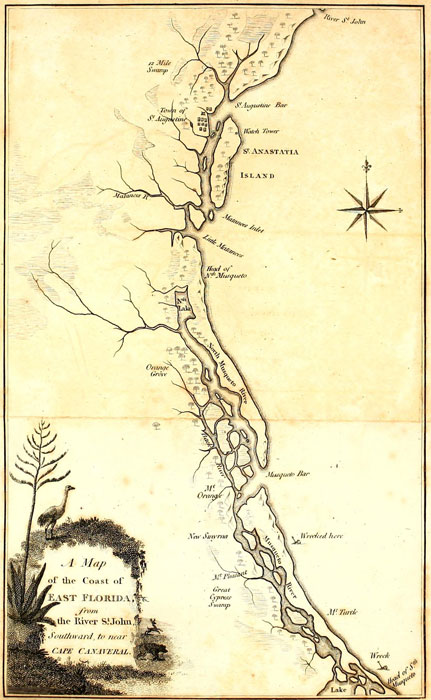
The little lake, which is an expansion of the river, now appeared in view; on
the east side are extensive marshes, and on the other high forests and Orange
groves, and then a bay, lined with vast Cypress swamps, both coasts gradually
approaching each other, to the opening of the river again, which is in this
place about three hundred yards wide. Evening now drawing on, I was anxious to
reach some high bank of the river, where I intended to lodge; and agreeably to
my wishes, I soon after discovered on the west shore, a little promontory, at
the turning of the river, contracting it here to about one hundred and fifty
yards in width. This promontory is a peninsula, containing about three acres of
high ground, and is one entire Orange grove, with a few Live Oaks, Magnolias
and Palms. Upon doubling the point, I arrived at the landing, which is a
circular harbour, at the foot of the bluff, the top of which is about twelve
feet high; the back of it is a large Cypress swamp, that spreads each way, the
right wing forming the west coast of the little lake, and the left stretching
up the river many miles, and encompassing a vast space of low grassy marshes.
From this promontory, looking eastward across the river, I beheld a landscape
of low country, uparalleled as I think; on the left is the east coast of the
little lake, which I had just passed, and from the Orange bluff at the lower
end, the high forests begin, and increase in breadth from the shore of the
lake, making a circular sweep to the
right, and contain many hundred thousand acres of meadow, and this grand sweep
of high forests encircles, as I apprehend, at least twenty miles of these green
fields, interspersed with hommocks or islets of evergreen trees, where the
sovereign Magnolia and lordly Palm stand conspicuous. The islets are high
shelly knolls, on the sides of creeks or branches of the river, which wind
about and drain off the super-abundant waters that cover these meadows, during
the winter season.
The evening was temperately cool and calm. The crocodiles began to roar and
appear in uncommon numbers along the shores and in the river. I fixed my camp
in an open plain, near the utmost projection of the promontory, under the
shelter of a large Live Oak, which stood on the highest part of the ground, and
but a few yards from my boat. From this open, high situation, I had a free
prospect of the river, which was a matter of no trivial consideration to me,
having good reason to dread the subtle attacks of the alligators, who were
crowding about my harbour. Having collected a good quantity of wood for the
purpose of keeping up a light and smoke during the night, I began to think of
preparing my supper, when, upon examining my stores, I found but a scanty
provision, I thereupon determined, as the most expeditious way of supplying my
necessities, to take my bob and try for some trout. About one hundred yards
above my harbour, began a cove or bay of the river, out of which opened a large
lagoon. The mouth or entrance from the river to it was narrow, but the waters
soon after spread and formed a little lake, extending into the marshes: its
entrance and shores within I observed to
be verged with floating lawns of the Pistia and Nymphea and other aquatic
plants; these I knew were excellent haunts for trout.
The verges and islets of the lagoon were elegantly embellished with flowering
plants and shrubs; the laughing coots with wings half spread were tripping over
the little coves, and hiding themselves in the tufts of grass; young broods of
the painted summer teal, skimming the still surface of the waters, and
following the watchful parent unconscious of danger, were frequently surprised
by the voracious trout; and he, in turn, as often by the subtle greedy
alligator. Behold him rushing forth from the flags and reeds. His enormous body
swells. His plaited tail brandished high, floats upon the lake. The waters like
a cataract descend from his opening jaws. Clouds of smoke issue from his
dilated nostrils. The earth trembles with his thunder. When immediately from
the opposite coast of the lagoon, emerges from the deep his rival champion.
They suddenly dart upon each other. The boiling surface of the lake marks their
rapid course, and a terrific conflict commences. They now sink to the bottom
folded together in horrid wreaths. The water becomes thick and discoloured.
Again they rise, their jaws clap together, re-echoing through the deep
surrounding forests. Again they sink, when the contest ends at the muddy bottom
of the lake, and the vanquished makes a hazardous escape, hiding himself in the
muddy turbulent waters and sedge on a distant shore. The proud victor exulting
returns to the place of action. The shores and forests resound his dreadful
roar, together with the triumphing shouts of the plaited tribes around,
witnesses of the horrid combat.
My apprehensions were highly alarmed after
being a spectator of so dreadful a battle. It was obvious that every delay
would but tend to increase my dangers and difficulties, as the sun was near
setting, and the alligators gathered around my harbour from all quarters. From
these considerations I concluded to be expeditious in my trip to the lagoon, in
order to take some fish. Not thinking it prudent to take my fusee with me, lest
I might lose it overboard in case of a battle, which I had every reason to
dread before my return, I therefore furnished myself with a club for my
defence, went on board, and penetrating the first line of those which
surrounded my harbour, they gave way; but being pursued by several very large
ones, I kept strictly on the watch, and paddled with all my might towards the
entrance of the lagoon, hoping to be sheltered there from the multitude of my
assailants; but ere I had half-way reached the place, I was attacked on all
sides, several endeavouring to overset the canoe. My situation now became
precarious to the last degree: two very large ones attacked me closely, at the
same instant, rushing up with their heads and part of their bodies above the
water, roaring terribly and belching floods of water over me. They struck their
jaws together so close to my ears, as almost to stun me, and I expected every
moment to be dragged out of the boat and instantly devoured. But I applied my
weapons so effectually about me, though at random, that I was so successful as
to beat them off a little; when, finding that they designed to renew the
battle, I made for the shore, as the only means left me for my preservation;
for, by keeping close to it, I should have my enemies on one side of me only,
whereas I was before surrounded by them, and there was a probability, if pushed
to the last extremity, of saving myself,
by jumping out of the canoe on shore, as it is easy to outwalk them on land,
although comparatively as swift as lightning in the water. I found this last
expedient alone could fully answer my expectations, for as soon as I gained the
shore, they drew off and kept aloof. This was a happy relief, as my confidence
was, in some degree, recovered by it. On recollecting myself, I discovered that
I had almost reached the entrance of the lagoon, and determined to venture in,
if possible, to take a few fish, and then return to my harbour, while day-light
continued; for I could now, with caution and resolution, make my way with
safety along shore; and indeed there was no other way to regain my camp,
without leaving my boat and making my retreat through the marshes and reeds,
which, if I could even effect, would have been in a manner throwing myself
away, for then there would have been no hopes of ever recovering my bark, and
returning in safety to any settlements of men. I accordingly proceeded, and
made good my entrance into the lagoon, though not without opposition from the
alligators, who formed a line across the entrance, but did not pursue me into
it, nor was I molested by any there, though there were some very large ones in
a cove at the upper end. I soon caught more trout than I had present occasion
for, and the air was too hot and sultry to admit of their being kept for many
hours, even though salted or barbecued. I now prepared for my return to camp,
which I succeeded in with but little trouble, by keeping close to the shore;
yet I was opposed upon re-entering the river out of the lagoon, and pursued
near to my landing (though not closely attacked), particularly by an old daring
one, about twelve feet in length, who kept
close after me, and when I stepped on shore and turned about, in order to draw
up my canoe, he rushed up near my feet, and lay there for some time, looking me
in the face, his head and shoulders out of water. I resolved he should pay for
his temerity, and having a heavy load in my fusee, I ran to my camp, and
returning with my piece, found him with his foot on the gunwale of the boat, in
search of fish. On my coming up he withdrew sullenly and slowly into the water,
but soon returned and placed himself in his former position, looking at me and
seeming neither fearful or any way disturbed. I soon dispatched him by lodging
the contents of my gun in his head, and then proceeded to cleanse and prepare
my fish for supper; and accordingly took them out of the boat, laid them down
on the sand close to the water, and began to scale them; when, raising my head,
I saw before me, through the clear water, the head and shoulders of a very
large alligator, moving slowly towards me. I instantly stepped back, when, with
a sweep of his tail, he brushed off several of my fish. It was certainly most
providential that I looked up at that instant, as the monster would probably,
in less than a minute, have seized and dragged me into the river. This
incredible boldness of the animal disturbed me greatly, supposing there could
now be no reasonable safety for me during the night, but by keeping continually
on the watch: I therefore, as soon as I had prepared the fish, proceeded to
secure myself and effects in the best manner I could. In the first place, I
hauled my bark upon the shore, almost clear out of the water, to prevent their
oversetting or sinking her; after this, every moveable was taken out and
carried to my camp, which was but a few
yards off; then ranging some dry wood in such order as was the most convenient,
I cleared the ground round about it, that there might be no impediment in my
way, in case of an attack in the night, either from the water or the land; for
I discovered by this time, that this small isthmus, from its remote situation
and fruitfulness, was resorted to by bears and wolves. Having prepared myself
in the best manner I could, I charged my gun, and proceeded to reconnoitre my
camp and the adjacent grounds; when I discovered that the peninsula and grove,
at the distance of about two hundred yards from my encampment, on the land
side, were invested by a Cypress swamp, covered with water, which below was
jointed to the shore of the little lake, and above to the marshes surrounding
the lagoon, so that I was confined to an islet exceedingly circumscribed, and I
found there was no other retreat for me, in case of an attack, but by either
ascending one of the large Oaks, or pushing off with my boat.
It was by this time dusk, and the alligators had nearly ceased their roar, when
I was again alarmed by a tumultuous noise that seemed to be in my harbour, and
therefore engaged my immediate attention. Returning to my camp, I found it
undisturbed, and then continued on to the extreme point of the promontory,
where I saw a scene, new and surprising, which at first threw my senses into
such a tumult, that it was some time before I could comprehend what was the
matter; however, I soon accounted for the prodigious assemblage of crocodiles
at this place, which exceeded every thing of the kind I had ever heard of.
How shall I express myself so as to convey an
adequate idea of it to the reader, and at
the same time avoid raising suspicions of my veracity? Should I say, that the
river (in this place) from shore to shore, and perhaps near half a mile above
and below me, appeared to be one solid bank of fish, of various kinds, pushing
through this narrow pass of St. Juan’s into the little lake, on their
return down the river, and that the alligators were in such incredible numbers,
and so close together from shore to shore, that it would have been easy to have
walked across on their heads, had the animals been harmless? What expressions
can sufficiently declare the shocking scene that for some minutes continued,
whilst this mighty army of fish were forcing the pass? During this attempt,
thousands, I may say hundreds of thousands, of them were caught and swallowed
by the devouring alligators. I have seen an alligator take up out of the water
several great fish at a time, and just squeeze them betwixt his jaws, while the
tails of the great trout flapped about his eyes and lips, ere he had swallowed
them. The horrid noise of their closing jaws, their plunging amidst the broken
banks of fish, and rising with their prey some feet upright above the water,
the floods of water and blood rushing out of their mouths, and the clouds of
vapour issuing from their wide nostrils, were truly frightful. This scene
continued at intervals during the night, as the fish came to the pass. After
this sight, shocking and tremendous as it was, I found myself somewhat easier
and more reconciled to my situation, being convinced that their extraordinary
assemblage here, was owing to this annual feast of fish, and that they were so
well employed in their own element, that I had little occasion to fear their
paying me a visit.
It being now almost night, I returned to
my camp, where I had left my fish broiling, and my kettle of rice stewing, and
having with me oil, pepper, and salt, and excellent oranges hanging in
abundance over my head (a valuable substitute for vinegar) I sat down and
regaled myself cheerfully. Having finished my repast, I rekindled my fire for
light, and whilst I was revising the notes of my past day’s journey, I
was suddenly roused with a noise behind me toward the main land. I sprang up on
my feet, and listning, I distinctly heard some creature wading in the water of
the isthmus. I seized my gun and went cautiously from my camp, directing my
steps towards the noise: when I had advanced about thirty yards, I halted
behind a coppice of Orange trees, and soon perceived two very large bears,
which had made their way through the water, and had landed in the grove, about
one hundred yards distance from me, and were advancing towards me. I waited
until they were within thirty yards of me: they there began to snuff and look
towards my camp: I snapped my piece, but it flashed, on which they both turned
about and galloped off, plunging through the water and swamp, never halting as
I suppose, until they reached fast land, as I could hear them leaping and
plunging a long time. They did not presume to return again, nor was I molested
by any other creature, except being occasionally awakened by the whooping of
owls, screaming of bitterns, or the wood-rats running amongst the leaves.
The wood-rat is a very curious animal. It is not half the size of the domestic
rat; of a dark brown or black colour; its tail slender and shorter in
proportion, and covered thinly with short hair. It is singular with respect to its ingenuity and great labour
in the construction of its habitation, which is a conical pyramid about three
or four feet high, constructed with dry branches, which it collects with great
labour and perseverance, and piles up without any apparent order, yet they are
so interwoven with one another, that it it would take a bear or wild cat some
time to pull one of these castles to pieces, and allow the animals sufficient
time to secure a retreat with their young.
The noise of the crocodiles kept me awake the greater part of the night; but
when I arose in the morning, contrary to my expectations, there was perfect
peace; very few of them to be seen, and those were asleep on the shore. Yet I
was not able to suppress my fears and apprehensions of being attacked by them
in future; and indeed yesterday’s combat with them, notwithstanding I
came off in a manner victorious, or at least made a safe retreat, had left
sufficient impression on my mind to damp my courage, and it seemed too much for
one of my strength, being alone in a very small boat, to encounter such
collected danger. To pursue my voyage up the river, and be obliged every
evening to pass such dangerous defiles, appeared to me as perilous as running
the gauntlet betwixt two rows of Indians armed with knives and fire brands. I
however resolved to continue my voyage one day longer, if I possibly could with
safety, and then return down the river, should I find the like difficulties to
oppose. Accordingly I got every thing on board, charged my gun, and set sail,
cautiously, along shore. As I passed by Battle lagoon, I began to tremble and
keep a good look-out; when suddenly a huge alligator rushed out of the reeds,
and with a tremendous roar came up, and
darted as swift as an arrow under my boat, emerging upright on my lee quarter,
with open jaws, and belching water and smoke that fell upon me like rain in a
hurricane. I laid soundly about his head with my club, and beat him off; and
after plunging and darting about my boat, he went off on a straight line
through the water, seemingly with the rapidity of lightning, and entered the
cape of the lagoon. I now employed my time to the very best advantage in
padling close along shore, but could not forbear looking now and then behind
me, and presently perceived one of them coming up again. The water of the river
hereabouts was shoal and very clear; the monster came up with the usual roar
and menaces, and passed close by the side of my boat, when I could distinctly
see a young brood of alligators, to the number of one hundred or more,
following after her in a long train. They kept close together in a column,
without straggling off to the one side or the other; the young appeared to be
of an equal size, about fifteen inches in length, almost black, with pale
yellow transverse waved clouds or blotches, much like rattlesnakes in colour. I
now lost sight of my enemy again.
Still keeping close along shore, on turning a point or projection of the river
bank, at once I beheld a great number of hillocks or small pyramids, resembling
hay-cocks, ranged like an encampment along the banks. They stood fifteen or
twenty yards distant from the water, on a high marsh, about four feet
perpendicular above the water. I knew them to be the nests of the crocodile,
having had a description of them before; and now expected a furious and general
attack, as I saw several large crocodiles swimming abreast of these buildings. These nests being so
great a curiosity to me, I was determined at all events immediately to land and
examine them. Accordingly I ran my bark on shore at one of their
landing-places, which was a sort of nick or little dock, from which ascended a
sloping path or road up to the edge of the meadow, where their nests where;
most of them were deserted, and the great thick whitish egg-shells lay broken
and scattered upon the ground round about them.
The nests or hillocks are of the form of an obtuse cone, four feet high and
four or five feet in diameter at their bases; they are constructed with mud,
grass and herbage. At first they lay a floor of this kind of tempered mortar on
the ground, upon which they deposit a layer of eggs, and upon this a stratum of
mortar, seven or eight inches in thickness, and then another layer of eggs; and
in this manner one stratum upon another, nearly to the top. I believe they
commonly lay from one to two hundred eggs in a nest: these are hatched, I
suppose, by the heat of the sun; and perhaps the vegetable substances mixed
with the earth, being acted upon by the sun, may cause a small degree of
fermentation, and so increase the heat in those hillocks. The ground for
several acres about these nests showed evident marks of a continual resort of
alligators; the grass was every where beaten down, hardly a blade or straw was
left standing; whereas, all about, at a distance, it was five or six feet high,
and as thick as it could grow together. The female, as I imagine, carefully
watches her own nest of eggs until they are all hatched; or perhaps while she
is attending her own brood, she takes under her care and protection as many as
she can get at one time, either from her
own particular nest or others: but certain it is, that the young are not left
to shift for themselves; for I have had frequent opportunities of seeing the
female alligator leading about the shores her train of young ones, just as a
hen does her brood of chickens; and she is equally assiduous and courageous in
defending the young, which are under their care, and providing for their
subsistence; and when the is basking upon the warm banks, with her brood around
her, you may hear the young ones continually whining and barking, like young
puppies. I believe but few of a brood live to the years of full growth and
magnitude, as the old feed on the young as long as they can make prey of them.
The alligator when full grown is a very large and terrible creature, and of
prodigous strength, activity and swiftness in the water. I have seen them
twenty feet in length, and some are supposed to be twenty-two or twenty-three
feet. Their body is as large as that of a horse; their shape exactly resembles
that of a lizard, except their tail, which is flat or cuneiform, being
compressed on each side, and gradually diminishing from the abdomen to the
extremity, which, with the whole body is covered with horny plates or squammæ,
impenetrable when on the body of the live animal, even to a rifle ball, except
about their head and just behind their fore-legs or arms, where it is said they
are only vulnerable. The head of a full grown one is about three feet, and the
mouth opens nearly the same length; their eyes are small in proportion and seem
sunk deep in the head, by means of the prominency of the brows; the nostrils
are large, inflated and prominent on the top, so that the head in the water
resembles, at a distance, a great chunk of
wood floating about. Only the upper jaw moves, which they raise almost
perpendicular, so as to form a right angle with the lower one. In the fore-part
of the upper jaw, on each side, just under the nostrils, are two very large,
thick, strong teeth or tusks, not very sharp, but rather the shape of a cone:
these are as white as the finest polished ivory, and are not covered by any
skin or lips, and always in sight, which gives the creature a frightful
appearance: in the lower jaw are holes opposite to these teeth, to receive
them: when they clap their jaws together it causes a surprising noise, like
that which is made by forcing a heavy plank with violence upon the ground, and
may be heard at a great distance.
But what is yet more surprising to a stranger, is the incredible loud and
terrifying roar, which they are capable of making, especially in the spring
season, their breeding time. It most resembles very heavy distant thunder, not
only shaking the air and waters, but causing the earth to tremble; and when
hundreds and thousands are roaring at the same time, you can scarcely be
persuaded, but that the whole globe is violently and dangerously agitated.
An old champion, who is perhaps absolute sovereign of a little lake or lagoon
(when fifty less than himself are obliged to content themselves with swelling
and roaring in little coves round about) darts forth from the reedy coverts all
at once, on the surface of the waters, in a right line; at first seemingly as
rapid as lightning, but gradually more slowly until he arrives at the centre of
the lake, when he stops. He now swells himself by drawing in wind and water
through his mouth, which causes a loud sonorous rattling in the throat for near a minute, but it is
immediately forced out again through his mouth and nostrils, with a loud noise,
brandishing his tail in the air, and the vapour ascending from his nostrils
like smoke. At other times, when swolen to an extent ready to burst, his head
and tail lifted up, he spins or twirls round on the surface of the water. He
acts his part like an Indian chief when rehearsing his feats of war; and then
retiring, the exhibition is continued by others who dare to step forth, and
strive to excel each other, to gain the attention of the favourite female.
Having gratified my curiosity at this general breeding place and nursery of
crocodiles, I continued my voyage up the river without being greatly disturbed
by them. In my way I observed islets or floating fields of the bright green
Pistia, decorated with other amphibious plants, as Senecio Jacobea, Persicaria
amphibia, Coreopsis bidens, Hydrocotyle fluitans, and many others of less note.
The swamps on the banks and island of the river are generally three or four
feet above the surface of the water, and very level; the timber large and
growing thinly, more so than what is observed to be in the swamps below Lake
George; the black rich earth is covered with moderately tall, and very
succulent tender grass, which when chewed is sweet and agreeable to the taste,
somewhat like young sugarcane: it is a jointed decumbent grass, sending out
radiculæ at the joints into the earth, and so spreads itself, by creeping over
its surface.
The large timber trees, which possess the low lands, are Acer rubrum, Ac.
negundo, Ac. glaucum, Ulmus sylvatica, Fraxinus excelsior, Frax. aquatica,
Ulmus suberifer, Gleditsia monosperma,
Gledit. triacanthus, Diospyros Virginica, Nyssa aquatica, Nyssa sylvatica,
Juglans cinerea, Quercus dentata, Quercus phillos, Hopea tinctoria, Corypha
palma, Morus rubra, and many more. The palm grows on the edges of the banks,
where they are raised higher than the adjacent level ground, by the
accumulation of sand, river-shells, &c. I passed along several miles by
those rich swamps: the channels of the river which encircle the several fertile
islands, I had passed, now uniting, formed one deep channel near three hundred
yards over. The banks of the river on each side began to rise, and present
shelly bluffs, adorned by beautiful Orange groves, Laurels and Live Oaks. And
now appeared in sight a tree that claimed my whole attention: it was the Carica
papaya, both male and female, which were in flower; and the latter both in
flower and fruit, some of which were ripe, as large, and of the form of a pear,
and of a most charming appearance.
This admirable tree is certainly the most beautiful of any vegetable production
I know of; the towering Laurel Magnolia, and exalted Palm, indeed exceed it in
grandeur and magnificence, but not in elegance, delicacy and gracefulness. It
rises erect to the height of fifteen or twenty feet, with a perfectly straight
tapering stem, which is smooth and polished, of a bright ash colour, resembling
leaf silver, curiously inscribed with the footsteps of the fallen leaves; and
these vestiges are placed in a very regular uniform imbricated order, which has
a fine effect, as if the little column were elegantly carved all over. Its
perfectly spherical top, is formed of very large lobe-sinuate leaves, supported
on very long footstalks; the lower leaves are the largest as well as their
petioles the longest, and make a graceful
sweep or flourish, like the long ſ, or the branches of a sconce
candlestick. The ripe and green fruit are placed round about the stem or trunk,
from the lowermost leaves, where the ripe fruit are, and upwards almost to the
top; the heart or inmost pithy part of the trunk is in a manner hollow, or at
best consists of very thin porous medullæ or membranes. The tree very seldom
branches or divides into limbs, I believe never unless the top is by accident
broke off when very young: I saw one which had two tops or heads, the stem of
which divided near the earth. It is always green, ornamented at the same time
with flowers and fruit, which like figs come out singly from the trunk or stem.
After resting and refreshing myself in these delightful shades, I left them
with reluctance. Embarking again after the fervid heat of the meridian sun were
abated, for some time I passed by broken ridges of shelly high land, covered
with groves of Live Oak, Palm, Olea Americana, and Orange trees; frequently
observing floating islets and green fields of the Pistia near the shores of the
river and lagoons.
Here is in this river, and in the waters all over Florida, a very curious and
handsome birds, the people call them Snake Birds; I think I have seen paintings
of them on the Chinese screens and other India pictures: they seeem to be a
species of cormorant or loon (Colymbus cauda elongata), but far more beautiful
and delicately formed than any other species that I have ever seen. The head
and neck of this bird are extremely small and slender, the latter very long
indeed, almost out of all proportion; the bill long, straight and slender, tapering from its ball to a sharp point; all
the upper side, the abdomen and thighs, are as black and glossy as a
raven’s, covered with feathers so firm and elastic, that they in some
degree resemble fish-scales; the breast and upper part of the belly are covered
with feathers of a cream colour; the tail is very long, of a deep black, and
tipped with a silvery white, and when spread, represent an unfurled fan. They
delight to sit in little peaceable communities, on the dry limbs of trees,
hanging over the still waters, with their wings and tails expanded, I suppose
to cool and air themselves, when at the same time they behold their images in
the watery mirror. At such times, when we approach them, they drop off the
limbs into the water as if dead, and for a minute or two are not to be seen;
when on a sudden, at a vast distance, their long slender head and neck only
appear, and have very much the appearance of a snake, and no other part of them
are to be seen when swimming in the water, except sometimes the tip end of
their tail. In the heat of the day they are seen in great numbers, sailing very
high in the air, over lakes and rivers.
I doubt not but if this bird had been an inhabitant of the Tiber in
Ovid’s days, it would have furnished him with a subject for some
beautiful and entertaining metamorphoses. I believe it feeds entirely on fish,
for its flesh smells and tastes intolerably strong of it; it is scarcely to be
eaten unless constrained by insufferable hunger.
I had now swamps and marshes on both sides of me; and evening coming on apace,
I began to look out for high land to encamp on; but the extensive marshes
seemed to have no bounds, and it was almost dark when I found a tolerable
suitable place, and at last was
constrained to take up with a narrow strip of high shelly bank, on the west
side. Great numbers of crocodiles were in sight on both shores. I ran my bark
on shore at a perpendicular bank four or five feet above the water, just by the
roots and under the spreading limbs of a great Live Oak: this appeared to have
been an ancient camping place by Indians and strolling adventurers, from ash
heaps and old rotten fire-brands and chunks, scattered about on the surface of
the ground; but was now evidently the harbour and landing-place of some
sovereign alligator: there led up from it a deep beaten path or road, and was a
convenient ascent.
I did not approve of my intended habitation from these circumstances; and no
sooner had I landed and moored my canoe to the roots of the tree, than I saw a
huge crocodile rising up from the bottom close by me, who, when he perceived
that I saw him, plunged down again under my vessel. This determined me to be on
my guard, and in time to provide against a troublesome night. I took out of my
boat every moveable, which I carried upon the bank; then chose my lodging close
to my canoe, under the spreading Oak, as hereabouts only, the ground was open
and clear of high grass and bushes, and consequently I had some room to stir
and look round about. I then proceeded to collect firewood, which I found
difficult to procure. Here were standing a few Orange trees. As for provisions,
I had saved one or two barbecued trout, the remains of my last evening’s
collection, in tolerable good order, though the sultry heats of the day had
injured them; yet by stewing them up afresh with the lively juice of Oranges,
they served well enough for my supper, as I had by this time but little relish
or appetite for my victuals; for constant
watching at night against the attacks of alligators, stinging of musquitoes and
sultry heats of the day, together with the fatigues of working my bark, had
almost deprived me of every desire but that of ending my troubles as speedy as
possible. I had the good fortune to collect together a sufficiency of dry
sticks to keep up a light and smoke, which I laid by me, and then spread my
skins and blankets upon the ground, kindled up a little fire, and supped before
it was quite dark. The evening was however extremely pleasant; a brisk cool
breeze sprang up, and the skies were perfectly serene, the stars twinkling with
uncommon briliancy. I stretched myself along before my fire; having the river,
my little harbour, and the stern of my vessel in view; and now through fatigue
and weariness I fell asleep. But this happy temporary release from cares and
troubles I enjoyed but a few moments, when I was awakened and greatly
surprised, by the terrifying screams of Owls in the deep swamps around me; and
what increased my extreme misery was the difficulty of geting quite awake, and
yet hearing at the same time such screaming and shouting, which increased and
spread every way for miles around, in dreadful peals vibrating through the dark
extensive forests, meadows, and lakes. I could not after this surprise recover
the former peaceable state and tranquillity of mind and repose, during the long
night; and I believe it was happy for me that I was awakened, for at that
moment the crocodile was dashing my canoe against roots roots of the tree,
endeavouring to get into her for the fish, which I however prevented. Another
time in the night I believe I narrowly escaped being dragged into the river by
him; for when again through excessive fatigue I had fallen
asleep, but was again awakened by the
screaming owl, I found the monster on the top of the bank, his head towards me,
not above two yards distant; when starting up and seizing my fusee well loaded,
which I always kept under my head in the night time, he drew back and plunged
into the water. After this, I roused up my fire, and kept a light during the
remaining part of the night, being determined not to be caught napping so
again: indeed the musquitoes alone would have been abundantly sufficient to
keep any creature awake that possessed their perfect senses; but I was overcome
and stupified with incessant watching and labour. As soon as I discovered the
first signs of day-light, I arose, got all my effects and implements on board,
and set sail, proceeding upwards, hoping to give the musquitoes the slip, who
were now, by the cool morning dews and breezes, driven to their shelter and
hiding places. I was mistaken however in these conjectures, for great numbers
of them, which had concealed themselves in my boat, as soon as the sun arose,
began to revive, and sting me on my legs, which obliged me to land in order to
get bushes to beat them out of their quarters.
It is very pleasing to observe the banks of the river, ornamented with hanging
garlands, composed of varieties of climbing vegetables, both shrubs and plants,
forming perpendicular green walls, with projecting jambs, pilasters and deep
apartments, twenty or thirty feet high, and completely covered, with Glycine
frutescens, Glyc. apios, Vitis labrusca, Vitis vulpina, Rajana, Hedera
quinquefolia, Hedera arborea, Eupatorium scandens, Bignonia crucigera, and
various species of Convolvulus, particularly an amazing tall climber of this genus, or perhaps an Ipomea. This has a very
large white flower, as big as a small funnel; its tube is five or six inches in
length, and not thicker than a pipe stem; the leaves are also very large,
oblong and cordated, sometimes dentated or angled, near the insertion of the
foot-stalk; they are of a thin texture, and of a deep green colour. It is
exceedingly curious to behold the Wild Squash[19] climbing over the
lofty limbs of the trees; its yellow fruit, somewhat of the size and figure of
a large orange, pendant from the extremities of the limbs over the water.
Towards noon, the sultry heats being intolerable, I put into shore, at a
middling high bank, five or six feet above the surface of the river. This low
sandy testaceous ridge along the river side was but narrow; the surface is
light, black, and exceedingly fertile, producing very large venerable Live
Oaks, Palms, and grand Magnolias, scatteringly planted by nature. There being
no underwood to prevent the play of the breezes from the river, afforded a
desirable retreat from the sun’s heat. Immediately at the back of this
narrow ridge, were deep wet swamps, where stood some astonishingly tall and
spreading Cypress trees. And now being weary and drowsy, I was induced to
indulge and listen to the dictates of reason and invitations to repose; which
consenting to, after securing my boat and reconnoitring the ground, I spread my
blanket under the Oaks near my boat, on which I extended myself, where, falling
to sleep, I instantaneously passed away the sultry hours of noon. What a
blissful tranquil repose! Undisturbed I awoke, refreshed and strengthened; I
cheerfully stepped on board again, and continued to ascend the river. The afternoon being cool and pleasant, and the
trees very lofty on the higher western banks of the river, by keeping near that
shore I passed under agreeable shades the remaining part of the day. During
almost all this day’s voyage, the banks of the river on both shores were
middling high, perpendicular, and washed by the brisk current: the shores were
not lined with the green lawns of floating aquatics, and consequently not very
commodious resorts or harbours for crocodiles; I therefore was not disturbed by
them, and saw but few, but those were very large. I however did not like to
lodge on those narrow ridges, invested by such dreary swamps; and evening
approaching, I began to be anxious for high land for a camping place. It was
quite dark before I came up to a bluff, which I had in view a long time, over a
very extensive point of meadows. I landed however at last, in the best manner I
could, at a magnificent forest of Orange groves, Oaks, and Palms. I here, with
little labour or difficulty, soon collected a sufficient quantity of dry wood:
there was a pleasant vista of grass betwixt the grove and the edge of the river
bank, which afforded a very convenient, open, airy encamping place, under the
protection of some spreading Oaks.
This was a high perpendicular bluff, fronting more than one hundred yards on
the river, the earth black, loose, and fertile: it is a composition of
river-shells, sand, &c. At the back of it from the river, were open Pine
forests and savannas. I met with a circumstance here, that, with some, may be
reckoned worthy of mentioning, since it regards the monuments of the ancients.
As I have already observed, when I landed it was quite dark; and in collecting
wood for my fire, stroling in the dark
about the groves, I found the surface of the ground very uneven, by means of
little mounts and ridges. In the morning I found I had taken up my lodging on
the border of an ancient burying-ground, containing sepulchres or tumuli of the
Yamasees, who were here slain by the Creeks in the last decisive battle, the
Creeks having driven them into this point, between the doubling of the river,
where few of them escaped the fury of the conquerors. These graves occupied the
whole grove, consisting of two or three acres of ground: there were near thirty
of these cemeteries of the dead, nearly of an equal size and form, being
oblong, twenty feet in length, ten or twelve feet in width and three or four
feet high, now overgrown with Orange trees, Live Oaks, Laurel Magnolias, Red
bays and other trees and shrubs, composing dark and solemn shades.
I here, for the first time since I left the trading house, enjoyed a night of
peaceful repose. I arose greatly refreshed and in good spirits, stepped on
board my bark, and continued my voyage. After doubling the point, I passed by
swamps and meadows on each side of me. The river here is something more
contracted within perpendicular banks; the land of an excellent quality,
fertile, and producing prodigiously large timber and luxuriant herbage.
The air continued sultry, and scarcely enough wind to flutter the leaves on the
trees. The eastern coast of the river now opens, and presents to view ample
plains, consisting of grassy marshes and green meadows, and affords a prospect
almost unlimited, and extremely pleasing. The opposite shore exhibits a sublime
contrast; a high bluff bearing magnificent forests of grand magnolia, glorious
palms, fruitful Orange groves, Live Oaks,
Bays and other trees. This grand elevation continues four or five hundred
yards, discribing a gentle curve on the river, ornamented by a sublime grove of
Palms, consisting of many hundreds of trees together; they entirely shade the
ground under them. Above and below the bluff, the grounds gradually descend to
the common level swamps on the river: at the back of this eminence open to view
expansive green meadows or savannas, in which are to be seen glittering ponds
of water, surrounded at a great distance by high open Pine forests and
hommocks, and islets of Oaks and Bays projecting into the savannas. After
ranging about these solitary groves and peaceful shades, I re-embarked and
continued some miles up the river, between elevated banks of the swamps or low
lands, when on the east shore in a capacious cove or winding of the river, were
pleasing fields of Pistia, and in the bottom of this cove opened to view a
large creek or branch of the river, which I knew to be the entrance to a
beautiful lake, on the banks of which was the farm I was going to visit, and
which I designed should be the last extent of my voyage up the river.
About noon the weather became extremely sultry, not a breath of wind stirring,
hazy or cloudy, with very heavy distant thunder, which was answered by the
crocodiles, sure presage of a storm!
Soon after ascending this branch of the river, on the right hand presents
itself to view a delightful little bluff, consisting chiefly of shells, and
covered with a dark grove of Red Cedar, Zanthoxylon and Myrtle, I could not
resist the temptation to stop here, although the tremendous thunder all around
the hemisphere alarmed me greatly, having
a large lake to cross. From this grove appears to view, an expansive and
pleasing prospect. The beauteous long lake in front, about North East from me,
its most distant east shores adorned with dark, high forests of stately trees;
North and South almost endless green plains and meadows, embellished with
islets and projecting promontories of high, dark forests, where the pyramidal
Magnolia grandiflora, Palma elata and shady Oak conspicuously tower.
Being heretofore so closely invested, by high forests and deep swamps of the
great river, I was prevented from seeing the progress and increase of the
approaching tempest, the terrific appearance of which now at once confounded
me. How purple and fiery appeared the tumultuous clouds, swiftly ascending or
darting from the horizon upwards! they seemed to oppose and dash against each
other; the skies appeared streaked with blood or purple flame overhead, the
flaming lightning streaming and darting about in every direction around, seemed
to fill the world with fire; whilst the heavy thunder kept the earth in a
constant tremor. I had yet some hopes of crossing the lake to the plantation in
sight. On the opposite shore of the creek before me, and on the cape as we
enter the lake, stood a large islet or grove of Oaks and Palms. Here I intended
to seek shelter, and abide till the fury of the hurricane was overpast, if I
found it too violent to permit me to cross the lake. In consequence of this
precipitate determination, I stepped into my boat and pushed off. What a
dreadful rushing and roaring there was every where around me! and to my utter
confusion and astonishment, I could not find from what particular quarter its
strongest current or direction came,
whereby I might have a proper chance of taking measures of securing a harbour
or running from it. The high forests behind me bent to the blast; and the
sturdy limbs of the trees cracked. I had by this time got up a breast of the
grove or hommock: the hurricane close by, pursuing me, I found it dangerous and
imprudent in the highest degree to put in here, as the groves were already torn
up, and the spreading limbs of the ancient Live Oaks were flying over my head,
and carried about in the air as leaves and stubble. I ran by and boldly entered
the lake (being hurried in by a strong current, which seemed a prodigy, the
violent wind driving the stream of the creek back again into the lake), and as
soon as possible took shelter under the high reedy bank of the lake, and made
fast my bark to the boughs of a low shrubby Hickory, that leaned over the
water. Such was the violence of the wind, that it raised the waters on the
opposite shores of the lake several feet perpendicular, and there was a rapid
flow of water from the creek into it, which was contrary to its natural course.
Such floods of rain fell during the space of half or three quarters of an hour,
that my boat was filled, and I expected every moment when I should see her sink
to the bottom of the lake; and the violence of the wind kept the cable so
constantly extended, that it was beyond my ability to get to her. My box, which
contained my books of specimens and other collections, was floating about in
her; and for a great part of the time the rain came down with such rapidity,
and fell in such quantities, that every object was totally obscured, excepting
the continual streams or rivers of lightning, pouring from the clouds. All
seemed a frightful chaos. When the wind and rain abated, I was overjoyed to see
the face of nature again appear.
It took me an hour or more to clear the
water out of my bark. I then crossed the lake before a brisk and favourable
breeze (it was about a mile over), and landed safely at the plantation.
When I arrived, my friend was affrighted to see me, and immediately enquired of
me in what manner I came there; supposing it impossible (until I had showed him
my boat) that I could have arrived by water through so tremendous a hurricane.
Indeed I saw plainly that they were greatly terrified, having suffered almost
irreparable damages from the violence of the storm. All the buildings on the
plantation, except his own dwelling-house, were laid almost flat to the ground,
or the logs and roof rent asunder and twisted about; the mansion-house shook
and reeled over their heads. He had nearly one hundred acres of the Indigo
plant almost ripe for the first cutting, which was nearly ruined; and several
acres of very promising Sugar-cane, totally spoiled for the season. The great
Live Oaks which had been left standing about the fields, were torn to pieces,
their limbs lying scattered over the ground: and one very large one which stood
near his house torn down, which could not have been done by the united strength
of a thousand men. But what is incredible, in the midst of this devastation and
ruin, providentially no lives were lost; although there were about sixty Negro
slaves on the plantation, and most of them in their huts when the storm came
on, yet they escaped with their lives, though several were badly wounded.
I continued here three days: indeed it took most of the time of my abode with
him, to dry my books and specimens of plants. But with attention and care I saved the greatest number of them;
though some were naturally so delicate and fragile, that it was impossible to
recover them. Here is a vast body of land belonging to this estate; of high
ridges fit for the culture of Corn, Indigo, Cotton, Batatas, &c. and of low
swamps and marshes, which when properly drained and tilled, would be suitable
for Rice. These rich low grounds when drained and ridged, are as productive as
the natural high land, and vastly more durable, especially for Sugar-cane, Corn
and even Indigo; but this branch of agriculture being more expensive, these
rich lands are neglected, and the upland only is under culture. The farm is
situated on the east shore of the beautiful Long Lake, which is above two miles
long, and near a mile broad. This lake communicates with the St. Juan, by the
little river which I ascended, which is about one mile and an half in length,
and thirty or forty yards wide. The river, as well as the lake, abounds with
fish and wild fowl of various kinds, and incredible numbers, especially during
the winter season, when the geese and ducks arrive here from the North.
New Smyrna,[20] a pretty thriving town, is a colony of
Creeks and Minorquines, established by Mr. Turnbull, on the Mosquito river and
very near its mouth; it is about thirty
miles over land from this farm.
My friend rode with me, about four miles distance from the house, to show me a
vast fountain of warm, or rather hot mineral water, which issued from a high
ridge or bank on the river, in a great cove or bay, a few miles above the mouth
of the creek which I ascended to the lake; it boils up with great force,
forming immediately a vast circular bason, capacious enough for several
shallops to ride in, and runs with rapidity into the river three or four
hundred yards distance. This creek, which is formed instantly by this admirable
fountain, is wide and deep enough for a sloop to sail up into the bason. The
water is perfectly diaphanous, and here are continually a prodigious number and
variety of fish; they appear as plain as though lying on a table before your
eyes, although many feet deep in the water. This tepid water has a most
disagreeable taste, brassy and vitriolic, and very offensive to the smell, much
like bilge water, or the washings of a gun-barrel, and is smelt at a great
distance. A pale bluish or pearl coloured coagulum covers every inanimate
substance that lies in the water, as logs, limbs of trees, &c. Alligators
and gar were numerous in the bason, even at the apertures where the ebullition
emerges through the rocks; as also many other tribes of fish. In the winter
season several kinds of fish and aquatic animals migrate to these warm
fountains. The forbiding taste and smell of these waters seems to be owing to
vitriolic and sulphureous fumes or vapours, and these being condensed, form
this coagulum, which represents flakes of pearly clouds in the clear cerulean
waters in the bason. A charming Orange grove, with Magnolias, Oaks and Palms,
half surrounded this vast fountain. A
delightful stream of cool salubrious water issues from the ridge, meandering
along, and entering the creek just below the bason. I returned in the evening,
and next day sat off again down the river.
My hospitable friend, after supplying me with necessaries, prevailed on me to
accept of the company and assistance of his purveyor, one day’s voyage
down the river, whom I was to set on shore at a certain bluff, upwards of
twenty miles below, but not above one third that distance by land; he was to be
out in the forests one day, on a hunt for turkeys.
The current of the river being here confined within its perpendicular banks,
ran briskly down: we cheerfully descended the grand river St. Juan, enjoying
enchanting prospects.
Before night we reached the destined port, at a spacious Orange grove. Next
morning we separated, and I proceeded down the river. The prospects on either
hand are now pleasing, and I view them at leisure, and without toil or dread.
Induced by the beautiful appearance of the green meadows, which open to the
eastward, I determined not to pass this Elysium without a visit. Behold the
loud, sonorous, watchful savanna cranes (grus pratensis) with musical clangor,
in detached squadrons. They spread their light elastic sail: at first they move
from the earth heavy and slow; they labour and beat the dense air; they form
the line with wide extended wings, tip to tip; they all rise and fall together
as one bird; now they mount aloft, gradually wheeling about, each squadron
performs its evolution, encircling the
expansive plains, observing each one its own orbit; then lowering sail, descend
on the verge of some glittering lake; whilst other squadrons, ascending aloft
in spiral circles, bound on interesting discoveries, wheel round and double the
promontory, in the silver regions of the clouded skies, where, far from the
scope of eye, they carefully observe the verdant meadows on the borders of the
East Lake; then contract their plumes and descend to the earth, where, resting
a while on some verdant eminence, near the flowery border of the lake, they,
with dignified, yet slow, respectful steps, approach the kindred band, confer,
and treat for habitation; the bounds an precincts being settled, they
confederate and take possession.
There is inhabiting the low shores and swamps of this river and the lakes of
Florida, as well as Georgia, a very curious bird[21], called by an
Indian name (Ephouskyca) which signifies in our language the crying bird. I
cannot determine what genus of European birds to join it with. It is about the
size of a large domestic hen: all the body, above and beneath, is of a dark
lead colour, every feather edged or tipped with white, which makes the bird
appear speckled on a near view; the eye is large and placed high on the head,
which is very prominent; the bill or beak is five or six inches in length,
arched or bent gradually downwards, in that respect to be compared to one half
of a bent bow, it is large or thick near the base, compressed on each side, and
flatted at top and beneath, which makes it appear four square for more than
inch, where the nostrils are placed, from whence to their tips, both mandibles
are round, gradually lessening or tapering to their extremities, which are thicker for about half an inch
than immediately above, by which the mandibles never fit quite close their
whole length; the upper mandible is a small matter longer than the under; the
bill is of a dusky green colour, more bright and yellowish about the base and
angles of the mouth; the tail is very short, and the middle feather the
longest; the others on each side shorten gradually, and are of the colour of
the rest of the bird, only somewhat darker; the two shortest or outermost
feathers are perfectly white, which the bird has a faculty of flirting out on
either side, as quick as a flash of lightning, especially when he hears or sees
any thing that disturbs him, uttering at the same instant an extreme harsh and
loud shriek; his neck is long and slender, and his legs are also long and bare
of feathers above the knee, like those of the bittern, and are black or of a
dark lead colour.
There are two other species of this genus, which agree in almost every
particular with the above description, except in size and colour. The first[22] of these I shall mention is a perfect
white, except the prime quill feathers, which are as black as those of a crow;
the bill and legs of a beautiful clear red, as also a space clear of feathers
about the eyes. The other species[23] is black on the upper side, the breast
and belly white, and the legs and beak as white as snow. Both these species are
about half the size of the crying bird. They fly in large flocks or squadrons,
evening and morning, to and from their feeding place or roosts; both species
are called Spanish curlews: these and the crying bird feed chiefly on
cray-fish, whose cells they probe, and
with their strong pinching bills drag them out: all the three species are
esteemed excellent food.
It is a pleasing sight at times of high winds and heavy thunder storms, to
observe the numerous squadrons of these Spanish curlews driving to and fro,
turning and tacking about, high up in the air, when by their various evolutions
in the different and opposite currents of the wind high in the clouds, their
silvery white plumage gleams and sparkles like the brightest crystal,
reflecting the sun-beams that dart upon them between the dark clouds.
Since I have turned my observations upon the birds of this country, I shall
notice another very singular one, though already most curiously and exactly
figured by Catesby, which seems to be nearly allied to those before mentioned;
I mean the bird which he calls the wood pelican.[24] This is a large
bird, perhaps near three feet high when standing erect. The bill is very long
and strong, bending with a moderate curve from the base to the tip; the upper
mandible is the largst, and receives the edges of the nether one into it its
whole length; the edges are very sharp and firm; the whole of a dark ash or
horn colour; the forehead round the base of the beak and sides of the head is
bare of feathers, and of a dark greenish colour, in which space is placed the
eyes, which are very large; the remainder of the head and neck is of a nut
brown colour; the back of a light bluish grey; upper part of the wings, breast,
and belly, almost white, with some slight dashes of grey; the quill-feathers
and tail, which are very short, are of a dark slate colour, almost black; the
legs, which are very long, and bare of
feathers a great length above the knees, are of a dark dull greenish colour: it
has a small bag or pouch under its throat: it feeds on serpents, young
alligators, frogs, and other reptiles.
This solitary bird does not associate in flocks, but is generally seen alone;
commonly near the banks of great rivers, in vast marshes or meadows, especially
such as are caused by inundations; and also in the vast deserted rice
plantations: he stands alone on the topmost limb of tall dead Cypress trees,
his neck contracted or drawn in upon his shoulders, and beak resting like a
long scythe upon his breast: in this pensive posture and solitary situation, it
looks extremely grave, sorrowful and melancholy, as if in the deepest thought.
They are never seen on the salt sea coast, and yet are never found at a great
distance from it. I take this bird to be of a different genus from the
tantalus, and perhaps it approaches the nearest to the Egyptian ibis of any
other bird yet known.
There are two species of vultures[25] in these regions, I think not mentioned
in history: the first we shall describe is a beautiful bird, near the size of a
turkey buzzard[26], but his wings are much shorter, and
consequently he falls greatly below that admirable bird in sail. I shall call
this bird the painted vulture. The bill is long and straight almost to the
point, when it is hooked or bent suddenly down and sharp; the head and neck
bare of feathers nearly down to the stomach, when the feathers begin to cover
the skin, and soon become long and of a soft texture, forming a ruff or tippet,
in which the bird by contracting his neck can hide that as well as his head; the bare skin on the neck appears loose and
wrinkled, and is of a deep bright yellow colour, intermixed with coral red; the
hinder part of the neck is nearly covered with short, stiff hair; and the skin
of this part of the neck is of a dun-purple colour, gradually becoming red as
it approaches the yellow of the sides and fore part. The crown of the head is
red; there are lobed lappets of a reddish orange colour, which lie on the base
of the upper mandible. But what is singular, a large portion of the stomach
hangs down on the breast of the bird, in the likeness of a sack or half wallet,
and seems to be a duplicature of the craw, which is naked and of a reddish
flesh colour; this is partly concealed by the feathers of the breast, unless
when it is loaded with food (which is commonly, I believe, roasted reptiles),
and then it appears prominent. The plumage of the bird is generally white or
cream colour, except the quill-feathers of the wings and two or three rows of
the coverts, which are of a beautiful dark brown; the tail, which is large and
white, is tipped with this dark brown or black; the legs and feet of a clear
white; the eye is encircled with a gold coloured iris; the pupil black.
The Creeks or Muscogulges construct their royal standard of the tail feather of
this bird, which is called by a name signifying the eagle’s tail; this
they carry with them when they go to battle, but then it is painted with a zone
of red within the brown tips; and in peaceable negociations it is displayed
new, clean, and white: this standard is held most sacred by them on all
occasions, and is constructed and ornamented with great ingenuity. These birds
seldom appear but when the deserts are set on fire (which happens almost every
day throughout the year, in some part or
other, by the Indians, for the purpose of rousing the game, as also by the
lightning:) when they are seen at a distance soaring on the wing, gathering
from every quarter, and gradually approaching the burnt plains, where they
alight upon the ground yet smoking with hot embers: they gather up the roasted
serpents, frogs, and lizards; filling their sacks with them: at this time a
person may shoot them at pleasure, they not being willing to quit the feast,
and indeed seeming to brave all danger.
The other species may very properly be called the coped vulture, and is by the
inhabitants called the carrion crow. As to bulk or weight, he is nearly equal
to either of the others before-mentioned. His wings are not long and sharp
pointed, but broad and round at their extremities, having a clumsy appearance;
the tail is remarkably short, which he spreads like a little fan, when on the
wing. They have a heavy laborious flight, flapping their wings, then sail a
little and then flap their wings again, and so on as if recovering themselves
when falling. The beak is very long and straight, until it makes a sudden hook
at the point, in the manner of the other vultures. The whole bird is of a sable
or mourning colour; the head and neck down to the breast is bare of feathers,
and the skin wrinkled; this unfeathered skin is of a deep livid purple,
appearing black and thinly set with short black hair. He has a ruff or tippet
of long soft feathers, like a collar bearing on his breast, in which he can
conceal his neck and head at pleasure.
Having agreeably diverted away the intolerable heats of sultry noon in fruitful
fragrant groves, with renewed vigour I again resume my sylvan pilgrimage. The afternoon and evening moderately warm,
and exceeding pleasant views from the river and its varied shores. I passed by
Battle lagoon and the bluff, without much opposition; but the crocodiles were
already assembling in the pass. Before night I came to, at a charming Orange
grove bluff, on the east side of the little lake, and after fixing my camp on a
high open situation, and collecting a plenty of dry wood for fuel, I had time
to get some fine trout for supper and joyfully return to my camp.
What a most beautiful creature is this fish before me! gliding to and fro, and
figuring in the still clear waters, with his orient attendants and associates:
the yellow bream[27] or sun fish. It is about eight inches
in length, nearly of the shape of the trout, but rather larger in proportion
over the shoulders and breast; the mouth large, and the branchiostega opens
wide; the whole fish is of a pale gold (or burnished brass) colour, darker on
the back and upper sides; the scales are of a proportionable size, regularly
placed, and every where variably powdered with red, russet, silver, blue, and
green specks, so laid on the scales as to appear like real dust or opaque
bodies, each apparent particle being so projected by light and shade, and the
various attitudes of the fish, as to deceive the sight; for in reality nothing
can be of a more plain and polished surface than the scales and whole body of
the fish. The fins are of an orange colour; and, like all the species of the
bream, the ultimate angle of the branchiostega terminates by a little spatula,
the extreme end of which represents a crescent of the finest ultramarine blue,
encircled with silver and velvet black,
like the eye in the feathers of a peacock’s train. He is a fish of
prodigious strength and activity in the water; a warrior in a gilded coat of
mail, and gives no rest or quarters to small fish, which he preys upon. They
are delicious food and in great abundance.
The Orange grove, is but narrow, betwixt the the river banks and ancient Indian
fields, where there are evident traces of the habitations of the ancients,
surrounded whith groves of Live Oak, Laurel Magnolia, Zanthoxylon, Liquidambar,
and others.
How harmonious and soothing is this native sylvan music now at still evening!
inexpressibly tender are the responsive cooings of the innocent dove, in the
fragrant Zanthoxylon groves, and the variable and tuneful warblings of the
nonpareil, with the more sprightly and elevated strains of the blue linnet and
golden icterus: this is indeed harmony, even amidst the incessant croaking of
the frogs: the shades of silent night are made more cheerful, with the shrill
voice of the whip-poor-will[28] and active mock-bird.
My situation high and airy: a brisk and cool breeze steadily and incessantly
passing over the clear waters of the lake, and fluttering over me through the
srrounding groves, wings its way to the moon-light savannas, while I repose on
my sweet and healthy couch of the soft Tillandsia usnea-adscites, and the
latter gloomy and still hours of night pass rapidly away as it were in a
moment; I arose, strengthened and
cheerful, in the morning. Having some repairs to make in the tackle of my
vessel, I paid my first attention to them; which being accomplished, my
curiosity prompted me to penetrate the grove and view the illumined plains.
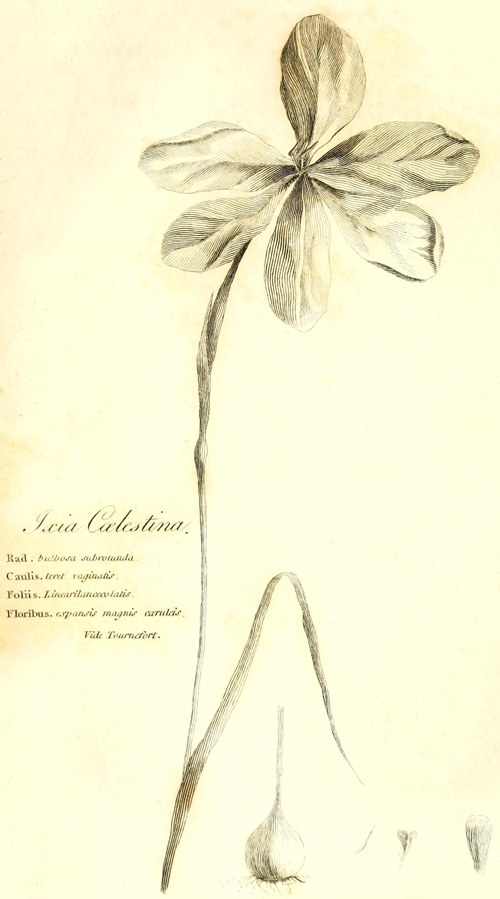
Ixia Cœlestina
What a beautiful display of vegetation is here before me! seemingly unlimited
in extent and variety; how the dew-drops twinkle and play upon the sight,
trembling on the tips of the lucid, green savanna, sparkling as the gem that
flames on the turban of the eastern prince. See the pearly tears rolling off
the buds of the expanding Granadilla[29]; behold the azure
fields of cerulean Ixia! what can equal the rich golden flowers of the Canna
lutea, which ornament the banks of yon serpentine rivulet, meandering over the
meadows; the almost endless varieties of the gay Phlox, that enamel the
swelling green banks, associated with the purple Verbena corymbosa, Viola,
pearly Gnaphalium, and silvery Perdicium? How fantastical looks the libertine
Clitoria, mantling the shrubs, on the vistas skirting the groves! My morning
excursion finished, I returned to my camp, breakfasted, then went on board my
boat, and gently descended the noble river, and passed by several openings of
extensive plains and meadows, environing the East Lake, charming beyond
compare. At evening I came to at a good harbour, under the high banks of the
river, and rested during the night amidst the fragrant groves, exposed to the
constant breezes from the river: here I made ample collections of specimens and
growing roots of curious vegetables, which kept me fully employed the greatest
part of the day; and in the evening arrived at a charming spot on the East bank, which I had marked on my ascent up the
river, where I made some addition to my collections; and the next day I
employed myself in the same manner, putting into shore frequently, at
convenient places, which I had noticed; and in the evening arrived again at the
upper store, where I had the pleasure of finding my old friend, the trader, in
good health and cheerful, and his affairs in prosperous way. There were also a
small party of Indians here, who had lately arrived with their hunts to
purchase goods. I continued a few days at this post, searching its environs for
curious vegetable productions, collecting seeds and planting growing roots in
boxes, to be transported to the lower trading house.
Now, having procured necessaries to accommodate me on my voyage down to the
lower store, I bid adieu to my old friend and benefactor, Mr. Job Wiggens,
embarked alone on board my little fortunate vessel, and set sail. I chose to
follow the easternmost channel of the river to the Great Lake, because it ran
by high banks and bluffs of the eastern main the greatest part of the distance,
which afforded me an opportunity of observing a far greater variety of natural
subjects, than if I had taken the western or middle channel, which flowed
through swamps and marshes.
At evening I arrived at Cedar Point, my former safe and pleasant harbour, at
the east cape of the Great Lake, where I had noticed some curious shrubs and
plants; here I rested, and on the smooth and gentle current launch again into
the little ocean of Lake George, meaning now, on my return, to coast his
western shores in search of new beauties in the bounteous kingdom of Flora.
I was however induced to deviate a little
from my intended course, and touch at the inchanting little Isle of Palms. This
delightful spot, planted by nature, is almost an entire grove of Palms, with a
few pyramidal Magnolias, Live Oaks, golden Orange, and the animating
Zanthoxylon. What a beautiful retreat is here! blessed unviolated spot of
earth, rising from the limpid waters of the lake: its fragrant groves and
blooming lawns invested and protected by encircling ranks of the Yucca
gloriosa. A fascinating atmosphere surrounds this blissful garden; the balmy
Lantana, ambrosial Citra, perfumed Crinum, perspiring their mingled odours,
wafted through Zanthoxylon groves. I at last broke away from the enchanting
spot, and stepped on board my boat, hoisted sail, and soon approached the coast
of the main, at the cool eve of day: then traversing a capacious semicircular
cove of the lake, verged by low, extensive grassy meadows, I at length by dusk
made a safe harbour, in a little lagoon, on the sea shore or strand of a bold
sandy point, which descended from the surf of the lake. This was a clean sandy
beach, hard and firm by the beating surf, when the wind sets from the east
coast. I drew up my light vessel on the sloping shore, that she might be safe
from the beating waves in case of a sudden storm of wind in the night. A few
yards back the land was a little elevated, and overgrown with thickets of
shrubs and low trees, consisting chiefly of Zanthoxylon, Olea Americana,
Rhamnus frangula, Sideroxylon, Morus, Ptelea, Halesia, Querci, Myrica cerifera
and others. These groves were but low, yet sufficiently high to shelter me from
the chilling dews; and being but a few yards distance from my vessel, here I
fixed my encampment. A brisk wind arising
from the lake, drove away the clouds of mosquitoes into the thickets. I now,
with difficulty and industry, collected a sufficiency of dry wood to keep up a
light during the night, and to roast some trout which I had caught when
descending the river: their heads I stewed in the juice of Oranges, which, with
boiled rice, afforded me a wholesome and delicious supper: I hung the remainder
of my broiled fish on the snags of some shrubs over my head. I at last, after
reconnoitring my habitation, returned, spread abroad my skins and blanket upon
the clean sands by my fire-side, and betook myself to repose.
How glorious the powerful sun, minister of the Most High, in the rule and
government of this earth, leaves our hemisphere, retiring from our sight beyond
the western forests! I behold with gratitude his departing smiles, tinging the
fleecy roseate clouds, now riding far away on the eastern horizon; behold they
vanish from sight in the azure skies!
All now silent and peaceable, I suddenly fell asleep. At midnight I awake; when
raising my head effect, I find myself alone in the wilderness of Florida, on
the shores of Lake George. Alone indeed, but under the care of the Almighty,
and protected by the invisible hand of my guardian angel.
When quite awake, I started at the heavy tread of some animal, the dry limbs of
trees upon the ground crack under his feet; the close shrubby thickets part and
bend under him as he rushes off.
I rekindled up my sleepy fire; lay in contact the exfoliated smoking brands
damp with the dew of heaven.
The bright flame ascends and illuminates
the ground and groves around me.
When looking up, I found my fish carried off, though I had thought them safe on
the shrubs, just over my head; but their scent, carried to a great distance by
the damp noctournal breezes, I suppose were too powerful attractions to resist.
Perhaps it may not be time lost, to rest a while here, and reflect on the
unexpected and unaccountable incident, which however pointed out to me an
extraordinary deliverance or protection of my life, from the rapacious wolf
that stole my fish from over my head.
How much easier and more eligible might it have been for him to have leaped
upon my breast in the dead of sleep, and torn my throat, which would have
instantly deprived me of life, and then glutted his stomach for the present
with my warm blood, and dragged off my body, which would have made a feast
afterwards for him and his howling associates! I say would not this have been a
wiser step, than to have made protracted and circular approaches, and then
after, by chance, espying the fish over my head, with the greatest caution and
silence rear up, and take them off the snags one by one, then make off with
them, and that so cunningly as not to awaken me until he had fairly
accomplished his purpose?
The morning being clear, I sat sail with a favourable breeze, coasting along
the shores; when on a sudden the waters became transparent, and discovered the
sandy bottom, and the several nations of fish, passing and repassing each
other. Following this course I was led to
the cape of the little river, descending from Six Mile Springs, and meanders
six miles from its source through green meadows. I entered this pellucid
stream, sailing over the heads of innumerable squadrons of fish, which,
although many feet deep in the water, were distinctly to be seen. I passed by
charming islets of flourishing trees, as Palm, Red Bay, Ash, Maple, Nyssa, and
others. As I approached the distant high forest on the main, the river widened,
floating fields of the green Pistia surrounded me, the rapid stream winding
through them. What an alluring scene was now before me! A vast bason or little
lake of crystal waters, half encircled by swelling hills, clad with Orange and
odoriferous Illicium groves. The towering Magnolia, itself a grove, and the
exalted Palm, as if conscious of their transcendent glories, tossed about their
lofty heads, painting, with mutable shades, the green floating fields beneath.
The social pratling coot enrobed in blue, and the squeeling water-hen, with
wings half expanded, tripped after each other, over the watery mirror.
I put in at an ancient landing place, which is a sloping ascent to a level
grassy plain, an old Indian field. As I intended to make my most considerable
collections at this place, I proceeded immediately to fix my encampment but a
few yards from my safe harbour, where I securely fastened my boat to a Live
Oak, which overshadowed my port.
After collecting a good quantity of fire-wood, as it was about the middle of
the afternoon, I resolved to reconnoitre the ground about my encampment. Having
penetrated the groves next to me, I came to the open forests, consisting of
exceedingly tall straight Pines (Pinus
Palustris) that stood at a considerable distance from each other, through which
appeared at N. W. an almost unlimited plain of grassy savannas, embellished
with a chain of shallow ponds, as far as the sight could reach. Here is a
species of Magnolia that associates with the Gordonia lasianthus; it is a tall
tree, sixty or eighty feet in heighth; the trunk straight; its head terminating
in the form of a sharp cone; the leaves are oblong, lanceolate, of a fine deep
green, and glaucous beneath; the flowers are large, perfectly white and
extremely fragrant: with respect to its flowers and leaves, it differs very
little from the Magnolia glauca. The silvery whiteness of the leaves of this
tree, had a striking and pleasing effect on the sight, as it stood amidst the
dark green of the Quercus dentata, Nyssa sylvatica, Nys. aquatica, Gordonia
lasianthus, and many others of the same hue. The tall aspiring Gordonia
lasianthus, which now stood in my view in all its splendour, is every way
deserving of our admiration. Its thick foliage, of a dark green colour, is
flowered over with large milk-white fragrant blossoms, on long slender elastic
peduncles, at the extremities of its numerous branches, from the bosom of the
leaves, and renewed every morning; and that in such incredible profusion, that
the tree appears silvered over with them, and the ground beneath covered with
the fallen flowers. It at the same time continually pushes forth new twigs,
with young buds on them, and in the winter and spring the third year’s
leaves, now partly concealed by the new and perfect ones, are gradually
changing colour, from green to golden yellow, from that to a scarlet, from
scarlet to crimson; and lastly to a brownish purple, and then fall to the ground. So that the Gordonia
lasianthus may be said to change and renew its garments every morning
throughout the year; and every day appears with unfading lustre. And moreover,
after the general flowering is past, there is a thin succession of scattering
blossoms to be seen, on some parts of the tree, almost every day throughout the
remaining months, until the floral season returns again. Its natural situation,
when growing, is on the edges of shallow ponds, or low wet grounds on rivers,
in a sandy soil, the nearest to the water of any other tree, so that in
droughty seasons its long serpentine roots which run near or upon the surface
of the earth, may reach into the water. When the tree has arrived to the period
of perfect magnitude, it is sixty, eighty, or an hundred feet high, forming a
pyramidal head. The wood of old trees when sawn into plank is deservedly
admired in cabinet-work or furniture; it has a cinnamon coloured ground,
marbled and veined with many colours: the inner bark is used for dying a
reddish or sorrel colour; it imparts this colour to wool, cotton, linnen, and
dressed deer-skins, and is highly esteemed by tanners.
The Zamia pumila, the Erythryna corallodendrum and the Cactus opuntia grow here
in great abundance and perfection. The first grows in the open pine forests, in
tufts or clumps, a large conical strobile disclosing its large coral red fruit,
which appears singularly beautiful amidst the deep green fern-like pinnated
leaves.
The Erythryna corallodendrum is six or eight feet high, its prickly limbs
stride and wreathe about with singular freedom, and its spikes of crimson
flowers have a fine effect amidst the delicate foliage.
The Cactus opuntia is very tall, erect,
and large, and strong enough to bear the weight of a man: some are seven or
eight feet high: the whole plant or tree seems to be formed of great oval
compressed leaves or articulations; those near the earth continually increase,
magnify and indurate as the tree advances in years, and at length lose the
bright green colour and glossy surface of their youth, acquiring a ligneous
quality, with a whitish scabrous cortex. Every part of the plant is nearly
destitute of aculea, or those fascicles of barbed bristles which are in such
plenty on the common dwarf Indian Fig. The cochineal insect were feeding on the
leaves. The female of this insect is very large and fleshy, covered with a fine
white silk or cottony web, which feels always moist or dewy, and seems designed
by nature to protect them from the violent heat of the sun. The males are very
small in comparison to the females, and but very few in number: they each have
two oblong pellucid wings. The large polypetalus flowers are produced on the
edges of the last year’s leaves, are of a fine splendid yellow, and are
succeeded by very large pear-shaped fruit, of a dark livid purple when ripe:
its pulp is charged with a juice of a fine transparent crimson colour, and has
a cool pleasant taste, somewhat like that of a pomegranate. Soon after eating
this fruit the urine becomes of the same crimson colour, which very much
surprises and affrights a stranger, but is attended with no other ill
consequence; on the contrary, it is esteemed wholesome, though powerfully
diuretic.
On the left hand of those open forests and savannas, as we turn our eyes
southward, south-west and west, we behold an endless wild desert, the upper
stratum of the earth of which is a fine white sand, with small pebbles, and at
some distance appears entirely covered
with low trees and shrubs of various kinds, and of equal heighth, as dwarf
Sweet Bay, (Laurus Borbonia) Olea Americana, Morus rubra, Myrica cerifera,
Ptelea, Æsculus pavia, Quercus Ilex, Q. glandifer, Q. maritima, foliis
cuneiformibus obsolete trilobis minoribus, Q. pumila, Rhamnus frangula, Halesia
diptera, & Tetraptera, Cassine, Ilex aquifolium, Callicarpa Johnsonia,
Erythryna corallodendrum, Hibiscus spinifex, Zanthoxylon, Hopea tinctoria,
Sideroxylum, with a multitude of other shrubs, many of which were new to me,
and some of them admirably beautiful and singular. One of them particularly
engaged my notice, which, from its fructification I took to be a species of
Cacalia. It is an evergreen shrub, about six or eight feet high; the leaves are
generally somewhat cuneiform, fleshy, and of a pale whitish green, both
surfaces being covered with a hoary pubescence and vesiculæ, that when pressed
feels clammy, and emits an agreeable scent; the ascendent branches terminate
with large tufts or corymbes of rose coloured flowers, of the same agreeable
scent; these cluster of flowers, at a distance, look like a large Carnation or
fringed Poppy flower, (Syngenesia Polyg. Æqul. Linn.), Cacalia heterophylla,
foliis cuneiformibus, carnosis, papil. viscidis.
Here is also another species of the same genus, but it does not grow quite so
large; the leaves are smaller, of a yet duller green colour, and the flowers
are of a pale rose; they are both valuable evergreens.
The trees and shrubs which cover these extensive wilds are about five or six
feet high, and seem to be kept down by the annual firing of the deserts, rather
than the barrenness of the soil, as I saw a few large Live Oaks, Mulberry trees
and Hickories, which evidently have
withstood the devouring flames. These adjoining wild plains, forests, and
savannas, are situated lower than the hilly groves on the banks of the lake and
river; but what should be the natural cause of it I cannot even pretend to
conjecture, unless one may suppose that those high hills, which we call bluffs,
on the banks of this great river and its lakes, and which support those
magnificent groves and high forests, and are generally composed of shell and
sand, were thrown up to their present heighth by the winds and waves, when the
bed of the river was nearer the level of the present surface of the earth; but
then, to rest upon such a supposition, would be admitting that the waters were
heretofore in greater quantities than at this time, or that their present
channels and receptacles are worn deeper into the earth.
I now directed my steps towards my encampment, in a different direction. I
seated myself upon a swelling green knoll, at the head of the crystal bason.
Near me, on the left, was a point or projection of an entire grove of the
aromatic Illicium Floridanum; on my right, and all around behind me, was a
fruitful Orange grove, with Palms and Magnolias interspersed; in front, just
under my feet, was the inchanting and amazing crystal fountain, which
incessantly threw up, from dark, rocky caverns below, tons of water every
minute, forming a bason, capacious enough for large shallops to ride in, and a
creek of four or five feet depth of water, and near twenty yards over, which
meanders six miles through green meadows, pouring its limpid waters into the
great Lake George, where they seem to remain pure and unmixed. About twenty
yards from the upper edge of the bason, and directly opposite to the mouth or outlet to the creek, is
a continual and amazing ebullition, where the waters are thrown up in such
abundance and amazing force, as to jet and swell up two or three feet above the
common surface: white sand and small particles of shells are thrown up with the
waters, near to the top, when they diverge from the centre, subside with the
expanding flood, and gently sink again, forming a large rim or funnel round
about the aperture or mouth of the fountain, which is a vast perforation
through a bed of rocks, the ragged points of which are projected out on every
side. Thus far I know to be matter of real fact, and I have related it as near
as I could conceive or express myself. But there are yet remaining scenes
inexpressibly admirable and pleasing.
Behold, for instance, a vast circular expanse before you, the waters of which
are so extremely clear as to be absolutely diaphanous or transparent as the
ether; the margin of the bason ornamented with a great variety of fruitful and
floriferous trees, shrubs, and plants, the pendant golden Orange dancing on the
surface of the pellucid waters, the balmy air vibrates the melody of the merry
birds, tenants of the encircling aromatic grove.
At the same instant innumerable bands of fish are seen, some clothed in the
most brilliant colours; the voracious crocodile stretched along at full length,
as the great trunk of a tree in size; the devouring garfish, inimical trout,
and all the varieties of gilded painted bream, the barbed catfish, dreaded
sting-ray, skate, and flounder, spotted bass, sheeps head and ominous drum; all
in their separate bands and communities, with free and unsuspicious intercourse performing their evolutions:
there are no signs of enmity, no attempt to devour each other; the different
bands seem peaceably and complaisantly to move a little aside, as it were to
make room for others to pass by.
But behold yet something far more admirable, see whole armies descending into
an abyss, into the mouth of the bubbling fountain: they disappear! are they
gone for ever? is it real? I raise my eyes with terror and astonishment; I look
down again to the fountain with anxiety, when behold them as it were emerging
from the blue ether of another world, apparently at a vast distance, at their
first appearance, no bigger than flies or minnows; now gradually enlarging,
their brilliant colours begin to paint the fluid.
Now they come forward rapidly, and instantly emerge, with the elastic expanding
column of crystalline waters, into the circular bason or funnel: see now how
gently they rise, some upright, others obliquely, or seem to lie as it were on
their sides, suffering themselves to be gently lifted or born up by the
expanding fluid towards the surface, sailing or floating like butterflies in
the cerulean ether: then again they as gently descend, diverge and move off;
when they rally, form again, and rejoin their kindred tribes.
This amazing and delightful scene, though real, appears at first but as a piece
of excellent painting; there seems no medium; you imagine the picture to be
within a few inches of your eyes, and that you may without the least difficulty
touch any one of the fish, or put your finger upon the crocodile’s eye,
when it really is twenty or thirty feet under water.
And although this paradise of fish may
seem to exhibit a just representation of the peaceable and happy state of
nature which existed before the fall, yet in reality it is a mere
representation; for the nature of the fish is the same as if they were in Lake
George or the river; but here the water or element in which they live and move,
is so perfectly clear and transparent, it places them all on an equality with
regard to their ability to injure or escape from one another; (as all river
fish of prey, or such as feed upon each other, as well as the unwieldy
crocodile, take their prey by surprise; secreting themselves under covert or in
ambush, until an opportunity offers, when they rush suddenly upon them:) but
here is no covert, no ambush; here the trout freely passes by the very nose of
the alligator, and laughs in his face, and the bream by the trout.
But what is really surprising, that the consciousness of each other’s
safety or some other latent cause, should so absolutely alter their conduct,
for here is not the least attempt made to injure or disturb one another.
The sun passing below the horizon, and night approaching, I arose from my seat,
and proceeding on arrived at my camp, kindled my fire, supped and reposed
peaceably. Rising early, I employed the fore part of the day in collecting
specimens of growing roots and seeds. In the afternoon, I left these Elysian
springs and the aromatic groves, and briskly descend the pellucid little river,
re-entering the great lake. The wind being gentle and fair for Mount Royal, I
hoisted sail, and successfully crossing the N. west bay, about nine miles, came
to at Rocky Point, the west cape or promontory, as we enter the river
descending towards Mount Royal: these
rocks are horizontal slabs or flat masses, rising out of the lake two or three
feet above its surface, and seem an aggregate composition or concrete of sand,
shells and calcareous cement, of a dark grey or dusky colour. The stones are
hard and firm enough for buildings, and serve very well for light hand
mill-stones; and when calcined afford a coarse lime: they lie in vast
horizontal masses upon one another, from one to two or three feet in thickness,
and are easily separated and broken to any size or form, for the purpose of
building. Rocky Point is an airy, cool, and delightful situation, commanding a
most ample and pleasing prospect of the lake and its environs; but here being
no wood, I re-embarked and sailed down a little farther to the island in the
bay, where I went on shore at a magnificent grove of Magnolias and Oranges,
desirous of augmenting my collections. I arose early next morning, and after
ranging the groves and savannas, returned, embarked again, and descending,
called at Mount Royal, where I enlarged my collections; and bidding adieu to
the gentleman and lady who resided there, and who treated me with great
hospitality on my ascent up the river; arrived in the evening at the lower
trading house.