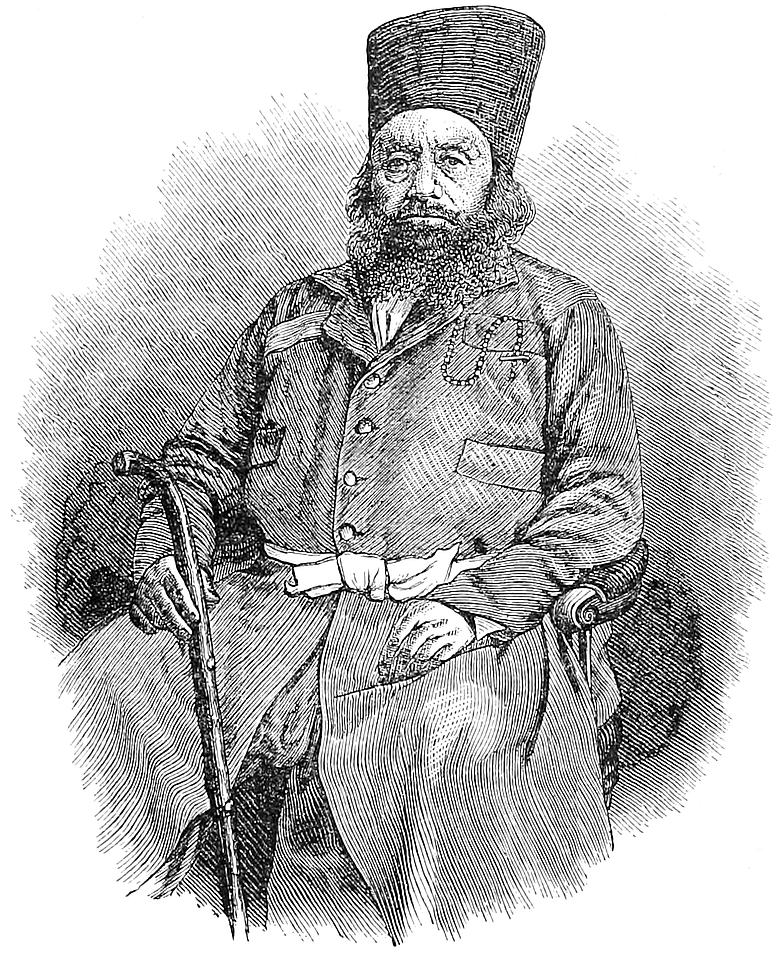
MEMOIR OF SIR HENRY YULE. — SIR GEORGE UDNY YULE, C.B., K.C.S.I. [80]
Henry Yule was the youngest son of Major William Yule, by his first wife,
Elizabeth Paterson, and was born at Inveresk, in Midlothian, on 1st May,
1820. He was named after an aunt who, like Miss Ferrier’s immortal
heroine, owned a man’s name.
On his father’s side he came of a hardy agricultural stock,[1] improved
by a graft from that highly-cultured tree, Rose of Kilravock.[2] Through
his mother, a somewhat prosaic person herself, he inherited strains from
Huguenot and Highland ancestry. There were recognisable traces of all
these elements in Henry Yule, and as was well said by one of his oldest
friends: “He was one of those curious racial compounds one finds on the
east side of Scotland, in whom the hard Teutonic grit is sweetened by the
artistic spirit of the more genial Celt.”[3] His father, an officer of
the Bengal army (born 1764, died 1839), was a man of cultivated tastes
and enlightened mind, a good Persian and Arabic scholar, and possessed
of much miscellaneous Oriental learning. During the latter years of his
career in India, he served successively as Assistant Resident at the (then
independent) courts of Lucknow[4] and Delhi. In the latter office his chief
was the noble Ouchterlony. William Yule, together with his younger brother
Udny,[5] returned home in 1806. “A recollection of their voyage was that
they hailed an outward bound ship, somewhere off the Cape, through the
trumpet: ‘What news?’ Answer: ‘The King’s mad, and Humfrey’s beat Mendoza’
(two celebrated prize-fighters and often matched). ‘Nothing more?’ ‘Yes,
Bonaparty’s made his Mother King of Holland!’
“Before his retirement, William Yule was offered the Lieut.-Governorship
of St. Helena. Two of the detailed privileges of the office were residence
at Longwood (afterwards the house of Napoleon), and the use of a certain
number of the Company’s slaves. Major Yule, who was a strong supporter of
the anti-slavery cause till its triumph in 1834, often recalled both of
these offers with amusement.”[6]
William Yule was a man of generous chivalrous nature, who took large views
of life, apt to be unfairly stigmatised as Radical in the narrow Tory
reaction that prevailed in Scotland during the early years of the 19th
century.[7] Devoid of literary ambition, he wrote much for his private
pleasure, and his knowledge and library (rich in Persian and Arabic MSS.)
were always placed freely at the service of his friends and correspondents,
some of whom, such as Major C. Stewart and Mr. William Erskine, were more
given to publication than himself. He never travelled without a little
8vo MS. of Hafiz, which often lay under his pillow. Major Yule’s only
printed work was a lithographed edition of the Apothegms of ’Ali, the son
of Abu Talib, in the Arabic, with an old Persian version and an English
translation interpolated by himself. “This was privately issued in 1832,
when the Duchesse d’Angoulême was living at Edinburgh, and the little
work was inscribed to her, with whom an accident of neighbourhood and her
kindness to the Major’s youngest child had brought him into relations of
goodwill.”[8]
Henry Yule’s childhood was mainly spent at Inveresk. He used to say that
his earliest recollection was sitting with the little cousin, who long
after became his wife, on the doorstep of her father’s house in George
Street, Edinburgh (now the Northern Club), listening to the performance of
a passing piper. There was another episode which he recalled with humorous
satisfaction. Fired by his father’s tales of the jungle, Yule (then about
six years old) proceeded to improvise an elephant pit in the back garden,
only too successfully, for soon, with mingled terror and delight, he saw
his uncle John[9] fall headlong into the snare. He lost his mother before
he was eight, and almost his only remembrance of her was the circumstance
of her having given him a little lantern to light him home on winter
nights from his first school. On Sundays it was the Major’s custom to lend
his children, as a picture-book, a folio Arabic translation of the Four
Gospels, printed at Rome in 1591, which contained excellent illustrations
from Italian originals.[10] Of the pictures in this volume Yule seems never
to have tired. The last page bore a MS. note in Latin to the effect that
the volume had been read in the Chaldæan Desert by Georgius Strachanus,
Milnensis, Scotus, who long remained unidentified, not to say mythical, in
Yule’s mind. But George Strachan never passed from his memory, and having
ultimately run him to earth, Yule, sixty years later, published the results
in an interesting article.[11]
Two or three years after his wife’s death, Major Yule removed to Edinburgh,
and established himself in Regent’s Terrace, on the face of the Calton
Hill.[12] This continued to be Yule’s home until his father’s death,
shortly before he went to India. “Here he learned to love the wide scenes
of sea and land spread out around that hill—a love he never lost, at home
or far away. And long years after, with beautiful Sicilian hills before him
and a lovely sea, he writes words of fond recollection of the bleak Fife
hills, and the grey Firth of Forth.”[13]
Yule now followed his elder brother, Robert, to the famous High School, and
in the summer holidays the two made expeditions to the West Highlands, the
Lakes of Cumberland, and elsewhere. Major Yule chose his boys to have every
reasonable indulgence and advantage, and when the British Association, in
1834, held its first Edinburgh meeting, Henry received a member’s ticket.
So, too, when the passing of the Reform Bill was celebrated in the same
year by a great banquet, at which Lord Grey and other prominent politicians
were present, Henry was sent to the dinner, probably the youngest guest
there.[14]
At this time the intention was that Henry should go to Cambridge (where his
name was, indeed, entered), and after taking his degree study for the Bar.
With this view he was, in 1833, sent to Waith, near Ripon, to be coached
by the Rev. H. P. Hamilton, author of a well-known treatise, On Conic
Sections, and afterwards Dean of Salisbury. At his tutor’s hospitable
rectory Yule met many notabilities of the day. One of them was Professor
Sedgwick.
There was rumoured at this time the discovery of the first known (?) fossil
monkey, but its tail was missing. “Depend upon it, Daniel O’Conell’s
got hold of it!” said ‘Adam’ briskly.[15] Yule was very happy with Mr.
Hamilton and his kind wife, but on his tutor’s removal to Cambridge other
arrangements became necessary, and in 1835 he was transferred to the care
of the Rev. James Challis, rector of Papworth St. Everard, a place which
“had little to recommend it except a dulness which made reading almost a
necessity.”[16] Mr. Challis had at this time two other resident pupils,
who both, in most diverse ways, attained distinction in the Church. These
were John Mason Neale, the future eminent ecclesiologist and founder of
the devoted Anglican Sisterhood of St. Margaret, and Harvey Goodwin, long
afterwards the studious and large-minded Bishop of Carlisle. With the
latter, Yule remained on terms of cordial friendship to the end of his
life. Looking back through more than fifty years to these boyish days,
Bishop Goodwin wrote that Yule then “showed much more liking for Greek
plays and for German than for mathematics, though he had considerable
geometrical ingenuity.”[17] On one occasion, having solved a problem that
puzzled Goodwin, Yule thus discriminated the attainments of the three
pupils: “The difference between you and me is this: You like it and can’t
do it; I don’t like it and can do it. Neale neither likes it nor can do
it.” Not bad criticism for a boy of fifteen.[18]
On Mr. Challis being appointed Plumerian Professor at Cambridge, in the
spring of 1836, Yule had to leave him, owing to want of room at the
Observatory, and he became for a time, a most dreary time, he said, a
student at University College, London.
By this time Yule had made up his mind that not London and the Law, but
India and the Army should be his choice, and accordingly in Feb. 1837
he joined the East India Company’s Military College at Addiscombe. From
Addiscombe he passed out, in December 1838, at the head of the cadets of
his term (taking the prize sword[19]), and having been duly appointed to
the Bengal Engineers, proceeded early in 1839 to the Headquarters of the
Royal Engineers at Chatham, where, according to custom, he was enrolled as
a “local and temporary Ensign.” For such was then the invidious designation
at Chatham of the young Engineer officers of the Indian army, who ranked
as full lieutenants in their own Service, from the time of leaving
Addiscombe.[20] Yule once audaciously tackled the formidable Pasley on
this very grievance. The venerable Director, after a minute’s pondering,
replied: “Well, I don’t remember what the reason was, but I have no doubt
(staccato) it ... was ... a very ... good reason.”[21]
“When Yule appeared among us at Chatham in 1839,” said his friend
Collinson, “he at once took a prominent place in our little Society by
his slightly advanced age [he was then 18½], but more by his strong
character.... His earlier education ... gave him a better classical
knowledge than most of us possessed; then he had the reserve and
self-possession characteristic of his race; but though he took small
part in the games and other recreations of our time, his knowledge,
his native humour, and his good comradeship, and especially his strong
sense of right and wrong, made him both admired and respected.... Yule
was not a scientific engineer, though he had a good general knowledge
of the different branches of his profession; his natural capacity lay
rather in varied knowledge, combined with a strong understanding and an
excellent memory, and also a peculiar power as a draughtsman, which proved
of great value in after life.... Those were nearly the last days of the
old régime, of the orthodox double sap and cylindrical pontoons, when
Pasley’s genius had been leading to new ideas, and when Lintorn Simmons’
power, G. Leach’s energy, W. Jervois’ skill, and R. Tylden’s talent were
developing under the wise example of Henry Harness.”[22]
In the Royal Engineer mess of those days (the present anteroom), the
portrait of Henry Yule now faces that of his first chief, Sir Henry
Harness. General Collinson said that the pictures appeared to eye each
other as if the subjects were continuing one of those friendly disputes in
which they so often engaged.[23]
It was in this room that Yule, Becher, Collinson, and other young R.E.’s,
profiting by the temporary absence of the austere Colonel Pasley, acted
some plays, including Pizarro. Yule bore the humble part of one of the
Peruvian Mob in this performance, of which he has left a droll account.[24]
On the completion of his year at Chatham, Yule prepared to sail for India,
but first went to take leave of his relative, General White. An accident
prolonged his stay, and before he left he had proposed to and been refused
by his cousin Annie. This occurrence, his first check, seems to have cast
rather a gloom over his start for India. He went by the then newly-opened
Overland Route, visiting Portugal, stopping at Gibraltar to see his cousin,
Major (afterwards General) Patrick Yule, R.E.[25] He was under orders “to
stop at Aden (then recently acquired), to report on the water supply, and
to deliver a set of meteorological and magnetic instruments for starting
an observatory there. The overland journey then really meant so; tramping
across the desert to Suez with camels and Arabs, a proceeding not conducive
to the preservation of delicate instruments; and on arriving at Aden he
found that the intended observer was dead, the observatory not commenced,
and the instruments all broken. There was thus nothing left for him but to
go on at once” to Calcutta,[26] where he arrived at the end of 1840.
His first service lay in the then wild Khasia Hills, whither he was
detached for the purpose of devising means for the transport of the local
coal to the plains. In spite of the depressing character of the climate
(Cherrapunjee boasts the highest rainfall on record), Yule thoroughly
enjoyed himself, and always looked back with special pleasure on the
time he spent here. He was unsuccessful in the object of his mission,
the obstacles to cheap transport offered by the dense forests and mighty
precipices proving insurmountable, but he gathered a wealth of interesting
observations on the country and people, a very primitive Mongolian race,
which he subsequently embodied in two excellent and most interesting papers
(the first he ever published).[27]
In the following year, 1842, Yule was transferred to the irrigation canals
of the north-west with head-quarters at Kurnaul. Here he had for chief
Captain (afterwards General Sir William) Baker, who became his dearest
and most steadfast friend. Early in 1843 Yule had his first experience of
field service. The death without heir of the Khytul Rajah, followed by the
refusal of his family to surrender the place to the native troops sent to
receive it, obliged Government to send a larger force against it, and the
canal officers were ordered to join this. Yule was detailed to serve under
Captain Robert Napier (afterwards F.-M. Lord Napier of Magdala). Their
immediate duty was to mark out the route for a night march of the troops,
barring access to all side roads, and neither officer having then had any
experience of war, they performed the duty “with all the elaborate care of
novices.” Suddenly there was an alarm, a light detected, and a night attack
awaited, when the danger resolved itself into Clerk Sahib’s khansamah
with welcome hot coffee![28] Their hopes were disappointed, there was no
fighting, and the Fort of Khytul was found deserted by the enemy. It “was
a strange scene of confusion—all the paraphernalia and accumulation of
odds and ends of a wealthy native family lying about and inviting loot.
I remember one beautiful crutch-stick of ebony with two rams’ heads in
jade. I took it and sent it in to the political authority, intending to
buy it when sold. There was a sale, but my stick never appeared. Somebody
had a more developed taste in jade.... Amid the general rummage that was
going on, an officer of British Infantry had been put over a part of the
palace supposed to contain treasure, and they—officers and all—were helping
themselves. Henry Lawrence was one of the politicals under George Clerk.
When the news of this affair came to him I was present. It was in a white
marble loggia in the palace, where was a white marble chair or throne on a
basement. Lawrence was sitting on this throne in great excitement. He wore
an Afghan choga, a sort of dressing-gown garment, and this, and his thin
locks, and thin beard were streaming in the wind. He always dwells in my
memory as a sort of pythoness on her tripod under the afflatus.”[29]
During his Indian service, Yule had renewed and continued by letters his
suit to Miss White, and persistency prevailing at last, he soon after the
conclusion of the Khytul affair applied for leave to go home to be married.
He sailed from Bombay in May, 1843, and in September of the same year was
married, at Bath, to the gifted and large-hearted woman who, to the end,
remained the strongest and happiest influence in his life.[30]
Yule sailed for India with his wife in November 1843. The next two years
were employed chiefly in irrigation work, and do not call for special note.
They were very happy years, except in the one circumstance that the climate
having seriously affected his wife’s health, and she having been brought
to death’s door, partly by illness, but still more by the drastic medical
treatment of those days, she was imperatively ordered back to England by
the doctors, who forbade her return to India.
Having seen her on board ship, Yule returned to duty on the canals. The
close of that year, December, 1845, brought some variety to his work, as
the outbreak of the first Sikh War called nearly all the canal officers
into the field. “They went up to the front by long marches, passing through
no stations, and quite unable to obtain any news of what had occurred,
though on the 21st December the guns of Ferozshah were distinctly heard in
their camp at Pehoa, at a distance of 115 miles south-east from the field,
and some days later they came successively on the fields of Moodkee and of
Ferozshah itself, with all the recent traces of battle. When the party of
irrigation officers reached head-quarters, the arrangements for attacking
the Sikh army in its entrenchments at Sobraon were beginning (though
suspended till weeks later for the arrival of the tardy siege guns), and
the opposed forces were lying in sight of each other.”[31]
Yule’s share in this campaign was limited to the sufficiently arduous
task of bridging the Sutlej for the advance of the British army. It is
characteristic of the man that for this reason he always abstained from
wearing his medal for the Sutlej campaign.
His elder brother, Robert Yule, then in the 16th Lancers, took part in that
magnificent charge of his regiment at the battle of Aliwal (Jan. 28, 1846)
which the Great Duke is said to have pronounced unsurpassed in history.
From particulars gleaned from his brother and others present in the action,
Henry Yule prepared a spirited sketch of the episode, which was afterwards
published as a coloured lithograph by M‘Lean (Haymarket).
At the close of the war, Yule succeeded his friend Strachey as Executive
Engineer of the northern division of the Ganges Canal, with his
head-quarters at Roorkee, “the division which, being nearest the hills and
crossed by intermittent torrents of great breadth and great volume when in
flood, includes the most important and interesting engineering works.”[32]
At Roorkee were the extensive engineering workshops connected with the
canal. Yule soon became so accustomed to the din as to be undisturbed by
the noise, but the unpunctuality and carelessness of the native workmen
sorely tried his patience, of which Nature had endowed him with but a small
reserve. Vexed with himself for letting temper so often get the better of
him, Yule’s conscientious mind devised a characteristic remedy. Each time
that he lost his temper, he transferred a fine of two rupees (then about
five shillings) from his right to his left pocket. When about to leave
Roorkee, he devoted this accumulation of self-imposed fines to the erection
of a sun-dial, to teach the natives the value of time. The late Sir James
Caird, who told this legend of Roorkee as he heard it there in 1880, used
to add, with a humorous twinkle of his kindly eyes, “It was a very
handsome dial.”[33]
From September, 1845, to March, 1847, Yule was much occupied
intermittently, in addition to his professional work, by service on a
Committee appointed by Government “to investigate the causes of the
unhealthiness which has existed at Kurnal, and other portions of the
country along the line of the Delhi Canal,” and further, to report “whether
an injurious effect on the health of the people of the Doab is, or is not,
likely to be produced by the contemplated Ganges Canal.”
“A very elaborate investigation was made by the Committee, directed
principally to ascertaining what relation subsisted between certain
physical conditions of the different districts, and the liability of their
inhabitants to miasmatic fevers.” The principal conclusion of the Committee
was, “that in the extensive epidemic of 1843, when Kurnaul suffered so
seriously ... the greater part of the evils observed had not been the
necessary and unavoidable results of canal irrigation, but were due to
interference with the natural drainage of the country, to the saturation
of stiff and retentive soils, and to natural disadvantages of site,
enhanced by excess of moisture. As regarded the Ganges Canal, they were
of opinion that, with due attention to drainage, improvement rather than
injury to the general health might be expected to follow the introduction
of canal irrigation.”[34] In an unpublished note written about 1889, Yule
records his ultimate opinion as follows: “At this day, and after the
large experience afforded by the Ganges Canal, I feel sure that a verdict
so favourable to the sanitary results of canal irrigation would not be
given.” Still the fact remains that the Ganges Canal has been the source of
unspeakable blessings to an immense population.
The Second Sikh War saw Yule again with the army in the field, and on 13th
Jan. 1849, he was present at the dismal ‘Victory’ of Chillianwallah, of
which his most vivid recollection seemed to be the sudden apparition of
Henry Lawrence, fresh from London, but still clad in the legendary Afghan cloak.
On the conclusion of the Punjab campaign, Yule, whose health had suffered,
took furlough and went home to his wife. For the next three years they
resided chiefly in Scotland, though paying occasional visits to the
Continent, and about 1850 Yule bought a house in Edinburgh. There he
wrote “The African Squadron vindicated” (a pamphlet which was afterwards
re-published in French), translated Schiller’s Kampf mit dem Drachen
into English verse, delivered Lectures on Fortification at the, now
long defunct, Scottish Naval and Military Academy, wrote on Tibet for
his friend Blackwood’s Magazine, attended the 1850 Edinburgh Meeting of
the British Association, wrote his excellent lines, “On the Loss of the
Birkenhead,” and commenced his first serious study of Marco Polo (by
whose wondrous tale, however, he had already been captivated as a boy
in his father’s library—in Marsden’s edition probably). But the most
noteworthy literary result of these happy years was that really fascinating
volume, entitled Fortification for Officers of the Army and Students of
Military History, a work that has remained unique of its kind. This was
published by Blackwood in 1851, and seven years later received the honour
of (unauthorised) translation into French. Yule also occupied himself a
good deal at this time with the practice of photography, a pursuit to which
he never after reverted.
In the spring of 1852, Yule made an interesting little semi-professional
tour in company with a brother officer, his accomplished friend, Major R.
B. Smith. Beginning with Kelso, “the only one of the Teviotdale Abbeys
which I had not as yet seen,” they made their way leisurely through the
north of England, examining with impartial care abbeys and cathedrals,
factories, brick-yards, foundries, timber-yards, docks, and railway works.
On this occasion Yule, contrary to his custom, kept a journal, and a few
excerpts may be given here, as affording some notion of his casual talk to
those who did not know him.
At Berwick-on-Tweed he notes the old ramparts of the town: “These, erected
in Elizabeth’s time, are interesting as being, I believe, the only existing
sample in England of the bastioned system of the 16th century.... The
outline of the works seems perfect enough, though both earth and stone
work are in great disrepair. The bastions are large with obtuse angles,
square orillons, and double flanks originally casemated, and most of
them crowned with cavaliers.” On the way to Durham, “much amused by the
discussions of two passengers, one a smooth-spoken, semi-clerical looking
person; the other a brusque well-to-do attorney with a Northumbrian
burr. Subject, among others, Protection. The Attorney all for ‘cheap
bread’— ‘You wouldn’t rob the poor man of his loaf,’ and so forth. ‘You
must go with the stgheam, sir, you must go with the stgheam.’ ‘I never
did, Mr. Thompson, and I never will,’ said the other in an oily manner,
singularly inconsistent with the sentiment.” At Durham they dined with a
dignitary of the Church, and Yule was roasted by being placed with his
back to an enormous fire. “Coals are cheap at Durham,” he notes feelingly,
adding, “The party we found as heavy as any Edinburgh one. Smith, indeed,
evidently has had little experience of really stupid Edinburgh parties,
for he had never met with anything approaching to this before.” (Happy
Smith!) But thanks to the kindness and hospitality of the astronomer,
Mr. Chevalier, and his gifted daughter, they had a delightful visit to
beautiful Durham, and came away full of admiration for the (then newly
established) University, and its grand locale. They went on to stay
with an uncle by marriage of Yule’s, in Yorkshire. At dinner he was asked
by his host to explain Foucault’s pendulum experiment. “I endeavoured to
explain it somewhat, I hope, to the satisfaction of his doubts, but not at
all to that of Mr. G. M., who most resolutely declined to take in any
elucidation, coming at last to the conclusion that he entirely differed
with me as to what North meant, and that it was useless to argue until we
could agree about that!” They went next to Leeds, to visit Kirkstall Abbey,
“a mediæval fossil, curiously embedded among the squalid brickwork and
chimney stalks of a manufacturing suburb. Having established ourselves at
the hotel, we went to deliver a letter to Mr. Hope, the official assignee,
a very handsome, aristocratic-looking gentleman, who seemed as much out
of place at Leeds as the Abbey.” At Leeds they visited the flax mills of
Messrs. Marshall, “a firm noted for the conscientious care they take of
their workpeople.... We mounted on the roof of the building, which is
covered with grass, and formerly was actually grazed by a few sheep, until
the repeated inconvenience of their tumbling through the glass domes put a
stop to this.” They next visited some tile and brickworks on land belonging
to a friend. “The owner of the tile works, a well-to-do burgher, and the
apparent model of a West Riding Radical, received us in rather a dubious
way: ‘There are a many people has come and brought introductions, and
looked at all my works, and then gone and set up for themselves close by.
Now des you mean to say that you be really come all the way from Bengul?’
‘Yes, indeed we have, and we are going all the way back again, though we
didn’t exactly come from there to look at your brickworks.’ ‘Then you’re
not in the brick-making line, are you?’ ‘Why we’ve had a good deal to do
with making bricks, and may have again; but we’ll engage that if we set up
for ourselves, it shall be ten thousand miles from you.’ This seemed in
some degree to set his mind at rest....”
“A dismal day, with occasional showers, prevented our seeing Sheffield to
advantage. On the whole, however, it is more cheerful and has more of a
country-town look than Leeds—a place utterly without beauty of aspect. At
Leeds you have vast barrack-like factories, with their usual suburbs of
squalid rows of brick cottages, and everywhere the tall spiracles of the
steam, which seems the pervading power of the place. Everything there is
machinery—the machine is the intelligent agent, it would seem, the man its
slave, standing by to tend it and pick up a broken thread now and then.
At Sheffield ... you might go through most of the streets without knowing
anything of the kind was going on. And steam here, instead of being a
ruler, is a drudge, turning a grindstone or rolling out a bar of steel, but
all the accuracy and skill of hand is the Man’s. And consequently there
was, we thought, a healthier aspect about the men engaged. None of the
Rodgers remain who founded the firm in my father’s time. I saw some pairs
of his scissors in the show-room still kept under the name of Persian
scissors.”[35]
From Sheffield Yule and his friend proceeded to Boston, “where there is
the most exquisite church tower I have ever seen,” and thence to Lincoln,
Peterborough, and Ely, ending their tour at Cambridge, where Yule spent a
few delightful days.
In the autumn the great Duke of Wellington died, and Yule witnessed the
historic pageant of his funeral. His furlough was now nearly expired, and
early in December he again embarked for India, leaving his wife and only
child, of a few weeks old, behind him. Some verses dated “Christmas Day
near the Equator,” show how much he felt the separation.
Shortly after his return to Bengal, Yule received orders to proceed to
Aracan, and to examine and report upon the passes between Aracan and Burma,
as also to improve communications and select suitable sites for fortified
posts to hold the same. These orders came to Yule quite unexpectedly late
one Saturday evening, but he completed all preparations and started at
daybreak on the following Monday, 24th Jan. 1853.
From Calcutta to Khyook Phyoo, Yule proceeded by steamer, and thence up the
river in the Tickler gunboat to Krenggyuen. “Our course lay through a
wilderness of wooded islands (50 to 200 feet high) and bays, sailing when
we could, anchoring when neither wind nor tide served ... slow progress
up the river. More and more like the creeks and lagoons of the Niger or a
Guiana river rather than anything I looked for in India. The densest tree
jungle covers the shore down into the water. For miles no sign of human
habitation, but now and then at rare intervals one sees a patch of hillside
rudely cleared, with the bare stems of the burnt trees still standing....
Sometimes, too, a dark tunnel-like creek runs back beneath the thick vault
of jungle, and from it silently steals out a slim canoe, manned by two or
three wild-looking Mugs or Kyens (people of the Hills), driving it rapidly
along with their short paddles held vertically, exactly like those of the
Red men on the American rivers.”
At the military post of Bokhyong, near Krenggyuen, he notes (5th Feb.) that
“Captain Munro, the adjutant, can scarcely believe that I was present at
the Duke of Wellington’s funeral, of which he read but a few days ago in
the newspapers, and here am I, one of the spectators, a guest in this wild
spot among the mountains—2½ months since I left England.”
Yule’s journal of his arduous wanderings in these border wilds is full
of interest, but want of space forbids further quotation. From a note on
the fly-leaf it appears that from the time of quitting the gun-boat at
Krenggyuen to his arrival at Toungoop he covered about 240 miles on foot,
and that under immense difficulties, even as to food. He commemorated his
tribulations in some cheery humorous verse, but ultimately fell seriously
ill of the local fever, aided doubtless by previous exposure and privation.
His servants successively fell ill, some died and others had to be sent
back, food supplies failed, and the route through those dense forests was
uncertain; yet under all difficulties he seems never to have grumbled or
lost heart. And when things were nearly at the worst, Yule restored the
spirits of his local escort by improvising a wappenshaw, with a Sheffield
gardener’s knife, which he happened to have with him, for prize! When at
last Yule emerged from the wilds and on 25th March marched into Prome,
he was taken for his own ghost! “Found Fraser (of the Engineers) in a
rambling phoongyee house, just under the great gilt pagoda. I went up to
him announcing myself, and his astonishment was so great that he would
scarcely shake hands!” It was on this occasion at Prome that Yule first met
his future chief Captain Phayre—“a very young-looking man—very cordial,” a
description no less applicable to General Sir Arthur Phayre at the age of
seventy!
After some further wanderings, Yule embarked at Sandong, and returned by
water, touching at Kyook Phyoo and Akyab, to Calcutta, which he reached on
1st May—his birthday.
The next four months were spent in hard work at Calcutta. In August, Yule
received orders to proceed to Singapore, and embarked on the 29th. His duty
was to report on the defences of the Straits Settlements, with a view to
their improvement. Yule’s recommendations were sanctioned by Government,
but his journal bears witness to the prevalence then, as since, of the
penny-wise-pound-foolish system in our administration. On all sides he was
met by difficulties in obtaining sites for batteries, etc., for which heavy
compensation was demanded, when by the exercise of reasonable foresight,
the same might have been secured earlier at a nominal price.
Yule’s journal contains a very bright and pleasing picture of Singapore,
where he found that the majority of the European population “were
evidently, from their tongues, from benorth the Tweed, a circumstance which
seems to be true of four-fifths of the Singaporeans. Indeed, if I taught
geography, I should be inclined to class Edinburgh, Glasgow, Dundee, and
Singapore together as the four chief towns of Scotland.”
Work on the defences kept Yule in Singapore and its neighbourhood until
the end of November, when he embarked for Bengal. On his return to
Calcutta, Yule was appointed Deputy Consulting Engineer for Railways at
Head-quarters. In this post he had for chief his old friend Baker, who had
in 1851 been appointed by the Governor-General, Lord Dalhousie, Consulting
Engineer for Railways to Government. The office owed its existence to
the recently initiated great experiment of railway construction under
Government guarantee.
The subject was new to Yule, “and therefore called for hard and anxious
labour. He, however, turned his strong sense and unbiased view to the
general question of railway communication in India, with the result that he
became a vigorous supporter of the idea of narrow gauge and cheap lines in
the parts of that country outside of the main trunk lines of traffic.”[36]
The influence of Yule, and that of his intimate friends and ultimate
successors in office, Colonels R. Strachey and Dickens, led to the adoption
of the narrow (metre) gauge over a great part of India. Of this matter more
will be said further on; it is sufficient at this stage to note that it was
occupying Yule’s thoughts, and that he had already taken up the position
in this question that he thereafter maintained through life. The office of
Consulting Engineer to Government for Railways ultimately developed into
the great Department of Public Works.
As related by Yule, whilst Baker “held this appointment, Lord Dalhousie
was in the habit of making use of his advice in a great variety of
matters connected with Public Works projects and questions, but which
had nothing to do with guaranteed railways, there being at that time no
officer attached to the Government of India, whose proper duty it was to
deal with such questions. In August, 1854, the Government of India sent
home to the Court of Directors a despatch and a series of minutes by the
Governor-General and his Council, in which the constitution of the Public
Works Department as a separate branch of administration, both in the local
governments and the government of India itself, was urged on a detailed plan.”
In this communication Lord Dalhousie stated his desire to appoint Major
Baker to the projected office of Secretary for the Department of Public
Works. In the spring of 1855 these recommendations were carried out by
the creation of the Department, with Baker as Secretary and Yule as Under
Secretary for Public Works.
Meanwhile Yule’s services were called to a very different field, but
without his vacating his new appointment, which he was allowed to retain.
Not long after the conclusion of the second Burmese War, the King of Burma
sent a friendly mission to the Governor-General, and in 1855 a return
Embassy was despatched to the Court of Ava, under Colonel Arthur Phayre,
with Henry Yule as Secretary, an appointment the latter owed as much to
Lord Dalhousie’s personal wish as to Phayre’s good-will. The result of this
employment was Yule’s first geographical book, a large volume entitled
Mission to the Court of Ava in 1855, originally printed in India, but
subsequently re-issued in an embellished form at home (see over leaf).
To the end of his life, Yule looked back to this “social progress up the
Irawady, with its many quaint and pleasant memories, as to a bright and
joyous holiday.”[37] It was a delight to him to work under Phayre, whose
noble and lovable character he had already learned to appreciate two
years before in Pegu. Then, too, Yule has spoken of the intense relief it
was to escape from the monotonous scenery and depressing conditions of
official life in Bengal (Resort to Simla was the exception, not the rule,
in these days!) to the cheerfulness and unconstraint of Burma, with its
fine landscapes and merry-hearted population. “It was such a relief to
find natives who would laugh at a joke,” he once remarked in the writer’s
presence to the lamented E. C. Baber, who replied that he had experienced
exactly the same sense of relief in passing from India to China.
Yule’s work on Burma was largely illustrated by his own sketches. One of
these represents the King’s reception of the Embassy, and another, the
King on his throne. The originals were executed by Yule’s ready pencil,
surreptitiously within his cocked hat, during the audience.
From the latter sketch Yule had a small oil-painting executed under his
direction by a German artist, then resident in Calcutta, which he gave to
Lord Dalhousie.[38]
The Government of India marked their approval of the Embassy by an unusual
concession. Each of the members of the mission received a souvenir of the
expedition. To Yule was given a very beautiful and elaborately chased small
bowl, of nearly pure gold, bearing the signs of the Zodiac in relief.[39]
On his return to Calcutta, Yule threw himself heart and soul into the
work of his new appointment in the Public Works Department. The nature of
his work, the novelty and variety of the projects and problems with which
this new branch of the service had to deal, brought Yule into constant,
and eventually very intimate association with Lord Dalhousie, whom he
accompanied on some of his tours of inspection. The two men thoroughly
appreciated each other, and, from first to last, Yule experienced the
greatest kindness from Lord Dalhousie. In this intimacy, no doubt the fact
of being what French soldiers call pays added something to the warmth
of their mutual regard: their forefathers came from the same airt, and
neither was unmindful of the circumstance. It is much to be regretted that
Yule preserved no sketch of Lord Dalhousie, nor written record of his
intercourse with him, but the following lines show some part of what he thought:
“At this time [1849] there appears upon the scene that vigorous and
masterful spirit, whose arrival to take up the government of India had
been greeted by events so inauspicious. No doubt from the beginning the
Governor-General was desirous to let it be understood that although new to
India he was, and meant to be, master; ... Lord Dalhousie was by no means
averse to frank dissent, provided in the manner it was never forgotten
that he was Governor-General. Like his great predecessor Lord Wellesley, he
was jealous of all familiarity and resented it.... The general sentiment
of those who worked under that ἄναξ ανδρῶν was one of strong and
admiring affection ... and we doubt if a Governor-General ever embarked on
the Hoogly amid deeper feeling than attended him who, shattered by sorrow
and physical suffering, but erect and undaunted, quitted Calcutta on the
6th March 1856.”[40]
His successor was Lord Canning, whose confidence in Yule and personal
regard for him became as marked as his predecessor’s.
In the autumn of 1856, Yule took leave and came home. Much of his time
while in England was occupied with making arrangements for the production
of an improved edition of his book on Burma, which so far had been a mere
government report. These were completed to his satisfaction, and on the eve
of returning to India, he wrote to his publishers[41] that the correction
of the proof sheets and general supervision of the publication had been
undertaken by his friend the Rev. W. D. Maclagan, formerly an officer of
the Madras army (and now Archbishop of York).
Whilst in England, Yule had renewed his intimacy with his old friend
Colonel Robert Napier, then also on furlough, a visitor whose kindly
sympathetic presence always brought special pleasure also to Yule’s wife
and child. One result of this intercourse was that the friends decided to
return together to India. Accordingly they sailed from Marseilles towards
the end of April, and at Aden were met by the astounding news of the
outbreak of the Mutiny.
On his arrival in Calcutta Yule, who retained his appointment of Under
Secretary to Government, found his work indefinitely increased. Every
available officer was called into the field, and Yule’s principal centre
of activity was shifted to the great fortress of Allahabad, forming
the principal base of operations against the rebels. Not only had he
to strengthen or create defences at Allahabad and elsewhere, but on
Yule devolved the principal burden of improvising accommodation for the
European troops then pouring into India, which ultimately meant providing
for an army of 100,000 men. His task was made the more difficult by the
long-standing chronic friction, then and long after, existing between the
officers of the Queen’s and the Company’s services. But in a far more
important matter he was always fortunate. As he subsequently recorded
in a Note for Government: “Through all consciousness of mistakes and
shortcomings, I have felt that I had the confidence of those whom I served,
a feeling which has lightened many a weight.”
It was at Allahabad that Yule, in the intervals of more serious work, put
the last touches to his Burma book. The preface of the English edition
is dated, “Fortress of Allahabad, Oct. 3, 1857,” and contains a passage
instinct with the emotions of the time. After recalling the “joyous
holiday” on the Irawady, he goes on: “But for ourselves, standing here on
the margin of these rivers, which a few weeks ago were red with the blood
of our murdered brothers and sisters, and straining the ear to catch the
echo of our avenging artillery, it is difficult to turn the mind to what
seem dreams of past days of peace and security; and memory itself grows dim
in the attempt to repass the gulf which the last few months has interposed
between the present and the time to which this narrative refers.”[42]
When he wrote these lines, the first relief had just taken place, and the
second defence of Lucknow was beginning. The end of the month saw Sir
Colin Campbell’s advance to the second—the real—relief of Lucknow. Of Sir
Colin, Yule wrote and spoke with warm regard: “Sir Colin was delightful,
and when in a good humour and at his best, always reminded me very much,
both in manner and talk, of the General (i.e. General White, his wife’s
father). The voice was just the same and the quiet gentle manner, with its
underlying keen dry humour. But then if you did happen to offend Sir Colin,
it was like treading on crackers, which was not our General’s way.”
When Lucknow had been relieved, besieged, reduced, and finally remodelled
by the grand Roads and Demolitions Scheme of his friend Napier, the latter
came down to Allahabad, and he and Yule sought diversion in playing quoits
and skittles, the only occasion on which either of them is known to have
evinced any liking for games.
Before this time Yule had succeeded his friend Baker as de facto
Secretary to Government for Public Works, and on Baker’s retirement in
1858, Yule was formally appointed his successor.[43] Baker and Yule had,
throughout their association, worked in perfect unison, and the very
differences in their characters enhanced the value of their co-operation;
the special qualities of each friend mutually strengthened and completed
each other. Yule’s was by far the more original and creative mind,
Baker’s the more precise and, at least in a professional sense, the more
highly-trained organ. In chivalrous sense of honour, devotion to duty,
and natural generosity, the men stood equal; but while Yule was by nature
impatient and irritable, and liable, until long past middle age, to
occasional sudden bursts of uncontrollable anger, generally followed by
periods of black depression and almost absolute silence,[44] Baker was
the very reverse. Partly by natural temperament, but also certainly by
severe self-discipline, his manner was invincibly placid and his temper
imperturbable.[45] Yet none was more tenacious in maintaining whatever he
judged right.
Baker, whilst large-minded in great matters, was extremely conventional
in small ones, and Yule must sometimes have tried his feelings in this
respect. The particulars of one such tragic occurrence have survived.
Yule, who was colour-blind,[46] and in early life whimsically obstinate in
maintaining his own view of colours, had selected some cloth for trousers
undeterred by his tailor’s timid remonstrance of “Not quite your usual
taste, sir.” The result was that the Under-Secretary to Government startled
official Calcutta by appearing in brilliant claret-coloured raiment. Baker
remonstrated: “Claret-colour! Nonsense, my trousers are silver grey,” said
Yule, and entirely declined to be convinced. “I think I did convince him
at last,” said Baker with some pride, when long after telling the story
to the present writer. “And then he gave them up?” “Oh, no,” said Sir
William ruefully, “he wore those claret-coloured trousers to the very end.”
That episode probably belonged to the Dalhousie period.
When Yule resumed work in the Secretariat at Calcutta at the close of the
Mutiny, the inevitable arrears of work were enormous. This may be the
proper place to notice more fully his action with respect to the choice of
gauge for Indian railways already adverted to in brief. As we have seen,
his own convictions led to the adoption of the metre gauge over a great
part of India. This policy had great disadvantages not at first foreseen,
and has since been greatly modified. In justice to Yule, however, it should
be remembered that the conditions and requirements of India have largely
altered, alike through the extraordinary growth of the Indian export,
especially the grain, trade, and the development of new necessities for
Imperial defence. These new features, however, did but accentuate defects
inherent in the system, but which only prolonged practical experience made
fully apparent.
At the outset the supporters of the narrow gauge seemed to have the
stronger position, as they were able to show that the cost was much less,
the rails employed being only about ⅔rds the weight of those required by
the broad gauge, and many other subsidiary expenses also proportionally
less. On the other hand, as time passed and practical experience was
gained, its opponents were able to make an even stronger case against
the narrow gauge. The initial expenses were undoubtedly less, but the
durability was also less. Thus much of the original saving was lost in
the greater cost of maintenance, whilst the small carrying capacity of
the rolling stock and loss of time and labour in shifting goods at every
break of gauge, were further serious causes of waste, which the internal
commercial development of India daily made more apparent. Strategic
needs also were clamant against the dangers of the narrow gauge in any
general scheme of Indian defence. Yule’s connection with the Public Works
Department had long ceased ere the question of the gauges reached its most
acute stage, but his interest and indirect participation in the conflict
survived. In this matter a certain parental tenderness for a scheme which
he had helped to originate, combined with his warm friendship for some of
the principal supporters of the narrow gauge, seem to have influenced his
views more than he himself was aware. Certainly his judgment in this matter
was not impartial, although, as always in his case, it was absolutely
sincere and not consciously biased.
In reference to Yule’s services in the period following the Mutiny, Lord
Canning’s subsequent Minute of 1862 may here be fitly quoted. In this
the Governor-General writes: “I have long ago recorded my opinion of the
value of his services in 1858 and 1859, when with a crippled and overtaxed
staff of Engineer officers, many of them young and inexperienced, the
G.-G. had to provide rapidly for the accommodation of a vast English army,
often in districts hitherto little known, and in which the authority of
the Government was barely established, and always under circumstances of
difficulty and urgency. I desire to repeat that the Queen’s army in India
was then greatly indebted to Lieut.-Colonel Yule’s judgment, earnestness,
and ability; and this to an extent very imperfectly understood by many of
the officers who held commands in that army.
“Of the manner in which the more usual duties of his office have been
discharged it is unnecessary for me to speak. It is, I believe, known and
appreciated as well by the Home Government as by the Governor-General in
Council.”
In the spring of 1859 Yule felt the urgent need of a rest, and took the, at
that time, most unusual step of coming home on three months’ leave, which
as the voyage then occupied a month each way, left him only one month at
home. He was accompanied by his elder brother George, who had not been out
of India for thirty years. The visit home of the two brothers was as bright
and pleasant as it was brief, but does not call for further notice.
In 1860, Yule’s health having again suffered, he took short leave to Java.
His journal of this tour is very interesting, but space does not admit of
quotation here. He embodied some of the results of his observations in a
lecture he delivered on his return to Calcutta.
During these latter years of his service in India, Yule owed much happiness
to the appreciative friendship of Lord Canning and the ready sympathy
of Lady Canning. If he shared their tours in an official capacity, the
intercourse was much more than official. The noble character of Lady
Canning won from Yule such wholehearted chivalrous devotion as, probably,
he felt for no other friend save, perhaps in after days, Sir Bartle Frere.
And when her health failed, it was to Yule’s special care that Lord Canning
entrusted his wife during a tour in the Hills. Lady Canning was known to
be very homesick, and one day as the party came in sight of some ilexes
(the evergreen oak), Yule sought to cheer her by calling out pleasantly:
“Look, Lady Canning! There are oaks!” “No, no, Yule, not oaks,” cried
Sir C. B. “They are (solemnly) Ibexes.” “No, not Ibexes, Sir C., you
mean Silexes,” cried Capt. ——, the A.D.C.; Lady Canning and Yule the while
almost choking with laughter.
On another and later occasion, when the Governor-General’s camp was
peculiarly dull and stagnant, every one yawning and grumbling, Yule
effected a temporary diversion by pretending to tap the telegraph wires,
and circulating through camp, what purported to be, the usual telegraphic
abstract of news brought to Bombay by the latest English mail. The news
was of the most astounding character, with just enough air of probability,
in minor details, to pass muster with a dull reader. The effect was all he
could wish—or rather more—and there was a general flutter in the camp. Of
course the Governor-General and one or two others were in the secret, and
mightily relished the diversion. But this pleasant and cheering intercourse
was drawing to its mournful close. On her way back from Darjeeling, in
November, 1861, Lady Canning (not then in Yule’s care) was unavoidably
exposed to the malaria of a specially unhealthy season. A few days’ illness
followed, and on 18th November, 1861, she passed calmly to
“That remaining rest where night and tears are o’er.”
[47]
It was to Yule that Lord Canning turned in the first anguish of his loss,
and on this faithful friend devolved the sad privilege of preparing
her last resting-place. This may be told in the touching words of Lord
Canning’s letter to his only sister, written on the day of Lady Canning’s
burial, in the private garden at Barrackpoor[48]:—
“The funeral is over, and my own darling lies buried in a spot which I am
sure she would have chosen of all others.... From the grave can be seen
the embanked walk leading from the house to the river’s edge, which she
made as a landing-place three years ago, and from within 3 or 4 paces of
the grave there is a glimpse of the terrace-garden and its balustrades,
which she made near the house, and of the part of the grounds with which
she most occupied herself.... I left Calcutta yesterday ... and on arriving
here, went to look at the precise spot chosen for the grave. I could see
by the clear full moon ... that it was exactly right. Yule was there
superintending the workmen, and before daylight this morning a solid
masonry vault had been completely finished.
“Bowie [Military Secretary] and Yule have done all this for me. It has
all been settled since my poor darling died. She liked Yule. They used to
discuss together her projects of improvement for this place, architecture,
gardening, the Cawnpore monument, etc., and they generally agreed. He knew
her tastes well....”
The coffin, brought on a gun-carriage from Calcutta, “was carried by twelve
soldiers of the 6th Regiment (Queen’s), the A.D.C.’s bearing the pall.
There were no hired men or ordinary funeral attendants of any kind at any
part of the ceremony, and no lookers-on.... Yule was the only person not of
the household staff. Had others who had asked” to attend “been allowed to
do so, the numbers would have been far too large.
“On coming near the end of the terrace walk I saw that the turf between the
walk and the grave, and for several yards all round the grave, was strewed
thick with palm branches and bright fresh-gathered flowers—quite a thick
carpet. It was a little matter, but so exactly what she would have thought
of.”[49]
And, therefore, Yule thought of this for her! He also recorded the scene
two days later in some graceful and touching lines, privately printed, from
which the following may be quoted:
“When night lowered black, and the circling shroud
Of storm rolled near, and stout hearts learned dismay;
Not Hers! To her tried Lord a Light and Stay
Even in the Earthquake and the palpable cloud
Of those dark months; and when a fickle crowd
Panted for blood and pelted wrath and scorn
On him she loved, her courage never stooped:
But when the clouds were driven, and the day
Poured Hope and glorious Sunshine, she who had borne,
The night with such strong Heart, withered and drooped,
Our queenly lily, and smiling passed away.
Now! let no fouling touch profane her clay,
Nor odious pomps and funeral tinsels mar
Our grief. But from our England’s cannon car
Let England’s soldiers bear her to the tomb
Prepared by loving hands. Before her bier
Scatter victorious palms; let Rose’s bloom
Carpet its passage....”
Yule’s deep sympathy in this time of sorrow strengthened the friendship
Lord Canning had long felt for him, and when the time approached for the
Governor-General to vacate his high office, he invited Yule, who was very
weary of India, to accompany him home, where his influence would secure
Yule congenial employment. Yule’s weariness of India at this time was
extreme. Moreover, after serving under such leaders as Lord Dalhousie
and Lord Canning, and winning their full confidence and friendship, it
was almost repugnant to him to begin afresh with new men and probably
new measures, with which he might not be in accord. Indeed, some little
clouds were already visible on the horizon. In these circumstances, it is
not surprising that Yule, under an impulse of lassitude and impatience,
when accepting Lord Canning’s offer, also ‘burnt his boats’ by sending
in his resignation of the service. This decision Yule took against the
earnest advice of his anxious and devoted wife, and for a time the results
justified all her misgivings. She knew well, from past experience, how
soon Yule wearied in the absence of compulsory employment. And in the
event of the life in England not suiting him, for even Lord Canning’s
good-will might not secure perfectly congenial employment for his talents,
she knew well that his health and spirits would be seriously affected.
She, therefore, with affectionate solicitude, urged that he should adopt
the course previously followed by his friend Baker, that is, come home on
furlough, and only send in his resignation after he saw clearly what his
prospects of home employment were, and what he himself wished in the matter.
Lord Canning and Yule left Calcutta late in March, 1862; at Malta they
parted never to meet again in this world. Lord Canning proceeded to
England, and Yule joined his wife and child in Rome. Only a few weeks
later, at Florence, came as a thunderclap the announcement of Lord
Canning’s unexpected death in London, on 17th June. Well does the present
writer remember the day that fatal news came, and Yule’s deep anguish,
not assuredly for the loss of his prospects, but for the loss of a most
noble and magnanimous friend, a statesman whose true greatness was, both
then and since, most imperfectly realised by the country for which he had
worn himself out.[50] Shortly after Yule went
to England,[51] where he
was cordially received by Lord Canning’s representatives, who gave him
a touching remembrance of his lost friend, in the shape of the silver
travelling candlesticks, which had habitually stood on Lord Canning’s
writing-table.[52] But his offer to write Lord Canning’s Life had no
result, as the relatives, following the then recent example of the Hastings
family, in the case of another great Governor-General, refused to revive
discussion by the publication of any Memoir.
Nor did Yule find any suitable opening for employment in England, so after
two or three months spent in visiting old friends, he rejoined his family
in the Black Forest, where he sought occupation in renewing his knowledge
of German. But it must be confessed that his mood both then and for long
after was neither happy nor wholesome. The winter of 1862 was spent
somewhat listlessly, partly in Germany and partly at the Hôtel des Bergues,
Geneva, where his old acquaintance Colonel Tronchin was hospitably ready to
open all doors. The picturesque figure of John Ruskin also flits across the
scene at this time. But Yule was unoccupied and restless, and could neither
enjoy Mr. Ruskin’s criticism of his sketches nor the kindly hospitality
of his Genevan hosts. Early in 1863 he made another fruitless visit to
London, where he remained four or five months, but found no opening. Though
unproductive of work, this year brought Yule official recognition of his
services in the shape of the C.B., for which Lord Canning had long before
recommended him.[53]
On rejoining his wife and child at Mornex in Savoy, Yule found the health
of the former seriously impaired. During his absence, the kind and able
English Doctor at Geneva had felt obliged to inform Mrs. Yule that she was
suffering from disease of the heart, and that her life might end suddenly
at any moment. Unwilling to add to Yule’s anxieties, she made all necessary
arrangements, but did not communicate this intelligence until he had done
all he wished and returned, when she broke it to him very gently. Up to
this year Mrs. Yule, though not strong and often ailing, had not allowed
herself to be considered an invalid, but from this date doctor’s orders
left her no choice in the matter.[54]
About this time, Yule took in hand the first of his studies of mediæval
travellers. His translation of the Travels of Friar Jordanus was
probably commenced earlier; it was completed during the leisurely journey
by carriage between Chambéry and Turin, and the Dedication to Sir Bartle
Frere written during a brief halt at Genoa, from which place it is dated.
Travelling slowly and pleasantly by vetturino along the Riviera di
Levante, the family came to Spezzia, then little more than a quiet village.
A chance encounter with agreeable residents disposed Yule favourably
towards the place, and a few days later he opened negotiations for land
to build a house! Most fortunately for himself and all concerned these
fell through, and the family continued their journey to Tuscany, and
settled for the winter in a long rambling house, with pleasant garden, at
Pisa, where Yule was able to continue with advantage his researches into
mediæval travel in the East. He paid frequent visits to Florence, where
he had many pleasant acquaintances, not least among them Charles Lever
(“Harry Lorrequer”), with whom acquaintance ripened into warm and enduring
friendship. At Florence he also made the acquaintance of the celebrated
Marchese Gino Capponi, and of many other Italian men of letters. To this
winter of 1863–64 belongs also the commencement of a lasting friendship
with the illustrious Italian historian, Villari, at that time holding an
appointment at Pisa. Another agreeable acquaintance, though less intimate,
was formed with John Ball, the well-known President of the Alpine Club,
then resident at Pisa, and with many others, among whom the name of a very
cultivated German scholar, H. Meyer, specially recurs to memory.
In the spring of 1864, Yule took a spacious and delightful old villa,
situated in the highest part of the Bagni di Lucca,[55] and commanding
lovely views over the surrounding chestnut-clad hills and winding river.
Here he wrote much of what ultimately took form in Cathay and the Way
Thither. It was this summer, too, that Yule commenced his investigations
among the Venetian archives, and also visited the province of Friuli
in pursuit of materials for the history of one of his old travellers,
the Beato Odorico. At Verona—then still Austrian—he had the amusing
experience of being arrested for sketching too near the fortifications.
However, his captors had all the usual Austrian bonhomie and courtesy,
and Yule experienced no real inconvenience. He was much more disturbed
when, a day or two later, the old mother of one of his Venetian
acquaintances insisted on embracing him on account of his supposed likeness
to Garibaldi!
As winter approached, a warmer climate became necessary for Mrs. Yule, and
the family proceeded to Sicily, landing at Messina in October, 1864. From
this point, Yule made a very interesting excursion to the then little known
group of the Lipari Islands, in the company of that eminent geologist, the
late Robert Mallet, F.R.S., a most agreeable companion.
On Martinmas Day, the Yules reached the beautiful capital of Sicily,
Palermo, which, though they knew it not, was to be their home—a very happy
one—for nearly eleven years.
During the ensuing winter and spring, Yule continued the preparation of
Cathay, but his appetite for work not being satisfied by this, he, when
in London in 1865, volunteered to make an Index to the third decade of
the Journal of the Royal Geographical Society, in exchange for a set of
such volumes as he did not possess. That was long before any Index Society
existed; but Yule had special and very strong views of his own as to what
an Index should be, and he spared no labour to realise his ideal.[56] This
proved a heavier task than he had anticipated, and he got very weary before
the Index was completed.
In the spring of 1866, Cathay and the Way Thither appeared, and at once
took the high place which it has ever since retained. In the autumn of
the same year Yule’s attention was momentarily turned in a very different
direction by a local insurrection, followed by severe reprisals, and
the bombardment of Palermo by the Italian Fleet. His sick wife was for
some time under rifle as well as shell fire; but cheerfully remarking
that “every bullet has its billet,” she remained perfectly serene and
undisturbed. It was the year of the last war with Austria, and also of the
suppression of the Monastic Orders in Sicily; two events which probably
helped to produce the outbreak, of which Yule contributed an account
to The Times, and subsequently a more detailed one to the Quarterly
Review.[57]
Yule had no more predilection for the Monastic Orders than most of his
countrymen, but his sense of justice was shocked by the cruel incidence of
the measure in many cases, and also by the harshness with which both it
and the punishment of suspected insurgents was carried out. Cholera was
prevalent in Italy that year, but Sicily, which had maintained stringent
quarantine, entirely escaped until large bodies of troops were landed to
quell the insurrection, when a devastating epidemic immediately ensued,
and re-appeared in 1867. In after years, when serving on the Army Sanitary
Committee at the India Office, Yule more than once quoted this experience
as indicating that quarantine restrictions may, in some cases, have more
value than British medical authority is usually willing to admit.
In 1867, on his return from London, Yule commenced systematic work on
his long projected new edition of the Travels of Marco Polo. It was
apparently in this year that the scheme first took definite form, but
it had long been latent in his mind. The Public Libraries of Palermo
afforded him much good material, whilst occasional visits to the Libraries
of Venice, Florence, Paris, and London, opened other sources. But his
most important channel of supply came from his very extensive private
correspondence, extending to nearly all parts of Europe and many centres
in Asia. His work brought him many new and valued friends, indeed too many
to mention, but amongst whom, as belonging specially to this period, three
honoured names must be recalled here: Commendatore (afterwards Baron)
Cristoforo Negri, the large-hearted Founder and First President of the
Geographical Society of Italy, from whom Yule received his first public
recognition as a geographer, Commendatore Guglielmo Berchet (affectionately
nicknamed il Bello e Buono), ever generous in learned help, who became a
most dear and honoured friend, and the Hon. George P. Marsh, U.S. Envoy to
the Court of Italy, a man, both as scholar and friend, unequalled in his
nation, perhaps almost unique anywhere.
Those who only knew Yule in later years, may like some account of his daily
life at this time. It was his custom to rise fairly early; in summer he
sometimes went to bathe in the sea,[58] or for a walk before breakfast;
more usually he would write until breakfast, which he preferred to have
alone. After breakfast he looked through his notebooks, and before ten
o’clock was usually walking rapidly to the library where his work lay. He
would work there until two or three o’clock, when he returned home, read
the Times, answered letters, received or paid visits, and then resumed
work on his book, which he often continued long after the rest of the
household were sleeping. Of course his family saw but little of him under
these circumstances, but when he had got a chapter of Marco into shape,
or struck out some new discovery of interest, he would carry it to his wife
to read. She always took great interest in his work, and he had great faith
in her literary instinct as a sound as well as sympathetic critic.
The first fruits of Yule’s Polo studies took the form of a review of
Pauthier’s edition of Marco Polo, contributed to the Quarterly Review
in 1868.
In 1870 the great work itself appeared, and received prompt generous
recognition by the grant of the very beautiful gold medal of the
Geographical Society of Italy,[59] followed in 1872 by the award of the
Founder’s Medal of the Royal Geographical Society, while the Geographical
and Asiatic Societies of Paris, the Geographical Societies of Italy and
Berlin, the Academy of Bologna, and other learned bodies, enrolled him as
an Honorary Member.
Reverting to 1869, we may note that Yule, when passing through Paris early
in the spring, became acquainted, through his friend M. Charles Maunoir,
with the admirable work of exploration lately performed by Lieut. Francis
Garnier of the French Navy. It was a time of much political excitement in
France, the eve of the famous Plébiscite, and the importance of Garnier’s
work was not then recognised by his countrymen. Yule saw its value, and
on arrival in London went straight to Sir Roderick Murchison, laid the
facts before him, and suggested that no other traveller of the year had so
good a claim to one of the two gold medals of the R.G.S. as this French
naval Lieutenant. Sir Roderick was propitious, and accordingly in May
the Patron’s medal was assigned to Garnier, who was touchingly grateful
to Yule; whilst the French Minister of Marine marked his appreciation
of Yule’s good offices by presenting him with the magnificent volumes
commemorating the expedition.[60]
Yule was in Paris in 1871, immediately after the suppression of the
Commune, and his letters gave interesting accounts of the extraordinary
state of affairs then prevailing. In August, he served as President of the
Geographical Section of the British Association at its Edinburgh meeting.
On his return to Palermo, he devoted himself specially to the geography
of the Oxus region, and the result appeared next year in his introduction
and notes to Wood’s Journey. Soon after his return to Palermo, he
became greatly interested in the plans, about which he was consulted,
of an English church, the gift to the English community of two of its
oldest members, Messrs Ingham and Whitaker. Yule’s share in the enterprise
gradually expanded, until he became a sort of volunteer clerk of the
works, to the great benefit of his health, as this occupation during the
next three years, whilst adding to his interests, also kept him longer
in the open air than would otherwise have been the case. It was a real
misfortune to Yule (and one of which he was himself at times conscious)
that he had no taste for any out-of-door pursuits, neither for any form of
natural science, nor for gardening, nor for any kind of sport nor games.
Nor did he willingly ride.[61]
He was always restless away from his books.
There can be no doubt that want of sufficient air and exercise, reacting
on an impaired liver, had much to do with Yule’s unsatisfactory state of
health and frequent extreme depression. There was no lack of agreeable and
intelligent society at Palermo (society that the present writer recalls
with cordial regard), to which every winter brought pleasant temporary
additions, both English and foreign, the best of whom generally sought
Yule’s acquaintance. Old friends too were not wanting; many found their way
to Palermo, and when such came, he was willing to show them hospitality and
to take them excursions, and occasionally enjoyed these. But though the
beautiful city and surrounding country were full of charm and interest,
Yule was too much pre-occupied by his own special engrossing pursuits ever
really to get the good of his surroundings, of which indeed he often seemed
only half conscious.
By this time Yule had obtained, without ever having sought it, a distinct
and, in some respects, quite unique position in geographical science.
Although his Essay on the Geography of the Oxus Region (1872) received
comparatively little public attention at home, it had yet made its mark
once for all,[62] and from this time, if not earlier, Yule’s high authority
in all questions of Central Asian geography was generally recognised. He
had long ere this, almost unconsciously, laid the broad foundations of that
“Yule method,” of which Baron von Richthofen has written so eloquently,
declaring that not only in his own land, “but also in the literatures of
France, Italy, Germany, and other countries, the powerful stimulating
influence of the Yule method is visible.”[63] More than one writer has
indeed boldly compared Central Asia before Yule to Central Africa before
Livingstone!
Yule had wrought from sheer love of the work and without expectation of
public recognition, and it was therefore a great surprise as well as
gratification to him, to find that the demand for his Marco Polo was
such as to justify the appearance of a second edition only a few years
after the first. The preparation of this enlarged edition, with much other
miscellaneous work (see subjoined bibliography), and the superintendence of
the building of the church already named, kept him fully occupied for the
next three years.
Amongst the parerga and miscellaneous occupations of Yule’s leisure hours
in the period 1869–74, may be mentioned an interesting correspondence
with Professor W. W. Skeat on the subject of William of Palerne and
Sicilian examples of the Werwolf; the skilful analysis and exposure of
Klaproth’s false geography;[64] the purchase and despatch of Sicilian
seeds and young trees for use in the Punjab, at the request of the Indian
Forestry Department; translations (prepared for friends) of tracts on the
cultivation of Sumach and the collection of Manna as practised in Sicily;
also a number of small services rendered to the South Kensington Museum,
at the request of the late Sir Henry Cole. These latter included obtaining
Italian and Sicilian bibliographic contributions to the Science and Art
Department’s Catalogue of Books on Art, selecting architectural subjects
to be photographed;[65] negotiating the purchase of the original drawings
illustrative of Padre B. Gravina’s great work on the Cathedral of Monreale;
and superintending the execution of a copy in mosaic of the large mosaic
picture (in the Norman Palatine Chapel, Palermo,) of the Entry of our Lord
into Jerusalem.
In the spring of 1875, just after the publication of the second edition of
Marco Polo, Yule had to mourn the loss of his noble wife. He was absent
from Sicily at the time, but returned a few hours after her death on 30th
April. She had suffered for many years from a severe form of heart disease,
but her end was perfect peace. She was laid to rest, amid touching tokens
of both public and private sympathy, in the beautiful camposanto on Monte
Pellegrino. What her loss was to Yule only his oldest and closest friends
were in a position to realise. Long years of suffering had impaired neither
the soundness of her judgment nor the sweetness, and even gaiety, of her
happy, unselfish disposition. And in spirit, as even in appearance, she
retained to the very last much of the radiance of her youth. Nor were her
intellectual gifts less remarkable. Few who had once conversed with her
ever forgot her, and certainly no one who had once known her intimately
ever ceased to love her.[66]
Shortly after this calamity, Yule removed to London, and on the retirement
of his old friend, Sir William Baker, from the India Council early that
autumn, Lord Salisbury at once selected him for the vacant seat. Nothing
would ever have made him a party-man, but he always followed Lord Salisbury
with conviction, and worked under him with steady confidence.
In 1877 Yule married, as his second wife, the daughter of an old
friend,[67] a very amiable woman twenty years his junior, who made him
very happy until her untimely death in 1881. From the time of his joining
the India Council, his duties at the India Office of course occupied a
great part of his time, but he also continued to do an immense amount of
miscellaneous literary work, as may be seen by reference to the subjoined
bibliography, (itself probably incomplete). In Council he invariably
“showed his strong determination to endeavour to deal with questions
on their own merits and not only by custom and precedent.”[68] Amongst
subjects in which he took a strong line of his own in the discussions of
the Council, may be specially instanced his action in the matter of the
cotton duties (in which he defended native Indian manufactures as against
hostile Manchester interests); the Vernacular Press Act, the necessity
for which he fully recognised; and the retention of Kandahar, for which
he recorded his vote in a strong minute. In all these three cases, which
are typical of many others, his opinion was overruled, but having been
carefully and deliberately formed, it remained unaffected by defeat.
In all matters connected with Central Asian affairs, Yule’s opinion
always carried great weight; some of his most competent colleagues
indeed preferred his authority in this field to that of even Sir Henry
Rawlinson, possibly for the reason given by Sir M. Grant Duff, who has
epigrammatically described the latter as good in Council but dangerous in
counsel.[69]
Yule’s courageous independence and habit of looking at all public questions
by the simple light of what appeared to him right, yet without fads or
doctrinairism, earned for him the respect of the successive Secretaries of
State under whom he served, and the warm regard and confidence of his other
colleagues. The value attached to his services in Council was sufficiently
shown by the fact that when the period of ten years (for which members
are usually appointed), was about to expire, Lord Hartington (now Duke of
Devonshire), caused Yule’s appointment to be renewed for life, under a
special Act of Parliament passed for this purpose in 1885.
His work as a member of the Army Sanitary Committee, brought him into
communication with Miss Florence Nightingale, a privilege which he greatly
valued and enjoyed, though he used to say: “She is worse than a Royal
Commission to answer, and, in the most gracious charming manner possible,
immediately finds out all I don’t know!” Indeed his devotion to the
“Lady-in-Chief” was scarcely less complete than Kinglake’s.
In 1880, Yule was appointed to the Board of Visitors of the Government
Indian Engineering College at Cooper’s Hill, a post which added to his
sphere of interests without materially increasing his work. In 1882, he
was much gratified by being named an Honorary Fellow of the Society of
Antiquaries of Scotland, more especially as it was to fill one of the two
vacancies created by the deaths of Thomas Carlyle and Dean Stanley.
Yule had been President of the Hakluyt Society from 1877, and in 1885 was
elected President also of the Royal Asiatic Society. He would probably also
have been President of the Royal Geographical Society, but for an untoward
incident. Mention has already been made of his constant determination
to judge all questions by the simple touchstone of what he believed to
be right, irrespective of personal considerations. It was in pursuance
of these principles that, at the cost of great pain to himself and some
misrepresentation, he in 1878 sundered his long connection with the Royal
Geographical Society, by resigning his seat on their Council, solely in
consequence of their adoption of what he considered a wrong policy. This
severance occurred just when it was intended to propose him as President.
Some years later, at the personal request of the late Lord Aberdare, a
President in all respects worthy of the best traditions of that great
Society, Yule consented to rejoin the Council, which he re-entered as a
Vice-President.
In 1883, the University of Edinburgh celebrated its Tercentenary, when Yule
was selected as one of the recipients of the honorary degree of LL.D. His
letters from Edinburgh, on this occasion, give a very pleasant and amusing
account of the festivity and of the celebrities he met. Nor did he omit to
chronicle the envious glances cast, as he alleged, by some British men of
science on the splendours of foreign Academic attire, on the yellow robes
of the Sorbonne, and the Palms of the Institute of France! Pasteur was, he
wrote, the one most enthusiastically acclaimed of all who received degrees.
I think it was about the same time that M. Renan was in England, and called
upon Sir Henry Maine, Yule, and others at the India Office. On meeting
just after, the colleagues compared notes as to their distinguished but
unwieldy visitor. “It seems that le style n’est pas l’homme même in
this instance,” quoth “Ancient Law” to “Marco Polo.” And here it may be
remarked that Yule so completely identified himself with his favourite
traveller that he frequently signed contributions to the public press as
Marcus Paulus Venetus or M.P.V. His more intimate friends also gave him the
same sobriquet, and once, when calling on his old friend, Dr. John Brown
(the beloved chronicler of Rab and his Friends), he was introduced by
Dr. John to some lion-hunting American visitors as “our Marco Polo.” The
visitors evidently took the statement in a literal sense, and scrutinised
Yule closely.[70]
In 1886 Yule published his delightful Anglo-Indian Glossary, with the
whimsical but felicitous sub-title of Hobson-Jobson (the name given by
the rank and file of the British Army in India to the religious festival in
celebration of Hassan and Husaïn).
This Glossary was an abiding interest to both Yule and the present
writer. Contributions of illustrative quotations came from most diverse and
unexpected sources, and the arrival of each new word or happy quotation was
quite an event, and gave such pleasure to the recipients as can only be
fully understood by those who have shared in such pursuits. The volume was
dedicated in affecting terms to his elder brother, Sir George Yule, who,
unhappily, did not survive to see it completed.
In July 1885, the two brothers had taken the last of many happy journeys
together, proceeding to Cornwall and the Scilly Isles. A few months later,
on 13th January 1886, the end came suddenly to the elder, from the effects
of an accident at his own door.[71]
It may be doubted if Yule ever really got over the shock of this loss,
though he went on with his work as usual, and served that year as a Royal
Commissioner on the occasion of the Indian and Colonial Exhibition of 1886.
From 1878, when an accidental chill laid the foundations of an exhausting,
though happily quite painless, malady, Yule’s strength had gradually
failed, although for several years longer his general health and energies
still appeared unimpaired to a casual observer. The condition of public
affairs also, in some degree, affected his health injuriously. The general
trend of political events from 1880 to 1886 caused him deep anxiety and
distress, and his righteous wrath at what he considered the betrayal of his
country’s honour in the cases of Frere, of Gordon, and of Ireland, found
strong, and, in a noble sense, passionate expression in both prose and
verse. He was never in any sense a party man, but he often called himself
“one of Mr. Gladstone’s converts,” i.e. one whom Gladstonian methods had
compelled to break with liberal tradition and prepossessions.
Nothing better expresses Yule’s feeling in the period referred to than the
following letter, written in reference to the R. E. Gordon Memorial,[72]
but of much wider application: “Will you allow me an inch or two of space
to say to my brother officers, ‘Have nothing to do with the proposed Gordon
Memorial.’
“That glorious memory is in no danger of perishing and needs no memorial.
Sackcloth and silence are what it suggests to those who have guided the
action of England; and Englishmen must bear the responsibility for that
action and share its shame. It is too early for atoning memorials; nor is
it possible for those who take part in them to dissociate themselves from a
repulsive hypocrisy.
“Let every one who would fain bestow something in honour of the great
victim, do, in silence, some act of help to our soldiers or their families,
or to others who are poor and suffering.
“In later days our survivors or successors may look back with softened
sorrow and pride to the part which men of our corps have played in these
passing events, and Charles Gordon far in the front of all; and then they
may set up our little tablets, or what not—not to preserve the memory
of our heroes, but to maintain the integrity of our own record of the
illustrious dead.”
Happily Yule lived to see the beginning of better times for his country.
One of the first indications of that national awakening was the right
spirit in which the public, for the most part, received Lord Wolseley’s
stirring appeal at the close of 1888, and Yule was so much struck by the
parallelism between Lord Wolseley’s warning and some words of his own
contained in the pseudo-Polo fragment (see above, end of Preface), that he
sent Lord Wolseley the very last copy of the 1875 edition of Marco Polo,
with a vigorous expression of his sentiments.
That was probably Yule’s last utterance on a public question. The sands
of life were now running low, and in the spring of 1889, he felt it right
to resign his seat on the India Council, to which he had been appointed
for life. On this occasion Lord Cross, then Secretary of State for India,
successfully urged his acceptance of the K.C.S.I., which Yule had refused
several years before.
In the House of Lords, Viscount Cross subsequently referred to his
resignation in the following terms. He said: “A vacancy on the Council
had unfortunately occurred through the resignation from ill-health of Sir
Henry Yule, whose presence on the Council had been of enormous advantage
to the natives of the country. A man of more kindly disposition, thorough
intelligence, high-minded, upright, honourable character, he believed did
not exist; and he would like to bear testimony to the estimation in which
he was held, and to the services which he had rendered in the office he had
so long filled.”[73]
This year the Hakluyt Society published the concluding volume of Yule’s
last work of importance, the Diary of Sir William Hedges. He had for
several years been collecting materials for a full memoir of his great
predecessor in the domain of historical geography, the illustrious
Rennell.[74] This work was well advanced as to preliminaries, but was
not sufficiently developed for early publication at the time of Yule’s
death, and ere it could be completed its place had been taken by a later
enterprise.
During the summer of 1889, Yule occupied much of his leisure by collecting
and revising for re-issue many of his miscellaneous writings. Although
not able to do much at a time, this desultory work kept him occupied
and interested, and gave him much pleasure during many months. It was,
however, never completed. Yule went to the seaside for a few weeks in
the early summer, and subsequently many pleasant days were spent by him
among the Surrey hills, as the guest of his old friends Sir Joseph and
Lady Hooker. Of their constant and unwearied kindness, he always spoke
with most affectionate gratitude. That autumn he took a great dislike to
the English climate; he hankered after sunshine, and formed many plans,
eager though indefinite, for wintering at Cintra, a place whose perfect
beauty had fascinated him in early youth. But increasing weakness made
a journey to Portugal, or even the South of France, an alternative of
which he also spoke, very inexpedient, if not absolutely impracticable.
Moreover, he would certainly have missed abroad the many friends and
multifarious interests which still surrounded him at home. He continued
to take drives, and occasionally called on friends, up to the end of
November, and it was not until the middle of December that increasing
weakness obliged him to take to his bed. He was still, however, able to
enjoy seeing his friends—some to the very end, and he had a constant stream
of visitors, mostly old friends, but also a few newer ones, who were
scarcely less welcome. He also kept up his correspondence to the last,
three attached brother R.E.’s, General Collinson, General Maclagan, and
Major W. Broadfoot, taking it in turn with the present writer to act as his
amanuensis.
On Friday, 27th December, Yule received a telegram from Paris, announcing
his nomination that day as Corresponding Member of the Institute of France
(Académie des Inscriptions), one of the few distinctions of any kind of
which it can still be said that it has at no time lost any of its exalted dignity.
An honour of a different kind that came about the same time, and was
scarcely less prized by him, was a very beautiful letter of farewell and
benediction from Miss Florence Nightingale,[75] which he kept under his
pillow and read many times. On the 28th, he dictated to the present writer
his acknowledgment, also by telegraph, of the great honour done him by
the Institute. The message was in the following words: “Reddo gratias,
Illustrissimi Domini, ob honores tanto nimios quanto immeritos! Mihi robora
deficiunt, vita collabitur, accipiatis voluntatem pro facto. Cum corde
pleno et gratissimo moriturus vos, Illustrissimi Domini, saluto. Yule.”
Sunday, 29th December, was a day of the most dense black fog, and he felt
its oppression, but was much cheered by a visit from his ever faithful
friend, Collinson, who, with his usual unselfishness, came to him that day
at very great personal inconvenience.
On Monday, 30th December, the day was clearer, and Henry Yule awoke much
refreshed, and in a peculiarly happy and even cheerful frame of mind. He
said he felt so comfortable. He spoke of his intended book, and bade his
daughter write about the inevitable delay to his publisher: “Go and write
to John Murray,” were indeed his last words to her. During the morning
he saw some friends and relations, but as noon approached his strength
flagged, and after a period of unconsciousness, he passed peacefully away
in the presence of his daughter and of an old friend, who had come from
Edinburgh to see him, but arrived too late for recognition. Almost at the
same time that Yule fell asleep, his “stately message,”[76] was being read
under the great Dome in Paris. Some two hours after Yule had passed away,
F.-M. Lord Napier of Magdala, called on an errand of friendship, and at his
desire was admitted to see the last of his early friend. When Lord Napier
came out, he said to the present writer, in his own reflective way: “He
looks as if he had just settled to some great work.” With these suggestive
words of the great soldier, who was so soon, alas, to follow his old friend
to the work of another world, this sketch may fitly close.
The following excellent verses (of unknown authorship) on Yule’s death,
subsequently appeared in the Academy:[77]
“‘Moriturus vos saluto’
Breathes his last the dying scholar—
Tireless student, brilliant writer;
He ‘salutes his age’ and journeys
To the Undiscovered Country.
There await him with warm welcome
All the heroes of old Story—
The Venetians, the Cà Polo,
Marco, Nicolo, Maffeo,
Odoric of Pordenone,
Ibn Batuta, Marignolli,
Benedict de Goës—‘Seeking
Lost Cathay and finding Heaven.’
Many more whose lives he cherished
With the piety of learning;
Fading records, buried pages,
Failing lights and fires forgotten,
By his energy recovered,
By his eloquence re-kindled.
‘Moriturus vos saluto’
Breathes his last the dying scholar,
And the far off ages answer:
Immortales te salutant. D. M.”
The same idea had been previously embodied, in very felicitous language, by
the late General Sir William Lockhart, in a letter which that noble soldier
addressed to the present writer a few days after Yule’s death. And Yule
himself would have taken pleasure in the idea of those meetings with his
old travellers, which seemed so certain to his surviving friends.[78]
He rests in the old cemetery at Tunbridge Wells, with his second wife, as
he had directed. A great gathering of friends attended the first part of
the burial service which was held in London on 3rd January, 1890. Amongst
those present were witnesses of every stage of his career, from his boyish
days at the High School of Edinburgh downwards. His daughter, of course,
was there, led by the faithful, peerless friend who was so soon to follow
him into the Undiscovered Country.[79] She and his youngest nephew, with
two cousins and a few old friends, followed his remains over the snow to
the graveside. The epitaph subsequently inscribed on the tomb was penned by
Yule himself, but is by no means representative of his powers in a kind of
composition in which he had so often excelled in the service of others. As
a composer of epitaphs and other monumental inscriptions few of our time
have surpassed, if any have equalled him, in his best efforts.
George Udny Yule, born at Inveresk in 1813, passed through Haileybury into
the Bengal Civil Service, which he entered at the age of 18 years. For
twenty-five years his work lay in Eastern Bengal. He gradually became known
to the Government for his activity and good sense, but won a far wider
reputation as a mighty hunter, alike with hog-spear and double barrel. By
1856 the roll of his slain tigers exceeded four hundred, some of them of
special fame; after that he continued slaying his tigers, but ceased to
count them. For some years he and a few friends used annually to visit
the plains of the Brahmaputra, near the Garrow Hills—an entirely virgin
country then, and swarming with large game. Yule used to describe his once
seeing seven rhinoceroses at once on the great plain, besides herds of wild
buffalo and deer of several kinds. One of the party started the theory that
Noah’s Ark had been shipwrecked there! In those days George Yule was the
only man to whom the Maharajah of Nepaul, Sir Jung Bahadur, conceded leave
to shoot within his frontier.
Yule was first called from his useful obscurity in 1856. The year before,
the Sonthals in insurrection disturbed the long unbroken peace of the
Delta. These were a numerous non-Aryan, uncivilised, but industrious
race, driven wild by local mismanagement, and the oppressions of Hindoo
usurers acting through the regulation courts. After the suppression of
their rising, Yule was selected by Sir F. Halliday, who knew his man, to
be Commissioner of the Bhagulpoor Division, containing some six million
souls, and embracing the hill country of the Sonthals. He obtained sanction
to a code for the latter, which removed these people entirely from the
Court system, and its tribe of leeches, and abolished all intermediaries
between the Sahib and the Sonthal peasant. Through these measures, and his
personal influence, aided by picked assistants, he was able to effect, with
extraordinary rapidity, not only their entire pacification, but such a
beneficial change in their material condition, that they have risen from a
state of barbarous penury to comparative prosperity and comfort.
George Yule was thus engaged when the Mutiny broke out, and it soon made
itself felt in the districts under him. To its suppression within his
limits, he addressed himself with characteristic vigour. Thoroughly trusted
by every class—by his Government, by those under him, by planters and by
Zemindars—he organised a little force, comprising a small detachment of
the 5th Regiment, a party of British sailors, mounted volunteers from the
districts, etc., and of this he became practically the captain. Elephants
were collected from all quarters to spare the legs of his infantry
and sailors; while dog-carts were turned into limbers for the small
three-pounders of the seamen. And with this little army George Yule scoured
the Trans-Gangetic districts, leading it against bodies of the Mutineers,
routing them upon more than one occasion, and out-manœuvring them by his
astonishing marches, till he succeeded in driving them across the Nepaul
frontier. No part of Bengal was at any time in such danger, and nowhere was
the danger more speedily and completely averted.
After this Yule served for two or three years as Chief Commissioner of
Oudh, where in 1862 he married Miss Pemberton, the daughter of a very
able father, and the niece of Sir Donald MacLeod, of honoured and beloved
memory. Then for four or five years he was Resident at Hyderabad, where he
won the enduring friendship of Sir Salar Jung. “Everywhere he showed the
same characteristic firm but benignant justice. Everywhere he gained the
lasting attachment of all with whom he had intimate dealings—except tigers
and scoundrels.”
Many years later, indignant at the then apparently supine attitude of
the British Government in the matter of the Abyssinian captives, George
Yule wrote a letter (necessarily published without his name, as he was
then on the Governor-General’s Council), to the editor of an influential
Indian paper, proposing a private expedition should be organised for their
delivery from King Theodore, and inviting the editor (Dr. George Smith) to
open a list of subscriptions in his paper for this purpose, to which Yule
offered to contribute £2000 by way of beginning. Although impracticable
in itself, it is probable that, as in other cases, the existence of
such a project may have helped to force the Government into action. The
particulars of the above incident were printed by Dr. Smith in his Memoir
of the Rev. John Wilson, but are given here from memory.
From Hyderabad he was promoted in 1867 to the Governor-General’s Council,
but his health broke down under the sedentary life, and he retired and came
home in 1869.
After some years of country life in Scotland, where he bought a small
property, he settled near his brother in London, where he was a principal
instrument in enabling Sir George Birdwood to establish the celebration
of Primrose Day (for he also was “one of Mr. Gladstone’s converts”). Sir
George Yule never sought ‘London Society’ or public employment, but in 1877
he was offered and refused the post of Financial Adviser to the Khedive
under the Dual control. When his feelings were stirred he made useful
contributions to the public press, which, after his escape from official
trammels, were always signed. The very last of these (St. James Gazette,
24th February 1885) was a spirited protest against the snub administered
by the late Lord Derby, as Secretary of State, to the Colonies, when they
had generously offered assistance in the Soudan campaign. He lived a quiet,
happy, and useful life in London, where he was the friend and unwearied
helper of all who needed help. He found his chief interests in books and
flowers, and in giving others pleasure. Of rare unselfishness and sweet
nature, single in mind and motive, fearing God and knowing no other fear,
he was regarded by a large number of people with admiring affection. He met
his death by a fall on the frosty pavement at his door, in the very act of
doing a kindness. An interesting sketch of Sir George Yule’s Indian career,
by one who knew him thoroughly, is to be found in Sir Edward Braddon’s
Thirty Years of Shikar. An account of his share in the origin of Primrose
Day appeared in the St. James’ Gazette during 1891.
INTRODUCTORY NOTICES. — I. Obscurities in the History of his Life and Book. Ramusio’s Statements. — II. Sketch of the State of the East at the time of the Journeys of the Polo Family. — III. The Polo Family. Personal History of the Travellers down to their final Return from the East. — IV. Digression concerning the Mansion of the Polo Family at Venice. — V. Digression concerning the War-Galleys of the Mediterranean States in the Middle Ages. — VI. The Jealousies and Naval Wars of Venice and Genoa. Lamba Doria’s Expedition to the Adriatic; Battle of Curzola; and Imprisonment of Marco Polo by the Genoese. — VII. Rusticiano or Rustichello of Pisa, Marco Polo’s Fellow-Prisoner at Genoa, the Scribe who wrote down the Travels. — VIII. Notices of Marco Polo’s History, after the Termination of his Imprisonment at Genoa. — IX. Marco Polo’s Book; and the Language in which it was first written. — X. Various Types of Text of Marco Polo’s Book. — XI. Some Estimate of the Character of Polo and His Book. — XII. Contemporary Recognition of Polo and his Book. — XIII. Nature of Polo’s Influence on Geographical Knowledge. — XIV. Explanations regarding the Basis adopted for the present Translation.
1. With all the intrinsic interest of Marco Polo’s Book it may perhaps be
doubted if it would have continued to exercise such Obscurities of Polo’s Book, and personal History.fascination on many
minds through successive generations were it not for the difficult questions
which it suggests. It is a great book of puzzles, whilst our confidence in
the man’s veracity is such that we feel certain every puzzle has a solution.
And such difficulties have not attached merely to the identification of
places, the interpretation of outlandish terms, or the illustration of
obscure customs; for strange entanglements have perplexed also the chief
circumstances of the Traveller’s life and authorship. The time of the
dictation of his Book and of the execution of his Last Will have been
almost the only undisputed epochs in his biography. The year of his birth
has been contested, and the date of his death has not been recorded; the
critical occasion of his capture by the Genoese, to which we seem to owe
the happy fact that he did not go down mute to the tomb of his fathers,
has been made the subject of chronological difficulties; there are in the
various texts of his story variations hard to account for; the very tongue
in which it was written down has furnished a question, solved only in our
own age, and in a most unexpected manner.
2. The first person who attempted to gather and string the Ramusio, his earliest biographer. His account of Polo.facts of Marco
Polo’s personal history was his countryman, the celebrated John Baptist
Ramusio. His essay abounds in what we now know to be errors of detail, but,
prepared as it was when traditions of the Traveller were still rife in
Venice, a genuine thread runs through it which could never have been spun
in later days, and its presentation seems to me an essential element in any
full discourse upon the subject.
Ramusio’s preface to the Book of Marco Polo, which opens the second volume
of his famous Collection of Voyages and Travels, and is addressed to his
learned friend Jerome Fracastoro, after referring to some of the most noted
geographers of antiquity, proceeds:[1]—
“Of all that I have named, Ptolemy, as the latest, possessed the
greatest extent of knowledge. Thus, towards the North, his knowledge
carries him beyond the Caspian, and he is aware of its being shut in
all round like a lake,—a fact which was unknown in the days of Strabo
and Pliny, though the Romans were already lords of the world. But
though his knowledge extends so far, a tract of 15 degrees beyond that
sea he can describe only as Terra Incognita; and towards the South
he is fain to apply the same character to all beyond the Equinoxial.
In these unknown regions, as regards the South, the first to make
discoveries have been the Portuguese captains of our own age; but as
regards the North and North-East the discoverer was the Magnifico
Messer Marco Polo, an honoured nobleman of Venice, nearly 300 years
since, as may be read more fully in his own Book. And in truth it makes
one marvel to consider the immense extent of the journeys made, first
by the Father and Uncle of the said Messer Marco, when they proceeded
continually towards the East-North-East, all the way to the Court of
the Great Can and the Emperor of the Tartars; and afterwards again by
the three of them when, on their return homeward, they traversed the
Eastern and Indian Seas. Nor is that all, for one marvels also how the
aforesaid gentleman was able to give such an orderly description of
all that he had seen; seeing that such an accomplishment was possessed
by very few in his day, and he had had a large part of his nurture
among those uncultivated Tartars, without any regular training in
the art of composition. His Book indeed, owing to the endless errors
and inaccuracies that had crept into it, had come for many years to
be regarded as fabulous; and the opinion prevailed that the names
of cities and provinces contained therein were all fictitious and
imaginary, without any ground in fact, or were (I might rather say)
mere dreams.
3. “Howbeit, during the last hundred years, persons acquainted with
Persia have begun to recognise the existence of Cathay. Ramusio vindicates Polo’s Geography.The voyages of
the Portuguese also towards the North-East, beyond the Golden Chersonese,
have brought to knowledge many cities and provinces of India, and many
islands likewise, with those very names which our Author applies to them;
and again, on reaching the Land of China, they have ascertained from the
people of that region (as we are told by Sign. John de Barros, a Portuguese
gentleman, in his Geography) that Canton, one of the chief cities of that
kingdom, is in 30⅔° of latitude, with the coast running N.E. and S.W.; that
after a distance of 275 leagues the said coast turns towards the N.W.; and
that there are three provinces along the sea-board, Mangi, Zanton, and
Quinzai, the last of which is the principal city and the King’s Residence,
standing in 46° of latitude. And proceeding yet further the coast attains
to 50°.[2] Seeing then how many particulars are in our day becoming known
of that part of the world concerning which Messer Marco has written, I have
deemed it reasonable to publish his book, with the aid of several copies
written (as I judge) more than 200 years ago, in a perfectly accurate form,
and one vastly more faithful than that in which it has been heretofore
read. And thus the world shall not lose the fruit that may be gathered from
so much diligence and industry expended upon so honourable a branch of
knowledge.”
4. Ramusio, then, after a brief apologetic parallel of the marvels related
by Polo with those related by the Ancients and by the modern discoverers in
the West, such as Columbus and Cortes, proceeds:—
“And often in my own mind, comparing the land explorations of these our
Venetian gentlemen with the sea explorations of the aforesaid Signor
Don Christopher, I have asked myself which of the two were really the
more marvellous. Ramusio compares Polo with Columbus.And if patriotic prejudice delude me not, methinks
good reason might be adduced for setting the land journey above the sea
voyage. Consider only what a height of courage was needed to undertake and
carry through so difficult an enterprise, over a route of such desperate
length and hardship, whereon it was sometimes necessary to carry food for
the supply of man and beast, not for days only but for months together.
Columbus, on the other hand, going by sea, readily carried with him all
necessary provision; and after a voyage of some 30 or 40 days was conveyed
by the wind whither he desired to go, whilst the Venetians again took a
whole year’s time to pass all those great deserts and mighty rivers. Indeed
that the difficulty of travelling to Cathay was so much greater than that
of reaching the New World, and the route so much longer and more perilous,
may be gathered from the fact that, since those gentlemen twice made this
journey, no one from Europe has dared to repeat it,[3] whereas in the very
year following the discovery of the Western Indies many ships immediately
retraced the voyage thither, and up to the present day continue to do so,
habitually and in countless numbers. Indeed those regions are now so well
known, and so thronged by commerce, that the traffic between Italy, Spain,
and England is not greater.”
5. Ramusio goes on to explain the light regarding the first part or
prologue of Marco Polo’s book that he had derived Recounts a tradition of the travellers’ return to Venice.from a recent piece
of luck which had made him partially acquainted with the geography of
Abulfeda, and to make a running commentary on the whole of the preliminary
narrative until the final return of the travellers to Venice:—
“And when they got thither the same fate befel them as befel Ulysses,
who, when he returned, after his twenty years’ wanderings, to his
native Ithaca, was recognized by nobody. Thus also those three
gentlemen who had been so many years absent from their native city
were recognized by none of their kinsfolk, who were under the firm
belief that they had all been dead for many a year past, as indeed had
been reported. Through the long duration and the hardships of their
journeys, and through the many worries and anxieties that they had
undergone, they were quite changed in aspect, and had got a certain
indescribable smack of the Tartar both in air and accent, having indeed
all but forgotten their Venetian tongue. Their clothes too were coarse
and shabby, and of a Tartar cut. They proceeded on their arrival to
their house in this city in the confine of St. John Chrysostom, where
you may see it to this day. The house, which was in those days a very
lofty and handsome palazzo, is now known by the name of the Corte
del Millioni for a reason that I will tell you presently. Going
thither they found it occupied by some of their relatives, and they
had the greatest difficulty in making the latter understand who they
should be. For these good people, seeing them to be in countenance so
unlike what they used to be, and in dress so shabby, flatly refused to
believe that they were those very gentlemen of the Ca’ Polo whom they
had been looking upon for ever so many years as among the dead.[4] So
these three gentlemen,—this is a story I have often heard when I was a
youngster from the illustrious Messer Gasparo Malpiero, a gentleman of
very great age, and a Senator of eminent virtue and integrity, whose
house was on the Canal of Santa Marina, exactly at the corner over the
mouth of the Rio di S. Giovanni Chrisostomo, and just midway among the
buildings of the aforesaid Corte del Millioni, and he said he had heard
the story from his own father and grandfather, and from other old men
among the neighbours,—the three gentlemen, I say, devised a scheme
by which they should at once bring about their recognition by their
relatives, and secure the honourable notice of the whole city; and this
was it:—
“They invited a number of their kindred to an entertainment, which
they took care to have prepared with great state and splendour in that
house of theirs; and when the hour arrived for sitting down to table
they came forth of their chamber all three clothed in crimson satin,
fashioned in long robes reaching to the ground such as people in those
days wore within doors. And when water for the hands had been served,
and the guests were set, they took off those robes and put on others of
crimson damask, whilst the first suits were by their orders cut up and
divided among the servants. Then after partaking of some of the dishes
they went out again and came back in robes of crimson velvet, and
when they had again taken their seats, the second suits were divided
as before. When dinner was over they did the like with the robes of
velvet, after they had put on dresses of the ordinary fashion worn by
the rest of the company.[5] These proceedings caused much wonder and
amazement among the guests. But when the cloth had been drawn, and all
the servants had been ordered to retire from the dining hall, Messer
Marco, as the youngest of the three, rose from table, and, going into
another chamber, brought forth the three shabby dresses of coarse stuff
which they had worn when they first arrived. Straightway they took
sharp knives and began to rip up some of the seams and welts, and to
take out of them jewels of the greatest value in vast quantities, such
as rubies, sapphires, carbuncles, diamonds and emeralds, which had all
been stitched up in those dresses in so artful a fashion that nobody
could have suspected the fact. For when they took leave of the Great
Can they had changed all the wealth that he had bestowed upon them into
this mass of rubies, emeralds, and other jewels, being well aware of
the impossibility of carrying with them so great an amount in gold over
a journey of such extreme length and difficulty. Now this exhibition
of such a huge treasure of jewels and precious stones, all tumbled out
upon the table, threw the guests into fresh amazement, insomuch that
they seemed quite bewildered and dumbfounded. And now they recognized
that in spite of all former doubts these were in truth those honoured
and worthy gentlemen of the Ca’ Polo that they claimed to be; and so
all paid them the greatest honour and reverence. And when the story
got wind in Venice, straightway the whole city, gentle and simple,
flocked to the house to embrace them, and to make much of them, with
every conceivable demonstration of affection and respect. On Messer
Maffio, who was the eldest, they conferred the honours of an office
that was of great dignity in those days; whilst the young men came
daily to visit and converse with the ever polite and gracious Messer
Marco, and to ask him questions about Cathay and the Great Can, all
which he answered with such kindly courtesy that every man felt himself
in a manner his debtor. And as it happened that in the story, which he
was constantly called on to repeat, of the magnificence of the Great
Can, he would speak of his revenues as amounting to ten or fifteen
millions of gold; and in like manner, when recounting other instances
of great wealth in those parts, would always make use of the term
millions, so they gave him the nickname of Messer Marco Millioni:
a thing which I have noted also in the Public Books of this Republic
where mention is made of him.[6] The Court of his House, too, at S.
Giovanni Chrisostomo, has always from that time been popularly known as
the Court of the Millioni.
6. “Not many months after the arrival of the travellers at Venice, news
came that Lampa Doria, Captain of the Genoese Fleet, had advanced with 70
galleys to the Island of Curzola, upon which orders were issued by the
Prince of the Most Illustrious Signory for the arming of 90 galleys with
all the expedition possible, Recounts Marco’s capture by the Genoese.
and Messer Marco Polo for his valour was
put in charge of one of these. So he with the others, under the command
of the Most Illustrious Messer Andrea Dandolo, Procurator of St. Mark’s,
as Captain General, a very brave and worthy gentleman, set out in search
of the Genoese Fleet. They fought on the September feast of Our Lady,
and, as is the common hazard of war, our fleet was beaten, and Polo was
made prisoner. For, having pressed on in the vanguard of the attack, and
fighting with high and worthy courage in defence of his country and his
kindred, he did not receive due support, and being wounded, he was taken,
along with Dandolo, and immediately put in irons and sent to Genoa.
“When his rare qualities and marvellous travels became known there, the
whole city gathered to see him and to speak with him, and he was no longer
entreated as a prisoner but as a dear friend and honoured gentleman. Indeed
they showed him such honour and affection that at all hours of the day
he was visited by the noblest gentlemen of the city, and was continually
receiving presents of every useful kind. Messer Marco finding himself in
this position, and witnessing the general eagerness to hear all about
Cathay and the Great Can, which indeed compelled him daily to repeat his
story till he was weary, was advised to put the matter in writing. So
having found means to get a letter written to his father here at Venice,
in which he desired the latter to send the notes and memoranda which he
had brought home with him, after the receipt of these, and assisted by
a Genoese gentleman, who was a great friend of his, and who took great
delight in learning about the various regions of the world, and used on
that account to spend many hours daily in the prison with him, he wrote
this present book (to please him) in the Latin tongue.
“To this day the Genoese for the most part write what they have to write
in that language, for there is no possibility of expressing their natural
dialect with the pen.[7] Thus then it came to pass that the Book was put
forth at first by Messer Marco in Latin; but as many copies were taken, and
as it was rendered into our vulgar tongue, all Italy became filled with it,
so much was this story desired and run after.
7. “The captivity of Messer Marco greatly disturbed the minds of Messer
Maffio and his father Messer Nicolo. They had decided, whilst still on
their travels, Ramusio’s account of Marco’s liberation and marriage.
that Marco should marry as soon as they should get to
Venice; but now they found themselves in this unlucky pass, with so much
wealth and nobody to inherit it. Fearing that Marco’s imprisonment might
endure for many years, or, worse still, that he might not live to quit it
(for many assured them that numbers of Venetian prisoners had been kept in
Genoa a score of years before obtaining liberty); seeing too no prospect
of being able to ransom him,—a thing which they had attempted often and by
various channels,—they took counsel together, and came to the conclusion
that Messer Nicolo, who, old as he was, was still hale and vigorous, should
take to himself a new wife. This he did; and at the end of four years he
found himself the father of three sons, Stefano, Maffio, and Giovanni. Not
many years after, Messer Marco aforesaid, through the great favour that he
had acquired in the eyes of the first gentlemen of Genoa, and indeed of
the whole city, was discharged from prison and set free. Returning home
he found that his father had in the meantime had those three other sons.
Instead of taking this amiss, wise and discreet man that he was, he agreed
also to take a wife of his own. He did so accordingly, but he never had any
son, only two girls, one called Moreta and the other Fantina.
“When at a later date his father died, like a good and dutiful son he
caused to be erected for him a tomb of very honourable kind for those days,
being a great sarcophagus cut from the solid stone, which to this day may
be seen under the portico before the Church of S. Lorenzo in this city, on
the right hand as you enter, with an inscription denoting it to be the tomb
of Messer Nicolo Polo of the contrada of S. Gio. Chrisostomo. The arms of
his family consist of a Bend with three birds on it, and the colours,
according to certain books of old histories in which you see all the coats
of the gentlemen of this city emblazoned, are the field azure, the bend
argent, and the three birds sable. These last are birds of that kind
vulgarly termed Pole,[8] or, as the Latins call them, Gracculi.
8. “As regards the after duration of this noble and worthy family, I find
that Messer Andrea Polo of San Felice had three sons, the first of whom
was Messer Marco, the second Maffio, the third Nicolo. Ramusio’s account
of the Family Polo and its termination. The two last were
those who went to Constantinople first, and afterwards to Cathay, as has
been seen. Messer Marco the elder being dead, the wife of Messer Nicolo who
had been left at home with child, gave birth to a son, to whom she gave
the name of Marco in memory of the deceased, and this is the Author of our
Book. Of the brothers who were born from his father’s second marriage, viz.
Stephen, John, and Matthew, I do not find that any of them had children,
except Matthew. He had five sons and one daughter called Maria; and she,
after the death of her brothers without offspring, inherited in 1417 all
the property of her father and her brothers. She was honourably married
to Messer Azzo Trevisano of the parish of Santo Stazio in this city, and
from her sprung the fortunate and honoured stock of the Illustrious Messer
Domenico Trevisano, Procurator of St. Mark’s, and valorous Captain General
of the Sea Forces of the Republic, whose virtue and singular good qualities
are represented with augmentation in the person of the Most Illustrious
Prince Ser Marc’Antonio Trevisano, his son.[9]
“Such has been the history of this noble family of the Ca’ Polo, which
lasted as we see till the year of our Redemption 1417, in which year died
childless Marco Polo, the last of the five sons of Maffeo, and so it came
to an end. Such be the chances and changes of human affairs!”

Arms of the Ca’ Polo.
9. The story of the travels of the Polo family opens in 1260.
Christendom had recovered from the alarm into which it had been thrown some
18 years before when the Tartar cataclysm had threatened to engulph it.State of the Levant.
The Tartars themselves were already becoming an object of curiosity rather
than of fear, and soon became an object of hope, as a possible help against
the old Mahomedan foe. The frail Latin throne in Constantinople was still
standing, but tottering to its fall. The successors of the Crusaders still
held the Coast of Syria from Antioch to Jaffa, though a deadlier brood of
enemies than they had yet encountered was now coming to maturity in the
Dynasty of the Mamelukes, which had one foot firmly planted in Cairo, the
other in Damascus. The jealousies of the commercial republics of Italy
were daily waxing greater. The position of Genoese trade on the coasts of
the Aegean was greatly depressed, through the predominance which Venice
had acquired there by her part in the expulsion of the Greek Emperors, and
which won for the Doge the lofty style of Lord of Three-Eighths of the
Empire of Romania. But Genoa was biding her time for an early revenge,
and year by year her naval strength and skill were increasing. Both these
republics held possessions and establishments in the ports of Syria, which
were often the scene of sanguinary conflicts between their citizens.
Alexandria was still largely frequented in the intervals of war as the
great emporium of Indian wares, but the facilities afforded by the Mongol
conquerors who now held the whole tract from the Persian Gulf to the shores
of the Caspian and of the Black Sea, or nearly so, were beginning to give
a great advantage to the caravan routes which debouched at the ports of
Cilician Armenia in the Mediterranean and at Trebizond on the Euxine.
Tana (or Azov) had not as yet become the outlet of a similar traffic; the
Venetians had apparently frequented to some extent the coast of the Crimea
for local trade, but their rivals appear to have been in great measure
excluded from this commerce, and the Genoese establishments which so long
flourished on that coast, are first heard of some years after a Greek
dynasty was again in possession of Constantinople.[1]
10. In Asia and Eastern Europe scarcely a dog might bark without Mongol
leave, from the borders of Poland and the Gulf of Scanderoon to the Amur
and the Yellow Sea. The various Mongol Sovereignties in Asia and Eastern Europe.The vast empire which Chinghiz had conquered still
owned a nominally supreme head in the Great Kaan,[2] but practically it was
splitting up into several great monarchies under the descendants of the
four sons of Chinghiz, Juji, Chaghatai, Okkodai, and Tuli; and wars on a
vast scale were already brewing between them. Hulaku, third son of Tuli,
and brother of two Great Kaans, Mangku and Kúblái, had become practically
independent as ruler of Persia, Babylonia, Mesopotamia, and Armenia, though
he and his sons, and his sons’ sons, continued to stamp the name of the
Great Kaan upon their coins, and to use the Chinese seals of state which he
bestowed upon them. The Seljukian Sultans of Iconium, whose dominion bore
the proud title of Rúm (Rome), were now but the struggling bondsmen of the
Ilkhans. The Armenian Hayton in his Cilician Kingdom had pledged a more
frank allegiance to the Tartar, the enemy of his Moslem enemies.
Barka, son of Juji, the first ruling prince of the House of Chinghiz to
turn Mahomedan, reigned on the steppes of the Volga, where a standing camp,
which eventually became a great city under the name of Sarai, had been
established by his brother and predecessor Batu.
The House of Chaghatai had settled upon the pastures of the Ili and the
valley of the Jaxartes, and ruled the wealthy cities of Sogdiana.
Kaidu, the grandson of Okkodai who had been the successor of Chinghiz in
the Kaanship, refused to acknowledge the transfer of the supreme authority
to the House of Tuli, and was through the long life of Kúblái a thorn in
his side, perpetually keeping his north-western frontier in alarm. His
immediate authority was exercised over some part of what we should now
call Eastern Turkestan and Southern Central Siberia; whilst his hordes of
horsemen, force of character, and close neighbourhood brought the Khans of
Chaghatai under his influence, and they generally acted in concert with him.
The chief throne of the Mongol Empire had just been ascended by Kúblái,
the most able of its occupants after the Founder. Before the death of his
brother and predecessor Mangku, who died in 1259 before an obscure fortress
of Western China, it had been intended to remove the seat of government
from Kara Korum on the northern verge of the Mongolian Desert to the more
populous regions that had been conquered in the further East, and this
step, which in the end converted the Mongol Kaan into a Chinese Emperor,[3]
was carried out by Kúblái.
11. For about three centuries the Northern provinces of China had been
detached from native rule, and subject to foreign dynasties; first to the
Khitan, China.a people from the basin of the Sungari River, and supposed (but
doubtfully) to have been akin to the Tunguses, whose rule subsisted for 200
years, and originated the name of Khitai, Khata, or Cathay, by which for
nearly 1000 years China has been known to the nations of Inner Asia, and to
those whose acquaintance with it was got by that channel.[4] The Khitan,
whose dynasty is known in Chinese history as the Liao or “Iron,” had been
displaced in 1123 by the Chúrchés or Niu-chen, another race of Eastern
Tartary, of the same blood as the modern Manchus, whose Emperors in their
brief period of prosperity were known by the Chinese name of Tai-Kin, by
the Mongol name of the Altun Kaans, both signifying “Golden.” Already in
the lifetime of Chinghiz himself the northern Provinces of China Proper,
including their capital, known as Chung-tu or Yen-King, now Peking, had
been wrenched from them, and the conquest of the dynasty was completed by
Chinghiz’s successor Okkodai in 1234.
Southern China still remained in the hands of the native dynasty of the
Sung, who had their capital at the great city now well known as Hang-chau
fu. Their dominion was still substantially untouched, but its subjugation
was a task to which Kúblái before many years turned his attention, and
which became the most prominent event of his reign.
12. In India the most powerful sovereign was the Sultan of Delhi,
Nassir-uddin Mahmud of the Turki House of Iltitmish;[5]
but, India, and Indo-China.though both
Sind and Bengal acknowledged his supremacy, no part of Peninsular India
had yet been invaded, and throughout the long period of our Traveller’s
residence in the East the Kings of Delhi had their hands too full, owing
to the incessant incursions of the Mongols across the Indus, to venture
on extensive campaigning in the south. Hence the Dravidian Kingdoms
of Southern India were as yet untouched by foreign conquest, and the
accumulated gold of ages lay in their temples and treasuries, an easy prey
for the coming invader.
In the Indo-Chinese Peninsula and the Eastern Islands a variety of kingdoms
and dynasties were expanding and contracting, of which we have at best but
dim and shifting glimpses. That they were advanced in wealth and art, far
beyond what the present state of those regions would suggest, is attested
by vast and magnificent remains of Architecture, nearly all dating, so far
as dates can be ascertained, from the 12th to the 14th centuries (that
epoch during which an architectural afflatus seems to have descended on the
human race), and which are found at intervals over both the Indo-Chinese
continent and the Islands, as at Pagán in Burma, at Ayuthia in Siam, at
Angkor in Kamboja, at Borobodor and Brambánan in Java. All these remains
are deeply marked by Hindu influence, and, at the same time, by strong
peculiarities, both generic and individual.
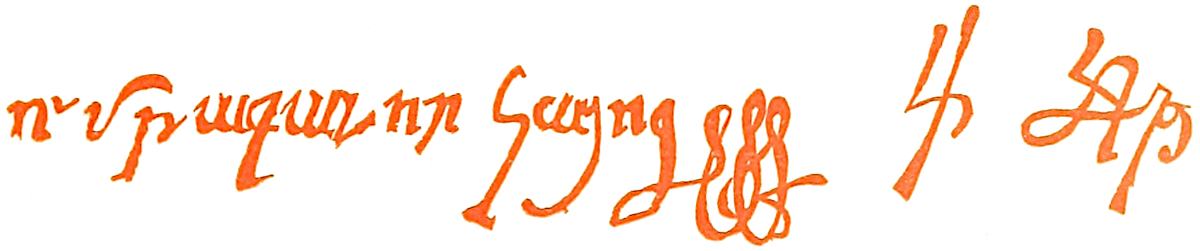
Autograph of Hayton, King of Armenia, circa A.D. 1243.
“... e por so qui cestes lettres soient fermes e establis ci avuns escrit
l’escrit de notre main vermoil e sayelé de notre ceau pendant....”
13. In days when History and Genealogy were allowed to draw largely on the
imagination for the origines of states and families, Alleged origin of the Polos.it was set down
by one Venetian Antiquary that among the companions of King Venetus, or
of Prince Antenor of Troy, when they settled on the northern shores of
the Adriatic, there was one Lucius Polus, who became the progenitor of
our Traveller’s Family;[1] whilst another deduces it from Paolo the first
Doge[2] (Paulus Lucas Anafestus of Heraclea, A.D. 696).
More trustworthy traditions, recorded among the Family Histories of Venice,
but still no more it is believed than traditions, represent the Family of
Polo as having come from Sebenico in Dalmatia, in the 11th century.[3]
Before the end of the century they had taken seats in the Great Council
of the Republic; for the name of Domenico Polo is said to be subscribed
to a grant of 1094, that of Pietro Polo to an act of the time of the Doge
Domenico Michiele in 1122, and that of a Domenico Polo to an acquittance
granted by the Doge Domenico Morosini and his Council in 1153.[4]
The ascertained genealogy of the Traveller, however, begins only with his
grandfather, who lived in the early part of the 13th century.
Two branches of the Polo Family were then recognized, distinguished by the
confini or Parishes in which they lived, as Polo of S. Geremia, and Polo
of S. Felice. Andrea Polo of S. Felice was the father of three sons, Marco,
Nicolo, and Maffeo. And Nicolo was the Father of our Marco.
14. Till quite recently it had never been precisely ascertained whether
the immediate family of our Traveller belonged to the Nobles of Venice
properly so called, Claims to be styled noble.who had seats in the Great Council and were enrolled in
the Libro d’Oro. Ramusio indeed styles our Marco Nobile and Magnifico,
and Rusticiano, the actual scribe of the Traveller’s recollections, calls
him “sajes et noble citaiens de Venece,” but Ramusio’s accuracy and
Rusticiano’s precision were scarcely to be depended on. Very recently,
however, since the subject has been discussed with accomplished students of
the Venice Archives, proofs have been found establishing Marco’s personal
claim to nobility, inasmuch as both in judicial decisions and in official
resolutions of the Great Council, he is designated Nobilis Vir, a formula
which would never have been used in such documents (I am assured) had he
not been technically noble.[5]
15. Of the three sons of Andrea Polo of S. Felice, Marco seems to have been
the eldest, and Maffeo the youngest.[6]
Marco the Elder.They were all engaged in commerce,
and apparently in a partnership, which to some extent held good even when
the two younger had been many years absent in the Far East.[7] Marco seems
to have been established for a time at Constantinople,[8] and also to have
had a house (no doubt of business) at Soldaia, in the Crimea, where his son
and daughter, Nicolo and Maroca by name, were living in 1280. This year is
the date of the Elder Marco’s Will, executed at Venice, and when he was
“weighed down by bodily ailment.” Whether he survived for any length of
time we do not know.
16. Nicolo Polo, the second of the Brothers, had two legitimate sons,
Marco, the Author of our Book, born in 1254,[9] and Maffeo, Nicolo and Maffeo commence their travels.of whose place
in the family we shall have a few words to say presently. The story opens,
as we have said, in 1260, when we find the two brothers, Nicolo and Maffeo
the Elder, at Constantinople. How long they had been absent from Venice
we are not distinctly told. Nicolo had left his wife there behind him;
Maffeo apparently was a bachelor. In the year named they started on a
trading venture to the Crimea, whence a succession of openings and chances,
recounted in the Introductory chapters of Marco’s work, carried them
far north along the Volga, and thence first to Bokhara, and then to the
Court of the Great Kaan Kúblái in the Far East, on or within the borders
of Cathay. That a great and civilized country so called existed in the
extremity of Asia had already been reported in Europe by the Friars Plano
Carpini (1246) and William Rubruquis (1253), who had not indeed reached its
frontiers, but had met with its people at the Court of the Great Kaan in
Mongolia; whilst the latter of the two with characteristic acumen had seen
that they were identical with the Seres of classic fame.
17. Kúblái had never before fallen in with European gentlemen. He was
delighted with these Venetians, Their intercourse with Kúblái Kaan.listened with strong interest to all that
they had to tell him of the Latin world, and determined to send them back
as his ambassadors to the Pope, accompanied by an officer of his own Court.
His letters to the Pope, as the Polos represent them, were mainly to desire
the despatch of a large body of educated missionaries to convert his
people to Christianity. It is not likely that religious motives influenced
Kúblái in this, but he probably desired religious aid in softening and
civilizing his rude kinsmen of the Steppes, and judged, from what he saw
in the Venetians and heard from them, that Europe could afford such aid of
a higher quality than the degenerate Oriental Christians with whom he was
familiar, or the Tibetan Lamas on whom his patronage eventually devolved
when Rome so deplorably failed to meet his advances.
18. The Brothers arrived at Acre in April,[10] 1269, and found that no Pope
existed, for Clement IV. was dead the year before, Their return home, and Marco’s appearance on the scene.and no new election had
taken place. So they went home to Venice to see how things stood there
after their absence of so many years.
The wife of Nicolo was no longer among the living, but he found his son
Marco a fine lad of fifteen.
The best and most authentic MSS. tell us no more than this. But one
class of copies, consisting of the Latin version made by our Traveller’s
contemporary, Francesco Pipino, and of the numerous editions based
indirectly upon it, represents that Nicolo had left Venice when Marco was
as yet unborn, and consequently had never seen him till his return from the
East in 1269.[11]
We have mentioned that Nicolo Polo had another legitimate son, by name
Maffeo, and him we infer to have been younger than Marco, because he is
named last (Marcus et Matheus) in the Testament of their uncle Marco the
Elder. We do not know if they were by the same mother. They could not have
been so if we are right in supposing Maffeo to have been the younger, and
if Pipino’s version of the history be genuine. If however we reject the
latter, as I incline to do, no ground remains for supposing that Nicolo
went to the East much before we find him there viz., in 1260, and Maffeo
may have been born of the same mother during the interval between 1254 and
1260. If on the other hand Pipino’s version be held to, we must suppose
that Maffeo (who is named by his uncle in 1280, during his father’s second
absence in the East) was born of a marriage contracted during Nicolo’s
residence at home after his first journey, a residence which lasted from
1269 to 1271.[12]
The Piazzetta at Venice. (From the Bodleian MS. of Polo.)
19. The Papal interregnum was the longest known, at least since the dark
ages. Those two years passed, and yet the Cardinals at Viterbo had come
to no agreement. Second Journey of the Polo Brothers, accompanied by Marco.The brothers were unwilling to let the Great Kaan think
them faithless, and perhaps they hankered after the virgin field of
speculation that they had discovered; so they started again for the East,
taking young Mark with them. At Acre they took counsel with an eminent
churchman, Tedaldo (or Tebaldo) Visconti, Archdeacon of Liège, whom the
Book represents to have been Legate in Syria, and who in any case was a
personage of much gravity and influence. From him they got letters to
authenticate the causes of the miscarriage of their mission, and started
for the further East. But they were still at the port of Ayas on the Gulf
of Scanderoon, which was then becoming one of the chief points of arrival
and departure for the inland trade of Asia, when they were overtaken by the
news that a Pope was at last elected, and that the choice had fallen upon
their friend Archdeacon Tedaldo. They immediately returned to Acre, and at
last were able to execute the Kaan’s commission, and to obtain a reply. But
instead of the hundred able teachers of science and religion whom Kúblái
is said to have asked for, the new Pope, Gregory X., could supply but two
Dominicans; and these lost heart and drew back when they had barely taken
the first step of the journey.
Judging from certain indications we conceive it probable that the three
Venetians, whose second start from Acre took place about November 1271,
proceeded by Ayas and Sivas, and then by Mardin, Mosul, and Baghdad, to
Hormuz at the mouth of the Persian Gulf, with the view of going on by sea,
but that some obstacle arose which compelled them to abandon this project
and turn north again from Hormuz.[13] They then traversed successively
Kerman and Khorasan, Balkh and Badakhshan, whence they ascended the Panja
or upper Oxus to the Plateau of Pamir, a route not known to have been
since followed by any European traveller except Benedict Goës, till the
spirited expedition of Lieutenant John Wood of the Indian Navy in 1838.[14]
Crossing the Pamir highlands the travellers descended upon Kashgar, whence
they proceeded by Yarkand and Khotan, and the vicinity of Lake Lob, and
eventually across the Great Gobi Desert to Tangut, the name then applied
by Mongols and Persians to territory at the extreme North-west of China,
both within and without the Wall. Skirting the northern frontier of China
they at last reached the presence of the Kaan, who was at his usual summer
retreat at Kai-ping fu, near the base of the Khingan Mountains, and nearly
100 miles north of the Great Wall at Kalgan. If there be no mistake in the
time (three years and a half) ascribed to this journey in all the existing
texts, the travellers did not reach the Court till about May of 1275.[15]
20. Kúblái received the Venetians with great cordiality, and took kindly
to young Mark, who must have been by this time one-and-twenty. Marco’s employment by Kúblái Kaan; and his journeys.The Joenne
Bacheler, as the story calls him, applied himself to the acquisition of
the languages and written characters in chief use among the multifarious
nationalities included in the Kaan’s Court and administration; and Kúblái
after a time, seeing his discretion and ability, began to employ him in
the public service. M. Pauthier has found a record in the Chinese Annals
of the Mongol Dynasty, which states that in the year 1277, a certain Polo
was nominated a second-class commissioner or agent attached to the Privy
Council, a passage which we are happy to believe to refer to our young
traveller.[16]
His first mission apparently was that which carried him through the
provinces of Shan-si, Shen-si, and Sze-ch’wan, and the wild country on
the East of Tibet, to the remote province of Yun-nan, called by the
Mongols Karájàng, and which had been partially conquered by an army under
Kúblái himself in 1253, before his accession to the throne.[17] Mark,
during his stay at court, had observed the Kaan’s delight in hearing of
strange countries, their marvels, manners, and oddities, and had heard
his Majesty’s frank expressions of disgust at the stupidity of his
commissioners when they could speak of nothing but the official business on
which they had been sent. Profiting by these observations, he took care to
store his memory or his note-books with all curious facts that were likely
to interest Kúblái, and related them with vivacity on his return to Court.
This first journey, which led him through a region which is still very
nearly a terra incognita, and in which there existed and still exists,
among the deep valleys of the Great Rivers flowing down from Eastern Tibet,
and in the rugged mountain ranges bordering Yun-nan and Kwei-chau, a vast
Ethnological Garden, as it were, of tribes of various race and in every
stage of uncivilisation, afforded him an acquaintance with many strange
products and eccentric traits of manners, wherewith to delight the Emperor.
Mark rose rapidly in favour, and often served Kúblái again on distant
missions, as well as in domestic administration, but we gather few details
as to his employments. At one time we know that he held for three years
the government of the great city of Yang-chau, though we need not try to
magnify this office, as some commentators have done, into the viceroyalty
of one of the great provinces of the Empire; on another occasion we find
him with his uncle Maffeo, passing a year at Kan-chau in Tangut; again,
it would appear, visiting Kara Korum, the old capital of the Kaans in
Mongolia; on another occasion in Champa or Southern Cochin China; and
again, or perhaps as a part of the last expedition, on a mission to the
Indian Seas, when he appears to have visited several of the southern states
of India. We are not informed whether his father and uncle shared in such
employments;[18] and the story of their services rendered to the Kaan
in promoting the capture of the city of Siang-yang, by the construction
of powerful engines of attack, is too much perplexed by difficulties of
chronology to be cited with confidence. Anyhow they were gathering wealth,
and after years of exile they began to dread what might follow old Kúblái’s
death, and longed to carry their gear and their own grey heads safe home to
the Lagoons. The aged Emperor growled refusal to all their hints, and but
for a happy chance we should have lost our mediæval Herodotus.
21. Arghún Khan of Persia, Kúblái’s great-nephew, had in 1286 lost his
favourite wife the Khatun Bulughán; and, mourning her sorely, Circumstances
of the Departure of the Polos from the Kaan’s Court.took steps to
fulfil her dying injunction that her place should be filled only by a lady
of her own kin, the Mongol Tribe of Bayaut. Ambassadors were despatched to
the Court of Kaan-baligh to seek such a bride. The message was courteously
received, and the choice fell on the lady Kokáchin, a maiden of 17, “moult
bele dame et avenant.” The overland road from Peking to Tabriz was not
only of portentous length for such a tender charge, but was imperilled
by war, so the envoys desired to return by sea. Tartars in general were
strangers to all navigation; and the envoys, much taken with the Venetians,
and eager to profit by their experience, especially as Marco had just then
returned from his Indian mission, begged the Kaan as a favour to send the
three Firinghis in their company. He consented with reluctance, but,
having done so, fitted the party out nobly for the voyage, charging the
Polos with friendly messages for the potentates of Europe, including the
King of England. They appear to have sailed from the port of Zayton (as the
Westerns called T’swan-chau or Chin-cheu in Fo-kien) in the beginning of
1292. It was an ill-starred voyage, involving long detentions on the coast
of Sumatra, and in the South of India, to which, however, we are indebted
for some of the best chapters in the book; and two years or upwards passed
before they arrived at their destination in Persia.[19] The three hardy
Venetians survived all perils, and so did the lady, who had come to look on
them with filial regard; but two of the three envoys, and a vast proportion
of the suite, had perished by the way.[20] Arghún Khan too had been dead
even before they quitted China;[21] his brother Kaikhátú reigned in his
stead; and his son Gházán succeeded to the lady’s hand. We are told by
one who knew both the princes well that Arghún was one of the handsomest
men of his time, whilst Gházán was, among all his host, one of the most
insignificant in appearance. But in other respects the lady’s change was
for the better. Gházán had some of the highest qualities of a soldier, a
legislator and a king, adorned by many and varied accomplishments; though
his reign was too short for the full development of his fame.
22. The princess, whose enjoyment of her royalty was brief, wept as she
took leave of the kindly and noble Venetians. They pass by Persia to Venice. Their relations there.They went on to Tabriz, and
after a long halt there proceeded homewards, reaching Venice, according to
all the texts some time in 1295.[22]
We have related Ramusio’s interesting tradition, like a bit out of the
Arabian Nights, of the reception that the Travellers met with from their
relations, and of the means that they took to establish their position with
those relations, and with Venetian society.[23] Of the relations, Marco the
Elder had probably been long dead;[24] Maffeo the brother of our Marco was
alive, and we hear also of a cousin (consanguineus) Felice Polo, and his
wife Fiordelisa, without being able to fix their precise position in the
family. We know also that Nicolo, who died before the end of the century,
left behind him two illegitimate sons, Stefano and Zannino. It is not
unlikely that these were born from some connection entered into during the
long residence of the Polos in Cathay, though naturally their presence in
the travelling company is not commemorated in Marco’s Prologue.[25]
23. We have seen that Ramusio places the scene of the story recently
alluded to at the mansion in the parish of S. Giovanni Grisostomo, the
court of which was known in his time as the Corte del Millioni; and indeed
he speaks of Probable period of their establishment at S. Giovanni
Grisostomo.the Travellers as at once on their arrival resorting to that
mansion as their family residence. Ramusio’s details have so often proved
erroneous that I should not be surprised if this also should be a mistake.
At least we find (so far as I can learn) no previous intimation that the
family were connected with that locality. The grandfather Andrea is styled
of San Felice. The will of Maffeo Polo the younger, made in 1300, which
we shall give hereafter in abstract, appears to be the first document
that connects the family with S. Giovanni Grisostomo. It indeed styles
the testator’s father “the late Nicolo Paulo of the confine of St. John
Chrysostom,” but that only shows what is not disputed, that the Travellers
after their return from the East settled in this locality. And the same
will appears to indicate a surviving connexion with S. Felice, for the
priests and clerks who drew it up and witness it are all of the church of
S. Felice, and it is to the parson of S. Felice and his successor that
Maffeo bequeaths an annuity to procure their prayers for the souls of his
father, his mother, and himself, though after the successor the annuity
is to pass on the same condition to the senior priest of S. Giovanni
Grisostomo. Marco Polo the Elder is in his will described as of S.
Severo, as is also his sister-in-law Fiordelisa, and the document contains
no reference to S. Giovanni. On the whole therefore it seems probable that
the Palazzo in the latter parish was purchased by the Travellers after
their return from the East.[1]
Corte del Milione, Venice.
24. The Court which was known in the 16th century as the Corte del Millioni
has been generally understood to be that now known as the Corte Sabbionera,Relic of the Casa Polo in the Corte Sabbionera.
and here is still pointed out a relic of Marco Polo’s mansion. [Indeed it
is called now (1899) Corte del Milione; see p. 30.—H. C.]
M. Pauthier’s edition is embellished with a good engraving which purports
to represent the House of Marco Polo. But he has been misled. His engraving
in fact exhibits, at least as the prominent feature, an embellished
representation of a small house which exists on the west side of the
Sabbionera, and which had at one time perhaps that pointed style of
architecture which his engraving shows, though its present decoration is
paltry and unreal. But it is on the north side of the Court, and on the
foundations now occupied by the Malibran theatre, that Venetian tradition
and the investigations of Venetian antiquaries concur in indicating
the site of the Casa Polo. At the end of the 16th century a great fire
destroyed the Palazzo,[2] and under the description of “an old mansion
ruined from the foundation” it passed into the hands of one Stefano
Vecchia, who sold it in 1678 to Giovanni Carlo Grimani. He built on the
site of the ruins a theatre which was in its day one of the largest in
Italy, and was called the Theatre of S. Giovanni Grisostomo; afterwards the
Teatro Emeronitio. When modernized in our own day the proprietors gave it
the name of Malibran, in honour of that famous singer, and this it still
bears.[3]
[In 1881, the year of the Venice International Geographical Congress, a
Tablet was put up on the Theatre with the following inscription:—
QVI FURONO LE CASE
DI
MARCO POLO
CHE VIAGGIÒ LE PIÙ LONTANE REGIONI DELL’ASIA
E LE DESCRISSE
PER DECRETO DEL COMUNE
MDCCCLXXXI].
There is still to be seen on the north side of the Court an arched doorway
in Italo-Byzantine style, richly sculptured with scrolls, disks, and
symbolical animals, and on the wall above the doorway is a cross similarly
ornamented.[4] The style and the decorations are those which were usual
in Venice in the 13th century. The arch opens into a passage from which a
similar doorway at the other end, also retaining some scantier relics of
decoration, leads to the entrance of the Malibran Theatre. Over the archway
in the Corte Sabbionera the building rises into a kind of tower. This, as
well as the sculptured arches and cross, Signor Casoni, who gave a good
deal of consideration to the subject, believed to be a relic of the old
Polo House. But the tower (which Pauthier’s view does show) is now entirely
modernized.[5]
Malibran Theatre, Venice.
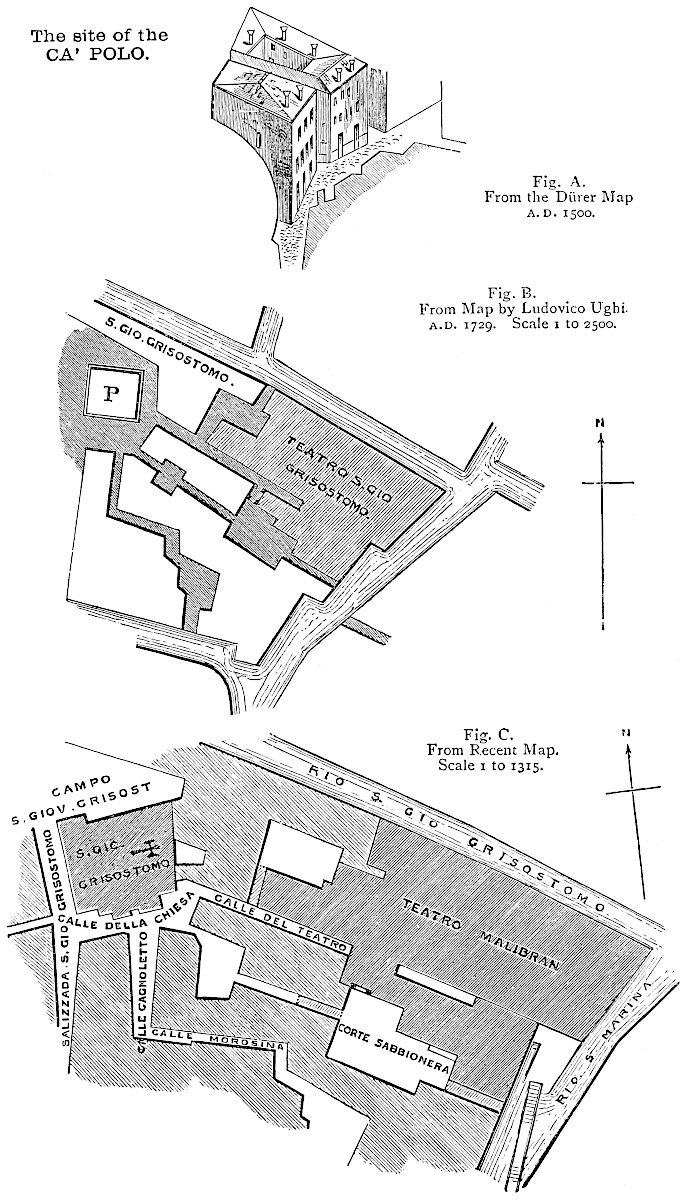
The site of the CA’ POLO.
Fig. A. From the Dürer Map. A.D. 1500.
Fig. B. From Map by Ludovico Ughi. A.D. 1729 Scale 1 to 2500.
Fig. C. From Recent Map. Scale 1 to 1315.
Other remains of Byzantine sculpture, which are probably fragments of
the decoration of the same mansion, are found imbedded in the walls of
neighbouring houses.[6] It is impossible to determine anything further
as to the form or extent of the house of the time of the Polos, but some
slight idea of its appearance about the year 1500 may be seen in the
extract (fig. a) which we give from the famous pictorial map of Venice
attributed erroneously to Albert Dürer. The state of the buildings in the
last century is shown in (fig. b) an extract from the fine Map of Ughi; and
their present condition in one (fig. c) reduced from the Modern Official
Map of the Municipality.
[Coming from the Church of S. G. Grisostomo to enter the calle del Teatro
on the left and the passage (Sottoportico) leading to the Corte del
Milione, one has in front of him a building with a door of the epoch of
the Renaissance; it was the office of the provveditori of silk; on the
architrave are engraved the words:
PROVISORES SERICI
and below, above the door, is the Tablet which] in the year 1827 the Abate
Zenier caused to be put up with this inscription:—
AEDES PROXIMA THALIAE CVLTVI MODO ADDICTA
MARCI POLO P. V. ITINERVM FAMA PRAECLARI
JAM HABITATIO FVIT.
24a. I believe that of late years some doubts have been thrown on the
tradition of the site indicated as that of the Casa Polo, Recent
corroboration as to the traditional site of the Casa Polo.though I am not
aware of the grounds of such doubts. But a document recently discovered
at Venice by Comm. Barozzi, one of a series relating to the testamentary
estate of Marco Polo, goes far to confirm the tradition. This is the copy
of a technical definition of two pieces of house property adjoining the
property of Marco Polo and his brother Stephen, which were sold to Marco
Polo by his wife Donata[7] in June 1321. Though the definition is not
decisive, from the rarity of topographical references and absence of points
of the compass, the description of Donata’s tenements as standing on the
Rio (presumably that of S. Giovanni Grisostomo) on one side, opening by
certain porticoes and stairs on the other to the Court and common alley
leading to the Church of S. Giovanni Grisostomo, and abutting in two places
on the Ca’ Polo, the property of her husband and Stefano, will apply
perfectly to a building occupying the western portion of the area on which
now stands the Theatre, and perhaps forming the western side of a Court of
which Casa Polo formed the other three sides.[8]
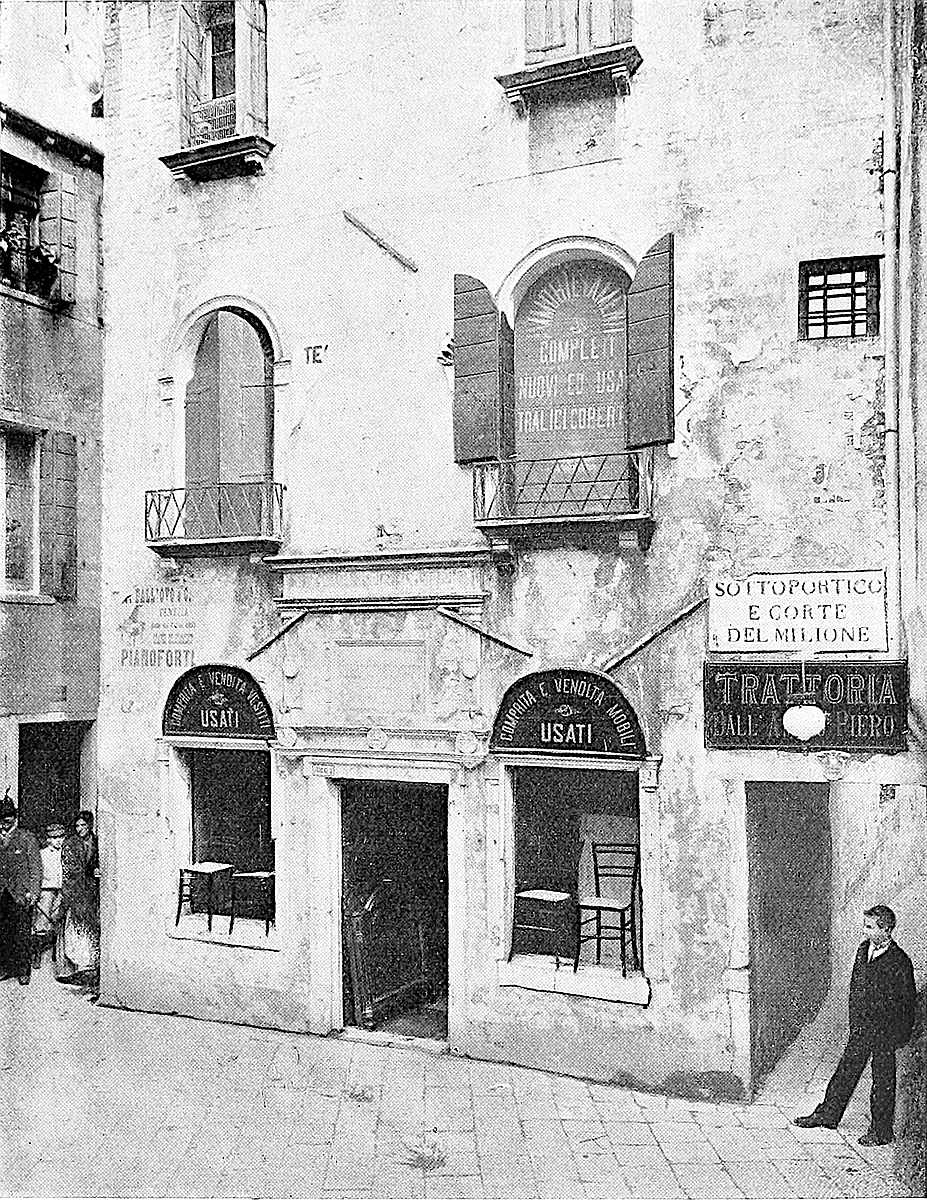
Entrance to the Corte del Milione, Venice.
We know nothing more of Polo till we find him appearing a year or two later
in rapid succession as the Captain of a Venetian Galley, as a prisoner of
war, and as an author.
25. And before entering on this new phase of the Traveller’s biography it
may not be Arrangement of the Rowers in Mediæval Galleys: a separate oar
to every man.without interest that we say something regarding the equipment
of those galleys which are so prominent in the mediæval history of the
Mediterranean.[1]
Eschewing that “Serbonian Bog, where armies whole have sunk” of Books
and Commentators, the theory of the classification of the Biremes and
Triremes of the Ancients, we can at least assert on secure grounds that in
mediæval armament, up to the middle of the 16th century or thereabouts,
the characteristic distinction of galleys of different calibres, so far
as such differences existed, was based on the number of rowers that sat
on one bench pulling each his separate oar, but through one portella
or rowlock-port.[2] And to the classes of galleys so distinguished the
Italians, of the later Middle Age at least, did certainly apply, rightly or
wrongly, the classical terms of Bireme, Trireme, and Quinquereme, in
the sense of galleys having two men and two oars to a bench, three men and
three oars to a bench, and five men and five oars to a bench.[3]
That this was the mediæval arrangement is very certain from the details
afforded by Marino Sanudo the Elder, confirmed by later writers and by
works of art. Previous to 1290, Sanudo tells us, almost all the galleys
that went to the Levant had but two oars and men to a bench; but as it had
been found that three oars and men to a bench could be employed with great
advantage, after that date nearly all galleys adopted this arrangement,
which was called ai Terzaruoli.[4]
Moreover experiments made by the Venetians in 1316 had shown that four
rowers to a bench could be employed still more advantageously. And where
the galleys could be used on inland waters, and could be made more bulky,
Sanudo would even recommend five to a bench, or have gangs of rowers on two
decks with either three or four men to the bench on each deck.
26. This system of grouping the oars, and putting only one man to an oar,
continued down to the 16th century, during the Change of System in the 16th century.first half of which came in
the more modern system of using great oars, equally spaced, and requiring
from four to seven men each to ply them, in the manner which endured till
late in the last century, when galleys became altogether obsolete. Captain
Pantero Pantera, the author of a work on Naval Tactics (1616), says he had
heard, from veterans who had commanded galleys equipped in the antiquated
fashion, that three men to a bench, with separate oars, answered better
than three men to one great oar, but four men to one great oar (he says)
were certainly more efficient than four men with separate oars. The
new-fashioned great oars, he tells us, were styled Remi di Scaloccio, the
old grouped oars Remi a Zenzile,—terms the etymology of which I cannot
explain.[5]
It may be doubted whether the four-banked and five-banked galleys, of
which Marino Sanudo speaks, really then came into practical use. A great
five-banked galley on this system, built in 1529 in the Venice Arsenal by
Vettor Fausto, was the subject of so much talk and excitement, that it must
evidently have been something quite new and unheard of.[6] So late as 1567
indeed the King of Spain built at Barcelona a galley of thirty-six benches
to the side, and seven men to the bench, with a separate oar to each in the
old fashion. But it proved a failure.[7]
Down to the introduction of the great oars the usual system appears to have
been three oars to a bench for the larger galleys, and two oars for lighter
ones. The fuste or lighter galleys of the Venetians, even to about the
middle of the 16th century, had their oars in pairs from the stern to the
mast, and single oars only from the mast forward.[8]
27. Returning then to the three-banked and two-banked galleys of the latter
part of the 13th century, the number of benches onSome details of the 13th century Galleys. each side seems to have
run from twenty-five to twenty-eight, at least as I interpret Sanudo’s
calculations. The 100-oared vessels often mentioned (e.g. by Muntaner, p.
419) were probably two-banked vessels with twenty-five benches to a side.
The galleys were very narrow, only 15½ feet in beam.[9] But to give
room for the play of the oars and the passage of the fighting-men, &c.,
this width was largely augmented by an opera-morta, or outrigger
deck, projecting much beyond the ship’s sides and supported by timber
brackets.[10] I do not find it stated how great this projection was in
the mediæval galleys, but in those of the 17th century it was on each
side as much as ²⁄₉ths of the true beam. And if it was as great in the
13th-century galleys the total width between the false gunnels would be
about 22¼ feet.
In the centre line of the deck ran, the whole length of the vessel, a
raised gangway called the corsia, for passage clear of the oars.
The benches were arranged as in this diagram. The part of the bench next
the gunnel was at right angles to it, but the other two-thirds of the bench
were thrown forward obliquely. a, b, c, indicate the position of the
three rowers. The shortest oar a was called Terlicchio, the middle one
b Posticcio, the long oar c Piamero.[11]
I do not find any information as to how the oars worked on the gunnels.
The Siena fresco (see p. 35) appears to show them attached by loops and
pins, which is the usual practice in boats of the Mediterranean now. In
the cut from D. Tintoretto (p. 37) the groups of oars protrude through
regular ports in the bulwarks, but this probably represents the use of a
later day. In any case the oars of each bench must have worked in very
close proximity. Sanudo states the length of the galleys of his time
(1300–1320) as 117 feet. This was doubtless length of keel, for that is
specified (“da ruoda a ruoda”) in other Venetian measurements, but the
whole oar space could scarcely have been so much, and with twenty-eight
benches to a side there could not have been more than 4 feet gunnel-space
to each bench. And as one of the objects of the grouping of the oars was to
allow room between the benches for the action of cross-bowmen, &c., it is
plain that the rowlock space for the three oars must have been very much
compressed.[12]
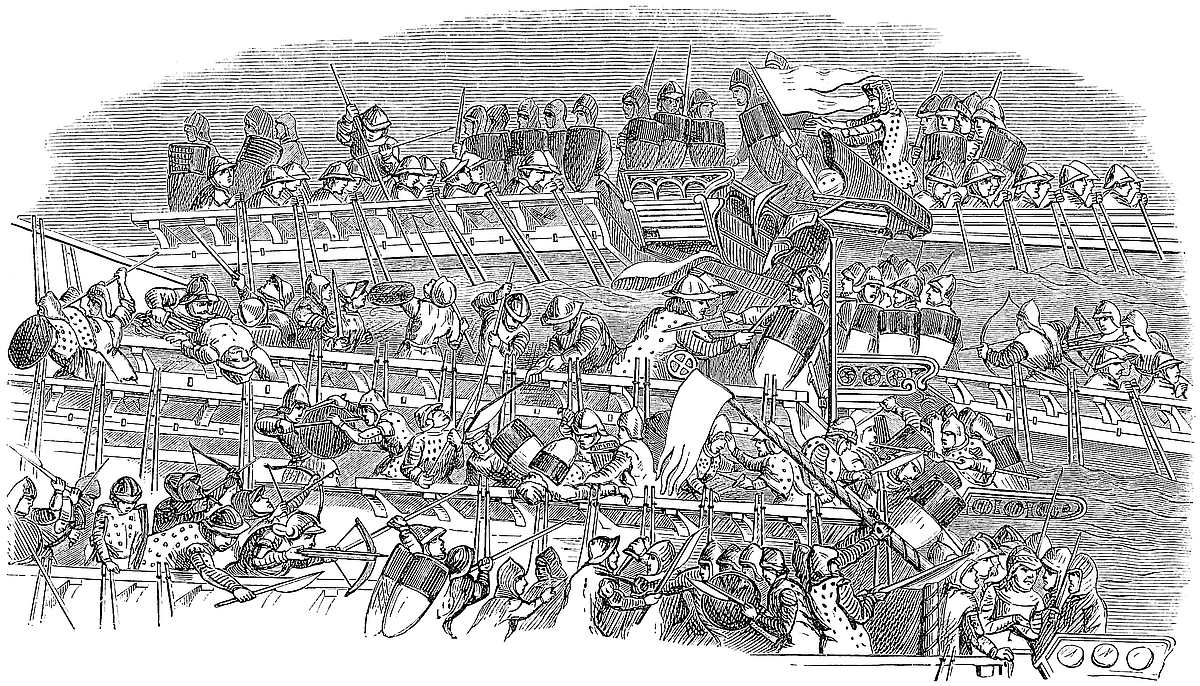
Galley-Fight, from a Mediæval Fresco at Siena. (See
p. 36.)
The rowers were divided into three classes, with graduated pay. The highest
class, who pulled the poop or stroke oars, were called Portolati; those
at the bow, called Prodieri, formed the second class.[13]
Some elucidation of the arrangements that we have tried to describe will
be found in our cuts. That at p. 35 is from a drawing, by the aid of a
very imperfect photograph, of part of one of the frescoes of Spinello
Aretini in the Municipal Palace at Siena, representing a victory of the
Venetians over the Emperor Frederick Barbarossa’s fleet, commanded by his
son Otho, in 1176; but no doubt the galleys, &c., are of the artist’s
own age, the middle of the 14th century.[14] In this we see plainly the
projecting opera-morta, and the rowers sitting two to a bench, each with
his oar, for these are two-banked. We can also discern the Latin rudder
on the quarter. (See this volume, p. 118.) In a picture in the Uffizj, at
Florence, of about the same date, by Pietro Laurato (it is in the corridor
near the entrance), may be seen a small figure of a galley with the oars
also very distinctly coupled.[15] Casoni has engraved, after Cristoforo
Canale, a pictorial plan of a Venetian trireme of the 16th century, which
shows the arrangement of the oars in triplets very plainly.
The following cut has been sketched from an engraving of a picture by
Domenico Tintoretto in the Doge’s palace, representing, I believe, the
same action (real or imaginary) as Spinello’s fresco, but with the costume
and construction of a later date. It shows, however, very plainly, the
projecting opera-morta and the arrangement of the oars in fours, issuing
through row-ports in high bulwarks.
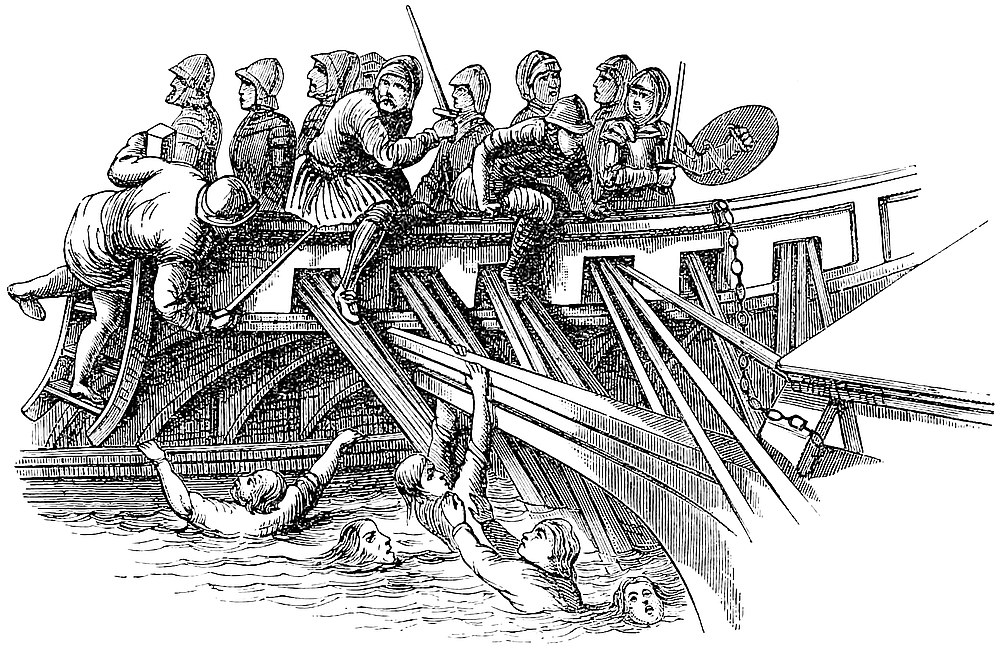
Part of a Sea Fight, after Dom. Tintoretto.
28. Midships in the mediæval galley a castle was erected, of the width
of the ship, and some 20 feet in length; Fighting Arrangements.its platform being elevated
sufficiently to allow of free passage under it and over the benches. At
the bow was the battery, consisting of mangonels (see vol. ii. p. 161
seqq.) and great cross-bows with winding gear,[16] whilst there were
shot-ports[17] for smaller cross-bows along the gunnels in the intervals
between the benches. Some of the larger galleys had openings to admit
horses at the stern, which were closed and caulked for the voyage, being
under water when the vessel was at sea.[18]
It seems to have been a very usual piece of tactics, in attacking as well
as in awaiting attack, to connect a large number of galleys by hawsers, and
sometimes also to link the oars together, so as to render it difficult for
the enemy to break the line or run aboard. We find this practised by the
Genoese on the defensive at the battle of Ayas (infra, p. 43), and it is
constantly resorted to by the Catalans in the battles described by Ramon de
Muntaner.[19]
Sanudo says the toil of rowing in the galleys was excessive, almost
unendurable. Yet it seems to have been performed by freely-enlisted men,
and therefore it was probably less severe than that of the great-oared
galleys of more recent times, which it was found impracticable to work
by free enlistment, or otherwise than by slaves under the most cruel
driving.[20] I am not well enough read to say that war-galleys were never
rowed by slaves in the Middle Ages, but the only doubtful allusion to such
a class that I have met with is in one passage of Muntaner, where he says,
describing the Neapolitan and Catalan fleets drawing together for action,
that the gangs of the galleys had to toil like “forçats” (p. 313).
Indeed, as regards Venice at least, convict rowers are stated to have been
first introduced in 1549, previous to which the gangs were of galeotti
assoldati.[21]
29. We have already mentioned that Crew of a Galley and Staff of a Fleet.Sanudo requires for his three-banked
galley a ship’s company of 250 men. They are distributed as follows:—
| Comito or Master |
1 |
| Quartermasters |
8 |
| Carpenters |
2 |
| Caulkers |
2 |
| In charge of stores and arms |
4 |
| Orderlies |
2 |
| Cook |
1 |
| Arblasteers |
50 |
| Rowers |
180 |
| |
—— |
| |
|
This does not include the Sopracomito, or Gentleman-Commander, who was
expected to be valens homo et probus, a soldier and a gentleman, fit to
be consulted on occasion by the captain-general. In the Venetian fleet he
was generally a noble.[23]
The aggregate pay of such a crew, not including the sopracomito, amounted
monthly to 60 lire de’ grossi, or 600 florins, equivalent to 280l. at
modern gold value; and the cost for a year to nearly 3160l., exclusive of
the victualling of the vessel and the pay of the gentleman-commander. The
build or purchase of a galley complete is estimated by the same author at
15,000 florins, or 7012l.
We see that war cost a good deal in money even then.
Besides the ship’s own complement Sanudo gives an estimate for the general
staff of a fleet of 60 galleys. This consists of a captain-general, two
(vice) admirals, and the following:—
6 |
Probi homines, or gentlemen of character, forming a council to the
Captain-General; |
4 |
Commissaries of Stores; |
2 |
Commissaries over the Arms; |
3 |
Physicians; |
3 |
Surgeons; |
5 |
Master Engineers and Carpenters; |
15 |
Master Smiths; |
12 |
Master Fletchers; |
5 |
Cuirass men and Helmet-makers; |
15 |
Oar-makers and Shaft-makers; |
10 |
Stone cutters for stone shot; |
10 |
Master Arblast-makers; |
20 |
Musicians; |
20 |
Orderlies, &c. |
30. The musicians formed an important part of the equipment. Sanudo says
that in going into action every vessel should make the greatest possible
display of colours; Music; and other particulars.gonfalons and broad banners should float from stem to
stern, and gay pennons all along the bulwarks; whilst it was impossible to
have too much of noisy music, of pipes, trumpets, kettle-drums, and what
not, to put heart into the crew and strike fear into the enemy.[24]
So Joinville, in a glorious passage, describes the galley of his kinsman,
the Count of Jaffa, at the landing of St. Lewis in Egypt:—
“That galley made the most gallant figure of them all, for it was
painted all over, above water and below, with scutcheons of the
count’s arms, the field of which was or with a cross patée
gules.[25] He had a good 300 rowers in his galley, and every man
of them had a target blazoned with his arms in beaten gold. And, as
they came on, the galley looked to be some flying creature, with such
spirit did the rowers spin it along;—or rather, with the rustle of
its flags, and the roar of its nacaires and drums and Saracen horns,
you might have taken it for a rushing bolt of heaven.”[26]
The galleys, which were very low in the water,[27] could not keep the sea
in rough weather, and in winter they never willingly kept the sea at night,
however fair the weather might be. Yet Sanudo mentions that he had been
with armed galleys to Sluys in Flanders.
I will mention two more particulars before concluding this digression. When
captured galleys were towed into port it was stern foremost, and with their
colours dragging on the surface of the sea.[28] And the custom of saluting
at sunset (probably by music) was in vogue on board the galleys of the 13th
century.[29]
We shall now sketch the circumstances that led to the appearance of our
Traveller in the command of a war-galley.
31. Jealousies, too characteristic of the Italian communities, were, in
the case of the three great trading republics of Venice, Genoa, and Pisa,
Growing jealousies and outbreaks between the Republics.
aggravated by commercial rivalries, whilst, between the two first of those
states, and also between the two last, the bitterness of such feelings had
been augmenting during the whole course of the 13th century.[1]
The brilliant part played by Venice in the conquest of Constantinople
(1204), and the preponderance she thus acquired on the Greek shores,
stimulated her arrogance and the resentment of her rivals. The three states
no longer stood on a level as bidders for the shifting favour of the
Emperor of the East. By treaty, not only was Venice established as the most
important ally of the empire and as mistress of a large fraction of its
territory, but all members of nations at war with her were prohibited from
entering its limits. Though the Genoese colonies continued to exist, they
stood at a great disadvantage, where their rivals were so predominant and
enjoyed exemption from duties, to which the Genoese remained subject. Hence
jealousies and resentments reached a climax in the Levantine settlements,
and this colonial exacerbation reacted on the mother States.
A dispute which broke out at Acre in 1255 came to a head in a war which
lasted for years, and was felt all over Syria. It began in a quarrel about
a very old church called St. Sabba’s, which stood on the common boundary of
the Venetian and Genoese estates in Acre,[2] and this flame was blown by
other unlucky occurrences. Acre suffered grievously.[3] Venice at this time
generally kept the upper hand, beating Genoa by land and sea, and driving
her from Acre altogether.✛ Four ancient porphyry figures from St. Sabba’s
were sent in triumph to Venice, and with their strange devices still stand
at the exterior corner of St. Mark’s, towards the Ducal Palace.[4]
But no number of defeats could extinguish the spirit of Genoa, and the
tables were turned when in her wrath she allied herself with Michael
Palaeologus to upset the feeble and tottering Latin Dynasty, and with
it the preponderance of Venice on the Bosphorus. The new emperor handed
over to his allies the castle of their foes, which they tore down with
jubilations, and now it was their turn to send its stones as trophies to
Genoa. Mutual hate waxed fiercer than ever; no merchant fleet of either
state could go to sea without convoy, and wherever their ships met they
fought.[5] It was something like the state of things between Spain and
England in the days of Drake.
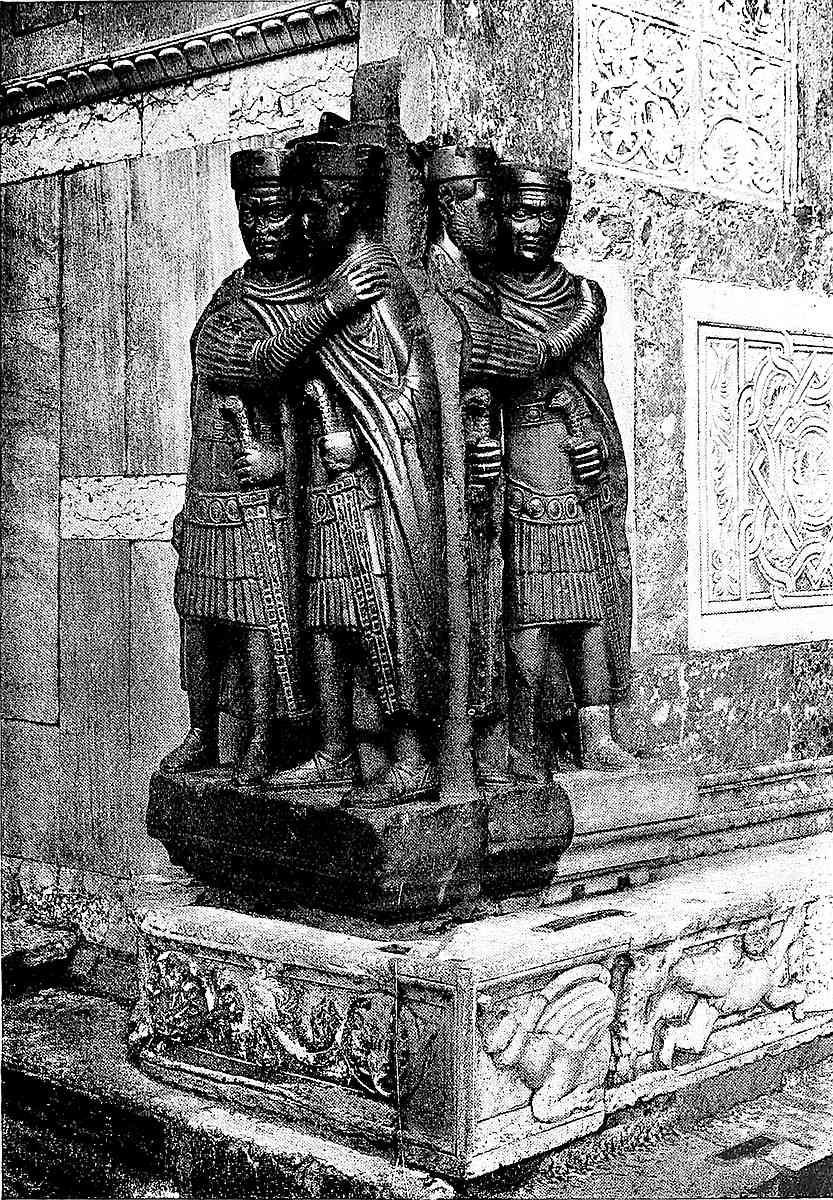
Figures from St. Sabba’s, sent to Venice.
The energy and capacity of the Genoese seemed to rise with their success,
and both in seamanship and in splendour they began almost to surpass their
old rivals. The fall of Acre (1291), and the total expulsion of the Franks
from Syria, in great measure barred the southern routes of Indian trade,
whilst the predominance of Genoa in the Euxine more or less obstructed the
free access of her rival to the northern routes by Trebizond and Tana.
32. Truces were made and renewed, but the old fire still smouldered. In the
spring of 1294 it broke into flame, in consequence of the seizure in the
Grecian seas of three Battle in Bay of Ayas in 1294.Genoese vessels by a Venetian fleet. This led to an
action with a Genoese convoy which sought redress. The fight took place off
Ayas in the Gulf of Scanderoon,[6] and though the Genoese were inferior in
strength by one-third they gained a signal victory, capturing all but three
of the Venetian galleys, with rich cargoes, including that of Marco Basilio
(or Basegio), the commodore.
This victory over their haughty foe was in its completeness evidently a
surprise to the Genoese, as well as a source of immense exultation, which
is vigorously expressed in a ballad of the day, written in a stirring
salt-water rhythm.[7] It represents the Venetians, as they enter the
bay, in arrogant mirth reviling the Genoese with very unsavoury epithets
as having deserted their ships to skulk on shore. They are described as
saying:—
“‘Off they’ve slunk! and left us nothing;
We shall get nor prize nor praise;
Nothing save those crazy timbers
Only fit to make a blaze.’”
So they advance carelessly—
“On they come! But lo their blunder!
When our lads start up anon,
Breaking out like unchained lions,
With a roar, ‘Fall on! Fall on!’”
[8]
After relating the battle and the thoroughness of the victory, ending in
the conflagration of five-and-twenty captured galleys, the poet concludes
by an admonition to the enemy to moderate his pride and curb his arrogant
tongue, harping on the obnoxious epithet porci leproxi, which seems to
have galled the Genoese.[9] He concludes:—
“Nor can I at all remember
Ever to have heard the story
Of a fight wherein the Victors
Reaped so rich a meed of glory!”
[10]
The community of Genoa decreed that the victory should be commemorated by
the annual presentation of a golden pall to the monastery of St. German’s,
the saint on whose feast (28th May) it had been won.[11]
The startling news was received at Venice with wrath and grief, for the
flower of their navy had perished, and all energies were bent at once to
raise an overwhelming force.[12] The Pope (Boniface VIII.) interfered as
arbiter, calling for plenipotentiaries from both sides. But spirits were
too much inflamed, and this mediation came to nought.
Further outrages on both sides occurred in 1296. The Genoese residences
at Pera were fired, their great alum works on the coast of Anatolia were
devastated, and Caffa was stormed and sacked; whilst on the other hand a
number of the Venetians at Constantinople were massacred by the Genoese,
and Marco Bembo, their Bailo, was flung from a house-top. Amid such events
the fire of enmity between the cities waxed hotter and hotter.
33. In 1298 the Genoese made elaborate preparations for a great blow at the
enemy, and fitted out a powerful fleet which they placed Lamba Doria’s Expedition to the Adriatic.under the command
of Lamba Doria, a younger brother of Uberto of that illustrious house,
under whom he had served fourteen years before in the great rout of the
Pisans at Meloria.
The rendezvous of the fleet was in the Gulf of Spezia, as we learn from the
same pithy Genoese poet who celebrated Ayas. This time the Genoese were
bent on bearding St. Mark’s Lion in his own den; and after touching at
Messina they steered straight for the Adriatic:—
“Now, as astern Otranto bears,
Pull with a will! and, please the Lord,
Let them who bragged, with fire and sword,
To waste our homesteads, look to theirs!”
[13]
On their entering the gulf a great storm dispersed the fleet. The admiral
with twenty of his galleys got into port at Antivari on the Albanian coast,
and next day was rejoined by fifty-eight more, with which he scoured the
Dalmatian shore, plundering all Venetian property. Some sixteen of his
galleys were still missing when he reached the island of Curzola, or
Scurzola as the more popular name seems to have been, the Black Corcyra of
the Ancients—the chief town of which, a rich and flourishing place, the
Genoese took and burned.[14] Thus they were engaged when word came that the
Venetian fleet was in sight.
Venice, on first hearing of the Genoese armament, sent Andrea Dandolo
with a large force to join and supersede Maffeo Quirini, who was already
cruising with a squadron in the Ionian sea; and, on receiving further
information of the strength of the hostile expedition, the Signory hastily
equipped thirty-two more galleys in Chioggia and the ports of Dalmatia, and
despatched them to join Dandolo, making the whole number under his command
up to something like ninety-five. Recent drafts had apparently told heavily
upon the Venetian sources of enlistment, and it is stated that many of the
complements were made up of rustics swept in haste from the Euganean hills.
To this the Genoese poet seems to allude, alleging that the Venetians, in
spite of their haughty language, had to go begging for men and money up and
down Lombardy. “Did we do like that, think you?” he adds:—
“Beat up for aliens? We indeed?
When lacked we homeborn Genoese?
Search all the seas, no salts like these,
For Courage, Seacraft, Wit at need.”
[15]
Of one of the Venetian galleys, probably in the fleet which sailed
under Dandolo’s immediate command, went Marco Polo as Sopracomito or
Gentleman-Commander.[16]
34. It was on the afternoon of Saturday the 6th September that the Genoese
The Fleets come in sight of each other at Curzola.
saw the Venetian fleet approaching, but, as sunset was not far off, both
sides tacitly agreed to defer the engagement.[17]
The Genoese would appear to have occupied a position near the eastern end
of the Island of Curzola, with the Peninsula of Sabbioncello behind them,
and Meleda on their left, whilst the Venetians advanced along the south
side of Curzola. (See map on p. 50).
According to Venetian accounts the Genoese were staggered at the sight of
the Venetian armaments, and sent more than once to seek terms, offering
finally to surrender galleys and munitions of war, if the crews were
allowed to depart. This is an improbable story, and that of the Genoese
ballad seems more like truth. Doria, it says, held a council of his
captains in the evening at which they all voted for attack, whilst the
Venetians, with that overweening sense of superiority which at this time is
reflected in their own annals as distinctly as in those of their enemies,
kept scout-vessels out to watch that the Genoese fleet, which they looked
on as already their own, did not steal away in the darkness. A vain
imagination, says the poet:—
“Blind error of vainglorious men
To dream that we should seek to flee
After those weary leagues of sea
Crossed, but to hunt them in their den!”
[18]
35. The battle began early on Sunday and lasted till the afternoon. The
Venetians had the wind in their favour, but the morning sun in their eyes.
The Venetians defeated, and Marco Polo a prisoner.
They made the attack, and with great impetuosity, capturing ten Genoese
galleys; but they pressed on too wildly, and some of their vessels ran
aground. One of their galleys too, being taken, was cleared of her crew
and turned against the Venetians. These incidents caused confusion among
the assailants; the Genoese, who had begun to give way, took fresh heart,
formed a close column, and advanced boldly through the Venetian line,
already in disorder. The sun had begun to decline when there appeared
on the Venetian flank the fifteen or sixteen missing galleys of Doria’s
fleet, and fell upon it with fresh force. This decided the action. The
Genoese gained a complete victory, capturing all but a few of the Venetian
galleys, and including the flagship with Dandolo. The Genoese themselves
lost heavily, especially in the early part of the action, and Lamba
Doria’s eldest son Octavian is said to have fallen on board his father’s
vessel.[19] The number of prisoners taken was over 7000, and among these
was Marco Polo.[20]
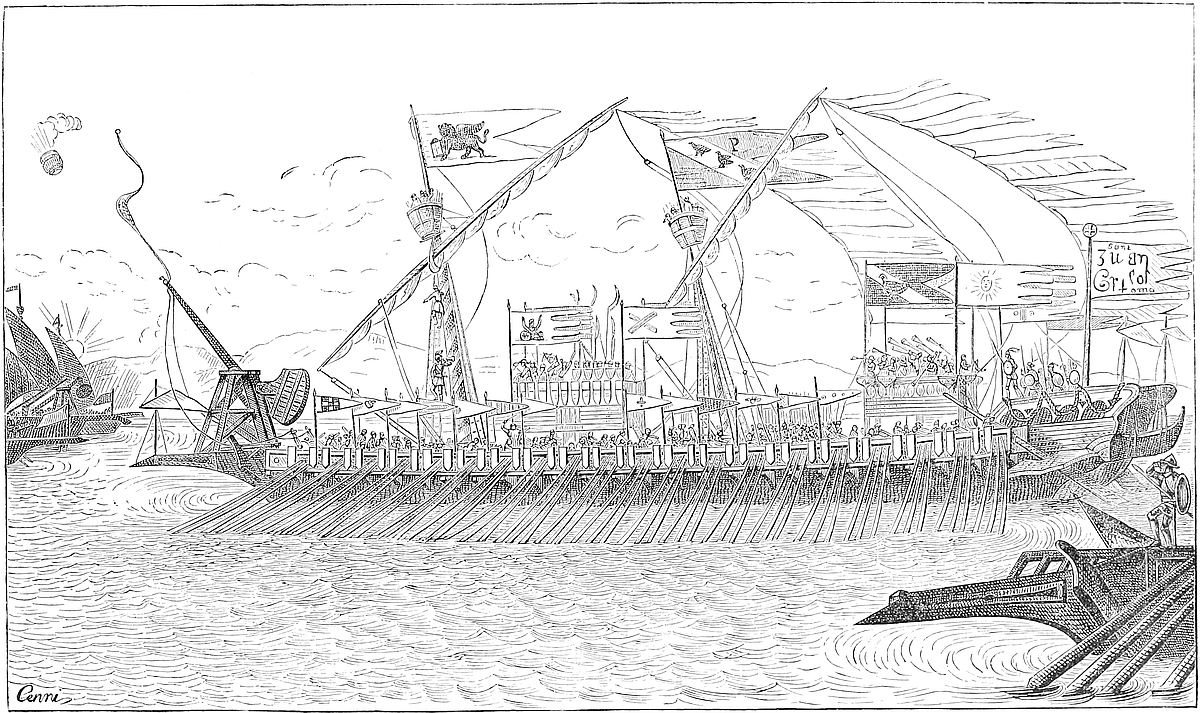
Marco Polo’s Galley going into action at Curzola.
... “il sembloit que la galie volast, par les nageurs qui la contreingnoient
aux avirons, et sembloit que foudre cheist des ciex, au bruit que
les pennonciaus menoient; et que les nacaires les tabours et les cors
sarrazinnois menoient, qui estoient en sa galie.”
(Joinville, vide ante, p. 40.)
The prisoners, even of the highest rank, appear to have been chained.
Dandolo, in despair at his defeat, and at the prospect of being carried
captive into Genoa, refused food, and ended by dashing his head against a
bench.[21] A Genoese account asserts that a noble funeral was given him
after the arrival of the fleet at Genoa, which took place on the evening of
the 16th October.[22] It was received with great rejoicing, and the City
voted the annual presentation of a pallium of gold brocade to the altar
of the Virgin in the Church of St. Matthew, on every 8th of September,
the Madonna’s day, on the eve of which the Battle had been won. To the
admiral himself a Palace was decreed. It still stands, opposite the Church
of St. Matthew, though it has passed from the possession of the Family.
On the striped marble façades, both of the Church and of the Palace,
inscriptions of that age, in excellent preservation, still commemorate
Lamba’s achievement.[23] Malik al Mansúr, the Mameluke Sultan of Egypt, as
an enemy of Venice, sent a complimentary letter to Doria accompanied by
costly presents.[24]
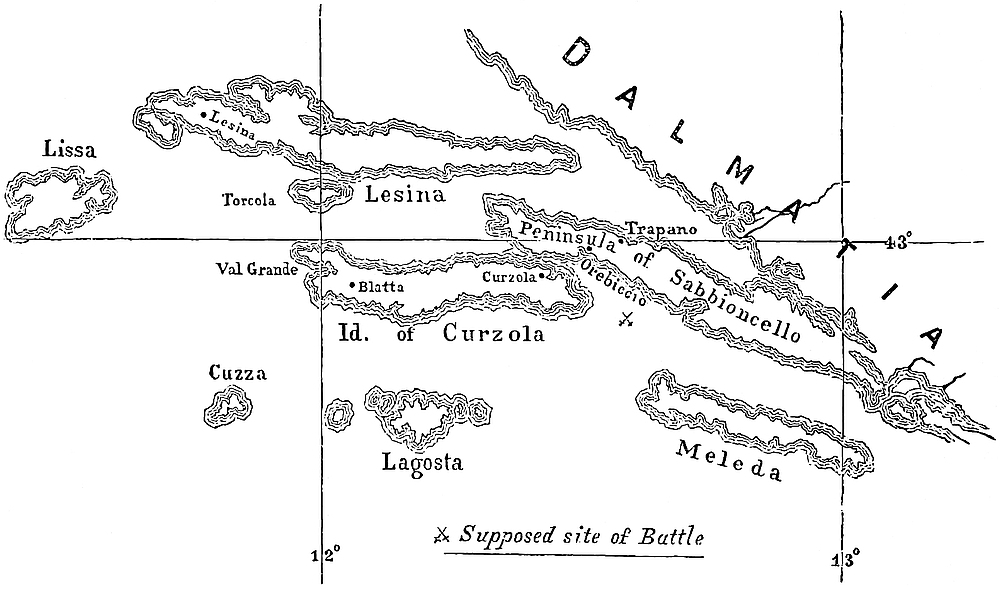
Scene of the Battle of Curzola.
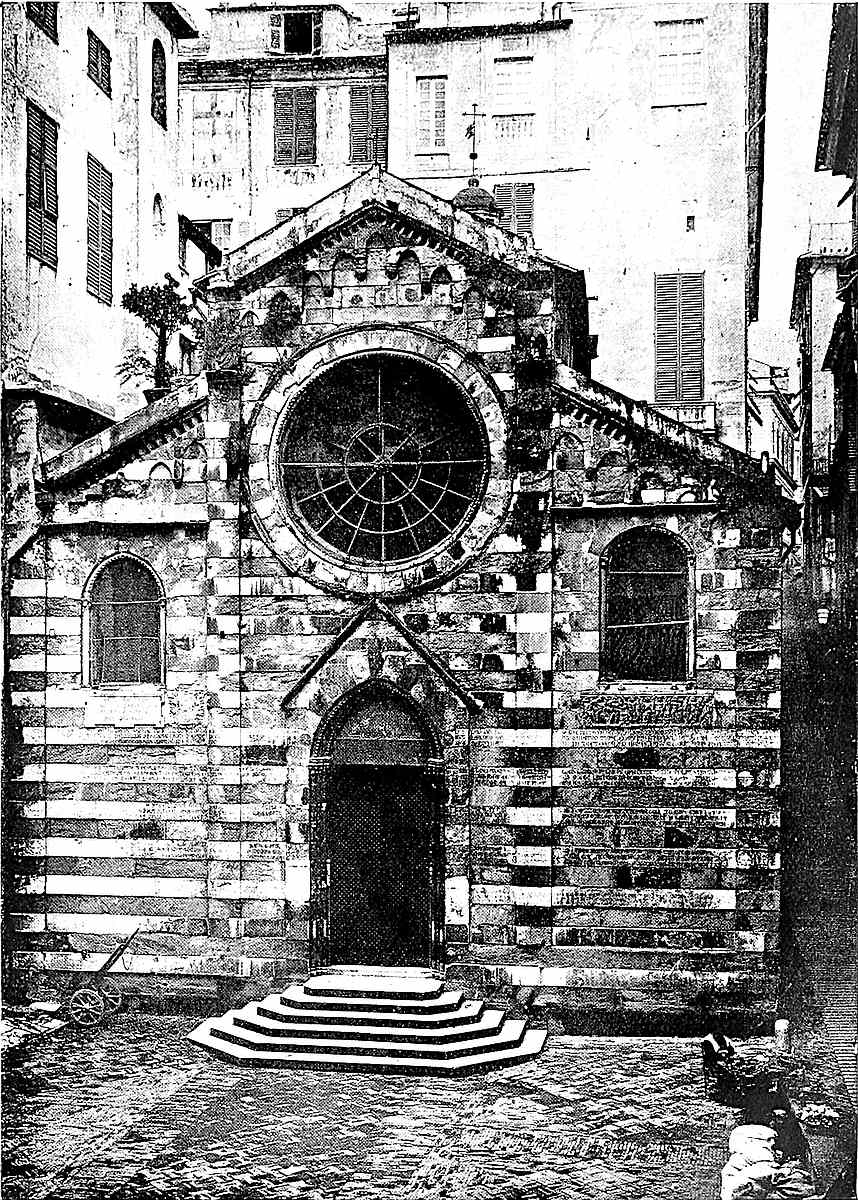
Church of San Matteo, Genoa.
The latter died at Savona 17th October, 1323, a few months before the most
illustrious of his prisoners, and his bones were laid in a sarcophagus
which may still be seen forming the sill of one of the windows of S.
Matteo (on the right as you enter). Over this sarcophagus stood the Bust
of Lamba till 1797, when the mob of Genoa, in idiotic imitation of the
French proceedings of that age, threw it down. All of Lamba’s six sons had
fought with him at Meloria. In 1291 one of them, Tedisio, went forth into
the Atlantic in company with Ugolino Vivaldi on a voyage of discovery, and
never returned. Through Cæsar, the youngest, this branch of the Family
still survives, bearing the distinctive surname of Lamba-Doria.[25]
As to the treatment of the prisoners, accounts differ; a thing usual in
such cases. The Genoese Poet asserts that the hearts of his countrymen were
touched, and that the captives were treated with compassionate courtesy.
Navagiero the Venetian, on the other hand, declares that most of them died
of hunger.[26]
36. Howsoever they may have been treated, here was Marco Polo one of those
many thousand prisoners in Genoa; Marco Polo in prison dictates his book to Rusticiano of Pisa.
Release of Venetian prisoners.and here, before long, he appears to
have made acquaintance with a man of literary propensities, whose destiny
had brought him into the like plight, by name Rusticiano or Rustichello of
Pisa. It was this person perhaps who persuaded the Traveller to defer no
longer the reduction to writing of his notable experiences; but in any case
it was he who wrote down those experiences at Marco’s dictation; it is he
therefore to whom we owe the preservation of this record, and possibly even
that of the Traveller’s very memory. This makes the Genoese imprisonment so
important an episode in Polo’s biography.
To Rusticiano we shall presently recur. But let us first bring to a
conclusion what may be gathered as to the duration of Polo’s imprisonment.
It does not appear whether Pope Boniface made any new effort for
accommodation between the Republics; but other Italian princes did
interpose, and Matteo Visconti, Captain-General of Milan, styling himself
Vicar-General of the Holy Roman Empire in Lombardy, was accepted as
Mediator, along with the community of Milan. Ambassadors from both States
presented themselves at that city, and on the 25th May, 1299, they signed
the terms of a Peace.
These terms were perfectly honourable to Venice, being absolutely equal and
reciprocal; from which one is apt to conclude that the damage to the City
of the Sea was rather to her pride than to her power; the success of Genoa,
in fact, having been followed up by no systematic attack upon Venetian
commerce.[27] Among the terms was the mutual release of prisoners on a day
to be fixed by Visconti after the completion of all formalities. This day
is not recorded, but as the Treaty was ratified by the Doge of Venice on
the 1st July, and the latest extant document connected with the formalities
appears to be dated 18th July, we may believe that before the end of August
Marco Polo was restored to the family mansion in S. Giovanni Grisostomo.
37. Something further requires to be said before quitting this event in
our Traveller’s life. For we confess that a critical reader may have some
Grounds on which the story of Marco Polo’s capture at Curzola rests.
justification in asking what evidence there is that Marco Polo ever fought
at Curzola, and ever was carried a prisoner to Genoa from that unfortunate action?
A learned Frenchman, whom we shall have to quote freely in the immediately
ensuing pages, does not venture to be more precise in reference to the
meeting of Polo and Rusticiano than to say of the latter: “In 1298, being
in durance in the Prison of Genoa, he there became acquainted with Marco
Polo, whom the Genoese had deprived of his liberty from motives equally
unknown.”[28]
To those who have no relish for biographies that round the meagre skeleton
of authentic facts with a plump padding of what might have been, this
sentence of Paulin Paris is quite refreshing in its stern limitation to
positive knowledge. And certainly no contemporary authority has yet been
found for the capture of our Traveller at Curzola. Still I think that the
fact is beyond reasonable doubt.
Ramusio’s biographical notices certainly contain many errors of detail; and
some, such as the many years’ interval which he sets between the Battle of
Curzola and Marco’s return, are errors which a very little trouble would
have enabled him to eschew. But still it does seem reasonable to believe
that the main fact of Marco’s command of a galley at Curzola, and capture
there, was derived from a genuine tradition, if not from documents.
Let us then turn to the words which close Rusticiano’s preamble (see
post, p. 2):—“Lequel (Messire Marc) puis demorant en le charthre de
Jene, fist retraire toutes cestes chouses a Messire Rustacians de Pise que
en celle meissme charthre estoit, au tens qu’il avoit 1298 anz que Jezu
eut vesqui.” These words are at least thoroughly consistent with Marco’s
capture at Curzola, as regards both the position in which they present him,
and the year in which he is thus presented.
There is however another piece of evidence, though it is curiously indirect.
The Dominican Friar Jacopo of Acqui was a contemporary of Polo’s, and was
the author of a somewhat obscure Chronicle called Imago Mundi.[29] Now
this Chronicle does contain mention of Marco’s capture in action by the
Genoese, but attributes it to a different action from Curzola, and one
fought at a time when Polo could not have been present. The passage runs as
follows in a manuscript of the Ambrosian Library, according to an extract
given by Baldelli Boni:—
“In the year of Christ MCCLXXXXVI, in the time of Pope Boniface VI.,
of whom we have spoken above, a battle was fought in Arminia, at the
place called Layaz, between xv. galleys of Genoese merchants and xxv.
of Venetian merchants; and after a great fight the galleys of the
Venetians were beaten, and (the crews) all slain or taken; and among
them was taken Messer Marco the Venetian, who was in company with
those merchants, and who was called Milono, which is as much as to
say ‘a thousand thousand pounds,’ for so goes the phrase in Venice.
So this Messer Marco Milono the Venetian, with the other Venetian
prisoners, is carried off to the prison of Genoa, and there kept for
a long time. This Messer Marco was a long time with his father and
uncle in Tartary, and he there saw many things, and made much wealth,
and also learned many things, for he was a man of ability. And so,
being in prison at Genoa, he made a Book concerning the great wonders
of the World, i.e., concerning such of them as he had seen. And what
he told in the Book was not as much as he had really seen, because
of the tongues of detractors, who, being ready to impose their own
lies on others, are over hasty to set down as lies what they in their
perversity disbelieve, or do not understand. And because there are
many great and strange things in that Book, which are reckoned past
all credence, he was asked by his friends on his death-bed to correct
the Book by removing everything that went beyond the facts. To which
his reply was that he had not told one-half of what he had really
seen!”[30]
This statement regarding the capture of Marco at the Battle of Ayas is
one which cannot be true, for we know that he did not reach Venice till
1295, travelling from Persia by way of Trebizond and the Bosphorus, whilst
the Battle of Ayas of which we have purposely given some detail, was
fought in May, 1294. The date MCCLXXXXVI assigned to it in the preceding
extract has given rise to some unprofitable discussion. Could that date
be accepted, no doubt it would enable us also to accept this, the sole
statement from the Traveller’s own age of the circumstances which brought
him into a Genoese prison; it would enable us to place that imprisonment
within a few months of his return from the East, and to extend its duration
to three years, points which would thus accord better with the general
tenor of Ramusio’s tradition than the capture of Curzola. But the matter
is not open to such a solution. The date of the Battle of Ayas is not more
doubtful than that of the Battle of the Nile. It is clearly stated by
several independent chroniclers, and is carefully established in the Ballad
that we have quoted above.[31] We shall see repeatedly in the course of
this Book how uncertain are the transcriptions of dates in Roman numerals,
and in the present case the LXXXXVI is as certainly a mistake for LXXXXIV
as is Boniface VI. in the same quotation a mistake for Boniface VIII.
But though we cannot accept the statement that Polo was taken prisoner at
Ayas, in the spring of 1294, we may accept the passage as evidence from
a contemporary source that he was taken prisoner in some sea-fight with
the Genoese, and thus admit it in corroboration of the Ramusian Tradition
of his capture in a sea-fight at Curzola in 1298, which is perfectly
consistent with all other facts in our possession.
38. We have now to say something of that Rusticiano to whom all who value
Polo’s book are so much indebted.
The relations between Genoa and Pisa had long been so hostile that it was
only too natural in 1298 to find a Pisan in the gaol of Genoa.Rusticiano,
perhaps a prisoner from Meloria. An unhappy
multitude of such prisoners had been carried thither fourteen years before,
and the survivors still lingered there in vastly dwindled numbers. In
the summer of 1284 was fought the battle from which Pisa had to date the
commencement of her long decay. In July of that year the Pisans, at a time
when the Genoese had no fleet in their own immediate waters, had advanced
to the very port of Genoa and shot their defiance into the proud city in
the form of silver-headed arrows, and stones belted with scarlet.[1] They
had to pay dearly for this insult. The Genoese, recalling their cruisers,
speedily mustered a fleet of eighty-eight galleys, which were placed under
the command of another of that illustrious House of Doria, the Scipios of
Genoa as they have been called, Uberto, the elder brother of Lamba. Lamba
himself with his six sons, and another brother, was in the fleet, whilst
the whole number of Dorias who fought in the ensuing action amounted to
250, most of them on board one great galley bearing the name of the family
patron, St. Matthew.[2]
The Pisans, more than one-fourth inferior in strength, came out boldly,
and the battle was fought off the Porto Pisano, in fact close in front of
Leghorn, where a lighthouse on a remarkable arched basement still marks
the islet of Meloria, whence the battle got its name. The day was the 6th
of August, the feast of St. Sixtus, a day memorable in the Pisan Fasti
for several great victories. But on this occasion the defeat of Pisa was
overwhelming. Forty of their galleys were taken or sunk, and upwards of
9000 prisoners carried to Genoa. In fact so vast a sweep was made of the
flower of Pisan manhood that it was a common saying then: “Che vuol veder
Pisa, vada a Genova!” Many noble ladies of Pisa went in large companies
on foot to Genoa to seek their husbands or kinsmen: “And when they made
enquiry of the Keepers of the Prisons, the reply would be, ‘Yesterday there
died thirty of them, to-day there have died forty; all of whom we have cast
into the sea; and so it is daily.’”[3]
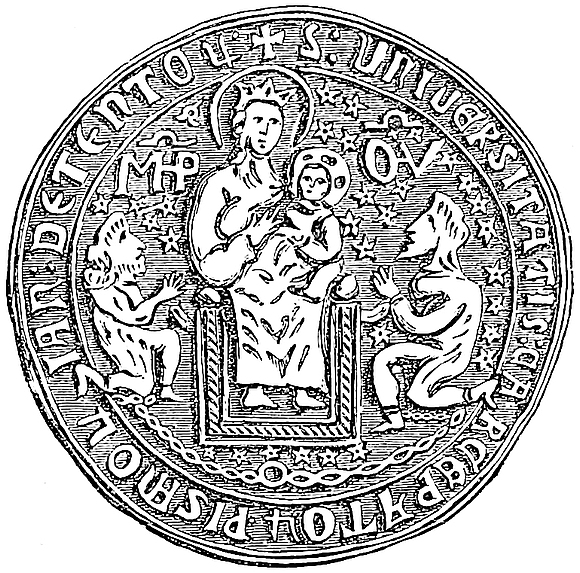
Seal of the Pisan Prisoners.
A body of prisoners so numerous and important naturally exerted themselves
in the cause of peace, and through their efforts, after many months of
negotiation, a formal peace was signed (15th April, 1288). But through the
influence, as was alleged, of Count Ugolino (Dante’s) who was then in power
at Pisa, the peace became abortive; war almost immediately recommenced, and
the prisoners had no release.[4] And, when the 6000 or 7000 Venetians were
thrown into the prisons of Genoa in October 1298, they would find there
the scanty surviving remnant of the Pisan Prisoners of Meloria, and would
gather from them dismal forebodings of the fate before them.
It is a fair conjecture that to that remnant Rusticiano of Pisa may have
belonged.
We have seen Ramusio’s representation of the kindness shown to Marco
during his imprisonment by a certain Genoese gentleman who also assisted
him to reduce his travels to writing. We may be certain that this Genoese
gentleman is only a distorted image of Rusticiano, the Pisan prisoner
in the gaol of Genoa, whose name and part in the history of his hero’s
book Ramusio so strangely ignores. Yet patriotic Genoese writers in our
own times have striven to determine the identity of this their imaginary
countryman![5]
39. Who, then, was Rusticiano, or, as the name actually is read in the
oldest type of MS., “Messire Rustacians de Pise”?
Rusticiano, a person known from other sources.Our knowledge of him is but scanty. Still something is known of him besides
the few words concluding his preamble to our Traveller’s Book, which you
may read at pp. 1–2 of the body of this volume.
In Sir Walter Scott’s “Essay on Romance,” when he speaks of the new mould
in which the subjects of the old metrical stories were cast by the school
of prose romancers which arose in the 13th century, we find the following
words:—
“Whatever fragments or shadows of true history may yet remain hidden
under the mass of accumulated fable which had been heaped upon them
during successive ages, must undoubtedly be sought in the metrical
romances.... But those prose authors who wrote under the imaginary
names of Rusticien de Pise, Robert de Borron, and the like, usually
seized upon the subject of some old minstrel; and recomposing the
whole narrative after their own fashion, with additional character
and adventure, totally obliterated in that operation any shades which
remained of the original and probably authentic tradition,” &c.[6]
Evidently, therefore, Sir Walter regarded Rustician of Pisa as a person
belonging to the same ghostly company as his own Cleishbothams and
Dryasdusts. But in this we see that he was wrong.
In the great Paris Library and elsewhere there are manuscript volumes
containing the stories of the Round Table abridged and somewhat clumsily
combined from the various Prose Romances of that cycle, such as Sir
Tristan, Lancelot, Palamedes, Giron le Courtois, &c., which had been
composed, it would seem, by various Anglo-French gentlemen at the court of
Henry III., styled, or styling themselves, Gasses le Blunt, Luces du Gast,
Robert de Borron, and Hélis de Borron. And these abridgments or recasts are
professedly the work of Le Maistre Rusticien de Pise. Several of them
were printed at Paris in the end of the 15th and beginning of the 16th
centuries as the works of Rusticien de Pise; and as the preambles and the
like, especially in the form presented in those printed editions, appear
to be due sometimes to the original composers (as Robert and Hélis de
Borron) and sometimes to Rusticien de Pise the recaster, there would seem
to have been a good deal of confusion made in regard to their respective
personalities.
From a preamble to one of those compilations which undoubtedly belongs to
Rustician, and which we shall quote at length by and bye, we learn that
Master Rustician “translated” (or perhaps transferred?) his compilation
from a book belonging to King Edward of England, at the time when that
prince went beyond seas to recover the Holy Sepulchre. Now Prince Edward
started for the Holy Land in 1270, spent the winter of that year in Sicily,
and arrived in Palestine in May 1271. He quitted it again in August,
1272, and passed again by Sicily, where in January, 1273, he heard of his
father’s death and his own consequent accession. Paulin Paris supposes that
Rustician was attached to the Sicilian Court of Charles of Anjou, and that
Edward “may have deposited with that king the Romances of the Round Table,
of which all the world was talking, but the manuscripts of which were still
very rare, especially those of the work of Helye de Borron[7] ... whether
by order, or only with permission of the King of Sicily, our Rustician made
haste to read, abridge, and re-arrange the whole, and when Edward returned
to Sicily he recovered possession of the book from which the indefatigable
Pisan had extracted the contents.”
But this I believe is, in so far as it passes the facts stated in
Rustician’s own preamble, pure hypothesis, for nothing is cited that
connects Rustician with the King of Sicily. And if there be not some
such confusion of personality as we have alluded to, in another of the
preambles, which is quoted by Dunlop as an utterance of Rustician’s, that
personage would seem to claim to have been a comrade in arms of the two
de Borrons. We might, therefore, conjecture that Rustician himself had
accompanied Prince Edward to Syria.[8]
40. Rustician’s literary work appears from the extracts and remarks of
Paulin Paris to be that of an industrious simple man,Character of Rustician’s Romance compilations. without method or
much judgment. “The haste with which he worked is too perceptible; the
adventures are told without connection; you find long stories of Tristan
followed by adventures of his father Meliadus.” For the latter derangement
of historical sequence we find a quaint and ingenuous apology offered in
Rustician’s epilogue to Giron le Courtois:—
“Cy fine le Maistre Rusticien de Pise son conte en louant et
regraciant le Père le Filz et le Saint Esperit, et ung mesme Dieu,
Filz de la Benoiste Vierge Marie, de ce qu’il m’a doné grace, sens,
force, et mémoire, temps et lieu, de me mener à fin de si haulte et
si noble matière come ceste-cy dont j’ay traicté les faiz et proesses
recitez et recordez à mon livre. Et se aucun me demandoit pour quoy
j’ay parlé de Tristan avant que de son père le Roy Meliadus, je
respons que ma matière n’estoist pas congneue. Car je ne puis pas
scavoir tout, ne mettre toutes mes paroles par ordre. Et ainsi fine
mon conte. Amen.”[9]
In a passage of these compilations the Emperor Charlemagne is asked whether
in his judgment King Meliadus or his son Tristan were the better man? The
Emperor’s answer is: “I should say that the King Meliadus was the better
man, and I will tell you why I say so. As far as I can see, everything that
Tristan did was done for Love, and his great feats would never have been
done but under the constraint of Love, which was his spur and goad. Now
that never can be said of King Meliadus! For what deeds he did, he did them
not by dint of Love, but by dint of his strong right arm. Purely out of
his own goodness he did good, and not by constraint of Love.” “It will be
seen,” remarks on this Paulin Paris, “that we are here a long way removed
from the ordinary principles of Round Table Romances. And one thing besides
will be manifest, viz., that Rusticien de Pise was no Frenchman!”[10]
The same discretion is shown even more prominently in a passage of one
of his compilations, which contains the romances of Arthur, Gyron, and
Meliadus (No. 6975—see last note but one):—
“No doubt,” Rustician says, “other books tell the story of the Queen
Ginevra and Lancelot differently from this; and there were certain
passages between them of which the Master, in his concern for the honour
of both those personages, will say not a word.” Alas, says the French
Bibliographer, that the copy of Lancelot, which fell into the hands of poor
Francesca of Rimini, was not one of those expurgated by our worthy friend
Rustician![11]
41. A question may still occur to an attentive reader as to the identity
of this Romance-compiler Rusticien de Pise with the Messire Rustacians
de Pise, Identity of the Romance Compiler with Polo’s fellow-prisoner.of a solitary MS. of Polo’s work (though the oldest and most
authentic), a name which appears in other copies as Rusta Pisan, Rasta
Pysan, Rustichelus Civis Pisanus, Rustico, Restazio da Pisa, Stazio da
Pisa, and who is stated in the preamble to have acted as the Traveller’s
scribe at Genoa.
M. Pauthier indeed[12] asserts that the French of the MS. Romances of
Rusticien de Pise is of the same barbarous character as that of the early
French MS. of Polo’s Book to which we have just alluded, and which we shall
show to be the nearest presentation of the work as originally dictated by
the Traveller. The language of the latter MS. is so peculiar that this
would be almost perfect evidence of the identity of the writers, if it were
really the fact. A cursory inspection which I have made of two of those
MSS. in Paris, and the extracts which I have given and am about to give,
do not, however, by any means support M. Pauthier’s view. Nor would that
view be consistent with the judgment of so competent an authority as Paulin
Paris, implied in his calling Rustician a nom recommandable in old French
literature, and his speaking of him as “versed in the secrets of the French
Romance Tongue.”[13] In fact the difference of language in the two cases
would really be a difficulty in the way of identification, if there were
room for doubt. This, however, Paulin Paris seems to have excluded finally,
by calling attention to the peculiar formula of preamble which is common to
the Book of Marco Polo and to one of the Romance compilations of Rusticien
de Pise.
The former will be found in English at pp. 1, 2, of our Translation; but
we give a part of the original below[14] for comparison with the preamble
to the Romances of Meliadus, Tristan, and Lancelot, as taken from MS. 6961
(Fr. 340) of the Paris Library:—
“Seigneurs Empereurs et Princes, Ducs et Contes et Barons et
Chevaliers et Vavasseurs et Bourgeois, et tous les preudommes de
cestui monde qui avez talent de vous deliter en rommans, si prenez
cestui (livre) et le faites lire de chief en chief, si orrez toutes
les grans aventure qui advindrent entre les Chevaliers errans du
temps au Roy Uter Pendragon, jusques à le temps au Roy Artus son
fils, et des compaignons de la Table Ronde. Et sachiez tout vraiment
que cist livres fust translatez du livre Monseigneur Edouart le Roy
d’Engleterre en cellui temps qu’il passa oultre la mer au service
nostre Seigneur Damedieu pour conquester le Sant Sepulcre, et Maistre
Rusticiens de Pise, lequel est ymaginez yci dessus,[15] compila ce
rommant, car il en translata toutes les merveilleuses nouvelles et
aventures qu’il trouva en celle livre et traita tout certainement
de toutes les aventures du monde, et si sachiez qu’il traitera plus
de Monseigneur Lancelot du Lac, et Monsr Tristan le fils au Roy
Meliadus de Leonnoie que d’autres, porcequ’ilz furent sans faille les
meilleurs chevaliers qui à ce temps furent en terre; et li Maistres
en dira de ces deux pluseurs choses et pluseurs nouvelles que l’en
treuvera escript en tous les autres livres; et porce que le Maistres
les trouva escript au Livre d’Engleterre.”
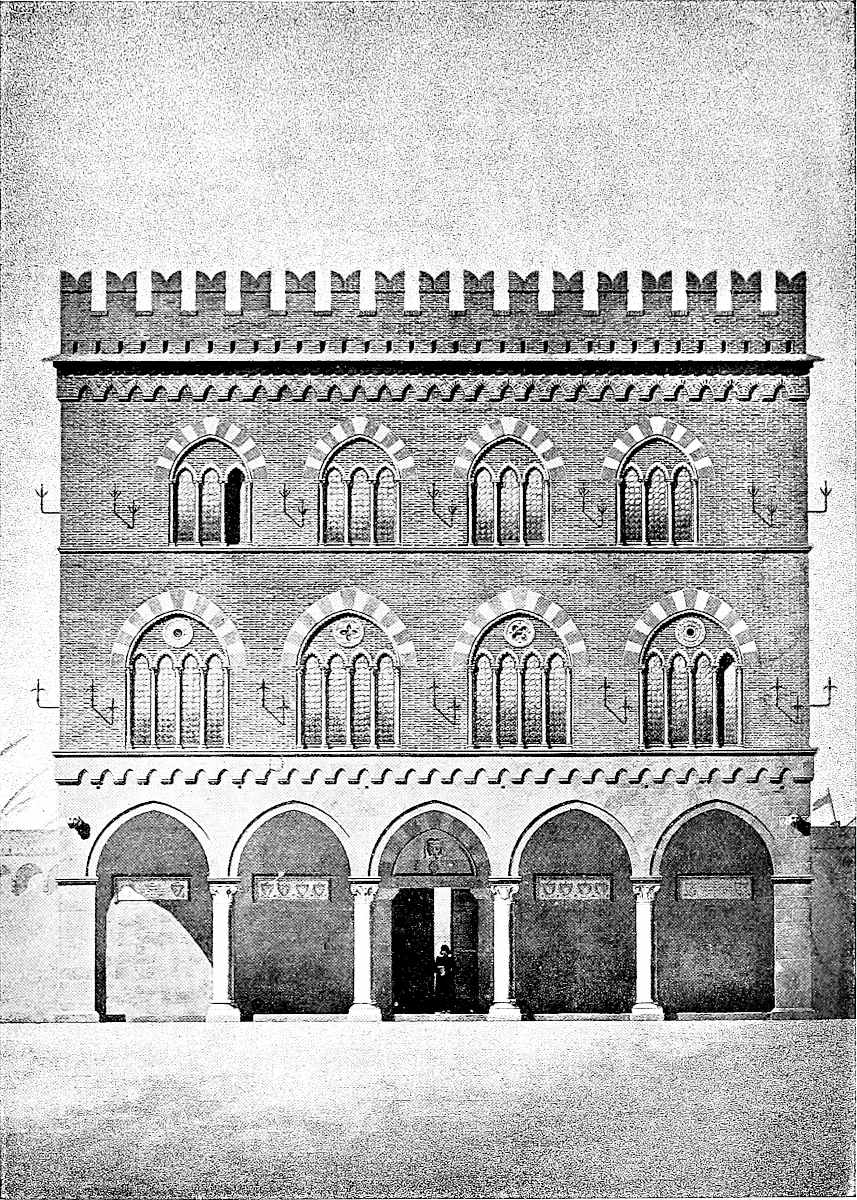
Palazzo di S. Giorgio Genoa.
“Certainly,” Paulin Paris observes, “there is a singular analogy between
these two prefaces. And it must be remarked that the formula is not an
ordinary one with translators, compilers, or authors of the 13th and 14th
centuries. Perhaps you would not find a single other example of it.”[16]
This seems to place beyond question the identity of the Romance-compiler of
Prince Edward’s suite in 1270, and the Prisoner of Genoa in 1298.
42. In Dunlop’s History of Fiction a passage is quoted from the preamble
of Meliadus, as set forth in the Paris printed edition of 1528,
Further particulars concerning Rustician. which
gives us to understand that Rusticien de Pise had received as a reward for
some of his compositions from King Henry III. the prodigal gift of two
chateaux. I gather, however, from passages in the work of Paulin Paris
that this must certainly be one of those confusions of persons to which I
have referred before, and that the recipient of the chateaux was in reality
Helye de Borron, the author of some of the originals which Rustician
manipulated.[17] This supposed incident in Rustician’s scanty history must
therefore be given up.
We call this worthy Rustician or Rusticiano, as the nearest probable
representation in Italian form of the Rusticien of the Round-Table
MSS. and the Rustacians of the old text of Polo. But it is highly
probable that his real name was Rustichello, as is suggested by the form
Rustichelus in the early Latin version published by the Société de
Géographie. The change of one liquid for another never goes for much in
Italy,[18] and Rustichello might easily Gallicize himself as Rusticien. In
a very long list of Pisan officials during the Middle Ages I find several
bearing the name of Rustichello or Rustichelli, but no Rusticiano or
Rustigiano.[19]
Respecting him we have only to add that the peace between Genoa and Venice
was speedily followed by a treaty between Genoa and Pisa. On the 31st July,
1299, a truce for twenty-five years was signed between those two Republics.
It was a very different matter from that between Genoa and Venice, and
contained much that was humiliating and detrimental to Pisa. But it
embraced the release of prisoners; and those of Meloria, reduced it is said
to less than one tithe of their original number, had their liberty at last.
Among the prisoners then released no doubt Rustician was one. But we hear
of him no more.
43. A few very disconnected notices are all that can be collected of matter
properly biographical in relation to the quarter Death of Marco’s Father before 1300. Will of his brother Maffeo.century during which Marco
Polo survived the Genoese captivity.
We have seen that he would probably reach Venice in the course of August,
1299. Whether he found his aged father alive is not known; but we know at
least that a year later (31st August, 1300) Messer Nicolo was no longer in life.
This we learn from the Will of the younger Maffeo, Marco’s brother, which
bears the date just named, and of which we give an abstract below.[1] It
seems to imply strong regard for the testator’s brother Marco, who is made
inheritor of the bulk of the property, failing the possible birth of a son.
I have already indicated some conjectural deductions from this document.
I may add that the terms of the second clause, as quoted in the note,
seem to me to throw considerable doubt on the genealogy which bestows a
large family of sons upon this brother Maffeo. If he lived to have such a
family it seems improbable that the draft which he thus left in the hands
of a notary, to be converted into a Will in the event of his death (a
curious example of the validity attaching to all acts of notaries in those
days), should never have been superseded, but should actually have been
so converted after his death, as the existence of the parchment seems to
prove. But for this circumstance we might suppose the Marcolino mentioned
in the ensuing paragraph to have been a son of the younger Maffeo.
Messer Maffeo, the uncle, was, we see, alive at this time. We do not know
the year of his death. But it is alluded to by Friar Pipino in the Preamble
to his Translation of the Book, supposed to have been executed about
1315–1320; and we learn from a document in the Venetian archives (see p.
77) that it must have been previous to 1318, and subsequent to February
1309, the date of his last Will. The Will itself is not known to be extant,
but from the reference to it in this document we learn that he left 1000
lire of public debt[2] (? imprestitorum) to a certain Marco Polo,
called Marcolino. The relationship of this Marco to old Maffeo is not
stated, but we may suspect him to have been an illegitimate son. [Marcolino
was a son of Nicolo, son of Marco the Elder; see vol. ii., Calendar, No.
6.—H. C.]
44. In 1302 occurs what was at first supposed to be a glimpse of Marco as
a citizen, slight and quaint enough; Documentary notices of Polo at this time. The sobriquet of
Milione.being a resolution on the Books of
the Great Council to exempt the respectable Marco Polo from the penalty
incurred by him on account of the omission to have his water-pipe duly
inspected. But since our Marco’s claims to the designation of Nobilis
Vir have been established, there is a doubt whether the providus vir
or prud’-homme here spoken of may not have been rather his namesake
Marco Polo of Cannareggio or S. Geremia, of whose existence we learn from
another entry of the same year.[3] It is, however, possible that Marco the
Traveller was called to the Great Council after the date of the document
in question.
We have seen that the Traveller, and after him his House and his Book,
acquired from his contemporaries the surname, or nickname rather, of Il
Milione. Different writers have given different explanations of the origin
of this name; some, beginning with his contemporary Fra Jacopo d’Acqui,
(supra, p. 54), ascribing it to the family’s having brought home a fortune
of a million of lire, in fact to their being millionaires. This is the
explanation followed by Sansovino, Marco Barbaro, Coronelli, and others.[4]
More far-fetched is that of Fontanini, who supposes the name to have been
given to the Book as containing a great number of stories, like the Cento
Novelle or the Thousand and One Nights! But there can be no doubt that
Ramusio’s is the true, as it is the natural, explanation; and that the
name was bestowed on Marco by the young wits of his native city, because
of his frequent use of a word which appears to have been then unusual, in
his attempts to convey an idea of the vast wealth and magnificence of the
Kaan’s Treasury and Court.[5] Ramusio has told
us (supra, p. 6) that he had seen Marco
styled by this sobriquet in the Books of the Signory; and it is pleasant
to be able to confirm this by the next document which we cite. This is
an extract from the Books of the Great Council under 10th April, 1305,
condoning the offence of a certain Bonocio of Mestre in smuggling wine, for
whose penalty one of the sureties had been the Nobilis Vir Marchus Paulo
Milioni.[6]
It is alleged that long after our Traveller’s death there was always, in
the Venetian Masques, one individual who assumed the character of Marco
Milioni, and told Munchausenlike stories to divert the vulgar. Such, if
this be true, was the honour of our prophet among the populace of his own
country.[7]
45. A little later we hear of Marco once more, as presenting a copy of his
Book to a noble Frenchman in the service of Charles of Valois.
This Prince, brother of Philip the Fair, in 1301 had married Catharine,
daughter and heiress of Philip de Courtenay, titular Emperor ofPolo’s relations with Thibault de Cepoy.
Constantinople, and on the strength of this marriage had at a later date
set up his own claim to the Empire of the East. To this he was prompted by
Pope Clement V., who in the beginning of 1306 wrote to Venice, stimulating
that Government to take part in the enterprise. In the same year, Charles
and his wife sent as their envoys to Venice, in connection with this
matter, a noble knight called Thibault de Cepoy, along with an ecclesiastic
of Chartres called Pierre le Riche, and these two succeeded in executing a
treaty of alliance with Venice, of which the original, dated 14th December,
1306, exists at Paris. Thibault de Cepoy eventually went on to Greece with
a squadron of Venetian Galleys, but accomplished nothing of moment, and
returned to his master in 1310.[8]
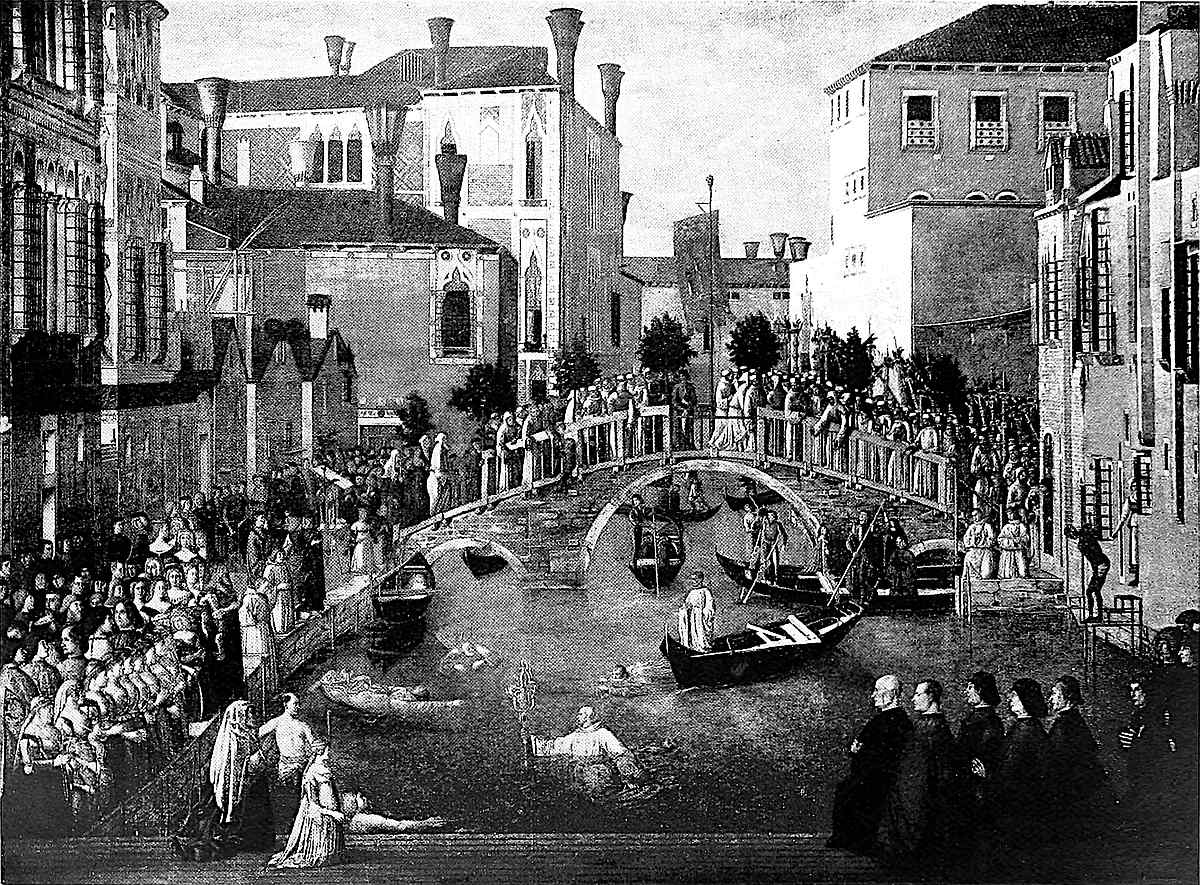
Miracle of S. Lorenzo.
During the stay of Thibault at Venice he seems to have made acquaintance
with Marco Polo, and to have received from him a copy of his Book. This is
recorded in a curious note which appears on two existing MSS. of Polo’s
Book, viz., that of the Paris Library (10,270 or Fr. 5649), and that of
Bern, which is substantially identical in its text with the former, and is,
as I believe, a copy of it.[9] The note runs as follows:—
“Here you have the Book of which My Lord Thiebault, Knight and Lord
of Cepoy, (whom may God assoil!) requested a copy from Sire Marc Pol,
Burgess and Resident of the City of Venice. And the said Sire Marc
Pol, being a very honourable Person, of high character and respect
in many countries, because of his desire that what he had witnessed
should be known throughout the World, and also for the honour and
reverence he bore to the most excellent and puissant Prince my Lord
Charles, Son of the King of France and Count of Valois, gave and
presented to the aforesaid Lord of Cepoy the first copy (that was
taken) of his said Book after he had made the same. And very pleasing
it was to him that his Book should be carried to the noble country of
France and there made known by so worthy a gentleman. And from that
copy which the said Messire Thibault, Sire de Cepoy above-named, did
carry into France, Messire John, who was his eldest son and is the
present Sire de Cepoy,[10] after his Father’s decease did have a copy
made, and that very first copy that was made of the Book after its
being carried into France he did present to his very dear and dread
Lord Monseigneur de Valois. Thereafter he gave copies of it to such
of his friends as asked for them.
“And the copy above-mentioned was presented by the said Sire Marc
Pol to the said Lord de Cepoy when the latter went to Venice, on the
part of Monseigneur de Valois and of Madame the Empress his wife, as
Vicar General for them both in all the Territories of the Empire of
Constantinople. And this happened in the year of the Incarnation of
our Lord Jesus Christ one thousand three hundred and seven, and in
the month of August.”
Of the bearings of this memorandum on the literary history of Polo’s Book
we shall speak in a following section.
46. When Marco married we have not been able to ascertain, but it was no
doubt early in the 14th century, for in 1324, we find that he had twoHis marriage and his daughters. Marco as a merchant.
married daughters besides one unmarried. His wife’s Christian name was
Donata, but of her family we have as yet found no assurance. I suspect,
however, that her name may have been Loredano (vide infra, p. 77).
Under 1311 we find a document which is of considerable interest, because it
is the only one yet discovered which exhibits Marco under the aspect of a
practical trader. It is the judgment of the Court of Requests upon a suit
brought by the Noble Marco Polo of the parish of S. Giovanni Grisostomo
against one Paulo Girardo of S. Apollinare. It appears that Marco had
entrusted to the latter as a commission agent for sale, on an agreement
for half profits, a pound and a half of musk, priced at six lire of
grossi (about 22l. 10s. in value of silver) the pound. Girardo had
sold half-a-pound at that rate, and the remaining pound which he brought
back was deficient of a saggio, or, one-sixth of an ounce, but he had
accounted for neither the sale nor the deficiency. Hence Marco sues him for
three lire of Grossi, the price of the half-pound sold, and for twenty
grossi as the value of the saggio. And the Judges cast the defendant in
the amount with costs, and the penalty of imprisonment in the common gaol
of Venice if the amounts were not paid within a suitable term.[11]
Again in May, 1323, probably within a year of his death, Ser Marco appears
(perhaps only by attorney), before the Doge and his judicial examiners,
to obtain a decision respecting a question touching the rights to certain
stairs and porticoes in contact with his own house property, and that
obtained from his wife, in S. Giovanni Grisostomo. To this allusion has
been already made (supra, p. 31).
MARCO POLO’S LAST WILL
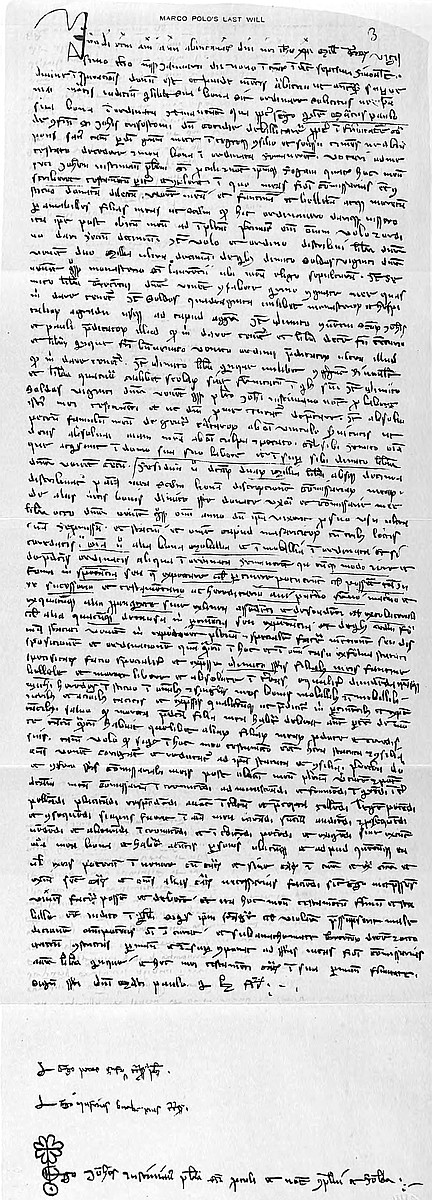
(Dimensions of Original, 26·4 inches by 9·4 inches)
FROM A PHOTOGRAPH SPECIALLY TAKEN IN ST.
MARK’S LIBRARY BY SIGNOR BERTANI.
47. We catch sight of our Traveller only once more. It is on the 9th ofMarco Polo’s Last Will and Death.
January, 1324; he is labouring with disease, under which he is sinking day
by day; and he has sent for Giovanni Giustiniani, Priest of S. Proculo and
Notary, to make his Last Will and Testament. It runs thus:—
“In the Name of the Eternal God Amen!
“In the year from the Incarnation of our Lord Jesus Christ 1323, on
the 9th day of the month of January, in the first half of the 7th
Indiction,[12] at Rialto.
“It is the counsel of Divine Inspiration as well as the judgment
of a provident mind that every man should take thought to make a
disposition of his property before death become imminent, lest in the
end it should remain without any disposition:
“Wherefore I Marcus Paulo of the parish of St. John Chrysostom,
finding myself to grow daily feebler through bodily ailment, but
being by the grace of God of a sound mind, and of senses and judgment
unimpaired, have sent for John Giustiniani, Priest of S. Proculo and
Notary, and have instructed him to draw out in complete form this my
Testament:
“Whereby I constitute as my Trustees Donata my beloved wife, and my
dear daughters Fantina, Bellela, and Moreta,[13] in order that after
my decease they may execute the dispositions and bequests which I am
about to make herein.
“First of all: I will and direct that the proper Tithe be paid.[14]
And over and above the said tithe I direct that 2000 lire of Venice
denari be distributed as follows:[15]
“Viz., 20 soldi of Venice grossi to the Monastery of St. Lawrence
where I desire to be buried.
“Also 300 lire of Venice denari to my sister-in-law Ysabeta
Quirino,[16] that she owes me.
“Also 40 soldi to each of the Monasteries and Hospitals all the way
from Grado to Capo d’Argine.[17]
“Also I bequeath to the Convent of SS. Giovanni and Paolo, of the
Order of Preachers, that which it owes me, and also 10 lire to
Friar Renier, and 5 lire to Friar Benvenuto the Venetian, of the
Order of Preachers, in addition to the amount of his debt to me.
“I also bequeath 5 lire to every Congregation in Rialto, and 4
lire to every Guild or Fraternity of which I am a member.[18]
“Also I bequeath 20 soldi of Venetian grossi to the Priest Giovanni
Giustiniani the Notary, for his trouble about this my Will, and in
order that he may pray the Lord in my behalf.
“Also I release Peter the Tartar, my servant, from all bondage, as
completely as I pray God to release mine own soul from all sin and
guilt. And I also remit him whatever he may have gained by work at
his own house; and over and above I bequeath him 100 lire of Venice
denari.[19]
“And the residue of the said 2000 lire free of tithe, I direct to
be distributed for the good of my soul, according to the discretion
of my trustees.
“Out of my remaining property I bequeath to the aforesaid Donata, my
Wife and Trustee, 8 lire of Venetian grossi annually during her
life, for her own use, over and above her settlement, and the linen
and all the household utensils,[20] with 3 beds garnished.
“And all my other property movable and immovable that has not been
disposed of [here follow some lines of mere technicality] I specially
and expressly bequeath to my aforesaid Daughters Fantina, Bellela,
and Moreta, freely and absolutely, to be divided equally among them.
And I constitute them my heirs as regards all and sundry my property
movable and immovable, and as regards all rights and contingencies
tacit and expressed, of whatsoever kind as hereinbefore detailed,
that belong to me or may fall to me. Save and except that before
division my said daughter Moreta shall receive the same as each of my
other daughters hath received for dowry and outfit [here follow many
lines of technicalities, ending]
“And if any one shall presume to infringe or violate this Will, may
he incur the malediction of God Almighty, and abide bound under the
anathema of the 318 Fathers; and farthermore he shall forfeit to
my Trustees aforesaid five pounds of gold;[21] and so let this my
Testament abide in force. The signature of the above named Messer
Marco Paulo who gave instructions for this deed.
“‡ I Peter Grifon, Priest, Witness.
“* I Humfrey Barberi, Witness.
Ҡ I John Giustiniani, Priest of S. Proculo, and Notary, have
completed and authenticated (this testament).”
[22]
We do not know, as has been said, how long Marco survived the making of
this will, but we know, from a scanty series of documents commencing in
June of the following year (1325), that he had then been some time
dead.[23]
48. He was buried, no doubt, according to his declared wish, in the
Church of S. Lorenzo; Place of Sepulture. Professed Portraits of Polo.and indeed Sansovino bears testimony to the fact
in a confused notice of our Traveller.[24] But there does not seem to
have been any monument to Marco, though the sarcophagus which had been
erected to his father Nicolo, by his own filial care, existed till near
the end of the 16th century in the porch or corridor leading to the old
Church of S. Lorenzo, and bore the inscription: “Sepultura Domini Nicolai
Paulo de contrata S. Ioannis Grisostemi.” The church was renewed from its
foundations in 1592, and then, probably, the sarcophagus was cast aside and
lost, and with it all certainty as to the position of the tomb.[25]
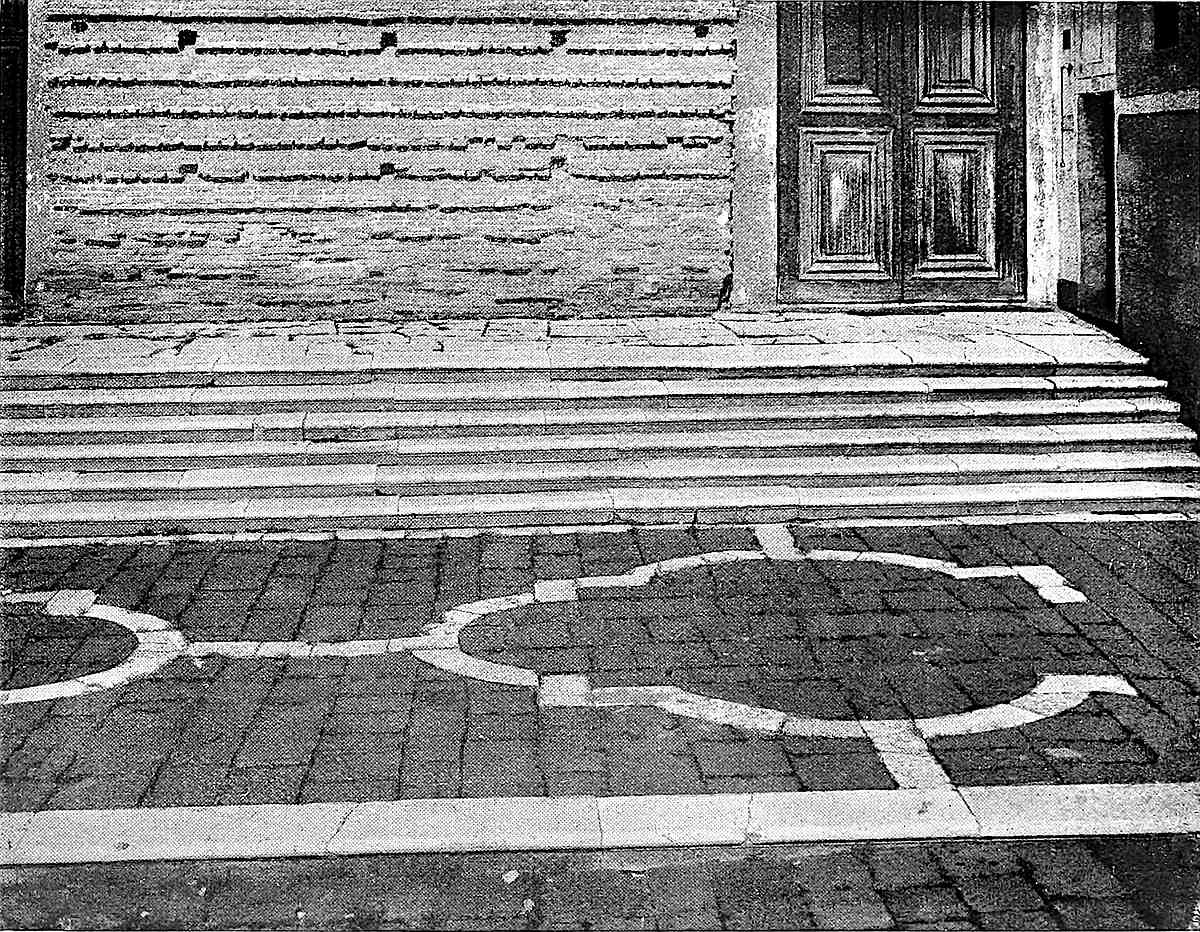
Pavement in front of San Lorenzo, Venice.
There is no portrait of Marco Polo in existence with any claim to
authenticity. The quaint figure which we give in the Bibliography, vol.
ii. p. 555, extracted from the earliest printed edition of his book, can
certainly make no such pretension. The oldest one after this is probably
a picture in the collection of Monsignor Badia at Rome, of which I am
now able, by the owner’s courtesy, to give a copy. It is set down in the
catalogue to Titian, but is probably a work of 1600, or thereabouts, to
which the aspect and costume belong. It is inscribed “Marcus Polvs Venetvs
Totivs Orbis et Indie Peregrator Primus.” Its history unfortunately cannot
be traced, but I believe it came from a collection at Urbino. A marble
statue was erected in his honour by a family at Venice in the 17th century,
and is still to be seen in the Palazzo Morosini-Gattemburg in the Campo S.
Stefano in that city. The medallion portrait on the wall of the Sala dello
Scudo in the ducal palace, and which was engraved in Bettom’s “Collection
of Portraits of Illustrious Italians,” is a work of imagination painted
by Francesco Griselini in 1761.[26] From this, however, was taken the
medal by Fabris, which was struck in 1847 in honour of the last meeting of
the Italian Congresso Scientifico; and from the medal again is copied, I
believe, the elegant woodcut which adorns the introduction to M. Pauthier’s
edition, though without any information as to its history. A handsome bust,
by Augusto Gamba, has lately been placed among the illustrious Venetians in
the inner arcade of the Ducal Palace.[27] There is also a mosaic portrait
of Polo, opposite the similar portrait of Columbus in the Municipio at Genoa.
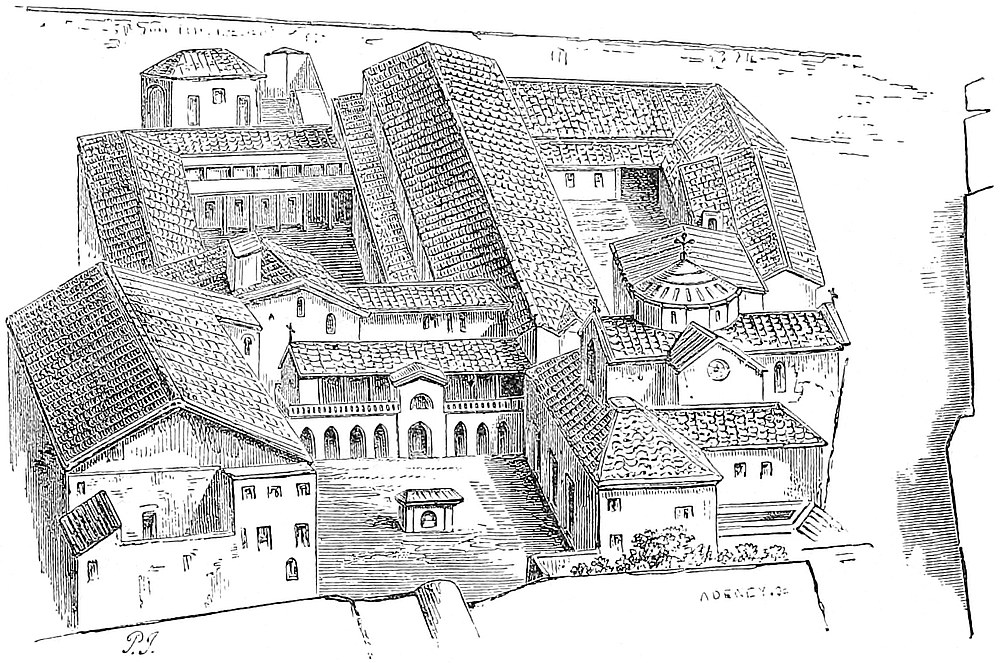
S. Lorenzo as it was in the 15th century.
49. From the short series of documents recently alluded to,[28] we gather
all that we know of the remaining history of Marco Polo’s immediate family.
Further History of the Polo Family.
We have seen in his will an indication that the two elder daughters,
Fantina and Bellela, were married before his death. In 1333 we find the
youngest, Moreta, also a married woman, and Bellela deceased. In 1336 we
find that their mother Donata had died in the interval. We learn, too, that
Fantina’s husband was Marco Bragadino, and Moreta’s, Ranuzzo Dolfino.[29]
The name of Bellela’s husband does not appear.
Fantina’s husband is probably the Marco Bragadino, son of Pietro, who in
1346 is mentioned to have been sent as Provveditore-Generale to act against
the Patriarch of Acquileia.[30] And in 1379 we find Donna Fantina herself,
presumably in widowhood, assessed as a resident of S. Giovanni Grisostomo,
on the Estimo or forced loan for the Genoese war, at 1300 lire, whilst
Pietro Bragadino of the same parish—her son as I imagine—is assessed at
1500 lire.[31] [See vol. ii., Calendar.]
The documents show a few other incidents which may be briefly noted. In
1326 we have the record of a charge against one Zanino Grioni for insulting
Donna Moreta in the Campo of San Vitale; a misdemeanour punished by the
Council of Forty with two months’ imprisonment.
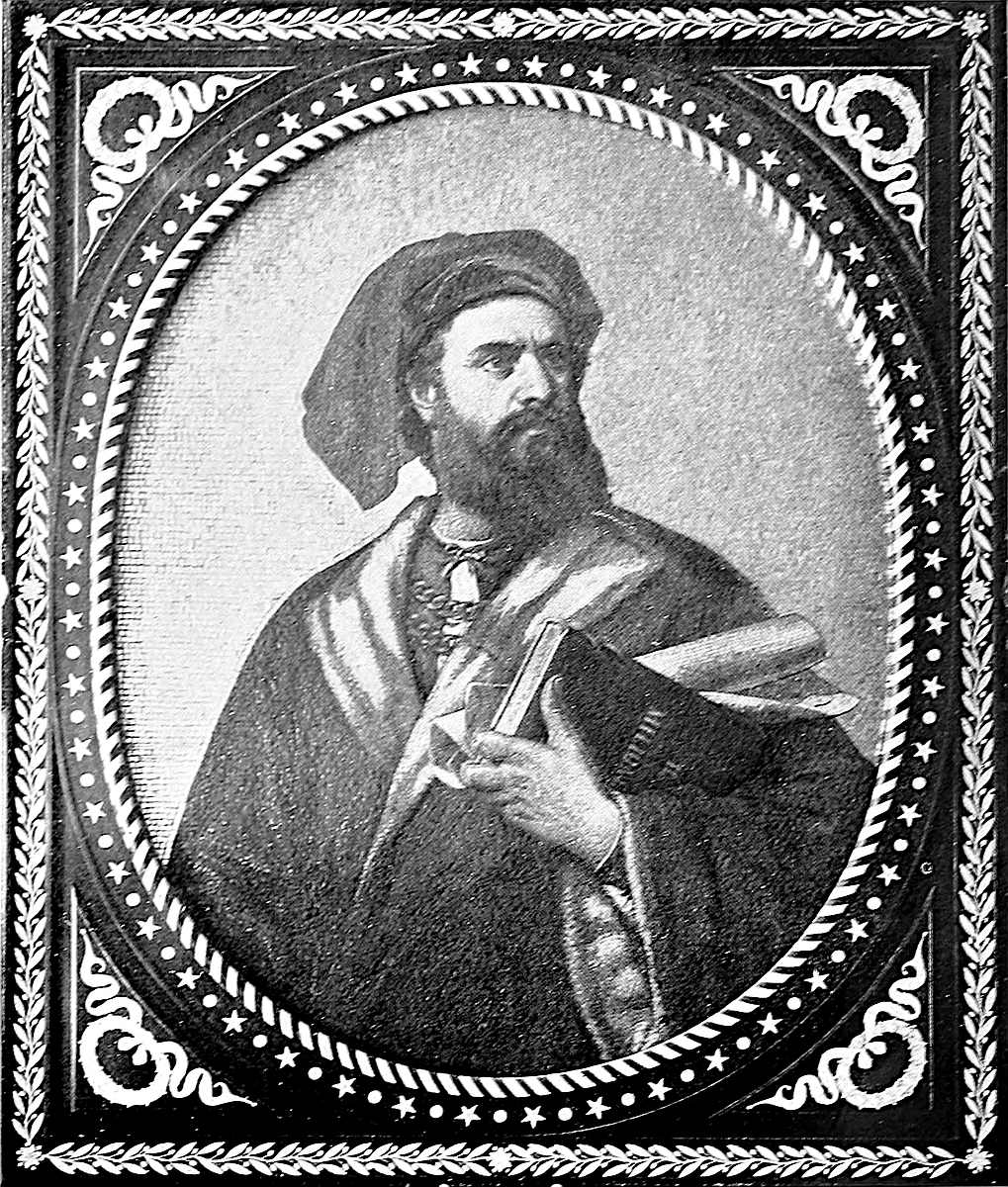
Mosaic Portrait of Marco Polo at Genoa.
In March, 1328, Marco Polo, called Marcolino, of St. John Chrysostom (see
p. 66), represents before the Domini Advocatores of the Republic that
certain imprestita that had belonged to the late Maffeo Polo the Elder,
had been alienated and transferred in May 1318, by the late Marco Polo of
St. John Chrysostom and since his death by his heirs, without regard to the
rights of the said Marcolino, to whom the said Messer Maffeo had bequeathed
1000 lire by his will executed on 6th February, 1308 (i.e. 1309). The
Advocatores find that the transfer was to that extent unjust and improper,
and they order that to the same extent it should be revoked and annulled.
Two months later the Lady Donata makes rather an unpleasant figure before
the Council of Forty. It would seem that on the claim of Messer Bertuccio
Quirino a mandate of sequestration had been issued by the Court of Requests
affecting certain articles in the Ca’ Polo; including two bags of money
which had been tied and sealed, but left in custody of the Lady Donata.
The sum so sealed was about 80 lire of grossi (300l. in silver value),
but when opened only 45 lire and 22 grossi (about 170l.) were found
therein, and the Lady was accused of abstracting the balance non bono
modo. Probably she acted, as ladies sometimes do, on a strong sense of
her own rights, and a weak sense of the claims of law. But the Council
pronounced against her, ordering restitution, and a fine of 200 lire over
and above “ut ceteris transeat in exemplum.”[32]
It will have been seen that there is nothing in the amounts mentioned in
Marco’s will to bear out the large reports as to his wealth, though at the
same time there is no positive ground for a deduction to the contrary.[33]
The mention in two of the documents of Agnes Loredano as the sister of the
Lady Donata suggests that the latter may have belonged to the Loredano
family, but as it does not appear whether Agnes was maid or wife this
remains uncertain.[34]
Respecting the further history of the family there is nothing certain,
nor can we give unhesitating faith to Ramusio’s statement that the last
male descendant of the Polos of S. Giovanni Grisostomo was Marco, who died
Castellano of Verona in 1417 (according to others, 1418, or 1425),[35] and
that the family property then passed to Maria (or Anna, as she is styled
in a MS. statement furnished to me from Venice), who was married in 1401 to
Benedetto Cornaro, and again in 1414 to Azzo Trevisan. Her descendant in
the fourth generation by the latter was Marc Antonio Trevisano,[36] who was
chosen Doge in 1553.
Arms of the Trevisan family.
The genealogy recorded by Marco Barbaro, as drawn up from documents by
Ramusio, makes the Castellano of Verona a grandson of our Marco by a son
Maffeo, whom we may safely pronounce not to have existed, and makes Maria
the daughter of Maffeo, Marco’s brother—that is to say, makes a lady
marry in 1414 and have children, whose father was born in 1271 at the
very latest! The genealogy is given in several other ways, but as I have
satisfied myself that they all (except perhaps this of Barbaro’s, which we
see to be otherwise erroneous) confound together the two distinct families
of Polo of S. Geremia and Polo of S. Giov. Grisostomo, I reserve my faith,
and abstain from presenting them. Assuming that the Marco or Marcolino
Polo, spoken of in the preceding page, was a near relation (as is probable,
though perhaps an illegitimate one), he is the only male descendant of old
Andrea of San Felice whom we can indicate as having survived Marco himself;
and from a study of the links in the professed genealogies I think it
not unlikely that both Marco the Castellano of Verona and Maria Trevisan
belonged to the branch of S. Geremia.[37] [See vol. ii., App. C, p. 510.]
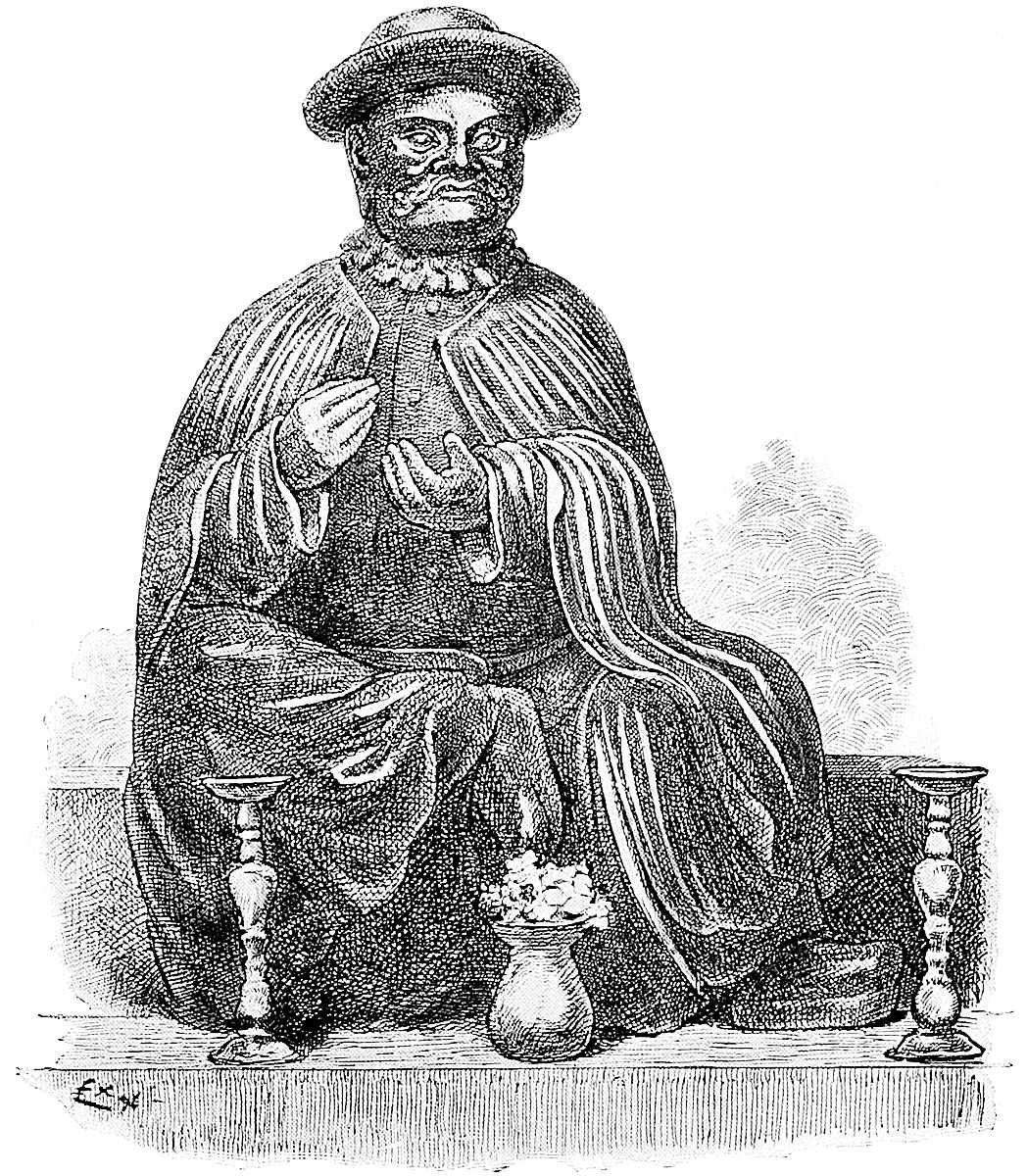
The Pseudo Marco Polo at Canton.
[49. bis.—It is interesting to note some of the reliques left by our
traveller.
I. The unfortunate Doge of Venice, Marino Faliero, seems to have possessed
many souvenirs of Marco Polo, and among them two manuscripts, one in the
handwriting of his celebrated fellow-citizen(?), and one adorned with
miniatures. M. Julius von Schlosser has reprinted (Die ältesten Medaillen
und die Antike, Bd. XVIII., Jahrb. d. Kunsthist. Samml. d. Allerhöchsten
Kaiserhauses, Vienna, 1897, pp. 42–43) from the Bulletino di arti,
industrie e curiosità veneziane, III., 1880–81, p. 101,[38] the inventory
of the curiosities kept in the “Red Chamber” of Marino Faliero’s palace in
the Parish of the SS. Apostles; we give the following abstract of it:—
Anno ab incarnacione domini nostri Jesu Christi 1351° indictione
sexta mensis aprilis. Inuentarium rerum qui sunt in camera rubea
domi habitationis clarissimi domini Marini Faletro de confinio SS.
Apostolorum, scriptum per me Johannem, presbiterum, dicte ecclesie.
•••••
Item alia capsaleta cum ogiis auri et argenti, inter quos unum
anulum con inscriptione que dicit: Ciuble Can Marco Polo, et unum
torques cum multis animalibus Tartarorum sculptis, que res donum
dedit predictus Marcus cuidam Faletrorum.
•••••
Item 2 capsalete de corio albo cum variis rebus auri et argenti,
quas habuit praedictus Marcus a Barbarorum rege.
•••••
Item 1 ensem mirabilem, qui habet 3 enses simul, quem habuit in
suis itineribus praedictus Marcus.
•••••
Item 1 tenturam de pannis indicis, quam habuit praedictus Marcus.
Item de itineribus Marci praedicti liber in corio albo cum multis
figuris.
Item aliud volumen quod vocatur de locis mirabilibus Tartarorum,
scriptum manu praedicti Marci.
•••••
II. There is kept at the Louvre, in the very valuable collection of China
Ware given by M. Ernest Grandidier, a white porcelain incense-burner said
to come from Marco Polo. This incense-burner, which belonged to Baron
Davillier, who received it, as a present, from one of the keepers of the
Treasury of St. Mark’s at Venice, is an octagonal ting from the Fo-kien
province, and of the time of the Sung Dynasty. By the kind permission of M.
P. Grandidier, we reproduce it from Pl. II. 6, of the Céramique chinoise,
Paris, 1894, published by this learned amateur.—H. C.]
50. The Book itself consists essentially of Two Parts. First, of
a Prologue, as it is termed, the only part which is actual personal
General statement of what the Book contains.
narrative, and which relates, in a very interesting but far too brief
manner, the circumstances which led the two elder Polos to the Kaan’s
Court, and those of their second journey with Mark, and of their return to
Persia through the Indian Seas. Secondly, of a long series of chapters
of very unequal length, descriptive of notable sights and products, of
curious manners and remarkable events, relating to the different nations
and states of Asia, but, above all, to the Emperor Kúblái, his court,
wars, and administration. A series of chapters near the close treats in a
verbose and monotonous manner of sundry wars that took place between the
various branches of the House of Chinghiz in the latter half of the 13th
century. This last series is either omitted or greatly curtailed in all
the copies and versions except one; a circumstance perfectly accounted for
by the absence of interest as well as value in the bulk of these chapters.
Indeed, desirous though I have been to give the Traveller’s work complete,
and sharing the dislike that every man who uses books must bear to
abridgments, I have felt that it would be sheer waste and dead-weight to
print these chapters in full.
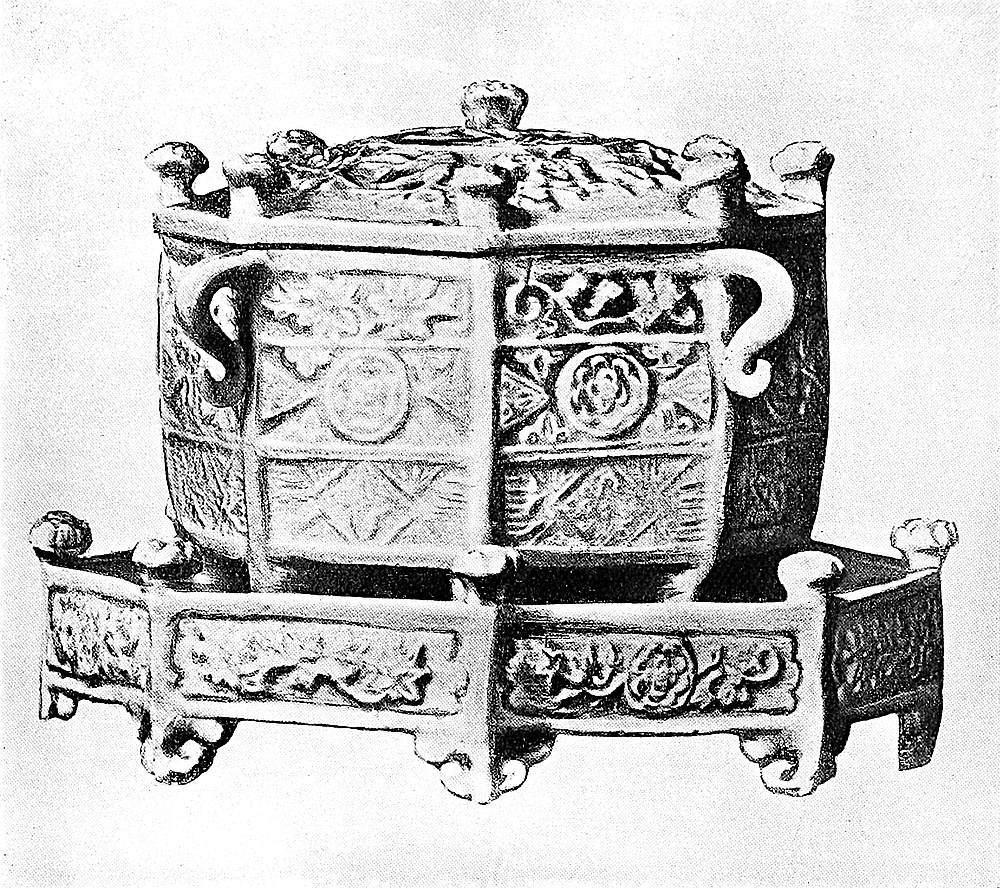
Porcelain Incense-Burner, from the Louvre.
This second and main portion of the Work is in its oldest forms undivided,
the chapters running on consecutively to the end.[1] In some very early
Italian or Venetian version, which Friar Pipino translated into Latin, it
was divided into three Books, and this convenient division has generally
been adhered to. We have adopted M. Pauthier’s suggestion in making the
final series of chapters, chiefly historical, into a Fourth.
51. As regards the language in which Marco’s Book was first committed to
writing, we have seen that Ramusio assumed, somewhat arbitrarily, that
it was Latin; Language of the original Work.Marsden supposed it to have been the Venetian dialect;
Baldelli Boni first showed, in his elaborate edition (Florence, 1827), by
arguments that have been illustrated and corroborated by learned men since,
that it was French.
That the work was originally written in some Italian dialect was a
natural presumption, and slight contemporary evidence can be alleged in its
favour; for Fra Pipino, in the Latin version of the work, executed whilst
Marco still lived, describes his task as a translation de vulgari. And in
one MS. copy of the same Friar Pipino’s Chronicle, existing in the library
at Modena, he refers to the said version as made “ex vulgari idiomate
Lombardico.” But though it may seem improbable that at so early a date
a Latin version should have been made at second hand, I believe this to
have been the case, and that some internal evidence also is traceable that
Pipino translated not from the original but from an Italian version of
the original.
The oldest MS. (it is supposed) in any Italian dialect is one in the
Magliabecchian Library at Florence, which is known in Italy as L’Ottima,
on account of the purity of its Tuscan, and as Della Crusca from its
being one of the authorities cited by that body in their Vocabulary.[2] It
bears on its face the following note in Italian:—
“This Book called the Navigation of Messer Marco Polo, a noble
Citizen of Venice, was written in Florence by Michael Ormanni my
great grandfather by the Mother’s side, who died in the Year of Grace
One Thousand Three Hundred and Nine; and my mother brought it into
our Family of Del Riccio, and it belongs to me Pier del Riccio and to
my Brother; 1452.”
As far as I can learn, the age which this note implies is considered to be
supported by the character of the MS. itself.[3] If it be accepted, the
latter is a performance going back to within eleven years at most of
the first dictation of the Travels. At first sight, therefore, this would
rather argue that the original had been written in pure Tuscan. But when
Baldelli came to prepare it for the press he found manifest indications
of its being a Translation from the French. Some of these he has noted;
others have followed up the same line of comparison. We give some detailed
examples in a note.[4]
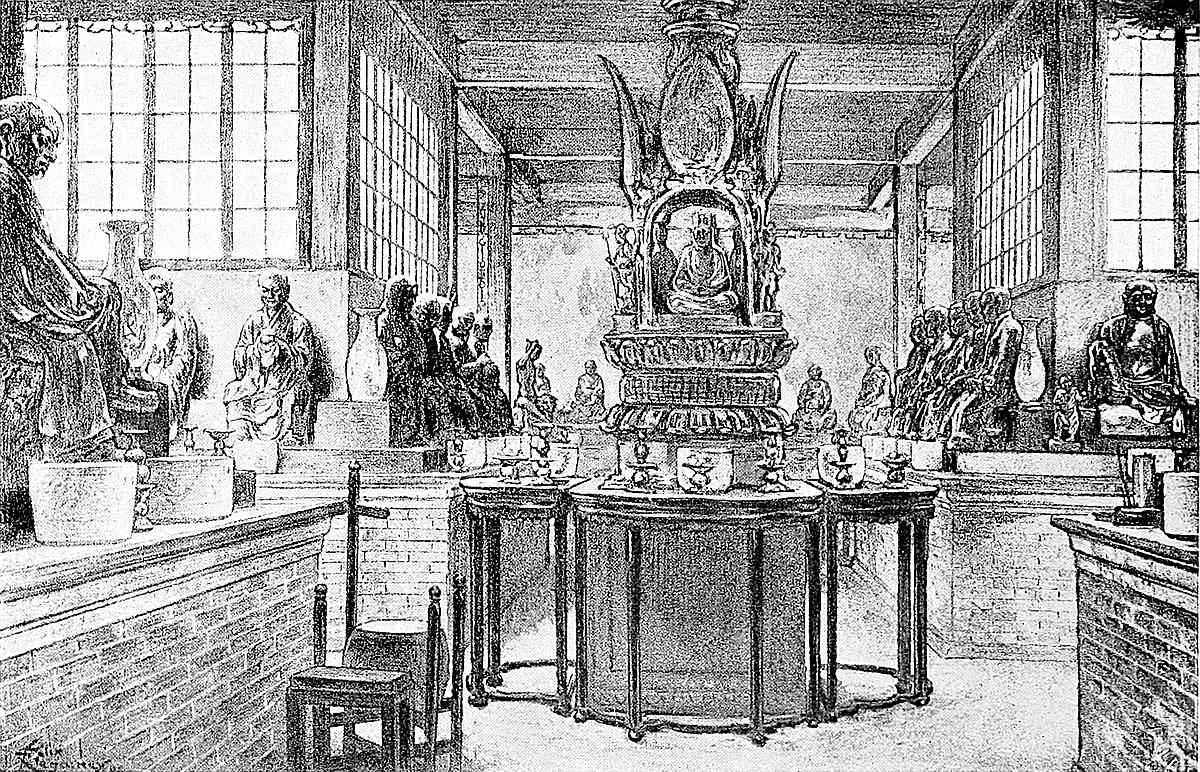
Temple of 500 Genii, at Canton, after a Drawing by Félix Régamey.
52. The French Text that we have been quoting, published by the
Geographical Society of Paris in 1824, affords on the other hand the
strongest correspondingOld French Text published by the Société de Géographie. proof that it is an original and not a Translation.
Rude as is the language of the manuscript (Fr. 1116, formerly No. 7367,
of Paris Library), it is, in the correctness of the proper names, and the
intelligible exhibition of the itineraries, much superior to any form of
the Work previously published.
The language is very peculiar. We are obliged to call it French, but it is
not “Frenche of Paris.” “Its style,” says Paulin Paris, “is about as like
that of good French authors of the age, as in our day the natural accent
of a German, an Englishman, or an Italian, is like that of a citizen of
Paris or Blois.” The author is at war with all the practices of French
grammar; subject and object, numbers, moods, and tenses, are in consummate
confusion. Even readers of his own day must at times have been fain to
guess his meaning. Italian words are constantly introduced, either quite in
the crude or rudely Gallicized.[5] And words also, we may add, sometimes
slip in which appear to be purely Oriental, just as is apt to happen with
Anglo-Indians in these days.[6] All this is perfectly consistent with the
supposition that we have in this MS. a copy at least of the original words
as written down by Rusticiano a Tuscan, from the dictation of Marco an
Orientalized Venetian, in French, a language foreign to both.
But the character of the language as French is not its only peculiarity.
There is in the style, apart from grammar or vocabulary, a rude angularity,
a rough dramatism like that of oral narrative; there is a want of
proportion in the style of different parts, now over curt, now diffuse and
wordy, with at times even a hammering reiteration; a constant recurrence
of pet colloquial phrases (in which, however, other literary works of the
age partake); a frequent change in the spelling of the same proper names,
even when recurring within a few lines, as if caught by ear only; a literal
following to and fro of the hesitations of the narrator; a more general
use of the third person in speaking of the Traveller, but an occasional
lapse into the first. All these characteristics are strikingly indicative
of the unrevised product of dictation, and many of them would necessarily
disappear either in translation or in a revised copy.
Of changes in representing the same proper name, take as an example that of
the Kaan of Persia whom Polo calls Quiacatu (Kaikhátú), but also Acatu,
Catu, and the like.
As an example of the literal following of dictation take the following:—
“Let us leave Rosia, and I will tell you about the Great Sea (the
Euxine), and what provinces and nations lie round about it, all
in detail; and we will begin with Constantinople—First, however,
I should tell you about a province, etc.... There is nothing more
worth mentioning, so I will speak of other subjects,—but there is one
thing more to tell you about Rosia that I had forgotten.... Now then
let us speak of the Great Sea as I was about to do. To be sure many
merchants and others have been here, but still there are many again
who know nothing about it, so it will be well to include it in our
Book. We will do so then, and let us begin first with the Strait of
Constantinople.
“At the Straits leading into the Great Sea, on the West Side, there
is a hill called the Faro.—But since beginning on this matter I have
changed my mind, because so many people know all about it, so we will
not put it in our description but go on to something else.” (See vol.
ii. p. 487 seqq.)
And so on.
As a specimen of tautology and hammering reiteration the following can
scarcely be surpassed. The Traveller is speaking of the Chughi, i.e. the
Indian Jogis:—
“And there are among them certain devotees, called Chughi; these
are longer-lived than the other people, for they live from 150 to 200
years; and yet they are so hale of body that they can go and come
wheresoever they please, and do all the service needed for their
monastery or their idols, and do it just as well as if they were
younger; and that comes of the great abstinence that they practise,
in eating little food and only what is wholesome; for they use to
eat rice and milk more than anything else. And again I tell you
that these Chughi who live such a long time as I have told you, do
also eat what I am going to tell you, and you will think it a great
matter. For I tell you that they take quicksilver and sulphur, and
mix them together, and make a drink of them, and then they drink
this, and they say that it adds to their life; and in fact they do
live much longer for it; and I tell you that they do this twice
every month. And let me tell you that these people use this drink
from their infancy in order to live longer, and without fail those
who live so long as I have told you use this drink of sulphur and
quicksilver.” (See G. T. p. 213.)
Such talk as this does not survive the solvent of translation; and we
may be certain that we have here the nearest approach to the Traveller’s
reminiscences as they were taken down from his lips in the prison of Genoa.
Conclusive proof that the Old French Text is the source of all
the others.
53. Another circumstance, heretofore I believe unnoticed, is in itself
enough to demonstrate the Geographic Text to be the source of all other
versions of the Work. It is this.
In reviewing the various classes or types of texts of Polo’s Book, which
we shall hereafter attempt to discriminate, there are certain proper names
which we find in the different texts to take very different forms, each
class adhering in the main to one particular form.
Thus the names of the Mongol ladies introduced at pp. 32 and 36 of this
volume, which are in proper Oriental form Bulughán and Kukáchin,
appear in the class of MSS. which Pauthier has followed as Bolgara and
Cogatra; in the MSS. of Pipino’s version, and those founded on it,
including Ramusio, the names appear in the correcter forms Bolgana or
Balgana and Cogacin. Now all the forms Bolgana, Balgana, Bolgara,
and Cogatra, Cocacin appear in the Geographic Text.
Kaikhátú Kaan appears in the Pauthier MSS. as Chiato, in the Pipinian as
Acatu, in the Ramusian as Chiacato. All three forms, Chiato, Achatu,
and Quiacatu are found in the Geographic Text.
The city of Koh-banan appears in the Pauthier MSS. as Cabanant, in the
Pipinian and Ramusian editions as Cobinam or Cobinan. Both forms are
found in the Geographic Text.
The city of the Great Kaan (Khanbalig) is called in the Pauthier MSS.
Cambaluc, in the Pipinian and Ramusian less correctly Cambalu. Both
forms appear in the Geographic Text.
The aboriginal People on the Burmese Frontier who received from the Western
officers of the Mongols the Persian name (translated from that applied by
the Chinese) of Zardandán, or Gold-Teeth, appear in the Pauthier MSS.
most accurately as Zardandan, but in the Pipinian as Ardandan (still
further corrupted in some copies into Arcladam). Now both forms are
found in the Geographic Text. Other examples might be given, but these I
think may suffice to prove that this Text was the common source of both classes.
In considering the question of the French original too we must remember
what has been already said regarding Rusticien de Pise and his other French
writings; and we shall find hereafter an express testimony borne in the
next generation that Marco’s Book was composed in vulgari Gallico.
54. But, after all, the circumstantial evidence that has been adduced from
the texts themselves is the most conclusive. Greatly diffused employment of French in that age.We have then every reason to
believe both that the work was written in French, and that an existing
French Text is a close representation of it as originally committed to
paper. And that being so we may cite some circumstances to show that the
use of French or quasi-French for the purpose was not a fact of a very
unusual or surprising nature. The French language had at that time almost
as wide, perhaps relatively a wider, diffusion than it has now. It was
still spoken at the Court of England, and still used by many English
writers, of whom the authors or translators of the Round Table Romances
at Henry III.’s Court are examples.[7] In 1249 Alexander III. King of
Scotland, at his coronation spoke in Latin and French; and in 1291 the
English Chancellor addressing the Scotch Parliament did so in French. At
certain of the Oxford Colleges as late as 1328 it was an order that the
students should converse colloquio latino vel saltem gallico.[8] Late in
the same century Gower had not ceased to use French, composing many poems
in it, though apologizing for his want of skill therein:—
“Et si jeo nai de François la faconde
* * * *
Jeo suis Englois; si quier par tiele voie
Indeed down to nearly 1385, boys in the English grammar-schools were
taught to construe their Latin lessons into French.[10] St. Francis of
Assisi is said by some of his biographers to have had his original name
changed to Francesco because of his early mastery of that language as
a qualification for commerce. French had been the prevalent tongue of
the Crusaders, and was that of the numerous Frank Courts which they
established in the East, including Jerusalem and the states of the Syrian
coast, Cyprus, Constantinople during the reign of the Courtenays, and the
principalities of the Morea. The Catalan soldier and chronicler Ramon de
Muntaner tells us that it was commonly said of the Morean chivalry that
they spoke as good French as at Paris.[11] Quasi-French at least was
still spoken half a century later by the numerous Christians settled at
Aleppo, as John Marignolli testifies;[12] and if we may trust Sir John
Maundevile the Soldan of Egypt himself and four of his chief Lords “spak
Frensche righte wel!”[13] Gházán Kaan, the accomplished Mongol Sovereign
of Persia, to whom our Traveller conveyed a bride from Cambaluc, is said
by the historian Rashiduddin to have known something of the Frank tongue,
probably French.[14] Nay, if we may trust the author of the Romance of
Richard Cœur-de-Lion, French was in his day the language of still higher
spheres![15]
Nor was Polo’s case an exceptional one even among writers on the East who
were not Frenchmen. Maundevile himself tells us that he put his book first
“out of Latyn into Frensche,” and then out of French into English.[16] The
History of the East which the Armenian Prince and Monk Hayton dictated to
Nicolas Faulcon at Poictiers in 1307 was taken down in French. There are
many other instances of the employment of French by foreign, and especially
by Italian authors of that age. The Latin chronicle of the Benedictine
Amato of Monte Cassino was translated into French early in the 13th century
by another monk of the same abbey, at the particular desire of the Count
of Militrée (or Malta), “Pour ce qu’il set lire et entendre fransoize et
s’en delitte.”[17] Martino da Canale, a countryman and contemporary of
Polo’s, during the absence of the latter in the East wrote a Chronicle of
Venice in the same language, as a reason for which he alleges its general
popularity.[18] The like does the most notable example of all, Brunetto
Latini, Dante’s master, who wrote in French his encyclopædic and once
highly popular work Li Tresor.[19] Other examples might be given, but
in fact such illustration is superfluous when we consider that Rusticiano
himself was a compiler of French Romances.
But why the language of the Book as we see it in the Geographic Text
should be so much more rude, inaccurate, and Italianized than that of
Rusticiano’s other writings, is a question to which I can suggest no reply
quite satisfactory to myself. Is it possible that we have in it a literal
representation of Polo’s own language in dictating the story,—a rough draft
which it was intended afterwards to reduce to better form, and which was so
reduced (after a fashion) in French copies of another type, regarding which
we shall have to speak presently?[20] And, if this be the true answer, why
should Polo have used a French jargon in which to tell his story? Is it
possible that his own mother Venetian, such as he had carried to the East
with him and brought back again, was so little intelligible to Rusticiano
that French of some kind was the handiest medium of communication between
the two? I have known an Englishman and a Hollander driven to converse in
Malay; Chinese Christians of different provinces are said sometimes to take
to English as the readiest means of intercommunication; and the same is
said even of Irish-speaking Irishmen from remote parts of the Island.
It is worthy of remark how many notable narratives of the Middle Ages
have been dictated instead of being written by their authors, and that
in cases where it is impossible to ascribe this to ignorance of writing.
The Armenian Hayton, though evidently a well-read man, possibly could not
write in Roman characters. But Joinville is an illustrious example. And the
narratives of four of the most famous Mediæval Travellers[21] seem to have
been drawn from them by a kind of pressure, and committed to paper by other
hands. I have elsewhere remarked this as indicating how little diffused
was literary ambition or vanity; but it would perhaps be more correct to
ascribe it to that intense dislike which is still seen on the shores of
the Mediterranean to the use of pen and ink. On certain of those shores at
least there is scarcely any inconvenience that the majority of respectable
and good-natured people will not tolerate—inconvenience to their neighbours
be it understood—rather than put pen to paper for the purpose of preventing it.
55. In treating of the various Texts of Polo’s Book we must Four Principal Types of Text. First, that of the Geographic, or
oldest French.necessarily go
into some irksome detail.
Those Texts that have come down to us may be classified under Four
principal Types.
I. The First Type is that of the Geographic Text of which we have already
said so much. This is found nowhere complete except in the unique MS. of
the Paris Library, to which it is stated to have come from the old Library
of the French Kings at Blois. But the Italian Crusca, and the old Latin
version (No. 3195 of the Paris Library) published with the Geographic
Text, are evidently derived entirely from it, though both are considerably
abridged. It is also demonstrable that neither of these copies has been
translated from the other, for each has passages which the other omits,
but that both have been taken, the one as a copy more or less loose, the
other as a translation, from an intermediate Italian copy.[1] A special
difference lies in the fact that the Latin version is divided into three
Books, whilst the Crusca has no such division. I shall show in a tabular
form the filiation of the texts which these facts seem to demonstrate
(see Appendix G).
There are other Italian MSS. of this type, some of which show signs of
having been derived independently from the French;[2] but I have not
been able to examine any of them with the care needful to make specific
deductions regarding them.
56. II. The next Type is that of the French MSS. on which M. Pauthier’s
Text is based, and for which he claims the highest authority, Second;
the remodelled French Text, followed by Pauthier.as having had
the mature revision and sanction of the Traveller. There are, as far as I
know, five MSS. which may be classed together under this type, three in the
Great Paris Library, one at Bern, and one in the Bodleian.
The high claims made by Pauthier on behalf of this class of MSS. (on the
first three of which his Text is formed) rest mainly upon the kind of
certificate which two of them bear regarding the presentation of a copy
by Marco Polo to Thibault de Cepoy, which we have already quoted (supra,
p. 69). This certificate is held by Pauthier to imply that the original
of the copies which bear it, and of those having a general correspondence
with them, had the special seal of Marco’s revision and approval. To some
considerable extent their character is corroborative of such a claim, but
they are far from having the perfection which Pauthier attributes to them,
and which leads him into many paradoxes.
It is not possible to interpret rigidly the bearing of this so-called
certificate, as if no copies had previously been taken of any form of
the Book; nor can we allow it to impugn the authenticity of the Geographic
Text, which demonstratively represents an older original, and has been (as
we have seen) the parent of all other versions, including some very old
ones, Italian and Latin, which certainly owe nothing to this revision.
The first idea apparently entertained by d’Avezac and Paulin Paris was that
the Geographic Text was itself the copy given to the Sieur de Cepoy, and
that the differences in the copies of the class which we describe as Type
II. merely resulted from the modifications which would naturally arise in
the process of transcription into purer French. But closer examination
showed the differences to be too great and too marked to admit of this
explanation. These differences consist not only in the conversion of the
rude, obscure, and half Italian language of the original into good French
of the period. There is also very considerable curtailment, generally
of tautology, but also extending often to circumstances of substantial
interest; whilst we observe the omission of a few notably erroneous
statements or expressions; and a few insertions of small importance.
None of the MSS. of this class contain more than a few of the historical
chapters which we have formed into Book IV.
The only addition of any magnitude is that chapter which in our
translation forms chapter xxi. of Book II. It will be seen that it contains
no new facts, but is only a tedious recapitulation of circumstances already
stated, though scattered over several chapters. There are a few minor
additions. I have not thought it worth while to collect them systematically
here, but two or three examples are given in a note.[3]
There are also one or two corrections of erroneous statements in the G. T.
which seem not to be accidental and to indicate some attempt at revision.
Thus a notable error in the account of Aden, which seems to conceive of the
Red Sea as a river, disappears in Pauthier’s MSS. A and B.[4] And we find
in these MSS. one or two interesting names preserved which are not found in
the older Text.[5]
But on the other hand this class of MSS. contains many erroneous readings
of names, either adopting the worse of two forms occurring in the G. T. or
originating blunders of its own.[6]
M. Pauthier lays great stress on the character of these MSS. as the sole
authentic form of the work, from their claim to have been specially revised
by Marco Polo. It is evident, however, from what has been said, that this
revision can have been only a very careless and superficial one, and must
have been done in great measure by deputy, being almost entirely confined
to curtailment and to the improvement of the expression, and that it is by
no means such as to allow an editor to dispense with a careful study of the
Older Text.
57. There is another curious circumstance about the MSS. of this type,
viz., that they clearly divide into two distinct recensions, The
Bern MS. and two others form a sub-class of this Type.of which both
have so many peculiarities and errors in common that they must necessarily
have been both derived from one modification of the original text, whilst
at the same time there are such differences between the two as cannot be
set down to the accidents of transcription. Pauthier’s MSS. A and B (Nos.
16 and 15 of the List in App. F) form one of these subdivisions: his C (No.
17 of List), Bern (No. 56), and Oxford (No. 6), the other. Between A and B
the differences are only such as seem constantly to have arisen from the
whims of transcribers or their dialectic peculiarities. But between A and B
on the one side, and C on the other, the differences are much greater. The
readings of proper names in C are often superior, sometimes worse; but in
the latter half of the work especially it contains a number of substantial
passages[7] which are to be found in the G. T., but are altogether absent
from the MSS. A and B; whilst in one case at least (the history of the
Siege of Saianfu, vol. ii. p. 159) it diverges considerably from the G. T.
as well as from A and B.[8]
I gather from the facts that the MS. C represents an older form of the work
than A and B. I should judge that the latter had been derived from that
older form, but intentionally modified from it. And as it is the MS. C,
with its copy at Bern, that alone presents the certificate of derivation
from the Book given to the Sieur de Cepoy, there can be no doubt that it is
the true representative of that recension.
58. III. The next Type of Text is that found in Friar Pipino’s Latin
version. It is the type of which MSS. are by far the most numerous. Third; Friar Pipino’s Latin.In it
condensation and curtailment are carried a good deal further than in Type
II. The work is also divided into three Books. But this division does not
seem to have originated with Pipino, as we find it in the ruder and perhaps
older Latin version of which we have already spoken under Type I. And we
have demonstrated that this ruder Latin is a translation from an Italian
copy. It is probable therefore that an Italian version similarly divided
was the common source of what we call the Geographic Latin and of Pipino’s
more condensed version.[9]
Pipino’s version appears to have been executed in the later years of Polo’s
life.[10] But I can see no ground for the idea entertained by Baldelli-Boni
and Professor Bianconi that it was executed with Polo’s cognizance and
retouched by him.
59. The absence of effective publication in the Middle Ages led to a
curious complicationThe Latin of Grynæus a translation at fifth hand. of translation and retranslation. Thus the Latin
version published by Grynæus in the Novus Orbis (Basle, 1532) is
different from Pipino’s, and yet clearly traceable to it as a base. In fact
it is a retranslation into Latin from some version (Marsden thinks the
printed Portuguese one) of Pipino. It introduces many minor modifications,
omitting specific statements of numbers and values, generalizing the names
and descriptions of specific animals, exhibiting frequent sciolism and
self-sufficiency in modifying statements which the Editor disbelieved.[11]
It is therefore utterly worthless as a Text, and it is curious that
Andreas Müller, who in the 17th century devoted himself to the careful
editing of Polo, should have made so unfortunate a choice as to reproduce
this fifth-hand Translation. I may add that the French editions published
in the middle of the 16th century are translations from Grynæus.
Hence they complete this curious and vicious circle of translation:
French—Italian—Pipino’s Latin—Portuguese?—Grynæus’s Latin—French![12]
60. IV. We now come to a Type of Text which deviates largely from any of
those hitherto spoken of, and the history Fourth; Ramusio’s Italian.and true character of which are
involved in a cloud of difficulty. We mean that Italian version prepared
for the press by G. B. Ramusio, with most interesting, though, as we have
seen, not always accurate preliminary dissertations, and published at
Venice two years after his death, in the second volume of the Navigationi
e Viaggi.[13]
The peculiarities of this version are very remarkable. Ramusio seems to
imply that he used as one basis at least the Latin of Pipino; and many
circumstances, such as the division into Books, the absence of the terminal
historical chapters and of those about the Magi, and the form of many
proper names, confirm this. But also many additional circumstances and
anecdotes are introduced, many of the names assume a new shape, and the
whole style is more copious and literary in character than in any other
form of the work.
Whilst some of the changes or interpolations seem to carry us further from
the truth, others contain facts of Asiatic nature or history, as well as
of Polo’s own experiences, which it is extremely difficult to ascribe to
any hand but the Traveller’s own. This was the view taken by Baldelli,
Klaproth, and Neumann;[14] but Hugh Murray, Lazari, and Bartoli regard the
changes as interpolations by another hand; and Lazari is rash enough to
ascribe the whole to a rifacimento of Ramusio’s own age, asserting it
to contain interpolations not merely from Polo’s own contemporary Hayton,
but also from travellers of later centuries, such as Conti, Barbosa, and
Pigafetta. The grounds for these last assertions have not been cited, nor
can I trace them. But I admit to a certain extent indications of modern
tampering with the text, especially in cases where proper names seem to
have been identified and more modern forms substituted. In days, however,
where an Editor’s duties were ill understood, this was natural.
61. Thus we find substituted for the Bastra (or Bascra) of the older
texts the more modern and incorrect Balsora, dear to memories of the
Arabian Nights;Injudicious tamperings in Ramusio. among the provinces of Persia we have Spaan (Ispahan)
where older texts read Istanit; for Cormos we have Ormus; for
Herminia and Laias, Armenia and Giazza; Coulam for the older
Coilum; Socotera for Scotra. With these changes may be classed the
chapter-headings, which are undisguisedly modern, and probably Ramusio’s
own. In some other cases this editorial spirit has been over-meddlesome
and has gone astray. Thus Malabar is substituted wrongly for Maabar
in one place, and by a grosser error for Dalivar in another. The age
of young Marco, at the time of his father’s first return to Venice, has
been arbitrarily altered from 15 to 19, in order to correspond with a date
which is itself erroneous. Thus also Polo is made to describe Ormus as
on an Island, contrary to the old texts and to the fact; for the city of
Hormuz was not transferred to the island, afterwards so famous, till some
years after Polo’s return from the East. It is probably also the editor who
in the notice of the oil-springs of Caucasus (i. p. 46) has substituted
camel-loads for ship-loads, in ignorance that the site of those alluded
to was probably Baku on the Caspian.
Other erroneous statements, such as the introduction of window-glass as one
of the embellishments of the palace at Cambaluc, are probably due only to
accidental misunderstanding.
62. Of circumstances certainly genuine, which are peculiar to this
edition of Polo’s work, and which it is difficult to assign to any one
but himself, Genuine statements peculiar to Ramusio.we may note the specification of the woods east of Yezd as
composed of date trees (vol. i pp. 88–89); the unmistakable allusion
to the subterranean irrigation channels of Persia (p. 123); the accurate
explanation of the term Mulehet applied to the sect of Assassins (pp.
139–142); the mention of the Lake (Sirikul?) on the plateau of Pamer, of
the wolves that prey on the wild sheep, and of the piles of wild rams’
horns used as landmarks in the snow (pp. 171–177). To the description of
the Tibetan Yak, which is in all the texts, Ramusio’s version alone adds
a fact probably not recorded again till the present century, viz., that
it is the practice to cross the Yak with the common cow (p. 274). Ramusio
alone notices the prevalence of goître at Yarkand, confirmed by recent
travellers (i. p. 187); the vermilion seal of the Great Kaan imprinted on
the paper-currency, which may be seen in our plate of a Chinese note (p.
426); the variation in Chinese dialects (ii. p. 236); the division of the
hulls of junks into water-tight compartments (ii. p. 249); the introduction
into China from Egypt of the art of refining sugar (ii. p. 226). Ramusio’s
account of the position of the city of Sindafu (Ch’êng-tu fu) encompassed
and intersected by many branches of a great river (ii. p. 40), is much
more just than that in the old text, which speaks of but one river through
the middle of the city. The intelligent notices of the Kaan’s charities as
originated by his adoption of “idolatry” or Buddhism; of the astrological
superstitions of the Chinese, and of the manners and character of the
latter nation, are found in Ramusio alone. To whom but Marco himself, or
one of his party, can we refer the brief but vivid picture of the delicious
atmosphere and scenery of the Badakhshan plateaux (i. p. 158), and of the
benefit that Messer Marco’s health derived from a visit to them? In this
version alone again we have an account of the oppressions exercised by
Kúblái’s Mahomedan Minister Ahmad, telling how the Cathayans rose against
him and murdered him, with the addition that Messer Marco was on the spot
when all this happened. Now not only is the whole story in substantial
accordance with the Chinese Annals, even to the name of the chief
conspirator,[15] but those annals also tell of the courageous frankness of
“Polo, assessor of the Privy Council,” in opening the Kaan’s eyes to the truth.
Many more such examples might be adduced, but these will suffice. It is
true that many of the passages peculiar to the Ramusian version, and
indeed the whole version, show a freer utterance and more of a literary
faculty than we should attribute to Polo, judging from the earlier texts.
It is possible, however, that this may be almost, if not entirely, due
to the fact that the version is the result of a double translation, and
probably of an editorial fusion of several documents; processes in which
angularities of expression would be dissolved.[16]
63. Though difficulties will certainly remain,[17] the most probable
explanation of the origin of this text seems to me to be some suchHypothesis of the sources of the Ramusian Version.
hypothesis as the following:—I suppose that Polo in his latter years added
with his own hand supplementary notes and reminiscences, marginally or
otherwise, to a copy of his book; that these, perhaps in his lifetime, more
probably after his death, were digested and translated into Latin;[18] and
that Ramusio, or some friend of his, in retranslating and fusing them with
Pipino’s version for the Navigationi, made those minor modifications in
names and other matters which we have already noticed. The mere facts of
digestion from memoranda and double translation would account for a good
deal of unintentional corruption.
That more than one version was employed in the composition of Ramusio’s
edition we have curious proof in at least one passage of the latter.
We have pointed out at p. 410 of this volume a curious example of
misunderstanding of the old French Text, a passage in which the term Roi
des Pelaines, or “King of Furs,” is applied to the Sable, and which in the
Crusca has been converted into an imaginary Tartar phrase Leroide pelame,
or as Pipino makes it Rondes (another indication that Pipino’s Version
and the Crusca passed through a common medium). But Ramusio exhibits both
the true reading and the perversion: “E li Tartari la chiamano Regina
delle pelli” (there is the true reading), “E gli animali si chiamano
Rondes” (and there the perverted one).
We may further remark that Ramusio’s version betrays indications that one
of its bases either was in the Venetian dialect, or had passed through
that dialect; for a good many of the names appear in Venetian forms, e.g.,
substituting the z for the sound of ch, j, or soft g, as in Goza,
Zorzania, Zagatay, Gonza (for Giogiu), Quenzanfu, Coiganzu, Tapinzu,
Zipangu, Ziamba.
64. To sum up. It is, I think, beyond reasonable dispute that we have, in
what we call the Geographic Text, as nearly as may be an exact transcript
of theSummary in regard to Text of Polo. Traveller’s words as originally taken down in the prison of Genoa.
We have again in the MSS. of the second type an edition pruned and refined,
probably under instructions from Marco Polo, but not with any critical
exactness. And lastly, I believe, that we have, imbedded in the Ramusian
edition, the supplementary recollections of the Traveller, noted down
at a later period of his life, but perplexed by repeated translation,
compilation, and editorial mishandling.
And the most important remaining problem in regard to the text of Polo’s
work is the discovery of the supplemental manuscript from which Ramusio
derived those passages which are found only in his edition. It is possible
that it may still exist, but no trace of it in anything like completeness
has yet been found; though when my task was all but done I discovered a
small part of the Ramusian peculiarities in a MS. at Venice.[19]
65. Whilst upon this subject of manuscripts of our Author, I will give
some particulars regarding a very curious one, containing a version in the
Irish language.
This remarkable document is found in the Book of Lismore, belonging to
the Duke of Devonshire. That magnificent book,Notice of a curious Irish Version of Polo. finely written on vellum
of the largest size, was discovered in 1814, enclosed in a wooden box,
along with a superb crozier, on opening a closed doorway in the castle
of Lismore. It contained Lives of the Saints, the (Romance) History of
Charlemagne, the History of the Lombards, histories and tales of Irish
wars, etc., etc., and among the other matter this version of Marco Polo. A
full account of the Book and its mutilations will be found in O’Curry’s
Lectures on the MS. Materials of Ancient Irish History, p. 196 seqq.,
Dublin, 1861. The Book of Lismore was written about 1460 for Finghin
MacCarthy and his wife Catharine Fitzgerald, daughter of Gerald, Eighth
Earl of Desmond.
The date of the Translation of Polo is not known, but it may be supposed
to have been executed about the above date, probably in the Monastery of
Lismore (county of Waterford).
From the extracts that have been translated for me, it is obvious that
the version was made, with an astounding freedom certainly, from Friar
Francesco Pipino’s Latin.
Both beginning and end are missing. But what remains opens thus; compare it
with Friar Pipino’s real prologue as we give it in the Appendix![20]

————“Kings and chieftains of that city. There was then in the city a
princely Friar in the habit of St. Francis, named Franciscus, who was
versed in many languages. He was brought to the place where those
nobles were, and they requested of him to translate the book from
the Tartar (!) into the Latin language. ‘It is an abomination to
me,’ said he, ‘to devote my mind or labour to works of Idolatry and
Irreligion.’ They entreated him again. ‘It shall be done,’ said he;
‘for though it be an irreligious narrative that is related therein,
yet the things are miracles of the True God; and every one who hears
this much against the Holy Faith shall pray fervently for their
conversion. And he who will not pray shall waste the vigour of his
body to convert them.’ I am not in dread of this Book of Marcus, for
there is no lie in it. My eyes beheld him bringing the relics of the
holy Church with him, and he left [his testimony], whilst tasting of
death, that it was true. And Marcus was a devout man. What is there
in it, then, but that Franciscus translated this Book of Marcus from
the Tartar into Latin; and the years of the Lord at that time were
fifteen years, two score, two hundred, and one thousand” (1255).
It then describes Armein Bec (Little Armenia), Armein Mor (Great
Armenia), Musul, Taurisius, Persida, Camandi, and so forth. The last
chapter is that on Abaschia:—
“Abaschia also is an extensive country, under the government of Seven
Kings, four of whom worship the true God, and each of them wears a
golden cross on the forehead; and they are valiant in battle, having
been brought up fighting against the Gentiles of the other three
kings, who are Unbelievers and Idolaters. And the kingdom of Aden; a
Soudan rules over them.
“The king of Abaschia once took a notion to make a pilgrimage to
the Sepulchre of Jesus. ‘Not at all,’ said his nobles and warriors
to him, ‘for we should be afraid lest the infidels through whose
territories you would have to pass, should kill you. There is a Holy
Bishop with you,’ said they; ‘send him to the Sepulchre of Jesus, and
much gold with him’”——
The rest is wanting.
66. That Marco Polo has been so universally recognised as the King of
Mediæval Travellers is due rather to the width of his experience, Grounds of Polo’s pre-eminence among mediæval travellers.the vast
compass of his journeys, and the romantic nature of his personal history,
than to transcendent superiority of character or capacity.
The generation immediately preceding his own has bequeathed to us, in the
Report of the Franciscan Friar William de Rubruquis,[1] on the Mission with
which St. Lewis charged him to the Tartar Courts, the narrative of one
great journey, which, in its rich detail, its vivid pictures, its acuteness
of observation and strong good sense, seems to me to form a Book of Travels
of much higher claims than any one series of Polo’s chapters; a book,
indeed, which has never had justice done to it, for it has few superiors in
the whole Library of Travel.
Enthusiastic Biographers, beginning with Ramusio, have placed Polo on the
same platform with Columbus. But where has our Venetian Traveller left
behind him any trace of the genius and lofty enthusiasm, the ardent and
justified previsions which mark the great Admiral as one of the lights
of the human race?[2] It is a juster praise that the spur which his Book
eventually gave to geographical studies, and the beacons which it hung out
at the Eastern extremities of the Earth helped to guide the aims, though
scarcely to kindle the fire, of the greater son of the rival Republic. His
work was at least a link in the Providential chain which at last dragged
the New World to light.[3]
67. Surely Marco’s real, indisputable, and, in their kind, unique claims
to glory may suffice! His true claims to glory.He was the first Traveller to trace a route across
the whole longitude of Asia, naming and describing kingdom after kingdom
which he had seen with his own eyes; the Deserts of Persia, the flowering
plateaux and wild gorges of Badakhshan, the jade-bearing rivers of
Khotan, the Mongolian Steppes, cradle of the power that had so lately
threatened to swallow up Christendom, the new and brilliant Court that had
been established at Cambaluc: The first Traveller to reveal China in
all its wealth and vastness, its mighty rivers, its huge cities, its rich
manufactures, its swarming population, the inconceivably vast fleets that
quickened its seas and its inland waters; to tell us of the nations on its
borders with all their eccentricities of manners and worship; of Tibet
with its sordid devotees; of Burma with its golden pagodas and their
tinkling crowns; of Laos, of Siam, of Cochin China, of Japan, the
Eastern Thule, with its rosy pearls and golden-roofed palaces; the first to
speak of that Museum of Beauty and Wonder, still so imperfectly ransacked,
the Indian Archipelago, source of those aromatics then so highly prized
and whose origin was so dark; of Java the Pearl of Islands; of Sumatra
with its many kings, its strange costly products, and its cannibal races;
of the naked savages of Nicobar and Andaman; of Ceylon the Isle of
Gems with its Sacred Mountain and its Tomb of Adam; of India the Great,
not as a dream-land of Alexandrian fables, but as a country seen and
partially explored, with its virtuous Brahmans, its obscene ascetics,
its diamonds and the strange tales of their acquisition, its sea-beds of
pearl, and its powerful sun; the first in mediæval times to give any
distinct account of the secluded Christian Empire of Abyssinia, and the
semi-Christian Island of Socotra; to speak, though indeed dimly, of
Zangibar with its negroes and its ivory, and of the vast and distant
Madagascar, bordering on the Dark Ocean of the South, with its Ruc and
other monstrosities; and, in a remotely opposite region, of Siberia and
the Arctic Ocean, of dog-sledges, white bears, and reindeer-riding
Tunguses.
That all this rich catalogue of discoveries should belong to the
revelations of one Man and one Book is surely ample ground enough to
account for and to justify the Author’s high place in the roll of Fame, and
there can be no need to exaggerate his greatness, or to invest him with
imaginary attributes.[4]
68. What manner of man was Ser Marco? It is a question hard to answer.
His personal attributes seen but dimly.
Some critics cry out against personal detail in books of Travel; but as
regards him who would not welcome a little more egotism! In his Book
impersonality is carried to excess; and we are often driven to discern
by indirect and doubtful indications alone, whether he is speaking of a
place from personal knowledge or only from hearsay. In truth, though there
are delightful exceptions, and nearly every part of the book suggests
interesting questions, a desperate meagreness and baldness does extend over
considerable tracts of the story. In fact his book reminds us sometimes
of his own description of Khorasan:—“On chevauche par beaus plains et
belles costieres, là où il a moult beaus herbages et bonne pasture et fruis
assez.... Et aucune fois y treuve l’en un desert de soixante milles ou de
mains, esquels desers ne treuve l’en point d’eaue; mais la convient porter
o lui!”
Still, some shadowy image of the man may be seen in the Book; a practical
man, brave, shrewd, prudent, keen in affairs, and never losing his interest
in mercantile details, very fond of the chase, sparing of speech; with
a deep wondering respect for Saints, even though they be Pagan Saints,
and their asceticism, but a contempt for Patarins and such like, whose
consciences would not run in customary grooves, and on his own part a keen
appreciation of the World’s pomps and vanities. See, on the one hand, his
undisguised admiration of the hard life and long fastings of Sakya Muni;
and on the other how enthusiastic he gets in speaking of the great Kaan’s
command of the good things of the world, but above all of his matchless
opportunities of sport![5]
Of humour there are hardly any signs in his Book. His almost solitary
joke (I know but one more, and it pertains to the οὐκ ἀνήκοντα)
occurs in speaking of the Kaan’s paper-money when he observes that Kúblái
might be said to have the true Philosopher’s Stone, for he made his money
at pleasure out of the bark of Trees.[6] Even the oddest eccentricities of
outlandish tribes scarcely seem to disturb his gravity; as when he relates
in his brief way of the people called Gold-Teeth on the frontier of Burma,
that ludicrous custom which Mr. Tylor has so well illustrated under the
name of the Couvade. There is more savour of laughter in the few lines
of a Greek Epic, which relate precisely the same custom of a people on the
Euxine:—
——“In the Tibarenian Land
When some good woman bears her lord a babe,
’Tis he is swathed and groaning put to bed;
Whilst she, arising, tends his baths, and serves
Nice possets for her husband in the straw.”
[7]
Probable View of Marco Polo’s Own Geography
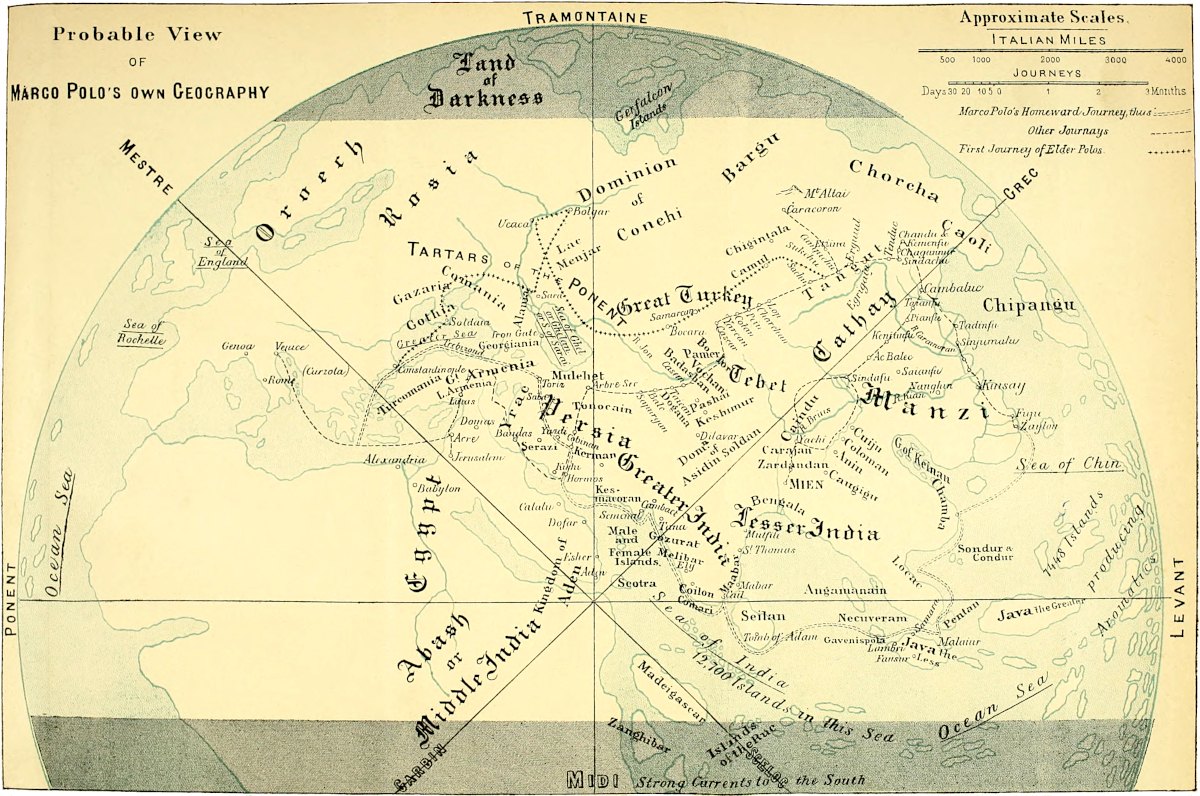
Lit. Frauenfelder, Palermo
69. Of scientific notions, such as we find in the unveracious Maundevile,
we have no trace in truthful Marco. The former, “lying with a
circumstance,”Absence of scientific notions. tells us boldly that he was in 33° of South Latitude; the
latter is full of wonder that some of the Indian Islands where he had been
lay so far to the south that you lost sight of the Pole-star. When it rises
again on his horizon he estimates the Latitude by the Pole-star’s being so
many cubits high. So the gallant Baber speaks of the sun having mounted
spear-high when the onset of battle began at Paniput. Such expressions
convey no notion at all to such as have had their ideas sophisticated by
angular perceptions of altitude, but similar expressions are common among
Orientals,[8] and indeed I have heard them from educated Englishmen. In
another place Marco states regarding certain islands in the Northern Ocean
that they lie so very far to the north that in going thither one actually
leaves the Pole-star a trifle behind towards the south; a statement to
which we know only one parallel, to wit, in the voyage of that adventurous
Dutch skipper who told Master Moxon, King Charles II.’s Hydrographer, that
he had sailed two degrees beyond the Pole!
70. The Book, however, is full of bearings and distances, and I have
thought it worth while to construct a map from its indications, in order to
get some approximation toMap constructed on Polo’s data. Polo’s own idea of the face of that world which
he had traversed so extensively. There are three allusions to maps in the
course of his work (II. 245, 312, 424).
In his own bearings, at least on land journeys, he usually carries us along
a great general traverse line, without much caring about small changes of
direction. Thus on the great outward journey from the frontier of Persia to
that of China the line runs almost continuously “entre Levant et Grec”
or E.N.E. In his journey from Cambaluc or Peking to Mien or Burma, it is
always Ponent or W.; and in that from Peking to Zayton in Fo-kien, the
port of embarkation for India, it is Sceloc or S.E. The line of bearings
in which he deviates most widely from truth is that of the cities on the
Arabian Coast from Aden to Hormuz, which he makes to run steadily vers
Maistre or N.W., a conception which it has not been very easy to realise
on the map.[9]
71. In the early part of the Book we are told that Marco acquired several
of the languages current in the Mongol Empire,Singular omissions of Polo in regard to China; Historical
inaccuracies. and no less than four
written characters. We have discussed what these are likely to have been
(i. pp. 28–29), and have given a decided opinion that Chinese was not
one of them. Besides intrinsic improbability, and positive indications
of Marco’s ignorance of Chinese, in no respect is his book so defective
as in regard to Chinese manners and peculiarities. The Great Wall is
never mentioned, though we have shown reason for believing that it was
in his mind when one passage of his book was dictated.[10] The use of
Tea, though he travelled through the Tea districts of Fo-kien, is never
mentioned;[11] the compressed feet of the women and the employment of the
fishing cormorant (both mentioned by Friar Odoric, the contemporary of his
later years), artificial egg-hatching, printing of books (though the notice
of this art seems positively challenged in his account of paper-money),
besides a score of remarkable arts and customs which one would have
expected to recur to his memory, are never alluded to. Neither does he
speak of the great characteristic of the Chinese writing. It is difficult
to account for these omissions, especially considering the comparative
fulness with which he treats the manners of the Tartars and of the Southern
Hindoos; but the impression remains that his associations in China were
chiefly with foreigners. Wherever the place he speaks of had a Tartar
or Persian name he uses that rather than the Chinese one. Thus Cathay,
Cambaluc, Pulisanghin, Tangut, Chagannor, Saianfu, Kenjanfu, Tenduc,
Acbalec, Carajan, Zardandan, Zayton, Kemenfu, Brius, Caramoran, Chorcha,
Juju, are all Mongol, Turki, or Persian forms, though all have Chinese
equivalents.[12]
In reference to the then recent history of Asia, Marco is often inaccurate,
e.g. in his account of the death of Chinghiz, in the list of his
successors, and in his statement of the relationship between notable
members of that House.[13] But the most perplexing knot in the whole book
lies in the interesting account which he gives of the Siege of Sayanfu or
Siang-yang, during the subjugation of Southern China by Kúblái. I have
entered on this matter in the notes (vol. ii. p. 167), and will only say
here that M. Pauthier’s solution of the difficulty is no solution, being
absolutely inconsistent with the story as told by Marco himself, and that I
see none; though I have so much faith in Marco’s veracity that I am loath
to believe that the facts admit of no reconciliation.
Our faint attempt to appreciate some of Marco’s qualities, as gathered
from his work, will seem far below the very high estimates that have been
pronounced, not only by some who have delighted rather to enlarge upon his
frame than to make themselves acquainted with his work,[14] but also by
persons whose studies and opinions have been worthy of all respect. Our
estimate, however, does not abate a jot of our intense interest in his Book
and affection for his memory. And we have a strong feeling that, owing
partly to his reticence, and partly to the great disadvantages under which
the Book was committed to writing, we have in it a singularly imperfect
image of the Man.
72. A question naturally suggests itself, how far Polo’s narrative, at
Was Polo’s Book materially affected by the Scribe Rusticiano?
least in its expression, was modified by passing under the pen of a
professed littérateur of somewhat humble claims, such as Rusticiano was.
The case is not a singular one, and in our own day the ill-judged use
of such assistance has been fatal to the reputation of an adventurous
Traveller.
We have, however, already expressed our own view that in the Geographic
Text we have the nearest possible approach to a photographic impression of
Marco’s oral narrative. If there be an exception to this we should seek
it in the descriptions of battles, in which we find the narrator to fall
constantly into a certain vein of bombastic commonplaces, which look like
the stock phrases of a professed romancer, and which indeed have a strong
resemblance to the actual phraseology of certain metrical romances.[15]
Whether this feature be due to Rusticiano I cannot say, but I have not been
able to trace anything of the same character in a cursory inspection of
some of his romance-compilations. Still one finds it impossible to conceive
of our sober and reticent Messer Marco pacing the floor of his Genoese
dungeon, and seven times over rolling out this magniloquent bombast,
with sufficient deliberation to be overtaken by the pen of the faithful
amanuensis!
73. On the other hand, though Marco, who had left home at fifteen years of
age, naturally shows very few signs of reading, Marco’s reading embraced the Alexandrian Romances. Examples.there are indications that
he had read romances, especially those dealing with the fabulous adventures
of Alexander.
To these he refers explicitly or tacitly in his notices of the Irongate
and of Gog and Magog, in his allusions to the marriage of Alexander with
Darius’s daughter, and to the battle between those two heroes, and in his
repeated mention of the Arbre Sol or Arbre Sec on the Khorasan frontier.
The key to these allusions is to be found in that Legendary History of
Alexander, entirely distinct from the true history of the Macedonian
Conqueror, which in great measure took the place of the latter in the
imagination of East and West for more than a thousand years. This fabulous
history is believed to be of Græco-Egyptian origin, and in its earliest
extant compiled form, in the Greek of the Pseudo-Callisthenes, can be
traced back to at least about A.D. 200. From the Greek its marvels spread
eastward at an early date; some part at least of their matter was known
to Moses of Chorene, in the 5th century;[16] they were translated into
Armenian, Arabic, Hebrew, and Syriac; and were reproduced in the verses
of Firdusi and various other Persian Poets; spreading eventually even to
the Indian Archipelago, and finding utterance in Malay and Siamese. At an
early date they had been rendered into Latin by Julius Valerius; but this
work had probably been lost sight of, and it was in the 10th century that
they were re-imported from Byzantium to Italy by the Archpriest Leo, who
had gone as Envoy to the Eastern Capital from John Duke of Campania.[17]
Romantic histories on this foundation, in verse and prose, became diffused
in all the languages of Western Europe, from Spain to Scandinavia,
rivalling in popularity the romantic cycles of the Round Table or of
Charlemagne. Nor did this popularity cease till the 16th century was well
advanced.
The heads of most of the Mediæval Travellers were crammed with these
fables as genuine history.[18] And by the help of that community of
legend on this subject which they found wherever Mahomedan literature
had spread, Alexander Magnus was to be traced everywhere in Asia. Friar
Odoric found Tana, near Bombay, to be the veritable City of King Porus;
John Marignolli’s vainglory led him to imitate King Alexander in setting
up a marble column “in the corner of the world over against Paradise,”
i.e. somewhere on the coast of Travancore; whilst Sir John Maundevile,
with a cheaper ambition, borrowed wonders from the Travels of Alexander
to adorn his own. Nay, even in after days, when the Portuguese stumbled
with amazement on those vast ruins in Camboja, which have so lately become
familiar to us through the works of Mouhot, Thomson, and Garnier, they
ascribed them to Alexander.[19]
Prominent in all these stories is the tale of Alexander’s shutting up a
score of impure nations, at the head of which were Gog and Magog, within a
barrier of impassable mountains, there to await the latter days; a legend
with which the disturbed mind of Europe not unnaturally connected that
cataclysm of unheard-of Pagans that seemed about to deluge Christendom in
the first half of the 13th century. In these stories also the beautiful
Roxana, who becomes the bride of Alexander, is Darius’s daughter,
bequeathed to his arms by the dying monarch. Conspicuous among them again
is the Legend of the Oracular Trees of the Sun and Moon, which with audible
voice foretell the place and manner of Alexander’s death. With this
Alexandrian legend some of the later forms of the story had mixed up one
of Christian origin about the Dry Tree, L’Arbre Sec. And they had also
adopted the Oriental story of the Land of Darkness and the mode of escape
from it, which Polo relates at p. 484 of vol. ii.
74. We have seen in the most probable interpretation of the nickname
Milioni that Polo’s popular reputation in his lifetime was of
aInjustice long done to Polo. Singular modern instance.
questionable kind; and a contemporary chronicler, already quoted, has told
us how on his death-bed the Traveller was begged by anxious friends to
retract his extraordinary stories.[20] A little later one who copied the
Book “per passare tempo e malinconia” says frankly that he puts no faith
in it.[21] Sir Thomas Brown is content “to carry a wary eye” in reading
“Paulus Venetus”; but others of our countrymen in the last century express
strong doubts whether he ever was in Tartary or China.[22] Marden’s edition
might well have extinguished the last sparks of scepticism.[23] Hammer
meant praise in calling Polo “der Vater orientalischer Hodogetik,” in
spite of the uncouthness of the eulogy. But another grave German writer,
ten years after Marsden’s publication, put forth in a serious book that the
whole story was a clumsy imposture![24]
75. But we must return for a little to Polo’s own times. Ramusio states,
as we have seen,How far was there diffusion of his Book in his own day? that immediately after the first commission of Polo’s
narrative to writing (in Latin as he imagined), many copies of it were
made, it was translated into the vulgar tongue, and in a few months all
Italy was full of it.
The few facts that we can collect do not justify this view of the rapid and
diffused renown of the Traveller and his Book. The number of MSS. of the
latter dating from the 14th century is no doubt considerable, but a large
proportion of these are of Pipino’s condensed Latin Translation, which
was not put forth, if we can trust Ramusio, till 1320, and certainly not
much earlier. The whole number of MSS. in various languages that we have
been able to register, amounts to about eighty. I find it difficult to
obtain statistical data as to the comparative number of copies of different
works existing in manuscript. With Dante’s great Poem, of which there are
reckoned close upon 500 MSS.,[1] comparison would be inappropriate. But
of the Travels of Friar Odoric, a poor work indeed beside Marco Polo’s, I
reckoned thirty-nine MSS., and could now add at least three more to the
list. [I described seventy-three in my edition of Odoric.—H. C.] Also I
find that of the nearly contemporary work of Brunetto Latini, the Tresor,
a sort of condensed Encyclopædia of knowledge, but a work which one would
scarcely have expected to approach the popularity of Polo’s Book, the
Editor enumerates some fifty MSS. And from the great frequency with which
one encounters in Catalogues both MSS. and early printed editions of Sir
John Maundevile, I should suppose that the lying wonders of our English
Knight had a far greater popularity and more extensive diffusion than the
veracious and more sober marvels of Polo.[2] To Southern Italy Polo’s
popularity certainly does not seem at any time to have extended. I cannot
learn that any MS. of his Book exists in any Library of the late Kingdom of
Naples or in Sicily.[3]
Dante, who lived for twenty-three years after Marco’s work was written, and
who touches so many things in the seen and unseen Worlds, never alludes
to Polo, nor I think to anything that can be connected with his Book. I
believe that no mention of Cathay occurs in the Divina Commedia. That
distant region is indeed mentioned more than once in the poems of a humbler
contemporary, Francesco da Barberino, but there is nothing in his allusions
besides this name to suggest any knowledge of Polo’s work.[4]
Neither can I discover any trace of Polo or his work in that of his
contemporary and countryman, Marino Sanudo the Elder, though this worthy
is well acquainted with the somewhat later work of Hayton, and many of
the subjects which he touches in his own book would seem to challenge a
reference to Marco’s labours.
76. Of contemporary or nearly contemporary references to our Traveller by
Contemporary references to Polo.
name, the following are all that I can produce, and none of them are new.
First there is the notice regarding his presentation of his book to
Thibault de Cepoy, of which we need say no more (supra, p. 68).
Next there is the Preface to Friar Pipino’s Translation, which we give
at length in the Appendix (E) to these notices. The phraseology of this
appears to imply that Marco was still alive, and this agrees with the date
assigned to the work by Ramusio. Pipino was also the author of a Chronicle,
of which a part was printed by Muratori, and this contains chapters on the
Tartar wars, the destruction of the Old Man of the Mountain, etc., derived
from Polo. A passage not printed by Muratori has been extracted by Prof.
Bianconi from a MS. of this Chronicle in the Modena Library, and runs as
follows:—
“The matters which follow, concerning the magnificence of the Tartar
Emperors, whom in their language they call Cham as we have said,
are related by Marcus Paulus the Venetian in a certain Book of his
which has been translated by me into Latin out of the Lombardic
Vernacular. Having gained the notice of the Emperor himself and
become attached to his service, he passed nearly 27 years in the
Tartar countries.”[5]
Again we have that mention of Marco by Friar Jacopo d’Acqui, which we have
quoted in connection with his capture by the Genoese, at p. 54.[6] And the
Florentine historian Giovanni Villani,[7] when alluding to the Tartars,
says:—
“Let him who would make full acquaintance with their history examine
the book of Friar Hayton, Lord of Colcos in Armenia, which he made at
the instance of Pope Clement V., and also the Book called Milione
which was made by Messer Marco Polo of Venice, who tells much about
their power and dominion, having spent a long time among them. And
so let us quit the Tartars and return to our subject, the History of
Florence.”[8]
77. Lastly, we learn from a curious passage in a medical work by Pietro
of Abano, a celebrated physician and philosopher,Further contemporary references. and a man of Polo’s own
generation, that he was personally acquainted with the Traveller. In a
discussion on the old notion of the non-habitability of the Equatorial
regions, which Pietro controverts, he says:[9]
Star at the Antarctic as sketched by Marco Polo
[10].
“In the country of the Zinghi there is seen a star as big as a sack.
I know a man who has seen it, and he told me it had a faint light
like a piece of a cloud, and is always in the south.[11] I have
been told of this and other matters by Marco the Venetian, the most
extensive traveller and the most diligent inquirer whom I have ever
known. He saw this same star under the Antarctic; he described it as
having a great tail, and drew a figure of it thus. He also told
me that he saw the Antarctic Pole at an altitude above the earth
apparently equal to the length of a soldier’s lance, whilst the
Arctic Pole was as much below the horizon. ’Tis from that place, he
says, that they export to us camphor, lign-aloes, and brazil. He says
the heat there is intense, and the habitations few. And these things
he witnessed in a certain island at which he arrived by Sea. He tells
me also that there are (wild?) men there, and also certain very great
rams that have very coarse and stiff wool just like the bristles of
our pigs.”[12]
In addition to these five I know no other contemporary references to Polo,
nor indeed any other within the 14th century, though such there must surely
be, excepting in a Chronicle written after the middle of that century by
John of Ypres, Abbot of St. Bertin, otherwise known as Friar John the
Long, and himself a person of very high merit in the history of Travel,
as a precursor of the Ramusios, Hakluyts and Purchases, for he collected
together and translated (when needful) into French all of the most valuable
works of Eastern Travel and Geography produced in the age immediately
preceding his own.[13] In his Chronicle the Abbot speaks at some length of
the adventures of the Polo Family, concluding with a passage to which we
have already had occasion to refer:
“And so Messers Nicolaus and Maffeus, with certain Tartars, were sent
a second time to these parts; but Marcus Pauli was retained by the
Emperor and employed in his military service, abiding with him for a
space of 27 years. And the Cham, on account of his ability despatched
him upon affairs of his to various parts of Tartary and India and the
Islands, on which journeys he beheld many of the marvels of those
regions. And concerning these he afterwards composed a book in the
French vernacular, which said Book of Marvels, with others of the
same kind, we do possess.” (Thesaur. Nov. Anecdot. III. 747.)
78. There is, however, a notable work which is ascribed to a rather early
date in the 14th century, and which, though it contains no reference to
Polo by name, shows a thorough acquaintance with his book, and borrows
themes largely from it.Curious borrowings from Polo in the Romance of Bauduin de
Sebourc. This is the poetical Romance of Bauduin de Sebourc,
an exceedingly clever and vivacious production, partaking largely of that
bantering, half-mocking spirit which is, I believe, characteristic of
many of the later mediæval French Romances.[14] Bauduin is a knight who,
after a very wild and loose youth, goes through an extraordinary series
of adventures, displaying great faith and courage, and eventually becomes
King of Jerusalem. I will cite some of the traits evidently derived from
our Traveller, which I have met with in a short examination of this curious work.
Bauduin, embarked on a dromond in the Indian Sea, is wrecked in the
territory of Baudas, and near a city called Falise, which stands on the
River of Baudas. The people of this city were an unbelieving race.
“Il ne créoient Dieu, Mahon, né Tervogant,
Ydole, cruchéfis, déable, né tirant.” P. 300.
Their only belief was this, that when a man died a great fire should be
made beside his tomb, in which should be burned all his clothes, arms, and
necessary furniture, whilst his horse and servant should be put to death,
and then the dead man would have the benefit of all these useful properties
in the other world.[15] Moreover, if it was the king that died—
“Sé li rois de la terre i aloit trespassant,
* * * * *
Si fasoit-on tuer, .viij. jour en un tenant,
Tout chiaus c’on encontroit par la chité passant,
Pour tenir compaingnie leur ségnor soffisant.
Telle estoit le créanche ou païs dont je cant!”
[16] P. 301.
Baudin arrives when the king has been dead three days, and through dread
of this custom all the people of the city are shut up in their houses. He
enters an inn, and helps himself to a vast repast, having been fasting
for three days. He is then seized and carried before the king, Polibans
by name. We might have quoted this prince at p. 87 as an instance of the
diffusion of the French tongue:
“Polibans sot Fransois, car on le doctrina:
j. renoiés de Franche .vij. ans i demora,
Qui li aprist Fransois, si que bel en parla.” P. 309.
Bauduin exclaims against their barbarous belief, and declares the Christian
doctrine to the king, who acknowledges good points in it, but concludes:
“Vassaus, dist Polibans, à le chière hardie,
Jà ne crerrai vou Dieux, à nul jour de ma vie;
Né vostre Loy ne vaut une pomme pourie!” P. 311.
Bauduin proposes to prove his Faith by fighting the prince, himself
unarmed, the latter with all his arms. The prince agrees, but is rather
dismayed at Bauduin’s confidence, and desires his followers, in case of
his own death, to burn with him horses, armour, etc., asking at the same
time which of them would consent to burn along with him, in order to be his
companions in the other world:
“Là en i ot .ije. dont cascuns s’escria:
Nous morons volentiers, quant vo corps mort sara!”
[17] P. 313.
Bauduin’s prayer for help is miraculously granted; Polibans is beaten, and
converted by a vision. He tells Bauduin that in his neighbourhood, beyond
Baudas—
“ou .v. liewes, ou .vi.
Ché un felles prinches, orgoellieus et despis;
De la Rouge-Montaingne est Prinches et Marchis.
Or vous dirai comment il a ses gens nouris:
Je vous di que chius Roys a fait un Paradis
Tant noble et gratieus, et plain de tels déliis,
* * * * *
Car en che Paradis est un riex establis,
Qui se partist en trois, en che noble pourpris:
En l’un coert li clarés, d’espises bien garnis;
Et en l’autre li miés, qui les a resouffis;
Et li vins di pieument i queurt par droit avis—
* * * * *
Il n’i vente, né gèle. Che liés est de samis,
De riches dras de soie, bien ouvrés à devis.
Et aveukes tout che que je chi vous devis,
I a .ije. puchelles qui moult ont cler les vis,
Carolans et tresquans, menans gales et ris.
Et si est li dieuesse, dame et suppellatis,
Qui doctrine les autres et en fais et en dis,
Celle est la fille au Roy c’on dist des
Haus-Assis.”
[18] Pp. 319–320.
This Lady Ivorine, the Old Man’s daughter, is described among other points
as having—
“Les iex vairs com faucons, nobles et agentis.”
[19] P. 320.
The King of the Mountain collects all the young male children of the
country, and has them brought up for nine or ten years:
“Dedens un lieu oscur: là les met-on toudis
Aveukes males bestes; kiens, et cas, et soris,
Culoères, et lisaerdes, escorpions petis.
Là endroit ne peut nuls avoir joie, né ris.” Pp. 320–321.
And after this dreary life they are shown the Paradise, and told that such
shall be their portion if they do their Lord’s behest.
“S’il disoit à son homme: ‘Va-t-ent droit à Paris;
Si me fier d’un coutel le Roy de Saint Denis,
Jamais n’aresteroit, né par nuit né par dis,
S’aroit tué le Roy, voïant tous ches marchis;
Et déuist estre à fources traïnés et mal mis.’” P. 321.
Bauduin determines to see this Paradise and the lovely Ivorine. The road
led by Baudas:
“Or avoit à che tamps, sé l’istoire ne ment,
En le chit de Baudas Kristiens jusqu’à cent;
Qui manonent illoec par tréu d’argent,
Que cascuns cristiens au Roy-Calife rent.
Li pères du Calife, qui régna longement,
Ama les Crestiens, et Dieu primièrement:
* * * * *
Et lor fist establir. j. monstier noble et gent,
Où Crestien faisoient faire lor sacrement.
Une mout noble pière lor donna proprement,
Où on avoit posé Mahon moult longement.”
[20] P. 322.
The story is, in fact, that which Marco relates of Samarkand.[21] The
Caliph dies. His son hates the Christians. His people complain of the
toleration of the Christians and their minister; but he says his father
had pledged him not to interfere, and he dared not forswear himself. If,
without doing so, he could do them an ill turn, he would gladly. The people
then suggest their claim to the stone:
“Or leur donna vos pères, dont che fu mesprisons.
Ceste pierre, biaus Sire, Crestiens demandons:
Il ne le porront rendre, pour vrai le vous disons,
Si li monstiers n’est mis et par pièches et par mons;
Et s’il estoit desfais, jamais ne le larons
Refaire chi-endroit. Ensément averons
Faites et acomplies nostres ententions.” P. 324.
The Caliph accordingly sends for Maistre Thumas, the Priest of the
Christians, and tells him the stone must be given up:
“Il a .c. ans ut plus c’on i mist à solas
Mahon, le nostre Dieu: dont che n’est mie estas
Que li vous monstiers soit fais de nostre harnas!” P. 324.
Master Thomas, in great trouble, collects his flock, mounts the pulpit,
and announces the calamity. Bauduin and his convert Polibans then arrive.
Bauduin recommends confession, fasting, and prayer. They follow his advice,
and on the third day the miracle occurs:
“L’escripture le dist, qui nous achertéfie
Que le pierre Mahon, qui ou mur fut fiquie,
Sali hors du piler, coi que nul vous en die,
Droit enmi le monstier, c’onques ne fut brisie.
Et demoura li traus, dont le pière ert widie,
Sans pière est sans quailliel, à cascune partie;
Chou deseure soustient, par divine maistrie,
Tout en air proprement, n’el tenés a falie.
Encore le voit-on en ichelle partie:
Qui croire ne m’en voelt, si voist; car je l’en prie!” P. 327.
The Caliph comes to see, and declares it to be the Devil’s doing. Seeing
Polibans, who is his cousin, he hails him, but Polibans draws back, avowing
his Christian faith. The Caliph in a rage has him off to prison. Bauduin
becomes very ill, and has to sell his horse and arms. His disease is so
offensive that he is thrust out of his hostel, and in his wretchedness
sitting on a stone he still avows his faith, and confesses that even then
he has not received his deserts. He goes to beg in the Christian quarter,
and no one gives to him; but still his faith and love to God hold out:
“Ensément Bauduins chelle rue cherqua,
Tant qu’à .j. chavetier Bauduins s’arresta,
Qui chavates cousoit; son pain en garigna:
Jones fu et plaisans, apertement ouvra.
Bauduins le regarde, c’onques mot ne parla.” P. 334.
The cobler is charitable, gives him bread, shoes, and a grey coat that was
a foot too short. He then asks Bauduin if he will not learn his trade; but
that is too much for the knightly stomach:
“Et Bauduins respont, li preus et li membrus:
J’ameroie trop miex que je fuisse pendus!” P. 335.
The Caliph now in his Council expresses his vexation about the miracle, and
says he does not know how to disprove the faith of the Christians. A very
sage old Saracen who knew Hebrew, and Latin, and some thirty languages,
makes a suggestion, which is, in fact, that about the moving of the
Mountain, as related by Marco Polo.[22] Master Thomas is sent for again,
and told that they must transport the high mountain of Thir to the valley
of Joaquin, which lies to the westward. He goes away in new despair and
causes his clerk to sonner le clocke for his people. Whilst they are
weeping and wailing in the church, a voice is heard desiring them to seek a
certain holy man who is at the good cobler’s, and to do him honour. God at
his prayer will do a miracle. They go in procession to Bauduin, who thinks
they are mocking him. They treat him as a saint, and strive to touch his
old coat. At last he consents to pray along with the whole congregation.
The Caliph is in his palace with his princes, taking his ease at a window.
Suddenly he starts up exclaiming:
“‘Seignour, par Mahoumet que j’aoure et tieng chier,
Le Mont de Thir enportent le déable d’enfeir!’
Li Califes s’écrie: ‘Seignour, franc palasin,
Voïés le Mont de Thir qui ch’est mis au chemin!
Vés-le-là tout en air, par mon Dieu Apolin;
Jà bientost le verrons ens ou val Joaquin!’” P. 345.
The Caliph is converted, releases Polibans, and is baptised, taking the
name of Bauduin, to whom he expresses his fear of the Viex de la Montagne
with his Hauts-Assis, telling anew the story of the Assassin’s Paradise,
and so enlarges on the beauty of Ivorine that Bauduin is smitten, and his
love heals his malady. Toleration is not learned however:
“Bauduins, li Califes, fist baptisier sa gent,
Et qui ne voilt Dieu crore, li teste on li pourfent!” P. 350.
The Caliph gives up his kingdom to Bauduin, proposing to follow him to the
Wars of Syria. And Bauduin presents the Kingdom to the Cobler.
Bauduin, the Caliph, and Prince Polibans then proceed to visit the Mountain
of the Old Man. The Caliph professes to him that they want help against
Godfrey of Bouillon. The Viex says he does not give a bouton for Godfrey;
he will send one of his Hauts-Assis straight to his tent, and give him a
great knife of steel between fie et poumon!
After dinner they go out and witness the feat of devotion which we have
quoted elsewhere.[23] They then see the Paradise and the lovely Ivorine,
with whose beauty Bauduin is struck dumb. The lady had never smiled before;
now she declares that he for whom she had long waited was come. Bauduin
exclaims:
“‘Madame, fu-jou chou qui sui le vous soubgis?’
Quant la puchelle l’ot, lors li geta .j. ris;
Et li dist: ‘Bauduins, vous estes mes amis!’” Pp. 362–363.
The Old One is vexed, but speaks pleasantly to his daughter, who replies
with frightfully bad language, and declares herself to be a Christian. The
father calls out to the Caliph to kill her. The Caliph pulls out a big
knife and gives him a blow that nearly cuts him in two. The amiable Ivorine
says she will go with Bauduin:
“‘Sé mes pères est mors, n’en donne .j. paresis!’” P. 364.
We need not follow the story further, as I did not trace beyond this point
any distinct derivation from our Traveller, with the exception of that
allusion to the incombustible covering of the napkin of St. Veronica, which
I have quoted at p. 216 of this volume. But including this, here are at
least seven different themes borrowed from Marco Polo’s book, on which to
be sure his poetical contemporary plays the most extraordinary variations.
[78 bis.—In the third volume of The Complete Works of Geoffrey Chaucer,
Oxford, 1894, the Rev. Walter W. Skeat gives (pp. 372 seqq.)Chaucer and Marco Polo. an Account
of the Sources of the Canterbury Tales. Regarding The Squieres Tales,
he says that one of his sources was the Travels of Marco; Mr. Keighley in
his Tales and Popular Fictions, published in 1834, at p. 76, distinctly
derives Chaucer’s Tale from the travels of Marco Polo. (Skeat, l. c., p.
463, note.) I cannot quote all the arguments given by the Rev. W. W. Skeat
to support his theory, pp. 463–477.
Regarding the opinion of Professor Skeat of Chaucer’s indebtedness to Marco
Polo, cf. Marco Polo and the Squire’s Tale, by Professor John Matthews
Manly, vol. xi. of the Publications of the Modern Language Association
of America, 1896, pp. 349–362. Mr. Manly says (p. 360): “It seems clear,
upon reviewing the whole problem, that if Chaucer used Marco Polo’s
narrative, he either carelessly or intentionally confused all the features
of the setting that could possibly be confused, and retained not a single
really characteristic trait of any person, place or event. It is only by
twisting everything that any part of Chaucer’s story can be brought into
relation with any part of Polo’s. To do this might be allowable, if any
rational explanation could be given for Chaucer’s supposed treatment of his
‘author,’ or if there were any scarcity of sources from which Chaucer might
have obtained as much information about Tartary as he seems really to have
possessed; but such an explanation would be difficult to devise, and there
is no such scarcity. Any one of half a dozen accessible accounts could be
distorted into almost if not quite as great resemblance to the Squire’s
Tale as Marco Polo’s can.”
Mr. A. W. Pollard, in his edition of The Squire’s Tale (Lond.,
1899) writes: “A very able paper, by Prof. J. M. Manly, demonstrates
the needlessness of Prof. Skeat’s theory, which has introduced fresh
complications into an already complicated story. My own belief is that,
though we may illustrate the Squire’s Tale from these old accounts of
Tartary, and especially from Marco Polo, because he has been so well edited
by Colonel Yule, there is very little probability that Chaucer consulted
any of them. It is much more likely that he found these details where he
found more important parts of his story, i.e. in some lost romance. But if
we must suppose that he provided his own local colour, we have no right
to pin him down to using Marco Polo to the exclusion of other accessible
authorities.” Mr. Pollard adds in a note (p. xiii.): “There are some
features in these narratives, e.g. the account of the gorgeous dresses worn
at the Kaan’s feast, which Chaucer with his love of colour could hardly
have helped reproducing if he had known them.”—H. C.]
79. Marco Polo contributed such a vast amount of new facts to the knowledge
Tardy operation, and causes thereof.
of the Earth’s surface, that one might have expected his book to have had
a sudden effect upon the Science of Geography: but no such result occurred
speedily, nor was its beneficial effect of any long duration.
No doubt several causes contributed to the slowness of its action upon the
notions of Cosmographers, of which the unreal character attributed to the
Book, as a collection of romantic marvels rather than of geographical and
historical facts, may have been one, as Santarem urges. But the essential
causes were no doubt the imperfect nature of publication before the
invention of the press; the traditional character which clogged geography
as well as all other branches of knowledge in the Middle Ages; and the
entire absence of scientific principle in what passed for geography, so
that there was no organ competent to the assimilation of a large mass of
new knowledge.
Of the action of the first cause no examples can be more striking than
we find in the false conception of the Caspian as a gulf of the Ocean,
entertained by Strabo, and the opposite error in regard to the Indian Sea
held by Ptolemy, who regards it as an enclosed basin, when we contrast
these with the correct ideas on both subjects possessed by Herodotus. The
later Geographers no doubt knew his statements, but did not appreciate
them, probably from not possessing the evidence on which they were based.
80. As regards the second cause alleged, we may say that down nearly to
the middle of the 15th century cosmographers, General characteristics of Mediæval Cosmography.as a rule, made scarcely
any attempt to reform their maps by any elaborate search for new matter,
or by lights that might be collected from recent travellers. Their world
was in its outline that handed down by the traditions of their craft, as
sanctioned by some Father of the Church, such as Orosius or Isidore, as
sprinkled with a combination of classical and mediæval legend; Solinus
being the great authority for the former. Almost universally the earth’s
surface is represented as filling the greater part of a circular disk,
rounded by the ocean; a fashion that already existed in the time of
Aristotle and was ridiculed by him.[1] No dogma of false geography was
more persistent or more pernicious than this. Jerusalem occupies the
central point, because it was found written in the Prophet Ezekiel: “Haec
dicit Dominus Deus: Ista est Jerusalem, in medio gentium posui eam, et
in circuitu ejus terras;”[2] a declaration supposed to be corroborated
by the Psalmist’s expression, regarded as prophetic of the death of Our
Lord: “Deus autem, Rex noster, ante secula operatus est salutem in medio
Terrae” (Ps. lxxiii. 12).[3] The Terrestrial Paradise was represented as
occupying the extreme East, because it was found in Genesis that the Lord
planted a garden eastward in Eden.[4] Gog and Magog were set in the far
north or north-east, because it was said again in Ezekiel: “Ecce Ego super
te Gog Principem capitis Mosoch et Thubal ... et ascendere te faciam de
lateribus Aquilonis,” whilst probably the topography of those mysterious
nationalities was completed by a girdle of mountains out of the Alexandrian
Fables. The loose and scanty nomenclature was mainly borrowed from Pliny
or Mela through such Fathers as we have named; whilst vacant spaces
were occupied by Amazons, Arimaspians, and the realm of Prester John. A
favourite representation of the inhabited earth was this  ; a great
O enclosing a
; a great
O enclosing a  , which thus divides the circle in three parts; the greater
or half-circle being Asia, the two quarter circles Europe and Africa.[5]
These Maps were known to St. Augustine.[6]
, which thus divides the circle in three parts; the greater
or half-circle being Asia, the two quarter circles Europe and Africa.[5]
These Maps were known to St. Augustine.[6]
81. Even Ptolemy seems to have been almost unknown; and indeed had his
Geography been studied it might, with all its errors, have tended to some
greater endeavours after accuracy.Roger Bacon as a geographer. Roger Bacon, whilst lamenting the
exceeding deficiency of geographical knowledge in the Latin world, and
purposing to essay an exacter distribution of countries, says he will not
attempt to do so by latitude and longitude, for that is a system of which
the Latins have learned nothing. He himself, whilst still somewhat burdened
by the authoritative dicta of “saints and sages” of past times, ventures
at least to criticise some of the latter, such as Pliny and Ptolemy, and
declares his intention to have recourse to the information of those who
have travelled most extensively over the Earth’s surface. And judging
from the good use he makes, in his description of the northern parts of
the world, of the Travels of Rubruquis, whom he had known and questioned,
besides diligently studying his narrative,[7] we might have expected much
in Geography from this great man, had similar materials been available to
him for other parts of the earth. He did attempt a map with mathematical
determination of places, but it has not been preserved.[8]
It may be said with general truth that the world-maps current up to the
end of the 13th century had more analogy to the mythical cosmography of
the Hindus than to any thing properly geographical. Both, no doubt, were
originally based in the main on real features. In the Hindu cosmography
these genuine features are symmetrised as in a kaleidoscope; in the
European cartography they are squeezed together in a manner that one can
only compare to a pig in brawn. Here and there some feature strangely
compressed and distorted is just recognisable. A splendid example of this
kind of map is that famous one at Hereford, executed about A.D. 1275,
of which a facsimile has lately been published, accompanied by a highly
meritorious illustrative Essay.[9]
82. Among the Arabs many able men, from the early days of Islám, took an
interest in Geography, and devoted labour to geographical compilations, in
which they often made use of their own observations, of the itineraries of
travellers, and of other fresh knowledge. But somehow or other their maps
were always far behind their books. Though they appear to have had an early
translation of Ptolemy, and elaborate Tables of Latitudes and Longitudes
form a prominent feature in many of their geographical treatises, there
appears to be no Arabic map in existence, laid down with meridians and
parallels; whilst all of their best known maps are on the old system
of the circular disk. This apparent incapacity for map-making appears to
have acted as a heavy drag and bar upon progress in Geography among the
Arabs, notwithstanding its early promise among them, and in spite of the
application to its furtherance of the great intellects of some (such as Abu
Rihán al-Biruni), and of the indefatigable spirit of travel and omnivorous
curiosity of others (such as Mas’udi).
83. Some distinct trace of acquaintance with the Arabian Geography is to be
found in the World-Map of Marino Sanudo the Elder,Marino Sanudo the Elder. constructed between 1300
and 1320; and this may be regarded as an exceptionally favourable specimen
of the cosmography in vogue, for the author was a diligent investigator
and compiler, who evidently took a considerable interest in geographical
questions, and had a strong enjoyment and appreciation of a map.[10] Nor
is the map in question without some result of these characteristics. His
representation of Europe, Northern Africa, Syria, Asia Minor, Arabia and
its two gulfs, is a fair approximation to general facts; his collected
knowledge has enabled him to locate, with more or less of general truth,
Georgia, the Iron Gates, Cathay, the Plain of Moghan, Euphrates and Tigris,
Persia, Bagdad, Kais, Aden (though on the wrong side of the Red Sea),
Abyssinia (Habesh), Zangibar (Zinz), Jidda (Zede), etc. But after all
the traditional forms are too strong for him. Jerusalem is still the centre
of the disk of the habitable earth, so that the distance is as great from
Syria to Gades in the extreme West, as from Syria to the India Interior
of Prester John which terminates the extreme East. And Africa beyond the
Arabian Gulf is carried, according to the Arabian modification of Ptolemy’s
misconception, far to the eastward until it almost meets the prominent
shores of India.
84. The first genuine mediæval attempt at a geographical construction that
I know of, absolutely free from the traditional idola, is the Map of the
known World from the Portulano Mediceo (in the Laurentian Library), of
which an extract is engraved in the atlas of Baldelli-Boni’s Polo. I need
not describe it, however,The Catalan Map of 1375, the most complete mediæval embodiment
of Polo’s Geography. because I cannot satisfy myself that it makes
much use of Polo’s contributions, and its facts have been embodied in a
more ambitious work of the next generation, the celebrated Catalan Map of
1375 in the great Library of Paris. This also, but on a larger scale and
in a more comprehensive manner, is an honest endeavour to represent the
known world on the basis of collected facts, casting aside all theories
pseudo-scientific or pseudo-theological; and a very remarkable work it
is. In this map it seems to me Marco Polo’s influence, I will not say
on geography, but on map-making, is seen to the greatest advantage. His
Book is the basis of the Map as regards Central and Further Asia, and
partially as regards India. His names are often sadly perverted, and it
is not always easy to understand the view that the compiler took of his
itineraries. Still we have Cathay admirably placed in the true position
of China, as a great Empire filling the south-east of Asia. The Eastern
Peninsula of India is indeed absent altogether, but the Peninsula of Hither
India is for the first time in the History of Geography represented with
a fair approximation to its correct form and position,[11] and Sumatra
also (Jaua) is not badly placed. Carajan, Vocian, Mien, and Bangala, are
located with a happy conception of their relation to Cathay and to India.
Many details in India foreign to Polo’s book,[12] and some in Cathay (as
well as in Turkestan and Siberia, which have been entirely derived from
other sources) have been embodied in the Map. But the study of his Book
has, I conceive, been essentially the basis of those great portions which I
have specified, and the additional matter has not been in mass sufficient
to perplex the compiler. Hence we really see in this Map something like
the idea of Asia that the Traveller himself would have presented, had he
bequeathed a Map to us.
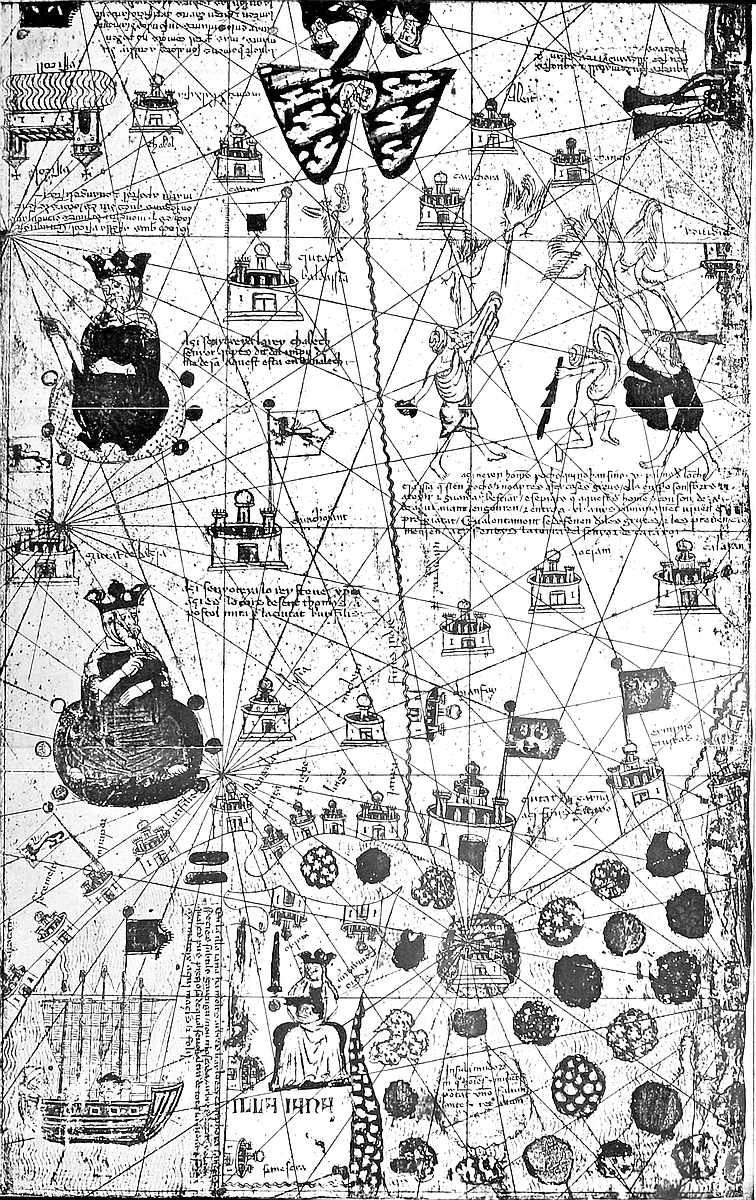
Part of the Catalan Map (1375).
[Some years ago, I made a special study of the Far East in the Catalan Map
(L’Extrême-Orient dans l’Atlas catalan de Charles V., Paris, 1895), and
I have come to the conclusion that the cartographer’s knowledge of Eastern
Asia is drawn almost entirely from Marco Polo. We give a reproduction of
part of the Catalan Map.—H. C.]
85. In the following age we find more frequent indications that Polo’s book
was diffused and read. And now that the spirit of discovery began to stir,Confusions in Cartography of the 16th century, from the
endeavour to combine new and old information.
it was apparently regarded in a juster light as a Book of Facts, and not
as a mere Romman du Grant Kaan.[13] But in fact this age produced new
supplies of crude information in greater abundance than the knowledge of
geographers was prepared to digest or co-ordinate, and the consequence is
that the magnificent Work of Fra Mauro (1459), though the result of immense
labour in the collection of facts and the endeavour to combine them, really
gives a considerably less accurate idea of Asia than that which the Catalan
Map had afforded.[14]
And when at a still later date the great burst of discovery eastward and
westward took effect, the results of all attempts to combine the new
knowledge with the old was most unhappy. The first and crudest forms of
such combinations attempted to realise the ideas of Columbus regarding
the identity of his discoveries with the regions of the Great Kaan’s
dominion;[15] but even after America had vindicated its independent
position on the surface of the globe, and the new knowledge of the
Portuguese had introduced China where the Catalan Map of the 14th century
had presented Cathay, the latter country, with the whole of Polo’s
nomenclature, was shoved away to the north, forming a separate system.[16]
Henceforward the influence of Polo’s work on maps was simply injurious;
and when to his nomenclature was added a sprinkling of Ptolemy’s, as was
usual throughout the 16th century, the result was a most extraordinary
hotch-potch, conveying no approximation to any consistent representation of facts.
Thus, in a map of 1522,[17] running the eye along the north of Europe
and Asia from West to East, we find the following succession of names:
Groenlandia, or Greenland, as a great peninsula overlapping that of
Norvegia and Suecia; Livonia, Plescovia and Moscovia, Tartaria bounded
on the South by Scithia extra Imaum, and on the East, by the Rivers
Ochardes and Bautisis (out of Ptolemy), which are made to flow into
the Arctic Sea. South of these are Aureacithis and Asmirea (Ptolemy’s
Auxacitis and Asmiræa), and Serica Regio. Then following the
northern coast Balor Regio,[18] Judei Clausi, i.e. the Ten Tribes who
are constantly associated or confounded with the Shut-up Nations of Gog
and Magog. These impinge upon the River Polisacus, flowing into the
Northern Ocean in Lat. 75°, but which is in fact no other than Polo’s
Pulisanghin![19] Immediately south of this is Tholomon Provincia
(Polo’s again), and on the coast Tangut, Cathaya, the Rivers
Caramoran and Oman (a misreading of Polo’s Quian), Quinsay and
Mangi.
86. The Maps of Mercator (1587) and Magini (1597) are similar in character,
but more elaborate, introducing China as a separate system. Gradual disappearance of Polo’s nomenclature.Such indeed
also is Blaeu’s Map (1663) excepting that Ptolemy’s contributions are
reduced to one or two.
In Sanson’s Map (1659) the data of Polo and the mediæval Travellers are
more cautiously handled, but a new element of confusion is introduced in
the form of numerous features derived from Edrisi.
It is scarcely worth while to follow the matter further. With the increase
of knowledge of Northern Asia from the Russian side, and that of China from
the Maps of Martini, followed by the surveys of the Jesuits, and with the
real science brought to bear on Asiatic Geography by such men as De l’Isle
and D’Anville, mere traditional nomenclature gradually disappeared. And
the task which the study of Polo has provided for the geographers of later
days has been chiefly that of determining the true localities that his book
describes under obsolete or corrupted names.
[My late illustrious friend, Baron A. E. Nordenskiöld, who has devoted
much time and labour to the study of Marco Polo (see his Periplus,
Stockholm, 1897), and published a facsimile edition of one of the French
MSS. kept in the Stockholm Royal Library (see vol. ii. Bibliography,
p. 570), has given to The Geographical Journal for April, 1899, pp.
396–406, a paper on The Influence of the “Travels of Marco Polo” on Jacobo
Gastaldi’s Maps of Asia. He writes (p. 398) that as far as he knows,
none “of the many learned men who have devoted their attention to the
discoveries of Marco Polo, have been able to refer to any maps in which all
or almost all those places mentioned by Marco Polo are given. All friends
of the history of geography will therefore be glad to hear that such an
atlas from the middle of the sixteenth century really does exist, viz.
Gastaldi’s ‘Prima, seconda e terza parte dell’Asia.’” All the names of
places in Ramusio’s Marco Polo are introduced in the maps of Asia of Jacobo
Gastaldi (1561). Cf. Periplus, liv., lv., and lvi.
I may refer to what both Yule and myself say supra of the Catalan Map.—H. C.]
87. Before concluding, it may be desirable to say a few words on the
subject of important knowledge other than geographical, Alleged introduction of Block-printed Books into Europe by Marco
Polo.which various
persons have supposed that Marco Polo must have introduced from Eastern
Asia to Europe.
Respecting the mariner’s compass and gunpowder I shall say nothing, as no
one now, I believe, imagines Marco to have had anything to do with their
introduction. But from a highly respectable source in recent years we have
seen the introduction of Block-printing into Europe connected with the name
of our Traveller. The circumstances are stated as follows:[20]
“In the beginning of the 15th century a man named Pamphilo Castaldi,
of Feltre ... was employed by the Seignory or Government of the
Republic, to engross deeds and public edicts of various kinds ...
the initial letters at the commencement of the writing being usually
ornamented with red ink, or illuminated in gold and colours.
“According to Sansovino, certain stamps or types had been invented
some time previously by Pietro di Natali, Bishop of Aquilœa.[21]
These were made at Murano of glass, and were used to stamp or print
the outline of the large initial letters of public documents, which
were afterwards filled up by hand.... Pamphilo Castaldi improved
on these glass types, by having others made of wood or metal, and
having seen several Chinese books which the famous traveller Marco
Polo had brought from China, and of which the entire text was printed
with wooden blocks, he caused moveable wooden types to be made, each
type containing a single letter; and with these he printed several
broadsides and single leaves, at Venice, in the year 1426. Some of
these single sheets are said to be preserved among the archives at
Feltre....
“The tradition continues that John Faust, of Mayence ... became
acquainted with Castaldi, and passed some time with him, at his
Scriptorium, ... at Feltre;”
and in short developed from the knowledge so acquired the great invention
of printing. Mr. Curzon goes on to say that Panfilo Castaldi was born in
1398, and died in 1490, and that he gives the story as he found it in an
article written by Dr. Jacopo Facen, of Feltre, in a (Venetian?) newspaper
called Il Gondoliere, No. 103, of 27th December, 1843.
In a later paper Mr. Curzon thus recurs to the subject:[22]
“Though none of the early block-books have dates affixed to them,
many of them are with reason supposed to be more ancient than any
books printed with moveable types. Their resemblance to Chinese
block-books is so exact, that they would almost seem to be copied
from the books commonly used in China. The impressions are taken off
on one side of the paper only, and in binding, both the Chinese, and
ancient German, or Dutch block-books, the blank sides of the pages
are placed opposite each other, and sometimes pasted together....
The impressions are not taken off with printer’s ink, but with a
brown paint or colour, of a much thinner description, more in the
nature of Indian ink, as we call it, which is used in printing
Chinese books. Altogether the German and Oriental block-books
are so precisely alike, in almost every respect, that ... we must
suppose that the process of printing then must have been copied from
ancient Chinese specimens, brought from that country by some early
travellers, whose names have not been handed down to our times.”
The writer then refers to the tradition about Guttemberg (so it is
stated on this occasion, not Faust) having learned Castaldi’s art, etc.,
mentioning a circumstance which he supposes to indicate that Guttemberg
had relations with Venice; and appears to assent to the probability of the
story of the art having been founded on specimens brought home by Marco
Polo.
This story was in recent years diligently propagated in Northern Italy, and
resulted in the erection at Feltre of a public statue of Panfilo Castaldi,
bearing this inscription (besides others of like tenor):—
“To Panfilo Castaldi the illustrious Inventor of Movable Printing
Types, Italy renders this Tribute of Honour, too long deferred.”
In the first edition of this book I devoted a special note to the exposure
of the worthlessness of the evidence for this story.[23] This note was,
with the present Essay, translated and published at Venice by Comm.
Berchet, but this challenge to the supporters of the patriotic romance, so
far as I have heard, brought none of them into the lists in its defence.
But since Castaldi has got his statue from the printers of Lombardy, would
it not be mere equity that the mariners of Spain should set up a statue at
Huelva to the Pilot Alonzo Sanchez of that port, who, according to Spanish
historians, after discovering the New World, died in the house of Columbus
at Terceira, and left the crafty Genoese to appropriate his journals, and
rob him of his fame?
Seriously; if anybody in Feltre cares for the real reputation of his native
city, let him do his best to have that preposterous and discreditable
fiction removed from the base of the statue. If Castaldi has deserved a
statue on other and truer grounds let him stand; if not, let him be burnt
into honest lime! I imagine that the original story that attracted Mr.
Curzon was more jeu d’esprit than anything else; but that the author,
finding what a stone he had set rolling, did not venture to retract.
88. Mr. Curzon’s own observations, which I have italicised about the
resemblance of the two systems are, however, Frequent opportunities for such introduction in the age
following Polo’s.very striking, and seem
clearly to indicate the derivation of the art from China. But I should
suppose that in the tradition, if there ever was any genuine tradition of
the kind at Feltre (a circumstance worthy of all doubt), the name of Marco
Polo was introduced merely because it was so prominent a name in Eastern
Travel. The fact has been generally overlooked and forgotten[24] that, for
many years in the course of the 14th century, not only were missionaries
of the Roman Church and Houses of the Franciscan Order established in
the chief cities of China, but a regular trade was carried on overland
between Italy and China, by way of Tana (or Azov), Astracan, Otrar and
Kamul, insomuch that instructions for the Italian merchant following that
route form the two first chapters in the Mercantile Handbook of Balducci
Pegolotti (circa 1340).[25] Many a traveller besides Marco Polo might
therefore have brought home the block-books. And this is the less to be
ascribed to him because he so curiously omits to speak of the art of
printing, when his subject seems absolutely to challenge its description.
89. It remains to say a few words regarding the basis adopted for our
English version of the Traveller’s record.
Ramusio’s recension was that which Marsden selected for translation. But at
the date of his most meritorious publication nothing was known of the real
Text followed by Marsden and by Pauthier.
literary history of Polo’s Book, and no one was aware of the peculiar value
and originality of the French manuscript texts, nor had Marsden seen any
of them. A translation from one of those texts is a translation at first
hand; a translation from Ramusio’s Italian is, as far as I can judge, the
translation of a translated compilation from two or more translations, and
therefore, whatever be the merits of its matter, inevitably carries us far
away from the spirit and style of the original narrator. M. Pauthier, I
think, did well in adopting for the text of his edition the MSS. which I
have classed as of the second Type, the more as there had hitherto been no
publication from those texts. But editing a text in the original language,
and translating, are tasks substantially different in their demands.
90. It will be clear from what has been said in the preceding pages that
I should not regard as a fair or full representation of Polo’s Work, a
versionEclectic formation of the English Text of this Translation. on which the Geographic Text did not exercise a material influence.
But to adopt that Text, with all its awkwardnesses and tautologies, as the
absolute subject of translation, would have been a mistake. What I have
done has been, in the first instance, to translate from Pauthier’s Text.
The process of abridgment in this text, however it came about, has been on
the whole judiciously executed, getting rid of the intolerable prolixities
of manner which belong to many parts of the Original Dictation, but as a
general rule preserving the matter. Having translated this,—not always
from the Text adopted by Pauthier himself, but with the exercise of my own
judgment on the various readings which that Editor lays before us,—I then
compared the translation with the Geographic Text, and transferred from
the latter not only all items of real substance that had been omitted, but
also all expressions of special interest and character, and occasionally
a greater fulness of phraseology where condensation in Pauthier’s text
seemed to have been carried too far. And finally I introduced between
brackets everything peculiar to Ramusio’s version that seemed to me to
have a just claim to be reckoned authentic, and that could be so introduced
without harshness or mutilation. Many passages from the same source which
were of interest in themselves, but failed to meet one or other of these
conditions, have been given in the notes.[1]
91. As regards the reading of proper names and foreign words, in which
there is so much variation in the different MSS. and editions, Mode of rendering proper names.I have done
my best to select what seemed to be the true reading from the G. T. and
Pauthier’s three MSS., only in some rare instances transgressing this limit.
Where the MSS. in the repetition of a name afforded a choice of forms, I
have selected that which came nearest the real name when known. Thus the
G. T. affords Baldasciain, Badascian, Badasciam, Badausiam, Balasian. I
adopt Badascian, or in English spelling Badashan, because it is closest to
the real name Badakhshan. Another place appears as Cobinan, Cabanat,
Cobian. I adopt the first because it is the truest expression of the real
name Koh-benán. In chapters 23, 24 of Book I., we have in the G. T.
Asisim, Asciscin, Asescin, and in Pauthier’s MSS. Hasisins, Harsisins,
etc. I adopt Asciscin, or in English spelling Ashishin, for the same reason
as before. So with Creman, Crerman, Crermain, Querman, Anglicè Kerman;
Cormos, Hormos, and many more.[2]
In two or three cases I have adopted a reading which I cannot show
literatim in any authority, but because such a form appears to be the
just resultant from the variety of readings which are presented; as in
surveying one takes the mean of a number of observations when no one can
claim an absolute preference.
Polo’s proper names, even in the French Texts, are in the main formed
on an Italian fashion of spelling.[3] I see no object in preserving such
spelling in an English book, so after selecting the best reading of the
name I express it in English spelling, printing Badashan, Pashai, Kerman,
instead of Badascian, Pasciai, Querman, and so on.
And when a little trouble has been taken to ascertain the true form and
force of Polo’s spelling of Oriental names and technical expressions, it
will be found that they are in the main as accurate as Italian lips and
orthography will admit, and not justly liable either to those disparaging
epithets[4] or to those exegetical distortions which have been too often
applied to them. Thus, for example, Cocacin, Ghel or Ghelan, Tonocain,
Cobinan, Ondanique, Barguerlac, Argon, Sensin, Quescican, Toscaol,
Bularguci, Zardandan, Anin, Caugigu, Coloman, Gauenispola, Mutfili,
Avarian, Choiach, are not, it will be seen, the ignorant blunderings which
the interpretations affixed by some commentators would imply them to be,
but are, on the contrary, all but perfectly accurate utterances of the
names and words intended.
The -tchéou (of French writers), -choo, -chow, or -chau[5]
of English writers, which so frequently forms the terminal part in
the names of Chinese cities, is almost invariably rendered by Polo as
-giu. This has frequently in the MSS., and constantly in the printed
editions, been converted into -gui, and thence into -guy. This is on
the whole the most constant canon of Polo’s geographical orthography,
and holds in Caagiu (Ho-chau), Singiu (Sining-chau), Cui-giu
(Kwei-chau), Sin-giu (T’sining-chau), Pi-giu (Pei-chau), Coigangiu
(Hwaingan-chau), Si-giu (Si-chau), Ti-giu (Tai-chau), Tin-giu
(Tung-chau), Yan-giu (Yang-chau), Sin-giu (Chin-chau), Cai-giu
(Kwa-chau), Chinghi-giu (Chang-chau), Su-giu (Su-chau), Vu-giu
(Wu-chau), and perhaps a few more. In one or two instances only (as
Sinda-ciu, Caiciu) he has -ciu instead of -giu.
The chapter-headings I have generally taken from Pauthier’s Text, but they
are no essential part of the original work, and they have been slightly
modified or enlarged where it seemed desirable.
“Behold! I see the Haven nigh at Hand,
To which I meane my wearie Course to bend;
Vere the maine Shete, and beare up with the Land,
The which afore is fayrly to be kend,
And seemeth safe from Storms that may offend.
* * * * *
There eke my Feeble Barke a while may stay,
Till mery Wynd and Weather call her thence away.”
—The Faerie Queene, I. xii. 1.
MARCO POLO’S ITINERARIES, No. I.
(Prologue; Book I, Chapters 1–36; and Book IV.)
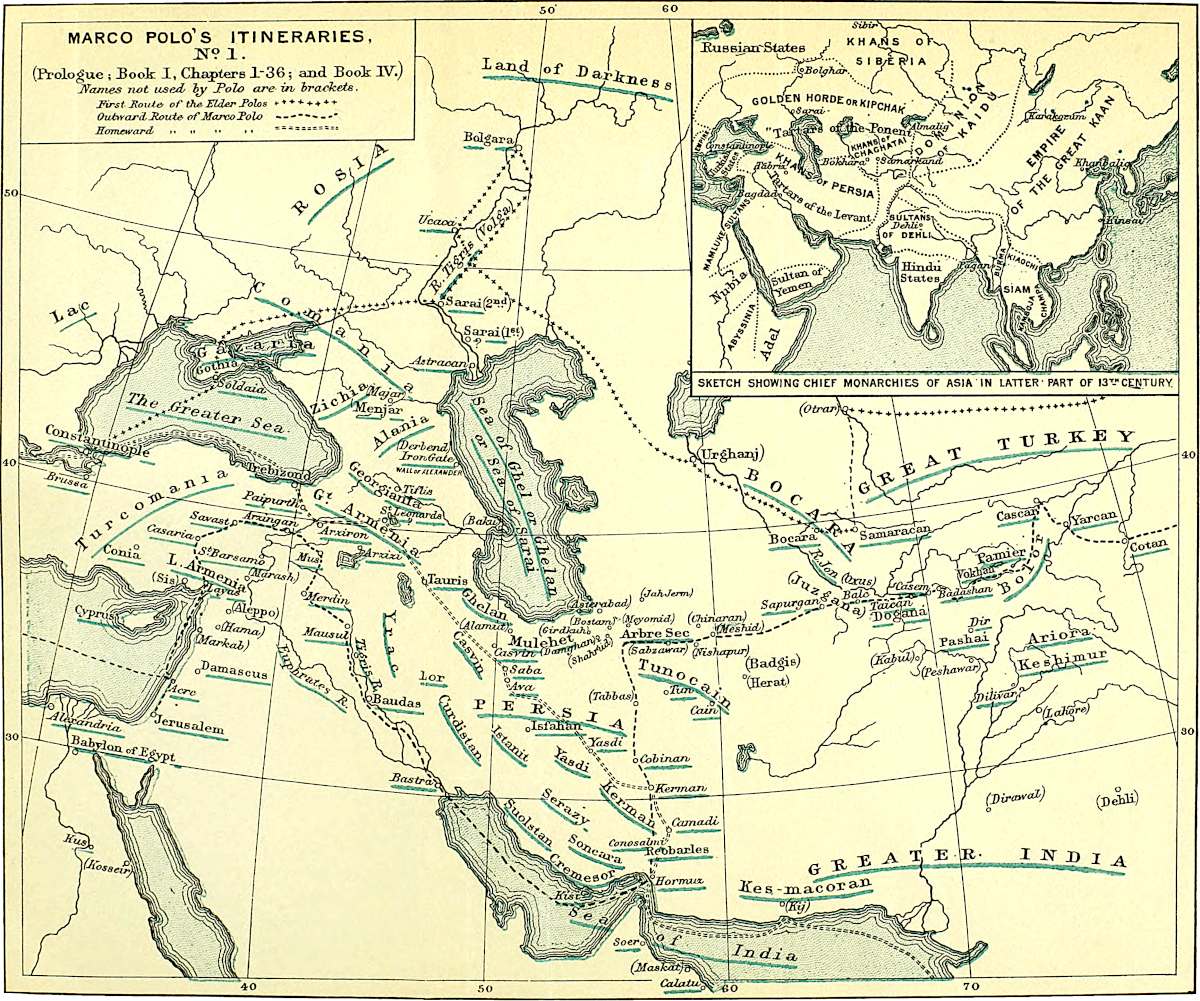
SKETCH SHOWING CHIEF MONARCHIES OF ASIA IN LATTER PART OF 13th CENTURY
THE BOOK OF MARCO POLO. — PROLOGUE . — CHAPTER I . — CHAPTER II . — CHAPTER III . — CHAPTER IV . — CHAPTER V . — CHAPTER VI . — CHAPTER VII . — CHAPTER VIII . — CHAPTER IX . — CHAPTER X . — CHAPTER XI . — CHAPTER XII . — CHAPTER XIII . — CHAPTER XIV . — CHAPTER XV . — CHAPTER XVI . — CHAPTER XVII . — CHAPTER XVIII . — BOOK FIRST. — CHAPTER I . — CHAPTER II . — CHAPTER III . — CHAPTER IV . — CHAPTER V . — CHAPTER VI . — CHAPTER VII . — CHAPTER VIII . — CHAPTER IX . — CHAPTER X . — CHAPTER XI . — CHAPTER XII . — CHAPTER XIII . — CHAPTER XIV . — CHAPTER XV . — CHAPTER XVI . — CHAPTER XVII . — CHAPTER XVIII . — CHAPTER XIX . — CHAPTER XX . — CHAPTER XXI . — CHAPTER XXII . — CHAPTER XXIII . — CHAPTER XXIV . — CHAPTER XXV . — CHAPTER XXVI . — CHAPTER XXVII . — CHAPTER XXVIII . — CHAPTER XXIX . — CHAPTER XXX . — CHAPTER XXXI . — CHAPTER XXXII . — CHAPTER XXXIII . — CHAPTER XXXIV . — CHAPTER XXXV . — CHAPTER XXXVI . — CHAPTER XXXVII . — CHAPTER XXXVIII . — CHAPTER XXXIX . — CHAPTER XL . — CHAPTER XLI . — CHAPTER XLII . — CHAPTER XLIII . — CHAPTER XLIV . — CHAPTER XLV . — CHAPTER XLVI . — CHAPTER XLVII . — CHAPTER XLVIII . — CHAPTER XLIX . — CHAPTER L . — CHAPTER LI . — CHAPTER LII . — CHAPTER LIII . — CHAPTER LIV . — CHAPTER LV . — CHAPTER LVI . — CHAPTER LVII . — CHAPTER LVIII . — CHAPTER LIX . — CHAPTER LX . — CHAPTER LXI .

Great Princes, Emperors, and Kings, Dukes and Marquises, Counts, Knights,
and Burgesses! and People of all degrees who desire to get knowledge of
the various races of mankind and of the diversities of the sundry regions
of the World, take this Book and cause it to be read to you. For ye shall
find therein all kinds of wonderful things, and the divers histories
of the Great Hermenia, and of Persia, and of the Land of the Tartars,
and of India, and of many another country of which our Book doth speak,
particularly and in regular succession, according to the description of
Messer Marco Polo, a wise and noble citizen of Venice, as he saw them with
his own eyes. Some things indeed there be therein which he beheld not;
but these he heard from men of credit and veracity. And we shall set down
things seen as seen, and things heard as heard only, so that no jot of
falsehood may mar the truth of our Book, and that all who shall read it or
hear it read may put full faith in the truth of all its contents.
For let me tell you that since our Lord God did mould with his hands our
first Father Adam, even until this day, never hath there been Christian,
or Pagan, or Tartar, or Indian, or any man of any nation, who in his own
person hath had so much knowledge and experience of the divers parts of
the World and its Wonders as hath had this Messer Marco! And for that
reason he bethought himself that it would be a very great pity did he
not cause to be put in writing all the great marvels that he had seen,
or on sure information heard of, so that other people who had not these
advantages might, by his Book, get such knowledge. And I may tell you that
in acquiring this knowledge he spent in those various parts of the World
good six-and-twenty years. Now, being thereafter an inmate of the Prison
at Genoa, he caused Messer Rusticiano of Pisa, who was in the said Prison
likewise, to reduce the whole to writing; and this befell in the year 1298
from the birth of Jesus.
How the Two Brothers Polo set forth from Constantinople to traverse the world.
It came to pass in the year of Christ 1260, when Baldwin was reigning at
Constantinople,{1} that Messer Nicolas Polo, the father of my lord
Mark, and Messer Maffeo Polo, the brother of Messer Nicolas, were at the
said city of Constantinople, whither they had gone from Venice with their
merchants’ wares. Now these two Brethren, men singularly noble, wise, and
provident, took counsel together to cross the Greater Sea on a venture of
trade; so they laid in a store of jewels and set forth from Constantinople,
crossing the Sea to Soldaia.{2}
Note 1.—Baldwin II. (de Courtenay), the last Latin Emperor of
Constantinople, reigned from 1237 to 1261, when he was expelled by Michael
Palaeologus.
The date in the text is, as we see, that of the Brothers’ voyage across
the Black Sea. It stands 1250 in all the chief texts. But the figure is
certainly wrong. We shall see that, when the Brothers return to Venice in
1269, they find Mark, who, according to Ramusio’s version, was born after
their departure, a lad of fifteen. Hence, if we rely on Ramusio, they must
have left Venice about 1253–54. And we shall see also that they reached the
Volga in 1261. Hence their start from Constantinople may well have occurred
in 1260, and this I have adopted as the most probable correction. Where
they spent the interval between 1254 (if they really left Venice so early)
and 1260, nowhere appears. But as their brother, Mark the Elder, in his
Will styles himself “whilom of Constantinople,” their headquarters were
probably there.
Castle of Soldaia or Sudak.
Note 2.—In the Middle Ages the Euxine was frequently called Mare Magnum
or Majus. Thus Chaucer:—
“In the Grete See,
At many a noble Armee hadde he be.”
The term Black Sea (Mare Maurum v. Nigrum) was, however, in use,
and Abulfeda says it was general in his day. That name has been alleged
to appear as early as the 10th century, in the form Σκοτεινή,
“The Dark Sea”; but an examination of the passage cited, from Constantine
Porphyrogenitus, shows that it refers rather to the Baltic, whilst that
author elsewhere calls the Euxine simply Pontus. (Reinaud’s Abulf. I. 38,
Const. Porph. De Adm. Imp. c. 31, c. 42.)
✛ Sodaya, Soldaia, or Soldachia, called by Orientals Súdák, stands on
the S.E. coast of the Crimea, west of Kaffa. It had belonged to the Greek
Empire, and had a considerable Greek population. After the Frank conquest
of 1204 it apparently fell to Trebizond. It was taken by the Mongols in
1223 for the first time, and a second time in 1239, and during that century
was the great port of intercourse with what is now Russia. At an uncertain
date, but about the middle of the century, the Venetians established a
factory there, which in 1287 became the seat of a consul. In 1323 we find
Pope John XXII. complaining to Uzbek Khan of Sarai that the Christians
had been ejected from Soldaia and their churches turned into mosques.
Ibn Batuta, who alludes to this strife, counts Sudak as one of the four
great ports of the World. The Genoese got Soldaia in 1365 and built strong
defences, still to be seen. Kaffa, with a good anchorage, in the 14th
century, and later on Tana, took the place of Soldaia as chief emporium in
South Russia. Some of the Arab Geographers call the Sea of Azov the Sea of
Sudak.
The Elder Marco Polo in his Will (1280) bequeaths to the Franciscan
Friars of the place a house of his in Soldachia, reserving life
occupation to his own son and daughter, then residing in it. Probably this
establishment already existed when the two Brothers went thither. (Elie de
Laprimaudaie, passim; Gold. Horde, 87; Mosheim, App. 148; Ibn Bat.
I. 28, II. 414; Cathay, 231–33; Heyd, II. passim.)
How the Two Brothers went on beyond Soldaia.
Having stayed a while at Soldaia, they considered the matter, and thought
it well to extend their journey further. So they set forth from Soldaia and
travelled till they came to the Court of a certain Tartar Prince, Barca
Kaan by name, whose residences were at Sara{1} and at Bolgara [and
who was esteemed one of the most liberal and courteous Princes that ever
was among the Tartars.]{2} This Barca was delighted at the arrival of
the Two Brothers, and treated them with great honour; so they presented to
him the whole of the jewels that they had brought with them. The Prince
was highly pleased with these, and accepted the offering most graciously,
causing the Brothers to receive at least twice its value.
After they had spent a twelvemonth at the court of this Prince there broke
out a great war between Barca and Aláu, the Lord of the Tartars of the
Levant, and great hosts were mustered on either side.{3}
Map to illustrate the Geographical Position of the City of
Sarai
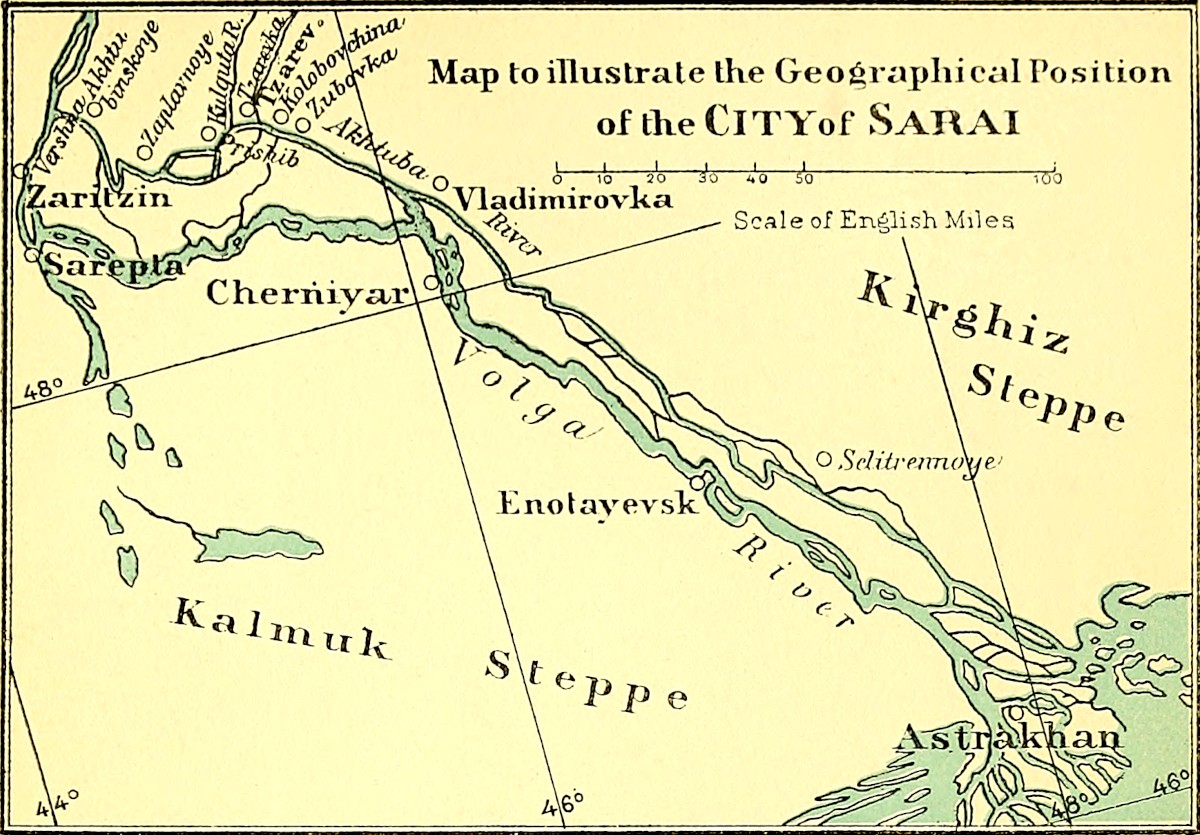
Part of the Remains of the CITY of SARAI near TZAREV North
of the AKHTUBA Branch of the VOLGA
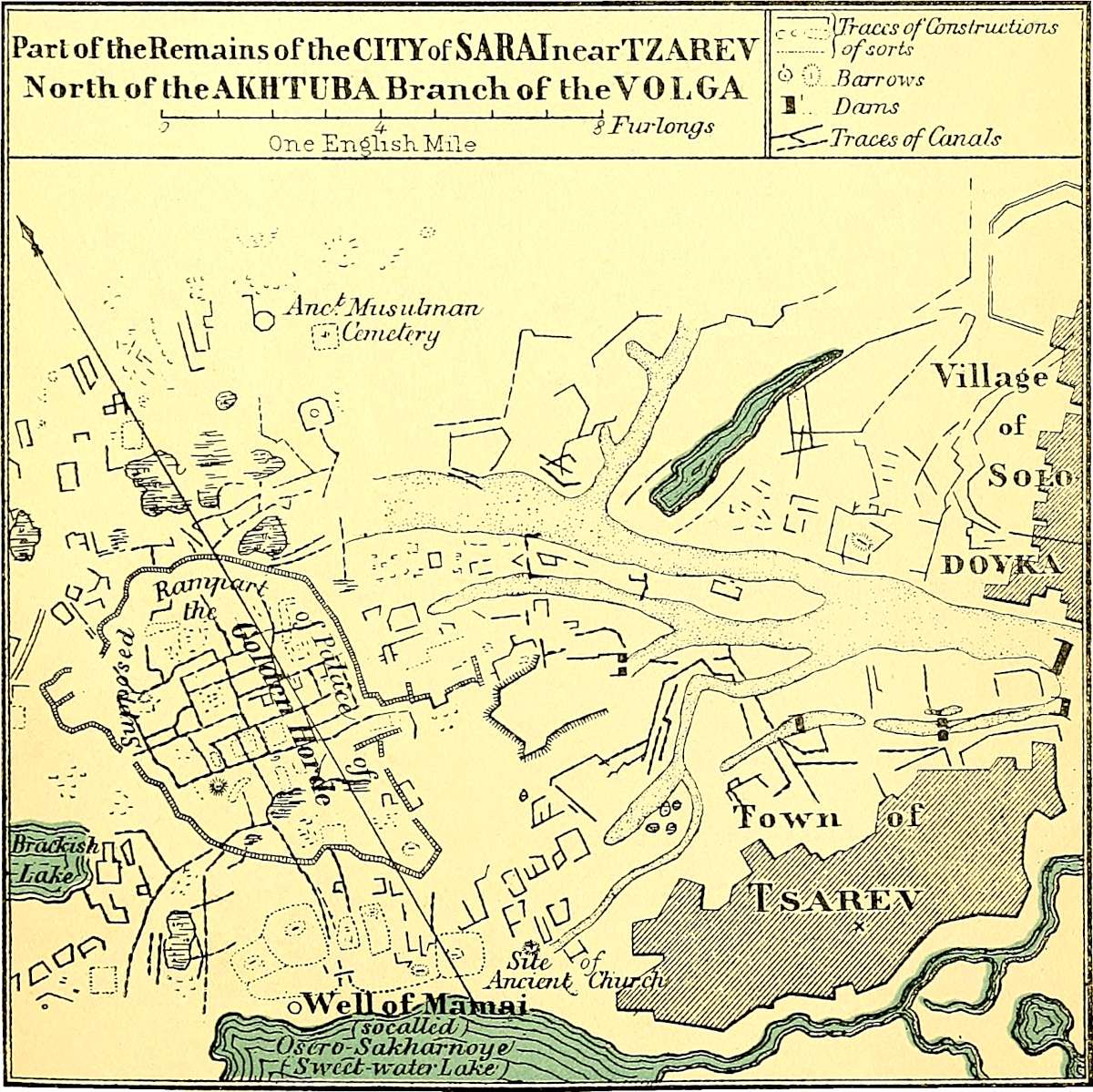
Lit. Frauenfelder, Palermo
But in the end Barca, the Lord of the Tartars of the Ponent, was defeated,
though on both sides there was great slaughter. And by reason of this war
no one could travel without peril of being taken; thus it was at least on
the road by which the Brothers had come, though there was no obstacle to
their travelling forward. So the Brothers, finding they could not retrace
their steps, determined to go forward. Quitting Bolgara, therefore, they
proceeded to a city called Ucaca, which was at the extremity of the kingdom
of the Lord of the Ponent;{4} and thence departing again, and passing
the great River Tigris, they travelled across a Desert which extended for
seventeen days’ journey, and wherein they found neither town nor village,
falling in only with the tents of Tartars occupied with their cattle at
pasture.{5}
Note 1.—✛ Barka Khan, third son of Jújí, the first-born of Chinghiz,
ruled the Ulús of Juji and Empire of Kipchak (Southern Russia) from
1257 to 1265. He was the first Musulman sovereign of his race. His chief
residence was at Sarai (Sara of the text), a city founded by his brother
and predecessor Bátú, on the banks of the Akhtuba branch of the Volga. In
the next century Ibn Batuta describes Sarai as a very handsome and populous
city, so large that it made half a day’s journey to ride through it. The
inhabitants were Mongols, Aás (or Alans), Kipchaks, Circassians, Russians,
and Greeks, besides the foreign Moslem merchants, who had a walled quarter.
Another Mahomedan traveller of the same century says the city itself was
not walled, but, “The Khan’s Palace was a great edifice surmounted by a
golden crescent weighing two kantars of Egypt, and encompassed by a wall
flanked with towers,” etc. Pope John XXII., on the 26th February 1322,
defined the limits of the new Bishopric of Kaffa, which were Sarai to the
east and Varna to the west.
Sarai became the seat of both a Latin and a Russian metropolitan, and of
more than one Franciscan convent. It was destroyed by Timur on his second
invasion of Kipchak (1395–6), and extinguished by the Russians a century
later. It is the scene of Chaucer’s half-told tale of Cambuscan:—
“At Sarra, in the Londe of Tartarie,
There dwelt a King that werriëd Russie.”
[“Mesalek-al-absar (285, 287), says Sarai, meaning ‘the Palace,’ was
founded by Bereké, brother of Batu. It stood in a salty plain, and was
without walls, though the palace had walls flanked by towers. The town
was large, had markets, madrasas—and baths. It is usually identified
with Selitrennoyé Gorodok, about 70 miles above Astrakhan.” (Rockhill,
Rubruck, p. 260, note.)—H. C.]
Several sites exhibiting extensive ruins near the banks of the Akhtuba have
been identified with Sarai; two in particular. One of these is not far from
the great elbow of the Volga at Tzaritzyn: the other much lower down, at
Selitrennoyé Gorodok or Saltpetre-Town, not far above Astrakhan.
The upper site exhibits by far the most extensive traces of former
population, and is declared unhesitatingly to be the sole site of Sarai
by M. Gregorieff, who carried on excavations among the remains for four
years, though with what precise results I have not been able to learn.
The most dense part of the remains, consisting of mounds and earth-works,
traces of walls, buildings, cisterns, dams, and innumerable canals, extends
for about 7½ miles in the vicinity of the town of Tzarev, but a tract of
66 miles in length and 300 miles in circuit, commencing from near the
head of the Akhtuba, presents remains of like character, though of less
density, marking the ground occupied by the villages which encircled the
capital. About 2½ miles to the N.W. of Tzarev a vast mass of such remains,
surrounded by the traces of a brick rampart, points out the presumable
position of the Imperial Palace.
M. Gregorieff appears to admit no alternative. Yet it seems certain that
the indications of Abulfeda, Pegolotti, and others, with regard to the
position of the capital in the early part of the 14th century, are not
consistent with a site so far from the Caspian. Moreover, F. H. Müller
states that the site near Tzarev is known to the Tartars as the “Sarai of
Janibek Khan” (1341–1357). Now it is worthy of note that in the coinage
of Janibek we repeatedly find as the place of mintage, New Sarai.
Arabsháh in his History of Timur states that 63 years had elapsed from the
foundation to the destruction of Sarai. But it must have been at least 140
years since the foundation of Batu’s city. Is it not possible, therefore,
that both the sites which we have mentioned were successively occupied by
the Mongol capital; that the original Sarai of Batu was at Selitrennoyé
Gorodok, and that the New Sarai of Janibek was established by him, or
by his father Uzbeg in his latter days, on the upper Akhtuba? Pegolotti
having carried his merchant from Tana (Azov) to Gittarchan (Astrakhan),
takes him one day by river to Sara, and from Sara to Saracanco, also by
river, eight days more. (Cathay, p. 287.) In the work quoted I have taken
Saracanco for Saraichik, on the Yaik. But it was possibly the Upper or New
Sarai on the Akhtuba. Ibn Batuta, marching on the frozen river, reached
Sarai in three days from Astrakhan. This could not have been at Tzarev, 200
miles off.
In corroboration (quantum valeat) of my suggestion that there must have
been two Sarais near the Volga, Professor Bruun of Odessa points to the
fact that Fra Mauro’s map presents two cities of Sarai on the Akhtuba;
only the Sarai of Janibeg is with him no longer New Sarai, but Great
Sarai.
The use of the latter name suggests the possibility that in the Saracanco
of Pegolotti the latter half of the name may be the Mongol Kúnḳ “Great.”
(See Pavet de Courteille, p. 439.)
Professor Bruun also draws attention to the impossibility of Ibn Batuta’s
travelling from Astrakhan to Tzarev in three days, an argument which had
already occurred to me and been inserted above.
[The Empire of Kipchak founded after the Mongol Conquest of 1224, included
also parts of Siberia and Khwarizm; it survived nominally until 1502.—H. C.]
(Four Years of Archæological Researches among the Ruins of Sarai [in
Russian] by M. Gregorieff [who appears to have also published a pamphlet
specially on the site, but this has not been available]; Historisch-geographische
Darstellung des Stromsystems der Wolga, von Ferd. Heinr.
Müller, Berlin, 1839, 568–577; Ibn. Bat. II. 447; Not. et Extraits,
XIII. i. 286; Pallas, Voyages; Cathay, 231, etc.; Erdmann, Numi
Asiatici, pp. 362 seqq.; Arabs. I. p. 381.)
Note 2.—Bolghar, our author’s Bolgara, was the capital of the region
sometimes called Great Bulgaria, by Abulfeda Inner Bulgaria, and stood
a few miles from the left bank of the Volga, in latitude about 54° 54′,
and 90 miles below Kazan. The old Arab writers regarded it as nearly the
limit of the habitable world, and told wonders of the cold, the brief
summer nights, and the fossil ivory that was found in its vicinity. This
was exported, and with peltry, wax, honey, hazel-nuts, and Russia leather,
formed the staple articles of trade. The last item derived from Bolghar
the name which it still bears all over Asia. (See Bk. II. ch. xvi., and
Note.) Bolghar seems to have been the northern limit of Arab travel, and
was visited by the curious (by Ibn Batuta among others) in order to witness
the phenomena of the short summer night, as tourists now visit Hammerfest
to witness its entire absence.
Russian chroniclers speak of an earlier capital of the Bulgarian kingdom,
Brakhimof, near the mouth of the Kama, destroyed by Andrew, Grand Duke of
Rostof and Susdal, about 1160; and this may have been the city referred
to in the earlier Arabic accounts. The fullest of these is by Ibn Fozlán,
who accompanied an embassy from the Court of Baghdad to Bolghar, in A.D.
921. The King and people had about this time been converted to Islam,
having previously, as it would seem, professed Christianity. Nevertheless,
a Mahomedan writer of the 14th century says the people had then long
renounced Islam for the worship of the Cross. (Not. et Extr. XIII. i. 270.)
Ruins of Bolghar.
Bolghar was first captured by the Mongols in 1225. It seems to have
perished early in the 15th century, after which Kazan practically took its
place. Its position is still marked by a village called Bolgari, where
ruins of Mahomedan character remain, and where coins and inscriptions have
been found. Coins of the Kings of Bolghar, struck in the 10th century, have
been described by Fraehn, as well as coins of the Mongol period struck at
Bolghar. Its latest known coin is of A.H. 818 (A.D. 1415–16). A history
of Bolghar was written in the first half of the 12th century by Yakub Ibn
Noman, Kadhi of the city, but this is not known to be extant.
Fraehn shows ground for believing the people to have been a mixture of
Fins, Slavs, and Turks. Nicephorus Gregoras supposes that they took their
name from the great river on which they dwelt (Βούλγα).
[“The ruins [of Bolghar],” says Bretschneider, in his Mediæval
Researches, published in 1888, vol. ii. p. 82, “still exist, and have been
the subject of learned investigation by several Russian scholars. These
remains are found on the spot where now the village Uspenskoye, called
also Bolgarskoye (Bolgari), stands, in the district of Spask, province
of Kazan. This village is about 4 English miles distant from the Volga,
east of it, and 83 miles from Kazan.” Part of the Bulgars removed to the
Balkans; others remained in their native country on the shores of the
Azov Sea, and were subjugated by the Khazars. At the beginning of the 9th
century, they marched northwards to the Volga and the Kama, and established
the kingdom of Great Bulgaria. Their chief city, Bolghar, was on the
bank of the Volga, but the river runs now to the west; as the Kama also
underwent a change in its course, it is possible that formerly Bolghar was
built at the junction of the two rivers. (Cf. Reclus, Europe russe, p.
761.) The Bulgars were converted to Islam in 922. Their country was first
invaded by the Mongols under Subutai in 1223; this General conquered it in
1236, the capital was destroyed the following year, and the country annexed
to the kingdom of Kipchak. Bolghar was again destroyed in 1391 by Tamerlan.
In 1438, Ulugh Mohammed, cousin of Toka Timur, younger son of Juji,
transformed this country into the khanate of Kazan, which survived till
1552. It had probably been the capital of the Golden Horde before Sarai.
With reference to the early Christianity of the Bulgarians, to which Yule
refers in his note, the Laurentian Chronicle (A.D. 1229), quoted by
Shpilevsky, adduces evidence to show that in the Great City, i.e. Bulgar,
there were Russian Christians and a Christian cemetery, and the death of
a Bulgarian Christian martyr is related in the same chronicle as well as
in the Nikon, Tver, and Tatischef annals in which his name is given. (Cf.
Shpilevsky, Anc. towns and other Bulgaro-Tartar monuments, Kazan, 1877,
p. 158 seq.; Rockhill’s Rubruck, Hakl. Soc. p. 121, note.)—H. C.]
The severe and lasting winter is spoken of by Ibn Fozlán and other old
writers in terms that seem to point to a modern mitigation of climate.
It is remarkable, too, that Ibn Fozlán speaks of the aurora as of very
frequent occurrence, which is not now the case in that latitude. We may
suspect this frequency to have been connected with the greater cold
indicated, and perhaps with a different position of the magnetic pole. Ibn
Fozlán’s account of the aurora is very striking:—“Shortly before sunset the
horizon became all very ruddy, and at the same time I heard sounds in the
upper air, with a dull rustling. I looked up and beheld sweeping over me a
fire-red cloud, from which these sounds issued, and in it movements, as it
were, of men and horses; the men grasping bows, lances, and swords. This I
saw, or thought I saw. Then there appeared a white cloud of like aspect;
in it also I beheld armed horsemen, and these rushed against the former as
one squadron of horse charges another. We were so terrified at this that
we turned with humble prayer to the Almighty, whereupon the natives about
us wondered and broke into loud laughter. We, however, continued to gaze,
seeing how one cloud charged the other, remained confused with it a while,
and then sundered again. These movements lasted deep into the night, and
then all vanished.”
(Fraehn, Ueber die Wolga Bulgaren, Petersb. 1832; Gold. Horde, 8, 9,
423–424; Not. et Extr. II. 541; Ibn Bat. II. 398; Büschings Mag.
V. 492; Erdmann, Numi Asiat. I. 315–318, 333–334, 520–535; Niceph.
Gregoras, II. 2, 2.)
Note
3.—Alau is Polo’s representation of the name of Hulákú, brother of the
Great Kaans Mangu and Kublai and founder of the Mongol dynasty in Persia.
In the Mongol pronunciation guttural and palatal consonants are apt to be
elided, hence this spelling. The same name is written by Pope Alexander
IV., in addressing the Khan, Olao, by Pachymeres and Gregoras Χαλαὺ
and Χαλαοῦ, by Hayton Haolon, by Ibn Batuta Huláún,
as well as in a letter of Hulaku’s own, as given by Makrizi.
The war in question is related in Rashíduddín’s history, and by Polo
himself towards the end of the work. It began in the summer of 1262, and
ended about eight months later. Hence the Polos must have reached Barka’s
Court in 1261.
Marco always applies to the Mongol Khans of Persia the title of “Lords of
the East” (Levant), and to the Khans of Kipchak that of “Lords of the
West” (Ponent). We use the term Levant still with a similar specific
application, and in another form Anatolia. I think it best to preserve
the terms Levant and Ponent when used in this way.
[Robert Parke in his translation out of Spanish of Mendoza, The Historie
of the great and mightie kingdome of China ... London, printed by I. Wolfe
for Edward White, 1588, uses the word Ponent: “You shall understande that
this mightie kingdome is the Orientalest part of all Asia, and his next
neighbour towards the Ponent is the kingdome of Quachinchina ... (p.
2).”—H. C.]
Note 4.—Ucaca or Ukek was a town on the right bank of the Volga, nearly
equidistant between Sarai and Bolghar, and about six miles south of the
modern Saratov, where a village called Uwek still exists. Ukek is not
mentioned before the Mongol domination, and is supposed to have been of
Mongol foundation, as the name Ukek is said in Mongol to signify a dam of
hurdles. The city is mentioned by Abulfeda as marking the extremity of
“the empire of the Barka Tartars,” and Ibn Batuta speaks of it as “one
day distant from the hills of the Russians.” Polo therefore means that
it was the frontier of the Ponent towards Russia. Ukek was the site of a
Franciscan convent in the 14th century; it is mentioned several times in
the campaigns of Timur, and was destroyed by his army. It is not mentioned
under the form Ukek after this, but appears as Uwek and Uwesh in
Russian documents of the 16th century. Perhaps this was always the Slavonic
form, for it already is written Uguech (= Uwek) in Wadding’s 14th century
catalogue of convents. Anthony Jenkinson, in Hakluyt, gives an observation
of its latitude, as Oweke (51° 40′), and Christopher Burrough, in the
same collection, gives a description of it as Oueak, and the latitude as
51° 30′ (some 7′ too much). In his time (1579) there were the remains of a
“very faire stone castle” and city, with old tombs exhibiting sculptures
and inscriptions. All these have long vanished. Burrough was told by the
Russians that the town “was swallowed into the earth by the justice of
God, for the wickednesse of the people that inhabited the same.” Lepechin
in 1769 found nothing remaining but part of an earthen rampart and some
underground vaults of larger bricks, which the people dug out for use. He
speaks of coins and other relics as frequent, and the like have been found
more recently. Coins with Mongol-Arab inscriptions, struck at Ukek by
Tuktugai Khan in 1306, have been described by Fraehn and Erdmann.
(Fraehn, Ueber die ehemalige Mong. Stadt Ukek, etc., Petersb. 1835;
Gold. Horde; Ibn Bat. II. 414; Abulfeda, in Büsching, V. 365; Ann.
Minorum, sub anno 1400; Pétis de la Croix, II. 355, 383, 388; Hakluyt,
ed. 1809, I. 375 and 472; Lepechin, Tagebuch der Reise, etc., I. 235–237;
Rockhill, Rubruck, 120–121, note 2.)
Note 5.—The great River Tigeri or Tigris is the Volga, as Pauthier rightly
shows. It receives the same name from the Monk Pascal of Vittoria in
1338. (Cathay, p. 234.) Perhaps this arose out of some legend that the
Tigris was a reappearance of the same river. The ecclesiastical historian,
Nicephorus Callistus, appears to imply that the Tigris coming from Paradise
flows under the Caspian to emerge in Kurdistan. (See IX. 19.)
The “17 days” applies to one stretch of desert. The whole journey from Ukek
Bokhara would take some 60 days at least. Ibn Batuta is 58 days from Sarai
to Bokhara, and of the last section he says, “we entered the desert which
extends between Khwarizm and Bokhara, and which has an extent of 18 days’
journey.” (III. 19.)
How the Two Brothers, after crossing a desert, came to the City of Bocara,
and fell in with certain Envoys there.
After they had passed the desert, they arrived at a very great and
noble city called Bocara, the territory of which belonged to a king
whose name was Barac, and is also called Bocara. The city is the best
in all Persia.{1} And when they had got thither, they found they
could neither proceed further forward nor yet turn back again; wherefore
they abode in that city of Bocara for three years. And whilst they were
sojourning in that city, there came from Alau, Lord of the Levant, Envoys
on their way to the Court of the Great Kaan, the Lord of all the Tartars in
the world. And when the Envoys beheld the Two Brothers they were amazed,
for they had never before seen Latins in that part of the world. And they
said to the Brothers: “Gentlemen, if ye will take our counsel, ye will
find great honour and profit shall come thereof.” So they replied that
they would be right glad to learn how. “In truth,” said the Envoys, “the
Great Kaan hath never seen any Latins, and he hath a great desire so to
do. Wherefore, if ye will keep us company to his Court, ye may depend upon
it that he will be right glad to see you, and will treat you with great
honour and liberality; whilst in our company ye shall travel with perfect
security, and need fear to be molested by nobody.”{2}
Note 1.—Hayton also calls Bokhara a city of Persia, and I see Vámbéry
says that, up till the conquest by Chinghiz, Bokhara, Samarkand, Balkh,
etc., were considered to belong to Persia. (Travels, p. 377.) The first
Mongolian governor of Bokhara was Buka Bosha.
King Barac is Borrak Khan, great-grandson of Chagatai, and sovereign of the
Ulús of Chagatai, from 1264 to 1270. The Polos, no doubt, reached Bokhara
before 1264, but Borrak must have been sovereign some time before they left
it.
Note 2.—The language of the envoys seems rather to imply that they were
the Great Kaan’s own people returning from the Court of Hulaku. And Rashid
mentions that Sartak, the Kaan’s ambassador to Hulaku, returned from Persia
in the year that the latter prince died. It may have been his party that
the Venetians joined, for the year almost certainly was the same, viz.
1265. If so, another of the party was Bayan, afterwards the greatest of
Kublai’s captains, and much celebrated in the sequel of this book. (See
Erdmann’s Temudschin, p. 214.)
Marsden justly notes that Marco habitually speaks of Latins, never of
Franks. Yet I suspect his own mental expression was Farangi.
How the Two Brothers took the Envoys’ counsel, and went to the Court of the
Great Kaan.
So when the Two Brothers had made their arrangements, they set out on their
travels, in company with the Envoys, and journeyed for a whole year, going
northward and north-eastward, before they reached the Court of that Prince.
And on their journey they saw many marvels of divers and sundry kinds, but
of these we shall say nothing at present, because Messer Mark, who has
likewise seen them all, will give you a full account of them in the Book
which follows.
How the Two Brothers arrived at the Court of the Great Kaan.
When the Two Brothers got to the Great Kaan, he received them with great
honour and hospitality, and showed much pleasure at their visit, asking
them a great number of questions. First, he asked about the emperors, how
they maintained their dignity, and administered justice in their dominions;
and how they went forth to battle, and so forth. And then he asked the like
questions about the kings and princes and other potentates.
How the Great Kaan asked all about the manners of the Christians, and
particularly about the Pope of Rome.
And then he inquired about the Pope and the Church, and about all that
is done at Rome, and all the customs of the Latins. And the Two Brothers
told him the truth in all its particulars, with order and good sense, like
sensible men as they were; and this they were able to do as they knew the
Tartar language well.{1}
Note 1.—The word generally used for Pope in the original is Apostoille
(Apostolicus), the usual French expression of that age.
It is remarkable that for the most part the text edited by Pauthier has the
correcter Oriental form Tatar, instead of the usual Tartar. Tattar is
the word used by Yvo of Narbonne, in the curious letter given by Matthew
Paris under 1243.
We are often told that Tartar is a vulgar European error. It is in any
case a very old one; nor does it seem to be of European origin, but rather
Armenian;[1] though the suggestion of Tartarus may have given it readier
currency in Europe. Russian writers, or rather writers who have been in
Russia, sometimes try to force on us a specific limitation of the word
Tartar to a certain class of Oriental Turkish race, to whom the Russians
appropriate the name. But there is no just ground for this. Tátár is
used by Oriental writers of Polo’s age exactly as Tartar was then, and is
still, used in Western Europe, as a generic title for the Turanian hosts
who followed Chinghiz and his successors. But I believe the name in this
sense was unknown to Western Asia before the time of Chinghiz. And General
Cunningham must overlook this when he connects the Ṭáṭaríya coins,
mentioned by Arab geographers of the 9th century, with “the Scythic or
Tátár princes who ruled in Kabul” in the beginning of our era. Tartars on
the Indian frontier in those centuries are surely to be classed with the
Frenchmen whom Brennus led to Rome, or the Scotchmen who fought against
Agricola.
How the Great Kaan sent the Two Brothers as his Envoys to the Pope.
When that Prince, whose name was Cublay Kaan, Lord of the Tartars all over
the earth, and of all the kingdoms and provinces and territories of that
vast quarter of the world, had heard all that the Brothers had to tell him
about the ways of the Latins, he was greatly pleased, and he took it into
his head that he would send them on an Embassy to the Pope. So he urgently
desired them to undertake this mission along with one of his Barons; and
they replied that they would gladly execute all his commands as those of
their Sovereign Lord. Then the Prince sent to summon to his presence one
of his Barons whose name was Cogatal, and desired him to get ready, for
it was proposed to send him to the Pope along with the Two Brothers. The
Baron replied that he would execute the Lord’s commands to the best of his ability.
After this the Prince caused letters from himself to the Pope to be indited
in the Tartar tongue,{1} and committed them to the Two Brothers and to
that Baron of his own, and charged them with what he wished them to say to
the Pope. Now the contents of the letter were to this purport: He begged
that the Pope would send as many as an hundred persons of our Christian
faith; intelligent men, acquainted with the Seven Arts,{2} well
qualified to enter into controversy, and able clearly to prove by force
of argument to idolaters and other kinds of folk, that the Law of Christ
was best, and that all other religions were false and naught; and that if
they would prove this, he and all under him would become Christians and the
Church’s liegemen. Finally he charged his Envoys to bring back to him some
Oil of the Lamp which burns on the Sepulchre of our Lord at Jerusalem.{3}
Note 1.—✛ The appearance of the Great Kaan’s letter may be illustrated by
two letters on so-called Corean paper preserved in the French archives;
one from Arghún Khan of Persia (1289), brought by Buscarel, and the other
from his son Oljaitu (May, 1305), to Philip the Fair. These are both in
the Mongol language, and according to Abel Rémusat and other authorities,
in the Uighúr character, the parent of the present Mongol writing.
Facsimiles of the letters are given in Rémusat’s paper on intercourse with
Mongol Princes, in Mém. de l’Acad. des Inscript. vols. vii. and viii.,
reproductions in J. B. Chabot’s Hist. de Mar Jabalaha III., Paris, 1895,
and preferably in Prince Roland Bonaparte’s beautiful Documents Mongols,
Pl. XIV., and we give samples of the two in vol. ii.[1]
Note 2.—“The Seven Arts,” from a date reaching back nearly to classical
times, and down through the Middle Ages, expressed the whole circle of
a liberal education, and it is to these Seven Arts that the degrees in
arts were understood to apply. They were divided into the Trivium
of Rhetoric, Logic, and Grammar, and the Quadrivium of Arithmetic,
Astronomy, Music, and Geometry. The 38th epistle of Seneca was in many
MSS. (according to Lipsius) entitled “L. Annaei Senecae Liber de Septem
Artibus liberalibus.” I do not find, however, that Seneca there mentions
categorically more than five, viz., Grammar, Geometry, Music, Astronomy,
and Arithmetic. In the 5th century we find the Seven Arts to form the
successive subjects of the last seven books of the work of Martianus
Capella, much used in the schools during the early Middle Ages. The Seven
Arts will be found enumerated in the verses of Tzetzes (Chil. XI. 525),
and allusions to them in the mediæval romances are endless. Thus, in
one of the “Gestes d’Alexandre,” a chapter is headed “Comment Aristotle
aprent à Alixandre les Sept Arts.” In the tale of the Seven Wise Masters,
Diocletian selects that number of tutors for his son, each to instruct him
in one of the Seven Arts. In the romance of Erec and Eneide we have a
dress on which the fairies had portrayed the Seven Arts (Franc. Michel,
Recherches, etc. II. 82); in the Roman de Mahommet the young impostor is
master of all the seven. There is one mediæval poem called the Marriage
of the Seven Arts, and another called the Battle of the Seven Arts. (See
also Dante, Convito, Trat. II. c. 14; Not. et Ex. V., 491 seqq.)
Note 3.—The Chinghizide
Princes were eminently liberal—or indifferent—in
religion; and even after they became Mahomedan, which, however, the Eastern
branch never did, they were rarely and only by brief fits persecutors.
Hence there was scarcely one of the non-Mahomedan Khans of whose conversion
to Christianity there were not stories spread. The first rumours of
Chinghiz in the West were as of a Christian conqueror; tales may be found
of the Christianity of Chagatai, Hulaku, Abaka, Arghun, Baidu, Ghazan,
Sartak, Kuyuk, Mangu, Kublai, and one or two of the latter’s successors in
China, all probably false, with one or two doubtful exceptions.
The Great Kaan delivering a Golden Tablet to the Brothers.
From a miniature of the 14th century.
How the Great Kaan gave them a Tablet of Gold, bearing his orders in their
behalf.
When the Prince had charged them with all his commission, he caused to
be given them a Tablet of Gold, on which was inscribed that the three
Ambassadors should be supplied with everything needful in all the countries
through which they should pass—with horses, with escorts, and, in short,
with whatever they should require. And when they had made all needful
preparations, the three Ambassadors took their leave of the Emperor and set out.
When they had travelled I know not how many days, the Tartar Baron fell
sick, so that he could not ride, and being very ill, and unable to
proceed further, he halted at a certain city. So the Two Brothers judged
it best that they should leave him behind and proceed to carry out their
commission; and, as he was well content that they should do so, they
continued their journey. And I can assure you, that whithersoever they went
they were honourably provided with whatever they stood in need of, or chose
to command. And this was owing to that Tablet of Authority from the Lord
which they carried with them.{1}
So they travelled on and on until they arrived at Layas in Hermenia, a
journey which occupied them, I assure you, for three years.{2} It took
them so long because they could not always proceed, being stopped sometimes
by snow, or by heavy rains falling, or by great torrents which they found
in an impassable state.
Note 1.—On these
Tablets, see a note under Bk. II. ch. vii.
Note 2.—Ayas, called also Ayacio, Aiazzo, Giazza, Glaza, La Jazza, and
Layas, occupied the site of ancient Aegae, and was the chief port of
Cilician Armenia, on the Gulf of Scanderoon. Aegae had been in the 5th
century a place of trade with the West, and the seat of a bishopric, as we
learn from the romantic but incomplete story of Mary, the noble slave-girl,
told by Gibbon (ch. 33). As Ayas it became in the latter part of the 13th
century one of the chief places for the shipment of Asiatic wares arriving
through Tabriz, and was much frequented by the vessels of the Italian
Republics. The Venetians had a Bailo resident there.
Castle of Ayas.
Ayas is the Leyes of Chaucer’s Knight,—
(“At Leyes was he and at Satalie”)—
and the Layas of Froissart. (Bk. III. ch. xxii.) The Gulf of Layas is
described in the xix. Canto of Ariosto, where Mafisa and Astolfo find on
its shores a country of barbarous Amazons:—
“Fatto è ’l porto a sembranza d’una luna,” etc.
Marino Sanuto says of it: “Laiacio has a haven, and a shoal in front of it
that we might rather call a reef, and to this shoal the hawsers of vessels
are moored whilst the anchors are laid out towards the land.” (II. IV. ch. xxvi.)
The present Ayas is a wretched village of some 15 huts, occupied by about
600 Turkmans, and standing inside the ruined walls of the castle. This
castle, which is still in good condition, was built by the Armenian kings,
and restored by Sultan Suleiman; it was constructed from the remains of
the ancient city; fragments of old columns are embedded in its walls of
cut stone. It formerly communicated by a causeway with an advanced work on
an island before the harbour. The ruins of the city occupy a large space.
(Langlois, V. en Cilicie, pp. 429–31; see also Beaufort’s Karamania,
near the end.) A plan of Ayas will be found at the beginning of Bk. I.—H. Y. and H. C.
How the Two Brothers came to the city of Acre.
They departed from Layas and came to Acre, arriving there in the month of
April, in the year of Christ 1269, and then they learned that the Pope
was dead. And when they found that the Pope was dead (his name was Pope * *),{1} they went to a certain wise Churchman who was Legate for the
whole kingdom of Egypt, and a man of great authority, by name Theobald of
Piacenza, and told him of the mission on which they were come. When the
Legate heard their story, he was greatly surprised, and deemed the thing
to be of great honour and advantage for the whole of Christendom. So his
answer to the two Ambassador Brothers was this: “Gentlemen, ye see that the
Pope is dead; wherefore ye must needs have patience until a new Pope be
made, and then shall ye be able to execute your charge.” Seeing well enough
that what the Legate said was just, they observed: “But while the Pope is
a-making, we may as well go to Venice and visit our households.” So they
departed from Acre and went to Negropont, and from Negropont they continued
their voyage to Venice.{2} On their arrival there, Messer Nicolas
found that his wife was dead, and that she had left behind her a son of
fifteen years of age, whose name was Marco; and ’tis of him that this Book
tells.{3} The Two Brothers abode at Venice a couple of years, tarrying
until a Pope should be made.
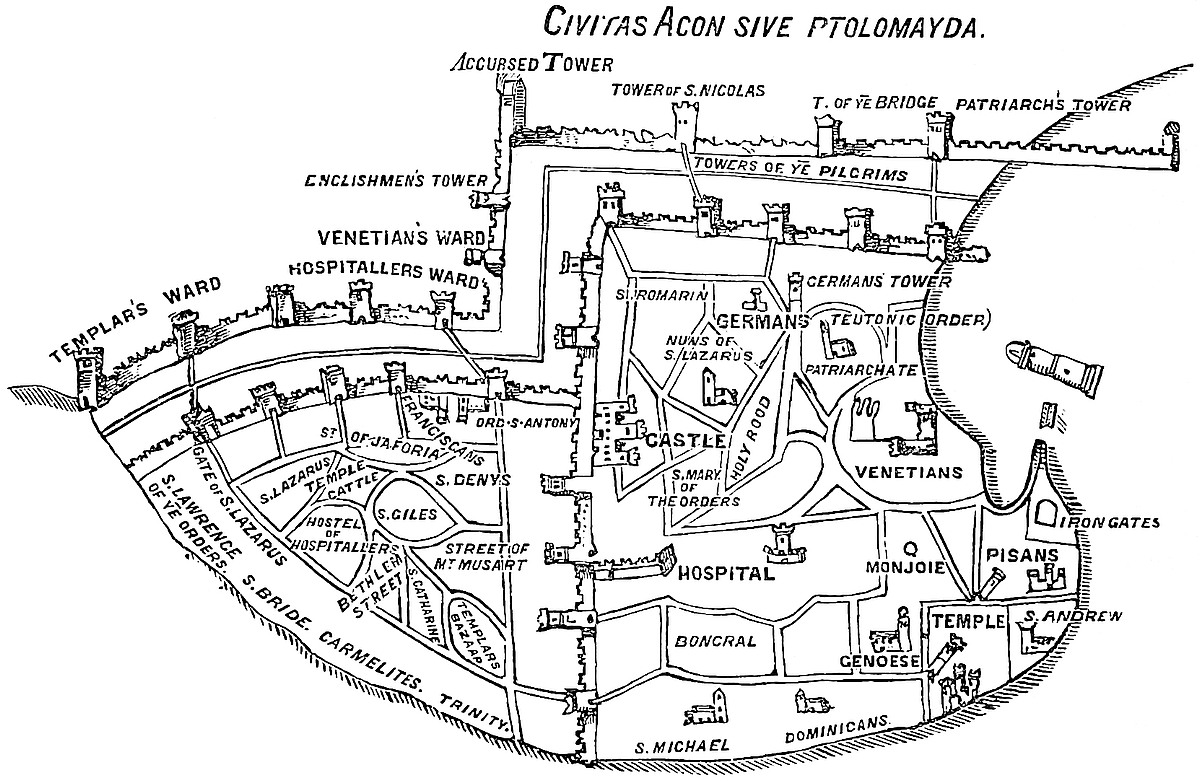
ACRE AS IT WAS WHEN LOST (A.D. 1291).
FROM THE PLAN GIVEN BY
MARINO SANUTO.
Note 1.—The deceased Pope’s name is omitted both in the Geog. Text and in
Pauthier’s, clearly because neither Rusticiano nor Polo remembered it. It
is supplied correctly in the Crusca Italian as Clement, and in Ramusio as
Clement IV.
It is not clear that Theobald, though generally adopted, is the
ecclesiastic’s proper name. It appears in different MSS. as Teald (G.
T.), Ceabo for Teabo (Pauthier), Odoaldo (Crusca), and in the
Riccardian as Thebaldus de Vice-comitibus de Placentia, which corresponds
to Ramusio’s version. Most of the ecclesiastical chroniclers call him
Tedaldus, some Thealdus. Tedaldo is a real name, occurring in
Boccaccio. (Day iii. Novel 7.)
Note 2.—After the expulsion of the Venetians from Constantinople, Negropont
was the centre of their influence in Romania. On the final return of the
travellers they again take Negropont on their way. [It was one of the ports
on the route from Venice to Constantinople, Tana, Trebizond.—H. C.]
Note 3.—The edition of the Soc. de Géographie makes Mark’s age twelve,
but I have verified from inspection the fact noticed by Pauthier that the
manuscript has distinctly xv. like all the other old texts. In Ramusio
it is nineteen, but this is doubtless an arbitrary correction to suit
the mistaken date (1250) assigned for the departure of the father from
Constantinople.
There is nothing in the old French texts to justify the usual statement
that Marco was born after the departure of his father from Venice. All that
the G. T. says is: “Meser Nicolau treuve que sa fame estoit morte, et les
remès un filz de xv. anz que avoit à nom Marc,” and Pauthier’s text is to
the same effect. Ramusio, indeed, has: “M. Nicolò trovò, che sua moglie era
morta, la quale nella sua partita haveva partorito un figliuolo,” and the
other versions that are based on Pipino’s seem all to have like statements.
How the Two Brothers again departed from Venice, on their way back to the
Great Kaan, and took with them Mark, the son of Messer Nicolas.
When the Two Brothers had tarried as long as I have told you, and saw that
never a Pope was made, they said that their return to the Great Kaan must
be put off no longer. So they set out from Venice, taking Mark along with
them, and went straight back to Acre, where they found the Legate of whom
we have spoken. They had a good deal of discourse with him concerning the
matter, and asked his permission to go to Jerusalem to get some Oil from
the Lamp on the Sepulchre, to carry with them to the Great Kaan, as he had
enjoined.{1} The Legate giving them leave, they went from Acre to
Jerusalem and got some of the Oil, and then returned to Acre, and went to
the Legate and said to him: “As we see no sign of a Pope’s being made, we
desire to return to the Great Kaan; for we have already tarried long, and
there has been more than enough delay.” To which the Legate replied: “Since
’tis your wish to go back, I am well content.” Wherefore he caused letters
to be written for delivery to the Great Kaan, bearing testimony that the
Two Brothers had come in all good faith to accomplish his charge, but that
as there was no Pope they had been unable to do so.
Note 1.—In a Pilgrimage of date apparently earlier than this, the Pilgrim
says of the Sepulchre: “The Lamp which had been placed by His head (when He
lay there) still burns on the same spot day and night. We took a blessing
from it (i.e. apparently took some of the oil as a beneficent memorial),
and replaced it.” (Itinerarium Antonini Placentini in Bollandists, May,
vol. ii. p. xx.)
[“Five great oil lamps,” says Daniel, the Russian Hégoumène, 1106–1107
(Itinéraires russes en Orient, trad. pour la Soc. de l’Orient Latin, par
Mme. B. de Khitrowo, Geneva, 1889, p. 13), “burning continually night and
day, are hung in the Sepulchre of Our Lord.”—H. C.]
How the Two Brothers set out from Acre, and Mark along with them.
When the Two Brothers had received the Legate’s letters, they set forth
from Acre to return to the Grand Kaan, and got as far as Layas. But shortly
after their arrival there they had news that the Legate aforesaid was
chosen Pope, taking the name of Pope Gregory of Piacenza; news which the
Two Brothers were very glad indeed to hear. And presently there reached
them at Layas a message from the Legate, now the Pope, desiring them, on
the part of the Apostolic See, not to proceed further on their journey,
but to return to him incontinently. And what shall I tell you? The King of
Hermenia caused a galley to be got ready for the Two Ambassador Brothers,
and despatched them to the Pope at Acre.{1}
Portrait of Pope Gregory X.
Note 1.—The death of Pope Clement IV. occurred on St Andrew’s Day (29th
November), 1268; the election of Tedaldo or Tebaldo of Piacenza, a member
of the Visconti family, and Archdeacon of Liège, did not take place till
1st September, 1271, owing to the factions among the cardinals. And it is
said that some of them, anxious only to get away, voted for Theobald in
full belief that he was dead. The conclave, in its inability to agree,
had named a committee of six with full powers which the same day elected
Theobald, on the recommendation of the Cardinal Bishop of Portus (John
de Toleto, said, in spite of his name, to have been an Englishman). This
facetious dignitary had suggested that the roof should be taken off the
Palace at Viterbo where they sat, to allow the divine influences to
descend more freely on their counsels (quia nequeunt ad nos per tot
tecta ingredi). According to some, these doggerel verses, current on the
occasion, were extemporised by Cardinal John in the pious exuberance of his
glee:—
“Papatûs munus tulit Archidiaconus unus
Quem Patrem Patrum fecit discordia Fratrum.”
The Archdeacon, a man of great weight of character, in consequence of
differences with his Bishop (of Liège), who was a disorderly liver, had
gone to the Holy Land, and during his stay there he contracted great
intimacy with Prince Edward of England (Edward I.). Some authors, e.g. John
Villani (VIII. 39), say that he was Legate in Syria; others, as Rainaldus,
deny this; but Polo’s statement, and the authority which the Archdeacon
took on himself in writing to the Kaan, seem to show that he had some such
position.
He took the name of Gregory X., and before his departure from Acre,
preached a moving sermon on the text, “If I forget thee, O Jerusalem,”
etc. Prince Edward fitted him out for his voyage.
Gregory reigned barely four years, dying at Arezzo 10th January, 1276. His
character stood high to the last, and some of the Northern Martyrologies
enrolled him among the saints, but there has never been canonisation
by Rome. The people of Arezzo used to celebrate his anniversary with
torch-light gatherings at his tomb, and plenty of miracles were alleged
to have occurred there. The tomb still stands in the Duomo at Arezzo, a
handsome work by Margaritone, an artist in all branches, who was the Pope’s
contemporary. There is an engraving of it in Gonnelli, Mon. Sepolc. di
Toscana.
(Fra Pipino in Muratori, IX. 700; Rainaldi Annal. III. 252 seqq.;
Wadding, sub. an. 1217: Bollandists, 10th January; Palatii, Gesta
Pontif. Roman. vol. iii., and Fasti Cardinalium, I. 463, etc.)
How the Two Brothers presented themselves before the new Pope.
And when they had been thus honourably conducted to Acre they proceeded
to the presence of the Pope, and paid their respects to him with humble
reverence. He received them with great honour and satisfaction, and gave
them his blessing. He then appointed two Friars of the Order of Preachers
to accompany them to the Great Kaan, and to do whatever might be required
of them. These were unquestionably as learned Churchmen as were to be found
in the Province at that day—one being called Friar Nicolas of Vicenza,
and the other Friar William of Tripoli.{1} He delivered to them also
proper credentials, and letters in reply to the Great Kaan’s messages [and
gave them authority to ordain priests and bishops, and to bestow every kind
of absolution, as if given by himself in proper person; sending by them
also many fine vessels of crystal as presents to the Great Kaan].{2}
So when they had got all that was needful, they took leave of the Pope,
receiving his benediction; and the four set out together from Acre, and
went to Layas, accompanied always by Messer Nicolas’s son Marco.
Now, about the time that they reached Layas, Bendocquedar, the Soldan
of Babylon, invaded Hermenia with a great host of Saracens, and ravaged
the country, so that our Envoys ran a great peril of being taken or
slain.{3} And when the Preaching Friars saw this they were greatly
frightened, and said that go they never would. So they made over to Messer
Nicolas and Messer Maffeo all their credentials and documents, and took
their leave, departing in company with the Master of the Temple.{4}
Note 1.—Friar William, of Tripoli, of the Dominican convent at Acre,
appears to have served there as early as 1250. [He was born circa 1220,
at Tripoli, in Syria, whence his name.—H. C.] He is known as the author
of a book, De Statu Saracenorum post Ludovici Regis de Syriâ reditum,
dedicated to Theoldus, Archdeacon of Liège (i.e. Pope Gregory). Of this
some extracts are printed in Duchesne’s Hist. Francorum Scriptores. There
are two MSS. of it, with different titles, in the Paris Library, and a
French version in that of Berne. A MS. in Cambridge Univ. Library, which
contains among other things a copy of Pipino’s Polo, has also the work of
Friar William:—“Willelmus Tripolitanus, Aconensis Conventus, de Egressu
Machometi et Saracenorum, atque progressu eorumdem, de Statu Saracenorum,”
etc. It is imperfect; it is addressed Theobaldo Ecclesiarcho digno Sancte
Terre Peregrino Sancto. And from a cursory inspection I imagine that the
Tract appended to one of the Polo MSS. in the British Museum (Addl. MSS.,
No. 19,952) is the same work or part of it. To the same author is ascribed
a tract called Clades Damiatae. (Duchesne, V. 432; D’Avezac in Rec.
de Voyages, IV. 406; Quétif, Script. Ord. Praed. I. 264–5; Catal. of
MSS. in Camb. Univ. Library, I. 22.)
Note 2.—I presume that the powers, stated in this passage from Ramusio to
have been conferred on the Friars, are exaggerated. In letters of authority
granted in like cases by Pope Gregory’s successors, Nicolas III. (in 1278)
and Boniface VIII. (in 1299), the missionary friars to remote regions are
empowered to absolve from excommunication and release from vows, to settle
matrimonial questions, to found churches and appoint idoneos rectores,
to authorise Oriental clergy who should publicly submit to the Apostolic
See to enjoy the privilegium clericale, whilst in the absence of bishops
those among the missionaries who were priests might consecrate cemeteries,
altars, palls, etc., admit to the Order of Acolytes, but nothing beyond.
(See Mosheim, Hist. Tartar. Eccles. App. Nos. 23 and 42.)
Note 3.—The statement here about Bundúḳdár’s invasion of Cilician Armenia
is a difficulty. He had invaded it in 1266, and his second devastating
invasion, during which he burnt both Layas and Sis, the king’s residence,
took place in 1275, a point on which Marino Sanuto is at one with the
Oriental Historians. Now we know from Rainaldus that Pope Gregory left
Acre in November or December, 1271, and the text appears to imply that our
travellers left Acre before him. The utmost corroboration that I can find
lies in the following facts stated by Makrizi:—
On the 13th Safar, A.H. 670 (20th September 1271), Bundúḳdár arrived
unexpectedly at Damascus, and after a brief raid against the Ismaelians
he returned to that city. In the middle of Rabi I. (about 20–25 October)
the Tartars made an incursion in northern Syria, and the troops of Aleppo
retired towards Hamah. There was great alarm at Damascus; the Sultan sent
orders to Cairo for reinforcements, and these arrived at Damascus on the
9th November. The Sultan then advanced on Aleppo, sending corps likewise
towards Marash (which was within the Armenian frontier) and Harran. At the
latter place the Tartars were attacked and those in the town slaughtered;
the rest retreated. The Sultan was back at Damascus, and off on a different
expedition, by 7th December. Hence, if the travellers arrived at Ayas
towards the latter part of November they would probably find alarm existing
at the advance of Bundúḳdár, though matters did not turn out so serious as
they imply.
“Babylon,” of which Bundúḳdár is here styled Sultan, means Cairo, commonly
so styled (Bambellonia d’Egitto) in that age. Babylon of Egypt is
mentioned by Diodorus quoting Ctesias, by Strabo, and by Ptolemy; it was
the station of a Roman Legion in the days of Augustus, and still survives
in the name of Babul, close to old Cairo.
Malik Dáhir Ruknuddín Bíbars Bundúḳdári, a native of Kipchak, was
originally sold at Damascus for 800 dirhems (about 18l.), and returned by
his purchaser because of a blemish. He was then bought by the Amir Aláuddín
Aidekín Bundúḳdár (“The Arblasteer”) whose surname he afterwards adopted.
He became the fourth of the Mameluke Sultans, and reigned from 1259 to
1276. The two great objects of his life were the repression of the Tartars
and the expulsion of the Christians from Syria, so that his reign was one
of constant war and enormous activity. William of Tripoli, in the work
above mentioned, says: “Bondogar, as a soldier, was not inferior to Julius
Caesar, nor in malignity to Nero.” He admits, however, that the Sultan
was sober, chaste, just to his own people, and even kind to his Christian
subjects; whilst Makrizi calls him one of the best princes that ever
reigned over Musulmans. Yet if we take Bibars as painted by this admiring
historian and by other Arabic documents, the second of Friar William’s
comparisons is justified, for he seems almost a devil in malignity as well
as in activity. More than once he played tennis at Damascus and Cairo
within the same week. A strange sample of the man is the letter which
he wrote to Boemond, Prince of Antioch and Tripoli, to announce to him
the capture of the former city. After an ironically polite address to
Boemond as having by the loss of his great city had his title changed from
Princeship (Al-Brensíyah) to Countship (Al-Komasíyah), and describing
his own devastations round Tripoli, he comes to the attack of Antioch: “We
carried the place, sword in hand, at the 4th hour of Saturday, the 4th day
of Ramadhán, ... Hadst thou but seen thy Knights trodden under the hoofs
of the horses! thy palaces invaded by plunderers and ransacked for booty!
thy treasures weighed out by the hundredweight! thy ladies (Dámátaka,
‘tes Dames’) bought and sold with thine own gear, at four for a dinár!
hadst thou but seen thy churches demolished, thy crosses sawn in sunder,
thy garbled Gospels hawked about before the sun, the tombs of thy nobles
cast to the ground; thy foe the Moslem treading thy Holy of the Holies; the
monk, the priest, the deacon slaughtered on the Altar; the rich given up to
misery; princes of royal blood reduced to slavery! Couldst thou but have
seen the flames devouring thy halls; thy dead cast into the fires temporal
with the fires eternal hard at hand; the churches of Paul and of Cosmas
rocking and going down—, then wouldst thou have said, ‘Would God that I
were dust!’ ... As not a man hath escaped to tell thee the tale, I tell it
thee!”
A little later, when a mission went to treat with Boemond, Bibars himself
accompanied it in disguise, to have a look at the defences of Tripoli. In
drawing out the terms, the Envoys styled Boemond Count, not Prince, as
in the letter just quoted. He lost patience at their persistence, and made
a movement which alarmed them. Bibars nudged the Envoy Mohiuddin (who tells
the story) with his foot to give up the point, and the treaty was made. On
their way back the Sultan laughed heartily at their narrow escape, “sending
to the devil all the counts and princes on the face of the earth.”
(Quatremère’s Makrizi, II. 92–101, and 190 seqq.; J. As. sér. I. tom.
xi. p. 89; D’Ohsson, III. 459–474; Marino Sanuto in Bongars, 224–226, etc.)
Note 4.—The ruling Master of the Temple was Thomas Berard (1256–1273),
but there is little detail about the Order in the East at this time. They
had, however, considerable possessions and great influence in Cilician
Armenia, and how much they were mixed up in its affairs is shown by
a circumstance related by Makrizi. In 1285, when Sultan Mansúr, the
successor of Bundúḳdár, was besieging the Castle of Markab, there arrived
in Camp the Commander of the Temple (Kamandúr-ul Dewet) of the Country
of Armenia, charged to negotiate on the part of the King of Sis (i.e. of
Lesser Armenia, Leon III. 1268–1289, successor of Hayton I. 1224–1268),
and bringing presents from him and from the Master of the Temple, Berard’s
successor, William de Beaujeu (1273–1291). (III. 201.)—H. Y. and H. C.
How Messer Nicolo and Messer Maffeo Polo, accompanied by Mark, travelled to
the Court of the Great Kaan.
So the Two Brothers, and Mark along with them, proceeded on their way, and
journeying on, summer and winter, came at length to the Great Kaan, who was
then at a certain rich and great city, called Kemenfu.{1} As to what
they met with on the road, whether in going or coming, we shall give no
particulars at present, because we are going to tell you all those details
in regular order in the after part of this Book. Their journey back to the
Kaan occupied a good three years and a half, owing to the bad weather and
severe cold that they encountered. And let me tell you in good sooth that
when the Great Kaan heard that Messers Nicolo and Maffeo Polo were on their
way back, he sent people a journey of full 40 days to meet them; and on
this journey, as on their former one, they were honourably entertained upon
the road, and supplied with all that they required.
Note 1.—The French texts read Clemeinfu, Ramusio Clemenfu. The Pucci
MS. guides us to the correct reading, having Chemensu (Kemensu) for
Chemenfu. Kaipingfu, meaning something like “City of Peace,” and called
by Rashiduddin Kaiminfu (whereby we see that Polo as usual adopted the
Persian form of the name), was a city founded in 1256, four years before
Kublai’s accession, some distance to the north of the Chinese wall. It
became Kublai’s favourite summer residence, and was styled from 1264
Shangtu or “Upper Court.” (See infra, Bk. I. ch. lxi.) It was known to
the Mongols, apparently by a combination of the two names, as Shangdu
Keibung. It appears in D’Anville’s map under the name of Djao-Naiman
Sumé. Dr. Bushell, who visited Shangtu in 1872, makes it 1103 li (367
miles) by road distance viâ Kalgan from Peking. The busy town of Dolonnúr
lies 26 miles S.E. of it, and according to Kiepert’s Asia that place is
about 180 miles in a direct line north of Peking.
(See Klaproth in J. As. XI. 365; Gaubil, p. 115; Cathay, p. 260;
J. R. G. S. vol. xliii.)
How Messer Nicolo and Messer Maffeo Polo and Marco presented themselves
before the Great Kaan.
And what shall I tell you? when the Two Brothers and Mark had arrived at
that great city, they went to the Imperial Palace, and there they found
the Sovereign attended by a great company of Barons. So they bent the knee
before him, and paid their respects to him, with all possible reverence
[prostrating themselves on the ground]. Then the Lord bade them stand up,
and treated them with great honour, showing great pleasure at their coming,
and asked many questions as to their welfare, and how they had sped. They
replied that they had in verity sped well, seeing that they found the Kaan
well and safe. Then they presented the credentials and letters which they
had received from the Pope, which pleased him right well; and after that
they produced the Oil from the Sepulchre, and at that also he was very
glad, for he set great store thereby. And next, spying Mark, who was then
a young gallant,{1} he asked who was that in their company? “Sire,”
said his father, Messer Nicolo, “’tis my son and your liegeman.”{2}
“Welcome is he too,” quoth the Emperor. And why should I make a long story?
There was great rejoicing at the Court because of their arrival; and they
met with attention and honour from everybody.
So there they abode at the Court with the other Barons.
Note 1.—“Joenne Bacheler.”
Note 2.—“Sire, il est mon filz et vostre homme.” The last word in the
sense which gives us the word homage. Thus in the miracle play of
Theophilus (13th century), the Devil says to Theophilus:—
“Or joing
Tes mains, et si devien mes hom.
Theoph. Vez ci que je vous faz hommage.”
So infra (Bk. I. ch. xlvii.) Aung Khan is made to say of Chinghiz: “Il
est mon homes et mon serf.” (See also Bk. II. ch. iv. note.) St. Lewis
said of the peace he had made with Henry III.: “Il m’est mout grant honneur
en la paix que je foiz au Roy d’Angleterre pour ce qu’il est mon home, ce
que n’estoit pas devant.” And Joinville says with regard to the king, “Je
ne voz faire point de serement, car je n’estoie pas son home” (being a
vassal of Champagne). A famous Saturday Reviewer quotes the term applied to
a lady: “Eddeva puella homo Stigandi Archiepiscopi.” (Théâtre Français
au Moyen Age, p. 145; Joinville, pp. 21, 37; S. R., 6th September,
1873, p. 305.)
How the Emperor sent Mark on an Embassy of his.
Now it came to pass that Marco, the son of Messer Nicolo, sped wondrously
in learning the customs of the Tartars, as well as their language, their
manner of writing, and their practice of war; in fact he came in brief
space to know several languages, and four sundry written characters. And
he was discreet and prudent in every way, insomuch that the Emperor held
him in great esteem.{1} And so when he discerned Mark to have so
much sense, and to conduct himself so well and beseemingly, he sent him
on an ambassage of his, to a country which was a good six months’ journey
distant.{2} The young gallant executed his commission well and with
discretion. Now he had taken note on several occasions that when the
Prince’s ambassadors returned from different parts of the world, they were
able to tell him about nothing except the business on which they had gone,
and that the Prince in consequence held them for no better than fools and
dolts, and would say: “I had far liever hearken about the strange things,
and the manners of the different countries you have seen, than merely be
told of the business you went upon;”—for he took great delight in hearing
of the affairs of strange countries. Mark therefore, as he went and
returned, took great pains to learn about all kinds of different matters in
the countries which he visited, in order to be able to tell about them to
the Great Kaan.{3}
Note 1.—The word Emperor stands here for Seigneur.
What the four characters acquired by Marco were is open to discussion.
The Chronicle of the Mongol Emperors rendered by Gaubil mentions, as
characters used in their Empire, the Uíghúr, the Persian and Arabic, that
of the Lamas (Tibetan), that of the Niuché, introduced by the Kin Dynasty,
the Khitán, and the Báshpah character, a syllabic alphabet arranged, on
the basis of the Tibetan and Sanskrit letters chiefly, by a learned chief
Lama so-called, under the orders of Kublai, and established by edict in
1269 as the official character. Coins bearing this character, and dating
from 1308 to 1354, are extant. The forms of the Niuché and Khitán were
devised in imitation of Chinese writing, but are supposed to be syllabic.
Of the Khitán but one inscription was known, and no key. “The Khitan
had two national scripts, the ‘small characters’ (hsiao tzŭ) and the
‘large characters’ (ta tzŭ).” S. W. Bushell, Insc. in the Juchen and
Allied Scripts, Cong. des Orientalistes, Paris, 1897.—Die Sprache und
Schrift der Juchen von Dr. W. Grube, Leipzig, 1896, from a polyglot MS.
dictionary, discovered by Dr. F. Hirth and now kept in the Royal Library,
Berlin.—H. Y. and H. C.
Chinghiz and his first successors used the Uíghúr, and sometimes the
Chinese character. Of the Uíghúr character we give a specimen in Bk. IV. It
is of Syriac origin, undoubtedly introduced into Eastern Turkestan by the
early Nestorian missions, probably in the 8th or 9th century. The oldest
known example of this character so applied, the Kudatku Bilik, a didactic
poem in Uíghúr (a branch of Oriental Turkish), dating from A.D. 1069, was
published by Prof. Vámbéry in 1870. A new edition of the Kudatku Bilik
was published at St. Petersburg, in 1891, by Dr. W. Radloff. Vámbéry had
a pleasing illustration of the origin of the Uíghúr character, when he
received a visit at Pesth from certain Nestorians of Urumia on a begging
tour. On being shown the original MS. of the Kudatku Bilik, they read
the character easily, whilst much to their astonishment they could not
understand a word of what was written. This Uíghúr is the basis of the
modern Mongol and Manchu characters. (Cf. E. Bretschneider, Mediæval
Researches, I. pp. 236, 263.)—H. Y. and H. C.
[At the village of Keuyung Kwan, 40 miles north of Peking, in the sub-prefecture
of Ch’ang Ping, in the Chih-li province, the road from Peking to
Kalgan runs beyond the pass of Nankau, under an archway, a view of which
will be found at the end of this volume, on which were engraved, in 1345,
two large inscriptions in six different languages: Sanskrit, Tibetan,
Mongol, Báshpah, Uíghúr, Chinese, and a language unknown till recently.
Mr. Wylie’s kindness enabled Sir Henry Yule to present a specimen of
this. (A much better facsimile of these inscriptions than Wylie’s having
since been published by Prince Roland Bonaparte in his valuable Recueil
des Documents de l’Époque Mongole, this latter is, by permission, here
reproduced.) The Chinese and Mongol inscriptions have been translated by M.
Ed. Chavannes; the Tibetan by M. Sylvain Lévi (Jour. Asiat., Sept.–Oct.
1894, pp. 354–373); the Uíghúr, by Prof. W. Radloff (Ibid. Nov.–Dec. 1894,
pp. 546, 550); the Mongol by Prof. G. Huth. (Ibid. Mars–Avril 1895, pp.
351–360.) The sixth language was supposed by A. Wylie (J. R. A. S. vol.
xvii. p. 331, and N.S., vol. v. p. 14) to be Neuchih, Niuché, Niuchen or
Juchen. M. Devéria has shown that the inscription is written in Si Hia,
or the language of Tangut, and gave a facsimile of a stone stèle (pei)
in this language kept in the great Monastery of the Clouds (Ta Yun Ssŭ)
at Liangchau in Kansuh, together with a translation of the Chinese text,
engraved on the reverse side of the slab. M. Devéria thinks that this
writing was borrowed by the Kings of Tangut from the one derived in 920
by the Khitans from the Chinese. (Stèle Si-Hia de Leang-tcheou ... J.
As., 1898; L’écriture du royaume de Si-Hia ou Tangout, par M. Devéria.... Ext.
des Mém.... présentés à l’Ac. des Ins. et B. Let. 1ère Sér.
XI., 1898.) Dr. S. W. Bushell in two papers (Inscriptions in the Juchen
and Allied Scripts, Actes du XI. Congrès des Orientalistes, Paris, 1897, 2nd.
sect., pp. 11, 35, and the Hsi Hsia Dynasty of Tangut, their Money and
their peculiar Script, J. China Br. R. A. S., xxx. N.S. No. 2, pp. 142,
160) has also made a special study of the same subject. The Si Hia writing
was adopted by Yuan Ho in 1036, on which occasion he changed the title of
his reign to Ta Ch’ing, i.e. “Great Good Fortune.” Unfortunately, both the
late M. Devéria and Dr. S. W. Bushell have deciphered but few of the Si Hia
characters.—H. C.]
Hexaglot Inscription on the East side of the Kiu-Yong Kwan.
Hexaglot Inscription on the West side of the Kiu-Yong Kwan.
The orders of the Great Kaan are stated to have been published habitually
in six languages, viz., Mongol, Uíghúr, Arabic, Persian, Tangutan (Si-Hia),
and Chinese.—H. Y. and H. C.
Gházán Khan of Persia is said to have understood Mongol, Arabic, Persian,
something of Kashmiri, of Tibetan, of Chinese, and a little of the Frank
tongue (probably French).
The annals of the Ming Dynasty, which succeeded the Mongols in China,
mention the establishment in the 11th moon of the 5th year Yong-lo (1407)
of the Sse yi kwan, a linguistic office for diplomatic purposes. The
languages to be studied were Niuché, Mongol, Tibetan, Sanskrit, Bokharan
(Persian?), Uíghúr, Burmese, and Siamese. To these were added by the Manchu
Dynasty two languages called Papeh and Pehyih, both dialects of the
S.W. frontier. (See infra, Bk. II. ch. lvi.–lvii., and notes.) Since 1382,
however, official interpreters had to translate Mongol texts; they were
selected among the Academicians, and their service (which was independent
of the Sse yi kwan when this was created) was under the control of the
Han-lin-yuen. There may have been similar institutions under the Yuen,
but we have no proof of it. At all events, such an office could not then
be called Sse yi kwan (Sse yi, Barbarians from four sides); Niuché
(Niuchen) was taught in Yong-lo’s office, but not Manchu. The Sse yi
kwan must not be confounded with the Hui t’ong kwan, the office for the
reception of tributary envoys, to which it was annexed in 1748. (Gaubil,
p. 148; Gold. Horde, 184; Ilchan. II. 147; Lockhart in J. R. G.
S. XXXVI. 152; Koeppen, II. 99; G. Devéria, Hist. du Collège des
Interprètes de Peking in Mélanges Charles de Harlez, pp. 94–102; MS.
Note of Prof. A. Vissière; The Tangut Script in the Nan-K’ou Pass, by Dr.
S. W. Bushell, China Review, xxiv. II. pp. 65–68.)—H. Y. and H. C.
Pauthier supposes Mark’s four acquisitions to have been Báshpah-Mongol,
Arabic, Uighúr, and Chinese. I entirely reject the Chinese. Sir H. Yule
adds: “We shall see no reason to believe that he knew either language or
character” [Chinese]. The blunders Polo made in saying that the name of the
city, Suju, signifies in our tongue “Earth” and Kinsay “Heaven” show he did
not know the Chinese characters, but we read in Bk. II. ch. lxviii.: “And
Messer Marco Polo himself, of whom this Book speaks, did govern this city
(Yanju) for three full years, by the order of the Great Kaan.” It seems
to me [H. C.] hardly possible that Marco could have for three years been
governor of so important and so Chinese a city as Yangchau, in the heart
of the Empire, without acquiring a knowledge of the spoken language.—H. C.
The other three languages seem highly probable. The fourth may have been
Tibetan. But it is more likely that he counted separately two varieties of
the same character (e.g. of the Arabic and Persian) as two “lettres de
leur escriptures.”—H. Y. and H. C.
Note 2.—[Ramusio here adds: “Ad und città, detta Carazan,” which, as we
shall see, refers to the Yun-nan Province.]—H. C.
Note 3.—From the context no doubt Marco’s employments were honourable and
confidential; but Commissioner would perhaps better express them than
Ambassador in the modern sense. The word Ilchi, which was probably in his
mind, was applied to a large variety of classes employed on the commissions
of Government, as we may see from a passage of Rashiduddin in D’Ohsson,
which says that “there were always to be found in every city from one to
two hundred Ilchis, who forced the citizens to furnish them with free
quarters,” etc., III. 404. (See also 485.)
How Mark returned from the Mission whereon he had been sent.
When Mark returned from his ambassage he presented himself before the
Emperor, and after making his report of the business with which he was
charged, and its successful accomplishment, he went on to give an account
in a pleasant and intelligent manner of all the novelties and strange
things that he had seen and heard; insomuch that the Emperor and all such
as heard his story were surprised, and said: “If this young man live, he
will assuredly come to be a person of great worth and ability.” And so from
that time forward he was always entitled Messer Marco Polo, and thus we
shall style him henceforth in this Book of ours, as is but right.
Thereafter Messer Marco abode in the Kaan’s employment some seventeen
years, continually going and coming, hither and thither, on the missions
that were entrusted to him by the Lord [and sometimes, with the permission
and authority of the Great Kaan, on his own private affairs.] And, as he
knew all the sovereign’s ways, like a sensible man he always took much
pains to gather knowledge of anything that would be likely to interest
him, and then on his return to Court he would relate everything in regular
order, and thus the Emperor came to hold him in great love and favour. And
for this reason also he would employ him the oftener on the most weighty
and most distant of his missions. These Messer Marco ever carried out with
discretion and success, God be thanked. So the Emperor became ever more
partial to him, and treated him with the greater distinction, and kept him
so close to his person that some of the Barons waxed very envious thereat.
And thus it came about that Messer Marco Polo had knowledge of, or had
actually visited, a greater number of the different countries of the World
than any other man; the more that he was always giving his mind to get
knowledge, and to spy out and enquire into everything in order to have
matter to relate to the Lord.
How Messer Nicolo, Messer Maffeo, and Messer Marco, asked leave of the
Great Kaan to go their way.
When the Two Brothers and Mark had abode with the Lord all that time that
you have been told [having meanwhile acquired great wealth in jewels and
gold], they began among themselves to have thoughts about returning to
their own country; and indeed it was time. [For, to say nothing of the
length and infinite perils of the way, when they considered the Kaan’s
great age, they doubted whether, in the event of his death before their
departure, they would ever be able to get home.{1}] They applied to
him several times for leave to go, presenting their request with great
respect, but he had such a partiality for them, and liked so much to have
them about him, that nothing on earth would persuade him to let them go.
Now it came to pass in those days that the Queen Bolgana, wife of Argon,
Lord of the Levant, departed this life. And in her Will she had desired
that no Lady should take her place, or succeed her as Argon’s wife, except
one of her own family [which existed in Cathay]. Argon therefore despatched
three of his Barons, by name respectively Oulatay, Apusca, and Coja, as
ambassadors to the Great Kaan, attended by a very gallant company, in order
to bring back as his bride a lady of the family of Queen Bolgana, his late
wife.{2}
When these three Barons had reached the Court of the Great Kaan, they
delivered their message, explaining wherefore they were come. The Kaan
received them with all honour and hospitality, and then sent for a lady
whose name was Cocachin, who was of the family of the deceased Queen
Bolgana. She was a maiden of 17, a very beautiful and charming person, and
on her arrival at Court she was presented to the three Barons as the Lady
chosen in compliance with their demand. They declared that the Lady pleased
them well.{3}
Meanwhile Messer Marco chanced to return from India, whither he had gone
as the Lord’s ambassador, and made his report of all the different things
that he had seen in his travels, and of the sundry seas over which he had
voyaged. And the three Barons, having seen that Messer Nicolo, Messer
Maffeo, and Messer Marco were not only Latins, but men of marvellous good
sense withal, took thought among themselves to get the three to travel
with them, their intention being to return to their country by sea, on
account of the great fatigue of that long land journey for a lady. And the
ambassadors were the more desirous to have their company, as being aware
that those three had great knowledge and experience of the Indian Sea and
the countries by which they would have to pass, and especially Messer
Marco. So they went to the Great Kaan, and begged as a favour that he would
send the three Latins with them, as it was their desire to return home by sea.
The Lord, having that great regard that I have mentioned for those
three Latins, was very loath to do so [and his countenance showed great
dissatisfaction]. But at last he did give them permission to depart,
enjoining them to accompany the three Barons and the Lady.
Note 1.—Pegolotti, in his chapters on mercantile ventures to Cathay, refers
to the dangers to which foreigners were always liable on the death of the
reigning sovereign. (See Cathay, p. 292.)
Note 2.—Several ladies of the name of Bulughan (“Zibellina”) have a place
in Mongol-Persian history. The one here indicated, a lady of great beauty
and ability, was known as the Great Khátún (or Lady) Bulughan, and was
(according to strange Mongol custom) the wife successively of Ábáḳa and of
his son Arghun, the Argon of the text, Mongol sovereign of Persia. She died
on the banks of the Kur in Georgia, 7th April, 1286. She belonged to the
Mongol tribe of Bayaut, and was the daughter of Hulákú’s Chief Secretary
Gúgah. (Ilchan. I. 374 et passim; Erdmann’s Temudschin, p. 216.)
The names of the Envoys, Uladai, Apushka, and Koja, are all names met with
in Mongol history. And Rashiduddin speaks of an Apushka of the Mongol Tribe
of Urnaut, who on some occasion was sent as Envoy to the Great Kaan from
Persia,—possibly the very person. (See Erdmann, 205.)
Of the Lady Cocachin we shall speak below.
Note 3.—Ramusio here has the following passage, genuine no doubt: “So
everything being ready, with a great escort to do honour to the bride of
King Argon, the Ambassadors took leave and set forth. But after travelling
eight months by the same way that they had come, they found the roads
closed, in consequence of wars lately broken out among certain Tartar
Princes; so being unable to proceed, they were compelled to return to the
Court of the Great Kaan.”
How the Two Brothers and Messer Marco took leave of the Great Kaan, and
returned to their own Country.
And when the Prince saw that the Two Brothers and Messer Marco were ready
to set forth, he called them all three to his presence, and gave them two
golden Tablets of Authority, which should secure them liberty of passage
through all his dominions, and by means of which, whithersoever they
should go, all necessaries would be provided for them, and for all their
company, and whatever they might choose to order.{1} He charged them
also with messages to the King of France, the King of England,{2} the
King of Spain, and the other kings of Christendom. He then caused thirteen
ships to be equipt, each of which had four masts, and often spread twelve
sails.{3} And I could easily give you all particulars about these,
but as it would be so long an affair I will not enter upon this now, but
hereafter, when time and place are suitable. [Among the said ships were at
least four or five that carried crews of 250 or 260 men.]
And when the ships had been equipt, the Three Barons and the Lady, and the
Two Brothers and Messer Marco, took leave of the Great Kaan, and went on
board their ships with a great company of people, and with all necessaries
provided for two years by the Emperor. They put forth to sea, and after
sailing for some three months they arrived at a certain Island towards the
South, which is called Java,{4} and in which there are many wonderful
things which we shall tell you all about by-and-bye. Quitting this Island
they continued to navigate the Sea of India for eighteen months more before
they arrived whither they were bound, meeting on their way also with many
marvels, of which we shall tell hereafter.
And when they got thither they found that Argon was dead, so the Lady was
delivered to Casan, his son.
But I should have told you that it is a fact that, when they embarked, they
were in number some 600 persons, without counting the mariners; but nearly
all died by the way, so that only eight survived.{5}
The sovereignty when they arrived was held by Kiacatu, so they commended
the Lady to him, and executed all their commission. And when the Two
Brothers and Messer Marco had executed their charge in full, and done
all that the Great Kaan had enjoined on them in regard to the Lady, they
took their leave and set out upon their journey.{6} And before their
departure, Kiacatu gave them four golden tablets of authority, two of which
bore gerfalcons, one bore lions, whilst the fourth was plain, and having on
them inscriptions which directed that the three Ambassadors should receive
honour and service all through the land as if rendered to the Prince in
person, and that horses and all provisions, and everything necessary,
should be supplied to them. And so they found in fact; for throughout the
country they received ample and excellent supplies of everything needful;
and many a time indeed, as I may tell you, they were furnished with 200
horsemen, more or less, to escort them on their way in safety. And this
was all the more needful because Kiacatu was not the legitimate Lord, and
therefore the people had less scruple to do mischief than if they had had a
lawful prince.{7}
Another thing too must be mentioned, which does credit to those three
Ambassadors, and shows for what great personages they were held. The Great
Kaan regarded them with such trust and affection, that he had confided
to their charge the Queen Cocachin, as well as the daughter of the King
of Manzi,{8} to conduct to Argon the Lord of all the Levant. And
those two great ladies who were thus entrusted to them they watched over
and guarded as if they had been daughters of their own, until they had
transferred them to the hands of their Lord; whilst the ladies, young and
fair as they were, looked on each of those three as a father, and obeyed
them accordingly. Indeed, both Casan, who is now the reigning prince, and
the Queen Cocachin his wife, have such a regard for the Envoys that there
is nothing they would not do for them. And when the three Ambassadors took
leave of that Lady to return to their own country, she wept for sorrow at
the parting.
What more shall I say? Having left Kiacatu they travelled day by day till
they came to Trebizond, and thence to Constantinople, from Constantinople
to Negropont, and from Negropont to Venice. And this was in the year 1295
of Christ’s Incarnation.
And now that I have rehearsed all the Prologue as you have heard, we shall
begin the Book of the Description of the Divers Things that Messer Marco
met with in his Travels.
Note 1.—On these plates or tablets, which have already been spoken of, a
note will be found further on. (Bk. II. ch. vii.) Plano Carpini says of the
Mongol practice in reference to royal messengers: “Nuncios, quoscunque et
quotcunque, et ubicunque transmittit, oportet quod dent eis sine morâ equos
subductitios et expensas” (669).
Note 2.—The mention of the King of England appears for the first time
in Pauthier’s text. Probably we shall never know if the communication
reached him. But we have the record of several embassies in preceding and
subsequent years from the Mongol Khans of Persia to the Kings of England;
all with the view of obtaining co-operation in attack on the Egyptian
Sultan. Such messages came from Ábáḳa in 1277; from Arghún in 1289 and
1291; from Gházán in 1302; from Oljaitu in 1307. (See Rémusat in Mém. de
l’Acad. VII.)
Note 3.—Ramusio has “nine sails.” Marsden thinks even this lower number
an error of Ramusio’s, as “it is well known that Chinese vessels do not
carry any kind of topsail.” This is, however, a mistake, for they do
sometimes carry a small topsail of cotton cloth (and formerly, it would
seem from Lecomte, even a topgallant sail at times), though only in quiet
weather. And the evidence as to the number of sails carried by the great
Chinese junks of the Middle Ages, which evidently made a great impression
on Western foreigners, is irresistible. Friar Jordanus, who saw them in
Malabar, says: “With a fair wind they carry ten sails;” Ibn Batuta: “One
of these great junks carries from three sails to twelve;” Joseph, the
Indian, speaking of those that traded to India in the 15th century: “They
were very great, and had sometimes twelve sails, with innumerable rowers.”
(Lecomte, I. 389; Fr. Jordanus, Hak. Soc., p. 55; Ibn Batuta, IV. 91;
Novus Orbis, p. 148.) A fuller account of these vessels is given at the
beginning of Bk. III.
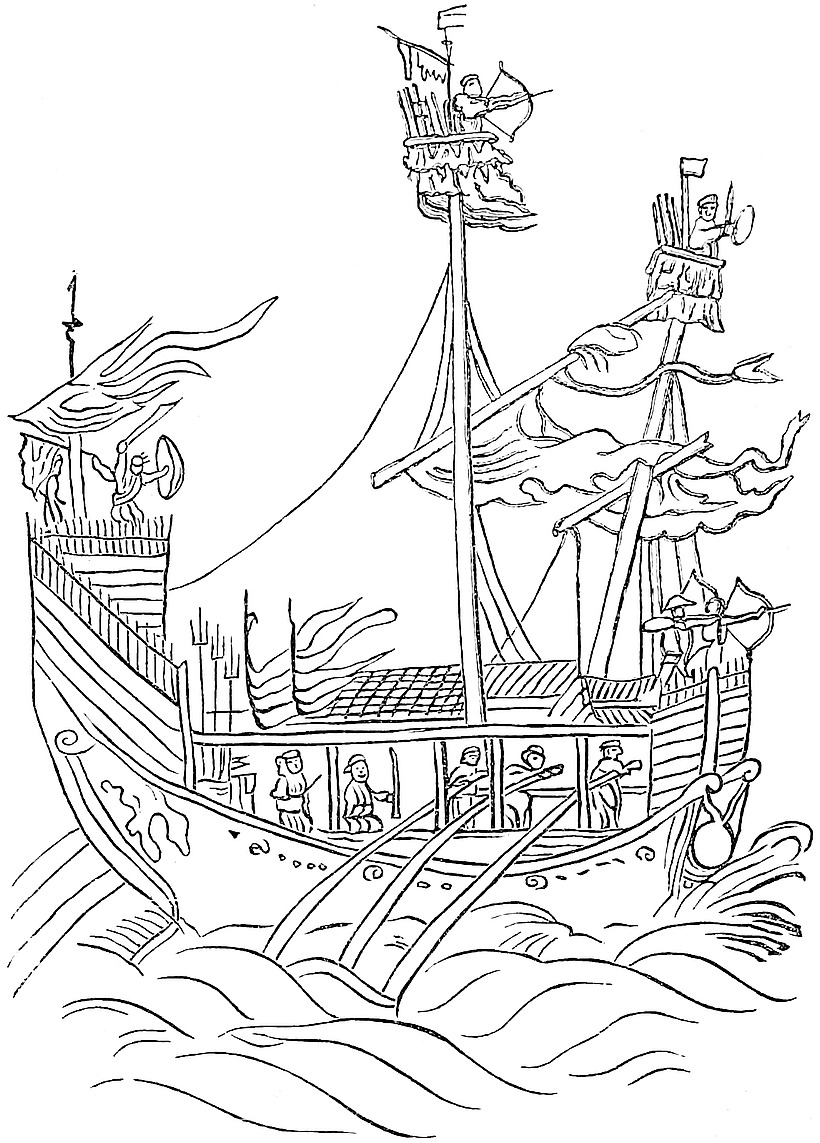
Ancient Chinese War Vessel.
Note 4.—I.e. in this case Sumatra, as will appear hereafter. “It is quite
possible for a fleet of fourteen junks which required to keep together to
take three months at the present time to accomplish a similar voyage. A
Chinese trader, who has come annually to Singapore in junks for many years,
tells us that he has had as long a passage as sixty days, although the
average is eighteen or twenty days.” (Logan in J. Ind. Archip. II. 609.)
Note 5.—Ramusio’s version here varies widely, and looks more probable:
“From the day that they embarked until their arrival there died of mariners
and others on board 600 persons; and of the three ambassadors only one
survived, whose name was Goza (Coja); but of the ladies and damsels died
but one.”
It is worth noting that in the case of an embassy sent to Cathay a few
years later by Gházán Khan, on the return by this same route to Persia, the
chief of the two Persian ambassadors, and the Great Khan’s envoy, who was
in company, both died by the way. Their voyage, too, seems to have been
nearly as long as Polo’s; for they were seven years absent from Persia, and
of these only four in China. (See Wassáf in Elliot, III. 47.)
Note 6.—Ramusio’s version states that on learning Arghún’s death (which
they probably did on landing at Hormuz), they sent word of their arrival
to Kiacatu, who directed them to conduct the lady to Casan, who was then
in the region of the Arbre Sec (the Province of Khorasan) guarding the
frontier passes with 60,000 men, and that they did so, and then turned
back to Kiacatu (probably at Tabriz), and stayed at his Court nine months.
Even the Geog. Text seems to imply that they had become personally known
to Casan, and I have no doubt that Ramusio’s statement is an authentic
expansion of the original narrative by Marco himself, or on his authority.
Arghún Khan died 10th March, 1291. He was succeeded (23rd July) by his
brother Kaikhátú (Quiacatu of Polo), who was put to death 24th March,
1295.
We learn from Hammer’s History of the Ilkhans that when Gházán, the son of
Arghún (Casan of Polo), who had the government of the Khorasan frontier,
was on his return to his post from Tabriz, where his uncle Kaikhatu had
refused to see him, “he met at Abher the ambassador whom he had sent to
the Great Khan to obtain in marriage a relative of the Great Lady Bulghán.
This envoy brought with him the Lady Kúkáchin (our author’s Cocachin),
with presents from the Emperor, and the marriage was celebrated with due
festivity.” Abher lies a little west of Kazvín.
Hammer is not, I find, here copying from Wassáf, and I have not been able
to procure a thorough search of the work of Rashiduddin, which probably was
his authority. As well as the date can be made out from the History of the
Ilkhans, Gházán must have met his bride towards the end of 1293, or quite
the beginning of 1294. Rashiduddin in another place mentions the fair lady
from Cathay; “The ordu (or establishment) of Tukiti Khatun was given
to Kukachi Khatun, who had been brought from the Kaan’s Court, and who
was a kinswoman of the late chief Queen Bulghán. Kúkáchi, the wife of the
Padshah of Islam, Gházán Khan, died in the month of Shaban, 695,” i.e. in
June, 1296, so that the poor girl did not long survive her promotion. (See
Hammer’s Ilch. II. 20, and 8, and I. 273; and Quatremère’s Rashiduddin,
p. 97.) Kukachin was the name also of the wife of Chingkim, Kublai’s
favourite son; but she was of the Kungurát tribe. (Deguignes, IV. 179.)
Note 7.—Here Ramusio’s text says: “During this journey Messers Nicolo,
Maffeo, and Marco heard the news that the Great Khan had departed this
life; and this caused them to give up all hope of returning to those parts.”
Note 8.—This Princess of Manzi, or Southern China, is mentioned only in the
Geog. Text and in the Crusca, which is based thereon. I find no notice of
her among the wives of Gházán or otherwise.
On the fall of the capital of the Sung Dynasty—the Kinsay of Polo—in 1276,
the Princesses of that Imperial family were sent to Peking, and were
graciously treated by Kublai’s favourite Queen, the Lady Jamui. This young
lady was, no doubt, one of those captive princesses who had been brought up
at the Court of Khánbálik. (See De Mailla, IX. 376, and infra Bk. II. ch.
lxv., note 6.)

ACCOUNT OF REGIONS VISITED OR HEARD OF ON THE JOURNEY FROM THE LESSER
ARMENIA TO THE COURT OF THE GREAT KAAN AT CHANDU.
Aias, the Laias of Polo, from an Admiralty Chart.
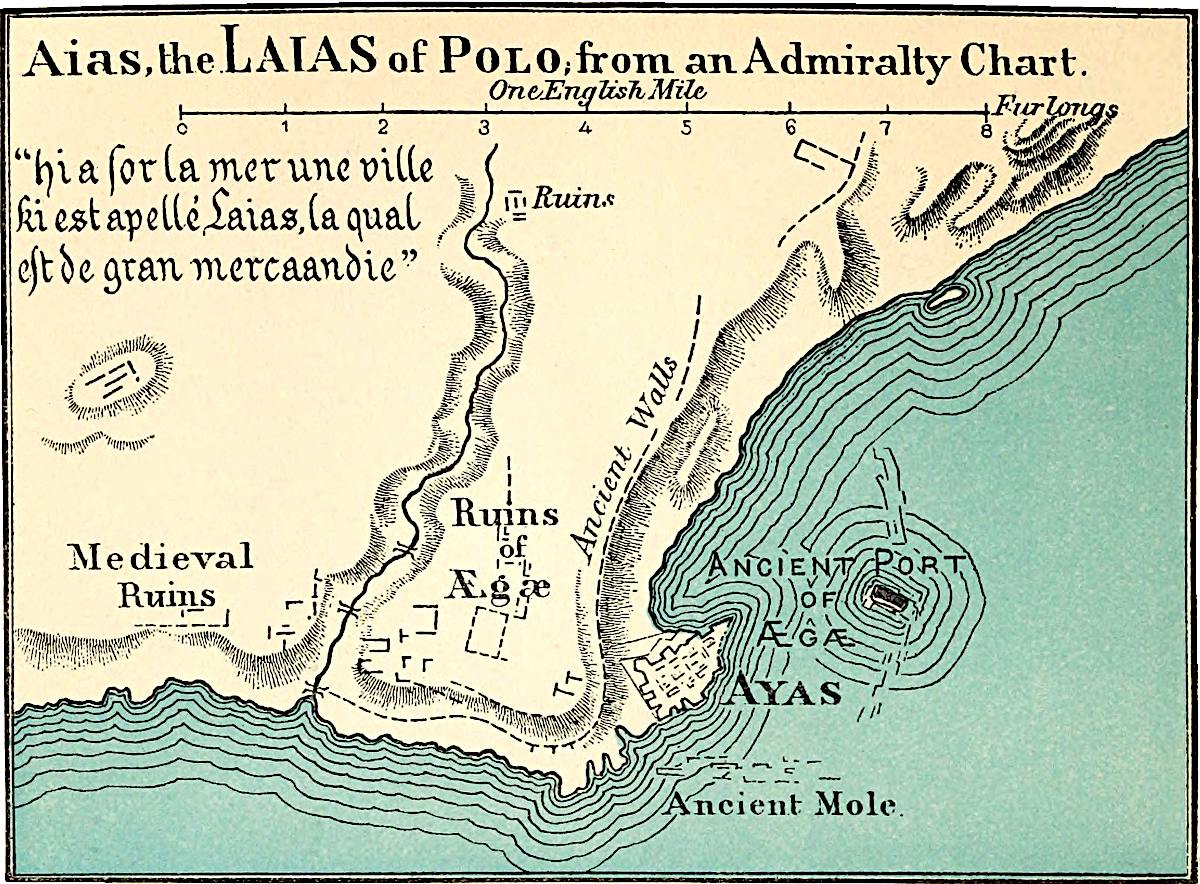
Position of Diláwar, the supposed Site of Polo’s Dilavar
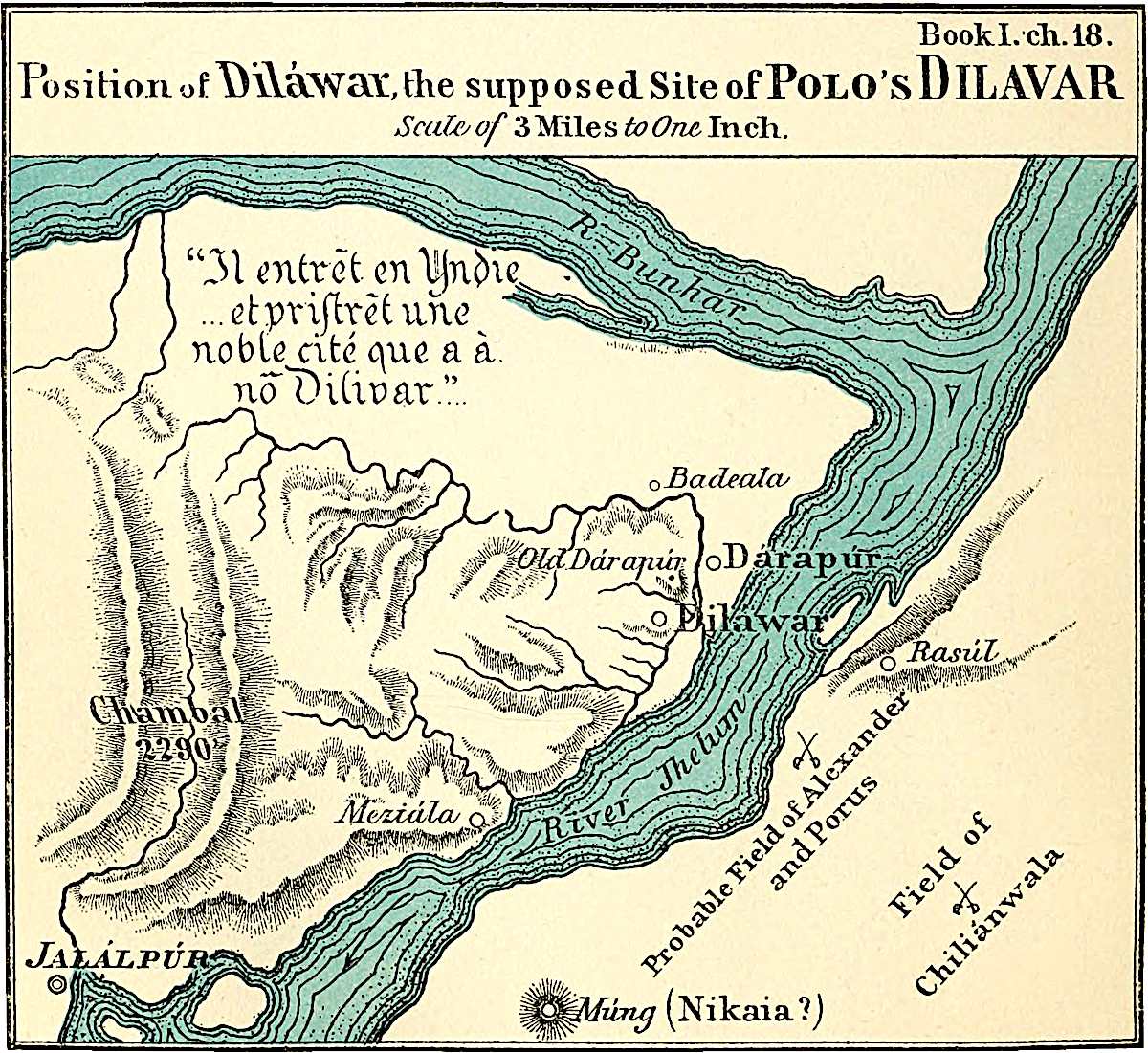
Lit. Frauenfelder, Palermo
BOOK I.
Here the Book begins; and first it speaks of the Lesser Hermenia.
There are two Hermenias, the Greater and the Less. The Lesser Hermenia is
governed by a certain King, who maintains a just rule in his dominions, but
is himself subject to the Tartar.{1} The country contains numerous
towns and villages,{2} and has everything in plenty; moreover, it is a
great country for sport in the chase of all manner of beasts and birds. It
is, however, by no means a healthy region, but grievously the reverse.{3}
In days of old the nobles there were valiant men, and did doughty deeds
of arms; but nowadays they are poor creatures, and good at nought, unless
it be at boozing; they are great at that. Howbeit, they have a city upon
the sea, which is called Layas, at which there is a great trade. For you
must know that all the spicery, and the cloths of silk and gold, and the
other valuable wares that come from the interior, are brought to that city.
And the merchants of Venice and Genoa, and other countries, come thither to
sell their goods, and to buy what they lack. And whatsoever persons would
travel to the interior (of the East), merchants or others, they take their
way by this city of Layas.{4}
Having now told you about the Lesser Hermenia, we shall next tell you about
Turcomania.
Note 1.—The Petite Hermenie of the Middle Ages was quite distinct from
the Armenia Minor of the ancient geographers, which name the latter applied
to the western portion of Armenia, west of the Euphrates, and immediately
north of Cappadocia.
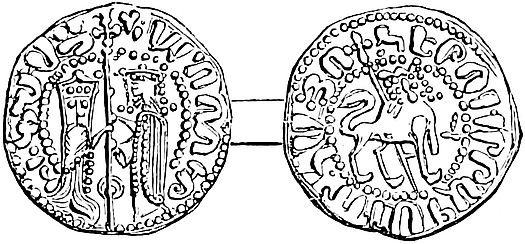
Coin of King Hetum and his Queen Isabel.
But when the old Armenian monarchy was broken up (1079–80), Rupen, a
kinsman of the Bagratid Kings, with many of his countrymen, took refuge
in the Taurus. His first descendants ruled as barons, a title adopted
apparently from the Crusaders, but still preserved in Armenia. Leon, the
great-great-grandson of Rupen, was consecrated King under the supremacy
of the Pope and the Western Empire in 1198. The kingdom was at its zenith
under Hetum or Hayton I., husband of Leon’s daughter Isabel (1224–1269); he
was, however, prudent enough to make an early submission to the Mongols,
and remained ever staunch to them, which brought his territory constantly
under the flail of Egypt. It included at one time all Cilicia, with many
cities of Syria and the ancient Armenia Minor, of Isauria and Cappadocia.
The male line of Rupen becoming extinct in 1342, the kingdom passed to John
de Lusignan, of the royal house of Cyprus, and in 1375 it was put an end to
by the Sultan of Egypt. Leon VI., the ex-king, into whose mouth Froissart
puts some extraordinary geography, had a pension of 1000l. a year granted
him by our Richard II., and died at Paris in 1398.
The chief remaining vestige of this little monarchy is the continued
existence of a Catholicos of part of the Armenian Church at Sis, which
was the royal residence. Some Armenian communities still remain both in
hills and plains; and the former, the more independent and industrious,
still speak a corrupt Armenian.
Polo’s contemporary, Marino Sanuto, compares the kingdom of the Pope’s
faithful Armenians to one between the teeth of four fierce beasts, the
Lion Tartar, the Panther Soldan, the Turkish Wolf, the Corsair
Serpent.
(Dulaurier, in J. As. sér. V. tom. xvii.; St. Martin, Arm.; Mar.
San. p. 32; Froissart, Bk. II. ch. xxii. seqq.; Langlois, V. en
Cilicie, 1861, p. 19.)
Note 2.—“Maintes villes et maint chasteaux.” This is a constantly
recurring phrase, and I have generally translated it as here, believing
chasteaux (castelli) to be used in the frequent old Italian sense of a
walled village or small walled town, or like the Eastern Kala’, applied
in Khorasan “to everything—town, village, or private residence—surrounded
by a wall of earth.” (Ferrier, p. 292; see also A. Conolly, I. p. 211.)
Martini, in his Atlas Sinensis, uses “Urbes, oppida, castella,” to
indicate the three classes of Chinese administrative cities.
Note 3.—“Enferme durement.” So Marino Sanuto objects to Lesser Armenia
as a place of debarkation for a crusade “quia terra est infirma.”
Langlois, speaking of the Cilician plain: “In this region once so fair,
now covered with swamps and brambles, fever decimates a population which
is yearly diminishing, has nothing to oppose to the scourge but incurable
apathy, and will end by disappearing altogether,” etc. (Voyage, p. 65.)
Cilician Armenia retains its reputation for sport, and is much frequented
by our naval officers for that object. Ayas is noted for the extraordinary
abundance of turtles.
Note 4.—The phrase twice used in this passage for the Interior is Fra
terre, an Italianism (Fra terra, or, as it stands in the Geog. Latin,
“infra terram Orientis”), which, however, Murray and Pauthier have
read as an allusion to the Euphrates, an error based apparently on a
marginal gloss in the published edition of the Soc. de Géographie. It is
true that the province of Comagene under the Greek Empire got the name of
Euphratesia, or in Arabic Furátíyah, but that was not in question here.
The great trade of Ayas was with Tabriz, viâ Sivas, Erzingan, and Erzrum,
as we see in Pegolotti. Elsewhere, too, in Polo we find the phrase fra
terre used, where Euphrates could possibly have no concern, as in relation
to India and Oman. (See Bk. III. chs. xxix. and xxxviii., and notes in each
case.)
With regard to the phrase spicery here and elsewhere, it should be noted
that the Italian spezerie included a vast deal more than ginger and other
things “hot i’ the mouth.” In one of Pegolotti’s lists of spezerie we
find drugs, dye-stuffs, metals, wax, cotton, etc.
Concerning the Province of Turcomania.
In Turcomania there are three classes of people. First, there are the
Turcomans; these are worshippers of Mahommet, a rude people with an uncouth
language of their own.{1} They dwell among mountains and downs where
they find good pasture, for their occupation is cattle-keeping. Excellent
horses, known as Turquans, are reared in their country, and also very
valuable mules. The other two classes are the Armenians and the Greeks, who
live mixt with the former in the towns and villages, occupying themselves
with trade and handicrafts. They weave the finest and handsomest carpets
in the world, and also a great quantity of fine and rich silks of cramoisy
and other colours, and plenty of other stuffs. Their chief cities are
Conia, Savast [where the glorious Messer Saint Blaise suffered martyrdom],
and Casaria, besides many other towns and bishops’ sees, of which we shall
not speak at present, for it would be too long a matter. These people are
subject to the Tartar of the Levant as their Suzerain.{2} We will now
leave this province, and speak of the Greater Armenia.
Note 1.—Ricold of Montecroce, a contemporary of Polo, calls the Turkmans
homines bestiales. In our day Ainsworth notes of a Turkman village: “The
dogs were very ferocious; ... the people only a little better.” (J. R. G.
S. X. 292.) The ill report of the people of this region did not begin with
the Turkmans, for the Emperor Constantine Porphyrog. quotes a Greek proverb
to the disparagement of the three kappas, Cappadocia, Crete, and Cilicia.
(In Banduri, I. 6.)
Note 2.—In Turcomania Marco perhaps embraces a great part of Asia Minor,
but he especially means the territory of the decaying Seljukian monarchy,
usually then called by Asiatics Rúm, as the Ottoman Empire is now, and
the capital of which was Iconium, Kuniyah, the Conia of the text, and Coyne
of Joinville. Ibn Batuta calls the whole country Turkey (Al-Turkíyah),
and the people Turkmán; exactly likewise does Ricold (Thurchia and
Thurchimanni). Hayton’s account of the various classes of inhabitants
is quite the same in substance as Polo’s. [The Turkmans emigrated from
Turkestan to Asia Minor before the arrival of the Seljukid Turks. “Their
villages,” says Cuinet, Turquie d’Asie, II. p. 767, “are distinguished
by the peculiarity of the houses being built of sun-baked bricks, whereas
it is the general habit in the country to build them of earth or a kind of
plaster, called djès”—H. C.] The migratory and pastoral Turkmans still
exist in this region, but the Kurds of like habits have taken their place
to a large extent. The fine carpets and silk fabrics appear to be no longer
produced here, any more than the excellent horses of which Polo speaks,
which must have been the remains of the famous old breed of Cappadocia. [It
appears, however (Vital Cuinet’s Turquie d’Asie, I. p. 224), that fine
carpets are still manufactured at Koniah, also a kind of striped cotton
cloth, called Aladja.—H. C.]
A grant of privileges to the Genoese by Leon II., King of Lesser Armenia,
dated 23rd December, 1288, alludes to the export of horses and mules,
etc., from Ayas, and specifies the duties upon them. The horses now of
repute in Asia as Turkman come from the east of the Caspian. And Asia Minor
generally, once the mother of so many breeds of high repute, is now poorer
in horses than any province of the Ottoman empire.
(Pereg. Quat. p. 114; I. B. II. 255 seqq.; Hayton, ch. xiii.; Liber
Jurium Reip. Januensis, II. 184; Tchihatcheff, As. Min., 2de partie, 631.)
[The Seljukian Sultanate of Iconium or Rúm, was founded at the expense of
the Byzantines by Suleiman (1074–1081); the last three sovereigns of the
dynasty contemporaneous with Marco Polo are Ghiath ed-din Kaïkhosru III.
(1267–1283), Ghiath ed-din Mas’ud II. (1283–1294), Ala ed-din Kaïkobad III.
(1294–1308), when this kingdom was destroyed by the Mongols of Persia.
Privileges had been granted to Venice by Ghiath ed-din Kaïkhosru I. (✛1211),
and his sons Izz ed-din Kaikaus (1211–1220), and Ala ed-din Kaïkobad
I. (1220–1237); the diploma of 1220 is unfortunately the only one of the
three known to be preserved. (Cf. Heyd, I. p. 302.)—H. C.]
Though the authors quoted above seem to make no distinction between Turks
and Turkmans, that which we still understand does appear to have been made
in the 12th century: “That there may be some distinction, at least in name,
between those who made themselves a king, and thus achieved such glory, and
those who still abide in their primitive barbarism and adhere to their old
way of life, the former are nowadays termed Turks, the latter by their
old name of Turkomans.” (William of Tyre, i. 7.)
Casaria is Kaisaríya, the ancient Caesareia of Cappadocia, close to the
foot of the great Mount Argaeus. Savast is the Armenian form (Sevasd)
of Sebaste, the modern Sivas. The three cities, Iconium, Caesareia, and
Sebaste, were metropolitan sees under the Catholicos of Sis.
[The ruins of Sebaste are situated at about 6 miles to the east of modern
Sivas, near the village of Gavraz, on the Kizil Irmak. In the 11th
century, the King of Armenia, Senecherim, made his capital of Sebaste. It
belonged after to the Seljukid Turks, and was conquered in 1397 by Bayezid
Ilderim with Tokat, Castambol and Sinope. (Cf. Vital Cuinet.)
One of the oldest churches in Sivas is St. George (Sourp-Kévork),
occupied by the Greeks, but claimed by the Armenians; it is situated near
the centre of the town, in what is called the “Black Earth,” the spot
where Timur is said to have massacred the garrison. A few steps north of
St. George is the Church of St. Blasius, occupied by the Roman Catholic
Armenians. The tomb of St. Blasius, however, is shown in another part
of the town, near the citadel mount, and the ruins of a very beautiful
Seljukian Medresseh. (From a MS. Note by Sir H. Yule. The information had
been supplied by the American Missionaries to General Sir C. Wilson, and
forwarded by him to Sir H. Yule.)
It must be remembered that at the time of the Seljuk Turks, there were
four Medressehs at Sivas, and a university as famous as that of Amassia.
Children to the number of 1000, each a bearer of a copy of the Koran, were
crushed to death under the feet of the horses of Timur, and buried in the
“Black Earth”; the garrison of 4000 soldiers were buried alive.
St. Blasius, Bishop of Sebaste, was martyred in 316 by order of Agricola,
Governor of Cappadocia and Lesser Armenia, during the reign of Licinius.
His feast is celebrated by the Latin Church on the 3rd of February, and by
the Greek Church on the 11th of February. He is the patron of the Republic
of Ragusa in Dalmatia, and in France of wool-carders.
At the village of Hullukluk, near Sivas, was born in 1676 Mekhitar, founder
of the well-known Armenian Order, which has convents at Venice, Vienna, and
Trieste.—H. C.]
Description of the Greater Hermenia.
This is a great country. It begins at a city called Arzinga, at which they
weave the best buckrams in the world. It possesses also the best baths from
natural springs that are anywhere to be found.{1} The people of the
country are Armenians, and are subject to the Tartar. There are many towns
and villages in the country, but the noblest of their cities is Arzinga,
which is the See of an Archbishop, and then Arziron and Arzizi.{2}
The country is indeed a passing great one, and in the summer it is
frequented by the whole host of the Tartars of the Levant, because it then
furnishes them with such excellent pasture for their cattle. But in winter
the cold is past all bounds, so in that season they quit this country and
go to a warmer region, where they find other good pastures. [At a castle
called Paipurth, that you pass in going from Trebizond to Tauris, there is
a very good silver mine.{3}]
And you must know that it is in this country of Armenia that the Ark of
Noah exists on the top of a certain great mountain [on the summit of which
snow is so constant that no one can ascend;{4} for the snow never
melts, and is constantly added to by new falls. Below, however, the snow
does melt, and runs down, producing such rich and abundant herbage that
in summer cattle are sent to pasture from a long way round about, and it
never fails them. The melting snow also causes a great amount of mud on the
mountain].
The country is bounded on the south by a kingdom called Mosul, the people
of which are Jacobite and Nestorian Christians, of whom I shall have more
to tell you presently. On the north it is bounded by the Land of the
Georgians, of whom also I shall speak. On the confines towards Georgiania
there is a fountain from which oil springs in great abundance, insomuch
that a hundred shiploads might be taken from it at one time. This oil is
not good to use with food, but ’tis good to burn, and is also used to
anoint camels that have the mange. People come from vast distances to fetch
it, for in all the countries round about they have no other oil.{5}
Now, having done with Great Armenia, we will tell you of Georgiania.
Note 1.—[Erzinjan, Erzinga, or Eriza, in the vilayet of Erzrum, was rebuilt
in 1784, after having been destroyed by an earthquake. “Arzendjan,” says
Ibn Batuta, II. p. 294, “is in possession of well-established markets;
there are manufactured fine stuffs, which are called after its name.” It
was at Erzinjan that was fought in 1244 the great battle, which placed the
Seljuk Turks under the dependency of the Mongol Khans.—H. C.] I do not find
mention of its hot springs by modern travellers, but Lazari says Armenians
assured him of their existence. There are plenty of others in Polo’s route
through the country, as at Ilija, close to Erzrum, and at Hássan Kalá.
The Buckrams of Arzinga are mentioned both by Pegolotti (circa 1340) and
by Giov. d’Uzzano (1442). But what were they?
Buckram in the modern sense is a coarse open texture of cotton or hemp,
loaded with gum, and used to stiffen certain articles of dress. But this
was certainly not the mediæval sense. Nor is it easy to bring the
mediæval uses of the term under a single explanation. Indeed Mr. Marsh
suggests that probably two different words have coalesced. Fr.-Michel
says that Bouqueran was at first applied to a light cotton stuff of
the nature of muslin, and afterwards to linen, but I do not see that he
makes out this history of the application. Douet d’Arcq, in his Comptes
de l’Argenterie, etc., explains the word simply in the modern sense, but
there seems nothing in his text to bear this out.
A quotation in Raynouard’s Romance Dictionary has “Vestirs de polpra e
de bisso que est bocaran,” where Raynouard renders bisso as lin;
a quotation in Ducange also makes Buckram the equivalent of Bissus; and
Michel quotes from an inventory of 1365, “unam culcitram pinctam (qu.
punctam?) albam factam de bisso aliter boquerant.”
Mr. Marsh again produces quotations, in which the word is used as a
proverbial example of whiteness, and inclines to think that it was a
bleached cloth with a lustrous surface.
It certainly was not necessarily linen. Giovanni Villani, in a passage
which is curious in more ways than one, tells how the citizens of Florence
established races for their troops, and, among other prizes, was one which
consisted of a Bucherame di bambagine (of cotton). Polo, near the end of
the Book (Bk. III. ch. xxxiv.), speaking of Abyssinia, says, according to
Pauthier’s text: “Et si y fait on moult beaux bouquerans et autres draps
de coton.” The G. T. is, indeed, more ambiguous: “Il hi se font maint
biaus dras banbacin e bocaran” (cotton and buckram). When, however, he
uses the same expression with reference to the delicate stuffs woven on
the coast of Telingana, there can be no doubt that a cotton texture is
meant, and apparently a fine muslin. (See Bk. III. ch. xviii.) Buckram
is generally named as an article of price, chier bouquerant, rice
boquerans, etc, but not always, for Polo in one passage (Bk. II. ch. xlv.)
seems to speak of it as the clothing of the poor people of Eastern Tibet.
Plano Carpini says the tunics of the Tartars were either of buckram
(bukeranum), of purpura (a texture, perhaps velvet), or of baudekin,
a cloth of gold (pp. 614–615). When the envoys of the Old Man of the
Mountain tried to bully St. Lewis, one had a case of daggers to be offered
in defiance, another a bouqueran for a winding sheet (Joinville, p. 136.)
In accounts of materials for the use of Anne Boleyn in the time of her
prosperity, bokeram frequently appears for “lyning and taynting” (?)
gowns, lining sleeves, cloaks, a bed, etc., but it can scarcely have been
for mere stiffening, as the colour of the buckram is generally specified as
the same as that of the dress.
A number of passages seem to point to a quilted material. Boccaccio
(Day viii. Novel 10) speaks of a quilt (coltre) of the whitest buckram
of Cyprus, and Uzzano enters buckram quilts (coltre di Bucherame) in a
list of Linajuoli, or linen-draperies. Both his handbook and Pegolotti’s
state repeatedly that buckrams were sold by the piece or the half-score
pieces—never by measure. In one of Michel’s quotations (from Baudouin de
Sebourc) we have:
“Gaufer li fist premiers armer d’un auqueton
Qui fu de bougherant et plaine de bon coton.”
Mr. Hewitt would appear to take the view that Buckram meant a quilted
material; for, quoting from a roll of purchases made for the Court of
Edward I., an entry for Ten Buckrams to make sleeves of, he remarks, “The
sleeves appear to have been of pourpointerie,” i.e. quilting. (Ancient
Armour, I. 240.)
This signification would embrace a large number of passages in which the
term is used, though certainly not all. It would account for the mode or
sale by the piece, and frequent use of the expression a buckram, for its
habitual application to coltre or counterpanes, its use in the auqueton
of Baudouin, and in the jackets of Falstaff’s “men in buckram,” as well
as its employment in the frocks of the Mongols and Tibetans. The winter
chapkan, or long tunic, of Upper India, a form of dress which, I believe,
correctly represents that of the Mongol hosts, and is probably derived
from them, is almost universally of quilted cotton.[1] This signification
would also facilitate the transfer of meaning to the substance now called
buckram, for that is used as a kind of quilting.
The derivation of the word is very uncertain. Reiske says it is Arabic,
Abu-Kairám, “Pannus cum intextis figuris”; Wedgwood, attaching the
modern meaning, that it is from It., bucherare, to pierce full of holes,
which might be if bucherare could be used in the sense of puntare,
or the French piquer; Marsh connects it with the bucking of linen;
and D’Avezac thinks it was a stuff that took its name from Bokhara.
If the name be local, as so many names of stuffs are, the French form
rather suggests Bulgaria. [Heyd, II. 703, says that Buckram (Bucherame)
was principally manufactured at Erzinjan (Armenia), Mush, and Mardin
(Kurdistan), Ispahan (Persia), and in India, etc. It was shipped to the
west at Constantinople, Satalia, Acre, and Famagusta; the name is derived
from Bokhara.—H. C.]
(Della Decima, III. 18, 149, 65, 74, 212, etc.; IV. 4, 5, 6, 212;
Reiske’s Notes to Const. Porphyrogen. II.; D’Avezac, p. 524; Vocab.
Univ. Ital.; Franc.-Michel, Recherches, etc. II. 29 seqq.; Philobiblon
Soc. Miscell. VI.; Marsh’s Wedgwood’s Etym. Dict. sub voce.)
Castle of Baiburt.
Note 2.—Arziron is Erzrum, which, even in Tournefort’s time, the Franks
called Erzeron (III. 126); [it was named Garine, then Theodosiopolis,
in honour of Theodosius the Great; the present name was given by the
Seljukid Turks, and it means “Roman Country”; it was taken by Chinghiz Khan
and Timur, but neither kept it long. Odorico (Cathay, I. p. 46), speaking
of this city, says it “is mighty cold.” (See also on the low temperature
of the place, Tournefort, Voyage du Levant, II. pp. 258–259.) Arzizi,
Arjish, in the vilayet of Van, was destroyed in the middle of the 19th
century; it was situated on the road from Van to Erzrum. Arjish Kalá was
one of the ancient capitals of the Kingdom of Armenia; it was conquered by
Toghrul I., who made it his residence. (Cf. Vital Cuinet, Turquie d’Asie,
II. p. 710).—H. C.]
Arjish is the ancient Arsissa, which gave the Lake Van one of its names.
It is now little more than a decayed castle, with a village inside.
Notices of Kuniyah, Kaisariya, Sivas, Arzan-ar-Rumi, Arzangan, and Arjish,
will be found in Polo’s contemporary Abulfeda. (See Büsching, IV.
303–311.)
Note 3.—Paipurth, or Baiburt, on the high road between Trebizond and
Erzrum, was, according to Neumann, an Armenian fortress in the first
century, and, according to Ritter, the castle Baiberdon was fortified by
Justinian. It stands on a peninsular hill, encircled by the windings of the
R. Charok. [According to Ramusio’s version Baiburt was the third relay from
Trebizund to Tauris, and travellers on their way from one of these cities
to the other passed under this stronghold.—H. C.] The Russians, in retiring
from it in 1829, blew up the greater part of the defences. The nearest
silver mines of which we find modern notice, are those of Gumish-Khánah
(“Silverhouse”), about 35 miles N.W. of Baiburt; they are more correctly
mines of lead rich in silver, and were once largely worked. But the
Masálak-al-absár (14th century), besides these, speaks of two others
in the same province, one of which was near Bajert. This Quatremère
reasonably would read Babert or Baiburt. (Not. et Extraits, XIII. i.
337; Texier, Arménie, I. 59.)
Note 4.—Josephus alludes to the belief that Noah’s Ark still existed, and
that pieces of the pitch were used as amulets. (Ant. I. 3. 6.)
Ararat (16,953 feet) was ascended, first by Prof. Parrot, September 1829;
by Spasski Aotonomoff, August 1834; by Behrens, 1835; by Abich, 1845; by
Seymour in 1848; by Khodzko, Khanikoff, and others, for trigonometrical
and other scientific purposes, in August 1850. It is characteristic of the
account from which I take these notes (Longrimoff, in Bull. Soc. Géog.
Paris, sér. IV. tom. i. p. 54), that whilst the writer’s countrymen,
Spasski and Behrens, were “moved by a noble curiosity,” the Englishman is
only admitted to have “gratified a tourist’s whim”!
Note 5.—Though Mr. Khanikoff points out that springs of naphtha are
abundant in the vicinity of Tiflis, the mention of ship-loads (in Ramusio
indeed altered, but probably by the Editor, to camel-loads), and the vast
quantities spoken of, point to the naphtha-wells of the Baku Peninsula
on the Caspian. Ricold speaks of their supplying the whole country as
far as Baghdad, and Barbaro alludes to the practice of anointing camels
with the oil. The quantity collected from the springs about Baku was in
1819 estimated at 241,000 poods (nearly 4000 tons), the greater part of
which went to Persia. (Pereg. Quat. p. 122; Ramusio, II. 109; El. de
Laprim. 276; V. du Chev. Gamba, I. 298.)
[The phenomenal rise in the production of the Baku oil-fields between
1890–1900, may be seen at a glance from the Official Statistics where the
total output for 1900 is given as 601,000,000 poods, about 9,500,000 tons.
(Cf. Petroleum, No. 42, vol. ii. p. 13.)]
Of Georgiania and the Kings thereof.
In Georgiania there is a King called David Melic, which is as much as to
say “David King”; he is subject to the Tartar.{1} In old times all the
kings were born with the figure of an eagle upon the right shoulder. The
people are very handsome, capital archers, and most valiant soldiers. They
are Christians of the Greek Rite, and have a fashion of wearing their hair
cropped, like Churchmen.{2}
This is the country beyond which Alexander could not pass when he wished
to penetrate to the region of the Ponent, because that the defile was so
narrow and perilous, the sea lying on the one hand, and on the other lofty
mountains impassable to horsemen. The strait extends like this for four
leagues, and a handful of people might hold it against all the world.
Alexander caused a very strong tower to be built there, to prevent the
people beyond from passing to attack him, and this got the name of the Iron
Gate. This is the place that the Book of Alexander speaks of, when it tells
us how he shut up the Tartars between two mountains; not that they were
really Tartars, however, for there were no Tartars in those days, but they
consisted of a race of people called Comanians and many besides.{3}
[In this province all the forests are of box-wood.{4}] There are
numerous towns and villages, and silk is produced in great abundance.
They also weave cloths of gold, and all kinds of very fine silk stuffs.
The country produces the best goshawks in the world [which are called
Avigi].{5} It has indeed no lack of anything, and the people live by
trade and handicrafts. ’Tis a very mountainous region, and full of strait
defiles and of fortresses, insomuch that the Tartars have never been able
to subdue it out and out.
Mediæval Georgian Fortress, from a drawing dated 1634.
“La provence est toute plene de grant montagne et d’estroit pas et de fort.”
There is in this country a certain Convent of Nuns called St. Leonard’s,
about which I have to tell you a very wonderful circumstance. Near the
church in question there is a great lake at the foot of a mountain, and
in this lake are found no fish, great or small, throughout the year till
Lent come. On the first day of Lent they find in it the finest fish in the
world, and great store too thereof; and these continue to be found till
Easter Eve. After that they are found no more till Lent come round again;
and so ’tis every year. ’Tis really a passing great miracle!{6}
That sea whereof I spoke as coming so near the mountains is called the
Sea of Ghel or Ghelan, and extends about 700 miles.{7} It is twelve
days’ journey distant from any other sea, and into it flows the great River
Euphrates and many others, whilst it is surrounded by mountains. Of late
the merchants of Genoa have begun to navigate this sea, carrying ships
across and launching them thereon. It is from the country on this sea also
that the silk called Ghellé is brought.{8} [The said sea produces
quantities of fish, especially sturgeon, at the river-mouths salmon, and
other big kinds of fish.]{9}
Note 1.—Ramusio has: “One part of the said province is subject to the
Tartar, and the other part, owing to its fortresses, remains subject
to the King David.” We give an illustration of one of these mediæval
Georgian fortresses, from a curious collection of MS. notices and drawings
of Georgian subjects in the Municipal Library at Palermo, executed by
a certain P. Cristoforo di Castelli of that city, who was a Theatine
missionary in Georgia, in the first half of the 17th century.
The G. T. says the King was always called David. The Georgian Kings of
the family of Bagratidae claimed descent from King David through a prince
Shampath, said to have been sent north by Nebuchadnezzar; a descent which
was usually asserted in their public documents. Timur in his Institutes
mentions a suit of armour given him by the King of Georgia as forged by
the hand of the Psalmist King. David is a very frequent name in their
royal lists. [The dynasty of the Bagratidae, which was founded in 786 by
Ashod, and lasted until the annexation of Georgia by Russia on the 18th
January, 1801, had nine reigning princes named David. During the second
half of the 12th century the princes were: Dawith (David) IV. Narin
(1247–1259), Dawith V. (1243–1272), Dimitri II. Thawdadebuli (1272–1289),
Wakhtang II. (1289–1292), Dawith VI. (1292–1308).—H. C.] There were two
princes of that name, David, who shared Georgia between them under the
decision of the Great Kaan in 1246, and one of them, who survived to
1269, is probably meant here. The name of David was borne by the last
titular King of Georgia, who ceded his rights to Russia in 1801. It is
probable, however, as Marsden has suggested, that the statement about
the King always being called David arose in part out of some confusion
with the title of Dadian, which, according to Chardin (and also to P.
di Castelli), was always assumed by the Princes of Mingrelia, or Colchis
as the latter calls it. Chardin refers this title to the Persian Dád,
“equity.” To a portrait of “Alexander, King of Iberia,” or Georgia Proper,
Castelli attaches the following inscription, giving apparently his official
style: “With the sceptre of David, Crowned by Heaven, First King of the
Orient and of the World, King of Israel,” adding, “They say that he has
on his shoulder a small mark of a cross, ‘Factus est principatus super
humerum ejus,’ and they add that he has all his ribs in one piece, and not
divided.” In another place he notes that when attending the King in illness
his curiosity moved him strongly to ask if these things were true, but he
thought better of it! (Khanikoff; Jour. As. IX. 370, XI. 291, etc.; Tim.
Instit. p. 143; Castelli MSS.)
[A descendant of these Princes was in St. Petersburg about 1870. He wore
the Russian uniform, and bore the title of Prince Bagration-Mukransky.]
Note 2.—This fashion of tonsure is mentioned by Barbaro and Chardin. The
latter speaks strongly of the beauty of both sexes, as does Della Valle,
and most modern travellers concur.
Note 3.—This refers to the Pass of Derbend, apparently the Sarmatic
Gates of Ptolemy, and Claustra Caspiorum of Tacitus, known to the Arab
geographers as the “Gate of Gates” (Báb-ul-abwáb), but which is still
called in Turkish Demír-Kápi, or the Iron Gate, and to the ancient Wall
that runs from the Castle of Derbend along the ridges of Caucasus, called
in the East Sadd-i-Iskandar, the Rampart of Alexander. Bayer thinks the
wall was probably built originally by one of the Antiochi, and renewed by
the Sassanian Kobad or his son Naoshirwan. It is ascribed to the latter by
Abulfeda; and according to Klaproth’s extracts from the Derbend Námah,
Naoshirwan completed the fortress of Derbend in A.D. 542, whilst he and
his father together had erected 360 towers upon the Caucasian Wall which
extended to the Gate of the Alans (i.e. the Pass of Dariel). Mas’udi says
that the wall extended for 40 parasangs over the steepest summits and
deepest gorges. The Russians must have gained some knowledge as to the
actual existence and extent of the remains of this great work, but I have
not been able to meet with any modern information of a very precise kind.
According to a quotation from Reinegg’s Kaukasus (I. 120, a work which
I have not been able to consult), the remains of defences can be traced
for many miles, and are in some places as much as 120 feet high. M. Moynet
indeed, in the Tour du Monde (I. 122), states that he traced the wall to
a distance of 27 versts (18 miles) from Derbend, but unfortunately, instead
of describing remains of such high interest from his own observation, he
cites a description written by Alex. Dumas, which he says is quite accurate.
[“To the west of Narin-Kaleh, a fortress which from the top of a promontory
rises above the city, the wall, strengthened from distance to distance
by large towers, follows the ridge of the mountains, descends into the
ravines, and ascends the slopes to take root on some remote peak. If the
natives were to be believed, this wall, which, however, no longer has
any strategetical importance, had formerly its towers bristling upon the
Caucasus chain from one sea to another; at least, this rampart did protect
all the plains at the foot of the eastern Caucasus, since vestiges were
found up to 30 kilometres from Derbend.” (Reclus, Asie russe, p. 160.)
It has belonged to Russia since 1813. The first European traveller who
mentions it is Benjamin of Tudela.
Bretschneider (II. p. 117) observes: “Yule complains that he was not able
to find any modern information regarding the famous Caucasian Wall which
begins at Derbend. I may therefore observe that interesting details on the
subject are found in Legkobytov’s Survey of the Russian Dominions beyond
the Caucasus (in Russian), 1836, vol. iv. pp. 158–161, and in Dubois de
Montpéreux’s Voyage autour du Caucase, 1840, vol. iv. pp. 291–298, from
which I shall give here an abstract.”
(He then proceeds to give an abstract, of which the following is a part:)
“The famous Dagh bary (mountain wall) now begins at the village of
Djelgan, 4 versts south-west of Derbend, but we know that as late as the
beginning of the last century it could be traced down to the southern
gate of the city. This ancient wall then stretches westward to the high
mountains of Tabasseran (it seems the Tabarestan of Mas’udi).... Dubois
de Montpéreux enumerates the following sites of remains of the wall:—In
the famous defile of Dariel, north-east of Kazbek. In the valley of
the Assai river, near Wapila, about 35 versts north-east of Dariel.
In the valley of the Kizil river, about 15 versts north-west of Kazbek.
Farther west, in the valley of the Fiag or Pog river, between Lacz
and Khilak. From this place farther west about 25 versts, in the valley
of the Arredon river, in the district of Valaghir. Finally, the
westernmost section of the Caucasian Wall has been preserved, which was
evidently intended to shut up the maritime defile of Gagry, on the Black
Sea.”—H. C.]
There is another wall claiming the title of Sadd-i-Iskandar at the S.E.
angle of the Caspian. This has been particularly spoken of by Vámbéry, who
followed its traces from S.W. to N.E. for upwards of 40 miles. (See his
Travels in C. Asia, 54 seqq., and Julius Braun in the Ausland, No.
22, of 1869.)
Yule (II. pp. 537–538) says, “To the same friendly correspondent [Professor
Braun] I owe the following additional particulars on this interesting
subject, extracted from Eichwald, Periplus des Kasp. M. I. 128.
“‘At the point on the mountain, at the extremity of the fortress (of
Derbend), where the double wall terminates, there begins a single wall
constructed in the same style, only this no longer runs in a straight
line, but accommodates itself to the contour of the hill, turning now
to the north and now to the south. At first it is quite destroyed, and
showed the most scanty vestiges, a few small heaps of stones or traces of
towers, but all extending in a general bearing from east to west.... It is
not till you get 4 versts from Derbend, in traversing the mountains, that
you come upon a continuous wall. Thenceforward you can follow it over the
successive ridges ... and through several villages chiefly occupied by the
Tartar hill-people. The wall ... makes many windings, and every ¾ verst
it exhibits substantial towers like those of the city-wall, crested with
loop-holes. Some of these are still in tolerably good condition; others
have fallen, and with the wall itself have left but slight vestiges.’
“Eichwald altogether followed it up about 18 versts (12 miles) not
venturing to proceed further. In later days this cannot have been
difficult, but my kind correspondent had not been able to lay his hand on
information.
“A letter from Mr. Eugene Schuyler communicates some notes regarding
inscriptions that have been found at and near Derbend, embracing Cufic of
A.D. 465, Pehlvi, and even Cuneiform. Alluding to the fact that the other
Iron-gate, south of Shahrsabz, was called also Kalugah, or Kohlugah
he adds: ‘I don’t know what that means, nor do I know if the Russian
Kaluga, south-west of Moscow, has anything to do with it, but I am told
there is a Russian popular song, of which two lines run:
‘“Ah Derbend, Derbend Kaluga,
Derbend my little Treasure!”’
View of Derbend.
“Alexandre ne poit paser quand il vost aler au Ponent ... car de l’un les
est la mer, et de l’autre est gran montagne que ne se poent cavaucher. La
vie est mout estroit entre la montagne et la mer.”
“I may observe that I have seen it lately pointed out that Koluga is a
Mongol word signifying a barrier; and I see that Timkowski (I. 288) gives
the same explanation of Kalgan, the name applied by Mongols and Russians
to the gate in the Great Wall, called Chang-kia-Kau by the Chinese, leading
to Kiakhta.”
The story alluded to by Polo is found in the mediæval romances of
Alexander, and in the Pseudo-Callisthenes on which they are founded. The
hero chases a number of impure cannibal nations within a mountain barrier,
and prays that they may be shut up therein. The mountains draw together
within a few cubits, and Alexander then builds up the gorge and closes it
with gates of brass or iron. There were in all twenty-two nations with
their kings, and the names of the nations were Gōth, Magōth, Anugi, Egēs,
Exenach, etc. Godfrey of Viterbo speaks of them in his rhyming verses:—
“Finibus Indorum species fuit una virorum;
Goth erat atque Magoth dictum cognomen eorum
* * * * *
Narrat Esias, Isidorus et Apocalypsis,
Tangit et in titulis Magna Sibylla suis.
Patribus ipsorum tumulus fuit venter eorum,” etc.
Among the questions that the Jews are said to have put, in order to test
Mahommed’s prophetic character, was one series: “Who are Gog and Magog?
Where do they dwell? What sort of rampart did Zu’lḳarnain build between
them and men?” And in the Koran we find (ch. xviii. The Cavern): “They
will question thee, O Mahommed, regarding Zu’lḳarnain. Reply: I will
tell you his history”—and then follows the story of the erection of the
Rampart of Yájúj and Májúj. In ch. xxi. again there is an allusion to their
expected issue at the latter day. This last expectation was one of very
old date. Thus the Cosmography of Aethicus, a work long believed (though
erroneously) to have been abridged by St. Jerome, and therefore to be
as old at least as the 4th century, says that the Turks of the race of
Gog and Magog, a polluted nation, eating human flesh and feeding on all
abominations, never washing, and never using wine, salt, nor wheat, shall
come forth in the Day of Antichrist from where they lie shut up behind the
Caspian Gates, and make horrid devastation. No wonder that the irruption of
the Tartars into Europe, heard of at first with almost as much astonishment
as such an event would produce now, was connected with this prophetic
legend![1] The Emperor Frederic II., writing to Henry III. of England,
says of the Tartars: “’Tis said they are descended from the Ten Tribes who
abandoned the Law of Moses, and worshipped the Golden Calf. They are the
people whom Alexander Magnus shut up in the Caspian Mountains.”
[See the chapter Gog et Magog dans le roman en alexandrins, in Paul
Meyer’s Alexandre le Grand dans la Littérature française, Paris, 1886,
II. pp. 386–389.—H. C.]:
“Gos et Margos i vienent de la tiere des Turs
Et .cccc. m. hommes amenerent u plus,
Il en jurent la mer dont sire est Neptunus
Et le porte d’infier que garde Cerberus
Que l’orguel d’Alixandre torneront a reüs
Por çou les enclot puis es estres desus.
Dusc’ al tans Antecrist n’en istera mais nus.”
According to some chroniclers, the Emperor Heraclius had already let loose
the Shut-up Nations to aid him against the Persians, but it brought him no
good, for he was beaten in spite of their aid, and died of grief.
The theory that the Tartars were Gog and Magog led to the Rampart of
Alexander being confounded with the Wall of China (see infra, Bk. I. ch.
lix.), or being relegated to the extreme N.E. of Asia, as we find it in the
Carta Catalana.
These legends are referred to by Rabbi Benjamin, Hayton, Rubruquis, Ricold,
Matthew Paris, and many more. Josephus indeed speaks of the Pass which
Alexander fortified with gates of steel. But his saying that the King of
Hyrcania was Lord of this Pass points to the Hyrcanian Gates of Northern
Persia, or perhaps to the Wall of Gomushtapah, described by Vámbéry.
Ricold of Montecroce allows two arguments to connect the Tartars with the
Jews who were shut up by Alexander; one that the Tartars hated the very
name of Alexander, and could not bear to hear it; the other, that their
manner of writing was very like the Chaldean, meaning apparently the Syriac
(anté, p. 29). But he points out that they had no resemblance to Jews,
and no knowledge of the law.
Edrisi relates how the Khalif Wathek sent one Salem the Dragoman to explore
the Rampart of Gog and Magog. His route lay by Tiflis, the Alan country,
and that of the Bashkirds, to the far north or north-east, and back by
Samarkand. But the report of what he saw is pure fable.
In 1857, Dr. Bellew seems to have found the ancient belief in the legend
still held by Afghan gentlemen at Kandahar.
At Gelath in Imeretia there still exists one valve of a large iron gate,
traditionally said to be the relic of a pair brought as a trophy from
Derbend by David, King of Georgia, called the Restorer (1089–1130). M.
Brosset, however, has shown it to be the gate of Ganja, carried off in 1139.
(Bayer in Comment. Petropol. I. 401 seqq.; Pseudo-Callisth. by
Müller, p. 138; Gott. Viterb. in Pistorii Nidani Script. Germ. II.
228; Alexandriade, pp. 310–311; Pereg. IV. p. 118; Acad. des Insc.
Divers Savans, II. 483; Edrisi, II. 416–420, etc.)
Note 4.—The box-wood of the Abkhasian forests was so abundant, and formed
so important an article of Genoese trade, as to give the name of Chao
de Bux (Cavo di Bussi) to the bay of Bambor, N.W. of Sukum Kala’, where
the traffic was carried on. (See Elie de Laprim. 243.) Abulfeda also
speaks of the Forest of Box (Shará’ ul-buḳs) on the shores of the Black
Sea, from which box-wood was exported to all parts of the world; but his
indication of the exact locality is confused. (Reinaud’s Abulf. I. 289.)
At the present time “Boxwood abounds on the southern coast of the Caspian,
and large quantities are exported from near Resht to England and Russia. It
is sent up the Volga to Tsaritzin, from thence by rail to the Don, and down
that river to the Black Sea, from whence it is shipped to England.” (MS.
Note, H. Y.)
[Cf. V. Helm’s Cultivated Plants, edited by J. S. Stallybrass, Lond.,
1891, The Box Tree, pp. 176–179.—H. C.]
Note 5.—Jerome Cardan notices that “the best and biggest goshawks come from
Armenia,” a term often including Georgia and Caucasus. The name of the bird
is perhaps the same as ’Afçi, “Falco montanus.” (See Casiri, I. 320.)
Major St. John tells me that the Terlán, or goshawk, much used in Persia,
is still generally brought from Caucasus. (Cardan, de Rer. Varietate, VII. 35.)
Note 6.—A letter of Warren Hastings, written shortly before his death, and
after reading Marsden’s Marco Polo, tells how a fish-breeder of Banbury
warned him against putting pike into his fish-pond, saying, “If you should
leave them where they are till Shrove Tuesday they will be sure to spawn,
and then you will never get any other fish to breed in it.” (Romance of
Travel, I. 255.) Edward Webbe in his Travels (1590, reprinted 1868) tells
us that in the “Land of Siria there is a River having great store of fish
like unto Salmon-trouts, but no Jew can catch them, though either Christian
and Turk shall catch them in abundance with great ease.” The circumstance
of fish being got only for a limited time in spring is noticed with
reference to Lake Van both by Tavernier and Mr. Brant.
But the exact legend here reported is related (as M. Pauthier has
already noticed) by Wilibrand of Oldenburg of a stream under the Castle
of Adamodana, belonging to the Hospitallers, near Naversa (the ancient
Anazarbus), in Cilicia under Taurus. And Khanikoff was told the same
story of a lake in the district of Akhaltziké in Western Georgia, in regard
to which he explains the substance of the phenomenon as a result of the
rise of the lake’s level by the melting of the snows, which often coincides
with Lent. I may add that Moorcroft was told respecting a sacred pond near
Sir-i-Chashma, on the road from Kabul to Bamian, that the fish in the pond
were not allowed to be touched, but that they were accustomed to desert it
for the rivulet that ran through the valley regularly every year on the
day of the vernal equinox, and it was then lawful to catch them.
Like circumstances would produce the same effect in a variety of lakes,
and I have not been able to identify the convent of St. Leonard’s. Indeed
Leonard (Sant Lienard, G. T.) seems no likely name for an Armenian Saint;
and the patroness of the convent (as she is of many others in that country)
was perhaps Saint Nina, an eminent personage in the Armenian Church,
whose tomb is still a place of pilgrimage; or possibly St. Helena, for I
see that the Russian maps show a place called Elenovka on the shores of
Lake Sevan, N.E. of Erivan. Ramusio’s text, moreover, says that the lake
was four days in compass, and this description will apply, I believe, to
none but the lake just named. This is, according to Monteith, 47 miles in
length and 21 miles in breadth, and as far as I can make out he travelled
round it in three very long marches. Convents and churches on its shores
are numerous, and a very ancient one occupies an island on the lake. The
lake is noted for its fish, especially magnificent trout.
(Tavern. Bk. III. ch. iii.; J. R. G. S. X. 897; Pereg. Quat. p. 179;
Khanikoff, 15; Moorcroft, II. 382; J. R. G. S. III. 40 seqq.)
Ramusio has: “In this province there is a fine city called Tiflis, and
round about it are many castles and walled villages. It is inhabited by
Christians, Armenians, Georgians, and some Saracens and Jews, but not many.”
Note 7.—The name assigned by Marco to the Caspian, “Mer de Gheluchelan”
or “Ghelachelan,” has puzzled commentators. I have no doubt that the
interpretation adopted above is the correct one. I suppose that Marco said
that the sea was called “La Mer de Ghel ou (de) Ghelan,” a name taken from
the districts of the ancient Gelae on its south-western shores, called
indifferently Gíl or Gílán, just as many other regions of Asia have
like duplicate titles (singular and plural), arising, I suppose, from the
change of a gentile into a local name. Such are Lár, Lárán, Khutl,
Khutlán, etc., a class to which Badakhshán, Wakhán, Shaghnán, Mungán,
Chaghánián, possibly Bámián, and many others have formerly belonged, as
the adjectives in some cases surviving, Badakhshi, Shaghni, Wákhi, etc.,
show.[2] The change exemplified in the induration of these gentile plurals
into local singulars is everywhere traced in the passage from earlier to
later geography. The old Indian geographical lists, such as are preserved
in the Puránas, and in Pliny’s extracts from Megasthenes, are, in the main,
lists of peoples, not of provinces, and even where the real name seems to
be local a gentile form is often given. So also Tochari and Sogdi are
replaced by Tokháristán and Sughd; the Veneti and Taurini by Venice
and Turin; the Remi and the Parisii, by Rheims and Paris; East-Saxons
and South-Saxons by Essex and Sussex; not to mention the countless
-ings that mark the tribal settlement of the Saxons in Britain.
Abulfeda, speaking of this territory, uses exactly Polo’s phrase, saying
that the districts in question are properly called Kíl-o-Kílán, but by
the Arabs Jíl-o-Jílán. Teixeira gives the Persian name of the sea as
Darya Ghiláni. (See Abulf. in Büsching, v. 329.)
[The province of Gíl (Gílán), which is situated between the mountains and
the Caspian Sea, and between the provinces of Azerbaíján and Mázanderán (H. C.)],
gave name to the silk for which it was and is still famous, mentioned
as Ghelle (Gílí) at the end of this chapter. This Seta Ghella is
mentioned also by Pegolotti (pp. 212, 238, 301), and by Uzzano, with an odd
transposition, as Seta Leggi, along with Seta Masandroni, i.e. from the
adjoining province of Mázanderán (p. 192). May not the Spanish Geliz,
“a silk-dealer,” which seems to have been a puzzle to etymologists, be
connected with this? (See Dozy and Engelmann, 2nd ed. p. 275.) [Prof. F.
de Filippi (Viaggo in Persia nel 1862, ... Milan, 1865, 8vo) speaks of
the silk industry of Ghílán (pp. 295–296) as the principal product of the
entire province.—H. C.]
The dimensions assigned to the Caspian in the text would be very correct
if length were meant, but the Geog. Text with the same figure specifies
circuit (zire). Ramusio again has “a circuit of 2800 miles.” Possibly
the original reading was 2700; but this would be in excess.
Note 8.—The Caspian is termed by Vincent of Beauvais Mare Seruanicum, the
Sea of Shirwan, another of its numerous Oriental names, rendered by Marino
Sanuto as Mare Salvanicum. (III. xi. ch. ix.) But it was generally known
to the Franks in the Middle Ages as the Sea of Bacu. Thus Berni:—
“Fuor del deserto la diritta strada
Lungo il Mar di Bacu miglior pareva.”
(Orl. Innam. xvii. 60.)
And in the Sfera of Lionardo Dati (circa 1390):—
“Da Tramontana di quest’Asia Grande
Tartari son sotto la fredda Zona,
Gente bestial di bestie e vivande,
Fin dove l’Onda di Baccù risuona,” etc. (p. 10.)
This name is introduced in Ramusio, but probably by interpolation, as well
as the correction of the statement regarding Euphrates, which is perhaps a
branch of the notion alluded to in Prologue, ch. ii. note 5. In a later
chapter Marco calls it the Sea of Sarai, a title also given in the Carta
Catalana. [Odorico calls it Sea of Bacuc (Cathay) and Sea of Bascon
(Cordier). The latter name is a corruption of Abeskun, a small town and
island in the S.E. corner of the Caspian Sea, not far from Ashurada.—H. C.]
We have little information as to the Genoese navigation of the Caspian,
but the great number of names exhibited along its shores in the map just
named (1375) shows how familiar such navigation had become by that date.
See also Cathay, p. 50, where an account is given of a remarkable
enterprise by Genoese buccaneers on the Caspian about that time. Mas’udi
relates an earlier history of how about the beginning of the 9th century
a fleet of 500 Russian vessels came out of the Volga, and ravaged all the
populous southern and western shores of the Caspian. The unhappy population
was struck with astonishment and horror at this unlooked-for visitation
from a sea that had hitherto been only frequented by peaceful traders or
fishermen. (II. 18–24.)
Note 9.—[The enormous quantity of fish found in the Caspian Sea is ascribed
to the mass of vegetable food to be found in the shallower waters of
the North and the mouth of the Volga. According to Reclus, the Caspian
fisheries bring in fish to the annual value of between three and four
millions sterling.—H. C.]
Of the Kingdom of Mausul.
On the frontier of Armenia towards the south-east is
the kingdom of Mausul.
It is a very great kingdom, and inhabited{1} by several different
kinds of people whom we shall now describe.
First there is a kind of people called Arabi, and these worship Mahommet.
Then there is another description of people who are Nestorian and Jacobite
Christians. These have a Patriarch, whom they call the Jatolic, and this
Patriarch creates Archbishops, and Abbots, and Prelates of all other
degrees, and sends them into every quarter, as to India, to Baudas, or
to Cathay, just as the Pope of Rome does in the Latin countries. For you
must know that though there is a very great number of Christians in those
countries, they are all Jacobites and Nestorians; Christians indeed, but
not in the fashion enjoined by the Pope of Rome, for they come short in
several points of the Faith.{2}
All the cloths of gold and silk that are called Mosolins are made in this
country; and those great Merchants called Mosolins, who carry for sale
such quantities of spicery and pearls and cloths of silk and gold, are also
from this kingdom.{3}
There is yet another race of people who inhabit the mountains in that
quarter, and are called Curds. Some of them are Christians, and some of
them are Saracens; but they are an evil generation, whose delight it is to
plunder merchants.{4}
[Near this province is another called Mus and Merdin, producing an immense
quantity of cotton, from which they make a great deal of buckram{5}
and other cloth. The people are craftsmen and traders, and all are subject
to the Tartar King.]
Coin of Badruddín of Mausul.
Note
1.—Polo could scarcely have been justified in calling Mosul a very
great kingdom. This is a bad habit of his, as we shall have to notice
again. Badruddín Lúlú, the last Atabeg of Mosul of the race of Zenghi had
at the age of 96 taken sides with Hulaku, and stood high in his favour.
His son Malik Sálih, having revolted, surrendered to the Mongols in 1261
on promise of life; which promise they kept in Mongol fashion by torturing
him to death. Since then the kingdom had ceased to exist as such. Coins
of Badruddín remain with the name and titles of Mangku Kaan on their
reverse, and some of his and of other atabegs exhibit curious imitations
of Greek art. (Quat. Rash. p. 389; Jour. As. IV. VI. 141.).—H. Y. and
H. C. [Mosul was pillaged by Timur at the end of the 14th century; during
the 15th it fell into the hands of the Turkomans, and during the 16th, of
Ismail, Shah of Persia.—H. C.]
[The population of Mosul is to-day 61,000 inhabitants—(48,000 Musulmans,
10,000 Christians belonging to various churches, and 3000 Jews).—H. C.]
Note 2.—The Nestorian Church was at this time and in the preceding
centuries diffused over Asia to an extent of which little conception is
generally entertained, having a chain of Bishops and Metropolitans from
Jerusalem to Peking. The Church derived its name from Nestorius, Patriarch
of Constantinople, who was deposed by the Council of Ephesus in 431. The
chief “point of the Faith” wherein it came short, was (at least in its
most tangible form) the doctrine that in Our Lord there were two Persons,
one of the Divine Word, the other of the Man Jesus; the former dwelling in
the latter as in a Temple, or uniting with the latter “as fire with iron.”
Nestorin, the term used by Polo, is almost a literal transcript of the
Arab form Nastúri. A notice of the Metropolitan sees, with a map, will be
found in Cathay, p. ccxliv.
Játhalík, written in our text (from G. T.) Jatolic, by Fr. Burchard
and Ricold Jaselic, stands for Καθολικóς. No doubt it was
originally Gáthalík, but altered in pronunciation by the Arabs. The term
was applied by Nestorians to their Patriarch; among the Jacobites to the
Mafrián or Metropolitan. The Nestorian Patriarch at this time resided at
Baghdad. (Assemani, vol. iii. pt. 2; Per. Quat. 91, 127.)
The Jacobites, or Jacobins, as they are called by writers of that age (Ar.
Ya’úbkíy), received their name from Jacob Baradaeus or James Zanzale,
Bishop of Edessa (so called, Mas’udi says, because he was a maker of
barda’at or saddle-cloths), who gave a great impulse to their doctrine in
the 6th century. [At some time between the years 541 and 578, he separated
from the Church and became a follower of the doctrine of Eutyches.—H. C.]
The Jacobites then formed an independent Church, which at one time spread
over the East at least as far as Sístán, where they had a see under the
Sassanian Kings. Their distinguishing tenet was Monophysitism, viz., that
Our Lord had but one Nature, the Divine. It was in fact a rebound from
Nestorian doctrine, but, as might be expected in such a case, there was a
vast number of shades of opinion among both bodies. The chief locality of
the Jacobites was in the districts of Mosul, Tekrit, and Jazírah, and their
Patriarch was at this time settled at the Monastery of St. Matthew, near
Mosul, but afterwards, and to the present day, at or near Mardin. [They
have at present two patriarchates: the Monastery of Zapharan near Baghdad
and Etchmiadzin.—H. C.] The Armenian, Coptic, Abyssinian, and Malabar
Churches all hold some shade of the Jacobite doctrine, though the first two
at least have Patriarchs apart.
(Assemani, vol. ii.; Le Quien, II. 1596; Mas’udi, II. 329–330; Per.
Quat. 124–129.)
Note 3.—We see here that mosolin or muslin had a very different meaning
from what it has now. A quotation from Ives by Marsden shows it to have
been applied in the middle of last century to a strong cotton cloth made at
Mosul. Dozy says the Arabs use Mauçili in the sense of muslin, and refers
to passages in ‘The Arabian Nights.’ [Bretschneider (Med. Res. II. p.
122) observes “that in the narrative of Ch’ang Ch’un’s travels to the west
in 1221, it is stated that in Samarkand the men of the lower classes and
the priests wrap their heads about with a piece of white mo-sze. There
can be no doubt that mo-sze here denotes ‘muslin,’ and the Chinese author
seems to understand by this term the same material which we are now used to
call muslin.”—H. C.] I have found no elucidation of Polo’s application of
mosolini to a class of merchants. But, in a letter of Pope Innocent IV.
(1244) to the Dominicans in Palestine, we find classed as different bodies
of Oriental Christians, “Jacobitae, Nestoritae, Georgiani, Graeci, Armeni,
Maronitae, et Mosolini.” (Le Quien, III. 1342.)
Note 4.—“The Curds,” says Ricold, “exceed in malignant ferocity all the
barbarous nations that I have seen.... They are called Curti, not because
they are curt in stature, but from the Persian word for Wolves.... They
have three principal vices, viz., Murder, Robbery, and Treachery.” Some
say they have not mended since, but his etymology is doubtful. Kúrt is
Turkish for a wolf, not Persian, which is Gurg; but the name (Karduchi,
Kordiaei, etc.) is older, I imagine, than the Turkish language in that
part of Asia. Quatremère refers it to the Persian gurd, “strong, valiant,
hero.” As regards the statement that some of the Kurds were Christians,
Mas’udi states that the Jacobites and certain other Christians in the
territory of Mosul and Mount Judi were reckoned among the Kurds. (Not. et
Ext. XIII. i. 304.) [The Kurds of Mosul are in part nomadic and are called
Kotcheres, but the greater number are sedentary and cultivate cereals,
cotton, tobacco, and fruits. (Cuinet.) Old Kurdistan had Shehrizor
(Kerkuk, in the sanjak of that name) as its capital.—H. C.]
Note 5.—Ramusio here, as in all passages where other texts have Bucherami
and the like, puts Boccassini, a word which has become obsolete in its
turn. I see both Bochayrani and Bochasini coupled, in a Genoese fiscal
statute of 1339, quoted by Pardessus. (Lois Maritimes, IV. 456.)
Mush and Mardin are in very different regions, but as their actual interval
is only about 120 miles, they may have been under one provincial
government. Mush is essentially Armenian, and, though the seat of a
Pashalik, is now a wretched place. Mardin, on the verge of the Mesopotamian
Plain, rises in terraces on a lofty hill, and there, says Hammer, “Sunnis
and Shias, Catholic and Schismatic Armenians, Jacobites, Nestorians,
Chaldæans, Sun-, Fire-, Calf-, and Devil-worshippers dwell one over the
head of the other.” (Ilchan. I. 191.)
Of the great City of Baudas, and how it was taken.
Baudas is a great city, which used to be the seat of the Calif of all the
Saracens in the world, just as Rome is the seat of the Pope of all the
Christians.{1} A very great river flows through the city, and by this
you can descend to the Sea of India. There is a great traffic of merchants
with their goods this way; they descend some eighteen days from Baudas,
and then come to a certain city called Kisi, where they enter the Sea of
India.{2} There is also on the river, as you go from Baudas to Kisi, a
great city called Bastra, surrounded by woods, in which grow the best dates
in the world.{3}
In Baudas they weave many different kinds of silk stuffs and gold brocades,
such as nasich, and nac, and cramoisy, and many another beautiful
tissue richly wrought with figures of beasts and birds. It is the noblest
and greatest city in all those regions.{4}
Now it came to pass on a day in the year of Christ 1255, that the Lord of
the Tartars of the Levant, whose name was Alaü, brother to the Great Kaan
now reigning, gathered a mighty host and came up against Baudas and took
it by storm.{5} It was a great enterprise! for in Baudas there were
more than 100,000 horse, besides foot soldiers. And when Alaü had taken the
place he found therein a tower of the Califs, which was full of gold and
silver and other treasure; in fact the greatest accumulation of treasure
in one spot that ever was known.{6} When he beheld that great heap
of treasure he was astonished, and, summoning the Calif to his presence,
he said to him: “Calif, tell me now why thou hast gathered such a huge
treasure? What didst thou mean to do therewith? Knewest thou not that I
was thine enemy, and that I was coming against thee with so great an host
to cast thee forth of thine heritage? Wherefore didst thou not take of thy
gear and employ it in paying knights and soldiers to defend thee and thy city?”
The Calif wist not what to answer, and said never a word. So the Prince
continued, “Now then, Calif, since I see what a love thou hast borne thy
treasure, I will e’en give it thee to eat!” So he shut the Calif up in the
Treasure Tower, and bade that neither meat nor drink should be given him,
saying, “Now, Calif, eat of thy treasure as much as thou wilt, since thou
art so fond of it; for never shalt thou have aught else to eat!”
So the Calif lingered in the tower four days, and then died like a dog.
Truly his treasure would have been of more service to him had he bestowed
it upon men who would have defended his kingdom and his people, rather
than let himself be taken and deposed and put to death as he was.{7}
Howbeit, since that time, there has been never another Calif, either at
Baudas or anywhere else.{8}
Now I will tell you of a great miracle that befell at Baudas, wrought by
God on behalf of the Christians.
Note 1.—This form of the Mediæval Frank name of Baghdad, Baudas [the
Chinese traveller, Ch’ang Te, Si Shi Ki, XIII. cent., says, “the
kingdom of Bao-da,” H. C.], is curiously like that used by the Chinese
historians, Paota (Pauthier; Gaubil), and both are probably due to
the Mongol habit of slurring gutturals. (See Prologue, ch. ii. note 3.)
[Baghdad was taken on the 5th of February, 1258, and the Khalif surrendered
to Hulaku on the 10th of February.—H. C.]
Note 2.—Polo is here either speaking without personal knowledge, or is so
brief as to convey an erroneous impression that the Tigris flows to Kisi,
whereas three-fourths of the length of the Persian Gulf intervene between
the river mouth and Kisi. The latter is the island and city of Kish or
Kais, about 200 miles from the mouth of the Gulf, and for a long time
one of the chief ports of trade with India and the East. The island, the
Cataea of Arrian, now called Ghes or Kenn, is singular among the islands
of the Gulf as being wooded and well supplied with fresh water. The ruins
of a city [called Harira, according to Lord Curzon,] exist on the north
side. According to Wassáf, the island derived its name from one Kais, the
son of a poor widow of Síráf (then a great port of Indian trade on the
northern shore of the Gulf), who on a voyage to India, about the 10th
century, made a fortune precisely as Dick Whittington did. The proceeds of
the cat were invested in an establishment on this island. Modern attempts
to nationalise Whittington may surely be given up! It is one of the tales
which, like Tell’s shot, the dog Gellert, and many others, are common to
many regions. (Hammer’s Ilch. I. 239; Ouseley’s Travels, I. 170; Notes
and Queries, 2nd s. XI. 372.)
Mr. Badger, in a postscript to his translation of the History of Omán
(Hak. Soc. 1871), maintains that Kish or Kais was at this time a city
on the mainland, and identical from Síráf. He refers to Ibn Batuta (II.
244), who certainly does speak of visiting “the city of Kais, called also
Síráf.” And Polo, neither here nor in Bk. III. ch. xl., speaks of Kisi as
an island. I am inclined, however, to think that this was from not having
visited it. Ibn Batuta says nothing of Síráf as a seat of trade; but the
historian Wassáf, who had been in the service of Jamáluddín al-Thaibi, the
Lord of Kais, in speaking of the export of horses thence to India, calls
it “the Island of Kais.” (Elliot, III. 34.) Compare allusions to this
horse trade in ch. xv. and in Bk. III. ch. xvii. Wassáf was precisely a
contemporary of Polo.
Note 3.—The name is Bascra in the MSS., but this is almost certainly the
common error of c for t. Basra is still noted for its vast date-groves.
“The whole country from the confluence of the Euphrates and Tigris to the
sea, a distance of 30 leagues, is covered with these trees.” (Tav. Bk.
II. ch. iii.)
Note 4.—From Baudas, or Baldac, i.e. Baghdad, certain of these rich silk
and gold brocades were called Baldachini, or in English Baudekins.
From their use in the state canopies and umbrellas of Italian dignitaries,
the word Baldacchino has come to mean a canopy, even when architectural.
[Baldekino, baldacchino, was at first entirely made of silk, but
afterwards silk was mixed (sericum mixtum) with cotton or thread. When
Hulaku conquered Baghdad part of the tribute was to be paid with that kind
of stuff. Later on, says Heyd (II. p. 697), it was also manufactured in
the province of Ahwaz, at Damas and at Cyprus; it was carried as far as
France and England. Among the articles sent from Baghdad to Okkodai Khan,
mentioned in the Yüan ch’ao pi shi (made in the 14th century), quoted
by Bretschneider (Med. Res. II. p. 124), we note: Nakhut (a kind of
gold brocade), Nachidut (a silk stuff interwoven with gold), Dardas
(a stuff embroidered in gold). Bretschneider (p. 125) adds: “With respect
to nakhut and nachidut, I may observe that these words represent the
Mongol plural form of nakh and nachetti.... I may finally mention
that in the Yüan shi, ch. lxxviii. (on official dresses), a stuff,
na-shi-shi, is repeatedly named, and the term is explained there by
kin kin (gold brocade).”—H. C.] The stuffs called Nasich and Nac
are again mentioned by our traveller below (ch. lix.). We only know that
they were of silk and gold, as he implies here, and as Ibn Batuta tells
us, who mentions Nakh several times and Nasíj once. The latter is also
mentioned by Rubruquis (Nasic) as a present made to him at the Kaan’s
court. And Pegolotti speaks of both nacchi and nacchetti of silk and
gold, the latter apparently answering to Nasich. Nac, Nacques, Nachiz,
Nacíz, Nasís, appear in accounts and inventories of the 14th century,
French and English. (See Dictionnaire des Tissus, II. 199, and Douet d’Arcq,
Comptes de l’Argenterie des Rois de France, etc., 334.) We find no
mention of Nakh or Nasíj among the stuffs detailed in the Aín Akbari,
so they must have been obsolete in the 16th century. [Cf. Heyd, Com.
du Levant, II. p. 698; Nacco, nachetto, comes from the Arabic nakh
(nekh); nassit (nasith) from the Arabic nécidj.—H. C.] Quermesis
or Cramoisy derived its name from the Kermes insect (Ar. Kirmiz) found on
Quercus coccifera, now supplanted by cochineal. The stuff so called is
believed to have been originally a crimson velvet, but apparently, like the
mediæval Purpura, if not identical with it, it came to indicate a tissue
rather than a colour. Thus Fr.-Michel quotes velvet of vermeil cramoisy,
of violet, and of blue cramoisy, and pourpres of a variety of colours,
though he says he has never met with pourpre blanche. I may, however,
point to Plano Carpini (p. 755), who describes the courtiers at Karakorum
as clad in white purpura.
The London prices of Chermisi and Baldacchini in the early part of the
15th century will be found in Uzzano’s work, but they are hard to elucidate.
Babylon, of which Baghdad was the representative, was famous for its
variegated textures in very early days. We do not know the nature of the
goodly Babylonish garment which tempted Achan in Jericho, but Josephus
speaks of the affluence of rich stuffs carried in the triumph of Titus,
“gorgeous with life-like designs from the Babylonian loom,” and he also
describes the memorable Veil of the Temple as a πέπλος Βαβυλώνιος
of varied colours marvellously wrought. Pliny says King Attalus invented
the intertexture of cloth with gold; but the weaving of damasks of a
variety of colours was perfected at Babylon, and thence they were called
Babylonian.
The brocades wrought with figures of animals in gold, of which Marco
speaks, are still a spécialité at Benares, where they are known by the
name of Shikárgáh or hunting-grounds, which is nearly a translation of
the name Thard-wahsh “beast-hunts,” by which they were known to the
mediæval Saracens. (See Q. Makrizi, IV. 69–70.) Plautus speaks of such
patterns in carpets, the produce of Alexandria—“Alexandrina belluata
conchyliata tapetia.” Athenaeus speaks of Persian carpets of like
description at an extravagant entertainment given by Antiochus Epiphanes;
and the same author cites a banquet given in Persia by Alexander, at which
there figured costly curtains embroidered with animals. In the 4th century
Asterius, Bishop of Amasia in Pontus, rebukes the Christians who indulge in
such attire: “You find upon them lions, panthers, bears, huntsmen, woods,
and rocks; whilst the more devout display Christ and His disciples, with
the stories of His miracles,” etc. And Sidonius alludes to upholstery of
like character:
“Peregrina det supellex
* * * *
Ubi torvus, et per artem
Resupina flexus ora,
It equo reditque telo
Simulacra bestiarum
Fugiens fugansque Parthus.” (Epist. ix. 13.)
A modern Kashmír example of such work is shown under ch. xvii.
(D’Avezac, p. 524; Pegolotti, in Cathay, 295, 306; I. B. II. 309,
388, 422; III. 81; Della Decima, IV. 125–126; Fr.-Michel, Recherches,
etc., II. 10–16, 204–206; Joseph. Bell. Jud. VII. 5, 5, and V. 5, 4;
Pliny, VIII. 74 (or 48); Plautus, Pseudolus, I. 2; Yonge’s Athenaeus,
V. 26 and XII. 54; Mongez in Mém. Acad. IV. 275–276.)
Note 5.—[Bretschneider (Med. Res. I. p. 114) says: “Hulagu left
Karakorum, the residence of his brother, on the 2nd May, 1253, and returned
to his ordo, in order to organize his army. On the 19th October of the same
year, all being ready, he started for the west.” He arrived at Samarkand
in September, 1255. For this chapter and the following of Polo, see:
Hulagu’s Expedition to Western Asia, after the Mohammedan Authors, pp.
112–122, and the Translation of the Si Shi Ki (Ch’ang Te), pp. 122–156,
in Bretschneider’s Mediæval Researches, I.—H. C.]
Note 6.—[“Hulagu proceeded to the lake of Ormia (Urmia), when he ordered
a castle to be built on the island of Tala, in the middle of the lake,
for the purpose of depositing here the immense treasures captured at
Baghdad. A great part of the booty, however, had been sent to Mangu Khan.”
(Hulagu’s Exp., Bretschneider, Med. Res. I. p. 120.) Ch’ang Te says
(Si Shi Ki, p. 139): “The palace of the Ha-li-fa was built of fragrant
and precious woods. The walls of it were constructed of black and white
jade. It is impossible to imagine the quantity of gold and precious stones
found there.”—H. C.]
Note 7.—
“I said to the Kalif: ‘Thou art old,
Thou hast no need of so much gold.
Thou shouldst not have heaped and hidden it here,
Till the breath of Battle was hot and near,
But have sown through the land these useless hoards
To spring into shining blades of swords,
And keep thine honour sweet and clear.
* * * * *
Then into his dungeon I locked the drone,
And left him to feed there all alone
In the honey-cells of his golden hive:
Never a prayer, nor a cry, nor a groan
Was heard from those massive walls of stone,
Nor again was the Kalif seen alive.’
This is the story, strange and true,
That the great Captain Alaü
Told to his brother, the Tartar Khan,
When he rode that day into Cambalu,
By the road that leadeth to Ispahan.” (
Longfellow.)
[1]
The story of the death of Mosta’sim Billah, the last of the Abbaside
Khalifs, is told in much the same way by Hayton, Ricold, Pachymeres, and
Joinville. The memory of the last glorious old man must have failed him,
when he says the facts were related by some merchants who came to King
Lewis, when before Saiette (or Sidon), viz. in 1253, for the capture of
Baghdad occurred five years later. Mar. Sanuto says melted gold was poured
down the Khalif’s throat—a transfer, no doubt, from the old story of
Crassus and the Parthians. Contemporary Armenian historians assert that
Hulaku slew him with his own hand.
All that Rashiduddin says is: “The evening of Wednesday, the 14th of Safar,
656 (20th February, 1258), the Khalif was put to death in the village of
Wakf, with his eldest son and five eunuchs who had never quitted him.”
Later writers say that he was wrapt in a carpet and trodden to death by horses.
[Cf. The Story of the Death of the last Abbaside Caliph, from the Vatican
MS. of Ibn-al-Furāt, by G. le Strange (Jour. R. As. Soc., April,
1900, pp. 293–300). This is the story of the death of the Khalif told by
Ibn-al-Furāt (born in Cairo, 1335 A.D.):
“Then Hūlagū gave command, and the Caliph was left a-hungering, until his
case was that of very great hunger, so that he called asking that somewhat
might be given him to eat. And the accursed Hūlagū sent for a dish with
gold therein, and a dish with silver therein, and a dish with gems, and
ordered these all to be set before the Caliph al Musta’sim, saying to him,
‘Eat these.’ But the Caliph made answer, ‘These be not fit for eating.’
Then said Hūlagū: ‘Since thou didst so well know that these be not fit
for eating, why didst thou make a store thereof? With part thereof thou
mightest have sent gifts to propitiate us, and with part thou shouldst have
raised an army to serve thee and defend thyself against us! And Hūlagū
commanded them to take forth the Caliph and his son to a place without
the camp, and they were here bound and put into two great sacks, being
afterwards trampled under foot till they both died—the mercy of Allah be
upon them.”—H. C.]
The foundation of the story, so widely received among the Christians, is
to be found also in the narrative of Nikbi (and Mirkhond), which is cited
by D’Ohsson. When the Khalif surrendered, Hulaku put before him a plateful
of gold, and told him to eat it. “But one does not eat gold,” said the
prisoner. “Why, then,” replied the Tartar, “did you hoard it, instead of
expending it in keeping up an army? Why did you not meet me at the Oxus?”
The Khalif could only say, “Such was God’s will!” “And that which has
befallen you was also God’s will,” said Hulaku.
Wassáf’s narrative is interesting:—“Two days after his capture the Khalif
was at his morning prayer, and began with the verse (Koran, III. 25),
‘Say God is the Possessor of Dominion! It shall be given to whom He will;
it shall be taken from whom He will: whom He will He raiseth to honour;
whom He will He casteth to the ground.’ Having finished the regular office
he continued still in prayer with tears and importunity. Bystanders
reported to the Ilkhan the deep humiliation of the Khalif’s prayers, and
the text which seemed to have so striking an application to those two
princes. Regarding what followed there are different stories. Some say that
the Ilkhan ordered food to be withheld from the Khalif, and that when he
asked for food the former bade a dish of gold be placed before him, etc.
Eventually, after taking counsel with his chiefs, the Padishah ordered the
execution of the Khalif. It was represented that the blood-drinking sword
ought not to be stained with the gore of Mosta’sim. He was therefore rolled
in a carpet, just as carpets are usually rolled up, insomuch that his limbs
were crushed.”
The avarice of the Khalif was proverbial. When the Mongol army was
investing Miafaraḳain, the chief, Malik Kamál, told his people that
everything he had should be at the service of those in need: “Thank God, I
am not like Mosta’sim, a worshipper of silver and gold!”
(Hayton in Ram. ch. xxvi.; Per. Quat. 121; Pachym. Mic. Palaeol.
II. 24; Joinville, p. 182; Sanuto, p. 238; J. As. sér. V. tom. xi.
490, and xvi. 291; D’Ohsson, III. 243; Hammer’s Wassáf, 75–76; Quat.
Rashid. 305.)
Note 8.—Nevertheless Froissart brings the Khalif to life again one hundred
and twenty years later, as “Le Galifre de Baudas.” (Bk. III. ch. xxiv.)
How the Calif of Baudas took counsel to slay all the Christians in his Land.
I will tell you then this great marvel that occurred between Baudas and
Mausul.
It was in the year of Christ{1} ... that there was a Calif at Baudas
who bore a great hatred to Christians, and was taken up day and night with
the thought how he might either bring those that were in his kingdom over
to his own faith, or might procure them all to be slain. And he used daily
to take counsel about this with the devotees and priests of his faith,{2}
for they all bore the Christians like malice. And, indeed, it is a
fact, that the whole body of Saracens throughout the world are always most
malignantly disposed towards the whole body of Christians.
Now it happened that the Calif, with those shrewd priests of his, got hold
of that passage in our Gospel which says, that if a Christian had faith as
a grain of mustard seed, and should bid a mountain be removed, it would be
removed. And such indeed is the truth. But when they had got hold of this
text they were delighted, for it seemed to them the very thing whereby
either to force all the Christians to change their faith, or to bring
destruction upon them all. The Calif therefore called together all the
Christians in his territories, who were extremely numerous. And when they
had come before him, he showed them the Gospel, and made them read the text
which I have mentioned. And when they had read it he asked them if that was
the truth? The Christians answered that it assuredly was so. “Well,” said
the Calif, “since you say that it is the truth, I will give you a choice.
Among such a number of you there must needs surely be this small amount of
faith; so you must either move that mountain there,”—and he pointed to a
mountain in the neighbourhood—“or you shall die an ill death; unless you
choose to eschew death by all becoming Saracens and adopting our Holy Law.
To this end I give you a respite of ten days; if the thing be not done by
that time, ye shall die or become Saracens.” And when he had said this he
dismissed them, to consider what was to be done in this strait wherein they were.
Note 1.—The date in the G. Text and Pauthier is 1275, which of course
cannot have been intended. Ramusio has 1225.
[The Khalifs in 1225 were Abu’l Abbas Ahmed VII. en-Nassir lidini
’llah (1180–1225) and Abu Nasr Mohammed IX. ed-Dhahir bi-emri ’llah
(1225–1226).—H. C.]
Note
2.—“Cum sez regisles et cum sez casses.” (G. T.) I suppose the
former expression to be a form of Regules, which is used in Polo’s book
for persons of a religious rule or order, whether Christian or Pagan.
The latter word (casses) I take to be the Arabic Kashísh, properly
a Christian Presbyter, but frequently applied by old travellers, and
habitually by the Portuguese (caxiz, caxix), to Mahomedan Divines. (See
Cathay, p. 568.) It may, however, be Kází.
Pauthier’s text has simply “à ses prestres de la Loi.”
How the Christians were in great dismay because of what the Calif had said.
The Christians on hearing what the Calif had said were in great dismay,
but they lifted all their hopes to God, their Creator, that He would help
them in this their strait. All the wisest of the Christians took counsel
together, and among them were a number of bishops and priests, but they
had no resource except to turn to Him from whom all good things do come,
beseeching Him to protect them from the cruel hands of the Calif.
So they were all gathered together in prayer, both men and women, for
eight days and eight nights. And whilst they were thus engaged in prayer
it was revealed in a vision by a Holy Angel of Heaven to a certain Bishop
who was a very good Christian, that he should desire a certain Christian
Cobler,{1} who had but one eye, to pray to God; and that God in His
goodness would grant such prayer because of the Cobler’s holy life.
Now I must tell you what manner of man this Cobler was. He was one who led
a life of great uprightness and chastity, and who fasted and kept from all
sin, and went daily to church to hear Mass, and gave daily a portion of
his gains to God. And the way how he came to have but one eye was this. It
happened one day that a certain woman came to him to have a pair of shoes
made, and she showed him her foot that he might take her measure. Now she
had a very beautiful foot and leg; and the Cobler in taking her measure
was conscious of sinful thoughts. And he had often heard it said in the
Holy Evangel, that if thine eye offend thee, pluck it out and cast it from
thee, rather than sin. So, as soon as the woman had departed, he took the
awl that he used in stitching, and drove it into his eye and destroyed it.
And this is the way he came to lose his eye. So you can judge what a holy,
just, and righteous man he was.
Note
1.—Here the G. T. uses a strange word: “Or te vais a tel cralantur.”
It does not occur again, being replaced by chabitier (savetier). It has
an Oriental look, but I can make no satisfactory suggestion as to what the
word meant.
How the One-eyed Cobler was desired to pray for the Christians.
Now when this vision had visited the Bishop several times, he related
the whole matter to the Christians, and they agreed with one consent to
call the Cobler before them. And when he had come they told him it was
their wish that he should pray, and that God had promised to accomplish
the matter by his means. On hearing their request he made many excuses,
declaring that he was not at all so good a man as they represented. But
they persisted in their request with so much sweetness, that at last he
said he would not tarry, but do what they desired.
How the Prayer of the One-eyed Cobler caused the Mountain to move.
And when the appointed day was come, all the Christians got up early, men
and women, small and great, more than 100,000 persons, and went to church,
and heard the Holy Mass. And after Mass had been sung, they all went forth
together in a great procession to the plain in front of the mountain,
carrying the precious cross before them, loudly singing and greatly weeping
as they went. And when they arrived at the spot, there they found the Calif
with all his Saracen host armed to slay them if they would not change their
faith; for the Saracens believed not in the least that God would grant
such favour to the Christians. These latter stood indeed in great fear and
doubt, but nevertheless they rested their hope on their God Jesus Christ.
So the Cobler received the Bishop’s benison, and then threw himself on his
knees before the Holy Cross, and stretched out his hands towards Heaven,
and made this prayer: “Blessed Lord God Almighty, I pray Thee by Thy
goodness that Thou wilt grant this grace unto Thy people, insomuch that
they perish not, nor Thy faith be cast down, nor abused nor flouted. Not
that I am in the least worthy to prefer such request unto Thee; but for
Thy great power and mercy I beseech Thee to hear this prayer from me Thy
servant full of sin.”
And when he had ended this his prayer to God the Sovereign Father and Giver
of all grace, and whilst the Calif and all the Saracens, and other people
there, were looking on, the mountain rose out of its place and moved to
the spot which the Calif had pointed out! And when the Calif and all his
Saracens beheld, they stood amazed at the wonderful miracle that God had
wrought for the Christians, insomuch that a great number of the Saracens
became Christians. And even the Calif caused himself to be baptised in the
name of the Father and of the Son and of the Holy Ghost, Amen, and became a
Christian, but in secret. Howbeit, when he died they found a little cross
hung round his neck; and therefore the Saracens would not bury him with the
other Califs, but put him in a place apart. The Christians exulted greatly
at this most holy miracle, and returned to their homes full of joy, giving
thanks to their Creator for that which He had done.{1}
And now you have heard in what wise took place this great miracle. And
marvel not that the Saracens hate the Christians; for the accursed law that
Mahommet gave them commands them to do all the mischief in their power to
all other descriptions of people, and especially to Christians; to strip
such of their goods, and do them all manner of evil, because they belong
not to their law. See then what an evil law and what naughty commandments
they have! But in such fashion the Saracens act, throughout the world.
Now I have told you something of Baudas. I could easily indeed have told
you first of the affairs and the customs of the people there. But it would
be too long a business, looking to the great and strange things that I have
got to tell you, as you will find detailed in this Book.
So now I will tell you of the noble city of Tauris.
Note 1.—We may remember that at a date only three years before Marco
related this story (viz. in 1295), the cottage of Loreto is asserted to
have changed its locality for the third and last time by moving to the site
which it now occupies.
Some of the old Latin copies place the scene at Tauris. And I observe that
a missionary of the 16th century does the same. The mountain, he says,
is between Tauris and Nakhshiwan, and is called Manhuc. (Gravina,
Christianità nell’ Armenia, etc., Roma, 1605, p. 91.)
The moving of a mountain is one of the miracles ascribed to Gregory
Thaumaturgus. Such stories are rife among the Mahomedans themselves. “I
know,” says Khanikoff, “at least half a score of mountains which the
Musulmans allege to have come from the vicinity of Mecca.”
Ramusio’s text adds here: “All the Nestorian and Jacobite Christians from
that time forward have maintained a solemn celebration of the day on which
the miracle occurred, keeping a fast also on the eve thereof.”
F. Göring, a writer who contributes three articles on Marco Polo to the
Neue Züricher-Zeitung, 5th, 6th, 8th April, 1878, says: “I heard related
in Egypt a report which Marco Polo had transmitted to Baghdad. I will give
it here in connection with another which I also came across in Egypt.
“‘Many years ago there reigned in Babylon, on the Nile, a haughty Khalif
who vexed the Christians with taxes and corvées. He was confirmed in his
hate of the Christians by the Khakam Chacham Bashi or Chief Rabbi of the
Jews, who one day said to him: “The Christians allege in their books that
it shall not hurt them to drink or eat any deadly thing. So I have prepared
a potion that one of them shall taste at my hand: if he does not die on
the spot then call me no more Chacham Bashi!” The Khalif immediately sent
for His Holiness the Patriarch of Babylon, and ordered him to drink up the
potion. The Patriarch just blew a little over the cup and then emptied it
at a draught, and took no harm. His Holiness then on his side demanded
that the Chacham Bashi should quaff a cup to the health of the Khalif,
which he (the Patriarch) should first taste, and this the Khalif found only
fair and right. But hardly had the Chacham Bashi put the cup to his lips
than he fell down and expired.’ Still the Musulmans and Jews thirsted for
Christian blood. It happened at that time that a mass of the hill Mokattani
became loose and threatened to come down upon Babylon. This was laid to the
door of the Christians, and they were ordered to stop it. The Patriarch in
great distress has a vision that tells him summon the saintly cobbler (of
whom the same story is told as here)—the cobbler bids the rock to stand
still and it does so to this day. ‘These two stories may still be heard
in Cairo’—from whom is not said. The hill that threatened to fall on the
Egyptian Babylon is called in Turkish Dur Dagh, ‘Stay, or halt-hill.’
(L.c. April, 1878.)”—MS. Note, H. Y.
Of the Noble City of Tauris.
Tauris is a great and noble city, situated in a great province called Yrac,
in which are many other towns and villages. But as Tauris is the most noble
I will tell you about it.{1}
The men of Tauris get their living by trade and handicrafts, for they
weave many kinds of beautiful and valuable stuffs of silk and gold. The
city has such a good position that merchandize is brought thither from
India, Baudas, Cremesor,{2} and many other regions; and that attracts
many Latin merchants, especially Genoese, to buy goods and transact other
business there; the more as it is also a great market for precious stones.
It is a city in fact where merchants make large profits.{3}
The people of the place are themselves poor creatures; and are a great
medley of different classes. There are Armenians, Nestorians, Jacobites,
Georgians, Persians, and finally the natives of the city themselves, who
are worshippers of Mahommet. These last are a very evil generation; they
are known as Taurizi.{4} The city is all girt round with charming
gardens, full of many varieties of large and excellent fruits.{5}
Now we will quit Tauris, and speak of the great country of Persia. [From
Tauris to Persia is a journey of twelve days.]
Note 1.—Abulfeda notices that Tabríz was vulgarly pronounced Tauriz, and
this appears to have been adopted by the Franks. In Pegolotti the name is
always Torissi.
Tabriz is often reckoned to belong to Armenia, as by Hayton. Properly it
is the chief city of Azerbaiján, which never was included in ’Irák. But
it may be observed that Ibn Batuta generally calls the Mongol Ilkhan of
Persia Sáhib or Malik ul-’Irák, and as Tabriz was the capital of that
sovereign, we can account for the mistake, whilst admitting it to be one.
[The destruction of Baghdad by Hulaku made Tabriz the great commercial and
political city of Asia, and diverted the route of Indian products from
the Mediterranean to the Euxine. It was the route to the Persian Gulf by
Kashan, Yezd, and Kermán, to the Mediterranean by Lajazzo, and later on by
Aleppo,—and to the Euxine by Trebizond. The destruction of the Kingdom of
Armenia closed to Europeans the route of Tauris.—H. C.]
Note 2.—Cremesor, as Baldelli points out, is Garmsir, meaning a hot
region, a term which in Persia has acquired several specific applications,
and especially indicates the coast-country on the N.E. side of the Persian
Gulf, including Hormuz and the ports in that quarter.
Note 3.—[Of the Italians established at Tabriz, the first whose name is
mentioned is the Venetian Pietro Viglioni (Vioni); his will, dated 10th
December, 1264, is still in existence. (Archiv. Venet. XXVI. pp. 161–165;
Heyd, French Ed., II. p. 110.)—H. C.] At a later date (1341) the Genoese
had a factory at Tabriz headed by a consul with a council of twenty-four
merchants, and in 1320 there is evidence of a Venetian settlement there.
(Elie de la Prim, 161; Heyd, II. 82.)
Rashiduddin says of Tabriz that there were gathered there under the eyes
of the Padishah of Islam “philosophers, astronomers, scholars, historians,
of all religions, of all sects; people of Cathay, of Máchín, of India,
of Kashmir, of Tibet, of the Uighúr and other Turkish nations, Arabs and
Franks.” Ibn Batuta: “I traversed the bazaar of the jewellers, and my
eyes were dazzled by the varieties of precious stones which I beheld.
Handsome slaves, superbly dressed, and girdled with silk, offered their
gems for sale to the Tartar ladies, who bought great numbers. [Odoric (ed.
Cordier) speaks also of the great trade of Tabriz.] Tabriz maintained a
large population and prosperity down to the 17th century, as may be seen
in Chardin. It is now greatly fallen, though still a place of importance.”
(Quat. Rash., p. 39; I. B. II. 130.)
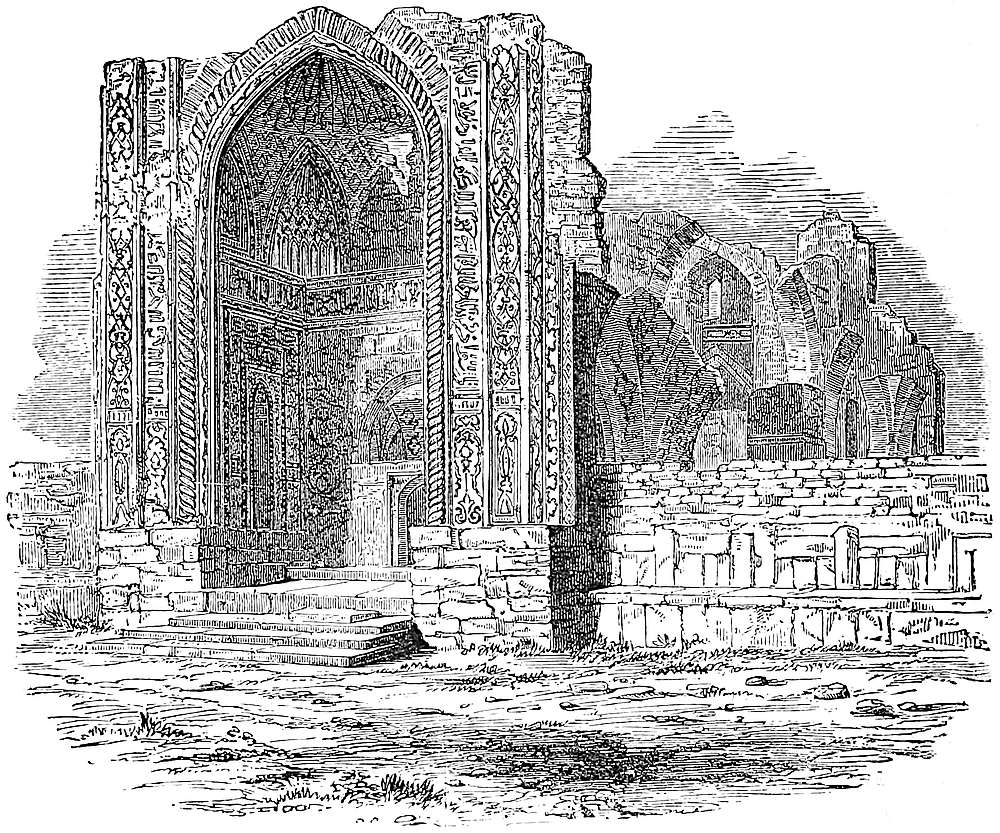
Ghazan Khan’s Mosque at Tabriz.—(From Fergusson.)
Note 4.—In Pauthier’s text this is Touzi, a mere clerical error, I doubt
not for Torizi, in accordance with the G. Text (“le peuple de la cité
que sunt apelés Tauriz”), with the Latin, and with Ramusio. All that
he means to say is that the people are called Tabrízís. Not recondite
information, but ’tis his way. Just so he tells us in ch. iii. that
the people of Hermenia are called Hermins, and elsewhere that the people of
Tebet are called Tebet. So Hayton thinks it not inappropriate to say that
the people of Catay are called Cataini, that the people of Corasmia are
called Corasmins, and that the people of the cities of Persia are called
Persians.
Note 5.—Hamd Allah Mastaufi, the Geographer, not long after Polo’s time,
gives an account of Tabriz, quoted in Barbier de Meynard’s Dict. de la
Perse, p. 132. This also notices the extensive gardens round the city,
the great abundance and cheapness of fruits, the vanity, insolence, and
faithlessness of the Tabrízís, etc. (p. 132 seqq.). Our cut shows a relic of
the Mongol Dynasty at Tabriz.
Of the Monastery of St. Barsamo on the Borders of Tauris.
On the borders of (the territory of) Tauris there is a monastery called
after Saint Barsamo, a most devout Saint. There is an Abbot, with many
Monks, who wear a habit like that of the Carmelites, and these to avoid
idleness are continually knitting woollen girdles. These they place upon
the altar of St. Barsamo during the service, and when they go begging about
the province (like the Brethren of the Holy Spirit) they present them
to their friends and to the gentlefolks, for they are excellent things
to remove bodily pain; wherefore every one is devoutly eager to possess
them.{1}
Note 1.—Barsauma (“The Son of Fasting”) was a native of Samosata, and
an Archimandrite of the Asiatic Church. He opposed the Nestorians, but
became himself still more obnoxious to the orthodox as a spreader of the
Monophysite Heresy. He was condemned by the Council of Chalcedon (451), and
died in 458. He is a Saint of fame in the Jacobite and Armenian Churches,
and several monasteries were dedicated to him; but by far the most
celebrated, and doubtless that meant here, was near Malatia. It must have
been famous even among the Mahomedans, for it has an article in Bákúi’s
Geog. Dictionary. (Dír-Barsúma, see N. et Ext. II. 515.) This monastery
possessed relics of Barsauma and of St. Peter, and was sometimes the
residence of the Jacobite Patriarch and the meeting-place of the Synods.
A more marvellous story than Marco’s is related of this monastery by
Vincent of Beauvais: “There is in that kingdom (Armenia) a place called
St. Brassamus, at which there is a monastery for 300 monks. And ’tis said
that if ever an enemy attacks it, the defences of the monastery move of
themselves, and shoot back the shot against the besieger.”
(Assemani in vol. ii. passim; Tournefort, III. 260; Vin. Bell. Spec.
Historiale, Lib. XXX. c. cxlii.; see also Mar. Sanut. III. xi. c. 16.)
Of the Great Country of Persia; with some account of the Three Kings.
Persia is a great country, which was in old times very illustrious and
powerful; but now the Tartars have wasted and destroyed it.
In Persia is the city of Saba, from which the Three Magi set out when they
went to worship Jesus Christ; and in this city they are buried, in three
very large and beautiful monuments, side by side. And above them there is a
square building, carefully kept. The bodies are still entire, with the hair
and beard remaining. One of these was called Jaspar, the second Melchior,
and the third Balthasar. Messer Marco Polo asked a great many questions
of the people of that city as to those Three Magi, but never one could he
find that knew aught of the matter, except that these were three kings who
were buried there in days of old. However, at a place three days’ journey
distant he heard of what I am going to tell you. He found a village there
which goes by the name of Cala Ataperistan,{1} which is as much as to
say, “The Castle of the Fire-worshippers.” And the name is rightly applied,
for the people there do worship fire, and I will tell you why.
They relate that in old times three kings of that country went away to
worship a Prophet that was born, and they carried with them three manner of
offerings, Gold, and Frankincense, and Myrrh; in order to ascertain whether
that Prophet were God, or an earthly King, or a Physician. For, said they,
if he take the Gold, then he is an earthly King; if he take the Incense he
is God; if he take the Myrrh he is a Physician.
So it came to pass when they had come to the place where the Child was
born, the youngest of the Three Kings went in first, and found the
Child apparently just of his own age; so he went forth again marvelling
greatly. The middle one entered next, and like the first he found the
Child seemingly of his own age; so he also went forth again and marvelled
greatly. Lastly, the eldest went in, and as it had befallen the other
two, so it befell him. And he went forth very pensive. And when the three
had rejoined one another, each told what he had seen; and then they all
marvelled the more. So they agreed to go in all three together, and on
doing so they beheld the Child with the appearance of its actual age, to
wit, some thirteen days.{2} Then they adored, and presented their Gold
and Incense and Myrrh. And the Child took all the three offerings, and then
gave them a small closed box; whereupon the Kings departed to return into
their own land.
Note 1.—Kala’ Atishparastán, meaning as in the text. (Marsden.)
Note 2.—According to the Collectanea ascribed to Bede, Melchior was a hoary
old man; Balthazar in his prime, with a beard; Gaspar young and beardless.
(Inchofer, Tres Magi Evangelici, Romae, 1639.)
What befell when the Three Kings returned to their own Country.
And when they had ridden many days they said they would see what the
Child had given them. So they opened the little box, and inside it they
found a stone. On seeing this they began to wonder what this might be
that the Child had given them, and what was the import thereof. Now the
signification was this: when they presented their offerings, the Child had
accepted all three, and when they saw that they had said within themselves
that He was the True God, and the True King, and the True Physician.{1}
And what the gift of the stone implied was that this Faith which had
begun in them should abide firm as a rock. For He well knew what was
in their thoughts. Howbeit, they had no understanding at all of this
signification of the gift of the stone; so they cast it into a well. Then
straightway a fire from Heaven descended into that well wherein the stone
had been cast.
And when the Three Kings beheld this marvel they were sore amazed, and it
greatly repented them that they had cast away the stone; for well they
then perceived that it had a great and holy meaning. So they took of that
fire, and carried it into their own country, and placed it in a rich and
beautiful church. And there the people keep it continually burning, and
worship it as a god, and all the sacrifices they offer are kindled with
that fire. And if ever the fire becomes extinct they go to other cities
round about where the same faith is held, and obtain of that fire from
them, and carry it to the church. And this is the reason why the people of
this country worship fire. They will often go ten days’ journey to get of
that fire.{2}
Such then was the story told by the people of that Castle to Messer Marco
Polo; they declared to him for a truth that such was their history, and
that one of the three kings was of the city called Saba, and the second of
Ava, and the third of that very Castle where they still worship fire, with
the people of all the country round about.{3}
Having related this story, I will now tell you of the different provinces
of Persia, and their peculiarities.
Note 1.—“Mire.” This was in old French the popular word for a Leech; the
politer word was Physicien. (N. et E. V. 505.)
Chrysostom says that the Gold, Myrrh, and Frankincense were mystic gifts
indicating King, Man, God; and this interpretation was the usual one. Thus
Prudentius:—
“Regem, Deumque adnunciant
Thesaurus et fragrans odor
Thuris Sabaei, at myrrheus
Pulvis sepulchrum praedocet.” (Hymnus Epiphanius.)
And the Paris Liturgy:—
“Offert Aurum Caritas,
Et Myrrham Austeritas,
Et Thus Desiderium.
Auro Rex agnoscitur,
Homo Myrrha, colitur
Thure Deus gentium.”
And in the “Hymns, Ancient and Modern”:—
“Sacred gifts of mystic meaning:
Incense doth their God disclose,
Gold the King of Kings proclaimeth,
Myrrh His sepulchre foreshows.”
Note 2.—“Feruntque (Magi), si justum est credi, etiam ignem caelitus lapsum
apud se sempiternis foculis custodire, cujus portionem exiguam, ut faustam
praeisse quondam Asiaticis Regibus dicunt.” (Ammian. Marcell. XXIII. 6.)
Note 3.—Saba or Sava still exists as Sávah, about 50 miles S.W. of Tehrân.
It is described by Mr. Consul Abbott, who visited it in 1849, as the most
ruinous town he had ever seen, and as containing about 1000 families. The
people retain a tradition, mentioned by Hamd Allah Mastaufi, that the city
stood on the shores of a Lake which dried up miraculously at the birth of
Mahomed. Sávah is said to have possessed one of the greatest Libraries in
the East, until its destruction by the Mongols on their first invasion of
Persia. Both Sávah and Ávah (or Ábah) are mentioned by Abulfeda as cities
of Jibal. We are told that the two cities were always at loggerheads, the
former being Sunni and the latter Shiya. [We read in the Travels of
Thévenot, a most intelligent traveller, “qu’il n’a rien écrit de l’ancienne
ville de Sava qu’il trouva sur son chemin, et où il a marqué lui-même que
son esprit de curiosité l’abandonna.” (Voyages, éd. 1727, vol. v. p. 343.
He died a few days after at Miana, in Armenia, 28th November, 1667). (MS.
Note.—H. Y.)]
As regards the position of Avah, Abbott says that a village still stands
upon the site, about 16 miles S.S.E. of Sávah. He did not visit it, but
took a bearing to it. He was told there was a mound there on which formerly
stood a Gueber Castle. At Sávah he could find no trace of Marco Polo’s
legend. Chardin, in whose time Sávah was not quite so far gone to decay,
heard of an alleged tomb of Samuel, at 4 leagues from the city. This is
alluded to by Hamd Allah.
Keith Johnston and Kiepert put Ávah some 60 miles W.N.W. of Sávah, on the
road between Kazvin and Hamadan. There seems to be some great mistake here.
Friar Odoric puts the locality of the Magi at Kashan, though one of the
versions of Ramusio and the Palatine MS. (see Cordier’s Odoric, pp. xcv.
and 41 of his Itinerary), perhaps corrected in this, puts it at Saba.—H. Y.
and H. C.
We have no means of fixing the Kala’ Atishparastán. It is probable,
however, that the story was picked up on the homeward journey, and as it
seems to be implied that this castle was reached three days after leaving
Sávah, I should look for it between Sávah and Abher. Ruins to which the
name Kila’-i-Gabr, “Gueber Castle,” attaches are common in Persia.
As regards the Legend itself, which shows such a curious mixture of
Christian and Parsi elements, it is related some 350 years earlier by
Mas’udi: “In the Province of Fars they tell you of a Well called the
Well of Fire, near which there was a temple built. When the Messiah was
born the King Koresh sent three messengers to him, the first of whom
carried a bag of Incense, the second a bag of Myrrh, and the third a bag
of Gold. They set out under the guidance of the Star which the king had
described to them, arrived in Syria, and found the Messiah with Mary His
Mother. This story of the three messengers is related by the Christians
with sundry exaggerations; it is also found in the Gospel. Thus they say
that the Star appeared to Koresh at the moment of Christ’s birth; that it
went on when the messengers went on, and stopped when they stopped. More
ample particulars will be found in our Historical Annals, where we have
given the versions of this legend as current among the Guebers and among
the Christians. It will be seen that Mary gave the king’s messengers a
round loaf, and this, after different adventures, they hid under a rock
in the province of Fars. The loaf disappeared underground, and there they
dug a well, on which they beheld two columns of fire to start up flaming
at the surface; in short, all the details of the legend will be found in
our Annals.” The Editors say that Mas’udi had carried the story to Fars
by mistaking Shíz in Azerbaiján (the Atropatenian Ecbatana of Sir H.
Rawlinson) for Shiraz. A rudiment of the same legend is contained in the
Arabic Gospel of the Infancy. This says that Mary gave the Magi one of the
bands in which the Child was swathed. On their return they cast this into
their sacred fire; though wrapt in the flame it remained unhurt.
We may add that there was a Christian tradition that the Star descended
into a well between Jerusalem and Bethlehem. Gregory of Tours also relates
that in a certain well, at Bethlehem, from which Mary had drawn water, the
Star was sometimes seen, by devout pilgrims who looked carefully for it, to
pass from one side to the other. But only such as merited the boon could
see it.
(See Abbott in J. R. G. S. XXV. 4–6; Assemani, III. pt. 2, 750;
Chardin, II. 407; N. et Ext. II. 465; Dict. de la Perse, 2, 56, 298;
Cathay, p. 51; Mas’udi, IV. 80; Greg. Turon. Libri Miraculorum,
Paris, 1858, I. 8.)
Several of the fancies that legend has attached to the brief story of
the Magi in St. Matthew, such as the royal dignity of the persons; their
location, now in Arabia, now (as here) at Saba in Persia, and again
(as in Hayton and the Catalan Map) in Tarsia or Eastern Turkestan; the
notion that one of them was a Negro, and so on, probably grew out of the
arbitrary application of passages in the Old Testament, such as: “Venient
legati ex Aegypto: Aethiopia praevenit manus ejus Deo” (Ps. lxviii.
31). This produced the Negro who usually is painted as one of the Three.
“Reges Tharsis et Insulae munera offerent: Reges
Arabum et Saba dona
adducent” (lxxii. 10). This made the Three into Kings, and fixed them
in Tarsia, Arabia, and Sava. “Mundatio Camelorum operiet te, dromedarii
Madian et Epha: omnes de Saba venient aurum et thus deferentes et
laudem Domino annunciantes” (Is. lx. 6). Here were Ava and Sava coupled,
as well as the gold and frankincense.
One form of the old Church Legend was that the Three were buried at
Sessania Adrumetorum (Hadhramaut) in Arabia, whence the Empress Helena
had the bodies conveyed to Constantinople, [and later to Milan in the time
of the Emperor Manuel Comnenus. After the fall of Milan (1162), Frederic
Barbarossa gave them to Archbishop Rainald of Dassel (1159–1167), who
carried them to Cologne (23rd July, 1164).—H. C.]
The names given by Polo, Gaspar, Melchior, and Balthasar, have been
accepted from an old date by the Roman Church; but an abundant variety of
other names has been assigned to them. Hyde quotes a Syriac writer who
calls them Aruphon, Hurmon, and Tachshesh, but says that some call them
Gudphorbus, Artachshasht, and Labudo; whilst in Persian they were termed
Amad, Zad-Amad, Drust-Amad, i.e. Venit, Cito Venit, Sincerus Venit.
Some called them in Greek, Apellius, Amerus, and Damascus, and in Hebrew,
Magaloth, Galgalath, and Saracia, but otherwise Ator, Sator, and Petatoros!
The Armenian Church used the same names as the Roman, but in Chaldee they
were Kaghba, Badadilma, Badada Kharida. (Hyde, Rel. Vet. Pers. 382–383;
Inchofer, ut supra; J. As. sér. VI. IX. 160.)
[Just before going to press we have read Major Sykes’ new book on Persia.
Major Sykes (ch. xxiii.) does not believe that Marco visited Baghdád, and
he thinks that the Venetians entered Persia near Tabriz, and travelled to
Sultania, Kashán, and Yezd. Thence they proceeded to Kerman and Hormuz. We
shall discuss this question in the Introduction.—H. C.]
Of the Eight Kingdoms of Persia, and how they are named.
Now you must know that Persia is a very great country, and contains eight
kingdoms. I will tell you the names of them all.
The first kingdom is that at the beginning of Persia, and it is called
Casvin; the second is further to the south, and is called Curdistan; the
third is Lor; the fourth [Suolstan]; the fifth Istanit; the sixth Serazy;
the seventh Soncara; the eighth Tunocain, which is at the further extremity
of Persia. All these kingdoms lie in a southerly direction except one, to
wit, Tunocain; that lies towards the east, and borders on the (country of
the) Arbre Sol.{1}
In this country of Persia there is a great supply of fine horses; and
people take them to India for sale, for they are horses of great price, a
single one being worth as much of their money as is equal to 200 livres
Tournois; some will be more, some less, according to the quality.{2}
Here also are the finest asses in the world, one of them being worth full
30 marks of silver, for they are very large and fast, and acquire a capital
amble. Dealers carry their horses to Kisi and Curmosa, two cities on the
shores of the Sea of India, and there they meet with merchants who take the
horses on to India for sale.
In this country there are many cruel and murderous people, so that no
day passes but there is some homicide among them. Were it not for the
Government, which is that of the Tartars of the Levant, they would do
great mischief to merchants; and indeed, maugre the Government, they often
succeed in doing such mischief. Unless merchants be well armed they run the
risk of being murdered, or at least robbed of everything; and it sometimes
happens that a whole party perishes in this way when not on their guard.
The people are all Saracens, i.e. followers of the Law of Mahommet.{3}
In the cities there are traders and artizans who live by their labour and
crafts, weaving cloths of gold, and silk stuffs of sundry kinds. They have
plenty of cotton produced in the country; and abundance of wheat, barley,
millet, panick, and wine, with fruits of all kinds.
[Some one may say, “But the Saracens don’t drink wine, which is prohibited
by their law.” The answer is that they gloss their text in this way, that
if the wine be boiled, so that a part is dissipated and the rest becomes
sweet, they may drink without breach of the commandment; for it is then no
longer called wine, the name being changed with the change of flavour.{4}]
Note 1.—The following appear to be Polo’s Eight Kingdoms:—
I. Kazvín; then a flourishing city, though I know not why he calls it a
kingdom. Persian ’Irák, or the northern portion thereof, seems intended.
Previous to Hulaku’s invasion Kazvín seems to have been in the hands of the
Ismailites or Assassins.
II. Kurdistan. I do not understand the difficulties of Marsden, followed
by Lazari and Pauthier, which lead them to put forth that Kurdistan is
not Kurdistan but something else. The boundaries of Kurdistan according
to Hamd Allah were Arabian ’Irák, Khuzistán, Persian ’Irák, Azerbaijan
and Diarbekr. (Dict. de la P. 480.) [Cf. Curzon, Persia pass.—H. C.]
Persian Kurdistan, in modern as in mediæval times, extends south beyond
Kermanshah to the immediate border of Polo’s next kingdom, viz.:
III. Lúr or Lúristán. [On Lúristán, see Curzon, Persia, II. pp. 273–303,
with the pedigree of the Ruling Family of the Feili Lurs (Pusht-i-Kuh),
p. 278.—H. C.] This was divided into two principalities, Great Lúr and
Little Lúr, distinctions still existing. The former was ruled by a Dynasty
called the Faslúyah Atabegs, which endured from about 1155 to 1424, [when
it was destroyed by the Timurids; it was a Kurd Dynasty, founded by Emad
ed-din Abu Thaher (1160–1228), and the last prince of which was Ghiyas
ed-din (1424). In 1258 the general Kitubuka (Hulagu’s Exp. to Persia,
Bretschneider, Med. Res. I. p. 121) is reported to have reduced the
country of Lúr or Lúristán and its Atabeg Teghele.—H. C.]. Their territory
lay in the mountainous district immediately west of Ispahan, and extended
to the River of Dizfúl, which parted it from Little Lúr. The stronghold
of the Atabegs was the extraordinary hill fort of Mungasht, and they had
a residence also at Aidhej or Mal-Amir in the mountains south of Shushan,
where Ibn Batuta visited the reigning Prince in 1327. Sir H. Rawlinson has
described Mungasht, and Mr. Layard and Baron de Bode have visited other
parts, but the country is still very imperfectly known. Little Lúristán
lay west of the R. Dizfúl, extending nearly to the Plain of Babylonia. Its
Dynasty, called Kurshid, [was founded in 1184 by the Kurd Shodja ed-din
Khurshid, and existed till Shah-Werdy lost his throne in 1593.—H. C.].
The Lúrs are akin to the Kurds, and speak a Kurd dialect, as do all those
Ilyáts, or nomads of Persia, who are not of Turkish race. They were noted
in the Middle Ages for their agility and their dexterity in thieving. The
tribes of Little Lúr “do not affect the slightest veneration for Mahomed
or the Koran; their only general object of worship is their great Saint
Baba Buzurg,” and particular disciples regard with reverence little short
of adoration holy men looked on as living representatives of the Divinity.
(Ilchan. I. 70 seqq.; Rawlinson in J. R. G. S. IX.; Layard in Do.
XVI. 75, 94; Ld. Strangford in J. R. A. S. XX. 64; N. et E. XIII. i.
330, I. B. II. 31; D’Ohsson, IV. 171–172.)
IV. Shúlistán, best represented by Ramusio’s Suolstan, whilst the old
French texts have Cielstan (i.e. Shelstán); the name applied to the
country of the Shúls, or Shauls, a people who long occupied a part of
Lúristán, but were expelled by the Lúrs in the 12th century, and settled
in the country between Shíráz and Khuzistán (now that of the Mamaseni,
whom Colonel Pelly’s information identifies with the Shúls), their central
points being Naobanján and the fortress called Kala’ Safed or “White
Castle.” Ibn Batuta, going from Shiraz to Kazerun, encamped the first day
in the country of the Shúls, “a Persian desert tribe which includes some
pious persons.” (Q. R. p. 385; N. et E. XIII. i. 332–333; Ilch. I.
71; J. R. G. S. XIII. Map; I. B. II. 88.) [“Adjoining the Kuhgelus
on the East are the tents of the Mamasenni (qy. Mohammed Huseini) Lúrs,
occupying the country still known as Shúlistán, and extending as far east
and south-east as Fars and the Plain of Kazerun. This tribe prides itself
on its origin, claiming to have come from Seistán, and to be directly
descended from Rustam, whose name is still borne by one of the Mamasenni
clans.” (Curzon, Persia, II. p. 318.)—H. C.]
V. Ispahan? The name is in Ramusio Spaan, showing at least that he or
some one before him had made this identification. The unusual combination
ff, i.e. sf, in manuscript would be so like the frequent one ft, i.e.
st, that the change from Isfan to Istan would be easy. But why Istanit?
VI. Shíráz [(Shir = milk, or Shir = lion)—H. C.] representing the
province of Fars or Persia Proper, of which it has been for ages the chief
city. [It was founded after the Arab conquest in 694 A.D., by Mohammed, son
of Yusuf Kekfi. (Curzon, Persia, II. pp. 93–110.)—H. C.] The last Dynasty
that had reigned in Fars was that of the Salghur Atabegs, founded about the
middle of the 12th century. Under Abubakr (1226–1260) this kingdom attained
considerable power, embracing Fars, Kermán, the islands of the Gulf and its
Arabian shores; and Shíráz then flourished in arts and literature; Abubakr
was the patron of Saadi. From about 1262, though a Salghurian princess,
married to a son of Hulaku, had the nominal title of Atabeg, the province
of Fars was under Mongol administration. (Ilch. passim.)
VII. Shawánkára or Shabánkára. The G. T. has Soucara, but the Crusca
gives the true reading Soncara. It is the country of the Shawánkárs, a
people coupled with the Shúls and Lúrs in mediæval Persian history, and
like them of Kurd affinities. Their princes, of a family Faslúyah, are
spoken of as influential before the Mahomedan conquest, but the name of
the people comes prominently forward only during the Mongol era of Persian
history. [Shabánkára was taken in 1056 from the Buyid Dynasty, who ruled
from the 10th century over a great part of Persia, by Fazl ibn Hassan
(Fazluïeh-Hasunïeh). Under the last sovereign, Ardeshir, Shabánkára was
taken in 1355 by the Modhafferians, who reigned in ’Irák, Fars, and Kermán,
one of the Dynasties established at the expense of the Mongol Ilkhans after
the death of Abu Saïd (1335), and were themselves subjugated by Timur in
1392.—H. C.] Their country lay to the south of the great salt lake east of
Shíráz, and included Niriz and Darábjird, Fassa, Forg, and Tárum. Their
capital was I′g or I′j, called also Irej, about 20 miles north-west of
Daráb, with a great mountain fortress; it was taken by Hulaku in 1259.
The son of the prince was continued in nominal authority, with Mongol
administrators. In consequence of a rebellion in 1311 the Dynasty seems to
have been extinguished. A descendant attempted to revive their authority
about the middle of the same century. The latest historical mention of the
name that I have found is in Abdurrazzák’s History of Shah Rukh, under
the year H. 807 (1404). (See Jour. As. 3d. s. vol. ii. 355.) But a note
by Colonel Pelly informs me that the name Shabánkára is still applied (1)
to the district round the towns of Runiz and Gauristan near Bandar Abbas;
(2) to a village near Maiman, in the old country of the tribe; (3) to a
tribe and district of Dashtistan, 38 farsakhs west of Shíráz.
With reference to the form in the text, Soncara, I may notice that in
two passages of the Masálak-ul-Absár, translated by Quatremère, the name
occurs as Shankárah. (Q. R. pp. 380, 440 seqq.; N. et E. XIII.;
Ilch. I. 71 and passim; Ouseley’s Travels, II. 158 seqq.)
VIII. Tún-o-Káin, the eastern Kuhistán or Hill country of Persia, of which
Tún and Káin are chief cities. The practice of indicating a locality by
combining two names in this way is common in the East. Elsewhere in this
book we find Ariora-Keshemur and Kes-macoran (Kij-Makrán). Upper Sind
is often called in India by the Sepoys Rori-Bakkar, from two adjoining
places on the Indus; whilst in former days, Lower Sind was often called
Diul-Sind. Karra-Mánikpúr, Uch-Multán, Kunduz-Baghlán are other examples.
The exact expression Tún-o-Káin for the province here in question is used
by Baber, and evidently also by some of Hammer’s authorities. (Baber,
pp. 201, 204; see Ilch. II. 190; I. 95, 104, and Hist. de l’Ordre des
Assassins, p. 245.)
[We learn from (Sir) C. Macgregor’s (1875) Journey through Khorasan (I.
p. 127) that the same territory including Gháín or Kaïn is now called by
the analogous name of Tabas-o-Tún. Tún and Kaïn (Gháín) are both described
in their modern state, by Macgregor. (Ibid. pp. 147 and 161.)—H. C.]
Note that the identification of Suolstan is due to Quatremère (see N.
et E. XIII. i. circa p. 332); that of Soncara to Defréméry (J. As.
sér. IV. tom. xi. p. 441); and that of Tunocain to Malte-Brun. (N.
Ann. des V. xviii. p. 261.) I may add that the Lúrs, the Shúls, and
the Shabánkáras are the subjects of three successive sections in the
Masálak-al-Absár of Shihábuddin Dimishki, a work which reflects much of
Polo’s geography. (See N. et E. XIII. i. 330–333; Curzon, Persia, II.
pp. 248 and 251.)
Note 2.—The horses exported to India, of which we shall hear more
hereafter, were probably the same class of “Gulf Arabs” that are now
carried thither. But the Turkman horses of Persia are also very valuable,
especially for endurance. Kinneir speaks of one accomplishing 900 miles in
eleven days, and Ferrier states a still more extraordinary feat from his
own knowledge. In that case one of those horses went from Tehran to Tabriz,
returned, and went again to Tabriz, within twelve days, including two days’
rest. The total distance is about 1100 miles.
The livre tournois at this period was equivalent to a little over 18
francs of modern French silver. But in bringing the value to our modern
gold standard we must add one-third, as the ratio of silver to gold was
then 1:12 instead of 1:16. Hence the equivalent in gold of the livre
tournois is very little less than 1l. sterling, and the price of the
horse would be about 193l.[1]
Mr. Wright quotes an ordinance of Philip III. of France (1270–1285)
fixing the maximum price that might be given for a palfrey at 60 livres
tournois, and for a squire’s roncin at 20 livres. Joinville, however,
speaks of a couple of horses presented to St. Lewis in 1254 by the Abbot
of Cluny, which he says would at the time of his writing (1309) have been
worth 500 livres (the pair, it would seem). Hence it may be concluded
in a general way that the ordinary price of imported horses in India
approached that of the highest class of horses in Europe. (Hist. of Dom.
Manners, p. 317; Joinville, p. 205.)
About 1850 a very fair Arab could be purchased in Bombay for 60l., or
even less; but prices are much higher now.
With regard to the donkeys, according to Tavernier, the fine ones used
by merchants in Persia were imported from Arabia. The mark of silver was
equivalent to about 44s. of our silver money, and allowing as before for
the lower relative value of gold, 30 marks would be equivalent to 88l.
sterling.
Kisi or Kish we have already heard of. Curmosa is Hormuz, of which
we shall hear more. With a Pisan, as Rusticiano was, the sound of c is
purely and strongly aspirate. Giovanni d’Empoli, in the beginning of the
16th century, another Tuscan, also calls it Cormus. (See Archiv. Stor.
Ital. Append. III. 81.)
Note 3.—The character of the nomad and semi-nomad tribes of Persia in those
days—Kurds, Lúrs, Shúls, Karaunahs, etc.—probably deserved all that Polo
says, and it is not changed now. Take as an example Rawlinson’s account of
the Bakhtyáris of Luristán: “I believe them to be individually brave, but
of a cruel and savage character; they pursue their blood feuds with the
most inveterate and exterminating spirit.... It is proverbial in Persia
that the Bakhtiyaris have been compelled to forego altogether the reading
of the Fatihah or prayer for the dead, for otherwise they would have no
other occupation. They are also most dextrous and notorious thieves.” (J.
R. G. S. IX. 105.)
Note 4.—The Persians have always been lax in regard to the abstinence from
wine.
According to Athenaeus, Aristotle, in his Treatise on Drinking (a work
lost, I imagine, to posterity), says, “If the wine be moderately boiled
it is less apt to intoxicate.” In the preparation of some of the sweet
wines of the Levant, such as that of Cyprus, the must is boiled, but I
believe this is not the case generally in the East. Baber notices it as
a peculiarity among the Kafirs of the Hindu Kush. Tavernier, however, says
that at Shíráz, besides the wine for which that city was so celebrated, a
good deal of boiled wine was manufactured, and used among the poor and
by travellers. No doubt what is meant is the sweet liquor or syrup called
Dúsháb, which Della Valle says is just the Italian Mostocotto, but
better, clearer, and not so mawkish (I. 689). (Yonge’s Athen. X. 34;
Baber, p. 145; Tavernier, Bk. V. ch. xxi.)
Concerning the Great City of Yasdi.
Yasdi also is properly in Persia; it is a good and noble city, and has a
great amount of trade. They weave there quantities of a certain silk tissue
known as Yasdi, which merchants carry into many quarters to dispose of.
The people are worshippers of Mahommet.{1}
When you leave this city to travel further, you ride for seven days over
great plains, finding harbour to receive you at three places only. There
are many fine woods [producing dates] upon the way, such as one can easily
ride through; and in them there is great sport to be had in hunting and
hawking, there being partridges and quails and abundance of other game, so
that the merchants who pass that way have plenty of diversion. There are
also wild asses, handsome creatures. At the end of those seven marches over
the plain you come to a fine kingdom which is called Kerman.{2}
Note 1.—Yezd, an ancient city, supposed by D’Anville to be the Isatichae
of Ptolemy, is not called by Marco a kingdom, though having a better
title to the distinction than some which he classes as such. The atabegs
of Yezd dated from the middle of the 11th century, and their Dynasty was
permitted by the Mongols to continue till the end of the 13th, when it was
extinguished by Ghazan, and the administration made over to the Mongol
Diwan.
Yezd, in pre-Mahomedan times, was a great sanctuary of the Gueber worship,
though now it is a seat of fanatical Mahomedanism. It is, however, one of
the few places where the old religion lingers. In 1859 there were reckoned
850 families of Guebers in Yezd and fifteen adjoining villages, but they
diminish rapidly.
[Heyd (Com. du Levant, II. p. 109) says the inhabitants of Yezd wove the
finest silk of Taberistan.—H. C.] The silk manufactures still continue,
and, with other weaving, employ a large part of the population. The
Yazdi, which Polo mentions, finds a place in the Persian dictionaries,
and is spoken of by D’Herbelot as Ḳumásh-i-Yezdi, “Yezd stuff.” [“He
[Nadir Shah] bestowed upon the ambassador [Hakeem Ataleek, the prime
minister of Abulfiez Khan, King of Bokhara] a donation of a thousand
mohurs of Hindostan, twenty-five pieces of Yezdy brocade, a rich dress,
and a horse with silver harness....” (Memoirs of Khojah Abdulkurreem,
a Cashmerian of distinction ... transl. from the original Persian, by
Francis Gladwin ... Calcutta, 1788, 8vo, p. 36.)—H. C.]
Yezd is still a place of important trade, and carries on a thriving
commerce with India by Bandar Abbási. A visitor in the end of 1865 says:
“The external trade appears to be very considerable, and the merchants of
Yezd are reputed to be amongst the most enterprising and respectable of
their class in Persia. Some of their agents have lately gone, not only to
Bombay, but to the Mauritius, Java, and China.”
(Ilch. I. 67–68; Khanikoff, Mém. p. 202; Report by Major R. M. Smith, R.E.)
Friar Odoric, who visited Yezd, calls it the third best city of the Persian
Emperor, and says (Cathay, I. p. 52): “There is very great store of
victuals and all other good things that you can mention; but especially
is found there great plenty of figs; and raisins also, green as grass and
very small, are found there in richer profusion than in any other part of
the world.” [He also gives from the smaller version of Ramusio’s an awful
description of the Sea of Sand, one day distant from Yezd. (Cf. Tavernier,
1679, I. p. 116.)—H. C.]
Note 2.—I believe Della Valle correctly generalises when he says of
Persian travelling that “you always travel in a plain, but you always
have mountains on either hand” (I. 462). [Compare Macgregor, I. 254: “I
really cannot describe the road. Every road in Persia as yet seems to
me to be exactly alike, so ... my readers will take it for granted that
the road went over a waste, with barren rugged hills in the distance, or
near; no water, no houses, no people passed.”—H. C.] The distance from
Yezd to Kermán is, according to Khanikoff’s survey, 314 kilomètres, or
about 195 miles. Ramusio makes the time eight days, which is probably the
better reading, giving a little over 24 miles a day. Westergaard in 1844,
and Khanikoff in 1859, took ten days; Colonel Goldsmid and Major Smith
in 1865 twelve. [“The distance from Yezd to Kermán by the present high
road, 229 miles, is by caravans, generally made in nine stages; persons
travelling with all comforts do it in twelve stages; travellers whose time
is of some value do it easily in seven days.” (Houtum-Schindler, l.c.
pp. 490–491.)—H. C.]
Khanikoff observes on this chapter: “This notice of woods easy to ride
through, covering the plain of Yezd, is very curious. Now you find it a
plain of great extent indeed from N.W. to S.E., but narrow and arid; indeed
I saw in it only thirteen inhabited spots, counting two caravanserais.
Water for the inhabitants is brought from a great distance by subterraneous
conduits, a practice which may have tended to desiccate the soil, for every
trace of wood has completely disappeared.”
Abbott travelled from Yezd to Kermán in 1849, by a road through Báfk,
east of the usual road, which Khanikoff followed, and parallel to it;
and it is worthy of note that he found circumstances more accordant with
Marco’s description. Before getting to Báfk he says of the plain that it
“extends to a great distance north and south, and is probably 20 miles
in breadth;” whilst Báfk “is remarkable for its groves of date-trees,
in the midst of which it stands, and which occupy a considerable space.”
Further on he speaks of “wild tufts and bushes growing abundantly,” and
then of “thickets of the Ghez tree.” He heard of the wild asses, but did
not see any. In his report to the Foreign Office, alluding to Marco Polo’s
account, he says: “It is still true that wild asses and other game are
found in the wooded spots on the road.” The ass is the Asinus Onager,
the Gor Khar of Persia, or Kulan of the Tartars. (Khan. Mém. p.
200; Id. sur Marco Polo, p. 21; J. R. G. S. XXV. 20–29; Mr. Abbott’s
MS. Report in Foreign office.) [The difficulty has now been explained by
General Houtum-Schindler in a valuable paper published in the Jour. Roy.
As. Soc. N.S. XIII., October, 1881, p. 490. He says: “Marco Polo travelled
from Yazd to Kermán viâ Báfk. His description of the road, seven days over
great plains, harbour at three places only, is perfectly exact. The fine
woods, producing dates, are at Báfk itself. (The place is generally called
Báft.) Partridges and quails still abound; wild asses I saw several on the
western road, and I was told that there were a great many on the Báfk road.
Travellers and caravans now always go by the eastern road viâ Anár and
Bahrámábád. Before the Sefavíehs (i.e. before A.D. 1500) the Anár road was
hardly, if ever, used; travellers always took the Báfk road. The country
from Yazd to Anár, 97 miles, seems to have been totally uninhabited before
the Sefavíehs. Anár, as late as A.D. 1340, is mentioned as the frontier
place of Kermán to the north, on the confines of the Yazd desert. When
Sháh Abbás had caravanserais built at three places between Yazd and Anár
(Zein ud-dín, Kermán-sháhán, and Shamsh), the eastern road began to be
neglected.” (Cf. Major Sykes’ Persia, ch. xxiii.)—H. C.]
Concerning the Kingdom of Kerman.
Kerman is a kingdom which is also properly in Persia, and formerly it had
a hereditary prince. Since the Tartars conquered the country the rule is
no longer hereditary, but the Tartar sends to administer whatever lord he
pleases.{1} In this kingdom are produced the stones called turquoises
in great abundance; they are found in the mountains, where they are
extracted from the rocks.{2} There are also plenty of veins of steel
and Ondanique.{3} The people are very skilful in making harness of
war; their saddles, bridles, spurs, swords, bows, quivers, and arms of
every kind, are very well made indeed according to the fashion of those
parts. The ladies of the country and their daughters also produce exquisite
needlework in the embroidery of silk stuffs in different colours, with
figures of beasts and birds, trees and flowers, and a variety of other
patterns. They work hangings for the use of noblemen so deftly that they
are marvels to see, as well as cushions, pillows quilts, and all sorts of
things.{4}
In the mountains of Kerman are found the best falcons in the world. They
are inferior in size to the Peregrine, red on the breast, under the neck,
and between the thighs; their flight so swift that no bird can escape
them.{5}
On quitting the city you ride on for seven days, always finding towns,
villages, and handsome dwelling-houses, so that it is very pleasant
travelling; and there is excellent sport also to be had by the way in
hunting and hawking. When you have ridden those seven days over a plain
country, you come to a great mountain; and when you have got to the top of
the pass you find a great descent which occupies some two days to go down.
All along you find a variety and abundance of fruits; and in former days
there were plenty of inhabited places on the road, but now there are none;
and you meet with only a few people looking after their cattle at pasture.
From the city of Kerman to this descent the cold in winter is so great that
you can scarcely abide it, even with a great quantity of clothing.{6}
Note 1.—Kermán is mentioned by Ptolemy, and also by Ammianus amongst the
cities of the country so called (Carmania): “inter quas nitet Carmana
omnium mater.” (XXIII. 6.)
M. Pauthier’s supposition that Sirján was in Polo’s time the capital, is
incorrect. (See N. et E. XIV. 208, 290.) Our Author’s Kermán is the city
still so called; and its proper name would seem to have been Kuwáshír.
(See Reinaud, Mém. sur l’Inde, 171; also Sprenger P. and R. R. 77.)
According to Khanikoff it is 5535 feet above the sea.
Kermán, on the fall of the Beni Búya Dynasty, in the middle of the 11th
century, came into the hands of a branch of the Seljukian Turks, who
retained it till the conquests of the Kings of Khwarizm, which just
preceded the Mongol invasion. In 1226 the Amir Borák, a Kara Khitaian,
who was governor on behalf of Jaláluddin of Khwarizm, became independent
under the title of Kutlugh Sultan. [He died in 1234.] The Mongols allowed
this family to retain the immediate authority, and at the time when Polo
returned from China the representative of the house was a lady known as
the Pádishah Khátún [who reigned from 1291], the wife successively of
the Ilkhans Abaka and Kaikhatu; an ambitious, clever, and masterful woman,
who put her own brother Siyurgutmish to death as a rival, and was herself,
after the decease of Kaikhatu, put to death by her brother’s widow and
daughter [1294]. The Dynasty continued, nominally at least, to the reign
of the Ilkhan Khodabanda (1304–13), when it was extinguished. [See Major
Sykes’ Persia, chaps, v. and xxiii.]
Kermán was a Nestorian see, under the Metropolitan of Fars. (Ilch. passim;
Weil, III. 454; Lequien, II. 1256.)
[“There is some confusion with regard to the names of Kermán both as a
town and as a province or kingdom. We have the names Kermán, Kuwáshír,
Bardshír. I should say the original name of the whole country was Kermán,
the ancient Karamania. A province of this was called Kúreh-i-Ardeshír,
which, being contracted, became Kuwáshír, and is spoken of as the province
in which Ardeshír Bábekán, the first Sassanian monarch, resided. A part of
Kúreh-i-Ardeshír was called Bardshír, or Bard-i-Ardeshír, now occasionally
Bardsír, and the present city of Kermán was situated at its north-eastern
corner. This town, during the Middle Ages, was called Bardshír. On a coin
of Qara Arslán Beg, King of Kermán, of A.H. 462, Mr. Stanley Lane Poole
reads Yazdashír instead of Bardshír. Of Al Idrísí’s Yazdashír I see no
mention in histories; Bardshír was the capital and the place where most
of the coins were struck. Yazdashír, if such a place existed, can only
have been a place of small importance. It is, perhaps, a clerical error
for Bardshír; without diacritical points, both words are written alike.
Later, the name of the city became Kermán, the name Bardshír reverting to
the district lying south-west of it, with its principal place Mashíz. In a
similar manner Mashíz was often, and is so now, called Bardshír. Another
old town sometimes confused with Bardshír was Sírján or Shírján, once more
important than Bardshír; it is spoken of as the capital of Kermán, of
Bardshír, and of Sardsír. Its name now exists only as that of a district,
with principal place S’aídábád. The history of Kermán, ’Agd-ul-’Olá,
plainly says Bardshír is the capital of Kermán, and from the description
of Bardshír there is no doubt of its having been the present town Kermán.
It is strange that Marco Polo does not give the name of the city. In
Assemanni’s Bibliotheca Orientalis Kuwáshír and Bardashír are mentioned
as separate cities, the latter being probably the old Mashíz, which as
early as A.H. 582 (A.D. 1186) is spoken of in the History of Kermán as
an important town. The Nestorian bishop of the province Kermán, who stood
under the Metropolitan of Fars, resided at Hormúz.” (Houtum-Schindler,
l.c. pp. 491–492.)
There does not seem any doubt as to the identity of Bardashir with
the present city of Kermán. (See The Cities of Kirmān in the time of
Hamd-Allah Mustawfi and Marco Polo, by Guy le Strange, Jour. R. As. Soc.
April, 1901, pp. 281, 290.) Hamd-Allah is the author of the Cosmography
known as the Nuzhat-al-Kūlūb or “Heart’s Delight.” (Cf. Major Sykes’
Persia, chap. xvi., and the Geographical Journal for February, 1902, p.
166.)—H. C.]
Note 2.—A MS. treatise on precious stones cited by Ouseley mentions
Shebavek in Kermán as the site of a Turquoise mine. This is probably
Shahr-i-Babek, about 100 miles west of the city of Kermán, and not far
from Párez, where Abbott tells us there is a mine of these stones, now
abandoned. Goebel, one of Khanikoff’s party, found a deposit of turquoises
at Taft, near Yezd. (Ouseley’s Travels, I. 211; J. R. G. S. XXVI.
63–65; Khan. Mém. 203.)
[“The province Kermán is still rich in turquoises. The mines of Páríz
or Párez are at Chemen-i-mó-aspán, 16 miles from Páríz on the road to
Bahrámábád (principal place of Rafsinján), and opposite the village or
garden called Gód-i-Ahmer. These mines were worked up to a few years ago;
the turquoises were of a pale blue. Other turquoises are found in the
present Bardshír plain, and not far from Mashíz, on the slopes of the
Chehel tan mountain, opposite a hill called the Bear Hill (tal-i-Khers).
The Shehr-i-Bábek turquoise mines are at the small village Kárík, a mile
from Medvár-i-Bálá, 10 miles north of Shehr-i-Bábek. They have two shafts,
one of which has lately been closed by an earthquake, and were worked up
to about twenty years ago. At another place, 12 miles from Shehr-i-Bábek,
are seven old shafts now not worked for a long period. The stones of
these mines are also of a very pale blue, and have no great value.”
(Houtum-Schindler, l.c. 1881, p. 491.)
The finest turquoises came from Khorasan; the mines were near Maaden, about
48 miles to the north of Nishapūr. (Heyd, Com. du Levant, II. p. 653;
Ritter, Erdk. pp. 325–330.)
It is noticeable that Polo does not mention indigo at Kermán.—H. C.]
Note 3.—Edrisi says that excellent iron was produced in the “cold
mountains” N.W. of Jiruft, i.e. somewhere south of the capital; and Jihán
Numá, or Great Turkish Geography, that the steel mines of Niriz, on the
borders of Kermán, were famous. These are also spoken of by Teixeira. Major
St. John enables me to indicate their position, in the hills east of Niriz.
(Edrisi, vol. i. p. 430; Hammer, Mém. sur la Perse, p. 275; Teixeira,
Relaciones, p. 378; and see Map of Itineraries, No. II.)
[“Marco Polo’s steel mines are probably the Parpa iron mines on the road
from Kermán to Shíráz, called even to-day M’aden-i-fúlád (steel mine); they
are not worked now. Old Kermán weapons, daggers, swords, old stirrups,
etc., made of steel, are really beautiful, and justify Marco Polo’s praise
of them” (Houtum-Schindler, l.c. p. 491.)—H. C.]
Ondanique of the Geog. Text, Andaine of Pauthier’s, Andanicum of
the Latin, is an expression on which no light has been thrown since
Ramusio’s time. The latter often asked the Persian merchants who visited
Venice, and they all agreed in stating that it was a sort of steel of
such surpassing value and excellence, that in the days of yore a man who
possessed a mirror, or sword, of Andanic regarded it as he would some
precious jewel. This seems to me excellent evidence, and to give the true
clue to the meaning of Ondanique. I have retained the latter form because
it points most distinctly to what I believe to be the real word, viz.
Hundwáníy, “Indian Steel.”[1] (See Johnson’s Pers. Dict. and De Sacy’s
Chrestomathie Arabe, II. 148.) In the Vocabulista Arabico, of about A.D.
1200 (Florence, 1871, p. 211), Hunduwán is explained by Ensis. Vüllers
explains Hundwán as “anything peculiar to India, especially swords,” and
quotes from Firdúsi, “Khanjar-i-Hundwán,” a hanger of Indian steel.
The like expression appears in the quotation from Edrisi below as
Hindiah, and found its way into Spanish in the shapes of Alhinde,
Alfinde, Alinde, first with the meaning of steel, then assuming, that of
steel mirror, and finally that of metallic foil of a glass mirror. (See
Dozy and Engelmann, 2d ed. pp. 144–145.) Hint or Al-hint is used in
Berber also for steel. (See J. R. A. S. IX. 255.)
The sword-blades of India had a great fame over the East, and Indian steel,
according to esteemed authorities, continued to be imported into Persia
till days quite recent. Its fame goes back to very old times. Ctesias
mentions two wonderful swords of such material that he got from the king
of Persia and his mother. It is perhaps the ferrum candidum of which the
Malli and Oxydracae sent a 100 talents weight as a present to Alexander.[2]
Indian Iron and Steel (σíδηρος Ἰνδικòς καì στóμωμα) are mentioned
in the Periplus as imports into the Abyssinian ports. Ferrum Indicum
appears (at least according to one reading) among the Oriental species
subject to duty in the Law of Marcus Aurelius and Commodus on that matter.
Salmasius notes that among surviving Greek chemical treatises there was one
περì βαφῆς Ἰνδικοῦ σιδήρου, “On the Tempering of Indian Steel.”
Edrisi says on this subject: “The Hindus excel in the manufacture of iron,
and in the preparation of those ingredients along with which it is fused
to obtain that kind of soft Iron which is usually styled Indian Steel
(Hindiah).[3] They also have workshops wherein are forged the most famous
sabres in the world.... It is impossible to find anything to surpass the
edge that you get from Indian Steel (al-hadíd al-Hindí).”
Allusions to the famous sword-blades of India would seem to be frequent in
Arabic literature. Several will be found in Hamása’s collection of ancient
Arabic poems translated by Freytag. The old commentator on one of these
passages says: “Ut optimos gladios significet ... Indicos esse dixit,”
and here the word used in the original is Hundwániyah. In Manger’s
version of Arabshah’s Life of Timur are several allusions of the same
kind; one, a quotation from Antar, recalls the ferrum candidum of
Curtius:
“Albi (gladii) Indici meo in sanguine abluuntur.”
In the histories, even of the Mahomedan conquest of India, the Hindu
infidels are sent to Jihannam with “the well-watered blade of the Hindi
sword”; or the sword is personified as “a Hindu of good family.” Coming
down to later days, Chardin says of the steel of Persia: “They combine it
with Indian steel, which is more tractable ... and is much more esteemed.”
Dupré, at the beginning of this century, tells us: “I used to believe
... that the steel for the famous Persian sabres came from certain mines
in Khorasan. But according to all the information I have obtained, I can
assert that no mine of steel exists in that province. What is used for
these blades comes in the shape of disks from Lahore.” Pottinger names
steel among the imports into Kermán from India. Elphinstone the Accurate,
in his Caubul, confirms Dupré: “Indian Steel [in Afghanistan] is most
prized for the material; but the best swords are made in Persia and in
Syria;” and in his History of India, he repeats: “The steel of India was
in request with the ancients; it is celebrated in the oldest Persian poem,
and is still the material of the scimitars of Khorasan and Damascus.”[4]
Klaproth, in his Asia Polyglotta, gives Andun as the Ossetish and
Andan as the Wotiak, for Steel. Possibly these are essentially the
same with Hundwáníy and Alhinde, pointing to India as the original
source of supply. [In the Sikandar Nāma,e Bará (or “Book of Alexander
the Great,” written A.D. 1200, by Abū Muhammad bin Yusuf bin
Mu,Ayyid-i-Nizāmu-’d-Dīn), translated by Captain H. Wilberforce Clarke (Lond.,
1881, large 8vo), steel is frequently mentioned: Canto xix. 257, p. 202;
xx. 12, p. 211; xlv. 38, p. 567; lviii. 32, pp. 695, 42, pp. 697, 62, 66,
pp. 699; lix. 28, p. 703.—H. C.]
Avicenna, in his fifth book De Animâ, according to Roger Bacon,
distinguishes three very different species of iron: “1st. Iron which is
good for striking or bearing heavy strokes, and for being forged by hammer
and fire, but not for cutting-tools. Of this hammers and anvils are made,
and this is what we commonly call Iron simply. 2nd. That which is purer,
has more heat in it, and is better adapted to take an edge and to form
cutting-tools, but is not so malleable, viz. Steel. And the 3rd is that
which is called Andena. This is less known among the Latin nations. Its
special character is that like silver it is malleable and ductile under a
very low degree of heat. In other properties it is intermediate between
iron and steel.” (Fr. R. Baconis Opera Inedita, 1859, pp. 382–383.) The
same passage, apparently, of Avicenna is quoted by Vincent of Beauvais,
but with considerable differences. (See Speculum Naturale, VII. ch.
lii. lx., and Specul. Doctrinale, XV. ch. lxiii.) The latter author
writes Alidena, and I have not been able to refer to Avicenna, so that
I am doubtful whether his Andena is the same term with the Andaine of
Pauthier and our Ondanique.
The popular view, at least in the Middle Ages, seems to have regarded
Steel as a distinct natural species, the product of a necessarily
different ore, from iron; and some such view is, I suspect, still common
in the East. An old Indian officer told me of the reply of a native friend
to whom he had tried to explain the conversion of iron into steel—“What!
You would have me believe that if I put an ass into the furnace it will
come forth a horse.” And Indian Steel again seems to have been regarded
as a distinct natural species from ordinary steel. It is in fact made by
a peculiar but simple process, by which the iron is converted directly
into cast-steel, without passing through any intermediate stage analogous
to that of blister-steel. When specimens were first examined in England,
chemists concluded that the steel was made direct from the ore. The
Ondanique of Marco no doubt was a fine steel resembling the Indian
article. (Müller’s Ctesias, p. 80; Curtius, IX. 24; Müller’s Geog. Gr.
Min. I. 262; Digest. Novum, Lugd. 1551, Lib. XXXIX. Tit. 4; Salmas. Ex.
Plinian. II. 763; Edrisi, I. 65–66; J. R. S. A. A. 387 seqq.; Hamasae
Carmina, I. 526; Elliot, II. 209, 394; Reynolds’s Utbi, p. 216.)
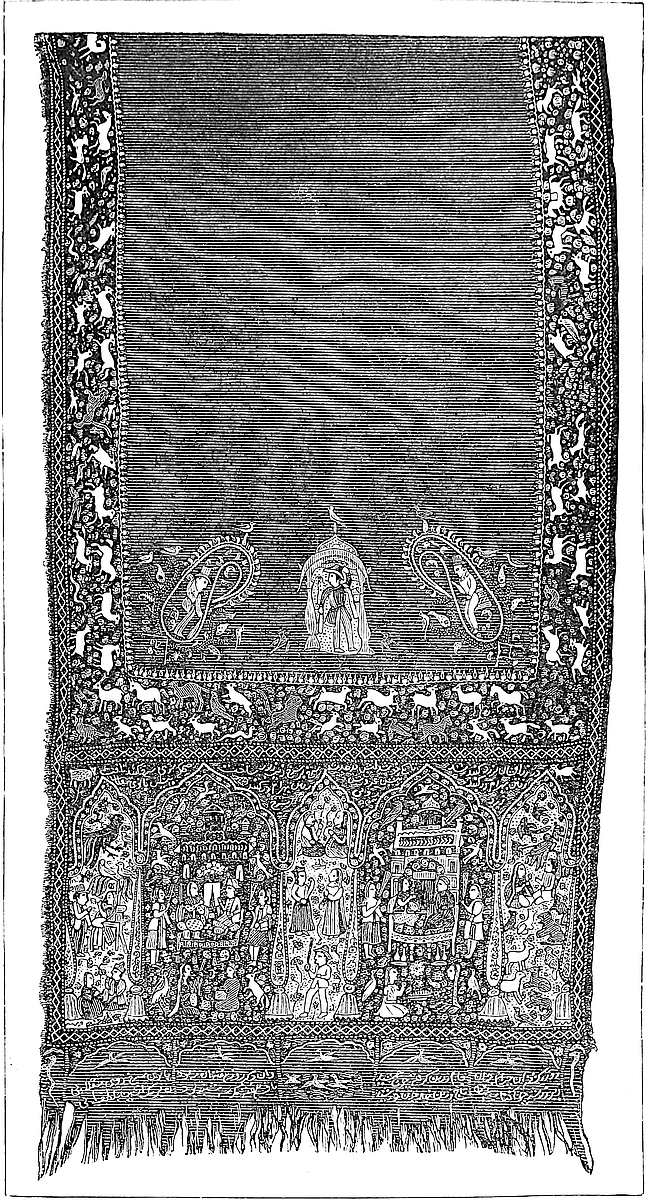
Texture, with Animals, etc., from a Cashmere Scarf in the Indian Museum.
“De deverses maineres laborés à bestes et ausiaus mout richement.”
Note 4.—Paulus Jovius in the 16th century says, I know not on what
authority, that Kermán was then celebrated for the fine temper of its steel
in scimitars and lance-points. These were eagerly bought at high prices
by the Turks, and their quality was such that one blow of a Kermán sabre
would cleave an European helmet without turning the edge. And I see that
the phrase, “Kermání blade” is used in poetry by Marco’s contemporary Amír
Khusrú of Delhi. (P. Jov. Hist. of his own Time, Bk. XIV.; Elliot, III. 537.)
There is, or was in Pottinger’s time, still a great manufacture of
matchlocks at Kermán; but rose-water, shawls, and carpets are the staples
of the place now. Polo says nothing that points to shawl-making, but it
would seem from Edrisi that some such manufacture already existed in the
adjoining district of Bamm. It is possible that the “hangings” spoken of by
Polo may refer to the carpets. I have seen a genuine Kermán carpet in the
house of my friend, Sir Bartle Frere. It is of very short pile, very even
and dense; the design, a combination of vases, birds, and floral tracery,
closely resembling the illuminated frontispiece of some Persian MSS.
The shawls are inferior to those of Kashmir in exquisite softness, but
scarcely in delicacy of texture and beauty of design. In 1850, their
highest quality did not exceed 30 tomans (14l.) in price. About 2200
looms were employed on the fabric. A good deal of Kermán wool called
Kurk, goes viâ Bandar Abbási and Karáchi to Amritsar, where it is mixed
with the genuine Tibetan wool in the shawl manufacture. Several of the
articles named in the text, including pardahs (“cortines”) are woven in
shawl-fabric. I scarcely think, however, that Marco would have confounded
woven shawl with needle embroidery. And Mr. Khanikoff states that the silk
embroidery, of which Marco speaks, is still performed with great skill and
beauty at Kermán. Our cut illustrates the textures figured with animals,
already noticed at p. 66.
The Guebers were numerous here at the end of last century, but they
are rapidly disappearing now. The Musulman of Kermán is, according to
Khanikoff, an epicurean gentleman, and even in regard to wine, which is
strong and plentiful, his divines are liberal. “In other parts of Persia
you find the scribblings on the walls of Serais to consist of philosophical
axioms, texts from the Koran, or abuse of local authorities. From Kermán to
Yezd you find only rhymes in praise of fair ladies or good wine.”
(Pottinger’s Travels; Khanik. Mém. 186 seqq., and Notice, p. 21;
Major Smith’s Report; Abbott’s MS. Report in F. O.; Notes by Major O.
St. John, R.E.)
Note 5.—Parez is famous for its falcons still, and so are the districts of
Aktár and Sirján. Both Mr. Abbott and Major Smith were entertained with
hawking by Persian hosts in this neighbourhood. The late Sir O. St. John
identifies the bird described as the Sháhín (Falco Peregrinator), one
variety of which, the Fársi, is abundant in the higher mountains of S.
Persia. It is now little used in that region, the Terlán or goshawk being
most valued, but a few are caught and sent for sale to the Arabs of Oman.
(J. R. G. S. XXV. 50, 63, and Major St. John’s Notes.)
[“The fine falcons, ‘with red breasts and swift of flight,’ come from
Páríz. They are, however, very scarce, two or three only being caught
every year. A well-trained Páríz falcon costs from 30 to 50 tomans (12l.
to 20l.), as much as a good horse.” (Houtum-Schindler, l.c. p. 491.)
Major Sykes, Persia, ch. xxiii., writes: “Marco Polo was evidently a keen
sportsman, and his description of the Sháhin, as it is termed, cannot be
improved upon.” Major Sykes has a list given him by a Khán of seven hawks
of the province, all black and white, except the Sháhin, which has yellow
eyes, and is the third in the order of size.—H. C.]
Note 6.—We defer geographical remarks till the traveller reaches Hormuz.
Of the City of Camadi and its Ruins; also touching the Carauna Robbers.
After you have ridden down hill those two days, you find yourself in a vast
plain, and at the beginning thereof there is a city called Camadi, which
formerly was a great and noble place, but now is of little consequence, for
the Tartars in their incursions have several times ravaged it. The plain
whereof I speak is a very hot region; and the province that we now enter is
called Reobarles.
The fruits of the country are dates, pistachioes, and apples of Paradise,
with others of the like not found in our cold climate. [There are vast
numbers of turtledoves, attracted by the abundance of fruits, but the
Saracens never take them, for they hold them in abomination.] And on this
plain there is a kind of bird called francolin, but different from the
francolin of other countries, for their colour is a mixture of black and
white, and the feet and beak are vermilion colour.{1}
The beasts also are peculiar; and first I will tell you of their oxen.
These are very large, and all over white as snow; the hair is very short
and smooth, which is owing to the heat of the country. The horns are short
and thick, not sharp in the point; and between the shoulders they have a
round hump some two palms high. There are no handsomer creatures in the
world. And when they have to be loaded, they kneel like the camel; once the
load is adjusted, they rise. Their load is a heavy one, for they are very
strong animals. Then there are sheep here as big as asses; and their tails
are so large and fat, that one tail shall weigh some 30 lbs. They are fine
fat beasts, and afford capital mutton.{2}
In this plain there are a number of villages and towns which have lofty
walls of mud, made as a defence against the banditti,{3} who are very
numerous, and are called Caraonas. This name is given them because they
are the sons of Indian mothers by Tartar fathers. And you must know that
when these Caraonas wish to make a plundering incursion, they have certain
devilish enchantments whereby they do bring darkness over the face of day,
insomuch that you can scarcely discern your comrade riding beside you;
and this darkness they will cause to extend over a space of seven days’
journey. They know the country thoroughly, and ride abreast, keeping near
one another, sometimes to the number of 10,000, at other times more or
fewer. In this way they extend across the whole plain that they are going
to harry, and catch every living thing that is found outside of the towns
and villages; man, woman, or beast, nothing can escape them! The old men
whom they take in this way they butcher; the young men and the women they
sell for slaves in other countries; thus the whole land is ruined, and has
become well-nigh a desert.
The King of these scoundrels is called Nogodar. This Nogodar had gone to
the Court of Chagatai, who was own brother to the Great Kaan, with some
10,000 horsemen of his, and abode with him; for Chagatai was his uncle. And
whilst there this Nogodar devised a most audacious enterprise, and I will
tell you what it was. He left his uncle who was then in Greater Armenia,
and fled with a great body of horsemen, cruel unscrupulous fellows, first
through Badashan, and then through another province called Pashai-Dir,
and then through another called Ariora-Keshemur. There he lost a great
number of his people and of his horses, for the roads were very narrow and
perilous. And when he had conquered all those provinces, he entered India
at the extremity of a province called Dalivar. He established himself in
that city and government, which he took from the King of the country,
Asedin Soldan by name, a man of great power and wealth. And there abideth
Nogodar with his army, afraid of nobody, and waging war with all the
Tartars in his neighbourhood.{4}
Now that I have told you of those scoundrels and their history, I must add
the fact that Messer Marco himself was all but caught by their bands in
such a darkness as that I have told you of; but, as it pleased God, he got
off and threw himself into a village that was hard by, called Conosalmi.
Howbeit he lost his whole company except seven persons who escaped along
with him. The rest were caught, and some of them sold, some put to
death.{5}
Note 1.—Ramusio has “Adam’s apple” for apples of Paradise. This was some
kind of Citrus, though Lindley thinks it impossible to say precisely
what. According to Jacques de Vitry it was a beautiful fruit of the Citron
kind, in which the bite of human teeth was plainly discernible. (Note
to Vulgar Errors, II. 211; Bongars, I. 1099.) Mr. Abbott speaks of
this tract as “the districts (of Kermán) lying towards the South, which
are termed the Ghermseer or Hot Region, where the temperature of winter
resembles that of a charming spring, and where the palm, orange, and
lemon-tree flourish.” (MS. Report; see also J. R. G. S. XXV. 56.)
[“Marco Polo’s apples of Paradise are more probably the fruits of the Konár
tree. There are no plantains in that part of the country. Turtle doves, now
as then, are plentiful, and as they are seldom shot, and are said by the
people to be unwholesome food, we can understand Marco Polo’s saying that
the people do not eat them.” (Houtum-Schindler, l.c. pp. 492–493.)—H. C.]
The Francolin here spoken of is, as Major Smith tells me, the Darráj of
the Persians, the Black Partridge of English sportsmen, sometimes called
the Red-legged Francolin. The Darráj is found in some parts of Egypt, where
its peculiar call is interpreted by the peasantry into certain Arabic
words, meaning “Sweet are the corn-ears! Praised be the Lord!” In India,
Baber tells us, the call of the Black Partridge was (less piously) rendered
“Shír dáram shakrak,” “I’ve got milk and sugar!” The bird seems to be
the ἀτταγὰς of Athenaeus, a fowl “speckled like the partridge,
but larger,” found in Egypt and Lydia. The Greek version of its cry is the
best of all: “τρìς τοῖς κακούργοις κακά” (“Threefold ills to the
ill-doers!”). This is really like the call of the black partridge in India
as I recollect it. [Tetrao francolinus.—H. C.]
(Chrestomathie Arabe, II. 295; Baber, 320; Yonge’s Atken. IX. 39.)
Note 2.—Abbott mentions the humped (though small) oxen in this part of
Persia, and that in some of the neighbouring districts they are taught to
kneel to receive the load, an accomplishment which seems to have struck
Mas’udi (III. 27), who says he saw it exhibited by oxen at Rai (near
modern Tehran). The Aín Akbari also ascribes it to a very fine breed in
Bengal. The whimsical name Zebu, given to the humped or Indian ox in
books of Zoology, was taken by Buffon from the exhibitors of such a beast
at a French Fair, who probably invented it. That the humped breeds of oxen
existed in this part of Asia in ancient times is shown by sculptures at
Kouyunjik. (See cut below.)
A letter from Agassiz, printed in the Proc. As. Soc. Bengal (1865), refers
to wild “zebus,” and calls the species a small one. There is no wild
“zebu,” and some of the breeds are of enormous size.
[“White oxen, with short thick horns and a round hump between the
shoulders, are now very rare between Kermán and Bender ’Abbás. They are,
however, still to be found towards Belúchistán and Mekrán, and they kneel
to be loaded like camels. The sheep which I saw had fine large tails; I
did not, however, hear of any having so high a weight as thirty pounds.”
(Houtum-Schindler, l.c. p. 493.)—H. C.]
The fat-tailed sheep is well known in many parts of Asia and part of
Africa. It is mentioned by Ctesias, and by Ælian, who says the shepherds
used to extract the tallow from the live animal, sewing up the tail again;
exactly the same story is told by the Chinese Pliny, Ma Twan-lin. Marco’s
statements as to size do not surpass those of the admirable Kämpfer: “In
size they so much surpass the common sheep that it is not unusual to see
them as tall as a donkey, whilst all are much more than three feet; and
as to the tail I shall not exceed the truth, though I may exceed belief,
if I say that it sometimes reaches 40 lbs. in weight.” Captain Hutton was
assured by an Afghan sheep-master that tails had occurred in his flocks
weighing 12 Tabriz mans, upwards of 76 lbs.! The Afghans use the fat
as an aperient, swallowing a dose of 4 to 6 lbs! Captain Hutton’s friend
testified that trucks to bear the sheep-tails were sometimes used among
the Taimúnis (north of Herat). This may help to locate that ancient and
slippery story. Josafat Barbaro says he had seen the thing, but is vague as
to place. (Ælian Nat. An. III. 3, IV. 32; Amoen. Exoticae; Ferrier, H.
of Afghans, p. 294; J. A. S. B. XV. 160.)
Humped Oxen from the Assyrian Sculptures at Koyunjik.
[Rabelais says (Bk. I. ch. xvi.): “Si de ce vous efmerveillez, efmerveillez
vous d’advantage de la queue des béliers de la Scythie, qui pesait plus
de trente livres; et des moutons de Surie, esquels fault (si Tenaud, dict
vray) affuster une charrette au cul, pour la porter tant qu’elle est longue
et pesante.” (See G. Capus, A travers le roy. de Tamerlan, pp. 21–23, on
the fat sheep.)—H. C.]
Note 3.—The word rendered banditti is in Pauthier Carans, in G. Text
Caraunes, in the Latin “a scaranis et malandrinis.” The last is no
doubt correct, standing for the old Italian Scherani, bandits. (See
Cathay, p. 287, note.)
Note 4.—This is a knotty subject, and needs a long note.
The Ḳaraunahs are mentioned often in the histories of the Mongol regime in
Persia, first as a Mongol tribe forming a Tuman, i.e. a division or corps
of 10,000 in the Mongol army (and I suspect it was the phrase the Tuman
of the Ḳaraunahs in Marco’s mind that suggested his repeated use of the
number 10,000 in speaking of them); and afterwards as daring and savage
freebooters, scouring the Persian provinces, and having their headquarters
on the Eastern frontiers of Persia. They are described as having had their
original seats on the mountains north of the Chinese wall near Ḳaraún
Jidun or Khidun; and their special accomplishment in war was the use of
Naphtha Fire. Rashiduddin mentions the Ḳaránut as a branch of the great
Mongol tribe of the Kunguráts, who certainly had their seat in the vicinity
named, so these may possibly be connected with the Ḳaraunahs. The same
author says that the Tuman of the Ḳaraunahs formed the Injú or peculium
of Arghún Khan.
Wassáf calls them “a kind of goblins rather than human beings, the most
daring of all the Mongols”; and Mirkhond speaks in like terms.
Dr. Bird of Bombay, in discussing some of the Indo-Scythic coins which bear
the word Korano attached to the prince’s name, asserts this to stand
for the name of the Ḳaraunah, “who were a Græco-Indo-Scythic tribe of
robbers in the Punjab, who are mentioned by Marco Polo,” a somewhat hasty
conclusion which Pauthier adopts. There is, Quatremère observes, no mention
of the Ḳaraunahs before the Mongol invasion, and this he regards as the
great obstacle to any supposition of their having been a people previously
settled in Persia. Reiske, indeed, with no reference to the present
subject, quotes a passage from Hamza of Ispahan, a writer of the 10th
century, in which mention is made of certain troops called Ḳaráunahs. But
it seems certain that in this and other like cases the real reading was
Kazáwinah, people of Kazvin. (See Reiske’s Constant. Porphyrog. Bonn.
ed. II. 674; Gottwaldt’s Hamza Ispahanensis, p. 161; and Quatremère
in J. A. sér. V. tom. xv. 173.) Ibn Batuta only once mentions the
name, saying that Tughlak Sháh of Dehli was “one of those Turks called
Ḳaráunas who dwell in the mountains between Sind and Turkestan.” Hammer
has suggested the derivation of the word Carbine from Karáwinah (as
he writes), and a link in such an etymology is perhaps furnished by the
fact that in the 16th century the word Carbine was used for some kind of
irregular horseman.
(Gold. Horde, 214; Ilch. I. 17, 344, etc.; Erdmann, 168, 199, etc.;
J. A. S. B. X. 96; Q. R. 130; Not. et Ext. XIV. 282; I. B. III.
201; Ed. Webbe, his Travailes, p. 17, 1590. Reprinted 1868.)
As regards the account given by Marco of the origin of the Caraonas, it
seems almost necessarily a mistaken one. As Khanikoff remarks, he might
have confounded them with the Biluchis, whose Turanian aspect (at least as
regards the Brahuis) shows a strong infusion of Turki blood, and who might
be rudely described as a cross between Tartars and Indians. It is indeed
an odd fact that the word Karáni (vulgo Cranny) is commonly applied in
India at this day to the mixed race sprung from European fathers and Native
mothers, and this might be cited in corroboration of Marsden’s reference to
the Sanskrit Karana, but I suspect the coincidence arises in another way.
Karana is the name applied to a particular class of mixt blood, whose
special occupation was writing and accounts. But the prior sense of the
word seems to have been “clever, skilled,” and hence a writer or scribe. In
this sense we find Karáni applied in Ibn Batuta’s day to a ship’s clerk,
and it is used in the same sense in the Aín Akbari. Clerkship is also
the predominant occupation of the East-Indians, and hence the term Karáni
is applied to them from their business, and not from their mixt blood. We
shall see hereafter that there is a Tartar term Arghún, applied to fair
children born of a Mongol mother and white father; it is possible that
there may have been a correlative word like Ḳaráun (from Ḳará, black)
applied to dark children born of Mongol father and black mother, and that
this led Marco to a false theory.
[Major Sykes (Persia) devotes a chapter (xxiv.) to The Karwán
Expedition in which he says: “Is it not possible that the Karwánis are the
Caraonas of Marco Polo? They are distinct from the surrounding Baluchis,
and pay no tribute.”—H. C.]
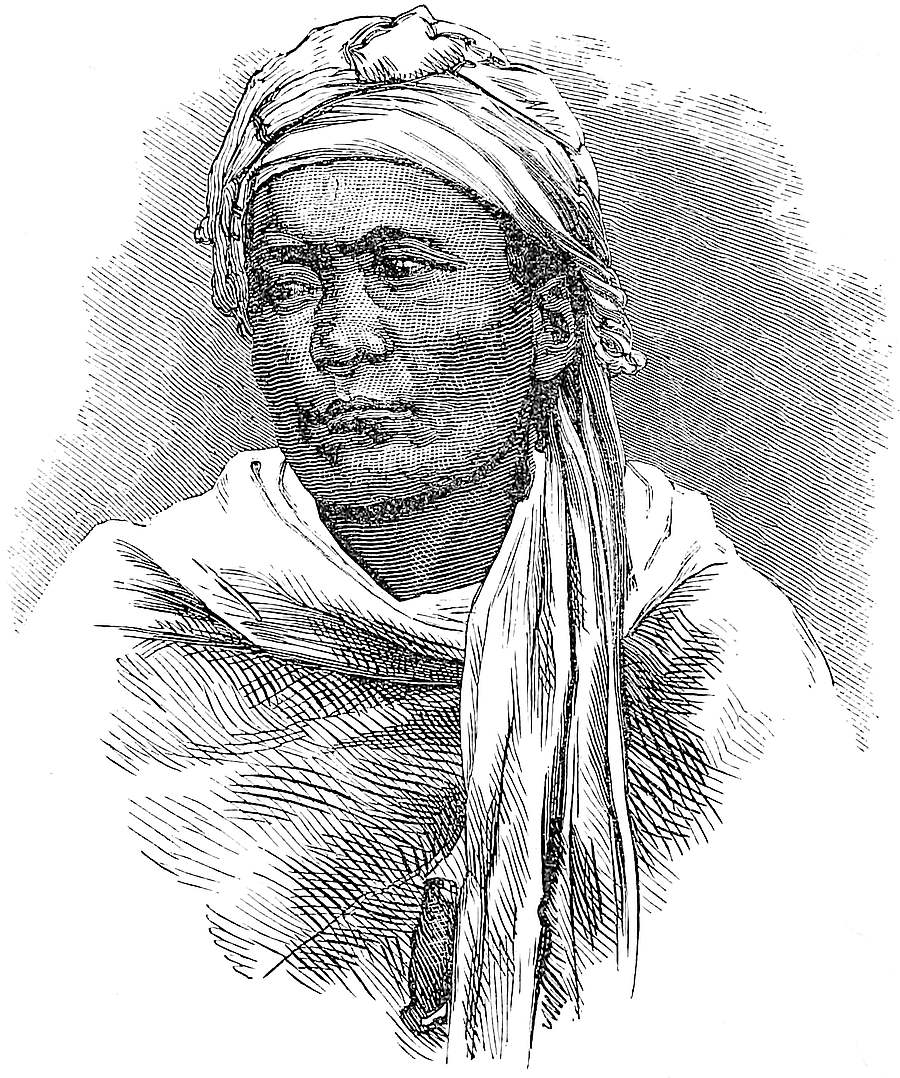
Portrait of a Hazára.
Let us turn now to the name of Nogodar. Contemporaneously with the
Ḳaraunahs we have frequent mention of predatory bands known as Nigúdaris,
who seem to be distinguished from the Ḳaraunahs, but had a like character
for truculence. Their headquarters were about Sijistán, and Quatremère
seems disposed to look upon them as a tribe indigenous in that quarter.
Hammer says they were originally the troops of Prince Nigudar, grandson of
Chaghatai, and that they were a rabble of all sorts, Mongols, Turkmans,
Kurds, Shúls, and what not. We hear of their revolts and disorders down to
1319, under which date Mirkhond says that there had been one-and-twenty
fights with them in four years. Again we hear of them in 1336 about Herat,
whilst in Baber’s time they turn up as Nukdari, fairly established as
tribes in the mountainous tracts of Karnúd and Ghúr, west of Kabul, and
coupled with the Hazáras, who still survive both in name and character.
“Among both,” says Baber, “there are some who speak the Mongol language.”
Hazáras and Takdaris (read Nukdaris) again occur coupled in the
History of Sind. (See Elliot, I. 303–304.) [On the struggle against
Timur of Toumen, veteran chief of the Nikoudrians (1383–84), see Major
David Price’s Mahommedan History, London, 1821, vol. iii. pp. 47–49, H. C.]
In maps of the 17th century, as of Hondius and Blaeuw, we find the
mountains north of Kabul termed Nochdarizari, in which we cannot miss
the combination Nigudar-Hazárah, whencesoever it was got. The Hazáras are
eminently Mongol in feature to this day, and it is very probable that they
or some part of them are the descendants of the Ḳaráunahs or the Nigudaris,
or of both, and that the origination of the bands so called, from the
scum of the Mongol inundation, is thus in degree confirmed. The Hazáras
generally are said to speak an old dialect of Persian. But one tribe in
Western Afghanistan retains both the name of Mongols and a language of
which six-sevenths (judging from a vocabulary published by Major Leech)
appear to be Mongol. Leech says, too, that the Hazáras generally are termed
Moghals by the Ghilzais. It is worthy of notice that Abu’l Fázl, who also
mentions the Nukdaris among the nomad tribes of Kabul, says the Hazáras
were the remains of the Chaghataian army which Mangu Kaan sent to the aid
of Hulaku, under the command of Nigudar Oghlan. (Not. et Ext. XIV. 284;
Ilch. I. 284, 309, etc,; Baber, 134, 136, 140; J. As. sér. IV. tom.
iv. 98; Ayeen Akbery, II. 192–193.)
So far, excepting as to the doubtful point of the relation between
Ḳaráunahs and Nigudaris, and as to the origin of the former, we have a
general accordance with Polo’s representations. But it is not very easy to
identify with certainty the inroad on India to which he alludes, or the
person intended by Nogodar, nephew of Chaghatai. It seems as if two persons
of that name had each contributed something to Marco’s history.
We find in Hammer and D’Ohsson that one of the causes which led to the war
between Barka Khan and Hulaku in 1262 (see above, Prologue, ch. ii.)
was the violent end that had befallen three princes of the House of Juji,
who had accompanied Hulaku to Persia in command of the contingent of that
House. When war actually broke out, the contingent made their escape from
Persia. One party gained Kipchak by way of Derbend; another, in greater
force, led by Nigudar and Onguja, escaped to Khorasan, pursued by the
troops of Hulaku, and thence eastward, where they seized upon Ghazni and
other districts bordering on India.
But again: Nigudar Aghul, or Oghlan, son of (the younger) Juji, son of
Chaghatai, was the leader of the Chaghataian contingent in Hulaku’s
expedition, and was still attached to the Mongol-Persian army in 1269, when
Borrak Khan, of the House of Chaghatai, was meditating war against his
kinsman, Abaka of Persia. Borrak sent to the latter an ambassador, who was
the bearer of a secret message to Prince Nigudar, begging him not to serve
against the head of his own House. Nigudar, upon this, made a pretext of
retiring to his own headquarters in Georgia, hoping to reach Borrak’s
camp by way of Derbend. He was, however, intercepted, and lost many of
his people. With 1000 horse he took refuge in Georgia, but was refused an
asylum, and was eventually captured by Abaka’s commander on that frontier.
His officers were executed, his troops dispersed among Abaka’s army, and
his own life spared under surveillance. I find no more about him. In 1278
Hammer speaks of him as dead, and of the Nigudarian bands as having been
formed out of his troops. But authority is not given.
The second Nigudar is evidently the one to whom Abu’l Fázl alludes.
Khanikoff assumes that the Nigudar who went off towards India about 1260
(he puts the date earlier) was Nigudar, the grandson of Chaghatai, but he
takes no notice of the second story just quoted.
In the former story we have bands under Nigudar going off by Ghazni, and
conquering country on the Indian frontier. In the latter we have Nigudar,
a descendant of Chaghatai, trying to escape from his camp on the frontier
of Great Armenia. Supposing the Persian historians to be correct, it looks
as if Marco had rolled two stories into one.
Some other passages may be cited before quitting this part of the subject.
A chronicle of Herat, translated by Barbier de Meynard, says, under 1298:
“The King Fakhruddin (of Herat) had the imprudence to authorise the
Amir Nigudar to establish himself in a quarter of the city, with 300
adventurers from ’Irák. This little troop made frequent raids in Kuhistan,
Sijistan, Farrah, etc., spreading terror. Khodabanda, at the request of his
brother Ghazan Khan, came from Mazanderan to demand the immediate surrender
of these brigands,” etc. And in the account of the tremendous foray of the
Chaghataian Prince Kotlogh Shah, on the east and south of Persia in 1299,
we find one of his captains called Nigudar Bahadur. (Gold. Horde, 146,
157, 164; D’Ohsson, IV. 378 seqq., 433 seqq., 513 seqq.; Ilch. I. 216,
261, 284; II. 104; J. A. sér. V. tom. xvii. 455–456, 507; Khan. Notice, 31.)
As regards the route taken by Prince Nogodar in his incursion into India,
we have no difficulty with Badakhshan. Pashai-Dir is a copulate name; the
former part, as we shall see reason to believe hereafter, representing the
country between the Hindu Kush and the Kabul River (see infra, ch. xxx.);
the latter (as Pauthier already has pointed out), Dir, the chief town of
Panjkora, in the hill country north of Peshawar. In Ariora-Keshemur
the first portion only is perplexing. I will mention the most probable
of the solutions that have occurred to me, and a second, due to that
eminent archæologist, General A. Cunningham. (1) Ariora may be some
corrupt or Mongol form of Aryavartta, a sacred name applied to the
Holy Lands of Indian Buddhism, of which Kashmir was eminently one to the
Northern Buddhists. Oron, in Mongol, is a Region or Realm, and may have
taken the place of Vartta, giving Aryoron or Ariora. (2) “Ariora,”
General Cunningham writes, “I take to be the Harhaura of Sanscrit—i.e.
the Western Panjáb. Harhaura was the North-Western Division of the Nava-Khanda,
or Nine Divisions of Ancient India. It is mentioned between
Sindhu-Sauvira in the west (i.e. Sind), and Madra in the north (i.e.
the Eastern Panjáb, which is still called Madar-Des). The name of
Harhaura is, I think, preserved in the Haro River. Now, the Sind-Sagor
Doab formed a portion of the kingdom of Kashmir, and the joint names,
like those of Sindhu-Sauvira, describe only one State.” The names of the
Nine Divisions in question are given by the celebrated astronomer, Varaha
Mihira, who lived in the beginning of the 6th century, and are repeated by
Al Biruni. (See Reinaud, Mém. sur l’Inde, p. 116.) The only objection to
this happy solution seems to lie in Al Biruni’s remark, that the names in
question were in general no longer used even in his time (A.D. 1030).
There can be no doubt that Asidin Soldan is, as Khanikoff has said,
Ghaiassuddin Balban, Sultan of Delhi from 1266 to 1286, and for years
before that a man of great power in India, and especially in the Panjáb, of
which he had in the reign of Ruknuddin (1236) held independent possession.
Firishta records several inroads of Mongols in the Panjáb during the
reign of Ghaiassuddin, in withstanding one of which that King’s eldest
son was slain; and there are constant indications of their presence in
Sind till the end of the century. But we find in that historian no hint of
the chief circumstances of this part of the story, viz., the conquest of
Kashmir and the occupation of Dalivar or Dilivar (G. T.), evidently
(whatever its identity) in the plains of India. I do find, however, in the
history of Kashmir, as given by Lassen (III. 1138), that in the end of
1259, Lakshamana Deva, King of Kashmir, was killed in a campaign against
the Turushka (Turks or Tartars), and that their leader, who is called
Kajjala, got hold of the country and held it till 1287.[1] It is difficult
not to connect this both with Polo’s story and with the escapade of Nigudar
about 1260, noting also that this occupation of Kashmir extended through
the whole reign of Ghaiassuddin.
We seem to have a memory of Polo’s story preserved in one of Elliot’s
extracts from Wassáf, which states that in 708 (A.D. 1308), after a great
defeat of a Mongol inroad which had passed the Ganges, Sultan Ala’uddin
Khilji ordered a pillar of Mongol heads to be raised before the Badáun
gate, “as was done with the Nigudari Moghuls” (III. 48).
We still have to account for the occupation and locality of Dalivar;
Marsden supposed it to be Lahore; Khanikoff considers it to be Diráwal,
the ancient desert capital of the Bhattis, properly (according to Tod)
Deoráwal, but by a transposition common in India, as it is in Italy,
sometimes called Diláwar, in the modern State of Bháwalpúr. But General
Cunningham suggests a more probable locality in Diláwar on the west bank
of the Jelam, close to Dárápúr, and opposite to Mung. These two sites,
Diláwar-Dárápúr on the west bank, and Mung on the east, are identified
by General Cunningham (I believe justly) with Alexander’s Bucephala and
Nicaea. The spot, which is just opposite the battlefield of Chiliánwála,
was visited (15th December, 1868) at my request, by my friend Colonel
R. Maclagan, R.E. He writes: “The present village of Diláwar stands a
little above the town of Dárápúr (I mean on higher ground), looking down
on Dárápúr and on the river, and on the cultivated and wooded plain
along the river bank. The remains of the Old Diláwar, in the form of
quantities of large bricks, cover the low round-backed spurs and knolls
of the broken rocky hills around the present village, but principally on
the land side. They cover a large area of very irregular character, and
may clearly be held to represent a very considerable town. There are no
indications of the form of buildings, ... but simply large quantities of
large bricks, which for a long time have been carried away and used for
modern buildings.... After rain coins are found on the surface.... There
can be no doubt of a very large extent of ground, of very irregular and
uninviting character, having been covered at some time with buildings. The
position on the Jelam would answer well for the Diláwar which the Mongol
invaders took and held.... The strange thing is that the name should not
be mentioned (I believe it is not) by any of the well-known Mahomedan
historians of India. So much for Diláwar.... The people have no traditions.
But there are the remains; and there is the name, borne by the existing
village on part of the old site.” I had come to the conclusion that this
was almost certainly Polo’s Dalivar, and had mapped it as such, before I
read certain passages in the History of Zíyáuddín Barni, which have been
translated by Professor Dowson for the third volume of Elliot’s India.
When the comrades of Ghaiassuddin Balban urged him to conquests, the
Sultan pointed to the constant danger from the Mongols,[2] saying: “These
accursed wretches have heard of the wealth and condition of Hindustan, and
have set their hearts upon conquering and plundering it. They have taken
and plundered Lahor within my territories, and no year passes that they
do not come here and plunder the villages.... They even talk about the
conquest and sack of Delhi.” And under a later date the historian says:
“The Sultan ... marched to Lahor, and ordered the rebuilding of the fort
which the Mughals had destroyed in the reigns of the sons of Shamsuddin.
The towns and villages of Lahor which the Mughals had devastated and laid
waste he repeopled.” Considering these passages, and the fact that Polo had
no personal knowledge of Upper India, I now think it probable that Marsden
was right, and that Dilivar is really a misunderstanding of “Città di
Livar” for Lahàwar or Lahore.
The Magical darkness which Marco ascribes to the evil arts of the
Karaunas is explained by Khanikoff from the phenomenon of Dry Fog, which
he has often experienced in Khorasan, combined with the Dust Storm with
which we are familiar in Upper India. In Sind these phenomena often produce
a great degree of darkness. During a battle fought between the armies of
Sindh and Kachh in 1762, such a fog came on, obscuring the light of day for
some six hours, during which the armies were intermixed with one another
and fighting desperately. When the darkness dispersed they separated, and
the consternation of both parties was so great at the events of the day
that both made a precipitate retreat. In 1844 this battle was still spoken
of with wonder. (J. Bomb. Br. R. A. S. I. 423.)
Major St. John has given a note on his own experience of these curious
Kermán fogs (see Ocean Highways, 1872, p. 286): “Not a breath of air was
stirring, and the whole effect was most curious, and utterly unlike any
other fog I have seen. No deposit of dust followed, and the feeling of the
air was decidedly damp. I unfortunately could not get my hygrometer till
the fog had cleared away.”
[General Houtum-Schindler, l.c. p. 493, writes: “The magical darkness
might, as Colonel Yule supposes, be explained by the curious dry fogs or
dust storms, often occurring in the neighbourhood of Kermán, but it must be
remarked that Marco Polo was caught in one of these storms down in Jíruft,
where, according to the people I questioned, such storms now never occur.
On the 29th of September, 1879, at Kermán, a high wind began to blow from
S.S.W. at about 5 P.M. First there came thick heavy clouds of dust with a
few drops of rain. The heavy dust then settled down, the lighter particles
remained in the air, forming a dry fog of such density that large objects,
like houses, trees, etc., could not even faintly be distinguished at a
distance of a hundred paces. The barometers suffered no change, the three
I had with me remained in statu quo.” “The heat is over by the middle of
September, and after the autumnal equinox, there are a few days of what is
best described as a dense dry fog. This was undoubtedly the haze referred
to by Marco Polo.” (Major Sykes, ch. iv.)—H. C.]
Richthofen’s remarkable exposition of the phenomena of the löss in North
China, and of the sub-aerial deposits of the steppes and of Central Asia
throws some light on this. But this hardly applies to St John’s experience
of “no deposit of dust.” (See Richthofen, China, pp. 96–97 s. MS. Note,
H. Y.)
The belief that such opportune phenomena were produced by enchantment was
a thoroughly Tartar one. D’Herbelot relates (art. Giagathai) that in an
action with a rebel called Mahomed Tarabi, the Mongols were encompassed by
a dust storm which they attributed to enchantment on the part of the enemy,
and it so discouraged them that they took to flight.
Note 5.—The specification that only seven were saved from Marco’s company
is peculiar to Pauthier’s Text, not appearing in the G. T.
Several names compounded of Salm or Salmi occur on the dry lands on
the borders of Kermán. Edrisi, however (I. p. 428), names a place called
Ḳanát-ul-Shám as the first march in going from Jíruft to Walashjird.
Walashjird is, I imagine, represented by Galashkird, Major R. Smith’s
third march from Jíruft (see my Map of Routes from Kermán to Hormuz); and
as such an indication agrees with the view taken below of Polo’s route,
I am strongly disposed to identify Ḳanát-ul-Shám with his castello or
walled village of Canosalmi.
[“Marco Polo’s Conosalmi, where he was attacked by robbers and lost the
greater part of his men, is perhaps the ruined town or village Kamasal
(Kahn-i-asal = the honey canal), near Kahnúj-i-pancheh and Vakílábád in
Jíruft. It lies on the direct road between Shehr-i-Daqíánús (Camadi) and
the Nevergún Pass. The road goes in an almost due southerly direction.
The Nevergún Pass accords with Marco Polo’s description of it; it is very
difficult, on account of the many great blocks of sandstone scattered upon
it. Its proximity to the Bashakird mountains and Mekrán easily accounts for
the prevalence of robbers, who infested the place in Marco Polo’s time. At
the end of the Pass lies the large village Shamíl, with an old fort; the
distance thence to the site of Hormúz or Bender ’Abbás (lying more to the
west) is 52 miles, two days’ march. The climate of Bender ’Abbás is very
bad, strangers speedily fall sick, two of my men died there, all the others
were seriously ill.” (Houtum-Schindler, l.c. pp. 495–496.) Major Sykes
(ch. xxiii.) says: “Two marches from Camadi was Kahn-i-Panchur, and a stage
beyond it lay the ruins of Fariáb or Pariáb, which was once a great city,
and was destroyed by a flood, according to local legend. It may have been
Alexander’s Salmous, as it is about the right distance from the coast, and
if so, could not have been Marco’s Cono Salmi. Continuing on, Galashkird
mentioned by Edrisi, is the next stage.”—H. C.]
The raids of the Mekranis and Biluchis long preceded those of the Karaunas,
for they were notable even in the time of Mahmud of Ghazni, and they have
continued to our own day to be prosecuted nearly on the same stage and in
the same manner. About 1721, 4000 horsemen of this description plundered
the town of Bander Abbási, whilst Captain Alex. Hamilton was in the port;
and Abbott, in 1850, found the dread of Bilúch robbers to extend almost to
the gates of Ispahan. A striking account of the Bilúch robbers and their
characteristics is given by General Ferrier. (See Hamilton, I. 109;
J. R. G. S. XXV.; Khanikoff’s Mémoire; Macd. Kinneir, 196; Caravan
Journeys, p. 437 seq.)
Of the Descent to the City of Hormos.
The Plain of which we have spoken extends in a southerly direction for
five days’ journey, and then you come to another descent some twenty miles
in length, where the road is very bad and full of peril, for there are
many robbers and bad characters about. When you have got to the foot of
this descent you find another beautiful plain called the Plain of Formosa.
This extends for two days’ journey; and you find in it fine streams of
water with plenty of date-palms and other fruit-trees. There are also many
beautiful birds, francolins, popinjays, and other kinds such as we have
none of in our country. When you have ridden these two days you come to the
Ocean Sea, and on the shore you find a city with a harbour which is called
Hormos.{1} Merchants come thither from India, with ships loaded with
spicery and precious stones, pearls, cloths of silk and gold, elephants’
teeth, and many other wares, which they sell to the merchants of Hormos,
and which these in turn carry all over the world to dispose of again. In
fact, ’tis a city of immense trade. There are plenty of towns and villages
under it, but it is the capital. The King is called Ruomedam Ahomet. It is
a very sickly place, and the heat of the sun is tremendous. If any foreign
merchant dies there, the King takes all his property.
In this country they make a wine of dates mixt with spices, which is
very good. When any one not used to it first drinks this wine, it causes
repeated and violent purging, but afterwards he is all the better for it,
and gets fat upon it. The people never eat meat and wheaten bread except
when they are ill, and if they take such food when they are in health it
makes them ill. Their food when in health consists of dates and salt-fish
(tunny, to wit) and onions, and this kind of diet they maintain in order to
preserve their health.{2}
Their ships are wretched affairs, and many of them get lost; for they have
no iron fastenings, and are only stitched together with twine made from
the husk of the Indian nut. They beat this husk until it becomes like
horse-hair, and from that they spin twine, and with this stitch the planks
of the ships together. It keeps well, and is not corroded by the sea-water,
but it will not stand well in a storm. The ships are not pitched, but are
rubbed with fish-oil. They have one mast, one sail, and one rudder, and
have no deck, but only a cover spread over the cargo when loaded. This
cover consists of hides, and on the top of these hides they put the horses
which they take to India for sale. They have no iron to make nails of, and
for this reason they use only wooden trenails in their shipbuilding, and
then stitch the planks with twine as I have told you. Hence ’tis a perilous
business to go a voyage in one of those ships, and many of them are lost,
for in that Sea of India the storms are often terrible.{3}
The people are black, and are worshippers of Mahommet. The residents avoid
living in the cities, for the heat in summer is so great that it would
kill them. Hence they go out (to sleep) at their gardens in the country,
where there are streams and plenty of water. For all that they would not
escape but for one thing that I will mention. The fact is, you see, that
in summer a wind often blows across the sands which encompass the plain,
so intolerably hot that it would kill everybody, were it not that when
they perceive that wind coming they plunge into water up to the neck, and
so abide until the wind have ceased.{4} [And to prove the great heat
of this wind, Messer Mark related a case that befell when he was there.
The Lord of Hormos, not having paid his tribute to the King of Kerman the
latter resolved to claim it at the time when the people of Hormos were
residing away from the city. So he caused a force of 1600 horse and 5000
foot to be got ready, and sent them by the route of Reobarles to take
the others by surprise. Now, it happened one day that through the fault
of their guide they were not able to reach the place appointed for their
night’s halt, and were obliged to bivouac in a wilderness not far from
Hormos. In the morning as they were starting on their march they were
caught by that wind, and every man of them was suffocated, so that not one
survived to carry the tidings to their Lord. When the people of Hormos
heard of this they went forth to bury the bodies lest they should breed a
pestilence. But when they laid hold of them by the arms to drag them to the
pits, the bodies proved to be so baked, as it were, by that tremendous
heat, that the arms parted from the trunks, and in the end the people had
to dig graves hard by each where it lay, and so cast them in.]{5}
The people sow their wheat and barley and other corn in the month of
November, and reap it in the month of March. The dates are not gathered
till May, but otherwise there is no grass nor any other green thing, for
the excessive heat dries up everything.
When any one dies they make a great business of the mourning, for women
mourn their husbands four years. During that time they mourn at least once
a day, gathering together their kinsfolk and friends and neighbours for the
purpose, and making a great weeping and wailing. [And they have women who
are mourners by trade, and do it for hire.]
Now, we will quit this country. I shall not, however, now go on to tell you
about India; but when time and place shall suit we shall come round from
the north and tell you about it. For the present, let us return by another
road to the aforesaid city of Kerman, for we cannot get at those countries
that I wish to tell you about except through that city.
I should tell you first, however, that King Ruomedam Ahomet of Hormos,
which we are leaving, is a liegeman of the King of Kerman.{6}
On the road by which we return from Hormos to Kerman you meet with some
very fine plains, and you also find many natural hot baths; you find plenty
of partridges on the road; and there are towns where victual is cheap and
abundant, with quantities of dates and other fruits. The wheaten bread,
however, is so bitter, owing to the bitterness of the water, that no one
can eat it who is not used to it. The baths that I mentioned have excellent
virtues; they cure the itch and several other diseases.{7}
Now, then, I am going to tell you about the countries towards the north, of
which you shall hear in regular order. Let us begin.
Note 1.—Having now arrived at Hormuz, it is time to see what can be made of
the Geography of the route from Kermán to that port.
The port of Hormuz, [which had taken the place of Kish as the most
important market of the Persian Gulf (H. C.),] stood upon the mainland. A
few years later it was transferred to the island which became so famous,
under circumstances which are concisely related by Abulfeda:—“Hormuz
is the port of Kermán, a city rich in palms, and very hot. One who has
visited it in our day tells me that the ancient Hormuz was devastated by
the incursions of the Tartars, and that its people transferred their abode
to an island in the sea called Zarun, near the continent, and lying west
of the old city. At Hormuz itself no inhabitants remain, but some of the
lowest order.” (In Büsching, IV. 261–262.) Friar Odoric, about 1321,
found Hormuz “on an island some 5 miles distant from the main.” Ibn Batuta,
some eight or nine years later, discriminates between Hormuz or Moghistan
on the mainland, and New Hormuz on the Island of Jeraun, but describes only
the latter, already a great and rich city.
The site of the Island Hormuz has often been visited and described; but I
could find no published trace of any traveller having verified the site
of the more ancient city, though the existence of its ruins was known to
John de Barros, who says that a little fort called Cuxstac (Kuhestek of
P. della Valle, II. p. 300) stood on the site. An application to Colonel
Pelly, the very able British Resident at Bushire, brought me from his
own personal knowledge the information that I sought, and the following
particulars are compiled from the letters with which he has favoured me:—
“The ruins of Old Hormuz, well known as such, stand several miles up
a creek, and in the centre of the present district of Minao. They are
extensive (though in large part obliterated by long cultivation over
the site), and the traces of a long pier or Bandar were pointed out to
Colonel Pelly. They are about 6 or 7 miles from the fort of Minao, and
the Minao river, or its stony bed, winds down towards them. The creek is
quite traceable, but is silted up, and to embark goods you have to go a
farsakh towards the sea, where there is a custom-house on that part of
the creek which is still navigable. Colonel Pelly collected a few bricks
from the ruins. From the mouth of the Old Hormuz creek to the New Hormuz
town, or town of Turumpak on the island of Hormuz, is a sail of about three
farsakhs. It may be a trifle more, but any native tells you at once that
it is three farsakhs from Hormuz Island to the creek where you land to go
up to Minao. Hormuzdia was the name of the region in the days of its
prosperity. Some people say that Hormuzdia was known as Jerunia, and Old
Hormuz town as Jerun.” (In this I suspect tradition has gone astray.)
“The town and fort of Minao lie to the N.E. of the ancient city, and are
built upon the lowest spur of the Bashkurd mountains, commanding a gorge
through which the Rudbar river debouches on the plain of Hormuzdia.” In
these new and interesting particulars it is pleasing to find such precise
corroboration both of Edrisi and of Ibn Batuta. The former, writing in the
12th century, says that Hormuz stood on the banks of a canal or creek from
the Gulf, by which vessels came up to the city. The latter specifies the
breadth of sea between Old and New Hormuz as three farsakhs. (Edrisi,
I. 424; I. B. II. 230.)
I now proceed to recapitulate the main features of Polo’s Itinerary from
Kermán to Hormuz. We have:—
| |
|
Marches. |
1. |
From Kermán across a plain to the top of a mountain-pass, where extreme cold was experienced . . . |
7 |
2. |
A descent, occupying . . . |
2 |
3. |
A great plain, called Reobarles, in a much warmer climate, abounding in francolin partridge, and in
dates and tropical fruit, with a ruined city of former note, called Camadi, near the head of the plain,
which extends for . . . |
5 |
4. |
A second very bad pass, descending for 20 miles, say . . . |
1 |
5. |
A well-watered fruitful plain, which is crossed to Hormuz, on the shores of the Gulf . . . |
2 |
| |
|
— |
| |
Total . . . |
17 |
No European traveller, so far as I know, has described the most direct
road from Kermán to Hormuz, or rather to its nearest modern representative
Bander Abbási,—I mean the road by Báft. But a line to the eastward of
this, and leading through the plain of Jíruft, was followed partially by
Mr. Abbott in 1850, and completely by Major R. M. Smith, R.E., in 1866.
The details of this route, except in one particular, correspond closely in
essentials with those given by our author, and form an excellent basis of
illustration for Polo’s description.
Major Smith (accompanied at first by Colonel Goldsmid, who diverged to
Mekran) left Kermán on the 15th of January, and reached Bander Abbási on
the 3rd of February, but, as three halts have to be deducted, his total
number of marches was exactly the same as Marco’s, viz. 17. They divide as
follows:—
| |
|
Marches. |
1. |
From Kermán to the caravanserai of Deh Bakri in the pass so called. “The ground as I ascended became
covered with snow, and the weather bitterly cold” (Report) . . . |
6 |
2. |
Two miles over very deep snow brought him to the top of the pass; he then descended 14 miles to his halt.
Two miles to the south of the crest he passed a second caravanserai: “The two are evidently built so near one
another to afford shelter to travellers who may be unable to cross the ridge during heavy snow-storms.”
The next march continued the descent for 14 miles, and then carried him 10 miles along the banks of the
Rudkhanah-i-Shor. The approximate height of the pass above the sea is estimated at 8000 feet. We have thus
for the descent the greater part of . . . |
2 |
3. |
“Clumps of date-palms growing near the village showed that I had now reached a totally different climate.”
(Smith’s Report.) And Mr. Abbott says of the same region: “Partly wooded ... and with thickets of reeds
abounding with francolin and Jirufti partridge.... The lands yield grain, millet, pulse, French- and
horse-beans, rice, cotton, henna, Palma Christi, and dates,
and in part are of great fertility.... Rainy season from January to March, after which a luxuriant crop of grass.”
Across this plain (districts of Jíruft and Rudbar), the height of which above the sea, is something under 2000 feet . . . |
6 |
4. |
6½ hours, “nearly the whole way over a most difficult mountain-pass,” called the Pass of Nevergun . . . |
1 |
5. |
Two long marches over a plain, part of which is described as “continuous cultivation for some 16 miles,” and the rest
as a “most uninteresting plain” . . . |
2 |
| |
|
— |
| |
Total as before . . . |
17 |
In the previous edition of this work I was inclined to identify Marco’s
route absolutely with this Itinerary. But a communication from Major
St. John, who surveyed the section from Kermán towards Deh Bakri in 1872,
shows that this first section does not answer well to the description.
The road is not all plain, for it crosses a mountain pass, though not a
formidable one. Neither is it through a thriving, populous tract, for, with
the exception of two large villages, Major St. John found the whole road
to Deh Bakri from Kermán as desert and dreary as any in Persia. On the
other hand, the more direct route to the south, which is that always used
except in seasons of extraordinary severity (such as that of Major Smith’s
journey, when this route was impassable from snow), answers better, as
described to Major St. John by muleteers, to Polo’s account. The first six
days are occupied by a gentle ascent through the districts of Bardesir
and Kairat-ul-Arab, which are the best-watered and most fertile uplands of
Kermán. From the crest of the pass reached in those six marches (which is
probably more than 10,000 feet above the sea, for it was closed by snow
on 1st May, 1872), an easy descent of two days leads to the Garmsir.
This is traversed in four days, and then a very difficult pass is crossed
to reach the plains bordering on the sea. The cold of this route is much
greater than that of the Deh Bakri route. Hence the correspondence with
Polo’s description, as far as the descent to the Garmsir, or Reobarles,
seems decidedly better by this route. It is admitted to be quite possible
that on reaching this plain the two routes coalesced. We shall assume this
provisionally, till some traveller gives us a detailed account of the
Bardesir route. Meantime all the remaining particulars answer well.
[General Houtum-Schindler (l.c. pp. 493–495), speaking of the Itinerary
from Kermán to Hormúz and back, says: “Only two of the many routes
between Kermán and Bender ’Abbás coincide more or less with Marco Polo’s
description. These two routes are the one over the Deh Bekrí Pass [see
above, Colonel Smith], and the one viâ Sárdú. The latter is the one, I
think, taken by Marco Polo. The more direct roads to the west are for the
greater part through mountainous country, and have not twelve stages in
plains which we find enumerated in Marco Polo’s Itinerary. The road viâ
Báft, Urzú, and the Zendán Pass, for instance, has only four stages in
plains; the road, viâ Ráhbur, Rúdbár and the Nevergún Pass only six; and
the road viâ Sírján also only six.”
| |
Marches. |
| The Sárdú route, which seems to me to be the one followed by Marco Polo, has five stages through fertile
and populous plains to Sarvízan . . . |
5 |
| One day’s march ascends to the top of the Sarvízan Pass . . . |
1 |
| Two days’ descent to Ráhjird, a village close to the ruins of old Jíruft, now called Shehr-i-Daqíánús . . . |
2 |
| Six days’ march over the “vast plain” of Jírúft and Rúdbár to Faríáb, joining the Deh Bekrí route at Kerímábád, one
stage south of the Shehr-i-Daqíánús . . . |
6 |
| One day’s march through the Nevergún Pass to Shamíl, descending . . . |
1 |
| Two days’ march through the plain to Bender ’Abbás or Hormúz . . . |
2 |
| |
— |
In all . . . |
17 |
The Sárdú road enters the Jíruft plain at the ruins of the old city, the
Deh Bekrí route does so at some distance to the eastward. The first six
stages performed by Marco Polo in seven days go through fertile plains
and past numerous villages. Regarding the cold, “which you can scarcely
abide,” Marco Polo does not speak of it as existing on the mountains only;
he says, “From the city of Kermán to this descent the cold in winter is
very great,” that is, from Kermán to near Jíruft. The winter at Kermán
itself is fairly severe; from the town the ground gradually but steadily
rises, the absolute altitudes of the passes crossing the mountains to the
south varying from 8000 to 11,000 feet. These passes are up to the month
of March always very cold; in one it froze slightly in the beginning of
June. The Sárdú Pass lies lower than the others. The name is Sárdú, not
Sardú from sard, “cold.” Major Sykes (Persia, ch. xxiii.) comes to the
same conclusion: “In 1895, and again in 1900, I made a tour partly with the
object of solving this problem, and of giving a geographical existence to
Sárdu, which appropriately means the ‘Cold Country.’ I found that there was
a route which exactly fitted Marco’s conditions, as at Sarbizan the Sárdu
plateau terminates in a high pass of 9200 feet, from which there is a most
abrupt descent to the plain of Jíruft, Komádin being about 35 miles, or two
days’ journey from the top of the pass. Starting from Kermán, the stages
would be as follows:—I. Jupár (small town); 2. Bahrámjird (large village);
3. Gudar (village); 4. Ráin (small town).... Thence to the Sarbizan pass is
a distance of 45 miles, or three desert stages, thus constituting a total
of 110 miles for the seven days. This is the camel route to the present
day, and absolutely fits in with the description given.... The question to
be decided by this section of the journey may then, I think, be considered
to be finally and most satisfactorily settled, the route proving to lie
between the two selected by Colonel Yule, as being the most suitable,
although he wisely left the question open.”—H. C.]
In the abstract of Major Smith’s Itinerary as we have given it, we do not
find Polo’s city of Camadi. Major Smith writes to me, however, that
this is probably to be sought in “the ruined city, the traces of which I
observed in the plain of Jíruft near Kerimabad. The name of the city is
now apparently lost.” It is, however, known to the natives as the City of
Dakiánús, as Mr. Abbott, who visited the site, informs us. This is a name
analogous only to the Arthur’s ovens or Merlin’s caves of our own country,
for all over Mahomedan Asia there are old sites to which legend attaches
the name of Dakianus or the Emperor Decius, the persecuting tyrant of the
Seven Sleepers. “The spot,” says Abbott, “is an elevated part of the plain
on the right bank of the Hali Rúd, and is thickly strewn with kiln-baked
bricks, and shreds of pottery and glass.... After heavy rain the peasantry
search amongst the ruins for ornaments of stone, and rings and coins of
gold, silver, and copper. The popular tradition concerning the city is that
it was destroyed by a flood long before the birth of Mahomed.”
[General Houtum-Schindler, in a paper in the Jour. R. As. Soc., Jan.
1898, p. 43, gives an abstract of Dr. Houtsma’s (of Utrecht) memoir, Zur
Geschichte der Saljuqen von Kerman, and comes to the conclusion that “from
these statements we can safely identify Marco Polo’s Camadi with the suburb
Qumādīn, or, as I would read it, Qamādīn, of the city of Jíruft.”—(Cf.
Major Sykes’ Persia, chap. xxiii.: “Camadi was sacked for the first time,
after the death of Toghrul Shah of Kermán, when his four sons reduced the
province to a condition of anarchy.”)
Major P. Molesworth Sykes, Recent Journeys in Persia (Geog. Journal,
X. 1897, p. 589), says: “Upon arrival in Rudbar, we turned northwards
and left the Farman Farma, in order to explore the site of Marco Polo’s
‘Camadi.’... We came upon a huge area littered with yellow bricks eight
inches square, while not even a broken wall is left to mark the site of
what was formerly a great city, under the name of the Sher-i-Jiruft.”—H. C.]
The actual distance from Bamm to the City of Dakianus is, by Abbott’s
Journal, about 66 miles.
The name of Reobarles, which Marco applies to the plain intermediate
between the two descents, has given rise to many conjectures. Marsden
pointed to Rúdbár, a name frequently applied in Persia to a district on
a river, or intersected by streams—a suggestion all the happier that he
was not aware of the fact that there is a district of Rudbar exactly in
the required position. The last syllable still requires explanation. I
ventured formerly to suggest that it was the Arabic Laṣṣ, or, as Marco
would certainly have written it, Les, a robber. Reobarles would then
be Rudbar-i-Laṣṣ, “Robber’s River District.” The appropriateness of the
name Marco has amply illustrated; and it appeared to me to survive in that
of one of the rivers of the plain, which is mentioned by both Abbott and
Smith under the title of Rúdkhánah-i-Duzdi, or Robbery River, a name
also applied to a village and old fort on the banks of the stream. This
etymology was, however, condemned as an inadmissible combination of Persian
and Arabic by two very high authorities both as travellers and scholars—Sir
H. Rawlinson and Mr. Khanikoff. The Les, therefore, has still to be
explained.[1]
[Major Sykes (Geog. Journal, 1902, p. 130) heard of robbers, some five
miles from Mináb, and he adds: “However, nothing happened, and after
crossing the Gardan-i-Pichal, we camped at Birinti, which is situated just
above the junction of Rudkhána Duzdi, or ‘River of Theft,’ and forms part
of the district of Rudán, in Fars.”
“The Jíruft and Rúdbár plains belong to the germsír (hot region), dates,
pistachios, and konars (apples of Paradise) abound in them. Reobarles is
Rúdbár or Rüdbáris.” (Houtum-Schindler, l.c. 1881, p. 495.)—H. C.]
We have referred to Marco’s expressions regarding the great cold
experienced on the pass which formed the first descent; and it is worthy of
note that the title of “The Cold Mountains” is applied by Edrisi to these
very mountains. Mr. Abbott’s MS. Report also mentions in this direction,
Sardu, said to be a cold country (as its name seems to express [see
above,—H. C.]), which its population (Iliyáts) abandon in winter for the
lower plains. It is but recently that the importance of this range of
mountains has become known to us. Indeed the existence of the chain, as
extending continuously from near Kashán, was first indicated by Khanikoff
in 1862. More recently Major St. John has shown the magnitude of this
range, which rises into summits of 15,000 feet in altitude, and after a
course of 550 miles terminates in a group of volcanic hills some 50 miles
S.E. of Bamm. Yet practically this chain is ignored on all our maps!
Marco’s description of the “Plain of Formosa” does not apply, now at least,
to the whole plain, for towards Bander Abbási it is barren. But to the
eastward, about Minao, and therefore about Old Hormuz, it has not fallen
off. Colonel Pelly writes: “The district of Minao is still for those
regions singularly fertile. Pomegranates, oranges, pistachio-nuts, and
various other fruits grow in profusion. The source of its fertility is of
course the river, and you can walk for miles among lanes and cultivated
ground, partially sheltered from the sun.” And Lieutenant Kempthorne, in
his notes on that coast, says of the same tract: “It is termed by the
natives the Paradise of Persia. It is certainly most beautifully fertile,
and abounds in orange-groves, and orchards containing apples, pears,
peaches, and apricots; with vineyards producing a delicious grape, from
which was at one time made a wine called amber-rosolli”—a name not easy
to explain. ’Ambar-i-Rasúl, “The Prophet’s Bouquet!” would be too bold a
name even for Persia, though names more sacred are so profaned at Naples
and on the Moselle. Sir H. Rawlinson suggests ’Ambar-’asali, “Honey
Bouquet,” as possible.
When Nearchus beached his fleet on the shore of Harmozeia at the mouth
of the Anamis (the River of Minao), Arrian tells us he found the country
a kindly one, and very fruitful in every way except that there were no
olives. The weary mariners landed and enjoyed this pleasant rest from their
toils. (Indica, 33; J. R. G. S. V. 274.)
MARCO POLO’S ITINERARIES No. II.
Kerman to Hormuz (Bᵏ. I. Ch. 19.)
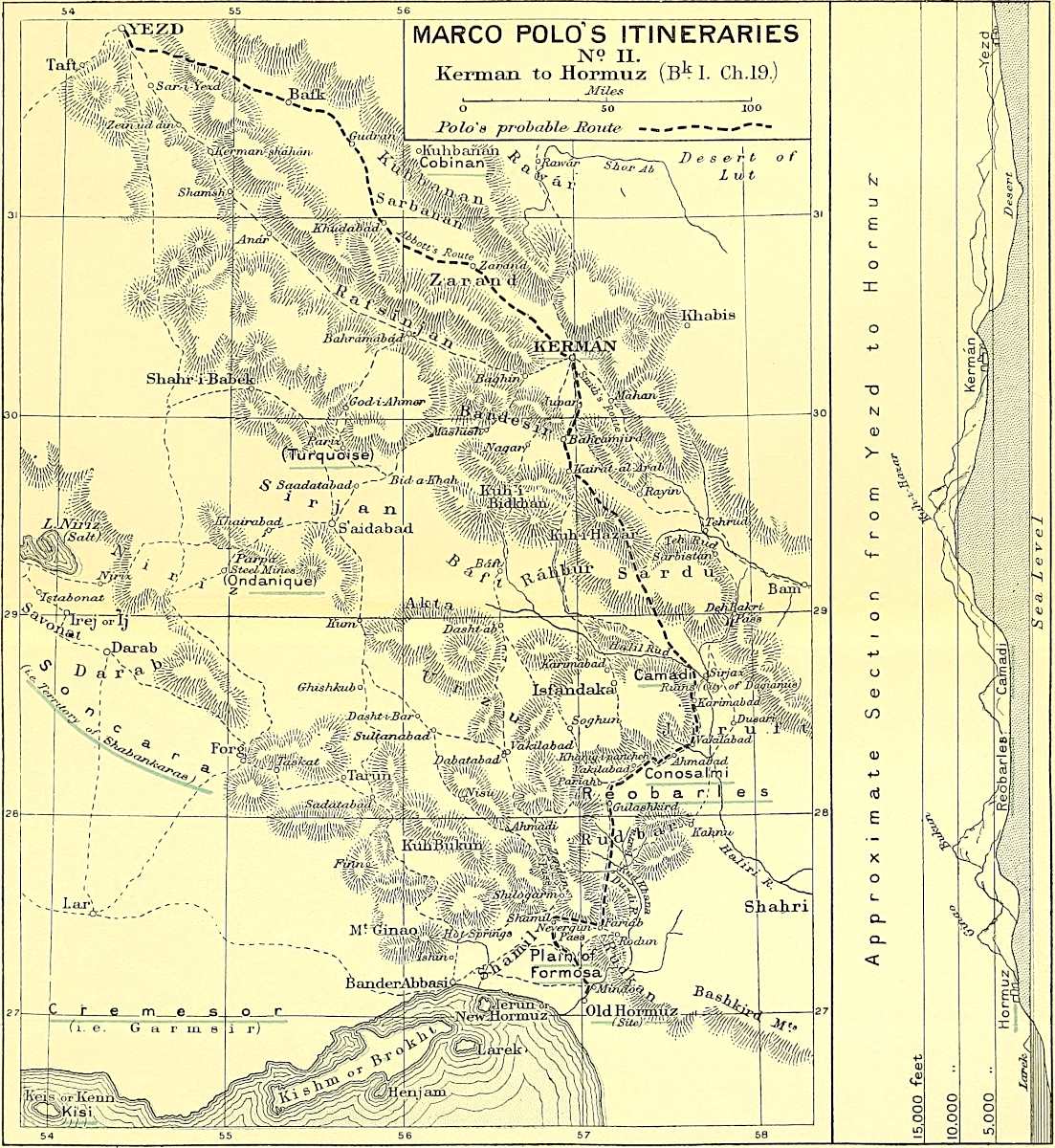
Approximate Section from Yazd to Hormuz
The name Formosa is probably only Rusticiano’s misunderstanding of
Harmuza, aided, perhaps, by Polo’s picture of the beauty of the plain.
We have the same change in the old Mafomet for Mahomet, and the converse
one in the Spanish hermosa for formosa. Teixeira’s Chronicle says that
the city of Hormuz was founded by Xa Mahamed Dranku, i.e. Shah Mahomed
Dirhem-Ko, in “a plain of the same name.”
The statement in Ramusio that Hormuz stood upon an island, is, I doubt not,
an interpolation by himself or some earlier transcriber.
When the ships of Nearchus launched again from the mouth of the Anamis,
their first day’s run carried them past a certain desert and bushy island
to another which was large and inhabited. The desert isle was called
Organa; the large one by which they anchored Oaracta. (Indica, 37.)
Neither name is quite lost; the latter greater island is Kishm or Brakht;
the former Jerún,[2] perhaps in old Persian Gerún or Gerán, now
again desert though no longer bushy, after having been for three centuries
the site of a city which became a poetic type of wealth and splendour. An
Eastern saying ran, “Were the world a ring, Hormuz would be the jewel in it.”
[“The Yüan shi mentions several seaports of the Indian Ocean as carrying
on trade with China; Hormuz is not spoken of there. I may, however, quote
from the Yüan History a curious statement which perhaps refers to this
port. In ch. cxxiii., biography of Arsz-lan, it is recorded that his
grandson Hurdutai, by order of Kubilai Khan, accompanied Bu-lo no-yen
on his mission to the country of Ha-rh-ma-sz. This latter name may be
intended for Hormuz. I do not think that by the Noyen Bulo, M. Polo could
be meant, for the title Noyen would hardly have been applied to him. But
Rashid-eddin mentions a distinguished Mongol, by name Pulad, with whom
he was acquainted in Persia, and who furnished him with much information
regarding the history of the Mongols. This may be the Bu-lo no-yen of the
Yüan History.” (Bretschneider, Med. Res. II. p. 132.)—H. C.]
Note 2.—A spirit is still distilled from dates in Persia, Mekran, Sind,
and some places in the west of India. It is mentioned by Strabo and
Dioscorides, according to Kämpfer, who says it was in his time made
under the name of a medicinal stomachic; the rich added Radix Chinae,
ambergris, and aromatic spices; the poor, liquorice and Persian absinth.
(Sir B. Frere; Amoen. Exot. 750; Macd. Kinneir, 220.)
[“The date wine with spices is not now made at Bender ’Abbás. Date
arrack, however, is occasionally found. At Kermán a sort of wine or arrack
is made with spices and alcohol, distilled from sugar; it is called
Má-ul-Háyát (water of life), and is recommended as an aphrodisiac. Grain
in the Shamíl plain is harvested in April, dates are gathered in August.”
(Houtum-Schindler, l.c. p. 496.)
See “Remarks on the Use of Wine and Distilled Liquors among the Mohammedans
of Turkey and Persia,” pp. 315–330 of Narrative of a Tour through Armenia,
Kurdistan, Persia, and Mesopotamia.... By the Rev. Horatio Southgate, ...
London, 1840, vol. ii.—H. C.]
[Sir H. Yule quotes, in a MS. note, these lines from Moore’s Light of the
Harem:
“Wine, too, of every clime and hue,
Around their liquid lustre threw
Amber Rosolli[3]—the bright dew
From vineyards of the Green Sea gushing.”] See above, p. 114.
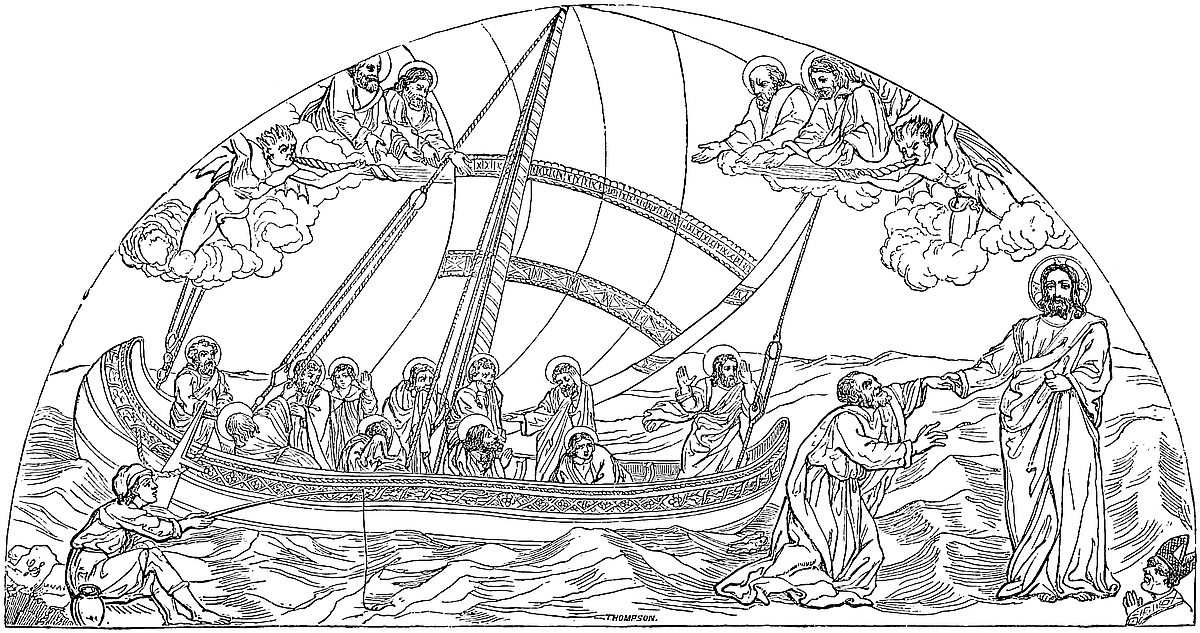
The Double or Latin Rudder, as shown in the Navicella of
Giotto. (From Eastlake.)
The date and dry-fish diet of the Gulf people is noticed by most
travellers, and P. della Valle repeats the opinion about its being the only
wholesome one. Ibn Batuta says the people of Hormuz had a saying, “Khormá
wa máhí lút-i-Pádshahi,” i.e. “Dates and fish make an Emperor’s dish!” A
fish, exactly like the tunny of the Mediterranean in general appearance
and habits, is one of the great objects of fishery off the Sind and Mekran
coasts. It comes in pursuit of shoals of anchovies, very much like the
Mediterranean fish also. (I. B. II. 231; Sir B. Frere.)
[Friar Odoric (Cathay, I. pp. 55–56) says: “And there you find (before
arriving at Hormuz) people who live almost entirely on dates, and you get
forty-two pounds of dates for less than a groat; and so of many other things.”]
Note 3.—The
stitched vessels of Kermán (πλοιάρια ῥαπτὰ) are
noticed in the Periplus. Similar accounts to those of our text are given
of the ships of the Gulf and of Western India by Jordanus and John of
Montecorvino. (Jord. p. 53; Cathay, p. 217.) “Stitched vessels,” Sir
B. Frere writes, “are still used. I have seen them of 200 tons burden; but
they are being driven out by iron-fastened vessels, as iron gets cheaper,
except where (as on the Malabar and Coromandel coasts) the pliancy of a
stitched boat is useful in a surf. Till the last few years, when steamers
have begun to take all the best horses, the Arab horses bound to Bombay
almost all came in the way Marco Polo describes.” Some of them do still,
standing over a date cargo, and the result of this combination gives
rise to an extraordinary traffic in the Bombay bazaar. From what Colonel
Pelly tells me, the stitched build in the Gulf is now confined to
fishing-boats, and is disused for sea-going craft.
[Friar Odoric (Cathay, I. p. 57) mentioned these vessels: “In this
country men make use of a kind of vessel which they call Jase, which is
fastened only with stitching of twine. On one of these vessels I embarked,
and I could find no iron at all therein.” Jase is for the Arabic
Djehaz.—H. C.]
The fish-oil used to rub the ships was whale-oil. The old Arab voyagers of
the 9th century describe the fishermen of Siraf in the Gulf as cutting up
the whale-blubber and drawing the oil from it, which was mixed with other
stuff, and used to rub the joints of ships’ planking. (Reinaud, I. 146.)
Both Montecorvino and Polo, in this passage, specify one rudder, as if
it was a peculiarity of these ships worth noting. The fact is that, in
the Mediterranean at least, the double rudders of the ancients kept their
place to a great extent through the Middle Ages. A Marseilles MS. of the
13th century, quoted in Ducange, says: “A ship requires three rudders,
two in place, and one to spare.” Another: “Every two-ruddered bark shall
pay a groat each voyage; every one-ruddered bark shall,” etc. (See Duc.
under Timonus and Temo.) Numerous proofs of the use of two rudders in
the 13th century will be found in “Documenti inediti riguardanti le due
Crociate di S. Ludovico IX., Re di Francia, etc., da L. T. Belgrano,
Genova, 1859.” Thus in a specification of ships to be built at Genoa for
the king (p. 7), each is to have “Timones duo, affaiticos, grossitudinis
palmorum viiii et dimidiae, longitudinis cubitorum xxiiii.” Extracts given
by Capmany, regarding the equipment of galleys, show the same thing, for
he is probably mistaken in saying that one of the dos timones specified
was a spare one. Joinville (p. 205) gives incidental evidence of the
same: “Those Marseilles ships have each two rudders, with each a tiller
(? tison) attached to it in such an ingenious way that you can turn the
ship right or left as fast as you would turn a horse. So on the Friday the
king was sitting upon one of these tillers, when he called me and said to
me,” etc.[4] Francesco da Barberino, a poet of the 13th century, in the 7th
part of his Documenti d’Amore (printed at Rome in 1640), which instructs
the lover to whose lot it may fall to escort his lady on a sea-voyage
(instructions carried so far as to provide even for the case of her death
at sea!), alludes more than once to these plural rudders. Thus—
“—— se vedessi avenire
Che vento ti rompesse
Timoni ...
In luogo di timoni
Fa spere
[5] e in aqua poni.” (P. 272–273.)
And again, when about to enter a port, it is needful to be on the alert and
ready to run in case of a hostile reception, so the galley should enter
stern foremost—a movement which he reminds his lover involves the reversal
of the ordinary use of the two rudders:—
“L’un timon leva suso
L’altro leggier tien giuso,
Ma convien levar mano
Non mica com soleàno,
Ma per contraro, e face
Cosi ’l guidar verace.” (P. 275.)
12th Century Illumination. (After Pertz.)
Seal of Winchelsea.
12th Century Illumination. (After Pertz.)
From Leaning Tower. (After Jal.)
After Spinello Aretini at Siena.
From Monument of St. Peter Martyr.
ILLUSTRATIONS OF THE DOUBLE RUDDER OF THE MIDDLE AGES.
A representation of a vessel over the door of the Leaning Tower at Pisa
shows this arrangement, which is also discernible in the frescoes of
galley-fights by Spinello Aretini, in the Municipal Palace at Siena.
[Godinho de Eredia (1613), describing the smaller vessels of Malacca which
he calls bâlos in ch. 13, De Embarcaçôes, says: “At the poop they have
two rudders, one on each side to steer with.” E por poupa dos bâllos, tem
2 lêmes, hum en cada lado pera o governo. (Malacca, l’ Inde mérid. et le
Cathay, Bruxelles, 1882, 4to, f. 26.)—H. C.]
The midship rudder seems to have been the more usual in the western seas,
and the double quarter-rudders in the Mediterranean. The former are
sometimes styled Navarresques and the latter Latins. Yet early seals of
some of the Cinque Ports show vessels with the double rudder; one of which
(that of Winchelsea) is given in the cut.
In the Mediterranean the latter was still in occasional use late in the
16th century. Captain Pantero Pantera in his book, L’ Armata Navale (Rome,
1614, p. 44), says that the Galeasses, or great galleys, had the helm
alla Navarresca, but also a great oar on each side of it to assist in
turning the ship. And I observe that the great galeasses which precede the
Christian line of battle at Lepanto, in one of the frescoes by Vasari in
the Royal Hall leading to the Sistine Chapel, have the quarter-rudder very
distinctly.
The Chinese appear occasionally to employ it, as seems to be indicated in
a woodcut of a vessel of war which I have traced from a Chinese book in
the National Library at Paris. (See above, p. 37.) [For the Chinese words
for rudder, see p. 126 of J. Edkins’ article on Chinese Names for Boats
and Boat Gear, Jour. N. China Br. R. As. Soc. N.S. XI. 1876.—H. C.] It
is also used by certain craft of the Indian Archipelago, as appears from
Mr. Wallace’s description of the Prau in which he sailed from Macassar to
the Aru Islands. And on the Caspian, it is stated in Smith’s “Dict. of
Antiquities” (art. Gubernaculum), the practice remained in force till
late times. A modern traveller was nearly wrecked on that sea, because the
two rudders were in the hands of two pilots who spoke different languages,
and did not understand each other!
(Besides the works quoted see Jal, Archéologie Navale, II. 437–438, and
Capmany, Memorias, III. 61.)
[Major Sykes remarks (Persia, ch. xxiii.): “Some unrecorded event,
probably the sight of the unseaworthy craft, which had not an ounce of iron
in their composition, made our travellers decide that the risks of the sea
were too great, so that we have the pleasure of accompanying them back to
Kermán and thence northwards to Khorasán.”—H. C.]
Note 4.—So also at Bander Abbási Tavernier says it was so unhealthy that
foreigners could not stop there beyond March; everybody left it in April.
Not a hundredth part of the population, says Kämpfer, remained in the city.
Not a beggar would stop for any reward! The rich went to the towns of the
interior or to the cool recesses of the mountains, the poor took refuge
in the palm-groves at the distance of a day or two from the city. A place
called ’Ishin, some 12 miles north of the city, was a favourite resort of
the European and Hindu merchants. Here were fine gardens, spacious baths,
and a rivulet of fresh and limpid water.
The custom of lying in water is mentioned also by Sir John Maundevile, and
it was adopted by the Portuguese when they occupied Insular Hormuz, as P.
della Valle and Linschoten relate. The custom is still common during great
heats, in Sind and Mekran (Sir B. F.).
An anonymous ancient geography (Liber Junioris Philosophi) speaks of a
people in India who live in the Terrestrial Paradise, and lead the life
of the Golden Age.... The sun is so hot that they remain all day in the river!
The heat in the Straits of Hormuz drove Abdurrazzak into an anticipation of
a verse familiar to English schoolboys: “Even the bird of rapid flight was
burnt up in the heights of heaven, as well as the fish in the depths of the
sea!” (Tavern. Bk. V. ch. xxiii.; Am. Exot. 716, 762; Müller, Geog.
Gr. Min. II. 514; India in XV. Cent. p. 49.)
Note 5.—A like description of the effect of the Simúm on the human body
is given by Ibn Batuta, Chardin, A. Hamilton, Tavernier, Thévenot, etc.;
and the first of these travellers speaks specially of its prevalence in the
desert near Hormuz, and of the many graves of its victims; but I have met
with no reasonable account of its poisonous action. I will quote Chardin,
already quoted at greater length by Marsden, as the most complete parallel
to the text: “The most surprising effect of the wind is not the mere fact
of its causing death, but its operation on the bodies of those who are
killed by it. It seems as if they became decomposed without losing shape,
so that you would think them to be merely asleep, when they are not merely
dead, but in such a state that if you take hold of any part of the body it
comes away in your hand. And the finger penetrates such a body as if it
were so much dust.” (III. 286.)
Burton, on his journey to Medina, says: “The people assured me that this
wind never killed a man in their Allah-favoured land. I doubt the fact.
At Bir Abbas the body of an Arnaut was brought in swollen, and decomposed
rapidly, the true diagnosis of death by the poison-wind.” Khanikoff is
very distinct as to the immediate fatality of the desert wind at Khabis,
near Kermán, but does not speak of the effect on the body after death.
This Major St. John does, describing a case that occurred in June, 1871,
when he was halting, during intense heat, at the post-house of Pasangan,
a few miles south of Kom. The bodies were brought in of two poor men,
who had tried to start some hours before sunset, and were struck down by
the poisonous blast within half-a-mile of the post-house. “It was found
impossible to wash them before burial.... Directly the limbs were touched
they separated from the trunk.” (Oc. Highways, ut. sup.) About 1790, when
Timúr Sháh of Kabul sent an army under the Sirdár-i-Sirdárán to put down
a revolt in Meshed, this force on its return was struck by Simúm in the
Plain of Farrah, and the Sirdár perished, with a great number of his men.
(Ferrier, H. of the Afghans, 102; J. R. G. S. XXVI. 217; Khan. Mém. 210.)
Note 6.—The History of Hormuz is very imperfectly known. What I have met
with on the subject consists of—(1) An abstract by Teixeira of a chronicle
of Hormuz, written by Thurán Sháh, who was himself sovereign of Hormuz,
and died in 1377; (2) some contemporary notices by Wassáf, which are
extracted by Hammer in his History of the Ilkhans; (3) some notices from
Persian sources in the 2nd Decade of De Barros (ch. ii.). The last do not
go further back than Gordun Sháh, the father of Thurán Sháh, to whom they
erroneously ascribe the first migration to the Island.
One of Teixeira’s Princes is called Ruknuddin Mahmud, and with him
Marsden and Pauthier have identified Polo’s Ruomedam Acomet, or as he is
called on another occasion in the Geog. Text, Maimodi Acomet. This,
however, is out of the question, for the death of Ruknuddin is assigned
to A.H. 675 (A.D. 1277), whilst there can, I think, be no doubt that
Marco’s account refers to the period of his return from China, viz. 1293 or
thereabouts.
We find in Teixeira that the ruler who succeeded in 1290 was Amir
Masa’úd, who obtained the Government by the murder of his brother
Saifuddin Nazrat. Masa’úd was cruel and oppressive; most of the influential
people withdrew to Baháuddin Ayaz, whom Saifuddin had made Wazir of Kalhát
on the Arabian coast. This Wazir assembled a force and drove out Masa’úd
after he had reigned three years. He fled to Kermán and died there some
years afterwards.
Baháuddin, who had originally been a slave of Saifuddin Nazrat’s, succeeded
in establishing his authority. But about 1300 great bodies of Turks
(i.e. Tartars) issuing from Turkestan ravaged many provinces of Persia,
including Kermán and Hormuz. The people, unable to bear the frequency
of such visitations, retired first to the island of Kishm, and then to
that of Jerún, on which last was built the city of New Hormuz, afterwards
so famous. This is Teixeira’s account from Thurán Sháh, so far as we
are concerned with it. As regards the transfer of the city it agrees
substantially with Abulfeda’s, which we have already quoted (supra, note 1).
Hammer’s account from Wassáf is frightfully confused, chiefly I should
suppose from Hammer’s own fault; for among other things he assumes that
Hormuz was always on an island, and he distinguishes between the Island
of Hormuz and the Island of Jerún! We gather, however, that Hormuz before
the Mongol time formed a government subordinate to the Salghur Atabegs of
Fars (see note 1, ch. xv.), and when the power of that Dynasty was falling,
the governor Mahmúd Kalháti, established himself as Prince of Hormuz, and
became the founder of a petty dynasty, being evidently identical with
Teixeira’s Ruknuddin Mahmud above-named, who is represented as reigning
from 1246 to 1277. In Wassáf we find, as in Teixeira, Mahmúd’s son Masa’úd
killing his brother Nazrat, and Baháuddin expelling Masa’úd. It is true
that Hammer’s surprising muddle makes Nazrat kill Masa’úd; however, as
a few lines lower we find Masa’úd alive and Nazrat dead, we may safely
venture on this correction. But we find also that Masa’úd appears as
Ruknuddin Masa’úd, and that Baháuddin does not assume the princely
authority himself, but proclaims that of Fakhruddin Ahmed Ben Ibrahim
At-Thaibi, a personage who does not appear in Teixeira at all. A MS.
history, quoted by Ouseley, does mention Fakhruddin, and ascribes to him
the transfer to Jerún. Wassáf seems to allude to Baháuddin as a sort of Sea
Rover, occupying the islands of Larek and Jerún, whilst Fakhruddin reigned
at Hormuz. It is difficult to understand the relation between the two.
It is possible that Polo’s memory made some confusion between the names
of Ruknuddin Masa’úd and Fakhruddin Ahmed, but I incline to think the
latter is his Ruomedan Ahmed. For Teixeira tells us that Masa’úd took
refuge at the court of Kermán, and Wassáf represents him as supported in
his claims by the Atabeg of that province, whilst we see that Polo seems to
represent Ruomedan Acomat as in hostility with that prince. To add to the
imbroglio I find in a passage of Wassáf Malik Fakhruddin Ahmed at-Thaibi
sent by Ghazan Khan in 1297 as ambassador to Khanbalig, staying there some
years, and dying off the Coromandel coast on his return in 1305. (Elliot,
iii. pp. 45–47.)
Masa’úd’s seeking help from Kermán to reinstate him is not the first case
of the same kind that occurs in Teixeira’s chronicle, so there may have
been some kind of colour for Marco’s representation of the Prince of Hormuz
as the vassal of the Atabeg of Kermán (“l’homme de cest roy de Creman;”
see Prologue, ch. xiv. note 2). M. Khanikoff denies the possibility
of the existence of any royal dynasty at Hormuz at this period. That
there was a dynasty of Maliks of Hormuz, however, at this period we
must believe on the concurring testimony of Marco, of Wassáf, and of
Thurán Sháh. There was also, it would seem, another quasi-independent
principality in the Island of Kais. (Hammer’s Ilch. II. 50, 51;
Teixeira, Relacion de los Reyes de Hormuz; Khan. Notice, p. 34.)
The ravages of the Tartars which drove the people of Hormuz from their city
may have begun with the incursions of the Nigudaris and Karaunahs, but they
probably came to a climax in the great raid in 1299 of the Chaghataian
Prince Kotlogh Shah, son of Dua Khan, a part of whose bands besieged the
city itself, though they are said to have been repulsed by Baháuddin Ayas.
[The Dynasty of Hormuz was founded about 1060 by a Yemen chief Mohammed
Dirhem Ko, and remained subject to Kermán till 1249, when Rokn ed-din
Mahmúd III. Kalháti (1242–1277) made himself independent. The immediate
successors of Rokn ed-din were Saif ed-din Nazrat (1277–1290), Masa’úd
(1290–1293), Bahad ed-din Ayaz Sayfin (1293–1311). Hormuz was captured by
the Portuguese in 1510 and by the Persians in 1622.—H. C.]
Note 7.—The indications of this alternative route to Kermán are very vague,
but it may probably have been that through Finn, Tárum, and the Sírján
district, passing out of the plain of Hormuz by the eastern flank of the
Ginao mountain. This road would pass near the hot springs at the base
of the said mountain, Sarga, Khurkhu, and Ginao, which are described by
Kämpfer. Being more or less sulphureous they are likely to be useful in
skin-diseases: indeed, Hamilton speaks of their efficacy in these. (I. 95.)
The salt-streams are numerous on this line, and dates are abundant. The
bitterness of the bread was, however, more probably due to another cause,
as Major Smith has kindly pointed out to me: “Throughout the mountains in
the south of Persia, which are generally covered with dwarf oak, the people
are in the habit of making bread of the acorns, or of the acorns mixed
with wheat or barley. It is dark in colour, and very hard, bitter, and
unpalatable.”
Major St. John also noticed the bitterness of the bread in Kermán, but his
servants attributed it to the presence in the wheat-fields of a bitter
leguminous plant, with a yellowish white flower, which the Kermánis were
too lazy to separate, so that much remained in the thrashing, and imparted
its bitter flavour to the grain (surely the Tare of our Lord’s Parable!).
[General Houtum-Schindler says (l.c. p. 496): “Marco Polo’s return
journey was, I am inclined to think, viâ Urzú and Báft, the shortest and
most direct road. The road viâ Tárum and Sírján is very seldom taken by
travellers intending to go to Kermán; it is only frequented by the caravans
going between Bender ’Abbás and Bahrámábád, three stages west of Kermán.
Hot springs, ‘curing itch,’ I noticed at two places on the Urzú-Báft
road. There were some near Qal’ah Asgher and others near Dashtáb; they
were frequented by people suffering from skin-diseases, and were highly
sulphureous; the water of those near Dashtáb turned a silver ring black
after two hours’ immersion. Another reason of my advocating the Urzú road
is that the bitter bread spoken of by Marco Polo is only found on it,
viz. at Báft and in Bardshír. In Sírján, to the west, and on the roads to
the east, the bread is sweet. The bitter taste is from the Khúr, a bitter
leguminous plant, which grows among the wheat, and whose grains the people
are too lazy to pick out. There is not a single oak between Bender ’Abbás
and Kermán; none of the inhabitants seemed to know what an acorn was. A
person at Báft, who had once gone to Kerbelá viâ Kermánsháh and Baghdád,
recognised my sketch of tree and fruit immediately, having seen oak and
acorn between Kermánsháh and Qasr-i-Shírín on the Baghdád road.” Major
Sykes writes (ch. xxiii.): “The above description undoubtedly refers to
the main winter route, which runs viâ Sírján. This is demonstrated by the
fact that under the Kuh-i-Ginao, the summer station of Bandar Abbás, there
is a magnificent sulphur spring, which, welling from an orifice 4 feet in
diameter, forms a stream some 30 yards wide. Its temperature at the source
is 113 degrees, and its therapeutic properties are highly appreciated. As
to the bitterness of the bread, it is suggested in the notes that it was
caused by being mixed with acorns, but, to-day at any rate, there are no
oak forests in this part of Persia, and I would urge that it is better to
accept our traveller’s statement, that it was due to the bitterness of the
water.”—However, I prefer Gen. Houtum-Schindler’s theory.—H. C.]
Of the Wearisome and Desert Road that has now to be travelled.
On departing from the city of Kerman you find the road for seven days most
wearisome; and I will tell you how this is.{1} The first three days
you meet with no water, or next to none. And what little you do meet with
is bitter green stuff, so salt that no one can drink it; and in fact if you
drink a drop of it, it will set you purging ten times at least by the way.
It is the same with the salt which is made from those streams; no one dares
to make use of it, because of the excessive purging which it occasions.
Hence it is necessary to carry water for the people to last these three
days; as for the cattle, they must needs drink of the bad water I have
mentioned, as there is no help for it, and their great thirst makes them do
so. But it scours them to such a degree that sometimes they die of it. In
all those three days you meet with no human habitation; it is all desert,
and the extremity of drought. Even of wild beasts there are none, for there
is nothing for them to eat.{2}
After those three days of desert [you arrive at a stream of fresh water
running underground, but along which there are holes broken in here and
there, perhaps undermined by the stream, at which you can get sight of it.
It has an abundant supply, and travellers, worn with the hardships of the
desert, here rest and refresh themselves and their beasts.]{3}
You then enter another desert which extends for four days; it is very
much like the former except that you do see some wild asses. And at the
termination of these four days of desert the kingdom of Kerman comes to an
end, and you find another city which is called Cobinan.
Note 1. [“The present road from Kermán to Kúbenán is to Zerend about 50
miles, to the Sár i Benán 15 miles, thence to Kúbenán 30 miles—total 95
miles. Marco Polo cannot have taken the direct road to Kúbenán, as it took
him seven days to reach it. As he speaks of waterless deserts, he probably
took a circuitous route to the east of the mountains, viâ Kúhpáyeh and
the desert lying to the north of Khabis.” (Houtum-Schindler, l.c. pp.
496–497.) (Cf. Major Sykes, ch. xxiii.)—H. C.]
Note 2.—This description of the Desert of Kermán, says Mr. Khanikoff,
“is very correct. As the only place in the Desert of Lút where water is
found is the dirty, salt, bitter, and green water of the rivulet called
Shor-Rúd (the Salt River), we can have no doubt of the direction of
Marco Polo’s route from Kermán so far.” Nevertheless I do not agree with
Khanikoff that the route lay N.E. in the direction of Ambar and Kain, for
a reason which will appear under the next chapter. I imagine the route to
have been nearly due north from Kermán, in the direction of Tabbas or of
Tún. And even such a route would, according to Khanikoff’s own map, pass
the Shor-Rúd, though at a higher point.
I extract a few lines from that gentleman’s narrative: “In proportion as we
got deeper into the desert, the soil became more and more arid; at daybreak
I could still discover a few withered plants of Caligonum and Salsola,
and not far from the same spot I saw a lark and another bird of a whitish
colour, the last living things that we beheld in this dismal solitude....
The desert had now completely assumed the character of a land accursed,
as the natives call it. Not the smallest blade of grass, no indication of
animal life vivified the prospect; no sound but such as came from our own
caravan broke the dreary silence of the void.” (Mém. p. 176.)
[Major P. Molesworth Sykes (Geog. Jour. X. p. 578) writes: “At Tun, I
was on the northern edge of the great Dash-i-Lut (Naked Desert), which lay
between us and Kerman, and which had not been traversed, in this particular
portion, since the illustrious Marco Polo crossed it, in the opposite
direction, when travelling from Kerman to ‘Tonocain’ viâ Cobinan.” Major
Sykes (Persia, ch. iii.) seems to prove that geographers have, without
sufficient grounds, divided the great desert of Persia into two regions,
that to the north being termed Dasht-i-Kavir, and that further south the
Dasht-i-Lut—and that Lut is the one name for the whole desert, Dash-i-Lut
being almost a redundancy, and that Kavir (the Arabic Kafr) is applied
to every saline swamp. “This great desert stretches from a few miles out
of Tehrán practically to the British frontier, a distance of about 700
miles.”—H. C.]
Note 3.—I can have no doubt of the genuineness of this passage from
Ramusio. Indeed some such passage is necessary; otherwise why distinguish
between three days of desert and four days more of desert? The underground
stream was probably a subterraneous canal (called Kanát or Kárez),
such as is common in Persia; often conducted from a great distance. Here
it may have been a relic of abandoned cultivation. Khanikoff, on the
road between Kermán and Yezd, not far west of that which I suppose Marco
to be travelling, says: “At the fifteen inhabited spots marked upon the
map, they have water which has been brought from a great distance, and at
considerable cost, by means of subterranean galleries, to which you descend
by large and deep wells. Although the water flows at some depth, its course
is tracked upon the surface by a line of more abundant vegetation.” (Ib.
p. 200.) Elphinstone says he has heard of such subterranean conduits 36
miles in length. (I. 398.) Polybius speaks of them: “There is no sign of
water on the surface; but there are many underground channels, and these
supply tanks in the desert, that are known only to the initiated.... At the
time when the Persians got the upper hand in Asia, they used to concede
to such persons as brought spring-water to places previously destitute of
irrigation, the usufruct for five generations. And Taurus being rife with
springs, they incurred all the expense and trouble that was needed to form
these underground channels to great distances, insomuch that in these days
even the people who make use of the water don’t know where the channels
begin, or whence the water comes.” (X. 28.)
Concerning the City of Cobinan and the things that are made there.
Cobinan is a large town.{1} The people worship Mahommet. There is much
Iron and Steel and Ondanique, and they make steel mirrors of great size
and beauty. They also prepare both Tutia (a thing very good for the eyes)
and Spodium; and I will tell you the process.
They have a vein of a certain earth which has the required quality, and
this they put into a great flaming furnace, whilst over the furnace there
is an iron grating. The smoke and moisture, expelled from the earth of
which I speak, adhere to the iron grating, and thus form Tutia, whilst
the slag that is left after burning is the Spodium.{2}
Note 1.—Kuh-Banán is mentioned by Moḳaddasi (A.D. 985) as one of the cities
of Bardesír, the most northerly of the five circles into which he divides
Kermán. (See Sprenger, Post-und Reise-routen des Orients, p. 77.) It
is the subject of an article in the Geog. Dictionary of Yáḳút, though it
has been there mistranscribed into Kubiyán and Kukiyán. (See Leipzig
ed. 1869, iv. p. 316, and Barbier de Meynard, Dict. de la Perse, p.
498.) And it is also indicated by Mr. Abbott (J. R. G. S. XXV. 25) as
the name of a district of Kermán, lying some distance to the east of his
route when somewhat less than half-way between Yezd and Kermán. It would
thus, I apprehend, be on or near the route between Kermán and Tabbas; one
which I believe has been traced by no modern traveller. We may be certain
that there is now no place at Kuh-Banán deserving the title of une cité
grant, nor is it easy to believe that there was in Polo’s time; he applies
such terms too profusely. The meaning of the name is perhaps “Hill of the
Terebinths, or Wild Pistachioes,” “a tree which grows abundantly in the
recesses of bleak, stony, and desert mountains, e.g. about Shamákhi, about
Shiraz, and in the deserts of Luristan and Lar.” (Kämpfer, 409, 413.)
[“It is strange that Marco Polo speaks of Kúbenán only on his return
journey from Kermán; on the down journey he must have been told that
Kúbenán was in close proximity; it is even probable that he passed there,
as Persian travellers of those times, when going from Kermán to Yazd, and
vice versá, always called at Kúbenán.” (Houtum-Schindler, l.c. p.
490.) In all histories this name is written Kúbenán, not Kúhbenán; the
pronunciation to-day is Kóbenán and Kobenún.—H. C.]
I had thought my identification of Cobinan original, but a communication
from Mr. Abbott, and the opportunity which this procured me of seeing his
MS. Report already referred to, showed that he had anticipated me many
years ago. The following is an extract: “Districts of Kerman * * * Kooh
Benan. This is a hilly district abounding in fruits, such as grapes,
peaches, pomegranates, sinjid (sweet-willow), walnuts, melons. A great
deal of madder and some asafœtida is produced there. This is no doubt the
country alluded to by Marco Polo, under the name of Cobinam, as producing
iron, brass, and tutty, and which is still said to produce iron, copper,
and tootea.” There appear to be lead mines also in the district, as well as
asbestos and sulphur. Mr. Abbott adds the names of nine villages, which he
was not able to verify by comparison. These are Púz, Tarz, Gújard, Aspaj,
Kuh-i-Gabr, Dahnah, Búghín, Bassab, Radk. The position of Kuh Banán is
stated to lie between Bahabád (a place also mentioned by Yáḳút as producing
Tutia) and Ráví, but this does not help us, and for approximate position
we can only fall back on the note in Mr. Abbott’s field-book, as published
in the J. R. G. S., viz. that the District lay in the mountains E.S.E.
from a caravanserai 10 miles S.E. of Gudran. To get the seven marches of
Polo’s Itinerary we must carry the Town of Kuh Banán as far north as this
indication can possibly admit, for Abbott made only five and a half marches
from the spot where this observation was made to Kermán. Perhaps Polo’s
route deviated for the sake of the fresh water. That a district, such as
Mr. Abbott’s Report speaks of, should lie unnoticed, in a tract which our
maps represent as part of the Great Desert, shows again how very defective
our geography of Persia still is.
[“During the next stage to Darband, we passed ruins that I believe to be
those of Marco Polo’s ‘Cobinan’ as the modern Kúhbenán does not at all
fit in with the great traveller’s description, and it is just as well to
remember that in the East the caravan routes seldom change.” (Captain P. M.
Sykes, Geog. Jour. X. p. 580.—See Persia, ch. xxiii.)
Kuh Banán has been visited by Mr. E. Stack, of the Indian Civil Service.
(Six Months in Persia, London, 1882, I. 230.)—H. C.]
Note 2.—Tutty (i.e. Tutia) is in modern English an impure oxide of
zinc, collected from the flues where brass is made; and this appears to
be precisely what Polo describes, unless it be that in his account the
production of tutia from an ore of zinc is represented as the object and
not an accident of the process. What he says reads almost like a condensed
translation of Galen’s account of Pompholyx and Spodos: “Pompholyx
is produced in copper-smelting as Cadmia is; and it is also produced
from Cadmia (carbonate of zinc) when put in the furnace, as is done (for
instance) in Cyprus. The master of the works there, having no copper ready
for smelting, ordered some pompholyx to be prepared from cadmia in my
presence. Small pieces of cadmia were thrown into the fire in front of
the copper-blast. The furnace top was covered, with no vent at the crown,
and intercepted the soot of the roasted cadmia. This, when collected,
constitutes Pompholyx, whilst that which falls on the hearth is called
Spodos, a great deal of which is got in copper-smelting.” Pompholyx, he
adds, is an ingredient in salves for eye discharges and pustules. (Galen,
De Simpl. Medic., p. ix. in Latin ed., Venice, 1576.) Matthioli, after
quoting this, says that Pompholyx was commonly known in the laboratories by
the Arabic name of Tutia. I see that pure oxide of zinc is stated to form
in modern practice a valuable eye-ointment.
Teixeira speaks of tutia as found only in Kermán, in a range of mountains
twelve parasangs from the capital. The ore got here was kneaded with
water, and set to bake in crucibles in a potter’s kiln. When well baked,
the crucibles were lifted and emptied, and the tutia carried in boxes
to Hormuz for sale. This corresponds with a modern account in Milburne,
which says that the tutia imported to India from the Gulf is made from an
argillaceous ore of zinc, which is moulded into tubular cakes, and baked
to a moderate hardness. The accurate Garcia da Horta is wrong for once in
saying that the tutia of Kermán is no mineral, but the ash of a certain
tree called Goan.
(Matth. on Dioscorides, Ven. 1565, pp. 1338–40; Teixeira, Relacion de
Persia, p. 121; Milburne’s Or. Commerce, I. 139; Garcia, f. 21 v.;
Eng. Cyc., art. Zinc.)
[General A. Houtum-Schindler (Jour. R. As. Soc. N.S. XIII. October, 1881,
p. 497) says: “The name Tútíá for collyrium is now not used in Kermán.
Tútíá, when the name stands alone, is sulphate of copper, which in other
parts of Persia is known as Kát-i-Kebúd; Tútíá-i-sabz (green Tútíá) is
sulphate of iron, also called Záj-i-síyah. A piece of Tútíá-i-zard (yellow
Tútíá) shown to me was alum, generally called Záj-i-safíd; and a piece of
Tútíá-í-safíd (white Tútíá) seemed to be an argillaceous zinc ore. Either
of these may have been the earth mentioned by Marco Polo as being put into
the furnace. The lampblack used as collyrium is always called Surmah. This
at Kermán itself is the soot produced by the flame of wicks, steeped in
castor oil or goat’s fat, upon earthenware saucers. In the high mountainous
districts of the province, Kúbenán, Páríz, and others, Surmah is the soot
of the Gavan plant (Garcia’s goan). This plant, a species of Astragalus,
is on those mountains very fat and succulent; from it also exudes the
Tragacanth gum. The soot is used dry as an eye-powder, or, mixed with
tallow, as an eye-salve. It is occasionally collected on iron gratings.
“Tútíá is the Arabicised word dúdhá, Persian for smokes.
“The Shems-ul-loghát calls Tútíá a medicine for eyes, and a stone used for
the fabrication of Surmah. The Tohfeh says Tútíá is of three kinds—yellow
and blue mineral Tútíá, Tútíá-i-qalam (collyrium) made from roots, and
Tútíá resulting from the process of smelting copper ore. ‘The best
Tútíá-i-qalam comes from Kermán.’ It adds, ‘Some authors say Surmah is
sulphuret of antimony, others say it is a composition of iron’; I should
say any black composition used for the eyes is Surmah, be it lampblack,
antimony, iron, or a mixture of all.
“Teixeira’s Tútíá was an impure oxide of zinc, perhaps the above-mentioned
Tútíá-i-safíd, baked into cakes; it was probably the East India Company’s
Lapis Tútíá, also called Tutty. The Company’s Tutenague and Tutenage,
occasionally confounded with Tutty, was the so-called ‘Chinese Copper,’ an
alloy of copper, zinc, and iron, brought from China.”
Major Sykes (ch. xxiii.) writes: “I translated Marco’s description of
tutia (which is also the modern Persian name), to a khán of Kubenán,
and he assured me that the process was the same to-day; spodium he knew
nothing about, but the sulphate of zinc is found in the hills to the east
of Kubenán.”
Heyd (Com. II. p. 675) says in a note: “Il résulte de l’ensemble de ce
passage que les matières désignées par Marco Polo sous le nom de ‘espodie’
(spodium) étaient des scories métalliques; en général, le mot spodium
désigne les résidus de la combustion des matières végétales ou des os (de
l’ivoire).”—H. C.]
Of a certain Desert that continues for eight days’ Journey.
When you depart from this City of Cobinan, you find yourself again in a
Desert of surpassing aridity, which lasts for some eight days; here are
neither fruits nor trees to be seen, and what water there is is bitter and
bad, so that you have to carry both food and water. The cattle must needs
drink the bad water, will they nill they, because of their great thirst.
At the end of those eight days you arrive at a Province which is called
Tonocain. It has a good many towns and villages, and forms the extremity
of Persia towards the North.{1} It also contains an immense plain on
which is found the Arbre Sol, which we Christians call the Arbre Sec; and
I will tell you what it is like. It is a tall and thick tree, having the
bark on one side green and the other white; and it produces a rough husk
like that of a chestnut, but without anything in it. The wood is yellow
like box, and very strong, and there are no other trees near it nor within
a hundred miles of it, except on one side, where you find trees within
about ten miles’ distance. And there, the people of the country tell you,
was fought the battle between Alexander and King Darius.{2}
The towns and villages have great abundance of everything good, for the
climate is extremely temperate, being neither very hot nor very cold.
The natives all worship Mahommet, and are a very fine-looking people,
especially the women, who are surpassingly beautiful.
Note 1.—All that region has been described as “a country divided into
deserts that are salt, and deserts that are not salt.” (Vigne, I. 16.)
Tonocain, as we have seen (ch. xv. note 1), is the Eastern Kuhistan of
Persia, but extended by Polo, it would seem to include the whole of Persian
Khorasan. No city in particular is indicated as visited by the traveller,
but the view I take of the position of the Arbre Sec, as well as his
route through Kuh-Banán, would lead me to suppose that he reached the
Province of Tun-o-Kain about Tabbas.
[“Marco Polo has been said to have traversed a portion of (the
Dash-i-Kavir, great Salt Desert) on his supposed route from Tabbas to
Damghan, about 1272; although it is more probable that he marched further
to the east, and crossed the northern portion of the Dash-i-Lut, Great Sand
Desert, separating Khorasan in the south-east from Kermán, and occupying a
sorrowful parallelogram between the towns of Neh and Tabbas on the north,
and Kermán and Yezd on the south.” (Curzon, Persia, II. pp. 248 and
251.) Lord Curzon adds in a note (p. 248): “The Tunogan of the text which
was originally mistaken for Damghan, is correctly explained by Yule as
Tun-o- (i.e. and) Káin.” Major Sykes writes (ch. xxiii.): “The section of
the Lut has not hitherto been rediscovered, but I know that it is desert
throughout, and it is practically certain that Marco ended these unpleasant
experiences at Tabas, 150 miles from Kubenán. To-day the district is known
as Tun-o-Tabas, Káin being independent of it.”—H. C.]
Note 2.—This is another subject on which a long and somewhat discursive
note is inevitable.
One of the Bulletins of the Soc. de Géographie (sér. III. tom. iii. p. 187)
contains a perfectly inconclusive endeavour, by M. Roux de Rochelle, to
identify the Arbre Sec or Arbre Sol with a manna-bearing oak alluded
to by Q. Curtius as growing in Hyrcania. There can be no doubt that the
tree described is, as Marsden points out, a Chínár or Oriental Plane. Mr.
Ernst Meyer, in his learned Geschichte der Botanik (Königsberg, 1854–57,
IV. 123), objects that Polo’s description of the wood does not answer to
that tree. But, with due allowance, compare with his whole account that
which Olearius gives of the Chinar, and say if the same tree be not meant.
“The trees are as tall as the pine, and have very large leaves, closely
resembling those of the vine. The fruit looks like a chestnut, but has
no kernel, so it is not eatable. The wood is of a very brown colour, and
full of veins; the Persians employ it for doors and window-shutters, and
when these are rubbed with oil they are incomparably handsomer than our
walnut-wood joinery.” (I. 526.) The Chinar-wood is used in Kashmir for
gunstocks.
The whole tenor of the passage seems to imply that some eminent
individual Chinar is meant. The appellations given to it vary in the
different texts. In the G. T. it is styled in this passage, “The Arbre
Seule which the Christians call the Arbre Sec,” whilst in ch. cci.
of the same (infra, Bk. IV. ch. v.) it is called “L’Arbre Sol, which
in the Book of Alexander is called L’Arbre Seche.” Pauthier has here
“L’Arbre Solque, que nous appelons L’Arbre Sec,” and in the later
passage “L’Arbre Seul, que le Livre Alexandre appelle Arbre Sec;”
whilst Ramusio has here “L’Albero del Sole che si chiama per i Cristiani
L’Albor Secco,” and does not contain the later passage. So also I think
all the old Latin and French printed texts, which are more or less based on
Pipino’s version, have “The Tree of the Sun, which the Latins call the
Dry Tree.”
[G. Capus says (A travers le roy. de Tamerlan, p. 296) that he found
at Khodjakent, the remains of an enormous plane-tree or Chinar, which
measured no less than 48 metres (52 yards) in circumference at the base,
and 9 metres diameter inside the rotten trunk; a dozen tourists from
Tashkent one day feasted inside, and were all at ease.—H. C.]
Pauthier, building as usual on the reading of his own text (Solque),
endeavours to show that this odd word represents Thoulk, the Arabic name
of a tree to which Forskal gave the title of Ficus Vasta, and this Ficus
Vasta he will have to be the same as the Chinar. Ficus Vasta would be a
strange name surely to give to a Plane-tree, but Forskal may be acquitted
of such an eccentricity. The Tholaḳ (for that seems to be the proper
vocalisation) is a tree of Arabia Felix, very different from the Chinar,
for it is the well-known Indian Banyan, or a closely-allied species, as
may be seen in Forskal’s description. The latter indeed says that the
Arab botanists called it Delb, and that (or Dulb) is really a synonym
for the Chinar. But De Sacy has already commented upon this supposed
application of the name Delb to the Tholaḳ as erroneous. (See Flora
Aegyptiaco-Arabica, pp. cxxiv. and 179; Abdallatif, Rel. de l’Egypte, p.
80; J. R. G. S. VIII. 275; Ritter, VI. 662, 679.)
The fact is that the Solque of M. Pauthier’s text is a mere copyist’s
error in the reduplication of the pronoun que. In his chief MS. which
he cites as A (No. 10,260 of Bibl. Nationale, now Fr. 5631) we can even
see how this might easily happen, for one line ends with Solque and the
next begins with que. The true reading is, I doubt not, that which this
MS. points to, and which the G. Text gives us in the second passage quoted
above, viz. Arbre Sol, occurring in Ramusio as Albero del Sole. To make
this easier of acceptation I must premise two remarks: first, that Sol is
“the Sun” in both Venetian and Provençal; and, secondly, that in the French
of that age the prepositional sign is not necessary to the genitive.
Thus, in Pauthier’s own text we find in one of the passages quoted above,
“Le Livre Alexandre, i.e. Liber Alexandri;” elsewhere, “Cazan le fils
Argon,” “à la mère sa femme,” “Le corps Monseigneur Saint Thomas si est
en ceste Province;” in Joinville, “le commandemant Mahommet”, “ceux de
la Haulequa estoient logiez entour les héberges le soudanc, et establiz
pour le cors le soudanc garder;” in Baudouin de Sebourc, “De l’amour
Bauduin esprise et enflambée.”
Moreover it is the Tree of the Sun that is prominent in the legendary
History of Alexander, a fact sufficient in itself to rule the reading. A
character in an old English play says:—
“Peregrine. Drake was a didapper to Mandevill:
Candish and Hawkins, Frobisher, all our Voyagers
Went short of Mandevil. But had he reached
To this place—here—yes, here—this wilderness,
And seen the Trees of the Sun and Moon, that speak
And told King Alexander of his death;
He then
Had left a passage ope to Travellers
That now is kept and guarded by Wild Beasts.”
(Broome’s Antipodes, in Lamb’s Specimens.)
The same trees are alluded to in an ancient Low German poem in honour of
St. Anno of Cologne. Speaking of the Four Beasts of Daniel’s Vision:—
“The third beast was a Libbard;
Four Eagle’s Wings he had;
This signified the Grecian Alexander,
Who with four Hosts went forth to conquer lands
Even to the World’s End,
Known by its Golden Pillars.
In India he the Wilderness broke through
With Trees twain he there did speak,” etc.
(In
Schilteri Thesaurus Antiq. Teuton. tom. i.
[1])
These oracular Trees of the Sun and Moon, somewhere on the confines
of India, appear in all the fabulous histories of Alexander, from the
Pseudo-Callisthenes downwards. Thus Alexander is made to tell the story
in a letter to Aristotle: “Then came some of the towns-people and said,
‘We have to show thee something passing strange, O King, and worth thy
visiting; for we can show thee trees that talk with human speech.’ So they
led me to a certain park, in the midst of which were the Sun and Moon, and
round about them a guard of priests of the Sun and Moon. And there stood
the two trees of which they had spoken, like unto cypress trees; and round
about them were trees like the myrobolans of Egypt, and with similar fruit.
And I addressed the two trees that were in the midst of the park, the one
which was male in the Masculine gender, and the one that was female in
the Feminine gender. And the name of the Male Tree was the Sun, and of
the female Tree the Moon, names which were in that language Muthu and
Emaūsae.[2] And the stems were clothed with the skins of animals; the
male tree with the skins of he-beasts, and the female tree with the skins
of she-beasts.... And at the setting of the Sun, a voice, speaking in the
Indian tongue, came forth from the (Sun) Tree; and I ordered the Indians
who were with me to interpret it. But they were afraid and would not,” etc.
(Pseudo-Callisth. ed. Müller, III. 17.)
The story as related by Firdusi keeps very near to the Greek as just
quoted, but does not use the term “Tree of the Sun.” The chapter of the
Sháh Námeh containing it is entitled Dídan Sikandar dirakht-i-goyárá,
“Alexander’s interview with the Speaking Tree.” (Livre des Rois, V. 229.)
In the Chanson d’Alixandre of Lambert le Court and Alex. de Bernay, these
trees are introduced as follows:—
“‘Signor,’ fait Alixandre, ‘je vus voel demander,
Se des merveilles d’Inde me saves rien conter.’
Cil li ont respondu: ‘Se tu vius escouter
Ja te dirons merveilles, s’es poras esprover.
La sus en ces desers pues ii Arbres trover
Qui c pies ont de haut, et de grossor sunt per.
Li Solaus et La Lune les ont fait si serer
Que sevent tous langages et entendre et parler.’”
(Ed. 1861 (Dinan), p. 357.)
Maundevile informs us precisely where these trees are: “A 15 journeys in
lengthe, goynge be the Deserts of the tother side of the Ryvere Beumare,”
if one could only tell where that is![3] A mediæval chronicler also tells
us that Ogerus the Dane (temp. Caroli Magni) conquered all the parts
beyond sea from Hierusalem to the Trees of the Sun. In the old Italian
romance also of Guerino detto il Meschino, still a chapbook in S. Italy,
the Hero (ch. lxiii.) visits the Trees of the Sun and Moon. But this is
mere imitation of the Alexandrian story, and has nothing of interest.
(Maundevile, pp. 297–298; Fasciculus Temporum in Germ. Script.
Pistorii Nidani, II.)
It will be observed that the letter ascribed to Alexander describes the
two oracular trees as resembling two cypress-trees. As such the Trees of
the Sun and Moon are represented on several extant ancient medals, e.g.
on two struck at Perga in Pamphylia in the time of Aurelian. And Eastern
story tells us of two vast cypress-trees, sacred among the Magians, which
grew in Khorasan, one at Kashmar near Turshiz, and the other at Farmad near
Tuz, and which were said to have risen from shoots that Zoroaster brought
from Paradise. The former of these was sacrilegiously cut down by the order
of the Khalif Motawakkil, in the 9th century. The trunk was despatched to
Baghdad on rollers at a vast expense, whilst the branches alone formed a
load for 1300 camels. The night that the convoy reached within one stage of
the palace, the Khalif was cut in pieces by his own guards. This tree was
said to be 1450 years old, and to measure 33¾ cubits in girth. The locality
of this “Arbor Sol” we see was in Khorasan, and possibly its fame may
have been transferred to a representative of another species. The plane,
as well as the cypress, was one of the distinctive trees of the Magian
Paradise.
In the Peutingerian Tables we find in the N.E. of Asia the rubric “Hic
Alexander Responsum accepit,” which looks very like an allusion to the
tale of the Oracular Trees. If so, it is remarkable as a suggestion of
the antiquity of the Alexandrian Legends, though the rubric may of course
be an interpolation. The Trees of the Sun and Moon appear as located in
India Ultima to the east of Persia, in a map which is found in MSS. (12th
century) of the Floridus of Lambertus; and they are indicated more or
less precisely in several maps of the succeeding centuries. (Ouseley’s
Travels, I. 387; Dabistan, I. 307–308; Santarem, H. de la Cosmog. II.
189, III. 506–513, etc.)
Nothing could show better how this legend had possessed men in the Middle
Ages than the fact that Vincent of Beauvais discerns an allusion to these
Trees of the Sun and Moon in the blessing of Moses on Joseph (as it runs in
the Vulgate), “de pomis fructuum Solis ac Lunae.” (Deut. xxxiii. 14.)
Marco has mixt up this legend of the Alexandrian Romance, on the authority,
as we shall see reason to believe, of some of the recompilers of that
Romance, with a famous subject of Christian Legend in that age, the Arbre
Sec or Dry Tree, one form of which is related by Maundevile and by Johan
Schiltberger. “A lytille fro Ebron,” says the former, “is the Mount of
Mambre, of the whyche the Valeye taketh his name. And there is a Tree of
Oke that the Saracens clepen Dirpe, that is of Abraham’s Tyme, the which
men clepen the Drye Tree.” [Schiltberger adds that the heathen call it
Kurru Thereck, i.e. (Turkish) Ḳúrú Dirakht = Dry Tree.] “And theye seye
that it hathe ben there sithe the beginnynge of the World; and was sumtyme
grene and bare Leves, unto the Tyme that Oure Lord dyede on the Cros; and
thanne it dryede; and so dyden alle the Trees that weren thanne in the
World. And summe seyn be hire Prophecyes that a Lord, a Prynce of the West
syde of the World, shalle wynnen the Lond of Promyssioun, i.e. the Holy
Lond, withe Helpe of Cristene Men, and he schalle do synge a Masse under
that Drye Tree, and than the Tree shall wexen grene and bere both Fruyt
and Leves. And thorghe that Myracle manye Sarazines and Jewes schulle ben
turned to Cristene Feithe. And, therefore, they dou gret Worschipe thereto,
and kepen it fulle besyly. And alle be it so that it be drye, natheless yit
he berethe great vertue,” etc.
The tradition seems to have altered with circumstances, for a traveller
of nearly two centuries later (Friar Anselmo, 1509) describes the oak of
Abraham at Hebron as a tree of dense and verdant foliage: “The Saracens
make their devotions at it, and hold it in great veneration, for it has
remained thus green from the days of Abraham until now; and they tie scraps
of cloth on its branches inscribed with some of their writing, and believe
that if any one were to cut a piece off that tree he would die within the
year.” Indeed even before Maundevile’s time Friar Burchard (1283) had
noticed that though the famous old tree was dry, another had sprung from
its roots. And it still has a representative.
As long ago as the time of Constantine a fair was held under the Terebinth
of Mamre, which was the object of many superstitious rites and excesses.
The Emperor ordered these to be put a stop to, and a church to be
erected at the spot. In the time of Arculph (end of 7th century) the dry
trunk still existed under the roof of this church; just as the immortal
Banyan-tree of Prág exists to this day in a subterranean temple in the Fort
of Allahabad.
It is evident that the story of the Dry Tree had got a great vogue in the
13th century. In the Jus du Pelerin, a French drama of Polo’s age, the
Pilgrim says:—
“S’ai puis en maint bon lieu et à maint saint esté,
S’ai esté au Sec-Arbre et dusc’à Duresté.”
And in another play of slightly earlier date (Le Jus de St. Nicolas),
the King of Africa, invaded by the Christians, summons all his allies
and feudatories, among whom appear the Admirals of Coine (Iconium)
and Orkenie (Hyrcania), and the Amiral d’outre l’Arbre-Sec (as it
were of “the Back of Beyond”) in whose country the only current coin is
millstones! Friar Odoric tells us that he heard at Tabriz that the Arbor
Secco existed in a mosque of that city; and Clavijo relates a confused
story about it in the same locality. Of the Dürre Baum at Tauris there
is also a somewhat pointless legend in a Cologne MS. of the 14th century,
professing to give an account of the East. There are also some curious
verses concerning a mystical Dürre Bom quoted by Fabricius from an old
Low German Poem; and we may just allude to that other mystic Arbor Secco
of Dante—
——“una pianta dispogliata
Di fiori e d’altra fronda in ciascun ramo,”
though the dark symbolism in the latter case seems to have a different
bearing.
(Maundevile, p. 68; Schiltberger, p. 113; Anselm. in Canisii
Thesaurus, IV. 781; Pereg. Quat. p. 81; Niceph. Callist. VIII. 30;
Théâtre Français au Moyen Age, pp. 97, 173; Cathay, p. 48; Clavijo,
p. 90; Orient und Occident, Göttingen, 1867, vol. i.; Fabricii Vet.
Test. Pseud., etc., I. 1133; Dante, Purgat. xxxii. 35.)
But why does Polo bring this Arbre Sec into connection with the Sun
Tree of the Alexandrian Legend? I cannot answer this to my own entire
satisfaction, but I can show that such a connection had been imagined in
his time.
Paulin Paris, in a notice of MS. No. 6985. (Fonds Ancien) of the National
Library, containing a version of the Chansons de Geste d’Alixandre,
based upon the work of L. Le Court and Alex. de Bernay, but with additions
of later date, notices amongst these latter the visit of Alexander to
the Valley Perilous, where he sees a variety of wonders, among others
the Arbre des Pucelles. Another tree at a great distance from the last
is called the Arbre Sec, and reveals to Alexander the secret of the fate
which attends him in Babylon. (Les MSS. Français de la Bibl. du Roi,
III. 105.)[4] Again the English version of King Alisaundre, published in
Weber’s Collection, shows clearly enough that in its French original the
term Arbre Sec was applied to the Oracular Trees, though the word has
been miswritten, and misunderstood by Weber. The King, as in the Greek and
French passages already quoted, meeting two old churls, asks if they know
of any marvel in those parts:—
“‘Ye, par ma fay,’ quoth heo,
‘A great merveille we wol telle the;
That is hennes in even way
The mountas of ten daies journey,
Thou shalt find trowes
[5] two:
Seyntes and holy they buth bo;
Higher than in othir countray all.
Arbeset men heom callith.’
* * * * *
‘Sire Kyng,’ quod on, ‘by myn eyghe
Either Trough is an hundrod feet hygh,
They stondith up into the skye;
That on to the Sonne, sikirlye;
That othir, we tellith the nowe,
Is sakret in the Mone vertue.’”
(Weber, I. 277.)
Weber’s glossary gives “Arbeset = Strawberry Tree, arbous, arbousier,
arbutus”; but that is nonsense.
Further, in the French Prose Romance of Alexander, which is contained
in the fine volume in the British Museum known as the Shrewsbury Book
(Reg. XV. e. 6), though we do not find the Arbre Sec so named, we find
it described and pictorially represented. The Romance (fol. xiiii. v.)
describes Alexander and his chief companions as ascending a certain
mountain by 2500 steps which were attached to a golden chain. At the top
they find the golden Temple of the Sun and an old man asleep within. It
goes on:—
“Quant le viellart les vit si leur demanda s’ils vouloient veoir les
Arbres sacrez de la Lune et du Soleil que nous annuncent les choses qui
sont à avenir. Quant Alexandre ouy ce si fut rempli de mult grant ioye.
Si lui respondirent, ‘Ouye sur, nous les voulons veoir.’ Et cil lui dist,
‘Se tu es nez de prince malle et de femelle il te convient entrer en
celui lieu.’ Et Alexandre lui respondi, ‘Nous somes nez de compagne malle
et de femelle.’ Dont se leve le viellart du lit ou il gesoit, et leur
dist, ‘Hostez vos vestemens et vos chauces.’ Et Tholomeus et Antigonus et
Perdiacas le suivrent. Lors comencèrent à aler parmy la forest qui estoit
enclose en merveilleux labour. Illec trouvèrent les arbres semblables à
loriers et oliviers. Et estoient de cent pies de haults, et decouroit
d’eulz incens ypobaume[6] à grant quantité. Après entrèrent plus avant
en la forest, et trouvèrent une arbre durement hault qui n’avoit ne
fueille ne fruit. Si seoit sur cet arbre une grant oysel qui avoit en
son chief une creste qui estoit semblable au paon, et les plumes du col
resplendissants come fin or. Et avoit la couleur de rose. Dont lui dist le
viellart, ‘Cet oysel dont vous vous merveillez est appelés Fenis, lequel
n’a nul pareil en tout le monde.’ Dont passèrent outre, et allèrent aux
Arbres du Soleil et de la Lune. Et quant ils y furent venus, si leur dist
le viellart, ‘Regardez en haut, et pensez en votre coeur ce que vous
vouldrez demander, et ne le dites de la bouche.’ Alisandre luy demanda en
quel language donnent les Arbres response aux gens. Et il lui respondit,
‘L’Arbre du Soleil commence à parler Indien.’ Dont baisa Alexandre les
arbres, et comença en son ceur à penser s’il conquesteroit tout le monde
et retourneroit en Macedonie atout son ost. Dont lui respondit l’Arbre du
Soleil, ‘Alexandre tu seras Roy de tout le monde, mais Macedonie tu ne
verras jamais,’” etc.
The appearance of the Arbre Sec in Maps of the 15th century, such as those
of Andrea Bianco (1436) and Fra Mauro (1459), may be ascribed to the
influence of Polo’s own work; but a more genuine evidence of the prevalence
of the legend is found in the celebrated Hereford Map constructed in the
13th century by Richard de Haldingham. This, in the vicinity of India and
the Terrestrial Paradise, exhibits a Tree with the rubric “Albor Balsami
est Arbor Sicca.”
The legends of the Dry Tree were probably spun out of the words of the
Vulgate in Ezekiel xvii. 24: “Humiliavi lignum sublime et exaltavi lignum
humile; et siccavi lignum viride et frondescere feci lignum aridum.”
Whether the Rue de l’Arbre Sec in Paris derives its name from the legend
I know not. [The name of the street is taken from an old sign-board; some
say it is derived from the gibbet placed in the vicinity, but this is more
than doubtful.—H. C.]
Comment les arbres du soleil et De la lune prophetiserent la
mort alixandre.
The actual tree to which Polo refers in the text was probably one of those
so frequent in Persia, to which age, position, or accident has attached
a character of sanctity, and which are styled Dirakht-i-Fazl, Trees of
Excellence or Grace, and often receive titles appropriate to Holy Persons.
Vows are made before them, and pieces torn from the clothes of the votaries
are hung upon the branches or nailed to the trunks. To a tree of such a
character, imposing in decay, Lucan compares Pompey:
“Stat magni nominis umbra.
Qualis frugifero quercus sublimis in agro,
Exuvias veteres populi sacrataque gestans
Dona ducum * * * *
——Quamvis primo nutet casura sub Euro,
Tot circum silvae firmo se robore tollant,
Sola tamen colitur.”
(Pharsalia, I. 135.)
The Tree of Mamre was evidently precisely one of this class; and those
who have crossed the Suez Desert before railway days will remember such
a Dirakht-i-Fazl, an aged mimosa, a veritable Arbre Seul (could we
accept that reading), that stood just half-way across the Desert, streaming
with the exuviae veteres of Mecca Pilgrims. The majority of such holy
trees in Persia appear to be Plane-trees. Admiration for the beauty of
this tree seems to have occasionally risen into superstitious veneration
from a very old date. Herodotus relates that the Carians, after their
defeat by the Persians on the Marsyas, rallied in the sacred grove of
Plane-trees at Labranda. And the same historian tells how, some years
later, Xerxes on his march to Greece decorated a beautiful Chinar with
golden ornaments. Mr. Hamilton, in the same region, came on the remains of
a giant of the species, which he thought might possibly be the very same.
Pliny rises to enthusiasm in speaking of some noble Plane-trees in Lycia
and elsewhere. Chardin describes one grand and sacred specimen, called
King Hosain’s Chinar, and said to be more than 1000 years old, in a suburb
of Ispahan, and another hung with amulets, rags, and tapers in a garden
at Shiraz.[7] One sacred tree mentioned by the Persian geographer Hamd
Allah as distinguishing the grave of a holy man at Bostam in Khorasan (the
species is not named, at least by Ouseley, from whom I borrow this) comes
into striking relation with the passage in our text. The story went that it
had been the staff of Mahomed; as such it had been transmitted through many
generations, until it was finally deposited in the grave of Abu Abdallah
Dásitáni, where it struck root and put forth branches. And it is explicitly
called Dirakht-i-Khushk, i.e. literally L’ARBRE SEC.
This last legend belongs to a large class. The staff of Adam, which was
created in the twilight of the approaching Sabbath, was bestowed on him in
Paradise and handed down successively to Enoch and the line of Patriarchs.
After the death of Joseph it was set in Jethro’s garden, and there grew
untouched, till Moses came and got his rod from it. In another form of the
legend it is Seth who gets a branch of the Tree of Life, and from this
Moses afterwards obtains his rod of power. These Rabbinical stories seem in
later times to have been developed into the Christian legends of the wood
destined to form the Cross, such as they are told in the Golden Legend or
by Godfrey of Viterbo, and elaborated in Calderon’s Sibila del Oriente.
Indeed, as a valued friend who has consulted the latter for me suggests,
probably all the Arbre Sec Legends of Christendom bore mystic reference to
the Cross. In Calderon’s play the Holy Rood, seen in vision, is described
as a Tree:—
——“cuyas hojas,
Secas mustias y marchitas,
Desnudo el tronco dejaban
Que, entre mil copas floridas
De los árboles, el solo
Sin pompa y sin bizaria
Era cadáver del prado.”
There are several Dry-Tree stories among the wonders of Buddhism; one is
that of a sacred tree visited by the Chinese pilgrims to India, which
had grown from the twig which Sakya, in Hindu fashion, had used as a
tooth-brush; and I think there is a like story in our own country of the
Glastonbury Thorn having grown from the staff of Joseph of Arimathea.
[“St Francis’ Church is a large pile, neere which, yet a little without
the Citty, growes a tree which they report in their legend grew from the
Saint’s Staff, which on going to sleepe he fixed in the ground, and at his
waking found it had grown a large tree. They affirm that the wood of its
decoction cures sundry diseases.” (Evelyn’s Diary, October, 1644.)—H. C.]
In the usual form of the mediæval legend, Adam, drawing near his end,
sends Seth to the gate of Paradise, to seek the promised Oil of Mercy.
The Angel allows Seth to put his head in at the gate. Doing so (as an old
English version gives it)—
——“he saw a fair Well,
Of whom all the waters on earth cometh, as the Book us doth tell;
Over the Well stood a Tree, with bowës broad and lere
Ac it ne bare leaf ne rind, but as it for-olded were;
A nadder it had beclipt about, all naked withouten skin,
That was the Tree and the Nadder that first made Adam do sin!”
The Adder or Serpent is coiled about the denuded stem; the upper branches
reach to heaven, and bear at the top a new-born wailing infant, swathed in
linen, whilst (here we quote a French version)—
“Les larmes qui de lui issoient
Contreval l’Arbre en avaloient;
Adonc regarda l’enfant Seth
Tout contreval de l’arbre secq;
Les rachines qui le tenoient
Jusques en Enfer s’en aloient,
Les larmes qui de lui issirent
Jusques dedans Enfer cheïrent.”
The Angel gives Seth three kernels from the fruit of the Tree. Seth returns
home and finds his father dead. He buries him in the valley of Hebron,
and places the three grains under his tongue. A triple shoot springs up of
Cedar, Cypress, and Pine, symbolising the three Persons of the Trinity. The
three eventually unite into one stem, and this tree survives in various
forms, and through various adventures in connection with the Scripture
History, till it is found at the bottom of the Pool of Bethesda, to which
it had imparted healing Virtue, and is taken thence to form the Cross on
which Our Lord suffered.
The English version quoted above is from a MS. of the 14th century in the
Bodleian, published by Dr. Morris in his collection of Legends of the Holy
Rood. I have modernised the spelling of the lines quoted, without altering
the words. The French citation is from a MS. in the Vienna Library, from
which extracts are given by Sign. Adolfo Mussafia in his curious and
learned tract (Sulla Legenda del Legno della Croce, Vienna, 1870), which
gives a full account of the fundamental legend and its numerous variations.
The examination of these two works, particularly Sign. Mussafia’s, gives
an astonishing impression of the copiousness with which such Christian
Mythology, as it may fairly be called, was diffused and multiplied. There
are in the paper referred to notices of between fifty and sixty different
works (not MSS. or copies of works merely) containing this legend in
various European languages.
(Santarem, III. 380, II. 348; Ouseley, I. 359 seqq. and 391;
Herodotus, VII. 31; Pliny, XII. 5; Chardin, VII. 410, VIII. 44 and
426; Fabricius, Vet. Test. Pseud. I. 80 seqq.; Cathay, p. 365;
Beal’s Fah-Hian, 72 and 78; Pèlerins Bouddhistes, II. 292; Della
Valle, II. 276–277.)
He who injured the holy tree of Bostam, we are told, perished the same
day: a general belief in regard to those Trees of Grace, of which we
have already seen instances in regard to the sacred trees of Zoroaster
and the Oak of Hebron. We find the same belief in Eastern Africa, where
certain trees, regarded by the natives with superstitious reverence, which
they express by driving in votive nails and suspending rags, are known
to the European residents by the vulgar name of Devil Trees. Burton
relates a case of the verification of the superstition in the death of
an English merchant who had cut down such a tree, and of four members of
his household. It is the old story which Ovid tells; and the tree which
Erisichthon felled was a Dirakht-i-Fazl:
“Vittae mediam, memoresque tabellae
Sertaque cingebant, voti argumenta potentis.”
(Metamorph. VIII. 744.)
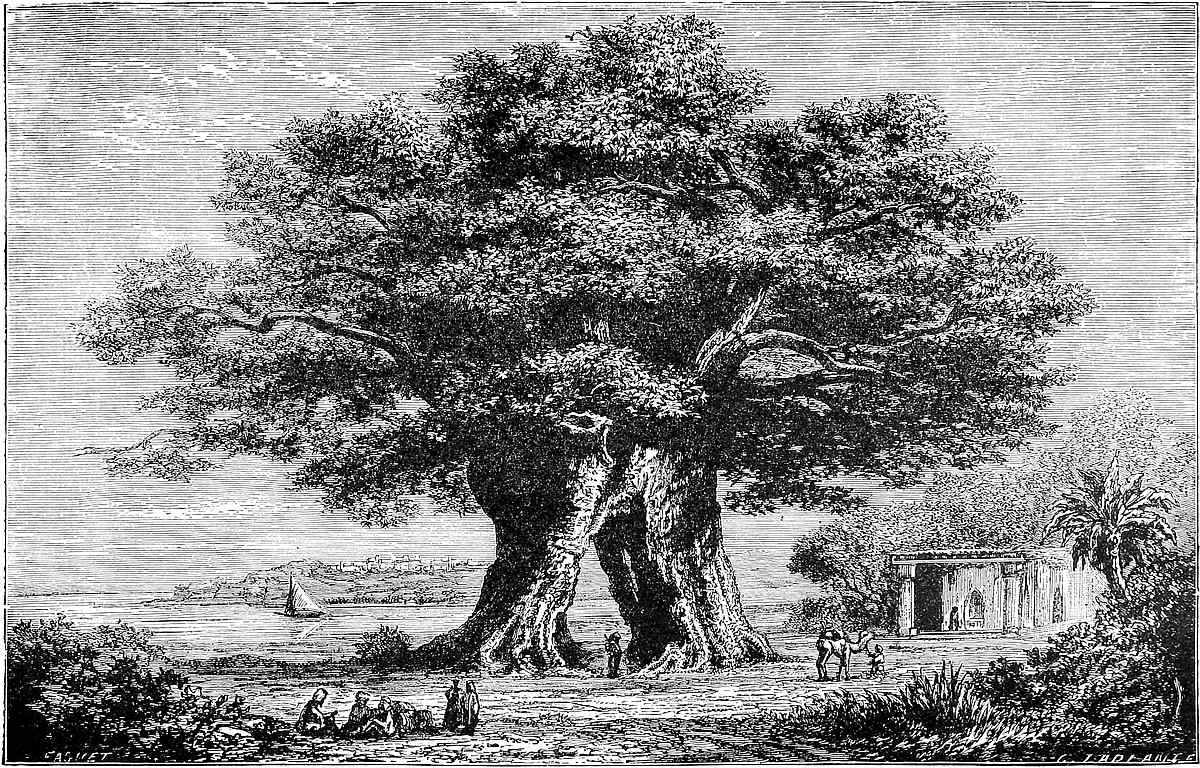
Chinar, or Oriental Plane.
Though the coincidence with our text of Hamd Allah’s Dry Tree is very
striking, I am not prepared to lay stress on it as an argument for the
geographical determination of Marco’s Arbre Sec. His use of the title
more than once to characterise the whole frontier of Khorasan can hardly
have been a mere whim of his own: and possibly some explanation of
that circumstance will yet be elicited from the Persian historians or
geographers of the Mongol era.
Meanwhile it is in the vicinity of Bostam or Damghan that I should incline
to place this landmark. If no one very cogent reason points to this,
a variety of minor ones do so; such as the direction of the traveller’s
journey from Kermán through Kuh Banán; the apparent vicinity of a great
Ismailite fortress, as will be noticed in the next chapter; the connection
twice indicated (see Prologue, ch. xviii. note 6, and Bk. IV. ch. v.) of
the Arbre Sec with the headquarters of Ghazan Khan in watching the great
passes, of which the principal ones debouche at Bostam, at which place
also buildings erected by Ghazan still exist; and the statement that the
decisive battle between Alexander and Darius was placed there by local
tradition. For though no such battle took place in that region, we know
that Darius was murdered near Hecatompylos. Some place this city west
of Bostam, near Damghan; others east of it, about Jah Jerm; Ferrier has
strongly argued for the vicinity of Bostam itself. Firdusi indeed places
the final battle on the confines of Kermán, and the death of Darius within
that province. But this could not have been the tradition Polo met with.
I may add that the temperate climate of Bostam is noticed in words almost
identical with Polo’s by both Fraser and Ferrier.
The Chinar abounds in Khorasan (as far as any tree can be said to abound
in Persia), and even in the Oases of Tun-o-Kain wherever there is water.
Travellers quoted by Ritter notice Chinars of great size and age at
Shahrúd, near Bostam, at Meyomid, and at Mehr, west of Sabzawar, which last
are said to date from the time of Naoshirwan (7th century). There is a town
to the N.W. of Meshid called Chinárán, “The Planes.” P. Della Valle, we
may note, calls Tehran “la città dei platani.”
The following note by De Sacy regarding the Chinar has already been quoted
by Marsden, and though it may be doubtful whether the term Arbre Sec
had any relation to the idea expressed, it seems to me too interesting
to be omitted: “Its sterility seems to have become proverbial among
certain people of the East. For in a collection of sundry moral sentences
pertaining to the Sabaeans or Christians of St. John ... we find the
following: ‘The vainglorious man is like a showy Plane Tree, rich in boughs
but producing nothing, and affording no fruit to its owner.’” The same
reproach of sterility is cast at the Plane by Ovid’s Walnut:—
“At postquam platanis, sterilem praebentibus umbram,
Uberior quâvis arbore venit honos;
Nos quoque fructiferae, si nux modo ponor in illis,
Coepimus in patulas luxuriare comas.” (Nux, 17–20.)
I conclude with another passage from Khanikoff, though put forward in
special illustration of what I believe to be a mistaken reading (Arbre
Seul): “Where the Chinar is of spontaneous growth, or occupies the centre
of a vast and naked plain, this tree is even in our own day invested with
a quite exceptional veneration, and the locality often comes to be called
‘The Place of the Solitary Tree.’” (J. R. G. S. XXIX. 345; Ferrier,
69–76; Fraser, 343; Ritter, VIII. 332, XI. 512 seqq.; Della Valle, I.
703; De Sacy’s Abdallatif, p. 81; Khanikoff, Not. p. 38.)
[See in Fr. Zarncke, Der Priester Johannes, II., in the chap. Der Baum
des Seth, pp. 127–128, from MS. (14th century) from Cambridge, this
curious passage (p. 128): “Tandem rogaverunt eum, ut arborem siccam, de
qua multum saepe loqui audierant, liceret videre. Quibus dicebat: ‘Non
est appellata arbor sicca recto nomine, sed arbor Seth, quoniam Seth,
filius Adae, primi patris nostri, eam plantavit.’ Et ad arborem Seth
fecit eos ducere, prohibens eos, ne arborem transmearent, sed [si?] ad
patriam suam redire desiderarent. Et cum appropinquassent, de pulcritudine
arboris mirati sunt; erat enim magnae immensitatis et miri decoris. Omnium
enim colorum varietas inerat arbori, condensitas foliorum et fructuum
diversorum; diversitas avium omnium, quae sub coelo sunt. Folia vero
invicem se repercutientia dulcissimae melodiae modulamine resonabant, et
aves amoenos cantus ultra quam credi potest promebant; et odor suavissimus
profudit eos, ita quod paradisi amoenitate fuisse. Et cum admirantes tantam
pulcritudinem aspicerent, unus sociorum aliquo eorum maior aetate, cogitans
[cogitavit?] intra se, quod senior esset et, si inde rediret, cito aliquo
casu mori posset. Et cum haec secum cogitasset, coepit arborem transire, et
cum transisset, advocans socios, iussit eos post se ad locum amoenissimum,
quem ante se videbat plenum deliciis sibi paratum [paratis?] festinare. At
illi retrogressi sunt ad regem, scilicet presbiterum Iohannem. Quos donis
amplis ditavit, et qui cum eo morari voluerunt libenter et honorifice
detinuit. Alii vero ad patriam reversi sunt.”—In common with Marsden and
Yule, I have no doubt that the Arbre Sec is the Chínár. Odoric places
it at Tabriz and I have given a very lengthy dissertation on the subject in
my edition of this traveller (pp. 21–29), to which I must refer the reader,
to avoid increasing unnecessarily the size of the present publication.—H. C.]
Concerning the Old Man of the Mountain.
Mulehet is a country in which the Old Man of the Mountain dwelt in former
days; and the name means “Place of the Aram.” I will tell you his whole
history as related by Messer Marco Polo, who heard it from several natives
of that region.
The Old Man was called in their language Aloadin. He had caused a certain
valley between two mountains to be enclosed, and had turned it into a
garden, the largest and most beautiful that ever was seen, filled with
every variety of fruit. In it were erected pavilions and palaces the most
elegant that can be imagined, all covered with gilding and exquisite
painting. And there were runnels too, flowing freely with wine and milk
and honey and water; and numbers of ladies and of the most beautiful
damsels in the world, who could play on all manner of instruments, and
sung most sweetly, and danced in a manner that it was charming to behold.
For the Old Man desired to make his people believe that this was actually
Paradise. So he had fashioned it after the description that Mahommet gave
of his Paradise, to wit, that it should be a beautiful garden running with
conduits of wine and milk and honey and water, and full of lovely women for
the delectation of all its inmates. And sure enough the Saracens of those
parts believed that it was Paradise!
Now no man was allowed to enter the Garden save those whom he intended to
be his Ashishin. There was a Fortress at the entrance to the Garden, strong
enough to resist all the world, and there was no other way to get in. He
kept at his Court a number of the youths of the country, from 12 to 20
years of age, such as had a taste for soldiering, and to these he used to
tell tales about Paradise, just as Mahommet had been wont to do, and they
believed in him just as the Saracens believe in Mahommet. Then he would
introduce them into his garden, some four, or six, or ten at a time, having
first made them drink a certain potion which cast them into a deep sleep,
and then causing them to be lifted and carried in. So when they awoke, they
found themselves in the Garden.{1}
Note
1.—Says the venerable Sire de Joinville: “Le Vieil de la Montaingne
ne créoit pas en Mahommet, ainçois créoit en la Loi de Haali, qui fu
Oncle Mahommet.” This is a crude statement, no doubt, but it has a germ
of truth. Adherents of the family of ’Ali as the true successors of the
Prophet existed from the tragical day of the death of Husain, and among
these, probably owing to the secrecy with which they were compelled to hold
their allegiance, there was always a tendency to all manner of strange
and mystical doctrines; as in one direction to the glorification of ’Ali
as a kind of incarnation of the Divinity, a character in which his lineal
representatives were held in some manner to partake; in another direction
to the development of Pantheism, and release from all positive creed and
precepts. Of these Aliites, eventually called Shiáhs, a chief sect, and
parent of many heretical branches, were the Ismailites, who took their
name, from the seventh Imam, whose return to earth they professed to expect
at the end of the World. About A.D. 1090 a branch of the Ismaili stock
was established by Hassan, son of Sabah, in the mountainous districts of
Northern Persia; and, before their suppression by the Mongols, 170 years
later, the power of the quasi-spiritual dynasty which Hassan founded
had spread over the Eastern Kohistan, at least as far as Ḳáïn. Their
headquarters were at Alamút (“Eagle’s Nest”), about 32 miles north-east
of Ḳazwin, and all over the territory which they held they established
fortresses of great strength. De Sacy seems to have proved that they were
called Hashíshíya or Hashíshín, from their use of the preparation of
hemp called Hashísh; and thence, through their system of murder and
terrorism, came the modern application of the word Assassin. The original
aim of this system was perhaps that of a kind of Vehmgericht, to punish
or terrify orthodox persecutors who were too strong to be faced with the
sword. I have adopted in the text one of the readings of the G. Text
Asciscin, as expressing the original word with the greatest accuracy
that Italian spelling admits. In another author we find it as Chazisii
(see Bollandists, May, vol. ii. p. xi.); Joinville calls them Assacis;
whilst Nangis and others corrupt the name into Harsacidae, and what not.
The explanation of the name Mulehet as it is in Ramusio, or Mulcete
as it is in the G. Text (the last expressing in Rusticiano’s Pisan
tongue the strongly aspirated Mulhĕtĕ), is given by the former: “This
name of Mulehet is as much as to say in the Saracen tongue ‘The Abode
of Heretics,’” the fact being that it does represent the Arabic term
Mulhid, pl. Muláhidah, “Impii, heretici,” which is in the Persian
histories (as of Rashíduddín and Wassáf) the title most commonly used to
indicate this community, and which is still applied by orthodox Mahomedans
to the Nosairis, Druses, and other sects of that kind, more or less kindred
to the Ismaili. The writer of the Tabakat-i-Násiri calls the sectarians
of Alamút Muláhidat-ul-maut, “Heretics of Death.”[1] The curious reading
of the G. Text which we have preserved “vaut à dire des Aram,” should be
read as we have rendered it. I conceive that Marco was here unconsciously
using one Oriental term to explain another. For it seems possible to
explain Aram only as standing for Harám, in the sense of “wicked” or
“reprobate.”
In Pauthier’s Text, instead of des aram, we find “veult dire en
françois Diex Terrien,” or Terrestrial God. This may have been
substituted, in the correction of the original rough dictation, from a
perception that the first expression was unintelligible. The new phrase
does not indeed convey the meaning of Muláhidah, but it expresses a main
characteristic of the heretical doctrine. The correction was probably made
by Polo himself; it is certainly of very early date. For in the romance of
Bauduin de Sebourc, which I believe dates early in the 14th century, the
Caliph, on witnessing the extraordinary devotion of the followers of the
Old Man (see note 1, ch. xxiv.), exclaims:
“Par Mahon ...
Vous estes Diex en terre, autre coze n’i a!” (I. p. 360.)
So also Fr. Jacopo d’Aqui in the Imago Mundi, says of the Assassins:
“Dicitur iis quod sunt in Paradiso magno Dei Terreni”—expressions, no
doubt, taken in both cases from Polo’s book.
Khanikoff, and before him J. R. Forster, have supposed that the name
Mulehet represents Alamút. But the resemblance is much closer and more
satisfactory to Mulhid or Muláhidah. Mulhet is precisely the name by
which the kingdom of the Ismailites is mentioned in Armenian history, and
Mulihet is already applied in the same way by Rabbi Benjamin in the 12th
century, and by Rubruquis in the 13th. The Chinese narrative of Hulaku’s
expedition calls it the kingdom of Mulahi. (Joinville, p. 138; J. As.
sér. II., tom. xii. 285; Benj. Tudela, p. 106; Rub. p. 265; Rémusat,
Nouv. Mélanges, I. 176; Gaubil, p. 128; Pauthier, pp. cxxxix.–cxli.;
Mon. Hist. Patr. Scriptorum, III. 1559, Turin, 1848.) [Cf. on Mulehet,
melahideh, Heretics, plural of molhid, Heretic, my note, pp. 476–482 of
my ed. of Friar Odoric.—H. C.]
“Old Man of the Mountain” was the title applied by the Crusaders to the
chief of that branch of the sect which was settled in the mountains
north of Lebanon, being a translation of his popular Arabic title
Shaikh-ul-Jibal. But according to Hammer this title properly belonged, as
Polo gives it, to the Prince of Alamút, who never called himself Sultan,
Malik, or Amir; and this seems probable, as his territory was known as the
Balad-ul-Jibal. (See Abulf. in Büsching, V. 319.)
How the Old Man Used to Train His Assassins.
When therefore they awoke, and found themselves in a place so charming,
they deemed that it was Paradise in very truth. And the ladies and damsels
dallied with them to their hearts’ content, so that they had what young men
would have; and with their own good will they never would have quitted the place.
Now this Prince whom we call the Old One kept his Court in grand and noble
style, and made those simple hill-folks about him believe firmly that he
was a great Prophet. And when he wanted one of his Ashishin to send on
any mission, he would cause that potion whereof I spoke to be given to one
of the youths in the garden, and then had him carried into his Palace. So
when the young man awoke, he found himself in the Castle, and no longer in
that Paradise; whereat he was not over well pleased. He was then conducted
to the Old Man’s presence, and bowed before him with great veneration as
believing himself to be in the presence of a true Prophet. The Prince would
then ask whence he came, and he would reply that he came from Paradise!
and that it was exactly such as Mahommet had described it in the Law. This
of course gave the others who stood by, and who had not been admitted, the
greatest desire to enter therein.
So when the Old Man would have any Prince slain, he would say to such a
youth: “Go thou and slay So and So; and when thou returnest my Angels shall
bear thee into Paradise. And shouldst thou die, natheless even so will I
send my Angels to carry thee back into Paradise.” So he caused them to
believe; and thus there was no order of his that they would not affront
any peril to execute, for the great desire they had to get back into that
Paradise of his. And in this manner the Old One got his people to murder
any one whom he desired to get rid of. Thus, too, the great dread that he
inspired all Princes withal, made them become his tributaries in order that
he might abide at peace and amity with them.{1}
I should also tell you that the Old Man had certain others under him, who
copied his proceedings and acted exactly in the same manner. One of these
was sent into the territory of Damascus, and the other into Curdistan.{2}
Note 1.—Romantic as this story is, it seems to be precisely the same that
was current over all the East. It is given by Odoric at length, more
briefly by a Chinese author, and again from an Arabic source by Hammer in
the Mines de l’Orient.
The following is the Chinese account as rendered by Rémusat: “The soldiers
of this country (Mulahi) are veritable brigands. When they see a lusty
youth, they tempt him with the hope of gain, and bring him to such a point
that he will be ready to kill his father or his elder brother with his own
hand. After he is enlisted, they intoxicate him, and carry him in that
state into a secluded retreat, where he is charmed with delicious music and
beautiful women. All his desires are satisfied for several days, and then
(in sleep) he is transported back to his original position. When he awakes,
they ask what he has seen. He is then informed that if he will become an
Assassin, he will be rewarded with the same felicity. And with the texts
and prayers that they teach him they heat him to such a pitch that whatever
commission be given him he will brave death without regret in order to
execute it.”
The Arabic narrative is too long to extract. It is from a kind of
historical romance called The Memoirs of Hakim, the date of which Hammer
unfortunately omits to give. Its close coincidence in substance with Polo’s
story is quite remarkable. After a detailed description of the Paradise,
and the transfer into it of the aspirant under the influence of bang, on
his awaking and seeing his chief enter, he says, “O chief! am I awake or
am I dreaming?” To which the chief: “O such an One, take heed that thou
tell not the dream to any stranger. Know that Ali thy Lord hath vouchsafed
to show thee the place destined for thee in Paradise.... Hesitate not a
moment therefore in the service of the Imam who thus deigns to intimate his
contentment with thee,” and so on.
William de Nangis thus speaks of the Syrian Shaikh, who alone was known
to the Crusaders, though one of their historians (Jacques de Vitry,
in Bongars, I. 1062) shows knowledge that the headquarters of the
sect was in Persia: “He was much dreaded far and near, by both Saracens
and Christians, because he so often caused princes of both classes
indifferently to be murdered by his emissaries. For he used to bring up
in his palace youths belonging to his territory, and had them taught a
variety of languages, and above all things to fear their Lord and obey
him unto death, which would thus become to them an entrance into the joys
of Paradise. And whosoever of them thus perished in carrying out his
Lord’s behests was worshipped as an angel.” As an instance of the implicit
obedience rendered by the Fidáwí or devoted disciples of the Shaikh, Fra
Pipino and Marino Sanuto relate that when Henry Count of Champagne (titular
King of Jerusalem) was on a visit to the Old Man of Syria, one day as they
walked together they saw some lads in white sitting on the top of a high
tower. The Shaikh, turning to the Count, asked if he had any subjects as
obedient as his own? and without giving time for reply made a sign to two
of the boys, who immediately leapt from the tower, and were killed on the
spot. The same story is told in the Cento Novelle Antiche, as happening
when the Emperor Frederic was on a visit (imaginary) to the Veglio. And it
is introduced likewise as an incident in the Romance of Bauduin de Sebourc:
“Vollés veioir merveilles? dist li Rois Seignouris”
to Bauduin and his friends, and on their assenting he makes the signal to
one of his men on the battlements, and in a twinkling
“Quant le vinrent en l’air salant de tel avis,
Et aussi liément, et aussi esjois,
Qu’il deust conquester mil livres de parisis!
Ains qu’il venist a tière il fut mors et fenis,
Sur les roches agues desrompis corps et pis,”
[1] etc.
(Cathay, 153; Rémusat, Nouv. Mél. I. 178; Mines de l’Orient, III. 201
seqq.; Nangis in Duchesne, V. 332; Pipino in Muratori, IX. 705;
Defrémery in J. As. sér. V. tom. v. 34 seqq.; Cent. Nov. Antiche,
Firenze, 1572, p. 91; Bauduin de Sebourc, I. 359.)
The following are some of the more notable murders or attempts at murder
ascribed to the Ismailite emissaries either from Syria or from Persia:—
A.D. 1092. Nizum-ul-Mulk, formerly the powerful minister of Malik Shah,
Seljukian sovereign of Persia, and a little later his two sons. 1102. The
Prince of Homs, in the chief Mosque of that city. 1113. Maudúd, Prince of
Mosul, in the chief Mosque of Damascus. About 1114. Abul Muzafar ’Ali,
Wazir of Sanjár Shah, and Chakar Beg, grand-uncle of the latter. 1116.
Ahmed Yel, Prince of Maragha, at Baghdad, in the presence of Mahomed,
Sultan of Persia. 1121. The Amir Afdhal, the powerful Wazir of Egypt, at
Cairo. 1126. Kasim Aksonkor, Prince of Mosul and Aleppo, in the Great
Mosque at Mosul. 1127. Moyin-uddin, Wazir of Sanjár Shah of Persia. 1129.
Amír Billah, Khalif of Egypt. 1131. Taj-ul Mulúk Buri, Prince of Damascus.
1134. Shams-ul-Mulúk, son of the preceding. 1135–38. The Khalif Mostarshid,
the Khalif Rashíd, and Daùd, Seljukian Prince of Azerbaijan. 1149. Raymond,
Count of Tripoli. 1191. Kizil Arzlan, Prince of Azerbaijan. 1192. Conrad of
Montferrat, titular King of Jerusalem; a murder which King Richard has been
accused of instigating. 1217. Oghulmish, Prince of Hamadán.
And in 1174 and 1176 attempts to murder the great Saladin. 1271. Attempt
to murder Ala’uddin Juwaini, Governor of Baghdad, and historian of the
Mongols. 1272. The attempt to murder Prince Edward of England at Acre.
In latter years the Fidáwí or Ismailite adepts appear to have let out
their services simply as hired assassins. Bibars, in a letter to his court
at Cairo, boasts of using them when needful. A Mahomedan author ascribes
to Bibars the instigation of the attempt on Prince Edward. (Makrizi, II.
100; J. As. XI. 150.)
Note 2.—Hammer mentions as what he chooses to call “Grand Priors” under
the Shaikh or “Grand Master” at Alamút, the chief, in Syria, one in the
Kuhistan of E. Persia (Tun-o-Kaïn), one in Kumis (the country about Damghan
and Bostam), and one in ’Irák; he does not speak of any in Kurdistan.
Colonel Monteith, however, says, though without stating authority or
particulars, “There were several divisions of them (the Assassins)
scattered throughout Syria, Kurdistan (near the Lake of Wan), and Asia
Minor, but all acknowledging as Imaum or High Priest the Chief residing at
Alamut.” And it may be noted that Odoric, a generation after Polo, puts the
Old Man at Millescorte, which looks like Malasgird, north of Lake Van.
(H. des Assass. p. 104; J. R. G. S. III. 16; Cathay, p. ccxliii.)
How the Old Man came by His End.
Now it came to pass, in the year of Christ’s Incarnation, 1252, that Alaü,
Lord of the Tartars of the Levant, heard tell of these great crimes of
the Old Man, and resolved to make an end of him. So he took and sent one
of his Barons with a great Army to that Castle, and they besieged it for
three years, but they could not take it, so strong was it. And indeed if
they had had food within it never would have been taken. But after being
besieged those three years they ran short of victual, and were taken. The
Old Man was put to death with all his men [and the Castle with its Garden
of Paradise was levelled with the ground]. And since that time he has had
no successor; and there was an end to all his villainies.{1}
Now let us go back to our journey.
Note 1.—The date in Pauthier is 1242; in the G. T. and in Ramusio 1262.
Neither is right, nor certainly could Polo have meant the former.
When Mangku Kaan, after his enthronement (1251), determined at a great
Kurultai or Diet, on perfecting the Mongol conquests, he entrusted his
brother Kúblái with the completion of the subjugation of China and the
adjacent countries, whilst his brother Hulaku received the command of the
army destined for Persia and Syria. The complaints that came from the
Mongol officers already in Persia determined him to commence with the
reduction of the Ismailites, and Hulaku set out from Karakorum in February,
1254. He proceeded with great deliberation, and the Oxus was not crossed
till January, 1256. But an army had been sent long in advance under “one of
his Barons,” Kitubuka Noyan, and in 1253 it was already actively engaged
in besieging the Ismailite fortresses. In 1255, during the progress of the
war, Ala’uddin Mahomed, the reigning Prince of the Assassins (mentioned
by Polo as Alaodin), was murdered at the instigation of his son Ruknuddin
Khurshah, who succeeded to the authority. A year later (November, 1256)
Ruknuddin surrendered to Hulaku. [Bretschneider (Med. Res. II. p. 109)
says that Alamút was taken by Hulaku, 20th December, 1256.—H. C.] The
fortresses given up, all well furnished with provisions and artillery
engines, were 100 in number. Two of them, however, Lembeser and Girdkuh,
refused to surrender. The former fell after a year; the latter is stated
to have held out for twenty years—actually, as it would seem, about
fourteen, or till December, 1270. Ruknuddin was well treated by Hulaku, and
despatched to the Court of the Kaan. The accounts of his death differ, but
that most commonly alleged, according to Rashiduddin, is that Mangku Kaan
was irritated at hearing of his approach, asking why his post-horses should
be fagged to no purpose, and sent executioners to put Ruknuddin to death on
the road. Alamút had been surrendered without any substantial resistance.
Some survivors of the sect got hold of it again in 1275–1276, and held out
for a time. The dominion was extinguished, but the sect remained, though
scattered indeed and obscure. A very strange case that came before Sir
Joseph Arnould in the High Court at Bombay in 1866 threw much new light on
the survival of the Ismailis.
Some centuries ago a Dai or Missionary of the Ismailis, named Sadruddín,
made converts from the Hindu trading classes in Upper Sind. Under the name
of Khojas the sect multiplied considerably in Sind, Kach’h, and Guzerat,
whence they spread to Bombay and to Zanzibar. Their numbers in Western
India are now probably not less than 50,000 to 60,000. Their doctrine, or
at least the books which they revere, appear to embrace a strange jumble of
Hindu notions with Mahomedan practices and Shiah mysticism, but the main
characteristic endures of deep reverence, if not worship, of the person of
their hereditary Imám. To his presence, when he resided in Persia, numbers
of pilgrims used to betake themselves, and large remittances of what we may
call Ismail’s Pence were made to him. Abul Hassan, the last Imám but one
of admitted lineal descent from the later Shaikhs of Alamút, and claiming
(as they did) descent from the Imám Ismail and his great ancestor ’Ali Abu
Tálib, had considerable estates at Meheláti, between Kúm and Hamadán, and
at one time held the Government of Kermán. His son and successor, Shah
Khalilullah, was killed in a brawl at Yezd in 1818. Fatteh ’Ali Sháh,
fearing Ismailite vengeance, caused the homicide to be severely punished,
and conferred gifts and honours on the young Imám, Agha Khan, including
the hand of one of his own daughters. In 1840 Agha Khan, who had raised a
revolt at Kermán, had to escape from Persia. He took refuge in Sind, and
eventually rendered good service both to General Nott at Kandahár and to
Sir C. Napier in Sind, for which he receives a pension from our Government.
For many years this genuine Heir and successor of the Viex de la
Montaingne has had his headquarters at Bombay, where he devotes, or for a
long time did devote, the large income that he receives from the faithful
to the maintenance of a racing stable, being the chief patron and promoter
of the Bombay Turf!
A schism among the Khojas, owing apparently to the desire of part of the
well-to-do Bombay community to sever themselves from the peculiarities of
the sect and to set up as respectable Sunnis, led in 1866 to an action
in the High Court, the object of which was to exclude Agha Khan from all
rights over the Khojas, and to transfer the property of the community to
the charge of Orthodox Mahomedans. To the elaborate addresses of Mr. Howard
and Sir Joseph Arnould, on this most singular process before an English
Court, I owe the preceding particulars. The judgment was entirely in favour
of the Old Man of the Mountain.
H. H. Agha Khán Meheláti, late Representative of the Old Man
of the Mountain.
“Le Seigneur Viel, que je vous ai dit si tient sa court ... et fait à
croire à cele simple gent qui li est entour que il est un grant prophete.”
[Sir Bartle Frere writes of Agha Khan in 1875: “Like his ancestor, the Old
One of Marco Polo’s time, he keeps his court in grand and noble style. His
sons, popularly known as ‘The Persian Princes,’ are active sportsmen, and
age has not dulled the Agha’s enjoyment of horse-racing. Some of the best
blood of Arabia is always to be found in his stables. He spares no expense
on his racers, and no prejudice of religion or race prevents his availing
himself of the science and skill of an English trainer or jockey when the
races come round. If tidings of war or threatened disturbance should arise
from Central Asia or Persia, the Agha is always one of the first to hear of
it, and seldom fails to pay a visit to the Governor or to some old friend
high in office to hear the news and offer the services of a tried sword
and an experienced leader to the Government which has so long secured him
a quiet refuge for his old age.” Agha Khan died in April, 1881, at the age
of 81. He was succeeded by his son Agha Ali Sháh, one of the members of the
Legislative Council. (See The Homeward Mail, Overland Times of India, of
14th April, 1881.)]
The Bohras of Western India are identified with the Imámí-Ismáilís in
some books, and were so spoken of in the first edition of this work. This
is, however, an error, originally due, it would seem, to Sir John Malcolm.
The nature of their doctrine, indeed, seems to be very much alike, and the
Bohras, like the Ismáilís, attach a divine character to their Mullah or
chief pontiff, and make a pilgrimage to his presence once in life. But the
persons so reverenced are quite different; and the Bohras recognise all
the 12 Imáms of ordinary Shiahs. Their first appearance in India was early,
the date which they assign being A.H. 532 (A.D. 1137–1138). Their chief
seat was in Yemen, from which a large emigration to India took place on its
conquest by the Turks in 1538. Ibn Batuta seems to have met with Bohras at
Gandár, near Baroch, in 1342. (Voyages, IV. 58.)
A Chinese account of the expedition of Hulaku will be found in Rémusat’s
Nouveaux Mélanges (I.), and in Pauthier’s Introduction. (Q. R. 115–219,
esp. 213; Ilch. vol. i.; J. A. S. B. VI. 842 seqq.) [A new and complete
translation has been given by Dr. E. Bretschneider, Med. Res. I. 112
seqq.—H. C.]
There is some account of the rock of Alamút and its exceedingly slender
traces of occupancy, by Colonel Monteith, in J. R. G. S. III. 15, and
again by Sir Justin Sheil in vol. viii. p. 431. There does not seem to be
any specific authority for assigning the Paradise of the Shaikh to Alamút;
and it is at least worthy of note that another of the castles of the
Muláhidah, destroyed by Hulaku, was called Firdús, i.e. Paradise. In any
case, I see no reason to suppose that Polo visited Alamút, which would have
been quite out of the road that he is following.
It is possible that “the Castle,” to which he alludes at the beginning of
next chapter, and which set him off upon this digression, was Girdkuh.[1]
It has not, as far as I know, been identified by modern travellers, but it
stood within 10 or 12 miles of Damghan (to the west or north-west). It is
probably the Tigado of Hayton, of which he thus speaks: “The Assassins
had an impregnable castle called Tigado, which was furnished with all
necessaries, and was so strong that it had no fear of attack on any side.
Howbeit, Haloön commanded a certain captain of his that he should take
10,000 Tartars who had been left in garrison in Persia, and with them lay
siege to the said castle, and not leave it till he had taken it. Wherefore
the said Tartars continued besieging it for seven whole years, winter and
summer, without being able to take it. At last the Assassins surrendered,
from sheer want of clothing, but not of victuals or other necessaries.”
So Ramusio; other copies read “27 years.” In any case it corroborates the
fact that Girdkuh was said to have held out for an extraordinary length of
time. If Rashiduddin is right in naming 1270 as the date of surrender, this
would be quite a recent event when the Polo party passed, and draw special
attention to the spot. (J. As. sér. IV. tom. xiii. 48; Ilch. I. 93,
104, 274; Q. R. p. 278; Ritter, VIII. 336.) A note which I have from
Djihan Numa (I. 259) connects Girdkuh with a district called Chinar.
This may be a clue to the term Arbre Sec; but there are difficulties.
Concerning the City of Sapurgan.
On leaving the Castle, you ride over fine plains and beautiful valleys,
and pretty hill-sides producing excellent grass pasture, and abundance of
fruits, and all other products. Armies are glad to take up their quarters
here on account of the plenty that exists. This kind of country extends for
six days’ journey, with a goodly number of towns and villages, in which the
people are worshippers of Mahommet. Sometimes also you meet with a tract
of desert extending for 50 or 60 miles, or somewhat less, and in these
deserts you find no water, but have to carry it along with you. The beasts
do without drink until you have got across the desert tract and come to
watering places.
So after travelling for six days as I have told you, you come to a city
called Sapurgan. It has great plenty of everything, but especially of the
very best melons in the world. They preserve them by paring them round and
round into strips, and drying them in the sun. When dry they are sweeter
than honey, and are carried off for sale all over the country. There is
also abundance of game here, both of birds and beasts.{1}
Note 1.—Sapurgan may closely express the pronunciation of the name of the
city which the old Arabic writers call Sabúrḳán and Shabúrḳán, now
called Shibrgán, lying some 90 miles west of Balkh; containing now some
12,000 inhabitants, and situated in a plain still richly cultivated, though
on the verge of the desert.[1] But I have seen no satisfactory solution of
the difficulties as to the time assigned. This in the G. T. and in Ramusio
is clearly six days. The point of departure is indeed uncertain, but even
if we were to place that at Sharakhs on the extreme verge of cultivated
Khorasan, which would be quite inconsistent with other data, it would have
taken the travellers something like double the time to reach Shibrgán.
Where I have followed the G. T. in its reading “quant l’en a chevauchés
six jornée tel che je vos ai contés, adunc treuve l’en une cité,” etc.,
Pauthier’s text has “Et quant l’en a chevauchié les vi cités, si treuve
l’en une cité qui a nom Sapurgan,” and to this that editor adheres. But I
suspect that cités is a mere lapsus for journées, as in the reading in
one of his three MSS. What could be meant by “chevauchier les vi cités”?
Whether the true route be, as I suppose, by Nishapúr and Meshid, or, as
Khanikoff supposes, by Herat and Badghis, it is strange that no one of
those famous cities is mentioned. And we feel constrained to assume that
something has been misunderstood in the dictation, or has dropt out of it.
As a probable conjecture I should apply the six days to the extent of
pleasing country described in the first lines of the chapter, and identify
it with the tract between Sabzawur and the cessation of fertile country
beyond Meshid. The distance would agree well, and a comparison with Fraser
or Ferrier will show that even now the description, allowing for the
compression of an old recollection, would be well founded; e.g. on the
first march beyond Nishapúr: “Fine villages, with plentiful gardens full
of trees, that bear fruit of the highest flavour, may be seen all along
the foot of the hills, and in the little recesses formed by the ravines
whence issues the water that irrigates them. It was a rich and pleasing
scene, and out of question by far the most populous and cultivated tract
that I had seen in Persia.... Next morning we quitted Derrood ... by a very
indifferent but interesting road, the glen being finely wooded with walnut,
mulberry, poplar, and willow-trees, and fruit-tree gardens rising one above
the other upon the mountain-side, watered by little rills.... These gardens
extended for several miles up the glen; beyond them the bank of the stream
continued to be fringed with white sycamore, willow, ash, mulberry, poplar,
and woods that love a moist situation,” and so on, describing a style of
scenery not common in Persia, and expressing diffusely (as it seems to me)
the same picture as Polo’s two lines. In the valley of Nishapúr, again (we
quote Arthur Conolly): “‘This is Persia!’ was the vain exclamation of those
who were alive to the beauty of the scene; ‘this is Persia!’ Bah! Bah!
What grass, what grain, what water! Bah! Bah!
[‘If there be a Paradise on the face of the Earth,
This is it! This is it! This is it!’]”—(I. 209.)
(See Fraser, 405, 432–433, 434, 436.)
With reference to the dried melons of Shibrgán, Quatremère cites a history
of Herat, which speaks of them almost in Polo’s words. Ibn Batuta gives a
like account of the melons of Khárizm: “The surprising thing about these
melons is the way the people have of slicing them, drying them in the sun,
and then packing them in baskets, just as Malaga figs are treated in our
part of the world. In this state they are sent to the remotest parts of
India and China. There is no dried fruit so delicious, and all the while I
lived at Delhi, when the travelling dealers came in, I never missed sending
for these dried strips of melon.” (Q. R. 169; I. B. III. 15.) Here, in
the 14th century, we seem to recognise the Afghan dealers arriving in the
cities of Hindustan with their annual camel-loads of dried fruits, just as
we have seen them in our own day.
Of the City of Balc.
Balc is a noble city and a great, though it was much greater in former
days. But the Tartars and other nations have greatly ravaged and destroyed
it. There were formerly many fine palaces and buildings of marble, and the
ruins of them still remain. The people of the city tell that it was here
that Alexander took to wife the daughter of Darius.
Here, you should be told, is the end of the empire of the Tartar Lord of
the Levant. And this city is also the limit of Persia in the direction
between east and north-east.{1}
Now, let us quit this city, and I will tell you of another country called
Dogana.{2}
When you have quitted the city of which I have been speaking, you ride some
12 days between north-east and east, without finding any human habitation,
for the people have all taken refuge in fastnesses among the mountains, on
account of the Banditti and armies that harassed them. There is plenty of
water on the road, and abundance of game; there are lions too. You can get
no provisions on the road, and must carry with you all that you require for
these 12 days.{3}
Note 1.—Balkh, “the mother of cities,” suffered mercilessly from Chinghiz.
Though the city had yielded without resistance, the whole population
was marched by companies into the plain, on the usual Mongol pretext of
counting them, and then brutally massacred. The city and its gardens were
fired, and all buildings capable of defence were levelled. The province
long continued to be harried by the Chaghataian inroads. Ibn Batuta, sixty
years after Marco’s visit, describes the city as still in ruins, and as
uninhabited: “The remains of its mosques and colleges,” he says, “are still
to be seen, and the painted walls traced with azure.” It is no doubt the
Vaeq (Valq) of Clavijo, “very large, and surrounded by a broad earthen
wall, thirty paces across, but breached in many parts.” He describes a
large portion of the area within as sown with cotton. The account of its
modern state in Burnes and Ferrier is much the same as Ibn Batuta’s, except
that they found some population; two separate towns within the walls
according to the latter. Burnes estimates the circuit of the ruins at 20
miles. The bulk of the population has been moved since 1858 to Takhtapul, 8
miles east of Balkh, where the Afghan Government is placed.
(Erdmann, 404–405; I. B. III. 59; Clavijo, p. 117; Burnes, II.
204–206; Ferrier, 206–207.)
According to the legendary history of Alexander, the beautiful Roxana was
the daughter of Darius, and her father in a dying interview with Alexander
requested the latter to make her his wife:—
“Une fille ai mult bele; se prendre le voles.
Vus en seres de l’mont tout li mius maries,” etc.
(Lambert Le Court, p. 256.)
Note 2.—The country called Dogana in the G. Text is a puzzle. In the
former edition I suggested Juzgána, a name which till our author’s time
was applied to a part of the adjoining territory, though not to that
traversed in quitting Balkh for the east. Sir H. Rawlinson is inclined
to refer the name to Dehgán, or “villager,” a term applied in Bactria,
and in Kabul, to Tajik peasantry[1]. I may also refer to certain passages
in Baber’s “Memoirs,” in which he speaks of a place, and apparently a
district, called Dehánah, which seems from the context to have lain in
the vicinity of the Ghori, or Aksarai River. There is still a village in
the Ghori territory, called Dehánah. Though this is worth mentioning,
where the true solution is so uncertain, I acknowledge the difficulty of
applying it. I may add also that Baber calls the River of Ghori or Aksarai,
the Dogh-ábah. (Sprenger, P. und R. Routen, p. 39 and Map; Anderson
in J. A. S. B. XXII. 161; Ilch. II. 93; Baber, pp. 132, 134, 168,
200, also 146.)
Note 3.—Though Burnes speaks of the part of the road that we suppose
necessarily to have been here followed from Balkh towards Taican, as barren
and dreary, he adds that the ruins of aqueducts and houses proved that
the land had at one time been peopled, though now destitute of water, and
consequently of inhabitants. The country would seem to have reverted at the
time of Burnes’ journey, from like causes, nearly to the state in which
Marco found it after the Mongol devastations.
Lions seem to mean here the real king of beasts, and not tigers, as
hereafter in the book. Tigers, though found on the S. and W. shores of
the Caspian, do not seem to exist in the Oxus valley. On the other hand,
Rashiduddin tells us that, when Hulaku was reviewing his army after the
passage of the river, several lions were started, and two were killed. The
lions are also mentioned by Sidi ’Ali, the Turkish Admiral, further down
the valley towards Hazárasp: “We were obliged to fight with the lions day
and night, and no man dared to go alone for water.” Moorcroft says of the
plain between Kunduz and the Oxus: “Deer, foxes, wolves, hogs, and lions
are numerous, the latter resembling those in the vicinity of Hariana” (in
Upper India). Wood also mentions lions in Kuláb, and at Kila’chap on the
Oxus. Q. Curtius tells how Alexander killed a great lion in the country
north of the Oxus towards Samarkand. [A similar story is told of Timur in
The Mulfuzat Timūry, translated by Major Charles Stewart, 1830 (p. 69):
“During the march ‘(near Balkh)’ two lions made their appearance, one of
them a male, the other a female. I (Timur) resolved to kill them myself,
and having shot them both with arrows, I considered this circumstance as
a lucky omen.”—H. C.] (Burnes, II. 200; Q. R. 155; Ilch. I. 90; J.
As. IX. 217; Moorcroft, II. 430; Wood, ed. 1872, pp. 259,260; Q. C. VII. 2.)
Of Taican, and the Mountains of Salt. Also of the Province of Casem.
After those twelve days’ journey you come to a fortified place called
Taican, where there is a great corn market.{1} It is a fine place,
and the mountains that you see towards the south are all composed of salt.
People from all the countries round, to some thirty days’ journey, come to
fetch this salt, which is the best in the world, and is so hard that it can
only be broken with iron picks. ’Tis in such abundance that it would supply
the whole world to the end of time. [Other mountains there grow almonds and
pistachioes, which are exceedingly cheap.]{2}
When you leave this town and ride three days further between north-east and
east, you meet with many fine tracts full of vines and other fruits, and
with a goodly number of habitations, and everything to be had very cheap.
The people are worshippers of Mahommet, and are an evil and a murderous
generation, whose great delight is in the wine shop; for they have good
wine (albeit it be boiled), and are great topers; in truth, they are
constantly getting drunk. They wear nothing on the head but a cord some
ten palms long twisted round it. They are excellent huntsmen, and take a
great deal of game; in fact they wear nothing but the skins of the beasts
they have taken in the chase, for they make of them both coats and shoes.
Indeed, all of them are acquainted with the art of dressing skins for these
purposes.{3}
When you have ridden those three days, you find a town called Casem,{4}
which is subject to a count. His other towns and villages are on the
hills, but through this town there flows a river of some size. There are a
great many porcupines hereabouts, and very large ones too. When hunted with
dogs, several of them will get together and huddle close, shooting their
quills at the dogs, which get many a serious wound thereby.{5}
This town of Casem is at the head of a very great province, which is also
called Casem. The people have a peculiar language. The peasants who keep
cattle abide in the mountains, and have their dwellings in caves, which
form fine and spacious houses for them, and are made with ease, as the
hills are composed of earth.{6}
After leaving the town of Casem, you ride for three days without finding a
single habitation, or anything to eat or drink, so that you have to carry
with you everything that you require. At the end of those three days you
reach a province called Badashan, about which we shall now tell you.{7}
Note
1.—The Taican of Polo is the still existing Talikan in the province
of Kataghan or Kunduz, but it bears the former name (Tháîḳán) in the old
Arab geographies. Both names are used by Baber, who says it lay in the
Ulugh Bágh, or Great Garden, a name perhaps acquired by the Plains of
Talikan in happier days, but illustrating what Polo says of the next three
days’ march. The Castle of Talikan resisted Chinghiz for seven months,
and met with the usual fate (1221). [In the Travels of Sidi Ali, son of
Housaïn (Jour. Asiat., October, 1826, p. 203), “Talikan, in the country
of Badakhschan” is mentioned.—H. C.] Wood speaks of Talikan in 1838 as a
poor place of some 300 or 400 houses, mere hovels; a recent account gives
it 500 families. Market days are not usual in Upper India or Kabul, but are
universal in Badakhshan and the Oxus provinces. The bazaars are only open
on those days, and the people from the surrounding country then assemble to
exchange goods, generally by barter. Wood chances to note: “A market was
held at Talikan.... The thronged state of the roads leading into it soon
apprised us that the day was no ordinary one.” (Abulf. in Büsching,
V. 352; Sprenger, p. 50; P. de la Croix, I. 63; Baber, 38, 130;
Burnes, III. 8; Wood, 156; Pandit Manphul’s Report.)
The distance of Talikan from Balkh is about 170 miles, which gives very
short marches, if twelve days be the correct reading. Ramusio has two
days, which is certainly wrong. XII. is easily miswritten for VII., which
would be a just number.
Note 2.—In our day, as I learn from Pandit Manphul, the mines of rock salt
are at Ak Bulák, near the Lataband Pass, and at Darúná, near the Kokcha,
and these supply the whole of Badakhshan, as well as Kunduz and Chitrál.
These sites are due east of Talikan, and are in Badakhshan. But there is
a mine at Chál, S.E. or S.S.E. of Talikan and within the same province.
There are also mines of rock-salt near the famous “stone bridge” in Kuláb,
north of the Oxus, and again on the south of the Alaï steppe. (Papers by
Manphul and by Faiz Baksh; also Notes by Feachenko.)
Both pistachioes and wild almonds are mentioned by Pandit Manphul; and see
Wood (p. 252) on the beauty and profusion of the latter.
Note 3.—Wood thinks that the Tajik inhabitants of Badakhshan and the
adjoining districts are substantially of the same race as the Kafir tribes
of Hindu Kúsh. At the time of Polo’s visit it would seem that their
conversion to Islam was imperfect. They were probably in that transition
state which obtains in our own day for some of the Hill Mahomedans
adjoining the Kafirs on the south side of the mountains the reproachful
title of Nímchah Musulmán, or Half-and-halfs. Thus they would seem to
have retained sundry Kafir characteristics; among others that love of wine
which is so strong among the Kafirs. The boiling of the wine is noted by
Baber (a connoisseur) as the custom of Nijrao, adjoining, if not then
included in, Kafir-land; and Elphinstone implies the continuance of the
custom when he speaks of the Kafirs as having wine of the consistence
of jelly, and very strong. The wine of Kápishí, the Greek Kapisa,
immediately south of Hindu Kúsh, was famous as early as the time of the
Hindu grammarian Pánini, say three centuries B.C. The cord twisted round
the head was probably also a relic of Kafir costume: “Few of the Kafirs
cover the head, and when they do, it is with a narrow band or fillet of
goat’s hair ... about a yard or a yard and a half in length, wound round
the head.” This style of head-dress seems to be very ancient in India, and
in the Sanchi sculptures is that of the supposed Dasyas. Something very
similar, i.e. a scanty turban cloth twisted into a mere cord, and wound two
or three times round the head, is often seen in the Panjab to this day.
The Postín or sheepskin coat is almost universal on both sides of the
Hindu Kúsh; and Wood notes: “The shoes in use resemble half-boots, made of
goatskin, and mostly of home manufacture.” (Baber, 145; J. A. S. B.
XXVIII. 348, 364; Elphinst. II. 384; Ind. Antiquary, I. 22; Wood,
174, 220; J. R. A. S. XIX. 2.)
Note
4.—Marsden was right in identifying Scassem or Casem with the
Kechem of D’Anville’s Map, but wrong in confounding the latter with
the Kishmabad of Elphinstone—properly, I believe, Kishnabad—in the
Anderab Valley. Kashm, or Keshm, found its way into maps through Pétis de
la Croix, from whom probably D’Anville adopted it; but as it was ignored
by Elphinstone (or by Macartney, who constructed his map), and by Burnes,
it dropped out of our geography. Indeed, Wood does not notice it except
as giving name to a high hill called the Hill of Kishm, and the position
even of that he omits to indicate. The frequent mention of Kishm in the
histories of Timur and Humayun (e.g. P. de la Croix, I. 167; N. et
E. XIV. 223, 491; Erskine’s Baber and Humayun, II. 330, 355, etc.)
had enabled me to determine its position within tolerably narrow limits;
but desiring to fix it definitely, application was made through Colonel
Maclagan to Pandit Manphul, C.S.I., a very intelligent Hindu gentleman, who
resided for some time in Badakhshan as agent of the Panjab Government, and
from him arrived a special note and sketch, and afterwards a MS. copy of a
Report,[1] which set the position of Kishm at rest.
Kishm is the Kilissemo, i.e. Karisma or Krishma, of Hiuen Tsang; and Sir
H. Rawlinson has identified the Hill of Kishm with the Mount Kharesem of
the Zend-Avesta, on which Jamshid placed the most sacred of all the fires.
It is now a small town or large village on the right bank of the Varsach
river, a tributary of the Kokcha. It was in 1866 the seat of a district
ruler under the Mír of Badakhshan, who was styled the Mír of Kishm, and is
the modern counterpart of Marco’s Quens or Count. The modern caravan-road
between Kunduz and Badakhshan does not pass through Kishm, which is left
some five miles to the right, but through the town of Mashhad, which stands
on the same river. Kishm is the warmest district of Badakhshan. Its fruits
are abundant, and ripen a month earlier than those at Faizabad, the capital
of that country. The Varsach or Mashhad river is Marco’s “Flum auques
grant.” Wood (247) calls it “the largest stream we had yet forded in Badakhshan.”
It is very notable that in Ramusio, in Pipino, and in one passage of the
G. Text, the name is written Scasem, which has led some to suppose the
Ish-Káshm of Wood to be meant. That place is much too far east—in fact,
beyond the city which forms the subject of the next chapter. The apparent
hesitation, however, between the forms Casem and Scasem suggests that
the Kishm of our note may formerly have been termed S’kăshm or Ish-Kăshm,
a form frequent in the Oxus Valley, e.g. Ish-Kimish, Ish-Káshm, Ishtrakh,
Ishpingao. General Cunningham judiciously suggests (Ladak, 34) that this
form is merely a vocal corruption of the initial S before a consonant, a
combination which always troubles the Musulman in India, and converts every
Mr. Smith or Mr. Sparks into Ismit or Ispak Sahib.
[There does not seem to me any difficulty about this note: “Shibarkhan
(Afghan Turkistan), Balkh, Kunduz, Khanabad, Talikan, Kishm, Badakhshan.” I
am tempted to look for Dogana at Khanabad.—H. C.]
Note
5.—The belief that the porcupine projected its quills at its
assailants was an ancient and persistent one—“cum intendit cutem
missiles,” says Pliny (VIII. 35, and see also Aelian. de Nat. An. I.
31), and is held by the Chinese as it was held by the ancients, but is
universally rejected by modern zoologists. The huddling and coiling appears
to be a true characteristic, for the porcupine always tries to shield its head.
Note 6.—The description of Kishm as a “very great” province is an example
of a bad habit of Marco’s, which recurs in the next chapter. What he
says of the cave-dwellings may be illustrated by Burnes’s account of the
excavations at Bamian, in a neighbouring district. These “still form the
residence of the greater part of the population.... The hills at Bamian
are formed of indurated clay and pebbles, which renders this excavation a
matter of little difficulty.” Similar occupied excavations are noticed by
Moorcroft at Heibak and other places towards Khulm.
Curiously, Pandit Manphul says of the districts about the Kokcha: “Both
their hills and plains are productive, the former being mostly composed of
earth, having very little of rocky substance.”
Note 7.—The capital of Badakhshan is now Faizabad, on the right bank of
the Kokcha, founded, according to Manphul, by Yarbeg, the first Mír of
the present dynasty. When this family was displaced for a time, by Murad
Beg of Kunduz, about 1829, the place was abandoned for years, but is now
re-occupied. The ancient capital of Badakhshan stood in the Dasht (or
Plain) of Bahárak, one of the most extensive pieces of level in Badakhshan,
in which the rivers Vardoj, Zardeo, and Sarghalan unite with the Kokcha,
and was apparently termed Jaúzgún. This was probably the city called
Badakhshan by our traveller.[2] As far as I can estimate, by the help
of Wood and the map I have compiled, this will be from 100 to 110 miles
distant from Talikan, and will therefore suit fairly with the six marches
that Marco lays down.
Wood, in 1838, found the whole country between Talikan and Faizabad nearly
as depopulated as Marco found that between Kishm and Badakhshan. The
modern depopulation was due—in part, at least—to the recent oppressions
and razzias of the Uzbeks of Kunduz. On their decline, between 1840 and
1850, the family of the native Mírs was reinstated, and these now rule at
Faizabad, under an acknowledgment, since 1859, of Afghan supremacy.
Of the Province of Badashan.
Badashan is a Province inhabited by people who worship Mahommet, and have
a peculiar language. It forms a very great kingdom, and the royalty is
hereditary. All those of the royal blood are descended from King Alexander
and the daughter of King Darius, who was Lord of the vast Empire of Persia.
And all these kings call themselves in the Saracen tongue Zulcarniain,
which is as much as to say Alexander; and this out of regard for
Alexander the Great.{1}
It is in this province that those fine and valuable gems the Balas Rubies
are found. They are got in certain rocks among the mountains, and in the
search for them the people dig great caves underground, just as is done by
miners for silver. There is but one special mountain that produces them,
and it is called Syghinan. The stones are dug on the king’s account, and
no one else dares dig in that mountain on pain of forfeiture of life as
well as goods; nor may any one carry the stones out of the kingdom. But the
king amasses them all, and sends them to other kings when he has tribute to
render, or when he desires to offer a friendly present; and such only as he
pleases he causes to be sold. Thus he acts in order to keep the Balas at a
high value; for if he were to allow everybody to dig, they would extract
so many that the world would be glutted with them, and they would cease to
bear any value. Hence it is that he allows so few to be taken out, and is
so strict in the matter.{2}
There is also in the same country another mountain, in which azure is
found; ’tis the finest in the world, and is got in a vein like silver.
There are also other mountains which contain a great amount of silver ore,
so that the country is a very rich one; but it is also (it must be said) a
very cold one.{3} It produces numbers of excellent horses, remarkable
for their speed. They are not shod at all, although constantly used in
mountainous country, and on very bad roads. [They go at a great pace even
down steep descents, where other horses neither would nor could do the
like. And Messer Marco was told that not long ago they possessed in that
province a breed of horses from the strain of Alexander’s horse Bucephalus,
all of which had from their birth a particular mark on the forehead.
This breed was entirely in the hands of an uncle of the king’s; and in
consequence of his refusing to let the king have any of them, the latter
put him to death. The widow then, in despite, destroyed the whole breed,
and it is now extinct.{4}]
The mountains of this country also supply Saker falcons of excellent
flight, and plenty of Lanners likewise. Beasts and birds for the chase
there are in great abundance. Good wheat is grown, and also barley without
husk. They have no olive oil, but make oil from sesamé, and also from
walnuts.{5}
[In the mountains there are vast numbers of sheep—400, 500, or 600 in a
single flock, and all of them wild; and though many of them are taken, they
never seem to get aught the scarcer.{6}
Those mountains are so lofty that ’tis a hard day’s work, from morning till
evening, to get to the top of them. On getting up, you find an extensive
plain, with great abundance of grass and trees, and copious springs of pure
water running down through rocks and ravines. In those brooks are found
trout and many other fish of dainty kinds; and the air in those regions
is so pure, and residence there so healthful, that when the men who dwell
below in the towns, and in the valleys and plains, find themselves attacked
by any kind of fever or other ailment that may hap, they lose no time in
going to the hills; and after abiding there two or three days, they quite
recover their health through the excellence of that air. And Messer Marco
said he had proved this by experience: for when in those parts he had been
ill for about a year, but as soon as he was advised to visit that mountain,
he did so and got well at once.{7}]
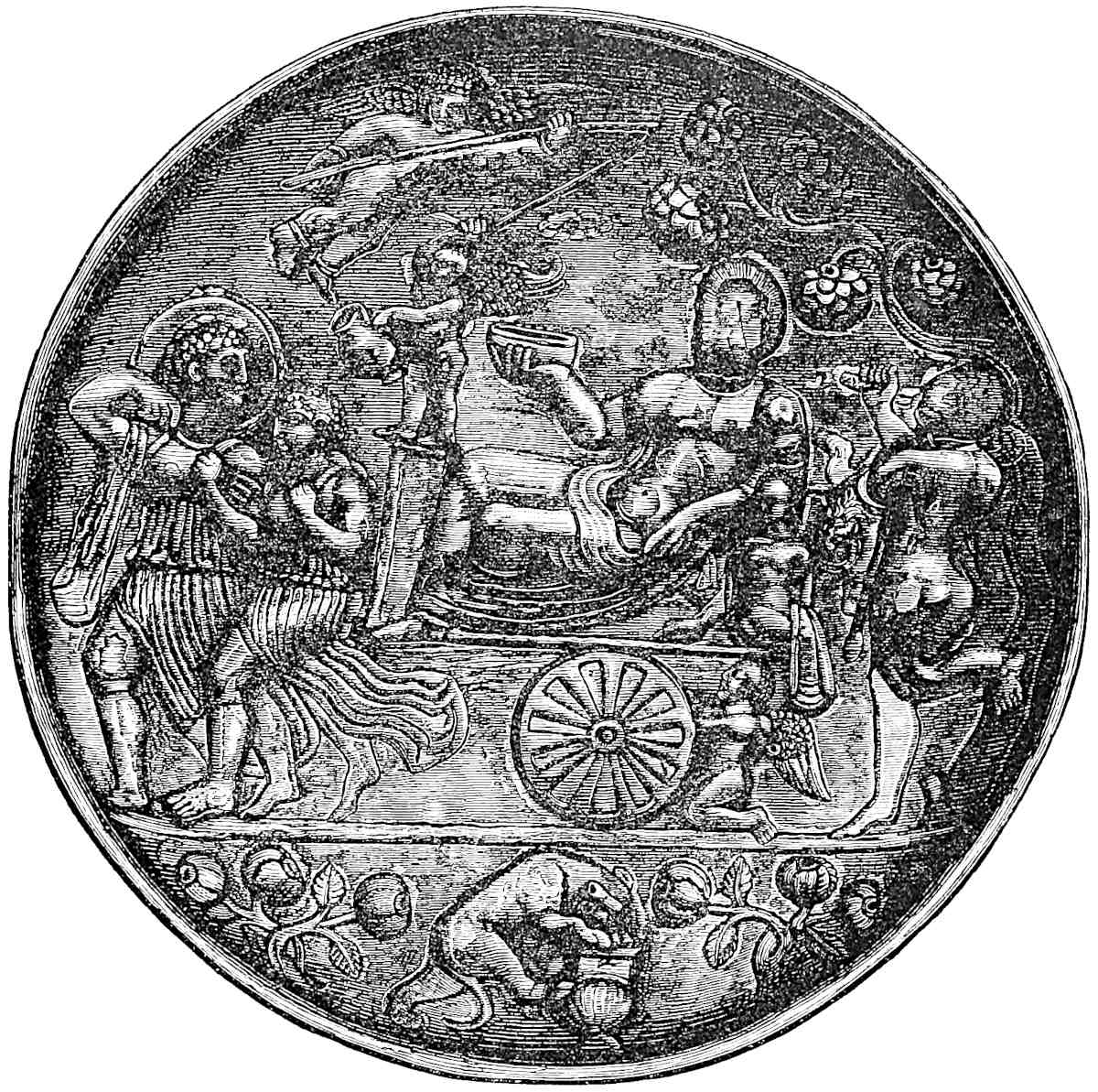
Ancient Silver Patera of debased Greek art, formerly in
the possession of the Princes of Badakhshan, now in the India Museum.
In this kingdom there are many strait and perilous passes, so difficult to
force that the people have no fear of invasion. Their towns and villages
also are on lofty hills, and in very strong positions.{8} They are
excellent archers, and much given to the chase; indeed, most of them are
dependent for clothing on the skins of beasts, for stuffs are very dear
among them. The great ladies, however, are arrayed in stuffs, and I will
tell you the style of their dress! They all wear drawers made of cotton
cloth, and into the making of these some will put 60, 80, or even 100 ells
of stuff. This they do to make themselves look large in the hips, for the
men of those parts think that to be a great beauty in a woman.{9}
Note 1.—“The population of Badakhshan Proper is composed of Tajiks,
Turks, and Arabs, who are all Sunnis, following the orthodox doctrines
of the Mahomedan law, and speak Persian and Turki, whilst the people of
the more mountainous tracts are Tajiks of the Shiá creed, having separate
provincial dialects or languages of their own, the inhabitants of the
principal places combining therewith a knowledge of Persian. Thus, the
Shighnáni [sometimes called Shighni] is spoken in Shignán and Roshán,
the Ishkáshami in Ishkásham, the Wakhi in Wakhán, the Sanglichì
in Sanglich and Zebák, and the Minjáni in Minján. All these dialects
materially differ from each other.” (Pand. Manphul.) It may be considered
almost certain that Badakhshan Proper also had a peculiar dialect in Polo’s
time. Mr. Shaw speaks of the strong resemblance to Kashmírís of the
Badakhshán people whom he had seen.
The Legend of the Alexandrian pedigree of the Kings of Badakhshan is
spoken of by Baber, and by earlier Eastern authors. This pedigree is, or
was, claimed also by the chiefs of Karátegín, Darwáz, Roshán, Shighnán,
Wakhán, Chitrál, Gilgít, Swát, and Khapolor in Bálti. Some samples of
those genealogies may be seen in that strange document called “Gardiner’s
Travels.”
In Badakhshan Proper the story seems now to have died out. Indeed, though
Wood mentions one of the modern family of Mírs as vaunting this descent,
these are in fact Sáhibzádahs of Samarkand, who were invited to the
country about the middle of the 17th century, and were in no way connected
with the old kings.
The traditional claims to Alexandrian descent were probably due to a
genuine memory of the Græco-Bactrian kingdom, and might have had an origin
analogous to the Sultan’s claim to be “Caesar of Rome”; for the real
ancestry of the oldest dynasties on the Oxus was to be sought rather among
the Tochari and Ephthalites than among the Greeks whom they superseded.
The cut on p. 159 presents an interesting memorial of the real relation of
Bactria to Greece, as well as of the pretence of the Badakhshan princes to
Grecian descent. This silver patera was sold by the family of the Mírs,
when captives, to the Minister of the Uzbek chief of Kunduz, and by him to
Dr. Percival Lord in 1838. It is now in the India Museum. On the bottom is
punched a word or two in Pehlvi, and there is also a word incised in Syriac
or Uighúr. It is curious that a pair of paterae were acquired by Dr. Lord
under the circumstances stated. The other, similar in material and form,
but apparently somewhat larger, is distinctly Sassanian, representing a
king spearing a lion.
Zu-’lḳarnain, “the Two-Horned,” is an Arabic epithet of Alexander, with
which legends have been connected, but which probably arose from the horned
portraits on his coins. [Capus, l.c. p. 121, says, “Iskandr Zoulcarneïn
or Alexander le Cornu, horns being the emblem of strength.”—H. C.] The
term appears in Chaucer (Troil. and Cress. III. 931) in the sense of non
plus:—
“I am, till God me better minde send,
At dulcarnon, right at my wittes end.”
And it is said to have still colloquial existence in that sense in some
corners of England. This use is said to have arisen from the Arabic
application of the term (Bicorne) to the 47th Proposition of Euclid.
(Baber, 13; N. et E. XIV. 490; N. An. des V. xxvi. 296; Burnes,
III. 186 seqq.; Wood, 155, 244; J. A. S. B. XXII. 300; Ayeen Akbery,
II. 185; see N. and Q. 1st Series, vol. v.)
Note 2.—I have adopted in the text for the name of the country that one
of the several forms in the G. Text which comes nearest to the correct
name, viz. Badascian. But Balacian also appears both in that and in
Pauthier’s text. This represents Balakhshán, a form also sometimes used
in the East. Hayton has Balaxcen, Clavijo Balaxia, the Catalan Map
Baldassia. From the form Balakhsh the Balas Ruby got its name. As Ibn
Batuta says: “The Mountains of Badakhshan have given their name to the
Badakhshi Ruby, vulgarly called Al Balaksh.” Albertus Magnus says the
Balagius is the female of the Carbuncle or Ruby Proper, “and some say it
is his house, and hath thereby got the name, quasi Palatium Carbunculi!”
The Balais or Balas Ruby is, like the Spinel, a kind inferior to the real
Ruby of Ava. The author of the Masálak al Absár says the finest Balas
ever seen in the Arab countries was one presented to Malek ’Adil Ketboga,
at Damascus; it was of a triangular form and weighed 50 drachms. The prices
of Balasci in Europe in that age may be found in Pegolotti, but the
needful problems are hard to solve.
“No sapphire in Inde, no Rubie rich of price,
There lacked than, nor Emeraud so grene,
Balès, Turkès, ne thing to my device.”
(Chaucer, ‘Court of Love.’)
“L’altra letizia, che m’era già nota,
Preclara cosa mi si fece in vista,
Qual fin balascio in che lo Sol percuoto.”
(Paradiso, ix. 67.)
Some account of the Balakhsh from Oriental sources will be found in J.
As. sér V. tom. xi. 109.
(I. B. III. 59, 394; Alb. Mag. de Mineralibus; Pegol. p. 307; N. et
E. XIII. i. 246.)
[“The Mohammedan authors of the Mongol period mention Badakhshan several
times in connection with the political and military events of that period.
Guchluk, the ‘gurkhan of Karakhitai,’ was slain in Badakhshan in 1218
(d’Ohsson, I. 272). In 1221, the Mongols invaded the country (l.c. I.
272). On the same page, d’Ohsson translates a short account of Badakhshan
by Yakut (✛1229), stating that this mountainous country is famed for its
precious stones, and especially rubies, called Balakhsh.” (Bretschneider,
Med. Res. II. p. 66.)—H. C.]
The account of the royal monopoly in working the mines, etc., has continued
accurate down to our own day. When Murad Beg of Kunduz conquered Badakhshan
some forty years ago, in disgust at the small produce of the mines, he
abandoned working them, and sold nearly all the population of the place
into slavery! They continue still unworked, unless clandestinely. In 1866
the reigning Mír had one of them opened at the request of Pandit Manphul,
but without much result.
The locality of the mines is on the right bank of the Oxus, in the district
of Ish Káshm and on the borders of Shignan, the Syghinan of the text.
(P. Manph.; Wood, 206; N. Ann. des. V. xxvi. 300.)
[The ruby mines are really in the Gháran country, which extends along both
banks of the Oxus. Barshar is one of the deserted villages; the boundary
between Gháran and Shignán is the Kuguz Parin (in Shighai dialect means
“holes in the rock”); the Persian equivalent is “Rafak-i-Somakh.” (Cf.
Captain Trotter, Forsyth’s Mission, p. 277.)—H. C.]
Note
3.—The mines of Lájwurd (whence l’Azur and Lazuli) have been,
like the Ruby mines, celebrated for ages. They lie in the Upper Valley
of the Kokcha, called Korán, within the Tract called Yamgán, of which
the popular etymology is Hamah-Kán, or “All-Mines,” and were visited
by Wood in 1838. The produce now is said to be of very inferior quality,
and in quantity from 30 to 60 poods (36 lbs each) annually. The best
quality sells at Bokhara at 30 to 60 tillas, or 12l. to 24l. the
pood (Manphul). Surely it is ominous when a British agent writing of
Badakhshan products finds it natural to express weights in Russian poods!
The Yamgán Tract also contains mines of iron, lead, alum, salammoniac,
sulphur, ochre, and copper. The last are not worked. But I do not learn of
any silver mines nearer than those of Paryán in the Valley of Panjshir,
south of the crest of the Hindu-Kúsh, much worked in the early Middle Ages.
(See Cathay, p. 595.)
Note 4.—The Kataghan breed of horses from Badakhshan and Kunduz has still a
high reputation. They do not often reach India, as the breed is a favourite
one among the Afghan chiefs, and the horses are likely to be appropriated
in transit. (Lumsden, Mission to Kandahar, p. 20.)
[The Kirghiz between the Yangi Hissar River and Sirikol are the only
people using the horse generally in the plough, oxen being employed in the
plains, and yaks in Sirikol. (Lieutenant-Colonel Gordon, p. 222, Forsyth’s
Mission.)—H. C.]
What Polo heard of the Bucephalid strain was perhaps but another form of a
story told by the Chinese, many centuries earlier, when speaking of this
same region. A certain cave was frequented by a wonderful stallion of
supernatural origin. Hither the people yearly brought their mares, and a
famous breed was derived from the foals. (Rém. N. Mél. As. I. 245.)
Note 5.—The huskless barley of the text is thus mentioned by Burnes in
the vicinity of the Hindu-Kúsh: “They rear a barley in this elevated
country which has no husk, and grows like wheat; but it is barley.” It is
not properly huskless, but when ripe it bursts the husk and remains so
loosely attached as to be dislodged from it by a slight shake. It is grown
abundantly in Ladak and the adjoining Hill States. Moorcroft details six
varieties of it cultivated there. The kind mentioned by Marco and Burnes
is probably that named by Royle Hordeum Ægiceras, and which has been
sent to England under the name of Tartarian Wheat, though it is a genuine
barley. Naked barley is mentioned by Galen as grown in Cappadocia; and
Matthioli speaks of it as grown in France in his day (middle of 16th
century). It is also known to the Arabs, for they have a name for it—Sult.
(Burnes, III. 205; Moorc. II. 148 seqq.; Galen, de Aliment.
Facult. Lat. ed. 13; Matthioli, Ven. 1585, p. 420; Eng. Cyc., art. Hordeum.)
Sesamé is mentioned by P. Manphul as one of the products of Badakhshan;
linseed is another, which is also used for oil. Walnut-trees abound, but
neither he nor Wood mention the oil. We know that walnut oil is largely
manufactured in Kashmir. (Moorcroft, II. 148.)
[See on Saker and Lanner Falcons (F. Sakar, Briss.; F. lanarius,
Schlegel) the valuable paper by Edouard Blanc, Sur l’utilisation
des Oiseaux de proie en Asie centrale in Rev. des Sciences natur.
appliquées, 20th June, 1895.
“Hawking is the favourite sport of Central Asian Lords,” says G. Capus. (A
travers le royaume de Tamerlan, p. 132. See pp. 132–134.)
The Mirza says (l.c. p. 157) that the mountains of Wakhán “are only noted
for producing a breed of hawks or falcons which the hardy Wâkhânis manage
to catch among the cliffs. These hawks are much esteemed by the chiefs of
Badakhshan, Bokhara, etc. They are celebrated for their swiftness, and
known by their white colour.”—H. C.]
Note
6.—These wild sheep are probably the kind called Kachkár, mentioned
by Baber, and described by Mr. Blyth in his Monograph of Wild Sheep,
under the name of Ovis Vignei. It is extensively diffused over all
the ramifications of Hindu-Kúsh, and westward perhaps to the Persian
Elburz. “It is gregarious,” says Wood, “congregating in herds of several
hundreds.” In a later chapter Polo speaks of a wild sheep apparently
different and greater. (See J. A. S. B., X. 858 seqq.)
Note 7.—This pleasant passage is only in Ramusio, but it would be heresy
to doubt its genuine character. Marco’s recollection of the delight of
convalescence in such a climate seems to lend an unusual enthusiasm and
felicity to his description of the scenery. Such a region as he speaks of
is probably the cool Plateau of Shewá, of which we are told as extending
about 25 miles eastward from near Faizabad, and forming one of the finest
pastures in Badakhshan. It contains a large lake called by the frequent
name Sar-i-Kol. No European traveller in modern times (unless Mr. Gardner)
has been on those glorious table-lands. Burnes says that at Kunduz both
natives and foreigners spoke rapturously of the vales of Badakhshan, its
rivulets, romantic scenes and glens, its fruits, flowers, and nightingales.
Wood is reticent on scenery, naturally, since nearly all his journey was
made in winter. When approaching Faizabad on his return from the Upper
Oxus, however, he says: “On entering the beautiful lawn at the gorge of its
valley I was enchanted at the quiet loveliness of the scene. Up to this
time, from the day we left Talikan, we had been moving in snow; but now
it had nearly vanished from the valley, and the fine sward was enamelled
with crocuses, daffodils, and snowdrops.” (P. Manphul; Burnes, III. 176; Wood, 252.)
Note 8.—Yet scarcely any country in the world has suffered so terribly and
repeatedly from invasion. “Enduring decay probably commenced with the wars
of Chinghiz, for many an instance in Eastern history shows the permanent
effect of such devastations.... Century after century saw only progress in
decay. Even to our own time the progress of depopulation and deterioration
has continued.” In 1759, two of the Khojas of Kashgar, escaping from the
dominant Chinese, took refuge in Badakhshan; one died of his wounds,
the other was treacherously slain by Sultan Shah, who then ruled the
country. The holy man is said in his dying moments to have invoked curses
on Badakhshan, and prayed that it might be three times depopulated; a
malediction which found ample accomplishment. The misery of the country
came to a climax about 1830, when the Uzbek chief of Kunduz, Murad Beg
Kataghan, swept away the bulk of the inhabitants, and set them down to die
in the marshy plains of Kunduz. (Cathay, p. 542; Faiz Bakhsh, etc.)
Note 9.—This “bombasticall dissimulation of their garments,” as the author
of Anthropometamorphosis calls such a fashion, is no longer affected
by the ladies of Badakhshan. But a friend in the Panjab observes that it
still survives there. “There are ladies’ trousers here which might almost
justify Marco’s very liberal estimate of the quantity of stuff required
to make them;” and among the Afghan ladies, Dr. Bellew says, the silken
trousers almost surpass crinoline in amplitude. It is curious to find the
same characteristic attaching to female figures on coins of ancient kings
of these regions, such as Agathocles and Pantaleon. (The last name is
appropriate!)
Of the Province of Pashai
You must know that ten days’ journey to the south of Badashan there is a
Province called Pashai, the people of which have a peculiar language, and
are Idolaters, of a brown complexion. They are great adepts in sorceries
and the diabolic arts. The men wear earrings and brooches of gold and
silver set with stones and pearls. They are a pestilent people and a
crafty; and they live upon flesh and rice. Their country is very hot.{1}
Now let us proceed and speak of another country which is seven days’
journey from this one towards the south-east, and the name of which is
Keshimur.
Note 1.—The name of
Pashai has already occurred (see ch. xviii.) linked
with Dir, as indicating a tract, apparently of very rugged and difficult
character, through which the partizan leader Nigúdar passed in making an
incursion from Badakhshan towards Káshmir. The difficulty here lies in the
name Pashai, which points to the south-west, whilst Dir and all other
indications point to the south-east. But Pashai seems to me the reading
to which all texts tend, whilst it is clearly expressed in the G. T.
(Pasciai), and it is contrary to all my experience of the interpretation
of Marco Polo to attempt to torture the name in the way which has been
common with commentators professed and occasional. But dropping this name
for a moment, let us see to what the other indications do point.
In the meagre statements of this and the next chapter, interposed as
they are among chapters of detail unusually ample for Polo, there is
nothing to lead us to suppose that the Traveller ever personally visited
the countries of which these two chapters treat. I believe we have here
merely an amplification of the information already sketched of the country
penetrated by the Nigudarian bands whose escapade is related in chapter
xviii., information which was probably derived from a Mongol source. And
these countries are in my belief both regions famous in the legends of
the Northern Buddhists, viz. Udyána and Káshmir.
Udyána lay to the north of Pesháwar on the Swát River, but from the extent
assigned to it by Hiuen Tsang, the name probably covered a large part of
the whole hill-region south of the Hindu-Kúsh from Chitrál to the Indus,
as indeed it is represented in the Map of Vivien de St. Martin (Pèlerins
Bouddhistes, II.). It is regarded by Fahian as the most northerly Province
of India, and in his time the food and clothing of the people were similar
to those of Gangetic India. It was the native country of Padma Sambhava,
one of the chief apostles of Lamaism, i.e. of Tibetan Buddhism, and a great
master of enchantments. The doctrines of Sakya, as they prevailed in Udyána
in old times, were probably strongly tinged with Sivaitic magic, and the
Tibetans still regard that locality as the classic ground of sorcery and
witchcraft.
Hiuen Tsang says of the inhabitants: “The men are of a soft and
pusillanimous character, naturally inclined to craft and trickery.
They are fond of study, but pursue it with no ardour. The science of
magical formulae is become a regular professional business with them.
They generally wear clothes of white cotton, and rarely use any other
stuff. Their spoken language, in spite of some differences, has a strong
resemblance to that of India.”
These particulars suit well with the slight description in our text,
and the Indian atmosphere that it suggests; and the direction and
distance ascribed to Pashai suit well with Chitral, which may be taken as
representing Udyána when approached from Badakhshan. For it would be quite
practicable for a party to reach the town of Chitrál in ten days from the
position assigned to the old capital of Badakhshan. And from Chitrál the
road towards Káshmir would lie over the high Lahori pass to Dir, which
from its mention in chapter xviii. we must consider an obligatory point.
(Fah-hian, p. 26; Koeppen, I. 70; Pèlerins Boud. II. 131–132.)
[“Tao-lin (a Buddhist monk like Hiuen Tsang) afterwards left the
western regions and changed his road to go to Northern India; he made a
pilgrimage to Kia-che-mi-louo (Káshmir), and then entered the country of
U-ch’ang-na (Udyána)....” (Ed. Chavannes, I-tsing, p. 105.)—H. C.]
We must now turn to the name Pashai. The Pashai Tribe are now Mahomedan,
but are reckoned among the aboriginal inhabitants of the country, which
the Afghans are not. Baber mentions them several times, and counts their
language as one of the dozen that were spoken at Kabul in his time.
Burnes says it resembles that of the Kafirs. A small vocabulary of it was
published by Leech, in the seventh volume of the J. A. S. B., which I
have compared with vocabularies of Siah-posh Kafir, published by Raverty
in vol. xxxiii. of the same journal, and by Lumsden in his Report of the
Mission to Kandahar, in 1837. Both are Aryan, and seemingly of Professor
Max Müller’s class Indic, but not very close to one another.[1]
Ibn Batuta, after crossing the Hindu-Kúsh by one of the passes at the
head of the Panjshir Valley, reaches the Mountain Bashái (Pashai). In the
same vicinity the Pashais are mentioned by Sidi ’Ali, in 1554. And it is
still in the neighbourhood of Panjshir that the tribe is most numerous,
though they have other settlements in the hill-country about Nijrao, and
on the left bank of the Kabul River between Kabul and Jalalabad. Pasha
and Pasha-gar is also named as one of the chief divisions of the Kafirs,
and it seems a fair conjecture that it represents those of the Pashais
who resisted or escaped conversion to Islam. (See Leech’s Reports in
Collection pub. at Calcutta in 1839; Baber, 140; Elphinstone, I. 411;
J. A. S. B. VII. 329, 731, XXVIII. 317 seqq., XXXIII. 271–272; I. B.
III. 86; J. As. IX. 203, and J. R. A. S. n.s. V. 103, 278.)
The route of which Marco had heard must almost certainly have been one of
those leading by the high Valley of Zebák, and by the Doráh or the Nuksán
Pass, over the watershed of Hindu-Kúsh into Chitrál, and so to Dir, as
already noticed. The difficulty remains as to how he came to apply the name
Pashai to the country south-east of Badakhshan. I cannot tell. But it is
at least possible that the name of the Pashai tribe (of which the branches
even now are spread over a considerable extent of country) may have once
had a wide application over the southern spurs of the Hindu-Kúsh.[2] Our
Author, moreover, is speaking here from hearsay, and hearsay geography
without maps is much given to generalising. I apprehend that, along with
characteristics specially referable to the Tibetan and Mongol traditions of
Udyána, the term Pashai, as Polo uses it, vaguely covers the whole tract
from the southern boundary of Badakhshan to the Indus and the Kabul River.
But even by extending its limits to Attok, we shall not get within seven
marches of Káshmir. It is 234 miles by road from Attok to Srinagar; more
than twice seven marches. And, according to Polo’s usual system, the
marches should be counted from Chitrál, or some point thereabouts.
Sir H. Rawlinson, in his Monograph on the Oxus, has indicated the
probability that the name Pashai may have been originally connected with
Aprasin or Paresín, the Zendavestian name for the Indian Caucasus, and
which occurs in the Babylonian version of the Behistun Inscription as the
equivalent of Gadára in the Persian, i.e. Gandhára, there applied to the
whole country between Bactria and the Indus. (See J. R. G. S. XLII. 502.)
Some such traditional application of the term Pashai might have survived.
Of the Province of Keshimur.
Keshimur also is a Province inhabited by a people who are Idolaters and
have a language of their own.{1} They have an astonishing acquaintance
with the devilries of enchantment; insomuch that they make their idols to
speak. They can also by their sorceries bring on changes of weather and
produce darkness, and do a number of things so extraordinary that no one
without seeing them would believe them.{2} Indeed, this country is the
very original source from which Idolatry has spread abroad.{3}
In this direction you can proceed further till you come to the Sea of India.
The men are brown and lean, but the women, taking them as brunettes, are
very beautiful. The food of the people is flesh, and milk, and rice. The
clime is finely tempered, being neither very hot nor very cold. There are
numbers of towns and villages in the country, but also forests and desert
tracts, and strong passes, so that the people have no fear of anybody,
and keep their independence, with a king of their own to rule and do
justice.{4}
There are in this country Eremites (after the fashion of those parts), who
dwell in seclusion and practise great abstinence in eating and drinking.
They observe strict chastity, and keep from all sins forbidden in their
law, so that they are regarded by their own folk as very holy persons. They
live to a very great age.{5}
There are also a number of idolatrous abbeys and monasteries. [The people
of the province do not kill animals nor spill blood; so if they want to eat
meat they get the Saracens who dwell among them to play the butcher.{6}]
The coral which is carried from our parts of the world has a better
sale there than in any other country.{7}
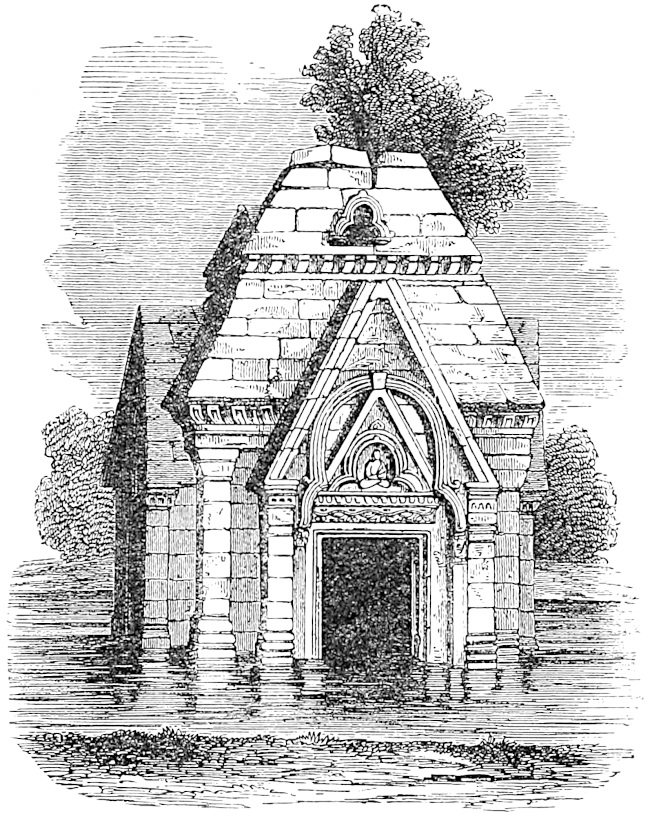
Ancient Buddhist Temple at Pandrethan in Káshmir.
Now we will quit this country, and not go any further in the same
direction; for if we did so we should enter India; and that I do not wish
to do at present. For, on our return journey, I mean to tell you about
India: all in regular order. Let us go back therefore to Badashan, for we
cannot otherwise proceed on our journey.
Note 1.—I apprehend that in this chapter Marco represents Buddhism (which
is to be understood by his expression Idolatry, not always, but usually)
as in a position of greater life and prosperity than we can believe it to
have enjoyed in Káshmir at the end of the 13th century, and I suppose that
his knowledge of it was derived in great part from tales of the Mongol and
Tibetan Buddhists about its past glories.
I know not if the spelling Kesciemur represents any peculiar Mongol
pronunciation of the name. Plano Carpini, probably the first modern
European to mention this celebrated region, calls it Casmir (p. 708).
“The Cashmeerians,” says Abu’l Fazl, “have a language of their own, but
their books are written in the Shanskrit tongue, although the character is
sometimes Cashmeerian. They write chiefly upon Tooz [birch-bark], which
is the bark of a tree; it easily divides into leaves, and remains perfect
for many years.” (Ayeen Akbery, II. 147.) A sketch of Kashmiri Grammar by
Mr. Edgeworth will be found in vol. x. of the J. A. S. B., and a fuller
one by Major Leech in vol. xiii. Other contributions on the language are in
vol. xxxv. pt. i. p. 233 (Godwin-Austen); in vol. xxxix. pt. i. p. 95 (Dr.
Elmslie); and in Proceedings for 1866, p. 62, seqq. (Sir G. Campbell and
Bábú Rájendra Lál Mitra). The language, though in large measure of Sanskrit
origin, has words and forms that cannot be traced in any other Indian
vernacular. (Campbell, pp. 67, 68). The character is a modification of
the Panjáb Nagari.
Note 2.—The Kashmirian conjurers had made a great impression on Marco, who
had seen them at the Court of the Great Kaan, and he recurs in a later
chapter to their weather sorceries and other enchantments, when we shall
make some remarks. Meanwhile let us cite a passage from Bernier, already
quoted by M. Pauthier. When crossing the Pír Panjál (the mountain crossed
on entering Káshmir from Lahore) with the camp of Aurangzíb, he met with
“an old Hermit who had dwelt upon the summit of the Pass since the days
of Jehangir, and whose religion nobody knew, although it was said that he
could work miracles, and used at his pleasure to produce extraordinary
thunderstorms, as well as hail, snow, rain, and wind. There was something
wild in his countenance, and in his long, spreading, and tangled hoary
beard. He asked alms fiercely, allowing the travellers to drink from
earthen cups that he had set out upon a great stone, but signing to them to
go quickly by without stopping. He scolded those who made a noise, ‘for,’
said he to me (after I had entered his cave and smoothed him down with a
half rupee which I put in his hand with all humility), ‘noise here raises
furious storms. Aurangzíb has done well in taking my advice and prohibiting
it. Shah Jehan always did the like. But Jehangir once chose to laugh at
what I said, and made his drums and trumpets sound; the consequence was he
nearly lost his life.’” (Bernier, Amst. ed. 1699, II. 290.) A successor
of this hermit was found on the same spot by P. Desideri in 1713, and
another by Vigne in 1837.
Note 3.—Though the earliest entrance of Buddhism into Tibet was from India
Proper, yet Káshmir twice in the history of Tibetan Buddhism played a most
important part. It was in Káshmir that was gathered, under the patronage
of the great King Kanishka, soon after our era, the Fourth Buddhistic
Council, which marks the point of separation between Northern and Southern
Buddhism. Numerous missionaries went forth from Káshmir to spread the
doctrine in Tibet and in Central Asia. Many of the Pandits who laboured at
the translation of the sacred books into Tibetan were Kashmiris, and it was
even in Káshmir that several of the translations were made. But these were
not the only circumstances that made Káshmir a holy land to the Northern
Buddhists. In the end of the 9th century the religion was extirpated in
Tibet by the Julian of the Lamas, the great persecutor Langdarma, and when
it was restored, a century later, it was from Káshmir in particular that
fresh missionaries were procured to reinstruct the people in the forgotten
Law. (See Koeppen, II. 12–13, 78; J. As. sér. VI. tom. vi. 540.)
“The spread of Buddhism to Káshmir is an event of extraordinary importance
in the history of that religion. Thenceforward that country became a
mistress in the Buddhist Doctrine and the headquarters of a particular
school.... The influence of Káshmir was very marked, especially in the
spread of Buddhism beyond India. From Káshmir it penetrated to Kandahar and
Kabul, ... and thence over Bactria. Tibetan Buddhism also had its essential
origin from Káshmir; ... so great is the importance of this region in the
History of Buddhism.” (Vassilyev, Der Buddhismus, I. 44.)
In the account which the Mahawanso gives of the consecration of the great
Tope at Ruanwelli, by Dutthagamini, King of Ceylon (B.C. 157), 280,000
priests (!) come from Káshmir, a far greater number than is assigned to any
other country except one. (J. A. S. B. VII. 165.)
It is thus very intelligible how Marco learned from the Mongols and the
Lamas with whom he came in contact to regard Káshmir as “the very original
source from which their Religion had spread abroad.” The feeling with which
they looked to Káshmir must have been nearly the same as that with which
the Buddhists of Burma look to Ceylon. But this feeling towards Káshmir
does not now, I am informed, exist in Tibet. The reverence for the
holy places has reverted to Bahár and the neighbouring “cradle-lands” of
Buddhism.
It is notable that the historian Firishta, in a passage quoted by Tod, uses
Marco’s expression in reference to Káshmir, almost precisely, saying that
the Hindoos derived their idolatry from Káshmir, “the foundry of magical
superstition.” (Rajasthan, I. 219.)
Note 4.—The people of Káshmir retain their beauty, but they are morally
one of the most degraded races in Asia. Long oppression, now under the
Lords of Jamu as great as ever, has no doubt aggravated this. Yet it would
seem that twelve hundred years ago the evil elements were there as well
as the beauty. The Chinese traveller says: “Their manners are light and
volatile, their characters effeminate and pusillanimous.... They are very
handsome, but their natural bent is to fraud and trickery.” (Pèl. Boud.
II. 167–168.) Vigne’s account is nearly the same. (II. 142–143.) “They are
as mischievous as monkeys, and far more malicious,” says Mr. Shaw (p. 292).
[Bernier says: “The women [of Kachemire] especially are very handsome; and
it is from this country that nearly every individual, when first admitted
to the court of the Great Mogul, selects wives or concubines, that his
children may be whiter than the Indians, and pass for genuine Moguls.
Unquestionably, there must be beautiful women among the higher classes,
if we may judge by those of the lower orders seen in the streets and in
the shops.” (Travels in the Mogul Empire, edited by Archibald Constable,
1891, p. 404.)]
Note 5.—In the time of Hiuen Tsang, who spent two years studying in
Káshmir in the first half of the 7th century, though there were many
Brahmans in the country, Buddhism was in a flourishing state; there were
100 convents with about 5000 monks. In the end of the 11th century a King
(Harshadeva, 1090–1102) is mentioned exceptionally as a protector of
Buddhism. The supposition has been intimated above that Marco’s picture
refers to a traditional state of things, but I must notice that a like
picture is presented in the Chinese account of Hulaku’s war. One of the
thirty kingdoms subdued by the Mongols was “The kingdom of Fo (Buddha)
called Kishimi. It lies to the N.W. of India. There are to be seen the
men who are counted the successors of Shakia; their ancient and venerable
air recalls the countenance of Bodi-dharma as one sees it in pictures. They
abstain from wine, and content themselves with a gill of rice for their
daily food, and are occupied only in reciting the prayers and litanies of
Fo.” (Rém. N. Mél. Asiat. I. 179.) Abu’l Fazl says that on his third
visit with Akbar to Káshmir he discovered some old men of the religion of
Buddha, but none of them were literati. The Rishis, of whom he speaks
with high commendation as abstaining from meat and from female society, as
charitable and unfettered by traditions, were perhaps a modified remnant of
the Buddhist Eremites. Colonel Newall, in a paper on the Rishis of Káshmir,
traces them to a number of Shiáh Sayads, who fled to Káshmir in the time of
Timur. But evidently the genus was of much earlier date, long preceding
the introduction of Islam. (Vie et V. de H. T. p. 390; Lassen, III.
709; Ayeen Akb. II. 147, III. 151; J. A. S. B. XXXIX. pt. i. 265.)
We see from the Dabistan that in the 17th century Káshmir continued to
be a great resort of Magian mystics and sages of various sects, professing
great abstinence and credited with preternatural powers. And indeed
Vámbéry tells us that even in our own day the Kashmiri Dervishes are
pre-eminent among their Mahomedan brethren for cunning, secret arts, skill
in exorcisms, etc. (Dab. I. 113 seqq. II. 147–148; Vámb. Sk. of Cent.
Asia, 9.)
Note 6.—The first precept of the Buddhist Decalogue, or Ten Obligations
of the Religious Body, is not to take life. But animal food is not
forbidden, though restricted. Indeed it is one of the circumstances in the
Legendary History of Sakya Muni, which looks as if it must be true, that
he is related to have aggravated his fatal illness by eating a dish of pork
set before him by a hospitable goldsmith. Giorgi says the butchers in Tibet
are looked on as infamous; and people selling sheep or the like will make
a show of exacting an assurance that these are not to be slaughtered. In
Burma, when a British party wanted beef, the owner of the bullocks would
decline to make one over, but would point one out that might be shot by the
foreigners.
In Tibetan history it is told of the persecutor Langdarma that he compelled
members of the highest orders of the clergy to become hunters and butchers.
A Chinese collection of epigrams, dating from the 9th century, gives a
facetious list of Incongruous Conditions, among which we find a poor
Parsi, a sick Physician, a fat Bride, a Teacher who does not know his
letters, and a Butcher who reads the Scriptures (of Buddhism)! (Alph.
Tib. 445; Koeppen, I. 74; N. and Q., C. and J. III. 33.)
Note 7.—Coral is still a very popular adornment in the Himalayan countries.
The merchant Tavernier says the people to the north of the Great Mogul’s
territories and in the mountains of Assam and Tibet were the greatest
purchasers of coral. (Tr. in India, Bk. II. ch. xxiii.)
Of the Great River of Badashan.
In leaving Badashan you ride twelve days between east and north-east,
ascending a river that runs through land belonging to a brother of the
Prince of Badashan, and containing a good many towns and villages and
scattered habitations. The people are Mahommetans, and valiant in war.
At the end of those twelve days you come to a province of no great size,
extending indeed no more than three days’ journey in any direction, and
this is called Vokhan. The people worship Mahommet, and they have a
peculiar language. They are gallant soldiers, and they have a chief whom
they call None, which is as much as to say Count, and they are liegemen
to the Prince of Badashan.{1}
There are numbers of wild beasts of all sorts in this region. And when
you leave this little country, and ride three days north-east, always
among mountains, you get to such a height that ’tis said to be the highest
place in the world! And when you have got to this height you find [a great
lake between two mountains, and out of it] a fine river running through a
plain clothed with the finest pasture in the world; insomuch that a lean
beast there will fatten to your heart’s content in ten days. There are
great numbers of all kinds of wild beasts; among others, wild sheep of
great size, whose horns are good six palms in length. From these horns
the shepherds make great bowls to eat from, and they use the horns also
to enclose folds for their cattle at night. [Messer Marco was told also
that the wolves were numerous, and killed many of those wild sheep. Hence
quantities of their horns and bones were found, and these were made into
great heaps by the way-side, in order to guide travellers when snow was on
the ground.]
The plain is called Pamier, and you ride across it for twelve days
together, finding nothing but a desert without habitations or any green
thing, so that travellers are obliged to carry with them whatever they have
need of. The region is so lofty and cold that you do not even see any birds
flying. And I must notice also that because of this great cold, fire does
not burn so brightly, nor give out so much heat as usual, nor does it cook
food so effectually.{2}
Now, if we go on with our journey towards the east-north-east, we travel a
good forty days, continually passing over mountains and hills, or through
valleys, and crossing many rivers and tracts of wilderness. And in all this
way you find neither habitation of man, nor any green thing, but must carry
with you whatever you require. The country is called Bolor. The people
dwell high up in the mountains, and are savage Idolaters, living only by
the chase, and clothing themselves in the skins of beasts. They are in
truth an evil race.{3}
Note 1.—[“The length of Little Pamir, according to Trotter, is 68 miles....
To find the twelve days’ ride in the plain of Marco Polo, it must be
admitted, says Severtsof (Bul. Soc. Géog. XI. 1890, pp. 588–589), that
he went down a considerable distance along the south-north course of the
Aksu, in the Aktash Valley, and did not turn towards Tásh Kurgán, by the
Neza Tash Pass, crossed by Gordon and Trotter. The descent from this pass
to Tásh Kurgán finishes with a difficult and narrow defile, which may well
be overflowed at the great melting of snow, from the end of May till the
middle of June, even to July.
“Therefore he must have left the Aksu Valley to cross the Pass of Tagharma,
about 50 or 60 kilometres to the north of the Neza Tash Pass; thence to
Kashgar, the distance, in a straight line, is about 200 kilometres, and
less than 300 by the shortest route which runs from the Tagharma Pass to
little Kara Kul, and from there down to Yangi Hissar, along the Ghidjik.
And Marco Polo assigns forty days for this route, while he allows but
thirty for the journey of 500 kilometres (at least) from Jerm to the foot
of the Tagharma Pass.”
Professor Paquier (Bul. Soc. Géog. 6e Sér. XII. pp. 121–125) remarks
that the Moonshee, sent by Captain Trotter to survey the Oxus between
Ishkashm and Kila Wamár, could not find at the spot marked by Yule on
his map, the mouth of the Shakh-Dara, but northward 7 or 8 miles from
the junction of the Murghab with the Oxus, he saw the opening of an
important water-course, the Suchnan River, formed by the Shakh-Dara and the
Ghund-Dara. Marco arrived at a place between Northern Wakhán and Shihgnan;
from the Central Pamir, Polo would have taken a route identical with that
of the Mirza (1868–1869) by the Chichiklik Pass. Professor Paquier adds: “I
have no hesitation in believing that Marco Polo was in the neighbourhood
of that great commercial road, which by the Vallis Comedarum reached
the foot of the Imaüs. He probably did not venture on a journey of fifty
marches in an unknown country. At the top of the Shihgnan Valley, he
doubtless found a road marked out to Little Bukharia. This was the road
followed in ancient times from Bactrian to Serica; and Ptolemy has, so
to speak, given us its landmarks after Marinus of Tyre, by the Vallis
Comedarum (Valley of actual Shihgnan); the Turris Lapidea and the
Statio Mercatorum, neighbourhood of Tásh Kurgán, capital of the present
province of Sar-i-kol.”
I must say that accepting, as I do, for Polo’s Itinerary, the route from
Wakhán to Kashgar by the Taghdum-Bash Pamir, and Tásh Kurgán, I do not
agree with Professor Paquier’s theory. But though I prefer Sir H. Yule’s
route from Badakhshan, by the River Vardoj, the Pass of Ishkashm, the
Panja, to Wakhán, I do not accept his views for the Itinerary from Wakhán
to Kashgar; see p. 175.—H. C.]
The river along which Marco travels from Badakhshan is no doubt the upper
stream of the Oxus, known locally as the Panja, along which Wood also
travelled, followed of late by the Mirza and Faiz Bakhsh. It is true that
the river is reached from Badaskhshan Proper by ascending another river
(the Vardoj) and crossing the Pass of Ishkáshm, but in the brief style of
our narrative we must expect such condensation.
Wakhán was restored to geography by Macartney, in the able map which he
compiled for Elphinstone’s Caubul, and was made known more accurately by
Wood’s journey through it. [The district of Wakhán “comprises the valleys
containing the two heads of the Panjah branch of the Oxus, and the valley
of the Panjah itself, from the junction at Zung down to Ishkashím. The
northern branch of the Panjah has its principal source in the Lake Victoria
in the Great Pamir, which as well as the Little Pamir, belongs to Wakhán,
the Aktash River forming the well recognized boundary between Kashgaria
and Wakhán.” (Captain Trotter, Forsyth’s Mission, p. 275.) The southern
branch is the Sarhadd Valley.—H. C.] The lowest part is about 8000 feet
above the sea, and the highest Kishlak, or village, about 11,500. A few
willows and poplars are the only trees that can stand against the bitter
blasts that blow down the valley. Wood estimated the total population of
the province at only 1000 souls, though it might be capable of supporting
5000.[1] He saw it, however, in the depth of winter. As to the peculiar
language, see note I, ch. xxix. It is said to be a very old dialect of
Persian. A scanty vocabulary was collected by Hayward. (J. R. G. S. XXI.
p. 29.) The people, according to Shaw, have Aryan features, resembling
those of the Kashmiris, but harsher.
[Cf. Captain Trotter’s The Oxus below Wakhan, Forsyth’s Mission, p. 276.]
We appear to see in the indications of this paragraph precisely the same
system of government that now prevails in the Oxus valleys. The central
districts of Faizabad and Jerm are under the immediate administration of
the Mír of Badakhshan, whilst fifteen other districts, such as Kishm,
Rusták, Zebák, Ishkáshm, Wakhán, are dependencies “held by the relations
of the Mír, or by hereditary rulers, on a feudal tenure, conditional on
fidelity and military service in time of need, the holders possessing
supreme authority in their respective territories, and paying little or no
tribute to the paramount power.” (Pandit Manphul.) The first part of the
valley of which Marco speaks as belonging to a brother of the Prince, may
correspond to Ishkáshm, or perhaps to Vardoj; the second, Wakhán, seems
to have had a hereditary ruler; but both were vassals of the Prince of
Badakhshan, and therefore are styled Counts, not kings or Seigneurs.
The native title which Marco gives as the equivalent of Count is
remarkable. Non or None, as it is variously written in the texts, would
in French form represent Nono in Italian. Pauthier refers this title to
the “Rao-nana (or nano) Rao” which figures as the style of Kanerkes in
the Indo-Scythic coinage. But Wilson (Ariana Antiqua, p. 358) interprets
Raonano as most probably a genitive plural of Rao, whilst the whole
inscription answers precisely to the Greek one ΒΑΣΙΛΕΥΣ ΒΑΣΙΛΕΩΝ ΚΑΝΗΡΚΟΥ,
which is found on other coins of the same prince. General
Cunningham, a very competent authority, adheres to this view, and writes:
“I do not think None or Non can have any connection with the Nana of
the coins.”
It is remarkable, however, that Nono (said to signify “younger,” or lesser)
is in Tibet the title given to a younger brother, deputy, or subordinate
prince. In Cunningham’s Ladak (259) we read: “Nono is the usual term
of respect which is used in addressing any young man of the higher ranks,
and when prefixed to Kahlon it means the younger or deputy minister.”
And again (p. 352): “Nono is the title given to a younger brother. Nono
Sungnam was the younger brother of Chang Raphtan, the Kahlon of Bazgo.”
I have recently encountered the word used independently, and precisely
in Marco’s application of it. An old friend, in speaking of a journey
that he had made in our Tibetan provinces, said incidentally that he had
accompanied the commissioner to the installation of a new Nono (I think
in Spiti). The term here corresponds so precisely with the explanation
which Marco gives of None as a Count subject to a superior sovereign,
that it is difficult to regard the coincidence as accidental. The Yuechi
or Indo-Scyths who long ruled the Oxus countries are said to have been of
Tibetan origin, and Al-Biruni repeats a report that this was so. (Elliot.
II. 9.)[2] Can this title have been a trace of their rule? Or is it Indian?
Note 2.—This chapter is one of the most interesting in the book, and
contains one of its most splendid anticipations of modern exploration,
whilst conversely Lieutenant John Wood’s narrative presents the most
brilliant confirmation in detail of Marco’s narrative.
We have very old testimony to the recognition of the great altitude of
the Plateau of Pamir (the name which Marco gives it and which it still
retains), and to the existence of the lake (or lakes) upon its surface.
The Chinese pilgrims Hwui Seng and Sung Yun, who passed this way A.D. 518,
inform us that these high lands of the Tsung Ling were commonly said to be
midway between heaven and earth. The more celebrated Hiuen Tsang, who came
this way nearly 120 years later (about 644) on his return to China, “after
crossing the mountains for 700 li, arrived at the valley of Pomilo
(Pamir). This valley is 1000 li (about 200 miles) from east to west, and
100 li (20 miles) from north to south, and lies between two snowy ranges
in the centre of the Tsung Ling mountains. The traveller is annoyed by
sudden gusts of wind, and the snow-drifts never cease, spring or summer. As
the soil is almost constantly frozen, you see but a few miserable plants,
and no crops can live. The whole tract is but a dreary waste, without
a trace of human kind. In the middle of the valley is a great lake 300
li (60 miles) from east to west, and 500 li from north to south. This
stands in the centre of Jambudwipa (the Buddhist οἰκουμένη) on a
plateau of prodigious elevation. An endless variety of creatures peoples
its waters. When you hear the murmur and clash of its waves you think you
are listening to the noisy hum of a great market in which vast crowds of
people are mingling in excitement.... The lake discharges to the west, and
a river runs out of it in that direction and joins the Potsu (Oxus)....
The lake likewise discharges to the east, and a great river runs out,
which flows eastward to the western frontier of Kiesha (Káshgar), where
it joins the River Sita, and runs eastward with it into the sea.” The
story of an eastern outflow from the lake is, no doubt, legend, connected
with an ancient Hindu belief (see Cathay, p. 347), but Burnes in modern
times heard much the same story. And the Mirza, in 1868, took up the same
impression regarding the smaller lake called Pamir Kul, in which the
southern branch of the Panja originates.
“After quitting the (frozen) surface of the river,” says Wood, “we ...
ascended a low hill, which apparently bounded the valley to the eastward.
On surmounting this, at 3 P.M. of the 19th February, 1838, we stood, to
use a native expression, upon the Bám-i-Duniah, or ‘Roof of the World,’
while before us lay stretched a noble but frozen sheet of water, from whose
western end issued the infant river of the Oxus. This fine lake (Sirikol)
lies in the form of a crescent, about 14 miles long from east to west, by
an average breadth of 1 mile. On three sides it is bordered by swelling
hills about 500 feet high, while along its southern bank they rise into
mountains 3500 feet above the lake, or 19,000 feet above the sea, and
covered with perpetual snow, from which never-failing source the lake is
supplied.... Its elevation, measured by the temperature of boiling water,
is 15,600 feet.”
The absence of birds on Pamir, reported by Marco, probably shows that
he passed very late or early in the season. Hiuen Tsang, we see, gives
a different account; Wood was there in the winter, but heard that in
summer the lake swarmed with water-fowl. [Cf. Captain Trotter, p. 263, in
Forsyth’s Mission.]
The Pamir Steppe was crossed by Benedict Goës late in the autumn of
1603, and the narrative speaks of the great cold and desolation, and
the difficulty of breathing. We have also an abstract of the journey of
Abdul Mejid, a British Agent, who passed Pamir on his way to Kokan in
1861:—“Fourteen weary days were occupied in crossing the steppe; the
marches were long, depending on uncertain supplies of grass and water,
which sometimes wholly failed them; food for man and beast had to be
carried with the party, for not a trace of human habitation is to be met
with in those inhospitable wilds.... The steppe is interspersed with
tamarisk jungle and the wild willow, and in the summer with tracts of high
grass.” (Neumann, Pilgerfahrten Buddh. Priester, p. 50; V. et V. de H.
T. 271–272; Wood, 232; Proc. R. G. S. X. 150.)
There is nothing absolutely to decide whether Marco’s route from Wakhán
lay by Wood’s Lake “Sirikol,” or Victoria, or by the more southerly source
of the Oxus in Pamir Kul. These routes would unite in the valley of
Táshkurgán, and his road thence to Kashgar was, I apprehend, nearly the
same as the Mirza’s in 1868–1869, by the lofty Chichiklik Pass and Kin
Valley. But I cannot account for the forty days of wilderness. The Mirza
was but thirty-four days from Faizabad to Kashgar, and Faiz Bakhsh only
twenty-five.
[Severtsof (Bul. Soc. Géog. XI. 1890, p. 587), who accepts Trotter’s
route, by the Pamir Khurd (Little Pamir), says there are three routes from
Wakhán to Little Pamir, going up the Sarhadd: one during the winter, by the
frozen river; the two others available during the spring and the summer,
up and down the snowy chain along the right bank of the Sarhadd, until the
valley widens out into a plain, where a swelling is hardly to be seen, so
flat is it; this chain is the dividing ridge between the Sarhadd and the
Aksu. From the summit, the traveller, looking towards the west, sees at
his feet the mountains he has crossed; to the east, the Pamir Kul and
the Aksu, the river flowing from it. The pasture grounds around the Pamir
Kul and the sources of the Sarhadd are magnificent; but lower down, the
Aksu valley is arid, dotted only with pasture grounds of little extent,
and few and far between. It is to this part of Pamir that Marco Polo’s
description applies; more than any other part of this ensemble of high
valleys, this line of water parting, of the Sarhadd and the Aksu, has the
aspect of a Roof of the World (Bam-i-dunya, Persian name of Pamir).—H. C.].
[We can trace Marco Polo’s route from Wakhán, on comparing it with Captain
Younghusband’s Itinerary from Kashgar, which he left on the 22nd July,
1891, for Little Pamir: Little Pamir at Bozai-Gumbaz, joins with the
Pamir-i-Wakhán at the Wakhijrui Pass, first explored by Colonel Lockhart’s
mission. Hence the route lies by the old fort of Kurgan-i-Ujadbai at the
junction of the two branches of the Tagh-dum-bash Pamir (Supreme Head of
the Mountains), the Tagh-dum-bash Pamir, Tásh Kurgán, Bulun Kul, the Gez
Defile and Kashgar. (Proc. R. G. S. XIV. 1892, pp. 205–234.)—H. C.]
We may observe that Severtsof asserts Pamir to be a generic term, applied
to all high plateaux in the Thian Shan.[3]
[“The Pámír plateau may be described as a great, broad, rounded ridge,
extending north and south, and crossed by thick mountain chains, between
which lie elevated valleys, open and gently sloping towards the east, but
narrow and confined, with a rapid fall towards the west. The waters which
run in all, with the exception of the eastern flow from the Tághdúngbásh,
collect in the Oxus; the Áksú from the Little Pámír lake receiving the
eastern drainage, which finds an outlet in the Áktásh Valley, and joining
the Múrgháb, which obtains that from the Alichór and Síríz Pámírs. As
the eastern Tághdúngbásh stream finds its way into the Yarkand river,
the watershed must be held as extending from that Pámír, down the range
dividing it from the Little Pámír, and along the Neza Tásh mountains to the
Kizil Art Pass, leading to the Alái.” (Colonel Gordon, Forsyth’s Mission, p. 231.)
Lieutenant-Colonel Gordon (Forsyth’s Mission, p. 231) says also:
“Regarding the name ‘Pámír,’ the meaning appears to be wilderness—a place
depopulated, abandoned, waste, yet capable of habitation. I obtained this
information on the Great Pámír from one of our intelligent guides, who said
in explanation—‘In former days, when this part was inhabited by Kirghiz, as
is shown by the ruins of their villages and burial-grounds, the valley was
not all called Pámír, as it is now. It was known by its village names, as
is the country beyond Sirikol, which being now occupied by Kirghiz is not
known by one name, but partly as Chárling, Bas Robát, etc. If deserted it
would be Pámír.’” In a note Sir T. D. Forsyth adds that the same explanation
of the word was given to him at Yangi-Hissar, and that it is in fact a
Khokandi-Turki word.—H. C.]
It would seem, from such notices as have been received, that there is not,
strictly speaking, one steppe called Pamir, but a variety of Pamirs,
which are lofty valleys between ranges of hills, presenting luxuriant
summer pasture, and with floors more or less flat, but nowhere more than 5
or 6 miles in width and often much less.
[This is quite exact; Mr. E. Delmar Morgan writes in the Scottish Geog.
Mag. January, 1892, p. 17: “Following the terminology of Yule adopted by
geographers, and now well established, we have (1) Pamir Alichur; (2) Pamir
Khurd (or “Little”); (3) Pamir Kalan (or “Great”); (4) Pamir Khargosi (“of
the hare”); (5) Pamir Sares; (6) Pamir Rang-kul.”—H. C.]
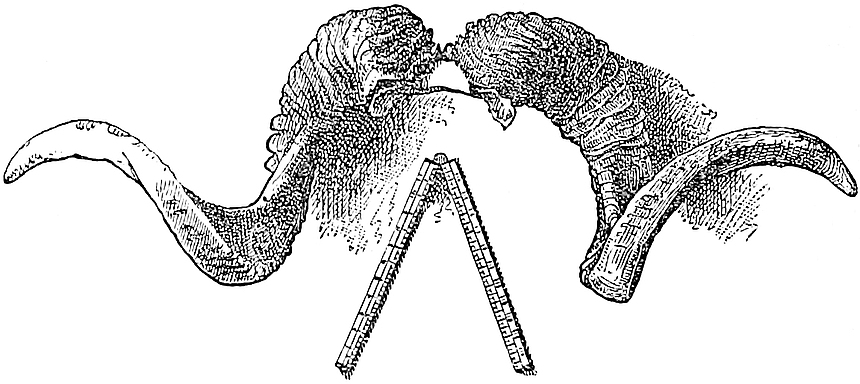
Horns of Ovis Poli.
Wood speaks of the numerous wolves in this region. And the great sheep is
that to which Blyth, in honour of our traveller, has given the name of
Ovis Poli.[4] A pair of horns, sent by Wood to the Royal Asiatic Society,
and of which a representation is given above, affords the following
dimensions:—Length of one horn on the curve, 4 feet 8 inches; round the
base 14¼ inches; distance of tips apart 3 feet 9 inches. This sheep appears
to be the same as the Rass, of which Burnes heard that the horns were
so big that a man could not lift a pair, and that foxes bred in them;
also that the carcass formed a load for two horses. Wood says that these
horns supply shoes for the Kirghiz horses, and also a good substitute for
stirrup-irons. “We saw numbers of horns strewed about in every direction,
the spoils of the Kirghiz hunter. Some of these were of an astonishingly
large size, and belonged to an animal of a species between a goat and a
sheep, inhabiting the steppes of Pamir. The ends of the horns projecting
above the snow often indicated the direction of the road; and wherever
they were heaped in large quantities and disposed in a semicircle, there
our escort recognised the site of a Kirghiz summer encampment.... We
came in sight of a rough-looking building, decked out with the horns of
the wild sheep, and all but buried amongst the snow. It was a Kirghiz
burying-ground.” (Pp. 223, 229, 231.)
[With reference to Wood’s remark that the horns of the Ovis Poli supply
shoes for the Kirghiz horses, Mr. Rockhill writes to me that a Paris
newspaper of 24th November, 1894, observes: “Horn shoes made of the horn of
sheep are successfully used in Lyons. They are especially adapted to horses
employed in towns, where the pavements are often slippery. Horses thus shod
can be driven, it is said, at the most rapid pace over the worst pavement
without slipping.”
(Cf. Rockhill, Rubruck, p. 69; Chasses et Explorations dans la Région
des Pamirs, par le Vte. Ed. de Poncins, Paris, 1897, 8vo.—H. C.).]
In 1867 this great sheep was shot by M. Severtsof, on the Plateau of Aksai,
in the western Thian Shan. He reports these animals to go in great herds,
and to be very difficult to kill. However, he brought back two specimens.
The Narin River is stated to be the northern limit of the species.[5]
Severtsof also states that the enemies of the Ovis Poli are the wolves,
[and Colonel Gordon says that the leopards and wolves prey almost entirely
upon them. (On the Ovis Poli, see Captain Deasy, In Tibet, p. 361.)—H. C.]
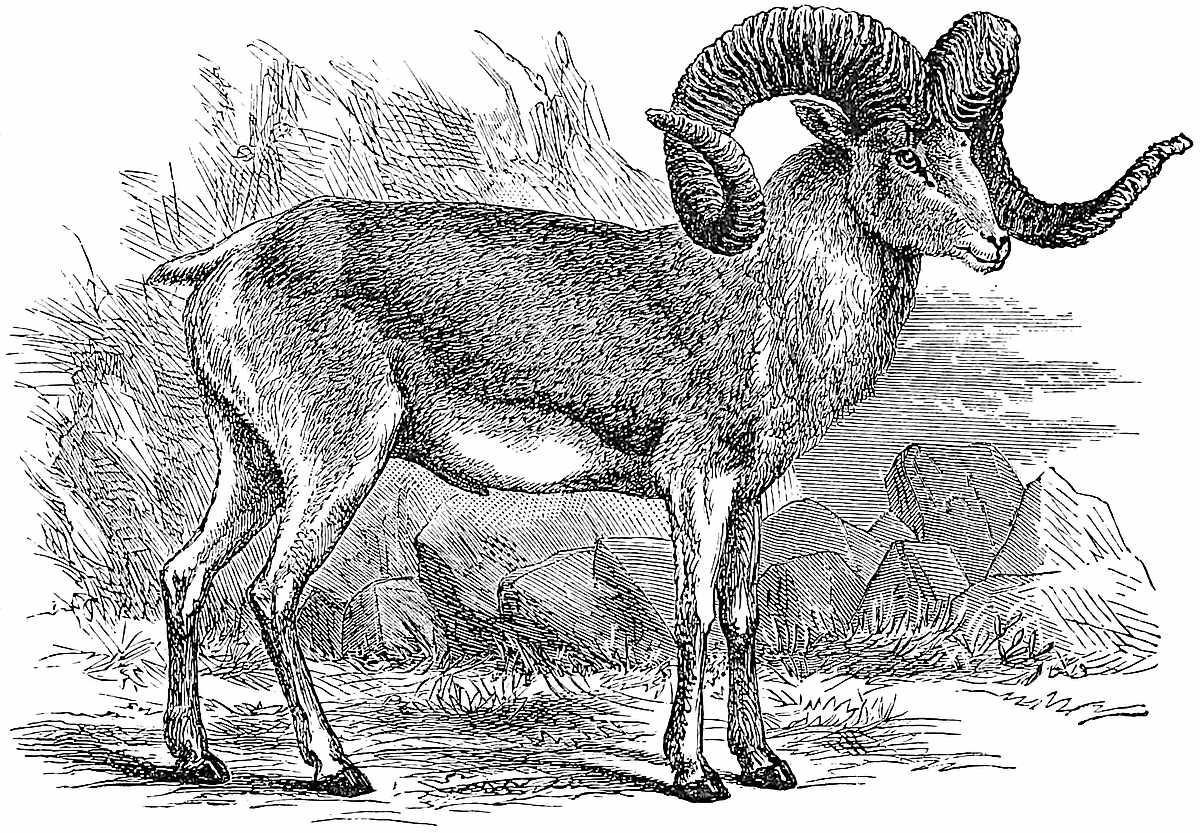
Ovis Poli, the Great Sheep of Pamir. (After Severtsof.)
“Il hi a grant moutitude de mouton sauvages qe sunt grandisme, car ont les
cornes bien six paumes” ...
Colonel Gordon, the head of the exploring party detached by Sir Douglas
Forsyth, brought away a head of Ovis Poli, which quite bears out the
account by its eponymus of horns “good 6 palms in length,” say 60 inches.
This head, as I learn from a letter of Colonel Gordon’s to a friend, has
one horn perfect which measures 65½ inches on the curves; the other, broken
at the tip, measures 64 inches; the straight line between the tips is 55
inches.
[Captain Younghusband [1886] “before leaving the Altai Mountains, picked up
several heads of the Ovis Poli, called Argali by the Mongols. They were
somewhat different from those which I afterwards saw at Yarkand, which had
been brought in from the Pamir. Those I found in the Gobi were considerably
thicker at the base, there was a less degree of curve, and a shorter length
of horn.” A full description of the Ovis Poli, with a large plate drawing
of the horns, may be seen in Colonel Gordon’s Roof of the World. (See
p. 81.) (Proc. R. G. S. X. 1888, p. 495.) Some years later, Captain
Younghusband speaks repeatedly of the great sport of shooting Ovis Poli.
(Proc. R. G. S. XIV. 1892, pp. 205, 234.)—H. C.]
As to the pasture, Timkowski heard that “the pasturage of Pamir is so
luxuriant and nutritious, that if horses are left on it for more than forty
days they die of repletion.” (I. 421.) And Wood: “The grass of Pamir, they
tell you, is so rich that a sorry horse is here brought into good condition
in less than twenty days; and its nourishing qualities are evidenced in the
productiveness of their ewes, which almost invariably bring forth two lambs
at a birth.” (P. 365.)
With regard to the effect upon fire ascribed to the “great cold,” Ramusio’s
version inserts the expression “gli fu affermato per miracolo,” “it was
asserted to him as a wonderful circumstance.” And Humboldt thinks it so
strange that Marco should not have observed this personally that he doubts
whether Polo himself passed the Pamir. “How is it that he does not say that
he himself had seen how the flames disperse and leap about, as I myself
have so often experienced at similar altitudes in the Cordilleras of the
Andes, especially when investigating the boiling-point of water?” (Cent.
Asia, Germ. Transl. I. 588.) But the words quoted from Ramusio do not
exist in the old texts, and they are probably an editorial interpolation
indicating disbelief in the statement.
MM. Huc and Gabet made a like observation on the high passes of
north-eastern Tibet: “The argols gave out much smoke, but would not
burn with any flame”; only they adopted the native idea that this as well
as their own sufferings in respiration was caused by some pernicious
exhalation.
Major Montgomerie, R.E., of the Indian Survey, who has probably passed more
time nearer the heavens than any man living, sends me the following note
on this passage: “What Marco Polo says as to fire at great altitudes not
cooking so effectually as usual is perfectly correct as far as anything
boiled is concerned, but I doubt if it is as to anything roasted. The
want of brightness in a fire at great altitudes is, I think, altogether
attributable to the poorness of the fuel, which consists of either small
sticks or bits of roots, or of argols of dung, all of which give out a
good deal of smoke, more especially the latter if not quite dry; but I
have often seen a capital blaze made with the argols when perfectly dry.
As to cooking, we found that rice, dál, and potatoes would never soften
properly, no matter how long they were boiled. This, of course, was due to
the boiling-point being only from 170° to 180°. Our tea, moreover, suffered
from the same cause, and was never good when we were over 15,000 feet. This
was very marked. Some of my natives made dreadful complaints about the rice
and dál that they got from the village-heads in the valleys, and vowed that
they only gave them what was very old and hard, as they could not soften it!”
Note 3.—Bolor is a subject which it would take several pages to discuss
with fulness, and I must refer for such fuller discussion to a paper in the
J. R. G. S. vol. xlii. p. 473.
The name Bolor is very old, occurring in Hiuen Tsang’s Travels (7th
century), and in still older Chinese works of like character. General
Cunningham has told us that Balti is still termed Balor by the Dards of
Gilghit; and Mr. Shaw, that Palor is an old name still sometimes used
by the Kirghiz for the upper part of Chitrál. The indications of Hiuen
Tsang are in accordance with General Cunningham’s information; and the
fact that Chitrál is described under the name of Bolor in Chinese works
of the last century entirely justifies that of Mr. Shaw. A Pushtu poem of
the 17th century, translated by Major Raverty, assigns the mountains of
Bilaur-istán, as the northern boundary of Swát. The collation of these
indications shows that the term Bolor must have been applied somewhat
extensively to the high regions adjoining the southern margin of Pamir. And
a passage in the Táríkh Rashídí, written at Kashgar in the 16th century
by a cousin of the great Baber, affords us a definition of the tract to
which, in its larger sense, the name was thus applied: “Malaur (i.e.
Balaur or Bolor) ... is a country with few level spots. It has a circuit of
four months’ march. The eastern frontier borders on Kashgar and Yarkand; it
has Badakhshan to the north, Kabul to the west, and Kashmír to the south.”
The writer was thoroughly acquainted with his subject, and the region which
he so defines must have embraced Sirikol and all the wild country south
of Yarkand, Balti, Gilghit, Yasin, Chitrál, and perhaps Kafiristán. This
enables us to understand Polo’s use of the term.
MARCO POLO’S ITINERARIES No. III.
Regions on and near the Upper Oxus
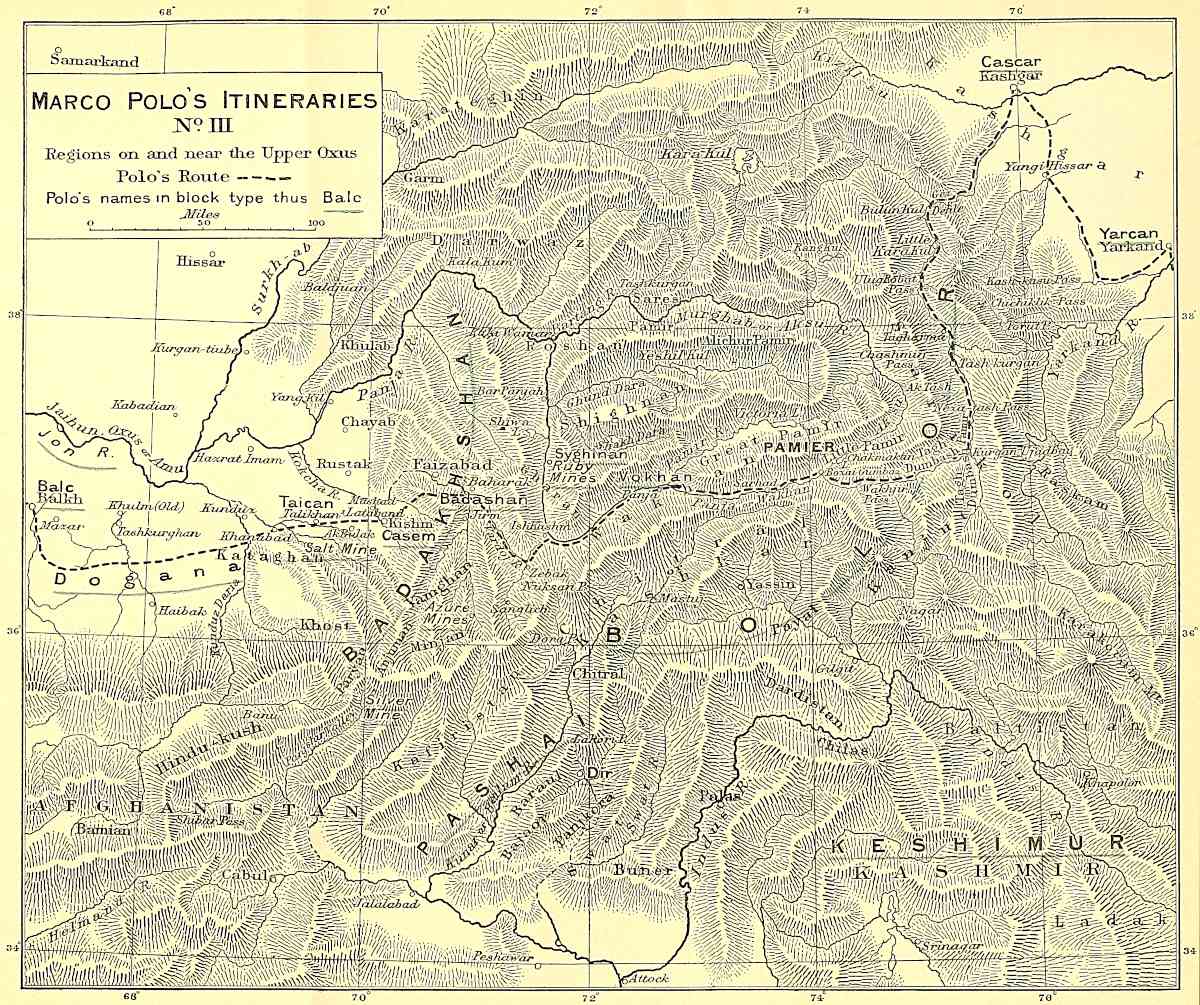
The name of Bolor in later days has been in a manner a symbol of
controversy. It is prominent in the apocryphal travels of George Ludwig
von ————, preserved in the Military Archives at St. Petersburg. That work
represents a town of Bolor as existing to the north of Badakhshan, with
Wakhán still further to the north. This geography we now know to be
entirely erroneous, but it is in full accordance with the maps and tables
of the Jesuit missionaries and their pupils, who accompanied the Chinese
troops to Kashgar in 1758–1759. The paper in the Geographical Society’s
Journal, which has been referred to, demonstrates how these erroneous
data must have originated. It shows that the Jesuit geography was founded
on downright accidental error, and, as a consequence, that the narratives
which profess de visu to corroborate that geography must be downright
forgeries. When the first edition was printed, I retained the belief in a
Bolor where the Jesuits placed it.
[The Chinese traveller, translated by M. Gueluy (Desc. de la Chine occid.
p. 53), speaks of Bolor, to the west of Yarkand, inhabited by Mahomedans
who live in huts; the country is sandy and rather poor. Severtsof says,
(Bul. Soc. Géog. XI. 1890, p. 591) that he believes that the name of
Bolor should be expunged from geographical nomenclature as a source of
confusion and error. Humboldt, with his great authority, has too definitely
attached this name to an erroneous orographical system. Lieutenant-Colonel
Gordon says that he “made repeated enquiries from Kirghiz and Wakhis, and
from the Mír [of Wakhán], Fatteh Ali Shah, regarding ‘Bólór,’ as a name for
any mountain, country, or place, but all professed perfect ignorance of
it.” (Forsyth’s Mission.)—H. C.]
The J. A. S. Bengal for 1853 (vol. xxii.) contains extracts from the
diary of a Mr. Gardiner in those central regions of Asia. These read
more like the memoranda of a dyspeptic dream than anything else, and the
only passage I can find illustrative of our traveller is the following;
the region is described as lying twenty days south-west of Kashgar: “The
Keiaz tribe live in caves on the highest peaks, subsist by hunting, keep
no flocks, said to be anthropophagous, but have handsome women; eat their
flesh raw.” (P. 295; Pèlerins Boud. III. 316, 421, etc.; Ladak, 34, 45,
47; Mag. Asiatique, I. 92, 96–97; Not. et Ext. II. 475, XIV. 492; J.
A. S. B. XXXI. 279; Mr. R. Shaw in Geog. Proceedings, XVI. 246, 400;
Notes regarding Bolor, etc., J. R. G. S. XLII. 473.)
As this sheet goes finally to press we hear of the exploration of Pamir
by officers of Mr. Forsyth’s Mission. [I have made use of the information
collected by them.—H. C.]
Of the Kingdom of Cascar.
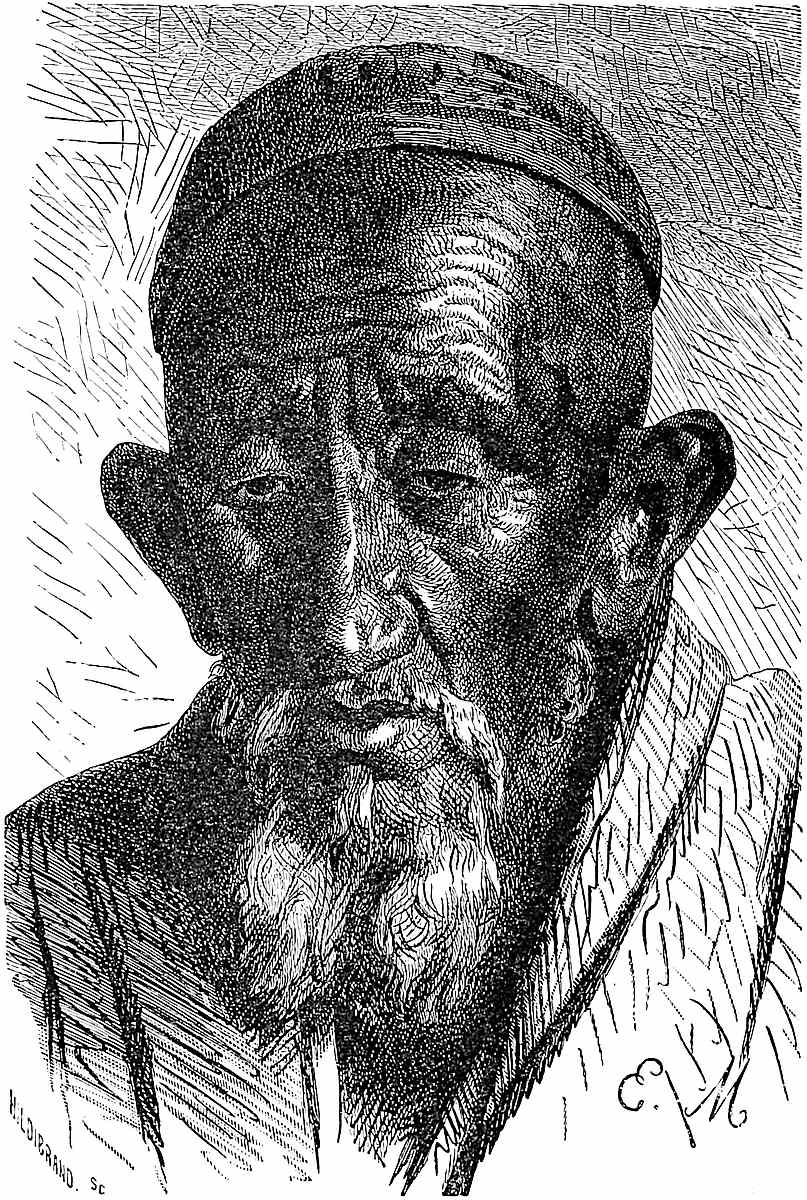
Head of a Native of Kashgar.
Cascar is a region lying between north-east and east, and constituted a
kingdom in former days, but now it is subject to the Great Kaan. The people
worship Mahommet. There are a good number of towns and villages, but the
greatest and finest is Cascar itself. The inhabitants live by trade and
handicrafts; they have beautiful gardens and vineyards, and fine estates,
and grow a great deal of cotton. From this country many merchants go forth
about the world on trading journeys. The natives are a wretched, niggardly
set of people; they eat and drink in miserable fashion. There are in the
country many Nestorian Christians, who have churches of their own. The
people of the country have a peculiar language, and the territory extends
for five days’ journey.{1}
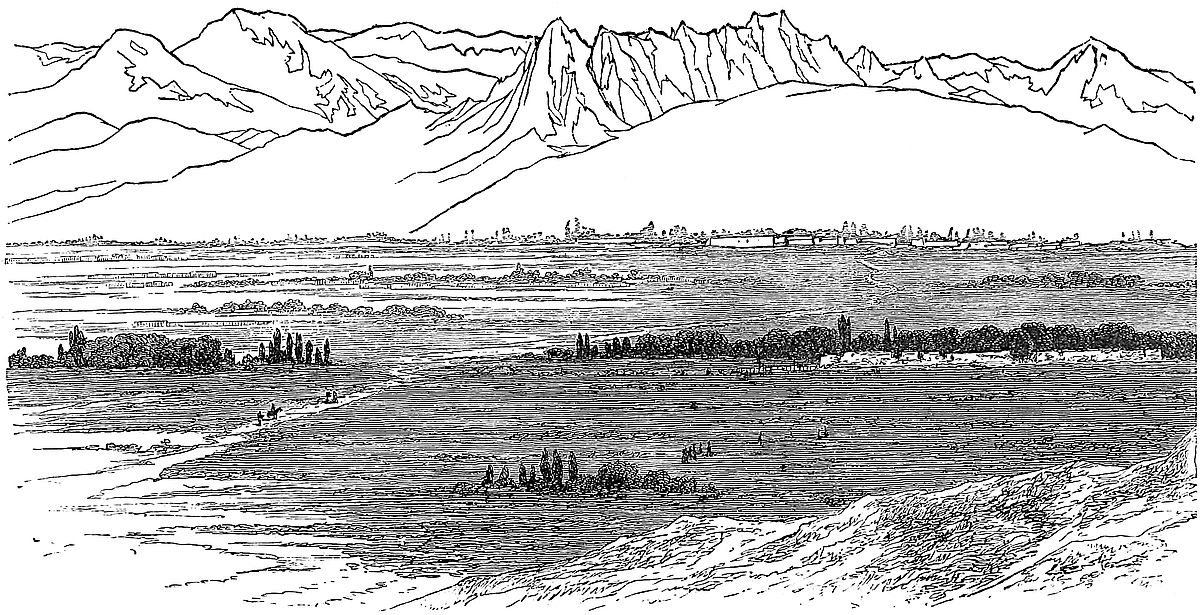
View of Kashgar. (From Shaw’s “Tartary.”)
Note 1.—[There is no longer any difficulty in understanding how the
travellers, after crossing Pamir, should have arrived at Kashgar if they
followed the route from Táshkurgán through the Gez Defile.
The Itinerary of the Mirza from Badakhshan (Fáizabad) is the following:
Zebák, Ishkashm, on the Panja, which may be considered the beginning of
the Wakhán Valley, Panja Fort, in Wakhán, Raz Khan, Patur, near Lunghar
(commencement of Pamir Steppe), Pamir Kul, or Barkút Yassin, 13,300 feet,
Aktash, Sirikul Táshkurgán, Shukrab, Chichik Dawan, Akul, Kotul, Chahul
Station (road to Yarkand), Kila Karawal, Aghiz Gah, Yangi-Hissar, Opechan,
Yanga Shahr, Kashgar, where he arrived on the 3rd February, 1869. (Cf.
Report of “The Mirza’s” Exploration from Caubul to Kashgar. By Major T.
G. Montgomerie, R.E.... (Jour. R. Geog. Soc. XLI. 1871, pp. 132–192.)
Major Montgomerie (l.c. p. 144) says: “The alterations in the positions of
Kashgar and Yarkund in a great measure explains why Marco Polo, in crossing
from Badakhshan to Eastern Turkestan, went first to Kashgar and then to
Yarkund. With the old positions of Yarkund and Kashgar it appeared that the
natural route from Badakhshan would have led first to Yarkund; with the
new positions, and guided by the light of the Mirza’s route, from which it
is seen that the direct route to Yarkund is not a good one, it is easy to
understand how a traveller might prefer going to Kashgar first, and then
to Yarkund. It is satisfactory to have elicited this further proof of the
general accuracy of the great traveller’s account of his journey through
Central Asia.”
The Itinerary of Lieutenant-Colonel Gordon (Sirikol, the Pámírs and
Wakhán, ch. vi. of Forsyth’s Mission to Yarkund in 1873) runs thus:
“Left Káshgar (21st March), Yangi-Hissar, Kaskasú Pass, descent to Chihil
Gumbaz (forty Domes), where the road branches off to Yárkand (110 miles),
Torut Pass, Tangi-Tár (defile), ‘to the foot of a great elevated slope
leading to the Chichiklik Pass, plain, and lake (14,700 feet), below the
Yámbulák and Kok-Moinok Passes, which are used later in the season on the
road between Yangi-Hissar and Sirikol, to avoid the Tangi-Tár and Shindi
defiles. As the season advances, these passes become free from snow,
while the defiles are rendered dangerous and difficult by the rush of the
melting snow torrents. From the Chichiklik plain we proceeded down the
Shindi ravine, over an extremely bad stony road, to the Sirikol River, up
the banks of which we travelled to Táshkurgán, reaching it on the tenth
day from Yangi-Hissar. The total distance is 125 miles.’ Then Táshkurgán
(ancient name Várshídi): ‘the open part of the Sirikol Valley extends
from about 8 miles below Táshkurgán to apparently a very considerable
distance towards the Kunjút mountain range;’ left Táshkurgán for Wákhan
(2nd April, 1873); leave Sirikol Valley, enter the Shindán defile, reach
the Áktásh Valley, follow the Áktásh stream (called Áksú by the Kirghiz)
through the Little Pamir to the Gházkul (Little Pamir) Lake or Barkat
Yássín, from which it takes its rise, four days from Táshkurgán. Little
Pamir ‘is bounded on the south by the continuation of the Neza Tásh range,
which separates it from the Tághdúngbásh Pámir,’ west of the lake, Langar,
Sarhadd, 30 miles from Langar, and seven days from Sirikol, and Kila Panj,
twelve days from Sirikol.”—H. C.]
[I cannot admit with Professor Paquier (l.c. pp. 127–128) that Marco Polo
did not visit Kashgar.—Grenard (II. p. 17) makes the remark that it took
Marco Polo seventy days from Badakhshan to Kashgar, a distance that, in the
Plain of Turkestan, he shall cross in sixteen days.—The Chinese traveller,
translated by M. Gueluy (Desc. de la Chine occidentale, p. 45), says that
the name Kashgar is made of Kash, fine colour, and gar, brick house.—H. C.]
Kashgar was the capital, from 1865 to 1877, of Ya’kúb Kúshbegi, a
soldier of fortune, by descent it is said a Tajik of Shighnan, who, when
the Chinese yoke was thrown off, made a throne for himself in Eastern
Turkestan, and subjected the whole basin to his authority, taking the title
of Atalik Gházi.
It is not easy to see how Kashgar should have been subject to the Great
Kaan, except in the sense in which all territories under Mongol rule owed
him homage. Yarkand, Polo acknowledges to have belonged to Kaidu, and the
boundary between Kaidu’s territory and the Kaan’s lay between Karashahr and
Komul [Bk. I. ch. xli.], much further east.
[Bretschneider, Med. Res. (II. p. 47), says: “Marco Polo states with
respect to the kingdom of Cascar (I. 189) that it was subject to the
Great Khan, and says the same regarding Cotan (I. 196), whilst Yarcan
(I. 195), according to Marco Polo, belonged to Kaidu. This does not agree
with Rashid’s statements about the boundary between Kaidu’s territory and
the Khan’s.”—H. C.]
Kashgar was at this time a Metropolitan See of the Nestorian Church.
(Cathay, etc. 275, ccxlv.)
Many strange sayings have been unduly ascribed to our traveller, but
I remember none stranger than this by Colonel Tod: “Marco Polo calls
Cashgar, where he was in the 6th century, the birthplace of the Swedes”!
(Rajasthan, I. 60.) Pétis de la Croix and Tod between them are answerable
for this nonsense. (See The Hist. of Genghizcan the Great, p. 116.)
On cotton, see ch. xxxvi.—On Nestorians, see Kanchau.
Of the Great City of Samarcan.
Samarcan is a great and noble city towards the north-west, inhabited by
both Christians and Saracens, who are subject to the Great Kaan’s nephew,
Caidou by name; he is, however, at bitter enmity with the Kaan.{1} I
will tell you of a great marvel that happened at this city.
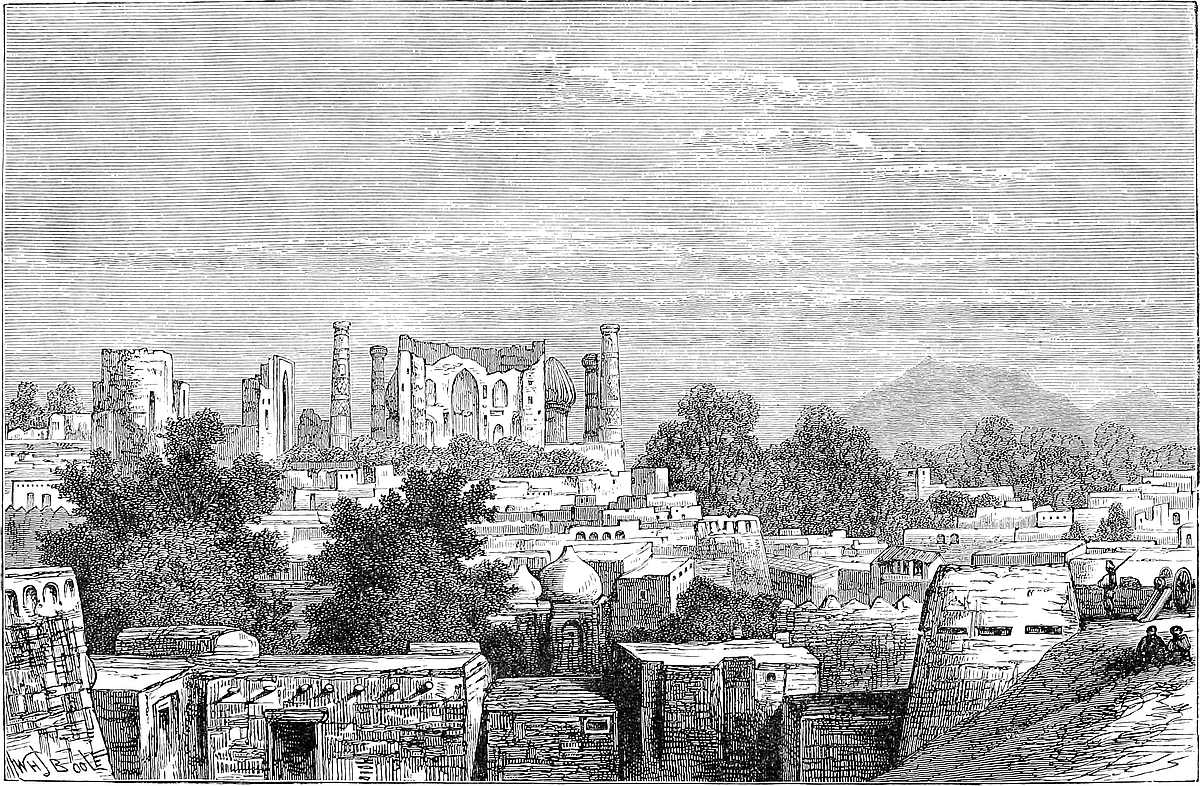
View of Samarcand. (From a sketch by Mr. Ivanoff.)
“Samarcan est une grandisme cité et noble.”
It is not a great while ago that Sigatay, own brother to the Great
Kaan, who was Lord of this country and of many an one besides, became a
Christian.{2} The Christians rejoiced greatly at this, and they built
a great church in the city, in honour of John the Baptist; and by his name
the church was called. And they took a very fine stone which belonged to
the Saracens, and placed it as the pedestal of a column in the middle of
the church, supporting the roof. It came to pass, however, that Sigatay
died. Now the Saracens were full of rancour about that stone that had been
theirs, and which had been set up in the church of the Christians; and
when they saw that the Prince was dead, they said one to another that now
was the time to get back their stone, by fair means or by foul. And that
they might well do, for they were ten times as many as the Christians. So
they gat together and went to the church and said that the stone they must
and would have. The Christians acknowledged that it was theirs indeed, but
offered to pay a large sum of money and so be quit. Howbeit, the others
replied that they never would give up the stone for anything in the world.
And words ran so high that the Prince heard thereof, and ordered the
Christians either to arrange to satisfy the Saracens, if it might be, with
money, or to give up the stone. And he allowed them three days to do either
the one thing or the other.
What shall I tell you? Well, the Saracens would on no account agree
to leave the stone where it was, and this out of pure despite to the
Christians, for they knew well enough that if the stone were stirred the
church would come down by the run. So the Christians were in great trouble
and wist not what to do. But they did do the best thing possible; they
besought Jesus Christ that he would consider their case, so that the holy
church should not come to destruction, nor the name of its Patron Saint,
John the Baptist, be tarnished by its ruin. And so when the day fixed by
the Prince came round, they went to the church betimes in the morning,
and lo, they found the stone removed from under the column; the foot of
the column was without support, and yet it bore the load as stoutly as
before! Between the foot of the column and the ground there was a space of
three palms. So the Saracens had away their stone, and mighty little joy
withal. It was a glorious miracle, nay, it is so, for the column still so
standeth, and will stand as long as God pleaseth.{3}
Now let us quit this and continue our journey.
Note 1.—Of Kaidu, Kúblái Kaan’s kinsman and rival, and their long wars, we
shall have to speak later. He had at this time a kind of joint occupancy of
Samarkand and Bokhara with the Khans of Chagatai, his cousins.
[On Samarkand generally see: Samarqand, by W. Radloff, translated into
French by L. Leger, Rec. d’Itin. dans l’Asie Centrale, École des Langues
Orient., Paris, 1878, p. 284 et seq.; A travers le royaume de Tamerlan
(Asie Centrale) ... par Guillaume Capus ... Paris, 1892, 8vo.—H. C.]
Marco evidently never was at Samarkand, though doubtless it was visited by
his Father and Uncle on their first journey, when we know they were long at
Bokhara. Having, therefore, little to say descriptive of a city he had not
seen, he tells us a story:—
“So geographers, in Afric maps,
With savage pictures fill their gaps,
And o’er unhabitable downs
Place elephants for want of towns.”
As regards the Christians of Samarkand who figure in the preceding story,
we may note that the city had been one of the Metropolitan Sees of the
Nestorian Church since the beginning of the 8th century, and had been a
bishopric perhaps two centuries earlier. Prince Sempad, High Constable
of Armenia, in a letter written from Samarkand in 1246 or 1247, mentions
several circumstances illustrative of the state of things indicated in this
story: “I tell you that we have found many Christians scattered all over
the East, and many fine churches, lofty, ancient, and of good architecture,
which have been spoiled by the Turks. Hence, the Christians of this country
came to the presence of the reigning Kaan’s grandfather (i.e. Chinghiz);
he received them most honourably, and granted them liberty of worship, and
issued orders to prevent their having any just cause of complaint by word
or deed. And so the Saracens, who used to treat them with contempt, have
now the like treatment in double measure.”
Shortly after Marco’s time, viz. in 1328, Thomas of Mancasola, a Dominican,
who had come from Samarkand with a Mission to the Pope (John XXII.) from
Ilchigadai, Khan of Chagatai, was appointed Latin Bishop of that city.
(Mosheim, p. 110, etc.; Cathay, p. 192.)
Note 2.—Chagatai, here called Sigatay, was Uncle, not Brother, to the Great
Kaan (Kúblái). Nor was Kaidu either Chagatai’s son or Kúblái’s nephew, as
Marco here and elsewhere represents him to be. (See Bk. IV. ch. i.) The
term used to describe Chagatai’s relationship is frère charnel, which
excludes ambiguity, cousinship, or the like (such as is expressed by the
Italian fratello cugíno), and corresponds, I believe, to the brother
german of Scotch law documents.
Note 3.—One might say, These things be an allegory! We take the fine stone
that belongs to the Saracens (or Papists) to build our church on, but the
day of reckoning comes at last, and our (Irish Protestant) Christians are
afraid that the Church will come about their ears. May it stand, and better
than that of Samarkand has done!
There is a story somewhat like this in D’Herbelot, about the Karmathian
Heretics carrying off the Black Stone from Mecca, and being obliged years
after to bring it back across the breadth of Arabia; on which occasion the
stone conducted itself in a miraculous manner.
There is a remarkable Stone at Samarkand, the Kok-Tash or Green Stone,
on which Timur’s throne was set. Tradition says that, big as it is, it was
brought by him from Brusa;—but tradition may be wrong. (See Vámbéry’s
Travels, p. 206.) [Also H. Moser, A travers l’Asie centrale, 114–115.—H. C.]
[The Archimandrite Palladius (Chinese Recorder, VI. p. 108) quotes from
the Chi shun Chin-kiang chi (Description of Chin-Kiang), 14th century,
the following passage regarding the pillar: “There is a temple (in
Samarcand) supported by four enormous wooden pillars, each of them 40 feet
high. One of these pillars is in a hanging position, and stands off from
the floor more than a foot.”—H. C.]
Of the Province of Yarcan.
Yarcan is a province five days’ journey in extent. The people follow the
Law of Mahommet, but there are also Nestorian and Jacobite Christians. They
are subject to the same Prince that I mentioned, the Great Kaan’s nephew.
They have plenty of everything, [particularly of cotton. The inhabitants
are also great craftsmen, but a large proportion of them have swoln legs,
and great crops at the throat, which arises from some quality in their
drinking-water.] As there is nothing else worth telling we may pass
on.{1}
Note 1.—Yarkan or Yarken seems to be the general pronunciation of the name
to this day, though we write Yarkand.
[A Chinese traveller, translated by M. Gueluy (Desc. de la Chine
occidentale, p. 41), says that the word Yarkand is made of Iar,
earth, and Kiang (Kand?), large, vast, but this derivation is doubtful.
The more probable one is that Yarkand is made up of Yar, new, and Kand,
Kend, or Kent, city.—H. C.]
Mir ’Izzat Ullah in modern days speaks of the prevalence of goitre at
Yarkand. And Mr. Shaw informs me that during his recent visit to Yarkand
(1869) he had numerous applications for iodine as a remedy for that
disease. The theory which connects it with the close atmosphere of valleys
will not hold at Yarkand. (J. R. A. S. VII. 303.)
[Dr. Sven Hedin says that three-fourths of the population of Yarkand are
suffering from goitre; he ascribes the prevalence of the disease to the bad
quality of the water, which is kept in large basins, used indifferently for
bathing, washing, or draining. Only Hindu and “Andijdanlik” merchants, who
drink well water, are free from goitre.
Lieutenant Roborovsky, the companion of Pievtsov, in 1889, says: “In
the streets one meets many men and women with large goitres, a malady
attributed to the bad quality of the water running in the town conduits,
and drunk by the inhabitants in its natural state. It appears in men at the
age of puberty, and in women when they marry.” (Proc. R. G. S. 2 ser.
XII. 1890, p. 36.)
Formerly the Mirza (J. R. G. S. 1871, p. 181) said: “Goitre is very
common in the city [of Yarkund], and in the country round, but it is
unknown in Kashgar.”
General Pievtsov gives to the small oasis of Yarkand (264 square miles) a
population of 150,000, that is, 567 inhabitants per square mile. He, after
Prjevalsky’s death, started, with V. L. Roborovsky (botanist) and P. K.
Kozlov (zoologist), who were later joined by K. I. Bogdanovich (geologist),
on his expedition to Tibet (1889–1890). He followed the route Yarkand,
Khotan, Kiria, Nia, and Charchan.—H. C.]
Of a Province called Cotan.
Cotan is a province lying between north-east and east, and is eight days’
journey in length. The people are subject to the Great Kaan,{1} and
are all worshippers of Mahommet.{2} There are numerous towns and
villages in the country, but Cotan, the capital, is the most noble of
all, and gives its name to the kingdom. Everything is to be had there in
plenty, including abundance of cotton, [with flax, hemp, wheat, wine, and
the like]. The people have vineyards and gardens and estates. They live by
commerce and manufactures, and are no soldiers.{3}
Note 1.—[The Buddhist Government of Khotan was destroyed by Boghra Khân
(about 980–990); it was temporarily restored by the Buddhist Kutchluk Khân,
chief of the Naïmans, who came from the banks of the Ili, destroyed the
Mahomedan dynasty of Boghra Khân (1209), but was in his turn subjugated by
Chinghiz Khan.
The only Christian monument discovered in Khotan is a bronze cross brought
back by Grenard (III. pp. 134–135); see also Devéria, Notes d’Epigraphie
Mongole, p. 80.—H. C.]
Note 2.—“Aourent Mahommet”. Though this is Marco’s usual formula to
define Mahomedans, we can scarcely suppose that he meant it literally. But
in other cases it was very literally interpreted. Thus in Baudouin de
Sebourc, the Dame de Pontieu, a passionate lady who renounces her faith
before Saladin, says:—
“‘Et je renoië Dieu, et le pooir qu’il a;
Et Marie, sa Mère, qu’on dist qui le porta;
Mahom voel aourer, aportez-le-moi chà!’
* * * * Li Soudans commanda
Qu’on aportast Mahom; et celle l’aoura.” (I. p. 72.)
The same romance brings in the story of the Stone of Samarkand, adapted
from ch. xxxiv., and accounts for its sanctity in Saracen eyes because it
had long formed a pedestal for Mahound!
And this notion gave rise to the use of Mawmet for an idol in general;
whilst from the Mahommerie or place of Islamite worship the name of
mummery came to be applied to idolatrous or unmeaning rituals; both very
unjust etymologies. Thus of mosques in Richard Cœur-de-Lion:
“Kyrkes they made of Crystene Lawe,
And her Mawmettes lete downe drawe.” (Weber, II. 228.)
So Correa calls a golden idol, which was taken by Da Gama in a ship of
Calicut, “an image of Mahomed” (372). Don Quixote too, who ought to have
known better, cites with admiration the feat of Rinaldo in carrying off, in
spite of forty Moors, a golden image of Mahomed.
Note
3.—800 li (160 miles) east of Chokiuka or Yarkand, Hiuen Tsang
comes to Kiustanna (Kustána) or Khotan. “The country chiefly consists of
plains covered with stones and sand. The remainder, however, is favourable
to agriculture, and produces everything abundantly. From this country are
got woollen carpets, fine felts, well woven taffetas, white and black
jade.” Chinese authors of the 10th century speak of the abundant grapes and
excellent wine of Khotan.
Chinese annals of the 7th and 8th centuries tell us that the people of
Khotan had chronicles of their own, a glimpse of a lost branch of history.
Their writing, laws, and literature were modelled upon those of India.
Ilchi, the modern capital, was visited by Mr. Johnson, of the Indian
Survey, in 1865. The country, after the revolt against the Chinese in 1863,
came first under the rule of Habíb-ullah, an aged chief calling himself
Khán Bádshah of Khotan; and since the treacherous seizure and murder of
Habíb-ullah by Ya’kub Beg of Kashgar in January 1867, it has formed a part
of the kingdom of the latter.
Mr. Johnson says: “The chief grains of the country are Indian corn, wheat,
barley of two kinds, bájra, jowár (two kinds of holcus), buckwheat and
rice, all of which are superior to the Indian grains, and are of a very
fine quality.... The country is certainly superior to India, and in every
respect equal to Kashmir, over which it has the advantage of being less
humid, and consequently better suited to the growth of fruits. Olives
(?), pears, apples, peaches, apricots, mulberries, grapes, currants, and
melons, all exceedingly large in size and of a delicious flavour, are
produced in great variety and abundance.... Cotton of valuable quality, and
raw silk, are produced in very large quantities.”
[Khotan is the chief place of Turkestan for cotton manufactures; its
khàm is to be found everywhere. This name, which means raw in Persian,
is given to a stuff made with cotton thread, which has not undergone any
preparation; they manufacture also two other cotton stuffs: alatcha with
blue and red stripes, and tchekmen, very thick and coarse, used to make
dresses and sacks; if khàm is better at Khotan, alatcha and tchekmen
are superior at Kashgar. (Grenard, II. pp. 191–192.)
Grenard (II. pp. 175–177), among the fruits, mentions apricots (ourouk),
ripe in June, and so plentiful that to keep them they are dried up to be
used like garlic against mountain sickness; melons (koghoun); water-melons
(tarbouz, the best are from Hami); vine (tâl)—the best grapes (uzum)
come from Boghâz langar, near Keria; the best dried grapes are those from
Turfan; peaches (shaptâlou); pomegranates (anár, best from Kerghalyk),
etc.; the best apples are those of Nia and Sadju; pears are very bad;
cherries and strawberries are unknown. Grenard (II. p. 106) also says that
grapes are very good, but that Khotan wine is detestable, and tastes like vinegar.
The Chinese traveller, translated by M. Gueluy (Desc. de la Chine
occidentale, p. 45), says that all the inhabitants of Khotan are seeking
for precious stones, and that melons and fruits are more plentiful than at
Yarkand.—H. C.]
Mr. Johnson reports the whole country to be rich in soil and very much
under-peopled. Ilchi, the capital, has a population of about 40,000, and
is a great place for manufactures. The chief articles produced are silks,
felts, carpets (both silk and woollen), coarse cotton cloths, and paper
from the mulberry fibre. The people are strict Mahomedans, and speak a
Turki dialect. Both sexes are good-looking, with a slightly Tartar cast of
countenance. (V. et V. de H. T. 278; Rémusat, H. de la V. de Khotan,
37, 73–84; Chin. Repos. IX. 128; J. R. G. S. XXXVII. 6 seqq.)
[In 1891, Dutreuil de Rhins and Grenard at the small village of Yotkàn,
about 8 miles to the west of the present Khotan, came across what they
considered the most important and probably the most ancient city of
southern Chinese Turkestan. The natives say that Yotkàn is the site of the
old Capital. (Cf. Grenard, III. p. 127 et seq. for a description and
drawings of coins and objects found at this place.)
The remains of the ancient capital of Khotan were accidentally discovered,
some thirty-five years ago, at Yotkàn, a village of the Borazân Tract. A
great mass of highly interesting finds of ancient art pottery, engraved
stones, and early Khotan coins with Kharoṣṭhi-Chinese legends, coming from
this site, have recently been thoroughly examined in Dr. Hoernle’s Report
on the “British Collection of Central Asian Antiquities.” Stein.—(See
Three further Collections of Ancient Manuscripts from Central Asia, by
Dr. A. F. R. Hoernle ... Calcutta, 1897, 8vo.)
“The sacred sites of Buddhist Khotan which Hiuen Tsang and Fa-hian
describe, can be shown to be occupied now, almost without exception, by
Mohamedan shrines forming the object of popular pilgrimages.” (M. A. Stein,
Archæological Work about Khotan, Jour. R. As. Soc., April, 1901, p. 296.)
It may be justly said that during the last few years numerous traces of
Hindu civilisation have been found in Central Asia, extending from Khotan,
through the Takla-Makan, as far as Turfan, and perhaps further up.
Dr. Sven Hedin, in the year 1896, during his second journey through
Takla-Makan from Khotan to Shah Yar, visited the ruins between the Khotan
Daria and the Kiria Daria, where he found the remains of the city of
Takla-Makan now buried in the sands. He discovered figures of Buddha, a
piece of papyrus with unknown characters, vestiges of habitations. This
Asiatic Pompei, says the traveller, at least ten centuries old, is anterior
to the Mahomedan invasion led by Kuteïbe Ibn-Muslim, which happened at the
beginning of the 8th century. Its inhabitants were Buddhist, and of Aryan
race, probably originating from Hindustan.—Dutreuil de Rhins and Grenard
discovered in the Kumâri grottoes, in a small hill on the right bank of
the Karakash Daria, a manuscript written on birch bark in Kharosḥthi
characters; these grottoes of Kumâri are mentioned in Hiuen Tsang. (II. p. 229.)
Dr. Sven Hedin followed the route Kashgar, Yangi-Hissar, Yarkand to Khotan,
in 1895. He made a stay of nine days at Ilchi, the population of which he
estimated at 5500 inhabitants (5000 Musulmans, 500 Chinese).
(See also Sven Hedin, Die Geog. wissenschaft. Ergebnisse meiner Reisen in
Zentralasien, 1894–1897. Petermann’s Mitt., Ergänz. XXVIII. (Hft. 131),
Gotha, 1900.—H. C.]
Of the Province of Pein.
Pein is a province five days in length, lying between east and north-east.
The people are worshippers of Mahommet, and subjects of the Great Kaan.
There are a good number of towns and villages, but the most noble is Pein,
the capital of the kingdom.{1} There are rivers in this country, in
which quantities of Jasper and Chalcedony are found.{2} The people
have plenty of all products, including cotton. They live by manufactures
and trade. But they have a custom that I must relate. If the husband of any
woman go away upon a journey and remain away for more than 20 days, as soon
as that term is past the woman may marry another man, and the husband also
may then marry whom he pleases.{3}
I should tell you that all the provinces that I have been speaking of, from
Cascar forward, and those I am going to mention [as far as the city of Lop]
belong to Great Turkey.
Note
1.—“In old times,” says the Haft Iklím., “travellers used to go from
Khotan to Cathay in 14 (?) days, and found towns and villages all along the
road [excepting, it may be presumed, on the terrible Gobi], so that there
was no need to travel in caravans. In later days the fear of the Kalmaks
caused this line to be abandoned, and the circuitous one occupied 100
days.” This directer route between Khotan and China must have been followed
by Fa-hian on his way to India; by Hiuen Tsang on his way back; and by Shah
Rukh’s ambassadors on their return from China in 1421. The circuitous route
alluded to appears to have gone north from Khotan, crossed the Tarimgol,
and fallen into the road along the base of the Thian Shan, eventually
crossing the Desert southward from Komul.
Former commentators differed very widely as to the position of Pein, and
as to the direction of Polo’s route from Khotan. The information acquired
of late years leaves the latter no longer open to doubt. It must have been
nearly coincident with that of Hiuen Tsang.
The perusal of Johnson’s Report of his journey to Khotan, and the
Itineraries attached to it, enabled me to feel tolerable certainty as to
the position of Charchan (see next chapter), and as to the fact that Marco
followed a direct route from Khotan to the vicinity of Lake Lop. Pein,
then, was identical with Pima,[1] which was the first city reached by Hiuen
Tsang on his return to China after quitting Khotan, and which lay 330 li
east of the latter city.[2] Other notices of Pima appear in Rémusat’s
history of Khotan; some of these agree exactly as to the distance from the
capital, adding that it stood on the banks of a river flowing from the East
and entering the sandy Desert; whilst one account seems to place it at
500 li from Khotan. And in the Turkish map of Central Asia, printed in
the Jahán Numá, as we learn from Sir H. Rawlinson, the town of Pím is
placed a little way north of Khotan. Johnson found Khotan rife with stories
of former cities overwhelmed by the shifting sands of the Desert, and these
sands appear to have been advancing for ages; for far to the north-east of
Pima, even in the 7th century, were to be found the deserted and ruined
cities of the ancient kingdoms of Tuholo and Shemathona. “Where
anciently were the seats of flourishing cities and prosperous communities,”
says a Chinese author speaking of this region, “is nothing now to be seen
but a vast desert; all has been buried in the sands, and the wild camel is
hunted on those arid plains.”
Pima cannot have been very far from Kiria, visited by Johnson. This is
a town of 7000 houses, lying east of Ilchi, and about 69 miles distant
from it. The road for the most part lies through a highly cultivated and
irrigated country, flanked by the sandy desert at three or four miles to
the left. After passing eastward by Kiria it is said to make a great
elbow, turning north; and within this elbow lie the sands that have buried
cities and fertile country. Here Mr. Shaw supposes Pima lay (perhaps upon
the river of Kiria). At Pima itself, in A.D. 644, there was a story of the
destruction of a city lying further north, a judgment on the luxury and
impiety of the people and their king, who, shocked at the eccentric aspect
of a holy man, had caused him to be buried in sand up to the mouth.
(N. et E. XIV. 477; H. de la Ville de Khotan, 63–66; Klap. Tabl.
Historiques, p. 182; Proc. R. G. S. XVI. 243.)
[Dutreuil de Rhins and Grenard took the road from Khotan to Charchan; they
left Khotan on the 4th May, 1893, passed Kiria, Nia, and instead of going
direct to Charchan through the desert, they passed Kara Say at the foot of
the Altyn tâgh, a route three days longer than the other, but one which
was less warm, and where water, meat, milk, and barley could be found.
Having passed Kapa, they crossed the Karamuren, and went up from Achan
due north to Charchan, where they stayed three months. Nowhere do they
mention Pein, or Pima, for it appears to be Kiria itself, which is the
only real town between Khotan and the Lobnor. Grenard says in a note (p.
54, vol. ii.): “Pi-mo (Keria) recalls the Tibetan byé-ma, which is
pronounced Péma, or Tchéma, and which means sand. Such is perhaps
also the origin of Pialma, a village near Khotan, and of the old name of
Charchan, Tché-mo-to-na, of which the two last syllables would represent
grong (pronounce tong = town), or kr’om (t’om = bazaar). Now, not
only would this etymology be justified because these three places are
indeed surrounded with sand remarkably deep, but as they were the first
three important places with which the Tibetans met coming into the desert
of Gobi, either by the route of Gurgutluk and of Polor, or by Karakoram
and Sandju, or by Tsadam, and they had thus as good a pretext to call
them ‘towns of sand’ as the Chinese had to give to T’un-hwang the name of
Shachau, viz. City of Sand. Kiria is called Ou-mi, under the Han, and
the name of Pi-mo is found for the first time in Hiuen Tsang, that is to
say, before the Tibetan invasions of the 8th century. It is not possible to
admit that the incursion of the Tu-ku-hun in the 5th century could be the
cause of this change of name. The hypothesis remains that Pi-mo was really
the ancient name forced by the first Tibetan invaders spoken of by legend,
that Ou-mi was either another name of the town, or a fancy name invented
by the Chinese, like Yu-t’ien for Khotan, Su-lo for Kashgar....” Sir T. D.
Forsyth (J. R. G. S., XLVII., 1877, p. 3) writes: “I should say that Peim
or Pima must be identical with Kiria.”—H. C.]
Note 2.—The Jasper and Chalcedony of our author are probably only varieties
of the semi-precious mineral called by us popularly Jade, by the Chinese
Yü, by the Eastern Turks Kásh, by the Persians Yashm, which last is
no doubt the same word with ἴασπις, and therefore with Jasper.
The Greek Jaspis was in reality, according to Mr. King, a green Chalcedony.
The Jade of Turkestan is largely derived from water-rolled boulders fished
up by divers in the rivers of Khotan, but it is also got from mines in the
valley of the Karákásh River. “Some of the Jade,” says Timkowski, “is as
white as snow, some dark green, like the most beautiful emerald (?), others
yellow, vermilion, and jet black. The rarest and most esteemed varieties
are the white speckled with red and the green veined with gold.” (I. 395.)
The Jade of Khotan appears to be first mentioned by Chinese authors in the
time of the Han Dynasty under Wu-ti (B.C. 140–86). In A.D. 541 an image
of Buddha sculptured in Jade was sent as an offering from Khotan; and in
632 the process of fishing for the material in the rivers of Khotan, as
practised down to modern times, is mentioned. The importation of Jade or
Yü from this quarter probably gave the name of Kia-yü Kwan or “Jade
Gate” to the fortified Pass looking in this direction on the extreme N.W.
of China Proper, between Shachau and Suhchau. Since the detachment from
China the Jade industry has ceased, the Musulmans having no taste for that
kind of virtù. (H. de la V. de Khotan, 2, 17, 23; also see J. R. G.
S. XXXVI. 165, and Cathay, 130, 564; Ritter, II. 213; Shaw’s High
Tartary, pp. 98, 473.)
[On the 11th January, 1895, Dr. Sven Hedin visited one of the chief places
where Jade is to be found. It is to the north-east of Khotan, in the old
bed of the Yurun Kash. The bed of the river is divided into claims like
gold-fields; the workmen are Chinese for the greater part, some few are
Musulmans.
Grenard (II. pp. 186–187) says that the finest Jade comes from the high
Karákásh (black Jade) River and Yurungkásh (white Jade); the Jade River
is called Su-tásh. At Khotan, Jade is polished up by sixty or seventy
individuals belonging to twenty-five workshops.
“At 18 miles from Su-chau, Kia-yu-kwan, celebrated as one of the gates of
China, and as the fortress guarding the extreme north-west entrance into
the empire, is passed.” (Colonel M. S. Bell, Proc. R. G. S. XII. 1890, p. 75.)
According to the Chinese characters, the name of Kia-yü Kwan does not mean
“Jade Gate,” and as Mr. Rockhill writes to me, it can only mean something
like “barrier of the pleasant Valley.”—H. C.]
Note 3.—Possibly this may refer to the custom of temporary marriages which
seems to prevail in most towns of Central Asia which are the halting-places
of caravans, and the morals of which are much on a par with those of
seaport towns, from analogous causes. Thus at Meshid, Khanikoff speaks of
the large population of young and pretty women ready, according to the
accommodating rules of Shiah Mahomedanism, to engage in marriages which are
perfectly lawful, for a month, a week, or even twenty-four hours. Kashgar
is also noted in the East for its chaukans, young women with whom the
traveller may readily form an alliance for the period of his stay, be it
long or short. (Khan. Mém. p. 98; Russ. in Central Asia, 52; J. A. S.
B. XXVI. 262; Burnes, III. 195; Vigne, II. 201.)
Of the Province of Charchan.
Charchan is a Province of Great Turkey, lying between north-east and east.
The people worship Mahommet. There are numerous towns and villages, and the
chief city of the kingdom bears its name, Charchan. The Province contains
rivers which bring down Jasper and Chalcedony, and these are carried for
sale into Cathay, where they fetch great prices. The whole of the Province
is sandy, and so is the road all the way from Pein, and much of the water
that you find is bitter and bad. However, at some places you do find fresh
and sweet water. When an army passes through the land, the people escape
with their wives, children, and cattle a distance of two or three days’
journey into the sandy waste; and knowing the spots where water is to be
had, they are able to live there, and to keep their cattle alive, whilst
it is impossible to discover them; for the wind immediately blows the sand
over their track.
Quitting Charchan, you ride some five days through the sands, finding none
but bad and bitter water, and then you come to a place where the water is
sweet. And now I will tell you of a province called Lop, in which there is
a city, also called Lop, which you come to at the end of those five days.
It is at the entrance of the great Desert, and it is here that travellers
repose before entering on the Desert.{1}
Note 1.—Though the Lake of Lob or Lop appears on all our maps, from
Chinese authority, the latter does not seem to have supplied information
as to a town so called. We have, however, indications of the existence
of such a place, both mediæval and recent. The History of Mirza Haidar,
called the Táríkh-i-Rashídí, already referred to, in describing the Great
Basin of Eastern Turkestan, says: “Formerly there were several large cities
in this plain; the names of two have survived—Lob and Kank, but of
the rest there is no trace or tradition; all is buried under the sand.”
[Forsyth (J. R. G. S. XLVII. 1877, p. 5) says that he thinks that this
Kank is probably the Katak mentioned by Mirza Haidar.—H. C.] In another
place the same history says that a boy heir of the house of Chaghatai, to
save him from a usurper, was sent away to Sárígh Uighúr and Lob-Kank,
far in the East. Again, in the short notices of the cities of Turkestan
which Mr. Wathen collected at Bombay from pilgrims of those regions on
their way to Mecca, we find the following: “Lopp.—Lopp is situated at a
great distance from Yarkand. The inhabitants are principally Chinese; but
a few Uzbeks reside there. Lopp is remarkable for a salt-water lake in its
vicinity.” Johnson, speaking of a road from Tibet into Khotan, says: “This
route ... leads not only to Ilchi and Yarkand, but also viâ Lob to the
large and important city of Karashahr.” And among the routes attached to
Mr. Johnson’s original Report, we have:—
“Route No. VII. Kiria (see note 1 to last chapter) to Chachan and Lob
(from native information).”
This first revealed to me the continued existence of Marco’s Charchan; for
it was impossible to doubt that in the Chachan and Lob of this Itinerary we
had his Charchan and Lop; and his route to the verge of the Great Desert
was thus made clear.
Mr. Johnson’s information made the journey from Kiria to Charchan to be
9 marches, estimated by him to amount to 154 miles, and adding 69 miles
from Ilchi to Kiria (which he actually traversed) we have 13 marches or
223 miles for the distance from Ilchi to Charchan. Mr. Shaw has since
obtained a route between Ilchi and Lob on very good authority. This makes
the distance to Charchan, or Charchand, as it is called, 22 marches,
which Mr. Shaw estimates at 293 miles. Both give 6 marches from Charchand
to Lob, which is in fair accordance with Polo’s 5, and Shaw estimates the
whole distance from Ilchi to Lob at 373, or by another calculation at 384
miles, say roundly 380 miles. This higher estimate is to be preferred to
Mr. Johnson’s for a reason which will appear under next chapter.
Mr. Shaw’s informant, Rozi of Khotan, who had lived twelve years at
Charchand, described the latter as a small town with a district extending
on both sides of a stream which flows to Lob, and which affords Jade.
The people are Musulmans. They grow wheat, Indian corn, pears, and apples,
etc., but no cotton or rice. It stands in a great plain, but the mountains
are not far off. The nature of the products leads Mr. Shaw to think it must
stand a good deal higher than Ilchi (4000), perhaps at about 6000 feet. I
may observe that the Chinese hydrography of the Kashgar Basin, translated
by Julien in the N. An. des Voyages for 1846 (vol. iii.), seems to imply
that mountains from the south approach within some 20 miles of the Tarim
River, between the longitude of Shayar and Lake Lop. The people of Lob are
Musulman also, but very uncivilised. The Lake is salt. The hydrography
calls it about 200 li (say 66 miles) from E. to W. and half that from N.
to S., and expresses the old belief that it forms the subterranean source
of the Hwang-Ho. Shaw’s Itinerary shows “salt pools” at six of the stations
between Kiria and Charchand, so Marco’s memory in this also was exact.
Nia, a town two marches from Kiria according to Johnson, or four
according to Shaw, is probably the ancient city of Ni-jang of the ancient
Chinese Itineraries, which lay 30 or 40 miles on the China side of Pima,
in the middle of a great marsh, and formed the eastern frontier of Khotan
bordering on the Desert. (J. R. G. S. XXXVII. pp. 13 and 44; also Sir H.
Rawlinson in XLII. p. 503; Erskine’s Baber and Humayun, I. 42; Proc.
R. G. S. vol. xvi. pp. 244–249; J. A. S. B. IV. 656; H. de la V. de
Khotan, u.s.)
[The Charchan of Marco Polo seems to have been built to the west of the
present oasis, a little south of the road to Kiria, where ruined houses
have been found. It must have been destroyed before the 16th century, since
Mirza Haidar does not mention it. It was not anterior to the 7th century,
as it did not exist at the time of Hiuen Tsang. (Cf. Grenard, III. p. 146.)
Grenard says (pp. 183–184) that he examined the remains of what is called
the old town of Charchan, traces of the ancient canal, ruins of dwellings
deep into the sand, of which the walls built of large and solid-baked
bricks, are pretty well preserved. Save these bricks, “I found hardly
anything, the inhabitants have pillaged everything long ago. I attempted
some excavating, which turned out to be without result, as far as I was
concerned; but the superstitious natives declared that they were the cause
of a violent storm which took place soon after. There are similar ruins in
the environs, at Yantak Koudouk, at Tatrang, one day’s march to the north,
and at Ouadjchahari at five days to the north-east, which corresponds to
the position assigned to Lop by Marco Polo.” (See Grenard’s Haute Asie on
Nia.)
Palladius is quite mistaken (l.c. p. 3) in saying that the “Charchan” of
Marco Polo is to be found in the present province of Karashar. (Cf. T. W.
Kingsmill’s Notes on Marco Polo’s Route from Khoten to China, Chinese
Recorder, VII. pp. 338–343; Notes on Doctor Sven Hedin’s Discoveries in
the Valley of the Tarim, its Cities and Peoples, China Review, XXIV. No.
II. pp. 59–64.)—H. C.]
Of the City of Lop and the Great Desert.
Lop is a large town at the edge of the Desert, which is called the Desert
of Lop, and is situated between east and north-east. It belongs to the
Great Kaan, and the people worship Mahommet. Now, such persons as propose
to cross the Desert take a week’s rest in this town to refresh themselves
and their cattle; and then they make ready for the journey, taking with
them a month’s supply for man and beast. On quitting this city they enter
the Desert.
The length of this Desert is so great that ’tis said it would take a year
and more to ride from one end of it to the other. And here, where its
breadth is least, it takes a month to cross it. ’Tis all composed of hills
and valleys of sand, and not a thing to eat is to be found on it. But
after riding for a day and a night you find fresh water, enough mayhap for
some 50 or 100 persons with their beasts, but not for more. And all across
the Desert you will find water in like manner, that is to say, in some 28
places altogether you will find good water, but in no great quantity; and
in four places also you find brackish water.{1}
Beasts there are none; for there is nought for them to eat. But there is
a marvellous thing related of this Desert, which is that when travellers
are on the move by night, and one of them chances to lag behind or to
fall asleep or the like, when he tries to gain his company again he will
hear spirits talking, and will suppose them to be his comrades. Sometimes
the spirits will call him by name; and thus shall a traveller ofttimes be
led astray so that he never finds his party. And in this way many have
perished. [Sometimes the stray travellers will hear as it were the tramp
and hum of a great cavalcade of people away from the real line of road, and
taking this to be their own company they will follow the sound; and when
day breaks they find that a cheat has been put on them and that they are
in an ill plight.{2}] Even in the day-time one hears those spirits
talking. And sometimes you shall hear the sound of a variety of musical
instruments, and still more commonly the sound of drums. [Hence in making
this journey ’tis customary for travellers to keep close together. All
the animals too have bells at their necks, so that they cannot easily get
astray. And at sleeping-time a signal is put up to show the direction of
the next march.]
So thus it is that the Desert is crossed.{3}
Note
1.—Lop appears to be the Napopo, i.e. Navapa, of Hiuen Tsang, called
also the country of Leulan, in the Desert. (Mém. II. p. 247.) Navapa
looks like Sanskrit. If so, this carries ancient Indian influence to the
verge of the great Gobi. [See supra, p. 190.] It is difficult to reconcile
with our maps the statement of a thirty days’ journey across the Desert
from Lop to Shachau. Ritter’s extracts, indeed, regarding this Desert, show
that the constant occurrence of sandhills and deep drifts (our traveller’s
“hills and valleys of sand”) makes the passage extremely difficult for
carts and cattle. (III. 375.) But I suspect that there is some material
error in the longitude of Lake Lop as represented in our maps, and that it
should be placed something like three degrees more to the westward than
we find it (e.g.) in Kiepert’s Map of Asia. By that map Khotan is not far
short of 600 miles from the western extremity of Lake Lop. By Johnson’s
Itinerary (including his own journey to Kiria) it is only 338 miles from
Ilchi to Lob. Mr. Shaw, as we have seen, gives us a little more, but it is
only even then 380. Polo unfortunately omits his usual estimate for the
extent of the “Province of Charchan,” so he affords us no complete datum.
But his distance between Charchan and Lob agrees fairly, as we have seen,
with that both of Johnson and of Shaw, and the elbow on the road from Kiria
to Charchan (supra, p. 192) necessitates our still further abridging the
longitude between Khotan and Lop. (See Shaw’s remarks in Proc. R. G. S. XVI. 243.)
[This desert was known in China of old by the name of Lew-sha, i.e.
“Quicksand,” or literally, “Flowing sands.” (Palladius, Jour. N. China B.
R. As. Soc. N.S. X. 1875, p. 4.)
A most interesting problem is connected with the situation of Lob-nor which
led to some controversy between Baron von Richthofen and Prjevalsky. The
latter placed the lake one degree more to the south than the Chinese did,
and found that its water was sweet. Richthofen agreed with the Chinese
Topographers and wrote in a letter to Sir Henry Yule: “I send you two
tracings; one of them is a true copy of the Chinese map, the other is made
from a sketch which I constructed to-day, and on which I tried to put
down the Chinese Topography together with that of Prjevalsky. It appears
evident—(1) That Prjevalsky travelled by the ancient road to a point south
of the true Lop-noor; (2) that long before he reached this point he found
the river courses quite different from what they had been formerly; and (3)
that following one of the new rivers which flows due south by a new road,
he reached the two sweet-water lakes, one of which answers to the ancient
Khas-omo. I use the word ‘new’ merely by way of comparison with the state
of things in Kien-long’s time, when the map was made. It appears that the
Chinese map shows the Khas Lake too far north to cover the Kara-Koshun.
The bifurcation of the roads south of the lake nearly resembles that which
is marked by Prjevalsky.” (Preface of E. D. Morgan’s transl. of From
Kulja across the Tian Shan to Lob-nor, by Colonel N. Prjevalsky, London,
1879, p. iv.) In this same volume Baron von Richthofen’s remarks are given
(pp. 135–159, with a map, p. 144), showing comparison between Chinese and
Prjevalsky’s Geography from tracings by Baron von Richthofen and (pp.
160–165) a translation of Prjevalsky’s replies to the Baron’s criticisms.
Now the Swedish traveller, Dr. Sven Hedin, claims to have settled this
knotty point. Going from Korla, south-west of Kara-shahr, by a road at the
foot of the Kurugh-tagh and between these mountains and the Koncheh Daria,
he discovered the ruins of two fortresses, and a series of milestones
(potaïs). These tall pyramids of clay and wood, indicating distances in
lis, show the existence at an ancient period of a road with a large
traffic between Korla and an unknown place to the south-east, probably on
the shores of the Chinese Lob-nor. Prjevalsky, who passed between the Lower
Tarim and the Koncheh Daria, could not see a lake or the remains of a lake
to the east of this river. The Koncheh Daria expands into a marshy basin,
the Malta Kul, from which it divides into two branches, the Kuntiekkich
Tarim (East River) and the Ilek (river) to the E.S.E. Dr. Sven Hedin, after
following the course of the Ilek for three days (4th April, 1896) found a
large sheet of water in the valley at the very place marked by the Chinese
Topographers and Richthofen for the Lob-nor. This mass of water is divided
up by the natives into Avullu Kul, Kara Kul, Tayek Kul, and Arka Kul,
which are actually almost filled up with reeds. Dr. Sven Hedin afterwards
visited the Lob-nor of Prjevalsky, and reached its western extremity, the
Kara-buran (black storm) on the 17th April. In 1885, Prjevalsky had found
the Lob-nor an immense lake; four years later Prince Henri d’Orléans saw it
greatly reduced in size, and Dr. Sven Hedin discovered but pools of water.
In the meantime, since 1885, the northern (Chinese) Lob-nor has gradually
filled up, so the lake is somewhat vagrant. Dr. Sven Hedin says that
from his observations he can assert that Prjevalsky’s lake is of recent formation.
So Marco Polo’s Lob-nor should be the northern or Chinese lake.
Another proof of this given by Dr. Sven Hedin is that the Chinese give
the name of Lob to the region between Arghan and Tikkenlik, unknown in
the country of the southern lake. The existence of two lakes shows what
a quantity of water from the Thian Shan, the Eastern Pamir, and Northern
Tibet flows into the basin of the Tarim. The Russian Lieutenant K. P.
Kozlov has tried since to prove that the Chinese Lob-nor is the Kara-Koshun
(Black district), which is a second lake formed by the Tarim, which
discharges into and issues from the lake Kara-buran. Kozlov’s arguments are
published in the Isvestia of the Russian Geographical Society, and in a
separate pamphlet. The Geog. Jour. (June, 1898, pp. 652–658) contains
The Lob-nor Controversy, a full statement of the case, summarising
Kozlov’s pamphlet. Among the documents relating to the controversy, Kozlov
“quotes passages from the Chinese work Si-yui-shui-dao-tsi, published in
1823, relative to the region, and gives a reduced copy of the Chinese Map
published by Dr. Georg Wegener in 1863, upon which map Richthofen and Sven
Hedin based their arguments.” Kozlov’s final conclusions (Geog. Jour.
l.c. pp. 657–658) are the following: “The Koncheh-daria, since very remote
times till the present day, has moved a long way. The spot Gherelgan may
be taken as a spot of relative permanence of its bed, while the basis of
its delta is a line traced from the farthest northern border of the area
of salt clays surrounding the Lob-nor to the Tarim. At a later period the
Koncheh-daria mostly influenced the lower Tarim, and each time a change
occurred in the latter’s discharge, the Koncheh took a more westward
course, to the detriment of its old eastern branch (Ilek). Always following
the gradually receding humidity, the vegetable life changed too, while
moving sands were taking its place, conquering more and more ground for the
desert, and marking their conquest by remains of old shore-lines....
“The facts noticed by Sven Hedin have thus another meaning—the desert to
the east of the lakes, which he discovered, was formed, not by Lob-nor,
which is situated 1° southwards, but by the Koncheh-daria, in its
unremitted deflection to the west. The old bed Ilek, lake-shaped in places,
and having a belt of salt lagoons and swamps along its eastern shores,
represents remains of waters belonging, not to Lob-nor, but to the shifting
river which has abandoned this old bed.
“These facts and explanations refute the second point of the arguments
which were brought forward by Sven Hedin in favour of his hypothesis,
asserting the existence of some other Lob-nor.
“I accept the third point of his objections, namely, that the grandfathers
of the present inhabitants of the Lob-nor lived by a lake whose position
was more to the north of Lob-nor; that was mentioned already by Pievtsov,
and the lake was Uchu-Kul.
“Why Marco Polo never mentioned the Lob-nor, I leave to more competent
persons to decide.
“The only inference which I can make from the preceding account is that
the Kara-Koshun-Kul is not only the Lob-nor of my lamented teacher, N. M.
Prjevalsky, but also the ancient, the historical, and the true Lob-nor of
the Chinese geographers. So it was during the last thousand years, and so
will it remain, if ‘the river of time’ in its running has not effaced it
from the face of the Earth.”
To Kozlov’s query: “Why Marco Polo never mentioned the Lob-nor, I leave to
more competent persons to decide,” I have little hesitation in replying
that he did not mention the Lob-nor because he did not see it. From
Charchan, he followed, I believe, neither Prjevalsky’s nor Pievtsov’s
route, but the old route from Khotan to Si-ngan fu, in the old bed of
the Charchan daria, above and almost parallel to the new bed, to the
Tarim,—then between Sven Hedin’s and Prjevalsky’s lakes, and across the
desert to Shachau to join the ancient Chinese road of the Han Dynasty,
partly explored by M. Bonin from Shachau.
There is no doubt as to the discovery of Prjevalsky’s Lob-nor, but this
does not appear to be the old Chinese Lob-nor; in fact, there may have been
several lakes co-existent; probably there was one to the east of the mass
of water described by Dr. Sven Hedin, near the old route from Korla to
Shachau; there is no fixity in these waterspreads and the soil of this part
of Asia, and in the course of a few years some discrepancies
will naturally arise between the observations of different travellers. But as I think that
Marco Polo did not see one of the Lob-nor, but travelled between them,
there is no necessity to enlarge on this question, fully treated of in this note.
See besides the works mentioned above: Nord—Tibet und Lob-nur Gebiet....
herausg. von Dr. G. Wegener. Berlin, 1893. (Sep. abd. Zeit. Ges. f.
Erdk.)—Die Geog. wiss. Ergebnisse meiner Reisen in Zentralasien,
1894–1897, von Dr. Sven Hedin, Gotha, J. Perthes, 1900.
Bonvalot and Prince Henri d’Orléans (De Paris au Tonkin, à travers le
Tibet inconnu, Paris, 1892) followed this Itinerary: Semipalatinsk, Kulja,
Korla, Lob-nor, Charkalyk, Altyn Tagh, almost a straight line to Tengri
Nor, then to Batang, Ta Tsien lu, Ning-yuan, Yun-nan-fu, Mong-tsŭ, and Tung-King.
Bonvalot (28th October, 1889) describes Lob in this manner: “The village of
Lob is situated at some distance from [the Charchan daria]; its inhabitants
come to see us; they are miserable, hungry, étiques; they offer us for
sale smoked fish, duck taken with lacet. Some small presents soon make
friends of them. They apprize us that news has spread that Pievtsov,
the Russian traveller, will soon arrive” (l.c. p. 75). From Charkalyk,
Prince Henri d’Orléans and Father Dedeken visited Lob-nor (l.c. p. 77 et
seq.), but it was almost dry; the water had receded since Prjevalsky’s
visit, thirteen years before. The Prince says the Lob-nor he saw was not
Prjevalsky’s, nor was the latter’s lake the mass of water on Chinese maps;
an old sorceress gave confirmation of the fact to the travellers. According
to a tradition known from one generation to another, there was at this
place a large inland sea without reeds, and the elders had seen in their
youth large ponds; they say that the earth impregnated with saltpetre
absorbs the water. The Prince says, according to tradition, Lob is a
local name meaning “wild animals,” and it was given to the country at the
time it was crossed by Kalmuk caravans; they added to the name Lob the
Mongol word Nor (Great Lake). The travellers (p. 109) note that in fact
the name Lob-nor does not apply to a Lake, but to the whole marshy part of
the country watered by the Tarim, from the village of Lob to end of the river.
The Pievtsov expedition “visited the Lob-nor (2650 feet) and the Tarim,
whose proper name is Yarkend-daria (tarim means ‘a tilled field’ in
Kashgarian). The lake is rapidly drying up, and a very old man, 110 years
old, whom Pievtsov spoke to (his son, 52 years old, was the only one who
could understand the old man), said that he would not have recognized
the land if he had been absent all this time. Ninety years ago there was
only a narrow strip of rushes in the south-west part of the lake, and
the Yarkend-daria entered it 2½ miles to the west of its present mouth,
where now stands the village of Abdal. The lake was then much deeper,
and several villages, now abandoned, stood on its shores. There was also
much more fish, and otters, which used to live there, but have long since
disappeared. As to the Yarkend-daria, tradition says that two hundred years
ago it used to enter another smaller lake, Uchukul, which was connected by
a channel with the Lob-nor. This old bed, named Shirga-chapkan, can still
be traced by the trees which grew along it. The greater previous extension
of the Lob-nor is also confirmed by the freshwater molluscs (Limnaea
uricularia, var. ventricosa, L. stagnalis, L. peregra, and Planorbis
sibiricus), which are found at a distance from its present banks. Another
lake, 400 miles in circumference, Kara-boyön (black isthmus), lies, as
is known, 27 miles to the south-west of Lob-nor. To the east of the lake,
a salt desert stretches for a seven days’ march, and further on begin the
Kum-tagh sands, where wild camels live.” (Geog. Jour. IX. 1897, p. 552.)
Grenard (III. pp. 194–195) discusses the Lob-nor question and the formation
of four new lakes by the Koncheh-daria called by the natives beginning at
the north; Kara Kul, Tayek Kul, Sugut Kul, Tokum Kul. He does not accept
Baron v. Richthofen’s theory, and believes that the old Lob is the lake
seen by Prjevalsky.
He says (p. 149): “Lop must be looked for on the actual road from Charchan
to Charkalyk. Ouash Shahri, five days from Charchan, and where small
ruins are to be found, corresponds well to the position of Lop according
to Marco Polo, a few degrees of the compass near. But the stream which
passes at this spot could never be important enough for the wants of a
considerable centre of habitation and the ruins of Ouash Shahri are more
of a hamlet than of a town. Moreover, Lop was certainly the meeting point
of the roads of Kashgar, Urumtsi, Shachau, L’Hasa, and Khotan, and it is
to this fact that this town, situated in a very poor country, owed its
relative importance. Now, it is impossible that these roads crossed at
Ouash Shahri. I believe that Lop was built on the site of Charkalyk itself.
The Venetian traveller gives five days’ journey between Charchan and Lop,
whilst Charkalyk is really seven days from Charchan; but the objection does
not appear sufficient to me: Marco Polo may well have made a mistake of two
days.” (III. pp. 149–150.)
The Chinese Governor of Urumtsi found some years ago to the north-west of
the Lob-nor, on the banks of the Tarim, and within five days of Charkalyk,
a town bearing the same name, though not on the same site as the Lop of
Marco Polo.—H. C.]
Note 2.—“The waste and desert places of the Earth are, so to speak, the
characters which sin has visibly impressed on the outward creation; its
signs and symbols there.... Out of a true feeling of this, men have ever
conceived of the Wilderness as the haunt of evil spirits. In the old
Persian religion Ahriman and his evil Spirits inhabit the steppes and
wastes of Turan, to the north of the happy Iran, which stands under the
dominion of Ormuzd; exactly as with the Egyptians, the evil Typhon is the
Lord of the Libyan sand-wastes, and Osiris of the fertile Egypt.” (Archbp.
Trench, Studies in the Gospels, p. 7.) Terror, and the seeming absence of
a beneficent Providence, are suggestions of the Desert which must have led
men to associate it with evil spirits, rather than the figure with which
this passage begins; no spontaneous conception surely, however appropriate
as a moral image.
“According to the belief of the nations of Central Asia,” says I. J.
Schmidt, “the earth and its interior, as well as the encompassing
atmosphere, are filled with Spiritual Beings, which exercise an influence,
partly beneficent, partly malignant, on the whole of organic and inorganic
nature.... Especially are Deserts and other wild or uninhabited tracts,
or regions in which the influences of nature are displayed on a gigantic
and terrible scale, regarded as the chief abode or rendezvous of evil
Spirits.... And hence the steppes of Turan, and in particular the great
sandy Desert of Gobi have been looked on as the dwelling-place of malignant
beings, from days of hoar antiquity.”
The Chinese historian Ma Twan-lin informs us that there were two roads from
China into the Uighúr country (towards Karashahr). The longest but easiest
road was by Kamul. The other was much shorter, and apparently corresponded,
as far as Lop, to that described in this chapter. “By this you have to
cross a plain of sand, extending for more than 100 leagues. You see nothing
in any direction but the sky and the sands, without the slightest trace of
a road; and travellers find nothing to guide them but the bones of men and
beasts and the droppings of camels. During the passage of this wilderness
you hear sounds, sometimes of singing, sometimes of wailing; and it has
often happened that travellers going aside to see what those sounds might
be have strayed from their course and been entirely lost; for they were
voices of spirits and goblins. ’Tis for these reasons that travellers and
merchants often prefer the much longer route by Kamul.” (Visdelou, p. 139.)
“In the Desert” (this same desert), says Fa-hian, “there are a great many
evil demons; there are also sirocco winds, which kill all who encounter
them. There are no birds or beasts to be seen; but so far as the eye can
reach, the route is marked out by the bleached bones of men who have
perished in the attempt to cross.”
[“The Lew-sha was the subject of various most exaggerated stories. We find
more trustworthy accounts of it in the Chow shu; thus it is mentioned in
that history, that there sometimes arises in this desert a ‘burning wind,’
pernicious to men and cattle; in such cases the old camels of the caravan,
having a presentiment of its approach, flock shrieking to one place, lie
down on the ground and hide their heads in the sand. On this signal, the
travellers also lie down, close nose and mouth, and remain in this position
until the hurricane abates. Unless these precautions are taken, men and
beasts inevitably perish.” (Palladius, l.c. p. 4.)
A friend writes to me that he thinks that the accounts of strange noises
in the desert would find a remarkable corroboration in the narratives of
travellers through the central desert of Australia. They conjecture that
they are caused by the sudden falling of cliffs of sand as the temperature
changes at night time.—H. C.]
Hiuen Tsang, in his passage of the Desert, both outward and homeward,
speaks of visual illusions; such as visions of troops marching and halting
with gleaming arms and waving banners, constantly shifting, vanishing, and
reappearing, “imagery created by demons.” A voice behind him calls, “Fear
not! fear not!” Troubled by these fantasies on one occasion, he prays to
Kwan-yin (a Buddhist divinity); still he could not entirely get rid of
them; but as soon as he had pronounced a few words from the Prajna (a
holy book), they vanished in the twinkling of an eye.
These Goblins are not peculiar to the Gobi, though that appears to be their
most favoured haunt. The awe of the vast and solitary Desert raises them in
all similar localities. Pliny speaks of the phantoms that appear and vanish
in the deserts of Africa; Aethicus, the early Christian cosmographer,
speaks, though incredulous, of the stories that were told of the voices of
singers and revellers in the desert; Mas’udi tells of the Ghúls, which
in the deserts appear to travellers by night and in lonely hours; the
traveller, taking them for comrades, follows and is led astray. But the
wise revile them and the Ghúls vanish. Thus also Apollonius of Tyana and
his companions, in a desert near the Indus by moonlight, see an Empusa
or Ghúl taking many forms. They revile it, and it goes off uttering
shrill cries. Mas’udi also speaks of the mysterious voices heard by lone
wayfarers in the Desert, and he gives a rational explanation of them. Ibn
Batuta relates a like legend of the Western Sahara: “If the messenger be
solitary, the demons sport with him and fascinate him, so that he strays
from his course and perishes.” The Afghan and Persian wildernesses also
have their Ghúl-i-Beában or Goblin of the Waste, a gigantic and fearful
spectre which devours travellers; and even the Gael of the West Highlands
have the Direach Ghlinn Eitidh, the Desert Creature of Glen Eiti, which,
one-handed, one-eyed, one-legged, seems exactly to answer to the Arabian
Nesnás or Empusa. Nicolò Conti in the Chaldaean desert is aroused at
midnight by a great noise, and sees a vast multitude pass by. The merchants
tell him that these are demons who are in the habit of traversing the
deserts. (Schmidt’s San. Setzen, p. 352; V. et V. de H. T. 23, 28, 289;
Pliny, VII. 2; Philostratus, Bk. II. ch. iv.; Prairies d’Or, III.
315, 324; Beale’s Fahian; Campbell’s Popular Tales of the W. Highlands,
IV. 326; I. B. IV. 382; Elphinstone, I. 291; Chodzko’s Pop. Poetry of
Persia, p. 48; Conti, p. 4; Forsyth, J. R. G. S. XLVII. 1877, p. 4.)
The sound of musical instruments, chiefly of drums, is a phenomenon of
another class, and is really produced in certain situations among sandhills
when the sand is disturbed. [See supra.] A very striking account of a
phenomenon of this kind regarded as supernatural is given by Friar Odoric,
whose experience I fancy I have traced to the Reg Ruwán or “Flowing Sand”
north of Kabul. Besides this celebrated example, which has been described
also by the Emperor Baber, I have noted that equally well-known one of the
Jibal Naḳús, or “Hill of the Bell,” in the Sinai Desert; Wadi Hamade,
in the vicinity of the same Desert; the Jibal-ul-Thabúl, or “Hill of
the Drums,” between Medina and Mecca; one on the Island of Eigg, in the
Hebrides, discovered by Hugh Miller; one among the Medanos or Sandhills
of Arequipa, described to me by Mr. C. Markham; the Bramador or rumbling
mountain of Tarapaca; one in hills between the Ulba and the Irtish, in the
vicinity of the Altai, called the Almanac Hills, because the sounds are
supposed to prognosticate weather-changes; and a remarkable example near
Kolberg on the shore of Pomerania. A Chinese narrative of the 10th century
mentions the phenomenon as known near Kwachau, on the eastern border of
the Lop Desert, under the name of the “Singing Sands”; and Sir F. Goldsmid
has recently made us acquainted with a second Reg Ruwán, on a hill near
the Perso-Afghan frontier, a little to the north of Sístán. The place is
frequented in pilgrimage. (See Cathay, pp. ccxliv. 156, 398; Ritter,
II. 204; Aus der Natur, Leipzig, No. 47 [of 1868], p. 752; Rémusat, H.
de Khotan, p. 74; Proc. R. G. S. XVII. 91.)
Note 3.—[We learn from Joseph Martin, quoted by Grenard, p. 170 (who met
this unfortunate French traveller at Khotan, on his way from Peking to
Marghelan, where he died), that from Shachau to Abdal, on the Lob-nor,
there are twelve days of desert, sandy only during the first two days,
stony afterwards. Occasionally a little grass is to be found for the
camels; water is to be found everywhere. M. Bonin went from Shachau to
the north-west towards the Kara-nor, then to the west, but lack of water
compelled him to go back to Shachau. Along this road, every five lis,
are to be found towers built with clay, and about 30 feet high, abandoned
by the Chinese, who do not seem to have kept a remembrance of them in the
country; this route seems to be a continuation of the Kan Suh Imperial
highway. A wall now destroyed connected these towers together. “There
is no doubt,” writes M. Bonin, “that all these remains are those of the
great route, vainly sought after till now, which, under the Han Dynasty,
ran to China through Bactria, Pamir, Eastern Turkestan, the Desert of
Gobi, and Kan Suh: it is in part the route followed by Marco Polo, when
he went from Charchan to Shachau, by the city of Lob.” The route of the
Han has been also looked for, more to the south, and it was believed that
it was the same as that of the Astyn Tagh, followed by Mr. Littledale in
1893, who travelled one month from Abdal (Lob-nor) to Shachau; M. Bonin,
who explored also this route, and was twenty-three days from Shachau to
Lob-nor, says it could not be a commercial road. Dr. Sven Hedin saw four or
five towers eastward of the junction of the Tarim and the Koncheh-daria; it
may possibly have been another part of the road seen by M. Bonin. (See La
Géographie, 15th March, 1901, p. 173.)—H. C.]
Concerning the Great Province of Tangut.
After you have travelled thirty days through the Desert, as I have
described, you come to a city called Sachiu, lying between north-east
and east; it belongs to the Great Kaan, and is in a province called
Tangut.{1} The people are for the most part Idolaters, but there are
also some Nestorian Christians and some Saracens. The Idolaters have a
peculiar language, and are no traders, but live by their agriculture.{2}
They have a great many abbeys and minsters full of idols of sundry
fashions, to which they pay great honour and reverence, worshipping them
and sacrificing to them with much ado. For example, such as have children
will feed up a sheep in honour of the idol, and at the New Year, or on the
day of the Idol’s Feast, they will take their children and the sheep along
with them into the presence of the idol with great ceremony. Then they
will have the sheep slaughtered and cooked, and again present it before
the idol with like reverence, and leave it there before him, whilst they
are reciting the offices of their worship and their prayers for the idol’s
blessing on their children. And, if you will believe them, the idol feeds
on the meat that is set before it! After these ceremonies they take up the
flesh and carry it home, and call together all their kindred to eat it with
them in great festivity [the idol-priests receiving for their portion the
head, feet, entrails, and skin, with some part of the meat]. After they
have eaten, they collect the bones that are left and store them carefully
in a hutch.{3}
And you must know that all the Idolaters in the world burn their dead. And
when they are going to carry a body to the burning, the kinsfolk build
a wooden house on the way to the spot, and drape it with cloths of silk
and gold. When the body is going past this building they call a halt and
set before it wine and meat and other eatables; and this they do with the
assurance that the defunct will be received with the like attentions in
the other world. All the minstrelsy in the town goes playing before the
body; and when it reaches the burning-place the kinsfolk are prepared with
figures cut out of parchment and paper in the shape of men and horses and
camels, and also with round pieces of paper like gold coins, and all these
they burn along with the corpse. For they say that in the other world
the defunct will be provided with slaves and cattle and money, just in
proportion to the amount of such pieces of paper that has been burnt along
with him.{4}
But they never burn their dead until they have [sent for the astrologers,
and told them the year, the day, and the hour of the deceased person’s
birth, and when the astrologers have ascertained under what constellation,
planet, and sign he was born, they declare the day on which, by the rules
of their art, he ought to be burnt]. And till that day arrive they keep the
body, so that ’tis sometimes a matter of six months, more or less, before
it comes to be burnt.{5}
Now the way they keep the body in the house is this: They make a coffin
first of a good span in thickness, very carefully joined and daintily
painted. This they fill up with camphor and spices, to keep off corruption
[stopping the joints with pitch and lime], and then they cover it with a
fine cloth. Every day as long as the body is kept, they set a table before
the dead covered with food; and they will have it that the soul comes and
eats and drinks: wherefore they leave the food there as long as would be
necessary in order that one should partake. Thus they do daily. And worse
still! Sometimes those soothsayers shall tell them that ’tis not good luck
to carry out the corpse by the door, so they have to break a hole in the
wall, and to draw it out that way when it is taken to the burning.{6}
And these, I assure you, are the practices of all the Idolaters of those countries.
However, we will quit this subject, and I will tell you of another city
which lies towards the north-west at the extremity of the desert.
Note
1.—[The Natives of this country were called by the Chinese
T’ang-hiang, and by the Mongols T’angu or T’ang-wu, and with the
plural suffix Tangut. The kingdom of Tangut, or in Chinese, Si Hia
(Western Hia), or Ho si (West of the Yellow River), was declared
independent in 982 by Li Chi Ch’ien, who had the dynastic title or Miao
Hao of Tai Tsu. “The rulers of Tangut,” says Dr. Bushell, “were scions of
the Toba race, who reigned over North China as the Wei Dynasty (A.D. 386–557),
as well as in some of the minor dynasties which succeeded. Claiming
descent from the ancient Chinese Hsia Dynasty of the second millennium
B.C., they adopted the title of Ta Hsia (‘Great Hsia’), and the dynasty
is generally called by the Chinese Hsi Hsia, or Western Hsia.” This is a
list of the Tangut sovereigns, with the date of their accession to the
throne: Tai Tsu (982), Tai Tsung (1002), Ching Tsung (1032), Yi Tsung
(1049), Hui Tsung (1068), Ch’ung Tsung (1087), Jen Tsung (1140), Huan Tsung
(1194), Hsiang Tsung (1206), Shên Tsung (1213), Hien Tsung (1223), Mo Chu
(1227). In fact, the real founder of the Dynasty was Li Yuan-hao, who
conquered in 1031, the cities of Kanchau and Suhchau from the Uighúr Turks,
declaring himself independent in 1032, and who adopted in 1036 a special
script of which we spoke when mentioning the archway at Kiuyung Kwan. His
capital was Hia chau, now Ning hia, on the Yellow River. Chinghiz invaded
Tangut three times, in 1206, 1217, and at last in 1225; the final struggle
took place the following year, when Kanchau, Liangchau, and Suhchau fell
into the hands of the Mongols. After the death of Chinghiz (1227), the
last ruler of Tangut, Li H’ien, who surrendered the same year to Okkodaï,
son of the conqueror, was killed. The dominions of Tangut in the middle of
the 11th century, according to the Si Hia Chi Shih Pên Mo, quoted by Dr.
Bushell, “were bounded, according to the map, by the Sung Empire on the
south and east, by the Liao (Khitan) on the north-east, the Tartars (Tata)
on the north, the Uighúr Turks (Hui-hu) on the west, and the Tibetans on
the south-west. The Alashan Mountains stretch along the northern frontier,
and the western extends to the Jade Gate (Yü Mên Kwan) on the border of the
Desert of Gobi.” Under the Mongol Dynasty, Kan Suh was the official name of
one of the twelve provinces of the Empire, and the popular name was Tangut.
(Dr. S. W. Bushell: Inscriptions in the Juchen and Allied Scripts and
The Hsi Hsia Dynasty of Tangut. See above, p. 29.)
“The word Tangutan applied by the Chinese and by Colonel Prjevalsky to a
Tibetan-speaking people around the Koko-nor has been explained to me in a
variety of ways by native Tangutans. A very learned lama from the Gserdkog
monastery, south-east of the Koko-nor, told me that Tangutan, Amdoans, and
Sifan were interchangeable terms, but I fear his geographical knowledge was
a little vague. The following explanation of the term Tangut is taken from
the Hsi-tsang-fu. ‘The Tangutans are descendants of the Tang-tu-chüeh.
The origin of this name is as follows: In early days, the Tangutans lived
in the Central Asian Chin-shan, where they were workers of iron. They made
a model of the Chin-shan, which, in shape, resembled an iron helmet. Now,
in their language, “iron helmet” is Tang-küeh, hence the name of
the country. To the present day, the Tangutans of the Koko-nor wear a hat
shaped like a pot, high crowned and narrow, rimmed with red fringe sewn
on it, so that it looks like an iron helmet, and this is a proof of [the
accuracy of the derivation].’ Although the proof is not very satisfactory,
it is as good as we are often offered by authors with greater pretension to learning.
“If I remember rightly, Prjevalsky derives the name from two words meaning
‘black tents.’” (W. W. Rockhill, China Br. R. As. Soc., XX. pp. 278–279.)
“Chinese authorities tell us that the name [Tangut] was originally borne
by a people living in the Altaï, and that the word is Turkish.... The
population of Tangut was a mixture of Tibetans, Turks, Uighúrs, Tukuhuns,
Chinese, etc.” (Rockhill, Rubruck, p. 150, note.—H. C.)]
Sachiu is Shachau, “Sand-district,” an outpost of China Proper, at the
eastern verge of the worst part of the Sandy Desert. It is recorded to have
been fortified in the 1st century as a barrier against the Hiongnu.
[The name of Shachau dates from A.D. 622, when it was founded by the first
emperor of the T’ang Dynasty. Formerly, Shachau was one of the Chinese
colonies established by the Han, at the expense of the Hiongnu; it was
called T’ung hoang (B.C. 111), a name still given to Shachau; the other
colonies were Kiu-kaan (Suhchau, B.C. 121) and Chang-yé (Kanchau, B.C.
111). (See Bretschneider, Med. Res. II. 18.)
“Sha-chow, the present Tun-hwang-hien (a few li east of the ancient
town).... In 1820, or about that time, an attempt was made to re-establish
the ancient direct way between Sha-chow and Khotan. With this object in
view, an exploring party of ten men was sent from Khotan towards Sha-chow;
this party wandered in the desert over a month, and found neither dwellings
nor roads, but pastures and water everywhere. M. Polo omits to mention a
remarkable place at Sha-chow, a sandy hillock (a short distance south of
this town) known under the name of Ming-sha shan—the ‘rumbling sandhill.’
The sand, in rolling down the hill, produces a particular sound, similar
to that of distant thunder. In M. Polo’s time (1292), Khubilaï removed the
inhabitants of Sha-chow to the interior of China; fearing, probably, the
aggression of the seditious princes; and his successor, in 1303, placed
there a garrison of ten thousand men.” (Palladius, l.c. p. 5.)
“Sha-chau is one of the best oases of Central Asia. It is situated at the
foot of the Nan-shan range, at a height of 3700 feet above the sea, and
occupies an area of about 200 square miles, the whole of which is thickly
inhabited by Chinese. Sha-chau is interesting as the meeting-place of three
expeditions started independently from Russia, India, and China. Just
two months before Prjevalsky reached this town, it was visited by Count
Szechényi [April, 1879], and eighteen months afterwards Pundit A-k, whose
report of it agrees fairly well with that of our traveller, also stayed
here. Both Prejevalsky and Szechényi remark on some curious caves in a
valley near Sha-chau containing Buddhistic clay idols.[1] These caves were
in Marco Polo’s time the resort of numerous worshippers, and are said to
date back to the Han Dynasty.” (Prejevalsky’s Journeys ... by E. Delmar
Morgan, Proc. R. G. S. IX. 1887, pp. 217–218.)—H. C.]
(Ritter, II. 205; Neumann, p. 616; Cathay, 269, 274; Erdmann, 155;
Erman, II. 267; Mag. Asiat. II. 213.)
Note 2.—By Idolaters, Polo here means Buddhists, as generally. We do not
know whether the Buddhism here was a recent introduction from Tibet, or
a relic of the old Buddhism of Khotan and other Central Asian kingdoms,
but most probably it was the former, and the “peculiar language” ascribed
to them may have been, as Neumann supposes, Tibetan. This language in
modern Mongolia answers to the Latin of the Mass Book, indeed with a
curious exactness, for in both cases the holy tongue is not that of the
original propagators of the respective religions, but that of the hierarchy
which has assumed their government. In the Lamaitic convents of China
and Manchuria also the Tibetan only is used in worship, except at one
privileged temple at Peking. (Koeppen, II. 288.) The language intended by
Polo may, however, have been a Chinese dialect. (See notes 1 and 4.) The
Nestorians must have been tolerably numerous in Tangut, for it formed a
metropolitan province of their Church.
Note 3.—A practice resembling this is mentioned by Pallas as existing among
the Buddhist Kalmaks, a relic of their old Shaman superstitions, which the
Lamas profess to decry, but sometimes take part in. “Rich Kalmaks select
from their flock a ram for dedication, which gets the name of Tengri
Tockho, ‘Heaven’s Ram.’ It must be a white one with a yellow head. He must
never be shorn or sold, but when he gets old, and the owner chooses to
dedicate a fresh one, then the old one must be sacrificed. This is usually
done in autumn, when the sheep are fattest, and the neighbours are called
together to eat the sacrifice. A fortunate day is selected, and the ram is
slaughtered amid the cries of the sorcerer directed towards the sunrise,
and the diligent sprinkling of milk for the benefit of the Spirits of the
Air. The flesh is eaten, but the skeleton with a part of the fat is burnt
on a turf altar erected on four pillars of an ell and a half high, and the
skin, with the head and feet, is then hung up in the way practised by the
Buraets.” (Sammlungen, II. 346.)
Note 4.—Several of the customs of Tangut mentioned in this chapter are
essentially Chinese, and are perhaps introduced here because it was on
entering Tangut that the traveller first came in contact with Chinese
peculiarities. This is true of the manner of forming coffins, and keeping
them with the body in the house, serving food before the coffin whilst
it is so kept, the burning of paper and papier-maché figures of slaves,
horses, etc., at the tomb. Chinese settlers were very numerous at Shachau
and the neighbouring Kwachau, even in the 10th century. (Ritter, II.
213.) [“Keeping a body unburied for a considerable time is called khǹg
koan, ‘to conceal or store away a coffin,’ or thîng koan, ‘to detain
a coffin.’ It is, of course, a matter of necessity in such cases to have
the cracks and fissures, and especially the seam where the case and the
lid join, hermetically caulked. This is done by means of a mixture of
chunam and oil. The seams, sometimes even the whole coffin, are pasted
over with linen, and finally everything is varnished black, or, in case of
a mandarin of rank, red. In process of time, the varnishing is repeated
as many times as the family think desirable or necessary. And in order to
protect the coffin still better against dust and moisture, it is generally
covered with sheets of oiled paper, over which comes a white pall.” (De
Groot, I. 106.)—H. C.] Even as regards the South of China many of the
circumstances mentioned here are strictly applicable, as may be seen in
Doolittle’s Social Life of the Chinese. (See, for example, p. 135; also
Astley, IV. 93–95, or Marsden’s quotations from Duhalde.) The custom
of burning the dead has been for several centuries disused in China, but
we shall see hereafter that Polo represents it as general in his time. On
the custom of burning gilt paper in the form of gold coin, as well as of
paper clothing, paper houses, furniture, slaves, etc., see also Medhurst,
p. 213, and Kidd, 177–178. No one who has read Père Huc will forget his
ludicrous account of the Lama’s charitable distribution of paper horses
for the good of disabled travellers. The manufacture of mock money is a
large business in Chinese cities. In Fuchau there are more than thirty
large establishments where it is kept for sale. (Doolittle, 541.) [The
Chinese believe that sheets of paper, partly tinned over on one side, are,
“according to the prevailing conviction, turned by the process of fire
into real silver currency available in the world of darkness, and sent
there through the smoke to the soul; they are called gûn-tsoá, ‘silver
paper.’ Most families prefer to previously fold every sheet in the shape of
a hollow ingot, a ‘silver ingot,’ gûn-khò, as they call it. This requires
a great amount of labour and time, but increases the value of the treasure
immensely.” (De Groot, I. 25.) “Presenting paper money when paying
a visit of condolence is a custom firmly established, and accordingly
complied with by everybody with great strictness.... The paper is designed
for the equipment of the coffin, and, accordingly, always denoted by the
term koan-thaô-tsoá, ‘coffin paper.’ But as the receptacle of the dead
is, of course, not spacious enough to hold the whole mass offered by so
many friends, it is regularly burned by lots by the side of the corpse,
the ashes being carefully collected to be afterwards wrapped in paper and
placed in the coffin, or at the side of the coffin, in the tomb.” (De
Groot, I. 31–32.)—H. C.] There can be little doubt that these latter
customs are symbols of the ancient sacrifices of human beings and valuable
property on such occasions; so Manetho states that the Egyptians in days
of yore used human sacrifices, but a certain King Amosis abolished them
and substituted images of wax. Even when the present Manchu Dynasty first
occupied the throne of China, they still retained the practice of human
sacrifice. At the death of Kanghi’s mother, however, in 1718, when four
young girls offered themselves for sacrifice on the tomb of their mistress,
the emperor would not allow it, and prohibited for the future the sacrifice
of life or the destruction of valuables on such occasions. (Deguignes,
Voy. I. 304.)
Note 5.—Even among the Tibetans and Mongols burning is only one of the
modes of disposing of the dead. “They sometimes bury their dead: often
they leave them exposed in their coffins, or cover them with stones,
paying regard to the sign under which the deceased was born, his age, the
day and hour of his death, which determine the mode in which he is to be
interred (or otherwise disposed of). For this purpose they consult some
books which are explained to them by the Lamas.” (Timk. II. 312.) The
extraordinary and complex absurdities of the books in question are given
in detail by Pallas, and curiously illustrate the paragraph in the text.
(See Sammlungen, II. 254 seqq.) [“The first seven days, including that
on which the demise has taken place, are generally deemed to be lucky for
the burial, especially the odd ones. But when they have elapsed, it becomes
requisite to apply to a day-professor.... The popular almanac which chiefly
wields sway in Amoy and the surrounding country, regularly stigmatises
a certain number of days as tîng-sng jít: ‘days of reduplication of
death,’ because encoffining or burying a dead person on such a day will
entail another loss in the family shortly afterwards.” (De Groot, I. 103,
99–100.)—H. C.]
Note 6.—The Chinese have also, according to Duhalde, a custom of making a
new opening in the wall of a house by which to carry out the dead; and in
their prisons a special hole in the wall is provided for this office. This
same custom exists among the Esquimaux, as well as, according to Sonnerat,
in Southern India, and it used to exist in certain parts both of Holland
and of Central Italy. In the “clean village of Broek,” near Amsterdam,
those special doors may still be seen. And in certain towns of Umbria, such
as Perugia, Assisi, and Gubbio, this opening was common, elevated some feet
above the ground, and known as the “Door of the Dead.”
I find in a list, printed by Liebrecht, of popular French superstitions,
amounting to 479 in number, condemned by Maupas du Tour, Bishop of Evreux
in 1664, the following: “When a woman lies in of a dead child, it must
not be taken out by the door of the chamber but by the window, for if it
were taken out by the door the woman would never lie in of any but dead
children.” The Samoyedes have the superstition mentioned in the text, and
act exactly as Polo describes.
[“The body [of the Queen of Bali, 17th century] was drawn out of a large
aperture made in the wall to the right hand side of the door, in the
absurd opinion of cheating the devil, whom these islanders believe to
lie in wait in the ordinary passage.” (John Crawford, Hist. of the Indian
Archipelago, II. p. 245.)—H. C.]
And the Rev. Mr. Jaeschke writes to me from Lahaul, in British Tibet:
“Our Lama (from Central Tibet) tells us that the owner of a house and the
members of his family when they die are carried through the house-door;
but if another person dies in the house his body is removed by some other
aperture, such as a window, or the smokehole in the roof, or a hole in the
wall dug expressly for the purpose. Or a wooden frame is made, fitting into
the doorway, and the body is then carried through; it being considered
that by this contrivance the evil consequences are escaped that might
ensue, were it carried through the ordinary, and, so to say, undisguised
house-door! Here, in Lahaul and the neighbouring countries, we have not
heard of such a custom.”
(Duhalde, quoted by Marsden; Semedo, p. 175; Mr. Sala in N. and Q.,
2nd S. XI. 322; Lubbock, p. 500; Sonnerat I. 86; Liebrecht’s Gervasius
of Tilbury, Hanover, 1856, p. 224; Mag. Asiat. II. 93.)
Of the Province of Camul.
Camul is a province which in former days was a kingdom. It contains
numerous towns and villages, but the chief city bears the name of Camul.
The province lies between the two deserts; for on the one side is the
Great Desert of Lop, and on the other side is a small desert of three
days’ journey in extent.{1} The people are all Idolaters, and have a
peculiar language. They live by the fruits of the earth, which they have
in plenty, and dispose of to travellers. They are a people who take things
very easily, for they mind nothing but playing and singing, and dancing and
enjoying themselves.{2}
And it is the truth that if a foreigner comes to the house of one of these
people to lodge, the host is delighted, and desires his wife to put herself
entirely at the guest’s disposal, whilst he himself gets out of the way,
and comes back no more until the stranger shall have taken his departure.
The guest may stay and enjoy the wife’s society as long as he lists, whilst
the husband has no shame in the matter, but indeed considers it an honour.
And all the men of this province are made wittols of by their wives in this
way.{3} The women themselves are fair and wanton.
Now it came to pass during the reign of Mangu Kaan, that as lord of this
province he came to hear of this custom, and he sent forth an order
commanding them under grievous penalties to do so no more [but to provide
public hostelries for travellers]. And when they heard this order they
were much vexed thereat. [For about three years’ space they carried it
out. But then they found that their lands were no longer fruitful, and
that many mishaps befell them.] So they collected together and prepared a
grand present which they sent to their Lord, praying him graciously to let
them retain the custom which they had inherited from their ancestors; for
it was by reason of this usage that their gods bestowed upon them all the
good things that they possessed, and without it they saw not how they could
continue to exist.{4} When the Prince had heard their petition his
reply was “Since ye must needs keep your shame, keep it then,” and so he
left them at liberty to maintain their naughty custom. And they always have
kept it up, and do so still.
Now let us quit Camul, and I will tell you of another province which lies
between north-west and north, and belongs to the Great Kaan.
Note 1.—Kamul (or Komul) does not fall into the great line of travel
towards Cathay which Marco is following. His notice of it, and of the
next province, forms a digression like that which he has already made
to Samarkand. It appears very doubtful if Marco himself had visited it;
his father and uncle may have done so on their first journey, as one of
the chief routes to Northern China from Western Asia lies through this
city, and has done so for many centuries. This was the route described by
Pegolotti as that of the Italian traders in the century following Polo;
it was that followed by Marignolli, by the envoys of Shah Rukh at a later
date, and at a much later by Benedict Goës. The people were in Polo’s time
apparently Buddhist, as the Uighúrs inhabiting this region had been from an
old date: in Shah Rukh’s time (1420) we find a mosque and a great Buddhist
Temple cheek by jowl; whilst Ramusio’s friend Hajji Mahomed (circa 1550)
speaks of Kamul as the first Mahomedan city met with in travelling from China.
Kamul stands on an oasis carefully cultivated by aid of reservoirs for
irrigation, and is noted in China for its rice and for some of its fruits,
especially melons and grapes. It is still a place of some consequence,
standing near the bifurcation of two great roads from China, one passing
north and the other south of the Thian Shan, and it was the site of the
Chinese Commissariat depôts for the garrisons to the westward. It was lost
to the Chinese in 1867.
Kamul appears to have been the see of a Nestorian bishop. A Bishop of Kamul
is mentioned as present at the inauguration of the Catholicos Denha in
1266. (Russians in Cent. Asia, 129; Ritter, II. 357 seqq.; Cathay,
passim; Assemani, II. 455–456.)
[Kamul is the Turkish name of the province called by the Mongols
Khamil, by the Chinese Hami; the latter name is found for the first
time in the Yuen Shi, but it is first mentioned in Chinese history
in the 1st century of our Era under the name of I-wu-lu or I-wu
(Bretschneider, Med. Res. II. p. 20); after the death of Chinghiz, it
belonged to his son Chagataï. From the Great Wall, at the Pass of Kia Yü,
to Hami there is a distance of 1470 li. (C. Imbault-Huart. Le Pays de
Hami ou Khamil ... d’après les auteurs chinois, Bul. de Géog. hist. et
desc., Paris, 1892, pp. 121–195.) The Chinese general Chang Yao was in
1877 at Hami, which had submitted in 1867 to the Athalik Ghazi, and made it
the basis of his operations against the small towns of Chightam and Pidjam,
and Yakúb Khan himself stationed at Turfan. The Imperial Chinese Agent
in this region bears the title of K’u lun Pan She Ta Ch’en and resides
at K’urun (Urga); of lesser rank are the agents (Pan She Ta Ch’en) of
Kashgar, Kharashar, Kuché, Aksu, Khotan, and Hami. (See a description of
Hami by Colonel M. S. Bell, Proc. R. G. S. XII. 1890, p. 213.)—H. C.]
Note 2.—Expressed almost in the same words is the character attributed by a
Chinese writer to the people of Kuché in the same region. (Chin. Repos.
IX. 126.) In fact, the character seems to be generally applicable to the
people of East Turkestan, but sorely kept down by the rigid Islam that
is now enforced. (See Shaw, passim, and especially the Mahrambáshi’s
lamentations over the jolly days that were no more, pp. 319, 376.)
Note
3.—Pauthier’s text has “sont si honni de leur moliers comme vous
avez ouy.” Here the Crusca has “sono bozzi delle loro moglie,” and
the Lat. Geog. “sunt bezzi de suis uxoribus.” The Crusca Vocab. has
inserted bozzo with the meaning we have given, on the strength of this
passage. It occurs also in Dante (Paradiso, XIX. 137), in the general
sense of disgraced.
The shameful custom here spoken of is ascribed by Polo also to a province
of Eastern Tibet, and by popular report in modern times to the Hazaras of
the Hindu-Kush, a people of Mongolian blood, as well as to certain nomad
tribes of Persia, to say nothing of the like accusation against our own
ancestors which has been drawn from Laonicus Chalcondylas. The old Arab
traveller Ibn Muhalhal (10th century) also relates the same of the Hazlakh
(probably Kharlikh) Turks: “Ducis alicujus uxor vel filia vel soror, quum
mercatorum agmen in terram venit, eos adit, eorumque lustrat faciem. Quorum
siquis earum afficit admiratione hunc domum suam ducit, eumque apud se
hospitio excipit, eique benigne facit. Atque marito suo et filio fratrique
rerum necessariarum curam demandat; neque dum hospes apud eam habitat,
nisi necessarium est, maritus eam adit.” A like custom prevails among
the Chukchis and Koryaks in the vicinity of Kamtchatka. (Elphinstone’s
Caubul; Wood, p. 201; Burnes, who discredits, II. 153, III. 195; Laon.
Chalcond. 1650, pp. 48–49; Kurd de Schloezer, p. 13; Erman, II. 530.)
[“It is remarkable that the Chinese author, Hung Hao, who lived a century
before M. Polo, makes mention in his memoirs nearly in the same words of
this custom of the Uighúrs, with whom he became acquainted during his
captivity in the kingdom of the Kin. According to the chronicle of the
Tangut kingdom of Si-hia, Hami was the nursery of Buddhism in Si-hia, and
provided this kingdom with Buddhist books and monks.” (Palladius, l.c. p.
6.)—H. C.]
Note 4.—So the Jewish rabble to Jeremiah: “Since we left off to burn
incense to the Queen of Heaven, and to pour out drink-offerings to her, we
have wanted all things, and have been consumed by the sword and by famine.”
(Jerem. xliv. 18.)
Of the Province of Chingintalas.
Chingintalas is also a province at the verge of the Desert, and lying
between north-west and north. It has an extent of sixteen days’ journey,
and belongs to the Great Kaan, and contains numerous towns and villages.
There are three different races of people in it—Idolaters, Saracens, and
some Nestorian Christians.{1} At the northern extremity of this
province there is a mountain in which are excellent veins of steel and
ondanique.{2} And you must know that in the same mountain there is a
vein of the substance from which Salamander is made.{3} For the real
truth is that the Salamander is no beast, as they allege in our part of the
world, but is a substance found in the earth; and I will tell you about it.
Everybody must be aware that it can be no animal’s nature to live in fire,
seeing that every animal is composed of all the four elements.{4} Now
I, Marco Polo, had a Turkish acquaintance of the name of Zurficar, and he
was a very clever fellow. And this Turk related to Messer Marco Polo how he
had lived three years in that region on behalf of the Great Kaan, in order
to procure those Salamanders for him.{5} He said that the way they got
them was by digging in that mountain till they found a certain vein. The
substance of this vein was then taken and crushed, and when so treated it
divides as it were into fibres of wool, which they set forth to dry. When
dry, these fibres were pounded in a great copper mortar, and then washed,
so as to remove all the earth and to leave only the fibres like fibres of
wool. These were then spun, and made into napkins. When first made these
napkins are not very white, but by putting them into the fire for a while
they come out as white as snow. And so again whenever they become dirty
they are bleached by being put in the fire.
Now this, and nought else, is the truth about the Salamander, and the
people of the country all say the same. Any other account of the matter is
fabulous nonsense. And I may add that they have at Rome a napkin of this
stuff, which the Grand Kaan sent to the Pope to make a wrapper for the Holy
Sudarium of Jesus Christ.{6}
We will now quit this subject, and I will proceed with my account of the
countries lying in the direction between north-east and east.
Note 1.—The identification of this province is a difficulty, because the
geographical definition is vague, and the name assigned to it has not been
traced in other authors. It is said to lie between north-west and north,
whilst Kamul was said to lie towards the north-west. The account of
both provinces forms a digression, as is clear from the last words of the
present chapter, where the traveller returns to take up his regular route
“in the direction between north-east and east.” The point from which he
digresses, and to which he reverts, is Shachau, and ’tis presumably from
Shachau that he assigns bearings to the two provinces forming the subject
of the digression. Hence, as Kamul lies vers maistre, i.e. north-west,
and Chingintalas entre maistre et tramontaine, i.e. nor’-nor’-west,
Chingintalas can scarcely lie due west of Kamul, as M. Pauthier would
place it, in identifying it with an obscure place called Saiyintala, in
the territory of Urumtsi. Moreover, the province is said to belong to the
Great Kaan. Now, Urumtsi or Bishbalik seems to have belonged, not to the
Great Kaan, but to the empire of Chagatai, or possibly at this time to
Kaidu. Rashiduddin, speaking of the frontier between the Kaan and Kaidu,
says:—“From point to point are posted bodies of troops under the orders of
princes of the blood or other generals, and they often come to blows with
the troops of Kaidu. Five of these are cantoned on the verge of the Desert;
a sixth in Tangut, near Chagan-Nor (White Lake); a seventh in the vicinity
of Karakhoja, a city of the Uighúrs, which lies between the two States, and
maintains neutrality.”
Karakhoja, this neutral town, is near Turfan, to the south-east of Urumtsi,
which thus would lie without the Kaan’s boundary; Kamul and the country
north-east of it would lie within it. This country, to the north and
north-east of Kamul, has remained till quite recently unexplored by any
modern traveller, unless we put faith in Mr. Atkinson’s somewhat hazy
narrative. But it is here that I would seek for Chingintalas.
Several possible explanations of this name have suggested themselves or
been suggested to me. I will mention two.
1. Klaproth states that the Mongols applied to Tibet the name of
Baron-tala, signifying the “Right Side,” i.e. the south-west or south
quarter, whilst Mongolia was called Dzöhn (or Dzegun) Tala, i.e.
the “Left,” or north-east side. It is possible that Chigin-talas might
represent Dzegun Tala in some like application. The etymology of
Dzungaria, a name which in modern times covers the territory of which we
are speaking, is similar.
2. Professor Vámbéry thinks that it is probably Chingin Tala, “The Vast
Plain.” But nothing can be absolutely satisfactory in such a case except
historical evidence of the application of the name.
I have left the identity of this name undecided, though pointing to the
general position of the region so-called by Marco, as indicated by the
vicinity of the Tangnu-Ola Mountains (p. 215). A passage in the Journey
of the Taouist Doctor, Changchun, as translated by Dr. Bretschneider
(Chinese Recorder and Miss. Journ., Shanghai, Sept.–Oct., 1874, p. 258),
suggests to me the strong probability that it may be the Kem-kém-jút of
Rashiduddin, called by the Chinese teacher Kien-kien-chau.
Rashiduddin couples the territory of the Kirghiz with Kemkemjút,
but defines the country embracing both with some exactness: “On one
side (south-east?), it bordered on the Mongol country; on a second
(north-east?), it was bounded by the Selenga; on a third (north), by the
‘great river called Angara, which flows on the confines of Ibir-Sibir’
(i.e. of Siberia); on a fourth side by the territory of the Naimans. This
great country contained many towns and villages, as well as many nomad
inhabitants.” Dr. Bretschneider’s Chinese Traveller speaks of it as a
country where good iron was found, where (grey) squirrels abounded, and
wheat was cultivated. Other notices quoted by him show that it lay to the
south-east of the Kirghiz country, and had its name from the Kien or
Ken R. (i.e. the Upper Yenisei).
The name (Kienkien), the general direction, the existence of good iron
(“steel and ondanique”), the many towns and villages in a position where
we should little look for such an indication, all point to the identity of
this region with the Chingintalas of our text. The only alteration called
for in the Itinerary Map (No. IV.) would be to spell the name Hinkin,
or Ghinghin (as it is in the Geographic Text), and to shift it a very
little further to the north.
(See Chingin in Kovalevski’s Mongol Dict., No. 2134; and for
Baron-tala, etc., see Della Penna, Breve Notizia del Regno del Thibet,
with Klaproth’s notes, p. 6; D’Avezac, p. 568; Relation prefixed to
D’Anville’s Atlas, p. 11; Alphabetum Tibetanum, 454; and Kircher, China
Illustrata, p. 65.)
Since the first edition was published, Mr. Ney Elias has traversed the
region in question from east to west; and I learn from him that at Kobdo
he found the most usual name for that town among Mongols, Kalmaks, and
Russians to be Sankin-hoto. He had not then thought of connecting this name
with Chinghin-talas, and has therefore no information as to its origin
or the extent of its application. But he remarks that Polo’s bearing of
between north and north-west, if understood to be from Kamul, would point
exactly to Kobdo. He also calls attention to the Lake Sankin-dalai,
to the north-east of Uliasut’ai, of which Atkinson gives a sketch. The
recurrence of this name over so wide a tract may have something to do with
the Chinghin-talas of Polo. But we must still wait for further light.[1]
[“Supposing that M. Polo mentions this place on his way from Sha-chow to
Su-chow, it is natural to think that it is Chi-kin-talas, i.e. ‘Chi-kin
plain’ or valley; Chi-kin was the name of a lake, called so even now, and
of a defile, which received its name from the lake. The latter is on the
way from Kia-yü kwan to Ansi chow.” (Palladius, l.c. p. 7.) “Chikin, or
more correctly Chigin, is a Mongol word meaning ‘ear.’” (Ibid.) Palladius
(p. 8) adds: “The Chinese accounts of Chi-kin are not in contradiction
to the statements given by M. Polo regarding the same subject; but when
the distances are taken into consideration, a serious difficulty arises;
Chi-kin is two hundred and fifty or sixty li distant from Su-chow,
whilst, according to M. Polo’s statement, ten days are necessary to cross
this distance. One of the three following explanations of this discrepancy
must be admitted: either Chingintalas is not Chi-kin, or the traveller’s
memory failed, or, lastly, an error crept into the number of days’ journey.
The two last suppositions I consider the most probable; the more so that
similar difficulties occur several times in Marco Polo’s narrative.” (L.c.
p. 8.)—H. C.]
Note
2.—[Ondanique.—We have already referred to this word, Kermán, p.
90. Cobinan, p. 124. La Curne de Sainte-Palaye (Dict.), F. Godefroy
(Dict.), Du Cange (Gloss.), all give to andain the meaning of
enjambée, from the Latin andare. Godefroy, s.v. andaine, calls it
sorte d’acier ou de fer, and quotes besides Marco Polo:
“I. espiel, ou ot fer d’andaine,
Dont la lamele n’iert pas trouble.”
(Huon de Mery, Le Tornoiement de l’Antechrist, p. 3, Tarbé.)
There is a forest in the department of Orne, arrondissement of Domfront,
which belonged to the Crown before 1669, and is now State property, called
Forêt d’Andaine; it is situated near some bed of iron. Is this the origin
of the name?—H. C.]
Note 3.—The Altai, or one of its ramifications, is probably the mountain of
the text, but so little is known of this part of the Chinese territory that
we can learn scarcely anything of its mineral products. Still Martini does
mention that asbestos is found “in the Tartar country of Tangu,” which
probably is the Tangnu Oola branch of the Altai to the south of the Upper
Yenisei, and in the very region we have indicated as Chingintalas. Mr.
Elias tells me he inquired for asbestos by its Chinese name at Uliasut’ai,
but without success.
Note 4.—
“Degli elementi quattro principali,
Che son la Terra, e l’Acqua, e l’Aria, e ’l Foco,
Composti sono gli universi Animali,
Pigliando di ciascuno assai o poco.”
(Dati, La Sfera, p. 9.)
Zurficar in the next sentence is a Mahomedan name, Zu’lfiḳár, the title
of [the edge of] Ali’s sword.
Note
5.—Here the G. Text adds: “Et je meisme le vi,” intimating, I
conceive, his having himself seen specimens of the asbestos—not to his
having been at the place.
Note 6.—The story of the Salamander passing unhurt through fire is at
least as old as Aristotle. But I cannot tell when the fable arose that
asbestos was a substance derived from the animal. This belief, however,
was general in the Middle Ages, both in Asia and Europe. “The fable of
the Salamander,” says Sir Thomas Browne, “hath been much promoted by
stories of incombustible napkins and textures which endure the fire, whose
materials are called by the name of Salamander’s wool, which many, too
literally apprehending, conceive some investing part or integument of the
Salamander.... Nor is this Salamander’s wool desumed from any animal, but a
mineral substance, metaphorically so called for this received opinion.”
Those who knew that the Salamander was a lizard-like animal were indeed
perplexed as to its woolly coat. Thus the Cardinal de Vitry is fain to say
the creature “profert ex cute quasi quamdam lanam de quâ zonae contextae
comburi non possunt igne.” A Bestiary, published by Cahier and Martin,
says of it: “De lui naist une cose qui n’est ne soie ne lin ne laine.”
Jerome Cardan looked in vain, he says, for hair on the Salamander! Albertus
Magnus calls the incombustible fibre pluma Salamandri; and accordingly
Bold Bauduin de Sebourc finds the Salamander in the Terrestrial Paradise
a kind of bird covered with the whitest plumage; of this he takes some,
which he gets woven into a cloth; this he presents to the Pope, and the
Pontiff applies it to the purpose mentioned in the text, viz. to cover the
holy napkin of St. Veronica.
Gervase of Tilbury writes: “I saw, when lately at Rome, a broad strap
of Salamander skin, like a girdle for the loins, which had been brought
thither by Cardinal Peter of Capua. When it had become somewhat soiled by
use, I myself saw it cleaned perfectly, and without receiving harm, by
being put in the fire.”
In Persian the creature is called Samandar, Samandal, etc., and some
derive the word from Sam, “fire,” and Andar, “within.” Doubtless it is
a corruption of the Greek Σαλαμάνδρα, whatever be the origin of
that. Bakui says the animal is found at Ghur, near Herat, and is like a
mouse. Another author, quoted by D’Herbelot, says it is like a marten.
[Sir T. Douglas Forsyth, in his Introductory Remarks to Prjevalsky’s
Travels to Lob-nor (p. 20), at Aksu says: “The asbestos mentioned by
Marco Polo as a utilized product of this region is not even so known in
this country.”—H. C.]
✛ Interesting details regarding the fabrication of cloth and paper from
amianth or asbestos are contained in a report presented to the French
Institute by M. Sage (Mém. Ac. Sciences, 2e Sem., 1806, p. 102), of which
large extracts are given in the Diction. général des Tissus, par M.
Bezon, 2e éd. vol. ii. Lyon, 1859, p. 5. He mentions that a Sudarium of
this material is still shown at the Vatican; we hope it is the cover which
Kúblái sent.
[This hope is not to be realized. Mgr. Duchesne, of the Institut de France,
writes to me from Rome, from information derived from the keepers of the
Vatican Museum, that there is no sudarium from the Great Khan, that indeed
part of a sudarium made of asbestos is shown (under glass) in this Museum,
about 20 inches long, but it is ancient, and was found in a Pagan tomb of
the Appian Way.—H. C.]
M. Sage exhibited incombustible paper made from this material, and had
himself seen a small furnace of Chinese origin made from it. Madame
Perpenté, an Italian lady, who experimented much with asbestos, found that
from a crude mass of that substance threads could be elicited which were
ten times the length of the mass itself, and were indeed sometimes several
metres in length, the fibres seeming to be involved, like silk in a cocoon.
Her process of preparation was much like that described by Marco. She
succeeded in carding and reeling the material, made gloves and the like, as
well as paper, from it, and sent to the Institute a work printed on such paper.
The Rev. A. Williamson mentions asbestos as found in Shantung. The natives
use it for making stoves, crucibles, and so forth.
(Sir T. Browne, I. 293; Bongars, I. 1104; Cahier et Martin, III. 271;
Cardan, de Rer. Varietate, VII. 33; Alb. Mag. Opera, 1551, II. 227,
233; Fr. Michel, Recherches, etc., II. 91; Gerv. of Tilbury, p. 13; N.
et E. II. 493; D. des Tissus, II. 1–12; J. N. China Branch R. A. S.,
December, 1867, p. 70.) [Berger de Xivrey, Traditions tératologiques,
457–458, 460–463.—H. C.]
Of the Province of Sukchur.
On leaving the province of which I spoke before,{1} you ride ten
days between north-east and east, and in all that way you find no human
dwelling, or next to none, so that there is nothing for our book to speak of.
At the end of those ten days you come to another province called Sukchur,
in which there are numerous towns and villages. The chief city is called
Sukchu.{2} The people are partly Christians and partly Idolaters, and
all are subject to the Great Kaan.
The great General Province to which all these three provinces belong is
called Tangut.
Over all the mountains of this province rhubarb is found in great
abundance, and thither merchants come to buy it, and carry it thence
all over the world.{3} [Travellers, however, dare not visit those
mountains with any cattle but those of the country, for a certain plant
grows there which is so poisonous that cattle which eat it lose their
hoofs. The cattle of the country know it and eschew it.{4}] The
people live by agriculture, and have not much trade. [They are of a brown
complexion. The whole of the province is healthy.]
Note 1.—Referring apparently to Shachau; see Note 1 and the closing words
of last chapter.
Note 2.—There is no doubt that the province and city are those of Suhchau,
but there is a great variety in the readings, and several texts have a
marked difference between the name of the province and that of the city,
whilst others give them as the same. I have adopted those to which the
resultants of the readings of the best texts seem to point, viz. Succiur
and Succiu, though with considerable doubt whether they should not be
identical. Pauthier declares that Suctur, which is the reading of his
favourite MS., is the exact pronunciation, after the vulgar Mongol manner,
of Suh-chau-lu, the Lu or circuit of Suhchau; whilst Neumann says that
the Northern Chinese constantly add an euphonic particle or to the end of
words. I confess to little faith in such refinements, when no evidence is
produced.
[Suhchau had been devastated and its inhabitants massacred by Chinghiz Khan
in 1226.—H. C.]
Suhchau is called by Rashiduddin, and by Shah Rukh’s ambassadors, Sukchú,
in exact correspondence with the reading we have adopted for the name of
the city, whilst the Russian Envoy Boikoff, in the 17th century, calls it
“Suktsey, where the rhubarb grows”; and Anthony Jenkinson, in Hakluyt,
by a slight metathesis, Sowchick. Suhchau lies just within the extreme
north-west angle of the Great Wall. It was at Suhchau that Benedict Goës
was detained, waiting for leave to go on to Peking, eighteen weary months,
and there he died just as aid reached him.
Note
3.—The real rhubarb [Rheum palmatum] grows wild, on very high
mountains. The central line of its distribution appears to be the high
range dividing the head waters of the Hwang-Ho, Yalung, and Min-Kiang. The
chief markets are Siningfu (see ch. lvii.), and Kwan-Kian in Szechwan. In
the latter province an inferior kind is grown in fields, but the genuine
rhubarb defies cultivation. (See Richthofen, Letters, No. VII. p. 69.)
Till recently it was almost all exported by Kiakhta and Russia, but some
now comes viâ Hankau and Shanghai.
[“See, on the preparation of the root in China, Gemelli-Careri.
(Churchill’s Collect., Bk. III. ch. v. 365.) It is said that when
Chinghiz Khan was pillaging Tangut, the only things his minister, Yeh-lü
Ch’u-ts’ai, would take as his share of the booty were a few Chinese books
and a supply of rhubarb, with which he saved the lives of a great number
of Mongols, when, a short time after, an epidemic broke out in the army.”
(D’Ohsson, I. 372.—Rockhill, Rubruck, p. 193, note.)
“With respect to rhubarb ... the Suchowchi also makes the remark, that
the best rhubarb, with golden flowers in the breaking, is gathered in this
province (district of Shan-tan), and that it is equally beneficial to
men and beasts, preserving them from the pernicious effects of the heat.”
(Palladius, l.c. p. 9.)—H. C.]
Note
4.—Erba is the title applied to the poisonous growth, which may be
either “plant” or “grass.” It is not unlikely that it was a plant akin to
the Andromeda ovalifolia, the tradition of the poisonous character of
which prevails everywhere along the Himalaya from Nepal to the Indus.
It is notorious for poisoning sheep and goats at Simla and other hill
sanitaria; and Dr. Cleghorn notes the same circumstance regarding it that
Polo heard of the plant in Tangut, viz. that its effects on flocks imported
from the plains are highly injurious, whilst those of the hills do not
appear to suffer, probably because they shun the young leaves, which alone
are deleterious. Mr. Marsh attests the like fact regarding the Kalmia
angustifolia of New England, a plant of the same order (Ericaceae).
Sheep bred where it abounds almost always avoid browsing on its leaves,
whilst those brought from districts where it is unknown feed upon it and
are poisoned.
Firishta, quoting from the Zafar-Námah, says: “On the road from Kashmir
towards Tibet there is a plain on which no other vegetable grows but
a poisonous grass that destroys all the cattle that taste of it, and
therefore no horsemen venture to travel that route.” And Abbé Desgodins,
writing from E. Tibet, mentions that sheep and goats are poisoned by
rhododendron leaves. (Dr. Hugh Cleghorn in J. Agricultural and Hortic.
Society of India, XIV. part 4; Marsh’s Man and Nature, p. 40; Brigg’s
Firishta, IV. 449; Bul. de la Soc. de Géog. 1873, I. 333.)
[“This poisonous plant seems to be the Stipa inebrians described by the
late Dr. Hance in the Journal of Bot. 1876, p. 211, from specimens sent
to me by Belgian Missionaries from the Ala Shan Mountains, west of the
Yellow River.” (Bretschneider, Hist. of Bot. Disc. I. p. 5.)
“M. Polo notices that the cattle not indigenous to the province lose
their hoofs in the Suh-chau Mountains; but that is probably not on
account of some poisonous grass, but in consequence of the stony ground.”
(Palladius, l.c. p. 9.)—H. C.]
Of the City of Campichu.
Campichu is also a city of Tangut, and a very great and noble one. Indeed
it is the capital and place of government of the whole province of
Tangut.{1} The people are Idolaters, Saracens, and Christians, and
the latter have three very fine churches in the city, whilst the Idolaters
have many minsters and abbeys after their fashion. In these they have an
enormous number of idols, both small and great, certain of the latter
being a good ten paces in stature; some of them being of wood, others of
clay, and others yet of stone. They are all highly polished, and then
covered with gold. The great idols of which I speak lie at length.{2}
And round about them there are other figures of considerable size, as if
adoring and paying homage before them.
Now, as I have not yet given you particulars about the customs of these
Idolaters, I will proceed to tell you about them.
You must know that there are among them certain religious recluses who
lead a more virtuous life than the rest. These abstain from all lechery,
though they do not indeed regard it as a deadly sin; howbeit if any one
sin against nature they condemn him to death. They have an Ecclesiastical
Calendar as we have; and there are five days in the month that they observe
particularly; and on these five days they would on no account either
slaughter any animal or eat flesh meat. On those days, moreover, they
observe much greater abstinence altogether than on other days.{3}
Among these people a man may take thirty wives, more or less, if he can but
afford to do so, each having wives in proportion to his wealth and means;
but the first wife is always held in highest consideration. The men endow
their wives with cattle, slaves, and money, according to their ability. And
if a man dislikes any one of his wives, he just turns her off and takes
another. They take to wife their cousins and their fathers’ widows (always
excepting the man’s own mother), holding to be no sin many things that we
think grievous sins, and, in short, they live like beasts.{4}
Messer Maffeo and Messer Marco Polo dwelt a whole year in this city when on
a mission.{5}
Now we will leave this and tell you about other provinces towards the
north, for we are going to take you a sixty days’ journey in that direction.
Note 1.—Campichiu is undoubtedly Kanchau, which was at this time, as
Pauthier tells us, the chief city of the administration of Kansuh,
corresponding to Polo’s Tangut. Kansuh itself is a name compounded of the
names of the two cities Kan-chau and Suh-chau.
[Kanchau fell under the Tangut dominion in 1208. (Palladius, p. 10.)
The Musulmans mentioned by Polo at Shachau and Kanchau probably came from
Khotan.—H. C.]
The difficulties that have been made about the form of the name
Campiciou, etc., in Polo, and the attempts to explain these, are probably
alike futile. Quatremère writes the Persian form of the name after
Abdurrazzak as Kamtcheou, but I see that Erdmann writes it after Rashid,
I presume on good grounds, as Ckamidschu, i.e. Ḳamiju or Ḳamichu. And
that this was the Western pronunciation of the name is shown by the form
which Pegolotti uses, Camexu, i.e. Camechu. The p in Polo’s spelling is
probably only a superfluous letter, as in the occasional old spelling of
dampnum, contempnere, hympnus, tirampnus, sompnour, Dampne Deu.
In fact, Marignolli writes Polo’s Quinsai as Campsay.
It is worthy of notice that though Ramusio’s text prints the names of
these two cities as Succuir and Campion, his own pronunciation of them
appears to have been quite well understood by the Persian traveller Hajji
Mahomed, for it is perfectly clear that the latter recognized in these
names Suhchau and Kanchau. (See Ram. II. f. 14v.) The second volume of
the Navigationi, containing Polo, was published after Ramusio’s death,
and it is possible that the names as he himself read them were more correct
(e.g. Succiur, Campjou).
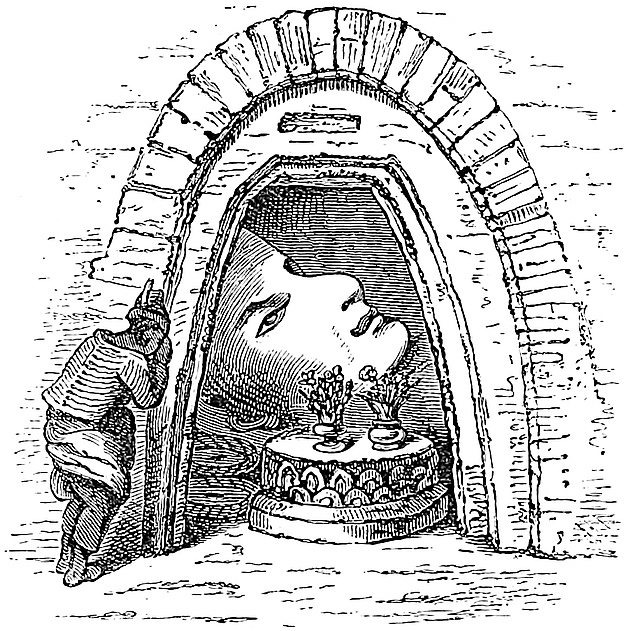
Colossal Figure, Buddha entering Nirvana.
“Et si voz di qu’il ont de ydres que sunt grant dix pas.... Ceste grant
ydres gigent.” ...
Note
2.—This is the meaning of the phrase in the G. T.: “Ceste grande
ydre gigent,” as may be seen from Ramusio’s giaciono distesi. Lazari
renders the former expression, “giganteggia un idolo,” etc., a phrase
very unlike Polo. The circumstance is interesting, because this recumbent
Colossus at Kanchau is mentioned both by Hajji Mahomed and by Shah Rukh’s
people. The latter say: “In this city of Kanchú there is an Idol-Temple 500
cubits square. In the middle is an idol lying at length which measures 50
paces. The sole of the foot is nine paces long, and the instep is 21 cubits
in girth. Behind this image and overhead are other idols of a cubit (?) in
height, besides figures of Bakshis as large as life. The action of all
is hit off so admirably that you would think they were alive.” These great
recumbent figures are favourites in Buddhist countries still, e.g. in Siam,
Burma, and Ceylon. They symbolise Sakya Buddha entering Nirvána. Such a
recumbent figure, perhaps the prototype of these, was seen by Hiuen Tsang
in a Vihara close to the Sál Grove at Kusinágara, where Sakya entered that
state, i.e. died. The stature of Buddha was, we are told, 12 cubits; but
Brahma, Indra, and the other gods vainly tried to compute his dimensions.
Some such rude metaphor is probably embodied in these large images. I have
described one 69 feet long in Burma (represented in the cut), but others
exist of much greater size, though probably none equal to that which Hiuen
Tsang, in the 7th century, saw near Bamian, which was 1000 feet in length!
I have heard of but one such image remaining in India, viz. in one of the
caves at Dhamnár in Málwa. This is 15 feet long, and is popularly known as
“Bhim’s Baby.” (Cathay, etc., pp. cciii., ccxviii.; Mission to Ava, p.
52; V. et V. de H. T., p. 374: Cunningham’s Archæl. Reports, ii. 274;
Tod, ii. 273.)
[“The temple, in which M. Polo saw an idol of Buddha, represented in a
lying position, is evidently Wo-fo-sze, i.e. ‘Monastery of the lying
Buddha.’ It was built in 1103 by a Tangut queen, to place there three idols
representing Buddha in this posture, which have since been found in the
ground on this very spot.” (Palladius, l.c. p. 10.)
Rubruck (p. 144) says: “A Nestorian, who had come from Cathay told me
that in that country there is an idol so big that it can be seen from two
days off.” Mr. Rockhill (Rubruck, p. 144, note) writes: “The largest
stone image I have seen is in a cave temple at Yung-kán, about 10 miles
north-west of Ta t’ung Fu in Shan-si. Père Gerbillon says the Emperor
K’ang-hsi measured it himself and found it to be 57 chih high (61 feet).
(Duhalde, Description, IV. 352.) I have seen another colossal statue
in a cave near Pinchou in north-west Shan-si, and there is another about
45 miles south of Ning-hsia Fu, near the left bank of the Yellow River.
(Rockhill, Land of the Lamas, 26, and Diary, 47.) The great recumbent
figure of the ‘Sleeping Buddha’ in the Wo Fo ssŭ, near Peking, is of clay.”
King Haython (Brosset’s ed. p. 181) mentions the statue in clay, of an
extraordinary height, of a God (Buddha) aged 3040 years, who is to live
370,000 years more, when he will be superseded by another god called
Madri (Maitreya).—H. C.]
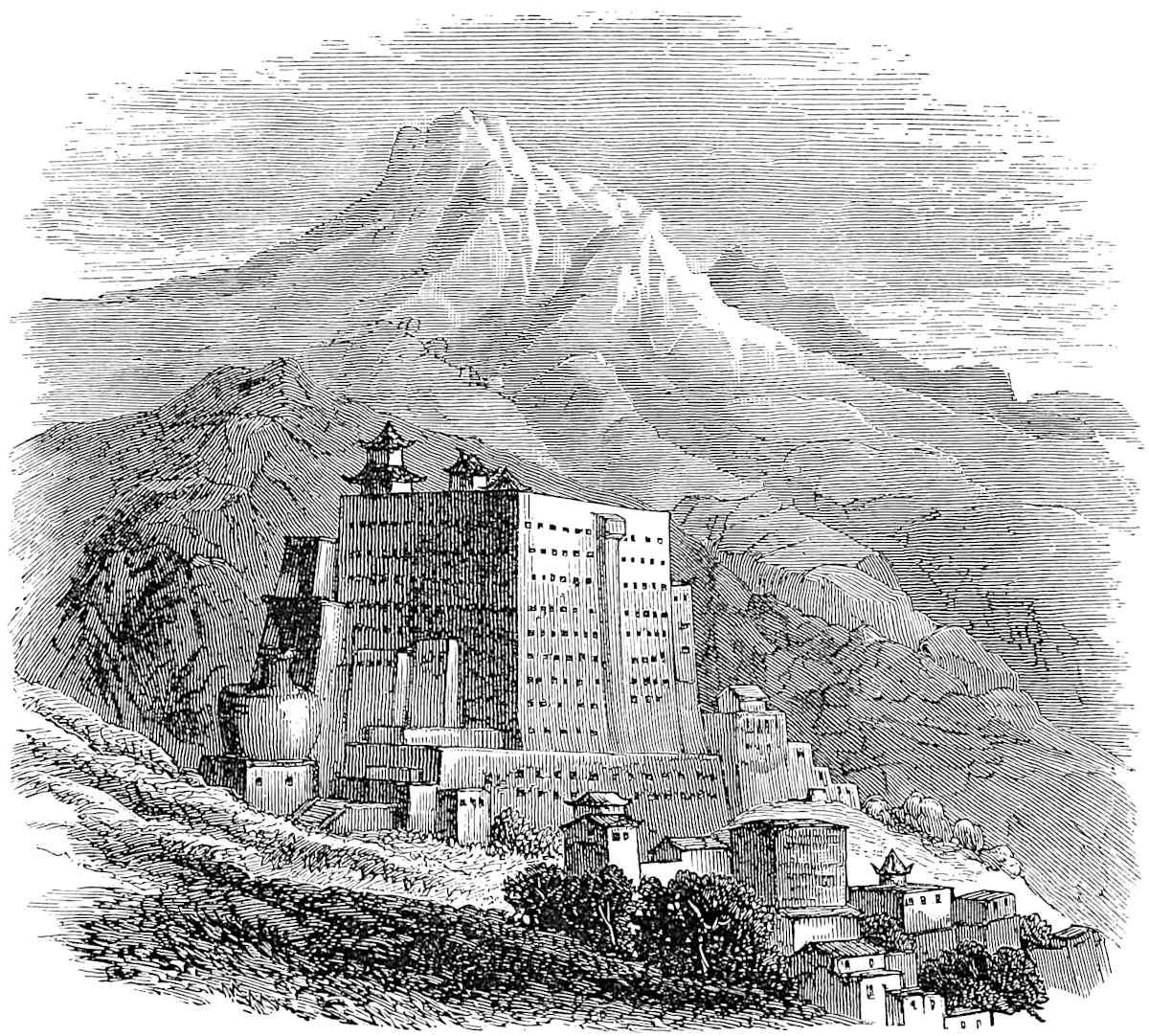
Great Lama Monastery.
Note 3.—Marco is now speaking of the Lamas, or clergy of Tibetan Buddhism.
The customs mentioned have varied in details, both locally and with the
changes that the system has passed through in the course of time.
The institutes of ancient Buddhism set apart the days of new and full moon
to be observed by the Sramanas or monks, by fasting, confession, and
listening to the reading of the law. It became usual for the laity to take
part in the observance, and the number of days was increased to three and
then to four, whilst Hiuen Tsang himself speaks of “the six fasts of every
month,” and a Chinese authority quoted by Julien gives the days as the 8th,
14th, 15th, 23rd, 29th, and 30th. Fahian says that in Ceylon preaching took
place on the 8th, 14th, and 15th days of the month. Four is the number now
most general amongst Buddhist nations, and the days may be regarded as a
kind of Buddhist Sabbath. In the southern countries and in Nepal they occur
at the moon’s changes. In Tibet and among the Mongol Buddhists they are
not at equal intervals, though I find the actual days differently stated
by different authorities. Pallas says the Mongols observed the 13th, 14th,
and 15th, the three days being brought together, he thought, on account
of the distance many Lamas had to travel to the temple—just as in some
Scotch country parishes they used to give two sermons in one service for
like reason! Koeppen, to whose work this note is much indebted, says the
Tibetan days are the 14th, 15th, 29th, 30th, and adds as to the manner of
observance: “On these days, by rule, among the Lamas, nothing should be
tasted but farinaceous food and tea; the very devout refrain from all food
from sunrise to sunset. The Temples are decorated, and the altar tables
set out with the holy symbols, with tapers, and with dishes containing
offerings in corn, meal, tea, butter, etc., and especially with small
pyramids of dough, or of rice or clay, and accompanied by much burning of
incense-sticks. The service performed by the priests is more solemn, the
music louder and more exciting, than usual. The laity make their offerings,
tell their beads, and repeat Om mani padma hom,” etc. In the concordat
that took place between the Dalai-Lama and the Altun Khaghan, on the
reconversion of the Mongols to Buddhism in the 16th century, one of the
articles was the entire prohibition of hunting and the slaughter of animals
on the monthly fast days. The practice varies much, however, even in Tibet,
with different provinces and sects—a variation which the Ramusian text of
Polo implies in these words: “For five days, or four days, or three in
each month, they shed no blood,” etc.
In Burma the Worship Day, as it is usually called by Europeans, is a very
gay scene, the women flocking to the pagodas in their brightest attire.
(H. T. Mémoires, I. 6, 208; Koeppen, I. 563–564, II. 139, 307–308;
Pallas, Samml. II. 168–169).
Note 4.—These matrimonial customs are the same that are afterwards ascribed
to the Tartars, so we defer remark.
Note
5.—So Pauthier’s text, “en legation.” The G. Text includes Nicolo
Polo, and says, “on business of theirs that is not worth mentioning,” and
with this Ramusio agrees.
Of the City of Etzina.
When you leave the city of Campichu you ride for twelve days, and then
reach a city called Etzina, which is towards the north on the verge of the
Sandy Desert; it belongs to the Province of Tangut.{1} The people
are Idolaters, and possess plenty of camels and cattle, and the country
produces a number of good falcons, both Sakers and Lanners. The inhabitants
live by their cultivation and their cattle, for they have no trade. At this
city you must needs lay in victuals for forty days, because when you quit
Etzina, you enter on a desert which extends forty days’ journey to the
north, and on which you meet with no habitation nor baiting-place.{2}
In the summer-time, indeed, you will fall in with people, but in the winter
the cold is too great. You also meet with wild beasts (for there are some
small pine-woods here and there), and with numbers of wild asses.{3}
When you have travelled these forty days across the Desert you come to a
certain province lying to the north. Its name you shall hear presently.
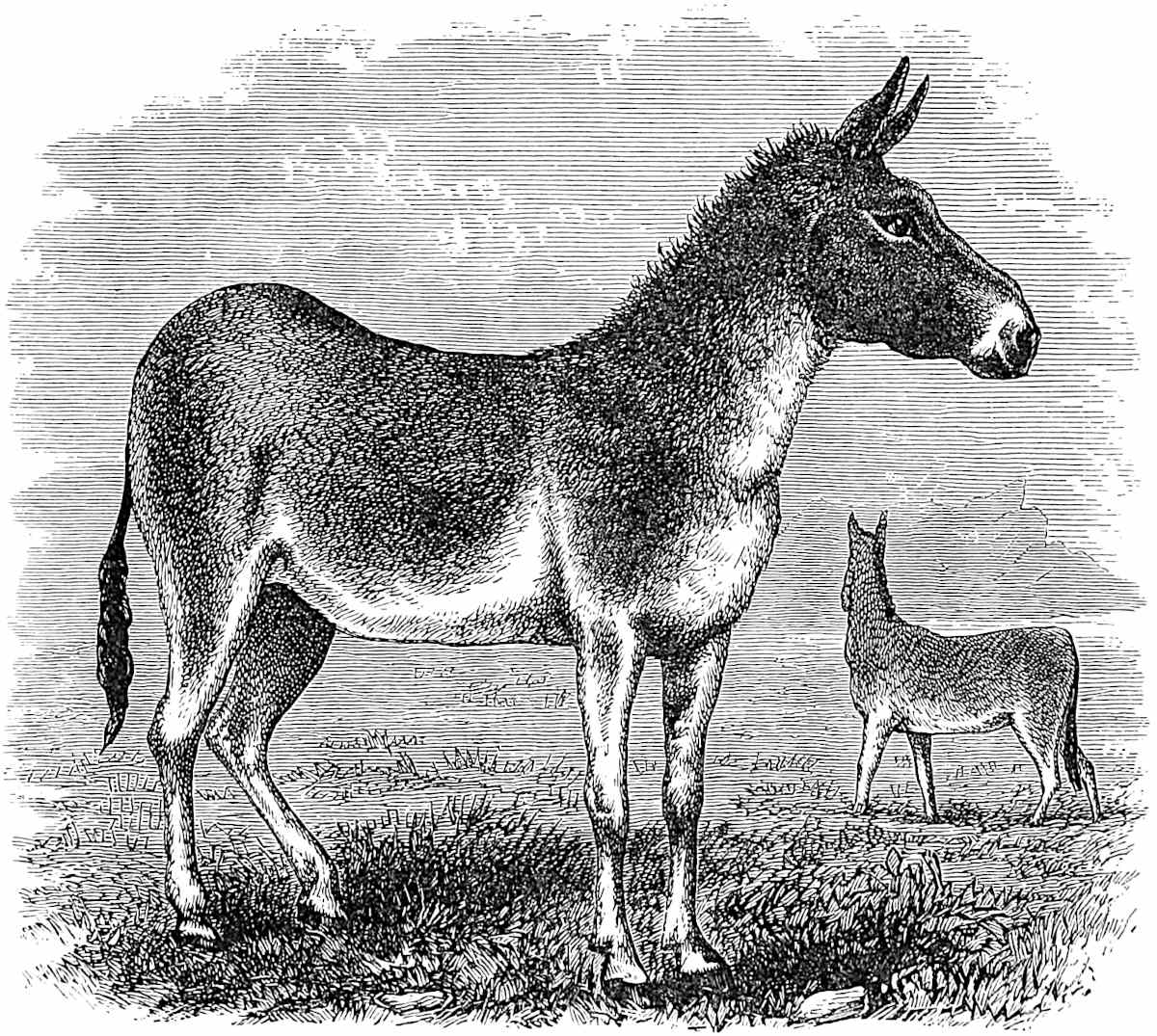
Wild Ass of Mongolia.
Note 1.—Deguignes says that Yetsina is found in a Chinese Map of Tartary of
the Mongol era, and this is confirmed by Pauthier, who reads it Itsinai,
and adds that the text of the Map names it as one of the seven Lu or
Circuits of the Province of Kansuh (or Tangut). Indeed, in D’Anville’s
Atlas we find a river called Etsina Pira, running northward from Kanchau,
and a little below the 41st parallel joining another from Suhchau. Beyond
the junction is a town called Hoa-tsiang, which probably represents
Etzina. Yetsina is also mentioned in Gaubil’s History of Chinghiz as
taken by that conqueror in 1226, on his last campaign against Tangut.
This capture would also seem from Pétis de la Croix to be mentioned by
Rashiduddin. Gaubil says the Chinese Geography places Yetsina north of
Kanchau and north-east of Suhchau, at a distance of 120 leagues from
Kanchau, but observes that this is certainly too great. (Gaubil, p. 49.)
[I believe there can be no doubt that Etzina must be looked for on the
river Hei-shui, called Etsina by the Mongols, east of Suhchau. This
river empties its waters into the two lakes Soho-omo and Sopo-omo. Etzina
would have been therefore situated on the river on the border of the
Desert, at the top of a triangle whose bases would be Suhchau and Kanchau.
This river was once part of the frontier of the kingdom of Tangut. (Cf.
Devéria, Notes d’épigraphie mongolo-chinoise, p. 4.) Reclus (Géog.
Univ., Asie Orientale, p. 159) says: “To the east [of Hami], beyond the
Chukur Gobi, are to be found also some permanent villages and the remains
of cities. One of them is perhaps the ‘cité d’Etzina’ of which Marco Polo
speaks, and the name is to be found in that of the river Az-sind.”
“Through Kanchau was the shortest, and most direct and convenient road to
I-tsi-nay.... I-tsi-nay, or Echiné, is properly the name of a lake.
Khubilaï, disquieted by his factious relatives on the north, established
a military post near lake I-tsi-nay, and built a town, or a fort on the
south-western shore of this lake. The name of I-tsi-nay appears from that
time; it does not occur in the chronicle of the Tangut kingdom; the lake
had then another name. Vestiges of the town are seen to this day; the
buildings were of large dimensions, and some of them were very fine. In
Marco Polo’s time there existed a direct route from I-tsi-nay to Karakorum;
traces of this road are still noticeable, but it is no more used. This
circumstance, i.e. the existence of a road from I-tsi-nay to Karakorum,
probably led Marco Polo to make an excursion (a mental one, I suppose) to
the residence of the Khans in Northern Mongolia.” (Palladius, l.c. pp.
10–11.)—H. C.]
Note
2.—“Erberge” (G. T.). Pauthier has Herbage.
Note
3.—The Wild Ass of Mongolia is the Dshiggetai of Pallas (Asinus
hemionus of Gray), and identical with the Tibetan Kyang of Moorcroft and
Trans-Himalayan sportsmen. It differs, according to Blyth, only in shades
of colour and unimportant markings from the Ghor Khar of Western India
and the Persian Deserts, the Kulan of Turkestan, which Marco has spoken
of in a previous passage (suprà, ch. xvi.; J. A. S. B. XXVIII. 229
seqq.). There is a fine Kyang in the Zoological Gardens, whose portrait,
after Wolf, is given here. But Mr. Ney Elias says of this animal that he
has little of the aspect of his nomadic brethren. [The wild ass (Tibetan
Kyang, Mongol Holu or Hulan) is called by the Chinese yeh ma, “wild
horse,” though “every one admits that it is an ass, and should be called
yeh lo-tzŭ.” (Rockhill, Land of the Lamas, 151, note.)—H. C.]
[Captain Younghusband (1886) saw in the Altaï Mountains “considerable
numbers of wild asses, which appeared to be perfectly similar to the Kyang
of Ladak and Tibet, and wild horses too—the Equus Prejevalskii—roaming
about these great open plains.” (Proc. R. G. S. X. 1888, p. 495.) Dr.
Sven Hedin says the habitat of the Kulan is the heights of Tibet as
well as the valley of the Tarim; it looks like a mule with the mane and
tail of an ass, but shorter ears, longer than those of a horse; he gives a
picture of it.—H. C.]
Of the City of Caracoron.
Caracoron is a city of some three miles in compass. [It is surrounded by a
strong earthen rampart, for stone is scarce there. And beside it there is a
great citadel wherein is a fine palace in which the Governor resides.] ’Tis
the first city that the Tartars possessed after they issued from their own
country. And now I will tell you all about how they first acquired dominion
and spread over the world.{1}
Originally the Tartars{2} dwelt in the north on the borders of
Chorcha.{3} Their country was one of great plains; and there were no
towns or villages in it, but excellent pasture-lands, with great rivers and
many sheets of water; in fact it was a very fine and extensive region. But
there was no sovereign in the land. They did, however, pay tax and tribute
to a great prince who was called in their tongue Unc Can, the same that we
call Prester John, him in fact about whose great dominion all the world
talks.{4} The tribute he had of them was one beast out of every ten,
and also a tithe of all their other gear.
Now it came to pass that the Tartars multiplied exceedingly. And when
Prester John saw how great a people they had become, he began to fear that
he should have trouble from them. So he made a scheme to distribute them
over sundry countries, and sent one of his Barons to carry this out. When
the Tartars became aware of this they took it much amiss, and with one
consent they left their country and went off across a desert to a distant
region towards the north, where Prester John could not get at them to annoy
them. Thus they revolted from his authority and paid him tribute no longer.
And so things continued for a time.
Note 1.—Karákorum, near the upper course of the River Orkhon, is said
by Chinese authors to have been founded by Búkú Khan of the Hoei-Hu or
Uigúrs, in the 8th century. In the days of Chinghiz, we are told that
it was the headquarters of his ally, and afterwards enemy, Togrul Wang
Khan, the Prester John of Polo. [“The name of this famous city is Mongol,
Kara, ‘black,’ and Kuren, ‘a camp,’ or properly ‘pailing.’” It was
founded in 1235 by Okkodai, who called it Ordu Balik, or “the City of the
Ordu,” otherwise “The Royal City.” Mohammedan authors say it took its name
of Karákorum from the mountains to the south of it, in which the Orkhon
had its source. (D’Ohsson, ii. 64.) The Chinese mention a range of
mountains from which the Orkhon flows, called Wu-tê kien shan. (T’ang
shu, bk. 43b.) Probably these are the same. Rashiduddin speaks of a tribe
of Utikien Uigúrs living in this country. (Bretschneider, Med. Geog.
191; D’Ohsson, i. 437; Rockhill, Rubruck, 220, note.)—Karákorum was
called by the Chinese Ho-lin and was chosen by Chinghiz, in 1206, as his
capital; the full name of it, Ha-la Ho-lin, was derived from a river
to the west. (Yuen shi, ch. lviii.) Gaubil (Holin, p. 10) says that
the river, called in his days in Tartar Karoha, was, at the time of the
Mongol Emperors, named by the Chinese Ha-la Ho-lin, in Tartar language
Ka la Ko lin, or Cara korin, or Kara Koran. In the spring of 1235,
Okkodai had a wall raised round Ho-lin and a palace called Wang an, built
inside the city. (Gaubil, Gentchiscan, 89.) After the death of Kúblái,
Ho-lin was altered into Ho-Ning, and, in 1320, the name of the province
was changed into Ling-pé (mountainous north, i.e. the Yin-shan chain,
separating China Proper from Mongolia). In 1256, Mangu Kaan decided to
transfer the seat of government to Kaipingfu, or Shangtu, near the present
Dolonnor, north of Peking. (Suprà in Prologue, ch. xiii. note 1.) In
1260, Kúblái transferred his capital to Ta-Tu (Peking).
Plano Carpini (1246) is the first Western traveller to mention it by name
which he writes Caracoron; he visited the Sira Orda, at half a day’s
journey from Karákorum, where Okkodai used to pass the summer; it was
situated at a place Ormektua. (Rockhill, Rubruck, 21, 111.) Rubruquis
(1253) visited the city itself; the following is his account of it: “As
regards the city of Caracoron, you must understand that if you set aside
the Kaan’s own Palace, it is not as good as the Borough of St. Denis; and
as for the Palace, the Abbey of St. Denis is worth ten of it! There are
two streets in the town; one of which is occupied by the Saracens, and in
that is the marketplace. The other street is occupied by the Cathayans, who
are all craftsmen. Besides these two streets there are some great palaces
occupied by the court secretaries. There are also twelve idol temples
belonging to different nations, two Mahummeries in which the Law of Mahomet
is preached, and one church of the Christians at the extremity of the town.
The town is enclosed by a mud-wall and has four gates. At the east gate
they sell millet and other corn, but the supply is scanty; at the west
gate they sell rams and goats; at the south gate oxen and waggons; at the
north gate horses.... Mangu Kaan has a great Court beside the Town Rampart,
which is enclosed by a brick wall, just like our priories. Inside there is
a big palace, within which he holds a drinking-bout twice a year; ... there
are also a number of long buildings like granges, in which are kept his
treasures and his stores of victual” (345–6; 334).
Where was Karákorum situated?
The Archimandrite Palladius is very prudent (l.c. p. 11): “Everything that
the studious Chinese authors could gather and say of the situation of
Karakhorum is collected in two Chinese works, Lo fung low wen kao (1849),
and Mungku yew mu ki (1859). However, no positive conclusion can be
derived from these researches, chiefly in consequence of the absence of a
tolerably correct map of Northern Mongolia.”
Abel Rémusat (Mém. sur Géog. Asie Centrale, p. 20) made a confusion
between Karábalgasun and Karákorum which has misled most writers after him.
Sir Henry Yule says: “The evidence adduced in Abel Rémusat’s paper on
Karákorum (Mém. de l’Acad. R. des Insc. VII. 288) establishes the
site on the north bank of the Orkhon, and about five days’ journey above
the confluence of the Orkhon and Tula. But as we have only a very loose
knowledge of these rivers, it is impossible to assign the geographical
position with accuracy. Nor is it likely that ruins exist beyond an outline
perhaps of the Kaan’s Palace walls.”
In the Geographical Magazine for July, 1874 (p. 137), Sir Henry Yule
has been enabled, by the kind aid of Madame Fedtchenko in supplying a
translation from the Russian, to give some account of Mr. Paderin’s visit
to the place, in the summer of 1873, along with a sketch-map.
“The site visited by Mr. Paderin is shown, by the particulars stated in
that paper, to be sufficiently identified with Karákorum. It is precisely
that which Rémusat indicated, and which bears in the Jesuit maps, as
published by D’Anville, the name of Talarho Hara Palhassoun (i.e. Kará
Balghásun), standing 4 or 5 miles from the left bank of the Orkhon, in
lat. (by the Jesuit Tables) 47° 32′ 24″. It is now known as Kara-Khărăm
(Rampart) or Kara Balghasun (city). The remains consist of a quadrangular
rampart of mud and sun-dried brick, of about 500 paces to the side, and now
about 9 feet high, with traces of a higher tower, and of an inner rampart
parallel to the other. But these remains probably appertain to the city as
re-occupied by the descendants of the Yuen in the end of the 14th century,
after their expulsion from China.”
Dr. Bretschneider (Med. Res. I. p. 123) rightly observes: “It seems,
however, that Paderin is mistaken in his supposition. At least it does
not agree with the position assigned to the ancient Mongol residence in
the Mongol annals Erdenin erikhe, translated into Russian, in 1883, by
Professor Pozdneiev. It is there positively stated (p. 110, note 2) that
the monastery of Erdenidsu, founded in 1585, was erected on the ruins of
that city, which once had been built by order of Ogotai Khan, and where
he had established his residence; and where, after the expulsion of the
Mongols from China, Toghon Temur again had fixed the Mongol court. This vast
monastery still exists, one English mile, or more, east of the Orkhon.
It has even been astronomically determined by the Jesuit missionaries,
and is marked on our maps of Mongolia. Pozdneiev, who visited the place
in 1877, obligingly informs me that the square earthen wall surrounding
the monastery of Erdenidsu, and measuring about an English mile in
circumference, may well be the very wall of ancient Karákorum.”
Recent researches have fully confirmed the belief that the Erdeni Tso,
or Erdeni Chao, Monastery occupies the site of Karákorum, near the bank
of the Orkhon, between this river and the Kokchin (old) Orkhon. (See map
in Inscriptions de l’Orkhon, Helsingfors, 1892; a plan of the vicinity
and of the Erdeni Tso is given (plate 36) in W. Radloff’s Atlas der
Alterthümer der Mongolei, St. Pet., 1892.)
According to a work of the 13th century quoted by the late Professor G.
Devéria, the distance between the old capital of the Uighúr, Kara Balgasún,
on the left bank of the Orkhon, north of Erdeni Tso, and the Ho-lin or
Karákorum of the Mongols, would be 70 li (about 30 miles), and such
is the space between Erdeni Tso and Kara Balgasún. M. Marcel Monnier
(Itinéraires, p. 107) estimates the bird’s-eye distance from Erdeni Tso
to Kara Balgasún at 33 kilom. (about 20½ miles). “When the brilliant epoch
of the power of the Chinghizkhanides,” says Professor Axel Heikel, “was
at an end, the city of Karákorum fell into oblivion, and towards the year
1590 was founded, in the centre of this historically celebrated region of
the Orkhon, the most ancient of Buddhist monasteries of Mongolia, this of
Erdeni Tso [Erdeni Chao]. It was built, according to a Mongol chronicle, on
the ruins of the town built by Okkodaï, son of Chinghiz Khan, that is to
say, on the ancient Karákorum.” (Inscriptions de l’Orkhon.) So Professor
Heikel, like Professor Pozdneiev, concludes that Erdeni Tso was built on
the site of Karákorum and cannot be mistaken for Karabalgásun. Indeed it is
highly probable that one of the walls of the actual convent belonged to the
old Mongol capital. The travels and researches by expeditions from Finland
and Russia have made these questions pretty clear. Some most interesting
inscriptions have been brought home and have been studied by a number of
Orientalists: G. Schlegel, O. Donner, G. Devéria, Vasiliev, G. von der
Gabelentz, Dr. Hirth, G. Huth, E. H. Parker, W. Bang, etc., and especially
Professor Vilh. Thomsen, of Copenhagen, who deciphered them (Déchiffrement
des Inscriptions de l’Orkhon et de l’Iénissei, Copenhague, 1894, 8vo;
Inscriptions de l’Orkhon déchiffrées, par V. Thomsen, Helsingfors, 1894,
8vo), and Professor W. Radloff of St. Petersburg (Atlas der Alterthümer
der Mongolei, 1892–6, fol.; Die alttürkischen Inschriften der Mongolei,
1894–7, etc.). There is an immense literature on these inscriptions, and
for the bibliography, I must refer the reader to H. Cordier, Etudes
Chinoises (1891–1894), Leide, 1895, 8vo. Id. (1895–1898), Leide, 1898, 8vo. The
initiator of these discoveries was N. Iarindsev, of Irkutsk, who died at
Barnaoul in 1894, and the first great expedition was started from Finland
in 1890, under the guidance of Professor Axel Heikel. (Inscriptions de
l’Orkhon recueillies par l’expédition finnoise, 1890, et publiées par la
Société Finno-Ougrienne, Helsingfors, 1892, fol.) The Russian expedition
left the following year, 1891, under the direction of the Academician W. Radloff.
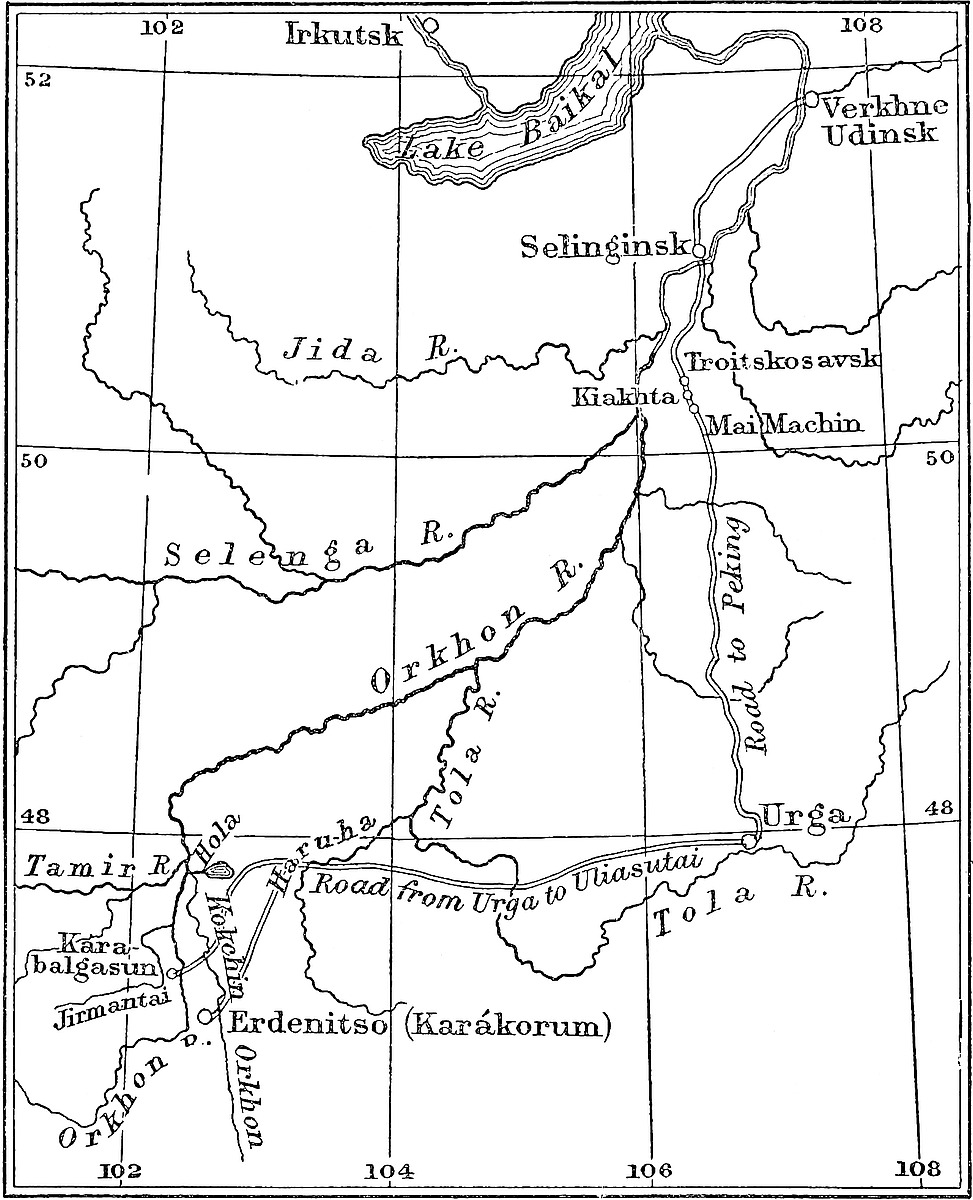
M. Chaffanjon (Nouv. Archiv. des Missions Scient. IX., 1899, p. 81), in
1895, does not appear to know that there is a difference between Kará Korum
and Kará Balgásun, as he writes: “Forty kilometres south of Kara Korum or
Kara Balgásun, the convent of Erdin Zoun.”
A plan of Kara Balgásun is given (plate 27) in Radloff’s Atlas. See also
Henri Cordier et Gaubil, Situation de Holin en Tartarie, Leide, 1893.
In Rubruquis’s account of Karákorum there is one passage of great interest:
“Then master William [Guillaume L’Orfèvre] had made for us an iron to make
wafers ... he made also a silver box to put the body of Christ in, with
relics in little cavities made in the sides of the box.” Now M. Marcel
Monnier, who is one of the last, if not the last traveller who visited
the region, tells me that he found in the large temple of Erdeni Tso an
iron (the cast bore a Latin cross; had the wafer been Nestorian, the cross
should have been Greek) and a silver box, which are very likely the objects
mentioned by Rubruquis. It is a new proof of the identity of the sites of
Erdeni Tso and Karákorum.—H. C.]
Entrance to the Erdeni Tso Great Temple.
Note
2.—[Mr. Rockhill (Rubruck, 113, note) says: “The earliest date
to which I have been able to trace back the name Tartar is A.D. 732. We
find mention made in a Turkish inscription found on the river Orkhon and
bearing that date, of the Tokuz Tatar, or ‘Nine (tribes of) Tatars,’ and
of the Otuz Tatar, or ‘Thirty (tribes of) Tatars.’ It is probable that
these tribes were then living between the Oguz or Uigúr Turks on the west,
and the Kitan on the east. (Thomsen, Inscriptions de l’Orkhon, 98, 126,
140.) Mr. Thos. Watters tells me that the Tartars are first mentioned by
the Chinese in the period extending from A.D. 860 to 874; the earliest
mention I have discovered, however, is under date of A.D. 880. (Wu tai
shih, Bk. 4.) We also read in the same work (Bk. 74, 2) that ‘The Ta-ta
were a branch of the Mo-ho (the name the Nû-chēn Tartars bore during the
Sui and T’ang periods: Ma Tuan-lin, Bk. 327, 5). They first lived to
the north of the Kitan. Later on they were conquered by this people, when
they scattered, a part becoming tributaries of the Kitan, another to the
P’o-hai (a branch of the Mo-ho), while some bands took up their abode in
the Yin Shan in Southern Mongolia, north of the provinces of Chih-li and
Shan-si, and took the name of Ta-ta.’ In 981 the Chinese ambassador to
the Prince of Kao-chang (Karakhodjo, some 20 miles south-east of Turfan)
traversed the Ta-ta country. They then seem to have occupied the northern
bend of the Yellow River. He gives the names of some nine tribes of Ta-ta
living on either side of the river. He notes that their neighbours to the
east were Kitan, and that for a long time they had been fighting them after
the occupation of Kan-chou by the Uigúrs. (Ma Tuan-lin, Bk. 336, 12–14.)
We may gather from this that these Tartars were already settled along the
Yellow River and the Yin Shan (the valley in which is now the important
frontier mart of Kwei-hua Ch’eng) at the beginning of the ninth century,
for the Uigúrs, driven southward by the Kirghiz, first occupied Kan-chou in
north-western Kan-suh, somewhere about A.D. 842.”]
Note
3.—Chorcha (Ciorcia) is the Manchu country, whose people were at
that time called by the Chinese Yuché or Niuché, and by the Mongols
Churché, or as it is in Sanang Setzen, Jurchid. The country in question
is several times mentioned by Rashiduddin as Churché. The founders of the
Kin Dynasty, which the Mongols superseded in Northern China, were of
Churché race. [It was part of Nayan’s appanage. (See Bk. II. ch. v.)—H. C.]
Note
4.—The idea that a Christian potentate of enormous wealth and power,
and bearing this title, ruled over vast tracts in the far East, was
universal in Europe from the middle of the 12th to the end of the 13th
century, after which time the Asiatic story seems gradually to have died
away, whilst the Royal Presbyter was assigned to a locus in Abyssinia; the
equivocal application of the term India to the East of Asia and the East
of Africa facilitating this transfer. Indeed I have a suspicion, contrary
to the view now generally taken, that the term may from the first have
belonged to the Abyssinian Prince, though circumstances led to its being
applied in another quarter for a time. It appears to me almost certain that
the letter of Pope Alexander III., preserved by R. Hoveden, and written in
1177 to the Magnificus Rex Indorum, Sacerdotum sanctissimus, was meant
for the King of Abyssinia.
Be that as it may, the inordinate report of Prester John’s magnificence
became especially diffused from about the year 1165, when a letter full of
the most extravagant details was circulated, which purported to have been
addressed by this potentate to the Greek Emperor Manuel, the Roman Emperor
Frederick, the Pope, and other Christian sovereigns. By the circulation
of this letter, glaring fiction as it is, the idea of this Christian
Conqueror was planted deep in the mind of Europe, and twined itself round
every rumour of revolution in further Asia. Even when the din of the
conquests of Chinghiz began to be audible in the West, he was invested with
the character of a Christian King, and more or less confounded with the
mysterious Prester John.
The first notice of a conquering Asiatic potentate so styled had been
brought to Europe by the Syrian Bishop of Gabala (Jibal, south of
Laodicea in Northern Syria), who came, in 1145, to lay various grievances
before Pope Eugene III. He reported that not long before a certain John,
inhabiting the extreme East, king and Nestorian priest, and claiming
descent from the Three Wise Kings, had made war on the Samiard Kings of
the Medes and Persians, and had taken Ecbatana their capital. He was then
proceeding to the deliverance of Jerusalem, but was stopped by the Tigris,
which he could not cross, and compelled by disease in his host to retire.
M. d’Avezac first showed to whom this account must apply, and the subject
has more recently been set forth with great completeness and learning by
Dr. Gustavus Oppert. The conqueror in question was the founder of Kara
Khitai, which existed as a great Empire in Asia during the last two-thirds
of the 12th century. This chief was a prince of the Khitan dynasty of
Liao, who escaped with a body of followers from Northern China on the
overthrow of that dynasty by the Kin or Niuchen about 1125. He is called
by the Chinese historians Yeliu Tashi; by Abulghazi, Nuzi Taigri Ili;
and by Rashiduddin, Nushi (or Fushi) Taifu. Being well received by the
Uighúrs and other tribes west of the Desert who had been subject to the
Khitan Empire, he gathered an army and commenced a course of conquest
which eventually extended over Eastern and Western Turkestan, including
Khwarizm, which became tributary to him. He took the title of Gurkhan,
said to mean Universal or Suzerain Khan, and fixed at Bala Sagun, north of
the Thian Shan, the capital of his Empire, which became known as Kará
(Black) Khitai.[1]
[The dynasty being named by the Chinese Si-Liao
(Western Liao) lasted till it was destroyed in 1218.—H. C.] In 1141 he
came to the aid of the King of Khwarizm against Sanjar the Seljukian
sovereign of Persia (whence the Samiard of the Syrian Bishop), who had
just taken Samarkand, and defeated that prince with great slaughter. Though
the Gurkhan himself is not described to have extended his conquests into
Persia, the King of Khwarizm followed up the victory by an invasion of that
country, in which he plundered the treasury and cities of Sanjar.
Admitting this Karacathayan prince to be the first conqueror (in Asia, at
all events) to whom the name of Prester John was applied, it still remains
obscure how that name arose. Oppert supposes that Gurkhan or Kurkhan,
softened in West Turkish pronunciation into Yurkan, was confounded with
Yochanan or Johannes; but he finds no evidence of the conqueror’s
profession of Christianity except the fact, notable certainly, that the
daughter of the last of his brief dynasty is recorded to have been a
Christian. Indeed, D’Ohsson says that the first Gurkhan was a Buddhist,
though on what authority is not clear. There seems a probability at least
that it was an error in the original ascription of Christianity to the
Karacathayan prince, which caused the confusions as to the identity of
Prester John which appear in the next century, of which we shall presently
speak. Leaving this doubtful point, it has been plausibly suggested that
the title of Presbyter Johannes was connected with the legends of the
immortality of John the Apostle (ὁ πρεσβύτερος, as he calls
himself in the 2nd and 3rd epistles), and the belief referred to by some of
the Fathers that he would be the Forerunner of our Lord’s second coming, as
John the Baptist had been of His first.
A new theory regarding the original Prester John has been propounded by
Professor Bruun of Odessa, in a Russian work entitled The Migrations of
Prester John. The author has been good enough to send me large extracts of
this essay in (French) translation; and I will endeavour to set forth the
main points as well as the small space that can be given to the matter will
admit. Some remarks and notes shall be added, but I am not in a position to
do justice to Professor Bruun’s views, from the want of access to some of
his most important authorities, such as Brosset’s History of Georgia, and
its appendices.
It will be well, before going further, to give the essential parts of the
passage in the History of Bishop Otto of Freisingen (referred to in vol i.
p. 229), which contains the first allusion to a personage styled Prester
John:
“We saw also there [at Rome in 1145] the afore-mentioned Bishop of Gabala,
from Syria.... We heard him bewailing with tears the peril of the Church
beyond-sea since the capture of Edessa, and uttering his intention on that
account to cross the Alps and seek aid from the King of the Romans and the
King of the Franks. He was also telling us how, not many years before, one
John, King and Priest, who dwells in the extreme Orient beyond Persia and
Armenia, and is (with his people) a Christian, but a Nestorian, had waged
war against the brother Kings of the Persians and Medes who are called the
Samiards, and had captured Ecbatana, of which we have spoken above, the
seat of their dominion. The said Kings having met him with their forces
made up of Persians, Medes, and Assyrians, the battle had been maintained
for 3 days, either side preferring death to flight. But at last Presbyter
John (for so they are wont to style him), having routed the Persians, came
forth the victor from a most sanguinary battle. After this victory (he
went on to say) the aforesaid John was advancing to fight in aid of the
Church at Jerusalem; but when he arrived at the Tigris, and found there
no possible means of transport for his army, he turned northward, as he
had heard that the river in that quarter was frozen over in winter-time.
Halting there for some years[2] in expectation of a frost, which never
came, owing to the mildness of the season, he lost many of his people
through the unaccustomed climate, and was obliged to return homewards. This
personage is said to be of the ancient race of those Magi who are mentioned
in the Gospel, and to rule the same nations that they did, and to have such
glory and wealth that he uses (they say) only an emerald sceptre. It was
(they say) from his being fired by the example of his fathers, who came to
adore Christ in the cradle, that he was proposing to go to Jerusalem, when
he was prevented by the cause already alleged.”
Professor Bruun will not accept Oppert’s explanation, which identifies
this King and Priest with the Gur-Khan of Karacathay, for whose profession
of Christianity there is indeed (as has been indicated—supra) no real
evidence; who could not be said to have made an attack upon any pair of
brother Kings of the Persians and the Medes, nor to have captured Ecbatana
(a city, whatever its identity, of Media); who could never have had any
intention of coming to Jerusalem; and whose geographical position in no way
suggested the mention of Armenia.
Professor Bruun thinks he finds a warrior much better answering to the
indications in the Georgian prince John Orbelian, the general-in-chief
under several successive Kings of Georgia in that age.
At the time when the Gur-Khan defeated Sanjar the real brothers of the
latter had been long dead; Sanjar had withdrawn from interference with
the affairs of Western Persia; and Hamadán (if this is to be regarded as
Ecbatana) was no residence of his. But it was the residence of Sanjar’s
nephew Mas’úd, in whose hands was now the dominion of Western Persia;
whilst Mas’úd’s nephew, Dáúd, held Media, i.e. Azerbeiján, Arrán, and
Armenia. It is in these two princes that Professor Bruun sees the Samiardi
fratres of the German chronicler.
Again the expression “extreme Orient” is to be interpreted by local
usage. And with the people of Little Armenia, through whom probably such
intelligence reached the Bishop of Gabala, the expression the East
signified specifically Great Armenia (which was then a part of the kingdom
of Georgia and Abkhasia), as Dulaurier has stated.[3]
It is true that the Georgians were not really Nestorians, but followers of
the Greek Church. It was the fact, however, that in general, the Armenians,
whom the Greeks accused of following the Jacobite errors, retorted upon
members of the Greek Church with the reproach of the opposite heresy of
Nestorianism. And the attribution of Nestorianism to a Georgian Prince is,
like the expression “extreme East,” an indication of the Armenian channel
through which the story came.
The intention to march to the aid of the Christians in Palestine is more
like the act of a Georgian General than that of a Karacathayan Khan; and
there are in the history of the Kingdom of Jerusalem several indications of
the proposal at least of Georgian assistance.
The personage in question is said to have come from the country of the
Magi, from whom he was descended. But these have frequently been supposed
to come from Great Armenia. E.g. Friar Jordanus says they came from
Moghán.[4]
The name Ecbatana has been so variously applied that it was likely
to lead to ambiguities. But it so happens that, in a previous passage
of his History, Bishop Otto of Freisingen, in rehearsing some Oriental
information gathered apparently from the same Bishop of Gabala, has shown
what was the place that he had been taught to identify with Ecbatana,
viz. the old Armenian city of Ani.[5] Now this city was captured from the
Turks, on behalf of the King of Georgia, David the Restorer, by his great
sbasalar,[6] John Orbelian, in 1123–24.
Professor Bruun also lays stress upon a passage in a German chronicle of
date some years later than Otho’s work:
“1141. Liupoldus dux Bawariorum obiit, Henrico fratre ejus succedente
in ducatu. Iohannes Presbyter Rex Armeniæ et Indiæ cum duobus regibus
fratribus Persarum et Medorum pugnavit et vicit.”[7]
He asks how the Gur-Khan of Karakhitai could be styled King of Armenia
and of India? It may be asked, per contra, how either the King of Georgia
or his Peshwa (to use the Mahratta analogy of John Orbelian’s position)
could be styled King of Armenia and of India? In reply to this, Professor
Bruun adduces a variety of quotations which he considers as showing that
the term India was applied to some Caucasian region.
My own conviction is that the report of Otto of Freisingen is not merely
the first mention of a great Asiatic potentate called Prester John, but
that his statement is the whole and sole basis of good faith on which the
story of such a potentate rested; and I am quite as willing to believe, on
due evidence, that the nucleus of fact to which his statement referred,
and on which such a pile of long-enduring fiction was erected, occurred
in Armenia as that it occurred in Turan. Indeed in many respects the
story would thus be more comprehensible. One cannot attach any value to
the quotation from the Annalist in Pertz, because there seems no reason
to doubt that the passage is a mere adaptation of the report by Bishop
Otto, of whose work the Annalist makes other use, as is indeed admitted by
Professor Bruun, who (be it said) is a pattern of candour in controversy.
But much else that the Professor alleges is interesting and striking. The
fact that Azerbeijan and the adjoining regions were known as “the East”
is patent to the readers of this book in many a page, where the Khan and
his Mongols in occupation of that region are styled by Polo Lord of the
Levant, Tartars of the Levant (i.e. of the East), even when the speaker’s
standpoint is in far Cathay.[8] The mention of Aní as identical with
the Ecbatana of which Otto had heard is a remarkable circumstance which I
think even Oppert has overlooked. That this Georgian hero was a Christian
and that his name was John are considerable facts. Oppert’s conversion
of Korkhan into Yokhanan or John is anything but satisfactory. The
identification proposed again makes it quite intelligible how the so-called
Prester John should have talked about coming to the aid of the Crusaders; a
point so difficult to explain on Oppert’s theory, that he has been obliged
to introduce a duplicate John in the person of a Greek Emperor to solve
that knot; another of the weaker links in his argument. In fact, Professor
Bruun’s thesis seems to me more than fairly successful in paving the way
for the introduction of a Caucasian Prester John; the barriers are removed,
the carpets are spread, the trumpets sound royally—but the conquering hero
comes not!
He does very nearly come. The almost royal power and splendour of the
Orbelians at this time is on record: “They held the office of Sbasalar or
Generalissimo of all Georgia. All the officers of the King’s Palace were
under their authority. Besides that they had 12 standards of their own,
and under each standard 1000 warriors mustered. As the custom was for the
King’s flag to be white and the pennon over it red, it was ruled that the
Orpelian flag should be red and the pennon white.... At banquets they alone
had the right to couches whilst other princes had cushions only. Their
food was served on silver; and to them it belonged to crown the kings.”[9]
Orpel Ivané, i.e. John Orbelian, Grand Sbasalar, was for years the pride
of Georgia and the hammer of the Turks. In 1123–1124 he wrested from them
Tiflis and the whole country up to the Araxes, including Ani, as we
have said. His King David, the Restorer, bestowed on him large additional
domains from the new conquests; and the like brilliant service and career
of conquest was continued under David’s sons and successors, Demetrius and
George; his later achievements, however, and some of the most brilliant,
occurring after the date of the Bishop of Gabala’s visit to Rome. But still
we hear of no actual conflict with the chief princes of the Seljukian
house, and of no event in his history so important as to account for his
being made to play the part of Presbyter Johannes in the story of the
Bishop of Gabala. Professor Bruun’s most forcible observation in reference
to this rather serious difficulty is that the historians have transmitted
to us extremely little detail concerning the reign of Demetrius II.,
and do not even agree as to its duration. Carebat vate sacro: “It was,”
says Brosset, “long and glorious, but it lacked a commemorator.” If new
facts can be alleged, the identity may still be proved. But meantime the
conquests of the Gur-Khan and his defeat of Sanjar, just at a time which
suits the story, are indubitable, and this great advantage Oppert’s thesis
retains. As regards the claim to the title of Presbyter nothing worth
mentioning is alleged on either side.
When the Mongol Conquests threw Asia open to Frank travellers in the middle
of the 13th century, their minds were full of Prester John; they sought in
vain for an adequate representative, but it was not in the nature of things
but they should find some representative. In fact they found several.
Apparently no real tradition existed among the Eastern Christians of any
such personage, but the persistent demand produced a supply, and the honour
of identification with Prester John, after hovering over one head and
another, settled finally upon that of the King of the Keraits, whom we find
to play the part in our text.
Thus in Plano Carpini’s single mention of Prester John as the King of the
Christians of India the Greater, who defeats the Tartars by an elaborate
stratagem, Oppert recognizes Sultan Jaláluddín of Khwarizm and his
temporary success over the Mongols in Afghanistan. In the Armenian Prince
Sempad’s account, on the other hand, this Christian King of India is
aided by the Tartars to defeat and harass the neighbouring Saracens, his
enemies, and becomes the Mongol’s vassal. In the statement of Rubruquis,
though distinct reference is made to the conquering Gurkhan (under the name
of Coir Cham of Caracatay), the title of King John is assigned to the
Naiman Prince (Kushluk), who had married the daughter of the last lineal
sovereign of Karakhitai, and usurped his power, whilst, with a strange
complication of confusion, Unc, Prince of the Crit and Merkit (Kerait and
Merkit, two great tribes of Mongolia)[10] and Lord of Karákorum, is made
the brother and successor of this Naiman Prince. His version of the story,
as it proceeds, has so much resemblance to Polo’s, that we shall quote
the words. The Crit and Merkit, he says, were Nestorian Christians. “But
their Lord had abandoned the worship of Christ to follow idols, and kept
by him those priests of the idols who are all devil-raisers and sorcerers.
Beyond his pastures, at the distance of ten or fifteen days’ journey, were
the pastures of the Moal (Mongol), who were a very poor people, without
a leader and without any religion except sorceries and divinations, such
as all the people of those parts put so much faith in. Next to Moal was
another poor tribe called Tartar. King John having died without an heir,
his brother Unc got his wealth, and caused himself to be proclaimed Cham,
and sent out his flocks and herds even to the borders of Moal. At that time
there was a certain blacksmith called Chinghis among the tribe of Moal,
and he used to lift the cattle of Unc Chan as often as he had a chance,
insomuch that the herdsmen of Unc Chan made complaint to their master. The
latter assembled an army, and invaded the land of the Moal in search of
Chinghis, but he fled and hid himself among the Tartars. So Unc, having
plundered the Moal and Tartars, returned home. And Chinghis addressed the
Tartars and Moal, saying: ‘It is because we have no leader that we are
thus oppressed by our neighbours.’ So both Tartars and Moal made Chinghis
himself their leader and captain. And having got a host quietly together,
he made a sudden onslaught upon Unc and conquered him, and compelled him
to flee into Cathay. On that occasion his daughter was taken, and given by
Chinghis to one of his sons, to whom she bore Mangu, who now reigneth....
The land in which they (the Mongols) first were, and where the residence of
Chinghis still exists, is called Onan Kerule.[11] But because Caracoran
is in the country which was their first conquest, they regard it as a royal
city, and there hold the elections of their Chan.”
Here we see plainly that the Unc Chan of Rubruquis is the Unc Can or Unecan
of Polo. In the narrative of the former, Unc is only connected with King
or Prester John; in that of the latter, rehearsing the story as heard some
20 or 25 years later, the two are identified. The shadowy rôle of
Prester John has passed from the Ruler of Kara Khitai to the Chief of the
Keraits. This transfer brings us to another history.
We have already spoken of the extensive diffusion of Nestorian Christianity
in Asia during the early and Middle Ages. The Christian historian Gregory
Abulfaraj relates a curious history of the conversion, in the beginning
of the 11th century, of the King of Kerith with his people, dwelling
in the remote north-east of the land of the Turks. And that the Keraits
continued to profess Christianity down to the time of Chinghiz is attested
by Rashiduddin’s direct statement, as well as by the numerous Christian
princesses from that tribe of whom we hear in Mongol history. It is the
chief of this tribe of whom Rubruquis and Polo speak under the name of Unc
Khan, and whom the latter identifies with Prester John. His proper name is
called Tuli by the Chinese, and Togrul by the Persian historians, but the
Kin sovereign of Northern China had conferred on him the title of Wang
or King, from which his people gave him the slightly corrupted cognomen of
اونک خان, which some scholars read Awang, and Avenk Khan, but which
the spelling of Rubruquis and Polo shows probably to have been pronounced
as Aung or Ung Khan.[12] The circumstance stated by Rubruquis of his
having abandoned the profession of Christianity, is not alluded to by
Eastern writers; but in any case his career is not a credit to the Faith.
I cannot find any satisfactory corroboration of the claims of supremacy
over the Mongols which Polo ascribes to Aung Khan. But that his power
and dignity were considerable, appears from the term Pádsháh which
Rashiduddin applies to him. He had at first obtained the sovereignty of the
Keraits by the murder of two of his brothers and several nephews. Yesugai,
the father of Chinghiz, had been his staunch friend, and had aided him
effectually to recover his dominion from which he had been expelled. After
a reign of many years he was again ejected, and in the greatest necessity
sought the help of Temujin (afterwards called Chinghiz Khan), by whom he
was treated with the greatest consideration. This was in 1196. For some
years the two chiefs conducted their forays in alliance, but differences
sprang up between them; the son of Aung Khan entered into a plot to kill
Temujin, and in 1202–1203 they were in open war. The result will be related
in connection with the next chapters.
We may observe that the idea which Joinville picked up in the East about
Prester John corresponds pretty closely with that set forth by Marco.
Joinville represents him as one of the princes to whom the Tartars were
tributary in the days of their oppression, and as “their ancient enemy”;
one of their first acts, on being organized under a king of their own, was
to attack him and conquer him, slaying all that bore arms, but sparing all
monks and priests. The expression used by Joinville in speaking of the
original land of the Tartars, “une grande berrie de sablon,” has not
been elucidated in any edition that I have seen. It is the Arabic بريه
Băríya, “a Desert.” No doubt Joinville learned the word in Palestine.
(See Joinville, p. 143 seqq.; see also Oppert, Der Presb. Johannes in
Sage und Geschichte, and Cathay, etc., pp. 173–182.) [Fried. Zarncke,
Der Priester Johannes; Cordier, Odoric.—H. C.]
Of Chinghis, and how he became the First Kaan of the Tartars.
Now it came to pass in the year of Christ’s Incarnation 1187 that the
Tartars made them a King whose name was Chinghis Kaan.{1} He was a man
of great worth, and of great ability (eloquence), and valour. And as soon
as the news that he had been chosen King was spread abroad through those
countries, all the Tartars in the world came to him and owned him for their
Lord. And right well did he maintain the Sovereignty they had given him.
What shall I say? The Tartars gathered to him in astonishing multitude, and
when he saw such numbers he made a great furniture of spears and arrows
and such other arms as they used, and set about the conquest of all those
regions till he had conquered eight provinces. When he conquered a province
he did no harm to the people or their property, but merely established some
of his own men in the country along with a proportion of theirs, whilst he
led the remainder to the conquest of other provinces. And when those whom
he had conquered became aware how well and safely he protected them against
all others, and how they suffered no ill at his hands, and saw what a noble
prince he was, then they joined him heart and soul and became his devoted
followers. And when he had thus gathered such a multitude that they seemed
to cover the earth, he began to think of conquering a great part of the
world. Now in the year of Christ 1200 he sent an embassy to Prester John,
and desired to have his daughter to wife. But when Prester John heard that
Chinghis Kaan demanded his daughter in marriage he waxed very wroth, and
said to the Envoys, “What impudence is this, to ask my daughter to wife!
Wist he not well that he was my liegeman and serf? Get ye back to him and
tell him that I had liever set my daughter in the fire than give her in
marriage to him, and that he deserves death at my hand, rebel and traitor
that he is!” So he bade the Envoys begone at once, and never come into his
presence again. The Envoys, on receiving this reply, departed straightway,
and made haste to their master, and related all that Prester John had
ordered them to say, keeping nothing back.{2}
Note 1.—Temujin was born in the year 1155, according to all the Persian
historians, who are probably to be relied on; the Chinese put the event
in 1162. 1187 does not appear to be a date of special importance in his
history. His inauguration as sovereign under the name of Chinghiz Kaan was
in 1202 according to the Persian authorities, in 1206 according to the
Chinese.
In a preceding note (p. 236) we have quoted a passage in which Rubruquis
calls Chinghiz “a certain blacksmith.” This mistaken notion seems to have
originated in the resemblance of his name Temújin to the Turki Temúrjí,
a blacksmith; but it was common throughout Asia in the Middle Ages, and the
story is to be found not only in Rubruquis, but in the books of Hayton, the
Armenian prince, and of Ibn Batuta, the Moor. That cranky Orientalist, Dr.
Isaac Jacob Schmidt, positively reviles William Rubruquis, one of the most
truthful and delightful of travellers, and certainly not inferior to his
critic in mother-wit, for adopting this story, and rebukes Timkowski—not
for adopting it, but for merely telling us the very interesting fact that
the story was still, in 1820, current in Mongolia. (Schmidt’s San. Setz.
376, and Timkowski, I. 147.)
Note 2.—Several historians, among others Abulfaraj, represent Chinghiz as
having married a daughter of Aung Khan; and this is current among some
of the mediæval European writers, such as Vincent of Beauvais. It is
also adopted by Pétis de la Croix in his history of Chinghiz, apparently
from a comparatively late Turkish historian; and both D’Herbelot and St.
Martin state the same; but there seems to be no foundation for it in the
best authorities: either Persian or Chinese. (See Abulfaragius, p. 285;
Speculum Historiale, Bk. XXIX. ch. lxix.; Hist. of Genghiz Can, p. 29;
and Golden Horde, pp. 61–62.) But there is a real story at the basis of
Polo’s, which seems to be this: About 1202, when Aung Khan and Chinghiz
were still acting in professed alliance, a double union was proposed
between Aung Khan’s daughter Jaur Bigi and Chinghiz’s son Juji, and between
Chinghiz’s daughter Kijin Bigi and Togrul’s grandson Kush Buka. From
certain circumstances this union fell through, and this was one of the
circumstances which opened the breach between the two chiefs. There were,
however, several marriages between the families. (Erdmann, 283; others
are quoted under ch. lix., note 2.)
How Chinghis mustered his People to march against Prester John.
When Chinghis Kaan heard the brutal message that Prester John had sent him,
such rage seized him that his heart came nigh to bursting within him, for
he was a man of a very lofty spirit. At last he spoke, and that so loud
that all who were present could hear him: “Never more might he be prince
if he took not revenge for the brutal message of Prester John, and such
revenge that insult never in this world was so dearly paid for. And before
long Prester John should know whether he were his serf or no!”
So then he mustered all his forces, and levied such a host as never before
was seen or heard of, sending word to Prester John to be on his defence.
And when Prester John had sure tidings that Chinghis was really coming
against him with such a multitude, he still professed to treat it as a
jest and a trifle, for, quoth he, “these be no soldiers.” Natheless he
marshalled his forces and mustered his people, and made great preparations,
in order that if Chinghis did come, he might take him and put him to death.
In fact he marshalled such an host of many different nations that it was a
world’s wonder.
And so both sides gat them ready to battle. And why should I make a
long story of it? Chinghis Kaan with all his host arrived at a vast and
beautiful plain which was called Tanduc, belonging to Prester John, and
there he pitched his camp; and so great was the multitude of his people
that it was impossible to number them. And when he got tidings that Prester
John was coming, he rejoiced greatly, for the place afforded a fine and
ample battle-ground, so he was right glad to tarry for him there, and
greatly longed for his arrival.
But now leave we Chinghis and his host, and let us return to Prester John
and his people.
How Prester John marched to meet Chinghis.
Now the story goes that when Prester John became aware that Chinghis with
his host was marching against him, he went forth to meet him with all his
forces, and advanced until he reached the same plain of Tanduc, and pitched
his camp over against that of Chinghis Kaan at a distance of 20 miles. And
then both armies remained at rest for two days that they might be fresher
and heartier for battle.{1}
So when the two great hosts were pitched on the plains of Tanduc as you
have heard, Chinghis Kaan one day summoned before him his astrologers, both
Christians and Saracens, and desired them to let him know which of the
two hosts would gain the battle, his own or Prester John’s. The Saracens
tried to ascertain, but were unable to give a true answer; the Christians,
however, did give a true answer, and showed manifestly beforehand how the
event should be. For they got a cane and split it lengthwise, and laid
one half on this side and one half on that, allowing no one to touch the
pieces. And one piece of cane they called Chinghis Kaan, and the other
piece they called Prester John. And then they said to Chinghis: “Now
mark! and you will see the event of the battle, and who shall have the
best of it; for whose cane soever shall get above the other, to him shall
victory be.” He replied that he would fain see it, and bade them begin.
Then the Christian astrologers read a Psalm out of the Psalter, and went
through other incantations. And lo! whilst all were beholding, the cane
that bore the name of Chinghis Kaan, without being touched by anybody,
advanced to the other that bore the name of Prester John, and got on the
top of it. When the Prince saw that he was greatly delighted, and seeing
how in this matter he found the Christians to tell the truth, he always
treated them with great respect, and held them for men of truth for ever
after.{2}
Note 1.—Polo in the preceding chapter has stated that this plain of Tanduc
was in Prester John’s country. He plainly regards it as identical with
the Tanduc of which he speaks more particularly in ch. lix. as belonging
to Prester John’s descendants, and which must be located near the Chinese
Wall. He is no doubt wrong in placing the battle there. Sanang Setzen puts
the battle between the two, the only one which he mentions, “at the outflow
of the Onon near Kulen Buira.” The same action is placed by De Mailla’s
authorities at Calantschan, by P. Hyacinth at Kharakchin Schatu, by Erdmann
after Rashid in the vicinity of Hulun Barkat and Kalanchinalt, which latter
was on the borders of the Churché or Manchus. All this points to the
vicinity of Buir Nor and Hulan or Kalon Nor (though the Onon is far from
these). But this was not the final defeat of Aung Khan or Prester John,
which took place some time later (in 1203) at a place called the Chacher
Ondur (or Heights), which Gaubil places between the Tula and the Kerulun,
therefore near the modern Urga. Aung Khan was wounded, and fled over the
frontier of the Naiman; the officers of that tribe seized and killed him.
(Schmidt, 87, 383; Erdmann, 297; Gaubil, p. 10.)
Note 2.—A Tartar divination by twigs, but different from that here
employed, is older than Herodotus, who ascribes it to the Scythians. We
hear of one something like the last among the Alans, and (from Tacitus)
among the Germans. The words of Hosea (iv. 12), “My people ask counsel at
their stocks, and their staff declareth unto them,” are thus explained by
Theophylactus: “They stuck up a couple of sticks, whilst murmuring certain
charms and incantations; the sticks then, by the operation of devils,
direct or indirect, would fall over, and the direction of their fall was
noted,” etc. The Chinese method of divination comes still nearer to that
in the text. It is conducted by tossing in the air two symmetrical pieces
of wood or bamboo of a peculiar form. It is described by Mendoza, and more
particularly, with illustrations, by Doolittle.[1]
But Rubruquis would seem to have witnessed nearly the same process that
Polo describes. He reprehends the conjuring practices of the Nestorian
priests among the Mongols, who seem to have tried to rival the indigenous
Káms or Medicine-men. Visiting the Lady Kuktai, a Christian Queen of
Mangu Kaan, who was ill, he says: “The Nestorians were repeating certain
verses, I know not what (they said it was part of a Psalm), over two twigs
which were brought into contact in the hands of two men. The monk stood by
during the operation” (p. 326).[2] Pétis de la Croix quotes from Thévenot’s
travels, a similar mode of divination as much used, before a fight, among
the Barbary corsairs. Two men sit on the deck facing one another and each
holding two arrows by the points, and hitching the notches of each pair of
arrows into the other pair. Then the ship’s writer reads a certain Arabic
formula, and it is pretended that whilst this goes on, the two sets of
arrows, of which one represents the Turks and the other the Christians,
struggle together in spite of the resistance of the holders, and finally
one rises over the other. This is perhaps the divination by arrows which is
prohibited in the Koran. (Sura, V. v. 92.) It is related by Abulfeda that
Mahomed found in the Kaaba an image of Abraham with such arrows in his hand.
P. della Valle describes the same process, conducted by a Mahomedan
conjuror of Aleppo: “By his incantations he made the four points of the
arrows come together without any movement of the holders, and by the
way the points spontaneously placed themselves, obtained answers to
interrogatories.”
And Mr. Jaeschke writes from Lahaul: “There are many different ways of
divination practised among the Buddhists; and that also mentioned by Marco
Polo is known to our Lama, but in a slightly different way, making use of
two arrows instead of a cane split up, wherefore this kind is called
da-mo, ‘Arrow-divination.’” Indeed the practice is not extinct in India,
for in 1833 Mr. Vigne witnessed its application to detect the robber of a
government chest at Lodiana.
As regards Chinghiz’s respect for the Christians there are other stories.
Abulfaragius has one about Chinghiz seeing in a dream a religious person
who promised him success. He told the dream to his wife, Aung Khan’s
daughter, who said the description answered to that of the bishop who
used to visit her father. Chinghiz then inquired for a bishop among the
Uighúr Christians in his camp, and they indicated Mar Denha. Chinghiz
thenceforward was milder towards the Christians, and showed them many
distinctions (p. 285). Vincent of Beauvais also speaks of Rabbanta, a
Nestorian monk, who lived in the confidence of Chinghiz’s wife, daughter
of “the Christian King David or Prester John,” and who used by divination
to make many revelations to the Tartars. We have already said that there
seems no ground for assigning a daughter of Aung Khan as wife to Chinghiz.
But there was a niece of the former, named Abika, among the wives of
Chinghiz. And Rashiduddin does relate a dream of the Kaan’s in relation
to her. But it was to the effect that he was divinely commanded to give her
away; and this he did next morning!
(Rawlins. Herod. IV. 67; Amm. Marcell. XXXI. 2; Delvio, Disq.
Magic. 558; Mendoza, Hak. Soc. I. 47; Doolittle, 435–436; Hist. of
Genghizcan, pp. 52–53; Preston’s al-Hariri, p. 183; P. della V. II.
865–866; Vigne, I. 46; D’Ohsson, I. 418–419).
The Battle between Chinghis Kaan and Prester John.
And after both sides had rested well those two days, they armed for the
fight and engaged in desperate combat; and it was the greatest battle
that ever was seen. The numbers that were slain on both sides were very
great, but in the end Chinghis Kaan obtained the victory. And in the battle
Prester John was slain. And from that time forward, day by day, his kingdom
passed into the hands of Chinghis Kaan till the whole was conquered.
A. Housselin D.
Death of Chinghiz Khan. (From a miniature in the Livre des
Merveilles.)
I may tell you that Chinghis Kaan reigned six years after this battle,
engaged continually in conquest, and taking many a province and city and
stronghold. But at the end of those six years he went against a certain
castle that was called Caaju, and there he was shot with an arrow in the
knee, so that he died of his wound. A great pity it was, for he was a
valiant man and a wise.{1}
I will now tell you who reigned after Chinghis, and then about the manners
and customs of the Tartars.
Note 1.—Chinghiz in fact survived Aung Khan some 24 years, dying during his
fifth expedition against Tangut, 18th August 1227, aged 65 according to
the Chinese accounts, 72 according to the Persian. Sanang Setzen says that
Kurbeljin Goa Khatún, the beautiful Queen of Tangut, who had passed into
the tents of the conqueror, did him some bodily mischief (it is not said
what), and then went and drowned herself in the Karamuren (or Hwang-ho),
which thenceforth was called by the Mongols the Khátún-gol, or Lady’s
River, a name which it in fact still bears. Carpini relates that Chinghiz
was killed by lightning. The Persian and Chinese historians, however, agree
in speaking of his death as natural. Gaubil calls the place of his death
Lou-pan, which he says was in lat. 38°. Rashiduddin calls it Leung-Shan,
which appears to be the mountain range still so called in the heart of Shensi.
The name of the place before which Polo represents him as mortally wounded
is very variously given. According to Gaubil, Chinghiz was in reality
dangerously wounded by an arrow-shot at the siege of Taitongfu in 1212. And
it is possible, as Oppert suggests, that Polo’s account of his death before
Caagiu (as I prefer the reading), arose out of a confusion between this
circumstance and those of the death of Mangku Kaan, which is said to have
occurred at the assault of Hochau in Sze-ch’uan, a name which Polo would
write Caagiu, or nearly so. Abulfaragius specifically says that Mangku
Kaan died by an arrow; though it is true that other authors say he died
of disease, and Haiton that he was drowned; all which shows how excusable
were Polo’s errors as to events occurring 50 to 100 years before his time.
(See Oppert’s Presbyter Johannes, p. 76; De Mailla, IX. 275, and note;
Gaubil, 18, 50, 52, 121; Erdmann, 443; San. Setzen, 103.)
It is only by referring back to ch. xlvii., where we are told that Chinghiz
“began to think of conquering a great part of the world,” that we see Polo
to have been really aware of the vast extent and aim of the conquests
of Chinghiz; the aim being literally the conquest of the world as he
conceived it; the extent of the empire which he initiated actually
covering (probably) one half of the whole number of the human race. (See
remarks in Koeppen, Die Relig. des Buddha, II. 86.)
Of those who did Reign after Chinghis Kaan, and of the Customs of the Tartars.
Now the next that reigned after Chinghis Kaan, their first Lord,{1}
was Cuy Kaan, and the third Prince was Batuy Kaan, and the fourth was
Alacou Kaan, the fifth Mongou Kaan, the sixth Cublay Kaan, who is the
sovereign now reigning, and is more potent than any of the five who went
before him; in fact, if you were to take all those five together, they
would not be so powerful as he is.{2} Nay, I will say yet more; for
if you were to put together all the Christians in the world, with their
Emperors and their Kings, the whole of these Christians,—aye, and throw in
the Saracens to boot,—would not have such power, or be able to do so much
as this Cublay, who is the Lord of all the Tartars in the world, those of
the Levant and of the Ponent included; for these are all his liegemen and
subjects. I mean to show you all about this great power of his in this book
of ours.
You should be told also that all the Grand Kaans, and all the descendants
of Chinghis their first Lord, are carried to a mountain that is called
Altay to be interred. Wheresoever the Sovereign may die, he is carried to
his burial in that mountain with his predecessors; no matter an the place
of his death were 100 days’ journey distant, thither must he be carried to
his burial.{3}
Let me tell you a strange thing too. When they are carrying the body of any
Emperor to be buried with the others, the convoy that goes with the body
doth put to the sword all whom they fall in with on the road, saying: “Go
and wait upon your Lord in the other world!” For they do in sooth believe
that all such as they slay in this manner do go to serve their Lord in the
other world. They do the same too with horses; for when the Emperor dies,
they kill all his best horses, in order that he may have the use of them in
the other world, as they believe. And I tell you as a certain truth, that
when Mongou Kaan died, more than 20,000 persons, who chanced to meet the
body on its way, were slain in the manner I have told.{4}
Note 1.—Before parting with Chinghiz let me point out what has not to my
knowledge been suggested before, that the name of “Cambuscan bold” in
Chaucer’s tale is only a corruption of the name of Chinghiz. The name
of the conqueror appears in Fr. Ricold as Camiuscan, from which the
transition to Cambuscan presents no difficulty. Camius was, I suppose,
a clerical corruption out of Canjus or Cianjus. In the chronicle of
St. Antonino, however, we have him called “Chinghiscan rectius Tamgius
Cam” (XIX. c. 8). If this is not merely the usual blunder of t for c,
it presents a curious analogy to the form Tankiz Khán always used by Ibn
Batuta. I do not know the origin of the latter, unless it was suggested by
tankis (Ar.) “Turning upside down.” (See Pereg. Quat., p. 119; I. B.
III. 22, etc.)
Note 2.—Polo’s history here is inadmissible. He introduces into the list
of the supreme Kaans Batu, who was only Khan of Kipchak (the Golden
Horde), and Hulaku who was Khan of Persia, whilst he omits Okkodai,
the immediate successor of Chinghiz. It is also remarkable that he uses
the form Alacou here instead of Alaü as elsewhere; nor does he seem to
mean the same person, for he was quite well aware that Alaü was Lord of
the Levant, who sent ambassadors to the Great Khan Cúbláy, and could not
therefore be one of his predecessors. The real succession ran: 1. Chinghiz;
2. Okkodai; 3. Kuyuk; 4. Mangku; 5. Kúblái.
There are quite as great errors in the history of Haiton, who had probably
greater advantages in this respect than Marco. And I may note that in
Teixeira’s abridgment of Mirkhond, Hulaku is made to succeed Mangku Kaan on
the throne of Chinghiz. (Relaciones, p. 338.)
Note 3.—The Altai here certainly does not mean the Great South Siberian
Range to which the name is now applied. Both Altai and Altun-Khan
appear sometimes to be applied by Sanang Setzen to the Khingan of the
Chinese, or range running immediately north of the Great Wall near Kalgan.
(See ch. lxi. note 1.) But in reference to this matter of the burial of
Chinghiz, he describes the place as “the district of Yekeh Utek, between
the shady side of the Altai-Khan and the sunny side of the Kentei-Khan.”
Now the Kentei-Khan (khan here meaning “mountain”) is near the sources
of the Onon, immediately to the north-east of Urga; and Altai-Khan in this
connection cannot mean the hills near the Great Wall, 500 miles distant.
According to Rashiduddin, Chinghiz was buried at a place called Búrkán
Káldún (“God’s Hill”), or Yekeh Kúrúk (“The Great Sacred or Tabooed
Place”); in another passage he calls the spot Búdah Undúr (which means, I
fancy, the same as Búrkán Káldún), near the River Selenga. Búrkán Káldún is
often mentioned by Sanang Setzen, and Quatremère seems to demonstrate the
identity of this place with the mountain called by Pallas (and Timkowski)
Khanoolla. This is a lofty mountain near Urga, covered with dense forest,
and is indeed the first woody mountain reached in travelling from Peking.
It is still held sacred by the Mongols and guarded from access, though the
tradition of Chinghiz’s grave seems to be extinct. Now, as this Khanoolla
(“Mount Royal,” for khan here means “sovereign,” and oolla “mountain”)
stands immediately to the south of the Kentei mentioned in the quotation
from S. Setzen, this identification agrees with his statement, on the
supposition that the Khanoolla is the Altai of the same quotation. The
Khanoolla must also be the Han mountain which Mongol chiefs claiming
descent from Chinghiz named to Gaubil as the burial-place of that
conqueror. Note that the Khanoolla, which we suppose to be the Altai of
Polo, and here of Sanang Setzen, belongs to a range known as Khingan,
whilst we see that Setzen elsewhere applies Altai and Altan-Khan to the
other Khingan near the Great Wall.
Erdmann relates, apparently after Rashiduddin, that Chinghiz was buried
at the foot of a tree which had taken his fancy on a hunting expedition,
and which he had then pointed out as the place where he desired to be
interred. It was then conspicuous, but afterwards the adjoining trees shot
up so rapidly, that a dense wood covered the whole locality, and it became
impossible to identify the spot. (Q. R. 117 seqq.; Timk. I. 115 seqq.,
II. 475–476; San. Setz. 103, 114–115, 108–109; Gaubil, 54; Erd. 444.)
[“There are no accurate indications,” says Palladius (l.c. pp. 11–13), “in
the documents of the Mongol period on the burial-places of Chingiz Khan and
of the Khans who succeeded him. The Yuan-shi or ‘History of the Mongol
Dynasty in China,’ in speaking of the burial of the Khans, mentions only
that they used to be conveyed from Peking to the north, to their common
burial-ground in the K’i-lien Valley. This name cannot have anything
in common with the ancient K’i-lien of the Hiung-nu, a hill situated
to the west of the Mongol desert; the K’i-lien of the Mongols is to be
sought more to the east. When Khubilai marched out against Prince Nayan,
and reached the modern Talnor, news was received of the occupation of the
Khan’s burial-ground by the rebels. They held out there very long, which
exceedingly afflicted Khubilai [Yüan shi lui pien]; and this goes to
prove that the tombs could not be situated much to the west. Some more
positive information on this subject is found in the diary of the campaign
in Mongolia in 1410, of the Ming Emperor Yung-lo [Pe ching lu]. He
reached the Kerulen at the place where this river, after running south,
takes an easterly direction. The author of the diary notes, that from
a place one march and a half before reaching the Kerulen, a very large
mountain was visible to the north-east, and at its foot a solitary high and
pointed hillock, covered with stones. The author says, that the sovereigns
of the house of Yuan used to be buried near this hill. It may therefore
be plausibly supposed that the tombs of the Mongol Khans were near the
Kerulen, and that the ‘K’i-lien’ of the Yüan shi is to be applied to this
locality; it seems to me even, that K’i-lien is an abbreviation, customary
to Chinese authors, of Kerulen. The way of burying the Mongol Khans is
described in the Yüan shi (ch. ‘On the national religious rites of the
Mongols’), as well as in the Ch’ue keng lu, ‘Memoirs of the time of the
Yuan Dynasty.’ When burying, the greatest care was taken to conceal from
outside people the knowledge of the locality of the tomb. With this object
in view, after the tomb was closed, a drove of horses was driven over it,
and by this means the ground was, for a considerable distance, trampled
down and levelled. It is added to this (probably from hearsay) in the
Ts’ao mu tze Memoirs (also of the time of the Yuan Dynasty), that a young
camel used to be killed (in the presence of its mother) on the tomb of the
deceased Khan; afterwards, when the time of the usual offerings of the tomb
approached, the mother of this immolated camel was set at liberty, and she
came crying to the place where it was killed; the locality of the tomb was
ascertained in this way.”
The Archimandrite Palladius adds in a footnote: “Our well-known Mongolist
N. Golovkin has told us, that according to a story actually current among
the Mongols, the tombs of the former Mongol Khans are situated near Tasola
Hill, equally in the vicinity of the Kerulen. He states also that even
now the Mongols are accustomed to assemble on that hill on the seventh
day of the seventh moon (according to an ancient custom), in order to
adore Chingiz Khan’s tomb. Altan tobchi (translated into Russian by Galsan
Gomboeff), in relating the history of the Mongols after their expulsion
from China, and speaking of the Khans’ tombs, calls them Naiman tzagan
gher, i.e. ‘Eight White Tents’ (according to the number of chambers for
the souls of the chief deceased Khans in Peking), and sometimes simply
Tzagan gher, ‘the White Tent,’ which, according to the translator’s
explanation, denotes only Chingiz Khan’s tomb.”
“According to the Chinese Annals (T’ung kien kang mu), quoted by Dr.
E. Bretschneider (Med. Res. I. p. 157), Chinghiz died near the Liu
p’an shan in 1227, after having subdued the Tangut empire. On modern
Chinese maps Liu p’an shan is marked south of the city of Ku yüan
chou, department of P’ing liang, in Kan suh. The Yüan shi however,
implies that he died in Northern Mongolia. We read there, in the annals,
s.a. 1227, that in the fifth intercalary month the Emperor moved to the
mountain Liu p’an shan in order to avoid the heat of the summer. In the
sixth month the empire of the Hia (Tangut) submitted. Chinghiz rested on
the river Si Kiang in the district of Ts’ing shui (in Kansuh; it has
still the same name). In autumn, in the seventh month (August), on the day
jen wu, the Emperor fell ill, and eight days later died in his palace
Ha-lao-t’u on the River Sa-li. This river Sali is repeatedly mentioned
in the Yüan shi, viz. in the first chapter, in connection with the first
military doings of Chinghiz. Rashid reports (D’Ohsson, I. 58) that
Chinghiz in 1199 retired to his residence Sari Kihar. The Yüan chao pi
shi (Palladius’ transl., 81) writes the same name Saari Keher (Keher
in modern Mongol means ‘a plain’). On the ancient map of Mongolia found
in the Yüan shi lei pien, Sa-li K’ie-rh is marked south of the river
Wa-nan (the Onon of our maps), and close to Sa-li K’ie-rh we read:
‘Here was the original abode of the Yüan’ (Mongols). Thus it seems the
passage in the Yüan history translated above intimates that Chinghiz died
in Mongolia, and not near the Liu p’an shan, as is generally believed.
The Yüan ch’ao pi shi (Palladius’ transl., 152) and the ’Ts’in cheng lu
(Palladius’ transl., 195) both agree in stating that, after subduing the
Tangut empire, Chinghiz returned home, and then died. Colonel Yule, in his
Marco Polo (I. 245), states ‘that Rashid calls the place of Chinghiz’
death Leung shan, which appears to be the mountain range still so-called
in the heart of Shensi.’ I am not aware from what translation of Rashid,
Yule’s statement is derived, but d’Ohsson (I. 375, note) seems to quote the
same passage in translating from Rashid: ‘Liu-p’an-shan was situated on
the frontiers of the Churche (empire of the Kin), Nangias (empire of
the Sung) and Tangut;’ which statement is quite correct.”
We now come to the Mongol tradition, which places the tomb of Chinghiz in
the country of the Ordos, in the great bend of the Yellow River.
Two Belgian missionaries, MM. de Vos and Verlinden, who visited the tomb of
Chinghiz Khan, say that before the Mahomedan invasion, on a hill a few feet
high, there were two courtyards, one in front of the other, surrounded by
palisades. In the second courtyard, there were a building like a Chinese
dwelling-house and six tents. In a double tent are kept the remains of
the bokta (the Holy). The neighbouring tents contained various precious
objects, such as a gold saddle, dishes, drinking-cups, a tripod, a kettle,
and many other utensils, all in solid silver. (Missions Catholiques, No.
315, 18th June, 1875.)—This periodical gives (p. 293) a sketch of the tomb
of the Conqueror, according to the account of the two missionaries.
Prjevalsky (Mongolia and Tangut) relates the story of the Khatún
Gol (see supra, p. 245), and says that her tomb is situated at 11
versts north-east of lake of Dzaïdemin Nor, and is called by the Mongols
Tumir-Alku, and by the Chinese Djiou-Djin Fu; one of the legends mentioned
by the Russian traveller gives the Ordo country as the burial-place of
Chinghiz, 200 versts south of lake Dabasun Nor; the remains are kept in two
coffins, one of wood, the other of silver; the Khan prophesied that after
eight or ten centuries he would come to life again and fight the Emperor of
China, and being victorious, would take the Mongols from the Ordos back to
their country of Khalka; Prjevalsky did not see the tomb, nor did Potanin.
“Their holiest place [of the Mongols of Ordos] is a collection of felt
tents called ‘Edjen-joro,’ reputed to contain the bones of Jenghiz Khan.
These sacred relics are entrusted to the care of a caste of Darhats,
numbering some fifty families. Every summer, on the twenty-first day of
the sixth moon, sacrifices are offered up in his honour, when numbers
of people congregate to join in the celebration, such gatherings being
called táilgan.” On the southern border of the Ordos are the ruins
of Boro-balgasun [Grey town], said to date from Jenghiz Khan’s time.
(Potanin, Proc. R. G. S. IX. 1887, p. 233.)
The last traveller who visited the tomb of Chinghiz is M. C. E. Bonin, in
July 1896; he was then on the banks of the Yellow River in the northern
part of the Ordo country, which is exclusively inhabited by nomadic and
pastoral Mongols, forming seven tribes or hords, Djungar, Talat, Wan,
Ottok, Djassak, Wushun and Hangkin, among which are eastward the Djungar
and in the centre the Wan; according to their own tradition, these tribes
descend from the seven armies encamped in the country at the time of
Chinghiz’s death; the King of Djungar was 67 years of age, and was the
chief of all the tribes, being considered the 37th descendant of the
conqueror in a direct line. His predecessor was the Wushun Wang. M. Bonin
gives (Revue de Paris, 15th February 1898) the following description of
the tomb and of the country surrounding it. Between the yamen (palace) of
the King (Wang) of Djungar and the tomb of Chinghiz-Khan, there are five or
six marches made difficult by the sands of the Gobi, but horses and camels
may be used for the journey. The road, southward through the desert, passes
near the great lama-monastery called Barong-tsao or Si-tsao (Monastery
of the West), and in Chinese San-t’ang sse (Three Temples). This
celebrated monastery was built by the King of Djungar to hold the tablets
of his ancestors—on the ruins of an old temple, said to have been erected
by Chinghiz himself. More than a thousand lamas are registered there, forty
of them live at the expense of the Emperor of China. Crossing afterwards
the two upper branches of the Ulan Muren (Red River) on the banks of which
Chinghiz was murdered, according to local tradition, close to the lake of
Chahan Nor (White Lake), near which are the tents of the Prince of Wan, one
arrives at last at the spot called Yeke-Etjen-Koro, in Mongol: the abode
of the Great Lord, where the tomb is to be found. It is erected to the
south-east of the village, comprising some twenty tents or tent-like huts
built of earth. Two large white felt tents, placed side by side, similar
to the tents of the modern Mongols, but much larger, cover the tomb; a
red curtain, when drawn, discloses the large and low silver coffin, which
contains the ashes of the Emperor, placed on the ground of the second tent;
it is shaped like a big trunk, with great rosaces engraved upon it. The
Emperor, according to local tradition, was cremated on the bank of the Ulan
Muren, where he is supposed to have been slain. On the twenty-first day
of the third moon the anniversary fête of Mongolia takes place; on this
day of the year only are the two mortuary tents opened, and the coffin is
exhibited to be venerated by people coming from all parts of Mongolia. Many
other relics, dispersed all over the Ordo land, are brought thither on this
occasion; these relics called in Mongol Chinghiz Bogdo (Sacred remains
of Chinghiz) number ten; they are in the order adopted by the Mongols: the
saddle of Chinghiz, hidden in the Wan territory; the bow, kept at a place
named Hu-ki-ta-lao Hei, near Yeke-Etjen-Koro; the remains of his war-horse,
called Antegan-tsegun (more), preserved at Kebere in the Djungar territory;
a fire-arm kept in the palace of the King of Djungar; a wooden and leather
vase called Pao-lao-antri, kept at the place Shien-ni-chente; a wax figure
containing the ashes of the Khan’s equerry, called Altaqua-tosu, kept at
Ottok (one of the seven tribes); the remains of the second wife, who lay at
Kiasa, on the banks of the Yellow River, at a place called on Prjevalsky’s
map in Chinese Djiou-Djin-fu, and in Mongol Tumir-Alku; the tomb of the
third wife of Chinghiz, who killed him, and lay to-day at Bagha-Ejen-Koro,
“the abode of the little Sovereign,” at a day’s march to the south of the
Djungar King’s palace; the very tomb of Yeke-Etjen-Koro, which is supposed
to contain also the ashes of the first wife of the Khan; and last, his
great standard, a black wood spear planted in the desert, more than 150
miles to the south of the tomb; the iron of it never gets rusty; no one
dares touch it, and therefore it is not carried to Yeke-Etjen-Koro with the
other relics for the yearly festival. (See also Rockhill, Diary, p. 29.)—H. C.]
Note 4.—Rashiduddin relates that the escort, in carrying Chinghiz to his
burial, slew all whom they met, and that forty noble and beautiful girls
were despatched to serve him in the other world, as well as superb horses.
As Mangku Kaan died in the heart of China, any attempt to carry out the
barbarous rule in his case would involve great slaughter. (Erd. 443;
D’Ohsson, I. 381, II. 13; and see Cathay, 507–508.)
Sanang Setzen ignores these barbarities. He describes the body of Chinghiz
as removed to his native land on a two-wheeled waggon, the whole host
escorting it, and wailing as they went: “And Kiluken Bahadur of the Sunid
Tribe (one of the Khan’s old comrades) lifted up his voice and sang—
‘Whilom Thou didst swoop like a Falcon: A rumbling waggon now trundles thee off:
O My King!
Hast thou in truth then forsaken thy wife and thy children and the Diet of thy People?
O My King!
Circling in pride like an Eagle whilom Thou didst lead us,
O My King!
But now Thou hast stumbled and fallen, like an unbroken Colt,
O My King!’” (p. 108.)
[“The burying of living men with the dead was a general custom with the
tribes of Eastern Asia. Favourite servants and wives were usually buried in
this way. In China, the chief wives and those concubines who had already
borne children, were exempted from this lot. The Tunguz and other tribes
were accustomed to kill the selected victims by strangulation. In China
they used to be buried alive; but the custom of burying living men ceased
in A.D. 1464. [Hwang ming ts’ung sin lu.] In the time of the present
Manchu Dynasty, the burying of living men was prohibited by the Emperor
Kang-hi, at the close of the 17th century, i.e. the forced burying; but
voluntary sepulture remained in force [Yu chi wen]. Notwithstanding
this prohibition, cases of forced burying occurred again in remote parts
of Manchuria; when a concubine refused to follow her deceased master, she
was forcibly strangled with a bow-string [Ninguta chi]. I must observe,
however, that there is no mention made in historical documents of the
existence of this custom with the Mongols; it is only an hypothesis based
on the analogy between the religious ideas and customs of the Mongols and
those of other tribes.” (Palladius, p. 13.)
In his Religious System of China, II., Dr. J. J. M. de Groot devotes a
whole chapter (ix. 721 seqq.), Concerning the Sacrifice of Human Beings
at Burials, and Usages connected therewith. The oldest case on record in
China dates as far back as B.C. 677, when sixty-six men were killed after
the ruler Wu of the state of Ts’in died.
The Official Annals of the Tartar Dynasty of Liao, quoted by Professor J.
J. M. de Groot (Religious System of China, vol. ii. 698), state that “in
the tenth year of the T’ung hwo period (A.D. 692) the killing of horses
for funeral and burial rites was interdicted, as also the putting into the
tombs of coats of mail, helmets, and articles and trinkets of gold and
silver.” Professor de Groot writes (l.c. 709): “But, just as the placing of
victuals in the graves was at an early date changed into sacrifices of food
outside the graves, so burying horses with the dead was also modified under
the Han Dynasty into presenting them to the dead without interring them,
and valueless counterfeits were on such occasions substituted for the real
animals.”—H. C.]
Concerning the Customs of the Tartars.
Now that we have begun to speak of the Tartars, I have plenty to tell you
on that subject. The Tartar custom is to spend the winter in warm plains,
where they find good pasture for their cattle, whilst in summer they betake
themselves to a cool climate among the mountains and valleys, where water
is to be found as well as woods and pastures.
Their houses are circular, and are made of wands covered with felts.{1}
These are carried along with them whithersoever they go; for the wands
are so strongly bound together, and likewise so well combined, that the
frame can be made very light. Whenever they erect these huts the door is
always to the south. They also have waggons covered with black felt so
efficaciously that no rain can get in. These are drawn by oxen and camels,
and the women and children travel in them.{2} The women do the buying
and selling, and whatever is necessary to provide for the husband and
household; for the men all lead the life of gentlemen, troubling themselves
about nothing but hunting and hawking, and looking after their goshawks and
falcons, unless it be the practice of warlike exercises.
They live on the milk and meat which their herds supply, and on the produce
of the chase; and they eat all kinds of flesh, including that of horses and
dogs, and Pharaoh’s rats, of which last there are great numbers in burrows
on those plains.{3} Their drink is mare’s milk.
They are very careful not to meddle with each other’s wives, and will not
do so on any account, holding that to be an evil and abominable thing. The
women too are very good and loyal to their husbands, and notable housewives
withal.{4} [Ten or twenty of them will dwell together in charming
peace and unity, nor shall you ever hear an ill word among them.]
The marriage customs of Tartars are as follows. Any man may take a hundred
wives an he so please, and if he be able to keep them. But the first wife
is ever held most in honour, and as the most legitimate [and the same
applies to the sons whom she may bear]. The husband gives a marriage
payment to his wife’s mother, and the wife brings nothing to her husband.
They have more children than other people, because they have so many wives.
They may marry their cousins, and if a father dies, his son may take any
of the wives, his own mother always excepted; that is to say the eldest
son may do this, but no other. A man may also take the wife of his own
brother after the latter’s death. Their weddings are celebrated with great
ado.{5}
Note
1.—The word here in the G. T. is “fennes,” which seems usually to
mean ropes, and in fact Pauthier’s text reads: “Il ont mesons de verges
et les cueuvrent de cordes.” Ramusio’s text has feltroni, and both
Müller and the Latin of the S. G. have filtro. This is certainly the
right reading. But whether fennes was ever used as a form of feltres
(as pennes means peltry) I cannot discover. Perhaps some words have
dropped out. A good description of a Kirghiz hut (35 feet in diameter),
and exactly corresponding to Polo’s account, will be found in Atkinson’s
Siberia, and another in Vámbéry’s Travels. How comfortable and civilised
the aspect of such a hut may be, can be seen also in Burnes’s account of a
Turkoman dwelling of this kind. This description of hut or tent is common
to nearly all the nomade tribes of Central Asia. The trellis-work forming
the skeleton of the tent-walls is (at least among the Turkomans) loosely
pivoted, so as to draw out and compress like “lazy-tongs.”
Dressing up a tent.
Rubruquis, Pallas, Timkowski, and others, notice the custom of turning
the door to the south; the reason is obvious. (Atkinson, 285; Vámb.
316; Burnes, III. 51; Conolly, I. 96) But throughout the Altai, Mr.
Ney Elias informs me, K’alkas, Kirghiz, and Kalmaks all pitch their tents
facing east. The prevailing winter wind is there westerly.
[Mr. Rockhill (Rubruck, p. 56, note) says that he has often seen Mongol
tents facing east and south-east. He adds: “It is interesting to find it
noted in the Chou Shu (Bk. 50, 3) that the Khan of the Turks, who lived
always on the Tu-kin mountains, had his tent invariably facing south, so as
to show reverence to the sun’s rising place.”—H. C.]
Note 2.—Æschylus already knows the
“wandering Scyths who dwell
In latticed huts high-poised on easy wheels.”
(Prom. Vinct. 709–710.)
And long before him Hesiod says Phineus was carried by the Harpies—
“To the Land of the Milk-fed nations, whose houses are waggons.”
(Strabo, vii. 3–9.)
Ibn Batuta describes the Tartar waggon in which he travelled to Sarai as
mounted on four great wheels, and drawn by two or more horses:—
“On the waggon is put a sort of pavilion of wands laced together with
narrow thongs. It is very light, and is covered with felt or cloth, and
has latticed windows, so that the person inside can look out without being
seen. He can change his position at pleasure, sleeping or eating, reading
or writing, during the journey.” These waggons were sometimes of enormous
size. Rubruquis declares that he measured between the wheel-tracks of one
and found the interval to be 20 feet. The axle was like a ship’s mast, and
twenty-two oxen were yoked to the waggon, eleven abreast. (See opposite
cut.) He describes the huts as not usually taken to pieces, but carried all
standing. The waggon just mentioned carried a hut of 30 feet diameter, for
it projected beyond the wheels at least 5 feet on either side. In fact,
Carpini says explicitly, “Some of the huts are speedily taken to pieces
and put up again; such are packed on the beasts. Others cannot be taken to
pieces, but are carried bodily on the waggons. To carry the smaller tents
on a waggon one ox may serve; for the larger ones three oxen or four, or
even more, according to the size.” The carts that were used to transport
the Tartar valuables were covered with felt soaked in tallow or ewe’s milk,
to make them waterproof. The tilts of these were rectangular, in the form
of a large trunk. The carts used in Kashgar, as described by Mr. Shaw, seem
to resemble these latter. (I. B. II. 381–382; Rub. 221; Carp. 6, 16.)
The words of Herodotus, speaking generally of the Scyths, apply perfectly
to the Mongol hordes under Chinghiz: “Having neither cities nor forts, and
carrying their dwellings with them wherever they go; accustomed, moreover,
one and all, to shoot from horseback; and living not by husbandry but on
their cattle, their waggons the only houses that they possess, how can they
fail of being unconquerable?” (Bk. IV. ch. 46, p. 41, Rawlins.) Scythian
prisoners in their waggons are represented on the Column of Theodosius at
Constantinople; but it is difficult to believe that these waggons, at least
as figured in Banduri, have any really Scythian character.
It is a curious fact that the practice of carrying these yurts or felt
tents upon waggons appears to be entirely obsolete in Mongolia. Mr. Ney
Elias writes: “I frequently showed your picture [that opposite] to Mongols,
Chinese, and Russian border-traders, but none had ever seen anything of
the kind. The only cart I have ever seen used by Mongols is a little low,
light, roughly-made bullock-dray, certainly of Chinese importation.” The
old system would, however, appear to have been kept up to our own times by
the Nogai Tartars, near the Sea of Azof. (See note from Heber, in Clark’s
Travels, 8vo ed. I. 440, and Dr. Clark’s vignette at p. 394 in the same
volume.)
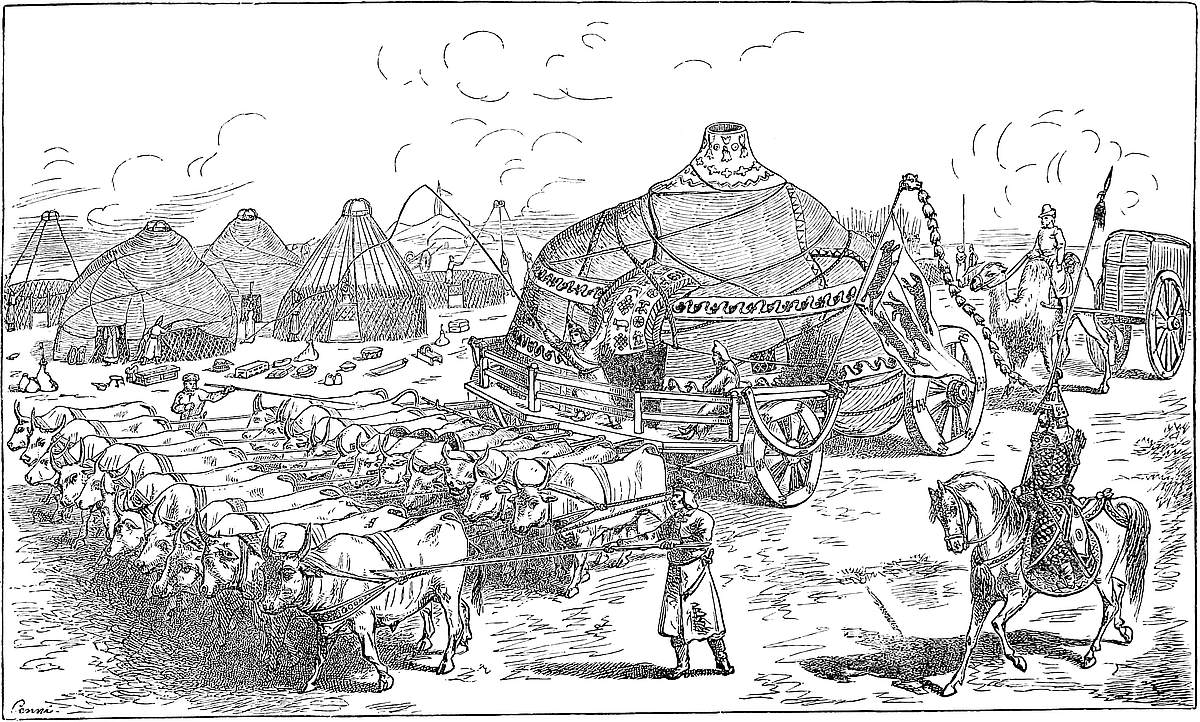
J. Cooper Sc
Mediæval Tartar Huts and Waggons.
Note 3.—Pharaoh’s Rat was properly the Gerboa of Arabia and North Africa,
which the Arabs also regard as a dainty. There is a kindred animal in
Siberia, called Alactaga, and a kind of Kangaroo-rat (probably the same)
is mentioned as very abundant on the Mongolian Steppe. There is also the
Zieselmaus of Pallas, a Dormouse, I believe, which he says the Kalmaks,
even of distinction, count a delicacy, especially cooked in sour milk.
“They eat not only the flesh of all their different kinds of cattle,
including horses and camels, but also that of many wild animals which other
nations eschew, e.g. marmots and zieselmice, beavers, badgers, otters,
and lynxes, leaving none untouched except the dog and weasel kind, and also
(unless very hard pressed) the flesh of the fox and the wolf.” (Pallas,
Samml. I. 128; also Rubr. 229–230.)
[“In the Mongol biography of Chinghiz Khan (Mongol text of the Yuan ch’ao
pi shi), mention is made of two kinds of animals (mice) used for food; the
tarbagat (Aritomys Bobac) and kuchugur.” (Palladius, l.c. p. 14.)
Regarding the marmots called Sogur by Rubruquis, Mr. Rockhill writes (p.
69): “Probably the Mus citillus, the Suslik of the Russians.... M.
Grenard tells me that Soghur, more usually written sour in Turki, is
the ordinary name of the marmot.”—H. C.]
Note 4.—“Their wives are chaste; nor does one ever hear any talk of their
immodesty,” says Carpini;—no Boccaccian and Chaucerian stories.
Note 5.—“The Mongols are not prohibited from having a plurality of wives;
the first manages the domestic concerns, and is the most respected.”
(Timk. II. 310.) Naturally Polygamy is not so general among the Mongols
as when Asia lay at their feet. The Buraets, who seem to retain the old
Mongol customs in great completeness, are polygamists, and have as many
wives as they choose. Polygamy is also very prevalent among the Yakuts,
whose lineage seems to be Eastern Turk. (Ritter, III. 125; Erman, II. 346.)
Of the custom that entitled the son on succeeding to take such as he
pleased of his deceased father’s wives, we have had some illustration
(see Prologue, ch. xvii. note 2), and many instances will be found in
Hammer’s or other Mongol Histories. The same custom seems to be ascribed
by Herodotus to the Scyths (IV. 78). A number of citations regarding the
practice are given by Quatremère. (Q. R. p. 92.) A modern Mongol writer
in the Mélanges Asiatiques of the Petersburg Academy, states that the
custom of taking a deceased brother’s wives is now obsolete, but that a
proverb preserves its memory (II. 656). It is the custom of some Mahomedan
nations, notably of the Afghans, and is one of those points that have been
cited as a supposed proof of their Hebrew lineage.
“The Kalin is a present which the Bridegroom or his parents make to the
parents of the Bride. All the Pagan nations of Siberia have this custom;
they differ only in what constitutes the present, whether money or cattle.”
(Gmelin, I. 29; see also Erman, II. 348.)
Concerning the God of the Tartars.
This is the fashion of their religion. [They say there is a Most High God
of Heaven, whom they worship daily with thurible and incense, but they pray
to Him only for health of mind and body. But] they have [also] a certain
[other] god of theirs called Natigay, and they say he is the god of the
Earth, who watches over their children, cattle, and crops. They show him
great worship and honour, and every man hath a figure of him in his house,
made of felt and cloth; and they also make in the same manner images of his
wife and children. The wife they put on the left hand, and the children
in front. And when they eat, they take the fat of the meat and grease the
god’s mouth withal, as well as the mouths of his wife and children. Then
they take of the broth and sprinkle it before the door of the house; and
that done, they deem that their god and his family have had their share of
the dinner.{1}
Their drink is mare’s milk, prepared in such a way that you would take it
for white wine; and a right good drink it is, called by them Kemiz.{2}
The clothes of the wealthy Tartars are for the most part of gold and
silk stuffs, lined with costly furs, such as sable and ermine, vair and
fox-skin, in the richest fashion.
Note 1.—There is no reference here to Buddhism, which was then of recent
introduction among the Mongols; indeed, at the end of the chapter, Polo
speaks of their new adoption of the Chinese idolatry, i.e. Buddhism. We may
add here that the Buddhism of the Mongols decayed and became practically
extinct after their expulsion from China (1368–1369). The old Shamanism
then apparently revived; nor was it till 1577 that the great reconversion
of Mongolia to Lamaism began. This reconversion is the most prominent event
in the Mongol history of Sanang Setzen, whose great-grandfather Khutuktai
Setzen, Prince of the Ordos, was a chief agent in the movement.
The Supreme Good Spirit appears to have been called by the Mongols Tengri
(Heaven), and Khormuzda, and is identified by Schmidt with the Persian
Hormuzd. In Buddhist times he became identified with Indra.
Plano Carpini’s account of this matter is very like Marco’s: “They believe
in one God, the Maker of all things, visible and invisible, and the
Distributor of good and evil in this world; but they worship Him not with
prayers or praises or any kind of service. Natheless, they have certain
idols of felt, imitating the human face, and having underneath the face
something resembling teats; these they place on either side of the door.
These they believe to be the guardians of the flocks, from whom they have
the boons of milk and increase. Others they fabricate of bits of silk, and
these are highly honoured; ... and whenever they begin to eat or drink, they
first offer these idols a portion of their food or drink.”
The account agrees generally with what we are told of the original
Shamanism of the Tunguses, which recognizes a Supreme Power over all, and
a small number of potent spirits called Ongot. These spirits among the
Buraets are called, according to one author, Nougait or Nogat, and
according to Erman Ongotui. In some form of this same word, Nogait,
Ongot, Onggod, Ongotui, we are, I imagine, to trace the Natigay of Polo.
The modern representative of this Shamanist Lar is still found among the
Buraets, and is thus described by Pallas under the name of Immegiljin:
“He is honoured as the tutelary god of the sheep and other cattle.
Properly, the divinity consists of two figures, hanging side by side, one
of whom represents the god’s wife. These two figures are merely a pair of
lanky flat bolsters with the upper part shaped into a round disk, and the
body hung with a long woolly fleece; eyes, nose, breasts, and navel, being
indicated by leather knobs stitched on. The male figure commonly has at
his girdle the foot-rope with which horses at pasture are fettered, whilst
the female, which is sometimes accompanied by smaller figures representing
her children, has all sorts of little nicknacks and sewing implements.”
Galsang Czomboyef, a recent Russo-Mongol writer already quoted, says also:
“Among the Buryats, in the middle of the hut and place of honour, is the
Dsaiagaçhi or ‘Chief Creator of Fortune.’ At the door is the Emelgelji,
the Tutelary of the Herds and Young Cattle, made of sheepskins. Outside
the hut is the Chandaghatu, a name implying that the idol was formed of
a white hare-skin, the Tutelary of the Chase and perhaps of War. All these
have been expelled by Buddhism except Dsaiagachi, who is called Tengri,
and introduced among the Buddhist divinities.”
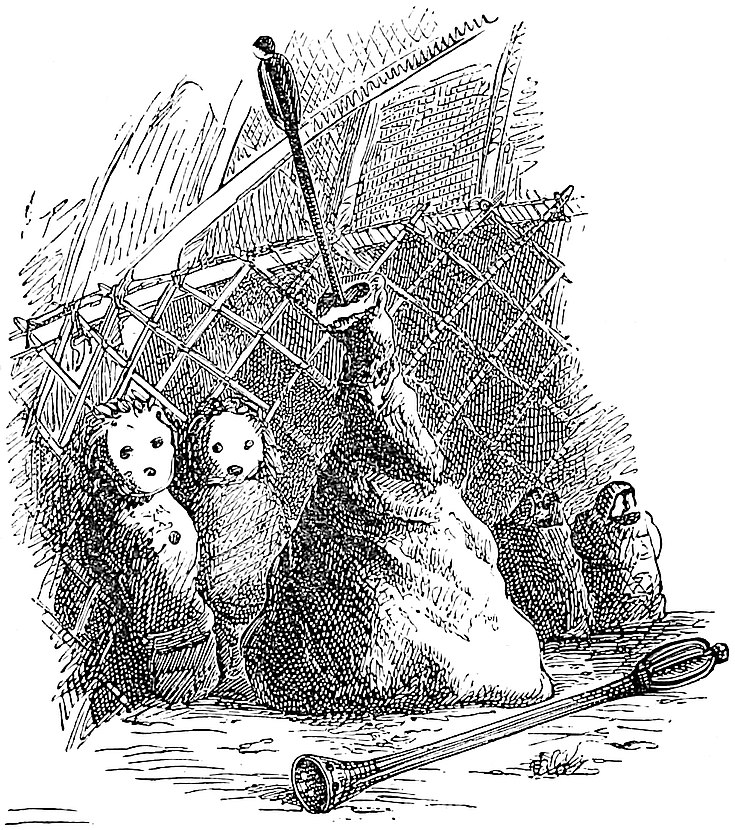
Tartar Idols and Kumis Churn.
[Dorji Banzaroff, in his dissertation On the Black Religion, i.e.
Shamanism, 1846, “is disposed to see in Natigay of M. Polo, the Ytoga
of other travellers, i.e. the Mongol Etugen—‘earth,’ as the object of
veneration of the Mongol Shamans. They look upon it as a divinity, for
its power as Delegei in echen, i.e. ‘the Lord of Earth,’ and on account
of its productiveness, Altan delegei, i.e. ‘Golden Earth.’” Palladius
(l.c. pp. 14–16) adds one new variant to what the learned Colonel Yule has
collected and set forth with such precision, on the Shaman household gods.
“The Dahurs and Barhus have in their dwellings, according to the number
of the male members of the family, puppets made of straw, on which eyes,
eyebrows, and mouth are drawn; these puppets are dressed up to the waist.
When some one of the family dies, his puppet is taken out of the house,
and a new puppet is made for every newly-born member of the family. On New
Year’s Day offerings are made to the puppets, and care is taken not to
disturb them (by moving them, etc.), in order to avoid bringing sickness
upon the family.” (He lung kiang wai ki.)
(Cf. Rubruck, 58–59, and Mr. Rockhill’s note, 59–60.)—H. C.]
Note 2.—Kimiz or Kumiz, the habitual drink of the Mongols, as it still is
of most of the nomads of Asia. It is thus made. Fresh mare’s milk is put
in a well-seasoned bottle-necked vessel of horse-skin; a little kurút
(see note 5, ch. liv.) or some sour cow’s milk is added; and when acetous
fermentation is commencing it is violently churned with a peculiar staff
which constantly stands in the vessel. This interrupts fermentation and
introduces a quantity of air into the liquid. It is customary for visitors
who may drop in to give a turn or two at the churn-stick. After three or
four days the drink is ready.
Kumiz keeps long; it is wonderfully tonic and nutritious, and it is said
that it has cured many persons threatened with consumption. The tribes
using it are said to be remarkably free from pulmonary disease; and indeed
I understand there is a regular Galactopathic establishment somewhere in
the province of Orenburg for treating pulmonary patients with Kumiz diet.
It has a peculiar fore- and after-taste which, it is said, everybody does
not like. Yet I have found no confession of a dislike to Kumiz. Rubruquis
tells us it is pungent on the tongue, like vinum raspei (vin rapé of
the French), whilst you are drinking it, but leaves behind a pleasant
flavour like milk of almonds. It makes a man’s inside feel very cosy, he
adds, even turning a weak head, and is strongly diuretic. To this last
statement, however, modern report is in direct contradiction. The Greeks
and other Oriental Christians considered it a sort of denial of the faith
to drink Kumiz. On the other hand, the Mahomedan converts from the nomad
tribes seem to have adhered to the use of Kumiz even when strict in
abstinence from wine; and it was indulged in by the early Mamelukes as a
public solemnity. Excess on such an occasion killed Bibars Bundukdari, who
was passionately fond of this liquor.
The intoxicating power of Kumiz varies according to the brew. The more
advanced is the vinous fermentation the less acid is the taste and the more
it sparkles. The effect, however, is always slight and transitory, and
leaves no unpleasant sensation, whilst it produces a strong tendency to
refreshing sleep. If its good qualities amount to half what are ascribed
to it by Dr. W. F. Dahl, from whom we derive some of these particulars, it
must be the pearl of all beverages. “With the nomads it is the drink of all
from the suckling upwards, it is the solace of age and illness, and the
greatest of treats to all!”
There was a special kind called Ḳará Ḳumiz, which is mentioned both by
Rubruquis and in the history of Wassáf. It seems to have been strained and
clarified. The modern Tartars distil a spirit from Kumiz of which Pallas
gives a detailed account. (Dahl, Ueber den Kumyss in Baer’s Beiträge,
VII.; Lettres sur le Caucase et la Crimée, Paris, 1859, p. 81; Makrizi,
II. 147; J. As. XI. 160; Levchine, 322–323; Rubr. 227–228, 335;
Gold. Horde, p. 46; Erman, I. 296; Pallas, Samml. I. 132 seqq.)
[In the Si yu ki, Travels to the West of Ch’ang ch’un, we find a drink
called tung lo. “The Chinese characters, tung lo,” says Bretschneider
(Med. Res. I. 94), “denote according to the dictionaries preparations
from mare’s or cow’s milk, as Kumis, sour milk, etc. In the Yüan shi (ch.
cxxviii.) biography of the Kipchak prince Tú-tú-ha, it is stated that
‘black mare’s milk’ (evidently the cara cosmos of Rubruck), very pleasant
to the taste, used to be sent from Kipchak to the Mongol court in China.”
(On the drinks of the Mongols, see Mr. Rockhill’s note, Rubruck, p.
62.)—The Mongols indulge in sour milk (tarak) and distilled mare’s milk
(arreki), but Mr. Rockhill (Land of the Lamas, 130) says he never saw
them drink kumiz.—H. C.]
The mare’s-milk drink of Scythian nomads is alluded to by many ancient
authors. But the manufacture of Kumiz is particularly spoken of by
Herodotus. “The (mare’s) milk is poured into deep wooden casks, about which
the blind slaves are placed, and then the milk is stirred round. That which
rises to the top is drawn off, and considered the best part; the under
portion is of less account.” Strabo also speaks of the nomads beyond the
Cimmerian Chersonesus, who feed on horse-flesh and other flesh, mare’s-milk
cheese, mare’s milk, and sour milk (ὀξυγάλακτα) “which they have
a particular way of preparing.” Perhaps Herodotus was mistaken about
the wooden tubs. At least all modern attempts to use anything but the
orthodox skins have failed. Priscus, in his narrative of the mission of
himself and Maximin to Attila, says the Huns brought them a drink made from
barley which they called Κάμος. The barley was, no doubt, a
misapprehension of his. (Herod. Bk. iv. p. 2, in Rawl.; Strabo, VII.
4, 6; Excerpta de Legationibus, in Corp. Hist. Byzant. I. 55.)
Concerning the Tartar Customs of War.
All their harness of war is excellent and costly. Their arms are bows
and arrows, sword and mace; but above all the bow, for they are capital
archers, indeed the best that are known. On their backs they wear armour
of cuirbouly, prepared from buffalo and other hides, which is very
strong.{1} They are excellent soldiers, and passing valiant in battle.
They are also more capable of hardships than other nations; for many a
time, if need be, they will go for a month without any supply of food,
living only on the milk of their mares and on such game as their bows may
win them. Their horses also will subsist entirely on the grass of the
plains, so that there is no need to carry store of barley or straw or oats;
and they are very docile to their riders. These, in case of need, will
abide on horseback the livelong night, armed at all points, while the horse
will be continually grazing.
Of all troops in the world these are they which endure the greatest
hardship and fatigue, and which cost the least; and they are the best of
all for making wide conquests of country. And this you will perceive from
what you have heard and shall hear in this book; and (as a fact) there can
be no manner of doubt that now they are the masters of the biggest half of
the world. Their troops are admirably ordered in the manner that I shall
now relate.
You see, when a Tartar prince goes forth to war, he takes with him, say,
100,000 horse. Well, he appoints an officer to every ten men, one to every
hundred, one to every thousand, and one to every ten thousand, so that his
own orders have to be given to ten persons only, and each of these ten
persons has to pass the orders only to other ten, and so on; no one having
to give orders to more than ten. And every one in turn is responsible only
to the officer immediately over him; and the discipline and order that
comes of this method is marvellous, for they are a people very obedient to
their chiefs. Further, they call the corps of 100,000 men a Tuc; that of
10,000 they call a Toman; the thousand they call ...; the hundred Guz;
the ten ....{2} And when the army is on the march they have always 200
horsemen, very well mounted, who are sent a distance of two marches in
advance to reconnoitre, and these always keep ahead. They have a similar
party detached in the rear, and on either flank, so that there is a good
look-out kept on all sides against a surprise. When they are going on a
distant expedition they take no gear with them except two leather bottles
for milk; a little earthenware pot to cook their meat in, and a little tent
to shelter them from rain.{3} And in case of great urgency they will
ride ten days on end without lighting a fire or taking a meal. On such an
occasion they will sustain themselves on the blood of their horses, opening
a vein and letting the blood jet into their mouths, drinking till they have
had enough, and then staunching it.{4}
They also have milk dried into a kind of paste to carry with them; and when
they need food they put this in water, and beat it up till it dissolves,
and then drink it. [It is prepared in this way; they boil the milk, and
when the rich part floats on the top they skim it into another vessel, and
of that they make butter; for the milk will not become solid till this is
removed. Then they put the milk in the sun to dry. And when they go on
an expedition, every man takes some ten pounds of this dried milk with
him. And of a morning he will take a half pound of it and put it in his
leather bottle, with as much water as he pleases. So, as he rides along,
the milk-paste and the water in the bottle get well churned together into a
kind of pap, and that makes his dinner.{5}]
When they come to an engagement with the enemy, they will gain the victory
in this fashion. [They never let themselves get into a regular medley, but
keep perpetually riding round and shooting into the enemy. And] as they do
not count it any shame to run away in battle, they will [sometimes pretend
to] do so, and in running away they turn in the saddle and shoot hard and
strong at the foe, and in this way make great havoc. Their horses are
trained so perfectly that they will double hither and thither, just like a
dog, in a way that is quite astonishing. Thus they fight to as good purpose
in running away as if they stood and faced the enemy, because of the vast
volleys of arrows that they shoot in this way, turning round upon their
pursuers, who are fancying that they have won the battle. But when the
Tartars see that they have killed and wounded a good many horses and men,
they wheel round bodily, and return to the charge in perfect order and with
loud cries; and in a very short time the enemy are routed. In truth they
are stout and valiant soldiers, and inured to war. And you perceive that it
is just when the enemy sees them run, and imagines that he has gained the
battle, that he has in reality lost it; for the Tartars wheel round in a
moment when they judge the right time has come. And after this fashion they
have won many a fight.{6}
All this that I have been telling you is true of the manners and customs
of the genuine Tartars. But I must add also that in these days they are
greatly degenerated; for those who are settled in Cathay have taken up the
practices of the Idolaters of the country, and have abandoned their own
institutions; whilst those who have settled in the Levant have adopted the
customs of the Saracens.{7}
Note 1.—The bow was the characteristic weapon of the Tartars, insomuch that
the Armenian historians often call them “The Archers.” (St. Martin, II.
133.) “Cuirbouly, leather softened by boiling, in which it took any form
or impression required, and then hardened.” (Wright’s Dict.) The English
adventurer among the Tartars, whose account of them is given by Archbishop
Ivo of Narbonne, in Matthew Paris (sub. 1243), says: “De coriis bullitis
sibi arma levia quidem, sed tamen impenetrabilia coaptarunt.” This armour
is particularly described by Plano Carpini (p. 685). See the tail-piece to
Book IV.
[Mr. E. H. Parker (China Review, XXIV. iv. p. 205) remarks that “the
first coats of mail were made in China in 1288: perhaps the idea was
obtained from the Malays or Arabs.”—H. C.]
Note 2.—M. Pauthier has judiciously pointed out the omissions that have
occurred here, perhaps owing to Rusticiano’s not properly catching the
foreign terms applied to the various grades. In the G. Text the passage
runs: “Et sachiés que les cent mille est apellé un Tut (read tuc)
et les dix mille un Toman, et les por milier et por centenier et por
desme.” In Pauthier’s (uncorrected) text one of the missing words is
supplied: “Et appellent les C.M. un Tuc; et les X.M. un Toman; et un
millier Guz por centenier et por disenier.” The blanks he supplies thus
from Abulghazi: “Et un millier: [un Miny]; Guz, por centenier et [Un]
por disenier.” The words supplied are Turki, but so is the Guz, which
appears already in Pauthier’s text, whilst Toman and Tuc are common
to Turki and Mongol. The latter word, Túk or Túgh, is the horse-tail
or yak-tail standard which among so many Asiatic nations has marked the
supreme military command. It occurs as Taka in ancient Persian, and
Cosmas Indicopleustes speaks of it as Tupha. The Nine Orloks or Marshals
under Chinghiz were entitled to the Tuk, and theirs is probably the class
of command here indicated as of 100,000, though the figure must not be
strictly taken. Timur ordains that every Amir who should conquer a kingdom
or command in a victory should receive a title of honour, the Tugh and
the Naḳḳárá. (infra, Bk. II. ch. iv. note 3.) Baber on several occasions
speaks of conferring the Tugh upon his generals for distinguished
service. One of the military titles at Bokhara is still Tokhsabai, a
corruption of Túgh-Sáhibi (Master of the Tugh).
We find the whole gradation except the Tuc in a rescript of Janibeg, Khan
of Sarai, in favour of Venetian merchants dated February 1347. It begins
in the Venetian version: “La parola de Zanibeck allo puovolo di Mogoli,
alli Baroni di Thomeni,[1] delli miera, delli centenera, delle dexiene.”
(Erdmann, 576; D’Avezac, 577–578; Rémusat, Langues Tartares,
303; Pallas, Samml. I. 283; Schmidt, 379, 381; Baber, 260, etc.;
Vámbéry, 374; Timour Inst. pp. 283 and 292–293; Bibl. de l’Ec. des
Chartes, tom. lv. p. 585.)
The decimal division of the army was already made by Chinghiz at an early
period of his career, and was probably much older than his time. In fact
we find the Myriarch and Chiliarch already in the Persian armies of Darius
Hystaspes. From the Tartars the system passed into nearly all the Musulman
States of Asia, and the titles Min-bashi or Bimbashi, Yuzbashi,
Onbashi, still subsist not only in Turkestan, but also in Turkey and
Persia. The term Tman or Tma was, according to Herberstein, still used
in Russia in his day for 10,000. (Ramus. II. 159.)
[The King of An-nam, Dinh Tiên-hòang (A.D. 968) had an army of 1,000,000
men forming 10 corps of 10 legions; each legion forming 10 cohorts of 10
centuries; each century forming 10 squads of 10 men.—H. C.]
Note 3.—Ramusio’s edition says that what with horses and mares there will
be an average of eighteen beasts (?) to every man.
Note 4.—See the
Oriental account quoted below in Note 6.
So Dionysius, combining this practice with that next described, relates of
the Massagetæ that they have no delicious bread nor native wine:
“But with horse’s blood
And white milk mingled set their banquets forth.”
(Orbis Desc. 743–744.)
And Sidonius:
“Solitosque cruentum
Lac potare Getas, et pocula tingere venis.”
(Parag. ad Avitum.)
[“The Scythian soldier drinks the blood of the first man he overthrows
in battle.” (Herodotus, Rawlinson, Bk. IV. ch. 64, p. 54.)—H. C.]
“When in lack of food, they bleed a horse and suck the vein. If they need
something more solid, they put a sheep’s pudding full of blood under the
saddle; this in time gets coagulated and cooked by the heat, and then they
devour it.” (Georg. Pachymeres, V. 4.) The last is a well-known story,
but is strenuously denied and ridiculed by Bergmann. (Streifereien, etc.
I. 15.) Joinville tells the same story. Hans Schiltberger asserts it very
distinctly: “Ich hon och gesehen wann sie in reiss ylten, das sie ein
fleisch nemen, und es dunn schinden und legents unter den sattel, und riten
doruff; und essents wann sie hungert” (ch. 35). Botero had “heard from a
trustworthy source that a Tartar of Perekop, travelling on the steppes,
lived for some days on the blood of his horse, and then, not daring to
bleed it more, cut off and ate its ears!” (Relazione Univers. p. 93.)
The Turkmans speak of such practices, but Conolly says he came to regard
them as hyperbolical talk (I. 45).
[Abul-Ghazi Khan, in his History of Mongols, describing a raid of Russian
(Ourous) Cossacks, who were hemmed in by the Uzbeks, says: “The Russians
had in continued fighting exhausted all their water. They began to drink
blood; the fifth day they had not even blood remaining to drink.” (Transl.
by Baron Des Maisons, St. Petersburg, II. 295.)]
Note
5.—Rubruquis thus describes this preparation, which is called Kurút:
“The milk that remains after the butter has been made, they allow to get
as sour as sour can be, and then boil it. In boiling, it curdles, and that
curd they dry in the sun; and in this way it becomes as hard as iron-slag.
And so it is stored in bags against the winter. In the winter time, when
they have no milk, they put that sour curd, which they call Griut,
into a skin, and pour warm water on it, and they shake it violently till
the curd dissolves in the water, to which it gives an acid flavour; that
water they drink in place of milk. But above all things they eschew
drinking plain water.” From Pallas’s account of the modern practice, which
is substantially the same, these cakes are also made from the leavings
of distillation in making milk-arrack. The Kurút is frequently made of
ewe-milk. Wood speaks of it as an indispensable article in the food of the
people of Badakhshan, and under the same name it is a staple food of the
Afghans. (Rubr. 229; Samml. I. 136; Dahl, u.s.; Wood, 311.)
[It is the ch’ura of the Tibetans. “In the Kokonor country and Tibet,
this krut or chura is put in tea to soften, and then eaten either alone
or mixed with parched barley meal (tsamba).” (Rockhill, Rubruck, p. 68,
note.)—H. C.]
Note 6.—Compare with Marco’s account the report of the Mongols, which was
brought by the spies of Mahomed, Sultan of Khwarizm, when invasion was
first menaced by Chinghiz: “The army of Chinghiz is countless, as a swarm
of ants or locusts. Their warriors are matchless in lion-like valour, in
obedience, and endurance. They take no rest, and flight or retreat is
unknown to them. On their expeditions they are accompanied by oxen, sheep,
camels, and horses, and sweet or sour milk suffices them for food. Their
horses scratch the earth with their hoofs and feed on the roots and grasses
they dig up, so that they need neither straw nor oats. They themselves
reck nothing of the clean or the unclean in food, and eat the flesh of all
animals, even of dogs, swine, and bears. They will open a horse’s vein,
draw blood, and drink it.... In victory they leave neither small nor great
alive; they cut up women great with child and cleave the fruit of the womb.
If they come to a great river, as they know nothing of boats, they sew
skins together, stitch up all their goods therein, tie the bundle to their
horses’ tails, mount with a hard grip of the mane, and so swim over.” This
passage is an absolute abridgment of many chapters of Carpini. Still more
terse was the sketch of Mongol proceedings drawn by a fugitive from Bokhara
after Chinghiz’s devastations there. It was set forth in one unconscious
hexameter:
“Ámdand u khandand u sokhtand u kushtand u burdand u raftand!”
“They came and they sapped, they fired and they slew, trussed up their loot and were gone!”
Juwaini, the historian, after telling the story, adds: “The cream and
essence of whatever is written in this volume might be represented in these
few words.”
A Musulman author quoted by Hammer, Najmuddin of Rei, gives an awful
picture of the Tartar devastations, “Such as had never been heard of,
whether in the lands of unbelief or of Islam, and can only be likened to
those which the Prophet announced as signs of the Last Day, when he said:
‘The Hour of Judgment shall not come until ye shall have fought with the
Turks, men small of eye and ruddy of countenance, whose noses are flat,
and their faces like hide-covered shields. Those shall be Days of Horror!’
‘And what meanest thou by horror?’ said the Companions; and he replied,
‘Slaughter! Slaughter!’ This beheld the Prophet in vision 600 years ago.
And could there well be worse slaughter than there was in Rei, where I,
wretch that I am, was born and bred, and where the whole population of five
hundred thousand souls was either butchered or dragged into slavery?”
Marco habitually suppresses or ignores the frightful brutalities of the
Tartars, but these were somewhat less, no doubt, in Kúblái’s time.
The Hindustani poet Amir Khosru gives a picture of the Mongols more
forcible than elegant, which Elliot has translated (III. 528).
This is Hayton’s account of the Parthian tactics of the Tartars: “They
will run away, but always keeping their companies together; and it is very
dangerous to give them chase, for as they flee they shoot back over their
heads, and do great execution among their pursuers. They keep very close
rank, so that you would not guess them for half their real strength.”
Carpini speaks to the same effect. Baber, himself of Mongol descent, but
heartily hating his kindred, gives this account of their military usage in
his day: “Such is the uniform practice of these wretches the Moghuls; if
they defeat the enemy they instantly seize the booty; if they are defeated,
they plunder and dismount their own allies, and, betide what may, carry off
the spoil.” (Erdmann, 364, 383, 620; Gold. Horde, 77, 80; Elliot, II.
388; Hayton in Ram. ch. xlviii.; Baber, 93; Carpini, p. 694.)
Note
7.—“The Scythians” (i.e. in the absurd Byzantine pedantry, Tartars),
says Nicephorus Gregoras, “from converse with the Assyrians, Persians, and
Chaldæans, in time acquired their manners and adopted their religion,
casting off their ancestral atheism.... And to such a degree were they
changed, that though in former days they had been wont to cover the head
with nothing better than a loose felt cap, and for other clothing had
thought themselves well off with the skins of wild beasts or ill-dressed
leather, and had for weapons only clubs and slings, or spears, arrows, and
bows extemporised from the oaks and other trees of their mountains and
forests, now, forsooth, they will have no meaner clothing than brocades of
silk and gold! And their luxury and delicate living came to such a pitch
that they stood far as the poles asunder from their original habits” (II. v. 6).
Concerning the administering of Justice among the Tartars.
The way they administer justice is this. When any one has committed a
petty theft, they give him, under the orders of authority, seven blows of
a stick, or seventeen, or twenty-seven, or thirty-seven, or forty-seven,
and so forth, always increasing by tens in proportion to the injury done,
and running up to one hundred and seven. Of these beatings sometimes they
die.{1} But if the offence be horse-stealing, or some other great
matter, they cut the thief in two with a sword. Howbeit, if he be able to
ransom himself by paying nine times the value of the thing stolen, he is
let off. Every Lord or other person who possesses beasts has them marked
with his peculiar brand, be they horses, mares, camels, oxen, cows, or
other great cattle, and then they are sent abroad to graze over the plains
without any keeper. They get all mixt together, but eventually every beast
is recovered by means of its owner’s brand, which is known. For their sheep
and goats they have shepherds. All their cattle are remarkably fine, big,
and in good condition.{2}
They have another notable custom, which is this. If any man have a daughter
who dies before marriage, and another man have had a son also die before
marriage, the parents of the two arrange a grand wedding between the dead
lad and lass. And marry them they do, making a regular contract! And when
the contract papers are made out they put them in the fire, in order (as
they will have it) that the parties in the other world may know the fact,
and so look on each other as man and wife. And the parents thenceforward
consider themselves sib to each other, just as if their children had lived
and married. Whatever may be agreed on between the parties as dowry, those
who have to pay it cause to be painted on pieces of paper and then put
these in the fire, saying that in that way the dead person will get all the
real articles in the other world.{3}
Now I have told you all about the manners and customs of the Tartars; but
you have heard nothing yet of the great state of the Grand Kaan, who is the
Lord of all the Tartars and of the Supreme Imperial Court. All that I will
tell you in this book in proper time and place, but meanwhile I must return
to my story which I left off in that great plain when we began to speak of
the Tartars.{4}
Note 1.—The cudgel among the Mongols was not confined to thieves and such
like. It was the punishment also of military and state offences, and
even princes were liable to it without fatal disgrace. “If they give any
offence,” says Carpini, “or omit to obey the slightest beck, the Tartars
themselves are beaten like donkeys.” The number of blows administered was,
according to Wassáf, always odd, 3, 5, and so forth, up to 77. (Carp.
712; Ilchan. I. 37.)
[“They also punish with death grand larceny, but as for petty thefts, such
as that of a sheep, so long as one has not repeatedly been taken in the
act, they beat him cruelly, and if they administer an hundred blows they
must use an hundred sticks.” (Rockhill, Rubruck, p. 80.)—H. C.]
Note 2.—“They have no herdsmen or others to watch their cattle, because the
laws of the Turks (i.e. Tartars) against theft are so severe.... A man in
whose possession a stolen horse is found is obliged to restore it to its
owner, and to give nine of the same value; if he cannot, his children are
seized in compensation; if he have no children, he is slaughtered like a
mutton.” (Ibn Batuta, II. 364.)
Note 3.—This is a Chinese custom, though no doubt we may trust Marco
for its being a Tartar one also. “In the province of Shansi they have a
ridiculous custom, which is to marry dead folks to each other. F. Michael
Trigault, a Jesuit, who lived several years in that province, told it us
whilst we were in confinement. It falls out that one man’s son and another
man’s daughter die. Whilst the coffins are in the house (and they used to
keep them two or three years, or longer) the parents agree to marry them;
they send the usual presents, as if the pair were alive, with much ceremony
and music. After this they put the two coffins together, hold the wedding
dinner in their presence, and, lastly, lay them together in one tomb. The
parents, from this time forth, are looked on not merely as friends but as
relatives—just as they would have been had their children been married when
in life.” (Navarrete, quoted by Marsden.) Kidd likewise, speaking of
the Chinese custom of worshipping at the tombs of progenitors, says: “So
strongly does veneration for this tribute after death prevail that parents,
in order to secure the memorial of the sepulchre for a daughter who has
died during her betrothal, give her in marriage after her decease to her
intended husband, who receives with nuptial ceremonies at his own house
a paper effigy made by her parents, and after he has burnt it, erects a
tablet to her memory—an honour which usage forbids to be rendered to the
memory of unmarried persons. The law seeks without effect to abolish this
absurd custom.” (China, etc., pp. 179–180.)
[Professor J. J. M. de Groot (Religious System of China) gives several
instances of marriages after death; the following example (II. 804–805)
will illustrate the custom: “An interesting account of the manner in
which such post-mortem marriages were concluded at the period when the
Sung Dynasty governed the Empire, is given by a contemporary work in the
following words: ‘In the northern parts of the Realm it is customary, when
an unmarried youth and an unmarried girl breathe their last, that the two
families each charge a match-maker to demand the other party in marriage.
Such go-betweens are called match-makers for disembodied souls. They
acquaint the two families with each other’s circumstances, and then cast
lots for the marriage by order of the parents on both sides. If they augur
that the union will be a happy one, (wedding) garments for the next world
are cut out, and the match-makers repair to the grave of the lad, there
to set out wine and fruit for the consummation of the marriage. Two seats
are placed side by side, and a small streamer is set up near each seat.
If these streamers move a little after the libation has been performed,
the souls are believed to approach each other; but if one of them does
not move, the party represented thereby is considered to disapprove of
the marriage. Each family has to reward its match-maker with a present
of woven stuffs. Such go-betweens make a regular livelihood out of these
proceedings.’”—H. C.]
The Ingushes of the Caucasus, according to Klaproth, have the same custom:
“If a man’s son dies, another who has lost his daughter goes to the father
and says, ‘Thy son will want a wife in the other world; I will give him my
daughter; pay me the price of the bride.’ Such a demand is never refused,
even though the purchase of the bride amount to thirty cows.” (Travels,
Eng. Trans. 345.)
Note 4.—There is a little doubt about the reading of this last paragraph.
The G. T. has—“Mès desormès volun retorner à nostre conte en la grant
plaingne où nos estion quant nos comechames des fais des Tartars,” whilst
Pauthier’s text has “Mais desormais vueil retourner à mon conte que Je
lessai d’or plain quant nous commençames des faiz des Tatars.” The
former reading looks very like a misunderstanding of one similar to the
latter, where d’or plain seems to be an adverbial expression, with some
such meaning as “just now,” “a while ago.” I have not, however, been able
to trace the expression elsewhere. Cotgrave has or primes, “but even
now,” etc.; and has also de plain, “presently, immediately, out of hand.”
It seems quite possible that d’or plain should have had the meaning
suggested.
Sundry Particulars of the Plain beyond Caracoron.
And when you leave Caracoron and the Altay, in which they bury the bodies
of the Tartar Sovereigns, as I told you, you go north for forty days till
you reach a country called the Plain of Bargu.{1} The people there are
called Mescript; they are a very wild race, and live by their cattle, the
most of which are stags, and these stags, I assure you, they used to ride
upon. Their customs are like those of the Tartars, and they are subject to
the Great Kaan. They have neither corn nor wine. [They get birds for food,
for the country is full of lakes and pools and marshes, which are much
frequented by the birds when they are moulting, and when they have quite
cast their feathers and can’t fly, those people catch them. They also live
partly on fish.{2}]
And when you have travelled forty days over this great plain you come to
the ocean, at the place where the mountains are in which the Peregrine
falcons have their nests. And in those mountains it is so cold that
you find neither man or woman, nor beast nor bird, except one kind of
bird called Barguerlac, on which the falcons feed. They are as big
as partridges, and have feet like those of parrots and a tail like a
swallow’s, and are very strong in flight. And when the Grand Kaan wants
Peregrines from the nest, he sends thither to procure them.{3} It
is also on islands in that sea that the Gerfalcons are bred. You must
know that the place is so far to the north that you leave the North Star
somewhat behind you towards the south! The gerfalcons are so abundant there
that the Emperor can have as many as he likes to send for. And you must not
suppose that those gerfalcons which the Christians carry into the Tartar
dominions go to the Great Kaan; they are carried only to the Prince of the
Levant.{4}
Now I have told you all about the provinces northward as far as the Ocean
Sea, beyond which there is no more land at all; so I shall proceed to tell
you of the other provinces on the way to the Great Kaan. Let us, then,
return to that province of which I spoke before, called Campichu.
Note 1.—The readings differ as to the length of the journey. In Pauthier’s
text we seem to have first a journey of forty days from near Karakorúm to
the Plain of Bargu, and then a journey of forty days more across the plain
to the Northern Ocean. The G. T. seems to present only one journey of
forty days (Ramusio, of sixty days), but leaves the interval from Karakorúm
undefined. I have followed the former, though with some doubt.
Note 2.—This paragraph from Ramusio replaces the following in Pauthier’s
text: “In the summer they got abundance of game, both beasts and birds, but
in winter, there is none to be had because of the great cold.”
Marco is here dealing, I apprehend, with hearsay geography, and, as is
common in like cases, there is great compression of circumstances and
characteristics, analogous to the like compression of little-known regions
in mediæval maps.
The name Bargu appears to be the same with that often mentioned in Mongol
history as Barguchin Tugrum or Barguti, and which Rashiduddin calls the
northern limit of the inhabited earth. This commenced about Lake Baikal,
where the name still survives in that of a river (Barguzin) falling into
the Lake on the east side, and of a town on its banks (Barguzinsk).
Indeed, according to Rashid himself, Bargu was the name of one of the
tribes occupying the plain; and a quotation from Father Hyacinth would seem
to show that the country is still called Barakhu.
[The Archimandrite Palladius (Elucidations, 16–17) writes:—“In the
Mongol text of Chingis Khan’s biography, this country is called Barhu and
Barhuchin; it is to be supposed, according to Colonel Yule’s identification
of this name with the modern Barguzin, that this country was near Lake
Baikal. The fact that Merkits were in Bargu is confirmed by the following
statement in Chingis Khan’s biography: ‘When Chingis Khan defeated his
enemies, the Merkits, they fled to Barhuchin tokum.’ Tokum signifies
‘a hollow, a low place,’ according to the Chinese translation of the
above-mentioned biography, made in 1381; thus Barhuchin tokum undoubtedly
corresponds to M. Polo’s Plain of Bargu. As to M. Polo’s statement that the
inhabitants of Bargu were Merkits, it cannot be accepted unconditionally.
The Merkits were not indigenous to the country near Baikal, but belonged
originally,—according to a division set forth in the Mongol text of the
Yuan ch’ao pi shi,—to the category of tribes living in yurts, i.e.
nomad tribes, or tribes of the desert. Meanwhile we find in the same
biography of Chingis Khan, mention of a people called Barhun, which
belonged to the category of tribes living in the forests; and we have
therefore reason to suppose that the Barhuns were the aborigines of Barhu.
After the time of Chingis Khan, this ethnographic name disappears from
Chinese history; it appears again in the middle of the 16th century. The
author of the Yyu (1543–1544), in enumerating the tribes inhabiting
Mongolia and the adjacent countries, mentions the Barhu, as a strong tribe,
able to supply up to several tens of thousands (?) of warriors, armed with
steel swords; but the country inhabited by them is not indicated. The
Mongols, it is added, call them Black Ta-tze (Khara Mongols, i.e. ‘Lower Mongols’).
“At the close of the 17th century, the Barhus are found inhabiting the
western slopes of the interior Hing’an, as well as between Lake Kulon and
River Khalkha, and dependent on a prince of eastern Khalkhas, Doro beile.
(Manchu title.)
“At the time of Galdan Khan’s invasion, a part of them fled to Siberia
with the eastern Khalkhas, but afterwards they returned. [Mung ku yew mu
ki and Lung sha ki lio.] After their rebellion in 1696, quelled by a
Manchu General, they were included with other petty tribes (regarding which
few researches have been made) in the category butkha, or hunters, and
received a military organisation. They are divided into Old and New Barhu,
according to the time when they were brought under Manchu rule. The Barhus
belong to the Mongolian, not to the Tungusian race; they are sometimes
considered even to have been in relationship with the Khalkhas. (He lung
kiang wai ki and Lung sha ki lio.)
“This is all the substantial information we possess on the Barhu. Is
there an affinity to be found between the modern Barhus and the Barhuns
of Chingis Khan’s biography?—and is it to be supposed, that in the course
of time, they spread from Lake Baikal to the Hing’an range? Or is it more
correct to consider them a branch of the Mongol race indigenous to the
Hing’an Mountains, and which received the general archaic name of Bargu,
which might have pointed out the physical character of the country they
inhabited [Kin Shi], just as we find in history the Urianhai of Altai and
the Urianhai of Western Manchuria? It is difficult to solve this question
for want of historical data.”—H. C.]
Mescript, or Mecri, as in G. T. The Merkit, a great tribe to the
south-east of the Baikal, were also called Mekrit, and sometimes Megrin.
The Mekrit are spoken of also by Carpini and Rubruquis. D’Avezac thinks
that the Kerait, and not the Merkit, are intended by all three
travellers. As regards Polo, I see no reason for this view. The name he
uses is Mekrit, and the position which he assigns to them agrees fairly
with that assigned on good authority to the Merkit or Mekrit. Only, as
in other cases, where he is rehearsing hearsay information, it does not
follow that the identification of the name involves the correctness of
all the circumstances that he connects with that name. We saw in ch. xxx.
that under Pashai he seemed to lump circumstances belonging to various
parts of the region from Badakhshan to the Indus; so here under Mekrit
he embraces characteristics belonging to tribes extending far beyond the
Mekrit, and which in fact are appropriate to the Tunguses. Rashiduddin
seems to describe the latter under the name of Uriangkut of the Woods, a
people dwelling beyond the frontier of Barguchin, and in connection with
whom he speaks of their Reindeer obscurely, as well as of their tents of
birch bark, and their hunting on snow-shoes.
The mention of the Reindeer by Polo in this passage is one of the
interesting points which Pauthier’s text omits. Marsden objects to the
statement that the stags are ridden upon, and from this motive mis-renders
“li qual’anche cavalcano,” as, “which they make use of for the purpose
of travelling.” Yet he might have found in Witsen that the Reindeer are
ridden by various Siberian Tribes, but especially by the Tunguses. Erman
is very full on the reindeer-riding of the latter people, having himself
travelled far in that way in going to Okhotsk, and gives a very detailed
description of the saddle, etc., employed. The reindeer of the Tunguses are
stated by the same traveller to be much larger and finer animals than those
of Lapland. They are also used for pack-carriage and draught. Old Richard
Eden says that the “olde wryters” relate that “certayne Scythians doe ryde
on Hartes.” I have not traced to what he refers, but if the statement be in
any ancient author it is very remarkable. Some old editions of Olaus Magnus
have curious cuts of Laplanders and others riding on reindeer, but I find
nothing in the text appropriate. We hear from travellers of the Lapland
deer being occasionally mounted, but only it would seem in sport, not as a
practice. (Erdmann, 189, 191; D’Ohsson, I. 103; D’Avezac, 534 seqq.;
J. As. sér. II. tom. xi.; sér. IV. tom. xvii. 107; N. et E. XIII. i.
274–276; Witsen, II. 670, 671, 680; Erman, II. 321, 374, 429, 449
seqq., and original German, II. 347 seqq.; Notes on Russia, Hac. Soc. II.
224; J. A. S. B. XXIX. 379.)
The numerous lakes and marshes swarming with water-fowl are very
characteristic of the country between Yakutsk and the Kolyma. It is evident
that Marco had his information from an eye-witness, though the whole
picture is compressed. Wrangell, speaking of Nijni Kolyma, says: “It is at
the moulting season that the great bird-hunts take place. The sportsmen
surround the nests, and slip their dogs, which drive the birds to the
water, on which they are easily knocked over with a gun or arrow, or even
with a stick.... This chase is divided into several periods. They begin
with the ducks, which moult first; then come the geese; then the swans....
In each case the people take care to choose the time when the birds have
lost their feathers.” The whole calendar with the Yakuts and Russian
settlers on the Kolyma is a succession of fishing and hunting seasons which
the same author details. (I. 149, 150; 119–121.)
Note
3.—What little is said of the Barguerlac points to some bird of
the genus Pterocles, or Sand Grouse (to which belong the so-called Rock
Pigeons of India), or to the allied Tetrao paradoxus of Pallas, now
known as Syrrhaptes Pallasii. Indeed, we find in Zenker’s Dictionary
that Boghurtláḳ (or Baghírtláḳ, as it is in Pavet de Courteille’s) in
Oriental Turkish is the Kata, i.e. I presume, the Pterocles alchata of
Linnæus, or Large Pin-tailed Sand Grouse. Mr. Gould, to whom I referred
the point, is clear that the Syrrhaptes is Marco’s bird, and I believe
there can be no question of it.
[Passing through Ch’ang-k’ou, Mr. Rockhill found the people praying for
rain. “The people told me,” he says, in his Journey (p. 9), “that they knew
long ago the year would be disastrous, for the sand grouse had been more
numerous of late than for years, and the saying goes Sha-ch’i kuo, mai
lao-po, ‘when the sand grouse fly by, wives will be for sale.’”—H. C.]
The chief difficulty in identification with the Syrrhaptes or any known
bird, would be “the feet like a parrot’s.” The feet of the Syrrhaptes are
not indeed like a parrot’s, though its awkward, slow, and waddling gait on
the ground, may have suggested the comparison; and though it has very odd
and anomalous feet, a circumstance which the Chinese indicate in another
way by calling the bird (according to Huc) Lung Kio, or “Dragon-foot.”
[Mr. Rockhill (Journey) writes in a note (p. 9): “I, for my part, never
heard any other name than sha-ch’i, ‘sand-fowl,’ given them. This name is
used, however, for a variety of birds, among others the partridge.”—H. C.]
The hind-toe is absent, the toes are unseparated, recognisable only by the
broad flat nails, and fitted below with a callous couch, whilst the whole
foot is covered with short dense feathers like hair, and is more like a
quadruped’s paw than a bird’s foot.
The home of the Syrrhaptes is in the Altai, the Kirghiz Steppes, and the
country round Lake Baikal, though it also visits the North of China in
great flights. “On plains of grass and sandy deserts,” says Gould (Birds
of Great Britain, Part IV.), “at one season covered with snow, and at
another sun-burnt and parched by drought, it finds a congenial home; in
these inhospitable and little-known regions it breeds, and when necessity
compels it to do so, wings its way ... over incredible distances to obtain
water or food.” Huc says, speaking of the bird on the northern frontier of
China: “They generally arrive in great flights from the north, especially
when much snow has fallen, flying with astonishing rapidity, so that the
movement of their wings produces a noise like hail.” It is said to be
very delicate eating. The bird owes its place in Gould’s Birds of Great
Britain to the fact—strongly illustrative of its being moult volant,
as Polo says it is—that it appeared in England in 1859, and since then,
at least up to 1863, continued to arrive annually in pairs or companies
in nearly all parts of our island, from Penzance to Caithness. And Gould
states that it was breeding in the Danish islands. A full account by Mr.
A. Newton of this remarkable immigration is contained in the Ibis for
April, 1864, and many details in Stevenson’s Birds of Norfolk, I. 376
seqq. There are plates of Syrrhaptes in Radde’s Reisen im Süden von
Ost-Sibirien, Bd. II.; in vol. v. of Temminck, Planches Coloriées, Pl.
95; in Gould, as above; in Gray, Genera of Birds, vol. iii. p. 517
(life size); and in the Ibis for April, 1860. From the last our cut is taken.
[See A. David et Oustalet, Oiseaux de la Chine, 389, on Syrrhaptes
Pallasii or Syrrhaptes Paradoxus.—H. C.]
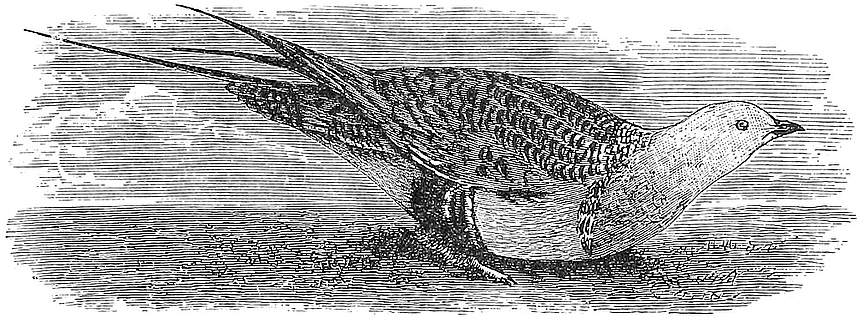
Syrrhaptes Pallasii.
Note
4.—Gerfalcons (Shonḳár) were objects of high estimation in the
Middle Ages, and were frequent presents to and from royal personages. Thus
among the presents sent with an embassy from King James II. of Aragon to
the Sultan of Egypt, in 1314, we find three white gerfalcons. They were
sent in homage to Chinghiz and to Kúblái, by the Kirghiz, but I cannot
identify the mountains where they or the Peregrines were found. The
Peregrine falcon was in Europe sometimes termed Faucon Tartare. (See
Ménage s.v. Sahin.) The Peregrine of Northern Japan, and probably
therefore that of Siberia, is identical with that of Europe. Witsen speaks
of an island in the Sea of Tartary, from which falcons were got, apparently
referring to a Chinese map as his authority; but I know nothing more of it.
(Capmany, IV. 64–65; Ibis, 1862, p. 314; Witsen, II. 656.)
[On the Falco peregrinus, Lin., and other Falcons, see Ed. Blanc’s paper
mentioned on p. 162. The Falco Saker is to be found all over Central
Asia; it is called by the Pekingese Hwang-yng (yellow falcon). (David et
Oustalet, Oiseaux de la Chine, 31–32.)—H. C.]
Of the Kingdom of Erguiul, and Province of Sinju.
On leaving Campichu, then, you travel five days across a tract in which
many spirits are heard speaking in the night season; and at the end of
those five marches, towards the east, you come to a kingdom called Erguiul,
belonging to the Great Kaan. It is one of the several kingdoms which
make up the great Province of Tangut. The people consist of Nestorian
Christians, Idolaters, and worshippers of Mahommet.{1}
There are plenty of cities in this kingdom, but the capital is Erguiul. You
can travel in a south-easterly direction from this place into the province
of Cathay. Should you follow that road to the south-east, you come to a
city called Sinju, belonging also to Tangut, and subject to the Great
Kaan, which has under it many towns and villages.{2} The population
is composed of Idolaters, and worshippers of Mahommet, but there are some
Christians also. There are wild cattle in that country [almost] as big as
elephants, splendid creatures, covered everywhere but on the back with
shaggy hair a good four palms long. They are partly black, partly white,
and really wonderfully fine creatures [and the hair or wool is extremely
fine and white, finer and whiter than silk. Messer Marco brought some to
Venice as a great curiosity, and so it was reckoned by those who saw it].
There are also plenty of them tame, which have been caught young. [They
also cross these with the common cow, and the cattle from this cross are
wonderful beasts, and better for work than other animals.] These the people
use commonly for burden and general work, and in the plough as well; and at
the latter they will do full twice as much work as any other cattle, being
such very strong beasts.{3}
In this country too is found the best musk in the world; and I will tell
you how ’tis produced. There exists in that region a kind of wild animal
like a gazelle. It has feet and tail like the gazelle’s, and stag’s hair
of a very coarse kind, but no horns. It has four tusks, two below and two
above, about three inches long, and slender in form, one pair growing
upwards, and the other downwards. It is a very pretty creature. The musk
is found in this way. When the creature has been taken, they find at the
navel between the flesh and the skin something like an impostume full of
blood, which they cut out and remove with all the skin attached to it. And
the blood inside this impostume is the musk that produces that powerful
perfume. There is an immense number of these beasts in the country we are
speaking of. [The flesh is very good to eat. Messer Marco brought the dried
head and feet of one of these animals to Venice with him.{4}]
The people are traders and artizans, and also grow abundance of corn. The
province has an extent of 26 days’ journey. Pheasants are found there
twice as big as ours, indeed nearly as big as a peacock, and having tails
of 7 to 10 palms in length; and besides them other pheasants in aspect
like our own, and birds of many other kinds, and of beautiful variegated
plumage.{5} The people, who are Idolaters, are fat folks with little
noses and black hair, and no beard, except a few hairs on the upper lip.
The women too have very smooth and white skins, and in every respect are
pretty creatures. The men are very sensual, and marry many wives, which is
not forbidden by their religion. No matter how base a woman’s descent may
be, if she have beauty she may find a husband among the greatest men in the
land, the man paying the girl’s father and mother a great sum of money,
according to the bargain that may be made.
Note 1.—No approximation to the name of Erguiul in an appropriate position
has yet been elicited from Chinese or other Oriental sources. We cannot
go widely astray as to its position, five days east of Kanchau. Klaproth
identifies it with Liangchau-fu; Pauthier with the neighbouring city of
Yungchang, on the ground that the latter was, in the time of Kúblái, the
head of one of the Lús, or Circles, of Kansuh or Tangut, which he has
shown some reason for believing to be the “kingdoms” of Marco.
It is probable, however, that the town called by Polo Erguiul lay north
of both the cities named, and more in line with the position assigned below
to Egrigaya. (See note 1, ch. lviii.)
I may notice that the structure of the name Ergui-ul or Ergiu-ul, has a
look of analogy to that of Tang-keu-ul, named in the next note.
[“Erguiul is Erichew of the Mongol text of the Yuen ch’ao pi shi,
Si-liang in the Chinese history, the modern Liang chow fu. Klaproth, on
the authority of Rashid-eddin, has already identified this name with that
of Si-liang.” (Palladius, p. 18.) M. Bonin left Ning-h’ia at the end of
July, 1899, and he crossed the desert to Liangchau in fifteen days from
east to west; he is the first traveller who took this route: Prjevalsky
went westward, passing by the residence of the Prince of Alashan, and
Obrutchev followed the route south of Bonin’s.—H. C.]
Note
2.—No doubt Marsden is right in identifying this with Sining-Chau,
now Sining-fu, the Chinese city nearest to Tibet and the Kokonor frontier.
Grueber and Dorville, who passed it on their way to Lhasa, in 1661, call
it urbs ingens. Sining was visited also by Huc and Gabet, who are
unsatisfactory, as usually on geographical matters. They also call it
“an immense town,” but thinly peopled, its commerce having been in part
transferred to Tang-keu-ul, a small town closer to the frontier.
[Sining belonged to the country called Hwang chung; in 1198, under the Sung
Dynasty, it was subjugated by the Chinese, and was named Si-ning chau; at
the beginning of the Ming Dynasty (from 1368), it was named Si-ning wei,
and since 1726 Si-ning fu. (Cf. Gueluy, Chine, p. 62.) From Liangchau,
M. Bonin went to Sining through the Lao kou kau pass and the Ta-Tung ho.
Obrutchev and Grum Grijmaïlo took the usual route from Kanchau to Sining.
After the murder of Dutreuil de Rhins at Tung bu mdo, his companion,
Grenard, arrived at Sining, and left it on the 29th July, 1894. Dr. Sven
Hedin gives in his book his own drawing of a gate of Sining-fu, where he
arrived on the 25th November, 1896.—H. C.]
Sining is called by the Tibetans Ziling or Jiling, by the Mongols Seling
Khoto. A shawl wool texture, apparently made in this quarter, is imported
into Kashmir and Ladak, under the name of S’ling. I have supposed Sining
to be also the Zilm of which Mr. Shaw heard at Yarkand, and am answerable
for a note to that effect on p. 38 of his High Tartary. But Mr. Shaw,
on his return to Europe, gave some rather strong reasons against this.
(See Proc. R. G. S. XVI. 245; Kircher, pp. 64, 66; Della Penna, 27;
Davies’s Report, App. p. ccxxix.; Vigne, II. 110, 129.) [At present
Sining is called by the Tibetans Seling K’ar or Kuar, and by the Mongols,
Seling K’utun, K’ar and K’utun meaning “fortified city.” (Rockhill,
Land of the Lamas, 49, note.)—H. C.]
[Mr. Rockhill (Diary of a Journey, 65) writes: “There must be some Scotch
blood in the Hsi-ningites, for I find they are very fond of oatmeal and of
cracked wheat. The first is called yen-mei ch’en, and is eaten boiled
with the water in which mutton has been cooked, or with neat’s-foot oil
(yang-t’i yu). The cracked wheat (mei-tzŭ fan) is eaten prepared in the
same way, and is a very good dish.”—H. C.]
Note 3.—The Dong, or Wild Yak, has till late years only been known by
vague rumour. It has always been famed in native reports for its great
fierceness. The Haft Iḳlím says that “it kills with its horns, by its
kicks, by treading under foot, and by tearing with its teeth,” whilst the
Emperor Humáyún himself told Sidi ’Ali, the Turkish admiral, that when it
had knocked a man down it skinned him from head to heels by licking him
with its tongue! Dr. Campbell states, in the Journal of the As. Soc. of
Bengal, that it was said to be four times the size of the domestic Yak.
The horns are alleged to be sometimes three feet long, and of immense
girth; they are handed round full of strong drink at the festivals of
Tibetan grandees, as the Urus horns were in Germany, according to Cæsar.
A note, with which I have been favoured by Dr. Campbell (long the respected
Superintendent of British Sikkim) says: “Captain Smith, of the Bengal Army,
who had travelled in Western Tibet, told me that he had shot many wild Yaks
in the neighbourhood of the Mansarawar Lake, and that he measured a bull
which was 18 hands high, i.e. 6 feet. All that he saw were black all
over. He also spoke to the fierceness of the animal. He was once charged by
a bull that he had wounded, and narrowly escaped being killed. Perhaps my
statement (above referred to) in regard to the relative size of the Wild
and Tame Yak, may require modification if applied to all the countries in
which the Yak is found. At all events, the finest specimen of the tame Yak
I ever saw, was not in Nepal, Sikkim, Tibet, or Bootan, but in the Jardin
des Plantes at Paris; and that one, a male, was brought from Shanghai.
The best drawing of a Yak I know is that in Turner’s Tibet.”
[Lieutenant Samuel Turner gave a very good description of the Yak of
Tartary, which he calls Soora-Goy, or the Bushy-tailed Bull of Tibet.
(Asiat. Researches, No. XXIII, pp. 351–353, with a plate.) He says with
regard to the colour: “There is a great variety of colours amongst them,
but black or white are the most prevalent. It is not uncommon to see the
long hair upon the ridge of the back, the tail, tuft upon the chest, and
the legs below the knee white, when all the rest of the animal is jet
black.” A good drawing of “an enormous” Yak is to be found on p. 183
of Captain Wellby’s Unknown Tibet. (See also Captain Deasy’s work on
Tibet, p. 363.) Prince Henri d’Orléans brought home a fine specimen,
which he shot during his journey with Bonvalot; it is now exhibited in the
galleries of the Muséum d’Histoire Naturelle. Some Yaks were brought to
Paris on the 1st April, 1854, and the celebrated artist, Mme. Rosa Bonheur,
made sketches after them. (See Jour. Soc. Acclimatation, June, 1900,
39–40.)—H. C.]
Captain Prjevalsky, in his recent journey (1872–1873), shot twenty wild
Yaks south of the Koko Nor. He specifies one as 11 feet in length exclusive
of the tail, which was 3 feet more; the height 6 feet. He speaks of the Yak
as less formidable than it looks, from apathy and stupidity, but very hard
to kill; one having taken eighteen bullets before it succumbed.
[Mr. Rockhill (Rubruck, 151, note) writes: “The average load carried by
a Yak is about 250 lbs. The wild Yak bull is an enormous animal, and the
people of Turkestan and North Tibet credit him with extraordinary strength.
Mirza Haidar, in the Tarikhi Rashidi, says of the wild Yak or kutás:
‘This is a very wild and ferocious beast. In whatever manner it attacks one
it proves fatal. Whether it strikes with its horns, or kicks, or overthrows
its victim. If it has no opportunity of doing any of these things, it
tosses its enemy with its tongue twenty gaz into the air, and he is dead
before reaching the ground. One male kutás is a load for twelve horses.
One man cannot possibly raise a shoulder of the animal.’”—Captain Deasy
(In Tibet, 363) says: “In a few places on lofty ground in Tibet we found
Yaks in herds numbering from ten to thirty, and sometimes more. Most of the
animals are black, brown specimens being very rare. Their roving herds move
with great agility over the steep and stony ground, apparently enjoying the
snow and frost and wind, which seldom fail.... Yaks are capable of offering
formidable resistance to the sportsman....”—H. C.]
The tame Yaks are never, I imagine, “caught young,” as Marco says; it is
a domesticated breed, though possibly, as with buffaloes in Bengal, the
breed may occasionally be refreshed by a cross of wild blood. They are
employed for riding, as beasts of burden, and in the plough. [Lieutenant
S. Turner, l.c., says, on the other hand: “They are never employed in
agriculture, but are extremely useful as beasts of burthen.”—H. C.] In
the higher parts of our Himalayan provinces, and in Tibet, the Yak itself
is most in use; but in the less elevated tracts several breeds crossed
with the common Indian cattle are more used. They have a variety of names
according to their precise origin. The inferior Yaks used in the plough
are ugly enough, and “have more the appearance of large shaggy bears than
of oxen,” but the Yak used for riding, says Hoffmeister, “is an infinitely
handsomer animal. It has a stately hump, a rich silky hanging tail nearly
reaching the ground, twisted horns, a noble bearing, and an erect head.”
Cunningham, too, says that the Dso, one of the mixed breeds, is “a very
handsome animal, with long shaggy hair, generally black and white.” Many of
the various tame breeds appear to have the tail and back white, and also
the fringe under the body, but black and red are the prevailing colours.
Some of the crossbred cows are excellent milkers, better than either parent stock.
Notice in this passage the additional and interesting particulars given
by Ramusio, e.g. the use of the mixed breeds. “Finer than silk,” is an
exaggeration, or say an hyberbole, as is the following expression, “As
big as elephants,” even with Ramusio’s apologetic quasi. Cæsar says the
Hercynian Urus was magnitudine paullo infra elephantos.
The tame Yak is used across the breadth of Mongolia. Rubruquis saw them at
Karakorum, and describes them well. Mr. Ney Elias tells me he found Yaks
common everywhere along his route in Mongolia, between the Tui river (long.
circa 101°) and the upper valleys of the Kobdo near the Siberian frontier.
At Uliasut’ai they were used occasionally by Chinese settlers for drawing
carts, but he never saw them used for loads or for riding, as in Tibet. He
has also seen Yaks in the neighbourhood of Kwei-hwa-ch’eng. (Tenduc, see
ch. lix. note 1.) This may be taken as the eastern limit of the employment
of the Yak; the western limit is in the highlands of Khokand.
These animals had been noticed by Cosmas [who calls them agriobous] in
the 6th century, and by Ælian in the 3rd. The latter speaks of them as
black cattle with white tails, from which fly-flappers were made for Indian
kings. And the great Kalidása thus sang of the Yak, according to a learned
(if somewhat rugged) version ascribed to Dr. Mill. The poet personifies the
Himálaya:—
“For Him the large Yaks in his cold plains that bide
Whisk here and there, playful, their tails’ bushy pride,
And evermore flapping those fans of long hair
Which borrowed moonbeams have made splendid and fair,
Proclaim at each stroke (what our flapping men sing)
His title of Honour, ‘The Dread Mountain King.’”
Who can forget Père Huc’s inimitable picture of the hairy Yaks of their
caravan, after passing a river in the depth of winter, “walking with their
legs wide apart, and bearing an enormous load of stalactites, which hung
beneath their bellies quite to the ground. The monstrous beasts looked
exactly as if they were preserved in sugar-candy.” Or that other, even
more striking, of a great troop of wild Yaks, caught in the upper waters
of the Kin-sha Kiang, as they swam, in the moment of congelation, and thus
preserved throughout the winter, gigantic “flies in amber.”
(N. et E. XIV. 478; J. As. IX. 199; J. A. S. B. IX. 566, XXIV.
235; Shaw, p. 91; Ladak, p. 210; Geog. Magazine, April, 1874;
Hoffmeister’s Travels, p. 441; Rubr. 288; Æl. de Nat. An. XV. 14;
J. A. S. B. I. 342; Mrs. Sinnett’s Huc, pp. 228, 235.)
Note 4.—Ramusio adds that the hunters seek the animal at New Moon, at which
time the musk is secreted.
The description is good except as to the four tusks, for the musk deer
has canine teeth only in the upper jaw, slender and prominent as he
describes them. The flesh of the animal is eaten by the Chinese, and in
Siberia by both Tartars and Russians, but that of the males has a strong
musk flavour.
The “immense number” of these animals that existed in the Himalayan
countries may be conceived from Tavernier’s statement, that on one visit
to Patna, then the great Indian mart for this article, he purchased 7673
pods of musk. These presumably came by way of Nepal; but musk pods of the
highest class were also imported from Khotan viâ Yarkand and Leh, and the
lowest price such a pod fetched at Yarkand was 250 tankas, or upwards
of 4l. This import has long been extinct, and indeed the trade in the
article, except towards China, has altogether greatly declined, probably
(says Mr. Hodgson) because its repute as a medicine is becoming fast
exploded. In Sicily it is still so used, but apparently only as a sort of
decent medical viaticum, for when it is said “the Doctors have given him
musk,” it is as much as to say that they have given up the patient.
[“Here Marco Polo speaks of musk; musk and rhubarb (which he mentions
before, Sukchur, ch. xliii.) are the most renowned and valuable of the
products of the province of Kansu, which comparatively produces very
little; the industry in both these articles is at present in the hands of
the Tanguts of that province [Su chow chi].” (Palladius, p. 18.)
Writing under date 15th February, 1892, from Lusar (coming from Sining),
Mr. Rockhill says: “The musk trade here is increasing, Cantonese and
Ssŭ-ch’uanese traders now come here to buy it, paying for good musk four
times its weight in silver (ssŭ huan, as they say). The best test of
its purity is an examination of the colour. The Tibetans adulterate it
by mixing tsamba and blood with it. The best time to buy it is from the
seventh to the ninth moon (latter part of August to middle of November).”
Mr. Rockhill adds in a note: “Mongols call musk owo; Tibetans call it
latsé. The best musk they say is ‘white musk,’ tsahan owo in Mongol,
in Tibetan latsé karpo. I do not know whether white refers to the colour
of the musk itself or to that of the hair on the skin covering the musk
pouch.” (Diary of a Journey, p. 71.)—H. C.]
Three species of the Moschus are found in the Mountains of Tibet, and M.
Chrysogaster, which Mr. Hodgson calls “the loveliest,” and which chiefly
supplies the highly-prized pod called Kághazi, or “Thin-as-paper,” is
almost exclusively confined to the Chinese frontier. Like the Yak, the
Moschus is mentioned by Cosmas (circa A.D. 545), and musk appears
in a Greek prescription by Aëtius of Amida, a physician practising at
Constantinople about the same date.
(Martini, p. 39; Tav., Des Indes, Bk. II. ch. xxiv.; J. A. S. B.
XI. 285; Davies’s Rep. App. p. ccxxxvii.; Dr. Flückiger in Schweiz.
Wochenschr. für Pharmacie, 1867; Heyd, Commerce du Levant, II. 636–640.)
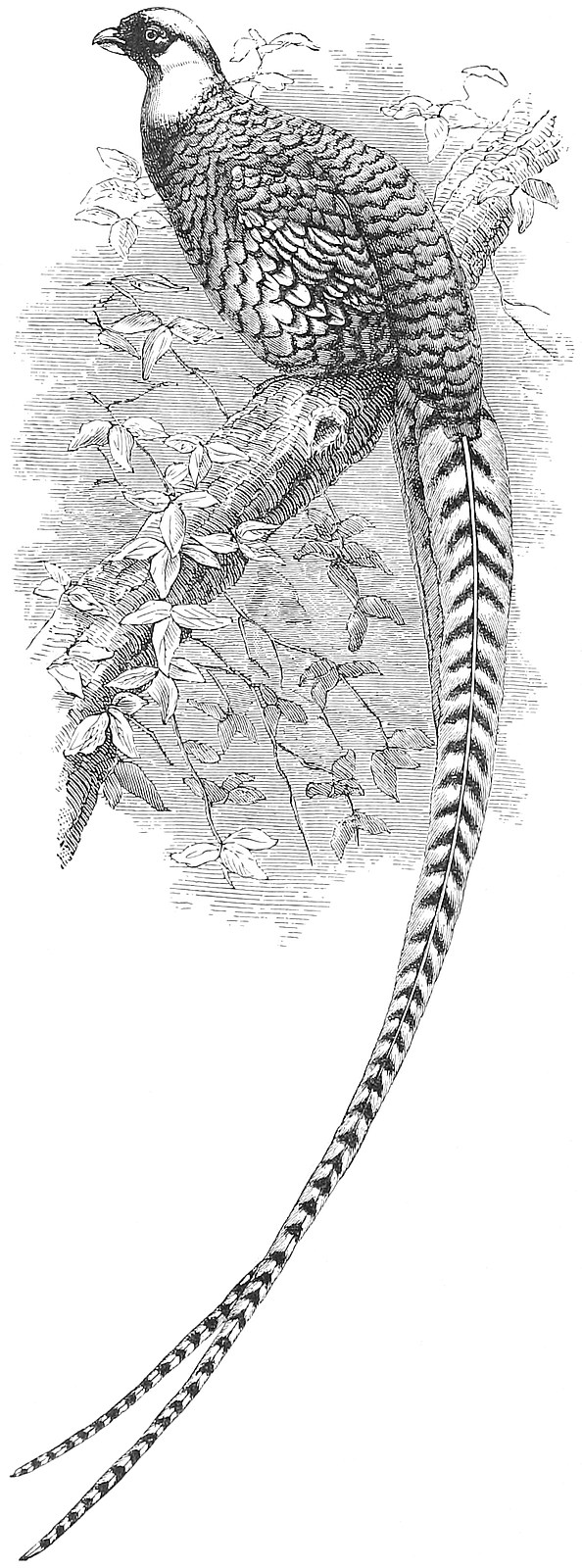
Reeves’s Pheasant.
Note 5.—The China pheasant answering best to the indications in the text,
appears to be Reeves’s Pheasant. Mr. Gould has identified this bird with
Marco’s in his magnificent Birds of Asia, and has been kind enough to
show me a specimen which, with the body, measured 6 feet 8 inches. The tail
feathers alone, however, are said to reach to 6 and 7 feet, so that Marco’s
ten palms was scarcely an exaggeration. These tail-feathers are often seen
on the Chinese stage in the cap of the hero of the drama, and also decorate
the hats of certain civil functionaries.
Size is the point in which the bird fails to meet Marco’s description. In
that respect the latter would rather apply to the Crossoptilon auritum,
which is nearly as big as a turkey, or to the glorious Múnál (Lophophorus
impeyanus), but then that has no length of tail. The latter seems to be
the bird described by Ælian: “Magnificent cocks which have the crest
variegated and ornate like a crown of flowers, and the tail feathers not
curved like a cock’s, but broad and carried in a train like a peacock’s;
the feathers are partly golden, and partly azure or emerald-coloured.”
(Wood’s Birds, 610, from which I have copied the illustration; Williams,
M. K. I. 261; Æl. De Nat. An. XVI. 2.) A species of Crossoptilon has
recently been found by Captain Prjevalsky in Alashan, the Egrigaia (as I
believe) of next chapter, and one also by Abbé Armand David at the Koko Nor.
[See on the Phasianidæ family in Central and Western Asia, David et
Oustalet, Oiseaux de la Chine, 401–421; the Phasianus Reevesii or
veneratus is called by the Chinese of Tung-lin, near Peking, Djeu-ky
(hen-arrow); the Crossoptilon auritum is named Ma-ky.—H. C.]
Of the Kingdom of Egrigaia.
Starting again from Erguiul you ride eastward for eight days, and then come
to a province called Egrigaia, containing numerous cities and villages,
and belonging to Tangut.{1}
The capital city is called Calachan.{2}
The people are chiefly Idolaters, but there are fine churches belonging
to the Nestorian Christians. They are all subjects of the Great Kaan. They
make in this city great quantities of camlets of camel’s wool, the finest
in the world; and some of the camlets that they make are white, for they
have white camels, and these are the best of all. Merchants purchase these
stuffs here, and carry them over the world for sale.{3}
We shall now proceed eastward from this place and enter the territory that
was formerly Prester John’s.
Note 1.—Chinghiz invaded Tangut in all five times, viz. in 1205, 1207, 1209
(or according to Erdmann, 1210–1211), 1218, and 1226–1227, on which last
expedition he died.
A. In the third invasion, according to D’Ohsson’s Chinese guide (Father
Hyacinth), he took the town of Uiraca, and the fortress of Imen, and laid
siege to the capital, then called Chung-sing or Chung-hing, now Ning-hsia.
Rashid, in a short notice of this campaign, calls the first city Erica,
Erlaca, or, as Erdmann has it, Artacki. In De Mailla it is Ulahai.
B. On the last invasion (1226), D’Ohsson’s Chinese authority says that
Chinghiz took Kanchau and Suhchau, Cholo and Khola in the province of
Liangcheu, and then proceeded to the Yellow River, and invested Lingchau,
south of Ning-hsia.
Erdmann, following his reading of Rashiduddin, says Chinghiz took the
cities of Tangut, called Arucki, Kachu, Sichu, and Kamichu, and
besieged Deresgai (D’Ohsson, Derssekai), whilst Shidergu, the King of
Tangut, betook himself to his capital Artackin.
D’Ohsson, also professing to follow Rashid, calls this “his capital
Irghai, which the Mongols call Ircaya.” Klaproth, illustrating Polo,
reads “Eyircai, which the Mongols call Eyircayá.”
Pétis de la Croix, relating the same campaign and professing to follow
Fadlallah, i.e. Rashiduddin, says the king “retired to his fortress of
Arbaca.”
C. Sanang Setzen several times mentions a city called Irghai,
apparently in Tangut; but all we can gather as to his position is that it
seems to have lain east of Kanchau.
We perceive that the Arbaca of P. de la Croix, the Eyircai of Klaproth,
the Uiraca of D’Ohsson, the Artacki or Artackin of Erdmann, are all
various readings or forms of the same name, and are the same with the
Chinese form Ulahai of De Mailla, and most probably the place is the
Egrigaia of Polo.
We see also that Erdmann mentions another place Aruki (ارقى?) in
connection with Kanchau and Suhchau. This is, I suspect, the Erguiul of
Polo, and perhaps the Irghai of Sanang Setzen.
Rashiduddin seems wrong in calling Ircayá the capital of the king, a
circumstance which leads Klaproth to identify it with Ning-hsia. Pauthier,
identifying Ulahai with Egrigaya, shows that the former was one of the
circles of Tangut, but not that of Ning-hsia. Its position, he says, is
uncertain. Klaproth, however, inserts it in his map of Asia, in the era
of Kúblái (Tabl. Hist. pl. 22), as Ulakhai to the north of Ning-hsia,
near the great bend eastward of the Hwang-Ho. Though it may have extended
in this direction, it is probable, from the name referred to in next note,
that Egrigaia or Ulahai is represented by the modern principality of
Alashan, visited by Prjevalsky in 1871 and 1872.
[New travels and researches enable me to say that there can be no doubt
that Egrigaia = Ning-hsia. Palladius (l.c. 18) says: “Egrigaia is
Erigaia of the Mongol text. Klaproth was correct in his supposition that
it is modern Ning-h’ia. Even now the Eleuths of Alashan call Ning-h’ia,
Yargai. In M. Polo’s time this department was famous for the cultivation
of the Safflower (carthamus tinctorius). [Siu t’ung kien, A.D. 1292.]”
Mr. Rockhill (cf. his Diary of a Journey) writes to me that Ning-hsia is
still called Irge Khotun by Mongols at the present day. M. Bonin (J.
As., 1900. I. 585) mentions the same fact.
Palladius (19) adds: “Erigaia is not to be confounded with Urahai,
often mentioned in the history of Chingis Khan’s wars with the Tangut
kingdom. Urahai was a fortress in a pass of the same name in the Alashan
Mountains. Chingis Khan spent five months there (an. 1208), during which he
invaded and plundered the country in the neighbourhood. [Si hia shu shi.]
The Alashan Mountains form a semicircle 500 li in extent, and have over
forty narrow passes leading to the department of Ning-hia; the broadest
and most practicable of these is now called Ch’i-mu-K’ow; it is not more
than 80 feet broad. [Ning hia fu chi.] It may be that the Urahai fortress
existed near this pass.”
“From Liang-chow fu, M. Polo follows a special route, leaving the modern
postal route on his right; the road he took has, since the time of the
Emperor K’ang-hi, been called the courier’s route.” (Palladius, 18.)—H. C.]
Note 2.—Calachan, the chief town of Egrigaia, is mentioned, according to
Klaproth, by Rashiduddin, among the cities of Tangut, as Kalaján. The name
and approximate position suggest, as just noticed, identity with Alashan,
the modern capital of which, called by Prjevalsky Dyn-yuan-yin, stands some
distance west of the Hwang-Ho, in about lat. 39°. Polo gives no data for
the interval between this and his next stage.
[The Dyn-yuan-yin of Prjevalsky is the camp of Ting-yuan-yng or Fu-ma-fu
of M. Bonin, the residence of the Si-wang (western prince), of Alashan,
an abbreviation of Alade-shan (shan, mountain in Chinese), Alade = Eleuth
or Œlöt; the sister of this prince married a son of Prince Tuan, the chief
of the Boxers. (La Géographie, 1901. I. 118.) Palladius (l.c. 19) says:
“Under the name of Calachan, Polo probably means the summer residence of
the Tangut kings, which was 60 li from Ning-hia, at the foot of the
Alashan Mountains. It was built by the famous Tangut king Yuen-hao, on a
large scale, in the shape of a castle, in which were high terraces and
magnificent buildings. Traces of these buildings are visible to this day.
There are often found coloured tiles and iron nails 1 foot, and even 2 feet
long. The last Tangut kings made this place their permanent residence, and
led there an indolent and sensual life. The Chinese name of this residence
was Ho-lan shan Li-Kung. There is sufficient reason to suppose that this
very residence is named (under the year 1226) in the Mongol text Alashai
nuntuh; and in the chronicles of the Tangut Kingdom, Halahachar,
otherwise Halachar, apparently in the Tangut language. Thus M. Polo’s
Calachan can be identified with the Halachar of the Si hia shu shi, and
can be taken to designate the Alashan residence of the Tangut kings.”—H. C.]
Note 3.—Among the Buraets and Chinese at Kiakhta snow-white camels, without
albino character, are often seen, and probably in other parts of Mongolia.
(See Erdmann, II. 261.) Philostratus tells us that the King of Taxila
furnished white camels to Apollonius. I doubt if the present King of
Taxila, whom Anglo-Indians call the Commissioner of Ráwal Pindi, could do
the like.
Cammellotti appear to have been fine woollen textures, by no means what
are now called camlets, nor were they necessarily of camel’s wool, for
those of Angora goat’s wool were much valued. M. Douet d’Arcq calls it “a
fine stuff of wool approaching to our Cashmere, and sometimes of silk.”
Indeed, as Mr. Marsh points out, the word is Arabic, and has nothing to
do with Camel in its origin; though it evidently came to be associated
therewith. Khamlat is defined in F. Johnson’s Dict.: “Camelot, silk
and camel’s hair; also all silk or velvet, especially pily and plushy,”
and Khaml is “pile or plush.” Camelin was a different and inferior
material. There was till recently a considerable import of different kinds
of woollen goods from this part of China into Ladakh, Kashmir, and the
northern Panjáb. [Leaving Ning-hsia, Mr. Rockhill writes (Diary, 1892,
44): “We passed on the road a cart with Jardine and Matheson’s flag, coming
probably from Chung-Wei Hsien, where camel’s wool is sold in considerable
quantities to foreigners. This trade has fallen off very much in the last
three or four years on account of the Chinese middlemen rolling the wool
in the dirt so as to add to its weight, and practising other tricks on
buyers.”—H. C.] Among the names of these were Sling, Shirum, Gurun,
and Khoza, said to be the names of the towns in China where the goods
were made. We have supposed Sling to be Sining (note 2, ch. lvii.), but
I can make nothing of the others. Cunningham also mentions “camlets of
camel’s hair,” under the name of Suḳlát, among imports from the same
quarter. The term Suḳlát is, however, applied in the Panjáb trade
returns to broadcloth. Does not this point to the real nature of the
siclatoun of the Middle Ages? It is, indeed, often spoken of as used for
banners, which implies that it was not a heavy woollen:
“There was mony gonfanoun
Of gold, sendel, and siclatoun.”
(King Alisaundre, in Weber, I. 85.)
But it was also a material for ladies’ robes, for quilts, leggings,
housings, pavilions. Franc. Michel does not decide what it was, only that
it was generally red and wrought with gold. Dozy renders it “silk stuff
brocaded with gold”; but this seems conjectural. Dr. Rock says it was a
thin glossy silken stuff, often with a woof of gold thread, and seems to
derive it from the Arabic ṣaḳl, “polishing” (a sword), which is improbable.
Perhaps the name is connected with Ṣiḳiliyat, “Sicily.”
(Marsh on Wedgwood, and on Webster in N. Y. Nation, 1867; Douet
D’Arcq, p. 355; Punjab Trade Rep., App. ccxix.–xx.; Ladak, 242;
Fr.-Michel Rech. I. 221 seqq.; Dozy, Dict. des Vêtements, etc.; Dr.
Rock’s Kens. Catal. xxxix.–xl.)
Concerning the Province of Tenduc, and the Descendants of Prester John.
Tenduc is a province which lies towards the east, and contains numerous
towns and villages; among which is the chief city, also called Tenduc. The
king of the province is of the lineage of Prester John, George by name, and
he holds the land under the Great Kaan; not that he holds anything like the
whole of what Prester John possessed.{1} It is a custom, I may tell
you, that these kings of the lineage of Prester John always obtain to wife
either daughters of the Great Kaan or other princesses of his family.{2}
In this province is found the stone from which Azure is made. It
is obtained from a kind of vein in the earth, and is of very fine
quality.{3} There is also a great manufacture of fine camlets of
different colours from camel’s hair. The people get their living by their
cattle and tillage, as well as by trade and handicraft.
The rule of the province is in the hands of the Christians, as I have told
you; but there are also plenty of Idolaters and worshippers of Mahommet.
And there is also here a class of people called Argons, which is as
much as to say in French Guasmul, or, in other words, sprung from two
different races: to wit, of the race of the Idolaters of Tenduc and of
that of the worshippers of Mahommet. They are handsomer men than the
other natives of the country, and having more ability, they come to have
authority; and they are also capital merchants.{4}
You must know that it was in this same capital city of Tenduc that Prester
John had the seat of his government when he ruled over the Tartars, and his
heirs still abide there; for, as I have told you, this King George is of
his line, in fact, he is the sixth in descent from Prester John.
Here also is what we call the country of Gog and Magog; they, however,
call it Ung and Mungul, after the names of two races of people that existed
in that Province before the migration of the Tartars. Ung was the title
of the people of the country, and Mungul a name sometimes applied to the
Tartars.{5}
And when you have ridden seven days eastward through this province you get
near the provinces of Cathay. You find throughout those seven days’ journey
plenty of towns and villages, the inhabitants of which are Mahommetans, but
with a mixture also of Idolaters and Nestorian Christians. They get their
living by trade and manufactures; weaving those fine cloths of gold which
are called Nasich and Naques, besides silk stuffs of many other kinds.
For just as we have cloths of wool in our country, manufactured in a great
variety of kinds, so in those regions they have stuffs of silk and gold in
like variety.{6}
All this region is subject to the Great Kaan. There is a city you come to
called Sindachu, where they carry on a great many crafts such as provide
for the equipment of the Emperor’s troops. In a mountain of the province
there is a very good silver mine, from which much silver is got: the place
is called Ydifu. The country is well stocked with game, both beast and
bird.{7}
Now we will quit that province and go three days’ journey forward.
Note 1.—Marco’s own errors led commentators much astray about Tanduc or
Tenduc, till Klaproth put the matter in its true light.
Our traveller says that Tenduc had been the seat of Aung Khan’s
sovereignty; he has already said that it had been the scene of his final
defeat, and he tells us that it was still the residence of his descendants
in their reduced state. To the last piece of information he can speak as a
witness, and he is corroborated by other evidence; but the second statement
we have seen to be almost certainly erroneous; about the first we cannot
speak positively.
Klaproth pointed out the true position of Tenduc in the vicinity of the
great northern bend of the Hwang-Ho, quoting Chinese authorities to show
that Thianté or Thianté-Kiun was the name of a district or group
of towns to the north of that bend, a name which he supposes to be the
original of Polo’s Tenduc. The general position entirely agrees with
Marco’s indications; it lies on his way eastward from Tangut towards
Chagannor, and Shangtu (see ch. lx., lxi.), whilst in a later passage (Bk.
II. ch. lxiv.), he speaks of the Caramoran or Hwang-Ho in its lower course,
as “coming from the lands of Prester John.”
M. Pauthier finds severe fault with Klaproth’s identification of the name
Tenduc with the Thianté of the Chinese, belonging to a city which had
been destroyed 300 years before, whilst he himself will have that name to
be a corruption of Tathung. The latter is still the name of a city and
Fu of northern Shansi, but in Mongol time its circle of administration
extended beyond the Chinese wall, and embraced territory on the left of
the Hwang-Ho, being in fact the first Lu, or circle, entered on leaving
Tangut, and therefore, Pauthier urges, the “Kingdom of Tanduc” of our text.
I find it hard to believe that Marco could get no nearer Tathung than in
the form of Tanduc or Tenduc. The origin of the last may have been some
Mongol name, not recovered. But it is at least conceivable that a name
based on the old Thianté-Kiun might have been retained among the Tartars,
from whom, and not from the Chinese, Polo took his nomenclature. Thianté
had been, according to Pauthier’s own quotations, the military post of
Tathung; Klaproth cites a Chinese author of the Mongol era, who describes
the Hwang-Ho as passing through the territory of the ancient Chinese
city of Thianté; and Pauthier’s own quotation from the Modern Imperial
Geography seems to imply that a place in that territory was recently known
as Fung-chau-Thianté-Kiun.
In the absence of preciser indications, it is reasonable to suppose
that the Plain of Tenduc, with its numerous towns and villages, was the
extensive and well-cultivated plain which stretches from the Hwang-Ho, past
the city of Kuku-Khotan, or “Blue Town.” This tract abounds in the remains
of cities attributed to the Mongol era. And it is not improbable that the
city of Tenduc was Kuku-Khotan itself, now called by the Chinese Kwei-hwa
Ch’eng, but which was known to them in the Middle Ages as Tsing-chau,
and to which we find the Kin Emperor of Northern China sending an envoy in
1210 to demand tribute from Chinghiz. The city is still an important mart
and a centre of Lamaitic Buddhism, being the residence of a Khutukhtu, or
personage combining the characters of cardinal and voluntarily re-incarnate
saint, as well as the site of five great convents and fifteen smaller
ones. Gerbillon notes that Kuku Khotan had been a place of great trade and
population during the Mongol Dynasty.
[The following evidence shows, I think, that we must look for the city of
Tenduc to Tou Ch’eng or Toto Ch’eng, called Togto or Tokto by the
Mongols. Mr. Rockhill (Diary, 18) passed through this place, and 5 li
south of it, reached on the Yellow River, Ho-k’ou (in Chinese) or Dugus or
Dugei (in Mongol). Gerbillon speaks of Toto in his sixth voyage in Tartary.
(Du Halde, IV. 345.) Mr. Rockhill adds that he cannot but think that
Yule overlooked the existence of Togto when he identified Kwei-hwa Ch’eng
with Tenduc. Tou Ch’eng is two days’ march west of Kwei-hwa Ch’eng, “On
the loess hill behind this place are the ruins of a large camp, Orch’eng,
in all likelihood the site of the old town” (l.c. 18). M. Bonin (J. As.
XV. 1900, 589) shares Mr. Rockhill’s opinion. From Kwei-hwa Ch’eng, M.
Bonin went by the valley of the Hei Shui River to the Hwang Ho; at the
junction of the two rivers stands the village of Ho-k’au (Ho-k’ou) south
of the small town To Ch’eng, surmounted by the ruins of the old square
Mongol stronghold of Tokto, the walls of which are still in a good state of
preservation.—(La Géographie, I. 1901, p. 116.)
On the other hand, it is but fair to state that Palladius (21) says: “The
name of Tenduc obviously corresponds to T’ien-te Kiun, a military post,
the position of which Chinese geographers identify correctly with that
of the modern Kuku-hoton (Ta tsing y t’ung chi, ch. on the Tumots of
Kuku-hoton). The T’ien-te Kiun post existed under this name during the
K’itan (Liao) and Kin Dynasties up to Khubilai’s time (1267); when under
the name of Fung-chow it was left only a district town in the department of
Ta-t’ung fu. The Kin kept in T’ien-te Kiun a military chief, Chao-t’ao-shi,
whose duty it was to keep an eye on the neighbouring tribes, and to
use, if needed, military force against them. The T’ien-te Kiun district
was hardly greater in extent than the modern aïmak of Tumot, into which
Kuku-hoton was included since the 16th century, i.e. 370 li from north
to south, and 400 li from east to west; during the Kin it had a settled
population, numbering 22,600 families.”
In a footnote, Palladius refers to the geographical parts of the Liao
shi, Kin shi, and Yuen shi, and adds: “M. Polo’s commentators are wrong
in suspecting an anachronism in his statement, or trying to find Tenduc
elsewhere.”
We find in the North-China Herald (29th April, 1887, p. 474) the
following note from the Chinese Times: “There are records that the
position of this city [Kwei-hwa Ch’eng] was known to the builder of the
Great Wall. From very remote times, it appears to have been a settlement
of nomadic tribes. During the last 1000 years it has been alternately
possessed by the Mongols and Chinese. About A.D. 1573, Emperor Wan-Li
reclaimed it, enclosed a space within walls, and called it Kwei-hwa Ch’êng.”
Potanin left Peking on the 13th May, 1884, for Kuku-khoto (or
Kwei-hwa-Ch’eng), passing over the triple chain of mountains dividing the
Plain of Peking from that on which Kuku-khoto is situate. The southernmost
of these three ridges bears the Chinese name of Wu-tai-shan, “the mountain
of five sacrificial altars,” after the group of five peaks, the highest of
which is 10,000 feet above the sea, a height not exceeded by any mountain
in Northern China. At its southern foot lies a valley remarkable for its
Buddhist monasteries and shrines, one of which, “Shing-tung-tze,” is
entirely made of brass, whence its name.
“Kuku-Khoto is the depôt for the Mongolian trade with China. It contains
two hundred tea-shops, five theatres, fifteen temples, and six Mongol
monasteries. Among its sights are the Buddhist convent of Utassa, with its
five pinnacles and bas-reliefs, the convent of Fing-sung-si, and a temple
containing a statue erected in honour of the Chinese general, Pai-jin-jung,
who avenged an insult offered to the Emperor of China.” (Proc. R. G.
S. IX. 1887, p. 233.)—H. C.]
A passage in Rashiduddin does seem to intimate that the Kerait, the tribe
of Aung Khan, alias Prester John, did occupy territory close to the
borders of Cathay or Northern China; but neither from Chinese nor from
other Oriental sources has any illustration yet been produced of the
existence of Aung Khan’s descendants as rulers in this territory under the
Mongol emperors. There is, however, very positive evidence to that effect
supplied by other European travellers, to whom the fables prevalent in
the West had made the supposed traces of Prester John a subject of strong
interest.
Thus John of Monte Corvino, afterwards Archbishop of Cambaluc or Peking,
in his letter of January, 1305, from that city, speaks of Polo’s King
George in these terms: “A certain king of this part of the world, by name
George, belonging to the sect of the Nestorian Christians, and of the
illustrious lineage of that great king who was called Prester John of
India, in the first year of my arrival here [circa 1295–1296] attached
himself to me, and, after he had been converted by me to the verity of the
Catholic faith, took the Lesser Orders, and when I celebrated mass used
to attend me wearing his royal robes. Certain others of the Nestorians on
this account accused him of apostacy, but he brought over a great part
of his people with him to the true Catholic faith, and built a church
of royal magnificence in honour of our God, of the Holy Trinity, and of
our Lord, the Pope, giving it the name of the Roman Church. This King
George, six years ago, departed to the Lord, a true Christian, leaving
as his heir a son scarcely out of the cradle, and who is now nine years
old. And after King George’s death, his brothers, perfidious followers of
the errors of Nestorius, perverted again all those whom he had brought
over to the Church, and carried them back to their original schismatical
creed. And being all alone, and not able to leave His Majesty the Cham, I
could not go to visit the church above-mentioned, which is twenty days’
journey distant.... I had been in treaty with the late King George, if
he had lived, to translate the whole Latin ritual, that it might be sung
throughout the extent of his territory; and whilst he was alive I used to
celebrate mass in his church according to the Latin rite.” The distance
mentioned, twenty days’ journey from Peking, suits quite well with the
position assigned to Tenduc, and no doubt the Roman Church was in the city
to which Polo gives that name.
Friar Odoric, travelling from Peking towards Shensi, about 1326–1327, also
visits the country of Prester John, and gives to its chief city the name
of Tozan, in which perhaps we may trace Tathung. He speaks as if the
family still existed in authority.
King George appears again in Marco’s own book (Bk. IV. ch. ii.) as one
of Kúblái’s generals against Kaidu, in a battle fought near Karakorúm.
(Journ. As. IX. 299 seqq.; D’Ohsson, I. 123; Huc’s Tartary, etc.
I. 55 seqq.; Koeppen, II. 381; Erdmann’s Temudschin; Gerbillon in
Astley, IV. 670; Cathay, pp. 146 and 199 seqq.)
Note 2.—Such a compact is related to have existed reciprocally between the
family of Chinghiz and that of the chief of the Ḳunguráts; but I have not
found it alleged of the Kerait family except by Friar Odoric. We find,
however, many princesses of this family married into that of Chinghiz.
Thus three nieces of Aung Khan became wives respectively of Chinghiz
himself and of his sons Juji and Tului; she who was the wife of the latter,
Serḳuḳteni Bigi, being the mother of Mangú, Hulaku, and Kúblái. Duḳuz
Khatun, the Christian wife of Hulaku, was a grand-daughter of Aung Khan.
The name George, of Prester John’s representative, may have been actually
Jirjis, Yurji, or some such Oriental form of Georgius. But it is possible
that the title was really Gurgán, “Son-in-Law,” a title of honour
conferred on those who married into the imperial blood, and that this
title may have led to the statements of Marco and Odoric about the nuptial
privileges of the family. Gurgán in this sense was one of the titles borne
by Timur.[1]
[The following note by the Archimandrite Palladius (Eluc. 21–23) throws a
great light on the relations between the families of Chinghiz Khan and of
Prester John.
“T’ien-te Kiun was bounded on the north by the Yn-shan Mountains, in
and beyond which was settled the Sha-t’o Tu-K’iu tribe, i.e. Tu-K’iu of
the sandy desert. The K’itans, when they conquered the northern borders
of China, brought also under their rule the dispersed family of these Tu-K’iu.
With the accession of the Kin, a Wang Ku [Ongot] family made its
appearance as the ruling family of those tribes; it issued from those
Sha- t’o Tu-K’iu, who once reigned in the north of China as the How T’ang
Dynasty (923–936 A.D.). It split into two branches, the Wang-Ku of the Yn-shan,
and the Wang-Ku of the Lin-t’ao (west of Kan-su). The Kin removed the
latter branch to Liao-tung (in Manchuria). The Yn-shan Wang-Ku guarded the
northern borders of China belonging to the Kin, and watched their herds.
When the Kin, as a protection against the inroads of the tribes of the
desert, erected a rampart, or new wall, from the boundary of the Tángut
Kingdom down to Manchuria, they intrusted the defence of the principal
places of the Yn-shan portion of the wall to the Wang-Ku, and transferred
there also the Liao-tung Wang-Ku. At the time Chingiz Khan became powerful,
the chief of the Wang-Ku of the Yn-shan was Alahush; and at the head of
the Liao-tung Wang-Ku stood Pa-sao-ma-ie-li. Alahush proved a traitor
to the Kin, and passed over to Chinghiz Khan; for this he was murdered by
the malcontents of his family, perhaps by Pa-sao-ma-ie-li, who remained
true to the Kin. Later on, Chingiz Khan married one of his daughters to
the son of Alahush, by name Po-yao-ho, who, however, had no children by
her. He had three sons by a concubine, the eldest of whom, Kiun-pu-hwa,
was married to Kuyuk Khan’s daughter. Kiun-pu-hwa’s son, Ko-li-ki-sze,
had two wives, both of imperial blood. During a campaign against Haidu, he
was made prisoner in 1298, and murdered. His title and dignities passed
over in A.D. 1310 to his son Chuan. Nothing is known of Alahush’s later
descendants; they probably became entirely Chinese, like their relatives of
the Liao-tung branch.
“The Wang-Ku princes were thus de jure the sons-in-law of the Mongol
Khans, and they had, moreover, the hereditary title of Kao-t’ang princes
(Kao-t’ang wang); it is very possible that they had their residence in
ancient T’ien-te Kiun (although no mention is made of it in history), just
as at present the Tumot princes reside in Kuku-hoton.
“The consonance of the names of Wang-Khan and Wang-Ku (Ung-Khan and Ongu)
led to the confusion regarding the tribes and persons, which at Marco
Polo’s time seems to have been general among the Europeans in China;
Marco Polo and Johannes de Monte Corvino transfer the title of Prester
John from Wang-Khan, already perished at that time, to the distinguished
family of Wang-Ku. Their Georgius is undoubtedly Ko-li-ki-sze, Alahush’s
great-grandson. That his name is a Christian one is confirmed by other
testimonies; thus in the Asu (Azes) regiment of the Khan’s guards was
Ko-li-ki-sze, alias Kow-r-ki (†1311), and his son Ti-mi-ti-r. There is
no doubt that one of them was Georgius, and the other Demetrius. Further,
in the description of Chin-Kiang in the time of the Yuen, mention is made
of Ko-li-ki-sze Ye-li-ko-wen, i.e. Ko-li-ki-sze, the Christian, and of his
son Lu-ho (Luke).
“Ko-li-ki-sze of Wang-ku is much praised in history for his valour and his
love for Confucian doctrine; he had in consequence of a special favour
of the Khan two Mongol princesses for wives at the same time (which is
rather difficult to conciliate with his being a Christian). The time of
his death is correctly indicated in a letter of Joannes de M. Corvino of
the year 1305: ante sex annos migravit ad Dominum. He left a young son
Chu-an, who probably is the Joannes of the letter of Ioannes (Giovani)
de M. Corvino, so called propter nomen meum, says the missionary. In
another Wang-ku branch, Si-li-ki-sze reminds one also of the Christian name
Sergius.”—H. C.]
Note 3.—“The Lapis Armenus, or Azure, ... is produced in the district of
Tayton-fu (i.e. Tathung), belonging to Shansi.” (Du Halde in Astley,
IV. 309; see also Martini, p. 36.)
Note 4.—This is a highly interesting passage, but difficult, from being
corrupt in the G. Text, and over-curt in Pauthier’s MSS. In the former
it runs as follows: “Hil hi a une jenerasion de jens que sunt appellés
Argon, qe vaut à dire en françois Guasmul, ce est à dire qu’il sunt
né del deus generasions de la lengnée des celz Argon Tenduc et des celz
reduc et des celz que aorent Maomet. Il sunt biaus homes plus que le autre
dou païs et plus sajes et plus mercaant.” Pauthier’s text runs thus:
“Il ont une generation de gens, ces Crestiens qui ont la Seigneurie, qui
s’appellent Argon, qui vaut a dire Gasmul; et sont plus beaux hommes
que les autres mescreans et plus sages. Et pour ce ont il la seigneurie et
sont bons marchans.” And Ramusio: “Vi è anche una sorte di gente che si
chiamano Argon, per che sono nati di due generazioni, cioè da quella
di Tenduc che adorano gl’idoli, e da quella che osservano la legge di
Macometto. E questi sono i piu belli uomini che si trovino in quel paese e
più savi, e più accorti nella mercanzia.”
In the first quotation the definition of the Argon as sprung de la
lengnée, etc., is not intelligible as it stands, but seems to be a
corruption of the same definition that has been rendered by Ramusio, viz.
that the Argon were half-castes between the race of the Tenduc Buddhists
and that of the Mahomedan settlers. These two texts do not assert that
the Argon were Christians. Pauthier’s text at first sight seems to assert
this, and to identify them with the Christian rulers of the province. But
I doubt if it means more than that the Christian rulers have under them
a people called Argon, etc. The passage has been read with a bias, owing
to an erroneous interpretation of the word Argon in the teeth of Polo’s
explanation of it.
Klaproth, I believe, first suggested that Argon represents the term
Arkhaiún, which is found repeatedly applied to Oriental Christians, or
their clergy, in the histories of the Mongol era.[2] No quite satisfactory
explanation has been given of the origin of that term. It is barely
possible that it may be connected with that which Polo uses here; but he
tells us as plainly as possible that he means by the term, not a Christian,
but a half-breed.
And in this sense the word is still extant in Tibet, probably also in
Eastern Turkestan, precisely in Marco’s form, Argon. It is applied in
Ladak, as General Cunningham tells us, specifically to the mixt race
produced by the marriages of Kashmirian immigrants with Bōt (Tibetan)
women. And it was apparently to an analogous cross between Caucasians
and Turanians that the term was applied in Tenduc. Moorcroft also speaks
of this class in Ladak, calling them Argands. Mr. Shaw styles them “a
set of ruffians called Argoons, half-bred between Toorkistan fathers
and Ladak mothers.... They possess all the evil qualities of both races,
without any of their virtues.” And the author of the Dabistan, speaking
of the Tibetan Lamas, says: “Their king, if his mother be not of royal
blood, is by them called Arghún, and not considered their true king.”
[See p. 291, my reference to Wellby’s Tibet.—H. C.] Cunningham says the
word is probably Turki, ارغون, Arghún, “Fair,” “not white,” as he
writes to me, “but ruddy or pink, and therefore ‘fair.’ Arghún is
both Turki and Mogholi, and is applied to all fair children, both male and
female, as Arghun Beg, Arghuna Khatun,” etc.[3] We find an Arghún tribe
named in Timur’s Institutes, which probably derived its descent from such
half-breeds. And though the Arghún Dynasty of Kandahar and Sind claimed
their descent and name from Arghún Khan of Persia, this may have had no
other foundation.
There are some curious analogies between these Argons of whom Marco speaks
and those Mahomedans of Northern China and Chinese Turkestan lately
revolted against Chinese authority, who are called Tungăni, or as the
Russians write it Dungen, a word signifying, according to Professor
Vámbéry, in Turki, “a convert.”[4] These Tungani are said by one account
to trace their origin to a large body of Uighúrs, who were transferred to
the vicinity of the Great Wall during the rule of the Thang Dynasty (7th
to 10th century). Another tradition derives their origin from Samarkand.
And it is remarkable that Rashiduddin speaks of a town to the west or
north-west of Peking, “most of the inhabitants of which are natives of
Samarkand, and have planted a number of gardens in the Samarkand style.”[5]
The former tradition goes on to say that marriages were encouraged between
the Western settlers and the Chinese women. In after days these people
followed the example of their kindred in becoming Mahomedans, but they
still retained the practice of marrying Chinese wives, though bringing up
their children in Islam. The Tungani are stated to be known in Central
Asia for their commercial integrity; and they were generally selected by
the Chinese for police functionaries. They are passionate and ready to use
the knife; but are distinguished from both Manchus and Chinese by their
strength of body and intelligent countenances. Their special feature is
their predilection for mercantile speculations.
Looking to the many common features of the two accounts—the origin as a
half-breed between Mahomedans of Western extraction and Northern Chinese,
the position in the vicinity of the Great Wall, the superior physique,
intelligence, and special capacity for trade, it seems highly probable that
the Tungani of our day are the descendants of Marco’s Argons. Otherwise we
may at least point to these analogies as a notable instance of like results
produced by like circumstances on the same scene; in fact, of history
repeating itself. (See The Dungens, by Mr. H. K. Heins, in the Russian
Military Journal for August, 1866, and Western China, in the Ed.
Review for April, 1868;[6] Cathay, p. 261.)
[Palladius (pp. 23–24) says that “it is impossible to admit that Polo
had meant to designate by this name the Christians, who were called by
the Mongols Erkeun [Ye li ke un]. He was well acquainted with the
Christians in China, and of course could not ignore the name under which
they were generally known to such a degree as to see in it a designation of
a cross-race of Mahommetans and heathens.” From the Yuen ch’ao pi shi and
the Yuen shi, Palladius gives some examples which refer to Mahommedans.
Professor Devéria (Notes d’Épig. 49) says that the word Ἄρχων
was used by the Mongol Government as a designation for the members of the
Christian clergy at large; the word is used between 1252 and 1315 to speak
of Christian priests by the historians of the Yuen Dynasty; it is not
used before nor is it to be found in the Si-ngan-fu inscription (l.c. 82).
Mr. E. H. Parker (China Review, xxiv. p. 157) supplies a few omissions
in Devéria’s paper; we note among others: “Ninth moon of 1329. Buddhist
services ordered to be held by the Uighúr priests, and by the Christians
[Ye li ke un].”
Captain Wellby writes (Unknown Tibet, p. 32): “We impressed into our
service six other muleteers, four of them being Argoons, who are really
half-castes, arising from the merchants of Turkestan making short marriages
with the Ladakhi women.”—H. C.]
Our author gives the odd word Guasmul as the French equivalent of Argon.
M. Pauthier has first, of Polo’s editors, given the true explanation from
Ducange. The word appears to have been in use in the Levant among the
Franks as a name for the half-breeds sprung from their own unions with
Greek women. It occurs three times in the history of George Pachymeres.
Thus he says (Mich. Pal. III. 9), that the Emperor Michael “depended
upon the Gasmuls, or mixt breeds (συμμíκτοι), which is the
sense of this word of the Italian tongue, for these were born of Greeks
and Italians, and sent them to man his ships; for the race in question
inherited at once the military wariness and quick wit of the Greeks, and
the dash and pertinacity of the Latins.” Again (IV. 26) he speaks of these
“Gasmuls, whom a Greek would call διγενεῖς, men sprung from Greek
mothers and Italian fathers.” Nicephorus Gregoras also relates how Michael
Palaeologus, to oppose the projects of Baldwin for the recovery of his
fortunes, manned 60 galleys, chiefly with the tribe of Gasmuls (γένος τοῦ Γασμουλικοῦ),
to whom he assigns the same characteristics as
Pachymeres. (IV. v. 5, also VI. iii. 3, and XIV. x. 11.) One MS. of Nicetas
Choniates also, in his annals of Manuel Comnenus (see Paris ed. p. 425),
speaks of “the light troops whom we call Basmuls.” Thus it would seem
that, as in the analogous case of the Turcopuli, sprung from Turk fathers
and Greek mothers, their name had come to be applied technically to a
class of troops. According to Buchon, the laws of the Venetians in Candia
mention, as different races in that island, the Vasmulo, Latino, Blaco,
and Griego.
Ducange, in one of his notes on Joinville, says: “During the time that the
French possessed Constantinople, they gave the name of Gas-moules to
those who were born of French fathers and Greek mothers; or more probably
Gaste-moules, by way of derision, as if such children by those irregular
marriages ... had in some sort debased the wombs of their mothers!” I have
little doubt (pace tanti viri) that the word is in a Gallicized form
the same with the surviving Italian Guazzabúglio, a hotch-potch, or
mish-mash. In Davanzati’s Tacitus, the words “Colluviem illam nationum”
(Annal. II. 55) are rendered “quello guazzabuglio di nazioni,” in
which case we come very close to the meaning assigned to Guasmul. The
Italians are somewhat behind in matters of etymology, and I can get no
light from them on the history of this word. (See Buchon, Chroniques
Etrangères, p. xv.; Ducange, Gloss. Graecitatis, and his note on
Joinville, in Bohn’s Chron. of the Crusades, 466.)
Note 5.—It has often been cast in Marco’s teeth that he makes no mention of
the Great Wall of China, and that is true; whilst the apologies made for
the omission have always seemed to me unsatisfactory. [I find in Sir G.
Staunton’s account of Macartney’s Embassy (II. p. 185) this most amusing
explanation of the reason why Marco Polo did not mention the wall: “A copy
of Marco Polo’s route to China, taken from the Doge’s Library at Venice,
is sufficient to decide this question. By this route it appears that, in
fact, that traveller did not pass through Tartary to Pekin, but that after
having followed the usual track of the caravans, as far to the eastward
from Europe as Samarcand and Cashgar, he bent his course to the south-east
across the River Ganges to Bengal (!), and, keeping to the southward of
the Thibet mountains, reached the Chinese province of Shensee, and through
the adjoining province of Shansee to the capital, without interfering with
the line of the Great Wall.”—H. C.] We shall see presently that the Great
Wall is spoken of by Marco’s contemporaries Rashiduddin and Abulfeda. Yet
I think, if we read “between the lines,” we shall see reason to believe
that the Wall was in Polo’s mind at this point of the dictation, whatever
may have been his motive for withholding distincter notice of it.[7] I
cannot conceive why he should say: “Here is what we call the country of
Gog and Magog,” except as intimating “Here we are beside the Great Wall
known as the Rampart of Gog and Magog,” and being there he tries to find a
reason why those names should have been applied to it. Why they were really
applied to it we have already seen. (Supra, ch. iv. note 3.) Abulfeda
says: “The Ocean turns northward along the east of China, and then expands
in the same direction till it passes China, and comes opposite to the
Rampart of Yájúj and Májúj;” whilst the same geographer’s definition of the
boundaries of China exhibits that country as bounded on the west by the
Indo-Chinese wildernesses; on the south, by the seas; on the east, by the
Eastern Ocean; on the north, by the land of Yájúj and Májúj, and other
countries unknown. Ibn Batuta, with less accurate geography in his head
than Abulfeda, maugre his travels, asks about the Rampart of Gog and Magog
(Sadd Yájúj wa Májúj) when he is at Sin Kalán, i.e. Canton, and, as might
be expected, gets little satisfaction.
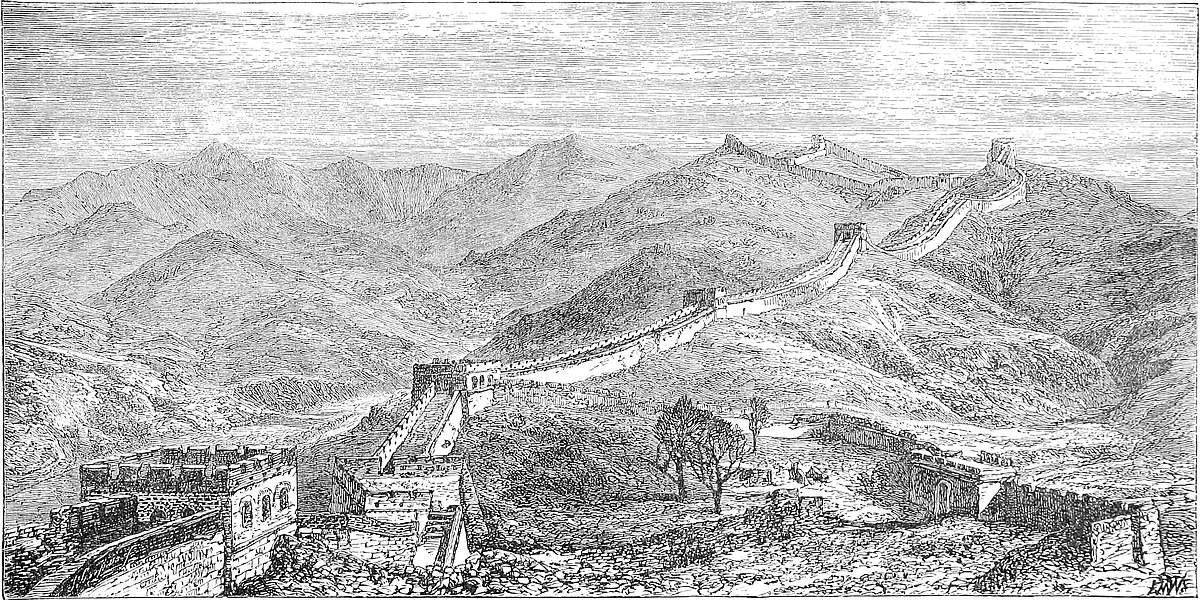
The Rampart of Gog and Magog.
Apart from this interesting point Marsden seems to be right in the general
bearing of his explanation of the passage, and I conceive that the two
classes of people whom Marco tries to identify with Gog and Magog do
substantially represent the two genera or species, Turks and Mongols, or,
according to another nomenclature used by Rashiduddin, the White and
Black Tartars. To the latter class belonged Chinghiz and his Mongols
proper, with a number of other tribes detailed by Rashiduddin, and these
I take to be in a general way the Mungul of our text. The Ung, on the
other hand, are the Ung-ḳut, the latter form being presumably only the
Mongol plural of Ung. The Ung-ḳut were a Turk tribe who were vassals of the
Kin Emperors of Cathay, and were intrusted with the defence of the Wall
of China, or an important portion of it, which was called by the Mongols
Ungu, a name which some connect with that of the tribe. [See note pp.
288–9.] Erdmann indeed asserts that the wall by which the Ung-ḳut dwelt
was not the Great Wall, but some other. There are traces of other great
ramparts in the steppes north of the present wall. But Erdmann’s arguments
seem to me weak in the extreme.
[Mr. Rockhill (Rubruck, p. 112) writes: “The earliest mention I have
found of the name Mongol in Oriental works occurs in the Chinese annals
of the After T’ang period (A.D. 923–934), where it occurs in the form
Meng-ku. In the annals of the Liao Dynasty (A.D. 916–1125) it is found
under the form Meng-ku-li. The first occurrence of the name in the Tung
chien kang mu is, however, in the 6th year Shao-hsing of Kao-tsung of
the Sung (A.D. 1136). It is just possible that we may trace the word back
a little earlier than the After T’ang period, and that the Meng-wa (or
ngo, as this character may have been pronounced at the time), a branch of
the Shih-wei, a Tungusic or Kitan people living around Lake Keule, to the
east of the Baikal, and along the Kerulun, which empties into it, during
the 7th and subsequent centuries, and referred to in the T’ang shu (Bk.
219), is the same as the later Meng-ku. Though I have been unable to find,
as stated by Howorth (History, i. pt. I. 28), that the name Meng-ku
occurs in the T’ang shu, his conclusion that the northern Shih-wei of that
time constituted the Mongol nation proper is very likely correct.... I.
J. Schmidt (Sanang Setzen, 380) derives the name Mongol from mong,
meaning ‘brave, daring, bold,’ while Rashid-eddin says it means ‘simple,
weak’ (d’Ohsson, i. 22). The Chinese characters used to transcribe the
name mean ‘dull, stupid,’ and ‘old, ancient,’ but they are used purely
phonetically.... The Mongols of the present day are commonly called by the
Chinese Ta-tzŭ, but this name is resented by the Mongols as opprobrious,
though it is but an abbreviated form of the name Ta-ta-tzŭ, in which,
according to Rubruck, they once gloried.”—H. C.]
Vincent of Beauvais has got from some of his authorities a conception
of the distinction of the Tartars into two races, to which, however, he
assigns no names: “Sunt autem duo genera Tartarorum, diversa quidem
habentia idiomata, sed unicam legem ac ritum, sicut Franci et Theutonici.”
But the result of his effort to find a realisation of Gog and Magog is
that he makes Guyuk Kaan into Gog, and Mangu Kaan into Magog. Even
the intelligent Friar Ricold says of the Tartars: “They say themselves
that they are descended from Gog and Magog: and on this account they are
called Mogoli, as if from a corruption of Magogoli.” (Abulfeda in
Büsching, IV. 140, 274–275; I. B. IV. 274; Golden Horde, 34, 68;
Erdmann, 241–242, 257–258; Timk. I. 259, 263, 268; Vinc. Bellov. Spec.
Hist. XXIX. 73, XXXI. 32–34; Pereg. Quat. 118; Not. et Ext. II. 536.)
Note 6.—The towns and villages were probably those immediately north of the
Great Wall, between 112° and 115° East longitude, of which many remains
exist, ascribed to the time of the Yuen or Mongol Dynasty. This tract,
between the Great Wall and the volcanic plateau of Mongolia, is extensively
colonised by Chinese, and has resumed the flourishing aspect that Polo
describes. It is known now as the Ku-wei, or extramural region.
[After Kalgan, Captain Younghusband, on the 12th April, 1886, “passed
through the [outer] Great Wall ... entering what Marco Polo calls the land
of Gog and Magog. For the next two days I passed through a hilly country
inhabited by Chinese, though it really belongs to Mongolia; but on the 14th
I emerged on to the real steppes, which are the characteristic features of
Mongolia Proper.” (Proc. R. G. S. X., 1888, p. 490.)—H. C.]
Of the cloths called nakh and nasij we have spoken before (supra ch.
vi. note 4). These stuffs, or some such as these, were, I believe, what the
mediæval writers called Tartary cloth, not because they were made in
Tartary, but because they were brought from China and its borders through
the Tartar dominions; as we find that for like reason they were sometimes
called stuffs of Russia. Dante alludes to the supposed skill of Turks and
Tartars in weaving gorgeous stuffs, and Boccaccio, commenting thereon, says
that Tartarian cloths are so skilfully woven that no painter with his brush
could equal them. Maundevile often speaks of cloths of Tartary (e.g. pp.
175, 247). So also Chaucer:
“On every trumpe hanging a broad banere
Of fine Tartarium.”
Again, in the French inventory of the Garde-Meuble of 1353 we find two
pieces of Tartary, one green and the other red, priced at 15 crowns each.
(Flower and Leaf, 211; Dante, Inf. XVII. 17, and Longfellow, p. 159;
Douet d’Arcq, p. 328; Fr.-Michel, Rech. I. 315, II. 166 seqq.)
Note
7.—Sindachu (Sindacui, Suidatui, etc., of the MSS.) is
Siuen-hwa-fu,
called under the Kin Dynasty Siuen-te-chau, more than once besieged and
taken by Chinghiz. It is said to have been a summer residence of the later
Mongol Emperors, and fine parks full of grand trees remain on the western
side. It is still a large town and the capital of a Fu, about 25 miles
south of the Gate on the Great Wall at Chang Kia Kau, which the Mongols
and Russians call Kalgan. There is still a manufacture of felt and woollen
articles here.
[Mr. Rockhill writes to me that this place is noted for the manufacture of
buckskins.—H. C.]
Ydifu has not been identified. But Baron Richthofen saw old mines
north-east of Kalgan, which used to yield argentiferous galena; and
Pumpelly heard of silver-mines near Yuchau, in the same department.
[In the Yuen-shi it is “stated that there were gold and silver mines in
the districts of Siuen-te-chow and Yuchow, as well as in the Kiming shan
Mountains. These mines were worked by the Government itself up to 1323,
when they were transferred to private enterprise. Marco Polo’s Ydifu is
probably a copyist’s error, and stands instead of Yuchow.” (Palladius,
24, 25.)—H. C.]
Concerning the Kaan’s Palace of Chagannor.
At the end of those three days you find a city called Chagan Nor [which
is as much as to say White Pool], at which there is a great Palace of the
Grand Kaan’s;{1} and he likes much to reside there on account of the
Lakes and Rivers in the neighbourhood, which are the haunt of swans{2}
and of a great variety of other birds. The adjoining plains too abound with
cranes, partridges, pheasants, and other game birds, so that the Emperor
takes all the more delight in staying there, in order to go a-hawking with
his gerfalcons and other falcons, a sport of which he is very fond.{3}
There are five different kinds of cranes found in those tracts, as I shall
tell you. First, there is one which is very big, and all over as black as
a crow; the second kind again is all white, and is the biggest of all;
its wings are really beautiful, for they are adorned with round eyes like
those of a peacock, but of a resplendent golden colour, whilst the head is
red and black on a white ground. The third kind is the same as ours. The
fourth is a small kind, having at the ears beautiful long pendent feathers
of red and black. The fifth kind is grey all over and of great size, with a
handsome head, red and black.{4}
Near this city there is a valley in which the Emperor has had several
little houses erected in which he keeps in mew a huge number of cators,
which are what we call the Great Partridge. You would be astonished to see
what a quantity there are, with men to take charge of them. So whenever the
Kaan visits the place he is furnished with as many as he wants.{5}
Note 1.—[According to the Siu t’ung kien, quoted by Palladius, the palace
in Chagannor was built in 1280.—H. C.]
Note
2.—“Ou demeurent sesnes.” Sesnes, Cesnes, Cecini, Cesanae, is
a mediæval form of cygnes, cigni, which seems to have escaped the
dictionary-makers. It occurs in the old Italian version of Brunetto
Latini’s Tresor, Bk. V. ch. xxv., as cecino; and for other examples, see
Cathay, p. 125.
Note 3.—The city called by Polo Chagan-nor (meaning in Mongol, as he
says, “White Lake”) is the Chaghan Balghasun mentioned by Timkowski
as an old city of the Mongol era, the ruined rampart of which he passed
about 30 miles north of the Great Wall at Kalgan, and some 55 miles from
Siuen-hwa, adjoining the Imperial pastures. It stands near a lake still
called Chaghan-Nor, and is called by the Chinese Pe-ching-tzu, or White
City, a translation of Chaghan Balghasun. Dr. Bushell says of one of the
lakes (Ichi-Nor), a few miles east of Chaghan-Nor: “We ... found the water
black with waterfowl, which rose in dense flocks, and filled the air with
discordant noises. Swans, geese, and ducks predominated, and three
different species of cranes were distinguished.”
The town appears as Tchahan Toloho in D’Anville. It is also, I imagine,
the Arulun Tsaghan Balghasun which S. Setzen says Kúblái built about the
same time with Shangtu and another city “on the shady side of the Altai,”
by which here he seems to mean the Khingan range adjoining the Great Wall.
(Timk. II. 374, 378–379; J. R. G. S. vol. xliii.; S. Setz. 115.) I
see Ritter has made the same identification of Chaghan-Nor (II. 141).
Note 4.—The following are the best results I can arrive at in the
identification of these five cranes.
1. Radde mentions as a rare crane in South Siberia Grus monachus, called
by the Buraits Kará Togorü, or “Black Crane.” Atkinson also speaks of “a
beautiful black variety of crane,” probably the same. The Grus monachus
is not, however, jet black, but brownish rather. (Radde, Reisen, Bd. II.
p. 318; Atkinson. Or. and W. Sib. 548.)
2. Grus leucogeranus (?) whose chief habitat is Siberia, but which
sometimes comes as far south as the Punjab. It is the largest of the genus,
snowy white, with red face and beak; the ten largest quills are black, but
this barely shows as a narrow black line when the wings are closed. The
resplendent golden eyes on the wings remain unaccounted for; no naturalist
whom I have consulted has any knowledge of a crane or crane-like bird with
such decorations. When ’tis discovered, let it be the Grus Poli!
3. Grus cinerea.
4. The colour of the pendants varies in the texts. Pauthier’s and the G.
Text have red and black; the Lat. S. G. black only, the Crusca black
and white, Ramusio feathers red and blue (not pendants). The red and
black may have slipt in from the preceding description. I incline to
believe it to be the Demoiselle, Anthropoides Virgo, which is frequently
seen as far north as Lake Baikal. It has a tuft of pure white from the
eye, and a beautiful black pendent ruff or collar; the general plumage
purplish-grey.
5. Certainly the Indian Sáras (vulgo Cyrus), or Grus antigone, which
answers in colours and grows to 52 inches high.
Note 5.—Cator occurs only in the G. Text and the Crusca, in the latter
with the interpolated explanation “cioè contornici” (i.e. quails),
whilst the S. G. Latin has coturnices only. I suspect this impression
has assisted to corrupt the text, and that it was originally written or
dictated ciacor or çacor, viz. chakór, a term applied in the East
to more than one kind of “Great Partridge.” Its most common application
in India is to the Himalayan red-legged partridge, much resembling on a
somewhat larger scale the bird so called in Europe. It is the “Francolin”
of Moorcroft’s Travels, and the Caccabis Chukor of Gray. According to
Cunningham the name is applied in Ladak to the bird sometimes called the
Snow-pheasant, Jerdan’s Snow-cock, Tetraogallus himalayensis of Gray. And
it must be the latter which Moorcroft speaks of as “the gigantic Chukor,
much larger than the common partridge, found in large coveys on the edge
of the snow; ... one plucked and drawn weighed 5 lbs.”; described by Vigne
as “a partridge as large as a hen-turkey”; the original perhaps of that
partridge “larger than a vulture” which formed one of the presents from
an Indian King to Augustus Caesar. [With reference to the large Tibetan
partridge found in the Nan-shan Mountains in the meridian of Sha-chau by
Prjevalsky, M. E. D. Morgan in a note (P. R. Geog. S. ix. 1887, p. 219),
writes: “Megaloperdrix thibetanus. Its general name in Asia is ullar,
a word of Kirghiz or Turkish origin; the Mongols call it hailik, and the
Tibetans kung-mo. There are two other varieties of this bird found in the
Himalaya and Altai Mountains, but the habits of life and call-note of all
three are the same.”] From the extensive diffusion of the term, which seems
to be common to India, Tibet, and Persia (for the latter, see Abbott
in J. R. G. S. XXV. 41), it is likely enough to be of Mongol origin,
not improbably Tsokhor, “dappled or pied.” (Kovalevsky, No. 2196, and
Strahlenberg’s Vocabulary; see also Ladak, 205; Moorcr. I. 313, 432;
Jerdan’s Birds of India, III. 549, 572; Dunlop, Hunting in Himalaya,
178; J. A. S. B. VI. 774.)
The chakór is mentioned by Baber (p. 282); and also by the Hindi poet Chand
(Rás Mála, I. 230, and Ind. Antiquary, I. 273). If the latter passage
is genuine, it is adverse to my Mongol etymology, as Chand lived before the
Mongol era.
The keeping of partridges for the table is alluded to by Chaucer in his
portrait of the Franklin, Prologue, Cant. Tales:
“It snewed in his hous of mete and drinke,
Of alle deyntees that men coud of thinke,
After the sondry sesons of the yere,
So changed he his mete and his soupere.
Full many a fat partrich hadde he in mewe,
And many a breme and many a luce in stewe.”
Of the City of Chandu, and the Kaan’s Palace there.
And when you have ridden three days from the city last mentioned, between
north-east and north, you come to a city called Chandu,{1} which
was built by the Kaan now reigning. There is at this place a very fine
marble Palace, the rooms of which are all gilt and painted with figures
of men and beasts and birds, and with a variety of trees and flowers, all
executed with such exquisite art that you regard them with delight and
astonishment.{2}
Round this Palace a wall is built, inclosing a compass of 16 miles, and
inside the Park there are fountains and rivers and brooks, and beautiful
meadows, with all kinds of wild animals (excluding such as are of ferocious
nature), which the Emperor has procured and placed there to supply food for
his gerfalcons and hawks, which he keeps there in mew. Of these there are
more than 200 gerfalcons alone, without reckoning the other hawks. The Kaan
himself goes every week to see his birds sitting in mew, and sometimes he
rides through the park with a leopard behind him on his horse’s croup; and
then if he sees any animal that takes his fancy, he slips his leopard at
it,{3} and the game when taken is made over to feed the hawks in mew.
This he does for diversion.
Moreover [at a spot in the Park where there is a charming wood] he has
another Palace built of cane, of which I must give you a description. It is
gilt all over, and most elaborately finished inside. [It is stayed on gilt
and lackered columns, on each of which is a dragon all gilt, the tail of
which is attached to the column whilst the head supports the architrave,
and the claws likewise are stretched out right and left to support the
architrave.] The roof, like the rest, is formed of canes, covered with
a varnish so strong and excellent that no amount of rain will rot them.
These canes are a good 3 palms in girth, and from 10 to 15 paces in length.
[They are cut across at each knot, and then the pieces are split so as to
form from each two hollow tiles, and with these the house is roofed; only
every such tile of cane has to be nailed down to prevent the wind from
lifting it.] In short, the whole Palace is built of these canes, which (I
may mention) serve also for a great variety of other useful purposes. The
construction of the Palace is so devised that it can be taken down and put
up again with great celerity; and it can all be taken to pieces and removed
whithersoever the Emperor may command. When erected, it is braced [against
mishaps from the wind] by more than 200 cords of silk.{4}
The Lord abides at this Park of his, dwelling sometimes in the Marble
Palace and sometimes in the Cane Palace for three months of the year, to
wit, June, July, and August; preferring this residence because it is by no
means hot; in fact it is a very cool place. When the 28th day of [the Moon
of] August arrives he takes his departure, and the Cane Palace is taken to
pieces.{5} But I must tell you what happens when he goes away from
this Palace every year on the 28th of the August [Moon].
You must know that the Kaan keeps an immense stud of white horses and
mares; in fact more than 10,000 of them, and all pure white without a
speck. The milk of these mares is drunk by himself and his family, and by
none else, except by those of one great tribe that have also the privilege
of drinking it. This privilege was granted them by Chinghis Kaan, on
account of a certain victory that they helped him to win long ago. The name
of the tribe is Horiad.{6}
Now when these mares are passing across the country, and any one falls in
with them, be he the greatest lord in the land, he must not presume to
pass until the mares have gone by; he must either tarry where he is, or
go a half-day’s journey round if need so be, so as not to come nigh them;
for they are to be treated with the greatest respect. Well, when the Lord
sets out from the Park on the 28th of August, as I told you, the milk of
all those mares is taken and sprinkled on the ground. And this is done on
the injunction of the Idolaters and Idol-priests, who say that it is an
excellent thing to sprinkle that milk on the ground every 28th of August,
so that the Earth and the Air and the False Gods shall have their share of
it, and the Spirits likewise that inhabit the Air and the Earth. And thus
those beings will protect and bless the Kaan and his children and his wives
and his folk and his gear, and his cattle and his horses, his corn and all
that is his. After this is done, the Emperor is off and away.{7}
But I must now tell you a strange thing that hitherto I have forgotten
to mention. During the three months of every year that the Lord resides
at that place, if it should happen to be bad weather, there are certain
crafty enchanters and astrologers in his train, who are such adepts in
necromancy and the diabolic arts, that they are able to prevent any cloud
or storm from passing over the spot on which the Emperor’s Palace stands.
The sorcerers who do this are called Tebet and Kesimur, which are the names
of two nations of Idolaters. Whatever they do in this way is by the help
of the Devil, but they make those people believe that it is compassed by
dint of their own sanctity and the help of God.{8} [They always go in
a state of dirt and uncleanness, devoid of respect for themselves, or for
those who see them, unwashed, unkempt, and sordidly attired.]
These people also have a custom which I must tell you. If a man is
condemned to death and executed by the lawful authority, they take his body
and cook and eat it. But if any one die a natural death then they will not
eat the body.{9}
There is another marvel performed by those Bacsi, of whom I have been
speaking as knowing so many enchantments.{10} For when the Great Kaan
is at his capital and in his great Palace, seated at his table, which
stands on a platform some eight cubits above the ground, his cups are set
before him [on a great buffet] in the middle of the hall pavement, at a
distance of some ten paces from his table, and filled with wine, or other
good spiced liquor such as they use. Now when the Lord desires to drink,
these enchanters by the power of their enchantments cause the cups to
move from their place without being touched by anybody, and to present
themselves to the Emperor! This every one present may witness, and there
are ofttimes more than 10,000 persons thus present. ’Tis a truth and no
lie! and so will tell you the sages of our own country who understand
necromancy, for they also can perform it.{11}
And when the Idol Festivals come round, these Bacsi go to the Prince and
say: “Sire, the Feast of such a god is come” (naming him). “My Lord, you
know,” the enchanter will say, “that this god, when he gets no offerings,
always sends bad weather and spoils our seasons. So we pray you to give us
such and such a number of black-faced sheep,” naming whatever number they
please. “And we beg also, good my lord, that we may have such a quantity of
incense, and such a quantity of lignaloes, and”—so much of this, so much of
that, and so much of t’other, according to their fancy—“that we may perform
a solemn service and a great sacrifice to our Idols, and that so they may
be induced to protect us and all that is ours.”
The Bacsi say these things to the Barons entrusted with the Stewardship,
who stand round the Great Kaan, and these repeat them to the Kaan, and
he then orders the Barons to give everything that the Bacsi have asked
for. And when they have got the articles they go and make a great feast
in honour of their god, and hold great ceremonies of worship with grand
illuminations and quantities of incense of a variety of odours, which they
make up from different aromatic spices. And then they cook the meat, and
set it before the idols, and sprinkle the broth hither and thither, saying
that in this way the idols get their bellyful. Thus it is that they keep
their festivals. You must know that each of the idols has a name of his
own, and a feast-day, just as our Saints have their anniversaries.{12}
They have also immense Minsters and Abbeys, some of them as big as a small
town, with more than two thousand monks (i.e. after their fashion) in a
single abbey.{13} These monks dress more decently than the rest of
the people, and have the head and beard shaven. There are some among these
Bacsi who are allowed by their rule to take wives, and who have plenty of
children.{14}
Then there is another kind of devotees called Sensin, who are men of
extraordinary abstinence after their fashion, and lead a life of such
hardship as I will describe. All their life long they eat nothing but
bran,{15} which they take mixt with hot water. That is their food:
bran, and nothing but bran; and water for their drink. ’Tis a lifelong
fast! so that I may well say their life is one of extraordinary asceticism.
They have great idols, and plenty of them; but they sometimes also
worship fire. The other Idolaters who are not of this sect call these
people heretics—Patarins as we should say{16}—because they do not
worship their idols in their own fashion. Those of whom I am speaking
would not take a wife on any consideration.{17} They wear dresses of
hempen stuff, black and blue,{18} and sleep upon mats; in fact their
asceticism is something astonishing. Their idols are all feminine, that is
to say, they have women’s names.{19}
Now let us have done with this subject, and let me tell you of the great
state and wonderful magnificence of the Great Lord of Lords; I mean that
great Prince who is the Sovereign of the Tartars, Cublay by name, that most
noble and puissant Lord.
Note 1.—[There were two roads to go from Peking to Shangtu: the eastern
road through Tu-shi-k’ow, and the western (used for the return journey)
road by Ye-hu ling. Polo took this last road, which ran from Peking to
Siuen-te chau through the same places as now; but from the latter town
it led, not to Kalgan as it does now, but more to the west, to a place
called now Shan-fang pú where the pass across the Ye-hu ling range
begins. “On both these roads nabo, or temporary palaces, were built, as
resting-places for the Khans; eighteen on the eastern road, and twenty-four
on the western.” (Palladius, p. 25.) The same author makes (p. 26) the
following remarks: “M. Polo’s statement that he travelled three days from
Siuen-te chau to Chagannor, and three days also from the latter place to
Shang-tu, agrees with the information contained in the ‘Researches on the
Routes to Shangtu.’ The Chinese authors have not given the precise position
of Lake Chagannor; there are several lakes in the desert on the road to
Shangtu, and their names have changed with time. The palace in Chagannor
was built in 1280” (according to the Siu t’ung kien).—H. C.]
Note
2.—Chandu, called more correctly in Ramusio Xandu, i.e. Shandu,
and by Fr. Odorico Sandu, viz. Shang-Tu or “Upper Court,” the Chinese
title of Kúblái’s summer residence at Kaipingfu, Mongolicè Keibung (see
ch. xiii. of Prologue) [is called also Loan king, i.e. “the capital on
the Loan River,” according to Palladius, p. 26.—H. C.]. The ruins still
exist, in about lat. 40° 22′, and a little west of the longitude of Peking.
The site is 118 miles in direct line from Chaghan-nor, making Polo’s three
marches into rides of unusual length.[1] The ruins bear the Mongol name
of Chao Naiman Sumé Khotan, meaning “city of the 108 temples,” and are
about 26 miles to the north-west of Dolon-nor, a bustling, dirty town
of modern origin, famous for the manufactory of idols, bells, and other
ecclesiastical paraphernalia of Buddhism. The site was visited (though
not described) by Père Gerbillon in 1691, and since then by no European
traveller till 1872, when Dr. Bushell of the British Legation at Peking,
and the Hon. T. G. Grosvenor, made a journey thither from the capital,
by way of the Nan-kau Pass (supra p. 26), Kalgan, and the vicinity of
Chaghan-nor, the route that would seem to have been habitually followed, in
their annual migration, by Kúblái and his successors.
The deserted site, overgrown with rank weeds and grass, stands but little
above the marshy bed of the river, which here preserves the name of Shang-tu,
and about a mile from its north or left bank. The walls, of earth faced
with brick and unhewn stone, still stand, forming, as in the Tartar city of
Peking, a double enceinte, of which the inner line no doubt represents
the area of the “Marble Palace” of which Polo speaks. This forms a square
of about 2 li (⅔ of a mile) to the side, and has three gates—south,
east, and west, of which the southern one still stands intact, a perfect
arch, 20 ft. high and 12 ft. wide. The outer wall forms a square of 4
li (1⅓ mile) to the side, and has six gates. The foundations of temples
and palace-buildings can be traced, and both enclosures are abundantly
strewn with blocks of marble and fragments of lions, dragons, and other
sculptures, testifying to the former existence of a flourishing city, but
exhibiting now scarcely one stone upon another. A broken memorial tablet
was found, half buried in the ground, within the north-east angle of the
outer rampart, bearing an inscription in an antique form of the Chinese
character, which proves it to have been erected by Kúblái, in honour of a
Buddhist ecclesiastic called Yun-Hien. Yun-Hien was the abbot of one of
those great minsters and abbeys of Bacsis, of which Marco speaks, and
the exact date (no longer visible) of the monument was equivalent to A.D.
1288.[2]
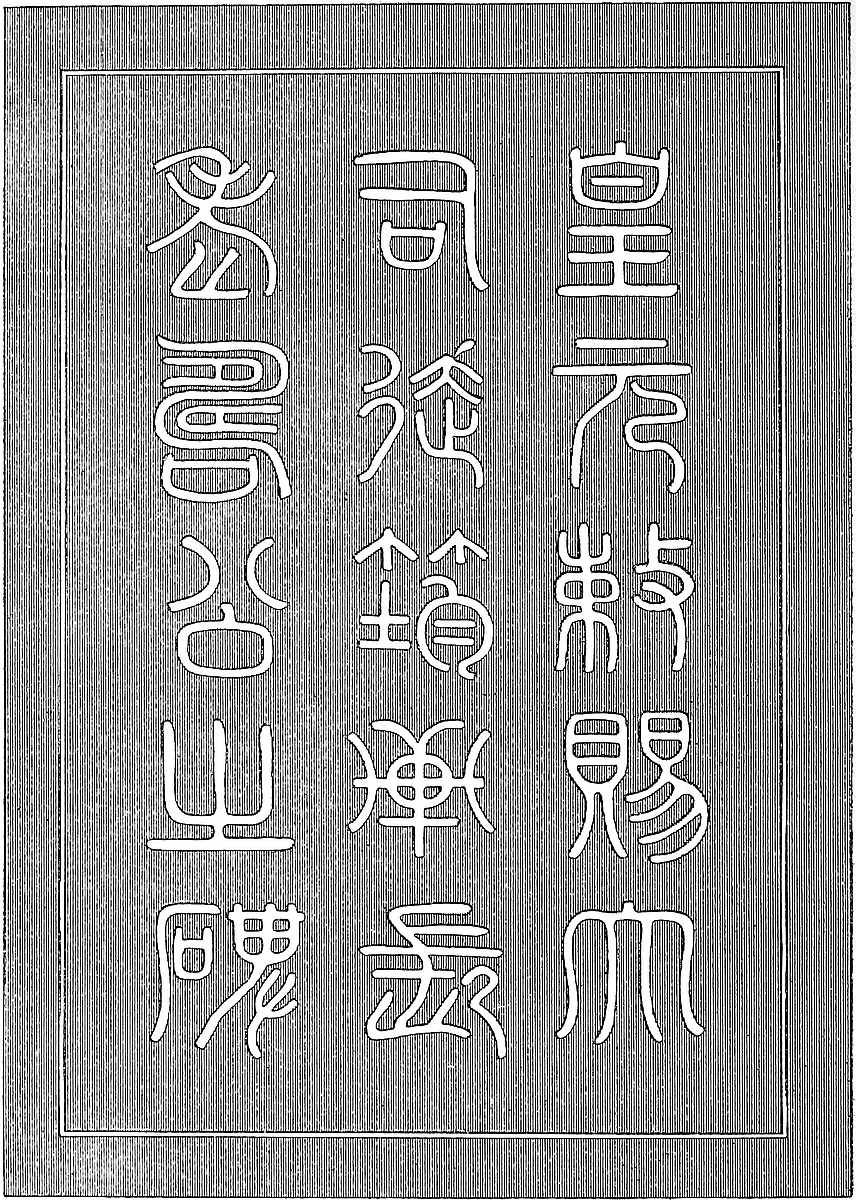
Heading
In the Old Chinese Seal-Character, of an Inscription
on a Memorial raised by Kúblái-Kaan
to a Buddhist Ecclesiastic in the vicinity of his Summer-Palace
at Shang-tu in Mongolia.
Reduced from a facsimile obtained on the spot by Dr. S. W. Bushell,
1872.
This city occupies the south-east angle of a more extensive enclosure,
bounded by what is now a grassy mound, and embracing, on Dr. Bushell’s
estimate, about 5 square miles. Further knowledge may explain the
discrepancy from Marco’s dimension, but this must be the park of which he
speaks.[3] The woods and fountains have disappeared, like the temples and
palaces; all is dreary and desolate, though still abounding in the game
which was one of Kúblái’s attractions to the spot. A small monastery,
occupied by six or seven wretched Lamas, is the only building that remains
in the vicinity. The river Shangtu, which lower down becomes the Lan [or
Loan]-Ho, was formerly navigated from the sea up to this place by flat
grain-boats.
[Mgr. de Harlez gave in the T’oung Pao (x. p. 73) an inscription in
Chuen character on a stele found in the ruins of Shangtu, and built by
an officer with the permission of the Emperor; it is probably a token of
imperial favour; the inscription means: Great Longevity.—H. C.]
In the wail which Sanang Setzen, the poetical historian of the Mongols,
puts, perhaps with some traditional basis, into the mouth of Toghon Temur,
the last of the Chinghizide Dynasty in China, when driven from his throne,
the changes are rung on the lost glories of his capital Daïtu (see infra,
Book II. ch. xi.) and his summer palace Shangtu; thus (I translate from
Schott’s amended German rendering of the Mongol):
“My vast and noble Capital, My Daïtu, My splendidly adorned!
And Thou my cool and delicious Summer-seat, my Shangtu-Keibung!
Ye, also, yellow plains of Shangtu, Delight of my godlike Sires!
I suffered myself to drop into dreams,—and lo! my Empire was gone!
Ah Thou my Daïtu, built of the nine precious substances!
Ah my Shangtu-Keibung, Union of all perfections!
Ah my Fame! Ah my Glory, as Khagan and Lord of the Earth!
When I used to awake betimes and look forth, how the breezes blew loaded with fragrance!
And turn which way I would all was glorious perfection of beauty!
•••••
Alas for my illustrious name as the Sovereign of the World!
Alas for my Daïtu, seat of Sanctity, Glorious work of the Immortal Kúblái!
All, all is rent from me!”
It was, in 1797, whilst reading this passage of Marco’s narrative in old
Purchas that Coleridge fell asleep, and dreamt the dream of Kúblái’s
Paradise, beginning:
“In Xanadu did Kubla Khan
A stately pleasure-dome decree:
Where Alph, the sacred River, ran
Through caverns measureless to man
Down to a sunless sea.
So twice five miles of fertile ground
With walls and towers were girdled round:
And there were gardens bright with sinuous rills
Where blossomed many an incense-bearing tree;
And here were forests ancient as the hills,
Enfolding sunny spots of greenery.”
It would be a singular coincidence in relation to this poem were Klaproth’s
reading correct of a passage in Rashiduddin which he renders as saying that
the palace at Kaiminfu was “called Langtin, and was built after a plan that
Kúblái had seen in a dream, and had retained in his memory.” But I suspect
D’Ohsson’s reading is more accurate, which runs: “Kúblái caused a Palace
to be built for him east of Kaipingfu, called Lengten; but he abandoned
it in consequence of a dream.” For we see from Sanang Setzen that the
Palaces of Lengten and Kaiming or Shangtu were distinct; “Between the year
of the Rat (1264), when Kúblái was fifty years old, and the year of the
Sheep (1271), in the space of eight years, he built four great cities, viz.
for Summer Residence Shangtu Keibung Kürdu Balgasun, for Winter Residence
Yeke Daïtu Khotan, and on the shady side of the Altai (see ch. li. note
3, supra) Arulun Tsaghan Balgasun, and Erchügin Langting Balgasun.” A
valuable letter from Dr. Bushell enables me now to indicate the position of
Langtin: “The district through which the river flows eastward from Shangtu
is known to the Mongolians of the present day by the name of Lang-tírh
(Lang-ting’rh).... The ruins of the city are marked on a Chinese map
in my possession Pai-dseng-tzu, i.e. ‘White City,’ implying that it was
formerly an Imperial residence. The remains of the wall are 7 or 8 li
in diameter, of stone, and situated about 40 li north-north-west from
Dolon-nor.”
(Gerbillon in Astley, IV. 701–716; Klaproth, in J. As. sér. II. tom.
xi. 345–350; Schott, Die letzten Jahre der Mongolenherrschaft in China
(Berl. Acad. d. Wissensch. 1850, pp. 502–503); Huc’s Tartary, etc., p. 14
seqq.; Cathay, 134, 261; S. Setzen, p. 115; Dr. S. W. Bushell, Journey
outside the Great Wall, in J. R. G. S. for 1874, and MS. notes.)
One of the pavilions of the celebrated Yuen-ming-Yuen may give some idea of
the probable style, though not of the scale, of Kúblái’s Summer Palace.
Hiuen Tsang’s account of the elaborate and fantastic ornamentation of the
famous Indian monasteries at Nalanda in Bahár, where Mr. Broadley has
lately made such remarkable discoveries, seems to indicate that these
fantasies of Burmese and Chinese architecture may have had a direct
origin in India, at a time when timber was still a principal material of
construction there: “The pavilions had pillars adorned with dragons, and
posts that glowed with all the colours of the rainbow, sculptured frets,
columns set with jade, richly chiselled and lackered, with balustrades of
vermilion, and carved open work. The lintels of the doors were tastefully
ornamented, and the roofs covered with shining tiles, the splendours of
which were multiplied by mutual reflection and from moment to moment took a
thousand forms.” (Vie et Voyages, 157.)
Note 3.—[Rubruck says (Rockhill, p. 248): “I saw also the envoy
of a certain Soldan of India, who had brought eight leopards and ten
greyhounds, taught to sit on horses’ backs, as leopards sit.”—H. C.]
Note 4.—Ramusio’s is here so much more lucid than the other texts, that
I have adhered mainly to his account of the building. The roof described
is of a kind in use in the Indian Archipelago, and in some other parts of
Transgangetic India, in which the semi-cylinders of bamboo are laid just
like Roman tiles.
Rashiduddin gives a curious account of the way in which the foundations of
the terrace on which this palace stood were erected in a lake. He says,
too, in accord with Polo: “Inside the city itself a second palace was
built, about a bowshot from the first: but the Kaan generally takes up his
residence in the palace outside the town,” i.e., as I imagine, in Marco’s
Cane Palace. (Cathay, pp. 261–262.)
[“The Palace of canes is probably the Palm Hall, Tsung tien, alias
Tsung mao tien, of the Chinese authors, which was situated in the western
palace garden of Shangtu. Mention is made also in the Altan Tobchi of a
cane tent in Shangtu.” (Palladius, p. 27.)—H. C.]
Marco might well say of the bamboo that “it serves also a great variety
of other purposes.” An intelligent native of Arakan who accompanied me in
wanderings on duty in the forests of the Burmese frontier in the beginning
of 1853, and who used to ask many questions about Europe, seemed able
to apprehend almost everything except the possibility of existence in a
country without bamboos! “When I speak of bamboo huts, I mean to say that
posts and walls, wall-plates and rafters, floor and thatch, and the withes
that bind them, are all of bamboo. In fact, it might almost be said that
among the Indo-Chinese nations the staff of life is a bamboo! Scaffolding
and ladders, landing-jetties, fishing apparatus, irrigation wheels and
scoops, oars, masts, and yards [and in China, sails, cables, and caulking,
asparagus, medicine, and works of fantastic art], spears and arrows,
hats and helmets, bow, bowstring and quiver, oil-cans, water-stoups and
cooking-pots, pipe-sticks [tinder and means of producing fire], conduits,
clothes-boxes, pawn-boxes, dinner-trays, pickles, preserves, and melodious
musical instruments, torches, footballs, cordage, bellows, mats, paper;
these are but a few of the articles that are made from the bamboo;” and
in China, to sum up the whole, as Barrow observes, it maintains order
throughout the Empire! (Ava Mission, p. 153; and see also Wallace, Ind.
Arch. I. 120 seqq.)
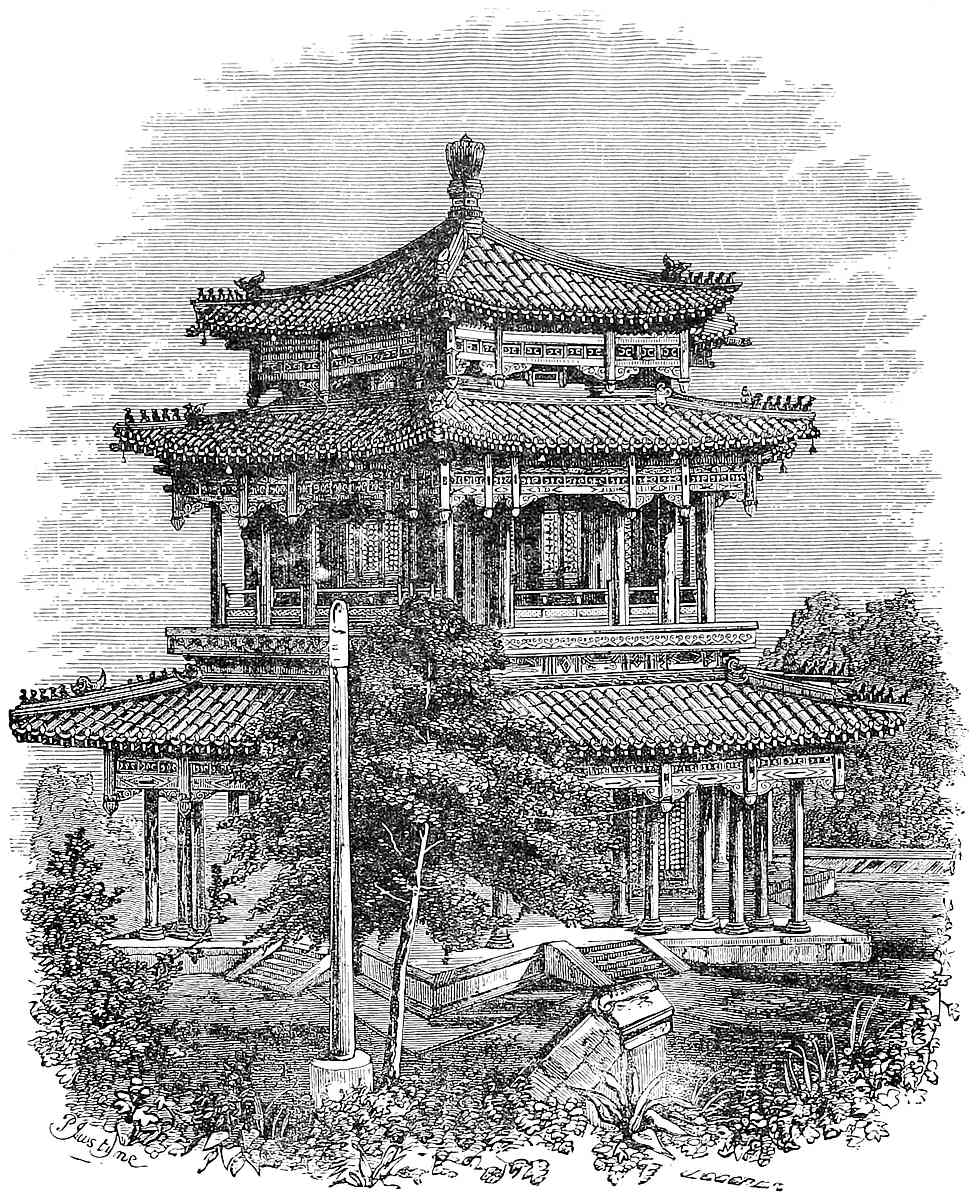
Pavilion at Yuen-ming-Yuen.
Note 5.—“The Emperor ... began this year (1264) to depart from Yenking
(Peking) in the second or third month for Shangtu, not returning until the
eighth month. Every year he made this passage, and all the Mongol emperors
who succeeded him followed his example.” (Gaubil, p. 144.)
[“The Khans usually resorted to Shangtu in the 4th moon and returned to
Peking in the 9th. On the 7th day of the 7th moon there were libations
performed in honour of the ancestors; a shaman, his face to the north,
uttered in a loud voice the names of Chingiz Khan and of other deceased
Khans, and poured mare’s milk on the ground. The propitious day for the
return journey to Peking was also appointed then.” (Palladius, p. 26.)—H. C.]
Note 6.—White horses were presented in homage to the Kaan on New Year’s Day
(the White Feast), as we shall see below. (Bk. II. ch. xv.) Odoric also
mentions this practice; and, according to Huc, the Mongol chiefs continued
it at least to the time of the Emperor K’ang-hi. Indeed Timkowski speaks
of annual tributes of white camels and white horses from the Khans of
the Kalkas and other Mongol dignitaries, in the present century. (Huc’s
Tartary, etc.; Tim. II. 33.)
By the Horiad are no doubt intended the Uirad or Oirad, a name usually
interpreted as signifying the “Closely Allied,” or Confederates; but
Vámbéry explains it as (Turki) Oyurat, “Grey horse,” to which the
statement in our text appears to lend colour. They were not of the tribes
properly called Mongol, but after their submission to Chinghiz they
remained closely attached to him. In Chinghiz’s victory over Aung-Khan, as
related by S. Setzen, we find Turulji Taishi, the son of the chief of the
Oirad, one of Chinghiz’s three chief captains; perhaps that is the victory
alluded to. The seats of the Oirad appear to have been about the head
waters of the Kem, or Upper Yenisei.
In A.D. 1295 there took place a curious desertion from the service of
Gházán Khan of Persia of a vast corps of the Oirad, said to amount to
18,000 tents. They made their way to Damascus, where they were well
received by the Mameluke Sultan. But their heathenish practices gave
dire offence to the Faithful. They were settled in the Sáhil, or coast
districts of Palestine. Many died speedily; the rest embraced Islam, spread
over the country, and gradually became absorbed in the general population.
Their sons and daughters were greatly admired for their beauty. (S. Setz.
p. 87; Erdmann, 187; Pallas, Samml. I. 5 seqq.; Makrizi, III. 29;
Bretschneider, Med. Res. II. p. 159 seqq.)
[With reference to Yule’s conjecture, I may quote Palladius (l.c. p. 27):
“It is, however, strange that the Oirats alone enjoyed the privilege
described by Marco Polo; for the highest position at the Mongol Khan’s
court belonged to the Kunkrat tribe, out of which the Khans used to choose
their first wives, who were called Empresses of the first ordo.”—H. C.]
Note 7.—Rubruquis assigns such a festival to the month of May: “On the 9th
day of the May Moon they collect all the white mares of their herds and
consecrate them. The Christian priests also must then assemble with their
thuribles. They then sprinkle new cosmos (kumíz) on the ground, and make
a great feast that day, for according to their calendar, it is their time
of first drinking new cosmos, just as we reckon of our new wine at the
feast of St. Bartholomew (24th August), or that of St. Sixtus (6th August),
or of our fruit on the feast of St. James and St. Christopher” (25th July).
[With reference to this feast, Mr. Rockhill gives (Rubruck, p. 241, note)
extracts from Pallas, Voyages, IV. 579, and Professor Radloff, Aus
Siberien, I. 378.—H. C.] The Yakuts also hold such a festival in June or
July, when the mares foal, and immense wooden goblets of kumíz are emptied
on that occasion. They also pour out kumíz for the Spirits to the four
quarters of heaven.
The following passage occurs in the narrative of the Journey of Chang
Te-hui, a Chinese teacher, who was summoned to visit the camp of Kúblái in
Mongolia, some twelve years before that Prince ascended the throne of the
Kaans:[4]
“On the 9th day of the 9th Moon (October), the Prince, having called his
subjects before his chief tent, performed the libation of the milk of a
white mare. This was the customary sacrifice at that time. The vessels used
were made of birch-bark, not ornamented with either silver or gold. Such
here is the respect for simplicity....
“At the last day of the year the Mongols suddenly changed their
camping-ground to another place, for the mutual congratulation on the 1st
Moon. Then there was every day feasting before the tents for the lower
ranks. Beginning with the Prince, all dressed themselves in white fur
clothing....[5]
“On the 9th day of the 4th Moon (May) the Prince again collected his
vassals before the chief tent for the libation of the milk of a white mare.
This sacrifice is performed twice a year.”
It has been seen (p. 308) that Rubruquis also names the 9th day of the May
moon as that of the consecration of the white mares. The autumn libation is
described by Polo as performed on the 28th day of the August moon, probably
because it was unsuited to the circumstances of the Court at Cambaluc,
where the Kaan was during October, and the day named was the last of his
annual stay in the Mongolian uplands.
Baber tells that among the ceremonies of a Mongol Review the Khan and
his staff took kumíz and sprinkled it towards the standards. An Armenian
author of the Mongol era says that it was the custom of the Tartars, before
drinking, to sprinkle drink towards heaven, and towards the four quarters.
Mr. Atkinson notices the same practice among the Kirghiz; and I found the
like in old days among the Kasias of the eastern frontier of Bengal.
The time of year assigned by Polo for the ceremony implies some change.
Perhaps it had been made to coincide with the Festival of Water
Consecration of the Lamas, with which the time named in the text seems
to correspond. On that occasion the Lamas go in procession to the rivers
and lakes and consecrate them by benediction and by casting in offerings,
attended by much popular festivity.
Rubruquis seems to intimate that the Nestorian priests were employed to
consecrate the white mares by incensing them. In the rear of Lord Canning’s
camp in India I once came upon the party of his Shutr Suwárs, or
dromedary-express riders, busily engaged in incensing with frankincense the
whole of the dromedaries, which were kneeling in a circle. I could get no
light on the practice, but it was very probably a relic of the old Mongol
custom. (Rubr. 363; Erman, II. 397; Billings’ Journey, Fr. Tr. I.
217; Baber, 103; J. As. sér. V. tom. xi. p. 249; Atk. Amoor, p. 47;
J. A. S. B. XIII. 628; Koeppen, II. 313.)
Note
8.—The practice of weather-conjuring was in great vogue among the
Mongols, and is often alluded to in their history.
The operation was performed by means of a stone of magical virtues, called
Yadah or Jadah-Tásh, which was placed in or hung over a basin of water
with sundry ceremonies. The possession of such a stone is ascribed by the
early Arab traveller Ibn Mohalhal to the Ḳímák, a great tribe of the
Turks. In the war raised against Chinghiz and Aung Khan, when still allies,
by a great confederation of the Naiman and other tribes in 1202, we are
told that Sengun, the son of Aung Khan, when sent to meet the enemy, caused
them to be enchanted, so that all their attempted movements against him
were defeated by snow and mist. The fog and darkness were indeed so dense
that many men and horses fell over precipices, and many also perished
with cold. In another account of (apparently) the same matter, given by
Mir-Khond, the conjuring is set on foot by the Yadachi of Buyruk Khan,
Prince of the Naiman, but the mischief all rebounds on the conjurer’s own side.
In Tului’s invasion of Honan in 1231–1232, Rashiduddin describes him, when
in difficulty, as using the Jadah stone with success.
Timur, in his Memoirs, speaks of the Jets using incantations to produce
heavy rains which hindered his cavalry from acting against them. A
Yadachi was captured, and when his head had been taken off the storm
ceased.
Baber speaks of one of his early friends, Khwaja Ka Mulai, as excelling
in falconry and acquainted with Yadagarí or the art of bringing on rain
and snow by means of enchantment. When the Russians besieged Kazan in 1552
they suffered much from the constant heavy rains, and this annoyance was
universally ascribed to the arts of the Tartar Queen, who was celebrated as
an enchantress. Sháh Abbás believed he had learned the Tartar secret, and
put much confidence in it. (P. Della V. I. 869.)
[Grenard says (II. p. 256) the most powerful and most feared of sorcerers
[in Chinese Turkestan] is the djâduger, who, to produce rain or fine
weather, uses a jade stone, given by Noah to Japhet. Grenard adds (II.
406–407) there are sorcerers (Ngag-pa-snags-pa) whose specialty is to make
rain fall; they are similar to the Turkish Yadachi and like them use a
stone called “water cristal,” chu shel; probably jade stone.
Mr. Rockhill (Rubruck, p. 245, note) writes: “Rashideddin states that
when the Urianghit wanted to bring a storm to an end, they said injuries to
the sky, the lightning and thunder. I have seen this done myself by Mongol
storm-dispellers. (See Diary, 201, 203.) ‘The other Mongol people,’ he
adds, ‘do the contrary. When the storm rumbles, they remain shut up in
their huts, full of fear.’ The subject of storm-making, and the use of
stones for that purpose, is fully discussed by Quatremère, Histoire,
438–440.” (Cf. also Rockhill, l.c. p. 254.)—H. C.]
An edict of the Emperor Shi-tsung, of the reigning dynasty, addressed
in 1724–1725 to the Eight Banners of Mongolia, warns them against this
rain-conjuring: “If I,” indignantly observes the Emperor, “offering prayer
in sincerity have yet room to fear that it may please Heaven to leave MY
prayer unanswered, it is truly intolerable that mere common people wishing
for rain should at their own caprice set up altars of earth, and bring
together a rabble of Hoshang (Buddhist Bonzes) and Taossé to conjure the
spirits to gratify their wishes.”
[“Lamas were of various extraction; at the time of the great assemblies,
and of the Khan’s festivities in Shangtu, they erected an altar near the
Khan’s tent and prayed for fine weather; the whistling of shells rose
up to heaven.” These are the words in which Marco Polo’s narrative is
corroborated by an eye-witness who has celebrated the remarkable objects of
Shangtu (Loan king tsa yung). These Lamas, in spite of the prohibition
by the Buddhist creed of bloody sacrifices, used to sacrifice sheep’s
hearts to Mahakala. It happened, as it seems, that the heart of an executed
criminal was also considered an agreeable offering; and as the offerings
could be, after the ceremony, eaten by the sacrificing priests, Marco Polo
had some reason to accuse the Lamas of cannibalism. (Palladius, 28.)—H. C.]
The practice of weather-conjuring is not yet obsolete in Tartary, Tibet,
and the adjoining countries.[6]
Weather-conjuring stories were also rife in Europe during the Middle Ages.
One such is conspicuously introduced in connection with a magical fountain
in the romance of the Chevalier au Lyon:
“Et s’i pant uns bacins d’or fin
A une si longue chaainne
Qui dure jusqu’a la fontainne.
Lez la fontainne troveras
Un perron tel con tu verras
* * * *
S’au bacin viaus de l’iaue prandre
Et dessor le perron espandre,
La verras une tel tanpeste
Qu’an cest bois ne remandra beste,”
The effect foretold in these lines is the subject of a woodcut illustrating
a Welsh version of the same tale in the first volume of the Mabinogion.
And the existence of such a fountain is alluded to by Alexander Neckam.
(De Naturis Rerum, Bk. II. ch. vii.)
In the Cento Novelle Antiche also certain necromancers exhibit their
craft before the Emperor Frederic (Barbarossa apparently): “The weather
began to be overcast, and lo! of a sudden rain began to fall with
continued thunders and lightnings, as if the world were come to an end,
and hailstones that looked like steel-caps,” etc. Various other European
legends of like character will be found in Liebrecht’s Gervasius von
Tilbury, pp. 147–148.
Rain-makers there are in many parts of the world; but it is remarkable that
those also of Samoa in the Pacific operate by means of a rain-stone.
Such weather conjurings as we have spoken of are ascribed by Ovid to Circe:
“Concipit illa preces, et verba venefica dicit;
Ignotosque Deos ignoto carmine adorat,
* * * *
Tunc quoque cantato densetur carmine caelum,
Et nebulas exhalat humus.”—Metam. XIV. 365.
And to Medea:—
——“Quum volui, ripis mirantibus, amnes
In fontes rediere suos ... (another feat of the Lamas)
... Nubila pello,
Nubilaque induco; ventos abigoque, vocoque.”—Ibid. VII. 199.
And by Tibullus to the Saga (Eleg. I. 2, 45); whilst Empedocles, in
verses ascribed to him by Diogenes Laertius, claims power to communicate
like secrets of potency:—
“By my spells thou may’st
To timely sunshine turn the purple rains,
And parching droughts to fertilising floods.”
(See Cathay, p. clxxxvii.; Erdm. 282;
Oppert, 182 seqq.; Erman, I.
153; Pallas, Samml. II. 348 seqq.; Timk. I. 402; J. R. A. S. VII.
305–306; D’Ohsson, II. 614; and for many interesting particulars, Q. R.
p. 428 seqq., and Hammer’s Golden Horde, 207 and 435 seqq.)
Note 9.—It is not clear whether Marco attributes this cannibalism to the
Tibetans and Kashmirians, or brings it in as a particular of Tartar custom
which he had forgotten to mention before.
The accusations of cannibalism indeed against the Tibetans in old accounts
are frequent, and I have elsewhere (see Cathay, p. 151) remarked on some
singular Tibetan practices which go far to account for such charges. Della
Penna, too, makes a statement which bears curiously on the present passage.
Remarking on the great use made by certain classes of the Lamas of human
skulls for magical cups, and of human thigh bones for flutes and whistles,
he says that to supply them with these the bodies of executed criminals
were stored up at the disposal of the Lamas; and a Hindu account of Tibet
in the Asiatic Researches asserts that when one is killed in a fight both
parties rush forward and struggle for the liver, which they eat (vol. xv).
[Carpini says of the people of Tibet: “They are pagans; they have a most
astonishing, or rather horrible, custom, for, when any one’s father is
about to give up the ghost, all the relatives meet together, and they eat
him, as was told to me for certain.” Mr. Rockhill (Rubruck, p. 152, note)
writes: “So far as I am aware, this charge [of cannibalism] is not made
by any Oriental writer against the Tibetans, though both Arab travellers
to China in the ninth century and Armenian historians of the thirteenth
century say the Chinese practised cannibalism. The Armenians designate
China by the name Nankas, which I take to be Chinese Nan-kuo, ‘southern
country,’ the Manzi country of Marco Polo.”—H. C.]
But like charges of cannibalism are brought against both Chinese and
Tartars very positively. Thus, without going back to the Anthropophagous
Scythians of Ptolemy and Mela, we read in the Relations of the Arab
travellers of the ninth century: “In China it occurs sometimes that the
governor of a province revolts from his duty to the emperor. In such a case
he is slaughtered and eaten. In fact, the Chinese eat the flesh of all
men who are executed by the sword.” Dr. Rennie mentions a superstitious
practice, the continued existence of which in our own day he has himself
witnessed, and which might perhaps have given rise to some such statement
as that of the Arab travellers, if it be not indeed a relic, in a mitigated
form, of the very practice they assert to have prevailed. After an
execution at Peking certain large pith balls are steeped in the blood, and
under the name of blood-bread are sold as a medicine for consumption. It
is only to the blood of decapitated criminals that any such healing power
is attributed. It has been asserted in the annals of the Propagation de
la Foi that the Chinese executioners of M. Chapdelaine, a missionary who
was martyred in Kwang-si in 1856 (28th February), were seen to eat the
heart of their victim; and M. Huot, a missionary in the Yun-nan province,
recounts a case of cannibalism which he witnessed. Bishop Chauveau, at
Ta Ts’ien-lu, told Mr. Cooper that he had seen men in one of the cities
of Yun-nan eating the heart and brains of a celebrated robber who had
been executed. Dr. Carstairs Douglas of Amoy also tells me that the like
practices have occurred at Amoy and Swatau.
[With reference to cannibalism in China see Medical Superstitions an
Incentive to Anti-Foreign Riots in China, by D. J. Macgowan, North China
Herald, 8th July, 1892, pp. 60–62. Mr. E. H. Parker (China Review,
February–March, 1901, 136) relates that the inhabitants of a part of
Kwang-si boiled and ate a Chinese officer who had been sent to pacify them.
“The idea underlying this horrible act [cannibalism] is, that by eating a
portion of the victim, especially the heart, one acquires the valour with
which he was endowed.” (Dennys’ Folk-lore of China, 67.)—H. C.]
Hayton, the Armenian, after relating the treason of a Saracen, called
Parwana (he was an Iconian Turk), against Abaka Khan, says: “He was taken
and cut in two, and orders were issued that in all the food eaten by Abaka
there should be put a portion of the traitor’s flesh. Of this Abaka himself
ate, and caused all his barons to partake. And this was in accordance with
the custom of the Tartars.” The same story is related independently and
differently by Friar Ricold, thus: “When the army of Abaga ran away from
the Saracens in Syria, a certain great Tartar baron was arrested who had
been guilty of treason. And when the Emperor Khan was giving the order for
his execution the Tartar ladies and women interposed, and begged that he
might be made over to them. Having got hold of the prisoner they boiled him
alive, and cutting his body up into mince-meat gave it to eat to the whole
army, as an example to others.” Vincent of Beauvais makes a like statement:
“When they capture any one who is at bitter enmity with them, they gather
together and eat him in vengeance of his revolt, and like infernal leeches
suck his blood,” a custom of which a modern Mongol writer thinks that he
finds a trace in a surviving proverb. Among more remote and ignorant Franks
the cannibalism of the Tartars was a general belief. Ivo of Narbonne, in
his letter written during the great Tartar invasion of Europe (1242),
declares that the Tartar chiefs, with their dog’s head followers and other
Lotophagi (!), ate the bodies of their victims like so much bread; whilst
a Venetian chronicler, speaking of the council of Lyons in 1274, says there
was a discussion about making a general move against the Tartars, “porce
qu’il manjuent la char humaine.” These latter writers no doubt rehearsed
mere popular beliefs, but Hayton and Ricold were both intelligent persons
well acquainted with the Tartars, and Hayton at least not prejudiced
against them.
The old belief was revived in Prussia during the Seven Years’ War, in
regard to the Kalmaks of the Russian army; and Bergmann says the old Kalmak
warriors confessed to him that they had done what they could to encourage
it by cutting up the bodies of the slain in presence of their prisoners,
and roasting them! But Levchine relates an act on the part of the Kirghiz
Kazaks which was no jest. They drank the blood of their victim if they did
not eat his flesh.
There is some reason to believe that cannibalism was in the Middle Ages
generally a less strange and unwonted horror than we should at first blush
imagine, and especially that it was an idea tolerably familiar in China.
M. Bazin, in the second part of Chine Moderne, p. 461, after sketching
a Chinese drama of the Mongol era (“The Devotion of Chao-li”), the plot
of which turns on the acts of a body of cannibals, quotes several other
passages from Chinese authors which indicate this. Nor is this wonderful in
the age that had experienced the horrors of the Mongol wars.
That was no doubt a fable which Carpini heard in the camp of the Great
Kaan, that in one of the Mongol sieges in Cathay, when the army was
without food, one man in ten of their own force was sacrificed to feed the
remainder.[8] But we are told in sober history that the force of Tului in
Honan, in 1231–1232, was reduced to such straits as to eat grass and human
flesh. At the siege of the Kin capital Kaifongfu, in 1233, the besieged
were reduced to the like extremity; and the same occurred the same year
at the siege of Tsaichau; and in 1262, when the rebel general Litan was
besieged in Tsinanfu. The Taiping wars the other day revived the same
horrors in all their magnitude. And savage acts of the same kind by the
Chinese and their Turk partisans in the defence of Kashgar were related to
Mr. Shaw.
Probably, however, nothing of the kind in history equals what Abdallatif, a
sober and scientific physician, describes as having occurred before his own
eyes in the great Egyptian famine of A.H. 597 (1200). The horrid details
fill a chapter of some length, and we need not quote from them.
Nor was Christendom without the rumour of such barbarities. The story of
King Richard’s banquet in presence of Saladin’s ambassadors on the head of
a Saracen curried (for so it surely was),—
“soden full hastily
With powder and with spysory,
And with saffron of good colour”—
fable as it is, is told with a zest that makes one shudder; but the tale in
the Chanson d’Antioche, of how the licentious bands of ragamuffins, who
hung on the army of the First Crusade, and were known as the Tafurs,[9]
ate the Turks whom they killed at the siege, looks very like an abominable
truth, corroborated as it is by the prose chronicle of worse deeds at the
ensuing siege of Marrha:—
“A lor cotiaus qu’il ont trenchans et afilés
Escorchoient les Turs, aval parmi les près.
Voiant Paiens, les ont par pièces découpés.
En l’iave et el carbon les ont bien quisinés,
Volontiers les menjuent sans pain et dessalés.”
[10]
(Della Penna, p. 76; Reinaud, Rel. I. 52; Rennie’s Peking, II. 244;
Ann. de la Pr. de la F. XXIX. 353, XXI. 298; Hayton in Ram. ch.
xvii.; Per. Quat. p. 116; M. Paris, sub. 1243; Mél. Asiat. Acad. St.
Pétersb. II. 659; Canale in Arch. Stor. Ital. VIII.; Bergm. Nomad.
Streifereien, I. 14; Carpini, 638; D’Ohsson, II. 30, 43, 52; Wilson’s
Ever Victorious Army, 74; Shaw, p. 48; Abdallatif, p. 363 seqq.;
Weber, II. 135; Littré, H. de la Langue Franç. I. 191; Gesta Tancredi
in Thes. Nov. Anecd. III. 172.)
Note
10.—Bakhshi is generally believed to be a corruption of Bhikshu,
the proper Sanscrit term for a religious mendicant, and in particular
for the Buddhist devotees of that character. Bakhshi was probably
applied to a class only of the Lamas, but among the Turks and Persians
it became a generic name for them all. In this sense it is habitually
used by Rashiduddin, and thus also in the Ain Akbari: “The learned among
the Persians and Arabians call the priests of this (Buddhist) religion
Bukshee, and in Tibbet they are styled Lamas.”
According to Pallas the word among the modern Mongols is used in the sense
of Teacher, and is applied to the oldest and most learned priest of a
community, who is the local ecclesiastical chief. Among the Kirghiz Kazaks
again, who profess Mahomedanism, the word also survives, but conveys among
them just the idea that Polo seems to have associated with it, that of a
mere conjuror or “medicine-man”; whilst in Western Turkestan it has come to
mean a Bard.
The word Bakhshi has, however, wandered much further from its original
meaning. From its association with persons who could read and write, and
who therefore occasionally acted as clerks, it came in Persia to mean a
clerk or secretary. In the Petrarchian Vocabulary, published by Klaproth,
we find scriba rendered in Comanian, i.e. Turkish of the Crimea,
by Bacsi. The transfer of meaning is precisely parallel to that in
regard to our Clerk. Under the Mahomedan sovereigns of India, Bakhshi
was applied to an officer performing something like the duties of a
quartermaster-general; and finally, in our Indian army, it has come to mean
a paymaster. In the latter sense, I imagine it has got associated in the
popular mind with the Persian bakhshídan, to bestow, and bakhshísh.
(See a note in Q. R. p. 184 seqq.; Cathay, p. 474; Ayeen Akbery,
III. 150; Pallas, Samml. II. 126; Levchine, p. 355; Klap. Mém. III.;
Vámbéry, Sketches, p. 81.)
The sketch from the life, on p. 326, of a wandering Tibetan devotee, whom I
met once at Hardwár, may give an idea of the sordid Bacsis spoken of by
Polo.
Note 11.—This feat is related more briefly by Odoric: “And jugglers cause
cups of gold full of good wine to fly through the air, and to offer
themselves to all who list to drink.” (Cathay, p. 143.) In the note on
that passage I have referred to a somewhat similar story in the Life of
Apollonius. “Such feats,” says Mr. Jaeschke, “are often mentioned in
ancient as well as modern legends of Buddha and other saints; and our Lamas
have heard of things very similar performed by conjuring Bonpos.” (See p.
323.) The moving of cups and the like is one of the sorceries ascribed in
old legends to Simon Magus: “He made statues to walk; leapt into the fire
without being burnt; flew in the air; made bread of stones; changed his
shape; assumed two faces at once; converted himself into a pillar; caused
closed doors to fly open spontaneously; made the vessels in a house seem to
move of themselves,” etc. The Jesuit Delrio laments that credulous princes,
otherwise of pious repute, should have allowed diabolic tricks to be played
before them, “as, for example, things of iron, and silver goblets, or other
heavy articles, to be moved by bounds from one end of a table to the other,
without the use of a magnet or of any attachment.” The pious prince appears
to have been Charles IX., and the conjuror a certain Cesare Maltesio.
Another Jesuit author describes the veritable mango-trick, speaking of
persons who “within three hours’ space did cause a genuine shrub of a span
in length to grow out of the table, besides other trees that produced both
leaves and fruit.”
In a letter dated 1st December, 1875, written by Mr. R. B. Shaw, after his
last return from Kashgar and Lahore, this distinguished traveller says: “I
have heard stories related regarding a Buddhist high priest whose temple
is said to be not far to the east of Lanchau, which reminds me of Marco
Polo and Kúblái Khan. This high priest is said to have the magic power
of attracting cups and plates to him from a distance, so that things fly
through the air into his hands.” (MS. Note.—H. Y.)
The profession and practice of exorcism and magic in general is greatly
more prominent in Lamaism or Tibetan Buddhism than in any other known form
of that religion. Indeed, the old form of Lamaism as it existed in our
traveller’s day, and till the reforms of Tsongkhapa (1357–1419), and as
it is still professed by the Red sect in Tibet, seems to be a kind of
compromise between Indian Buddhism and the old indigenous Shamanism. Even
the reformed doctrine of the Yellow sect recognises an orthodox kind of
magic, which is due in great measure to the combination of Sivaism with the
Buddhist doctrines, and of which the institutes are contained in the vast
collection of the Jud or Tantras, recognised among the holy books. The
magic arts of this code open even a short road to the Buddhahood itself. To
attain that perfection of power and wisdom, culminating in the cessation
of sensible existence, requires, according to the ordinary paths, a period
of three asankhyas (or say Uncountable Time × 3), whereas by means of
the magic arts of the Tantras it may be reached in the course of three
rebirths only, nay, of one! But from the Tantras also can be learned how
to acquire miraculous powers for objects entirely selfish and secular, and
how to exercise these by means of Dhárani or mystic Indian charms.
Still the orthodox Yellow Lamas professedly repudiate and despise the
grosser exhibitions of common magic and charlatanism which the Reds still
practise, such as knife-swallowing, blowing fire, cutting off their own
heads, etc. But as the vulgar will not dispense with these marvels, every
great orthodox monastery in Tibet keeps a conjuror, who is a member of
the unreformed, and does not belong to the brotherhood of the convent,
but lives in a particular part of it, bearing the name of Choichong,
or protector of religion, and is allowed to marry. The magic of these
Choichong is in theory and practice different from the orthodox Tantrist
magic. The practitioners possess no literature, and hand down their
mysteries only by tradition. Their fantastic equipments, their frantic
bearing, and their cries and howls, seem to identify them with the grossest
Shamanist devil dancers.
Sanang Setzen enumerates a variety of the wonderful acts which could be
performed through the Dhárani. Such were, sticking a peg into solid rock;
restoring the dead to life; turning a dead body into gold; penetrating
everywhere as air does; flying; catching wild beasts with the hand;
reading thoughts; making water flow backwards; eating tiles; sitting in
the air with the legs doubled under, etc. Some of these are precisely
the powers ascribed to Medea, Empedocles, and Simon Magus, in passages
already cited. Friar Ricold says on this subject: “There are certain men
whom the Tartars honour above all in the world, viz. the Baxitae (i.e.
Bakhshis), who are a kind of idol-priests. These are men from India,
persons of deep wisdom, well-conducted, and of the gravest morals. They are
usually acquainted with magic arts, and depend on the counsel and aid of
demons; they exhibit many illusions, and predict some future events. For
instance, one of eminence among them was said to fly; the truth, however,
was (as it proved), that he did not fly, but did walk close to the surface
of the ground without touching it; and would seem to sit down without
having any substance to support him.” This last performance was witnessed
by Ibn Batuta at Delhi, in the presence of Sultan Mahomed Tughlak; and it
was professedly exhibited by a Brahmin at Madras in the present century,
a descendant doubtless of those Brahmans whom Apollonius saw walking
two cubits from the ground. It is also described by the worthy Francis
Valentyn as a performance known and practised in his own day in India. It
is related, he says, that “a man will first go and sit on three sticks
put together so as to form a tripod; after which, first one stick, then a
second, then the third shall be removed from under him, and the man shall
not fall but shall still remain sitting in the air! Yet I have spoken with
two friends who had seen this at one and the same time; and one of them,
I may add, mistrusting his own eyes, had taken the trouble to feel about
with a long stick if there were nothing on which the body rested; yet, as
the gentleman told me, he could neither feel nor see any such thing. Still,
I could only say that I could not believe it, as a thing too manifestly
contrary to reason.”
Akin to these performances, though exhibited by professed jugglers without
claim to religious character, is a class of feats which might be regarded
as simply inventions if told by one author only, but which seem to deserve
prominent notice from their being recounted by a series of authors,
certainly independent of one another, and writing at long intervals of time
and place. Our first witness is Ibn Batuta, and it will be necessary to
quote him as well as the others in full, in order to show how closely their
evidence tallies. The Arab Traveller was present at a great entertainment
at the Court of the Viceroy of Khansa (Kinsay of Polo, or Hang-chau
fu): “That same night a juggler, who was one of the Kán’s slaves, made
his appearance, and the Amír said to him, ‘Come and show us some of your
marvels.’ Upon this he took a wooden ball, with several holes in it,
through which long thongs were passed, and, laying hold of one of these,
slung it into the air. It went so high that we lost sight of it altogether.
(It was the hottest season of the year, and we were outside in the middle
of the palace court.) There now remained only a little of the end of a
thong in the conjuror’s hand, and he desired one of the boys who assisted
him to lay hold of it and mount. He did so, climbing by the thong, and we
lost sight of him also! The conjuror then called to him three times, but
getting no answer, he snatched up a knife as if in a great rage, laid hold
of the thong, and disappeared also! By and bye he threw down one of the
boy’s hands, then a foot, then the other hand, and then the other foot,
then the trunk, and last of all the head! Then he came down himself, all
puffing and panting, and with his clothes all bloody, kissed the ground
before the Amír, and said something to him in Chinese. The Amír gave
some order in reply, and our friend then took the lad’s limbs, laid them
together in their places, and gave a kick, when, presto! there was the boy,
who got up and stood before us! All this astonished me beyond measure, and
I had an attack of palpitation like that which overcame me once before in
the presence of the Sultan of India, when he showed me something of the
same kind. They gave me a cordial, however, which cured the attack. The
Kazi Afkharuddin was next to me, and quoth he, ‘Wallah! ’tis my opinion
there has been neither going up nor coming down, neither marring nor
mending; ’tis all hocus pocus!’”
Now let us compare with this, which Ibn Batuta the Moor says he saw
in China about the year 1348, the account which is given us by Edward
Melton, an Anglo-Dutch traveller, of the performances of a Chinese gang
of conjurors, which he witnessed at Batavia about the year 1670 (I have
forgotten to note the year). After describing very vividly the basket-murder
trick, which is well known in India, and now also in Europe, and
some feats of bamboo balancing similar to those which were recently shown
by Japanese performers in England, only more wonderful, he proceeds: “But
now I am going to relate a thing which surpasses all belief, and which
I should scarcely venture to insert here had it not been witnessed by
thousands before my own eyes. One of the same gang took a ball of cord,
and grasping one end of the cord in his hand slung the other up into the
air with such force that its extremity was beyond reach of our sight. He
then immediately climbed up the cord with indescribable swiftness, and got
so high that we could no longer see him. I stood full of astonishment, not
conceiving what was to come of this; when lo! a leg came tumbling down
out of the air. One of the conjuring company instantly snatched it up and
threw it into the basket whereof I have formerly spoken. A moment later a
hand came down, and immediately on that another leg. And in short all the
members of the body came thus successively tumbling from the air and were
cast together into the basket. The last fragment of all that we saw tumble
down was the head, and no sooner had that touched the ground than he who
had snatched up all the limbs and put them in the basket turned them all
out again topsy-turvy. Then straightway we saw with these eyes all those
limbs creep together again, and in short, form a whole man, who at once
could stand and go just as before, without showing the least damage! Never
in my life was I so astonished as when I beheld this wonderful performance,
and I doubted now no longer that these misguided men did it by the help of
the Devil. For it seems to me totally impossible that such things should
be accomplished by natural means.” The same performance is spoken of by
Valentyn, in a passage also containing curious notices of the basket-murder
trick, the mango trick, the sitting in the air (quoted above), and others;
but he refers to Melton, and I am not sure whether he had any other
authority for it. The cut on this page is taken from Melton’s plate.
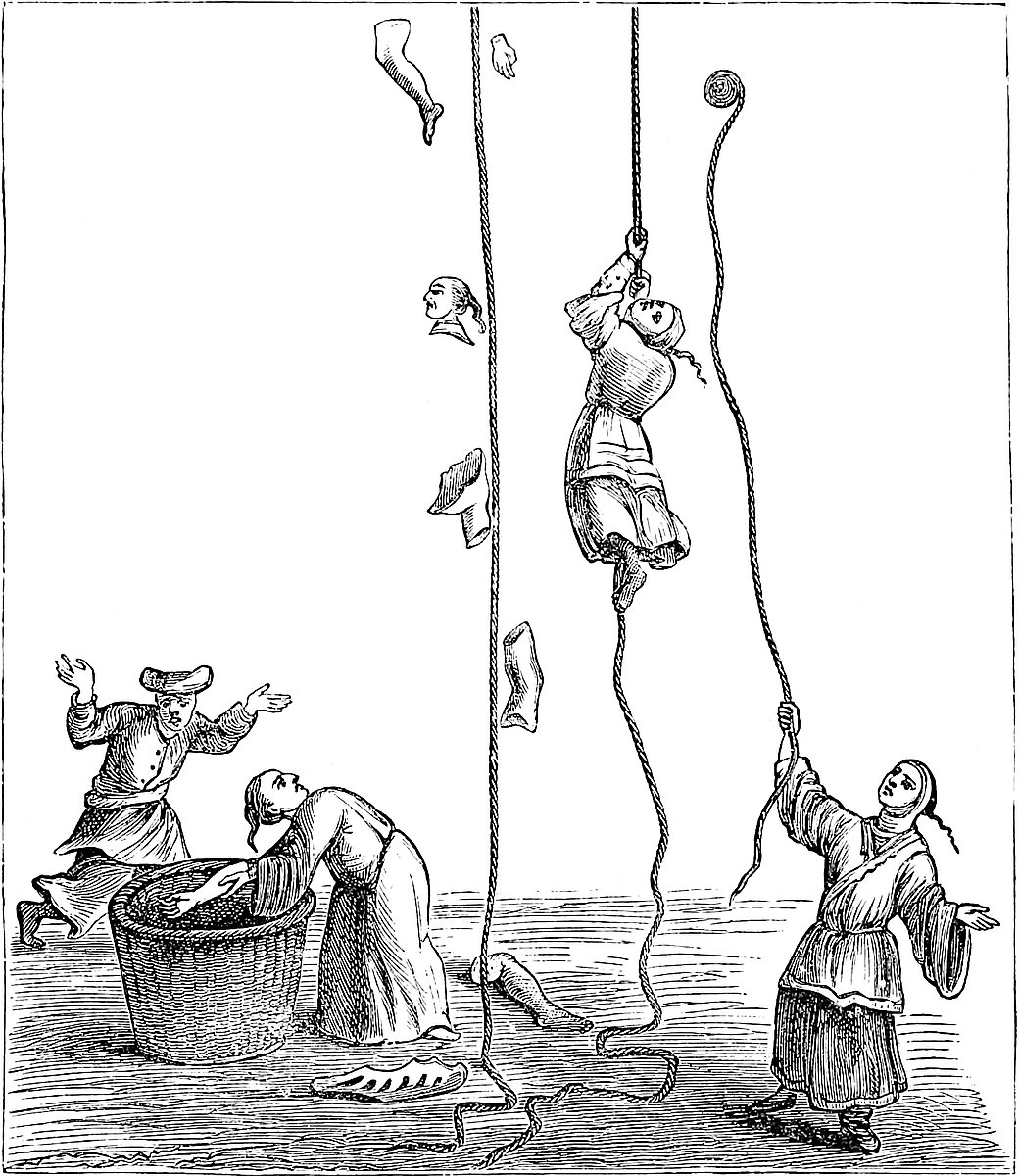
Chinese Conjuring Extraordinary.
Again we have in the Memoirs of the Emperor Jahángir a detail of the
wonderful performances of seven jugglers from Bengal who exhibited before
him. Two of their feats are thus described: “Ninth. They produced a man
whom they divided limb from limb, actually severing his head from the body.
They scattered these mutilated members along the ground, and in this state
they lay for some time. They then extended a sheet or curtain over the
spot, and one of the men putting himself under the sheet, in a few minutes
came from below, followed by the individual supposed to have been cut into
joints, in perfect health and condition, and one might have safely sworn
that he had never received wound or injury whatever ... Twenty-third.
They produced a chain of 50 cubits in length, and in my presence threw one
end of it towards the sky, where it remained as if fastened to something
in the air. A dog was then brought forward, and being placed at the
lower end of the chain, immediately ran up, and reaching the other end,
immediately disappeared in the air. In the same manner a hog, a panther,
a lion, and a tiger were successively sent up the chain, and all equally
disappeared at the upper end of the chain. At last they took down the chain
and put it into a bag, no one ever discovering in what way the different
animals were made to vanish into the air in the mysterious manner above
described.”
[There would appear (says the Times of India, quoted by the Weekly
Dispatch, 15th September, 1889) to be a fine field of unworked romance
in the annals of Indian jugglery. One Siddeshur Mitter, writing to the
Calcutta paper, gives a thrilling account of a conjurer’s feat which he
witnessed recently in one of the villages of the Hooghly district. He
saw the whole thing himself, he tells us, so there need be no question
about the facts. On the particular afternoon when he visited the village
the place was occupied by a company of male and female jugglers, armed
with bags and boxes and musical instruments, and all the mysterious
paraphernalia of the peripatetic Jadugar. While Siddeshur was looking
on, and in the broad, clear light of the afternoon, a man was shut up in a
box, which was then carefully nailed up and bound with cords. Weird spells
and incantations of the style we are all familiar with were followed by
the breaking open of the box, which, “to the unqualified amazement of
everybody, was found to be perfectly empty.” All this is much in the usual
style; but what followed was so much superior to the ordinary run of modern
Indian jugglery that we must give it in the simple Siddeshur’s own words.
When every one was satisfied that the man had really disappeared, the
principal performer, who did not seem to be at all astonished, told his
audience that the vanished man had gone up to the heavens to fight Indra.
“In a few moments,” says Siddeshur, “he expressed anxiety at the man’s
continued absence in the aerial regions, and said that he would go up to
see what was the matter. A boy was called, who held upright a long bamboo,
up which the man climbed to the top, whereupon we suddenly lost sight of
him, and the boy laid the bamboo on the ground. Then there fell on the
ground before us the different members of a human body, all bloody,—first
one hand, then another, a foot, and so on, until complete. The boy then
elevated the bamboo, and the principal performer, appearing on the top as
suddenly as he had disappeared, came down, and seeming quite disconsolate,
said that Indra had killed his friend before he could get there to save
him. He then placed the mangled remains in the same box, closed it, and
tied it as before. Our wonder and astonishment reached their climax when,
a few minutes later, on the box being again opened, the man jumped out
perfectly hearty and unhurt.” Is not this rather a severe strain on one’s
credulity, even for an Indian jugglery story?]
In Philostratus, again, we may learn the antiquity of some juggling tricks
that have come up as novelties in our own day. Thus at Taxila a man set his
son against a board, and then threw darts tracing the outline of the boy’s
figure on the board. This feat was shown in London some fifteen or twenty
years ago, and humorously commemorated in Punch by John Leech.
(Philostratus, Fr. Transl. Bk. III. ch. xv. and xxvii.; Mich. Glycas,
Ann. II. 156, Paris ed.; Delrio, Disquis. Magic. pp. 34, 100; Koeppen,
I. 31, II. 82, 114–115, 260, 262, 280; Vassilyev, 156; Della Penna, 36;
S. Setzen, 43, 353; Pereg. Quat. 117; I. B. IV. 39 and 290 seqq.;
Asiat. Researches, XVII. 186; Valentyn, V. 52–54; Edward Melton,
Engelsch Edelmans, Zeldzaame en Gedenkwaardige Zee en Land Reizen, etc.,
aangevangen in den Jaare 1660 en geendigd in den Jaare 1677, Amsterdam,
1702, p. 468; Mem. of the Emp. Jahangueir, pp. 99, 102.)
CHO-KHANG
The Grand Temple of Buddha at LHASA
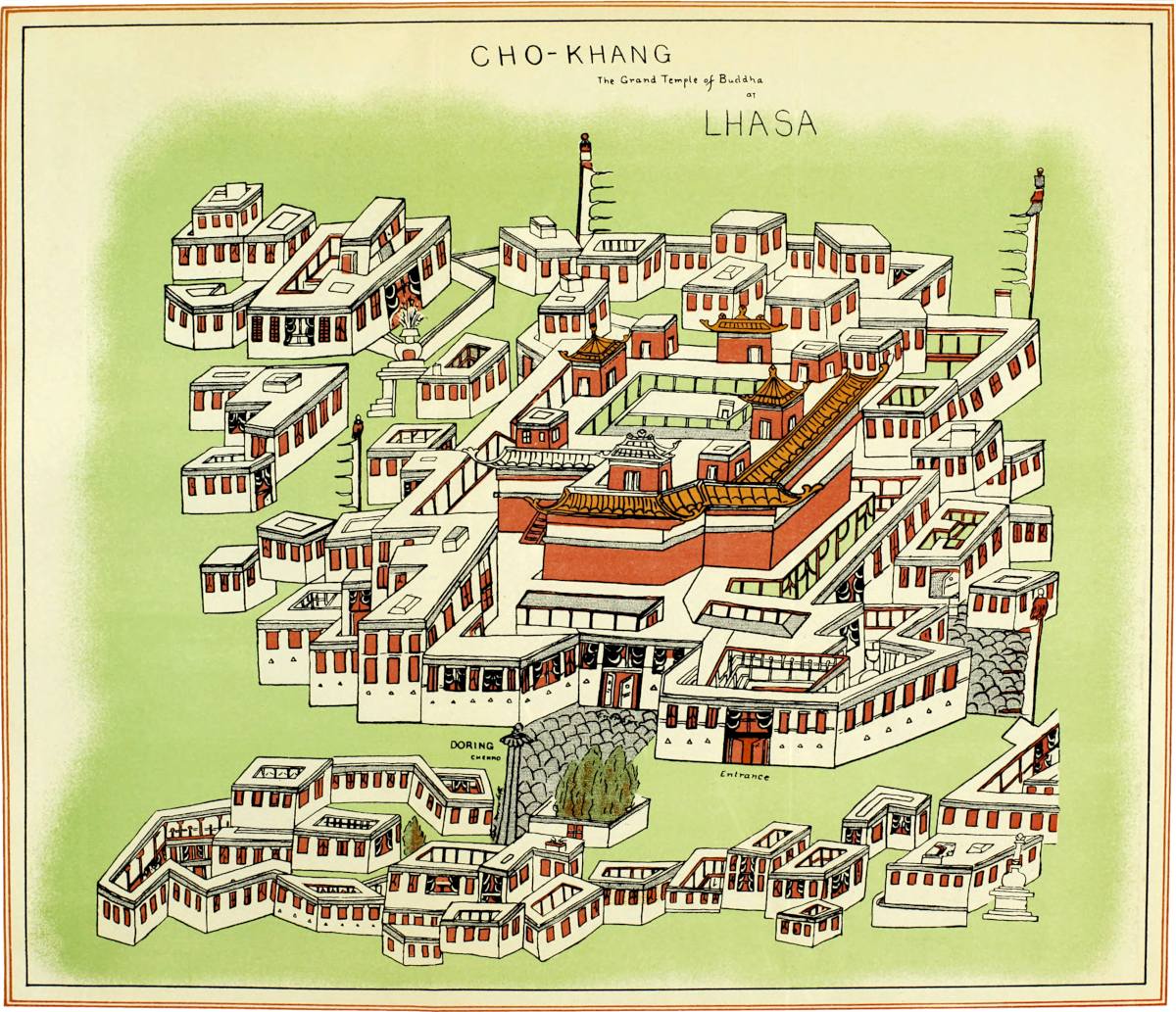
Note 12.—[“The maintenance of the Lamas, of their monasteries, the expenses
for the sacrifices and for transcription of sacred books, required enormous
sums. The Lamas enjoyed a preponderating influence, and stood much higher
than the priests of other creeds, living in the palace as if in their own
house. The perfumes, which M. Polo mentions, were used by the Lamas for two
purposes; they used them for joss-sticks, and for making small turrets,
known under the name of ts’a-ts’a; the joss-sticks used to be burned in
the same way as they are now; the ts’a-ts’a were inserted in suburgas
or buried in the ground. At the time when the suburga was built in the
garden of the Peking palace in 1271, there were used, according to the
Empress’ wish, 1008 turrets made of the most expensive perfumes, mixed with
pounded gold, silver, pearls, and corals, and 130,000 ts’a-ts’a made of
ordinary perfumes.” (Palladius, 29.)—H. C.]
Note 13.—There is no exaggeration in this number. Turner speaks of 2500
monks in one Tibetan convent. Huc mentions Chorchi, north of the Great
Wall, as containing 2000; and Kúnbúm, where he and Gabet spent several
months, on the borders of Shensi and Tibet, had nearly 4000. The missionary
itinerary from Nepal to L’hasa given by Giorgi, speaks of a group of
convents at a place called Brephung, which formerly contained 10,000
inmates, and at the time of the journey (about 1700) still contained 5000,
including attendants. Dr. Campbell gives a list of twelve chief convents
in L’hasa and its vicinity (not including the Potala or Residence of the
Grand Lama), of which one is said to have 7500 members, resident and
itinerary. Major Montgomerie’s Pandit gives the same convent 7700 Lamas. In
the great monastery at L’hasa called Labrang, they show a copper kettle
holding more than 100 buckets, which was used to make tea for the Lamas
who performed the daily temple service. The monasteries are usually, as
the text says, like small towns, clustered round the great temples. That
represented at p. 224 is at Jehol, and is an imitation of the Potala at
L’hasa. (Huc’s Tartary, etc., pp. 45, 208, etc.; Alph. Tibetan, 453;
J. A. S. B. XXIV. 219; J. R. G. S. XXXVIII. 168; Koeppen, II. 338.)
[La Géographie, II. 1901, pp. 242–247, has an article by Mr. J. Deniker,
La Première Photographie de Lhassa, with a view of Potala, in 1901,
from a photograph by M. O. Norzunov; it is interesting to compare it with
the view given by Kircher in 1670.—H. C.]
[“The monasteries with numbers of monks, who, as M. Polo asserts, behaved
decently, evidently belonged to Chinese Buddhists, ho-shang; in
Kúblái’s time they had two monasteries in Shangtu, in the north-east and
north-west parts of the town.” (Palladius, 29.) Rubruck (Rockhill’s
ed. p. 145) says: “All the priests (of the idolaters) shave their heads,
and are dressed in saffron colour, and they observe chastity from the
time they shave their heads, and they live in congregations of one or two
hundred.”—H. C.]
Note 14.—There were many anomalies in the older Lamaism, and it permitted,
at least in some sects of it which still subsist, the marriage of
the clergy under certain limitations and conditions. One of Giorgi’s
missionaries speaks of a Lama of high hereditary rank as a spiritual
prince who marries, but separates from his wife as soon as he has a son,
who after certain trials is deemed worthy to be his successor. [“A good
number of Lamas were married, as M. Polo correctly remarks; their wives
were known amongst the Chinese, under the name of Fan-sao.” (Ch’ue
keng lu, quoted by Palladius, 28.)—H. C.] One of the “reforms” of
Tsongkhapa was the absolute prohibition of marriage to the clergy, and
in this he followed the institutes of the oldest Buddhism. Even the Red
Lamas, or unreformed, cannot now marry without a dispensation.
But even the oldest orthodox Buddhism had its Lay brethren and Lay sisters
(Upásaka and Upásiká), and these are to be found in Tibet and Mongolia
(Voués au blanc, as it were). They are called by the Mongols, by a
corruption of the Sanskrit, Ubashi and Ubashanza. Their vows extend
to the strict keeping of the five great commandments of the Buddhist Law,
and they diligently ply the rosary and the prayer-wheel, but they are not
pledged to celibacy, nor do they adopt the tonsure. As a sign of their
amphibious position, they commonly wear a red or yellow girdle. These are
what some travellers speak of as the lowest order of Lamas, permitted to
marry; and Polo may have regarded them in the same light.
(Koeppen, II. 82, 113, 276, 291; Timk. II. 354; Erman, II. 304;
Alph. Tibet. 449.)
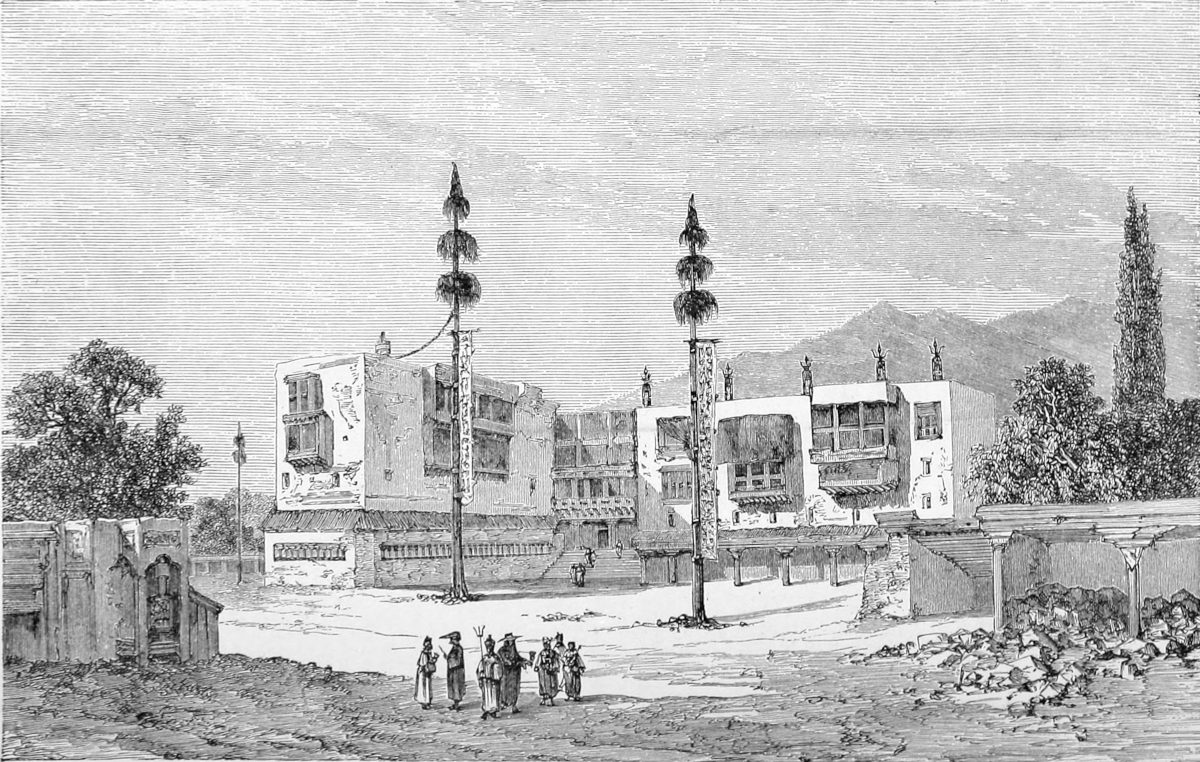
Monastery of Lamas.
Note
15.—[Mr. Rockhill writes to me that “bran” is certainly Tibetan
tsamba (parched barley).—H. C.]
Note
16.—Marco’s contempt for Patarins slips out in a later passage (Bk.
III. ch. xx.). The name originated in the eleventh century in Lombardy,
where it came to be applied to the “heretics,” otherwise called “Cathari.”
Muratori has much on the origin of the name Patarini, and mentions a
monument, which still exists, in the Piazza de’ Mercanti at Milan, in
honour of Oldrado Podestà of that city in 1233, and which thus, with more
pith than grammar, celebrates his meritorious acts:—
“Qui solium struxit Catharos ut debuit Uxit.”
Other cities were as piously Catholic. A Mantuan chronicler records under
1276: “Captum fuit Sermionum seu redditum fuit Ecclesiæ, et capti fuerunt
cercha cl Patarini contra fidem, inter masculos et feminas; qui omnes
ducti fuerunt Veronam, et ibi incarcerati, et pro magna parte Combusti.”
(Murat. Dissert. III. 238; Archiv. Stor. Ital. N.S. I. 49.)
Note 17.—Marsden, followed by Pauthier, supposes these unorthodox ascetics
to be Hindu Sanyasis, and the latter editor supposes even the name Sensi
or Sensin to represent that denomination. Such wanderers do occasionally
find their way to Tartary; Gerbillon mentions having encountered five
of them at Kuku Khotan (supra, p. 286), and I think John Bell speaks
of meeting one still further north. But what is said of the great and
numerous idols of the Sensin is inconsistent with such a notion, as
is indeed, it seems to me, the whole scope of the passage. Evidently no
occasional vagabonds from a far country, but some indigenous sectaries,
are in question. Nor would bran and hot water be a Hindu regimen. The
staple diet of the Tibetans is Chamba, the meal of toasted barley, mixed
sometimes with warm water, but more frequently with hot tea, and I think it
is probable that these were the elements of the ascetic diet rather than
the mere bran which Polo speaks of. Semedo indeed says that some of the
Buddhist devotees professed never to take any food but tea; knowing people
said they mixed with it pellets of sun-dried beef. The determination of the
sect intended in the text is, I conceive, to be sought in the history of
Chinese or Tibetan Buddhism and their rivals.
Both Baldelli and Neumann have indicated a general opinion that the
Taossé or some branch of that sect is meant, but they have entered into
no particulars except in a reference by the former to Shien-sien, a title
of perfection affected by that sect, as the origin of Polo’s term Sensin.
In the substance of this I think they are right. But I believe that in the
text this Chinese sect are, rightly or wrongly, identified with the ancient
Tibetan sect of Bon-po, and that part of the characters assigned belong
to each.
First with regard to the Taossé. These were evidently the Patarini of
the Buddhists in China at this time, and Polo was probably aware of the
persecution which the latter had stirred up Kúblái to direct against
them in 1281—persecution at least it is called, though it was but a mild
proceeding in comparison with the thing contemporaneously practised in
Christian Lombardy, for in heathen Cathay, books, and not human creatures,
were the subjects doomed to burn, and even that doom was not carried out.
[“The Tao-sze,” says M. Polo, “were looked upon as heretics by the other
sects; that is, of course, by the Lamas and Ho-shangs; in fact in his time
a passionate struggle was going on between Buddhists and Tao-sze, or rather
a persecution of the latter by the former; the Buddhists attributed to the
doctrine of the Tao-sze a pernicious tendency, and accused them of deceit;
and in support of these assertions they pointed to some of their sacred
books. Taking advantage of their influence at Court, they persuaded Kúblái
to decree the burning of these books, and it was carried out in Peking.”
(Palladius, 30.)—H. C.]
The term which Polo writes as Sensin appears to have been that popularly
applied to the Taossé sect at the Mongol Court. Thus we are told by
Rashíduddín in his History of Cathay: “In the reign of Din-Wang, the 20th
king of this (the 11th) Dynasty, Tai Shang Lái Kún, was born. This person
is stated to have been accounted a prophet by the people of Khitá; his
father’s name was Hán; like Shák-múni he is said to have been conceived
by light, and it is related that his mother bore him in her womb no less
a period than 80 years. The people who embraced his doctrine were called
شن شن (Shăn-shăn or Shinshin).” This is a correct epitome of the
Chinese story of Laokiun or Lao-tsé, born in the reign of Ting Wang
of the Cheu Dynasty. The whole title used by Rashíduddín, Tai Shang Lao
Kiun, “The Great Supreme Venerable Ruler,” is that formerly applied by the
Chinese to this philosopher.
Further, in a Mongol [and Chinese] inscription of the year 1314 from the
department of Si-ngan fu, which has been interpreted and published by Mr.
Wylie, the Taossé priests are termed Senshing. [See Devéria, Notes
d’Épigraphie, pp. 39–43, and Prince R. Bonaparte’s Recueil, Pl. xii. No.
3.—H. C.]
Seeing then that the very term used by Polo is that applied by both Mongol
and Persian authorities of the period to the Taossé, we can have no doubt
that the latter are indicated, whether the facts stated about them be
correct or not.
The word Senshing-ud (the Mongol plural) is represented in the Chinese
version of Mr. Wylie’s inscription by Sín-săng, a conventional title
applied to literary men, and this perhaps is sufficient to determine the
Chinese word which Sensin represents. I should otherwise have supposed
it to be the Shin-sian alluded to by Baldelli, and mentioned in the
quotations which follow; and indeed it seems highly probable that two
terms so much alike should have been confounded by foreigners. Semedo
says of the Taossé: “They pretend that by means of certain exercises and
meditations one shall regain his youth, and others shall attain to be
Shien-sien, i.e. ‘Terrestrial Beati,’ in whose state every desire is
gratified, whilst they have the power to transport themselves from one
place to another, however distant, with speed and facility.” Schott, on the
same subject, says: “By Sian or Shin-sian are understood in the old
Chinese conception, and particularly in that of the Tao-Kiao [or Taossé]
sect, persons who withdraw to the hills to lead the life of anchorites,
and who have attained, either through their ascetic observances or by the
power of charms and elixirs, to the possession of miraculous gifts and of
terrestrial immortality.” And M. Pauthier himself, in his translation of
the Journey of Khieu, an eminent doctor of this sect, to the camp of the
Great Chinghiz in Turkestan, has related how Chinghiz bestowed upon this
personage “a seal with a tiger’s head and a diploma” (surely a lion’s head,
P’aizah and Yarligh; see infra, Bk. II. ch. vii. note 2), “wherein he
was styled Shin Sien or Divine Anchorite.” Sian-jin again is the word
used by Hiuen Tsang as the equivalent to the name of the Indian Rishis,
who attain to supernatural powers.
[“Sensin is a sufficiently faithful transcription of Sien-seng
(Sien-shing in Pekingese); the name given by the Mongols in conversation as
well as in official documents, to the Tao-sze, in the sense of preceptors,
just as Lamas were called by them Bacshi, which corresponds to the
Chinese Sien-seng. M. Polo calls them fasters and ascetics. It was one
of the sects of Taouism. There was another one which practised cabalistic
and other mysteries. The Tao-sze had two monasteries in Shangtu, one in the
eastern, the other in the western part of the town.” (Palladius, 30.)—H. C.]
One class of the Tao priests or devotees does marry, but another class
never does. Many of them lead a wandering life, and derive a precarious
subsistence from the sale of charms and medical nostrums. They shave the
sides of the head, and coil the remaining hair in a tuft on the crown, in
the ancient Chinese manner; moreover, says Williams, they “are recognised
by their slate-coloured robes.” On the feast of one of their divinities
whose title Williams translates as “High Emperor of the Sombre Heavens,”
they assemble before his temple, “and having made a great fire, about 15
or 20 feet in diameter, go over it barefoot, preceded by the priests and
bearing the gods in their arms. They firmly assert that if they possess a
sincere mind they will not be injured by the fire; but both priests and
people get miserably burnt on these occasions.” Escayrac de Lauture says
that on those days they leap, dance, and whirl round the fire, striking
at the devils with a straight Roman-like sword, and sometimes wounding
themselves as the priests of Baal and Moloch used to do.
(Astley, IV. 671; Morley in J. R. A. S. VI. 24; Semedo, 111, 114;
De Mailla, IX. 410; J. As. sér. V. tom. viii. 138; Schott über den
Buddhismus etc. 71; Voyage de Khieou in J. As. sér. VI. tom. ix. 41;
Middle Kingdom, II. 247; Doolittle, 192; Esc. de Lauture, Mém. sur la
Chine, Religion, 87, 102; Pèler. Boudd. II. 370, and III. 468.)
Let us now turn to the Bon-po. Of this form of religion and its sectaries
not much is known, for it is now confined to the eastern and least known
part of Tibet. It is, however, believed to be a remnant of the old
pre-Buddhistic worship of the powers of nature, though much modified by the
Buddhistic worship with which it has so long been in contact. Mr. Hodgson
also pronounces a collection of drawings of Bonpo divinities, which were
made for him by a mendicant friar of the sect from the neighbourhood of
Tachindu, or Ta-t’sien-lu, to be saturated with Sakta attributes, i.e.
with the spirit of the Tantrika worship, a worship which he tersely defines
as “a mixture of lust, ferocity, and mummery,” and which he believes to
have originated in an incorporation with the Indian religions of the rude
superstitions of the primitive Turanians. Mr. Hodgson was told that the
Bonpo sect still possessed numerous and wealthy Vihars (or abbeys) in
Tibet. But from the information of the Catholic missionaries in Eastern
Tibet, who have come into closest contact with the sect, it appears to
be now in a state of great decadence, “oppressed by the Lamas of other
sects, the Peunbo (Bonpo) think only of shaking off the yoke, and getting
deliverance from the vexations which the smallness of their number forces
them to endure.” In June, 1863, apparently from such despairing motives,
the Lamas of Tsodam, a Bonpo convent in the vicinity of the mission
settlement of Bonga in E. Tibet, invited the Rev. Gabriel Durand to come
and instruct them. “In this temple,” he writes, “are the monstrous idols
of the sect of Peunbo; horrid figures, whose features only Satan could
have inspired. They are disposed about the enclosure according to their
power and their seniority. Above the pagoda is a loft, the nooks of which
are crammed with all kinds of diabolical trumpery; little idols of wood or
copper, hideous masques of men and animals, superstitious Lama vestments,
drums, trumpets of human bones, sacrificial vessels, in short, all the
utensils with which the devil’s servants in Tibet honour their master. And
what will become of it all? The Great River, whose waves roll to Martaban
(the Lu-kiang or Salwen), is not more than 200 or 300 paces distant....
Besides the infernal paintings on the walls, eight or nine monstrous idols,
seated at the inner end of the pagoda, were calculated by their size and
aspect to inspire awe. In the middle was Tamba-Shi-Rob, the great doctor
of the sect of the Peunbo, squatted with his right arm outside his red
scarf, and holding in his left the vase of knowledge.... On his right
hand sat Keumta-Zon-bo, ‘the All-Good,’ ... with ten hands and three
heads, one over the other.... At his right is Dreuma, the most celebrated
goddess of the sect. On the left of Tamba-Shi-Rob was another goddess,
whose name they never could tell me. On the left again of this anonymous
goddess appeared Tam-pla-mi-ber, ... a monstrous dwarf environed by flames
and his head garnished with a diadem of skulls. He trod with one foot
on the head of Shakia-tupa [Shakya Thubba, i.e. ‘the Mighty Shakya,’
the usual Tibetan appellation of Sakya Buddha himself].... The idols are
made of a coarse composition of mud and stalks kneaded together, on which
they put first a coat of plaster and then various colours, or even silver
or gold.... Four oxen would scarcely have been able to draw one of the
idols.” Mr. Emilius Schlagintweit, in a paper on the subject of this sect,
has explained some of the names used by the missionary. Tamba-Shi-Rob is
“bstanpa gShen-rabs,” i.e. the doctrine of Shen-rabs, who is regarded
as the founder of the Bon religion. [Cf. Grenard, II. 407.—H. C.]
Keun-tu-zon-bo is “Kun-tu-bzang-po,” “the All Best.”
[Bon-po seems to be (according to Grenard, II. 410) a “coarse naturism
combined with ancestral worship” resembling Taoism. It has, however,
borrowed a good deal from Buddhism. “I noticed,” says Mr. Rockhill
(Journey, 86), “a couple of grimy volumes of Bönbo sacred literature. One
of them I examined; it was a funeral service, and was in the usual Bönbo
jargon, three-fourths Buddhistic in its nomenclature.” The Bon-po Lamas are
above all sorcerers and necromancers, and are very similar to the kam of
the Northern Turks, the bô of the Mongols, and lastly to the Shamans.
During their operations, they wear a tall pointed black hat, surmounted by
the feather of a peacock, or of a cock, and a human skull. Their principal
divinities are the White God of Heaven, the Black Goddess of Earth, the
Red Tiger and the Dragon; they worship an idol called Kye’-p’ang formed
of a mere block of wood covered with garments. Their sacred symbol is the
svastika turned from right to left 卍. The most important of their
monasteries is Zo-chen gum-pa, in the north-east of Tibet, where they
print most of their books. The Bonpos Lamas “are very popular with the
agricultural Tibetans, but not so much so with the pastoral tribes, who
nearly all belong to the Gélupa sect of the orthodox Buddhist Church.” A.
K. says, “Buddhism is the religion of the country; there are two sects,
one named Mangba and the other Chiba or Baimbu.” Explorations made by
A—— K——, 34. Mangba means “Esoteric,” Chiba (p’yi-ba), “Exoteric,”
and Baimbu is Bönbo. Rockhill, Journey, 289, et passim.; Land of the
Lamas, 217–218; Grenard, Mission Scientifique, II. 407 seqq.—H. C.]
There is an indication in Koeppen’s references that the followers of the
Bon doctrine are sometimes called in Tibet Nag-choi, or “Black Sect,”
as the old and the reformed Lamas are called respectively the “Red” and the
“Yellow.” If so, it is reasonable to conclude that the first appellation,
like the two last, has a reference to the colour of clothing affected by
the priesthood.
The Rev. Mr. Jaeschke writes from Lahaul: “There are no Bonpos in our part
of the country, and as far as we know there cannot be many of them in the
whole of Western Tibet, i.e. in Ladak, Spiti, and all the non-Chinese
provinces together; we know, therefore, not much more of them than has
been made known to the European public by different writers on Buddhism in
Tibet, and lately collected by Emil de Schlagintweit.... Whether they can
be with certainty identified with the Chinese Taossé I cannot decide,
as I don’t know if anything like historical evidence about their Chinese
origin has been detected anywhere, or if it is merely a conclusion from
the similarity of their doctrines and practices.... But the Chinese author
of the Wei-tsang-tu-Shi, translated by Klaproth, under the title of
Description du Tubet (Paris, 1831), renders Bonpo by Taossé. So much
seems to be certain that it was the ancient religion of Tibet, before
Buddhism penetrated into the country, and that even at later periods
it several times gained the ascendancy when the secular power was of a
disposition averse to the Lamaitic hierarchy. Another opinion is that the
Bon religion was originally a mere fetishism, and related to or identical
with Shamanism; this appears to me very probable and easy to reconcile with
the former supposition, for it may afterwards, on becoming acquainted with
the Chinese doctrine of the ‘Taossé,’ have adorned itself with many of its
tenets.... With regard to the following particulars, I have got most of my
information from our Lama, a native of the neighbourhood of Tashi Lhunpo,
whom we consulted about all your questions. The extraordinary asceticism
which struck Marco Polo so much is of course not to be understood as being
practised by all members of the sect, but exclusively, or more especially,
by the priests. That these never marry, and are consequently more
strictly celibatary than many sects of the Lamaitic priesthood, was
confirmed by our Lama.” (Mr. Jaeschke then remarks upon the bran to much
the same effect as I have done above.) “The Bonpos are by all Buddhists
regarded as heretics. Though they worship idols partly the same, at least
in name, with those of the Buddhists, ... their rites seem to be very
different. The most conspicuous and most generally known of their customs,
futile in itself, but in the eyes of the common people the greatest sign of
their sinful heresy, is that they perform the religious ceremony of making
a turn round a sacred object in the opposite direction to that prescribed
by Buddhism. As to their dress, our Lama said that they had no particular
colour of garments, but their priests frequently wore red clothes, as some
sects of the Buddhist priesthood do. Mr. Heyde, however, once on a journey
in our neighbouring county of Langskar, saw a man clothed in black with
blue borders, who the people said was a Bonpo.”
[Mr. Rockhill (Journey , 63) saw at Kao miao-tzŭ “a red-gowned,
long-haired Bönbo Lama,” and at Kumbum (p. 68), “was surprised to see quite
a large number of Bönbo Lamas, recognisable by their huge mops of hair and
their red gowns, and also from their being dirtier than the ordinary run
of people.”—H. C.]
The identity of the Bonpo and Taossé seems to have been accepted by Csoma
de Körös, who identifies the Chinese founder of the latter, Lao-tseu, with
the Shen-rabs of the Tibetan Bonpos. Klaproth also says, “Bhonbp’o, Bhanpo,
and Shen, are the names by which are commonly designated (in Tibetan) the
Taoszu, or followers of the Chinese philosopher Laotseu.”[11] Schlagintweit
refers to Schmidt’s Tibetan Grammar (p. 209) and to the Calcutta edition of
the Fo-kouè-ki (p. 218) for the like identification, but I do not know
how far any two of these are independent testimonies. General Cunningham,
however, fully accepts the identity, and writes to me: “Fahian (ch.
xxiii.) calls the heretics who assembled at Râmagrâma Taossé,[12] thus
identifying them with the Chinese Finitimists. The Taossé are, therefore,
the same as the Swâstikas, or worshippers of the mystic cross Swasti,
who are also Tirthakaras, or ‘Pure-doers.’ The synonymous word Punya
is probably the origin of Pon or Bon, the Tibetan Finitimists. From
the same word comes the Burmese P’ungyi or Pungi.” I may add that the
Chinese envoy to Cambodia in 1296, whose narrative Rémusat has translated,
describes a sect which he encountered there, apparently Brahminical, as
Taossé. And even if the Bonpo and the Taossé were not fundamentally
identical, it is extremely probable that the Tibetan and Mongol Buddhists
should have applied to them one name and character. Each played towards
them the same part in Tibet and in China respectively; both were heretic
sects and hated rivals; both made high pretensions to asceticism and
supernatural powers; both, I think we see reason to believe, affected the
dark clothing which Polo assigns to the Sensin; both, we may add, had
“great idols and plenty of them.” We have seen in the account of the Taossé
the ground that certain of their ceremonies afford for the allegation
that they “sometimes also worship fire,” whilst the whole account of
that rite and of others mentioned by Duhalde,[13] shows what a powerful
element of the old devil-dancing Shamanism there is in their practice.
The French Jesuit, on the other hand, shows us what a prominent place
female divinities occupied in the Bon-po Pantheon,[14] though we cannot
say of either sect that “their idols are all feminine.” A strong symptom
of relation between the two religions, by the way, occurs in M. Durand’s
account of the Bon Temple. We see there that Shen-rabs, the great doctor
of the sect, occupies a chief and central place among the idols. Now in
the Chinese temples of the Taossé the figure of their Doctor Lao-tseu
is one member of the triad called the “Three Pure Ones,” which constitute
the chief objects of worship. This very title recalls General Cunningham’s
etymology of Bonpo.
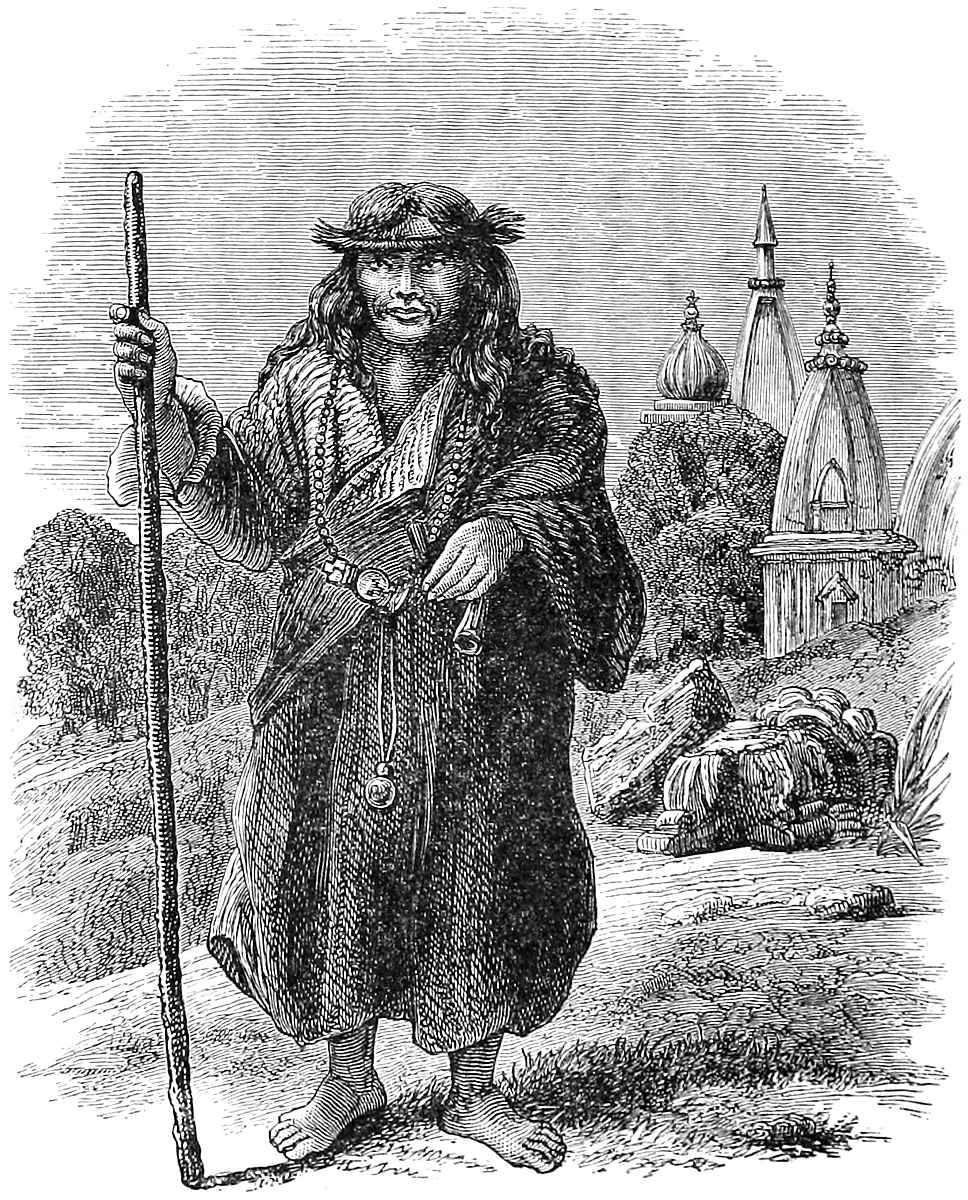
Tibetan Bacsi.
[At the quarterly fair (yueh kai) of Ta-li (Yun-Nan), Mr. E. C. Baber
(Travels, 158–159) says: “A Fakir with a praying machine, which he
twirled for the salvation of the pious at the price of a few cash, was
at once recognised by us; he was our old acquaintance, the Bakhsi, whose
portrait is given in Colonel Yule’s Marco Polo.”—H. C.]
(Hodgson, in J. R. A. S. XVIII. 396 seqq.; Ann. de la Prop. de la
Foi, XXXVI. 301–302, 424–427; E. Schlagintweit, Ueber die Bon-pa Sekte
in Tibet, in the Sitzensberichte of the Munich Acad. for 1866, Heft
I. pp. 1–12; Koeppen, II. 260; Ladak, p. 358; J. As. sér. II. tom.
i. 411–412; Rémusat. Nouv. Mél. Asiat. I. 112; Astley, IV. 205;
Doolittle, 191.)
Note
18.—Pauthier’s text has blons, no doubt an error for blous. In
the G. Text it is bloies. Pauthier interprets the latter term as “blond
ardent,” whilst the glossary to the G. Text explains it as both blue and
white. Raynouard’s Romance Dict. explains Bloi as “Blond.” Ramusio
has biave, and I have no doubt that blue is the meaning. The same word
(bloie) is used in the G. Text, where Polo speaks of the bright colours
of the Palace tiles at Cambaluc, and where Pauthier’s text has “vermeil
et jaune et vert et blou,” and again (infra, Bk. II. ch. xix.), where the
two corps of huntsmen are said to be clad respectively in vermeil and
in bloie. Here, again, Pauthier’s text has bleu. The Crusca in the
description of the Sensin omits the colours altogether; in the two other
passages referred to it has bioda, biodo.
[“The Tao-sze, says Marco Polo, wear dresses of black and blue linen; i.e.
they wear dresses made of tatters of black and blue linen, as can be seen
also at the present day.” (Palladius, 30.)—H. C.]
Note 19.—[“The idols of the Tao-sze, according to Marco Polo’s statement,
have female names; in fact, there are in the pantheon of Taoism a great
many female divinities, still enjoying popular veneration in China; such
are Tow Mu (the ‘Ursa major,’ constellation), Pi-hia-yuen Kiun (the
celestial queen), female divinities for lying-in women, for children, for
diseases of the eyes; and others, which are to be seen everywhere. The
Tao-sze have, besides these, a good number of male divinities, bearing the
title of Kiun in common with female divinities; both these circumstances
might have led Marco Polo to make the above statement.” (Palladius, p.
30.)—H. C.]
CHAPTER I . — CHAPTER II . — CHAPTER III . — CHAPTER IV . — CHAPTER V . — CHAPTER VI . — CHAPTER VII . — CHAPTER VIII . — CHAPTER IX . — CHAPTER X . — CHAPTER XI . — CHAPTER XII . — CHAPTER XIII . — CHAPTER XIV . — CHAPTER XV . — CHAPTER XVI . — CHAPTER XVII . — CHAPTER XVIII . — CHAPTER XIX . — CHAPTER XX . — CHAPTER XXI . — CHAPTER XXII . — CHAPTER XXIII . — CHAPTER XXIV . — CHAPTER XXV . — CHAPTER XXVI . — CHAPTER XXVII . — CHAPTER XXVIII . — CHAPTER XXIX . — CHAPTER XXX . — CHAPTER XXXI . — CHAPTER XXXII . — CHAPTER XXXIII . — CHAPTER XXXIV .
PART I.—THE KAAN, HIS COURT AND CAPITAL.
Of Cublay Kaan, the Great Kaan now Reigning, and of his Great Puissance.
Now am I come to that part of our Book in which I shall tell you of the
great and wonderful magnificence of the Great Kaan now reigning, by name
Cublay Kaan; Kaan being a title which signifyeth “The Great Lord of
Lords,” or Emperor. And of a surety he hath good right to such a title, for
all men know for a certain truth that he is the most potent man, as regards
forces and lands and treasure, that existeth in the world, or ever hath
existed from the time of our First Father Adam until this day. All this I
will make clear to you for truth, in this book of ours, so that every one
shall be fain to acknowledge that he is the greatest Lord that is now in
the world, or ever hath been. And now ye shall hear how and wherefore.{1}
Note 1.—According to Sanang Setzen, Chinghiz himself discerned young
Kúblái’s superiority. On his deathbed he said: “The words of the lad Kúblái
are well worth attention; see, all of you, that ye heed what he says! One
day he will sit in my seat and bring you good fortune such as you have had
in my day!” (p. 105).
The Persian history of Wassáf thus exalts Kúblái: “Although from the
frontiers of this country (’Irák) to the Centre of Empire, the Focus of
the Universe, the genial abode of the ever-Fortunate Emperor and Just
Kaan, is a whole year’s journey, yet the stories that have been spread
abroad, even in these parts, of his glorious deeds, his institutes, his
decisions, his justice, the largeness and acuteness of his intellect,
his correctness of judgment, his great powers of administration, from
the mouths of credible witnesses, of well-known merchants and eminent
travellers, are so surpassing, that one beam of his glories, one fraction
of his great qualities, suffices to eclipse all that history tells of the
Cæsars of Rome, of the Chosroes of Persia, of the Khagans of China, of
the (Himyarite) Kails of Arabia, of the Tobbas of Yemen, and the Rajas
of India, of the monarchs of the houses of Sassan and Búya, and of the
Seljukian Sultans.” (Hammer’s Wassaf, orig. p. 37.)
Some remarks on Kúblái and his government by a Chinese author, in a more
rational and discriminative tone, will be found below under ch. xxiii.,
note 2.
A curious Low-German MS. at Cologne, giving an account of the East, says of
the “Keyser von Kathagien—syn recht Name is der groisse Hunt!” (Magnus
Canis, the Big Bow-wow as it were. See Orient und Occident, vol. i. p. 640.)
Concerning the Revolt of Nayan, who was Uncle to the Great Kaan Cublay.
Now this Cublay Kaan is of the right Imperial lineage, being descended
from Chinghis Kaan, the first sovereign of all the Tartars. And he is the
sixth Lord in that succession, as I have already told you in this book.
He came to the throne in the year of Christ, 1256, and the Empire fell
to him because of his ability and valour and great worth, as was right
and reason.{1} His brothers, indeed, and other kinsmen disputed his
claim, but his it remained, both because maintained by his great valour,
and because it was in law and right his, as being directly sprung of the
imperial line.
Up to the year of Christ now running, to wit 1298, he hath reigned
two-and-forty years, and his age is about eighty-five, so that he must have
been about forty-three years of age when he first came to the throne.{2}
Before that time he had often been to the wars, and had shown himself a
gallant soldier and an excellent captain. But after coming to the throne he
never went to the wars in person save once.{3} This befel in the year
of Christ, 1286, and I will tell you why he went.
There was a great Tartar Chief, whose name was Nayan,{4} a young man
[of thirty], Lord over many lands and many provinces; and he was Uncle to
the Emperor Cublay Kaan of whom we are speaking. And when he found himself
in authority this Nayan waxed proud in the insolence of his youth and his
great power; for indeed he could bring into the field 300,000 horsemen,
though all the time he was liegeman to his nephew, the Great Kaan Cublay,
as was right and reason. Seeing then what great power he had, he took it
into his head that he would be the Great Kaan’s vassal no longer; nay more,
he would fain wrest his empire from him if he could. So this Nayan sent
envoys to another Tartar Prince called Caidu, also a great and potent Lord,
who was a kinsman of his, and who was a nephew of the Great Kaan and his
lawful liegeman also, though he was in rebellion and at bitter enmity with
his sovereign Lord and Uncle. Now the message that Nayan sent was this:
That he himself was making ready to march against the Great Kaan with all
his forces (which were great), and he begged Caidu to do likewise from his
side, so that by attacking Cublay on two sides at once with such great
forces they would be able to wrest his dominion from him.
And when Caidu heard the message of Nayan, he was right glad thereat,
and thought the time was come at last to gain his object. So he sent
back answer that he would do as requested; and got ready his host, which
mustered a good hundred thousand horsemen.
Now let us go back to the Great Kaan, who had news of all this plot.
Note 1.—There is no doubt that Kúblái was proclaimed Kaan in 1260 (4th
month), his brother Mangku Kaan having perished during the seige of Hochau
in Szechwan in August of the preceding year. But Kúblái had come into
Cathay some years before as his brother’s Lieutenant.
He was the fifth, not sixth, Supreme Kaan, as we have already noticed.
(Bk. I. ch. li. note 2.)
Note 2.—Kúblái was born in the eighth month of the year corresponding
to 1216, and had he lived to 1298 would have been eighty-two years old.
[According to Dr. E. Bretschneider (Peking, 30), quoting the Yuen-Shi,
Kúblái died at Khanbaligh, in the Tze-t’an tien in February, 1294.—H. C.]
But by Mahomedan reckoning he would have been close upon eighty-five. He
was the fourth son of Tuli, who was the youngest of Chinghiz’s four sons by
his favourite wife Burté Fujin. (See De Mailla, IX. 255, etc.)
Note 3.—This is not literally true; for soon after his accession (in 1261)
Kúblái led an army against his brother and rival Arikbuga, and defeated
him. And again in his old age, if we credit the Chinese annalist, in 1289,
when his grandson Kanmala (or Kambala) was beaten on the northern frontier
by Kaidu, Kúblái took the field himself, though on his approach the rebels
disappeared.
Kúblái and his brother Hulaku, young as they were, commenced their military
career on Chinghiz’s last expedition (1226–1227). His most notable campaign
was the conquest of Yunnan in 1253–1254. (De Mailla, IX. 298, 441.)
Note 4.—Nayan was no “uncle” of Kúblái’s, but a cousin in a junior
generation. For Kúblái was the grandson of Chinghiz, and Nayan was the
great-great-grandson of Chinghiz’s brother Uchegin, called in the Chinese
annals Pilgutai. [Belgutai was Chinghiz’s step-brother. (Palladius.)—H. C.]
On this brother, the great-uncle of Kúblái, and the commander of the
latter’s forces against Arikbuga in the beginning of the reign, both
Chinghiz and Kúblái had bestowed large territories in Eastern Tartary
towards the frontier of Corea, and north of Liaotong towards the Manchu
country. [“The situation and limits of his appanage are not clearly defined
in history. According to Belgutai’s biography, it was between the Onon and
Kerulen (Yuen shi), and according to Shin Yao’s researches (Lo fung low
wen kao), at the confluence of the Argun and Shilka. Finally, according
to Harabadur’s biography, it was situated in Abalahu, which geographically
and etymologically corresponds to modern Butkha (Yuen shi); Abalahu,
as Kúblái himself said, was rich in fish; indeed, after the suppression
of Nayan’s rebellion, the governor of that country used to send to the
Peking Court fishes weighing up to a thousand Chinese pounds (kin.). It
was evidently a country near the Amur River.” (Palladius, l.c. 31.)—H. C.]
Nayan had added to his inherited territory, and become very powerful.
[“History has apparently connected Nayan’s appanage with that of Hatan
(a grandson of Hachiun, brother of Chinghiz Khan), whose ordo was
contiguous to Nayan’s, on the left bank of the Amur, hypothetically east
of Blagovietschensk, on the spot, where still the traces of an ancient
city can be seen. Nayan’s possessions stretched south to Kwang-ning, which
belonged to his appanage, and it was from this town that he had the title
of prince of Kwang-ning (Yuen shi).” (Palladius, l.c. 31.)—H. C.]
Kaidu had gained influence over Nayan, and persuaded him to rise against
Kúblái. A number of the other Mongol princes took part with him. Kúblái
was much disquieted at the rumours, and sent his great lieutenant Bayan to
reconnoitre. Bayan was nearly captured, but escaped to court and reported
to his master the great armament that Nayan was preparing. Kúblái succeeded
by diplomacy in detaching some of the princes from the enterprise, and
resolved to march in person to the scene of action, whilst despatching
Bayan to the Karakorum frontier to intercept Kaidu. This was in the summer
of 1287. What followed will be found in a subsequent note (ch. iv. note 6).
(For Nayan’s descent, see the Genealogical Table in the Appendix (A).)
How the Great Kaan marched against Nayan.
When the Great Kaan heard what was afoot, he made his preparations in right
good heart, like one who feared not the issue of an attempt so contrary
to justice. Confident in his own conduct and prowess, he was in no degree
disturbed, but vowed that he would never wear crown again if he brought not
those two traitorous and disloyal Tartar chiefs to an ill end. So swiftly
and secretly were his preparations made, that no one knew of them but his
Privy Council, and all were completed within ten or twelve days. In that
time he had assembled good 360,000 horsemen, and 100,000 footmen,—but a
small force indeed for him, and consisting only of those that were in the
vicinity. For the rest of his vast and innumerable forces were too far
off to answer so hasty a summons, being engaged under orders from him on
distant expeditions to conquer divers countries and provinces. If he had
waited to summon all his troops, the multitude assembled would have been
beyond all belief, a multitude such as never was heard of or told of,
past all counting. In fact, those 360,000 horsemen that he got together
consisted merely of the falconers and whippers-in that were about the
court!{1}
And when he had got ready this handful (as it were) of his troops, he
ordered his astrologers to declare whether he should gain the battle and
get the better of his enemies. After they had made their observations, they
told him to go on boldly, for he would conquer and gain a glorious victory:
whereat he greatly rejoiced.
So he marched with his army, and after advancing for 20 days they arrived
at a great plain where Nayan lay with all his host, amounting to some
400,000 horse. Now the Great Kaan’s forces arrived so fast and so suddenly
that the others knew nothing of the matter. For the Kaan had caused such
strict watch to be made in every direction for scouts that every one that
appeared was instantly captured. Thus Nayan had no warning of his coming
and was completely taken by surprise; insomuch that when the Great Kaan’s
army came up, he was asleep in the arms of a wife of his of whom he was
extravagantly fond. So thus you see why it was that the Emperor equipped
his force with such speed and secrecy.
Note 1.—I am afraid Marco, in his desire to impress on his readers the
great power of the Kaan, is here giving the reins to exaggeration on a
great scale.
Ramusio has here the following explanatory addition:—“You must know
that in all the Provinces of Cathay and Mangi, and throughout the Great
Kaan’s dominions, there are too many disloyal folk ready to break into
rebellion against their Lord, and hence it is needful in every province
containing large cities and much population, to maintain garrisons. These
are stationed four or five miles from the cities, and the latter are not
allowed to have walls or gates by which they might obstruct the entrance of
the troops at their pleasure. These garrisons as well as their commanders
the Great Kaan causes to be relieved every two years; and bridled in this
way the people are kept quiet, and can make no disturbance. The troops
are maintained not only by the pay which the Kaan regularly assigns from
the revenues of each province, but also by the vast quantities of cattle
which they keep, and by the sale of milk in the cities, which furnishes the
means of buying what they require. They are scattered among their different
stations, at distances of 30, 40, or 60 days (from the capital); and had
Cublay decided to summon but the half of them, the number would have been
incredible,” etc.
[Palladius says (p. 37) that in the Mongol-Chinese documents, the Mongol
garrisons cantoned near the Chinese towns are mentioned under the name of
Aolu, but no explanation of the term is given.—H. C.]
The system of controlling garrisons, quartered at a few miles from the
great cities, is that which the Chinese followed at Kashgar, Yarkand,
etc. It is, in fact, our own system in India, as at Barrackpúr, Dinapúr,
Sikandarábád, Mián Mír.
Of the Battle that the Great Kaan fought with Nayan.
What shall I say about it? When day had well broken, there was the Kaan
with all his host upon a hill overlooking the plain where Nayan lay in his
tent, in all security, without the slightest thought of any one coming
thither to do him hurt. In fact, this confidence of his was such that
he kept no vedettes whether in front or in rear; for he knew nothing of
the coming of the Great Kaan, owing to all the approaches having been
completely occupied as I told you. Moreover, the place was in a remote
wilderness, more than thirty marches from the Court, though the Kaan had
made the distance in twenty, so eager was he to come to battle with Nayan.
And what shall I tell you next? The Kaan was there on the hill, mounted
on a great wooden bartizan,{1} which was borne by four well-trained
elephants, and over him was hoisted his standard, so high aloft that it
could be seen from all sides. His troops were ordered in battles of 30,000
men apiece; and a great part of the horsemen had each a foot-soldier armed
with a lance set on the crupper behind him (for it was thus that the
footmen were disposed of);{2} and the whole plain seemed to be covered
with his forces. So it was thus that the Great Kaan’s army was arrayed for battle.
When Nayan and his people saw what had happened, they were sorely
confounded, and rushed in haste to arms. Nevertheless they made them ready
in good style and formed their troops in an orderly manner. And when all
were in battle array on both sides as I have told you, and nothing remained
but to fall to blows, then might you have heard a sound arise of many
instruments of various music, and of the voices of the whole of the two
hosts loudly singing. For this is a custom of the Tartars, that before they
join battle they all unite in singing and playing on a certain two-stringed
instrument of theirs, a thing right pleasant to hear. And so they continue
in their array of battle, singing and playing in this pleasing manner,
until the great Naccara of the Prince is heard to sound. As soon as that
begins to sound the fight also begins on both sides; and in no case before
the Prince’s Naccara sounds dare any commence fighting.{3}
So then, as they were thus singing and playing, though ordered and ready
for battle, the great Naccara of the Great Khan began to sound. And that
of Nayan also began to sound. And thenceforward the din of battle began to
be heard loudly from this side and from that. And they rushed to work so
doughtily with their bows and their maces, with their lances and swords,
and with the arblasts of the footmen, that it was a wondrous sight to see.
Now might you behold such flights of arrows from this side and from that,
that the whole heaven was canopied with them and they fell like rain. Now
might you see on this side and on that full many a cavalier and man-at-arms
fall slain, insomuch that the whole field seemed covered with them.
From this side and from that such cries arose from the crowds of the
wounded and dying that had God thundered, you would not have heard Him! For
fierce and furious was the battle, and quarter there was none given.{4}
But why should I make a long story of it? You must know that it was the
most parlous and fierce and fearful battle that ever has been fought in our
day. Nor have there ever been such forces in the field in actual fight,
especially of horsemen, as were then engaged—for, taking both sides, there
were not fewer than 760,000 horsemen, a mighty force! and that without
reckoning the footmen, who were also very numerous. The battle endured with
various fortune on this side and on that from morning till noon. But at
the last, by God’s pleasure and the right that was on his side, the Great
Khan had the victory, and Nayan lost the battle and was utterly routed. For
the army of the Great Kaan performed such feats of arms that Nayan and his
host could stand against them no longer, so they turned and fled. But this
availed nothing for Nayan; for he and all the barons with him were taken
prisoners, and had to surrender to the Kaan with all their arms.
Now you must know that Nayan was a baptized Christian, and bore the cross
on his banner; but this nought availed him, seeing how grievously he had
done amiss in rebelling against his Lord. For he was the Great Kaan’s
liegeman,{5} and was bound to hold his lands of him like all his
ancestors before him.{6}
Note
1.—“Une grande bretesche.” Bretesche, Bertisca (whence old English
Brattice, and Bartizan), was a term applied to any boarded structure of
defence or attack, but especially to the timber parapets and roofs often
placed on the top of the flanking-towers in mediæval fortifications; and
this use quite explains the sort of structure here intended. The term and
its derivative Bartizan came later to be applied to projecting guérites
or watch-towers of masonry. Brattice in English is now applied to a
fence round a pit or dangerous machinery. (See Muratori, Dissert. I.
334; Wedgwood’s Dict. of Etym. sub. v. Brattice; Viollet le Duc, by
Macdermott, p. 40; La Curne de Sainte-Palaye, Dict.; F. Godefroy,
Dict.)
[John Ranking (Hist. Res. on the Wars and Sports of the Mongols and
Romans) in a note regarding this battle writes (p. 60): “It appears that
it is an old custom in Persia, to use four elephants a-breast.” The Senate
decreed Gordian III. to represent him triumphing after the Persian mode,
with chariots drawn with four elephants. Augustan Hist. vol. ii. p. 65.
See plate, p. 52.—H. C.]
Note 2.—This circumstance is mentioned in the extract below from Gaubil. He
may have taken it from Polo, as it is not in Pauthier’s Chinese extracts;
but Gaubil has other facts not noticed in these.
[Elephants came from the Indo-Chinese Kingdoms, Burma, Siam, Champa.—H. C.]
Note 3.—The specification of the Tartar instrument of two strings is
peculiar to Pauthier’s texts. It was no doubt what Dr. Clarke calls “the
balalaika or two-stringed lyre,” the most common instrument among the Kalmaks.
The sounding of the Nakkára as the signal of action is an old Pan-Asiatic
custom, but I cannot find that this very striking circumstance of the whole
host of Tartars playing and singing in chorus, when ordered for battle and
waiting the signal from the boom of the Big Drum, is mentioned by any other author.
The Naḳḳárah or Nagárah was a great kettledrum, formed like a brazen
caldron, tapering to the bottom and covered with buffalo-hide—at least 3½
or 4 feet in diameter. Bernier, indeed, tells of Naḳḳáras in use at the
Court of Delhi that were not less than a fathom across; and Tod speaks of
them in Rájpútána as “about 8 or 10 feet in diameter.” The Tartar Naḳḳárahs
were usually, I presume, carried on a camel; but as Kúblái had begun to
use elephants, his may have been carried on an elephant, as is sometimes
the case in India. Thus, too, P. della Valle describes those of an Indian
Embassy at Ispahan: “The Indian Ambassador was also accompanied by a
variety of warlike instruments of music of strange kinds, and particularly
by certain Naccheras of such immense size that each pair had an elephant
to carry them, whilst an Indian astride upon the elephant between the
two Naccheras played upon them with both hands, dealing strong blows on
this one and on that; what a din was made by these vast drums, and what a
spectacle it was, I leave you to imagine.”
Joinville also speaks of the Nakkara as the signal for action: “So he
was setting his host in array till noon, and then he made those drums of
theirs to sound that they call Nacaires, and then they set upon us horse
and foot.” The Great Nakkara of the Tartars appears from several Oriental
histories to have been called Ḳúrḳah. I cannot find this word in any
dictionary accessible to me, but it is in the Ain Akbari (Kawargah) as
distinct from the Naḳḳárah. Abulfazl tells us that Akbar not only had
a rare knowledge of the science of music, but was likewise an excellent
performer—especially on the Naḳḳárah!
Nakkaras. (From a Chinese original.)
The privilege of employing the Nakkara in personal state was one granted by
the sovereign as a high honour and reward.
The crusades naturalised the word in some form or other in most European
languages, but in our own apparently with a transfer of meaning. For Wright
defines Naker as “a cornet or horn of brass.” And Chaucer’s use seems to
countenance this:—
“Pipes, Trompes, Nakeres, and Clariounes,
That in the Bataille blowen blody sounes.”
—The Knight’s Tale.
On the other hand, Nacchera, in Italian, seems always to have retained the
meaning of kettle-drum, with the slight exception of a local application
at Siena to a metal circle or triangle struck with a rod. The fact seems
to be that there is a double origin, for the Arabic dictionaries not only
have Naḳḳárah, but Naḳír and Náḳúr, “cornu, tuba.” The orchestra of
Bibars Bunduḳdári, we are told, consisted of 40 pairs of kettle-drums, 4
drums, 4 hautbois, and 20 trumpets (Naḳír). (Sir B. Frere; Della Valle,
II. 21; Tod’s Rájasthán, I. 328; Joinville, p. 83; N. et E. XIV. 129,
and following note; Blochmann’s Ain-i-Akbari, pp. 50–51; Ducange, by
Haenschel, s.v.; Makrizi, I. 173.)
[Dozy (Supp. aux Dict. Arabes) has نقّارة [naqqārè] “petit tambour
ou timbale, bassin de cuivre ou de terre recouvert d’une peau tendue,” and
“grosses timbales en cuivre portées sur un chameau ou un mulet.”—Devic
(Dict. Étym.) writes: “Bas Latin, nacara; bas grec, ἀνάχαρα.
Ce n’est point comme on l’a dit, l’Arabe نقير naqïr ou ناقور
náqör, qui signifient trompette, clairon, mais le persan نقاره, en
arabe, نقارة naqāra, timbale.” It is to be found also in Abyssinia
and south of Gondokoro; it is mentioned in the Sedjarat Malayu.
In French, it gives nacaire and gnacare from the Italian gnacare.
“Quatre jouent de la guitare, quatre des castagnettes, quatre des
gnacares.” (Molière, Pastorale Comique.)—H. C.]
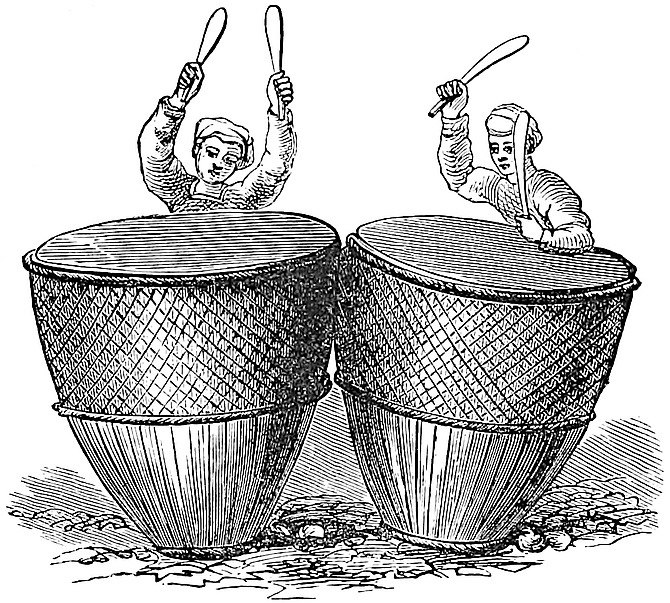
Nakkaras. (From an Indian original.)
Note 4.—This description of a fight will recur again and again till we are
very tired of it. It is difficult to say whether the style is borrowed from
the historians of the East or the romancers of the West. Compare the two
following parallels. First from an Oriental history:—
“The Ear of Heaven was deafened with the din of the great Kurkahs and
Drums, and the Earth shook at the clangour of the Trumpets and Clarions.
The shafts began to fall like the rain-drops of spring, and blood flowed
till the field looked like the Oxus.” (J. A. S. sér. IV. tom. xix. 256.)
Next from an Occidental Romance:—
“Now rist grete tabour betyng,
Blaweyng of pypes, and ek trumpyng,
Stedes lepyng, and ek arnyng,
Of sharp speres, and avalyng
Of stronge knighttes, and wyghth meetyng;
Launces breche and increpyng;
Knighttes fallyng, stedes lesyng;
Herte and hevedes thorough kervyng;
Swerdes draweyng, lymes lesyng
Hard assaylyng, strong defendyng,
Stiff withstondyng and wighth fleigheyng.
Sharp of takyng armes spoylyng;
So gret bray, so gret crieyng,
Ifor the folk there was dyeyng;
So muche dent, noise of sweord,
The thondur blast no myghte beo hirde,
No the sunne hadde beo seye,
For the dust of the poudré!
No the weolkyn seon be myght,
So was arewes and quarels flyght.”
—King Alisaunder, in Weber, I. 93–94.
And again:—
“The eorthe quaked heom undur,
No scholde mon have herd the thondur.”
—Ibid. 142.
Also in a contemporary account of the fall of Acre (1291): “Renovatur ergo
bellum terribile inter alterutros ... clamoribus interjectis hinc et inde
ad terrorem; ita ut nec Deus tonans in sublime coaudiri potuisset.” (De
Excidio Acconis, in Martene et Durand, V. 780.)
Note
5.—“Car il estoit homme au Grant Kaan.” (See note 2, ch. xiv., in
Prologue.)
Note 6.—In
continuation of note 4, chap. ii., we give Gaubil’s conclusion
of the story of Nayan: “The Emperor had gone ahead with a small force, when
Nayan’s General came forward with 100,000 men to make a reconnaissance.
The Sovereign, however, put on a bold front, and though in great danger
of being carried off, showed no trepidation. It was night, and an urgent
summons went to call troops to the Emperor’s aid. They marched at once,
the horsemen taking the foot soldiers on the crupper behind them. Nayan
all this while was taking it quietly in his camp, and his generals did
not venture to attack the Emperor, suspecting an ambuscade. Liting then
took ten resolute men, and on approaching the General’s camp, caused a
Fire-Pao to be discharged; the report caused a great panic among Nayan’s
troops, who were very ill disciplined at the best. Meanwhile the Chinese
and Tartar troops had all come up, and Nayan was attacked on all sides:
by Liting at the head of the Chinese, by Yusitemur at the head of the
Mongols, by Tutuha and the Emperor in person at the head of his guards and
the troops of Kincha (Kipchak). The presence of the Emperor rendered the
army invincible, and Nayan’s forces were completely defeated. That prince
himself was taken, and afterwards put to death. The battle took place
in the vicinity of the river Liao, and the Emperor returned in triumph
to Shangtu” (207). The Chinese record given in detail by Pauthier is to
the like effect, except as to the Kaan’s narrow escape, of which it says nothing.
As regards the Fire-Pao (the latter word seems to have been applied to
military machines formerly, and now to artillery), I must refer to Favé and
Reinaud’s very curious and interesting treatise on the Greek fire (du Feu
Grégeois). They do not seem to assent to the view that the arms of this
description which are mentioned in the Mongol wars were cannon, but rather
of the nature of rockets.
[Dr. G. Schlegel (T’oung Pao, No. 1, 1902), in a paper entitled, On the
Invention and Use of Fire-Arms and Gunpowder in China, prior to the Arrival
of Europeans, says that “now, notwithstanding all what has been alleged
by different European authors against the use of gunpowder and fire-arms
in China, I maintain that not only the Mongols in 1293 had cannon, but
that they were already acquainted with them in 1232.” Among his many
examples, we quote the following from the Books of the Ming Dynasty: “What
were anciently called P’ao were all machines for hurling stones. In the
beginning of the Mongol Dynasty (A.D. 1260), p’ao (catapults) of the
Western regions were procured. In the siege [in 1233] of the city of Ts’ai
chow of the Kin (Tatars), fire was for the first time employed (in these
p’ao), but the art of making them was not handed down, and they were
afterwards seldom used.”—H. C.]
How the Great Kaan caused Nayan to be put to death.
And when the Great Kaan learned that Nayan was taken right glad was he, and
commanded that he should be put to death straightway and in secret, lest
endeavours should be made to obtain pity and pardon for him, because he was
of the Kaan’s own flesh and blood. And this was the way in which he was put
to death: he was wrapt in a carpet, and tossed to and fro so mercilessly
that he died. And the Kaan caused him to be put to death in this way
because he would not have the blood of his Line Imperial spilt upon the
ground or exposed in the eye of Heaven and before the Sun.{1}
And when the Great Kaan had gained this battle, as you have heard, all the
Barons and people of Nayan’s provinces renewed their fealty to the Kaan.
Now these provinces that had been under the Lordship of Nayan were four
in number; to wit, the first called Chorcha; the second Cauly; the third
Barscol; the fourth Sikintinju. Of all these four great provinces had Nayan
been Lord; it was a very great dominion.{2}
And after the Great Kaan had conquered Nayan, as you have heard, it came
to pass that the different kinds of people who were present, Saracens and
Idolaters and Jews,{3} and many others that believed not in God, did
gibe those that were Christians because of the cross that Nayan had borne
on his standard, and that so grievously that there was no bearing it. Thus
they would say to the Christians: “See now what precious help this God’s
Cross of yours hath rendered Nayan, who was a Christian and a worshipper
thereof.” And such a din arose about the matter that it reached the Great
Kaan’s own ears. When it did so, he sharply rebuked those who cast these
gibes at the Christians; and he also bade the Christians be of good heart,
“for if the Cross had rendered no help to Nayan, in that It had done right
well; nor could that which was good, as It was, have done otherwise; for
Nayan was a disloyal and traitorous Rebel against his Lord, and well
deserved that which had befallen him. Wherefore the Cross of your God did
well in that It gave him no help against the right.” And this he said so
loud that everybody heard him. The Christians then replied to the Great
Kaan: “Great King, you say the truth indeed, for our Cross can render no
one help in wrong-doing; and therefore it was that It aided not Nayan, who
was guilty of crime and disloyalty, for It would take no part in his evil deeds.”
And so thenceforward no more was heard of the floutings of the unbelievers
against the Christians; for they heard very well what the Sovereign said to
the latter about the Cross on Nayan’s banner, and its giving him no help.
Note 1.—Friar Ricold mentions this Tartar maxim: “One Khan will put another
to death, to get possession of the throne, but he takes great care that
the blood be not spilt. For they say that it is highly improper that the
blood of the Great Khan should be spilt upon the ground; so they cause the
victim to be smothered somehow or other.” The like feeling prevails at the
Court of Burma, where a peculiar mode of execution without bloodshed is
reserved for Princes of the Blood. And Kaempfer, relating the conspiracy of
Faulcon at the Court of Siam, says that two of the king’s brothers, accused
of participation, were beaten to death with clubs of sandal-wood, “for
the respect entertained for the blood-royal forbids its being shed.” See
also note 6, ch. vi. Bk. I., on the death of the Khalif Mosta’sim Billah.
(Pereg. Quat. p. 115; Mission to Ava, p. 229; Kaempfer, I. 19.)
Note 2.—Chorcha
is the Manchu country, Niuché of the Chinese. (Supra, note
2, ch. xlvi. Bk. I.) [“Chorcha is Churchin.—Nayan, as vassal of the Mongol
khans, had the commission to keep in obedience the people of Manchuria
(subdued in 1233), and to care for the security of the country (Yuen
shi); there is no doubt that he shared these obligations with his relative
Hatan, who stood nearer to the native tribes of Manchuria.” (Palladius,
32.)—H. C.]
Kauli is properly Corea, probably here a district on the frontier thereof,
as it is improbable that Nayan had any rule over Corea. [“The Corean
kingdom proper could not be a part of the prince’s appanage. Marco Polo
might mean the northern part of Corea, which submitted to the Mongols in
A.D. 1269, with sixty towns, and which was subordinated entirely to the
central administration in Liao-yang. As to the southern part of Corea, it
was left to the king of Corea, who, however, was a vassal of the Mongols.”
(Palladius, 32.) The king of Corea (Ko rye, Kao-li) was in 1288
Chyoung ryel wang (1274–1298); the capital was Syong-to, now Kăi syeng
(K’ai-ch’eng).—H. C.]
Barskul, “Leopard-Lake,” is named in Sanang Setsen (p. 217), but seems
there to indicate some place in the west of Mongolia, perhaps the Barkul
of our maps. This Barskul must have been on the Manchu frontier. [There are
in the Yuen-shi the names of the department of P’u-yü-lu, and of the
place Pu-lo-ho, which, according to the system of Chinese transcription,
approach to Barscol; but it is difficult to prove this identification,
since our knowledge of these places is very scanty; it only remains to
identify Barscol with Abalahu, which is already known; a conjecture all
the more probable as the two names of P’u-yü-lu and Pu-lo-ho have also
some resemblance to Abalahu. (Palladius, 32.) Mr. E. H. Parker says
(China Review, xviii. p. 261) that Barscol may be Pa-la ssŭ or Bars Koto
[in Tsetsen]. “This seems the more probable in that Cauly and Chorcha are
clearly proved to be Corea and Niuché or Manchuria, so that Bars Koto would
naturally fall within Nayan’s appanage.”—H. C.]
The reading of the fourth name is doubtful, Sichuigiu, Sichingiu (G.
T.), Sichin-tingiu, etc. The Chinese name of Mukden is Shing-king,
but I know not if it be so old as our author’s time. I think it very
possible that the real reading is Sinchin-tingin, and that it represents
Shangking-Tungking, expressing the two capitals of the Khitan Dynasty in
this region, the position of which will be found indicated in No. IV. map
of Polo’s itineraries. (See Schott, Aelteste Nachrichten von Mongolen und
Tartaren, Berlin Acad. 1845, pp. 11–12.)
[Sikintinju is Kien chau “belonging to a town which was in Nayan’s
appanage, and is mentioned in the history of his rebellion. There were two
Kien-chow, one in the time of the Kin in the modern aimak of Khorchin; the
other during the Mongol Dynasty, on the upper part of the river Ta-ling
ho, in the limits of the modern aimak of Kharachin (Man chow yuen lew
k’ao); the latter depended on Kuang-ning (Yuen-shi). Mention is made
of Kien-chow, in connection with the following circumstance. When Nayan’s
rebellion broke out, the Court of Peking sent orders to the King of Corea,
requiring from him auxiliary troops; this circumstance is mentioned in
the Corean Annals, under the year 1288 (Kao li shi, ch. xxx. f. 11) in
the following words:—‘In the present year, in the fourth month, orders
were received from Peking to send five thousand men with provisions
to Kien-chow, which is 3000 li distant from the King’s residence.’
This number of li cannot of course be taken literally; judging by the
distances estimated at the present day, it was about 2000 li from the
Corean K’ai-ch’eng fu (then the Corean capital) to the Mongol Kien-chow;
and as much to the Kien-chow of the Kin (through Mukden and the pass of
Fa-k’u mun in the willow palisade). It is difficult to decide to which of
these two cities of the same name the troops were ordered to go, but at any
rate, there are sufficient reasons to identify Sikintinju of Marco Polo
with Kien-chow.” (Palladius, 33.)—H. C.]
We learn from Gaubil that the rebellion did not end with the capture of
Nayan. In the summer of 1288 several of the princes of Nayan’s league,
under Hatan (apparently the Abkan of Erdmann’s genealogies), the grandson
of Chinghiz’s brother Kajyun [Hachiun], threatened the provinces north-east
of the wall. Kúblái sent his grandson and designated heir, Teimur, against
them, accompanied by some of his best generals. After a two days’ fight
on the banks of the River Kweilei, the rebels were completely beaten. The
territories on the said River Kweilei, the Tiro, or Torro, and the
Liao, are mentioned both by Gaubil and De Mailla as among those which
had belonged to Nayan. As the Kweilei and Toro appear on our maps and also
the better-known Liao, we are thus enabled to determine with tolerable
precision Nayan’s country. (See Gaubil, p. 209, and De Mailla, 431 seqq.)
[“The rebellion of Nayan and Hatan is incompletely and contradictorily
related in Chinese history. The suppression of both these rebellions lasted
four years. In 1287 Nayan marched from his ordo with sixty thousand
men through Eastern Mongolia. In the 5th moon (var. 6th) of the same
year Khubilai marched against him from Shangtu. The battle was fought in
South-Eastern Mongolia, and gained by Khubilai, who returned to Shangtu
in the 8th month. Nayan fled to the south-east, across the mountain
range, along which a willow palisade now stands; but forces had been sent
beforehand from Shin-chow (modern Mukden) and Kuang-ning (probably to watch
the pass), and Nayan was made prisoner.
“Two months had not passed, when Hatan’s rebellion broke out (so that it
took place in the same year 1287). It is mentioned under the year 1288,
that Hatan was beaten, and that the whole of Manchuria was pacified; but
in 1290, it is again recorded that Hatan disturbed Southern Manchuria,
and that he was again defeated. It is to this time that the narratives in
the biographies of Liting, Yuesi Femur, and Mangwu ought to be referred.
According to the first of these biographies, Hatan, after his defeat by
Liting on the river Kui lui (Kuilar?), fled, and perished. According to the
second biography, Hatan’s dwelling (on the Amur River) was destroyed, and
he disappeared. According to the third, Mangwu and Naimatai pursued Hatan
to the extreme north, up to the eastern sea-coast (the mouth of the Amur).
Hatan fled, but two of his wives and his son Lao-ti were taken; the latter
was executed, and this was the concluding act of the suppression of the
rebellion in Manchuria. We find, however, an important variante in the
history of Corea; it is stated there that in 1290, Hatan and his son Lao-ti
were carrying fire and slaughter to Corea, and devastated that country;
they slew the inhabitants and fed on human flesh. The King of Corea fled
to the Kiang-hwa island. The Coreans were not able to withstand the
invasion. The Mongols sent to their aid in 1291, troops under the command
of two generals, Seshekan (who was at that time governor of Liao-tung) and
Namantai (evidently the above-mentioned Naimatai). The Mongols conjointly
with the Coreans defeated the insurgents, who had penetrated into the very
heart of the country; their corpses covered a space 30 li in extent;
Hatan and his son made their way through the victorious army and fled,
finding a refuge in the Niuchi (Djurdji) country, from which Laotai made a
later incursion into Corea. Such is the discrepancy between historians in
relating the same fact. The statement found in the Corean history seems to
me more reliable than the facts given by Chinese history.” (Palladius,
35–37.)—H. C.]
Note 3.—This passage, and the extract from Ramusio’s version attached to
the following chapter, contain the only allusions by Marco to Jews in
China. John of Monte Corvino alludes to them, and so does Marignolli,
who speaks of having held disputations with them at Cambaluc; Ibn Batuta
also speaks of them at Khansa or Hangchau. Much has been written about
the ancient settlement of Jews at Kaifungfu, in Honan. One of the most
interesting papers on the subject is in the Chinese Repository, vol. xx.
It gives the translation of a Chinese-Jewish Inscription, which in some
respects forms a singular parallel to the celebrated Christian Inscription
of Si-ngan fu, though it is of far more modern date (1511). It exhibits,
as that inscription does, the effect of Chinese temperament or language,
in modifying or diluting doctrinal statements. Here is a passage: “With
respect to the Israelitish religion, we find on inquiry that its first
ancestor, Adam, came originally from India, and that during the (period
of the) Chau State the Sacred Writings were already in existence. The
Sacred Writings, embodying Eternal Reason, consist of 53 sections. The
principles therein contained are very abstruse, and the Eternal Reason
therein revealed is very mysterious, being treated with the same veneration
as Heaven. The founder of the religion is Abraham, who is considered the
first teacher of it. Then came Moses, who established the Law, and handed
down the Sacred Writings. After his time, during the Han Dynasty (B.C. 206
to A.D. 221), this religion entered China. In (A.D.) 1164, a synagogue was
built at P’ien. In (A.D.) 1296, the old Temple was rebuilt, as a place in
which the Sacred Writings might be deposited with veneration.”
[According to their oral tradition, the Jews came to China from Si Yĭh
(Western Regions), probably Persia, by Khorasan and Samarkand, during the
first century of our era, in the reign of the Emperor Ming-ti (A.D. 58–75)
of the Han Dynasty. They were at times confounded with the followers of
religions of India, T’ien Chu kiao, and very often with the Mohammedans
Hwui-Hwui or Hwui-tzŭ; the common name of their religion was Tiao kin
kiao, “Extract Sinew Religion.” However, three lapidary inscriptions,
kept at Kaï-fung, give different dates for the arrival of the Jews in
China: one dated 1489 (2nd year Hung Che, Ming Dynasty) says that seventy
Jewish families arrived at P’ien liang (Kaï-fung) at the time of the
Sung (A.D. 960–1278); one dated 1512 (7th year Chêng Têh) says that the
Jewish religion was introduced into China under the Han Dynasty (B.C.
206–A.D. 221), and the last one dated 1663 (2nd year K’ang-hi) says that
this religion was first preached in China under the Chau Dynasty (B.C.
1122–255); this will not bear discussion.
The synagogue, according to these inscriptions, was built in 1163, under
the Sung Emperor Hiao; under the Yuen, in 1279, the rabbi rebuilt the
ancient temple known as Ts’ing Chen sse, probably on the site of a ruined
mosque; the synagogue was rebuilt in 1421 during the reign of Yung-lo; it
was destroyed by an inundation of the Hwang-ho in 1642, and the Jews began
to rebuild it once more in 1653.
The first knowledge Europeans had of a colony of Jews at K’aï-fung fu,
in the Ho-nan province, was obtained through the Jesuit missionaries at
Peking, at the beginning of the 17th century; the celebrated Matteo Ricci
having received the visit of a young Jew, the Jesuits Aleni (1613), Gozani
(1704), Gaubil and Domenge who made in 1721 two plans of the synagogue,
visited Kaï-fung and brought back some documents. In 1850, a mission
of enquiry was sent to that place by the London Society for promoting
Christianity among the Jews; the results of this mission were published
at Shang-haï, in 1851, by Bishop G. Smith of Hongkong; fac-similes of the
Hebrew manuscripts obtained at the synagogue of Kaï-fung were also printed
at Shang-haï at the London Missionary Society’s Press, in the same year.
The Jewish merchants of London sent in 1760 to their brethren of Kaï-fung
a letter written in Hebrew; a Jewish merchant of Vienna, J. L. Liebermann,
visited the Kaï-fung colony in 1867. At the time of the T’aï-P’ing
rising, the rebels marched against Kaï-fung in 1857, and with the rest
of the population, the Jews were dispersed. (J. Tobar, Insc. juives de
Kaï-fong-fou, 1900; Henri Cordier, Les Juifs en Chine, and Fung and
Wagnall’s Jewish Encyclopedia.) Palladius writes (p. 38), “The Jews are
mentioned for the first time in the Yuen shi (ch. xxxiii. p. 7), under
the year 1329, on the occasion of the re-establishment of the law for the
collection of taxes from dissidents. Mention of them is made again under
the year 1354, ch. xliii. fol. 10, when on account of several insurrections
in China, rich Mahommetans and Jews were invited to the capital in order to
join the army. In both cases they are named Chu hu (Djuhud).”—H. C.]
The synagogue at Kaifungfu has recently been demolished for the sake of its
materials, by the survivors of the Jewish community themselves, who were
too poor to repair it. The tablet that once adorned its entrance, bearing
in gilt characters the name Eszloyih (Israel), has been appropriated by
a mosque. The 300 or 400 survivors seem in danger of absorption into the
Mahomedan or heathen population. The last Rabbi and possessor of the sacred
tongue died some thirty or forty years ago, the worship has ceased, and
their traditions have almost died away.
(Cathay, 225, 341, 497; Ch. Rep. XX. 436; Dr. Martin, in J. N. China
Br. R. A. S. 1866, pp. 32–33.)
How the Great Kaan went back to the City of Cambaluc.
And after the Great Kaan had defeated Nayan in the way you have heard, he
went back to his capital city of Cambaluc and abode there, taking his ease
and making festivity. And the other Tartar Lord called Caydu was greatly
troubled when he heard of the defeat and death of Nayan, and held himself
in readiness for war; but he stood greatly in fear of being handled as
Nayan had been.{1}
I told you that the Great Kaan never went on a campaign but once, and it
was on this occasion; in all other cases of need he sent his sons or his
barons into the field. But this time he would have none go in command but
himself, for he regarded the presumptuous rebellion of Nayan as far too
serious and perilous an affair to be otherwise dealt with.
Note 1.—Here Ramusio has a long and curious addition. Kúblái, it says,
remained at Cambaluc till March, “in which our Easter occurs; and learning
that this was one of our chief festivals, he summoned all the Christians,
and bade them bring with them the Book of the Four Gospels. This he caused
to be incensed many times with great ceremony, kissing it himself most
devoutly, and desiring all the barons and lords who were present to do the
same. And he always acts in this fashion at the chief Christian festivals,
such as Easter and Christmas. And he does the like at the chief feasts of
the Saracens, Jews, and Idolaters. On being asked why, he said: ‘There
are Four Prophets worshipped and revered by all the world. The Christians
say their God is Jesus Christ; the Saracens, Mahommet; the Jews, Moses;
the Idolaters, Sogomon Borcan [Sakya-Muni Burkhan or Buddha], who was
the first god among the idols; and I worship and pay respect to all four,
and pray that he among them who is greatest in heaven in very truth may
aid me.’ But the Great Khan let it be seen well enough that he held the
Christian Faith to be the truest and best—for, as he says, it commands
nothing that is not perfectly good and holy. But he will not allow the
Christians to carry the Cross before them, because on it was scourged and
put to death a person so great and exalted as Christ.
“Some one may say: ‘Since he holds the Christian faith to be best, why
does he not attach himself to it, and become a Christian?’ Well, this is
the reason that he gave to Messer Nicolo and Messer Maffeo, when he sent
them as his envoys to the Pope, and when they sometimes took occasion to
speak to him about the faith of Christ. He said: ‘How would you have me
to become a Christian? You see that the Christians of these parts are so
ignorant that they achieve nothing and can achieve nothing, whilst you
see the Idolaters can do anything they please, insomuch that when I sit
at table the cups from the middle of the hall come to me full of wine or
other liquor without being touched by anybody, and I drink from them. They
control storms, causing them to pass in whatever direction they please, and
do many other marvels; whilst, as you know, their idols speak, and give
them predictions on whatever subjects they choose. But if I were to turn
to the faith of Christ and become a Christian, then my barons and others
who are not converted would say: “What has moved you to be baptised and
to take up the faith of Christ? What powers or miracles have you witnessed
on His part?” (You know the Idolaters here say that their wonders are
performed by the sanctity and power of their idols.) Well, I should not
know what answer to make; so they would only be confirmed in their errors,
and the Idolaters, who are adepts in such surprising arts, would easily
compass my death. But now you shall go to your Pope, and pray him on my
part to send hither an hundred men skilled in your law, who shall be
capable of rebuking the practices of the Idolaters to their faces, and of
telling them that they too know how to do such things but will not, because
they are done by the help of the devil and other evil spirits, and shall
so control the Idolaters that these shall have no power to perform such
things in their presence. When we shall witness this we will denounce the
Idolaters and their religion, and then I will receive baptism; and when I
shall have been baptised, then all my barons and chiefs shall be baptised
also, and their followers shall do the like, and thus in the end there will
be more Christians here than exist in your part of the world!’
“And if the Pope, as was said in the beginning of this book, had sent men
fit to preach our religion, the Grand Kaan would have turned Christian; for
it is an undoubted fact that he greatly desired to do so.”
In the simultaneous patronage of different religions, Kúblái followed the
practice of his house. Thus Rubruquis writes of his predecessor Mangku
Kaan: “It is his custom, on such days as his diviners tell him to be
festivals, or any of the Nestorian priests declare to be holydays, to hold
a court. On these occasions the Christian priests enter first with their
paraphernalia, and pray for him, and bless his cup. They retire, and then
come the Saracen priests and do likewise; the priests of the Idolaters
follow. He all the while believes in none of them, though they all follow
his court as flies follow honey. He bestows his gifts on all of them, each
party believes itself to be his favourite, and all prophesy smooth things
to him.” Abulfaragius calls Kúblái “a just prince and a wise, who loved
Christians and honoured physicians of learning, whatsoever their nation.”
There is a good deal in Kúblái that reminds us of the greatest prince
of that other great Mongol house, Akbar. And if we trusted the first
impression of the passage just quoted from Ramusio, we might suppose that
the grandson of Chinghiz too had some of that real wistful regard towards
the Lord Jesus Christ, of which we seem to see traces in the grandson of
Baber. But with Kúblái, as with his predecessors, religion seems to have
been only a political matter; and this aspect of the thing will easily
be recognised in a re-perusal of his conversation with Messer Nicolas
and Messer Maffeo. The Kaan must be obeyed; how man shall worship God is
indifferent; this was the constant policy of his house in the days of its
greatness. Kúblái, as Koeppen observes, the first of his line to raise
himself above the natural and systematic barbarism of the Mongols, probably
saw in the promotion of Tibetan Buddhism, already spread to some extent
among them, the readiest means of civilising his countrymen. But he may
have been quite sincere in saying what is here ascribed to him in this
sense, viz.: that if the Latin Church, with its superiority of character
and acquirement, had come to his aid as he had once requested, he would
gladly have used its missionaries as his civilising instruments instead
of the Lamas and their trumpery. (Rubr. 313; Assemani, III. pt. ii.
107; Koeppen, II. 89, 96.)
How the Kaan rewarded the Valour of his Captains.
So we will have done with this matter of Nayan, and go on with our account
of the great state of the Great Kaan.
We have already told you of his lineage and of his age; but now I must tell
you what he did after his return, in regard to those barons who had behaved
well in the battle. Him who was before captain of 100 he made captain of
1000; and him who was captain of 1000 men he made to be captain of 10,000,
advancing every man according to his deserts and to his previous rank.
Besides that, he also made them presents of fine silver plate and other
rich appointments; gave them Tablets of Authority of a higher degree than
they held before; and bestowed upon them fine jewels of gold and silver,
and pearls and precious stones; insomuch that the amount that fell to each
of them was something astonishing. And yet ’twas not so much as they had
deserved; for never were men seen who did such feats of arms for the love
and honour of their Lord, as these had done on that day of the battle.{1}
Now those Tablets of Authority, of which I have spoken, are ordered in
this way. The officer who is a captain of 100 hath a tablet of silver; the
captain of 1000 hath a tablet of gold or silver-gilt; the commander of
10,000 hath a tablet of gold, with a lion’s head on it. And I will tell
you the weight of the different tablets, and what they denote. The tablets
of the captains of 100 and 1000 weigh each of them 120 saggi; and the
tablet with the lion’s head engraven on it, which is that of the commander
of 10,000, weighs 220 saggi. And on each of the tablets is inscribed a
device, which runs: “By the strength of the great God, and of the great
grace which He hath accorded to our Emperor, may the name of the Kaan be
blessed; and let all such as will not obey him be slain and be destroyed.”
And I will tell you besides that all who hold these tablets likewise
receive warrants in writing, declaring all their powers and privileges.
I should mention too that an officer who holds the chief command of 100,000
men, or who is general-in-chief of a great host, is entitled to a tablet
that weighs 300 saggi. It has an inscription thereon to the same purport
that I have told you already, and below the inscription there is the figure
of a lion, and below the lion the sun and moon. They have warrants also of
their high rank, command, and power.{2} Every one, moreover, who holds
a tablet of this exalted degree is entitled, whenever he goes abroad, to
have a little golden canopy, such as is called an umbrella, carried on a
spear over his head in token of his high command. And whenever he sits, he
sits in a silver chair.{3}
To certain very great lords also there is given a tablet with gerfalcons on
it; this is only to the very greatest of the Kaan’s barons, and it confers
on them his own full power and authority; so that if one of those chiefs
wishes to send a messenger any whither, he can seize the horses of any man,
be he even a king, and any other chattels at his pleasure.{4}
Note 1.—So Sanang Setzen relates that Chinghiz, on returning from one
of his great campaigns, busied himself in reorganising his forces and
bestowing rank and title, according to the deserts of each, on his nine
Orlok, or marshals, and all who had done good service. “He named
commandants over hundreds, over thousands, over ten thousands, over hundred
thousands, and opened his treasury to the multitude of the people” (p. 91).
Note 2.—We have several times already had mention of these tablets. (See
Prologue, ch. viii. and xviii.) The earliest European allusion to them is
in Rubruquis: “And Mangu gave to the Moghul (whom he was going to send to
the King of France) a bull of his, that is to say, a golden plate of a palm
in breadth and half a cubit in length, on which his orders were inscribed.
Whosoever is the bearer of that may order what he pleases, and his order
shall be executed straightway.”
These golden bulls of the Mongol Kaans appear to have been originally
tokens of high favour and honour, though afterwards they became more
frequent and conventional. They are often spoken of by the Persian
historians of the Mongols under the name of Páïzah, and sometimes Páïzah
Sir-i-Sher, or “Lion’s Head Paizah.” Thus, in a firmán of Ghazan Khan,
naming a viceroy to his conquests in Syria, the Khan confers on the latter
“the sword, the august standard, the drum, and the Lion’s Head Paizah.”
Most frequently the grant of this honour is coupled with Yarlígh; “to
such an one were granted Yarlígh and Páïzah,” the former word (which is
still applied in Turkey to the Sultan’s rescripts) denoting the written
patent which accompanies the grant of the tablet, just as the sovereign’s
warrant accompanies the badge of a modern Order. Of such written patents
also Marco speaks in this passage, and as he uttered it, no doubt the
familiar words Yarlígh u Páïzah were in his mind. The Armenian history of
the Orpelians, relating the visit of Prince Sempad, brother of King Hayton,
to the court of Mangku Kaan, says: “They gave him also a P’haiza of gold,
i.e. a tablet whereon the name of God is written by the Great Kaan himself;
and this constitutes the greatest honour known among the Mongols. Farther,
they drew up for him a sort of patent, which the Mongols call Iarlekh,”
etc. The Latin version of a grant by Uzbek Khan of Kipchak to the Venetian
Andrea Zeno, in 1333,[1]
ends with the words: “Dedimus baisa et
privilegium cum bullis rubeis,” where the latter words no doubt represent
the Yarlígh al-tamghá, the warrant with the red seal or stamp,[2] as it
may be seen upon the letter of Arghun Khan. (See plate at ch. xvii. of Bk.
IV.) So also Janibek, the son of Uzbek, in 1344, confers privileges on
the Venetians, “eisdem dando baissinum de auro”; and again Bardibeg,
son, murderer, and successor of Janibeg, in 1358, writes: “Avemo dado
comandamento [i.e. Yarlíg] cum le bolle rosse, et lo paysam.”
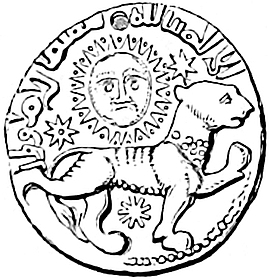
Seljukian Coin with the Lion and Sun.
Under the Persian branch, at least, of the house the degree of honour was
indicated by the number of lions’ heads upon the plate, which varied from
1 to 5. The Lion and Sun, a symbol which survives, or has been revived,
in the modern Persian decoration so called, formed the emblem of the Sun
in Leo, i.e. in highest power. It had already been used on the coins of
the Seljukian sovereigns of Persia and Iconium; it appears on coins of the
Mongol Ilkhans Ghazan, Oljaïtu, and Abusaid, and it is also found on some
of those of Mahomed Uzbek Khan of Kipchak.
Hammer gives regulations of Ghazan Khan’s on the subject of the Paizah,
from which it is seen that the latter were of different kinds as well as
degrees. Some were held by great governors and officers of state, and these
were cautioned against letting the Paizah out of their own keeping; others
were for officers of inferior order; and, again, “for persons travelling on
state commissions with post-horses, particular paizah (which Hammer says
were of brass) are appointed, on which their names are inscribed.” These
last would seem therefore to be merely such permissions to travel by the
Government post-horses as are still required in Russia, perhaps in lineal
derivation from Mongol practice. The terms of Ghazan’s decree and other
contemporary notices show that great abuses were practised with the Paizah,
as an authority for living at free quarters and making other arbitrary
exactions.
The word Paizah is said to be Chinese, Pai-tseu, “a tablet.” A trace of
the name and the thing still survives in Mongolia. The horse-Bai is the
name applied to a certain ornament on the horse caparison, which gives the
rider a title to be furnished with horses and provisions on a journey.
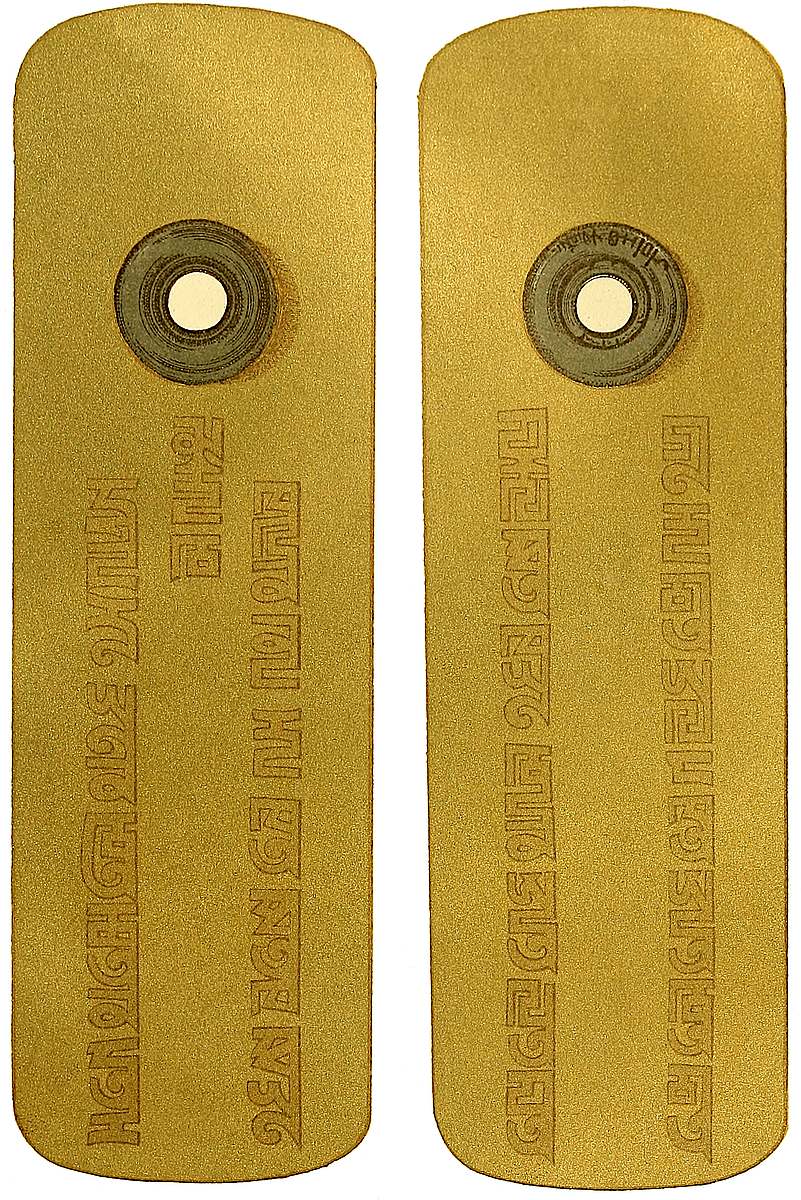
“TABLE D’OR DE COMMANDEMENT,”
THE PAÏZA OF THE MONGOLS
FROM A SPECIMEN FOUND IN
E. SIBERIA.
Where I have used the Venetian term saggio, the French texts have here
and elsewhere saics and saies, and sometimes pois. Saic points to
saiga, which, according to Dupré de St. Maur, is in the Salic laws the
equivalent of a denier or the twelfth part of a sol. Saggio is possibly
the same word, or rather may have been confounded with it, but the saggio
was a recognised Venetian weight equal to ⅙ of an ounce. We shall see
hereafter that Polo appears to use it to indicate the misḳál, a weight
which may be taken at 74 grains Troy. On that supposition the smallest
tablet specified in the text would weigh 18½ ozs. Troy.
I do not know if any gold Paizah has been discovered, but several of silver
have been found in the Russian dominions; one near the Dnieper, and two in
Eastern Siberia. The first of our plates represents one of these, which was
found in the Minusinsk circle of the Government of Yenisei in 1846, and is
now in the Asiatic Museum of the Academy of St. Petersburg. For the sake
of better illustration of our text, I have taken the liberty to represent
the tablet as of gold, instead of silver with only the inscription gilt.
The moulded ring inserted in the orifice, to suspend the plate by, is of
iron. On the reverse side the ring bears some Chinese characters engraved,
which are interpreted as meaning “Publication No. 42.” The inscription on
the plate itself is in the Mongol language and Baspa character (supra,
Prologue, note 1, ch. xv.), and its purport is a remarkable testimony to
the exactness of Marco’s account, and almost a proof of his knowledge of
the language and character in which the inscriptions were engraved. It
runs, according to Schmidt’s version: “By the strength of the eternal
heaven! May the name of the Khagan be holy! Who pays him not reverence
is to be slain, and must die!” The inscriptions on the other plates
discovered were essentially similar in meaning. Our second plate shows one
of them with the inscription in the Uighúr character.
The superficial dimensions of the Yenisei tablet, as taken from Schmidt’s
full-size drawing, are 12·2 in. by 3·65 in. The weight is not given.
In the French texts nothing is said of the size of the tablets. But
Ramusio’s copy in the Prologue, where the tables given by Kiacatu are
mentioned (supra, p. 35), says that they were a cubit in length and 5
fingers in breadth, and weighed 3 to 4 marks each, i.e. 24 to 32 ounces.
(Dupré de St. Maur, Essai sur les Monnoies, etc., 1746, p. viii.; also
(on saiga) see Pertz, Script. XVII. 357; Rubruq. 312; Golden
Horde, 219–220, 521; Ilch. II. 166 seqq., 355–356; D’Ohsson, III.
412–413; Q. R. 177–180; Ham. Wassáf, 154, 176; Makrizi, IV. 158; St.
Martin, Mém. sur l’Arménie, II. 137, 169; M. Mas Latrie in Bibl. de
l’Éc. des Chartes, IV. 585 seqq.; J. As. sér. V. tom. xvii. 536 seqq.;
Schmidt, über eine Mongol. Quadratinschrift, etc., Acad. St. P., 1847;
Russian paper by Grigorieff on same subject, 1846.)
[“The History tells us (Liao Shih, Bk. LVII. f. 2) that the official
silver tablets p’ai tzŭ of the period were 600 in number, about a foot
in length, and that they were engraved with an inscription like the above
[‘Our imperial order for post horses. Urgent.’] in national characters
(kuo tzŭ), and that when there was important state business the Emperor
personally handed the tablet to the envoy, which entitled him to demand
horses at the post stations, and to be treated as if he were the Emperor
himself travelling. When the tablet was marked ‘Urgent,’ he had the right
to take private horses, and was required to ride, night and day, 700 li
in twenty-four hours. On his return he had to give back the tablet to the
Emperor, who handed it to the prince who had the custody of the state
tablets and seals.” (Dr. S. W. Bushell, Actes XI. Cong. Int. Orient.,
Paris, p. 17.)
“The Kin, in the thirteenth century, used badges of office made of
silver. They were rectangular, bore the imperial seal, and an inscription
indicative of the duty of the bearer. (Chavannes, Voyageurs chez les
Khitans, 102.) The Nü-chên at an earlier date used wooden pai-tzŭ tied
to each horseman and horse, to distinguish them by. (Ma Tuan-lin, Bk.
327, 11.)” (Rockhill, Rubruck, p. 181, note.)
“Tiger’s tablets—Sinice Hu fu, and p’ai tsze in the common language.
The Mongols had them of several kinds, which differed by the metal, of
which they were made, as well as by the number of pearls (one, two, or
three in number), which were incrusted in the upper part of the tablet.
Falcon’s tablets with the figure of a falcon were round, and used to be
given only to special couriers and envoys of the Khan. [Yuen shi lui pien
and Yuen ch’ao tien chang.] The use of the Hu-fu was adopted by the
Mongols probably from the Kin.” (Palladius, l.c. p. 39.)
Rubruquis (Rockhill’s ed. pp. 153–154) says:—“And whenever the principal
envoy [of Longa] came to court he carried a highly-polished tablet of ivory
about a cubit long and half a palm wide. Every time he spoke to the chan
or some great personage, he always looked at that tablet as if he found
there what he had to say, nor did he look to the right or the left, nor
in the face of him with whom he was talking. Likewise, when coming into
the presence of the Lord, and when leaving it, he never looked at anything
but his tablet.” Mr. Rockhill observes: “These tablets are called hu in
Chinese, and were used in China and Korea; in the latter country down to
quite recent times. They were made of jade, ivory, bamboo, etc., according
to the rank of the owner, and were about three feet long. The hu was
originally used to make memoranda on of the business to be submitted by
the bearer to the Emperor or to write the answers to questions he had had
submitted to them. Odoric also refers to ‘the tablets of white ivory which
the Emperor’s barons held in their hands as they stood silent before him.’”
(Cf. the golden tablets which were of various classes with a tiger for
image and pearls for ornaments, Devéria, Epigraphie, p. 15 et seq.)—H. C.]
Note
3.—Umbrella. The phrase in Pauthier’s text is “Palieque que on dit
ombrel.” The Latin text of the Soc. de Géographie has “unum pallium de
auro,” which I have adopted as probably correct, looking to Burma, where
the old etiquettes as to umbrellas are in full force. These etiquettes were
probably in both countries of old Hindu origin. Pallium, according to
Muratori, was applied in the Middle Ages to a kind of square umbrella, by
which is probably meant rather a canopy on four staves, which was sometimes
assigned by authority as an honourable privilege.
But the genuine umbrella would seem to have been used also, for Polo’s
contemporary, Martino da Canale, says that, when the Doge goes forth of
his palace, “si vait apres lui un damoiseau qui porte une umbrele de
dras à or sur son chief,” which umbrella had been given by “Monseigneur
l’Apostoille.” There is a picture by Girolamo Gambarota, in the Sala
del Gran Consiglio, at Venice, which represents the investiture of the
Doge with the umbrella by Pope Alexander III., and Frederick Barbarossa
(concerning which see Sanuto Junior, in Muratori, XXII. 512).
The word Parasol also occurs in the Petrarchian vocabulary, (14th
century) as the equivalent of saioual (Pers. sáyában or sáiwán,
an umbrella). Carpini notices that umbrellas (solinum vel tentoriolum
in hastâ) were carried over the Tartar nobles and their wives, even on
horseback; and a splendid one, covered with jewels, was one of the presents
made to Kuyuk Kaan on his enthronement.
With respect to the honorary character attaching to umbrellas in China, I
may notice that recently an English resident of Ningpo, on his departure
for Europe, was presented by the Chinese citizens, as a token of honour,
with a pair of Wan min sàn, umbrellas of enormous size.
The umbrella must have gone through some curious vicissitudes; for at
one time we find it familiar, at a later date apparently unknown, and
then reintroduced as some strange novelty. Arrian speaks of the σκιάδια,
or umbrellas, as used by all Indians of any consideration; but
the thing of which he spoke was familiar to the use of Greek and Roman
ladies, and many examples of it, borne by slaves behind their mistresses,
are found on ancient vase-paintings. Athenaeus quotes from Anacreon the
description of a “beggar on horseback” who
“like a woman bears
An ivory parasol over his delicate head.”
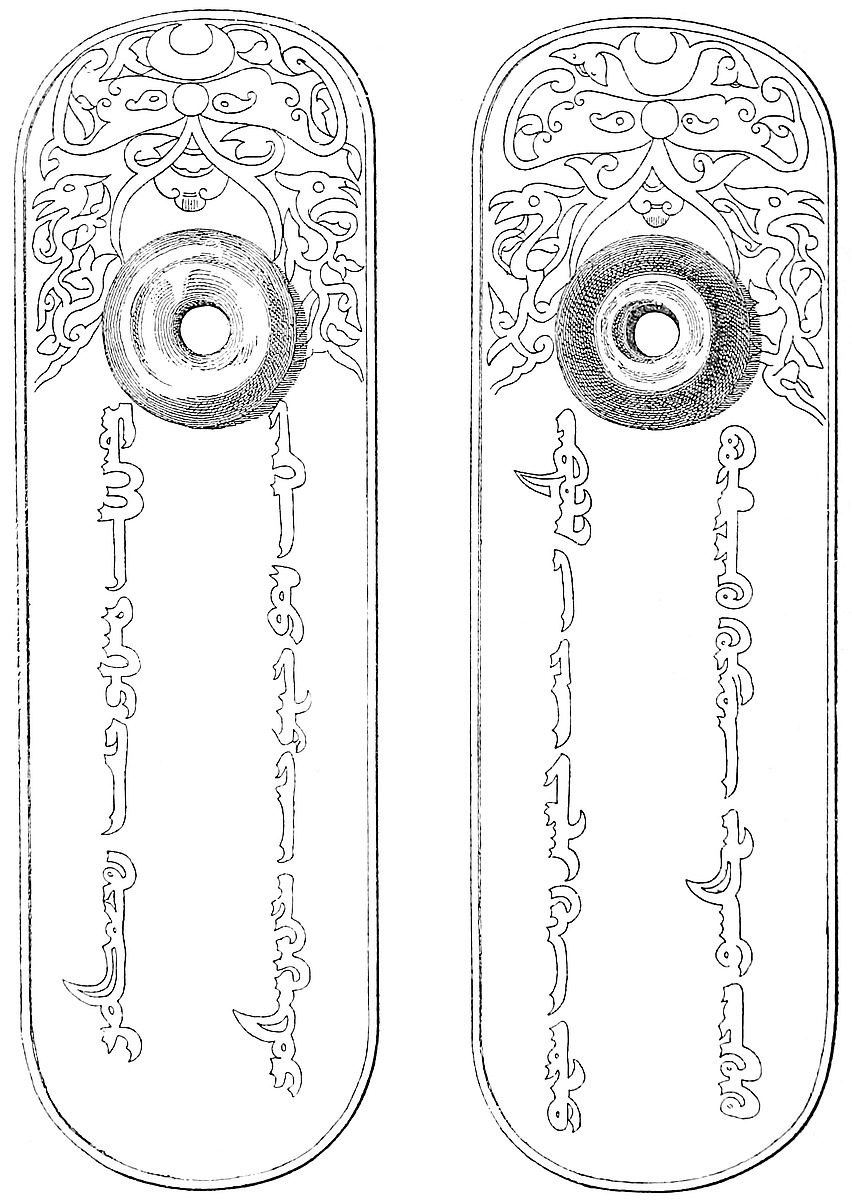
Second Example of a
Mongol Païza,
with Superscription in the Uighúr Character,
found near the River Dnieper,
1845.
An Indian prince, in a Sanskrit inscription of the 9th century, boasts
of having wrested from the King of Márwár the two umbrellas pleasing to
Parvati, and white as the summer moonbeams. Prithi Ráj, the last Hindu king
of Delhi, is depicted by the poet Chand as shaded by a white umbrella on
a golden staff. An unmistakable umbrella, copied from a Saxon MS. in the
Harleian collection, is engraved in Wright’s History of Domestic Manners,
p. 75. The fact that the gold umbrella is one of the paraphernalia of high
church dignitaries in Italy seems to presume acquaintance with the thing
from a remote period. A decorated umbrella also accompanies the host when
sent out to the sick, at least where I write, in Palermo. Ibn Batuta says
that in his time all the people of Constantinople, civil and military,
great and small, carried great umbrellas over their heads, summer and
winter. Ducange quotes, from a MS. of the Paris Library, the Byzantine
court regulations about umbrellas, which are of the genuine Pan-Asiatic
spirit;—σκιάδια χρυσοκóκκινα extend from the Hypersebastus to
the grand Stratopedarchus, and so on; exactly as used to be the case, with
different titles, in Java. And yet it is curious that John Marignolli, Ibn
Batuta’s contemporary in the middle of the 14th century, and Barbosa in the
16th century, are alike at pains to describe the umbrella as some strange
object. And in our own country it is commonly stated that the umbrella
was first used in the last century, and that Jonas Hanway (died 1786) was
one of the first persons who made a practice of carrying one. The word
umbrello is, however, in Minsheu’s dictionary. [See Hobson-Jobson, s.v.
Umbrella.—H. C.]
(Murat. Dissert. II. 229; Archiv. Storic. Ital. VIII. 274, 560; Klapr.
Mém. III.; Carp. 759; N. and Q., C. and J. II. 180; Arrian, Indica,
XVI.; Smith’s Dict., G. and R. Ant., s.v. umbraculum; J. R. A. S.
v. 351; Rás Mála, I. 221; I. B. II. 440; Cathay, 381; Ramus. I. f. 301.)
Alexander, according to Athenaeus, feasted his captains to the number of
6000, and made them all sit upon silver chairs. The same author relates
that the King of Persia, among other rich presents, bestowed upon Entimus
the Gortynian, who went up to the king in imitation of Themistocles, a
silver chair and a gilt umbrella. (Bk. I. Epit. ch. 31, and II. 31.)
The silver chair has come down to our own day in India, and is much
affected by native princes.
Note 4.—I have not been able to find any allusion, except in our author,
to tablets, with gerfalcons (shonḳár). The shonḳár appears, however,
according to Erdmann, on certain coins of the Golden Horde, struck at Sarai.
There is a passage from Wassáf used by Hammer, in whose words it runs
that the Sayad Imámuddín, appointed (A.D. 683) governor of Shiraz by
Arghun Khan, “was invested with both the Mongol symbols of delegated
sovereignty, the Golden Lion’s Head, and the golden Cat’s Head.” It would
certainly have been more satisfactory to find “Gerfalcon’s Head” in lieu
of the latter; but it is probable that the same object is meant. The cut
below exhibits the conventional effigy of a gerfalcon as sculptured over
one of the gates of Iconium, Polo’s Conia. The head might easily pass for
a conventional representation of a cat’s head, and is indeed strikingly
like the grotesque representation that bears that name in mediæval
architecture. (Erdmann, Numi Asiatici, I. 339; Ilch. I. 370.)
Sculptured Gerfalcon. (From the Gate of Iconium.)
Concerning the Person of the Great Kaan.
The personal appearance of the Great Kaan, Lord of Lords, whose name is
Cublay, is such as I shall now tell you. He is of a good stature, neither
tall nor short, but of a middle height. He has a becoming amount of flesh,
and is very shapely in all his limbs. His complexion is white and red, the
eyes black and fine,{1} the nose well formed and well set on. He has
four wives, whom he retains permanently as his legitimate consorts; and the
eldest of his sons by those four wives ought by rights to be emperor;—I
mean when his father dies. Those four ladies are called empresses, but each
is distinguished also by her proper name. And each of them has a special
court of her own, very grand and ample; no one of them having fewer than
300 fair and charming damsels. They have also many pages and eunuchs, and a
number of other attendants of both sexes; so that each of these ladies has
not less than 10,000 persons attached to her court.{2}
When the Emperor desires the society of one of these four consorts, he will
sometimes send for the lady to his apartment and sometimes visit her at her
own. He has also a great number of concubines, and I will tell you how he
obtains them.
You must know that there is a tribe of Tartars called Ungrat, who are noted
for their beauty. Now every year an hundred of the most beautiful maidens
of this tribe are sent to the Great Kaan, who commits them to the charge
of certain elderly ladies dwelling in his palace. And these old ladies
make the girls sleep with them, in order to ascertain if they have sweet
breath [and do not snore], and are sound in all their limbs. Then such of
them as are of approved beauty, and are good and sound in all respects,
are appointed to attend on the Emperor by turns. Thus six of these damsels
take their turn for three days and nights, and wait on him when he is in
his chamber and when he is in his bed, to serve him in any way, and to be
entirely at his orders. At the end of the three days and nights they are
relieved by other six. And so throughout the year, there are reliefs of
maidens by six and six, changing every three days and nights.{3}
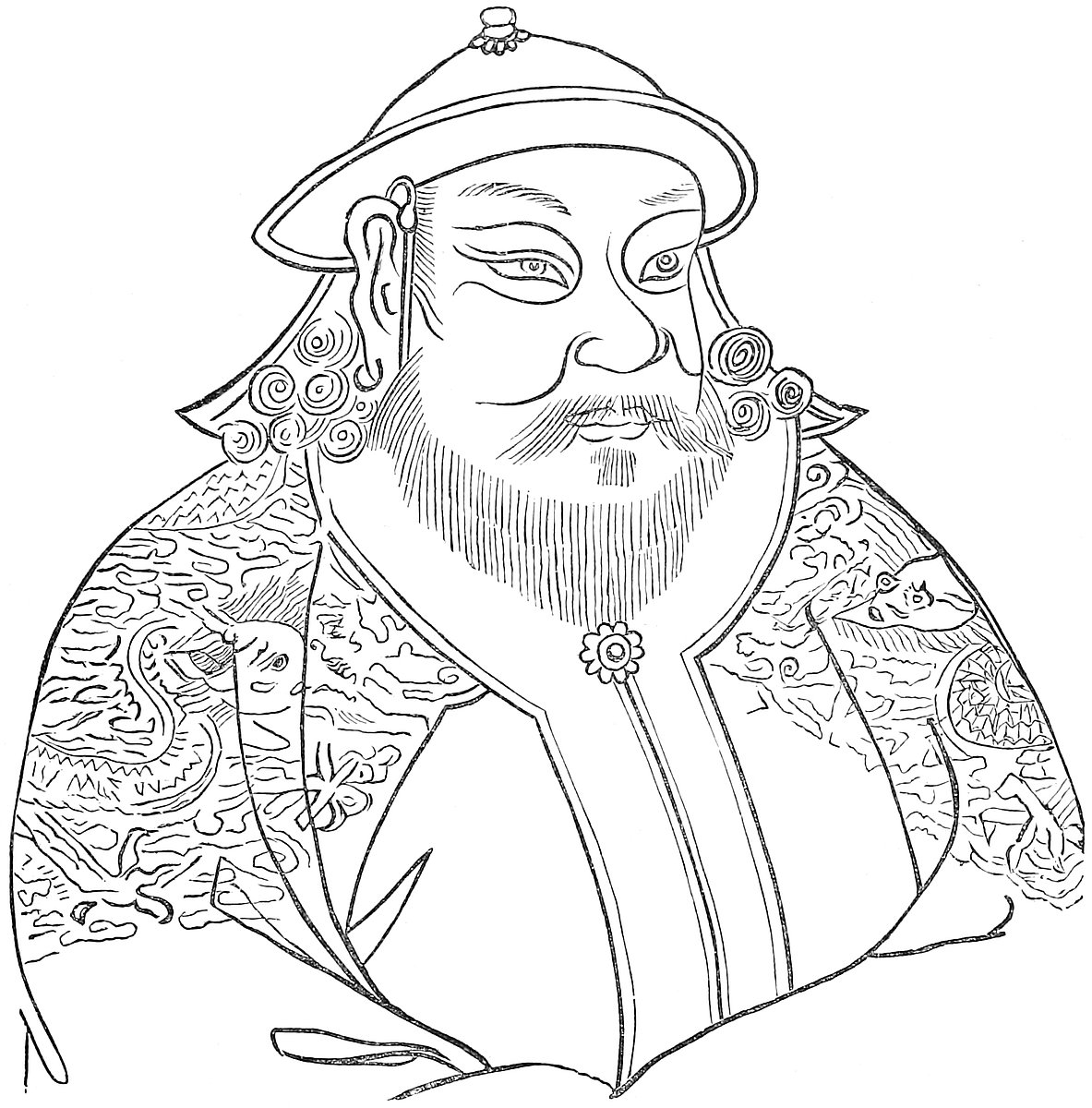
Portrait of Kúblái Kaan. (From a Chinese Engraving.)
Note
1.—We are left in some doubt as to the colour of Kúblái’s eyes, for
some of the MSS. read vairs and voirs, and others noirs. The former
is a very common epithet for eyes in the mediæval romances. And in the
ballad on the death of St. Lewis, we are told of his son Tristram:—
“Droiz fu comme un rosel, iex vairs comme faucon,
Dès le tens Moysel ne nasqui sa façon.”
The word has generally been interpreted bluish-grey, but in the passage
just quoted, Fr.-Michel explains it by brillans. However, the evidence
for noirs here seems strongest. Rashiduddin says that when Kúblái was
born Chinghiz expressed surprise at the child’s being so brown, as
its father and all his other sons were fair. Indeed, we are told that
the descendants of Yesugai (the father of Chinghiz) were in general
distinguished by blue eyes and reddish hair. (Michel’s Joinville, p. 324;
D’Ohsson, II. 475; Erdmann, 252.)
Note
2.—According to Hammer’s authority (Rashid?) Kúblái had seven wives;
Gaubil’s Chinese sources assign him five, with the title of empress
(Hwang-heu). Of these the best beloved was the beautiful Jamúi Khátún
(Lady or Empress Jamúi, illustrating what the text says of the manner
of styling these ladies), who bore him four sons and five daughters.
Rashiduddin adds that she was called Ḳún Ḳú, or the great consort,
evidently the term Hwang-heu. (Gen. Tables in Hammer’s Ilkhans;
Gaubil, 223; Erdmann, 200.)
[“Kúblái’s four wives, i.e. the empresses of the first, second, third, and
fourth ordos. Ordo is, properly speaking, a separate palace of the
Khan, under the management of one of his wives. Chinese authors translate
therefore the word ordo by ‘harem.’ The four Ordo established by
Chingis Khan were destined for the empresses, who were chosen out of four
different nomad tribes. During the reign of the first four Khans, who lived
in Mongolia, the four ordo were considerably distant one from another,
and the Khans visited them in different seasons of the year; they existed
nominally as long as China remained under Mongol domination. The custom of
choosing the empress out of certain tribes, was in the course of time set
aside by the Khans. The empress, wife of the last Mongol Khan in China, was
a Corean princess by birth; and she contributed in a great measure to the
downfall of the Mongol Dynasty.” (Palladius, 40.)
I do not believe that Rashiduddin’s Kún Kú is the term Hwang-keu; it is
the term Kiūn Chu, King or Queen, a sovereign.—H. C.]
Note 3.—Ungrat, the reading of the Crusca, seems to be that to which the
others point, and I doubt not that it represents the great Mongol tribe
of Ḳungurat, which gave more wives than any other to the princes of the
house of Chinghiz; a conclusion in which I find I have been anticipated
by De Mailla or his editor (IX. 426). To this tribe (which, according to
Vámbéry, took its name from (Turki) Kongur-At, “Chestnut Horse”) belonged
Burteh Fujin, the favourite wife of Chinghiz himself, and mother of his
four heirs; to the same tribe belonged the two wives of Chagatai, two
of Hulaku’s seven wives, one of Mangku Kaan’s, two at least of Kúblái’s
including the beloved Jamúi Khátún, one at least of Abaka’s, two of Ahmed
Tigudar’s, two of Arghun’s, and two of Ghazan’s.
The seat of the Ḳungurats was near the Great Wall. Their name is still
applied to one of the tribes of the Uzbeks of Western Turkestan, whose body
appears to have been made up of fractions of many of the Turk and Mongol
tribes. Kungurat is also the name of a town of Khiva, near the Sea of Aral,
perhaps borrowed from the Uzbek clan.
The conversion of Ḳungurat into Ungrat is due, I suppose, to that
Mongol tendency to soften gutturals which has been before noticed. (Erdm.
199–200; Hammer, passim; Burnes, III. 143, 225.)
The Ramusian version adds here these curious and apparently genuine
particulars:—
“The Great Kaan sends his commissioners to the Province to select four or
five hundred, or whatever number may be ordered, of the most beautiful
young women, according to the scale of beauty enjoined upon them. And
they set a value upon the comparative beauty of the damsels in this way.
The commissioners on arriving assemble all the girls of the province, in
presence of appraisers appointed for the purpose. These carefully survey
the points of each girl in succession, as (for example) her hair, her
complexion, eyebrows, mouth, lips, and the proportion of all her limbs.
They will then set down some as estimated at 16 carats, some at 17, 18, 20,
or more or less, according to the sum of the beauties or defects of each.
And whatever standard the Great Kaan may have fixed for those that are to
be brought to him, whether it be 20 carats or 21, the commissioners select
the required number from those who have attained that standard, and bring
them to him. And when they reach his presence he has them appraised anew by
other parties, and has a selection made of 30 or 40 of those, who then get
the highest valuation.”
Marsden and Murray miss the meaning of this curious statement in a
surprising manner, supposing the carat to represent some absolute value,
4 grains of gold according to the former, whence the damsel of 20 carats
was estimated at 13s. 4d.! This is sad nonsense; but Marsden would not
have made the mistake had he not been fortunate enough to live before the
introduction of Competitive Examinations. This Kungurat business was in
fact a competitive examination in beauty; total marks attainable 24; no
candidate to pass who did not get 20 or 21. Carat expresses n ÷ 24, not
any absolute value.
Apart from the mode of valuation, it appears that a like system of
selection was continued by the Ming, and that some such selection from
the daughters of the Manchu nobles has been maintained till recent times.
Herodotus tells that the like custom prevailed among the Adyrmachidae,
the Libyan tribe next Egypt. Old Eden too relates it of the “Princes
of Moscovia.” (Middle Km. I. 318; Herod. IV. 168, Rawl.; Notes on
Russia, Hak. Soc. II. 253.)
Concerning the Great Kaan’s Sons.
The Emperor hath, by those four wives of his, twenty-two male children; the
eldest of whom was called Chinkin for the love of the good Chinghis Kaan,
the first Lord of the Tartars. And this Chinkin, as the Eldest Son of the
Kaan, was to have reigned after his father’s death; but, as it came to
pass, he died. He left a son behind him, however, whose name is Temur, and
he is to be the Great Kaan and Emperor after the death of his Grandfather,
as is but right; he being the child of the Great Kaan’s eldest son. And
this Temur is an able and brave man, as he hath already proven on many
occasions.{1}
The Great Kaan hath also twenty-five other sons by his concubines; and
these are good and valiant soldiers, and each of them is a great chief.
I tell you moreover that of his children by his four lawful wives there
are seven who are kings of vast realms or provinces, and govern them
well; being all able and gallant men, as might be expected. For the Great
Kaan their sire is, I tell you, the wisest and most accomplished man, the
greatest Captain, the best to govern men and rule an Empire, as well as the
most valiant, that ever has existed among all the Tribes of Tartars.{2}
Note 1.—Kúblái had a son older than Chimkin or Chingkim, to whom Hammer’s
Genealogical Table gives the name of Jurji, and attributes a son called
Ananda. The Chinese authorities of Gaubil and Pauthier call him Turchi
or Torchi, i.e. Dorjé, “Noble Stone,” the Tibetan name of a sacred
Buddhist emblem in the form of a dumb-bell, representing the Vajra or
Thunderbolt. Probably Dorjé died early, as in the passage we shall quote
from Wassáf also Chingkim is styled the Eldest Son: Marco is probably wrong
in connecting the name of the latter with that of Chinghiz. Schmidt says
that he does not know what Chingkim means.
[Mr. Parker says that Chen kim was the third son of Kúblái (China
Review, xxiv. p. 94). Teimur, son of Chen kim, wore the temple name
(miao-hao) of Ch’êng Tsung and the title of reign (nien-hao) of Yuen
Chêng and Ta Téh.—H. C.]
Chingkim died in the 12th moon of 1284–1285, aged 43. He had received a
Chinese education, and the Chinese Annals ascribe to him all the virtues
which so often pertain in history to heirs apparent who have not reigned.
“When Kúblái approached his 70th year,” says Wassáf, “he desired to raise
his eldest son Chimkin to the position of his representative and declared
successor, during his own lifetime; so he took counsel with the chiefs,
in view to giving the Prince a share of his authority and a place on the
Imperial Throne. The chiefs, who are the Pillars of Majesty and Props of
the Empire, represented that His Majesty’s proposal to invest his Son,
during his own lifetime, with Imperial authority, was not in accordance
with the precedents and Institutes (Yasa) of the World-conquering Padshah
Chinghiz Khan; but still they would consent to execute a solemn document,
securing the Kaanship to Chimkin, and pledging themselves to lifelong
obedience and allegiance to him. It was, however, the Divine Fiat that the
intended successor should predecease him who bestowed the nomination....
The dignitaries of the Empire then united their voices in favour of Teimur,
the son of Chimkin.”
Teimur, according to the same authority, was the third son of Chimkin; but
the eldest, Kambala, squinted; the second, Tarmah (properly Tarmabala
for Dharmaphala, a Buddhist Sanskrit name) was rickety in constitution;
and on the death of the old Kaan (1294) Teimur was unanimously named to
the Throne, after some opposition from Kambala, which was put down by
the decided bearing of the great soldier Bayan. (Schmidt, p. 399; De
Mailla, IX. 424; Gaubil, 203; Wassáf, 46.)
[The Rev. W. S. Ament (Marco Polo in Cambaluc, p. 106), makes the
following remarks regarding this young prince (Chimkin): “The historians
give good reasons for their regard for Chen Chin. He had from early years
exhibited great promise and had shown great proficiency in the military
art, in government, history, mathematics, and the Chinese classics. He
was well acquainted with the condition and numbers of the inhabitants of
Mongolia and China, and with the topography and commerce of the Empire
(Howorth). He was much beloved by all, except by some of his father’s own
ministers, whose lives were anything but exemplary. That Kúblái had full
confidence in his son is shown by the fact that he put the collecting of
taxes in his hands. The native historians represent him as economical in
the use of money and wise in the choice of companions. He carefully watched
the officers in his charge, and would tolerate no extortion of the people.
After droughts, famines or floods, he would enquire into the condition of
the people and liberally supply their needs, thus starting them in life
again. Polo ascribes all these virtues to the Khan himself. Doubtless he
possessed them in greater or less degree, but father and son were one in
all these benevolent enterprises.”—H. C.]
Note 2.—The Chinese Annals, according to Pauthier and Gaubil, give only
ten sons to Kúblái, at least by his legitimate wives; Hammer’s Table
gives twelve. It is very probable that xxii. was an early clerical error
in the texts of Polo for xii. Dodeci indeed occurs in one MS. (No. 37 of
our Appendix F), though not one of much weight.
Of these legitimate sons Polo mentions, in different parts of his work,
five by name. The following is the list from Hammer and D’Ohsson, with
the Chinese forms from Pauthier in parentheses. The seven whose names are
in capitals had the title of Wang or “King” of particular territories,
as M. Pauthier has shown from the Chinese Annals, thus confirming Marco’s
accuracy on that point.
I. Jurji or Dorjé (Torchi). II. Chimkin or Chingkim (Yu Tsung, King of Yen,
i.e. Old Peking). III. Mangalai (Mankola, “King of the Pacified West”),
mentioned by Polo (infra, ch. xli.) as King of Kenjanfu or Shensi. IV.
Numugan (Numukan, “Pacifying King of the North”), mentioned by Polo (Bk.
IV. ch. ii.) as with King George joint leader of the Kaan’s army against
Kaidu. V. Kuridai (not in Chinese List). VI. Hukaji (Hukochi, “King of
Yunnan”), mentioned by Polo (infra, ch. xlix.) as King of Carajan. VII.
Aghrukji or Ukuruji (Gaoluchi, “King of Siping” or Tibet). VIII. Abaji
(Gaiyachi?). IX. Kukju or Geukju (Khokhochu, “King of Ning” or Tangut). X.
Kutuktemur (Hutulu Temurh). XI. Tukan (Thohoan, “King of Chinnan”). His
command lay on the Tungking frontier, where he came to great grief in 1288,
in consequence of which he was disgraced. (See Cathay, p. 272.) XII.
Temkan (not in Chinese List). Gaubil’s Chinese List omits Hutulu Temurh,
and introduces a prince called Gantanpouhoa as 4th son.
M. Pauthier lays great stress on Polo’s intimate knowledge of the Imperial
affairs (p. 263) because he knew the name of the Hereditary Prince to be
Teimur; this being, he says, the private name which could not be known
until after the owner’s death, except by those in the most confidential
intimacy. The public only then discovered that, like the Irishman’s dog,
his real name was Turk, though he had always been called Toby! But M.
Pauthier’s learning has misled him. At least the secret must have been
very badly kept, for it was known in Teimur’s lifetime not only to Marco,
but to Rashiduddin in Persia, and to Hayton in Armenia; to say nothing of
the circumstance that the name Temur Khaghan is also used during that
Emperor’s life by Oljaitu Khan of Persia in writing to the King of France a
letter which M. Pauthier himself republished and commented upon. (See his
book, p. 780.)
Concerning the Palace of the Great Kaan.
You must know that for three months of the year, to wit December, January,
and February, the Great Kaan resides in the capital city of Cathay, which
is called Cambaluc, [and which is at the north-eastern extremity of the
country]. In that city stands his great Palace, and now I will tell you
what it is like.
It is enclosed all round by a great wall forming a square, each side of
which is a mile in length; that is to say, the whole compass thereof is
four miles. This you may depend on; it is also very thick, and a good
ten paces in height, whitewashed and loop-holed all round.{1} At
each angle of the wall there is a very fine and rich palace in which the
war-harness of the Emperor is kept, such as bows and quivers,{2}
saddles and bridles, and bowstrings, and everything needful for an army.
Also midway between every two of these Corner Palaces there is another of
the like; so that taking the whole compass of the enclosure you find eight
vast Palaces stored with the Great Lord’s harness of war.{3} And you
must understand that each Palace is assigned to only one kind of article;
thus one is stored with bows, a second with saddles, a third with bridles,
and so on in succession right round.{4}
The great wall has five gates on its southern face, the middle one being
the great gate which is never opened on any occasion except when the Great
Kaan himself goes forth or enters. Close on either side of this great gate
is a smaller one by which all other people pass; and then towards each
angle is another great gate, also open to people in general; so that on
that side there are five gates in all.{5}
Inside of this wall there is a second, enclosing a space that is somewhat
greater in length than in breadth. This enclosure also has eight palaces
corresponding to those of the outer wall, and stored like them with the
Lord’s harness of war. This wall also hath five gates on the southern
face, corresponding to those in the outer wall, and hath one gate on each
of the other faces, as the outer wall hath also. In the middle of the
second enclosure is the Lord’s Great Palace, and I will tell you what it is
like.{6}
You must know that it is the greatest Palace that ever was. [Towards the
north it is in contact with the outer wall, whilst towards the south
there is a vacant space which the Barons and the soldiers are constantly
traversing.{7} The Palace itself] hath no upper story, but is all on
the ground floor, only the basement is raised some ten palms above the
surrounding soil [and this elevation is retained by a wall of marble raised
to the level of the pavement, two paces in width and projecting beyond the
base of the Palace so as to form a kind of terrace-walk, by which people
can pass round the building, and which is exposed to view, whilst on the
outer edge of the wall there is a very fine pillared balustrade; and up to
this the people are allowed to come]. The roof is very lofty, and the walls
of the Palace are all covered with gold and silver. They are also adorned
with representations of dragons [sculptured and gilt], beasts and birds,
knights and idols, and sundry other subjects. And on the ceiling too you
see nothing but gold and silver and painting. [On each of the four sides
there is a great marble staircase leading to the top of the marble wall,
and forming the approach to the Palace.]{8}
The Hall of the Palace is so large that it could easily dine 6000 people;
and it is quite a marvel to see how many rooms there are besides. The
building is altogether so vast, so rich, and so beautiful, that no man on
earth could design anything superior to it. The outside of the roof also is
all coloured with vermilion and yellow and green and blue and other hues,
which are fixed with a varnish so fine and exquisite that they shine like
crystal, and lend a resplendent lustre to the Palace as seen for a great
way round.{9} This roof is made too with such strength and solidity
that it is fit to last for ever.
[On the interior side of the Palace are large buildings with halls and
chambers, where the Emperor’s private property is placed, such as his
treasures of gold, silver, gems, pearls, and gold plate, and in which
reside the ladies and concubines. There he occupies himself at his own
convenience, and no one else has access.]
Between the two walls of the enclosure which I have described, there
are fine parks and beautiful trees bearing a variety of fruits. There
are beasts also of sundry kinds, such as white stags and fallow deer,
gazelles and roebucks, and fine squirrels of various sorts, with numbers
also of the animal that gives the musk, and all manner of other beautiful
creatures,{10} insomuch that the whole place is full of them, and no
spot remains void except where there is traffic of people going and coming.
[The parks are covered with abundant grass; and the roads through them
being all paved and raised two cubits above the surface, they never become
muddy, nor does the rain lodge on them, but flows off into the meadows,
quickening the soil and producing that abundance of herbage.]
From that corner of the enclosure which is towards the north-west there
extends a fine Lake, containing foison of fish of different kinds which the
Emperor hath caused to be put in there, so that whenever he desires any he
can have them at his pleasure. A river enters this lake and issues from
it, but there is a grating of iron or brass put up so that the fish cannot
escape in that way.{11}
Moreover on the north side of the Palace, about a bow-shot off, there is a
hill which has been made by art [from the earth dug out of the lake]; it is
a good hundred paces in height and a mile in compass. This hill is entirely
covered with trees that never lose their leaves, but remain ever green.
And I assure you that wherever a beautiful tree may exist, and the Emperor
gets news of it, he sends for it and has it transported bodily with all its
roots and the earth attached to them, and planted on that hill of his. No
matter how big the tree may be, he gets it carried by his elephants; and in
this way he has got together the most beautiful collection of trees in all
the world. And he has also caused the whole hill to be covered with the ore
of azure,{12} which is very green. And thus not only are the trees all
green, but the hill itself is all green likewise; and there is nothing to
be seen on it that is not green; and hence it is called the Green Mount;
and in good sooth ’tis named well.{13}
On the top of the hill again there is a fine big palace which is all green
inside and out; and thus the hill, and the trees, and the palace form
together a charming spectacle; and it is marvellous to see their uniformity
of colour! Everybody who sees them is delighted. And the Great Kaan had
caused this beautiful prospect to be formed for the comfort and solace and
delectation of his heart.
You must know that beside the Palace (that we have been describing), i.e.
the Great Palace, the Emperor has caused another to be built just like
his own in every respect, and this he hath done for his son when he shall
reign and be Emperor after him.{14} Hence it is made just in the same
fashion and of the same size, so that everything can be carried on in the
same manner after his own death. [It stands on the other side of the lake
from the Great Kaan’s Palace, and there is a bridge crossing the water from
one to the other.]{15} The Prince in question holds now a Seal of
Empire, but not with such complete authority as the Great Kaan, who remains
supreme as long as he lives.
Now I am going to tell you of the chief city of Cathay, in which these
Palaces stand; and why it was built, and how.
Note
1.—[According to the Ch’ue keng lu, translated by Bretschneider,
25, “the wall surrounding the palace ... is constructed of bricks, and is
35 ch’i in height. The construction was begun in A.D. 1271, on the 17th
of the 8th month, between three and five o’clock in the afternoon, and
finished next year on the 15th of the 3rd month.”—H. C.]
Note
2.—Tarcasci (G. T.). This word is worthy of note as the proper form
of what has become in modern French carquois. The former is a transcript
of the Persian Tărkăsh; the latter appears to be merely a corruption
of it, arising perhaps clerically from the constant confusion of c and
t in MSS. (See Defrémery, quoted by Pauthier, in loco.) [Old French
tarquais (13th century), Hatzfeldt and Darmesteter’s Dict. gives;
“Coivres orent ceinz et tarchais.” (Wace, Rou, III., 7698; 12th century).]
Note 3.—[“It seems to me [Dr. Bretschneider] that Polo took the towers,
mentioned by the Chinese author, in the angles of the galleries and of the
Kung-ch’eng for palaces; for further on he states, that ‘over each gate [of
Cambaluc] there is a great and handsome palace.’ I have little doubt that
over the gates of Cambaluc, stood lofty buildings similar to those over
the gates of modern Peking. These tower-like buildings are called lou by
the Chinese. It may be very likely, that at the time of Marco Polo, the
war harness of the Khan was stored in these towers of the palace wall.
The author of the Ch’ue keng lu, who wrote more than fifty years later,
assigns to it another place.” (Bretschneider, Peking, 32.)—H. C.]
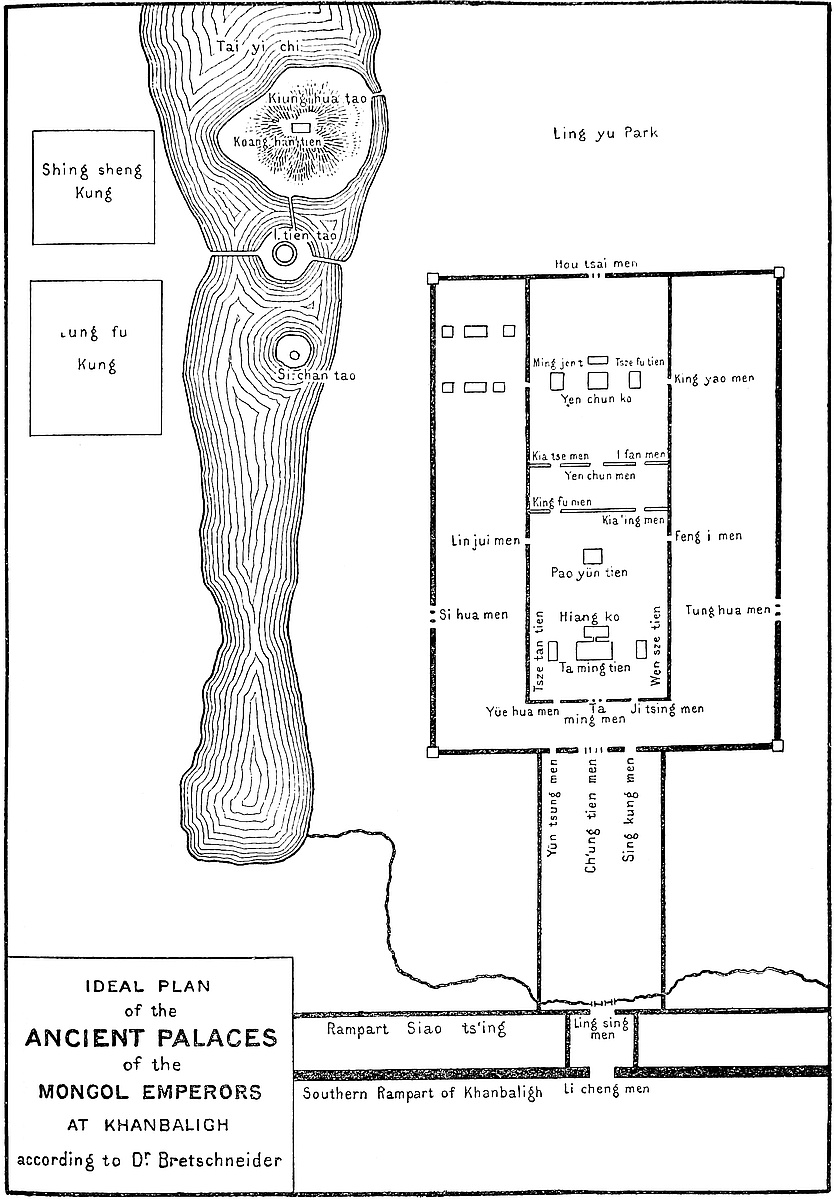
IDEAL PLAN
of the
ANCIENT PALACES
of the
MONGOL EMPERORS
AT KHANBALIGH
according to Dr. Bretschneider
Note 4.—The stores are now outside the walls of the “Prohibited City,”
corresponding to Polo’s Palace-Wall, but within the walls of the “Imperial
City.” (Middle Kingdom, I. 61.) See the cut at p. 376.
Note 5.—The two gates near the corners apparently do not exist in the
Palace now. “On the south side there are three gates to the Palace, both in
the inner and the outer walls. The middle one is absolutely reserved for
the entrance or exit of the Emperor; all other people pass in and out by
the gate to the right or left of it.” (Trigautius, Bk. I. ch. vii.) This
custom is not in China peculiar to Royalty. In private houses it is usual
to have three doors leading from the court to the guest-rooms, and there is
a great exercise of politeness in reference to these; the guest after much
pressing is prevailed on to enter the middle door, whilst the host enters
by the side. (See Deguignes, Voyages, I. 262.) [See also H. Cordier’s
Hist. des Relat. de la Chine, III. ch. x. Audience Impériale.]
[“It seems Polo took the three gateways in the middle gate (Ta-ming men)
for three gates, and thus speaks of five gates instead of three in the
southern wall.” (Bretschneider, Peking, 27, note.)—H. C.]
Note 6.—Ramusio’s version here diverges from the old MSS. It makes the
inner enclosure a mile square; and the second (the city of Taidu) six miles
square, as here, but adds, at a mile interval, a third of eight miles
square. Now it is remarkable that Mr. A. Wylie, in a letter dated 4th
December 1873, speaking of a recent visit to Peking, says: “I found from
various inquiries that there are several remains of a very much larger city
wall, inclosing the present city; but time would not allow me to follow up
the traces.”
Pauthier’s text (which I have corrected by the G. T.), after describing the
outer inclosure to be a mile every way, says that the inner inclosure
lay at an interval of a mile within it!
[Dr. Bretschneider observes “that in the ancient Chinese works, three
concentric inclosures are mentioned in connection with the palace. The
innermost inclosed the Ta-nei, the middle inclosure, called Kung-ch’eng
or Huang-ch’eng, answering to the wall surrounding the present prohibited
city, and was about 6 li in circuit. Besides this there was an outer
wall (a rampart apparently) 20 li in circuit, answering to the wall
of the present imperial city (which now has 18 li in circuit).” The
Huang-ch’eng of the Yuen was measured by imperial order, and found to be
7 li in circuit; the wall of the Mongol palace was 6 li in circuit,
according to the Ch’ue keng lu. (Bretschneider, Peking, 24.)—Marco
Polo’s mile could be approximately estimated = 2·77 Chinese li. (Ibid.
24, note.) The common Chinese li = 360 pu, or 180 chang, or 1800 ch’i
(feet); 1 li = 1894 English feet or 575 mètres; at least according to the
old Venice measures quoted in Yule’s Marco Polo, II., one pace = 5 feet.
Besides the common li, the Chinese have another li, used for measuring
fields, which has only 240 pu or 1200 ch’i. This is the li spoken of
in the Ch’ue keng lu. (Ibid. 13, note.)—H. C.]
Note 7.—[“Near the southern face of the wall are barracks for the Life
Guards.” (Ch’ue keng lu, translated by Bretschneider, 25.)—H. C.]
Note 8.—This description of palace (see opposite cut), an elevated basement
of masonry with a superstructure of timber (in general carved and gilded),
is still found in Burma, Siam, and Java, as well as in China. If we had
any trace of the palaces of the ancient Asokas and Vikramadityas of India,
we should probably find that they were of the same character. It seems to
be one of those things that belonged to some ancient Panasiatic fashion,
as the palaces of Nineveh were of a somewhat similar construction. In the
Audience Halls of the Moguls at Delhi and Agra we can trace the ancient
form, though the superstructure has there become an arcade of marble
instead of a pavilion on timber columns.
[“The Ta-ming tien (Hall of great brightness) is without doubt what Marco
Polo calls ‘the Lord’s Great Palace.’... He states, that it ‘hath no upper
story’; and indeed, the palace buildings which the Chinese call tien are
always of one story. Polo speaks also of a ‘very fine pillared balustrade’
(the chu lang, pillared verandah, of the Chinese author). Marco Polo
states that the basement of the great palace ‘is raised some ten palms
above the surrounding soil.’ We find in the Ku kung i lu: ‘The basement
of the Ta-ming tien is raised about 10 ch’i above the soil.’ There can
also be no doubt that the Ta-ming tien stood at about the same place where
now the T’ai-ho tien, the principal hall of the palace, is situated.”
(Bretschneider, Peking, 28, note.)
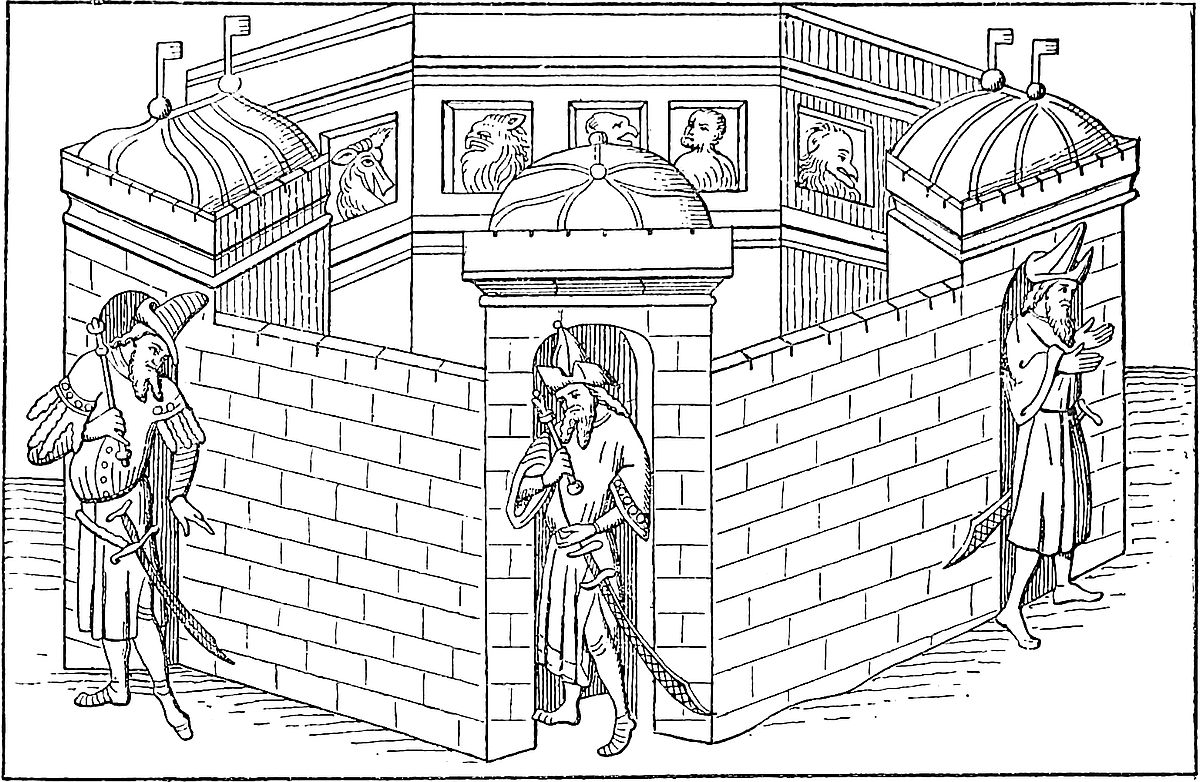
A. Housselin d.
Palace at Khan-baligh. (From the Livre des Merveilles.)
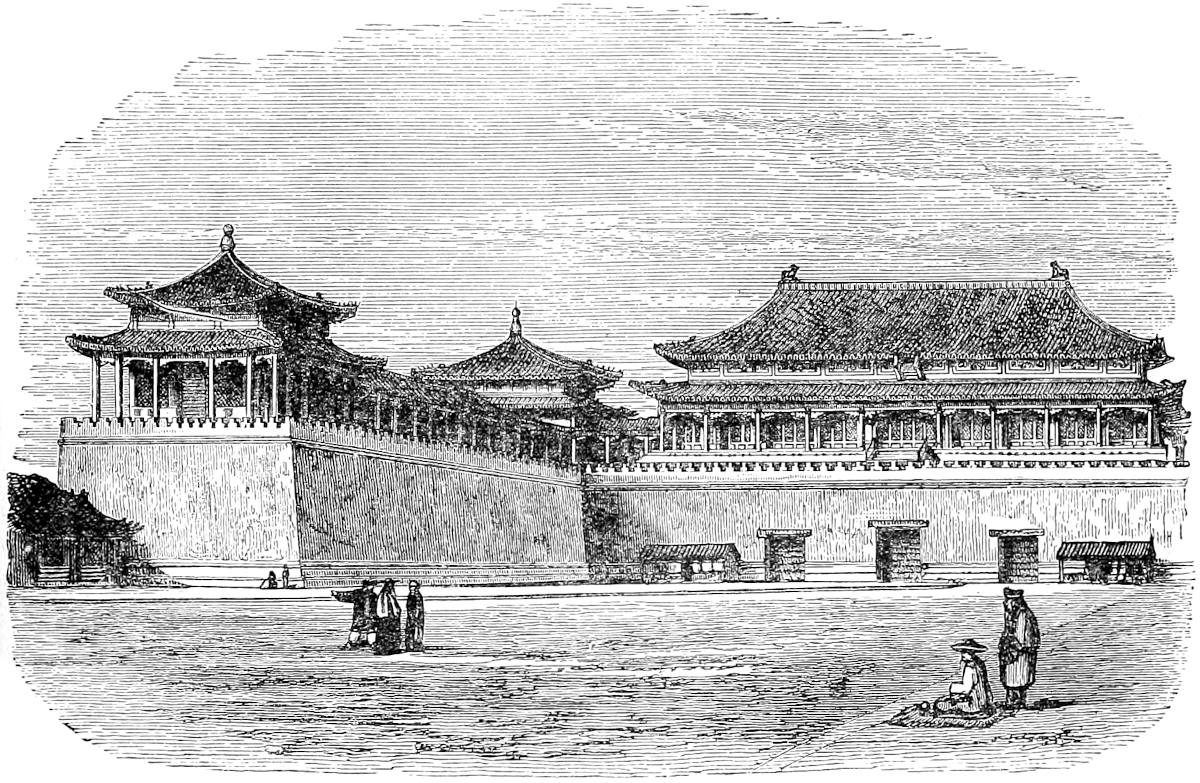
Winter Palace at Peking.
The Ch’ue keng lu, translated by Bretschneider, 25, contains long
articles devoted to the description of the palace of the Mongols and the
adjacent palace grounds. They are too long to be reproduced here.—H. C.]
Note 9.—“As all that one sees of these palaces is varnished in those
colours, when you catch a distant view of them at sunrise, as I have done
many a time, you would think them all made of, or at least covered with,
pure gold enamelled in azure and green, so that the spectacle is at once
majestic and charming.” (Magaillans, p. 353.)
Note
10.—[This is the Ling yu or “Divine Park,” to the east of the
Wan-sui shan, “in which rare birds and beasts are kept. Before the
Emperor goes to Shangtu, the officers are accustomed to be entertained at
this place.” (Ch’ue keng lu, quoted by Bretschneider, 36.)—H. C.]
Note 11.—“On the west side, where the space is amplest, there is a lake
very full of fish. It is in the form of a fiddle, and is an Italian mile
and a quarter in length. It is crossed at the narrowest part, which
corresponds to gates in the walls, by a handsome bridge, the extremities
of which are adorned by two triumphal arches of three openings each....
The lake is surrounded by palaces and pleasure houses, built partly in the
water and partly on shore, and charming boats are provided on it for the
use of the Emperor when he chooses to go a-fishing or to take an airing.”
(Ibid. 282–283.) The marble bridge, as it now exists, consists of nine
arches, and is 600 feet long. (Rennie’s Peking, II. 57.)
Ramusio specifies another lake in the city, fed by the same stream before
it enters the palace, and used by the public for watering cattle.
[“The lake which Marco Polo saw is the same as the T’ai-yi ch’i of our
days. It has, however, changed a little in its form. This lake and also its
name T’ai-yi ch’i date from the twelfth century, at which time an Emperor
of the Kin first gave orders to collect together the water of some springs
in the hills, where now the summer palaces stand, and to conduct it to a
place north of his capital, where pleasure gardens were laid out. The river
which enters the lake and issues from it exists still, under its ancient
name Kin-shui.” (Bretschneider, Peking, 34.)—H. C.]
Note
12.—The expression here is in the Geog. Text, “Roze de l’açur,” and
in Pauthier’s “de rose et de l’asur.” Rose Minerale, in the terminology
of the alchemists, was a red powder produced in the sublimation of gold
and mercury, but I can find no elucidation of the term Rose of Azure. The
Crusca Italian has in the same place Terra dello Azzurro. Having ventured
to refer the question to the high authority of Mr. C. W. King, he expresses
the opinion that Roze here stands for Roche, and that probably the
term Roche de l’azur may have been used loosely for blue-stone, i.e.
carbonate of copper, which would assume a green colour through moisture. He
adds: “Nero, according to Pliny, actually used chrysocolla, the siliceous
carbonate of copper, in powder, for strewing the circus, to give the course
the colour of his favourite faction, the prasine (or green). There may be
some analogy between this device and that of Kúblái Khan.” This parallel is
a very happy one.
Note 13.—Friar Odoric gives a description, short, but closely agreeing in
substance with that in the Text, of the Palace, the Park, the Lake, and the
Green Mount.
A green mount, answering to the description, and about 160 feet in height,
stands immediately in rear of the palace buildings. It is called by the
Chinese King-Shan, “Court Mountain,” Wan-su-Shan, “Ten Thousand Year
Mount,” and Mei-Shan, “Coal Mount,” the last from the material of which
it is traditionally said to be composed (as a provision of fuel in case
of siege).[1] Whether this is
Kúblái’s Green Mount does not seem to be
quite certain. Dr. Lockhart tells me that, according to the information he
collected when living at Peking, it is not so, but was formed by the Ming
Emperors from the excavation of the existing lake on the site which the
Mongol Palace had occupied. There is another mount, he adds, adjoining the
east shore of the lake, which must be of older date even than Kúblái, for a
Dagoba standing on it is ascribed to the Kin.
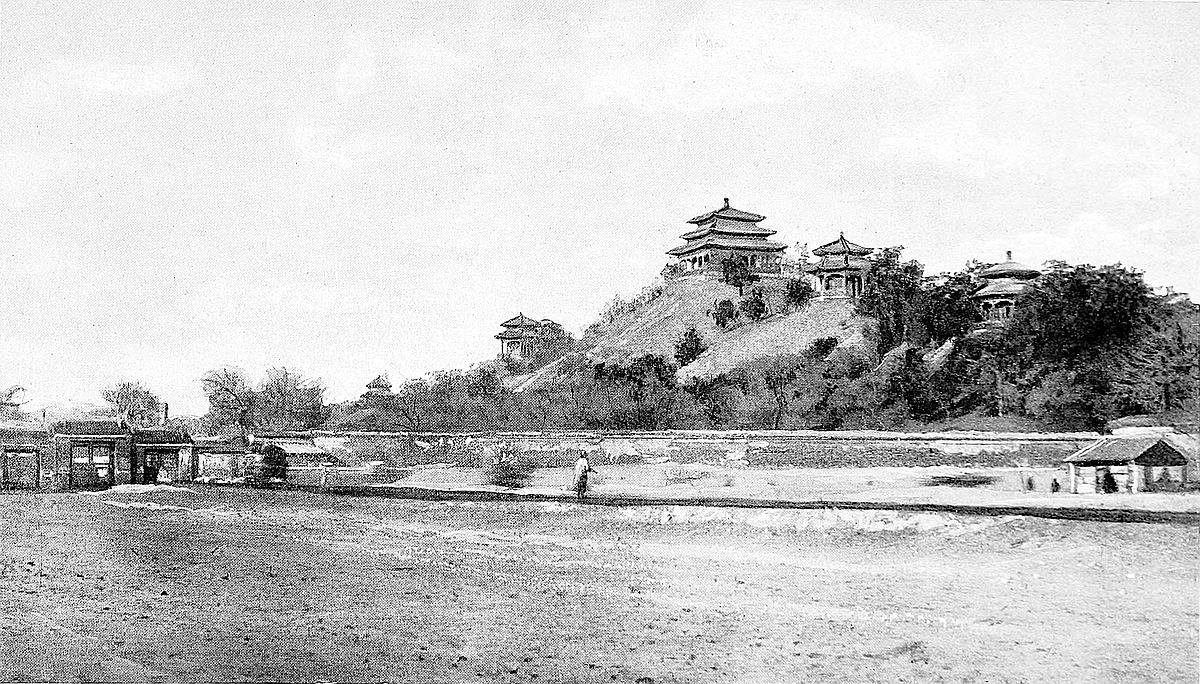
Mei Shan.
[The “Green Mount” was an island called K’iung-hua at the time of the
Kin; in 1271 it received the name of Wan-sui shan; it is about 100 feet
in height, and is the only hill mentioned by Chinese writers of the Mongol
time who refer to the palace grounds. It is not the present King-shan,
north of the palace, called also Wan-sui-shan under the Ming, and now the
Mei-shan, of more recent formation. “I have no doubt,” says Bretschneider
(Peking, l.c. 35), “that Marco Polo’s handsome palace on the top of the
Green Mount is the same as the Kuang-han tien” of the Ch’ue keng lu. It
was a hall in which there was a jar of black jade, big enough to hold more
than 30 piculs of wine; this jade had white veins, and in accordance with
these veins, fish and animals have been carved on the jar. (Ibid. 35.) “The
Ku kung i lu, in describing the Wan-sui-shan, praises the beautiful
shady green of the vegetation there.” (Ibid. 37.)—H. C.]
[“Near the eastern end of the bridge (Kin-ao yü-tung which crosses the
lake) the visitor sees a circular wall, which is called yüan ch’eng
(round wall). It is about 350 paces in circuit. Within it is an imperial
building Ch’eng-kuang tien, dating from the Mongol time. From this
circular enclosure, another long and beautifully executed marble bridge
leads northwards, to a charming hill, covered with shady trees, and capped
by a magnificent white suburga.” (Bretschneider, p. 22.)—H. C.]
In a plate attached to next chapter, I have drawn, on a small scale, the
existing cities of Peking, as compared with the Mongol and Chinese cities
in the time of Kúblái. The plan of the latter has been constructed (1)
from existing traces, as exhibited in the Russian Survey republished by
our War Office; (2) from information kindly afforded by Dr. Lockhart;
and (3) from Polo’s description and a few slight notices by Gaubil and
others. It will be seen, even on the small scale of these plans, that
the general arrangement of the palace, the park, the lakes (including
that in the city, which appears in Ramusio’s version), the bridge, the
mount, etc., in the existing Peking, very closely correspond with Polo’s
indications; and I think the strong probability is that the Ming really
built on the old traces, and that the lake, mount, etc., as they now
stand, are substantially those of the Great Mongol, though Chinese policy
or patriotism may have spread the belief that the foreign traces were
obliterated. Indeed, if that belief were true, the Mongol Palace must
have been very much out of the axis of the City of Kúblái, which is in
the highest degree improbable. The Bulletin de la Soc. de Géographie
for September 1873, contains a paper on Peking by the physician to the
French Embassy there. Whatever may be the worth of the meteorological and
hygienic details in that paper, I am bound to say that the historical and
topographical part is so inaccurate as to be of no value.
Note 14.—For son, read grandson. But the G. T. actually names the Emperor’s
son Chingkim, whose death our traveller has himself already mentioned.
Note 15.—[“Marco Polo’s bridge, crossing the lake from one side to the
other, must be identified with the wooden bridge mentioned in the Ch’ue
keng lu. The present marble bridge spanning the lake was only built in
1392.” “A marble bridge connects this island (an islet with the hall I-t’ien tien)
with the Wan-sui shan. Another bridge, made of wood, 120
ch’i long and 22 broad, leads eastward to the wall of the Imperial
Palace. A third bridge, a wooden draw-bridge 470 ch’i long, stretches to
the west over the lake to its western border, where the palace Hing-sheng
kung [built in 1308] stands.” (Bretschneider, Peking, 36.)—H. C.]
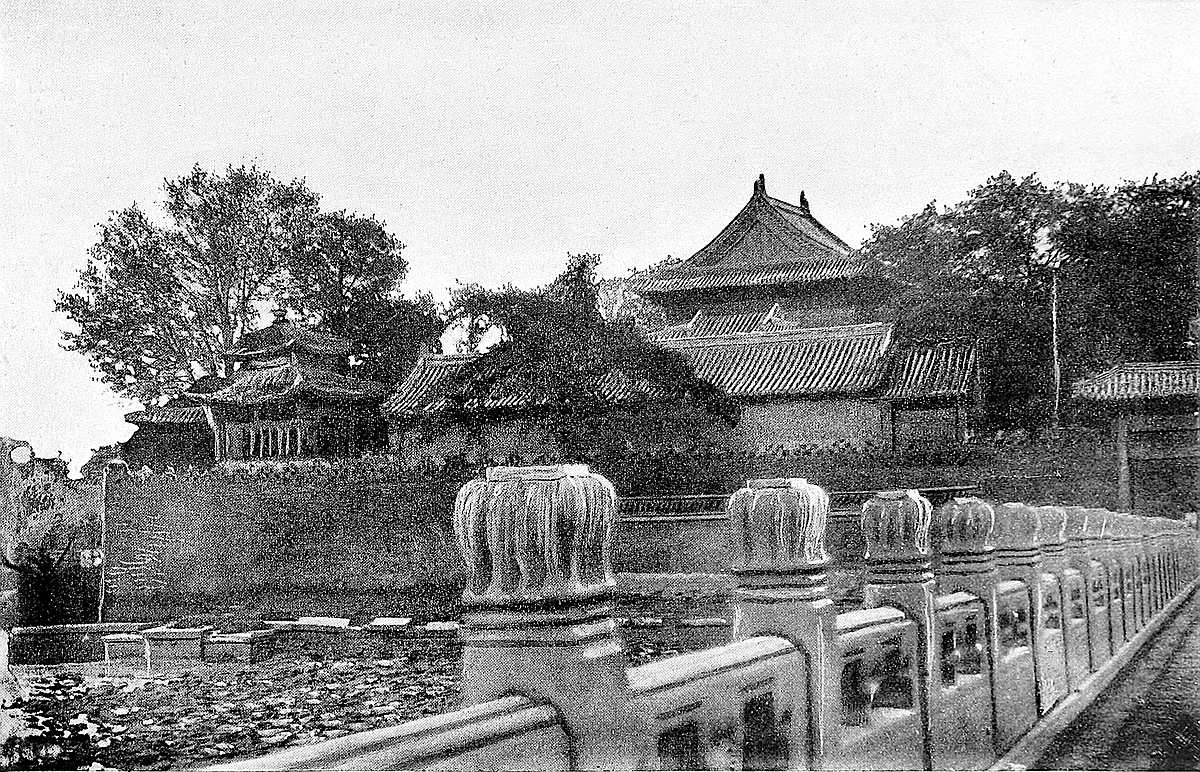
Yüan ch’eng.
Concerning the City of Cambaluc.
Now there was on that spot in old times a great and noble city called
Cambaluc, which is as much as to say in our tongue “The city of the
Emperor.”{1} But the Great Kaan was informed by his Astrologers that
this city would prove rebellious, and raise great disorders against his
imperial authority. So he caused the present city to be built close beside
the old one, with only a river between them.{2} And he caused the
people of the old city to be removed to the new town that he had founded;
and this is called Taidu. [However, he allowed a portion of the people
which he did not suspect to remain in the old city, because the new one
could not hold the whole of them, big as it is.]
As regards the size of this (new) city you must know that it has a compass
of 24 miles, for each side of it hath a length of 6 miles, and it is
four-square. And it is all walled round with walls of earth which have
a thickness of full ten paces at bottom, and a height of more than 10
paces;{3} but they are not so thick at top, for they diminish in
thickness as they rise, so that at top they are only about 3 paces thick.
And they are provided throughout with loop-holed battlements, which are all
whitewashed.
There are 12 gates, and over each gate there is a great and handsome
palace, so that there are on each side of the square three gates and five
palaces; for (I ought to mention) there is at each angle also a great and
handsome palace. In those palaces are vast halls in which are kept the arms
of the city garrison.{4}
The streets are so straight and wide that you can see right along them from
end to end and from one gate to the other. And up and down the city there
are beautiful palaces, and many great and fine hostelries, and fine houses
in great numbers. [All the plots of ground on which the houses of the city
are built are four-square, and laid out with straight lines; all the plots
being occupied by great and spacious palaces, with courts and gardens of
proportionate size. All these plots were assigned to different heads of
families. Each square plot is encompassed by handsome streets for traffic;
and thus the whole city is arranged in squares just like a chess-board, and
disposed in a manner so perfect and masterly that it is impossible to give
a description that should do it justice.]{5}
Moreover, in the middle of the city there is a great clock—that is to say,
a bell—which is struck at night. And after it has struck three times no one
must go out in the city, unless it be for the needs of a woman in labour,
or of the sick.{6} And those who go about on such errands are bound to
carry lanterns with them. Moreover, the established guard at each gate of
the city is 1000 armed men; not that you are to imagine this guard is kept
up for fear of any attack, but only as a guard of honour for the Sovereign,
who resides there, and to prevent thieves from doing mischief in the
town.{7}
Note 1.— ✛ The history of the city on the site of Peking goes back to very
old times, for it had been [under the name of Ki] the capital of the
kingdom of Yen, previous to B.C. 222, when it was captured by the Prince of
the T’sin Dynasty. [Under the T’ang dynasty (618–907) it was known under
the name of Yu-chau.] It became one of the capitals of the Khitans in A.D.
936, and of the Kin sovereigns, who took it in 1125, in 1151 under the name
of Chung-tu. Under the name of Yenking, [given to this city in 1013] it has
a conspicuous place in the wars of Chinghiz against the latter dynasty. He
captured it in 1215. In 1264, Kúblái adopted it as his chief residence,
and founded in 1267, the new city of Tatu (“Great Court”), called by the
Mongols Taidu or Daitu
since 1271 (see Bk. I. ch. lxi. note 1), at a little
distance—Odoric says half a mile—to the north-east of the old Yenking. Tatu
was completed in the summer of 1267.
Old Yenking had, when occupied by the Kin, a circuit of 27 li (commonly
estimated at 9 miles, but in early works the li is not more than ⅕ of a
mile), afterwards increased to 30 li. But there was some kind of outer
wall about the city and its suburbs, the circuit of which is called 75
li. [“At the time of the Yuen the walls still existed, and the ancient
city of the Kin was commonly called Nan-ch’eng (Southern city), whilst the
Mongol capital was termed the northern city.” Bretschneider, Peking,
10.—H. C.] (Lockhart; and see Amyot, II. 553, and note 6 to last
chapter.)
Polo correctly explains the name Cambaluc, i.e. Kaan-baligh, “The City
of the Kaan.”
Note 2.—The river that ran between the old and new city must have been the
little river Yu, which still runs through the modern Tartar city, and
fills the city ditches.
[Dr. Bretschneider (Peking, 49) thinks that there is a strong probability
that Polo speaks of the Wen-ming ho, a river which, according to the
ancient descriptions, ran near the southern wall of the Mongol capital.—H. C.]
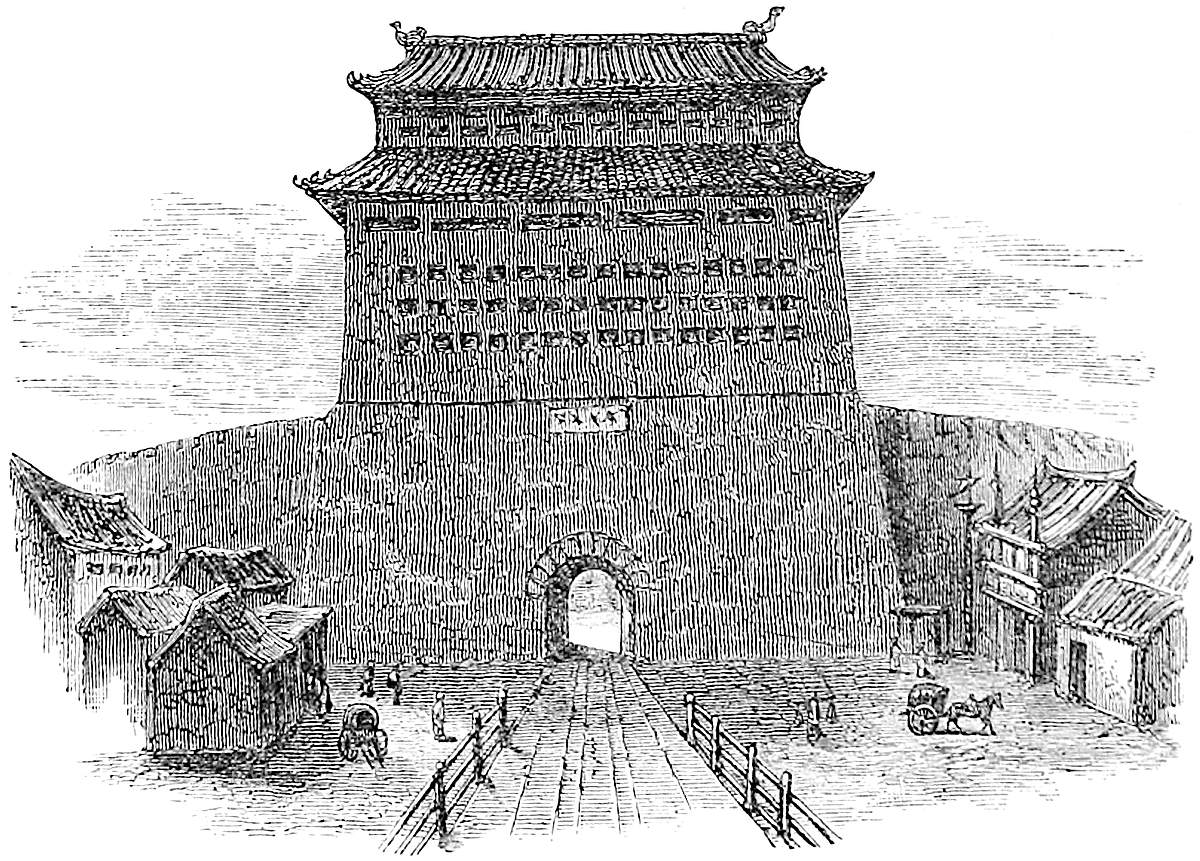
South Gate of Imperial City at Peking.
“Elle a douze portes, et sor chascune porte a une grandisme palais et
biaus.”
Note
3.—This height is from Pauthier’s Text; the G. Text has, “twenty
paces,” i.e. 100 feet. A recent French paper states the dimensions of the
existing walls as 14 mètres (45½ feet) high, and 14·50 (47¼ feet) thick,
“the top forming a paved promenade, unique of its kind, and recalling the
legendary walls of Thebes and Babylon.” (Ann. d’Hygiène Publique, 2nd s.
tom. xxxii. for 1869, p. 21.)
[According to the French astronomers (Fleuriais and Lapied) sent to Peking
for the Transit of Venus in December, 1875, the present Tartar city is 23
kil. 55 in circuit, viz. if 1 li = 575 m., 41 li; from the north to the
south 5400 mètres; from east to west 6700 mètres; the wall is 13 mètres in
height and 12 mètres in width.—H. C.]
Note 4.—Our attempted plan of Cambaluc, as in 1290, differs somewhat from
this description, but there is no getting over certain existing facts.
Peking
As it is
and As it was, about 1290
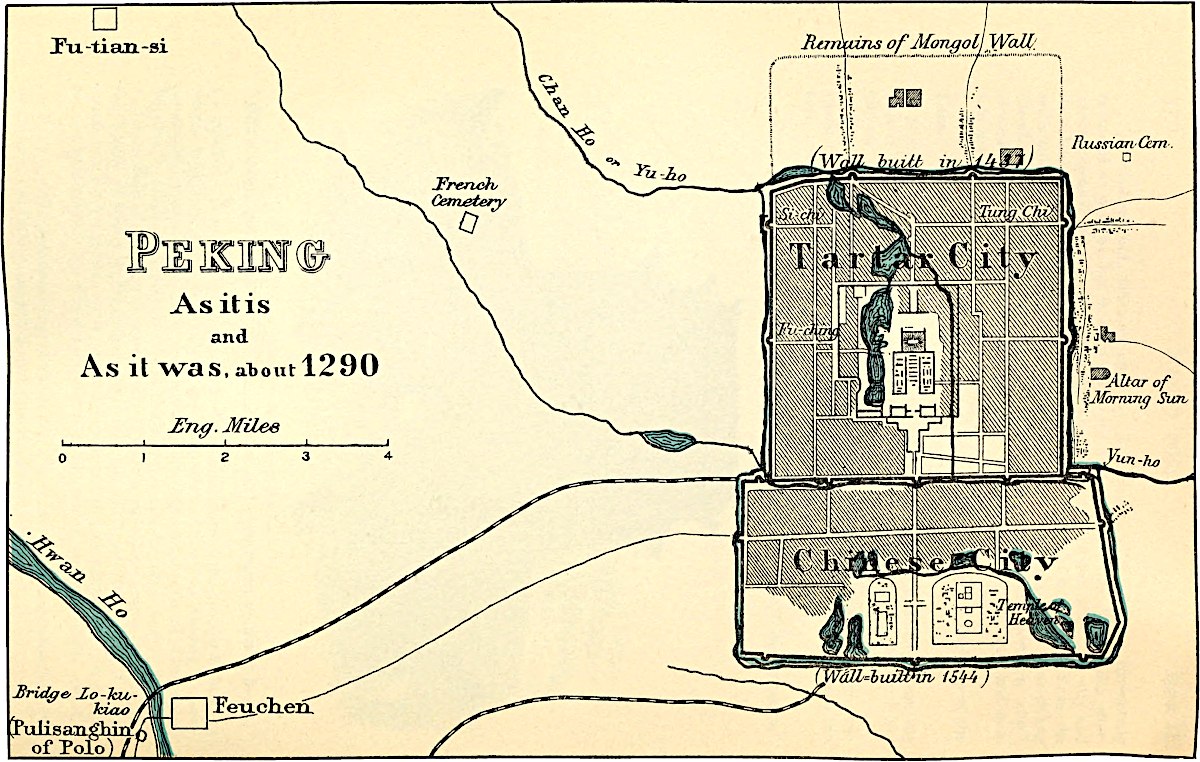
A.D. 1290.
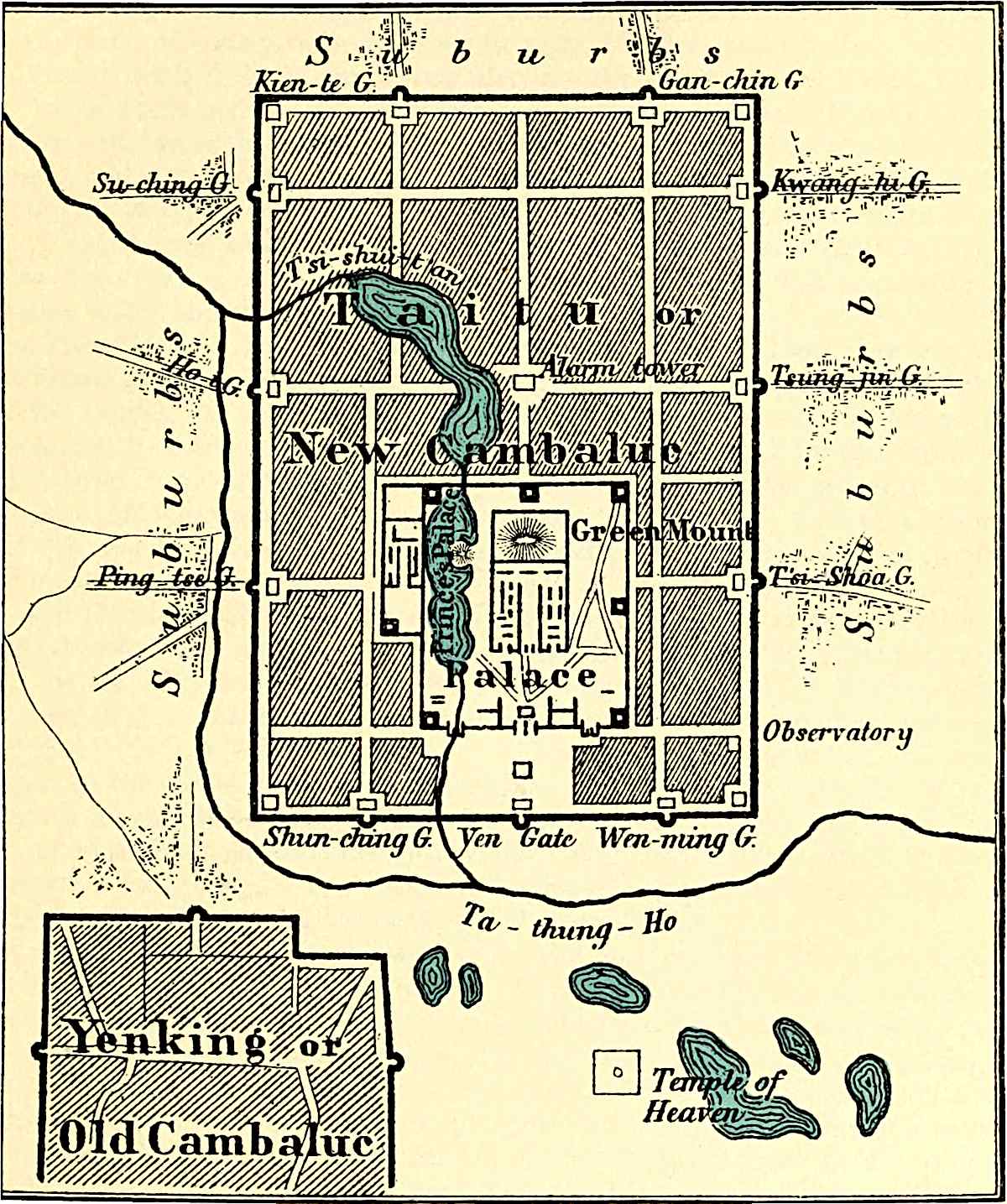
The existing Tartar city of Peking (technically Neï-ch’ing, “The Interior
City,” or King-ch’ing, “City of the Court”) stands on the site of
Taidu, and represents it. After the expulsion of the Mongols (1368) the
new native Dynasty of Ming established their capital at Nanking. But this
was found so inconvenient that the third sovereign of the Dynasty re-occupied Taidu
or Cambaluc, the repairs of which began in 1409. He reduced
it in size by cutting off nearly a third part of the city at the north
end. The remains of this abandoned portion of wall are, however, still in
existence, approaching 30 feet in height all round. This old wall is called
by the Chinese The Wall of the Yuen (i.e. the Mongol Dynasty), and it is
laid down in the Russian Survey. [The capital of the Ming was 40 li in
circuit, according to the Ch’ang an k’o hua.] The existing walls were
built, or restored rather (the north wall being in any case, of course,
entirely new), in 1437. There seems to be no doubt that the present south
front of the Tartar city was the south front of Taidu. The whole outline of
Taidu is therefore still extant, and easily measurable. If the scale on the
War Office edition of the Russian Survey be correct, the long sides measure
close upon 5 miles and 500 yards; the short sides, 3 miles and 1200 yards.
Hence the whole perimeter was just about 18 English miles, or less than
16 Italian miles. If, however, a pair of compasses be run round Taidu and
Yenking (as we have laid the latter down from such data as could be had)
together, the circuit will be something like 24 Italian miles, and this
may have to do with Polo’s error.
[“The Yuen shi states that Ta-tu was 60 li in circumference. The
Ch’ue keng lu, a work published at the close of the Yuen Dynasty, gives
the same number of li for the circuit of the capital, but explains that
li of 240 pu each are meant. If this statement be correct, it would
give only 40 common or geographical li for the circuit of the Mongol
town.” (Bretschneider, Peking, 13.) Dr. Bretschneider writes (p. 20):
“The outlines of Khanbaligh, partly in contradiction with the ancient
Chinese records, if my view be correct, would have measured about 50 common
li in circuit (13 li and more from north to south, 11·64 from east to
west.”)—H. C.]
Polo [and Odoric] again says that there were 12 gates—3 to every side.
Both Gaubil and Martini also say that there were 12 gates. But I believe
that both are trusting to Marco. There are 9 gates in the present Tartar
city—viz. 3 on the south side and 2 on each of the other sides. The old
Chinese accounts say there were 11 gates in Taidu. (See Amyot, Mém. II.
553.) I have in my plan, therefore, assumed that one gate on the east and
one on the west were obliterated in the reduction of the enceinte by the
Ming. But I must observe that Mr. Lockhart tells me he did not find the
traces of gates in those positions, whilst the 2 gates on the north side
of the old Mongol rampart are quite distinct, with the barbicans in front,
and the old Mongol bridge over the ditch still serving for the public
thoroughfare.[1]
[“The Yuen shi as well as the Ch’ue keng lu, and other works of
the Yuen, agree in stating that the capital had eleven gates. They are
enumerated in the following order: Southern wall—(1) The gate direct
south (mid.) was called Li-cheng men; (2) the gate to the left (east),
Wen-ming men; (3) the gate to the right (west), Shun-ch’eng men.
Eastern wall—(4) The gate direct east (mid.), Ch’ung-jen men; (5) the
gate to the south-east, Ts’i-hua men; (6) the gate to the north-east,
Kuang-hi men. Western wall—(7) The gate direct west (mid.), Ho-i men;
(8) the gate to the south-west, P’ing-tse men; (9) the gate to the
north-west, Su-ts’ing men. Northern Wall—(10) The gate to the north-west,
K’ien-te men; (11) the gate to the north-east, An-chen men.”
(Bretschneider, Peking, 13–14.)—H. C.]
When the Ming established themselves on the old Mongol site, population
seems to have gathered close about the southern wall, probably using
material from the remains of Yenking. This excrescence was inclosed by a
new wall in 1554, and was called the “Outer Town.” It is what is called
by Europeans the Chinese City. Its western wall exhibits in the base
sculptured stones, which seem to have belonged to the old palace of
Yenking. Some traces of Yenking still existed in Gaubil’s time; the only
relic of it now pointed out is a pagoda outside of the Kwang-An-Măn, or
western gate of the Outer City, marked in the War Office edition of the
Russian Map as “Tower.” (Information from Dr. Lockhart.)
The “Great Palaces” over the gates and at the corner bastions are no doubt
well illustrated by the buildings which still occupy those positions. There
are two such lofty buildings at each of the gates of the modern city, the
outer one (shown on p. 376) forming an elevated redoubt.
Note 5.—The French writer cited under note 3 says of the city as it stands:
“La ville est de la sorte coupée en échiquier à peu près régulier dont les
quadres circonscrits par des larges avenues sont percés eux-mêmes d’une
multitude de rues et ruelles ... qui toutes à peu près sont orientées N. et
S., E. et O. Une seule volonté a évidemment présidé à ce plan, et jamais
édilité n’a eu à exécuter d’un seul coup aussi vaste entreprise.”
Note 6.—Martini speaks of the public clock-towers in the Chinese cities,
which in his time were furnished with water-clocks. A watchman struck
the hour on a great gong, at the same time exhibiting the hour in large
characters. The same person watched for fires, and summoned the public with
his gong to aid in extinguishing them.
[The Rev. G. B. Farthing mentions (North-China Herald, 7th September,
1884) at T’ai-yuen fu the remains of an object in the bell-tower, which
was, and is still known, as one of the eight wonders of this city; it is a
vessel of brass, a part of a water-clock from which water formerly used to
flow down upon a drum beneath and mark off time into equal divisions.—H. C.]
The tower indicated by Marco appears still to exist. It occupies the place
which I have marked as Alarm Tower in the plan of Taidu. It was erected
in 1272, but probably rebuilt on the Ming occupation of the city. [“The
Yuen yi t’ung chi, or ‘Geography of the Mongol Empire’ records: ‘In the
year 1272, the bell-tower and the drum-tower were built in the middle of
the capital.’ A bell-tower (chung-lou) and a drum-tower (ku-lou) exist
still in Peking, in the northern part of the Tartar City. The ku-lou is
the same as that built in the thirteenth century, but the bell-tower dates
only from the last century. The bell-tower of the Yuen was a little to the
east of the drum-tower, where now the temple Wan-ning sse stands. This
temple is nearly in the middle of the position I (Bretschneider) assign
to Khanbaligh.” (Bretschneider, Peking, 20.)—H. C.] In the Court of the
Old Observatory at Peking there is preserved, with a few other ancient
instruments, which date from the Mongol era, a very elaborate water-clock,
provided with four copper basins embedded in brickwork, and rising in steps
one above the other. A cut of this courtyard, with its instruments and
aged trees, also ascribed to the Mongol time, will be found in ch. xxxiii.
(Atlas Sinensis, p. 10; Magaillans, 149–151; Chine Moderne, p. 26;
Tour du Monde for 1864, vol. ii. p. 34.)
Note 7.—“Nevertheless,” adds the Ramusian, “there does exist I know not
what uneasiness about the people of Cathay.”
How the Great Kaan Maintains a Guard of Twelve Thousand Horse, which are
called Keshican.
You must know that the Great Kaan, to maintain his state, hath a guard of
twelve thousand horsemen, who are styled Keshican, which is as much as to
say “Knights devoted to their Lord.” Not that he keeps these for fear of
any man whatever, but merely because of his own exalted dignity. These
12,000 men have four captains, each of whom is in command of 3000; and each
body of 3000 takes a turn of three days and nights to guard the palace,
where they also take their meals. After the expiration of three days and
nights they are relieved by another 3000, who mount guard for the same
space of time, and then another body takes its turn, so that there are
always 3000 on guard. Thus it goes until the whole 12,000, who are styled
(as I said) Keshican, have been on duty; and then the tour begins again,
and so runs on from year’s end to year’s end.{1}
Note
1.—I have deduced a reading for the word Quescican (Keshican),
which is not found precisely in any text. Pauthier reads Questiau and
Quesitau; the G. Text has Quesitam and Quecitain; the Crusca Questi
Tan; Ramusio, Casitan; the Riccardiana, Quescitam. Recollecting the
constant clerical confusion between c and t, what follows will leave no
doubt I think that the true reading to which all these variations point is
Quescican.[1]
In the Institutes of Ghazan Khan, we find established among other
formalities for the authentication of the royal orders, that they should be
stamped on the back, in black ink, with the seals of the Four Commanders
of the Four Kiziks, or Corps of the Life Guard.
Wassáf also, in detailing the different classes of the great dignitaries
of the Mongol monarchy, names (1) the Noyáns of the Ulus, or princes
of the blood; (2) the great chiefs of the tribes; (3) the Amírs of the
four Keshik, or Corps of the Body Guard; (4) the officers of the army,
commanding ten thousands, thousands, and so on.
Moreover, in Rashiduddin, we find the identical plural form used by our
author. He says that, after the sack of Baghdad, Hulaku, who had escaped
from the polluted atmosphere of the city, sent “Ilká Noyán and Ḳarábúgá,
with 3000 Moghul horse into Baghdad, in order to have the buildings
repaired, and to put things generally in order. These chiefs posted
sentries from the Kishíkán (كشي كان), and from their own followings in the
different quarters of the town, had the carcases of beasts removed from the
streets, and caused the bazaars to be rebuilt.”
We find Kishik still used at the court of Hindustan, under the great
kings of Timur’s House, for the corps on tour of duty at the palace; and
even for the sets of matchlocks and sabres, which were changed weekly from
Akbar’s armoury for the royal use. The royal guards in Persia, who watch
the king’s person at night, are termed Keshikchi, and their captain
Keshikchi Bashi. [“On the night of the 11th of Jemady ul Sany, A.H. 1160
(or 8th June, 1747), near the city of Khojoon, three days’ journey from
Meshed, Mohammed Kuly Khan Ardemee, who was of the same tribe with Nadir
Shah, his relation, and Kushukchee Bashee, with seventy of the Kukshek or
guard, ... bound themselves by an oath to assassinate Nadir Shah.” (Memoirs
of Khojeh Abdulkurreem ... transl. by F. Gladwin, Calcutta, 1788, pp.
166–167).]
Friar Odoric speaks of the four barons who kept watch by the Great Kaan’s
side as the Cuthé, which probably represents the Chinese form Kiesie
(as in De Mailla), or Kuesie (as in Gaubil). The latter applies the term
to four devoted champions of Chinghiz, and their descendants, who were
always attached to the Kaan’s body-guard, and he identifies them with the
Quesitan of Polo, or rather with the captains of the latter; adding
expressly that the word Kuesie is Mongol.
I see Kishik is a proper name among the Kalmak chiefs; and Keshikten
also is the name of a Mongol tribe, whose territory lies due north of
Peking, near the old site of Shangtu. (Bk. I. ch. lxi.) [Keshikhteng,
a tribe (pu; mong. aimak) of the Chao Uda League (mêng; mong.
chogolgân) among the twenty-four tribes of the Nei Mung-ku (Inner
Mongols). (See Mayers’ Chinese Government, p. 81.)—H. C.] In Kovalevsky,
I find the following:—
(No. 2459) “Keshik, grace, favour, bounty, benefit, good fortune,
charity.”
(No. 2461) “Keshikten, fortunate, happy, blessed.”
(No. 2541) “Kichyeku, to be zealous, assiduous, devoted.”
(No. 2588) “Kushiku, to hinder, to bar the way to,” etc.
The third of these corresponds closely with Polo’s etymology of “knights
devoted to their lord,” but perhaps either the first or the last may afford
the real derivation.
In spite of the different initials (ق instead of ک), it can
scarcely be doubted that the Ḳalchi and Ḳalaḳchi of Timur’s Institutes
are mere mistranscriptions of the same word, e.g.: “I ordered that 12,000
Ḳalchi, men of the sword completely armed, should be cantoned in the
Palace; to the right and to the left, to the front, and in the rear of the
imperial diwán; thus, that 1000 of those 12,000 should be every night upon
guard,” etc. The translator’s note says of Ḳalchi, “A Mogul word supposed
to mean guards.” We see that even the traditional number of 12,000, and
its division into four brigades, are maintained. (See Timour’s Inst., pp.
299 and 235, 237.)
I must add that Professor Vámbéry does not assent to the form Keshikán,
on the ground that this Persian plural is impossible in an old Tartar
dialect, and he supposes the true word to be Kechilan or Kechiklen,
“the night-watchers,” from Kiche or Kichek (Chag. and Uighúr), =
“night.”
I believe, however, that Persian was the colloquial language of foreigners
at the Kaan’s court, who would not scruple to make a Persian plural when
wanted; whilst Rashid has exemplified the actual use of this one.
(D’Ohsson, IV. 410; Gold. Horde, 228, 238; Ilch. II. 184; Q. R. pp.
308–309; Ayeen Aḳb. I. 270, and Blochmann’s, p. 115; J. As. sér. IV.
tom. xix. 276; Olearius, ed. 1659, I. 656; Cathay, 135; De Mailla,
ix. 106; Gaubil, p. 6; Pallas, Samml. I. 35.)
[“By Keshican in Colonel Yule’s Marco Polo, Keshikten is evidently
meant. This is a general Mongol term to designate the Khan’s lifeguard.
It is derived from the word Keshik, meaning a guard by turns; a corps
on tour of duty. Keshik is one of the archaisms of the Mongol language,
for now this word has another meaning in Mongol. Colonel Yule has brought
together several explanations of the term. It seems to me that among his
suppositions the following is the most consistent with the ancient meaning
of the word:—
“We find Kishik still used at the court of Hindustan, under the great
kings of Timur’s House, for the corps on tour of duty at the palace.... The
royal guards in Persia, who watch the King’s person at night, are termed
Keshikchi.”
“The Keshikten was divided into a day-watch called Turgaut and a
night-watch Kebteul. The Kebte-ul consisted of pure Mongols, whilst the
Turgaut was composed of the sons of the vassal princes and governors of
the provinces, and of hostages. The watch of the Khan was changed every
three days, and contained 400 men. In 1330 it was reduced to 100 men.”
(Palladius, 42–43.) Mr. E. H. Parker writes in the China Review, XVIII.
p. 262, that they “are evidently the ‘body guards’ of the modern viceroys,
now pronounced Kashïha, but, evidently, originally Kêshigha.”—H. C.]
The Fashion of the Great Kaan’s Table at his High Feasts.
And when the Great Kaan sits at table on any great court occasion, it is
in this fashion. His table is elevated a good deal above the others, and
he sits at the north end of the hall, looking towards the south, with
his chief wife beside him on the left. On his right sit his sons and his
nephews, and other kinsmen of the Blood Imperial, but lower, so that their
heads are on a level with the Emperor’s feet. And then the other Barons
sit at other tables lower still. So also with the women; for all the wives
of the Lord’s sons, and of his nephews and other kinsmen, sit at the lower
table to his right; and below them again the ladies of the other Barons and
Knights, each in the place assigned by the Lord’s orders. The tables are
so disposed that the Emperor can see the whole of them from end to end,
many as they are.{1} [Further, you are not to suppose that everybody
sits at table; on the contrary, the greater part of the soldiers and their
officers sit at their meal in the hall on the carpets.] Outside the hall
will be found more than 40,000 people; for there is a great concourse of
folk bringing presents to the Lord, or come from foreign countries with
curiosities.
In a certain part of the hall near where the Great Kaan holds his table,
there [is set a large and very beautiful piece of workmanship in the form
of a square coffer, or buffet, about three paces each way, exquisitely
wrought with figures of animals, finely carved and gilt. The middle is
hollow, and in it] stands a great vessel of pure gold, holding as much
as an ordinary butt; and at each corner of the great vessel is one of
smaller size [of the capacity of a firkin], and from the former the wine
or beverage flavoured with fine and costly spices is drawn off into the
latter. [And on the buffet aforesaid are set all the Lord’s drinking
vessels, among which are certain pitchers of the finest gold,] which are
called verniques,{2} and are big enough to hold drink for eight or
ten persons. And one of these is put between every two persons, besides a
couple of golden cups with handles, so that every man helps himself from
the pitcher that stands between him and his neighbour. And the ladies are
supplied in the same way. The value of these pitchers and cups is something
immense; in fact, the Great Kaan has such a quantity of this kind of plate,
and of gold and silver in other shapes, as no one ever before saw or heard
tell of, or could believe.{3}
[There are certain Barons specially deputed to see that foreigners, who
do not know the customs of the Court, are provided with places suited to
their rank; and these Barons are continually moving to and fro in the hall,
looking to the wants of the guests at table, and causing the servants to
supply them promptly with wine, milk, meat, or whatever they lack. At every
door of the hall (or, indeed, wherever the Emperor may be) there stand a
couple of big men like giants, one on each side, armed with staves. Their
business is to see that no one steps upon the threshold in entering, and if
this does happen, they strip the offender of his clothes, and he must pay
a forfeit to have them back again; or in lieu of taking his clothes, they
give him a certain number of blows. If they are foreigners ignorant of the
order, then there are Barons appointed to introduce them, and explain it
to them. They think, in fact, that it brings bad luck if any one touches
the threshold. Howbeit, they are not expected to stick at this in going
forth again, for at that time some are like to be the worse for liquor, and
incapable of looking to their steps.{4}]
And you must know that those who wait upon the Great Kaan with his dishes
and his drink are some of the great Barons. They have the mouth and nose
muffled with fine napkins of silk and gold, so that no breath nor odour
from their persons should taint the dish or the goblet presented to the
Lord. And when the Emperor is going to drink, all the musical instruments,
of which he has vast store of every kind, begin to play. And when he takes
the cup all the Barons and the rest of the company drop on their knees and
make the deepest obeisance before him, and then the Emperor doth drink. But
each time that he does so the whole ceremony is repeated.{5}
I will say nought about the dishes, as you may easily conceive that there
is a great plenty of every possible kind. But you should know that in every
case where a Baron or Knight dines at those tables, their wives also dine
there with the other ladies. And when all have dined and the tables have
been removed, then come in a great number of players and jugglers, adepts
at all sorts of wonderful feats,{6} and perform before the Emperor
and the rest of the company, creating great diversion and mirth, so that
everybody is full of laughter and enjoyment. And when the performance is
over, the company breaks up and every one goes to his quarters.
Note 1.—We are to conceive of rows of small tables, at each of which were
set probably but two guests. This seems to be the modern Chinese practice,
and to go back to some very old accounts of the Tartar nations. Such tables
we find in use in the tenth century, at the court of the King of Bolghar
(see Prologue, note 2, ch. ii.), and at the Chinese entertainments to
Shah Rukh’s embassy in the fifteenth century. Megasthenes described the
guests at an Indian banquet as having a table set before each individual.
(Athenaeus, IV. 39, Yonge’s Transl.)
[Compare Rubruck’s account, Rockhill’s ed., p. 210: “The Chan sits in a
high place to the north, so that he can be seen by all....” (See also Friar
Odoric, Cathay, p. 141.)—H. C.]
Note 2.—This word (G. T. and Ram.) is in the Crusca Italian transformed
into an adjective, “vaselle vernicate d’oro,” and both Marsden and
Pauthier have substantially adopted the same interpretation, which
seems to me in contradiction with the text. In Pauthier’s text the word
is vernigal, pl. vernigaux, which he explains, I know not on what
authority, as “coupes sans anses vernies ou laquées d’or.” There is,
indeed, a Venetian sea-term, Vernegal, applied to a wooden bowl in which
the food of a mess is put, and it seems possible that this word may have
been substituted for the unknown Vernique. I suspect the latter was some
Oriental term, but I can find nothing nearer than the Persian Bărni, Ar.
Al-Bărníya, “vas fictile in quo quid recondunt,” whence the Spanish word
Albornia, “a great glazed vessel in the shape of a bowl, with handles.”
So far as regards the form, the change of Barniya into Vernique would
be quite analogous to that change of Hundwáníy into Ondanique, which we
have already met with. (See Dozy et Engelmann, Glos. des Mots Espagnols,
etc., 2nd ed., 1867, p. 73; and Boerio, Diz. del. Dial. Venez.)
[F. Godefroy, Dict., s.v. Vernigal, writes: “Coupe sans anse, vernie ou
laquée d’or,” and quotes, besides Marco Polo, the Regle du Temple, p.
214, éd. Soc. Hist. de France:
“Les vernigaus et les escuelles.”
About vernegal, cf. Rockhill, Rubruck, p. 86, note. Rubruck says (Soc.
de Géog. p. 241): “Implevimus unum veringal de biscocto et platellum
unum de pomis et aliis fructibus.” Mr. Rockhill translates veringal by
basket.
Dr. Bretschneider (Peking, 28) mentions “a large jar made of wood and
varnished, the inside lined with silver,” and he adds in a note “perhaps
this statement may serve to explain Marco Polo’s verniques or vaselle
vernicate d’oro, big enough to hold drink for eight or ten persons.”—H. C.]
A few lines above we have “of the capacity of a firkin.” The word is
bigoncio, which is explained in the Vocab. Univ. Ital. as a kind of
tub used in the vintage, and containing 3 mine, each of half a stajo.
This seems to point to the Tuscan mina, or half stajo, which is = ⅓ of a
bushel. Hence the bigoncio would = a bushel, or, in old liquid measure,
about a firkin.
Note 3.—A buffet, with flagons of liquor and goblets, was an essential
feature in the public halls or tents of the Mongols and other Asiatic races
of kindred manners. The ambassadors of the Emperor Justin relate that in
the middle of the pavilion of Dizabulus, the Khan of the Turks, there
were set out drinking-vessels, and flagons and great jars, all of gold;
corresponding to the coupes (or hanas à mances), the verniques, and
the grant peitere and petietes peiteres of Polo’s account. Rubruquis
describes in Batu Khan’s tent a buffet near the entrance, where Kumiz was
set forth, with great goblets of gold and silver, etc., and the like at the
tent of the Great Kaan. At a festival at the court of Oljaitu, we are told,
“Before the throne stood golden buffets ... set out with full flagons and
goblets.” Even in the private huts of the Mongols there was a buffet of a
humbler kind exhibiting a skin of Kumiz, with other kinds of drink, and
cups standing ready; and in a later age at the banquets of Sháh Abbás we
find the great buffet in a slightly different form, and the golden flagon
still set to every two persons, though it no longer contained the liquor,
which was handed round. (Cathay, clxiv., cci.; Rubr. 224, 268, 305;
Ilch. II. 183; Della Valle, I. 654 and 750–751.)
[Referring to the “large and very beautiful piece of workmanship,” Mr.
Rockhill, Rubruck, 208–209, writes: “Similar works of art and mechanical
contrivances were often seen in Eastern courts. The earliest I know of is
the golden plane-tree and grape vine with bunches of grapes in precious
stones, which was given to Darius by Pythius the Lydian, and which shaded
the king’s couch. (Herodotus, IV. 24.) The most celebrated, however, and
that which may have inspired Mangu with the desire to have something like
it at his court, was the famous Throne of Solomon (Σολομώντεος Θρóνος)
of the Emperor of Constantinople, Theophilus (A.D. 829–842)....
Abulfeda states that in A.D. 917 the envoys of Constantine Porphyrogenitus
to the Caliph el Moktader saw in the palace of Bagdad a tree with eighteen
branches, some of gold, some of silver, and on them were gold and silver
birds, and the leaves of the tree were of gold and silver. By means of
machinery, the leaves were made to rustle and the birds to sing. Mirkhond
speaks also of a tree of gold and precious stones in the city of Sultanieh,
in the interior of which were conduits through which flowed drinks of
different kinds. Clavijo describes a somewhat similar tree at the court of Timur.”
Dr. Bretschneider (Peking, 28, 29) mentions a clepsydra with a lantern.
By means of machinery put in motion by water, at fixed times a little man
comes forward exhibiting a tablet, which announces the hours. He speaks
also of a musical instrument which is connected, by means of a tube, with
two peacocks sitting on a cross-bar, and when it plays, the mechanism
causes the peacocks to dance.—H. C.]
Odoric describes the great jar of liquor in the middle of the palace hall,
but in his time it was made of a great mass of jade (p. 130).
Note 4.—This etiquette is specially noticed also by Odoric, as well as
by Makrizi, by Rubruquis, and by Plano Carpini. According to the latter
the breach of it was liable to be punished with death. The prohibition
to tread on the threshold is also specially mentioned in a Mahomedan
account of an embassy to the court of Barka Khan. And in regard to the
tents, Rubruquis says he was warned not to touch the ropes, for these
were regarded as representing the threshold. A Russo-Mongol author of
our day says that the memory of this etiquette or superstition is still
preserved by a Mongol proverb: “Step not on the threshold; it is a sin!”
But among some of the Mongols more than this survives, as is evident from
a passage in Mr. Michie’s narrative: “There is a right and a wrong way of
approaching a yourt also. Outside the door there are generally ropes lying
on the ground, held down by stakes, for the purpose of tying up the animals
when they want to keep them together. There is a way of getting over or
round these ropes that I never learned, but on one occasion the ignorant
breach of the rule on our part excluded us from the hospitality of the
family.” The feeling or superstition was in full force in Persia in the
17th century, at least in regard to the threshold of the king’s palace. It
was held a sin to tread upon it in entering. (Cathay, 132; Rubr. 255,
268, 319; Plan. Carp. 625, 741; Makrizi, I. 214; Mél. Asiat. Ac. St.
Petersb. II. 660; The Siberian Overland Route, p. 97; P. Della Valle, II. 171.)
[Mr. Rockhill writes (Rubruck, p. 104): “The same custom existed among
the Fijians, I believe. I may note that it also prevailed in ancient
China. It is said of Confucius ‘when he was standing he did not occupy the
middle of the gate-way; when he passed in or out, he did not tread on the
threshold.’ (Lun-yü, Bk. X. ch. iv. 2.) In China, the bride’s feet must
not touch the threshold of the bridegroom’s house. (Cf. Dennys’ Folk-lore
in China, p. 18.)
“The author of the Ch’ue keng lu mentions also the athletes with clubs
standing at the door, at the time of the khan’s presence in the hall. He
adds, that next to the Khan, two other life-guards used to stand, who held
in their hands ‘natural’ axes of jade (axes found fortuitously in the
ground, probably primitive weapons).” (Palladius, p. 43.)—H. C.]
Note 5.—Some of these etiquettes were probably rather Chinese than Mongol,
for the regulations of the court of Kúblái apparently combined the two. In
the visit of Shah Rukh’s ambassadors to the court of the Emperor Ch’êng Tsu
of the Ming Dynasty in 1421, we are told that by the side of the throne,
at an imperial banquet, “there stood two eunuchs, each having a band of
thick paper over his mouth, and extending to the tips of his ears.... Every
time that a dish, or a cup of darassun (rice-wine) was brought to the
emperor, all the music sounded.” (N. et Ext. XIV. 408, 409.) In one of
the Persepolitan sculptures, there stands behind the King an eunuch bearing
a fan, and with his mouth covered; at least so says Heeren. (Asia, I. 178.)
Note
6.—“Jongleours et entregetours de maintes plusieurs manieres de
granz experimenz” (P.); “de Giuculer et de Tregiteor” (G. T.). Ital.
Tragettatore, a juggler; Romance, Trasjitar, Tragitar, to juggle. Thus
Chaucer:—
“There saw I playing Jogelours,
Magiciens, and Tragetours,
And Phetonisses, Charmeresses,
Old Witches, Sorceresses,” etc.
—House of Fame, III. 169.
And again:—
“For oft at festes have I wel herd say,
That Tregetoures, within an halle large,
Have made come in a water and a barge,
And in the halle rowen up and doun.
Somtime hath semed come a grim leoun;
* * * * *
Somtime a Castel al of lime and ston,
And whan hem liketh, voideth it anon.”
—The Franklin’s Tale, II. 454.
Performances of this kind at Chinese festivities have already been spoken
of in note 9 to ch. lxi. of Book I. Shah Rukh’s people, Odoric, Ysbrandt
Ides, etc., describe them also. The practice of introducing such artistes
into the dining-hall after dinner seems in that age to have been usual also
in Europe. See, for example, Wright’s Domestic Manners, pp. 165–166, and
the Court of the Emperor Frederic II., in Kington’s Life of that prince,
I. 470. (See also N. et E. XIV. 410; Cathay, 143; Ysb. Ides, p. 95.)
Concerning the Great Feast held by the Grand Kaan every Year on his
Birthday.
You must know that the Tartars keep high festival yearly on their
birthdays. And the Great Kaan was born on the 28th day of the September
moon, so on that day is held the greatest feast of the year at the Kaan’s
Court, always excepting that which he holds on New Year’s Day, of which I
shall tell you afterwards.{1}
Now, on his birthday, the Great Kaan dresses in the best of his robes, all
wrought with beaten gold;{2} and full 12,000 Barons and Knights on
that day come forth dressed in robes of the same colour, and precisely like
those of the Great Kaan, except that they are not so costly; but still they
are all of the same colour as his, and are also of silk and gold. Every
man so clothed has also a girdle of gold; and this as well as the dress is
given him by the Sovereign. And I will aver that there are some of these
suits decked with so many pearls and precious stones that a single suit
shall be worth full 10,000 golden bezants.
And of such raiment there are several sets. For you must know that the
Great Kaan, thirteen times in the year, presents to his Barons and Knights
such suits of raiment as I am speaking of.{3} And on each occasion
they wear the same colour that he does, a different colour being assigned
to each festival. Hence you may see what a huge business it is, and that
there is no prince in the world but he alone who could keep up such customs
as these.
On his birthday also, all the Tartars in the world, and all the countries
and governments that owe allegiance to the Kaan, offer him great presents
according to their several ability, and as prescription or orders have
fixed the amount. And many other persons also come with great presents to
the Kaan, in order to beg for some employment from him. And the Great Kaan
has chosen twelve Barons on whom is laid the charge of assigning to each of
these supplicants a suitable answer.
On this day likewise all the Idolaters, all the Saracens, and all the
Christians and other descriptions of people make great and solemn
devotions, with much chaunting and lighting of lamps and burning of
incense, each to the God whom he doth worship, praying that He would save
the Emperor, and grant him long life and health and happiness.
And thus, as I have related, is celebrated the joyous feast of the Kaan’s
birthday.{4}
Now I will tell you of another festival which the Kaan holds at the New
Year, and which is called the White Feast.
Note 1.—The Chinese Year commences, according to Duhalde, with the New Moon
nearest to the Sun’s Passage of the middle point of Aquarius; according
to Pauthier, with the New Moon immediately preceding the Sun’s entry into
Pisces. (These would almost always be identical, but not always.) Generally
speaking, the first month will include part of February and part of March.
The eighth month will then be September–October (v. ante, ch. ii. note 2).
[According to Dr. S. W. Williams (Middle Kingdom, II. p. 70): “The year
is lunar, but its commencement is regulated by the sun. New Year falls on
the first new moon after the sun enters Aquarius, which makes it come not
before January 21st nor after February 19th.” “The beginning of the civil
year, writes Peter Hoang (Chinese Calendar, p. 13), depends upon the good
pleasure of the Emperors. Under the Emperor Hwang-ti (2697 B.C.) and under
the Hsia Dynasty (2205 B.C.), it was made to commence with the 3rd month
yin-yüeh [Pisces]; under the Shang Dynasty (1766 B.C.) with the 2nd month
ch’ou-yüeh [Aquarius], and under the Chou Dynasty (1122 B.C.) with the
1st month tzu-yüeh [Capricorn].”—H. C.]
Note
2.—The expression “à or batuz” as here applied to robes, is common
among the mediæval poets and romance-writers, e.g. Chaucer:—
“Full yong he was and merry of thought,
And in samette with birdes wrought
And with gold beaten full fetously,
His bodie was clad full richely.”
—Rom. of the Rose, 836–839.
M. Michel thinks that in a stuff so termed the gold wire was beaten
out after the execution of the embroidery, a process which widened the
metallic surface and gave great richness of appearance. The fact was
rather, however, according to Dr. Rock, that the gold used in weaving such
tissues was not wire but beaten sheets of gold cut into narrow strips.
This would seem sufficient to explain the term “beaten gold,” though Dr.
Rock in another passage refers it to a custom which he alleges of sewing
goldsmith’s work upon robes. (Fr. Michel, Recherches, II. 389, also I.
371; Rock’s Catalogue, pp. xxv. xxix. xxxviii. cvi.)
Note 3.—The number of these festivals and distributions of dresses is
thirteen in all the old texts, except the Latin of the Geog. Soc., which
has twelve. Thirteen would seem therefore to have been in the original
copy. And the Ramusian version expands this by saying, “Thirteen great
feasts that the Tartars keep with much solemnity to each of the thirteen
moons of the year.”[1] It is possible, however, that this latter sentence
is an interpolated gloss; for, besides the improbability of munificence
so frequent, Pauthier has shown some good reasons why thirteen should
be regarded as an error for three. The official History of the Mongol
Dynasty, which he quotes, gives a detail of raiment distributed in presents
on great state occasions three times a year. Such a mistake might easily
have originated in the first dictation, treize substituted for trois,
or rather for the old form tres; but we must note that the number 13 is
repeated and corroborated in ch. xvi. Odoric speaks of four great yearly
festivals, but there are obvious errors in what he says on this subject.
Hammer says the great Mongol Feasts were three, viz. New Year’s Day, the
Kaan’s Birthday, and the Feast of the Herds.
Something like the changes of costume here spoken of is mentioned by
Rubruquis at a great festival of four days’ duration at the court of Mangku
Kaan: “Each day of the four they appeared in different raiment, suits of
which were given them for each day of a different colour, but everything on
the same day of one colour, from the boots to the turban.” So also Carpini
says regarding the assemblies of the Mongol nobles at the inauguration of
Kuyuk Kaan: “The first day they were all clad in white pourpre (? albis
purpuris, see Bk. I. ch. vi. note 4), the second day in ruby pourpre,
the third day in blue pourpre, the fourth day in the finest baudekins.”
(Cathay, 141; Rubr. 368; Pl. Car. 755.)
[Mr. Rockhill (Rubruck, p. 247, note) makes the following remarks:
“Odoric, however, says that the colours differed according to the rank.
The custom of presenting khilats is still observed in Central Asia and
Persia. I cannot learn from any other authority that the Mongols ever wore
turbans. Odoric says the Mongols of the imperial feasts wore ‘coronets’
(in capite coronati).”—H. C.]
Note 4.—[“The accounts given by Marco Polo regarding the feasts of the
Khan and the festival dresses at his Court, agree perfectly with the
statements on the same subject of contemporary Chinese writers. Banquets
were called in the common Mongol language chama, and festival dresses
chisun. General festivals used to be held at the New Year and at the
Birthday of the Khan. In the Mongol-Chinese Code, the ceremonies
performed in the provinces on the Khan’s Birthday are described. One month
before that day the civil and military officers repaired to a temple,
where a service was performed to the Khan’s health. On the morning of the
Birthday a sumptuously adorned table was placed in the open air, and the
representatives of all classes and all confessions were obliged to approach
the table, to prostrate themselves and exclaim three times: Wan-sui
(i.e. ‘Ten thousand years’ life to the Khan). After that the banquet took
place. In the same code (in the article on the Ye li ke un [Christians,
Erke-un]) it is stated, that in the year 1304,—owing to a dispute,
which had arisen in the province of Kiang-nan between the ho-shang
(Buddhist priests) and the Christian missionaries, as to precedence in the
above-mentioned ceremony,—a special edict was published, in which it was
decided that in the rite of supplication, Christians should follow the
Buddhist and Taouist priests.” (Palladius, pp. 44–45.)—H. C.]
Of the Great Festival which the Kaan holds on New Year’s Day.
The beginning of their New Year is the month of February, and on that
occasion the Great Kaan and all his subjects made such a Feast as I now
shall describe.
It is the custom that on this occasion the Kaan and all his subjects should
be clothed entirely in white; so, that day, everybody is in white, men and
women, great and small. And this is done in order that they may thrive
all through the year, for they deem that white clothing is lucky.{1}
On that day also all the people of all the provinces and governments and
kingdoms and countries that own allegiance to the Kaan bring him great
presents of gold and silver, and pearls and gems, and rich textures of
divers kinds. And this they do that the Emperor throughout the year may
have abundance of treasure and enjoyment without care. And the people also
make presents to each other of white things, and embrace and kiss and make
merry, and wish each other happiness and good luck for the coming year. On
that day, I can assure you, among the customary presents there shall be
offered to the Kaan from various quarters more than 100,000 white horses,
beautiful animals, and richly caparisoned. [And you must know ’tis their
custom in offering presents to the Great Kaan (at least when the province
making the present is able to do so), to present nine times nine articles.
For instance, if a province sends horses, it sends nine times nine or 81
horses; of gold, nine times nine pieces of gold, and so with stuffs or
whatever else the present may consist of.]{2}
On that day also, the whole of the Kaan’s elephants, amounting fully to
5000 in number, are exhibited, all covered with rich and gay housings of
inlaid cloth representing beasts and birds, whilst each of them carries on
his back two splendid coffers; all of these being filled with the Emperor’s
plate and other costly furniture required for the Court on the occasion of
the White Feast.{3} And these are followed by a vast number of camels
which are likewise covered with rich housings and laden with things needful
for the Feast. All these are paraded before the Emperor, and it makes the
finest sight in the world.
Moreover, on the morning of the Feast, before the tables are set, all
the Kings, and all the Dukes, Marquesses, Counts, Barons, Knights, and
Astrologers, and Philosophers, and Leeches, and Falconers, and other
officials of sundry kinds from all the places round about, present
themselves in the Great Hall before the Emperor; whilst those who can
find no room to enter stand outside in such a position that the Emperor
can see them all well. And the whole company is marshalled in this wise.
First are the Kaan’s sons, and his nephews, and the other Princes of the
Blood Imperial; next to them all Kings; then Dukes, and then all others in
succession according to the degree of each. And when they are all seated,
each in his proper place, then a great prelate rises and says with a loud
voice: “Bow and adore!” And as soon as he has said this, the company bow
down until their foreheads touch the earth in adoration towards the Emperor
as if he were a god. And this adoration they repeat four times, and then go
to a highly decorated altar, on which is a vermilion tablet with the name
of the Grand Kaan inscribed thereon, and a beautiful censer of gold. So
they incense the tablet and the altar with great reverence, and then return
each man to his seat.{4}
When all have performed this, then the presents are offered, of which I
have spoken as being so rich and costly. And after all have been offered
and been seen by the Emperor, the tables are set, and all take their places
at them with perfect order as I have already told you. And after dinner the
jugglers come in and amuse the Court as you have heard before; and when
that is over, every man goes to his quarters.
Note 1.—The first month of the year is still called by the Mongols
Chaghan or Chaghan Sara, “the White” or the “White Month”; and the
wearing of white clothing on this festive occasion must have been purely
a Mongol custom. For when Shah Rukh’s ambassadors were present at the
New Year’s Feast at the Court of the succeeding Chinese Dynasty (2nd
February, 1421) they were warned that no one must wear white, as that
among the Chinese was the colour of mourning. (Koeppen, I. 574, II. 309;
Cathay, p. ccvii.)
Note 2.—On the mystic importance attached to the number 9 on all such
occasions among the Mongols, see Hammer’s Golden Horde, p. 208; Hayton,
ch. iii. in Ramusio II.; Not. et Ext. XIV. Pt. I. 32; and Strahlenberg
(II. 210 of Amsterd. ed. 1757). Vámbéry, speaking of the Ḳálín or
marriage price among the Uzbegs, says: “The question is always how many
times nine sheep, cows, camels, or horses, or how many times nine ducats
(as is the custom in a town), the father is to receive for giving up his
daughter.” (Sketches of Cent. Asia, p. 103.) Sheikh Ibrahim of Darband,
making offerings to Timur, presented nines of everything else, but of
slaves eight only. “Where is the ninth?” enquired the court official.
“Who but I myself?” said the Sheikh, and so won the heart of Timur. (A.
Arabsiadis ... Timuri Hist. p. 357.)
Note 3.—The elephant stud of the Son of Heaven had dwindled till in 1862
Dr. Rennie found but one animal; now none remain. [Dr. S. W. Williams
writes (Middle Kingdom, I. pp. 323–324): “Elephants are kept at Peking
for show, and are used to draw the state chariot when the Emperor goes to
worship at the Altars of Heaven and Earth, but the sixty animals seen in
the days of Kienlung, by Bell, have since dwindled to one or two. Van Braam
met six going into Peking, sent thither from Yun-Nan.” These were no doubt
carrying tribute from Burmah.—H. C.] It is worth noticing that the housings
of cut cloth or appliqué work (“draps entaillez”) are still in fashion
in India for the caparison of elephants.
Note 4.—In 1263 Kúblái adopted the Chinese fashion of worshipping the
tablets of his own ancestors, and probably at the same time the adoration
of his own tablet by his subjects was introduced. Van Braam ingenuously
relates how he and the rest of the Dutch Legation of 1794 performed the
adoration of the Emperor’s Tablet on first entering China, much in the way
described in the text.
There is a remarkable amplification in the last paragraph of the chapter
as given by Ramusio: “When all are in their proper places, a certain great
personage, or high prelate as it were, gets up and says with a loud voice:
‘Bow yourselves and adore!’ On this immediately all bend and bow the
forehead to the ground. Then the prelate says again: ‘God save and keep
our Lord the Emperor, with length of years and with mirth and happiness.’
And all answer: ‘So may it be!’ And then again the prelate says: ‘May God
increase and augment his Empire and its prosperity more and more, and
keep all his subjects in peace and goodwill, and may all things go well
throughout his Dominion!’ And all again respond: ‘So may it be!’ And this
adoration is repeated four times.”
One of Pauthier’s most interesting notes is a long extract from the
official Directory of Ceremonial under the Mongol Dynasty, which admirably
illustrates the chapters we have last read. I borrow a passage regarding
this adoration: “The Musician’s Song having ceased, the Ministers shall
recite with a loud voice the following Prayer: ‘Great Heaven, that
extendest over all! Earth which art under the guidance of Heaven! We invoke
You and beseech You to heap blessings upon the Emperor and the Empress!
Grant that they may live ten thousand, a hundred thousand years!’
“Then the first Chamberlain shall respond: ‘May it be as the prayer hath
said!’ The Ministers shall then prostrate themselves, and when they rise
return to their places, and take a cup or two of wine.”
The K’o-tow (Khéu-théu) which appears repeatedly in this ceremonial and
which in our text is indicated by the four prostrations, was, Pauthier
alleges, not properly a Chinese form, but only introduced by the Mongols.
Baber indeed speaks of it as the Ḳornish, a Moghul ceremony, in which
originally “the person who performed it kneeled nine times and touched
the earth with his brow each time.” He describes it as performed very
elaborately (nine times twice) by his younger uncle in visiting the
elder. But in its essentials the ceremony must have been of old date at
the Chinese Court; for the Annals of the Thang Dynasty, in a passage cited
by M. Pauthier himself,[1] mention that ambassadors from the famous Hárún
ar Rashíd in 798 had to perform the “ceremony of kneeling and striking
the forehead against the ground.” And M. Pauthier can scarcely be right
in saying that the practice was disused by the Ming Dynasty and only
reintroduced by the Manchus; for in the story of Shah Rukh’s embassy the
performance of the K’o-tow occurs repeatedly.
[“It is interesting to note,” writes Mr. Rockhill (Rubruck, p. 22), “that
in A.D. 981 the Chinese Envoy, Wang Yen-tê, sent to the Uigur Prince of
Kao-chang, refused to make genuflexions (pai) to him, as being contrary
to the established usages as regards envoys. The prince and his family,
however, on receiving the envoy, all faced eastward (towards Peking) and
made an obeisance (pai) on receiving the imperial presents (shou-tzŭ).”
(Ma Twan-lin, Bk. 336, 13.)—H. C.]
(Gaubil, 142; Van Braam, I. 20–21; Baber, 106; N. et E. XIV. Pt. I.
405, 407, 418.)
The enumeration of four prostrations in the text is, I fancy, quite
correct. There are several indications that this number was used instead
of the three times three of later days. Thus Carpini, when introduced to
the Great Kaan, “bent the left knee four times.” And in the Chinese bridal
ceremony of “Worshipping the Tablets,” the genuflexion is made four times.
At the court of Sháh Abbás an obeisance evidently identical was repeated
four times. (Carp. 759; Doolittle, p. 60; P. Della Valle, I. 646.)
Concerning the Twelve Thousand Barons who receive robes of Cloth of Gold
from the Emperor on the Great Festivals, thirteen changes a-piece.
Now you must know that the Great Kaan hath set apart 12,000 of his men who
are distinguished by the name of Keshican, as I have told you before;
and on each of these 12,000 Barons he bestows thirteen changes of raiment,
which are all different from one another: I mean that in one set the 12,000
are all of one colour; the next 12,000 of another colour, and so on; so
that they are of thirteen different colours. These robes are garnished
with gems and pearls and other precious things in a very rich and costly
manner.{1}
And along with each of these changes of raiment, i.e.
13 times in the year, he bestows on each of those 12,000 Barons a fine
golden girdle of great richness and value, and likewise a pair of boots
of Camut, that is to say of Borgal, curiously wrought with silver
thread; insomuch that when they are clothed in these dresses every man of
them looks like a king!{2} And there is an established order as to
which dress is to be worn at each of those thirteen feasts. The Emperor
himself also has his thirteen suits corresponding to those of his Barons;
in colour, I mean (though his are grander, richer, and costlier), so that
he is always arrayed in the same colour as his Barons, who are, as it were,
his comrades. And you may see that all this costs an amount which it is
scarcely possible to calculate.
Now I have told you of the thirteen changes of raiment received from the
Prince by those 12,000 Barons, amounting in all to 156,000 suits of so
great cost and value, to say nothing of the girdles and the boots which are
also worth a great sum of money. All this the Great Lord hath ordered, that
he may attach the more of grandeur and dignity to his festivals.
And now I must mention another thing that I had forgotten, but which you
will be astonished to learn from this Book. You must know that on the Feast
Day a great Lion is led to the Emperor’s presence, and as soon as it sees
him it lies down before him with every sign of the greatest veneration, as
if it acknowledged him for its lord; and it remains there lying before him,
and entirely unchained. Truly this must seem a strange story to those who
have not seen the thing!{3}
Note 1.—On the
Keshican, see note 1 to chap. xii., and on the changes
of raiment note 3 to chap. xiv., and the remarks there as to the number
of distributions. I confess that the stress laid upon the number 13 in
this chapter makes the supposition of error more difficult. But there is
something odd and unintelligible about the whole of the chapter except
the last paragraph. For the 12,000 Keshican are here all elevated to
Barons; and at the same time the statement about their changes of raiment
seems to be merely that already made in chapter xiv. This repetition occurs
only in the French MSS., but as it is in all these we cannot reject it.
Note
2.—The words Camut and Borgal appear both to be used here for what
we call Russia-Leather. The latter word in one form or another, Bolghár,
Borgháli, or Bulkál, is the term applied to that material to this day
nearly all over Asia. Ibn Batuta says that in travelling during winter
from Constantinople to the Wolga he had to put on three pairs of boots,
one of wool (which we should call stockings), a second of wadded linen,
and a third of Borgháli, “i.e. of horse-leather lined with wolf-skin.”
Horse-leather seems to be still the favourite material for boots among all
the Tartar nations. The name was undoubtedly taken from Bolghar on the
Wolga, the people of which are traditionally said to have invented the art
of preparing skins in that manner. This manufacture is still one of the
staple trades of Kazan, the city which in position and importance is the
nearest representative of Bolghar now.
Camut is explained by Klaproth to be “leather made from the back-skin of
a camel.” It appears in Johnson’s Persian Dictionary as Kámú, but I do
not know from what language it originally comes. The word is in the Latin
column of the Petrarchian Vocabulary with the Persian rendering Sagri.
This shows us what is meant, for Saghrí is just our word Shagreen,
and is applied to a fine leather granulated in that way, which is much
used for boots and the like by the people of Central Asia. [In Turkish
ṣāghri or saghri is the name both for the buttocks of a horse and the
leather called shagreen prepared with them. (See Devic, Dict. Étym.)—H. C.]
In the commercial lists of our Indian north-west frontier we find as
synonymous Saghri or Kímukht, “Horse or Ass-hide.” No doubt this latter
word is a form of Kámú or Camut. It appears (as Keimukht, “a sort
of leather”) in a detail of imports to Aden given by Ibn al Wardi, a
geographer of the 13th century.
Instead of Camut, Ramusio has Camoscia, i.e. Chamois, and the same
seems to be in all the editions based on Fra Pipino’s version. It may be
a misrendering of camutum or camutium; or is there any real connexion
between the Oriental Kámú Kímukht, and the Italian camoscia? (I. B.
II. 445; Klapr. Mém. vol. III.; Davies’s Trade Report, App. p. ccxx.;
Vámbéry’s Travels, 423; Not. et Ext. II. 43.)
Fraehn (writing in 1832) observes that he knew no use of the word
Bolghár, in the sense of Russian leather, older than the 17th century.
But we see that both Marco and Ibn Batuta use it. (F. on the Wolga
Bulghars, pp. 8–9.)
Pauthier in a note (p. 285) gives a list of the garments issued to certain
officials on these ceremonial occasions under the Mongols, and sure enough
this list includes “pairs of boots in red leather.” Odoric particularly
mentions the broad golden girdles worn at the Kaan’s court.
[La Curne, Dict., has Bulga, leather bag; old Gallic word from which
are derived bouge et bougete, bourse; he adds in a note, “Festus
writes: ‘Bulgas galli sacculos scorteos vocant.’”—H. C.]
Note 3.—“Then come mummers leading lions, which they cause to salute the
Lord with reverence.” (Odoric, p. 143.) A lion sent by Mirza Baisangar,
one of the Princes of Timur’s House, accompanied Shah Rukh’s embassy as a
present to the Emperor; and like presents were frequently repeated. (See
Amyot, XIV. 37, 38.)
How the Great Kaan enjoineth his People to supply him with Game.
The three months of December, January, and February, during which the
Emperor resides at his Capital City, are assigned for hunting and fowling,
to the extent of some 40 days’ journey round the city; and it is ordained
that the larger game taken be sent to the Court. To be more particular: of
all the larger beasts of the chase, such as boars, roebucks, bucks, stags,
lions, bears, etc., the greater part of what is taken has to be sent, and
feathered game likewise. The animals are gutted and despatched to the Court
on carts. This is done by all the people within 20 or 30 days’ journey, and
the quantity so despatched is immense. Those at a greater distance cannot
send the game, but they have to send the skins after tanning them, and
these are employed in the making of equipments for the Emperor’s army.{1}
Note 1.—So Magaillans: “Game is so abundant, especially at the capital,
that every year during the three winter months you see at different
places, intended for despatch thither, besides great piles of every sort
of wildfowl, rows of four-footed game of a gunshot or two in length: the
animals being all frozen and standing on their feet. Among other species
you see three sundry kinds of bears ... and great abundance of other
animals, as stags and deer of different sorts, boars, elks, hares, rabbits,
squirrels, wild-cats, rats, geese, ducks, very fine jungle-fowl, etc., and
all so cheap that I never could have believed it” (pp. 177–178). As this
writer mentions wild-cats, we may presume that the “lions” of Polo also
were destined to be eaten.
[“Kubilai Khan kept a whole army, 14,000 men, huntsmen, distributed in
Peking and other cities in the present province of Chili (Yuen-shi). The
Khan used to hunt in the Peking plain from the beginning of spring, until
his departure to Shang-tu. There are in the Peking department many low and
marshy places, stretching often to a considerable extent and abounding in
game. In the biography of Ai-sie (Yuen shi, chap. cxxxiv.), who was a
Christian, it is mentioned that Kubilai was hunting also in the department
of Pao-ting fu.” (Palladius, p. 45.)—H. C.]
Of the Lions and Leopards and Wolves that the Kaan keeps for the Chase.
The Emperor hath numbers of leopards{1} trained to the chase, and
hath also a great many lynxes taught in like manner to catch game, and
which afford excellent sport.{2} He hath also several great Lions,
bigger than those of Babylonia, beasts whose skins are coloured in the
most beautiful way, being striped all along the sides with black, red, and
white. These are trained to catch boars and wild cattle, bears, wild asses,
stags, and other great or fierce beasts. And ’tis a rare sight, I can tell
you, to see those lions giving chase to such beasts as I have mentioned!
When they are to be so employed the Lions are taken out in a covered cart,
and every Lion has a little doggie with him. [They are obliged to approach
the game against the wind, otherwise the animals would scent the approach
of the Lion and be off.]{3}
There are also a great number of eagles, all broken to catch wolves, foxes,
deer, and wild goats, and they do catch them in great numbers. But those
especially that are trained to wolf-catching are very large and powerful
birds, and no wolf is able to get away from them.{4}
Note 1.—The Cheeta or Hunting-Leopard, still kept for the chase by native
noblemen in India, is an animal very distinct from the true leopard. It
is much more lanky and long-legged than the pure felines, is unable to
climb trees, and has claws only partially retractile. Wood calls it a link
between the feline and canine races. One thousand Cheetas were attached
to Akbar’s hunting establishment; and the chief one, called Semend-Manik,
was carried to the field in a palankin with a kettledrum beaten before
him. Boldensel in the first half of the 14th century speaks of the Cheeta
as habitually used in Cyprus; but, indeed, a hundred years before, these
animals had been constantly employed by the Emperor Frederic II. in Italy,
and accompanied him on all his marches. They were introduced into France
in the latter part of the 15th century, and frequently employed by Lewis
XI., Charles VIII., and Lewis XII. The leopards were kept in a ditch of the
Castle of Amboise, and the name still borne by a gate hard by, Porte des
Lions, is supposed to be due to that circumstance. The Mœurs et Usages
du Moyen Age (Lacroix), from which I take the last facts, gives copy of
a print by John Stradanus representing a huntsman with the leopard on his
horse’s crupper, like Kúblái’s (supra, Bk. I. ch. lxi.); Frederic II. used
to say of his Cheetas, “they knew how to ride.” This way of taking the
Cheeta to the field had been first employed by the Khalif Yazid, son of
Moáwiyah. The Cheeta often appears in the pattern of silk damasks of the
13th and 14th centuries, both Asiatic and Italian. (Ayeen Akbery, I.
304, etc.; Boldensel, in Canisii Thesaurus, by Basnage, vol. IV. p.
339; Kington’s Fred. II. I. 472, II. 156; Bochart, Hierozoica, 797;
Rock’s Catalogue, passim.)
[The hunting equipment of the Sultan consisted of about thirty falconers
on horseback who carried each a bird on his fist. These falconers were in
front of seven horsemen, who had behind a kind of tamed tiger at times
employed by His Highness for hare-hunting, notwithstanding what may be said
to the contrary by those who are inclined not to believe the fact. It is a
thing known by everybody here, and cannot be doubted except by those who
admit that they believe nothing of foreign customs. These tigers were each
covered with a brocade cloth—and their peaceful attitude, added to their
ferocious and savage looks, caused at the same time astonishment and fear
in the soul of those whom they looked upon. (Journal d’Antoine Galland,
trad. par Ch. Schefer, I. p. 135.) The Cheeta (Gueparda jubata) was,
according to Sir W. Jones, first employed in hunting antelopes by Hushing,
King of Persia, 865 B.C.—H. C.]
Note
2.—The word rendered Lynxes is Leu cervers (G. Text), Louz
serviers of Pauthier’s MS. C, though he has adopted from another Loups
simply, which is certainly wrong. The Geog. Latin has “Linceos i.e.
lupos cerverios.” There is no doubt that the Loup-cervier is the
Lynx. Thus Brunetto Latini, describing the Loup-cervier, speaks of its
remarkable powers of vision, and refers to its agency in the production of
the precious stone called Liguire (i.e. Ligurium), which the ancients
fancied to come from Lync-urium; the tale is in Theophrastus. Yet the
quaint Bestiary of Philip de Thaun, published by Mr. Wright, identifies it
with the Greek Hyena:—
“Hyena e Griu num, que nus beste apellum,
Ceo est Lucervere, oler fait et mult est fere.”
[The Abbé Armand David writes (Missions Cathol. XXI. 1889, p. 227) that
there is in China, from the mountains of Manchuria to the mountains of
Tibet, a lynx called by the Chinese T’u-pao (earth-coloured panther); a
lynx somewhat similar to the loup-cervier is found on the western border
of China, and has been named Lyncus Desgodinsi.—H. C.]
Hunting Lynxes were used at the Court of Akbar. They are also mentioned by
A. Hamilton as so used in Sind at the end of the 17th century. This author
calls the animal a Shoe-goose! i.e. Siya-gosh (Black-ear), the Persian
name of the Lynx. It is still occasionally used in the chase by natives
of rank in India. (Brunetto Lat. Tresor, p. 248; Popular Treatises on
Science written during Mid. Ages, 94; Ayeen Akbery, u.s.; Hamilt. E.
Indies, I. 125; Vigne, I. 42.)
Note 3.—The conception of a Tiger seems almost to have dropped out of the
European mind during the Middle Ages. Thus in a mediæval Bestiary, a
chapter on the Tiger begins: “Une Beste est qui est apelée Tigre c’est une
manière de Serpent.” Hence Polo can only call the Tigers, whose portrait
he draws here not incorrectly, Lions. So also nearly 200 years later
Barbaro gives a like portrait, and calls the animal Leonza. Marsden
supposes judiciously that the confusion may have been promoted by the
ambiguity of the Persian Sher.
The Búrgút Eagle. (After Atkinson.)
“Il a encore aiglies qe sunt afaités à prendre leus et voupes et dain et
chavriou, et en prennent assez.”
The Chinese pilgrim, Sung-Yun (A.D. 518), saw two young lions at the Court
of Gandhára. He remarks that the pictures of these animals common in China,
were not at all good likenesses. (Beal, p. 200.)
We do not hear in modern times of Tigers trained to the chase, but Chardin
says of Persia: “In hunting the larger animals they make use of beasts
of prey trained for the purpose, lions, leopards, tigers, panthers,
ounces.”
Note 4.—This is perfectly correct. In Eastern Turkestan, and among the
Kirghiz to this day, eagles termed Búrgút (now well known to be the
Golden Eagle) are tamed and trained to fly at wolves, foxes, deer, wild
goats, etc. A Kirghiz will give a good horse for an eagle in which he
recognises capacity for training. Mr. Atkinson gives vivid descriptions
and illustrations of this eagle (which he calls “Bear coote”), attacking
both deer and wolves. He represents the bird as striking one claw into the
neck, and the other into the back of its large prey, and then tearing out
the liver with its beak. In justice both to Marco Polo and to Mr. Atkinson,
I have pleasure in adding a vivid account of the exploits of this bird,
as witnessed by one of my kind correspondents, the Governor-General’s
late envoy to Kashgar. And I trust Sir Douglas Forsyth will pardon my
quoting his own letter just as it stands[1]:—“Now for a story of the
Burgoot—Atkinson’s ‘Bearcoote.’ I think I told you it was the Golden
Eagle and supposed to attack wolves and even bears. One day we came across
a wild hog of enormous size, far bigger than any that gave sport to the
Tent Club in Bengal. The Burgoot was immediately let loose, and went
straight at the hog, which it kicked, and flapped with its wings, and
utterly flabbergasted, whilst our Kashgaree companions attacked him with
sticks and brought him to the ground. As Friar Odoric would say, I, T. D.
F., have seen this with mine own eyes.”—Shaw describes the rough treatment
with which the Búrgút is tamed. Baber, when in the Bajaur Hills, notices
in his memoirs: “This day Búrgút took a deer.” (Timkowski, I. 414;
Levchine, p. 77; Pallas, Voyages, I. 421; J. R. A. S. VII. 305;
Atkinson’s Siberia, 493; and Amoor, 146–147; Shaw, p. 157; Baber, p. 249.)
[The Golden Eagle (Aquila chrysaetus) is called at Peking Hoy tiao
(black eagle). (David et Oustalet, Oiseaux de la Chine, p. 8.)—H. C.]
Concerning the Two Brothers who have charge of the Kaan’s Hounds.
The Emperor hath two Barons who are own brothers, one called Baian and the
other Mingan; and these two are styled Chinuchi (or Cunichi), which
is as much as to say, “The Keepers of the Mastiff Dogs.”{1} Each of
these brothers hath 10,000 men under his orders; each body of 10,000 being
dressed alike, the one in red and the other in blue, and whenever they
accompany the Lord to the chase, they wear this livery, in order to be
recognized. Out of each body of 10,000 there are 2000 men who are each in
charge of one or more great mastiffs, so that the whole number of these is
very large. And when the Prince goes a-hunting, one of those Barons, with
his 10,000 men and something like 5000 dogs, goes towards the right, whilst
the other goes towards the left with his party in like manner. They move
along, all abreast of one another, so that the whole line extends over a
full day’s journey, and no animal can escape them. Truly it is a glorious
sight to see the working of the dogs and the huntsmen on such an occasion!
And as the Lord rides a-fowling across the plains, you will see these big
hounds coming tearing up, one pack after a bear, another pack after a stag,
or some other beast, as it may hap, and running the game down now on this
side and now on that, so that it is really a most delightful sport and
spectacle.
[The Two Brothers I have mentioned are bound by the tenure of their office
to supply the Kaan’s Court from October to the end of March with 1000 head
of game daily, whether of beasts or birds, and not counting quails; and
also with fish to the best of their ability, allowing fish enough for three
persons to reckon as equal to one head of game.]
Now I have told you of the Masters of the Hounds and all about them, and
next will I tell you how the Lord goes off on an expedition for the space
of three months.
Note 1.—Though this particular Bayan and Mingan are not likely to be
mentioned in history, the names are both good Mongol names; Bayan that
of a great soldier under Kúblái, of whom we shall hear afterwards; and
Mingan that of one of Chinghiz’s generals.
The title of “Master of the Mastiffs” belonged to a high Court official
at Constantinople in former days, Sámsúnji Báshi, and I have no doubt
Marco has given the exact interpretation of the title of the two Barons:
though it is difficult to trace its elements. It is read variously Cunici
(i.e. Kunichi) and Cinuci (i.e. Chinuchi). It is evidently a word of
analogous structure to Kushchi, the Master of the Falcons; Parschi, the
Master of the Leopards. Professor Schiefner thinks it is probably corrupted
from Noghaichi, which appears in Kovalevski’s Mongol Dict. as “chasseur
qui a soins des chiens courants.” This word occurs, he points out, in
Sanang Setzen, where Schmidt translates it Aufseher über Hunde. (See S. S. p. 39.)
The metathesis of Noghai-chi into Kuni-chi is the only drawback to this
otherwise apt solution. We generally shall find Polo’s Oriental words much
more accurately expressed than this would imply—as in the next chapter. I
have hazarded a suggestion of (Or. Turkish) Chong-It-chi, “Keeper of the
Big Dogs,” which Professor Vámbéry thinks possible. (See “chong, big,
strong,” in his Tschagataische Sprachstudien, p. 282, and note in Lord
Strangford’s Selected Writings, II. 169.) In East Turkestan they call the
Chinese Chong Káfir, “The Big Heathen.” This would exactly correspond
to the rendering of Pipino’s Latin translation, “hoc est canum magnorum
Praefecti.” Chinuchi again would be (in Mongol) “Wolf-keepers.” It is at
least possible that the great dogs which Polo terms mastiffs may have been
known by such a name. We apply the term Wolf-dog to several varieties, and
in Macbeth’s enumeration we have—
——“Hounds, and greyhounds, mongrels, spaniels, curs,
Shoughs, water rugs, and Demi-Wolves.”
Lastly the root-word may be the Chinese Kiuen, “dog,” as Pauthier says.
The mastiffs were probably Tibetan, but may have come through China, and
brought a name with them, like Boule-dogues in France.
[Palladius (p. 46) says that Chinuchi or Cunici “have no resemblance
with any of the names found in the Yuen shi, ch. xcix., article Ping
chi (military organisation), and relating to the hunting staff of the
Khan, viz.: Si pao ch’i (falconers), Ho r ch’i (archers), and Ke lien
ch’i (probably those who managed the hounds).”—H. C.]
How the Emperor goes on a Hunting Expedition.
After he has stopped at his capital city those three months that I
mentioned, to wit, December, January, February, he starts off on the 1st
day of March, and travels southward towards the Ocean Sea, a journey of
two days.{1} He takes with him full 10,000 falconers, and some 500
gerfalcons besides peregrines, sakers, and other hawks in great numbers;
and goshawks also to fly at the water-fowl.{2} But do not suppose
that he keeps all these together by him; they are distributed about,
hither and thither, one hundred together, or two hundred at the utmost,
as he thinks proper. But they are always fowling as they advance, and the
most part of the quarry taken is carried to the Emperor. And let me tell
you when he goes thus a-fowling with his gerfalcons and other hawks, he
is attended by full 10,000 men who are disposed in couples; and these are
called Toscaol, which is as much as to say, “Watchers.” And the name
describes their business.{3} They are posted from spot to spot, always
in couples, and thus they cover a great deal of ground! Every man of them
is provided with a whistle and hood, so as to be able to call in a hawk
and hold it in hand. And when the Emperor makes a cast, there is no need
that he follow it up, for those men I speak of keep so good a look out that
they never lose sight of the birds, and if these have need of help they are
ready to render it.
All the Emperor’s hawks, and those of the Barons as well, have a little
label attached to the leg to mark them, on which is written the names
of the owner and the keeper of the bird. And in this way the hawk, when
caught, is at once identified and handed over to its owner. But if not, the
bird is carried to a certain Baron, who is styled the Bularguchi, which
is as much as to say “The Keeper of Lost Property.” And I tell you that
whatever may be found without a known owner, whether it be a horse, or a
sword, or a hawk, or what not, it is carried to that Baron straightway, and
he takes charge of it. And if the finder neglects to carry his trover to
the Baron, the latter punishes him. Likewise the loser of any article goes
to the Baron, and if the thing be in his hands it is immediately given up
to the owner. Moreover, the said Baron always pitches on the highest spot
of the camp, with his banner displayed, in order that those who have lost
or found anything may have no difficulty in finding their way to him. Thus
nothing can be lost but it shall be incontinently found and restored.{4}
And so the Emperor follows this road that I have mentioned, leading along
in the vicinity of the Ocean Sea (which is within two days’ journey of his
capital city, Cambaluc), and as he goes there is many a fine sight to be
seen, and plenty of the very best entertainment in hawking; in fact, there
is no sport in the world to equal it!
The Emperor himself is carried upon four elephants in a fine chamber made
of timber, lined inside with plates of beaten gold, and outside with lions’
skins [for he always travels in this way on his fowling expeditions,
because he is troubled with gout]. He always keeps beside him a dozen of
his choicest gerfalcons, and is attended by several of his Barons, who
ride on horseback alongside. And sometimes, as they may be going along,
and the Emperor from his chamber is holding discourse with the Barons, one
of the latter shall exclaim: “Sire! Look out for Cranes!” Then the Emperor
instantly has the top of his chamber thrown open, and having marked the
cranes he casts one of his gerfalcons, whichever he pleases; and often the
quarry is struck within his view, so that he has the most exquisite sport
and diversion, there as he sits in his chamber or lies on his bed; and all
the Barons with him get the enjoyment of it likewise! So it is not without
reason I tell you that I do not believe there ever existed in the world or
ever will exist, a man with such sport and enjoyment as he has, or with
such rare opportunities.{5}
And when he has travelled till he reaches a place called Cachar Modun,{6}
there he finds his tents pitched, with the tents of his Sons, and his
Barons, and those of his Ladies and theirs, so that there shall be full
10,000 tents in all, and all fine and rich ones. And I will tell you how
his own quarters are disposed. The tent in which he holds his courts is
large enough to give cover easily to a thousand souls. It is pitched with
its door to the south, and the Barons and Knights remain in waiting in
it, whilst the Lord abides in another close to it on the west side. When
he wishes to speak with any one he causes the person to be summoned to
that other tent. Immediately behind the great tent there is a fine large
chamber where the Lord sleeps; and there are also many other tents and
chambers, but they are not in contact with the Great Tent as these are. The
two audience-tents and the sleeping-chamber are constructed in this way.
Each of the audience-tents has three poles, which are of spice-wood, and
are most artfully covered with lions’ skins, striped with black and white
and red, so that they do not suffer from any weather. All three apartments
are also covered outside with similar skins of striped lions, a substance
that lasts for ever.{7} And inside they are all lined with ermine
and sable, these two being the finest and most costly furs in existence.
For a robe of sable, large enough to line a mantle, is worth 2000 bezants
of gold, or 1000 at least, and this kind of skin is called by the Tartars
“The King of Furs.” The beast itself is about the size of a marten.{8}
These two furs of which I speak are applied and inlaid so exquisitely,
that it is really something worth seeing. All the tent-ropes are of silk.
And in short I may say that those tents, to wit the two audience-halls and
the sleeping-chamber, are so costly that it is not every king could pay for them.
Round about these tents are others, also fine ones and beautifully pitched,
in which are the Emperor’s ladies, and the ladies of the other princes and
officers. And then there are the tents for the hawks and their keepers,
so that altogether the number of tents there on the plain is something
wonderful. To see the many people that are thronging to and fro on every
side and every day there, you would take the camp for a good big city. For
you must reckon the Leeches, and the Astrologers, and the Falconers, and
all the other attendants on so great a company; and add that everybody
there has his whole family with him, for such is their custom.
The Lord remains encamped there until the spring, and all that time he
does nothing but go hawking round about among the canebrakes along the
lakes and rivers that abound in that region, and across fine plains on
which are plenty of cranes and swans, and all sorts of other fowl. The
other gentry of the camp also are never done with hunting and hawking, and
every day they bring home great store of venison and feathered game of all
sorts. Indeed, without having witnessed it, you would never believe what
quantities of game are taken, and what marvellous sport and diversion they
all have whilst they are in camp there.
There is another thing I should mention; to wit, that for 20 days’ journey
round the spot nobody is allowed, be he who he may, to keep hawks or
hounds, though anywhere else whosoever list may keep them. And furthermore
throughout all the Emperor’s territories, nobody however audacious dares
to hunt any of these four animals, to wit, hare, stag, buck, and roe, from
the month of March to the month of October. Anybody who should do so would
rue it bitterly. But those people are so obedient to their Lord’s command,
that even if a man were to find one of those animals asleep by the roadside
he would not touch it for the world! And thus the game multiplies at such
a rate that the whole country swarms with it, and the Emperor gets as much
as he could desire. Beyond the term I have mentioned, however, to wit that
from March to October, everybody may take these animals as he list.{9}
After the Emperor has tarried in that place, enjoying his sport as I have
related, from March to the middle of May, he moves with all his people, and
returns straight to his capital city of Cambaluc (which is also the capital
of Cathay, as you have been told), but all the while continuing to take his
diversion in hunting and hawking as he goes along.
Note
1.—“Vait vers midi jusques à la Mer Occeane, ou il y a deux
journées.” It is not possible in any way to reconcile this description
as it stands with truth, though I do not see much room for doubt as to
the direction of the excursion. Peking is 100 miles as the crow flies
from the nearest point of the coast, at least six or seven days’ march
for such a camp, and the direction is south-east, or nearly so. The last
circumstance would not be very material as Polo’s compass-bearings are not
very accurate. We shall find that he makes the general line of bearing from
Peking towards Kiangnan, Sciloc or S. East, hence his Midi ought in
consistency to represent S. West, an impossible direction for the Ocean.
It is remarkable that Ramusio has Greco or N. East, which would by the
same relative correction represent East. And other circumstances point to
the frontier of Liao-tong as the direction of this excursion. Leaving the
two days out of question, therefore, I should suppose the “Ocean Sea” to
be struck at Shan-hai-kwan near the terminus of the Great Wall, and that
the site of the standing hunting-camp is in the country to the north of
that point. The Jesuit Verbiest accompanied the Emperor Kanghi on a tour in
this direction in 1682, and almost immediately after passing the Wall the
Emperor and his party seem to have struck off to the left for sport. Kúblái
started on the “1st of March,” probably however the 1st of the second
Chinese month. Kanghi started from Peking on the 23rd of March, on the
hunting-journey just referred to.
Note 2.—We are told that Bajazet had 7000 falconers and 6000 dog-keepers;
whilst Sultan Mahomed Tughlak of India in the generation following Polo’s,
is said to have had 10,000 falconers, and 3000 other attendants as beaters.
(Not. et Ext. XIII. p. 185.)
The Oriental practice seems to have assigned one man to the attendance
on every hawk. This Kaempfer says was the case at the Court of Persia at
the beginning of last century. There were about 800 hawks, and each had a
special keeper. The same was the case with the Emperor Kanghi’s hawking
establishment, according to Gerbillon. (Am. Exot. p. 83; Gerb. 1st
Journey, in Duhalde.)
Note
3.—The French MSS. read Toscaor; the reading in the text I take from
Ramusio. It is Turki, Tosḳáúl, توسقاول, defined as “Gardien, surveillant
de la route; Wächter, Wache, Wegehüter.” (See Zenker, and Pavet de
Courteille.) The word is perhaps also Mongol, for Rémusat has Tosiyal =
“Veille.” (Mél. As. I. 231.) Such an example of Polo’s correctness both
in the form and meaning of a Turki word is worthy of especial note, and
shows how little he merits the wild and random treatment which has been
often applied to the solution of like phrases in his book.
[Palladius (p. 47) says that he has heard from men well acquainted with
the customs of the Mongols, that at the present day in “battues,” the
leaders of the two flanks which surround the game, are called toscaul in
Mongol.—H. C.]
Note 4.—The remark in the previous note might be repeated here. The
Bularguji was an officer of the Mongol camp, whose duties are thus
described by Mahomed Hindú Shah in a work on the offices of the Perso-Mongol
Court. “He is an officer appointed by the Council of State, who, at
the time when the camp is struck, goes over the ground with his servants,
and collects slaves of either sex, or cattle, such as horses, camels, oxen,
and asses, that have been left behind, and retains them until the owners
appear and prove their claim to the property, when he makes it over to
them. The Bularguji sticks up a flag by his tent or hut to enable people
to find him, and so recover their lost property.” (Golden Horde, p. 245.)
And in the Appendix to that work (p. 476) there is a copy of a warrant to
such a Bularguji or Provost Marshal. The derivation appears therein as from
Bularghu, “Lost property.” Here again it was impossible to give both form
and meaning of the word more exactly than Polo has done. Though Hammer
writes these terminations in ji (dschi), I believe chi (tschi) is
preferable. We have this same word Bularghu in a grant of privileges to
the Venetians by the Ilkhan Abusaid, 22nd December, 1320, which has been
published by M. Mas Latrie: “Item, se algun cavalo bolargo fosse trovado
apreso de algun vostro veneciano,” etc.—“If any stray horse shall be found
in the possession of a Venetian,” etc. (See Bibl. de l’École des Chartes,
1870—tirage à part, p. 26.)
[“There are two Mongol terms, which resemble this word Bularguchi, viz.
Balagachi and Buluguchi. But the first was the name used for the
door-keeper of the tent of the Khan. By Buluguchi the Mongols understood
a hunter and especially sable hunters. No one of these terms can be made
consistent with the accounts given by M. Polo regarding the Bularguchi.
In the Kui sin tsa shi, written by Chow Mi, in the former part of
the 14th century, interesting particulars regarding Mongol hunting are
found.” (Palladius, 47.) In chapter 101, Djan-ch’i, of the Yuen-shi,
Falconers are called Ying fang pu lie, and a certain class of the
Falconers are termed Bo-lan-ghi. (Bretschneider, Med. Res. I. p.
188.)—H. C.]
Note 5.—A like description is given by Odoric of the mode in which a
successor of Kúblái travelled between Cambaluc and Shangtu, with his
falcons also in the chamber beside him. What Kúblái had adopted as an
indulgence to his years and gout, his successors probably followed as a
precedent without these excuses.
[With regard to the gout of Kúblái Khan, Palladius (p. 48) writes: “In the
Corean history allusion is made twice to the Khan’s suffering from this
disease. Under the year 1267, it is there recorded that in the 9th month,
envoys of the Khan with a letter to the King arrived in Corea. Kubilai
asked for the skin of the Akirho munho, a fish resembling a cow. The
envoy was informed that, as the Khan suffered from swollen feet it would
be useful for him to wear boots made of the skin of this animal, and in
the 10th month, the king of Corea forwarded to the Khan seventeen skins of
it. It is further recorded in the Corean history, that in the 8th month
of 1292, sorcerers and Shaman women from Corea were sent at the request
of the Khan to cure him of a disease of the feet and hands. At that time
the king of Corea was also in Peking, and the sorcerers and Shaman women
were admitted during an audience the King had of the Khan. They took the
Khan’s hands and feet and began to recite exorcisms, whilst Kubilai was
laughing.”—H. C.]
Note
6.—Marsden and Pauthier identify Cachar Modun with Tchakiri Mondou,
or Moudon, which appears in D’Anville’s atlas as the title of a “Levée
de terre naturelle,” in the extreme east of Manchuria, and in lat. 44°,
between the Khinga Lake and the sea. This position is out of the question.
It is more than 900 miles, in a straight line from Peking, and the mere
journey thither and back would have taken Kúblái’s camp something like six
months. The name Kachar Modun is probably Mongol, and as Katzar is =
“land, region,” and Modun = “wood” or “tree,” a fair interpretation lies
on the surface. Such a name indeed has little individuality. But the Jesuit
maps have a Modun Khotan (“Wood-ville”) just about the locality supposed,
viz. in the region north of the eastern extremity of the Great Wall.
[Captain Gill writes (River of Golden Sand, I. p. 111): “This country
around Urh-Chuang is admirably described [in Marco Polo, pp. 403, 406],
and I should almost imagine that the Kaan must have set off south-east
from Peking, and enjoyed some of his hawking not far from here, before he
travelled to Cachar Modun, wherever that may have been.”
“With respect to Cachar Modun, Marco Polo intends perhaps by this name
Ho-si wu, which place, together with Yang-ts’un, were comprised in the
general name Ma t’ou (perhaps the Modun of M. Polo). Ma-t’ou is even
now a general term for a jetty in Chinese. Ho-si in the Mongol spelling
was Ha-shin. D’Ohsson, in his translation of Rashid-eddin renders Ho-si
by Co-shi (Hist. des Mongols, I. p. 95), but Rashid in that case
speaks not of Ho-si wu, but of the Tangut Empire, which in Chinese was
called Ho-si, meaning west of the (Yellow) River. (See supra, p. 205).
Ho-si wu, as well as Yang-ts’un, both exist even now as villages on the
Pei-ho River, and near the first ancient walls can be seen. Ho-si wu means:
‘Custom’s barrier west of the (Pei-ho) river.’” (Palladius, p. 45.) This
identification cannot be accepted on account of the position of Ho-si wu.—H. C.]
Note 7.—I suppose the best accessible illustration of the Kaan’s great
tent may be that in which the Emperor Kienlung received Lord Macartney in
the same region in 1793, of which one view is given in Staunton’s plates.
Another exists in the Staunton Collection in the B. M., of which I give a
reduced sketch.
Kúblái’s great tent, after all, was but a fraction of the size of Akbar’s
audience-tents, the largest of which held 10,000 people, and took 1000
farráshes a week’s work to pitch it, with machines. But perhaps the
manner of holding people is differently estimated. (Aín Akb. 53.)
In the description of the tent-poles, Pauthier’s text has “trois coulombes
de fust de pieces moult bien encuierées,” etc. The G. T. has “de
leing d’especies mout bien curés,” etc. The Crusca, “di spezie molto
belle,” and Ramusio going off at a tangent, “di legno intagliate con
grandissimo artificio e indorate.” I believe the translation in the text
to indicate the true reading. It might mean camphor-wood, or the like. The
tent-covering of tiger-skins is illustrated by a passage in Sanang Setzen,
which speaks of a tent covered with panther-skins, sent to Chinghiz by the
Khan of the Solongos (p. 77).
The Tents of the Emperor Kienlung.
[Grenard (pp. 160–162) gives us his experience of Tents in Central Asia
(Khotan). “These Tents which we had purchased at Tashkent were the
‘tentes-abris’ which are used in campaign by Russian military workshops,
only we made them larger by a third. They were made of grey Kirghiz felt,
which cannot be procured at Khotan. The felt manufactured in this town not
having enough consistency or solidity, we took Aksu felt, which is better
than this of Khotan, though inferior to the felt of Russian Turkestan.
These felt tents are extremely heavy, and, once damp, are dried with
difficulty. These drawbacks are not compensated by any important advantage;
it would be an illusion to believe that they preserve from the cold any
better than other tents. In fact, I prefer the Manchu tent in use in the
Chinese army, which is, perhaps, of all military tents the most practical
and comfortable. It is made of a single piece of double cloth of cotton,
very strong, waterproof for a long time, white inside, blue outside, and
weighs with its three tipped sticks and its wooden poles, 25 kilog. Set
up, it forms a ridge roof 7 feet high and shelters fully ten men. It suits
servants perfectly well. For the master who wants to work, to write, to
draw, occasionally to receive officials, the ideal tent would be one of
the same material, but of larger proportions, and comprising two parallel
vertical partitions and surmounted by a ridge roof. The round form of
Kirghiz and Mongol tents is also very comfortable, but it requires a
complicated and inconvenient wooden frame-work, owing to which it takes
some considerable time to raise up the tent.”—H. C.]
Note
8.—The expressions about the sable run in the G. T., “et l’apellent
les Tartarz les roi des pelaines,” etc. This has been curiously
misunderstood both in versions based on Pipino, and in the Geog. Latin and
Crusca Italian. The Geog. Latin gives us “vocant eas Tartari Lenoidae
Pellonae”; the Crusca, “chiamanle li Tartari Leroide Pelame”; Ramusio in
a very odd way combines both the genuine and the blundered interpretation:
“E li Tartari la chiamano Regina delle Pelli; e gli animali si chiamano
Rondes.” Fraehn ingeniously suggested that this Rondes (which proves to
be merely a misunderstanding of the French words Roi des) was a mistake
for Kunduz, usually meaning a “beaver,” but also a “sable.” (See Ibn
Foszlan, p. 57.) Condux, no doubt with this meaning, appears coupled
with vair, in a Venetian Treaty with Egypt (1344), quoted by Heyd. (II. 208.)
Ibn Batuta puts the ermine above the sable. An ermine pelisse, he says, was
worth in India 1000 dinárs of that country, whilst a sable one was worth
only 400 dinárs. As Ibn Batuta’s Indian dinárs are Rupees, the estimate
of price is greatly lower than Polo’s. Some years ago I find the price of a
Sack, as it is technically called by the Russian traders, or robe of fine
sables, stated to be in the Siberian market about 7000 banco rubels, i.e.
I believe about 350l. The same authority mentions that in 1591 the Tzar
Theodore Ivanovich made a present of a pelisse valued at the equivalent
of 5000 silver rubels of modern Russian money, or upwards of 750l.
Atkinson speaks of a single sable skin of the highest quality, for which
the trapper demanded 18l. The great mart for fine sables is at Olekma
on the Lena. (See I. B. II. 401–402; Baer’s Beiträge, VII. 215 seqq.;
Upper and Lower Amoor, 390.)
Note 9.—Hawking is still common in North China. Pétis de la Croix the
elder, in his account of the Yasa, or institutes of Chinghiz, quotes one
which lays down that between March and October “no one should take stags,
deer, roebucks, hares, wild asses, nor some certain birds,” in order that
there might be ample sport in winter for the court. This would be just the
reverse of Polo’s statement, but I suspect it is merely a careless adoption
of the latter. There are many such traps in Pétis de la Croix. (Engl. Vers.
1722, p. 82.)
Rehearsal of the way the Year of the Great Kaan is distributed.
On arriving at his capital of Cambaluc,{1} he stays in his palace
there three days and no more; during which time he has great court
entertainments and rejoicings, and makes merry with his wives. He then
quits his palace at Cambaluc, and proceeds to that city which he has built,
as I told you before, and which is called Chandu, where he has that grand
park and palace of cane, and where he keeps his gerfalcons in mew. There
he spends the summer, to escape the heat, for the situation is a very cool
one. After stopping there from the beginning of May to the 28th of August,
he takes his departure (that is the time when they sprinkle the white
mares’ milk as I told you), and returns to his capital Cambaluc. There
he stops, as I have told you also, the month of September, to keep his
Birthday Feast, and also throughout October, November, December, January,
and February, in which last month he keeps the grand feast of the New
Year, which they call the White Feast, as you have heard already with all
particulars. He then sets out on his march towards the Ocean Sea, hunting
and hawking, and continues out from the beginning of March to the middle
of May; and then comes back for three days only to the capital, during
which he makes merry with his wives, and holds a great court and grand
entertainments. In truth, ’tis something astonishing, the magnificence
displayed by the Emperor in those three days; and then he starts off again
as you know.
Thus his whole year is distributed in the following manner: six months
at his chief palace in the royal city of Cambaluc, to wit, September,
October, November, December, January, February;
Then on the great hunting expedition towards the sea, March, April, May;
Then back to his palace at Cambaluc for three days;
Then off to the city of Chandu which he has built, and where the Cane
Palace is, where he stays June, July, August;
Then back again to his capital city of Cambaluc.
So thus the whole year is spent; six months at the capital, three months
in hunting, and three months at the Cane Palace to avoid the heat. And in
this way he passes his time with the greatest enjoyment; not to mention
occasional journeys in this or that direction at his own pleasure.
Note 1.—This chapter, with its wearisome and whimsical reiteration,
reminding one of a game of forfeits, is peculiar to that class of MSS.
which claims to represent the copy given to Thibault de Cepoy by Marco Polo.
Dr. Bushell has kindly sent me a notice of a Chinese document (his
translation of which he had unfortunately mislaid), containing a minute
contemporary account of the annual migration of the Mongol Court to
Shangtu. Having traversed the Kiu Yung Kwan (or Nankau) Pass, where stands
the great Mongol archway represented at the end of this volume, they left
what is now the Kalgan post-road at Tumuyi, making straight for Chaghan-nor
(supra, p. 304), and thence to Shangtu. The return journey in autumn
followed the same route as far as Chaghan-nor, where some days were spent
in fowling on the lakes, and thence by Siuen-hwa fu (“Sindachu,” supra,
p. 295) and the present post-road to Cambaluc.
Concerning the City of Cambaluc, and its Great Traffic and Population.
You must know that the city of Cambaluc hath such a multitude of houses,
and such a vast population inside the walls and outside, that it seems
quite past all possibility. There is a suburb outside each of the gates,
which are twelve in number;{1} and these suburbs are so great that
they contain more people than the city itself [for the suburb of one gate
spreads in width till it meets the suburb of the next, whilst they extend
in length some three or four miles]. In those suburbs lodge the foreign
merchants and travellers, of whom there are always great numbers who have
come to bring presents to the Emperor, or to sell articles at Court, or
because the city affords so good a mart to attract traders. [There are
in each of the suburbs, to a distance of a mile from the city, numerous
fine hostelries{2} for the lodgment of merchants from different parts
of the world, and a special hostelry is assigned to each description of
people, as if we should say there is one for the Lombards, another for the
Germans, and a third for the Frenchmen.] And thus there are as many good
houses outside of the city as inside, without counting those that belong to
the great lords and barons, which are very numerous.
Plain of Cambaluc; the City in the distance; from the Hills
on the north-west.
You must know that it is forbidden to bury any dead body inside the city.
If the body be that of an Idolater it is carried out beyond the city and
suburbs to a remote place assigned for the purpose, to be burnt. And if it
be of one belonging to a religion the custom of which is to bury, such as
the Christian, the Saracen, or what not, it is also carried out beyond the
suburbs to a distant place assigned for the purpose. And thus the city is
preserved in a better and more healthy state.
Moreover, no public woman resides inside the city, but all such abide
outside in the suburbs. And ’tis wonderful what a vast number of these
there are for the foreigners; it is a certain fact that there are more than
20,000 of them living by prostitution. And that so many can live in this
way will show you how vast is the population.
[Guards patrol the city every night in parties of 30 or 40, looking out for
any persons who may be abroad at unseasonable hours, i.e. after the great
bell hath stricken thrice. If they find any such person he is immediately
taken to prison, and examined next morning by the proper officers. If these
find him guilty of any misdemeanour they order him a proportionate beating
with the stick. Under this punishment people sometimes die; but they adopt
it in order to eschew bloodshed; for their Bacsis say that it is an evil
thing to shed man’s blood.]
To this city also are brought articles of greater cost and rarity, and in
greater abundance of all kinds, than to any other city in the world. For
people of every description, and from every region, bring things (including
all the costly wares of India, as well as the fine and precious goods of
Cathay itself with its provinces), some for the sovereign, some for the
court, some for the city which is so great, some for the crowds of Barons
and Knights, some for the great hosts of the Emperor which are quartered
round about; and thus between court and city the quantity brought in is endless.
As a sample, I tell you, no day in the year passes that there do not enter
the city 1000 cart-loads of silk alone, from which are made quantities
of cloth of silk and gold, and of other goods. And this is not to be
wondered at; for in all the countries round about there is no flax, so
that everything has to be made of silk. It is true, indeed, that in some
parts of the country there is cotton and hemp, but not sufficient for
their wants. This, however, is not of much consequence, because silk is so
abundant and cheap, and is a more valuable substance than either flax or cotton.
Round about this great city of Cambaluc there are some 200 other cities
at various distances, from which traders come to sell their goods and
buy others for their lords; and all find means to make their sales and
purchases, so that the traffic of the city is passing great.
Note
1.—It would seem to have been usual to reckon twelve suburbs to
Peking down to modern times. (See Deguignes, III. 38.)
Note
2.—The word here used is Fondaco, often employed in mediæval
Italian in the sense nearly of what we call a factory. The word is from
the Greek πανδοκεῖον, but through the Arabic Fandúḳ. The latter
word is used by Ibn Batuta in speaking of the hostelries at which the
Mussulman merchants put up in China.
[Concerning the Oppressions of Achmath the Bailo, and the Plot that was
formed against Him.
{1}You will hear further on how that there are twelve persons appointed who
have authority to dispose of lands, offices, and everything else at their
discretion. Now one of these was a certain Saracen named Achmath, a shrewd
and able man, who had more power and influence with the Grand Kaan than any
of the others; and the Kaan held him in such regard that he could do what
he pleased. The fact was, as came out after his death, that Achmath had so
wrought upon the Kaan with his sorcery, that the latter had the greatest
faith and reliance on everything he said, and in this way did everything
that Achmath wished him to do.
This person disposed of all governments and offices, and passed sentence on
all malefactors; and whenever he desired to have any one whom he hated put
to death, whether with justice or without it, he would go to the Emperor
and say: “Such an one deserves death, for he hath done this or that against
your imperial dignity.” Then the Lord would say: “Do as you think right,”
and so he would have the man forthwith executed. Thus when people saw how
unbounded were his powers, and how unbounded the reliance placed by the
Emperor on everything that he said, they did not venture to oppose him in
anything. No one was so high in rank or power as to be free from the dread
of him. If any one was accused by him to the Emperor of a capital offence,
and desired to defend himself, he was unable to bring proofs in his own
exculpation, for no one would stand by him, as no one dared to oppose
Achmath. And thus the latter caused many to perish unjustly.{2}
Moreover, there was no beautiful woman whom he might desire, but he
got hold of her; if she were unmarried, forcing her to be his wife, if
otherwise, compelling her to consent to his desires. Whenever he knew of
any one who had a pretty daughter, certain ruffians of his would go to the
father, and say: “What say you? Here is this pretty daughter of yours; give
her in marriage to the Bailo Achmath (for they called him ‘the Bailo,’ or,
as we should say, ‘the Vicegerent’),{3} and we will arrange for his
giving you such a government or such an office for three years.” And so
the man would surrender his daughter. And Achmath would go to the Emperor,
and say: “Such a government is vacant, or will be vacant on such a day.
So-and-So is a proper man for the post.” And the Emperor would reply: “Do
as you think best;” and the father of the girl was immediately appointed to
the government. Thus either through the ambition of the parents, or through
fear of the Minister, all the beautiful women were at his beck, either
as wives or mistresses. Also he had some five-and-twenty sons who held
offices of importance, and some of these, under the protection of their
father’s name, committed scandals like his own, and many other abominable
iniquities. This Achmath also had amassed great treasure, for everybody who
wanted office sent him a heavy bribe.
In such authority did this man continue for two-and-twenty years. At last
the people of the country, to wit the Cathayans, utterly wearied with the
endless outrages and abominable iniquities which he perpetrated against
them, whether as regarded their wives or their own persons, conspired to
slay him and revolt against the government. Amongst the rest there was a
certain Cathayan named Chenchu, a commander of a thousand, whose mother,
daughter, and wife had all been dishonoured by Achmath. Now this man, full
of bitter resentment, entered into parley regarding the destruction of the
Minister with another Cathayan whose name was Vanchu, who was a commander
of 10,000. They came to the conclusion that the time to do the business
would be during the Great Kaan’s absence from Cambaluc. For after stopping
there three months he used to go to Chandu and stop there three months; and
at the same time his son Chinkin used to go away to his usual haunts, and
this Achmath remained in charge of the city; sending to obtain the Kaan’s
orders from Chandu when any emergency arose.
So Vanchu and Chenchu, having come to this conclusion, proceeded to
communicate it to the chief people among the Cathayans, and then by common
consent sent word to their friends in many other cities that they had
determined on such a day, at the signal given by a beacon, to massacre all
the men with beards, and that the other cities should stand ready to do the
like on seeing the signal fires. The reason why they spoke of massacring
the bearded men was that the Cathayans naturally have no beard, whilst
beards are worn by the Tartars, Saracens, and Christians. And you should
know that all the Cathayans detested the Grand Kaan’s rule because he set
over them governors who were Tartars, or still more frequently Saracens,
and these they could not endure, for they were treated by them just like
slaves. You see the Great Kaan had not succeeded to the dominion of Cathay
by hereditary right, but held it by conquest; and thus having no confidence
in the natives, he put all authority into the hands of Tartars, Saracens,
or Christians who were attached to his household and devoted to his
service, and were foreigners in Cathay.
Wherefore, on the day appointed, the aforesaid Vanchu and Chenchu having
entered the palace at night, Vanchu sat down and caused a number of lights
to be kindled before him. He then sent a messenger to Achmath the Bailo,
who lived in the Old City, as if to summon him to the presence of Chinkin,
the Great Kaan’s son, who (it was pretended) had arrived unexpectedly.
When Achmath heard this he was much surprised, but made haste to go, for
he feared the Prince greatly. When he arrived at the gate he met a Tartar
called Cogatai, who was Captain of the 12,000 that formed the standing
garrison of the City; and the latter asked him whither he was bound so
late? “To Chinkin, who is just arrived.” Quoth Cogatai, “How can that be?
How could he come so privily that I know nought of it?” So he followed
the Minister with a certain number of his soldiers. Now the notion of the
Cathayans was that, if they could make an end of Achmath, they would have
nought else to be afraid of. So as soon as Achmath got inside the palace,
and saw all that illumination, he bowed down before Vanchu, supposing him
to be Chinkin, and Chenchu who was standing ready with a sword straightway
cut his head off. As soon as Cogatai, who had halted at the entrance,
beheld this, he shouted “Treason!” and instantly discharged an arrow at
Vanchu and shot him dead as he sat. At the same time he called his people
to seize Chenchu, and sent a proclamation through the city that any one
found in the streets would be instantly put to death. The Cathayans saw
that the Tartars had discovered the plot, and that they had no longer
any leader, since Vanchu was killed and Chenchu was taken. So they kept
still in their houses, and were unable to pass the signal for the rising
of the other cities as had been settled. Cogatai immediately dispatched
messengers to the Great Kaan giving an orderly report of the whole affair,
and the Kaan sent back orders for him to make a careful investigation, and
to punish the guilty as their misdeeds deserved. In the morning Cogatai
examined all the Cathayans, and put to death a number whom he found to be
ringleaders in the plot. The same thing was done in the other cities, when
it was found that the plot extended to them also.
After the Great Kaan had returned to Cambaluc he was very anxious to
discover what had led to this affair, and he then learned all about the
endless iniquities of that accursed Achmath and his sons. It was proved
that he and seven of his sons (for they were not all bad) had forced no
end of women to be their wives, besides those whom they had ravished. The
Great Kaan then ordered all the treasure that Achmath had accumulated in
the Old City to be transferred to his own treasury in the New City, and it
was found to be of enormous amount. He also ordered the body of Achmath to
be dug up and cast into the streets for the dogs to tear; and commanded
those of his sons that had followed the father’s evil example to be flayed
alive.{4}
These circumstances called the Kaan’s attention to the accursed doctrines
of the Sect of the Saracens, which excuse every crime, yea even murder
itself, when committed on such as are not of their religion. And seeing
that this doctrine had led the accursed Achmath and his sons to act as they
did without any sense of guilt, the Kaan was led to entertain the greatest
disgust and abomination for it. So he summoned the Saracens and prohibited
their doing many things which their religion enjoined. Thus, he ordered
them to regulate their marriages by the Tartar Law, and prohibited their
cutting the throats of animals killed for food, ordering them to rip the
stomach in the Tartar way.
Now when all this happened Messer Marco was upon the spot.]{5}
Note 1.—This narrative is from Ramusio’s version, and constitutes one of
the most notable passages peculiar to that version.
The name of the oppressive Minister is printed in Ramusio’s Collection
Achmach. But the c and t are so constantly interchanged in MSS.
that I think there can be no question this was a mere clerical error for
Achmath, and so I write it. I have also for consistency changed the
spelling of Xandu, Chingis, etc., to that hitherto adopted in our text
of Chandu, Chinkin, etc.
Note 2.—The remarks of a Chinese historian on Kúblái’s administration may
be appropriately quoted here: “Hupilai Han must certainly be regarded as
one of the greatest princes that ever existed, and as one of the most
successful in all that he undertook. This he owed to his judgment in the
selection of his officers, and to his talent for commanding them. He
carried his arms into the most remote countries, and rendered his name so
formidable that not a few nations spontaneously submitted to his supremacy.
Nor was there ever an Empire of such vast extent. He cultivated literature,
protected its professors, and even thankfully received their advice. Yet he
never placed a Chinese in his cabinet, and he employed foreigners only as
Ministers. These, however, he chose with discernment, always excepting the
Ministers of Finance. He really loved his subjects; and if they were not
always happy under his government, it is because they took care to conceal
their sufferings. There were in those days no Public Censors whose duty it
is to warn the Sovereign of what is going on: and no one dared to speak
out for fear of the resentment of the Ministers, who were the depositaries
of the Imperial authority, and the authors of the oppressions under which
the people laboured. Several Chinese, men of letters and of great ability,
who lived at Hupilai’s court, might have rendered that prince the greatest
service in the administration of his dominions, but they never were
intrusted with any but subordinate offices, and they were not in a position
to make known the malversations of those public blood-suckers.” (De
Mailla, IX. 459–460.)
Ahmad was a native of Fenáket (afterwards Sháh-Rúkhia), near the Jaxartes,
and obtained employment under Kúblái through the Empress Jamui Khatun, who
had known him before her marriage. To her Court he was originally attached,
but we find him already employed in high financial office in 1264. Kúblái’s
demands for money must have been very large, and he eschewed looking too
closely into the character of his financial agents or the means by which
they raised money for him. Ahmad was very successful in this, and being
a man of great talent and address, obtained immense influence over the
Emperor, until at last nothing was done save by his direction, though he
always appeared to be acting under the orders of Kúblái. The Chinese
authorities in Gaubil and De Mailla speak strongly of his oppressions, but
only in general terms, and without affording such particulars as we derive
from the text.
The Hereditary Prince Chingkim was strongly adverse to Ahmad; and some of
the high Chinese officials on various occasions made remonstrance against
the Minister’s proceedings; but Kúblái turned a deaf ear to them, and Ahmad
succeeded in ruining most of his opponents. (Gaubil, 141, 143, 151; De
Mailla, IX. 316–317; D’Ohsson, II. 468–469.)
[The Rev. W. S. Ament (Marco Polo in Cambaluc, 105) writes: “No name is
more execrated than that of Ah-ha-ma (called Achmath by Polo), a Persian,
who was chosen to manage the finances of the Empire. He was finally
destroyed by a combination against him while the Khan was absent with Crown
Prince Chen Chin, on a visit to Shang Tu.” Achmath has his biography under
the name of A-ho-ma (Ahmed) in the ch. 205 of the Yuen-shi, under the
rubric “Villanous Ministers.” (Bretschneider, Med. Res. I. p. 272.)—H. C.]
Note
3.—This term Bailo was the designation of the representative of
Venetian dignity at Constantinople, called Podestà during the period of
the Latin rule there, and it has endured throughout the Turkish Empire to
our own day in the form Balios as the designation of a Frank Consul.
[There was also a Venetian bailo in Syria.—H. C.] But that term itself
could scarcely have been in use at Cambaluc, even among the handful of
Franks, to designate the powerful Minister, and it looks as if Marco had
confounded the word in his own mind with some Oriental term of like sound,
possibly the Arabic Wáli, “a Prince, Governor of a Province, ... a chief
Magistrate.” (F. Johnson.) In the Roteiro of the Voyage of Vasco da
Gama (2nd ed. Lisbon, 1861, pp. 53–54) it is said that on the arrival of
the ships at Calicut the King sent “a man who was called the Bale, which
is much the same as Alquaide.” And the Editor gives the same explanation
that I have suggested.
I observe that according to Pandit Manphul the native governor of Kashgar,
under the Chinese Amban, used to be called the Baili Beg. [In this
case Baili stands for beilêh.—H. C.] (Panjab Trade Report, App. p.
cccxxxvii.)
Note 4.—The story, as related in De Mailla and Gaubil, is as follows. It
contains much less detail than the text, and it differs as to the manner of
the chief conspirator’s death, whilst agreeing as to his name and the main
facts of the episode.
In the spring of 1282 (Gaubil, 1281) Kúblái and Prince Chingkim had gone
off as usual to Shangtu, leaving Ahmad in charge at the Capital. The whole
country was at heart in revolt against his oppressions. Kúblái alone knew,
or would know, nothing of them.
Wangchu, a chief officer of the city, resolved to take the opportunity of
delivering the Empire from such a curse, and was joined in his enterprise
by a certain sorcerer called Kao Hoshang. They sent two Lamas to the
Council Board with a message that the Crown Prince was returning to the
Capital to take part in certain Buddhist ceremonies, but no credit was
given to this. Wangchu then, pretending to have received orders from the
Prince, desired an officer called Chang-y (perhaps the Chenchu of Polo’s
narrative) to go in the evening with a guard of honour to receive him.
Late at night a message was sent to summon the Ministers, as the Prince
(it was pretended) had already arrived. They came in haste with Ahmad at
their head, and as he entered the Palace Wangchu struck him heavily with
a copper mace and stretched him dead. Wangchu was arrested, or according
to one account surrendered, though he might easily have escaped, confident
that the Crown Prince would save his life. Intelligence was sent off
to Kúblái, who received it at Chaghan-Nor. (See Book I. ch. lx.) He
immediately despatched officers to arrest the guilty and bring them to
justice. Wangchu, Chang-y, and Kao Hoshang were publicly executed at the
Old City; Wangchu dying like a hero, and maintaining that he had done the
Empire an important service which would yet be acknowledged. (De Mailla,
IX. 412–413; Gaubil, 193–194; D’Ohsson, II. 470.) [Cf. G. Phillips,
in T’oung-Pao, I. p. 220.—H. C.]
Note 5.—And it is a pleasant fact that Messer Marco’s presence, and his
upright conduct upon this occasion, have not been forgotten in the Chinese
Annals: “The Emperor having returned from Chaghan-Nor to Shangtu, desired
Polo, Assessor of the Privy Council, to explain the reasons which had led
Wangchu to commit this murder. Polo spoke with boldness of the crimes
and oppressions of Ahama (Ahmad), which had rendered him an object of
detestation throughout the Empire. The Emperor’s eyes were opened, and he
praised the courage of Wangchu. He complained that those who surrounded
him, in abstaining from admonishing him of what was going on, had thought
more of their fear of displeasing the Minister than of the interests of the
State.” By Kúblái’s order, the body of Ahmad was taken up, his head was
cut off and publicly exposed, and his body cast to the dogs. His son also
was put to death with all his family, and his immense wealth confiscated.
714 persons were punished, one way or other, for their share in Ahmad’s
malversations. (De Mailla, IX. 413–414.)
What is said near the end of this chapter about the Kaan’s resentment
against the Saracens has some confirmation in circumstances related
by Rashiduddin. The refusal of some Mussulman merchants, on a certain
occasion at Court, to eat of the dishes sent them by the Emperor, gave
great offence, and led to the revival of an order of Chinghiz, which
prohibited, under pain of death, the slaughter of animals by cutting
their throats. This endured for seven years, and was then removed on the
strong representation made to Kúblái of the loss caused by the cessation
of the visits of the Mahomedan merchants. On a previous occasion also
the Mahomedans had incurred disfavour, owing to the ill-will of certain
Christians, who quoted to Kúblái a text of the Koran enjoining the killing
of polytheists. The Emperor sent for the Mullahs, and asked them why they
did not act on the Divine injunction? All they could say was that the time
was not yet come! Kúblái ordered them for execution, and was only appeased
by the intercession of Ahmad, and the introduction of a divine with more
tact, who smoothed over obnoxious applications of the text. (D’Ohsson, II. 492–493.)
How the Great Kaan causeth the Bark of Trees, made into something like
Paper, to pass for Money over all his Country.
Now that I have told you in detail of the splendour of this City of the
Emperor’s, I shall proceed to tell you of the Mint which he hath in the
same city, in the which he hath his money coined and struck, as I shall
relate to you. And in doing so I shall make manifest to you how it is that
the Great Lord may well be able to accomplish even much more than I have
told you, or am going to tell you, in this Book. For, tell it how I might,
you never would be satisfied that I was keeping within truth and reason!
The Emperor’s Mint then is in this same City of Cambaluc, and the way it
is wrought is such that you might say he hath the Secret of Alchemy in
perfection, and you would be right! For he makes his money after this
fashion.
He makes them take of the bark of a certain tree, in fact of the Mulberry
Tree, the leaves of which are the food of the silkworms,—these trees being
so numerous that whole districts are full of them. What they take is a
certain fine white bast or skin which lies between the wood of the tree
and the thick outer bark, and this they make into something resembling
sheets of paper, but black. When these sheets have been prepared they
are cut up into pieces of different sizes. The smallest of these sizes
is worth a half tornesel; the next, a little larger, one tornesel; one,
a little larger still, is worth half a silver groat of Venice; another a
whole groat; others yet two groats, five groats, and ten groats. There is
also a kind worth one Bezant of gold, and others of three Bezants, and so
up to ten. All these pieces of paper are [issued with as much solemnity
and authority as if they were of pure gold or silver; and on every piece a
variety of officials, whose duty it is, have to write their names, and to
put their seals. And when all is prepared duly, the chief officer deputed
by the Kaan smears the Seal entrusted to him with vermilion, and impresses
it on the paper, so that the form of the Seal remains printed upon it in
red; the Money is then authentic. Any one forging it would be punished with
death.] And the Kaan causes every year to be made such a vast quantity of
this money, which costs him nothing, that it must equal in amount all the
treasure in the world.
With these pieces of paper, made as I have described, he causes all
payments on his own account to be made; and he makes them to pass current
universally over all his kingdoms and provinces and territories, and
whithersoever his power and sovereignty extends. And nobody, however
important he may think himself, dares to refuse them on pain of death.
And indeed everybody takes them readily, for wheresoever a person may go
throughout the Great Kaan’s dominions he shall find these pieces of paper
current, and shall be able to transact all sales and purchases of goods by
means of them just as well as if they were coins of pure gold. And all the
while they are so light that ten bezants’ worth does not weigh one golden bezant.
Furthermore all merchants arriving from India or other countries, and
bringing with them gold or silver or gems and pearls, are prohibited from
selling to any one but the Emperor. He has twelve experts chosen for this
business, men of shrewdness and experience in such affairs; these appraise
the articles, and the Emperor then pays a liberal price for them in those
pieces of paper. The merchants accept his price readily, for in the first
place they would not get so good an one from anybody else, and secondly
they are paid without any delay. And with this paper-money they can buy
what they like anywhere over the Empire, whilst it is also vastly lighter
to carry about on their journeys. And it is a truth that the merchants will
several times in the year bring wares to the amount of 400,000 bezants, and
the Grand Sire pays for all in that paper. So he buys such a quantity of
those precious things every year that his treasure is endless, whilst all
the time the money he pays away costs him nothing at all. Moreover, several
times in the year proclamation is made through the city that any one who
may have gold or silver or gems or pearls, by taking them to the Mint shall
get a handsome price for them. And the owners are glad to do this, because
they would find no other purchaser give so large a price. Thus the quantity
they bring in is marvellous, though these who do not choose to do so may
let it alone. Still, in this way, nearly all the valuables in the country
come into the Kaan’s possession.
When any of those pieces of paper are spoilt—not that they are so very
flimsy neither—the owner carries them to the Mint, and by paying three per
cent. on the value he gets new pieces in exchange. And if any Baron, or any
one else soever, hath need of gold or silver or gems or pearls, in order to
make plate, or girdles, or the like, he goes to the Mint and buys as much
as he list, paying in this paper-money.{1}
Now you have heard the ways and means whereby the Great Kaan may have,
and in fact has, more treasure than all the Kings in the World; and you
know all about it and the reason why. And now I will tell you of the great
Dignitaries which act in this city on behalf of the Emperor.
Note 1.—It is surprising to find that, nearly two centuries ago,
Magaillans, a missionary who had lived many years in China, and was
presumably a Chinese scholar, should have utterly denied the truth of
Polo’s statements about the paper-currency of China. Yet the fact even then
did not rest on Polo’s statement only. The same thing had been alleged in
the printed works of Rubruquis, Roger Bacon, Hayton, Friar Odoric, the
Archbishop of Soltania, and Josaphat Barbaro, to say nothing of other
European authorities that remained in manuscript, or of the numerous
Oriental records of the same circumstance.
The issue of paper-money in China is at least as old as the beginning of
the 9th century. In 1160 the system had gone to such excess that government
paper equivalent in nominal value to 43,600,000 ounces of silver had been
issued in six years, and there were local notes besides; so that the Empire
was flooded with rapidly depreciating paper.
The Kin or “Golden” Dynasty of Northern Invaders who immediately preceded
the Mongols took to paper, in spite of their title, as kindly as the native
sovereigns. Their notes had a course of seven years, after which new notes
were issued to the holders, with a deduction of 15 per cent.
The Mongols commenced their issues of paper-money in 1236, long before
they had transferred the seat of their government to China. Kúblái made
such an issue in the first year of his reign (1260), and continued to
issue notes copiously till the end. In 1287 he put out a complete new
currency, one note of which was to exchange against five of the previous
series of equal nominal value! In both issues the paper-money was, in
official valuation, only equivalent to half its nominal value in silver; a
circumstance not very easy to understand. The paper-money was called Chao.
The notes of Kúblái’s first issue (1260–1287) with which Polo may be
supposed most familiar, were divided into three classes; (1) Notes
of Tens, viz. of 10, 20, 30, and 50 tsien or cash; (2) Notes of
Hundreds, viz. of 100, 200, and 500 tsien; and (3) Notes of Strings
or Thousands of cash, or in other words of Liangs or ounces of silver
(otherwise Tael), viz. of 1000 and 2000 tsien. There were also notes
printed on silk for 1, 2, 3, 5, and 10 ounces each, valued at par in
silver, but these would not circulate. In 1275, it should be mentioned,
there had been a supplementary issue of small notes for 2, 3, and 5 cash each.
Marsden states an equation between Marco’s values of the Notes and the
actual Chinese currency, to which Biot seems to assent. I doubt its
correctness, for his assumed values of the groat or grosso and tornesel
are surely wrong. The grosso ran at that time 18 to the gold ducat or
sequin, and allowing for the then higher relative value of silver, should
have contained about 5d. of silver. The ducat was also equivalent to 2
lire, and the tornese (Romanin, III. 343) was 4 deniers. Now the denier
is always, I believe ¹⁄₂₄₀ of the líra. Hence the tornese would be ⁹⁄₆₀
of the grosso.
But we are not to look for exact correspondences, when we see Polo
applying round figures in European coinage to Chinese currency.
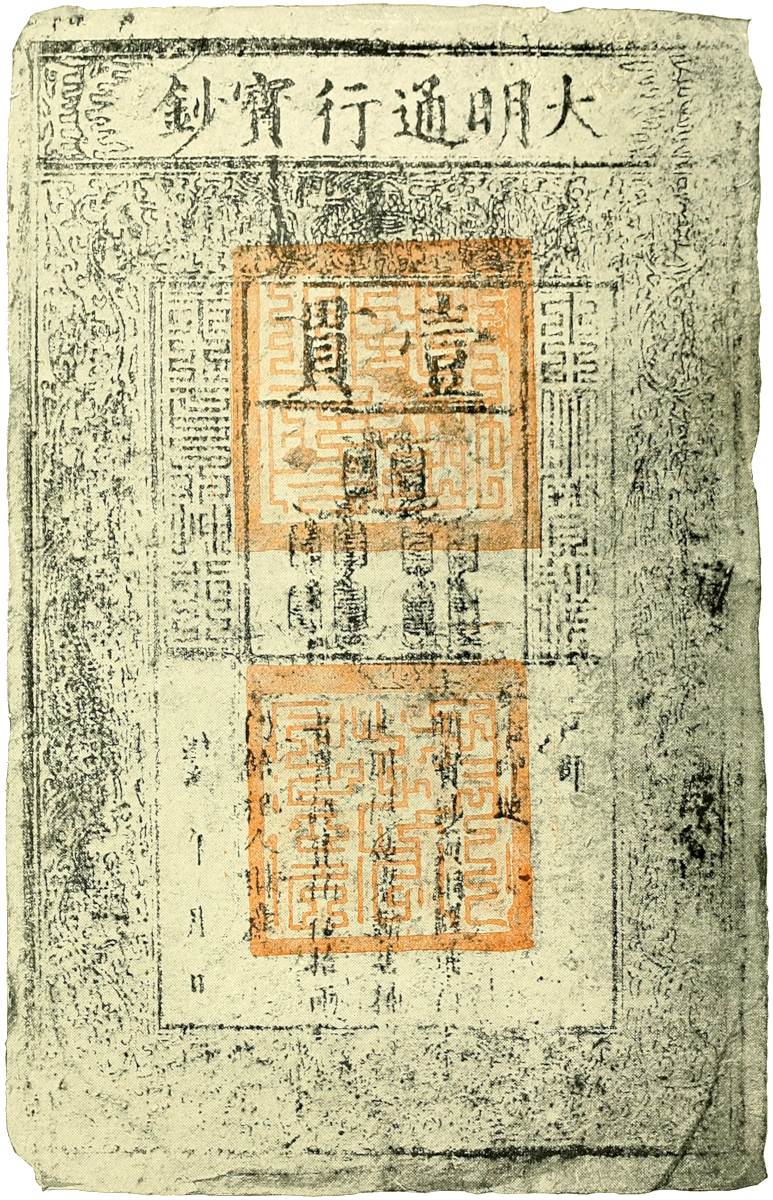
Bank-Note of the Ming Dynasty.
His bezant notes, I agree with Marsden, here represent the Chinese notes
for one and more ounces of silver. And here the correspondence of value is
much nearer than it seems at first sight. The Chinese liang or ounce of
silver is valued commonly at 6s. 7d., say roundly 80d.[1] But the
relation of gold and silver in civilized Asia was then (see ch. I. note
4, and also Cathay, pp. ccl. and 442) as 10 to 1, not, as with us now,
more than 15 to 1. Wherefore the liang in relation to gold would be worth
120d. or 10s., a little over the Venetian ducat and somewhat less than
the bezant or dínár. We shall then find the table of Chinese issues, as
compared with Marco’s equivalents, to stand thus:—
Chinese Issues, as recorded. |
Marco Polo’s Statement. |
| For 10 ounces of silver (viz. the Chinese Ting)[2] |
10 |
bezants. |
|
| For 1 ounce of silver, i.e. 1 liang, or 1000 tsien (cash) |
1 |
„ |
|
| For 500 tsien |
10 |
groats. |
|
| 200 „ |
5 |
„ |
(should have been 4). |
| 100 „ |
2 |
„ |
|
| 50 „ |
1 |
„ |
|
| 30 „ |
½ |
„ |
(but the proportionate equivalent of half a groat would be 25 tsien). |
| 20 „ |
|
|
|
| 10 „ |
1 |
tornesel |
(but the proportionate equivalent would be 7½ tsien). |
| 5 „ |
½ |
„ |
(but prop. equivalent 3¾ tsien). |
Pauthier has given from the Chinese Annals of the Mongol Dynasty a complete
Table of the Issues of Paper-Money during every year of Kúblái’s reign
(1260–1294), estimated at their nominal value in Ting or tens of silver
ounces. The lowest issue was in 1269, of 228,960 ounces, which at the
rate of 120d. to the ounce (see above) = 114,480l., and the highest
was in 1290, viz. 50,002,500 ounces, equivalent at the same estimate to
25,001,250l.! whilst the total amount in the 34 years was 249,654,290
ounces or 124,827,144l. in nominal value. Well might Marco speak of the
vast quantity of such notes that the Great Kaan issued annually!
To complete the history of the Chinese paper-currency so far as we can:
In 1309, a new issue took place with the same provision as in Kúblái’s
issue of 1287, i.e. each note of the new issue was to exchange against 5 of
the old of the same nominal value. And it was at the same time prescribed
that the notes should exchange at par with metals, which of course it was
beyond the power of Government to enforce, and so the notes were abandoned.
Issues continued from time to time to the end of the Mongol Dynasty. The
paper-currency is spoken of by Odoric (1320–30), by Pegolotti (1330–40),
and by Ibn Batuta (1348), as still the chief, if not sole, currency of the
Empire. According to the Chinese authorities, the credit of these issues
was constantly diminishing, as it is easy to suppose. But it is odd that
all the Western Travellers speak as if the notes were as good as gold.
Pegolotti, writing for mercantile men, and from the information (as we may
suppose) of mercantile men, says explicitly that there was no depreciation.
The Ming Dynasty for a time carried on the system of paper-money; with
the difference that while under the Mongols no other currency had been
admitted, their successors made payments in notes, but accepted only hard
cash from their people![3]
In 1448 the chao of 1000 cash was worth but 3.
Barbaro still heard talk of the Chinese paper-currency from travellers whom
he met at Azov about this time; but after 1455 there is said to be no more
mention of it in Chinese history.
I have never heard of the preservation of any note of the Mongols; but
some of the Ming survive, and are highly valued as curiosities in China.
The late Sir G. T. Staunton appears to have possessed one; Dr. Lockhart
formerly had two, of which he gave one to Sir Harry Parkes, and retains
the other. The paper is so dark as to explain Marco’s description of
it as black. By Dr. Lockhart’s kindness I am enabled to give a reduced
representation of this note, as near a facsimile as we have been able to
render it, but with some restoration, e.g. of the seals, of which on
the original there is the barest indication remaining.
[Mr. Vissering (Chinese Currency, Addenda, I.–III.) gives a facsimile
and a description of a Chinese banknote of the Ming Dynasty belonging to
the collection of the Asiatic Museum of the Academy of Sciences at St.
Petersburg. “In the eighth year of the period Hung-wu (1375), the Emperor
Tai-tsu issued an order to his minister of finances to make the Pao-tsao
(precious bills) of the Ta-Ming Dynasty, and to employ as raw material
for the composition of those bills the fibres of the mulberry tree.”—H. C.]
Notwithstanding the disuse of Government issues of paper-money from that
time till recent years, there had long been in some of the cities of China
a large use of private and local promissory notes as currency. In Fuchau
this was especially the case; bullion was almost entirely displaced, and
the banking-houses in that city were counted by hundreds. These were
under no government control; any individual or company having sufficient
capital or credit could establish a bank and issue their bills, which
varied in amount from 100 cash to 1000 dollars. Some fifteen years ago the
Imperial Government seems to have been induced by the exhausted state of
the Treasury, and these large examples of the local use of paper-currency,
to consider projects for resuming that system after the disuse of four
centuries. A curious report by a Committee of the Imperial Supreme Council,
on a project for such a currency, appears among the papers published by the
Russian Mission at Peking. It is unfavourable to the particular project,
but we gather from other sources that the Government not long afterwards
did open banks in the large cities of the Empire for the issue of a new
paper-currency, but that it met with bad success. At Fuchau, in 1858, I
learn from one notice, the dollar was worth from 18,000 to 20,000 cash in
Government Bills. Dr. Rennie, in 1861, speaks of the dollar at Peking as
valued at 15,000, and later at 25,000 paper cash. Sushun, the Regent, had
issued a vast number of notes through banks of his own in various parts of
Peking. These he failed to redeem, causing the failure of all the banks,
and great consequent commotion in the city. The Regent had led the Emperor
[Hien Fung] systematically into debauched habits which ended in paralysis.
On the Emperor’s death the Empress caused the arrest and execution of
Sushun. His conduct in connection with the bank failures was so bitterly
resented that when the poor wretch was led to execution (8th November,
1861), as I learn from an eye-witness, the defrauded creditors lined the
streets and cheered.[4]
The Japanese also had a paper-currency in the 14th century. It is different
in form from that of China. That figured by Siebold is a strip of strong
paper doubled, 6¼ in. long by 1¾ in. wide, bearing a representation of
the tutelary god of riches, with long inscriptions in Chinese characters,
seals in black and red, and an indication of value in ancient Japanese
characters. I do not learn whether notes of considerable amount are still
used in Japan; but Sir R. Alcock speaks of banknotes for small change from
30 to 500 cash and more, as in general use in the interior.
Two notable and disastrous attempts to imitate the Chinese system of
currency took place in the Middle Ages; one of them in Persia, apparently
in Polo’s very presence, the other in India some 36 years later.
The first was initiated in 1294 by the worthless Kaikhatu Khan, when his
own and his ministers’ extravagance had emptied the Treasury, on the
suggestion of a financial officer called ’Izzuddín Muzaffar. The notes were
direct copies of Kúblái’s, even the Chinese characters being imitated as
part of the device upon them.[5]
The Chinese name Chao was applied to
them, and the Mongol Resident at Tabriz, Pulad Chingsang, was consulted
in carrying out the measure. Expensive preparations were made for this
object; offices called Cháo-Khánahs were erected in the principal cities
of the provinces, and a numerous staff appointed to carry out the details.
Ghazan Khan in Khorasan, however, would have none of it, and refused to
allow any of these preparations to be made within his government. After the
constrained use of the Chao for two or three days Tabriz was in an uproar;
the markets were closed; the people rose and murdered ’Izzuddín; and the
whole project had to be abandoned. Marco was in Persia at this time, or
just before, and Sir John Malcolm not unnaturally suggests that he might
have had something to do with the scheme; a suggestion which excites a
needless commotion in the breast of M. Pauthier. We may draw from the story
the somewhat notable conclusion that Block-printing was practised, at
least for this one purpose, at Tabriz in 1294.
The other like enterprise was that of Sultan Mahomed Tughlak of Delhi, in
1330–31. This also was undertaken for like reasons, and was in professed
imitation of the Chao of Cathay. Mahomed, however, used copper tokens
instead of paper; the copper being made apparently of equal weight to the
gold or silver coin which it represented. The system seems to have had a
little more vogue than at Tabriz, but was speedily brought to an end by the
ease with which forgeries on an enormous scale were practised. The Sultan,
in hopes of reviving the credit of his currency, ordered that every one
bringing copper tokens to the Treasury should have them cashed in gold or
silver. “The people who in despair had flung aside their copper coins like
stones and bricks in their houses, all rushed to the Treasury and exchanged
them for gold and silver. In this way the Treasury soon became empty, but
the copper coins had as little circulation as ever, and a very grievous
blow was given to the State.”
An odd issue of currency, not of paper, but of leather, took place in Italy
a few years before Polo’s birth. The Emperor Frederic II., at the siege of
Faenza in 1241, being in great straits for money, issued pieces of leather
stamped with the mark of his mint at the value of his Golden Augustals.
This leather coinage was very popular, especially at Florence, and it was
afterwards honourably redeemed by Frederic’s Treasury. Popular tradition in
Sicily reproaches William the Bad among his other sins with having issued
money of leather, but any stone is good enough to cast at a dog with such a surname.
[Ma Twan-lin mentions that in the fourth year of the period Yuen Show (B.C.
119), a currency of white metal and deer-skin was made. Mr. Vissering
(Chinese Currency, 38) observes that the skin-tallies “were purely
tokens, and have had nothing in common with the leather-money, which was,
during a long time, current in Russia. This Russian skin-money had a truly
representative character, as the parcels were used instead of the skins
from which they were cut; the skins themselves being too bulky and heavy
to be constantly carried backward and forward, only a little piece was cut
off, to figure as a token of possession of the whole skin. The ownership of
the skin was proved when the piece fitted in the hole.”
Mr. Rockhill (Rubruck, 201 note) says: “As early as B.C. 118, we find
the Chinese using ‘leather-money’ (p’i pi). These were pieces of white
deer-skin, a foot square, with a coloured border. Each had a value of
40,000 cash. (Ma Twan-lin, Bk. 8, 5.)”
Mr. Charles F. Keary (Coins and Medals, by S. Lane Poole, 128) mentions
that “in the reign of Elizabeth there was a very extensive issue of private
tokens in lead, tin, latten, and leather.”—H. C.]
(Klapr. in Mém. Rel. à l’Asie, I. 375 seqq.; Biot, in J. As. sér.
III. tom. iv.; Marsden and Pauthier, in loco; Parkes, in J. R. A.
S. XIII. 179; Doolittle, 452 seqq.; Wylie, J. of Shanghai Lit. and
Scient. Soc. No. I.; Arbeiten der kais. russ. Gesandsch. zu Peking, I.
p. 48; Rennie, Peking, etc., I. 296, 347; Birch, in. Num. Chron. XII.
169; Information from Dr. Lockhart; Alcock, II. 86; D’Ohsson, IV.
53; Cowell, in J. A. S. B. XXIX. 183 seqq.; Thomas, Coins of Patan
Sovs. of Hind., (from Numism. Chron. 1852), p. 139 seqq.; Kington’s
Fred. II. II. 195; Amari, III. 816; W. Vissering, On Chinese Currency,
Leiden, 1877.)
[“Without doubt the Mongols borrowed the bank-note system from the Kin. Up
to the present time there is in Si-ngan-fu a block kept, which was used
for printing the bank-notes of the Kin Dynasty. I have had the opportunity
of seeing a print of those bank-notes, they were of the same size and
shape as the bank-notes of the Ming. A reproduction of the text of the
Kin bank-notes is found in the Kin shi ts’ui pien. This copy has the
characters pao küan (precious charter) and the years of reign Chêng
Yew, 1213–1216. The first essay of the Mongols to introduce bank-notes
dates from the time of Ogodai Khan (1229–1242), but Chinese history only
mentions the fact without giving details. At that time silk in skeins was
the only article of a determinate value in the trade and on the project of
Ye lü ch’u ts’ai, minister of Ogodai, the taxes were also collected in
silk delivered by weight. It can therefore be assumed that the name sze
ch’ao (i.e. bank-notes referring to the weight of silk) dates back to the
same time. At any rate, at a later time, as, under the reign of Kubilai,
the issuing of banknotes was decreed, silk was taken as the standard to
express the value of silver and 1000 liang silk was estimated = 50
liang (or 1 ting) silver. Thus, in consequence of those measures, it
gradually became a rule to transfer the taxes and rents originally paid in
silk, into silver. The wealth of the Mongol Khans in precious metals was
renowned. The accounts regarding their revenues, however, which we meet
with occasionally in Chinese history, do not surprise by their vastness.
In the year 1298, for instance, the amount of the revenue is stated in the
Siu t’ung Kien to have been:—
19,000 liang of gold = (190,000 liang of silver, according to the
exchange of that time at the rate of 1 to 10).
60,000 liang of silver.
3,600,000 ting of silver in bank-notes (i.e. 180 millions liang);
altogether 180,250,000 liang of silver.
The number seems indeed very high for that time. But if the exceedingly low
exchange of the bank-notes be taken into consideration, the sum will be
reduced to a modest amount.” (Palladius, pp. 50–51.)—H. C.]
[Dr. Bretschneider (Hist. Bot. Disc., I. p. 4) makes the following
remark:—“Polo states (I. 409) that the Great Kaan causeth the bark of great
Mulberry-trees, made into something like paper, to pass for money.” He
seems to be mistaken. Paper in China is not made from mulberry-trees but
from the Broussonetia papyrifera, which latter tree belongs to the same
order of Moraceae. The same fibres are used also in some parts of China for
making cloth, and Marco Polo alludes probably to the same tree when stating
(II. 108) “that in the province of Cuiju (Kwei chau) they manufacture stuff
of the bark of certain trees, which form very fine summer clothing.”—H. C.]
Concerning the Twelve Barons who are set over all the Affairs of the Great Kaan.
You must know that the Great Kaan hath chosen twelve great Barons to whom
he hath committed all the necessary affairs of thirty-four great provinces;
and now I will tell you particulars about them and their establishments.
You must know that these twelve Barons reside all together in a very rich
and handsome palace, which is inside the city of Cambaluc, and consists of
a variety of edifices, with many suites of apartments. To every province is
assigned a judge and several clerks, and all reside in this palace, where
each has his separate quarters. These judges and clerks administer all the
affairs of the provinces to which they are attached, under the direction
of the twelve Barons. Howbeit, when an affair is of very great importance,
the twelve Barons lay in before the Emperor, and he decides as he thinks
best. But the power of those twelve Barons is so great that they choose the
governors for all those thirty-four great provinces that I have mentioned,
and only after they have chosen do they inform the Emperor of their choice.
This he confirms, and grants to the person nominated a tablet of gold such
as is appropriate to the rank of his government.
Those twelve Barons also have such authority that they can dispose of the
movements of the forces, and send them whither, and in such strength, as
they please. This is done indeed with the Emperor’s cognizance, but still
the orders are issued on their authority. They are styled Shieng, which is
as much as to say “The Supreme Court,” and the palace where they abide is
also called Shieng. This body forms the highest authority at the Court
of the Great Kaan; and indeed they can favour and advance whom they will.
I will not now name the thirty-four provinces to you, because they will be
spoken of in detail in the course of this Book.{1}
Note 1.—Pauthier’s extracts from the Chinese Annals of the Dynasty, in
illustration of this subject, are interesting. These, as he represents
them, show the Council of Ministers usually to have consisted of twelve
high officials, viz.: two Ch’ing-siang [丞 相] or (chief) ministers of
state, one styled, “of the Right,” and the other “of the Left”; four called
P’ing-chang ching-ssé, which seems to mean something like ministers in
charge of special departments; four assistant ministers; two Counsellors.
Rashiduddin, however, limits the Council to the first two classes:
“Strictly speaking, the Council of State is composed of four Ch’ing-sang
(Ch’ing-siang) or great officers (Wazírs he afterwards terms them), and
four Fanchán (P’ing-chang) or associated members, taken from the nations
of the Tajiks, Cathayans, Ighurs, and Arkaun” (i.e. Nestorian Christians).
(Compare p. 418, supra.)
[A Samarkand man, Seyyd Tadj Eddin Hassan ben el Khallal, quoted in
the Masálak al Absár, says: “Near the Khan are two amírs who are his
ministers; they are called Djing San جينكصان (Ch’ing-siang). After
them come the two Bidjan بجان (P’ing Chang), then the two Zoudjin
زوجين (Tso Chen), then the two Yudjin يوجين (Yu Chen), and at last
the Landjun لنجون (Lang Chang), head of the scribes, and secretary of
the sovereign. The Khan holds a sitting every day in the middle of a large
building called Chen شن (Sheng), which is very like our Palace of
Justice.” (C. Schefer, Cent. Ec. Langues Or., pp. 18–19.)—H. C.]
In a later age we find the twelve Barons reappearing in the pages of
Mendoza: “The King hath in this city of Tabin (Peking), where he is
resident, a royal council of twelve counsellors and a president, chosen men
throughout all the kingdom, and such as have had experience in government
many years.” And also in the early centuries of the Christian era we hear
that the Khan of the Turks had his twelve grandees, divided into those of
the Right and those of the Left, probably a copy from a Chinese order then
also existing.
But to return to Rashiduddin: “As the Kaan generally resides at the
capital, he has erected a place for the sittings of the Great Council,
called Sing.... The dignitaries mentioned above are expected to attend
daily at the Sing, and to make themselves acquainted with all that passes there.”
The Sing of Rashid is evidently the Shieng or Sheng (Scieng) of Polo.
M. Pauthier is on this point somewhat contemptuous towards Neumann, who,
he says, confounds Marco Polo’s twelve Barons or Ministers of State with
the chiefs of the twelve great provincial governments called Sing, who
had their residence at the chief cities of those governments; whilst in
fact Polo’s Scieng (he asserts) has nothing to do with the Sing, but
represents the Chinese word Siang “a minister,” and “the office of a
minister.” [There was no doubt a confusion between Siang 相 and
Sheng 省.—H. C.]
It is very probable that two different words, Siang and Sing, got
confounded by the non-Chinese attachés of the Imperial Court; but it
seems to me quite certain that they applied the same word, Sing or Sheng,
to both institutions, viz. to the High Council of State, and to the
provincial governments. It also looks as if Marco Polo himself had made
that very confusion with which Pauthier charges Neumann. For whilst here
he represents the twelve Barons as forming a Council of State at the
capital, we find further on, when speaking of the city of Yangchau, he
says: “Et si siet en ceste cité uns des xii Barons du Grant Kaan; car elle
est esleue pour un des xii sieges,” where the last word is probably a
mistranscription of Sciengs, or Sings, and in any case the reference is
to a distribution of the empire into twelve governments.
To be convinced that Sing was used by foreigners in the double sense that
I have said, we have only to proceed with Rashiduddin’s account of the
administration. After what we have already quoted, he goes on: “The Sing
of Khanbaligh is the most eminent, and the building is very large....
Sings do not exist in all the cities, but only in the capitals of great
provinces.... In the whole empire of the Kaan there are twelve of these
Sings; but that of Khanbaligh is the only one which has Ching-sangs amongst
its members.” Wassáf again, after describing the greatness of Khanzai
(Kinsay of Polo) says: “These circumstances characterize the capital
itself, but four hundred cities of note, and embracing ample territories,
are dependent on its jurisdiction, insomuch that the most inconsiderable of
those cities surpasses Baghdad and Shiraz. In the number of these cities
are Lankinfu and Zaitun, and Chinkalán; for they call Khanzai a Shing,
i.e. a great city in which the high and mighty Council of Administration
holds its meetings.” Friar Odoric again says: “This empire hath been
divided by the Lord thereof into twelve parts, each one thereof is termed a Singo.”
Polo, it seems evident to me, knew nothing of Chinese. His Shieng is no
direct attempt to represent any Chinese word, but simply the term that
he had been used to employ in talking Persian or Turki, in the way that
Rashiduddin and Wassáf employ it.
I find no light as to the thirty-four provinces into which Polo represents
the empire as divided, unless it be an enumeration of the provinces and
districts which he describes in the second and third parts of Bk. II., of
which it is not difficult to reckon thirty-three or thirty-four, but not
worth while to repeat the calculation.
[China was then divided into twelve Sheng or provinces: Cheng-Tung,
Liao-Yang, Chung-Shu, Shen-Si, Ling-Pe (Karakorum), Kan-Suh, Sze-ch’wan,
Ho-Nan Kiang-Pe, Kiang-Ché, Kiang-Si, Hu-Kwang and Yun-Nan. Rashiduddin
(J. As., XI. 1883, p. 447) says that of the twelve Sing, Khanbaligh was
the only one with Chin-siang. We read in Morrison’s Dict. (Pt. II.
vol. i. p. 70): “Chin-seang, a Minister of State, was so called under the
Ming Dynasty.” According to Mr. E. H. Parker (China Review, xxiv. p.
101), Ching Siang were abolished in 1395. I imagine that the thirty-four
provinces refer to the Fu cities, which numbered however thirty-nine,
according to Oxenham’s Historical Atlas.—H. C.]
(Cathay, 263 seqq. and 137; Mendoza, I. 96; Erdmann, 142; Hammer’s
Wassáf, p. 42, but corrected.)
How the Kaan’s Posts and Runners are sped through many Lands and Provinces.
Now you must know that from this city of Cambaluc proceed many roads and
highways leading to a variety of provinces, one to one province, another
to another; and each road receives the name of the province to which it
leads; and it is a very sensible plan.{1} And the messengers of the
Emperor in travelling from Cambaluc, be the road whichsoever they will,
find at every twenty-five miles of the journey a station which they call
Yamb,{2} or, as we should say, the “Horse-Post-House.” And at each
of those stations used by the messengers, there is a large and handsome
building for them to put up at, in which they find all the rooms furnished
with fine beds and all other necessary articles in rich silk, and where
they are provided with everything they can want. If even a king were to
arrive at one of these, he would find himself well lodged.
At some of these stations, moreover, there shall be posted some four
hundred horses standing ready for the use of the messengers; at others
there shall be two hundred, according to the requirements, and to what
the Emperor has established in each case. At every twenty-five miles, as
I said, or anyhow at every thirty miles, you find one of these stations,
on all the principal highways leading to the different provincial
governments; and the same is the case throughout all the chief provinces
subject to the Great Kaan.{3} Even when the messengers have to pass
through a roadless tract where neither house nor hostel exists, still
there the station-houses have been established just the same, excepting
that the intervals are somewhat greater, and the day’s journey is fixed
at thirty-five to forty-five miles, instead of twenty-five to thirty. But
they are provided with horses and all the other necessaries just like those
we have described, so that the Emperor’s messengers, come they from what
region they may, find everything ready for them.
And in sooth this is a thing done on the greatest scale of magnificence
that ever was seen. Never had emperor, king, or lord, such wealth as
this manifests! For it is a fact that on all these posts taken together
there are more than 300,000 horses kept up, specially for the use of the
messengers. And the great buildings that I have mentioned are more than
10,000 in number, all richly furnished, as I told you. The thing is on a
scale so wonderful and costly that it is hard to bring oneself to describe
it.{4}
But now I will tell you another thing that I had forgotten, but which ought
to be told whilst I am on this subject. You must know that by the Great
Kaan’s orders there has been established between those post-houses, at
every interval of three miles, a little fort with some forty houses round
about it, in which dwell the people who act as the Emperor’s foot-runners.
Every one of those runners wears a great wide belt, set all over with
bells, so that as they run the three miles from post to post their bells
are heard jingling a long way off. And thus on reaching the post the runner
finds another man similarly equipt, and all ready to take his place, who
instantly takes over whatsoever he has in charge, and with it receives a
slip of paper from the clerk, who is always at hand for the purpose; and so
the new man sets off and runs his three miles. At the next station he finds
his relief ready in like manner; and so the post proceeds, with a change at
every three miles. And in this way the Emperor, who has an immense number
of these runners, receives despatches with news from places ten days’
journey off in one day and night; or, if need be, news from a hundred days
off in ten days and nights; and that is no small matter! (In fact in the
fruit season many a time fruit shall be gathered one morning in Cambaluc,
and the evening of the next day it shall reach the Great Kaan at Chandu, a
distance of ten days’ journey.{5} The clerk at each of the posts notes
the time of each courier’s arrival and departure; and there are often other
officers whose business it is to make monthly visitations of all the posts,
and to punish those runners who have been slack in their work.{6}) The
Emperor exempts these men from all tribute, and pays them besides.
Moreover, there are also at those stations other men equipt similarly with
girdles hung with bells, who are employed for expresses when there is a
call for great haste in sending despatches to any governor of a province,
or to give news when any Baron has revolted, or in other such emergencies;
and these men travel a good two hundred or two hundred and fifty miles in
the day, and as much in the night. I’ll tell you how it stands. They take a
horse from those at the station which are standing ready saddled, all fresh
and in wind, and mount and go at full speed, as hard as they can ride in
fact. And when those at the next post hear the bells they get ready another
horse and a man equipt in the same way, and he takes over the letter or
whatever it be, and is off full-speed to the third station, where again
a fresh horse is found all ready, and so the despatch speeds along from
post to post, always at full gallop, with regular change of horses. And
the speed at which they go is marvellous. (By night, however, they cannot
go so fast as by day, because they have to be accompanied by footmen with
torches, who could not keep up with them at full speed.)
Those men are highly prized; and they could never do it, did they not
bind hard the stomach, chest and head with strong bands. And each of them
carries with him a gerfalcon tablet, in sign that he is bound on an urgent
express; so that if perchance his horse break down, or he meet with other
mishap, whomsoever he may fall in with on the road, he is empowered to make
him dismount and give up his horse. Nobody dares refuse in such a case; so
that the courier hath always a good fresh nag to carry him.{7}
Now all these numbers of post-horses cost the Emperor nothing at all; and I
will tell you the how and the why. Every city, or village, or hamlet, that
stands near one of those post-stations, has a fixed demand made on it for
as many horses as it can supply, and these it must furnish to the post. And
in this way are provided all the posts of the cities, as well as the towns
and villages round about them; only in uninhabited tracts the horses are
furnished at the expense of the Emperor himself.
(Nor do the cities maintain the full number, say of 400 horses, always at
their station, but month by month 200 shall be kept at the station, and
the other 200 at grass, coming in their turn to relieve the first 200. And
if there chance to be some river or lake to be passed by the runners and
horse-posts, the neighbouring cities are bound to keep three or four boats
in constant readiness for the purpose.)
And now I will tell you of the great bounty exercised by the Emperor
towards his people twice a year.
Note
1.—The G. Text has “et ce est mout sçue chouse”; Pauthier’s Text,
“mais il est moult celé.” The latter seems absurd. I have no doubt that
sçue is correct, and is an Italianism, saputo having sometimes the
sense of prudent or judicious. Thus P. della Valle (II. 26), speaking
of Sháh Abbás: “Ma noti V.S. i tiri di questo re, saputo insieme e
bizzarro,” “acute with all his eccentricity.”
Note 2.—Both Neumann and Pauthier seek Chinese etymologies of this Mongol
word, which the Tartars carried with them all over Asia. It survives in
Persian and Turki in the senses both of a post-house and a post-horse,
and in Russia, in the former sense, is a relic of the Mongol dominion.
The ambassadors of Shah Rukh, on arriving at Sukchu, were lodged in the
Yám-Khána, or post-house, by the city gate; and they found ninety-nine
such Yams between Sukchu and Khanbaligh, at each of which they were
supplied with provisions, servants, beds, night-clothes, etc. Odoric
likewise speaks of the hostelries called Yam, and Rubruquis applies the
same term to quarters in the imperial camp, which were assigned for the
lodgment of ambassadors. (Cathay, ccii., 137; Rubr. 310.)
[Mr. Rockhill (Rubruck, 101, note) says that these post-stations were
established by Okkodai in 1234 throughout the Mongol empire. (D’Ohsson,
ii. 63.) Dr. G. Schlegel (T’oung Pao, II. 1891, 265, note) observes
that iam is not, as Pauthier supposed, a contraction of yi-mà, horse
post-house (yi-mà means post-horse, and Pauthier makes a mistake), but
represents the Chinese character 站, pronounced at present chán,
which means in fact a road station, a post. In Annamite, this character
站 is pronounced trạm, and it means, according to Bonet’s
Dict. Annamite-Français: “Relais de poste, station de repos.” (See
Bretschneider, Med. Res. I. p. 187 note.)—H. C.]
Note 3.—Martini and Magaillans, in the 17th century, give nearly the same
account of the government hostelries.
Note 4.—Here Ramusio has this digression: “Should any one find it difficult
to understand how there should be such a population as all this implies,
and how they can subsist, the answer is that all the Idolaters, and
Saracens as well, take six, eight, or ten wives apiece when they can afford
it, and beget an infinity of children. In fact, you shall find many men
who have each more than thirty sons who form an armed retinue to their
father, and this through the fact of his having so many wives. With us, on
the other hand, a man hath but one wife; and if she be barren, still he
must abide by her for life, and have no progeny; thus we have not such a
population as they have.
“And as regards food, they have abundance; for they generally consume rice,
panic, and millet (especially the Tartars, Cathayans, and people of Manzi);
and these three crops in those countries render an hundred-fold. Those
nations use no bread, but only boil those kinds of grain with milk or meat
for their victual. Their wheat, indeed, does not render so much, but this
they use only to make vermicelli, and pastes of that description. No spot
of arable land is left untilled; and their cattle are infinitely prolific,
so that when they take the field every man is followed by six, eight,
or more horses for his own use. Thus you may clearly perceive how the
population of those parts is so great, and how they have such an abundance
of food.”
Note
5.—The Burmese kings used to have the odoriferous Durian transmitted
by horse-posts from Tenasserim to Ava. But the most notable example of
the rapid transmission of such dainties, and the nearest approach I know
of to their despatch by telegraph, was that practised for the benefit of
the Fatimite Khalif Aziz (latter part of 10th century), who had a great
desire for a dish of cherries of Balbek. The Wazir Yakub ben-Kilis caused
six hundred pigeons to be despatched from Balbek to Cairo, each of which
carried attached to either leg a small silk bag containing a cherry!
(Quat. Makrizi, IV. 118.)
Note 6.—“Note is taken at every post,” says Amyot, in speaking of the
Chinese practice of last century, “of the time of the courier’s arrival,
in order that it may be known at what point delays have occurred.” (Mém.
VIII. 185.)
Note 7.—The post-system is described almost exactly as in the text by Friar
Odoric and the Archbishop of Soltania, in the generation after Polo, and
very much in the same way by Magaillans in the 17th century. Posts had
existed in China from an old date. They are spoken of by Mas’udi and the
Relations of the 9th century. They were also employed under the ancient
Persian kings; and they were in use in India, at least in the generation
after Polo. The Mongols, too, carried the institution wherever they went.
Polo describes the couriers as changed at short intervals, but more usually
in Asiatic posts the same man rides an enormous distance. The express
courier in Tibet, as described by “the Pandit,” rides from Gartokh to
Lhasa, a distance of 800 miles, travelling day and night. The courier’s
coat is sealed upon him, so that he dares not take off his clothes
till the seal is officially broken on his arrival at the terminus. These
messengers had faces cracked, eyes bloodshot and sunken, and bodies raw
with vermin. (J. R. G. S. XXXVIII. p. 149.) The modern Turkish post from
Constantinople to Baghdad, a distance of 1100 miles, is done in twenty days
by four Tartars riding night and day. The changes are at Sivas, Diarbekir,
and Mosul. M. Tchihatcheff calculates that the night riding accomplishes
only one quarter of the whole. (Asie Mineure, 2de Ptie. 632–635.)—See I. p. 352, paï tze.
How the Emperor bestows Help on his People, when they are afflicted with
Dearth Or Murrain.
Now you must know that the Emperor sends his Messengers over all his Lands
and Kingdoms and Provinces, to ascertain from his officers if the people
are afflicted by any dearth through unfavourable seasons, or storms or
locusts, or other like calamity; and from those who have suffered in this
way no taxes are exacted for that year; nay more, he causes them to be
supplied with corn of his own for food and seed. Now this is undoubtedly a
great bounty on his part. And when winter comes, he causes inquiry to be
made as to those who have lost their cattle, whether by murrain or other
mishap, and such persons not only go scot free, but get presents of cattle.
And thus, as I tell you, the Lord every year helps and fosters the people
subject to him.
[There is another trait of the Great Kaan I should tell you; and that
is, that if a chance shot from his bow strike any herd or flock, whether
belonging to one person or to many, and however big the flock may be,
he takes no tithe thereof for three years. In like manner, if the arrow
strike a boat full of goods, that boat-load pays no duty; for it is thought
unlucky that an arrow strike any one’s property; and the Great Kaan says
it would be an abomination before God, were such property, that has been
struck by the divine wrath, to enter into his Treasury.{1}]
Note 1.—The Chinese author already
quoted as to Kúblái’s character (Note 2,
ch. xxiii. supra) says: “This Prince, at the sight of some evil prognostic,
or when there was dearth, would remit taxation, and cause grain to be
distributed to those who were in destitution. He would often complain that
there never lacked informers if balances were due, or if corvées had been
ordered, but when the necessities of the people required to be reported,
not a word was said.”
Wassáf tells a long story in illustration of Kúblái’s justice and
consideration for the peasantry. One of his sons, with a handful of
followers, had got separated from the army, and halted at a village in
the territory of Bishbaligh, where the people gave them sheep and wine.
Next year two of the party came the same way and demanded a sheep and a
stoup of wine. The people gave it, but went to the Kaan and told the story,
saying they feared it might grow into a perpetual exaction. Kúblái sharply
rebuked the Prince, and gave the people compensation and an order in their
favour. (De Mailla, ix. 460; Hammer’s Wassaf, 38–39.)]
How the Great Kaan causes Trees to be Planted by the Highways.
The Emperor moreover hath taken order that all the highways travelled by
his messengers and the people generally should be planted with rows of
great trees a few paces apart; and thus these trees are visible a long way
off, and no one can miss the way by day or night. Even the roads through
uninhabited tracts are thus planted, and it is the greatest possible
solace to travellers. And this is done on all the ways, where it can be of
service. [The Great Kaan plants these trees all the more readily, because
his astrologers and diviners tell him that he who plants trees lives
long.{1}
But where the ground is so sandy and desert that trees will not grow, he
causes other landmarks, pillars or stones, to be set up to show the way.]
Note 1.—In this Kúblái imitated the great King Asoka, or Priyadarsi, who
in his graven edicts (circa B.C. 250) on the Delhi Pillar, says: “Along
the high roads I have caused fig-trees to be planted, that they may be for
shade to animals and men. I have also planted mango-trees; and at every
half-coss I have caused wells to be constructed, and resting-places for the
night. And how many hostels have been erected by me at various places for
the entertainment of man and beast.” (J. A. S. B. IV. 604.) There are
still remains of the fine avenues of Kúblái and his successors in various
parts of Northern China. (See Williamson, i. 74.)
Concerning the Rice-Wine drunk by the people of Cathay.
Most of the people of Cathay drink wine of the kind that I shall now
describe. It is a liquor which they brew of rice with a quantity of
excellent spice, in such fashion that it makes better drink than any other
kind of wine; it is not only good, but clear and pleasing to the eye.{1}
And being very hot stuff, it makes one drunk sooner than any other wine.
Note 1.—The mode of making Chinese rice-wine is described in Amyot’s
Mémoires, V. 468 seqq. A kind of yeast is employed, with which is often
mixed a flour prepared from fragrant herbs, almonds, pine-seeds, dried
fruits, etc. Rubruquis says this liquor was not distinguishable, except by
smell, from the best wine of Auxerre; a wine so famous in the Middle Ages,
that the Historian Friar, Salimbene, went from Lyons to Auxerre on purpose
to drink it.[1] Ysbrandt Ides compares the rice-wine to Rhenish; John Bell
to Canary; a modern traveller quoted by Davis, “in colour, and a little in
taste, to Madeira.” [Friar Odoric (Cathay, i. p. 117) calls this wine
bigni; Dr. Schlegel (T’oung Pao, ii. p. 264) says Odoric’s wine was
probably made with the date Mi-yin, pronounced Bi-im in old days. But
Marco’s wine is made of rice, and is called shao hsing chiu. Mr. Rockhill
(Rubruck, p. 166, note) writes: “There is another stronger liquor
distilled from millet, and called shao chiu: in Anglo-Chinese, samshu;
Mongols call it araka, arrak, and arreki. Ma Twan-lin (Bk. 327) says
that the Moho (the early Nu-chên Tartars) drank rice wine (mi chiu), but
I fancy that they, like the Mongols, got it from the Chinese.”
Dr. Emil Bretschneider (Botanicon Sinicum, ii. pp. 154–158) gives a most
interesting account of the use and fabrication of intoxicating beverages
by the Chinese. “The invention of wine or spirits in China,” he says, “is
generally ascribed to a certain I ti, who lived in the time of the Emperor
Yü. According to others, the inventor of wine was Tu K’ang.” One may refer
also to Dr. Macgowan’s paper On the “Mutton Wine” of the Mongols and
Analogous Preparations of the Chinese. (Jour. N. China Br. R. As. Soc.,
1871–1872, pp. 237–240.)—H. C.]
Concerning the Black Stones that are dug in Cathay, and are Burnt for Fuel.
It is a fact that all over the country of Cathay there is a kind of black
stones existing in beds in the mountains, which they dig out and burn like
firewood. If you supply the fire with them at night, and see that they are
well kindled, you will find them still alight in the morning; and they make
such capital fuel that no other is used throughout the country. It is true
that they have plenty of wood also, but they do not burn it, because those
stones burn better and cost less.{1}
[Moreover with that vast number of people, and the number of hot baths
that they maintain—for every one has such a bath at least three times a
week, and in winter if possible every day, whilst every nobleman and man of
wealth has a private bath for his own use—the wood would not suffice for
the purpose.]
Note 1.—There is a great consumption of coal in Northern China, especially
in the brick stoves, which are universal, even in poor houses. Coal seems
to exist in every one of the eighteen provinces of China, which in this
respect is justly pronounced to be one of the most favoured countries in
the world. Near the capital coal is mined at Yuen-ming-yuen, and in a
variety of isolated deposits among the hills in the direction of the Kalgan
road, and in the district round Siuen-hwa-fu. (Sindachu of Polo, ante
ch. lix.) But the most important coal-fields in relation to the future
are those of Shan-tung Hu-nan, Ho-nan, and Shan-si. The last is eminently
the coal and iron province of China, and its coal-field, as described by
Baron Richthofen, combines, in an extraordinary manner, all the advantages
that can enhance the value of such a field except (at present) that of
facile export; whilst the quantity available is so great that from Southern
Shan-si alone he estimates the whole world could be supplied, at the
present rate of consumption, for several thousand years. “Adits, miles in
length, could be driven within the body of the coal.... These extraordinary
conditions ... will eventually give rise to some curious features in
mining ... if a railroad should ever be built from the plain to this region
... branches of it will be constructed within the body of one or other of
these beds of anthracite.” Baron Richthofen, in the paper which we quote
from, indicates the revolution in the deposit of the world’s wealth and
power, to which such facts, combined with other characteristics of China,
point as probable; a revolution so vast that its contemplation seems like
that of a planetary catastrophe.
In the coal-fields of Hu-nan “the mines are chiefly opened where the rivers
intersect the inclined strata of the coal-measures and allow the coal-beds
to be attacked by the miner immediately at their out-croppings.”
At the highest point of the Great Kiang, reached by Sarel and Blakiston,
they found mines on the cliffs over the river, from which the coal was sent
down by long bamboo cables, the loaded baskets drawing up the empty ones.
[Many coal-fields have been explored since; one of the most important is
the coal-field of the Yun-nan province; the finest deposits are perhaps
those found in the bend of the Kiang; coal is found also at Mong-Tzŭ,
Lin-ngan, etc.; this rich coal region has been explored in 1898 by the
French engineer A. Leclère. (See Congrès int. Géog., Paris, 1900, pp.
178–184.)—H. C.]
In various parts of China, as in Che-kiang, Sze-ch’wan, and at Peking,
they form powdered coal, mixed with mud, into bricks, somewhat like our
“patent fuel.” This practice is noticed by Ibn Batuta, as well as the use
of coal in making porcelain, though this he seems to have misunderstood.
Rashiduddin also mentions the use of coal in China. It was in use,
according to citations of Pauthier’s, before the Christian era. It is a
popular belief in China, that every provincial capital is bound to be
established over a coal-field, so as to have a provision in case of siege.
It is said that during the British siege of Canton mines were opened to the
north of the city.
(The Distribution of Coal in China, by Baron Richthofen, in Ocean
Highways, N.S., I. 311; Macgowan in Ch. Repos. xix. 385–387;
Blakiston, 133, 265; Mid. Kingdom, I. 73, 78; Amyot, xi. 334;
Cathay, 261, 478, 482; Notes by Rev. A. Williamson in J. N. Ch. Br. R.
A. S., December, 1867; Hedde and Rondot, p. 63.)
Æneas Sylvius relates as a miracle that took place before his eyes in
Scotland, that poor and almost naked beggars, when stones were given them
as alms at the church doors, went away quite delighted; for stones of that
kind were imbued either with brimstone or with some oily matter, so that
they could be burnt instead of wood, of which the country was destitute.
(Quoted by Jos. Robertson, Statuta Eccles. Scotic. I. xciii.)
How the Great Kaan causes Stores of Corn to be made, to help his People
withal in time of Dearth.
You must know that when the Emperor sees that corn is cheap and abundant,
he buys up large quantities, and has it stored in all his provinces in
great granaries, where it is so well looked after that it will keep for
three or four years.{1}
And this applies, let me tell you, to all kinds of corn, whether wheat,
barley, millet, rice, panic, or what not, and when there is any scarcity of
a particular kind of corn, he causes that to be issued. And if the price
of the corn is at one bezant the measure, he lets them have it at a bezant
for four measures, or at whatever price will produce general cheapness;
and every one can have food in this way. And by this providence of the
Emperor’s, his people can never suffer from dearth. He does the same over
his whole Empire; causing these supplies to be stored everywhere, according
to calculation of the wants and necessities of the people.
Note
1.—“Le fait si bien estuier que il dure bien trois ans ou quatre”
(Pauthier): “si bien estudier” (G. T.). The word may be estiver (It.
stivare), to stow, but I half suspect it should be estuver in the
sense of “kiln-dry,” though both the Geog. Latin and the Crusca render
it gubernare.[1] Lecomte says: “Rice is always stored in the public
granaries for three or four years in advance. It keeps long if care be
taken to air it and stir it about; and although not so good to the taste or
look as new rice, it is said to be more wholesome.”
The Archbishop of Soltania (A.D. 1330) speaks of these stores. “The said
Emperor is very pitiful and compassionate ... and so when there is a dearth
in the land he openeth his garners, and giveth forth of his wheat and his
rice for half what others are selling it at.” Kúblái Kaan’s measures of
this kind are recorded in the annals of the Dynasty, as quoted by Pauthier.
The same practice is ascribed to the sovereigns of the T’ang Dynasty
by the old Arab Relations. In later days a missionary gives in the
Lettres Edifiantes an unfavourable account of the action of these public
granaries, and of the rascality that occurred in connection with them.
(Lecomte, II. 101; Cathay, 240; Relat. I. 39; Let. Ed. xxiv. 76.)
[The Yuen-shi in ch. 96 contains sections on dispensaries (Hui min yao
kü), granary regulations (Shi ti), and regulations for a time of dearth
(Chen Sü). (Bretschneider, Med. Res. I. p. 187.)—H. C.]
Of the Charity of the Emperor to the Poor.
I have told you how the Great Kaan provides for the distribution of
necessaries to his people in time of dearth, by making store in time of
cheapness. Now I will tell you of his alms and great charity to the poor of
his city of Cambaluc.
You see he causes selection to be made of a number of families in the city
which are in a state of indigence, and of such families some may consist of
six in the house, some of eight, some of ten, more or fewer in each as it
may hap, but the whole number being very great. And each family he causes
annually to be supplied with wheat and other corn sufficient for the whole
year. And this he never fails to do every year. Moreover, all those who
choose to go to the daily dole at the Court receive a great loaf apiece,
hot from the baking, and nobody is denied; for so the Lord hath ordered.
And so some 30,000 people go for it every day from year’s end to year’s
end. Now this is a great goodness in the Emperor to take pity of his poor
people thus! And they benefit so much by it that they worship him as he
were God.
[He also provides the poor with clothes. For he lays a tithe upon all
wool, silk, hemp, and the like, from which clothing can be made; and he
has these woven and laid up in a building set apart for the purpose; and
as all artizans are bound to give a day’s labour weekly, in this way the
Kaan has these stuffs made into clothing for those poor families, suitable
for summer or winter, according to the time of year. He also provides the
clothing for his troops, and has woollens woven for them in every city,
the material for which is furnished by the tithe aforesaid. You should
know that the Tartars, before they were converted to the religion of the
Idolaters, never practised almsgiving. Indeed, when any poor man begged of
them they would tell him, “Go with God’s curse, for if He loved you as He
loves me, He would have provided for you.” But the sages of the Idolaters,
and especially the Bacsis mentioned before, told the Great Kaan that
it was a good work to provide for the poor, and that his idols would be
greatly pleased if he did so. And since then he has taken to do for the
poor so much as you have heard.{1}]
Note 1.—This is a curious testimony to an ameliorating effect of Buddhism
on rude nations. The general establishment of medical aid for men and
animals is alluded to in the edicts of Asoka;[1] and hospitals for
the diseased and destitute were found by Fahian at Palibothra, whilst
Hiuen Tsang speaks of the distribution of food and medicine at the
Punyasálás or “Houses of Beneficence,” in the Panjáb. Various examples
of a charitable spirit in Chinese Institutions will be found in a letter
by Père d’Entrecolles in the XVth Recueil of Lettres Edifiantes; and a
similar detail in Nevius’s China and the Chinese, ch. xv. (See Prinsep’s
Essays, II. 15; Beal’s Fah-hian, 107; Pèl. Boudd. II. 190.) The Tartar
sentiment towards the poor survives on the Arctic shores:—“The Yakuts
regard the rich as favoured by the gods; the poor as rejected and cast out
by them.” (Billings, Fr. Tranls. I. 233.)
[Concerning the Astrologers in the City of Cambaluc.]
[There are in the city of Cambaluc, what with Christians, Saracens, and
Cathayans, some five thousand astrologers and soothsayers, whom the Great
Kaan provides with annual maintenance and clothing, just as he provides the
poor of whom we have spoken, and they are in the constant exercise of their
art in this city.
They have a kind of astrolabe on which are inscribed the planetary signs,
the hours and critical points of the whole year. And every year these
Christian, Saracen, and Cathayan astrologers, each sect apart, investigate
by means of this astrolabe the course and character of the whole year,
according to the indications of each of its Moons, in order to discover
by the natural course and disposition of the planets, and the other
circumstances of the heavens, what shall be the nature of the weather, and
what peculiarities shall be produced by each Moon of the year; as, for
example, under which Moon there shall be thunderstorms and tempests, under
which there shall be disease, murrain, wars, disorders, and treasons, and
so on, according to the indications of each; but always adding that it
lies with God to do less or more according to His pleasure. And they write
down the results of their examination in certain little pamphlets for the
year, which are called Tacuin, and these are sold for a groat to all who
desire to know what is coming. Those of the astrologers, of course whose
predictions are found to be most exact, are held to be the greatest adepts
in their art, and get the greater fame.{1}
And if any one having some great matter in hand, or proposing to make a
long journey for traffic or other business, desires to know what will be
the upshot, he goes to one of these astrologers and says: “Turn up your
books and see what is the present aspect of the heavens, for I am going
away on such and such a business.” Then the astrologer will reply that the
applicant must also tell the year, month, and hour of his birth; and when
he has got that information he will see how the horoscope of his nativity
combines with the indications of the time when the question is put, and
then he predicts the result, good or bad, according to the aspect of the
heavens.
You must know, too, that the Tartars reckon their years by twelves; the
sign of the first year being the Lion, of the second the Ox, of the third
the Dragon, of the fourth the Dog, and so forth up to the twelfth;{2}
so that when one is asked the year of his birth he answers that it was in
the year of the Lion (let us say), on such a day or night, at such an hour,
and such a moment. And the father of a child always takes care to write
these particulars down in a book. When the twelve yearly symbols have been
gone through, then they come back to the first, and go through with them
again in the same succession.]
Note 1.—It is odd that Marsden should have sought a Chinese explanation
of the Arabic word Taḳwím even with Tavernier before him: “They sell in
Persia an annual almanac called Tacuim, which is properly an ephemeris
containing the longitude and latitude of the planets, their conjunctions
and oppositions, and other such matter. The Tacuim is full of predictions
regarding war, pestilence, and famine; it indicates the favourable time for
putting on new clothes, for getting bled or purged, for making a journey,
and so forth. They put entire faith in it, and whoever can afford one
governs himself in all things by its rules.” (Bk. V. ch. xiv.)
The use of the term by Marco may possibly be an illustration of what I have
elsewhere propounded, viz. that he was not acquainted with Chinese, but
that his intercourse and conversation lay chiefly with the foreigners at
the Kaan’s Court, and probably was carried on in the Persian language. But
not long after the date of our Book we find the word used in Italian by
Jacopo Alighieri (Dante’s son):—
“A voler giudicare
Si conviene adequare
Inprimo il Taccuino,
Per vedere il cammino
Come i Pianeti vanno
Per tutto quanto l’anno.”
—Rime Antiche Toscane, III. 10.
Marco does not allude to the fact that almanacs were published by the
Government, as they were then and still are. Pauthier (515 seqq.) gives
some very curious details on this subject from the Annals of the Yuen.
In the accounts of the year 1328, it appears that no less than 3,123,185
copies were printed in three different sizes at different prices, besides a
separate almanac for the Hwei-Hwei or Mahomedans. Had Polo not omitted to
touch on the issue of almanacs by Government he could scarcely have failed
to enter on the subject of printing, on which he has kept a silence so
singular and unaccountable.
The Chinese Government still “considers the publication of a Calendar of
the first importance and utility. It must do everything in its power,
not only to point out to its numerous subjects the distribution of the
seasons, ... but on account of the general superstition it must mark in the
almanac the lucky and unlucky days, the best days for being married, for
undertaking a journey, for making their dresses, for buying or building,
for presenting petitions to the Emperor, and for many other cases of
ordinary life. By this means the Government keeps the people within the
limits of humble obedience; it is for this reason that the Emperors
of China established the Academy of Astronomy.” (Timk. I. 358.) The
acceptance of the Imperial Almanac by a foreign Prince is considered an
acknowledgment of vassalage to the Emperor.
It is a penal offence to issue a pirated or counterfeit edition of the
Government Almanac. No one ventures to be without one, lest he become
liable to the greatest misfortunes by undertaking the important measures on
black-balled days.
The price varies now, according to Williams, from 1½d. to 5d. a copy.
The price in 1328 was 1 tsien or cash for the cheapest edition, and 1
liang or tael of silver for the édition de luxe; but as these prices
were in paper-money it is extremely difficult to say, in the varying
depreciation of that currency, what the price really amounted to.
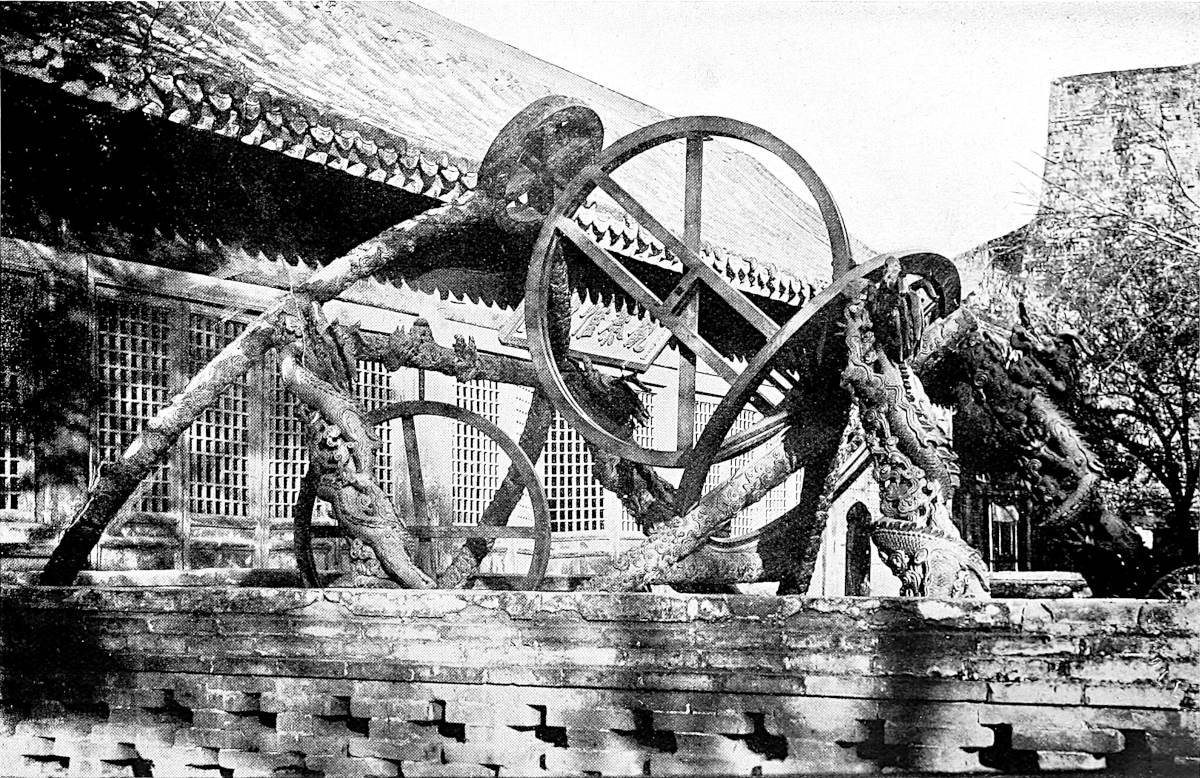
Mongol “Compendium Instrument” Keen-e in the Observatory Garden.
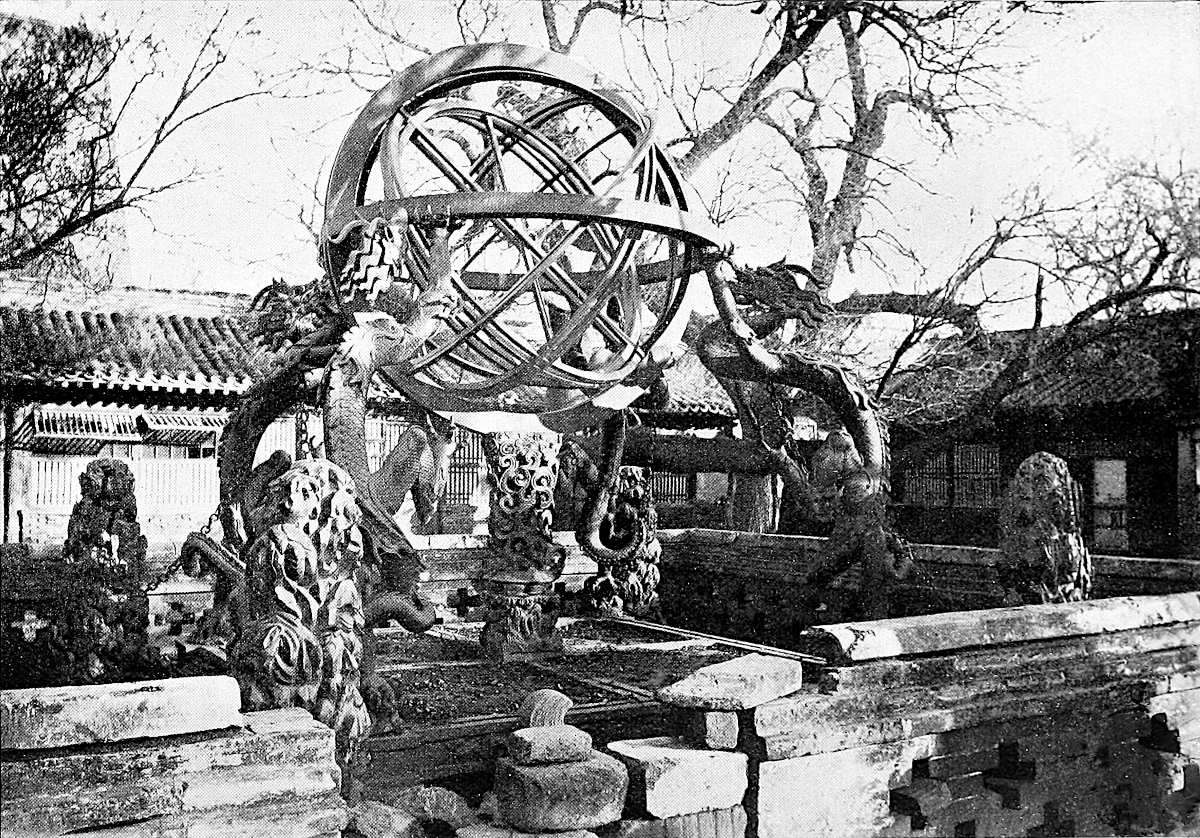
Mongol Armillary Sphere in the Observatory Garden.
[“The Calendars for the use of the people, published by Imperial command,
are of two kinds. The first, Wan-nien-shu, the Calendar of Ten Thousand
Years, is an abridgment of the Calendar, comprising 397 years, viz.
from 1624 to 2020. The second and more complete Calendar is the Annual
Calendar, which, under the preceding dynasties, was named Li-je, Order of
Days, and is now called Shih-hsien-shu, Book of Constant Conformity (with
the Heavens). This name was given by the Emperor Shun-chih, in the first
year of his reign (1644), on being presented by Father John Schall (Tang
Jo-wang) with a new Calendar, calculated on the principles of European
science. This Annual Calendar gives the following indications: (1°) The
cyclical signs of the current year, of the months, and of all the days;
(2°) the long and short months, as well as the intercalary month, as
the case may be; (3°) the designation of each day by the 5 elements, the
28 constellations, and the 12 happy presages; (4°) the day and hour of
the new moon, of the full moon, and of the two dichotomies, Shang-hsien
and Hsia-hsien; (5°) the day and hour for the positions of the sun in
the 24 zodiacal signs, calculated for the various capitals of China as
well as for Manchuria, Mongolia, and the tributary Kingdoms; (6°) the hour
of sunrise and sunset and the length of day and night for the principal
days of the month in the several capitals; (7°) various superstitious
indications purporting to point out what days and hours are auspicious
or not for such or such affairs in different places. Those superstitious
indications are stated to have been introduced into the Calendar under the
Yüan dynasty.” (P. Hoang, Chinese Calendar, pp. 2–3.)—H. C.]
We may note that in Polo’s time one of the principal officers of the
Mathematical Board was Gaisue, a native of Folin or the Byzantine
Empire, who was also in charge of the medical department of the Court.
Regarding the Observatory, see note at p. 378, supra.
And I am indebted yet again to the generous zeal of Mr. Wylie of Shanghai,
for the principal notes and extracts which will, I trust, satisfy others as
well as myself that the instruments in the garden of the Observatory belong
to the period of Marco Polo’s residence in China.[1]
The objections to the alleged age of these instruments were entirely based
on an inspection of photographs. The opinion was given very strongly that
no instrument of the kind, so perfect in theory and in execution, could
have been even imagined in those days, and that nothing of such scientific
quality could have been made except by the Jesuits. In fact it was asserted
or implied that these instruments must have been made about the year
1700, and were therefore not earlier in age than those which stand on the
terraced roof of the Observatory, and are well known to most of us from the
representation in Duhalde and in many popular works.
The only authority that I could lay hand on was Lecomte, and what he says
was not conclusive. I extract the most pertinent passages:
“It was on the terrace of the tower that the Chinese astronomers had set
their instruments, and though few in number they occupied the whole area.
But Father Verbiest, the Director of the Observatory, considering them
useless for astronomical observation, persuaded the Emperor to let them
be removed, to make way for several instruments of his own construction.
The instruments set aside by the European astronomers are still in a hall
adjoining the tower, buried in dust and oblivion; and we saw them only
through a grated window. They appeared to us to be very large and well
cast, in form approaching our astronomical circles; that is all that we
could make out. There was, however, thrown into a back yard by itself, a
celestial globe of bronze, of about 3 feet in diameter. Of this we were
able to take a nearer view. Its form was somewhat oval; the divisions by no
means exact, and the whole work coarse enough.
“Besides this in a lower hall they had established a gnomon.... This
observatory, not worthy of much consideration for its ancient instruments,
much less for its situation, its form, or its construction, is now enriched
by several bronze instruments which Father Verbiest has placed there. These
are large, well cast, adorned in every case with figures of dragons,” etc.
He then proceeds to describe them:
“(1). Armillary Zodiacal Sphere of 6 feet diameter. This sphere reposes on
the heads of four dragons, the bodies of which after various convolutions
come to rest upon the extremities of two brazen beams forming a cross,
and thus bear the entire weight of the instrument. These dragons ... are
represented according to the notion the Chinese form of them, enveloped in
clouds, covered above the horns with long hair, with a tufted beard on the
lower jaw, flaming eyes, long sharp teeth, the gaping throat ever vomiting
a torrent of fire. Four lion-cubs of the same material bear the ends of the
cross beams, and the heads of these are raised or depressed by means of
attached screws, according to what is required. The circles are divided on
both exterior and interior surface into 360 degrees; each degree into 60
minutes by transverse lines, and the minutes into sections of 10 seconds
each by the sight-edge[2] applied to them.”
Of Verbiest’s other instruments we need give only the names: (2) Equinoxial
Sphere, 6 feet diameter. (3) Azimuthal Horizon, same diam. (4) Great
Quadrant, of 6 feet radius. (5) Sextant of about 8 feet radius. (6)
Celestial Globe of 6 feet diameter.
As Lecomte gives no details of the old instruments which he saw through a
grating, and as the description of this zodiacal sphere (No. 1) corresponds
in some of its main features with that represented in the photograph,
I could not but recognize the possibility that this instrument of
Verbiest’s had for some reason or other been removed from the Terrace, and
that the photograph might therefore possibly not be a representation of
one of the ancient instruments displaced by him.[3]
The question having been raised it was very desirable to settle it, and I
applied to Mr. Wylie for information, as I had received the photographs
from him, and knew that he had been Mr. Thomson’s companion and helper in
the matter.
“Let me assure you,” he writes (21st August, 1874), “the Jesuits had
nothing to do with the manufacture of the so-called Mongol instruments; and
whoever made them, they were certainly on the Peking Observatory before
Loyola was born. They are not made for the astronomical system introduced
by the Jesuits, but are altogether conformable to the system introduced
by Kúblái’s astronomer Ko Show-king.... I will mention one thing which
is quite decisive as to the Jesuits. The circle is divided into 365¼
degrees, each degree into 100 minutes, and each minute into 100 seconds.
The Jesuits always used the sexagesimal division. Lecomte speaks of the
imperfection of the division on the Jesuit-made instruments; but those on
the Mongol instruments are immeasurably coarser.
“I understand it is not the ornamentation your friend objects to?[4]
If it is, I would observe that there is no evidence of progress in the
decorative and ornamental arts during the Ming Dynasty; and even in the
Jesuit instruments that part of the work is purely Chinese, excepting in
one instrument, which I am persuaded must have been made in Europe.
“I have a Chinese work called Luh-King-t’oo-Kaou, ‘Illustrations and
Investigations of the Six Classics.’ This was written in A.D. 1131–1162,
and revised and printed in 1165–1174. It contains a representation of
an armillary sphere, which appears to me to be much the same as the
sphere in question. There is a solid horizon fixed to a graduated outer
circle. Inside the latter is a meridian circle, at right angles to which
is a graduated colure; then the equator, apparently a double ring, and
the ecliptic; also two diametric bars. The cut is rudely executed, but
it certainly shows that some one imagined something more perfect. The
instrument stands on a cross frame, with 4 dragon supporters and a prop in
the centre.[5]
“It should be remembered that under the Mongol Dynasty the Chinese had
much intercourse with Central Asia; and among others Yelewchootsae, as
confidential minister and astronomer, followed Chinghiz in his Western
campaign, held intercourse with the astronomers of Samarkand, and on his
return laid some astronomical inventions before the Emperor.
“I append a notice of the Observatory taken from a popular description of
Peking, by which it will be seen that the construction of these instruments
is attributed to Ko Show-king, one of the most renowned astronomers of
China. He was the chief astronomer under Kúblái Kaan” [to whom he was
presented in 1262; he was born in 1231.—H. C.]
“It must be remembered that there was a special vitality among the Chinese
under the Yuen with regard to the arts and sciences, and the Emperor had
the choice of artizans and men of science from all countries. From the age
of the Yuen till the arrival of the Jesuits, we hear nothing of any new
instruments having been made; and it is well known that astronomy was never
in a lower condition than under the Ming.”[6]
Mr. Wylie then draws attention to the account given by Trigault of the
instruments that Matteo Ricci saw at Nanking, when he went (in the year
1599) to pay a visit to some of the literati of that city. He transcribes
the account from the French Hist. de l’Expédition Chrestienne en la
Chine, 1618. But as I have the Latin, which is the original and is more
lucid, by me, I will translate from that.[7]
“Not only at Peking, but in this capital also (Nanking) there is a College
of Chinese Mathematicians, and this one certainly is more distinguished by
the vastness of its buildings than by the skill of its professors. They
have little talent and less learning, and do nothing beyond the preparation
of the almanacs on the rules of calculation made by the ancients; and when
it chances that events do not agree with their calculation they assert that
what they had calculated was the regular course of things, but that the
aberrant conduct of the stars was a prognostic from heaven of something
going to happen on the earth. This something they make out according to
their fancy, and so spread a veil over their own blunders. These gentlemen
did not much trust Father Matteo, fearing, no doubt, lest he should put
them to shame; but when at last they were freed from this apprehension they
came and amicably visited the Father in hope of learning something from
him. And when he went to return their visit he saw something that really
was new and beyond his expectation.
“There is a high hill at one side of the city, but still within the walls.
On the top of the hill there is an ample terrace, capitally adapted for
astronomical observation, and surrounded by magnificent buildings which
form the residence of the Professors.... On this terrace are to be seen
astronomical instruments of cast-metal, well worthy of inspection whether
for size or for beauty; and we certainly have never seen or read of
anything in Europe like them. For nearly 250 years they have stood thus
exposed to the rain, the snow, and all other atmospheric inclemencies, and
yet they have lost absolutely nothing of their original lustre. And lest I
should be accused of raising expectations which I do not justify, I will do
my best in a digression, probably not unwelcome, to bring them before the
eyes of my readers.
“The larger of these instruments were four in number. First we inspected
a great globe [A], graduated with meridians and parallels; we estimated
that three men would hardly be able to embrace its girth.... A second
instrument was a great sphere [B], not less in diameter than that measure
of the outstretched arms which is commonly called a geometric pace. It
had a horizon and poles; instead of circles it was provided with certain
double hoops (armillæ), the void space between the pair serving the
purpose of the circles of our spheres. All these were divided into 365
degrees and some odd minutes. There was no globe to represent the earth in
the centre, but there was a certain tube, bored like a gun-barrel, which
could readily be turned about and fixed to any azimuth or any altitude so
as to observe any particular star through the tube, just as we do with
our vane-sights;[8]—not at all a despicable device! The third machine was
a gnomon [C], the height of which was twice the diameter of the former
instrument, erected on a very large and long slab of marble, on the
northern side of the terrace. The stone slab had a channel cut round the
margin, to be filled with water in order to determine whether the slab was
level or not, and the style was set vertical as in hour-dials.[9] We may
suppose this gnomon to have been erected that by its aid the shadow at the
solstices and equinoxes might be precisely noted, for in that view both
the slab and the style were graduated. The fourth and last instrument, and
the largest of all, was one consisting as it were of three or four huge
astrolabes in juxtaposition [D]; each of them having a diameter of such a
geometrical pace as I have specified. The fiducial line, or Alhidada,
as it is called, was not lacking, nor yet the Dioptra.[10] Of these
astrolabes, one having a tilted position in the direction of the south,
represented the equator; a second, which stood crosswise on the first, in
a north and south plane, the Father took for a meridian; but it could be
turned round on its axis; a third stood in the meridian plane with its axis
perpendicular, and seemed to stand for a vertical circle; but this also
could be turned round so as to show any vertical whatever. Moreover all
these were graduated, and the degrees marked by prominent studs of iron,
so that in the night the graduation could be read by the touch without a
light. All this compound astrolabe instrument was erected on a level marble
platform with channels round it for levelling. On each of these instruments
explanations of everything were given in Chinese characters; and there were
also engraved the 24 zodiacal constellations which answer to our 12 signs,
2 to each.[11] There was, however, one error common to all the instruments,
viz. that, in all, the elevation of the Pole was assumed to be 36°. Now
there can be no question about the fact that the city of Nanking lies in
lat. 32¼°; whence it would seem probable that these instruments were made
for another locality, and had been erected at Nanking, without reference to
its position, by some one ill versed in mathematical science.[12]
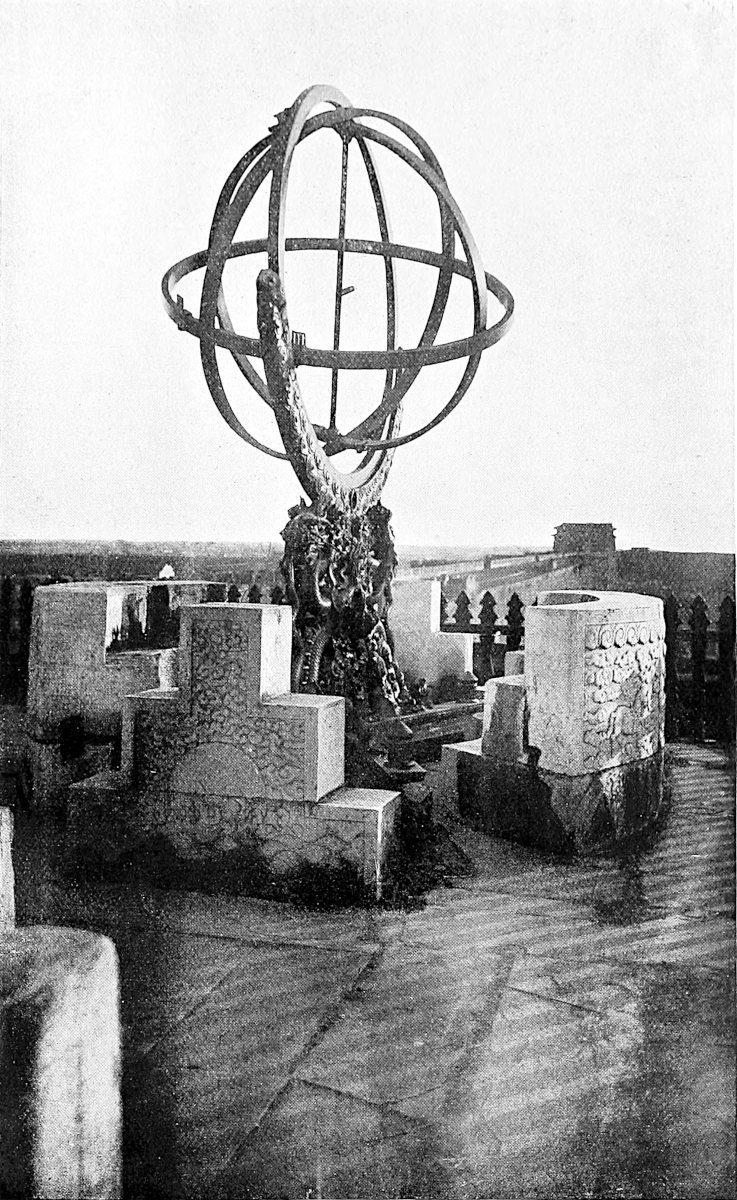
Observatory Terrace.
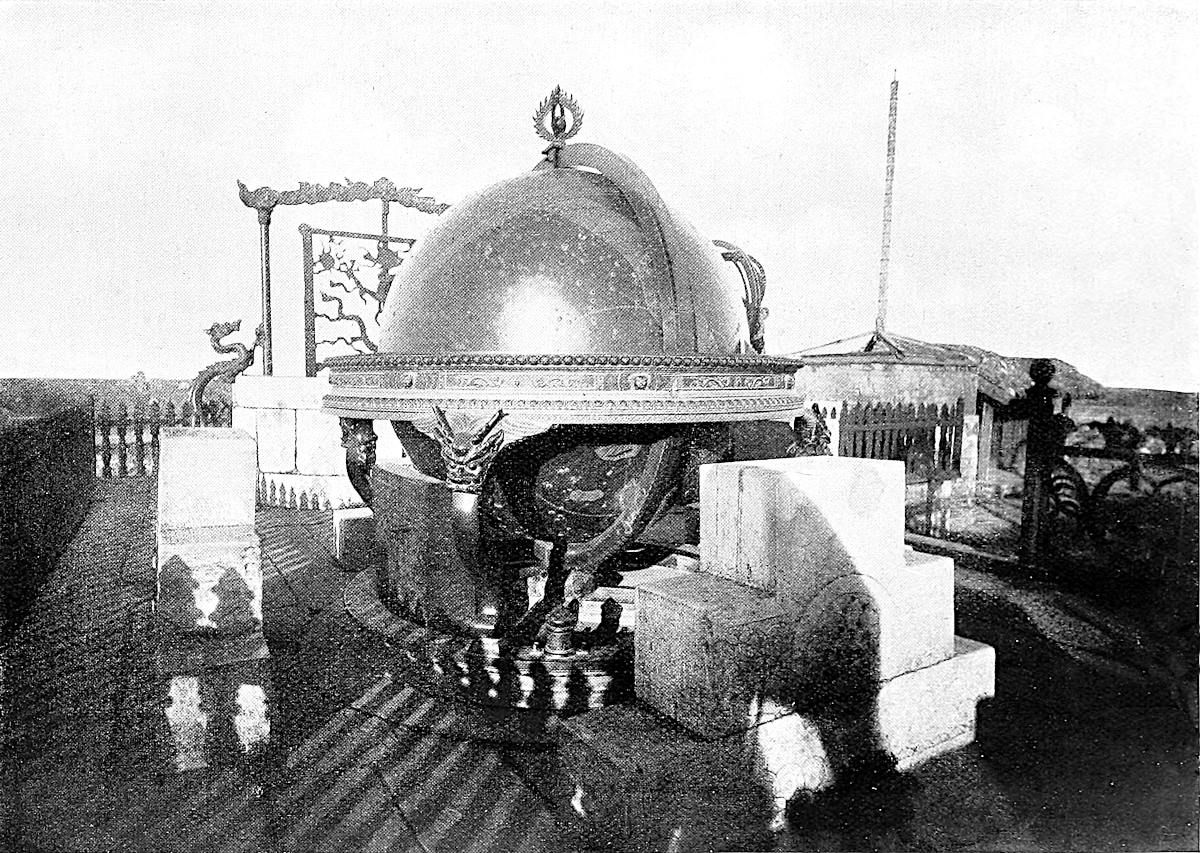
Observatory Instruments of the Jesuits.
“Some years afterwards Father Matteo saw similar instruments at Peking, or
rather the same instruments, so exactly alike were they, insomuch that they
had unquestionably been made by the same artist. And indeed it is known
that they were cast at the period when the Tartars were dominant in China;
and we may without rashness conjecture that they were the work of some
foreigner acquainted with our studies. But it is time to have done with
these instruments.”—(Lib. IV. cap. 5.)
In this interesting description it will be seen that the Armillary Sphere
[B] agrees entirely with that represented in illustration facing p. 450.
And the second of his photographs in my possession, but not, I believe,
yet published, answers perfectly to the curious description of the 4th
instrument [D]. Indeed, I should scarcely have been able to translate
that description intelligibly but for the aid of the photograph before
me. It shows the three astrolabes or graduated circles with travelling
indexes arranged exactly as described, and pivoted on a complex frame
of bronze; (1) circle in the plane of the equator for measuring right
ascensions; (2) circle with its axis vertical to the plane of the last,
for measuring declinations: (3) circle with vertical axis, for zenith
distances? The Gnomon [A] was seen by Mr. Wylie in one of the lower rooms
of the Observatory (see below). Of the Globe we do not now hear; and that
mentioned by Lecomte among the ancient instruments was inferior to what
Ricci describes at Peking.
I now transcribe Mr. Wylie’s translation of an extract from a Popular
Description of Peking:
“The observatory is on an elevated stage on the city wall, in the
south-east corner of the (Tartar) city, and was built in the year (A.D.
1279). In the centre was the Tze-wei[13] Palace, inside of which were a
pair of scrolls, and a cross inscription, by the imperial hand. Formerly
it contained the Hwan-t’ien-e [B] ‘Armillary Sphere’; the Keen-e
[D?] ‘Transit Instrument’ (?); the Tung-kew [A] ‘Brass Globe’; and the
Leang-t’ien-ch’ih, ‘Sector,’ which were constructed by Ko Show-king under
the Yuen Dynasty.
“In (1673) the old instruments having stood the wear of long past years,
had become almost useless, and six new instruments were made by imperial
authority. These were the T’ien-t’ee ‘Celestial Globe’ (6); Chih-taoue
‘Equinoctial Sphere’ (2); Hwang-taoue ‘Zodiacal Sphere’ (1); Te-p’ing
kinge ‘Azimuthal Horizon’ (3); Te-p’ing weie ‘Altitude Instrument’
(4); Ke-yene ‘Sextant’ (5). These were placed in the Observatory, and
to the present day are respectfully used. The old instruments were at the
same time removed, and deposited at the foot of the stage. In (1715) the
Te-ping King-wei-e ‘Azimuth and Altitude Instrument’ was made;[14] and in
1744 the Ke-hang-foo-chin-e (literally ‘Sphere and Tube instrument for
sweeping the heavens’). All these were placed on the Observatory stage.
“There is a wind-index-pole called the ‘Fair-wind-pennon,’ on which is
an iron disk marked out in 28 points, corresponding in number to the 28
constellations.”[15]
✛ Mr. Wylie justly observes that the evidence is all in accord, and it
leaves, I think, no reasonable room for doubt that the instruments now in
the Observatory garden at Peking are those which were cast aside by Father
Verbiest[16] in 1673 (or 1668); which Father Ricci saw at Peking at the
beginning of the century, and of which he has described the duplicates at
Nanking; and which had come down from the time of the Mongols, or, more
precisely, of Kúblái Khan.
Ricci speaks of their age as nearly 250 years in 1599; Verbiest as nearly
300 years in 1668. But these estimates evidently point to the termination
of the Mongol Dynasty (1368), to which the Chinese would naturally refer
their oral chronology. We have seen that Kúblái’s reign was the era of
flourishing astronomy, and that the instruments are referred to his
astronomer Ko Shéu-king; nor does there seem any ground for questioning
this. In fact, it being once established that the instruments existed when
the Jesuits entered China, all the objections fall to the ground.
We may observe that the number of the ancient instruments mentioned in the
popular Chinese account agrees with the number of important instruments
described by Ricci, and the titles of three at least out of the four seem
to indicate the same instruments. The catalogue of the new instruments
of 1673 (or 1668) given in the native work also agrees exactly with
that given by Lecomte.[17] And in reference to my question as to the
possibility that one of Verbiest’s instruments might have been removed
from the terrace to the garden, it is now hardly worth while to repeat Mr.
Wylie’s assurance that there is no ground whatever for such a supposition.
The instruments represented by Lecomte are all still on the terrace, only
their positions have been somewhat altered to make room for the two added
in last century.
Probably, says Mr. Wylie, more might have been added from Chinese works,
especially the biography of Ko Shéu-king. But my kind correspondent was
unable to travel beyond the books on his own shelves. Nor was it needful.
It will have been seen that, beautiful as the art and casting of these
instruments is, it would be a mistake to suppose that they are entitled to
equally high rank in scientific accuracy. Mr. Wylie mentioned the question
that had been started to Freiherr von Gumpach, who was for some years
Professor of Astronomy in the Peking College. Whilst entirely rejecting
the doubts that had been raised as to the age of the Mongol instruments,
he said that he had seen those of Tycho Brahe, and the former are quite
unworthy to be compared with Tycho’s in scientific accuracy.
The doubts expressed have been useful in drawing attention to these
remarkable reliques of the era of Kúblái’s reign, and of Marco Polo’s
residence in Cathay, though I fear they are answerable for having added
some pages to a work that required no enlargement!
[Mr. Wylie sent a most valuable paper on The Mongol Astronomical
Instruments at Peking to the Congress of Orientalists held at St.
Petersburg, which was reprinted at Shanghai in 1897 in Chinese
Researches. Some of the astronomical instruments have been removed to
Potsdam by the Germans since the siege of the foreign Legations at Peking
in 1900.—H. C.]
On these auguries, and on diviners and fortune-tellers, see Semedo, p.
118 seqq.; Kidd, p. 313 (also for preceding references, Mid. Kingdom,
II. 152; Gaubil, 136).
Note 2.— ✛ The real cycle of the Mongols, which was also that of the
Chinese, runs: 1. Rat; 2. Ox; 3. Tiger; 4. Hare; 5. Dragon; 6. Serpent;
7. Horse; 8. Sheep; 9. Ape; 10. Cock; 11. Dog; 12. Swine. But as such a
cycle [12 earthly branches, Ti-chih] is too short to avoid confusion,
it is combined with a co-efficient cycle of ten epithets [celestial
Stems, T’ien-kan] in such wise as to produce a 60-year cycle of compound
names before the same shall recur. These co-efficient epithets are found
in four different forms: (1) From the Elements: Wood, Fire, Earth, Metal,
Water, attaching to each a masculine and feminine attribute so as to make
ten epithets. (2) From the Colours: Blue, Red, Yellow, White, Black,
similarly treated. (3) By terms without meaning in Mongol, directly adopted
or imitated from the Chinese, Ga, Yi, Bing, Ting, etc. (4) By the five
Cardinal Points: East, South, Middle, West, North. Thus 1864 was the first
year of a 60-year cycle:—
| 1864 = (Masc.) Wood-Rat Year |
= (Masc.) Blue-Rat Year. |
| 1865 = (Fem.) Wood-Ox Year |
= (Fem.) Blue-Ox Year. |
| 1866 = (Masc.) Fire-Tiger Year |
= (Masc.) Red-Tiger Year. |
| 1867 = (Fem.) Fire-Hare Year |
= (Fem.) Red-Hare Year. |
| 1923 = (Fem.) Water-Swine Year |
= (Fem.) Black-Swine Year. |
And then a new cycle commences just as before.
This Calendar was carried by the Mongols into all their dominions, and it
would appear to have long survived them in Persia. Thus a document issued
in favour of Sir John Chardin by the Shaikh-ul-Islám of Ispahan, bears
the strange date for a Mahomedan luminary of “The year of the Swine.” The
Hindus also had a 60-year cycle, but with them each year had an independent name.
The Mongols borrowed their system from the Chinese, who attribute its
invention to the Emperor Hwang-ti, and its initiation to the 61st year of
his reign, corresponding to B.C. 2637. [“It was Ta-nao, Minister to the
Emperor Hwang-ti, who, by command of his Sovereign, devised the sexagenary
cycle. Hwang-ti began to reign 2697 B.C., and the 61st year of his reign
was taken for the first cyclical sign.” P. Hoang, Chinese Calendar,
p. 11.—H. C.] The characters representing what we have called the ten
co-efficient epithets are called by the Chinese the “Heavenly Stems”; those
equivalent to the twelve animal symbols are the “Earthly Branches,” and
they are applied in their combinations not to years only, but to cycles of
months, days, and hours, such hours being equal to two of ours. Thus every
year, month, day, and hour will have two appropriate characters, and the
four pairs belonging to the time of any man’s birth constitute what the
Chinese call the “Eight Characters” of his age, to which constant reference
is made in some of their systems of fortune-telling, and in the selection
of propitious days for the transaction of business. To this system the
text alludes. A curious account of the principles of prognostication on
such a basis will be found in Doolittle’s Social Life of the Chinese (p.
579 seqq.; on the Calendar, see Schmidt’s Preface to S. Setzen; Pallas,
Sammlungen, II. 228 seqq.; Prinsep’s Essays, Useful Tables, 146).
[“Kubilai Khan established in Peking two astronomical boards and two
observatories. One of them was a Chinese Observatory (sze t’ien t’ai),
the other a Mohammedan Observatory (hui hui sze t’ien t’ai), each with
its particular astronomical and chronological systems, its particular
astrology and instruments. The first astronomical and calendar system
was compiled for the Mongols by Ye-liu Ch’u-ts’ai, who was in Chingis
Khan’s service, not only as a high counsellor, but also as an astronomer
and astrologer. After having been convinced of the obsoleteness and
incorrectness of the astronomical calculations in the Ta ming li (the
name of the calendar system of the Kin Dynasty), he thought out at the
time he was at Samarcand a new system, valid not only for China, but also
for the countries conquered by the Mongols in Western Asia, and named
it in memory of Chingis Khan’s expedition Si ching keng wu yüan li,
i.e. ‘Astronomical Calendar beginning with the year Keng wu, compiled
during the war in the west.’ Keng-wu was the year 1210 of our era. Ye-liu
Ch’u-ts’ai chose this year, and the moment of the winter solstice, for
the beginning of his period; because, according to his calculations, it
coincided with the beginning of a new astronomical or planetary period.
He took also into consideration, that since the year 1211 Chingis Khan’s
glory had spread over the whole world. Ye-liu Ch’u-ts’ai’s calendar was not
adopted in China, but the system of it is explained in the Yuen-shi, in
the section on Astronomy and the Calendar.
“In the year 1267, the Mohammedans presented to Kubilai their astronomical
calendar (wan nien li, i.e.), the calendar of ten thousand years. By
taking this denomination in its literal sense, we may conclude that the
Mahommedans brought to China the ancient Persian system, founded on the
period of 10,000 years. The compilers of the Yuen-shi seem not to have
had access to documents relating to this system, for they give no details
about it. Finally by order of Kubilai the astronomers Hui-Heng and Ko
Show-King composed a new calculation under the name of Shou-shi-li,
which came into use from the year 1280. It is thoroughly explained in
the Yuen-shi. Notwithstanding the fame this system generally enjoyed,
its blemishes came soon to light. In the sixth month of 1302 an eclipse
of the sun happened, and the calculation of the astronomer proved to be
erroneous (it seems the calculation had anticipated the real time). The
astronomers of the Ming Dynasty explained the errors in the Shou-shi-li
by the circumstance, that in that calculation the period for one degree of
precession of the equinox was taken too long (eighty-one years). But they
were themselves hardly able to overcome these difficulties.” (Palladius,
pp. 51–53.)—H. C.]
Concerning the Religion of the Cathayans;
{1} their views as to the
Soul; and their Customs.
As we have said before, these people are Idolaters, and as regards their
gods, each has a tablet fixed high up on the wall of his chamber, on which
is inscribed a name which represents the Most High and Heavenly God; and
before this they pay daily worship, offering incense from a thurible,
raising their hands aloft, and gnashing their teeth{2} three times,
praying Him to grant them health of mind and body; but of Him they ask
nought else. And below on the ground there is a figure which they call
Natigai, which is the god of things terrestrial. To him they give a
wife and children, and they worship him in the same manner, with incense,
and gnashing of teeth,{2} and lifting up of hands; and of him they
ask seasonable weather, and the fruits of the earth, children, and so
forth.{3}
Their view of the immortality of the soul is after this fashion. They
believe that as soon as a man dies, his soul enters into another body,
going from a good to a better, or from a bad to a worse, according as he
hath conducted himself well or ill. That is to say, a poor man, if he have
passed through life good and sober, shall be born again of a gentlewoman,
and shall be a gentleman; and on a second occasion shall be born of a
princess and shall be a prince, and so on, always rising, till he be
absorbed into the Deity. But if he have borne himself ill, he who was the
son of a gentleman shall be reborn as the son of a boor, and from a boor
shall become a dog, always going down lower and lower.
The people have an ornate style of speech; they salute each other with
a cheerful countenance, and with great politeness; they behave like
gentlemen, and eat with great propriety.{4} They show great respect
to their parents; and should there be any son who offends his parents, or
fails to minister to their necessities, there is a public office which has
no other charge but that of punishing unnatural children, who are proved to
have acted with ingratitude towards their parents.{5}
Criminals of sundry kinds who have been imprisoned, are released at a time
fixed by the Great Kaan (which occurs every three years), but on leaving
prison they are branded on one cheek that they may be recognized.
The Great Kaan hath prohibited all gambling and sharping, things more
prevalent there than in any other part of the world. In doing this, he
said: “I have conquered you by force of arms, and all that you have is
mine; if, therefore, you gamble away your property, it is in fact my
property that you are gambling away.” Not that he took anything from them
however.
I must not omit to tell you of the orderly way in which the Kaan’s Barons
and others conduct themselves in coming to his presence. In the first
place, within a half mile of the place where he is, out of reverence for
his exalted majesty, everybody preserves a mien of the greatest meekness
and quiet, so that no noise of shrill voices or loud talk shall be heard.
And every one of the chiefs and nobles carries always with him a handsome
little vessel to spit in whilst he remain in the Hall of Audience—for no
one dares spit on the floor of the hall,—and when he hath spitten he covers
it up and puts it aside.{6} So also they all have certain handsome
buskins of white leather, which they carry with them, and, when summoned
by the sovereign, on arriving at the entrance to the hall, they put on
these white buskins, and give their others in charge to the servants, in
order that they may not foul the fine carpets of silk and gold and divers colours.]
Note
1.—Ramusio’s heading has Tartars, but it is manifestly of the
Cathayans or Chinese that the author speaks throughout this chapter.
Note
2.—“Sbattendo i denti.” This is almost certainly, as Marsden has
noticed, due to some error of transcription. Probably Battono i fronti,
or something similar, was the true reading. [See following note, p. 461.—H. C.]
Note 3.—The latter part of this passage has, I doubt not, been more or less
interpolated, seeing that it introduces again as a Chinese divinity the
rude object of primitive Tartar worship, of which we have already heard in
Bk. I. ch. liii. And regarding the former part of the passage, one cannot
but have some doubt whether what was taken for the symbol of the Most
High was not the ancestral tablet, which is usually placed in one of the
inner rooms of the house, and before which worship is performed at fixed
times, and according to certain established forms. Something, too, may
have been known of the Emperor’s worship of Heaven at the great circular
temple at Peking, called T’ien-t’ân, or Altar of Heaven (see p. 459),
where incensed offerings are made before a tablet, on which is inscribed
the name Yuh-Hwang Shang-ti, which some interpret as “The Supreme Ruler of
the Imperial Heavens,” and regard as the nearest approach to pure Theism
of which there is any indication in Chinese worship (See Doolittle, pp.
170, 625; and Lockhart in J. R. G. S., xxxvi. 142). This worship is
mentioned by the Mahomedan narrator of Shah Rukh’s embassy (1421): “Every
year there are some days on which the Emperor eats no animal food.... He
spends his time in an apartment which contains no idol, and says that he is
worshipping the God of Heaven.”[1] (Ind. Antiquary, II. 81.)
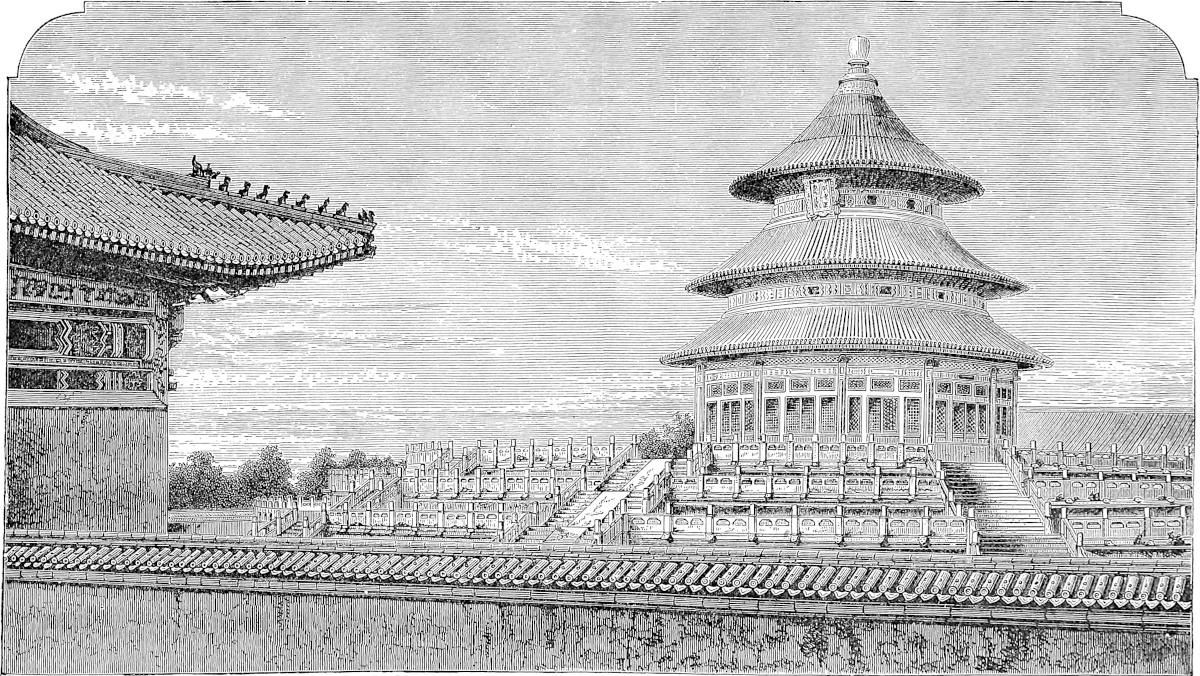
Great Temple of Heaven, Peking.
The charge of irreligion against the Chinese is an old one, and is made
by Hayton in nearly the same terms as it often is by modern missionaries:
“And though these people have the acutest intelligence in all matters
wherein material things are concerned, yet you shall never find among them
any knowledge or perception of spiritual things.” Yet it is a mistake
to suppose that this insensibility has been so universal as it is often
represented. To say nothing of the considerable numbers who have adhered
faithfully to the Roman Catholic Church, the large number of Mahomedans
in China, of whom many must have been proselytes, indicates an interest
in religion; and that Buddhism itself was in China once a spiritual power
of no small energy will, I think, be plain to any one who reads the very
interesting extracts in Schott’s essay on Buddhism in Upper Asia and China.
(Berlin Acad. of Sciences, 1846.) These seem to be so little known that I
will translate two or three of them. “In the years Yuan-yeu of the Sung
(A.D. 1086–1093), a pious matron with her two servants lived entirely to
the Land of Enlightenment. One of the maids said one day to her companion:
‘To-night I shall pass over to the Realm of Amita.’ The same night a
balsamic odour filled the house, and the maid died without any preceding
illness. On the following day the surviving maid said to the lady:
‘Yesterday my deceased companion appeared to me in a dream, and said to
me: “Thanks to the persevering exhortations of our mistress, I am become a
partaker of Paradise, and my blessedness is past all expression in words.”’
The matron replied: ‘If she will appear to me also then I will believe
what you say.’ Next night the deceased really appeared to her, and saluted
her with respect. The lady asked: ‘May I, for once, visit the Land of
Enlightenment?’ ‘Yea,’ answered the Blessed Soul, ‘thou hast but to follow
thy handmaiden.’ The lady followed her (in her dream), and soon perceived
a lake of immeasurable expanse, overspread with innumerable red and white
lotus flowers, of various sizes, some blooming, some fading. She asked
what those flowers might signify? The maiden replied: ‘These are all human
beings on the earth whose thoughts are turned to the Land of Enlightenment.
The very first longing after the Paradise of Amita produces a flower in
the Celestial Lake, and this becomes daily larger and more glorious, as
the self-improvement of the person whom it represents advances; in the
contrary case, it loses in glory and fades away.’[2] The matron desired to
know the name of an enlightened one who reposed on one of the flowers, clad
in a waving and wondrously glistening raiment. Her whilom maiden answered:
‘That is Yangkie.’ Then asked she the name of another, and was answered:
‘That is Mahu.’ The lady then said: ‘At what place shall I hereafter come
into existence?’ Then the Blessed Soul led her a space further, and showed
her a hill that gleamed with gold and azure. ‘Here,’ said she, ‘is your
future abode. You will belong to the first order of the blessed.’ When
the matron awoke she sent to enquire for Yangkie and Mahu. The first was
already departed; the other still alive and well. And thus the lady learned
that the soul of one who advances in holiness and never turns back, may be
already a dweller in the Land of Enlightenment, even though the body still
sojourn in this transitory world” (pp. 55–56).
What a singular counterpart the striking conclusion here forms to Dante’s
tremendous assault on a still living villain,—or enemy!
——“che per sua opra
In anima in Cocito già si bagna,
Ed in corpo par vivo ancor di sopra.”
—Infern. xxxiii. 155.
Again: “I knew a man who during his life had killed many living beings, and
was at last struck with an apoplexy. The sorrows in store for his sin-laden
soul pained me to the heart; I visited him, and exhorted him to call on the
Amita; but he obstinately refused, and spoke only of indifferent matters.
His illness clouded his understanding; in consequence of his misdeeds he
had become hardened. What was before such a man when once his eyes were
closed? Wherefore let men be converted while there is yet time! In this
life the night followeth the day, and the winter followeth the summer;
that, all men are aware of. But that life is followed by death, no man will
consider. Oh, what blindness and obduracy is this!” (p. 93).
Again: “Hoang-ta-tie, of T’ancheu (Changshu-fu in Honan), who lived under
the Sung, followed the craft of a blacksmith. Whenever he was at his work
he used to call without intermission on the name of Amita Buddha. One day
he handed to his neighbours the following verses of his own composing to be
spread about:—
‘Ding dong! The hammer-strokes fall long and fast,
Until the Iron turns to steel at last!
Now shall the long long Day of Rest begin,
The Land of Bliss Eternal calls me in.’
Thereupon he died. But his verses spread all over Honan, and many learned
to call upon Buddha” (103).
Once more: “In my own town there lived a physician by name Chang-yan-ming.
He was a man who never took payment for his treatment from any one in poor
or indifferent circumstances; nay, he would often make presents to such
persons of money or corn to lighten their lot. If a rich man would have his
advice and paid him a fee, he never looked to see whether it were much or
little. If a patient lay so dangerously ill that Yanming despaired of his
recovery, he would still give him good medicine to comfort his heart, but
never took payment for it. I knew this man for many a year, and I never
heard the word Money pass his lips! One day a fire broke out in the town,
and laid the whole of the houses in ashes; only that of the physician was
spared. His sons and grandsons reached high dignities” (p. 110).
Of such as this physician the apostle said: “Of a truth I perceive that God
is no respecter of persons: But in every nation he that feareth Him, and
worketh righteousness, is accepted with Him.”
[“By the ‘Most High and Heavenly God,’ worshipped by the Chinese, as Marco
Polo reports, evidently the Chinese T’ien, ‘Heaven’ is meant, Lao t’ien
ye in the common language. Regarding ‘the God of things terrestrial,’
whose figure the Chinese, according to M. Polo, ‘placed below on the
ground,’ there can also be no doubt that he understands the T’u-ti, the
local ‘Lar’ of the Chinese, to which they present sacrifices on the floor,
near the wall under the table.
“M. Polo reports, that the Chinese worship their God offering incense,
raising their hands aloft, and gnashing their teeth. Of course he means
that they placed the hands together, or held kindled joss-stick bundles
in their hands, according to the Chinese custom. The statement of M. Polo
sbattendo i denti is very remarkable. It seems to me, that very few of
the Chinese are aware of the fact, that this custom still exists among
the Taouists. In the rituals of the Taouists the K’ow-ch’i (K’ow =
‘to knock against,’ch’i = ‘teeth’) is prescribed as a comminatory and
propitiatory act. It is effected by the four upper and lower foreteeth.
The Taouists are obliged before the service begins to perform a certain
number of K’ow-ch’i, turning their heads alternately to the left and
to the right, in order to drive away mundane thoughts and aggressions of
bad spirits. The K’ow-ch’i repeated three times is called ming fa ku
in Chinese, i.e. ‘to beat the spiritual drum.’ The ritual says, that it is
heard by the Most High Ruler, who is moved by it to grace.
“M. Polo observed this custom among the lay heathen. Indeed, it appears
from a small treatise, written in China more than a hundred years before
M. Polo, that at the time the Chinese author wrote, all devout men,
entering a temple, used to perform the K’ow-ch’i, and considered it an
expression of veneration and devotion to the idols. Thus this custom had
been preserved to the time of M. Polo, who did not fail to mention this
strange peculiarity in the exterior observances of the Chinese. As regards
the present time it seems to me, that this custom is not known among the
people, and even with respect to the Taouists it is only performed on
certain occasions, and not in all Taouist temples.” (Palladius, pp.
53–54.)—H. C.]
Note 4.—“True politeness cannot of course be taught by rules merely, but a
great degree of urbanity and kindness is everywhere shown, whether owing
to the naturally placable disposition of the people, or to the effects of
their early instruction in the forms of politeness.” (Mid. Kingdom, II.
68.) As regards the “ornate style of speech,” a well-bred Chinaman never
says I or You, but for the former “the little person,” “the disciple,”
“the inferior,” and so on; and for the latter, “the learned man,” “the
master,” or even “the emperor.” These phrases, however, are not confined to
China, most of them having exact parallels in Hindustani courtesy. On this
subject and the courteous disposition of the Chinese, see Fontaney, in
Lett. Edif. VII. 287 seqq.; also XI. 287 seqq.; Semedo, 36; Lecomte,
II. 48 seqq. There are, however, strong differences of opinion expressed on
this subject; there is, apparently, much more genuine courtesy in the north
than in the south.
Note 5.—“Filial piety is the fundamental principle of the Chinese polity.”
(Amiot, V. 129.) “In cases of extreme unfilial conduct, parents sometimes
accuse their children before the magistrate, and demand his official aid
in controlling or punishing them; but such instances are comparatively
rare.... If the parent require his son to be publicly whipped by the
command of the magistrate, the latter is obliged to order the infliction
of the whipping.... If after punishment the son remain undutiful and
disobedient, and his parents demand it at the hands of the magistrate, the
latter must, with the consent of the maternal uncles of the son, cause him
to be taken out to the high wall in front of the yamun, and have him there
publicly whipped to death.” (Doolittle, 102–103.)
Note 6.—[Mr. Rockhill writes to me that pocket-spitoons are still used in
China.—H. C.]
END OF VOL I.
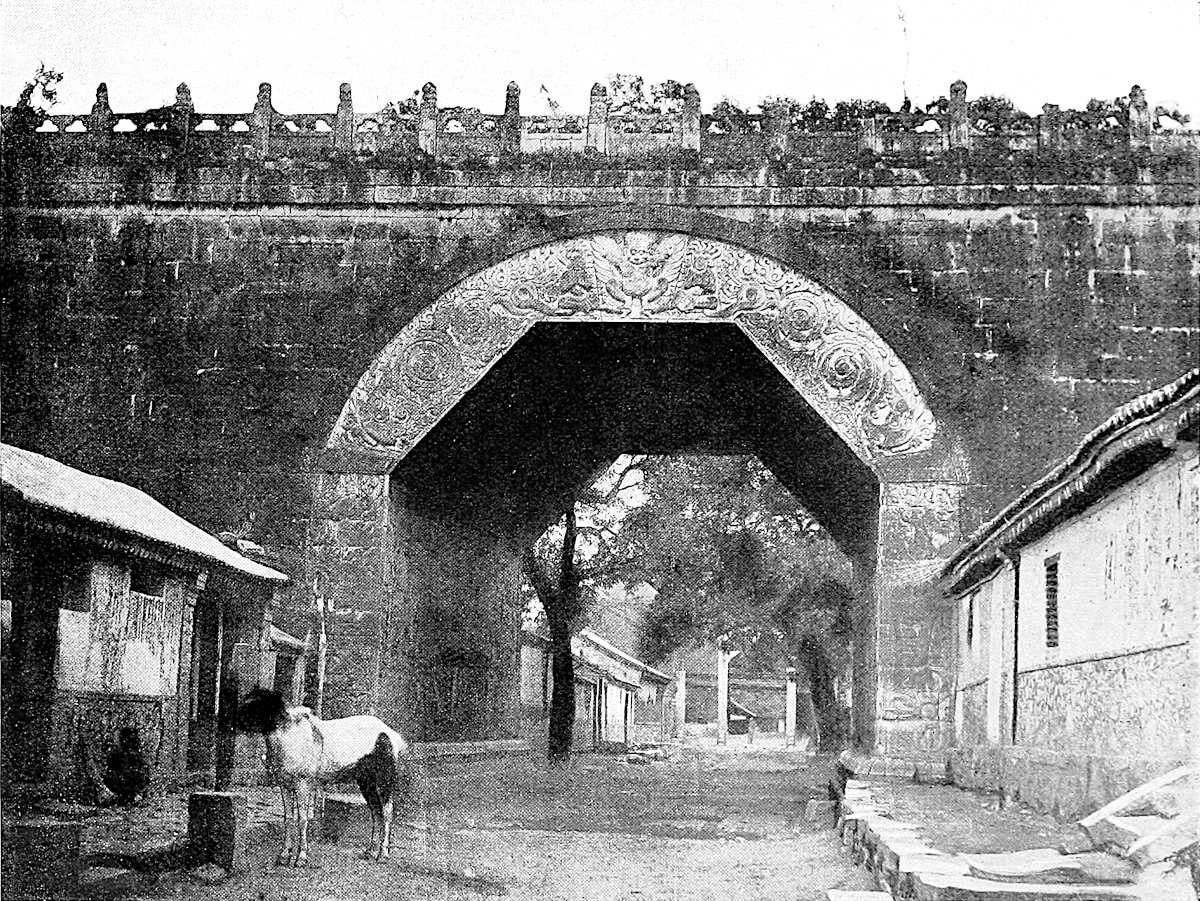
Archway erected under the Mongol Dynasty, at Kiu Yung Kwan,
N.W. of Peking.
[1]
MARCO POLO’S ITINERARIES No. IV.
(Book I, Chapter 36 to end & chief part of Book II.
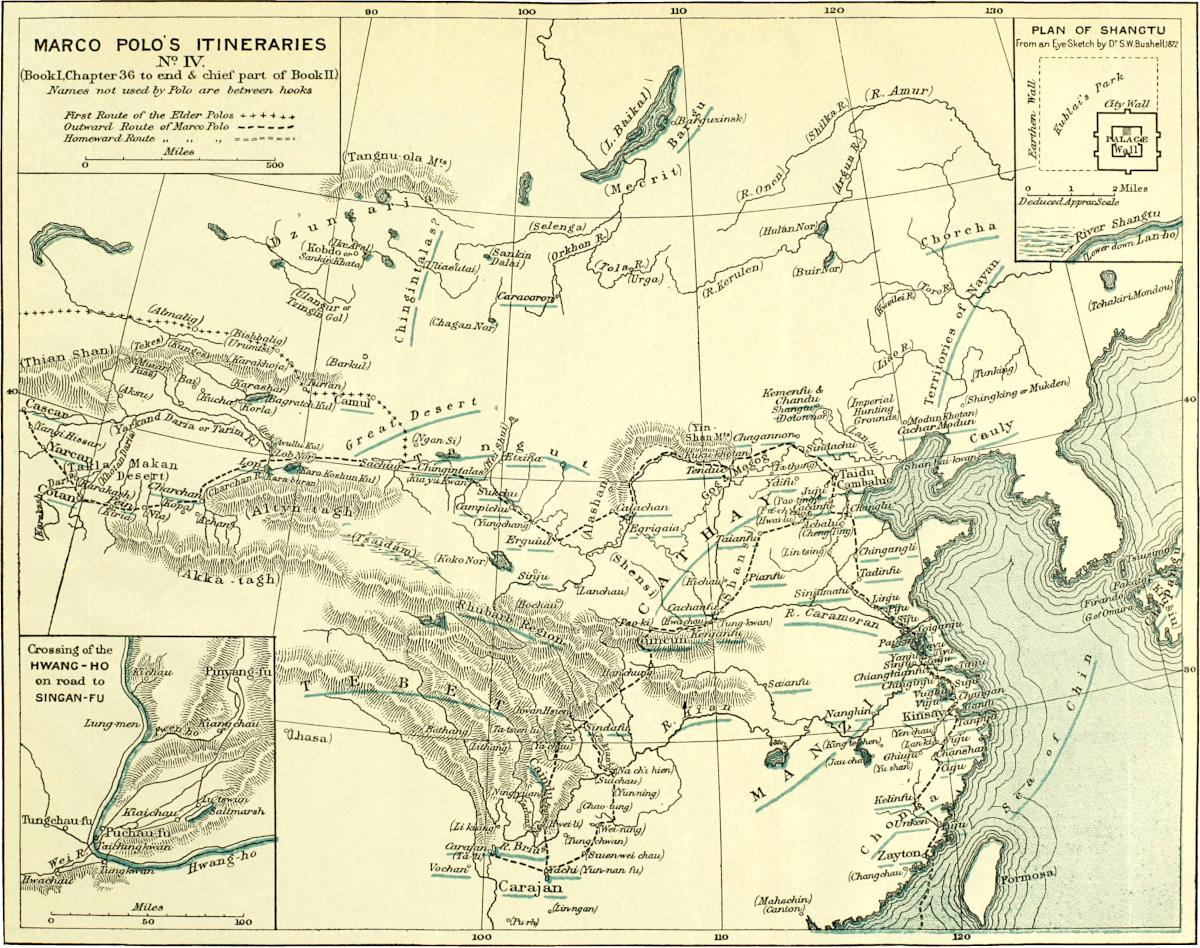
PLAN OF SHANGTU
From an Eye-Sketch by Dr. S. W. Bushell, 1872
Crossing of the
HWANG-HO
on road to
SINGAN-FU