Though we had intended to get off about sunrise we failed to do so, for
we found that Galvez was on the lookout for us. No sooner had we started
than we saw the three men ride out from the Casa with the evident
intention of cutting us off, so, not wishing to get into a fight if it
could be avoided, we turned back again.
Thereupon, the enemy also turned back; but, watching their movements, we
saw that soon after they had entered the house, the figure of one of
them appeared again on the roof, and there remained—a sentinel.
Plainly, they were not going to let us get away if they could help it.
At midday, however, we saw the sentinel go down, presumably to get his
dinner, when we thought we would try again. Pedro therefore went off to
get our horses for us, but he had hardly been gone a minute when we were
startled to see him coming back with them, running as fast as his short
legs would permit.
"What's the matter, Pedro?" cried Dick. "What's wrong?"
"I see the Señor Arturo coming!" shouted the Mexican.
"What!" cried Dick, and, "Where?" cried I, both turning to look out over
the plain.
That man, Pedro, must have had eyes like telescopes to pretend to
distinguish any one at such a distance, but on examining the little
black speck through the glass I made out that it was a horseman, and
after watching him for a few seconds I concluded that it was indeed our
friend, Arthur, returning.
"Frank!" cried my partner. "We must ride out to meet him at once! Pedro,
you stay here and watch the Casa. If those three men come out, make a
big smoke here so that we may know whether we have to hurry or not."
"It is good," replied the Mexican; and seeing that he might be relied
upon to give us timely warning—for he at once began to collect
materials for his fire—away we went.
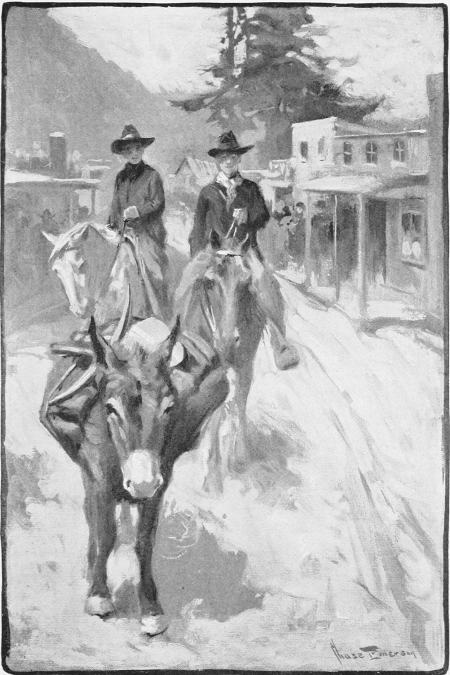
Riding briskly, though without haste, we had left the mountain and were
crossing a wide depression in the plain, when, on its further edge,
there suddenly appeared the solitary horseman, riding toward us at a
hard gallop. Dick turned in his saddle and cast a glance behind him.
"The smoke!" he cried; and without another word we clapped our heels
into our ponies' ribs and dashed forward.
As Arthur approached—for we could now clearly see that it was he—we
observed that he kept looking back over his left shoulder, and just as
we arrived within hailing distance three other horsemen came in sight
over the southern rim of the depression, riding at a furious pace, their
bodies bent forward over their horses' necks. Each of the three carried
a rifle, we noticed, and one of the three was Galvez.
At sight of us, the pursuers, seemingly taken aback at finding
themselves confronted by three of us, when they had expected to find
only one, abruptly pulled up. This brief pause gave time to Arthur to
join us, when Dick, slipping down from his horse, advanced a few steps
toward the enemy, kneeled down, and ostentatiously cocked his rifle.
Whether the padron's quick ears caught the sound of the cocking of the
rifle—which seemed hardly likely, though in that clear, still
atmosphere the sharp click-click would carry a surprisingly long
distance—I do not know; but whatever the cause, the result was as
unexpected as it was satisfactory. Galvez uttered a sharp exclamation,
whirled his horse round, and away they all went again as fast as they
had come.
"See that!" cried Arthur. "What did I tell you, Dick? We have to thank
that locoed steer for that."
"I expect we have," replied Dick.
"Not a doubt of it," said I. "I was sure that Galvez was much impressed
by the way that steer went over, and now I'm surer. Lucky he was, too,
for those three fellows meant mischief, if I'm not mistaken."
"That's pretty certain, I think," responded Arthur. "And it was another
piece of good fortune that you turned up just when you did. How did it
happen?"
We explained the circumstances, but we had no more than done so, when
Arthur exclaimed:
"Why, here comes old Pedro now! At a gallop, too! Everybody seems to be
riding at a gallop this morning."
Looking toward the mountain, we saw the Mexican on his burro coming down
at a great pace, but we had hardly caught sight of him when he suddenly
stopped. He was on a little elevation, from which, evidently, he could
see Galvez and his friends careering homeward, and observing that the
affair was over and that his assistance was not needed, he forthwith
halted, and, with a mercifulness not too common among Mexicans, jumped
to the ground in order to ease his steed of his weight.
There he stood, nearly two miles away, with his hand on the burro's
shoulders, watching the retreating enemy, while we three rode toward him
at a leisurely pace.
As will be readily imagined, there was great rejoicing among us over the
safe return of our friend and partner, and a great shaking of hands all
round, when, hardly giving him time to get his breath again, Dick and I
plunged head-first into the relation of all we had done since we saw him
last: the finding of the head-gate and the building of the flume;
triumphantly concluding our story with the recovery of the patent the
night before.
"Well, that was a great stroke, sure enough!" exclaimed Arthur. "That
will settle the business. The 'stupid peon' got ahead of the padron that
time, all right. But before we talk about anything else, Dick," he went
on, "I have something I want to tell you about, something in my
opinion—and the professor thinks so too—even more important—to
you—than the title to the Hermanos Grant."
"What's that?" cried my partner, alarmed by his serious manner. "Nothing
wrong, is there?"
"No, there's nothing wrong, I'm glad to say. Quite the contrary, in
fact. I'm half afraid to mention it, old man, for fear I should be
mistaken after all, and should stir you up all for nothing, but—why
didn't you tell me, Dick, that your name was Stanley?"
"Why, I did!" cried Dick.
"No, you didn't, old fellow. If you remember, you were going to do so
that first day we met, down there in the cañon by the opening of the
King Philip mine, when Pedro interrupted you by remarking that the
darkness would catch us if we stayed there any longer."
"I remember. Yes, that's so. Ah! I see. That was why you addressed your
letters to the professor instead of to me."
"Yes, that was the reason. It didn't occur to me till I came to write to
you that I didn't know your name."
"That was rather funny, wasn't it?" said Dick, laughing. "But I don't
see that it made much difference in the end: I got your letters all
right."
My partner spoke rather lightly, but Arthur on the other hand looked so
serious, not to say solemn, that Dick's levity died out.
"What is it, old man?" he asked. "What difference does it make whether
my name is Stanley or anything else?"
"It makes a great difference, Dick," replied Arthur. "I believe"—he
paused, hesitating, and then went on, "I'm half afraid to tell you, for
fear there might be some mistake after all, but—well—I believe, Dick,
that I've found out who you are and where you came from!"
It was Dick's turn to look serious. His face turned a little pale under
its sunburn.
"Go on," said he, briefly.
"You remember, perhaps," Arthur continued, "how I told you that one
reason why I had to go back by way of Santa Fé was because I had some
inquiries to make on behalf of my mother. Well, as it turned out, Santa
Fé was the wrong place. The place for me to go to was Mosby, and the man
for me to ask was—the professor!
"When I reached Mosby yesterday," he continued, "I rode straight on up
to his house, when the kindly old gentleman, as soon as I had explained
who I was, made me more than welcome. We were sitting last evening
talking, when I happened to cast my eye on the professor's book shelf,
and there I saw something which brought me out of my chair like a shot.
It was a volume of Shakespeare, one of a set, volume two—that book
which the professor found in the wagon-bed when he found you. I knew the
book in a moment—for we have the rest of the set at home, Dick!"
Dick stopped his horse and sat silent for a moment, staring at Arthur.
Then, "Go on," said he once more.
"I pulled the book down from the shelf," Arthur went on, "and looked at
the fly-leaf. There was an inscription there—I knew there would
be—'Richard Livingstone Stanley, from Anna.'"
"Well," said Dick. His voice was husky and his face was pale enough now.
"Dick," replied Arthur, reaching out and grasping my partner's arm, "my
mother's name was Anna Stanley, and she gave that set of Shakespeare to
her brother, Richard, on his twenty-first birthday!"
For a time Dick sat there without a word, not at first comprehending,
apparently, the significance of these facts—that he and Arthur must be
first cousins—while the latter quickly related to us the rest of the
story.
Dick's mother having died, his father determined to leave Scotland and
seek his fortune in the new territory of Colorado, whose fame was then
making some stir in the world. In company, then, with a friend, David
Scott—the "Uncle" David whom Dick faintly remembered—he set out,
taking the boy with him.
From the little town of Pueblo, on the Arkansas, Richard Stanley had
written that he intended going down to Santa Fé, and that was the last
ever heard of him. At that time—the year '64—everything westward from
the foot of the mountains was practically wilderness. Into this
wilderness Richard Stanley had plunged, and there, it was supposed, he
and his son and his friend had perished.
As for Dick, he seemed to be dazed—and no wonder. For a boy who had
never had any relatives that he knew of to be told suddenly that the
young fellow sitting there with his hand on his arm was his own cousin,
was naturally a good deal of a shock.
If it needed a counter-shock to jolt his faculties back into place, he
had it, and it was I who provided it.
In order to give the pair an opportunity to get used to their new
relationship, I was about to ride forward to join Pedro, when I saw the
Mexican suddenly commence cutting up all sorts of queer antics, jumping
about and waving his arms in a frantic manner.
"What's the matter with Pedro?" I called out. "Look there, you fellows!
What's the matter with Pedro?"
"Something wrong!" cried Dick. "Get up!"
Away we went at a gallop, keeping a sharp lookout in all directions lest
those three men should bob up again from somewhere, while the Mexican
himself, jumping upon his burro, rode down to meet us.
"What's up, Pedro?" Dick shouted, as soon as we had come within hearing.
"Anything the matter?"
"Señores," cried Pedro, speaking with eager rapidity, "those men come
hunting us. I watch them ride back almost to the Casa, and then of a
sudden they change their minds and turn up into the mountain. They think
to catch us, but"—he stretched out his great hand and shut it tight,
his black eyes gleaming with excitement—"if the señores will give me
leave, we will catch them!"
If his surmise was right, if those men were indeed coming after us as he
believed, there was no question that if any of us could beat them at
that game, Pedro was the one. Dick was a fine woodsman, but Pedro was a
finer—my partner himself would have been the first to acknowledge
it—and it was Dick in fact who promptly replied:
"Go ahead, Pedro! You're captain to-day! Take the lead; we'll follow!"
"'Sta bueno!" cried the Mexican, greatly pleased. "Come, then!"
Turning his burro, he rode quickly back to camp, and there, at his
direction, having unsaddled and turned loose our horses, we followed him
to the flume, taking with us nothing but our rifles.
There had been a little thunder-storm the day before, and the soil near
the flume was muddy. Through this mud, by Pedro's direction, we tramped;
crossed the flume on the gangway we had laid for the purpose, leaving
muddy tracks as we went; jumped down at the other end and set off
hot-foot up the gully to the little new-made lake and thence on up to
the old lake; in several soft places purposely leaving footmarks which
could not escape notice.
"What's all this for, Pedro?" asked Dick. "What's your scheme?"
"The padron will see our tracks crossing the flume," replied Pedro. "He
will think you take Señor Arturo up to show him all the work you have
done, and he will follow. If he does so, we have him! When he is safe
across, we slip back, and then I hide me among the rocks on the other
side and guard the flume. Without my leave they cannot cross back again.
Thus I hold them on the wrong side, while you ride away at your ease to
Mosby. Now, come quick with me!"
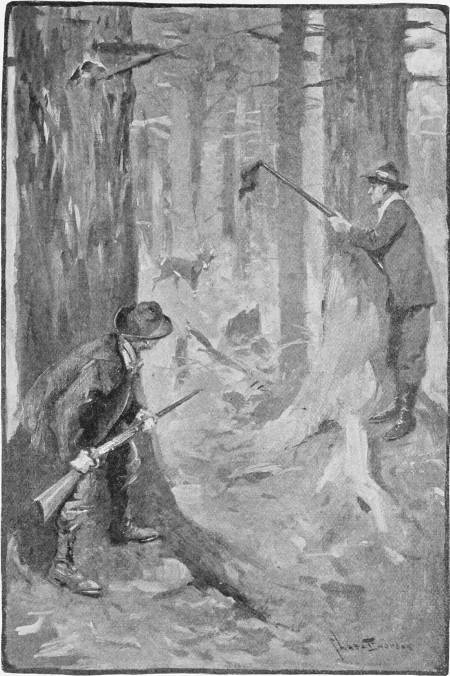
So saying, Pedro turned at right angles to the line of the ditch,
climbed a short distance up the hillside, and then, under cover of the
trees, started back at a run, until presently he brought us to a point
whence we could look down upon the flume, its approaches at both ends,
and the line of the ditch up to the head of the little lake.
Hitherto it had been all bustle and activity, but now we were called
upon to exercise a new virtue, one always difficult to fellows of our
age—patience.
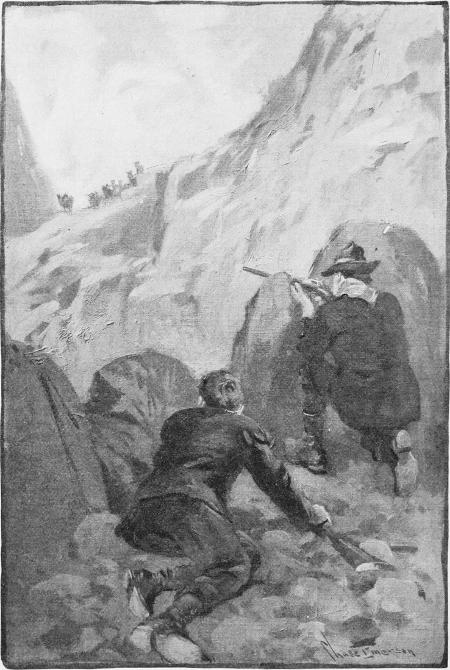
It must have been nearly an hour that we had lain there, sometimes
talking together in whispers, but more often keeping silence, when Dick,
pulling out his watch, said in a low voice:
"If those fellows are coming, I wish they'd come. It's twenty minutes
past two; and we're in for a thunder-storm, I'm afraid. Do you notice
how dark it's getting?"
"Yes," whispered Arthur. "And such a queer darkness. I'm afraid it's a
forest fire and not a thunder-storm that is making it."
"I believe you're right," replied Dick. "It is a queer-colored light,
isn't it?"
We could not see the sun on account of a high cliff at the foot of which
we were lying, and if we had had any thought of getting up to look at
it, we were stopped by Pedro, who at this moment whispered sharply to us
to keep quiet. His quick eyes had detected a movement on the far side of
the cañon.
Intently we watched, and presently the figure of a man stepped out from
among the trees. Advancing cautiously to the end of the flume, he
examined the tracks in the mud, climbed up to the gang-plank, inspected
the tracks again, and turning, made a sign with his hand; whereupon two
other men stepped out from among the trees. The three then crossed the
flume, jumped down, and set off up the gully.
We watched them as they followed the ditch up to the new lake, and
thence to the draw which led up to the old lake. At the mouth of the
draw they paused for some time, hesitating, doubtless, whether they
should trust themselves in that deep, narrow crevice—a veritable trap,
for all they knew.
Presumably, however, they made up their minds to risk it, for on they
went, and a few minutes later were lost to sight.
By this time the darkness had so increased that the men were hardly
distinguishable, though they, themselves, seemed to take no notice of
it. The sun was behind them, and so intent were they in following our
tracks and keeping watch ahead, that they never thought to cast a glance
upward to see what was coming.
"Pedro," whispered Dick, as soon as the men had vanished, "let us get
out of here. Either the woods are on fire or there'll be a tremendous
storm down on us directly."
Pedro, however, requested us to wait another five minutes, when, jumping
to his feet, he cried:
"Come, then! Let us get back! We have them safe now!"
Down we ran, but no sooner had we got clear of the trees than Pedro
stopped short. In a frightened voice—the first and only time I ever
knew him to show fear—he ejaculated:
"Look there! Look there!"
Following his pointing finger, we looked up. The uncanny darkness was
accounted for:—a great semi-circular piece seemed to have been bitten
out of the sun!
"The eclipse!" cried Arthur. "I'd forgotten all about it. This is the
twenty-ninth of July. The newspapers were full of it, but I'd forgotten
all about it!"
"A total eclipse, isn't it?" asked Dick, quickly.
"Yes, total."
"Then it will be a great deal darker presently. We'd better get out of
this, and cross the flume while we can see."
In fact, it was already so dark that the small birds, thinking it was
night, were busily going to bed; the night-hawks had come out, the
curious whir of their wings sounding above our heads; and then—a sound
which made us all start—there came the long-drawn howl of a wolf!
"Run!" shouted Dick. "They'll be after us directly!"
Undoubtedly, the wolves, too, were deceived into the belief that night
was approaching, for even as Dick spoke we heard in three or four
different directions the hunting-cry of the packs. Wasting no time, as
will be imagined, away we went, scrambled up on the gang-plank of the
flume, and there stopped to listen.
"I hope those men"—Dick began; when, from the direction of the draw
above there arose a fearful clamor of howling. There was a shot! Another
and another, in quick succession! And then, piercing through and rising
above all other sounds, there went up a cry so dreadful that it turned
us sick to hear it. What had happened?
The hour that followed was the worst I ever endured, as we crouched
there in the darkness and the silence, not knowing what had occurred up
above.
At length the shadow moved across the face of the sun, it was brilliant
day once more, when, the moment we thought it safe to venture, down we
jumped and set off up the line of the ditch. We had not gone a
quarter-mile when we saw two men coming down, running frantically. In a
few seconds they had reached the spot where we stood waiting for them,
not knowing exactly what we were to expect of them.
Never have I seen such panic terror as these men exhibited; they were
white and trembling and speechless. For two or three minutes we could
get nothing out of them, but at length one of them recovered himself
enough to tell us what had happened.
The wolves had caught them in that narrow, precipitous arroyo, coming
from both ends at once. The two men, themselves, had succeeded in
scrambling up to a safe place, but Galvez, attempting to do the same,
had lost his hold and fallen back. Before he could recover his feet the
wolves were upon him, and then——!
Well—no wonder those men were sick and pale and trembling!
That the padron's designs against us had been evil there could be no
doubt—in fact, his shivering henchmen admitted as much—but, quite
unsuspicious of the coming of the midday darkness, and knowing nothing
of the fierce nature of these "island" wolves, he had run himself into
that fatal trap. It was truly a dreadful ending.
Does any one wonder now that the date of the eclipse of '78 should be so
indelibly stamped on our memories?
There being now nothing to interfere with us, we went down to Hermanos
and took possession of the Casa, and from that time forward the work
on our irrigation system moved along without let or hindrance from
anything but the seasons.
But though it was now plain sailing, and though we eventually got
together a force of twenty Mexicans to do the digging, the amount of
work was so great that we had not nearly finished that part of the ditch
which wound over the foothills when frost came and stopped us. We at
once moved everything down to the village and began again at that end,
keeping hard at it until frost stopped us once more, and finally for
that year.
In fact, it was not until the spring of '80 that we at last turned in
the water—a moderate amount at first—but since then the quantity has
been increased year by year, until now we are supplying at an easy
rental a great number of small farms, many of them cultivated by
Mexicans, but the majority by Americans.
The largest of the farms is that run by the two cousins and myself, and
its management, together with the supervision and maintenance of the
water-supply keeps us all three on the jump.
As for old Pedro, he stuck to his mountain until just lately, when we
persuaded him to come down and take up his residence on the ranch;
though even now, every fall he goes off for a three-months' hunt and we
see nothing of him till the first snow sends him down again.
He is a privileged character, allowed to go and come as he pleases; for
we do not forget his great services in turning this worthless desert
into a flourishing community of busy wheat-farmers and fruit-growers;
nor do we forget that it was really he who started the whole business.
As to that, though, we are not likely to forget it, for we have on hand
a constant reminder.
Above the fireplace in our house there hangs, plain to be seen, a relic
with which we would not part at any price—the "indicator" which pointed
the way for us when we first set out on this enterprise—the original
copper-headed arrow!
THE END