Transcriber's Note. — THE TRAGEDIES OF SENECA
E-text prepared by Ted Garvin, Eleni Christofaki,
and the Online Distributed Proofreading Team
(http://www.pgdp.net)
A list of the changes made can be found at the end of the book.
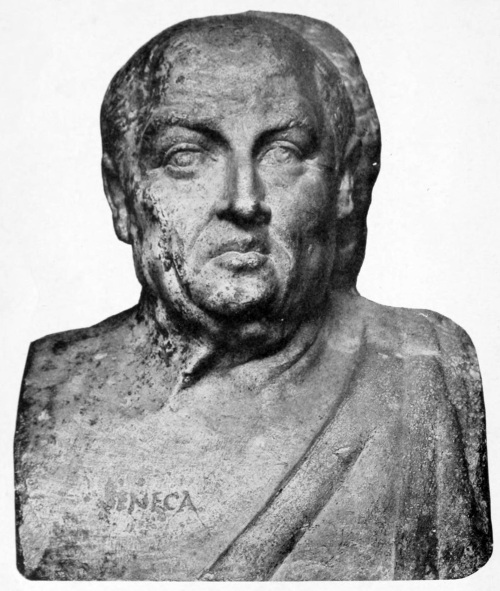
DOUBLE HERMES OF SENECA AND SOCRATES.
Now in the Old Museum at Berlin

The Tragedies of Seneca
TRANSLATED INTO ENGLISH VERSE, TO WHICH HAVE BEEN APPENDED
COMPARATIVE ANALYSES OF THE CORRESPONDING GREEK
AND ROMAN PLAYS, AND A MYTHOLOGICAL INDEX
BY
FRANK JUSTUS MILLER
INTRODUCED BY AN ESSAY ON THE INFLUENCE OF THE TRAGEDIES OF SENECA
UPON EARLY ENGLISH DRAMA
BY
JOHN MATTHEWS MANLY
CHICAGO
THE UNIVERSITY OF CHICAGO PRESS
LONDON
T. FISHER UNWIN, 1 ADELPHI TERRACE
1907
Copyright 1907 By
The University of Chicago
Published December 1907
Composed and Printed By
The University of Chicago Press
Chicago, Illinois, U.S.A.
TO
FRANK FROST ABBOTT
AND
EDWARD CAPPS
MY FRIENDS AND COLLEAGUES
THROUGH A SCORE OF YEARS
PREFACE
The place of the tragedies of Seneca in literature is unique. They stand as the sole surviving representatives, barring a few fragments, of an extensive Roman product in the tragic drama. They therefore serve as the only connecting link between ancient and modern tragedy. They are, moreover, modeled more or less closely after the tragedies of Aeschylus, Sophocles, and Euripides; and the Greek and Roman product in literature along parallel lines cannot be better studied than by a comparison of these Senecan plays with their Greek prototypes—a comparison which is not possible in comedy, since, unfortunately, the Greek originals of Plautus and Terence have not come down to us.
These plays are of great value and interest in themselves, first, as independent dramatic literature of no small merit; and second, as an illustration of the literary characteristics of the age of Nero: the florid, rhetorical style, the long, didactic speeches, the tendency to philosophize, the frequent epigram, the pride of mythologic lore.
Popular interest in the tragedies of Seneca has been growing to a considerable extent during the last generation. This has been stimulated in part by Leo's excellent text edition, and by the researches of German and English scholars into Senecan questions, more especially into the influence of Seneca upon the pre-Elizabethan drama; in part also by the fact that courses in the tragedies have been regaining their place, long lost, in college curricula.
The present edition seeks still further to bring Seneca back to the notice of classical scholars, and at the same time to present to the English reader all of the values accruing from a study of these plays, with the single exception of the benefit to be derived from a reading of the original. The influence which the tragedies have had in English literature is brought out in the introduction, which Professor Manly has kindly contributed; the relation of Seneca to the Greek dramatists is shown by comparative analyses of the corresponding plays, so arranged that the reader may easily observe their resemblances and differences; the wealth of mythological material is at once displayed and made available by an index of mythological characters; finally, it is hoped that the translation itself will prove to be as faithful a reproduction of the original as is possible in a translation, and at the same time to have sufficient literary merit of its own to claim the interest of the general reader.
The text used is that of Leo (Weidmann, Berlin, 1878), except in the instances noted. The line numbers as printed in the translation are identical with those of the original text. The meter employed in the spoken parts is the English blank verse, with the exception of the Medea, in which the experiment was tried, not altogether successfully, of reproducing the iambic trimeter of the original. In the lyric parts, the original meters are sometimes used; and, where these did not seem suitable in English, appropriate substitutes have been attempted.
Frank Justus Miller
Chicago, Ill.
October 25, 1907
TABLE OF CONTENTS
| PAGE | ||
| I. | The Influence of the Tragedies of Seneca upon Early English Drama | 1 |
| II. | The Tragedies of Seneca Translated | |
| Oedipus | 11 | |
| Phoenissae | 51 | |
| Medea | 79 | |
| Hercules Furens | 115 | |
| Phaedra or Hippolytus | 165 | |
| Hercules Oetaeus | 213 | |
| Thyestes | 287 | |
| Troades | 333 | |
| Agamemnon | 379 | |
| Octavia, with a Review of the Roman Historical Drama | 415 | |
| III. | Comparative Analyses of Seneca's Tragedies and the Corresponding Greek Dramas | 453 |
| IV. | Mythological Index | 497 |
INTRODUCTORY ESSAY — THE INFLUENCE OF THE TRAGEDIES OF SENECA UPON EARLY ENGLISH DRAMA
To appreciate fully the nature and the extent of the influence of Seneca upon English tragedy in the days of Shakespeare and his immediate predecessors, we must bear in mind that the public theaters were not the only places at which plays were then produced. At the universities, at the inns of court (which may be roughly described as combinations of a law school and a very exclusive social club), and at the Court itself plays were an important feature of almost every festival. Even those of us who know these facts are very likely to fail to realize the full meaning of them. We are likely to regard the non-professional performances as having no more significance for the history of the drama than amateur performances at the present day by dramatic clubs and college societies. We are apt to forget that, in the spacious days of great Elizabeth, learning, especially classical learning, had a value, an importance, a dignity, which not even the most academic of us now feels it to have. Our generation, busied above all things with making a living or with accumulating wealth, regards the scholar as, with the poet and the artist, the most unpractical and useless of men at best, tolerated as an ornamental creature whom society can afford to keep if it does not have to pay him more than it pays a butler or a chauffeur. To the men of the Renaissance, scholarship and the scholar had a unique and inestimable value. Ordinary business, in their view, enabled man to provide a living; religion taught him how to save his soul; scholarship, the knowledge of the literature and life of the Greeks and the Romans, enabled him to distinguish his life as a man from that of a beast, to approach as nearly as possible to that ideal type toward which they strove, the uomo universale, the perfect gentleman, complete master of his body, of his mind, of his passions. To men of these views and this temper, literature—first, classical literature and then the vernacular literature produced under the stimulus of it—was of supreme importance, and the drama was perhaps the most important form of literature. The value of literature for those who were then trying to transform the world, to rebuild it and themselves nearer to the heart's desire, was of course best recognized by the finest spirits of the age, men like Erasmus, Thomas More, Walter Raleigh, Edmund Spenser, Philip Sidney. But it seems to have been felt, though in cruder ways, even by the vulgar. An amusing illustration of this is the little record kept by old Simon Forman, a noted mountebank and quack doctor, in 1610 and 1611. It has preserved for us our earliest notices of performances of Macbeth, Cymbeline, and A Winter's Tale; but this is accidental. The doctor's intention was merely to note for his own guidance such lessons as he learned from the plays presented on the stage. Such benefits were, according to the views of wiser men, to be gained chiefly from comedies; tragedy, and classical tragedy in particular, had a finer, a more permanent value. Tragedy was the voice of the wisest men of the world, the ancients, upon the most serious themes of human life; it not only, as Aristotle had said, purified the mind through pity and terror, it fortified the inner life, and both by example and by sententious maxim prepared man to meet the most subtle attacks of fate, the temptations of success, or the discouragements of failure. Tragedy therefore had a unique value for the Elizabethans, and the performances of classical plays, or those written in imitation of the classics, by the universities or the inns of court, did not fall into the abyss which now receives amateur theatricals.
Failure to take account of the value attached to the lessons and the examples of tragedy may perhaps account for the misunderstanding which exists so widely, even among scholars, in regard to the first tragedy in English, Gorboduc, or Ferrex and Porrex. Everyone knows that this was written in direct imitation of Seneca, and everyone discusses glibly its Senecan features, the bloody theme, the division into five acts, the use of the chorus, the removal of the action from the view of the spectators, the long speeches; but critics are, without exception, offended to the heart by the fifth act, and especially by the two long disquisitions of Arostus and Eubulus. It is, however, no exaggeration to say that the play exists solely for the sake of these speeches. This was not a mere academic exercise. It was a serious attempt by some of the most thoughtful men of England to move the queen, Elizabeth, to a course of action which they regarded as absolutely essential to the welfare of the realm. Other attempts to secure the same end were made by her best statesmen throughout the reign. The failure of this effort was not due to the weakness of the tragedy, but, like the failure of all the rest, to some feature of Elizabeth's character or some circumstance in her life which has not yet been fully and convincingly explained. The purpose of the writers is clear. They wished to persuade Elizabeth to marry and settle once for all the succession to the throne of England. They, in common with all thoughtful and patriotic Englishmen, feared the horrors of an unsettled succession or a divided rule. These they tried to impress upon her mind and heart by examples drawn from the history of Gorboduc and his sons, and by maxims and exhortations presented in the most authoritative form known to them, the form of Senecan tragedy. The occasion chosen was a great festival given by the gentlemen of the Inner Temple, one of the most important and influential of the inns of court referred to above.
Classical tragedy had, then, as we can readily see, a prestige to which hardly anything in literature corresponds at the present day. The statesman who should today wish to influence his sovereign to an important course of action would doubtless be puzzled to find any form of literature—academic or unacademic—appropriate to the task in dignity and authority.
It is not strange, therefore, that classical tragedy, the tragedy of the schools and the learned societies, must be taken seriously into account in estimating the forces which shaped the drama of the popular stage. It is true that the English tragedies in classical or Senecan form were none of them written for the public stage. It is even probable that they would not have been successful upon it. It is a mistake to treat them historically and critically, as if they belonged to the direct line of development which resulted in Faustus and The Spanish Tragedy and Macbeth and Lear and Othello. But none the less the influence of these academic plays was very real and very important.
The ways in which this influence was exercised may be noted, as having some bearing upon the nature and extent of the influence. In the first place, there was in the early days no very rigid line between the academic and the popular performers. The Children of the Chapel Royal were at one time the leading theatrical company in London. When the queen visited Oxford in 1566, there were among the several plays presented by the university, not only the Latin tragedy, Progne, of Dr. James Calfhill, but also the English Palamon and Arcite of Richard Edwards, Master of Her Majesty's Children and the most popular dramatist of his day. Edwards himself trained the students who produced his play, and it was a great success; according to a contemporary report, "certain courtiers said that it far surpassed Damon and Pythias, than which they thought nothing could be better; likewise some said that if the author did any more before his death, he would run mad." Any impressions made upon Edwards by Dr. Calfhill's Progne were doubtless lost to art, as Edwards died before the end of the year; but this was probably not the first occasion on which the Master of the Chapel Children had visited the university in behalf of the drama, and Edwards himself had been both a scholar and a probationary fellow there. Certainly his famous Damon and Pythias shows some evidences of the influence of Seneca.
It is well known also that the most successful writers for the public stage in the years just preceding Shakespeare's advent, the years that determined the forms and the methods of the popular drama, were educated at the universities, and, however clearly they may have recognized the necessity of supplying to the populace story, action, the raw material of life and philosophy, cherished as an ideal the Senecan interest in situation, the Senecan love for broad description, for introspection and reflection, for elaborate monologue, and catchy sententiousness. Such were Greene and Peele and Marlowe; and Thomas Kyd, author of that most popular of plays, The Spanish Tragedy, and probable author of the version of Hamlet which held the stage for fourteen years before Shakespeare revised it and gave it a new and a different life, though not bred in either university, was more zealous about his Latin and apparently more influenced by Seneca than the university men themselves.
But, says some modern classical scholar, granting that these early dramatists were university men or men, like Kyd and Shakespeare, not trained in the universities but all the more zealous to match their productions with those which bore the official mark of classical scholarship, why should Seneca, a second-rate Roman tragedian, be continually cited in connection with classical influence instead of Aeschylus and Sophocles and Euripides, the supreme masters of ancient tragedy, and Aristotle, the unique expositor of the theory of the drama? The men of the Renaissance would have had a ready answer. In the first place, they knew very little about the Greek tragedians, or, for that matter, about Greek literature in general; for although the rediscovery of Greek literature was undoubtedly one of the events of that remarkable spurt of the human intellect and spirit which we call the Renaissance, Greek literature and life were, after all, in every country of Europe, far less important than Latin, as models for imitation, as sources of inspiration, as objects which engaged the attention of the moderns and set the pace which they tried to follow. As for tragedy, a few scholars in Italy and France and Germany and England knew Sophocles and Euripides—Aeschylus was almost unknown—but the theory and the practice of tragedy among the classicists were based almost exclusively upon the example of Seneca and the precepts of Horace. Aristotle is, indeed, often cited as the ultimate authority, but, although the voice may be the voice of Aristotle, the opinions are usually those of Scaliger or Minturno or Robortelli or Castelvetro, opinions which reduced to inviolable laws what Aristotle had merely stated as observed practices, and which supplemented these rules by others drawn from the plays of Seneca, who was, according to these critics, the most majestic, the most tragic, the most perfect of the ancient tragedians. That Seneca's majesty seems to critics of today bombast, that his triumph in tragic quality consists in an accumulation of horrors and a consistently unfortunate ending, that his perfection of form is no more than a formal schematism, clear because it is simple and lifeless—all this may be true but is beside the mark. To the best spirits of the Renaissance, whether critical or creative, the ten tragedies which bore the name of Seneca presented the ideal of tragic art toward which modern writers should strive if they would be perfect.
What, then, was the influence of Seneca in England? Two excellent studies of different phases of it have been published, both, unfortunately, less known than they should be.
The purely formal influence, the influence upon dramatic technique and upon composition in the large sense of the term, is the subject of Rudolf Fischer's Die Kunstentwicklung der englischen Tragödie, perhaps the most ingenious and adequate scheme ever devised for the analysis of the technical and compositional features of any form of art. Fischer sees in the history of English tragedy before Shakespeare a steady approximation to the Senecan type. His argument is open to several objections. In the first place, he treats as if they belonged to the same simple line of development plays written for the public stage and the popular taste and those written for special audiences dominated by scholastic ideals. In the second place, as Professor Luick has pointed out, he has disregarded the influence exercised by the original form of the story dramatized upon the dramatic presentation of it. And, furthermore, he, in common with other students of the subject, has proceeded upon the assumption that only tragedy could have had any influence upon tragedy. He has neglected that remark of Ben Jonson's, which phrases the view not of his own time only but of all ages, "The parts of a comedy are the same with a tragedy," and has failed to see that for the structure of English tragedy, Roman comedy and the serious imitations of it by the men of the Renaissance—such as Gnapheus' Acolastus, Macropedius' Asotus and Rebelles, and their anonymous English offspring, The Nice Wanton—are no less important than the example of Seneca himself. But his book is interesting and enlightening as few books on any subject are.
Entirely different problems are dealt with in J.W. Cunliffe's little volume on The Influence of Seneca on Elizabethan Tragedy, a book which, to the regret of many scholars, has long been out of print, and which the author ought to reprint with such additions as his continued study of the subject may suggest. Mr. Cunliffe is mainly concerned with showing why Seneca appealed to the Elizabethans and with pointing out certain details of theme, of situation, of theatrical effects, and of expression, which the popular playwrights owed to Seneca.
To Seneca and the false Aristotle created by the humanists from the Poetics, the precepts of Horace, the definitions and maxims which sifted down through the encyclopaedists of the Middle Ages, and the example of Seneca, not only the men of the Renaissance but even we of today owe some of our most cherished ideas concerning tragedy. First of all, perhaps, is the belief that tragedy must end unhappily. The Greeks—whether creators or critics—had no such theory. It was enough for Sophocles and Aristotle that tragedy should be serious in theme and dignified in characters and in language. In the second place, we ordinarily believe that a tragedy should have five acts, and many of us can draw a diagram to prove it. Shakespeare and his fellows seem to have been dominated by the same theory, difficult as they sometimes found it to observe. The sacred unities, dominant so long in Italian and French tragedy, though never observed in any English play more notable than Addison's Cato, we have learned to disregard and even to decry, though such an attitude in the Elizabethan age awakened the censure of Philip Sidney and doubtless required some hardihood or even recklessness. The chorus also we have long since abandoned, but Greene and Peele and Kyd and Marlowe and Shakespeare and others of their time used it more than once and with good effect. They even, in some instances, combined with it the ghosts and infernal spirits, which beyond a doubt they owed to Seneca, and made this unearthly chorus, not only the commentator, but in some sense the subtle director of the action. Perhaps the most refined form of this is to be seen in the Ghost in Hamlet, who, though he does not appear technically as Chorus, yet recalls by his original incitement of the action and his later intervention to renew and direct it, as well as by his language and his attitude, the ghosts of Tantalus, Thyestes, Laius, and Agrippina in Seneca, and the spirits of Andrea and Revenge in The Spanish Tragedy. It is perhaps not going too far to find in the dream-setting of Hauptmann's Elga some reminiscence of Shakespeare's Taming of the Shrew and Greene's James IV, and consequently, in a remote sense, of Seneca's introductory figures, Tantalus, Thyestes, and the rest.
But these matters and the striking resemblances in situation and in utterance cited so abundantly by Cunliffe and by Munroe (Journal of Philology, Vol. VI, pp. 70-79), though they could be increased by many passages in Macbeth and King Lear as well as in the plays of other dramatists than Shakespeare, are after all not fundamental. Some other features that seem fundamental may be noted.
In the first place, although it is doubtless true that the scanty scenery of the Elizabethan stage is largely the excuse and the reason for the long descriptive passages with which the dramatists of that time delighted themselves and delight us, their modern readers, this is perhaps not the whole of the story. There are passages of exposition, of reflection, of pure declamation, equally long as well as equally beautiful. The Renaissance love of talk, of fine language, of eloquentia, may explain this in part; but it is doubtless due in part also to the example of Seneca, who never loses an opportunity for a long passage of description or introspection or reflection or mere declamation—making them indeed for the Chorus when the situation does not allow them to the ordinary dramatis personae.
Then we may note that the thoroughly melodramatic character of Elizabethan tragedy is a natural inheritance from Seneca. Greek tragedy had, to be sure, many melodramatic situations, along with others of a milder type. But the religious element in the tragedy of Aeschylus and Sophocles radically modifies the character and tone of the most poignant and repulsive themes and situations. When Seneca took the most difficult of Greek themes and, following the lead of Euripides, cast away the over-ruling, compulsive dominance of the Greek theocracy, he produced melodrama. Most moderns have been either content to follow him or compelled to do so for lack of the ability to create striking situations without the aid of villains of melodramatic criminality. A few of the French tragedians have had recourse to the method of the Greeks either by reviving the Greek mythology and theocracy or by resorting to Hebrew history for characters whose deeds, however criminal, were necessary parts of a divine plan. Shakespeare, almost alone, has at his best succeeded in substituting for the gods and fate the inevitable results of human character and the moral law, in presenting the worst deeds of his leading figures as less the results of free intention than of futile efforts to deliver themselves from the web of circumstance which their first crimes or follies have woven about them—the whole career of Macbeth, for example, being the necessary outcome of his attempt to get free of the difficulties and dangers brought upon him by the murder of Duncan.
Speculation as to what the English drama might have been if Sophocles instead of Seneca had been its inspiration and its model is idle. The men of the Renaissance did not understand Sophocles; his stage, the mode of production of his plays, his aim, the whole nature of his art, were beyond the scholarship of their day. And it is doubtful whether they could in any event have made so successful a combination of the Greek and the national or mediaeval drama as they made of Senecan tragedy and the dramatic forms they already possessed.
In one thing, at any rate, the English drama was especially fortunate, that is, in the fact that its form and its content were so largely determined by two such remarkable men as Marlowe and Shakespeare. The conditions in France in the sixteenth century were strikingly similar to those in England, except for the number of public theaters. M. Petit de Julleville points out that France as well as England possessed every item of the motley list of dramatic types enumerated by Polonius; and he continues: "Rien n'empêchait alors qu'un Shakespeare naquit en France; les circonstances n'étaient-elles pas merveilleusement favorables? Mais, en dépit de certaines théories, les grands hommes ne paraissent pas tout juste au moment où ils sont nécessaires. Il nous fallait un Shakespeare; il naquit un Alexandre Hardy!"
OEDIPUS — OEDIPUS — ACT I — ACT II — ACT III — ACT IV — ACT V
DRAMATIS PERSONAE
| Oedipus | King of Thebes; the son, as he supposed, of Polybus, king of Corinth, and Merope, his wife, but found to be the son of Laius and Jocasta. |
| Jocasta | Wife and, as the play develops, found to be also the mother of Oedipus. |
| Creon | Theban prince, brother of Jocasta. |
| Tiresias | A celebrated prophet of Thebes, now old and blind. |
| Manto | His daughter. |
| Old Man | Sent from Corinth to announce to Oedipus the death of Polybus. |
| Phorbas | Head-shepherd of the royal flocks of Thebes. |
| Messenger | Who announces the self-inflicted blindness of Oedipus and the suicide of Jocasta. |
| Chorus | Of Theban elders. |
The scene is laid before the royal palace of Thebes; the play opens in the early morning of the day within which the tragedy is consummated.
An oracle once came to Laius, king of Thebes, that he should perish by his own son's hands. When, therefore, a son was born to him, he gave the infant to his chief of shepherds to expose on Mount Cithaeron. But the tenderhearted rustic gave the babe instead to a wandering herdsman of Polybus, the king of Corinth.
Years later, a reputed son of Polybus, Oedipus by name, fearing an oracle which doomed him to slay his father and wed his mother, fled from Corinth, that so he might escape this dreadful fate. As he fared northward, he met and slew an old man who imperiously disputed the narrow way with him. Upon arriving at the Theban land, he read the riddle of the Sphinx, and so destroyed that monster which Juno had sent to harass the land which she hated; and for this service, Oedipus was made the husband of Jocasta, the widowed queen of Laius (who had recently been slain upon the road), and set upon the vacant throne.
Now other years have passed, and sons and daughters have been born to the royal pair. But now a dreadful pestilence afflicts the state. Oedipus has sent Creon to consult the oracle, to learn the cause and seek the means of deliverance from the scourge. And while he waits his messenger's return, the murky dawn still finds him grieving for his kingdom's wretched plight.
[Enter the Chorus of Theban elders, deploring the violence of the plague.]
FOOTNOTES:
[1] Reading, caudam.
[Enter Creon.]
[Enter Tiresias, led by his daughter Manto.]
[The victims are stationed before the altar as directed.]
[Exeunt Creon, Tiresias, and Manto.]
FOOTNOTES:
[2] Reading, te Dacûm.
[Enter Creon, returned from the rites of necromancy.]
[Creon is led away by the attendants, while Oedipus retires into the palace.]
[Enter an old Corinthian man, a messenger from Merope.]
[Exit.]
[Enter Oedipus.]
[Enter Jocasta.]
[She stabs herself and falls dead.]
[Exit.]
FOOTNOTES:
[6] Reading, tantum.
PHOENISSAE, OR THEBAÏS A FRAGMENT — PHOENISSAE, OR THEBAÏS A FRAGMENT — ACT I — ACT II — ACT III — ACT IV
DRAMATIS PERSONAE
| Oedipus | Late king of Thebes. | |
| Antigone | Daughter of Oedipus, constant to him in his misfortunes. | |
| Jocasta | Wife and mother of Oedipus. | |
| Polynices | } | Sons of Oedipus and rivals for the throne. |
| Eteocles | ||
| Messenger |
The scene is laid, first in the wild country to which Oedipus, accompanied by Antigone, has betaken himself; then in Thebes, and lastly in the plain before Thebes.
The time is three years after the great tragedy of Oedipus.
The stroke of fate, that has been threatening Oedipus since long before his birth, has fallen at last, and he has done the thing he feared to do. And now, self-blinded and self-exiled from his land, he has for three years wandered in rough and trackless places, attended by Antigone, his daughter, who, alone of all his friends, has condoned his fated sins and remained attached to him.
Meanwhile his sons, though they agreed to reign alternate years, are soon to meet in deadly strife; for Eteocles, although his year of royal power is at an end, refuses to give up the throne; and now Polynices, who has in exile wed the daughter of Adrastus, king of Argos, is marching against the gates of Thebes, with seven great armies, to enforce his rights.
[By a different version from the "Oedipus," Jocasta did not slay herself at once as in that tale, but still is living on in grief and shame, and strives to reconcile her sons.]
[Has a speech of Antigone dropped out at this point, or does Oedipus hark back to a previous thought after a dramatic pause?]
[The first act seems to be complete here, except for the commenting chorus which would naturally follow. Oedipus has temporarily yielded to his daughter's will.]
[The following passage fittingly opens the second act or episode. Although some editors would assign it to Antigone, it seems more fittingly to belong to a messenger who has just arrived, for the double reason that it gives fresher information from Thebes than Antigone would naturally possess; and that Oedipus, after the speech to his daughter with which the previous scene ended, would hardly address to her as rough a reply as he uses in his next speech.]
[It is possible that the following fragments belong to still another play. The presence of Antigone in Thebes, notwithstanding her resolve to remain with her father, would strengthen this view.]
[Enter Messenger in haste.]
[Exit toward the scene of conflict.]
FOOTNOTES:
[7] Reading, ultra suum scelus hoc cucurrit.
[On the field before Thebes, between the battle lines.]
FOOTNOTES:
[8] The text is corrupt here. The Ionian Sea, situated to the west of Greece, can have no possible connection with the region here described, i.e., the Hellespont.
MEDEA — MEDEA — ACT I — ACT II — ACT III — ACT IV — ACT V
DRAMATIS PERSONAE
| Medea | Daughter of Aeëtes, King of Colchis, and wife of Jason. |
| Jason | Son of Aeson, and nephew of Pelias, the usurping king of Thessaly; organizer and leader of the Argonautic expedition to Colchis in quest of the golden fleece. |
| Creon | King of Corinth, who had received into his hospitable kingdom Medea and Jason, fugitives from Thessaly, after Medea had plotted the death of Pelias. |
| Nurse | Of Medea. |
| Messenger | |
| Two Sons | Of Medea and Jason (personae mutae). |
| Chorus of Corinthians | Friendly to Jason and hostile to Medea. |
The time of the play is confined to the single day of the culmination of the tragedy, the day proposed by Creon for the banishment of Medea and marriage of Jason to Creüsa, daughter of Creon.
The scene is in Corinth, in the court of the house of Jason.
Although the play is confined in time to the final day of catastrophe at Corinth, the background is the whole romantic story of the Argonauts: how Jason and his hero-comrades, at the instigation of Pelias, the usurping king of Thessalian Iolchos, undertook the first voyage in quest of the golden fleece; how, after many adventures, these first sailors reached the kingdom of Aeëtes who jealously guarded the fleece, since upon its possession depended his own kingship; how the three deadly labors were imposed upon Jason before the fleece could be won—the yoking of the fiery bulls, the contest with the giants that sprang from the sown serpent's teeth, and the overcoming of the sleepless dragon that ever guarded the fleece; how, smitten by love of him, the beautiful, barbaric Medea, daughter of the king, by the help of her magic aided Jason in all these labors and accompanied him in his flight; how, to retard her father's pursuit she slew her brother and scattered his mangled remains in the path as they fled; how again, for love of Jason, she restored his father to youth and tricked Pelias' own daughters into slaying their agéd sire; how, for this act, Medea with her husband were exiled from Thessalia and dwelt in Corinth; how, for ten happy years, she lived with her husband and two sons in this alien land, her wild past almost forgotten, her magic untouched.
But now, Jason has been gradually won away from his wife, and is about to wed Creüsa, the daughter of Creon, king of Corinth. The wedding festivities have already begun when the play opens and reveals Medea invoking all the powers of heaven and hell in punishment of her false lord.
[Medea retires to back of stage; exit Nurse; enter Creon.]
[Exeunt.]
FOOTNOTES:
[9] Reading, Medea fugiam, as a continuation of Medea's speech.
[10] Retaining si regnas, iube in Medea's speech.
[11] Reading, gloriae.
[Medea is rushing out to seek vengeance, while the Nurse tries in vain to restrain her.]
[Exit Medea.]
[Enter Jason.]
[Exit Jason.]
FOOTNOTES:
[12] Reading, cui.
[13] Reading, with a period after profundum and after Oïleus.
[14] Reading, impendes.
[Enter Medea, chanting her incantations.]
[Exeunt sons toward the palace, Medea in the opposite direction.]
FOOTNOTES:
[15] Reading, with period after meae.
[16] Reading, relicto, and substituting comma for semicolon.
[Medea enters in time to hear that her magic has been successful.]
[Mounts her car and is borne away.]
HERCULES FURENS — HERCULES FURENS — ACT I — ACT II — ACT III — ACT IV — ACT V
DRAMATIS PERSONAE
| HERCULES | Son of Jupiter and Alcmena, but the reputed son of Amphitryon. |
| Juno | Sister and wife of Jupiter, and queen of heaven. |
| Amphitryon | Husband of Alcmena. |
| Theseus | King of Athens and friend of Hercules. |
| Lycus | The usurping king of Thebes, who has, prior to the opening of the play, slain king Creon in battle. |
| Megara | Wife of Hercules and daughter of Creon. |
| Chorus | Of Thebans. |
The scene is in the princely palace of Hercules at Thebes, on the day of the return of the hero from the lower world.
The jealous wrath of Juno, working through Eurystheus, has imposed twelve mighty and destructive tasks on Hercules, her hated stepson. But these, even to the last and worst, the bringing of Cerberus to the upper world, he has triumphantly accomplished. Abandoning her plan of crushing him by toils like these, she will turn his hand against himself, and so accomplish his destruction. Upon the day of his return from hell, she brings a madness on him, and so precipitates the tragedy which forms the action of the play.
FOOTNOTES:
[17] Reading, et in agris.
[Enter Lycus.]
[Exit.]
[Enter Hercules, just returned from the lower world, accompanied by Theseus.]
[Enter Amphitryon.]
[Exit.]
[Enter Hercules, fresh from the slaying of Lycus, intending to offer sacrifices to the gods.]
[He aims an arrow at one of the children.]
[He seizes the child and drags him from the scene.]
[Enter Hercules.]
FOOTNOTES:
[18] Reading, restituet.
HIPPOLYTUS OR PHAEDRA — HIPPOLYTUS OR PHAEDRA — ACT I — ACT II — ACT III — ACT IV — ACT V
DRAMATIS PERSONAE
| Hippolytus | Son of Theseus and Antiope, an Amazon. |
| Phaedra | Wife of Theseus and stepmother of Hippolytus. |
| Theseus | King of Athens. |
| Nurse | Of Phaedra. |
| Messenger. | |
| Slaves and attendants. | |
| Chorus | Of Athenian citizens. |
The scene is laid throughout in the court in front of the royal palace at Athens; and the action is confined to the space of one day.
Theseus had wed Antiope, the Amazon, and of their union had been born Hippolytus. This youth grew up to love the chase, austere and beautiful, shunning the haunts of men, and scorning the love of women. Theseus had meanwhile slain Antiope, and married Phaedra, Cretan Minos' child.
And now, for four years past, the king has not been seen upon the earth, for, following the mad adventure of his bosom friend, Pirithoüs, he has descended into Tartara, and thence, men think, he never will return.
Deserted by her lord, the hapless Phaedra has conceived a hopeless passion for Hippolytus; for Venus, mindful of that ancient shame, which Phaedra's ancestor, Apollo, had exposed, has sent this madness on her, even as Pasiphaë, her mother, had been cursed with a most mad and fatal malady.
[Exit.]
FOOTNOTES:
[19] Reading, cibus.
[Enter Nurse from the palace.]
[Enter Hippolytus.]
[He rushes off into the depths of the forest.]
[Exeunt.]
[The doors are opened and Theseus encounters his wife just within.]
[Exit Theseus.]
[Enter Messenger.]
FOOTNOTES:
[22] Reading, reddit.
[23] Reading, Argos.
[24] Reading, haud quisquam honeste flere, quod voluit, potest.
[Enter Phaedra with a drawn sword in her hand.]
[She falls upon her sword and dies.]
HERCULES OETAEUS — HERCULES OETAEUS — ACT I — ACT II — ACT III — ACT IV — ACT V
DRAMATIS PERSONAE
| Hercules | Son of Jupiter and Alcmena. |
| Hyllus | Son of Hercules and Deianira. |
| Alcmena | Daughter of Electryon, king of Mycenae. |
| Deianira | Daughter of Oeneus, king of Aetolia, and wife of Hercules. |
| Iole | Daughter of Eurytus, king of Oechalia. |
| Nurse | Of Deianira. |
| Philoctetes | A prince of Thessaly, son of Poeas, and the faithful friend of Hercules. |
| Lichas | The messenger (persona muta) of Deianira to Hercules. |
| Chorus | Of Aetolian women, faithful to Deianira. |
| Band | Of Oechalian maidens, suffering captivity in company with Iole. |
The scene is laid, first in Euboea, and later at the home of Hercules in Trachin.
The long, heroic life of Hercules has neared its end. His twelve great tasks, assigned him by Eurystheus through Juno's hatred, have been done. His latest victory was over Eurytus, king of Oechalia. Him he slew and overthrew his house, because the monarch would not give him Iole to wife.
And now the hero, having overcome the world, and Pluto's realm beneath the earth, aspires to heaven. He sacrifices to Cenaean Jove, and prays at last to be received into his proper home.
[On the Cenaean promontory of the island of Euboea.]
[In the palace of Deianira at Trachin.]
[Enter Deianira.]
[Exit Nurse.]
[Exit.]
[She rushes from the scene.]
FOOTNOTES:
[30] Lines 725-28 follow the text of Schroeder.
[31] Reading, funus.
[32] Reading, quid stupes factum scelus?
[33] Reading, reddi.
[34] Reading, vacat.
[35] Reading, restitit.
[36] Reading, atras.
[37] Reading, fati.
[Enter Hercules in the extremity of suffering.]
[Enter Alcmena.]
[Enter Hyllus.]
FOOTNOTES:
[38] Reading, auctor.
[39] Reading, fremens.
[40] Reading, remeabit.
[41] Reading, Aeacon.
[42] Reading, minimum cruentis.
[Enter Philoctetes.]
[Enter Alcmena, carrying in her bosom a funeral urn.]
[He vanishes from sight.]
[Exit.]
FOOTNOTES:
[43] Reading, nemus.
[44] Reading, vindicem amisi.
[45] Reading, terrae atque pelagi.
[46] Reading, quod.
THYESTES — THYESTES — ACT I — ACT II — ACT III — ACT IV — ACT V
DRAMATIS PERSONAE
| Thyestes | Brother of Atreus, in exile from his fatherland. |
| The Ghost of Tantalus. | Doomed for his sins to come back to earth and inspire his house to greater sin. |
| The Fury | Who drives the ghost on to do his allotted part. |
| Atreus | King of Argos, grandson of Tantalus, who has quarreled with his brother and driven him into exile. |
| An Attendant of Atreus. | |
| Three sons of Thyestes: | Only one of whom, Tantalus, takes part in the dialogue. |
| A Messenger. | |
| Chorus | Citizens of Mycenae. |
The scene is laid partly without the city of Argos, and partly within the royal palace.
Pelops, the son of Tantalus, had banished his sons for the murder of their half-brother, Crysippus, with a curse upon them, that they and their posterity might perish by each others' hands. Upon the death of Pelops, Atreus returned and took possession of his father's throne. Thyestes, also, claimed the throne, and sought to gain it by the foulest means. For he seduced his brother's wife, Aërope, and stole by her assistance the magical, gold-fleeced ram from Atreus' flocks, upon the possession of which the right to rule was said to rest. For this act he was banished by the king.
But Atreus has long been meditating a more complete revenge upon his brother; and now in pretended friendship has recalled him from banishment, offering him a place beside himself upon the throne, that thus he may have Thyestes entirely in his power.
[They vanish.]
FOOTNOTES:
[47] Reading, vectus.
[Enter Thyestes returning from banishment, accompanied by his three sons.]
[Enter Messenger breathlessly announcing the horror which has just been enacted behind the scenes.]
[Unnatural darkness has come over the world at midday.]
[He hands Thyestes the cup filled with mingled blood and wine.]
[Exit.]
TROADES — TROADES — ACT I — ACT II — ACT III — ACT IV — ACT V
DRAMATIS PERSONAE
| Agamemnon | King of the Greek forces in the war against Troy. |
| Pyrrhus | Son of Achilles, one of the active leaders in the final events of the war. |
| Ulysses | King of Ithaca, one of the most powerful and crafty of the Greek chiefs before Troy. |
| Calchas | A priest and prophet among the Greeks. |
| Talthybius | A Greek messenger. |
| An Old Man | Faithful to Andromache. |
| Astyanax | Little son of Hector and Andromache. |
| Hecuba | Widow of Priam, one of the Trojan captives. |
| Andromache | Widow of Hector, a Trojan captive. |
| Helena | Wife of Menelaüs, king of Sparta, and afterward of Paris, a prince of Troy; the exciting cause of the Trojan war. |
| Polyxena | Daughter of Hecuba and Priam (persona muta). |
| Chorus | Of captive Trojan women. |
The scene is laid on the seashore, with the smouldering ruins of Troy in the background. The time is the day before the embarkation of the Greeks on their homeward journey.
The long and toilsome siege of Troy is done. Her stately palaces and massive walls have been overthrown and lie darkening the sky with their still smouldering ruins. Her heroic defenders are either slain or scattered seeking other homes in distant lands. The victorious Greeks have gathered the rich spoils of Troy upon the shore, among these, the Trojan women who have suffered the usual fate of women when a city is sacked. They await the lot which shall assign them to their Grecian lords and scatter them among the cities of their foes. All things are ready for the start.
But now the ghost of Achilles has risen from the tomb, and demanded that Polyxena be sacrificed to him before the Greeks shall be allowed to sail away. And Calchas, also, bids that Astyanax be slain, for only thus can Greece be safe from any future Trojan war. And thus the Trojan captives who have so long endured the pains of war, must suffer still this double tragedy.
[Exit.]
[Enter Pyrrhus and Agamemnon.]
[Exeunt.]
[Enter Andromache, leading the little Astyanax.]
[The boy enters the tomb, and the gates are closed and barred behind him.]
[Ulysses is seen approaching.]
[Enter Ulysses.]
[He leads the boy away with him.]
[Enter Helen.]
[She stops, overcome by emotion.]
FOOTNOTES:
[50] Reading, haud regibus.
AGAMEMNON — AGAMEMNON — ACT I — ACT II — ACT III — ACT IV — ACT V
DRAMATIS PERSONAE
| Agamemnon | King of Argos, and leader of all the Greeks in their war against Troy. |
| Ghost of Thyestes | Returned to earth to urge on his son to the vengeance which he was born to accomplish. |
| Aegisthus | Son of Thyestes by an incestuous union with his daughter; paramour of Clytemnestra. |
| Clytemnestra | Wife of Agamemnon, who has been plotting with Aegisthus against her husband, in his absence at Troy. |
| Chorus | Of Argive women. |
| Eurybates | Messenger of Agamemnon. |
| Cassandra | Daughter of Priam, captive of Agamemnon. |
| Electra | Daughter of Agamemnon and Clytemnestra. |
| Strophius | King of Phocis. |
| Orestes | Son of Agamemnon (persona muta). |
| Pylades | Son of Strophius (persona muta). |
| Band | Of captive Trojan women. |
The scene is laid partly within and partly without the palace of Agamemnon at Argos or Mycenae, on the day of the return of the king from his long absence at Troy, beginning in the period of darkness just preceding the dawn.
The blood-feud between Atreus and Thyestes was not ended with the terrible vengeance which Atreus wreaked upon his brother. It was yet in fate that Thyestes should live to beget upon his own daughter a son, Aegisthus, who should slay Atreus and bring ruin and death upon the great Atrides, Agamemnon.
The Trojan war is done. And now the near approach of the victorious king, bringing his captives and treasure home to Argos, has been announced. But little does he dream to what a home he is returning. For Clytemnestra, enraged at Agamemnon because he had sacrificed her daughter Iphigenia at Aulis to appease the winds, and full of jealousy because he brings Cassandra as her rival home, estranged also by the long-continued absence of her lord, but most estranged by her own guilty union with Aegisthus, is now plotting to slay Agamemnon on his return, gaining thus at once revenge and safety from his wrath.
[Exit.]
[Exit.]
[Enter Aegisthus.]
[Exeunt into the palace.]
FOOTNOTES:
[51] The line arrangement of Schroeder has been followed in this Chorus.
[Enter Eurybates with laurel-wreathed spear.]
[Enter Clytemnestra in time to hear the concluding words of the herald.]
[Enter band of Trojan women, led by Cassandra.]
[Enter Agamemnon. He is met and greeted by his wife, who returns into the palace.]
[Exit into the palace.]
[Remains beside the altar.]
[Enter Electra, leading her little brother, Orestes.]
[Enter Strophius in a chariot, accompanied by his son Pylades.]
[Exeunt at great speed.]
[Enter Clytemnestra, fresh from the murder of her husband.]
[Enter Aegisthus.]
[Electra is led away.]
OCTAVIA — OCTAVIA — INTRODUCTION — OCTAVIA — ACT I — ACT II — ACT III — ACT IV — ACT V
A FABULA PRAETEXTA
THE ONLY EXTANT ROMAN HISTORICAL DRAMA
The Roman historical drama had a place among the earliest products of Roman literature, and seems to have enjoyed a degree of popularity through all succeeding periods. That Roman literary genius did not find a much fuller expression through this channel was not due to a lack of national pride and patriotism, nor yet to a dearth of interesting and inspiring subjects in Roman history. The true reason is probably to be found in the fact that by the time national conditions were ripe for the development of any form of literature, the Greeks had already worked, and well worked, nearly all available fields, and had produced a mass of literature which dazzled the Roman mind when at last circumstances brought these two nations into closer contact.
The natural and immediate result was an attempt on the part of the Romans to imitate these great models. And hence we have in drama, both in tragedy and comedy, a wholesale imitation of the Greek dramas, oftentimes nothing more than a translation of these, with only here and there an attempt to produce something of a strictly native character, entirely independent of the Greek influence.
This imitative impulse was augmented by the fact that the Romans were following the line of least resistance, since it is always easier to imitate than to create. Furthermore, they had as yet developed no national pride of literature to hold them to their own lines of national development; they had no forms of their own so well established that the mere force of literary momentum would carry them steadily on toward a fuller development, in spite of the disturbing influences of the influx of other and better models. They had, indeed, developed a native Saturnian verse which, had it been allowed a free field, might have reached a high pitch of literary excellence. But it speedily gave way at the approach of the more elegant imported forms.
The overwhelming influence of Greek tragedy upon the Roman dramatists can be seen at a glance as we review the dramatic product of the Roman tragedians. We have titles and fragments of nine tragedies by Livius Andronicus, seven by Naevius, twenty-two by Ennius, thirteen by Pacuvius, forty-six by Accius, and many unassignable fragments from each of these which indicate numerous other plays of the same character. To these should be added scattering additions from nearly a score more of Roman writers during the next two hundred years after Accius. All the above-mentioned plays are on Greek subjects; and most of those whose fragments are sufficiently extensive to allow us to form an opinion of their character are either translations or close imitations of the Greeks, or are so influenced by these as to be decidedly Greek rather than Roman in character.
And what of the genuine Roman dramatic product? Speaking for the fabula praetexta, or Roman historical drama, alone, the entire output, so far as our records go, is contained in the following list of authors and titles.
From Naevius (265-204 B.C.) we have the Clastidium, written in celebration of the victory of Marcellus over Vidumarus, king of the Transpadane Gauls, whom Marcellus slew and stripped of his armor, thus gaining the rare spolia opima; this at Clastidium in 222 B.C. The play was probably written for the especial occasion either of the triumph of Marcellus or of the celebration of his funeral.
We have also from Naevius a play variously entitled Lupus or Romulus or Alimonium Remi et Romuli, evidently one of those dramatic reproductions of scenes in the life of a god, enacted as a part of the ceremonies of his worship. These are comparable to similar dramatic representations among the Greeks in the worship of Dionysus.
The Ambracia and the Sabinae of Ennius (239-169 B.C.) are ordinarily classed as fabulae praetextae, although Lucian Müller classes the fragments of the Ambracia among the Saturae of Ennius; while Vahlen puts the Ambracia under the heading Comoediarum et ceterorum carminum reliquiae, and classifies the fragments of the Sabinae under ex incertis saturarum libris. The Ambracia is evidently called after the city of that name in Epirus, celebrated for the long and remarkable siege which it sustained against the Romans under M. Fulvius Nobilior. That general finally captured the city in 189 B.C. If the piece is to be considered as a play, it was, like the Clastidium, written in honor of a Roman general, and acted on the occasion either of his triumph or of his funeral.
We have four short fragments from the Paulus of Pacuvius (220-130 B.C.), written in celebration of the exploits of L. Aemilius Paulus who conquered Perseus, king of Macedonia, in the battle of Pydna, 168 B.C.
The fragments of the plays already mentioned are too brief to afford any adequate idea of the character or content of the plays. But in the Brutus of Accius (b. 170 B.C.), which centers around the expulsion of the Tarquins and the establishment of the Republic, we have a larger glimpse into the play through two most interesting fragments consisting of twelve iambic trimeters and ten trochaic tetrameters, respectively. In the first, King Tarquin relates to his seer an ill-ominous dream which he has had; the second is the seer's interpretation of this dream, pointing to Tarquin's dethronement by Brutus. Other short fragments give glimpses of the outrage of Lucretia by Sextus at Collatia, and the scene in the forum where Brutus takes his oath of office as first consul. This play, unlike its predecessors, was not written at the time of the events which it portrays, but may still be classed with them, so far as its object is concerned, since it is generally thought to have been written in honor of D. Junius Brutus who was consul in 138 B.C., and with whom the poet enjoyed an intimate friendship.
Another praetexta of Accius is preserved, the Decius, of which eleven short fragments remain. This play celebrates the victory of Quintus Fabius Maximus and P. Decius Mus over the Samnites and Gauls at Sentinum in 295 B.C. The climax of the play would be the self-immolation of Decius after the example of his father in the Latin war of 340 B.C.
In addition to these plays of the Roman dramatists of the Republic, we have knowledge of a few which date from later times. There was a historical drama entitled Iter, by L. Cornelius Balbus, who dramatized the incidents of a journey which he made to Pompey's camp at Dyrrachium at the opening of civil war in 49 B.C. Balbus was under commission from Caesar to treat with the consul, L. Cornelius Lentulus, and other optimates who had fled from Rome, concerning their return to the city. The journey was a complete fiasco, so far as results were concerned; but the vanity of Balbus was so flattered by his (to him) important mission that he must needs dramatize his experiences and present the play under his own direction in his native city of Gades.
We have mention also of an Aeneas by Pomponius Secundus, and of two praetextae by Curiatius Maternus, entitled Domitius and Cato.
These eleven historical plays are, as we have seen, for the most part, plays of occasion, and would be at best of but temporary interest, born of the special circumstances which inspired them. They are in no way comparable with such historical dramas on Roman subjects as Shakespeare's Julius Caesar or Coriolanus, whose interest is for all times.
We have still a twelfth play of this class, which enjoys the unique distinction of being the only Roman historical drama which has come down to us—the Octavia. Its authorship is unknown, although tradition gives it a place among the tragedies of Seneca, the philosopher. The general opinion of modern critics, however, is against this tradition, chiefly because one passage in the play, in the form of a prophecy, too circumstantially describes the death of Nero, which occurred three years after the death of Seneca. It is generally agreed that the play must have been written soon after the death of Nero, and by some one, possibly Maternus, who had been an eye-witness of the events, and who had been inspired by his sympathies for the unfortunate Octavia to write this story of her sufferings.
DRAMATIS PERSONAE
| Octavia | Stepsister and wife of Nero. |
| Nurse | of Octavia. |
| Poppaea | Mistress and afterward wife of Nero. |
| Ghost of Agrippina | Mother of Nero, slain by him. |
| Nero | Emperor of Rome. |
| Seneca | Former tutor of Nero, and later one of his chief counselors. |
| Prefect of Roman Soldiers. | |
| Messenger. | |
| Chorus of Romans | Sympathetic with Octavia. |
| Chorus | Attached to the interests of the court. |
The scene is laid throughout in different apartments of the palace of Nero, and is concerned with the events of the year 62 A.D.
[Exit to her chamber.]
[Starts to enter the chamber, but is met by Octavia coming forth.]
[Exit.]
[Exeunt.]
[Vanishes.]
[Exeunt Poppaea and Nurse.]
[Exit.]
FOOTNOTES:
[57] Reading, intentus.
[Enter Prefect.]
[Exeunt.]
[Enter Octavia in the custody of the palace guards, who are dragging her roughly out into the street.]
[Exit Octavia with guards.]
FOOTNOTES:
[58] Reading, quam temperet non ira, etc.
COMPARATIVE ANALYSES — THE OEDIPUS OF SOPHOCLES, AND THE OEDIPUS OF SENECA — THE MEDEA OF EURIPIDES, AND THE MEDEA OF SENECA — THE HERCULES FURENS OF EURIPIDES, AND THE HERCULES FURENS OF SENECA — THE HIPPOLYTUS OF EURIPIDES, AND THE HIPPOLYTUS OF SENECA — THE MAIDENS OF TRACHIN OF SOPHOCLES, AND THE HERCULES OETAEUS OF SENECA — THE TROADES OF EURIPIDES, AND THE TROADES OF SENECA — THE AGAMEMNON OF AESCHYLUS, AND THE AGAMEMNON OF SENECA
COMPARATIVE ANALYSES OF SENECA'S TRAGEDIES AND THE CORRESPONDING GREEK DRAMAS
The Phoenissae, if, indeed, these fragments are to be considered as belonging to one play, has no direct correspondent in Greek drama; although, in the general situations and in some details, it is similar to parts of three plays: The Seven Against Thebes of Aeschylus, the Oedipus at Colonus of Sophocles, and the Phoenician Damsels of Euripides. The Thyestes is without a parallel in extant Greek drama; and the Octavia, of course, stands alone.
The other seven tragedies attributed by tradition to Seneca, together with their Greek correspondents, are here presented in comparative analyses in order that the reader may be enabled easily to compare, at least so far as subject-matter and dramatic structure are concerned, the Roman tragedies and their Greek originals.
Although the traditional division into acts is followed in the English version of the several plays, it seems wise in these comparisons to give the more minute division into prologue, episodes, and choral interludes.
Prologue.—Dialogue between Oedipus and the priest of Zeus, who discloses the present plague-smitten condition of the people, and prays the king for aid since he is so wise. The fatherly regard of Oedipus for his people, in that he has already sent a messenger to ask the aid of the oracle, is portrayed.
The answer of the oracle: first reference to an unexpiated sin. Short question and answer between Oedipus and Creon, the messenger, bringing out the facts of Laïus' death.
The irony of fate: Oedipus proposes, partly in his own interest, to seek out the murderer. As yet there is no foreshadowing of evil in the king's mind. At the end of the prologue Oedipus remains alone upon the stage.
Prologue.—In the early morning Oedipus is seen lamenting the plague-smitten condition of his people. He narrates how he had fled from Corinth to avoid the fulfilment of a dreadful oracle, that he should kill his father and wed his mother. Even here he cannot feel safe, but still fears some dreadful fate that seems threatening. He describes with minute detail the terrors of the pestilence which has smitten man and beast and even the vegetable world. He prays for death that he may not survive his stricken people. Jocasta remonstrates with him for his despair and reminds him that it is a king's duty to bear reverses with cheerfulness.
Parode, or chorus entry.—The chorus enlarges upon the distresses of the city, and appeals to the gods for aid.
Parode, or chorus entry.—The chorus appeals to Bacchus, relating how the descendants of his old Theban comrades are perishing. It enlarges upon the distresses of the city, and deplores the violence of the plague. The sufferings of the people are described in minute detail.
First episode.—The curse of Oedipus upon the unknown murderer is pronounced, and the charge is made by Tiresias (who long refuses to speak but is forced to do so by Oedipus), "Thou art the man." Oedipus' explanation of Tiresias' charge; it is a plot between the latter and Creon. The facts of Oedipus' birth are hinted at. Tiresias prophesies the after-life of the king, with the name but thinly veiled.
First episode.—Creon, returned from the consultation of the oracle at Delphi, announces that the plague is caused by the unatoned murder of Laïus, former king of Thebes. Oedipus anxiously inquires who the murderer is, but is told that this is still a mystery. Creon describes the scene at Delphi in the giving of the oracle. Oedipus declares himself eager to hunt out the murderer and inquires why the matter has been left so long uninvestigated. He is told that the terrors of the Sphinx had driven all other thoughts out of the people's mind.
The irony of fate: Oedipus pronounces a dreadful curse upon the murderer of Laïus and vows not to rest until he finds him. He inquires where the murder took place and how. At this moment the blind old Tiresias enters, led by his daughter, Manto. Tiresias tries by the arts of divination (which are described with the greatest elaboration) to ascertain the name of the murderer, but without avail; and says that recourse must be had to necromancy, or the raising of the dead.
First choral interlude.—The chorus reflects upon the oracle and the certain discovery of the guilty one. Ideal picture of the flight of the murderer. While troubled by the charge of Tiresias, the chorus still refuses to give it credence. After all, the seer is only a man and liable to be mistaken. Oedipus has shown himself a wiser man by solving the riddle of the Sphinx.
First choral interlude.—The chorus sings a dithyrambic strain in praise of the wonderful works of Bacchus. No reference is made to the tragedy which is in progress.
Second episode.—Quarrel of Oedipus and Creon based upon the charges of the former. Oedipus' argument: The deed was done long ago, and Tiresias, though then also a seer, made no charge. Now, when forced by the recent oracle, the seer comes forward with Creon. This looks like a conspiracy. Creon pleads for a fair and complete investigation. Jocasta tries to reconcile the two, but in vain, and Creon is driven out. Jocasta relates the circumstances of Laïus' death, which tally in all details but one with the death of one slain by Oedipus. A terrible conclusion begins to dawn upon the king. He tells his queen the story of his life and the dreadful oracle, the fear of the fulfilment of which drove him from Corinth. At the end of this episode the death of Laïus at the hands of Oedipus is all but proved, but the relation between the two is not yet hinted at.
Second episode.—Creon returns from the rites of necromancy in which he had accompanied Tiresias, and strives to avoid telling the result of the investigation to the king. Being at last forced to reveal all that he knows, he describes with great vividness of detail how Tiresias has summoned up the spirits of the dead, and among them Laïus. The latter declares that Oedipus himself is the murderer, having slain his father and married his mother. Oedipus, strong in the belief that Polybus and Merope of Corinth are his parents, denies the charge, and after a hot dispute orders Creon to be cast into prison, on suspicion of a conspiracy with Tiresias to deprive Oedipus of the scepter.
Second choral interlude.—Prayer for a life in accordance with the will of heaven. Under the shadow of impending ill, the chorus seeks the aid of God, meditates upon the doom of the unrighteous, and considers the seeming fallibility of the oracle.
Second choral interlude.—The chorus refuses to believe the charge against Oedipus, but lays the blame of all these ills upon the evil fate of Thebes which has pursued the Thebans from the first.
Third episode.—A messenger from Corinth brings the news of Polybus' death, the supposed father of Oedipus. The irony of fate: the king is lifted up with joy that now the oracle cannot be fulfilled that he should kill his own father. Step by step the details of the king's infancy come out, which reveal the awful truth to Jocasta. To Oedipus the only result of the present revelation is that he is probably base-born. Jocasta tries to deter Oedipus from further investigation.
Third episode.—Oedipus, remembering that he had slain a man on his way to Thebes, questions Jocasta more closely as to the circumstances of Laïus' death, and finding these circumstances to tally with his own experience, is convinced that he was indeed the slayer of Laïus.
At this point a messenger from Corinth, an old man, announces to Oedipus the death of Polybus, the king of Corinth, and the supposed father of Oedipus. The latter is summoned to the empty throne of Corinth. A quick succession of questions and answers brings to light the fact that Oedipus is not the child of Polybus and Merope, but that the messenger himself had given him when an infant to the Corinthian pair. This announcement removes the chief support of Oedipus against the charges of Tiresias, and now he rushes blindly on to know the rest of the fatal truth. The shepherd is summoned who had given the baby to the old Corinthian. He strives to avoid answering, but, driven on by the threats of Oedipus, he at last states that he had received the child from the royal household of Thebes, and that it was in fact the son of Jocasta. At this last and awful disclosure, Oedipus goes off the stage in a fit of raving madness.
Strophe and antistrophe.—A partial interlude, while they wait for the shepherd who is to furnish the last link in the chain of evidence. The chorus conjectures as to the wonderful birth of Oedipus; possibly his father is Pan, or Apollo, or Mercury, or Bacchus.
The shepherd, arriving, also seeks to keep the dreadful truth from the king, but a second time the passion of Oedipus forces the truth from an unwilling witness. At last the whole story comes out, and Oedipus realizes that he has slain his father and wed his mother.
Third choral interlude.—The utter nothingness of human life, judged by the fate of Oedipus, who above all men was successful, wise, and good. It is inscrutable; why should such a fate come to him? The chorus laments the doom of the king as its own.
Third choral interlude.—The chorus reflects upon the dangerous position of the man who is unduly exalted, and illustrates this principle by the case of Icarus.
Exode.—The catastrophe in its final manifestations. A messenger describes the lamentations and suicide of Jocasta, the despair of Oedipus, and the wild mood in which he inflicts blindness upon himself. He comes upon the stage piteously wailing and groping his way. He prays for death or banishment at the hands of Creon, who is now king. He takes a tender farewell of his daughters and consigns them to Creon's care.
The play ends with the solemn warning of the chorus "to reckon no man happy till ye witness the closing day; until he pass the border which severs life from death, unscathed by sorrow."
Exode.—Although there is a short chorus interjected here (lines 980-97) on the inevitableness of fate, all the remainder of the play is really the exode, showing the catastrophe in its final manifestation. A messenger describes with horrible minuteness how Oedipus in his ravings has dug out his eyes. At this point Oedipus himself comes upon the stage, rejoicing in his blindness, since now he can never look upon his shame. And now Jocasta appears, having heard strange rumors. On learning the whole truth, she slays herself on the stage with Oedipus' sword. The play ends as the blind old king goes groping his way out into darkness and exile.
Prologue.—The old nurse of Medea, alone upon the stage, laments that the Argo was ever framed and that Medea had ever fled from Colchis. Then had she never been here in Corinth an exile and now deserted even by her husband, Jason. In describing Medea's distracted condition, the nurse first voices the fear of that violence which forms the catastrophe of the play. Enter an old attendant with the two sons of Medea, who announces a new woe—that Creon, the king, has decreed the banishment of Medea and her children. The nurse repeats her warning note, and urges the attendant to keep the children out of the sight of their mother, who even now can be heard raving within, and vowing the destruction of her children and her husband. The attendant retires with the children.
Prologue.—Medea, finding herself deserted by Jason, calls upon gods and furies to grant her vengeance. She prays for destruction to light upon her rival, and imprecates curses upon Jason. She thinks it monstrous that the sun can still hold on his way, and prays for power to subvert the whole course of nature. She finally realizes that she is impotent save as she has recourse to her old sorceries which she has long since laid aside, and resolves upon them as a means of revenge.
Parode, or chorus entry.—The chorus of Corinthian women comes to the front of the palace to inquire the cause of Medea's cries, which they have heard, and to profess their attachment to her. From time to time Medea's voice can be heard from within as she prays for death and imprecates curses upon Jason. The nurse at the suggestion of the chorus undertakes to induce her mistress to come forth, that converse with her friends may soothe her grief. The nurse goes within, leaving the chorus alone upon the stage.
Parode, or chorus entry.—A chorus of Corinthians chants an epithalamium for the nuptials of Jason and Creüsa. First, in Asclepiadean strains, they invoke the gods to be present and bless the nuptials. The strain then changes to quick, joyful Glyconics in praise of the surpassing beauty of the married pair. Changing back to Asclepiads, the chorus continues in extravagant praise of Jason and his bride, congratulates him on his exchange from Medea to Creüsa, and finally, in six lines of hexameter, exults in the license of the hour.
First episode.—Medea comes forth from the palace to explain to the chorus her position and unhappy condition. She deplores the lot of women in general, and especially in relation to marriage, and enlists the sympathy of the chorus in her attempt to secure some revenge for her wrongs. They confess the justice of her cause and promise to keep her secret.
Creon announces to Medea that she must leave his realm at once, for much he fears that she will take her revenge upon him and upon his house. She pleads for grace, and bewails her reputation for magic power; she assures the king that he has nothing to fear from her, and affects compliance with all that has taken place. Creon, while still protesting that she cannot be trusted, yields in so far that he grants her a single day's delay.
Medea tells the chorus that her recent compliance was only feigned, and openly announces her intention before the day is done of slaying Creon, his daughter, and Jason. She debates the various methods by which this may be accomplished, and decides, for her own greater safety, upon the help of magic.
First episode.—Hearing the epithalamium, Medea goes into a passion of rage. She recounts all that she has done for Jason, and exclaims against his ingratitude. Again, with shifting feelings she pleads Jason's cause to herself and strives to excuse him, blaming all upon Creon. Upon him she vows the direst vengeance. Meanwhile the nurse in vain urges prudence.
Creon now enters, manifesting in his words a fear of Medea, and bent upon her immediate banishment. Medea pleads her innocence, and begs to know the reason for her exile. She reviews at length her former regal estate and contrasts with this her present forlorn condition. She claims the credit for the preservation of all the Argonautic heroes. Upon this ground she claims that Jason is hers. She begs of Creon some small corner in his kingdom for her dwelling, but the king remains obdurate. She then prays for a single day's delay in which to say farewell to her children, who are to remain, the wards of the king. This prayer Creon reluctantly grants.
First choral interlude.—The course of nature is subverted. No longer let woman alone have the reputation for falsehood; man's insincerity equals hers. In poetry the fickleness of both should be sung, just as in history it is seen. Though Medea, for her love of Jason, left her native land and braved all the terrors of the deep, she is now left all forsaken and alone. Verily truth and honor have departed from the earth.
First choral interlude.—Apropos of Medea's reference to the Argonautic heroes the chorus sings of the dangers which those first voyagers upon the sea endured; how the natural bounds which the gods set to separate the lands have now been removed—and all this for gold and this barbarian woman. (The chorus is nowhere friendly to Medea, as in Euripides.) The ode ends with a prophecy of the time when all the earth shall be revealed, and there shall be no "Ultima Thule."
Second episode.—Jason reproaches Medea for her intemperate speech against the king, which has resulted in her banishment, and shows her that he is still concerned for her interests. She retorts with reproaches because of his ingratitude, and proceeds to recount all that she had done for him and given up in his behalf. Jason replies that it was not through her help but that of Venus that he had escaped all the perils of the past, and reminds her of the advantages which she herself had gained by leaving her barbarous land for Greece. He even holds that his marriage into the royal family of Corinth is in her interest and that of her children, since by this means their common fortunes will be mended. He offers her from his new resources assistance for her exile, which she indignantly refuses, and Jason retires from her bitter taunts.
Second episode.—Medea is rushing out to seek vengeance, while the nurse tries in vain to restrain her. The nurse soliloquizes, describing the wild frenzy of her mistress, and expressing grave fears for the result. Medea, not noticing the nurse's presence, reflects upon the day that has been granted her by Creon, and vows that her terrible vengeance shall be commensurate with her sufferings. She rushes off the stage, while the nurse calls after her a last warning.
Jason now enters, lamenting the difficult position in which he finds himself. He asserts that it is for his children's sake that he has done all, and hopes to be able to persuade Medea herself to take this view. Medea comes back, and at sight of Jason her fury is still further inflamed. She announces her intended flight. But whither shall she flee? For his sake she has closed all lands against herself. In bitter sarcasm she accepts all these sufferings as her just punishment. Then in a flash of fury she recalls all her services to him and contrasts his ingratitude. She shifts suddenly to passionate entreaty, and prays him to pity her, to give back all that she gave up for him, if she must needs flee; she begs him to brave the wrath of Creon and flee with her, and promises him her protection as of old. In a long series of quick, short passages they shift from phase to phase of feeling, and finally Medea prays that in her flight she may have her children as her comrades. Jason's refusal shows how deeply he loves his sons, and here is suggested to Medea for the first time the method of her direst revenge. Jason now yields to her assumed penitence and grants her the custody of the children for this day alone. When Jason has withdrawn, she bids the nurse prepare the fatal robe which she proposes to send to her rival by the hands of her children.
Second choral interlude.—The chorus prays to be delivered from the pangs of immoderate love and jealousy, from exile, and the ingratitude of friends.
Second choral interlude.—The chorus opens on the text, "Hell hath no fury like a woman scorned," and continues with a prayer for Jason's safety. It then recounts the subsequent history of the individual Argonauts, showing how almost all came to some untimely end. They might indeed be said to deserve this fate, for they volunteered to assist in that first impious voyage in quest of the golden fleece; but Jason should be spared the general doom, for the task had been imposed upon him by his usurping uncle, Pelias.
Third, episode.—Aegeus, in Corinth by accident, recognizes Medea, and learns from her her present grievous condition and imminent exile. She begs that he receive her into his kingdom as a friend under his protection. This he promises with a mighty oath to do.
Medea, left alone with the chorus, explains to it still more in detail her plans. She will send her sons with gifts to the new bride, which, by their magic power, will destroy her and all who touch her. She adds that she will also slay her two sons, the more to injure Jason. The chorus, while protesting against this last proposal, offers no resistance.
Third episode.—The nurse in a long monologue recites Medea's magic wonders of the past, and all her present preparations. Then Medea's voice is heard, and presently she comes upon the stage chanting her incantations. She summons up the gods of Tartara to aid her task; recounts all the wonders which her charms can work; describes her store of magic fires and other potent objects. Then breaking into quicker measure, as if filled with a fuller frenzy, she continues her incantations accompanied by wild cries and gestures. She finally dispatches her sons to Jason's bride with the robe she has anointed with her magic drugs and charged with her curses. She hastens out in the opposite direction.
Third choral interlude.—The chorus, dwelling upon Medea's proposed place of refuge, sings the praises of Athens, sacred to the Muses. It contrasts with this holy city the dreadful deed which Medea intends, and again vainly strives to dissuade her.
Third choral interlude.—The chorus notes and describes Medea's wild bearing, and prays for her speedy departure from their city.
Fourth episode.—Medea, sending for Jason, with feigned humility reproaches herself for her former intemperate words to him, and begs only that he use his influence for the reprieve of their children from exile. To assist him in this, she proposes to send the children themselves, bearing a gorgeous robe of golden tissue (which she has anointed with magic poison) as a wedding present to the bride. Upon this errand Jason retires attended by his little sons.
Fourth choral interlude.—The chorus, with full knowledge of the fatal robe, pictures the delight of the bride at its reception, and laments her fearful doom.
Fifth episode.—This episode is in four parts.
The attendant returns with the children and announces to Medea that her gifts have prevailed for their reprieve. (The attendant retires.)
Medea contrasts the assured career of her children with her own hapless condition; then remembers her resolve and with softening heart laments their dreadful fate. She hastily sends them within the palace. Left alone, she again struggles between her mother-love and her resolve not to leave her children subject to the scorn of her foes. (She here leaves the stage to wait for tidings from the royal house.)
Then follows a monologue by the chorus leader discussing the advantages of childlessness. No reference is made to the passing events.
Medea returns just in time to meet a messenger who breathlessly announces the death of Creon and his daughter. At the request of Medea he gives a detailed account of the reception of the magic robe and crown, the bride's delight, and her sudden and awful death, in which her father also was involved. He urges Medea to fly at once. She announces her intention to do so as soon as she has slain her children; and then rushes into the house.
Fifth choral interlude.—This consists of a single strophe and antistrophe in which the chorus calls upon the gods to restrain Medea's mad act. Then are heard within the house the shrieks first of the two children, then of one, then silence, the chorus meanwhile wildly shouting to Medea to desist from her deadly work.
The exode.—Jason appears in search of Medea that he may avenge on her the death of the royal pair; but most he fears for his children. The chorus informs him that they are already slain within the palace by their mother's hand. He prepares to force an entrance into the house.
But now Medea appears in a chariot drawn by dragons. She defies Jason's power to harm her. Jason replies by reproaching her with all the murderous deeds of her life, which have culminated in this crowning deed of blood. She in turn reproaches him and his ingratitude as the cause of all. A storm of mutual imprecations follows, and Medea disappears with the bodies of her two sons, denying to Jason even the comfort of weeping over their remains.
The exode.—A messenger comes running in from the direction of the palace, and announces that the king and his daughter are dead. The eager questions of the chorus bring out the strange circumstances attending this catastrophe. Medea enters in time to hear that her magic has been successful, and ignoring the nurse's entreaties to flee at once, she becomes absorbed in her own reflections. And now in her words may be seen the inward struggle between maternal love and jealous hate as she nerves herself for the final act of vengeance. The purpose to kill her children grows upon her, resist it as she may, until in an ecstasy of madness, urged on by a vision of her murdered brother, she slays her first son; and then, bearing the corpse of one and leading the other by the hand, she mounts to the turret of her house. Here with a refinement of cruelty she slays the second son in Jason's sight, disregarding his abject prayers for the boy's life. Now a chariot drawn by dragons appears in the air. This Medea mounts and is borne away, while Jason shouts his impotent curses after her.
Prologue.—The old Amphitryon, before the altar of Jupiter, at the entrance of the house of Hercules in Thebes, relates how Hercules has gone to the lower world to bring thence to the realms of day the triple-headed Cerberus. Meanwhile, Lycus, taking advantage of the hero's absence, has slain king Creon and usurped his throne. The father, wife, and children of Hercules he has reduced to poverty, and holds them in durance here in Thebes, threatening to slay the sons,
Amphitryon condoles with Megara, and counsels with her how they may escape the dangers of their present lot.
Prologue.—Juno complains that she is fairly driven out of heaven by her numerous rivals, mortal women who have been deified and set in the sky, either they or their offspring, by Jupiter. Especially is her wrath hot against Hercules, against whom she has waged fruitless war from his infancy until now. But he thrives on hardship, and scorns her opposition. She passes in review the hard tasks which she has set him, and all of which he has triumphantly performed. Already is he claiming a place in heaven. He can be conquered only by his own hand. Yes, this shall be turned against him, for a fury shall be summoned up from hell who shall fill his heart with madness; and in this madness shall he do deeds which shall make him long for death.
Parode, or chorus entry.—The chorus of Theban elders, feeble, tottering old men, enters and bemoans the wretched fate that has befallen their city and the household of their prince.
Parode, or chorus entry.—A vivid picture of the dawning day, when the stars and waning moon fade out before the rising sun; when Toil wakes up and resumes its daily cares; when through the fields the animals and birds are all astir with glad, new life.
But in the cities men awaken to repeat the sordid round of toil, the greedy quest for gold and power. But, whether happily or unhappily, all are speeding down to the world of shades. Even before his time has Hercules gone down to Pluto's realm, and has not yet returned.
First episode.—Now enters Lycus, the usurper. He insolently taunts his victims on their helplessness, tells them that Hercules will never return, belittles and scorns the hero's mighty deeds, and announces his intention of killing the sons.
Amphitryon answers the slanders of Lycus against Hercules, and protests against the proposed barbarous treatment of the children, who are innocent of any harm. He reproaches Thebes and all the land of Greece, because they have so ill repaid the services of their deliverer in not coming to the rescue of his wife and children. Lycus gives orders to burn the hated race of Hercules, even where they kneel for refuge at the altar-side; and threatens the elders who would thwart his will, bidding them remember that they are but as slaves in his sight. Yet the old men valiantly defy him, and warn him that they will withstand his attacks upon the children.
But Megara shows them how foolish it is to contend against the king's unbounded power. Let them rather entreat his mercy. Could not exile be substituted for death? But no, for this is worse than death. Rather, let them all die together. Perhaps Lycus will allow her to go into the palace and deck her children in funeral garments? This prayer is granted, though Lycus warns them that they are to die at once. Left alone, Amphitryon chides Jupiter because he does not care for the children of his son:
First episode.—Megara enters and bewails the fresh woes that are ever ready to meet her husband's home-coming. She recounts the incidents of his long and difficult career, his heroic suffering at Juno's bidding.
And now base Lycus has taken advantage of her husband's absence in the lower world to kill her father, Creon, king of Thebes, and all his sons, and to usurp the throne—
She prays her husband soon to come and right these wrongs, though in her heart she fears that he will never come again.
Old Amphitryon tries to reassure her by recalling the superhuman valor and strength of Hercules, but without success.
Now Lycus appears, boasting of the power which he has gained, not by long descent from a noble line, but by his own valor. But his house cannot stand by valor alone. He must strengthen his power by union with some princely house—he will marry Megara! Should she refuse, he will give to utter ruin all the house of Hercules.
Meeting her at the moment, he attempts with specious arguments to persuade her to his plan. But Megara repulses his monstrous proposition with indignant scorn. Lycus attempts to defend his slaughter of her father and brother as done through the exigency of war, and pleads with her to put away her wrath; but all in vain, and in the end he bids his attendants heap high a funeral pyre on which to burn the woman and all her brood.
When Lycus has retired, Amphitryon in his extremity prays to heaven for aid; but suddenly checks himself with incredulous joy, for he hears approaching the well-known step of Hercules!
First choral interlude.—The chorus sings in praise of the mighty works of Hercules, describing these in picturesque detail, from the destruction of the Nemean lion to his last adventure which has taken him to the world of shades, whence, alas, he will never more return. And meanwhile, lacking his protection, his friends and family are plunged in hopeless misery.
First choral interlude.—Verily fortune is unjust, for while Eurystheus sits at ease, the nobler Hercules must suffer unending hardships. His labors are briefly recapitulated. Now has he gone to hell to bring back Cerberus. Oh, that he may conquer death as all things else, and come back again, as did Orpheus by the charm of his lyre.
Second episode.—Forth from the palace, all dressed in the garb of death, come Megara and her children. She is ready for the doom which has been pronounced upon them. She sadly recalls the fond hopes that she and her husband had cherished for these sons. But these bright prospects have vanished now, for death is waiting to claim them all, herself as well. She will fold them in a last motherly embrace, and pour out her grief:
But perhaps even yet her absent lord has power to intervene in her behalf, though he be but a ghost. She prays despairingly that he will come to aid. Amphitryon would try the favor of Jove once more in this extremity:
But at this juncture, when no help seems possible from heaven or hell, to their amazed joy, Hercules himself appears, and in the flesh. He perceives the mourning garments of his family, and the grief-stricken faces of the chorus, and quickly learns the cause of all this woe. He at once plans vengeance upon the wretch who has wrought it all. He has, himself, forewarned by a "bird of evil omen perched aloft," entered Thebes in secret; and now he will hide within his own palace and wait until Lycus comes to fetch the victims whom he has doomed to death. But first he briefly replies to Amphitryon's questions as to the success of his errand to the lower world.
Second episode.—Hercules enters, fresh from the lower world, rejoicing that he again beholds the light of day, and exulting in the accomplishment of his latest and most difficult task; when suddenly he notices soldiers on guard, and his wife and children dressed in mourning garments. He asks what these things mean. Amphitryon answers briefly that Lycus has killed Creon and his sons, usurped the throne, and now has doomed Megara and her children to death.
Hercules leaves his home at once to find, and take vengeance on, his enemy, though Theseus, whom he has rescued from the world of shades, begs for the privilege himself of slaying Lycus. Left with Amphitryon, in reply to the latter's questions, Theseus gives in great detail an account of the lower world, its way of approach, its topography, and the various creatures who dwell within its bounds. After describing in particular the operations of justice and the punishment of the condemned, he tells how Hercules overcame Cerberus and brought him to the upper world.
Second choral interlude.—The old men sing in envy of youth and complaint of old age:
They hold that had the gods been wiser they would have given renewed youth as a reward to the virtuous, leaving the degenerate to fall asleep and wake no more. And yet, though oppressed by age, they still may "breathe the strain Mnemosyne inspires," and sing unceasingly the deeds of Hercules:
Second choral interlude.—The chorus, with Theseus' words in mind, dwell in fancy still upon the lower world. They follow Hercules along "that dark way, which to the distant manes leads," and picture the thronging shades, the "repulsive glooms," and the "weary inactivity of that still, empty universe." They pray that it may be long ere they must go to that dread world, to which all the wandering tribes of earth must surely come. But away with gloomy thoughts! Now is the time for joy, for Hercules is come again. Let animals and men make holiday, and fitly celebrate their prince's world-wide victories, and their own deliverance from their recent woes.
Third episode.—Lycus enters and encounters Amphitryon without the palace. Him he bids to go within and bring out the victims to their death. To this Amphitryon objects on the ground that it would make him an accomplice in their murder. Whereupon Lycus enters the palace to do his own errand. The old man, looking after him, exclaims:
while the chorus rejoices that now the oppressor is so soon to meet his just punishment. Now the despairing cries of Lycus are heard within and then—silence.
Third episode.—Hercules returns to his house, fresh from the slaying of Lycus, and proceeds to offer sacrifices of thanksgiving to Jupiter. But in the midst of the sacrifice the madness planned by Juno begins to come upon him. His sight is darkened, and his reason changed to delirium. Now he catches sight of his children, cowering in fright; he thinks they are the children of Lycus, immediately lets fly an arrow at one of them, and seizes a second, whom he drags from the scene. Amphitryon, standing where he can see all that takes place, describes the wretched death of the second, and then the third, though Megara tries to save her last remaining child. She also falls before the blow of her husband, who thinks in his madness that she is his cruel stepmother, Juno. Hercules, re-entering, exults in his supposed victory over his enemies, and then sinks down in a deep faint.
Third choral interlude.—All is now joy and exultation. Fear has departed, hope has come back again, and faith in the protecting care of the gods is restored. Therefore, let all Thebes give herself up to the rapture and triumph of this hour.
But now two specters are seen hovering over the palace, one of whom introduces herself to the chorus as Iris, the ambassadress of Juno, and announces that her companion is a fiend, daughter of the night. Their mission hither is, at the command of Juno, to drive Hercules into a madness in which he shall slay his children. The fiend, indeed, makes a weak protest against such a mission, but speedily yields and goes darting into the palace, where we know that she begins at once her deadly work within the breast of Hercules.
The chorus bemoans the city's short-lived joy, and the new and terrible disaster that has fallen upon their hero's house. Soon they hear the mad shouts of Hercules, and know by these that the fiend has already done her fatal work.
Third choral interlude.—The chorus calls upon heaven, earth, and sea to mourn for Hercules in this new disaster that has befallen him. They pray that he may be restored to sanity. In a long apostrophe to Sleep they pray that the soothing influences of this god may hold and subdue him until his former mind returns to its accustomed course. They watch his feverish tossings, and suffer with him in the grief which he so soon must realize. They close with a pathetic lament over the dead children.
Exode.—A messenger hurries out of the palace, and describes the dreadful scenes that have just been enacted there. Hercules was offering sacrifices of purification before Jove's altar, with his three sons and Megara beside him. All was propitious, when suddenly a madness seized on Hercules. He ceased his present sacrifice, declaring that he must first go to Mycenae and kill Eurystheus and his sons, and so make an end of all his enemies at once. In fancy he mounted a chariot and speedily arrived at Mycenae. His own sons seemed to his disordered vision to be Eurystheus' sons; and, rushing savagely upon them, he soon had slain them all, and Megara herself. Then did he fall into a deep, swoonlike slumber, prostrate beside a mighty column, to which the attendants tied him securely with cords, lest he awake and do further mischief.
The palace doors are now thrown open, and the prostrate, sleeping Hercules is seen. Amphitryon warns the chorus not to wake him lest they restore him to his miseries. Soon Hercules awakes, and in his right mind. He seems to himself to have had a dreadful dream. He looks in wonder at the cords which bind his arms, at the fresh-slain corpses lying near, at his own arrows scattered on the floor. He calls aloud for someone to explain these things to him. Amphitryon advances and informs him that in his madness, sent by Juno's hate, he has destroyed his wife and all his sons.
And now Theseus, having heard that Lycus has usurped the throne of Thebes, and grateful for his own deliverance from the world of shades by Hercules, has come with an army of Athenian youth to aid his friend. He is shocked to find the hero sitting in deepest dejection, with head bowed low, and covered with a mourning-veil. Quickly he inquires and learns the truth from Amphitryon. With noble and unselfish friendship, he offers his sympathy and help to Hercules, although the latter warns him to avoid the contagion which his own guilty presence engenders. He bids Hercules be a man, and give over his threats of self-destruction.
Hercules gives the reasons why it is impossible for him to live. First, Juno's inveterate hate, which attacked him in his very cradle, pursues him still, relentlessly; but, most and worst of all, he has incurred such odium because of the murder of his wife and children, that he will be henceforth an outcast on the earth. No land will give him refuge now. Why should he live? Let him die; and let Juno's cup of happiness be full.
Theseus reminds him that no man escapes unscathed by fate. Nay, even the gods themselves have done unlawful things, and yet live on and do not feel the obloquy their deeds should cause. As for a place of refuge, Athens shall be his home. There shall he obtain full cleansing for his crimes, a place of honor, and ample provision for his wants. All that a generous and grateful friend can give shall be his own.
Hercules accepts this offer of Theseus, reflecting also that he might be charged with cowardice should he give up to his troubles and seek refuge in death. He accordingly takes a mournful farewell of his dead wife and children, commends their bodies to Amphitryon for burial, which it is not lawful for him to give, and so commits himself to the hands of his faithful friend:
Exode.—Hercules wakes up in his right mind, bewildered and uncertain where he is. His eyes fall on the murdered children, though he does not as yet recognize them as his own. He misses his familiar club and bow, and wonders who has been bold enough to remove these and not to fear even a sleeping Hercules. Now he recognizes in the corpses his own wife and children:
He notices that Theseus and Amphitryon turn away and will not meet his gaze. He asks them who has slain his family. At last, partly through their half-admissions, and partly through his own surmise, it comes to him that this dreadful deed is his own. His soul reels with the shock, and he prays wildly for death. No attempts of his two friends to palliate his deed can soothe his grief and shame. At last the threat of old Amphitryon instantly to anticipate the death of Hercules by his own leads the hero to give over his deadly purpose.
He consents to live—but where? What land will receive a polluted wretch like him? He appeals to Theseus:
Theseus offers his own Athens as a place of refuge, where his friend may find at once asylum and cleansing from his sin:
Prologue.—Venus complains that Hippolytus alone of all men sets her power at naught and owns allegiance to her rival, Diana. She announces her plan of revenge: that Phaedra shall become enamored of her stepson, that Theseus shall be made aware of this and in his rage be led to slay his son. If Phaedra perish too, it will but add to the triumph of the goddess' slighted power.
Hippolytus comes in from the chase and renders marked homage to Diana. He is warned by an aged officer of the palace "to loathe that pride which studies not to please." Inquiring the meaning of this warning, he is told to recognize the presence of Venus, too, and to include her in his devotions; but from this advice he turns away in scorn.
Prologue.—Hippolytus, in hunting-costume, appears in the court of the palace, which is filled with huntsmen bearing nets and all sorts of hunting-weapons, and leading dogs in leash. The young prince, in a long, rambling speech, assigns places for the hunt, and their duties to his various servants and companions. He ends with an elaborate ascription of praise to his patroness Diana, as goddess of the chase, and with a prayer to her for success in his own present undertaking. The whole speech is in lyric strain, the anapestic measure, most commonly employed by Seneca.
Parode, or chorus entry.—The chorus of Troezenian women deplores the strange malady that has befallen the young queen. They relate how
At the conclusion of the lyric part of the chorus, the queen, closely veiled, in company with her aged nurse, is seen coming from the palace gates.
Parode, or chorus entry.—The technical chorus entry is entirely lacking in this play. While the chorus may be assumed to have entered and to have been present during the long interview between Phaedra and her nurse, which forms the first episode, still its presence is in no way manifested until the end of this interview.
First episode.—Full of anxiety, the nurse strives to indulge her mistress' every whim. Phaedra answers feebly at first, but suddenly, to the amazement of her companion, her speech is filled with language of the chase, and she again relapses into her mute lethargy. At last, under the insistence of the nurse to probe her mystery, Phaedra confesses that the wretched fate of her house pursues her, too, and that she now feels the torments of love; and, though she does not speak his name, the truth at last is clear that Hippolytus is the object of her passion. The nurse recoils in horror and shame from this confession.
Phaedra describes how she has struggled against her unhappy love, but in vain, and is now resolved on death in order to save her honor. At this the nurse throws all her influence in the opposite scale, arguing that, after all, the sway of Venus is universal, that it is only human to love, and that this is no reason why one should cast his life away. She even proposes to acquaint Hippolytus with her mistress' feelings, and strive to win his love in return. This proposal Phaedra indignantly rejects. The nurse then offers to fetch from the house certain philters which will cure the queen of her malady. The queen reluctantly consents to this, and the nurse retires into the palace.
First episode.—Phaedra bewails her present lot, in that she has been forced to leave her native Crete, and live in wedlock with her father's enemy. And even he has now deserted her, gone to the very realms of Dis, in company with a madcap friend, to seduce and bear away the gloomy monarch's queen. But a worse grief than this is preying on her soul. She feels in her own heart the devastating power of unlawful love, which has already destroyed all the natural interests of her life. She recalls her mother's unhappy passion; but this was bearable compared with her own. For Venus has, from deadly hatred of her family, filled her with a far more hopeless love. She does not name the object of her passion, but, from her guarded references, it is clear that Hippolytus, her stepson, is meant.
The nurse urges her mistress to drive this passion from her breast, moralizing upon the danger of delay. Has not her house already known sinful love enough? Such love is dangerous for it cannot long be hid. Granting that Theseus may never return to earth, can her sin be concealed from her father? from her grandsires, both gods of heaven? And what of her own conscience? Can she ever be happy or at peace with such a sin upon her soul? She pictures her mistress' passion in all its hideousness. Besides, it is most hopeless, since Hippolytus, woman-hater that he is, can never be brought to respond to it. Phaedra yields to these arguments and entreaties of the nurse, and says that now she is resolved upon death as her only refuge. Hereupon the nurse (the usual rôle) begs her not to take this desperate course, and undertakes to bend Hippolytus to their will.
First choral interlude.—The chorus prays that love may never come upon its breast with immoderate power, and relates instances of the resistless sway of Venus and her son.
First choral interlude.—The chorus sings at length upon the universal and irresistible sway of love.
Second episode.—Phaedra, standing near the doors of the palace, suddenly becomes agitated, and utters despairing cries. The chorus, inquiring the cause of these, is told to listen. At first there is only a confused murmur from within; but this soon resolves itself into the angry denunciations of Hippolytus and the pleading tones of the nurse. By these Phaedra learns that the nurse has indeed revealed the fatal secret to Hippolytus under an oath that he will not betray the truth to anyone, and that the youth has received the announcement with horror and scorn. He breaks forth into bitter reproaches against all womankind. He regrets that his lips are sealed by his oath, else would he straightway reveal to Theseus all his wife's unfaithfulness.
Phaedra, on her side, reproaches the nurse for betraying her secret. She angrily dismisses her, and, after exacting an oath of silence from the chorus, goes out, reiterating her resolve to die, and suggests that she has one expedient left by which her name may be preserved from infamy, and her sons from dishonor.
Second episode.—On the inquiry of the chorus as to how the queen is faring, the nurse describes the dreadful effect which this malady of love has already produced upon her. Then the palace doors open, and Phaedra is seen reclining upon a couch, attended by her tiring-women. She rejects all the beautiful robes and jewels which they offer, and desires to be dressed as a huntress, ready for the chase.
The nurse prays to Diana to conquer the stubborn soul of Hippolytus and bend his heart toward her mistress. At this moment the youth himself enters and inquires the cause of the nurse's distress.
Thereupon ensues a long debate, in which the nurse chides Hippolytus for his austere life and argues that the pleasures of life were meant to be enjoyed, and that no life comes to its full fruition unless youth is given free rein. The young man replies by a rhapsody on the life of the woods, so full of simple, wholesome joys, and so free from all the cares of life at court and among men. He compares this with the Golden Age, and traces the gradual fall from the innocence of that time to the abandoned sin of the present. He concludes with laying all the blame for this upon woman.
Phaedra now comes forth, and, seeing Hippolytus, falls fainting, but is caught in the young man's arms. He attempts to reassure her and inquires the cause of her evident grief. After much hesitation, she at last confesses her love for him and begs him to pity her. With scorn and horror he repulses her and starts to kill her with his sword; but, deciding not so to stain his sword, he throws the weapon away and makes off toward the forest.
The nurse now plans to save her mistress by inculpating Hippolytus. She accordingly calls loudly for help, and tells the attendants who come rushing in that the youth has attempted an assault upon the queen, and shows his sword in evidence.
Second choral interlude.—The chorus prays to be wafted far away from these scenes of woe; and laments that the hapless queen had ever come from Crete, for then she would not now be doomed by hopeless love to self-inflicted death.
Second choral interlude.—The chorus dwells upon and praises the beauty of Hippolytus, and discourses upon the theme that beauty has always been a dangerous possession, citing various mythological instances in proof of this.
Third episode.—A messenger hurriedly enters with the announcement that the queen has destroyed herself by the noose. The chorus, though grieved, manifests no surprise at this, and is divided as to a plan of action. And now enters Theseus, who demands the cause of the lamentations of the servants, which may be heard from within the palace. He learns from the chorus the fact and manner, but not the cause, of Phaedra's death.
The palace doors are now thrown open and the shrouded body of the queen is discovered within. Theseus, in an agony of lamentations, seeks to know the cause of his queen's death. He at length discovers a letter clasped in her dead hand, by which he is informed that Phaedra has slain herself in grief and shame because her honor has been violated by the king's own son, Hippolytus. Thereupon Theseus curses his son, and calls on Neptune to destroy him, offering this as one of the three requests which, in accordance with the promise of the god, should not be denied.
Here enters Hippolytus, hearing the sound of his father's voice. He looks in amazement upon the corpse of Phaedra, and begs his father to explain her death. Theseus, supposing that his son conceals a guilty conscience, makes no direct answer, but inveighs against the specious arts of man. This strange speech, and still more the manner of his father, now show Hippolytus that he himself is connected in his father's mind with Phaedra's death; and he seeks to know who has thus calumniated him. The wrath of Theseus now breaks over all bounds. He charges his son with the dishonor and murder of his wife, and with withering scorn taunts him with his former professions of purity. Hippolytus protests his innocence, but Theseus continues obdurate, and produces the fatal letter in proof of his statements. Then the youth realizes the terrible mesh of circumstances in which he is taken; but, bound by his oath of secrecy, he endures in silence. After Theseus has pronounced the doom of exile upon him, and retired within the gates, he himself goes forth to seek his comrades and acquaint them with his fate.
Third episode.—Theseus, just returned to earth from hades, and with all the horrors of the lower world still upon him, briefly refers to his dreadful experiences and his escape by the aid of Hercules. Then, hearing the sounds of lamentation, he asks the cause. He is told by the nurse that Phaedra, for some reason which she will not disclose, has resolved on immediate self-destruction. Rushing into the palace, he encounters Phaedra just within. After urgent entreaties and threats from Theseus, she confesses that she is determined to die in order to remove the stain upon her honor; and without mentioning the name of him who has ruined her, she shows the sword which Hippolytus has left behind in his flight. This is at once recognized by Theseus, who flies into a wild passion of horror, rage, and bitter scorn. He vows dire vengeance upon his son, which shall reach him wherever he may flee; and ends by claiming from Neptune, as the third of the boons once granted him, that the god will destroy Hippolytus.
Third choral interlude.—The chorus reflects upon the precarious life of man, lauds the golden mean, and prays for the blessings of life without conspicuous fame. No man can hope for continued security in life, when such a youth as Hippolytus is driven off by Theseus' ire. It laments that no longer will his steeds, his lyre, his wonted woodland haunts know the well-loved youth; and reproaches the gods that they did not better screen their guiltless votary.
Third choral interlude.—The chorus complains that while nature is so careful to maintain the order of the heavenly bodies, the atmospheric phenomena, the seasons, and the productiveness of wealth, for the affairs of men alone she has no care. These go all awry. Sin prospers and righteousness is in distress. Verily, it does not at all profit a man to strive to live uprightly, since all the rewards of life go to the vain and profligate. While the case of Hippolytus is not mentioned, it is clearly in mind throughout.
Exode.—The last words of the chorus are interrupted by the approach of a messenger who hastily inquires for the king. As the latter comes forth from the palace, the messenger announces the death of his son. At the king's request he gives a detailed account of the disaster: how Hippolytus was driving his fiery coursers along the shore, when Neptune sent a monstrous bull from out the sea, which drove the horses to a panic of fear; how the car was at length dashed against a ragged cliff, and Hippolytus dragged, bruised and bleeding, by the maddened horses; how, though yet living, he could not long survive. Theseus expresses pleasure at his son's sufferings, and bids that he be brought into his presence that he may behold his punishment.
The chorus interjects a single strophe, acknowledging Venus as the unrivaled queen of heaven and earth.
Diana now appears to Theseus and reveals to him the whole truth, explaining the infatuation of the queen, the fatal letter, and the wiles of Venus. The father is filled with horror and remorse. Diana tells him that he may yet hope for pardon for his sin, since through the wiles of Venus, which she herself could not frustrate, the deed was done.
Here the dying Hippolytus is borne in by his friends. In his agony he prays for death; but by the voice of his loved goddess he is soothed and comforted. After a touching scene of reconciliation between the dying prince and his father, the youth perishes, leaving Theseus overcome with grief.
Exode.—A messenger, hurrying in, announces to Theseus the death of his son. Theseus receives the news calmly and asks for a detailed account. The messenger relates how Hippolytus had yoked his horses to his car and was driving madly along the highway by the sea, when suddenly the waves swelled up and launched a strange monster in the form of a bull upon the land. This monster charged upon Hippolytus, who fronted the beast with unshaken courage. But in the end the horses became unmanageable through fright, and dragged their master to his death among the rocks. The body of the hapless Hippolytus has been torn in pieces and scattered far and wide through the fields; and even now attendants are bringing these in for burning on the pyre. Theseus laments, not because his son is dead, but because it is through his, the father's, act.
The chorus expatiates upon the fact that the blows of fate fall heavily upon men of exalted condition, but spare the humble. The great Theseus, once so mighty a monarch, but now so full of woe, is an example of this truth. It has not profited him to escape from hades, since now his son has hastened thither.
But now their attention is turned to Phaedra who appears, wailing aloud, and with a drawn sword in hand. She rails at Theseus as the destroyer of his house, weeps over the mangled remains of Hippolytus, confesses to Theseus that her charge against his son was false, and ends by falling upon the sword.
Theseus, utterly crushed by the weight of woe that has fallen upon him, prays only that he may return to the dark world from which he has just escaped.
The chorus reminds him that he will find ample time for mourning, and that he should now pay due funeral honors to his son. Whereat Theseus bids all the fragments be hunted out and brought before him. These he fits together as best he can, lamenting bitterly as each new gory part is brought to him.
He ends by giving curt command for the burial of Phaedra, with a prayer that the earth may rest heavily upon her.
Prologue.—In the courtyard of her palace in Trachin, Deianira recounts to her attendants and the chorus of Trachinian maidens how her husband had won her from the river god, Acheloüs, and how, during all these years, she has lived in fear and longing for her husband, who has been kept constantly wandering over the earth by those who hold him in their power; and even now he has been for many months absent, she knows not where.
An old servant proposes that she send her son, Hyllus, abroad to seek out his father. This the youth, who enters at this juncture, readily promises to do, especially on hearing from his mother that the oracle declares this is the year in which his father shall end his life,
Prologue.—Hercules, about to sacrifice to Cenaean Jove after having conquered Eurytus, king of Oechalia, recounts at length his mighty toils on earth, and prays that now at last he may be given his proper place in heaven. He dispatches his herald, Lichas, home to Trachin, to tell the news of his triumph, and to conduct the train of captives thither.
Parode, or chorus entry.—The chorus prays to Helios, the bright sun-god, for tidings of Hercules, for Deianira longs for him, and "ever nurses unforgetting dread as to her husband's paths." Hercules is tossed upon the stormy sea of life, now up, now down, but ever kept from death by some god's hands. Deianira should, therefore, be comforted:
Parode, or chorus entry.—The place of the chorus entry, which should be filled by the chorus proper, composed of Aetolian maidens, is taken by the band of captive Oechalian maidens. They bewail their lot and long for death; they dwell upon the utter desolation of their fatherland, and upon the hard-heartedness of Hercules who has laid it waste.
Iole, their princess, joins in their lamentations, recalls the horrors of her native city's overthrow, and looks forward with dread to her captivity.
First episode.—Deianira confides to the chorus her special cause for grief: she feels a strong presentiment that Hercules is dead; for, when he last left home, he left a tablet, as it were a will, disposing of his chattels and his lands,
At this moment, however, a messenger enters and announces the near approach of Hercules accompanied by his spoils of victory.
First episode.—During the interval just preceding this episode, the captives have been led to Trachin, Deianira has seen the beauty of Iole, and learned of Hercules' infatuation for her. She has by this news been thrown into a mad rage of jealousy, and counsels with her nurse as to how she may take vengeance upon her faithless husband, while the nurse vainly advises moderation.
The nurse at last suggests recourse to magic, professing herself to be proficient in these arts. This suggests to Deianira the use of that blood of Nessus which the dying centaur had commended to her as an infallible love-charm. She takes occasion to relate at length the Nessus incident. She at once acts upon her decision to use the charm; and speedily, with the nurse's aid, a gorgeous robe is anointed with the blood, and this is sent by Lichas' hand to Hercules.
First choral interlude.—The chorus voices its exultant joy over this glad and unexpected news.
First choral interlude.—The chorus of Aetolian women, who have followed Deianira from her girlhood's home to this refuge in Trachin, now tender to her their sympathy in her present sufferings. They recall all their past intercourse with her, and assure her of their undying fidelity.
This suggests the rarity of such fidelity especially in the courts of kings, and they discourse at large upon the sordidness and selfishness of courtiers in general. The moral of their discourse is that men should not aspire to great wealth and power, but should choose a middle course in life, which only can bring happiness.
Second episode.—Lichas, the personal herald of Hercules, now enters, followed by Iole and a company of captive women. He explains to Deianira how Hercules had been driven on by petty persecutions to slay Iphitus, the son of Eurytus, treacherously; how he had for this been doomed by Zeus to serve Omphale, queen of Lydia, for a year; and how in revenge he has now slain Eurytus, and even now is sending home these Oechalian captives as spoil; Hercules himself is delaying yet a little while in Euboea, until he has sacrificed to Cenaean Jove.
Deianira looks in pity upon the captives praying that their lot may never come to her or hers; and is especially drawn in sympathy to one beautiful girl, who, however, will answer no word as to her name and state.
As all are passing into the palace, the messenger detains Deianira and tells her the real truth which Lichas has withheld: that this seemingly unknown girl is Iole, daughter of Eurytus; that it was not in revenge but for love of Iole that Hercules destroyed her father's house, and that he is now sending her to his own home not as his slave, but mistress, and rival of his wife.
Lichas, returning from the palace, on being challenged by the messenger and urged by Deianira to speak the whole truth, tells all concerning Hercules' love for Iole.
Deianira receives this revelation with seeming equanimity and acquiescence.
Second episode.—Deianira comes hurrying distractedly out of the palace, and relates her discovery as to the horrible and deadly power of the charm which she has sent to her husband.
While she is still speaking, Hyllus rushes in and cries out to his mother to flee from the wrath of Hercules, whose dreadful sufferings, after putting on the robe which his wife had sent to him, the youth describes at length. He narrates also the death of Lichas. The suffering hero is even now on his way by sea from Euboea, in a death-like swoon, and will soon arrive at Trachin.
Deianira, smitten with quick repentance, begs Jupiter to destroy her with his wrathful thunderbolts. She resolves on instant self-destruction, though Hyllus and the nurse vainly try to dissuade her, and to belittle her responsibility for the disaster; and in the end she rushes from the scene, Hyllus following.
Second choral interlude.—The chorus briefly reverts to the battle of Acheloüs and Hercules for the hand of Deianira.
Second choral interlude.—The chorus, contemplating the changing fates of their prince's house, is reminded of the saying of Orpheus, "that naught for endless life is made." This leads to an extended description of Orpheus' sweet music and its power over all things, both animate and inanimate, and suggests the story of his unsuccessful attempt to regain Eurydice.
Returning to the original theme, the chorus speculates upon the time when all things shall fall into death, and chaos resume her primeval sway.
It is startled out of these thoughts by loud groans, which prove to be the outcries of Hercules, borne home to Trachin.
Third episode.—Deianira tells to the chorus the story of how Nessus, the centaur, had once insulted her, and for this had been slain by Hercules with one of his poisoned arrows; how, also, the centaur in dying had given her a portion of his blood, saying this would be a charm able to restore to her her husband's wandering love. She now resolves to use this charm. She anoints a gorgeous robe with the blood which she has preserved through all these years, and bids Lichas carry this to her lord as a special gift from her. He is to wear it as he offers his sacrifices to Cenaean Jove, Lichas departs upon this mission.
Third episode.—Hercules in his ravings warns Jove to look well to his heavens, since now their defender is perishing. The giants will be sure to rise again and make another attempt upon the skies. He bitterly laments that he, who has overcome so many monsters, must die at last, slain by a woman's hand, and that woman not Juno, nor even an Amazon:
His burning pains coming on again, he cries out in agony, and describes the abject misery and weakness that have come upon him. Are these the shoulders, the hands, the feet, that were once so strong to bear, so terrible to strike, so swift to go? He strives to apprehend and tear away the pest that is devouring him, but it is too deep-hidden in his frame. He curses the day that has seen him weep and beseeches Jove to smite him dead with a thunderbolt.
Alcmena enters, and, while she herself is full of grief, she strives to soothe and comfort her suffering son. He falls into a delirium, and thinks that he is in the heavens, looking down upon Trachin. But soon he awakes, and, realizing his pains once more, calls for the author of his misery, that he may slay her with his own hands.
Hyllus, who has just entered from the palace, now informs his father that Deianira is already dead, and by her own hand; that it was not her fault, moreover, but by the guile of Nessus, that Hercules is being done to death. The hero recognizes in this the fulfilment of an oracle once delivered to him:
And he comforts himself with the reflection that such an end as this is meet, for
He now bids Philoctetes prepare a mighty pyre on neighboring Mount Oeta, and there take and burn his body, still in life. Hyllus he bids to take the captive princess, Iole, to wife. He calls upon his mother, Alcmena, to comfort her grief by pride in her great son's deeds on earth, and the noble fame which he has gained thereby.
Third choral interlude.—The chorus prays for the early and safe return of Hercules from where he lingers:
Third choral interlude.—The chorus bids all nature mourn the death of Hercules. Verily the earth is bereft of her defender, and there is no one left to whom she may turn if again harassed by monsters. They speculate upon the place of the departed Hercules. Shall he sit in judgment among the pious kings of Crete in hades, or shall he be given a place in heaven? At least on earth he shall live in deathless gratitude and fame.
Fourth episode.—Deianira discovers by experiment, now that it is too late, the destructive and terrible power of the charm which she has sent, and is filled with dire forebodings as to the result.
Her lamentations are interrupted by Hyllus, who comes hurrying in; he charges his mother with the murder of his father, and curses her. He then describes the terrible sufferings that have come upon the hero through the magic robe, and how Hercules, in the madness of pain, has slain Lichas, as the immediate cause of his sufferings. He has brought his father with him from Euboea to Trachin. Deianira withdraws into the palace, without a word, in an agony of grief.
Fourth choral interlude.—The chorus recalls the old oracle that after twelve years the son of Zeus should gain rest from toil, and sees in his impending death the fulfilment of this oracle. They picture the grief of Deianira over her act, and foresee the great changes that are coming upon their prince's house.
Fifth episode.—The nurse rushes in from the palace, and tells how Deianira has slain herself with the sword, bewailing the while the sufferings which she has unwittingly brought on Hercules; and how Hyllus repents him of his harshness toward his mother, realizing that she was not to blame.
Fifth choral interlude.—The chorus pours out its grief for the double tragedy. And now it sees Hyllus and attendants bearing in the dying Hercules.
Exode.—Hercules, awaking from troubled sleep, laments the calamity that has befallen him; he chides the lands which he has helped, that now they do not hasten to his aid; and prays Hyllus to kill him with the sword, and so put him out of his misery.
He denounces Deianira because she has brought suffering and destruction upon him which no foe, man or beast, has ever been able to bring. He curses his own weakness, and laments that he must weep and groan like a woman.
He marvels that his mighty frame, which for years has withstood so many monsters, which he recounts at length, can now be so weak and wasted. Reverting to his wife, he bids that she be brought to him that he may visit punishment upon her.
Hyllus informs his father that Deianira has died by her own hand, for grief at what she has unwittingly brought upon her dear lord. It was, indeed, through Nessus' guile that the deed was done.
Hercules, on hearing this, recognizes the fulfilment of the oracle;
He exacts an oath of obedience from Hyllus, and then bids him bring his father to Mount Oeta, and there place him upon a pyre for burning. Hyllus reluctantly consents in all but the actual firing of the pyre. The next request is concerning Iole, that Hyllus should take her as his wife. This mandate he indignantly refuses to obey, but finally yields assent. And in the end Hercules is borne away to his burning, while the chorus mournfully chants its concluding comment:
Exode.—Philoctetes enters, and, in response to the questions of the nurse, describes the final scene on Oeta's top. There a mighty pyre is built, on which Hercules joyfully takes his place. There he reclines, gazing at the heavens, and praying his father, Jupiter, to take him thither, in compensation for his service on the earth. His prayer seems to be answered, and he cries aloud:
He presents his famous bow and arrows to Philoctetes, bidding him for this prize apply the torch and light the pyre, which his friend most reluctantly does. The hero courts the flames, and eagerly presses into the very heart of the burning mass.
In the midst of this narrative, Alcmena enters, bearing in her bosom an urn containing the ashes of Hercules. The burden of her lament is that so small a compass and so pitiful estate have come to the mighty body of her son, which one small urn can hold. But when she thinks upon his deeds, her thoughts fly to the opposite pole:
Then she takes up in quickened measures her funeral song of mourning in the midst of which the deified Hercules, taking shape in the air above, speaks to his mother, bidding her no longer mourn, for he has at last gained his place in heaven.
The chorus strikes a fitting final note, that the truly brave are not destined to the world below:
Prologue.—Neptune appearing from the depths of the sea, briefly recounts the story of the overthrow of Troy, which he laments, states the present situation of the Trojan women, dwells upon the especial grief of Hecuba, and places the blame for all this ruin upon Minerva:
To him appears Minerva, who, though she had indeed helped the Greeks to their final triumph over Troy, had been turned against them by the outrage of Cassandra on the night of Troy's overthrow. She now makes common cause with Neptune, and plans for the harassing of the Greek fleet by storm and flood on the homeward voyage. The Greeks are to be taught a lesson of reverence:
[The two gods disappear.]
Hecuba, lying prone upon the ground before Agamemnon's tent, gives voice to her sufferings of body and of spirit; laments her accumulated losses of home, friends, station, liberty; blames Helen for all, and calls upon the chorus of captive women to join her in lamentation.
Prologue.—Hecuba bewails the fall of Troy, and draws from it a warning to all who are high in power:
She graphically describes the mighty power and mighty fall of her husband's kingdom, and portrays the awe with which the Greeks behold even their fallen foe. She asserts that the fire by which her city has been consumed sprang from her, the brand that she had dreamed of in her dream before the birth of Paris. She dwells horribly upon the death of Priam which she had herself witnessed.
The captives are to be allotted to the Greek chiefs, and even now the urn stands ready for the lots.
Hecuba next calls upon the chorus of Trojan women to join her in lamenting their fallen heroes, Hector and Priam.
Parode, or chorus entry.—The chorus with Hecuba indulges in speculation as to the place of their future home, speaking with hope of some Greek lands, and deprecating others.
Parode, or chorus entry.—The chorus, under the direction of Hecuba as chorus leader, in true oriental fashion, bewails the downfall of Troy, and in particular the death of Priam and Hector.
First episode.—Talthybius, the herald, enters and announces that the lots have been drawn, and reveals to each captive her destined lord: that Cassandra has fallen to Agamemnon, Andromache to Pyrrhus, Hecuba to Ulysses. At news of this her fate, Hecuba is filled with fresh lamentations, counting it an especial hardship that she should fall to the arch-enemy of her race. The herald also darkly alludes to the already accomplished fate of Polyxena,
Hecuba does not as yet catch the import of these words.
Cassandra now enters, waving a torch, and celebrates in a mad refrain her approaching union with Agamemnon. Hecuba remonstrates with her for her unseemly joy; whereupon Cassandra declares that she rejoices in the prospect of the vengeance upon Agamemnon which is to be wrought out through this union. She contrasts the lot of the Greeks and Trojans during the past ten years, and finds that the latter have been far happier; and even in her fall, the woes of Troy are far less than those that await the Greek chieftains. She then prophesies in detail the trials that await Ulysses, and the dire result of her union with Agamemnon:
Hecuba here falls in a faint, and, upon being revived, again recounts her former high estate, sadly contrasts with that her present condition, and shudders at the lot of the slave which awaits her:
First episode.—Talthybius announces that the shade of Achilles has appeared with the demand that Polyxena be sacrificed upon the hero's tomb.
Enter Pyrrhus and Agamemnon, the former demanding that his father's request be carried out, the latter resisting the demand as too barbarous to be entertained. It is finally agreed to leave the decision to Calchas. He is accordingly summoned, and at once declares that only by the death of the maiden can the Greeks be allowed to set sail for home. And not this alone, but Astyanax also must be sacrificed—hurled from the lofty Scaean tower of Troy.
First choral interlude.—The chorus graphically describes the wooden horse, its joyful reception by the Trojans into the city, their sense of relief from danger, and their holiday spirit; and at last their horrible awakening to death at the hands of the Greeks within the walls.
First choral interlude.—The chorus maintains that all perishes with the body; the soul goes out into nothingness:
The evident purpose of these considerations is to discount the story that Achilles' shade could have appeared with its demand for the death of Polyxena.
Second episode.—The appearance of Andromache with Astyanax in her arms, borne captive on a Grecian car, is a signal for general mourning. She announces her own chief cause of woe:
Her next announcement comes as a still heavier blow to Hecuba:
Andromache insists that Polyxena's fate is happier than her own; argues that in death there is no sense of misery:
while Andromache still lives to feel the keen contrast between her former and her present lot.
Hecuba is so sunk in woe that she can make no protest, but advises Andromache to forget the past and
this with the hope that she may be the better able to rear up Astyanax to establish once more some day the walls and power of Troy.
But the heaviest stroke is yet to fall. Talthybius now enters and announces with much reluctance that Ulysses has prevailed upon the Greeks to demand the death of Astyanax for the very reason that he may grow up to renew the Trojan war. The lad is to be hurled from a still standing tower of Troy. The herald warns Andromache that if she resist this mandate she may be endangering the boy's funeral rites. She yields to fate, passionately caressing the boy, who clings fearfully to her, partly realizing his terrible situation. The emotional climax of the play is reached, as she says to the clinging, frightened lad:
She bitterly upbraids the Greeks for their cruelty, and curses Helen as the cause of all her woe, and then gives the boy up in an abandonment of defiant grief:
And now what more can happen? Surely the depth of misfortune has been sounded. In the voice of Hecuba:
Second episode.—Andromache appears with Astyanax and recounts a vision of Hector which she has had, in which her dead husband has warned her to hide the boy away beyond the reach of threatening danger. After discussion with an old man as to the best place of concealment, she hides Astyanax in Hector's tomb which is in the near background.
Enter Ulysses, who reluctantly announces that Calchas has warned the Greeks that they must not allow the son of Hector to grow to manhood; for if they do so, the reopening of the Trojan war will be only a matter of time, and the work will have to be done all over again. He therefore asks Andromache to give up the boy to him. Then ensues a war of wits between the desperate mother and the crafty Greek. She affects not to know where the boy is—he is lost. But if she knew, no power on earth should take him from her. Ulysses threatens death, which she welcomes; he threatens torture, which she scorns. She at last states that her son is "among the dead." Ulysses, taking these words at their face meaning, starts off gladly to tell the news to the Greeks, but suddenly reflects that he has no proof but the mother's word. He therefore begins to watch Andromache more narrowly, and discovers that her bearing is not that of one who has put her grief behind her, but of one who is still in suspense and fear. To test her, he suddenly calls to his attendants to hunt out the boy. Looking beyond her he cries: "Good! he's found! bring him to me." Whereat Andromache's agitation proves that the boy is indeed not dead but in hiding. Where is he hid? Ulysses forces her to choose between the living boy and the dead husband; for, unless her son is forthcoming, Hector's tomb will be invaded and his ashes scattered upon the sea. To her frantic prayer for mercy he says:
Follows a canticum, in which Andromache brings Astyanax out of the tomb and sets him in Ulysses' sight:
and prays him to spare the child. Ulysses refuses, and, after allowing the mother time for a passionate and pathetic farewell to her son, he leads the boy away to his death.
Second choral interlude.—The chorus first tells of the former fall of Troy under Hercules and Telamon; and then refers to the high honors that had come to the city through the translation of Ganymede to be the cupbearer of Jove, and through the special grace of Venus. But these have not availed to save the city from its present destruction.
Second choral interlude.—The chorus discusses the various places to which it may be its misfortune to be carried into captivity. It professes a willingness to go anywhere but to the homes of Helen, Agamemnon, and Ulysses.
Third episode.—Menelaüs appears, announcing that the Greeks have alotted to him Helen, his former wife, the cause of all this strife, to do with as he will. He declares his intention to take her to Greece, and there destroy her as a warning to faithless wives.
Hecuba applauds this decision, and thinks that at last heaven has sent justice to the earth:
Helen, dragged forth from the tent at the command of Menelaüs, pleads her cause. She lays the blame for all upon Hecuba and Priam:
Blame should also fall upon Venus, since through her influence Helen came into the power of Paris.
Hecuba refutes the excuses of Helen. She scouts the idea that Venus brought Paris to Sparta. The only Venus that had influenced Helen was her own passion inflamed by the beauty of Paris:
As for the excuse that she was borne away by force, no Spartan was aware of that, no cries were heard. Hecuba ends by urging Menelaüs to carry out his threat. This, he repeats, it is his purpose to do.
Third episode.—Helen approaches the Trojan women, saying that she has been sent by the Greeks to deck Polyxena for marriage with Pyrrhus, this being a ruse to trick the girl into an unresisting preparation for her death. This news Polyxena, though mute, receives with horror.
Andromache bitterly cries out upon Helen and her marriages as the cause of all their woe. But Helen puts the whole matter to this test:
Under the pointed questions of Andromache she gives up deception, and frankly states the impending doom of Polyxena to be slaughtered on Achilles' tomb, and so to be that hero's spirit bride. At this the girl shows signs of joy, and eagerly submits herself to Helen's hands to be decked for the sacrificial rite.
Hecuba cries out at this, and laments her almost utter childlessness; but Andromache envies the doomed girl her fate.
Helen then informs the women that the lots have been drawn and their future lords determined; Andromache is to be given to Pyrrhus, Cassandra to Agamemnon, Hecuba to Ulysses.
Pyrrhus now appears to conduct Polyxena to her death, and is bitterly scorned and cursed by Hecuba.
Third choral interlude.—The chorus sadly recalls the sacred rites in Troy and within the forests of Mount Ida, and grieves that these shall be no more. They lament the untimely death of their warrior husbands, whose bodies have not received proper burial rites, and whose souls are wandering in the spirit-world, while they, the hapless wives, must wander over sea to foreign homes. They pray that storms may come and overwhelm the ships, and especially that Helen may not live to reach the land again.
Third choral interlude.—The chorus enlarges upon the comfort of company to those in grief. Hitherto they have had this comfort; but now they are to be scattered, and each must suffer alone. And soon, as they sail away, they must take their last, sad view of Troy, now but a smouldering heap; and mother to child will say, as she points back to the shore:
Exode.—Enter Talthybius, with the dead body of Astyanax borne upon the shield of Hector. He explains that Pyrrhus has hastened home, summoned by news of insurrection in his own kingdom, and has taken Andromache with him. He delivers Andromache's request to Hecuba that she give the boy proper burial, and use the hollow shield as a casket for the dead.
Hecuba and the chorus together weep over the shield, which recalls Hector in his days of might, and over the poor, bruised body of the dead boy, sadly contrasting his former beauty with this mangled form. They then wrap it in such costly wrappings as their state allows, place him upon the shield, and consign him to the tomb.
Talthybius then orders bands of men with torches to burn the remaining buildings of Troy; and in the light of its glaring flames and with the crashing sound of its falling walls in their ears, Hecuba and her companions make their way to the waiting ships, while the messenger urges on their lagging steps.
Exode.—The messenger relates with much detail to Hecuba, Andromache and the rest, the circumstances of the death of Astyanax and Polyxena: how crowds of Greeks and Trojans witnessed both tragedies, how both sides were moved to tears at the sad sight, and how both victims met their death as became their noble birth.
Andromache bewails and denounces the cruel death of her son, and sadly asks that his body be given her for burial; but she is told that this is mangled past recognition.
But Hecuba, having now drained her cup of sorrow to the dregs, has no more wild cries to utter; she almost calmly bids the Grecians now set sail, since nothing bars their way. She longs for death, complaining that it ever flees from her, though she has often been so near its grasp.
The messenger interrupts, and bids them hasten to the shore and board the ships, which wait only their coming to set sail.
Prologue.—A watchman, stationed upon the palace roof at Argos, laments the tedium of his long and solitary task; and prays for the time to come when, through the darkness of the night, he shall see the distant flashing of the beacon fire, and by this sign know that Troy has fallen and that Agamemnon is returning home. And suddenly he sees the gleam for which so long he has been waiting. He springs up with shouts of joy and hastens to tell the queen. At the same time he makes dark reference to that which has been going on within the palace, and which must now be hushed up.
Prologue.—The ghost of Thyestes coming from the lower regions recites the motif of the play: how he had been most foully dealt with by Agamemnon's father, Atreus, and how he had been promised revenge by the oracle of Apollo through his son Aegisthus, begotten of an incestuous union with his daughter. The ghost announces that the time for his revenge is come with the return of Agamemnon from the Trojan war, and urges Aegisthus to perform his fated part.
Parode, or chorus entry.—A chorus of twelve Argive elders sings of the Trojan War, describing the omens with which the Greeks started on their mission of vengeance. They dwell especially upon the hard fate which forced Agamemnon to sacrifice his daughter. And in this they unconsciously voice one of the motives which led to the king's own death.
Parode, or chorus entry.—The chorus of Argive women complains of the uncertain condition of exalted fortune, and recommends the golden mean in preference to this.
First episode.—Clytemnestra appears with a stately procession of torch-bearers, having set the whole city in gala attire, with sacrificial incense burning on all the altars. The chorus asks the meaning of this. Has she had news from Troy? The queen replies that this very night she has had news, and describes at length how the signal fires had gleamed, and thus the news had leaped from height to height, all the long way from Troy to Argos.
She expresses the hope that the victors in their joy will do nothing to offend the gods and so prevent their safe return:
With these words she covers up the real desires of her own false heart, while at the same time voicing the principle on which doom was to overtake the Greeks.
The chorus receives Clytemnestra's news with joy and prepares to sing praises to the gods, as the queen with her train leaves the stage.
First episode.—Clytemnestra, conscious of guilt, and fearing that her returning husband will severely punish her on account of her adulterous life with Aegisthus, resolves to add crime to crime and murder Agamemnon as soon as he comes back to his home. She is further impelled to this action by his conduct in the matter of her daughter, Iphigenia, and by his own unfaithfulness to her during his long absence. Throughout this scene the nurse vainly tries to dissuade her.
Clytemnestra is either influenced to recede from her purpose by the nurse, or else pretends to be resolved to draw back in order to test Aegisthus who now enters. In the end, the two conspirators withdraw to plan their intended crime.
First choral interlude.—The chorus sings in praise of Zeus, who has signally disproved the skeptic's claim that
The shameful guilt of Paris is described, the woe of the wronged Menelaüs, and the response of all Greece to his cry for vengeance. But, after all, the chorus is in doubt as to whether the good news can be true—when a herald enters with fresh news.
First choral interlude.—The chorus sings in praise of Apollo for the victory over Troy. To this are added the praises of Juno, Minerva, and Jove. In the end the chorus hails the approach of the herald Eurybates.
Second episode.—The herald describes to the chorus the complete downfall of Troy, which came as a punishment for the sin of Paris and of the nation which upheld him in it. At the same time the sufferings of the Greeks during the progress of the war are not forgotten. Clytemnestra, entering, prompted by her own guilty conscience, bids the herald tell Agamemnon to hasten home, and take to him her own protestation of absolute faithfulness to him:
The herald, in response to further questions of the chorus, describes the great storm which wrecked the Greek fleet upon their homeward voyage.
Second episode.—Eurybates announces to Clytemnestra the return and approach of Agamemnon, and describes the terrible storm which overtook the Greeks upon their homeward voyage. At the command of the queen victims are prepared for sacrifice to the gods, and a banquet for the victorious Agamemnon. At last the captive Trojan women headed by Cassandra are seen approaching.
Second choral interlude.—The chorus sings of Helen as the bane of the Trojans:
And now
has been paid by Troy, which is likened to a man who fosters a lion's cub, which is harmless while still young, but when full grown "it shows the nature of its sires," and brings destruction to the house that sheltered it.
Second choral interlude.—A chorus of captive Trojan women sings the fate and fall of Troy; while Cassandra, seized with fits of prophetic fury, prophesies the doom that hangs over Agamemnon.
Third episode.—Agamemnon is seen approaching in his chariot, followed by his train of soldiers and captives. The chorus welcomes him, but with a veiled hint that all is not well in Argos. Agamemnon fittingly thanks the gods for his success and for his safe return, and promises in due time to investigate affairs at home.
Clytemnestra, now entering, in a long speech of fulsome welcome, describes the grief which she has endured for her lord's long absence in the midst of perils, and protests her own absolute faithfulness to him. She explains the absence of Orestes by saying that she has intrusted him to Strophius, king of Phocis, to be cared for in the midst of the troublous times. She concludes with the ambiguous prayer:
Agamemnon, after briefly referring to Cassandra and bespeaking kindly treatment for her, goes into the palace, accompanied by Clytemnestra.
Third episode.—Agamemnon comes upon the scene, and, meeting Cassandra, is warned by her of the fate that hangs over him; but she is not believed.
Third choral interlude.—The chorus, though it sees with its own eyes that all is well with Agamemnon, that he is returned in safety to his own home, is filled with sad forebodings of some hovering evil which it cannot dispel.
Third choral interlude.—Apropos of the fall of Troy, the chorus of Argive women sings the praises of Hercules whose arrows had been required by fate for the destruction of Troy.
Exode.—Clytemnestra returns and bids Cassandra, who still remains standing in her chariot, to join the other slaves in ministering at the altar. But Cassandra stands motionless, paying no heed to the words of the queen, who leaves the scene saying:
Cassandra now descends from her chariot and bursts into wild and woeful lamentations. By her peculiar clairvoyant power she foresees and declares to the chorus the death of Agamemnon at the hands of Clytemnestra and Aegisthus, as well as the manner of it; she also foretells the vengeance which Orestes is destined to work upon the murderers. Her own fate is as clearly seen and announced, as she passes through the door into the palace.
Soon the chorus hears the death cry of Agamemnon, that he is "struck down with deadly stroke." They are faint-heartedly and with a multiplicity of counsel discussing what it is best to do when Clytemnestra, with blood-stained garments and followed by a guard of soldiers, enters to them from the palace. The corpses of Agamemnon and Cassandra are seen through the door within the palace. The queen confesses, describes, and exults in the murder of her husband. The chorus makes elaborate lamentation for Agamemnon, and prophesies that vengeance will light on Clytemnestra. But she scorns their threatening prophecies. In the end Aegisthus enters, avowing that he has plotted this murder and has at last avenged his father, Thyestes, upon the father of Agamemnon, Atreus, who had so foully wronged Thyestes. The chorus curses him and reminds him that Orestes still lives and will surely avenge his father.
Exode.—Cassandra, either standing where she can see within the palace, or else by clairvoyant power, reports the murder of Agamemnon, which is being done within.
Electra urges Orestes to flee before his mother and Aegisthus shall murder him also. Very opportunely, Strophius comes in his chariot, just returning as victor from the Olympic games. Electra intrusts her brother to his care, and betakes her own self to the altar for protection.
Electra, after defying and denouncing her mother and Aegisthus, is dragged away to prison and torture, and Cassandra is led out to her death.
INDEX
INDEX OF MYTHOLOGICAL SUBJECTS
[References are to the lines of the Latin text. If the passage is longer than one line, only the first line is cited. Line citations to passages of especial importance to the subject under discussion are starred. A few historical characters from the Octavia are included in the Index. The names of the characters appearing in these tragedies are printed in large capitals, with the name of the tragedy in which the character occurs following in parentheses.]
- Absyrtus, a son of Aeëtes, and brother of Medea. Medea, fleeing with Jason from Colchis, slew her brother and scattered his mangled remains behind her, in order to retard her father's pursuit, Med. 121, 125, *131, 452, 473, 911; his dismembered ghost appears to the distracted Medea, ibid. 963.
- Abyla, see Calpe.
- Acastus, son of Pelias, king of Thessaly. He demands Jason and Medea from Creon, king of Corinth, for vengeance on account of the murder of his father through the machinations of Medea, Med. 257, 415, 521, 526.
- Achelōus, the river-god of the river of the same name. He fought with Hercules for the possession of Deianira, changing himself into various forms, H. Oet. *299; defeated by Hercules, ibid. *495.
- Acheron, one of the rivers of hades, Thy. 17; described by Theseus, H. Fur. 715.
- Achilles, son of Peleus and Thetis, and one of the celebrated Greek heroes in the Trojan War. He was connected by birth with heaven (Jupiter), the sea (Thetis), and the lower world (Aeacus), Tro. 344; educated by Chiron, the centaur, ibid. 832 hidden by his mother in the court of Lycomedes, king of Scyros, in the disguise of a girl's garments, in order to keep him from the war, ibid. 213; while there, became the father of Pyrrhus by Deïdamia, daughter of the king, ibid. 342; his activities in the early period of the Trojan War, ibid. 182; wounds and cures Telephus, ibid. *215; overthrows Lyrnessus and Chrysa, taking captive Briseïs and Chryseïs, ibid. 220; effect of his anger on account of the loss of Briseïs, ibid. 194 318; example of the taming power of love, Oct. 814; slays Memnon and trembles at his own victory, Tro. *239; slays Penthesilea, the Amazon, ibid. 243; works dire havoc among Trojans in revenge for death of Patroclus, Agam. 619; slays Hector and drags his dead body around walls of Troy, Tro. 189; is slain by Paris, ibid. 347; his ghost appears to the Greeks on the eve of their homeward voyage, and demands the sacrifice of Polyxena upon his tomb, ibid. *170.
- Actaeon, a grandson of Cadmus, who accidentally saw Diana bathing in a pool near Mt. Cithaeron. For this he was changed by the angry goddess into a stag, and in this form was pursued and slain by his own dogs, Oed. *751; Phoen., 14.
- Acte, the mistress of Nero who displaced Poppaea, Oct. 195.
- Admētus, see Alcestis.
- Adrastus, king of Argos. He received the fugitive Polynices at his court, gave him his daughter in marriage, and headed the expedition of the Seven against Thebes, in order to reinstate his son-in-law upon the throne, Phoen. 374.
- Aeacus, son of Jupiter and Europa, father of Peleus; on account of his just government on earth he was made one of the judges of spirits in hades, H. Oet. 1558; H. Fur. 734. See under Judges in Hades.
- Aeētes, king of Colchis, son of Phoebus and Persa, and father of Medea, Med. 210; grandeur, extent, and situation of kingdom described, ibid. 209; wealth of his kingdom, ibid. 483; had received a wonderful gold-wrought robe from Phoebus as proof of fatherhood; this Medea anoints with magic poison, and sends to Creüsa, ibid. 570; he was despoiled of his realm through the theft of the golden fleece, ibid. 913.
- Aegeus, see Theseus.
- AEGISTHUS (Agamemnon), son of an incestuous union between Thyestes and his daughter. His birth was the result of Apollo's advice to Thyestes, that only thus could he secure vengeance upon the house of Atreus, Agam. 48, 294; at opening of play he recognizes that the fatal day is come for which he was born, ibid. 226; lived in guilty union with Clytemnestra, wife of Agamemnon, ibid. passim.
- Aegoceros, a poetic expression for the more usual Capricornus, the zodiacal constellation of the Goat, Thy. 864.
- Aegyptus, see Danaïdes.
- Aesculapius, son of Apollo and the nymph Coronis; he was versed in the knowledge of medicine, was deified, and had the chief seat of his worship at Epidaurus, Hip. 1022.
- Aetna, a volcano in Sicily, Phoen. 314; its fires were used as a type of raging heat, Hip. 102; H. Oet. 285; considered as the seat of the forge of Vulcan, H. Fur. 106; supposed to be heaped upon the buried Titan's breast, Med. 410.
- AGAMEMNON (Troades, Agamemnon), king of Mycenae, son of Atreus, brother of Menelaüs, commander of the Greek forces at Troy. He and Menelaüs used by Atreus to entrap Thyestes, Thy. 325; tamed by the power of love, Oct. 815; took captive Chryseïs, daughter of the priest of Apollo, Agam. 175; compelled to give her up, he took from Achilles by force his maiden Briseïs, ibid. 186; attempts to dissuade Pyrrhus from the sacrifice of Polyxena to Achilles' ghost, Tro. *203; inflamed by love for Cassandra, Agam. 188, 255; his power magnified as the great king who has come unscathed out of a thousand perils, ibid. 204; his homeward voyage and wreck of his fleet described, ibid. *421; returns to Mycenae and hails his native land, ibid. 782; his murder described by Cassandra who either beholds it through the palace door, or sees it by clairvoyant power, ibid. *867. See Cassandra, Clytemnestra, Iphigenia, Pyrrhus.
- Agāve, a daughter of Cadmus and Harmonia, mother of Pentheus, king of Thebes. She, with her sisters, in a fit of Bacchic frenzy, slew Pentheus on Mt. Cithaeron, rent away his head, and bore it back to Thebes, Oed. 1006; Phoen. 15, 363; her shade appears from hades, raging still, Oed. 616. See Pentheus.
- Agrippina I, daughter of M. Vipsanius Agrippa and Julia, the daughter of Augustus, mother of the emperor Caligula. She died in exile at Pandataria, Oct. *932.
- AGRIPPINA II (Octavia), daughter of the preceding, wife of Cn. Domitius Ahenobarbus, and mother of Nero. She married the emperor Claudius, whom she murdered by poison, Oct. 26, 45, 165, 340; she was the stepmother of Octavia, and the cause of all her woes, ibid. 22; plotted the murder of Silanus, the betrothed lover of Octavia, and forced the latter into marriage with Nero, ibid. 150; she sought in all this her own power and world-wide sway, ibid. 155, 612; murdered by her own son, Nero, ibid. 46, 95, 165; her murder briefly described and attributed to Poppaea's influence, ibid. 126; described in full detail, ibid. *310, *600; former high estate and pitiable death contrasted, ibid. 952; her ghost appears to curse Nero for his impieties, ibid. *593.
- Ajax, son of Oïleus, called simply Oïleus; his death described, Med. 660; for his blasphemous defiance of the gods he was destroyed by Pallas and Neptune in the great storm which wrecked the Greek fleet on its homeward voyage, Agam. *532.
- Ajax, son of Telamon, crazed with rage because the armor of the dead Achilles was awarded to Ulysses, Agam. 210.
- Alcestis, wife of Admetus, king of Pherae, for the preservation of whose life she resigned her own, Med. 662.
- ALCĪDES, see Hercules.
- ALCMĒNA (Hercules Oetaeus), wife of Amphitryon, a Theban prince, beloved of Jupiter, and mother by him of Hercules, H. Fur. 22, 490. See Hercules.
- Alcyone, see Ceyx.
- Althaea, wife of Oeneus, king of Calydonia, and mother of Meleager. In revenge for the latter's slaughter of her two brothers, she burned the charmed billet of wood on which her son's life depended, and so brought to pass his death, Med. 779; on this account considered as a type of unnatural woman, H. Oet. 954.
- Amalthēa, the goat of Olenus which fed with its milk the infant Jove, and was set as constellation in the sky; not yet known as such in the golden age, Med. 313. See Olenus.
- Amazons, a race of warlike women who dwelt on the river Thermodon, Med. 215; even they have felt the influence of love, Hip. 575; conquered by Bacchus, Oed. 479; Clytemnestra compared to them, Agam. 736; allies of Troy, Tro. 12; their queen, Penthesilea, slain by Achilles, ibid. 243; Hercules laments that if he was fated to die by a woman's hand he had not been slain by the Amazon, Hippolyte, H. Oet. 1183. See Antiope, Penthesilea, Hippolyte.
- Amphīon, son of Antiope by Jupiter, king of Thebes, and husband of Niobe; renowned for his music; built the walls of Thebes by the magic of his lyre, Phoen. 566; H. Fur. 262; his hounds are heard baying at the time of the great plague at Thebes, Oed. 179; his shade arises from hades holding still in his hand the wonderful lyre, ibid. 612.
- AMPHITRYON (Hercules Furens), a Theban prince, husband of Alcmena, the mother of Hercules, H. Fur. 309; he proves that not he but Jupiter is the father of Hercules, ibid. 440; welcomes Hercules upon his return from hades, ibid. 618.
- Ancaeus, an Arcadian hero, one of the Argonauts, slain by the Calydonian boar, Med. 643.
- ANDROMACHE (Troades), wife of Hector and mother of Astyanax; attempts to hide and save her son from Ulysses, Tro. *430; given by lot to Pyrrhus, ibid. 976. See Astyanax.
- Antaeus, a Libyan giant, son of Neptune and Terra, a famous wrestler, who gained new strength by being thrown to mother earth; strangled by Hercules, who held him aloft in the air, H. Fur. 482, 1171; H. Oet. 24, 1899; Alcmena fears that a possible son of his may come to vex the earth, H. Oet. 1788. See Hercules.
- ANTIGONE (Phoenissae), the daughter of Oedipus and Jocasta; she refuses to desert her father in his blindness and exile, Phoen. 51; Oedipus wonders that such a pure girl should have sprung from so vile a house, ibid. 80; she argues her father's innocence, ibid. 203.
- Antiope, an Amazon, wife of Theseus and slain by him, Hip. 226, 927, 1167; mother of Hippolytus by Theseus, ibid. 398; her personal appearance and dress described, ibid. *398; her stern and lofty beauty inherited by Hippolytus, ibid. 659.
- Antonius (Marc Antony), a great Roman general, defeated by Octavianus at the battle of Actium; fled with Cleopatra to Egypt, Oct. 518.
- Apollo, son of Jupiter and Latona, born in Delos, a "roving land," H. Fur. 453; twin brother of Diana, Med. 87; the laurel his sacred tree, Agam. 588; god of the prophetic tripod, Med. 86; inspirer of priestess at his oracle, Oed. 269; god of the bow, is himself pierced by the arrows of Cupid, Hip. 192; killed the dragon Python, H. Fur. 455; exiled from heaven and doomed to serve a mortal for killing the Cyclopes, he came to earth and kept the flocks of Admetus, king of Pherae, ibid. 451; Hip. 296; hymn in praise of, Agam. 310; worshiped as the sun, lord of the sky, under the name of Phoebus Apollo. See Phoebus.
- Aquarius, the zodiacal constellation, known as the Water-bearer, Thy. 865.
- Arabes, the inhabitants of Arabia, famed for their spice groves, Oed. 117; sun-worshipers, H. Oet. 793; use poisoned darts, Med. 711.
- Arctophylax, the Bear-keeper, a northern constellation, called also Boötes, according as the two adjacent constellations are called the Bears (Arctos, Ursae), or the Wagons (Plaustra). By a strange mixture of the two conceptions, this constellation is called Arctophylax and custos plaustri ("the wagon's guardian") in the same connection, Thy. 874. See Boötes.
- Arcadians, the most ancient race of men, older than the moon, H. Oet. 1883; Hip. 786.
- Arcadian Bears, the constellations of the Great and Little Bears, which wheel round their course in the northern sky, but do not set, H. Fur. 129. See Arctos, Bears, and Callisto.
- Arcadian Boar, captured by Hercules and brought alive to Eurystheus as his fourth labor, Agam. 832; H. Fur. 229; H. Oet. 1536. See Hercules.
- Arcadian Stag, captured by Hercules, H. Fur. 222. See Hercules.
- Arctos, a name given to the double constellation of the Great and Little Bears, Oed. 507; called also Arcadian stars, ibid. 478. See Bears and Callisto.
- Argo, the name of the ship in which the Greek heroes under Jason sailed to Colchis in quest of the golden fleece, Med. 361; chorus comments upon the rashness of the man who first intrusted his life to a ship, and recalls the adventure of the Argonautic heroes, ibid. *301; this voyage was impious, since it broke the law of the golden age, that the lands should be severed, not connected by the seas, ibid. 335; Tiphys was the builder and the pilot of the Argo, ibid. 3, 318; he was instructed by Minerva, patron goddess of the arts and crafts, ibid. 3, 365; the Argo had its keel made of wood from the talking oak of Dodona, ibid. 349; the sailing of the new ship described, ibid. *318; how it escaped the Symplegades, ibid. *341; the roll of the Argonautic heroes, "the bulwark of the Greeks, the offspring of the gods," ibid. *227; nearly all came to a violent death, ibid. *607.
- Argos, the capital of Argolis, sacred to Juno, the home of heroes, Agam. 808; paid homage to Bacchus, after the favor of Juno had been won by him, Oed. 486.
- Ariadne, daughter of Minos, king of Crete; she fell in love with Theseus, and supplied him with a thread by which to find his way out of the labyrinth, Hip. 662; she fled with Theseus, but was ruined and deserted by him on the island of Naxos, ibid. 665; and there found and beloved by Bacchus, Oed. 448; who made her his wife and immortalized her by setting her as a constellation in the heavens, ibid. 497; H. Fur. 18; Hip. 663; pardoned by her father for her love of Theseus, ibid. 245.
- Aries, the golden-fleeced ram which bore Phrixus and Helle through the air, and which was afterward set in the heavens as one of the zodiacal constellations, Thy. 850.
- Astraea, the goddess of Justice, who lived among men during the golden age, but finally left the earth because of the sins of man, Oct. 424; she is the zodiacal constellation, Virgo, H. Oet. 69; called, incorrectly and perhaps figuratively, the mother of Somnus, H. Fur. 1068. See Justice.
- Astyanax (Troades), the young son of Hector and Andromache, pictured as leading his youthful playmates in joyful dance around the wooden horse, Agam. 634; compared with his father, Tro. 464; his death demanded by the Greeks, as announced by Calchas, ibid. 369; reasons for his death from the standpoint of the Greeks, ibid. 526; the doom of Astyanax announced to his mother, ibid. 620; she pathetically recounts all the activities into which he would have grown, but which must now be given up, ibid. *770; his death described by messenger, ibid. *1068.
- Atlantiades, see Pleiades.
- Atlas, a high mountain in the north-west of Libya, conceived as a giant upon whose head the heavens rested, H. Oet. 12, 1599; eased awhile of his burden by Hercules, ibid. 1905.
- Atreus (Thyestes), a son of Pelops, father of Agamemnon and Menelaüs, and brother of Thyestes, between whom and himself existed a deadly feud. He plans how he will avenge himself upon his brother, Thy. 176; describes his brother's sins against himself, ibid. 220; his revenge takes shape and expression, ibid. 260; the place and scene of his murder of the sons of Thyestes described at length, ibid. *650; he gloats over the horrible agony of his brother, ibid. 1057.
- Attis, a young Phrygian shepherd, mourned by the priests of Cybele, Agam. 686.
- Auge, an Arcadian maiden, loved by Hercules, and mother by him of Telephus, H. Oet. 367.
- Augēan Stables, the stables of Augeas, king of Elis, containing three thousand head of cattle, and uncleansed for thirty years; they were cleaned by Hercules in a single day, H. Fur. 247.
- Augustus, the first emperor of Rome; his rule cited by Seneca to Nero as a model of strong but merciful sway, Oct. *477; his bloody path to power described by Nero, ibid. *505; deified at death, ibid. 528.
- Aulis, a seaport of Boeotia, the rendezvous of the Greek fleet, whence they sailed to Troy. Here they were stayed by adverse winds until they were appeased by the sacrifice of Iphigenia, Agam. 567; Tro. 164; the hostility of Aulis to all ships because her king, Tiphys, had met death on the Argonautic expedition, assigned as a reason for her detention of the Greek fleet, Med. 622. See Iphigenia.
- B
- Bacchus, son of Jupiter and Semele, the daughter of Cadmus. The unborn infant was saved from his dying mother who had been blasted by the lightnings of her lover, Oed. 502; Med. 84; H. Fur. 457; to escape the wrath of Juno, he was hid in Arabian (or Indian) Nysa, where, disguised as a girl, he was nourished by the nymphs, Oed. 418; in childhood captured by Tyrian pirates, who, frightened by marvelous manifestations of divine power on board their ship, leaped overboard and were changed into dolphins, ibid. *449; visited India, accompanied by Theban heroes, ibid. *113; H. Fur. 903; visited Lydia and sailed on the Pactolus, Oed. 467; conquered the Amazons and many other savage peoples, ibid. 469; god of the flowing locks, crowned with ivy, carrying the thyrsus, ibid. 403; H. Fur. 472; Hip. *753; marvelous powers of the thyrsus described, Oed. *491; attended by his foster father Silenus, ibid. 429; called Bassareus, Oed. 432; Bromius, Hip. 760; Ogygian Iacchus, Oed. 437; Nyctelius, ibid. 492; destroyed Lycurgus, king of Thrace, because of that king's opposition to him, H. Fur. 903; inspired his maddened worshipers, the women of Thebes, to rend Pentheus in pieces, Oed. 441, 483; helped Jupiter in war against the giants, H. Fur. 458; found Ariadne on island of Naxos, where she had been deserted by Theseus, made her his wife, and set her as a constellation in the heavens, Oed. 488, 497; Hip. 760; H. Fur. 18; dithyrambic chorus in his praise, giving numerous incidents in his career, Oed. **403; won the favor of Juno and the homage of her city of Argos, ibid. 486; gained a place in heaven, H. Oet. 94. See Ariadne, Bassarides, Bromius, Nyctelius, Ogyges, Pentheus, Proetides, Semele, Silenus.
- Bassarides, female worshipers of Bacchus, so called because they were clad in fox skins, Oed. 432. Hence Bacchus was called Bassareus.
- Bears, the northern constellations of the Great and Little Bears; they were forbidden by the jealous Juno to bathe in the ocean (an explanation of the fact that these constellations never set), H. Oet. 281, 1585; Thy. 477; Med. 405; have plunged into the sea under the influence of magic, ibid. 758; shall some day, by a reversal of nature's laws, plunge beneath the sea, Thy. 867; the Great Bear used for steering ships by the Greeks, the Little Bear by the Phoenicians, Med. 694. See Arcadian Bears, Arctos, Callisto.
- Belias, one of the Belides, or grand-daughters of Belus, the same as the Danaïdes, since Danaüs was the son of Belus, H. Oet. 960.
- Bellona, the bloody goddess of war, conceived of as dwelling in hell, H. Oet. 1312; haunts the palace of kings, Agam. 82.
- Boeotia, land named from the heifer which guided Cadmus to the place where he should found his city, Oed. 722.
- Boōtes, the northern constellation of the Wagoner, driving his wagons, under which form also the two Bears are conceived, Oct. 233; Agam. 70; unable to set beneath the sea, ibid. 69; not yet known as a constellation in the golden age, Med. 315.
- Briareus, one of the giants pictured as storming heaven, H. Oet. 167.
- Brisēis, a captive maiden, beloved by her captor, Achilles, from whom she was taken by Agamemnon, Tro. 194, 220, 318.
- Britannicus, son of the emperor Claudius and Messalina, brother of Octavia, and stepbrother of Nero, by whom, at the instigation of Agrippina, the mother of Nero, he was murdered, in order that Nero might have undisputed succession to the throne, Oct. 47, 67, *166, 242, 269.
- Bromius (the "noisy one"), an epithet of Bacchus, on account of the noisy celebration of his festivals, Hip. 760.
- Brutus, the friend of Julius Caesar, and yet the leader of the conspirators against him, Oct. 498.
- Busīris, a king of Egypt who sacrificed strangers upon his altars, and was himself slain by Hercules, Tro. 1106, H. Fur. 483; H. Oet. 26; Alcmena fears that a possible son of his may come to vex the earth now that Hercules is dead, ibid. 1787.
- C
- Cadmeïdes, daughters of Cadmus, e. g., Agave, Autonoë, Ino, who in their madness tore Pentheus in pieces, H. Fur. 758.
- Cadmus, son of Agenor, the king of Phoenicia. Being sent by his father to find his lost sister, Europa, with the command not to return unless successful, he wandered over the earth in vain, and at last founded a land of his own (Boeotia), guided thither by a heifer sent by Apollo. Here he kills the great serpent sacred to Mars, sows its teeth in the earth from which armed men spring up, Oed. **712; H. Fur. 917; Phoen. 125; he was at last himself changed to a serpent, H. Fur. 392; his house was cursed, so that no king of Thebes from Cadmus on held the throne in peace and happiness, Phoen. 644.
- Caesar, Julius, quoted as a mighty general, unconquered in war, but slain by the hands of citizens, Oct. 500.
- Calchas (Troades), a distinguished seer among the Greeks before Troy; his prophetic power described, Tro. *353; he decides that Polyxena must be sacrificed, ibid. 360.
- Callisto, a nymph of Arcadia, beloved of Jove, changed into a bear by Juno, and set in the heavens by her lover as the constellation of the Great Bear, while her son Arcas was made the Little Bear, H. Fur. 6; is the constellation by which the Greek sailors guided their ships, ibid. 7; called the frozen Bear, ibid. 1139. See Jupiter, Arctos, Bears.
- Calpe, one side of a rocky passage rent by Hercules, thus letting the Mediterranean Sea into the outer ocean. Calpe was one of the so-called "pillars of Hercules," or Gibraltar, while the opposite mass in Africa from which it was rent was called Abyla, H. Fur. 237; H. Oet. 1240, 1253, 1569.
- Cancer, the zodiacal constellation of the Crab, in which the sun is found in the summer solstice, Thy. 854; Hip. 287; H. Oet. 41, 67, 1219, 1573.
- Caphereus, a cliff on the coast of Euboea, where Nauplius lured the Greek fleet to destruction by displaying false fires, Agam. 560. See Nauplius.
- Capnomantīa, a method of divining by observation of the smoke of the sacrifice, described, Oed. *325.
- Cassandra (Agamemnon), beloved by Apollo, but false to him; for this, the gift of prophecy bestowed by him was made of no avail by his decree that she should never be believed, Tro. 34; Agam. 255, 588; given by lot to Agamemnon in the distribution of the captives, Tro. 978; raves in prophetic frenzy and describes the murder of Agamemnon in progress, Agam. *720; is led away to death, rejoicing in the prospect, and predicting the death of Clytemnestra and Aegisthus, ibid. 1004.
- Castor, one of the twin sons of Jupiter and Leda, wife of Tyndarus, king of Sparta; his brother was Pollux, Phoen. 128; Castor was the rider of the famous horse, Cyllarus, given to him by Juno, Hip. 810; the twins were members of the Argonautic expedition, Med. 230; called Tyndaridae, from the name of their reputed father, H. Fur. 14; Castor a famous horseman, Pollux, a famous boxer, Med. 89; the two were set as constellations in the sky to the grief of Juno, Oct. 208.
- Caucasus, a rough mountain range between the Black and Caspian Seas, Thy. 1048; here Prometheus was chained, H. Oet. 1378; Med. 709. See Prometheus.
- Cecrops, the mythical founder and first king of Athens; hence the Athenians were called Cecropians, Med. 76; Thy. 1049.
- Cenaeum, a promontory on the north-west point of the island of Euboea; here Hercules sacrificed to Jove, who was called Cenaean Jove from the position of his temple, after his victory over Eurytus, H. Oet. 102; while sacrificing here, Hercules donned the poisoned robe sent by Deianira, ibid. 782.
- Centaurs, a race of wild people in Thessaly, half man, half horse, H. Oet. 1049, 1195, 1925; fight of, with the Lapithae, H. Fur. 778; the centaur, Nessus, killed by Hercules, H. Oet. *503 See Chiron, Nessus.
- Cerberus, the monstrous three-headed dog, guardian of hades, Thy. 16; H. Oet. 23; H. Fur. 1107; his existence denied, Tro. 404; said to have broken out of hades, and to be wandering abroad in the Theban land, Oed. 171; his clanking chains heard on earth, ibid. 581; Hercules, in the accomplishment of his twelfth labor, brought the dog in chains to the upper world, H. Oet. 1245; Agam. 859; H. Fur. *50, 547; Theseus describes the dog in great detail, and how he was brought to the upper world by Hercules, ibid. *760; his actions in the light of day, ibid. *813. See Hercules.
- Ceres, the daughter of Saturn, sister of Jupiter, mother of Proserpina, and goddess of agriculture; her vain and anxious search for her daughter, H. Fur. 659; taught Triptolemus the science of agriculture, Hip. 838; the mystic rites of her worship, H. Fur. 845. Her name used frequently by metonymy for grain. See Eleusin, Proserpina, Triptolemus.
- Ceyx, king of Trachin who suffered death by shipwreck. His wife Alcyone, mourned him incessantly, until finally both he and she were changed into kingfishers, H. Oet. 197; Agam. 681; Oct. 7.
- Chaonian Oaks, a sacred grove in Chaonia of Epirus containing a temple and oracle of Jupiter, said to be the oldest oracle in Greece; the oracle was supposed to be given out by the oaks themselves, which were endowed with the miraculous power of speech, or by the doves which resorted there. These great "Chaonian trees" are used as a type of tall trees in general, Oed. 728; the "talking oak" of Chaonia, H. Oet. 1623. See Dodona.
- Charon, the aged man who ferries souls across the river Styx, H. Fur. 555; his personal appearance described by Theseus, ibid. *764; forced by Hercules to bear him across the Lethe (not Styx), ibid. *770; overwearied by his toil of transporting such throngs of Theban dead, Oed. 166; charmed by the music of Orpheus, H. Oet. 1072; Cassandra prophesies that his skiff shall on that day carry two royal souls across the river of death, Agam. 752.
- Charybdis, a whirlpool between Italy and Sicily, opposite to Scylla, alternately sucking in and vomiting up the sea, Med. 408; H. Oet. 235; Thy. 581. See Scylla.
- Chimaera, a monster combining a lion, a dragon, and a goat, which vomited forth fire, Med. 828.
- Chiron, a centaur dwelling in a cavern on Mt. Pelion, famous for his knowledge of plants, medicine, and divination. To his training was intrusted the young Jason, Hercules, Aesculapius, and Achilles, H. Fur. 971; Tro. 832; set in the sky as the zodiacal constellation of Sagittarius, the "Archer," Thy. 860.
- Chrysēis, the daughter of Chryses, a priest of Apollo at Chrysa. She was taken captive by the Greeks and fell to the lot of Agamemnon, who, being forced by a pestilence sent by Apollo to give her up, claimed Briseïs, the captive maid of Achilles. Hence arose a deadly strife between the two, Tro. 223. See Achilles.
- Cirrha, a very ancient town in Phocis, near Delphi, where were the famous temple and oracle of Apollo, Oed. 269; H. Oet. 92, 1475.
- Cithaeron, a mountain near Thebes where the infant Oedipus had been exposed, Phoen. 13; the scene of many wild and tragic deeds. See Actaeon, Agave, Dirce, Pentheus.
- Claudius, the fourth Roman emperor, father of Octavia, murdered by his second wife, Agrippina, Oct. 26, 45, 269.
- Clotho, one of the three fates or Parcae, supposed to hold the distaff and spin the thread of life, H. Oet. 768; Oct. 16; Thy. 617.
- CLYTEMNESTRA (Agamemnon), the daughter of Tyndarus and Leda, wife of Agamemnon, mother of Orestes, Iphigenia, and Electra. During the absence of her husband at the Trojan War, she engaged in a guilty conspiracy with Aegisthus to murder Agamemnon. She deliberates whether she shall give up her course of crime or carry it out to the end, Agam. 108; tests the courage and determination of Aegisthus ibid. 239; her murder of Agamemnon prophesied and described by Cassandra, ibid. *734. See Agamemnon and Aegisthus.
- Cocȳtus, "the river of lamentation," a gloomy, repulsive river of hades, H. Oet. 1963; "sluggish, vile," H. Fur. 686; conceived as the river over which spirits cross to the land of the dead, ibid. 870.
- Colchian Bull, the fire-breathing monster which Jason was set to tame and yoke to the plow; Medea claims to have preserved some of his fiery breath for her magic uses, Med. 829.
- Colchian Woman, See Medea.
- CREON (Medea), king of Corinth, to whose court Jason and Medea fled after they were driven out of Thessaly; father of Creüsa, for whom he selected Jason as a husband, decreeing the banishment of Medea; headstrong and arbitrary, he breaks the most sacred ties to work his own will, Med. 143; after a stormy interview with Medea, he finally allows her a single day of respite from exile, ibid. *190; called the son of Sisyphus, ibid. 512; his death and that of his daughter by means of magic fire announced and described, ibid. *879.
- CREON (Oedipus), a Theban prince, brother of Queen Jocasta, Oed. 210; sent by Oedipus to consult the oracle as to the cause of the plague at Thebes, he reports that it is because of the unavenged murder of their former king, Laïus, ibid. *210; he returns from necromantic rites which Tiresias had performed, and announces that Oedipus himself is guilty of the murder of Laïus. He is thereupon thrown into prison by Oedipus on the charge of conspiracy with Tiresias, ibid. *509; slain by the usurper, Lycus, as described by his daughter, Megara, who had been given as wife to Hercules, H. Fur. 254.
- Cretan Bull, a wild bull of prodigious size, which laid waste the island of Crete; caught and taken alive to Eurystheus by Hercules as his seventh labor, H. Fur. 230; Agam. 833; See Hercules.
- CREŪSA (Medea), daughter of Creon, king of Corinth, for whom Creon chose Jason as husband, Med. 105; Jason's wife, Medea, bitterly protests that Creüsa shall not bear brothers to her children, ibid. 509; Jason is charged by his wife with love for Creüsa, ibid. 495; Medea prepares a magic robe as a present for Creüsa by which she shall be burned to death, ibid. *816; Creüsa's death announced and described, ibid. 879.
- Crispīnus, a Roman knight, the husband of Poppaea, Oct. 731.
- Cupid, the god of love, son of Venus; addressed and characterized by Deianira, H. Oet. *541; all powerful over the hearts of gods and men, Hip. *185; hymn recounting his wide sway, with special instances of his irresistible power, ibid. **275; his dire power, Oct. 806; there is no such god; he is created by the error of men, who seek to hide their own lustful passions behind such a being, ibid. **557; Hip. **275.
- Cybele, a goddess worshiped in the Phrygian groves, Hip. 1135; the pines of Ida were sacred to her, Tro. 72; crowned with a turreted crown, her worship described, Agam. 686.
- Cyclopes, a fabulous race of giants on the coast of Sicily, having each but one eye in the middle of the forehead; they are said to have built the walls of Mycenae, H. Fur. 997; Thy. 407; Polyphemus, one of the Cyclopes, is pictured as sitting on a crag of Mt. Aetna, ibid. 582.
- Cycnus, a son of Mars, slain by Hercules, H. Fur. 485.
- Cycnus, a son of Neptune, slain by Achilles and changed at the moment of death into a swan, Agam. 215; Tro. 184.
- Cyllarus, a famous horse which Juno received from Neptune and presented to Castor, Hip. 811.
- Cynosūra, the constellation of the Lesser Bear, Thy. 872.
- D
- Daedalus, an Athenian architect, the father of Icarus, in the time of Theseus and Minos. He helped Pasiphaë, wife of Minos, to accomplish her unnatural desires, Hip. 120; built the labyrinth for the Minotaur, ibid. 122, 1171; story of his escape from Crete on wings which he himself had constructed Oed. *822; safe because he pursued a middle course, H. Oet. 683.
- Danaë, daughter of Acrisius, and mother of Perseus by Jupiter who approached her in the form of a golden shower, Oct. 207, 772. See Perseus.
- Danaïdes, the fifty daughters of Danaüs, brother of Aegyptus. These fifty daughters, being forced to marry the fifty sons of Aegyptus, slew their husbands on their wedding night, with the single exception of Hypermnestra, H. Fur. 498; their punishment in hades for this crime was the task of filling a bottomless cistern with water carried in sieves, ibid. 757; Medea summons these to her aid in getting vengeance upon her own husband, Med. 749; Deianira would fill up the vacant place in their number left by the absence of Hypermnestra, H. Oet. 948; called also Belides, ibid. 960. See Belias, Hypermnestra.
- Dardanus, the son of Jupiter and Electra, one of the ancestors of the royal house of Troy. He is represented as exulting in hades over the impending doom of Agamemnon, the enemy of his house, Agam. 773.
- Daulian Bird, i. e., Philomela, who was changed into a nightingale after the sad tragedy connected with her name, which was enacted at Daulis, a city of Phocis. She mourns continually, in her bird form, for Itys, H. Oet. 192. See Philomela and Itys.
- DEIANĪRA (Hercules Oetaeus), the daughter of Oeneus, king of Calydonia, sister of Meleager, wife of Hercules, and mother of Hyllus, pictured as playing with her maidens on the banks of the Acheloüs, H. Oet. 586; relates to her nurse the affair of her abduction by Nessus, ibid. *500; her wild rage when she hears of Hercules' infatuation for Iole, ibid. 237; ignorant of its real power, she prepares to send the charmed robe to Hercules, ibid. *535; she gives it to Lichas to bear to his master, ibid. 569; makes test of the remnant of the poisoned blood of Nessus after the anointed robe has been sent away and is horrified to discover its terrible power, ibid. *716; later learns from Hyllus the terrible effects of the poison on Hercules, ibid. *742; she prays for death, ibid. 842; begs Hyllus to slay her, ibid. 984; goes distracted and seems to see the furies approaching, ibid. 1002; her death by her own hand reported by Hyllus, ibid. 1420.
- Deïdamīa, daughter of Lycomedes, king of Scyros, and mother of Pyrrhus by Achilles while the latter was hiding in the disguise of maidens' garments at that court, Tro. 342.
- Deïphobus, a son of Priam and Hecuba and husband of Helen after the death of Paris; slain and mangled by the Greeks through the treachery of his wife, Agam. 749.
- Delos, a small island in the Aegean Sea, formerly floating about from place to place, in which condition it became the birthplace of Apollo and Diana, H. Fur. 453; made firm at the command of Diana, Agam. 384.
- Delphic Oracle, the famous oracle of Apollo at Delphi in Phocis; expressed in enigmatic form, Oed. 214; the giving-out of an oracle described, ibid. *225.
- Deucalion, son of Prometheus, husband of Pyrrha; this pair were alone saved of all mankind from the flood, Tro. 1039. See Pyrrha.
- Diāna, daughter of Jupiter and Latona; twin sister of Apollo, H. Fur. 905; hymn in praise of, Agam. *367; caused her native Delos to be a firm island, ibid. 369; punished Niobe for her impiety, ibid. 375; conceived as in triple manifestation, Luna or Phoebe in heaven, Diana on earth, and Hecate in hades, Hip. 412; hence called Trivia and worshiped where three ways meet, Agam. 367; Hippolytus prays to her as goddess of the chase, Hip. 54; her wide sway described, ibid. *54; nurse of Phaedra prays that she may turn Hippolytus to love, ibid. 406; in form of Luna, an object of attack by Thessalian witchcraft, ibid. 421; being slighted by Oeneus, king of Aetolia or Calydon, she sent a huge boar to ravage the country. Hence Pleuron, a city of Aetolia, is said to be hostile to her, Tro. 827.
- Dictynna, "goddess of the nets," an epithet applied to Diana, Med. 795; assumed from Britomartys, a Cretan nymph, sometimes called the Cretan Diana, who, to escape from the pursuit of her lover, leaped over a cliff into the sea, where she fell into a fishing-net.
- Diomēdes, a bloody king of the Bistones, in Thrace, who fed his captives to fierce, man-eating horses which he kept in his stalls, H. Oet. 1538; Tro. 1108; Hercules, as his eighth labor, captured these horses, having previously fed their master to them, Agam. 842; H. Fur. 226, 1170; Alomena fears that she may be given to these horses now that Hercules is dead, H. Oet. 1790. See Hercules.
- Dirce, the wife of Lycus, king of Thebes, who, on account of her cruelty to Antiope, was tied by her sons, Zethus and Amphion, by the hair to a wild bull, and so dragged to death on Mt. Cithaeron, Phoen. 19; changed to a fountain of the same name, ibid. 126; H. Fur. 916; the water of this fountain was said to flow with blood at the time of the great plague at Thebes, Oed. 177.
- Discord, one of the furies, summoned by Juno from hades to drive Hercules to madness, H. Fur. 93; her abode described, ibid. *93.
- Dodōna, a city of Chaonia in Epirus, famous for its ancient oracle of Jupiter, situated in a grove of oaks. The oracle was given in some mysterious way as if by the talking of these sacred oaks, H. Oet. 1473; Minerva aided in the construction of the Argo, and set in the prow a piece of timber cut from the speaking oak of Dodona, and this piece had itself the power of giving oracles; hence the "voice" which it is said that the Argo lost through fear of the clashing Symplegades, Med. 349. See Chaonian Oaks.
- Domitius, the father of Nero, Oct. 249.
- Dragon, (1) the guardian of the apples of the Hesperides, slain by Hercules, and afterward set in the heavens as the constellation, Draco, lying between the two Bears, Thy. 870; Med. 694; (2) the dragon of Colchis, guardian of the Golden Fleece, put to sleep by the magic of Medea, Med. 703; (3) dragon sacred to Mars killed by Cadmus near the site of his destined city of Thebes. The teeth of this dragon were sown in the earth by Cadmus, and from these armed men sprung up, Oed. **725; H. Fur. 260; a part of these same teeth were sown by Jason in Colchis with a similar result, Med. 469; the brothers who sprang up against Cadmus are described as living in hades, Oed. 586.
- Drusus, Livius, the fate of, Oct. 887, 942.
- Dryads, a race of wood-nymphs, H. Oet. 1053; Hip. 784.
- E
- Echo, a nymph who pined away to a mere voice for unrequited love of Narcissus. She dwells in mountain caves, and repeats the last words of all that is said in her hearing, Tro. 109.
- ELECTRA (Agamemnon), daughter of Agamemnon and Clytemnestra, and sister of Orestes; gives her brother to Strophius, king of Phocis, that he may be rescued from death at the hands of Clytemnestra and Aegisthus, Agam. 910; defies her mother, and scorns both her threats and those of Aegisthus, ibid. 953; is taken away to imprisonment, ibid. 1000; Octavia compares her woes with Electra's, to the advantage of the latter, Oct. 60.
- Eleusin, an ancient city of Attica, famous for its mysteries of Ceres, H. Oet. 599; Tro. 843; H. Fur. 300; Hip. 838; the celebration of the mysteries described, H. Fur. *842. See Ceres, Triptolemus.
- Elysium, the abode of the blest in the spirit world, Tro. 159, 944; H. Oet. 1916; H. Fur. 744; Deianira thinks that she should be expelled from Elysium by all faithful wives, H. Oet. 956.
- Enceladus, one of the giant Titans who attempted to dethrone Jove, overthrown and buried under Sicily, H. Fur. 79; H. Oet. 1140, 1145, 1159, 1735.
- Eridanus, the mythical and poetical name of the river Po, H. Oet. 186. See Phaëthontiades.
- Erinyes, the furies, H. Fur. 982; Med. 952; Oed. 590; Agam. 83; Thy. 251; H. Oet. 609, 671; Oet. 23, 161, 263, 619, 913. See Furies.
- Eryx, the son of Butes and Venus, a famous boxer, overcome by Hercules, H. Fur. 481; a mountain in Sicily, said to have been named from the preceding, Oed. 600.
- ETEOCLES (Phoenissae), one of the two sons of Oedipus and Jocasta. After Oedipus went into voluntary banishment, abandoning the throne of Thebes (Phoen. 104), Eteocles and Polynices agreed to reign alternately, each a year. Eteocles, the elder, first ascended the throne, but when his year was up refused to give way to his brother, Phoen. 55, 280, 389. See Polynices.
- Eumenides ("the gracious ones"), a euphemistic name for the furies, H. Fur. 87; H. Oet. 1002.
- Eurōpa, daughter of Agenor, king of Tyre, beloved of Jupiter, who, in the form of a bull, carried her away to Crete, Oct. 206, 766; H. Oet. 550; this episode is immortalized by the constellation of Taurus, which rises in April, H. Fur. 9; sought in vain by her brother Cadmus, Oed. 715; the continent of Europe named after her, Agam. 205, 274; Tro. 896.
- EURYBATES (Agamemnon), a messenger of Agamemnon who announces the victory of the Greeks over Troy, and the near approach of the hero to Mycenae, Agam. 392; he relates at great length the sufferings of the Greek fleet by storm and shipwreck on the homeward voyage, ibid. *421.
- Eurydice, the wife of Orpheus, slain by a serpent's sting on her wedding day; story of Orpheus' quest for her in hades, H. Fur. *569; rescued by Orpheus from the lower world, but lost again, H. Oet. *1084. See Orpheus.
- Eurystheus, the son of Sthenelus and grandson of Perseus, who, by a trick of Juno, was given power over Hercules, and, at Juno's instance, set to Hercules his various labors, H. Oet. 403; H. Fur. 78, 479, 526, 830; lord of Argos and Mycenae, ibid. 1180; H. Oet. 1800; his time of punishment will come, ibid. 1973.
- Eurytus, king of Oechalia and father of Iole, H. Oet. 1490; he and his house destroyed by Hercules because he refused the latter's suit for Iole, ibid. 100, 207, 221; H. Fur. 477. See Hercules.
- F
- Fescennine, of Fescennia, an ancient town of Etruria, famous for a species of coarse, jeering dialogues in verse which bear its name, Med. 113.
- Fortune, the goddess of fate, ruling over the affairs of men, H. Fur. 326, 524; Tro. *1, *259, 269, 697, 735; Phoen. 82, 308, 452; Med. 159, 176, 287; Hip. 979, 1124, 1143; Oed. 11, 86, 674, 786, 825, 934; Agam. 28, 58, 72, 89, 101, 248, 594, 698; H. Oet. 697; Oet. 36, 377, 479, 563, 888, 898, 931, 962; Thy. 618.
- Furies, avenging goddesses, dwelling in hades, set to punish and torment men both on earth and in the lower world; described and appealed to for aid in punishment of Jason, Med. 13; Juno plots to summon them from hades in order to drive Hercules to madness, H. Fur. 86; described as to their horrible physical aspect, ibid. 87; described in clairvoyant vision by Cassandra, Agam. *759; moving in bands, Thy. 78, 250; Med. 958; one of the furies used as a character in dramatic prologue, driving the ghost of Thyestes on to perform his mission, Thy. *23. See Eumenides, Erinyes, Megaera, Tisiphone.
- G
- Gemini, the zodiacal constellation of the Twins, Castor and Pollux, Thy. 853.
- Geryon, a mythical king in Spain having three bodies; Hercules slew him and brought his famous cattle to Eurystheus as his tenth labor, H. Fur. 231, 487, 1170; Agam. 837; H. Oet. 26, 1204, 1900. See Hercules.
- GHOSTS. The ghost appears as a dramatis persona in the following plays: Agamemnon, in which the ghost of Thyestes appears in the prologue to urge Aegisthus on to fulfil his mission; Thyestes, in which the ghost of Tantalus similarly appears in the prologue; Octavia, in which the ghost of Agrippina appears. In the following plays the ghost affects the action though not actually appearing upon the stage: Troades, in which the ghost of Achilles is reported to have appeared to the Greeks and demanded the sacrifice of Polyxena, 168 ff.; Andromache also claims to have seen the ghost of Hector warning her of the impending fate of Astyanax, 443 ff.; Oedipus, in which the ghost of Laïus and other departed spirits are described as set free by the necromancy of Tiresias, 582 ff.; Medea, in which the mangled ghost of Absyrtus seems to appear to the distracted Medea, 963; ghosts appear larger than mortal forms, Oed. 175.
- Giants, monstrous sons of Earth, fabled to have made war upon the gods, scaling heaven by piling mountains (Pelion, Ossa, and Olympus) one on another, Tro. 829; Thy. 804, 810, 1084; H. Fur. 445; they were overthrown by the thunderbolt of Jupiter, H. Oet. 1302; Oed. 91; with the help of Hercules, H. Oet. 1215; buried under Sicily, ibid. 1309; seem to the mad Hercules to be again in arms, and to be hurling mountains, H. Fur. 976; after death of Hercules there is danger that they will again pile up mountains and scale heaven, H. Oet. 1139, *1151. See Briareus, Enceladus, Gyas, Mimas, Othrys, Typhoeus, Titans.
- Golden Age, the first age of mankind, when peace and innocence reigned on the earth; described, Hip. *525; Oet. *395; Med. *329.
- Golden-Fleeced Ram, (1) the ram on which Phrixus and his sister, Helle, escaped from Boeotia; as they fled through the air Helle fell off into the sea, Tro. 1035; on arrival at Colchis Phrixus sacrificed the ram and gave his wonderful fleece to King Aeëtes, who hung it in a tree sacred to Mars. This fleece was the prize sought by the Argonauts under Jason, Med. 361, 471. See Phrixus, Helle, Argonauts. (2) The emblem and pledge of sovereignty in the house of Pelops, Thy. *225.
- Gorgon, Medusa, one of the three daughters of Phorcys, whose head was covered with snaky locks, and sight of whom had power to turn to stone. She was killed by Perseus, and her head presented to Minerva who fixed it upon her shield, H. Oet. 96; Agam. 530. See Perseus.
- Gracchi, two popular leaders of the Sempronian gens, quoted as examples of men brought to ruin by popular renown, Oet. 882.
- Gradīvus, a surname of Mars, H. Fur. 1342.
- Gyas, one of the giants who sought to dethrone Jove, H. Oet. 167, 1139.
- H
- Hades, the place of departed spirits, situated in the under world; the upper world entrance to, and downward-leading passage, H. Fur. 662; description of, ibid. 547; Theseus, returned with Hercules from hades, describes in great detail the places and persons of the lower world, ibid. **658; chorus sings of the world of the dead and of the thronging peoples who constantly pour into its all-holding depths, ibid. *830; its torments and personages described by ghost of Tantalus, Thy. 1; its regions and inhabitants seen by Creon through the yawning chasm in the earth made by Tiresias' incantations, Oed. *582.
- Harpies, mythical monsters, half woman and half bird; driven from Phineus by Zetes and Calaïs, Med. 782; still torment Phineus in hades as upon earth, H. Fur. 759; used as type of winged speed, Phoen. 424.
- Hebe, the daughter of Juno, cupbearer to the gods, and given as bride to the deified Hercules, Oct. 211.
- Hecate, daughter of Perses, presider over enchantments; often identified with Proserpina as the underworld manifestation of the deity seen in Diana on earth and Luna in heaven, H. Oet. 1519; Med. 6, 577, 833, 841; Tro. 389; Hip. 412; Oed. 569.
- Hector, the son of Priam and Hecuba, husband of Andromache, the bravest warrior and chief support of Troy, Tro. 125; burns the Greek fleet, ibid. 444; Agam. 743; slays Patroclus, Tro. 446; slain by Achilles and his body dragged around the walls of Troy, ibid. *413; Agam. 743; his body ransomed by Priam, ibid. 447; lamented by the band of captive Trojan women, Tro. 98; his ghost warns Andromache in a dream of the danger of their son Astyanax, ibid. 443; she hides the boy in Hector's tomb, ibid. 498; she loves Astyanax for the boy's resemblance to his father, ibid. 646.
- HECUBA (Troades), the wife of Priam, unhappily survives Troy; as one of the captive Trojan women, leads them in a lament for Troy's downfall, for Hector and Priam, Tro. *1; before the birth of Paris, dreamed that she had given birth to a firebrand, ibid. 36; her once happy estate described, and contrasted with her present wretchedness, ibid. *958; given to Ulysses by lot, ibid. 980; having suffered the loss of all her loved ones she is at last changed into a dog, Agam. *705; rejoices for the first time after Hector's death on occasion of wooden horse being taken into Troy, ibid. 648.
- HELEN (Troades), daughter of Jupiter and Leda, sister of Clytemnestra, wife of Menelaüs, reputed the most beautiful woman in Greece; given by Venus to Paris as a reward for his judgment in her favor, Oct. 773; fled from her husband for love of Paris, Agam. 123; afterward pardoned by Agamemnon and returned home with Menelaüs, ibid. 273; sent by Greeks to deceive Polyxena and prepare her for sacrifice on tomb of Achilles, Tro. 861; cursed by Andromache as the common scourge of Greeks and Trojans, ibid. *892; bewails and describes her own hard lot, ibid. 905; she is not to blame for the woes of Troy, ibid. 917.
- Helle, sister of Phrixus, who fled with him on the golden-fleeced ram, and fell off into the sea which thereafter bore her name (Hellespont), Tro. 1034; Thy. 851. See Phrixus.
- Hercēan Jove, an epithet of Jupiter as the protector of the house; it was at his altar in the courtyard of his own palace that Priam was slain, Tro. 140; Agam. 448, 793.
- HERCULES (Hercules Furens, Hercules Oetaeus), the son of Jupiter and Alcmena, H. Fur. 20; H. Oet. 7 and passim; night unnaturally prolonged at his conception, Agam. 814; H. Fur. 24, 1158; H. Oet. 147, 1500, 1697, 1864; in his infancy he strangled the two serpents which Juno sent against him in his cradle, H. Fur. *214; H. Oet. 1205; by a trick of Juno who hastened the birth of Eurystheus, made subject to Eurystheus who set him various labors, H. Oet. 403; H. Fur. 78, 524, *830. These twelve labors are as follows: (1) The killing of the Nemean lion, H. Fur. 46, 224; H. Oet. 16, 411, 1192, 1235, 1885; Agam. 829; (2) the destruction of the hydra of Lerna, Agam. 835; Med. 701; H. Fur. 46, 241, 529, 780, 1195; H. Oet. 19, 918, 1193, 1534, 1813; (3) the capture alive of the Arcadian stag, famous for its fleetness and its golden antlers, H. Fur. 222; H. Oet. 17, 1238; Agam. 831; (4) the capture of the wild boar of Erymanthus, H. Fur. 228; H. Oet. 1536, 1888; Agam. 832; (5) the cleansing of the Augean stables, H. Fur. 247; (6) the killing of the Stymphalian birds, H. Fur. 244; H. Oet. 17, 1237, 1813, 1889; Agam. 850; (7) the capture of the Cretan bull, H. Fur. 230; H. Oet. 27; Agam. 834; (8) the obtaining of the mares of Diomedes which fed on human flesh and the slaying of Diomedes himself, H. Fur. 226; H. Oet. 20, 1538, 1814, 1894; Agam. 842; (9) the securing of the girdle of Hippolyte, H. Fur. 245, 542; H. Oet. 21, 1183, 1450; Agam. 848; (10) the killing of Geryon and the capture of his oxen, H. Fur. 231, 487; H. Oet. 26, 1204, 1900; Agam. 837; (11) the securing of the golden apples of the Hesperides, H. Fur. 239, 530; H. Oet. 18; Phoen. 316; Agam. *852; (12) the descent to hades and bringing to the upper world of the dog Cerberus, H. Fur. *46, **760; H. Oet. 23, 1162, 1244; Agam. 859. Other heroic deeds done by Hercules are as follows: he bore up the heavens upon his shoulders in place of Atlas, H. Fur. *69, 528, 1101; H. Oet. 282, 1241, 1764, 1905; burst a passage for the river Peneus between Ossa and Olympus, H. Fur. *283; rent Calpe and Abyla (the "Pillars of Hercules") apart and made a passage for the Mediterranean Sea into the ocean, H. Fur. 237; H. Oet. 1240, 1253, 1569; fought with and overcame the Centaurs, ibid. 1195; fought with Acheloüs for the possession of Deianira, ibid. 299, 495; slew the centaur Nessus who was carrying off his bride, ibid. *500, 921; overcame Eryx, the famous boxer, H. Fur. 481; slew Antaeus, H. Fur. 482, 1171; H. Oet. 24, 1899; killed Busiris, H. Fur. 483; H. Oet. 26; Tro. 1106; slew Cycnus, son of Mars, H. Fur. 485; killed Zetes and Calaïs, Med. 634; killed Periclymenus, ibid. 635; wounded Pluto, who was going to the aid of the Pylians, H. Fur. 560; wrecked off the African coast, he made his way on foot to the shore, ibid. 319; assisted the gods in their fight against the giants, ibid. 444; capured Troy with aid of Telamon during the reign of Laomedon, Tro. 136, 719; his arrows said to be twice fated for the destruction of Troy, ibid. 825; Agam. 863; forced Charon to bear him across the Lethe (not Styx), H. Fur. *762; H. Oet. 1556; rescued Theseus from hades, Hip. 843; H. Fur. 806; H. Oet. 1197, 1768; overcame Eurytus, king of Oechalia, H. Fur. 477; H. Oet. 422. More or less extended recapitulations of the deeds of Hercules are found in the following passages: Agam. 808-866; H. Fur. 205-308, 481-487, 524-560; H. Oet. 1-98, 410-435, 1161-1206, 1218-1257, 1518-1606, 1810-1830, 1872-1939. The loves of Hercules are as follows: Hesione, daughter of Laomedon, rescued from the sea-monster, and made captive to Hercules with the first fall of Troy; he afterward gave her to Telamon, H. Oet. 363; Auge, daughter of Aleus, king of Tegea, ibid. 367; the Thespiades, the fifty daughters of Thespius, ibid. 369; Omphale, queen of Lydia, to whom Hercules, in expiation of an act of sacrilege, went into voluntary servitude for three years, ibid. *371, 573; H. Fur. *465; Hip. 317; Iole, daughter of Eurytus, king of Oechalia, whom Hercules destroyed because Iole was denied to him, H. Oet. 100, 207, 221; H. Fur. 477. His wives were (1) Megara daughter of Creon, king of Thebes; Hercules, in a fit of madness, brought upon him by Juno's machinations, slew her and his children by her, H. Fur. *987, *1010; H. Oet. 429, 903; when his sanity returned, Theseus promised him cleansing for his crime by Mars at Athens, H. Fur. 1341; elsewhere said to have been cleansed by washing in the Cinyps, a river in Africa, H. Oet. 907; (2) Deianira, daughter of Oeneus, king of Calydonia. See Deianira and Acheloüs. The favorite tree of Hercules was the poplar, H. Fur. 894, 912; H. Oet. 1641. Hercules himself was destined to come to a tragic end after a life of great deeds, Med. 637; his death was in accordance with an oracle which declared that he should die by the hand of one whom he had slain, H. Oet. 1473; Deianira, ignorantly seeking to regain her husband's love from Iole, sends him a robe anointed with the poisoned blood of Nessus, ibid. 535; Lichas bears the robe to his master, ibid. 569; Hercules was worshiping Cenaean Jove in Euboea when the robe was brought to him, ibid. 775; his sufferings caused by the terrible burning poison described, ibid. *749, 1218; hurls Lichas, the innocent cause of his pains, over a cliff, ibid. 809; after dire suffering, is borne by boat from Euboea to Mt. Oeta where he was to perish, ibid. 839; he orders a funeral pyre to be built for him on the top of the mountain, ibid. 1483; speculation upon his probable place in heaven after death, ibid. 1565; his glorious and triumphant death in the midst of the flames described, ibid. **1610, 1726; his fated bow is presented by the dying hero to his friend Philoctetes, ibid. 1648; his ashes are collected into an urn by his mother, Alcmena, ibid. 1758; Medea was said to have in her magical store some of the ashes of Oeta's pyre soaked with the dying (poisoned) blood of Hercules, Med. 777; the voice of the hero is heard from heaven, declaring that he has been deified, H. Oet. *1940; now received into heaven as a god, in spite of Juno's opposition, he is given Hebe as his wife, Oct. 210.
- Hermione, daughter of Menelaüs and Helen; the Trojans pray that she may suffer the same doom as Polyxena, Tro. 1134.
- Hesione, daughter of Laomedon, exposed to a sea-monster sent by Neptune to punish the perfidy of Laomedon. She was rescued by Hercules and captured by him when he with Telamon's aid took Troy, H. Oet. 363.
- Hesperides, Apples of, golden apples on certain islands far in the west, watched over by three nymphs, and guarded by a sleepless dragon; it was the eleventh labor of Hercules to get these apples and take them to Eurystheus, Agam. 852; Phoen. 316; H. Fur. 239, 530.
- Hesperus, the evening star, messenger of night, Med. 878; Hip. 750; H. Fur. 883; impatiently awaited by lovers, Med. 72; as example of perverted nature, Hesperus will bring in the day, Phoen. 87; functions of evening and morning stars interchanged at the conception of Hercules, H. Fur. 821; H. Oet. 149.
- Hieroscopïa (extispicium), a method of prophesying by inspecting the viscera of a newly slain sacrificial victim practiced by Tiresias in his effort to discover the murderer of Laius, Oed. *353.
- Hippodamīa, daughter of Oenomaüs, king of Pisa. See Myrtilus.
- Hippolyte, a queen of the Amazons, possessed of the belt of Mars; Eurystheus imposed upon Hercules as his ninth labor that he should secure and bring this belt, or girdle, to him; this the hero accomplished, Agam. 848; H. Fur. 245, 542; H. Oet. 21, 1183, 1450.
- HIPPOLYTUS (Hippolytus), son of Theseus and Hippolyte, or, according to others, of Theseus and Antiope; represented as devoted to the hunt, and to Diana, the goddess of the hunt, Hip. 1; the object of the guilty love of Phaedra, his father's wife, ibid. *99; he hates and avoids all womankind, ibid. 230; his severe life as a recluse described, ibid. 435; sings the praises of the simple life in the woods and fields, and contrasts this with city life, ibid. *483; is charged with a criminal attack upon Phaedra, ibid. 725; his death caused by a monster sent by Neptune in response to the prayer of Theseus, ibid. 1000; his innocence discovered, ibid. 1191.
- Hyades, daughters of Atlas and sisters of the Pleiades; a constellation seemingly borne on the horns of Taurus, Thy. 852; a storm-bringing constellation, but not yet recognized as such in the golden age, Med. 311; disturbed by the magic power of Medea, ibid. 769.
- Hydra, a monster which infested the marsh of Lerna; it had eight heads, and one besides which was immortal. When any one of the eight heads was severed there sprang forth two in its stead. After a desperate struggle with this creature, Hercules killed it as his second labor assigned by Eurystheus, Agam. 835; Med. 701; H. Fur. 46, 241, 529, 780, 1195; H. Oet. 19, 94, 851, 914, 918, 1193, 1534, 1650, 1813, 1927.
- Hylas, a beautiful youth, beloved by Hercules, who accompanied that hero on the Argonautic expedition; while stopping on the coast of Mysia for water, the boy was seized and kept by the water-nymphs of a stream into which he had dipped his urn, Hip. 780, Med. *647.
- HYLLUS (Hercules Oetaeus), son of Hercules and Deianira; describes to his mother the terrible sufferings of Hercules after putting on the poisoned robe, H. Oet. 742; called the grandson of Jove, ibid. 1421; Iole is consigned to him as his wife by the dying Hercules, ibid. 1490.
- Hymen, the god of marriage, Tro. 861, 895; Med. *66, 110, 116, 300.
- Hypermnestra, one of the fifty daughters of Danaüs, who refused to murder her husband at her father's command, H. Fur. 500; for this act of mercy, she is not suffering among her sisters in hades, H. Oet. 948. See Danaïdes.
- I
- Icarus, the son of Daedalus, who, attempting to escape from Crete on wings which his father had made, melted the wax of his wings by a flight too near the sun, and so fell into the sea which took its name from him, Agam. 506; Oed. *892; H. Oet. 686. See Daedalus.
- Idmon, son of Apollo and Asteria, one of the Argonauts, with prophetic power; he died from the stroke of a wild boar, not, as Seneca says, from a serpent's bite, Med. 652.
- Ino, daughter of Cadmus, sister of Semele, wife of Athamas, king of Thebes. Her husband, driven mad by Juno, because Ino had nursed the infant Bacchus, attempted to slay her, but she escaped him by leaping off a high cliff into the sea with her son Melicerta. They were both changed into sea-divinities, Phoen. 22; Oed. 445. See Palaemon.
- IOLE (Hercules Oetaeus), daughter of Eurytus, king of Oechalia. She was sought in marriage by Hercules, who destroyed her father and all his house because she was refused to him, H. Oet. 221; in captivity to Hercules, she mourns her fate, ibid. 173; sent as a captive to Deianira, ibid. 224; her reception by Deianira described, ibid. 237; is consigned to Hyllus as wife, by the dying Hercules, ibid. 1490.
- Iphigenīa, daughter of Agamemnon and Clytemnestra; taken from her mother to be sacrificed at Aulis, on the pretext that she was to be married to Achilles, Agam. 158; sacrificed to appease Diana to the end that the Greek fleet might be allowed to sail from Aulis, ibid. 160; Tro. 249, 360; her sacrifice described, Agam. *164; rescued by Diana at the last moment and taken to serve in the goddess' temple at Tauris, Oct. 972.
- Iris, the messenger of Juno, and goddess of the rainbow, Oed. 315.
- Itys, son of Tereus, king of Thrace, and Procne, who, to punish her husband for his outrage upon her sister, Philomela, slew the boy Itys and served him as a banquet to his father. The sisters, changed to birds, ever bewail Itys, H. Oet. 192; Agam. 670.
- Ixīon, for his insult to Juno fixed to an ever-revolving wheel in hades, Hip. 1236; Thy. 8; Agam. 15; Oct. 623; H. Fur. 750; H. Oet. 945, 1011; his wheel stood still at the music of Orpheus, ibid. 1068; Medea prays that he may leave his wheel and come to Corinth, and that Creon may take his place upon the wheel, Med. 744. See Nephele.
- J
- JASON (Medea), son of Aeson, king of Thessaly, and nephew of the usurping king, Pelias. He was persuaded by Pelias to undertake the adventure of the Golden Fleece, for which he organized and led the Argonautic expedition. He was able to perform the hard tasks in Colchis which King Aeëtes set, through the aid of Medea: the taming of the fire-breathing bull, Med. 121, 241, 466; overcoming of the giants sprung from the sown serpents' teeth, ibid. 467; putting to sleep of the ever-watchful dragon, ibid. 471; he had had no part in the murder of Pelias for which he and Medea were driven out of Thessaly, ibid. 262; but this and all Medea's crimes had been done for his sake, ibid. *275; living in exile in Corinth, he is forced by Creon into a marriage with the king's daughter, Creüsa, ibid. 137; Medea imprecates a dreadful curse upon him, ibid. 19; he laments the hard dilemma in which he finds himself placed, ibid. 431; and at last decides to yield to Creon's demands for the sake of his children, ibid. 441.
- JOCASTA (Oedipus, Phoenissae), wife of Laïus, king of Thebes, mother and afterward wife of Oedipus; on learning that Oedipus is her son, she kills herself in an agony of grief and shame, Oed. 1024. According to another version of the story, she is still living after the events leading to the voluntary exile of Oedipus; she bewails the fratricidal strife between her two sons, Eteocles and Polynices, and knows not with which she ought to side, Phoen. 377; rushing between the two hosts, she pleads with her sons to be reconciled with each other, ibid. *443.
- Judges in Hades, Aeacus, Minos, and Rhadamanthus, weep for the first time on hearing Orpheus' plaintive strains, H. Fur. 579; Theseus describes at length their persons and their judgments, the moral law under which the souls of men are judged, and the punishments and rewards meted out after judgment, ibid. **727.
- Julia, daughter of Drusus and Livia Drusilla, exiled and afterward slain, Oct. 944.
- JUNO (Hercules Furens), speaks the prologue, revealing her motive in bringing about the catastrophe of the play; she recounts in order Jove's infidelities with mortals whose constellations she points out, and relates especially her fruitless struggles with Hercules; she cannot overcome him by any toil which she can invent, H. Fur. *1; she looks forward with hatred and dread to the time when Hercules will force his entrance into heaven, ibid. 64; she is cited to Octavia by her nurse as a type of wife who, by wise management, finally won a wayward husband's love to herself again, Oct. *201; hymn in praise of, Agam. 340; Argos is dear to her, ibid. 809.
- Jupiter, lord of Olympus, ruler of the skies and seasons, Hip. *960; ruler of heaven and earth, to whom victors consecrate their spoils, Agam. *802; his mother, Rhea, brought him forth in Crete and hid him in a cave of Mount Ida, lest his father, Saturn, should discover and destroy him, H. Fur. 459; hymn in praise of, Agam. 381; his thunderbolts are forged in Aetna, Hip. 156; his amours with mortals are as follows: with Leda to whom he appeared in the form of a swan, Hip. 301; H. Fur. 14; with Europa, in form of a bull, Hip. 303; H. Fur. 9; H. Oet. 550; with Danaë, in form of a golden shower, H. Fur. 13; with Callisto, ibid. 6; the Pleiades (Electra, Maia, Taÿgete), ibid. 10; Latona, ibid. 15; Semele, ibid. 16; Alcmena, ibid. 22. For his ancient oracle in Epirus, see Dodona; see also Hercean Jove and Cenaeum.
- Justice (Justitia), the goddess Astraea, who once lived on earth during the innocence of man in the golden age of Saturn, Oct. 398; she fled the earth when sin became dominant, ibid. 424. See Astraea.
- L
- Labdacidae, a name for the Thebans, derived from Labdacus, king of Thebes, father of Laïus, Oed. 710; Phoen. 53; H. Fur. 495.
- Lachesis, one of the three fates, or Parcae, who measured out the thread of human life, Oed. 985. The other two were Clotho and Atropos. See Clotho.
- Laërtes, the father of Ulysses, dwelling in Ithaca, Tro. 700; "feels the shock of reeling Ithaca" in a storm, Thy. 587.
- Laïus, king of Thebes, husband of Jocasta, father of Oedipus, whom, fearing an oracle, he had exposed in infancy; at the time of the opening of the play of Oedipus, he had been murdered by an unknown man, and his murder must be avenged before the plague afflicting Thebes can be relieved, Oed. *217; place and supposed manner of his death described to Oedipus by Creon, ibid. *276; time and circumstances of his murder described by Jocasta, ibid. 776; his shade is raised by Tiresias and declares that Oedipus is his murderer, ibid. *619; his shade seems to appear to the blind Oedipus in exile and call him to death, Phoen. 39.
- Laomedon, king of Troy, father of Priam; he deceived Apollo and Neptune, who built the walls of Troy, and again cheated Hercules out of his promised reward for delivering Hesione; hence his house is called a "lying house," Agam. 864.
- Lapithae, a tribe of Thessaly, associated in story with the Centaurs, and both with a great struggle against Hercules in which they were worsted by that hero; in hades they still fear their great enemy when he appears, H. Fur. 779.
- Latōna, beloved of Jupiter, to whom she bore Apollo and Diana; hence these gods are called the children of Latona, Agam. 324; the floating island, Delos, was the only spot allowed her by the jealous Juno for the birth of her children, H. Fur. 15.
- Leda, the wife of Tyndarus, king of Sparta; she was beloved by Jupiter in the form of a swan, Oct. 205, 764; and became by him the mother of Castor and Pollux, who were falsely called Tyndaridae, and set in the heavens as constellations, H. Fur. 14; Oct. 208; Clytemnestra was the daughter of Leda and Tyndarus, Agam. 125, 234.
- Lemnos, an island in the Aegean Sea, the seat of fierce fires, as connected with the fall of Vulcan on that island where he established his forges, H. Oet. 1362; according to story all the Lemnian women at one time, except Hypsipyle, murdered all their male relatives, Agam. 566.
- Leo, the zodiacal constellation of the Lion, representing the Nemean lion slain by Hercules, and set as a constellation in the sky, H. Fur. 69, 945; Thy. 855; said to have fallen from the moon, where, according to the opinion of the Pythagoreans, all monsters had their origin, H. Fur. 83.
- Lethe, a river of the lower world whose waters possessed the power of causing those who drank of them to forget the past, H. Oet. 936; H. Fur. 680; Hip. 1202; elsewhere it loses its distinctive meaning and is used as equivalent to Styx or the lower world in general, ibid. 147; Oed. 560; H. Oet. 1162, 1208, 1550, 1985; Charon even plies his boat over this river, H. Fur. 777.
- Libra, the zodiacal constellation of the Scales, marking the autumnal equinox, Hip. 839; Thy. 858.
- Lichas, the ill-fated bearer of the poisoned robe from Deianira to Hercules, thrown over a cliff by the agonized hero, H. Oet. 567, 570, 809, 814, 978, 1460; he had previously been sent home by Hercules to announce the hero's triumph over Eurytus, ibid. 99.
- Livia, the wife of Drusus; her fate, Oct. 942.
- Lucifer, the morning star, or "light-bringer," the herald of the sun, Hip. 752; Oed. 507, 741; H. Oet. 149.
- Lucīna, the goddess who presides over child-birth, i.e., Diana or Luna, Agam. 385; Med. 2; or Juno, ibid. 61.
- Lucretia, daughter of Lucretius, wife of Collatinus, avenged by a bloody war for the outrage committed upon her by Sextus Tarquinius, Oct. 300.
- Luna, the goddess of the moon, identified with Diana upon the earth, called also Phoebe as sister of Phoebus, Oed. 44; she reflects her brother's fires, ibid. 253; and passes his car in shorter course, Thy. 838; in love with Endymion, she seeks the earth, Hip. 309, 422, 785; and gives her chariot to her brother to drive, ibid. 310; saved by the clashing of vessels from the influence of magic, ibid. 790.
- Lycurgus, a king of Thrace, who, for his opposition to Bacchus, was destroyed by that god, H. Fur. 903; Oed. 471.
- LYCUS (Hercules Furens), a usurper, who took advantage of the absence of Hercules in hades, and slew Creon and his sons, and is, at the opening of the play, ruler in Thebes, H. Fur. 270; he boasts that, though low born, he has by conquest gained great power and wealth, ibid. 332; he desires to repair his fault of birth by a union with Megara, wife of the absent Hercules, and daughter of Creon, ibid. 345; proposes marriage to Megara, ibid. 360; is scorned by her, ibid. 372; is slain by Hercules, ibid. 895.
- Lynceus, one of the Argonautic heroes, renowned for his wonderful keenness of vision, Med. 232.
- M
- Maeander, a river of Phrygia, celebrated for its exceedingly winding course, Phoen. 606; used to illustrate the windings of the river Lethe, H. Fur. 684.
- Maenads, female attendants and worshippers of Bacchus, Oed. 436; their bewildered madness while under the inspiration of Bacchus, H. Oet. 243; their unconsciousness of pain, Tro. 674; they go wildly ranging over the mountain tops, Med. 383.
- Magic Arts, the powers of, as practiced by Medea, Med. 670-842; by Tiresias, Oed. 548-625; by the nurse of Deianira, H. Oet. 452-64.
- MANTO (Oedipus), the prophetic daughter of the seer Tiresias, Agam. 22; she leads her blind old father into the presence of Oedipus, Oed. 290; describes the appearance of the sacrifices which he interprets, ibid. 303.
- Mars, the son of Jupiter and Juno, god of war, Tro. 185, 783, 1058; Phoen. 527, 626, 630; Med. 62; Hip. 465, 808; Oct. 293; Agam. 548; called also Mavors, Hip. 550; Thy. 557; Oed. 90; used of war or battle itself, ibid. 275, 646; Agam. 921; the amour of Mars and Venus was discovered by Phoebus, and by him with the aid of Vulcan they two were caught in a cunningly wrought net; for this reason Venus hates the race of Phoebus, Hip. 125; Mars, summoned to judgment by Neptune for the murder of his son, was tried and acquitted by the twelve gods sitting in judgment at Athens in the Areopagus (Mars Hill), H. Fur.1342; Mars is here called Gradivus.
- MEDĒA (Medea), daughter of Aeëtes, king of Colchis, and granddaughter of Sol and Perseïs, Med. 28, 210; the grandeur of her estate in her father's kingdom, ibid. *209, 483; mistress of magic arts, ibid. *750; by means of these arts she helped Jason perform the deadly tasks set him by her father, ibid. 169, 467, 471; helped Jason carry off the golden fleece upon the possession of which her father's kingdom depended, ibid. 130; left her father's realm through crime for love of Jason, ibid. 119; slew her brother, Absyrtus, and strewed his dismembered body upon the sea to retard her father's pursuit, ibid. 121; H. Oet. 950; tricked the daughters of Pelias into murdering their father, Med. 133, 201, *258; driven out of Thessaly and pursued by Acastus, she with Jason sought and received a place of safety in Corinth, ibid. 247, 257; did all her crimes not for her own but for Jason's sake, ibid. 275; exiled now by Creon, she obtains one day of respite, ibid. 295; prepares a deadly, enchanted robe for her rival, Creüsa, ibid. 570; her magic incantations described, ibid. *675; sends the robe to Creüsa, ibid. 816; and rejoices in its terrible effect, ibid. 893; kills her two sons, ibid. 970, 1019; gloats over her husband's misery and vanishes in the air in a chariot drawn by dragons, ibid. 1025; goes to Athens and marries Aegeus; is a type of an evil woman, Hip. 563; the stepmother of Theseus, ibid. 697.
- Medūsa, one of the three Gorgons, slain by Perseus. He cut off her head which had the power of petrifying whatever looked upon it, and gave it to Minerva who set it upon her aegis, Agam. 530; her gall used by Medea in magic, Med. 831.
- Megaera, one of the furies, summoned by Juno to drive Hercules to madness, H. Fur. 102; appears to the maddened Medea with scourge of serpents, Med. 960; seems to appear to the distracted Deianira, H. Oet. 1006, 1014; summoned by Atreus to assist him in his revenge upon his brother, Thy. 252. See Furies.
- MEGARA (Hercules Furens), the daughter of Creon, king of Thebes, and wife of Hercules, H. Fur. 202; laments the constant toils which hold her husband from his home, and keep her anxious for his life, ibid. *205; scorns the advances of Lycus who has usurped the throne of Thebes, ibid. *372; slain by her husband in his fit of madness brought upon him by the jealous Juno, ibid. 1010; H. Oet. 429, *903, 1452.
- Meleāger, son of Oeneus, king of Calydon, and Althaea; his tragic death brought upon him by his mother's wrath because he had killed her brothers, Med. 644, 779. See Althaea.
- Melicerta, see Ino.
- Memnon, the son of Aurora, slain by Achilles, Tro. 239; Agam. 212.
- Menelāus, son of Atreus, brother of Agamemnon, husband of Helen, king of Sparta, employed by his father to trick his uncle, Thyestes, Thy. 327; Helen looks forward with fear to his judgment, Tro. 923; he pardoned Helen for her desertion of him for Paris, Agam. 273.
- Merope, the wife of Polybus, king of Corinth; she adopted the infant Oedipus and brought him up to manhood as her own child, Oed. 272, 661, 802.
- Messalīna, the wife of Claudius, and mother of Octavia, Oct. 10; cursed by Venus with insatiate lust, ibid. 258; openly married Silius in the absence of Claudius, ibid. *260; slain for this by the order of her husband, ibid. 265; her former proud estate, as the wife of Claudius, contrasted with her wretched fate; her death described, ibid. *974.
- Mimas, one of the giants, H. Fur. 981. See Giants.
- Minos, a son of Jupiter, king of Crete; father of Phaedra, Hip. 149; father of Ariadne, ibid. 245; widely ruling and powerful monarch, ibid. 149; no daughter of Minos loved without sin, ibid. 127; because of his righteousness on earth made one of the judges in hades, Agam. 24; Thy. 23; H. Fur. 733. See Judges in Hades.
- Minotaur, a hybrid monster, born of the union of Pasiphaë, the wife of Minos, and a bull; called brother of Phaedra, Hip. 174; confined in the labyrinth in Crete, ibid. 649, 1171.
- Mopsus, a Thesalian soothsayer, one of the Argonauts, who died by the bite of a serpent in Libya, Med. 655.
- Mulciber, one of the names of Vulcan. He gave to Medea the hidden fires of sulphur for her magic, Med. 824.
- Mycale, a celebrated witch of Thessaly, H. Oet. 525.
- Mycënae, a city of Argolis, near Argos; its walls were built by the hands of the Cyclopes, Thy. 407; H. Fur. 997; ruled by the house of Pelops, Thy. 188, 561, 1011; Tro. 855; the favorite city of Juno, Agam. 351; the home of Agamemnon, ibid. 121, 251, 757, 871, 967, 998; Tro. 156, 245.
- Myrrha, a daughter of Cinyras, who conceived an unnatural passion for her father. Pursued by him, she was changed into the myrrh tree, whose exuding gum resembles tears, H. Oet. 196.
- Myrtilus, a son of Mercury, charioteer of Oenomaüs. Bribed by Pelops, suitor for the hand of Hippodamia, daughter of Oenomaüs, he secretly withdrew the linch-pins of his master's chariot, thus wrecking his master's car in the race which was to decide the success of Pelop's suit. His sin and fate described, Thy. 140; the wrecked chariot preserved as a trophy in the palace of the Pelopidae, ibid. 660.
- N
- Naïdes, deities, generally conceived as young and beautiful maidens, inhabiting brooks and springs. Hip.780. See Hylas.
- Nauplius, a son of Neptune and king of Euboea; to avenge the death of his son, Palamedes, he lured the Greek fleet to destruction by displaying false beacon fires off the rocky coast of Euboea, Agam. *567; when, however, Ulysses, whom he hated most, escaped, he threw himself headlong from the cliff, Med. 659. See Palamedes.
- Necromantīa, necromancy, a raising of the dead for purposes of consultation; practiced by Tiresias, in his effort to discover the murderer of Laïus, Oed. **530.
- Nemean Lion, the beast slain by Hercules near Nemea, a city of Argolis, as the first of his twelve labors, Agam. 830; H. Fur. 224: H. Oet. 1193, 1235, 1665, 1885; set in the heavens as a zodiacal constellation, Oed. 40. See Leo.
- Nephele, the cloud form of Juno, devised by Jupiter, upon which Ixion begot the centaur, Nessus, in the belief that it was Juno herself, H. Oet. 492.
- Neptune, son of Saturn, brother of Jupiter and Pluto, with whom, after the dethronement of Saturn, he cast lots for the three great divisions of his father's realm: the second lot, giving him the sovereignty over the sea, fell to Neptune, Med. 4, 597; H. Fur. 515, 599; Oed. 266; Hip. 904, 1159; rides over the surface of the deep in his car, Oed. 254; sends a monster out of the sea to destroy Hippolytus in answer to the prayer of Theseus, Hip. 1015; assists Minerva in the destruction of Ajax, the son of Oïleus, in the great storm which assailed the Greek fleet upon its homeward voyage, Agam. 554; bidden by Hercules to hide beneath his waves lest he behold Cerberus, H. Fur. 600; is the father of Theseus, to whom he gave three wishes, ibid. 942; other sons were Cycnus, Agam. 215; Tro. 183; and Periclymenus, Med. 635.
- Nereus, a sea-deity, used often, by metonymy, for the sea itself, Oed. 450, 508; H. Oet. 4; Hip. 88; he is the father by Doris of Thetis and the other Nereïds, Tro. 882; Oed. 446; even they feel the fires of love, Hip. 336.
- Nero (Octavia), the son of Cn. Domitius Ahenobarbus and Agrippina, Oct. 249; married his stepsister, Octavia, whom he treated with great cruelty; his character depicted by her, ibid. 86; emperor from A.D. 54 until his death in 68; murdered his mother, ibid. 46, 95, 243; lauds the beauty of Poppaea and announces her as his next wife, ibid. 544; his death prophesied and described by the ghost of Agrippina, ibid. **618; decrees the banishment and death of Octavia, ibid. 861.
- Nessus, a centaur, son of Ixion and Nephele, H. Oet. 492; insults Deianira, is slain by Hercules, and while dying gives a portion of his blood, reeking with the poison of the arrow of Hercules, to Deianira as a charm which shall recall to her her husband's wandering affections, ibid. *500; some of this blood is in Medea's collection of charms, Med. 775; the terrible power of this poisoned blood tested by Deianira after she has innocently sent the fatal robe to her husband, H. Oet. 716; Nessus declared to have been the one who conceived the plot against Hercules, while Deianira was but the innocent instrument, ibid. 1468.
- Niobe, daughter of Tantalus, wife of Amphion, king of Thebes; punished by the loss of her seven sons and seven daughters by Diana for her defiance of Latona, the mother of the goddess, Agam. 392; changed to stone, she still sits on the top of Mt. Sipylus and mourns for her lost children, Agam. 394; H. Fur. 390; H. Oet. 185, 1849; her shade comes up from hades, still proudly counting her children's shades, Oed. 613.
- Nyctelius, an epithet of Bacchus, because his mysteries were celebrated at night, Oed. 492.
- O
- Octavia (Octavia), the daughter of the Emperor Claudius and Messalina, the latter having been murdered by order of Claudius himself, Oct. 10; and the former by his second wife, Agrippina, ibid. 26, 45; she became first the stepsister and then the wife of Nero, ibid. 47; with whom she led a most wretched life, ibid. *100; she had previously been betrothed to Silanus, ibid. 145; but he was murdered to make way for Nero, ibid. 154; She was beloved by her people, ibid. 183; is compared with Juno in that she is both sister and wife of her husband, ibid. 282; doomed by Nero to exile and death, ibid. 868; banished to Panditaria, ibid. 971.
- Odrysian House, that is, of the Thracian king, Tereus, whose house was polluted by a horrible banquet in which his own son was served up to him, Thy. 273.
- Oedipus (Oedipus, Phoenissae), the son of Jocasta and of Laïus, king of Thebes. An oracle had declared that Laïus should meet death at the hands of his son. Oedipus was accordingly doomed before birth to be slain, Oed. 34, 235; Phoen. 243; at birth he was exposed upon Mt. Cithaeron, ibid. 13, *27, with an iron rod through his ankles, ibid. 254; Oed. 857; carried by a shepherd and given to Merope, wife of the king of Corinth, by whom he was brought up as her own son, ibid. 806; grown to young manhood, he fled the kingdom of his supposed parents that he might not fulfil an oracle that had come to him, that he should kill his father and wed his mother, ibid. 12, 263; in the course of his flight he met and killed Laïus, his real father, Phoen. 166, 260; Oed. 768, 782; he answered the riddle of the Sphinx, and so saved Thebes from that pest, Phoen. 120; Oed. *92, 216; as a reward for this he gained the throne of Thebes, and Jocasta (his real mother) as his wife, Oed. 104; Phoen. 50, 262; Oed. 386; H. Fur. 388; attempts to find out the murderer of King Laïus, and utters a mighty curse upon the unknown criminal, ibid. *257; declared by the ghost of Laïus, which Tiresias had raised, to be his father's murderer and his mother's husband, ibid. *634; he refutes this charge by the assertion that his father and mother are still living in Corinth, ibid. 661; learns by messenger that Polybus and Merope are not his true parents, ibid. 784; rushes on his fate and forces old Phorbas to reveal the secret of his birth, ibid. *848; in a frenzy of grief, he digs out his eyes, ibid. 915; goes forth into exile, thus lifting the curse from Thebes, ibid. 1042; Phoen. 104; he begs Antigone, who alone had followed him into exile, to leave him, bewailing his fate and longing for death, ibid. 1.
- Ogyges, a mythical founder and king of Thebes; hence—
- Ogygian, i. e., Theban, an epithet of Bacchus, whose mother was a Theban princess, Oed. 437; an epithet of the Thebans, ibid. 589.
- Oīleus, used instead of his son, Ajax, Med. 662. See Ajax.
- Olenus, a city in Aetolia, Tro. 826; Oed. 283; hence—
- Oelenian Goat, so called because it was nurtured in the vicinity of this place. See Amalthea.
- Omphale, a queen of Lydia, to whose service Hercules submitted for three years, H. Oet. *371, 573; H. Fur. 465; Hip. 317. See Hercules.
- Ophīon, one of the companions of Cadmus, sprung from the serpent's teeth; in adjectival form, it means simply Theban, H. Fur. 268; referring to Pentheus, Oed. 485.
- Ophiüchus, the northern constellation of the "Serpent Holder," representing a man holding a serpent, Med. 698.
- Orestes (Agamemnon), son of Agamemnon and Clytemnestra, Agam. 196; Tro. 555; saved by his sister, through the agency of Strophius, king of Phocis, from death at the hands of his mother and Aegisthus, Agam. 910; avenged his father's murder, Oct. 62.
- Orīon, said to have been miraculously generated by Jupiter, Neptune, and Mercury, out of an ox's hide; set as a constellation in the heavens, where his glittering sword menaces the heavenly ones, H. Fur. 12.
- Orpheus, the son of Apollo and the muse Calliope, Med. 625; king of Thrace; one of the Argonauts; a sweet singer and harper, whose music could draw to him the rocks and trees, ibid. 228; H. Oet. *1036; dropped his lyre in fear of the Symplegades, Med. 348; played so sweetly that the Argonauts were not enchanted by the Sirens, ibid. *355; went to hades in search of his wife, Eurydice, and by the charm of his music persuaded the gods of the lower world to release her; but he lost her again, because he did not keep the condition imposed upon him, H. Fur. **569; H. Oet. *1061; Med. 632; he sang that nothing is everlasting, H. Oet. 1035, 1100; his tragic death at the hands of the Thracian women, Med. *625.
- P
- Pactōlus, a river of Lydia, celebrated for its golden sands, Phoen. 604; Oed. 467.
- Paean, an appellation given to Apollo, who gained the oracle at Delphi and earned a place in heaven by slaying the Python, H. Oet. 92.
- Palaemon, once a mortal, called Melicerta, son of Athamas and Ino, but changed by Neptune into a sea divinity, Oed. 448. See Ino.
- Palamëdes, son of Nauplius, king of Euboea; he was put to death by the Greeks on false charges brought by Ulysses, and was avenged by his father, who displayed false lights to the Greek fleet, Agam. 568.
- Pallas, an appellation given to the goddess Minerva. She was the friend and helper of Hercules in his various labors, H. Fur. 900; the bearer of the terrible aegis upon which was set the horrible Medusa's head, ibid. 902; Agam. 530; the patroness of woman's handicrafts, Hip. 103; the patron goddess of the Athenians, ibid. 1149; helps to overthrow Troy, Agam. 370; stirs up the storm at sea against the Greek ships, ibid. 529; wields the thunderbolts of Jove, with which she destroys Ajax, the son of Oïleus, ibid. *532; hymn in praise of, ibid. 368-81; helped in the building of the Argo, Med. 2, 365.
- Pandataria, a lonely island off the coast of Italy, used as a place of exile under the Empire, Oct. 972.
- Pandīon, a mythical king of Athens, father of Procne and Philomela, both of whom were changed to birds. These "Pandionian birds" are cited as types of grief-stricken beings, Oct. 8.
- Parcae, the three personified fates ("harsh sisters"), who spin out the threads of human life, H. Fur. 181; represented with the distaff in hand, ibid. 559. See Clotho and Lachesis.
- Paris, son of Priam and Hecuba. He was doomed before birth to destroy his native land, Tro. 36; exposed to die on Mount Ida, but preserved by shepherds and brought up in ignorance of his true parentage, Agam. 733; the famous "judgment of Paris," Tro. 66; from Helen's standpoint, ibid. 920; Cassandra, in her inspired ravings, describes this scene, Agam. *730; goes to the court of Menelaüs and abducts Helen, Tro. 70; slays Achilles, ibid. 347, 956.
- Parrhasian (i.e., Arcadian) hind, captured by Hercules as his third labor, Agam. 831; bear, Hip. 288; axis (i. e., Northern), H. Oet. 1281.
- Pasiphaë, a daughter of the Sun and Perseïs, and wife of Minos, king of Crete; conceived an unnatural passion for a bull, Hip. 113, 143; mother of the bull-man monster, the Minotaur, ibid. *688.
- Patrōclus, one of the Grecian chiefs before Troy, beloved friend of Achilles; he fought in disguise in Achilles' armor, Agam. 617; was slain by Hector, Tro. 446.
- Pegasus, a winged horse, offspring of Neptune and Medusa; used to illustrate extreme speed, Tro. 385.
- Peleus, son of Aeacus, and king of Thessaly; married the sea-goddess, Thetis, Oct. 708; Med. 657; father of Achilles, Tro. 247, 882; Agam. 616; one of the Argonauts, died in exile, Med. 657.
- Pelias, the usurping king of Iolchos in Thessaly, whence he drove the rightful king, Aeson, the father of Jason. It was he who proposed the Argonautic expedition, and for this he was doomed to suffer a violent death, Med. 664; tricked by Medea, his daughters slew him, cut him in pieces, and boiled these in a pot in the expectation that through the magic of Medea Pelias would come forth rejuvenated, Med. 133, 201, 258, 475. 913.
- Pelion, a range of mountains in Thessaly whose principal summit rises near Iolchos; the giants piled Pelion, Ossa, and Olympus, one on another, in their attempt to scale the heavens, H. Fur. 971; Tro. 829; Agam. *346; Thy. 812; H. Oet. 1152; the home of the Centaur, Chiron, who educated the young Achilles, H. Fur. 971; Tro. *830; furnished the timbers for the Argo, Med. 609.
- Pelopīa, a daughter of Thyestes, who became by him the mother of Aegisthus, Agam. 30, 294.
- Pelops, the son of Tantalus; he was slain by his father and served as a banquet to the gods, Thy. *144; restored by the gods to life, and Tantalus punished (see Tantalus); Tantalus and Pelops models for outrageous sin, ibid. 242; his house doomed to sin, ibid. 22; degenerate and shameful, ibid. 625; supposed to have been the settler of the Peloponnesus (whence the name of the land), having come from Phrygia, H. Fur. 1165; Tro. 855; Agam. 563; his palace described at length, Thy. *641.
- Pelōrus, a promontory in Sicily opposite the coast of Italy; Sicilian Pelorus shall be one land with Italy—stated as type of the last extreme of improbability, H. Oet. 81; the sea-monster Scylla was supposed to dwell under this promontory, Med. 350.
- Penthesilēa, a celebrated queen of the Amazons, who came to the aid of Priam; she was armed with battle-axe and moon-shaped shield, Agam. 217; her fierce struggles in battle described, Tro. 672; slain by Achilles, ibid. 243.
- Pentheus, a king of Thebes, son of Echion and Agave; he opposed the introduction of the worship of Bacchus into his kingdom; while spying on his mother and her sisters who were engaged in the worship of Bacchus on Mt. Cithaeron, he was torn in pieces by them whom Bacchus had driven to madness, Phoen. 15, 363; Oed. 441, 483; his shade comes up from hades, torn and bleeding still, ibid. 618.
- Periclymenus, a son of Neptune, who had power of changing into various forms; he was one of the Argonauts, and was slain by Hercules, Med. 635.
- Perseus, son of Danaë whom Jove approached in the form of a golden shower, H. Fur. 13; earned a place in heaven by slaying the Gorgon, H. Oet. 51, 94.
- PHAEDRA (Hippolytus or Phaedra), daughter of Minos, king of Crete, and Pasiphaë, daughter of the Sun, Hip. 155, 156, 678, 688, 888; the Minotaur is her brother, ibid. 174; Ariadne was her sister, ibid. 760, 245; bewails her exile from Crete, and her marriage to a foreign and a hostile prince (Theseus), ibid. 85; confesses to her nurse that she is swayed by an unnatural passion, ibid. 113; confesses her love to Hippolytus, ibid. 640; is scorned by him, ibid. *671; confesses her sin to her husband and slays herself, ibid. 1159.
- Phaëthon, son of Clymene and Phoebus; desiring to prove his sonship to Phoebus, he claimed the privilege of driving his father's chariot for one day; he was hurled from the car by the runaway steeds, Hip. 1090; and smitten to death by a thunderbolt of Jove, H. Oet. 854; he is a warning against over-ambition and impious daring, ibid. 677; Med. 599; gave a magic fire to Medea, ibid. 826.
- Phaëthontiades, the sisters of Phaëthon, who immoderately wept for his death where his charred body fell on the banks of the Po, and were changed into poplar trees, H. Oet. 188.
- Phasis, a river of Colchis, the country of Medea, Med. 44, 211, 451, 762; Hip. 907; Agam. 120; Medea named from the river, H. Oet. 950.
- Pherae, a city in Thessaly, ruled over by Admetus, husband of Alcestis, who died herself that so she might redeem him from death, Med. 663; it was here that Apollo, being doomed to serve a mortal for a year, kept the flocks of Admetus, H. Fur. 451.
- PHILOCTĒTES (Hercules Oetaeus), a Thessalian prince, son of Poeas, and a friend of Hercules; he appears upon the scene of the death of Hercules, H. Oet. 1604; receives the famous bow and arrows of Hercules, ibid. 1648; applies the torch to the pyre of his friend, ibid. 1727; describes in detail to the nurse the death of Hercules, ibid. *1610.
- Philippi, a city of Thrace, celebrated by the victory gained there by Antony and Octavianus over the forces of Brutus and Cassius, Oct. 516.
- Philomēla, a daughter of Pandion, king of Athens, and sister of Procne, who had married Tereus, king of Thrace; she suffered outrage at his hands, and, with her sister, punished him by slaying his son Itys and serving him to the father; she was changed into a nightingale, and ever mourns for Itys, Agam. 670; H. Oet. 199; described, except for her name (Thracia pellex), purely as a nightingale singing at sunrise and hovering over her young, H. Fur. 146.
- Phineus, king of Salmydessus on the coast of Thrace; blind and tormented by the Harpies, Thy. 154; still in hades, as on earth, tormented, H. Fur. 759.
- Phlegethon, a river in the lower world, flowing with streams as of fire, Oed. 162; Thy. 73, 1018; it encircles the guilty with its fiery streams, Hip. 1227; mentioned instead of the Styx, as the river over which Charon rows his boat, Agam. 753; connotes hades in general, Hip. 848.
- Phlegra, a vale in Thrace where the giants fought with the gods, Thy. 810; Hercules assisted the gods in this struggle, H. Fur. 444.
- Phoebus, one of the names of Apollo as the "shining one." Under this name he is most frequently conceived of as the sun-god, driving his fiery chariot across the sky, seeing all things, darkening his face or withdrawing from the sky at sight of monstrous sin, lord of the changing seasons, etc., H. Fur. 595, 607, 844, 940; Phoen. 87; Med. 728, 874; Hip. 889; Oed. 250; Agam. 42, 816; Thy. 776, 789, 838; H. Oet. 2, 680, 792, 1387, 1439, 1442; his sister is Luna, or Phoebe, H. Fur. 905; Med. 86; Hip. 311; Oed. 44; the name, Phoebus, is frequently used merely of the sun, its bright light, its burning heat, etc., without personification, H. Fur. 25, 940; Tro. 1140; Med. 298, 768; Oed. 122, 540, 545; Agam. 463, 577; Thy. 602; H. Oet. 41, 337, 666, 688, 727, 1022, 1581, 1624, 1699; he is more intimately concerned in the affairs of men, and appears on earth; he is the grandfather of Medea, Med. 512; the father of Pasiphaë, Hip. 126, 154, 654, 889; the lover and inspirer of Cassandra, Tro. 978; Agam. 255, 722; he is god of prophesy, giving oracles to mortals, Med. 86; Oed. 20, 34, 214, 222, 225, 231, 235, 269, 288, 291, 296, 719, 1046; Agam. 255, 294, 295; he is god of the lyre, H. Fur. 906; Oed. 498; Agam. 327; and of the bow, H. Fur. 454; Hip. 192; Agam. 327, 549; his tree is the laurel, Oed. 228, 453; Agam. 588; Cilla is dear to him, Tro. 227; he is the beautiful god of the flowing locks, Hip. 800; worshiped under the name of Smintheus, Agam. 176; hymn in praise of, ibid. 310; slew the Python with his arrows, H. Fur. 454; exposed the shame of Venus and for this cause Venus' wrath is upon his descendants, Hip. 126; he kept the flocks of Admetus, king of Pherae, for a year, ibid. 296.
- Phorbas (Oedipus), an old man, head shepherd of the royal flocks, forced by Oedipus to tell the secret of the king's birth, Oed. 867.
- Phrixus, son of Athamas and Nephele, and brother of Helle; persecuted by his stepmother, Ino, he fled away through the air with his sister upon a golden-fleeced ram obtained from Mercury, Tro. 1034; on the way Helle fell into the sea, called Hellespont from this incident, H. Oet. 776; for this same reason the Aegean Sea is called Phrixian Sea, Agam. 565; Phrixus fared on alone to Colchis, where he sacrificed the ram and presented the golden fleece to Aeëtes; the golden fleece was the object of the quest of the Argonauts, Med. 361, 471.
- Pirithoüs, a son of Ixion, Hip. 1235; a close friendship existed between him and Theseus, and they shared all their adventures; when Pirithoüs formed the mad project of stealing Proserpina from hades, Theseus accompanied him thither, ibid. 94, 244, 831.
- Pisa, an ancient city of Elis where the Olympic games, sacred to Jove, were held, H. Fur. 840; Thy. 123; Agam. 938.
- Pisces, the zodiacal constellation of the Fish, Thy. 866.
- Pleïades, called also Atlantides, the seven daughters of Atlas and Pleione, three of whom, Electra, Maia, and Taÿgete, were beloved of Jove, H. Fur. 10; spoken of as a constellation which pales before the moon, Med. 96.
- Plisthenes, a son of Thyestes, slain by Atreus, Thy. 726.
- Pluto, brother of Jupiter and Neptune, and lord of the under world of shades, H. Fur. 560, 658; Oed. 256, 869; Med. 11; Hip. 625, 1240; H. Oet. 559, 935, 938, 1142, 1369, 1954; he is called the "grim Jove," H. Fur. 608, and the "dark Jove," H. Oet. 1705; he obtained his kingdom by drawing lots with his two brothers, H. Fur. 833; his wife is Proserpina, ibid. 658; Theseus and Pirithoüs try to steal his wife, Hip. 95; they are punished by being placed upon an enchanted rock, ibid. 625; he is prevailed upon by Hercules to give up Cerberus to be led to the upper world, H. Fur. 805; H. Oet. 559; at the same time he gives up Theseus to Hercules, H. Fur. 805; Hip. 1152; he is the uncle of Hercules, H. Oet. 328; and of Pallas, Hip. 1152; unmoved by tears, H. Fur. 578; conquered by the music of Orpheus, ibid. 582; his court and appearance described, ibid. *721.
- Pollux, see Castor.
- Polybus, king of Corinth, who adopted and reared the exposed infant, Oedipus, Oed. 12, 270; his peaceful death announced by messenger to Oedipus, ibid. 784.
- POLYNĪCES (Phoenissae), son of Oedipus and Jocasta; wronged by his brother Eteocles in the matter of the kingdom of Thebes, he fled to Adrastus, king of Argos, who gave him refuge and made him his son-in-law. To avenge Polynices, Adrastus marched against Thebes with an army headed by seven famous chiefs of Greece, Phoen. 58, 320; Oedipus prophesies this fraternal strife and predicts that the brothers will slay each other, ibid. 273, 334, 355; remains in exile at the court of Adrastus three years before returning against Thebes to enforce his rights, ibid. 370, *502; the hardships of his exile described, ibid. *586; appears before the walls of Thebes at the head of an army, ibid. 387; the battle pauses while Jocasta appeals to her sons, ibid. 434. See Eteocles.
- Polyxena, a daughter of Priam and Hecuba, one of the captive Trojan women; the ghost of Achilles, who in life had been enamored of her, and with whom both Priam and Hector had had negotiations touching the maiden, appears to the Greeks and demands that she be now sacrificed on the tomb of Achilles, Tro. 170; Calchas ratifies her doom, ibid. 360; Helen announces this fate to her, and she receives it with joy, ibid. 945; her death described in detail by a messenger, ibid. *1117; she is described as gaily leading the Trojan maidens in a dance about the wooden horse, unconscious of the doom so soon to come to her, Agam. 641.
- POPPAEA (Octavia), one of the most beautiful and unscrupulous women of her time; she was first married to Rufus Crispinus, a prefect of pretorian cohorts under Claudius; she abandoned him for Otho, and him, in turn, she left to become the mistress of Nero, and the rival of Nero's wife, Octavia, Oct. 125; in order to further her schemes she influenced Nero to murder his mother, ibid. 126; demanded the death of Octavia, ibid. 131; with child by Nero, ibid. 188, 591; her rejection by Nero prophesied, ibid. 193; her beauty lauded by Nero, who announced her as his next wife, ibid. 544; her wedding with Nero cursed by the ghost of Agrippina, ibid. 595; her marriage described, ibid. *698; is terrified by strange dream of Agrippina's ghost, and of her former husband, Crispinus, ibid. *712.
- Priam, king of Troy; in his youth, at the first taking of Troy, he was spared by Hercules and allowed to retain the throne, Tro. 719; pictured as viewing the contending hosts from the battlements of Troy in company with his little grandson, Astyanax, ibid. *1068; sues to Achilles for the dead body of Hector, ibid. 315, 324; his city destroyed through the baleful power of love, Oct. 817; description of his death at the hands of Pyrrhus, Tro. *44; Agam. 655; he fell before the altar of Hercean Jove, Agam. 448, 792; pathetic contrast of his death with his former greatness, Tro. 140.
- Procne, daughter of Pandion, and wife of Tereus, king of Thrace; she, in revenge for the outrage upon her sister, Philomela, committed by her husband, served to him his own son, Itys, H. Oet. 953; Agam. 673; Thy. 275.
- Procrustes, a famous robber of Attica, killed by Theseus, Hip. 1170; Thy. 1050.
- Proetides, daughters of Proetus, king of Argolis; they counted themselves more beautiful than Juno, and also refused to worship Bacchus. The god drove them to a madness in which they thought themselves cows, and went wandering through the woods. This act won for him the favor of Juno, Oed. 486.
- Promētheus, a son of Iapetus and Clymene; he gave the gift of fire to mortals, Med. 821; for this act he was bound by Jove's command to a crag of Mount Caucasus, where an eagle fed upon his ever-renewed vitals, H. Fur. 1206; Med. 709; H. Oet. 1378.
- Proserpina, daughter of Ceres and Jupiter; stolen away by Pluto and made his queen in hades, Med. 12; H. Fur. 1105; sought in vain by her mother over the whole world, ibid. 659; Pirithoüs and Theseus attempted to steal her away from the lower world, Hip. 95.
- Proteus, son of Oceanus and Tethys, shepherd and guardian of the sea-calves, Hip. 1205.
- Pylades, son of Strophius, king of Phocis, and one of the sisters of Agamemnon; he accompanied his father as charioteer on the occasion of Strophius' visit to Argos just after Agamemnon's murder; they take Orestes away and so save him from death, Agam. 940.
- Pyromantīa, soothsaying by means of fire, practiced by Tiresias in his effort to discover the murderer of Laïus, Oed. *307.
- Pyrrha, the sister of Deucalion, saved with him from the flood, Tro. 1038. See Deucalion.
- PYRRHUS (Troades), a son of the young Achilles and Deïdamia, the daughter of Lycomedes, king of Scyros; born on the island of Scyros, Tro. 339; quarreled with Ulysses inside the wooden horse, Agam. 635; slew old Priam, Tro. 44, 310.
- Python, a huge serpent or dragon that sprang from the slime of the earth after the flood had subsided; slain by Apollo, H. Oet. 93; Med. 700.
- R
- Rhadamanthus, a son of Jupiter and Europa, and brother of Minos; he was made one of three judges in hades, H. Fur. 734.
- Rhesus, a king of Thrace who came, late in the Trojan War, to the aid of Priam; there was an oracle that Troy could never be taken if the horses of Rhesus should drink the waters of the Xanthus, and feed upon the grass of the Trojan plain; this oracle was frustrated by Ulysses and Diomedes, Agam. 216.
- S
- Saturn, son of Coelus and Terra, who succeeded to his father's kingdom of the heavens and earth; the golden age was said to have been in his reign, Oct. 395; had been dethroned by his three sons, Jupiter, Neptune, and Pluto, who divided up his kingdom among themselves; he is conceived of as chained in hades by Pluto, H. Oet. 1141; Hercules threatens to unchain him against Jove unless the latter grant him a place in heaven, H. Fur. 965.
- Scales (Libra), the zodiacal constellation marking the autumnal equinox, H. Fur. 842.
- Sciron, a celebrated robber in Attica, who threw his victims over the cliffs into the sea; he was slain by Theseus, Hip. 1023, 1225.
- Scorpion, one of the zodiacal constellations, Thy. 859.
- Scylla, one of the two shipwrecking monsters in the Sicilian Strait, H. Fur. 376; H. Oet. 235; Med. 350, 407; Thy. 579. See Charybdis.
- Scythia, a name given by the ancients to a portion of northern Asia of indefinite extent; a description of its nomadic tribes, frozen streams, changing aspect of the country with the changing seasons, H. Fur. *533.
- Semele, a Theban princess, daughter of Cadmus, beloved of Jove by whom she became the mother of Bacchus, H. Fur. 16; she was blasted by a thunderbolt while the child, Bacchus, was still unborn, H. Fur. 457; H. Oet. 1804. See Bacchus.
- SENECA (Octavia), introduced into the play in the character of Nero's counselor, Oct. 377; he recalls his life in exile in Corsica, and considers it far happier and safer than his present life, ibid. 381; he strives in vain to prevent the marriage of Nero and Poppaea, ibid. 695.
- Seres, a nation of Asia, supposed to be identical with the Chinese; they gather silken threads (spun by the silkworm) from trees, H. Oet. 666; Hip. 389.
- Silānus, L. Junius, praetor in A.D. 49; he was the betrothed husband of Octavia, but put out of the way by court intriguers that Octavia might marry Nero, Oct. 145.
- Silēnus, a demigod, the foster-father and constant attendant of Bacchus, Oed. 429.
- Sinis, a giant robber of the Isthmus of Corinth, who bent down treetops and, fixing his victims to these, shot them through the air; he was slain by Theseus, H. Oet. 1393; Hip., 1169, 1223.
- Sinon, a Greek warrior, who deceived the Trojans as to the character and purpose of the wooden horse, and so procured the downfall of Troy, Tro. 39; Agam. *626.
- Sipylus, a mountain in Phrygia, on whose top Niobe, changed to stone, was said to sit and weep eternally over her lost children, H. Oet. 185; Agam. 394; H. Fur. 391. See Niobe.
- Sirens, mythical maidens dwelling on an island of the ocean, whose beautiful singing lured sailors to destruction, H. Oet. 190; they were passed in safety by the Argonauts because Orpheus played sweeter music, Med. 355.
- Sisyphus, the son of Aeolus, was said to have been the founder of ancient Corinth, and father of Creon, Med. 512, 776; Oed. 282; for his disobedience to the gods he was set to rolling a huge stone up a hill in hades, which ever rolled back again and so renewed his toil, Med. 746; Hip. 1230; Agam. 16; H. Fur. 751; Thy. 6; Oct. 622; H. Oet. 942, 1010; the stone followed the magical music of Orpheus, ibid. 1081.
- Smintheus, an epithet of Phoebus Apollo, Agam. 176.
- Sol, the sun personified as the sun-god, used with the same force as Phoebus, H. Fur. 37, 61; Med. 29, 210; Thy. 637, 776, 789, 822, 990, 1035; Hip. 124, 1091; H. Oet. 150.
- Somnus, the god of sleep, brother of death, H. Fur. 1069; called the son of Astraea, ibid. 1068; characteristics, symbols, and powers described at length, ibid. *1065.
- Sphinx, a fabulous monster with the face of a woman, the breast, feet, and tail of a lion, and the wings of a bird; sent to harass Thebes, slaying everyone who passed her and who could not answer her riddle, Oed. 246; Phoen. 120, 131; Oedipus' encounter with her described, Oed. *92; slain by Oedipus, ibid. 641; seen by Creon among the shapes in hades, called by him the "Ogygian (i. e., Boeotian or Theban) pest," ibid. 589; used as type of winged speed, Phoen. 422.
- STROPHIUS (Agamemnon), see Pylades.
- Stymphalian Birds, monstrous creatures haunting a pool near the town of Stymphalus in Arcadia; they were killed by Hercules as his sixth labor, H. Fur. 244; Med. 783; Agam. 850; H. Oet. 1237, 1890; used as type of winged speed, Phoen. 422.
- Styx, a river of hades, H. Fur. 780; Oed. 162; over which spirits must pass into the world of the dead, the river of death; in Seneca, this conception is not confined to the Styx, but is used of that river in common with the Acheron, H. Fur. *713; Hip. 1180; Agam. 608; the Lethe, Hip. 148; H. Oet. 1161, 1550; and the Phlegethon, Agam. *750; it is upon the Styx alone, however, that the gods swear their inviolable oaths, H. Fur. 713; Hip. 944; Thy. 666; H. Oet. 1066; from meaning the river of death, it comes to mean death itself, H. Fur. 185, 558; in its most frequent use, the river signifies the lower world in general, the land of the dead; so are found Stygian "shades," "homes," "caverns," "ports," "gates," "borders," "torches," "fires," etc., H. Fur. 54, 90, 104, 1131; Tro. 430; Med. 632, 804; Hip. 477, 625, 928, 1151; Oed. 396, 401, 621; Agam. 493; Thy. 1007; H. Oet. 77, 560, 1014, 1145, 1198, 1203, 1711, 1766, 1870, 1919, 1983; Oct. 24, 79, 135, 162, 263, 594; Cerberus is the "Stygian dog" and "Stygian guardian," Agam. 13; Hip. 223; H. Oet. 79, 1245; the "deep embrace of Styx" is the pit which Andromache prays may open up beneath Hector's tomb and hide Astyanax, Tro. 520; the boat on which Agrippina was to meet her death is called the Stygian boat, Oct. 127.
- Symplegades (the "clashers"), two rocks or crags at the entrance of the Euxine Sea which, according to tradition, clashed together when any object passed between them; escaped by the Argo, Med. 341, 456, 610; Hercules prays that he may be crushed to death between these rocks, H. Fur. 1210; used as a type of a hard crag, H. Oet. 1273, 1380.
- T
- Taenarus (also written Taenara), a promontory on the southernmost point of the Peloponnesus, near which was a cave, said to be the entrance to the lower world, Tro. 402; H. Fur. 587, *663, 813; Oed. 171; Hip. 1203; H. Oet. 1061, 1771.
- Tagus, a river of Spain, celebrated for its golden sands, H. Fur. 1325; Thy. 354; H. Oet. 626.
- TANTALUS (Thyestes) (1), a king of Lydia, son of Jupiter and the nymph, Pluto, father of Pelops and of Niobe, H. Fur. 390; Oed. 613; Med. 954; Agam. 392; H. Oet. 198; because of his outrageous sin against the gods (see Pelops) he was doomed to suffer in hades endless pangs of hunger and thirst, with fruit and water almost within reach of his lips, H. Fur. *752; Hip. 1232; Agam. 19; Thy. 1011; Oct. 621; his sin described and punishment portrayed in detail, Thy. *137; his ghost appears, describes his sufferings in hades, and is incited by a fury to urge on his house to greater crimes, ibid. 1; Deianira prays that she may take his punishment upon herself, H. Oet. 943; Medea prays that he may come and drink of the waters of Corinth, and that Creon may take his place in hades, Med. 745; used as type of outrageous sinner, Thy. 242; he forgets his thirst in his grief for the disasters which threaten his house, Agam. 769; he forgets his thirst under the influence of Orpheus' music, H. Oet. 1075.
- TANTALUS (Thyestes) (2), one of the sons of Thyestes, great-grandson of Tantalus (1), encourages his father to hope for reconciliation with his brother, Atreus, Thy. 421; slain by Atreus, ibid. 718.
- Tartarus (also written Tartara), in its strict sense, that portion of the lower world devoted to the punishment of the wicked, hell, the abode of the furies and of those like Tantalus, Ixion, etc., who are suffering torments, H. Fur. 86; Oed. 161; Med. 742; Oct. 965; in the great majority of cases, however, Tartarus is the lower world in general, whence ghosts come back to earth, Agam. 2; Oct. 593; to which Orpheus went in search of his wife, Med. 632; H. Oet. 1064; to which Hercules went to bring thence Cerberus, H. Oet. 461; Hip. 844; where was the palace of Dis, ibid. 951; Agam. 751; where Cerberus stands guard, H. Fur. 649; H. Oet. 1770; where are the "Tartarian pools," Hip. 1179; and so in general, H. Fur. 436, 710, 889, 1225; Oed. 869; Phoen. 144, 145; Thy. 1013, 1071; H. Oet. 1126, 1119, 1514, 1705, 1779; Oct. 223, 644.
- Taurus, the second zodiacal constellation, the Bull, which poets feign was the bull in the form of which Jupiter bore Europa from Phoenicia to Crete, H. Fur. 9, 952; Thy. 852.
- Telephus, a king of Mysia, wounded by Achilles' spear, and afterward cured by application of the rust scraped from its point, Tro. 215.
- Tereus, a king of Thrace, whose barbarous feast upon his own son, Itys, is called the "Thracian crime," Thy. 56. See Philomela and Procne.
- Tethys, the goddess of the sea, used frequently for the sea itself, in which the sun sets and from which it rises, Hip. 571, 1161; H. Fur. 887, 1328; Tro. 879; Med. 378; H. Oet. 1252, 1902.
- Thebes, the capital city of Boeotia, founded by Cadmus, H. Fur. 268; its walls built by the magic of Amphion's lyre, ibid. 262; famed for frequent visits of the gods, especially of Jove, ibid. 265; plague-smitten under Oedipus, who laments the disaster, Oed. *37; plague described at length by the chorus, ibid. *125; a curse fell upon Thebes from the time of Cadmus, ibid. *709; conquered by Lycus, the usurper, who slew King Creon, the father of Megara, H. Fur. 270; scene of the Hercules Furens, Oedipus, and Phoenissae (in part).
- THESEUS (Hercules Furens, Hippolytus), king of Athens, son of Aegeus and Aethra, daughter of Pittheus, king of Troezene; according to tradition also reputed the son of Neptune, who had granted him three wishes, Hip. 942, 943, 1252; the last of which he used against his son, Hippolytus, ibid. 945; went to Crete to slay the Minotaur; his beautiful appearance described, ibid. *646, 1067; finds his way out of the labyrinth by aid of a thread given him by Ariadne, ibid. 650, 662; fled with Ariadne, but deserted her on Naxos, Oed. 488; was the cause of his father's death, since he did not display the white sail on his return to Athens from slaying the Minotaur, Hip. 1165; married Antiope, the Amazon, who became the mother of Hippolytus, but afterward slew her, ibid. 226, 927, 1167; married Phaedra, ibid. passim; went to hades with his bosom friend, Pirithoüs, to assist the latter in carrying away Proserpina, ibid. 91, 627; the two were apprehended by Dis and set upon an enchanted rock which held them fast, H. Fur. 1339; Theseus was rescued by Hercules, ibid. 806; H. Oet. 1197, 1768; Hip. 843; returns from hades, ibid. 829.
- Thespiades, the fifty daughters of Thespius, loved by Hercules, H. Oet. 369.
- Thetis, a sea-goddess, daughter of Nereus; she was given as wife to Peleus, Med. 657; Oct. 707; and became by him the mother of Achilles, Tro. 346, 880; Agam. 616; to keep her son from the Trojan War she hid him disguised in garments of a girl at the court of King Lycomedes, Tro. 213; but this ruse was discovered and exposed by Ulysses, ibid. 569.
- Thule, the farthest known land, differing with different stages of development of human knowledge; the time will come when all lands will be known, and there will be no ultima Thule, Med. 379.
- THYESTES (Thyestes, Agamemnon), see Atreus.
- Tiphys, the pilot of the Argo, Med. 3, 318; picture of his management of the vessel, ibid. *318; grew pale at sight of the Symplegades, ibid. 346; his tragic death, *617.
- TIRESIAS (Oedipus), a celebrated prophet of Thebes, father of Manto; blind and old, he is led by his daughter into the presence of Oedipus, where he attempts by various processes to discover the murderer of Laïus, Oed. 288; practices pyromantia, capnomantia, hieroscopia, and later necromantia, ibid. *307; discovers by the last process that Oedipus himself slew Laïus, ibid. *530.
- Tisiphone, one of the furies who seems to appear to the distracted Deianira, H. Oet. 1012; seems to appear to the mad Hercules, guarding the door of hell since Cerberus has been removed, H. Fur. 984. See Furies.
- Titans, a name given to the sons of Coelus and Terra, one of whom was Hyperion, identified by Homer with the sun. The Titans warred against one of their own number, Saturn, who had succeeded to the throne of his father. The word is, however, frequently confounded with the Giants, who banded together to dethrone Jove; they piled up mountains in their attempt to scale heaven, but were overthrown by Jove's thunderbolt and buried under Sicily, H. Fur. 79, 967; Med. 410; Agam. 340; H. Oet. 144, 1212, 1309; in all other passages in Seneca, Titan means the sun, more or less completely personified as the sun-god, lord and ruler of the day, H. Fur. 124, 133, 443, 1060, 1333; Med. 5; Tro. 170; Hip. 678, 779; Oed. 1, 40; Thy. 120, 785, 1095; Agam. 460, 908; H. Oet. 42, 291, 423, 488, 723, 781, 891, 968, 1111, 1131, 1163, 1287, 1512, 1518, 1566, 1575, 1760; Oct. 2. See Giants, Phoebus.
- Tityus, a giant, son of Earth, who offered violence to Latona; for this he was punished in hades, where a vulture kept feeding upon his ever-renewed vitals, H. Fur. 756, 977; H. Oet. 947; Hip. 1233; Agam. 17; Thy. 9, 806; Oct. 622; relieved for a while by the music of Orpheus, H. Oet. 1070.
- Tmolus, a mountain in Lydia, a favorite haunt of Bacchus, Phoen. 602.
- Toxeus, a youth slain by Hercules, H. Oet. 214.
- Triptolemus, son of the king of Eleusis, through whom Ceres gave the arts of agriculture to mankind, Hip. 838.
- Tritons, sea-deities; they sung the marriage chorus of Achilles, Tro. 202.
- Trivia, an epithet of Diana, because she presided over places where three roads meet, Agam. 382; Oct. 978; applied by association to Luna, the heavenly manifestation of Diana, Med. *787.
- Troïlus, a son of Priam, slain by Achilles, Agam. 748.
- Troy, an ancient city of Troas, whose walls were built by Neptune and Apollo, Tro. 7; it was first destroyed under the reign of Laomedon, father of Priam, by Hercules and Telamon, because of the perfidy of Laomedon, Agam. 614, 862; Tro. 135, *719; its second fall was after ten years of siege by the Greeks, Tro. 74; her festal day turned out to be a day of doom, Agam. 791; it is not the Greek heroes who destroyed Troy, but the lying traitor, Sinon, who deceived the Trojans about the wooden horse, ibid. 615; mourning for the fall of Troy, ibid. 589; distant view of the smouldering ruins as seen by the Greek vessels from the sea on their homeward voyage, ibid. 456.
- Tullia, a daughter of Servius Tullius, king of Rome; her impious sin and its punishment, Oct. 304.
- Tyndaridae, Castor and Pollux, the sons of Jupiter and Leda, but falsely named from Tyndarus, the mortal husband of Leda; their stars give help to sailors, H. Fur. 14, 552; Oct. 208. See Castor, Leda.
- Typhoeus, one of the Giants who fought against Jove, Med. 773; Thy. 809.
- Typhon, a giant, apparently the same as Typhoeus, H. Oet. 1733; Oct. 238.
- Tyrrhene, an epithet applied to the band of Phoenician pirates who attempted to kidnap Bacchus, Oed. 249; to the dolphin, in reference to the story of how these pirates were changed into dolphins by the power of Bacchus, Agam. 451; to the Tuscan Sea, because the Etrurians were supposed to have been of Tyrrhenian stock, Oct. 311; and to Inarime, an island, possibly to be identified with Ischia, lying in the Tyrrhene sea off the coast of Campania, H. Oet. 1156.
- U
- Ulysses (Troades), Tro. passim.
- V
- Venus, a goddess, sprung from the foam of the sea, Hip. 274; she is the goddess of love, ibid. 417, 576, 910; Oct. 545; the mother of Cupid, the god of love, Hip. 275; H. Oet. 543; Oct. 697; called Erycina, because Mt. Eryx in Sicily was sacred to her, Hip. 199; she persecuted the stock of Phoebus (i. e., Pasiphaë and Phaedra), because that god had published her amours with Mars, ibid. 124; cursed Messalina with insatiate lust, Oct. 258; the effect upon the world which the cessation of the power of Venus would produce, Hip. **469; she has no existence, but is feigned by men as a goddess in order to excuse their own lusts, ibid. 203; used frequently by metonymy for the passion of love, either lawful or unlawful, ibid. 211, 237, 339, 447, 462, 721, 913; Agam. 183, 275, 927; Oct. 191, 433.
- Virginia, the daughter of Virginius, slain by her father to save her from the lust of Appius Claudius the decemvir, Oct. 296.
- Virgo, the zodiacal constellation of the Virgin, Astraea, the daughter of Jove and Themis, who left the earth last of all the gods on account of man's sin, Thy. 857.
- Vulcan, the god of fire; forges the thunderbolts of Jove, Hip. 190; is pierced by Cupid's darts, ibid. 193; is called the father of Cupid and husband of Venus, Oct. 560.
- Z
- Zetes, a winged son of Boreas, who, together with his brother Calaïs, was a member of the Argonautic expedition; they were slain by Hercules, Med. 634; they had previously driven away the harpies from Phineus, king of Thrace, ibid. 782.
- Zethus, a Theban prince, son of Antiope, the niece of Lycus, king of Thebes; he and his twin brother, Amphion, were exposed in infancy on Mt. Cithaeron, but were saved and brought up by shepherds. Arrived at manhood they killed Lycus and Dirce, his wife, on account of their cruelties to Antiope, and together reigned in Thebes. Reference is made to their rustic life in H. Fur. 916; the shade of Zethus comes up from hades, still holding by the horn the wild bull to which he had tied Dirce, Oed. 610. See Dirce.
Transcriber's Note. — Corrections: — Erratum
Variable spelling and hyphenation have been retained.
Minor punctuation inconsistencies have been silently corrected.
The first line indicates the original, the second the correction.
p. 31
- Hating his bolts of flame at the coming of Bacchus.
- Halting his bolts of flame at the coming of Bacchus.
p. 38
- And not on thy acocunt hath fate
- And not on thy account hath fate
p. 49
- Whose hearts are fainting in your breats, behold,
- Whose hearts are fainting in your breasts, behold,
p. 105
- With serpent vernom, mixing all; and in the broth
- With serpent venom, mixing all; and in the broth
p. 258
- What honor comes from such an end at this?
- What honor comes from such an end as this?
p. 263
- Hercules: Whate're is great enough for woman's wrath.
- Hercules: Whate'er is great enough for woman's wrath.
p. 338
- Atreus: Because they were thy chidlren.
- Atreus: Because they were thy children.
p. 501
- See Asytanax.
- See Astyanax.
p. 517
- He was pursuaded by Pelias
- He was persuaded by Pelias
p. 512
There is no entry for Othrys in the Index