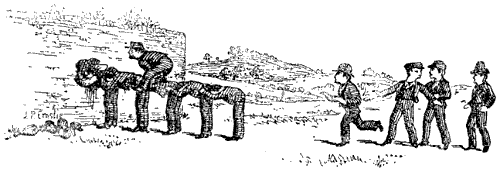
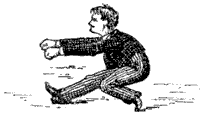
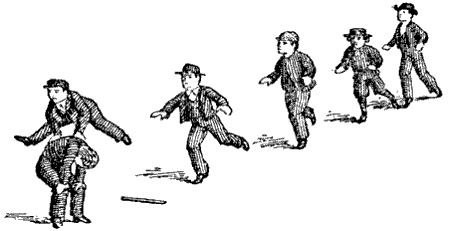
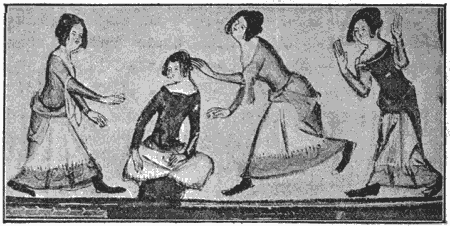
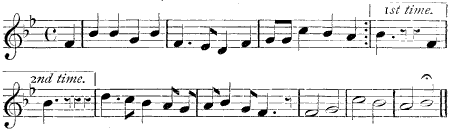
A cap or small article is placed on the back of a stooping
boy by other boys as each in turn jumps over him. The first
as he jumps says “Accroshay,” the second “Ashotay,” the
third “Assheflay,” and the last “Lament, lament, Leleeman’s (or
Leleena’s) war.” The boy who in jumping knocks off either
of the things has to take the place of the stooper.—Cornwall
(Folk-lore Journal, v. 58).
See “Leap-frog.”
“A meere children’s pastime” (A Curtaine Lecture, 1637,
p. 206). This is no doubt the game of “Hide and Seek,”
though Cotgrave apparently makes it synonymous with
“Hoodman Blind.” See Halliwell’s Dictionary. It is alluded
to in Dekker’s Satiromastix, “Our unhansomed-fac’d Poet
does play at Bo-peepes with your Grace, and cryes All-hidde,
as boyes doe.” Tourneur, Rev. Trag., III., v. 82, “A lady can
at such Al-hid beguile a wiser man,” is quoted in Murray’s
Dictionary as the first reference.
All a row, a bendy bow,
Shoot at a pigeon and kill a crow;
Shoot at another and kill his brother;
Shoot again and kill a wren,
And that’ll do for gentlemen.
—Northall’s English Folk Rhymes, p. 386.
This is a marching game for very little children, who follow
each other in a row.
(b) Halliwell gives the first two lines only (Nursery Rhymes,
No. dxv., p. 101), and there is apparently no other record of
this game. It is probably ancient, and formerly of some significance.
It refers to days of bows and arrows, and the
allusion to the killing of the wren may have reference to the
Manx and Irish custom of hunting that bird.
A juvenile game in Newcastle and the neighbourhood. A
circle is made, about eight inches in diameter, termed the well,
in the centre of which is placed a wooden peg four inches long,
with a button balanced on the top. Those desirous of playing
give buttons, marbles, or anything else, according to agreement,
for the privilege of throwing a short stick, with which they are
furnished, at the peg. Should the button fly out of the ring,
the player is entitled to double the stipulated value of what
he gives for the stick. The game is also practised at the Newcastle
Races and other places of amusement in the North with
three pegs, which are put into three circular holes made in the
ground about two feet apart, and forming a triangle. In this
case each hole contains a peg about nine inches long, upon
which are deposited either a small knife or some copper. The
person playing gives so much for each stick, and gets all the
articles that are thrown off so as to fall on the outside of the
holes.—Northumberland (Brockett’s North Country Glossary).
A Suffolk game, not described (Moor’s Suffolk Glossary).
Jamieson also gives it without description. Compare the rhyme
in the game “Fool, fool, come to School,” “Little Dog, I call you.”[Addendum]
I.
All the boys in our town
Shall lead a happy life,
Except ’tis ——, and he wants a wife.
A wife he shall have, and a-courting he shall go,
Along with ——, because he loves her so.
He huddles her, he cuddles her,
He sits her on his knee;
He says, My dear, do you love me?
I love you, and you love me,
And we shall be as happy
As a bird upon a tree.
The wife makes the pudding,
And she makes it nice and soft—
In comes the husband and cuts a slice off.
Tas-el-um, Tos-el-um, don’t say Nay,
For next Monday morning shall be our wedding day;
The wife in the carriage,
The husband in the cart.
—Hampshire (from friend of Miss Mendham).
II.
All the boys in our town
Leads a happy life,
Excepting [Charley Allen],
And he wants a wife;
And a-courting he shall go
Along with [girl’s name],
Because he loves her so.
He kisses her, he cuddles her,
He sets her on his knee,
And says, My dearest darling,
Do you love me?
I love you and you love me;
We’ll both be as happy
As birds on the tree.
Alice made a pudding,
She made it nice and sweet,
Up came Charley, cut a slice off—
A slice, a slice, we don’t say No;
The next Monday morning the wedding goes (or “is our wedding day”).
I’ve got knives and forks,
I’ve got plates and dishes,
I’ve got a nice young man,
He breaks his heart with kisses.
If poor Alice was to die,
Wouldn’t poor Charley, he would cry.
He would follow to the grave
With black buttons and black crape,
And a guinea for the church,
And the bell shall ring.
Up came the doctor, up came the cat,
Up came the devil with a white straw hat.
Down went the doctor, down went the cat,
Down went the devil with a white straw hat.[1]
—Deptford (Miss Chase).
III.
Up the heathery mountains and down the rushy glen
We dare not go a-hunting for Connor and his men;
They are all lusty bachelors but one I know,
And that’s [Tom Mulligan], the flower of the flock;
He is the flower of the flock, he is the keeper of the glen,
He courted [Kate O’Neill] before he was a man;
He huggled her, he guggled her, he took her on his knee,
Saying, My bonnie [Kate O’Neill], won’t you marry me?
So —— made a pudding so nice and so sweet,
Saying, Taste, love, taste, and don’t say no,
For next Sunday morning to church we will go.
With rings on our fingers and bells on our toes,
And a little baby in her arms, and that’s the way she goes.
And here’s a clap, and here’s a clap, for Mrs. ——’s daughter.
—Belfast (W. H. Patterson).
IV.
Up the plain and down the plain,
As stippy [slippery] as a glass,
We will go to Mrs. ——
To find a pretty lass.
[Annie] with her rosy cheeks,
Catch her if you can,
And if you cannot catch her
I’ll tell you who’s the man.
[Annie] made a pudding,
She made it very sweet;
She daren’t stick a knife in
Till George came home at neet [night].
Taste [George], taste, and don’t say Nay!
Perhaps to-morrow morning’ll be our wedding day.
[The bells shall ring, and we shall sing,
And all clap hands together.][2]
—Earls Heaton (Herbert Hardy).
(b) A full description of this game could not be obtained in
each case. The Earls Heaton game is played by forming a ring,
one child standing in the centre. After the first verse is sung, a
child from the ring goes to the one in the centre. Then the rest
of the verses are sung. The action to suit the words of the verses
does not seem to have been kept up. In the Hampshire version,
after the line “As a bird upon a tree,” the two children named
pair off like sweethearts while the rest of the verse is being sung.
(c) The analysis of the game rhymes is as follows:—
| |
Hants. |
Deptford (Kent). |
Belfast. |
Earls Heaton (Yorks.). |
| 1. |
Village life. |
Village life. |
Hunting life. |
Roving life. |
| 2. |
All the boys happy. |
All the boys happy. |
All lusty bachelors. |
— |
| 3. |
Except [ ], who wants a wife. |
Except [ ], who wants a wife. |
Except [ ], who courts [ ]. |
— |
| 4. |
He shall court [ ]. |
He shall court [ ]. |
He courted [ ]. |
Seeks for a bride. |
| 5. |
Huddles and cuddles, and sits on his knee. |
Kisses and cuddles, and sits on his knee. |
Huggled and guggled, and took on his knee. |
— |
| 6. |
— |
— |
— |
Catch the bride. |
| 7. |
Mutual expressions of love. |
Mutual expressions of love. |
— |
— |
| 8. |
— |
— |
Asking to marry. |
— |
| 9. |
Wife makes a pudding. |
Girl makes a pudding. |
Girl makes a pudding. |
Girl makes a pudding. |
| 10. |
Husband cuts a slice. |
Boy cuts a slice. |
Asks boy to taste. |
Asks boy to taste. |
| 11. |
Fixing of wedding day. |
Fixing of wedding day. |
Fixing of wedding day. |
Fixing of wedding day. |
| 12. |
Wife in carriage, husband in cart. |
Wife with domestic utensils. |
Bride with rings on fingers and bells on toes. |
— |
| 13. |
— |
Grief if wife should die. |
— |
— |
| 14. |
— |
— |
Bride with a baby. |
— |
| 15. |
— |
Doctor, cat, and devil. |
— |
— |
| 16. |
— |
— |
Applause for the bride. |
Applause for bride. |
[6]
It appears by the analysis that all the incidents of the Hants
version of this game occur in one or other of the versions,
and these incidents therefore may probably be typical of the
game. This view would exclude the important incidents of
bride capture in the Earls Heaton version; the bride having
a baby in the Belfast version, and the two minor incidents in
the Deptford version (Nos. 13 and 15 in the analysis), which
are obviously supplemental. Chambers, in his Popular Rhymes
of Scotland, pp. 119, 137, gives two versions of a courtship
dance which are not unlike the words of this game, though
they do not contain the principal incidents. Northall, in his
English Folk Rhymes, p. 363, has some verses of a similar
import, but not those of the game. W. Allingham seems to
have used this rhyme as the commencement of one of his
ballads, “Up the airy mountain.”
(d) The game is clearly a marriage game. It introduces two
important details in the betrothal ceremony, inasmuch as the
“huddling and cuddling” is typical of the rude customs at
marriage ceremonies once prevalent in Yorkshire, the northern
counties, and Wales, while the making of the pudding by the
bride and the subsequent eating together, are clearly analogies
to the bridal-cake ceremony. In Wales, the custom known as
“bundling” allowed the betrothing parties to go to bed in
their clothes (Brand, ii. 98). In Yorkshire, the bridal cake was
always made by the bride. The rudeness of the dialogue
seems to be remarkably noticeable in this game.
See “Mary mixed a Pudding up,” “Oliver, Oliver, follow
the King.”[Addendum] [Addendum]
A Suffolk game, not described.—Moor’s Suffolk Glossary.
See “Fool, fool, come to School,” “Little Dog, I call you.”
[Play version 1, version 2]
All the soldiers in the town,
They all bop down.
—Sporle, Norfolk (Miss Matthews).
The children form into a ring and sing the above words.
They “bop down” at the close of the verse. To “bop” means
in the Suffolk dialect “to stoop or bow the head.”—Moor.
A little amusing game played by young girls at country
schools. The same as “Drop Handkerchief,” except that the
penalty for not following exactly the course of the child pursued
is to “stand in the circle, face out, all the game afterwards;
if she succeed in catching the one, the one caught
must so stand, and the other take up the cap and go round
as before” (Mactaggart’s Gallovidian Encyclopædia). No explanation
is given of the name of this game.
See “Drop Handkerchief.”
I.
Betsy Blue came all in black,
Silver buttons down her back.
Every button cost a crown,
Every lady turn around.
Alligoshi, alligoshee,
Turn the bridle over my knee.
—Middleton (Burne’s Shropshire Folk-lore, p. 523).
II.
Barbara, Barbara, dressed in black,
Silver buttons all up your back.
Allee-go-shee, allee-go-shee,
Turn the bridle over me.
—Shepscombe, Gloucestershire (Miss Mendham).
III.
All-i-go-shee, alligoshee,
Turn the bridle over my knee.
My little man is gone to sea,
When he comes back he’ll marry me.
—Warwickshire (Northall’s Folk Rhymes, p. 394).
IV.
Darby’s son was dressed in black,
With silver buttons down his back.
Knee by knee, and foot by foot,
Turn about lady under the bush.
—Hersham, Surrey (Folk-lore Record, v. 87).
[8]
V.
Darby and Joan were dressed in black,
Sword and buckle behind their back.
Foot for foot, and knee for knee,
Turn about Darby’s company.
—Halliwell’s Nursery Rhymes, p. 121.
(b) The children form pairs, one pair following the other,
with their arms linked behind. While the first four lines are
repeated by all, they skip forward, and then skip back again.
At the end of the last line they turn themselves about without
loosing hands.
(c) Miss Burne includes this among obscure and archaic
games, and Halliwell-Phillips mentions it as a marching game.
The three first versions have something of the nature of an
incantation, while the fourth and fifth versions may probably
belong to another game altogether. It is not clear from the
great variation in the verses to which class the game
belongs.
An old English game undescribed.—Useful Transactions in
Philosophy, 1709, p. 43.
One child is called the “Angel,” another child the “Devil,”
and a third child the “Minder.” The children are given the
names of colours by the Minder. Then the Angel comes over
and knocks, when the following dialogue takes place.
Minder: “Who’s there?”
Answer: “Angel.”
Minder: “What do you want?”
Angel: “Ribbons.”
Minder: “What colour?”
Angel: “Red.”
Minder retorts, if no child is so named, “Go and learn your
A B C.” If the guess is right the child is led away. The
Devil then knocks, and the dialogue and action are repeated.—Deptford,
Kent (Miss Chase).
See “Fool, fool, come to School.”
[9]
The children join hands, and dance in a circle, “with a front
step, a back step, and a side step, round an invisible May-pole,”
singing—
Can you dance the Auntieloomie?
Yes, I can; yes, I can.
Then follows kissing.—Brigg, Lincolnshire (Miss Peacock).
[Play]
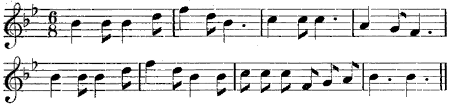
—Biggar (Wm. Ballantyne).
Wha learned you to dance,
You to dance, you to dance?
Wha learned you to dance
Babbity Bowster brawly?
My minnie learned me to dance,
Me to dance, me to dance;
My minnie learned me to dance
Babbity Bowster brawly.
Wha ga’e you the keys to keep,
Keys to keep, keys to keep?
Wha ga’e you the keys to keep,
Babbity Bowster brawly?
My minnie ga’e me the keys to keep,
Keys to keep, keys to keep;
My minnie ga’e me the keys to keep,
Babbity Bowster brawly.
One, twa, three, B, ba, Babbity,
Babbity Bowster neatly;
Kneel down, kiss the ground,
An’ kiss your bonnie lassie [or laddie].
—Biggar (W. H. Ballantyne).
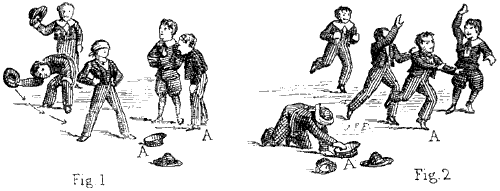
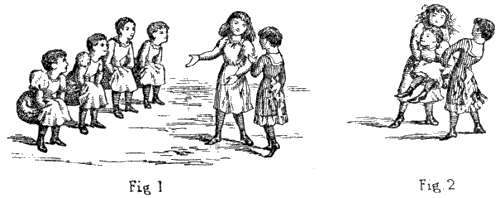
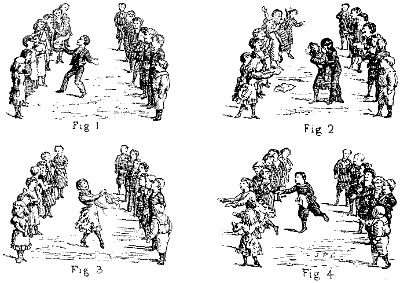
(b) Mr. Ballantyne describes the dance as taking place at
the end of a country ball. The lads all sat on one side and
the girls on the other. It began with a boy taking a handkerchief
and dancing before the girls, singing the first verse
(fig. 1). Selecting one of the girls, he threw the handkerchief
into her lap, or put it round her neck, holding both ends himself.
Some spread the handkerchief on the floor at the feet of
the girl. The object in either case was to secure a kiss, which,
however, was not given without a struggle, the girls cheering
their companion at every unsuccessful attempt which the boy
made (fig. 2). A girl then took the handkerchief, singing the
next verse (fig. 3), and having thrown the handkerchief to one
of the boys, she went off to her own side among the girls,
and was pursued by the chosen boy (fig. 4). When all were
thus paired, they formed into line, facing each other, and
danced somewhat like the country dance of Sir Roger.
(c) Chambers’ Popular Rhymes, p. 36, gives a slightly
different version of the verses, and says they were sung by
children at their sports in Glasgow. Mactaggart alludes to this
game as “‘Bumpkin Brawly,’ an old dance, the dance which
always ends balls; the same with the ‘Cushion’ almost.”
[11]
Wha learned you to dance,
You to dance, you to dance,
Wha learned you to dance
A country bumpkin brawly?
My mither learned me when I was young,
When I was young, when I was young,
My mither learned me when I was young,
The country bumpkin brawly.
The tune of this song is always played to the dance, says
Mactaggart, but he does not record the tune. To bab, in
Lowland Scottish, is defined by Jamieson to mean “to play
backward and forward loosely; to dance.” Hence he adds,
“Bab at the bowster, or Bab wi’ the bowster, a very old
Scottish dance, now almost out of use; formerly the last dance
at weddings and merry-makings.” Mr. Ballantyne says that a
bolster or pillow was at one time always used. One correspondent
of N. and Q., ii. 518, says it is now (1850) danced
with a handkerchief instead of a cushion as formerly, and no
words are used, but later correspondents contradict this. See
also N. and Q., iii. 282.
(d) Two important suggestions occur as to this game.
First, that the dance was originally the indication at a marriage
ceremony for the bride and bridegroom to retire with “the
bowster” to the nuptial couch. Secondly, that it has degenerated
in Southern Britain to the ordinary “Drop Handkerchief”
games of kiss in the ring. The preservation of this “Bab at
the Bowster” example gives the clue both to the origin of the
present game in an obsolete marriage custom, and to the
descent of the game to its latest form. See “Cushion Dance.”
A rude kind of “Cricket,” played with a bat and a ball,
usually with wall toppings for wickets. “Bad” seems to be the
pronunciation or variation of “Bat.” Halliwell says it was a
rude game, formerly common in Yorkshire, and probably resembling
the game of “Cat.” There is such a game played
now, but it is called “Pig.”—Easther’s Almondbury Glossary.
[12]
The game of “Hockey” in Cheshire.—Holland’s Glossary.
A rough game, sometimes seen in the country. The boy
who personates the Bear performs his part on his hands and
knees, and is prevented from getting away by a string. It is the
part of another boy, his Keeper, to defend him from the attacks
of the others.—Halliwell’s Dictionary.
This is a boys’ game, and is called “Buffet the Bear.” It
may be taken part in by any number. One boy—the Bear—goes
down on all fours, and lowers his head towards his breast
as much as possible. Into his hand is placed one end of a
piece of cord, and another boy, called the Keeper, takes hold
of the other end in one hand, while he has in the other his cap.
The other boys stand round, some with their caps in hand,
and others with their neckties or pocket-handkerchiefs, and on
a given signal they rush on the Bear and pelt him, trying
specially to buffet him about the ears and face, whilst the
Keeper does his best to protect his charge. If he happens to
strike a boy, that boy becomes the Bear, and the former Bear
becomes the Keeper, and so on the game goes.—Keith, Banffshire
(Rev. W. Gregor).
I saw this game played on Barnes Green, Surrey, on 25th
August 1892. The boys, instead of using their hats, had
pieces of leather tied to a string, with which they struck the
Bear on the back. They could only begin when the Keeper
cried, “My Bear is free.” If they struck at any other time, the
striker became the Bear. It is called “Baste the Bear.”—A. B.
Gomme.
Chambers (Popular Rhymes, p. 128) describes this game
under the title of “The Craw.” It was played precisely in the
same way as the Barnes game. The boy who holds the end
of the long strap has also a hard twisted handkerchief, called
the cout; with this cout he defends the Craw against the
attacks of the other boys, who also have similar couts. Before
beginning, the Guard of the Craw must call out—
Ane, twa, three, my Craw’s free.
The first one he strikes becomes the Craw. When the Guard
wants a respite, he calls out—
Ane, twa, three, my Craw’s no free.
(b) Jamieson defines “Badger-reeshil” as a severe blow;
borrowed, it is supposed, from the hunting of the badger, or
from the old game of “Beating the Badger.”
Then but he ran wi’ hasty breishell,
And laid on Hab a badger-reishill.
—MS. Poem.
Mr. Emslie says he knows it under the name of “Baste the
Bear” in London, and Patterson (Antrim and Down Glossary)
mentions a game similarly named. It is played at Marlborough
under the name of “Tom Tuff.”—H. S. May.
See “Doncaster Cherries.”
A bag o’ malt, a bag o’ salt,
Ten tens a hundred.
—Northall’s English Folk Rhymes, p. 394.
Two children stand back to back, linked near the armpits,
and weigh each other as they repeat these lines.
See “Weigh the Butter.”
I.
Stottie ba’, hinnie ba, tell to me
How mony bairns am I to hae?
Ane to live, and ane to dee,
And ane to sit on the nurse’s knee!
—Chambers’ Pop. Rhymes of Scotland, p. 115.
II.
Toss-a-ball, toss-a-ball, tell me true,
How many years I’ve got to go through!
—Burne’s Shropshire Folk-lore, p. 530.
(b) Children throw a ball in the air, repeating the rhyme,
and divine the length of their lives by the number of times
they can catch it again. In some places this game is played
with a cowslip ball, thence called a “tissy-ball.”
(c) I have heard other rhymes added to this, to determine
whether the players shall marry or not, the future husband’s
calling, dress to be worn, method of going to church, &c. (A. B.
Gomme). Strutt describes a handball game played during the
Easter holidays for Tansy cakes (Sports, p. 94). Halliwell gives
rhymes for ball divination (Popular Rhymes, p. 298) to determine
the number of years before marriage will arrive. Miss Baker
(Northamptonshire Glossary) says, “The May garland is suspended
by ropes from the school-house to an opposite tree, and
the Mayers amuse themselves by throwing balls over it. A
native of Fotheringay, Mr. C. W. Peach,” says Miss Baker,
“has supplied me with the reminiscences of his own youth.
He says the May garland was hung in the centre of the street,
on a rope stretched from house to house. Then was made the
trial of skill in tossing balls (small white leather ones) through
the framework of the garland, to effect which was a triumph.”
See “Cuck Ball,” “Keppy Ball,” “Monday.”
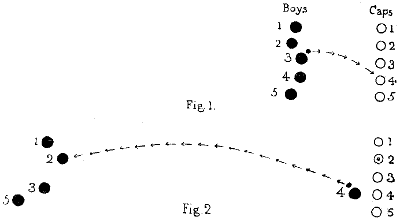
This is a boys’ game. The players may be of any number.
They place their caps or bonnets in a row. One of the boys
takes a ball, and from a fixed point, at a few yards’ distance
from the bonnets, tries to throw it into one of the caps (fig. 1).
If the ball falls into the cap, all the boys, except the one into
whose cap the ball has fallen, run off. The boy into whose
cap the ball has been thrown goes up to it, lifts the ball from
it, and calls out “Stop!” The other boys stop. The boy with
the ball tries to strike one of the other boys (fig. 2). If he
does so, a small stone is put into the cap of the boy struck. If
he misses, a stone is put into his own cap. If the boy who
is to pitch the ball into the cap misses, a stone is put into
his own cap, and he makes another trial. The game goes on
till six stones are put into one cap. The boy in whose cap are
the six stones has to place his hand against a wall, when he
receives a certain number of blows with the ball thrown with
force by one of the players. The blows go by the name of
“buns.” The game may go on in the same way till each player
gets his “buns.”—Nairn (Rev. W. Gregor).
See “Hats in Holes.”
A row of boys’ caps is set by a wall. One boy throws a ball
into one of the caps. The owner of the cap runs away, and is
chased by all the others till caught. He then throws the ball.—Dublin
(Mrs. Lincoln).
[Play]
We’ll wear yellow ribbons, yellow ribbons, yellow ribbons,
We’ll wear yellow ribbons at the Ball of Primrose;
We’ll all go a-waltzing, a-waltzing, a-waltzing,
We’ll all go a-waltzing at the Ball of Primrose.
—Epworth, Doncaster; and Lossiemouth, Yorkshire (Charles C. Bell).
(b) The children form a ring, joining hands, and dance round
singing the two first lines. Then loosing hands, they waltz in
couples, singing as a refrain the last line. The game is continued,
different coloured ribbons being named each time.
(c) This game was played in 1869, so cannot have arisen
from the political movement.
[16]
A game played with an inflated ball of strong leather, the
ball being struck by the arm, which was defended by a bracer
of wood.—Brand’s Pop. Antiq., ii. 394.
(b) It is spelt “balloo” in Ben Jonson, iii. 216, and “baloome”
in Randolph’s Poems, 1643, p. 105. It is also mentioned in
Middleton’s Works, iv. 342, and by Donne.
“’Tis ten a clock and past; all whom the mues,
Baloun, tennis, diet, or the stews
Had all the morning held.”
—Donne’s Poems, p. 133.
Toone (Etymological Dict.) says it is a game rather for
exercise than contention; it was well known and practised in
England in the fourteenth century, and is mentioned as one of
the sports of Prince Henry, son of James I., in 1610. Strutt
(Sports and Pastimes, p. 96) gives two illustrations of what
he considers to be baloon ball play, from fourteenth century
MSS.
A game played with sticks called “bandies,” bent and round
at one end, and a small wooden ball, which each party endeavours
to drive to opposite fixed points. Northbrooke in 1577
mentions it as a favourite game in Devonshire (Halliwell’s
Dict. of Provincialisms). Strutt says the bat-stick was called
a “bandy” on account of its being bent, and gives a drawing
from a fourteenth century MS. book of prayers belonging to
Mr. Francis Douce (Sports, p. 102). The bats in this drawing
are nearly identical with modern golf-sticks, and “Golf” seems
to be derived from this game. Peacock mentions it in his
Glossary of Manley and Corringham Words. Forby has an
interesting note in his Vocabulary of East Anglia, i. 14. He
says, “The bandy was made of very tough wood, or shod with
metal, or with the point of the horn or the hoof of some animal.
The ball is a knob or gnarl from the trunk of a tree, carefully
formed into a globular shape. The adverse parties strive to
beat it with their bandies through one or other of the goals.”
[17]
A game played with a nurr and crooked stick, also called
“Shinty,” and much the same as the “Hockey” of the South
of England. “Cad” is the same as “cat” in the game of
“Tip-cat;” it simply means a cut piece of wood.—Nodal and
Milner’s Lancashire Glossary.
A game at ball common in Norfolk, and played in a similar
manner to “Bandy” (Halliwell’s Dictionary). Toone (Etymological
Dictionary) says it is also played in Suffolk, and in
West Sussex is called “Hawky.”
The game of “Cricket,” played with a bandy instead of a
bat (Halliwell’s Dictionary). Toone mentions it as played in
Norfolk (Dict.), and Moor as played in Suffolk with bricks
usually, or, in their absence, with bats in place of bails or
stumps (Suffolk Words).
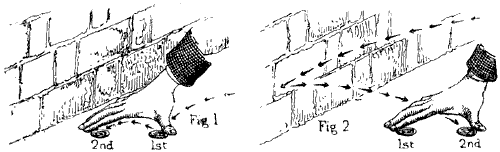
Each boy provides himself with a button. One of the boys
lays his button on the ground, near a wall. The other boys
snap their buttons in turn against the wall. If the button
drops within one span or hand-reach of the button laid down,
it counts two (fig. 2); if within two spans, it counts one.
When it hits the button and bounces within one span, it counts
four (fig. 1); within two spans, three; and above three spans,
one. Each player snaps in turn for an agreed number; the
first to score this number wins the game.—Deptford, Kent, and
generally in London streets (Miss Chase).
This game is known in America as “Spans.”—Newell, p. 188.
[18]
To play at “Bar,” a species of game anciently used in
Scotland.—Jamieson.
This game had in ancient times in England been simply
denominated “Bars,” or, as in an Act of James IV., 1491, edit.
1814, p. 227: “That na induellare within burgh . . . play
at bar,” “playing at Bars.”
See “Prisoner’s Base.”
I.
O will you surrender, O will you surrender
To the King of the Barbarie?
We won’t surrender, we won’t surrender
To the King of the Barbarie.
I’ll go and complaint, I’ll go and complaint
To the King of the Barbarie.
You can go and complaint, you can go and complaint
To the King of the Barbarie.
Good morning, young Prince, good morning, young Prince,
I have a complaint for you.
What is your complaint?
What is your complaint?
They won’t surrender, they won’t surrender
To the King of the Barbarie.
Take one of my brave soldiers,
Take one of my brave soldiers.
—Deptford, Kent (Miss Chase).
II.
Will you surrender, will you surrender
To the King of the Barbarines?
We won’t surrender, we won’t surrender
To the King of the Barbarines.
We’ll make you surrender, we’ll make you surrender
To the King of the Barbarines.
You can’t make us surrender, you can’t make us surrender
To the King of the Barbarines.
We’ll go to the King, we’ll go to the King,
To the King of the Barbarines.
You can go to the King, you can go to the King,
To the King of the Barbarines.
—Clapham, Surrey (Miss F. D. Richardson).
III.
Will you surrender, will you surrender
The Tower of Barbaree?
We won’t surrender, we won’t surrender
The Tower of Barbaree.
We will go and tell the Queen,
Go and tell the Queen of Barbaree.
Don’t care for the Queen, don’t care for the Queen,
The Queen of Barbaree.
Good morning, young Queen, good morning, young Queen,
I have a complaint to thee.
Pray what is your complaint to me?
They won’t surrender, they won’t surrender
The Tower of Barbaree.
Take one of my brave soldiers.
—Lady Camilla Gurdon’s Suffolk County Folk-lore, p. 63.
IV.
You must surrend’ me, you must surrend’ me
To the Queen of Barbaloo.
No, we’ll not surrend’ you, no, we’ll not surrend’ you
To the Queen of Barbaloo.
We’ll complain, we’ll complain, &c.
[To the Queen of Barbaloo.]
You can complain, you can complain, &c.
[To the Queen of Barbaloo.]
—Penzance (Mrs. Mabbott).
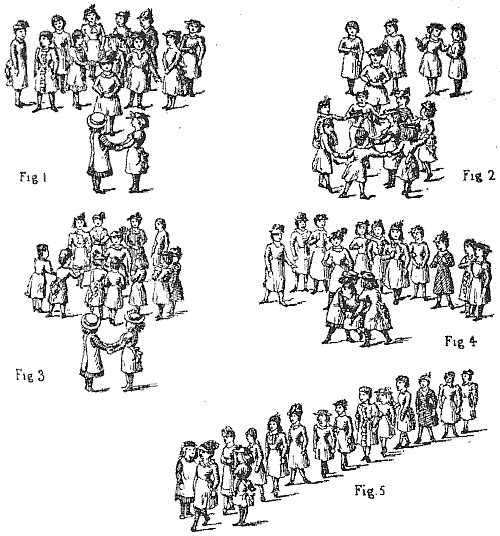
(b) Two children stand together joining hands tightly, to
personate a fortress; one child stands at a distance from these
to personate the King of Barbarie, with other children standing
behind to personate the soldiers (fig. 1). Some of the soldiers
go to the fortress and surround it, singing the first verse (fig. 2).
The children in the fortress reply, the four first verses being
thus sung alternately. The soldiers then go to the King
singing the fifth verse (fig. 3), the remaining verses being thus
sung alternately. One of the soldiers then goes to the fortress
and endeavours by throwing herself on the clasped hands of
the children forming the fortress to break down the guard
(fig. 4). All the soldiers try to do this, one after the other;
finally the King comes, who breaks down the guard. The whole
troop of soldiers then burst through the parted arms (fig. 5).
This is the Deptford version. The Clapham version is
almost identical; the children take hold of each others’ skirts
and make a long line. If the brave soldier is not able to break
the clasped hands he goes to the end of the line of soldiers.
The soldiers do not surround the fortress. In the Suffolk
version the soldiers try to break through the girls’ hands. If
they do they have the tower. The Cornwall version is not so
completely an illustration of the capture of a fortress.
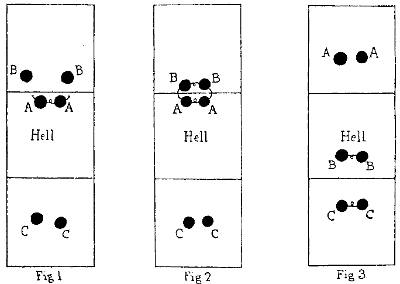
Barley-break, or the Last Couple in Hell, was a game played
by six people, three of each sex, who were coupled by lot. A
piece of ground was then chosen, and divided into three compartments,
of which the middle one was called Hell. It was
the object of the couple condemned to this division to catch
the others who advanced from the two extremities (figs. 1, 2),
in which case a change of situation took place, and Hell was
filled by the couple who were excluded by pre-occupation from
the other place (fig. 3). In this catching, however, there was
some difficulty, as by the regulations of the game the middle
couple were not to separate before they had succeeded, while
the others might break hands whenever they found themselves
hard pressed. When all had been taken in turn, the last
couple was said to be “in Hell,” and the game ended.—Dekker’s
Works, iv. 434.
Jamieson calls this “a game generally played by young
people in a corn-yard. Hence called barla-bracks about the
stacks, S. B.” (i. e., in the North of Scotland). “One stack is
fixed on as the dule or goal; and one person is appointed to
catch the rest of the company, who run out from the dule. He
does not leave it till they are all out of sight. Then he sets
off to catch them. Any one who is taken cannot run out again
with his former associates, being accounted a prisoner; but is
obliged to assist his captor in pursuing the rest. When all
are taken the game is finished; and he who was first taken is
bound to act as catcher in the next game. This innocent sport
seems to be almost entirely forgotten in the South of Scotland.
It is also falling into desuetude in the North.”
(b) The following description of Barley-break, written by Sir
Philip Sidney, is taken from the song of Lamon, in the first
volume of the Arcadia, where he relates the passion of Claius
and Strephon for the beautiful Urania:—
She went abroad, thereby,
At barley-brake her sweet, swift foot to try. . . .
Afield they go, where many lookers be.
Then couples three be straight allotted there,
They of both ends, the middle two, do fly;
The two that in mid-place Hell called were
Must strive, with waiting foot and watching eye,
To catch of them, and them to hell to bear,
That they, as well as they, may hell supply;
Like some that seek to salve their blotted name
Will others blot, till all do taste of shame.
There may you see, soon as the middle two
Do, coupled, towards either couple make,
They, false and fearful, do their hands undo;
Brother his brother, friend doth friend forsake,
Heeding himself, cares not how fellow do,
But of a stranger mutual help doth take;
As perjured cowards in adversity,
With sight of fear, from friends to friends do fly.
Sir John Suckling also has given a description of this pastime
with allegorical personages, which is quoted by Brand.
In Holiday’s play of the Marriages of the Arts, 1618, this
sport is introduced, and also by Herrick (Hesperides, p. 44).
Barley-break is several times alluded to in Massinger’s plays:
see the Dramatic Works of Philip Massinger, 1779, i. 167.
“We’ll run at barley-break first, and you shall be in hell”
(Dekker’s The Honest Whore). “Hee’s at barli-break, and
the last couple are now in hell” (Dekker’s The Virgin Martir).
See Gifford’s Massinger, i. 104, edit. 1813. See also Browne’s
Britannia’s Pastorals, published in 1614, Book I., Song 3, p. 76.
Randle Holme mentions this game as prevailing in his day
in Lancashire. Harland and Wilkinson believe this game to
have left its traces in Yorkshire and Lancashire. A couple
link hands and sally forth from home, shouting something like
Aggery, ag, ag,
Ag’s gi’en warning,
and trying to tick or touch with the free hand any of the boys
running about separately. These latter try to slip behind the
couple and throw their weight on the joined hands to separate
them without being first touched or ticked; and if they sunder
the couple, each of the severed ones has to carry one home on
his back. Whoever is touched takes the place of the toucher
in the linked couple (Legends of Lancashire, p. 138). The
modern name of this game is “Prison Bars” (Ibid., p. 141).
There is also a description of the game in a little tract called
Barley Breake; or, A Warning for Wantons, 1607. It is mentioned
in Wilbraham’s Cheshire Glossary as “an old Cheshire
game.” Barnes, in his Dorsetshire Glossary, says he has seen
it played with one catcher on hands and knees in the small
ring (Hell), and the others dancing round the ring crying
“Burn the wold witch, you barley breech.” Holland (Cheshire
Glossary) also mentions it as an old Cheshire game.
See “Boggle about the Stacks,” “Scots and English.”
Mr. Barnes is dead and gone,
And left his widder,
Three poor children in her arms;
What will you give her?
Where did you come from?
—Played about 1850 at Hurstmonceux, Sussex (Miss Chase).
This is probably a forfeit game, imperfectly remembered.
See “Old Soldier.”
An undescribed Suffolk game.—Moor’s Suffolk Words.
See “Rounders.”
[Play]
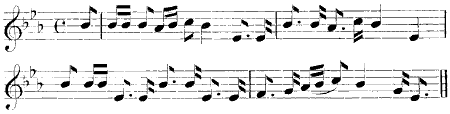
—London (A. B. Gomme).
In this game the children all follow one who is styled the
“mother,” singing:
I’ll follow my mother to market,
To buy a silver basket.
The mother presently turns and catches or pretends to beat
them.—Dorsetshire (Folk-lore Journal, vii. 231).
We’ll follow our mother to market,
To buy herself a basket;
When she comes home she’ll break our bones,
We’ll follow our mother to market.
—Hersham, Surrey (Folk-lore Record, v. 84).
A version familiar to me is the same as above, but ending
with
For tumbling over cherry stones.
The mother then chased and beat those children she caught.
The idea was, I believe, that the children were imitating or
mocking their mother (A. B. G.). In Warwickshire the four
lines of the Surrey game are concluded by the additional
lines—
We don’t care whether we work or no,
We’ll follow our mother on tipty-toe.
When the mother runs after them and buffets them.—Northall’s
English Folk Rhymes, p. 393.
See “Shuttlefeather.”
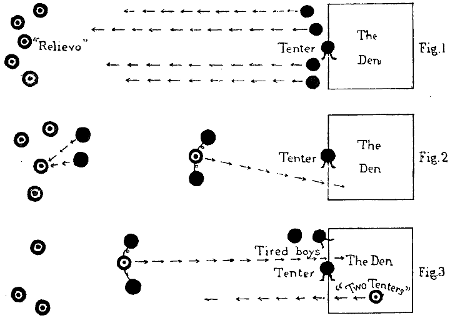
A number of boys agree to play at this game, and sides are
picked. Five, for example, play on each side. A square is
chalked out on a footpath by the side of a road, which is called
the “Den;” five of the boys remain by the side of the Den, one
of whom is called the “Tenter;” the Tenter has charge of the
Den, and he must always stand with one foot in the Den and the
other upon the road; the remaining five boys go out to field,
it being agreed beforehand that they shall only be allowed
to run within a prescribed area, or in certain roads or streets
(fig. 1). As soon as the boys who have gone out to field have
reached a certain distance—there is no limit prescribed—they
shout “Relievo,” and upon this signal the four boys standing
by the side of the Den pursue them, leaving the Tenter in charge
of the Den (fig. 2). When a boy is caught he is taken to the
Den, where he is obliged to remain, unless the Tenter puts both
his feet into the Den, or takes out the one foot which he ought
always to keep in the Den. If the Tenter is thus caught
tripping, the prisoner can escape from the Den. If during the
progress of the game one of the boys out at field runs through
the Den shouting “Relievo” without being caught by the
Tenter, the prisoner is allowed to escape, and join his comrades
at field. If one of the boys out at field is tired, and comes to
stand by the side of the Den, he is not allowed to put his foot
into the Den. If he does so the prisoner calls out, “There are
two Tenters,” and escapes if he can (fig. 3). When all the boys
out at field have been caught and put into the Den, the process
is reversed—the boys who have been, as it were, hunted, taking
the place of the hunters. Sometimes the cry is “Delievo,”
and not “Relievo.” One or two variations occur in the playing
of this game. Sometimes the Tenter, instead of standing with
one foot in the Den, stands as far off the prisoner as the
prisoner can spit. The choosing of sides is done by tossing.
Two boys are selected to toss. One of them throws up his
cap, crying, “Pot!” or “Lid!” which is equivalent to “Heads
and Tails.” If, when a prisoner is caught, he cries out
“Kings!” or “Kings to rest!” he is allowed to escape. The
game is a very rough one.—Addy’s Sheffield Glossary.
Jamieson gives this as the Scottish name for “Hopscotch;”
also Brockett, North Country Words.
I.
Bell-horses, bell-horses, what time of day?
One o’clock, two o’clock, three, and away!
Bell-horses, bell-horses, what time of day?
Two o’clock, three o’clock, four, and away!
Five o’clock, six o’clock, now time to stay!
—Stanton Lacey (Burne’s Shropshire Folk-lore, p. 520).
[27]
II.
Bellasay, bellasay, what time of day?
One o’clock, two o’clock, three, and away.
—Halliwell’s Nursery Rhymes, p. 283.
(b) The children form long trains, standing one behind the
other. They march and sing the first four lines, then the fifth
line, when they stand and begin again as before.
(c) Miss Burne suggests a connection with the old pack-horses.
Mr. Addy (Sheffield Glossary) gives the first two
lines as a game. He says, “The first horse in a team conveying
lead to be smelted wore bells, and was called the bell-horse.”
I remember when a child the two first lines being
used to start children a race (A. B. G.). Chambers (Pop.
Rhymes, p. 148) gives a similar verse, used for starting a race:—
Race horses, race horses, what time of day?
One o’clock, two o’clock, three, and away;
and these lines are also used for the same purpose in Cheshire
(Holland’s Glossary) and Somersetshire (Elworthy’s Glossary).
Halliwell, on the strength of the corrupted word “Bellasay,”
connects the game with a proverbial saying applied to the family
of Bellasis; but there is no evidence of such a connection
except the word-corruption. The rhyme occurs in Gammer
Gurton’s Garland, 1783, the last words of the second line
being “time to away.”
The name for “Blind Man’s Buff” in Upper Clydesdale. As
anciently in this game he who was the chief actor was not
only hoodwinked, but enveloped in the skin of an animal.—Jamieson.
See “Blind Man’s Buff.”
The name for “Blind Man’s Buff” in Roxburgh, Clydesdale,
and other counties of the border. It is probable that the
term is the same with “Billy Blynde,” said to be the name of a
familiar spirit or good genius somewhat similar to the brownie.—Jamieson.
See “Blind Man’s Buff.”
[28]
A boys’ phrase for a slide on a pond when the ice is thin and
bends. There is a game on the ice called playing at “Bend-leather.”
Whilst the boys are sliding they say “Bend-leather,
bend-leather, puff, puff, puff.”—Addy’s Sheffield Glossary.
[Play]
Hi, Betsy Bungay, all day on Sunday;
You’re the lock and I’m the key,
All day on Monday.
—Kent (J. P. Emslie).
Two children cross their hands in the fashion known as a
“sedan chair.” A third child sits on their hands. The two
sing the first line. One of them sings, “You’re the lock,” the
other sings, “and I’m the key,” and as they sang the words
they unclasped their hands and dropped their companion on
the ground. Mr. J. P. Emslie writes, “My mother learned
this from her mother, who was a native of St. Laurence, in the
Isle of Thanet. The game possibly belongs to Kent.”
In Somersetshire the game of “Hide and Seek.” To bik’ee
is for the seekers to go and lean their heads against a wall, so
as not to see where the others go to hide.—Elworthy’s Dialect.
See “Hide and Seek.”
A Lincolnshire name for “Prisoner’s Base.”—Halliwell’s
Dictionary; Peacock’s Manley and Corringham Glossary;
Cole’s S. W. Lincolnshire Glossary.
Name for “Blind Man’s Buff.”—Dickinson’s Cumberland
Glossary.
The Derbyshire name for “Tip-cat.”—Halliwell’s Dictionary.
[29]
A name for “Prisoner’s Base.”—Halliwell’s Dictionary.
[Play]
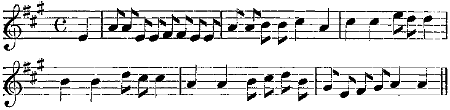
—Leicestershire.
[Play]
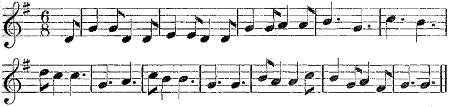
—Hexham.
[Play]
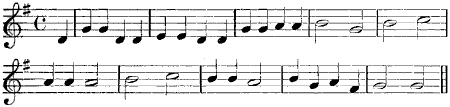
—Derbyshire.
[Play]
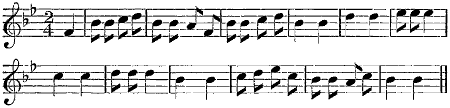
—Earls Heaton, Yorks.
[Play]
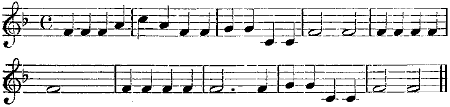
—Enborne.
I.
The miller’s mill-dog lay at the mill-door,
And his name was Little Bingo.
B with an I, I with an N, N with a G, G with an O,
And his name was Little Bingo.
The miller he bought a cask of ale,
And he called it right good Stingo.
S with a T, T with an I, I with an N, N with a G, G with an O,
And he called it right good Stingo.
The miller he went to town one day,
And he bought a wedding Ring-o!
R with an I, I with an N, N with a G, G with an O,
And he bought a wedding Ring-o!
—Monton, Lancashire (Miss Dendy).
II.
A farmer’s dog lay on the floor,
And Bingo was his name O!
B, i, n, g, o, B, i, n, g, o,
And Bingo was his name O!
The farmer likes a glass of beer,
I think he calls it Stingo!
S, t, i, n, g, o, S, t, i, n, g, o!
I think he calls it Stingo!
S, t, i, n, g, O! I think he calls it Stingo!
—Market Drayton, Ellesmere, Oswestry (Burne’s Shropshire Folk-lore, p. 513).
III.
There was a jolly farmer,
And he had a jolly son,
And his name was Bobby Bingo.
BINGO, BINGO, BINGO,
And Bingo was his name.
—Liphook, Hants; Wakefield, Yorks (Miss Fowler).
IV.
There was a farmer had a dog,
His name was Bobby Bingo.
B-i-n-g-o, B-i-n-g-o, B-i-n-g-o,
His name was Bobby Bingo.
—Tean, Staffs.; and North Staffs. Potteries (Miss Keary).
V.
The farmer’s dog lay on the hearth,
And Bingo was his name oh!
B-i-n-g-o, B-i-n-g-o, B-i-n-g-o,
And Bingo was his name oh!
—Nottinghamshire (Miss Winfield).
[31]
VI.
The miller’s dog lay on the wall,
And Bingo was his name Oh!
B-i-n-g-o,
And Bingo was his name Oh!
—Maxey, Northants (Rev. W. D. Sweeting).
VII.
The shepherd’s dog lay on the hearth,
And Bingo was his name O.
B i n g o, Bi, n, g, o, Bi-n-g-o,
And Bingo was his name O.
—Eckington, Derbyshire (S. O. Addy).
VIII.
Pinto went to sleep one night,
And Pinto was his name oh!
P-i-n-t-o, P-i-n-t-o,
And Pinto was his name oh.
—Enbourne, Berks (Miss Kimber).
(b) In the Lancashire version, one child represents the Miller.
The rest of the children stand round in a circle, with the Miller
in the centre. All dance round and sing the verses. When
it comes to the spelling part of the rhyme, the Miller points
at one child, who must call out the right letter. If the child
fails to do this she becomes Miller. In the Shropshire version,
a ring is formed with one player in the middle. They dance
round and sing the verses. When it comes to the spelling part,
the girl in the middle cries B, and signals to another, who says
I, the next to her N, the third G, the fourth “O! his name
was Bobby Bingo!” Whoever makes a mistake takes the
place of the girl in the middle. In the Liphook version, at the
fourth line the children stand still and repeat a letter each in
turn as quickly as they can, clapping their hands, and at the
last line they turn right round, join hands, and begin again.
In the Tean version, the one in the centre points, standing
still, to some in the ring to say the letters B.I.N.G; the letter
O has to be sung; if not, the one who says it goes in the ring,
and repeats it all again until the game is given up. In the
other Staffordshire version, when they stop, the one in the
middle points to five of the others in turn, who have to say the
letters forming “Bingo,” while the one to whom O comes has
to sing it on the note on which the others left off. Any one
who says the wrong letter, or fails to sing the O right, takes
the place of the middle one. The Northants version follows
the Lancashire version, but if the answers are all made correctly,
the last line is sung by the circle, and the game begins
again. In the Metheringham version the child in the centre is
blindfolded. When the song is over the girls say, “Point with
your finger as we go round.” The girl in the centre points
accordingly, and whichever of the others happens to be opposite
to her when she says “Stop!” is caught. If the blindfolded
girl can identify her captive they exchange places, and
the game goes on as before. The Forest of Dean and the
Earls Heaton versions are played the same as the Lancashire.
In the West Cornwall version, as seen played in 1884, a
ring is formed, into the middle of which goes a child holding
a stick; the others with joined hands run round in a circle,
singing the verses. When they have finished singing they
cease running, whilst the one in the centre, pointing with his
stick, asks them in turn to spell Bingo. If they all spell it
correctly they again move round singing; but should either
of them make a mistake, he or she has to take the place of the
middle man (Folk-lore Journal, v. 58). In the Hexham version
they sing a second verse, which is the same as the first with
the name spelt backwards. The Berks version is practically
the same as the Tean version. The Eckington (Derbyshire)
version is played as follows:—A number of young women form
a ring. A man stands within the ring, and they sing the
words. He then makes choice of a girl, who takes his arm.
They both walk round the circle while the others sing the same
lines again. The girl who has been chosen makes choice of a
young man in the ring, who in his turn chooses another girl,
and so on till they have all paired off.
(c) The first verse of the Shropshire version is also sung at
Metheringham, near Lincoln (C. C. Bell), and Cowes, I. W.
(Miss E. Smith). The Staffordshire version of the words is
sung in Forest of Dean, Gloucestershire (Miss Matthews),
West Cornwall (Folk-lore Journal, v. 58), Earls Heaton, Yorkshire
(H. Hardy), Hexham, Northumberland (Miss Barker),
Leicester (Miss Ellis). Miss Peacock says, “A version is
known in Lincolnshire.” Tunes have also been sent from
Tean, North Staffs. (Miss Keary), and Epworth, Doncaster
(Mr. C. C. Bell), which are nearly identical with the Leicester
tune; from Market Drayton (Miss Burne), similar to the
Derbyshire tune; from Monton, Lancashire (Miss Dendy),
which appears to be only the latter part of the tune, and is
similar to those given above. The tune given by Rimbault is
not the same as those collected above, though there is a certain
similarity.
The editor of Northamptonshire Notes and Queries, vol. i.
p. 214, says, “Some readers will remember that Byngo is the
name of the ‘Franklyn’s dogge’ that Ingoldsby introduces
into a few lines described as a portion of a primitive ballad,
which has escaped the researches of Ritson and Ellis, but is
yet replete with beauties of no common order.” In the Nursery
Songs collected by Ed. Rimbault from oral tradition is “Little
Bingo.” The words of this are very similar to the Lancashire
version of the game sent by Miss Dendy. There is an
additional verse in the nursery song.
A row of boys or girls stands parallel with another row
opposite. Each of the first row chooses the name of some
bird, and a member of the other row then calls out all the
names of birds he can think of. If the middle member of the
first row has chosen either of them, he calls out “Yes,” and
all the guessers immediately run to take the place of the first
row, the members of which attempt to catch them. If any
succeed, they have the privilege of riding in on their captives’
backs.—Ogbourne, Wilts (H. S. May).
| B |
× |
× |
× |
× |
× |
× |
× |
h |
= |
Bullfinch |
| E |
× |
× |
× |
× |
× |
× |
t |
|
= |
Elephant |
| S |
× |
× |
× |
× |
× |
× |
× |
h |
= |
Swordfish |
This is a slate game, and two or more children play. One
writes the initial and final letters of a bird’s, beast’s, or fish’s
name, making crosses (×) instead of the intermediate letters of
the word, stating whether the name is that of bird, beast, or fish.
The other players must guess in turn what the name is. The
first one who succeeds takes for himself the same number of
marks as there are crosses in the word, and then writes the
name of anything he chooses in the same manner. If the
players are unsuccessful in guessing the name, the writer takes
the number to his own score and writes another. The game is
won when one player gains a certain number of marks previously
decided upon as “game.”—Barnes (A. B. Gomme).
The Sussex game of “Stoolball.” There is a tradition that
this game was originally played by the milkmaids with their
milking-stools, which they used for bats; but this word makes
it more probable that the stool was the wicket, and that it was
defended with the bittle, which would be called the bittle-bat.—Parish’s
Sussex Dialect.
See “Stoolball.”
Bishop Kennet (in MS. Lansd. 1033) gives this name as a
term for “Prisoner’s Base.”—Halliwell’s Dictionary.
A long rope is tied to a gate or pole, and one of the players
holds the end of the rope, and tries to catch another player.
When he succeeds in doing so the one captured joins him (by
holding hands) and helps to catch the other players. The
game is finished when all are caught.—Cork (Miss Keane).
[Play]
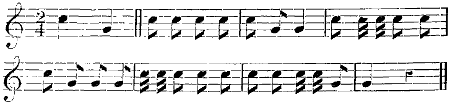
—Earls Heaton, Yorks.
I.
Blackthorn!
Butter-milk and barley-corn;
How many geese have you to-day?
As many as you can catch and carry away.
—Monton, Lancashire (Miss Dendy).
II.
Blackthorn! Blackthorn!
Blue milk and barley-corn;
How many geese have you to-day?
More than you can catch and carry away.
—Harland and Wilkinson’s Lancashire Folk-lore, p. 150.
III.
Blackthorn!
New milk and barley-corn;
How many sheep have you to sell?
More nor yo can catch and fly away wi’.
—Addy’s Sheffield Glossary.
IV.
Blackthorn!
Butter-milk and barley-corn;
How many sheep have you to-day?
As many as you catch and carry away.
—Earls Heaton, Yorkshire (Herbert Hardy).
(b) One set of children stand against a wall, another set stand
opposite, facing them. The first set sing the first line, the
others replying with the second line, and so with the third and
fourth lines. The two sides then rush over to each other, and
the second set are caught. The child who is caught last becomes
one of the first set for another game. This is the Earls Heaton
version. The Lancashire game, as described by Miss Dendy,
is: One child stands opposite a row of children, and the row
run over to the opposite side, when the one child tries to catch
them. The prisoners made, join the one child, and assist her
in the process of catching the others. The rhyme is repeated
in each case until all are caught, the last one out becoming
“Blackthorn” for a new game. Harland and Wilkinson describe
the game somewhat differently. Each player has a
mark, and after the dialogue the players run over to each
other’s marks, and if any can be caught before getting home
to the opposite mark, he has to carry his captor to the mark,
when he takes his place as an additional catcher.
(c) Miss Burne’s version (Shropshire Folk-lore, p. 521) is
practically the same as the Earls Heaton game, and Easther
in his Almondbury Glossary gives a version practically like the
Sheffield. Mr. Hardy says it is sometimes called “Black-butt,”
when the opposite side cry “Away we cut.” Miss Dendy
quotes an old Lancashire rhyme, which curiously refers to
the different subjects in the Lancashire game rhyme. It is
as follows:—
Little boy, little boy, where were you born?
Way up in Lancashire, under a thorn,
Where they sup butter-milk in a ram’s horn.
Another version is given in Notes and Queries, 3rd Series,
vii. 285.
(d) This is a dramatic game, in which the children seem to
personate animals, and to depict events belonging to the history
of the flock. Miss Burne groups it under her “dramatic
games.”
A game formerly common in Berwickshire, in which all the
players were hoodwinked except the person who was called
the Bell. He carried a bell, which he rung, still endeavouring
to keep out of the way of his hoodwinked partners in the
game. When he was taken, the person who seized him was
released from the bandage, and got possession of the bell, the
bandage being transferred to him who was laid hold of.—Jamieson.
(b) In “The Modern Playmate,” edited by Rev. J. G. Wood,
this game is described under the name of “Jingling.” Mr.
Wood says there is a rougher game played at country feasts
and fairs in which a pig takes the place of the boy with the
bell, but he does not give the locality (p. 7). Strutt also
describes it (Sports, p. 317).
In Somersetshire the game of “Blind Man’s Buff.” Also in
Cornwall (see Couch’s Polperro, p. 173). Pulman says this
means “Blind buck and have ye” (Elworthy’s Dialect).
[37]
A name for “Blind Man’s Buff.”—Jamieson.
The Suffolk name for “Blind Man’s Buff.”—Halliwell’s Dictionary;
Moor’s Suffolk Glossary.
I.
Come, shepherd, come, shepherd, and count your sheep.
I canna come now, for I’m fast asleep.
If you don’t come now they’ll all be gone.
What’s in my way?
A bottle of hay.
Am I over it?
—Shrewsbury (Burne’s Shropshire Folk-lore, p. 525).
II.
How many fingers do I hold up?
Four, three, &c. [at random in reply].
How many horses has your father?
Three [fixed reply].
What colour?
White, red, and grey.
Turn you about three times;
Catch whom you may!
—Deptford (Miss Chase).
III.
How many horses has your father got in his stables?
Three.
What colour are they?
Red, white, and grey.
Then turn about, and twist about, and catch whom you may.
—Cornwall (Folk-lore Journal, v. 57, 58).
IV.
Antony Blindman kens ta me
Sen I bought butter and cheese o’ thee?
I ga’ tha my pot,
I ga’ tha my pan,
I ga’ tha a’ I hed but a rap ho’penny I gave a poor oald man.
—Cumberland (Dickinson’s Glossary).
(b) In the Deptford version one of the players is blindfolded.
The one who blindfolds ascertains that the player cannot see
by putting the first question. When the players are satisfied
that the blindfolding is complete, the dialogue follows, and the
blind man is turned round three times. The game is for him
to catch one of the players, who is blindfolded in turn if the
blind man succeeds in guessing who he is. Players are allowed
to pull, pinch, and buffet the blind man.
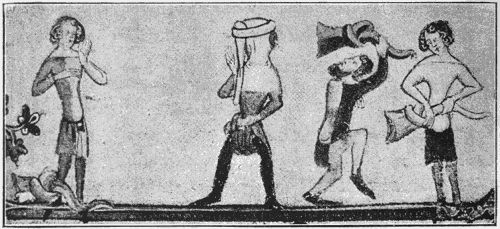
(c) This sport is found among the illuminations of an old
missal formerly in the possession of John Ives, cited by Strutt
in his Manners and Customs. The two illustrations are facsimiles
from drawings in one of the Bodleian MSS., and they
indicate the complete covering of the head, and also the fact
that the game was played by adults. Gay says concerning it—
As once I play’d at blindman’s-buff, it hap’t,
About my eyes the towel thick was wrapt.
I miss’d the swains, and seiz’d on Blouzelind.
And another reference is quoted by Brand (ii. 398)—
Sometyme the one would goe, sometyme the other,
Sometymes all thre at once, and sometyme neither;
Thus they with him play at boyes blynde-man-bluffe.
—The Newe Metamorphosis, 1600, MS.
Other names for this game are “Belly Mantie,” “Billy Blind,”
“Blind Bucky Davy,” “Blind Harie,” “Blind Hob,” “Blind
Nerry Mopsey,” “Blind Palmie,” “Blind Sim,” “Buck Hid,”
“Chacke Blynd Man,” “Hoodle-cum-blind,” “Hoodman Blind,”
“Hooper’s Hide,” “Jockie Blind Man.”
(d) There is some reason for believing that this game can
be traced up to very ancient rites connected with prehistoric
worship. The name “Billy Blind” denoted the person who
was blindfolded in the game, as may be seen by an old poem
by Lyndsay, quoted by Jamieson:
War I ane King
I sould richt sone mak reformatioun
Farlyeand thairof your grace sould richt sone finde
That Preistis sall leid yow lyke are bellye blinde.
And also in Clerk’s Advice to Luvaris:
Sum festnit is and ma not flé,
Sum led is lyk the belly blynd
With luve, war bettir lat it be.
“It is probable,” says Jamieson, “that the term is the same
as Billy Blynde, said to be the name of a familiar spirit or good
genius somewhat similar to the brownie.” Professor Child
identifies it with Odin, the blind deity. Another name in Scotland
is also “Blind Harie,” which is not the common Christian
name “Harry,” because this was not a name familiar in
Scotland. Blind Harie may therefore, Jamieson thinks, arise
from the rough or hairy attire worn by the principal actor.
Auld Harie is one of the names given to the devil, and also
to the spirit Brownie, who is represented as a hairy being.
Under “Coolin,” a curious Highland custom is described by
Jamieson, which is singularly like the game of “Belly Blind,”
and assists in the conclusion that the game has descended from
a rite where animal gods were represented. Sporting with
animals before sacrificing them was a general feature at these
rites. It is known that the Church opposed the people imitating
beasts, and in this connection it is curious to note that
in South Germany the game is called blind bock, i. e., “blind
goat,” and in German blinde kuhe, or “blind cow.” In Scotland,
one of the names for the game, according to A. Scott’s
poems, was “Blind Buk”:
Blind buk! but at the bound thou schutes,
And them forbeirs that the rebutes.
It may therefore be conjectured that the person who was hoodwinked
assumed the appearance of a goat, stag, or cow by
putting on the skin of one of those animals.
He who is twice crowned or touched on the head by the
taker or him who is hoodwinked, instead of once only, according
to the law of the game, is said to be brunt (burned), and regains
his liberty.—Jamieson.
A boys’ game, played with the eggs of small birds. The eggs
are placed on the ground, and the player who is blindfolded
takes a certain number of steps in the direction of the eggs;
he then slaps the ground with a stick thrice in the hope of
breaking the eggs; then the next player, and so on.—Patterson’s
Antrim and Down Glossary.
The Whitby name for “Blind Man’s Buff.”—Robinson’s
Glossary.
One of the names given to the game of “Blindman’s Buff.”—Jamieson.
Suffolk name for “Blind Man’s Buff.”—Forby’s Vocabulary
of East Anglia.
[41]
This is a boys’ game, and requires seven players. One boy,
the Block, goes down on all fours; another, the Nail, does the
same behind the Block, with his head close to his a posteriori
part. A third boy, the Hammer, lies down on his back behind
the two. Of the remaining four boys one stations himself at
each leg and one at each arm of the Hammer, and he is thus
lifted. He is swung backwards and forwards three times in
this position by the four, who keep repeating “Once, twice,
thrice.” When the word “Thrice” is repeated, the a posteriori
part of the Hammer is knocked against the same part of the
Nail. Any number of knocks may be given, according to the
humour of the players.—Keith (Rev. W. Gregor).
A fellow lies on all fours—this is the Block; one steadies
him before—this is the Study; a third is made a Hammer of,
and swung by boys against the Block (Mactaggart’s Gallovidian
Encyclopædia). Patterson (Antrim and Down Glossary) mentions
a game, “Hammer, Block, and Bible,” which is probably
the same game.
Strutt considers this to have been a children’s game, played
by blowing an arrow through a trunk at certain numbers by
way of lottery (Sports, p. 403). Nares says the game was
blowing small pins or points against each other, and probably
not unlike “Push-pin.” Marmion in his Antiquary, 1641,
says: “I have heard of a nobleman that has been drunk with
a tinker, and of a magnifico that has played at blow-point.”
In the Comedy of Lingua, 1607, act iii., sc. 2, Anamnestes introduces
Memory as telling “how he played at blowe-point with
Jupiter when he was in his side-coats.” References to this
game are also made in Apollo Shroving, 1627, p. 49; and see
Hawkins’ English Drama, iii. 243.
See “Dust-Point.”
A children’s game, consisting in jumping at cherries above
their heads and trying to catch them with their mouths
(Halliwell’s Dictionary). It is alluded to in Herrick’s
Hesperides as “Chop Cherry.” Major Lowsley describes the
game as taking the end of a cherry-stalk between the teeth,
and holding the head perfectly level, trying to get the cherry
into the mouth without using the hands or moving the head
(Berkshire Glossary). It is also mentioned in Peacock’s
Manley and Corringham Glossary. Strutt gives a curious
illustration of the game in his Sports and Pastimes, which is
here reproduced from the original MS. in the British Museum.
The Staffordshire St. Clement Day custom (Poole’s Staffordshire
Customs, &c., p. 36) and the northern Hallowe’en custom
(Brockett’s North-Country Words) probably indicate the origin
of this game from an ancient rite.
A favourite play among young people in the villages, in
which one hunts several others (Brockett’s North-Country
Words). The game is alluded to in one of the songs given by
Ritson (ii. 3), and Jamieson describes it as a Scottish game.
See “Barley-break.”
The child’s play of finding the hidden person in the company.—Robinson’s
Whitby Glossary. See “Hide and Seek.”
[43]
This is a boys’ game. The players place their bonnets or
caps in a pile. They then join hands and stand in a circle
round it. They then pull each other, and twist and wriggle
round and round and over it, till one overturns it or knocks
a bonnet off it. The player who does so is hoisted on the
back of another, and pelted by all the others with their bonnets.—Keith,
Nairn (Rev. W. Gregor).
[Play]
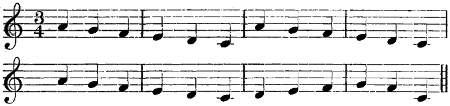
—Norfolk.
Dill doule for Booman, Booman is dead and gone,
Left his wife all alone, and all his children.
Where shall we bury him? Carry him to London;
By his grandfather’s grave grows a green onion.
Dig his grave wide and deep, strow it with flowers;
Toll the bell, toll the bell, twenty-four hours.
—Norfolk, 1825-30 (J. Doe).
(b) One boy lies down and personates Booman. Other boys
form a ring round him, joining hands and alternately raising
and lowering them, to imitate bell-pulling, while the girls who
play sit down and weep. The boys sing the first verse. The
girls seek for daisies or any wild flowers, and join in the singing
of the second verse, while the boys raise the prostrate
Booman and carry him about. When singing the third verse
the boys act digging a grave, and the dead boy is lowered.
The girls strew flowers over the body. When finished another
boy becomes Booman.
(c) This game is clearly dramatic, to imitate a funeral. Mr.
Doe writes, “I have seen somewhere [in Norfolk] a tomb with
a crest on it—a leek—and the name Beaumont,” but it does
not seem necessary to thus account for the game.
[44]
A game at marbles. Strutt describes it as follows:—“One
bowls a marble to any distance that he pleases, which serves as
a mark for his antagonist to bowl at, whose business it is to hit
the marble first bowled, or lay his own near enough to it for
him to span the space between them and touch both the
marbles. In either case he wins. If not, his marble remains
where it lay, and becomes a mark for the first player, and so
alternately until the game be won.”—Sports, p. 384.
The same as “Boss-out.” It is mentioned, but not described,
in Baker’s Northamptonshire Glossary.
[Play]
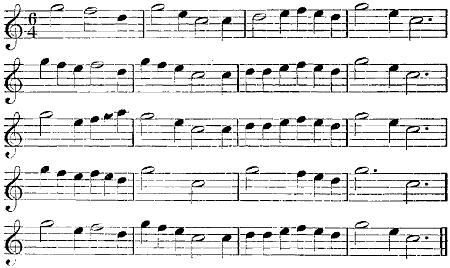
—The Dancing Master, 1728, vol. ii., p. 138.
Boys, boys, come out to play,
The moon doth shine as bright as day;
Come with a whoop, come with a call,
Come with a goodwill or don’t come at all;
Lose your supper and lose your sleep,
So come to your playmates in the street.
—Useful Transactions in Philosophy, p. 44.
This rhyme is repeated when it is decided to begin any
game, as a general call to the players. The above writer says
it occurs in a very ancient MS., but does not give any reference
to it. Halliwell quotes the four first lines, the first line reading
“Boys and girls,” instead of “Boys, boys,” from a curious
ballad written about the year 1720, formerly in the possession
of Mr. Crofton Croker (Nursery Rhymes). Chambers also
gives this rhyme (Popular Rhymes, p. 152).
A game formerly common at fairs, called also “Hit my Legs
and miss my Pegs.”—Dickinson’s Cumberland Glossary.
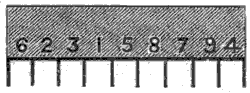
A game at marbles. The boys have a board a foot long,
four inches in depth, and an inch (or
so) thick, with squares as in the diagram;
any number of holes at the
ground edge, numbered irregularly.
The board is placed firmly on the ground, and each player
bowls at it. He wins the number of marbles denoted by the
figure above the opening through which his marble passes. If
he misses a hole, his marble is lost to the owner of the Bridgeboard.—Earls
Heaton (Herbert Hardy). [The owner or keeper
of the Bridgeboard presumably pays those boys who succeed
in winning marbles.]
See “Nine Holes.”
A boys’ game, undescribed.—Patterson’s Antrim and Down
Glossary.
Ebenezer is sent out of the room, and the remainder choose
one of themselves. Two children act in concert, it being
understood that the last person speaking when Ebenezer goes
out of the room is the person to be chosen. The medium left in
the room causes the others to think of this person without letting
them know that they are not choosing of their own free will.
The medium then says, “Brother Ebenezer, come in,” and asks
him in succession, “Was it William, or Jane,” &c., mentioning
several names before saying the right one, Ebenezer saying
“No!” to all until the one is mentioned who last spoke.—Bitterne,
Hants (Mrs. Byford).
A child’s game, undescribed.—Halliwell’s Dictionary.
The name of a game probably the same as “Nine Holes.”—Halliwell’s
Dictionary.
A boy stoops so that his arms rest on a table; another boy
sits on him as he would on a horse. He then holds up (say)
three fingers, and says—
Buck, buck, how many horns do I hold up?
The stooping boy guesses, and if he says a wrong number
the other says—
[Two] you say and three there be;
Buck, buck, how many horns do I hold up?
When the stooping boy guesses rightly the other says—
[Four] you say and [four] there be;
Buck, buck, rise up.
The boy then gets off and stoops for the other one to mount,
and the game is played again.—London (J. P. Emslie).
Similar action accompanies the following rhyme:—
Inkum, jinkum, Jeremy buck,
Yamdy horns do au cock up?
Two thà sès, and three there is,
Au’ll lea’n thee to la’ke at Inkum.
—Almondbury (Easther’s Glossary).
A different action occurs in other places. It is played by
three boys in the following way:—One stands with his back
to a wall; the second stoops down with his head against the
stomach of the first boy, “forming a back;” the third jumps on
it, and holds up his hand with the fingers distended, saying—
Buck shee, buck shee buck,
How many fingers do I hold up?
Should the stooper guess correctly, they all change places,
and the jumper forms the back. Another and not such a rough
way of playing this game is for the guesser to stand with his
face towards a wall, keeping his eyes shut.—Cornwall (Folk-lore
Journal, v. 59).
In Nairn, Scotland, the game is called Post and Rider. One
boy, the Post, takes his stand beside a wall. Another boy stoops
down with his head touching the Post’s breast. Several other
boys stoop down in the same way behind the first boy, all in
line. The Rider then leaps on the back of the boy at the end
of the row of stooping boys, and from his back to that of the
one in front, and so on from back to back till he reaches the
boy next the Post. He then holds up so many fingers, and
says—
Buck, buck, how many fingers do I hold up?
The boy makes a guess. If the number guessed is wrong,
the Rider gives the number guessed as well as the correct
number, and again holds up so many, saying—
[Four] you say, but [two] it is;
Buck, buck, how many fingers do I hold up?
This goes on till the correct number is guessed, when the
guesser becomes the Rider. The game was called “Buck,
Buck” at Keith. Three players only took part in the game—the
Post, the Buck, and the Rider. The words used by the
Rider were—
Buck, buck, how many horns do I hold up?
If the guess was wrong, the Rider gave the Buck as many
blows or kicks with the heel as the difference between the
correct number and the number guessed. This process went
on till the correct number was guessed, when the Rider and
the Buck changed places.—Rev. W. Gregor.
(b) Dr. Tylor says: “It is interesting to notice the wide distribution
and long permanence of these trifles in history when
we read the following passage from Petronius Arbiter, written
in the time of Nero:—‘Trimalchio, not to seem moved by the
loss, kissed the boy, and bade him get up on his back. Without
delay the boy climbed on horseback on him, and slapped
him on the shoulders with his hand, laughing and calling out,
“Bucca, bucca, quot sunt hic”?’—Petron. Arbitri Satiræ, by
Buchler, p. 84 (other readings are buccæ or bucco).”—Primitive
Culture, i. 67.
A rude game amongst boys.—Dickinson’s Cumberland Glossary.
“A kind of play used by boys in London streets in Henry
VIII.’s time, now disused, and I think forgot” (Blount’s Glossographia,
p. 95). Hall mentions this game, temp. Henry VIII.,
f. 91.
For this the boys divide into sides. One “stops at home,”
the other goes off to a certain distance agreed on beforehand
and shouts “Buckey-how.” The boys “at home” then give
chase, and when they succeed in catching an adversary, they
bring him home, and there he stays until all on his side are
caught, when they in turn become the chasers.—Cornwall
(Folk-lore Journal, v. 60).
| 1st player, thumping the floor with a stick: “Knock, knock!” |
| 2nd ditto: |
“Who’s there?” |
| 1st: |
“Buff.” |
| 2nd: |
“What says Buff?” |
| 1st: |
“Buff says Buff to all his men, |
| |
And I say Buff to you again!” |
| 2nd: |
“Methinks Buff smiles?” |
| 1st: |
“Buff neither laughs nor smiles, |
| |
But looks in your face |
| |
With a comical grace, |
| |
And delivers the staff to you again” (handing it over). |
—Shropshire (Burne’s Shropshire Folk-lore, p. 526).
Same verses as in Shropshire, except the last, which runs
as follows:—
[49]
Buff neither laughs nor smiles,
But strokes his face
With a very good grace,
And delivers his staff to you.
—Cheltenham (Miss E. Mendham).
Same verses as in Shropshire, except the last, which runs
as follows:—
Buff neither laughs nor smiles,
But strokes his face for want of grace,
And sticks his staff in the right place.
—London (J. P. Emslie).
(b) Five or six children stand in a row. Another child
comes up to the first of the row, and strikes smartly on the
ground with a stick. The child facing him asks the first
question, and the one with the stick answers. At “strokes
his face” he suits the action to the words, and then thumps
with his stick on the ground at the beginning of the last line.
The object of all the players is to make Buff smile while going
through this absurdity, and if he does he must pay a forfeit.
Another version is for one child to be blindfolded, and
stand in the middle of a ring of children, holding a long wand
in his hand. The ring dance round to a tune and sing a
chorus [which is not given by the writer]. They then stop.
Buff extends his wand, and the person to whom it happens to
be pointed must step out of the circle to hold the end in his
hand. Buff then interrogates the holder of the wand by grunting
three times, and is answered in like manner. Buff then
guesses who is the holder of the wand. If he guesses rightly,
the holder of the stick becomes Buff, and he joins the ring
(Winter Evening’s Amusements, p. 6). When I played at this
game the ring of children walked in silence three times only round
Buff, then stopped and knelt or stooped down on the ground,
strict silence being observed. Buff asked three questions (anything
he chose) of the child to whom he pointed the stick, who
replied by imitating cries of animals or birds (A. B. Gomme).
(c) This is a well-known game. It is also called “Buffy
Gruffy,” or “Indian Buff.” The Dorsetshire version in Folk-lore
Journal, vii. 238, 239, is the same as the Shropshire version.
Halliwell (Nursery Rhymes, cclxxxii.) gives a slight variant.
It is also given by Mr. Addy in his Sheffield Glossary, the
words being the same except the last two lines, which run—
But shows his face with a comely grace,
And leaves his staff at the very next place.
This seems to be an old name for some game, probably
“Blindman’s Buff,” Sw. “Blind-bock,” q. “bock” and “hufwud
head” (having the head resembling a goat). The sense, however,
would agree better with “Bo-peep” or “Hide and Seek.”—Jamieson.
One child places himself in the centre of a circle of others.
He then asks each of the circle in turn, “Where’s the key of
the park?” and is answered by every one, except the last,
“Ask the next-door neighbour.” The last one answers, “Get
out the way you came in.” The centre one then makes a dash
at the hands of some of the circle, and continues to do so until
he breaks through, when all the others chase him. Whoever
catches him is then Bull.—Liphook, Hants (Miss Fowler).
“The Bull in the Barn” is apparently the same game. The
players form a ring; one player in the middle called the Bull,
one outside called the King.
Bull: “Where is the key of the barn-door?”
Chorus: “Go to the next-door neighbour.”
King: “She left the key in the church-door.”
Bull: “Steel or iron?”
He then forces his way out of the ring, and whoever catches
him becomes Bull.—Berrington (Burne’s Shropshire Folk-lore,
pp. 519, 520).
Another version is that the child in the centre, whilst the
others danced around him in a circle, saying, “Pig in the
middle and can’t get out,” replies, “I’ve lost my key but I will
get out,” and throws the whole weight of his body suddenly on
the clasped hands of a couple, to try and unlock them. When
he had succeeded he changed the words to, “I’ve broken your
locks, and I have got out.” One of the pair whose hands he
had opened took his place, and he joined the ring.—Cornwall
(Folk-lore Journal, v. 50).
(b) Mr. S. O. Addy says the following lines are said or sung
in a game called “T’ Bull’s i’ t’ Barn,” but he does not know
how it is played:—
As I was going o’er misty moor
I spied three cats at a mill-door;
One was white and one was black,
And one was like my granny’s cat.
I hopped o’er t’ style and broke my heel,
I flew to Ireland very weel,
Spied an old woman sat by t’ fire,
Sowing silk, jinking keys;
Cat’s i’ t’ cream-pot up to t’ knees,
Hen’s i’ t’ hurdle crowing for day,
Cock’s i’ t’ barn threshing corn,
I ne’er saw the like sin’ I was born.
A play amongst boys, in which, all having joined hands in a
line, a boy at one of the ends stands still, and the rest all wind
round him. The sport especially consists in an attempt to
heeze or throw the whole mass on the ground.—Jamieson.
See “Eller Tree,” “Wind up Jack,” “Wind up the Bush
Faggot.”
A play of children. “Bummers—a thin piece of wood swung
round by a cord” (Blackwood’s Magazine, Aug. 1821, p. 35).
Jamieson says the word is evidently denominated from the
booming sound produced.
A hole is scooped out in the ground with the heel in the
shape of a small dish, and the game consists in throwing a
marble as near to this hole as possible. Sometimes, when
several holes are made, the game is called “Holy.”—Addy’s
Sheffield Glossary; Notes and Queries, xii. 344.
[52]
Played by children in pairs (one kneeling and one standing)
in a ring. The inner child of each pair kneels. The following
dialogue begins with the inner circle asking the first question,
which is replied to by the outer circle.
“What time does the King come home?”
“One o’clock in the afternoon.”
“What has he in his hand?”
“A bunch of ivy.”
The rhyme is repeated for every hour up to six, the outer
circle running round the inner as many times as the number
named. The children then change places and repeat.—Monton,
Lancashire (Miss Dendy).
[Play]

—London (J. P. Emslie).
A number of boys divide themselves into two sides. One
side, the Buckets, stoop down, as for “Leap-frog,” arranging
themselves one in front of the other. The hindmost supports
himself against the one in front of him, and the front one
supports himself against a wall (fig.). They thus make an even
and solid row of their backs. The other side, the Bungs, leap on
to the backs of the Buckets, the first one going as far up the
row as possible, the second placing himself close behind the
first, and so on. If they all succeed in getting a secure place,
they cry out twice the two first lines—
Bung the Bucket,
One, two, three.
Off, off, off!
If no breakdown occurs, the Buckets count one in their
favour, and the Bungs repeat the process. When a breakdown
occurs the Bungs take the place of the Buckets.—Barnes, Surrey
(A. B. Gomme).
(b) Mr. Emslie, to whom I am indebted for the tune to this
game, gives me the words as—
Jump a little nag-tail,
One, two, three.
He says, “I once heard this sung three times, followed by
‘Ha! ha! he!’ to the tune of the last bar.” Mr. W. R. Emslie
says the game is known at Beddgelert as “Horses, Wild
Horses,” he believes, but is not quite certain.
Northall (Rhymes, p. 401) describes a game very similar to
this under “Buck,” in which the rhyme and method of play is
the same as in that game. He continues, “This is closely allied
to a game called in Warwickshire ‘Jack upon the Mopstick.’
But in this there is no guessing. The leaping party must
maintain their position whilst their leader says—
Jack upon the mopstick,
One, two, three, four, five, six, seven, eight, nine, ten,
Count ’em off again.”
Name for “Tip-cat.”—Cole’s S. W. Lincolnshire Glossary.
A game played at with a ball. The ball is thrown up by
one of the players on a house or wall, who cries on the instant
it is thrown to another to catch or kep it before it falls to the
ground. They all run off but this one to a little distance, and
if he fails in kepping it he bawls out “Burly Whush;” then
the party are arrested in their flight, and must run away no
farther. He singles out one of them then, and throws the ball
at him, which often is directed so fair as to strike; then this
one at which the ball has been thrown is he who gives “Burly
Whush” with the ball to any he chooses. If the corner of a
house be at hand, as is mostly the case, and any of the players
escape behind it, they must still show one of their hands past
its edge to the Burly Whush man, who sometimes hits it such
a whack with the ball as leaves it dirling for an hour afterwards.—Mactaggart’s
Gallovidian Encyclopædia.
See “Ball,” “Keppy Ball,” “Monday.”
Two or more boys take two buttons in their right hands,
and try to throw them both into a small hole in the ground
about two yards off. The boy who succeeds in getting both
buttons in begins first next game, and takes a button as prize.
[This seems merely a mild form of marbles.]—Lincolnshire
(Rev. —— Roberts).
There were several games played with buttons—some on
level ground, in a ring or square; but the most approved was
with a hole dug in the earth near a wall, or near the trunk of
a large tree. The hole should be about the cavity of a small
tea-cup, the players toeing a scratched line about four or five
feet from the hole, after tossing for first innings. Each of the
players (mostly two) contribute an equal number of buttons,
say from two to ten, and of equal value or quality. The one
having first turn takes the whole of them in his hand, and by
an under-throw, or rather a pitch, endeavours to get the whole,
or as many as possible, into the hole. If all go clean into the
hole, he wins the game, and takes the whole of the buttons
started with; but if one or more of the buttons are left outside
the hole, the non-player has then the choice of selecting one
which he considers difficult to be hit, and requesting the player
to hit it with his nicker. This is made of solid lead, about the
size of a florin, but twice its substance, and each player is
provided with one of his own. Much judgment is required in
making this selection, the object being to make it most difficult
not only to hit it, but to prevent it being hit without being
knocked into the hole, or sending the nicker in, or sending
another button in, or even not striking one at all. In any one
of these cases the player loses the game, and the non-player
takes the whole of the stakes. In playing the next game, the
previous non-player becomes the player.—London (C. A. T. M.).
The following was the value of the buttons:—
(1.) The plain metal 3 or 4-holed flat button, called a Sinkie,
say, value 1 point.
(2.) The same kind of button, with letters or inscription on
the rim, valued at 2 points.
(3.) The small metal shank button, called a Shankie, without
any inscription, valued at 3 points; if with inscription, at 4
points; the large sizes and corresponding description were
valued relatively 4 and 5 points.
(4.) The small Shankies, with a crest (livery waistcoat
buttons), 6 points, and the large corresponding, 7 points.
(5.) The small Shankies, with coat of arms, value 8 points,
and the large corresponding, 9 points.
(6.) Ornamental and various other buttons, such as regimental,
official, mounted and engraved in flowers, and other designs
according to arrangement, up to 20 points.
See “Banger,” “Cots and Twisses.”
A local name for “Hockey,” which was formerly a very
popular game among the young men of Shrewsbury and Much
Wenlock. Called simply “Bandy” at Ludlow and Newport.—Shropshire
Folk-lore, p. 525.
The game of “Tennis.”—Jamieson.
The game of “Handball.”
Thocht I preich nocht I can play at the caiche.
I wait thair is nocht ane among you all
Mair ferilie can play at the fute ball.
—Lyndsay’s S. P. Repr., ii. 243.
This language Lyndsay puts into the mouth of a Popish
parson. The game seems to be that of ball played with the
hand, as distinguished from “Football.”—Jamieson.
See “Ball.”
This game is supposed by Jamieson to be equivalent to
“Drive the Goose,” and the game seems to be the same with
one still played by young people in some parts of Angus,
in which one of the company, having something that excites
ridicule unknowingly pinned behind, is pursued by all the rest,
who still cry out, “Hunt the Goose!”—Jamieson.
A game formerly much in use among schoolboys, and occasionally
played by men in those parts of Suffolk on the sea
coast—more especially in the line of Hollesley Bay between
the Rivers Orwell and Alde, sometimes school against school,
or parish against parish. It was thus played: Goals were
pitched at the distance of 150 or 200 yards from each other;
these were generally formed of the thrown-off clothes of the
competitors. Each party has two goals, ten or fifteen yards
apart. The parties, ten or fifteen on a side, stand in line,
facing their own goals and each other, at about ten yards distance,
midway between the goals, and nearest that of their
adversaries. An indifferent spectator, agreed on by the parties,
throws up a ball, of the size of a common cricket-ball, midway
between the confronted players, and makes his escape.
It is the object of the players to seize and convey the ball
between their own goals. The rush is therefore very great:
as is sometimes the shock of the first onset, to catch the falling
ball. He who first can catch or seize it speeds therefore
home, pursued by his opponents (thro’ whom he has to make
his way), aided by the jostlings and various assistances of his
own sidesmen. If caught and held, or in imminent danger of
being caught, he throws the ball—but must in no case give
it—to a less beleaguered friend, who, if it be not arrested in
its course, or be jostled away by the eager and watchful adversaries,
catches it; and he hastens homeward, in like manner
pursued, annoyed, and aided, winning the notch (or snotch)
if he contrive to carry, not throw, it between his goals. But
this in a well-matched game is no easy achievement, and often
requires much time, many doublings, detours, and exertions.
I should have noticed, that if the holder of the ball be caught
with the ball in his possession, he loses a snotch; if, therefore,
he be hard pressed, he throws it to a convenient friend, more
free and in breath than himself. At the loss (or gain) of a
snotch, a recommence takes place, arranging which gives the
parties time to take breath. Seven or nine notches are the
game—and these it will sometimes take two or three hours to
win. Sometimes a large football was used—and the game was
then called “Kicking Camp”—and if played with the shoes on,
“Savage Camp.”—Moor’s Suffolk Words.
(b) The sport and name are very old. The “Camping pightel”
occurs in a deed of the 30 Henry VI.—about 1486; Cullum’s
Hawstead, p. 113, where Tusser is quoted in proof, that not
only was the exercise manly and salutary, but good also for
the pightel or meadow:
In meadow or pasture (to grow the more fine)
Let campers be camping in any of thine;
Which if ye do suffer when low is the spring,
You gain to yourself a commodious thing.
—P. 65.
And he says, in p. 56:
Get campers a ball,
To camp therewithall.
Ray says that the game prevails in Norfolk, Suffolk, and
Essex. The Rev. S. Arnot, in Notes and Queries, 8th series,
vol. ii. p. 138, who was rector of Ilket’s Hall, in the county of
Suffolk, says the ball was about the size of a cricket-ball, and
was driven through a narrow goal; and from the evidence
of the parish clerk it seems certain that it was not “Football.”
See also Spurden’s East Anglian Words, and County Folk-lore,
Suffolk, pp. 57-59.
There are Upper Campfield and Lower Campfield at Norton
Woodseats. They are also called Camping fields. This field
was probably the place where football and other village games
were played. These fields adjoin the Bocking fields. In Gosling’s
Map of Sheffield, 1736, Campo Lane is called Camper
Lane. The same map shows the position of the old Latin
school, or grammar school, and the writing school. These
schools were at a very short distance from Campo Lane, and
it seems probable that here the game of football was played
(Addy’s Sheffield Glossary). “The camping-land appropriated
to this game occurs in several instances in authorities of the
fifteenth century” (Way’s Note in Prompt. Parv., p. 60).
In Brinsley’s Grammar Schoole, cited by Mr. Furnivall in
Early English Meals and Manners, p. lxii., is this passage:
“By this meanes also the schollars may be kept euer in their
places, and hard to their labours, without that running out to
the Campo (as they tearme it) at school times, and the manifolde
disorders thereof; as watching and striuing for the clubbe
and loytering then in the fields.”
See “Football.”
A very common game in Aberdeen, played by a number of
boys, one of whom is by lot chosen to act the part of Canlie.
A certain portion of a street or ground, as it may happen, is
marked off as his territory, into which, if any of the other boys
presume to enter, and be caught by Canlie before he can get
off the ground, he is doomed to take the place of Canlie, who
becomes free in consequence of the capture. The game is
prevalent throughout Scotland, though differently denominated:
in Lanarkshire and Renfrewshire it is called “Tig,” and in
Mearns “Tick.”—Jamieson.
See “Tig.”
A hole is made in the ground, and a certain line drawn,
called a Strand, behind which the players must take their
stations. The object is at this distance to throw the bowl into
the hole. He who does this most frequently wins. It is now
more generally called “The Hole,” but the old designation is
not quite extinct. It is otherwise played in Angus. Three
holes are made at equal distances. He who can first strike
his bowl into each of these holes thrice in succession wins the
game (Jamieson). It is alluded to in The Life of a Scotch
Rogue, 1722, p. 7.
See “Bun-hole.”
Old name for “Shinty” in Fife.—Jamieson.
[59]
I.
Give me a pin to stick in my thumb
To carry my lady to London.
Give me another to stick in my other
To carry her a little bit farther.
—Belfast (W. H. Patterson).
II.
London Bridge is broken,
And what shall I do for a token?
Give me a pin to stick in my thumb
And carry my lady to London.
—Notes and Queries, 4th series, xii. 479.
III.
Give me a pin to stick in my chin (? cushion)
To carry a lady to London;
London Bridge is broken down
And I must let my lady down.
—Northall’s English Folk Rhymes, p. 353.
(b) In this game two children cross hands, grasping each
other’s wrists and their own as well: they thus form a seat on
which a child can sit and be carried about. At the same time
they sing the verse.[Addendum]
The King and Queen have a throne formed by placing two
chairs a little apart, with a shawl spread from chair to chair.
A messenger is sent into the room with a letter to the Queen,
who reads it, and joins the King in a courteous entreaty that
the bearer of the missive will place himself between them.
When he has seated himself on the shawl, up jumps the King
and Queen, and down goes the messenger on the floor.—Bottesford
and Anderly (Lincolnshire), and Nottinghamshire
(Miss M. Peacock).
(b) This is virtually the same game as “Ambassador,” described
by Grose as played by sailors on some inexperienced
fellow or landsman. Between the two chairs is placed a pail
of water, into which the victim falls.
A game played with clubs by two opposite parties of boys,
the aim of each party being to drive a ball into a hole belonging
to their antagonists, while the latter strain every nerve to
prevent this.—Jamieson.
A game at marbles. Each boy makes a small pyramid of
three as a base, and one on the top. The players aim at
these from a distant stroke with balsers, winning such of the
castles as they may in turn knock down (Lowsley’s Glossary
of Berkshire Words). In London, the marble alluded to as
“balser” was called “bonsor” or “bouncer” (J. P. Emslie).
See “Cockly Jock,” “Cogs.”
An ancient game played in Angus and Lothian. Three play,
and they are provided with clubs. These clubs are called
“dogs.” The players cut out two holes, each about a foot in
diameter, and seven inches in depth. The distance between
them is about twenty-six feet. One stands at each hole with a
club. A piece of wood about four inches long and one inch in
diameter, called a Cat, is thrown from the one hole towards the
other by a third person. The object is to prevent the Cat from
getting into the hole. Every time that it enters the hole, he
who has the club at that hole loses the club, and he who threw
the Cat gets possession both of the club and of the hole, while
the former possessor is obliged to take charge of the Cat. If
the Cat be struck, he who strikes it changes places with the
person who holds the other club; and as often as these positions
are changed one is counted in the game by the two who
hold the clubs, and who are viewed as partners.—Jamieson.
(b) This is not unlike the “Stool-Ball” described by Strutt
(Sports and Pastimes, p. 76), but it more nearly resembles
“Club-Ball,” an ancient English game (ibid., p. 83). The game
of “Cat,” played with sticks and a small piece of wood, rising
in the middle, so as to rebound when struck on either side, is
alluded to in Poor Robin’s Almanack for 1709, and by Brand.
Leigh (Cheshire Glossary) gives “Scute” as another name
for the game of “Cat,” probably from scute (O.W.), for boat,
which it resembles in shape.
See “Cudgel,” “Kit-cat,” “Tip-cat.”
[61]
The name of a game played by young people in Perthshire.
In this game, one, unobserved by all the rest, cuts with a knife
the turf in very unequal angles. These are all covered, and
each player puts his hand on what he supposes to be the
smallest, as every one has to cut off the whole surface of his
division. The rate of cutting is regulated by a throw of the
knife, and the person who throws is obliged to cut as deep as
the knife goes. He who is last in getting his bed cut up is
bound to carry the whole of the clods, crawling on his hands
and feet, to a certain distance measured by the one next to him,
who throws the knife through his legs. If the bearer of the
clods let any of them fall, the rest have a right to pelt him with
them. They frequently lay them very loosely on, that they
may have the pleasure of pelting.—Jamieson.
One child holds a piece of string joined at the ends on his
upheld palms, a single turn being taken over each, and by
inserting the middle finger of each hand under the opposite
turn, crosses the string from finger to finger in a peculiar form.
Another child then takes off the string on his fingers in a
rather different way, and it then assumes a second form. A
repetition of this manœuvre produces a third form, and so on.
Each of these forms has a particular name, from a fancied
resemblance to the object—barn-doors, bowling-green, hour-glass,
pound, net, fiddle, fish-pond, diamonds, and others.—Notes
and Queries, vol. xi. p. 421.
The following forms are those known to me, with their
names. They are produced seriatim.
1. The cradle.
2. The soldier’s bed.
3. Candles.
4. The cradle inversed, or manger.
5. Soldier’s bed again, or diamonds.
6. Diamonds, or cat’s eyes.
7. Fish in dish.
8. Cradle as at first.
The different orders or arrangements must be taken from
the hands of one player by another without disturbing the
arrangement.—A. B. Gomme.
(b) Nares suggests that the proper name is “Cratch Cradle,”
and is derived from the archaic word cratch, meaning a manger.
He gives several authorities for its use. The first-made form
is not unlike a manger. Moor (Suffolk Words) gives the names
as cat’s cradle, barn-doors, bowling-green, hour-glass, pound,
net, diamonds, fish-pond, fiddle. A supposed resemblance
originated them. Britton (Beauties of Wiltshire, Glossary)
says the game in London schools is called “Scratch-scratch”
or “Scratch-cradle.”
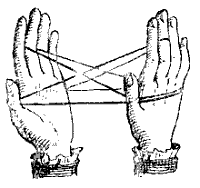 |
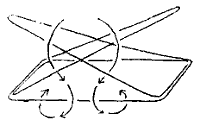 |
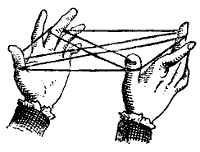 |
| Cat’s Cradle |
“Taking off” |
Soldier’s Bed |
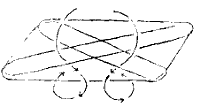 |
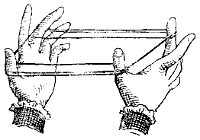 |
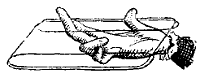 |
| “Taking off” |
Candles |
“Taking off” |
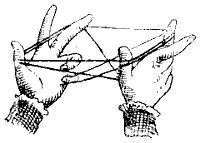 |
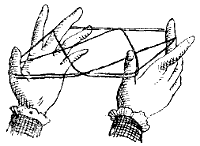 |
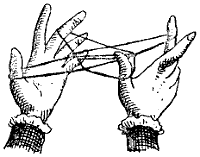 |
| Cat’s Cradle (upside down) |
Cat’s Eyes |
Fish. |
The game is known to savage peoples. Professor Haddon
noted it among the Torres Straits people, who start the game
in the same manner as we do, but continue it differently
(Journ. Anthrop. Inst., vol. xix. p. 361); and Dr. Tylor has pointed out
the significance of these string puzzles among savage peoples
in Journ. Anthrop. Inst., ix. 26.
A child’s game, consisting of jumping over a stick placed at
right angles to two others fixed in the ground.—Halliwell’s
Dictionary.
(b) In Ross and Stead’s Holderness Glossary this is called
“Cat-gallas,” and is described as three sticks placed in the
form of a gallows for boys to jump over. So called in consequence
of being of sufficient height to hang cats from. Also
mentioned in Peacock’s Manley and Corringham Glossary and
Elworthy’s West Somerset Words, Brogden’s Provincial Words,
Lincs., Dickinson’s Cumberland Glossary, Atkinson’s Cleveland
Glossary, Brockett’s North Country Words, Evans’ Leicestershire
Glossary, Baker’s Northants Glossary, and Darlington’s
South Cheshire Glossary. On one of the stalls in Worcester
Cathedral, figured in Wright’s Archæological Essays, ii. 117,
is a carving which represents three rats busily engaged in
hanging a cat on a gallows of this kind.
A game well known in Fife, and perhaps in other counties.
If seven boys are to play, six holes are made at certain distances.
Each of the six stands at a hole, with a short stick in
his hand; the seventh stands at a certain distance holding a
ball. When he gives the word, or makes the sign agreed
upon, all the six change holes, each running to his neighbour’s
hole, and putting his stick in the hole which he has newly
seized. In making this change, the boy who has the ball tries
to put it into an empty hole. If he succeeds in this, the boy
who had not his stick (for the stick is the Cat) in the hole to
which he had run is put out, and must take the ball. There is
often a very keen contest whether the one shall get his stick,
or the other the ball, or Cat, first put into the hole. When the
Cat is in the hole, it is against the laws of the game to put the
ball into it.—Jamieson.
(b) Kelly, in his Scottish Proverbs, p. 325, says, “‘Tine cat,
tine game;’ an allusion to a play called ‘Cat i’ the Hole,’ and
the English ‘Kit-cat.’ Spoken when men at law have lost
their principal evidence.”
See “Cat and Dog,” “Cudgel,” “Kit-cat.”[Addendum]
This game, sometimes called “Threading the Needle,” is
played by children forming a ring, with their arms extended
and hands clasped; one—the Mouse—goes outside the circle
and gently pulls the dress of one of the players, who thereupon
becomes the Cat, and is bound to follow wherever the Mouse
chooses to go—either in or out of the ring—until caught, when
he or she takes the place formerly occupied in the ring by
the Cat, who in turn becomes Mouse, and the game is recommenced.—Dorsetshire
(Folk-lore Journal, vii. 214).
(b) Played at Monton, Lancashire (Miss Dendy); Clapham
Middle-Class School (Miss Richardson); and many other places.
It is practically the same game as “Drop Handkerchief,” played
without words. It is described by Strutt, p. 381, who considers
“Kiss-in-the-Ring” is derived from this “Cat and Mouse.”
One bicken is required in this game, and at this a lad must
stand with a bat and ball in hand. He hits the ball away along
the sand. Another boy picks it up and asks the striker “How
many?” who replies—
Two a good scat,
Try for the bat.
The ball is then thrown to the bicken, and if it does not come
within the distance named—two bats—the striker again sends
the ball away, when the question is again asked—
Three a good scat,
Try for the bat.
And so on until the boy standing out throws the ball in to the
required distance.—Old newspaper cutting without date in my
possession (A. B. Gomme).
Scotch name for “Blindman’s Buff.”—Jamieson.
[65]
In Langley’s abridgment of Polydore Vergile, f. 1., we have a
description of this game: “There is a game also that is played
with the posterne bone in the hinder foote of a sheepe, oxe, gote,
fallow, or redde dere, whiche in Latin is called talus. It hath
foure chaunces: the ace point, that is named Canis, or Canicula,
was one of the sides; he that cast it leyed doune a peny, or so
muche as the gamers were agreed on; the other side was called
Venus, that signifieth seven. He that cast the chaunce wan sixe
and all that was layd doune for the castyng of Canis. The two
other sides were called Chius and Senio. He that did throwe
Chius wan three. And he that cast Senio gained four. This
game (as I take it) is used of children in Northfolke, and they
cal it the Chaunce Bone; they playe with three or foure of those
bones together; it is either the same or very lyke to it.”
See “Dibs,” “Hucklebones.”
In this game as many seats are placed round a room as will
serve all the company save one. The want of a seat falls on
an individual by a kind of lot, regulated, as in many other
games, by the repetition of an old rhythm. All the rest being
seated, he who has no seat stands in the middle, repeating the
words “Change seats, change seats,” &c., while all the rest are
on the alert to observe when he adds, “the king’s come,” or,
as it is sometimes expressed, change their seats. The sport
lies in the bustle in consequence of every one’s endeavouring
to avoid the misfortune of being the unhappy individual who
is left without a seat. The principal actor often slily says,
“The king’s not come,” when, of course the company ought to
keep their seats; but from their anxious expectation of the
usual summons, they generally start up, which affords a great
deal of merriment.—Brand’s Pop. Antiq., ii. 409.
(b) Dr. Jamieson says this is a game well-known in Lothian
and in the South of Scotland. Sir Walter Scott, in Rob Roy,
iii. 153, says, “Here auld ordering and counter-ordering—but
patience! patience!—We may ae day play at Change seats, the
king’s coming.”
This game is supposed to ridicule the political scramble
for places on occasion of a change of government, or in the
succession.
See “Musical Chairs,” “Turn the Trencher.”
Easther’s Almondbury Glossary thus describes this game.
A set of checks consists of five cubes, each about half an inch
at the edge, and a ball the size of a moderate bagatelle ball:
all made of pot. They are called checkstones, and the game is
played thus. You throw down the cubes all at once, then toss
the ball, and during its being in the air gather up one stone in
your right hand and catch the descending ball in the same.
Put down the stone and repeat the operation, gathering two
stones, then three, then four, till at last you have “summed
up” all the five at once, and have succeeded in catching
the ball. In case of failure you have to begin all over
again.
(b) In Nashe’s Lenten Stuff (1599) occurs the following: “Yet
towards cock-crowing she caught a little slumber, and then she
dreamed that Leander and she were playing at checkstone with
pearls in the bottom of the sea.”
A game played by children with round small pebbles (Halliwell’s
Dictionary). It is also mentioned in the early play of
Apollo Shroving, 1627, p. 49.
See “Chucks,” “Fivestones.”
A game of “Pitch and Toss” played with cherry-stones
(Elworthy’s West Somerset Words). Boys always speak of
the stones as “ods.”
“Cherry-pit” is a play wherein they pitch cherry-stones into
a little hole. It is noticed in the Pleasant Grove of New Fancies,
1657, and in Herrick’s Hesperides. Nares (Glossary) mentions
it as still practised with leaden counters called Dumps, or with
money.
[67]
Chicamy, chickamy, chimey O,
Down to the pond to wash their feet;
Bring them back to have some meat,
Chickamy, chickamy, chimey O.
—Crockham Hill, Kent (Miss Chase).
The children sing the first line as they go round and round.
At the second line they move down the road a little, and turn
round and round as they end the rhyme.
Chickidy hand,
Chickidy hand,
The Warner, my Cock,
Crows at four in the morning.
Several boys, placing their clasped fists against a lamp-post,
say these lines, after which they run out, hands still clasped.
One in the middle tries to catch as many as possible, forming
them in a long string, hand in hand, as they are caught. Those
still free try to break through the line and rescue the prisoners.
If they succeed in parting the line, they may carry one boy
pig-a-back to the lamp-post, who becomes “safe.” The boy
caught last but one becomes “it” in the next game.—Deptford,
Kent (Miss Chase).
See “Hunt the Staigie,” “Stag Warning,” “Whiddy.”
A game played with hooked sticks and a ball, also called
“Shinnup.” Same as “Hockey.”
A school-boys’ play, consisting in striking the chin with the
knuckles; dexterously performed, a kind of time is produced.—Addy’s
Sheffield Glossary.
A game at marbles played by “chocking” or pitching marbles
in a hole made for the purpose, instead of shooting at a ring
(Northamptonshire, Baker’s Glossary). Clare mentions the
game in one of his poems.
A game played in Moray and Banffshire. The ball is called
the Chow. The game is the same as “Shinty.” The players
are equally divided. After the Chow is struck off by one party,
the aim of the other is to strike it back, that it may not reach
the limit or goal on their side, because in this case they lose
the game, and as soon as it crosses the line the other party
cry Hail! or say that it is hail, as denoting that they have
gained the victory. In the beginning of each game they are
allowed to raise the ball a little above the level of the ground,
that they may have the advantage of a surer stroke. This is
called the “deil-chap,” perhaps as a contraction of “devil,” in
reference to the force expended on the stroke. It may, however,
be “dule-chap,” the blow given at the “dule” or goal.—Jamieson.
See “Hockey.”
Strutt says this game was played by boys at the commencement
of the last century, and probably bore some analogy to
“Pitch and Hustle.” He saw the game thus denominated
played with halfpence, every one of the competitors having a
like number, either two or four; a hole being made in the
ground, with a mark at a given distance for the players to
stand, they pitch their halfpence singly in succession towards
the hole, and he whose halfpenny lies the nearest to it has the
privilege of coming first to a second mark much nearer than
the former, and all the halfpence are given to him; these he
pitches in a mass toward the hole, and as many of them as
remain therein are his due; if any fall short or jump out of it,
the second player—that is, he whose halfpenny in pitching lay
nearest to the first goer’s—takes them and performs in like
manner; he is followed by the others as long as any of the
halfpence remain (Sports, pp. 386, 387). There is a letter in
the Spectator, supposed to be from the father of a romp, who,
among other complaints of her conduct, says, “I have catched
her once at eleven years old at ‘Chuck-farthing’ among the
boys.”
Same game as “Chuck-farthing,” with this difference, that
if the pennies roll outside the ring it is a “dead heat,” and
each boy reclaims his penny.—Peacock’s Manley and Corringham
Glossary; and see Brogden’s Lincolnshire Words.
A game with marbles played by girls (Mactaggart’s Gallovidian
Encyclopædia). A writer in Blackwood’s Magazine,
August 1821, p. 36, says “Chucks” is played with a bowl
and chucks—a species of shells (Buccinum lapillus) found
on the sea-shore [“bowl” here probably means a marble].
Brockett (North Country Words) says this game is played
by girls with five sea-shells called chucks, and sometimes with
pebbles, called chuckie-stanes. Jamieson says a number of
pebbles are spread on a flat stone; one of them is tossed up,
and a certain number must be gathered and the falling one
caught by the same hand.
See “Checkstones,” “Fivestones.”[Addendum]
A game played in Fifeshire; said to be the same with the
“Sow in the Kirk.”—Jamieson.
Two Homes opposite each other are selected, and a boy either
volunteers to go Click, or the last one in a race between the
Homes does so. The others then proceed to one of the Homes,
and the boy takes up his position between them. The players
then attempt to run between the Homes, and if the one in the
middle holds any of them while he says “One, two, three, I
catch thee; help me catch another,” they have to stay and help
him to collar the rest until only one is left. If this one succeeds
in getting between the Homes three times after all the others
have been caught, he is allowed to choose the one to go Click
in the next game; if he fails, he has to go himself.—Marlborough,
Wilts (H. S. May).
See “Cock.”
A man called Click came west from Ireland,
A man called Click came west from Ireland,
A man called Click came west from Ireland,
Courting my Aunt Judy.
A man called Clock came west from Ireland,
A man called Clock came west from Ireland,
A man called Clock came west from Ireland,
Courting my Aunt Judy.
A man called Cluck came west from Ireland,
A man called Cluck came west from Ireland,
A man called Cluck came west from Ireland,
Courting my Aunt Judy.
—Isle of Man (A. W. Moore).
These verses and the game are now quite forgotten, both in
English and Manx. It was sung by children dancing round in
a ring.
“A kinde of playe called clowt-clowt, to beare about, or my
hen hath layd.”—Nomenclator, p. 299.
A youthful game something like “Doddart.”—Brockett’s
North Country Words.
A Christmas game mentioned in Declaration of Popish Impostures,
p. 160.
A game at marbles played by two or three boys bowling a
boss marble into holes made in the ground for the purpose, the
number of which is generally four.—Baker’s Northamptonshire
Glossary.
[71]
A school game in which two boys are held by the legs
and arms and bumped against a tree, he who holds out
the longest being the victor.—Ross and Stead’s Holderness
Glossary.
A name for “See-saw.”—Jamieson.
This was danced by a boy stooping till he was nearly in a
sitting posture on the ground, drawing one leg under him
until its toe rested on the ground, and steadying himself by
thrusting forward the other leg so that
the heel rested on the ground; the arms
and head being thrown forwards as far
as possible in order to maintain a balance.
The thrust-out leg was drawn back and
the drawn-in leg was shot out at the same time. This movement
was repeated, each bringing down to the ground of the
toe and heel causing a noise like that of hammering on a lapstone.
The arms were moved backwards and forwards at the
same time to imitate the cobbler’s sewing.—London (J. P.
Emslie).
The children in Yorkshire have a game which is probably an
ancient English pastime. Numerous hazel-nuts are strung like
the beads of a rosary. The game is played by two persons,
each of whom has one of these strings, and consists in each
party striking alternately, with one of the nuts on his own
string, a nut of his adversary’s. The field of combat is usually
the crown of a hat. The object of each party is to crush the
nuts of his opponent. A nut which has broken many of those
of the adversary is a Cob-nut.—Brand, ii. 411; Hunter’s
Hallamshire Glossary.
(b) This game is played in London with chestnuts, and is
called “Conquers.” In Cornwall it is known as “Cock-haw.”
The boys give the name of Victor-nut to the fruit of the
common hazel, and play it to the words: “Cockhaw! First
blaw! Up hat! Down cap! Victor!” The nut that cracks
another is called a Cock-battler (Folk-lore Journal, v. 61).
Halliwell describes this game differently. He says “it consists
in pitching at a row of nuts piled up in heaps of four,
three at the bottom and one at the top of each heap. The nut
used for the pitching is called the Cob. All the nuts knocked
down are the property of the pitcher.” Alluding to the first
described form, he says it “is probably a more modern game,”
and quotes Cotgrave sub voce “Chastelet” as authority for the
earlier form in the way he describes it (Dictionary). Addy
says the nuts were hardened for the purpose. When a nut
was broken it was said to be “cobbered” or “cobbled”
(Sheffield Glossary). Evans’ Leicestershire Glossary also describes
it. Darlington (South Cheshire Words) says this
game only differs from “Cobblety-cuts” in the use of small
nuts instead of chestnuts. George Eliot in Adam Bede has,
“Gathering the large unripe nuts to play at ‘Cob-nut’ with”
(p. 30). Britton’s Beauties of Wiltshire gives the Isle of Wight
and Hants as other places where the game is known.
See “Conquerors.”
One boy is chosen Cock. The players arrange themselves
in a line along one side of the playground. The Cock takes
his stand in front of the players. When everything is ready,
a rush across the playground is made by the players. The
Cock tries to catch and “croon”—i.e., put his hand upon the
head of—as many of the players as he can when running from
one side of the playground to the other. Those caught help
the Cock in the rush back. The rush from side to side goes
on till all are captured. To “croon” was the essential point
in capturing. When a boy was being pursued to be taken
prisoner, his great object was, when he came to close quarters
with his pursuers, to save his head from being touched on the
crown by one of them.—Nairn (Rev. W. Gregor).
At Duthil, Strathspey, this game goes by the name of
“Rexa-boxa-King.” When the players have ranged themselves
on one side of the playground, and the King has taken
his stand in front of them, he calls out “Rexa-boxa-King,” or
simply “Rexa,” when all the players rush to the other side.
The rush from side to side goes on till all are captured. The
one last captured becomes King in the next game.—Rev. W.
Gregor.
See “Click.”
Children, under the title of “Cock-battler,” often in country
walks play with the hoary plantain, which they hold by the
tough stem about two inches from the head; each in turn tries
to knock off the head of his opponent’s flower.—Cornwall (Folk-lore
Journal, v. 61).
In the North, and in Suffolk, it is called “Cocks,” “a puerile
game with the tough tufted stems of the ribwort plantain”
(Brockett’s North Country Words). Moor (Suffolk Words)
alludes to the game, and Holloway (Dictionary of Provincialisms)
says in West Sussex boys play with the heads of rib
grass a similar game. Whichever loses the head first is conquered.
It is called “Fighting-cocks.”
This is a boys’ game. Two boys fold their arms, and then,
hopping on one leg, butt each other with their shoulders till one
lets down his leg. Any number of couples can join in this
game.—Nairn (Rev. W. Gregor).
See “Cob-nut.”
One boy is chosen as Cock. He is blindfolded, and stands
alone, with his legs as far apart as possible. The other boys
then throw their caps as far as they are able between the extended
legs of the Cock (fig. 1). After the boys have thrown
their caps, and each boy has taken his stand beside his cap,
the Cock, still blindfolded, stoops down and crawls in search
of the caps (fig. 2). The boy whose cap he first finds has to run
about twenty yards under the buffeting of the other boys, the
blows being directed chiefly to the head. He becomes Cock
at the next turn of the game.—Rosehearty, Pitsligo (Rev. W.
Gregor).
This game consists simply of one boy mounting on the neck
of another, putting a leg over each shoulder and down his
breast. The boy that carries takes firm hold of the legs of the
one on his neck, and sets off at a trot, and runs hither and
thither till he becomes tired of his burden. The bigger the
one is who carries, the more is in the enjoyment to the one
carried.—Keith (Rev. W. Gregor).
See “Cock’s-headling.”
Young wenches have a wanton sport, which they call
moulding of Cocklebread; viz. they gett upon a Table-board,
and then gather-up their knees and their coates with their
hands as high as they can, and then they wabble to and fro
with their Buttocks as if the[y] were kneading of Dowgh, and
say these words, viz.:—
My Dame is sick and gonne to bed,
And I’le go mowld my cockle-bread.
In Oxfordshire the maids, when they have put themselves
into the fit posture, say thus:—
My granny is sick, and now is dead,
And wee’l goe mould some cockle-bread.
Up with my heels, and down with my head,
And this is the way to mould cocklebread.
—Aubrey’s Remains, pp. 43, 44.
To make “Barley bread” (in other districts, “Cockley bread”)
this rhyme is used in West Cornwall:—
Mother has called, mother has said,
Make haste home, and make barley bread.
Up with your heels, down with your head,
That is the way to make barley bread.
—Folk-lore Journal, v. 58.
The Westmoreland version is given by Ellis in his edition
of Brand as follows:—
My grandy’s seeke,
And like to dee,
And I’ll make her
Some cockelty bread, cockelty bread,
And I’ll make her
Some cockelty bread.
The term “Cockelty” is still heard among our children
at play. One of them squats on its haunches with the hands
joined beneath the thighs, and being lifted by a couple of others
who have hold by the bowed arms, it is swung backwards and
forwards and bumped on the ground or against the wall, while
continuing the words, “This is the way we make cockelty
bread.”—Robinson’s Whitby Glossary, p. 40.
The moulding of “Cocklety-bread” is a sport amongst
hoydenish girls not quite extinct. It consists in sitting on
the ground, raising the knees and clasping them with the hand,
and then using an undulatory motion, as if they were kneading
dough.
My granny is sick and now is dead,
And we’ll go mould some cocklety bread;
Up with the heels and down with the head,
And that is the way to make cocklety bread.
—Hunter’s MSS.; Addy’s Sheffield Glossary.
(b) The Times of 1847 contains a curious notice of this
game. A witness, whose conduct was impugned as light and
unbecoming, is desired to inform the court, in which an action
for breach of promise was tried, the meaning of “mounting
cockeldy-bread;” and she explains it as “a play among children,”
in which one lies down on the floor on her back, rolling
backwards and forwards, and repeating the following lines:—
Cockeldy bread, mistley cake,
When you do that for our sake.
While one of the party so laid down, the rest sat around; and
they laid down and rolled in this manner by turns.
These lines are still retained in the modern nursery-rhyme
books, but their connection with the game of “Cockeldy-bread”
is by no means generally understood. There was
formerly some kind of bread called “cockle-bread,” and cocille-mele
is mentioned in a very early MS. quoted in Halliwell’s
Dictionary. In Peele’s play of the Old Wives’ Tale, a voice
thus speaks from the bottom of a well:—
Gently dip, but not too deep,
For fear you make the golden beard to weep.
Fair maiden, white and red,
Stroke me smooth and comb my head,
And thou shalt have some cockell-bread.
A game among boys. Stones are loosely placed one upon
another, at which other stones are thrown to knock the pile
down.—Dickinson’s Cumberland Glossary.
See “Castles.”
A game where boys mount over each other’s heads.—Halliwell’s
Dictionary.
See “Cockertie-hooie.”
A boyish game mentioned but not described by Cope in
his Hampshire Glossary. He gives as authority Portsmouth
Telegraph, 27th September 1873.
A game among youngsters similar to “Cricket,” a short piece
of wood being struck up by a long stick instead of a ball by a
bat. Also called “Tip and Go” or “Tip and Slash.”—Robinson’s
Whitby Glossary.
See “Cudgel.”
A striped snail shell. It is a common boyish pastime to
hold one of these shells between the last joints of the bent
fingers, and forcibly press the apex against another held in a
similar manner by an opponent, until one of them, by dint of
persevering pressure, forces its way into the other; and the
one which in these contests has gained the most victories is
termed the Conqueror, and is highly valued (Northamptonshire,
Baker’s Glossary). The game is known as “Fighting Cocks”
in Evans’ Leicestershire Glossary. In London it was played
with walnut shells.
The top stone of a pile is pelted by a stone flung from a
given distance, and the more hits, or “cogglings off,” the greater
the player’s score.—Robinson’s Whitby Glossary.
Apparently the same game as “Cockly-jock.”
A game played with a ball and crooked stick (cut from a tree
or hedge), with a crook at the end (same game as “Hurl”).—Dublin
(Mrs. Lincoln).
Mr. Patterson (Antrim and Down Glossary) mentions this
as “Hockey;” the same as “Shinney.” “Called in some
districts,” he adds, “‘Comun’ and ‘Kamman,’ from the Irish
name for the game.”
The same game as “Cogger.” The game is more generally
called “playin at sneel-shells.”—Ross and Stead’s Holderness
Glossary.
I.
Cobbly co!
My first blow!
Put down your black hat,
And let me have first smack!
—Burne’s Shropshire Folk-lore, p. 531.
II.
Obli, obli O, my first go;
And when the nut is struck,
Obli, obli onker, my nut will conquer.
—Notes and Queries, 5th series, x. 378.
III.
Cobblety cuts,
Put down your nuts.
—Darlington’s Folk-speech of South Cheshire.
IV.
Obbly, obbly onkers, my first conquers;
Obbly, obbly O, my first go.
—Lawson’s Upton-on-Severn Words and Phrases.
V.
Hobley, hobley, honcor, my first conkor;
Hobbley, hobbley ho, my first go;
Hobley, hobley ack, my first crack.
—Chamberlain’s West Worcestershire Glossary.
(b) This game is played with horse chestnuts threaded on a
string. Two boys sit face to face astride of a form or a log of
timber. If a piece of turf can be procured so much the better.
One boy lays his chestnut upon the turf, and the other strikes
at it with his chestnut; and they go on striking alternately till
one chestnut splits the other. The chestnut which remains
unhurt is then “conqueror of one.” A new chestnut is substituted
for the broken one, and the game goes on. Whichever
chestnut now proves victorious becomes “conqueror of
two,” and so on, the victorious chestnut adding to its score all
the previous winnings. The chestnuts are often artificially
hardened by placing them up the chimney or carrying them in
a warm pocket; and a chestnut which has become conqueror
of a considerable number acquires a value in schoolboys’ eyes;
and I have frequently known them to be sold, or exchanged for
other toys (Holland’s Cheshire Glossary). The game is more
usually played by one boy striking his opponent’s nut with his
own, both boys standing and holding the string in their hands.
It is considered bad play to strike the opponent’s string. The
nut only should be touched. Three tries are usually allowed.
(c) For information on various forms of this game, see
Notes and Queries, 1878. See also Elworthy’s West Somerset
Words. The boy who first said the rhyme has first stroke
at Oswestry. The game is elsewhere called “Cobbet”
(Meole Brace) and “Cobbleticuts” (Burne’s Shropshire Folk-lore,
p. 531). In “Conquer-nuts” “obbly” was probably
“nobbly” or “knobbly,” expressing the appearance of the
string of nuts; and “onkers” was probably invented as a
rhyme to “conquers” (Upton-on-Severn Words and Phrases,
by R. Lawson).
I.
Here I go round the rules of contrary,
Hopping about like a little canary.
When I say “Hold fast,” leave go;
When I say “Leave go,” hold fast.
—Cornwall (Folk-lore Journal, v. 52).
II.
Here we go round the rules of contrary,
When I say “Hold fast!” let go, and when I say “Let go!” hold fast.
—London (A. B. Gomme).
(b) A ring is formed by each child holding one end of a handkerchief.
One child stands in the centre and acts as leader. The
ring moves round slowly. The leader says the words as above
while the ring is moving round, and then suddenly calls out
whichever he chooses of the two sayings. If he says “Hold
fast!” every one must immediately let go the corner of the
handkerchief he holds. They should all fall to the ground at
once. When he says “Let go!” every one should retain their
hold of the handkerchief. Forfeits are demanded for every
mistake.
This game, called “Hawld Hard,” is commonly played
about Christmas-time, where a number hold a piece of a handkerchief.
One then moves his hand round the handkerchief,
saying, “Here we go round by the rule of Contrairy; when I
say ‘Hawld hard,’ let go, and when I say ‘Let go,’ hawld hard.”
Forfeits are paid by those not complying with the order.—Lowsley’s
Berkshire Glossary.
[80]
The game of “Chuck-farthing.”—Norfolk and Suffolk (Holloway’s
Dict. of Provincialisms).
A square figure is divided by four lines, which cross each
other in the crown or centre. Two of these lines connect the
opposite angles, and two the sides at the point of bisection.
Two players play; each has three men or flitchers. Now there
are seven points for these men to move about on, six on the
edges of the square and one at the centre. The men belonging
to each player are not set together as at draughts, but mingled
with each other. The one who has the first move may always
have the game, which is won by getting the three men on a
line.—Mactaggart’s Gallovidian Encyclopædia.
See “Kit Cat Cannio,” “Noughts and Crosses.”
A flat stone is obtained called a Hob, upon which those who
are playing place equal shares of Cots and Twisses. Cots are
brass buttons, and Twisses bits of brass—a Twiss of solid
brass being worth many Cots. Each player provides himself
with a nice flat [key] stone, and from an agreed pitch tosses
it at the Hob. If he knocks off any of the Cots and Twisses
nearer to the players than the Hob is, he claims them. The
other players try to knock the Hob away with their key-stones
from any Cots and Twisses that may not have been claimed;
and if any key-stone touches Hob after all have thrown, the
owner cannot claim any Cots and Twisses.—Earls Heaton
(Herbert Hardy).
Each player selects a Cast or stone to pitch with; on another
stone, called the Hob, the Cots and Twys are placed; at
some distance Scops are set in the ground. First the players
pitch from the Hob to the Scop, and the one who gets nearest
goes first. He then pitches at the Hob, and if he knocks off
the stakes he has them, provided his Cast is nearer to them
than the Hob is; in failure of this, the other player tries. In
pitching up, one Cast may rest on another, and if the boy
whose stone is underneath can lift it up to knock the other
Cast away, it has to remain at the place to which it has been
struck; if he does not succeed in doing this, the second player
may lift off his Cast and place it by the first. Whoever
knocks off the stakes, they go to the boy whose Cast is
nearest to them. The Hob and Scop are usually three yards
apart. The Cot was a button off the waistcoat or trousers,
the Twy one off the coat, and, as its name implies, was equal
to two Cots. Formerly, when cash was much more rare than
now it is amongst boys, these formed their current coin. The
game about 1820 seems to have been chiefly one of tossing,
and was played with buttons, then common enough. Now,
metal buttons being rare, it is played with pieces of brass or
copper of any shape. The expression, “I haven’t a cot,” is
sometimes used to signify that a person is without money.—Easther’s
Almondbury and Huddersfield Glossary.
See “Banger,” “Buttons.”
The game of “Course of the Park” has not been described,
but is referred to in the following verse:—
“Buff”’s a fine sport,
And so’s “Course o’ Park.”
—The Slighted Maid, 1663, p. 50.
A game played with a bung or ball struck with sticks
(Brogden’s Provincial Words, Lincolnshire). This is played
on Barnes Common, and is apparently a form of “Hockey”
(A. B. Gomme).
The game of “Nine Holes.” This is the game described by
John Jones, M.D., in his book called The Benefit of the Auncient
Bathes of Buckstones, 1572, p. 12, as having been played
by ladies at Buxton for their amusement in wet weather.
See Pegge’s Anonymiana, 1818, p. 126, and Addy’s Sheffield
Glossary.
[82]
A description of this game is not given here; its history
and rules and regulations are well known, and many books
have been devoted to its study. The word “Cricket” is given
in Lawson’s Upton-on-Severn Words and Phrases as a low
wooden stool. He continues, “The game of ‘Cricket’ was
probably a development of the older game of ‘Stool-ball,’ a
dairymaid’s stool being used for the wicket.” Wedgwood
(Etym. Dict.) suggests that the proper name for the bat was
“cricket-staff,” A.-S. criec, a staff.
See “Bittle-battle,” “Stool-ball.”
An old game called “Crooky” was formerly played at
Portarlington, Queen’s co., and Kilkee, co. Clare. Fifty years
ago it was played with wooden crooks and balls, but about
twenty-five years ago, or a little more, mallets were introduced
at Kilkee; while subsequently the name was changed
to “Croquet.” I have heard it stated that this game was
introduced by the French refugees that settled at Portarlington.—G.
H. Kinahan (Folk-lore Journal, ii. 265).
The game now called “Heads and Tails” (Halliwell’s Dictionary).
See Nomenclator, p. 299; Addy’s Sheffield Glossary.
Strutt points out that anciently the English coins were stamped
on one side with a cross. See also Harland’s Lancashire
Legends, p. 139.
A boys’ game.—Halliwell’s Dictionary.
Nares (Glossary) mentions this game in a quotation from
Wilson’s Inconstant Lady, 1614. “Cross Questions and
Crooked Answers” was a popular game at juvenile parties.
The players sit in a circle, and each is asked in a whisper a
question by the one on his left, and receives also in a whisper
an answer to a question asked by himself of the person on his
right. Each player must remember both the question he was
asked and the answer he received, which have at the conclusion
of the round to be stated aloud. Forfeits must be given if
mistakes are made.—A. B. Gomme.
One of the players is appointed to be Tig. He calls out the
name of the one he intends to chase, and runs after him. Another
player runs across between Tig and the fugitive, and then
Tig runs after this cross-player until another player runs across
between Tig and the fugitive; and so on. Each time a player
crosses between Tig and the player he is following he leaves
the original chase and follows the player who has crossed.
When he captures, or, in some places, touches one of the
players he is following, this player becomes Tig, and the game
begins again.—Ireland (Miss Keane).
This game is known in and near London as “Cross Touch.”
This is an old game where boys push one of their number
into a circle they have made, and as he tries to escape push
him back, crying, “No child of mine!” (Leigh’s Cheshire Glossary).
He adds, “This may be the origin of the husband’s disclaimer
of his wife when he ‘notchils’ her.” To “cry notchil”
is for a man to advertise that he will not be answerable for
debts incurred by his wife.
A game at ball. The same as “Pize-ball.” It is sometimes
called “Tut-ball.”—Addy’s Sheffield Glossary.
See “Ball.”
A child hides and cries “Cuckoo.” The seekers respond—
Cuckoo cherry-tree,
Catch a bird and bring it me.
—Burne’s Shropshire Folk-lore, p. 222.
Halliwell calls this a game at ball, and the rhyme runs—
Cuckoo cherry tree,
Catch a bird and bring it me;
Let the tree be high or low,
Let it hail, rain or snow.
See “Hide and Seek.”
Two boys join hands and feet over the back of a third, the
which creeps away with them on hands and knees to a certain
distance; and if able to do this, he, the Cuddy, must have a
ride as one of the powks on some other’s back.—Mactaggart’s
Gallovidian Encyclopædia.
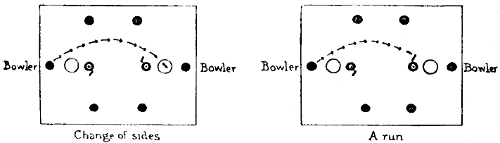
Four or more boys can play this game, and sides are chosen.
Two holes are made in the ground at a distance of about eight
or ten feet apart. A ring about a foot in diameter is made
round each hole. A boy stands at each hole with a stick,
which he puts into the hole to guard it. Two other boys stand
behind the holes, who act as bowlers. One of these throws a
small piece of wood shaped like a Cat, and tries to pitch it into
the hole. The boy guarding the hole tries to hit it with his
stick. If he succeeds, he and the boy at the other hole run to
each other’s places. Should the boy who throws the piece of
wood succeed in getting it into the hole, the batsmen are out.
Should the Cat fall into the ring or a span beyond, one of the
bowlers picks it up, and both run to a hiding-place. They then
agree as to which of them should hold the Cat. This must be
carried in such a way that it cannot be seen by the batsmen,
both boys assuming the same attitude. Both boys then resume
their previous places. They kneel down, still keeping the same
attitudes. The batsmen, keeping their sticks in the holes,
then agree which of the two holds the Cat. One batsman
runs across and puts his stick into the hole behind which the
boy kneels whom they consider has the Cat, the other then
running to his place. If they are right in their guess, the
holder of the Cat throws it across the ground for the opposite
bowler to put it in the hole before the second batsman reaches
it. If they guess wrongly, the holder of the Cat puts it into
the hole as soon as the batsman runs, and they then become the
batsmen for the next game. If the batsmen leave their holes
unguarded with the stick, the catsmen can at any time put
them “out,” by putting the Cat in a hole. If more than two
boys on a side play, the others field as in “Cricket.”—Barnes
(A. B. Gomme).
See “Cat and Dog.”
I.
Will ye gang to the lea, Curcuddie,
And join your plack wi’ me, Curcuddie?
I lookit about and I saw naebody,
And linkit awa’ my lane, Curcuddie.
—Chambers’ Popular Rhymes, p. 139.
II.
Will ye gang wi’ me, Curcuddie,
Gang wi’ me o’er the lea?
I lookit roun’, saw naebody;
Curcuddie, he left me.
—Biggar (William Ballantyne).
(b) This is a grotesque kind of dance, performed in a shortened
posture, sitting on one’s hams, with arms akimbo, the dancers
forming a circle of independent figures. It always excites a
hearty laugh among the senior bystanders; but, ridiculous as
it is, it gives occasion for the display of some spirit and agility,
as well as skill, there being always an inclination to topple
over. Each performer sings the verse (Chambers; Mactaggart’s
Gallovidian Encyclopædia).
Mr. Ballantyne says that each one apart tried to dance by
throwing out their feet and jumping sideways.
(c) The first syllable of this word is, says Jamieson, undoubtedly
the verb curr, to sit on the houghs or hams. The
second may be from Teut. kudde, a flock; kudd-en, coire,
convenire, congregari, aggregari; kudde wijs, gregatim, catervatim,
q. to curr together. The same game is called Harry
Hurcheon in the North of Scotland, either from the resemblance
of one in this position to a hurcheon, or hedge-hog, squatting
under a bush; or from the Belg. hurk-en to squat, to hurkle.—Jamieson.
See “Cobbler’s Hornpipe,” “Cutch-a-Cutchoo.”
[Play]
I.
Curly locks, curly locks,
Wilt thou be mine?
Thou shalt not wash dishes
Nor yet feed the swine;
But sit on a fine cushion
And sew a fine seam,
And feed upon strawberries,
Sugar and cream.
—Earls Heaton (Herbert Hardy).
II.
Bonny lass, canny lass,
Wilta be mine?
Thou’s nowder wesh dishes
Nor sarra the swine:
But sit on thy crippy, &c.
—Dickinson’s Cumberland Glossary.
(b) Two children, a girl and a boy, separate from their
fellows, who are not particularly placed, the boy caressing the
girl’s curls and singing the verses.
(c) This game is evidently a dramatic representation of
wooing, and probably the action of the game has never been
quite completed in the nursery. The verses are given as
“nursery rhymes” by Halliwell, Nos. cccclxxxiii. and ccccxciv.
The tune is from Rimbault’s Nursery Rhymes, p. 70. The
words given by him are the same as the Earls Heaton version.
Currants and raisins a penny a pound,
Three days holiday.
This is a game played “running under a handkerchief;”
“something like ‘Oranges and Lemons.’”—Lincoln (Miss M.
Peacock).
[Play]
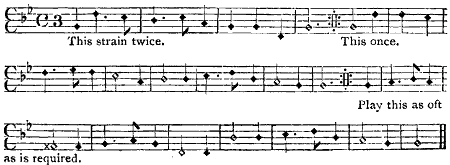
—Dancing Master, 1686.
This music is exactly as it is printed in the book referred to.
(b) The following is an account of the dance as it was known
in Derbyshire amongst the farmers’ sons and daughters and
the domestics, all of whom were on a pretty fair equality, very
different from what prevails in farm-houses of to-day. The
“Cushion Dance” was a famous old North-country amusement,
and among the people of Northumberland it is still commonly
observed. The dance was performed with boisterous fun, quite
unlike the game as played in higher circles, where the conditions
and rules of procedure were of a more refined order.
The company were seated round the room, a fiddler occupying
a raised seat in a corner. When all were ready, two of
the young men left the room, returning presently, one carrying
a large square cushion, the other an ordinary drinking-horn,
china bowl, or silver tankard, according to the possessions of
the family. The one carrying the cushion locked the door,
putting the key in his pocket. Both gentlemen then went to
the fiddler’s corner, and after the cushion-bearer had put a coin
in the vessel carried by the other, the fiddler struck up a lively
tune, to which the young men began to dance round the room,
singing or reciting to the music:—
Frinkum, frankum is a fine song,
An’ we will dance it all along;
All along and round about,
Till we find the pretty maid out.
After making the circuit of the room, they halted on reaching
the fiddler’s corner, and the cushion-bearer, still to the music
of the fiddle, sang or recited:—
| |
Our song it will no further go! |
| The Fiddler: |
Pray, kind sir, why say you so? |
| The Cushion-bearer: Because Jane Sandars won’t come to. |
| The Fiddler: |
She must come to, she shall come to, |
| |
An’ I’ll make her whether she will or no. |
The cushion-bearer and vessel-holder then proceeded with
the dance, going as before round the room, singing “Frinkum,
frankum,” &c., till the cushion-bearer came to the lady of his
choice, before whom he paused, placed the cushion on the floor
at her feet, and knelt upon it. The vessel-bearer then offered
the cup to the lady, who put money in it and knelt on the
cushion in front of the kneeling gentleman. The pair kissed,
arose, and the gentleman, first giving the cushion to the lady
with a bow, placed himself behind her, taking hold of some
portion of her dress. The cup-bearer fell in also, and they
danced on to the fiddler’s corner, and the ceremony was again
gone through as at first, with the substitution of the name of
“John” for “Jane,” thus:—
| The Lady: |
Our song it will no further go! |
| The Fiddler: |
Pray, kind miss, why say you so? |
| The Lady: |
Because John Sandars won’t come to. |
| The Fiddler: |
He must come to, he shall come to, |
| |
An’ I’ll make him whether he will or no! |
The dancing then proceeded, and the lady, on reaching her
choice (a gentleman, of necessity), placed the cushion at his
feet. He put money in the horn and knelt. They kissed and
rose, he taking the cushion and his place in front of the lady,
heading the next dance round, the lady taking him by the coat-tails,
the first gentleman behind the lady, with the horn-bearer
in the rear. In this way the dance went on till all present,
alternately a lady and gentleman, had taken part in the ceremony.
The dance concluded with a romp in file round the
room to the quickening music of the fiddler, who at the close
received the whole of the money collected by the horn-bearer.
At Charminster the dance is begun by a single person (either
man or woman), who dances about the room with a cushion in
his hand, and at the end of the tune stops and sings:—
| Man: |
This dance it will no further go. |
| Musician: |
I pray you, good sir, why say you so? |
| Man: |
Because Joan Sanderson will not come to. |
| Musician: |
She must come to, and she shall come to, |
| |
And she must come whether she will or no. |
Then the following words are sung as in the first example:—
| Man: |
Welcome, Joan Sanderson, welcome, welcome. |
| Both: |
Prinkum-prankum is a fine dance, |
| |
And shall we go dance it once again, |
| |
And once again, |
| |
And shall we go dance it once again? |
| Woman: |
This dance it will no further go. |
| Musician: |
I pray you, madam, why say you so? |
| Woman: |
Because John Sanderson will not come to. |
| Musician: |
He must come to, and he shall come to, |
| |
And he must come whether he will or no. |
And so she lays down the cushion before a man, who,
kneeling upon it, salutes her, she singing—
Welcome, John Sanderson, &c.
Then, he taking up the cushion, they take hands and dance
round singing as before; and this they do till the whole company
is taken into the ring. Then the cushion is laid down
before the first man, the woman singing, “This dance,” &c., as
before, only instead of “come to,” they sing “go fro,” and instead
of “Welcome, John Sanderson,” &c., they sing “Farewell,
John Sanderson, farewell,” &c., and so they go out one by one
as they came in.—Charminster (Notes and Queries, ii. 517, 518).
This description is almost the same as a seventeenth century
version. The dance is begun by a single person (either man
or woman), who, taking a cushion in his hand, dances about
the room, and at the end of the tune he stops and sings:—
This dance it will no further go.
The Musician answers:
| |
I pray you, good sir, why say you so? |
| Man: |
Because Joan Sanderson will not come to. |
| Musician: |
She must come to, and she shall come to, |
| |
And she must come whether she will or no. |
Then he lays down the cushion before a woman, on which
she kneels, and he kisses her, singing—
Welcom, Joan Sanderson, welcom, welcom.
Then he rises, takes up the cushion, and both dance, singing—
Prinkum-prankum is a fine dance,
And shall we go dance it once again,
Once again, and once again,
And shall we go dance it once again.
Then, making a stop, the wo(man) sings as before—
| |
This dance, &c. |
| Musician: |
I pray you, madam, &c. |
| Woman: |
Because John Sanderson, &c. |
| Musician: |
He must, &c. |
And so she lays down the cushion before a man, who,
kneeling upon it, salutes her, she singing—
Welcom, John Sanderson, &c.
Then, he taking up the cushion, they take hands and dance
round, singing as before. And thus they do till the whole
company are taken into the ring. And then the cushion is
laid before the first man, the woman singing, “This dance,” &c.
(as before), only instead of “come to,” they sing “go fro,” and
instead of “Welcom, John Sanderson,” &c., they sing “Farewel,
John Sanderson, farewel, farewel;” and so they go out one by
one as they came in. Note, that the woman is kiss’d by all
the men in the ring at her coming in and going out, and the
like of the man by the woman.—The Dancing Master: London,
printed by J. P., and sold by John Playford at his shop near
the Temple Church, 1686, 7th edition.
Another version gives the words as follows:—
We’ve got a new sister in our degree,
And she’s welcome into our companee, companee.
Mrs. Sargesson says she weänt come to,
We’ll make her whether she will or no,
Will or no, will or no,
We’ll maäke her whether she will or no.
Children form a ring with one in the middle, who lays a
cushion on the ground. They sing the first two lines, and the
child in the centre points at one, and the others dance round
singing the other lines, the centre child dragging the imaginary
Mrs. Sargesson on to the cushion by force, kissing her, and
leaving her in the centre. Then Mrs. Sargesson points at one
in the ring, and the game begins again.—East Kirkby, Lincolnshire
(Miss Maughan). The tune sung is the same as the
“Mulberry Bush.”
Miss Baker (Northamptonshire Glossary) says the Cushion
Dance is still continued, with some variations, and generally
closes the evening’s amusements. One of the young men
endeavours secretly to bring in a cushion, and locks the doors,
to prevent the escape of the young maidens; then all the party
unite hands and dance round three times to the left and three
times to the right, after which the company all seat themselves,
except the young man who holds the cushion. He advances
to the fiddler, and says—
| |
This dance it will no further go. |
| Fiddler: |
Why say you so? why say you so? |
| Cushion-holder: |
Because the young women will not come to. |
| Fiddler: |
They must come to, they shall come to, |
| |
And tell them I say so. |
The cushion-holder then goes to the girl he fancies most, and
drops the cushion at her feet. She kneels down with him on
the cushion, and he salutes her, and they then rise and dance
round and round to the fiddler. The girls then go through the
same thing, saying, “young men,” and then “a young man,” &c.,
until the whole company have gone through the same ceremony,
which concludes with all dancing round three times, as at the
commencement.
The Norfolk and London versions are reduced to a simple
“Kiss in the Ring” game, with the following verse:—
Round the cushion we dance with glee,
Singing songs so merrily;
Round the cushion we dance with glee,
Singing songs so merrily;
Yet the punishment you must bear
If you touch the cushion there.
—Sporle, Norfolk (Miss Matthews).
(c) Selden, in his Table Talk, thus refers to this game:—“The
Court of England is much altered. At a solemn dancing
first you have the grave measures, then the Cervantoes and the
Golliards, and this is kept up with ceremony. At length to
Trenchmore and the Cushion Dance; and then all the company
dance, lord and groom, lady and kitchen-maid, no distinction.
But in King Charles’s time there has been nothing but Trenchmore
and the Cushion Dance,” &c. The “Whishin Dance”
(an old-fashioned dance, in which a cushion is used to kneel
upon), mentioned by Dickinson (Cumberland Glossary), is
probably the same game or dance, “whishin” meaning cushion.
Brockett (North Country Words) mentions “Peas Straw,” the
final dance at a rustic party; something similar to the ancient
“Cushion Dance” at weddings. It is also recorded in Evans’
Leicestershire Glossary, and by Burton in the following passage
from the Anatomy of Melancholy: “A friend of his reprehended
him for dancing beside his dignity, belike at some
cushen dance.” In the version from East Kirkby, Lincolnshire,
the expression “in our degree” in the first line of the
verse is apparently meaningless, and it is probably a corruption
of “highdigees, highdegrees,” a dialect word for roystering,
high spirits, merriment, dancing, romping. Elworthy (Somerset
Words) gives this word, and quotes the following line from
Drayton:—
Dance many a merry round and many a highdegy.
—Polyolbion, Bk. xxv., l. 1162.
(d) The transition from a dance to a pure game is well
illustrated by the different versions, and the connection of the
dance with the ceremony of marriage is obvious. A curious
account of the merry-makings at marriages is given in Coverdale’s
Christen State of Matrimony, 1543: “After the banket
and feast there beginneth a mad and unmannerly fashion; for
the bride must be brought into an open dauncing-place. Then
is there such a running, leaping, and flinging among them
that a man might think all these dauncers had cast all shame
behinde them, and were become starke mad, and out of their
wits, and that they were sworne to the devil’s daunce. Then
must the bride keep foote with all dauncers, and refuse none,
how scabbed, foule, drunken, rude, and shameless soever he be. . . .
After supper must they begin to pipe and daunce again
of anew. And though the young persons come once towards
their rest, yet can they have no quietness.”—1575 edit., fol. 59,
rev. 60. Edward L. Rimbault, writing in Notes and Queries,
vi. 586, says it was formerly the custom at weddings, both
of the rich as well as the poor, to dance after dinner and
supper. In an old Court masque of James I.’s time, performed
at the marriage ceremony of Philip Herbert and Lady Susan
(MS. in the writer’s possession), it is directed that, at the
conclusion of the performance, “after supper” the company
“dance a round dance.” This was “dancing the bride to bed.”
William Chappell (Notes and Queries, ii. 442) says, “I have a
tune called ‘A round dance to dance the bride to bed.’ It
dates from about 1630, or earlier, and resembles that of ‘The
Hunt is up.’” Dancing was considered so essential at weddings
(according to Grose) that if in a family the youngest daughter
should chance to be married before her elder sisters, they must
dance at her wedding without shoes. May not the custom of
throwing of old and worn-out shoes after the bride have arisen
from the practice of dancing? The danced-out shoes may have
been the ones used. It is curious that the cushion is used
in the marriage ceremonies of the Brahmins. Mr. Kearns, in
his Marriage Ceremonies of the Hindoos of the South of India,
p. 6, says that a stool or cushion is one of the preparations for
the reception of the bridegroom, who on entering the apartment
sits down on the stool which is presented to him. He says,
“I step on this for the sake of food and other benefits, on this
variously splendid footstool.” The bride’s father then presents
to him a cushion made of twenty leaves of cúsa grass, holding
it up with both hands and exclaiming, “The cushion! the
cushion! the cushion!” The bridegroom replies, “I accept
the cushion,” and taking it, places it on the ground under his
feet, while he recites a prayer. It is probable that we may
have in the “Cushion Dance” the last relics of a very ancient
ceremony, as well as evidence of the origin of a game from
custom.
Children clasp their hands under their knees in a sitting
posture, and jump thus about the room. The one who keeps
up longest wins the game.—Dublin (Mrs. Lincoln).
(b) In Notes and Queries, x. 17, “E. D.” says this amusement
was fashionable sixty years ago, and from the low dresses
worn then by ladies he mentions its indecency. He gives
extracts from a satire called Cutchacutchoo, or the Jostling of the
Innocents, 2nd ed., Dublin, in which the game and position are
mentioned—
Now she with tone tremendous cries
Cutchacutchoo.
Let each squat down upon her ham,
Jump like a goat, puck like a ram.
“Uneda,” at same reference (x. 17), speaks of it as a known
game in Philadelphia. The analogy which this game has to
some savage dances is curious; a correspondent in Notes and
Queries, ix. 304, draws attention to the illustration, in Richardson’s
Expedition to Arctic Shores (vol. i. p. 397), of a dance by
the “Kutchin-Kutcha” Indians, a parallel to the name as
well as the dance which needs some research in America.
See “Curcuddie,” “Hop-frog.”
A remembrance of the old smuggling days. The boys divide
into two parties; the Trucklers try to reach some given point
before the Cutter catches them.—Cornwall (Folk-lore Journal,
v. 60).
[95]
Dab a prin in my lottery book;
Dab ane, dab twa, dab a’ your prins awa’.
A game in which a pin is put at random in a school-book,
between the leaves of which little pictures are placed. The
successful adventurer is the person who puts the pin between
two leaves including a picture which is the prize, and the pin
itself is the forfeit (Blackwood’s Magazine, Aug. 1821, p. 36).
This was a general school game in West London in 1860-1866
(G. L. Gomme).
A game in which the dab (a wooden ball) is caused to spring
upwards by a blow on the thricker (trigger), and is struck by a
flat, bottle-shaped mallet fixed to the end of a flexible wand,
the distance it goes counting so many for the striker.—Ross
and Stead’s Holderness Glossary.
This is the same as “Knur and Spell.”
A game at marbles (undescribed).—Patterson’s Antrim and
Down Glossary.
A child’s game, played with small bones or pieces of hard
wood. The dalies were properly sheep’s trotters.—Halliwell’s
Dictionary.
Evidently the same game as “Fivestones” and “Hucklebones.”
Children amuse themselves on the braesides i’ the sun,
playing at “Hide and Seek” with this little flower, accompanying
always the hiding of it with this rhyme, marking out
the circle in which it is hid with the forefinger:—
Athin the bounds o’ this I hap,
My black and bonny davie-drap;
Wha is here the cunning yin
My davie-drap to me will fin.
—Mactaggart’s Gallovidian Encyclopædia.
The davie-drap is a little black-topped field-flower.
[96]
A school game, not described.—Mactaggart’s Gallovidian
Encyclopædia.
My lady’s lost her diamond ring;
I pitch upon you to find it!
Children sit in a ring or in a line, with their hands placed
together palm to palm, and held straight, the little finger down-most
between the knees. One of them is then chosen to
represent a servant, who takes a ring, or some other small
article as a substitute, between her two palms, which are
pressed flat together like those of the rest, and goes round the
circle or line placing her hands into the hands of every player,
so that she is enabled to let the ring fall wherever she pleases
without detection. After this she returns to the first child she
touched, and with her hands behind her says the above words.
The child who is thus addressed must guess who has the ring,
and the servant performs the same ceremony with each of the
party. They who guess right escape, but the rest forfeit.
Should any one in the ring exclaim “I have it!” she also
forfeits; nor must the servant make known who has the ring
until all have guessed under the same penalty. The forfeits
are afterwards cried as usual.—Halliwell’s Nursery Rhymes,
p. 223.
(b) This game was a general favourite at juvenile parties
years ago. The hands were held in the posture described by
Halliwell, but any child was pitched upon for the first finder,
and afterwards the child in whose hands the ring was found
had to be finder. There was no guessing; the closed hands
were looked into (A. B. Gomme). Mr. Addy has collected
a similar game called “My lady’s lost a gold ring,” and Mr.
Newell (Games and Songs of American Children, p. 150) has
another, “Hold fast my gold ring.”[Addendum]
A game played with the small knuckle-bones taken from legs
of mutton; these bones are themselves called “dibs” (Lowsley’s
Glossary of Berkshire Words). Holloway’s Dictionary says five
of these bones are used by boys, with which they play a game
called “Dibs” in West Sussex.
See “Check-stones,” “Fivestones,” “Hucklebones.”
[Play]
No one in the house but Dinah, Dinah,
No one in the house I know, I know;
No one in the house but Dinah, Dinah,
Playing on the old banjo.
A ring is formed, and a girl stands blindfolded inside. As
the verse is sung and finished, Dinah goes to any one in the
ring, and, if successful in guessing her name, takes her place,
the other taking the place of Dinah, the game going on as
before.—Earls Heaton (Herbert Hardy).
“Dinah” was a Christy Minstrel song in the “fifties.” It is
probable that the game, which resembles “Buff,” has been
played to the tune of the song. Singing a chorus would soon
follow.
See “Buff,” “Muffin Man.”
A rustic game, undescribed and marked as obsolescent.—Peacock’s
Manley and Corringham Glossary.
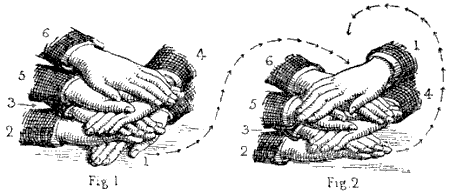
A singular rustic amusement. One lays his hand down on
a table, another clashes his upon it, a third his on that, and so
on (fig. 1). When all the players have done this, the one who
has his hand on the board pulls it out and lays it on the one
uppermost (fig. 2): they all follow in rotation, and so a continual
clashing and dashing is kept up; hence the name
“Dish.” Those who win the game are those who stand out
longest—viz., those who are best at enduring pain. Tender
hands could not stand it a moment: one dash of a rustic
“loof” would make the blood spurt from the tip of every
finger. It is a piece of pastime to country lads of the same
nature as “Hard Knuckles” (Mactaggart’s Gallovidian Encyclopædia).
This is a well-known game for small children in
London. After each child’s hands have been withdrawn and
replaced on top as many times as possible without deranging
the order, a general scramble and knocking of hands together
ends the game (A. B. Gomme). Jamieson (Etymological Dict.)
gives this as a sport of children.
See “Dump,” “Green Grass,” “Hot Cockles.”
A game played in a large level field with a bent stick called
“doddart.” Two parties, headed by two captains, endeavour
to drive a wooden ball to their respective boundaries (Halliwell’s
Dictionary). Brockett (North Country Words) adds to this
that the captains are entitled to choose their followers by
alternate votes. A piece of globular wood called an “orr” or
“coit” is thrown down in the middle of the field and driven
to one of two opposite hedges—the alley, hail-goal, or boundary.
The same game as “Clubby,” “Hockey,” “Shinney,”
“Shinneyhaw.”
One boy kneels, holding a long rope, the other end of which
is held by another boy; the other players stand round about
with handkerchiefs in hands, knotted. The one who holds the
rope-end and standing cries out—
[99]
Doncaster cherries, ripe and sound;
Touch ’em or taste ’em—
Down, you dogs!
—Earls Heaton, Yorkshire (H. Hardy).
This is evidently a version of “Badger the Bear,” with a
different and apparently degraded formula.
A school game. The dools are places marked with stones,
where the players always remain in safety—where they dare
neither be caught by the hand nor struck with balls. It is only
when they leave these places of refuge that those out of the
doons have any chance to gain the game and get in; and
leave the doons they frequently must—this is the nature of the
game. Now this game seems to have been often played in
reality by our ancestors about their doon-hills.—Mactaggart’s
Gallovidian Encyclopædia.
I.
Down in the valley where the green grass grows
Stands E—— H——, she blows like a rose.
She blows, she blows, she blows so sweet.
In came F—— S—— and gave her a kiss.
E—— made a pudding, she made it nice and sweet,
F—— took a knife and fork and cut a little piece.
Taste of it, taste of it, don’t say nay,
For next Sunday morning is our wedding day.
First we’ll buy a money box,
Then we’ll buy a cradle;
Rock, rock the bottom out,
Then we’ll buy another.
Bread and cheese all the week, cork on Sunday,
Half a crown on Saturday night, and a jolly good dance on Monday.
—Cowes, Isle of Wight (Miss E. Smith).
II.
Down in the meadows where the green grass grows,
To see —— blow like a rose.
She blows, she blows, she blows so sweet.
Go out, ——; who shall he be?
—— made a pudding,
She made it so sweet,
And never stuck a knife in
Till —— came to eat.
Taste, love, taste, love, don’t say nay,
For next Monday morning is your wedding day.
He bought her a gown and a guinea gold ring,
And a fine cocked hat to be married in.
—West Haddon, Northamptonshire; Long Itchington, Warwickshire (Northants Notes and Queries, ii. 105).
III.
Down in the valley the violets grow.
Dear little ——, she blows like a rose.
She blows, she blows, she blows so sweet.
Come along in.
Buy a shawl, buy a new black shawl,
A bonnet trimmed with white and a new parasol.
Oh dear, oh dear, what can I do,
For next Monday morning is my wedding due.
—Shipley, Horsham; Notes and Queries, 8th series, i. 210 (Miss Busk).
(b) The children form a ring by joining hands, one child
standing in the centre. They dance round. At the mention of
the second name one from the ring goes into the centre. The
two kiss at the end of the verse, and the first child takes the
place in the ring, and the game begins again.
See “All the Boys,” “Oliver, Oliver, follow the King.”[Addendum]
A game similar to “Trippit and Coit.”—Halliwell’s Dict.
[Play]
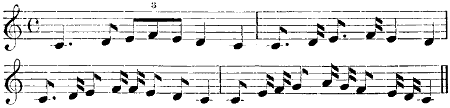
—Sporle, Norfolk (Miss Matthews).
[101]
I.
Draw a pail of water
For my lady’s daughter;
My father’s a king and my mother’s a queen,
My two little sisters are dressed in green,
Stamping grass and parsley,
Marigold leaves and daisies.
One rush, two rush,
Pray thee, fine lady, come under my bush.
—Halliwell’s Nursery Rhymes, Games, cclxxxvii.
II.
Draw a pail of water,
Send a lady a daughter;
One o’ my rush, two o’ my rush,
Please, young lady, creep under the briar bush.
—Liphook, Hants (Miss Fowler).
III.
Draw, draw water,
For my lady’s daughter;
One in a rush,
Two in a bush,
Pretty my lady, pop under the bush.
—Berrington and Ellesmere (Shropshire Folk-lore, p. 521).
IV.
Draw a bucket o’ water
For a lady’s daughter;
One and a hush, two and a rush,
Please, young lady, come under my bush.
—Fochabers (Rev. W. Gregor).
V.
Draw a bucket of water
For a lady’s daughter;
One in a bush,
Two in a bush,
Three in a bush,
Four in a bush,
And out you go.
—Crockham Hill, Kent (Miss Chase).
VI.
Drawing a bucket of water
For my lady’s daughter;
Put it in a chestnut tree,
And let it stay an hour.
One of you rush, two may rush,
Please, old woman, creep under the bush;
The bush is too high, the bush is too low,
Please, old woman, creep under the bush.
—Hampshire (Miss Mendham).
VII.
Draw a pail of water
For a lady’s daughter;
Give a silver pin for a golden ring—
Oh pray, young lady, pop under.
—Northants (Rev. W. D. Sweeting).
VIII.
Draw a bucket of water
For my lady’s daughter;
One go rush, and the other go hush,
Pretty young lady, bop under my bush.
—Sporle, Norfolk (Miss Matthews).
IX.
Draw a bucket of water
For the farmer’s daughter;
Give a gold ring and a silver watch,
Pray, young lady, pop under.
—Sporle, Norfolk (Miss Matthews).
X.
Draw a bucket of water
For my lady’s daughter;
A guinea gold ring
And a silver pin,
So pray, my young lady, pop under.
—Haydon (Herbert Hardy).
XI.
Draw a bucket of water
To wash my lady’s garter;
A guinea gold ring
And a silver pin,
Please, little girl, pop under.
—Earls Heaton (Herbert Hardy).
XII.
See-saw, a bucket of water,
To wash my lady’s garter.
One in a rush, and two in a bush,
To see a fine lady pop under a bush.
—Anderby, Lincolnshire, and Nottinghamshire near the Trent (Miss Peacock).
XIII.
One we go rush,
Two we go push;
Lady come under the corner bush.
—Shepscombe, Gloucestershire (Miss Mendham).
XIV.
Sift the lady’s oaten meal, sift it into flour,
Put it in a chest of drawers and let it lie an hour.
One of my rush,
Two of my rush,
Please, young lady, come under my bush.
My bush is too high, my bush is too low,
Please, young lady, come under my bow.
Stir up the dumpling, stir up the dumpling.
—Belfast (W. H. Patterson).
XV.
Sieve my lady’s oatmeal,
Grind my lady’s flour;
Put it in a chestnut,
Let it stand an hour.
One may rush, two may rush;
Come, my girls, walk under the bush.
—Halliwell’s Nursery Rhymes, Games, cclxxxviii.
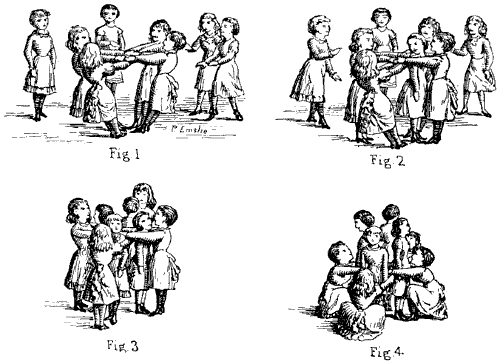
(b) The Berrington version of this game is played as
follows:—Two girls face each other, holding each other by
both hands. Two others face each other, holding both hands
across the other two. They see-saw backwards and forwards,
singing the lines (fig. 1). One girl gets inside the enclosing
hands (fig. 2), and they repeat till all four have “popped
under” (fig. 3), when they “jog” up and down till they fall on
the floor! (fig. 4). At Ellesmere only two girls join hands,
and as many “pop under” as they can encircle. The
Lincolnshire and Norfolk versions are played practically in
the same way. In the Liphook version the children stand
in two and two opposite to each other; the children on
one side of the square hold hands up at the third line,
and the other two children run under the hands of the first
two. There is no pause, but the verse is sung time after time,
so that the four children are nearly always moving. In the
other Hampshire version four girls stand in a square, each
holding the hands of the one opposite to her, pulling each
other’s hands backwards and forwards singing the lines. Two
arms are then raised, and one girl comes under; this is repeated
till all four girls have come under the arms, then
their arms encircle each other’s waists and they dance round.
In the Scottish version there are only two girls who join hands
and pull each other backwards and forwards, repeating the
words. Halliwell describes a different action to any of these.
A string of children, hand in hand, stand in a row. A child
stands in front of them as leader; two other children form
an arch, each holding both of the hands of the other. The
string of children pass under the arch, the last of whom is
taken captive by the two holding hands. The verses are
repeated until all are taken.—Halliwell’s Nursery Rhymes,
cclxxxvii.
(c) The analysis of the game rhymes is as follows:—
| No. |
Halli-
well’s Version. |
Liphook (Hants). |
Shrop-
shire. |
Focha-
bers (Scot-
land). |
Hamp-
shire. |
North-
ants. |
Norfolk (1). |
Norfolk (2). |
Haydon. |
Earls Heaton. |
Lincoln-
shire
and
Notting-
hamshire. |
Glouces-
tershire. |
Belfast. |
Halli-
well’s Version (No. 2). |
Crockham Hill. |
| 1. |
Draw a pail of water. |
Draw a pail of water. |
Draw, draw water. |
Draw a bucket o’ water. |
Drawing a bucket of water. |
Draw a pail of water. |
Draw a bucket of water. |
Draw a bucket of water. |
Draw a bucket of water. |
Draw a bucket of water. |
See saw, a bucket of water. |
— |
— |
— |
Draw a bucket of water. |
| 2. |
— |
— |
— |
— |
— |
— |
— |
— |
— |
— |
— |
— |
Sift the lady’s oatmeal. |
Sieve my lady’s oatmeal. |
— |
| 3. |
— |
— |
— |
— |
— |
— |
— |
— |
— |
— |
— |
— |
Sift it into flour. |
Grind my lady’s flour. |
— |
| 4. |
For my lady’s daughter. |
Send a lady a daughter. |
For my lady’s daughter. |
For a lady’s daughter. |
For my lady’s daughter. |
For a lady’s daughter. |
For my lady’s daughter. |
For the farmer’s daughter. |
For my lady’s daughter. |
— |
— |
— |
— |
— |
For a lady’s daughter. |
| 5. |
— |
— |
— |
— |
— |
— |
— |
— |
— |
To wash my lady’s garter. |
To wash my lady’s garter. |
— |
— |
— |
— |
| 6. |
— |
— |
— |
— |
Put it in a chestnut tree. |
— |
— |
— |
— |
— |
— |
— |
Put it in a chest of drawers. |
Put it in a chestnut. |
— |
| 7. |
— |
— |
— |
— |
Let it stay an hour. |
— |
— |
— |
— |
— |
— |
— |
Let it lie an hour. |
Let it stand an hour. |
— |
| 8. |
My father’s a king and my mother’s a queen. |
— |
— |
— |
— |
— |
— |
— |
— |
— |
— |
— |
— |
— |
— |
| 9. |
My two little sisters are dressed in green. |
— |
— |
— |
— |
— |
— |
— |
— |
— |
— |
— |
— |
— |
— |
| 10. |
Stamping grass and parsley. |
— |
— |
— |
— |
— |
— |
— |
— |
— |
— |
— |
— |
— |
— |
| 11. |
Marigold leaves and daisies. |
— |
— |
— |
— |
— |
— |
— |
— |
— |
— |
— |
— |
— |
— |
| 12. |
One rush, two rush. |
One o’ my rush, two o’ my rush. |
One in a rush, two in a bush. |
One and a hush, two and a rush. |
One of you rush, two may rush. |
— |
One go rush and the other go hush. |
— |
— |
— |
One in a rush and two in a bush. |
One we go rush, two we go push. |
One of my rush, two of my rush. |
One may rush, two may rush. |
One in a bush, two in a bush, three in a bush, four in a bush. |
| 13. |
— |
— |
— |
— |
— |
Give a silver pin for a golden ring. |
— |
Give a gold ring and a silver watch. |
A guinea gold ring and a silver pin. |
A guinea gold ring and a silver pin. |
— |
— |
— |
— |
— |
| 14. |
Pray thee, fine lady, come under my bush. |
Please, young lady, creep under the _briar_ bush. |
Pretty my lady, pop under the bush. |
Please, young lady, come under my bush. |
Please, old woman man, creep under the bush. |
Pray, young lady, pop under. |
Pretty young lady, bop under my bush. |
Pray, young lady, pop under. |
Pray, young lady, pop under. |
Please, little girl, pop under. |
To see a fine lady pop under a bush. |
Lady, come under the corner bush. |
Please, young lady, come under my bush. |
Come, my girls, walk under the bush. |
— |
| 15. |
— |
— |
— |
— |
The bush is too high, the bush is too low. |
— |
— |
— |
— |
— |
— |
— |
My bush is too high, my bush is too low. |
— |
— |
| 16. |
— |
— |
— |
— |
Please, old woman, creep under the bush. |
— |
— |
— |
— |
— |
— |
— |
Please, young lady, come under my bow. |
— |
— |
| 17. |
— |
— |
— |
— |
— |
— |
— |
— |
— |
— |
— |
— |
Stir up the dumpling. |
— |
— |
| 18. |
— |
— |
— |
— |
— |
— |
— |
— |
— |
— |
— |
— |
— |
— |
And out you go. |
| No. |
Halliwell’s Version. |
Liphook (Hants). |
Shropshire. |
Fochabers (Scotland). |
Hampshire. |
Northants. |
Norfolk (1). |
Norfolk (2). |
| 1. |
Draw a pail of water. |
Draw a pail of water. |
Draw, draw water. |
Draw a bucket o’ water. |
Drawing a bucket of water. |
Draw a pail of water. |
Draw a bucket of water. |
Draw a bucket of water. |
| 2. |
— |
— |
— |
— |
— |
— |
— |
— |
| 3. |
— |
— |
— |
— |
— |
— |
— |
— |
| 4. |
For my lady’s daughter. |
Send a lady a daughter. |
For my lady’s daughter. |
For a lady’s daughter. |
For my lady’s daughter. |
For a lady’s daughter. |
For my lady’s daughter. |
For the farmer’s daughter. |
| 5. |
— |
— |
— |
— |
— |
— |
— |
— |
| 6. |
— |
— |
— |
— |
Put it in a chestnut tree. |
— |
— |
— |
| 7. |
— |
— |
— |
— |
Let it stay an hour. |
— |
— |
— |
| 8. |
My father’s a king and my mother’s a queen. |
— |
— |
— |
— |
— |
— |
— |
| 9. |
My two little sisters are dressed in green. |
— |
— |
— |
— |
— |
— |
— |
| 10. |
Stamping grass and parsley. |
— |
— |
— |
— |
— |
— |
— |
| 11. |
Marigold leaves and daisies. |
— |
— |
— |
— |
— |
— |
— |
| 12. |
One rush, two rush. |
One o’ my rush, two o’ my rush. |
One in a rush, two in a bush. |
One and a hush, two and a rush. |
One of you rush, two may rush. |
— |
One go rush and the other go hush. |
— |
| 13. |
— |
— |
— |
— |
— |
Give a silver pin for a golden ring. |
— |
Give a gold ring and a silver watch. |
| 14. |
Pray thee, fine lady, come under my bush. |
Please, young lady, creep under the _briar_ bush. |
Pretty my lady, pop under the bush. |
Please, young lady, come under my bush. |
Please, old woman man, creep under the bush. |
Pray, young lady, pop under. |
Pretty young lady, bop under my bush. |
Pray, young lady, pop under. |
| 15. |
— |
— |
— |
— |
The bush is too high, the bush is too low. |
— |
— |
— |
| 16. |
— |
— |
— |
— |
Please, old woman, creep under the bush. |
— |
— |
— |
| 17. |
— |
— |
— |
— |
— |
— |
— |
— |
| 18. |
— |
— |
— |
— |
— |
— |
— |
— |
| No. |
Haydon. |
Earls Heaton. |
Lincolnshire and Nottinghamshire. |
Gloucestershire. |
Belfast. |
Halliwell’s Version (No. 2). |
Crockham Hill. |
| 1. |
Draw a bucket of water. |
Draw a bucket of water. |
See saw, a bucket of water. |
— |
— |
— |
Draw a bucket of water. |
| 2. |
— |
— |
— |
— |
Sift the lady’s oatmeal. |
Sieve my lady’s oatmeal. |
— |
| 3. |
— |
— |
— |
— |
Sift it into flour. |
Grind my lady’s flour. |
— |
| 4. |
For my lady’s daughter. |
— |
— |
— |
— |
— |
For a lady’s daughter. |
| 5. |
— |
To wash my lady’s garter. |
To wash my lady’s garter. |
— |
— |
— |
— |
| 6. |
— |
— |
— |
— |
Put it in a chest of drawers. |
Put it in a chestnut. |
— |
| 7. |
— |
— |
— |
— |
Let it lie an hour. |
Let it stand an hour. |
— |
| 8. |
— |
— |
— |
— |
— |
— |
— |
| 9. |
— |
— |
— |
— |
— |
— |
— |
| 10. |
— |
— |
— |
— |
— |
— |
— |
| 11. |
— |
— |
— |
— |
— |
— |
— |
| 12. |
— |
— |
One in a rush and two in a bush. |
One we go rush, two we go push. |
One of my rush, two of my rush. |
One may rush, two may rush. |
One in a bush, two in a bush, three in a bush, four in a bush. |
| 13. |
A guinea gold ring and a silver pin. |
A guinea gold ring and a silver pin. |
— |
— |
— |
— |
— |
| 14. |
Pray, young lady, pop under. |
Please, little girl, pop under. |
To see a fine lady pop under a bush. |
Lady, come under the corner bush. |
Please, young lady, come under my bush. |
Come, my girls, walk under the bush. |
— |
| 15. |
— |
— |
— |
— |
My bush is too high, my bush is too low. |
— |
— |
| 16. |
— |
— |
— |
— |
Please, young lady, come under my bow. |
— |
— |
| 17. |
— |
— |
— |
— |
Stir up the dumpling. |
— |
— |
| 18. |
— |
— |
— |
— |
— |
— |
And out you go. |
The analysis shows that the majority of the variants retain
four principal incidents of what must have been the original
form of the game, and the fact of the Gloucestershire version
having come down with only two of the incidents, namely, the
two most common to all the variants (12 and 14), shows that
the game has been in a state of decadence. The four principal
incidents, Nos. 1, 4, 12, and 14, point distinctly to some water
ceremonial; and if it may be argued that the incidents which
occur in only one or two of the variants may be considered to
have belonged to the original type, we shall be able to suggest
that this game presents a dramatic representation of ancient
well-worship. The incidents which occur in one version only
are those given by Mr. Halliwell, and unfortunately the locality
from which he obtained this variant is unknown. Still it is an
earlier version than those which are now printed for the first
time, and may without doubt be looked upon as genuine.
Taking all the incidents of the various versions as the means
by which to restore the earliest version, it would appear that
this might have consisted of the following lines:—
Draw a pail of water
For a lady’s daughter;
Her father’s a king, her mother’s a queen,
Her two little sisters are dressed in green,
Stamping grass and parsley, marigold leaves and daisies;
Sift the lady’s oatmeal, sift it into flour,
Put it in a chestnut tree, let it lie an hour;
Give a silver pin and a gold ring,
One and a hush! two and a rush!
Pray, young lady, pop under a bush;
My bush is too high, my bush is too low,
Please, young lady, come under my bow!
(d) This restoration of the words, though it probably is far
from complete, and does not make so good a game rhyme as
the reduced versions, nevertheless shows clearly enough that
the incidents belong to a ceremonial of primitive well-worship.
The pulling of the hands backwards and forwards may be
taken to indicate the raising of water from a well. If this is
conceded, the incidents might be grouped as follows:—
- (1.) Drawing of water from a well.
- (2.) For a devotee at the well.
- (3.) Collecting flowers for dressing the well.
- (4.) Making of a cake for presentation.
- (5.) Gifts to the well [the silver pin, gold ring, and probably the garter].
- (6.) Command of silence.
- (7.) The presence of the devotee at the sacred bush.
All these are incidents of primitive well-worship (see
Gomme’s Ethnology and Folk-lore, pp. 82-103). Garland
dressing is very general; cakes were eaten at Rorrington well,
Shropshire (Burne’s Shropshire Folk-lore, p. 433); pins and
portions of the dress are very general offerings; silence is
strictly enforced in many instances, and a sacred tree or bush
is very frequently found near the well.
The tune of the Hampshire game (Miss Mendham’s version)
is practically the same as that of the “Mulberry Bush.”
Newell (Games of American Children, p. 90) gives a version
of this game.[Addendum]
Brand, quoting from “an old collection of satires, epigrams,
&c.,” says this game is enumerated among other pastimes:
At shove-groat, venter-point, or crosse and pile,
At leaping o’er a Midsummer bone-fier,
Or at the drawing Dun out of the myer.
So in the Dutchesse of Suffolke, 1631:
Well done, my masters, lends your hands,
Draw Dun out of the ditch,
Draw, pull, helpe all, so, so, well done.
[They pull him out.]
They had shoved Bishop Bonner into a well, and were pulling
him out.
We find this game noticed at least as early as Chaucer’s
time, in the Manciple’s Prologue:
Then gan our hoste to jape and to play,
And sayd, sires, what? Dun is in the mire.
Nares (Glossary) says this game was a rural pastime, in
which Dun meant a dun horse, supposed to be stuck in the
mire, and sometimes represented by one of the persons who
played.
Gifford (Ben Jonson, vol. vii. p. 283), who remembered having
played at the game (doubtless in his native county, Devonshire),
thus describes it:—“A log of wood is brought into the midst
of the room: this is Dun (the cart horse), and a cry is raised
that he is stuck in the mire. Two of the company advance,
either with or without ropes, to draw him out. After repeated
attempts they find themselves unable to do it, and call for more
assistance. The game continues till all the company take part
in it, when Dun is extricated of course; and the merriment
arises from the awkward and affected efforts of the rustics to
lift the log, and sundry arch contrivances to let the ends of it
fall on one another’s toes.”
This is a game similar to Cat and Mouse, but takes its name
from the use of the handkerchief to start the pursuit. Various
rhyming formulæ are used in some places. In Monton, Lancashire
(Miss Dendy), no rhyme is used.
The children stand in a ring. One runs round with a handkerchief
and drops it; the child behind whom it is dropped
chases the dropper, the one who gets home first takes the
vacant place, the other drops the handkerchief again.
In Shropshire the two players pursue one another in and out
of the ring, running under the uplifted hands of the players
who compose it: the pursuer carefully keeping on the track of
the pursued (Burne’s Shropshire Folk-lore, p. 512).
The Dorsetshire variant is accompanied by a rhyme:
I wrote a letter to my love;
I carried water in my glove;
And by the way I dropped it—
I dropped it, I dropped it, I dropped it, &c.
This is repeated until the handkerchief is stealthily dropped
immediately behind one of the players, who should be on the
alert to follow as quickly as possible the one who has dropped
it, who at once increases her speed and endeavours to take the
place left vacant by her pursuer. Should she be caught before
she can succeed in doing this she is compelled to take the
handkerchief a second time. But if, as it more usually happens,
she is successful in accomplishing this, the pursuer in
turn takes the handkerchief, and the game proceeds as before.—Symondsbury
(Folk-lore Journal, vi. 212).
Jack lost his supper last night,
And the night before; if he does again to-night,
He never will no more—more—more—more.
I wrote a letter to my love,
And on the way I dropt it;
Some of you have picked it up,
And got it in your pocket—pocket—pocket—pocket.
I have a little dog, it won’t bite you—
It won’t bite you—it won’t bite you—
It will bite you.
—Leicestershire (Miss Ellis).
The Forest of Dean version is the same as the Dorsetshire,
except that the child who is unsuccessful in gaining the vacant
place has to stand in the middle of the ring until the same thing
happens to another child.—Miss Matthews.
In Nottinghamshire the children form in a ring; one walks
round outside the ring singing and carrying a handkerchief:
I wrote a letter to my love, and on the way I dropt it;
One of you has picked it up and put it in your pocket.
It isn’t you, it isn’t you, &c. &c.; it is you.
The handkerchief is then dropped at some one’s back, the
one at whose back the handkerchief was dropped chasing the
other.
Or they say:
I lost my supper last night, I lost it the night before,
And if I lose it again to-night, I’ll knock at somebody’s door.
It isn’t you, it isn’t you, &c. &c.; it’s you.
—Miss Winfield.
At Winterton and Lincoln the children form a circle, standing
arms-length apart. A child holding a handkerchief occupies the
centre of the ring and sings:
[111]
Wiskit-a-waskit,
A green leather basket;
I wrote a letter to my love,
And on the way I lost it;
Some of you have picked it up,
And put it in your pocket.
I have a little dog at home,
And it shan’t bite you,
(Here the singer points to each child in turn)
Nor you, nor you, nor you;
But it shall bite you.
Then she drops the handkerchief before her chosen playmate,
who chases her in and out of the ring under the arms of the
other children until she is captured. The captor afterwards
takes the place in the centre, and the original singer becomes a
member of the circle.—Miss M. Peacock.
The Deptford version of the verse is as follows:—
I had a little dog whose name was Buff,
I sent him up the street for a penny’orth of snuff,
He broke my box and spilt my snuff,
I think my story is long enough—
’Tain’t you, and ’tain’t you, and ’tis you!
—Deptford, Kent (Miss Chase).
A Staffordshire and Sharleston version gives some altogether
different formulæ:—
What colour’s the sky?
Blue.
Look up again.
Like a W.
Follow me through every little hole that I go through.
—Staffordshire (Rev. G. T. Royds, Rector of Haughton).
At Sharleston the centre child says, “What colour is t’
sky?” The other answers, “Blue.” Centre child says,
“Follow me true.” Here the centre child runs in and out
between the others until the one who was touched catches her,
when they change places, the first joining the children in the
ring.—Sharleston (Miss Fowler).
At Beddgelert, Wales (Mrs. Williams), this game is called
Tartan Boeth. It is played in precisely the same manner as the
English game, but the words used are:
Tartan Boeth, Oh ma’en llosgi, Boeth iawn
Hot Tart. Oh, it burns! very hot!
At the words, “Very hot!” the handkerchief is dropped.
(b) In this game no kissing takes place, and that this is no
mere accidental omission may be shown by Mr. Udal’s description
of the Dorsetshire game. He was assured by several
persons who are interested in Dorset Children’s Games that
the indiscriminate kissing (that is, whether the girl pursued
runs little or far, or, when overtaken, whether she objects or
not) with which this game is ordinarily associated, as played
now both in Dorset and in other counties, was not indigenous
to this county, but was merely a pernicious after-growth or outcome
of later days, which had its origin in the various excursion
and holiday fêtes, which the facilities of railway travelling had
instituted, by bringing large crowds from the neighbouring
towns into the country. He was told that thirty years ago such
a thing was unknown in the country districts of Dorset, when the
game then usually indulged in was known merely as “Drop the
Handkerchief” (Folk-lore Journal, vii. 212).
In other cases the rhymes are used for a purely kissing
game, for which see “Kiss in the Ring.”[Addendum] [Addendum]
[Addendum]
An undescribed Suffolk boys’ game.—Moor’s Suffolk Words,
p. 238.
Each child chooses a partner, and form in couples standing
one before the other, till a long line is formed. Each couple
holds a handkerchief as high as they can to form an arch. The
couple standing at the end of the line run through the arch
just beyond the last couple standing at the top, when they
stand still and hold their handkerchief as high as possible,
which is the beginning of the second arch; this is repeated by
every last couple in succession, so that as many arches as are
wanted can be formed.—East Kirkby, Lincolnshire (Miss K.
Maughan).
Miss Baker (Northamptonshire Glossary) says the game is
played in that county. Formerly in the northern part of the
county even married women on May Day played at it under
the May garland, which was extended from chimney to chimney
across the village street.
A boys’ game, played with round stones and a table-shaped
block of stone.—Patterson’s Antrim and Down Glossary.
Probably the same as Duckstone.
[Play]
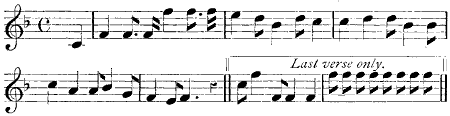
—London (A. B. Gomme).
I saw a ship a sailin’,
A sailin’ on the sea,
And oh, it was laden
With pretty things for me [thee].
There were comfits in the cabin,
And apples in the hold;
The sails were made of silk,
And the masts were made of gold.
Four and twenty sailors
That sat upon the deck,
Were four and twenty white mice
With chains about their necks.
The captain was a duck,
With a packet on his back;
And when the ship began to move,
The captain cried “Quack! quack!”
—Northamptonshire, Revue Celtique, iv. 200;
Halliwell’s Nursery Rhymes, No. ccclxxvii.
(b) A number of little girls join hands and form a ring.
They all jump round and sing the verses. The game ends by
the girls following one of their number in a string, all quacking
like ducks.—Northamptonshire.
(c) Halliwell does not include it among his games, but simply
as a nursery paradox. The tune given is that to which I as a
child was taught to sing the verses as a song. We did not
know it as a game. The “Quack, quack!” was repeated as
another line to the notes of the last bar given, the notes gradually
dying away (A. B. Gomme).
The game of “Leap-frog.”—Apollo Shroving, 1627, p. 83.
A pastime in which flat stones or slates are thrown upon the
surface of a piece of water, so that they may dip and emerge
several times without sinking (Brockett’s North Country Words).
“Neither cross and pile nor ducks and drakes are quite so
ancient as hand dandy” (Arbuthnot and Pope, quoted in Todd’s
Johnson).
Halliwell gives the words used in the game both formerly
and at the present day. If the stone emerges only once it is a
duck, and increasing in the following order:—
- 2. A duck and a drake,
- 3. And a halfpenny cake,
- 4. And a penny to pay the old baker,
- 5. A hop and a scotch is another notch,
- 6. Slitherum, slatherum, take her.
—Halliwell’s Dictionary.
Hen-pen,
Duck and mallard,
Amen.
—Somersetshire (Holloway’s Dict. of Provincialisms).
A duck and a drake
And a white penny cake.
—Hampshire (Holloway’s Dict. of Provincialisms).
[115]
A duck and a drake
And a penny white cake,
And a skew ball.
—Peacock’s Manley and Corringham Glossary.
Moor (Suffolk Words and Phrases) gives the names for the
number of times the stone emerges, as (1) “a duck;” (2) “a
duck an’ a drake;” if thrice, “a duck an’ a drake an’ a fi’epenny
cake;” four times is “a duck an’ a drake an’ a fi’epenny cake,
an’ a penny to pah the baker.” If more than four, “a duck,”
“a duck an’ a drake,” &c., are added. These distinctions are
iterated quickly to correspond in time as nearly as may be
with the dips of the stone. A flattish stone is evidently the
best for this sport.
(b) This game is also given by Mr. Addy in his Sheffield
Glossary, and by Holland (Cheshire Glossary), Brogden (Provincial
Words, Lincolnshire), Lowsley (Berkshire Glossary),
Nares’ Glossary, and Baker’s Northants Glossary. Miss Courtenay
gives “Scutter” and “Tic Tac Mollard” as Cornish
names for the game (West Cornwall Glossary). See also
Halliwell’s Nursery Rhymes, p. 139, and Strutt’s Sports and
Pastimes, p. 326.
Butler, in his Hudibras (p. ii. canto iii. l. 302), makes it one
of the important qualifications of his conjurer to tell—
What figur’d slates are best to make
On wat’ry surface duck or drake.
The following description of this sport is given by Minucius
Felix, ed. 1712, p. 28, which evinces its high antiquity: “Pueros
videmus certatim gestientes, testarum in mare jaculationibus
ludere. Is lusus est, testam teretem, jactatione fluctuum lævigatam,
legere de litore: eam testam plano situ digitis comprehensam,
inclinem ipsum atque humilem, quantum potest, super
undas irrorare: ut illud jaculum vel dorsum maris raderet, vel
enataret, dum leni impetu labitur; vel summis fluctibus tonsis
emicaret, emergeret, dum assiduo saltu sublevatur. Is se in
pueris victorem ferebat, cujus testa et procurreret longius, et
frequentius exsiliret.”
“From this pastime,” says Moor, “has probably arisen the
application of the term to a spendthrift—of whose approaching
ruin we should thus speak: ‘Ah, he’ave made fine ducks and
drakes of a’s money, that a’ have.’”—Suffolk Words.
A large stone called the Duckstone or Duck-table is placed
on the ground, generally with a wall for a background, but this
is of little consequence. Several boys take a stone each, and a
place pretty near the Duckstone is chosen for “home.” One
of the boys puts his stone on the Duckstone, and he is called the
Tenter. He has to guard the home and catch the other boys if
he can. Each boy in turn throws his stone at the stone on the
Duck-table and immediately runs home. The Tenter tries to
catch him before he can touch the wall or post or whatever is
chosen for the home. If the Tenter can catch him he becomes
Tenter, and puts his stone on the Duckstone, and the original
Tenter takes his turn in throwing. One rule of the game is
that the Tenter’s stone must always be on the Duck-table when
he is trying to catch a boy, so if it is knocked off it must be
replaced before he can try to catch the boy running “home.”
The chance of getting home is increased for the boy who knocks
it off.—North-West Lincolnshire (Rev. —— Roberts and Miss
Peacock).
(b) Similar versions are from Earls Heaton (Herbert Hardy),
Ireland (Folk-lore Journal, ii. 265), Peacock (Mauley and
Corringham Glossary). Addy (Sheffield Glossary) gives this
game with the following addition: If a duck falls short of
the Duckstone, and the one whose duck is on the stone
sees that he can wand or span with his hand the distance
between the duck thus thrown and the Duckstone, he shouts
out “Wands,” and if he can wand or span the distance he takes
his duck off, and the duck thus thrown is put on. Holland
(Cheshire Glossary), Darlington (South Cheshire), Baker
(Northants Glossary), and Brogden (Provincial Words, Lincolnshire),
also give this game. Elworthy (West Somerset
Words) calls it “Duck,” and “Ducks off” and “Cobbs off” in
Dorsetshire. In London the boy repeats the words, “Gully,
gully, all round the hole, one duck on,” while he is playing
(Strand Magazine, November 1891). Newell (Games, p. 188)
calls it “Duck on a Rock.”
[117]
Name for “Cat and Mouse” in Cornwall.—Folk-lore
Journal, v. 57.
An undescribed game mentioned in Moor’s Suffolk Words,
p. 238.
Two sides are chosen, which stand apart from each other
inside the line of their den. One side chooses a trade, and goes
to the opposite side imitating working at the trade and giving
the initial letters of it. If the opposite side guesses the name
of the trade, the players run to their own den, being chased by
their opponents. If any of the players are caught they must
go to the opposite side. In turn the opposite side chooses a
trade, and imitates the actions practised.—Cork, Ireland (Miss
Keane).
This is called “An Old Woman from the Wood” in Dorsetshire.
The children form themselves into two ranks.
The first rank says:
Here comes an old ’oman from the wood.
The second party answers:
What cans’t thee do?
First Party:Do anythin’.
Second Party: Work away.
This the children proceed to do, some by pretending to sew,
some to wash, some to dig, some to knit, without any instruments
to do it with. If the opposite side guess what they are
doing, they change sides. This game, Miss Summers believes,
is very old, and has been played by several generations in the
village of Hazelbury Bryan.—Dorsetshire (Folk-lore Journal,
vii. 230).
See “Trades.”
A boys’ amusement in Yorkshire, in vogue about half a
century ago, but now believed to be nearly obsolete. It is
played in this manner. The lads crowd round and place their
fists endways, the one on the other, till they form a high pile of
hands. Then a boy, who has one hand free, knocks the piled
fists off one by one, saying to every boy as he strikes his fist
away, “What’s there, Dump?” He continues this process till
he comes to the last fist, when he exclaims:—
What’s there?
Cheese and bread, and a mouldy halfpenny!
Where’s my share?
I put it on the shelf, and the cat got it.
Where’s the cat?
She’s run nine miles through the wood.
Where’s the wood?
T’ fire burnt it.
Where’s the fire?
T’ waters sleekt (extinguished) it.
Where’s the water?
T’ oxen drank it.
Where’s the oxen?
T’ butcher killed ’em.
Where’s the butcher?
Upon the church tops cracking nuts, and you may go and eat the shells; and them as speaks first shall have nine nips, nine scratches, and nine boxes over the lug!
Every one then endeavours to refrain from speaking in spite
of mutual nudges and grimaces, and he who first allows a word
to escape is punished by the others in the various methods
adopted by schoolboys. In some places the game is played
differently. The children pile their fists in the manner described
above; then one, or sometimes all of them, sing:
I’ve built my house, I’ve built my wall;
I don’t care where my chimneys fall!
The merriment consists in the bustle and confusion occasioned
by the rapid withdrawal of the hands (Halliwell’s Nursery
Rhymes, p. 225). Compare Burne’s Shropshire Folk-lore, p. 529.
Northall (Folk Rhymes, p. 418) gives the following rhymes
as said in Warwickshire while the fists are being piled on one
another:—
[119]
Here’s one hammer on the block,
My men, my men;
There’s one hammer, &c., my man John.
Dibble the can, blow bellows, blow,
Fire away, lads, for an hour or so.
See “Dish-a-loof,” “Sacks.”[Addendum]
A game at marbles or taw, played with holes scooped in the
ground (Roxburgh, Jamieson). Grose gives dump as signifying
“a deep hole of water” (Provincial Glossary).
A game in which boys placed their points in a heap, and
threw at them with a stone. Weber and Nares give wrong
explanations. It is alluded to in Cotton’s Works, 1734, p. 184.
I’ll venter on their heads my brindled cow,
With any boy at dust-point they shall play.
—Peacham’s Thalia’s Banquet, 1620.
Nares (Glossary) suggests that this game and blow-point
resembled the game of Push-pin. See also Halliwell’s Dictionary.
A number of young men and women stand in a line, a tall
girl at one end of the line representing the tree. They then
begin to wrap round her, saying, “The old eller tree grows
thicker and thicker.” When they have all got round her (the
tree), they jump all together, calling out, “A bunch of rags,
a bunch of rags,” and try to tread on each other’s toes.—Sheffield,
Yorks (S. O. Addy).
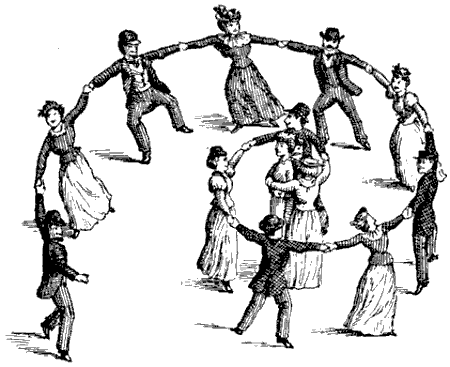
(b) The tree is the alder. It abounds in the North of England
more than in any other part of the kingdom, and seems
always to have been there held in great respect and veneration.
Many superstitions also attach to the tree. It is possible from
these circumstances that the game descends from an old custom
of encircling the tree as an act of worship, and the allusion to
the “rags” bears at least a curious relationship to tree worship.
If this conclusion is correct, the particular form of the game
preserved by Mr. Addy may be the parent form of all games
in which the act of winding is indicated. There is more reason
for this when we consider how easy the notion of clock-winding
would creep in after the old veneration for the sacred
alder tree had ceased to exist.
See “Bulliheisle,” “Wind up the Bush Faggot,” “Wind up
the Watch.”
Old Ezzeka did one day stand
Upon a barrel top;
The bung flew out, and all at once
It went off with a pop.
—Dronfield (S. O. Addy).
This game is usually played in a house or schoolroom, by
boys and girls. A boy or girl is chosen who is considered to
be able to stand a joke. He sits on a chair. A stool is put
behind, upon which a boy called “Ezzeka” stands. Then the
other boys and girls in the room sing the lines. As they are
finished, Ezzeka, who has a bottle of water in his hand, takes
out the cork, and pours the water upon his victim’s head.
This game may be compared with the game of “King Arthur”
mentioned by Brand (Pop. Antiq., ii. 393).
This is a boys’ game. One boy says to another, “Divv (do)
ye ken (know) aboot my father’s fiddle?” On replying that
he does not, the questioner takes hold of the other’s right hand
with his left, and stretches out the arm. With his right hand
he touches the arm gently above the elbow, and says, “My
father had a fiddle, an’ he brook (broke) it here, an’ he brook it
here” (touching it below the elbow), “an’ he brook it throw the
middle,” and comes down with a sharp stroke on the elbow-joint.—Keith,
Fochabers (Rev. W. Gregor).
This is probably the same game as that printed by Halliwell,
No. cccxxxv., to which the following rhyme applied:—
My father was a Frenchman,
He bought for me a fiddle;
He cut me here, he cut me here,
He cut me right in the middle.
An undescribed game mentioned in an old poem called
Christmas (i. 285), quoted in Ellis’s Brand, i. 517: “Young
men and maidens now at ‘Feed the Dove’ (with laurel leaf in
mouth) play.”
O the grand old Duke of York
He had ten thousand men,
He marched them up the hill ago
And he marched them down again.
And when they were up they were up,
And when they were down they were down,
And when they were half-way up the hill
They were neither up nor down.
—Sheffield (S. O. Addy).
A ring of chairs is formed, and the players sit on them.
A piece of string long enough to go round the inner circumference
of the chairs is procured. A small ring is put upon
the string, the ends of which are then tied. Then one of the
players gets up from his chair and stands in the centre. The
players sitting on the chairs take the string into their hands
and pass the ring round from one to another, singing the lines.
If the person standing in the centre can find out in whose hand
the ring is, he sits down, and his place is taken by the one who
had the ring. The game is sometimes played round a haycock
in the hayfield.
Miss Dendy sends a similar rhyme from Monton, Lancashire,
where it is known simply as a marching game. For similar
rhymes, see Halliwell’s Nursery Rhymes, p. 3.
See “Paddy from Home,” “Tip it.”
“Twice three stones, set in a crossed square, where he wins
the game that can set his three along in a row, and that is
fippeny morrell I trow.”—Apollo Shroving, 1626.
See “Nine Men’s Morice,” “Noughts and Crosses.”
The players seat themselves in a circle. One of the players
has a ball, to which a string is fastened. He holds the string
that he may easily draw the ball back again after it is thrown.
The possessor of the ball then throws it to one in the circle,
calling out the name of either of the elements he pleases. This
player must, before ten can be counted, give the name of an
inhabitant of that element. When “Fire” is called, strict
silence must be observed or a forfeit paid.—Cork, Ireland
(Miss Keane).
The players were seated in a half-circle, and the possessor
of the ball faced the others. There was no string attached
to the ball, but it was necessary that it should hit the child it
was thrown to. When “Fire” was called, “Salamander” and
“Phœnix” were allowed to be said. The third time “Fire”
was called, silence was observed, and every player bowed
the head. We called it “Earth, Air, Fire, and Water.” A forfeit
had to be paid for every mistake.—London (A. B. Gomme).
It seems probable that a survival of fire-worship is shown
by this game.
This game was played by a newspaper boy at Richmond
Station for me as follows:—He had five square pieces of tile or
stone about the size of dice. He took all five pieces in the
palm of the hand first, then threw them up and caught them on
the back of the hand, and then from the back of the hand into
the palm. Four of the stones were then thrown on the ground;
the fifth was thrown up, one stone being picked up from the
ground, and the descending fifth stone caught in the same hand;
the other three pieces were next picked up in turn. Then two
were picked up together in the same manner twice, then one,
then three, then all four at once, the fifth stone being thrown up
and caught with each movement. All five were then thrown up
and caught on the back of the hand, and then thrown from
the back and caught in the palm. When he dropped one, he
picked it up between his outstretched fingers while the other
stones remained on the back of the hand; then he tossed and
caught it likewise. Then after throwing up the five stones and
catching them on the back of the hand and the reverse, all five
being kept in the palm, one was thrown up, and another deposited
on the ground before the descending stone was caught.
This was done to the three others in turn. Then with two at a
time twice, then one and three, then all four together, then from
the palm to the back of the hand, and again to the palm. This
completed one game. If mistakes were made another player
took the stones. Marks were taken for successful play. This
boy called the game “Dabs.”—A. B. Gomme.
In South Notts this game was called “Snobs.” It was
played with small stones or marbles. There were nine sets of
tricks. First One-ers (of which there were five in the set),
then Two-ers (two in set), Three-ers (three in set), Four-ers
(four in set), Four Squares (four in set), Trotting Donkeys
(eight in set, I believe), Fly-catchers (six or seven in set), Magic
(five in set), and Magic Fly-catchers (five in set). One-ers
is played thus:—The five stones are thrown into the air
and caught on the back of the hand. If all are caught they
are simply tossed up again and caught in the hollow of the
hand, but if any are not caught they have to be picked up,
one by one, another stone being at the same time thrown into
the air and caught with the one picked up in the hand.
Two-ers, Three-ers, and Four-ers, are played in the same way,
except that the stones not caught on the back of the hand have
to be arranged in twos, threes, and fours respectively by the
hand on which the caught stones are lying meanwhile, and
then each lot has to be picked up altogether. If the number
that fall when the stones are first thrown up won’t allow of
this, the player has to drop the required number (but no more)
from his hand. In Magic the play is just the same as in
One-ers, except that instead of only throwing up a single
stone and catching it as the others are in turn picked up, the
whole number, except those remaining to be picked up, are
thrown and caught. In Four Squares, four of the stones are
arranged in a square, each of them is then picked up, whilst the
remaining stone is flung upwards and caught; the one picked up
is then tossed up, and the one originally tossed up is put down
in the place of the other, which is caught as it descends, and the
process repeated “all round the square.” Trotting Donkeys is
similarly played, except that the four stones are arranged in a
line—not in a square—and I believe there is some other slight
difference, but I forget what. Fly-catchers is played like
One-ers, except that the stone thrown into the air while the
others are being picked up, is not simply caught by being
allowed to fall into the hand, but by an outward movement of
the hand is pounced on, hawk-fashion, from above. Magic Fly-catchers
is played in precisely the same way, except that as
in simple Magic, not one stone, but all are thrown up and
caught—that is, if there are four on the ground one only is
thrown up for the first, two for the second, three for the third,
and so on until they are all picked up. This is, of course, the
most difficult part of all, and, in fact, only experts were expected
to do it. Every failure means “out,” and then your opponent
has his turn. The winner is the one who gets through first.
Such is the game as I remember it, but I have an uneasy
suspicion that I have missed something out. I seem to remember
one trick in which all the stones on the ground had to
be picked up at once where they lay—scrambled up so to speak.
Or it may be (and, in fact, I think it was) that sometimes, to
add to the difficulty of the game, we picked up the groups of
two, three, and four in Two-ers, Three-ers, and Four-ers in
this fashion, instead of first placing them together.—Epworth,
Doncaster (C. C. Bell).
In Wakefield the set of pot checks, which represents five
hucklebones, now consists of four checks and a ball about the
size of a large marble. The checks are something like dice,
but only two opposite sides are plain, the other four being
fluted. The table played on is generally a doorstep, and it is
made ready by drawing a ring upon it with anything handy
which will make a mark. There are twelve figures or movements
to be gone through as follows. Some have special
names, but I do not learn that all have.
1. The player, taking the checks and ball in the right hand,
throws down the checks, keeping the ball in the hand. If any
check fall outside the ring the player is “down.” There is
skill needed in the throwing of the checks in this and the
following movements, so that they may be conveniently placed
for taking up in the proper order. The checks being scattered,
the player throws up the ball, takes up one check, and catches
the ball as it comes down, or, as it is sometimes played, after
it has bounced once from the step. This is repeated till all the
checks are taken up.
2. As the last figure, but the checks are taken up two at a
throw.
3. As the last, but at the first throw one check, called the
Horse, is taken up, and at the second the remaining three
checks at once, called the Cart.
4. As before, but all the checks taken up together.
5. Called Ups and Downs. The checks are taken up at one
throw, and set down outside the ring at the next. This is
done first with one, then with two, and so on.
6. Each check is touched in turn as the ball is thrown.
7. The checks are separately pushed out of the ring.
8. Each check in turn is taken up and knocked against the
ground.
9. Each check is taken up and tapped upon another.
10. The checks are first arranged three in a line, touching
each other, and the fourth placed at the top of that at one end
of the row. This is called the Cradle. It has to be taken
down check by check, and if, in taking one, another is moved,
the player is out.
11. Like the last, but the checks are put one above another
to make a Chimney.
12. Called the Dish-clout—I know not why, unless it be
that it wipes up the game. The movement used in taking up
the checks is thus described:—“Take hold of the sleeve of the
right hand with the left; throw up the ball, and twist your
right hand underneath and over your left, and catch the ball.
With the hand still twisted throw up the ball and untwist and
catch it.” The checks are picked up in the course of the
twisting.
These I am told are the orthodox movements; and I do not
doubt that in them there is much of very old tradition, although
the tenth and eleventh must have been either added or modified
since pot checks came into use, for the figures could not be
built up with the natural bones. Some other movements are
sometimes used according to fancy, as for example the clapping
of the ground with the palm of the hand before taking up the
checks and catching the ball.—J. T. Micklethwaite (Arch. Journ.,
xlix. 327-28).
I am told that in the iron districts of Staffordshire, the round
bits of iron punched out in making rivet holes in boiler plates
are the modern representatives of hucklebones.—Ibid.
In Westminster four stones are held in the right hand, a
marble is thrown up, and all four stones thrown down, and the
marble allowed to bounce on the hearthstone or pavement, and
then caught in the same hand after it has rebounded. The
marble is then thrown up again, and one of the four stones
picked up, and the marble caught again after it has rebounded.
This is done separately to the other three, bringing all four
stones into the hand. The marble is again bounced, and all
four stones thrown down and the marble caught. Two stones
are then picked up together, then the other two, then one, then
three together, then all four together, the marble being tossed
and caught with each throw. An arch is then formed by
placing the left hand on the ground, and the four stones are
again thrown down, the marble tossed, and the four stones put
separately into the arch, the marble being caught after it has
rebounded each time; or the four stones are separately put
between the fingers of the left hand in as straight a row as
possible. Then the left hand is taken away, and the four
stones caught up in one sweep of the hand. Then all four
stones are thrown down, and one is picked up before the marble
is caught. This is retained in the hand, and when the second
stone is picked up the first one is laid down before the marble
is caught; the third is picked up and the second laid down, the
fourth picked up and the third laid down, then the fourth laid
down, the marble being tossed and caught again each time.
The stones have different names or marks (which follow in
rotation), and in picking them up they must be taken in their
proper order, or it is counted as a mistake. The game is played
throughout by the right hand, the left hand only being used when
“arches” is made. The marble should be thrown up about the
same height each toss, and there should be little or no interval
between the different figures.—Annie Dicker.
I saw this game played in Endell Street, London, W.C., by
two girls. Their game was not so long nor so complete as the
above. They did not throw all four stones down as a preliminary
stage, but began with the second figure, the four gobs
being placed in a square ∷, nor were they particular as to
which stones they picked up. They knew nothing of numbering
or naming them. Their marble was called a “jack.” They
had places chalked on the pavement where they recorded their
successful “goes,” and the game was played in a ring.—A. B.
Gomme.
An account sent me from Deptford (Miss Chase) is doubtless
the same game. It begins with taking two “gobs” at once,
and apparently there are eight stones or gobs to play with.
The marble or round stone which is thrown up is called a
“tally.” The directions for playing are—
We take twoses,
We take threeses,
We take fourses,
We take sixes,
We take eights.
Chain eggs—i.e., to pick up one and drop it again until this
has been done to each stone. Arches—i.e., gobs in a row.
This was described by the player as “while the tally is up to
sweep the whole row or line off the ground into the arch of
the finger and thumb before catching the tally.”
(b) These games are variants of one common original. It
is the same game as that described by F. H. Low in the
Strand Magazine, ii. 514, as played in the London streets.
The marble there is called a “buck.” “Pegsy” was the name
of the No. 5 stage of the Wakefield version, and this varies too,
inasmuch as it was the same gob which is picked up and then
laid down before catching the buck.
Mr. Kinahan says, “‘Jackstones,’ played with three or four
small stones that are thrown up in the air and caught again,
seems to have been a very ancient game, as the stones have
been found in the crannogs or lake-dwellings in some hole near
the fireplaces, similar to where they are found in a cabin at
the present day. An old woman, or other player, at the present
time puts them in a place near the hob when they stop their
game and go to do something else” (Folk-lore Journal, ii. 266).
In the Græco-Roman saloon, British Museum, is a statue
originally composed of two boys quarrelling at the game of
“Tali” (see Townley Gallery, i. 305; Smith’s Dict. Greek and
Roman Antiq., s.v. Talus), and it is interesting to note that
in the Deptford game the marble is called a “Tally.”
Mr. Kinahan’s note suggests that “Fivestones” may be an
independent game, instead of a derivative from “Hucklebones.”
If this is so, we have interesting evidence of the spread or
transmission of one game from at least two centres. Professor
Attwell, in Notes and Queries, 8th ser., iv. 201, suggests that
“Hucklebones” was introduced into Europe by the Romans,
and was spread throughout the countries which formed the
empire by means of Roman colonists and soldiers. Mr. Newell
(Games, pp. 190-93) describes a similar game to “Fivestones”
played in Boston under the name of “Otadama,” or “Japanese
Jacks.” This game is of Japanese origin, “Tedama” (that
is, “Handballs”) being its proper name. He says there can
be no doubt that the two forms of this amusement are branches
of the same root; and we thus have an example of a game
which, having preserved its essential characteristics for thousands
of years, has fairly circumnavigated the globe, so that
the two currents of tradition, westward and eastward, from
Europe and Asia, have met in America.
See “Checkstones,” “Dibs,” “Hucklebones,” “Jackstones.”[Addendum]
Sides are chosen; each side must have a “home” at the top
and bottom of the ground where the children are playing. One
side chooses a flower and goes over to the other side, the
members of which stand in a row facing the first side. The
first side states the initial letters of the flower it has chosen,
and when the second side guesses the right flower they run
and try to catch as many of the opposite side as they can
before they reach their home. The captives then become
members of the side which captured them.—Bitterne, Hants
(Mrs. Byford).
[Play]
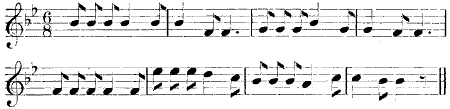
—Earls Heaton, Yorkshire.
[Play]
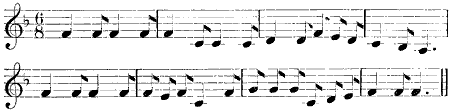
—Redhill, Surrey.
I.
Follow my gable ’oary man,
Follow my gable ’oary man,
I’ll do all that ever I can
To follow my gable ’oary man.
We’ll borrow a horse and steal a gig,
And round the world we’ll have a jig,
And I’ll do all that ever I can
To follow my gable ’oary man.
—Earls Heaton, Yorks (Herbert Hardy).
II.
Holy Gabriel, holy man,
Rantum roarum reeden man,
I’ll do all as ever I can
To follow my Gabriel, holy man.[3]
—Redhill, Surrey (Miss G. Hope).
III.
I sell my bat, I sell my ball,
I sell my spinning-wheel and all;
And I’ll do all that ever I can
To follow the eyes of the drummer man.
—Luton, Bedfordshire (Mrs. Ashdown).
(b) In the Yorkshire version a ring is formed with one child in
the middle as the ’Oary Man. Whatever he, or she, does, all in
the ring must mimic, going round and singing at the same time.
Any one found late in changing the action or idle in obeying
the caperings of the central child becomes the ’Oary Man in
place of the child taking that part. Both girls and boys play.
In the Redhill version, Holy Gabriel kneels in the middle of
the circle. He acts as leader, and always had the fiddle as his
instrument, though he now usually plays the pianoforte as his
first instrument. The other children choose any instrument
they like. Holy Gabriel pretends to play the fiddle, and all
the other children play their own instruments until Holy
Gabriel changes his to one of theirs, when that one must
immediately begin to play the fiddle, and continue until Holy
Gabriel takes another instrument or returns to the fiddle.
This is done in vigorous pantomime. In the Luton variant the
children sit in a semicircle, the Drummer faces them. He
plays the drum; all the other children play on any other instrument
they like. If the other players do not at once change
their instrument, or neglect to sing the lines, a forfeit is
demanded.
(c) Mr. Hardy says some sing this game, “Follow my game
an holy man.” Mr. Hardy once thought it was the remnant
of a goblin story of a hoary man of the gable or house-roof,
who presided over the destinies of poor cottagers, and he
had begun to make out the folk tale. The fairy would sometimes
come down, and, playing his antics, compel whomsoever
observed him to follow him in a mimicking procession. Miss
Hope writes of “Holy Gabriel” that the game is played at
Mead Vale, a small village in Surrey, but is unknown at larger
villages and towns a few miles off. Some of the women who
played it in their youth say that it began in the Primitive
Methodist school at Mead Vale. It is played at Outword, also
a remote village, and was introduced there by a stonemason,
who stated that he had learned it from a cousin who had been
in America. Further inquiry by Miss Hope elicited the fact
that the cousin had learned the game, when a boy, in his native
place in Lancashire. He did not know whether it was a well-known
game there. This information points perhaps to a
modern origin, but in such cases it must be borne in mind that
people are very fond of suggesting recent circumstances as the
cause of the most ancient traditions or customs. The obvious
analogy to the incident in the myth of the Pied Piper, and to
the Welsh custom at St. Almedha Church, near Brecknock,
recorded by Giraldus Cambrensis, where the imitation of a
frenzied leader is carried out as a religious ceremony, rather
suggests that in this game we may have a survival of a ceremonial
so common among early or uncultured people, the chief
incident of which is the frenzied dancing of a god-possessed
devotee.
This is a boys’ game. Any number can take part in it. It
requires a good extent of country to play it well. The boy who
is the swiftest runner and the best jumper is chosen as Leader.
He sets out at a good speed over the fields, tries to jump as
many ditches or burns, jumping such from one side to the
other again and again, to scramble over dykes, through hedges,
over palings, and run up braes. The others have to follow
him as they can. This steeplechase continues till the followers
are all tired out.—Keith (Rev. W. Gregor).
This is a very general game among schoolboys, but in Hereford
it was a town custom occurring once in seven years on
11th October (Folk-lore Journal, v. 75).
This game is played under the name of “Foolie, Foolie” at
Duthil, Strathspey. The players are placed in a row, either
standing or sitting. Two are chosen, the one as Namer and
the other as Foolie. Foolie withdraws, if not out of sight, at
least out of range of hearing. The Namer then gives a name
secretly to each player. When this is done, he calls on
Foolie—Foolie, Foolie, come to your schoolie.
Foolie pays no attention to this call. It is again repeated,
but with the same results. This goes on for several times.
At last the Namer calls out—
Foolie, Foolie, come to your schoolie;
Your bannocks are burnin’ an’ ready for turnin’.
Foolie always obeys this call, comes and stations himself
beside the Namer. A little chaffing generally goes on against
Foolie. The Namer says, “Come chise me oot, come chise
me in, tae” so and so, naming one by the assumed fancy name.
Foolie makes choice of one. If the choice falls right, the one
so chosen steps from the line and stands beside Foolie. If the
choice falls wrong, the one named remains in the line. All the
players’ names are called out in this way. If any stand unchosen
by Foolie, the Namer then goes up to each and asks if
he wants, e.g., “an aipple,” “an orange,” “a kirk,” “a cottage,”
&c. Each one whispers what he wants. The same question
is put to Foolie. If he answers, e.g., “orange,” the one so
named steps out and stands beside Foolie. All not first chosen
are gone over in this way. Those left unchosen take their
stand beside the Namer. There is then a tug-of-war, with the
Namer and Foolie as the leaders.—Keith (Rev. W. Gregor).
In Hants the children stand vis-à-vis, as in a country dance.
One of the number is sent out of earshot, and the others decide
with the Captain as to the name of the bird each wishes to
personate. The Captain then calls to the child who is out,
“Tom Fool, Tom Fool, come home from school, and pick me
out a blackbird,” “cuckoo,” or other bird. If Tom Fool is
wrong in his guessing after three trials, he is condemned to
run the gauntlet, being pelted with gloves or handkerchiefs not
too mercifully.—Bitterne, Hants (Miss Byford).
In Sussex there is the same action with the following words,
but there is no chasing or hitting—
Of all the birds in the air,
Of all the fishes in the sea,
You can pick me out [ ]
If the children fail to do so, they say—
Poor fool, been to school,
Learn more in a week;
Been there seven years
And hasn’t learnt a bit.
—Hurstmonceux, Sussex (Miss Chase).
The same game is played indoors in Cornwall, the reply
being—
Fool, fool, go back to school
And learn your letters better.
—Cornwall (Folk-lore Journal, v. 99-80).
See “Namers and Guessers.”[Addendum] [Addendum]
One boy out of a number stoops in the position for “Leap-frog”
at an agreed fixed line. From the players he chooses a
Leader and a Foot. The Leader first leaps over the stooping
boy at a foot from the line; the other players then leap in turn
each at a foot further from the line, the stooping boy moving
forward from the line for each player; finally the Foot leaps as
far as the distance leapt by the last boy. If this is accomplished,
the Leader hops from the line and then leaps; the
followers hop and leap each a foot further than each other;
finally the Foot hops and leaps as far as the distance covered
by the last boy. If this is accomplished, the Leader hops twice
and then leaps; the same process going on until one of the
boys fails, who then takes the place of the stooping boy, and
the game begins again. If the Foot covers any longer distance
than the Leader, the Leader stoops down.—Earls Heaton,
Yorks. (H. Hardy).
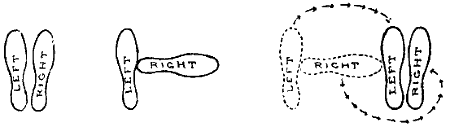
1st position2nd position3rd position
This game is general. Mr. Emslie describes the London
version somewhat differently. After all the boys had jumped
over the first boy’s back, a cry of “Foot it” was raised, and
the boy who had given the back placed one of his feet at a right
angle to the other, and in this way measured a “foot’s length”
from the starting-place. All the boys then “overed” his back
from the original line, the last one crying “Foot it,” and then
the measuring ceremony was again gone through, and the game
commenced again, and continued in the same manner until one
of the boys failed to “over” the back, when he became Back.[Addendum]
The modern game of “Football” is too well known to need
description here, and, like “Cricket,” it has become no longer
a children’s game. As to its origin, there are many ball games,
such as “Camping,” which have been suggested as the original
form of “Football.” Every school almost had some peculiarity
in the method of playing, and Eton, Winchester, Uppingham,
and Rugby are well-known examples. It is not a little interesting
to note, now that “Football” has settled down into a
national game organised by county committees, that one of the
forms of play officially recognised is the old Rugby game, the
other form, known as the “Association,” being arrived at by
agreement of those interested in the game.
To illustrate the ancient origin of the game, and its serious
import as a local contest rather than a sport, some examples may
be given. It is still (1877) keenly contested at Workington on
Easter Tuesday on the banks of, and not unfrequently in, the river
Derwent (Dickinson’s Cumberland Glossary). At Derby there
was a football contest between the parishes of All Saints’ and
St. Peter’s. The ball was thrown into the market-place from
the Town Hall. The moment it was thrown the “war cries”
of the rival parishes began, and the contest, nominally that of
a football match, was in reality a fight between the two sections
of the town; and the victors were announced by the joyful
ringing of their parish bells (Dyer’s Popular Customs, p. 75).
At Chester-le-Street the game was played between what were
termed “up-streeters” and “down-streeters,” one side endeavouring
to get the ball to the top of the town, whilst their
opponents tried to keep it near the lower or north end. At one
o’clock the ball was thrown out from near the old commercial
hotel, the Queen’s Head, in the centre of the town, and it has
often been received by over three and four hundred people, so
great was the interest taken in this ancient sport. At Asborne
the struggle was between the “up’ards” and “down’ards.” At
Dorking the divisions were between the east and west ends of
the town, and there was first a perambulation of the streets by
the football retinue composed of grotesquely dressed persons.
At Alnwick the divisions were the parishes of St. Michael’s and
St. Paul’s. At Kirkwall the contest was on New Year’s Day,
and was between “up the gates” and “down the gates,” the ball
being thrown up at the Cross. At Scarborough, on the morning
of Shrove Tuesday, hawkers paraded the streets with parti-coloured
balls, which were purchased by all ranks of the community.
With these, and armed with sticks, men, women, and
children repaired to the sands below the old town and indiscriminately
commenced a contest. The following graphic
account of Welsh customs was printed in the Oswestry Observer
of March 2, 1887: “In South Cardiganshire it seems that about
eighty years ago the population, rich and poor, male and female,
of opposing parishes, turned out on Christmas Day and indulged
in the game of ‘Football’ with such vigour that it became little
short of a serious fight. The parishioners of Cellan and Pencarreg
were particularly bitter in their conflicts; men threw
off their coats and waistcoats and women their gowns, and
sometimes their petticoats. At Llanwenog, an extensive parish
below Lampeter, the inhabitants for football purposes were
divided into the Bros and the Blaenaus. A man over eighty, an
inmate of Lampeter Workhouse, gives the following particulars:—In
North Wales the ball was called the Bêl Troed, and
was made with a bladder covered with a Cwd Tarw. In South
Wales it was called Bél Ddu, and was usually made by the shoe-maker
of the parish, who appeared on the ground on Christmas
Day with the ball under his arm. The Bros, it should be stated,
occupied the high ground of the parish. They were nicknamed
‘Paddy Bros,’ from a tradition that they were descendants from
Irish people who settled on the hills in days long gone by.
The Blaenaus occupied the lowlands, and, it may be presumed,
were pure-bred Brythons. The more devout of the Bros and
Blaenaus joined in the service at the parish church on Christmas
morning. At any rate, the match did not begin until about
mid-day, when the service was finished. Then the whole of
the Bros and Blaenaus, rich and poor, male and female,
assembled on the turnpike road which divided the highlands
from the lowlands. The ball having been redeemed from the
Crydd, it was thrown high in the air by a strong man, and
when it fell Bros and Blaenaus scrambled for its possession,
and a quarter of an hour frequently elapsed before the ball was
got out from among the struggling heap of human beings.
Then if the Bros, by hook or by crook, could succeed in taking
the ball up the mountain to their hamlet of Rhyddlan they won
the day; while the Blaenaus were successful if they got the
ball to their end of the parish at New Court. The whole
parish was the field of operations, and sometimes it would be
dark before either party scored a victory. In the meantime
many kicks would be given and taken, so that on the following
day some of the competitors would be unable to walk, and
sometimes a kick on the shins would lead the two men concerned
to abandon the game until they had decided which was
the better pugilist. There do not appear to have been any
rules for the regulation of the game; and the art of football
playing in the olden time seems to have been to reach the goal.
When once the goal was reached, the victory was celebrated by
loud hurrahs and the firing of guns, and was not disturbed until
the following Christmas Day. Victory on Christmas Day, added
the old man, was so highly esteemed by the whole countryside,
that a Bro or Blaenau would as soon lose a cow from his
cow-house as the football from his portion of the parish.”
(b) In Gomme’s Village Community, pp. 241-44, the position
of football games as elements in the traditions of race is discussed,
and their relationship to a still earlier form of tribal
games, where the element of clan feuds is more decidedly preserved,
is pointed out.
Forfeits are incurred in those games in which penalties are
exacted from players for non-compliance with the rules of the
game; “Buff,” “Contrary,” “Crosspurposes,” “Fire, Air, and
Water,” “Follow my Gable,” “Genteel Lady,” “Jack’s Alive,”
“Old Soldier,” “Twelve Days of Christmas,” “Turn the
Trencher,” “Wadds,” and others. These games are described
under their several titles, and the formula for forfeits is always
the same. Small articles belonging to the players must be
given by them every time a forfeit is incurred, and these
must be redeemed at the close of the game. They are “cried”
in the following manner:—One of the players sits on a chair
having the forfeits in her lap. A child kneels on the ground
and buries his face in his hands on the lap of the person who
holds the forfeits. The “crier” then takes up indiscriminately
one of the forfeits, and holding it up in the sight of all those
who have been playing the games (without the kneeling child
seeing it), says—
Here’s a very pretty thing and a very pretty thing,
And what shall be done to [or, by] the owner of this very pretty thing?
The kneeling child then says what the penance is to be.
The owner of the forfeit must then perform the penance before
the other players, and then another forfeit is “cried.”
The more general penances imposed upon the owners of the
forfeits are as follows, but the list could be very much extended:—
- Bite an inch off the poker.
- Kneel to the prettiest, bow to the wittiest, and kiss the one you love best.
- Stand in each corner of the room, sigh in one, cry in another, sing in another, and dance in the other.
- Put yourself through the keyhole.
- Place two chairs in the middle of the room, take off your shoes, and jump over them.
- Measure so many yards of love ribbon.
- Postman’s knock.
- Crawl up the chimney.
- Spell Opportunity.
Miss Burne mentions one penance designed to make the
victim ridiculous, as when he is made to lie on his back on the
floor with his arms extended, and declare—
Here I lie!
The length of a looby,
The breadth of a booby,
And three parts of a jackass!
—Shropshire Folk-lore, pp. 526-27.
(c) Halliwell gives, in his Nursery Rhymes, pp. 324-26,
some curious verses, recorded for the first time by Dr. Kenrick
in his Review of Dr. Johnson’s Shakespeare, 1765, on “rules
for seemly behaviour,” in which the forfeits imposed by barbers
as penalties for handling razors, &c., are set forth. Although
“barbers’ forfeits” are not of the same nature as the nursery
forfeits, it is possible that this general custom among so important
a class of the community in early times as barbers may
have suggested the game. Both Forby in his Vocabulary of
East Anglia and Moor in his Suffolk Words bear testimony
to the general prevalence of barbers’ forfeits, and it must be
borne in mind that barbers were also surgeons in early days.
A curious custom is also recorded in another East Anglian
word-list, which may throw light upon the origin of the game
from popular custom. “A forfeit is incurred by using the
word ‘water’ in a brew-house, where you must say ‘liquor;’
or by using the word ‘grease’ in a chandlery, where it is ’stuff’
or ‘metal.’ The forfeit is to propitiate the offended genius
loci” (Spurden’s East Anglian Vocabulary). The element of
divination in the custom is perhaps indicated by a curious note
from Waldron, in his Description of the Isle of Man (Works,
p. 55), “There is not a barn unoccupied the whole twelve
days, every parish hiring fiddlers at the public charge. On
Twelfth Day the fiddler lays his head on some of the wenches’
laps, and a third person asks who such a maid or such a maid
shall marry, naming the girls then present one after another;
to which he answers according to his own whim, or agreeable
to the intimacies he has taken notice of during this time of
merriment. But whatever he says is as absolutely depended
on as an oracle; and if he happen to couple two people who
have an aversion to each other, tears and vexation succeed the
mirth. This they call cutting off the fiddler’s head; for after
this he is dead for the whole year.” Redeeming the forfeits is
called “Crying the Weds,” in Burne’s Shropshire Folk-lore,
p. 526. See “Wadds.”[Addendum]
Fox, a fox, a brummalary
How many miles to Lummaflary? Lummabary?
Eight and eight and a hundred and eight.
How shall I get home to-night?
Spin your legs and run fast.
Halliwell gives this rhyme as No. ccclvii. of his Nursery
Rhymes, but without any description of the game beyond the
words, “A game of the fox.” It is probably the same game as
“Fox and Goose.”
In Dorsetshire one of the party, called the Fox, takes one
end of the room or corner of a field (for the game was equally
played indoors or out); all the rest of the children arrange
themselves in a line or string, according to size, one behind the
other, the smallest last, behind the tallest one, called Mother
Goose, with their arms securely round the waist of the one in
front of them, or sometimes by grasping the dress.
The game commences by a parley between the Fox and
Goose to this effect, the Goose beginning.
“What are you after this fine morning?”
“Taking a walk.”
“With what object?”
“To get an appetite for a meal.”
“What does [will] your meal consist of?”
“A nice fat goose for my breakfast.”
“Where will you get it?”
“Oh, I shall get a nice morsel somewhere; and as they are
so handy, I shall satisfy myself with one of yours.”
“Catch one if you can.”
A lively scene follows. The Fox and Mother Goose should
be pretty evenly matched; the Mother with extended arms
seeking to protect her Brood, while the Fox, who tries to dodge
under, right and left, is only allowed in case of a successful
foray or grasp to secure the last of the train. Vigorous efforts
are made to escape him, the Brood of course supplementing
the Mother’s exertions to elude him as far as they are able,
but without breaking the link. The game may be continued
until all in turn are caught.—Folk-lore Journal, vii. 217-18.
In Lancashire the children stand in line behind each other,
holding each other by the waist. One stands facing them and
calls out—
My mother sits on yonder chimney,
And she says she must have a chicken.
The others answer—
She can’t have a chicken.
The one then endeavours to catch the last child of the tail,
who when caught comes behind the captor; repeat until all
have changed sides.—Monton, Lancashire (Miss Dendy).
A version of this game played at Eckington, Derbyshire,
is played as follows:—A den is chalked out or marked out for
the Fox. A larger den, opposite to this, is marked out for the
Geese. A boy or a girl represents the Fox, and a number
of others the Geese. Then the Fox shouts, “Geese, Geese,
gannio,” and the Geese answer, “Fox, Fox, fannio.” Then
the Fox says, “How many Geese have you to-day?” The
Geese reply, “More than you can catch and carry away.”
Then the Geese run out of the den, and the Fox tries to catch
them. He puts as many as he catches into his den (S. O.
Addy).
(b) This game is a very general one at Christmas time. It
is practically the same as “Gled Wylie,” and “Hen and
Chickens,” and the “Hawk and Chickens” of Mr. Newell’s
Games and Songs of American Children, pp. 155-56. By
referring to these games it will be seen that the whole group are
mimic representatives of farmyard episodes, though the animal
characters are giving way to more domestic affairs, as shown
in the Pins and Needles version of “Hen and Chickens.”
It is possible that the different animals which are victims to
the Fox appearing in the different games may arise from local
circumstances, and that in this case a real distinction exists
between the various names by which this game is known.
A game called “Wolf and Deer,” similar to “Fox and Geese,”
is given in Winter Evening Amusements, by R. Revel. The
last one at the end of the tail may, if she has no other chance
of escape, try and place herself before the Deer or Hen. She
is then no longer to be hunted; all the others must then follow
her example until the deer becomes the last of the line. The
game then terminates by exacting a forfeit for each lady whom
the Wolf has suffered to escape his clutches (pp. 64, 65).
See “Gled Wylie,” “Hen and Chickens,” “Old Dame.”[Addendum]
A game known by this name is played with marbles or pegs
on a board on which are thirty-three holes, or on the pavement,
with holes scraped out of the stones. To play this game
there are seventeen pieces called Geese, and another one either
larger or distinguished from the Geese by its colour, which is
called the Fox. The Fox occupies the centre hole, and the
Geese occupy nine holes in front, and four on each side of him.
The vacant holes behind are for the Geese and Fox to move in.
The game is for the Geese to shut up the Fox so that he cannot
move. All the pieces can be moved from one spot to another
in the direction of the lines, but cannot pass over two holes at
once. The Geese are not permitted to take the Fox. The
Fox’s business is to take all, or as many of the Geese as will
prevent him from being blockaded. The Fox can take the
Geese whenever there is a vacant space behind them, which he
passes to, then occupies.
This game has been very popular among schoolboys in all ages.
Mr. Micklethwaite, in a paper on the Indoor Games of School
Boys in the Middle Ages (Arch. Journ. xlix. 322), gives instances
of finding figures of this game cut “in the cloister benches
of Gloucester Cathedral and elsewhere, and there are several on
the twelfth century tomb at Salisbury, miscalled Lord Stourton’s,”
and also at Norwich Castle. For the date of these boards,
Mr. Micklethwaite says for the last three centuries and a half
cloisters everywhere in England have been open passages, and
there have generally been schoolboys about. It is therefore
not unlikely that they should have left behind them such traces
as these play-boards. But if they are of later date they would
not be found to be distributed in monastic cloisters with respect
to the monastic arrangement, and we do find them so. Strutt
describes the game (Sports, p. 319).
See “Nine Men’s Morris,” “Noughts and Crosses.”
“The Tod (Fox) i’ the Faul (Fold).” This game is commonly
played by boys. Any number of boys join hands and stand
in a circle to form the Faul. The boy that represents the Tod
is placed within the circle. His aim is to escape. To effect
this he rushes with all his force, increased by a run, against
the joint hands of any two of the players. If the rush does
not unloose the grasp, he hangs on the two arms with all his
weight, pressing and wriggling. If he fails he makes a rush at
another two, always selecting those players he thinks weakest.
When he does break through he rushes off at the top of his
speed, with all the players in full cry, till he is caught and
brought back. The game begins anew with another boy as
Tod.—Keith (Rev. W. Gregor).
See “Bull in the Park,” “Frog in the Middle.”
All the players are armed with handkerchiefs. One of the
players is chosen for Fox, who has his den marked out. The
Fox hops out on one leg, with his handkerchief ready to strike.
The players gather round him and attack him. If he can
strike one of his assailants without putting his foot to the
ground from his hopping position, the player so struck is
chased by the others into the den, and he then becomes the
Fox for another round of the game.—Cork (Miss Keane).
Halliwell (Nursery Rhymes, p. 228) describes the game in
practically the same manner, but adds that when the Fox is
coming out he says—
The Fox gives warning
It’s a cold and frosty morning,
after which he is at liberty to hop out and use his handkerchief.
(b) This game is alluded to in Soliman and Perseda, 1599;
Florio, p. 480; Herrick, i. 176. See Halliwell’s Dictionary.
Professor Mayor communicated to the Gentleman’s Magazine
of 1848 (ii.), p. 147, the following early allusions to the game
from old dictionaries:—
Gouldman, London, MDCLXIV.—“Ascoliasmus, Empusæ
ludus: a kind of play wherein boys lift up one leg and hop
with the other, where they beat one another with bladders tied
to the end of strings. Fox to thy hole.”
Holyoke, MDCLXXVII.—“Empusa. παρὰ τὸ ἑνἱ ποδἱζειν,
quòd uno incedat pede. Hence empusam agere is used for a
play, hopping on one leg; with us, Fox to his hole.”
Id. “Ascoliasmus. A kind of play that children use when
they hop on one leg, called Fox to thy hole.”
Cambridge Dict. MDCXCIII.—“Ascol. A kind of play
wherein boys hopping on one leg beat one another with gloves
or pieces of leather, and is called Fox to thy hole.”
Coles, 7th ed. 1711.—“Ascol. The play called Fox to the
hole.—Empus. Ludus Empusæ. Scotch hoppers, or Fox in
the hole.”
A similar game to this is played at Earls Heaton, Yorkshire
(Mr. Hardy), and called “Goose and Gander.” Two players,
the Goose and the Gander, stand in a ring, each on one leg.
They hop out in turn, and try to catch one of the other players
without letting their other leg touch the ground. If they fail
in this they get “strapped” back to the ring. When either
are successful, the player who is caught takes the place of
either Goose or Gander in turn. The game is also mentioned
in Useful Transactions in Philosophy, 1708-9.
This game is played either by boys or girls or by both
together. One is chosen to stand alone; the other players
join hands and form a circle. The one outside the circle goes
round it and touches on the back one of the circle. He then
runs off round the circle, and the one who was touched runs
off in the opposite direction round the circle. The aim of each
player is to reach the vacant place in the circle first. The one
left out has to repeat the same action. The game may go on
for any length of time.—Keith (Rev. W. Gregor).
At Barnes this game is called “Gap.” It is known as
“French Tag” in the Forest of Dean, Gloucestershire (Miss
Matthews), and “Tap-back” at Bitterne, Hants (Mrs. Adam).
The children choose sides under a leader, and a boundary
line is made in the middle of the ground dividing the French
and English territory. A handkerchief is then placed in the
back part of each territory to represent a flag. The object is
to obtain as many flags from the opposite side as possible. If
a person is captured before having seized a flag, he is taken
prisoner, and must be rescued by one of his own side. Thus,
for instance, an Englishman enters the French territory and
tries to reach the flag. If he is seen by the French before he
reaches the flag, he is taken prisoner and is placed near the
flags, and the next Englishman rescues him instead of taking
a flag. As soon as the flag is taken, one of the party must
put another handkerchief in its place. A player cannot be
taken prisoner after having obtained the handkerchief or flag.
The winning side is decided by counting the flags and prisoners.—Bitterne,
Hants (Mrs. Byford).
This is a very general game, and is known as “Scotch and
English” in the north, where some interesting details occur, for
which see “Scotch and English.”
The children kneel in a circle, one standing blindfolded in
the middle. The kneeling children shout, “Come point to me
with your pointer.”—Monton, Lancashire (Miss Dendy).
See “Buff,” “Dinah,” “Muffin Man.”
A Christmas game, mentioned in the Declaration of Popish
Impostures, 1603.
A game played between the dances at balls in farm-houses.
A chair was placed in the middle of the barn or room; the
master of the ceremonies led to the chair a young woman, who
sat down and named the young man whom she was willing
should kiss her. This he did, and then took the seat which
the lady vacated. He then called out the name of some
favourite girl, who was led up to him; there was another kiss.
The girl then took the seat, and so on (county of Down). The
same game is called “Frimsey-framsey” in parts of the county
of Antrim.—Patterson’s Antrim and Down Glossary.
Compare “Cushion Dance.”
Name for “Leap-frog.”—Addy’s Sheffield Glossary.
One child is seated on the ground with his legs under him;
the other players form a ring round. They then pull or buffet
the centre child or Frog, who tries to catch one of them without
rising from the floor. The child who is caught takes the place
of the centre child. Another method of playing the game is
similar to “Bull in the Park.” The child in the centre tries to
break out of the ring, those forming it keeping the Frog in the
ring by any means in their power, while still keeping their
hands clasped. They sometimes sing or say—
Hey! hey! hi! Frog in the middle and there shall lie;
He can’t get out and he shan’t get out—hey! hey! hi!
They dance round when saying this, all keeping a watch on the
Frog, who suddenly makes a rush, and tries to break through
the ring.—London (A. B. Gomme).
Strutt describes this game, and gives an illustration from a
fourteenth century MS. which is here reproduced from the
original (Sports, p. 303). Newell (Games of American Children,
p. 171) also mentions it, and gives the rhyme as—
Frog in the sea, can’t catch me!
The same as “French Jackie.” This game is called “Tap-back”
or “Tat-back” at Bitterne, Hants.
Children join hands and form a ring. One child stands inside
the ring; this child walks round and asks one of the circle,
called the Keeper—
Have you the key of the garden gate?
Open and let me go through.
The Keeper replies—
My next-door neighbour’s got the key;
Ask him and he’ll give it to you.
This is repeated by each one in the circle. Then the inside
child comes again to the Keeper and says—
None of the neighbours have got the key,
So you must let me go through.
The Keeper answers—
I’ve lost the key of the garden gate,
And cannot let you through.
Then all the ring say—
You must stop all night within the gate,
Unless you have strength to break through.
The child inside then attempts to break through, and if he
succeeds in breaking any of the clasped hands the one who
first gives way has to take the place in the centre.—Roxton,
St. Neots (Miss Lumley).
See “Bull in the Park.”
“To smuggle the Gegg,” a game played by boys in Glasgow,
in which two parties are formed by lot, equal in number, the
one being denominated the Outs, the other Ins. The Outs
are those who go out from the den or goal, where those called
the Ins remain for a time. The Outs get the Gegg, which is
anything deposited, as a key, a penknife, &c. Having received
this, they conceal themselves, and raise the cry, “Smugglers!”
On this they are pursued by the Ins; and if the Gegg (for the
name is transferred to the person who holds the deposit) be
taken, they exchange situations—the Outs become Ins and the
Ins Outs. This play is distinguished from “Hy-spy” only
by the use of the Gegg. One of the Ins who is touched by
one of the Outs is said to be taken, and henceforth loses his
right to hold the Gegg. If he who holds the Gegg gets
in the den, the Outs are winners, and have the privilege of
getting out again. The Outs, before leaving the den, shuffle
the Gegg, or smuggle it so between each other that the Ins
do not know which person has it. He who is laid hold of,
and put to the question, is supposed to deny that he has
the Gegg: if he escapes with it, he gets out again.—Jamieson.
A player begins thus:—“I, a genteel lady (or gentleman)
came from that genteel lady (or gentleman) to say that she (or
he) owned a tree.” The other players repeat the words in
turn, and then the leader goes over them again, adding, “with
bronze bark.” The sentence goes round once more, and on the
next repetition the leader continues, “with golden branches.”
He afterwards adds, “and silver leaves,” “and purple fruit,”
“and on the top a milk-white dove,” and, finally, “mourning
for the loss of his lady-love.”
If a player should fail in repeating the rigmarole, there is a
fine to pay. A “pipe-lighter” is stuck in her hair, and she
must say “one-horned lady” instead of “genteel lady.” When
a second horn is added, of course she says “two-horned,” and
so forth. Some players wear half-a-dozen before the conclusion
of the game. The game is called “The Wonderful Tree.”—Anderby,
Lincolnshire (Miss M. Peacock).
In some parts of Yorkshire it is customary to say “no-horned
lady” instead of “genteel lady” at the beginning of
the game.
When we played this game we said “always genteel” after
“genteel lady,” and varied the formula. For instance, the
first player would say, “I, a genteel lady, always genteel,
come from a genteel lady, always genteel, to say she lives in
a house with twelve windows,” or words were used beginning
with the letter A. Each player must repeat this, and add
something else in keeping with a house; or sentences had to
be made in which words beginning with the letter A must be
said, the other players doing the same alphabetically.—London
(A. B. Gomme).
Mr. Newell, in writing of this game, says that the “lamp-lighter”
or “spill” was lighted when placed in the hair of the
players who made mistakes. He does not mention forfeits
being exacted.—Games, p. 139.
[149]
One of the party is chosen for Ghost (if dressed in white so
much the better); she hides in a corner; the other children
are a mother and daughters. The eldest daughter says:—
“Mother, mother, please give me a piece of bread and
butter.”
M. “Let me (or ‘leave me’) look at your hands, child.
Why, they are very dirty.”
E. D. “I will go to the well and wash them.”
She goes to the corner, the Ghost peeps up, and she rushes
back, crying out—
“Mother! mother! I have seen a Ghost.”
M. “Nonsense, child! it was only your father’s nightshirt I
have washed and hung out to dry. Go again.”
The child goes, and the same thing happens. She returns,
saying—
“Yes! mother! I have seen a ghost.”
M. “Nonsense, child! we will take a candle, and all go
together to search for it.”
The mother picks up a twig for a candle, and they set off.
When they come near to the Ghost, she appears from her
hiding-place, mother and children rush away in different directions,
the Ghost chases them until she has caught one, who in
her turn becomes Ghost.—West Cornwall (Miss Courtney,
Folk-lore Journal, v. 55).
This game was “Ghost in the Copper” in London. It was
played in the same way as above. Chairs formed the copper,
and the ghost crouched down behind. The “Mother” was
“washing” at a tub, also formed with two chairs. The eldest
daughter was told she could not go to school to-day; she must
stop at home and help hang up the clothes. The other children
go to play. The Mother said, “Here, Jane, take this (pretending
to give her a garment out of the wash-tub) and put
it in the copper, and push it down well with the stick.” Jane
goes to the copper and pretends to take off the lid. When
she puts the washed garment in, and pokes down with the
stick, the Ghost jumps up. She cries out as above, the Mother
saying, “Nonsense, child! it’s only some of the boiling clothes.”
The child goes again, and the game proceeds as above. It is
generally played now as “Ghost.”—A. B. Gomme. It is mentioned
by Newell (Games, p. 223).[Addendum]
A Giant is chosen, and he must be provided with a cave. A
summer-house will do, if there is no window for the Giant to
see out of. The others then have to knock at the door with
their knuckles separately. The Giant rushes when he thinks
all the children have knocked, and if he succeeds in catching
one before they reach a place of safety (appointed beforehand)
the captured one becomes Giant.—Bitterne, Hants (Mrs.
Byford). See “Wolf.”
Giddy, giddy, gander,
Who stands yonder?
Little Bessy Baker,
Pick her up and shake her;
Give her a bit of bread and cheese,
And throw her over the water.
—Warwickshire.
(b) A girl being blindfolded, her companions join hands and
form a ring round her. At the word “Yonder” the blindfolded
girl points in any direction she pleases, and at line three
names one of the girls. If the one pointed at and the one
named be the same, she is the next to be blinded; but, curiously
enough, if they be not the same, the one named is the
one. Meanwhile, at line four, she is not “picked up,” but
is shaken by the shoulders by the still blindfolded girl; and at
line five she is given by the same “bread and cheese,” i.e., the
buds or young leaves of what later is called “May” (Cratægus
oxyacantha); and at line six she is taken up under the
blinded girl’s arm and swung round.—Warwickshire (Notes
and Queries, 6th Ser., viii. 451).
A boy’s game. One boy is chosen, who says:—
Gilty-galty four-and-forty,
Two tens make twenty.
He then counts one, two, three, four, &c., up to forty, having
his eyes covered by his hands, and the others hide while he is
saying the “nominy.” At the conclusion he uncovers his eyes,
and if he sees any boys not yet hidden they have to stand still.
He seeks the rest, but if he moves far away from his place,
called the “stooil” (stool), one of the hidden boys may rush
out and take it, provided he can get there first. Should he fail
in this he also has to stand aside; but if any one succeeds,
then all run out as before, and the same boy has to say the
“nominy” again. On the other hand, if he finds all the boys
without loosing his “stooil,” the boy first caught has to take
his place and say the “nominy.” The game was thus played
in 1810, and is so still, both here and at Lepton.—Easther’s
Almondbury and Huddersfield Glossary.
I charge my children, every one,
To keep good house while I am gone.
You, and you [points], but specially you
[or sometimes, but specially Sue],
Or else I’ll beat you black and blue.
One child is selected for Gipsy, one for Mother, and one for
Daughter Sue. The Mother says the lines, and points to
several children to emphasise her words. During her absence
the Gipsy comes in, entices a child away, and hides her. This
process is repeated till all the children are hidden, when the
mother has to find them.—Halliwell (Nursery Rhymes, p. 228).
See “Mother, Mother, the Pot Boils Over,” “Witch.”
The name of a singular game played at country schools.
One of the largest of the boys steals away from his comrades,
in an angry-like mood, to some dykeside or sequestered nook,
and there begins to work as if putting a pot on a fire. The
others seem alarmed at his manner, and gather round him,
when the following dialogue takes place:—
They say first to him—
What are ye for wi’ the pot, gudeman?
Say what are ye for wi’ the pot?
We dinna like to see ye, gudeman,
Sae thrang about this spot.
We dinna like ye ava, gudeman,
We dinna like ye ava.
Are ye gaun to grow a gled, gudeman?
And our necks draw and thraw?
He answers—
Your minnie, burdies, ye maun lae;
Ten to my nocket I maun hae;
Ten to my e’enshanks, and or I gae lye,
In my wame I’ll lay twa dizzen o’ ye by.
The mother of them, as it were, returns—
Try’t than, try’t than, do what ye can,
Maybe ye maun toomer sleep the night, gudeman;
Try’t than, try’t than, Gled-wylie frae the heugh,
Am no sae saft, Gled-wylie, ye’ll fin’ me bauld and teugh.
After these rhymes are said the chickens cling to the mother
all in a string. She fronts the flock, and does all she can to
keep the kite from her brood, but often he breaks the row and
catches his prey.—Mactaggart’s Gallovidian Encyclopædia.
Evidently denominated from the common mode of designating
the kite among the vulgar (Jamieson). “The Greedy
Gled’s seeking ye,” is one of the lines of a rhyme used in
“Hide and Seek” in Edinburgh. Glead, or Gled, is also a
Yorkshire and Cheshire name for a kite. “As hungry as a
Glead” (Glossary, by an Old Inhabitant).—Leigh (Cheshire
Glossary).
See “Fox and Goose,” “Hen and Chickens,” “Hide and
Seek.”
The play of “Blind Man’s Buff.”—Banffshire, Aberdeen
(Jamieson).
A London name for the game of “Hucklebones.”
See “Fivestones.”
[153]
[Play]
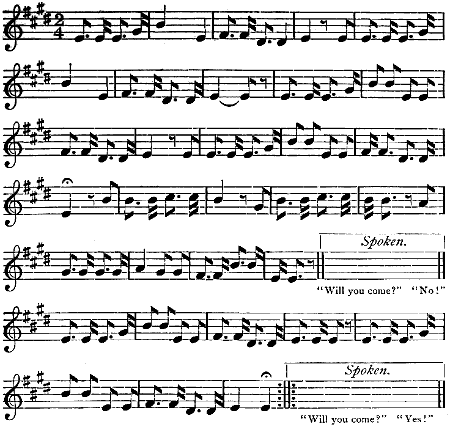
—Middlesex (Miss Collyer).
[Play]
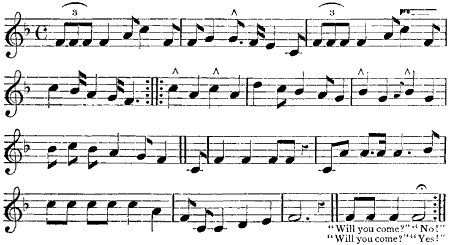
—London (A. B. Gomme).
[154]
[Play]
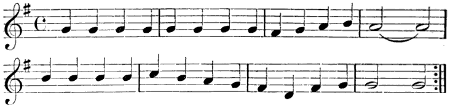
—Congleton (Miss A. E. Twemlow).
I.
A dis, a dis, a green grass,
A dis, a dis, a dis;
Come all you pretty fair maids
And dance along with us.
For we are going roving,
A roving in this land;
We’ll take this pretty fair maid,
We’ll take her by the hand.
Ye shall get a duke, my dear,
And ye shall get a drake;
And ye shall get a young prince,
A young prince for your sake.
And if this young prince chance to die,
Ye shall get another;
The bells will ring, and the birds will sing,
And we’ll clap hands together.
—Chamber’s Popular Rhymes, pp. 137-38.
II.
A-diss, a-diss, a-green grass,
A-diss, a-diss, a-dass;
Come, my pretty fair maid,
And walk along with us.
For you shall have a dik-ma-day,
You shall have a drāgon;
You shall have a nice young man
With princes for his thēgan (or sēgan).
—Lanarkshire (W. G. Black).
III.
A dish, a dish, a green grass,
A dish, a dish, a dish,
Come all you pretty maidens
And dance along wi’ us.
For we are lads a roving,
A roving through the land,
We’ll take this pretty fair maid
By her lily white hand.
Ye sall get a duke, my dear,
An ye sall get a drake,
An ye sall get a bonny prince
For your ain dear sake.
And if they all should die,
Ye sall get anither;
The bells will ring, the birds will sing,
And we’ll clap our hands together.
—Biggar (W. Ballantyne).
IV.
Dissy, dissy, green grass,
Dissy, dissy, duss,
Come all ye pretty fair maids
And dance along with us.
You shall have a duck, my dear,
And you shall have a drake,
And you shall have a nice young man
To love you for your sake.
If this young man should chance to die
And leave the girl a widow,
The birds shall sing, the bells shall ring,
Clap all your hands together.
—Yorkshire (Henderson’s Folk-lore, Northern Counties, p. 27).
V.
Dossy, dossy green grass,
Dossy, dossy, doss,
Come all ye pretty fair maids
And dance upon the grass.
I will give you pots and pans,
I will give you brass,
I will give you anything
For a pretty lass.
I will give you gold and silver,
I will give you pearl,
I will give you anything
For a pretty girl.
Take one, take one, the fairest you can see.
You shall have a duck, my dear,
You shall have a drake,
You shall have a young man
Apprentice for your sake.
If this young man shall wealthy grow
And give his wife a feather,
The bells shall ring and birds shall sing
And we’ll all clap hands together.
—Roxton, St. Neots (Miss Lumley).
VI.
Walking up the green grass,
A dust, a dust, a dust!
We want a pretty maiden
To walk along with us.
We’ll take this pretty maiden,
We’ll take her by the hand,
She shall go to Derby,
And Derby is the land!
She shall have a duck, my dear,
She shall have a drake,
She shall have a nice young man
A-fighting for her sake!
Suppose this young man was to die,
And leave the poor girl a widow;
The bells would ring and we should sing,
And all clap hands together!
—Berrington (Shropshire Folk-lore, p. 511).
VII.
Tripping up the green grass,
Dusty, dusty, day,
Come all ye pretty fair maids,
Come and with me play.
You shall have a duck, my dear,
And you shall have a swan,
And you shall have a nice young man
A waiting for to come.
Suppose he were to die
And leave his wife a widow,
Come all ye pretty fair maids,
Come clap your hands together!
Will you come?
No!
Naughty man, he won’t come out,
He won’t come out, he won’t come out,
Naughty man, he won’t come out,
To help us in our dancing.
Will you come?
Yes!
Now we’ve got our bonny lad,
Our bonny lad, our bonny lad,
Now we’ve got our bonny lad,
To help us in our dancing.
—Middlesex (Miss Collyer).
VIII.
Stepping on the green grass
Thus, and thus, and thus;
Please may we have a pretty lass
To come and play with us?
We will give you pots and pans,
We will give you brass,
No!
We will give you anything
For a bonny lass.
No!
We will give you gold and silver,
We will give you pearl,
We will give you anything
For a pretty girl.
Yes!
You shall have a goose for dinner,
You shall have a darling,
You shall have a nice young man
To take you up the garden.
But suppose this young man was to die
And leave this girl a widow?
The bells would ring, the cats would sing,
So we’ll all clap together.
—Frodingham and Nottinghamshire (Miss
M. Peacock).
IX.
Stepping up the green grass,
Thus, and thus, and thus;
Will you let one of your fair maids
Come and play with us?
We will give you pots and pans,
We will give you brass,
We will give you anything
For a pretty lass.
No!
We won’t take your pots and pans,
We won’t take your brass,
We won’t take your anything
For a pretty lass.
Stepping up the green grass,
Thus, and thus, and thus;
Will you let one of your fair maids
Come and play with us?
We will give you gold and silver,
We will give you pearl,
We will give you anything
For a pretty girl.
Yes!
Come, my dearest [Mary],
Come and play with us,
You shall have a young man
Born for your sake.
And the bells shall ring
And the cats shall sing,
And we’ll all clap hands together.
—Addy’s Sheffield Glossary.
X.
Up and down the green grass,
This, and that, and thus;
Come all you fair maids
And walk along with us.
Some will give you silver,
Some will give you gold,
Some will give you anything
For a pretty lass.
Don’t you think [boy’s name]
Is a handsome young man?
Don’t you think Miss [child who has been choosing]
Is as handsome as he?
Then off with the glove
And on with the ring;
You shall be married
When you can agree.
Take hold of my little finger,
Maycanameecan,
Pray tell me the name
Of your young man.
—Hurstmonceux, Sussex (Miss Chase).
XI.
Here we come up the green grass,
Green grass, green grass,
Here we come up the green grass,
Dusty, dusty, day.
Fair maid, pretty maid,
Give your hand to me,
I’ll show you a blackbird,
A blackbird on the tree.
We’ll all go roving,
Roving side by side,
I’ll take my fairest ——,
I’ll take her for my bride.
Will you come?
No!
Naughty miss, she won’t come out,
Won’t come out, won’t come out,
Naughty miss, she won’t come out,
To help us with our dancing.
Will you come?
Yes!
Now we’ve got our bonny lass,
Bonny lass, bonny lass,
Now we’ve got our bonny lass,
To help us with our dancing.
—London (A. B. Gomme).
XII.
Here we go up the green grass,
The green grass, the green grass;
Here we go up the green grass,
So early in the morning.
Fair maid, pretty maid;
Give your hand to me,
And you shall see a blackbird,
A blackbird on the tree;
All sorts of colours
Lying by his side,
Take me, dearest [——],
For to be my bride—
Will you come?
No!
Naughty old maid, she won’t come out,
She won’t come out,
To help us with our dancing—
Will you come?
Yes!
Now we’ve got the bonny lass,
Now we’ve got the bonny lass,
To help us with our dancing.
—Liphook, Hants (Miss Fowler).
XIII.
Trip trap over the grass,
If you please, will you let one of your [eldest] daughters come,
Come and dance with me?
I will give you pots and pans,
I will give you brass,
I will give you anything
For a pretty lass—
No!
I will give you gold and silver,
I will give you pearl,
I will give you anything
For a pretty girl.
Take one, take one, the fairest you may see.
The fairest one that I can see
Is pretty [Nancy], come to me;
You shall have a duck, my dear,
And you shall have a drake,
And you shall have a young man,
Apprentice for your sake.
If this young man should happen to die,
And leave this poor woman a widow,
The bells shall all ring and the birds shall all sing,
And we’ll clap hands together.
—Halliwell’s Popular Nursery Rhymes, cccxxxii.
XIV.
Will you take gold and silver, or will you take brass,
Will you take anything for a pretty lass?
No! we’ll not take gold and silver, no! we’ll not take brass;
We’ll not take anything for a pretty lass.
Will you take the keys of school, or will you take brass?
Will you take anything for a pretty lass?
Yes! we’ll take the keys of school; yes! we will take brass;
We will take anything for a pretty lass.
Come, my dear [Mary Anne], and give me your right hand,
And you shall have a duck, my dear,
You shall have a drake;
You shall have a nice young man
To fiddle for your sake.
The birds will sing, the bells will ring,
And we’ll all clap hands together.
—Congleton Workhouse School (Miss A. E. Tremlow).
(c) The popular version of this game is played by the
greater number of the children forming a line on one side with
joined hands, and one child (sometimes two or more) facing
them, advancing and retiring while singing the verses. When
he asks the question, “Will you come?” one girl on the opposite
side answers “No!” and afterwards “Yes!” When this is
said, she goes to the opposite side, and the two dance round
together while singing the next verse. The game begins again
by the two singing the verses, and thus getting a third child to
join them, when the game proceeds for a fourth, and so on.
The Congleton and London versions are played by two lines
of children of about equal numbers. In the Lincolnshire version
the above description answers, except that when the last line
is sung every one claps hands. In the Sussex version the
child at the end of the line is taken over by the child who
sings the verses, and they lock their little fingers together
while singing the remainder.
Addy (Sheffield Glossary) says:—“Two children advance and
retire on one side. When the opposite side says ‘Yes!’ the two
take the first child in the row and dance round with her, singing
the remaining verse. This is called ‘the wedding.’”
The Lanarkshire version is quite a different one, and contains
rather remarkable features. Mr. Black says that the game was
played entirely by girls, never by boys, and generally in the
months of May or June, about forty years ago. The children
sang with rather mincing and refined voices, evidently making an
effort in this direction. They walked, with their hands clasped
behind their backs, up and down the road. Each child was
crowned with rushes, and also had sashes or girdles of rushes.
Mr. Ballantyne says in his boyhood it was played by a row
of boys on one side and another of girls opposite. The boys
selected a girl when singing the third verse.
In the Roxton version, one child at the end of the line of
children acts as “mother.” One child advances as “suitor,”
and says the three first verses. The “mother” replies with
the next line. The “suitor” chooses a girl and says the next
verse, and then all the children sing the last verse. This is
the same action as in Halliwell’s version.
(d) The analysis of the game-rhymes is on pp. 164-67.
This analysis presents us with a very good example of the
changes caused by the game-rhymes being handed down by
tradition among people who have forgotten the original meaning
of the game. The first line in the Scotch version contains
the word “dis,” which is not known to the ordinary vocabulary.
Another word, of similar import, is “dik-ma-day” in
the Lanarkshire version. Two other words occur, namely, “thegan”
in the Lanarkshire, and “maycanameecan” in the Sussex
versions, which are also not to be found in ordinary vocabularies.
The two last words appear only once, and cannot,
therefore, be used for the purpose of tracing out an original
form of the game-rhyme, because on the system of analysis
adopted they may be arbitrary introductions and totally unconnected
with the original rhymes. This, however, is not the
case with the two first-mentioned words, and I am inclined to
consider them as forming part of the earliest version. The
word “dis” is carried through no less than ten out of the
fourteen variants, the gradation in the forms being as follows:—
| dis |
| dass |
| dish |
| diss[y]—duss |
| dossy |
| this |
—thus |
| |
—dust |
| |
—dust[y] |
[164-
167]
| No. |
Scot-
land (Cham-
bers). |
Lanark-
shire. |
Biggar. |
York-
shire. |
Roxton. |
Shrop-
shire. |
Lincoln-
shire, Froding-
ham. |
Sussex,
Hurst-
monceux. |
Middle-
sex. |
London. |
Hants, Liphook. |
Halli-
well. |
Shef-
field. |
| 1. |
A-dis, a-dis, a green grass. |
A-dis, a-dis, a green grass. |
A dish, a dish, a green grass. |
Dissy, dissy, green grass. |
Dossy, dossy, green grass. |
— |
— |
— |
— |
— |
— |
— |
— |
| 2. |
— |
— |
— |
— |
— |
Walking up the green grass. |
Stepping up the green grass. |
Up and down the green grass. |
Tripping up the green grass. |
Here we come up the green grass. |
Here we go up the green grass. |
Trip, trap, over the grass. |
Stepping up the green grass. |
| 3. |
A-dis, a-dis, a-das. |
A-dis, a-dis, a-dass. |
A dish, a dish, a dish. |
Dissy, dissy, duss. |
Dossy, dossy, doss. |
A dust, a dust, a dust. |
Thus, and thus, and thus. |
This, and that, and thus. |
— |
— |
— |
— |
Thus, and thus, and thus. |
| 4. |
— |
— |
— |
— |
— |
— |
— |
— |
Dusty, dusty day. |
On a dusty, dusty day. |
— |
— |
— |
| 5. |
— |
— |
— |
— |
— |
— |
— |
— |
— |
— |
So early in the morning. |
— |
— |
| 6. |
Come all ye pretty maids. |
Come my pretty fair maid. |
Come all ye pretty maids. |
Come all ye pretty maids. |
Come all ye pretty maids. |
We want a pretty maiden. |
Please may we have a pretty lass. |
Come all ye fair maids. |
Come all ye pretty maids. |
Fair maid, pretty maid. |
Fair maid, pretty maid. |
Please let one of your daughters come. |
Will you let one of your fair maids. |
| 7. |
And dance along with us. |
And walk along with us. |
And dance along with us. |
And dance along with us. |
Dance upon the grass. |
To walk along with us. |
To come and play with us. |
And walk along with us. |
Come and with us play. |
— |
— |
Come and dance with me. |
Come and play with us. |
| 8. |
For we are going a-roving. |
— |
For we are lads a roving. |
— |
— |
— |
— |
— |
— |
[See below.] |
— |
— |
— |
| 9. |
We’ll take this maid by the hand. |
— |
We’ll take this pretty fair maid by the hand. |
— |
— |
We’ll take her by the hand. |
— |
— |
— |
Give your hand to me. |
Give your hand to me. |
Take one, take the fairest you can see. |
— |
| 10. |
— |
— |
— |
— |
— |
— |
— |
— |
— |
— |
— |
Pretty [ ] come to me. |
— |
| 11. |
— |
— |
— |
— |
— |
She shall go to Derby. |
— |
— |
— |
— |
— |
— |
— |
| 12. |
You shall have a duke, my dear. |
You shall have a dik-ma-day. |
Ye sall get a duke. |
You shall have a duck. |
You shall have a duck. (after No. 19) |
She shall have a duck, my dear. |
— |
— |
You shall have a duck. |
— |
— |
You shall have a duck, my dear. |
— |
| 13. |
— |
— |
— |
— |
I will give pots and pans. |
— |
We will give you pots and pans. |
— |
— |
— |
— |
I will give you pots and pans. |
We will give you pots and pans. |
| 14. |
— |
— |
— |
— |
..... brass. |
— |
..... brass. |
— |
— |
— |
— |
..... brass. |
..... brass. |
| 15. |
— |
— |
— |
— |
..... gold and silver. |
— |
..... gold and silver. |
Some will give us silver ..... gold. |
— |
— |
— |
..... gold and silver. |
..... gold and silver. |
| 16. |
— |
— |
— |
— |
..... pearl. |
— |
..... pearl. |
— |
— |
— |
— |
..... pearl. |
..... pearl. |
| 17. |
— |
— |
— |
— |
..... anything. |
— |
..... anything. |
— |
— |
— |
— |
..... anything. |
..... anything. |
| 18. |
— |
— |
— |
— |
— |
— |
— |
— |
— |
I’ll show you a blackbird. |
You shall see a blackbird. |
— |
— |
| 19. |
— |
— |
— |
— |
For a pretty lass. |
— |
For a pretty lass. |
— |
— |
— |
— |
For a pretty girl. |
For a pretty lass. |
| 20. |
You shall have a drake. |
You shall have a dragon. |
Ye sall get a drake. |
You shall have a drake. |
You shall have a drake. |
She shall have a drake. |
You shall have a goose for dinner. |
— |
You shall have a swan. |
— |
— |
You shall have a drake. |
— |
| 21. |
— |
— |
— |
— |
— |
— |
— |
Take hold of my finger. |
— |
— |
— |
— |
— |
| 22. |
— |
— |
— |
— |
— |
— |
— |
Maycana-
meecan. |
— |
— |
— |
— |
— |
| 23. |
— |
— |
— |
— |
— |
— |
— |
— |
— |
— |
All sorts of colours lying by his side. |
— |
— |
| [8.] |
— |
— |
— |
— |
— |
— |
— |
— |
— |
We’ll all go roving. |
— |
— |
— |
| 24. |
And ye shall get a young prince. |
You shall have a nice young man. |
Ye sall get a bonny prince. |
You shall have a nice young man. |
You shall have a young man. |
She shall have a nice young man. |
You shall have a nice young man. |
— |
You shall have a nice young man. |
— |
— |
You shall have a young man. |
You shall have a nice young man. |
| 25. |
— |
— |
— |
— |
— |
— |
— |
Pray tell me the name of your young man. |
— |
— |
— |
— |
— |
| 26. |
— |
— |
— |
— |
— |
— |
— |
— |
— |
I’ll take [ ] for my bride. |
Take [ ] for my bride. |
— |
— |
| 27. |
A young prince for your sake. |
— |
For your ain sake. |
To love you for your sake. |
— |
A fighting for her sake. |
— |
— |
A waiting for to come. |
— |
— |
— |
— |
| 28. |
— |
— |
— |
— |
Apprentice for your sake. |
— |
— |
— |
— |
— |
— |
Apprentice for your sake. |
Born for your sake. |
| 29. |
— |
— |
— |
— |
— |
— |
To take you up the garden. |
— |
— |
— |
— |
— |
— |
| 30. |
If this young prince should die. |
— |
If they all should die. |
If this young man should chance to die. |
— |
Suppose this young man was to die. |
Suppose this young man was to die. |
— |
Suppose he were to die. |
— |
— |
If this young man should happen to die. |
— |
| 31. |
— |
— |
— |
— |
If this young man should wealthy grow. |
— |
— |
— |
— |
— |
— |
— |
— |
| 32. |
Ye shall get another. |
— |
Ye sall get anither. |
— |
— |
— |
— |
— |
— |
— |
— |
— |
— |
| 33. |
— |
— |
— |
And leave the girl a widow. |
— |
And leave the girl a widow. |
And leave the girl a widow. |
— |
And leave his wife a widow. |
— |
— |
And leave the poor woman a widow. |
— |
| 34. |
— |
— |
— |
— |
And give his wife a feather. |
— |
— |
— |
— |
— |
— |
— |
— |
| 35. |
Bells will ring and birds sing. |
— |
The bells will ring, birds will sing. |
Birds shall sing and bells ring. |
Bells shall ring and birds sing. |
Bells ring and we shall sing. |
Bells would ring, cats would sing. |
— |
— |
— |
— |
Bells shall ring, birds shall sing. |
Bells shall ring, cats shall sing. |
| 36. |
— |
— |
— |
— |
— |
— |
— |
— |
Come all ye pretty fair maids. |
— |
— |
— |
— |
| 37. |
We’ll all clap hands together. |
— |
We’ll clap hands together. |
Clap all your hands together. |
We’ll all clap hands together. |
And all clap hands together. |
So we’ll all clap hands together. |
— |
Come clap your hands together. |
— |
— |
We’ll all clap hands together. |
We’ll all clap hands together. |
| 38. |
— |
With princes for his thegan. |
— |
— |
— |
— |
— |
— |
— |
— |
— |
— |
— |
| 39. |
— |
— |
— |
— |
— |
— |
— |
Don’t you think [ ] a nice young man? |
— |
— |
— |
— |
— |
| 40. |
— |
— |
— |
— |
— |
— |
— |
Don’t you think [ ] as handsome as he? |
— |
— |
— |
— |
— |
| 41. |
— |
— |
— |
— |
— |
— |
— |
Then off with the glove, on with the ring. |
— |
— |
— |
— |
— |
| 42. |
— |
— |
— |
— |
— |
— |
— |
You shall be married when you can agree. |
— |
— |
— |
— |
— |
| 43. |
— |
— |
— |
— |
— |
— |
— |
— |
— |
Naughty miss, she won’t come out. |
Naughty old maid, she won’t come out. |
— |
— |
| 44. |
— |
— |
— |
— |
— |
— |
— |
— |
— |
To help us with our dancing. |
To help us with our dancing. |
— |
— |
| 45. |
— |
— |
— |
— |
— |
— |
— |
— |
— |
Now we’ve got our bonny lass. |
Now we’ll get our bonny lass. |
— |
— |
| 46. |
— |
— |
— |
— |
— |
— |
— |
— |
— |
To help us with our dancing. |
To help us with our dancing. |
— |
— |
| No. |
Scotland (Chambers). |
Lanarkshire. |
Biggar. |
Yorkshire. |
Roxton. |
Shropshire. |
Lincolnshire, Frodingham. |
| 1. |
A-dis, a-dis, a green grass. |
A-dis, a-dis, a green grass. |
A dish, a dish, a green grass. |
Dissy, dissy, green grass. |
Dossy, dossy, green grass. |
— |
— |
| 2. |
— |
— |
— |
— |
— |
Walking up the green grass. |
Stepping up the green grass. |
| 3. |
A-dis, a-dis, a-das. |
A-dis, a-dis, a-dass. |
A dish, a dish, a dish. |
Dissy, dissy, duss. |
Dossy, dossy, doss. |
A dust, a dust, a dust. |
Thus, and thus, and thus. |
| 4. |
— |
— |
— |
— |
— |
— |
— |
| 5. |
— |
— |
— |
— |
— |
— |
— |
| 6. |
Come all ye pretty maids. |
Come my pretty fair maid. |
Come all ye pretty maids. |
Come all ye pretty maids. |
Come all ye pretty maids. |
We want a pretty maiden. |
Please may we have a pretty lass. |
| 7. |
And dance along with us. |
And walk along with us. |
And dance along with us. |
And dance along with us. |
Dance upon the grass. |
To walk along with us. |
To come and play with us. |
| 8. |
For we are going a-roving. |
— |
For we are lads a roving. |
— |
— |
— |
— |
| 9. |
We’ll take this maid by the hand. |
— |
We’ll take this pretty fair maid by the hand. |
— |
— |
We’ll take her by the hand. |
— |
| 10. |
— |
— |
— |
— |
— |
— |
— |
| 11. |
— |
— |
— |
— |
— |
She shall go to Derby. |
— |
| 12. |
You shall have a duke, my dear. |
You shall have a dik-ma-day. |
Ye sall get a duke. |
You shall have a duck. |
You shall have a duck. (after No. 19) |
She shall have a duck, my dear. |
— |
| 13. |
— |
— |
— |
— |
I will give pots and pans. |
— |
We will give you pots and pans. |
| 14. |
— |
— |
— |
— |
..... brass. |
— |
..... brass. |
| 15. |
— |
— |
— |
— |
..... gold and silver. |
— |
..... gold and silver. |
| 16. |
— |
— |
— |
— |
..... pearl. |
— |
..... pearl. |
| 17. |
— |
— |
— |
— |
..... anything. |
— |
..... anything. |
| 18. |
— |
— |
— |
— |
— |
— |
— |
| 19. |
— |
— |
— |
— |
For a pretty lass. |
— |
For a pretty lass. |
| 20. |
You shall have a drake. |
You shall have a dragon. |
Ye sall get a drake. |
You shall have a drake. |
You shall have a drake. |
She shall have a drake. |
You shall have a goose for dinner. |
| 21. |
— |
— |
— |
— |
— |
— |
— |
| 22. |
— |
— |
— |
— |
— |
— |
— |
| 23. |
— |
— |
— |
— |
— |
— |
— |
| [8.] |
— |
— |
— |
— |
— |
— |
— |
| 24. |
And ye shall get a young prince. |
You shall have a nice young man. |
Ye sall get a bonny prince. |
You shall have a nice young man. |
You shall have a young man. |
She shall have a nice young man. |
You shall have a nice young man. |
| 25. |
— |
— |
— |
— |
— |
— |
— |
| 26. |
— |
— |
— |
— |
— |
— |
— |
| 27. |
A young prince for your sake. |
— |
For your ain sake. |
To love you for your sake. |
— |
A fighting for her sake. |
— |
| 28. |
— |
— |
— |
— |
Apprentice for your sake. |
— |
— |
| 29. |
— |
— |
— |
— |
— |
— |
To take you up the garden. |
| 30. |
If this young prince should die. |
— |
If they all should die. |
If this young man should chance to die. |
— |
Suppose this young man was to die. |
Suppose this young man was to die. |
| 31. |
— |
— |
— |
— |
If this young man should wealthy grow. |
— |
— |
| 32. |
Ye shall get another. |
— |
Ye sall get anither. |
— |
— |
— |
— |
| 33. |
— |
— |
— |
And leave the girl a widow. |
— |
And leave the girl a widow. |
And leave the girl a widow. |
| 34. |
— |
— |
— |
— |
And give his wife a feather. |
— |
— |
| 35. |
Bells will ring and birds sing. |
— |
The bells will ring, birds will sing. |
Birds shall sing and bells ring. |
Bells shall ring and birds sing. |
Bells ring and we shall sing. |
Bells would ring, cats would sing. |
| 36. |
— |
— |
— |
— |
— |
— |
— |
| 37. |
We’ll all clap hands together. |
— |
We’ll clap hands together. |
Clap all your hands together. |
We’ll all clap hands together. |
And all clap hands together. |
So we’ll all clap hands together. |
| 38. |
— |
With princes for his thegan. |
— |
— |
— |
— |
— |
| 39. |
— |
— |
— |
— |
— |
— |
— |
| 40. |
— |
— |
— |
— |
— |
— |
— |
| 41. |
— |
— |
— |
— |
— |
— |
— |
| 42. |
— |
— |
— |
— |
— |
— |
— |
| 43. |
— |
— |
— |
— |
— |
— |
— |
| 44. |
— |
— |
— |
— |
— |
— |
— |
| 45. |
— |
— |
— |
— |
— |
— |
— |
| 46. |
— |
— |
— |
— |
— |
— |
— |
| No. |
Sussex, Hurstmonceux. |
Middlesex. |
London. |
Hants, Liphook. |
Halliwell. |
Sheffield. |
| 1. |
— |
— |
— |
— |
— |
— |
| 2. |
Up and down the green grass. |
Tripping up the green grass. |
Here we come up the green grass. |
Here we go up the green grass. |
Trip, trap, over the grass. |
Stepping up the green grass. |
| 3. |
This, and that, and thus. |
— |
— |
— |
— |
Thus, and thus, and thus. |
| 4. |
— |
Dusty, dusty day. |
On a dusty, dusty day. |
— |
— |
— |
| 5. |
— |
— |
— |
So early in the morning. |
— |
— |
| 6. |
Come all ye fair maids. |
Come all ye pretty maids. |
Fair maid, pretty maid. |
Fair maid, pretty maid. |
Please let one of your daughters come. |
Will you let one of your fair maids. |
| 7. |
And walk along with us. |
Come and with us play. |
— |
— |
Come and dance with me. |
Come and play with us. |
| 8. |
— |
— |
[See below.] |
— |
— |
— |
| 9. |
— |
— |
Give your hand to me. |
Give your hand to me. |
Take one, take the fairest you can see. |
— |
| 10. |
— |
— |
— |
— |
Pretty [ ] come to me. |
— |
| 11. |
— |
— |
— |
— |
— |
— |
| 12. |
— |
You shall have a duck. |
— |
— |
You shall have a duck, my dear. |
— |
| 13. |
— |
— |
— |
— |
I will give you pots and pans. |
We will give you pots and pans. |
| 14. |
— |
— |
— |
— |
..... brass. |
..... brass. |
| 15. |
Some will give us silver ..... gold. |
— |
— |
— |
..... gold and silver. |
..... gold and silver. |
| 16. |
— |
— |
— |
— |
..... pearl. |
..... pearl. |
| 17. |
— |
— |
— |
— |
..... anything. |
..... anything. |
| 18. |
— |
— |
I’ll show you a blackbird. |
You shall see a blackbird. |
— |
— |
| 19. |
— |
— |
— |
— |
For a pretty girl. |
For a pretty lass. |
| 20. |
— |
You shall have a swan. |
— |
— |
You shall have a drake. |
— |
| 21. |
Take hold of my finger. |
— |
— |
— |
— |
— |
| 22. |
Maycana-
meecan. |
— |
— |
— |
— |
— |
| 23. |
— |
— |
— |
All sorts of colours lying by his side. |
— |
— |
| [8.] |
— |
— |
We’ll all go roving. |
— |
— |
— |
| 24. |
— |
You shall have a nice young man. |
— |
— |
You shall have a young man. |
You shall have a nice young man. |
| 25. |
Pray tell me the name of your young man. |
— |
— |
— |
— |
— |
| 26. |
— |
— |
I’ll take [ ] for my bride. |
Take [ ] for my bride. |
— |
— |
| 27. |
— |
A waiting for to come. |
— |
— |
— |
— |
| 28. |
— |
— |
— |
— |
Apprentice for your sake. |
Born for your sake. |
| 29. |
— |
— |
— |
— |
— |
— |
| 30. |
— |
Suppose he were to die. |
— |
— |
If this young man should happen to die. |
— |
| 31. |
— |
— |
— |
— |
— |
— |
| 32. |
— |
— |
— |
— |
— |
— |
| 33. |
— |
And leave his wife a widow. |
— |
— |
And leave the poor woman a widow. |
— |
| 34. |
— |
— |
— |
— |
— |
— |
| 35. |
— |
— |
— |
— |
Bells shall ring, birds shall sing. |
Bells shall ring, cats shall sing. |
| 36. |
— |
Come all ye pretty fair maids. |
— |
— |
— |
— |
| 37. |
— |
Come clap your hands together. |
— |
— |
We’ll all clap hands together. |
We’ll all clap hands together. |
| 38. |
— |
— |
— |
— |
— |
— |
| 39. |
Don’t you think [ ] a nice young man? |
— |
— |
— |
— |
— |
| 40. |
Don’t you think [ ] as handsome as he? |
— |
— |
— |
— |
— |
| 41. |
Then off with the glove, on with the ring. |
— |
— |
— |
— |
— |
| 42. |
You shall be married when you can agree. |
— |
— |
— |
— |
— |
| 43. |
— |
— |
Naughty miss, she won’t come out. |
Naughty old maid, she won’t come out. |
— |
— |
| 44. |
— |
— |
To help us with our dancing. |
To help us with our dancing. |
— |
— |
| 45. |
— |
— |
Now we’ve got our bonny lass. |
Now we’ll get our bonny lass. |
— |
— |
| 46. |
— |
— |
To help us with our dancing. |
To help us with our dancing. |
— |
— |
What the meaning of this word is it may be impossible to
ascertain, though probably Mr. Newell may be correct in his
suggestion that it represents the old English word “adist,”
the opposite of “ayont,” meaning “this way,” “come hither”
(Games of American Children, p. 51). But the point really
is, that the version which contains the oldest word-forms would
probably be the purest in other respects. The analysis of the
whole game confirms this view, as the Scottish and Yorkshire
versions are nearly parallel, while the discrepancies begin to
creep in with the Shropshire version, reaching their last stage
in the versions recorded by Halliwell and from Congleton.
Following this line of argument, “dik-ma-day” becomes first
“duke, my dear,” and then “duck, my dear.” Turning next
to the import of the rhymes, apart from special words used, it
is curious to note that “dis” is only converted into “dusty,”
and hence into “dusty day,” in two versions out of the fourteen.
The Lincolnshire version agrees with Halliwell’s version
in making some curious offers for a pretty lass, but these
rhymes are probably an innovation. In the same way the
incidents numbered 39-40, occurring in the Sussex version,
and 43-46 occurring in the London and Hants versions, are
borrowings from other games, and not original portions of
this. The Congleton version is evidently incomplete.
(e) Henderson, in describing the curious rites accompanying
the saining or blessing of a corpse in the Scottish Lowlands,
states that empty dishes are arranged on the hearth as near as
possible to the fire, and after certain ceremonies in connection
therewith have been performed, the company join hands and
dance round the dishes, singing this burden:—
A dis, a dis, a dis,
A green griss;
A dis, a dis, a dis.
—Folk-lore of Northern Counties, p. 54.
This rhyme is, it will be seen, the same as the first two
lines of the game, the word “griss” in the burial-rhyme becoming
“grass” in the game-rhyme, “grisse” being the old
form for “grass” or herb (Halliwell, Provincial Glossary, quotes
a MS. authority for this). This identification of the game-rhyme
would suggest that the game originally was a child’s dramatic
imitation of an old burial ceremony, and it remains to be seen
whether the signification of the words would carry out this
idea.
In the first place, the idea of death is a prominent incident
in the game, appearing in seven out of the fourteen versions.
In all these cases the death is followed by the clapping of
hands and bell-ringing, and in five cases by the singing of birds.
Clapping of hands occurs in two other cases, and bell-ringing
in one other case, not accompanied by the death incident.
Now it is singular that the burial-rite which has just been
quoted is called Dish-a-loof; and a reference to the game of
“Dish-a-loof” [under that title], will show that it derives its
name from the clapping of hands. In the ceremony, as described
by Henderson, although songs and games are part of
the burial-ceremony, there is no specific mention of hand-clapping;
but it is conceivable that the action at one time
formed part of the ceremony, and hence the name “Dish-a-loof.”
This would not account for the promise of a duck,
drake, &c., as in incidents Nos. 12 and 20; nor for the promise
of a young prince or young man; but these incidents might
very well be variants of some earlier forms which are not now
discoverable, especially as love-games were played at funerals,
and as the tendency, in the less complete forms of the game
as they have come down to us, is in the direction of transposing
the game into a complete love-game. The use of rushes in the
Lanarkshire game might indicate the funeral garland (Aubrey’s
Remaines, pp. 109, 139). For clapping of hands to indicate
bell-tolling or bell-ringing at times of death see Napier’s Folklore,
p. 66. Henderson (p. 63) says the “passing bell” was
supposed in former times to serve two purposes: it called on
all good Christians within hearing to pray for the departing
spirit, and it scared away the evil spirits who were watching
to seize it, or at least to scare and terrify it.
On the whole evidence from the rhymes, therefore, I should
be disposed to class this game as originally belonging to burial,
and not love, rites.[Addendum]
[170]
[Play]
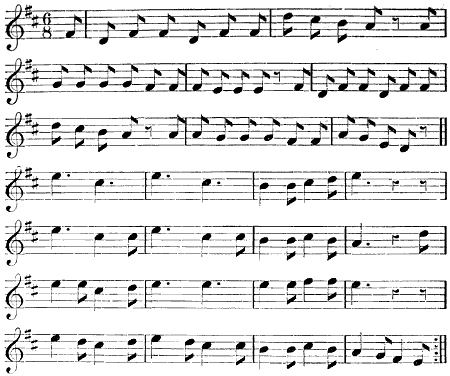
—Madeley, Shropshire (Miss Burne).
[Play]
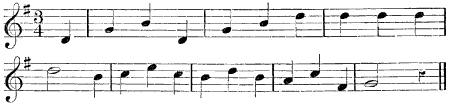
—Earls Heaton (H. Hardy).
[Play]
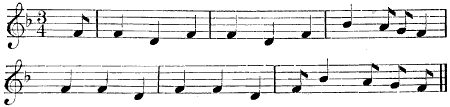
—Sporle, Norfolk (Miss Matthews).
[Play]

—Redhill, Surrey (Miss G. Hope).
[171]
[Play]
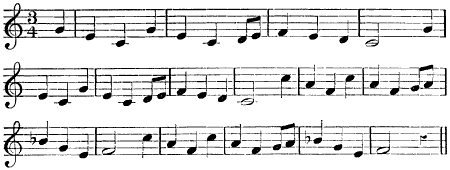
—Lancashire (Mrs. Harley).
[Play]
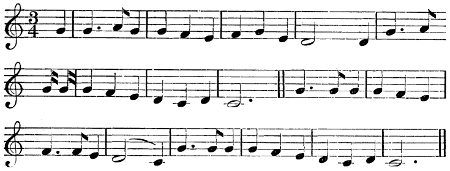
—Derbyshire (Mrs. Harley).
I.
Green gravel, green gravel, your grass is so green,
The fairest young damsel that ever was seen;
We washed her, we dried her, we rolled her in silk,
And we wrote down her name with a glass pen and ink.
Dear Annie, dear Annie, your true love is dead,
And we send you a letter to turn round your head.
—Belfast (W. H. Patterson).
II.
Green gravel, green gravel, the grass is so green,
The fairest young lady that ever was seen;
I’ll wash you in milk,
And I’ll clothe you with silk,
And I’ll write down your name with a gold pen and ink.
O Sally, O Sally, your true love is dead,
He sent you a letter to turn round your head.
—Berrington, Oswestry (Shropshire Folk-lore p. 510).
III.
Around the green gravel the grass is so green,
All the pretty fair maids are plain to be seen;
Wash them in milk, and clothe them in silk,
Write their names down with a gold pen and ink.
All but Miss “Jenny,” her sweetheart is dead;
She’s left off her wedding to turn back her head.
O mother, O mother, do you think it is true?
O yes, child! O yes, child!
Then what shall I do?
We’ll wash you in milk, and dress you in silk,
And write down your name with a gold pen and ink.
—Derbyshire and Worcestershire (Mrs. Harley).
IV.
Green gravel, green gravel,
The grass is so green,
Such beautiful flowers
As never were seen.
O Annie [or any name], O Annie,
Your sweetheart is dead!
He has sent you a letter
To turn back your head.
—Earls Heaton, Yorkshire (H. Hardy).
V.
Green gravel, green gravel,
The grass is so green,
The fairest young damsels
As ever were seen.
O ——, O ——, your true love is dead;
He sent you a letter
To turn round your head.
Green gravel, green gravel,
The grass is so green,
The dismalest damsels
As ever were seen.
O ——, O ——, your true love’s not dead;
He sends you a letter
To turn back your head.
—Lincoln, Winterton, and Wakefield
(Miss Fowler and Miss Peacock).
VI.
Green gravel, green gravel, the grass is so green,
The fairest young lady [damsel] that ever was seen.
O ——, O ——, your true love is dead;
He’s sent you a letter to turn round your head.
—Redhill, Surrey (Miss G. Hope);
Lancashire (Mrs. Harley).
VII.
Green meadows, green meadows, your grass is so green,
The fairest young damsel that ever was seen;
O Mary, O Mary, your sweetheart is dead;
We’ve sent you a letter to turn back your head.
Or,
Green gravel, green gravel, the grass is so green, and following on as above.
—Sporle, Norfolk (Miss Matthews).
VIII.
Green grover, green grover, your grass is so green,
The prettiest young lady that ever was seen.
O ——, O ——, your true love is dead;
I send you this letter, so turn round your head.
—Gainford, Durham (Miss Eddleston).
IX.
Green gravels, green gravels,
The grass is so green,
And all the pretty maidens
Are not to be seen,
Except —— (said twice),
And she’s not [?] to be seen,
So I send you a letter to turn round your head.
—Hampshire (Miss E. Mendham).
X.
Green gravels, green gravels, the grass is so green,
Fine pencils, fine pencils, as ever were seen.
O Mary! O Mary! your true love is dead,
And he’s sent you a letter to turn round your head.
—Wales (Byegones, 1890).
XI.
Yellow gravel, yellow gravel,
The grass is so green,
The fairest young lady
That ever was seen.
O ——, O ——,
Your true love is dead;
I send you a letter to turn round your head.
—Cowes, Isle of Wight (Miss E. Smith).
[174]
XII.
Green gravel, green gravel, the grass is so green,
Said the fairest young damsel that ever I’ve seen.
O mother, O mother, my true-love is dead,
He sent me this letter to turn round my head.
O mother, O mother, do you think this is true?
O yes, love! O yes, love!
And what shall I do?
I’ll wash you in butter-milk, I’ll dress you in silk,
I’ll write down your name with my gold pen and ink.
—Isle of Man (A. W. Moore).
XIII.
Green gravel, green gravel, the grass is so green,
The flowers are all faded and none to be seen.
O [Dolly], O [Dolly], your sweetheart is dead,
He’s sent you a letter to turn back your head.
Wallflowers, wallflowers, growing up so high,
We are but little, and we shall have to die!
Excepting [Dolly Turner], she’s the youngest girl.
O for shame, and fie for shame, and turn your back to home again.
—Madeley, Shropshire (Miss Burne).
XIV.
Green gravel, green gravel, the grass is so green,
The fairest young lady that ever was seen.
As I went up Miss Betsey’s stairs to buy a frying-pan,
There sat Miss Betsey a-kissing her young man.
She pulled off her glove and showed me her ring,
And the very next morning the bells did ring.
Dear Betsey, dear Betsey, your true love is dead,
He’s sent you a letter to turn back your head.
—Summertown, Oxford (A. H. Franklin,
Midland Garner, vol. ii. p. 32).
XV.
Round the green gravel the grass grows green,
All pretty fair maids are fit to be seen;
Wash them in milk, and clothe them in silk,
And write down their names with pen and black ink—
Choose one, choose two, choose the fairest daughter.
Now, my daughter, married to-day,
Like father and mother they should be,
To love one another like sister and brother—
I pray you now to kiss one another.
Now my daughter Mary’s gone,
With her pockets all lined with gold;
On my finger a gay gold ring—
Good-bye, Mary, good-bye.
Now this poor widow is left alone,
Nobody could marry a better one;
Choose one, choose two—
Choose the fairest daughter.
—Sheffield (S. O. Addy).
XVI.
Round the green gravel the grass is so green,
And all the fine ladies that ever were seen;
Washed in milk and dressed in silk,
The last that stoops down shall be married.
[Johnnie Smith] is a nice young man,
And so is [Bessie Jones] as nice as he;
He came to the door with his hat in his hand,
Inquiring for [Miss Jones].
She is neither within, she is neither without,
She is up in the garret a-walking about.
Down she came, as white as milk,
With a rose in her bosom as soft as silk.
Silks and satins be ever so dear,
You shall have a kiss [gown?], my dear,
So off with the glove and on with the ring—
To-morrow, to-morrow, the wedding begins.
—Forest of Dean, Gloucestershire (Miss Matthews).
XVII.
Around a green gravill
The grass is so green,
And all the fine ladies
Ashamed to be seen.
They wash ’em in milk
And dress ’em in silk—
We’ll all cou’ don’ together.
My elbow, my elbow,
My pitcher and my can;
Isn’t ——
A nice young gell?
Isn’t ——
As nice as her—
They shall be married with a guinea-gold ring.
I peep’d through the window,
I peep’d through the door,
I seed pretty ——
A-dancin on the floor;
I cuddled her an’ fo’dled her,
I set her on my knee;
I says pretty ——
Won’t [ëe?] you marry me.
A new-swept parlour,
An’ a new-made bed,
A new cup and saucer
Again we get wed.
If it be a boy, he shall have a hat,
To follow with his mammy to her na’, na’, na’;
If he be a gell, she shall have a ring,
To follow with her mammy to her ding, ding, ding.
—Wakefield (Miss Fowler).
(c) The more general way of playing this game is to form a
ring of children simply. The children walk round singing the
verse as in the Belfast version, and when the last line is sung, the
child whose name is mentioned turns round, facing the outside
of the ring and having her back to the centre. She continues to
hold hands with the others, and dances round with them in that
position. This is repeated until all the children have “turned”
their backs to the inside of the ring. Here the game ends in
many cases, but another verse is sung in the Lincoln, Winterton,
and Wakefield versions from Miss Peacock, and this was
sung also in the London version. The second verse thus terminates
the game, with the players one by one reversing their
position and facing the centre of ring as at first. In the
Forest of Dean and Wakefield versions the action of the game
is somewhat different. A child stands in the centre of the ring
of children, without apparently taking much part in the game,
except to name the children in turn. In the Wakefield version,
however (Miss Fowler, No. xvii.), a little boy stands in the
middle of a circle of girls who sing the first verse. At “We’ll
all cou’ don’ together,” all crouch down, as if in profound
respect, then rising slowly, sing the next verse. After “My
pitcher and my can,” each child mentions her own name. At
“Isn’t —— as nice as her?” each mentions her sweetheart’s
name, and the child thus chosen goes into the circle. At the
end of the fourth verse they all clap hands, and the one that is
sweetheart to him in the middle kisses him. The “crouching
down” is also done in the Forest of Dean version when singing
the fourth line. The last one to stoop has to name her
sweetheart. When this is done, the children all dance round
and sing the other lines.
(d) The analysis of the game-rhymes is on pp. 178-181.
The most constant formulæ of this game-rhyme are shown
by this analysis to be Nos. 1, 6, 7, 13, 15, 18, 23, and the
variants, though important, are not sufficient to detract from
the significance of the normal version. It is evidently a funeral
game. The green gravel and the green grass indicate the
locality of the scene; “green,” as applied to gravel, may mean
freshly disturbed, just as green grave means a freshly made
grave. The tenant of the new grave is the well-loved lady
of a disconsolate lover, and probably the incidents of washing
and dressing the corpse, and putting an inscription on
the place where it is laid, are indicated by Nos. 13 and 15.
The dirge, or singing to the dead, is indicated by Nos. 18,
23, and 26, and the beauty of the first line is in complete
accord with the mournful music. That No. 26 occurs in only
two variants, Derbyshire and the Isle of Man, is curious, as
the pathos of this appeal is very apparent in the movement
of the game. The communion with the dead which is indicated
by No. 23 is by no means considered impossible by the
peasantry. In confirmation of this being a representation of
an old funeral ceremony, it may be pointed out that the action of turning backwards during the singing of the dirge is also
represented in the curious funeral ceremony called “Dish-a-loof,”
which is described in Henderson’s Folk-lore of the Northern
Counties, p. 53. Henderson’s words are: “All the attendants,
going out of the room, return into it backwards, repeating this
rhyme of ’saining.’” The additional ceremony of marriage in
four of the games is clearly an interpolation, which may have
arisen from the custom of playing love and marriage games
at funerals and during the watching with the corpse, or may
be a mere transition to the more pleasant task of love-making
as the basis of a game. The Derbyshire incident (No. 24) may
indicate indeed that the funeral is that of a young bride, and
in that case the tendency to make the game wholly a marriage
game is accounted for. The decay which has set in is apparent
by the evident attempt to alter from “green gravel” to
“green grover” and “yellow gravel” (Nos. 4 and 5), and to
introduce pen and black ink (No. 17). The addition of the
incongruous elements from other games (Nos. 27-31) is a frequent
occurrence in modern games, and is the natural result of
decadence in the original form of the game. Altogether this
game-rhyme affords a very good example of the condition of
traditional games among the present generation of children.
[178-
181]
| No. |
Belfast. |
Shrop-
shire. |
Derby-
shire. |
Earls Heaton, Yorks. |
Lin-
coln-
shire. |
Redhill, Surrey. |
Sporle, Norfolk. |
Gainford, Durham. |
Hants. |
Wales. |
Isle of Wight. |
Isle of Man. |
Made-
ley. |
Oxford-
shire. |
Shef-
field. |
Forest of Dean. |
Wake-
field. |
| 1. |
Green gravel. |
Green gravel. |
— |
Green gravel. |
Green gravel. |
Green gravel. |
— |
— |
Green gravels. |
Green gravel. |
— |
Green gravel. |
Green gravel. |
Green gravel. |
— |
— |
— |
| 2. |
— |
— |
Around the green gravel. |
— |
— |
— |
— |
— |
— |
— |
— |
— |
— |
— |
Round the green gravel. |
Round the green gravel. |
Around the green gravill. |
| 3. |
— |
— |
— |
— |
— |
— |
Green meadows. |
— |
— |
— |
— |
— |
— |
— |
— |
— |
— |
| 4. |
— |
— |
— |
— |
— |
— |
— |
Green grover. |
— |
— |
— |
— |
— |
— |
— |
— |
— |
| 5. |
— |
— |
— |
— |
— |
— |
— |
— |
— |
— |
Yellow gravel. |
— |
— |
— |
— |
— |
— |
| 6. |
Your grass is so green. |
The grass is so green. |
The grass is so green. |
The grass is so green. |
The grass is so green. |
The grass is so green. |
Your grass is so green. |
Your grass is so green. |
The grass is so green. |
The grass is so green. |
The grass is so green. |
The grass is so green. |
— |
— |
— |
— |
— |
| 7. |
The fairest damsel ever seen. |
— |
— |
— |
Fairest damsel ever seen. |
Fairest damsel ever seen. |
Fairest damsel ever seen. |
— |
— |
— |
— |
Fairest damsel ever I’ve seen. |
— |
— |
— |
— |
— |
| 8. |
— |
The fairest young lady ever seen. |
— |
— |
— |
— |
— |
Prettiest young lady ever seen. |
— |
— |
Fairest young lady ever seen. |
— |
— |
Fairest young lady ever seen. |
— |
All fine ladies ever were seen. |
— |
| 9. |
— |
— |
All pretty maids are plain to be seen. |
— |
— |
— |
— |
— |
— |
— |
— |
— |
— |
— |
All pretty fair maids are fit to be seen. |
— |
— |
| 10. |
— |
— |
— |
Such beautiful flowers ever seen. |
— |
— |
— |
— |
— |
— |
— |
— |
Flowers all faded, none to be seen. |
— |
— |
— |
— |
| 11. |
— |
— |
— |
— |
— |
— |
— |
— |
All pretty maidens are _not_ to be seen. |
— |
— |
— |
— |
— |
— |
— |
All fine ladies ashamed to be seen. |
| 12. |
— |
— |
— |
— |
— |
— |
— |
— |
— |
Fine pencil as ever was seen. |
— |
— |
— |
— |
— |
— |
— |
| 13. |
Washed her, dried her, rolled her in silk. |
— |
— |
— |
— |
— |
— |
— |
— |
— |
— |
— |
— |
— |
— |
— |
— |
| 14. |
— |
Wash you in milk, clothe in silk. |
Wash them in milk, clothe in silk. |
— |
— |
— |
— |
— |
— |
— |
— |
[Wash you in butter-milk, dress in silk.] (After No. 26.) |
— |
— |
Wash them in milk, clothe in silk. |
Washed in milk, dressed in silk. |
Wash ’em in milk, dress in silk. |
| 15. |
Wrote name in glass pen and ink. |
— |
— |
— |
— |
— |
— |
— |
— |
— |
— |
— |
— |
— |
— |
— |
— |
| 16. |
— |
Write name in gold pen and ink. |
Write names in gold pen and ink. |
— |
— |
— |
— |
— |
— |
— |
— |
[Write name with my gold pen and ink.] (After No. 26.) |
— |
— |
— |
— |
— |
| 17. |
— |
— |
— |
— |
— |
— |
— |
— |
— |
— |
— |
— |
— |
— |
Write names with pen and black ink. |
— |
— |
| 18. |
Your true love is dead. |
True love is dead. |
Her sweet-
heart is dead. |
Sweet-
heart is dead. |
True love is dead. |
True love is dead. |
Sweet-
heart is dead. |
True love is dead. |
— |
True love is dead. |
True love is dead. |
True love is dead. |
Sweet-
heart is dead. |
True love is dead. (After No. 25.) |
— |
— |
— |
| 19. |
— |
— |
— |
— |
— |
— |
— |
— |
Except —— she’s not to be seen. |
— |
— |
— |
— |
— |
— |
— |
— |
| 20. |
— |
— |
— |
— |
— |
— |
— |
— |
— |
— |
— |
— |
— |
Betsy kissing her young man. |
— |
— |
— |
| 21. |
— |
— |
— |
— |
— |
— |
— |
— |
— |
— |
— |
— |
— |
— |
Choose the fairest daughter. |
— |
— |
| 22. |
— |
— |
— |
— |
— |
— |
— |
— |
— |
— |
— |
— |
— |
— |
— |
Last to stoop down shall be married. |
We’ll all cow down together. |
| 23. |
He sent letter to turn your head. |
He sent letter to turn your head. |
— |
He sent letter to turn your head. |
He sent letter to turn your head. |
He sent letter to turn your head. |
We sent letter to turn your head. |
I send letter to turn your head. |
I send letter to turn round your head. |
He’s sent letter to turn head. |
I send you letter to turn round your head. |
He sent this letter to turn my head. |
I’ve sent letter to turn your head. |
[He sent letter to turn back your head.] (After No. 25.) |
— |
— |
— |
| 24. |
— |
— |
She’s left off her wedding to turn back her head. |
— |
— |
— |
— |
— |
— |
— |
— |
— |
— |
— |
— |
— |
— |
| 25. |
— |
— |
— |
— |
— |
— |
— |
— |
— |
— |
— |
— |
— |
She showed her ring and bells did ring. |
Married to-day so kiss one another. |
He came to inquire, down she came, so off with glove and on with ring, to-morrow the wedding begins. |
They shall be married with gold ring. |
| 26. |
— |
— |
Mother, is it true; What shall I do? [Then repeat Nos. 14 & 16.] |
— |
— |
— |
— |
— |
— |
— |
— |
Mother, is it true? What shall I do? |
— |
— |
— |
— |
— |
| 27. |
— |
— |
— |
— |
True love not dead, he sends letter to turn your head. |
— |
— |
— |
— |
— |
— |
— |
— |
— |
— |
— |
— |
| 28. |
— |
— |
— |
— |
— |
— |
— |
— |
— |
— |
— |
— |
[Wall-
flowers verses follow.] |
— |
— |
— |
— |
| 29. |
— |
— |
— |
— |
— |
— |
— |
— |
— |
— |
— |
— |
— |
— |
Poor widow left alone, and choose the fairest daughter. |
— |
— |
| 30. |
— |
— |
— |
— |
— |
— |
— |
— |
— |
— |
— |
— |
— |
— |
— |
— |
[Dancing, cuddling, asking to marry.] |
| 31. |
— |
— |
— |
— |
— |
— |
— |
— |
— |
— |
— |
— |
— |
— |
— |
— |
[Furnish-
ing.] |
| 32. |
— |
— |
— |
— |
— |
— |
— |
— |
— |
— |
— |
— |
— |
— |
— |
— |
[If a boy, he’s to have a hat; if a girl, a ring.] |
| No. |
Belfast. |
Shropshire. |
Derbyshire. |
Earls Heaton, Yorks. |
Lincolnshire. |
Redhill, Surrey. |
Sporle, Norfolk. |
Gainford, Durham. |
Hants. |
| 1. |
Green gravel. |
Green gravel. |
— |
Green gravel. |
Green gravel. |
Green gravel. |
— |
— |
Green gravels. |
| 2. |
— |
— |
Around the green gravel. |
— |
— |
— |
— |
— |
— |
| 3. |
— |
— |
— |
— |
— |
— |
Green meadows. |
— |
— |
| 4. |
— |
— |
— |
— |
— |
— |
— |
Green grover. |
— |
| 5. |
— |
— |
— |
— |
— |
— |
— |
— |
— |
| 6. |
Your grass is so green. |
The grass is so green. |
The grass is so green. |
The grass is so green. |
The grass is so green. |
The grass is so green. |
Your grass is so green. |
Your grass is so green. |
The grass is so green. |
| 7. |
The fairest damsel ever seen. |
— |
— |
— |
Fairest damsel ever seen. |
Fairest damsel ever seen. |
Fairest damsel ever seen. |
— |
— |
| 8. |
— |
The fairest young lady ever seen. |
— |
— |
— |
— |
— |
Prettiest young lady ever seen. |
— |
| 9. |
— |
— |
All pretty maids are plain to be seen. |
— |
— |
— |
— |
— |
— |
| 10. |
— |
— |
— |
Such beautiful flowers ever seen. |
— |
— |
— |
— |
— |
| 11. |
— |
— |
— |
— |
— |
— |
— |
— |
All pretty maidens are _not_ to be seen. |
| 12. |
— |
— |
— |
— |
— |
— |
— |
— |
— |
| 13. |
Washed her, dried her, rolled her in silk. |
— |
— |
— |
— |
— |
— |
— |
— |
| 14. |
— |
Wash you in milk, clothe in silk. |
Wash them in milk, clothe in silk. |
— |
— |
— |
— |
— |
— |
| 15. |
Wrote name in glass pen and ink. |
— |
— |
— |
— |
— |
— |
— |
— |
| 16. |
— |
Write name in gold pen and ink. |
Write names in gold pen and ink. |
— |
— |
— |
— |
— |
— |
| 17. |
— |
— |
— |
— |
— |
— |
— |
— |
— |
| 18. |
Your true love is dead. |
True love is dead. |
Her sweet-
heart is dead. |
Sweet-
heart is dead. |
True love is dead. |
True love is dead. |
Sweet-
heart is dead. |
True love is dead. |
— |
| 19. |
— |
— |
— |
— |
— |
— |
— |
— |
Except —— she’s not to be seen. |
| 20. |
— |
— |
— |
— |
— |
— |
— |
— |
— |
| 21. |
— |
— |
— |
— |
— |
— |
— |
— |
— |
| 22. |
— |
— |
— |
— |
— |
— |
— |
— |
— |
| 23. |
He sent letter to turn your head. |
He sent letter to turn your head. |
— |
He sent letter to turn your head. |
He sent letter to turn your head. |
He sent letter to turn your head. |
We sent letter to turn your head. |
I send letter to turn your head. |
I send letter to turn round your head. |
| 24. |
— |
— |
She’s left off her wedding to turn back her head. |
— |
— |
— |
— |
— |
— |
| 25. |
— |
— |
— |
— |
— |
— |
— |
— |
— |
| 26. |
— |
— |
Mother, is it true; What shall I do? [Then repeat Nos. 14 & 16.] |
— |
— |
— |
— |
— |
— |
| 27. |
— |
— |
— |
— |
True love not dead, he sends letter to turn your head. |
— |
— |
— |
— |
| 28. |
— |
— |
— |
— |
— |
— |
— |
— |
— |
| 29. |
— |
— |
— |
— |
— |
— |
— |
— |
— |
| 30. |
— |
— |
— |
— |
— |
— |
— |
— |
— |
| 31. |
— |
— |
— |
— |
— |
— |
— |
— |
— |
| 32. |
— |
— |
— |
— |
— |
— |
— |
— |
— |
| No. |
Wales. |
Isle of Wight. |
Isle of Man. |
Madeley. |
Oxfordshire. |
Sheffield. |
Forest of Dean. |
Wakefield. |
| 1. |
Green gravel. |
— |
Green gravel. |
Green gravel. |
Green gravel. |
— |
— |
— |
| 2. |
— |
— |
— |
— |
— |
Round the green gravel. |
Round the green gravel. |
Around the green gravill. |
| 3. |
— |
— |
— |
— |
— |
— |
— |
— |
| 4. |
— |
— |
— |
— |
— |
— |
— |
— |
| 5. |
— |
Yellow gravel. |
— |
— |
— |
— |
— |
— |
| 6. |
The grass is so green. |
The grass is so green. |
The grass is so green. |
— |
— |
— |
— |
— |
| 7. |
— |
— |
Fairest damsel ever I’ve seen. |
— |
— |
— |
— |
— |
| 8. |
— |
Fairest young lady ever seen. |
— |
— |
Fairest young lady ever seen. |
— |
All fine ladies ever were seen. |
— |
| 9. |
— |
— |
— |
— |
— |
All pretty fair maids are fit to be seen. |
— |
— |
| 10. |
— |
— |
— |
Flowers all faded, none to be seen. |
— |
— |
— |
— |
| 11. |
— |
— |
— |
— |
— |
— |
— |
All fine ladies ashamed to be seen. |
| 12. |
Fine pencil as ever was seen. |
— |
— |
— |
— |
— |
— |
— |
| 13. |
— |
— |
— |
— |
— |
— |
— |
— |
| 14. |
— |
— |
[Wash you in butter-milk, dress in silk.] (After No. 26.) |
— |
— |
Wash them in milk, clothe in silk. |
Washed in milk, dressed in silk. |
Wash ’em in milk, dress in silk. |
| 15. |
— |
— |
— |
— |
— |
— |
— |
— |
| 16. |
— |
— |
[Write name with my gold pen and ink.] (After No. 26.) |
— |
— |
— |
— |
— |
| 17. |
— |
— |
— |
— |
— |
Write names with pen and black ink. |
— |
— |
| 18. |
True love is dead. |
True love is dead. |
True love is dead. |
Sweet-
heart is dead. |
True love is dead. (After No. 25.) |
— |
— |
— |
| 19. |
— |
— |
— |
— |
— |
— |
— |
— |
| 20. |
— |
— |
— |
— |
Betsy kissing her young man. |
— |
— |
— |
| 21. |
— |
— |
— |
— |
— |
Choose the fairest daughter. |
— |
— |
| 22. |
— |
— |
— |
— |
— |
— |
Last to stoop down shall be married. |
We’ll all cow down together. |
| 23. |
He’s sent letter to turn head. |
I send you letter to turn round your head. |
He sent this letter to turn my head. |
I’ve sent letter to turn your head. |
[He sent letter to turn back your head.] (After No. 25.) |
— |
— |
— |
| 24. |
— |
— |
— |
— |
— |
— |
— |
— |
| 25. |
— |
— |
— |
— |
She showed her ring and bells did ring. |
Married to-day so kiss one another. |
He came to inquire, down she came, so off with glove and on with ring, to-morrow the wedding begins. |
They shall be married with gold ring. |
| 26. |
— |
Mother, is it true? What shall I do? |
— |
— |
— |
— |
— |
| 27. |
— |
— |
— |
— |
— |
— |
— |
— |
| 28. |
— |
— |
— |
[Wall-
flowers verses follow.] |
— |
— |
— |
— |
| 29. |
— |
— |
— |
— |
— |
Poor widow left alone, and choose the fairest daughter. |
— |
— |
| 30. |
— |
— |
— |
— |
— |
— |
— |
[Dancing, cuddling, asking to marry.] |
| 31. |
— |
— |
— |
— |
— |
— |
— |
[Furnish-
ing.] |
| 32. |
— |
— |
— |
— |
— |
— |
— |
[If a boy, he’s to have a hat; if a girl, a ring.] |
(e) Other versions, actually or practically identical with the
Redhill (Surrey) version, have been sent by Miss Blair (South
Shields); Mr. H. S. May, Ogbourne and Manton (Wilts);
Mrs. Haddon (Cambridge); Mrs. Harley (Lancashire); and
Miss Burne, Platt, near Wrotham (Kent). There are also
similar printed versions in Folk-lore Journal, vi. 214 (Dorsetshire);
Folk-lore Record, v. 84 (Hersham, Surrey). Northall
prints a version in his Folk Rhymes, 362-3, identical with
No. 17. The tune of the Platt version sent by Miss Burne,
and the Ogbourne and Manton (H. S. May), are almost identical,
except the termination. This seems to be the most general
tune for the game. The Lancashire tune is the same as the
London version.
Miss Burne says of the Madeley version: “I never knew
‘Green Gravel’ and ‘Wallflowers’ played together as in this
way elsewhere (I had not got this variant when I wrote Shropshire
Folk-lore), except at Much Wenlock, where they reverse
the two verses, and only sing one line (the last) of ‘Green
Gravel.’ But I feel sure they must have been meant to go
together (see my note in Shropshire Folk-lore, p. 510), and I
can explain them, I think. The ring of girls are dancing on
the green grass plot in the middle of an old-fashioned sixteenth-century
walled garden: each gets the news of her lover’s death,
and ‘turns her face to the wall,’ the old token of hopeless
sorrow. Then they apostrophise the wallflowers in the border
surrounding the grass plot against the old high wall; and
here another variant explains the lament (second line)—
Wallflowers, wallflowers, growing up so high,
We shall all be maidens [and so], we shall all die;
Except the youngest (who will meet with another lover),
whether as an instance of the proverbial luck of the ‘youngest
born,’ or as a piece of juvenile giddiness and inconstancy, I
cannot say; but considering the value set on true love and
hopeless constancy in the ballad-lore, and the special garland
which distinguished the funerals of bereaved but constant
maidens, and the solemnity of betrothal in old days, the latter
seems probable, especially considering the ‘for shame.’”
The incidents of washing a corpse in milk and dressing it in
silk occur in “Burd Ellen,” Jamieson’s Ballads, p. 125.
“Tak up, tak up my bonny young son,
Gar wash him wi’ the milk;
Tak up, tak up my fair lady,
Gar row her in the silk.”
[Addendum]
[Play]
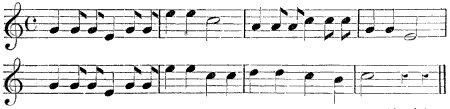
—Earls Heaton (Mr. Hardy).
I.
Green grow the leaves (or grows the ivy) round the old oak tree,
Green grow the leaves round the old oak tree,
Green grow the leaves round the old oak tree,
As we go marching on.
Bless my life I hardly knew you,
Bless my life I hardly knew you,
Bless my life I hardly knew you,
As we go marching on.
—Lincolnshire and Nottinghamshire
(Miss Peacock).
II.
Green grow the leaves on the old oak tree,
I love the boys and the boys love me,
As we go marching on.
—Sharleston (Miss Fowler).
III.
I love the boys and the boys love me,
I love the boys and the boys love me,
I love the boys and the boys love me,
As we go marching home.
Glory, glory, hallelujah!
Glory, glory, hallelujah!
Glory, glory, hallelujah!
As we go marching home.
The old whiskey bottle lies empty on the shelf,
The old whiskey bottle lies empty on the shelf,
The old whiskey bottle lies empty on the shelf,
As we go marching home.
—Earls Heaton, Yorkshire (Herbert).
(b) In Lincolnshire and Nottinghamshire the game is played
by the children forming a circle and dancing round, singing.
The first and third lines are sung three times. Partners are
chosen during the singing of the last line. Miss Peacock adds,
“The rest wanting, as my informant had forgotten the game.”
In the Sharleston version the children march round two by
two, in a double circle, with one child in the centre, singing
the verse. At the conclusion, the children who are marching
on the inner side of the circle leave their partners and take the
place of one in front of them, while the centre child endeavours
to get one of the vacant places, the child turned out taking the
place of the one in the centre, when the game begins again.
In the Earls Heaton version there is the circle of children, with
one child in the centre, who chooses a partner after the lines
have been sung.
(c) From this it would seem that while the Lincolnshire and
Nottinghamshire words appear to be the most complete, the
action has been preserved best at Sharleston. The acting of
this version is the same as that of “The Jolly Miller.” The
third variant is evidently an imitation of the song, “John
Brown.”
[Play]
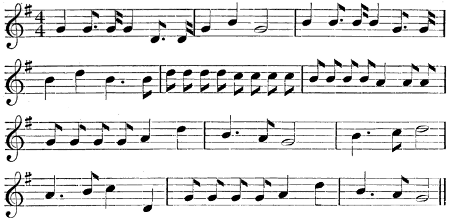
—Northants (R. S. Baker).
Green grow the leaves on the hawthorn tree,
Green grow the leaves on the hawthorn tree,
We jangle and we wrangle and we never can agree,
But the tenor of our song goes merrily, merrily, merrily,
The tenor of our song goes merrily.
—R. S. Baker (Northants Notes and
Queries, ii. 161).
(b) One couple is chosen to lead, and they go off, whither they
will, followed by a long train of youths and maidens, all singing
the refrain. Sometimes the leaders part company, and
branch off to the right or left; the others have to do the same,
and not until the leaders meet can they join again. They
march arm in arm.
(c) Mr. R. S. Baker, who records this, says a Wellingborough
lady sent him the tune and words, and told him the game was
more like a country dance than anything else, being a sort of
dancing “Follow My Leader.”
A sink, or, failing that, a particular stone in the pavement
was the “Gully.” Some boy chosen by lot, or one who volunteered
in order to start the game, laid his top on the ground at
some distance from the “Gully.” The first player then spun
his top, pegging at the recumbent top, so as to draw it towards
the “Gully.” If he missed the top, he stooped down and took
up his own top by pushing his hand against it in such a
manner that the space between his first and second finger
caught against the peg and forced the top into the palm of his
hand. He then had “a go” at the recumbent top (I forget
what this was called), and sent his own top against it so as to
push it towards the “Gully.” If he missed, he tried again and
again, until his own top could spin no longer. If he did not
hit the top with his own while it was spinning, his top had to
be laid down and the other one taken up, and its owner took
his turn at pegging. When a spinning-top showed signs of
exhaustion, and the taking it up might kill it, and it was not
very far from the down-lying top, its owner would gently push
it with his finger, so as to make it touch the other top, and so
avoid putting it into the other’s place. This was called “kissing,”
and was not allowed by some players. When one player
succeeded in sending the top into the “Gully,” he took it up
and fixed it by its peg into a post, mortar of a wall, or the best
place where it could be tolerably steady. Holding it by one
hand, he drove the peg of his own top as far as he could into
the crown of the victim top. This was called “taking a grudge.”
He then held either his own or the victim top and knocked the
other against the wall, the object being to split the victim. He
was allowed three “grudges.” If the top did not give way,
the other players tried in turn. If the top did not split, it was
returned to its owner, but any boy who succeeded in splitting
it through the middle, so that the peg fell out, took possession
of the peg. I have seen a top split at the side in such a way
as to be quite useless as a top, though no peg was gained. I
remember, too, a schoolfellow of mine drawing from his pocket
some seven or eight pegs, the trophied memorials of as many
tops.—London (J. P. Emslie).
See “Hoatie,” “Hoges,” “Peg-top.”
This is a game of chance. The players are two, and may
be boys or girls, or a boy and a girl. The stakes may be pins,
buttons, marbles, or anything for which children gamble. One
player puts a number, one, two, three or more, of the articles
to be gambled for into the hollow of the closed hand, and
says, “Hairry my bossie;” the other answers, “Knock ’im
down,” upon which he puts his closed hands down with a blow
on his knees, and continues to strike them upwards and downwards
on the knee, so as to give the opponent in play an idea of
the number of objects concealed by the sound given forth. He
then says, “How many blows?” and gets the reply, “As
many’s goes.” A guess is then made. If the guess is correct
the guesser gets the objects. If the guess is incorrect the
guesser has to make up the difference between the number
guessed and the real number. The players play alternately.
This game was played for the most part at Christmas.—Keith
(Rev. W. Gregor).
(b) Hairry = “rob,” Bossie = “a wooden bowl,” commonly
used for making the leaven in baking oat-cakes, and for making
“brose.”
This is a very general game amongst schoolboys.
The game of “Hop-step-and-jump,” Norfolk. This game is
played in the west of Sussex, but not in the east. It is played
thus by two or more boys. Each boy in his turn stands first
on one leg and makes a hop, then strides or steps, and lastly,
putting both feet together, jumps. The boy who covers the
most ground is the victor.—Halliwell’s Dictionary.
A game common in Dumfries, thus described by Jamieson.
Two goals called hails, or dules, are fixed on at about a distance
of four hundred yards. The two parties then place themselves
in the middle between the goals or dules, and one of the
players, taking a soft elastic ball, about the size of a man’s fist,
tosses it into the air, and, as it falls, strikes it with his palm
towards his antagonists. The object of the game is for either
party to drive the ball beyond the goal which lies before them,
while their opponents do all in their power to prevent this.
As soon as the ball is gowf’t, that is, struck away, the opposite
party endeavour to intercept it in its fall. This is called keppan’
the ba’. If they succeed in this attempt, the player who does
so is entitled to throw the ball with all his might towards
his antagonists. If he kep it in the first bound which it makes
off the ground, called a stot, he is allowed to haunch, that is,
to throw the ball by bringing his hand with a sweep past his
thigh, to which he gives a stroke as his hand passes, and discharging
the ball at the moment when the stroke is given. If
the ball be caught in the second bounce, the catcher may hoch
the ball, that is, throw it through below one of his houghs. If
none of the party catch the ball, it must be gowf’t in the
manner before described. As soon as either of the parties
succeed in driving the ball, or, as it is called, hailin’ the dules,
the game then begins by one of the party which was successful
throwing the ball towards the opposing goal and the other party
striving to drive it back.
A game played by a company of young people who are drawn
up in a circle, when one of them, pitched upon by lot, walks
round the band, and, if a boy, hits a girl, or, if a girl, she strikes
a boy whom she chooses, on which the party striking and the
party struck run in pursuit of each other till the latter is caught,
whose lot it then becomes to perform the same part. A game
so called was forbidden by statute of Edward IV.—Halliwell’s
Dictionary.
See “Drop Handkerchief.”
A game in which one of the players turns his face to the wall,
his hand resting upon his back. He must continue in position
until he guesses who struck his hand, when the striker takes
his place.—Orkney and Shetland (Jamieson’s Dictionary).
See “Hot Cockles.”
I.
Handy dandy,
Sugary candy—
Top or bottom?
Handy spandy,
Jack a dandy—
Which good hand will you have?
—Halliwell’s Dictionary: Nursery Rhymes, p. 216.
II.
Handy dandy riddledy ro—
Which will you have, high or low?
—Halliwell’s Nursery Rhymes, p. 216.
III.
Handy pandy,
Sugary candy,
Which will you have—
Top or bottom?
—London (A. B. Gomme).
IV.
Handy pandy, Jack a dandy,
Which hand will you have?
—Burne’s Shropshire Folk-lore, p. 530.
(b) The hands are closed, some small article is put in one of
them behind the back of the player. The closed fists are then
turned rapidly round one another while the rhyme is being
said, and they are then placed one on top of the other. A guess
is then made by any one of the players as to which hand the
object is in. If correct, the guesser obtains the object; if
incorrect, the player who performs “Handy dandy” keeps it.
(c) This game is mentioned in Piers Plowman, p. 69 of
Wright’s edition. Douce quotes an ancient MS. which curiously
mentions the game as “men play with little children at
‘handye-dandye,’ which hand will you have” (ii. 167). Johnson
says: “‘Handy dandy,’ a play in which children change
hands and places: ‘See how yon justice rails upon yon simple
thief! Hark, in thine ear: change places, and, handy dandy,
which is the justice, which is the thief?” (King Lear, iv. 6).
Malone says, “‘Handy dandy’ is, I believe, a play among
children, in which something is shaken between two hands,
and then a guess is made in which hand it is retained.” See
Florio’s Italian Dictionary, 1598: “Bazzicchiare, to shake
between the hands; to play ‘Handy dandy.’” Pope, in his
Memoirs of Cornelius Scriblerus, in forbidding certain sports
to his son Martin till he is better informed of their antiquity,
says: “Neither cross and pile, nor ducks and drakes, are quite
so ancient as ‘Handy dandy,’ though Macrobius and St. Augustine
take notice of the first, and Minutius Foelix describes the
latter; but ‘Handy dandy’ is mentioned by Aristotle, Plato,
and Aristophanes.” Browne, in Britannia’s Pastorals (i. 5),
also alludes to the game.
See “Neiveie-nick-nack.”
A singular game, gone through by hopping on one foot, and
with that foot sliding a little flat stone out of an oblong bed,
rudely drawn on a smooth piece of ground. This bed is
divided into eight parts, the two of which at the farther end
of it are called the Kail-pots. If the player then stands at one
end, and pitches the smooth stone into all the divisions one
after the other, following the same on a foot (at every throw),
and bringing it out of the figure, this player wins not only the
game, but is considered a first-rate daub at it; failing, however,
to go through all the parts so, without missing either a
throw or a hop, yet keeping before the other gamblers (for
many play at one bed), still wins the curious rustic game.—Mactaggart’s
Gallovidian Encyclopædia.
A game called “The Beds,” mentioned by a writer in Blackwood’s
Magazine, August 1821, p. 36, as played in Edinburgh
when he was a boy by girls only, is described as a game
where a pitcher is kicked into chalked divisions of the pavement,
the performer being on one leg and hopping.
See “Hop-scotch.”
Several boys place one button each close together on a line.
The game consists in hitting a particular button out of this
line with the nicker without touching the others. This is
generally played in London streets, and is mentioned in the
Strand Magazine, ii. 515.
See “Banger,” “Buttons.”
A boys’ game. One boy is chosen as the Hare. He carries
with him a bag filled with strips of paper. The rest of the
boys are the Hounds. The Hare has a certain time (say
fifteen minutes) allowed him for a start, and he goes across
country, scattering some paper on his way in order to indicate
his track. He may employ any manœuvre in order to deceive
his pursuers, but must keep up the continuity of his paper
track-signs. The Hounds follow him and try to catch him
before he gets home, which is a place agreed upon beforehand.—London
(G. L. Gomme).
In Cornwall the leader, when at fault, says—
Uppa, uppa, holye! If you don’t speak
My dogs shan’t folly.
—Courtney (Folk-lore Journal, v. 73).
Other versions of this holloa are—
Whoop, whoop, and hollow!
Good dogs won’t follow
Without the hare cries, Peewit.
—Halliwell’s Nursery Rhymes, p. 66.
Sound your holler,
Or my little dog shan’t foller.
—Northall’s English Folk Rhymes, p. 357.
This game is played in Wales under the name of “Hunt the
Fox.” The Fox has a certain time given him for a start, the
other players then go after him.—Beddgelert (Mrs. Williams).
A game among children, in which they hop round in a ring,
sitting on their hams.—Jamieson.
See “Curcuddie,” “Cutch-a-cutchoo,” “Hirtschin Hairy.”
[192]
[Play]
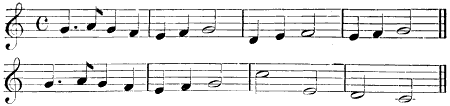
—Tong, Shropshire (Miss R. Harley).
I.
Hark the robbers coming through,
Coming through,
Hark the robbers coming through,
My fair lady.
What have the robbers done to you,
Done to you,
What have the robbers done to you,
My fair lady?
You have stole my watch and chain,
Watch and chain,
You have stole my watch and chain,
My fair lady.
Half-a-crown you must pay,
You must pay,
Half-a-crown you must pay,
My fair lady.
Half-a-crown we cannot pay,
Cannot pay,
Half-a-crown we cannot pay,
My fair lady.
Off to prison you must go,
You must go,
Off to prison you must go,
My fair lady.
—Deptford, Kent (Miss Chase).
II.
Here are the robbers coming through,
Coming through, coming through,
Here are the robbers coming through,
My fair lady.
What will the robbers do to you,
Do to you, do to you,
What will the robbers do to you,
My fair lady?
Steal your watch and break your chain,
Break your chain, break your chain,
Steal your watch and break your chain,
My fair lady.
Then they must go to jail,
Go to jail, go to jail,
Then they must go to jail,
My fair lady.
—Belfast (W. H. Patterson).
III.
Hark the robbers
Coming through, coming through,
My fair lady.
They have stolen my watch and chain,
Watch and chain, watch and chain.
Off to prison they shall go,
They shall go, they shall go,
My fair lady.
—Wolstanton, Stoke-on-Trent (Miss A. A. Keary).
IV.
Hark the robbers coming through,
Coming through, coming through,
Hark the robbers coming through,
My fair lady.
What’s the robbers done to you,
Done to you, done to you,
What’s the robbers done to you,
My fair lady?
They have stole my watch and chain,
Watch and chain, watch and chain,
They have stole my watch and chain,
My fair lady.
What’s the price will set you free,
Set you free, set you free,
What’s the price will set you free,
My fair lady?
Half-a-guinea will set me free,
Will set me free, will set me free,
Half-a-guinea will set me free,
My fair lady.
Half-a-guinea you shall not have,
Shall not have, shall not have,
Half-a-guinea you shall not have,
My fair lady.
Let’s join hands, it is too late,
’Tis too late, ’tis too late,
Let’s join hands, it is too late,
My fair lady.
—Tong, Shropshire (Miss R. Harley).
V.
Hark at the robbers going through,
Through, through, through; through, through, through;
Hark at the robbers going through,
My fair lady.
What have the robbers done to you,
You, you, you; you, you, you?
What have the robbers done to you,
My fair lady?
Stole my gold watch and chain,
Chain, chain, chain; chain, chain, chain;
Stole my gold watch and chain,
My fair lady.
How many pounds will set us free,
Free, free, free; free, free, free?
How many pounds will set us free,
My fair lady?
A hundred pounds will set you free,
Free, free, free; free, free, free;
A hundred pounds will set you free,
My fair lady.
We have not a hundred pounds,
Pounds, pounds, pounds; pounds, pounds, pounds;
We have not a hundred pounds,
My fair lady.
Then to prison you must go,
Go, go, go; go, go, go;
Then to prison you must go,
My fair lady.
To prison we will not go,
Go, go, go; go, go, go;
To prison we will not go,
My fair lady.
—Shipley, Horsham (Notes and Queries,
8th Series, i. 210, Miss Busk).
VI.
See the robbers coming through,
Coming through, coming through,
See the robbers coming through,
A nice young lady.
Here’s a prisoner we have got,
We have got, we have got,
Here’s a prisoner we have got,
A nice young lady.
How many pounds to set her free,
Set her free, set her free,
How many pounds to set her free,
A nice young lady?
A hundred pounds to set her free,
Set her free, set her free,
A hundred pounds to set her free,
A nice young lady.
A hundred pounds we cannot give,
We cannot give, we cannot give,
A hundred pounds we cannot give,
A nice young lady.
Then to prison she must go,
She must go, she must go,
Then to prison she must go,
A nice young lady.
If she goes we’ll go too,
We’ll go too, we’ll go too,
If she goes we’ll go too,
A nice young lady.
Round the meadows we will go,
We will go, we will go,
Round the meadows we will go,
A nice young lady.
—Settle, Yorks. (Rev. W. S. Sykes).
VII.
O what has this poor prisoner done,
Poor prisoner done, poor prisoner done?
O what has this poor prisoner done,
So early in the morning?
She stole my watch and lost my key,
Lost my key, lost my key,
She stole my watch and lost my key,
So early in the morning.
How many pounds to set her free,
Set her free, set her free?
How many pounds to set her free,
So early in the morning?
Five hundred pounds to set her free,
Set her free, set her free,
Five hundred pounds to set her free,
So early in the morning.
Five hundred pounds we have not got,
Have not got, have not got,
Five hundred pounds we have not got,
So early in the morning.
So off to prison she must go,
She must go, she must go,
So off to prison she must go,
So early in the morning.
If she go then I’ll go too,
I’ll go too, I’ll go too,
If she go then I’ll go too,
So early in the morning.
So round the meadows we must go,
We must go, we must go,
So round the meadows we must go,
So early in the morning.
—Sporle, Norfolk (Miss Matthews).
(b) In the Deptford version two girls join hands, holding
them up as an arch for the other players to tramp through.
The first two verses are sung first by one and then by the other
of the two girls. At the finish of these the girl then going
through the arch is stopped, and the third, fourth, and fifth
verses are sung by the two girls alternately. Then finally both
girls sing the last verse, and the child is sent as prisoner
behind one or other of the two girls. The verses are then
begun again, and repeated afresh for each of the troop marching
through the arch until all of them are placed behind one
or other of the two girls. The two sides thus formed then
proceed to tug against each other, and the strongest side wins
the game.
The Belfast version is practically the same, except that the
verses are not sung as a dialogue, but by all the players
together, and the prisoner, when caught, has the choice of
sides, by being asked, “Which will you have, a golden apple
or golden pear?” and according to the answer given is sent
behind one of the leaders. The Norfolk and Shropshire games
are different. Miss Matthews thus describes the Norfolk game:
“Two girls take hold of hands, and another, the
prisoner, stands between them. The rest form themselves into
a line opposite, and advance and retreat while singing the first
verse, the gaolers singing the next verse, and so on alternately.
[At the end of the last verse but one] the children break
the line, form themselves into a ring, and dance round the
prisoner, singing the final verse.” Miss Harley describes the
Shropshire version as follows: “The first six verses are sung
by the alternate parties, who advance and retire, tramping
their feet, at first, to imitate the robbers. The last verse is
sung altogether going round in a ring.” In the Shipley
version, Miss Busk says: “The children form themselves into
two lines, while two or three, representing the robbers, swagger
along between them. When the robbers sing the last verse
they should have attained the end of the lines [of children], as
during the parley they were safe; having pronounced the defiance
they run away. The children in the lines rush after
them, and should catch them and put them in prison.”
(c) The analysis of this game is easy. The Deptford, Belfast,
and Wolstanton versions are clearly enough dramatic
representations of the capture of a robber, and probably the
game dates from the period of the prevalence of highway
robbery. The Wolstanton version shows us that the game is
breaking up from its earlier form, while the Norfolk and Shropshire
versions show a fresh development into the mere game
for children, apart from its original significance. The action of
the game confirms this view. The Norfolk action seems to
be the most nearly perfect in its dramatic significance, and the
Shropshire action comes next. The action of the other games
seems to have been grafted on to the superior form of “Oranges
and Lemons.” It is probable that this fact has preserved the
words more completely than in the other cases, where the force
of the robber action would become less and less as actual experience
of robbers and robbery died out. Altogether, this
game supplies a very good example of the change produced in
games by changes in the actual life which gave rise to them.
It is singular that the verses of this game also enter into the
composition of “London Bridge is broken down.” It is probable,
therefore, that it may be an altered form of the game of
“London Bridge.” The refrain, “My fair lady,” occurs in
both games.
See “London Bridge.”
A boys’ game. The players range their hats in a row against
the wall, and each boy in turn pitches a ball from a line at some
twenty-five feet distance into one of the hats. The boy into
whose hat it falls has to seize it and throw it at one or other of
the others, who all scamper off when the ball is “packed in.”
If he fails to hit he is out, and takes his cap up. The boy
whose cap is left at the last has to “cork” the others, that is,
to throw the ball at their bent backs, each in turn stooping
down to take his punishment.—Somerset (Elworthy’s Dialect).
See “Balls and Bonnets.”
A game with preens, pins, on the crown of a hat. Two or
more may play. Each lays on a pin, then with the hand they
strike the side of the hat time about, and whoever makes the
pins by a stroke cross each other, lifts those so crossed.—Mactaggart’s
Gallovidian Encyclopædia.
A game played by several boys on each side with sticks
called “hawkey bats,” and a ball. A line is drawn across
the middle of the ground from one side to the other; one party
stands on one side of the line and the opposite party on the
other, and neither must overstep this boundary, but are allowed
to reach over as far as their bats will permit to strike the ball.
The object is to strike the ball to the farther end to touch the
fence of the opposing party’s side, when the party so striking
the ball scores one, and, supposing nine to be the game, the
party obtaining that number first of course wins the game.—West
Sussex (Holloway’s Dict. of Provincialisms).
See “Bandy,” “Doddart,” “Hockey.”
This game was played only at Christmas. The number of
players was two. The stakes were pins. One player laid in
the hollow of the hand, or on one of the forefingers, a pin, and
then placed the other forefinger over it so as to conceal it. He
then held up his hand to his opponent and said, “Headicks or
pinticks?” His opponent made a guess by pointing with his
finger and saying “Headicks,” or “Pinticks.” If the guess
was correct he gained the pin, but if it was incorrect he forfeited
one. The players played alternately.—Keith (Rev. W.
Gregor).
Another version seems to be “Headim and Corsim.” Pins
are hid with fingers in the palms of the hands; the same number
is laid alongside them, and either “Headim” or “Corsim”
called out by those who do so. When the fingers are lifted, if
the heads of the pins hid and those beside them be lying one
way when the crier cried “Headim,” then that player wins;
but if “Corsim,” the one who hid the pins wins. This is the
king of all the games at the preens.—Mactaggart’s Gallovidian
Encyclopædia.
The editors of Jamieson’s Dictionary say that the name
should be “Headum and Corsum.”
That plan for deciding matters by the “birl o’ a bawbee.”
The one side cries “Heads” (when the piece is whirling in the
air) and the other “Tails,” so whichever is uppermost when
the piece alights that gains or settles the matter, heads standing
for the King’s head and tails for the figure who represents
Britannia.—Mactaggart’s Gallovidian Encyclopædia. This is
a general form of determining sides or beginning a game all
over the country.
A play among children in Aberdeenshire. Thirty or forty
children in two rows, joining opposite hands, strike smartly
with their hands thus joined on the head or shoulders of their
companion as he runs the gauntlet through them. This is called
“passing through the mires of Hecklebirnie.”—Jamieson.
The editors of Jamieson append a lengthy note connecting
the name of this game with the northern belief that the wicked
were condemned to suffer eternal punishment in Hecla, the
volcanic mountain in Iceland.
See “Namers and Guessers.”
Chickery, chickery, cranny crow,
I went to the well to wash my toe,
When I got back a chicken was dead.
This verse is said by the Hen to her Chickens, after which
they all go with the Hen to search for the dead Chicken. On
their way they meet the Fox. The following dialogue between
the Fox and Hen ensues, the Hen beginning:—
What are you doing?
Picking up sticks.
What for?
To make a fire.
What’s the fire for?
To boil some water.
What’s the water for?
To boil some chickens in.
Where do you get them from?
Out of your flock.
That I’m sure you won’t.
—Derbyshire (Folk-lore Journal, i. 386).
The game is played in the usual manner of “Fox and
Goose” games. One is chosen to be the Hen, and one to be
the Fox. The rest are the Chickens. The Chickens take hold
of each other’s waists, the first one holding the Hen’s waist.
At the end of the dialogue the Fox tries to get hold of one of
the chickens. If he succeeds in catching them, they all with
the Fox try to dodge the Hen, who makes an effort to regain
them.
It is known at Winterton under the name of “Pins and
Needles.” The players stand in a row, one behind another,
with one of the party as their Leader. Another player, called
“Outsider,” pretends to scratch the ground. The Leader asks,
the questions, and the Outsider replies—
What are you scratching for?
Pins and needles.
What do you want your pins and needles for?
To mend my poke.
What do you want your poke for?
To put some sand in.
What do you want your sand for?
To sharpen knives with.
What do you want your knives for?
To cut all the little chickens’ heads off with.
Here the Outsider tries to dodge past the Leader to catch
one of the children at the further end of the row, the Leader
meanwhile attempting to bar her progress. When at last she
succeeds, the child caught takes her place, and the game is
recommenced.—Winterton (Miss M. Peacock).
See “Fox and Goose,” “Gled-wylie.”[Addendum] [Addendum]
[Addendum]
[Play]
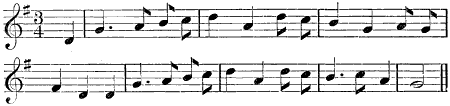
—Rimbault’s Nursery Rhymes.
Here comes a lusty wooer,
My a dildin, my a daldin;
Here comes a lusty wooer,
Lily bright and shine a’.
Pray who do you woo?
My a dildin, my a daldin;
Pray who do you woo?
Lily bright and shine a’.
For your fairest daughter,
My a dildin, my a daldin;
For your fairest daughter,
Lily bright and shine a’.
Then there she is for you,
My a dildin, my a daldin;
Then there she is for you,
Lily bright and shine a’.
—Ritson (Gammer Gurton’s Garland, 1783).
Northall says this game is played after the manner of the
“Three Dukes” (Folk Rhymes, p. 383). Halliwell (Nursery
Rhymes, p. 98) has a version, and Rimbault (Nursery Rhymes)
gives both words and tune. It is also contained in The Merrie
Heart (p. 47). See “Jolly Hooper,” “Jolly Rover.”
Here comes one Virgin on her knee,
On her knee, on her knee,
Here comes one Virgin on her knee,
Pray what will you give her?
When did you come?
I came by night and I came by day,
I came to steal poor Edie away.
She is too old, she is too young,
She hasn’t learnt her virgin tongue.
Let her be old or let her be young,
For her beauty she must come.
In her pocket a thousand pounds,
On her finger a gay gold ring.
Good-bye, good-bye, my dear.
—Hurstmonceux, Sussex (Miss Chase).
One child stands by herself, and the rest of the players
range themselves in line. The child sings the first verse and
the line replies, the four succeeding verses being alternately
sung. After the last line the girl tries to pull one whom
she has chosen from the line toward her. If not successful,
she must try again. If she is, they both stand in the middle,
and commence singing the words again with—
Here come two virgins on their knees, &c.
Probably a degraded version of “Three Lords from Spain.”
[204]
Here I sit on a cold green bank
On a cold and frosty morning.
We’ll send a young man [or woman] to take you away,
To take you away,
We’ll send a young man to take you away,
On a cold and frosty morning.
Pray tell me what his name shall be? [or]
Pray, whom will you send to take me away?
We’ll send Mr. —— to take you away.
The children form a ring around one of the party, who sits
in the middle, and says the two first lines. Then those in the
circle dance round her, singing the next four lines. This is
repeated three times, with the refrain, “On a cold,” &c., after
which the dancing and singing cease, and the child is asked,
“Sugar, sweet, or vinegar, sour?” Her answer is always
taken in a contrary sense, and sung, as before, three times,
whilst the children circle round. The one in the middle then
rises to her feet. The boy (or girl) named advances and kisses
her, they change places, and the game begins again.—Cornwall
(Folk-lore Journal, v. 56-57).
I.
Here stands a young man who wants a sweetheart,
With all his merry maids round him;
He may choose from east, he may choose from west,
He may choose the prettiest girl that he loves best.
Now this young couple is married together,
We propose they kiss each other.
—Glapthorn (Northants Notes and Queries,
i. 214, A. Palmer).
II.
Here stands a young lady [lass] who wants a sweetheart,
Wants a sweetheart, wants a sweetheart,
And don’t know where to find one, find one, find one.
Choose the prettiest that you loves best.
Now you’re married I wish you joy,
First a girl and then a boy,
Seven years after son and daughter,
Pray you come to kiss together.
—Longcot, Berkshire (Miss I. Barclay).
(b) A ring is formed by the players joining hands, one child
standing in the centre. The ring dance round singing the
first four lines. At the fourth line the child in the centre
chooses one from the ring, who goes into the centre with her.
The marriage formula or chorus is then sung, the two kiss,
and the one who was first in the centre joins the ring, the
second one choosing another in her turn. Played by both
boys and girls.
See “Sally Water,” “Silly Old Man.”
[Play]
Our shoes are made of leather,
Our stockings are made of silk,
Our pinafores are made of calico,
As white as any milk.
Here we go around, around, around,
And we shall touch the ground.
—Barnes and London Streets (A. B. Gomme).
A ring is formed by the children joining hands. They walk
round singing the first four lines. They then dance round
quickly and sit down suddenly, or touch the ground with their
clothes.
A version of this game from Liphook, Hants, almost identical
in words, has been sent by Miss Fowler, and another
from Crockham Hill, Kent, by Miss Chase.
[206]
Here’s a soldier left his lone [qy. alone],
Wants a wife and can’t get none.
Merrily go round and choose your own,
Choose a good one or else choose none;
Choose the worst or choose the best,
Or choose the very one you like best.
What’s your will, my dilcy dulcy officer?
What’s your will, my dilcy dulcy dee?
My will is to marry, my dilcy dulcy officer;
My will is to marry, my dilcy dulcy dee.
Come marry one of us, my dilcy dulcy officer;
Come marry one of us, my dilcy dulcy dee.
You’re all too old and ugly, my dilcy dulcy officer;
You’re all too old and ugly, my dilcy dulcy dee.
Thrice too good for you, sir, my dilcy dulcy officer;
Thrice too good for you, sir, my dilcy dulcy dee.
This couple got married, we wish them good joy,
Every year a girl and a boy,
And if that does not do, a hundred and two,
We hope the couple will kiss together.
—Annaverna, co. Louth (Miss R. Stephen).
(b) One child stands in the middle, the others dance round
singing. The one in the middle chooses another before the
four last lines are sung. Then the rest dance round singing
these lines, and kiss each other.
(c) It is evident that these words comprise two distinct games,
which have become mixed in some inexplicable fashion. The
first six lines and the last four are one game, a ring form, with
the marriage formula and blessing. The other portion of the
game is a dialogue game, evidently having had two lines of
players, questions being asked and answers given. It is, in
fact, a part of the “Three Dukes” game. The first part is a
kiss-in-the-ring game, a version of “Here stands a Young
Man,” “Silly Old Man,” and “Sally Water.”[Addendum]
[207]
Take this, What’s this?
Hewley Puley.
Where’s my share?
About the kite’s neck.
Where’s the kite?
Flown to the wood.
Where’s the wood?
The fire has burned it.
Where’s the fire?
The water’s quenched it.
Where’s the water?
The ox has drunk it.
Where’s the ox?
The butcher has killed it.
Where’s the butcher?
The rope has hanged him.
Where’s the rope?
The rat has gnawed it.
Where’s the rat?
The cat has killed it.
Where’s the cat?
Behind the door, cracking pebble-stones and marrow-bones for
yours and my supper, and the one who speaks first shall
have a box on the ear.
—Halliwell’s Nursery Rhymes, p. 222.
The children are seated, and the questions are put by one of
the party who holds a twisted handkerchief or something of
the sort in the hand. The handkerchief was called “hewley
puley,” and the questions are asked by the child who holds it.
If one answers wrongly, a box on the ear with the handkerchief
was the consequence; but if they all replied correctly, the one
who broke silence first had that punishment.
For similar rhymes see “Dump,” “Mother, may I go out?”
I.
Hey Wully wine, and How Wully wine,
I hope for hame ye’ll no incline;
Ye’ll better light, and stay a’ night,
And I’ll gie thee a lady fine.
Wha will ye gie, if I wi’ ye bide,
To be my bonny blooming bride,
And lie down lovely by my side?
I’ll gie thee Kate o’ Dinglebell,
A bonny body like yersell.
I’ll stick her up in the pear-tree
Sweet and meek, and sae is she:
I lo’ed her ance, but she’s no for me,
Yet I thank ye for your courtesy.
I’ll gie thee Rozie o’ the Cleugh,
I’m sure she’ll please thee weel eneugh.
Up wi’ her on the bane dyke,
She’ll be rotten or I’ll be ripe:
She’s made for some ither, and no me,
Yet I thank ye for your courtesy.
Then I’ll gie ye Nell o’ sweet Sprinkell,
Owre Galloway she bears the bell.
I’ll set her up in my bed-head,
And feed her wi’ milk and bread;
She’s for nae ither, but jist for me,
Sae I thank ye for your courtesy.
—Mactaggart’s Gallovidian Encyclopædia.
II.
I maun ride hame, I maun gang hame,
And bide nae langer here;
The road is lang, the mirk soon on,
And howlets mak’ me fear.
Light doon and bide wi’ us a’ night,
We’ll choose ye a bonnie lass;
Ye’ll get your wull and pick o’ them a’,
And the time it soon wull pass.
Which ane will ye choose,
If I with you will bide?
The fairest and rarest
In a’ the kintra side.
A girl’s name was then mentioned. If the lad was pleased
with the choice made, he replied—
I’ll set her up on a bonnie pear-tree,
It’s tall and straight, and sae is she;
I’d keep wauken a’ night her love to be.
If he was not pleased, he replied in one or other of the next
three verses—
I’ll set her up ayont the dike,
She’ll be rotten ere I be ripe,
The corbies her auld banes wull pike.
I’ll set her up on a high crab-tree,
It’s sour and dour, and so is she;
She may gang to the mools unkissed by me.
Though she be good and fair to see,
She’s for another, and no for me;
But I thank you for your courtesie.
When a girl took the place of the lad, she replied in one or
other of the three following, according as she was angry or
pleased—
I’ll put him in a riddle
And riddle him o’er the sea,
And sell to Johnny Groat’s
For a Scotch bawbee.
I’ll set him up on my lum-head [chimney],
And blaw him up wi’ pouther and lead;
He’ll never be kissed though he be dead.
I’ll set him up at my table head,
Feed him wi’ sweet milk and bread,
If he likes gang hame on his fine steed.
—Biggar (Wm. Ballantyne).
(b) In Biggar, all the players were seated round the hearthstone,
lads on one side, lassies the other; one lad rising up
said the first verse, then one acting as “maister” said the next
verse. The young man then said the next two lines, to which
the other replied in the two following, and naming at the close
any girl he thought would be acceptable. If the lad was pleased
he sang the next verse. If he was not pleased with the girl
offered him he replied in either of the three following verses.
The first of the three was generally said if the girl was thought
to be too old; if bad-tempered, the second. If the lad found
no fault, but wished to politely refuse, he sang the last verse.
The girl then was asked in her turn, and the same formula
gone through, she saying either of the three last verses given.
Forfeits were demanded for every refusal, and were cried at
the end of the game.
(c) Mr. Ballantyne writes: “This game was a great favourite
in my father’s house. This was a forfeit game, forfeits being
called ‘wadds.’” Chambers, Popular Rhymes, p. 124, gives a
version of this game. It is practically the same as Mr. Ballantyne’s
version, with only a few verbal differences. Mactaggart
says, “The chief drift of this singular game seemed to be to
discover the sweethearts of one another,” and such discoveries
are thought valuable, but not so much as they were anciently.
In any case, it appears to me that the game is an early one, or,
at all events, a reflection of early custom.
Hickety, bickety, pease-scone,
Where shall this poor Scotchman gang?
Will he gang east, or will he gang west,
Or will he gang to the craw’s nest?
—Chambers (Popular Rhymes, p. 122).
One boy stands with his eyes bandaged and his hands against
a wall, with his head resting on them. Another stands beside
him repeating the rhyme, whilst the others come one by one
and lay their hands upon his back, or jump upon it. When
he has sent them all to different places he turns round and
calls, “Hickety, bickety!” till they have all rushed back to
the place, the last in returning being obliged to take his place,
when the game goes on as before.
Chambers adds, “The ‘craw’s nest’ is close beside the eye-bandaged
boy, and is therefore an envied position.” Newell,
Games, p. 165, refers to this game.
See “Hot Cockles.”
[211]
The game of Hop-scotch, played with a piece of tile, which
has to be kicked by the player with the foot on which he hops
over lines into various squares marked on the ground.—Somersetshire
(Elworthy’s Dialect).
See “Hop-scotch.”
The game of “Hop, step, and jump.”—Somerset (Holloway’s
Dict. of Provincialisms).
See “Half-Hammer.”
A writer in Blackwood’s Magazine, August 1821, p. 36,
mentions this as a summer game. It was called “Ho, spy!”
the words which are called out by those boys who have hidden.
He says the watchword of “Hide and seek” was “hidee,” and
gives as the rhyme used when playing—
Keep in, keep in, wherever you be,
The greedy gled’s seeking ye.
This rhyme is also given by Chambers (Popular Rhymes,
p. 122). Halliwell gives the rhyme as—
Hitty titty indoors,
Hitty titty out,
You touch Hitty titty,
And Hitty titty will bite you.
—Nursery Rhymes, p. 213.
At Ashford-in-the-Water the words used were—
One a bin, two a bin, three a bin, four,
Five a bin, six a bin, seven, gie o’er;
A bunch of pins, come prick my shins,
A loaf brown bread, come knock me down.
I’m coming!
—Reliquary, viii. 57.
The words are said by the one who has to find the person
hidden.
In Scotland the game is called “Hospy,” and is played by
boys only, and it can be played only in a village or hamlet in
which there is the means of hiding. A Spy is chosen, and a
spot, called Parley, is fixed upon at which the Spy stands till
all the other players are hid, and to which he can run when
pursued. When the players are hid, the cry, “Hospy,” i.e.,
“Ho! spy!” is raised by them. The Spy then sets out to
find them. The moment he detects one he turns and runs
with all his might to the Parley, pursued by the one he has
discovered. If he is overtaken, he must carry on his back the
pursuer to the Parley. The same thing is gone through till all
the players are discovered.—Keith (Rev. W. Gregor).
Jamieson says, “‘Hy Spy,’ a game resembling ‘Hide and
Seek,’ but played in a different manner. The station, which in
England is called Home, is here the Den, and those who keep
it are the Seekers, and are called the Ins. Those who hide
themselves, instead of crying ‘Hoop,’ as in England, cry ‘Hy
spy;’ and they are denominated the Outs. The business of
the Ins is, after the signal is given, to lay hold of the Outs
before they can reach the den. The captive then becomes one
of the Ins; for the honour of the game consists in the privilege
of hiding oneself.” Jamieson adds, “Hy is still used in calling
after a person, to excite attention, or when it is wished to warn
him to get out of the way.” Strutt describes it as “Harry-Racket,”
or “Hide and Seek” (Sports, p. 381).
At Cork two sides are chosen for Spy; one side hides while
the other side hunts. When the hunters see one of the hidden
players, they call out, “I spy ——,” and the child’s name. The
player called must run after the Spy and try to catch him
before he reaches his Den; if he succeeds, the one caught must
go to the opposite side of players, then next time the spies
hide, and those who have been hiding, spy (Miss Keane). A
more general form of the game is for one child to hide, and to
make a noise in a disguised voice to give notice of his whereabouts,
or to call out “Whoop!” or “Coo!” Until this noise
or call is made, the searchers may not seek him. If when
spied or discovered the hider cannot reach home before being
caught, he again has to hide (A. B. Gomme).
(b) In the parish church of Bawdrip is a monument to Edward
Lovell, his wife Eleanor (née Bradford), and their two daughters
Maria and Eleanor. The inscription touching the latter is:—“Eleanora
. . . obiit Jun. 14, 1681. Hanc, subito et immaturo
(ipsos pene inter hymenæos) fato correptam, mœstissimus
luxit maritus, et in gratam piamq. parentum sororis et dilectissimæ
conjugis memoriam, monumentum hoc erigi voluit.”
Tradition connects this sudden death—“ipsos pene inter
hymenæos”—with the story of the bride playing at “Hide and
Seek.” It is curious that, in Haynes Bayly’s song, the bridegroom’s
name should be Lovell. There is no mention on the
monument of the name of the bereaved husband. The father,
Edward Lovell, was fourteen years rector of Bawdrip and
fellow of Jesus College, Cambridge, and died in 1675, and so
could not have been present at the wedding, as represented in
the song. He came from Batcombe, near Castle-Cary; at
which latter place the Lovells were seated in very early days.—Notes
and Queries, 4th Ser., ix. 477.
Cope (Hampshire Glossary) calls the game “I spy I.”
Lowsley (Berkshire Glossary) says, “In playing this game, the
seeker has to call out ‘I spy!’ to the one he finds before
he may start for home.” It is called “Hy Spy” in Patterson’s
Antrim and Down Glossary; Evans’ Leicestershire Glossary,
“Hide and Wink;” Barnes’ Dorset Glossary, “Hidy Buck.”
In Pegge’s Alphabet of Kenticisms the game is given as
“Hide and Fox.” Cf. “Hide Fox, and all after,” i.e., let the
fox hide and the others go to seek him; Hamlet, iv. 2, 32.
In Stead’s Holderness Glossary, “Hed-o.” In the North
Riding it is “Lam-pie-sote-it,” also called “Felto” in Robinson’s
Whitby Glossary. He also mentions that the hidden child
cries “How-ly” to the finder. Apparently the same as the
south country “Whoop,” a signal to the finder to begin the
search. Addy (Sheffield Glossary) says this game is called
“Felt and Laite.” Holland (Cheshire Glossary) speaks of it
as “I Spy.”
See “Davie Drap.”
[Play]

—London.
I.
Beans and butter,
Come home to supper,
’Tis all ready done.
—Hampshire (Miss Mendham).
II.
Little pigs come to supper,
Hot boiled beans and ready butter.
—Northall’s Folk Rhymes, p. 409.
III.
Hot beans and butter!
Please to come to supper!
—Much Wenlock (Shropshire Folklore, p. 525).
IV.
Hot boiled beans, and very good butter,
Ladies and gentlemen, come to supper.
—London (A. B. Gomme).
V.
Vesey vasey vum,
Buck aboo has come!
Find it if you can and take it home,
Vesey vasey vum.
—Newlyn West, near Penzance
(Folk-lore Journal, v. 49).
One child hides an article, while those who are to search
for it go in another room (or out of the way somewhere). When
it is hidden, they are called to find it by one of the above
rhymes being sung or said. The searchers are enabled more
readily to find the hidden article by being told “hot,” “very
hot,” “scorching,” “burning,” or “cold,” “very cold,” and
“freezing,” when near to or far from the hidden article.
Sometimes several may agree to hide the article, and only one
to be the finder. In the Penzance game one child is blindfolded,
other children hide something, then shout the words. Search
is then made for the hidden object: when found, the finder in
his turn is blindfolded. There appears to be some mistake in
the description of this game.
The name of an old Christmas game mentioned in Declaration
of Popish Impostures, 1603.
[215]
A game played on village greens.—Dickinson’s Cumberland
Glossary, Supplement.
The players (boy or girl) cower down on their haunches,
“sit doon curriehunkers,” and hop round and round the floor
like a frog, clapping the hands first in front and then behind,
and crying out, “Hirtschin Hairy.” It is sometimes called
“Hairy Hirtschin.” In Lothian the players try to knock each
other over by hustling against one another.—Rev. W. Gregor.
Same game as “Harie Hutcheon.”
See “Curcuddie,” “Cutch-a-cutchoo,” “Hop-frog.”
A boys’ game, in which several, joining hands, endeavour
to catch another, who, when caught, is beaten with caps, the
captors crying out—
Hiry-hiry-hag,
Put him in a bag, &c.
—Ross and Stead’s Holderness Glossary.
All the boys are requested to leave the room, when the girls
take their seats, leaving a vacant place on the right side of
each girl for the gentleman of her choice. Each boy in turn
is then summoned by another who acts as doorkeeper, and
asked to guess which lady he imagines has chosen him for her
partner. Should he guess rightly he is allowed to take his
seat by the lady who has chosen him, while the other girls
loudly clap hands. Should he guess wrongly he is hissed, and
sent out of the room by the doorkeeper.—Cork, Ireland (Miss
Keane).
At Long Eaton in Nottinghamshire Miss Youngman records
a similar game to this, with a rhyme that is probably taken
from a popular song or ballad. The successful candidate for
the girl’s choice claims a kiss, but if unsuccessful he is beaten
out of the room with knotted handkerchiefs.[Addendum]
[216]
The boyish play of “Hop, Step, and Jump.”—Atkinson’s
Cleveland Glossary.
Brockett (North Country Words) calls this “Hitch.”
See “Half-Hammer,” “Hick, Step, and Jump.”
An undescribed Suffolk game.—Halliwell’s Dictionary.
An undescribed Suffolk game.—Moor’s Suffolk Words.
The Somerset name for “See-Saw.”
When a number of boys agree to have a game at the Pearie
or peg-top, a circle is drawn on the ground, within which all
the tops must strike and spin. If any of them bounce out of
the circle without spinning, it is called a Hoatie. The punishment
to which the Hoatie is subjected consists in being placed
in the ring, while all the boys whose tops ran fairly have the
privilege of striking—or, as it is called, “deggin”—it till it is
either split or struck out of the circle. If either of these take
place, the boy to whom the Hoatie belonged has the privilege
of playing again.—Upper Lanarkshire (Jamieson).
See “Gully,” “Hoges.”
An old game mentioned by Wycherley (Plain Dealer, 1677).
The same game as “Cockerty-hooie.”
This game is played with a solid indiarubber ball from two
to two and a half inches in diameter. The players each have
a bent or hooked stick or “hockey.” They take opposite sides.
The object of the game is for each side to drive the ball through
their opponents’ goal. The goals are each marked by two poles
standing about eight to ten feet apart, and boundaries are
marked at the sides. The ball is placed in the middle of the
ground. It is started by two players who stand opposite each
other, the ball lying between their two sticks. They first touch
the ground with their hockey-sticks, then they touch or strike
their opponents’ stick. This is repeated three times. At the
third stroke they both try to hit the ball away. The ball may
only be played by a hockey-stick, and a goal is gained when
the ball is played between the posts by the opposing party.—Barnes
(A. B. Gomme).
(b) In Ross and Stead’s Holderness Glossary this game is
described under the name of “Shinnup.” Robinson (Mid
Yorkshire Glossary) gives it under “Shinnops,” a youth’s game
with a ball and stick, heavy at the striking end, the player
manœuvring to get as many strokes as possible and to drive
the ball distances. “Shinnoping” is also used for the game in
operation. “Jowling,” or “Jowls,” is given in Robinson’s
Whitby Glossary, as a game played much the same as
“Hockey.” “Baddin” is the name given to it in Holland’s
Cheshire Glossary. Another name is “Doddart” (Brockett,
North Country Words).
(c) An old custom in vogue in bygone days was Rotherham
Fair, or what was called “Whipping Toms,” which took place in
the Newarkes every Shrove Tuesday. So soon as the pancake
bell rang men and boys assembled with sticks having a knob
or hook at the end. A wooden ball was thrown down, and two
parties engaged in striving which could get the ball by striking
it with their sticks to one end of the Newarke first—those who
did so were the victors. This game was called “Shinney,” or
“Hockey.” About one o’clock the Whipping Toms appeared on
the scene of action. These were three men clad in blue smock
frocks, with very long waggon whips, who were accompanied by
three men with small bells. They commenced driving the men
and boys out of the Newarkes. It was very dangerous sometimes;
they would lash the whip in such a manner round the
legs of those they were pursuing as to throw them down, which
produced laughter and shouting. Some would stop, and turn
to the whipper and say, “Let’s have a pennyworth,” and he
would guard and parry off the lashes with his shinney stick.
When the whipper was successful in lashing him he demanded
his penny, and continued lashing until he paid. This was
continued until five o’clock, then the game terminated. This
was suppressed, I believe, in 1847. At that period it was a
prevalent idea that it could not be abolished, as it was connected
with an “old charter.” It is believed in the town that
this custom was to commemorate the driving out of the Danes
from the Newarkes at the time they besieged Leicester.—Leicester
(Robert Hazlewood).
See “Bandy,” “Camp,” “Football,” “Hood,” “Hurling.”
“The hoges,” a boy’s game played with “peeries” (peg-tops).
The victor is entitled to give a certain number of
blows with the spike of his peerie to the wood part of his
opponent’s.—Patterson’s Antrim and Down Glossary.
See “Gully,” “Hoatie.”
A game played with marbles. The first player holds up a
number in his closed hand and says, “Ho-go;” the second
says, “Handfull;” the first then says, “How many?” The
other guesses. If he should guess correctly he is entitled to
take them all; but otherwise he must give the difference between
the number he guessed and the number actually held
up to make.—Lowsley’s Berkshire Words. It is also called
“How many eggs in a basket?”—London (J. P. Emslie).
See “Hairry my Bossie.”
The name of a game of marbles which are cast into a hole in
the ground.—Easther’s Almondbury and Huddersfield Glossary.
A game with marbles, which consists in placing a marble in
a hole and making it act as a target for the rest. The marble
which can hit it three times in succession, and finally be shot
into the hole, is the winning ball, and its owner gets all the
other marbles which have missed before he played.—London
(Strand Magazine, ii. 519).
See “Bridgeboard,” “Capie Hole,” “Hundreds.”
[Play]
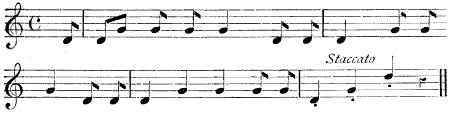
—London (J. P. Emslie).
A number of children stoop down in a row, clasping their
hands under their legs. One child stands in front of them, and
acts as owner or seller; another acts as purchaser (fig. 1).
The purchaser inquires—
Have you any honey pots for sale?
Yes, plenty; will you walk round and taste them?
The purchaser goes round, pretending to taste each one in
turn, inquiring the price and weight; finds fault with several,
one being too sweet and the other not fresh enough, and so on.
When one honey pot is discovered to the purchaser’s taste, she
is lifted by the purchaser and owner, or by two children who
act as weights or scales, and then swung by her arms backwards
and forwards to estimate her weight and price (fig. 2).
As long as the child can keep her hands clasped, so long is the
swinging kept up; and as many times as they count, so many
is the number of pounds she weighs. The seller sometimes
said, when each one was bought—
Take her and bake her,
And into pies make her,
And bring her back
When she is done.
They were not brought back, and the “owner” had to catch
and bring back each one. When sold, the honey pot is taken
to the other side, or “home” of the purchaser. The game
goes on till all the honey pots are sold.—London (A. B.
Gomme).
In Sporle, a girl clasps her hands under her legs to form a
seat, and two others swing her by the arms, saying—
Honey pot, honey pot, over the river;
When the old cat dies you shall have the liver.
—Miss Matthews.
In a version sent by Miss Chase, and told her by a London
maidservant, the children sit as in “Hunt the Slipper.” One
steps in a corner out of earshot; the rest are named “Gooseberry
Tart,” “Cherry Tart,” &c., by another, who recalls the
child in the corner with—
Fool, fool, come to school,
Pick me out a [cherry tart, as the case may be].
If he chooses the wrong one he is told—
Go back and learn your A, B, C.
If rightly—
Take him and bake him,
And give me a piece
When he’s done.
The child is then led off in a squatting position. Later the one
who named them pretends tasting, and says, “Very nice,” or
“You must be baked longer,” when another squatting walk
and wait takes place.
A version sent by Mr. J. P. Emslie is similar to the other
London versions—
“Buy my fine honey to-day.
Which shall I buy?
Taste ’em and try.
The child would then go round, pretending to taste, saying,
‘Don’t like that one,’ till one was approved. That one was
then swung round to the tune given, the words being—
An apple for the king and a pear for the queen,
And a good jump over the bowling green.
At the last bar they swung the child higher and higher, and at
the last note they swung it as high as they could. I believe
the last note in the music should be G, but it was raised to
give effect.”
In Scotland the game is called “Hinnie Pigs,” and is played
as follows. The boys sit down in rows, hands locked beneath
their hams. Round comes one of them, the honey merchant,
who feels those who are sweet and sour, by lifting them by the
arm-pits and giving them three shakes. If they stand these
without the hands unlocking below they are then sweet and
saleable, fit for being office-bearers of other ploys.—Mactaggart’s
Gallovidian Encyclopædia.
In Ross and Stead’s Holderness Glossary this is described as
a girls’ game, in which two carry a third as a pot of honey to
market. It is mentioned by Addy (Sheffield Glossary) and
by Holland (Cheshire Glossary). Mr. Holland adds, “If the
hands give way before twenty is reached it is counted a bad
honey pot; if not, it is a good one.”
In Dublin the seller sings out—
Honey pots, honey pots, all in a row,
Twenty-five shillings wherever you go—
Who’ll buy my honey pots?
—Mrs. Lincoln.
The game is mentioned by a writer in Blackwood’s Magazine,
August 1821, p. 36, as being played in Edinburgh when he was
a boy.
A game played at Haxey, in the Isle of Axholme, on the
6th of January. The Hood is a piece of sacking, rolled tightly
up and well corded, and which weighs about six pounds. This
is taken into an open field on the north side of the church, to
be contended for by the youths assembled for that purpose.
When the Hood is about to be thrown up, the Plough-bullocks
or Boggins, as they are called, dressed in scarlet jackets, are
placed amongst the crowd at certain distances. Their persons
are sacred, and if amidst the general row the Hood falls into
the hands of one of them, the sport begins again. The object
of the person who seizes the Hood is to carry off the prize to
some public-house in the town, where he is rewarded with
such liquor as he chooses to call for. This pastime is said to
have been instituted by the Mowbrays, and that the person
who furnished the Hood did so as a tenure by which he held
some land under the lord. How far this tradition may be
founded on fact I do not know, but no person now acknowledges
to hold any land by that tenure.—Stonehouse’s Isle of
Axholme, p. 291.
W. J. Woolhouse (Notes and Queries, 2nd series, v. 95)
says when the Hood is thrown up by the Chief of the Boggons
or by the officials, it becomes the object of the villagers to get
the Hood to their own village, the other eleven men, called
Boggons, being stationed at the corners and sides of the field,
to prevent, if possible, its being thrown out of the field; and
should it chance to fall into any of their hands, it is “boggoned,”
and forthwith returned to the chief, who again throws
it up, as at the commencement of the game. The next day is
occupied by the Boggons going round the villages singing as
waits, and they are regaled with hot furmenty; from some
they get coppers given them, and from others a small measure
of wheat. The day after that they assume the character of
Plough-bullocks, and at a certain part of Westwood-side they
“smoke the Fool”—that is, straw is brought by those who
like, and piled in a heap, a rope being tied or slung over the
branches of the tree next to the pile of straw; the other end of
the rope is fastened round the waist of the Fool, and he is
drawn up and fire is put to the straw, the Fool being swung
to and fro through the smoke until he is well-nigh choked,
after which he goes round and collects whatever the spectators
choose to give him. The sport is then at an end till the next
year. The land left by Lady Mowbray was forty acres, which
are known by the name of “Hoodlands,” and the Boggons’
dresses and the Hood are made from its proceeds.
In the contiguous parish of Epworth a similar game is played
under the same name, but with some variations. The Hood
is not here carried away from the field, but to certain goals,
against which it is struck three times and then declared free.
This is called “wyking” the Hood, which is afterwards thrown
up again for a fresh game.—Notes and Queries, 6th series,
vii. 148.
See “Football,” “Hockey.”
Name for “Blind Man’s Buff.”—Baker’s Northamptonshire
Glossary.
Name for “Blind Man’s Buff.” Mentioned in Hamlet, iii. 4;
Merry Devil of Edmonton; and Wise Women of Hogsden.
Name for “Blind Man’s Buff.”—Nares’ Glossary.
The game of “Hop-scotch.”—Halliwell’s Dictionary.
The players bend as though about to sit on a very low stool,
then spring about with their hands resting on their knees.—Dorsetshire
(Folk-lore Journal, vii. 234).
Miss Peacock says that a game called “Hop-frog over the
Dog” is played at Stixwould, Lincolnshire, in the same way as
“Leap-frog.”
See “Curcuddie,” “Cutch-a-cutchoo,” “Harie Hutcheon,”
“Hirtschin Hairy.”
Game of “Hop-scotch.”—Hunter’s Glossary of Hallamshire.
A game, the object of which is to eject a stone, slate, or
“dump” out of a form linearly marked on the ground in
different directions, by hopping without touching any of the
lines.—Halliwell’s Dictionary.
In the plan (fig. 8) the players first lay the stone on the back
of the hand, and walk through the plan, stepping into each
division, throw it up and catch it. Then the stone is thrown
back from No. 7 outside No. 1. Now it is placed on the toe,
and the child walks through again, throwing up the foot when
out, to catch the stone in the hand. Another way, done on the
same plan, is for the player to place the stone in No. 1, leave
it there, and hop into each division and back, then place it
in No. 2, and repeat the hopping, and so on through all the
figures. There is no kicking of the stone, as is usual in
London.—Roxton, St. Neots (Miss Lumley).
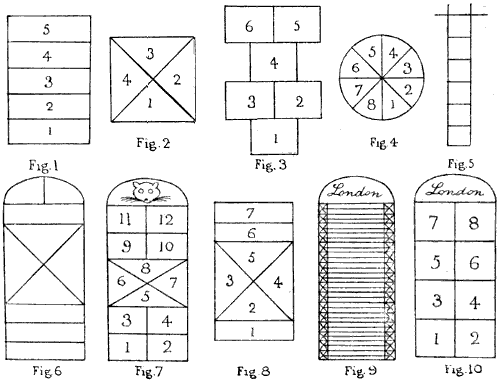
From Crockham Hill, Kent, Miss Chase sends four versions.
In the first plan (fig. 1) the game is:—Throw stone into No. 1.
Hop from No. 1 to No. 5 and back. Then pick it up. So on
successively. After having thrown it into No. 5, begin to reverse
by throwing stone into No. 1 while standing at No. 5—return
with it on your thumb. Throw into No. 2—return with stone
on your eye. Throw into No. 3—return with stone in your
palm. Throw into No. 4—return with stone on your head.
Throw into No. 5—return with stone on your back. In each
case, upon reaching the goal without dropping it, throw up and
catch it as it falls.
In the second plan (fig. 2) the game is:—Throw stone into
No. 1. Pick it up. Hop, not touching lines, from No. 1 to
No. 4, and “out.” Throw stone into No. 2. Do as before.
And so successively into Nos. 3 and 4. Next balance stone on
shoe, then on the palm of hand, then on the back of hand,
then on the head, then on the shoulder, then on the eye (tilt
head back to keep it from falling). In each case walk round
once with it so balanced and catch at end.
In the third plan (fig. 3) the game is:—Put pebble in No. 1.
Pick up. Hop, having one foot in No. 2 and the other in No. 3.
Step into No. 4. Hop, having one foot in No. 5 and the other
in No. 6. Jump round. Go back as you came. Then with
stone on shoe, walk through the figure, kick it up and catch at
the close. Place stone on eyelid; walk through the same figure,
dropping it off into hand at close. This is called “jumping.”
In the fourth plan (fig. 4) the game is:—Throw stone into
No. 1. Pick it up. Hop from No. 1 to No. 8, not touching lines.
So successively into Nos. 2, 3, 4, &c. Walk into No. 1 with
stone on foot, and out at No. 8. Kick it up and catch it. The
same with stone on thumb. Toss it up and catch. Again with
stone on your back. Straighten up, let it slide into your hand.
In Stead’s Holderness Glossary, this is described as a boys’ or
girls’ game, in which the pavement is chalked with numbered
crossed lines, and a pebble or piece of crockery is propelled
onward by the foot, the performer hopping on one leg, the
number reached on the chalk-line being scored to him or her.
At Whitby it is called “Pally-ully,” and played with rounded
pieces of pot the size of a penny. Divisions are chalked on the
pavement, and the “pally-ullies” are impelled within the lines
by a hop on one leg, and a side shuffle with the same foot
(Whitby Glossary). It is sometimes called “Tray-Trip.”
Atkinson describes the figure as oblong, with many angular
compartments (Cleveland Glossary). Jamieson defines “Beds”
as “Hop-scotch,” a game denominated from the form, sometimes
by strangers called squares. In Aberdeen the spaces
marked out are sometimes circular.
Mrs. Lincoln sends a diagram of the game from Dublin
(fig. 6). Addy (Sheffield Glossary) under the name of “Hop-score”
says it is a game in which certain squares are drawn or
scored on the ground. The piece of stone which is pushed
with the foot is called the “scotch.” Elworthy (West Somerset
Words) says a piece of tile is kicked over lines and into
squares marked on the ground. It is called “Hickety-Hackety,”
also “Huckety.” Cope (Hampshire Glossary) says it is played
in Hants. Moor (Suffolk Words and Phrases) describes this
game under the name of “Scotch-hob,” by hopping and kicking
a bit of tile from bed to bed of a diagram which he gives (fig. 5,
here printed). Brockett (North Country Words) calls it “Beds.”
Barnes (Dorset Glossary) only says “hopping over a parallelogram
of scotches or chalk-lines on the ground.” F. H. Low, in
Strand Magazine, ii. 516, says the divisions are respectively
named onesie, twosie, threesie, foursie, and puddings. It is
called “Hop-bed” at Stixwold in Lincolnshire (Miss Peacock),
“Hop-score” in Yorkshire (Halliwell, l.c.), and “Hitchibed”
in Cleveland, Yorks. (Glossary of Cleveland Words). Strutt
describes it (Sports, p. 383); and Wood’s Modern Playmate,
p. 32, gives a diagram similar to one seen on a London pavement
by A. B. Gomme (see fig. 7). Mr. Emslie has sent me
figs. 9 and 10, also from London streets. Newell (Games,
p. 188) speaks of it as a well-known game in America.
Mr. Elworthy (West Somerset Words) says, “Several of
these (diagrams marked on the ground) are still to be seen,
scratched on the ancient pavement of the Roman Forum.”
Mr. J. W. Crombie says, “The game of ‘Hop-scotch’ was one
of considerable antiquity, having been known in England for
more than two centuries, and it was played all over Europe
under different names. Signor Pitré’s solar explanation of its
origin appeared improbable to him, for not only was the evidence
in its favour extremely weak, but it would require the original
number of divisions in the figure to have been twelve instead
of seven, which was the number indicated by a considerable
body of evidence. It would seem more probable that the game
at one time represented the progress of the soul from earth to
heaven through various intermediate states, the name given to
the last court being most frequently paradise or an equivalent,
such as crown or glory, while the names of the other courts
corresponded with the eschatological ideas prevalent in the
early days of Christianity.” Some such game existed before
Christianity, and Mr. Crombie considered that it had been
derived from several ancient games. Possibly the strange
myths of the labyrinths might have had something to do with
“Hop-scotch,” and a variety of the game played in England,
under the name of “Round Hop-scotch,” was almost identical
with a game described by Pliny as being played by the boys
of his day. Mr. Crombie also said he “believed that the early
Christians adopted the general idea of the ancient game, but
they not only converted it into an allegory of heaven, with
Christian beliefs and Christian names; they Christianised the
figure also; they abandoned the heathen labyrinth and replaced
it by the form of the Basilicon, the early Christian church,
dividing it into seven parts, as they believed heaven to be
divided, and placing paradise, the inner sanctum of heaven,
in the position of the altar, the inner sanctum of their earthly
church.”
See “Hap the Beds.”[Addendum]
See “Half-Hammer.”
A game among children in which one of the company runs
after the rest having his hands clasped and his thumbs pushed
out before him in resemblance of horns. The first person
whom he touches with his thumbs becomes his property, joins
hands with him, and aids in attempting to catch the rest: and
so on until they are all made captives. Those who are at
liberty still cry out, “Hornie, Hornie.”—Lothian (Jamieson).
Jamieson says: “Whether this play be a vestige of the very
ancient custom of assuming the appearance and skins of
animals, especially in the sports of Yule, or might be meant
to symbolise the exertions made by the devil (often called
‘Hornie’) in making sinful man his prey, and employing
fellow-men as his coadjutors in this work, I cannot pretend to
determine.”
See “Hunt the Staigie,” “Whiddy.”
A game in which four play, a principal and an assistant on
each side. A. stands with his assistant at one hole, and throws
what is called a Cat (a piece of stick, and frequently a sheep’s
horn), with the design of making it alight in another hole at
some distance, at which B. and his assistant stand ready to
drive it aside. The bat or driver is a rod resembling a
walking-stick.
The following unintelligible rhyme is repeated by a player
on the one side, while they on the other are gathering in the
Cats, and is attested by old people as of great antiquity:—
Jock, Speak, and Sandy,
W’ a’ their lousy train
Round about by Errinborra,
We’ll never meet again.
Gae head ’im, gae hang ’im,
Gae lay ’im in the sea;
A’ the birds o’ the air
Will bear him companee.
With a nig-nag, widdy- [or worry-] bag,
And an e’endown trail, trail;
Quoth he.
—Jamieson.
The game is also called “Kittie-cat.”
See “Cat and Dog,” “Cudgel,” “Tip-cat.”
“A’ Horns to the Lift,” a game of young people. A circle
is formed round a table, and all placing their forefingers on the
table, one cries, “A’ horns to the lift! Cat’s horns upmost!”
If on this any one lift his finger, he owes a wad, as cats have
no horns. In the same manner, the person who does not raise
his fingers when a horned animal is named is subjected to a
forfeit.—Jamieson.
[229]
At Sheffield a boy is chosen for a Stump, and stands with his
back against a wall. Another boy bends his back as in “Leapfrog,”
and puts his head against the Stump. The cap of the
boy who bends down is then taken off, and put upon his back
upside down. Then each of the other boys who are playing
puts the first finger of his right hand into the cap. When all
the fingers are put into the cap, these lines are sung—
The wind blows east, the wind blows west,
The wind blows o’er the cuckoo’s nest.
Where is this poor man to go?
Over yond cuckoo’s hill I O.
Then the boy whose back is bent jumps up, and the others
run away crying out, “Hot cockles.” The boy who is caught
by the one whose back was first bent has to bend his back
next time, and so on.—S. O. Addy.
At Cork a handkerchief is tied over the eyes of one of the
company, who then lays his head on a chair, and places his
hand on his back with the palm uppermost. Any of the party
come behind him and give him a slap on his hand, he in the
meantime trying to discover whose hand it is that strikes.—Miss
Keane.
“Hot Cockles” is an old game, practised especially at
Christmas. One boy sits down, and another, who is blindfolded,
kneels and lays his head on his knee, placing at the
same time his open hand on his own back. He then cries,
“Hot cockles, hot!” Another then strikes his open hand,
and the sitting boy asks who strikes. If the boy guessed
wrongly, he made a forfeit; but if rightly, he was released.—Notes
and Queries, 4th series, ix. 262.
The sport is noticed by Gay—
As at hot-cockles once I laid me down,
I felt the weighty hand of many a clown;
Buxoma gave a gentle tap, and I
Quick rose and read soft mischief in her eye.
Halliwell describes it rather differently. The blindfolded
boy lies down on his face, and, being struck, must guess who
it is that hit him. A good part of the fun consisted in the
hardness of the slaps, which were generally given on the throne
of honour. He quotes from a MS. play as follows—
It is edicted that every Grobian shall play at Bamberye hott cockles at the four festivals.
Indeed a verye usefull sport, but lately much neglected to the mollefieinge of the flesh.
—Halliwell’s Dictionary.
Nares’ Glossary also contains quotations from works of 1639,
1653, and 1697 which illustrate the game. Mr. Addy says “that
this game as played in Sheffield is quite different from that described
under the same title in Halliwell’s Dictionary. Aubrey
(p. 30) speaks of ‘Hot Cockles’ as a game played at funerals
in Yorkshire, and the lines here given show that this was the
game. The lines—
Where is this poor man to go?
Over yond cuckoo’s hill I O,
embodies the popular belief that the soul winged its way like a
bird, and they remind one of the passing of the soul over
Whinny Moor (see funeral dirge in Aubrey’s Remains of Gentilisme,
p. 31). Grimm mentions the cuckoo hill (Gauchsberg).
He says, ‘Originally in Gauchsberg the bird himself may very
well have been meant in a mystic sense which has fallen dark
to us now’ (Teut. Myth., ii. 681). We know, too, the old
belief that the cuckoo tells children how many years they have
to live. These lines are also sometimes said, in addition to
those given above—
[231]
Elder belder, limber lock,
Three wives in a clock;
Sit and sing, and call a spring,
O-u-t spells out.
The boy who bends down is supposed to be undergoing a great
penalty.” Strutt (Sports, p. 394) describes this game, and gives
an illustration which is here reproduced from the original MSS.
in the Bodleian.
This game may have originated from a custom at funerals of
practising spells for the safe and speedy passage of the departing
spirit to its destination, or from divination mysteries to
foretell who would be the next among the mourners to follow
the dead body to the grave. The spirit of prophecy was
believed to exist in a dying person. See “Handy Croopen.”[Addendum]
I.
King and Queen of Cantelon,
How many miles to Babylon?
Eight and eight and other eight.
Will I get there by candle-light?
If your horse be good and your spurs be bright.
How mony men have ye?
Mae nae ye daur come and see.
—Chambers’ Popular Rhymes, p. 124;
Mactaggart’s Gallovidian Encyclopædia.
II.
How many miles to Babylon?
Three score and ten.
Will we be there by candle-light?
Yes, and back again.
Open your gates and let us go through.
Not without a beck and a boo.
There’s a beck, and there’s a boo,
Open your gates and let us go through.
—Nairn, Scotland (Rev. W. Gregor).
III.
How far to Banbury Cross?
Four score and ten.
Can I get there by candle-light?
Yes, if your legs are long and light.
Please to let me go?
Not without you bend and bow [pronounced bo].
Here’s my bend [curtseys],
And here’s my bow [touches forehead],
Now will you let me go?
—Fernham and Longcot (Miss I. Barclay).
IV.
How many miles to Babylon?
Three score and ten.
Can we get there by candle-light?
Yes, and back again.
Open your gates as wide as you can,
And let King George and his family go through.
Not without a back, not without a bow,
Not without a curtsey, and then I’ll let you through.
—South Shields (Miss Blair).
V.
How many miles to Babylon?
Three score and ten.
Can I get there o’ candle-light?
There and back again.
Here’s my black [raising one foot],
And here’s my blue [raising the other],
Open the gates and let me through.
—Annaverna, Ravendale, co. Louth, Ireland (Miss R. Stephen).
VI.
How many miles to Barney Bridge?
Three score and ten.
Will I be there by candle-light?
Yes, if your legs are long.
A curtsey to you, another to you,
If you please will you let the king’s horses go through?
Yes, but take care of your hindmost man.
—Belfast (W. H. Patterson).
VII.
How many miles to Gandigo?
Eighty-eight almost, or quite.
Can I [we] get there by candle-light?
Yes, if your legs are long and light.
Open the gate as high as the sky,
And let the king and his queen go by.
—Dorsetshire (Folk-lore Journal, vii. 230, 231).
VIII.
How many miles to Banbury?
Three score and ten.
Can I get there by candle-light?
Yes, and back again.
But mind the old witch doesn’t catch you.
—London (Miss Dendy).
IX.
How many miles to Barley Bridge?
Three score and ten.
Can I get there by candle-light?
Yes, if your legs be long.
A courtesy to you, and a courtesy to you,
If you please will you let the king’s horses through?
Through and through shall they go,
For the king’s sake;
But the one that is the hindmost
Will meet with a great mistake.
—Halliwell’s Popular Rhymes, p. 217.
X.
How many miles to Barney Bridge?
Three score and ten.
Will I be there by Candlemass?
Yes, and back again.
A curtsey to you, another to you,
And pray, fair maids, will you let us through?
Thro’ and thro’ shall you go for the king’s sake,
But take care the last man does not meet a mistake.
—Dublin (Mrs. Lincoln).
XI.
How many miles to Burslem?
Three score and ten.
Can we get there by candle-light?
Yes, and back again.
Open the gates so wide, so wide,
And let King George aside, aside;
The night is so dark we cannot see,
Thread the needle and go through.
—Isle of Man (A. W. Moore).
[234]
XII.
How many miles to Banbury Cross?
Three score and ten.
Shall we get there by midnight?
Yes, if you run well.
Then open your gates as wide as the sky,
And let King George and his men pass by.
It is so dark we cannot see, so thread the needle Nancy,
Thread the needle Nancy.
One, two, three.
—Warwick (from a little girl living near Warwick, through Mr. C. C. Bell).
XIII.
How many miles to London?
Three score ten.
Can I get there by candle-light?
Yes, and back again.
Open the gate and let me through.
Not unless you’re black and blue.
Here’s my black and here’s my blue,
Open the gates and let me through.
Dan, Dan, thread the needle; Dan, Dan, sew.
—Suffolk County Folk-lore, p. 63.
XIV.
How many miles to Babylon?
Three score and ten.
Shall I be there by candle-light?
Yes, there and back again.
Open the gates as wide as high,
And let King George and his family pass by.
—Wales (Folk-lore Record, v. 88).
XV.
| How many miles to |
- |
|
Barley Bridge? |
| Banbury? |
| London? |
Four score and ten [or, Fifty miles and more].
Shall we be there by candle-light?
Oh, yes, and back again.
[Or, at Market Drayton.
Shift your feet with nimble light,
And you’ll be there by candle-light.]
Open the gates as wide as the sky,
And let King George and his lady go by.
—Market Drayton, Ellesmere, Whitchurch,
(Burne’s Shropshire Folk-lore, p. 522).
XVI.
How many miles to Bethlehem?
Three score and ten.
Shall we get there by candle-light?
Yes, there and back again.
So open the gates and let King George and his family go through.
—Hayton, near York (H. Hardy).
XVII.
How far is it to Babylon?
Three score miles and ten.
Can I get there by candle-light?
Yes, there and back again.
—Sporle, Norfolk (Miss Matthews).
XVIII.
How many miles to Babylon?
Three score and ten.
Can you get there by candle-light?
O yes, and back again.
—Hanbury, Staffordshire (Miss E. Hollis).
XIX.
Open the gates as wide as high,
And let King George and I go by;
It is so dark I cannot see
To thread my grandmother’s needle.
—Surrey (Folk-lore Record, v. 88).
(b) There are two methods of playing this game, one in
which a King and Queen are represented, and the other in
which gates of a city are represented. Of the first Chambers
and Mactaggart practically give the same account. The latter
says, “Two of the swiftest boys are placed between two ‘doons’
or places of safety; these, perhaps, are two hundred yards
distant. All the other boys stand in one of these places or
doons, when the two fleet youths come forward and address
them with the rhyme. When out, they run in hopes to get to
Babylon or the other doon, but many get not near that place
before they are caught by the runners, who ‘taens’ them, that
is, lay their hands upon their heads, when they are not allowed
to run any more in that game, that is, until they all be taened
or taken.”
The Norfolk game seems to resemble the Scotch, though in
a much less complete form. Miss Matthews describes it as
follows:—“A line of children is formed, and the two standing
opposite it sing the questions, to which the line reply; then
the two start off running in any direction they please, and the
others try to catch them.”
The second method of playing is best described by the Rev.
Walter Gregor, from the Nairn game, which is known as “The
Gates of Babylon.” Mr. Gregor writes as follows:—“This
game may be played either by boys or girls. Two of the
players join hands, and stand face to face, with their hands in
front as if forming a gate. Each of these has a secret name.
The other players form themselves into a line by clasping each
other round the waist from behind. They go up to the two
that form the gate, and the leader asks the first question, as in
version No. 2. The dialogue then proceeds to the end. The
two then lift their arms as high as they can, still joined, and
the line of players passes through. All at once the two bring
their arms down on one and make him (or her) prisoner. The
prisoner is asked in a whisper, so as not to disclose the secret
name, which of the two is to be chosen. The one so captured
takes his (or her) stand behind the one chosen. The same
process is gone through till all the players are taken captive,
and have stationed themselves behind the one or the other of
the two forming the gate. The last one of the line goes
through three times. The first time the word ‘breakfast’ is
pronounced; the second time ‘dinner;’ and the third time
‘supper.’ The player then chooses a side. The two sides
have then a tug of war. The game ends at this point with girls.
With boys the conquered have to run the gauntlet. The
victors range themselves in two lines, each boy with his cap
or handkerchief tightly plaited in his hand, and pelt with all
their might the vanquished as they run between the lines.
The boys of Nairn call this running of the gauntlet, ‘through
fire an’ watter.’”
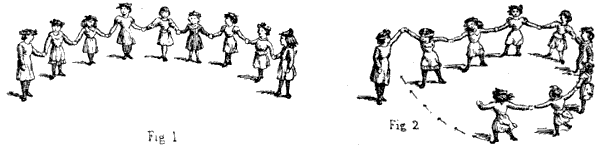
The method of playing the Warwick, Fernham, and Louth versions
is practically the same. The children stand in half-circle
beginning with the two tallest at either end. All clasp hands.
The two at one end question those at the other end alternately
(fig. 1). At the last line the two that have been answering
hold their hands up to form a bridge, and all the others thread
through, still holding hands (the bridge advancing slowly) (fig. 2).
The Louth version is also sometimes played as “Oranges
and Lemons.” This is also the case with the Belfast, South
Shields, Ellesmere, and Dublin versions. Miss Burne also
gives a second method of playing this game at Ellesmere: she
says, “The whole number of players stand in two rows facing
each other, each player joining hands with the one opposite.
The pair at the lower end parley with the pair at the top, and
then run under the extended arms of the others, receiving
thumps on the back as they go, till they reach the upper end,
and become the top couple in their turn.” The Hanbury version
is played in a similar way. Two lines stand close together
holding handkerchiefs across. The questions are asked and
answered by the top and bottom players. Then two children
run under the line of handkerchiefs. The Dorset version is
played by as many as like standing, two and two, opposite
each other, each of them taking with the right hand the right
hand of the other; then the two that are the King and Queen
say or sing the first question, to which the others reply,
and the dialogue ends in this manner. Then all the other
pairs hold up their hands as high as they can, and the King
and Queen run through the archway and back again, and so on
with the next pair, and other pairs in turn. The Isle of Man
version is played, Mr. Moore says, the same as other “Thread
the Needle” games.
(c) The game is evidently dramatic in form, and perhaps is
illustrative of some fact of history, such as the toll upon merchandise
entering a walled town. The changes in the words
of the different versions are not very great, but they show the
influence of modern history upon the game. The appearance
of King George evidently points to the date when it was frequently
played, though the older versions are doubtless those
in which his Majesty does not do duty. Mactaggart has the
following quaint note which perhaps may supply the origin,
though it seems a far cry to the Crusaders:—“This sport
has something methinks of antiquity in it; it seemeth to be a
pantomime of some scenes played off in the time of the
Crusades. ‘King and Queen o’ Cantilon’ evidently must
be King and Queen of Caledon, but slightly changed by
time. Then Babylon in the rhyme, the way they had to
wander and hazard being caught by the infidels, all speak
as to the foundation of the game” (Mactaggart’s Gallovidian
Encyclopædia).
In the Gentleman’s Magazine for December 1849, in a
review of the Life of Shirley, it is stated that in many parts of
England the old game of “Thread the Needle” is played to
the following words, which refer to the gate of the city of
Hebron, known as the “needle’s eye.”
How many miles to Hebron?
Three score and ten.
Shall I be there by midnight?
Yes, and back again.
Then thread the needle, &c.
The game is also described in Notes and Queries, iv. 141, as
played in the same way as above, and the writer adds there
are subsequent evolutions by which each couple becomes in
succession the eye of the needle.
A street game played by boys in a town, one of them hiding
behind a wall or house-end, and crying “Howly” to the
seekers.—Atkinson’s Cleveland Glossary.
See “Hide and Seek.”
[239]
Children in Lothian have a sport in which they slide down
a hill, sitting on their hunkers (Jamieson). The well-known
custom at Greenwich is probably the same game, and there are
examples at Tumbling Hill, a few miles from Exeter, at May
Pole Hill, near Gloucester, and other places.
Holloway (Dict. of Provincialisms) says that the game is called
“Huckle-bones” in East Sussex and “Dibs” in West Sussex.
Parish (Dict. of Sussex Dialect) mentions that huckle-bones,
the small bone found in the joint of the knee of a sheep,
are used by children for playing the game of “Dibs;” also
Peacock’s Manley and Corringham Glossary. Barnes (Dorset
Glossary) says, “A game of toss and catch, played mostly by
two with five dibs or huckle-bones of a leg of mutton, or round
pieces of tile or slate.” Halliwell’s description is clearly wrong.
He says it was a game formerly played by throwing up the
hip-bone of some animal, on one side of which was a head of
Venus and on the other that of a dog. He who turned up the
former was the winner (Dictionary). Miss J. Barker writes
that “Huckle-bones” is played in Hexham; and Professor
Attwell (Barnes) played the game as a boy, and is still a proficient
in it; he played it recently for my benefit with his set of
real huckle-bones (A. B. Gomme); and see Notes and Queries,
9th ser., iv. 378, 379.
The figures or sets are practically the same as those described
under “Fivestones.” The game is very ancient. In
the Sanctuarie of Salvation, &c., translated from the Latin of
Levinus Lemnius by Henry Kinder (8vo, London, printed by
H. Singleton), p. 144, we read, “These bones are called
‘huckle-bones’ or ‘coytes.’” For further information relating
to this game, as played by the ancients, the reader may consult
Joannis Meursii Ludibunda, sive de Ludis Græcorum, Liber
singularis (8vo, Lugd. Bat. 1625), p. 7, and Dan. Souterii
Palamedes, p. 81; but more particularly, I Tali ed altri
Strumenti lusori degli antichi Romani, discritti da Francesco
de ’Ficoroni, 4to, Rom. 1734. Against the suggestion
that the modern game is derived directly from the Romans,
is the fact that it is known in countries never traversed or
occupied by the Romans. Thus Dr. Clarke, in his Travels
in Russia, 1810, p. 106, says: “In all the villages and towns
from Moscow to Woronetz, as in other parts of Russia, are
seen boys, girls, and sometimes even old men, playing with the
joint-bones of sheep. This game is called ‘Dibbs’ by the
English. It is of very remote antiquity; for I have seen it
very beautifully represented on Grecian vases; particularly on
a vase in the collection of the late Sir William Hamilton,
where a female figure appeared most gracefully delineated
kneeling upon one knee, with her right arm extended, the
palm downwards, and the bones ranged along the back of her
hand and arm. In this manner the Russians play the game.”
See “Dalies,” “Fivestones.”[Addendum]
The game otherwise called “Shinty.” The shinty or hummie
is played by a set of boys in two divisions who attempt to drive
with curved sticks a ball, or what is more common, part of the
vertebral bone of a sheep, in opposite directions (Blackwood’s
Magazine, August 1821, p. 36). If one of the adverse party
happens to stand or run among his opponents, they call out
“Hummie, keep on your own side.”—Jamieson.
A game at marbles, which is carried on until one of the
players scores 100 or some other high number agreed upon.
Any number can play, but it is best described for two players,
A. and B. First the players taw up to a hole; if both get in,
they repeat the process until one is left out, say B.; then A.
counts 10. Should both fail, the nearest goes first. He may now
lay his taw about the hole or fire at the other, on hitting which
he counts another 10. He now goes for the hole again, and
failing, lies where he happens to stop. If he misses, B. from
his present position tries to get into the hole, and failing, lies
still; but if he reaches the hole, he counts 10, and proceeds as
A. had done. The one who first gets the 100 (or other
number) now goes in for his “pizings,” which performance takes
place thus:—The loser, so far, is lying about, and the winner
goes back to “drakes,” and again tries to lodge in the hole;
and if he succeeds, the game is up. If not, he lies still, and
the loser tries for the hole; if he gets in he counts another 10,
or if he should succeed in hitting the winner he scores his
adversary’s 100 to his own number, and then goes on for his
“pizings” as the other had done. In failure of either securing
the game thus, the process is repeated at “drakes.” When,
however, the one who is on for his “pizings” manages to taw
into the hole, the game is concluded.—Easther’s Almondbury
and Huddersfield Glossary.
A game among children, played on the ice as well as in the
fields (Brockett’s North Country Words). Strutt (Sports, p.
381) says “Hunt the Hare” is the same game as “Hunt the
Fox.” In this game one boy is permitted to run out, and
having law given to him—that is, being permitted to go to a
certain distance from his comrades before they pursue him—their
object is to take him, if possible, before he can return home.
See “Hare and Hounds.”
[Play]
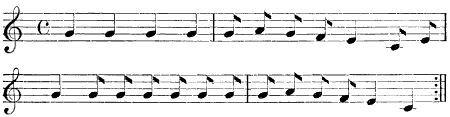
—Lancashire (Mrs. Harley).
All the players but one sit on the floor in a circle with their
legs crossed (Turkish fashion), one acting as Chief, all pretending
to work at making or mending shoes. The other player
brings a slipper to the Chief Cobbler, and desires it to be
mended, saying—
Cobbler, cobbler, mend my shoe,
Get it done by half-past two.
The child walks away, and returns in a few moments and
asks whether the shoe is ready. The Cobbler says, “Not
quite; call again in an hour’s time,” or makes any other excuse
which occurs to him. When the child calls again, she is told
it has been sent home. After several pretences the child
declares an intention to search for it. The Cobblers in the
ring then all place their hands under their knees, and pass the
slipper secretly from one to another in such a way as to prevent
the owner of the shoe getting it for some time. The
Cobbler from whom the slipper is taken becomes the owner
next time (Barnes, A. B. Gomme). In the Nottinghamshire
version (Miss Peacock) the rhyme is—
Cobbler, cobbler, mend my shoe,
Give it a stitch and that will do.
Versions from Wakefield, Liphook, Ellesmere, and other
places are practically the same as the Barnes game, but Mr.
Udal gives an elaboration of the Dorsetshire game in the Folk-lore
Journal, vii. 238. One Lancashire version (Miss Dendy)
reverses the characters by making the Cobbler run round the
ring, and the children requiring the shoe to be mended, call out,
“Blackie, come mend my slipper.” Mrs. Harley, in another
Lancashire version, gives the words sung to the tune printed as—
Pass on, pass on, passy on the slipper;
The best fun we ever had was passing on the slipper.
Holloway (Dict. of Provincialisms) says this game was well
known in Somerset, Hants, Sussex, but now is almost out of
fashion. He describes it as being played without words. The
child who has to find the shoe stands in the centre of the
circle. The chief amusement arises from the one in the circle
who has the slipper striking the one who stands up (the
searcher) while he or she is steadily looking for it in an opposite
direction. Strutt (Sports, p. 387) also describes this game.[Addendum]
A boys’ game. One is chosen to be the Staigie (little
stallion). The other players scatter themselves over the playground.
The Staigie locks his fingers into each other. He
then repeats the words—
Hunt the Staigie,
Huntie, untie, staige,
Ailleman, ailleman, aigie,
and rushes off with his hands locked, and tries to touch one of
the players. He must not unlock his hands till he has caught
one. When he has captured one, the two join hands and hunt
for another. When another is caught, he joins the two. This
goes on till all are hunted down.—Keith (Rev. W. Gregor).
See “Chickidy Hand,” “Whiddy.”
[Play]
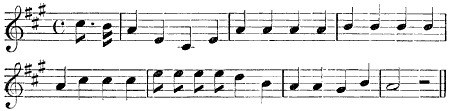
—Earls Heaton (Herbert Hardy).
[Play]
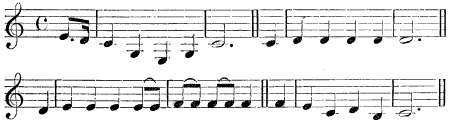
—Epworth (C. C. Bell).
I.
Oh, a-hunting we will go, a-hunting we will go;
We’ll catch a little fox and put him in a box,
And never let him go.
—Bath (Miss Large).
II.
Hunting we will go, brave boys,
Hunting we will go;
We’ll catch an old fox
And put him in a box,
For a-hunting we will go.
Halt! shoulder arms! fire!
—Horncastle, North Kelsey, Lincoln (Miss Peacock).
III.
O have you seen the Shah,
O have you seen the Shah?
He lights his pipe on a star-light night,
O have you seen the Shah?
For a-hunting we will go,
A-hunting we will go;
We’ll catch a fox and put him in a box,
A-hunting we will go.
—Epworth, Doncaster (C. C. Bell).
(b) The players march two by two, all singing. The first
pair let go hands, separate, and skip widely apart, still singing.
Gradually, in this manner, two separate lines are formed, until,
following each other and singing, the pairs come together again,
join hands, and march and sing in couplets linked.
The Bath game is played by the children standing in two
rows facing each other, and clapping hands and singing the verse.
At the same time the two children facing each other at the top
of the lines join hands and trip down and up between the
lines. Their hands are unclasped, and the two children run
down the outside of the lines, one running on each side, and
meet at the bottom of the lines, where they stand. The two
children now standing at the top proceed in the same way:
this is continued until all the children have done the same.
A ring is then formed, when the children again clap and sing.
Any number can play at this game.
In the Epworth version the children range themselves in
double rank at one end of the room or playground, and march
down to the other end hand in hand. At the bottom they loose
hands and divide, the first rank turning right, the second left,
and march back in two single files to the other end again,
where they re-form as at first, and repeat their manœuvre,
singing the verses alternately.
The Lincolnshire game is played by the children walking
two and two in a circle round one of their companions, singing.
The players then stand facing the child in the centre, and
place their hands on their partners’ shoulders. After the lines
are sung the centre child cries out, “Halt! Shoulder arms!
Fire!” at which words each child kisses his partner. If the
commander sees any one hesitate, or avoid kissing, he runs
forward and takes the defaulter’s place, leaving him to fill the
middle position.
Similar versions are played at Earls Heaton (Mr. Hardy),
Forest of Dean (Miss Matthews), Ellesmere (Burne, Shropshire
Folk-lore, p. 574), Derbyshire (Folk-lore Journal, i.
386).
A game played with a ball. The players are divided into
two equal parties, each of which tries to secure and keep
the ball in their possession. The prize is a ball made of
cork, covered with silver.—Courtney’s West Cornwall Glossary.
In Taylor’s Antiquitates Curiosæ, p. 144, it is stated:—“The
game of hurling consisted in throwing or hurling a ball of wood
about three inches in diameter, and covered with plated silver,
sometimes gilt. On the ball was frequently a Cornish motto
allusive to the game, and signifying that fair play was best.
Success depended on catching the ball dexterously when dealt,
and conveying it away through all the opposition of the adverse
party, or, if that was impossible, to throw it into the hands of
a partner, who, in his turn, was to exert his utmost efforts to
convey it to his own goal, which was often three or four miles
distant from that of his adversaries.”
T. Durfey’s Collin’s Walk through London, 1690, p. 192, says:
“Hurling is an ancient sport us’d to this day in the countys
of Cornwall and Devon, when once a year the hardy young
fellows of each county meet; and a cork ball thinly plated
with silver being thrown up between ’em, they run, bustle, and
fight for it, to the witty dislocating of many a shrew’d neck, or
for the sport of telling how bravely their arms or legs came to
be broke, when they got home.” It is fully described by
Carew in his Survey of Cornwall, 1602, p. 73.
It is also a very ancient Irish game, and Mr. Kinahan says:
“Many places are called after it: such as, Killahurla, the hurlers’
church; Gortnahurla, the field of the hurlers; Greenanahurla,
the sunny place of the hurlers; this, however, is now generally
corrupted into hurling-green. The hurling-green where the
famous match was played by the people of Wexford against
those of Cather (now divided into the counties of Carlow and
Wicklow), and where the former got the name of yellow bellies,
from the colour of the scarfs they wore round their waist, is a
sunny flat on the western side of North Wicklow Gap, on the
road from Gorey to Trinnahely. There are also many other different
names that record the game.”—Folk-lore Journal, ii. 266.
See “Bandy,” “Camp,” “Football,” “Hockey,” “Hood,”
“Shinty.”
An undescribed boys’ game. In it the following rhyme is
used—
Hurly-burly, trumpy trace,
The cow stands in the market-place;
Some goes far, and some goes near,
Where shall this poor sinner steer?
—Patterson’s Antrim and Down Glossary.
For a similar rhyme see “Hot Cockles.”
Children play a game which is accompanied by a song beginning—
Hussing and bussing will not do,
But go to the gate, knock, and ring—
Please, Mrs. Brown, is Nellie within?
—Parish’s Dictionary of the Sussex Dialect.
A boys’ game, played by tossing up halfpence. It is mentioned
in Peregrine Pickle, cap. xvi. Cope (Hampshire Glossary)
says, “Halfpence are placed in a cap and thrown up, a
sort of ‘pitch-and-toss.’”
[247]
A peculiar game at marbles, sometimes called “Hyssy-pyssy,”
played in some parts of Devon and Somerset. A hole of some
extent was made in an uneven piece of ground, and the game
was to shoot the marbles at some object beyond the hole without
letting them tumble into it. The game occasionally commenced
by a ceremony of no very delicate description, which
sufficed to render the fallen marble still more ignominious.—Halliwell’s
Dictionary.
[Play]
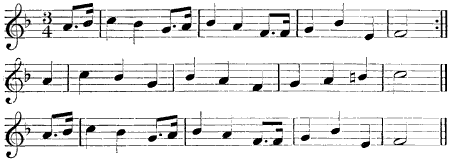
—Ogbourne, Wilts (H. S. May).
[Play]
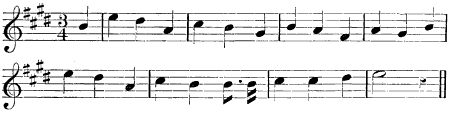
—Earls Heaton (H. Hardy).
[248]
[Play]
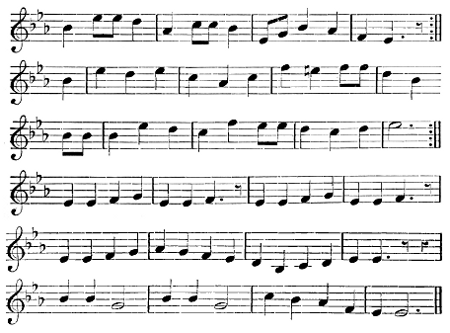
—London (A. B. Gomme).
I.
Isabella, Isabella, Isabella, Farewell!
Last night when we parted
I left you broken-hearted,
And on a green mountain,
There stands a young man.
Could you love him?
Could you love him?
Could you love him? Farewell!
Choose one, love,
Choose one, love,
Choose one, love, Farewell!
Take a walk, love,
Take a walk, love,
Take a walk, love, Farewell!
In the ring, love,
In the ring, love,
In the ring, love, Farewell!
Put the ring on,
Put the ring on,
Put the ring on, Farewell!
Go to church, love,
Go to church, love,
Go to church, love, Farewell!
Take a kiss, love,
Take a kiss, love,
Take a kiss, love, Farewell!
Shake hands, love,
Shake hands, love,
Shake hands, love, Farewell!
—Enborne, Newbury (M. Kimber).
II.
Isabella, Isabella, Isabella, Farewell!
Last night when I departed
I left her broken-hearted;
Upon the steep mountain
There stands a young man.
Who’ll you choose, love?
Who’ll you choose, love?
Who’ll you choose, love? Farewell!
Go to church, love,
Go to church, love,
Go to church, love, Farewell!
Say your prayers, love,
Say your prayers, love,
Say your prayers, love, Farewell!
Put your ring on,
Put your ring on,
Put your ring on, Farewell!
Come back, love,
Come back, love,
Come back, love, Farewell!
Roast beef and plum pudding,
Roast beef and plum pudding,
Roast beef and plum pudding,
For our dinner to-day.
Kiss together, love,
Kiss together, love,
Kiss together, love, Farewell!
—Ogbourne, Wilts (H. S. May).
[250]
III.
Isabella, Isabella, Isabella, Farewell!
Last night when I departed
I left you broken-hearted
Broken-hearted on the mountain,
On the mountain, Farewell!
Choose your loved one, choose your loved one,
Choose your loved one, Farewell!
Kiss your hand, love, kiss your hand, love,
Kiss your hand, love, Farewell!
Go to church, love, go to church, love,
Go to church, love, Farewell!
Say your prayers, love, say your prayers, love,
Say your prayers, love, Farewell!
Come to dinner, love, come to dinner, love,
Come to dinner, love, Farewell!
What have you for dinner, for dinner, for dinner,
What have you for dinner, for dinner to-day?
Roast beef and plum pudding, plum pudding, plum pudding,
Roast beef and plum pudding, plum pudding to-day.
—Southampton (Mrs. W. R. Carse).
IV.
Isabella, Isabella, Isabella, Farewell!
Last night I met you downhearted and sad,
And down by the river I met your young man.
Choose a lover, choose a lover,
Choose a lover, Farewell!
Walk to church, love, walk to church, love,
Walk to church, love, Farewell!
Come to the ring, love, come to the ring, love,
Come to the ring, love, Farewell!
Give a kiss, love, give a kiss, love,
Give a kiss, love, Farewell!
—West Grinstead, Sussex (Notes and Queries, 8th Series, i. 249, Miss Busk).
[251]
V.
Arabella!
Arabella!
Arabella! Farewell!
Last night when we parted
I left you broken-hearted
Down by the mill-side.
Who’ll you have, love?
Who’ll you have, love?
Who’ll you have, love? Farewell!
Go to church, love,
Go to church, love,
Go to church, love, Farewell!
Come back, love,
Come back, love,
Come back, love, Farewell!
Shake hands, love,
Shake hands, love,
Shake hands, love, Farewell!
Take a kiss, love,
Take a kiss, love,
Take a kiss, love, Farewell!
—Platt School, near Wrotham, Kent (Miss Burne).
VI.
Isabella, Isabella, Isabella, Farewell!
Last night when we parted
I left you broken-hearted,
And on the green meadow
You was standing alone.
Choose a sweetheart, choose a sweetheart,
Choose a sweetheart, fair maid.
Take her hand, love, take her hand, love,
Take her hand, love, fair maid.
Kneel down, love, kneel down, love,
Kneel down, love, fair maid.
Take a kiss, love, take a kiss, love,
Take a kiss, love, fair maid.
Now you’re married I wish you joy,
First a girl and then a boy,
Seven years after son and daughter;
Pray, young couple, come kiss together.
Kiss her once, kiss her twice, kiss her three times over.
—From a London nursemaid, 1878 (A. B. Gomme).
VII.
Isabella, Isabella, Isabella, Farewell!
Last night when we parted
I believed you broken-hearted,
As on the green mountain
You stands [qy. sang] like a lark.
Go to church, love, go to church, love,
Go to church, love, Farewell!
In the ring, love, in the ring, love,
In the ring, love, Farewell!
Give a kiss, love, give a kiss, love,
Give a kiss, love, Farewell!
Isabella, Isabella, Isabella, Farewell!
—Fernham and Longcot (Miss I. Barclay).
VIII.
Isabella, Isabella, Isabella, Farewell!
Last night when I departed I left her broken-hearted;
On the hill yonder there stands your young man.
Fetch him here, love, fetch him here, love,
Fetch him here, love, Farewell!
Shut the gates, love, shut the gates, love,
Shut the gates, love, Farewell!
Open the gates, love, open the gates, love,
Open the gates, love, Farewell!
Go to church, love, go to church, love,
Go to church, love, Farewell!
Show your ring, love, show your ring, love,
Show your ring, love, Farewell!
—Hanbury, Staffs. (Miss E. Hollis).
IX.
The trees are uncovered, uncovered, uncovered,
The trees are uncovered, Isabella, for me!
Last night when we parted we were all broken-hearted,
Isabella, Isabella, Isabella, for me!
Then give me your hand, love, your hand, love, your hand, love,
Then give me your hand, love, and a sweet kiss from you.
—Earls Heaton (Herbert Hardy).
X.
When the trees are uncovered, Isabellow, for me.
Last night when we parted
She was nigh broken-hearted,
Isabellow, Isabellow, Isabellow, for me.
Your hand, love, your hand, love,
Then give me your hand, love,
Take a sweet kiss from me.
—Winterton, Nottinghamshire and Yorkshire (Miss Peacock).
XI.
Isabella, Isabella, Isabella, Farewell!
Last night when we parted I left you broken-hearted,
And down by the river you saw your young man.
In the stream, love, in the stream, love,
In the stream, love, Farewell!
Go to church, love, go to church, love,
Go to church, love, Farewell.
In the ring, love, in the ring, love,
In the ring, love, Farewell!
—Long Eaton, Nottinghamshire (Miss Youngman).
XII.
Elizabella, Farewell!
Last night as we parted
She left me broken-hearted,
And on a green mountain
She looked like a dove.
Choose your loved one,
Choose your loved one,
Choose your loved one, Farewell!
Go to church, love, Farewell!
Say your prayers, love, Farewell!
In the ring, love, Farewell!
Shake hands, loves,
Shake hands, loves, Farewell!
Give a kiss, loves,
Give a kiss, loves, Farewell!
—Liphook, Hants (Miss Fowler).
XIII.
Last night when we parted
She was nigh broken-hearted,
To-morrow we gather
And a bright welcome be.
Then give me your hand, love,
Your hand, love, your hand, love,
Then give me your hand, love,
Isabella for me.
Isabella, Isabella,
Isabella for me.
—North Derbyshire (S. O. Addy).
(b) In the Enborne, Newbury, version (Miss Kimber) a
ring is formed by the children (boys and girls) joining
hands. Another child stands in the centre. The ring of
children walk round while singing the verses. The singing
is confined to the ring. When the centre child is told to
“choose,” she selects a boy from the ring, who goes into the
centre and they stand together. At the next verse these two
children walk out of the ring arm-in-arm. When the next
verse is sung they return, and again stand in the centre. At
the next verse the boy pretends to put a ring on the girl’s
finger. They walk out of the ring when told to go to church
(two children in the ring unclasping hands to let them walk
out, and again clasping hands after they return), and kiss each
other and shake hands when the two next verses are sung.
The child who was first in the centre then joins the ring, and
the game proceeds in the same way with the second child, who
chooses in his turn. All the other versions follow the same
rules, suiting their actions to the words, except Ogbourne,
Wilts, in which the two children in the centre sing the verse,
“roast beef and plum pudding.” They stand face to face, take
hold of each other’s hands, and sway their arms from side to
side. The ring then sing the concluding verse. In those
versions where “say your prayers” and “kneel down” occur,
the two centre children kneel, and hold their open hands together
in front of them to imitate a book. In the London
version (A. B. Gomme) a handkerchief was laid on the ground,
and the two children stood on each side of it and clasped
hands across it. In the Fernham and Longcot version the
one child leads the other out of the ring at “go to church,”
with a graceful half-dancing motion, and back again in the
same way. The first child joins the ring while the refrain is
sung. In the Hanbury version the centre child pretends to be
weeping; another child stands outside the ring and goes into
it; when the two meet they kiss. In the North Derbyshire
version (Mr. S. O. Addy) a ring is formed of young men
and women, a young man being in the centre. He chooses
a young woman at the singing of the fifth line, and then joins
the ring, the girl remaining in the centre.
(c) The tunes of all versions are very similar. The tune of
the Newbury game (Miss Kimber) is the same as the first part
of the Ogbourne tune printed (Mr. H. S. May); that from
Nottingham (Miss Youngman) is the same as the first part
of the London version. This is also the case with the Hanbury,
Staffs. (Miss E. Hollis) and Fernham and Longcot game.
What difference there is is very slight. The Platt, Kent, game
(Miss Burne), is sung to the same tune as “Green Gravel,”
given ante, p. 170. The first portion only of the tune is repeated
for all verses sung after the first verse. The Barnes game
is sung to the same tune as the Earls Heaton (Mr. Hardy), which
is printed ante. A version played at Barnes is almost identical
with the Southampton version, and another collected by Miss
Thoyts in Berkshire (Antiquary, vol. xxvii. p. 193) is similar
to the Hanbury version. The first lines run—Choose your
lover; Open the gates; Go to church, love; Kneel down, love;
Say your prayers, love; Put on the ring; Stand up, love; In
the ring, love; Kiss together, love.
(d) The words of all the versions are sufficiently similar to
analyse without a special form. The game appears to be
purely a love and marriage game, and has probably had its
origin in a ballad, and this idea is strengthened by the fact
that only one version (London) has the marriage formula sung
at the end, and this is probably an arbitrary addition. The
lover is represented as lonely and disconsolate, and the remedy
suggested is to choose a sweetheart. The marriage ceremony
is of the simplest description—the clasping of hands and the
kissing within the circle probably implying the betrothal at a
spot sacred to such functions, similar to the Standing Stones
of Stenness. Whatever may have been the original intention
of these stones, they came in more recent times to be the
resort of lovers, who joined their right hands through the
hole in the altar stones in the belief that this ceremony
would add additional solemnity to the betrothal. Miss
Gordon Cumming, in her Tour in the Hebrides, mentions the
fact of the marriage ceremony being of the simplest—a man
and woman standing facing each other and clasping hands
over a particular stone. Walking arm-in-arm is a sign in
Dorsetshire that a couple are married. The mention of the
“roast beef and plum pudding” for dinner has probably had
its origin in the wedding dinner or breakfast, and the inviting
of friends to assemble for the wedding dinner. The word
“Isabella” may have been originally something quite different
from the name of a girl. I am inclined to think the word
was not the name of a person at all; possibly it was something
addressed to a particular person in words the sense of
which are now lost, and the nearest idea to it was this name.
The same thing may also apply to the word “farewell,” and
hence the incongruity of the first few lines in nearly all versions.[Addendum]
A number of people sit in a row, or on chairs round a
parlour. A lighted wooden spill or taper is handed to the first,
who says—
Jack’s alive, and likely to live;
If he dies in your hand you’ve a forfeit to give.
The one in whose hand the light expires has to pay a forfeit.
As the spill is getting burnt out the lines are said very quickly,
as everybody is anxious not to have to pay the forfeit.—Addy’s
Sheffield Glossary.
At Egan, in Derbyshire, a number of persons sit round a
fire; one of them lights a stick, twirls it round, and says—
Little Nanny Cockerthaw,
What if I should let her fa’?
The others reply—
Nine sticks and nine stones
Shall be laid on thy bare back bones
If thou shouldst let fa’
Little Nanny Cockerthaw.
If the ember or lighted stick goes out whilst any one is twirling
it round, and whilst the lines are being said, he has to lie on
the floor, when stones, chairs, or other articles of furniture are
piled upon him.—S. O. Addy.
Mactaggart calls it “Preest Cat,” and says that it is an
ingleside game. A piece of stick is made red in the fire; one
hands it to another, saying—
About wi’ that, about wi’ that,
Keep alive the preest cat.
Then round is handed the stick, and whomsoever’s hand it
goes out in, that one is in a wad, and must kiss the crook,
the cleps, and what not, ere he gets out of it.
Lilly cuckoo, lilly cuckoo,
Sticks and stanes lie at thy weary banes
If thou fa’, for a’ I blaw,
Lilly cuckoo, lilly cuckoo.
This rhyme is common in the “Preest Cat” sport toward the
border. Anciently, when the priest’s cat departed this life,
wailing began in the country side, as it was thought it became
some supernatural being—a witch, perhaps, of hideous form—so
to keep it alive was a great matter.—Mactaggart’s Gallovidian
Encyclopædia.
He also refers to a game called “Robin-a-Ree,” much like
“Preest Cat,” only in passing the burnt stick round the ring the
following rhyme is said—
Robin-a-Ree, ye’ll no dee wi’ me,
Tho’ I birl ye roun’ three times and three;
O Robin-a-Ree, O Robin-a-Ree,
O dinna let Robin-a-Reerie dee.
Robin-a-Ree occurs in an old song.—Mactaggart’s Gallovidian
Encyclopædia.
In Cornwall it is known as “Robin’s a-light,” and is played
around the fire. A piece of stick is set on fire and whirled
around rapidly in the hand of the first player, who says,
“Robin’s a-light, and if he go out I will saddle your back.” It
is then passed to the next, who says the same thing, and so
on. The person who lets the spark die out has to pay a forfeit.—Scilly
(Courtney’s West Cornwall Glossary). A rhyme
at Lostwithiel is known as follows—
Jack’s alive, and likely to live;
If he die in my hand a pawn (forfeit) I’ll give.
—(J. W.)
Jamieson (Dictionary) says, “To do ‘Dingle-dousie,’ a stick
is ignited at one end and given as a plaything to a child.”
Elworthy (West Somerset Words) does not give this as a
game, but says a burning stick was whirled round and round
very quickly, so as to keep up the appearance of a ribbon
of fire. Miss Burne (Shropshire Folk-lore, p. 530), says,
“Children wave a burning stick in the air, saying—
A girdle o’ gold, a saddle o’ silk,
A horse for me as white as milk,
an evident relic of divinations or incantations practised with
bonfires.” Halliwell (Nursery Rhymes, p. 213) gives the rhyme
as—
Jack’s alive, and in very good health,
If he dies in your hand you must look to yourself;
the game being played in the same way as the Sheffield version
(see also Halliwell’s Dictionary and Moor’s Suffolk Words).
(b) This is a very significant game, and its similarity in
miniature to the old tribal custom of carrying the fiery cross to
rouse the clans at once suggests the possible origin of it. The
detention of the fiery cross through neglect or other impediment
was regarded with much dread by the inhabitants of the
place in which it should occur. This subject is discussed in
Gomme’s Primitive Folkmoots, p. 279 et seq.[Addendum]
Jack, Jack, the bread’s a-burning,
All to a cinder;
If you don’t come and fetch it out
We’ll throw it through the winder.
These lines are chanted by players that stand thus. One places
his back against a wall, tree, &c., grasping another, whose back
is toward him, round the waist; the second grasps a third, and
so on. The player called Jack walks apart until the conclusion
of the lines. Then he goes to the others and pokes at or pats
them, saying, “I don’t think you’re done yet,” and walks away
again. The chant is repeated, and when he is satisfied that
the bread is “done” he endeavours to pull the foremost from
the grasp of the others, &c.—Warwickshire (Northall’s Folk
Rhymes, p. 390).
See “Mother Mop.”
See “Bung the Bucket.”
A game among school-girls, played with small pebbles, and
sometimes with plum or cherry stones (Dickinson’s Cumberland
Glossary). “A children’s game, played with five white pebbles
called Jackstones,” says Mr. Patterson (Antrim and Down
Glossary). The game is called “Jack.”
See “Fivestones,” “Hucklebones.”
A youthful amusement in Newcastle and the neighbourhood
at Easter. One boy, holding an egg in his hand, challenges
another to give blow for blow. One of the eggs is sure
to be fractured in the conflict, and its shattered remains become
the spoil of the conqueror.
See “Conkers.”
[Play]
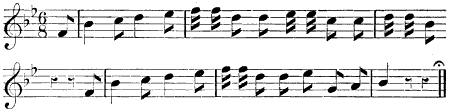
—Platt, near Wrotham, Kent (Miss Burne).
[Play]
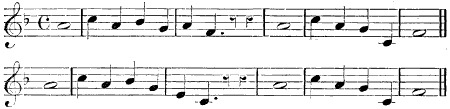
—Northants (Rev. W. D. Sweeting).
[Play]
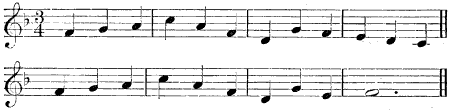
—Belfast (W. H. Patterson).
I.
I’m come to court Janet jo,
Janet jo, Janet jo,
I’m come to court Janet jo,
How’s she the day?
She’s up the stair washin’,
Washin’, washin’,
She’s up the stair washin’,
Ye canna see her the day.
[Then follow verses, the words of which are not given by
Chambers, representing Jenny as bleaching, drying, and ironing
clothes. At last they say—]
[261]
Janet jo’s dead and gane,
Dead and gane, dead and gane;
Janet jo’s dead and gane,
She’ll never come hame!
—Chambers’ Popular Rhymes, pp. 140-41.
II.
I’m come to court Janet jo, Janet jo, Janet jo,
Come to court Janet jo,
How is she the day?
She’s butt the house washing, washing, washing
She’s butt the house washing,
You can’t see her to-day.
Fare ye well, ladies, ladies, ladies,
Fare ye well, ladies,
For I must away.
—West Scotland (Folk-lore Record, iv. 474).
III.
We’ve come to court Jinny jo,
Jinny jo, Jinny jo,
We’ve come to court Jinny jo,
Is she within?
Jinny jo’s washing clothes,
Washing clothes, washing clothes,
Jinny jo’s washing clothes,
You can’t see her to-day.
So fare ye well, ladies,
O ladies, O ladies,
So fare ye well, ladies
And gentlemen too.
[These verses are repeated for—
- (1) drying clothes,
- (2) starching,
- (3) ironing,
- (4) ill,
- (5) dying.
Then—]
Jinny jo’s lying dead,
Lying dead, lying dead,
Jinny jo’s lying dead,
You can’t see her to-day.
So turn again, ladies,
Ladies, ladies, ladies,
So turn again, ladies,
And gentlemen too.
What shall we dress her in?
Dress her in, dress her in?
What shall we dress her in?
Shall it be red?
Red’s for the soldiers,
The soldiers, the soldiers,
Red’s for the soldiers,
And that will not do.
[Various other colours are suggested in the same way, but
are found unsuitable—black because “black’s for the mourners,”
green because “green’s for the croppies,” and so on till at last
white is named.]
White’s for the dead people,
Dead people, the dead people,
White’s for the dead people,
And that will just do.
—Belfast (Notes and Queries, 7th series, xii. 492, W. H. Patterson).
IV.
I came to see Jenny jo, Jenny jo, Jenny jo,
I came to see Jenny jo, is she within?
Jenny jo’s washing clothes, washing clothes, washing clothes,
Jenny jo’s washing clothes, and ye can’t see her to-day.
Oh but I’m sorry, I’m sorry, I’m sorry,
Oh but I’m sorry, I can’t see her to-day.
Farewell ladies, O ladies, O ladies,
Farewell ladies, and gentlemen too.
[Then the same verses are repeated for—
- (1) starching clothes,
- (2) smoothing clothes,
- (3) dead,
the four lines above being repeated after each, and the verses
proceed with—]
What shall we dress her in, dress her in, dress her in?
What shall we dress her in? Shall it be black?
Black for the sweeps, the sweeps, the sweeps,
Black for the sweeps, and that shall not do.
What shall we dress her in, dress her in, dress her in?
What shall we dress her in? Shall it be blue?
Blue for the sailors, sailors, sailors,
Blue for the sailors, and that shall not do.
What shall we dress her in, dress her in, dress her in?
What shall we dress her in? Shall it be red?
Red for the soldiers, soldiers, soldiers,
Red for the soldiers, and that shall not do.
What shall we dress her in, dress her in, dress her in?
What shall we dress her in? Shall it be orange?
Orange for the Orange-men, Orange-men, Orange-men,
Orange for the Orange-men, and that shall not do.
What shall we dress her in, dress her in, dress her in?
What shall we dress her in? Shall it be white?
White for the corpse, the corpse, the corpse,
White for the corpse, and that will just do.
We have lost a soldier, soldier, soldier,
We have lost a soldier, and the Queen has lost a man.
We will bury him in the bed of glory, glory, glory,
We will bury him in the bed of glory, and we’ll never see him any more.
—Holywood, co. Down (Miss C. N. Patterson).
[264]
V.
I’ve come to see Jenny jo, Jenny jo, Jenny jo,
I’ve come to see Jenny jo,
How is she now?
Jenny jo is washing clothes, washing clothes, washing clothes,
Jenny jo is washing clothes,
You can’t see her now.
I’ve come to see Jenny jo, Jenny jo, Jenny jo,
I’ve come to see Jenny jo,
How is she now?
Jenny jo is ironing clothes, ironing clothes, ironing clothes,
Jenny jo is ironing clothes,
You can’t see her now.
I’ve come to see Jenny jo, Jenny jo, Jenny jo,
I’ve come to see Jenny jo,
How is she now?
Jenny jo is sick, my dear, sick, my dear, sick, my dear,
Jenny jo is sick, my dear,
You can’t see her now.
I’ve come to see Jenny jo, Jenny jo, Jenny jo,
I’ve come to see Jenny jo,
How is she now?
Jenny jo is underboard, underboard, underboard,
Jenny jo is underboard,
You can’t see her now.
—Lismore (Miss F. Keane, collected from Miss Ward, National Schoolmistress).
VI.
We’ve come to see Jenny Jones,
Jenny Jones, Jenny Jones,
We’ve come to see Jenny Jones,
And how is she now?
O Jenny is washing,
O washing, O washing,
O Jenny is washing,
And you can’t see her now.
Very well, ladies, ladies, ladies,
Very well, ladies, and gentlemen too.
We’ve come to see Jenny Jones,
Jenny Jones, Jenny Jones,
We’ve come to see Jenny Jones,
And how is she now?
O Jenny is starching,
O starching, O starching,
O Jenny is starching,
And you can’t see her now.
Very well, ladies, ladies, ladies,
Very well, ladies, and gentlemen too.
We’ve come to see Jenny Jones,
Jenny Jones, Jenny Jones,
We’ve come to see Jenny Jones,
And how is she now?
O Jenny is ironing,
O ironing, O ironing,
O Jenny is ironing,
And you can’t see her now.
Very well, ladies, ladies, ladies,
Very well, ladies, and gentlemen too.
We’ve come to see Jenny Jones,
Jenny Jones, Jenny Jones,
We’ve come to see Jenny Jones,
And how is she now?
O Jenny is ill,
O ill, O ill,
O Jenny is ill,
And you can’t see her now.
Very well, ladies, ladies, ladies,
Very well, ladies, and gentlemen too.
We’ve come to see Jenny Jones,
Jenny Jones, Jenny Jones,
We’ve come to see Jenny Jones,
And how is she now?
O Jenny is dying,
O dying, O dying,
O Jenny is dying,
And you can’t see her now.
Very well, ladies, ladies, ladies,
Very well, ladies, and gentlemen too.
We’ve come to see Jenny Jones,
Jenny Jones, Jenny Jones,
We’ve come to see Jenny Jones,
And how is she now?
O Jenny is dead,
Is dead, is dead,
O Jenny is dead,
And you can’t see her now.
Very well, ladies, ladies, ladies,
Very well, ladies, and gentlemen too.
What shall we lay her in, lay her in, lay her in?
What shall we lay her in? Shall it be red?
Red is for soldiers, soldiers, soldiers,
Red is for soldiers, and that won’t do.
Very well, ladies, ladies, ladies,
Very well, ladies, and gentlemen too.
What shall we lay her in, lay her in, lay her in?
What shall we lay her in? Shall it be blue?
Blue is for sailors, sailors, sailors,
Blue is for sailors, and that won’t do.
Very well, ladies, ladies, ladies,
Very well, ladies, and gentlemen too.
What shall we lay her in, lay her in, lay her in?
What shall we lay her in? Shall it be black?
Black is for mourners, mourners, mourners,
Black is for mourners, and that won’t do.
Very well, ladies, ladies, ladies,
Very well, ladies, and gentlemen too.
What shall we lay her in, lay her in, lay her in?
What shall we lay her in? Shall it be white?
White’s what the dead wear, dead wear, dead wear,
White’s what the dead wear, and that will just do.
—Hanwell, Middlesex, 1878 (A. B. Gomme).
VII.
We’ve come to see poor Jenny Jones, poor Jenny Jones, poor Jenny Jones,
We’ve come to see poor Jenny Jones, how is she to-day?
Poor Jenny is washing, washing, washing,
Poor Jenny is washing, washing hard to-day.
What time can we see her?
At one o’clock.(Clock strikes one.)
We’ve come to see poor Jenny Jones, poor Jenny Jones, poor Jenny Jones,
We’ve come to see poor Jenny Jones, how is she to-day?
Poor Jenny is starching, starching, starching,
Poor Jenny is starching, you can’t see her to-day.
When can we see her?
At two o’clock.(Clock strikes two.)
We’ve come to see poor Jenny Jones, poor Jenny Jones, poor Jenny Jones,
We’ve come to see poor Jenny Jones, how is she to-day?
Poor Jenny is folding, folding, folding,
Poor Jenny is folding, you can’t see her to-day.
When can we see her?
At three o’clock.(Clock strikes three.)
We’ve come to see poor Jenny Jones, poor Jenny Jones, poor Jenny Jones,
We’ve come to see poor Jenny Jones, how is she to-day?
Poor Jenny is ironing, ironing, ironing,
Poor Jenny is ironing, you can’t see her to-day.
When can we see her?
At four o’clock.(Clock strikes four.)
We’ve come to see poor Jenny Jones, poor Jenny Jones, poor Jenny Jones,
We’ve come to see poor Jenny Jones, how is she to-day?
Poor Jenny is poorly, poorly, poorly,
Poor Jenny is poorly, you can’t see her to-day.
When can we see her?
At five o’clock.(Clock strikes five.)
We’ve come to see poor Jenny Jones, poor Jenny Jones, poor Jenny Jones,
We’ve come to see poor Jenny Jones, how is she to-day?
Poor Jenny is dying, dying, dying,
Poor Jenny is dying, you can’t see her to-day.
When shall we see her?
(Come) at six o’clock.(Clock strikes six.)
We’ve come to see poor Jenny Jones, poor Jenny Jones, poor Jenny Jones,
We’ve come to see poor Jenny Jones, how is she to-day?
Poor Jenny is dead, dead, dead,
Poor Jenny is dead, you can’t see her to-day.
What colour will you have for the funeral for poor Jenny Jones?
Red?
Red is for the soldiers, soldiers, soldiers,
Red is for the soldiers, and that won’t do.
Blue?
Blue is for the sailors, sailors, sailors,
Blue is for the sailors, and that won’t do.
Pink?
Pink is for the babies, babies, babies,
Pink is for the babies, and that won’t do.
White?
White is for a wedding, a wedding, a wedding,
White is for a wedding, and that won’t do.
Black?
Black is for the mourners, mourners, mourners,
Black is for the mourners, and that will do.
Poor Jenny Jones is dead, dead, dead,
Poor Jenny Jones is dead, and lies in her grave.
—Southampton (from nursemaid of Mrs. W. R. Carse).
VIII.
We’ve come to see Jenny Jones, Jenny Jones, Jenny Jones,
We’ve come to see Jenny Jones, is she at home?
Jenny Jones is scrubbing, scrubbing, scrubbing,
Jenny Jones is scrubbing, you can’t see her now.
[Then follow verses asking alternately “Is she at home?”
in the same words as the first verse, and answering that she is
- (1) washing,
- (2) ill,
- (3) dying,
- (4) dead;
all of them in the same form as the second verse. Then the
verses continue with—]
Jenny Jones is dead, she is dead, she is dead,
Jenny Jones is dead, you can’t see her now.
We’ll come to the funeral, funeral, funeral,
We’ll come to the funeral, and how shall we dress?
You can come in yellow, in yellow, in yellow,
You can come in yellow, that’s how you can dress.
Yellow’s for jealousy, jealousy, jealousy,
Yellow’s for jealousy, so that won’t do.
You can come in green, in green, in green,
You can come in green, that’s how you can dress.
Green’s forsaken, forsaken, forsaken,
Green’s forsaken, so that won’t do.
You can come in white, in white, in white,
You can come in white, that’s how you can dress.
White’s for weddings, weddings, weddings,
White’s for weddings, so that won’t do.
You can come in black, in black, in black,
You can come in black, that’s how you can dress.
Black is for funerals, funerals, funerals,
Black is for funerals, so black will do.
—Colchester (from Miss G. M. Frances, Colchester, through Miss Morris).
IX.
We’ve come to see Jenny Jones, Jenny Jones,
We’ve come to see Jenny Jones. How is she now?
Jenny is washing, washing, washing,
Jenny is washing, you can’t see her now.
[Then follow the alternate question and answer; the questions
in the same words as the first verse, and the answers in
the same form as the second verse, stating that Jenny is
- (1) folding,
- (2) starching,
- (3) ironing,
- (4) ill,
- (5) dying,
- (6) dead;
then the verses proceed with—]
May we come to the funeral?
Yes.
May we come in red?
Red is for soldiers, you can’t come in red.
May we come in blue?
Blue is for sailors, you can’t come in blue.
May we come in white?
White is for weddings, you can’t come in white.
May we come in black?
Black is for funerals, so you can come in that.
—Bocking, Essex (Folk-lore Record, iii. 471).
X.
I come to see poor Jenny Joe,
Jenny Joe, Jenny Joe,
I come to see poor Jenny Joe,
And how is she now?
She’s washing, she’s washing,
And you can’t see her now.
Very well, ladies, ladies, ladies,
Very well, ladies, and gentlemen too.
I come to see poor Jenny Joe,
Jenny Joe, Jenny Joe,
I come to see poor Jenny Joe,
And how is she now?
She’s folding, she’s folding,
And you can’t see her now.
Very well, ladies, ladies, ladies,
Very well, ladies, and gentlemen too.
I come to see poor Jenny Joe,
Jenny Joe, Jenny Joe,
I come to see poor Jenny Joe,
And how is she now?
She’s ironing, she’s ironing,
And you can’t see her now.
Very well, ladies, ladies, ladies,
Very well, ladies, and gentlemen too.
[Then follow alternate questions and answers in the same
manner for—
Then—]
I come in my white dress, white dress, white dress,
I come in my white dress, and how will that do?
White is for wedding, wedding, wedding,
White is for wedding, and that won’t do.
Very well, ladies, ladies, ladies,
Very well, ladies, and gentlemen too.
I come in my blue dress, blue dress, blue dress,
I come in my blue dress, and how will that do?
Blue is for sailors, sailors, sailors,
Blue is for sailors, and that won’t do.
[Then follow verses as before, beginning—
Very well, ladies.
I come in my red dress.
Red is for soldiers,
Very well, ladies.
Then—]
I come in my black dress, black dress, black dress,
I come in my black dress, and how will that do?
Black is for funeral,
And that will do
To carry poor Jenny to the grave.
—Sporle, Norfolk (Miss Matthews).
XI.
We’re come to see Jenny Jones, Jenny Jones, Jenny Jones,
Come to see Jenny Jones, how is she now?
Jenny is a-washing, a-washing, a-washing,
Jenny is a-washing, you can’t see her now.
Very well, ladies, very well, ladies,
Very well, ladies, we can’t see her now.
[Then follow the same verses for—
- (1) ironing,
- (2) badly,
- (3) dead;
And the singing proceeds with—]
Please, will white do, white do, white do?
Please, will white do, please, will it do?
White’s for the weddingers, the weddingers,
White’s for the weddingers, that won’t do.
Please, will blue do, blue do, blue do?
Please, will blue do, please will it do?
[Then follow verses as before, beginning—
Blue’s for the sailors, the sailors, the sailors.
Please, will red do, red do?
Red’s for the soldiers.
Then—]
Please, will black do, black do, black do?
Black’s for the funeral, black will do.
—Northamptonshire (Rev. W. D. Sweeting).
XII.
I’ve come to see how Jenny Jones is to-day.
You can’t see her, she’s washing.
I’ve come to see how Jenny Jones is to-day.
You can’t see her, she’s ironing [she’s starching, she’s brewing, she’s baking, successively].
I’ve come to see how Jenny Jones is to-day.
You can’t see her, she’s ill [then she’s worse].
I’ve come to see how Jenny Jones is to-day.
You can’t see her, she’s dead!
Chorus.
There’s red for the soldiers,
Blue for the sailors,
White for the angels [for the baby, Chirbury],
And black for the mourners [of poor Jenny Jones].
—Berrington, Chirbury (Shropshire Folk-lore, p. 577).
XIII.
We’ve come to see poor Jenny Jones.
Poor Jenny Jones is washing, you can’t see her.
We’ve come to see poor Jenny Jones.
Poor Jenny Jones is drying, you can’t see her.
We’ve come to see poor Jenny Jones.
Poor Jenny Jones is starching, you can’t see her.
We’ve come to see poor Jenny Jones.
Poor Jenny Jones is ironing, you can’t see her.
We’ve come to see poor Jenny Jones.
Poor Jenny Jones is dead, you can’t see her.
What shall we follow, in red, blue, or black?
Red’s for the soldier, blue for the sailor,
Black for the dead.
—Enborne School, Berks (Miss M. Kimber).
XIV.
Come to see Miss Jenny Jones,
Miss Jenny Jones, Miss Jenny Jones;
Come to see Miss Jenny Jones,
And how is she to-day?
Miss Jenny Jones is washing, washing, washing,
Miss Jenny Jones is washing,
You can’t see her to-day.
Farewell, ladies, ladies, ladies, and gentlemen too.
[Miss Jenny Jones is drying, starching, ironing, ill, worse,
dying, and dead in turn. Then—]
What shall we dress her in,
Dress her in, dress her in?
What shall we dress her in,
Dress her in red?
Red’s what the soldiers wear,
The soldiers wear, the soldiers wear,
Red’s what the soldiers wear,
And that won’t do.
What shall we dress her in,
Dress her in, dress her in?
What shall we dress her in,
Dress her in blue?
Blue’s what the sailors wear,
Sailors wear, sailors wear;
Blue’s what the sailors wear,
And that won’t do.
What shall we dress her in,
Dress her in, dress her in?
What shall we dress her in,
Dress her in black?
Black’s what the mourners wear,
The mourners wear, the mourners wear;
Black’s what the mourners wear,
And that won’t do.
What shall we dress her in,
Dress her in, dress her in?
What shall we dress her in,
Dress her in white?
White’s what the dead wear,
The dead wear, the dead wear;
White’s what the dead wear,
And that will do.
—Liphook, Hants (Miss Fowler).
XV.
Come to see Jinny Jones, Jinny Jones
Come to see Jinny Jones,
And where is she now?
Jinny is washing, is washing,
Jinny is washing,
And you can’t see her now.
Very well, very well, lady, lady,
Very well, lady,
That will do.
[Then follow—
- (1) starching,
- (2) ironing,
- (3) dying,
- (4) dead.]
What shall we follow in, follow in?
What shall we follow in?
We’ll follow in blue.
Blue is for sailors, for sailors,
Blue is for sailors,
And that won’t do.
[or, You can’t follow her so.]
[Then follow—
Red is for soldiers,
White is for weddings,
Yellow is for babies.]
Black is not deep enough, deep enough,
That won’t do.
What shall we follow in, follow in?
We’ll follow her in crape, crape [pronounced cray-ape].
You may follow her in crape, crape,
You may follow her in crape,
That will do.
—Deptford (Miss E. Chase).
XVI.
I’ve come to see Georgina, Georgina, Georgina,
I’ve come to see Georgina, how’s she to-day?
She’s upstairs washing, washing, washing,
She’s upstairs washing, and can’t get away.
O very well, ladies, ladies, ladies,
We’ll come another day.
We’ve come to see Georgina, Georgina, Georgina,
We’ve come to see Georgina, how’s she to-day?
She’s upstairs ironing, ironing, ironing,
She’s upstairs ironing, and can’t get away.
[Then the two verses are repeated—
O very well, ladies.
We’ve come to see Georgina.
Then follows—]
She was coming downstairs with a basin of water, and she fell down and broke her toe, and she’s dead.
And what shall we dress her in, dress her in, dress her in?
And what shall we dress her in? Dress her in red.
Red for the soldiers, soldiers, soldiers,
Red for the soldiers, and that shan’t do.
[Then follow blue for the sailors, black for the mourners,
and finally—]
What shall we dress her in, dress her in, dress her in?
What shall we dress her in? Dress her in white.
White for the dead people, dead people, dead people,
White for the dead people, and that will do.
—Auchencairn, Kirkcudbright (A. C. Haddon).
XVII.
How’s poor Jenny jo, Jenny jo, Jenny jo?
He’s very ill.
Oh, very good, very good, very good.
How’s poor Jenny jo, Jenny jo, Jenny jo?
He’s fallen downstairs and broken his neck.
Oh, very good, very good, very good.
How’s poor Jenny jo, Jenny jo, Jenny jo?
He’s dead.
Oh, very good, very good, very good.
—Annaverna, Louth, Ireland (Miss R. Stephen).
(b) Two children stand apart; one, who personates the
Mother, stands still and holds out her skirts with both hands;
the other personates Jenny Jones, and kneels or stoops down
in a crouching position behind her companion’s outstretched
skirts. The other players form a line by joining hands. They
sing the first, third, and every alternate verse, advancing and
retiring in line while doing so. The Mother sings the answers
to their questions, standing still and hiding Jenny Jones all the
time from view. When the verses are finished, Jenny Jones
lies down as if she were dead, and the Mother stands aside.
Two of the other players then take up Jenny Jones, one by
the shoulders and the other by the feet, and carry her a little
distance off, where they lay her on the ground. All the players
follow, generally two by two, with their handkerchiefs at their
eyes and heads lowered, pretending to grieve.
This is the more general way of playing the game. In those
versions where the reply, “Very well, ladies,” occurs, this is
sung by the line of children just before they sing, “We’ve come
to see Jenny Jones.” Sometimes, as in the Berrington and
Chirbury game, two lines of children facing each other advance
and retire, singing the verses. They then carry Jenny Jones to
a corner, lay her down, stand in a circle round, and sing to her
the last verse. In the Hants versions sent by Miss Mendham,
six or eight children carry Jenny stretched out and flat,
lay her down, cover her over, and then sing the last lines.
The rest of the children follow them. In the Irish (Belfast)
version the game is played in the same way; the funeral is
arranged, when Jenny suddenly comes to life again (W. H.
Patterson). In the Southampton version, after the carrying of
Jenny by her head and feet to the grave, and the other children
following and standing round, Jenny Jones rises up and pursues
the children. She is called the Ghost. The children run
away in affected terror, calling out, “The Ghost!” Whoever
she catches becomes Jenny Jones in the next game. This
incident is also played in the Barnes, Northants, Annaverna,
co. Louth, Enborne and Liphook versions.
(c) This game is played very generally throughout the
country, and I have other versions collected from Earls Heaton
(Mr. H. Hardy), Barnes (A. B. Gomme), Cambridge (Mrs.
Haddon), Hampshire (Miss Mendham), Frodingham (Miss Peacock),
Cowes, Isle of Wight (Miss E. Smith), Sulhampstead,
Berks (Miss Thoyts), and Platt, Kent (Miss Burne). These
versions are so similar to the Hanwell version, with the exception
of the “Very well, ladies,” that it is needless to print
them in full; special differences are noted hereafter. In some
places the game is said in a sing-song manner.
Some of the versions differ from the general type in two
ways—first, in the method of playing; secondly, in the wording
of the verses. The differences in the method of playing direct
attention to the connection of the game with ancient custom.
The game is always played by the players taking sides; but
one method is for one side to consist of only two children
(Mother and Jenny Jones), and the other side to consist of all
the other players; while the other method is for the players to
be divided into two sides of about equal numbers, each side
advancing and retiring in line when singing their part. Jenny
Jones in some cases walks with the girls in her line until the
funeral, when she is carried to the grave, and in others she
stands alone behind the line. The way of performing the
funeral also differs. Generally two of the players carry Jenny
to the grave, the rest following two by two; but in one Hampshire
version six or eight children carry Jenny, stretched out
and flat, to the grave, and cover her over; in Holywood, co.
Down, she is carried sitting on the crossed hands of two
players; while in some versions no funeral is apparently
performed, the words only being sung. Another significant
incident is the Ghost. An additional incident occurs in the
Liphook version, which represents her being “swung to life
again” by two of the players.
These differences may perhaps be immaterial to the meaning
and origin of the game, but they are sufficiently indicative of
early custom to suggest the divergence of the game in modern
times towards modern custom. Thus the players divided line-by-line
follow the general form for children playing singing
games, and it would therefore suggest itself as the earlier form
for this game. The change of the game from the line-by-line
action to the mother-and-line action would indicate a corresponding
change in the prevailing custom which influenced the
game. This custom was the wooing by a band of suitors of
girls surrounded by their fellow-villagers, which became obsolete
in favour of ordinary marriage custom. The dropping out
of this custom would cause the game to change from a representation
of both wooing and burial to one of burial only. As
burial only the mother-and-line action is sufficient, but the
presence of a wooing incident in the earlier form of the game
is plainly revealed by the verse which sings, “Fare ye well,
ladies,” or, as it has become in the English variant, “Very
well, ladies.”
The difference in the wording of the versions is slight,
and does not need formal analysis. Domestic occupation is
shown throughout, washing and its attendants, drying, folding,
starching and ironing being by far the most numerous, brewing,
and baking only occurring in one. Illness, dying, and death
are the usual forms for the later verses, but illness and dying
are lost in several versions. The choosing of colours is in
some versions not for the mourners but for the dead maiden,
and in these cases (six) white is the colour chosen, for “white’s
what the dead wear.”
This question of colours for the dead is a very important
one. The dressing of the dead body of a maiden in white
by her girl companions, and the carrying of the body by them
to the grave, are known village customs, the whole village being
invited to the funeral. The rising of the dead lover, and the
belief that excessive mourning over a loved one disturbs his or
her rest in the grave, thus causing the dead to rise and speak,
are shown in old ballads; the belief that spirits of the dead
haunt churchyards and places of their former abode may also
be adduced in illustration of the ghost incident.
(d) The methods of playing, and the incidents revealed by
the verses sung, show that this is perhaps the most realistic
of all the singing games, the daily occupation, the illness,
death, and burial being portrayed, first, in the words of the
rhymes, and secondly, by the accompanying action. The
Scottish versions make the opening incident that of a lover
coming to the house of the loved one, then proceed to the
domestic occupation, and finally to the death incident; while
the English versions give the idea of village friends calling
upon a favourite companion, and subsequently attending her
funeral. That the former is the older of the two versions is
confirmed by the great probability of the name “Jenny Jones”
being a degraded form of “Janet jo.” There is some evidence
for this. The Sporle version gives it as “Jenny Joe,” which is
clearly a misunderstood rendering of “Jenny jo.” The corruption
of this into “Jenny Jones” is exactly what might be
expected from modern English ignorance of the pretty meaning
of the word jo, “dear;” and to what lengths this corruption
may proceed under such influences may be seen by versions
from Earls Heaton, where we have “Jingy Jog;” Leeds, where
we get “Jilly Jog;” and the Edinburgh version, where we have
“Georgina.”
This would be an argument for the Scottish home of the
rhymes, and for the direct borrowing of the name from Scotland
by the English villagers. In furtherance of this view the
following passage from Chambers may be quoted:—
In the Stewartry of Kirkcudbright, “Janet Jo” is a dramatic
entertainment amongst young rustics. Suppose a party has
met in a harvest or winter evening round a good peat fire,
and it is resolved to have “Janet Jo” performed. Two undertake
to personate a goodman and a goodwife; the rest a family
of marriageable daughters. One of the lads, the best singer
of the party, retires, and equips himself in a dress proper for
representing an old bachelor in search of a wife. He comes
in, bonnet in hand, bowing, and sings—
| |
Guid e’en to ye, maidens a’, |
| |
Maidens a’, maidens a’, |
| |
Guid e’en to ye, maidens a’, |
| |
Be ye or no. |
| |
| |
I’m come to court Janet jo, |
| |
Janet jo, Janet jo, |
| |
I’m come to court Janet jo, |
| |
Janet, my jo. |
| |
| Goodwife sings— |
What’ll ye gie for Janet jo, |
| |
Janet jo, Janet jo? |
| |
What’ll ye gie for Janet jo, |
| |
Janet, my jo? |
| |
| Wooer— |
I’ll gie ye a peck o’ siller, |
| |
A peck o’ siller, peck o’ siller, |
| |
I’ll gie ye a peck o’ siller, |
| |
For Janet, my jo. |
| |
| Goodwife says— |
Gae awa’, ye auld carle! |
| |
| Then sings— |
Ye’se never get Janet jo, |
| |
Janet jo, Janet jo, |
| |
Ye’se never get Janet jo, |
| |
Janet, my jo. |
The wooer hereupon retires, singing a verse expressive of
mortification, but soon re-enters with a reassured air, singing—
[282]
| |
I’ll gie ye a peck o’ gowd, |
| |
A peck o’ gowd, a peck o’ gowd, |
| |
I’ll gie ye a peck o’ gowd, |
| |
For Janet, my jo. |
The matron gives him a rebuff as before, and he again
retires discomfited, and again enters, singing an offer of “twa
pecks o’ gowd,” which, however, is also refused. At his next
entry he offers “three pecks o’ gowd,” at which the good wife
brightens up and sings—
| |
Come ben beside Janet jo, |
| |
Janet jo, Janet jo, |
| |
Ye’re welcome to Janet jo, |
| |
Janet, my jo. |
The suitor then advances gaily to his sweetheart, and the
affair ends in a scramble for kisses.—Popular Rhymes, pp.
141, 142.
On the other hand, it must not be overlooked that this game-drama
and the game of “Janet Jo” have no connection beyond
the name of the heroine and the wooing incident; so that the
borrowing, if borrowing there be, might have been by Scotland,
who improved the commonplace “Jenny Jones” into the
pretty sweetness of her Scottish namesake. The Scottish version
of the game leaves out the question of the colours for
mourning, but, on the other hand, it contains the very important
incident of the restoration of the dead. Chambers (Popular
Rhymes, p. 141) suggests that this incident was introduced
for the purpose of beginning the game again, but this seems
extremely doubtful, in consideration of the Liphook variant,
in which Miss Fowler says, “It is no uncommon thing for
‘Jenny Jones’ to be swung into life again;” and the still
more significant Southampton version, where “‘Jenny Jones’
appears in the character of the Ghost, and scatters and pursues
the surrounding mourners.” This detail is also used by the
Northants and Barnes children, the version of whose game is
very like the Southampton one. On the whole, the analysis
would suggest that there has been a game played by the children
of both England and Scotland, the leading incidents of
which have been varied in accordance with the conditions of
life. Mr. Napier (Folk-lore Record, iv. 474), in his description
of the West Scotland example, evidently considered the game
to be thoroughly representative of Scottish life, and this,
indeed, seems to be the most striking feature of the game in
all the variants. The domestic economy which they reveal is
in no case out of keeping with the known facts of everyday
peasant life, and many a mother has denied to her child’s
friends the companionship they desired because of the work to
be done.
In most cases the burden of the song rests upon the question
of health, but in two cases, namely, Colchester and Deptford,
the question is put as to where “Jenny Jones” is at the
time of the visit. It is curious that the refrain of “Farewell,
ladies,” should appear in such widely separated districts
as Scotland, Northamptonshire, Norfolk, Middlesex, Hants,
Lincoln, and Barnes.
With reference to the colours for mourning, there is an
obvious addition of crape introduced into the Deptford version
which is very suggestive of the decadence going on. The
four colours used in most versions are red, blue, white, and
black, colours which have been known to the people from
ancient times. Black is accepted as the correct colour in all
versions except five, where white is declared to be the colour
which the dead wear. The method of question and answer is
adopted for all the rhyme-movements. The tune of the game,
with but slight variation, in all the versions is the same as that
given from Platt, near Wrotham, except the two which are
printed from Northants and Belfast.[Addendum]
Jenny Mac, Jenny Mac, Jenny Macghie,
Turn your back about to me;
And if you find an ill baubee,
Lift it up and gie’t to me.
Two girls cross their arms behind their backs, and thus
taking hold of each other’s hands, parade along together, by
daylight or moonlight, occasionally turning upon their arms,
as indicated in the rhyme. Another rhyme for this amusement
is—
A basket, a basket, a bonny penny basket,
A penny to you, and a penny to me,
Turn about the basket.
—Chambers’s Popular Rhymes; p. 123.
See “Basket.”
An undescribed Suffolk game.—Moor’s Suffolk Words,
p. 238.
A northern name for “See Saw.”
A game in which two or more put a halfpenny each, or any
piece of coin, into a cap or bonnet. After jingling or shaking
them together, they are thrown on the ground; and he who
has most heads when it is his turn to jingle, gains the stakes
which were put into the bonnet.—Jamieson.
Halliwell (Dictionary) says this is a northern name for the
game of “Shake Cap,” and Brockett (North Country Words)
speaks of it as a game much practised among the young pitmen
and keelmen.
Here we go by jingo-ring, jingo-ring, jingo-ring,
Here we go by jingo-ring, and round by merry-ma-tansy.
—Sporle, Norfolk (Miss Matthews).
Sung to the “Mulberry” or “Ivy bush” tune.
The children form a ring and dance round singing. At the
last word they all fall down.
See “Merry-ma-tansa.”
A game among children, in which they run round a table
trying to catch one whose business is by quick turns to elude
them.—Jamieson.
[285]
A juvenile sport in which the bon camarada is to repeat all
the pranks which the leader can perform.—Brockett’s North
Country Words.
See “Follow my Gable,” “Follow my Leader.”
Scotch name for “Blind Man’s Buff.”—Jamieson.
See “Blind Man’s Buff.”
I.
Come all you young men
In your youthful ways,
And sow your wild oats
In your youthful days.
Then you’ll be happy,
Then you’ll be happy,
As you grow old.
For the day’s far spent,
And the night’s coming on,
So give us your arm, and
We’ll joggle along.
—Penzance, Cornwall (Mrs. Mabbott).
II.
Come all ye young men, with your wicked ways,
Sow all your wild oats in your youthful days,
That we may live happy, that we may live happy,
That we may live happy when we grow old.
The day is far spent, the night’s coming on,
Give us your arm, and we’ll joggle along,
That we may live happy, &c., &c.
—Cornwall (Folk-lore Journal, v. 57).
(b) There must be an odd number of players at this game.
They form into couples, each standing behind the other, making
a ring, the girls inside, one boy standing alone in the middle.
As they go round they sing the verse. At the end each boy
leaves hold of his partner’s arm and catches the arm of the
girl in front, the one who is standing in the centre trying in
the confusion to get into a place. If he succeeds, the child left
out has to be the one in the centre the next time.
(c) Mr. Newell (Games, p. 101) says this game was called
the “Baptist Game” in Virginia, where it is said to be enjoyed
by pious people who will not dance. The American game is
played in the same way as the English one. Mr. Newell gives
the tune to which the game was sung. The words are almost
identical. This game is played in the same way as “Jolly
Miller,” which see.
One boy is chosen to be Johnny Rover. The other players
stand near him. Rover cries out—
A [I] warn ye ance, A warn you twice;
A warn ye three times over;
A warn ye a’ t’ be witty an’ wise
An flee fae Johnny Rover.
While the words are being repeated all the players are putting
themselves on the alert, and when they are finished they run
off in all directions, with Rover in full pursuit. If a player
is hard pressed he has the privilege of running to “Parley,”
the place from which the players started, and which in all
games is an asylum. If he is caught before he reaches it, he
becomes Johnny Rover for the next game. The one first
captured becomes Rover.—Keith (Rev. W. Gregor).
[Play]
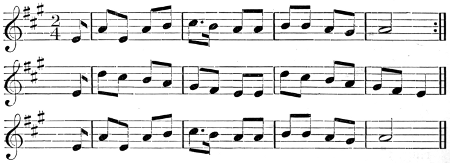
—Tean, North Staffs. (Miss Burne).
I.
They were two jolly fishermen,
They were two jolly fishermen,
They were two jolly fishermen,
And just come from the sea,
And just come from the sea.
They cast their nets into the sea,
And jolly fish caught we,
And jolly fish caught we,
And jolly fish caught we,
They cast their nets into the sea,
And jolly fish caught we.
—Tean and Cheadle, North Staffs. (Miss Burne).
II.
There was three jolly fishermen,
And they all put out to sea.
They cast their nets into the sea,
And the [three?] jolly fish caught we.
—North Staffs. Potteries (Mrs. Thomas Lawton).
(b) A circle is formed by joining hands, and two children
stand in the centre. They walk round. At the seventh line
the two in the centre each choose one child from the ring, thus
making four in the centre. They then sing the remaining four
lines. The two who were first in the centre then go out,
and the game begins again, with the other two players in the
centre.
(c) Miss Burne says this game is more often played as
“Three Jolly Fishermen.” At Cheadle, North Staffs., a few
miles distant from Tean, this game is played by grown-up
men and women.
I.
Here comes a [or one] jolly hooper,
Ring ding di do do,
Ring ding di do do.
And who are you looking for,
In a ring ding di do do,
In a ring ding di do do?
I am looking for one of your daughters,
In a ring ding di do do,
In a ring ding di do do.
What shall her name be,
In a ring ding di do do,
In a ring ding di do do?
Her name shall be [Sarah],
In a ring ding di do do,
In a ring ding di do do.
Sarah shall ramble,
In a ring ding di do do,
In a ring ding di do do,
All around the chimney [jubilee] pot in 1881.
—Deptford, Kent (Miss Chase).
II.
I’ve come for one of your daughters,
With a ring a ding a my dolly;
I’ve come for one of your daughters
On this bright shining night.
Pray, which have you come for,
With a ring a ding a my dolly?
Pray which have you come for
On this bright shining night?
I’ve come for your daughter Mary,
With a ring a ding a my dolly;
I’ve come for your daughter Mary
On this bright shining night.
Then take her, and welcome,
With a ring a ding a my dolly;
Then take her, and welcome,
On this bright shining night [incomplete].
—Sheffield (S. O. Addy).
(b) A number of children stand against a wall, and a row of
other children face them. They walk backwards and forwards,
singing the first and third verses. Then the children who are
standing still (against the wall) answer by singing the second
and fourth verses. When these are sung the moving line of
children take Mary and dance round, singing “some lines
which my informant,” says Mr. Addy, “has forgotten.”
(c) I have no description of the way Miss Chase’s game is
played. It, too, is probably an incomplete version. The words
“Ring ding di do do “show a possible connection between this
and games of the “Three Dukes a-riding” type. They may
or may not be variants of the same game.
See “Here comes a Lusty Wooer,” “Here comes a Virgin,”
“Jolly Rover,” “Three Dukes.”
[Play]
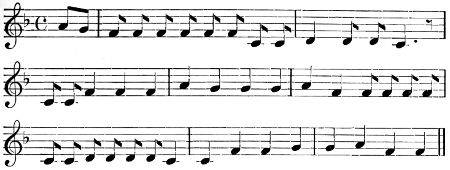
—Epworth, Doncaster (C. C. Bell).
[Play]
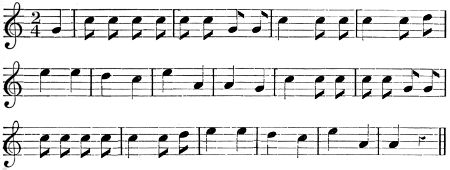
—Earls Heaton (H. Hardy).
[Play]
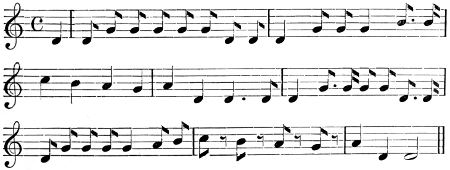
—Derbyshire (Mrs. Harley).
[290]
I.
There was a jolly miller, and he lived by himself,
As the wheel went round he made his pelf;
One hand in the hopper, and the other in the bag,
As the wheel went round he took his grab.
—Leicester (Miss Ellis).
II.
There was a jolly miller, he lived by himself,
As the mill went round he made his wealth;
One hand in the hopper, another in his bag,
As the wheel went round he made his grab.
—Liphook, Hants (Miss Fowler).
III.
There was a jolly miller, and he lived by himself,
As the wheel goes round he makes his wealth;
One hand in his hopper, and the other in his bag,
As we go round he makes his grab.
—Monton, Lancashire (Miss Dendy).
IV.
There was a jolly miller, and he lived by himself,
As the mill went round he gained his wealth;
One hand in the hopper, and the other in the bag,
As the mill went round he made his grab.
Sandy he belongs to the mill,
And the mill belongs to Sandy still,
And the mill belongs to Sandy.
—Addy’s Sheffield Glossary.
V.
There was a jolly miller, and he lived by himself,
As the wheel went round he made his wealth;
One hand in the upper and the other in the bank,
As the wheel went round he made his wealth.
—Earls Heaton, Yorks. (Herbert Hardy).
VI.
There was a jolly miller, and he lived by himself,
As the wheel went round he made his grab;
One hand in the other, and the other in the bag,
As the wheel went round he made his grab.
—Nottinghamshire (Miss Winfield).
[291]
VII.
There was a jolly miller, and he lived by himself (or by the Dee),
The sails went round, he made his ground;
One hand in his pocket, the other in his bag.
—North Staffs. Potteries (Miss A. A. Keary).
(b) This game requires an uneven number of players. All
the children except one stand in couples arm in arm, each
couple closely following the other. This forms a double ring or
wheel (fig. 1). The odd child stands in the centre. The children
forming the wheel walk round in a circle and sing the verse.
When they come to the word “grab,” those children standing
on the inside of the wheel leave hold of their partners’ arms,
and try to catch hold of the one standing immediately in front
of their previous partners. The child in the centre (or Miller)
tries (while they are changing places) to secure a partner and
place (fig. 2). If he succeeds in doing this, the one then left out
becomes the Miller. At Leicester the “odd” child, or “miller,”
stands outside the wheel or ring, instead of being in the centre,
and it is the outside children who change places. Mr. Addy,
in the Sheffield version, says, “The young men stand in the
outer ring, and the young women in the inner. A man stands
within the inner circle, quite near to it. The men try and grasp
the arm of the girl in front of them, and the man in the centre
also tries to grasp one; the man he displaces taking his place
as Miller. Then the three last lines are sung.”
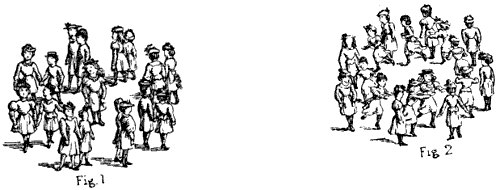
(c) Versions of this game, almost identical with the Leicester
version given here (with the exception that the word “wealth”
ends the second line instead of “pelf”), have been sent me
from East Kirkby, Lincolnshire (Miss K. Maughan); Epworth,
Doncaster (Mr. C. C. Bell); Settle, Yorks. (Rev. W. S. Sykes);
Derbyshire (Mrs. Harley); Redhill, Surrey (Miss G. Hope);
Ordsall, Nottinghamshire (Miss Matthews); Brigg, Lincolnshire
(Miss J. Barker); and there are other versions from
Hersham, Surrey (Folk-lore Record, v. 86); Cornwall (Folk-lore
Journal, v. 57); Derbyshire (Folk-lore Journal, i. 385);
Oswestry, Ellesmere (Shropshire Folk-lore, p. 512). Miss
Peacock sends a version which obtains at Lincoln, Horncastle,
Winterton, and Anderby, Lincolnshire, and in Nottinghamshire;
it is identical with the Liphook version. Two versions
from Sporle, Norfolk, which vary slightly from the Leicester,
have been sent by Miss Matthews. The versions given from
Lancashire, Yorks., Nottingham, and North Staffs. have been
selected to show the process of decadence in the game.
“Hopper” has first become “upper,” and then “other.” Of
the North Staffs. Potteries version Miss Keary says, “How it
ends I have never been able to make out; no one about here
seems to know either.” With the exception of these few
variants, it is singular how stereotyped the words of the rhyme
have become in this game.
(d) This game may owe its origin to the fact of the miller
in olden times paying himself in kind from the corn brought
to him to be ground. The miller is a well-known object of
satire in old ballads and mediaeval writers. It is, however,
probable that the custom which formerly prevailed at some of
the public festivals, of catching or “grabbing” for sweethearts
and wives, is shown in this game. For instance, to
account for a Scottish custom it is said that St. Cowie, patron
saint of two parishes of Campbeltown, proposed that all who
did not find themselves happy and contented in the marriage
state, should be indulged with an opportunity of parting and
making a second choice. For that purpose he instituted an
annual solemnity, at which all the unhappy couples in his
parish were to assemble at his church; and at midnight all
present were blindfolded and ordered to run round the church
at full speed, with a view of mixing the lots in the urn. The
moment the ceremony was over, without allowing an instant
for the people present to recover from their confusion, the word
“Cabbay” (seize quickly) was pronounced, upon which every
man laid hold of the first female he met with. Whether old
or young, handsome or ugly, good or bad, she was his wife till
the next anniversary of this custom (Guthrie’s Scottish Customs,
p. 168). Another old wedding superstition is alluded to by
Longfellow:—
“While the bride with roguish eyes,
Sporting with them, now escapes and cries,
‘Those who catch me, married verily this year will be.’”
See “Joggle Along.”[Addendum]
[Play version 1 (as printed), version 2]
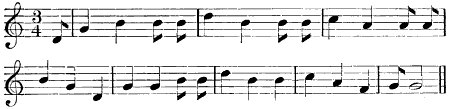
—Derbyshire (Mrs. Harley).
Here comes one jolly rover, jolly rover, jolly rover,
Here comes one jolly rover, jolly rover, jolly rover,
A roving all day.
And what do you rove for, rove for, rove for?
And what do you rove for?
Lily white and shining.
I rove for my pleasure, my pleasure, my pleasure,
I rove for my pleasure, my pleasure, my pleasure,
Lily white and shining.
And what is your pleasure, your pleasure, your pleasure?
What is your pleasure?
Lily white and shining.
My pleasure’s for to marry you, to marry you, to marry you,
My pleasure’s for to marry you,
Lily white and shining.
So through the kitchen and through the hall,
I choose the fairest of them all,
The fairest one that I can see
Is ——, so come to me.
—Derbyshire (Mrs. Harley).
(b) A long row of children walk to and fro. One child,
facing them on the opposite side, represents the Rover. He
sings the first, third, and fifth verses. The row of children
sing the second and fourth in response. After the fifth verse
is sung the Rover skips round the long row, singing the sixth
verse to the tune of “Nancy Dawson,” or “Round the Mulberry
bush.” He chooses one of them, who goes to the
opposite side with him, and the game goes on until all are
rovers like himself.
See “Here comes a Lusty Wooer,” “Jolly Hooper.”
I.
Here comes one [some] jolly, jolly sailor boy,
Who lately came on shore;
He [they] spent his time in drinking wine
As we have done before.
We are the Pam-a-ram-a-ram,
We are the Pam-a-ram-a-ram,
And those who want a pretty, pretty girl,
Must kiss her on the shore,
Must kiss her on the shore.
—Warwick (from a little girl, through Mr. C. C. Bell).
II.
He was a jolly, jolly sailor boy,
Who had lately come ashore;
He spent his time in drinking wine
As he had done before.
Then we will have a jolly, jolly whirl,
Then we will have a jolly, jolly whirl,
And he who wants a pretty little girl
Must kiss her on the shore.
—Forest of Dean, Gloucestershire (Miss Matthews).
[295]
III.
Here comes one jolly sailor,
Just arrived from shore,
We’ll spend our money like jolly, jolly joes,
And then we’ll work for more.
We’ll all around, around and around,
And if we meet a pretty little girl
We’ll call her to the shore.
—Northants (Rev. W. D. Sweeting).
IV.
Here comes four jolly sailor boys,
Just lately come ashore;
They spend their days in many merry ways,
As they have done before.
Round, round the ring we go,
Round, round the ring,
And he that choose his bonny, bonny lass
Must kiss her on the floor.
—Raunds (Northants Notes and Queries, i. 232).
V.
Here come three jolly, jolly, jolly boys
As lately come from shore;
We will spend our time on a moonlight night
As we have done before.
We will have a round, a round, a round,
We will have a round, a round, a round;
Let the lad that delights in a bonny, bonny lass,
Let him kiss her on the ground.
—Earls Heaton, Yorks. (Herbert Hardy).
VI.
Here comes three jolly, jolly sailors,
Just arrived on shore;
We’ll spend our money like merry, merry men,
And then we’ll work for more.
Hurrah for the round, round ring,
Hurrah for the round, round ring;
And he that loves a pretty, pretty girl,
Let him call her from the ring.
—Shipley, Horsham (Notes and Queries,
8th series, i. 210, Miss Busk).
(b) This game is played at Warwick as follows:—The children
form a large ring, clasping hands and standing still.
One child walks round inside the ring, singing the verses.
This child then chooses another from the ring, bending on one
knee and kissing her hand. The lines are then repeated, the
two walking arm in arm round the inside of the ring. Another
child is chosen out of the ring by the one who was chosen
previously. This goes on until all are chosen out of the ring,
walking two by two round inside. When the ring will no
longer hold them, the two walk round outside. At Northants
the ring walks round, and the child is outside the ring.
Partners are chosen, and the two walk round outside the ring.
The first two walk together till there is a third, then the three
walk together till there is a fourth, then they go in couples.
In the Northants version, from Raunds, four boys stand in the
centre of the ring. When the verses are sung they choose
four girls, and then take their places in the ring. The four
girls then choose four lads, and so on. At Earls Heaton the
children stand against a wall in a line. Another child walks
up and down singing the verses, and chooses a partner. He
spreads a handkerchief on the ground, and they kneel and
kiss.
(c) The Shipley version is a “Kiss in the Ring” game.
A version sent by the Rev. W. Slater Sykes from Settle,
Yorkshire, is almost identical with the Earls Heaton version.
Northall (Folk Rhymes, p. 369) says “to kiss on the floor”—i.e.,
not in secret. He gives the words of a sort of
musical catch, sung in the Midlands, similar in character to
this game, which may once have been used in some courting
game. Mr. Newell (Games, p. 124) gives a version sung in
the streets of New York, and considers it to be a relic of
antiquity, a similar round being given in Deuteromelia, 1609.[Addendum]
A game played by boys, much the same as “Hockey,”
and taking its name, no doubt, from the mode of playing,
which consists in striking a wooden ball or knorr from the
ground in any given direction with a sufficiently heavy
stick, duly curved at the striking end.—Atkinson’s Cleveland
Glossary.
It is also given in Yorkshire Glossary (Whitby).
See “Bandy,” “Doddart,” “Hockey.”
A game played with a hazel nut bored and run upon a
string.—Dickinson’s Cumberland Glossary.
Probably the same game as “Conkers.”
See “Conkers.”
Brockett mentions that a friend informed him that he had
seen a game played amongst children in Northumberland the
subject of which was “Keeling the Pot.” A girl comes in
exclaiming, “Mother, mother, the pot’s boiling ower.” The
answer is, “Then get the ladle and keel it.” The difficulty is
to get the ladle, which is “up a height,” and the “steul” wants
a leg, and the joiner is either sick or dead (Glossary North
Country Words). A sentence from Love’s Labours Lost,
“While greasy Joan doth keel the pot,” illustrates the use of
the term “keel.”
See “Mother, Mother, the Pot Boils over.”
In former times it was customary every year, at Easter and
Whitsuntide, for the mayor, aldermen, and sheriff of Newcastle,
attended by the burgesses, to go in state to a place called the
Forth, a sort of mall, to countenance, if not to join in the
play of “Keppy ba” and other sports. This diversion is still
in part kept up by the young people of the town (Brockett’s
North Country Words). It is also mentioned in Peacock’s
Manley and Corringham Glossary, and in Ross and Stead’s
Holderness Glossary.
Mr. Tate (History of Alnwick) says that a favourite pastime
of girls, “Keppy ball,” deserves a passing notice, because accompanied
by a peculiar local song. The name indicates the
character of the game; “kep” is from cepan, Anglo-Saxon,
“kappan,” Teut., “to catch or capture;” for when the game
was played at by several, the ball was thrown into the air and
“kepped,” or intercepted, in its descent by one or other of the
girls, and it was then thrown up again to be caught by some
other. But when the song was sung it was played out by one
girl, who sent the ball against a tree and drove it back again as
often as she could, saying the following rhymes, in order to
divine her matrimonial future:—
Keppy ball, keppy ball, Coban tree,
Come down the long loanin’ and tell to me,
The form and the features, the speech and degree
Of the man that is my true love to be.
Keppy ball, keppy ball, Coban tree,
Come down the long loanin’ and tell to me
How many years old I am to be.
One a maiden, two a wife,
Three a maiden, four a wife, &c.
The numbers being continued as long as the ball could be kept
rebounding against the tree.
The following from Halliwell’s Nursery Rhymes, p. 298, is
also used for ball divination. To “cook” is to toss or throw.
Cook a ball, cherry tree;
Good ball, tell me
How many years I shall be
Before my true love I do see?
One and two, and that makes three;
Thankee, good ball, for telling of me.
See “Ball,” “Cuckoo,” “Monday.”
This game was played at Stixwold seventy years ago. It
resembled “Trap, Bat, and Ball.” Kibel = bat, ner = ball of
maplewood, spel = trap, with a limock (pliant) stick fastened to
it. The score was made by hitting the ner a certain distance,
but not by the striker running, as in “Rounders.”—Miss M.
Peacock.
See “Nur and Spell.”
[299]
“A playe that children have, where one sytting blyndefolde in
the midle, bydeth so tyll the rest have hydden themselves, and
then he going to seeke them, if any get his place in the meane
space, that same is kynge in his roome.”—Huloet, 1572.
See “Hide and Seek.”
One player is chosen to be King Cæsar by lot or naming.
All the others stand in two rows, one row at each end of the
ground. A line is drawn on the ground in front of them to
mark “dens.” All the players must keep within this line.
King Cæsar stands in the middle of the ground. Any number
of the players can then rush across the ground from one den
to another. King Cæsar tries to catch one as they run. When
he catches a boy he must count from one to ten in succession
before he leaves hold of the boy, that boy in the meantime
trying to get away. If King Cæsar succeeds in holding a boy,
this boy stays in the centre with him and assists in catching the
other players (always counting ten before a captive is secured).
The dens must always be occupied by some players. If all
the players get into one den, King Cæsar can go into the empty
den and say, “Crown the base, one, two, three,” three times
before any of the other players get across to that den. If he
succeeds in doing this, he can select a boy to run across from
one den to the other, which that boy must do, King Cæsar
trying to catch him. Other and bigger boys can help this one
to get across, to save him from being captured, either by carrying
him or running across with him. The game ends when
all have been captured and are in the centre. King Cæsar
and the other captured boys can leave the centre if they each
successively catch three players.—Barnes (A. B. Gomme).
This game is called “King-sealing” in Dorsetshire.
See “King of Cantland,” “Lamploo.”
A game played by boys. Two sets of boys, or sides, strive
which can secure most prisoners for the King.—Shetland
(Jamieson).
[300]
A game of children, in which one of a company, being chosen
King o’ Cantland, and two goals appointed at a considerable
distance from each other, all the rest endeavoured to run from
one goal to the other; and those whom the King can seize in
their course, so as to lay his hand upon their heads (which
operation is called winning them), become his subjects, and
assist him in catching the remainder.—Dumfries (Jamieson).
Jamieson adds: “This game is called ‘King’s Covenanter’ in
Roxburgh.” He also refers to the game of “King and Queen
of Cantelon,” recorded by Mactaggart. He considers the origin
of this game to be representative of the contentions about the
“Debatable Lands” on the border. This game was played at
University Coll. School, London, under the name of “Kings”
(A. Nutt).
See “How many miles to Barley Bridge?” “King Cæsar.”
One boy is chosen as King. He mounts on any convenient
height, a knoll, or dyke, or big stone, and shouts—
A’m King o’ the Castle,
An’ fah (who) ’ll ding (knock) me doon?
The players make a rush at the King, and try to pull him down.
A tussle goes on for a longer or a shorter time, according to
the strength of the King and his skill in driving off his assailants.
The boy that displaces the King becomes King, and is
in his turn assaulted in the same way. The game may go on
for any length of time. Another form of words is—
I’m the King o’ the Castle,
An’ nane can ding me doon.
—Keith (Rev. W. Gregor).
Other words sung by the Scotch children are—
I, Willy Wastle,
Stand on my castle,
And a’ the dogs o’ your toon
Will no drive Willie Wastle doon.
Chambers (Popular Rhymes, p. 114) records the tradition
that when Oliver Cromwell lay at Haddington he sent to require
the governor of Home Castle, in Berwickshire, to surrender;
the governor is said to have replied in the above quatrain of
juvenile celebrity.
The London version is for the boys to run up a hillock,
when one of them declares as follows—
I’m the King of the Castle;
Get down, you dirty rascal,
whereupon he pushes down his companions. If another boy
succeeds in getting his place he becomes King, and repeats the
doggerel (G. L. Gomme). This is a very popular boys’ game.
Newell (Games, 164) mentions it as prevalent in Pennsylvania.
See “Tom Tiddler’s Ground.”
The players are a King and his three sons named White
Cap, Red Cap, Brown Cap. Red Cap says, “Plaster Palacey
had a son, whose name was old daddy White Cap.” White
Cap, in an injured voice, says, “Me, sir?” The King says,
“Yes, sir.” White Cap answers, “You’re a liar, sir.” The
King then says, “Who then, sir?” White Cap answers,
“Old daddy Red Cap.”—Deptford, Kent (Miss Chase).
The game as given above is obviously incomplete, and no
description as to how the game was played was sent me.
Newell (Games, p. 145), describes a game, “The Cardinal’s Hat,”
which is probably a variant of the original game, of which
the above is only a fragment. I remember once witnessing
a game in which a ball was passed from player to player, and
in which the dialogue was similar. When one player was told
that the ball was in his possession, the answer was, “What,
me, sir?” “Yes, you, sir.” “Not I, sir.” “Who then, sir?”
“White Cap, sir;” the questions and answers were again
repeated for Red Cap, and Blue Cap. When it was Black
Cap’s turn, I think the ball was thrown by this player to some
one else; whoever was hit by the ball had to chase and capture
one, who became questioner; but my recollection of the game
is too slight for me to be certain either of the dialogue or the
way the game terminated (A. B. Gomme). A game described
in Suffolk County Folk-lore, p. 62, is apparently a version of
this. It is there described as a forfeit game.
[302]
[Play]
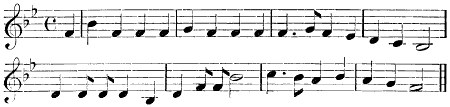
—Earls Heaton, Yorks. (H. Hardy).
I.
King William was King David’s son,
And all the royal race is run;
Choose from the east, choose from the west,
Choose the one you love the best.
Down on this carpet you shall kneel
While the grass grows in yonder field;
Salute your bride and kiss her sweet,
Rise again upon your feet.
—Hanging Heaton, Yorks. (H. Hardy).
II.
King William was King David’s son,
All the royal race is run;
Choose from the east, choose from the west,
Choose the one that you love best;
If she’s not here to take her part,
Choose another with all your heart.
—Sheffield (S. O. Addy).
(b) In Sheffield a ring of young men and women is formed.
A man goes inside the ring and walks round within it, whilst the
others sing the verse. The young man then chooses a sweetheart,
and the two walk round arm-in-arm within the ring,
whilst the same verses are sung. When the singing is ended,
the girl picks a young man, and so they all pair off.
(c) Mr. Addy entitles this game “Kiss in the Ring.” It
appears, however, from this description to lack the two
principal elements of most “kiss-in-the-ring” games—the
chase between pursued and pursuer, and the kissing in the
ring when the capture is made. In the Hanging Heaton
version two children kneel and kiss in the middle of the ring.
Mr. Newell (Games, p. 73), in describing a game with a similar
rhyme, mentions a version which had been sent him from
Waterford, Ireland. He says, “We learn from an informant
that in her town it was formerly played in this peculiar manner.
Over the head of a girl who stood in the centre of a ring was
held a shawl, sustained by four others grasping the corners.”
The game then proceeded as follows—
King William was King George’s son,
From the Bay of Biscay O!
Upon his breast he wore a star—
Find your way to English schools.
Down on the carpet you must kneel;
As the grass grows in the field,
Salute your bride and kiss her sweet,
And rise again upon your feet.
Then followed the game-rhyme, repeated with each stanza—
Go choose you east, go choose you west,
apparently the same as last four lines of Sheffield version.
King William is then supposed to enter—
The first girl that I loved so dear,
Can it be she’s gone from me?
If she’s not here when the night comes on,
Will none of you tell me where she’s gone?
He then recognises the disguised girl—
There’s heart beneath the willow tree,
There’s no one here but my love and me.
“He had gone to the war, and promised to marry her when
he came back. She wrapped a shawl about her head to see if
he would recognise her.” This was all the reciter could
recollect; the lines of the ballad were sung by an old woman,
the ring answering with the game-rhyme.
This version seems to indicate clearly that in this game we
have preserved one of the ceremonies of a now obsolete
marriage-custom—namely, the disguising of the bride and
placing her among her bridesmaids and other young girls, all
having veils or other coverings alike over their heads and
bodies. The bridegroom has to select from among these
maidens the girl whom he wished to marry, or whom he had
already married, for until this was done he was not allowed
to depart with his bride. This custom was continued in sport
as one of the ceremonies to be gone through after the marriage
was over, long after the custom itself was discontinued. For
an instance of this see a “Rural Marriage in Lorraine,” in
Folk-lore Record, iii. 267-268. This ordeal occurs in more
than one folk-tale, and it usually accompanies the incident
of a youth having travelled for adventures, sometimes in quest
of a bride. He succeeds in finding the whereabouts of the
coveted girl, but before he is allowed by the father to take
his bride away he is required to perform tasks, a final one
being the choosing of the girl with whom he is in love from
among others, all dressed alike and disguised. Our bridal veil
may probably originate in this custom.
In the ballad from which Mr. Newell thinks the game may
have originated, a maid has been given in marriage to another
than her chosen lover. He rides to the ceremony with a troop
of followers; the bride, seeing him approach, calls on her
maidens to “take off her gold crown and coif her in linen
white,” to test her bridegroom’s affection. This incident, I
think, is not to test “affection,” but the ordeal of recognising
his bride, however disguised, and the fact that “the hero at
once recognises his love, mounts with her on horseback, and
flees to Norway,” may be considered to support my view.
See also Brand, vol. ii. p. 141, under “Care Cloth.”
Two children join hands, by crossing their arms, so as to
form a seat. A third mounts on the crossed arms, and clasps
the carriers round their necks, while they move on saying—
King, King Cairy (carry)
London lairy,
Milk an bread,
In the King’s chairie.
This game is played at Keith, without the words. The
words are used at Fochabers.—Rev. W. Gregor.
Jamieson says, “Lothian children, while carrying one of
their number in this manner, repeat the following rhyme—
Lend me a pin to stick i’ my thumb,
To carry the lady to London town.”
He says this method of carrying is often used as a substitute
for a chair in conveying adult persons from one place to another,
especially when infirm. In other counties it is called “Queen’s
Cushion” and “Queen’s Chair,” also “Cat’s Carriage.”
Brockett (North Country Words) says, “‘King’s Cushion,’ a
sort of seat made by two persons crossing their hands, in which
to place a third. The thrones on the reverses of the early
Royal Seals of England and Scotland consist of swords, spears,
snakes, &c., placed in the manner of a ‘King’s Cushion.’”
The method used is for both children to grasp the wrist of
his left hand with the right, while he lays hold of the right
wrist of his companion with his left hand. This way of
hoisting or carrying is still used by schoolboys when they
desire to honour a boy who has distinguished himself in the
playground or schoolroom.
See “Carry my Lady to London.”
A sort of play. The Gussie is a large ball, which one party
endeavours to beat with clubs into a hole, while another party
strives to drive it away. When the ball is lodged in the hole
it is said to be “Kirkit.”—Jamieson.
[Play]
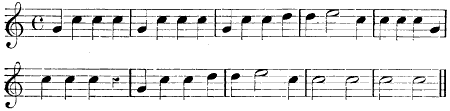
—Nottingham (Miss Youngman).
[Play]
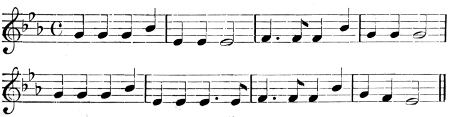
—Lancashire (Mrs. Harley).
[306]
[Play]
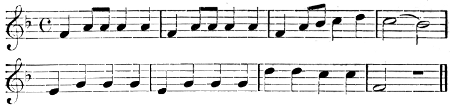
—Earls Heaton, Yorks. (H. Hardy).
I.
I sent a letter to my love,
And on the way I dropped it;
And one of you have picked it up
And put it in your pocket.
—Dorsetshire (Folk-lore Journal, vii. 213);
Penzance (Mrs. Mabbott).
II.
I wrote a letter to my love, and on the way I lost it.
Some one has picked it up. Not you, not you (&c.), but you!
—Much Wenlock (Shropshire Folk-lore, p. 512).
III.
I lost my supper last night, and the night before,
And if I lose it this night, I shall never have it no more.
—Berrington (Shropshire Folk-lore, p. 512).
IV.
I’ve come to borrow the riddle (= sieve),
There’s a big hole in the middle.
I’ve come to borrow the hatchet,
Come after me and catch it.
—Chirbury (Shropshire Folk-lore, p. 512).
V.
Down by the greenwood, down by the greenwood,
Down by the greenwood tree,
One can follow, one can follow,
One can follow me.
Where must I follow? where must I follow?
Follow, follow me.
Where must I follow? where must I follow?
Follow, follow me.
—Earls Heaton (H. Hardy).
VI.
Mr. Monday was a good man,
He whipped his children now and then;
When he whipped them he made them dance,
Out of Scotland into France;
Out of France into Spain,
Back to dear old England again.
O-u-t spells “out,”
If you please stand out.
I had a little dog and his name was Buff,
I sent him after a penn’orth of snuff,
He broke the paper and smelled the snuff,
And that’s the end of my dog Buff.
He shan’t bite you—he shan’t bite you—he shan’t bite you, &c., &c.—he shall bite you all over.
—Dorsetshire (Folk-lore Journal, vii. 213).
VII.
I sent a letter to my love,
I carried water in my glove,
And by the way I dropped it.
I did so! I did so!
I had a little dog that said “Bow! wow!”
I had a little cat that said “Meow! meow!”
Shan’t bite you—shan’t bite you—
Shall bite you.
—Cornwall (Folk-lore Journal, v. 52).
VIII.
I sent a letter to my love,
I carried water in my glove,
I dript it, I dropped it, and by the way I lost it.
—Hersham, Surrey (Folk-lore Record, v. 87).
IX.
I have a pigeon in my pocket,
If I have not lost it;
Peeps in, peeps out,
By the way I’ve lost it;
Drip, drop,
By the way I’ve lost it.
—Earls Heaton (H. Hardy).
X.
I have a pigeon in my pocket,
It peeps out and in,
And every time that I go round
I give it a drop of gin.
Drip it, drop it, drip it, drop it.
—Settle, Yorkshire (Rev W. S. Sykes).
[308]
XI.
I sent a letter to my love,
I thought I put it in my glove,
But by the way I dropped it.
I had a little dog said “Bow, wow, wow!”
I had a little cat said “Mew, mew, mew!”
It shan’t bite you,
It shall bite you.
—Bexley Heath (Miss Morris).
XII.
I sent a letter to my love,
And by the way I droppt it;
I dee, I dee, I dee, I droppt it,
And by the way I droppt it.
—Keith (Rev. W. Gregor).
XIII.
I had a little dog, it shan’t bite you,
Shan’t bite you, shan’t bite you,
Nor you, nor you, nor you.
I had a little cat, it shan’t scratch you,
Shan’t scratch you, nor you, nor you.
I wrote a letter to my love, and on the way I dropped it.
And one of you have picked it up and put it in your pocket.
It wasn’t you, it wasn’t you, nor you, nor you, but it was you.
—London (A. B. Gomme).
XIV.
I have a little dog and it lives in my pocket.
It shan’t bite you, &c.
Now you’re married I hope you’ll enjoy
First a girl and then a boy;
Seven years gone, and two to come,
So take her and kiss her and
Send her off home.
—Wolstanton, North Staffs. Potteries
(Miss A. A. Keary).
(b) In Dorsetshire a ring is formed by all the players joining
hands except one. The odd player, carrying a handkerchief,
commences to walk slowly round the outside of the ring,
repeating the words; then, touching each one with her handkerchief
as she passes, she says, “Not you,” “not you,” “not
you,” &c., &c., till the favoured individual is reached, when it
is changed to “But you!” and his or her shoulder lightly
touched at the same time. The first player then runs round
the ring as fast as he can, pursued by the other, who, if a
capture is effected (as is nearly always the case), is entitled
to lead the first player back into the centre of the ring and
claim a kiss. The first player then takes the other’s place in
the ring, and in turn walks round the outside repeating the
same formula.—Folk-lore Journal, vii. 212; Penzance (Mrs.
Mabbott).
In Shropshire, as soon as the player going round the ring
has dropped the handkerchief on the shoulder of the girl he
chooses, both players run opposite ways outside the ring, each
trying to be the first to regain the starting-point. If the one
who was chosen gets there first, no kiss can be claimed. It is
often called “Drop-handkerchief,” from the signal for the chase.
The more general way of playing (either with or without words),
as seen by me on village greens round London, is, when the
handkerchief has been dropped, for the player to dart through
the ring and in and out again under the clasped hands; the
pursuer must follow in and out through the same places, and
must bring the one he catches into the ring before he can
legally claim the kiss.
Elworthy (West Country Words), in describing this game,
says: “The person behind whom the handkerchief is dropped
is entitled to kiss the person who dropped it, if he or she can
catch him or her, before the person can get round the ring to
the vacant place. Of course, when a girl drops it she selects a
favoured swain, and the chase is severe up to a point, but when
a girl is the pursuer there often is a kind of donkey race lest
she should have to give the kiss which the lad takes no pains
to avoid.” Mr. Elworthy does not mention any words being
used, and it is therefore probable that this is the “Drop-handkerchief”
game, which generally has no kissing. It also, in
the way it is played, resembles “French Jackie.” In the
Wolstanton game, Miss Keary says: “If the owner of the
handkerchief overtakes the one who is bitten as they run round,
they shake hands and go into the middle of the ring, while the
others sing the marriage formula.” In Berkshire (Antiq. xxvii.
255) the game is played without words, and apparently no
handkerchief or other sign is used. Miss Thoyts says the
young man raises his hat when he embraces the young woman
of his choice. To “throw (or fling) the handkerchief” is a
common expression for an expected proposal of marriage
which is more of a condescension than a complimentary or
flattering one to the girl. “Kiss in the Ring” is probably a
relic of the earliest form of marriage by choice or selection.
The custom of dropping or sending a glove as the signal of
a challenge may have been succeeded by the handkerchief in
this game. Halliwell, p. 227, gives the game of “Drop Glove,”
in which a glove is used. For the use of handkerchiefs as
love-tokens see Brand, ii. 92.
See “Drop Handkerchief,” “French Jackie.”
A game played by boys. Three small holes are made in
the ground, triangularly about twenty feet apart, to mark the
position of as many boys, each of whom holds a small stick,
about two feet long. Three other boys of the adverse side
pitch successively a piece of stick, a little bigger than one’s
thumb, called Cat, to be struck by those holding the sticks.
On its being struck, the boys run from hole to hole, dipping
the ends of their sticks in as they pass, and counting one,
two, three, &c., as they do so, up to thirty-one, which is
game. Or the greater number of holes gained in the innings
may indicate the winners, as at cricket. If the Cat be
struck and caught, the striking party is out, and another of
his sidesmen takes his place, if the set be strong enough to
admit of it. If there be only six players, it may be previously
agreed that three put outs shall end the innings. Another
mode of putting out is to throw the Cat home, after being
struck, and placing or pitching it into an unoccupied hole,
while the in-party are running. A certain number of misses
(not striking the Cat) may be agreed on to be equivalent to
a put out. The game may be played by two, placed as at
cricket, or by four, or I believe more.—Moor’s Suffolk Words;
Holloway’s Dict. of Provincialisms.
Brockett (North Country Words, p. 115) calls this “‘Kitty-Cat,’
a puerile game.
Then in his hand he takes a thick bat,
With which he used to play at ‘Kit-Cat’”
—Cotton’s Works, 1734, p. 88.
See “Cat and Dog,” “Cudgel,” “Munshets,” “Tip-Cat.”
A sedentary game, played by two, with slate and pencil, or
pencil and paper. It is won by the party who can first get
three marks (o’s or x’s) in a line; the marks being made
alternately by the players o or x in one of the nine spots
equidistant in three rows, when complete. He who begins
has the advantage, as he can contrive to get his mark in the
middle.—Moor’s Suffolk Words.
The same game as “Nought and Crosses,” which see.
A game mentioned but not described by a writer in Blackwood’s
Magazine, August 1821, as played in Edinburgh. He
mentions that the terms “hot” and “cold” are used in the
game. The game of “Hide and Seek.”—Jamieson.
One boy takes another by the feet, one foot over each
shoulder, with his head downwards and his face to his back,
and sets off running as fast as he can. He runs hither and
thither till one or other of the two gets tired.—Keith (Rev. W.
Gregor).
Two big boys take two smaller ones on their shoulders. The
big boys act as horses, while the younger ones seated on their
shoulders try to pull each other over. The “horses” may
push and strike each other with their shoulders, but must not
kick or trip up with their feet, or use their hands or elbows.
The game is usually won by the Horse and Knight who
throw their opponents twice out of three times (G. L. Gomme).
Strutt (Sports, p. 84) describes this, and says, “A sport of
this kind was in practice with us at the commencement of the
fourteenth century.” He considers it to bear more analogy to
wrestling than to any other sport. He gives illustrations, one
of which is here reproduced from the original MS. in the
British Museum. The game is also described in the Rev. J.
G. Wood’s Modern Playmate, p. 12.
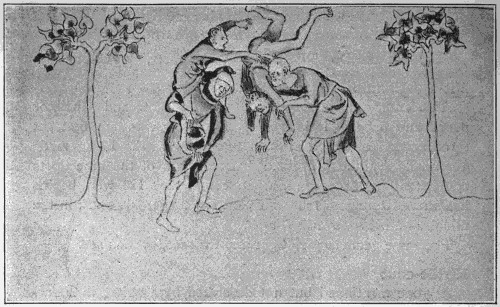
The girl who spoke of this game, says Miss Peacock, could
only remember its details imperfectly, but as far as she recollects
it is played as follows:—The players dance round a centre
child, leaving one of their number outside the circle. The
dancers sing to the one in their midst—
Here comes ——,
He knocked at the rapper, and he pulled at the string,
Pray, Mrs. ——, is —— within?
At “is —— within,” the child outside the circle is named.
The centre child says—
O no, she has gone into the town:
Pray take the arm-chair and sit yourself down.
The ring of children then sing—
O no, not until my dearest I see,
And then one chair will do for we.
Then all sing—
My elbow, my elbow,
My pitcher, and my can:
Isn’t —— —— a nice young girl?
Mentioning the supposed sweetheart.
Isn’t —— —— as nice as she?
Mentioning the outside child.
They shall be married when they can agree.
Then the inside and outside children each choose a companion
from the circle, and the rest repeat:—
When the words have been sung a second time, the four
children kiss, and the two from the circle take the places of
the other, after which change the game begins again.—North
Kelsey, Lincolnshire (Miss M. Peacock).
See “Nur and Spell.”
A game of marbles (undescribed).—Patterson’s Antrim and
Down Glossary.
See “Lag.”
[Play version 1, version 2]
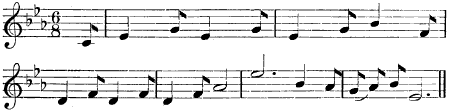
—Tong, Shropshire (Miss R. Harley).
I.
Here comes the lady of the land,
With sons and daughters in her hand;
Pray, do you want a servant to-day?
What can she do?
She can brew, she can bake,
She can make a wedding cake
Fit for you or any lady in the land.
Pray leave her.
I leave my daughter safe and sound,
And in her pocket a thousand pound,
And on her finger a gay ring,
And I hope to find her so again.
—Somerset and Dorset Notes and Queries, i. 133.
II.
There camed a lady from other land,
With all her children in her hand—
Please, do you want a sarvant, marm?
Leave her.
I leaves my daughter zafe and zound,
And in her pocket a thousan pound,
And on her finger a goulden ring,
And in her busum a silver pin.
I hopes when I return,
To see her here with you.
Don’t’e let her ramble; don’t’e let her trot;
Don’t’e let her car’ the mustard pot.
The Mistress says softly—
She shall ramble, she shall trot,
She shall carry the mustard pot.
—Dorset County Chronicle, April 1889;
Folk-lore Journal, vii. 228.
III.
Here comes an old woman from Baby-land,
With all her children in her hand.
Pray take one of my children in.
[Spoken]
What can your children do?
[Sung]
One can bake, one can brew,
And one can bake a lily-white cake.
One can sit in the parlour and sing,
And this one can do everything.
—Tong, Shropshire (Miss R. Harley).
[315]
IV.
Here comes a poor woman from Baby-land
With three small children in her hand.
One can brew, the other can bake,
The other can make a pretty round cake.
One can sit in the garden and spin,
Another can make a fine bed for the king;
Pray, ma’am, will you take one in?
—Halliwell’s Nursery Rhymes, p. 72.
V.
Here is a poor widow from Sandy Row,
With all her children behind her.
One can knit and one can sew,
And one can make the winder go.
Please take one in.
Now poor Nellie she is gone
Without a farthing in her hand,
Nothing but a guinea gold ring.
Good-bye, Nellie, good-bye!
—Belfast (W. H. Patterson).
VI.
Here comes an old woman from Baby-land,
With six poor children by the hand.
One can brew, one can bake,
And one can make a lily-white cake;
One can knit, one can spin,
And one can make a bed for a king.
Please will you take one in? [choose out one]
Now poor —— she is gone
Without a farthing in her hand,
Nothing but a gay gold ring.
Good-bye! Good-bye!
Good-bye, mother, good-bye!
—Isle of Man (A. W. Moore)
VII.
Here comes a poor widow from Sandalam,
With all her children at her hand;
The one can bake, the other can brew,
The other can make a lily-white shoe;
Another can sit by the fire and spin,
So pray take one of my daughters in.
The fairest one that I can see
Is pretty [Mary] come to me.
And now poor [Mary] she is gone
Without a guinea in her hand,
And not so much as a farthing. Good-bye!
Good-bye, my love, good-bye!
—Forest of Dean, Gloucester (Miss Matthews).
VIII.
Here comes an old woman from Cumberland,
With seven poor children in her hand;
One can sing, the other can sew;
One can sit up in the corner and cry, Alleluia!
Choose the fairest you can see.
The fairest one that I can see is ——, come to me.
Now my daughter —— gone,
A thousand pound in her pocket and a gold ring on her finger.
Good-bye, mother, good-bye!
—Berkshire (Miss Thoyts, Antiquary, xxvii. 254).
IX.
There was an old woman from Sandyland
With all her children in her hand.
One can knit and one can sow [sew],
One can make a lily-white bow.
Please take one in.
When all the children have been taken in, the Old Woman
says—
There was an old woman from Sandiland
With no children by the hand.
Will you give me one?
—Ballynascaw School, co. Down (Miss C. N. Patterson).
(b) The first Dorsetshire game is played as follows:—Two
girls are chosen, the one to represent a lady and the other a
mother, who is supposed to be taking her children out to service.
She has one or more of them in each hand, and leads them up
to the lady, saying or singing the first verse. The dialogue
then proceeds, and the verse is repeated until all the children
are similarly disposed of. A few days are supposed to pass,
after which the mother calls to see her children, when the lady
tells her she cannot see them. At last she insists upon seeing
them, and the children are all “sat down” behind the lady,
and the mother asks one child what the lady has done to her;
and she tells her “that the lady has cut off her nose, and made
a nose-pie, and never give her a bit of it.” Each one says she
has done something to her and made a pie, and when all have
told their tale “they all turn on her and put her to prison.”
The second Dorsetshire game somewhat differs. One child
takes seven or eight others whom she pretends are her children.
Another child, presumably a mistress in want of servants,
stands at a distance. The first child advances, holding the
hand of her children, saying the first verse. The dialogue
is concluded, and as the woman and her children are supposed
to be out of hearing, the last couplet is said or sung. This
process is gone through again until the mistress has engaged
all the children as her servants, when she is supposed to let
them all out to play with the mustard pots, which are represented
by sticks or stones, in their hands.
The other versions are played as follows:—The children
form a line, the one in the middle being the mother, or widow;
they advance and retire, the mother alone singing the first verse.
One child, who is standing alone on the opposite side, who
has been addressed by the widow, then asks [not sings] the
question. The mother, or widow, sings the reply, and points
to one child when singing the last line, who thereupon crosses
over to the other side, joining the one who is standing alone.
This is continued till all have been selected. The Ballynascaw
version (Miss Patterson) is played in a similar way.
One child sits on a bank, and the others come up to her in a
long line. The “old woman” says the first five lines. No
question is asked by the “lady,” she simply takes one child.
The “old woman” shakes hands with this child, and says
good-bye to her. When all the children have been “taken in”
by the one who personates the “lady,” the “old woman” says
the other three lines, and so one by one gets all the children
back again. The Berkshire version (Miss Thoyts) is said, not
sung, and is played with two leaders, “old woman” and “lover.”
As the lover chooses a child, that one is sent behind him,
holding round his waist. Each child as she goes says, “Good-bye,
mother, good-bye,” and pretends to cry. Finally they all
cry, and the game ends in a tug of war. This tug is clearly
out of place unless only half the children are selected by one
side. Miss Thoyts does not say how this is done.
(c) This game is called “School-teacher” in Belfast. The
corruption of “Lady of the Land,” to “Babyland,” “Babylon,”
and “Sandiland,” is manifest. It appears to be only fragmentary
in its present form, but the versions undoubtedly indicate
that the origin of the game arises from the practice of hiring
servants. Mr. Halliwell has preserved another fragmentary
rhyme, which he thinks may belong to this game.
I can make diet bread
Thick and thin,
I can make diet bread
Fit for the king; (No. cccxliv.)
which may be compared with the rhyme given by Chambers
(Popular Rhymes, p. 136), and another version given by
Halliwell, p. 229.
If these rhymes belong to this game it would have probably
been played by each child singing a verse descriptive of
her own qualifications, and I have some recollection, although
not perfect, of having played a game like this in London,
where each child stated her ability to either brew, bake, or
churn. It is worth noting that the Forest of Dean and
Berkshire versions have absorbed one of the “selection”
verses of the love-games. Mr. Halliwell, in recording the
Nursery Rhymes, Nos. cccxliii. and cccxliv., as quoted above,
says, “They are fragments of a game called ‘The Lady of
the Land,’ a complete version of which has not fallen in my
way.” Mr. Udal’s versions from Dorsetshire are not only
called “The Lady of the Land,” but are fuller than all the
other versions, though probably these are not complete. Mr.
Newell (Games, pp. 56-58) gives some versions of this game.
He considers the original to have been a European game (he
had not found an English example) in which there were two
mothers, a rich and a poor one; one mother begging away, one
by one, all the daughters of the other.
(d) This game no doubt originates from the country practice
of hiring servants at fairs, or from a dramatic “Hirings” being
acted at Harvest Homes. The “Good-bye” of mother and
daughters belongs, no doubt, to the original game and early
versions, and is consistent with the departure of a servant to her
new home. The “lover” incident is an interpolation, but there
may have been a request on the part of the “mother” to the “lady”
not to allow the girl followers or sweethearts too soon. As to
the old practice of hiring servants, Miss Burne has noted how
distinctly it stamps itself upon local custom (Shropshire Folklore,
pp. 461, 464). That the practice forms the groundwork of
this game is well illustrated by the following descriptive passage.
“They stay usually two or three dayes with theire friends, and
then aboute the fifth or sixth day after Martynmasse will they
come to theire newe masters; they will depart from theire olde
services any day in the weeke, but theire desire (hereaboutes)
is to goe to theire newe masters eyther on a Tewsday or on
a Thursday; for on a Sunday they will seldome remoove, and
as for Monday, they account it ominous, for they say—
Monday flitte,
Neaver sitte;
but as for the other dayes in the weeke they make no greate
matter. I heard a servant asked what hee could doe, whoe
made this answeare—
I can sowe,
I can mowe,
And I can stacke;
And I can doe,
My master too,
When my master turnes his backe.”
—Best’s Rural Economy of Yorks., 1641;
Surtees Society, pp. 135-136.
In Long Ago, ii. 130, Mr. Scarlett Potter mentions that in
South Warwickshire it was customary at harvest-homes to
give a kind of dramatic performance. One piece, called “The
Hiring,” represents a farmer engaging a man, in which work
done by the man, the terms of service, and food to be supplied,
are stated in rhymes similar to the above. See “Lammas.”[Addendum]
[320]
[Play first, second part]
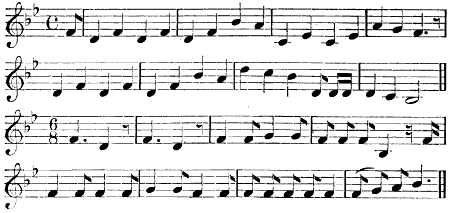
—Barnes, Surrey (A. B. Gomme).
I.
There stands a lady on the mountain,
Who she is I do not know;
All she wants is gold and silver,
All she wants is a nice young man.
Choose one, choose two, choose the fairest one of the two.
The fairest one that I can see,
Is pretty ——, walk with me.
—Barnes, Surrey (A. B. Gomme).
II.
There lives a lady on the mountain,
Who she is I do not know;
All she wants is gold and silver,
All she wants is a nice young man.
Choose one, choose two,
Choose the fairest of the few.
Now you’re married I wish you joy,
Father and mother you must obey;
Love one another like sister and brother,
And pray, young couple, come kiss one another.
—Colchester (Miss G. M. Frances).
III.
Here stands a lady on a mountain,
Who she is I do not know;
All she wants is gold and silver,
All she wants is a nice young man.
Choose you east, and choose you west,
Choose you the one as you love best.
Now Sally’s got married we wish her good joy,
First a girl and then a boy;
Twelve months a’ter a son and da’ter,
Pray young couple, kiss together.
—Berrington (Shropshire Folk-lore, pp. 509, 510).
IV.
Stands a lady on the mountain,
Who she is I do not know;
All she wants is gold and silver,
All she wants is a nice young beau.
Take her by the lily-white hand,
Lead her across the water;
Give her kisses, one, two, three,
For she is her mother’s daughter.
—Shipley, Horsham (Notes and Queries,
8th series, i. 210, Miss Busk).
V.
There stands a lady on a mountain,
Who she is I do not know;
All she wants is gold and silver,
All she wants is a nice young man.
Now she’s married I wish her joy,
First a girl and then a boy;
Seven years after son and daughter,
Pray young couple kiss together.
Kiss her once, kiss her twice,
Kiss her three times three.
—Wrotham, Kent (Miss D. Kimball).
VI.
There stands a lady on the ocean [mountain],
Who she is I do not know her;
All she wants is gold or silver,
All she wants is a nice young man.
Choose once, choose twice,
Choose three times over.
Now you’re married I wish you joy,
First a girl and then a boy;
Seven years old a son and daughter,
Play and cuddle and kiss together.
Kiss her once, kiss her twice,
Kiss her three times over.
—Deptford (Miss Chase).
VII.
There stands a lady on the mountain,
Who she is I do not know:
Oh! she wants such gold and silver!
Oh! she wants such a nice young man!
Now you’re married I wish you joy,
First a girl and then a boy;
Seven years after a son and a daughter,
Kiss your bride and come out of the ring.
—Berkshire (Miss Thoyts, Antiquary; xxvii. 254).
(b) A ring is formed, one child in the centre. The ring sing
the first verse, and then the centre child chooses one from
the ring. The chosen pair kiss when the ring has sung the
second. The first child then joins the ring, and the game
begins again. In the Barnes version the centre child calls one
to her from the ring by singing the second verse and naming
the child she chooses.
(c) A version from Lady C. Gurdon’s Suffolk County Folk-lore
(p. 62) is the same as previous versions, except that it
ends—
Now you’re married you must be good
Make your husband chop the wood;
Chop it fine and bring it in,
Give three kisses in the ring.
Other versions are much the same as the examples given.
(d) This game has probably had its origin in a ballad. Miss
Burne draws attention to its resemblance to the “Disdainful
Lady” (Shropshire Folk-lore, p. 561), and Halliwell mentions
a nursery rhyme (No. cccclxxix.) which is very similar. Mr.
Newell (Games, p. 55) prints words and tune of a song which
is very similar to that ballad, and he mentions the fact that
he has seen it played as a round by the “Arabs of the street.”
He considers it to be an old English song which has been fitted
for a ring game by the addition of a verse.
See “Lady on Yonder Hill.”
I.
Yonder stands a lovely lady,
Whom she be I do not know;
I’ll go court her for my beauty,
Whether she say me yea or nay.
Madam, to thee I humbly bow and bend.
Sir, I take thee not to be my friend.
Oh, if the good fairy doesn’t come I shall die.
—Derbyshire (Folk-lore Journal, i. 387).
II.
There stands a lady on yonder hill,
Who she is I cannot tell;
I’ll go and court her for her beauty,
Whether she answers me yes or no.
Madam, I bow vounce to thee.
Sir, have I done thee any harm?
Coxconian!
Coxconian is not my name; ’tis Hers and Kers, and Willis and Cave.
Stab me, ha! ha! little I fear. Over the waters there are but nine, I’ll meet you a man alive. Over the waters there are but ten, I’ll meet you there five thousand.
Rise up, rise up, my pretty fair maid,
You’re only in a trance;
Rise up, rise up, my pretty fair maid,
And we will have a dance.
—Lady C. Gurdon’s Suffolk County Folk-lore, p. 65.
(b) In the Suffolk game the children form a ring, a boy and
girl being in the centre. The boy is called a gentleman and
the girl a lady. The gentleman commences by singing the
first verse. Then they say alternately the questions and
answers. When the gentleman says the lines commencing,
“Stab me,” he pretends to stab the lady, who falls on the
ground. Then he walks round the lady and sings the last
verse, “Rise up,” and lifts up the lady. In the Derbyshire
game only three children play, the lover, lady, and fairy. The
girl stands a little distance off. The lover says the first four
lines, then approaches the lady, falls on one knee, and says the
next line. The lady replies, and retires further away. The
lover then falls on the ground and says the next line. As this
is said the good fairy appears, touches the fallen lover with her
hand, and he is immediately well again.
(c) This is a curious game, and is perhaps derived from a
ballad which had been popular from some more or less local
circumstance, or more probably it may be a portion of an old
play acted in booths at fair times by strolling players. It is
not, as far as I can find out, played in any other counties.
The lines—
Over the water at the hour of ten,
I’ll meet you with five thousand men;
Over the water at the hour of five,
I’ll meet you there if I’m alive,
are portions of a dialogue familiar to Mr. Emslie, and also
occur in some mumming plays. It may also be noted that the
curing of illness or death from a stab is an incident in these
plays, as is also the method of playing. The first lines are
similar to those of “Lady on the Mountain,” which see.
A number of boys put marbles in a ring, and then they all
bowl at the ring. The one who gets nearest has the first
shot at the marbles. He has the option of either “knuckling
doon” and shooting at the ring from the prescribed mark, or
“ligging up” (lying up)—that is, putting his taw so near the
ring that if the others miss his taw, or miss the marbles in the
ring, he has the game all to himself next time. If, however, he
is hit by the others, he is said to be “killed.”—Addy’s Sheffield
Glossary.
A party of boys take a few straws, and endeavour to hold
one between the chin and the turned-down under-lip, pronouncing
the following rhyme—
I bought a beard at Lammas fair,
It’s a’ awa’ but ae hair;
Wag, beardie, wag!
He who repeats this oftenest without dropping the straw is
held to have won the game (Chambers’ Popular Rhymes, p. 115).
This game-rhyme has an interesting reference to Lammas, and
it may also refer to the hiring of servants. Brockett (North
Country Words, p. 221) says, “At a fair or market where
country servants are hired, those who offer themselves stand
in the market-place with a piece of straw or green branch in
their mouths to distinguish them.”
A goal having been selected and bounds determined, the
promoters used to prepare the others by calling at the top of
their voices—
Lamp! Lamp! Laa-o!
Those that don’t run shan’t play-o!
Then one of the “spryest” lads is elected to commence,
thus:—First touching the goal with his foot or leaning against
it, and clasping his hands so as to produce the letter W in the
dumb alphabet, he pursues the other players, who are not so
handicapped, when, if he succeeds in touching one without
unclasping his hands, they both make a rush for the goal.
Should either of the other boys succeed in overtaking one of
these before reaching that spot, he has the privilege of riding
him home pick-a-back. Then these two boys (i.e., the original
pursuer and the one caught), joining hands, carry on the game
as before, incurring a similar penalty in case of being overtaken
as already described. Each successive boy, as he is touched
by the pursuers, has to make for the goal under similar risks,
afterwards clasping hands with the rest, and forming a new
recruit in the pursuing gang, in whose chain the outside players
alone have the privilege of touching and thus adding to their
numbers. Should the chain at any time be broken, or should
the original pursuer unclasp his hands, either by design or
accident, the penalty of carrying a capturer to the goal is
incurred and always enforced. In West Somerset the pursuing
boys after starting were in the habit of crying out the word
“Brewerre” or “Brewarre;” noise appearing to be quite as
essential to the game as speed.—Somerset and Dorset Notes
and Queries, i. 186 (1888).
Another correspondent to the same periodical (i. 204) says
that an almost identical game was played at the King’s School,
Sherborne, some fifty years ago. It was called “King-sealing,”
and the pursuing boy was obliged by the rules to retain his
hold of the boy seized until he had uttered—
One, two, three, four, five, six, seven, eight, nine, ten.
You are one of the king-sealer’s men.
If the latter succeeded in breaking away before the couplet
was finished, the capture was incomplete.
The second game described is almost identical with “King
Cæsar,” played at Barnes.
About twenty years ago the game was common in some parts
of Bedfordshire and Hertfordshire, where it was sometimes
called “Chevy Chase.”—Folk-lore Journal, vii. 233.
See “Chickidy Hand,” “Hunt the Staigie,” “King Cæsar,”
“Whiddy.”
That is, “Long Lawrence,” an instrument marked with signs,
a sort of teetotum. A “Long Lawrence” is about three inches
long, something like a short ruler with eight sides; occasionally
they have but four. On one side are ten x’s, or crosses,
forming a kind of lattice-work; on the next, to the left, three
double cuts, or strokes, passing straight across in the direction
of the breadth; on the third, a zig-zag of three strokes one way,
and two or three the other, forming a W, with an additional
stroke or a triple V; on the fourth, three single bars, one at
each end and one in the middle, as in No. 2, where they are
doubled; then the four devices are repeated in the same order.
The game, formerly popular at Christmas, can be played by
any number of persons. Each has a bank of pins or other
small matters. A pool is formed; then in turn each rolls the
“Long Lawrence.” If No. 1 comes up the player cries “Flush,”
and takes the pool; if No. 2, he puts down two pins; if No. 3,
he says “Lave all,” and neither takes nor gives; if No. 4, he
picks up one. The sides are considered to bear the names,
“Flush,” “Put doan two,” “Lave all,” “Sam up one.” It has
been suggested that the name “Lawrence” may have arisen
from the marks scored on the instrument, not unlike the bars
of a gridiron, on which the saint perished.—Easthers’s Almondbury
Glossary.
See “Teetotum.”
The young girls in and about Oxford have a sport called
“Leap Candle,” for which they set a candle in the middle of a
room in a candlestick, and then draw up their coats into the
form of breeches, and dance over the candle back and forth,
saying the words—
The taylor of Bicester he has but one eye,
He cannot cut a pair of green galagaskins
If he were to die.
This sport, in other parts, is called “Dancing the Candlerush”
(Aubrey’s Remaines of Gentilisme and Judaisme, p. 45).
Halliwell (Rhymes, p. 65) has a rhyme—
Jack be nimble,
And Jack be quick,
And Jack jump over
The candlestick,
which may refer to this game. Northall (Folk Rhymes, p.
412) says in Warwickshire a similar game is called “Cock and
Breeches.”
One boy stoops down sideways, with his head bent towards
his body, as low as possible. This is called “Tucking in your
Tuppeny.” Another boy takes a flying leap over the “frog,”
placing his hands on his back to help himself over. He then
proceeds to a distance of some four or five yards, and, in his
turn, stoops in the same manner as the first boy, as another
frog. A third boy then leaps first over frog No. 1, and then
over frog No. 2, taking his place as frog No. 3, at about the
same distance onwards. Any number of boys may play in the
game. After the last player has taken his leap over all the frogs
successively, frog No. 1 has his turn and leaps over his companions,
taking his place as the last in the line of frogs. Then
No. 2 follows suit, and so on, the whole line of players in course
of time covering a good distance.—London (G. L. Gomme).
Leap-frog is known in Cornwall as “Leap the Long-mare”
(Folk-lore Journal, v. 60), and in Antrim and Down as “Leap
the Bullock” (Patterson’s Glossary).
See “Accroshay,” “Loup the Bullocks,” “Spanish Fly.”[Addendum]
See “Leap-frog,” “Loup the Bullocks.”
The leaves are green, the nuts are brown,
They hang so high they will not come down;
Leave them alone till frosty weather,
Then they will all come down together.
—Berkshire (Miss Thoyts, Antiquary, xxvii. 254).
These lines are sung while the children dance round in a
circle. When the last words are sung, the children flop down
upon the ground. The tune sung is, Miss Thoyts says, that
of “Nuts in May.”
Please will you lend us your key?
What for?
Please, our hats are in the garden.
Yes, if you won’t steal any beans.
Please, we’ve brought the key back; will you lend us your frying-pan?
What to do with?
To fry some beans.
Where have you got them?
Out of your garden.
—Earls Heaton (H. Hardy).
One child represents an old woman, and the other players
carry on the dialogue with her. At the end of the dialogue the
children are chased by the old woman.
See “Mother, Mother, may I go out to Play,” “Witch.”
This game was played seventy years ago. A ring being
formed, the “Buck” inside has to break out, and reach his
“home,” crying “Home!” before he can be caught and surrounded.
Afterwards these words were sung—
Circle:
Buck:
Circle:
Don’t steal none of my black sheep, Johnny Lingo,
For if you do
I shall put you in the pinder pin-fold.
—Stixwold, Lines. (Miss M. Peacock).
See “Who goes round my Stone Wall?”
Nares, in his Glossary, says this is “a game of which we
seem to know no more than that the loser in it was to give up
his place to be occupied by another.” Minshew gives it thus:
“To play at levell coil, G. jouer à cul levé: i.e., to play and lift
up your taile when you have lost the game, and let another sit
down in your place.” Coles, in his English Dictionary, seems
to derive it from the Italian leva il culo, and calls it also “Pitch-buttock.”
In his Latin Dictionary he has “level-coil, alternation,
cession;” and “to play at level coil, vices ludendi præbere.”
Skinner is a little more particular and says, “Vox tesseris globulosis
ludentium propria:” an expression belonging to a game
played with little round tesseræ. He also derives it from French
and Italian. It is mentioned by Jonson, Tale of a Tub, iii. 2:—
“Young Justice Bramble has kept level-coyl
Here in our quarters, stole away our daughter.”
Gifford says that, in our old dramatists, it implies riot
and disturbance. The same sport is mentioned by Sylvester,
Dubartas, IV. iv. 2, under the name of level-sice:—
“By tragick death’s device
Ambitious hearts do play at level-sice.”
In the margin we have this explanation: “A kinde of
Christmas play, wherein each hunteth the other from his seat.
The name seems derived from the French levez sus, in English,
arise up.” Halliwell’s Dictionary says that Skelton, ii. 31,
spells it levell suse.
A child stands before a hassock, and as if he were going up
stairs, he puts on it first his right and then his left foot,
gradually quickening his steps, keeping time to the words—
Libbety, libbety, libbety-lat,
Who can do this? and who can do that?
And who can do anything better than that?
—Cornwall (Folk-lore Journal, v. 59).
A boy’s game undescribed.—Patterson’s Antrim and Down
Glossary.
A number of girls stand in a line with their backs to a wall.
One of their number is sent away to a distance, but remains
within call. Another girl, who stands in front of the line, asks
the girls one by one what they would like if they could obtain
their desires. After she has asked every one, she tells them
to turn their faces to the wall, and calls after the girl who was
sent away, saying, “Little Dog, I call you.” The girl replies,
“I shan’t come to please you.” “I’ll get a stick and make
you,” is the rejoinder. “I don’t care for that.” “I’ve got a
rice pudding for you.” “I shan’t come for that.” “I’ve got
a dish of bones.” “I’ll come for that.” The Dog then comes.
The girls have been previously told not to laugh whilst the
one who stands out is talking to the Dog. Then the girl says
to the Dog—
All the birds in the air,
All the fishes in the sea,
Come and pick me out (for example)
The girl with the golden ball.
If the girl who desired the golden ball laughs, the Dog picks
her out. If nobody laughs, he guesses who the girl is that has
wished for the golden ball. If the Dog guesses correctly, she
goes and stands behind him, and if he guesses incorrectly she
goes and stands behind the one who has been asking the
questions. They continue this until they get to the last girl or
girl at the end of the row, who must have desired to be—
A brewer or a baker,
Or a candlestick maker,
Or a penknife maker.
Then the questioner says—
All the birds in the air,
All the fishes in the sea,
Come pick me out
A brewer or a baker,
Or a candlestick maker,
Or penknife maker.
If the Dog guesses the right one, he takes that girl on his
side, she standing behind him. Then they draw a line and
each side tries to pull the other over it.—Sheffield (S. O. Addy).
The game, it will be seen, differs in several ways from the
other games of “Fool, Fool, come to School” type. The “fool”
becomes a definite Dog, and the players wish for any thing
they choose; the Dog has apparently to find out their wishes.
See “All the Birds,” “Fool, Fool.”
There are three or more players on each side, two stones or
holes as stations, and one Lobber. The Lobber lobs either a
stick about three inches long or a ball—(the ball seems to be a
new institution, as a stick was always formerly used)—while
the batsman defends the stone or hole with either a short stick
or his hand. Every time the stick or ball is hit, the boys
defending the stones or holes must change places. Each one
is out if the stick or ball lodges in the hole or hits the
stone; or if the ball or stone is caught; or if it can be put in
the hole or hits the stone while the boys are changing places.
This game is also played with two Lobbers, that lob alternately
from each end. The game is won by a certain number of runs.—Ireland (Folk-lore Journal, ii. 264).
See “Cat,” “Cudgel,” “Kit-Cat,” “Rounders.”
[332]
An old game, forbidden by statute in Henry VIII.’s time.
It is thus played, according to Stevens. A stake is fixed in the
ground; those who play throw Loggats at it, and he that is
nearest the stake wins. Loggats, or loggets, are also small
pieces or logs of wood, such as the country people throw at
fruit that cannot otherwise be reached. “Loggats, little logs
or wooden pins, a play the same with ninepins, in which the
boys, however, often made use of bones instead of wooden
pins” (Dean Miles’ MS.; Halliwell’s Dictionary). Strutt refers
to this game (Sports, p. 272).
A diagram (similar to Fig. 9 in “Hopscotch”) is drawn on a
slate, and two children play. A piece of paper or small piece of
glass or china, called a “chipper,” is used to play with. This
is placed at the bottom of the plan, and if of paper, is blown
gently towards the top; if of glass or china, it is nicked with
the fingers. The first player blows the paper, and in whichever
space the paper stops makes a small round o with a slate pencil,
to represent a man’s head. The paper or chipper is then put
into the starting-place again, and the same player blows, and
makes another “man’s head” in the space where the paper
stops. This is continued until all the spaces are occupied. If
the paper goes a second time into a space already occupied by
a “head,” the player adds a larger round to the “head,” to
represent a “body;” if a third time, a stroke is drawn for a
leg, and if a fourth time, another is added for the second leg;
this completes a “man.” If three complete men in one space can
be gained, the player makes “arms;” that is, two lines are
drawn from the figures across the space to the opposite side of
the plan. This occupies that space, and prevents the other player
from putting any “men” in it, or adding to any already there.
When all the spaces are thus occupied by one player, the game
is won. Should the paper be blown on to a line or outside the
plan, the player is out; the other player then begins, and makes
as many “men” in her turn, until she goes on a line or outside.
Should the paper go into “London,” the player is entitled
to make a “head” in every space, or to add another mark to
those already there.—Westminster (A. B. Gomme). This game
resembles one described by F. H. Low in Strand Mag., ii. 516.
[Play]
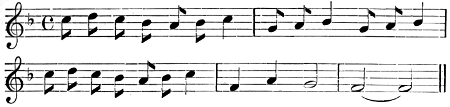
—Wrotham, Kent (Miss D. Kimball)
[Play]
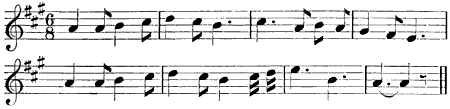
—Rimbault’s Nursery Rhymes, p. 34.
[Play version 1, version 2]
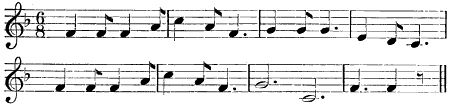
—Enborne School, Berks. (Miss M. Kimber).
I.
London Bridge is broken down,
Grant said the little bee,[4]
London Bridge is broken down,
Where I’d be.
Stones and lime will build it up,
Grant said the little bee,
Stones and lime will build it up,
Where I’d be.
Get a man to watch all night,
Grant said the little bee,
Get a man to watch all night,
Where I’d be.
Perhaps that man might fall asleep,
Grant said the little bee,
Perhaps that man might fall asleep,
Where I’d be.
Get a dog to watch all night,
Grant said the little bee,
Get a dog to watch all night,
Where I’d be.
If that dog should run away,
Grant said the little bee,
If that dog should run away,
Where I’d be.
Give that dog a bone to pick,
Grant said the little bee,
Give that dog a bone to pick,
Where I’d be.
—Belfast, Ireland (W. H. Patterson).
II.
London Bridge is broken down,
Dance o’er my lady lee,
London Bridge is broken down,
With a gay lady.
How shall we build it up again?
Dance o’er my lady lee,
How shall we build it up again?
With a gay lady.
Silver and gold will be stole away,
Dance o’er my lady lee,
Silver and gold will be stole away,
With a gay lady.
Build it up with iron and steel,
Dance o’er my lady lee,
Build it up with iron and steel,
With a gay lady.
Iron and steel will bend and bow,
Dance o’er my lady lee,
Iron and steel will bend and bow,
With a gay lady.
Build it up with wood and clay,
Dance o’er my lady lee,
Build it up with wood and clay,
With a gay lady.
Wood and clay will wash away,
Dance o’er my lady lee,
Wood and clay will wash away,
With a gay lady.
Build it up with stone so strong,
Dance o’er my lady lee,
Huzza! ’twill last for ages long,
With a gay lady.
—[London][5] (Halliwell’s Nursery Rhymes, clii.).
III.
London Bridge is broaken down,
Is broaken down, is broaken down,
London Bridge is broaken down,
My fair lady.
Build it up with bricks and mortar,
Bricks and mortar, bricks and mortar,
Build it up with bricks and mortar,
My fair lady.
Bricks and mortar will not stay,
Will not stay, will not stay,
Bricks and mortar will not stay,
My fair lady.
Build it up with penny loaves,
Penny loaves, penny loaves,
Build it up with penny loaves,
My fair lady.
Penny loaves will mould away,
Mould away, mould away,
Penny loaves will mould away,
My fair lady.
What have this poor prisoner done,
Prisoner done, prisoner done,
What have this poor prisoner done?
My fair lady.
Stole my watch and lost my key,
Lost my key, lost my key,
Stole my watch and lost my key,
My fair lady.
Off to prison you must go,
You must go, you must go,
Off to prison you must go,
My fair lady.
—Liphook, Hants (Miss Fowler).
IV.
Where are these great baa-lambs going,
Baa-lambs going, baa-lambs going,
Where are these great baa-lambs going?
My fair lady.
We are going to London Bridge,
London Bridge, London Bridge,
We are going to London Bridge,
My fair lady.
London Bridge is broken down,
Broken down, broken down,
London Bridge is broken down,
My fair lady.
[Then verses follow, sung in the same way and with the
same refrain, beginning with—]
Mend it up with penny loaves.
Penny loaves will wash away.
Mend it up with pins and needles.
Pins and needles they will break.
Mend it up with bricks and mortar,
Bricks and mortar, that will do.
[After these verses have been sung—]
What has this great prisoner done,
Prisoner done, prisoner done,
What has this great prisoner done?
My fair lady.
Stole a watch and lost the key,
Lost the key, lost the key,
Stole a watch and lost the key,
My fair lady.
Off to prison you must go,
You must go, you must go,
Off to prison you must go,
My fair lady.
—Hurstmonceux, Sussex (Miss Chase).
V.
Over London Bridge we go,
Over London Bridge we go,
Over London Bridge we go,
Gay ladies, gay!
London Bridge is broken down,
London Bridge is broken down,
London Bridge is broken down,
Gay ladies, gay!
Build it up with lime and sand,
Build it up with lime and sand,
Build it up with lime and sand,
Gay ladies, gay!
[Then follow verses sung in the same manner and with the
same refrain, beginning with—]
Lime and sand will wash away.
Build it up with penny loaves.
Penny loaves’ll get stole away.
O, what has my poor prisoner done?
Robbed a house and killed a man.
What will you have to set her free?
Fourteen pounds and a wedding gown.
Stamp your foot and let her go!
—Clun (Burne’s Shropshire Folk-lore, pp. 518-19).
VI.
London Bridge is broken down,
Broken down, broken down,
London Bridge is broken down,
My fair lady.
Build it up with iron bars,
Iron bars, iron bars,
Build it up with iron bars,
My fair lady.
[Then follow verses with the same refrain, beginning with—]
Build it up with pins and needles.
Pins and needles rust and bend.
Build it up with penny loaves.
Penny loaves will tumble down.
Here’s a prisoner I have got.
What’s the prisoner done to you?
Stole my watch and broke my chain.
What will you take to let him out?
Ten hundred pounds will let him out.
Ten hundred pounds we have not got.
Then off to prison he must go.
—Kent (Miss Dora Kimball).
VII.
London Bridge is falling down,
Falling down, falling down,
London Bridge is falling down,
My fair lady.
Build it up with mortar and bricks,
Mortar and bricks, mortar and bricks,
Build it up with mortar and bricks,
My fair lady.
[Then follow verses in the same style and with the same
refrain, beginning with—]
Bring some water, we’ll wash it away.
Build it up with silver and gold.
Silver and gold will be stolen away.
We’ll set a man to watch at night.
Suppose the man should fall asleep?
Give him a pipe of tobacco to smoke.
Suppose the pipe should fall and break?
We’ll give him a bag of nuts to crack.
Suppose the nuts were rotten and bad?
We’ll give him a horse to gallop around, &c.
—Enborne School, Berks (M. Kimber).
VIII.
London Bridge is broken down,
Gran says the little D,
London Bridge is broken down,
Fair la-dy.
Build it up with lime and stone,
Gran says the little D,
Build it up with lime and stone,
Fair la-dy.
[Then follow verses beginning with the following lines—]
Lime and stone would waste away.
Build it up with penny loaves.
Penny loaves would be eaten away.
Build it up with silver and gold.
Silver and gold would be stolen away.
Get a man to watch all night.
If the man should fall asleep?
Set a dog to bark all night.
If the dog should meet a bone?
Set a cock to crow all night.
If the cock should meet a hen?
Here comes my Lord Duke,
And here comes my Lord John;
Let every one pass by but the very last one,
And catch him if you can.
—Cork (Mrs. B. B. Green).
IX.
London Bridge is broken down,
Broken down, broken down,
London Bridge is broken down,
My fair lady.
[Other verses commence with one of the following lines, and
are sung in the same manner—]
Build it up with penny loaves.
Penny loaves will melt away.
Build it up with iron and steel.
Iron and steel will bend and bow.
Build it up with silver and gold.
Silver and gold I have not got.
What has this poor prisoner done?
Stole my watch and broke my chain.
How many pounds will set him free?
Three hundred pounds will set him free.
The half of that I have not got.
Then off to prison he must go.
—Crockham Hill, Kent (Miss E. Chase).
(b) This game is now generally played like “Oranges and
Lemons,” only there is no “tug-of-war” at the end. Two
children hold up their clasped hands to form an arch. The
other children form a long line by holding to each other’s
dresses or waists, and run under. Those who are running
under sing the first verse; the two who form the arch sing
the second and alternate verses. At the words, “What has
this poor prisoner done?” the girls who form the arch catch
one of the line (generally the last one). When the last verse
is sung the prisoner is taken a little distance away, and the
game begins again. At Clun the players form a ring, moving
round. They sing the first and alternate verses, and chorus,
“London Bridge is broken down.” Two players outside the
ring run round it, singing the second and alternate verses.
When singing “Penny loaves’ll get stole away,” one of the
two outside children goes into the ring, the other remains and
continues her part, singing the next verse. When the last
verse is sung the prisoner is released. The Berkshire game
(Miss Kimber) is played by the children forming two long
lines, each line advancing and retiring alternately while singing
their parts. When the last verse is begun the children form
a ring and gallop around, all singing this last verse together.
In the Cork version (Mrs. Green) the children form a circle by
joining hands. They march round and round, singing the
verses to a sing-song tune. When singing, “If the cock should
meet a hen,” they all unclasp hands; two hold each other’s
hands and form an arch. The rest run under, saying the last
verse. The “arch” lower their hands and try to catch the
last child.
(c) The analysis of the game-rhymes is on pp. 342-45.
It appears from this analysis that the London version is
alone in its faithful reflection of an actual building episode.
Three other versions introduce the incident of watching by
a man, and failing him, a dog or cock; while five versions introduce
a prisoner. This incident occurs the greatest number
of times. It is not surprising that the London version seems to
be the most akin to modern facts, being told so near the spot
indicated by the verses, and on this account it cannot be considered
as the oldest of the variants. There remain the other
two groups. Both are distinguished by the introduction of a
human element, one as watchman, the other as prisoner. The
watchman incident approaches nearer to modern facts; the
prisoner incident remains unexplained by any appeal to modern
life, and it occurs more frequently than the others. In only
one case, the Shropshire, is the prisoner ransomed; in the
others he is sent to prison. Besides this main line of criticism
brought out by the analysis there is little to note. The
Hurstmonceux version begins with taking lambs over London
Bridge, and the Shropshire version with the players themselves
going over; but these are doubtless foreign adjuncts, because
they do not properly prefix the main incident of the bridge
being broken. The Belfast version has a curious line, “Grant
said the little bee or dee,” which the Cork version renders, “Gran
says the little D.” To these there is now no meaning that
can be traced, but they help to prove that the rhyme originated
from a state of things not understood by modern players. In
all the versions with the prisoner incident it comes quite suddenly,
without any previous indication, except in the Kent
version, which introduces the exclamation, “Here’s a prisoner
I have got!” As the analysis shows the prisoner incident to be
a real and not accidental part of the game, and the unmeaning
expressions to indicate an origin earlier than modern players
can understand, we can turn to other facts to see if the origin
can be in any way traced.
[342-
345]
ANALYSIS OF GAME-RHYMES.
| No. |
Belfast. |
Halliwell. |
Liphook. |
Hurst-
monceux. |
Shrop-
shire. |
Kent. |
Enborne. |
Cork. |
Crockham Hill. |
| 1. |
— |
— |
— |
Where are these great baa-lambs going? |
— |
— |
— |
— |
— |
| 2. |
— |
— |
— |
My fair lady. |
— |
— |
— |
— |
— |
| 3. |
— |
— |
— |
We are going to L. B. |
— |
— |
— |
— |
— |
| 4. |
— |
— |
— |
— |
Over L. B. we go. |
— |
— |
— |
— |
| 5. |
L. B. is broken down. |
L. B. is broken down. |
L. B. is broken down. |
L. B. is broken down. |
L. B. is broken down. |
L. B. is broken down. |
— |
L. B. is broken down. |
L. B. is broken down. |
| 6. |
— |
— |
— |
— |
— |
— |
L. B. is falling down. |
— |
— |
| 7. |
Grant said the little bee. |
— |
— |
— |
— |
— |
— |
Says the little D. |
— |
| 8. |
— |
Dance o’er my lady lee. |
— |
— |
— |
— |
— |
— |
— |
| 9. |
— |
— |
My fair lady. |
My fair lady. |
— |
My fair lady. |
My fair lady. |
Fair lady. |
My fair lady. |
| 10. |
— |
With a gay lady. |
— |
— |
Gay ladies, gay. |
— |
— |
— |
— |
| 11. |
Where I’d be. |
— |
— |
— |
— |
— |
— |
— |
— |
| 12. |
— |
How shall we build it up again? |
— |
— |
— |
— |
— |
— |
— |
| 13. |
Stones and lime will build it up. |
— |
Build it up with bricks and mortar. |
Mend it up with bricks and mortar. |
Build it up with lime and sand. |
— |
Build it up with mortar and bricks. |
Build it up with lime and stone. |
— |
| 14. |
— |
— |
Bricks and mortar will not stay. |
— |
Lime and sand will wash away. |
— |
Mortar and bricks will waste away. |
Lime and stone would waste away. |
— |
| 15. |
— |
— |
Build it up with penny loaves. |
Mend it up with penny loaves. |
Build it up with penny loaves. |
Build it up with penny loaves. |
— |
— |
Build it up with penny loaves. |
| 16. |
— |
— |
Penny loaves will mould away. |
Penny loaves will wash away. |
Penny loaves’ll get stole away. |
Penny loaves will tumble down. |
— |
— |
Penny loaves will melt away. |
| 17. |
— |
— |
— |
— |
— |
— |
Build it up with silver and gold. |
Build it up with silver and gold. |
Build it up with silver and gold. |
| 18. |
— |
Silver and gold will be stole away. |
— |
— |
— |
— |
Silver and gold will be stolen away. |
Silver and gold would be stolen away. |
Silver and gold I have not got. |
| 19. |
— |
Build it up with iron and steel. |
— |
— |
— |
— |
— |
— |
— |
| 20. |
— |
Iron and steel will bend and bow. |
— |
— |
— |
— |
— |
— |
— |
| 21. |
— |
— |
— |
Mend it up with pins and needles. |
— |
Mend it up with pins and needles. |
— |
— |
— |
| 22. |
— |
— |
— |
Pins and needles they will break. |
— |
Pins and needles rust and bend. |
— |
— |
— |
| 23. |
— |
Build it up with wood and clay. |
— |
— |
— |
— |
— |
— |
— |
| 24. |
— |
Wood and clay will wash away. |
— |
— |
— |
— |
— |
— |
— |
| 25. |
— |
Build it up with stone so strong. |
— |
— |
— |
— |
— |
— |
— |
| 26. |
Get a man to watch all night. |
— |
— |
— |
— |
— |
— |
We’ll set a man to watch all night. |
Set a man to watch all night. |
| 27. |
Perhaps that man might fall asleep. |
— |
— |
— |
— |
— |
Suppose the man should fall asleep. |
If the man should fall asleep. |
— |
| 28. |
— |
— |
— |
— |
— |
Here’s a prisoner I have got. |
— |
— |
— |
| 29. |
— |
— |
What has this poor prisoner done? |
What has this great prisoner done? |
O, what has my poor prisoner done? |
What’s the prisoner done to you? |
— |
— |
What has this poor prisoner done? |
| 30. |
— |
— |
Stole my watch and lost my key. |
Stole a watch and lost the key. |
— |
Stole my watch and broke my chain. |
— |
— |
Stole my watch and broke my chain. |
| 31. |
— |
— |
— |
— |
Robbed a house and killed a man. |
— |
— |
— |
— |
| 32. |
— |
— |
— |
— |
— |
— |
Give him a pipe of tobacco to smoke. |
— |
— |
| 33. |
— |
— |
— |
— |
— |
— |
Suppose the pipe should fall and break. |
— |
— |
| 34. |
— |
— |
— |
— |
— |
— |
We’ll give him a bag of nuts to crack. |
— |
— |
| 35. |
— |
— |
— |
— |
— |
— |
Suppose the nuts were rotten and bad. |
— |
— |
| 36. |
Get a dog to watch all night. |
— |
— |
— |
— |
— |
— |
Set a dog to bark all night. |
— |
| 37. |
If that dog should run away. |
— |
— |
— |
— |
— |
— |
If the dog should meet a bone. |
— |
| 38. |
Give that dog a bone to pick. |
— |
— |
— |
— |
— |
— |
— |
— |
| 39. |
— |
— |
— |
— |
— |
— |
— |
Set a cock to crow all night. |
— |
| 40. |
— |
— |
— |
— |
— |
— |
— |
If the cock should meet a hen. |
— |
| 41. |
— |
— |
— |
— |
What will you have to set her free? |
What will you take to let him out? |
— |
— |
How many pounds will set him free? |
| 42. |
— |
— |
— |
— |
Fourteen pounds and a wedding gown. |
Ten hundred pounds will let him out. |
— |
— |
Three hundred pounds will set him free. |
| 43. |
— |
— |
— |
— |
— |
Then a hundred pounds we have not got. |
— |
— |
The half of that I have not got. |
| 44. |
— |
— |
Off to prison you must go. |
Off to prison you must go. |
— |
Then off to prison you must go. |
— |
— |
Then off to prison he must go. |
| 45. |
— |
Huzza! it will last for ages long. |
— |
— |
— |
— |
— |
— |
— |
| 46. |
— |
— |
— |
— |
— |
— |
— |
— |
— |
| 47. |
— |
— |
— |
— |
Stamp your foot and let her go. |
— |
— |
— |
— |
| 48. |
— |
— |
— |
— |
— |
— |
We’ll give him a horse to gallop around. |
— |
— |
| 49. |
— |
— |
— |
— |
— |
— |
— |
Here comes my lord Duke, let everyone pass by but the very last one. |
— |
| No. |
Belfast. |
Halliwell. |
Liphook. |
Hurstmonceux. |
Shropshire. |
| 1. |
— |
— |
— |
Where are these great baa-lambs going? |
— |
| 2. |
— |
— |
— |
My fair lady. |
— |
| 3. |
— |
— |
— |
We are going to L. B. |
— |
| 4. |
— |
— |
— |
— |
Over L. B. we go. |
| 5. |
L. B. is broken down. |
L. B. is broken down. |
L. B. is broken down. |
L. B. is broken down. |
L. B. is broken down. |
| 6. |
— |
— |
— |
— |
— |
| 7. |
Grant said the little bee. |
— |
— |
— |
— |
| 8. |
— |
Dance o’er my lady lee. |
— |
— |
— |
| 9. |
— |
— |
My fair lady. |
My fair lady. |
— |
| 10. |
— |
With a gay lady. |
— |
— |
Gay ladies, gay. |
| 11. |
Where I’d be. |
— |
— |
— |
— |
| 12. |
— |
How shall we build it up again? |
— |
— |
— |
| 13. |
Stones and lime will build it up. |
— |
Build it up with bricks and mortar. |
Mend it up with bricks and mortar. |
Build it up with lime and sand. |
| 14. |
— |
— |
Bricks and mortar will not stay. |
— |
Lime and sand will wash away. |
| 15. |
— |
— |
Build it up with penny loaves. |
Mend it up with penny loaves. |
Build it up with penny loaves. |
| 16. |
— |
— |
Penny loaves will mould away. |
Penny loaves will wash away. |
Penny loaves’ll get stole away. |
| 17. |
— |
— |
— |
— |
— |
| 18. |
— |
Silver and gold will be stole away. |
— |
— |
— |
| 19. |
— |
Build it up with iron and steel. |
— |
— |
— |
| 20. |
— |
Iron and steel will bend and bow. |
— |
— |
— |
| 21. |
— |
— |
— |
Mend it up with pins and needles. |
— |
| 22. |
— |
— |
— |
Pins and needles they will break. |
— |
| 23. |
— |
Build it up with wood and clay. |
— |
— |
— |
| 24. |
— |
Wood and clay will wash away. |
— |
— |
— |
| 25. |
— |
Build it up with stone so strong. |
— |
— |
— |
| 26. |
Get a man to watch all night. |
— |
— |
— |
— |
| 27. |
Perhaps that man might fall asleep. |
— |
— |
— |
— |
| 28. |
— |
— |
— |
— |
— |
| 29. |
— |
— |
What has this poor prisoner done? |
What has this great prisoner done? |
O, what has my poor prisoner done? |
| 30. |
— |
— |
Stole my watch and lost my key. |
Stole a watch and lost the key. |
— |
| 31. |
— |
— |
— |
— |
Robbed a house and killed a man. |
| 32. |
— |
— |
— |
— |
— |
| 33. |
— |
— |
— |
— |
— |
| 34. |
— |
— |
— |
— |
— |
| 35. |
— |
— |
— |
— |
— |
| 36. |
Get a dog to watch all night. |
— |
— |
— |
— |
| 37. |
If that dog should run away. |
— |
— |
— |
— |
| 38. |
Give that dog a bone to pick. |
— |
— |
— |
— |
| 39. |
— |
— |
— |
— |
— |
| 40. |
— |
— |
— |
— |
— |
| 41. |
— |
— |
— |
— |
What will you have to set her free? |
| 42. |
— |
— |
— |
— |
Fourteen pounds and a wedding gown. |
| 43. |
— |
— |
— |
— |
— |
| 44. |
— |
— |
Off to prison you must go. |
Off to prison you must go. |
— |
| 45. |
— |
Huzza! it will last for ages long. |
— |
— |
— |
| 46. |
— |
— |
— |
— |
— |
| 47. |
— |
— |
— |
— |
Stamp your foot and let her go. |
| 48. |
— |
— |
— |
— |
— |
| 49. |
— |
— |
— |
— |
— |
| No. |
Kent. |
Enborne. |
Cork. |
Crockham Hill. |
| 1. |
— |
— |
— |
— |
| 2. |
— |
— |
— |
— |
| 3. |
— |
— |
— |
— |
| 4. |
— |
— |
— |
— |
| 5. |
L. B. is broken down. |
— |
L. B. is broken down. |
L. B. is broken down. |
| 6. |
— |
L. B. is falling down. |
— |
— |
| 7. |
— |
— |
Says the little D. |
— |
| 8. |
— |
— |
— |
— |
| 9. |
My fair lady. |
My fair lady. |
Fair lady. |
My fair lady. |
| 10. |
— |
— |
— |
— |
| 11. |
— |
— |
— |
— |
| 12. |
— |
— |
— |
— |
| 13. |
— |
Build it up with mortar and bricks. |
Build it up with lime and stone. |
— |
| 14. |
— |
Mortar and bricks will waste away. |
Lime and stone would waste away. |
— |
| 15. |
Build it up with penny loaves. |
— |
— |
Build it up with penny loaves. |
| 16. |
Penny loaves will tumble down. |
— |
— |
Penny loaves will melt away. |
| 17. |
— |
Build it up with silver and gold. |
Build it up with silver and gold. |
Build it up with silver and gold. |
| 18. |
— |
Silver and gold will be stolen away. |
Silver and gold would be stolen away. |
Silver and gold I have not got. |
| 19. |
— |
— |
— |
— |
| 20. |
— |
— |
— |
— |
| 21. |
Mend it up with pins and needles. |
— |
— |
— |
| 22. |
Pins and needles rust and bend. |
— |
— |
— |
| 23. |
— |
— |
— |
— |
| 24. |
— |
— |
— |
— |
| 25. |
— |
— |
— |
— |
| 26. |
— |
— |
We’ll set a man to watch all night. |
Set a man to watch all night. |
| 27. |
— |
Suppose the man should fall asleep. |
If the man should fall asleep. |
— |
| 28. |
Here’s a prisoner I have got. |
— |
— |
— |
| 29. |
What’s the prisoner done to you? |
— |
— |
What has this poor prisoner done? |
| 30. |
Stole my watch and broke my chain. |
— |
— |
Stole my watch and broke my chain. |
| 31. |
— |
— |
— |
— |
| 32. |
— |
Give him a pipe of tobacco to smoke. |
— |
— |
| 33. |
— |
Suppose the pipe should fall and break. |
— |
— |
| 34. |
— |
We’ll give him a bag of nuts to crack. |
— |
— |
| 35. |
— |
Suppose the nuts were rotten and bad. |
— |
— |
| 36. |
— |
— |
Set a dog to bark all night. |
— |
| 37. |
— |
— |
If the dog should meet a bone. |
— |
| 38. |
— |
— |
— |
— |
| 39. |
— |
— |
Set a cock to crow all night. |
— |
| 40. |
— |
— |
If the cock should meet a hen. |
— |
| 41. |
What will you take to let him out? |
— |
— |
How many pounds will set him free? |
| 42. |
Ten hundred pounds will let him out. |
— |
— |
Three hundred pounds will set him free. |
| 43. |
Then a hundred pounds we have not got. |
— |
— |
The half of that I have not got. |
| 44. |
Then off to prison you must go. |
— |
— |
Then off to prison he must go. |
| 45. |
— |
— |
— |
— |
| 46. |
— |
— |
— |
— |
| 47. |
— |
— |
— |
— |
| 48. |
— |
We’ll give him a horse to gallop around. |
— |
— |
| 49. |
— |
— |
Here comes my lord Duke, let everyone pass by but the very last one. |
— |
(d) This game is universally acknowledged to be a very
ancient one, but its origin is a subject of some diversity of
opinion. The special feature of the rhymes is that considerable
difficulty occurs in the building of the bridge by ordinary
means, but without exactly suggesting that extraordinary means
are to be adopted, a prisoner is suddenly taken. The question
is, What does this indicate?
Looking to the fact of the widespread superstition of the
foundation sacrifice, it would seem that we may have here a
tradition of this rite. So recently as 1872, there was a scare
in Calcutta when the Hooghly Bridge was being constructed.
The natives then got hold of the idea that Mother Ganges,
indignant at being bridged, had at last consented to submit to
the insult on condition that each pier of the structure was
founded on a layer of children’s heads (Gomme’s Early Village
Life, p. 29). Formerly, in Siam, when a new city gate
was being erected, it was customary for a number of officers to
lie in wait and seize the first four or eight persons who happened
to pass by, and who were then buried alive under the
gate-posts to serve as guardian angels (Tylor’s Primitive Culture,
i. 97). Other instances of the same custom and belief
are given in the two works from which these examples are
taken; and there is a tradition about London Bridge itself,
that the stones were bespattered with the blood of little children.
Fitzstephen, in his well-known account of London of
the twelfth century, mentions that when the Tower was built
the mortar was tempered with the blood of beasts. Prisoners’
heads were put on the bridge after execution down to modern
times, and also on city gates.
These traditions about London, when compared with the
actual facts of contemporary savagery, seem to be sufficient to
account for such a game as that we are now examining having
originated in the foundation sacrifice. Mr. Newell, in his
examination of the game, gives countenance to this theory, but
he strangely connects it with other games which have a tug-of-war
as the finish. Now in all the English examples it is
remarkable that the tug-of-war does not appear to be a part of
the game; and if this evidence be conclusive, it would appear
that this incident got incorporated in America. It is this incident
which Mr. Newell dwells upon in his ingenious explanation
of the mythological interpretation of the game. But apart
from this, the fact that the building of bridges was accompanied
by the foundation sacrifice is a more likely origin for such a
widespread game which is so intimately connected with a
bridge.
This view is confirmed by what may be called the literary
history of the game. The verses, as belonging to a game, have
only recently been recorded, and how far they go back into
tradition it is impossible to say. Dr. Rimbault is probably
right when he states “that they have been formed by many
fresh additions in a long series of years, and [the game] is
perhaps almost interminable when received in all its different
versions” (Notes and Queries, ii. 338). In Chronicles of
London Bridge, pp. 152, 153, the author says he obtained the
following note from a Bristol correspondent:—“About forty
years ago, one moonlight night in the streets of Bristol, my
attention was attracted by a dance and chorus of boys and
girls, to which the words of this ballad gave measure. The
breaking down of the Bridge was announced as the dancers
moved round in a circle hand in hand, and the question,
‘How shall we build it up again?’ was chanted by the
leader while the rest stood still.” This correspondent also
sent the tune the children sang, which is printed in the
Chronicles of London Bridge. This was evidently the same
game, but it would appear that the verses have also been
used as a song, and it would be interesting to find out which
is the more ancient of the two—the song or the game; and to
do this it is necessary that we should know something of the
history of the song. A correspondent of Notes and Queries
(ii. 338) speaks of it as a “lullaby song” well known in the
southern part of Kent and in Lincolnshire. In the Gentleman’s
Magazine (1823, Part II. p. 232) appeared the following
interesting note:—
The projected demolition of London Bridge recalls to my
mind the introductory lines of an old ballad which more than
seventy years ago I heard plaintively warbled by a lady who
was born in the reign of Charles II., and who lived till nearly
the end of that of George II. I now transcribe the lines, not
as possessing any great intrinsic merit, but in the hope of
learning from some intelligent correspondent the name of the
author and the story which gave rise to the ballad, for it probably
originated in some accident that happened to the old
bridge. The “Lady Lea” evidently refers to the river of that
name, the favourite haunt of Isaac Walton, which, after fertilising
the counties of Hertford, Essex, and Middlesex, glides
into the Thames.
London Bridge is broken down,
Dance over the Lady Lea;
London Bridge is broken down,
With a gay lady [la-dee].
Then we must build it up again.
What shall we build it up withal?
Build it up with iron and steel,
Iron and steel will bend and break.
Build it up with wood and stone,
Wood and stone will fall away.
Build it up with silver and gold,
Silver and gold will be stolen away.
Then we must set a man to watch,
Suppose the man should fall asleep?
Then we must put a pipe in his mouth,
Suppose the pipe should fall and break?
Then we must set a dog to watch,
Suppose the dog should run away?
Then we must chain him to a post.
The two lines in italic are all regularly repeated after each
line.—M. Green.
Another correspondent to this magazine, in the same volume,
p. 507, observes that the ballad concerning London Bridge
“formed, in my remembrance, part of a Christmas Carol, and
commenced thus—
Dame, get up and bake your pies,
On Christmas-day in the morning.
The requisition goes on to the dame to prepare for the feast,
and her answer is—
London Bridge is fallen down,
On Christ-mas day in the morning, &c.
The inference always was, that until the bridge was rebuilt
some stop would be put to the Dame’s Christmas operations;
but why the falling of London Bridge should form part of a
Christmas Carol at Newcastle-upon-Tyne I am at a loss to
know.” Some fragments were also printed in the Mirror for
November 1823; and a version is also given by Ritson,
Gammer Gurton’s Garland. The Heimskringla (Laing, ii. 260,
261) gives an animated description of the Battle of London
Bridge, when Ethelred, after the death of Sweyn, was assisted
by Olaf in retaking and entering London, and it is curious,
that the first line of the game-rhyme appears—
[350]
London Bridge is broken down,
Gold is won and bright renown;
Shields resounding,
War-horns sounding,
Hild is shouting in the din;
Arrows singing,
Mail-coats ringing,
Odin makes our Olaf win.
If this is anything more than an accidental parallel, we come
back to an historical episode wherein the breaking down and
rebuilding of London Bridge occur, and it looks as if the two
streams down which this tradition has travelled, namely, first,
through the game, and second, through the song, both refer to
the same event.
Dr. Rimbault has, in his Nursery Rhymes, p. 34, reconstructed
a copy of the original rhyme from the versions given
by Halliwell and the Mirror, and gives the tune to which it
was sung, which is reprinted here. The tune from Kent is
the one generally used in London versions. The tune of a
country dance called “London Bridge” is given in Playford’s
Dancing Master, 1728 edition.[Addendum]
A number of children take hold of each other’s hands and
form a half-circle. The two children at one end of the line lift
up their arms, so as to form an arch, and call “Bid, bid, bid,”
the usual cry for calling ducks. Then the children at the other
end pass in order through the arch. This process is repeated,
and they go circling round the field.—Addy’s Sheffield Glossary.
See “Duck Dance.”
See “Long Terrace.”
A game at marbles where each takes aim at the other in
turn, a marble being paid in forfeit to whichever of the players
may make a hit.—Lowsley’s Berkshire Glossary.
[351]
Every player chooses a partner. The couples stand immediately
in front of each other, forming a long line, one
remaining outside of the line on the right-hand side, who is
called the “Clapper.” The object of the game is for the last
couple to reach the top of the line, each running on different
sides, and keeping to the side on which they are standing.
The object of the Clapper is to hit the one running on the
right side of the line, which, if he succeeds in doing, makes
him the Clapper, and the Clapper takes his place. [The next
last couple would then presumably try and reach the top.]—East
Kirkby, Lincs. (Miss K. Maughan).
A similar game to this is played at Sporle, Norfolk (Miss
Matthews). It is there called “Long Tag.” The players
stand in line behind one another, and an odd one takes her
place somewhere near the front; at a given signal, such as
clapping of hands, the two at the back separate and try to
meet again in front before the one on the watch can catch
them; they may run where they please, and when one is caught
that one becomes the one “out.”
See “French Jackie.”
Young men go out to a green meadow, and there on all-fours
plant themselves in a row about two yards distant from
each other. Then he who is stationed farthest back in the
“bullock rank” starts up and leaps over the other bullocks
before him, by laying his hands on each of their backs; and
when he gets over the last one leans down himself as before,
whilst all the others, in rotation, follow his example; then he
starts and leaps again.
I have sometimes thought that we (the Scotch) have borrowed
this recreation from our neighbours of the “Green Isle,” as at
their wakes they have a play much of the same kind, which
they call “Riding Father Doud.” One of the wakers takes a
stool in his hand, another mounts that one’s back, then Father
Doud begins rearing and plunging, and if he unhorses his
rider with a dash he does well. There is another play (at
these wakes) called “Kicking the Brogue,” which is even
ruder than “Riding Father Doud,” and a third one called
“Scuddieloof.”—Mactaggart’s Gallovidian Encyclopædia.
Patterson (Antrim and Down Glossary) mentions a game called
“Leap the Bullock,” which he says is the same as “Leap-frog.”
Dickinson’s Cumberland Glossary Supplement, under “Lowp,”
says it means a leap or jump either running or standing. The
various kinds include “Catskip”—one hitch, or hop, and one
jump; “Hitch steppin”—hop, step, and lowp; a hitch, a step,
and a leap; “Otho”—two hitches, two steps, and a leap; “Lang
spang”—two hitches, two steps, a hitch, a step, and a leap.
See “Accroshay,” “Knights,” “Leap-frog.”
[Play]
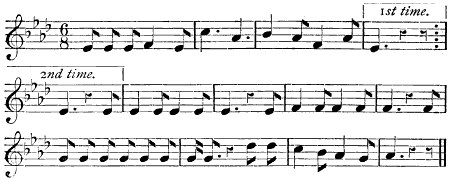
—Hexham (Miss J. Barker).
[Play]
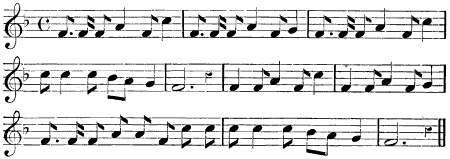
—Doncaster (Mr. C. Bell).
[Play]
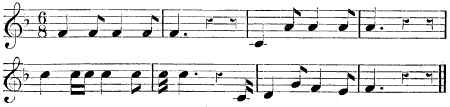
—London (A. B. Gomme).
[353]
[Play]
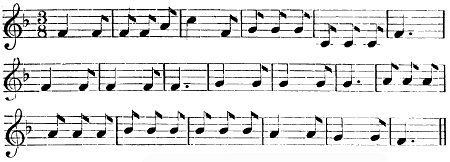
—Dorsetshire (Miss M. Kimber).
[Play]
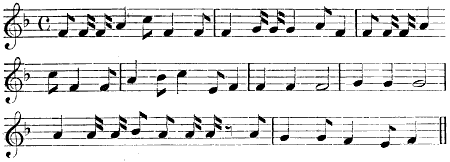
—Sporle, Norfolk (Miss Matthews).
I.
Here we dance lubin, lubin, lubin,
Here we dance lubin light,
Here we dance lubin, lubin, lubin,
On a Saturday night.
Put all the right hands in,
Take all the right hands out,
Shake all the right hands together,
And turn yourselves about.
Here we dance lubin, lubin, lubin,
Here we dance lubin light,
Here we dance lubin, lubin, lubin,
On a Saturday night.
Put all your left hands in,
Take all your left hands out,
Shake all your left hands together,
And turn yourselves about.
Here we dance lubin, lubin, lubin,
Here we dance lubin light,
Here we dance lubin, lubin, lubin,
On a Saturday night.
Put all your right feet in,
Take all your right feet out,
Shake all your right feet together,
And turn yourselves about.
Here we dance lubin, lubin, lubin,
Here we dance lubin light,
Here we dance lubin, lubin, lubin,
On a Saturday night.
Put all your left feet in,
Take all your left feet out,
Shake all your left feet together,
And turn yourselves about.
Here we dance lubin, lubin, lubin,
Here we dance lubin light,
Here we dance lubin, lubin, lubin,
On a Saturday night.
Put all your heads in,
Take all your heads out,
Shake all your heads together,
And turn yourselves about.
Here we dance lubin, lubin, lubin,
Here we dance lubin light,
Here we dance lubin, lubin, lubin,
On a Saturday night.
Put all the [Marys] in,
Take all the [Marys] out,
Shake all the [Marys] together,
And turn yourselves about.
Here we dance lubin, lubin, lubin,
Here we dance lubin light,
Here we dance lubin, lubin, lubin,
On a Saturday night.
Put all yourselves in,
Take all yourselves out,
Shake all yourselves together,
And turn yourselves about.
—Oxford and Wakefield (Miss Fowler).
II.
II. Now we dance looby, looby, looby,
Now we dance looby, looby, light;
Shake your right hand a little,
And turn you round about.
Now we dance looby, looby, looby;
Shake your right hand a little,
Shake your left hand a little,
And turn you round about.
Now we dance looby, looby, looby;
Shake your right hand a little,
Shake your left hand a little,
Shake your right foot a little,
And turn you round about.
Now we dance looby, looby, looby;
Shake your right hand a little,
Shake your left hand a little,
Shake your right foot a little,
Shake your left foot a little,
And turn you round about.
Now we dance looby, looby, looby;
Shake your right hand a little,
Shake your left hand a little,
Shake your right foot a little,
Shake your left foot a little,
Shake your head a little,
And turn you round about.
—Halliwell (Popular Rhymes, p. 226).
III.
Fal de ral la, fal de ral la,
Hinkumbooby round about.
Right hands in and left hands out,
Hinkumbooby round about;
Fal de ral la, fal de ral la,
Hinkumbooby round about.
Left hands in and right hands out,
Hinkumbooby round about;
Fal de ral la, fal de ral la,
Hinkumbooby round about.
Right foot in and left foot out,
Hinkumbooby round about;
Fal de ral la, fal de ral la,
Hinkumbooby round about.
Left foot in and right foot out,
Hinkumbooby round about;
Fal de ral la, &c.
Heads in and backs out,
Hinkumbooby round about;
Fal de ral la, &c.
Backs in and heads out,
Hinkumbooby round about;
Fal de ral la, &c.
A’ feet in and nae feet out,
Hinkumbooby round about;
Fal de ral la, &c.
Shake hands a’, shake hands a’,
Hinkumbooby round about;
Fal de ral la, &c.
Good night a’, good night a’,
Hinkumbooby round about;
Fal de ral la, &c.
—Chambers (Popular Rhymes, pp. 137-139).
IV.
This is the way we wash our hands,
Wash our hands, wash our hands,
To come to school in the morning.
This is the way we wash our face,
Wash our face, wash our face,
To come to school in the morning.
Here we come dancing looby,
Lewby, lewby, li.
Hold your right ear in,
Hold your right ear out,
Shake it a little, a little,
And then turn round about.
Here we come dancing lewby,
Lewby, lewby, li, &c.
—Eckington, Derbyshire (S. O. Addy).
V.
How do you luby lue,
How do you luby lue,
How do you luby lue,
O’er the Saturday night?
Put your right hand in,
Put your right hand out,
Shake it in the middle,
And turn yourselves about.
—Lady C. Gurdon’s Suffolk County Folk-lore, p. 64.
[Repeat this for “left hand,” “right foot,” “left foot,”
“heads,” and “put yourselves in.”]
VI.
Can you dance looby, looby,
Can you dance looby, looby,
Can you dance looby, looby,
All on a Friday night?
You put your right foot in,
And then you take it out,
And wag it, and wag it, and wag it,
Then turn and turn about.
—Addy’s Sheffield Glossary.
[358]
VII.
Here we dance luby, luby,
Here we dance luby light,
Here we dance luby, luby,
All on a Wednesday night.
—Ordsall, Nottinghamshire (Miss Matthews).
VIII.
Here we go lubin loo,
Here we go lubin li,
Here we go lubin loo,
Upon a Christmas night.
—Epworth, Doncaster (C. C. Bell).
IX.
Here we go looby loo,
Here we go looby li,
Here we go looby loo,
All on a New-Year’s night.
—Nottingham (Miss Winfield).
X.
Here we come looby, looby,
Here we come looby light,
Here we come looby, looby,
All on a Saturday night.
—Belfast (W. H. Patterson).
XI.
Here we come looping, looping [louping?],
Looping all the night;
I put my right foot in,
I put my right foot out,
I shake it a little, a little,
And I turn myself about.
—Hexham (Miss J. Barker).
XII.
Christian was a soldier,
A soldier, a soldier,
Christian was a soldier, and a brave one too.
Right hand in, right hand out,
Shake it in the middle, and turn yourself about.
—Sporle, Norfolk (Miss Matthews).
[359]
XIII.
Friskee, friskee, I was and I was
A-drinking of small beer.
Right arms in, right arms out,
Shake yourselves a little, and little,
And turn yourselves about.
—Cornwall (Folk-lore Journal, v. p. 49).
XIV.
I love Antimacassar,
Antimacassar loves me.
Put your left foot in,
Put your right foot out,
Shake it a little, a little, a little,
And turn yourself about.
—Dorsetshire (Miss M. Kimber).
(b) A ring is formed and the children dance round, singing
the first verse. They then stand till, sing the next verse, and,
while singing, suit the action to the word, each child turning
herself rapidly round when singing the last line. The first
verse is then repeated, and the fourth sung in the same way
as the second, and so on.
Another way of playing is that the children do not dance
round and round. They form a ring by joining hands, and
they then all move in one direction, about half way round,
while singing the first line, “lubin;” then back again in the
opposite direction, while singing the second line, “light,” still
keeping the ring form, and so on for the third and fourth lines.
In each case the emphasis is laid upon the “Here” of each
line, the movement being supposed to answer to the “Here.”
The Dorsetshire version (Miss M. Kimber) is played by the
children taking hands in pairs, forming a ring, and dancing
round. At Eckington (S. O. Addy) the children first pretend
to wash their hands, then their face, while singing the words;
then comb their hair and brush their clothes; then they join
hands and dance round in a ring singing the words which
follow, again suiting their actions to the words sung.
In the Scottish version a ring is formed as above. One
sings, and the rest join, to the tune of “Lillibullero,” the first
line. As soon as this is concluded each claps his hand and
wheels grotesquely, singing the second line. They then sing
the third line, suiting the action to the word, still beating the
time; then the second again, wheeling round and clapping
hands. When they say “A’ feet in, and nae feet out,” they
all sit down with their feet stretched into the centre of the
ring.
(c) The other variants which follow the Halliwell version are
limited to the first verse only, as the remainder of the lines are
practically the same as those given in Miss Fowler’s version
which is written at length, and three or four of these apparently
retain only the verse given. A London version, collected
by myself, is nearly identical with that of Miss Fowler, except
that the third line is “Shake your —— a little, a little,” instead
of as printed. This is sung to the tune given.
The incidents in this game are the same throughout. The
only difference in all the versions I have collected being in the
number of the different positions to be performed, most of them
being for right hands, left hands, right feet, left feet, and heads;
others, probably older forms, having “ears,” “yourselves,” &c.
One version, from Eckington, Derbyshire, curiously begins with
“washing hands and face,” “combing hair,” &c., and then
continuing with the “Looby” game, an apparent “mix-up”
of “Mulberry Bush” and “Looby.” Three more versions,
Sporle, Cornwall, and Dorsetshire, also have different beginnings,
one (Dorsetshire) having the apparently unmeaning “I
love Antimacassar.”
(d) The origin and meaning of this game appears somewhat
doubtful. It is a choral dance, and it may owe its origin to a
custom of wild antic dancing in celebration of the rites of some
deity in which animal postures were assumed. The Hexham
version, “Here we come louping [leaping]” may probably be
the oldest and original form, especially if the conjecture that
this game is derived from animal rites is accepted. The term
“looby,” “lubin,” or “luby” does not throw much light on the
game. Addy (Sheffield Glossary) says, “Looby is an old form
of the modern ‘lubber,’ a ‘clumsy fellow,’ ‘a dolt.’” That a
stupid or ridiculous meaning is attached to the word “looby” is
also shown by one of the old penances for redeeming a forfeit,
where a player has to lie stretched out on his back and
declare,
Here I lie
The length of a looby,
The breadth of a booby,
And three parts of a jackass.
The Scottish forms of the game bear on the theory of the
game being grotesque. The fact of the players having both
their arms extended at once, one behind and one in front of
them, and the more frequent spinning round, suggest this.
Then, too, there is the sudden “sit down” posture, when “all
feet in” is required.
In the version given by Halliwell there is more difficulty in
the game, and possibly more fun. This version shows the
game to be cumulative, each player having to go through an
additional antic for each verse sung. This idea only needs to
be carried a little further to cause the players to be ridiculous
in their appearance. This version would be more difficult to
perform, and they would be exhausted by the process, and the
constant motion of every member of the body. Attention, too,
might be drawn to the word “Hinkumbooby” occurring in
Chambers’s version. Newell (Games, p. 131) mentions that
some sixty years ago the game was danced deliberately and
decorously, as old fashion was, with slow rhythmical movement.[Addendum]
A boy flings an apple to some distance. All present race
for it. The winner bites as fast as he can, his compeers
lugging at his ears in the meantime, who bears it as well as
he can, and then he throws down the apple, when the sport is
resumed (Halliwell’s Dictionary). Brogden’s Lincolnshire Provincial
Words says “Luggery-bite” is a game boys play with
fruit. One bites the fruit, and another pulls his hair until he
throws the fruit away. The game is also played in Lancashire
(Reliquary).
See “Bob-Cherry.”
A boys’ game. In this game the boys lead each other about
by the “lugs,” i.e., ears; hence the name (Patterson’s Antrim
and Down Glossary). Jamieson says that the leader had to
repeat a rhyme, and if he made a mistake, he in turn became
Luggie. The rhyme is not recorded.
The West Riding name for “Knor and Spell.” Playing
begins at Easter.—Henderson’s Folk-lore, p. 84.
See “Nur and Spell.”
A game among boys, in which the players throw at a stone
set up on edge.—Barnes (Dorset Glossary).
All the players but three sit on chairs, or stand in two long
rows facing each other. One player sits at one end of the two
rows as president; another player is then introduced into the
room by the third player, who leads him up between the two
rows. He is then told to kneel before the one sitting at the
end of the row of players. When he kneels any ridiculous
words or formula can be said by the presiding boy, and then he
and those players who are nearest to the kneeling boy rub his
back with their hands for two or three minutes. While they
are doing this the boy who led the victim up to the president
fastens a string, to which is attached a small whistle, to the
victim’s coat or jacket. It must be fastened in such a way
that the whistle hangs loosely, and will not knock against his
back. The whistle is then blown by the player who attached
it, and the kneeling boy is told to rise and search for the
Magic Whistle. The players who are seated in the chairs
must all hold their hands in such a way that the victim suspects
it is in their possession, and proceeds to search. The
whistle must be blown as often as possible, and in all directions,
by those players only who can do so without the victim being
able to either see or feel that he is carrying the whistle with
him.—London (A. B. Gomme).
This game is also called “Knight of the Whistle.” The boy
who is to be made a Knight of the Order of the Whistle, when
led up between the two rows of players, has a cloak put round
his shoulders and a cap with a feather in it on his head. The
whistle is then fastened on to the cloak. This is described
by the Rev. J. G. Wood (Modern Playmate, p. 189). Newell
(Games, p. 122) gives this with a jesting formula of initiation
into knighthood. He says it was not a game of children, but
belonged to an older age.
See “Call-the-Guse.”
A pleasant drawing-room evening amusement.—Moor’s
Suffolk Words.
Probably the same as “Musical Chairs.”
A forfeit game. The players sat in a circle. One acquainted
with the trick took a poker in his right hand, made some
eccentric movements with it, passed it to his left, and gave it to
his next neighbour on that side, saying, “Malaga, Malaga
raisins, very good raisins I vow,” and told him to do the same.
Should he fail to pass it from right to left, when he in his
turn gave it to his neighbour, without being told where the
mistake lay, he was made to pay a forfeit.—Cornwall (Folk-lore
Journal, v. 50).
“Malaga raisins are very good raisins, but I like Valencias
better,” is the saying used in the London version of this game,
and instead of using a poker a paper-knife is used, and it is
played at the table. Other formulæ for games of this kind are,
“As round as the moon, has two eyes, a nose, and a mouth.”
These words are said while drawing on a table with the forefinger
of the left hand an imaginary face, making eyes, nose,
and mouth when saying the words. The fun is caused through
those players who are unacquainted with the game drawing
the imaginary face with the right hand instead of the left.
Another formula is to touch each finger of the right hand
with the forefinger of the left hand, saying to each finger in
succession, “Big Tom, Little Tom, Tommy, Tom, Tom.” The
secret in this case is to say, “Look here!” before commencing
the formula. It is the business of those players who know the
game to say the words in such a way that the uninitiated imagine
the saying of the words correctly with particular accents on
particular words to be where the difficulty lies. If this is well
done, it diverts suspicion from the real object of these games.—A.
B. Gomme.
Brand considers that marbles had their origin in bowls, and
received their name from the substance of which the bowls
were formerly made. Strutt (Sports, p. 384) says, “Marbles
have been used as a substitute for bowls. I believe originally
nuts, round stones, or any other small things that could easily
be bowled along were used as marbles.” Rogers notices
“Marbles” in his Pleasures of Memory, l. 137:—
“On yon gray stone that fronts the chancel-door,
Worn smooth by busy feet, now seen no more,
Each eve we shot the marble through the ring.”
Different kinds of marbles are alleys, barios, poppo, stonies.
Marrididdles are marbles made by oneself by rolling and baking
common clay. By boys these are treated as spurious and are
always rejected. In barter, a bary = four stonies; a common
white alley = three stonies. Those with pink veins being considered
best. Alleys are the most valuable and are always
reserved to be used as “taws” (the marble actually used by the
player). They are said to have been formerly made of different
coloured alabaster. See also Murray’s New English Dict.
For the different games played with marbles, see “Boss
Out,” “Bridgeboard,” “Bun-hole,” “Cob,” “Hogo,” “Holy
Bang,” “Hundreds,” “Lag,” “Long-Tawl,” “Nine Holes,”
“Ring Taw.”
I.
Here we go round, ring by ring,
To see poor Mary lay in the ring;
Rise up, rise up, poor Mary Brown,
To see your dear mother go through the town.
I won’t rise, I won’t rise [from off the ground],
To see my poor mother go through the town.
Rise up, rise up, poor Mary Brown,
To see your dear father go through the town.
I won’t rise, I won’t rise [from off the ground],
To see my dear father go through the town.
Rise up, rise up, poor Mary Brown,
To see your dear sister go through the town.
I won’t rise, I won’t rise from off the ground,
To see my dear sister go through the town.
Rise up, rise up, poor Mary Brown,
To see your dear brother go through the town.
I won’t rise, I won’t rise up from off the ground,
To see my dear brother go through the town.
Rise up, rise up, poor Mary Brown,
To see your dear sweetheart go through the town.
I will rise, I will rise up from off the ground,
To see my dear sweetheart go through the town.
—Barnes, Surrey (A. B. Gomme).
II.
Rise up, rise up, Betsy Brown,
To see your father go through the town.
I won’t rise up upon my feet,
To see my father go through the street.
Rise up, rise up, Betsy Brown,
To see your mother go through the town.
I won’t rise up upon my feet,
To see my mother go through the street.
[Then follow verses for sister, brother, and lover. When
this last is sung, she says—]
I will rise up upon my feet,
To see my lover go through the street.
—Ninfield, Sussex, about sixty years ago
(Charles Wise).
III.
Rise daughter, rise daughter, off of your poor feet,
To see your dear mother lie dead at your feet.
I won’t rise, I won’t rise off of my poor feet,
To see my dear mother lie dead at my feet.
Rise daughter, rise daughter, off of your poor feet,
To see your poor father lie dead at your feet.
I won’t rise, I won’t rise off of my poor feet,
To see my poor father lie dead at my feet.
Rise daughter, rise daughter, off of your poor feet,
To see your dear sister lie dead at your feet.
I won’t rise, I won’t rise off of my poor feet,
To see my poor sister lie dead at my feet.
Rise daughter, rise daughter, off of your poor feet,
To see your poor brother lie dead at your feet.
I won’t rise, I won’t rise off of my poor feet,
To see my poor brother lie dead at my feet.
Rise daughter, rise daughter, off of your poor feet,
To see your dear sweetheart lie dead at your feet.
I will rise, I will rise off of my poor feet,
To see my dear sweetheart lie dead at my feet.
—Barnes, Surrey (A. B. Gomme).
IV.
Rise daughter, rise daughter,
Rise from off your knees,
To see your poor father lie
Down at yonder trees.
I won’t rise, I won’t rise,
From off my knees,
To see my poor father lie
Down at yonder trees.
[The verses are then repeated for mother, sister, brother,
and sweetheart. When this is said the girl sings—]
I will rise, I will rise,
From off my knees,
To see my sweetheart lie
Down at yonder trees.
—Hurstmonceux, Sussex (Miss Chase).
[367]
V.
Here we all stand round the ring,
And now we shut poor Mary in;
Rise up, rise up, poor Mary Brown,
And see your poor mother go through the town.
[Then follow verses the same as in the Barnes version, No. 1,
and then—]
Rise up, rise up, poor Mary Brown,
To see the poor beggars go through the town.
I will not stand up upon my feet
To see the poor beggars go through the street.
[Two other verses are sometimes added, introducing gentleman
and ladies. All versions, however, conclude with the
girl saying—]
Rise up, rise up, poor Mary Brown,
And see your poor sweetheart go through the town.
I will get up upon my feet,
To see my sweetheart go through the street.
—Halliwell’s Nursery Rhymes, p. 218.
(b) The children form a ring, one child laying or kneeling
down in the centre. The ring sing the first, third, fifth, and
alternate verses; the girl in the middle answers with the
second, fourth, and so on alternately. At the last verse the
girl jumps up and breaks through the ring by force; another
girl takes her place in the ring, and the game begins again.
The Sussex version of “Mary Brown” (Chas. Wise) is played
by the children standing in line and advancing and retiring
towards the lying or kneeling child. The Barnes version of
“Rise, Daughter” is also played in this way. The “daughter”
lays down, and at the end of the game joins the line, and
another lays down. In the Hurstmonceux version, when the
last verse is sung, the girl in the middle rises and picks a
boy out of the ring; he goes in the middle with her, and they
kiss. The version given by Halliwell is played in the same
way as the Barnes version.
(c) Halliwell (Game Rhymes, p. 219) gives a version of a
Swedish ballad or ring dance-song, entitled “Fair Gundela,”
he considers this may be a prototype of the English game, or
that they may both be indebted to a more primitive original.
The Swedish game rather gives the idea of a maiden who has
sought supernatural assistance from a wise woman, or witch, to
ask after the fate of those dear to her, and the English versions
may also be dramatic renderings of a ballad of this character.
Mr. Jacobs’ More English Fairy Tales, p. 221, considers this
game to have originated from the Tale of the “Golden Ball.”
Mary mixed a pudding up,
She mixed it very sweet,
She daren’t stick a knife in
Till John came home at neet [ = night].
Taste John, taste John, don’t say nay,
Perhaps to-morrow morning will be our wedding-day.
The bells shall ring and we shall sing,
And all clap hands together (round the ring).
Up the lane and down,
It’s slippery as a glass,
If we go to Mrs. ——
We’ll find a nice young lass.
Mary with the rosy cheeks,
Catch her if you can;
And if you cannot catch her,
We’ll tell you her young man.
—Hanging Heaton (Herbert Hardy).
A ring is formed by the children joining hands, one child in
the centre. The first verse is sang. Two children from the
ring go to the one in the centre and ask her who is her love, or
as they say here [Yorks.], “who she goes with;” after that
the rest is sung.
See “All the Boys.”
See “Nine Men’s Morris.”
[369]
This sport, which is sometimes called “Shuggy-shew” in
the North of England, is described as follows by Gay:—
“On two near elms the slackened cord I hung,
Now high, now low, my Blouzalinda swung.”
So Rogers, in the Pleasures of Memory, l. 77:—
“Soar’d in the swing, half pleas’d and half afraid,
Through sister elms that wav’d their summer shade.”
Speght, in his Glossary, says, “‘Meritot,’ a sport used by
children by swinging themselves in bell-ropes, or such like, till
they are giddy.” In Mercurialis de Arte Gymnastica, p. 216,
there is an engraving of this exercise.
Halliwell quotes from a MS. Yorkshire Glossary, as
follows:—“‘Merrytrotter,’ a rope fastened at each end to a
beam or branch of a tree, making a curve at the bottom near
the floor or ground in which a child can sit, and holding
fast by each side of the rope, is swung backwards and forwards.”
Baker (Northamptonshire Glossary) calls “Merrytotter”
the game of “See-saw,” and notes that the antiquity of the
game is shown by its insertion in Pynson, “Myry totir, child’s
game, oscillum.”
Chaucer probably alludes to it in the following lines of the
Miller’s Tale—
“What eileth you? some gay girle (God it wote)
Hath brought you thus on the merry tote.”
[Play]
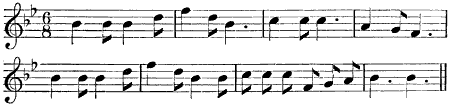
—Biggar (Wm. Ballantyne).
I.
Here we go round by jingo-ring,
Jingo-ring, and jingo-ring,
Here we go round by jingo-ring,
About the merry-ma-tansa.
Come name the lad you like the best,
Like the best, like the best,
Come name the lad you like the best,
About the merry-ma-tansa.
Guess ye wha’s the young gudeman,
The young gudeman, the young gudeman,
Come guess ye wha’s the young gudeman
About the merry-ma-tansa.
Honey’s sweet and so is he,
So is he, so is he,
Honey’s sweet and so is he,
About the merry-ma-tansa.
[Or—
Crab-apples are sour and so is he,
So is he, so is he,
Crab-apples are sour and so is he,
About the merry-ma-tansa.]
Can she bake and can she brew?
Can she shape and can she sew,
‘Boot a house can a’ things do?
About the merry-ma-tansa?
She can bake and she can brew,
She can shape and she can sew,
’Boot a house can a’ things do,
About the merry-ma-tansa.
This is the way to wash the clothes,
Wash the clothes, wash the clothes,
This is the way to wash the clothes,
About the merry-ma-tansa.
[Then follows verses for wringing clothes, ironing, baking
bread, washing hands, face, combing hair, washing and sweeping
the house, and a number of other things done in housekeeping.
The boy then presents the girl with a ring, and they
all sing—]
[371]
Now she’s married in a goud ring,
A gay goud ring, a gay goud ring,
Now she’s married in a goud ring,
About the merry-ma-tansa.
A gay goud ring is a dangerous thing,
A cankerous thing, a cankerous thing,
A gay goud ring is a dangerous thing,
About the merry-ma-tansa.
Now they’re married we wish them joy,
Wish them joy, wish them joy,
Now they’re married we wish them joy,
About the merry-ma-tansa.
Father and mother they must obey,
Must obey, must obey,
Father and mother they must obey,
About the merry-ma-tansa.
Loving each other like sister and brother,
Sister and brother, sister and brother,
Loving each other like sister and brother,
About the merry-ma-tansa.
We pray this couple may kiss thegither,
Kiss thegither, kiss thegither,
We pray this couple may kiss thegither,
About the merry-ma-tansa.
[If any lad was left without a partner, the ring sing—]
Here’s a silly auld man left alone,
Left alone, left alone,
He wants a wife and can’t get none,
About the merry-ma-tansa.
—Biggar (William Ballantyne).
II.
Here we go the jingo-ring,
The jingo-ring, the jingo-ring,
Here we go the jingo-ring,
About the merry-ma-tansie.
Twice about, and then we fa’,
Then we fa’, then we fa’,
Twice about, and then we fa’,
About the merry-ma-tansie.
Guess ye wha’s the young goodman,
The young goodman, the young goodman,
Guess ye wha’s the young goodman,
About the merry-ma-tansie.
Honey is sweet, and so is he,
So is he, so is he,
Honey is sweet, and so is he,
About the merry-ma-tansie.
[Or—
Apples are sour, and so is he,
So is he, so is he,
Apples are sour, and so is he,
About the merry-ma-tansie.]
He’s married wi’ a gay gold ring,
A gay gold ring, a gay gold ring,
He’s married wi’ a gay gold ring,
About the merry-ma-tansie.
A gay gold ring’s a cankerous thing,
A cankerous thing, a cankerous thing,
A gay gold ring’s a cankerous thing,
About the merry-ma-tansie.
Now they’re married, I wish them joy,
I wish them joy, I wish them joy,
Now they’re married, I wish them joy,
About the merry-ma-tansie.
Father and mother they must obey,
Must obey, must obey,
Father and mother they must obey,
About the merry-ma-tansie.
Loving each other like sister and brother,
Sister and brother, sister and brother,
Loving each other like sister and brother,
About the merry-ma-tansie.
We pray this couple may kiss together,
Kiss together, kiss together,
We pray this couple may kiss together,
About the merry-ma-tansie.
—Chambers’ Popular Rhymes, pp. 132-134.
(b) At Biggar (Mr. Ballantyne) this game was generally
played on the green by boys and girls. A ring is formed by
all the children but one, joining hands. The one child stands
in the centre. The ring of children dance round the way of
the sun, first slowly and then more rapidly. First all the
children in the ring bow to the one in the centre, and she bows
back. Then they dance round singing the first and second
verses, the second verse being addressed to the child in the
centre. She then whispers a boy’s name to one in the ring.
This girl then sings the third verse. None in the ring are
supposed to be able to answer, and the name of the chosen
boy is then said aloud by the girl who asked the question.
If the name is satisfactory the ring sing the fourth verse, and
the two players then retire and walk round a little. If the
name given is not satisfactory the ring sing the fifth verse, and
another child must be chosen. When the two again stand in
the centre the boys sing the sixth verse. The girls answer with
the seventh. Then all the ring sing the next verses, imitating
washing clothes, wringing, ironing, baking bread, washing
hands, combing hair, &c., suiting their actions to the words of the
verses sung. The boy who was chosen then presents a ring,
usually a blade of grass wrapped round her finger, to the girl.
The ring then sing the ninth, tenth, eleventh, and twelfth
verses. When all have chosen, if any lad is left without a
partner, the last verse is sung.
The version recorded by Chambers is similar in action, but
there are some important differences in detail. The centre
child acts as mistress of the ceremonies. The ring of children
dance round her, singing the verses. At the end of the first
line of the second verse they all courtesy to her, and she returns
the compliment. At the conclusion of this verse she selects a
girl from the ring and asks her her sweetheart’s name, which is
imparted in a whisper. Upon this the child in the centre sings
the third verse, the ring dancing round as before. If the ring
approves her choice, they sing the fourth verse as in the Biggar
version, and if they disapprove, the fifth. Chambers does not
say whether another child is selected, if this is the case; but it
is probable, as he says, the marriage is finally concluded upon
and effected by the ring singing the verses which follow.
When singing the first line of the eighth verse all the ring
unclasps hands for a moment, and each child performs a
pirouette, clapping her hands above her head.
(c) It seems very clear from both the versions given that
this is a ceremonial dance, round or at a place sacred to such
ceremonies as betrothal and marriage. The version given by
Chambers suggests this the more strongly, as the child in the
centre acts as mistress of the ceremonies, or “go-between,”
the person who was the negotiator between the parents on
either side in bringing a marriage about. The courtesying and
bowing of those in the ring to her may show respect for this
office. On the other hand, there is the more important office
of priest or priestess of “the stones” suggested by the action
of the game, and the reverence to the centre child may be a
relic of this. The fact that she asks a girl to tell her her sweetheart’s
name, and then announces the name of the girl’s choice
for approval or disapproval by the ring in both versions, points
to the time when consent by relations and friends on both
sides was necessary before the marriage could be agreed upon—the
inquiry regarding the qualifications of the proposed wife,
the recital of her housewifely abilities, and the giving of the
ring by the boy to the girl are also betrothal customs. It is
to be noted that it was a popular belief in ancient times that
to wed with a rush-ring was a legal marriage, without the
intervention of a priest or the ceremonies of marriage. Poore,
Bishop of Salisbury (circa 1217), prohibited the use of them—
“With gaudy girlonds or fresh flowers dight
About her necke, or rings of rushes plight.”
—Spenser’s Queen.
And Shakespeare alludes to the custom in the lines—“As
fit as ten groats for the hand of an attorney, as Tib’s rush
for Tom’s forefinger.”—All’s Well that Ends Well. The rejoicing
and bestowal of the blessing by the ring of friends
give an almost complete picture of early Scotch marriage
custom. A version of this game, which appeared in the Weekly
Scotsman of October 16, 1893, by Edgar L. Wakeman, is
interesting, as it confirms the above idea, and adds one or two
details which may be important, i.e., the “choose your maidens
one by one,” and “sweep the house till the bride comes home.”
This game is called the “Gala Ship,” and the girls, forming a
ring, march round singing—
Three times round goes the gala, gala ship,
And three times round goes she;
Three times round goes the gala, gala ship,
And sinks to the bottom of the sea.
They repeat this thrice, courtesying low. The first to courtesy
is placed in the centre of the circle, when the others sing:—
Choose your maidens one by one,
One by one, one by one;
Choose your maidens one by one—
And down goes (all courtesy)
Merrima Tansa!
She chooses her maidens. They take her to a distance,
when she is secretly told the name of her lover. The remainder
of the girls imitate sweeping, and sing several stanzas to the
effect that they will “sweep the house till the bride comes
home,” when the bride is now placed within the circle, and
from a score to a hundred stanzas, with marching and various
imitations of what the lucky bride accomplishes or undergoes,
are sung. Each one closes with “Down goes Merrima Tansa”
and the head-ducking; and this wonderful music-drama of
childhood is not concluded until the christening of the bride’s
first-born, with—
Next Sunday morn to church she must gae,
A babe on her knee, the best of ’a—
And down goes Merrima Tansa!
Jamieson gives the game as a ring within which one goes
round with a handkerchief, with which a stroke is given in
succession to every one in the ring; the person who strikes, or
the taker, still repeating this rhyme:—
Here I gae round the jingie ring,
The jingie ring, the jingie ring,
Here I gae round the jingie ring,
And through my merry-ma-tanzie.
Then the handkerchief is thrown at one in the ring, who is
obliged to take it up and go through the same process. He
also mentions another account of the game which had been
sent him, which describes the game as played in a similar
manner to the versions given by Chambers.
Stewart, in his Ben Nevis and Glencoe, p. 361, records the
following rhyme:—
Here we go with merry shout,
Up and down and round about,
And dance a merry-ma-tandy,
but he does not describe the game in detail.[Addendum]
[Addendum]
[Play Monton, London version]
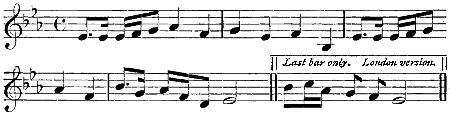
—Monton, Lancashire (Miss Dendy); London (A. B. Gomme).
[Play]
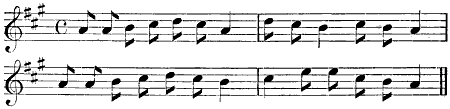
—Earls Heaton, Yorks. (H. Hardy).
I.
Mary’s gone a-milking,
Mother, mother,
Mary’s gone a-milking,
Gentle sweet mother o’ mine.
Take your pails and go after her,
Daughter, daughter,
Take your pails and go after her,
Gentle sweet daughter o’ mine.
Buy me a pair of new milking pails,
Mother, mother,
Buy me a pair of new milking pails,
Gentle sweet mother o’ mine.
Where’s the money to come from,
Daughter, daughter,
Where’s the money to come from,
Gentle sweet daughter o’ mine?
Sell my father’s feather bed,
Mother, mother,
Sell my father’s feather bed,
Gentle sweet mother o’ mine.
What’s your father to sleep on,
Daughter, daughter,
What’s your father to sleep on,
Gentle sweet daughter o’ mine?
Put him in the truckle bed,
Mother, mother,
Put him in the truckle bed,
Gentle sweet mother o’ mine.
What are the children to sleep on,
Daughter, daughter,
What are the children to sleep on,
Gentle sweet daughter o’ mine?
Put them in the pig-sty,
Mother, mother,
Put them in the pig-sty,
Gentle sweet mother o’ mine.
What are the pigs to lie in,
Daughter, daughter,
What are the pigs to lie in,
Gentle sweet daughter o’ mine?
Put them in the washing-tubs,
Mother, mother,
Put them in the washing-tubs,
Gentle sweet mother o’ mine.
What am I to wash in,
Daughter, daughter,
What am I to wash in,
Gentle sweet daughter o’ mine?
Wash in the thimble,
Mother, mother,
Wash in the thimble,
Gentle sweet mother o’ mine.
Thimble won’t hold your father’s shirt,
Daughter, daughter,
Thimble won’t hold your father’s shirt,
Gentle sweet daughter o’ mine.
Wash in the river,
Mother, mother,
Wash in the river,
Gentle sweet mother o’ mine.
Suppose the clothes should blow away,
Daughter, daughter,
Suppose the clothes should blow away,
Gentle sweet daughter o’ mine?
Set a man to watch them,
Mother, mother,
Set a man to watch them,
Gentle sweet mother o’ mine.
Suppose the man should go to sleep,
Daughter, daughter,
Suppose the man should go to sleep,
Gentle sweet daughter o’ mine?
Take a boat and go after them,
Mother, mother,
Take a boat and go after them,
Gentle sweet mother o’ mine.
Suppose the boat should be upset,
Daughter, daughter,
Suppose the boat should be upset,
Gentle sweet daughter o’ mine?
Then that would be an end of you,
Mother, mother,
Then that would be an end of you,
Gentle sweet mother o’ mine.
—London Nursemaid, 1876 (A. B. Gomme).
II.
Mary’s gone a-milking, a-milking, a-milking,
Mary’s gone a-milking, mother, dear mother of mine.
Where did she get her money from, daughter, daughter?
Where did she get her money from, daughter, dear daughter of mine?
[Then follow verses sung in the same manner, beginning
with the following lines—]
Sold her father’s feather bed, feather bed.
What will your father lie on, lie on?
Lay him in the pig-sty, pig-sty.
Where will the pigs lie, daughter?
Lay them in the wash-tub, mother.
What shall I wash in, wash in?
Wash in a thimble, mother.
A thimble won’t hold my night-cap.
Wash by the sea-side, mother.
Suppose the clothes should blow away?
Get a boat and go after them, mother.
But suppose the boat should turn over?
Then that would be an end of you, mother.
—Bocking, Essex (Folk-lore Record, iii. 169).
III.
Mother, please buy me a milking-can,
A milking-can, a milking-can!
Mother, please buy me a milking-can,
With a humpty-dumpty-daisy!
[Then follow verses sung in the same manner, beginning—]
Where’s the money to come from, to come from?
Sell my father’s feather bed.
Where’s your father going to lie?
Lie on the footman’s bed.
Where’s the footman going to lie?
Lie in the cowshed.
Where’s the cows going to lie?
Lie in the pig-sty.
Where’s the pig going to lie?
Lie in the dolly-tub.
And what am I to wash in?
Wash in a thimble.
A thimble wunna hold a cap.
Wash in an egg-shell.
An egg-shell wunna hold a shirt.
Wash by the river-side.
Suppose the clothes should float away?
Get a boat and fetch them back.
Suppose the boat should overthrow?
Serve you right for going after them!
—Berrington, Oswestry, Chirbury (Burne’s Shropshire Folk-lore, p. 515).
IV.
Mother, will you buy me a milking-can,
A milking-can, a milking-can?
Mother, will you buy me a milking-can,
To me, I, O, OM?
Where’s the money to buy it with,
To buy it with, to buy it with,
Where’s the money to buy it with,
To me, I, O, OM?
[Then the following verses—]
Sell my father’s feather bed.
Where will your father sleep?
My father can sleep in the boys’ bed.
Where will the boys sleep?
The boys can sleep in the pig-sty.
Where will the pigs sleep?
The pigs can sleep in the wash-tub.
Where shall I wash my clothes?
You can wash them in a thimble.
A thimble is not large enough.
You can wash them in an egg-shell.
An egg-shell would not hold them.
You can wash them by the river side.
But what if I should fall in?
We’ll get a rope and pull you out,
To me, I, O, OM.
—Sheffield (S. O. Addy).
V.
Mother, come buy me two milking-pails,
Two milking-pails, two milking-pails,
Mother, come buy me two milking-pails,
O sweet mother o’ mine.
[Then verses beginning with the following lines—]
Where shall I get my money from,
O sweet daughter o’ mine?
Sell my father’s feather beds.
Where shall your father sleep?
Sleep in the servant’s bed.
Where shall the servant sleep?
Sleep in the washing-tub.
Where shall I wash the clothes?
Wash them in the river.
Suppose the clothes float away?
Take a boat and go after them.
Suppose the boat upsets?
Then you will be drownded.
—London (Miss Dendy).
VI.
Mother, come buy me a milking-can,
Milking-can, milking-can,
Mother, come buy me a milking-can,
O mother o’ mine.
Where can I have my money from,
O daughter o’ mine?
Sell my father’s bedsteads.
Where must your father sleep?
Sleep in the pig-sty.
Where must the pig sleep?
Sleep in the washing-tub.
What must I wash in?
Wash in your thimble.
What must I sew with?
Sew with your finger.
What will you say if I prick me?
Serve you right, serve you right.
—Monton, Lancashire (Miss Dendy).
VII.
Mother, will you buy me a pair of milking-cans,
Milking-cans, milking-cans,
Mother, will you buy me a pair of milking-cans,
O gentle mother of mine?
But where shall I get the money from?
Sell my father’s feather bed.
But where, O where, will your father lie?
Father can lie in the girls’ bed.
But where, O where, shall the girls then lie?
The girls can lie in the boys’ bed.
But where, O where, shall the boys lie?
The boys may lie in the pig-sty.
Then where, O where, will the pigs lie?
The pigs may lie in the washing-tub.
Then where, O where, shall we wash our clothes?
We can wash by the river side.
The tide will wash the clothes away.
Get the prop and follow them.
—Sheffield (Miss Lucy Garnett).
VIII.
Mother, buy some milking-cans,
Milking-cans, milking-cans.
Where must our money come from?
Sell our father’s feather bed.
[This goes on for many more verses, articles of furniture
being mentioned in each succeeding verse.]
—Earls Heaton (Herbert Hardy).
IX.
Buy me a milking-pail, my dear mother.
Where’s the money to come from, my dear daughter?
Sell father’s feather bed.
Where could your father sleep?
Sleep in the pig-sty.
What’s the pigs to sleep in?
Put them in the washing-tub.
What could I wash the clothes in?
Wash them in your thimble.
Thimble isn’t big enough for baby’s napkin.
Wash them in a saucer.
A saucer isn’t big enough for father’s shirt.
Wash by the river side, wash by the river side.
—Crockham Hill, Kent (Miss Chase).
X.
Please, mother, buy me a milking-can,
Milking-can, milking-can,
Please, mother, buy me a milking-can,
My dear mother.
Where can I get the money from?
Sell father’s feather bed.
Where shall your father sleep?
Sleep in the boys’ bed.
Where shall the boys sleep?
Sleep in the pig-sty.
Where shall the pigs sleep?
Sleep in the washing-tub.
What shall I wash with?
Wash in an egg-shell.
The egg-shell will break.
Wash in a thimble.
Thimble’s not big enough.
Wash by the river side.
Suppose the things should float away?
Get a boat and go after them.
Suppose the boat should be upset?
Then you’ll be drowned,
Drowned, drowned,
Then you’ll be drowned,
And a good job too.
—Enborne, Berks. (Miss M. Kimber).
XI.
Please, mother, buy me a milk-can,
A milk-can, a milk-can,
Please, mother, do.
Where’s the money coming from,
Coming from, coming from,
What shall I do?
Sell father’s feather bed,
Feather bed, feather bed,
Please mother, do.
Where shall the father sleep?
Sleep in the servants’ bed.
Where shall the servants sleep?
Sleep in the pig-sty.
Where shall the pig sleep?
Sleep in the washing-tub.
What shall I wash in?
Wash in a thimble.
The shirts won’t go in.
Wash by the river side.
Supposing if I fall in?
Good job too!
—Hartley Wintney, Winchfield, Hants (H. S. May).
XII.
Mother, buy the milk-pail, mother, dear mother of mine.
Where’s the money to come from, children, dear children of mine?
Sell father’s feather bed, mother, dear mother of mine.
Where’s your father to sleep in?
Father can sleep in the servant’s bed.
Where’s the servant to sleep in?
Servant can sleep in the pig-sty.
Where’s the pig to sleep in?
The pig can sleep in the wash-tub.
Where shall we wash our clothes?
Wash our clothes at the sea-side.
If our clothes should swim away?
Then take a boat and go after them.
O what should we do if the boat should sink?
O then we should all of us be at an end.
—Swaffham, Norfolk (Miss Matthews).
XIII.
We want to buy a wash-pan, wash-pan, wash-pan,
We want to buy a wash-pan, early in the morning.
Where will you get the money from, money from, money from?
We’ll sell my father’s feather bed, feather bed, feather bed.
Where will your father sleep?
Father’ll sleep in the boys’ bed.
Where will the boys sleep?
Boys will sleep in the girls’ bed.
Where will the girls sleep?
Girls will sleep in the pig-sty.
Where will the pigs sleep?
Pigs will sleep in the washing-pan.
—Cowes, Isle of Wight (Miss E. Smith)
[386]
XIV.
Mother, may I buy some male-scales, mother, mother?
Mother, may I buy some male-scales, gentle mother of mine?
Where will the money come from, daughter, daughter?
Sell my father’s feather bed, mother, mother.
Where will your father lie, daughter, daughter?
Lie in the boys’ bed, mother, mother.
Where will the boys lie, daughter, daughter?
Lie in the servants’ bed, mother, mother.
Where will the servants lie, daughter, daughter?
Lie in the pig-sty, mother, mother.
Where will the pigs lie, daughter, daughter?
Lie in the washing-tub, mother, mother.
Where will we wash our clothes, daughter, daughter?
Wash them at the sea-side, mother, mother.
Suppose the clothes should float away, daughter, daughter?
Take a boat and bring them in, mother, mother.
Suppose the boat would go too slow, daughter, daughter?
Take a steamboat and bring them in, mother, mother.
Suppose the steamboat would go too fast, daughter, daughter?
Then take a rope and hang yourself, mother, mother.
—South Shields (Miss Blair, aged 9).
(b) One child stands apart and personates the Mother. The
other children form a line, holding hands and facing the
Mother. They advance and retire singing the first, third, and
alternate verses, while the Mother, in response, sings the
second and alternate verses. While the last verse is being
sung the children all run off; the Mother runs after them,
catches them, and beats them. Either the first or last caught
becomes Mother in next game. In the Shropshire game the
Mother should carry a stick. In the Norfolk version the
Mother sits on a form or bank, the other children advancing
and retiring as they sing. After the last verse is sung the
children try to seat themselves on the form or bank where the
Mother has been sitting. If they can thus get home without
the Mother catching them they are safe. The Kentish game is
played with two lines of children advancing and retiring. This
was also the way in which the London version (A. B. Gomme)
was played. In the version sent by Mr. H. S. May a ring is
formed by the children joining hands. One child stands in
the centre—she represents the Mother. The ring of children
say the first, third, and every alternate verse. The child in
the centre says the second, fourth, and alternate verses, and
the game is played as above, except that when the Mother has
said the last verse the children call out, “Good job, too,” and
run off, the Mother chasing them as above. The game does
not appear to be sung.
(c) This game is somewhat of a cumulative story, having for
its finish the making angry and tormenting of a mother. All
the versions point to this. One interesting point, that of milk-pails,
is, it will be seen, gradually losing ground in the rhymes.
Milk-pails were pails of wood suspended from a yoke worn on
the milkmaid’s shoulders, and these have been giving place
to present-day milk-cans. Consequently we find in the
rhymes only four versions in which milk-pails are used. In
two versions even the sense of milking-can has been lost,
and the South Shields version, sent me by little Miss Blair,
has degenerated into “male-scales,” a thoroughly meaningless
phrase. The Cowes version (Miss Smith) has arrived at
“wash-pan.” The “burden” of the Chirbury version is “a
rea, a ria, a roses,” and the Sheffield version is also remarkable: the
“I, O, OM” refers, probably, to something now forgotten,
or it may be the “Hi, Ho, Ham!” familiar in many nursery
rhymes. The game seems to point to a period some time back,
when milking was an important phase of the daily life, or perhaps
to the time when it was customary for the maids and
women of a village to go to the hilly districts with the cows
(summer shealings) for a certain period of time. The references
to domestic life are interesting. The scarcity of beds, the best
or feather bed, and the children’s bed, seeming to be all those
available. The feather bed is still a valued piece of household
furniture, and is considered somewhat of the nature of a heirloom,
feather beds often descending from mother to daughter for
some generations. I have been told instances of this. Gregor,
in Folk-lore of East of Scotland, p. 52, describes the Scottish
box-bed. The “truckle bed” and “footman’s bed” probably
refers to the small bed under a large one, which was only
pulled out at night for use, and pushed under during the day.
Illustrations of these beds and the children’s bed are given
in old tales. The proximity of the pig-sty to the house
is manifest. The mention of washing-tubs calls to mind the
large wooden tubs formerly always used for the family wash.
Before the era of laundresses washing-tubs must have constituted
an important part of the family plenishing. Washing
in the rivers and streams was also a thing of frequent occurrence,
hot water for the purpose of cleansing clothes not being
considered necessary, or in many cases desirable. Chambers
gives a version of the game (Popular Rhymes, p. 36) and
also Newell (Games, p. 166). Another version from Buckingham
is given by Thomas Baker in the Midland Garner, 1st
ser., ii. 32, in which the mother desires the daughter to “milk
in the washing-tub,” and the words also appear very curiously
tacked on to the “Three Dukes a-riding” game from Berkshire
(Antiquary, xxvii. 195), where they are very much out of place.[Addendum]
A ball is thrown by one player to any one of the others. The
thrower calls out at the same time either “mineral,” “animal,”
or “vegetable,” and counts from one to ten rather quickly. If
the player who is touched by the ball does not name something
belonging to that kingdom called before the number ten
is reached, a forfeit has to be paid.—London (A. B. Gomme).
This is more usually called “Animal, Vegetable, and
Mineral.” See “Air, Fire, and Water.”
The first player begins by saying, “The minister’s cat is
an ambitious cat,” the next player “an artful cat,” and so on,
until they have all named an adjective beginning with A. The
next time of going round the adjectives must begin with B,
the next time C, and so on, until the whole of the alphabet
has been gone through.—Forest of Dean, Gloucestershire (Miss
Matthews); Anderby, Lincolnshire (Miss Peacock).
This is apparently the same game as the well-known “I
love my love with an A because she is amiable.” In this
game every player has to repeat the same sentence, but using
a different adjective, which adjective must begin with the letter
A. Various sentences follow. At the next round the adjectives
all begin with B; the next C, until a small story has been
built up. Forfeits were exacted for every failure or mistake.
The formula usually was—
I love my love with an A because she is ( ). I hate her with an A
because she is ( ). I took her to the sign of the ( ), and
treated her to ( ). The result was ( ).
Cornish name for “Tom Tiddler’s Ground.”—Folk-lore
Journal, v. 57.
A game played with a ball. There are seven players, who
each take a name from one of the days of the week. One
(Sunday) begins by throwing the ball against a wall, calling
out at the same time the name of one of the days, who has to
run and catch it before it falls. If this one fails to catch the
ball, the first player picks up the ball and tries to hit one of the
six with it, who all endeavour to escape being hit. If the player
succeeds, he again throws the ball against the wall, calling out
another day of the week to catch it. If a player gets hit three
times, he is out. The winner is he who has either not been
hit at all or the fewest times, or who has been able to stay in
the longest. The same game is played with twelve children,
who are named after the twelve months of the year.—London
and Barnes (A. B. Gomme); Strand Magazine, ii. 519 (F. H.
Low).
This game belongs apparently to the ball games used
for purposes of divination. Mr. Newell (Games, p. 181)
describes a similar game to this, in which the player whose
name is called drops the ball; he must pick it up as quickly
as possible while the rest scatter. He then calls “Stand!”
upon which the players halt, and he flings it at whom he
pleases. If he misses his aim, he must place himself in a bent
position with his hands against a wall until every player has
taken a shot at him. The idea of naming children after the
days of the week occurs also in the games of “Gipsy,”
“Witch,” and “Mother, Mother, the Pot boils over.”
See “Ball,” “Burly Whush,” “Keppy Ball.”[Addendum]
The game of “Deadelie;” one has to run with the hands
locked and “taen” the others.—Mactaggart’s Gallovidian
Encyclopædia.
See “Chickidy Hand,” “Deadelie,” “Hunt the Staigie,”
“Whiddy.”
A very rough game, mentioned in Dean Miles’ MS., p. 180
(Halliwell’s Dictionary). Lowsley (Berkshire Glossary) says
this is “a favourite game with children at Christmas-time,
when wishing for one of a romping character,” but he does not
describe it further. Northall (English Folk Rhymes, p. 354)
says that in Warwickshire and Staffordshire boys torture an
unfortunate victim by throwing him on the ground and falling
atop of him, yelling out the formula, “Bags to [on] the mill.”
This summons calls up other lads, and they add their weight.[Addendum]
I.
Mother, may I go out to play?
No, my child, it’s such a wet day.
Look how the sun shines, mother.
Well, make three round curtseys and be off away.
[Child goes, returns, knocks at door. Mother says, “Come in.”]
What have you been doing all this time?
Brushing Jenny’s hair and combing Jenny’s hair.
What did her mother give you for your trouble?
A silver penny.
Where’s my share of it?
Cat ran away with it.
Where’s the cat?
In the wood.
Where’s the wood?
Fire burnt it.
Where’s the fire?
Moo-cow drank it.
Where’s the moo-cow?
Butcher killed it.
Where’s the butcher?
Eating nuts behind the door, and you may have the nutshells.
—London (Miss Dendy, from a maid-servant).
II.
Please, mother, may I go a-maying?
Why, daughter, why?
Because it is my sister’s birthday.
Make three pretty curtseys and walk away.
Where is your may?
I met puss, and puss met me, and puss took all my may away.
Where is puss?
Run up the wood.
Where is the wood?
Fire burnt it.
Where is the fire?
Water quenched it.
Where is the water?
Ducks have drunk it.
Where are the ducks?
Butcher killed them.
Where is the butcher?
Behind the churchyard, cracking nuts, and leaving you the shells.
—Sporle, Norfolk (Miss Matthews).
III.
Please, mother, may we go out to play?
Yes, if you don’t frighten the chickens.
No, mother, we won’t frighten the chickens.
[They all go out and say, “Hush! hush!” to pretended chickens.]
Where have you been?
To grandmother’s.
What for?
To go on an errand.
What did you get?
Some plums.
What did you do with them?
Made a plum-pudding.
What did she give you?
A penny.
What did you do with it?
Bought a calf.
What did you do with it?
Sold it.
What did you do with the money?
Gave it to the butcher, and he gave me a penny back, and I bought some nuts with it.
What did you do with them?
Gave them to the butcher, and he’s behind the churchyard cracking them, and leaving you the shells.
—Sporle, Norfolk (Miss Matthews).
IV.
Mother, mother, may I go to play?
No, daughter, no! for fear you should stay.
Only as far as the garden gate, to gather flowers for my wedding day.
Make a fine curtsey and go your way.
[They all curtsey and scamper off, and proceed to plan some mischief. Then they return.]
Now where have you been?
Up to Uncle John’s.
What for?
Half a loaf, half a cheese, and half a pound of butter.
Where’s my share?
Up in cupboard.
’Tisn’t there, then!
Then the cat eat it.
And where’s the cat?
Up on the wood [i.e., the faggots].
And where’s the wood?
Fire burnt it.
Where’s the fire?
Water douted it [i.e., put it out].
Where’s the water?
Ox drank it.
Where’s the ox?
Butcher killed it.
And where’s the butcher?
Behind the door cracking nuts, and you may eat the shells of them if you like.
—Dorsetshire (Folk-lore Journal, vii. 219).
V.
Please may I go out to play?
How long will you stay?
Three hours in a day.
Will you come when I call you?
No.
Will you come when I fetch you?
Yes.
Make then your curtseys and be off.
The girls then scamper off as before, and as they run about
the field keep calling out, “I won’t go home till seven o’clock,
I won’t go home till seven o’clock.” After they have been
running about for some five or ten minutes the Mother calls
Alice (or whatever the name may be) to come home, when the
one addressed will run all the faster, crying louder than before,
“I won’t go home till seven o’clock.” Then the Mother commences
to chase them until she catches them, and when she
gets them to any particular place in the field where the others
are playing, she says—
Where have you been?
Up to grandmother’s.
What have you done that you have been away so long?
I have cleaned the grate and dusted the room.
What did she give you?
A piece of bread and cheese so big as a house, and a piece of plum cake so big as a mouse.
Where’s my share?
Up in higher cupboard.
It’s not there.
Up in lower cupboard.
It’s not there.
Then the cat have eat it.
Where’s the cat?
Up in heath.
Where’s the heath?
The fire burnt it.
[The rest is the same as in the last version, p. 393.]
—Dorsetshire (Folk-lore Journal, vii. 221-222).
VI.
Mother, mother, may I (or we) go out to play?
No, child! no, child! not for the day.
Why, mother? why, mother? I won’t stay long.
Make three pretty courtesies, and away begone.
One for mammy, one for daddy, one for Uncle John.
Where, child! where, child! have you been all the day?
Up to granny’s.
What have you been doing there?
[The answer to this is often, “Washing doll’s clothes,” but
anything may be mentioned.]
[The reply is again left to the child’s fancy.]
Where’s my share?
The cat ate it [or, In the cat’s belly]. What’s in that box, mother?
Twopence, my child.
What for, mother?
To buy a stick to beat you, and a rope to hang you, my child.
—Cornwall (Folk-lore Journal, v. 55, 56).
VII.
Grandmother, grandmother grey,
May I go out to play?
No, no, no, it is a very wet day.
Grandmother, grandmother grey,
May I go out to play?
Yes, yes, yes, if you don’t frighten the geese away.
Children, I call you.
I can’t hear you.
Where are your manners?
In my shoe.
Who do you care for?
Not for you.
—Earls Heaton, Yorks. (H. Hardy).
VIII.
Pray, mother, pray,
May I go out to play?
No, daughter, no, daughter,
Not every fine day.
Why, mother, why?
I shan’t be gone long.
Make a fine curtsey
And glad git you gone.—
Wait for your sister.
—Hurstmonceux, Sussex (Miss Chase).
IX.
Please, mother, please, mother, may I go out to play?
No, child, no, child, ’tis such a cold day.
Why, mother, why, mother, I won’t stay long.
Make three pretty curtseys and off you run.
—Northants (Rev. W. D. Sweeting).
(b) One girl is chosen to act as “Mother,” the rest of the
players pretend to be her children, and stand in front of her,
not in a line, but in a group. One of them, very frequently all
the children ask her the first question, and the Mother answers.
When she gives permission for the children to go out they all
curtsey three times, and run off and pretend to play. They
then return, and the rest of the dialogue is said, the Mother
asking the questions and the children replying. At the end of
the dialogue the Mother chases and catches them, one after the
other, pretending to beat and punish them. In the Northants
and Hurstmonceux games there appears to be no chasing. In
the London version (Miss Dendy) only two children are mentioned
as playing. When the Mother is chasing the girl she
keeps asking, “Where’s my share of the silver penny?” to
which the girl replies, “You may have the nut-shells.” In the
Cornish version, when the Mother has caught one of the children,
she beats her and puts her hands round the child’s throat
as if she were going to hang her.
(c) Miss Courtney, in Folk-lore Journal, v. 55, says: “I
thought this game was a thing of the past, but I came across
some children playing it in the streets of Penzance in 1883.” It
belongs to the cumulative group of games, and is similar in this
respect to “Milking Pails,” “Mother, Mother, the Pot boils
over,” &c. There seems to be no other object in the game
as now played except the pleasures of teasing and showing
defiance to a mother’s commands, and trying to escape the consequences
of disobedience by flight, in order that the mother
may chase them. The idea may be that, if she is “out of
breath,” she cannot chastise so much. Mr. Newell (Games,
p. 172) gives versions of a similar game.
All the players, except one, stand two by two in front of each
other, the inner ones forming an arch with their hands united—this
is called the “oven.” The odd child is “Mother Mop.”
She busies herself with a pretended mop, peel, &c., after the
manner of old-fashioned bakers, making much ado in the valley
between the rows of children. The oven soon gets demolished,
and the last child vanquished becomes “Mother Mop” the next
time.—Bitterne, Hants (Mrs. Byford).
It seems probable that the inner rows of children should
kneel or stoop down in order that “Mother Mop” should have
as much trouble as possible with her oven. The game may
have lost some of its details in other directions, as there is no
apparent reason why the oven is demolished or broken down.
See “Jack, Jack, the Bread’s a-burning.”
A number of girls choose one of their number to represent
a witch, and another to be a mother. The Witch stands near
the corner of a wall, so that she can peep round. Then the
Mother counts the children by the seven days of the week,
“Monday,” “Tuesday,” &c., and appoints another girl to act
as guardian over them. She then pretends to go out washing,
removing to a short distance so as to be within ear-shot of the
other children. As soon as the Mother has gone, the old
Witch comes and says, “Please, can I light my pipe?” Then
the children say, “Yes, if you won’t spit on t’ hearth.” She
pretends to light her pipe, but spits on the hearth, and runs
away with the girl called Sunday. Then the Guardian, among
the confusion, pretends to rush down stairs, and, failing to find
Sunday, calls out, “Mother, mother, t’ pot boils over.” The
Mother replies, “Put your head in;” the Guardian says, “It’s
all over hairs;” the Mother says, “Put the dish-clout in;” the
Guardian says, “It’s greasy;” the Mother says, “Get a fork;”
the Guardian says, “It’s rusty;” the Mother says, “I’ll come
mysen.” She comes, and begins to count the children, Monday,
Tuesday, up to Saturday, and missing Sunday, asks,
“Where’s Sunday?” the Guardian says, “T’ old Witch has
fetched her.” The Mother answers, “Where was you?” “Up
stairs.” The Mother says, “What doing?” “Making t’ beds.”
“Why didn’t you come down?” “Because I had no shoes.”
“Why didn’t you borrow a pair?” “Because nobody would
lend me a pair.” “Why didn’t you steal a pair?” “Do you
want me to get hung?” Then the Mother runs after her, and
if she can catch her thrashes her for letting Sunday go. Then
the Mother pretends to go out washing again, and the Witch
fetches the other days of the week one by one, when the same
dialogue is rehearsed.—Dronfield, Derbyshire (S. O. Addy).
This game was also played in London. The dramatis
personæ were a mother, an eldest daughter, the younger
children, a witch, and a pot was represented by another child.
The Mother names the children after the days of the week.
She tells her eldest daughter that she is going to wash, and
that she expects her to take great care of her sisters, and to
be sure and not let the old witch take them. She is also to
look after the dinner, and be sure and not let the pot boil over.
The Mother then departs, and stays at a little distance from
the others. The eldest daughter pretends to be very busy
putting the house to rights, sweeps the floor, and makes
everything tidy; the younger children pretend to play, and get
in the elder sister’s way. She gets angry with them, and
pretends to beat them. Now, the girl who personates the
Witch comes and raps with her knuckles on a supposed door.
The Witch stooped when walking, and had a stick to help her
along.
Come in, says the eldest sister. What do you want?
Let me light my pipe at your fire? My fire’s out.
Yes! if you’ll not dirty the hearth.
No, certainly; I’ll be careful.
While the eldest sister pretends to look on the shelf for
something, the Witch “dirties” the hearth, catches hold of
Monday and runs off with her; and at this moment the pot
boils over. The child who is the pot makes a “hissing and
fizzing” noise. The daughter calls out—
Mother, mother, the pot boils over.
Take the spoon and skim it.
Can’t find it.
Look on the shelf.
Can’t reach it.
Take the stool.
The leg’s broke.
Take the chair.
Chair’s gone to be mended.
I suppose I must come myself?
The Mother here wrings her hands out of the water in the
washing-tub and comes in. She looks about and misses
Monday.
Where’s Monday?
Oh, please, Mother, please, I couldn’t help it; but some one
came to beg a light for her pipe, and when I went for
it she took Monday off.
Why, that’s the witch!
The Mother pretends to beat the eldest daughter, tells her to
be more careful another time, and to be sure and not let the
pot boil over. The eldest daughter cries, and promises to be
more careful, and the Mother goes again to the wash-tub.
The same thing occurs again. The Witch comes and asks—
Please, will you lend me your tinder-box? My fire’s out.
Yes, certainly, if you’ll bring it back directly.
You shall have it in half-an-hour.
While the tinder-box is being looked for she runs off with
Tuesday. Then the pot boils over, and the same dialogue is
repeated. The Mother comes and finds Tuesday gone. This
is repeated for all the seven children in turn, different articles,
gridiron, poker, &c., being borrowed each time. Finally, the
eldest daughter is taken off too. There is no one now to watch
the pot, so it boils over, and makes so much noise that the
Mother hears it and comes to see why it is. Finding her
eldest daughter gone too, she goes after her children to the
Witch’s house. A dialogue ensues between the Witch and
the Mother. The Mother asks—
Is this the way to the Witch’s house?
There’s a red bull that way!
I’ll go this way.
There’s a mad cow that way!
I’ll go this way.
There’s a mad dog that way!
She then insists on entering the house to look for her children.
The Witch will not admit her, and says—
Your boots are too dirty.
I’ll take my boots off.
Your stockings are too dirty.
I’ll take them off.
Your feet are dirty.
I’ll cut them off.
The blood will run over the threshold.
I’ll wrap them up in a blanket.
The blood will run through.
This enrages the Mother, and she pushes her way into the
supposed house, and looks about, and calls her children. She
goes to one and says—
This tastes like my Monday.
The Witch tells her it’s a barrel of pork.
No, no, this is my Monday; run away home.
Upon this Monday jumps up from her crouching or kneeling
posture [the children were generally put by the Witch behind
some chairs all close together in one corner of the room], and
runs off, followed by all the others and their Mother. The
Witch tries to catch one, and if successful that child becomes
Witch next time.—A. B. Gomme.
A probable explanation of this game is that it illustrates
some of the practices and customs connected with fire-worship
and the worship of the hearth, and that the pot is a magical
one, and would only boil over when something wrong had
occurred and the Mother’s presence was necessary. The pot
boils over directly a child is taken away, and appears to cease
doing this when the Mother comes in. It is remarkable, too,
that the Witch should want to borrow a light from the fire;
the objection to the giving of fire out of the house is a well-known
and widely-diffused superstition, the possession of a
brand from the house-fire giving power to the possessor over
the inmates of a house. The mention of the spitting on the
hearth in the Sheffield version, and dirtying the hearth in the
London version, give confirmation to the theory that the desecration
of the fire or hearth is the cause of the pot boiling over,
and that the spirit of the hearth or fire is offended at the sacrilege.
The Witch, too, may be unable to get possession of a
child until she has something belonging to the house. The
journey of the Mother to the Witch’s house in search of her
children, the obstacles put in her path, and the mention of the
spilling of blood on the threshold, are incidents which have
great significance. Why the “keeling” or skimming of the
contents of the pot should be so difficult a task for the eldest
daughter that the Mother is obliged to come herself, is not so
clear; the skimming is of course to prevent the pot boiling over,
and the pot may be supposed to take the place of the Mother
or Guardian of the hearth, and tell when misfortune or trouble
is at hand. Or the “boiling over” (which, if continued, would
extinguish the fire and sully the stone) may be an offence to
the hearth spirit, who ceases then to protect the inmates of the
house. Fairies are said to have power over the inmates of a
house when the threshold and kitchen utensils are left dirty and
uncared for. Thus on the theories accompanying the ancient
house ritual, this extraordinary game assumes a rational aspect,
and it is not too much to suggest that this explanation is the
correct one.
In the game of “Witch” practically the same incidents
occur, and nearly the same dialogue, but the significant elements
of pot-boiling and fire-protection do not appear in that
game. It is not certain whether we have two independent
games, or whether “The Witch” is this game, the incidents of
pot-boiling and the fire-protection having been lost in its transmission
to more modern notions. Although so closely allied,
these games are not one at the present day, and are therefore
treated separately. Newell (Games, p. 218) gives some versions
of “Witch” which show a connection between that game and
this. See “Keeling the Pot,” “Witch.”
One child throws a tin (any kind of tin will do) to some
distance, and then walks towards it without looking round.
The other children, in the meantime, hide somewhere near.
The child who threw the tin has to guard it, and at the same
time try to find those who are hiding. If he sees one he must
call the name, and run to strike the tin with his foot. He does
this until each one has been discovered. As they are seen
they must stand out. The one who was first found has to
guard the tin next time. Should one of the players be able to
strike the tin while the keeper is absent, that player calls out,
“Hide again.” They can then all hide until the same keeper
discovers them again.—Beddgelert (Mrs. Williams).
See “New Squat.”[Addendum]
One girl stands up and personates a mother, another pretends
to be a mouse, and crouches behind a chair in a corner. The
mother says to another player—
Go and get your father’s shirt.
This player goes to the chair to look for the shirt, and is
tickled or touched by the one hiding. She rushes back and
calls out—
Mother, there’s a mouse.
Go and get your father’s coat.
There’s a mouse.
Go and get your father’s watch and chain.
There’s a mouse.
The Mother then goes to see herself. The second time she is
scratched and chased. When caught she takes the Mouse’s
place.—Deptford, Kent (Miss Chase).
This is evidently the same game as “Ghost in the Garden”
and “Ghost in the Copper,” in a decaying stage. There is no
raison d’etre for either mouse or cobbler. Probably these
words are a corruption of the older “Ghost in the Copper.”
[Play]
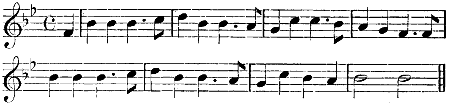
—Earls Heaton (H. Hardy).
[Play]
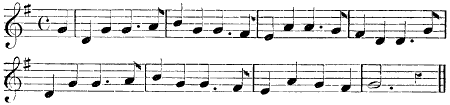
—Congleton Workhouse (Miss A. E. Twemlow).
I.
Have you seen the muffin man, the muffin man, the muffin man,
Have you seen the muffin man that lives in Drury Lane O?
Yes, I’ve seen the muffin man, the muffin man, the muffin man;
Yes, I’ve seen the muffin man who lives in Drury Lane O.
—Earls Heaton, Yorks. (H. Hardy).
II.
O, have you seen the muffin man,
The muffin man, the muffin man;
O, have you seen the muffin man
Who lives in Drury Lane O?
—N. W. Lincolnshire (Rev. —— Roberts).
[403]
III.
Have you seen the muffin girl,
The muffin girl, the muffin girl?
O have you seen the muffin girl
Down in yonder lane?
—Congleton Workhouse School (Miss A. E. Twemlow).
IV.
Don’t you know the muffin man?
Don’t you know his name?
Don’t you know the muffin man
That lives in our lane?
All around the Butter Cross,
Up by St. Giles’s,
Up and down the Gullet Street,
And call at Molly Miles’s!
—Burne’s Shropshire Folk-lore, p. 571.
V.
Have you seen the nutting girl,
The nutting girl, the nutting girl?
Have you seen the nutting girl,
Down in yonder lane O?
—Holmfirth (H. Hardy).
(b) A ring is formed by the players joining hands; one child,
who is blindfolded and holds a stick, stands in the centre. The
ring dance round, singing the verse. They then stand still, and
the centre child holds out the stick and touches one of the
ring. This player must take hold of the stick. Then the
Muffin Man asks this player any questions he pleases, “Is
the morn shining?” “Is ink white?” &c. The child who holds
the stick answers “Yes” or “No” in a disguised voice, and
the Muffin Man then guesses who it is. He is allowed three
tries. If he guesses right he joins the ring, and the child who
was touched takes his place in the centre. In the Yorkshire
versions no questions are asked; the blindfolded child goes to
any one he can touch, and tries to guess his or her name. The
other version, sent by Mr. Hardy, is played in the same way,
and sung to the same tune. In the Congleton version (Miss
Twemlow), the blindfolded child tries to catch one of those in
the ring, when the verse is sung. The lines, with an additional
four from Shropshire Folk-lore, are given by Miss Burne among
nursery rhymes and riddles.
See “Buff with a Stick,” “Dinah.”
[Play]
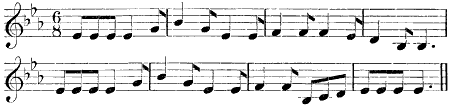
—Miss Harrison.
Here we go round the mulberry bush,
The mulberry bush, the mulberry bush,
Here we go round the mulberry bush,
On a cold and frosty morning.
This is the way we wash our hands,
Wash our hands, wash our hands,
This is the way we wash our hands,
On a cold and frosty morning.
Here we go round the mulberry bush,
The mulberry bush, the mulberry bush,
Here we go round the mulberry bush,
On a cold and frosty morning.
This is the way we wash our clothes,
Wash our clothes, wash our clothes,
This is the way we wash our clothes,
On a cold and frosty morning.
Here we go round the mulberry bush,
The mulberry bush, the mulberry bush,
Here we go round the mulberry bush,
On a cold and frosty morning.
This is the way we go to school,
We go to school, we go to school,
This is the way we go to school,
On a cold and frosty morning.
Here we go round the mulberry bush,
The mulberry bush, the mulberry bush,
Here we go round the mulberry bush,
On a cold and frosty morning.
—Liphook, Hants (Miss Fowler).
(b) The children form a ring, all joining hands and dancing
round while singing the first verse. When singing the last
line they unclasp their hands, and each one turns rapidly round.
They then sing the next verse, suiting their actions to the
words they sing, again turning round singly at the last line.
This is done with every alternate verse, the first verse being
always sung as a chorus or dance in between the different
action-verses. The verses may be varied or added to at pleasure.
The actions generally consist of washing and dressing oneself,
combing hair, washing clothes, baking bread, sweeping the
floor, going to and returning from school, learning to read,
cleaning boots, and lacing stays. When “going to school,”
the children walk two by two in an orderly manner; when
“coming home from school,” jumping and running is the style
adopted; “lacing stays,” the hands are put behind and moved
first one and then the other, as if lacing; “this is the way the
ladies walk,” holding up skirts and walking primly; “gentlemen
walk,” walking with long strides and sticks. The dressing
process and cleaning boots preceded “school.”
(c) This game is well known, and played in almost all parts
of England. It is always played in the same way. There is
so little variety in the different versions that it appears unnecessary
to give more than one here. In the many versions sent
the only variants are: In Sporle, Norfolk, Miss Matthews says
the game is sometimes called “Ivy Bush,” or “Ivory Bush;”
and Mr. C. C. Bell, of Epworth, sends a version, “Here we go
round the Mulberry Tree” In Notts it is called “Holly Bush”
(Miss Winfield). A version given in the Folk-lore Record, iv.
174, is called the “Gooseberry Bush,” and Halliwell (Popular
Nursery Rhymes, p. 224) records a game, the “Bramble Bush.”
“The bush,” he says, “is often imaginative, but is sometimes
represented by a child in the centre.” Chambers (Popular
Rhymes, pp. 134, 135) gives the game as a form of the “Merry-ma-tanzie”—a
kind of dance. They sing while moving round
to the tune of “Nancy Dawson,” and stopping short with
courtesy at the conclusion.
Here we go round the mulberry bush,
The mulberry bush, the mulberry bush,
Here we go round the mulberry bush,
And round the merry-ma-tanzie.
Disjoining hands, they then begin, with skirts held daintily
up behind, to walk singly along, singing—
This is the way the ladies walk,
The ladies walk, the ladies walk;
This is the way the ladies walk,
And round the merry-ma-tanzie.
At the last line they reunite, and again wheel round in a ring,
singing as before—
Here we go round the mulberry bush, &c.
After which, they perhaps simulate the walk of gentlemen, the
chief feature of which is length of stride, concluding with the
ring dance as before. Probably the next movement may be—
This is the way they wash the clothes,
Wash the clothes, wash the clothes;
This is the way they wash the clothes,
And round the merry-ma-tanzie.
After which there is, as usual, the ring dance. They then
represent washing, ironing clothes, baking bread, washing the
house, and a number of other familiar proceedings.
Chambers quotes a fragment of this “little ballet,” as practised
at Kilbarchan, in Renfrewshire, which contains the following
lines similar to those in this game:—
She synes the dishes three times a day,
Three times a day, three times a day;
She synes the dishes three times a day,
Come alang wi’ the merry-ma-tanzie.
She bakes the scones three times a day,
Three times a day, three times a day;
She bakes the scones three times a day,
Come alang wi’ the merry-ma-tanzie.
She ranges the stules three times a day,
Three times a day, three times a day;
She ranges the stules three times a day,
Come alang wi’ the merry-ma-tanzie.
This game originated, no doubt, as a marriage dance round
a sacred tree or bush. As it now exists it appears to have
no other character than the performance of duties such as
those enumerated in the description. In no version that I
am acquainted with do the elements of love and marriage
or kissing occur, otherwise the resemblance it bears to the
Scotch “Merry-ma-tanzie” would suggest that it is a portion
of that game. This game possesses the centre tree,
which is not preserved in “Merry-ma-tansa.” Trees were
formerly sacred to dancing at the marriage festival, as at
Polwarth in Berwickshire, where the custom once prevailed,
which is not unworthy of notice. “In the midst of the
village are two thorn trees near to each other; round these
every newly-married pair were expected to dance with all
their friends; from hence arose the old song, ‘Polwarth on
the Green’” (New Statistical Account of Scotland, Polwarth,
Berwickshire, ii. 234). Holland (Cheshire Glossary), under
“Kissing Bush,” says, “A bush of holly, ivy, or other evergreens,
which is hung up in farm kitchens at Christmas, and
serves the purpose of mistletoe. The kissing bushes are usually
prepared by the farm lads on Christmas Eve, and they are
often tastefully decorated with apples, oranges, and bits of
gay-coloured ribbon. I have occasionally seen them made
upon a framework of hoop iron something in the form of a
crown, with a socket at the bottom to hold a lighted candle.”
Brand (ii. 15) also describes how in Ireland men and women
dance round about a bush in a large ring on the Patron Day.
Newell (Games, p. 86), gives this game, and also mentions
one in which “barberry bush” is named. The tune in all
versions is the same. See “Merry ma-tansa,” “Nettles.”
Is played by two boys as follows:—One of the boys remains
“at home,” and the other goes out to a prescribed distance.
The boy who remains “at home” makes a small hole in the
ground, and holds in his hand a stick about three feet long to
strike with. The boy who is out at field throws a stick in the
direction of this hole, at which the other strikes. If he hits it,
he has to run to a prescribed mark and back to the hole without
being caught or touched with the smaller stick by his playfellow.
If he is caught, he is “out,” and has to go to field.
And if the boy at field can throw his stick so near to the hole
as to be within the length or measure of that stick, the boy at
home has to go out to field. A number of boys often play
together; for any even number can play. I am told that the
game was common fifty years ago. In principle it resembles
cricket, and looks like the rude beginning of the game.—Addy’s
Sheffield Glossary.
See “Cat,” “Cudgel,” “Kit-cat,” “Tip-cat.”
A line of chairs is placed in a row down a room (one chair
less than the number of children who are playing) in such a
way that every alternate chair only is available on either side
for the players to seat themselves. The children walk or
dance round the chairs, keeping quite close to them. The
piano or other musical instrument is played while they are
dancing round. The music is continued for any length of time
the player pleases, the children running round the chairs as
long as the music goes on. The player stops the music suddenly,
when all the children endeavour to take seats. One will be
unable to find a seat, and this player remains “out.” A chair
is then taken away, and the music and dancing round begins
again. There should always be one chair less than the number
of players.—A. B. Gomme.
In Ellesmere, Miss Burne says, “Snap-tongs,” called in other
circles “Magic Music” or “Musical Chairs,” is thus played.
Five players take part; four chairs are set in the middle, and
one of the players, who holds a pair of tongs, desires the others
to dance round them till the clock strikes a certain hour, which
is done by snapping the tongs together so many times. While
they dance, a chair is taken away, and the player who cannot
find a seat has to become the “snap-tongs” next time.—Shropshire
Folk-lore, p. 525.
A game in which pegs of wood play a similar part to the
well-known object “Aunt Sally.”—Robinson’s Mid Yorkshire
Glossary.
Any number of players can play this game. Two are chosen,
the one to be Namer, and the other Guesser or Witch. The
rest of the players range themselves in a row. The Guesser
retires out of sight or to a distance. The Namer then gives each
player a secret name. When names have been given to all the
players, the Namer calls on the Guesser to come, by saying—
Witchie, witchie, yer bannocks are burnin’,
An’ ready for turnin’.
Whereupon he approaches, and the Namer says—
Come, chois me out, come, chois me in, to ——
(naming one by the assumed name). The players all shout,
“Tack me, tack me,” repeatedly. The Witch points to one.
If the guess is correct the player goes to the Witch’s side, but
if it is incorrect he goes to the Namer’s side. This goes on
till all the players are ranged on the one side or the other. The
two parties then come to a tug, with the Namer and Guesser as
leaders. The gaining party then ranges itself in two lines with
a space between the lines, each boy holding in his hand his cap
or his handkerchief tightly plaited. The boys of the conquered
side have then to run between the two lines, and are
pelted by the victors. This is called, “Throuw the Muir o’
Hecklepin.”—Keith (Rev. W. Gregor).
This game is practically the same as “Fool, Fool, come to
School,” but the secret naming may indicate that this belongs
to an earlier form.
See “Fool, Fool,” “Hecklebirnie.”[Addendum]
There is a game called “Neighbour, I torment thee,” played
in Staffordshire, “with two hands, and two feet, and a bob,
and a nod as I do.”—Halliwell’s Dictionary.
[410]
A fireside game. A person puts a little trifle, such as a
button, into one hand, shuts it close, the other hand is also
shut; then they are both whirled round and round one another
as fast as they can, before the nose of the one who intends to
guess what hand the prize is in; and if the guesser be so fortunate
as to guess the hand the prize is in, it becomes his
property; the whirling of the fists is attended with the following
rhyme—
Neiveie, neiveie, nick nack,
What ane will ye tak,
The right or the wrang?
Guess or it be lang,
Plot awa’ and plan,
I’ll cheat ye gif I can.
—Mactaggart’s Gallovidian Encyclopædia.
The Rev. W. Gregor says at Keith this game is played at
Christmas, and by two. The stakes are commonly pins. One
player conceals a pin, or more if agreed on, in one of his (her)
hands. He then closes both hands and twirls them over each
other, in front of the other player, and repeats the words—
Nivvie, nivvie-neek-nack,
Filk (which) (or filk han’) ’ill ye tack?
Tack the richt, tack the left,
An’ a’ll deceave ye gehn (if) I can.
The other player chooses. If he chooses the hand having the
stake, he gains it. If he does not, he forfeits the stake.
Another form of words is—
Nivvie, nivvie-neek-nack
Filk (which) will ye tick-tack?
Tack ane, tack twa,
Tack the best amo’ them a’.
And—
Nivvie, nivvie-nick-nack,
Which han’ will ye tack?
Tack ane, tack twa,
Tack the best amo’ them a’.
Dickinson’s Cumberland Glossary describes this as a boyish
mode of casting lots. The boy says—
Neevy, neevy-nack,
Whether hand will ta tack,
T’topmer or t’lowmer?
Mr. W. H. Patterson (Antrim and Down Glossary) gives the
rhyme as—
Nievy, navy, nick nack,
Which han’ will ye tak’,
The right or the wrang?
I’ll beguile ye if I can.
Chambers (Popular Rhymes, p. 117) gives the rhyme the
same as that given by Mr. Patterson. In Notes and Queries,
6th Series, vii. 235, a North Yorkshire version is given as—
Nievie, nievie, nack,
Whether hand wilta tak,
Under or aboon,
For a singal half-crown?
Nievie, nievie, nick, nack,
Whilk han’ will thou tak?
Tak the richt or tak the wrang,
I’ll beguile thee if I can.
Jamieson (Supp., sub voce) adds: “The first part of the
word seems to be from neive, the fist being employed in the
game.” A writer in Notes and Queries, iii. 180, says: “The
neive, though employed in the game, is not the object addressed.
It is held out to him who is to guess—the conjuror—and it is
he who is addressed, and under a conjuring name. In short (to
hazard a wide conjecture, it may be) he is invoked in the person
of Nic Neville (Neivi Nic), a sorcerer in the days of James VI.,
who was burnt at St. Andrews in 1569. If I am right, a
curious testimony is furnished to his quondam popularity
among the common people.” It will be remembered that this
game is mentioned by Scott in St. Ronan’s Well—“Na, na,
said the boy, he is a queer old cull. . . . He gave me half-a-crown
yince, and forbade me to play it awa’ at pitch and toss.”
“And you disobeyed him, of course?” “Na, I didna disobey
him—I played it awa’ at ‘Nievie, nievie, nick-nack.’”
See “Handy-dandy.”
[412]
Nettles grow in an angry bush,
An angry bush, an angry bush;
Nettles grow in an angry bush,
With my high, ho, ham!
This is the way the lady goes,
The lady goes, the lady goes;
This is the way the lady goes,
With my hi, ho, ham!
Nettles grow in an angry bush, &c.
This is the way the gentleman goes, &c.
Nettles grow in an angry bush, &c.
This is the way the tailor goes.
—Halliwell’s Nursery Rhymes, 227.
(b) The children dance round, singing the first three lines,
turning round and clapping hands for the fourth line. They
curtsey while saying, “This is the way the lady goes,” and
again turn round and clap hands for the last line. The same
process is followed in every verse, only varying what they act—thus,
in the third verse, they bow for the gentleman—and so
the amusement is protracted ad libitum, with shoemaking,
washing clothes, ironing, churning, milking, making up butter,
&c., &c.
(c) This game is practically the same as the “Mulberry
Bush.” The action is carried on in the same way, except that
the children clap their hands at the fourth line, instead of each
turning themselves round, as in “Mulberry Bush.” The “High,
ho, ham!” termination may be the same as the “I, O, OM” of
Mr. Addy’s version of “Milking Pails.”
See “Mulberry Bush,” “When I was a Young Girl.”
A ring is made by marking the ground, and a tin placed in
the middle of it. One boy acts as keeper of the tin, the other
players also stand outside the ring. One of these kicks the tin
out of the ring, the others then all run to hide or squat out of
sight. The keeper has to replace the tin before looking for
the boys. If, after that, he can spy a boy, that boy must come
out and stand by the ring. When another boy is spied, he
endeavours to reach the ring before the keeper does so, and kick
out the tin. If he is successful, any one of the boys who is
standing by, having been previously spied, is released from the
keeper, and again hides. The object of the keeper is to successfully
spy all the boys. When this is accomplished the last
boy becomes the keeper.—Earls Heaton, Yorks. (Herbert
Hardy).
See “Mount the Tin.”
Nine round holes are made in the ground, and a ball aimed
at them from a certain distance; or the holes are made in a
board with a number over each, through one of which the ball
has to pass.—Forby’s Vocabulary.
“A rural game,” says Nares, “played by making nine holes
in the ground, in the angles and sides of a square, and placing
stones and other things upon, according to certain rules.”
Moor (Suffolk Words and Phrases) says: “This is, I believe,
accurate as far as it goes, of our Suffolk game. A hole in the
middle is necessary.” In Norfolk, Holloway (Dict. Prov.) says
that nine round holes are made in the ground, and a ball
aimed at them from a certain distance. A second game is
played with a board having nine holes, through one of which
the ball must pass. Nares quotes several authors to show
the antiquity of the game. He shows that the “Nine Men’s
Morris” of our ancestors was but another name for “Nine
Holes.” Nine, a favourite and mysterious number everywhere,
prevails in games.
Strutt (Sports, p. 384) also describes the game as played in
two ways—a game with bowling marbles at a wooden bridge;
and another game, also with marbles, in which four, five, or six
holes, and sometimes more, are made in the ground at a distance
from each other, and the business of every one of the
players is to bowl a marble, by a regular succession, into all
the holes, and he who completes in the fewest bowls obtains
the victory. In Northamptonshire a game called “Nine Holes,”
or “Trunks,” is played with a long piece of wood or bridge
with nine arches cut in it, each arch being marked with a
figure over it, from one to nine, in the following rotation—VII.,
V., III., I., IX., II., IIII., VI., VIII. Each player has
two flattened balls which he aims to bowl edgeways under the
arches; he scores the number marked over the arch he bowls
through, and he that attains to forty-five first wins the game
(Baker’s Northamptonshire Glossary). In Arch. Journ., xlix.
320, in a paper by Mr. J. T. Micklethwaite, this game is
described, and diagrams of the game given which had been
found by him cut in a stone bench in the church of Ardeley,
Hertfordshire, and elsewhere. He has also seen the game
played in London. It is evidently the same game as described
by Nares and Moor above.
See “Bridgeboard,” “Nine Men’s Morris.”
In the East Riding this game is played thus: A flat piece of
wood about eight inches square is taken, and on it twenty-four
holes are bored by means of a hot skewer or piece of hot iron.
Each of the two players has nine wooden pegs, which are either
coloured or shaped differently, and the object of each player is
to get three of his own pegs in a straight line (fig. 1). It is
called “Merrils.”—Sheffield (S. O. Addy).
Cotgrave’s Dictionarie, 1632, says: “Merelles, le jeu de
merelles, the boyish game called merrils, or fiue-pennie morris.
Played here most commonly with stones, but in France with
pawns or men made of purpose, and termed merelles.” Strutt
(Sports, p. 317) says: “This was why the game received this
name. It was formerly called ‘Nine Men’s Morris’ and
‘Five-penny Morris,’ and is a game of some antiquity. It was
certainly much used by the shepherds formerly, and continues
to be used by them and other rustics to the present hour.”
An illustration of the form of the merelle table and the lines
upon it, as it appeared in the fourteenth century, is given by
him, and he observes that the lines have not been varied.
The black spots at every angle and intersection of the lines
are the places for the men to be laid upon. The men are
different in form and colour for distinction’s sake, and from
the moving these men backwards and forwards, as though
they were dancing a morris, I suppose the pastime received
the name of “Nine Men’s Morris,” but why it should have
been called “Five-penny Morris” I do not know. The
manner of playing is briefly thus:—Two persons, having
each of them nine pieces or men, lay them down alternately,
one by one, upon the spots, and the business of either party
is to prevent his antagonist from placing three of his pieces
so as to form a row of three without the intervention of an
opponent piece. If a row be formed, he that made it is at
liberty to take up one of his competitor’s pieces from any
part he thinks most to his own advantage, excepting he has
made a row, which must not be touched, if he have another
piece upon the board that is not a component part of that
row. When all the pieces are laid down they are played
backwards and forwards in any direction that the lines run, but
can only move from one spot to another at one time. He that
takes off all his antagonist’s pieces is the conqueror. The
rustics, when they have not materials at hand to make a table,
cut the lines in the same form upon the ground and make a
small hole for every dot. They then collect stones of different
forms or colours for the pieces, and play the game by depositing
them in the holes in the same manner that they are set
over the dots on the table. Hence Shakespeare, describing the
effects of a wet and stormy season, says—
“The folds stand empty in the drowned field,
And crows are fatted with the murrain flock—
The Nine Men’s Morris is filled up with mud.”
—Midsummer Nights Dream, act ii. sc. 2.
Miss Baker (Northamptonshire Glossary), in describing
“Merell” or “Morris,” says:—“On the inclosing of open
fields this game was transferred to a board, and continues a
fireside recreation of the agricultural labourer. It is often
called by the name of ‘Mill’ or ‘Shepherd’s Mill.’” She says
the mode of playing now observed is this. Each of the players
has nine pieces, or men, differing in colour, or material, from
his adversary, for distinction’s sake; which they lay down on
the spots alternately, one by one, each endeavouring to prevent
his opponent from placing three of his pieces in a line, as
whichever does so is entitled to take off any one of his antagonist’s
men where he pleases, without breaking a row of three,
which must not be done whilst there is another man on the
board. After all the pieces are placed on the board, they are
moved alternately backwards and forwards along the lines;
and as often as either of the players succeeds in accomplishing
a row of three, he claims one of his antagonist’s men, which is
placed in the pound (the centre), and he who takes the most
pieces wins the game. It is played on a board whereon are
marked three squares, one being denominated the pound. It
is sometimes played with pegs, bits of paper, or wood, or
stone. It is called “Peg Morris” by Clare, the Northamptonshire
poet.
The ancient game of “Nine Men’s Morris” is yet played by
the boys of Dorset. The boys of a cottage, near Dorchester,
had a while ago carved a “Marrel” pound on a block of stone
by the house. Some years ago a clergyman of one of the
upper counties wrote that in the pulling down of a wall in his
church, built in the thirteenth century, the workmen came to a
block of stone with a “Marrel’s” pound cut on it. “Merrels”
the game was called by a mason.—Barnes’ Additional Glossary;
Folk-lore Journal, vii. 233.
“‘Nine Men’s Morris,’ in Gloucestershire called ‘Ninepenny
Morris,’ was,” says a correspondent in the Midland Garner,
“largely practised by boys and even older people over thirty
years ago, but is now, as far as I know, entirely disused. Two
persons play. Each must have twelve pegs, or twelve pieces
of anything which can be distinguished. The Morris was
usually marked on a board or stone with chalk, and consists
of twenty-four points. The pegs are put down one at a time
alternately upon any point upon the Morris, and the first
person who makes a consecutive row of three impounds one
of his opponent’s pegs. The pegs must only be moved on the
lines. The game is continued until one or other of the players
has only two pegs left, when the game is won” (1st ser., i. 20).
Another correspondent in the same journal (ii. 2) says, “The
game was very generally played in the midland counties under
the name of ‘Merrilpeg’ or ‘Merelles.’ The twelve pieces I
have never seen used, though I have often played with
nine. We generally used marbles or draught pieces, and not
pegs.”
The following are the accounts of this game given by the
commentators on Shakespeare:—
“In that part of Warwickshire where Shakespeare was
educated, and the neighbouring parts of Northamptonshire,
the shepherds and other boys dig up the turf with their knives
to represent a sort of imperfect chess-board. It consists of a
square, sometimes only a foot diameter, sometimes three or
four yards. Within this is another square, every side of which
is parallel to the external square; and these squares are joined
by lines drawn from each corner of both squares, and the
middle of each line. One party, or player, has wooden pegs,
the other stones, which they move in such a manner as to take
up each other’s men, as they are called, and the area of the
inner square is called the pound, in which the men taken up
are impounded. These figures are by the country people called
nine men’s morris, or merrils; and are so called because each
party has nine men. These figures are always cut upon the
green turf, or leys as they are called, or upon the grass at the
end of ploughed lands, and in rainy seasons never fail to be
choked up with mud” (Farmer). “Nine men’s morris is a
game still played by the shepherds, cow-keepers, &c., in the
midland counties, as follows:—A figure (of squares one within
another) is made on the ground by cutting out the turf; and
two persons take each nine stones, which they place by
turns in the angles, and afterwards move alternately, as at
chess or draughts. He who can play three in a straight
line may then take off any one of his adversary’s, where
he pleases, till one, having lost all his men, loses the game”
(Alchorne).
The following is the account of this game given by Mr.
Douce in the Illustrations of Shakespeare and of Ancient
Manners, 1807, i. 184:—“This game was sometimes called
the nine mens merrils from merelles, or mereaux, an ancient
French word for the jettons, or counters, with which it was
played. The other term, morris, is probably a corruption
suggested by the sort of dance which, in the progress of the
game, the counters performed. In the French merelles each
party had three counters only, which were to be placed in a
line in order to win the game. It appears to have been the
tremerel mentioned in an old fabliau. See Le Grand, Fabliaux
et Contes, ii. 208. Dr. Hyde thinks the morris, or merrils, was
known during the time that the Normans continued in possession
of England, and that the name was afterwards corrupted
into three men’s morals, or nine men’s morals. If this be true,
the conversion of morrals into morris, a
term so very familiar to the country people,
was extremely natural. The Doctor adds,
that it was likewise called nine-penny or
nine-pin miracle, three-penny morris, five-penny
morris, nine-penny morris, or three-pin,
five-pin, and nine-pin morris, all corruptions
of three-pin, &c., merels” (Hyde’s
Hist. Nederluddi, p. 202). Nares says the simpler plan here
represented (fig. 2), which he had also seen cut on small
boards, is more like the game than the one referred to in the
variorem notes of Shakespeare.
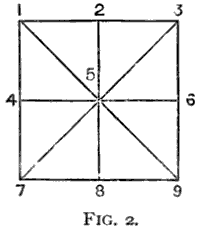
Forby has, “Morris, an ancient game, in very common
modern use. In Shakespeare it is called ‘nine men’s morris,’
from its being played with nine men, as they were then, and
still are called. We call it simply morris. Probably it took
the name from a fancied resemblance to a dance, in the motions
of the men. Dr. Johnson professes that he knew no more
of it than that it was some rustic game. Another commentator
speaks of it as common among shepherds’ boys in some
parts of Warwickshire. It cannot well be more common there
than here, and it is not particularly rustic. Shepherds’ boys
and other clowns play it on the green turf, or on the bare
ground; cutting or scratching the lines, on the one or the
other. In either case it is soon filled up with mud in wet
weather. In towns, porters and other labourers play it, at
their leisure hours, on the flat pavement, tracing the figure
with chalk. It is also a domestic game; and the figure is to be
found on the back of some draught-boards. But to compare
morris with that game, or with chess, seems absurd; as it has
a very distant resemblance, if any at all, to either, in the lines,
or in the rules of playing. On the ground, the men are
pebbles, broken tiles, shells, or potsherds; on a table, the
same as are used at draughts or backgammon. In Nares it is
said to be the same as nine-holes. With us it is certainly
different.” Cope (Hampshire Glossary) says that “Nine Men’s
Morrice” is a game played with counters. He does not describe
it further. Atkinson (Glossary of Cleveland Dialect) says
under “Merls,” the game of “Merelles,” or “Nine Men’s
Morris.” Toone (Etymological Dictionary) describes it as a
game played on the green sward, holes being cut thereon, into
which stones were placed by the players. Stead’s Holderness
Glossary calls it “Merrils,” and describes it as a game played
on a square board with eighteen pegs, nine on each side, called
in many parts “Nine Men’s Morrice.” See also Sussex Arch.
Collections, xxv. 234, and a paper by Mr. J. T. Micklethwaite
(Arch. Journ., xlix. 322), where diagrams of this game are
given which have been found cut in several places on the
benches of the cloisters at Gloucester, Salisbury, and elsewhere.
See “Noughts and Crosses.”
[420]
A children’s game, in which nuts, pence, gingerbread, &c.,
are squandered.—Addy’s Sheffield Glossary.
Children cut a number of slices from an apple, extending
from the eye to the tail, broader on the outside than on the
inner, which reaches nearly to the core; one piece has a part
cut out, making a notch—this is called “Notch;” another is
not cut at all—this is called “No-Notch;” while a third has
an incision made on it, but not cut out—this is called “Nitch.”
The pieces when thus marked are replaced, and the game
consists in one child holding the apple, and pointing to one
of the pieces, asking another child which he will have, “Nitch,
Notch, or No-Notch;” if he guesses right, he has it and eats
it; if wrong, the other eats it.—Sussex (Holloway’s Dict. of
Provincialisms).
A game where the parties, ranged on opposite sides, with
each a bat in their hands, endeavour to strike a ball to opposite
goals. The game is called “Not,” from the ball being made of
a knotty piece of wood.—Gloucestershire (Holloway’s Dict. of
Provincialisms).
See “Hawkey.”
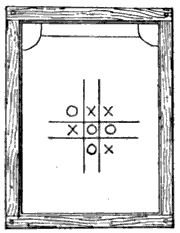
This game is played on slates by school-children. The
accompanying diagram is drawn on the slate, and a certain
figure (generally twenty) is agreed upon as
“game.” There are two players, one takes
noughts [O], the other crosses [X]. The
three places drawn on the slate above the
diagram are for the players each to put down
marks or numbers for the games they win,
the centre place being for “Old Nick,” or
“Old Tom.” The object of the game is for
each player to occupy three contiguous places in a row or line
with either noughts or crosses, and to prevent his opponent
from doing so. The diagram is of course empty when play
begins. One player commences by putting his mark into either
of the vacant places he prefers, the other player then places his
in another, wherever he thinks he has the best opportunity to
prevent his opponent getting a “three,” and at the same time
to get a three himself; then the first player plays again,
and so on alternately until all the squares are occupied, or
until one of the players has a “three” in line. If neither
player gets a “three,” the game is won by “Old Nick,” and
one is scored to his name. In the diagram the result of
the game is shown when won by “Old Nick.” Whichever
player first wins a game adds “Old Nick’s” score to his
own. In some games “Old Nick” keeps all he wins for
himself, and then most frequently wins the game.—London
(A. B. Gomme).
See “Corsicrown,” “Kit-Cat-Cannio,” “Nine Men’s Morris.”
A boys’ game in Lincolnshire, somewhat similar to “Trap
Ball.” It is played with a “kibble,” a “nur,” and a “spell.”
By striking the end of the spell with the kibble, the nur, of
course, rises into the air, and the art of the game is to strike
it with the kibble before it reaches the ground. He who
drives it the greatest distance wins the game.—Halliwell’s
Dictionary.
Strutt (Sports and Pastimes, p. 109) describes this game as
“Northern-spell,” played with a trap, and the ball is stricken
with a bat or bludgeon. The contest between the players is
simply who shall strike the ball to the greatest distance in a
given number of strokes. The length of each stroke is measured
before the ball is returned, by means of a cord made fast
at one end near the trap, the other being stretched into the field
by a person stationed there for that purpose, who adjusts it to
the ball wherever it may lie.
In a work entitled the Costumes of Yorkshire this game is
described and represented as “Nor and Spell.” The little
wooden ball used in this game is in Yorkshire called the “Nor,”
and the receptacle in which it is placed the “Spell.” Peacock
(Manley and Corringham Glossary) gives “knur,” (1) a hard
wooden ball, (2) the head. Addy (Sheffield Glossary) says
“knur” is a small round ball, less than a billiard ball. It is
put into a cup fixed on a spring which, being touched, causes
the ball to rise into the air, when it is struck by a trip-stick, a
slender stick made broad and flat at one end. The “knur” is
struck by the broad part. The game is played on Shrove Tuesday.
Brogden (Provincial Words of Lincolnshire) gives it
under “Bandy.” It is called “Knur, Spell, and Kibble” in
S.-W. Lincolnshire.—Cole’s Glossary.
The following letter relating to this game is extracted from
the Worcestershire Chronicle, September 1847, in Ellis’s edition
of Brand:—“Before the commons were taken in, the children
of the poor had ample space wherein to recreate themselves at
cricket, nurr, or any other diversion; but now they are driven
from every green spot, and in Bromsgrove here, the nailor
boys, from the force of circumstances, have taken possession of
the turnpike road to play the before-mentioned games, to the
serious inconvenience of the passengers, one of whom, a
woman, was yesterday knocked down by a nurr which struck
her in the head.”
Brockett says of this game, as played in Durham: It is
called “Spell and Ore,” Teut. “spel,” a play or sport; and
Germ. “knorr,” a knot of wood or ore. The recreation is also
called “Buckstick, Spell, and Ore,” the buckstick with which the
ore is struck being broad at one end like the butt of a gun
(North Country Words). In Yorkshire it is “Spell and Nurr,”
or “Knur,” the ore or wooden ball having been, perhaps, originally
the knurl or knot of a tree. The Whitby Glossary also
gives this as “Spell and Knor,” and says it is known in the
South as “Dab and Stick.” The author adds, “May not
‘tribbit,’ or ‘trevit,’ be a corruption of ‘three feet,’ the required
length of the stick for pliable adaptation?”
Robinson (Mid-Yorkshire Glossary), under “Spell and Nur,”
says: “A game played with a wooden ball and a stick fitted
at the striking end with a club-shaped piece of wood. The
’spell’ made to receive and spring the ball for the blow at a
touch, is a simple contrivance of wood an inch or so in breadth
and a few inches long. . . . The players, who usually go in and
out by turns each time, after a preliminary series of tippings of
the spell with the stick in one hand, and catches of the ball
with the other, in the process of calculating the momentum
necessary for reach of hand, are also allowed two trial ‘rises’
in a striking attitude, and distance is reckoned by scores of
yards. The long pliable stick, with a loose club end, used in
the game, is called the ‘tribit’ or ‘trivit’ stick. . . . The trevit
is, in fact, the trap itself, and the trevit-stick the stick with
which the trap is struck.” The tribbit-stick is elsewhere called
“primstick,” “gelstick,” “buckstick,” “trippit,” and “trevit.”
Atkinson says that “spell” is O.N., “spill” meaning a play or
game, and the probability is that the game is a lineal descendant
from the Ball-play of the Old Danes, or Northmen, and Icelanders.
“Spell and knor” is a corruption of “spell a’ knor,” the
play at ball. Nurspel is simply ball-play, therefore which name,
taken in connection with the fact that the game is elsewhere
called “Spell and Knor,” and not “Knor and Spell,” is significant.
There is one day in the year, Shrove Tuesday, when the
play is customarily practised, though not quite exclusively.—Atkinson’s
Cleveland Glossary.
Easther (Almondbury Glossary) describes it as played with a
wooden ball, a spel, and a pommel. Two may play, or two
sides. When a player goes in he drives the knor for, say, 100
yards, i.e., five score, and he reckons five. Each person has
the same number of strokes previously agreed upon, but generally
only one innings. The “spell” is a kind of stage with
three or four feet, to drive it into the ground. On the top of
this stage is a spring made of steel, containing a cup to receive
the “knor,” which is about one or two inches in diameter, and
is made of holly or box. The spring is kept down by a sneck,
which is tapped by the pommel when the knor is intended to be
struck. The pommel is thus formed—the driving part is frequently
of ash-root or owler, in shape like half a sugar-loaf
split lengthwise, but only three or four inches long, and the
handle is of ash, wrapped with a wax band where held, which
is in one hand only.
See “Kibel and Nerspel,” “Trap Ball,” “Trippit and Coit.”
[424]
[Play]
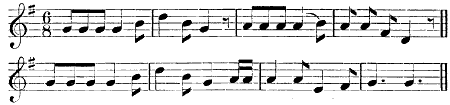
—Shropshire (Miss Burne).
I.
Here we come gathering nuts in May,
Nuts in May, nuts in May,
Here we come gathering nuts in May,
On a fine summer morning.
Whom will you have for nuts in May,
Nuts in May, nuts in May?
Whom will you have for nuts in May,
On a fine summer morning?
We’ll have —— for nuts in May,
Nuts in May, nuts in May,
We’ll have —— for nuts in May,
On a fine summer morning.
Who will you send to fetch her [or him] away,
To fetch her away, to fetch her away?
Who will you send to fetch her away,
On a fine summer morning?
We’ll send —— to fetch her away,
Fetch her away, fetch her away,
We’ll send —— to fetch her away,
On a fine summer morning.
—Liphook and Winterton, Hants (Miss Fowler).
II.
Here we come gathering nuts and May
[Nuts and May, nuts and May],
Here we come gathering nuts and May,
On a cold and frosty morning.
Pray who will you gather for nuts and May,
Pray who will you gather for nuts and May,
On a cold and frosty morning?
We’ll gather —— for nuts and May,
We’ll gather —— for nuts and May,
On a cold and frosty morning.
Pray who will you send to take her away,
Pray who will you send to take her away,
On a cold and frosty morning?
We’ll send —— to take her away,
We’ll send —— to take her away,
On a cold and frosty morning.
—Penzance (Mrs. Mabbott).
III.
Here we come gathering nuts in May,
Nuts in May, nuts in May,
Here we come gathering nuts in May,
May, May, May.
Who will you have for nuts in May,
Nuts in May, nuts in May?
Who will you have for nuts in May,
May, May, May?
[Bessie Stewart] for nuts in May,
Nuts in May, nuts in May,
[Bessie Stewart] for nuts in May,
May, May, May.
Very well, very well, so you may,
So you may, so you may,
Very well, very well, so you may,
May, may, may.
Whom will you have to take her away,
Take her away, take her away?
Whom will you have to take her away,
Way, way, way?
—— —— to take her away,
Take her away, take her away,
—— —— to take her away,
Way, way, way.
—Belfast (W. H. Patterson).
[426]
IV.
Here we come gathering nuts in May,
Nuts in May, nuts in May,
Here we come gathering nuts in May,
On a cold and frosty morning.
Where do you gather your nuts in May?
On Galloway Hill we gather our nuts.
Who will you gather for nuts in May?
We’ll gather —— for nuts in May.
Who will you send to fetch her away?
We’ll send —— to fetch her away.
—Bocking, Essex (Folk-lore Record, iii. 169).
V.
Here we go gathering nuts away,
Nuts away, nuts away,
Here we go gathering nuts away,
On a cold and frosty morning.
[Then follow verses beginning—]
Whose nuts shall we gather away?
We’ll gather [Minnie Brown’s] nuts away.
Whom shall we send to fetch them away?
[And the final verse is—]
We’ll send [Johnny Cope] to fetch them away,
Fetch them away, fetch them away,
We’ll send [Johnny Cope] to fetch them away,
On a cold and frosty morning.
—Newbury, Berks (Mrs. S. Batson).
VI.
Who will go gathering nuts in May,
Nuts in May, nuts in May?
Who will go gathering nuts in May,
At five o’clock in the morning?
—N.-W. Lincolnshire (Rev. —— Roberts).
VII.
Here we come gathering nuts in May,
Nuts in May, nuts in May,
Here we come gathering nuts in May,
On a cold and frosty morning.
Who will you have for your nuts in May,
Nuts in May, nuts in May?
Who will you have for your nuts in May,
On a cold and frosty morning?
We will have a girl for nuts in May,
Nuts in May, nuts in May,
We will have a girl for nuts in May,
On a cold and frosty morning.
—Earls Heaton, Yorks. (Herbert Hardy).
VIII.
Here we come gathering nuts in May,
Nuts in May, nuts in May,
Here we come gathering nuts in May,
This cold frosty morning.
Who will you have for your nuts in May,
Nuts in May, nuts in May?
Who will you have for your nuts in May,
This cold frosty morning?
We will have —— for our nuts in May,
Nuts in May, nuts in May,
We will have —— for our nuts in May,
This cold frosty morning.
Who will you have to pull her away,
Pull her away, pull her away?
Who will you have to pull her away,
This cold frosty morning?
We will have —— to pull her away,
Pull her away, pull her away,
We will have —— to pull her away,
This cold frosty morning.
—Settle, Yorks. (Rev. W. S. Sykes).
IX.
Here we come gathering nuts to-day,
Nuts to-day, nuts to-day,
Here we come gathering nuts to-day,
So early in the morning.
Pray, whose nuts will you gather away,
Gather away, gather away?
Pray, whose nuts will you gather away,
So early in the morning?
We’ll gather Miss A——’s nuts away,
Nuts away, nuts away,
We’ll gather Miss A——’s nuts away,
So early in the morning.
Pray, who will you send to take them away,
To take them away, take them away?
Pray, who will you send to take them away,
So early in the morning?
We’ll send Miss B—— to take them away,
To take them away, take them away,
We’ll send Miss B—— to take them away,
So early in the morning.
—Symondsbury, Dorsetshire (Folk-lore Journal, vii. 226-7).
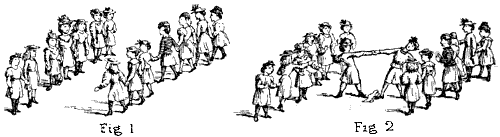
(b) The children form in two lines of equal length, facing one
another, with sufficient space between the lines to admit of their
walking in line backwards and forwards towards and away from
each other, as each line sings the verses allotted to it (fig. 1).
The first line sings the first, third, and fifth verses, and the
opposite line the second and fourth. At the end of the fifth verse
a handkerchief or other mark is laid on the ground, and the
two children (whose names have been mentioned, and who are
as evenly matched as possible), take each other’s right hand
and endeavour to pull each other over the handkerchief to their
own side (fig. 2). The child who is pulled over the handkerchief
becomes the “captured nut,” and joins the side of her capturers.
Then the game begins again by the second line singing the
first, third, and fifth verses, while advancing to gather or capture
the “nuts,” the first line responding with the second and fourth
verses, and the same finish as before. Then the first line
begins the game, and so on until all the children are in this
way matched one against the other.
(c) Other versions have been sent me, with slight variations:
Nuts in May, with the verses ending, “On a fine
summer morning,” from Lincoln and Nottinghamshire (Miss
M. Peacock); “So early in the morning,” Sporle, Norfolk (Miss
Matthews); “Six o’clock in the morning,” Nottingham (Miss
Wenfield); “On a cold and frosty morning,” East Kirkby,
Lincolnshire (Miss K. Maughan); Barnes (A. B. Gomme),
Colchester (Miss G. M. Frances). Nuts and May: “On
a bright and sunny morning” (Mr. C. C. Bell); “On a cold
and frosty morning,” Forest of Dean (Miss Matthews); “Every
night and morning,” Gainford, Durham (Miss Edleston);
“We’ve picked [Sally Gray] for nuts in May,” “All on a
summer’s morning,” Sheffield (Mr. S. O. Addy). A version
by Miss Kimber (Newbury, Berks, and Marlborough, Wilts)
ends each verse, “Nuts and May.” In other respects these
variants are practically the same. Printed versions not given
above are Hersham, Surrey (Folk-lore Record, v. 85); Burne’s
Shropshire Folk-lore, p. 516; Sulhampstead, Berks (Antiquary,
vol. xxvii., Miss E. E. Thoyts); and Dorsetshire, “Gathering
nuts away” (Folk-lore Journal, vii. 225). From Longcot,
Berks, a version sent me by Miss I. Barclay has no fourth line
to the verses.
(d) This game is probably, unless we except “Mulberry
Bush,” the most popular and the most widely played of any
singing game. It might almost be called universal. This is
shown by the fact that there are few counties where it is not
known, and also that important variants, either in the words or
in the method of playing, are rarely met with. In all the versions
which have been sent there are only the following variations
in the words, and these are principally in the refrain, or
last line of each verse: “On a cold and frosty morning” ends
by far the greater number of versions; “On a fine summer’s
morning,” “So early in the morning,” “All on a summer’s
morning,” “Five o’clock in the morning,” “On a cold and
sunny morning,” coming next in number. The Belfast version
ends, “May! May! May!” and a Newbury and Marlborough
fourth line is simply a repetition of the second, “Nuts in May,
nuts in May.”
In the first line of the verse the only important variant seems
to be the Symondsbury “Gathering nuts away” and “Gathering
nuts to-day.” “Gathering nuts away” also occurs in one
version from Newbury (Berks), “Nuts and May” appearing
in the larger number after the more usual “Nuts in May.” In
only one version is a specific place mentioned for the gathering.
This is in the Bocking version, where Galloway Hill is named,
in reply to the unusual question, “Where do you gather your
nuts in May?” A player is usually gathered for “Nuts in
May.” In three or four cases only is this altered to gathering
a player’s “nuts away,” which is obviously an alteration to try
and make the action coincide exactly with the words. The
game is always played in “lines,” and the principal incidents
running throughout all the versions are the same, i.e., one
player is selected by one line of players from their opponents’
party. The “selected” one is refused by her party unless
some one from the opposite side can effect her capture by a
contest of strength. In all versions but two or three this contest
takes place between the two; in one or two all the players
join in the trial of strength. In another instance there appears
to be no contest, but the selected player crosses over to the
opposite side. Two important incidents occur in the Bocking
and Symondsbury versions. In the Bocking game the side which
is victorious has the right to begin the next game first: this
also occurs in the Barnes version. In Symondsbury, when
one child is drawn over the boundary line by one from the
opposite side she has to be “crowned” immediately. This is
done by the conqueror putting her hand on the captured one’s
head. If this is not done at once the captured one is at liberty
to return to her own side. In some versions (Shropshire and
London) the player who is selected for “Nuts” is always captured
by the one sent to fetch her. Some Barnes children
also say that this is the proper way to play. When boys and
girls play the boys are always sent to “fetch away” the girls.
In Sheffield (a version collected by Mr. S. O. Addy) a boy is
chosen to fetch the girl away; and in the Earls Heaton version
the line runs, “We’ll have a girl for nuts in May.”
(e) There is some analogy in the game to marriage by capture,
and to the marriage customs practised at May Day festivals
and gatherings. For the evidence for marriage by capture in
the game there is no element of love or courtship, though there
is the obtaining possession of a member of an opposing party.
But it differs from ordinary contest-games in the fact that
one party does not wage war against another party for possession
of a particular piece of ground, but individual against
individual for the possession of an individual. That the player
sent to fetch the selected girl is expected to conquer seems to
be implied—first, by a choice of a certain player being made
to effect the capture; secondly, by the one sent “to fetch”
being always successful; and thirdly, the “crowning” in the
Symondsbury game. Through all the games I have seen
played this idea seems to run, and it exactly accords with the
conception of marriage by capture. For examples of the actual
survivals in English, Scottish, Welsh, and Irish customs of
marriage by capture see Gomme’s Folk-lore Relics of Early
Village Life, pp. 204-210.
The question is, How does this theory of the origin of the
game fit in with the term “Nuts in May”? I attribute this
to the gathering by parties of young men of bunches of May at
the May festivals and dances, to decorate not only the Maypole,
May “kissing-bush,” but the doors of houses. “Knots
of May” is a term used by children, meaning bunches of May.
Thus, a note by Miss Fowler in the MS. of the games she had
collected says, “In Bucks the children speak of ‘knots of May,’
meaning each little bunch of hawthorn blossom.” The gathering
of bunches of May by parties of young men and maidens
to make the May-bush round which the May Day games were
held, and dancing and courting, is mentioned by Wilde (Irish
Popular Superstitions, p. 52), the game being “Dance in the
Ring.” Holland (Cheshire Glossary) says, “May birches were
branches of different kinds of trees fastened over doors of
houses and on the chimney on the eve of May Day. They
were fastened up by parties of young men who went round
for the purpose, and were intended to be symbolical of the
character of the inmates.” I remember one May Day in London,
when the “May girls” came with a garland and short sticks
decorated with green and bunches of flowers, they sang—
Knots of May we’ve brought you,
Before your door it stands;
It is but a sprout, but it’s well budded out
By the work of the Lord’s hands,
and a Miss Spencer, who lived near Hampton (Middlesex),
told me that she well remembered the May girls singing the
first verse of this carol, using “knots” instead of the more
usual word “branch” or “bunch,” and that she knew the
small bunch of May blossom by the name of “knots” of
May, “bringing in knots of May” being a usual expression
of children.
The association of May—whether the month, or the flower,
or both—with the game is very strong, the refrain “cold and
frosty morning,” “all on a summer’s morning,” “bright summer’s
morning,” “so early in the morning,” also being characteristic
of the early days of May and spring, and suggests that
the whole day from early hours is given up to holiday. The
familiar nursery rhyme given by Halliwell—
Here we come a-piping,
First in spring and then in May,
no doubt also refers to house-to-house visiting of May.
The connection between the May festival and survival in
custom of marriage by capture is well illustrated by a passage
from Stubbe’s Anatomie of Abuses, p. 148. He says: “Against
May Day, Whitsonday, or other time, euery Parishe, Towne and
Village assemble themselves together, bothe men women and
children, olde and yong, . . . and either goyng all together
or diuidyng themselues into companies, they goe some to the
Woodes and groves where they spend all the night in plesant
pastimes; and in the morning they return bringing with them
birch and branches of trees to deck their assemblies withall . . . and
then they fall to daunce about it like as the heathen
people did. . . . I have heard it credibly reported (and that
viva voce) by men of great grauitie and reputation, that of
fortie, threescore or a hundred maides going to the wood ouer
night, there haue scaresly the third part of them returned home
againe undefiled.” Herrick’s Hesperides also describes the
festival, and the custom of courting and marriage at the same
time.
The tune sung to this game appears to be the same in every
version.[Addendum]
END OF VOL. I.
BALLANTYNE PRESS
PRINTED BY BALLANTYNE, HANSON AND CO.
EDINBURGH AND LONDON